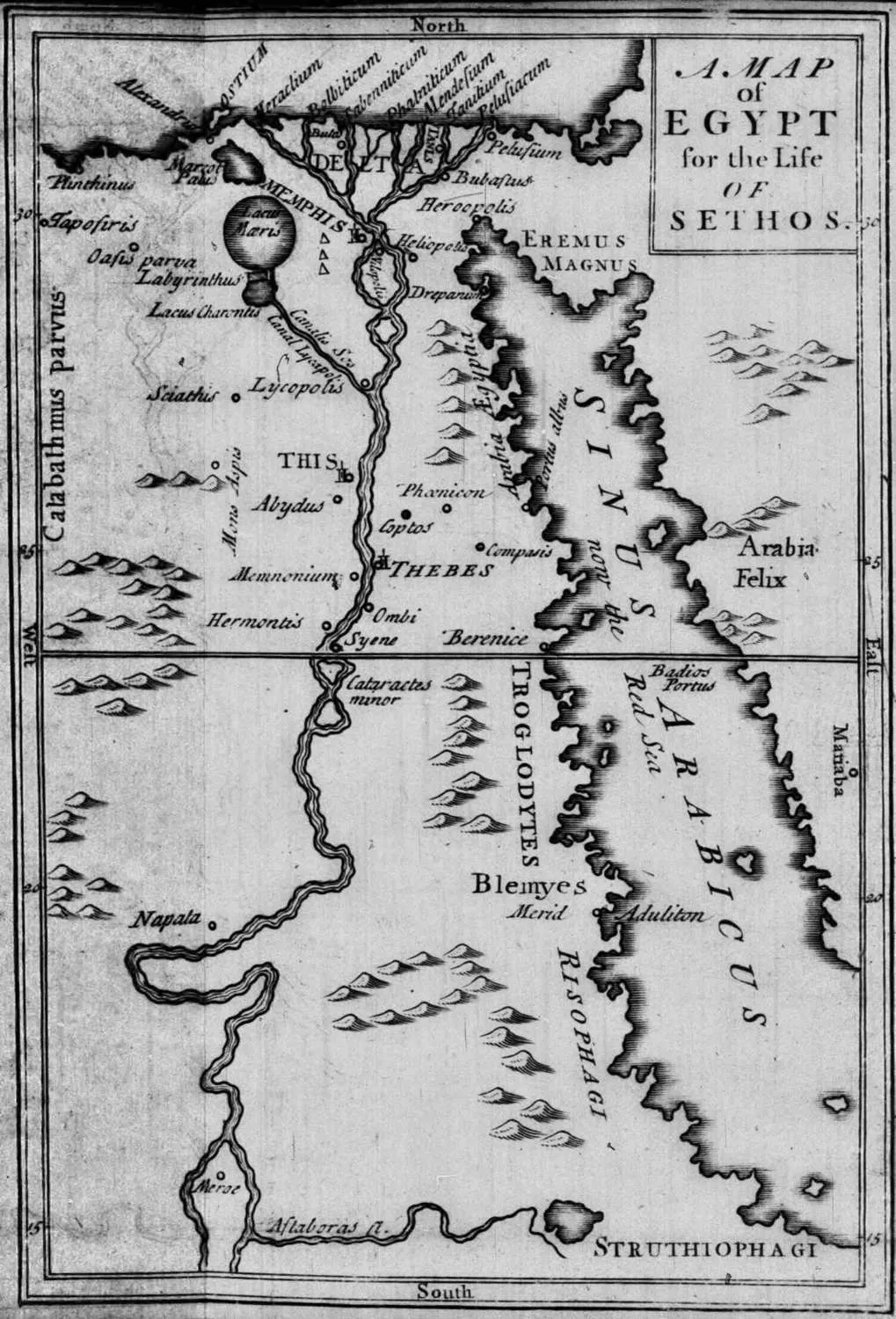
And now faithfully done into English from
the ParisEdition;
By Mr. LEDIARD.
In Two Volumes.
Vol. I.
LONDON:
Printed for J. Walthoe, over-against the Royal-Exchange in Cornhill.
M.DCC.XXXII.
THE PREFACE.
The Greek Manuscript, of which
I here offer the Publick a Translation,
was found in the library
of a foreign nation, extremely jealous
of this sort of treasure. Those
who procured me the reading of it would
admit of my publishing this Translation upon
no other terms, but that of concealing the
Library in which the Original is deposited.
The author is no where named: But we find
by several Passages in this work, that he was
a Greek born, and lived at Alexandria, under
the reign of Marcus Aurelius.
There is no room to doubt but this
work is a fiction. The event of sundry enterprizes
proving in a manner such as a
reader would wish or hope, the unexpected
return and rencounter of several personages,
but above all, the great number of discourses
directly from the Persons themselves, sufficiently
evince, that our author has not tied himself
down to such real facts, which the common
circumstances of life make liable to a
greater confusion; and that he takes upon him
the entire disposal, not only of the actions,
but even of the thoughts of those persons he
brings upon the stage.
The particular advantage, which he
proposed to himself, obliged him to employ
his pen in this kind of writing. History,
properly so call’d, has beyond dispute its excellencies.
It is an Improvement of the Mind,
which we expect from every one who undertakes
to cultivate education. History is essential to
the professions of some, and a recreation almost
universally coveted by others, whose main business
seems the most distant from it. It is
one of the chief springs of true philosophy,
by the knowledge it gives us of human passions
and prejudices. It is accounted the most sure
guide in politicks, by furnishing one single
person with the experience of all preceding
ages. In short, it is looked upon by some as
a great foundation of moral instructions, by
the reiterated examples it lays before us of
good and evil.
But with regard to this last property; I
believe, when we come to examine the matter
narrowly, we shall find history fall far short
of fiction; when the latter is employed in such
a manner as becomes every prudent writer;
that is, with an Eye to form the manners of
men. History, in itself, is but a collection of
facts, guided by providence, for ends generally
unknown to us: and tho’ every thing be
wonderfully well ordered, pursuant to the
mysterious views of the divine wisdom and
justice; the consequences of mens actions are
frequently to our eyes but a series of disappointed
projects and crimes unpunished. A
view of what has happened in the world is,
strictly speaking, no other than a view of
what passes in a place of publick resort, neither
the one nor the other is in any-wise moral
but by the reflections of the spectator or relator.
In a Word, mere history is rather an
object than a doctrine.
But in a fictitious work the case is very
different. The moral Author, if his undertaking
be narrative, generally makes it his
business to represent his hero adorned with
all the virtues proper to his state and condition.
He places him in all such circumstances
as may give him room to exercise these
virtues. He sets him in opposition not only
to wicked men, but to such whose virtues are
weak and wavering; that their different characters
may make that of his hero shine forth
with the greater lustre. His images are
accompanied with judgments already formed,
and explicit advices. In a word, his instructions
are rendered perfect, as well by
doctrine as example. We might combine and
melt down numbers of the great Men in history,
and unite the events of many ages; before
we should find those materials for wonder
and imitation, which a judicious author of a
fiction will often produce in but a small part
of the life of one single hero.
The two works we have hitherto seen of
this kind, Telemachus and the Travels of Cyrus
perfectly answer this idea. It is not a comparison
with history, which is of a quite different
nature, but a comparison of good fictitious
works, which will more and more discover the
pernicious folly of romances, when by that term
we mean an advantageous, or if but a favourable
representation of the frailties or disorders of love.
But a yet more important effect of good fiction
will be to explode false heroism. That cruel ambition
and implacable revenge celebrated by so
many orators and poets under the epithet of valour,
will be divested of the lustre they have
cloathed it with, and we shall soon look upon
whatever has contributed to raise these false
virtues to such an eminence, as the deceitful
beauties of eloquence, or poetry.
This happy effect seems to be already infused
in the minds of men. The spoil of nations
does now no longer appear an object of
emulation; at least among civilized people.
Panegyricks upon conquests and devastations
are no more patterns in the education of princes;
and good poets have done with extolling
them for making arms alone their pastime.
I find no reason to repent of what I formerly
said speaking of Telemachus: That if the
happiness of mankind could be said to arise
from a poem, it would be from that. And
tho’ princes may not often apply themselves
much to reading, yet those who have the care
of their education, knowing as well the origine
as progress of learning, don’t suffer them to
be ignorant, either in those principles of morality
or maxims of lenity, which even their
own times may have produced and established.
Princes now ascend the throne endued with a
knowledge of true glory, and imbibing the very
same sentiments on this head with the publick,
they concur in supporting it in that tranquility
and happiness which is expected from them.
A peace, the long continuance of which has
no precedent in our history, is unquestionably
owing to the wisdom of a great minister. And
the French nation acknowledges all the obligations
due to him for that unwearied administration
which is the support of their tranquility.
But the princes he has to treat with
would perhaps more strenuously oppose his
measures, if an education advanced by a work,
which is of service to all the kings in the
universe, had not reconciled them to the same
dispositions of mind as the young and august
monarch, in whose kingdoms Telemachus took
its birth. If we are allowed to assert, that
the encrease of literature has introduced a
politeness and good taste in all the courts and
cities of Europe, we may justly attribute, at
least in part, that fondness for peace, which
at this time seems to be the favourite passion
of all nations, to those works which contain
an excellent moral, set off with all the embellishments
that can render it agreeable. We may
certainly number them among the causes of
that just and pacifick temper of mind, which
every one is seemingly big with, and which by
degrees extirpates those animosities among nations,
which the bare remoteness of their former
inducements, began to render unjust and
reproachful; and in the place of which a
mutual value for the virtues, talents, and
every commendable quality of their neighbours
is daily substituted.
A natural consequence of the success of
Telemachus next to reforming our judgments,
and softening our manners, ought to be laying
a foundation for a new kind of work. The
first poems of antiquity produced imitations of
the same form and denomination, as Epopeas,
Tragedies, Idylls and the like; but the author
of Telemachus has only been imitated in the
essential part; that is by the same intention
or zeal to produce the same effects. Thus
Telemachus is an epick poem; but the Travels
of Cyrus, in conformity to their title, contain
only the hero’s rambles in search of instructions
from all the wise men of his times,
in order to introduce into his own dominions
whatever he found good and profitable in the
different customs of the most celebrated kingdoms
and commonwealths.
The Work before us is, with regard to
the moral design of it, of the same species
with both; but more different in the form of
it, than they are one from the other. They
are both properly a system of education: and
tho’ Cyrus was more advanced in years than
Telemachus; both heroes only treasured up
instructions for practice, or made trial of what
they were to put in use; the former in the
management of a little kingdom, and the
latter in the government of a vast empire.
My author, on the contrary, displays a compleat
life, or the actual application of those principles
and sentiments, which his hero had imbibed
in the course of a most excellent education.
So that in this history, which is divided into
ten books, the hero, from the fourth, is in a
condition to instruct others; and in the whole
sequel acts alone upon his own motives. Mov’d
by a true heroism, he employs the time of a
tedious exile in the quest of unknown people,
whom he frees from the bondage of the most
barbarous superstitions, and becomes their
law-giver. In his return, he, by his valour,
relieves a mighty republick from an enemy,
that was at its very gates; but demands no
other reward for his labour, than the preservation
of the people he had vanquished, whose
king or tyrant had been the aggressor. Being
at last returned into his native country, he becomes
a benefactor to those he had reason to
look upon as his enemies and rivals; rejoicing
in those junctures, which engaged his honour
to sacrifice his own interest to theirs, and made
the happiness he obtained for them his duty.
Sethos is not alone virtuous by a natural
disposition or from a habit. The motives
of his conduct are drawn from durable and enlightened
principles, which he displays in different
rencounters. And he forms to himself
such decisions, as, tho’ always tending towards
the highest perfection, and even to heroism, are
more recommendable by their accuracy than their
severity. Hence we have reason to suppose, that,
our author, who liv’d in the second century, had
some knowledge of morals far superior to those
of paganism. From these morals, it is very plain
he borrows those adequate definitions of the
virtues and vices, which he sometimes puts
into the mouth of his hero, and some others of
his personages. And upon this it is I build
the confidence I have in affirming, that this
work contains a more refined and profound
moral than has hitherto been seen in any book,
the product of mere literature, or of the number
of those which may be stil’d prophane.
As our author, however, leaves his hero a
pagan; he confines himself, in this history or
life, wholly to moral virtues; and the recommendation
of such to the practice of mankind is
not without its advantage. It is by means of
them, if I may be allowed the expression, we
can have intercourse with the manners of those
nations, who differ the most from us in point of
religion. It is by them, that even in religion
itself, we are able to keep up that humanity and
probity, so necessary for the publick good, in
men who have the unhappiness of not enough
perceiving those motives of another kind, which
are of greater importance to them. To conclude,
by them we can shew those too zealous
persons, who seem to despise such virtues as are
merely moral, that christian virtues are in regard
to moral virtues what faith is with respect
to reason; superior, but never contradictory.
Another of our author’s views has
been to lay hold of the opportunity of an Egyptian
hero to throw into his work a great number
of learned curiosities, concerning that once
so famous people: And farther, as he makes
his hero travel over a great part of the globe,
he had carefully got together the primary
notions of the ancient geography. This was,
without doubt, one of his reasons for giving
his work the turn of a history or life, preferable
to that of a poem or romance. In reality,
the examples of Herodotus, Polybius, Diodorus,
and especially of Plutarch, sufficiently
justified his inserting in this narrative, not
only political or military antiquities, but even
historical passages relating to the rise and
progress of human knowledge. These great
writers looked upon such digressions as very
curious for the common part of readers, who
want time or patience to have recourse to
other springs.
I must own, however, that upon a view of
my whole translation, I began to fear the
inconveniency of interruptions, either too frequent
or too prolix, in a life built upon fable,
the contexture of whose parts ought to render
it more engaging than common lives. Of all
the particulars on this head in the original,
I have therefore only preserved such as were
necessary to give an adequate idea of the education
of a hero, who stood in need of great
lights, to undertake a very long voyage, not
before attempted; and then to give proper
laws to the different nations, which were civilized
by him. The academies of Memphis,
which he frequents in his most tender youth,
and the observatory of Thebes, which he visits
before he imbarks for his voyage, were preparations
essential to the carrying on of this design.
And so the reader will find a plan of
the former in the first book, and a sketch of
the other in the fifth. But even in these
hints I have considerably abridged our author’s
historical comparison between the sciences of the
Egyptians and those of Greece.
Nevertheless, the general impression
which will arise from the body of the work,
is sufficient to give even a pretty extensive idea
of the Egyptians, Phœnicians, and some other
nations: And even the fiction will be no hinderance
to a search into the grounds of their understanding
and manners. Many people have
no other notion of the Greeks and Romans but
what they have taken from Tragedy; and a
certain principle, not very easy to define, teaches
them to distinguish that which may reasonably
be supposed to be true from what is probably
the product of invention only. This advantage
has been improved even in romances,
and the ninth part of Cleopatra gives us as
faithful a picture of the recesses of Augustus’s
court, as we could expect from the Abbot of
St. Real. But here the reader will find plainer
indications than are to be found either in tragedies
or romances.
We may at first view rely upon the particular
circumstances, as well of Egypt as
of other nations, which the author confirms by
quoting any known writers. He seems himself
to have separated the real from the fictitious,
by alledging his anecdotical authors for
those facts which are wholly the children of
his own invention, or for such customs as are
founded upon truth, but are refined and amplified
in the relation. Fiction has a right of
sacrificing the accuracy of facts, not only to
moral virtues, but even to the embellishment
of the narration; supposing besides that the
end of such embellishment is to render the instruction
more agreeable. An example of this
conduct in our author, is the important article
of initiation, which alone fills two whole
books. But even this article is very conformable
to the essential part of this renowned
institution; as far as it could break
thro’ that rigid silence which cover’d it, and as
we find any traces of it in those authors, either
Pagan or Christian, who have mentioned it.
The whole work is full of manners and
customs, part of which I myself have confirmed
by notes added to the text. As to some
other less considerable passages, for the proof
of which I have designedly avoided over-charging
this work with quotations. I dare
venture to affirm, that the more my readers
may have examined, the more they will find
our author agree with those testimonies which
are either collected or dispersed in the different
writings we have left of antiquity. For tho’
my intent was to clear this work from all
tedious erudition, I never designed to deprive
it of the advantage and support of curious
enquiries: but had always my author’s chief
aim in view, who adding his love for learning
to that of virtue, looks upon literature
in a nation, taken in general, as the source
and support of every humane and civil virtue.
To conclude, our author seems to have
drawn all the probability, that can be expected
from a fictitious writer, concerning the
knowledge he could be supposed to have of
the actions and sentiments of his hero, from
the place where he lived. He is treating of
an Egyptian prince, born in the century preceding
the Trojan war, a time in which
ancient Egypt was in its greatest splendor.
Now this period so remote can have furnished
no publick memoirs to any other writer
either of Italy or Greece. But it is very
natural to suppose that a citizen of Alexandria
may have been master of memoirs taken in the
confusion of war from the sacred archives
of Egypt, and unknown even to the Egyptian
priests of his times; and besides those priests
who accompanied Sethos in his travels, may
have been the authors of them. It was to
give a like sanction to her history that Madam
de Scudery in the preface to her Cyrus, a hero
posterior to ours by seven or eight hundred
years, studies to have it thought the translation
of an ancient manuscript found in the
Vatican library.
In the second place, as our author mentions
the sciences of the Egyptians only comparatively
with those of the Greeks, from whom
alone the Romans had any knowledge of ancient
Egypt; the second century, or the latter
end of the first, and the beginning of the second,
in which he lived, was the most proper
time for this comparison. A time which
may justly be termed the most favourable to the
sciences both for the Romans and Greeks, then
under the same empire. M. de St. Evremont
has already remarked that the days of Augustus
were only noted for poetry; and that we must
look something farther back for the days of
eloquence. Our best writers in point of painting
and sculpture, M. Felibien and M. de
Piles, seem on the other hand to refer the
period of sciences among the Romans, to that
interval of time included in the reign of Vespasian
and the Antonines. The names of Pliny,
Ptolemy and Galienus alone give us reason to
fix their greatest eminency thereabouts; and
the reader will find in this life sundry
evidences to prove, that Alexandria was
then their principal seat, even for the Romans
themselves. These considerations were
sufficient to justify our author with regard
to what I have thought proper to omit
on this head, and may perhaps give him
more credit with regard to that little I have
retained.
LICENCE. — ERRATA.
By Order of the Lord Keeper of the
Seals, I have read a Manuscript, entitled:
TheLifeofSethos; taken
from private Memoirs of the ancient
Egyptians, translated from a Greek
Manuscript. This Work, which contains
excellent Lessons of the most
refin’d Morality, and is full of solid,
and the most extensive Learning, can’t
fail of being equally instructive and
curious.
VOL. II. P. 62, l. 5. after settlement add in the city. 68,27.
r. predecessor. 275,20. r. governor. 315,18. after they add
likewise. 324,2. dele (,) after were, and place it after yet.
341,15. after judge, add only. 342,1. r. besieger. 432,24.
for still r. swell.
BOOK I.
THE LIFE OF SETHOS.
The Egyptians, who go farther
back in the relations of their origine
than our histories reach, say
the Gods were their first kings.
They name seven: Vulcan, the
Sun, Agathodemon, Saturn, Osiris, Isis and
Typhon. By Vulcan, to whom they assign
no beginning, their philosophers meant that
elementary fire, which is diffused every where.
This same fire, re-united into one globe, is
the Sun, the son of Vulcan. Agathodemon,
defin’d by his very name, was their good genius
or principle. Saturn, or Time, was the father
of Osiris and Isis, brother and sister, husband
and wife, the two sexes of nature. Typhon,
their third brother, was always regarded by
them as their evil principle.
Horus was the son of Osiris and Isis,
reason, or human wisdom, and he began the
reign of the demi-gods. These were nine in
number, Horus, Mars, Anubis, Hercules,
Apollo, Ammon, Tithoes, Sosus, and Jupiter,
or Menes. I shall not speak of every one of
these in particular, most of them being pretty
well known to the Greeks and Romans, even
in their allegorical signification. I shall only
observe, in order to set the times of my hero
in a clearer light, that the latter of these demi-gods
began the reign of men. He was indeed
look’d upon but as a man in his life-time: but
after having rul’d all Egypt alone by the name
of Menes, he was, after his death, in consideration
of his happy reign, number’d with
the gods by the name of Jupiter. He had
four sons, Thot or Mercury, Æsculapius,
Athotes and Curudes, of which the two first
were, as well as himself, advanced to the skies.
Menes, to render the succession to his states
equal, divided Egypt into four kingdoms.
Mercury reign’d in Thebes, Æsculapius at
Memphis, Athotes at This, and Curudes at
Tanis. This was the rise of the four great
Dynasties of Egypt, which were collateral or
cotemporary for sixteen hundred years, to the
time of the famous Sesostris, king of Thebes,
and conqueror of Asia. [1]The other Egyptian
dynasties, which some historians mention, to
the number of twenty, from the times of
Menes to Sesostris, were but separate branches
of these four chief divisions; and the different
names they give them, as Heracleopolites,
Xoites, Elephantins, and the like, were
taken from the residence of some of the kings
of each dynasty in different cities of the same
kingdom.
[1] The preceding genealogies are conformable to those
of Marsham; but what follows seems to agree with the
chronology of father Pezron.
As for the Shepherd Kings, who were
foreigners, and having dwelt in Egypt during
the space of three or four ages, seem to have
interrupted this succession; they never had
any settled possession on this side Tanis, on
the borders of Delta, tho’ they obliged the
natural kings of those regions to retire to
Heliopolis. But as these foreigners, originally
Arabians, made frequent incursions into the
other parts of Egypt, the Egyptians, being
reunited, attack’d, and having vanquish’d
them, oblig’d them, and their descendants,
to furnish all Egypt with slaves. This victory
was obtain’d near two hundred years before
the birth of Sesostris, who found Egypt in a
state of tranquillity, and made it very flourishing.
This hero had the ambition to set the
god Osiris for his pattern, and like him, according
to the Egyptian traditions, visited a
great part of the earth, teaching the inhabitants
to cultivate it, and to form agreeable
and useful societies; thus Sesostris was the first
king, of the race of men, who bore arms
in Asia, and there introduced and establish’d
the laws and sciences of Egypt. He even
rul’d all the four kingdoms of Egypt, not
indeed by a sovereign power, but by the superiority
of his genius, his virtues and reputation.
His first successors supported for a time,
especially with regard to foreign provinces,
the splendor of so great an empire; and we
find, about one hundred years after Sesostris,
Mendes or Memnon, king of Thebes, ruler
of Susa and Phrygia, chastizing the revolted
Bactrians, and re-establishing order among
the people conquer’d by his ancestor. But
Ramesses, who succeeded Memnon, wanting
both the courage and conduct of his
forefathers, lost, by his weakness, all the
conquer’d dominions, and, by his pride, a
title which he had till then retain’d above
the other kings of Egypt. His immediate
predecessors having need of all their cunning
as well as force, to keep the distant provinces
under the yoke of obedience, had
treated these kings with discretion, and had
not abus’d that right, which they perceived
had in truth only devolv’d upon Sesostris, on
account of his personal merit. But young
Ramesses[2] soon discover’d his character by
two obelisks, which he caus’d to be inscrib’d
with titles so ostentatious and false, with regard
to him, that in latter ages they have
been thought to relate to Sesostris. This
young prince, whose whole study was to deck
himself with a vain and momentaneous
glory, the ignominious consequences of which
he never foresaw, took upon him to send
these kings, who were now become his
equals, his commands in form. But they
soon gave him to understand, that they insisted
upon Egypt’s retaining its pristine form
of four dynasties, which had been always independant
since the four sons of Menes.
They alledg’d, that Sesostris himself had not
interrupted them: and that the kings their
predecessors, in his life-time, reserving the
royal title and dignities, had accepted of
diverse regulations, by him proposed, only
because they appear’d to be equally advantageous
to the whole nation. Such was the
division he had made of all Egypt into thirty-six
nomes[3] or provinces, the particular governors
of which could with greater ease
keep a watchful eye over the productions of
nature and art, which they furnish for foreign
commerce; and over the taxes they were
in a condition to contribute in case of a general
war. It was to him, they said, were
owing those temples which were erected in
each city, to the honour of its tutelar god;
the wall which extended from Pelusa to
Heliopolis, and put a stop to the inroads of
the Syrians, and bordering Arabians of the
desarts, a people under no manner of discipline;
the great canal, by which a communication
was open’d between the Mediterranean
and the Red-sea, and the whole
eastern and western commerce made to pass
thro’ Egypt; and lastly those dykes and
sluices, which taking in the whole space
from the Cataracts of the Nile, to its mouth
or entrance into the sea, between the mountains
of Libya, and the coasts of the red-sea,
stopp’d or received, as occasion requir’d, the
inundations of that river. But they added,
that, all these undertakings being finished, they
knew how to maintain them, each in his
own dominions, without the advice of Ramesses,
from whom they absolutely refused
to receive any commands. This opposition
put an end to a dispute, which a king, more
wise than he, might have kept undecided;
and he was obliged to take up with the title
of king of Thebes the great, which devolv’d
to Sesostris by right of his ancestors.
[2] Kirk. Oed. Ægyp. tom. 4 p. 162. & Marsham, p. 431.
ed. in fol.
About two hundred years after the death
of Ramesses, and fifty or sixty years before
the Trojan wars; Osoroth, a prince advanced
in years, succeeded to the crown of Memphis,
a dynasty but little inferior in power to
that of Thebes, but by far preferable to it
with regard to the lenity of its climate, and
the beauty of its situation. The city of
Memphis, the metropolis of the dynasty,
was situate on the western bank of the Nile,
near the place where that only river of Egypt
divides itself into seven arms, of which those
two, which are at the greatest distance one
from the other, enclose the Delta, and all
together form seven mouths at their entrance
into the great ocean (the Mediterranean.)
All Egypt has, from the antientest account
of time, been stil’d a gift of the Nile; being
suppos’d to be only a heap of earth, which
the waters of this river has successively carry’d
away with its stream from the south to the
north. But the formation of the Delta is
held to be more recent: because according to
those[4] monuments, which may well be look’d
upon as historical truths, the Pharus of Alexandria,
which is now join’d to the continent,
was formerly twenty-four leagues distant from
it in the sea. This region is so delightful, that,
according to fable, the gods form’d it upon
the constellation of the triangle, which passes
vertically over the Delta every Day in the
year.
[4]Plin. lib. 2. c. 35. Sen. quæst. nat. lib. 6. c. 26.
Osoroth, not long before his accession to
the throne, had marry’d Nephte, daughter
of the king of This, a third dynasty, situate
between Memphis and Thebes, to the west
of the river Nile. Of this princess he soon
had the prince, whose life I am about to
write. He was the eldest of the three sons
of Osoroth, mentioned in the annals of
[5]Manethon only by the name of the Anonymi.
But tho’ this famous historian was
a priest, and even keeper of the sacred archives
of Heliopolis; as he did not write till
the reign of Ptolomeus Philadelphus, two
hundred years after the devastation of Egypt
by Cambyses, the remains of those memoirs
he was possess’d of were but very imperfect.
I have, by means not to be related, discover’d
those which are more ample, and have been
preserv’d more entire; and which give to
the first of these Anonymi of Manethon the
name of Sethos, and the surname of Sosis,
or Preserver, for a reason that will be shewn
in the sequel of his life.
[5] See the Egyptian origines of Perizonius, p. 47. under
the column, ex African. also the 38, and 49 pages, in
which Manethon is alledg’d to be the first author of the
sequels of Africanus and Eusebius.
The birth of this prince fill’d the whole
kingdom with joy; so great was the love the
people bore to their king, or rather to the
queen, who, tho’ but young in years, govern’d
them with an admirable wisdom and
goodness: For Osoroth, whose character it
would be difficult to trace in one single picture,
and which will not be well understood
till towards the conclusion of this history,
immediately entrusted the reins of government
in the hands of the queen. This prince
did not ascend the throne till the 50th year
of his age: And king Sesonchis his father,
more jealous of his present authority than
attentive to the future felicity of his son and
subjects, had kept him ignorant of the affairs
of his realm, even to the moment he left
him his successor. So Osoroth, having fortify’d
his natural indolence by a life given
up to sloth and inactivity, had no other taste
of the sweets of royalty, but that of independency,
and sought how to disburthen himself
of the weight of government. This part
fell, as it were of itself, into the hands of
the queen, more capable than any other of
receiving it; and what appear’d in the eye
of the people to be a judicious choice, was
in reality the mere effect of supineness in
Osoroth. He was one of those kings, who
being of themselves neither good nor bad,
become the very best or worst of princes,
just as they happen by mere accident to fall
into the hands of good or wicked ministers:
Unhappy the situation of a people subject to
a prince whose very errors are without controul!
Nephte, from the first dawn of her power,
had fill’d her subjects with the hopes of a
gentle government. They were the more
sensible of it, as their deceas’d king, otherwise
a great prince, was rigid and stern in
his manners. The minds of the people were
sensible of a relief, even before the queen
had eas’d them in the publick burden; because,
without diminishing the king’s revenue,
she had found means of rendring it less
perceptible. Even the riches of private persons
encreas’d by the confidence they plac’d
in her, and in one another. She, at the same
time, brought up her only son with all the
affection of a mother, and the foresight of a
wise queen. She earnestly desir’d to see him
attain to that age in which she might, in
her turn, deliver up to him that administration,
which she look’d upon but as a trust
committed to her charge. In the mean
time she took as an assistant in the conduct
of her affairs, an excellent person,
call’d Amedes; who, tho’ he had not in the
late reign pass’d thro’ all the offices of dignity
wherewith he might have been invested, yet
had acquitted himself with great honour in
several eminent stations, as well civil as military,
and in negotiations with foreign princes;
and who now advis’d the queen (as he
had before the late king) to conceal from the
publick the honour she did him, to avoid exciting
the jealousy of the great, and that murmuring
of the people, which is often rais’d
against those ministers who are most zealous
for the publick felicity. Hence the queen, reserving
Amedes for her cabinet counsellor,
without any title of note, preferr’d the best of
her subjects, among those whom the different
degrees of birth seem’d to present for every
place that became vacant. Thus her sovereign
authority was employ’d in distinguishing
merit, without subverting order; and the
number of the disaffected was very small, and
even they were apprehensive of uttering those
complaints, which they knew the voice of
the publick would condemn.
While the queen intirely devoted herself
to affairs of state, the king gave himself up
to all the amusements of a glittering court.
But as these were never reliev’d by any thing
serious, they could scarce keep him from
uneasiness, and manifested in the king of a
great people, a man whose very leisure sate
heavy upon him. Among the ladies who
were about him was one, whose name was
Daluca, the widow of a great lord of the
court. She had no children, and had already
pass’d those years in which the ladies only cultivate
their beauty in order to carry on their
gallantry, and was enter’d into those, in
which they are studious of making the remains
of it subservient to their ambition.
This lady had form’d a design of gaining
an ascendant over the king. The esteem
and regard the queen was in had deterr’d
every one else from the like attempt. Daluca
herself, who was perfectly acquainted
with Osoroth’s temper, was very cautious of
saying any thing to him against Nephte, that
might excite any disagreeable emotions in his
mind. She made it her business to be continually
near him; and had the art of pleasing
by that obsequiousness and those complacencies,
which have by much a greater power
over kings somewhat advanc’d in years, than
youth and beauty, void of stratagem and
private views. And she did not find it difficult
to gain the favour of a prince so unguarded
and indolent. She might perhaps
have already rais’d her ambition to a greater
height, upon observing that the queen was
not in the best state of health. But without
renouncing the view of a more remote happiness,
her vanity was for the present satisfy’d
by being a distinguish’d object among the
courtiers, and by standing in some manner in
competition with the queen.
Nephte, by the dignity of her person,
as well as the situation of affairs, was far
above the uneasinesses which generally affect
those who perceive themselves invested only
with a borrow’d power. Wherefore, tho’ she
soon observ’d the stratagems and intrigues
of her rival, she fear’d nothing with regard
to herself; but then her foresight laid her
under the greater apprehensions for her son.
He had then attain’d but his eighth year,
and she saw with grief, that if she should
be snatch’d away before his father had settled
the succession upon him, the fate of this
young prince would be deliver’d into the hands
of the rash Daluca. The right of primogeniture
was indeed establish’d in Egypt:
But the choice of a father was of great
weight; and history furnish’d more than
one example of a second or third son being
preferr’d to the eldest. And oftentimes this
incertitude had been the occasion of quarrels
among brothers, which the fortune of
the sword could alone decide. Thus, tho’
the queen had then no symptoms that foreboded
any approaching distemper, yet the
thoughts of a doubtful futurity cast her into
great uneasinesses. Wherefore recommending
her son, by means of the priests, to the
protection of all the deities of Egypt, she
apply’d herself with the greater earnestness
to the performance of her duty, that she
might engage heaven to second intentions so
worthy of her maternal care: but the gods,
who are the sole arbiters of the rewards of
the just, do not always dispense them in the
course of this mortal life.
The queen’s too assiduous application to
business, even beyond her strength, and perhaps
her too great apprehension of sickness,
caus’d her in a short time to fall into an indisposition,
which, being at first but slight,
she strove to conceal, in hopes of overcoming
it. But the fever increasing, the distemper
was soon look’d upon as a thing not to
be trifled with; and the reflections she made
upon the circumstances of her son, threw her
into the utmost despair. Unhappy princess!
cry’d she, whatever my fears have hitherto
suggested is now coming to pass! Why must
my life be of such moment to my son? Tho’
in bloom of youth, I have tasted enough of
the bitterness of life to leave it without regret,
if no one else was concern’d; yet, alas! ’tis
I who die; and ’tis I who mourn for my
son! These words were follow’d by a torrent
of tears, which heighten’d her disease,
without alleviating her affliction. In vain
her disconsolate damsels, who took care to
keep the prince from her sight, study’d to
appease her by persuasion and entreaty. Alas!
said she, I plainly perceive by the confusion
in your discourses, and the cruelty with which
you conceal my son from my eyes, that my
fate is fix’d, and all hopes of a recovery lost.
My son! my dearest son! cry’d she, in the
greatest agitation of mind, thou alone makest
death my terror! Death, who is the end of all
others pain, is the origin of mine! I shall be
deny’d even the peace of the grave! Madam,
answer’d the most venerable of her attendants,
who by her birth, virtue and affection
was dearest to her, whither do the hurry of
your thoughts carry you? Do you consider,
that, by giving way, as you do, to an excess
of grief, whereby you render your distemper
mortal, which otherwise is but dangerous, you
at the same time offend the providence of the
gods, the sovereign arbiters of yours and
your son’s destiny? That virtue, madam,
which you have hitherto strictly profess’d, is
not perfectly distinguishable till exercis’d in
such trials as this. Well, answer’d the queen,
I submit to your advice, and devote myself
with an absolute resignation to the will of
the gods. Acquaint me only when the time
of my dissolution approaches, that I may
take my last measures with regard to my
son, upon whose fate I foresee depends the
happiness of my people.
This lady, whose friendship was sincere
and resolute, having promis’d the queen what
she demanded, Nephte from that moment
endeavour’d to preserve her mind in a state
of tranquillity; but the less visible her anxieties
appear’d in her outward behaviour, the
greater effect they had upon her mind.
In the mean time the most celebrated physicians
of the kingdom, who were then the
priests, were assembled in the palace, even by
order of the king; tho’, that it might not break
in upon his pleasures, he always suppos’d
the queen’s distemper to be of no dangerous
consequence. Egypt, the mother of arts and
sciences, claim’d the honour, before all other,
of having given birth to the medical art.
Æsculapius, one of the sons of Menes, had
even reign’d in Memphis, as we have already
observ’d, while his brother Mercury
was king of Thebes; and the six volumes
[6]which the former had compil’d upon physick,
added to the six-and-thirty wherein
Mercury had given the principles of all the
other sciences, form’d that famous treasure
of learning, by which the priests boasted of
having been instructed by the gods themselves.
Be that as it will, these physicians,
truly accomplish’d in their art, put in practice,
with regard to the queen, whatever
their reading, reflexions, and experience
could suggest. They at first treated her according
to their ancient rules, which were
enjoyn’d them under penalty of death: for
every physician, who deviated from them,
was answerable for his patient, and in case of
ill success, the death of the one surely brought
on the death of the other. This indeed often
serv’d for a pretext to treat those patients, who
were indifferent to them, with negligence, and
not to exceed the letter of the law. But that
concern with which they were sensibly affected
for the preservation of a queen, such as
Nephte, and the lamentations of a people,
who recommended their sovereign, whom
they styl’d their mother, soon engag’d them to
have recourse to new remedies. They indeed
disguis’d them under ancient names, whereby
they found means to justify themselves by
some of the innumerable instances with which
their books were fill’d. They even by turns
waited at the gate of the palace to hear all
who might have any advice to offer for the
queen’s recovery: and afterwards gave their
opinion of them in their consultations. For
it was of importance to them in so critical
a juncture, in some measure, to comply with
an ancient custom, of placing their sick before
the doors of their houses, that they might
enquire of all who pass’d by, if they knew of
any remedy for the distemper in question.
On the other hand, the temples of the
gods were open day and night to a vast concourse
of people, who continually resorted
thither to supplicate the recovery of their
queen. They began at the[7] temple of Vulcan,
built by Menes, the common ancestor
of all the kings of Egypt, which had been
preserv’d during the space of 1600 years in
all the splendor it was left in by the founder.
From thence they went to those of Serapis
and Venus: But it was in the temple of
Osiris, his wife Isis, and their son Horus,
that they were the most assiduous, on account
of the remarkable relation there happen’d
to be between these three deities, and the
persons of whom the royal family then consisted.
The successive concourse of innumerable
people continually fill’d not only the
court, the porch, and body of the temple,
but all the parts contiguous to the sanctuary,
notwithstanding their large extent.
In the middle of the sanctuary, upon a
very high pedestal, and all of one single piece
of cast metal, were plac’d these three deities,
in such sort, that Osiris, whose image was
the highest, held Isis[8] standing before him,
and she Horus in the same manner: For
what Strabo says of the temples of Egypt
being without statues, or at most having
only the figure of some animal in the middle
of them, is not to be understood of the times
antecedent to the invasion of Cambyses. The
head of Osiris was incircled with a radiant
sun. Isis was crown’d with a bushel, and
had her face cover’d with a veil. Under her
left arm she held an urn bow’d downwards,
and at her feet lay the bird Ibis. And Horus
was describ’d holding his finger upon his
lips. There it was that numerous troops of
musicians sung to slow musick, and in a
mournful tone, hymns, taken from their
ancient rites, and adapted to the present
occasion.[9]
[9] This hymn has a conformity to the inscriptions upon
the columns of Osiris and Isis, mention’d by Diod.
l. 1. Apul. Metam. l. 11. and others.
Osiris, pow’r, from earliest times, that springs,
Victor and patron of this mighty ball,
Branch of our gods, and stem of all our kings,
Husband of Isis, sovereign lord of all:
Save from too hard, but, ah! impending fate,
A pious monarch’s wise and watchful mate,
Religion’s prop, and safeguard of the state.
Isis, sole goddess; thro’ the world ador’d;
In mysteries conceal’d, in bounties seen;
One deity by various names implor’d,
In various places; of those regions queen,
Where springs, and is reserv’d, the sacred flood,
Which being gives, and proves earth’s vital blood,
When from thy urn thou pourst th’ irriguous good.
Type of our queen, and ancestor, ordain,
If to thy virtues, as thy worship, true,
Memphis she gave again to feel thy reign,
That these our tears fate’s rigour may subdue.
In saving Nephte, thy own glory save,
The spouse, the subjects, and the son you gave,
All doom’d alike to perish in her grave.
Horus, thou god of silence, wisdom taught,
Who shield’st from harms the weakness of the good,
To full maturity by years unbrought:
Protect our prince, thy image, and thy blood.
O guard his royal youth with tender care,
Assume the task thy mother Isis bare
For thee, of equal years, her infant heir.
While this and the like hymns were repeating,
the priests (in robes of linnen, with
chaplets of lotus on their heads, and sandals
of the plant papyrus on their feet) were
continually offering sacrifices upon three triangular
altars plac’d before the triple statue.
These holy men, worn away with austere
fasting, which had continu’d from the instant
the queen’s distemper begun, and fainting under
the cruel scourgings with which they accompany’d
their invocations, were hardly
able, notwithstanding their great number,
to put up the prayers the people demanded
of them, or which they offer’d of their
own accord.
But what avail temples, and all the vows
offer’d in them, against the irrevocable decrees
of fate! The queen, however ready
to conform to all the prescriptions of her
physicians, declin’d daily. The most powerful
medicines, tho’ apply’d even before she
was reduc’d to extremity, seem’d to have no
more effect upon her than common remedies;
and the physicians, who had been less
apprehensive of any extraordinary event, than
of that insensible decay they perceiv’d in her,
never let fall the least word of hopes. Convinc’d
of her own fate, she resolv’d at last to
consult the most ancient oracle in the world,
which was in the neighbourhood of Memphis,
with regard to her son. It was the
oracle of Latona, the nurse of Horus, at
Butos, a city lying between the Sebennitick
and Polbitinick gulph, opposite to which
was the then floating island Chemnis.[10] And
this it was which gave the Greeks a notion
of their island of Delos floating till the birth
of Apollo, the son of Latona. The priests
of the oracle, inform’d of the queen’s sickness,
had anticipated her deputation, and made great
preparations for obtaining the goddess’s answer.
They offer’d up their supplications to her in
a vast temple, dug under that which appear’d.
In that above the sacrifices were offer’d, and
the ceremonies perform’d, in the sight of all
the people; but to the mysteries celebrated in
the subterranean temple, none were admitted
but those who were initiated. There
it was that so many human victims were sacrific’d,
particularly upon such occasions as
this, and the gods entreated to accept of other
young persons, in exchange for a prince or
princess greatly belov’d. There are few nations
known, but what may be reproach’d with
the same shameful barbarity: But the Egyptians,
more superstitious than other nations,
have, in former days, carry’d it so far as to sacrifice
every foreigner at the tomb of Osiris,
in the city of Heliopolis. This tomb was call’d
Busiris; and fable has related it as of a king of
Egypt, a transgressor of the laws of hospitality.
However, Amosis, [11]one of the ancestors
of Sesostris at Thebes, had the courage
and authority to abolish this bloody custom
in every city. In the room of these human
victims were then substituted images of
wax, since so much made use of in magick
superstitions.
The priests deputed to consult the oracle
being arriv’d, after one day’s journeying, at
Butos, with the noble offerings the queen
had sent, went the same evening into the
temple. All the people having conducted
them thither, were oblig’d to attend without;
and they enter’d into that part of the
temple adjoining to the chapel in the superior
temple, of which Herodotus makes mention,
and which was hewn out of one single
square stone, the inside whereof was sixty
foot every way. After having pass’d a good
part of the night in this place, they received
the answer of the oracle, and were let out
privately by another door, and made the best
of their way for Memphis.
The queen, who counted every moment
of their journey, and her life, waited their
return with an impatience that added to the
ardor of her fever. That sorrow which had
so tortur’d her mind in the first periods of
her indisposition, and which she still continu’d
to suppress, was now as visible in her
attendants. They look’d upon her death as
an irrevocable decree of fate; and the consequences
of it, which they foresaw, as well
with regard to themselves as the state, threw
them into an inexpressible anguish of mind.
It was not only that tender affliction arising
from the approaching and eternal separation
from a mistress, and a friend, to whom they
were entirely devoted: Their concern was
like to that of persons who imagin’d they
beheld all their fair possessions on the point of
being laid in ashes, by the impetuous ravages
of some sudden fire, which would reduce them
from a state of plenty, to that of extreme indigence:
or to the consternation of a city
brought to extremity by a barbarous enemy,
ready to destroy its religion and laws. The
anguish of despair was so visible in their faces,
that the most beautiful were become ghastly;
and those amongst them, who were endu’d
with the greatest presence of mind, could not
conceal their distraction, even in their attendances
upon the queen, who still kept a profound
silence.
The deputies being at last return’d, and
taking the young prince, with the faithful
Amedes, whom they found attending him,
with them, they enter’d the queen’s apartment;
where, in the presence of both, and
of her confident, without any other witnesses,
the chief of the deputation thus unfolded
the answer of the oracle, which the sequel
of the life of Sethos so exactly verifies,
that the author of my memoirs may perhaps
be suspected of having copy’d from thence.
Vertuous spouse, generous mother, and wise
queen (said he) the gods, adverse, and at the
same time propitious, send you this answer:
Be comforted in that death for which you
are already prepar’d. It is only an unhappiness
to those in whom it puts an end to a
wicked life, and when it loads the memory
of the deceas’d with the hatred and maledictions
of the living. The gods are attending
to bestow upon you that reward which
is due to the good works you have perform’d,
and even to those you design’d.
You will still live in the hearts of your people,
and your son will one day restore to
them that felicity, which the loss of you is
now about to deprive them of. He himself
however will not be happy, according
to the idea common souls form to themselves
of the prosperity of princes: But the
gods promise him all that heroick virtue
has most satisfactory in itself, and all that
the glory which attends it can indulge him
with. Born for the good of mankind, he
will become a benefactor to nations; preserver
of Egypt; and a conqueror of himself.
But let those who now hear me keep
as an inviolable secret, whatever concerns
the prince, and suffer the cloud which will
overshadow his first years to disperse of itself.
The priest had hardly made an end of
speaking, when the queen, embracing young
Sethos, said: My son, my death is no longer
a trouble to me, the gods deprive you of
my relief only to give you a more eminent
merit and lustre in those great actions they
propose to effect by your means. Be faithful
to the destiny they have prepar’d for you,
and fulfil all their designs. And then, addressing
herself to the priests, Return, said
she, to your temples, and continue your
vows for my son, whom I have long since
recommended to you: The presents I design
for the gods shall immediately follow you;
may they vouchsafe to accept of these slender
marks of my gratitude.
These presents were all the ornaments of a
domestick chapel, which she had caus’d to be
built contiguous to the apartment she slept in.
She had brought them from This, the place
of her nativity, where the news of her lamented
death was soon going to shorten the
days of the king her father. Amongst these
ornaments were statues of gold, some of the
height of a cubit, which represented the common
deities of all Egypt, and in particular
of Apollo, who was held in peculiar
veneration at This, and at Abydus, which
was dependant upon it. Having thus previously
sent to the gods what was most dear
to her, she address’d herself to Amedes in the
following discourse. Wise and faithful counsellor,
said she, the kingdom will not be so
happy to have you for its support, under the
administration which will succeed my death;
devote yourself to my son, and be his governor
and council. The gods assure me
that those virtues they have promis’d him
will be the effects of your instructions and
example. Amedes immediately embracing
young Sethos with the respect due to
him; My prince, said he, to you I
entirely devote the remains of my strength
and life. All the services I am capable of
rendering my country, are included in the
education I shall have the honour of giving
to him, to whom the sovereignty of it will
one day of right belong.
In that instant the king, who, not to be
wanting in his devoirs, had made it a rule to
visit the queen twice a day, enter’d her apartment.
My lord, said she, upon seeing him
approach, the oracle has pronounced my
doom. It may not be seemly to recommend
a son to his father; but, since he is going to
be deprived of me, vouchsafe to accept my
entreaty, that you will be to him a father and
a mother. Madam, answer’d the king, my
son is dear to me for my own sake, and will
be still dearer to me for yours; but I don’t
yet despair of moving the gods to pity for
your preservation. Upon which, covering his
eyes with his hand, he departed.
The next thing the queen did, was
to distribute jewels to all her attendants,
according to their birth and quality. That
serenity which appeared in her countenance
had chang’d their despair into gentle tears.
At last, turning to the young prince; For
you, my son, said she, I have reserved this
casket: in it you will find jewels to an inestimable
value, and sufficient for your
support, to whatever state fortune may reduce
you. Amedes will keep them for you, or employ
them for your service. But for this emerald,
set in the form of a heart, which I have
hitherto caused you to wear about your neck,
and which you shall convert into a ring,
when you put off the habit of a child, never
part with it on any account. About four
years since, your father caus’d us all three to
be represented in relievo upon the same stone;
himself in the form of Osiris, me in the resemblance
of Isis, and you like Horus, standing between
us. The ingenious workman afterwards,
by his command, cut this stone into
three pieces, according to the bigness of the
figures. One of them is that you wear, another
is set in the ring I now take from my
finger, and put into your casket. These two,
when divested of their ornaments, will exactly
correspond with the third, which your
father has himself upon his finger. Adieu,
my son! may the gods protect you, and receive
me! Sethos, touch’d with all the sentiments
his tender years were susceptible of,
reply’d; I receive, madam, what you are
pleas’d to bestow upon me; I have given
attention to what you have said; and when
I am of riper years, I will endeavour to do
as you have done. The queen press’d his
hand, and made a sign for him to be remov’d.
She spoke no more, and an hour
afterwards yielded to the fatal stroke.
I will not pretend to give a description of
the grief which overspread Memphis, and
all the provinces of the kingdom, as this
melancholy news reach’d them. The
tears which were shed upon a bare apprehension
of this catastrophe may give some
idea of it. [12]The Egyptians in former days
were so much devoted to their sovereigns,
that a mourning in the royal mansion was
generally a domestick mourning in every
family. They gave testimony of it in publick
for forty days, by appearing with their
garments rent, and in private by their austere
fastings. But this last loss, the consequence
of which every one was apprehensive of in
his private concerns, fill’d each heart with
inexpressible grief; insomuch that the priests,
who, upon the like occasions, were wont to
countenance the publick affliction, to do honour
to the memory of their deceas’d kings, found
themselves oblig’d, in the present incident,
to calm the minds and hearts of the people,
in order to preserve that decorum which was,
as they said, becoming a civiliz’d nation, and
to render to the manes of the deceas’d queen
an homage more agreeable to her virtues.
They declared, that she died in peace,
and that the oracles had removed her apprehensions
for the destiny of her son and people.
They alledged the state of rest and felicity,
into which they had so much reason to hope
the gods would admit her at her approaching
obsequies. They endeavour’d in short, by
all manner of consolatory advices, to asswage
the pain of that wound, which time alone
could heal, and which they, however, fear’d
time might render more sensible.
Preparations were in the mean
time making for the funeral pomp. No
people ever came up to the Egyptians in this
particular. Their authors, and even ours
say, [13]that they were the first who had any
notion of the immortality of the soul. And,
indeed, it appears by the simplicity of their
palaces, in comparison with the magnificency
of their tombs, that they were more sollicitous
for the eternal mansions of a future life,
than for the transitory abodes of this. We
must however allow, that their doctrine on
this head was not very consistent. For, not
to mention the Metempsychosis, which Pythagoras
was for establishing among them,
and which made the souls of men, when
freed from the body, pass from one animal
to another, till after the space of three
thousand years, they again enter’d into human
bodies; the wisest men allow’d of a place
of torment in hell, for the souls of the
wicked, and delightful fields for those of
the good. So that either opinion, or a
mixture, such as it was, of both, left nothing
in those costly tombs, but a dead corpse, which
was very far from being eternal; but which,
however, by the art they had of embalming,
was more durable than the tombs themselves.
Those who were appointed to perform
this last function, had already taken charge of
the queen’s corpse. [14]They were officers of
the second rank, very much respected in Egypt,
for the knowledge they had of the secrets
of the priesthood, though they were no other
than domesticks of the priests. The operation
was thirty days in performing. Having,
by means of a lateral incision in the body,
taken out all the intestines, excepting the
heart and reins, they anointed it both outwardly
and inwardly with a certain gum compos’d
of cedar, myrrh, cinnamon, and other
perfumes; which not only preserved it for several
ages, but caus’d it to diffuse an agreeable
odour. They had, besides, the secret of
giving a corpse its pristine form; insomuch
that the deceas’d seem’d to have retain’d the
air of his countenance, and the port of
his person. The hairs, not only of his head,
but of his eye-brows and eye-lids, were distinctly
preserv’d; and what is yet more surprizing,
they restor’d to him an appearance of
plumpness, and a colour and freshness as natural,
as in the healthiest part of his life.
Some private persons chose rather to preserve
the bodies of their relations, thus embalmed,
in closets made for that purpose, than to deposite
them in sepulchres already made, or to
erect new ones for them; and it was a singular
satisfaction to them to behold their ancestors
with the same physiognomies, and in the
same attitudes as when living.
But it was not so with respect to kings:
for, if they did not make any particular disposition
to the contrary, they were all, in
which-ever dynasty they reign’d, convey’d
to the labyrinth situate in the middle of the
lake Moeris, on the borders of Libya. This
edifice, which in magnificence surpass’d all
the labours of Greece put together, even
according to the testimony of the Greeks
themselves, was not built, as Herodotus
imagin’d, by the twelve kings who reign’d
at one and the same time, after the retreat of
Sabacon the Ethiopian: For he did not make
himself master of Egypt till two or three hundred
years before the invasion of Cambyses:
whereas this labyrinth was by far more antient
than Sesostris himself, and was erected when
Egypt was only divided into twelve provinces.
The kings of the four dynasties, being all at
peace, had all contributed to this memorable
work, of which the upper part was dedicated
to the sun, and the subterranean to the
infernal deities. And this it was occasion’d
[15]Homer’s calling the entrance into hell the
gates of the sun. The twelve immense
palaces, which it contain’d, represented, according
to their design, all Egypt; and for
that reason they mark’d out their several
sepulchres, for them and their successors, in
the subterranean vaults. But the imaginations
of the people, added to the ceremonies
performed by the priests before they admitted
a corps into these gloomy mansions, where
few of the living had ever enter’d, gave occasion
to a great deal of fiction. It was an
article of religion to believe, that the innumerable
windings, with which they were
told, and with truth, that these subterraneous
passages abounded, conducted their
good kings to delightful regions, but that
tyrants were forbidden even an entrance into
the labyrinth. The manner of these ceremonies
was this. When the corpse was
brought to the bank of a lake call’d Charon,
over which the passage lay to the gate of
the infernal deities, it was there stopp’d by
an incorruptible tribunal, compos’d of sixteen
priests of the labyrinth, with their
chief, and two judges chosen out of each
of the twelve ancient nomes. The high-priest,
who conducted the deceas’d king,
having there made an harangue, the president
of the tribunal gave leave to all the
assistants to lay such charges against the deceas’d,
as they could prove. They then proceeded
to judgment, by which the corpse was
either sentenc’d to be deliver’d to their ferryman,
whom they call’d Charon, or to be
depriv’d of sepulture. This sentence pass’d
by scrutiny, that is, by certain tickets, which
the judges threw into that terrible urn, the
very idea of which was powerful enough to
keep the ancient kings within the bounds of
justice.
To conclude, To whatever sepulchre the
corpse of kings, or even of private persons,
were carry’d, they were liable[16] to an examination
before judges, who were always
men of the greatest reputation and probity.
They were only eligible out of those who
were initiated; and, if for a private person,
they were upon every occasion chosen by
men taken out of each class of the freemen
of a city, or of the subjects of the kingdom,
when for a sovereign. And the tickets in
which the names of the judges were written,
were open’d and number’d in publick view.
But for those kings who were to be interr’d
in the labyrinth, all Egypt, according to the
division of the twelve ancient nomes, had
their suffrage in the election of the judges.
And besides, at this labyrinth alone was perform’d
that great number of other ceremonies,
from whence Orpheus the poet, whom
we shall soon see in Egypt, and who being
present at the obsequies of another king, borrow’d
thence the greater part of that description
of hell which he has given us in his
verses; and which was afterwards copy’d by
Homer in Greek, and by Virgil in Latin.
The fortieth day after the queen’s decease
being now come, all was ready for setting forward
with the funeral procession, which was
to march the forty leagues between Memphis
and the labyrinth in ten days and ten
nights, according as the several stages were
regulated. The porch of the palace was
clos’d up from all approaches of the sun, and
illuminated with lamps: Under it was plac’d
a large chariot with four wheels, all cover’d
over with gold. At the hinder part of the
chariot was erected a throne, with an ascent
of three steps, cover’d with a large crown of
gold, richly adorn’d with precious stones,
and supported by a sphinx of the same metal,
with large wings display’d, upon the head of
which the edge of the crown rested. From
the top of the crown fell down in large folds,
between the sphinx’s wings, a cloth of purple
in the form of a pavilion, cover’d with
hieroglyphicks richly embossed in gold,
and representing all the virtues. The two
extremities of this pavilion join’d and cross’d
one another at the front of the chariot. This
chariot had two poles, and was drawn by
sixteen horses, four in front. Their harness
was exceeding magnificent, as on a day of
triumph. But nothing was comparable to
the richness and elegancy with which the
queen was array’d. She was plac’d upon the
throne in a sitting posture, and so artfully
fasten’d into it, that no jolt, however violent,
could give her any motion, which
might make her have the appearance of
a corpse. The whole machine was moreover
in such manner suspended between its
shafts, that nothing could bring it out of a
level. And besides, the roads, which of
themselves were very good in Egypt, had
been levell’d for the conveniency of this
procession. In a word, this chariot seems
to have serv’d as a model for that in which
afterwards the corpse of Alexander was transported
from Babylon to[17] Alexandria. The
queen, who had her face and bosom bare,
but her eyes clos’d, seem’d to enjoy the sweets
of an agreeable slumber amidst the noise of
trumpets and kettle-drums, with which the
air resounded while the procession was rang’d
in order. What melancholy reflexions were
there not renew’d in the hearts of those who
lov’d her, and had been depriv’d of her sight
since her death, or since her sickness! They
saw her, they spoke to her; but she was no
more. Those who had been the nearest devoted
to her, the better to suppress their
affliction, avoided looking on her for a
time; but overpower’d at last by their curiosity
and affection, they cast their eyes upon
her, and finding yet the same features, and
the same graces, they immediately turn’d
them away, and melted into tears.
In the mean time the queen’s houshold,
consisting of six thousand horse, march’d in
the front, leaving the care of the royal
corpse to the priests. These officers were
rang’d four and four, with their arms pointed
downwards: The din of their warlike
instruments sounding in mournful tone, and
mix’d with periodical intervals of silence,
pierced to the soul. Next to these follow’d
the societies of the city of Memphis, distinguish’d
by proper habits, but cover’d with
black crape, on horse-back, as the former.
And among this number of people, which
already amounted to twelve thousand, not a
single word was utter’d during the whole
procession. The great officers of the court,
and after them the princes, excepting the
king and the presumptive heir to the crown,
who never appear’d publickly at funerals,
came next, four and four, as the former, clad
in purple robes, sitting in a kind of niches,
cover’d with black, and plac’d upon shafts,
having the ensigns of their dignities at their
feet, and carry’d each upon the shoulders of
eight slaves. These three numerous troops
began their march by day; and at the close
of the evening the ladies, who made the
most doleful part of the procession, began to
appear. They were seated four and four in
sixty chariots, cover’d above, but open on
the sides, and drawn each by eight horses,
two and two. Both horses and chariots were
in a manner bury’d under their coverings of
black silk, strew’d all over with tears of silver.
These ladies, muffled up in their veils
from head to foot, resembled so many spectres.
In the last chariot sate the chief lady of
the deceas’d queen’s court, holding before her
a child, who, being veil’d like herself, was
known by none, but respected by all. However,
the most prudent did imagine that
Amedes, not only willing to let the young
prince see the solemnity of a trial of the
dead in the bloom of his youth, was at the
same time cautious of leaving him in the
palace in the absence of all his deceas’d mother’s
servants.
After these ladies, whose sobs and groans
heighten’d the grief of the spectators, and
who were continually seen drying away their
tears under their veil, as a contrast which could
not but be very affecting, immediately follow’d
all those instruments of musick which
in Egypt were made use of at their highest
festivals, as the citterns, shalms, and hautboys;
which were answer’d periodically by
trumpets and kettle-drums, to proclaim the
approach of the queen’s chariot. Those who
sounded these instruments, and even the leaders
of the chariot, and the twelve body-slaves
who march’d on the right and on the
left of it, were clad in their festival habits,
which contradiction to their mournful aspects
and profound silence, was to the spectators a
lively emblem of the deceitfulness and brevity
of human joy. The queen herself was
adorn’d with a sort of scarf of flowers, which
crossing over her left shoulder, met and join’d
under her right arm; and in her hands she
held festoons, which hanging over her knees,
reach’d down to her feet. This custom of
the Egyptians was to signify, that tho’ the
death of virtuous persons was a matter of
sorrow to the surviving, it was to them the
entrance into peace, a happiness, and a triumph.
The queen’s chariot was follow’d
by the priests. The high-priest of Memphis,
who was to present the queen to the
judges, was carry’d next to the chariot,
stretch’d out at length in an open coffin, like
a corpse, clad in white, and his head and
face cover’d with a white veil. All the
other priests, clad and veil’d in the same
manner, leaning with one hand on an augur’s
wand, curb’d at the top, and holding in the
other a ring or circle of gold, to which hung
a sort of Tau, march’d on foot in two single
lines of five hundred each, and as far distant
from one another as the breadth of the roads
would allow. In the middle between these
two lines, at certain distances, were carry’d
standards, on which were represented the several
deities, or the symbols of the deities of
Egypt, as the Apis of Memphis, the Colossus
of Abyddus, the Eagle of Thebes, the
Spar-hawk of Tanis, the Anubis of Cynopolis,
the Vase of Canope, the Goat of
Mendez, the Wolf of Hermontis, the Lamb
of Sais; and so of the rest. For there were
priests out of all the cities of Egypt at the
funerals of their kings, even tho’ they were
actually in war with one another. And the
class of priests, with those of the labourers
and traders, were never involv’d in the differences
of the states. On the other hand, the
death of kings was a means of reconciling the
priests of different cities, who seem’d to have
very hot disputes concerning the various, and
oftentimes contrary deities they ador’d. Our
historians speaking of Egypt[18] have remark’d,
that those kings, who had many cities of
different worship in their dominions, were
glad to keep up this spirit of dissention
among the priests; lest, if they should unite,
their influence, which was very great over
the vulgar, might set them up above their
kings. To conclude, the whole procession
was clos’d by a great number of baggage-waggons,
which kept off the people that follow’d.
[18] Vid. Plut. Treatise of Osiris and Isis, and others.
They frequently pass’d thro’ cities, some
greater, some less. The number of them,
as well on this road, as every where else,
had given occasion to the opinion of old,
that there were more cities in Egypt alone,
than in all the world besides. In these cities
it was that the stages were mark’d out at almost
equal distances; and near every one of
them was the house destin’d for their entertainment;
from which they march’d out
again to take their stations at set-times. The
queen’s chariot was plac’d under tents, which
were erected for that end at every stage,
where it was guarded by other priests, not
belonging to the procession. This chariot,
by which the whole procession was rul’d,
never mov’d but in the night-season, and but
three hours together, during which time it
advanc’d about two leagues; and then, resting
four hours, resum’d the march again till
day-light, and so lay by, waiting the return
of the evening.
The whole procession being arriv’d, was
rang’d in order upon the plain to leave a free
passage for the queen’s chariot, and the people
that had follow’d the procession behind
the waggons. They then advanc’d to the
brink of the lake Charon, [19]and there were
plac’d on each side of the chariot on a spacious
plain, on the right and on the left: And
the priests remain’d rang’d behind the chariot
in a strait line. At the approach of this
awful tribunal, compos’d of judges, who
were rever’d as the gods themselves, the high-priest,
who was to be the queen’s advocate,
and all those who were concern’d for her memory,
were seiz’d with unexpected terrors:
For if those things which are really good,
are sometimes accounted bad by the injustice
of men, it is more to be apprehended, that
those causes which to us appear good, may
be really bad in the judgment of the gods.
[19] By comparing the relations of the ancients to those
of the moderns, the labyrinth seems to have been situate
between the two lakes Charon and Mœris.
The judges were plac’d upon a large and
deep scaffold in the form of an alcove, rais’d
two steps; about which their seats, to the
number of forty one, form’d a semi-circle.
Their under-habits were a sort of tunicks,
or white vests, like the priests or initiates,
over which they wore scarlet robes like judges.
Round their necks they had chains of gold,
at each of which hung an emerald, with the
image of truth[20] engraven upon it; and they
were rang’d in the following order: The
high-priest, who presided over the tribunal,
was plac’d in the center on a seat rais’d somewhat
higher than the rest, and on both sides of
him sat the two judges elected by the nome of
Memphis, who were only initiates, of whom
Amedes was the chief. Below them on either
side were the sixteen priests of the labyrinth,
and then the twenty-two initiates appointed
by the other nomes. The urn was plac’d in
the front of the tribunal, on the brink of the
uppermost step; and the officers of the second
order were seated upon the lowermost, in
habits proper for the functions they were to
perform after judgment given. Every thing
being thus dispos’d, the horses taken out of
the queen’s chariot, and the poles and pavilion
remov’d; the high-priest of Memphis,
who directed the procession, being
mounted upon the foot of the chariot, standing,
and with his head uncover’d, made the
following oration:
[20] Diodor. l. 1. §. 2. & Ælian. variar. hist. l. 14.
“Inexorable deities of hell! behold here
our queen, whom you have appointed a
victim, in the bloom of her years, and in
the greatest necessity of her people. We
come to intreat you will vouchsafe her
that repose, of which her loss may shortly
deprive us. She has been faithful in every
duty to the gods. She has not dispens’d
with the outward exercise of religion under
pretext of affairs of state; nor has that
exercise alone supply’d in her the place of
virtue. Amidst the cares which employ’d
her in her counsels, and that gaiety which
she sometimes put on at court, the divine
law, which was ever present to her mind,
and rul’d in her heart, was always visible.
Of all the festivals, at which the
superiority of her rank, the success of her
undertakings, or the love of her people,
have engag’d her to be an assistant, none
have been so agreeable and pleasant to
her, as those which have call’d her to
our temples. She has not suffer’d herself
to be led into the paths of injustice, as
many kings have done, in hopes of making
ample satisfaction by her offerings;
and her magnificence towards the gods,
has been the fruits of her piety, not the
tributes of remorse. Instead of countenancing
animosity, vexation and persecution,
by the counsels of an ill-tim’d piety,
she has drawn no other maxims from religion
but those of lenity; and has never
put severity in practice, but when the
common course of justice, and the security
of the state, has demanded it. She has
exercis’d all the virtues of the best of kings
with that modest diffidence, which has
hardly allow’d her to enjoy that happiness
which she procur’d for her people. A
glorious defence of the frontiers, peace
settled both at home and abroad, and
every other ornament and institution, have
generally in other princes been the effect
of politick wisdom, which the gods, judges
of their real springs, don’t always reward:
But with our queen all these things have
been the result of virtue, and have had
no other principles but a love of her duty,
and a view to the publick felicity. Far
from regarding the sovereign power as a
means to indulge her passions, it has been
a rule to her to make the tranquillity of
the state the ease of her own mind, and
a standing maxim, that patience and affability
could alone make her the ruler of
the hearts of men. Vengeance never so
much as enter’d into her thoughts, but
abandoning to those beneath her the shame
of embracing every opportunity of exercising
their hatred, she, like the gods, pardon’d,
when she had the power of punishing.
She curb’d the rebellious, not so
much because they oppos’d her will, as in
consideration that they were an obstacle
to her good designs. She submitted her
judgment to the counsel of the wise, and
every order of men in her kingdom to the
equity of its laws. She subdu’d her enemies
from without by her courage, and a
strict observation of her ingagements, and
her domestick enemies by her fortitude,
and the happy success of her undertakings.
She never suffer’d a secret, or a falsity, to
proceed out of her mouth; and that dissimulation,
which is so inseparable from
sovereignty, in her never extended beyond
silence. She never gave way to the importunity
of the ambitious; nor did the
assiduities of parasites ever run away with
the rewards due to the services of the absent.
Distinguish’d favourites were unknown in
her reign; even that friendship which she
practis’d and cultivated, had never with
her the ascendant over merit, tho’ often
less affectionate and less engaging. She
bestow’d favours upon her friends, and
gave the most important employs to those
who best were able to discharge them.
She heap’d honours upon the great, without
exempting them from duty; and eas’d
the burden of her people, without taking
away that necessity which was a spur to
their industry. She has not, by creating
new offices, given an opportunity to others
to take part with the prince, and unequally
for him, of the publick revenue; and
the meanest of the people have paid the
taxes rated and levy’d upon them, without
any regret, because they have not
serv’d to render their equals more opulent,
haughty, or wicked. Convinc’d, as she
was, that the providence of heaven was
not exclusive of the vigilance of man, she
prevented publick misery by a regular and
timely provision; and thus rendring every
year equal, her wisdom, in some measure,
over-rul’d the seasons and elements. By
her favourable reception of all those whom
the fame of her prudent government drew
from other the most remote countries, she
facilitated negociations, maintain’d peace,
and rais’d her kingdom to its highest pitch
of opulency and glory; and at the same
time enforc’d, by her example, that hospitality,
which till then was not enough
cultivated among the Egyptians. When
any of the great maxims of government
were to be put in practice, and it was
necessary to pursue the publick good, tho’
attended with private inconveniencies, with
what a generous indifferency has she not
endur’d the murmurings of a populace,
blind, and perhaps stirr’d up by the secret
calumnies of those who, tho’ they knew
better, might not find their private advantage
in the publick felicity? Putting
frequently her own glory to stake for the
interest of an ungrateful people, she has
waited the event of time for her own justification;
and tho’ snatch’d away in the
very beginning of her course, the purity
of her intention, the justness of her views,
and her assiduity in the execution of them,
have procur’d her the advantage of a glorious
memory, and an universal regret.
To be in the better capacity of watching
over the whole of the kingdom, she confided
the several under-branches of management
to able ministers, who were oblig’d
to depute subalterns, and these others,
for whose conduct she could be no ways
answerable, as well because of their remoteness,
as their number: I dare therefore
affirm before you her judges, and before
those of her subjects, who now hear
me, that if, among such a number of inhabitants
as this city of Memphis, and the
other five thousand[21] cities of this dynasty
are known to contain, it may appear, that,
contrary to her intention, any one has
been oppress’d, the queen is not only excusable
in regard of the impossibility of
providing for all, but is praise-worthy, in
that, knowing the bounds of human understanding,
she has kept to the center of
publick business, and has fix’d her whole
attention upon the first causes and motions
of things. Unhappy those princes with
whom some particular subjects only have
cause to be pleas’d, when the publick has
reason to complain! and tho’ private persons
may sometimes suffer, they have no
right to blame their princes, when the body
of the state is sound, and the principles of
government salutary. However, as irreproachable
as the queen has appear’d to us,
with regard to men, with respect to you,
ye just gods, she builds her hopes of repose
and bliss upon your clemency alone.”
[21] There were in Egypt 20,000 cities, Plin. l. 5. c. 9.
& Pomp. Mela. But Theocritus Idyl. 17. reckons
33,339 under Ptolom. Philad.
As soon as the high-priest had finish’d
his discourse, he cover’d his head and face
with a veil, and prostrated himself on the
chariot where he stood, in expectation of
judgment. The judges immediately enter’d
into consultation in the middle of the place;
and after having conferr’d some few minutes,
retook their seats. The president of
the tribunal then ask’d the whole assembly
with a loud voice, If any one had any thing
to lay to the charge of the queen’s memory?
Some of those who had been prejudiced in
their private affairs, by some regulations of
great advantage to the publick, had prepar’d
complaints, more justifiable on their parts,
than of validity against the queen: But the
last plea, made by the high-priest of Memphis
in her defence, had put a stop to their
intentions, and they were the most zealous
of that numerous assembly in promoting, by
their applauses, her entrance into the mansions
of the blessed. When (as in the case
before us) no charge is enter’d against a deceas’d
monarch, the urn is of no use, but he
is admitted by general assent. The president
of the tribunal having therefore look’d round
upon all the judges, and receiv’d from each
of them the sign of their consent, said,
“Sacred priest of Memphis, arise; the gods
approve the testimony you have born concerning
your queen, and are going to confer
upon her the reward due to good kings.
May her successors walk in her footsteps,
and, by rendring their people happy, treasure
up greater blessings for themselves.”
He then commanded the chief officer of
the second order to touch the queen with
his wand, of which our poets have made
Mercury’s Caduceus: At the same time
turning to Amedes, the chief of the two
judges appointed by the nome of Memphis,
who sate at his right-hand, he said: “Wise
minister of your queen, you, whose prudent
counsels have had so great part in the
actions which bring her this day to glory,
accompany the holy priest, who conducted
her hither; help to convey her into the
bark, and from thence into that temple,
the gates of which are shut against the
wicked, be they living or dead: We hasten
to open these gates to her, and to receive
her ourselves.” The judges immediately
arose, and enter’d the temple of the infernal
deities by a private way. The dead, who
were oblig’d to enter the subterranean gate,
had no other passage to come at it, but by
crossing the lake, the breadth of which was
in that part about a quarter of a league, and
upon which no other bark was admitted but
that of Charon. The officers having loosen’d
the cords with which the queen was fasten’d
to her throne, and laid her in the same coffin
which had brought the high-priest, she
was convey’d into the bark, and the high-priest,
together with Amedes, having first
paid the usual tribute to Charon, accompany’d
her. They were no sooner arriv’d at
the gates of the labyrinth, but the people,
who follow’d them with their eyes, heard a
noise as of thunder, which they believ’d to
be real, and look’d upon it as a miracle which
always happen’d when the temple of the infernal
deities was open’d: But in reality it was
no more than the hollow sound of the brazen
gates at the entrance, which was redoubled
by the repercussion of the vaults, and by the
neighbouring echo’s.
The corpse was no sooner entered into
the labyrinth, than a joy succeeded as general
as that of the preceding mourning; and
as sudden as that of a person, seeing his dearest
friend risen from the dead. This joy proceeded
from the idea they conceived of the
happiness their sovereign enjoy’d in the
mansions of the blessed. Even those, who
could not so soon overcome their grief,
were oblig’d to conceal it under the most
visible demonstrations of joy. The populace,
in whom nothing is more easy than a transition
from one extreme of passion to another,
and to whom besides every opportunity for
merriment is acceptable, omitted in their
return no frolick or jollity to which Egypt
could administer on such a pilgrimage.
Persons of the greatest distinction took pleasure
in joining with the commonalty, as well
on the road, as in the several cities they pass’d
through: but they were easily discover’d by
the magnificence of their habits, which they
had brought with them in the baggage-waggons,
that clos’d the procession; and
they put on these habits, either in the neighbouring
cities, or under costly tents which
were erected on every side. As the Egyptians
in general think themselves noble, the peasants,
men and women, being neatly attir’d,
mix’d even with princes and princesses, not
only at the same dances, and sports, but at
the same tables under tents in the meadows,
or in the middle of the open places in cities.
The profusion of wines and provisions
which are expended on this occasion is inexpressible;
and nothing can give a more adequate
idea of the plenty of Egypt, and of
the riches of its inhabitants. All familiarity
was allow’d in discourse, and every thing
was matter of joy. Not a single instance
was ever known of any quarrel amidst this
agreeable confusion; because nothing was
transacted with an intent to offend or prejudice.
Even the great, as they were of easy
access, and affable to persons of all conditions,
drew upon themselves, by so much the more,
those obsequious regards, which politeness
inspires. All such as excell’d in exercises of
strength or ingenuity resorted thither in companies,
and diverted the spectators with
amusing sports on the land and upon the
canals. Troops of satyrs and nymphs, an
idea of whom the worship of the god Pan
had cultivated in Egypt, long before it pass’d
into Greece, were seen sallying out of the
thickets, or rushing into the waters.
The nights were more dazzling than the
days, occasion’d by the illuminations in the
cities, which at a distance, and in the fields,
made a more glorious appearance, than in
the cities themselves. Nor is it possible for
painting to represent, or words to express
their lustre; especially on the banks of the
lake Moeris, that sea of sweet water, the
work of mens hands, which, according to
our best authors,[22] was one hundred and fifty
leagues in circumference, and where those
illuminations were doubly represented by
their reflections in the waters. An infinite
number of gallies, richly adorn’d, and illuminated
like palaces, cruis’d upon the lake,
or row’d from port to port, at the will of
those who possess’d them, sure always of
meeting with some agreeable amusement
which ever way they directed their course.
The prodigious concourse of people, the
perpetual sound of musical instruments, and
the frequent shouts of joy, left no room for
complaint in this affluence of all manner of
diversions, except it were for want of silence
and sleep. In a word, the feast of Diana at
Bubastes, or the nocturnal festivals of Minerva
at Sais, which are yet celebrated annually,
though with less pomp than licentiousness,
are but faint images of these festivals on the
return from the labyrinth, the ceremony of
which drew together the most considerable
part of Egypt.
[22] Diodorus reckons it 3600 stadia in circumference;
24 stadia making a league of 3000 paces.
[23]The temperature of the climate in
this country is exceeding favourable to these
sorts of festivals. But more particularly in
spring (which was the season at that time)
the serenity of the days is as certain as the
coolness of the nights; and what is more,
winter there differs very little from summer.
It is true, the four months of the rise and
fall of the Nile, compar’d with the remainder
of the year, make a very different
appearance. For in these four months, or
thereabouts, the whole country being overflowed,
makes the cities appear like so many
islands of different bigness, which seem to
arise out of the waters: and during the
whole remainder of the year, where these
waters were, are gardens cover’d with every
species of flowers of the spring; or fields
fill’d with all the fruits of the earth in autumn.
These gardens or fields are surrounded
with little canals, which flow out of others
which are larger, as these again do from
others yet larger, even to those which proceed
immediately from the Nile, and which
are like unto rivers, being intended to encompass
large provinces, and to distribute
themselves successively, till they serve as inclosures
to the possessions of private persons.
Funerals were never perform’d during the
time of the inundations, nor never deferr’d,
but on that account. The festivals of return
from the labyrinth lasted always twice as
long as the march of the procession thither:
So that the king of Memphis had not an account
in form of the accomplishment of the
queen’s obsequies, till the one-and-thirtieth
day after the departure of the procession.
[23]Vid. Paul Lucas’s Egypt corrected and amended by
M. l’Abbe Banier.
End of theFirst Book.
BOOK II.
THE LIFE OF SETHOS.
If Daluca closely besieg’d the king
even when she could not flatter
herself with any approaching
hopes; it is easy to believe, that she
redoubled her officiousness after the death of
Nephte, who, by the indolence of this prince,
left the government vacant; for as Amedes
had not held that part which he had in the
administration, immediately from Osoroth,
he had laid down all his employs, even before
he departed to attend the queen’s obsequies,
at which he was to assist as a judge.
The king, whom Daluca never quitted, and
who in the first days of mourning had had
more opportunities of being alone with her,
was wont to communicate to her such concerns
as he could not avoid knowing, and to
confide in her for the execution of what
they had concerted together. This weak
prince, who had enjoy’d that tranquillity,
which the wisdom of Nephte had procur’d
him, as a person enjoys health, without
knowing the value of it, look’d upon
a peaceable government as a thing easy in
itself, and which any one was capable of
supporting: or, if he imagin’d that any particular
talent was necessary, he was tempted
to believe, that Daluca’s courage and vivacity
supply’d to advantage the want of Nephte’s
modest and sober virtues. So that whereas
considerations of conveniency only had
made him discharge the burden of the government
upon the late queen; it was by
a kind of choice that he solemnly resign’d
it to Daluca, who had no title to pretend
to it. He advis’d her however, in particular,
to consult with Amedes upon any
emergency. Daluca answer’d him, That
the deceas’d queen having intrusted Amedes
with the education of the young prince,
this employ was sufficient to take up
his whole time; and she maliciously added,
that she would have the assistance of ministers
yet more devoted to the king’s will than
he was.
The new regent, when she took the
helm of state into her hands, behaved with
that presumption which is common in persons
of no worth, when succeeding those of
the most distinguish’d merit. However, the
aversion of the publick plainly shewn with
regard to her, and the honourable mention
continually made of the deceas’d queen, gall’d
her to the soul; and she could never have
persuaded herself that the entrance into
sovereign power could have been so disagreeable.
This possess’d her mind, from
the very beginning of her administration,
with such asperity, as could not but prove
fatal to her in the sequel: and this lady, who,
in the earliest hopes of her future grandeur,
was wont sometimes to distribute her
chimerical benevolence to those who were in
her intimacy, without ever proposing to do
any good to the publick, as soon as ever she
had attained her wishes, thought no more
of doing service to any one. The hatred
which thereby became deeply rooted in
the hearts as well of the courtiers as the
people, made her reflect more seriously upon
the project she had before conceiv’d of
espousing the king, and attaining to the royal
dignity. This indeed was the secret inclination
of the prince; but till then it had not been
a practice in Egypt for kings to marry below
their rank; and so scrupulous had they been
on this head, that they took their own sisters
to wife, if suitable princesses were not to be
found in the neighbouring courts. This
custom had taken footing among them independant
of this pretext; and the Ptolemies,
though originally Grecians, comply’d with it.
Notwithstanding the care the king
took to absent himself from all affairs of state,
and to be unacquainted with what was transacted
in the heart of his kingdom; he could
not, however, be ignorant, that the choice
he had made of Daluca, to confide his authority
in, had given uneasiness to his
subjects. But the ambition of this lady, who
thought the power she had over him uncontroulable,
prompted her to make use of
that very argument for her ascending the
throne, which ought to have mov’d him to deprive
her of the administration. She took a
proper time to inform Osoroth, with tears in
her eyes, that the favours he had honour’d
her with, and her intire devotion to him,
had excited envy against her. She observ’d,
that her zeal for the king’s person began at a
time when she could not be suspected of any
future views. Even now, added she, that
my enemies apprehend it is time I should
receive some reward for my disinterested
affection, I abandon all, and consent that
my fidelity become unprofitable to me for your
service. I accepted of the administration,
only that it might not devolve into the hands
of some secret enemies to that absolute power
inherent in you: but you may, if you think
proper, give yourself up to them. I will even
acknowledge, continued she, in a more resolute
tone, that I set too high a rate upon the
continuance of my administration. But as the
reformers of government have dared to
bring their complaints even to you, either
you must allow them just, and banish
me from your court, or confound their
presumption, by heaping new honours upon
me. Without abandoning my affection
for you, which is an impossibility, I, from
this moment, renounce all the functions you
have constrain’d me to accept of, unless
attended with the supream dignity, which
alone was the ease and glory of the late
queen’s administration: Such a resolution,
hitherto without example, will convince the
world you dare exert your authority. The
king, who till then had struggled with the
consideration of his own honour, and his son’s
interest, gave way to his natural weakness,
upon false principles of courage; and by a
very improper marriage confirm’d that power,
which he had unseasonably conferr’d upon a
woman, who was about to crush his age
with care and troubles: acting in this respect,
like other weak princes, who instead of remedying
the errors they have already enter’d
into, endeavour to support them by the commission
of still greater evils.
Osoroth, however, conscious of the
irregularity of his choice, and Daluca of the
inferiority of her birth, did not presume to
convert the publick discontent into matter of
rejoicings. The nuptials and coronation were
both celebrated with very little ceremony:
and it was not without pain, the queen could
at first behave in a splendor so much superior
to her former condition. Her pride however
soon recover’d upon the birth of a son, for
whose advancement she became immediately
sollicitous. But as she could no ways carry
her views to the height her ambition suggested
to her, but to the prejudice of young Sethos, she
perceiv’d the difficulties she had to encounter
with, in attempting that injustice, and pursuing
such crimes as she foresaw would be necessary
for attaining her end, so long as that
spirit of equity, reason and order, which had
been establish’d for several reigns, was predominant
at court, and amongst the chief men of
the kingdom. Her first attempt then was to
corrupt the morals of the court; hoping,
with reason, that she should then find such
persons to fill up all the great offices, as would
be base enough not to contradict, or wicked
enough to further her designs. But as a
mark of her more refin’d policy and capacity
for perpetrating mischief, she concluded,
that the most unsuspected, and at the same
time sure and speedy means of corrupting the
court, was to introduce, as much as possible,
a relaxation of manners, and levity of mind.
She knew by particular experience, that those
men who are enemies to all application and
business, and wholly given up to their imaginations
and pleasures; tho’ they might at
first be endu’d with that common probity,
which costs nothing, were no proof against
those vices which offered them any advantage.
Virtue never takes root in a mind possessed
with vanity; and opportunity either
finds or renders such a one capable of every
crime.
Daluca judg’d then, that to put this her
design in practice, she must begin by breaking
off gradually those assemblies and conversations
which were usually held in the palace
towards evening, among men of sense and
discretion, that idle discourses might supply
their place; and that above all, it would be
necessary to supplant the usual exercises of
the young Egyptian nobility, and substitute
vain amusements in their room. But before
I proceed to the method she took to introduce
this first depravity, which was to be
the source of all the rest, I believe it may be
very proper to give an idea of the manners
of this nation, with regard to the intercourse
of wit and science which flourished in it; and
the care that was taken to enforce whatever
could ennoble the heart, cultivate the mind,
and invigorate the body[24]. This account
will at the same time serve as a general plan
of the education of young Sethos, which we
shall speak more particularly of hereafter.
[24] These very expressions are found in Bossuet, speaking
of the Egyptians, in his discourse upon universal
history.
The Greeks were as yet a barbarous nation,
with regard to their custom of locking
up their wives, the savage rather than warlike
education of their children, and the preference
they gave to bodily force, beyond
the virtues of the mind; when the Egyptians,
under the happiness of an uniform and
wise government, had attain’d to politeness,
which consisted more in the great principles
of mildness and discretion, than in tiresome
ceremonies. Human learning was the true
source of this politeness: and as the sciences
were very ancient in Egypt, the manners of
that nation were early form’d. It has been
a true observation, that good breeding never
made its way into any nation but by means
of learning. The Romans were an unciviliz’d
people, till they learnt the sciences of
the Greeks; as the Greeks themselves were,
till they became acquainted with the knowledge
of the Egyptians. And tho’ learned
men are not always the most civiliz’d, it is
nevertheless, to their writings, in philosophy,
history, morality, and even poetry, that their
fellow-citizens are indebted for the true foundation
of their accomplishments.
The king’s palace at Memphis, which
was situate on one side of a large square, opposite
to the temple of the three deities, was
the theatre of the arts and sciences. We have
already observ’d, that the ancient kings of
Egypt chose rather to shew their magnificence
in the edifices they were to inhabit after
their death, than in those they dwelt in while
living. Pursuant to this principle their palaces
made no appearance, either in themselves,
or in those ornaments which regard only
pageantry and luxury. But in recompence,
nothing was omitted in them that contributed
to the cultivation of the sciences; Witness
the gardens of the king of Memphis,
which contain’d every sort and species of
known plants which Egypt had ever produc’d,
and even all those peculiar plants
which travellers had brought from the most
distant climates, especially after the conquests
of Sesostris. And besides, all the advantage
which the due ordering and ranging of this
immense variety of plants could possibly afford
to the eye by beautiful views and prospects,
was nicely observ’d. An elegant
choice of the most agreeable flowers, which
are singly planted in our modern parterres,
cannot afford a sight equal to that of many
large compartments, in which were seen in
separate borders all the flowers simple or
compound; which blew in the form of roses,
pinks or lillies; or whose leaves took the shape
of a vase, an umbrella, or a tuff; or in short,
whose colours were either simple or mix’d.
On the wings of the parterre were planted
the twenty species or kinds of palm-trees, in
one single row on each side; one of flower-
or male-palms, and the other of fruit- or female-palms.
They thought this correspondence
necessary to render the females fruitful,
by the dust of the flowers which the
wind convey’d to them from the males. A
distinction of sex, which, tho’ more perceptible
in palm-trees, may perhaps be the same
in many other plants. The parterre had no
other shelter but these two rows of palms;
but there were two other shady walks under
arch’d terrasses, to the very bottom of the
garden. At the end of the parterre were
two great woods separated by the continuation
of the main walk, which were travers’d
by an infinity of other lesser walks,
that the sun never pierced. These two woods
consisted of every species of those trees which
are called barren, from the humble broom
to the haughty cedar, ascending gradually
from that side towards the parterre with
their tops joining, which from the windows
of the palace resembled a talus or glacis, and
by the favour of the climate were ever green.
Behind these woods were all sorts of plants,
roots and pulse necessary in a kitchen-garden.
And on the sides continued downwards, were
planted every sort of wall- and other fruit-trees.
But as they were design’d for no
other use but to shew the extent of botany,
there were no more than what might be
sufficient to exhibit the several kinds or
species.
The priests, who were the orderers and
managers of this garden, had a passage to it
thro’ a gallery at the top of a colonnade,
which reached from their college behind the
temple, and, bordering one side of the square
by the river side, run along by the north wing
of the palace, and so descended on the same
side into the parterre. They had caus’d to
be drawn and painted in natural colours,
all the trees and plants of the whole garden;
and all these figures were to be seen in one
of those galleries of the palace, which were
always open to the curious, even to strangers.
These figures were more in number than the
plants of the garden, because they represented
a great many others which were not transplantable
from the soil where they grew:
Tho’ there was nothing wanting that could
possibly be procured, not even coral, madrepores,
lithophyton, and other marine petrifying
plants. In short, every thing was there
in the most exact order, according to their
kinds and species: Plants as yet unknown,
had in some manner their places assign’d
them; and botany seem’d here to be compleat,
independent of its parts, which in all
appearance will never be so.
But as the curiosity of the Egyptians was
not limited to this article alone, they had in
the same gallery samples of all the productions
of nature, treasured up in repositories,
with grates before them of that metal call’d
electrum, a mixture of gold and silver, ranged
under classes in such excellent order, as
rais’d curiosity in the most indifferent. Even
nature herself may be said to have been honour’d
in this collection by the multiplicity
and variety of her own gifts, and her riches
thus assorted, under the proper names and
inscriptions which distinguish’d them, seem’d
to exceed in number those same productions,
when dispers’d in her own extensive field, and
frequently unknown. In this collection were
comprehended all such substances, as are gather’d
from the surface, or taken out of the
entrails of the earth, in their natural form,
and but barely cleans’d and purify’d: Such
were not only all manner of concretions, congelations
and crystallisations, but all sorts of
fossils, minerals and metals, and that in the
several progressions and degrees from whence
they receive different appellations. Hence
they took their notions of all those juices and
gums which proceed from plants or other
bodies by exsudation, the greater part of
which were either precious aromaticks, or
sovereign antidotes: An immense treasure of
delights in health, and of remedies in sickness.
To conclude; Here was that grotto of
Mercury, in which, as Orpheus says, was
treasured up a collection of every good thing,
and from whence no one ever return’d with
the infirmities he brought.
From this gallery, set apart for natural
history, was a passage into that destin’d for
Chymistry.[25] Some believe this science
took its name from Egypt, formerly call’d
Chemia; but that it took its rise there is
certain. The renown’d Mercury of Thebes,
whom the Egyptians look’d upon as the
author of all their knowledge, gave name to
that liquid metal which he found the method
of extracting out of Cinnober, and
which is found to be exactly the same with
the Quicksilver which runs in the mines,
the object of so many chymical experiments,
and the miracle of nature, by the variety of
colours which it assumes in its precipitation,
and from whence it has likewise the name
of Proteus. Mercury it was who taught
them to reduce bodies by decomposition into
their three principles, salt, sulphur and spirit;
the latter of which, as the most sublime,
has retain’d in our authors the name of
Mercury. Several kings of Egypt follow’d
his example in the study of chymistry; and
Theophrastus tells us we are indebted to one
of them for the artificial azure. The Egyptians,
by an imitation of almost all compound
bodies, had form’d, as it were by art,
a second nature; and chymistry furnish’d
them with nitres, vitriols and salts, always
more beautiful, and sometimes more efficacious
than those of nature. Seneca the philosopher
assures us,[26] that Democritus had
learnt of them the art of softening ivory,
and to give to flints the colour and lustre of
emeralds. We have at least a recent and incontestable
proof of the efficacy of their dissolvents,
in that pearl of inestimable value
and uncommon size, which Cleopatra took
from her ear, and liquify’d in an instant in
prepar’d vinegar, that Mark Anthony might
swallow it: And it is certain, that this vinegar
was no corrosive dissolvent, because it
was drunk without danger.
[25] With regard to this article our reader may consult
the works of Olaus Borrichius, in which he defends the
antiquity of chymistry against Conringius.
The testimonies of antiquity have gone
yet farther with regard to the Egyptians;
and we are plainly told, that Mercury, or
Hermes Trismegistus, taught them the secret
of transforming all metals into gold, call’d
for that reason the Hermetical philosophy.
As a proof of which they alledge the vast
extent of their riches, which, say they, one
single mine of gold, the only one they knew,
could never have furnish’d. Witness the
ship of cedar, of four hundred and twenty
foot long, which Sesostris caus’d to be plated
on the inside with silver, and to be cover’d
with gold without; the astronomical circle
of massive gold in the tomb of Ismandes,
which by the account Diodorus gives, was
of the thickness of a cubit, or a foot and a
half, and in circumference three hundred
sixty five cubits; a great number of temples
of gold dedicated, according to the same
author, by Osiris to Jupiter, Juno, and other
gods; temples so large, that priests were appointed
to officiate in them; and to conclude,
so many other works, which, tho’ but
of marble or stone, cost more than the former.
Notwithstanding all which, the opinion
I am of, that the integral parts of all
bodies are determin’d to their nature from
the formation of the earth, would alone hinder
my granting, to any one whomever, the
power of transmuting them; or at least allowing
that their change can be effected by
operations so imperfect and so short as are
those of mankind, in comparison with the
subtlety and extreme length of those of nature.
Besides, wise men don’t doubt but
this true philosopher’s stone, of which Mercury
or Hermes was the inventor, was the
commerce which this first king of Thebes
establish’d in Egypt. And in reality, it is
not the quantity of matter, either gold or
silver, be it taken from the mines, or the
laboratories of the chymists, that renders a
nation opulent. The mines of Norway,
Germany, Spain and Africa, don’t make the
inhabitants of those countries one jot the
richer. The continual circulation of a moderate
quantity of this matter, and a perpetual
commerce, with the productions of a
soil, and the fruits of industry, have rais’d
nations to extreme plenty, who have no
mines either of gold or silver. We must
however grant, that the Egyptians closely
pursu’d this secret of Hermes, taken in its
literal sense; and we may even conjecture,
that the real knowledge they attain’d to in
the art of physick, was owing to their vain
labours in quest of the philosophical gold.
This chymical gallery led to another
appropriated to anatomy. The dissections
were always perform’d in the priests college;
but they brought into the palace entire and
natural demonstrations, consisting of the
bones, muscles, arteries and veins of most
animals, either of the air, earth, or water:
And their entrails, shewn separately, were
made more discernable by being laid open, or
by injections. Pliny relates, that the ancient
kings of Egypt did not think it beneath them
to assist themselves at dissections. It is certain
at least, that Æsculapius, king of Memphis,
being the first author of physick, was
likewise the inventor of anatomy. But Egypt
having since embrac’d a more regular form
of government, the several functions were
better distributed, and the particular professions
of the sciences devolv’d upon the priests,
or their subalterns. The practice of embalming
human bodies, and even those of animals,
most of which were sacred with them,
in one city or other, had render’d them
extremely knowing in the outward and inward
construction of all living bodies. The
several devastations in Egypt which have
robb’d their catacombs of an infinity of mummies
and bones, are even to this day of great
help to the study of this science; And the
famous Galen, physician to our august Emperours
Marcus Aurelius and Lucius Verus,
excludes from the profound knowledge of
anatomy those who did not come for instruction
from these objects to the academies of
Alexandria, tho’ now held by the Greeks.
The knowledge the Egyptians had in
anatomy, was a consequence of their curiosity
in living creatures. I don’t speak of the
custom yet in practice in Egypt of hatching
the eggs of fowls destin’d for the nourishment
of mankind, in furnaces made for that
purpose, which prodigiously increases their
number. But the kings of Memphis had,
besides the garden I have above describ’d, a
large inclosure, with a park and proper conveniencies
for four-footed beasts, canals and
basons for fish and amphibious creatures, and
aviaries for birds. And here were frequently
represented sundry sports of these animals,
tam’d and train’d up to surprizing exercises.
[27]Crocodiles were seen floating upon the surface
of the canals and basons with men on
their backs, who made them perform all sorts
of evolutions, or walking on dry land, led
by chains, and often obedient to their master’s
voice alone. The same evolutions were perform’d
by the Hippopotamus, or River-Horse,
whose aspect alone was so hideous,
that it was believ’d fire proceeded out of his
nostrils. The bones of this animal are shewn
in several cities of Greece for the bones of
giants. We have seen, even in the days of
the Ptolomies, when the sciences began to
decline in Egypt, Cynocephali, a sort of
apes, of which they made their hieroglyphical
Anubis, that were taught to play regularly
on the guitar and the flute.[28]
But we must allow, that the curiosity or
ingenuity of the Egyptians, in what was
commendable, does no ways excuse the scandalous
and superstitious abuses they are fallen
into with respect to animals. Many cities
in Egypt have borrow’d their names from
those monsters they paid adoration to, as
Crocodilopolis and others. The Hippopotamus
is worshipp’d at Pampremis, tho’ this
city don’t bear its name. The most excusable
among them seem to be those who worship
the animals that are of use to mankind.
The [29]Heracleoti offer’d incense to the Icneumon,
a sort of rat as big as a little dog,
which destroy’d the crocodile in a very singular
manner: This little animal, after having
daub’d itself all over with a sort of
thick slime, which when dry’d serv’d it as a
coat of mail, jump’d into the jaws of the
crocodile, and so kill’d it. The ancients say,
this is the only animal that secures itself with
defensive armour. All Egypt ador’d the bird
Ibis, a sort of stork, that freed their cities
from the little wing’d serpents, which the
African wind was wont to bring them; but
this bird was itself very troublesome, by reason
of its voracity and filth. It is related,
that Cambyses being upon the point of giving
battle to Psammenitus the son of Amasis
at Palusa, on the confines of Egypt, rang’d
a row of these birds before his avant-guard,
and that the Egyptians chose rather to submit
without opposition, than to draw their
arrows against them. The Greeks with reason
reproach’d the Egyptians for the singularity
of their religion. But they pretend to
justify themselves with regard to their worship
of crocodiles, and other such hideous
animals; by alledging, that they defended
their country, and render’d the access to it
dangerous to the pirates of Arabia, and the
scouts of Libya. They even retort the same
reproach upon the Greeks,[30] and say, that
the Thessalonians worshipp’d a stork, and
the Bœotians a weasel. It is indeed a common
thing for men to deride with great
haughtiness the superstition of others, when
they are blind to their own folly, tho’ often
of the same kind.
[30] Clem. Alex. admon. ad gentes. This father even
adds, that it is less ignominious to worship animals, incapable
of crime, than gods, vitious and unjust, as were
those of the Greeks.
After having gone thro’ what regards
experimental sciences, the next gallery was
the first of those destin’d for the sciences of
computation. The peculiar necessity incumbent
upon the inhabitants of this country, of
adjusting the bounds of their lands after an
inundation of the waters of the Nile, had
put them upon the study of geometry sooner
than other nations: But they had carry’d
their contemplations much farther than this
necessity oblig’d them; And had attain’d to
those sciences, of which the simple measuring
of their lands, or geometry properly so call’d,
was but a very small part. The canals and
other bounds, which in course of time separated
the estates of private persons, made
them sufficiently known. But geometry became
the knowledge of every kind of proportion
represented by lines.
The first elements of the mathematicks
are very ancient. It is related, that Mercury,
the first king of Thebes, whom we have so
often mention’d, being concern’d at the
changes, which an universal deluge then recent
had caus’d upon the surface of the earth,
and for the want of all human science, which
that terrible catastrophe had so totally effac’d,
thought of an expedient that might prevent
so great a loss, if the disaster should ever
happen again. [31]He caus’d subterranean and
winding passages to be dug in the neighbourhood
of Thebes, the remains of which are yet
to be seen, and go by the name of the Syringes.
These he fill’d with square and pyramidal
columns, upon the surfaces of which were
carv’d the principles of every science; but
in hieroglyphical symbols, that if even the
art of writing should be lost, they might be
explain’d by conjecture; and that if any of
the race of man should escape, they might
at least have this aid, and not be reduc’d, as
they had then just been, to labours that requir’d
so great a length of time as a new invention
of all things. It is added, that Mercury
himself had enjoy’d the same advantage
from some columns anterior to the deluge,
which had been erected by the hero-kings or
demi-gods, his predecessors.
[31] Ammian. Marcel. l. 22. vid. Marsh. p. 39. & 41.
In the mathematical gallery at Memphis
were plac’d columns of the height of a cubit,
but which had all the proportions of
those columns of the Syringes, which contain’d
the principles of this science. The
proprieties of numbers were engraven on the
first of them; forasmuch as their proportions
being perceptible by operation alone,
they serve as elements and a model for all
mathematical proportions.[32] Pythagoras, who,
as the ancients say, receiv’d great instruction
by Mercury’s columns, thence took his
idea of numbers. He likewise carry’d it as
far as any of the Greeks before our celebrated
Diophantes; and he was the first amongst
them who made use of them for the musical
divisions of the monochord: But he
afterwards made allegorical applications of
them, which may have been of some moral
use, but were of no advantage to arithmetick
itself. Upon other columns were the
elementary propositions of geometry, with
their figures, under each of which was the
name of him who first demonstrated them,
and the date thereof, but not the demonstrations
themselves. These monuments formed
a very curious history of the steps and
progress of human understanding. The sciences
were pointed out, and the degree they
had attain’d to in each age known; but there
were other measures to be taken before
they could be attain’d to. Thales had observ’d
there, that an angle taken in the circumference
of a circle, and carry’d to the
two extremities of the diameter, was always
rectangular: And it was from the demonstration
he found of it after his return to Greece,
that he gather’d all the other proprieties of
the circle, and all the trigonometrical resolutions,
or those which give the measure of
inaccessible distances. There it was that Pythagoras
found out the famous proposition
upon the hypothenuse of the rectangular triangle,
compar’d to the two other sides.[33] And
it was not without reason he sacrific’d a hecatomb
in thanks to the gods for having at
last discover’d it; since this proposition, and
that which establishes the analogy of the
sides of such triangles, are the two axles
upon which the whole science of geometry
turns.
[33] See Olaus Borrichius, Hermetis sapientia, where he
speaks in general of the sciences of the Egyptians, c. 8.
Next to the elementary propositions,
which respect only figures terminated by direct
or circular lines, were all those parts of
geometry, which require no other assistance.
Upon this basis alone were rais’d all the
mathematicks employ’d for the use of man,
the convenience of cities, and the ornament
of all Egypt; in a word, all practical geometry.
The principles of this geometry carved
upon columns, tho’ they were not all
copy’d from those of Mercury, and the date
of the greater part shew’d that the invention
was more modern, took up one side of this
spacious gallery. The other was adorn’d
with discoveries made in compound geometry,
or that part which treats of curvilineal
figures. These discoveries being owing to
the priests alone, after they had form’d a peculiar
society in Egypt, were not upon columns,
but carv’d with proper figures upon
tables of white marble, higher and larger
than the columns. Establish’d theorems,
and problems resolv’d,[34] were only express’d,
as those in simple geometry, without any
demonstration.
[34] Those priests who apply’d themselves to the most
abstruse speculations in geometry, were call’d Arsepedonaptes,
or Arpedonaptes. See on these two words the
notes of S. Clem. of Alex. in Potter’s Edition, p. 357.
The reader will find in the text, that Democritus boasted
of having learnt of these men as much of geometry as
they themselves could know.
But of all the curiosities in these galleries,
nothing came up to the beauty of the
astronomical instruments. The Chaldeans
have been accounted the inventors of this
science: But they themselves were but a
colony of the Egyptians, led into Babylon by
Belus, who, according to Diodorus, was born
in Egypt. The very climate of this country
favour’d their astronomical observations, not
only on account of a continual serene sky,
but because, being near the equator, it discovers
the greatest part of the firmament,
whose revolutions over it are almost direct.
It was by this advantage of situation, that
the shepherds, who spent their nights in the
open fields, were the first astronomers: they
could not but remark the different elevations
of the stars in different hours of the night,
the successive rise of those which absented
themselves from the rays of the sun, during
the course of the year, and the particular
course of the planets, generally opposite to
the diurnal motion of the whole firmament.
But no sooner did the more curious and penetrating
part of mankind begin to cultivate
these objects, than they converted them into
the most noble of all human sciences, and
the only one which can render a prophet infallible.
The situation of Egypt made it so
famous for astronomy, that, since the foundation
of Alexandria, all the great astronomers
of Greece have been either born, or
have acquir’d their knowledge and fame in
that city. Such as, Timocharis, Denis the
astronomer, Eratosthenes, the famous Hipparchus,
Possidonius, Sosigenes; and, to conclude,
Ptolomy, the last and the greatest of
them all. The Egyptians were the first who
made spheres according to the two different
systems of the universe; upon a supposition,
either that all the heavenly bodies have
their revolution about the earth, or that the
earth takes its circuit round the sun as a
planet. Tho’ the Greeks now follow the
visible and apparent system of the diurnal
revolution of the sun about us, a system to
which our Ptolomy has added great lustre;
we can’t be ignorant that our antient philosophers,
such as Thales and Pythagoras, believed
all the planets, and the earth itself,
had their motions round the sun. And as
both of them learnt the sciences in Egypt, it
is a certain proof, independant of my memoirs,
that this last system took its rise there.
The motion of the earth has been even admitted
by Greeks of a pretty modern date;
and Philolaus has lent his name to the Philolaick
astronomy, which has this hypothesis
for its basis. These two systems are equally
satisfactory as to the periodical revolutions of
the stars. But if the Ptolomean system be in
some manner better adapted to the senses, and
may serve for astronomers who only observe
the celestial appearances; that of Philolaus,
being infinitely plainer in itself, of consequence
comes nearer nature, and is more
agreeable to philosophy. I shall say nothing
here of the Egyptian astrology, because it
was only taught to initiates, in the inmost
recesses of their temples. But as a search after
the philosopher’s stone has been the parent of
chymistry, so we may say that the vain science
of astrology, with which all the nations
of the world are infatuated, has produc’d
excellent discoveries in astronomy. A general
knowledge of this great art was common
to all the priests in Egypt; but we must
allow that those of Thebes surpassed in this
article[35] all their brethren. I shall therefore
defer some other observations on this science,
till I shall have occasion in another place
to speak of this famous metropolis of the
upper Egypt.
But what attracted the attention of a greater
number of people in the palace of Memphis,
were the models of all the machines which
had been made use of to level the soil in Egypt,
to water every part of it, to raise those waters
to considerable heights, and to keep them
within bounds. It was after a view of these
wonderful machines, of which some were
yet in being in the days of Archimedes, that
this famous prince of Syracusa invented at
Alexandria the hydraulick screw or engine
which bears his[36] name. In this gallery was
likewise shewn the models of those multiplied
powers, by the means of which they
had been able to hoist out of their quarries,
to transport, and to raise to the very clouds,
stones of so prodigious a size, as perpetuate the
labours of Egypt. To conclude, whatever
invention had furnish’d for the service of war,
by land or sea, was there carefully treasur’d
up. Astronomy, added to the active genius
of the Egyptians, had made them very expert
in navigation; and the models of vessels of
every form, and of instruments proper to
build and work them, were not the least
among the curiosities we have been describing.
This extraordinary collection was indeed
but a mute object, or spoke only
by means of the inscriptions which were
affix’d to each article. We must likewise
allow that foreigners had hardly any other
instructions to expect, but what they could
draw from these kinds of objects, which
were in some of the cities of Egypt, before
Cambyses, the son of Cyrus, the most savage
and inconsiderate of all conquerors, had laid
them waste. Thales and Pythagoras were
the last of the Greek philosophers, who had
the advantage of seeing them before their destruction.
They both resided in Egypt a
great number of years; and had contracted
an intimate friendship with some of the
Egyptian priests: They were both initiated,
and Pythagoras in particular[37], desirous of being
so, at Heliopolis, where the priests were
accounted the most expert at divination, purchas’d
it at the expence of being circumcised.
Notwithstanding which, their travels and
labours had been of little profit to them, if
they had not, as great inventors themselves,
drawn large consequences from the little
which was communicated to them[38]. The
priests thought themselves indeed oblig’d to
be liberal of their instructions to foreign initiates,
with regard to certain mysteries of their
religion, but were very sparing in the secrets
of their sciences. In favour of their own
nation however, there were commonly attending,
in other galleries of the palace of
Memphis, the greatest masters of those sciences,
of which the principles and instruments
had been expos’d to view in those already describ’d.
Renown’d Athens never produc’d
so many schools, nor them more frequented;
tho’ in these of Egypt none were admitted
but natives[39]. Besides the hours set apart
for regular lectures, the priests, who were the
only teachers in these several academies, were
ready every moment of the day to answer all
questions that might be propos’d to them by
any persons whomsoever. But their chymical
preparations, anatomical dissections, and
even astronomical observations, were always
in private; that they might in some measure
conceal, even from the Egyptians themselves,
the means by which they attain’d to their
knowledge.
[38] Philostrates in the life of Apollonius, l. 1. c. 1. says,
that Pythagoras, as an excellent painter, had embellish’d
with colours what the Egyptian priests had only sketch’d
with the pencil.
[39] Monuments of antiquity give so often an idea of
these academies, that F. Lassiteau, in the life of John de
Brienne, l. 2. p. 145. having had occasion to speak of
Philippus Augustus, said; That he had made the university
of Paris as famous as those of Athens and Memphis
had been, in their greatest splendour.
Tho’ the Egyptians gave preference,
among the labours of the mind, to natural
philosophy, as more directly conducive to
the advantage of the publick; they were not,
however, negligent in those which are the
objects of erudition. Their consultations on
this head were held in a vast library, which
they increas’d daily. Upon the gate of this
library was written in letters of gold, FOOD
FOR THE MIND. An inscription of
greater extent than that of the library of
Thebes, plac’d there by Ismandes the founder:
viz. PHYSICK FOR THE MIND[40]. It is
not in the power of a king to collect the curiosities
of nature and art, which one learned
man may have describ’d and explain’d in his
writings; but no private person can make so
ample a collection of books as a king may.
The library of 700,000 volumes collected
under the care of Ptolomeus Philadelphus,
and burnt against the will of the conqueror,
when Julius Cæsar enter’d Alexandria, was a
wonder of Egypt, greater than any of those
which now go by the name. At Memphis,
and in other cities, the priests kept in their
own possession all the books, which contain’d
the mysteries of their religion, and even the
histories of the heroick times, or those
which preceded Menes. They communicated
them only to initiates, to whom they expounded
them in private. Having establish’d
it as a maxim, to deprive the laity of all
means of becoming arbiters in points of religion;
the people, and especially the women,
knew no more of it than what the priests
taught them by word of mouth. But all
histories from the time of Menes, and even
those of foreign countries, which they had
collected with as much assiduity as the curiosities
of nature, were preserved in the royal
libraries, and shewn to all Egyptians who
desir’d it.
[40] Diodor. Description of the Memnonium, l. 1. §. 2.
[41]The priests in Egypt were the only
judges in point of civil right: But if they
themselves had any matter of dispute with
private persons, and by so much the more
if with the king, it was decided by the assembly
of initiates: So that the priests and initiates
might have kept the knowledge of the
law wholly within themselves. However, as
they thought it reasonable that every one who
was cast should judge of the equity of their
judgments; and besides, it was requisite for
private persons to know the laws they were
to live up to; the priests taught this science
publickly in a hall of the palace: and that
was the only school into which strangers were
admitted. The Egyptians had right to boast
that Solon and Lycurgus borrow’d from them
the best of those laws which they establish’d,
one of them in Athens, and the other in
Sparta. [42]Among these was one very remarkable,
which oblig’d all the commoners of
Egypt to declare to the judges every year
what profession they propos’d to follow for
a livelihood, and they were forbidden, at
least for that time, following any other upon
pain of death. This made them assiduous
every one in his way. And that activity yet
so visible in our city of Alexandria, made the
emperor Adrian say, [43]there was not a
man in that great city who was not distinguished
by some or other profession or trade.
Even the blind, added he, have their work.
None are exempt, no not the gouty, if they
have either hands or feet free from the distemper.
This is but one instance, among
an infinite number of excellent laws, which
from the Egyptians were propagated among
the wisest nations, and of which some are
easily distinguish’d in the Roman laws[44].
[44]Solon sententiis adjutus sacerdotum Ægypti, latis
justâ moderatione legibus, Romano quoque juri maximum
addidit firmamentum. Amm. Marc. lib. 22. See
likewise Nicolai de Synedrio Ægyptiorum, where he
compares the 14 chief laws of Egypt to those of other
nations.
The kings of Egypt had always been promoters
of these academies, being convinc’d,
that a love of the sciences, and the tranquility
they requir’d, were alone sufficient to suppress
all thoughts of revolt and sedition. The
sciences not only employ and adorn the mind,
but endue it with a certain solidity and uprightness,
which generally prevent men not
only from being vain, but from being wicked.
This truth had been experienc’d by many
kings, in the great ministers, magistrates, and
even great commanders, which these schools
had furnish’d: For the exercises of the body
were here as little neglected as those of the
mind. I don’t mean only such as wrestling,
swimming, running, riding, and walking a
single rope, which latter they suppos’d render’d
the eyes, and footsteps sure; all exercises
of great use in the art of war, whether
in battles or at sieges; but every article belonging
to the military art which requires
study and science. Here young noblemen,
emulating one another, were employed in
taking the distances of inaccessible places,
and delineating every species of fortification.
They diligently followed the most famous
architects in the execution of their immense
undertakings, to learn of them the proportions
which the foundations of walls bear to
their height; the power of those vaults
which tho’ solid were light; the different
sorts of timber, and the degrees of force it
attain’d from different positions.
Even queens, and the ladies that attended
them, were endued with this noble emulation.
The set races, and other exercises of
these young noblemen, on their festivals, and
days of publick rejoicings, furnish’d them
with very agreeable entertainments, and they
took a singular pleasure in discoursing in the
circles which were form’d about them at
court towards evening, thereby to be instructed,
and render’d worthy of that society
they were necessarily to be engag’d in with
the most learned men: For, according to a
custom as antient in Egypt as monarchy itself,
the priests, as austere as they were in
their sacerdotal functions, frequented the
assemblies at court. The first design of this
custom was to keep up a spirit of religion in
their kings, and a decorum in courts, where,
contrary to the custom of other nations, the
women were allowed freedom of conversation
with the men. The priests themselves had
this advantage by it, that in return for their
sciences they learned politeness from the
courtiers: and both together made up that
mixture, which perhaps alone deserves the
name of good company; that is, of persons
of distinction join’d with men of wit and
learning. Rules for conversation were needless
among persons whose minds were so
form’d: and as no one presum’d to speak
beyond the measure of his genius and knowledge,
every person at court, tho’ in different
degrees of learning, render’d himself almost
equally valued. It was even a maxim with
the Egyptians, that a refin’d wit was not the
greatest qualification a man could have, not
only with respect to the affairs of state and
war, which of course were preferably put
into the hands of men of deep knowledge
and experience; but even with regard to the
common intercourses of life, and the agreeableness
of conversation: so that profess’d
wits were no otherwise esteem’d than as they
render’d themselves agreeable by their affability,
modesty, and other qualities common to
men of honour. In short, in a nation where
every subject, animated by a reciprocal emulation,
discharg’d his function or employ
equally well, that real esteem they had one
for the other added a harmony to society,
now hardly any where known.
This solidity of mind, which appear’d
in the employments, and even conversations
of the Egyptians, extended to matters of
mere entertainment. They were admirers
of elegant writing in prose and verse: but
having in general a more favourable opinion
of men of a common genius who render’d
themselves useful by their knowledge, than
of those fine wits, who only supply’d the
publick with vain amusements, they reconcil’d
both by this unquestionable maxim, that
the great man in point of learning was he
who cultivated a profuseness of wit with as
large a degree of knowledge. In consequence
of this maxim, universally received,
there appear’d very few authors who had not
treasur’d up a stock of reading sufficient to
be the guide and support of their own reflections.
Hence it was that the readers
found a great deal of instruction even in those
books, which seem’d to be written only for
pleasure and diversion. And thus those who
presided over learning prevented, as well in
authors as readers, that taste for trifles which
is the stumbling-block of polite nations, and
soon becomes a greater hinderance to noble
undertakings, than simplicity and impoliteness.
As for poets, they were very severe in
examining their notions of virtue and vice;
and undeceiv’d them in the opinion they almost
all fell into, that morality was an innate
knowledge, which required no study to attain
to. But poetry was absolutely forbid to
persons convicted of dissolute and irregular
morals. By this they secured themselves from
a publick evil, always found among the
Greeks; which was, that whenever authors
became scandalous in their persons, they were
the first who took upon them to reform mankind
by satire, almost always levell’d at persons
of such merit, whom a just reputation
plac’d above them. The antient Lacedemonians,
in imitation of the Egyptians, forbad
every vicious man even to mention a moral
maxim. And in effect what are poets, who,
as we have frequent instances among the
Greeks, undertaking to represent the characters
of virtuous men in their poems, but
who having themselves no idea or knowledge
of virtue, never set it in a just light: or,
which is yet more pernicious, give an advantageous
turn to vice conceal’d under the larve
of false heroism?
In the palace of Memphis were two peculiar
galleries, which not only serv’d as schools
for sculptors and painters, but for the learned
were the richest monument they could desire
for the history of these two arts. At the entrance
into one of these galleries were on the
right and on the left columns of wood or
stone, roughly hewn, about the height and
thickness of a man. The name of the god,
or hero, which was design’d to be represented,
was written upon some of them; and that
was all the sculpture of the first times. Advancing
farther, human form began to unfold
itself more and more: but the two legs were
as yet join’d together, and the two arms
glued to the body at their full length. By
degrees the members were loosen’d from the
trunk, and plac’d in the postures of action.
From thence they came to elegant attitudes,
and soon to miracles of art. For as soon
as man has found out the good in any art
whatsoever, he rises with a prodigious rapidity
to the excellent. The Grecian sculpture
pass’d thro’ the same degrees; and Plutarch
relates, that the Spartiates call’d all those
figures they had of the Dioscuri, or the two
brothers Castor and Pollux, Docanes. They
were two beams[45] plac’d upright, and join’d
together at top by a cross piece of timber.
Dædalus was the first who brought out of
Egypt into Greece the art of putting the arms
of statues in an acting, and the legs in a
walking posture. The Greeks were so surpriz’d
at this new attitude, that they chain’d
down their statues made in this manner, for
fear they should run away; and Plato observes,
that statues which were fasten’d to
pedestals yielded a greater price than others;
as slaves who were not addicted to elopement.
There is even something more in it: for tho’,
on the testimony of the Greeks, who had
seen the statues of Dædalus, they were, with
respect to the sculpture, not brought to that
pitch of perfection, to which Phidias and
Praxiteles brought theirs; he had given them,
by means of some inward springs, a real motion.
Aristotle himself, quoting Philip the
comick writer, assures us, that Dædalus had
carv’d a statue of Venus in wood, which mov’d
by means of quicksilver he had pour’d into
the inside of it. Be it as it will with regard
to the truth or circumstances of this fact;
these allegations will suffice to make us take
the description Homer gives us of the moving
figures in Achilles’s buckler in a literal
sense, notwithstanding those interpreters who
will reduce the description of it to that of a
common picture or basso-relievo, the figures
of which are represented as moving, tho’
they are in reality motionless. And it is
easy to discover, that Homer, in his description
of this buckler, had in view this art of
Dædalus, more famous in his days than in
ours. But nothing is of greater honour to
the Egyptian sculpture, than that piece of
history with which the first book of Diodorus
Siculus concludes. The most famous sculptors
of Greece, says this author, were train’d
up in the schools of Egypt. Such are Telecles
and Theodorus, the sons of Roecus, who
made the statue of Apollo Pythius, now at
Samos; in such manner that Telecles having
made one half of it at Samos, while his
brother Theodorus made the other half at
Ephesus, the two pieces fitted so exactly,
that the whole figure seem’d to be by one
hand. This peculiar art, which is but little
known, continues he, to the Grecian sculptors,
is very much cultivated by the Egyptians:
for these don’t judge of a figure, as
the Greeks, barely by the eye; but measuring
all the parts one by the other, they carve
the stones which are to form a statue separately,
and with the utmost accuracy. For
this end they divided a human body into
21 parts and ¼. So when the workmen had
once agreed among themselves upon the height
of the figure, every one made that part
which fell to his share, and they join’d in
such manner as was astonishing to those who
were not acquainted with this art. But
the two pieces of Apollo of Samos join
according to the height of the body; and
tho’ the arms are stretch’d out, as in action,
and the legs are in the posture of a man
walking, it is every where correspondent,
and the whole figure is in the most exact
equilibrity. In short, this piece of workmanship,
which is finish’d according to the Egyptian
method, is very little inferior to the most
accomplish’d pieces of Egypt itself.
The other gallery was appropriated to
painting. The first that appear’d in view
were boards whited over, upon which the
objects, generally describ’d in black, were
so ill drawn, that the painter thought himself
oblig’d to write on the side of each,
This is a man; This is a horse; This is a
tree. Advancing farther, were draughts
which seem’d to have been mark’d out
round the shadow of an object set in the
sun. In the following pictures the perfection
of draught and variety of colours
increas’d visibly. The Egyptians, as the
Greeks, had for a long time only four: and
we know that Zeuxis, Polygnotus, and Timanthes
made use of no more. Echion, Nicomachus,
Protogenes, and finally Apelles,
were those, who, with their different compound
colours, found out all the shadowings
of nature. There are yet to be seen, in a
grotto not far from Thebes, paintings which
are remaining from the times of the antient
kings of that dynasty, the colours of which
are as lively as if but just laid on[46]. But the
more modern Egyptians did not fall into the
fault with which Denis of Halicarnassus reproaches
the modern Greek painters; that
they endeavour’d to cover the neglect of design
by the variety and liveliness of their colours.
The Egyptians compar’d those who
preferr’d colours to design in painting, to
those who in eloquence and poetry preferr’d
bright thoughts to those which are just. Cicero,
the master and pattern of latin eloquence, applying
his reflection to oratory, says, That
we soon grow weary of those pictures which
at first sight attract us by force of colours;
whereas we are constant in our admiration of
those that excel in the beauty of design, which
is the true character of antiquity[47].
[47] See, on the two foregoing articles, Junius de
picturâ veterum.
To conclude; the musick-gallery, where,
on certain days, were held concerts of voices
and instruments, was likewise a treasure for
the antiquities of this art. Here ’twas found
that the shalm, the shepherd’s flute, and other
wind instruments, were the first invented;
and here was even shewn the flute of several
pipes of unequal lengths, that was in use
before Osiris invented the single flute, which
express’d all the tones of the former. This
hero had those hymns which he sung in honour
to the gods accompany’d by it; and the
verses, according to Plutarch, contain’d those
precepts which he gave to the people, whom
he had got together, and was desirous to civilize.
The same Osiris in time invented the
trumpet and kettle-drums, to animate the soldiers
he made use of in his conquests. Mercury
afterwards invented the harp; which leaves the
musician the liberty of adding his voice and
words to the sound of his instrument. In some
ancient monuments this god is describ’d with
a harp of seven strings; the two extremes of
which, as they pretended, being struck together,
from’d the diapazon or octave, even before the
last string but one, which renders it compleat,
was introduc’d into the diatonick system[48].
Next to the harps, they shew’d in this gallery
at Memphis, the first tables, or the first
bodies of instruments, that are of so much
service to strengthen the sounds, which are
too weak in a single circumference of solid
wood, as that which supports the strings of
the harp. They came at last to the instruments
with necks, or which were touch’d at
a distance; in which the fingers forming the
sounds, find, upon a lesser number of strings,
a greater number of tetra-chords, and even
of octaves, can pass indifferently thro’ all the
moods, and have full scope to perform whatever
the imagination of the boldest composer
can produce. Diodorus was but ill inform’d
of the fact, when he said, the Egyptians did
not cultivate musick. On the contrary, it
was of them Pythagoras got such a taste of
it, as to admit of harmony in the skies, and
apply the proportions of it to the general
constitution of the universe. The Egyptians
encourag’d their young men and maidens to
learn and perform every species of musick,
to render them more polite and more agreeable:
And, in imitation of them it was, that
the Greeks plac’d musick in the number of
those things necessary to the education of
youth.
[48] See that excellent treatise of the musick of the antients,
ascrib’d to M. l’Abbe de Chateauneuf.
We see by this faint sketch, that however
valuable private education may be, it never
can have the advantages of this publick education
of the Egyptians: But what seems to be
the most valuable in it, is, that youth is not
abandon’d, as in our modern educations, as
soon as they come out of their infancy; that
is, at a time when their judgments being
better form’d, are susceptible of knowledge,
either more abstruse in itself, or of more service
to the publick, and when they have most
need of help to suppress the first flights of
youth: So we see that this Stage, which is
the most propitious to the female sex, because
they are more carefully guarded than in
any other, is the most extravagant in the male,
who are abandon’d to their own passions,
not easily govern’d, if they be not endow’d
with excellent natural talents. Levity of
mind, an aversion to duty, and a neglect of
time, now so fashionable among the Greek
and Roman youths, would have been a blemish
upon their honour in Egypt, even in
the eyes of the ladies, who had any concern
for them; and, as the only mark of a court
truly polite, there were no advances to their
favour but by merit and wisdom. But above
all I must not forget to observe, that the exercises,
and even the labours of the Egyptian
youth secured them from that fatal weariness
of mind, that general distaste which accompanies
ours even in the very height of their
debauchery.
There were, indeed, at that time, some
young men more sollicitous for present pleasure
than future merit, who thought these
studies and conversations a burden: And
ladies, who qualify’d only to discourse of
their constitutions, taste and dress, were uneasy
that they could not carry these their
only objects of entertainment into the palace,
and make them general. And by such Daluca
was soon seconded in her resolution of
bringing into evil repute these learned schools,
the fountains of that merit she had most to
fear, and to break off those instructive conferences
of all kinds, in which the rules of a
most refin’d moral were frequently the subject.
The method she pitch’d on, as most
expedient for her design, was, to give the
privilege of keeping assemblies, and the sole
empire of conversation, to such ladies of the
court as she had observ’d the most vain, and
who had the faculty of talking loud and long
upon nothing, when they found it was countenanc’d.
The queen, under pretext of being
extreamly taken up with the affairs of
state, appear’d very seldom in these assemblies
herself, and prevented the king from going
to them, by amusing him as much as possible
with other private diversions: But having
before confer’d the chief offices at court upon
ladies of the character I have just describ’d, she
deputed them to perform the honours of the
palace in her room, and to preside in her
name at the conversation of those circles
which were form’d in her absence. These
ladies, like the queen, had all pass’d their
meridian, and having made no provision to supply
the loss of exterior beauties, by the more
valuable qualities of the mind, were but just
before bewailing their abandon’d state: But
being now rais’d by an excess of favours,
which the queen seem’d to heap upon them,
were extreamly subservient to her design,
without so much as knowing it. They were
always ready to interrupt any discourse that
might but favour of learning or ingenuity;
but they were not often put to the trouble:
for their own perpetual talk was so vain, and
so little approv’d, that no man of sense could
find room, or thought it worth while, to put
in a word. It was observ’d, that they were
continually whispering to one another in these
assemblies, and ridiculing certain persons,
who in the preceding administration had been
greatly respected, tho’ in the present they
were not thought necessary. By these odious
freedoms they drew upon themselves a contempt,
which waited only for an opportunity
of displaying itself, and which already very
sensibly lessen’d the regard otherwise had to
them and the whole sex. In the mean time,
all persons of good sense and merit by degrees
absented from these assemblies, where they
perceiv’d their company was a burden: And
thus the court, which was wont to be the
center of good taste in all manner of subjects,
and the model of purity for the Egyptian
tongue, was become the abode of ignorance,
or of indifferency to every thing that was the
object of good sense and reason. The language
itself being corrupted with improper terms,
and a neglected pronunciation, became a
jargon of the fancy; which being without
rule, was ty’d down to none. The writings
of those who formerly frequented the court
were known by a just and natural elegancy,
in a great measure owing to their intercourse
with ladies of the most polite parts, in whom
it eminently abounded: But the modern wits,
who succeeded them, forgetting that language
must always have the sanction of the publick,
introduc’d, of their own private authority,
an infinite number of fantastick terms and
expressions, which so far from being adopted
by custom, were carefully avoided by all
correct authors.
On the other hand, the young nobility,
seeing that probity and good breeding was as
little required in the men, as prudence and
behaviour in the women, and that every
thing depended on favour, abandon’d all
those exercises of mind and body which they
had till then pursued, that they might devote
themselves to these new creatures of
the queen. The grand art was to persuade
them, by force of flattery, to believe they
were possess’d of those charms which they
themselves had given over for lost; and they
began to hope, that Daluca having brought
their age into fashion, youth would be no
more regarded. The beauties of the court
of Memphis had always had their admirers;
accomplish’d merit on both sides was generally
the origin of the passions they excited. A
desire only of gaining the esteem of a charming
person, produc’d such endeavours after
virtue and valour, as was admir’d by the publick,
without knowing their first cause:
But as for the modern intrigues[49], they were
owing to a mutual conformity of bad taste
and bad choice; their beginning was debauchery,
and a communication of vices between
the pretended lovers were the fruits of
them. It was an observation in former times,
that those who had been singled out, and
train’d up by certain ladies of the court, became
the most accomplish’d men: But for
these, the beauties of the mind, or a total
want of them, were qualities they had no
discernment of, and were equally indifferent
to; and they entertain’d no hopes of making
any advantage by persons of a too distinguish’d
probity. In times past, the most discerning
had no other way of discovering a passion
between two persons, but by a greater
circumspection in the one, and a more irreproachable
behaviour in the other. But now
the new favourite of each of these ladies was
immediately known to every one; and they
were sooner put out of countenance, when
complimented upon that account, than their
mistresses themselves.
[49] The author seems here to have in view the licentiousness
of the court of the empress Faustina, the wife
of Marcus Aurelius. See the history of the Roman empresses,
by M. de Servies.
The queen, who at a distance saw this
progress, began already to gather the fruits of
her endeavours, by the contempt, hatred
and jealousy which was fomented among the
courtiers. Both men and women, as she had
foreseen, were totally lost to all good manners,
by a dissipation and levity of mind.
There was not one among them who had
not taken a steady resolution to sacrifice
virtue, honour and duty to the least smile of
fortune; and nothing less than adversity, or
the most terrible events, were capable of
awaking them from this infatuation: Even
the ministers of state, who till then had every
moment of their time so taken up, either in
their different employs, or in recreating themselves
in their families, that they never stir’d
out of their closets, but to council, or to
give audience to the publick, thought themselves
now under an obligation of making
their court to these ladies in authority; and
all the assiduity they formerly employ’d in
the affairs of state, was now necessary to keep
them in their places: To continue in their
favour, it was not enough to comply with
their fantastick humours, to administer to
their ruinous pleasures, to provide immense
entertainments for them; they insisted, that
all their recommendations should take place,
tho’ they were ever in favour of some unjust
cause, or unworthy object; and that their
counsels, tho’ most pernicious to their prince,
should be approv’d, in consideration of a small
gain to them. Thus, tho’ the deceas’d queen
had left all things in so excellent an order,
that they might have subsisted, and even held
out against mal-administration for a long
time, yet the state was rushing on very fast
towards its ruin. Peace, which, especially
in dominions of so small extent as those of
Egypt, is not to be preserv’d but by secret
springs of the cabinet, and by a regard shewn,
at least in appearance, to neighbouring princes,
soon was shaken by a neglect of cultivating
their friendship, by the little satisfaction
given to their ambassadors, and by the
infringement of several laws, which concern’d
the tranquillity of all Egypt, and its security
against enemies from abroad. And thus Daluca,
with a view only of prejudicing Sethos,
expos’d the welfare of the kingdom and her
own safety to all the ill consequences of so
pernicious a conduct.
But while this unworthy queen was thus
fomenting disorders, the wise Amedes was
assiduous in the education of the young prince,
whose fate had destin’d him to be first the
victim, and afterwards the repairer of them.
He did not, in express terms, discover to
him the disgrace he perceiv’d he was already
fall’n into; a condition not easy to be conceiv’d
by a child of eight or nine years of age,
especially when disguis’d under those professions
of kindness and flattering caresses which
Daluca hitherto continued to shew to Sethos.
But the chief aim of Amedes was to inspire
him with the principles of every virtue, which
he might stand in need of to support him in
the most adverse fortune. He put him in
mind of his illustrious birth, to make him
sensible not of the respect due to him from
others, but of what he owed to himself. He
gave him lively ideas, not of a prince surrounded
by his obsequious subjects and slavish
courtiers, but of a prince dethron’d by usurpers,
and residing among foreigners, where
he would have no other grandeur but that of
his own mind, and his personal courage. The
questions he propos’d to him, either to discover
his sentiments, or to exercise his talents,
were generally upon perilous and intricate
circumstances, which a prince could not extricate
himself from without the greatest courage,
nor sustain without the highest pitch of
probity. He did not, however, at any time,
wholly bereave him of the hopes of peaceably
enjoying the kingdom to which he was the
lawful heir: but he instructed him, that the
principles of those morals fitting to be practis’d
in danger or adversity, or rather, that
danger and adversity themselves naturally lead
a prince to a regular and advantageous enjoyment
of peace and happiness. With regard
to the religion of his ancestors, Amedes instructed
him therein, in a concise, plain and
consistent manner with regard to facts, but
laid great stress upon the examples and moral
precepts he drew from them.
It is common to give princes only general
ideas of the sciences; and, indeed, it is sufficient,
if they be but acquainted with as
much as will make them friends and protectors
of them. But Amedes was desirous,
that whatever might be his fate, his pupil
should attain to all the merit of a private person.
He also concluded, that Sethos being
yet too young to comprehend the great
maxims of government, politicks and war,
could not better employ the first years of his
tuition, than by initiating him early into all
the Egyptian sciences. Youth has this peculiar
advantage, that men never arrive to perfection
in any arts or sciences, if they don’t
overcome the main difficulties of them while
they are young: And to give a disadvantageous
instance as to my own part alone, I must
confess I have, in different stages of my life,
endeavour’d to acquire those sciences which
are esteem’d among the Greeks, but have
never been able to attain to more than reading
and writing in such a manner as I am
satisfy’d with, they being the only arts that
became easy to me in the days of my youth.
However, as human knowledge is of so vast
an extent, that not youth alone, but life
itself is hardly sufficient to attain it; this
great master inform’d his pupil, that he
should make him acquainted only with the
first rudiments of the sciences; and that those
who rest satisfy’d with that part they have
gone thro’ in this first stage of life, ought
modestly to confess their ignorance.
Amedes perceiv’d that this young prince
gave every day new signs of an admirable
genius. He had form’d no decisive judgment
upon that agreeableness, that vivacity and
wit which he frequently observ’d in him
during his mother’s life, when he was surrounded
with the flattering smiles of fortune:
such indications are not always to be depended
upon, because those repartees which
we think so witty in children, are often
but an effect of the liberty allow’d them, and
generally bestow’d upon trivial occasions;
and consequently no conclusion can be drawn
from thence applicable to that period of time
in which they are to employ their thoughts
upon solid and serious subjects. But in natural
philosophy, our master could hardly keep
pace with the docility of his scholar; and in
history he had much ado to satisfy his unbounded
curiosity: So for his own ease, and the more
readily to accustom young Sethos to be his
own instructor, he exercis’d him in the former,
by putting him upon experiments and
the solution of difficulties; and in the latter,
by making him read the most celebrated
authors from the beginning to the end; and
afterwards obliging him to give coherent
abridgments of every history. He made him
acquainted in the first, with the progress of
human understanding, and the advancement
of the sciences from one century to another;
and in the second, with the great men and
the best writers of all the ages past.
He likewise carry’d him every day, at
certain hours, into the schools we have mention’d
above, which were not now so crowded
as in former times; but then they were sure
of meeting there the flower of the youth of
Memphis, and all those who had not been yet
corrupted by the present taste of the court.
Our own application must render us masters of
the sciences; but the knowledge of applying
them rightly is only to be acquir’d by conversing
with men of understanding and merit.
Besides, Amedes, without affecting at an improper
time to oppose the queen’s measures,
was desirous of making Sethos known to the
youth of the kingdom, who were growing
up with him. The history of the infancy
of Sesostris was yet recent in his memory.
This prince was no sooner born, than his
father Amenophis caus’d all the infants of his
kingdom, who were born on the same day
with his son, to be brought before him; he
provided them with nurses, appointed tutors
for them, and gave them all the same education;
being persuaded, that children who
had been brought up in a familiarity with
their prince from their most tender years,
would the more firmly adhere to him in the
course of his life, and would serve him best
in his wars. Amedes was moreover desirous
that Sethos should converse in the publick
assemblies with those foreigners, whom the
fame of Egypt drew thither from all the
parts of the world, where knowledge and
good manners were cultivated. Men of attention
gather new knowledge in the conversation
even of such as have less than themselves;
and the Egyptians, at the same time
they communicated their instructions to
others, became more learned themselves. Besides,
as the greater number of those who came
into Egypt, were led thither, either to obtain
the initiation, or to perfect themselves in the
sciences, and sometimes for both, they were
generally the greatest men of every nation.
These strangers, it is natural to conceive,
apply’d themselves with a great deal of care
to the learning of the Egyptian tongue: And
the most curious among the Egyptians studied
those of other nations. The priests divided
all the languages of the known world among
themselves, that they might be able to give
satisfaction to all those who apply’d to them
for advice from every quarter. To this end
they sent the most expert among them, disguised
like merchants, into the most distant
states. The laity, who were destined to the
war, or to trade, generally confin’d themselves
to the Phenician, the Greek, and the Punick
tongues. The first gave them access at the
chief courts of Asia, the second to those of
Europe, and the third in Africa: But the
Egyptian tongue was in some degree the common
source of these three; for the Phenicians,
Greeks and Carthaginians were Egyptian
colonies. A knowledge of the Egyptian
tongue was therefore in a great measure a
key to the others. Amedes, however, let
Sethos learn the first rudiments of the latter,
but he left him to acquire a perfection in
them by practice, and the frequent conversation
he procur’d him with such strangers,
as appear’d to him the most knowing.
The education of Sethos was not confin’d
to the improvement of his mind; Amedes
put him also upon exercises of the body: He
even took advantage of the neglect which he
saw this young prince suffer’d from a father,
who was govern’d by a second wife, to make
him submit to those, which he render’d
more laborious or more perilous in proportion
as he advanc’d in years. This is a sort of
trial which the best of parents are but too
backward in putting their children to; and
to which Amedes himself had, perhaps, not
expos’d an undoubted heir to the crown: But
he look’d upon his pupil as one, who, like
a private person, was to make his own
fortune.
He made him walk on foot to all the
places near Memphis, with a double view;
first to inure him to hardship, and then to
make him take notice of every thing that
was remarkable in his own country, which
is often more neglected than foreign curiosities:
Above all, he carry’d him more than
once to the Pyramids. In his time there were
a hundred, but of very different sizes, all together
in one place, at about four miles distant
from Memphis, towards Libya. In all
Egypt there were none but at this place, and
about Thebes: the kings of which two
cities, in imitation of one another, had been
curious in giving this form to their tombs,
or of leaving these monuments of their own
grandeur and power. Amedes was willing
to exhaust this subject, that his pupil might
draw advantages from it of several kinds.
Sethos had often heard talk of these enormous
piles; and Amedes expected they would at
first sight make the same impression upon this
young prince, as they do upon travellers who
come to see this wonder of the world, from
the remotest parts of it: that is, they always
find them less than they expected. Amedes
did not neglect this opportunity of making
Sethos observe, that the eye of man is never
absolutely contented with the bigness of
things artificial, unless they be carry’d to a
distance as far as the sight can reach: but it is
not so with respect to things which are determin’d
by nature; as animals or trees, which
we don’t love to see represented beyond their
usual proportion: Hence it is, said he, that this
bust of a sphinx or woman fix’d on the ground
among the pyramids, which is forty feet high,
seems of a monstrous bulk to you; whereas the
great pyramid which takes up more than a furlong
every way, appears too little in your eye.
Another reason for this is, because its height
not being quite equal to the length of one side
of its basis, it must of course look squat and low.
So, added he, with regard to buildings, we
can never justify ourselves, if the proportion
of their dimensions be not graceful, and according
to the rules of art. Notwithstanding
all which, continued he, observe the pyramids
more nearly, they are not less wonderful,
and you’ll soon see just cause to admire
them. Make a trial yourself, in the first place,
by the surest methods you have been taught
in the academies of Memphis, to take the
four cardinal points; see how exactly the
four sides answer with the winds[50]. And besides,
as large as the most beautiful temples
of Memphis may seem to you, there is not
one of them whose dimensions come near
to those of the great pyramid; tho’ the form
of our temples has something more agreeable
and engaging.
[50] See the elogium of M. de Chaselles, by M. de Fontenelle,
in the memoirs of the academy of sciences.
Ann. 1710.
[51]In reality, the basis of the first and
largest pyramid, the surface of which is to
this day entire, is in every square 704 feet;
and [52]its perpendicular height 630. The
whole pyramid is compos’d of courses or lays
of bricks, which grow narrower in proportion
as they ascend to the top, where there is
a platform of twelve feet square. The borders
of these courses, which gradually decrease towards
the top, serve as steps to ascend to it.
Of all those who used to accompany Sethos
and Amedes to see the pyramids, only some
few of the most venturesome attempted to go
up to this platform; but none durst come
down again otherwise than backwards, as
well to have the assistance of their hands, as for
fear the height and vast extent of the prospect
might make them giddy. Sethos, who before
had gone thro’ many hazardous exercises,
could not comprehend why Amedes should
not indulge him in this, of which he was in
no wise fearful. Amedes at last told him,
that the concern he had for his life and honour,
wou’d not suffer him to expose him to
this trial, till he was able to descend the pyramid
with his face toward the plain. It is
not becoming, continu’d he, a prince, as you
are, to shew the least sign of fear upon any
account whatsoever. Amedes had hardly
done speaking, when the prince, running to
the pyramid, and placing his hands upon the
lowermost step, which is four feet high,
he ascended from one to another with wonderful
agility and ease, till he came to those
of but one foot high, which he walk’d up
like common stairs, and was soon at top of
the platform. As soon as he had recover’d
breath, he turn’d toward the spectators, who
were in great numbers at the foot of the pyramid,
and came down with as little concern
as if it had been a cover’d stair-case of
equal and easy steps. His example render’d
the enterprize more common; and seven or
eight young lords, who from that time devoted
themselves more particularly to his service,
always attended him, as much as possible,
as well in his exercises as his expeditions.
It had likewise been an error establish’d
either by the timorousness which was apt
to seize people at top of the pyramid, or by
an idea conceiv’d from the vast extent of the
basis, that it was impossible to shoot an arrow
from the top to fall beyond the lowermost
step at bottom. This error prevails yet among
us; and all travellers, who are too apt to
enlarge upon things, mention the impossibility
of it. The prince, even before he made
the trial, was sensible of this error: Being
well assur’d of the length of the four equal
sides of the basis, he boldly engag’d to shoot
an arrow from the middle of the platform,
which should fall not only beyond one of the
faces, but even beyond one of the angles of
the pyramid, being directed in a diagonal
line; which, according to the exact calculation
he had made of it, could not be 500
feet, and hardly above half the distance an
arrow will fly when discharg’d by an able
archer.
[51] This whole description is taken from de Bruyen’s
travels in folio, and the notes added to them in the quarto
edition.
[52] That is five feet or a pace more than the olympick
furlong determin’d by Hercules, who ran 125 paces, or
625 feet in one breath. This is the common computation,
saving the interpretations of the learned; for this
distance seems no such great matter for Hercules.
We have hitherto only spoken of the surface
of the pyramid; but Sethos was continually
urging Amedes to let him see the inside
of it. If the king who erected it had
been interr’d in it, the prophane, such as
Sethos yet was, would not have been permitted
to enter: but it being an empty tomb, every
one who had the patience and resolution,
was allow’d to go in. As there were several
deep and dark passages, Amedes was persuaded,
that this trial would be an excellent
remedy against those panick fears, which are
apt to seize many people in the dark, and
against the apprehension of bugbears, with
which common reports then fill’d all uninhabited
places, as it does now: But this view
was nothing to a far greater design which he
had conceiv’d upon this occasion, and which
was to be the crown of Sethos’s education.
Amedes, therefore, returning one evening
with him alone, and directing his discourse
to him, said, My prince, to view the
inside of the pyramid in such a manner as
will be necessary for you, is an enterprize
very different from what you think it to
be: The secret passages of it lead those men,
who are favour’d by the gods, to a point I
dare not so much as name; for which the
gods must create a desire in you. The entrance
into the pyramid is open to every
body; but I pity those, who coming out
by the same way they went in, have only
satisfy’d a very imperfect curiosity, and seen
no more than what they are allow’d to relate.
A discourse so uncommon as this was
to the young prince, fill’d him with an impatience,
which made him resolve instantly
to unriddle this mystery, by deceiving even
his governor’s vigilance, if he refus’d to accompany
him. Amedes, who read this resolution
in his looks, did not give him time
to answer, but continu’d; Sir, I will conduct
you myself to this enterprize, which it is
almost impossible to begin alone, tho’ it must
be finish’d alone: But I must not expose
you to the dangers that attend it, till opportunities,
which may offer hereafter, have given
me sufficient proofs of your valour, and especially
of your prudence. I have reason to be
satisfy’d with the marks you have already
given me of both. The age you are now
approaching to, will demand greater of you,
and will soon furnish you with means of shewing
them. Don’t give way then to your impatience,
but place your confidence in me;
and begin, by keeping, as a secret, that little
I have now reveal’d to you, to accustom your
self to greater. The young prince, who could
not yet fix an idea to the sense of these words,
told Amedes, that, without diving farther
into the mystery in question, the first mark
he would give of the prudence his tutor wish’d
to see in him, should be to confide entirely
in his conduct.
BOOK III.
THE LIFE OF SETHOS.
The war with which the king of
Memphis was threaten’d, particularly
on the part of Thebes,
fill’d Sethos with a secret joy; for
he concluded, that war only would
furnish him with means of making those experiments
which Amedes expected from him.
This wise governor, who perceiv’d it, told
him one day, that tho’ in the enterprize he
had mention’d to him, on occasion of the
pyramid, there were no blows nor combating
with armed enemies requir’d; he could not
enough commend the good there was in the
confus’d sentiment which had inclin’d him
to war; but, added he, I should ill perform
the function I have the honour of exercising
in the service of a prince born to the throne,
if I did not inform him, that a king, who
loves his subjects, always looks upon war as a
misfortune: and, in order to prevent it, uses
all efforts that do not derogate either from
his establish’d rights, or his due honour.
From this maxim, deeply engraven in the
heart of a king, results a principle of true
bravery, the more ardent in the defence of
his own property, as it is less inclin’d to invade
that of others. Most princes, who
upon every occasion are taking up arms,
spend their days in a continual alternative of
good or bad success, which makes their enemies
fear them but little, and value them
less: Whereas on the contrary, a prince who
is stedfast in his just pretensions, and gives
no subject of complaint to his neighbours, is
respected: Remember therefore, my lord,
never to make war from a fancy or inclination
to it; but when you are compell’d to
it, do it in such a manner as may take away
that pleasure and inclination in your enemy.
Sethos answer’d, that he was sensible of the
importance of this advice to a prince actually
upon the throne; but, continu’d he, the
war I am inclin’d to, is a war in which I
have no part, and in which all I have to do
is, to fight for the king my father, without
enquiring, as I take it I have no right to
do, into the merits of the cause. You say
true, my lord, reply’d Amedes; and a young
prince ought even to set a great value upon
every lawful occasion offer’d by which
he can give proof of his valour; that whenever
he comes to have the care of the tranquillity
and happiness of a whole nation, he
may avoid a war without being apprehensive
of any reflections on that account to the
prejudice of his person. However, that your
wishes may not be continued for a war, in
all appearance so fatal, as that which is kindled
against the kingdom, I have laid hold of
an opportunity which the gods seem to have
thrown into my way, to exercise both your
prudence and valour at the same time, and
to advantage.
The frontier-towns of the kingdom of Memphis
on the side of Libya, as Plinthinus, Taposiris,
Scyatis, Oasis the lesser, and several others,
have acquainted me, by a private deputation,
that they have been sorely afflicted by
a hideous serpent in their neighbourhood;
which, as they believe, has his retreat in a
den of mount Aspis, and ravages all the
plain, call’d the little Catabathmus; where
they are oblig’d to seek their sustenance.
They at first thought of desiring the assistance
of the king’s huntsmen; but then they
imagin’d, that the queen, being taken up with
affairs which she would think of greater importance,
would be little concern’d at a misfortune
which could not penetrate to the
royal mansions; and especially as she had already
let the nomarchs or governors know,
that she requir’d no other care of them, with
regard to their provinces, than to levy the
imposts, and to prevent revolts. Besides,
added he, it is very well known, that the
court has no taste for fatiguing and hazardous
exercises; and that of all those who now
compose it, not one would be ready to undertake
an expedition, where no other advantage
is to be hop’d but the welfare of the
people. They therefore apply to me in the
conclusion, as to the governor of a prince, in
whose virtuous inclination the hopes of the
whole kingdom center, and whose example
animates the flower of the youth of Memphis
to the most noble exercises of body and
mind: Adding, That if this prince would,
under my care, be their leader in the expedition,
they would receive him in every place
he should pass thro’ with all the marks of
respect and gratitude due to his rank and
worth. I immediately undertook for you,
and for some other young lords, your academical
companions, who would be proud of
the honour of accompanying you. But I
told the deputy, that to avoid all appearance
of affectation, we would appoint a hunting-match;
that for the same reason we would
make no stop, either in going or returning,
at any city of note; and that they should, upon
no account, make any preparations to
receive you that could have the appearance
of ceremony: it was with the same view,
that I dispatch’d this deputy as privately as
he came, without allowing him so much as
to wait on you. Sethos was pleas’d with all
these precautions on his part, and thank’d
him as well for his zeal as his care. Amedes
immediately interrupting him, said, that
since he approv’d of all the measures he had
taken, he advised him to depart early the
next morning, to prevent any obstacle that
might hinder their journey. That he should
therefore employ the remainder of the day in
selecting, with all the prudence of an able chief,
such of the young noblemen his companions,
as best deserv’d to be confided in, because
they would find upon the spot all the men
they should want to make up a number:
And finally, that he should recommend to
them all to speak no otherwise of their expedition,
than of a customary hunting of wild
beasts.
Sethos having given notice to his eight
companions, whom we have already mention’d,
they all took horse the next morning,
attended only by some slaves, and rode along
the north side of the lake Moeris. Amedes,
for their greater encouragement, told them,
during their journey, that great hunting-matches
were by the antient heroes look’d upon
as an apprenticeship to war; not only on
account of the long courses they were oblig’d
to run, the inconveniencies they were liable
to, and, in a word, all the bodily fatigues this
exercise demanded of them; but far more by
reason of the judgment, nice observation,
and exact knowledge of the hills, valleys, and
by-ways, which a hunter was oblig’d to acquire:
But, added he, the hunting you are
now going about is a real war: Its motive, in
the first place, is the only one which in general
can render war lawful; that is, the
defence of the people. For whereas hunting
with most great men is but a savage passion,
which puts them upon destroying the
innocent animals of the woods and fields,
and often spoiling the lands thro’ which they
pass; you are going to deliver a whole
people from a monster that destroys their
harvest, and devours their sheep and shepherds:
nay, you have the resolution to go in
search of a dreadful serpent, which, according
to report, is of an enormous size and
length, cover’d all over with scales, that
are proof, as I am inform’d, against all
darts. Shall we then confine ourselves to
shut him up in his den, if we can discover
the entrance? But tho’ it should have no
more than one outlet, it will be easy for him
in time to force a way thro’. Shall we be contented
to drive him out of the plain of Catabathmus,
and beyond the mountains of Libya,
by force of our numbers and cries? But
as soon as we are departed, he may return
again: And besides, it would not be generous
to throw upon our neighbours, tho’ our
enemies, a desolation from which we may
have just deliver’d our own country. I dare
propose to you, my lords, a project more
worthy of you. Let us endeavour to take
this monster alive, and carry him in triumph
into the king’s park. Thereby you will accustom
yourselves to an advantageous practice
in almost all the incidents of life, which
is to prefer skill to force. The youth were
all charm’d at this proposal of Amedes, and
promis’d him faithfully to obey his orders in
the execution of this design. He answer’d
them, That prince Sethos, who however
should never be out of his sight, must be
their leader in this expedition. That by
commanding them, he would learn to make
an advantageous use, not only of the valour,
but of the advice of his officers; and that
consequently, as in a well-disciplin’d army,
and a war duly concerted, every one would
have a share in the glory of the success, in
proportion not only to his valour, but to
his knowledge.
After six days march, our warriors
having discover’d the nearest point of mount
Aspis, imagin’d that the monster made his
retreat thither to be the nearer to the inhabited
and fertile plains. They had already observ’d
his tracks by means of slime he had
left upon the corn and hedges, which he had
laid even with the ground. But, as yet, they
had not seen any person who could tell
them where he was; because the very noise
of his scales, which was to be heard at a great
distance, made all the inhabitants of the plain
fly before him; after he had devour’d some
persons, who, thinking themselves out of his
reach, stopp’d to view him. They only remark’d,
that he made a very short stay in places
at a little distance from the mountain; and
that he return’d thither as soon as he had
made prey of any cattle in the meadows.
Our noble hunters, that they might be more
sure of their game, continu’d their way toward
mount Aspis. They were not above
half a league from it, when they discover’d
between them and the mountain a large morass,
and behind it a sort of hillock, which
look’d as if cover’d over with leaves of ising-glass,
that glitter’d in the sun. Fixing their
eyes upon this object, they soon perceiv’d
some motion. They immediately stopp’d to
observe it with the greater attention: And it
appear’d to be the monster roll’d about itself,
that chang’d its posture without shifting its
place. Sethos, who now began to exercise
his office of commander, address’d himself to
the company, and said, My dear companions,
as our design is to take this monster
alive, I presume, the first thing necessary will
be to know exactly his length and bulk, that
we may be the better acquainted with the
enemy we are to encounter; and the rather,
since without doubt we shall be oblig’d to
convey him away, like other savage creatures,
in an iron cage, into which we must
find means to put him: ’Tis of importance
therefore now to know his dimensions, that
we may, as soon as possible, order one to be
made in the nearest town. In order to this,
it is my opinion, that we all march slowly
on one side of this animal, like a caravan
pursuing its way, without making the least
sign of attacking him. It is the nature of all
savage animals to avoid mankind, especially
when they march in companies, unless they
are excited by wrath or hunger. The present
tranquil state of this monster gives us
no reason to think he is disturb’d by either,
so that I fancy he will retire as soon as he
sees us. Then let us endeavour to observe at
a distance such objects, as trees or large stones,
which when he stretches out to his full
length, he may reach with the two extremities
of his body; and when we are on the
other side of the morass, we will measure the
distances. Sethos appointed some of them,
whose peculiar business it should be to make
these observations: Others he nam’d to remark
the bulk of the serpent, by comparing
it with the height of any thing he might
pass by; and with the rest, among whom was
Amedes, he undertook to keep the monster
always in sight, and even to advance near
enough to discover, if possible, the entrance
into his den. Amedes shew’d by his punctual
obedience, his approbation of what his pupil
had propos’d.
What Sethos foresaw, actually happen’d.
As soon as the serpent perceiv’d at a distance
this troop of horsemen, together with the
slaves of about twenty persons, he began to
unfold himself: His triangular head rising
as it were out of the basis of the cone, which
was form’d by all the Revolvings of his body,
he at first erected, by easy degrees, to the height
of two men; but he immediately popp’d it
down again, and made off towards the mountain:
With the middle of his body he form’d
a ring or circle; the diameter of which was
equal to the height he had lifted his head to:
The lower part of this circle towards the
tail serv’d as a rest, by means of which he
push’d himself forward without any rebound,
and very slowly. However, the length of
each of these motions soon brought him to
the foot of the mountain, and left the place
entirely free for them to take measure of
his track. Upon an exact calculation, they
found his length to be near 45 feet, and the
thickest part of his body, which was his
head, about 6 feet in diameter, or about 18
or 19 in circumference. While most of these
young huntsmen were busied in making this
calculation, Sethos, Amedes, and three or
four more follow’d the monster: They kept
as much as possible out of his sight, by going
the most round-about or by-ways which the
situation of the place would admit of, for
fear he should seek to conceal the place of
his retreat, as is common for some animals
when they find they are discover’d. He compass’d
the basis of the first peak of the mountain,
till he got almost over-against the morass
from whence he came: Here the basis
of the second peak began, and betwixt both
was a pretty long and narrow avenue to the
serpent’s den. Our observers had the pleasure
to see him enter at a gap or passage,
that he almost fill’d up, and through which
he dragg’d his body with difficulty, because
he could not form it into a circle as in the
open field.
After these observations, which were
made the first evening they arriv’d, Sethos
conducted his troop to the place where he
propos’d to reside till the conclusion of their
expedition; which was in the neighbourhood
of Scyathis.
As they were conversing together upon
what they had seen, Sethos observ’d to them,
that this serpent being by nature much like
an adder, its activity lay only in his head, and
in the part that might be call’d his tail;
which was about twelve feet to the first
joint, where his body began to form a circle
when he roll’d along. The first degree of
valour, added he, and indeed the only one
we shall want upon this occasion, is, to know
the just extent of the danger, and not to be
terrify’d with the approach of it, when in
reality we are out of its reach: And even
supposing that the rage of the creature
should make him more nimble and formidable
than it seems to be, yet I judge by his
unweildiness, we need only keep at eight or
ten feet from him to be secure from all
manner of danger.
The next morning Sethos, accompany’d
by Amedes, who had entirely approv’d his
project, and by three of their companions,
to whom he afterwards open’d it, took their
way towards the den. Their design was to
enter it when the monster was absent, to see
if there was any possibility of laying snares
there to entrap him. The first of those centinels,
whom he had detach’d to observe the
monster’s motions, had given information
that he had quitted his den a little before day,
and made directly towards the morass, into
which he plung’d; and that afterward, crawling
toward the north-side of the plain, his
comrades, before they follow’d him, had
agreed, that as fast as one advanc’d, the
others behind should be within call of one
another, that they might successively give
notice one to the other of the monster’s return.
Sethos being thereby safe from a surprize,
enter’d first into the den: They had
all provided themselves with light iron boots,
a precaution common among the Egyptians,
when they only walk’d in the fields, to secure
them against those stinging insects which
come with the African winds in some seasons
of the year. On the left, they found a natural
arch, where, at intervals, drops of water
trickled down a stony sloaping soil; and on
the right, a bed of clay, which by several
marks seem’d to be the place where the serpent
lay: At the end of this cavern was another
opening, thro’ which they might have
gone farther: But as they were not led there
by a motive of curiosity, they did not go near to
it. It was enough for Sethos, that he found
the inside of the cave was capacious enough
to hold a cage, contriv’d in such a manner
as might serve not only to contain the animal,
when taken, but as a trap to catch him.
So having made all the observations necessary
for this design, he left the cave, and hasten’d
to Scyathis, where, with his four companions,
he apply’d himself immediately to the
chief magistrates, and demanded of them for
his atchievement 3000 men of the militia of
their province, but not of those appointed
for the military service of the year: He told
them, that tho’ he believ’d these soldiers
capable of exposing themselves to the greatest
perils in case of necessity, he would be
answerable for every danger, if they punctually
obey’d the orders of the young lords he
should appoint to be their captains. He order’d
the troops to be ready in three days at
Scyathis, arm’d with bucklers, swords and
quivers of arrows, without forgetting their
trumpets and kettle-drums. And to conclude,
he desir’d an order might be sent to all the
smiths in the town to apply themselves immediately
to the making of a machine according
to the plan he should give them.
This young prince having obtain’d his
demands, with great acknowledgements from
those who granted them, he order’d the smiths
to make a cage of eight feet square, and fifty
long: The sides were to be of bars of iron,
so contriv’d as to be taken out, and set in
again with ease. The master bars, which
were to receive the extremities of the others,
were likewise to be rivetted in one another,
and the whole to be plac’d upon low wheels,
at ten feet distance: At the entrance into
this cage were to be plac’d spikes of iron, in
such manner that they might give way to
the monster at going in; but if he should endeavour
to come out, might fasten in his
scales and stop him. The reason for ordering
it in several pieces, was not only that
several smiths might work at it at the same
time, but that it might be transported in
several parts with ease to the place where it
was to be employ’d. The whole was undertaken,
and perform’d in three days; and the
troops being assembled at the same time,
Sethos appointed the fourth day in the morning
for the execution of the enterprize.
Having plac’d centinels the evening
before, as he did the first time, to observe
which way the monster took at leaving his
den in the morning, he caus’d all the pieces
of the cage to be transported thither in carts
by day-break. It was put together in less
than three hours, and stopp’d at the end, and
on both sides, by pieces of the rock which
they found in the cavern. The mouth
of the cage being a little wider than the entrance
into the den, it would not be perceiv’d
by the monster, especially in the disturbance
which Sethos propos’d to give him. He
next order’d a detachment of his troops to
file off one by one, with the greatest silence,
toward the place where they knew the serpent
then was, and to get beyond him to
the other side of the entrance into the cave;
while another detachment beset his haunt.
At this first motion, the monster, who did not
yet perceive he was pursu’d, made the best of
his way, as he had done before, towards his
cave: but discovering a long train of people
at a distance, he stopp’d, and soon after began
to hiss in a horrible manner. Sethos’s
companions then gave orders for the troops
to join, and to close their ranks by degrees:
At the same time he caus’d them to sound
all their trumpets, and beat their kettledrums,
while one part of the soldiers, as they had
agreed, clash’d their swords upon their bucklers;
and a greater number, gall’d him with
thousands of arrows. The monster perceiving
he had resolute enemies to encounter
with, who notwithstanding his motions and
furious menaces, baffled him, by drawing
near to, and retiring from him, and who
besides had shut up all retreat but to his den,
hasten’d thither faster than he had done before.
The noise of the military instruments,
the shouts of the soldiers, and the storm of
arrows, pursu’d him more and more. It was
observ’d, that soon after he had got his head
into the cage, he made an attempt to slip
back again; but being stopp’d by the spikes
of the bars, and finding himself more closely
pursu’d, he chose to take refuge in his prison.
He push’d forwards with all the activity
he was capable of, deceiv’d, perhaps,
by the hopes of getting out at the other end,
and escaping by those out-lets which he knew
were in his cavern. He was immediately
follow’d by those who were order’d to put
in the bars at the entrance into the cage;
who having likewise widen’d the entrance
into the den, with the help of tools they
had convey’d thither for that purpose, they
drew the cage out with a long team of horses.
The inhabitants of the neighbouring towns
and villages, who were there in throngs to
be eye-witnesses of this expedition, saw the
monster stretch’d out at his length, and
turning his eyes sometimes on one side and
sometimes on the other, without any marks
of fury. Sethos disbanded his troops on the
spot, without returning to the town, that he
might avoid all the ceremonies of thanks. He
commended their exact obedience to the least
signs given to them by their commanders, in
which they were exercised perfectly. The
monster was drawn in his cage backwards,
that all objects which might present to his
view in the passage, might the less disturb
him: And thus he was conducted to the lake
Moeris; where Sethos, for the greater ease,
put him on board a vessel to be convey’d by
water. Sethos and his companions accompany’d
him to Memphis; but he would not
allow any food to be given him during the
whole passage, well knowing that serpents
would live much longer without eating.
Diodorus[53] relates the hunting and taking
of a serpent of as monstrous a size as this;
And our own travellers pretend to have seen
some of above 100 feet long; but no one
ever question’d the truth of Diodorus’s relation
of that monster he mention’d in the place
quoted. It was brought out of Ethiopia to
Alexandria in the reign of Ptolomy Philadelphus.
The generosity of this prince, which
was to none more extensive, than to those
who presented him with curiosities, was a
motive to some bold men to make him a present
of this kind. Some of them lost their
lives at the first onset; but at last, they tam’d
the monster by expedients not very different
from those I have related from my authors,
under the name of Sethos. Diodorus adds,
that by fasting they made him as tame as
other domestick animals.
Tho’ Osoroth was not so taken with the
wonders of nature, or the industry of men,
as Ptolomy has since been, he receiv’d his
son, and the young noblemen his companions,
with great encomiums. The queen, for
her part, was secretly disturb’d at this first
exploit of Sethos; and Amedes thinking to
overcome evil with good, from this time
hastned to render Sethos more worthy of her
jealousy. He thought he might now rely securely
enough upon his pupil’s prudence and
courage, to execute the scheme he had form’d
for his advantage: but it would oblige him
to be absent three or four months from court;
however, he did not think it would be difficult
to obtain leave. The queen seldom
allow’d Sethos to see the king, who, conformable
to his character, as seldom ask’d after
him; and the vanity and corruption of the
court made the courtiers have no great regard
for the young prince.
In eight years which had now pass’d since
the death of Nephté, Daluca had been deliver’d
of two sons, who, with their elder
brother are confounded in the common annals,
by the name of the three Anonymous
of the issue of Osoroth; but the private
memoirs I have before me, call the first
Beon, and the second Pemphos. As soon as
they were of an age fitting to appear before
a father, who thought of nothing but his diversion,
the mother brought them continually
into his presence, to accustom him, if possible,
to own them, and them only, for his
sons: She even affected to give to the first all
the prerogative of primogeniture, tho’ neither
one nor the other had any right on that account.
Sethos residing in the palace, began
now to be an eye-sore to her: Till then she
had born it patiently, that it might not be
said the king had no issue; but purposing
for the future to heap all favours upon her
own, she sought to supplant an elder brother,
whose birth-right, and what could already
be call’d merit, excited in her so tormenting
a jealousy. Amedes, for the sake of Sethos,
taking advantage of this disposition, which
he plainly saw in the queen, address’d himself
to her, to obtain the king’s consent to
let him visit some of the chief temples of
Egypt. He added at the same time, to remove
all suspicion from her mind, that in
the course of this journey, which would be
for three or four months, the prince should
lodge with none but the priests. Daluca, tho’
she thought very meanly of the design, gave
her full consent to it, and engaged to procure
that of the king immediately. She left Amedes
with a great deal of satisfaction, believing
he had inspired the prince with a fit of devotion,
which would take him off from all views
of ambition and policy: and in a few moments
she sent him the king’s sign manual;
letting him know by the bearer, she did
not think it necessary, that for so short an
absence the prince should take leave of the
king, or any one else. This was just what
Amedes wanted; who speaking to Sethos of
the inside of the pyramid, which he had been
desirous of visiting, and of the disposition he
was now in to accompany him thither, did
not, however, yet discover his whole design
to him: but he had taken care to make the
high priest of Memphis (the same who had
conducted the late queen to the labyrinth)
acquainted with it.
Sethos and Amedes left the palace on foot,
telling the chief officer of the prince’s apartment,
that they might perhaps not return in
some time, and that the queen was inform’d
of their journey. Being provided with a lamp,
and whatever was necessary to light it when
it went out, they arriv’d by that time it was
night at the pyramid: Amedes order’d it so,
that he might go alone with Sethos into that
dark building. They ascended together to
the sixteenth step on the north-side, where
there is a square window always open: But
this entrance, which was but three feet every
way, led to a passage of the same dimensions,
where they were oblig’d to crawl upon
their bellies. Sethos went foremost, which was
an honour that Amedes did not envy him, nor
the trouble of carrying the lamp: and besides,
he never gave him any previous knowledge of
the length of each passage, nor of what he was
to meet at the end of it; tho’ every one had
its peculiar difficulties: But not to detain my
readers with all the particulars, I shall at once
bring Sethos to the place, where, guided by
Amedes, he perceiv’d a large well, crusted
on every side with a black pitchy scum as
smooth as glass. The bare mouth of this
well by lamp-light was a frightful object:
The depth of it seem’d to have no bounds;
and there was no sign either of wheel, pully
or rope to descend it, or to sound the bottom.
Here it was likewise, that all those
who were not acquainted with the secret; or
who if they were, had not the courage to pursue
it, put a stop to their enquiries. Amedes
leaning with his elbows on the brink of the
well, and holding the lamp, waited in silence
the effect of Sethos’s curiosity; till being satisfy’d
of his resolution by his impatience, he
arose, and placing the lamp, the bottom of
which was made hollow for the purpose, in
the form of a helmet, upon his head, he set
himself astride upon the brink of the well, on
the same side where he had been the whole
time. He immediately put his foot upon
a step of iron of about six inches long, which
the shadow had conceal’d from the sight of
Sethos, and the more because it was very
narrow. Amedes then getting entirely on
the inside of the well, put his other foot on
another such step about a foot lower; and so,
without saying any thing, continued to descend,
and Sethos soon follow’d him: Being
gone down sixty steps, they met with a stop,
tho’ they were not near the bottom of the
well; on the side they perceiv’d a window,
which was the entrance into a pretty easy
passage, hollow’d out of the natural rock, by
which there is a gradual winding descent for
124 feet.
Hitherto the inside of the pyramid is
such as I have just given a small description
of; excepting that the bottom of the well is
fill’d with rubbish for a considerable height:
But this winding passage led to a grate with
two folding doors of brass, which open’d with
the least push, and without any noise; but
with the fall in shutting again, by a contrivance
in the hinges, made a very great
sound, which echo’d till it lost itself a good
way off in a vast edifice. They were then at
the bottom of the well, which is in all 150
feet deep. Opposite to this gate, which was
on the north-side, there was another on the
south-side, shut with iron grates, each bar of
which was as thick as a man’s arm. Thro’
these grates Sethos saw a long walk, to which
he could perceive no end: On the east-side of
it was a long row of arches or vaults, from
which proceeded a great light of lamps and
torches; and from the bottom of these vaults
he heard the voices of men and women, which
made very harmonious musick. Amedes inform’d
Sethos, That the walk he saw thro’
the grates was a series of the bottom of the
other pyramids, which were real tombs; and
that the arches led to a subterranean temple,
where the priest and priestesses, whose voices
he had heard, perform’d every night different
sorts of sacrifices and ceremonies; which he
could not yet reveal to him, because he was
not initiated. It is easy to imagine, that a
young man of a warm disposition, whose
curiosity also was excited by so many circumstances,
long’d to be initiated; and he instantly
desir’d Amedes to procure it for him.
My son, said Amedes, that courage which
has led you hither, and which if you pursue,
will conduct you farther, is a preparatory step
to this prerogative. From this moment I
suppose your youth at an end, and that from
the desire you have just testify’d for the initiation,
you this day begin to be a perfect
man. The initiation, to which we are not
allowed to invite any one whomsoever in direct
terms, is the enterprize of which I spoke
ambiguously to you, and for which I requir’d
particular proofs of your prudence and valour.
Father, said Sethos, I then conceiv’d
a faint idea of it, but I never would presume
to mention it, fearing you would reject
with anger a proposal which seem’d to me to
be too rash at my age, and which even now
I should not have presum’d to make you,
were it not in this place. It is with reason,
son, reply’d Amedes, that you now look upon
this demand as very bold. The preparations
which will be requir’d of you, with
regard to the body, are painful and perilous,
but they are very trivial in regard to those
of the mind. The priests, who are accountable
to nobody, either as for their choice or
refusal, are extremely rigorous, especially
with regard to those who are destin’d to the
throne, and desire to partake of the mysteries
of the priesthood. They will examine you
on topicks of the most sublime moral, by
questions which you can’t foresee, and to
which you can’t answer but by filling your
mind with copious and enlightned principles,
from whence all your replies must naturally
flow. Oh! my father, reply’d Sethos,
how much time I have hitherto lost, and
what treasures I have squander’d in the lessons
you have already given me! I consider my
attention to your precepts till now only as
my duty; whereas I ought to have look’d
on them as the only way by which I could
attain to real riches. Son, answer’d Amedes,
as yet, nothing is lost: Your youth has been
duly employ’d in making you acquainted with
the condition of mankind; and you must not
expect the gifts of heaven before their time.
You will, on proper occasions, recal to your
mind a great number of those principles
you now think forgotten: And besides, the
priests themselves will instruct you for three
months previous to your examination. But
it is time for us to repose ourselves, whatever
resolution we take, whether it be to return
by the way we came, or to go on. They
therefore sate down upon a stone bench, which
went all round the bottom of the well.
Then it was that Sethos, struck with the
grandeur of those subterraneous works, unknown
to the greater part of the Egyptians
themselves, indulg’d his astonishment, and
extoll’d the magnificency of the kings his forefathers,
who had brought such vast undertakings
to perfection. Amedes told him, that
these works, consider’d in themselves, were
truly worthy of his highest admiration; but,
added he, do you make no reflection on the
hardship those have undergone, who have
executed them with their own hands? I perceive,
said Sethos, I have been guilty of a
fault in judgment, by praising these enterprizes,
and have begun the new way of thinking
I propos’d to myself by an error. You
need not doubt of it, son, said Amedes, you
here see the blood and substance of an infinite
number of wretches, whose estates and
persons have been employ’d in these immense
labours: Millions of men have even
perish’d by the sudden falling in of the earth.
Sesostris, that hero, to whom Egypt is oblig’d,
on other accounts, for great part of its glory,
has, in vain, caus’d to be engraven on the
stately monuments erected by his command
at Thebes, that he had employ’d none but
foreign slaves in the building of them; that
alone would be no justification: For tho’ it
be the fate of slaves to serve, we ought always
to remember they are men, and never
to expose them to unreasonable labours, or
evident dangers, except upon extraordinary
and pressing occasions. And as to captives
taken in war, it is yet a barbarous custom,
in all nations, to reduce persons free-born,
and often of the highest birth, taken in battle,
or at a siege, to the state of slavery: So that
neither I nor you are secure, in the first battle
we may be engaged in against a foreign enemy,
from being liable to the meanest of servitude,
and the most unworthy treatment. Let me insist
upon your giving the world a contrary example
in the first victory you may obtain over
any nation, capable of society, and worthy
of your alliance: We shall find in the sequel
that this advice was not unprofitable. But,
continu’d Amedes, with regard to the enormous
works you now see, I must inform you,
that Cheobus, the eighth king of Memphis, and
founder of the great pyramid, on which they
are all dependant, was, on his own judgment,
depriv’d of sepulture in the tomb he had
built for himself; and punish’d for the vanity
of his tyrannical undertaking, by the shame
of having his design frustrated. The other
pyramids are neither so large, nor have they
such works on the inside as this of Cheobus;
and even their subterraneous passages, which
you saw through the grates, are the work of
Cheobus. His successor, whose conduct was
not so much dislik’d as his was, took advantage
of his folly to order their tombs in a
place already destin’d for that use. For, in
short, tho’ we ought most certainly to condemn
all those undertakings of princes which
are a burden to their subjects, their superfluous
wealth may be employ’d in giving
evidences of their magnificency. It is actually
very praise-worthy in them to incourage
the industrious, and to cut out work
for those who want it. So tho’ the vain extravagance
of a king brings his subjects to
beggary, expences prudently laid out are preservatives
against it. Among the latter, the
wisest beyond comparison are those which
have a view to the general advantage of the
state. The kings of Egypt have render’d
their names immortal by their works on account
of the Nile; and one might say, they
look’d upon all Egypt as a mansion of pleasure,
which it was their duty to improve,
adorn and maintain. However, to put an
end to this subject, the use you perceiv’d to
be made of one part of these subterraneous
edifices for the service of the gods, obliges
me to ask you, Whether you don’t approve
of such undertakings, however expensive and
perillous they may be, when they have an
object so noble and so sacred? But before
you answer me; suppose the priests themselves
are putting you to a trial by this question.
Sethos having reflected upon it with
greater attention than he otherwise would
have done, answer’d thus; I can’t think it
allowable to be cruel to men, under pretence
of serving the gods; and am persuaded, ’tis
the forming a wrong idea of the authors and
benefactors of mankind to offer them such
victims. Human sacrifices have been abolish’d
by a more enlighten’d religion; and I think
our late kings seem’d to have abandon’d these
dangerous, and at the same time, too laborious
undertakings of subterraneous edifices,
which are all very antient: But I think, at
the same time, we can’t better repair the
errors of our fore-fathers, than by employing
the monuments of their tyranny in the worship
of the gods, as I see it is a practice in these
times. Son, answer’d Amedes, such answers
as this will extremely facilitate your initiation.
This their discourse was overheard, tho’
Sethos knew nothing of it; for the priests
having notice given them by the noise of the
folding doors, immediately repair’d thither,
to spy thro’ private openings in the wall who
were come to the bottom of the well, that
they might prepare every thing for their reception,
if they ventur’d farther. Sethos and
Amedes having rested, and discours’d thus
for the space of an hour; Amedes first arose,
and said to Sethos; Son, you see on the north-side
the gate by which we enter’d, and thro’
which we may return; or here, on the east-side,
you see another gate, which will lead
you to a way parallel to the extremities of the
arches, from which you are as yet excluded.
This passage was six feet broad, very even,
running in a strait line, and vaulted in an arch
of a semi-circle upon a moulding which run
on both sides at six feet from the earth. Sethos
being about to enter, could not avoid turning
his eye to an inscription engraven in black
letters upon a very white marble, which was
plac’d in the nature of a pediment upon the
mouldings of the arch thro’ which was the
entrance into this passage: He there read these
words; Whoever goes thro this passage alone,
and without looking behind him, shall be purify’d
by fire, by water, and by air; and if he
can vanquish the fears of death, he shall return
from the bowels of the earth, he shall see light
again, and he shall be intitled to the privilege
of preparing his mind for the revelation of the
mysteries of the great goddess Isis.
The bare reading of this inscription
frighted away almost all who had the courage
to descend to the bottom of the well. Some,
tho’ but few, went thither of themselves, on
no other motive but a most hazardous curiosity.
But when any one went to demand the
initiation, the priests, who seem’d to grant it
without any difficulty, only requir’d him to
write down his name and petition, and then
immediately appointed him an initiate to inform
him of the trials he was to pass thro’.
This guide attended him into the pyramid,
and led him to the mouth of the well, shew’d
him the steps, and went down first himself,
as Amedes had done with Sethos. But the
priests were pretty sure, that the conditions
enjoin’d by the inscription would be accepted
by none but men of a more than common intrepidity.
And as courage alone was not all
the merit they requir’d in their initiates, these
terrible trials serv’d only to admit those who
aspir’d to it to a very severe examination upon
all the other virtues. Some were of opinion,
they were to descend alive into hell, and not
to return without the most frightful labours;
Others imagin’d, that all the initiates submitted
to a real death; and tho’ they saw
them afterwards rise again, they fear’d the
agonies: They also knew, that some who
were esteem’d men of singular valour, never
return’d at all. The initiates, who were tied
down to an inviolable secrecy, allow’d the
liberty of these different interpretations to
those who had either heard of this inscription,
or who had been satisfy’d with the reading of
it. However, as the initiates were in extraordinary
repute among the people, for the
great virtues they had given proofs of, and
especially for the incorruptible justice, which
was their characteristick; as they were respected
by the kings themselves, who look’d
upon them not only as men intrepid in battle,
but as the most experienc’d ministers they
could be serv’d with, and often as their mediators
between them and the priests, whose
influence they were sometimes afraid of: To
conclude, as nothing could be more agreeable
to a private person, than to enjoy almost all
the privileges of the priesthood, without being
tied down to their subjections and disciplines;
there were always some who had resolution
enough to expose themselves to any dangers
for the sake of the initiation.
Sethos was too young to be led by any
remote views; his high birth had left little
room in his mind for that ambition to rise, so
common in other men. Amedes reflected more
than he upon the inestimable advantage it
would be for a king of Egypt to be initiated.
This young prince therefore being in reality
push’d on by no other motive than a violent
curiosity, and arguing, that he might as well
come out again in safety as others had done,
snatch’d the lamp out of the hands of Amedes,
who yielded it to him with a caution once
for all, to add prudence to his courage. However
he follow’d him at a distance without
his knowledge. This was an establish’d
custom; because, if the courage of the candidate
should happen to fail him before he
had gone thro’ the first trial, his guide, who
was always near him, brought him back out
of the well, by the way he came, to the window
of the pyramid thro’ which he enter’d:
There he advis’d him, for his own honour,
not to divulge an undertaking in which he
had no success, and warn’d him never to attempt
obtaining the initiation, either at Memphis,
or at any other of the twelve temples
of Egypt where it was conferr’d. But the
first matter of astonishment to those who persisted
in their design, was the length of the
way, for they were oblig’d to walk more than
a league in this subterraneous passage, without
seeing any thing new. At last they observ’d
in the wall on the right hand, or on
the south-side, a small iron-door shut, and
two paces beyond it three men having helmets
on, upon which was the head of Anubis.
This gave occasion to Orpheus to make of
these three men the three heads of the dog
Cerberus, which admitted persons into hell,
but suffer’d none to come out again. One of
these three men said to the candidate; We are
not posted here to stop your passage: Go
on, if the gods have given you the courage:
but if you be so unfortunate as to return, we
shall then stop your passage: As yet you may
go back, but from this moment you’ll never
get out of this place, unless you go on, without
turning or looking back. If the candidate
was not shock’d at these words, he was
suffer’d to pass, and the three men follow’d
him at a distance; but his first guide abandon’d
him, and enter’d the little door: A
moment afterwards, the candidate perceiv’d
at the end of this passage the light of a very
white but lively flame, just kindled: Sethos
mended his pace to come at it. At the end of
this passage was a vaulted room of above 100
feet square. At the entrance into it were, on
the right, and on the left, two piles of wood,
or rather pales of wood planted in the ground
upright, and very near to one another, twin’d
about in the nature of vines, with branches
of Arabian palm, Egyptian thorn and tamarind,
three sorts of wood very pliant, fragrant
and cumbustible; the smoke went out thro’
long pipes made for that purpose: But this
flame, which easily reach’d to the top of the
vault, and bore down again in waves, gave
the space it possess’d all the resemblance of a
burning furnace: But what was yet more
terrible, Sethos observ’d upon the ground,
between the two piles, a grate of red-hot
iron, eight feet broad and thirty feet long.
This grate was form’d of bars, which were so
close to one another, that there was only room
for a man to set one foot between them. He
perceiv’d there was no other passage but this,
and he went thro’ it with as much agility as
circumspection. Most fiery trials, of which
history makes mention, were no other than
these: But historians, who don’t know the
truth of the matter, and who love to exaggerate
their miracles, say, that such a one pass’d
thro’ flames of fire, instead of saying he pass’d
thro’ two lines of flames, and that he walk’d
over red-hot bars, instead of saying that he
walk’d between them.
Sethos having with joy pass’d this trial,
saw at some paces distance a canal of more
than fifty feet broad, which came in on one side
of this subterraneous room thro’ grates of iron,
and went out again in the same manner on
the other side. This canal, which came out
of the Nile, before it enter’d thro’ the grates,
made a great noise, as of a water-fall, which
Sethos mistook for the noise of the flames he
had just escap’d: By the light of these flames,
tho’ they were considerably lower’d, he perceiv’d
on the other side of the canal an arch,
in the inside of which were steps; the highest
whereof were involv’d in darkness. Sethos
imagin’d there was the gate thro’ which he
was to pass into the open air, and the rather,
because the passage was mark’d out in the canal
by two balustrades of iron, which arose from
the bottom of the water on the right and on
the left. Being apprehensive that the light
of the flames might fail him before he reach’d
the other side, he made use of one of the firebrands
to light up his lamp, which the rarefaction
of the air had extinguish’d amidst the
flames. He undress’d himself, put his cloaths
upon his head, and ty’d them with a girdle,
which pass’d under his arms, across his breast:
In this manner he swam cross the canal,
holding his lamp burning in one hand. He
quickly got his cloaths on again; and ascending
the steps of the arch which was before
him, he came to a landing-place of six feet
long and three broad. The bottom was a
draw-bridge, which hung by very strong irons
to rings fastned in the uppermost step of the
arch; so that this draw-bridge seem’d to be
let down to receive him. The walls on each
side of him were of brass, and serv’d as supporters
for the naves of two great wheels of
the same metal, one on the right, and the
other on the left: The lower half of them
went down behind the walls; and on the
upper parts, which were in sight, lay a great
iron chain: The top or roof of the landing-place
discover’d, at the height of fifteen feet,
three dark concavities, which resembled the
inside of three large hollow statues, look’d
into from below: Before him was a door
cover’d all over with the whitest ivory,
adorn’d in the middle with two mouldings
of gold; which shew’d that this door, that had
no scutcheons on the outside, open’d inwards
with two leaves. Sethos having set his lamp
on the floor, try’d twice or thrice in vain to
push open this door, which had resisted the
force of much stronger men than he: But to
the lintel of the door, which was rais’d about
seven feet above the threshold, and to which
the ends of the draw-bridge seem’d to be
suspended by two strong chains, were fasten’d
two great rings of polish’d steel, which by
the light of the lamp shone like the finest
diamond. The candidate could not avoid
laying hold of them to try if by this means he
might open the door: and here he began his
last trial, the most difficult for an astonish’d
imagination; for the very first motion which
he gave to these rings, rais’d the triggers of the
two wheels, which being turn’d by a prodigious
weight hanging to their chains, produc’d several
very frightful effects. The draw-bridge began
to raise itself at that end which was nearest
the door; so that the candidate was oblig’d
either to recover the steps, and so turn back
again, contrary to the law prescrib’d him, or to
hold fast by the rings: but the very lintel of
the door was likewise rais’d up with the candidate
hanging at it. The lamp which slid
upon the draw-bridge was soon overset, and
left him in the dark, in the midst of a horrid
noise made by the two wheels, such, that
the most couragious would hardly forbear
thinking that a hundred machines of iron and
brass were breaking in pieces about his ears.
This motion, which lasted almost a minute,
rais’d the candidate to the height of a quarter
of a circle: but left the lintel, which was
then loosen’d from the great wheels, might
fall again with too great violence, being born
downwards by its own weight, and that of
the candidate, it was fastned with ropes,
which went thro’ several pullies, to another
wheel made up of flies or fanes of iron plates,
which broke the fall, and prevented the candidate
from being hurt. But at the same
time this wheel, which was plac’d opposite
to him in a large open place above the ivory
doors, by its motion made him feel a violent
agitation of the air. The candidate being in
this manner let down again to the place from
whence the machine had lifted him up, the
two leaves of the ivory door open’d by the
motion of the lowermost trigger, and presented
to his view a place where it was broad
day, or if in the night-time, was illuminated
with lamps, which caus’d a light equal
to it.
Sethos, who came thither about sun-rising,
perceiving the Ox Apis thro’ the bars
of his stable, which was opposite to the
sanctuary of the temple of the three deities
at Memphis, found, to his great surprize,
that he was come out from under the great
hollow pedestal of the triple statue of
Osiris, Isis and Horus, before which so many
supplications had been offer’d for the late
queen’s recovery. He was receiv’d by the
priests, who made a lane for him behind
the sanctuary. The high-priest embracing
him immediately, extoll’d his valour, and
congratulated him upon the happy success
of his trials. He then presented him a cup
fill’d with the water of the canal he had just
pass’d. Whilst he was drinking, the high-priest
said, Let this water be a draught of
lethe or forgetfulness with regard to all the
false maxims which you have heard from
the mouths of prophane men[54]. After this,
making him turn toward the triple statue,
he order’d him to prostrate himself before
it, and then said these words over
him: Isis, great goddess of the Egyptians,
pour down thy spirit upon thy new votary,
who has gone thro’ so many perils and laborious
trials to come before thee: Make him
victorious also over his passions, by rendring
him tractable to thy laws, that he may be
worthy to be admitted to thy mysteries. All
the priests having repeated the first words of
this Invocation: Isis, great goddess of the
Egyptians; they rais’d Sethos up, and the
high-priest presented him a compound liquor,
by the Greeks call’d Cyceon; saying, May
this be a draught of Mnemosyne or memory
for the lessons,[55] which will now be given
you by wisdom. These were all the ceremonies
of the first day. The high-priest restor’d
Sethos to Amedes, who standing behind
him, led him to the apartment prepar’d for
him in the college of the priests, which was
provided with all necessaries, he being not to
stir from those holy places till the ceremonies
of his initiation were perform’d.
[54] See the manners of the savages; by father Lassiteau,
t. 1. p. 313, 314. where he mentions these customs of
the antients.
As much as Sethos was overjoy’d for having
form’d a right judgment of what he had to do
in trials which required as much presence of
mind as resolution; yet greater was the joy
of Amedes, who having so precious a trust
committed to his care, had prevail’d upon
himself to hazard the life of this young
prince to obtain the initiation for him. As
he was apprehensive that Sethos would soon
be oblig’d to quit Memphis on account of
the queen’s jealousy, and that consequently he
should never have the like time or opportunity
to procure him this advantage for the
future; he put him to these trials as soon as
he thought his tender age capable of going
thro’ them. Had it not been for these pressing
reasons, Amedes would never have expos’d
a youth at sixteen years to such dangers
and uncertainties as had perplex’d men of the
greatest valour and prudence, not to mention
those rash persons whose hearts or heads had
fail’d them in the enterprize. For as soon as
any candidate had pass’d the little door that
was shut, and got a sight of the flames, if
he offer’d to return, the three men, who
were officers of the second rank, seiz’d him,
and made him enter thro’ this door into the
subterraneous temples, where he was for ever
confin’d, that he might not divulge the nature
of the trials. Just so it was with respect to
the canal; if any came thither after passing
thro’ the flames, and was deterr’d from crossing
the water, either by swimming or holding
by one of the two ballustrades, which appear’d
above the surface: for these officers were
ready to help all that ran the risque of burning
or drowning; but it was in order to confine
them. Their imprisonment was however
not very rigid. They were made, if
they desir’d it, officers of the second order in
these subterraneous temples, and were allow’d
to marry the daughters of such officers: But
they were oblig’d, in the first place, to give
an account of their condition to their families
by a note written and sign’d with their own
hands, in the following terms: “For attempting
a rash undertaking, the just and merciful
gods confine me to a perpetual but
favourable prison; fear the gods, and love
them.” This form made them look’d upon
as dead, and discharg’d their families from
all ties with regard to them. They were in
reality secur’d from ever speaking to any of
those they call’d prophane. The other officers
of the second order, who were the children
of these, had the freedom, not of changing
their condition, which otherwise was not
allow’d to any Egyptian, but to officiate in
their turns in the superior temples, and even,
like the priests themselves, to converse with
every body, because they were bound to keep
the secret by an oath; which they did not
vouchsafe to those who had fail’d in the
trials, and had therefore, said they, forfeited
their engagements to themselves.
As for the latter of these trials, the noise
of the wheels, and darkness of the place,
made it really look like the chambers of death:
But this noise serv’d likewise to give warning to
the priests, who waited the candidate’s arrival
in the sanctuary, to let down curtains immediately
before all the crannies thro’ which the
people might look in: So that the populace, if
there were any in the temple, knowing nothing
of the secret, imagin’d it to be thunder, which
warn’d the priests of the approaching presence
of a deity, who came to unfold some
mystery to them. It was at this trial that
Orpheus, who was then in Egypt, had fail’d:
however, the priests had granted him the
initiation some months before, as a peculiar
favour they thought due to his merit, on
another account.
This famous Greek, who had obtain’d of
the gods the gift of poetry, and playing on
the harp, in so eminent a degree, that in those
fabulous days he pass’d for the son of Apollo
and Calliope, was born in Thrace. But that
being somewhat a savage country, and its
fierce inhabitants more addicted to war than
the sciences, he came to settle in Thessalia,
among a more civiliz’d people, and in a country
render’d delightful by the course of the
river Peneus, and the delicious vale of
Tempe. There it was he espous’d the fair
Eurydice; yet more famous for the love she
bore to her husband, than for her beauty.
The concourse of people from all parts of
Greece, which the charms of the place, and
the curiosity of hearing Orpheus, had drawn
into Thessalia, soon made him acquainted
with the fame of the Egyptians. As superior
talents generally suppose a loftiness of mind and
sentiments, Orpheus resolv’d to go into Egypt
to obtain the initiation, persuaded that his
poetry would become more sublime, when he
had gain’d a thorow knowledge of theology,
morality, and nature, of which he had been
inform’d the Egyptians were the true and
only masters. He began from that time to
learn the Egyptian tongue: but there was one
great obstacle to his design, which was the
absenting himself for a time from Eurydice.
All he could say to her of the charms of her
country in which he left her, and of the esteem
she was in at the Thessalian court, could not
ease that grief she entertain’d upon his first
mention of it; it had a quite contrary effect
upon her. It was some time before that Aristeus
came to reside at this court. He pretended
to be the son of Apollo, and the nymph
Cyrene, the daughter of king Peneus, grandfather
to the king then upon the throne. It
is said, that Apollo, falling in love with this
princess, carry’d her into Africa, where she
gave name to the province of Cyrenia; so that
Aristeus esteem’d Thessalia as the country of
his ancestors. He no sooner came to this
court, than he fix’d his eyes upon Eurydice,
and made fruitless addresses to her, which
she was so discreet as to conceal from her
husband. But now she imagin’d her residence
at this court, which Orpheus had offer’d as
an argument of consolation, might prove most
fatal in his absence; and not being able to
dissuade him from his design, she declar’d she
would follow him where-ever he went.
They therefore embark’d together; and,
after all the labours and dangers of a tedious
voyage, arriv’d at the port of Canope in the
Delta, and thro’ the Heracleotick canal at one
of the harbours of Memphis. As it was late,
they resolv’d to lie the first night without the
city. In the short way from the shore to the
inn they were directed to, Eurydice felt a little
smart in her heel, which she did not think
of consequence enough to mention to her
husband; but she was no sooner enter’d into
her chamber, than she was seiz’d with a
great heaviness to sleep, which made her refuse
all refreshment: However, as she had
eaten more than once with the company on
board, her husband did not apprehend any
thing from a drowsiness which seem’d to him
to proceed from a cause very common and
natural. She even remov’d all his uneasinesses,
by telling him, she wanted nothing
but rest. About half an hour afterwards,
hearing her fetch her breath with great
difficulty and irregularity, he ran to her;
and being surpriz’d to find her face swell’d,
and livid, and above all, that he could not
awake her, he call’d out to his host; who
no sooner saw her, but he told him, it was
caus’d by the sting of some venomous insect
that lay in her way, and that he would certainly
find the mark of it in her foot: Having
soon discover’d it to be as he said; Stranger,
continu’d the host, if you desire it, I will
fetch a physician, but he will find your wife
dead. It is a great misfortune that you have
never heard, or, if you have heard it, have
never given attention to it, that there is no
such thing as walking in Egypt, without
having a preservative balsam about one, to
apply immediately to the place stung: ’tis an
infallible remedy; but a few moments delay
render the evil incurable. Oh! cry’d Orpheus,
I have the remedy, but my wife, my cruel
wife, conceal’d this accident from me. Alas!
my lord, answer’d the host, as he was retreating,
I find, to her misfortune, the sting
was hardly perceivable, as it often happens
to the Egyptians themselves, if they are not
very careful.
Thus Orpheus, after having in vain implor’d
all the deities of Greece and Egypt, lost
the most tender and the most faithful of
wives. She was interr’d in the sepulchre of
foreigners, without any ceremony, because
Orpheus was so overwhelm’d with grief that
he had not discover’d himself to any one.
This burial-place was without the walls of
Memphis, on the same side as the pyramids,
and the same place where the tombs of the
natives were. They were the catacombs of
the mummies, which subsist to this day; but
strangers were let down by a separate opening.
At the entrance into these catacombs
was the lake Acherusia; on the brink of
which the Egyptians, when dead, were
brought before their judges, as the kings
were to the labyrinth: But to strangers this
ceremony was not observ’d, and they were
interr’d without embalming. Orpheus, in
the mean time, as yet unknown, walking
every day in the neighbourhood of the catacombs,
where Eurydice was interr’d, met one
evening with some Egyptians, who were discoursing
among themselves, that there was a
subterraneous communication between the
catacombs and the pyramids, and that the
souls of the dead had all that space to walk
in. They added, that some who had had the
resolution to enter into these pyramids by the
opening which was visible on one side of the
greatest, had there heard the voices and songs
of the blessed spirits. Orpheus remembered
these words; and as true lovers, especially
those who never were in love before, look
upon their passion as eternal, and carry their
ideas of constancy even beyond the grave: so
Orpheus giving himself up to this illusion,
and depending upon the same sentiment in
the ghost of his Eurydice, hop’d to meet
her in these tombs, or to intice her to him
by the sound of his voice and harp. Being
return’d to Memphis, and having attentively
consider’d the answers of all those whom he
interrogated concerning what he had heard,
he was confirm’d in his design; and taking a
lamp fit for his purpose, and his lyre, which
had lain unstrung for a long time, he went the
next day in the evening to the first pyramid. As
soon as it was night, he enter’d alone, and made
its long echoing vaults ring with the name
of his Eurydice. Having pass’d frightful windings
and turnings, he came to the mouth
of the well; and the fervent desire he had to
meet either with Eurydice, or his death, made
him resolved to descend. It was some consolation
to him to hear thro’ the grates of
the iron gate a compleat musick, in which
he distinguish’d the voices of women, and
even fancy’d he heard that of his Eurydice:
But his satisfaction was yet greater, at reading
the inscription. He saw he was at the
very gate of the initiation, which had been
the occasion of his voyage, though the loss
of his wife had made him forget it: But
then joining both ideas, and giving up his
imagination to his desires, he believ’d that
the initiation itself would lead him to the
mansion of the souls of the blessed, and that,
perhaps, he might bring back Eurydice from
thence. He enter’d the narrow way, and
with great resolution went thro’ the trials of
fire and water. But at the noise of the wheels,
and the motion of the landing-place or draw-bridge,
he had not the presence of mind to
hold fast by the rings; so was forc’d to retreat,
and was thrown against his will upon the
steps of the arch. He perceiv’d his mistake
even before the noise ceas’d; and as soon as
he saw from the top of the steps, where he
had kept his ground, that the door of the
pedestal was open’d, he took his lyre, and,
being resolv’d to die, comforted himself with
the hopes of meeting his Eurydice. In the
mean time he advanc’d slowly towards the
sanctuary, singing verses fill’d with the names
of the gods, and of Eurydice, and sung, in
concert with his lyre, such just, such melodious,
and such tender strains, that all the
priests who surrounded him, were charm’d
with it. After a short space he gave over
singing, and fell on his knees, as if in expectation
of his sentence. The high-priest, after
having conferr’d a few moments with his
companions, made him rise, and thus accosted
him; Virtuous stranger, who can be
no other than the renown’d Orpheus, we
know by the piety of your verses, and the
excellency of your talents, that you reverence
the gods, and are dear to them. Our goddess
is equitable; she considers what is due
to your resolution in entring this abyss, and
to the progress you have made in it without
advice and without assistance: your judgment,
indeed, fail’d you in the last of your trials;
but she pardons this mistake, in consideration
of the grief you labour under for your late
loss. Your only consolation will be in that
virtue, of which our goddess, by our means,
will explain to you the true principles. But
as an atonement for your fault, she expects,
that after your initiation, you introduce her
worship into Greece, your country, the fame
of which has been long since known to us.
Orpheus made no other answer to this discourse
but by tears of gratitude and joy; the
high-priest went through the ceremonies of
that day with him, and admitted him to the
exercises of those that follow’d.
It is not difficult to trace all the customs
of the Egyptians in the Greek mythology, of
which Orpheus was the principal author.
We have elsewhere shewn what the obsequies
for the dead had furnish’d him with. What
he has taken from the initiation is something
more disguis’d; but in the three trials of fire,
water, and air, are plainly discover’d the
three purifications the souls of men were to
go thro’ before they return’d to life; which
the greatest of the latin poets borrow’d from
him, in the sixth book of his Æneid; Infectum
eluitur scelus, aut exuritur igni: not to omit
the circumstance of suspension in the agitated
air, or in the winds: Suspensæ ad ventos. The
waters of forgetfulness, and the gate of ivory
have their places there. Hercules returning
with Alceste out of hell, and Theseus condemn’d
to sit there for ever, are the two different
symbols of those, who either pass’d
thro’, or fail’d in their trials. But farther,
Orpheus gave a symbolical or disguis’d history
of his initiation: when connecting what
had pass’d in his mind, with what actually
happen’d to him at his last trial, he suppos’d,
that he had infallibly brought Eurydice
back again from hell, if he had not, contrary
to the law prescrib’d him, look’d
back before he recover’d the light of the
day.
Even these allegories are nothing in comparison
with the mysteries of Ceres, which
he actually instituted at Eleusina, after the
model of those of Isis; and which he divided
into greater and lesser mysteries, in the same
view as the greater and lesser initiations were
distinguish’d in Egypt. The first was only
bestow’d upon natives of the country; and
the second only to foreigners. Both one and
the other, as well at Eleusina as at Egypt,
were oblig’d to a secrecy which had never
been violated but at the expence of the life of
him who reveal’d any of these mysteries,
either by a formal sentence, or by other
means, in whatever part of the world he
might happen to be; and then they never
fail’d of altering, at least in part, such of
their practice as had been reveal’d. This is
the reason why we know so little of the
antient ceremonies. What I am acquainted
with myself came to my knowledge only
by means of some uncommon documents
very difficult to be decypher’d; which, in
the confusion of the wars, had been taken
out of the archives where they were treasur’d
up, and which the possessors of them very
carefully conceal’d. And tho’ to this day initiations
are in practice, both in Egypt and in
Greece, they are not so rigid, nor are the mysteries
to which they are introductory so secret.
Persons of distinction are admitted without
any probation. Even children are frequently
consecrated to Isis, or to Ceres, which in the
main are but one and the same goddess, without
any condition, and merely by the devotion
of their parents.
But to return to Sethos; the whole first
day and night following were, as customary,
allow’d him for rest. His table was serv’d
in the same manner as at the palace; and instead
of his ordinary domesticks, he was attended
by a good number of officers of the
second order; but he was not allow’d to stir
out of his apartment all that day; and his
confinement there would have been longer, if
there had been any other candidate in the
priests house before him; for then he must
have waited till they had gone thro’ their
exercises.
The next morning, some hours after sun-rise,
the priests came to inform Sethos, that
he must begin a fast of fourscore and one days
in different degrees of austerity: During
the whole time he was to drink nothing but
water: In the first two months he was to eat
as much bread as he pleas’d; and for his
meals fruits, either raw or only dry’d in the
sun. But this course of diet was more tolerable
in Egypt than in any other country. The following
twenty-one days were divided into
two parts; the first twelve days he was to
have as much bread as he wou’d, but only
eight ounces of fruit every day; and the last
nine days the fast was to be very severe, for
he was to have only eighteen ounces of bread
with water. During the seventy-two first
days, he was to eat his meals alone, and at
such hours as he liked best. He was to lie
in a bed without curtains, on girths of Papyrus
stretch’d tight, with only a bolster, and
two sheets of linnen; of which the uppermost
might be doubled into as many folds as he
pleas’d. He was allow’d to lie but six hours,
and at noon he might take an hour’s nap sitting.
This was all that related to the purification
of the body, or the first of the three parts of
initiation. The two others were the purification
of the mind, and the manifestation.
The purification of the mind consisted of
two parts,[56] invocation and instruction. The
invocation was only assisting an hour every
morning and evening at the sacrifices which
were offer’d in sight of all the people, but the
candidate was so plac’d that he could neither
see them nor be seen. The instruction consisted
of more particulars: The candidate was first
of all acquainted, that it chiefly concern’d
the duties incumbent on him in the condition
of life he was in, and that his examination
would be only on that head. Mean
time the priests held every day two conferences
on this account, at which he was
oblig’d to be present. In the morning-conference
one of them spent an hour in explaining
the general principles of the Egyptian
religion. He[57] inculcated the notion of
one only God, who by his knowledge
conceiv’d the world, before he form’d it by
his will. But to comply with the frailty of
mankind, they were allow’d to adore the different
attributes of his essence, and the different
effects of his goodness, under the
symbols of the stars, as the sun and the planets;
of renown’d personages, as Osiris, Jupiter,
Mercury; and even of terrestrial bodies, as
animals and plants[58]. He added, that the
subaltern deities were likewise spirits, whose
ministry the supreme God thought expedient
to employ in the government of the universe.
He did not forget that spirit, who was the
tempter of men, and the disturber of nature,
represented by Typhon, by the evil genius’s,
and by pernicious animals and poisonous
plants. From thence he proceeded to explain
the ceremonies they put in practice to win
the favour of the beneficent deities, or to
avert the anger of the mischievous. The
Egyptians by this confus’d idea of unity in
the divine being, and of multiplicity in his
symbols, are the first authors of what has
been the most sublime in philosophical opinions,
and the most gross in popular superstitions.
Besides this, the physical and historical
origins of the denominations of these secondary
deities, and of the varieties of the worship
paid to them, were expounded in a manner
so learned and so curious, that Sethos sometimes
envy’d these men, who being freed from
all the incumbrances of life, could devote themselves
wholly to such satisfactory enquiries.
[56] Besides the treatise of Meursius, call’d Eleusina, the
reader may consult what father Lassiteau, in his customs
of the savages, t. 1. p. 221. and fol. says of the initiations
of the antients. He begins by these words: The initiations
to the mysteries were a practical school of religion
and virtue, instituted by the antients to instruct men
how to live up to the principles of reason and prudence.
And this is in effect the idea Cicero gives us of them:
De leg. 2. &c.
[58] The Ab. Banier observes very justly, that the first
fathers of the church demonstrated to the Pagans, that
this interpretation did not clear them from idolatry.
Origin of fables. p. 2. p. 266.
The evening conference lasted an hour
and half. The only subject was morality.
One of the priests began, by laying down
general maxims of it, which he afterwards
apply’d to such cases or instances as best
suited the circumstances of the candidate.
Then other priests made objections; which
were answer’d by the first. In these conferences
the candidate was not allow’d to speak;
but in the familiar conversations, which the
priests held twice a day among themselves,
he was free to speak his mind, not on religion
but on morals; in which they endeavour’d
to satisfy all his questions or objections.
Besides which, all the priests, whose
business it was to teach their divinity, were
oblig’d to receive him into their closets whenever
he came during the intervals of his exercises.
This freedom, which he enjoy’d
forty-two days, gave the candidate an opportunity
of unfolding the most inward recesses of
his mind, and even of relating such actions
of his life, as he could suppose might tend
to his honour: and the priests, on their parts,
gave great attention to him, in order to discover
his character and inclinations. For
whereas in other schools, one single master
was the instructor of many disciples, here
the whole college of priests was employ’d to
instruct one candidate. Their wives, who
in compliment were stil’d priestesses, tho’ in
Egypt they had no sacerdotal functions, at
least in the superior temples, dwelt with
them under the same roof: But the four
stories of this house being double, the priest’s
apartments look’d towards the gardens, and
those of the priestesses forwards. Of these
two sides, which were separated by a gallery,
that destin’d for the women was call’d, likewise
by favour, the sacerdotal palace; whereas
the other side was only stil’d the priest’s
house. The priestesses had the liberty of
their husbands apartments, but not of their
closets. They never went into the halls, or
common offices of the house; but they had
the freedom of the galleries, and of those
passages alone which led to the galleries of
the temple, and into the gardens. The
candidate was forbid to speak to them, or so
much as to salute them, where-ever he met
them, though he generally knew them, and
had seen them, perhaps, in the apartments
of the king and queen, whither they went
at certain hours, as other ladies did. By this
the candidate was taught, that he must know
how to deny himself sometimes those things
which were lawful in themselves, tho’ within
his reach. But that which will appear, without
doubt, mortifying to well-bred gentlemen,
these ladies, who were most of them
of singular beauty, never pass’d by him
without paying him their respect, and he
was not suffer’d to make the least shew of a
return. By this he was put to a trial of that
fortitude with which every virtuous man ought
to resist the charms of the sex when they appear
in competition with his duty.
On the evening of the forty-second day,
the candidate was inform’d, that the next
day he must commence a silence of eighteen
days complete; during which he must
not utter one single word, nor even make
any sign to express his thoughts, on any
account whatsoever; only in case of illness,
he might demonstrate it by laying his hand
to his heart: but if he did not give this sign,
such of the priests as were physicians, could
easily perceive it; and in this case, all his
exercises were suspended, and he was look’d
after with a great deal of care: But after his
recovery, whatever day of the three months
the purification of his mind was interrupted,
he was oblig’d to begin again. The candidate
was offer’d at the same time a certain number
of proper books, tables to write on, and a
stylus or iron pen to write with, if he had
not thought to ask for them before. But Sethos
had this foresight the very second day of his
retirement. He conceiv’d, that the frequent
visits he was allow’d to make to the priests, and
the questions he might be continually asking
them, would not conduce so much to his instruction,
as recollection and reading. He had
already copy’d all that he was able to remember
of their moral conferences, and had endeavour’d,
by meditation, to go back to the
grounds of every particular question. By
this means his mind was stor’d beforehand
with all the answers which he heard given by
the priest, who held the conference, to all
the questions and objections started to him
by the others: And in, their private conversations,
they all admir’d the accuracy and
modesty of his decisions. But these conversations
were now to be suspended: His other
exercises remain’d the same, and the two conferences
were continu’d during the whole
eighteen days. However, he was not call’d
to these exercises as before, but was oblig’d
to repair punctually thither at the common
signal. In a word, he had no other notice
given him, but by being awak’d mornings
and afternoons. He had the liberty of the
gardens, but he was not to take notice of any
person, either man or woman; so that he
was all alone as it were, in the midst of a
house full of people. On the other hand,
nobody, either man or woman, seem’d to
take any notice of him; nor was any manner
of attendance given him, excepting that his
food was brought once a day into his apartments
when he was absent. The priest, who
inform’d him of this new regulation, acquainted
him, that he was enjoin’d to the
most rigid observance of it: that they excused
some small inadvertencies which he
had been guilty of during the forty-two preceding
days; but that the least violation of
the rules now prescrib’d him would forfeit
his liberty for the remainder of his life.
Upon this the priest, without staying for any
answer from Sethos, led away Amedes, who
not having quitted this young prince hitherto,
left him, as it may be imagin’d, overwhelm’d
with grief. It was not that they ever design’d
to put their threats in execution, but they
did it to put the candidates to a trial under
this situation of mind, in order to give
them an opportunity of exerting their courage;
for they wink’d at any small failures
in those whom they judg’d worthy of the initiation
in other respects.
Nothing could more sensibly affect
Sethos than to be separated from his governour,
whom he esteem’d as a father. The
solitude he was now left in, which was but
as a trial or exercise, made him reflect upon
the real situation of his fortune, to which he
had, properly speaking, as yet not open’d his
eyes. He recall’d to his mind the loss of a
mother, and the succession to the throne,
with the loss of which he was threatned;
and nature prevailing, either over the unsettledness
of his youth, which he had hardly
quitted, or over the heroick fortitude which
was visibly growing up in him, he shed
a torrent of tears. But considering at last
the vanity and weakness of such a consolation,
he arm’d himself with resolution and
constancy, and had the courage to promise
within himself, that, what ever state of life he
might fall into, he would never seek comfort
in tears, but would look upon virtue as a
man’s only good and support.
The next morning, soon after he rose,
he saw three priests with very austere countenances,
enter his chamber. It was very
shocking for the candidate to see these men,
who before had shewn him all marks of
friendship and complaisance, approach him
with the appearance of severe judges. They
came to reproach him, not for the small
faults he might have been guilty of since
the commencement of his preparation, which
were only failings for that time and place,
but for the defective or vicious dispositions
they had observ’d, either in his conversation
or manners. But they did not stop there;
for, as the resolution which is necessary in a
person to expose himself to the trials of the
initiation is hardly to be met with but in
persons of note, the priests knew pretty well,
either from their own intelligence, or publick
fame, all their perfections or defects.
Besides, as it was common for people to come
for advice or prediction to the priests, whom
they suppos’d to have a profound knowledge
in futurity and hidden causes; they spared
no diligence to get information under hand of
all the secrets as well of princes as of private
persons; to which, the industry of their
wives, and the officers of the second order,
who went abroad, did not a little contribute.
And after a candidate was shut up amongst
them, they employ’d their utmost care to
gather all possible circumstances of his life.
Thus they put him to a strange surprize, by
recalling to his mind such of his past actions
as might merit censure, and by reprimanding
him in proportion to the heinousness of
the case, without so much as allowing him
to open his mouth: They even forbid him
losing any time to justify himself in writing;
but then they took all imaginable precaution
not to lay any thing to his charge but what
was strictly true. This vexatious exercise was
shorter or longer every time, and was continued
more or fewer days, according to the
nature of the subject; and they insinuated to
many, that they knew more than they would
say. But, with respect to Sethos, whom
the priests had nothing to reproach with,
they only reprov’d him for the tears he had
shed the foregoing evening, and which he suppos’d
had been seen by none: They repeated
to him the very same reflections he had made
himself; after which they retir’d, and came
no more.
Toward the evening of the last day of
silence, the three priests came into the candidate’s
apartment with a serene countenance.
They told him, that one of the wholsomest
instructions a wife man could receive, was
that which he drew from his own faults.
That he must not fail to correct and amend
them; but that he ought not to conceive such
a shame for them as might be discouraging
and unprofitable. They added, that they
had admitted guilty persons to the initiation,
but that their history did not furnish a single
example of the meanest of the Egyptian initiates,
who after admission had abandon’d the
paths of the noblest virtue. That he was
going to be incorporated with a body of men,
which merit alone had form’d, and which,
tho’ it had no pre-eminence of itself, possess’d,
however, the first place in the esteem of all
men. They went so far as to tell him, that
though initiation was but a participation of
the priesthood, it was their birth made
them priests; whereas initiates were chosen
men, who only attain’d to that dignity by a
merit that had been severely try’d. They
then inform’d him, that beginning at the
following day, in which he would be allow’d
to resume the use of his speech, they
would give him twelve days to recollect in
writing, or in his memory, what he had
learn’d in the conferences he had heard,
or from his lectures; in order to prepare
him to answer to three questions in morality,
which they should propose to him at
the expiration of this term. It was for this
end that the conferences now ceas’d, that he
might not be perplex’d with new subjects for
application. That they would only hold one
discourse a day, to spend their leisure time,
and that it should be upon a subject a little
differing from the former; to which he
might only give such attention as he should
judge proper. That his attendance at prayers
and sacrifices should be no longer than his
piety and inclination should direct. To conclude,
that he should have the same liberty
as before to converse with all the priests either
in publick or private; and that he even might
salute the priestesses, but he was desir’d however
not to speak to them.
Sethos, who had before made great
advances, as well in virtue as knowledge,
had gain’d extraordinary advantage during
his retreat and silence with regard to both
these views: so that at the beginning of this
third month, he seem’d, in some measure,
to be equal to the priests; and from thenceforth
they behav’d to him as great men are
wont to do to one another. He had so much
resolution and presence of mind the first day
not to ask again for Amedes, who was
out of sight; and the priests, who did
not suspect him of indifferency, perceiv’d he
was ready himself to meet every trial they
were willing to subject his mind to. However,
he was restor’d to him the same evening:
But the politeness, which was natural to
him, having prompted him to take advantage
of the freedom which was allow’d him with
respect to the priestesses, he was not a little
surpriz’d, that the first time he saluted two
or three of them, whom he met together in
a walk of the garden, they did not return
him the compliment. He was, in some
measure, asham’d that he had not presuppos’d
some such reserve in a place like that: and
turning this trifle to advantage, he imagin’d
they would thereby inure him to comply
with the customs of every place, tho’ never
so singular or trivial.
The discourses or conferences of the two
preceding months had been held by priests of
the greatest ability and experience in the
subjects they had treated. But if in the whole
class of sacred literature there was one man
superior in genius and eloquence: it was he
who was employ’d to hold the twelve last discourses
at the beginning of this last month.
For his general subject he chose the GENIUS
OF A TRUE INITIATE. An initiate, said
he, is a new man, in whom the love of
virtue and his duty has taken place of all
those passions which were before the motives
of all his actions. In every juncture, what
he will do is infallibly visible in what he
ought to do. Life is of no account to him.
It is neither example, nor opportunity, nor
a transitory passion which engages him to
expose it. These circumstances are necessary
to the man of passion: but the man of principle,
such as an initiate, holds, as it were,
his life in his hand; and if he has not put
it to stake, it is because his duty has not yet
requir’d it. Glory is generally inseparable
from those eminent virtues which we see
practis’d by initiates; but ’tis neither their
motive nor their aim. It is requisite to preserve
the idea and name of glory among
men, especially with respect to those who,
being high born, are seldom animated by
any other sensible interest. But in the main,
glory is a spur only to the weak, and to novices.
The motive of an initiate is the voice
of his duty, and his aim the discharge of it.
From hence it comes, said he, that many of
our initiates had rather do private services to
their prince or country in obscurity, than be
distinguish’d by the most shining dignities.
Ambition has prompted most candidates to
submit to the trials of the body; but the
trials of the mind have eradicated that ambition.
In whatever rank an initiate finds
himself plac’d, either by his birth or fortune,
he believes himself to be establish’d in it
for no other end, but for the benefit of his
country, and even, if possible, for the whole
race of mankind. So consequently, this man,
not being to be biass’d by any desire, or any
fear of his own, is taken up with all the desires,
and all the fears of those whom he is
to make happy, as their master, or to serve,
as their fellow-citizen. On this occasion he
alledg’d the several great things, which the
first heroes of Egypt, who instituted the
worship of the gods, and the initiation, had
done for the world; the security, happiness
and glory which they had at first procur’d for
Egypt itself: But, added he, their magnanimous
valour not being to be confin’d within
bounds so streight, they carry’d their profitable
arts to nations as uncultivated as their
lands; they purg’d the country of robbers,
and the seas of pyrates; or they transform’d
them into a civiliz’d people by the laws
they subjected them to, the sciences they
taught them, and above all, by the heroick
virtues of which they set them examples: It
is to them, in short, the world owes that
form we now see it in. He afterwards
mention’d the names of the most famous initiates
of the following ages, and related those
passages of their lives, which were as affecting
by the singularity of the incidents, as the
generosity of their actions. He finish’d his
relation of these wonders by saying, that
the soul of an initiate, that soul so couragious
and so sublime, was humble, gentle, and indulgent.
This man, who centers all the virtues
in himself, esteems, and praises the least
footsteps of them which appear in others.
He places them above him, who despair ever
to come up to him. He can witness for the
sincerity of his intention, but he mistrusts his
own thoughts and his views. He perceives
he is uncapable of committing an injustice or
a crime; but he acknowledges himself liable
to all the frailties of nature. Tho’ always
upon his guard against faults, he is ever ready
to acknowledge the commission of them. He
is, in short, a man without blemish, who is
always studying to amend; and a perfect
man, who is ever striving to make himself
more perfect.
This picture of an initiate, of which I
have here given but a faint sketch, transported
Sethos’s admiration. He said to Amedes,
Father, how came it to pass that the priests
spoke so indifferently of these last discourses,
which I just now heard; that was, no doubt,
one of their nicest trials, to see whether I
had a taste for virtue; whether the splendor
of it would attract my notice; and whether I
should be sensible of its charms? Oh! it is
now I begin to live; ’tis only the true initiate,
the virtuous man, knows the sublimity of his
being; he alone enjoys his mind; those who
set their hearts upon other objects, are not
worthy to be call’d men. These last discourses
are so far from being of little moment,
as the priests seem’d to insinuate, that they
will enable me to answer all the questions
they may put to me. I shall talk from the
fountain-head; and all I have to do for the
future, will be to conform the rest of my life to
my answers. But, father, continu’d he, I must
have been strangely blind hitherto, not to perceive
in you those sublime virtues, of which
I have now so glorious an idea. It was, without
doubt, that humility and indulgence
wherein partly consists the character of a
true initiate, that have conceal’d you from
my sight. The king, my grandfather, and
the queen, my mother, saw you thro’ this
veil, when they singled you out for their
counsellor and their minister. Son, answer’d
Amedes, it is sufficient for me if it be true
that I have not dishonour’d the title I bear of
an initiate; but it is for another man to give
true lustre to it: The greatness of your birth
imposes laws on you of a larger extent; but
then it furnishes you with greater powers for
the practice of eminent virtues, and actions
of generosity. I was sensible of my incapacity
to educate a prince like you, and therefore
I immediately borrow’d the assistance of
all the schools of Memphis, to teach you the
sciences under masters more able than myself;
and I have endeavour’d to add to the
vigilance with which a governour ought to
attend a private education, that emulation
which is rarely seen in a pupil, unless in a
publick one. But the sciences are nothing
in comparison to virtue. Who could better
instruct you in that than those men, who
have attain’d a consummate knowledge of
all laws divine and human? Common fame
gives some small advantage in other particulars
to certain priests of Egypt above those
of Memphis; but, at the same time, allows
the preference to these in the knowledge of
morality. What more proper time could they
take to discourse to you of virtue in the most
sublime manner, than while you are preparing
for the initiation? This privilege, which has
been coveted by the greatest men, and which,
in their esteem, crowns a long series of wonderful
actions, is become a part of your education,
and of consequence, my son, is an
engagement to you to begin where they left
off.
The day after these twelve days, the high-priest,
follow’d by several others, came into
Sethos’s apartment the moment after he was
risen, and said to him, Son, I come to propose
the three questions to you, which you
must give answer to in nine days. All our
instructions said he, and even your reading
will be laid aside for that time: We suspend
even our common conversations, and you are
not allow’d to speak to any of us in particular
till the expiration of that term. It is from
the gods alone you must henceforth intreat
that knowledge you may stand in need of.
For these nine days you shall lie in the sanctuary
behind the statues of the three deities,
that the goddess Isis may, if she please, instruct
you even in your dreams. We shall
every morning, when you awake, and before
the gates of the temple are open’d to the
people, offer a sacrifice to her, and invoke
her to pour her wisdom into your soul. You
may spend as much time in the temple as
you shall think convenient; and in our gardens
you may meditate upon your answers. In
the mean time, to alleviate your solitude in
some measure, you will be sent for twice
every day to our table; but you must observe
a profound silence, and keep up strictly to the
austerity which was at first prescrib’d you for
these nine days; during which, you must
fast with bread and water. Give now attention
to the three questions I have to propose
to you: What is the principal virtue of a
hero? Does heroism consist in exceeding the
bounds of duty? Is it heroick to sacrifice even
one’s honour to the interest of our country,
or the general good of mankind? The high-priest,
having twice more distinctly repeated
these three questions, retir’d with the priests
that were in his company.
Sethos being now the second time left
alone, the first thing that he did, was to write
down the three questions propos’d to him,
that he might not forget them. The first
reflection he made, after considering them
in general, was, that the priests, who, from
the first day of his coming thither, had inform’d
him, that their instructions, and his
examination would turn chiefly upon his condition;
had discoursed very little to him upon
the duties of a king in particular, and had
made no manner of mention of them in their
questions. He concluded from thence, that
they at least foresaw he would never attain to
the royal dignity, and that all he was to expect
was, to be a hero: After having utter’d
some sighs for his misfortune, and the frailty
of his father, he resolv’d to submit to the
destiny the gods had prepar’d for him, and
promis’d, with their assistance, to conform
himself to it.
Going out of his apartment towards the
temple, he perceiv’d there was a profound
silence throughout the whole house. And,
indeed, during these nine days, the priests,
and all that inhabited this vast mansion, took
care not to talk in his presence; and in his
absence they only whisper’d, and that but
upon emergent occasions: At other times
the priest and priestesses walk’d, and discours’d
together at different hours in the garden. But
during these nine days, Sethos never saw any
body there but the priests, who by turns
watch’d the Ox Apis that graz’d in the park,
which was in the middle of it. The women
from the city came to the priestesses, or to
the sacerdotal palace by the street-way, but
the priestesses never open’d the gallery-doors
to them. These doors were even shut to the
priestesses themselves during the nine days,
and they had no manner of communication
with the inward part of the house, tho’ their
husbands were always allow’d to go to them.
Both men and women, that had any business
with the priests, were not at any time admitted
farther than the outward halls: so that
no alteration being made without, it was
never known in the city when there was a
candidate with the priests: and this, as well
as the other secrets of the house, was kept as
inviolably by their wives, and the officers of
the second order, as by themselves.
Sethos was not a little surpriz’d
upon being led into the common refectory,
to find the priests table no better serv’d
than his; and that confining themselves, on
his account, to the same fast which they had
enjoin’d him, they had at each of their two
meals no greater allowance than himself,
viz. nine ounces of bread and a little water.
He thence concluded, that the priests regarded
the justness of his answers as a matter of very
great importance; and that requir’d his deepest
reflection. However, as those who aspir’d
to the initiation, some of whom were officers
of war, had not all the gift of elocution, nor
were all capable of giving an advantageous
turn to their thoughts, a fault in expression
was no hinderance to them, it being by no
means a trial of wit or eloquence which they
pretended to put them to: all the candidate
had to do, was to manifest that he possess’d
an upright beneficent heart, purg’d from that
errour, which is but too common in those
who knowing their power, think their
grandeur consists in setting themselves above
all rule, and being fear’d by other men. It
is true, when such persons did come under
their hands, who were prompted to aspire
to the initiation by no other motives but temerity
or ambition, or who seem’d incorrigible;
they took pleasure in ridding the world of
them, by sending them to exercise their
valour and cunning in their subterraneous
mansions. Many of those conquerors and
politicians so famed in our histories would
have been bury’d alive here. However,
such examples were very rare. They must
have been very ignorant, who, before they
attempted the probation, did not know that
the character of an initiate was a compound
of all the virtues. And if they did
not know it before, must have been very
untractable not to reform their judgments
and manners by all the instructions and reproofs
bestow’d upon them during the course
of the purification of their minds. It was next
to an impossibility for an initiate, after being
confirm’d, to degenerate from his profession.
There is no emulation among men more
powerful than that of keeping up the honour
of a small society into which we are admitted
by merit and virtue. This emulation
was, perhaps, not so efficacious in foreign
initiates; because not having the example of
their brethren before their eyes, they might
forget their engagements: But as they were
only made partakers of the second or particular
initiation, they were not entirely of
the same order with the Egyptian initiates,
and the honour of their society was not dependent
on them.
Sethos had already spent five whole
days in meditating upon his answers; when
notice was brought to the high-priest, that
there was at the gate of the temple a young
Carthaginian, who seem’d by his air and attendants,
to be a person of the highest distinction.
He publickly declared, he had
been doom’d by the senate of his city to
repair to Memphis, to seek atonement for
the death of his brother, whom he had had
the misfortune to kill in a battle.
BOOK IV.
THE LIFE OF SETHOS.
About twenty years before, a
Tyrian, by name Zoros, of the
offspring of Cadmus, a man of
valour and knowledge, had laid
the foundation of the city of
Carthage, or at least had enlarg’d the bounds
of Carthada. In his frequent voyages to establish
a trade on all the coasts of the Mediterranean,
he had found no place for a settlement
so convenient as this little city, built
upon that agreeable shore, which has ever
since been call’d, The sojourn of the nymphs.
He at last resolv’d to settle at Carthada, and
to inlarge it. To this end he carry’d all his
vessels thither, laden with immense riches.
He was receiv’d with joy by the inhabitants,
who were not yet arriv’d to that pitch of opulency
they soon after attain’d to by his assiduity.
He enlarg’d and embellish’d it to such a
degree, that it was hardly known to be the
same; and he preserv’d its ancient name,
only adding to it a Phœnician termination.
The memory of Cadmus, from whom Zoros
was descended, and whose virtues he pursu’d,
made him valu’d, not only by the citizens of
Carthage, but of all those cities which were
built by this hero 200 years before, in the
neighbourhood of it; and with which the
country call’d Zeugitania was fill’d. Thus
Zoros, in a very short time, form’d a considerable
state: but to render his growing
authority more acceptable, he chose to give
his government the form of an aristocracy.
He instituted a senate compos’d of ten citizens
of Carthage, and of two of every other
city, and for himself he only retain’d the
title of prince of the senate. This, according
to my memoirs, is the true origin of the city
of Carthage, and conformable to the testimonies
of Philistus, Appianus of Alexandria, and
some others of our authors, put together; for
the history of Dido is posterior to this epoch
by some hundreds of years; and it is besides
certain, that this fugitive princess only built
the citadel of Byrsa, as an addition to this
city, which was long before founded.
The high-priest would immediately have
known the name of the young Carthaginian,
whose fame was already sufficiently spread, but
he would declare it to none but to him in person,
thinking thereby to insinuate himself into
his esteem. He was not yet acquainted
with the character of these inflexible men,
who, in points of religion, were no respecters
of persons. The high-priest sent to acquaint
him, that he should not receive him in the
temple, but he must present himself at the
gate of their college. That, in the mean
time, he might have forborn divulging
himself an action which demanded an
atonement, and that these circumstances
ought to have been reveal’d to the priests
alone. The Carthaginian, who was more
asham’d of this reprimand than of his odious
exploit, in which he privately gloried,
suffer’d himself to be led peaceably to the gate
appointed. They made him come in alone,
and told his attendants, they would hear no
more of him till after three days. The high-priest,
to whom he was introduc’d standing
in the midst of his companions, without allowing
him time to speak, told him; That
before he made enquiry whether he had slain
his brother spontaneously, or by accident;
whether it was an actual assassination, or a
murder committed under the pretext of the
publick good, or his own defence; they all
look’d upon the fatal occasion which had
brought him to this unfortunate action (so repugnant
to nature) as a great mark of the anger
of the gods pour’d down upon him: That he
wou’d be put three days under strict confinement,
and wou’d be allow’d but what was
barely necessary for his subsistance. According
to the laws of Egypt, added he, not
only he who kills, but he who does not, to
the utmost of his power, defend a person that
is attack’d, and in danger of being assassinated,
is guilty of death. We don’t subject
strangers to our laws, knowing, that with
many, the punishment of homicide extends
no farther than exile; and the favourable tribunal
of atonement is not sanguinary even
in Egypt. We endeavour to inspire a fear of
the gods, and a terror of their judgments into
those Egyptians who are brought before us
only for accidents or involuntary misfortunes,
and into those strangers who are often sent
to us for their crimes; that as well one as the
other may depart from hence more circumspect,
and, if possible, more virtuous than
the innocent themselves. However said he,
to conclude, prepare to morrow to give a
faithful account of your action in our full
assembly. ’Till then, we will hear nothing
concerning you. If your confession be then
sincere, it will absolve you before the gods;
but if, on the contrary, it is false or disguis’d,
notwithstanding the exteriour expiation you
will receive, you will carry away your eternal
damnation.
The next morning the Carthaginian was
sent for out of his prison, and brought as a
criminal, cloath’d in sackcloth, into a great
oval hall. The high-priest was seated at the
upper end, and all the other priests on each
side of him on seats something lower than
his, as at the tribunal of the labyrinth. Initiates
were allow’d to assist at these courts:
so Amedes and Orpheus were present at this:
they were plac’d below all the priests, and
young Sethos sate without the row, and below
the initiates. As it was the trial of a
foreigner, who could not know him, and as
his exercises were so far advanc’d, they
thought it might be of advantage to him to
hear judgment pronounc’d in a cause, which
appear’d to be of importance and singular.
The Carthaginian standing, and bare-headed,
thus address’d himself to the court in the
Egyptian tongue, of which he was perfectly
master.
Venerable chief of this sacred college,
and you the priests of the great goddess Isis;
you see here before you Saphon, the son of
the renowned Zoros, founder of Carthage,
the establisher and prince of his senate. Tho’
my brother Giscon[59] and I were twins, the
prerogative of elder brother has never been
disputed me. However, my father, who
begins to advance in years, having purpos’d
to settle the succession, during his own life,
call’d my right in question, and annex’d to
the glory of filling his place on the throne,
a condition, which he offer’d my brother
equal with me. The condition was, that
which ever of us should, within the course of
three years, perform the most heroick action,
should be declar’d his successor, by him and
by the senate. I won’t attribute this thought
of my father’s to an unjust prædilection in
favour of my brother, tho’ my friends had
before warn’d me of it: I rather choose to
believe, that, enjoying the benefit of many
victories I had gain’d for him; and considering,
that by the success of my arms I had added all
Numidia to his dominions, he did not question
but I should carry the prize before my
brother; and that so, adding the right of
merit to that of my birth, I might thereby
obtain a greater influence over the people I
was to govern after his death. I don’t pretend
by this discourse to insinuate that my
brother wanted valour. However, he not
only had never attempted to inlarge the new
empire of Carthage, which he might have
done on the other side; but he even never
assisted me in my expeditions. Since we have
been both of age to bear arms, his only exploits
have been to repulse the Barbarians,
who made frequent incursions into our
southern provinces upon which they border’d,
and who sometimes advanc’d to the very
gates of Carthage. But to do justice to his
vigilance and patience, ’tis certain he never
had the opportunity of attacking and defeating
more at once than parties of forty or fifty
of these rovers: so that all these skirmishes
join’d together, were in no measure to be compar’d
to the glory and advantage of three or
four victories I had obtain’d, and which began
to make our empire one of the most powerful
hitherto known. This was the state of
affairs when my father made us both the proposal
I have mention’d, in the assembled senate.
I immediately concluded, that heroick actions
were alone to be sought in war; and being
persuaded that the principal virtue of a hero
is valour, I prepar’d to fulfil the condition
prescrib’d, by taking arms, and extending the
conquests I had already begun.
[59] Saphon and Giscon are mention’d in ancient authors,
who have wrote of Carthage, as very nearly related; and
some place them before the Trojan war. See Mariana’s
history of Spain, l. 1. & 2. and the remarks of father
Charenton.
Towards the conclusion of the two first
years I had advanc’d beyond Numidia, and
conquer’d all Mauritania Sitifensis, so call’d
from its metropolis Sitifi, which I had taken
after a long siege. I propos’d to carry my
arms to the foot of mount Atlas; and sparing
none but the sacred country of the Hesperides,
I did not despair of reaching the banks
of the ocean in the course of the third year.
But my designs were interrupted by an unexpected
and surprizing account I receiv’d from
Carthage, which oblig’d me to return thither.
My brother disappear’d the very day after
the proposal made by my father; and I concluded
from that time, that he had given up
all pretension: But I was inform’d at Sitifi,
that he was gone over to those rambling
nations who before us’d to invade our territories,
and whom he himself had so often
drove from our frontiers. I was inform’d
he spent the two first years of his absence in
going, with innumerable hazards and fatigues,
either to their caves, which were many miles
distant one from the other; or to their tents,
which were frequently remov’d: That, by
force of reiterated invitations and remonstrances,
he had at last prevail’d upon them
to unite, and to form a civiliz’d nation, to
build cities at proper distances for their common
conveniency, and to lay the foundation
of a metropolis for the center of their dominions.
We soon got intelligence, that, on the
other side of the mountains, which we look
upon as our borders to the southward, all
diligence was imploy’d in raising the walls of
the city of Capsa, situate on a river which
empties itself into the sea over-against the little
Syrtes. Thus these people, who before were
known by no other name than that of their
unhappy profession, rovers, affected now to
be call’d Capsans, and demanded respect
from their neighbours, and even from us.
We must allow, that being now taken up
with their settlement, they had for some
time forbore their irruptions into our territories:
But you will easily conceive, O! ye
wise priests of Memphis, what an uneasiness
an empire thus rising up in the neighbourhood
of our own, must cause us. I therefore
thought it for my honour, and a duty incumbent
on me, as well as for the interest of Carthage,
to oppose the rise of this state. I prepar’d
therefore to fall upon them in their
forts, which were not yet finish’d, before
their militia or even their republick could be
regulated. As I had already a large army, I
was presently in a readiness to march. As
soon as my brother had notice of it, he sent
heralds to meet me; who, however, call’d
themselves deputies from the Capsans, and
not from him. They declar’d, that they
had no intention of living in enmity with
the Carthaginians; that their whole design
was to form a republick like ours; with this
difference, that the inferiority of their numbers
depriv’d them of all thoughts of acting upon
the offensive: that they had begun to build
forts and strong holds, and should finish them,
only to defend themselves against their neighbours,
if they should be so unjust to oppose
their establishment. I answer’d them, It was
enough for me to look on them as enemies,
and even as criminals, that their chief was a
son of the founder of Carthage, who, instead
of acting in conjunction with his brother for
the glory of his nation, destroy’d the hopes
he had of making it one day the head of
all the inhabited Africa, by erecting a republick
in rivalship to his own; and who,
if he was suffer’d to go on, would for ever
set bounds to the Carthaginian empire towards
the south. They reply’d, they had, indeed,
follow’d the counsels of my brother, in forming
themselves into a sociable and reasonable
people, with whom we might enter into an
alliance, and who would be our shelter against
the incursions of the Garamantes and other
barbarous nations less civiliz’d than they had
been. And farther, that my brother had accepted
of no command amongst them; and
that in case of a battle, it was with them
alone I should engage. As my motive to this
expedition was state-policy, which would not
allow the delay of a negociation; and besides,
as my whole aim was the performance
of heroick actions, I told them, in a word,
I would give them my final answer in
battle.
I therefore follow’d the heralds in their
footsteps; and tho’ I led a whole army, they
had enough to do to be more expeditious
than I was. I intended to have pass’d the
mountains, and have met them at the foot of
the walls of Capsa: But as soon as the Capsans
had receiv’d my answer, they prevented
me, by crossing these mountains themselves,
and thereby gain’d the advantage of fighting
only on our territories. I was surpriz’d
to discover, from the eminency of a little
hill at some distance from them, an army
that seem’d to be of about 40000 men, who
had the mountains on their rear, thro’ the
passages of which they might easily be supply’d
with fresh troops. However, as my
army consisted of 100000 men, I thought
my self in a condition to attack them.
I halted a day and a night behind the
hill which cover’d us, knowing, that as
soon as I came in sight, I must engage. The
enemy, on their side, as if they were as much
inclin’d as I to end the quarrel by a battle,
had left a large plain before them, whither
I led my troops in battle-array: They
even gave them time to post themselves, designing,
without doubt, to engage them all
at once. But then attacking us in front,
and on both sides, they added to the order
and resolution of disciplin’d soldiers, as they
actually now were, the cunning they practis’d
in former times, of giving the onset,
and then immediately retiring. The battle,
which began before noon, had already lasted
full five hours, and we began to lose, by far,
more men than they: I therefore resolv’d
to make directly up to my brother, whom
I had long known by his Carthaginian armour,
and the motions he gave himself in
the army he commanded; though, for
shame, as I presum’d, of being in arms against
his own Father, and of staining himself with
the blood of his own country-men, he never
lifted up the visor of his helmet. Notwithstanding
his activity, which carry’d him to
every part of the battle where he thought
his presence necessary, I soon came up to
him. Traiterous son and brother (said I,
accosting him) let the death of one of us
put an end to this battle, too bloody for
thy country. Without answering me, he
with his sword put by the blow I had aim’d
at the bottom of his helmet: But as he turn’d
about to go away, I thrust mine to the hilt
under his armour; and in the same instant
he fell dead at his horse’s feet. This blow
chang’d the face of the battle: The Capsans
retir’d in good order thro’ the passages of
their mountains, and we remain’d masters of
the field of battle. However, as I perceiv’d
they put themselves in a posture to dispute
the passage, and that my army, which was
diminish’d 30000 men, was weary’d and disheartned,
I retir’d, and for this time abandon’d
the design I had of razing the walls of
Capsa; so my brother’s fatal enterprize yet
subsists, notwithstanding the defeat of the
Capsans, and his death.
As soon as we return’d to Carthage, my
father let me know, that the first time he
saw me should be in the senate: He there,
in my presence, declar’d to the whole body
assembled, that the affliction he could not
forbear labouring under for the death of my
brother, notwithstanding his infidelity, to
which he always gave the name of evident,
had depriv’d him of that freedom of mind
which was necessary to form a sound and
upright judgment, with respect to me; and
that therefore he referr’d it wholly to them.
After a long deliberation, during which I
retir’d, I was call’d in again; and the eldest
senator, speaking in the name of the rest,
said, That the senate, judging only by the
exterior of things, and willing to prevent
the danger of so ambiguous an example as
that of my brother, was about to condemn
his memory, tho’ with regret, as having
been slain in arms against his father and his
country; That in relation to me, without
any decision on the condition prescrib’d,
and annulling the proposal which had been
made us, since my brother being dead, and
I alone, it was now become unnecessary,
they confirm’d to me, even with the consent
of my father, the succession to the principality
of the senate, to which I had before
a natural right by a moment of primogeniture;
but that to avert from me the anger
of the gods, who alone know the grounds
of things, and as a reparation of the prejudice
that might be conceiv’d against me of
having, under an honourable pretext, rid
my self of a dangerous competitor, I should
repair to the priests of Memphis, the most
renown’d of all Egypt for their knowledge
in religion and morality, and humbly supplicate
the atonement of my crime from
them: This, O venerable chief, and ye
most sacred priests, is a faithful relation of
my case, and the cause which brings me
before your tribunal; I intreat you will
add to the expiation I desire for what is
past, your wise instruction for my future
conduct.
As soon as the Carthaginian had finish’d
his discourse, the high-priest made him sit
down on a stool which was plac’d behind
him, and spoke as follows: Saphon, Son of
Zoros, we have long since had a very great
value for your father, the pacifick founder
of Carthage, whose exploits have always
tended to the good of mankind. All the
judgments of your senate, which have come
to our knowledge, have given us a great
idea of their wisdom. We honour’d the virtue
of your brother, before the last battle,
which you have related to us, and of which we
had before no particular account. With respect
to you, we perceive, by your discourse,
and we knew before by your fame, that you
are a great warriour; but your principles are
not conformable to ours. We have here a
pupil, whom I will order to speak, and you
shall learn from the mouth of a beginner,
how much the instructions of our goddess are
superior to those confus’d and tumultuous
ideas of the greater part of mankind; and
especially of those who give themselves up
to the blind passion of war. The high-priest
immediately call’d Sethos; who approach’d
him with great marks of surprize, modesty
and obedience. He plac’d him standing opposite
to the Carthaginian, and order’d him
to give such answer to the discourse he had
heard as the goddess should inspire him. The
high-priest look’d upon it as a happy rencounter,
that there appear’d some heroick
actions in the history of Saphon and Giscon;
and he did not doubt but Sethos would in
this discourse make use of what he had been
five days in preparing, in answer to the three
questions propos’d to him, viz. What is the
principal virtue of a hero? Does heroism
consist in exceeding the bounds of duty? Is
it heroick for a man to sacrifice even his
honour for the interest of his country, or
the advantage of mankind? Before the
young prince began, the high-priest told
Saphon, That the birth of this young man
alone would give him right to answer him;
and besides that, they were all there present
to lead him into the way of truth and justice,
if he might happen to depart from it.
It was upon this circumstance, to which
Orpheus was witness, that he establish’d it
as a rule in Greece, that the expiation might
be given by those kings who were initiated
to the mysteries of Eleusina; as Bellerophon
went to receive it from Proetus, king of
Argos, not to mention many other examples.
Young Sethos thus began his discourse:
Isis, great goddess of the Egyptians, vouchsafe
to guide my tongue, and suffer me not
to utter any thing that may be unworthy of
the instructions your sacred ministers have
given me in your name. In my opinion,
Saphon, you did not rightly take the sense of
the proposal made you, when you believ’d that
the heroick action requir’d of you, consisted
in assaulting your neighbours, and subduing
them without distinction. I don’t hint at the
conquest you made of Sitifi after the condition
prescrib’d, because as you have not said for
what reason you took arms against that
people, your relation (to which alone I ought
to confine myself) don’t furnish me wherewithal
to judge whether your conquest was
good or evil. I am, however, persuaded,
that if you assaulted it for no other reason,
but to gain the glory of having done an
heroick action, that very intention has made
you fail of it; because an heroick action
cannot have the glory of him that does it for
its object and aim, but must necessarily have
in view the interest and advantage of others.
You have given a long account of the motive
which led you against the Capsans; and
your relation of it alone, in my opinion, is
sufficient to shew the injustice of your cause,
which sets you at yet a greater distance from
heroism; because an heroick action proceeding
from a principle of virtue, it is impossible
that virtue should subsist with injustice.
In reality, you have yourself refuted the pretext
of the danger of a republick being erected
adjoyning to you, when you allow, that
the Capsans, being busied in their settlement,
had forbore their inroads into your dominions.
These incursions are dangers which those
states that are too near the savages can hardly
ever free themselves from; because these
people never forming themselves into great
bodies, it is impossible utterly to root them
out; and, slipping by without being perceiv’d,
they find passages by the sides of those
fortresses and walls, which stop whole armies.
Thus your opposing, on account of a very
distant danger, the rise of a republick, which,
by the narrow bounds of its territories, in
comparison of the extent of your empire,
could not cause you any apprehension; which,
besides, offer’d you its friendship and alliance,
and which itself defends you from other
more dangerous barbarians, would have
brought your country into a present and continual
evil, to obtain the honour of a victory
profitable to you alone: An example which
has been but too often given by those warlike
princes, who have sacrific’d not only foreign
and innocent nations, but the estates and lives
of their own subjects, to their particular
fame. You was, I think, yet more in the
wrong, by alledging to the Capsan heralds
the hopes your nation had conceiv’d of overcoming
all the habitable lands of Africa: For,
besides that your country has no more right
than you to make unjust conquests, the dominions
of the Capsans themselves became
habitable only by the care they had taken to
cultivate their grounds, and to separate them
by cities, since they were become a civiliz’d
people. So that by attempting to destroy
them, it was not your fault, if your country
did not remain surrounded, as it had been before,
either by dens of thieves or frightful
desarts: and you have imitated, at least on
this occasion, those conquerors, who, in all
appearance, would reduce the whole world
into one vast desart.
The beginning of all these errors has been
the false idea you have conceiv’d of the character
of a hero, when you imagin’d his
chief virtue was valour; whereas valour itself
is rather a natural and advantageous disposition
of the mind and body, than a virtue. We may
make, as of several other the like qualities,
a good or bad use of it. It is often found in
wicked men; and has sometimes made those
men bad, who without it would have been
good. Valour can alone become laudable and
honourable when it is employ’d and directed
by a superior virtue. This virtue, in a subject
or citizen, is the love of his prince and his
country, guided by his obedience alone. In
a prince, or the head of a republick, it is
the love of his people, heighten’d by the justice
he observes with regard even to his
neighbours and his enemies. In the hero,
to conclude, it is the love of mankind in
general, or humanity guided by a zeal founded
upon a lively hope of the protection of the
gods. So it is this courageous humanity, this
zealous love for mankind, which is the chief
virtue of a hero. True courage, which, taken
in general, is agreeable to every condition,
and even to both sexes; but which, apply’d
to war, is call’d valour, consists always in
facing every danger in the pursuit of our
duty. It is this only view of our duty which
distinguishes true and virtuous valour from
blind fury and unjust violence, and which
renders heroism itself reasonable. But I have
been taught that there are two sorts of duty:
one of condition, and the other of inspiration:
The duty of condition regards those,
who being necessary to their country or families,
or who even mistrusting their capacity,
wisely confine themselves to perform the common
obligations of their condition, preferable
in most men to all other. The duty of
inspiration is only proper to those whom the
gods seem to have singled out of the common
order of men, to lead them to works more
sublime in themselves, and of more advantage
either to their country, or to mankind: and
this last duty, generally pointed out by the
singular junctures into which providence puts
some men, becomes the duty of a hero. To
perform it, requires a valour exalted above
that of vulgar conquerors; and thus we see
that the true hero or benefactor of mankind
has always been esteem’d the most courageous
of men. A heart thus inspir’d, a man indued
with this genuine heroism, runs no hazard of
stopping in the midst of his course; nothing
is dangerous to him, but going beyond the
bounds of his duty; and his whole attention
is to resist every motion of an extravagant
valour or magnanimity; that is, which would
only tend to his own glory, without turning
to the advantage of other men, to whom he
has devoted his labours and his life. He
knows that sublime virtue is approv’d, not
by works of supererogation, but by an entire
and perfect accomplishment of those which
his duty requires of him. This duty is as
extensive as the publick good; but then the
publick good gives bounds to it, which he
will never go beyond. In short, the hero,
far from hunting after vain-glory, exposes
himself, for the service of his country, or
mankind, to the capricious constructions and
unjust judgments of those very men he is
serving. Uncapable of committing a base
action, under any pretext of advantage whatsoever,
he never sacrifices that real honour
which is inherent in him: but being stedfast
in his undertakings, for the accomplishing of
them, he readily sacrifices that seeming honour
which depends upon the transitory opinion
of envious or misinform’d persons. By
these signs, Saphon, the true hero, has been
distinguish’d; and by his example we ought
to learn, that those actions which make the
least shew, are not always the least heroick.
As soon as Sethos had finish’d this discourse,
he turn’d about towards the high-priest,
who gave him a sign to return to his
seat, and then address’d himself to the Carthaginian
in the following terms: Saphon,
said he, the same spirit which inspires all the
servants of our goddess, has made this young
man speak, as we ourselves would have
spoken. The image he has given you of a
hero agrees with that of Giscon, your brother,
in the two first years of his expedition.
And, indeed, in those enemies, who cost him
so much labour while he defended your dominions
from their inroads, he discover’d men
who in that quality were worthy of his affection
and tender regards; and, in serving his
country, he imagin’d he might serve them
too. According to your own testimony, he
underwent all the labours and dangers which
attended this duty of inspiration: and to perform
it, he, from the beginning, expos’d
himself to disadvantageous suspicions, which
you yourself have countenanc’d, and through
which your father and your senate alone have
discover’d the truth. But we make a distinction
between these times, and those in which,
according to your relation, your brother
march’d the Capsan troops into the dominions
of Carthage. They had a right of advancing
that length to oppose your attack, but he
had no authority to lead them thither. This
last circumstance is the more blameable in
him, and especially in the battle with the
Carthaginians, in which he commanded in
person; as he thought it was contrary to his
duty to accept of any dignity among the
Capsans, and as, in all appearance, he had put
them into a condition of defending themselves.
But let me tell you, you ought to reproach
yourself for the wrong he has done. Unjust
proceedings often perplex virtue itself. Your
brother’s death has been an atonement to the
gods for him; and we shall concur with you
to appease them in your favour.
However, notwithstanding the injustice
of the motives which engag’d you in the
Capsan war, and urg’d you to the murder of
your brother; as both have been cover’d with
the specious pretext of serving your country,
your senate has wisely decreed you successor
to your father. The title of heir to a crown,
or other paternal dignities, do not require
those refin’d virtues which are inseparable
from a hero: and it is even for the advantage
and ease of the publick, that successions be
rather dependant on the order of birth, than
on the difficult and often dangerous estimate
of personal merit. Is seems even as if your
brother yielded up that right of succession to
you, which he knew he had no pretence to,
by leaving Carthage to pursue his heroick
design of civilizing a barbarous nation. It
is your duty, Saphon, to govern your people
according to the maxims you have here had
a glimpse of, and rather as a just prince than
a great commander. This last quality, which
is glorious in a man of your age, who bears
arms for the service of his father, is by far
less suitable to the head of a great republick,
who has actually taken upon him the care of
his people, and the maintenance of their
laws. We are not so unjust, as not to set a
value upon your skill in the art of war; nor
do we condemn all your victories. We know
that the Nomades, before you conquer’d their
country, were as unciviliz’d as the Capsans
before your brother’s expedition. We even
know, that you was careful to preserve the
fertile meadows of Numidia; and that your
father, to this day, treats that country as one
of his most faithful provinces. To conquer
nations, who are destitute of master and laws,
in order to make them more happy and more
polite than they were before, is allowable. It
is even blameless to subdue people who have
a chief, and are subjected to laws, when they
are unjust and irreconcileable enemies to your
country, as we have been inform’d the inhabitants
of the Mauritania Sitifensis, which you
have very justly brought under your yoke,
were, with regard to Carthage. All you have
hitherto been wanting in, has been to know
the true maxims of morality, and how to
guide your valour, and the other noble qualities
the gods have endued you with. For
want of this knowledge and uprightness of
intention, it has happen’d, that either your
actions have been unjust, or even those actions
which have been good in themselves, have
not been acceptable in the eyes of the gods.
We shall here put an end to the instructions
you yourself have desired. Reflect on them
in silence the remainder of this day. Tomorrow
you shall pass thro’ the corporal expiation;
and the next day we shall offer the
expiatory sacrifice. The Carthaginian would
have offer’d something in his own defence;
but the officers of the second order, who
had the care of his person, and who led him
away, inform’d him, that he was not allow’d
to reply; and that, besides, it would be
superfluous before a tribunal of mediation and
grace. As soon as he was retir’d, the high-priest
ask’d all his companions, if they did
not think Sethos had in his discourse fully
answer’d the three questions which had been
propos’d to him six days before. They all
reply’d, he had sufficiently resolv’d them;
and that, on occasion of the history of the
Carthaginian and his brother, he had made
his answer as extensive and as precise as
could be requir’d of him. If so, said the
high-priest, we will finish the nine days fast,
and invoke the gods, that they will eternally
imprint in the mind of this young prince,
those maxims which they themselves have
inspir’d him with: And I believe we may
likewise dispense our house from that silence
which they must otherwise have kept three
days longer in favour of any other candidate
who had not finish’d so soon as this. This
silence would even be difficult to keep amidst
all the ceremonies of atonement for the Carthaginian.
I believe we may admit Sethos to
them, because, by the answers he has given,
he has already merited the privilege of the
manifestation. The priests were unanimously
of the same opinion.
The next morning at break of day, the
priests of the expiation, attended by several
officers of the second order, went to fetch
the Carthaginian out of his prison; in which
was a door that open’d to the subterranean
canal, which the candidates must pass in
their trials for the initiation. This door was
near the water-fall, above the bars through
which the water enter’d into that canal. This
door they open’d on the inside for him to
go out. Both sides of the water were made
light by means of torches, and discover’d to
his eyes a frightful preparation of machines,
and of people appointed to manage them. On
the bank on his side stood a vessel of brass,
fill’d with a thickish liquor; and close by
the water, a piece of red-hot iron, of the
length of the tallest man, and hollow’d out
in its breadth, which was about three feet, so
that it resembled a long and large pipe cut in
half the length-ways: It was supported by
iron-feet over a fire of coals, and one end of it
was a little sloaping towards the water: An
officer of the second order held the end of a
rope of about the thickness of a little finger;
which crossing the breadth of the canal, was
wound round the concave circumference of a
very large wheel on the other side: Thro’ the
center of this wheel went an axle, to which
were fasten’d two strong handles to turn it
by, and several men stood ready by them to
that end. Several priests, and some initiates,
together with Sethos and Orpheus, were seated,
on the right and on the left, by the sides of
the wheel. As intrepid as Saphon was, he
could not forbear asking the chief priest of
the expiation, the only priest that was with
him, what was to be the nature of his punishment,
that he might prepare for it? The
priest answer’d him, that he had some reason
to call the purifications he was going thro’, a
punishment; but however, that if he could
bear the simple agitations of his body, and
above all, would not suffer himself to be
overcome by a fear (which they ought not to
suspect in him) he would come out of them
as sound as he went in. They made him
swallow some drops of a strengthening liquor;
after which, they tuck’d up his hair under a
cap of incombustible linnen: they next stript
him stark-naked, and laid him upon a sheet
on the ground, stretch’d out at length: There,
he who held the cord ty’d his two wrists
cross one another, and stretching out his arms
to their full length, he bound his feet together
with the same cord, leaving as much
rope as was necessary to go from the wrists
to the feet, without hurting the natural situation
of his body. All this was done with a
wonderful quickness and sleight of hand, and
without giving him the least reason of complaint.
In this condition six men lifted him
up, and desiring him to close his mouth and
eyes, plung’d him over head and ears into
the brass vessel, which was fill’d with a dissolution
of garlick, saffron, oil of worms,
and other ingredients; which, when mix’d,
had the infallible virtue of resisting the force
of fire[60]. These officers took care, during
the short time they held the patient plung’d
in the vessel, to shift their hands continually,
that every part of his body might be ting’d
with the liquor. Immediately afterwards,
they laid him on the bed of red-hot iron:
and the property of the ointment was such,
that it made the body slide rapidly from it,
and fall in an instant into the water; where
were officers naked, ready to receive him,
that he might not strike against the banks
which were shelving; and others plung’d in
and follow’d him, that he might not touch
the bottom. In the mean time, the wheel,
to which the rope was fasten’d, turn’d round
with a regular motion, to draw the patient
over in such a space of time that he might
not be suffocated by the water. He came out
feet foremost; and being drawn to the wheel,
with his head hanging downwards, he was
fasten’d to it by leather straps under his armpits;
and in this condition the wheel was
turn’d three times quite round with him
upon it. From this, Orpheus took his idea
of the fable of Ixion. He was then loosen’d
from the wheel; and being laid on a bed,
was carry’d into an upper chamber, where
the priests, who were physicians, gave him
all sorts of restoratives that might be necessary
for the relief of his body or mind. However,
he was afterwards carry’d back again into his
prison, where he was to lie the following
night. By this description we see that the
three parts of corporal atonement for criminals,
answer’d exactly to the three trials of
the purification of the body preparative to the
initiation: but there was this difference, that
these trials of candidates for the initiation
were voluntary; whereas criminals, being
always bound, were forc’d by the hands of
others to undergo their punishments. There
were, indeed, atonements of a more moderate
nature for crimes less atrocious than
murder.
[60]Erant ex Ægyptiis qui faciem certis inunctam succis
in ahena ferventia citra noxam immergerent. Epiph.
ad finem panarii seu librorum adv. hæreses.
The third day, before sun-rise, the preparations
for the expiatory sacrifice were begun.
I shall not give the particulars of a
ceremony, which lasted almost a whole day;
I shall only observe, that it consisted of two
principal parts, both of which were perform’d
in the temple; but the former, with the
gates shut. In this it was they undertook
to appease Typhon, the mischievous genius
or deity, which the Egyptians look’d upon
as the instigator of all the crimes of men, and
the author of all their evils. From thence
Zoroaster, and the sages of Persia, took their
evil genius Arimanus, who was always the
opposer of Orimasus their universal benefactor;
the Greeks, their Apopompean and Apotropean
deities in opposition to Jupiter Olympus;
and the Latins, their Averrunci, opposites
to their assisting Jupiter, (Jovi juvanti).
In Egypt their custom was, on this occasion,
to lead a red bullock (of which colour they
suppos’d Typhon to have been) into the hinder
part of the sanctuary. The priest, chief
of the expiations, laid his hand on the head
of the victim, and pronounc’d these words,
of which part are related by Herodotus[61]:
“May the guilt of the criminal here present,
with all the unhappy consequences which it
ought justly to draw upon him, his family
and country, pass into this animal, which we
sacrifice to thee, O Typhon! as a representation
of the death of him who is the object
of your hatred.” In that instant the bullock
was knock’d down by a blow between the
horns; and the priest having cut his throat,
sprinkled the criminal, who was yet cloathed
in sackcloth, with his blood. But whereas
in other sacrifices, the priests, and even those
who made the offering, divided and carry’d
away the victim in pieces for food; every
part of the expiatory victim was cast out into
the fields.
They next endeavour’d to appease the
manes of the dead. Those who came thither to
obtain the expiation, found round about the
temple sellers of images of men and women,
of ordinary workmanship, and always plac’d
upon little pedestals. They were of gold,
silver, or brass; and their height from three
to twelve inches. They were made use of
in this ceremony to represent indifferently the
person, or sometimes even the deity offended.
The sellers put those who demanded admittance
to the expiation in mind to take one in
with them, of matter and height proportion’d
to their circumstances. Saphon, before he enter’d,
had not been wanting to choose one of
gold of the largest size; which he was to
leave in the temple for a retribution according
to custom. The priest having set it
before him on a table, to represent Giscon,
pronounc’d his encomiums in the name of
the guilty, who was always suppos’d to confess
the good qualities of the person he had
murder’d. In this elogy, which was prepar’d
the evening before, and written at length in
their ritual, the priest read several particulars
of the life of the deceas’d, which he knew by
other means than by the confession of the criminal,
and at which he was often astonish’d.
By practices of this kind, manag’d with a
great deal of cunning, the priests had acquir’d
the fame of having secret knowledge, and
heavenly revelations.
To conclude; they purify’d the air round
about the criminal, by means of a suffumigation
compos’d of sixteen drugs (a cubick
number.) Plutarch has preserv’d a list of
them in his treatise of Isis and Osiris; and
the receipt of it is yet found in our dispensaries,
under the name of Trochisk of Cyphi[62].
All this being perform’d, he was put into a
bath; at his going out of which, he was
cloath’d with the habit he had on when he
came into the college. They then presented
as well to him as to the priests and initiates,
among whom was Sethos, bread and wine;
which they eat and drank on the spot in silence.
After this he was conducted thro’ the outward
passages of the sanctuary into the nave
of the church; but he was as yet guarded by
officers of the second order. Then the children
of the priests enter’d, either to wait at
the altar, or to perform the chorus’s of
musick. The gates of the temple were open’d,
and the high-priest offer’d, in the front of the
sanctuary, that sacrifice to the propitious
deities, which they call’d pacifick, and in
which they offer’d a white lamb.
Before the gates of the temple were
open’d, Sethos, who was not yet to be seen,
was gone up into his seat; and after all
the ceremony was over, the Carthaginian,
(who was to fast this third day till after sunset,
which was not yet approaching) was led
away.
The moment they all went out of the
temple, thro’ the end of the sanctuary, to return
to the college, news was brought the
high-priest, that there was a candidate in the
subterraneous temple, who without doubt
would soon appear. The high-priest and his
companions, who were yet together, plac’d
themselves in order behind the triple statue.
Quickly afterwards they heard the noise of
the wheels inclos’d within the pedestal; and
the priests saw a man come out, who was
not arm’d with a helmet and cuirass, like
Saphon, but who otherwise had as perfect a
resemblance of him, as could be between two
twin-brothers. The high-priest congratulating
him, as customary, on his address and valour,
ventur’d to call him Giscon; which surpriz’d
him extreamly. But having afterwards made
him kneel down, and having pronounc’d
over him that form of words, in which they
call’d him, New Votary of the great goddess
Isis; the candidate arose, and said, “Venerable
priests of Memphis, I shall not
conceal from you either my condition or
fortune; and I plainly see, by the knowledge
you have of my name, it would be
to no purpose to do it: but I myself must
confess, that if you judge of me by the disadvantageous
opinion the world has of me,
I am unworthy to be the servant of your
goddess. I am, indeed, Giscon, that unfortunate
Carthaginian, proscrib’d by my
fellow-citizens, and banish’d by the Capsans.
The first make me criminal for
commanding an army against my country;
and the second, for refusing to bear arms
against it. The Carthaginians believe my
death certain, and look upon it as a punishment
for a battle I had no concern in;
and the Capsans, a vagabond people, of
whom I have form’d a republick, already
renown’d, have banish’d me, as a man who
has refus’d to encounter with their greatest
enemies, the Carthaginians.” Here the
high-priest interrupted him, and said, “Giscon,
we already know the greater part of
your history. We have approv’d of the
beginning of it, and have condemn’d the
conclusion, in the manner we have been
inform’d of it: But your innocence is now
confirm’d to us by seeing you alive. That,
however, is not sufficient: Saphon, your
brother, who is actually in this house, and
on whom we have just finish’d the ceremonies
of atonement, which your senate
enjoin’d him to seek here for your suppos’d
death, must be a witness of it. By that
we make a considerable breach in our rule,
that no candidate is allow’d to discourse
with any prophane person, till the course
of his exercises be finish’d. But as it is
the duty of a good man to clear himself
as soon as possible from crimes laid to his
charge, it is ours to facilitate the means of
it. Your brother, in carrying your justification
before you to Carthage, will carry
at the same time his own; and after having
been purify’d here before the gods for his
unjust and wicked intention, he will clear
himself, in the sight of your father, your
senate, and your people, from the ever
odious name of murderer of his own brother.”
The high-priest first made Giscon
drink the cup of oblivion; and while he was
drinking it, pronounc’d the usual form of
words: but he added, that while he was relating
to his brother, in their presence, what
he did during the battle; how the person
who was kill’d instead of him came by his
and finally, why, when banish’d
by the Capsans, he came into Egypt; he
should be very careful not to make any mention
of those first trials of the initiation which
he had gone thro’; of the opening of the
pyramid thro’ which he enter’d; or of that
of the pedestal of the triple statue of Osiris,
Isis, and Horus, thro’ which he now came
thither. After which, the high-priest made
a sign to have Saphon sent for.
Giscon had time enough, before his brother
came, to tell the high-priest, that he had
always had an ardent desire of being made an
initiate at Memphis, and to receive of him
and his companions those precepts and examples
of virtue which made them esteem’d
thro’ the whole world; but that since his
misfortunes, he could hardly pretend to a
title so honourable, or to burthen a body of
men, whose reputation was so precious, with a
man every where regarded as a criminal. However,
continu’d he, reflecting at the same
time, that the gods are the refuge of the unhappy,
and that persecuted innocence finds a
sure sanctuary in them; What more favourable
opportunity could I have of offering
myself to them, than my exile itself? and
what more pressing reason to devote myself
intirely to their service, than the state I was
reduc’d to by injustice and ingratitude, of
being no farther serviceable to mankind, unknown,
and fearful of being known? I travers’d
Ciniphi, Tripolitania, the country of
the Nasamones, and the desarts of Marmorica:
In Libya I pass’d by the temple of
Jupiter Ammon, which I saluted at a distance,
without daring to approach it. I
knew at Carthage, and from the very time
I first aspir’d to the initiation, that the opening
of the pyramid was the way to it, without,
however, knowing that it led into this
holy temple. But I had heard mention
made of the dreadful inscription at the bottom
of the well; and of the perilous purifications
of the body, which were previous to
the preparations of the mind. I resolv’d,
when I left Capsa, to undergo the danger of
the former, without any farther pretence to
the latter; or at least, to give a sincere relation
of my name and circumstances to the
holy priests, who were to receive me. At
my arrival, yesterday evening, in the borough,
nearest the pyramid, my host, whom I only
made acquainted with the desire I had of
visiting it, made me a present of a lamp,
which he told me was proper for my design.
I departed at sun-rising; and being about two
hours afterwards at the foot of the pyramid,
I ascended it with a resolution of perishing,
if the disgrace I labour’d under, with regard
to man, was an effect of the wrath of
the gods themselves; and abandoning my
justification to time, the discoverer of all
things. But what shall I say? My indifference,
with regard to death, strengthen’d
me against it, and has led me to you, O most
holy priests of Isis, ready to submit to the
lot you may judge me worthy of upon my
own confession. The high-priest answer’d;
Giscon, the thoughts of the gods are not conformable
to those of men; and we ourselves
shall better judge of your past conduct by the
account you are going to give of it in the
presence of your brother.
Upon that Saphon came in; but it is impossible
to express the confusion which arose
in his mind, at the first sight of his brother.
He was not long in reflecting how he came
into the hinder part of the sanctuary, from
whence he himself was but just departed: but
he now first conceiv’d, that another besides
his brother might have worn Carthaginian
armour in the battle. Asham’d of his error,
which he perceiv’d was very palpable, he
had a violent suspicion that the priests themselves
had had Giscon with them several days,
and made a secret of it to him, to make him
undergo the horrible fatigues of the atonement,
for a crime of which he had rashly
and falsely accus’d himself. He remember’d,
at the same time, the instructions he had so
lately receiv’d from a master hardly come to
man’s estate, who had destroy’d the pretended
heroism of his exploits, and had shewn him,
that valour, his favourite virtue, had till
then been in him only a blind and pernicious
passion. He saw this brother living, who
was pronounc’d a greater hero than himself,
even at a time when he was thought dead as a
criminal. In a word, he found himself plung’d
into an humiliation, against which he could
find no remedy in his mind. Happily for
him to recover his surprize, his brother
Giscon was to speak first; and he thus began
his discourse:
Brother, these venerable priests enjoin
me to appear before your eyes this very moment,
to justify us both; myself for having
commanded an army of Capsans against the
Carthaginians; and you for having imbrued
your hands in my blood. However ardently
I pursued my design of forming the republick
of the Capsans, and whatever diligence I
us’d to put them into a state of defence
against the assaults of their neighbours; I
had declar’d to them, that tho’ I was ready
to sacrifice my life for them against all their
other enemies, I would never take up arms
against my country. I did not even scruple
to tell them, that I was only theirs for a
time, and that after having executed the design
I had conceiv’d so much to their advantage,
as well my person as my services were
devoted to my father and my country. I had
given them this notice in time, to remove
any suspicion that might arise of my having
united them only with a design to deliver
their whole nation with greater ease into the
hands of the Carthaginians. Notwithstanding
all this caution I had taken, as soon as they
were advis’d of your march towards Capsa,
they gave me to understand in their council
of war, that they should esteem me as a
coward or a traytor, if I did not take the
command of their army against you. I answer’d,
That I forgave these their injurious
terms, the remains of their former ferocity,
but that I was led by maxims superior to
theirs; that no human constraint should ever
make me depart from a resolution which I
had not taken till after having maturely consulted
the laws of justice and honour. I even
added, that tho’ I was oblig’d to them for
the confidence they had plac’d in me, in
which they were not deceiv’d, if they kept
within the bounds I had prescrib’d them,
they acted contrary to common prudence in
pressing me to accept of the command of an
army, which I should lead but by force, if I
were capable of yielding to their desires. That
thus, all I could advise them to, was to inform
you by heralds of the equity of their
pretensions, and the injustice of your assaulting
them: But I oblig’d them, for the maintenance
of their own sovereign authority, to
enjoin those heralds to speak in their name,
and not in mine; and above all, that they
should inform you in express terms, that as I
had not accepted of any office among them,
it would not be with me you were to engage
in battle. I know all this was faithfully related
to you; and by this you might at least
have suspected I was not that commander
you kill’d. In the mean time the Capsans,
full of indignation at your answer, immediately
nam’d for their general the person I
had recommended to them as the most proper
amongst them for their chief after my
retreat, the first to whom I had communicated
the design I had of uniting them, and who
had been my chief instrument in that undertaking.
They moreover stript me of my
armour, and put it on him, to deceive you,
and, against my will, to make me liable to
the suspicion and appearance of being concern’d
in an action in which in reality I had
no part. They immediately pass’d the mountains
which separate them from the dominions
of Carthage, and they affected to lay
waste on their side a greater spot of ground
than was necessary to inclose their army. The
manner of the battle you are better acquainted
with than I who was not in it: But the Capsans
who, in defending their own country
with all the resolution of a new-form’d republick,
had lost but very few of their people,
return’d to their city, where they kept
me strictly guarded. There they elected in
my presence, and without consulting me, a
new general; to whom, however, I should
have given my vote. After which, they enjoin’d
me, by a decree in form, to depart
their dominions, without offering me any
thanks for the past, or indeed any other insult
for the present.
It would have been natural for me to return
to Carthage; and by shewing myself
there, to justify the only thing which could
be imputed to me as a crime, during the two
years of my absence. But I had been inform’d,
as well by your answer to the heralds,
as by other means, that you had, as well in
your army as throughout the whole nation,
cast a blemish upon the enterprize I had just
succeeded in, of giving laws and manners to
the Capsans. Reason made me first conceive,
and experience has confirm’d it to me, that
this was the only expedient which would
free us from these rovers, who never invaded
us but in separate troops, whom ’twas impossible
for me to rencounter in their own territories,
and from whom we had even nothing
to fear, but by their being dispers’d. This
thought had long revolv’d in my mind,
and the choice our father had left us of our
expeditions, when he engag’d to declare him
his successor, who should perform the most
heroick action, gave me an opportunity of
putting it in execution. But having no design
to dispute a right, which was yours by birth,
I left to you those glorious advantages which
you might render our empire by the fame of
your arms, and went to seek at a distance an
obscure service, very dangerous in its execution,
and very doubtful in its success. I must
confess, however, I did not expect you would
have imputed to me as a crime an expedition
actually accomplish’d to the benefit of
our country, and of which it had already
gather’d the fruits in the security of its highways,
and the tranquillity in its plains. I
thought it my duty to let the storm of persecution
you had rais’d against me, pass over;
and I would not oppose the proscription you
had drawn upon me from our senate, tho’
chiefly grounded upon the false supposition
of my having been in the battle, and of my
death; and I very well know my father was,
in some measure, persuaded of my innocence;
and that the senate had not condemn’d me
but with regret. But I am come into Egypt,
to lay myself at the feet of these holy priests,
as the source of all justice; persuaded, that
a decision from this sacred tribunal, will re-establish
my blemish’d honour more securely,
than an inconsiderate return could have done.
I have even no farther desire of returning to
Carthage, after what has happen’d; and it
shan’t be my fault, if I don’t end my days in
this holy temple.
The high-priest, then beginning to speak,
said; Saphon, before you answer your brother
what you may think proper, and that
you may have occasion to speak but once, I
myself will put a conclusion to his discourse,
by telling you, That not only his conduct has
been unblameable from the first to the last
step of his expedition, but he has fully gain’d
the advantage of you in having perform’d
the most heroick action. He has, however,
no right to the prize your father had set upon
it. Whatever motive the wise Zoros may
have had, the gods, more prudent and mighty
than he, have brought matters to their true
period, and have drawn even from the error
of your senate, the just sentence they have
pronounc’d, by securing to you the succession
to your father. Giscon, as you have heard,
gives his consent to it; and he could not oppose
it, without losing before the gods and
men, the glory of those great works he has
hitherto perform’d. We don’t, however,
approve of the resolution he seems to have
brought with him hither, of renouncing the
service of his country. The gods, who have
no need of us, look upon the services we do
to men, who are the work of their hands, as
the surest mark of our piety towards them;
and a perpetual retirement is only commendable
in those who never could, or can no longer
be of service to other men. It is true, the
instructions we may go in search of, or our
meditations at different times, and especially
under misfortunes, contribute greatly to our
perfection, and render us more useful for the
future. And thus your brother ought to be
thankful to the gods for the mischance which
has led him hither, to receive the initiation,
to which we are going to prepare him: But
as soon as he is made partaker of it, we ourselves
shall send him to Carthage, that he
may there continue to serve his country under
your illustrious father, during the remainder
of his old age; and under you, when you
shall be invested with his dignity.
Saphon, then lifting up his eyes and
his hands to the triple statue, said; Isis,
great goddess of the Egyptians, I at last yield
to your wisdom. I for ever disclaim my
blind projects, and vain exploits; and am
too happy that even my transgression has been
imaginary. I accept with an entire submission,
and a profound gratitude, those instructions
which I have receiv’d from your holy
ministers, and from the youngest of your
disciples. They have all been confirm’d and
justify’d by every circumstance of this adventure,
which is visibly a work of divine providence.
My dear brother, I am going to
prepare the way for your return to Carthage,
by the most authentick justification of your
actions which I shall be capable of giving.
The testimony of these holy priests will be
without doubt more respected; but it shall
neither be more faithful, nor so ready as
mine. The high-priest made a sign to Giscon
to go to his brother; and they embrac’d
with all imaginable tenderness. Saphon was
once more led into his apartment; and as
the setting sun began to quit the horizon,
he there found a handsome but frugal repast,
and a vase fill’d with excellent wine. It was
left to his choice, either to go out that evening,
or to take his repose there in the bed he
saw prepar’d. But Saphon, after having accepted
of the refreshment set before him,
and being inform’d that his servants attended
without, express’d his gratitude in a polite
manner to the priests who bore him company,
and who waited on him to the gate
of their college.
With regard to Giscon, as his exercises
were not to commence till the next day, he
was conducted into the same apartment Sethos
had, till then, possess’d; but from whence
he was that day to remove into those destin’d
for the initiates, who had always lodgings
in the colleges of the priests; in which,
if they thought fit, they were allow’d to
spend their days. Antient history gives us
examples of kings, who were initiates; and
who having, either by reason of their age or
infirmities, given up the cares of government
to worthy successors, had desired no other
retirement.
All the initiates were allow’d this first
evening to see the candidate, for whom a
great entertainment was prepar’d, but none
eat with him. The priests, who had carry’d
Sethos thither, engag’d him to relate to Giscon
all that had pass’d with regard to his
brother, and even the part he had had in the
instructions which had been given him. This
recital inspir’d the Carthaginian with an extraordinary
respect for this young prince;
who, for his part, had before conceiv’d a
very high esteem for this stranger, whose eminent
virtue might have done honour to Egypt
itself. And thus they cemented those bonds
of solid friendship, which will prove of such
assistance to Giscon, to deliver him from
misfortunes which a fatal passion will plunge
him into in the sequel of this history.
Before Sethos was led into the Carthaginian’s
apartment, they made him break his
fast with a regulated quantity of wholsome
and succulent food, and a little wine. But
as this fast had been of long duration, and
the austerity of it had been increasing for
near three months, till it came to its extreme;
the priests, who were physicians, were to
preside at all his meals for the twelve following
days, to bring him by degrees to his
usual way of living. These twelve days
were allotted for the manifestation, the third
and last part of the initiation, which was
rather a recompence for the exercises that
had preceded, than any exercise in itself.
Human curiosity was here fully satisfy’d, by
a discovery of the sacred mysteries, and other
secrets of the Egyptian priesthood: and in
imitation of the greatest travellers upon earth,
the initiates, visiting the subterraneous dwellings
of Egypt, travell’d, as it were, into
another world.
The first of these twelve days, at the
dawn of day, the candidate was led to the
triple statue; and being made to kneel before
it, the high-priest consecrated him first to
Isis; who by the wisdom she had inspir’d him
with, had render’d him worthy of being admitted
to a revelation of her mysteries: Secondly,
to Osiris, the benefactor of mankind; to the
service of whom he had, in imitation of his
great example, devoted himself: And lastly,
to Horus, the god of silence, and of the secret
to which he was going to bind himself.
They then immediately caus’d him to read
the form of a terrifying oath. He swore
never to divulge to any prophane person the
least of what he was to see in these twelve
days, or at any other time, in the subterranean
temples of Egypt; submitting
himself, if he violated this secret, to the
vengeance of all the deities of heaven, earth,
and hell; declaring himself, in this case,
guilty of death, and subscribing before hand
to the execution of this sentence, which they
look’d upon as pronounc’d. It is certain,
that the bare observation of their religious
secrets gave the initiates, as well as the priests,
a fund of wisdom and discretion, for which
they were reverenc’d, and which procur’d
them, as well from princes as private persons,
an entire confidence of secrets in every
kind. They however recommended, not only
to initiates, but to young priests and officers
of the second order, not to affect that reserv’d
air, which serves only to excite in others a
useless curiosity, and which, in some measure,
discovers the secret they are solicitous to keep.
Thus they accustom’d themselves to a certain
affability, which did not give room to the
greater part of mankind to suspect they knew
more than they said.
They then open’d to Sethos the subterraneous
passages, which extended in a square
from the sanctuary of the temple to the pyramid;
that is, in length and breadth, about
four thousand paces, and which consequently
corresponded with the superiour temples of
some little towns dependant on Memphis.
But, according to custom, they gave him, as
a guide, the last admitted Egyptian initiate,
who happen’d to be in the house; because,
in fact, the priests, who were in a measure
reserv’d even to initiates, suffer’d them barely
to see, but did not explain to them, till
after a considerable time, the ceremonies or
secret transactions they had seen. But the
initiate, who conducted him, was allow’d to
communicate his conjectures, which generally
did not go far.
I might here properly enough make an
invocation like that of poets, who undertake
to give a description of hell. That I may
be allow’d to reveal those things which I
have learnt, and to bring to light what has
been done in the bowels of the earth, and under
the impenetrable veil of a profound silence.
Sethos was no sooner descended into these
subterraneous mansions from the superiour
temple, than he was extremely astonish’d to
hear the cries of children. Orpheus, who
was as much surpriz’d at it as he, since feign’d,
That those children that dy’d at the breast,
were plac’d at the entrance into hell. But
these were the children of the priests, whose
mothers were always sent to lie-in in the apartments
which were there prepar’d for them.
The reason of this practice was, to accustom
the constitutions of these children, from the
very moment of their birth, to these subterraneous
habitations, in which they were to
pass a great part of their life. And besides,
they would not suffer any sort of noise or disturbance,
nor even any paternal frailty to interrupt
the priests in their meditations and
studies; and they were taught to look upon
their children from that instant, as appertaining
to the sacerdotal college, and not to
them. Hence it was Lycurgus took his plan
and motive for the publick education of the
Spartans. The Egyptian priestesses suckled
their children themselves, if the state of their
health allow’d it; or else the wives of the
officers of the second order serv’d them for
nurses. These apartments the initiate only
saw at the door, and for an instant. The
priests, who were physicians, were alone permitted
to go in, and they directed the oeconomy
of them. The women and children
were treated with a great deal of indulgence;
for tho’ the latter were destin’d to employs,
some of which were very laborious, the Egyptians
believ’d nature must be left to fortify
itself, before they exacted any thing from it:
but at the age of five years, these children
went into the common halls, design’d for the
most early instruction of youth, where they
had masters who taught them to read and to
write the vulgar or prophane letters[63]. They
frequented these halls three years; from
whence, however, they return’d every noon
and evening to their mothers. Till then,
the children of both sexes and orders had their
education together, were kept within sight,
and even watch’d in the night-time. But at
eight years, they were separated according to
the two orders; the first of which was, of
those who by birth were allotted to the exercises
of the mind; and the other of those
whose business was the work of their hands.
The males were likewise separated from the
females, and the sons of the priests one from
the other, according to the different studies
they were to follow, with a view to the different
functions and professions of the sacerdotal
families. These differences form’d
however but four classes or schools: 1. Sacred
or hieroglyphick literature, for those who
were to succeed the priests employ’d in publick
and private instructions on religion and morality.
2. Jurisprudence; from whence were
taken those priests who were counsellors and
judges in the cities. 3. Experimental physick,
where the priests, who were to practise
physick, had their education. And 4.
Mathematicks, for those who were to profess
any part of them. From that time they were
likewise distinguish’d, both boys and girls,
by their robes of four different colours, such
as the priests wore under their tunicks of fine
linnen in the publick exercises of their separate
professions, or in the Isiack pomps and
processions. These four colours were black
for the first class; red for the second; violet
for the third, and blue for the fourth. The
education of these children was in general
very rigid, because they were ty’d down to
an extreme regularity, and were to be brought
up to the highest perfection. But their masters,
who themselves were supervis’d by attentive
superiors, were never more severe one
than the other; and the young disciples,
knowing upon what principles their founders
acted, did not think themselves unhappy.
Besides this, there was every day, about
noon, a publick school, which they call’d,
The School of Language. Even the daughters
of the priests, who were kept in a subterranean
apartment till the age of sixteen, under
the government of the eldest and wisest of
the priestesses, frequented these schools.
There it was they were taught the rudiments
and pronunciation, both simple and declamatory,
of the Egyptian tongue. Advancing
from year to year, they went thro’ every species
of eloquence and poetry; and they made the
application of them either in the composition
of history, or the expounding of the several
duties of life, or the description of the
human passions. The studies of these young
persons were farther diversify’d by their sacred
exercises to which they were accustom’d, and
in which they were employ’d from that time;
the boys alone in the superior temple, and
both the boys and girls in the subterraneous;
but preferable to every study: those who
had a disposition to it, were kept close to
musick, even tho’ they neglected other exercises
for which they had less inclination. It
won’t be amiss to observe in general, that
in consideration of the great numbers of
ceremonial or œconomical functions in which
the priests were to be employ’d, they oblig’d
none to persevere in the sciences but those
who were proper for them; and that these
were also afterwards more frequently than
others dispens’d from their usual assiduities
or exterior attendances.
The period of every one of these schools
was of ten years, and they had each ten professors,
who succeeded one another, to receive
every year those new scholars which were
presented, whilst the others prosecuted and
finish’d their course. The new initiate spent
the first time a quarter of an hour in every
one of these schools. They were always very
full, because they were only kept in the
twelve antient temples, and the priests of
the towns dependant upon them, were oblig’d
to send their children to the chief temple,
that their education might be uniform. But
we are not to believe that they were all sent
back again to the towns from whence they
came, as all the children born at Memphis
had not therefore their establishment there.
The high-priest and his counsel, wholly attentive
to the reputation of the priesthood,
plac’d them according to their talents, with a
view, to the different importance of the temples
they were to officiate in, and they were
chang’d as occasion requir’d. Memphis had
the choice of the whole sacerdotal nome for
religion and the sciences; but by the subterraneous
communication, a whole nome was
in some manner but one single house.
However, after the age of nine years
all the children began, at times, to frequent
the upper house, to accustom themselves to
the exteriour air; on condition, however,
that their mothers never suffer’d them to
be seen in their apartments by any women
from without, because they were not yet
bound by the oath of secrecy, and provided
there was no candidate in the house; for in
this case they only came thither to assist at
the sacrifices in the sanctuary. This had
more than once surpriz’d Sethos, who, during
the time of his preparation, saw these children
go and come, but could not guess
whence they came, or whither they return’d.
To conclude, at the age of eighteen the priests
marry’d them to their daughters of sixteen,
as they judg’d most convenient; and after
taking the oath of secrecy, to which their
wives were likewise bound, they were
added to the sacerdotal college, and were
lodg’d in the superiour houses; being however
oblig’d to officiate in their turns in the
subterranean: And then, though they were
always oblig’d to follow the destiny of their
family, and particularly, never to appear
abroad but upon that footing; they were allow’d
to study in private the other sciences,
being persuaded that they were all dependant
upon one another in some parts, and that there
was no possessing any, without having some
small tincture of several others. They never
spoke, however, publickly, nor even to candidates;
nor did they go to court or appear
in the world till seven years afterwards; and
till they had receiv’d all the instructions necessary
to behave themselves in such manner
as might be an honour to their body; provided
even then, that their superiors judg’d
them persons to be confided in.
The officers of the second order, of
whom we must now speak, form’d, with their
wives, a numerous body of subaltern ministers,
for the ceremonies of religion; domesticks
for the priests or priestesses in the superior
dwellings, or for their children in the
subterraneous; and lastly, of workmen of
every kind for their persons, houses and
temples. As no stranger came in among
them, the inward reparations and ornaments
could be made by none but these officers,
and the priests wore nothing about them that
was the work of prophane hands. The
priestesses were always distinguish’d from
other women by a tunick of fine linnen,
which they wore upon a robe of the colour
which shew’d the class their husbands belong’d
to. But as they wore above the tunick a
mantle of silk of what colour they pleas’d,
embroider’d with gold, and dress’d their
heads to their own mind, they were as magnificent
as the Roman vestals have since been,
without ever borrowing any thing from without.
These workmen partaking of the same
principles as their masters, were generally
much more ingenious than those who work’d
for the publick. But as they never wrought
for any without-doors, their works serv’d as
models, and excited emulation, without being
the objects of envy and jealousy. All
the mechanick arts, rang’d in order in these
subterraneous habitations, form’d a long series
of curiosities; which Sethos being then
oblig’d to take but a slight view of, pleas’d
himself with resolving to review again frequently.
This subterranean city, which
made two thirds of the whole square, had
several streets, some larger, some less; and
even squares, all equally illuminated with
lamps. Since the first construction of these
dwellings, they had contriv’d to pierce holes
in several places quite thro’ to the surface of
the earth; not, indeed, for the sake of light,
for it wou’d never have been sufficient, but
to receive a wholsome air into habitations
fram’d by the priests, which the first founders
never thought of. These openings, which
all answer’d to some of the squares underneath,
terminated at top in the form of a
well, in the court-yards or gardens of sacerdotal
houses; some of which had never been
built but for that purpose: and they found
them, in course of time, very convenient to
let down provisions, and to draw up the most
unwieldy of their works. There were likewise,
for the convenience of men, round about
the inward walls, several rows of steps like
unto those we have describ’d in the well of
the pyramid: but towards the west, the depth
was so great, that they could discern the
stars at noon-day, and even some of the
planets in their greatest northern latitude.
And the priests soon took advantage of this
appearance, to observe at different hours the
motions of the stars and planets to the meridian,
through the narrow cleft of the lids
which they sometimes caus’d to be put over
these wells.
As the new initiate employ’d several days
in taking this view, he came out to take his
meals and his repose, in some of the superior
houses which lay most conveniently in his way.
The guide had them all given him in writing;
and those whom he met, directed them in
every place what they had to do.
Sethos came the fourth day to that
place call’d, The Field of Tears (Lugentes
campi.) It was an oblong, of the breadth of
three acres, and the length of nine, encompass’d
by four walks, in which terminated several
other of the subterranean passages, and was
cover’d by a very high vault. Here the officers
of the second order were punish’d for
any crimes committed, according to sentence
given by three priests; and by different chastisements
in proportion to the heinousness
of them. The most common crimes, which
were for having certain number of times fail’d
in the punctual observance of their different
employs, were punish’d by hard and unprofitable
labour for a certain number of days or
hours. The men, for example, one or more
together, roll’d a cylinder of stone, bigger or
less, according to their number, up a sort
of hill rais’d across the eastern end of the
field; and the cylinder rolling down on
the other side, they rais’d it to the top again
in the same manner till it roll’d back again
to the same place from whence it came, and
there they begun again. The women drew
water from deep wells, to pour it into a canal
of flowing water drawn from the canal of the
initiation; and which, after having travers’d
the chief of the subterraneous walks, border’d
the east end of the Field of Tears. Here is
easy to discover the origin of the rock of
Sisyphus, and of the vessels of the Danaïdes
in Orpheus. These men and women were
naked to their girdle; but it was their own
fault if they receiv’d any corporal punishment:
and Sethos was very well pleas’d to find the
overseers employ’d in moderating the eagerness
of those who were undergoing their penitence.
But faults more heinous were attended
with pains really afflicting. Tho’ the priests
and priestesses were liable to certain kinds of
punishments, they were entirely hidden from
the eyes of initiates, to preserve the honour
of the priesthood; and from the secondary
officers, to keep them within the bounds of
that respect due to their superiors. This caution
was never dispens’d with but in crimes
of a scandalous nature, that had disturb’d the
order of their house, or were publickly known.
For such, they were condemn’d to one or
more years of silence, which they were oblig’d
to pass under-ground. Sethos saw several
priests and priestesses, cloath’d in black, divested
of the sacerdotal tunick, walking round
the Field of Tears, and hiding their faces, or
going into the prison which was on the side
of it. There every one had his cell; but they
had no conversation but with books, which
were not refus’d them. To conclude; in
case of violation of the secret, priests, initiates,
and secondary officers were condemn’d
to a punishment full of horror in its nature,
tho’ it might be short enough. It was to rip up
their bosoms and tear out their hearts; which
were given to be devour’d by birds of prey.
It was even forbidden the prophane to ask
questions of any one whomsoever concerning
the secrets of the priesthood; and if by an
extraordinary accident they did surprize any,
they were under penalty of death, ty’d down
to the same secrecy as the priests themselves.
But whole ages hardly furnish’d such an example;
and it was only upon the idea they
gave Orpheus of the punishment of a revealer
of their secrets, that he invented that of Prometheus
and Tityus: but he took the gigantick
length, which he gave to the body of
Tityus in his fable, who, according to him,
being stretch’d out at length on the ground,
cover’d nine acres, from the real length of
this field.
Sethos advancing yet farther, came to
an inchanted place call’d, The Elysian Fields.
Here we must represent to ourselves a garden
of about three quarters of a league in length
from north to south, according to the situation
of the pyramids, and of eight hundred
paces broad from east to west. This breadth
began the last third of the whole square,
reckoning from the superior temple. Eight
large parallel walks, which travers’d at equal
distances the whole subterranean city, led
to these Elysian fields, and began in some
measure the garden, because they were adorn’d
on both sides with great vases of flowers or fragrant
shrubs. The priests, to embellish their
Elysian fields, had employ’d whatever human
invention, rais’d upon poetick ideas, could
imagine. The light came from above to the
whole extent of its superficies: but as it fell
to the bottom from the height of one hundred
and forty feet, it was something weaken’d;
and the shadows of the trees, with which this
garden was fill’d, weakening it yet more, at
full day it seem’d but to enjoy the light of
the moon. This situation has, perhaps, given
some room for a description of the garden of
the Hesperides, so as we read it in Scylax,
the geographer. Those minds which have
experimented great passions, know how far
a light thus allay’d, is proper for gentle
dreams. This it was that put Orpheus on
giving the Elysian fields a peculiar sun and
stars, tho’ they had no other light but from
the sun and stars of our world. This immense
opening was bounded at top, as the
other, in an enclosure intirely wall’d round,
which belong’d to the priests. The walls of
these Elysian fields, which terminated on the
south side in an oval, and were cut off in a
strait line by a stately edifice on the north,
seem’d to support the heavens on the entablature
on the top of them. The oval end appear’d
to be a prodigious water-work, which
to the eye, deceiv’d by the height and distance
of the object, seem’d to proceed out of the
clouds; and which, after having form’d several
large canals, was lost, like all the waters of
these subterranean mansions, in the bowels
of the earth: but besides all this, hidden
pipes furnish’d water playing out in fountains
in the midst of an infinite number of basons.
This whole garden was divided into walks,
groves, and labyrinths, adorn’d with excellent
statues and fine groupes of brass, marble and
porphyry. The beds of the parterre were
long chests set into the ground, and fill’d
with earth brought thither, in which grew
not only the most beautiful flowers, but
other ornamental plants, as myrtles, laurels,
and orange-trees. In the middle of this whole
spot of ground were mark’d out large spaces,
which serv’d as areas or circus’s for divers exercises
of the body; where not only the secondary
officers, in several of whose functions a
great activity was requir’d; but the children
of the priests, both boys and girls, agreeable
to their sex, were train’d up in them. Their
first view in this, was to form and render the
body active in general, as with other Egyptians.
The fruits of this care was to draw a great
number of people into their temples, by the
exactitude and gracefulness with which they
perform’d the numerous ceremonies of their
religion. And in the common occurrences of
life, tho’ the priests and priestesses were more
reserv’d, and had more modesty in their behaviour
than worldly people, there was observ’d
a grace and an easiness in their posture
and carriage, which the knowing often took
for a model.
But they had a reason of much greater
importance to them, to make their children
expert in all those exercises which have since
compos’d the art of serious representations
among the Greeks and Romans. It was by
means of theatrical scenes, that the priests
of the principal temples of Egypt, and especially
those of Heliopolis and Memphis, answer’d
those questions which were propos’d
to them concerning future and hidden things[64].
They look’d upon this manner of answering
as less hazardous for them than the decisive
oracles of Butos, or the astrological
predictions of Thebes, and capable at the
same time of causing more surprize in those
who consulted them, and who fancy’d they
saw the very thing in question. The greater
part of the enchantments, related in fabulous
history, were only such plays. These representations
were perform’d at Memphis, in
that building which form’d the northern extremity
of the Elysian fields; and which,
to attract the greater veneration, had the
frontispiece of a temple. The priests of the
first class, or those who apply’d themselves
to sacred literature, presided over these plays,
and their children were train’d up to them;
tho’ among the other classes, they took both
priests and priestesses who seem’d to have
the greatest talent for these exercises, and
they employ’d both men and women of the
second order to serve at them. The priests,
who were mathematicians, put in practice
whatever experience had taught them in the
mechanicks, for the probability of the material
shew, and the motion of the machines
introduc’d therein. The opticks were in every
part observ’d with such nicety, that the
senses were faithful while they gave false
ideas; and the objects themselves could not
have appear’d otherwise than their images
seem’d to do, in the perspective of their theatre.
We must likewise allow, that as they had
no occasion for an entire amphitheatre, they
plac’d the person, or few persons, they were
to answer to at each time, in such a point of
view as was an infallible illusion to their
sight.
[64] The grounds of all this may be seen in the 11th
chapter of Meursius’s Eleusinia. M. l’Abbe Banier likewise
gives an explication of the enchantments practis’d
in the temples of the antients, which comes up to this.
Orig. des fables, tom. 3. p. 168.
But all this was nothing in comparison to
the measures which the knowledge they had
of the dispositions of the soul and body enabled
them to take, to prepare their spectators for
this illusion. They made them sometimes
wait whole months; and during that time,
they endeavour’d to get partly out of them,
and partly by other means, those circumstances
which were preliminary to the matter
which gave them uneasiness; that they might
compose their verses, and prepare the decorations
of their scenes accordingly. They then
receiv’d those who consulted them into the
private apartments they had in the temple:
And besides the mysterious ceremonies they
perform’d before them there with the gates
shut, they fed them for several days together
with nothing but light food and delicious liquors,
in which they mix’d soporiferous potions.
At last they took up a great stone towards
the bottom of the temple; and there
they saw, by the favour of a gloomy and
sparing light, an easy slanting passage, by
which they were to descend. They were
plac’d in a sort of car, which was only open
before. The priest, who was chief of the
divination, plac’d himself by them; and if
they were women, they were accompany’d
by a priestess, who was allotted them from
the beginning, as a companion and adviser.
This car, compleatly mounted upon low
wheels, which were hidden, and making no
noise, was push’d gently from behind down
the easy descent, as if it went of itself, into
one of the walks we mention’d above, which,
in some measure, began the Elysian fields.
The car was first set in motion, and continued
in it by officers of the second order,
who came, without being seen, out of doors
of this subterraneous passage, and who were
reliev’d by others from space to space.
And thus it went on in an equal motion to
the Elysian fields, at the entrance of which
they alighted.
Tho’ this place serves for a daily walk to
all the subterraneous inhabitants, yet when
any such persons were expected, every thing
was so order’d that they saw none but whom,
at a distance, they took for heroes or heroins,
wise men and virtuous women. The priest
and priestess, who did not suffer them to be
out of their sight, nam’d the chief of those
whom they said had been beneficial to human
society, either by their great services, or by
wise instructions, or at least by good examples.
They let them see at a greater distance vast
crouds of those, who, tho’ their virtues had
been bury’d in obscurity, had not been the
less punctual in the observance of them during
their lives; nor were they less rewarded for
them after their death. The light fell equally
upon all their faces, they were not, however,
to be distinguish’d. Nearer were those who
had subdued the greatest of human passions,
love and anger; and next to them, those who
had only given way to chaste and lawful love;
or who had only follow’d the motives of a
just anger against the wicked, for the benefit
of the good, and the advantage even of the
wicked themselves. All these possess’d the
bottom of the Elysian fields, which was the
most agreeable part. On the side of them,
in the wings, were those who had done great
actions, but had suffer’d them to be eclips’d
by great and frequent frailties; or who, in
the course of their glorious undertakings, had
sometimes taken the counsels of their passions
for the counsels of virtue. In another part,
to conclude, were those whom love had never
indeed prompted to commit a crime; but
who, by means of this passion, had been render’d
supine and backward in the practice
of their duty, and for ever averted from the
heroick course they had begun to pursue.
The same restless spirit which had tortur’d
them in their life, but above all, a regret
for having in this manner travers’d their
fate, follow’d them even in death. In vain
the women they had lov’d, represented to
them how satisfy’d they ought to be with the
fame they had acquir’d: they had not that
serenity in their countenances, which is the
effect of accomplish’d virtue, and these women
turn’d aside to weep. At these sights such persons
thought themselves truly transported into
the habitations of the other world, and believ’d
none to be really alive but the priest
and priestesses who accompany’d them.
They were next conducted to the theatre,
which they were told was the temple of divination.
At their entrance, a noble stair-case
presented itself to their view; but thro’ the
steps they perceiv’d, as in a great cavern,
flames, which arose from a canal of spirituous
and sulphurous waters, which they had set
on fire. This canal, tho’ but narrow, by
an effect of the opticks, seem’d to them a
river of flames, of which Orpheus made his
Phlegeton. Beyond the flames they saw
men and women clad in skins, which fitted
so close to their bodies, that they seem’d
naked. Frightful figures of the Eumenides
or Furies were continually scourging them:
the vaults resounded with the reiterated blows,
which however not giving any wounds,
shew’d they met with bodies capable of
sustaining eternal torments. These objects
were shewn them as long as was thought
proper, according to their character; and
they even acquainted them with the causes
of these different punishments, such as they
generally might apply to themselves. They
were at last brought to the front of the theatre,
where the priest and priestess always seated
themselves by them. There, besides the
chorus’s, which, with the help of proper
musick, represented in as lively, and in a
more affecting manner than nature itself,
either people or armies, according to the
subject, the actors and actresses, by means of
imperceptible masks, and other secrets of the
Pantomime art, counterfeited the visages and
voices of those persons the consulters were
concern’d for.
Tho’ the priests did not give answer to
every thing they were consulted about with
so much ceremony; and these theatrical representations
were in reality not perform’d
above twice or thrice in a year; there were,
however, every day general preparations or
representations of scenes invented on feign’d
subjects. The children of the priests regularly
attended them. The priests and priestesses
who actually officiated below, and even those
of the superior mansions, came thither by turns,
either to act parts, or to give their advice.
Initiates were likewise admitted, and heard:
and as they made trials of the effects of their
decorations and musick, these rehearsals or
proofs of shews were finer than the most
finish’d pieces in the world. The Egyptian
priests and priestesses had their places assign’d
them in the latter, as among the Greeks and
Romans since. It was surprizing enough to
hear with how much judgment they gave
their opinions of them; because even those
who had receiv’d answers from them in
this manner, believ’d they had seen apparitions,
and not representations. I am the
shorter in the description of this sacred anecdote,
because we shall see an example of it
at large in the last book, of which Sethos
himself will be the object; but the consultation
will be at Heliopolis, where the priests,
as we have before hinted, were more expert
in divination than those of Memphis.
I shan’t, however, quit this subject without
removing an objection, which may arise
in the minds of our readers, how the priests
of Memphis, so enlighten’d, and so punctual
in every article of morality, could thus deceive
mankind. The key to this mystery is,
that they themselves were seduc’d. It was a
constant maxim amongst them, that divination
was inherent to the priesthood. They prepossess’d
their children with this opinion from
their infancy, as they themselves had in like
manner receiv’d it from their fathers. Their
sacrifices, fastings and scourgings, preparatory
to their answers, not in the presence of those
who consulted them, but amongst themselves,
sufficiently evince this truth. In like manner,
all the measures they took besides to get
information of facts, their assiduities, as well
in their closets as private conferences, to endeavour
to foresee future events, by the circumstances
of times, places, and persons, were
in their minds but so many natural means
which they thought themselves oblig’d to
make use of, lest they should tempt the gods,
and by their temerity draw upon the priesthood
the loss of so precious a gift. With an
eye to the same precaution it was, that they
were more or less precise in their answers,
according to the inspirations they believ’d
they had receiv’d. They did not, however,
attempt to conceal the secret of this practice
from their initiates. On the contrary, after
having acquainted them with their principle,
they were glad to get light from them on
several questions they propos’d them, as from
men who had more knowledge of the world
than they themselves. As for their preparatives
to work those who consulted them up
to an illusion, or, as they call’d it, an extasy;
they had another view in them, which
they look’d upon as very commendable, with
respect as well to them, as to other persons
to whom they might relate their adventure.
It was to inspire in them a love and fear of
the gods; not only by a previous view of
the Elysian fields, and of Tartarus, of which
they let them have a glimpse, but by the
great lessons, either given them in form, or
cunningly insinuated in their scenes. Indeed,
in course of time, when the practice of divination
pass’d into Greece, or as it remain’d
in Egypt, the intention of the diviners became
exceedingly deprav’d: For, not to mention
the palpable cheats of real impostors,
only design’d to trick men of their money,
and to corrupt the virtue of the women, the
priests of some temples have had recourse to
magick operations and horrid sorcery, which
they thought a surer method to discover
hidden causes than the invocation of the gods,
or human and natural enquiries. But, in
short, the result of all these considerations
taken together, is this, that those of our Grecians
who have attributed every kind of divination
to deceit, have, in this point, had but
a faint knowledge of mankind, and that the
prepossession and enthusiasm of those who
pretended to this gift has had a greater part
in the error of divination, and has kept it up
longer than fraud alone would have been capable
of. However, as both these causes give
equally place to truth, which becomes more
and more manifested, divination loses ground
daily; and we may, without being masters of
that art, foretell its approaching and entire
extinction. On the side of the Elysian fields,
advancing towards the pyramids, was the last
part of these subterraneous mansions, or the
Pantheon of the priests of Memphis: On occasion
of which I shall observe, that whole
Egypt was call’d, The Pantheon of the Universe.
Tho’ the whole extent of these subterranean
habitations was in general call’d the
temple, properly speaking, the pantheon alone
deserv’d that name. The entrance to it was thro’
several very deep arches, plac’d behind the
trees on the west-side of the Elysian fields. The
roof of this temple was not extremely high,
exceeding only by ten feet the height of the
arches, which were of twenty feet: but tho’ the
breadth was but of forty feet, the length was
extraordinary, being equal to that of the
Elysian fields, comprehending even the depth
of the theatre. Less would not have been
sufficient to contain all the deities of Egypt
in separate chapels; nor was there a chapel
allotted to every one: for the Egyptians
ador’d, at least, the thirty thousand deities,
of which Hesiod the poet tells us. The sanctuary
of this temple was consecrated to Isis,
the mother of nature, or nature herself. Her
statue was there plac’d upon a pedestal, much
the same as Apuleius, in his Metamorphosis,
represents this goddess appearing to him in
a dream. The foremost chapels on the right
and on the left, contain’d each separate the
image of one of the chief deities, which by
the Romans, to whom Pythagoras brought
them out of Egypt, were call’d Cosentes or
Selecti, q. d. counsellors of Jupiter, or chosen
for his counsel[65].
Next to them came the demi-gods, call’d
Semons or Medioximi, half men, or middling
deities. The images of these, as many of
them as were known by name, were plac’d
several together in the succeeding chapels.
The last chapels continu’d to the line of
the frontispiece of the theatre, and were
appropriated to that infinite number of unknown
deities, who, according to them, had
their habitations neither in heaven nor hell,
but were dispers’d in the air, upon the earth,
and in the waters. They were represented
by general figures, or such of which one
serv’d for a whole kind. These idols were
plac’d in their several chapels, with their
faces all turning towards the bottom of the
temple, as that of Isis was in the sanctuary: but
the bottom of the temple, from the line of the
frontispiece of the theatre to the wall at the end,
thro’ which there was no entrance, was reserv’d
for the mischievous gods, otherwise call’d
evil genius’s. Typhon was represented standing,
leaning with his back against the wall,
and of the same height; his arms stretch’d
out reach’d the walls on the right hand and
on the left; near in the same manner as the
statue of Serapis, the Pluto of the modern
Egyptians, in his temple, which we now see
at Alexandria[66]. But Typhon had the figure
of a man only from his head down to his navel;
he was represented with flames proceeding
out of his eyes and mouth, and from the
trunk of his body two enormous dragons,
which supply’d the place of thighs and
legs[67]. His fingers were vipers, agreeable
to the description which Hesiod gives of
Typheus, and Apollodorus of Typhon, which
were the same. From the bottom of the temple
to the line of the frontispiece of the theatre
were twenty chapels on each side, in which
were the images of the malign genius’s,
which, like the figure of Typhon, fac’d the
good deities, to shew their opposition to
them. The walls and roof of the temple,
as well as of the arches on each side, were
adorn’d with hieroglyphicks, which contain’d
the history, as well as an account of the worship,
of the gods in the pantheon. Here
were perform’d every night, from ten till
two, several sorts of sacrifices and ceremonies;
at which were present all the inhabitants of
those lower mansions, even the prisoners of
the Field of Tears, as well as those who had
fail’d in the trials of the initiation, the priests
and priestesses of the upper house, when they
would, provided they did not neglect their
common functions elsewhere, the greater
part of the initiates, and the new initiate and
his guide the three last days of the manifestation.
As these nocturnal ceremonies began before
the end of the natural day, they first
offer’d their devotions to those divinities to
whom the day was consecrated. Most of
them had their peculiar victims; and they
even knew the several sorts of wood which
they were to use, either to burn the victim
whole, or some parts of it[68]. The wood was
set on fire, according to the different dignities
of the gods; either by the sun-beams,
brought thither by means of a parabolical
glass, as the sacred fire of the vestals, or by
the sparks from a flint struck by a steel; or
lastly, by the flames of a lamp. The Greeks
and Romans adopted these niceties, and carry’d
them so far as to observe the difference
of fountains from whence they drew the
water to extinguish the fire with which the
victim was consum’d. As in Egypt they
have no other water but that of the Nile,
they made use of that only in their sacrifices;
but they fetch’d it every day out of the great
channel of that river for the use of the pantheon.
This, perhaps, gave occasion to those
authors whom Diodorus follow’d, to say, that
three hundred and twenty priests of Memphis
brought every day water out of the Nile
the distance of several furlongs.
[68] See for this whole account, Kirk, tom. 1. Syntag. 3.
cap. 9. & 10.
Some of these deities had only sacrificing
priests, and others none but priestesses. But at
midnight the sacrificing priest for the day,
follow’d by two lines of priests, came out of
the last arch towards the bottom of the temple,
on the side of the Elysian fields, and went
into the sanctuary to the statue of Isis. They
were accompany’d by a great chorus of
musick form’d by other priests, priestesses,
and even their children of both sexes, and of
all ages from nine years upwards. When the
sacrificing priest was come to the statue, the
two lines of priests stopp’d, and made room
for the offering which follow’d to pass betwixt
them. And here the truth of the historical
fact obliges me to say, that this offering
was carry’d by priests daughters, to the
number of eighteen, two and two, naked,
and having each a basket of fruit, or other
presents, according to the season. These
girls began this office at thirteen, and continued
it till their marriage. The sacrificing
priest receiv’d and emptied all these baskets
upon a great square altar, on the foot of
which was this inscription; which being
copy’d from the Egyptian upon a marble,
is yet to be seen in a temple of Capua[69]. Te,
tibi, una, quæ es omnia, Dea Isis. That is,
We offer thee to thyself, thou only and
universal deity, goddess Isis. The maidens
who brought the offering, retired behind the
sanctuary, and the priests went into it, to accomplish
the ceremonies, which lasted near
two hours, always accompany’d with the
sound of voices and instruments. These ceremonies
differ’d in the four seasons, as did the
hymns, which were the subject of their
musick; many of which were afterwards
sung in the superior temple, and from thence
came into the mouth of every Egyptian, for
the beauty of their verses and tunes, which
were sometimes heighten’d by novelty.
These were the mysteries of Isis; the
secrecy of which made them so respected in
the flourishing ages of Egypt; and which
having been reveal’d during the confusion
of wars, and the oppression of conquerors,
have serv’d as an example or pretext for that
licentiousness which has since spread itself
over the temples of Greece and Italy. By
all the memoirs that have come to my hands
it plainly appears, that the priests and assistants
in antient Egypt never made an ill use of
what pass’d before their eyes in the Pantheon.
Orpheus has express’d the discretion
they were ty’d down to on this head by
the awfulness of the place, under the image
of Tantalus standing in the midst of water,
but not being able to drink. Lycurgus, carrying
his ideas yet farther, suppos’d that wisdom
which reign’d in Egypt throughout the
whole sacerdotal order, in which no instance
has been known of any disorder arising from
a passion for women, was owing to their seeing
them in this manner naked every day.
And this it was made him establish in his
republick the luctations or wrestlings at which
the youth of both sexes perform’d their exercises
naked in the sight of the whole world.
He said, the Lacedemonian women were
deck’d in the circus by the publick modesty,
from what he had heard the priests in Egypt
say, that theirs were deck’d in the Pantheon
with religious holiness. However, a long
experience has convinc’d the wise of the truth
of that sentence of the old Latin poet Ennius,
who says, that nakedness expos’d to the eyes
of the citizens, is the original source of all
the disorders of a republick. Flagitii principium
est nudare inter cives corpora. A very
faint knowledge of the Greek and Roman
history is sufficient to give us an idea of that
shameful excess to which the first communication
of the mysteries of Isis discover’d,
carry’d those nations. The Egyptians themselves,
fallen from their pristine austerity,
had introduc’d into the temples, which they
were allow’d to erect out of Egypt, and especially
at Rome, such an extravagant licentiousness,
that the senate made several decrees
to abolish those temples they call’d Memphitick.
Popular superstition, supported by a
habitude rooted in debauchery, had render’d
these decrees of no effect, till the consul Paulus
Emilius himself took an ax, and began the
demolition of them. These temples were
re-establish’d under the dictatorship of Sylla,
and destroy’d again by the consul C. Calpurnius
Pison[70]. The emperors, successors of
Augustus, rebuilt them, or pull’d them down,
according as they prov’d enemies or fathers
of their country; and the vigilance of that
most holy and pious prince Marcus Aurelius
Antoninus, who now governs the world with
as much wisdom as glory, has enough to do
to prevent these infamous practices from
being restor’d every day in some part or
other.
Sethos, to omit nothing, enter’d, after
the sacrifice of the last day of the manifestation,
thro’ one of the western porches of the
Pantheon into that walk, which ran along the
bottoms of the pyramids; and having found the
iron grates which bounded it on the northern
side, he had the satisfaction of touching it
on the inside, as he had done without, when
he was with Amedes at the bottom of the
well of the pyramid. By that, he in some
manner bore testimony to himself, that he
had happily accomplish’d the painful and
perilous course of the initiation. He lay,
however, that night, according to custom, in
the subterranean mansions; while preparation
was making against the next day for
the magnificent procession, which they call’d,
The great Isiack Pomp, or, The Triumph of
the Initiate.
The evening before, six officers of the
second order appear’d on horseback before
the king’s palace, which, as we have already
said, was opposite to the temple at the
other end of the square: and there they proclaim’d
by sound of trumpet, that the next
day a new initiate would appear. They afterwards
made the same proclamation in every
street of the city thro’ which the procession
was to pass. They did not mention the initiate’s
name, but they declar’d him to be an
Egyptian. For with regard to foreign initiates,
the proclamation was only made at the
gate of the temple; because the procession,
which was not near so pompous, went only
round it. This was always agreeable news
to the kings, who believ’d they thereby gain’d
a faithful servant upon all occasions. But it
was yet a greater joy to the people, who
look’d upon the Egyptian initiates as wise
mediators between the king and them, and
as powerful protectors about his person. As
many years generally pass’d without their attaining
so great an advantage, the rarity of
it enhanced the value, and inspired every one
with an earnest desire to see this ceremony.
Upon this particular occasion the dispositions
of the court were alter’d. They had then no
suspicion there that the new initiate was
Sethos. Every one thought him out of Memphis,
and some even believ’d him out of Egypt:
and besides, considering the corruption of
manners, and meanness of sentiments in
which the greater part of the courtiers were
plung’d, they look’d back to the age of
fables for those heroick times when kings or
sons of kings were candidates for the initiation.
Sesostris, who was initiated at Thebes,
was the last king of Egypt, who had the ambition
to aim at this dignity. And thus the
queen, in imitation of those mothers who
think they have taken great care of their children,
when they forbid them all exercises
that require resolution and courage, did not
fail, when she heard the news, to observe to
the ladies about her, that if she knew one of
her sons should desire to be initiated, she
would soon prevent it: and the judicious
company was very much dispos’d to applaud
her. As for the king, as he did not meddle
with the affairs of state, and only employ’d
his servants in his amusements; he was very
little affected with the merit of the initiation,
and propos’d to himself no other satisfaction
in it, but the pleasure of seeing this pomp
pass under the windows of the palace.
The whole night was employ’d in adorning
the inside of the temple with whatever
the priests had most magnificent in their
treasury; and the citizens of Memphis prepar’d
the streets, and embellish’d the outsides
of their houses with their most precious
moveables. A little after sun-rising, the
temple was open’d to the people, and in the
middle of the sanctuary they saw the tabernacle
of Isis, which was brought up from the
subterranean temple. It was a large coffer,
cover’d with a veil of white silk, embroider’d
with hieroglyphicks in gold, over which
was a black gauze, to signify the secret of
the mysteries of the goddess. Before the
procession mov’d, they offer’d a sacrifice to
her; during which, the daughters of the
priests, who never appear’d abroad but on
the festivals of Isis, danc’d, by turns, grave
dances to the sound of instruments alone.
Immediately afterwards the march began towards
the city. The six officers, who had
proclaim’d the ceremony, went first, sounding
their trumpets from time to time; and
two lines of guards of the same order march’d
on each side of the procession, the whole
length of it. Of the four classes of priests,
the mathematicians, the physicians, and the
lawyers went first, preceded by their children
in the same order, and in the same habits as
themselves. All the priests wore a black
robe under a tunick of fine linnen; but over
the tunick, the three first classes of the procession
wore robes of blue, violet or red; of
which one part cover’d their heads. Between
the two lines march’d, one by one,
priests, whom they call’d Pastophores: instead
of robes, they had cloaks of the colour
of their class; and they carry’d the books of
Mercury, from whence they borrow’d their
sciences[71].
After this first part of the procession,
came a priest of the first class in a black
cloak, who carry’d in both hands the famous
Isiack table, resting upon his breast; it was
of copper, but border’d and travers’d with
plates of silver, upon which were engraven
the emblems of the mysteries of Isis, represented
by the figures of men and women,
standing or sitting, and of which some had
the heads of beasts[72]. He was follow’d by
the daughters of the priests, clad in tunicks
of fine linnen, over robes of the colour of their
fathers class, and having over their tunicks
a sort of scarfs, each of a different colour,
embroider’d with gold, with golden tufts, and
fasten’d on their left shoulders with a precious
stone. They were dress’d in their hair with
tufts of herons feathers, and adorn’d with
ear-rings, necklaces of pearls, and bracelets
of an inestimable value. They form’d four
lines, and went arm by arm, two and two.
The priestesses, who were governesses, went
in the middle, cloath’d all in black, excepting
their tunicks; and on the sides of these
extraordinary beauties, which were but seldom
seen, the guards were doubled. By the
bare description of Apulieus, we find that even
other women, who were initiated to Isis,
since the devastation of Egypt, have taken
the place of these damsels in such sorts of
processions, at which even the other priestesses
did not assist before. After these damsels,
came a very great choir of musick, compos’d
of priests and their children, who proclaim’d
the approach of the tabernacle of Isis. It
was carry’d on the shoulders of eight priests:
but immediately preceding it, went maidens
of the second order, clad in habits of white
woollen, very fine, and adorn’d with flowers,
who having citterns and tabors in their hands,
danc’d before the tabernacle a sort of light
dances; the imitation of which the Greeks
have carry’d too far in their Orgies. Others
of these maidens, who went on each side,
burnt perfumes; the smoke of which surrounding
the tabernacle, it seem’d to be
always in a cloud. The high-priest walk’d
alone after the tabernacle. He was cloath’d
in white under his tunick; and over it with
a purple robe lin’d with ermin; the train of
which was carry’d by two children of the
second order. He had a sort of mitre on,
peculiar to him alone, and he only had the
augural staff, which all other priests bore in
his absence. He was follow’d by the priests
of the first class, or interpreters of the sacred
literature, whose books were likewise carry’d
by Pastophores. Two among them carry’d
a pole on their shoulders, upon which was
plac’d the augural or divinitory urn; it
was cover’d by an astrolable, a quadrant and
a compass. For tho’ astrology was more in
use at Thebes than in the other temples,
astronomical instruments were every where
the symbols of divination. All the priests
of this class were cloath’d, under and above
their white tunicks, in black. The antientest
went nearest the tabernacle. So, contrary to
the order of the three first classes, they were
follow’d by their children, the two lines of
which were clos’d by the four prefects of
education. Here, properly speaking, the
Isiack pomp ended. It was seen upon other
occasions, but had never been so numerous,
and so magnificent as on this.
[72] See Kirk. about this table; OEd. Ægypt. tom. 4.
pag. 80. & seq. and the Ant. of F. Montfaucon, vol. 2.
part 2. page 331.
The last part of the procession, or the
triumph of the initiate, had a military appearance,
even with regard to those who were
not warriors; because it was suppos’d, that
they defended their country in their way:
and besides, the initiates were indifferently
of every profession for the service of the king
and of the publick. At the head of the second
interval, appear’d, under the sound of fifes
and kettle-drums, three standards flying.
The first bore the symbol of the kingdom of
Memphis, which was the Ox Apis; the
second that of Egypt, which was a sphynx;
and third that of the whole world, which
was a serpent, biting his tail, in the form of
a circle. This was to signify the order according
to which the initiate devoted himself
to the service of mankind. The initiates appear’d
next; they were but few in number
in every nome: and those who had any employs,
either in war, or in the provinces,
did not quit them to be at this ceremony.
However, if there were any initiates of another
nome, they had their places here according
to the order of their reception, for
all the initiates of Egypt made but one body.
They march’d one by one in their usual
habits, that is, in a vest of fine linnen which
reach’d but to their knees, and which they
never went without; and over their vest was
the robe of their dignity or function: on
the side of them, and out of the rank, went the
foreign initiates, if there were any in Egypt:
and thus it was that Orpheus assisted at the
triumph of Sethos. According to this order
it often happen’d that generals and even
princes, who were younger in the initiation,
gave place to mere citizens.
At last appear’d the new initiate, having
at his right-hand the youngest of the priests,
and at his left the eldest of the initiates.
For this first day he was cloathed only in a
white tunick, with a train trailing after him
of the length of his body: Over it he had a
shoulder-belt, white border’d with black, at
which hung a sword; the hilt of which was
only of steel: instead of a girdle, he had a
fire-colour’d scarf, embroider’d with gold:
He had a chaplet of myrtle on his head, and
in his hand he held a large branch of palm,
as the symbol of peace: His head was cover’d
with a white veil, which fell over his face
and breast, thro’ which he could see enough
to walk by, but which hinder’d every body
from knowing him. Behind him follow’d a
triumphal chariot, drawn by four horses in
front. Four virtues held a triumphal crown
over the empty seat; and images of the vices
enslav’d, border’d all the circumference of the
footboard. This chariot was, excepting some
symbols, like to that in which generals made
their entries into the chief cities of Egypt,
at their return from any signal victory. But
the initiate never went into his; to shew
that he did not aspire even to those exterior
honours which his great actions might merit.
In this ceremony the initiate had at all times
been receiv’d with great acclamations of the
people. But the extravagance and injustice
of Daluca’s administration, made the hopes
of some relief of yet greater concern to all
the inhabitants of Memphis. Flowers and
sweet essences were scatter’d in abundance
on the initiate from the windows and streets.
No musick was ever so affecting as the concert
of benedictions they bestow’d upon
him. It was for this reason, though the
joy had been less at other times, that the
initiate always went veil’d; that he might
apply no part of these transports of publick
affection to himself, and that he might, on
the contrary, suppose they were only due to
the high esteem had for a body, whose examples
he was hereby taught to follow, and
whose glory he was encourag’d to maintain.
Sethos, after having in this manner
made a circuit of a great part of the city, came
to the square, in which was the king’s palace.
The king, the queen, and a croud of courtiers
waited their coming, in a long balcony,
adorn’d with rich tapestry. Osoroth, who by
nature was good, seem’d to take part in
these rejoicings, as the acclamations proclaim’d
their approach. As far as he could see
the last division of this pomp, and above all,
when he discover’d the head of the initiate,
which was at least equal to the tallest, he
felt a soft commotion, which immediately
rais’d in the queen, who was an enemy to
all good, a very lively jealousy: But her
confusion was sensibly increas’d, when the
initiate ascended a high scaffold, erected according
to custom, before the balcony of
the palace. Here he kneel’d down on a
cushion, and made a profound reverence to
the king. Then rising, he drew his sword,
as offering it for his service. At this action,
which the young prince perform’d with a
wonderful grandeur and noble air, Osoroth,
almost with tears in his eyes, stoop’d, and
stretch’d out his arms as to embrace this initiate.
He then turn’d to the right and to
the left, to inspire every one with that tender
admiration with which he himself was
pierc’d. The people, encourag’d by this
example, vented thousands of joyful acclamations
address’d to the king. They wish’d
him to be their master, and to continue so
during a long course of life. At the same
time they fix’d their eyes upon the queen in
a manner, which tho’ no otherwise insulting,
than in their secret intentions, she however
perfectly comprehended. This lady,
who, in compliance to the king, was oblig’d
to conceal that real rage, which gnawed her
very soul, under a forc’d smile, was for a
long time the object, not only of the people,
but even of the courtiers, who detested her,
tho’ they were become her slaves. But her
disorder was yet infinitely greater, when the
initiate was gone down from the scaffold,
and return’d to the temple, holding in one
hand his naked sword, and in the other his
branch of palm crossing one another. For
the king took this occasion to ask the queen
after his son, who, he said, had the same shape
and gaite as the initiate. He added, that he
wish’d it had been Sethos, and that he should
think it a happiness in his old age to have a
son who might deserve so great an honour.
The queen, who was confirm’d in her belief
of Sethos being absent, because she did not
see Amedes among the initiates, inform’d
the king of the journey for which Sethos
and Amedes had desir’d leave three months
before. The king took it ill she had not
acquainted him with it. He even said, if
she had inform’d him of it, he should not
have been so long absent, but have been back
again time enough to have seen a triumph
which would have stirr’d up his emulation.
But the hour of Osoroth’s conversion was
not yet come, and he had more violent
shocks than that to suffer before he could
be awak’d out of his lethargy; or rather,
the present object, which always affected this
prince, soon gave way to other impressions.
In the mean time the initiate being enter’d
into the temple, ascended a very high throne.
The uppermost step was large enough to
hold three or four people together. Two
officers of the second order follow’d him
thither, and drew two large curtains before
them. While certain hymns were singing
below, which explain’d, in the nature of a
prophecy, those benefits which might be
expected from an initiate of illustrious birth,
Sethos put on his common habit over his
white vest; and in about half an hour, the
curtains being drawn away, discover’d him
to the people, with which the temple was
crouded. The acclamations were doubled at
the sight of him, and the news was instantly
carry’d to the king. The queen, who was
present, was cast into an excess of despair,
which she was oblig’d then to dissemble,
but which will soon produce very fatal
effects. In the mean time they had further
information, that Sethos was to stay
the remainder of the day and the ensuing
night in the college of the priests; where
there were to be great rejoicings on account
of his reception.
BOOK V.
THE LIFE OF SETHOS.
The next morning Sethos and
Amedes went to the palace to
the king’s levee. Osoroth, in the
presence of several of the grandees
who were in his apartments,
receiv’d his son with open arms. He
thank’d Amedes for having procur’d him the
advantage of the initiation; and he told the
young prince, that the war which the kings
of Thebes and This had but then jointly declar’d
against the kingdom of Memphis,
would soon give him an opportunity of employing
his sword, which he had devoted
to his service at the ceremony of the foregoing
day. After a conversation which ran
wholly upon general topicks, the king seeming
inclin’d to be alone, Sethos retir’d. He was
follow’d by the courtiers, who thought things
would soon take another turn at court, and
that Sethos would have a great share in the
distribution of military employs.
The queen in the mean time had form’d
a new plan of politicks, which she propos’d
to follow. Her chief aim, to which every
thing was to be subservient, was the destruction
of Sethos; and the disposition towards
a war, which, ’till then, she had been
disquieted at, was thought of service for
the execution of her design. Among other
things, she resolv’d to let the return of the
king’s inclination to his son take its free
course, and particularly not to interrupt the
general tendency of the court, and of every
order of the kingdom to court the favour of
Sethos. This trial lasted about a fortnight,
during which time, however, she carefully
kept on her side the secrets of the state, and
the key of the treasures destin’d for the expence
of the war. None of the officers of
the army were yet named. At the expiration
of this term, she pitch’d upon a moment
she thought the most favourable to
succeed in a private conference she had desir’d
with the king.
My lord, said she, you have had time
to make trial of the consequences which
may attend the too signal marks of confidence
in a king to his son, the heir to his
crown, to whom a whole kingdom adheres,
as their future and undoubted master. You
already see the court of prince Sethos more
frequented than your own; and the people,
flatter’d only with the hopes of his reign,
shew a more fervent affection for him, than
you perhaps found in them for your own
person when you first ascended the throne.
It is in vain we pretend to dispute this privilege
to youth, if we once suffer them to
take advantage of it. But I dare affirm, that
the art of government prescribes very different
maxims. Witness, my lord, your royal
father, who possess’d this art to a degree
beyond any of his predecessors. You know
in what manner the great Sesonchis behav’d
with regard to you; I won’t say to the age
of sixteen, which is that of the prince your
son, but to the age of fifty, at which your
reign began. During so long a guardianship
he never imparted any of his designs to
you; and twice or thrice when he, at your
sollicitation, suffer’d you to give proofs of
your valour in war, it was barely in the
character of a voluntier; and he always
named his generals to his own mind, even
for those expeditions in which you serv’d in
person. In the mean time you never aspir’d,
without his knowledge, to titles eminent
and proper to win and seduce the people,
such as is that of an initiate. I don’t, however,
impute to the young prince a design
which is far above the reach of his age, and
which shews us in him an example of an
initiate of sixteen years, not to be parallell’d
in our histories. The only author of this
project is Amedes, a man of a dangerous
virtue, who leaves no stone unturn’d to be
reinstated in the ministry, in order to weaken
that sovereign authority in you, which I exercise
in your name. I know it is through
his intrigues that the king of This, who had
not before joyn’d the king of Thebes, has
taken up arms against you. The latter is
only induc’d to war by an ancient jealousy
of the kings of Thebes against the kings of
Memphis, and he makes no other demands
but that of some places which he pretends
belong to his frontiers. But the king of
This, as brother to the late queen Nephte,
and uncle to prince Sethos, presumes to concern
himself with the affairs of your state.
Under the colour of the chimerical designs
he imputes to me, he has the assurance,
at the instigation of Amedes, to demand of
you, that a greater regard than hitherto be
had to the young prince at Memphis, during
your life-time. It is my duty, my lord, to
inform you of these conspiracies, which are
forming, as well within as out of your dominions,
against your sovereign power. It
is your fault if they be not stifled in their
birth; but I can’t go about it effectually
without your approbation.
The king, who seem’d himself to have
acquir’d a greatness of soul and a more elevated
mind upon the initiation of his son,
answer’d Daluca: That he approv’d her
care for whatever concern’d the authority
of his government: But at the bottom, added
he, in the disposition the late king, my
father, left the minds of his subjects, I find
I have power sufficient, and all that is wanting
is a due management of it for the good
of my kingdom, and the security of my
people. Besides, added he, the universal
and constant testimony of all men, and even
of all my predecessors, won’t suffer me to
entertain any mistrust of the initiates. Sesonchis
himself, whose example you alledge,
and who understood mankind better than
any prince in the world, made use of Amedes,
during the whole course of his reign,
in the most secret and difficult occurrences,
and seem’d always perfectly satisfy’d with
his conduct. Amedes always declining the
office of prime minister has been the only
reason why I burthen’d the late queen and
you with the weight of this office. In effect
Osoroth, judging of others by himself,
and only reflecting upon the cares and fatigues
of the administration, did not so much
as think what might be, at least for persons
of a certain rank, an object of desire and
ambition. You may remember, continued
he, that at your entrance upon the administration
I advis’d you to Amedes as an assistant,
and I should advise you to it with more
earnestness at this time, when the cares of
an approaching war seem to me more perplexing
to a person of your sex; but
that I would not have Amedes be absent
from my son in the first campaign
he is going to make. I don’t propose, however,
to give my son, for his first trial, the
command of my troops. On the contrary,
Amedes shall make him pass thro’ every degree
of military service, and the prince shall
begin by obeying those, over whom he will
soon command. I therefore expect you give
me a list of the chief officers who are to serve
in this war, and especially the name of him
you design for general: for it is time we go
to meet the enemy. Daluca answer’d; That
tho’ she herself had continued to provide for
the frontiers, she, as well as the whole court,
had believ’d, for a fortnight past, that the
king, in conjunction with Sethos, would
make choice of proper commanders. But,
as it was not so, she would the next morning
bring him a list of the general officers
for his approbation, and that then they
should depart without delay.
The queen had at that time the list
about her, with a design of shewing it to
the king at the conclusion of this conference.
But this prince had by his answers put her so
far besides her measures, and seem’d so little
sensible of the fears she thought to surprize
him with, and so easy with regard to those
she intended to render suspected, that she
had not the courage at that time to offer
him a list of men according to the humour
of her new-modell’d court, and consequently
without virtue or merit. The old officers,
who were yet living, were not indeed
remov’d, but all the vacancies were fill’d
up with young men, who were the most
devoted to those ladies who had taken them
off from their military exercises, or at least
who had made them return, as soon as it
was in their power, from those expeditions
of little moment, which had offer’d since
Daluca’s administration. The general she
had nominated was a man of thirty years of
age, more fitting to distinguish himself in
war by his pride and presumption, than by
his prudence and valour. Full of ambition,
which wanted virtue for its support, he
sought more the envy than the esteem of
other men, and being a slave to Daluca, set
as great a value upon her spirit of intrigue,
as her quality of a queen. The difficulty
was to make him acceptable to the king in
the new circumstance of the change which
seem’d to appear in him, and above all of
the concern he had to take to place his son
in an army made up of good troops and experienc’d
commanders. However, she was
under an absolute necessity of having a general
of this character to impart her designs
to: She employ’d the night following to fortify
herself with resolution and assurance to
employ her utmost influence to get this general
confirm’d. She knew very well, that
by this choice she put the affairs of the
kingdom in some danger: but she argu’d
within herself, that being rid of Sethos, and
remaining mother to the second successor to
the throne, every thing would turn in her
favour.
The next morning she accosted the king
with her table-book in her hand: My lord,
said she, I have taken care to preserve those
officers who have gain’d the greatest reputation
in the service of the late king your
father, in their several stations. You may,
perhaps, think the general I have nam’d
something young; but, not to mention his
other qualities, what I esteem the most in
him, and what the late king sought the
most in all his generals, is his assiduous and
constant dependance upon the orders of the
court. You, my lord, without stirring out
of your closet, ought to be, like the great
Sesonchis, the real and only commander of
your armies. Your officers of war have no
other interest but to give proofs of their valour,
and to obtain testimonies of their zeal
and service: but you alone know how far your
army is to be hazarded, and your enemy
to be pursued. I therefore think it my
duty to propose a general to you who will
be led by your views, and who has no other
motives than those you shall give him. If
this caution be at all times necessary, it is
by so much the more so in a war to
which you send a son, whose preservation is,
without doubt, your chief care. In my
opinion, those men are not to be entrusted
with youth, who by being accustom’d to
danger, are not apprehensive of it, who take
no counsel but of their valour, and wait
for no order but opportunity. The king,
being become somewhat haughty with regard
to Daluca, interrupted her, by saying,
that with such a preamble she might recommend
to him the meanest soldier in the
army. That in the mean time he knew that
experience, valour, and sometimes even the
temerity of a general was the real security
of an army. But to conclude, added he,
let us see the choice you have made. The
king, as soon as he had cast his eyes upon
the name of this person, who was called
Thoris, said to the queen; Madam, I am
very apprehensive that the zeal of my ancient
officers will very much abate, when
they find themselves oblig’d to serve under
a general yet more inferior to the greater
part of them in birth and merit, than in age.
But it is at your risque he is going to the
field. I give up this first campaign, which,
in my judgment, will hardly be decisive,
to your ministry. The success will shew
you whether your ease and happiness depend
upon your own counsels and administration;
or whether you ought not to put
as well your own interest, as that of the
state, into other hands. As for my son, he
shall have no other commander but Amedes,
who himself shall have none; and they shall
join such bodies of troops as they shall
chuse, on such occasions, and for the time
they shall judge expedient.
Osoroth had hitherto experienc’d only
such wars as were without danger, and
tended only to enlarge or lessen the frontiers
a few leagues, and which, never shaking
the fate of a kingdom, seem only carry’d
on to keep the officers and soldiers in action.
So he thought he might very well entrust
the queen with the management of this, and
that he had sufficiently provided for the
safety of his son, by exempting him from
the commands of a general he had no good
opinion of. He thereby fell into the error
of those who don’t prevent distant evils,
imagining that they know the just extent of
them, and can set bounds to them at will.
The queen therefore, finding she had the
power, at least once more, to pursue her
own measures, made this her indiscreet
choice publick. All well-wishers to the
state were uneasy at it; but it was an
alleviation to their sorrow, when they foresaw,
that, at the expence of some batallions
or forts, bad success, more powerful
than men, or even princes, would necessarily
bring on Daluca’s fall.
The new general, notwithstanding the
troops march’d with all possible diligence,
had time to make the streets and houses of
Memphis ring with his pride and joy. His
litter, borne by slaves in accoutrements of
war, carry’d an air of triumph; he stil’d
himself a Hero; and he told every one in
express terms, that the dignity conferr’d on
him did not so much affect him, as the obliging
manner in which it was done. The
queen, indeed, that he might be the more
sensible of the value of his employ, had not
at first given him the uneasiness she herself
had gone thro’, when she propos’d him to
the king. But the evening before his departure
she took him in private, and told
him what repugnance the king had shewn
on his account. He talk’d of you, said she,
as if he had been inspir’d by Amedes, Sethos,
and the whole body of the initiates.
Their principles are so differing from ours,
that we ought not to wonder if they are
our enemies, as we are theirs. My influence,
however, has obtain’d your nomination,
but you are not to suppose it so advantageous
as it seem’d to be when I first
laid the design. That was in the absence of
Sethos, when there was some appearance,
that he, seeing me queen with an unbounded
authority, and fearing that his younger brothers
were preferr’d to him in his father’s
favour, had chosen to retreat out of Egypt,
or was gone in search of adventures in foreign
countries. Then you would have had
the command of armies for your life, and
my eldest son, who is but seven years of
age, educated in my sight, and with my
views, would have confirm’d you in that
command during the whole course of his
reign. The case is now very different. I
don’t mean because the king has exempted
Sethos and Amedes from your command,
and left them the choice of what troops
they shall think fit to join with, and of the
enterprizes they shall judge expedient to engage
in. This exemption is at least so far
to your advantage, that you are not answerable
for the hazards they will expose themselves
to. But what I plainly perceive to
your disadvantage, is, that immediately after
the trial of this first campaign, the king
will give the command of his troops to
prince Sethos. If this should happen, you
will necessarily, by reason of your age, be
degraded to the meanest posts in the army,
from which I have with pleasure rais’d you.
Don’t so much as hope that I will employ
my credit for your support. As soon as Sethos
is at the head of the army, I shall disengage
myself from a ministry divided in
itself. The loss won’t be great to me: I
shall remain queen, and the mother of two of
the king’s children; but I lament the lot
of those whose fortune is dependant on
mine, and whom, however, I shall then
strictly resolve to abandon.
Thoris, after having been a while silent,
said, Madam, what you do me the honour
to tell me, opens my eyes. Your goodness in
concerning yourself for my interest, teaches
me, that it is my duty to be thoughtful of
yours, which is inseparable from that of the
state. Your administration has restor’d it
to all the glory it shone with under the
great Sesonchis; and it shall be a law to me
to undertake whatever can secure to you
that authority you are so just in the administration
of. In vain our two greatest enemies
are exempt from the general command
of the army. If a profound reflection can
furnish any expedient; if a continual attention
can enable me to lay hold of some of
those opportunities, the seeming hazard of
which will remove all suspicion, I hope to
make myself worthy of your choice. The
good or bad disposal of things, a victory or
the loss of a battle, the obedience or disobedience
of your particular commands, may
be of equal service to you. Say no more,
reply’d the queen, remember only, that, in
bold enterprizes, delay is generally more
dangerous than a ready execution; and go
with me to take leave of the king this instant.
The king, at the first sight of this
officer, only turning his head towards him,
inform’d him, that he had exempted his son
and Amedes from the command he was going
to exercise over his troops. He added,
that it was the queen who employ’d him,
and that he wish’d he might answer the
choice she had made of him. After which,
continuing his discourse to the ancient officers
who were about him, he told them,
that after this campaign they would have
the pleasure of serving under his son only.
Upon this cold reception, the queen retiring
into her closet, order’d Thoris to follow
her, as if to give him his last instructions.
There, laying aside all disguise in their discourse,
they form’d the black design, which
the approaching campaign was to furnish
the means to, and at the same time to
conceal.
The general rendezvous for the troops
was in the neighbourhood of Coptos, a conquest
of the late king’s, which the enemy
then threaten’d with a siege. This city was
actually in the ancient division of the kings
of Thebes. It was even become, by their
care and labours, one of the greatest trading
cities of Egypt. For they had caus’d
a great road to be made, with inns at proper
distances, from Coptos, cross the sands of
the Egyptian Arabia, to that maritime city
of the Arabian gulph, to which Ptolemy
Philadelphus, after having embellish’d it,
gave the name of his mother Berenice. From
Memphis to Thebes, a distance of above
one hundred leagues, there were an hundred
stages or stables, of which Diodorus
makes mention, each for two hundred horses,
to dispatch the king’s orders, and likewise
for the convenience of travellers. But
the temples, palaces, sepulchres of all sorts,
colossal statues and obelisks, which appear’d
to view, upon leaving the Panopolitan Nome
to enter the Coptite, were of themselves
sufficient evidences, that the latter, of which
Coptos was the capital, had time out of
mind been a province of the Dynasty of
Thebes. As magnificent as all the kings
of Egypt had been in the publick monuments
they had erected in different parts of
their kingdoms; none of all the other kings,
not excepting even those of Memphis, had
near come up to the kings of Thebes in
this regard. The great number of quarries,
of stones, marble, and porphyry, of which
the Upper Egypt is full towards the south,
had furnish’d them with materials, and their
immense riches had enabled them to make
use of them. The nearer Thebes, the more
numerous were these surprizing objects;
which form’d on every side of this famous
capital, since call’d Diospolis, avenues so
stately, tho’ seen at a great distance, that
many have confounded them with the city
itself. Thence it was that some have reckon’d
Thebes four hundred and twenty furlongs,
or seventeen leagues and an half
long[73], while others reckon but fourscore
furlongs, or three leagues and one third[74],
which was the real length of the city, properly
so call’d. From this same confusion
other authors have said, that that part of
Thebes, which was built on the east of the
river, was extended very far on that side
into the Egyptian Arabia, continued on the
west of the river by the division of the
Memnonium, and stretch’d towards the south
to Syena under the tropick, which is near at
forty leagues distance. This it was, in short,
that made Homer call Thebes, the city
with a hundred gates; a determin’d number
which only signifies a great many, as Diodorus
remarks. Another error into which
the real bigness of this city has made some
Greek authors fall, and which has more regard
to our present subject, a war between
Thebes and Memphis, is the number of
fighting men Thebes could send into the
field. They have been made to amount to
a million[75]. But this number denotes either
the inhabitants of Thebes, comprehending
even the women; or the body of all the
soldiers of the whole kingdom, their sons
included. We find in some memoirs which
were known to Pliny[76], that the king could
range three hundred thousand men in the
subterraneous passages of Thebes, which
belong’d to him, not to mention those appertaining
to the priests, and march them
out of the city without the knowledge of
the citizens. That was, without doubt, the
state of the militia of Thebes alone. Mephres,
who reign’d there at the time we are
now speaking of, propos’d to invest Coptos
with two hundred thousand men, and to
have another body of one hundred thousand
men, under his own command, to cover the
siege. But out of an air of magnificence,
which the kings of Thebes, as ancient conquerors
of nations, had always affected,
Mephres had in his army foreign troops of
western Arabians, and Troglodyte Ethiopians,
which he himself had brought under
his yoke; but to whom he had left their
customs and accoutrements of war.
The queen of Memphis, on her part,
having furnish’d the city with ammunition
and provision, and plac’d a garrison of thirty
thousand men in it, which was as many as the
circumstances of the place requir’d, march’d
likewise a defensive army of one hundred
thousand men, commanded by Thoris. Amedes
rejoic’d that there was a siege to be sustain’d
in this first expedition of Sethos; because,
having resolv’d to shut himself up
with him in the city, the governor of
which was a man of valour, and his friend,
he thereby plac’d the prince out of the
reach of his secret enemies. Before they left
Memphis he advis’d him to put the casket,
which the late queen, his mother, had given
him at her death, into the hands of the
priests; because the fate of man, especially
when going to war, being uncertain, he
would at least be sure, if he return’d, and
whenever he return’d, of finding this resource,
or the priests would employ the treasures
of it in such a manner as he should
direct them, in whatever part of the world
he might be. This being done, Sethos departed
with his governor three or four days
after Thoris. But as Amedes would not
extend the privilege of the young prince
beyond the bounds the king had set, he
carefully avoided whatever might have the
appearance of a command. So Sethos was
accompany’d only by Amedes, and the
eight young lords his companions, who had
desir’d leave to serve with him as voluntiers.
They had each their slave. Sethos
had one whose name was Asares, an Arabian
by birth, as almost all those of his condition
are, who, in the sequel of this history,
has a very singular part to act. He was
of the same age as the prince, and being of
a very sprightly genius, had taken advantage
of the exercises both of the body and
mind, which were enjoin’d his master in the
course of his education. Having seen the
benefits of virtue, he had resolv’d to take
upon him at least the appearance of it, and
even to pursue it, if it could lead him to that
pitch of fortune which was his true aim.
The queen had for some time before made
attempts to corrupt him: but, seeming not
to understand her, he had imbib’d a maxim,
that if he must be a traitor, it ought to be
for his own interest, and not for that of
others. Our voluntiers enter’d into Coptos
above a month before the enemy was in a
condition to form any attack.
Sethos was receiv’d by the inhabitants
with an extreme joy, and he soon perceiv’d
they were better pleas’d to be under the government
of Memphis than that of Thebes,
under which they were very fearful of returning.
This fear had no regard to the
kings, but to the priests, whom the kings
of Thebes generally allow’d too great an
authority over the people, which they abus’d
by exercising a very troublesome inspection
in the inmost recesses of families, and, under
the pretext of honouring or appeasing
the gods, burthening them with customs not
only strict but severe, which made their own
religion insupportable. Amedes took this
opportunity of saying to Sethos: My lord,
by your title of initiate you are hereafter
above my instruction. But the uneasiness
you observe in the inhabitants of Coptos,
the subject of which you know, emboldens
me to offer you yet an advice of importance,
which was not proper for me to give
you at another age, nor natural for you to
receive from the mouth of the priests. All
the morality, and all the virtue of a king
consists in a just combination of piety towards
the gods, and goodness to his subjects;
so that his piety towards the gods is
blind, when it is hurtful to human society;
as his goodness to his people is pernicious,
when it countenances in them an oblivion
of the gods and their worship. According
to this principle, it will not suffice that you
are a religious man, you must likewise be
a statesman. By uniting these two qualities
it is, that giving a reasonable authority to
those who are to keep up good manners and
the exercise of religion in your kingdom,
you will prevent their destroying liberty,
quiet, and particularly the publick diversions.
These diversions, kept within the
bounds of decency, prevent real disorders
in the people they engage, and being turn’d
as much as possible to a moral advantage,
they even keep up politeness, and all the
civil virtues in the minds of the populace.
A virtuous and wise prince winks sometimes
at things in the publick which he won’t
allow in himself. But moreover, it is good
to know, that as the justice of the gods is
not the justice of men; that is, that as the
gods, tho’ infinitely just, do certain things
which men could not do without injustice,
so the virtue of a statesman, which ought to
be greater than that of private persons, must
not always be limited by that of private
persons. Devotion, I say, even the least
enlighten’d, is in this advantageous, that it
keeps up a spirit of good manners in the
people: but it must be govern’d, and never
suffer’d to have the rule itself. It is
allowable, and even praise-worthy to act
with regard to ourselves upon principles
of devotion, but with other men we ought
never to act but by reason. Thus a prince
ought, above all things, to avoid making
his courtiers believe, that devotion will make
them acceptable to him; because, instead
of bringing them to this inward sentiment,
which is not to be inspir’d, he leads them
into hypocrisy, and thereby renders them
more impious and wicked than they were
before. A prince ought to go further, and
prevent whatever may disturb the publick
tranquillity under the pretence of devotion.
Men full of a blind and scrupulous zeal, on
whom no passion has more dominion than
that of guiding others, ought themselves to
be carefully watch’d by their prince; that
after having troubled the minds of those of
his weaker subjects who give ear to them,
they don’t attempt to disturb common order
among those who are not inclin’d to hear
them. Don’t confound this sort of men
with hypocrites, but look upon them as
much more dangerous: for hypocrites do
no more harm under the cloak of religion,
than will turn to their advantage; whereas
scrupulous persons are capable, by their obstinacy,
of doing harm to themselves and
others. But retain above all, my lord, what
I presume yet to add to this advice. As
much king as you will be, you will never
be preferr’d before this sort of men in
the minds of the people, but as far as you
are regular in your own conduct, and just
in all your proceedings. Without this caution,
these avengers of their own cause,
which they take always for that of the gods,
will attribute every unlucky accident, which
may happen during the course of your
reign, to your want of piety and justice.
On the contrary, if you are irreproachable
with respect to yourself, and just towards
your subjects, you will make the odium of
that injustice, which always accompanies
the reformations and impositions of the men
I am speaking of, fall on their own head.
I allow that this evil is less to be fear’d at
Memphis, where, excepting in those cases
in which religion is concern’d, the priests
never meddle with the affairs of private persons,
but when they apply to them. There
are none in all Egypt who better unite their
piety towards the gods with their goodness
towards men: and you know how much
they recommend humanity and beneficence
to those who have a superiority over others.
The initiates of Thebes, tho’ full of honour
and courage, have always been more
rigid in victories, and less forbearing in their
vengeance than those of Memphis. In a
word, the priests of Thebes establish religion
by severity, and those of Memphis by
indulgence. By this the latter have made
themselves famous and respected throughout
the whole world; while the others, by their
characters, can be agreeable but to very
few, and do likewise much less good in
their generation. Tho’ religion is not dependant
upon kings, and they ought not so
much as to concern themselves with it, they
have a great share in the exterior rites of
it; and the tranquillity of their subjects is
always their care. The kings of Thebes,
who have not pursued these maxims, have
suffer’d a power to devolve upon the priests,
which has often been of great prejudice to
the state, and which even to this day is
vexatious to themselves. Not to mention
the general alienation in the minds of men,
occasion’d by the severity of their priests,
an example of which you see here in Coptos;
their history relates, that the ancient
Amosis, an initiate of Thebes, the same
who had the glory of abolishing human
victims throughout all Egypt, gave so much
liberty to the superstitious zeal of the Theban
priests, that they drove out of the capital
only, fourscore thousand persons, who
could no longer bear up under the insupportable
burden of ceremonies, which they
impos’d upon them. Even to this day, now
they are much milder, they take upon them
to go at will into the most private apartments
of the palace: and whereas in other
dynasties, the priests make use of this privilege
but as favourites, at Thebes they do
it as inspectors; and the king has only the
chamber of his nuptial bed, and that where
the council of state assembles, free from
them.
However, to quit this moralizing, which
may begin to be tedious to you, I have already
been thinking, my lord, to let you
take advantage of this prerogative of the
Theban priests for another use. Kings and
princes can’t always travel with safety in
foreign countries: but as an Egyptian initiate,
all the priests of Egypt are oblig’d, at
your first demand, to shew you all the curiosities
of their sacerdotal Nome. They
alone have the keys of this great number
of publick monuments, which are tombs.
They can go almost every where, from one
to the other, by subterraneous communications,
tho’ at several leagues distance. With
the priests of Thebes you may go as far as
Syena and the Lesser Cataract. You may
visit as much as you please of the kingdom,
and enter even into the king’s palace, without
either he, or any of his officers, knowing
that you are in his dominions. The
people of Coptos themselves will only believe
you to be in the temple of Isis, which
is beyond the morass that defends one of
its gates, and by which you will begin your
private excursion. It is true, you won’t
pass thro’ the streets or publick squares, nor
will you see hardly any thing of the cities
and the buildings which are in and about
them, but what you may discover from the
tops of the temples, or the windows of the
sacerdotal colleges. It is likewise true, that
in this journey you will gain no knowledge
for the service of the state; for besides the
rigid silence the priests will observe with
you on this head, agreeable to the laws of
justice and honour, they will bind you by
an oath never to make use, as an enemy, of
what you will see as an initiate. However,
as whole years would hardly be sufficient to
observe all these wonderful works, and as
in appearance the siege of Coptos will be
form’d within a month; I believe, my lord,
it will be proper for you to confine yourself
to a slight view of the Memnonium of
Thebes, the city of Syena, and the neighbouring
Cataract, which is the most remarkable;
contenting yourself this time with
what you may take a cursory view of in
your passage, and with the answers the
priests will give to your questions. I make
your journey of mere curiosity by so much
the shorter, as I extremely desire you may
view the observatory of Thebes at your leisure,
and have an opportunity of discoursing
upon the subject of astronomy with the
priests there, who, beyond dispute, exceed
the whole world in that science. To this
end I have already recommended you to
two of the most noted priests, with whom
I have had a friendly correspondence since I
last resided in Thebes; they will continually
attend you. But I believe in your absence,
which they have fix’d to three weeks,
it will be proper for me to supply your
room in Coptos, that I may answer the king,
your father, when he may desire to hear
concerning you. During this time I will
observe with assiduity, as well the interior
and exterior of the place, as the preparations
for the siege, that, at your return, I may
with greater ease make you thoroughly acquainted
with the actions we can enter upon
when the attacks are form’d.
Sethos answer’d Amedes, that tho’ he
could gladly have had him as a companion,
and even as a counsellor, on this journey,
yet he approv’d of his wisdom in the measures
he had taken. That he was therefore
ready to depart that very hour, to be surer
of returning before the siege began. Amedes
led the prince immediately to the sacerdotal
college of Coptos. There he confided
him to the care of the two priests, who convey’d
him to the temple of Isis in one of
their own boats, which, as all other conveniencies
of the priests for travelling either
by water or land in Egypt, was free, even
in time of war, not only from all attacks,
but from every visitation.
As short time as Sethos employ’d in taking
a slight view of the curiosities, either
exterior or subterraneous, of the Theban
Nome; a fear of being tedious to the reader
will make me yet more concise in the
description of them. Sethos being arriv’d
at Thebes saw the four chief temples of the
city[77], the ancientest of which was a miracle
for its bulk and beauty. It was thirteen
furlongs, or more than half a league in circumference,
seventy feet high, and the wall
twenty-four feet in thickness. All the ornaments
of the temple, as well for the
richness of the materials, as exquisite workmanship,
was equal to the magnificence of
the building, of which some part is yet
standing. But the gold, silver, ivory, and
precious stones were pillag’d when Cambyses
set fire to all the temples of Egypt.
Then it was that the Persians, transporting
all these treasures into Asia, and carrying
likewise Egyptian workmen with them,
built the famous palaces of Persepolis, Susa,
and some other of their cities. Of forty-seven
tombs of their kings, which embellish’d
Thebes or the neighbourhood of it,
Diodorus only describes that of Ismandes or
Osimanduus, which was call’d the Memnonium;
this Ismandes or Osimanduus being
no other than Mendes or Memnon, one of
the successors of Sesostris. This sepulchre
was six thousand two hundred and fifty feet
in circumference. The inside of it was divided
into several apartments, all differing
one from the other. An account of them is
agreeably given in this author; and Sethos
view’d them all with admiration.
After having visited the Memnonium,
the two priests, as they had agreed with
Amedes, carry’d the young prince immediately
to Syena, a place not so remarkable in
itself, as for the way leading to it. This
way was the more charming as it was
not regularly border’d on the sides, like a
street, with palaces in a strait line: But the
prospect of a fine champian country was
every moment broken off by stately edifices,
plac’d at unequal distances one from the
other. But to say the truth, this continuation
of Thebes divided itself on the right and
on the left of the river into several towns
which had their particular names; as Hermonthis,
Tuphium, Latopolis, Elythia,
Apollinopolis the Great, the Ombes, and
lastly Syena. To give Sethos an idea of these
places, the two priests, designing to return
with him by private passages, continued always
in the high-road; but he was with
them in one of their cover’d chariots, with
thin curtains round it, which they could
draw back at pleasure, and thro’ which they
could see without being seen. They made
him observe at a distance a square temple,
which had four avenues, each compos’d of
two rows of treble columns, or columns
plac’d three and three upon a triangular pedestal.
On the cornices of these columns were
alternatively a sphinx and a tomb. Each
double row was of five hundred pedestals or
fifteen hundred columns, which in all made
six thousand columns, each of a single piece,
and seventy feet high. Diodorus makes no
mention of this temple, but modern travellers
yet see the remains of it[78].
[78] Paul Lucas has given a print of them. Voyage to
the Levant, tom. 3.
As soon as Sethos arriv’d at Syena they
shew’d him the deep well, over which the
sun pass’d perpendicularly the day of the
summer solstice, so that at noon the whole
form of it was seen entire at the bottom of
the water. This phenomenon, as well as
that of the Obelisks of this city, which
at that moment gave no shadow, prove that
it is situated exactly under the tropick of
Cancer.
The next morning they propos’d to Sethos
to visit the lesser Cataract, which is not
above four or five leagues distance from Syena;
for the larger is near to Napata in Ethiopia:
The smaller is a chain of rocks, which on
that side towards Syena appear of a prodigious
breadth, and of the height of two hundred
feet perpendicular from the surface of the
river in its natural course. But at more
than ten furlongs farther towards the south
begins the unevenness of these rocks, the
cavities of which are so deep, that the water
which passes over these frightful places, fall
and dash against the rocks with such violence,
that the noise of it fills the mind with terror
as far as they are heard. However, the Nile
in its increase abundantly fills these cavities,
and covers them in a perfect level. It was
then towards the end of the first month of
its decrease; before which, the journey to
Syena, as well as the siege of Coptos, would
have been equally impracticable. But the
Nile, which runs gently in the plains, has
then at the Cataract the swiftness of an arrow
from a bow. Sethos had the pleasure of
seeing the barks of travellers, which driving
at this season with the stream, make a fall of
about two hundred feet without any danger[79];
an inconceivable trial in the first who ventur’d
upon it. Here are likewise seen the remains
of an astonishing work. The natural cascade,
which falls with the impetuosity we have just
observ’d, leaves a space betwixt it and the
perpendicular wall. The kings of Thebes
had caus’d a large platform[80] to be made,
where they walk’d dry under the water;
the motion of which forms it into a vaulted
arch; and moreover, had caus’d to be hollow’d
out of the natural rock, even with the
platform, a vast grotto, enlighten’d by several
rows of windows. Sethos allow’d, that this
part of his journey very justly crown’d all the
beauties of it. The two priests therefore conducted
him back again to Syena. The Nile,
along the banks of which they travell’d, and
which they frequently pass’d over on bridges,
wholly employ’d Sethos’s imagination, and
gave him an opportunity of asking his guides
their opinion of the rise of this river, and
the causes of its inundation.
The eldest of the two immediately answer’d,
That the Egyptians being inclin’d to
look upon the Nile as a gift immediately
from the gods, or as a god itself, which had
a temple at Nilopolis; they thought it best
to leave the people in an ignorance so conducive
to their piety. Indeed, continu’d he,
the greater part of mankind is kept up in a
greater veneration for the gods, by the peculiar
operations they attribute to them, than
by the effects which result from the general
order of their providence. Therefore, not
discovering to them the fact which is known
to us, we leave an open field for some writers,
who, not having seen things themselves, relate
such conjectures, with regard to the Nile,
the falsity of which time daily discovers.
Some have said, that this river takes its rise
in the mountains of Atlas, towards the western
coasts of Africa; and that traversing all that
part of the world, it came into Egypt by the
northern confines of Ethiopia. Others, advancing
something nearer to the truth, tho’
yet very far from it, bring the Nile directly
from the southern parts of Egypt, but, without
reason, separating Africa by the ocean
at the Equator; then place the rise of this
river in those lands which they suppose beyond
it, and which they call the Anticthones,
or the other world: So that, according to
their notion, the Nile traverses the sea, without
mixing its waters with that of the ocean.
They call the mountains, where they imagine
it to spring, the mountains of the moon, and
place them ten degrees beyond the Equator[81].
It is more than a century since the sacerdotal
college of Thebes has sacrific’d immense
sums to dive into the truth of this matter.
Our priests, accompany’d by our officers of
the second order, have neither fear’d the
danger nor the fatigues of travels by sea and
land, which they have undertaken, either
alone, or with sundry merchants, who coasted
it to different ports of Africa: and it has
appear’d, that the discovery of the rise of the
Nile, which was the first motive of their inquiries,
has not been the only fruit of them.
They found out, that the western coast of
Africa is not divided by the ocean under the
Equator, nor bends toward the east, as is
yet believ’d by most of the geographers,
who stretch out this coast to the most eastern
extremities of Asia, and inclose the Indian
ocean in this space as a Mediterranean sea[82].
Africa, on the contrary, extends in a point
declining towards the west, to the thirty-fifth
degree of southern latitude. The priest,
who discours’d him, even shew’d him, on
a small chart which he had about him, the
situation of the eastern coasts of Africa to its
point, and the turning of the western coasts,
as well as the names of the principal inhabitants
who dwelt as well on the one as the
other, to the Fortunate islands. We know
no other way at this time to these islands
but by the Streights of Hercules’s Pillars;
and return the same way, for want of
cultivating the knowledge the Egyptians
had of the whole compass of Africa. As
for the springs of the Nile, continued the
priest, we have found them in a barbarous
kingdom of Ethiopia, for which we have
yet no name, but the inhabitants call it
Goiama. They are twelve degrees on this side
the Equator, which brings them to twenty-two
degrees, or five hundred and fifty leagues
on this side the mountains of the moon. And
we observe in general, that the geographical
corrections almost always tend to diminish
the distances of places reckon’d by the most
antient geographers. Moreover, these springs
seem to arise in a mountain cover’d with
trees, which is flat at top. There we find
two small openings of cisterns plac’d pretty
near one to the other, like two eyes. But
we can’t sound them, because we are immediately
hinder’d by roots of trees. The water
has no issue but at the foot[83]. This river
issuing from the mountain opposite to the
north, soon forms a lake, call’d by the inhabitants
Dambea, which is above sixty
leagues in circumference. At last, after
many windings to the east and to the west,
it comes into Egypt, and traverses it almost
in a strait line from the south to the north.
We conceal this rise and natural course of
the Nile from the populace, for the reasons
I have already given. And with regard
to travellers and mariners, it is just that they
take themselves, for their interest and advantage,
the pains we have taken for the mere
benefit of information.
[81] See the chart call’d, Antiquissima orbis delineatio, apposite
to p. 84 of the 1st vol. of father Briet’s book, intitled,
Parallela Geographiæ veteris & novæ.
[82] This system has been reviv’d in the latter centuries;
and Marin Sanuto, a Venetian, about 1330, publish’d
a chart of it, which is in Bongar’s collection, call’d, Gesta
Dei per Francos. But see in the above-mention’d work of
father Briet, the chart, intitled, Agathodæmonis orbis descriptio,
opposite to p. 87. of vol. 1.
[83] This agrees with the description father Kircher,
OEd. Ægypt. tom. 1. pag. 57. makes of the springs of
the Nile, on the relation of father Peter Pais, a Portuguese
jesuit, who was the first discoverer of them; and
with the map he gives of the course of this river into
Egypt. M. de Lisle differs a little from it in his map of
Africa of 1722. He has even plac’d the two eyes, mention’d
in this description, to the right of Minus.
Sethos, who from his soul disapprov’d
of such a reserve, flatter’d himself, sooner or
later, by some means or other, to verify what
concern’d the coasts of Africa, and to render
this discovery useful to mankind, without
falling into the inconvenience of divulging a
sacerdotal secret. This opportunity was to
offer sooner than he imagin’d. In the mean
time he thank’d the priest for this account
of so many extraordinary things; and told
him, that not to be too troublesome to him,
he would entreat his companion to explain
to him the causes of the inundations of the
Nile.
This other priest answer’d him, that the
explication would be short. The cause of
the inundations of this river, said he, is the
same as that which produces the river itself.
Rains, which give the first birth to the Nile,
are afterwards the cause of its periodical
inundations. As the sun by its presence or
absence, as well as by the directness or obliquity
of its aspect, is the principal agent in
the different dispositions of the earth, and of
the air which encompasses it; its operations
are more constant between the two tropicks,
which include its annual course, than in the
spaces beyond them to the poles, over which
it has less power. For that reason the winds,
which are caus’d by the rarefaction of the
heated air, are more regular in the torrid
zone than any where else. The heat of
the days, and the coolness of the nights return
always the same in the different months
of the year. With regard to the rains, which
are form’d of the exhalations and vapours
dispers’d in the air; it is the sun itself which
raises them abundantly in its perpendicular
situation, and at the same time dissolves them
into torrents of water. Thence follows, that
differing from what happens in the temperate
and in the frigid zones, which have
summer when the sun approaches them, and
winter when it departs from them; the winter,
or the rainy season, in each of the two
parts of the torrid zones, at least in Africa,
is the time of the most direct passage of
the sun over them. Now, as the sources
of the Nile are in the northern part of this
zone, the first streams of this river increase
when the sun is in the northern signs, where
it causes our summer. The same happens to
all the rivers which have their spring in the
torrid zone. But they are not all fill’d with
a slime so beneficial as that of the Nile to
fatten the ground. This discourse brought
our travellers insensibly to Syena.
There they enter’d the subterraneous
passages, and they made Sethos continue in
them as much as possible till they came to
Thebes, that a view of the sacred curiosities
might succeed the sight of the prophane. I
shan’t speak here of the former, which were
not very different from what Sethos had
seen in the subterranean edifices of Memphis.
The body of ceremonies were much
the same. But in the Theban Nome they
were animated by a spirit of rigour, which,
in the opinion of Sethos, took off very much
not only of their beauty, but their value; and
whereas in the sacerdotal Nome of Memphis,
virtue was an exercise befitting men of honour,
in that of Thebes it seem’d to be a
labour for slaves. In the mean time, Sethos
keeping these reflections to himself, came
at last above ground again in the capital. The
priests shew’d him all the beauties of their
college, and reserv’d their observatory for
the last.
The apartment which bore this name,
was plac’d on the temple of the Theban
Jupiter, and compos’d of two long galleries
one over the other. The highest was terminated
towards the north by two pretty low
towers; and towards the south by a high
cupola open on all sides, which was properly
the place for observations. The lowest of
the two galleries contain’d all the astronomical
books. They were divided into two
classes; one containing books of the elements,
methods and systems; the noted authors of
which were represented in a row of pictures,
by which young students never pass’d without
making a profound reverence. Thence
the most eastern Indians took the exterior
adoration they render’d to their first learned
men. The second class contain’d a collection
of immediate observations, made since astronomy
was cultivated at Thebes. The columns
of the syringes had preserv’d those anterior
to the deluge, which were transcrib’d
into these books; and in which they had remark’d
and corrected the imperfections necessarily
attending the first attempts towards
the sciences.
Sethos entring into this first gallery of
books, saw three or four hundred priests of
all ages, from eighteen years upwards, who
were reading or writing in silence, on desks
plac’d along the shelves. Our Grecians mention
much the same circumstance of the observatory
of Acanthis[84]. In the observatory
of Thebes there were, however, about twenty
elders, to whom the youngest apply’d themselves,
and open’d their difficulties, whispering.
They were not always courteously receiv’d;
and these great masters judg’d, that
a too great liberty of asking questions not
only encourag’d idleness in young beginners,
but accustom’d them, under the pretext of
affirming nothing, to say a great many childish
things. The prince’s guides had already led
him towards these priests, who were directors
of the studies; because he had express’d a desire
of seeing nearer at hand such illustrious men,
whose name alone had long before excited a
veneration in him. They were advanc’d part
of the way to meet him; and they took pleasure
in answering the questions he made concerning
the different applications of the pupils
he saw so attentive at their study. Some,
said they, continue the general tables of calculation
begun fifteen hundred years ago,
with regard as well to numbers, as to rectilineal
or spherical triangles, to facilitate and
shorten the computations the problems of
astronomy engag’d them in. This long preparation
shews that the Egyptians as well as
the Greeks, had not the method which the
latter attempted to find out, in order to save
the enormous trouble of numerical multiplications
and divisions[85]. Others, farther advanc’d,
continued the priests, make calculations
of the eclipses by tables already form’d,
or calculate tables of the different planets
by observations given. Some are oblig’d
to give ephemerides for different places of
the earth. The most experienc’d undertake
ephemerides for the suppos’d inhabitants of
some of the planets; and who, without doubt,
think themselves at rest in the center of the
universe, as we do. Others, to conclude,
examine the courses of all the planets seen
from the sun. These find the motion of the
planets, which from the earth seem to us so
odd, and so difficult to be brought to any
certain hypothesis, to be, excepting some
difference in swiftness, uniform and regular.
The sun, which according to all manner of
appearance, is not inhabited, is the only place
from whence the planets would appear to
move as they do, and where astronomy
would be easy. But being upon the earth in
a wrong situation for observation, we may say,
that whereas in the other parts of physick
nature seeks only to be conceal’d, in astronomy
it seeks to deceive us.
[84] See the preface of the Almag. of father Riccioli.
[85] In this condition they were in before the invention of
logarithms, and when they made use of Hervart’s tables.
Sethos, charm’d with what he saw and
heard, said to them; O ye venerable men,
worthy of eternal memory and acknowledgments!
these difficulties you have overcome,
place you in the highest rank of all the
learned men of the world. Astronomy, in
the opinion of every wise man who sets a
true value upon things, is the highest attempt
of human understanding, and of all inventions
that which by its sublimity and certainty
does the most honour to mankind; because
it surpasses, in some manner, humanity itself.
It is to you we are in general indebted
for this glory; and it is you who have taught
us what attention and study can render us
capable of. As our Egyptian heroes have
given to most civiliz’d nations those laws in
which their happiness consists, you furnish
them with means to enjoy, for the greatest
benefits of life, that heaven you have discover’d
to them; you will leave it, as it
were, an inheritance to posterity[86]. The
heavens, by your care, far better known than
the earth itself, will serve alone to give an
exact knowledge of the situation of every
country, and the extent of every sea, and
will alone guide different nations to a desir’d
intercourse one with the other. The eldest
of the priests answer’d him, That they all
receiv’d this compliment with pleasure; not
with respect to their persons, but as regarding
the whole science, of which they perceiv’d
by his discourse he perfectly knew
the application and use. He added, in a
polite manner, that after having discours’d
with him, they were going to shew him in
the upper gallery their astronomical instruments;
not as it was usual with them to
many initiates, for custom’s sake, but to have
his opinion and advice. Sethos, though he
very sincerely declin’d this respect, follow’d
them, however, with great joy.
[86]Cælo in hæreditatem cunctis relicto. Plin. l. 2. c. 26.
As they enter’d into this gallery at the
south end, Sethos immediately saw the cupola
over his head; the light of which added
greatly to the beauty of the gallery, tho’ it
had likewise windows on both sides. This
cupola, which was exactly round, was twenty
feet in diameter. They always left hanging
there the tube, which serv’d them to gather
those rays alone which proceed from the star,
and to guide the eye to follow it continually[87].
But when they would get up into
the cupola to make observations, they made
a floor in it, by means of joysts and boards,
which they thrust out in a moment from the
thickness of the roof of the gallery. Here
Cheres saw all the representations the Thebans
had of the motions of the stars, either
in relievo, as globes and spheres; or in
planes, as the planispheres, analemmas, astrolabes,
and every other species of astronomical
projections. They did not omit shewing
him the ring parallel to the plane of the
Equator, which the Egyptians, and even
the Greeks make use of to know the exact
moment of the Equinox, by the shadow
which one side of this ring makes upon the
other in the instant, when it happens between
sun-rising and setting. Hipparcus and
Ptolemy were both astonish’d to see sometimes
the moment of the vernal Equinox appear
in the morning, and appear again at
noon. The priests mention’d this phenomenon
to Sethos, as they explain’d to him the
use of this ring; and told him, that in this
particular case, the true moment of the Equinox
is at noon, and that of the morning only
apparent; but that they had nothing yet
decisive of the cause of this appearance[88].
[87] Tho’ the antients had not the use of those glasses,
which are the most essential part of telescopes or perspectives,
they nevertheless made use of tubes, for the
reasons mention’d in the text.
[88] It is an effect of the astronomical refraction, which
the antients perceiv’d; but which they neither measur’d
nor made use of in their calculations of horizontal solar
eclipses, in which it chiefly takes place. See this article
in the Almag. of father Riccioli, tom. 1. pag. 133.
Going towards the end of the gallery,
Sethos perceiv’d some priests who were calculating
nativities and horoscopes. In that,
as we have elsewhere observ’d, consisted their
divination. They added to it an enquiry,
yet more strict than that of the other priests
of Egypt, into the secrecy of kings and private
persons. The young prince did not
think it proper to ask them any questions
on this head; not only because they would
have hid from him the grounds of their art;
but because he had heard of Amedes, and perceiv’d
by the natural integrity of his mind,
that they were not worthy his notice. So the
priests led him at last to the inside of the
two towers, which were at the north end of
the gallery.
These towers were round, like the cupola,
and of the same diameter: but being level
with the gallery, the half sphere, which
serv’d for a roof to them, did not begin till
the height of twelve feet; because they would
not have these roofs cut the horizon of the
cupola, which was higher than all the buildings
in or about Thebes. In the western
tower was represented the hemisphere of the
firmament, which contains the six northern
signs; and in the eastern, that which contains
the six southern. The circles of the
sphere were describ’d in them as in our celestial
globes; and all the fix’d stars were mark’d
according to their bigness and reciprocal distances.
The priests told Sethos, that an
exact observation of the position of the fix’d
stars, was their rule for an exact determination
of the apparent course of the planets;
because they appear to our eyes to depart from
or approach to certain fix’d stars. It is by
that, continu’d they, that we have at last
hit upon the theory even of the comets, so
far as to foretel their return[89]. They added,
that their forefathers having been as far as
under the Equator, they had seen and observ’d
the whole firmament; and that they
did not believe the eye of man could perceive
a single star which was not describ’d in their
two hemispheres. It is true, that whereas
Ptolemy knew but of one thousand twenty-two
in the whole firmament, the priests of
Thebes had plac’d in each of their hemispheres
near a thousand.
[89] Diod. lib. 1. sect. 2. attributes this knowledge to
the Egyptians. The Chaldeans, posterior to them, and
who allow’d them to be their masters, had it likewise,
according to Apollonius of Myndus, quoted by Sen.
Nat. quæst. lib. 7. cap. 3. Apollonius himself hop’d this
art would soon or late be recover’d. See the history of
the academy of sciences, 1699. pag. 72. on the subject of
a memorial of M. Cassini.
Sethos having contemplated these stars,
which were of gold on an azure ground, for
some time, said: O learned priests, allow me
to expose to you a surprize, into which I fall
as often as I observe the stars on planispheres
or globes; and by so much the more, when
I see them on these two magnificent vaults,
into which you have brought them all; which
is, that notwithstanding the narrow limits of
all these representations compar’d to the immense
extent of the heavens, the stars seem
to me more separated, and at greater distances
from one another, and above all, in an infinite
less number, when so represented, than
they appear in the firmament itself, where
they seem to be crowded together in every
the least space of so vast an expansion. At
first view we think we see millions in that
celestial hemisphere, in which the most
quick-sighted eyes, such as yours, have never
found one thousand. Thus, in this respect
too, we say truly, as you have learnedly observ’d,
that, in regard to astronomy, nature
seems industrious to deceive us: but we must
confess, that our sight does not give us the
measure, greatness, and distances of things.
There is, as we may say, a jarring between
that and our imagination. Both one and the
other have an opposite influence in our first
views; and in many cases, sciences only can
rectify them. In reality, while our imagination
prodigiously increases the number of
the stars, our sight diminishes yet more the
extent of the firmament. I might, perhaps,
undertake to prove, that the sky appears to us
only as the half of a sphere, whose diameter
does not exceed two hundred and forty feet.
The priests, tho’ accustom’d to all the paradoxes
of astronomy, were astonish’d at the
novelty of this proposition beyond expression;
and they were more than ordinary attentive
to what Sethos said. I believe, continu’d he, if
one were to ask an indifferent person of what
bigness the sun appears to him to be; he
would account it about a foot in diameter;
and indeed it seems to be a little more than
a foot at the horizon, and something less at
noon. I will therefore suppose a foot as a
mean measure, the exactness of which is here
not necessary. Now astronomers have found,
that the diameter of the disk of the sun is about
half a degree of the firmament. Thus the
sun passing the day of the Equinox thro’ half
the circumference of the Equator, which is
a great circle, goes one hundred and eighty
degrees, or three hundred and sixty half degrees,
which is three hundred and sixty apparent
feet. The diameter of a circle being
pretty near the third of its circumference, or
two thirds of its half circumference, two
hundred and forty feet must be the diameter
of a circle, whose half circumference is
three hundred and sixty feet. Thence, continu’d
Sethos, I venture to draw this consequence;
That if I was upon a plain horizon,
such as in the middle of an even desart, or
upon the sea; and that, placing myself in
the center of a half circumference drawn
above me, whose diameter was two hundred
and forty feet, or its semi-diameter one
hundred and twenty feet, a disk of silver,
which should take up half a degree of this
circle, was to pass this half circumference:
I say, that not being otherwise inform’d of
any thing by any other object, I must necessarily
fall into two errors: The first, would
be to believe this disk as big as the sun; and
the second, to suppose it plac’d, as well as
the whole line it would trace, in the firmament,
as I suppose the sun to be, tho’ it be in
reality a great distance from it. To conclude,
said Sethos, carrying my idea yet farther, I
am persuaded, that the semi-diameter of one
hundred and twenty feet, given us by the observation
I presume to lay before you, is very
near the point of distance, at which common
eyes begin to lose the power of judging
of the real distances and bigness of things,
unless the imagination be assisted by the comparison
of the intermediate and neighbouring
objects, whose distances or bulk are otherwise
pretty near determin’d.
The priests having heard this discourse,
forbore all examination of the physical suppositions
of the problem, and told Sethos:
That they were much less affected with the
brightness of his wit, and the depth of his
knowledge, than the modesty with which he
had deliver’d things the most singular in the
world. Long may you live, O great prince, said
they, long may you live, and be the glory of
Egypt, by the perfection of all the talents, and
of all the virtues, which are visible in you. It
was a great satisfaction to Sethos to be approv’d
in his attempt of doing some honour to the
education of Memphis, in presence of the
priests of Thebes. He thank’d them with
the greatest marks of gratitude for that openness
of heart which they had been pleas’d to
shew him, and for the generosity with which
they had allowed him, at least, an access
to their most profound secrets. He added,
that he should deem himself happy if he
could long continue to be their disciple;
but that his duty calling him back to Coptos,
he desir’d, as their last favour, that they
would suffer him to be conducted thither
that same day. The two priests, who had
not forsaken him a moment, carry’d him
back by the way he came, and Amedes,
who knew the time of his return, was
waiting at the sacerdotal college to receive
him.
The young prince, upon ent’ring Coptos
again, laid aside all thoughts of whatever he
had seen during his journey, to apply himself
wholly to the affairs of war. The morning
after his arrival, Amedes, visiting with him
the fortifications of the city, made him observe
the difference of the works with regard
to their different situation. The next day he
shew’d him the works the enemies had begun
since the fall of the waters of the river.
As yet they were only the lines of their
camp, defended by ditches pallisado’d, and
in some places by walls. He told him, that
these works would have been much farther
advanc’d, and that there would have been a
great many more nearer the city, but for the
continual oppositions they had met with from
the army of Memphis, and the frequent sallies
of the garrison of Coptos, who often destroy’d
in the night what the enemies had
done in the day. But that at last the army
of Thebes being superior to that of Memphis,
at least in open field, the enemy was
advanc’d to the point he saw; and that they
would infallibly bring their machines in a
few days to the very foot of the walls. He
added, that Thoris, waiting ’till some favourable
opportunity offer’d, did with reason
confine himself to defend the avenues to
Coptos on the side of Memphis, that the
place might always be supply’d with necessary
ammunition and provision during the
siege; and that for this reason he had pitch’d
his camp on that side. As soon as Amedes
had done speaking, Sethos ask’d him, if he
had been of the number of those who had
sally’d out to hinder the besiegers works?
Amedes having answer’d, that the governor
had engag’d him to lead on some of these
attacks, the young prince immediately reply’d,
he design’d himself to be in the first
sally the governor should order. But Amedes
acquainted him, that he had promis’d
the king his father, not to suffer him to go
out of the place. My lord, added he, I have
reasons for it which are not so evident that I
could open them to the king, and which you
will likewise dispense with my communicating
to you. But the promise I have made
him is binding on this head, and forbids me
sallying out myself as long as you are in Coptos.
However, to let you see that my aim is
not to be an obstacle to your valour, nor even
to screen you from the common perils of
war; you shall enter into action as often as
you please on the walls, where you won’t
fail of seeing very vigorous engagements.
Towers of wood or ladders will raise the
enemy within reach of our javelins, and even
of our swords, and battering rams will make
breaches in our walls, which we must defend
man for man. I shall here take occasion, in
answer to the reproach cast upon the Egyptians
by some Greek authors, that they did
not excell in the art of war, to say, that it
was they, who in the persons of Osiris, Sesostris,
and Memnon, produc’d the first conquerors
in the world. That afterwards they
courageously drove away from the heart of
their dominions, both the Arabians who had
seiz’d them by surprize, under the shepherd
kings, long before Sethos’s time, and the Ethiopians
under king Sabacon, two or three hundred
years before the invasion of Cambyses.
But moreover, setting aside their bravery;
it is certain, that their ingenuity and power
had furnish’d them, long before the Greeks,
not only with all sorts of arms and instruments
of war, the invention of which Herodotus[90]
attributes to them, but with those
offensive and defensive machines which the
latter afterwards put in use at sieges.
Sethos examin’d with attention all those
which were prepar’d within the city. As
those provinces which are never so little
distant from one another have yet different
customs, he compar’d the machines of Coptos
with those he had seen the models of at
Memphis; and arguing upon this subject
with the engineers, he endeavour’d to discover
the singular advantages of one over the
other.
Returning from the temple of Isis, by
the way of the morass, the young prince
had already observ’d, that the foot of the
wall on that side was wash’d by the water.
But taking a view of this part from the inside
of the ramparts, he observ’d that the enemy,
who was master of the adjacent parts, had
since cover’d the water with a great number
of flat boats. The governor knew it; but he
did not conceive they could make any great
advantage of them: and having a watchful
eye over the rest, he look’d upon the morass
itself as a defence which nature had furnish’d
him. It was, however, on that side the first
attack on the town was made; because the
enemy built very much upon the success of
a machine they had newly invented, to scale
the city from the morass. They began, by
covering the whole surface of the water with
boats; and fastening then one by the other,
they form’d a floor as firm as if they had lain
on dry ground. This work awaken’d the
governor’s attention, and he began to think
more seriously of defending this part of the
walls. Sethos, who was standing by his side,
told him, that he call’d to mind an expedient,
the first idea of which he had found in the
histories of Egypt; that he would go and confer
thereon with the engineers, and that in an
hour he would offer him this invention ready
for execution: that in the mean time, he had
the confidence to promise him a success from
it as happy as it had been in former times.
The governor, a prudent officer, answer’d
him; That independant of the good or bad
success of this project, the whole kingdom
was happy in having a prince who knew how
to think, and above all, who was willing to
submit his thoughts to the examination of
experienc’d persons. That he waited with
impatience for his proposal, which he was
before-hand very much dispos’d to follow.
The same day, the enemies having cover’d
their boats with planks, brought all the pieces
of the great machine they had prepar’d; and
they had taken their measures so well, that it
requir’d a very little time to put it together.
Sethos, whose design the governor had approv’d
of, was very diligent in observing,
thro’ private chinks in the wall, what he
could discern of this machine, and of the
effect it could have. The engineers had orders
to come frequently to him, to know
whether, upon what he might from time to
time perceive of their works, it might be
necessary to make any alteration in the iron
hooks he had already order’d in the general
view of his design. He saw nothing that
made it worth while to make any change in
the form he had at first given. His intention
was, to let the besiegers put their machine
in a condition to work without interruption,
that his counter-battery might make the
greater havock amongst them. However, to
give them no suspicion of his private design,
he ply’d them with arrows shot at random
from the top of the wall. They had taken
the precaution to screen themselves from
them; for the greater part of their barks,
especially those in which their work oblig’d
them to be most, were cover’d with boards
slanting on the side towards the town.
Night being at last come, they perceiv’d
that the enemy had chosen that time to put
their machine in practice. It was a large
lodge or shed open before, and capacious
enough to hold fifty soldiers. It was to rest
upon the brink of the parapet of the ramparts;
the height of which, the besiegers engineers
perfectly knew. The body of this
lodge was to be supported in this manner by
long, strait stakes, of which only the hindermost
were upright or perpendicular to the
barks. All the rest serv’d as peers or jaumbs,
being fix’d obliquely into these, in the same
manner as is practis’d with galleries of wood
which have a great bearing out. In this form
it was something like the Sambuca of the
Latins, so call’d for the resemblance it had
to a harp, and which Marcellus made use of
at the siege of Syracusa on the sea-side, according
to the relation and description of
Polybius and Plutarch. But the machine
we are here describing, was more considerable
in every respect; and the manner of
erecting it very different. The workmen,
turning their backs to the town, rais’d it as
the semi-diameter of a circle upon supporters,
plac’d and fasten’d in the boats, by drawing
it with cords running in pullies, which were
fasten’d to a sort of masts almost as high as
the walls.
The besiegers had not put any men into
the row of boats which were nearest the wall,
not to expose them to the great stones, and
other heavy bodies, which the besieged might
throw down upon them: but on each side of
the machine were plac’d a great number of
archers, to infest the besieged on the ramparts
with their arrows.
Sethos, on his part, had caus’d to be
fasten’d to the parapet a great number of
strong pullies, tackled with strong ropes, at
the end of which were fasten’d iron hooks of
all forms. The enemy did not see these pullies,
not only because they had taken care to
remove all light round them, and had kept
only for themselves as much as was absolutely
necessary for their work; but because these
pullies were plac’d between the heads of the
soldiers, which Sethos, by a stratagem which
succeeded, had some time before plac’d standing
upon the parapet. While the enemy,
making a jest of this disposition, which to
them seem’d fantastick, saluted them with
their arrows; the eight lords, companions of
Sethos, dispers’d among those of the front,
but with their armour fasten’d behind to
lesser ropes, and holding in each hand one
of the iron hooks fasten’d to the ends of the
larger ropes, fell down, or rather were dexterously
let down, as if they fell of themselves,
one after another, as dead men, into
the nearest boats. The enemy not thinking
these suppos’d dead men worth their notice,
and not having perceiv’d the ropes, hidden
from their eyes by favour of the night, were
only busy, some in clearing the brink of the
parapet with their arrows; and others, in
raising their machine by force of labour. In
the mean time, these young noblemen having,
with great activity and address, fasten’d their
iron hooks to the hinder part of those flat
boats, which contain’d the workmen who
were raising the machine, return’d to the
foot of the wall, where they made, all together,
a great cry; which was the signal
for hoisting them up immediately, and for
hawling at once all the ropes to which the
iron hooks were fasten’d. The disorder which
the first motion of the pullies caus’d, is inexpressible:
It threw down all those who
held the machine suspended in the air, and
almost rais’d to its full height. The fall
of it crush’d to pieces above two hundred
men, engineers and labourers, who directed,
or were assistant at the raising of it. All the
soldiers in the shatter’d machine were kill’d
or wounded. The pullies raising the ends of
the boats nearest the walls, made all the planks
give way, and threw those, who a moment
before were insulting the besieged with their
arrows, into the water. The greater part of
the boats to which the hooks were fasten’d,
being rais’d intirely out of the water, whirl’d
about in the air by the force of their own
weight hanging to the ropes, discharg’d themselves
of those men who had taken hold of
them for fear of drowning, and crush’d them
to death afterwards in the other boats which
had receiv’d them in their fall. Much in
the same manner it was that Archimedes
turn’d the effect of the Sambuca’s, which
Marcellus had caus’d to be apply’d to the
Acradina of Syracusa against the Romans
themselves; and thus Sethos, having no farther
experience in war than what he had attain’d
to from history and reading, made himself
fear’d and respected, in his very first exploit,
by Mephres, one of the most valiant
kings the dynasty of Thebes ever had. Something
of the same nature has been since related
of Scipio the younger, and of Lucullus,
who only by reading of Xenophon had made
themselves great captains before they commanded
the armies of the republick.
While every body, and in particular the
governor, were heaping praises upon Sethos;
he himself was gall’d to the soul that he had
not yet had an opportunity of giving any
mark of his valour. He told the governor,
shewing them his eight companions, that it
was they, and not he, who had given the
first proofs of their courage, as well in the
sallies they had been engag’d in during his
absence, as in the perillous undertaking of
fastening the hooks to the boats. But that he
comforted himself with the hopes of partaking
with them the danger of an exploit
that he had projected against the enemy’s
towers, without going out of the gates of the
city, since it was forbidden him. The governor
answer’d, That it was not for him to
exhort him to any thing: but that after the
success of his first attempt he had not the
power to dissuade him from any thing whatsoever.
But nevertheless he rely’d very much
upon the wisdom of Amedes, for the preservation
of a prince who was already an object
of wonder, not only to the king’s subjects,
but to his enemies.
Mephres, whose army was very numerous,
had taken the very time in which this
machine was preparing, and to be put in
practice, to advance his towers. The continual
skirmishes between his army and that of
Memphis had not hinder’d him from levelling
several passages thro’ which these monstrous
piles of wood, quite erected, were to
advance towards the walls upon rolls. At
sun-rising they saw two of them, of equal
size, before that part of the wall which had
the largest face towards the plain, and where
the Thebans had already fill’d up the ditch.
They were square buildings, of four fathoms
each side, and higher by two feet than the
parapets of the ramparts, before which they
were plac’d at fifteen or twenty feet distance.
Toward the top they had a floor, to which
there was an ascent by a stair-case contriv’d
on the inside of the timber. This floor was
lower than the brink of the tower by the
height of a tall man, to secure the besiegers
from darts lanc’d in a direct line. But on
that side which was towards the wall, there
was upon the floor a broad bench, upon
which the enemy were to mount, to annoy the
besieged, who might line the ramparts, with
their arrows. Besides that, every tower had a
sort of draw-bridge of three feet broad, with
iron rails on the sides about three feet high.
These draw-bridges the enemy were to let
down on the parapet, and by that means to
endeavour to throw themselves into the city.
Sethos, seeing these draw-bridges which as
yet were erected in the air, and having observ’d
the iron rails, smiling, said to his officers
who were about him; These people
surely are very awkward; we may, perhaps,
let them see something more bold.
In the mean time the ramparts were provided
with soldiers commanded by the governor
himself, who prepar’d to repulse the besiegers.
Besides the arrows which they shot
continually at the enemy in the plain, he order’d,
that as soon as they observ’d them upon
the floors of the towers, they should shoot
arrows into the air that might fall down again
on their heads. Sethos, on the contrary,
wish’d, with regard to his design, that the
floors might be full of soldiers, because he
look’d upon them as so many men who should
not escape. But observing that these arrows
did not do them much harm, nor hinder
them from exposing themselves to the danger,
he did not contradict this order of the
governor’s, nor did he inform him of his project,
to give him the pleasure of a surprize.
He had, indeed, in the morning, desir’d that
two long planks might be plac’d within the
ramparts, over-against the two towers; one
end of which resting upon the ground, and
being rais’d by degrees, and supported from
space to space with stones, the other end towards
the parapet was of the same height as
the towers. The governor let him make
these preparations, thinking he design’d to
place soldiers upon these planks, who being
something higher might the better resist the
enemy’s descent into the ramparts. But Sethos,
who had concerted his design with his
eight companions, caus’d them to be arm’d,
as himself, with light armour, and each a
sword of a foot and a half long, broad at the
hilt, and very sharp-pointed. The moment
he thought most proper for his design, placing
himself, with three of his companions, at
fifteen paces distance from the foot of one
of the planks; and the other five at the same
distance opposite to the foot of the other,
they all cry’d out at once to make way. Immediately
taking a sudden jump all together
with a surprizing vigour, they were seen, in
a moment, running on the planks, rais’d in
the air, and falling, with sword in hand, into
the two towers. The governor, as well as
all the officers and soldiers on the rampart,
stood motionless at this sight: but the people
in the towers, much more surpriz’d, thought
them really fall’n down from heaven by a
prodigy which foreboded their certain ruin.
Indeed, having no other weapon but their
bows, which they were going to make use
of, by mounting all together upon the broad
bench, they were all stabb’d before they had
time to come to themselves. As the stair-case
and bottom of the tower were fill’d with
Theban soldiers, commanded to back those
who were above; our young heroes threw all
the dead bodies down the horizontal opening
of the stairs; and they, being in armour,
by their weight, either kill’d or overthrew
all who were on the stair-case. Not satisfy’d
with that, they took the levers, or other instruments
of iron design’d to let down the
draw-bridges, and with a wonderful quickness
and dexterity loosen’d the planks from
the joysts, which were more than sufficient
for them to walk on; and throwing them
down, they destroy’d those who were below
in great numbers: They likewise ruin’d a
great part of the stair-case, by leaving only
such pieces of wood as were necessary for
them, not to walk, but to jump or clamber
from one place to another. At last, not designing
to stay long there, they let down the
draw-bridges, and return’d, running to the
ramparts. But to deprive the enemies of the
same opportunity, if they should attempt to
come up in their turns, Sethos caus’d the
two bridges to be dextrously cut off close to
the parapet, and they fell at the foot of the
wall.
This exploit had a far greater success than
Sethos himself had imagin’d. The first soldiers,
who got out of the two towers alive
thro’ the doors below, cry’d out in a fearful
tone, That certain Genii, enemies to the
Thebans, were come down from heaven on
the tops of their towers, had destroy’d their
companions there, and were making frightful
ravage. This notion, supported by the groans
of those within, and the noise of the boards
falling, made those who were posted adjacent
to the towers, fly to a great distance; and
they did not scruple saying, that signs from
heaven were superior even to the orders of
their king. Mephres, who saw these young
men in the air, and could hardly comprehend
this unheard-of example of intrepidity,
the author of which he suspected to be Sethos,
plainly perceiv’d he should not be believ’d if
he alledg’d it. So, not to expose his authority,
he chose rather to give way to the superstition
of his army. He gave orders the very
same day to set fire at a distance to the two
towers, since they were displeasing to the
gods. He even added, that as their great
machines had not succeeded, they would, in
the continuance of the siege, only make use
of the battering rams, the most simple of all
machines; which they could not do without,
to beat down the gates, or batter the walls
of a city they so lawfully attack’d.
The governor and Amedes, on their part,
wrote to the king of Memphis, to give him
an account of what had pass’d from the beginning
of the siege, and of the glory which
the young prince, and the eight lords his
companions, had acquir’d. Thoris in the
mean time receiv’d from the queen reproaches,
either private or express’d in a doubtful
sense, that his projects advanc’d so slowly,
and that the affairs of war remain’d always
in the same situation. He did not want this
spur to his rage. The contempt he had always
lain under, but into which he imagin’d he
was fall’n by a comparison to Sethos, whose
name alone fill’d the mouths of every one,
cast him into a confusion, which began to
be visible in his orders. In short, under the
pretext of taking advantage of the disorder,
from which the Theban army was not yet
recover’d; he let the governor know, that
he was resolv’d the following night to attack
the enemy with the greater part of his troops,
and therefore desir’d he would favour his
design by a sally of the best troops of his
garrison, at midnight, and on that side opposite
to him. He sent him, at the same
time the word by which they might know one
another in the dark. The governor consented
to all, and let him know he wanted no other
signal but that of the hour appointed. Thoris
knew that Sethos never made one at the sallies:
but imagining upon such an occasion he
would be near the gate on the inside, he
hatch’d the black design of giving the enemy
an opportunity of entring into the city. To
put it in practice without being discover’d,
he took upon him to go in person to view
the way they were to pass to encounter the
enemy. When he went into the tents of the
chief officers, he talk’d aloud to them of his
design; he nam’d the gate the garison was
to march out of, and gave them the word in
such manner, that those who were round
about the tent might hear it. Some of the
eldest captains took upon them to acquaint
him, that he would have done better to have
spoken lower, because of the spies that king
Mephres might have in the camp; and the
rather, as it was for particular officers to give
the word to the troops in the moment they
were to march. As it was the intention of
Thoris to have the project of his enterprize
come to the enemy’s ears, he soften’d his tone
no longer than till he was out of the hearing of
those who, from space to space, presum’d to
give him the same advice. The general order,
in short, was to march against the army of
the besiegers the hour he had advis’d the governor.
He foresaw that their march would
soon be stopp’d by the army of Mephres,
who was sufficiently inform’d of all. So he
propos’d, after having engag’d them some
time, to sound a retreat, under the plausible
pretext of his design being discover’d, and so
give the enemy an opportunity of cutting off
the sally of the garison, and, perhaps, of
entering the city. All this happen’d to the
great misfortune of Memphis, as he foresaw;
and to his own, which he did not expect.
Mephres had divided his troops into
two bodies; the largest he commanded himself,
and the other he sent under the command
of one of his lieutenants against the
garison. Thoris, at the head of his army,
was immediately struck with fear at seeing
the king of Thebes, who till then had never
appear’d in person in any of the nightly expeditions,
and with whom he had no thoughts
of engaging. He remain’d at a stand, when
the king fell upon him with his whole avant-guard;
and commanding two or three of his
officers, who were nearest his person, to seize
him without wounding him, he caus’d him
to be led hand-cuff’d to the quarters where
the prisoners he had taken from the beginning
of the siege were kept: after which, rushing
on the foremost ranks, he made a terrible
slaughter. But the next commanding officer
after Thoris, a prince of the blood-royal of
Memphis, a man in years, and of great resolution,
taking the command upon him in the
absence of the general, gave immediate orders
to the officers who were behind him to retreat
with the army in good order and silence
into their intrenchments; while with one
single cohort, which he kept, he would oppose
the whole shock of the Theban army. The
soldiers of this cohort, to the number of three
hundred, drew together imperceptibly with
their backs to the wall of a long temple they
had behind them. There they withstood all
the fury of the enemy; and were almost all
cut off, when the commander, directing his
discourse to Mephres, said: My lord, you
are conqueror of our first ranks, and of three
hundred men which we were here; but the
body of the army of Memphis is in safety. Be
contented at this time with the remainder of
these brave men, who surrender themselves
prisoners to you. The king instantly put an
end to the battle: he order’d the soldiers to
be convey’d away, and care to be taken of
them, especially of the wounded. Afterwards,
giving his hand to the commander,
he made him mount a horse by his side, and
told him, that he should have no other chain
but his word, nor no other prison but a tent
near to his own. Thus the king return’d into
the center of his camp, to inform himself of
what pass’d on the other side of the city.
Mephres, to take advantage of the treason
of Thoris, had given orders to his lieutenants
to suffer the troops of the garison to advance
very near to the camp, where they should be
receiv’d by a body of the army in battle-array;
and that in this interval of time a certain
number of batallions should file off to the
right and to the left, under favour of the
darkness, and range themselves near the gate
the garison was march’d out at. He gave
two words instead of one; that by which
they were to know one another in the engagement,
and that which, being common to
them and the garison of Coptos, was to favour
the entrance of the besiegers into the place.
The troops which were detach’d to the gate,
had orders not to appear till the besieged being
beaten, as in all appearance they would
be, fled, or at least retir’d towards the city:
but that then, mixing with them, and seeming
to belong to them, they should throw
themselves, in as great a number as possible,
into Coptos.
The attack of the garison, who were
surpriz’d to find the enemy in so good a
posture of defence, was, however, very vigorous;
because the officers the governor had
pitch’d upon were excellent soldiers, and
seven of the companions of Sethos, who were
with them as volunteers, encourag’d the troops
by their example. Tho’ the Theban army
not only receiv’d them in front, but attack’d
them insensibly on the flanks too; the soldiers
of Coptos held out this unequal battle
with so much courage, that the besiegers,
who were posted near the gate, thought there
would be no fugitive at all, and that this
pretext for throwing themselves into the
town would fail them. In the mean time
the Thebans, beginning to speak aloud, that
the army of Memphis was defeated, and the
general taken, about fifty of the most cowardly
of the garison, who were nearest the gate,
forsook their ranks, and took to their heels
towards the city. The governor, who believ’d
all his troops were defeated and following
them, caus’d the gates to be open’d
to receive them. The Theban soldiers, who
had waited with impatience for this opportunity,
join’d with them in great numbers:
but the fear and disorder of the former soon
made them known from the latter, whose
outward appearance was more stay’d, and
who affected too much to call out the word,
that they might be suffer’d to pass. The
governor, who was in arms within and near
the gate, with the flower of his officers and
soldiers, among whom were Sethos and
Amedes, cry’d out at once: We are betray’d;
let the gates be shut. This order had no
effect, the besiegers having so crowded up the
passage, that it was impossible to stir them.
The governor had nothing else to do but to
send for succours from that part of the garison
which remain’d in the city; and in the
mean time to employ the men he had there
to oppose this torrent. They suffer’d the
small number of the enemy that were enter’d,
to be dispers’d thro’ the city, as not being
able to do much harm of themselves:
but the governor, with the choicest of his
soldiers, whom he had already got together,
Sethos, one of the young lords, who alone
remain’d with him, Amedes, and even the
slave we have already mention’d, and who
never left his lord, when he would suffer
him to follow him, resisted the besiegers,
who were got to the widening of the gate,
with so much vigour, that notwithstanding
all the efforts of those who push’d them on
behind, not any more enter’d.
Amedes perceiving that Sethos, in the
heat of action, was every moment out of
his fight, gave him a particular charge not
to go without the gates. The young prince
had indeed no intention of doing it: but a
moment afterward, perceiving the enemy
gave way, and being under the gate, back’d
by all the soldiers who were behind him, he
could not persuade himself to lose such an
advantage; but pursuing it, was got without
the gate, with the young lord and his slave,
before he perceiv’d it. They were all three
soon forc’d to retreat along the ditch on the
left hand, to some distance from the gate,
by the attack of fresh troops. Amedes himself,
in opposition to his own orders, being
engag’d under the same gate, and not being
able to draw back without giving the enemy
an opportunity of advancing upon him,
and entring the city again, was likewise
got out, and was forc’d towards the right
hand by the troops of the king of This, by
whom he was grievously wounded and taken
prisoner. The governor knew there were
persons of such distinction without the gates:
but having charge of the place, he laid hold
of the first favourable moment to shut the
gate; and leaving only a wicket open, plac’d
such men there as he could depend on; not
only to see whom they let in, but to procure
advice every moment of the troops that
were without, and, above all, of Sethos and
Amedes. In the mean time the young prince,
with his companion and slave, making use of
their utmost cunning and activity, and favour’d
by the darkness of the night, were soon at
such a distance as to be out of danger of
being kill’d or taken prisoners. Then the
result of their little council was, That the
shortest and safest method for them was, courageously
to overcome all obstacles, and join
the troops of the garison; who yet defended
themselves on the spot where they were first
attack’d, and which they would easily find
again by the noise. They order’d it so, by
keeping all three together, that they got
thither, after having kill’d by the way some of
those who attempted to stop their course.
Having soon made themselves known among
the ranks, they, in some measure, renew’d
their hopes. But Sethos soon after receiv’d a
wound by a sword under the bottom of his
armour, which laid him flat on the ground
for dead. His companion, who saw it, threw
himself immediately upon him, to endeavour,
with the help of his slave, to draw his body
out of the fight. They had just succeeded in
it, when the young lord got such another blow
himself, which laid him at a distance from
Sethos senseless and almost without life. The
slave thinking his lord dead beyond recovery,
with reluctance drew his ring from his finger,
to shew that he had accompany’d him faithfully
to his death. Being likewise resolv’d to
continue fighting near him, he had but just
time in the tumult, to put this ring into his
mouth. But he had hardly enter’d again into
action, when, being on the flank of the
batallion, from whence he had just remov’d
his lord’s body, the Arabian soldiers seiz’d
him behind, and made him enter into the
number of their prisoners. He us’d himself
to hold his ring hid always under his tongue,
having a confus’d idea that it might be a
means to procure his enlargement.
The king, tir’d with expecting in his
tent the success of so long and so obstinate
an encounter, came himself to the field of
battle; and with an intent to spare his troops
for the continuance of a siege, which he apprehended
would not be soon at an end, he
gave orders to sound a retreat almost as soon
as he came thither. And thus the besieged,
terribly lessen’d in number, and even not yet
knowing their whole loss, return’d, however,
this time into the city with honour.
But what an affliction was it, not only
to the governor, but the whole garison, and
all the inhabitants of Coptos, when they
found Sethos wanting, as well as Amedes,
the young lord, and the slave, from whom
they might at least have learnt his fate! At
break of day the governor sent to the king of
Thebes to demand a truce for burying their
dead. Having easily obtain’d it from the
king, who wanted the same himself, he sent
to take an exact view of the field of battle,
hoping to find out those he was most concern’d
for, by their helmets or other armour,
and in particular Sethos and Amedes, by their
initiates vests which they wore under their
cuirass. But the vagabonds who range about for
plunder, as it generally happens, had already
stripp’d the dead, and the trampling of men
and horses had disfigur’d the greater part of
them. The governor was soon inform’d, that
there were no marks to be found of the bodies
either of Sethos, Amedes or the slave; but that
they were bringing in the young lord, whom
they found yet breathing on the side of the
field of battle, stripp’d like the rest. While
they were dressing his wound, which did not
prove to be mortal, he forestall’d the governor’s
curiosity, and told him, with groans,
that he had seen the young prince kill’d, and
that he had assisted the slave in dragging his
body out of the crowd; but that having been
wounded himself in the very instant, he knew
nothing what was become of the body of
Sethos, nor of the slave, who was then alive
and well. The news of the young prince’s
death was soon known every where. On the
one side it came to the king of Thebes; and
on the other to Amedes. The latter, being
discover’d to be an initiate by the officers of the
king of This, who took care of his wound,
which was more painful than dangerous, was
laid in a litter, and sent as a prisoner of note to
Abydus, distant hardly a day’s journey. The
king of This having seen him, gave him a very
favourable reception. Amedes, on his part,
tho’ after the death of the prince he had no
thoughts either of returning to Memphis, or
of remaining in the kingdom of This, soon
mediated a peace between the two kings,
father and uncle of Sethos, by disengaging
the latter from the league he had made with
the king of Thebes.
The day after the fatal mistake, of which
Thoris had been the cause, Mephres having
receiv’d the news of the death of Sethos, sent
his compliments of condoleance to the governor,
as representing the king of Memphis.
He added, that he was just going to take vengeance
for it; and that he might come himself
in all safety, or send whom he might
think fit, to be eye-witness of it. The governor
made answer, that he would give the
king his master an account of this generous
civility of the king of Thebes: But that not
conceiving what sort of vengeance he was
about to take for the death of the prince, he
begg’d he would excuse his giving any answer
on this head. At the return of the herald,
Mephres assembled his whole army, and
plac’d all the prisoners of Memphis in the
midst of the ranks. These motions were observ’d
from the top of the ramparts of Coptos,
but they could not yet comprehend what
they would end in. At last they perceiv’d
Thoris bare-headed, and led between two
men who held him bound. Then Mephres,
beginning to speak, said: Soldiers of Thebes,
and ye soldiers of Memphis; behold this despicable
general, who, having no distinction
either of birth or merit, has had the insolence
to accept of the command of the troops of
Memphis against an army which it was well
known I was to command in person. However
incens’d I am at the little regard which
has been had upon this occasion to a custom
ever observ’d by all the kings of Egypt when
engag’d in war, I have ample satisfaction in
the advantage we have had; and I believe
Osoroth will soon be more displeas’d at this
unworthy choice, than I could be. If he
govern’d of himself, I know what measures I
ought to have taken with him to prevent this
affront. But as I don’t vouchsafe to enter
into a discussion of the deference due to the
blood-royal of Egypt with any but those of
the same blood; I have suffer’d this affront,
resolving to do my self justice for it. I had
even rather have given marks of disdain than
vengeance, with regard to a general so contemptible
as this, had he only shewn his want
of prudence and knowledge. But be it known
to both nations, that this traytor has been the
only cause of the misfortune which has this
night befall’n the enemy’s army and garison,
and above all, the incomparable prince
Sethos, the loss of whom all Egypt ought to
regret. This perfidious wretch it was, who,
going yesterday in the evening from tent to
tent to dispense his orders for the attack,
thought he could not speak loud enough of
his design, and of the word he had sent the
governor of the city. In vain the most prudent
officers of his army advis’d him, one
after another, as he came to them, to speak
with more caution. He, without ceasing,
resum’d the tone of his voice, with the apparent
design of being heard by those spies, of
whom an abhorrence of Daluca’s administration
furnishes me numbers. If he were my
subject, and I would make him suffer the death
he deserves, he should be examin’d in a
council of war: But the chastisement I confine
myself to, even with regard to my prisoner,
don’t require my taking so many measures.
It is expedient to secure here at least
some punishment for a villain, whose conduct
might, perhaps, not be disapprov’d of by the
ministry to which the kingdom of Memphis
is now a prey. The king, having spoken in
this manner, caus’d Thoris to be stripp’d to
the girdle, notwithstanding the mournful
protestations he made that the queen forc’d
him to accept of the command; and that by
giving his orders, without going out of the
camp, he did not apprehend being overheard
by the enemy. His hands being bound behind
him, two men, one on each side of him,
put his neck between two forks, and in that
condition led him round the whole large
space, which was surrounded by the troops
of Thebes and the prisoners of Memphis,
while two other men scourg’d him with long
rods. This has since been a punishment inflicted
by the Romans upon those who became
the enemies of their country, previous
to the stroke of the axe, and of which the
bare recital given to the emperor Nero, made
him determine to make away with himself,
for fear of being overtaken in his flight.
After the execution, the king said: Officers
and soldiers of Memphis, it is as much
for your satisfaction as my own, that I have
now given this example. You shall be judges
of it yourself, by the good treatment you shall
meet with till you are exchang’d. As for
this wretch, I will send him bound hand and
foot to Daluca without any ransom. I set
no value upon him, and should be sorry he
should be compar’d to the meanest of my
soldiers who are prisoners. The king, in
reality, sent him immediately to the first city
of the kingdom of Memphis, where he knew
the governor was a creature of Daluca.
Thoris, upon his arrival, begg’d he might be
conceal’d from the eyes of every one till he
prov’d his innocence. This the governor
readily comply’d with, and immediately dispatch’d
a messenger to the queen to know
what he should do with him. The queen,
perceiving herself chastiz’d in the person of
her general, sent, with all diligence, orders
to this governor, to make a shew of all imaginable
kindness to Thoris under close confinement,
and to promise him from her a
speedy justification: but that he should publish
every where to the world, that the queen
would bring him to a trial. That, however,
at the end of three days, he should cause him
to be strangled in his bed by men whom he
could depend on; and that afterwards he
should spread abroad that he dy’d of grief.
All this was perform’d to a tittle.
The governor of Coptos had resolv’d not
to write to the king till the evening of the
day following the double battle which happen’d
under the walls of the city, that he
might employ the time of his delay in making
all possible enquiry, and to gather all the
news he could concerning Sethos. He had
caus’d all the bodies upon which any marks
of distinction were found, to be separated from
the rest; for that not only Sethos, but three
of the young lords his companions, were not
return’d from the battle. Before they were
put into the catacombs of Coptos, he caus’d
more distinguish’d and honourable exequies
to be perform’d for these than for the other,
being persuaded that Sethos, tho’ unknown,
was among them. He at last wrote a letter
to the king, bath’d in tears, in which he gave
a particular account of all that had pass’d in
that unhappy night, and to the moment he
took pen in hand. The king, when he came
to the article of his son’s death, fell in a swoon.
The queen, who had receiv’d this news by
her emissaries, fifteen hours before him,
having been from that time always near his
person, did all she could to recover him. As
soon as he came to himself, he turn’d towards
her, and in a tone, mix’d with grief and
anger; said: Oh! madam, these are the fruits
of your pernicious administration; from this
moment I deprive you of it. Go, and shut
yourself up in one of your most distant palaces,
and let me never see you more. The
queen gave way to this storm, and retir’d:
but before she departed, and took her two
sons with her, to a house of pleasure she had
at ten leagues distance from the capital,
she establish’d a private intelligence with
those, who looking upon her as mother to
the present heir to the crown, and knowing
the force of her policy, plainly perceiv’d she
would always be in some consideration, and
hop’d to see her again in greater power after
her return than before her exile. The king,
in the mean time, instituted that very day a
council of men of pretty good intentions.
This council will maintain the kingdom,
during some of the next ensuing years, in a
middle situation between prosperity and
weakness; but which, approaching something
nearer to the latter than the former, will
bring it to the very brink of its ruin, engag’d
in a foreign war; which will be the principal
subject of the last book of this history.
As soon as this council was establish’d,
Osoroth, who had yet some hopes of hearing
from his son again, imagining he must be
stray’d away in the confusion of a night-battle,
wrote to the king of Thebes. He
intreated him to extend the generosity he had
shewn, in being concern’d at the death of
his son, so far as to cause enquiry to be made
after him among the prisoners which might
have been made by the several nations who
serv’d under him. He inform’d him, that
his son had a ring on his finger, the stone of
which was an emerald; whereupon was
represented a Horus, of whom one hand
seem’d stretch’d out to another that held it,
which was that of the late queen Nephte,
under the figure of Isis, and had been separated
from the rest of the stone, and made a
ring for her; tho’ he did not know what
was become of that ring. That Horus held
one finger of his right hand on his mouth;
but that one part of his garment seem’d to be
held by another hand, which was his own
under the figure of Osiris, that he himself
wore as a ring on his own finger. That, in
short, if by a proclamation of these signs,
prince Sethos might be brought to light; he
offer’d for his ransom not only the whole
Nome of Coptos, which he immediately resign’d
to him, for the sake of peace, which
he was resolv’d to purchase, but moreover
the half of the remainder of his kingdom; an
immense price for the person of his son alone.
As soon as the king of Thebes receiv’d this
letter, he order’d the contents of it to be publish’d
in every place where prisoners of war
could have been carry’d, promising besides
in his own name an extraordinary reward to
those who should restore this prince, if, perhaps,
he might not be dead.
This proclamation was publish’d, as in
other places, at Compasis, a city of the
Western or Egyptian Arabia, seven or eight
leagues distance from Coptos, where the Arabians,
who had taken Azares, had carry’d
him. They knew nothing of his being a
slave. On the contrary, having taken him
fighting with an incredible courage, and being
charm’d with his presence of mind on
the road from the field of battle to Compasis,
they look’d upon him as a person of
distinction, and resolv’d to conceal him from
the enquiries the king of Thebes might make
after prisoners of note. This opinion, which
he had at first rais’d in them, he kept up in
the two or three chosen men who guarded
him. So, when the proclamation came to
them, he thought he had room enough
to say: My lords of Arabia, tho’ I am an
Egyptian, I have always had a natural propensity
to your nation. You have already an
evidence of it in the ease with which I speak
your tongue. It is not yet time for me to tell
you who I am. I have not the ring here describ’d;
but, if you are wise and secret, I’ll
give an account of it in another place. Carry
me only on the other side of the Red-sea to
the great Arabians, from whom you are descended.
I am dissatisfy’d with the administration
of Memphis, as you are with that of
Thebes; we may be of mutual advantage one
to the other. These Arabians being astonish’d
at this discourse, conceiv’d a new respect for
their prisoner. They instantly led him by
private ways to the haven of Berenice, where
they embark’d him privately, as himself had
desir’d; and having landed him at the port
of Badios in Arabia Felix, some days afterwards
he was conducted honourably to Meriaba,
where the kings of that country held
their residence.
The fate of Sethos, who was not dead,
as was suppos’d, had not been less singular.
Some Ethiopian soldiers had made him prisoner
towards the conclusion of the battle;
they had perceiv’d a breath of life, which
an hour’s time had recover’d in him. Tho’
they did not know him for the prince of
Memphis, his noble stature, and the fineness
of the steel of his armour, made them
believe they should get a great ransom for
this prisoner. Sethos therefore, not yet come
to himself, was carry’d by these Barbarians to
a city, call’d in our antient itineraries, Phœnicon[91],
twenty miles from Coptos on the way
to the Red-sea. The Phœnician merchants
had a settlement there of such importance, that
it gave name to the place. The Ethiopian soldiers
had pitch’d upon this place to carry the
wounded men to, because the commerce of
precious stones, with which they furnish’d
the Phœnicians, made them very much
esteem’d by them. There the Ethiopian soldiers
stripp’d Sethos of his armour and garments,
and threw away his initiate’s vest,
which was unknown to them, and all over
bloody. They afterwards committed him to
the care of some Phœnician physicians, of
whom they made use themselves for their
sick. These physicians, being of a nation
more civiliz’d than the Ethiopians, took a
peculiar care of this prisoner, whose wound
had happily not prejudic’d his nobler parts.
They were concern’d for him more on the
account of his understanding, which soon was
manifest, than for the orders they had receiv’d
on his account. Sethos carefully concealing
his name and birth from them, till he was
able to judge what course to take, pretended
to be a common soldier of the army of
Memphis, call’d, Cheres: So that the Ethiopians,
who came from time to time to enquire
after him, began to cool on his account.
The Phœnicians taking advantage of
this distaste, propos’d their selling him to
them. The bargain was soon made; and
Sethos, without yet saying any thing, from
a prisoner of war, became a slave. His new
masters waited only till he was in some
measure recover’d, to carry him to the white
Port on the Red-sea, where they were to imbark
for a long voyage.
He was yet at Phœnicon, where, without
making himself known, he had heard the
false report which was spread of his death;
the sorrow it had caus’d in the city of Coptos;
the concern the king of Thebes had on that
account, and the vengeance he had taken for
it; when the publication of his father’s letter
was brought into the very chamber where he
lay. The mention made in it of his ring,
made him cast his eyes upon his hand the
first time since his wound; and seeing that
wanting, he stifled the first inclination
he had to discover himself: But when, in
the continuance of the letter, he understood
that Osoroth offer’d the half of his kingdom
for his ransom, the unreasonableness of that inspired
him with the resolution of concealing
himself yet more, and rather to bury himself
alive, than be the cause of dismembring, in
so frightful a manner, the second and most
glorious monarchy of Egypt. As soon as
the letter was read quite thro’, he could not
forbear saying aloud; That such a prisoner,
if he was yet living, would ruin his father’s
kingdom before he came to the succession;
and that it would be a happiness for Osoroth,
if his son remain’d dead, as it was believ’d.
This young prince strengthen’d himself in
these generous sentiments, in the hopes of
returning sooner or later to Memphis in a
more favourable and glorious manner; by a
reflection on the dangers which the ill-will
of the queen, whereof he had just had so
terrible a proof, would expose him to every
day, if he return’d to his own country; and,
perhaps, yet more, by a private satisfaction
arising from an idea of a long voyage he was
going to undertake with these navigators,
who were generally good friends to the
Egyptians, from whom they took their rise,
and who shew’d a particular regard for him.
To say yet more, he depended upon his
initiation for a supply of all the virtues of
which he might have occasion under a disguise,
and an exile perillous, tho’ prudent.
To prevent therefore any importunate enquiries,
he press’d his new masters to convey
him immediately to the haven where they
were to imbark. They did it the very same
day, by means of a litter, carry’d by men,
to prevent the motion he must have suffer’d
in any other carriage.
Thus the king of Thebes wrote to the king
of Memphis, that all his enquiries, of which
he gave him the particulars, were in vain.
That he accepted of the Nome of Coptos,
the only cause of the war, as having of old
belong’d to the kings his predecessors: But
that if even he had been so happy to find
his son again, whom the governor of Coptos
believ’d he had bury’d, he should not have
rated the ransom of a prince, whose memory
he himself honour’d, at a higher price
than that of a reasonable peace.
BOOK VI. — Transcriber’s Notes
THE LIFE OF SETHOS.
Sethos, whom we shall call
Cheres throughout the whole
course of his voyage, in conformity
to the name he had given
himself, found at his arrival at
the white Port a fleet of fifteen vessels, mann’d
with ten thousand Phœnicians. The kings
of Egypt, according to sundry testimonies of
antiquity, made use of this people to carry on
a trade with foreign nations, and to navigate
their own ships in distant seas. After having
in vain attempted to cut the isthmus, which
separates the Mediterranean from the Red-sea[92],
they had confin’d themselves to some
canals, capable only of receiving vessels of a
middling burden. So they were oblig’d to
let the Phœnicians have some ports of the
Red-sea, from whence they had a communication
with the Indies. They had even
about six years before made a very considerable
settlement in the famous island of Taprobane,
(now Ceylon) situate at the end of
that great peninsula which separates the
Indus from the Ganges. Besides the affairs
of commerce, which carry’d them thither
every year, they were going this time to carry
succour to their colony, whom the kings of
the island threatned with an approaching
expulsion. So this fleet, tho’ consisting of
merchant-men, was equipp’d for war. Cheres,
as yet stretch’d out on his litter, was carry’d
by them who bought him on board of their
general; to whom they presented him as
an Egyptian taken prisoner at the battle of
Coptos by certain Ethiopian soldiers, who
had sold him to them for a sum of money.
He call’d himself a common soldier, who had
indeed been reclaim’d by nobody: But, added
they, for the understanding and parts, which
were visible in him, they hop’d, after his
recovery, which advanc’d apace, their general
would be glad to have him in his service.
He receiv’d this prisoner very favourably,
and told him, that the Egyptians, tho’ of
the meanest rank, were always treated handsomely
by them. That he might recover at
his ease; and that he should have no other
employment impos’d on him than what he
should choose himself. They set sail the
very next day. The wind, which was, during
the whole voyage, equally favourable, was no
impediment to the patient’s recovery. After
two days he began to get up for some hours,
to acquire a knowledge in navigation, by applying
what he saw put in practice, without
saying any thing, to the principles which he
knew better than those who made use of
them. He heard, with pleasure, the sailors,
who, as they coasted Egypt, and the most
northern part of Ethiopia, nam’d successively
those nations, a knowledge of whom he had
attain’d to by geography. Such were the
Troglodytes, so call’d from the caverns in
which they dwelt, to screen themselves from
the excessive heat of their climate: The
Adulites, slaves who had escap’d out of
Egypt, and built a fort there, call’d, Aduliton.
The southern Blemyes, men whose
heads were so low and squat, that the first
who discover’d them said, they had none at
all; and that their eyes, nose, and mouth
were on the upper part of their breasts.
They shew’d the dwellings of other people,
who were no otherwise distinguish’d one
from the other, than by their different sorts of
diet: As the Risophagi, who subsisted wholly
on roots: The Icthyophagi, who being
border’d on the sea-side, by an inaccessible
shore, and towards the land by frightful precipices,
have no manner of communication
with other men, and live only on fishing[93]:
The Struthiophagi, a little farther within
land, who pass their lives in hunting the
Struthio-camelus, a great bird, with the feet
of a camel, with which they throw stones
behind them at those who pursue them, and
that make no other use of their wings, which
are very short, but to run the lighter.
[92] Sesostris desisted from this undertaking; and
Nechus, who afterwards attempted it, lost one hundred
and twenty-thousand men about it. Vid. Marsh. pag.
376, & 531.
[93] Diodorus mentions these Icthyophagi; but he
seems to place them in Arabia.
Before they arriv’d at the Streights,
they came near to the Sabean Arabia, otherwise
call’d, Arabia Felix, by reason of the
beauty of its meadows, but above all, for
the abundance and variety of its aromatick
plants. The approach to this excellent
country is known long before you discover
land. Diodorus expresses himself very eloquently
on this subject: “Nothing, says he, can
equal the pleasure which this compound
fragrancy gives even to those who but coast
this shore, and partake of it at a distance.
The land-breezes bring these precious exhalations
from the midst of the country
even to the sea: they steal, as it were,
into the very innermost of the soul, and
proceeding actually from the very bosom
of nature, they give travellers an idea of
the ambrosia, which poets feign to be the
delight of the gods.”
They at last arriv’d at the Streights, of
which Cheres heard some of the ship’s crew
saying, that it was not long since they were
believ’d to be clos’d up. Indeed, a certain
Damastes, mention’d by Strabo, had been of
that opinion. They gave to this passage, at
its discovery, a name of evil omen, by calling
it, Sthenæ Deiræ, the fatal Streights,
or the ruling Promontory of Ethiopia, or
the isles which meet there: Some authors
even call it, Ostium Luctus[94], the Haven of
Mourning. Not that it is so very difficult
or dangerous to pass; but in these first times,
when long navigations were very hazardous,
they thereby signify’d, that those who had
the presumption to pass these Streights, in
order to go farther, run the risk of never
returning.
[94] This is the signification of its Arabian name,
Babel-mendeb.
They enter’d, however, into this sea,
which washes the southern coasts of Arabia
to the Persian gulph, and to which the antients
gave the name of Red-sea, rather than to
that which is inclos’d between Egypt and
Arabia, seldom calling the latter otherwise
than the Arabian Gulph. Continuing their
coast toward the east, they row’d within
sight of the coasts of Carmania and Gedrosia,
maritime provinces of Persia; and they
discover’d to the south of them that number
of little islands [the Maldives] which the sea
does but just separate one from the other,
and some of which are not a furlong in circumference:
Ptolemy accounts three hundred
seventy-eight; but some travellers affirm there
are twelve thousand, which they say are all
subject to one king.
As they had been above a month on their
passage, Cheres was perfectly recover’d. The
general, call’d Astartus, a man of knowledge
and experience, and even known to Cheres
by his fame, observ’d more and more something
noble in his physiognomy, and a certain
air of distinction in his whole person.
He gave great attention to his answers, which,
without departing from that modesty, which
his present condition seem’d to require, shew’d
him possess’d of a great elevation of mind
and thought; but he was truly surpriz’d at
the extent of his knowledge, which had already
serv’d to redress some observations of
the pilots by rules or methods surer and more
agreeable than theirs; and which seem’d
equal in all the natural sciences, as well as in
the history, laws and manners as well of
Egypt, as of all other nations whom they
undertook to question him about. Cheres
manag’d this advantage with art, and only
saying upon every occasion what was necessary,
he made his knowledge appear inexhaustible:
For, in short, tho’ he would not
be known for the person he was, he did not
refuse the esteem and consideration he could
attain to naturally, and without seeming to
seek it. All the reputation he had gain’d as
Sethos, was of no service to him, and he was
oblig’d to raise a new fame as Cheres. However,
tho’ alone, depriv’d of every thing, and
having lost to the very least tokens of his
birth, he did not despair, in the great views
he had for the benefit of mankind, to see
himself soon chief of that fleet, into which
he came as a slave. The general, being at
an uncertainty with regard to him, without
changing, in outward appearance, the condition
of a soldier and prisoner, which Cheres
had himself taken, acted in other respects
with him, as with a person from whom he
ought to bring no reproaches upon himself
for the future; and he put in practice, on his
account, the very wise maxim of respecting
the unknown. To say true; the name of an
Egyptian, kept up in this stranger by a personal
merit, was sufficient for Astartus to
make the chief officers of his fleet approve
his conduct. Even these began to regard
Cheres as a young man of noble birth, whose
too distinguish’d education had made the
queen of Memphis jealous of him; so they
made no difficulty of conferring with him,
and they were even sollicitous to engage him
in the interest of the Phœnicians.
The time soon came which made them
more sensible of the purchase they had made in
him. They already coasted the western shore of
the peninsula on this side of the Ganges, at the
point of which is the promontory, call’d,
Cory. Opposite to this promontory, at the
distance of sixty miles towards the east is
the northern port of Taprobane [Ceylon].
This island, which was formerly call’d Palesimundus,
is now call’d Salica. If I would
give an example of the variations which have
happen’d in the names of most places in the
world, and of the difficulty there is in knowing
the present world in the antient geographers,
I should add, that the first name of
this island was Lamcab,[95] or Lamca; the
second, Ilanarus; and the third, Tratane; of
which, it is said, the Greeks have made
Taprobane. I purposely omit the history
of Jambolus[96], who having been put, with
his companion only, into a bark, by the
Ethiopians, as expiatory victims, pretend
to have landed safe on this island; because
this history appears in that author, with
all the absurdity of a fable. Taprobane
was accounted, a long while, the biggest
island in the Southern Ocean; whether it
was that those which are larger were not
then known, or whether it was suppos’d to
have been of a greater extent than it really
is. And indeed, the charts, made according
to the geographical graduations of Ptolemy,
extend it under the Equator, tho’ it
be at about ten degrees northern distance
from it.
[95] See the notes on the lesser geogr. of the Oxford
edition, cap. 1. pag. 76.
[96] Diodorus mentions this author, and his voyage,
towards the end of his second book.
After a very fortunate voyage, more
with the help of their sails than their oars;
the Phœnicians were at the height of Cory,
when the rising sun discover’d to their view,
on the side of the island, a fleet twice as
large as theirs. They easily perceiv’d, by
the difference of their flags, that the three
kings of Taprobane had combin’d to oppose
their passage. Astartus, who began
to be uneasy that no boat came off to him,
to inform him in what condition the affairs
of the colony were, did not doubt but
they were entirely destroy’d. Not daring
to take upon himself alone to attack the
enemy at such a disadvantage, and without
having had an opportunity of speaking
with any of the Phœnicians of the
island, he assembled a council of war. He
made Cheres stay in the cabbin, under
pretence of doing some service. The plurality
of votes was for returning; For,
in short, said they, if our country-men
are exterminated, as their silence, with regard
to us, gives us reason to believe, we
have not brought along with us sufficient
provisions, to make a new settlement in
Taprobane alone, and by force. If we are
defeated, we shall have no retreat, and
victory itself will be of no service to us.
Astartus, who had a private commission,
but in good form, which constituted him
intendant of the eastern commerce, annex’d
to the employ of the chief of the colony,
with whom they were not satisfy’d, was uneasy
to find their opinions run this way.
Before he gave his vote, he bethought himself
to ask Cheres, as if by chance, whether
the Egyptians, in such a case, would be of
the same mind? Cheres coming nearer, and
standing, thus address’d himself to the
officers; My lords, tho’ I am but a stranger
in your company, I have, methinks, a
greater reluctancy to be so near Taprobane,
and not to land there, than you have to return
into Phœnicia, without being able to
give the least account of your country-men.
If they are murder’d, don’t you owe to the
interest of your nation, which has settlements
in many other places, the example of
chastising their murderers? And, if your
brethren are in chains, don’t you owe to
them your utmost endeavours for their deliverance?
Are not you better combatants by
land or sea than these Barbarians whom you
fear? Valour and experience in war are very
little worth, if they won’t be an equivalent
for a number of ships which does not
exceed the double of yours. The general,
to encourage Cheres yet more, said; Your
arguments would be just, if we had a prince
Sethos with us, whose genius and courage
might serve instead of the soldiers we want.
But the greater part of our company is compos’d
of men fitter for trade than war, and
who would be more assiduous in preserving
their merchandizes than in acquiring glory.
My lord, reply’d Cheres, all Egyptians, at
least those who have been bred in the same
school of virtue, and who have pass’d the
same trials, are equal. Attempt the combat
only, I will endeavour to keep up among
you the honour of my country, and perhaps
shall encourage your soldiers to revenge
theirs. These words, spoken in a tone which
Cheres had not before assum’d, made the
whole council come to a resolution of attacking
the enemy’s fleet. All the officers
returning to their vessels, carry’d the same
resolution thither, with which Cheres had
inspir’d them. They told their people, that
the gods had sent a man amongst them, in
the person of an Egyptian, who had inherited
the wisdom and valour of prince Sethos,
whose fame they had heard so much
of at the White Port; and that with
such an assistance victory could never fail
them.
Cheres had already put on armour, the
lightest he could find in the vessel, and had
even cover’d himself with it but in part,
that he might be more active: but he had
provided himself with a large sabre. He
had desir’d the general to let him have the
office of carrying his orders throughout the
whole fleet, to have, by that means, a continual
communication with him, upon all
that might offer to be done in the heat of
the battle. To begin the exercise of his
function, Cheres went, within the space of
an hour, to every vessel in the Phœnician
fleet. He did not always make use of a
boat to pass from one ship to the other, but,
putting in practice the agility he had acquir’d,
he jump’d from one to the other of
those which were nearest together. He generally
descended from the highest decks by
the planks on the outside, with such dexterity
as astonish’d the most hardy sailors. The
surprize which he thereby caus’d to men,
who were very little accustom’d to the most
common exercises of the Egyptians, contributed
as much as his discourses to heighten
their hopes. In most armies, said he, soldiers
look upon their adversaries as enemies
to their prince or general, and not as their
own. Thence it is that they fight only to
avoid reproach or punishment, to deserve
their pay, or, at most, strictly to accomplish
their duty, and to withdraw from peril
as soon as is possible. You, on the contrary,
as traders, at two thousand leagues
distance from your country, ought to regard
these islanders as your personal enemies,
whose victory, if you suffer it to be on
their side, would be much more fatal to
every one of you than to your king or your
commander. Defend yourselves in this consideration:
you won’t give a stroke in vain;
each of you will, in some measure, clear
himself, danger will disappear in your own
eyes, and you will find yourselves conquerors,
perhaps, without the loss of one of
your lives. The combat began about three
or four in the afternoon; the islanders began
by shooting a vast number of arrows, weapons
which are often lost by land, and almost
always by sea. The Phœnicians withstood this
not very perilous storm, without doing any
thing, but warding it off as much as they
could. When the ships drew nearer, they
began to make use of their long poles with
iron spikes at the end of them. This was
the beginning of the combat, hand to hand;
and the Phœnicians, remembring the exhortation
Cheres had given them, overthrew
a good number of their enemy, without
losing a man themselves. They at last came
to boarding.
The people of Taprobane had, in their
naval combats, a custom, which gave their
courage an appearance of ferocity and despair,
but which was sometimes fatal to
themselves. They never boarded an enemy’s
vessel but they endeavour’d to fasten
it to their own, by means of grappling-irons
made for that purpose; so that if they
would, afterwards, they could not, without
a great deal of pains, disengage themselves.
Thus the ship that was defeated
was of course a prize to the other. Cheres
being inform’d of this custom was resolv’d
to take the advantage of it. The general,
after having regulated in his presence the
general dispositions for the battle, had declar’d
to him, that he had his authority to
go every where, as he thought fit, and to
give orders as from him, for every thing he
should judge necessary, ’till he recall’d this
general order. But if he had not given him
this authority, he would have taken it more
than once in every ship he was in. For,
on sharp and perilous occasions, the man
who is boldest and most active is always the
most follow’d. Cheres, nevertheless, leaving
the officers in all things the honour and
extent of their functions, only told them
what was necessary to be done, to second
him in what he might undertake alone, and
as a common soldier.
The vessel he was then in was the first
that was fasten’d. As soon as he saw the
islanders grappling-irons fix’d, and that the
attack was begun on each side, without entrance,
he leap’d over their heads into the
middle of their vessel, and with his sabre,
which he knew how to manage with a wonderful
dexterity, he made himself an impenetrable
buckler, which dazzled the eyes
of every one, and made a terrible havock
among all who were within his reach. This
frightful massacre drew the enemy from
their ship’s side to defend themselves in the
middle; the Phœnicians, rushing in at the
same time, made a terrible slaughter, and
soon became masters of the vessel. In the
short time they were employ’d in securing
those who had deliver’d up their arms, they
saw Cheres doing just the same thing in another
vessel, tho’ they had not perceiv’d
which way he went out of their ship, or
how he got into the other. He pursu’d his
victory in this manner in five or six, which
all became prey to the Phœnicians, while
the other vessels, which he could not get
at, defended and attack’d in a different manner,
but every where with great advantage.
The islanders were not, however, as yet,
discourag’d. In the mean time the day
drew near its end, and the night, which in
these climates succeeds almost without any
twilight[97], was going to put an undecided
end to the combat. Cheres, who had foreseen
this inconvenience, had caus’d all sorts
of combustible matters to be got together,
and design’d to put an end to a victory by
fire, which the sword had not sufficiently advanc’d.
He repair’d on board the general’s
vessel, to inform him of his design. He
propos’d to him to sacrifice three of the vessels
they had taken, the prisoners of which
might be put on board of another. These
three he propos’d to fill with combustible
matters, which should not take fire ’till a
certain fix’d time, and after the Phœnicians,
who at first should appear on the
deck, were got into the boats which must
be in readiness to receive them. The obscurity
of the night would, said he, favour
this design, and soon afterwards these burning
vessels, if they should have no other
success, would serve at least to give light
enough to continue the combat. The general
having approv’d the plan, Cheres departed
to put it in execution. He chose for
each of the three vessels forty of the bravest
and most active men of the fleet, and inform’d
them, that as soon as the sun was
set, their business was to advance near
enough to the enemy’s fleet, to give the
islanders room to board them on both sides.
He order’d them to make an appearance of
resistance, while they were fastning their
grappling irons, according to custom; but
that done, they should immediately run to
the poops of their three vessels, and let
themselves down by ropes, which he had
caus’d to be plac’d there for that purpose,
into the boats which should be ready to receive
them, and which he would command
himself. All this was executed at the time
and in the manner propos’d. The three
vessels having taken fire, soon communicated
it to those which were grappled to them on
the right and on the left, and had the appearance
of three floating Ætna’s. The
islanders held it no longer at this sight; but
fearing that several other ships of the Phœnician
fleet might conceal the same snares,
they dispers’d, by force of sails and oars,
some one way, some the other, as they saw
themselves pursu’d by the Phœnician vessels.
[97] For want of a greater density in the Atmosphere in hot
Countries.
The general seeing night come, and
perceiving the flames of the burning vessels
insensibly decrease, would not venture further
in the dark, and without knowing what
fortifications the enemy might have on the
shore. He order’d the signal to be given
for his vessels to retire, and place themselves
in a line ’till morning. Cheres was the first
to obey this order, and soon appear’d before
Astartus. As they were beholding together
a remainder of the islanders, who
with lamentable cries were jumping into the
sea from the tops of their burning vessels,
others who were yet swimming, and again
others who were drowning; Cheres, tho’
the author of their misfortune by his invention,
told Astartus, that he could not
reflect upon the cruelties of war without
some grief. That it was not to be excus’d
in a king or the head of a republick, but
by the extreme justice of his cause; and
that it ought not to be resolv’d upon, but
with a view to sacrifice some private persons
to the general good of society. But soon
retaking a more gay aspect, he added, That
his grief for the fate of these wretches,
whom he did not know, was easily remov’d
by the shouts of joy with which his victorious
fleet echo’d on every side. That he
very much approv’d the orders he had given
for wine and other refreshments to be distributed
to his soldiers. That such indulgences
properly plac’d made them forget a long
sequel of toils, and encourag’d them to expose
themselves the next moment to new
dangers. Astartus took all these maxims in
good part, and was even charm’d to know
the character of his Egyptian to the bottom,
that he might employ him more to the
purpose. He invited the chief officers of
his fleet to a sumptuous repast on board his
ship. Cheres was plac’d in an honourable
manner at the table, where, as well by his
discourse as his noble, discreet, and winning
behaviour, he, without exciting any uneasiness
or jealousy, confirm’d them in an opinion
of his being every way superior to
them.
The general, whose mind was justly
taken up with reflecting on the continuance
of his enterprize, sent them all away at midnight,
with orders to let their ships companies
immediately betake themselves to rest,
that they might be fit to enter into action
again in six hours, and at day-break. Cheres
obey’d like the rest, and was soon
plung’d into a profound sleep, after the fatigues
of the foregoing day. The design of
Astartus was to employ the night in examining
the prisoners about the state of the colony,
of which he had, ’till then, no news.
He was just upon his departure to the vessels
where they were confin’d, when his
outermost centry let him know, that two
men in a small boat had made the usual signal,
to acquaint him, they desir’d to speak
with the general. He order’d them to be
brought to him, and knowing them, notwithstanding
their wither’d and pale countenances,
to be two officers, who had formerly
serv’d under him, he shut himself up
with them alone in his council-chamber.
The eldest of them said to him, My lord,
we come here as deputies from Pheletes, the
chief of our colony, who six months ago
engag’d in an enterprize which appear’d of
advantage to our nation. It has since been
attended with fatal consequences. But if
you pursue the victory you have just obtain’d
yet a little farther; this undertaking,
which has hitherto succeeded but badly,
may have, from this night, an happy accomplishment.
You know, my lord, with
what readiness the islanders of Taprobane
suffer’d us to settle at Galiba, the fairest,
and most convenient for us, of all their maritime
cities. From thence we have, in the
course of the five first years of our settlement,
carry’d on a profitable trade to the
Chersonesus Aurea [Siam] to the three Sabadibæ
[Sumatra, Java, and Borneo] and
even to the kingdom of Serica [Northern
China]. Our chief observing, that besides
the great number of Phœnicians which were
in Galiba, our trade had drawn thither a
great many of the inhabitants of the neighbouring
islands, all at our command, he
projected the design of making himself
master of the city. Thinking every thing
was lawful against Barbarians, he took the
opportunity of a dark night to surprize the
governor and garison of Galiba. The first
was kill’d in his bed, and the latter put to
the sword; and having possess’d ourselves
of the citadel, the rest of the city immediately
submitted to us. All went well so
far; and our chief had even taken the time
when the king of the Galibians, (whose capital
is, however, in the country, and is
call’d Anurogrammum) was at war with the
two other kings of the island, and when it
was thought it would be acceptable to them.
But, on the contrary, as soon as they knew
it, they at once concluded a peace with him,
and promis’d him their assistance to drive us
out of the city, of which we had taken possession.
Pheletes’s design was not to inform
the court of Phœnicia of his project ’till it
was accomplish’d, to please the king the
more with the relation of a conquest already
made. But being inform’d that the three
kings had immediately begun their march to
retake Galiba, he did not presume to let
them know at Tyre the true cause of the
rupture between the islanders and us, for
fear of being reproach’d with having undertaken
an ill-concerted project. He only
entreated the king to send him a ready and
powerful succour against the kings of the
island, who threaten’d our colony with a
speedy expulsion. These letters were sent
away a little before the siege was form’d:
and he took care that there were no other
letters but his in the packet, which he sent
by a trusty messenger. But since that time
it has been impossible either for him or us
to have any communication from without.
The kings caus’d a triple chain to be extended,
from one point to the other, of the
two moles which form the entrance into the
port, supported from space to space by flat
boats. Their ships cruize continually before
this chain, to shut out all succours that
might be sent us from Phœnicia, and my
boat had not escap’d, but under favour of
the disorder which your victory has caus’d
in their fleet. I must now inform you, my
lord, that the enemy has just beyond, and
to the south of Galiba, a convenient bason,
fenc’d on the sea-side by a long chain of
rocks. Thither the shatter’d remains of
their fleet are already retir’d. On the other
side, towards the north, opposite to which
you now are, is a high plain, and at the end
of it are downs, the foot of which is wash’d
by the sea. From thence it is their land-forces
besiege the city. The height and thickness
of the walls has defended it against them for
almost six months. But we must confess,
that the famine to which they have reduc’d
us, by investing us so closely both by sea
and land, had put us out of a condition to
hold out a week longer; when from the
tops of our towers we perceiv’d your fleet,
as an auspicious star, rising to preserve our
lives. Now, my lord, what our chief proposes
to you, and begs you would put in
execution this very night, to compleat the
work you have so happily begun, is this.
A little more to the north you will be, at
about twenty furlongs from the city, in an
excellent road, and will have before you a
low shore of the breadth of a furlong.
There, under favour of the darkness, and
with the help of your boats, we desire you
would land all the armed men you have. I offer
to be their guide, while my companion will
return with your answer to the chief of the
colony: you will run no hazard in the descent,
since your victory has dispers’d the
enemy’s vessels which defended that coast.
In the mean time, the soldiers of your fleet
being landed, and getting, by an easy ascent,
up to the downs, will have the army of the
besiegers between them and our garison, which
will make a vigorous sally upon the enemy,
at the same time that you attack them behind.
The general, not a little supriz’d at
what he had heard, said to the officer; I
believe, dear comrade, you yourself are sensible
of the rashness of this undertaking of
your chief. The king, our master, when
he sent him into these seas, gave him a full
power to do all that he should think expedient
for the good of the colony; and if he
did not tie him down to ask and wait for the
orders of the court for too distant expeditions;
even this confidence renders him
more blameable by the ill use he has made
of it. Be it however as it will, I consent
to pursue my victory. The animosity of
the kings of the island against us must now
be so great, that, without dispute, nothing
but their entire defeat can bring them to a
resolution of allowing us to reside in Taprobane,
even upon the footing we were before.
The intent of the Phœnician court
was not that you should make a conquest of
it, of less advantage to our trade than the
favour and amity of a people so friendly
as these islanders were to us. But our settlement
being once made, to the satisfaction
of the inhabitants, the king of Tyre will
now maintain it, either by good-will or by
force. I shall therefore immediately undertake
the descent you propose. I accept of
you for my guide, and will instantly send
your companion back to carry my answer
to Pheletes. I only desire your chief, said
Astartus, speaking to the second deputy, to
attempt nothing before day; and even not
to attack the enemy ’till I shall give him
the signal, by hoisting red colours, that I
am ready to fall upon them on my side.
The general accordingly sent away the second
deputy immediately, who got into the
city as happily as he came out: but turning
to the first, he said; For you who remain
with us, I can’t enough recommend to
you an exact silence to our whole fleet,
with regard to the conduct of your chief.
We have an Egyptian here with us, a man
of a distinguish’d merit, who conceals himself
under the form of a common soldier of
Memphis, made prisoner in a battle which
his king lost against the king of Thebes, a
little before our departure. It is to this
Egyptian you owe your deliverance: It
was he who determin’d the officers of our
fleet to hazard a combat which appear’d so
unequal to them: It was he, in short, who,
by his skill and courage, has made the
victory turn to the least in number. But
since he has been in my vessel, I have observ’d
such principles of virtue in him, as
would not favour the proceedings of Pheletes.
If he should have any knowledge of them,
it would extremely allay his fervency, and,
of course, that of our soldiers, whom he
encourages, by his example and discourses:
In a word, it is for your interest, that he
be not made acquainted with the cause of
your misfortune, ’till after your deliverance.
At the same time, Astartus, tho’ his fleet
had enjoy’d but three hours rest, instead of
six, which he had propos’d, gave orders for
the descent. How numerous soever the
boats were which they had in their vessels,
the troops they had landed could not be
upon the downs ’till sun-rising. The enemy,
having seen them at a distance marching in
good order, sent immediately three heralds
to them. The chief of them, directing his
discourse to Astartus, who was at the head
of his army, with Cheres by his side, said;
My lord! the three kings of Taprobane,
who are on the other side of the intrenchments
which you see before you, propose
to you, by me, before you engage, to accept
of a conference with them in the midst
of this plain: They will come thither, attended
only by a guard of sixty men, counting
even the lords who will accompany them,
and will think it very proper for you to
take the same number on your side. They
offer their word, and desire yours, That
the conference be held quietly; and that,
if the peace cann’t be concluded in it, that
hostilities may not begin again on either
side, ’till two hours after it be broke up.
They earnestly intreat you will cause Pheletes,
the chief of the Phœnician colony,
who is shut up in Galiba, which we besiege,
to be present at this conference. They will
allow him all the safe-guard necessary for
him to pass our camp, unless you chuse to
send for him in one of your vessels. Our kings
are, against their wills, greatly at variance
with Phœnicia. The fact alone carries its
decision with it, and we have no distrust
of the equity either of your king, or of you:
but as either side may be prejudic’d in their
own cause, our kings are willing to accept
of a third as arbiter. The fame of the
Egyptians in general is spread throughout
the whole world: but some prisoners, which
we yesterday took from you, have given
us such encomiums of the singular virtues
of an Egyptian who is in your company,
and who contributed so much to your victory,
that our kings are willing to refer
every thing to his judgment. Astartus immediately
answer’d; That he consented to
all the kings desir’d: That he would send
one of his vessels to fetch Pheletes, with
only ten of the chief officers he had with
him in the city, and that he would lessen
by so many the number of those who should
accompany him: That he would suffer the
Egyptian to give his opinion on the dispute
in question; and that he himself had
a decision to give, with which, he flatter’d
himself, both parties would be satisfy’d. He
even added; That being yet the only one
in his army who knew the bottom of the
case, he would not prepossess any one, but
give their judgments a greater liberty upon
an affair which would not be brought to
light ’till the conference.
The heralds being departed, extremely
satisfy’d with their answer from Astartus,
he instantly dispatch’d one of his vessels to
fetch Pheletes, with ten of the chief officers
of his colony. He was inraged, to find that
a quarrel, which, under the present circumstances
of things, seem’d to him so advantageous
to be determin’d by force of arms,
should degenerate into a treaty. He plainly
perceiv’d it would not turn to his advantage:
but he had reduc’d himself to a necessity
of obeying a man, who seem’d to
be come only to his assistance, above whom
his employ would have plac’d him, in the
natural course of things, and who, in the
common situation of affairs, ought to have
receiv’d orders from him.
In the mean time both sides were preparing
the spot of ground necessary for the
conference: They pitch’d upon it at an
equal distance between the intrenchments of
the Taprobane army, and the first line of
the Phœnician army. The islanders furnish’d
a large tent, under which they might be
shelter’d from the rays of the sun. Astartus,
who perfectly knew how to treat with an
enemy, was present himself at the regulation
of every thing, and caus’d all the prerogatives
of honour to be plac’d on that
side destin’d for the three kings. He order’d
their three seats to be plac’d upon an elevation,
while there were on his side only
benches set in a semicircle over-against other
benches rang’d in the same manner for the
lords of Taprobane, at the feet of their
kings. Pheletes being come, both parties
enter’d into the tent. Astartus took advantage,
in a very graceful manner, of the
right, which his victory had given him, to
regulate in some measure the ceremonials
of the assembly; and, by his conduct, he
prevented all those cavils which generally
delay, and sometimes even break off, the
most important treaties. On his side he
plac’d Pheletes on his right-hand; and next
to him, on the same side, the ten officers of
the colony. He himself sate next to Pheletes
on the left-hand; and in the same
manner plac’d the ten chief officers of his
fleet on his left-hand. Cheres, who was
the last in their row at the bottom, was
almost between the two nations, by the circular
form of the benches.
Every thing being thus dispos’d, the
king of the Galibians, being seated in the
middle of the two other, open’d the conference:
He said, That tho’ the two kings
his allies, himself, and all the officers of
the island who were in the tent, understood
the Phœnician tongue, since the Phœnicians
had settled in their island, yet it was some
trouble to them to speak it: That therefore
he hop’d Astartus and his officers would
consent, that the herald, whom he had
already sent as deputy to him, and who had
dwelt a long time in Phœnicia, might speak
in his place. This proposal having been
accepted of, by a sign of general consent,
the herald arose, and began first, by giving
a lively image of the hospitality which the
king of the Galibians had afforded the
Phœnicians the first day, when their fleet,
shatter’d with the tempest, appear’d before
his port. He next shew’d the zeal with
which he soon after had procur’d them the
friendship of the two other kings of the island:
But he expatiated far more upon the advantage
the Phœnicians had drawn from their
factory at Galiba, to carry on their trade to
the most eastern shores of the Indian sea.
He represented, that it was by the conveniency
of this factory the Phœnicians had
enrich’d the present world with the discovery
of Serica, farther from Taprobane eastward
than Phœnicia is towards the west;
and that this new world had prodigiously
increas’d their own riches, by that fine and
shining wooll which certain precious insects
produc’d on the leaves of trees. He did not
forget the circumstance of so many strangers
which the kings of Taprobane had receiv’d
in all the ports of their island, upon the
credit of the Phœnicians: That (said he)
was the first cause of our misfortune and
theirs. Without this perfidious assistance,
their chief would never have attempted
an undertaking, which we very well
know was disapprov’d of by his principal
officers here present. He massacred in one
night the governor and the whole garison
of Galiba. He made himself master of the
city, an abode quieter and more delicious,
before this attempt, for him and the Phœnicians,
than for our inhabitants themselves.
He has made of this general rendezvous of
all the Indies, a place of famine and horror.
Our kings having been oblig’d to invest this
city on all sides, in order to retake it, have,
with regret, reduc’d their own subjects to
the greatest extremities; because a single
man, a traitor with respect to our citizens,
and a tyrant with regard to his own countrymen,
has persisted for six months, notwithstanding
both, in an unwarrantable pretension.
This is the only cause of the war
we have made against the Phœnicians, and
on which, Astartus, our kings accept of
the virtuous Egyptian, whom you yourself
have brought with you, as arbiter; they
are willing to accept of him for their judge,
tho’ he be of a nation which has always declar’d
itself a friend of yours, and which
is even concern’d for its commerce and increase.
Astartus answer’d; That, previous to
every thing else, he thought it would be
just, to hear the reasons and defence of Pheletes,
if he thought fit to alledge any. Upon
which, he arising with an appearance of
anger, with which he endeavour’d to hide
his confusion, spoke thus; I don’t know
whether it be with the consent of the king
our master, that Astartus has accepted of a
conference with the kings of Taprobane; at
least, I think that the victory he obtain’d
yesterday, and which might this day be follow’d
by another, dispens’d him from taking so
soon the ways of accommodation. He leaves
me here no excuse for an attempt, which had
been in his power to have render’d reasonable
and glorious. The same decorum is
not requir’d in war, as at a conference. It
has never been a custom to ask the consent
of a nation to take its cities or provinces;
and it is generally the gods, and fortune,
and not their conquerors, that vanquish’d
people reproach for their fate. A military
undertaking needs no other justification but
its success. If the general himself, who is
sent to my assistance, makes me fail in this,
at a time when his own victory has render’d
it secure, it is the king of Tyre, and
not the kings of Taprobane, I shall trouble
with my complaint. Pheletes having sate
himself down again after these few words,
Cheres rose up, and said; The fortune of
war, made me fall into the hands of the
Phœnicians, and, which they, however, don’t
know, tho’ since my captivity I have never
been out of their sight, my choice alone
has plac’d me in their company. I have
reason to be satisfy’d with the regard they
have been pleas’d to have for me, and which
is far beyond the condition under which I
myself have presented myself to them. I
shan’t boast that I have recompens’d their
goodness by the services I render’d them
yesterday, in the naval combat they gain’d
over the kings of Taprobane. These services,
from that moment, would become
involuntary. The esteem I have for the
Phœnician general, and for the officers who
are under him, makes me believe they themselves
disclaim their victory. Their attack
at least, to which I confess I greatly contributed,
was only grounded, as well on
their part as mine, on the ignorance we
were in of the real state of the dispute:
But before Astartus discovers his resolution
on this affair, which is now known, I shan’t
let the opportunity escape, of discovering
myself, what every one may expect from me,
during the whole course of my life. The
gods, by making me captive, have increas’d
the liberty of my soul; and being depriv’d
of all fortune’s favours, I am more strictly
devoted to the love of virtue and justice. I
acted against you, O ye kings of Taprobane,
while I thought you had exterminated from
your island the Phœnicians, of whom we
saw none appear before the battle. I decide
against you, O ye Phœnicians, ’till you have
punish’d the traitor, who has actually committed
the same crime against the islanders,
which I suspected them to be guilty of
against you. At these words, Pheletes rose
up in a fury, and said; Astartus, when will
you stop the mouth of this unknown person,
your prisoner and slave, who takes
upon him, in your presence, an authority
which I should not suffer from you yourself?
Cheres then taking that air of authority,
which a distinguish’d birth, and heroick
courage, are, upon all occasions, capable
of giving a man who is possess’d of them,
said; I proclaim thy death, thou who
speakest; and my warrant is, the interest
of thy nation, which is under a necessity
thereby to establish its blemish’d honour, and
to open again to its fleets the ports of every
sea, which the example of thy treachery
unpunish’d, would keep for ever shut against
them.
At this instant Astartus arose, and stretching
out his hand between the two disputants,
said; ’Tis neither the one or the
other of you two who will decide the matter;
but the king of Tyre, who is going
to speak, by his orders, which I have about
me. Ye kings of Taprobane, you will now
see, that Egypt is not the only nation that
knows what equity and justice is. As a
faithful subject to my master, I should not
fear either the wicked or the good, in the
execution of his will; but his wisdom is
going to give peace to the Phœnicians, and
to the Islanders. You would have sav’d
yourselves the loss you suffer’d yesterday, if
the confidence you put in the number of
your vessels, had not hinder’d you from
having recourse to a conference which you
did not propose ’till this day. You gave us
reason, against our will, to let you see the
Phœnicians know how to make themselves
fear’d by their enemies; and they themselves
will now shew you, that they know
how to make themselves esteem’d by their
allies. Astartus having finish’d this discourse,
sate down in his place again, and taking
the letters patent from the king of Tyre
from under his cuirass, he gave them to his
gentleman to read, who was plac’d standing
opposite to the herald who had spoken in the
name of the kings of Taprobane. After
the first lines, which were only the title,
they imported, that the king gave commission
to Astartus to carry his fleet, compos’d
of fifteen ships, laden with merchandizes,
and equipp’d for war, to Taprobane: That
the forces of this fleet should be employ’d
to support or re-establish the colony of that
island, which was threaten’d with an expulsion,
for reasons which they had but a confus’d
notion of, and which seem’d to have
been conceal’d by Pheletes the chief of the
colony. The king said further, That he
had shewn his acknowledgments in due
time to the king of the Galibians, and to
the two other kings of Taprobane, for the
favourable reception they had given the
Phœnicians at their first landing: but that
this courtesy being at bottom no more than
an observance of the laws of nature and nations,
he insisted upon its being preserv’d,
either by good-will, or force, upon the
conditions formerly regulated, or that might
for the future be regulated, as occasion requir’d:
That the Phœnician nation made
no difficulty of allowing that they obtain’d
great advantages in trade, by their factory
in Taprobane; but that the islanders had
likewise had a very great share in these advantages,
by the gold and silver which had
on this occasion circulated in their island,
and by the vend of their cinamon, which
the Phœnicians dispers’d throughout the
whole world: That, with respect even to
the troubles, the true circumstances of which
were unknown at Tyre, the king, being
willing to give all manner of satisfaction to
his dear and much-honoured allies the kings
of Taprobane, appointed Astartus chief of
the Phœnician colony; grounding this choice
on the great services this commander had
done him by sea and land; but particularly
on the prudence with which he had always
behav’d himself among foreign nations,
having more than once so gain’d the affections
even of those people whom he had
conquer’d, that they were enter’d into bonds
of friendship and alliance with Phœnicia:
That, with respect to Pheletes, of whom he
was already inform’d that he was not belov’d
by the islanders, and had been cruel
to the Phœnicians themselves, he charged
Astartus to go back to the rise of these suspicions
and complaints; and if he should
find that Pheletes had been guilty only of
imprudence, or involuntary failings, that he
should send him back to Phœnicia, with
the usual honours, promising him all manner
of indulgence on the king’s part: but
if it appear’d that he had been the aggressor,
and had offer’d the kings of Taprobane any
injury that was capital, or tending to promote
discord between the two people;
that, in such case, Astartus should form a
council of war, compos’d of twenty of his
principal officers, viz. ten of the colony,
and ten of the fleet, in which he should
preside: That Pheletes should be arraign’d
before this council; and the sentence there
pronounc’d against him should be executed
in the sight of the Phœnicians and the
Islanders. At these words, Pheletes said;
I shall save you the trouble, and know
how to punish myself for having attempted
to serve my country. Immediately, preventing
all dispositions that might have been
made to stop him, he ran cross a distance of
about forty paces between the tent and the
brink of the downs, and threw himself into
the sea.
The end of this man, who was more
blind than wicked, rais’d some sense of compassion
in the whole assembly, which was
in some confusion, waiting to see what would
be the end of his running with so much
precipitation out of the tent: However, the
kings and Astartus caus’d the whole assembly,
each on their own side, to take their
places again, in order to come to a final resolution
on affairs which began to change
their face. They soon came to an agreement,
That all things should be restor’d to
the same condition they were in before this
undertaking of Pheletes, whose condemnation
was to secure more than ever a mutual
confidence between the two nations. They
were breaking-up, to go and publish these
tidings to the besieged, and to the besiegers,
when Cheres stepp’d forward, and intreated
a moment’s audience. Ye kings of Taprobane,
(said he) and you my lords Phœnicians!
How urgent soever the publication
of the peace, and the deliverance of
the city, may be, allow me, now you
are so happily assembled, to propose an
undertaking equally advantageous to both
nations. The gods seem to me to have
prepar’d every thing for the execution of
this design with which they have inspir’d
me, to make the world acquainted with nations
unknown, and to give you new allies.
My views are towards Africa, in which my
country is situated; but it is to discover the
southern part of it, with which the Indian
seas will give you an easy communication
from hence. Tho’ I have not perform’d
the voyage I propose, I have a peculiar
knowledge of it, the source of which I am
not allow’d to discover: but this I can assure
you in general, I shall find nothing on all
the coasts I propose to survey, but what I
am already acquainted with. Give me a
fleet of twelve vessels; six of the Phœnicians,
whom I name first, because I first
devoted myself to their service; and six of
the Islanders, because their natural goodness,
and their friendship for the Phœnicians,
make them worthy to be partakers with
them of the profits of this new commerce.
These vessels must be equipp’d for war; because
among the people we shall meet with,
there are some very untractable and unsociable,
and such as are only fit to be your
slaves. As for the ammunitions and provisions
which we shall have occasion for, and
advice-boats to bring you tidings of us, while
we are compassing the coasts of Africa, these
are articles which cann’t be regulated here,
and for which you have all the leisure necessary,
while we wait for the most proper
season for our departure. The kings and
Astartus answer’d almost at the same time,
That they did not reject this proposal,
and that they would examine it with him,
as well in their separate as united councils;
but that, as he himself had insinuated, the
most urgent at present, was, to go and
bring joy to both nations, and to carry the
besieged all manner of refreshments, which
might make them forget the long continuance
of the evils they had suffer’d.
A description of the rejoicings which
were made on both sides on this occasion is
foreign from my main subject. I shall only
say, that while the king of the Galibians and
Astartus were entring the city in ceremony,
Cheres rambled, out of curiosity, into several
streets and squares. There were in Galiba
several Egyptian priests in the habits of merchants,
as it was usual for them in foreign
countries. They conform’d with so much
discretion to the customs of every place, and
behav’d themselves with so much prudence,
that they were never observ’d; or at least they
were only distinguish’d by the good they
found opportunities of doing. Among these
were fourteen or fifteen priests of Memphis,
and some officers of the second order. Two
of these priests, who met Cheres, knew him
immediately. He, at the same time, gave
them the sign of religious secrecy, which
was, by laying his hand on his heart. He
related his whole history to them; and they
immediately offer’d him their treasure, which
the length of the siege had not yet exhausted,
and which was going to increase greatly by
the return of those sums they had lent to
the citizens during the publick calamity.
Cheres took advantage of an offer which was
a right to all initiates: but he told them, that he
had left his jewels in the hands of the priests
of Memphis, and that his design was, they
should open the box, and take out as many
as would pay all the sums he might borrow
of them. To this end, he begg’d of them to
conduct him to the house where they lodg’d,
that he might write to the high-priest of
Memphis, and leave his letter in their hands,
to be carry’d by one of them, or their officers,
who might first return into Egypt. In
this letter, after an ample relation of his adventures,
he took notice of the debt he had just
contracted, and those he might yet contract;
begging the high-priest to reimburse himself
out of what he had put into his hands, and
which he desir’d him yet to keep for the same
use, and especially as it contain’d the late queen
his mother’s ring, the only exterior token
of his birth which fortune had left him. He
inform’d him of his resolution, and the hopes
he was in of undertaking to coast round
Africa, without delay, in a fleet of which he
was to have the command in chief; and
sooner or later to return that way to the
Mediterranean-sea, and into Egypt. He promis’d
to write to him, during his voyage, by
every safe opportunity that might offer: But
above all, he engag’d him, under the seal of
religious and sacerdotal secrecy, to leave the
whole world, and especially the court of
Memphis, in their persuasion of his death;
being convinc’d that was the most infallible
means to overthrow, in time, all those measures
which had been taken upon this false
supposition; whereas, if his enemies knew
he were living, they would, at their leisure,
take such as might be effectual to exclude
him from the succession to the throne
which was his right. But if the high-priest
should, before his return, receive the certain
and unquestionable news of his death, he referr’d
himself entirely to him for the publication
he might make of the truth of things,
if he thought it necessary, for the satisfaction
of the good, and the confusion of the
wicked.
Cheres return’d soon enough towards
the palace, destin’d for the chief of the colony,
to enter into it with his retinue; and
in the evening, taking Astartus aside, he offer’d
him his ransom, what he knew he had
given to the Phœnicians who brought him on
board his vessel. He begg’d of him to receive
it, tho’ it were but out of a formality,
to which he very well knew the idea of
liberty was annex’d in publick opinion. My
lord, said he, don’t be surpriz’d at the sum
I give you. I have found in Galiba some
Egyptians, unknown, in their habit, from
the merchants of your nation. It is an establish’d
rule, especially with those amongst
us, who are ally’d by a religious association,
that their goods are in common in foreign
countries. This it is which places me above
all necessity for my person here. I presume,
however, to beg a lodging of you in your
palace, because I shall be the more at hand
to pursue, near your person, the preparations
for the voyage I have propos’d. Astartus
answer’d him, That even before his ransom,
which he only accepted of to oblige him, he
held him free; and that the services he had
render’d the Phœnicians, would have cancell’d
all the engagements in the world. He
added, that at the first word he heard him
speak, and by the bare tone of his voice,
he had believ’d him to be of a quality far
above what he assum’d, and even above the
common race of men: But that, in short,
he had regard for his secret, and the reasons
he had to conceal himself, promising him,
with an oath, not to communicate to any
one the thoughts he had of him, and which
he stifled when he spoke to him himself. He
assur’d him, that he would immediately use
all possible diligence to put the fleet he had
desir’d in a condition to depart as soon as he
should think expedient; and that he would
represent this expedition to the king, his
master, as the most advantageous that could
be propos’d for the world in general, and for
Phœnicia in particular. Astartus was as good
as his word, and wrote to the king of Tyre not
only what he had promis’d Cheres, but added,
without his knowledge, that the unknown
Egyptian had, by his merit and valour, acquir’d
so happy an ascendant over the minds
of every one, as promis’d all success to his
undertaking: But that he should likewise be
accompany’d by such officers and pilots with
whom the interest of Phœnicia might be intrusted.
The new chief of the colony hasten’d
of himself the imbarkation; because at his
arrival at Galiba he was inform’d, that three
Phœnician vessels were departed from Taprobane
two months before the siege for the
great island of Menuthias [Madagascar]; and
that they had been promis’d they should soon
be follow’d by others.
Astartus being more and more confirm’d
in the opinion he had of the probity
and knowledge of Cheres, caus’d six large
vessels to be fitted out, and provided with the
most excellent Phœnician officers, and the
most expert pilots of that nation. They did
not forget the astronomical tables, nor the
instruments for observation, which would be
more necessary for them in unknown seas than
in others. The kings of the island, who had
been prepossess’d in favour of Cheres, even
before they had seen him; whose part he had
so generously taken in the conference, and
which he had since improv’d with a great
deal of care during their stay at Galiba, furnish’d
the same number. With the consent
of Astartus, the partition of such possessions
and settlements, as in their discoveries might
be to be made between the islanders and the
Phœnicians, was left to the sole disposition
of Cheres. These first vessels were follow’d
by twelve others of lesser bulk, which were
to carry, and bring back again successively,
provisions and merchandizes, as occasion
might require. They took care to furnish
themselves in abundance with all the little
utensils, which, being put to the most common
uses, are of small value among civiliz’d
nations; but which must seem very curious
to savages who have no idea of the conveniences
of life. Some of the priests of
Memphis, who knew Cheres personally;
and who, according to their general maxim,
travell’d to the different parts of the world,
as soon as they were discover’d, desir’d to
accompany him in his voyage. He would
by no means refuse the pleasure and assistance
he had to hope from their conversation,
advice and ingenuity. The Phœnicians
and the islanders of Taprobane had already
their priests, according to the religious
customs of the ancients, who never went to
sea without them. For this reason the poets
have feign’d, that the Argonauts took Orpheus
with them, and that the Greeks made Calchas
accompany them to the siege of Troy. Cheres
was so urgent and assiduous, that every thing
was ready within a month; he then went on
board of the most gallant vessel, as commander;
and this fleet, at its departure from Taprobane,
was attended with the blessings of the
two nations, who lin’d the shore a long way
off.
At their departure from the port of Galiba,
the wind bore them away to the southward,
which was their course to the island
of Menuthias: but it was the custom of
those days to keep the coast; a timorous way
of sailing, which continu’d among us till
Hipalus[98], a famous mariner under the emperor
Claudius, taught the Romans to traverse
the main sea in their voyages to the Indies.
So this northerly wind was contrary to the
course Cheres’s pilots propos’d to take;
which was, to return the same way they
came from the Arabian Gulph to Taprobane,
and then to pursue the African coasts
from the north to the south. Cheres was
sorely griev’d to go so much about, because
he had very little curiosity to view those
coasts which had already been seen by himself
or others: therefore, taking advantage of
this circumstance of a contrary wind that
favour’d a design, which without this pretext
he would hardly have ventur’d to have
propos’d: he call’d the pilots together, and
said to them; Comrades, dare you put trust
in my presage? The heavens seem to point
out to us the way which we ought to take.
We are going in quest of new lands; but
we shan’t be the first who have procur’d
this advantage to mankind; and your nation
is already famous for these sorts of discoveries.
Let us teach future navigators something
newer, and more considerable, and which
will render you famous among the Phœnicians
themselves. Let us make the world acquainted
with the main sea; and let us open
a passage thro’ it by our example. Let us
take this opportunity of a favourable wind
to do designedly, what tempests and currents
have oblig’d those vessels to do which have
landed on islands at a great distance from the
shores of the continent. Experience has
taught us, that in crossing the sea we are
generally less subject to sands and rocks than
in coasting voyages. Those among you who
have been at Menuthias by other ways, have
determin’d the situation of this island; so
you know what course you have to take. The
certain advantage of a voyage, shorten’d at
least the half, by sailing in a direct line,
seems, in my opinion, to outweigh the hazard
of it, tho’ not yet attempted. What would
our navigation now have been if your fathers
had not undertaken things which none before
them had presum’d to do? They saw the
times, in which not only passengers landed
every night, but the pilots drew their vessels
on shore. Yours are too great to follow
them in this lamentable way of working,
which you leave to the Greeks; the
greater part of whom don’t yet venture, I
don’t say out of the Mediterranean, but hardly
out of the neighbourhood of the Archipelago.
You allow, that you pass your nights more
securely in your vessels, either at anchor, or
even continuing your course, than by exposing
yourself on desart coasts, or those
where you mistrust the inhabitants. Navigation
of itself is look’d upon as the boldest
attempt mankind has ever been capable of;
but we may say, it is become the more secure,
in proportion as it has been attempted with
the greater boldness. I don’t despair but this
trial, which I propose to you, will exempt
you, in future times, from a thousand shipwrecks
and encounters: Besides, the birds[99]
which you carry along with you, according
to custom, will, by their flight, direct you
where those islands or continents lie, which you
are to avoid running upon. As soon as we
suppose ourselves in the neighbourhood of
them, we will send some of our small vessels
or boats to sound the way before us. These
are only particular methods: but for the
general direction of our course, I build very
much upon the knowledge you have of the
stars. Mariners of other nations have no
other guide but the Great Bear; a constellation,
tho’ very visible, which discovers the
northern region to us, but in an undetermin’d
manner. You alone know how to guide yourselves
by the Cynosura[100] or Lesser Bear; the
point of whose tail directs you exactly to
the polar star. ’Tis true, as soon as we
have pass’d the line, the northern pole will
disappear from our sight; and I know, that
the nearest star to the southern pole, which
we must then have in view, is distant from
it above fifteen degrees. This inconveniency
might seem capable of reducing us to a pretty
great uncertainty. But, not to mention the
assistance we shall have by easy reckonings, it
is certain, that bearing from hence to the
southwest, as you know we must to steer in
a direct line for Menuthias, we shall likewise
then find ourselves very near to Africa; which
we shall afterwards coast, according to the
manner of common sailing, during the whole
remainder of our course.
[98] Dodwel, de autore & ætate Peripli maris Erythræi,
cap. 16.
[100] Namque Helice Graïos, Tyrios Cynosura per altum
parva regit. Festus Avienus in Arateis, & alii.
The pilots, being won by a discourse
which Cheres had wisely turn’d in their favour,
and by which he seem’d to put confidence
in their knowledge, accepted of this
proposal with joy. And moreover, this trust
which he profess’d to repose in them, was,
as it generally happens, the measure of theirs
in him. In the mean time they doubled
their diligence, as well in taking every day
the height of the sun, and every night that
of different stars, as to discover at as great a
distance as possible, the islands they were to
meet with in their passage. The continual
vigilance, which new dangers oblig’d them
to, procur’d them the satisfaction, not only
of rendring themselves more expert than they
had been before, but of finding themselves in
reality more so than they expected to be.
Cheres, in order to exempt those who were
to follow him from the painful uncertainty
into which he ran himself for their sakes,
caus’d a very exact journal to be kept of whatever
they observ’d either in the firmament
or the seas. As they were then in the middle
of our winter, as soon as they had pass’d
the line, they made great advantage of the
east wind, call’d, Apeliotes or Subsolanus. This
regular wind, which always follows the sun
in these seas, from one tropick to the other,
and which extremely qualifies the heat of its
perpendicular rays, carry’d them in less than
a month within sight of the most southern
coasts of the island of Menuthias. We find
it call’d in some of our authors, Cerna Ethiopica,
to distinguish it from Cerna Atlantica,
[the island of Madera] situate over-against the
western and northern point of Africa. My
anecdote authors relate, that the first, of which
we are here treating, had been already discover’d
by the Phœnicians, in the following
manner:
During the first years that Pheletes govern’d
the Phœnician colony of Taprobane,
one of his boldest pilots propos’d to him, to
extend the knowledge they already had of
the eastern coasts of Africa yet farther. As
Pheletes was puff’d up with the advantageous
ideas which had been given him of the Chersonesus
Aurea and Serica, he flatter’d himself
with the hopes of greater profit for his
colony and himself from thence, than what
he could expect from Africa; of which he had
heard no other mention made but as of a country
hideous not only for its inhabitants but for
its desarts. Thus, whatever instances they could
make him, he would only grant one vessel to
him who propos’d this undertaking. This pilot,
after having taken the common tour to come
at the cape of Aromata [Gardafuy] which
is the most eastern promontory of Ethiopia
above Egypt, join’d with some Ethiopian
merchants, who accompany’d him to Rapta,
over-against the middle of the island of Menuthias.
There they told him, they were never
accustom’d to go farther; tho’, according to
an opinion spread among them, by advancing
a little farther, they would find the mines
of Sophir or Ophir [now Sophala]. Not,
added they, that any stranger has ever seen
them. If there be any, they are barr’d from
us by Anthropophagian Ethiopians, who,
without doubt, don’t know their own riches:
but being animated by a more brutish passion,
they assemble in numerous bodies, to
lay hold of all travellers who have the misfortune
to be cast on their coasts; and they
carry them away to eat them. Thus we have
no other evidence of their possessing mines
of gold, but some dust of that metal which
has been found mix’d with the sand on their
coasts.
Upon this advice the Phœnician pilot,
considering that he was not of force enough,
either for an assault, or to defend himself,
was satisfy’d, as he pass’d the night on this
coast, with sending a boat to fill a barrel with
this sand in haste. He then stood away for
Menuthias, where he had been told the inhabitants
had not much more understanding,
but were more humane than the savages of
Sophir. He doubled the isle towards the
south, and landed there: he took a just account
of the height of it, and brought away
from thence several refreshments, which he
purchas’d for some trifles of little value. Being
return’d to Taprobane by the way he came,
he presented the chief of the colony his barrel
of sand; out of which they drew, by barely
washing, a pretty large quantity of gold. At
the sight of this, Pheletes consented to equip
three vessels, which were to land on the
southern coast of Menuthias, a little beyond
the tropic, at the port, which would be easily
found by the first pilot he sent; and he made
them hope, as we have observ’d above, that
they should soon be follow’d by a reinforcement.
The reason Pheletes alledg’d was, that
the first thing they had to do was to establish
themselves at Menuthias, that they might there
concert the most expedient measures to make
war with the savages of Sophir. But tho’ it
was near a year that these three vessels were
departed, they did not arrive at this island
till eight days after Cheres, with his fleet,
was got thither, which was a great honour
to the undertaking he had just perform’d of
crossing the main sea.
As soon as this fleet, which consisted of
twenty-four vessels, appear’d in the road,
they observ’d that the islanders, men and
women, terrify’d with a sight, the like of
which, without doubt, they had never seen,
fled to a great distance, and driving before
them all their cattle which they could get together,
left an open country. The Phœnicians
immediately enter’d into a very large
haven, which nature[101] alone had form’d. It
is a kind of lake, screen’d from every wind,
upon which were a great number of fishermens
barks, made out of one piece of hollow’d
timber, and laden with strong wicker
baskets, which serv’d the inhabitants for nets.
They landed in a pleasant and fertile plain,
water’d with several rivers and brooks, which
fall into the lake, and full of cabins cover’d
with leaves, to screen both men and beasts
from the great heat of the sun. They found
every where provisions of rustick food; and
in several places some old men and children,
who had wanted strength to leave their dwellings.
Cheres gave orders to his whole company
to appease the fear, which their accoutrements
of war had caus’d in these savage
peasants, by all tokens of friendship. And,
in the mean time, they took possession of a
place which the cowardice of the possessors
had made strangers, who desir’d no more than
a courteous hospitality, the masters of. After
having pass’d some days in marking out the
ground they believ’d they might want for
themselves, and for those who would follow
them, they began to fortify it, for fear the
fugitives might return with some unknown
succours. For this work they at first imploy’d
their rowers, but they soon had other workmen.
The inhabitants came one by one, to
see whether the strangers were departed.
Cheres and his people, by their gestures and
the engaging tone of their voices, prevail’d
upon those of the old men and children, who
were able to walk a little, to go and meet
their relations, and to assure them they had
nothing to fear of these strangers. This expedient
succeeded beyond all hopes; and the
inhabitants return’d in a few days to their
cabins. It is true, they were now no longer
masters there; but whether it was that they
were sensible they had lost their independancy
by their own fault; or whether they perceiv’d
the superiority which civiliz’d nations
had over them, they submitted to their bondage
without reluctance. As they before aim’d
at nothing more than a livelihood, and they
had never attain’d to it without labour, their
condition seem’d to be hardly chang’d. On
the contrary, the inhabitants of this southern
canton having never had any chief in common
to them, and consequently no necessary and
absolute judge in their quarrels; they seem’d,
by the loss of the propriety of their goods, to
have procur’d a more peaceable enjoyment
of them. To conclude, one of the comforts
of these people was, that this new government
freed them from the injunctions which their
soothsayers laid upon all mothers, of exposing
their children, when they found by their observations
that they were born under inauspicious
omens[102].
The first thing Cheres did, was, to make
particular laws for this kind of slaves. He
ordain’d, that they should only be call’d
bonds-men or servants. He regulated their
food, such as they enjoy’d before. He divided
their hours equally between work and
rest; but he promis’d them particularly, in
the name of the kings, their new sovereigns,
that as long as they behav’d themselves with
that submission they had till then shewn, they
should never be carry’d out of their island
against their wills. These dispositions being
made, they employ’d them in building a
fort, walls and dwellings, with the most proper
materials they found in the neighbourhood.
At last, Cheres, by virtue of the
power given him at his departure, determin’d,
that the fort, the new city, and all the territory
which surrounded it, ought, on account
of the neighbourhood, to appertain as a sovereignty
to the kings of Taprobane, as well
as all conquests they might for the future
make in every island.
He sent two of his lesser vessels, to inform
the kings of his disposition, and of the conditions
upon which he had made them sovereigns
of the island, and masters of its inhabitants,
or at least of that part which was
actually conquer’d. One of these vessels carry’d
a column of ebony wood, of a prodigious
length and thickness. All their people, to
the very sailors, had quantities of topazes,
granates, amethysts, and other precious stones;
which, as they said, and was agreeable to the
truth, they had gather’d in the rivers and
brooks[103]. Cheres, in his letter, exhorted the
kings to send a small fleet, with a certain
number of men and women, to begin a settlement
in the form of a colony at Menuthias.
He advis’d them to send officers and soldiers
with them, that they might have a garison
in this island, and a fleet in its haven; because
he should carry all the vessels and people he
had with him in quest of farther discoveries.
He advis’d them, however, not to let their
people advance farther into the country, till
after some time, and when, by a mild and
just dominion over their new servants, they
were sure of having zealous soldiers in them.
He even exhorted them not to extend their
conquests but in the same manner as they had
been begun; that is, by convincing the inhabitants
of the inward parts of the island, that
a reasonable servitude would be infinitely
more easy to them than the savage liberty in
which they then liv’d. He concluded, that
if the kings of Taprobane would but never so
little hasten the imbarkation he propos’d to
them, they might yet find him in the same
place, because the passage between the two
islands was now no more a tedious voyage.
He wrote a private letter to Astartus; in
which he observ’d, that he had thought it
most expedient to make this first present to
his allies, to cement their reconciliation with
the Phœnicians, who stood in need of their
factory of Taprobane for their trade to the
Indies. That besides, these allies having
fewer maritime forces, and less correspondence
in trade than Phœnicia, he had been glad to
give them a possession, which they might
with ease keep and improve: But that his
design was to make the Phœnicians lords of
all the eastern coasts of Africa, from Raptum
to the most southern point of this part of
the world. That the correspondence they
already had with the northern Ethiopians
would soon make it easy to them to carry on
their trade directly to all Africa without
going to Taprobane, or even stopping at Menuthias.
He advis’d him, that he was going
to make a beginning by the mines of Sophir,
situate in a barbarous country, whose inhabitants
destroy’d and devour’d all those who
fell into their hands. That he reckon’d he
had men enough to subdue them, and would
inform him from thence what troops the Phœnicians
would want to maintain their conquest.
That after having made as many slaves as
he possibly could of these inhuman people, he
would employ them in building upon all the
coasts such forts as he should judge necessary
to secure to Phœnicia those possessions which
were advantageous in themselves, or would
serve for factories to depart from thence to
places where they would have a profitable
commerce. He added, that he talk’d of reducing
this part of the eastern coast of Africa
to slavery, only because it was inhabited by
monsters in human shape, uncapable of all
society. But that he hop’d to find on the western
coast nations with whom they might enter
into some treaties of alliance or commerce.
That it was not for the interest of Phœnicia
to go every where sword in hand: That they
would ruin themselves by so tedious an expedition,
or at least their dominion would be
of no long duration: That it were to be
wish’d for them, they might always find
people who would receive them as they had
been receiv’d at Taprobane. That he should
be so far from destroying, that he would not
subdue all the Barbarians, who might at first
make some resistance: but that he would
make use of his victories, as Astartus himself
had more than once given him an example,
to reduce the conquer’d to a friendship with
the conquerors. That if he had made the inhabitants
of Menuthias bonds-men, it was
because having found no form of general
and constant government among them, he
could not apply himself to any of them, in
order to treat in safety with the nation:
That therefore he could bring them no otherwise
but by servitude to that communication
of good offices, to which he believ’d
all the people of the earth were oblig’d one
towards the other. That in consideration,
however, of their natural goodness, he had
taken all possible measures, that their yoke
might rather be advantageous than burthensome.
That, in a word, he had acted very
differently with them from what he was
going to do with the Anthropophagi, those
enemies to mankind, of whom he would endeavour
to exterminate one part, that he
might make the remainder real slaves. But
that in general he was persuaded, the natural
inhabitants of each country were only truly
capable of cultivating and preserving the fruits
and production of nature in their own lands,
and to traffick with them advantageously for
those people themselves who want to purchase
them there. That thus it would be to
ruin trade in its infancy, not only to exterminate,
but even to scare away or to alienate
those people who were to be gain’d by prudence
and humanity. That, for his part,
he had only offer’d his service to Phœnicia
and its allies in this view. That his most
fervent wishes were, to civilize the savages
themselves, who might be found susceptible
of any manners, by the intercourse he would
procure them with polite nations. In a
word, that all he aspir’d to in his undertaking
was, to make men advantageous one
to the other.
Cheres, while he was waiting the return
of his two ships, so hasten’d the works
he had begun, that the families of Taprobane
found, at their arrival some months
afterwards, habitations finish’d, both in the
city and in the country. Their commander
or governor had orders from the three kings
to distribute them according to the advice
and dispositions of Cheres, and to conform
himself to the regulations he should receive
from him in what concern’d this conquest.
These orders were accompany’d with a letter
of praises and acknowledgements to Cheres:
but he was more pleas’d with the approbation
which Astartus gave, in his answer, to the
motives of his conduct; not only because
Phœnicia having as yet not had their share,
this approbation seem’d more disinterested;
but because he was chiefly concern’d for the
good of the Phœnicians, and believ’d by
serving them, he more immediately serv’d
Egypt itself.
As Cheres only waited for the islanders of
Taprobane to put their colony in possession
of a country he had won for them; as soon
as that was settled, he refitted his whole fleet:
and having furnish’d it abundantly with ammunition
and provisions, he set sail for
Sophir.
His design was to reach the coasts of Africa
at the river Raptus [Cuama]; where, as has
been already observ’d, the Ethiopian merchants
always stopp’d, by reason of the dread
they had of the Anthropophagi: But a
violent storm, such as is very common between
Africa and Menuthias, soon interrupted
the passage of his fleet into this canal,
which he would not venture into but with a
very favourable wind. The calm was not
intirely settled, when his vessel, being separated
from all the rest by a tempest, was
found to be off of a point of land, which
he knew to be the promontory of Prason,
and which Ptolemy afterwards plac’d in the
fifteenth degree of southern latitude. But as
there is no point of land beyond that of Raptum
to the south till you come to this promontory;
which in my anecdots I find situated under
the tropick of Capricorn, I conclude this
is the Cape, which Ptolemy knew the name
of, without knowing the situation of it, tho’ it
was truly describ’d to him by Marin of Tyre,
whom he quotes on this same subject[104]. Cheres
calling to mind that this was the bounds of
Africa, known by the geographers of his
time, resolv’d to land there, and took his
measures for the descent.
He had perceiv’d, at a distance, a crowd
of inhabitants on the shore; and he imagin’d
that these people, having discover’d several
of his vessels, were only assembled in so great
a number to defend themselves, in case they
offer’d to approach them. He therefore
thought immediately of rejoining his fleet;
and afterwards, that the savages might the
sooner separate, he got it quite out of their
sight. In short, he order’d matters so, that
by favour of a night, which was the fifth after
the tempest, three of his smaller vessels, which
he commanded himself, fill’d with chosen
soldiers, and back’d by the remainder of the
fleet at a convenient distance, attempted to
land. He had observ’d, as a land-mark, some
cabins almost on the brink of the cape, at
the mouth of a river [the Inhambane]; and
he judg’d, by the nature of the ground, the
descent would be easy there. His conjecture
prov’d true; and they even found no one to
oppose them: so marching silently, with
sword in hand, they went up to these cabins,
guided by the light of some wood, which
they saw burning there. About thirty savages,
who guarded the entrance into them, awak’d,
and immediately made a great cry; which
was a signal for their own death. This expedition
was pursu’d with so much diligence,
that not one of them had time to arm himself
with his bow and arrows, which he had
by his side, or means to escape, to give
notice to his comrades at a distance.
Cheres and his company enter’d immediately
into a sort of large stable, supported
from space to space by stakes. They found
there about fifty men, almost naked, lying
upon leaves, and ty’d to these stakes by
branches of palms, twisted into the form of
chains. These men, who spoke different
languages, all agreed in their tokens of joy
and supplicating tone of their voices. Cheres
made signs to them by favourable gestures to
let one of them, who seem’d to be more zealous
than the rest, speak for them all: My lord,
said he, you who are at the head of these
Phœnicians, whom I know by their armour,
as being a Phœnician myself: Heaven has,
without doubt, sent you to be the deliverer
of us miserable wretches, who are here destin’d
to serve for food to the cruel inhabitants
of this country. We have been drove on
shore here at different times by contrary winds.
They come hither in shoals, as soon as they
perceive a storm, with a design to seize the
prey it may bring them. For otherwise,
they have not the courage to go to sea to attack
any vessels they think capable of defending
themselves. They take advantage of the
state of imbecility, fatigue and agony, to
which travellers, batter’d by the waves, and
almost drowned, are reduc’d to, to reserve
those wretches for a death by far more terrible
than that they have escap’d. They
keep us here in vast pastures full of flocks,
from whence they take their daily food, and
with which they nourish us, in order to
make the same use of us at their festivals as
of their flocks: we are liable every month
to the frightful choice they come to make of
us by the brutal estimate of the plight we
are in. Oh! young hero, whoever you are,
give us our lives, or at least preserve us from
a death so unworthy of the human species.
We may, perhaps, be of some service to you
against these barbarians, of whose genius and
customs, a fatal experience has given us some
knowledge. Receive us among the meanest
of these brave warriors, who have follow’d
you in this glorious expedition, and who
seem as intirely devoted to your person, as
fill’d with admiration of your valour.
Cheres immediately caus’d the bonds
of these prisoners to be cut; and sent orders
to the whole fleet to repair immediately into
the haven or bason, which forms the mouth
of the river. Seeing himself at last in this
desir’d land, where he was beginning his
labours for the benefit of mankind, he was
sensible of that joy which travellers, after long
voyages, have at their return into their own
country. He soon learnt from these strangers
he had just deliver’d, that there were at different
places on this coast, going to the
north, on the way to Sophir, more of these
infamous markets, where the Anthropophagi
traffick’d with one another for the men
they took. He thought proper, before he
went to clear the shore of so many assassins,
to form a settlement at the promontory for
his fleet; which might afterwards remain for
the use of the Phœnicians. It did not appear
very difficult to him. He saw he had to do
with men, who being terrify’d, had abandon’d
the whole plain ever since he had landed,
and who only appear’d on the top of the
hills; from which they immediately descended
on the other side as soon as they made a shew
of approaching them. By this example he
was confirm’d in the opinion he had always
had, that cruelty and barbarity are generally
the companions of the vilest cowardice: He
was very glad, at the same time, he should
have less occasion for blood-shed than he
thought, in the reducing of these savages:
but their business was to seize as many of
them as they could alive; and in the execution
of this design, the strangers were of great
help to him.
As there were several Ethiopians among
them, who had observ’d that the language of
the savages did not differ entirely from theirs,
they offer’d Cheres to endeavour at bringing
them back again. They told him, that
provided they were arm’d, they were not at
all fearful of them. They said, they would
give them to understand, that their flocks, their
fruits, and their cabins being in the plain, the
surest means for them would be to trust to the
mercy of the conqueror. Yes, said Cheres,
and you may assure them, that besides their
lives, which I promise them, I will employ
’em in something more advantageous to themselves,
than that horrible profession which has
made them the abomination of the whole
world. Don’t forget to add, that I will make
a great difference between those who shall
submit upon your remonstrances, and those
who will put us to the trouble of pursuing
them.
These deputies being departed, to the
number of twenty, their greatest trouble was,
to get near these savages; whom they call’d
to come to them in the most pacifick tone
and gestures. But as soon as they could in
any wise get to speak with them; they soon
made them sensible, that being us’d to plenty
as they were in their meadows along the
shore, they would soon perish with misery,
if they were to seek their sustenance for themselves
and their families, with their bows
and arrows, upon barren mountains and desart
plains. These, and the like discourses,
passing from one to the other, brought back,
in a few days, two or three thousand, and
more follow’d. Cheres receiv’d them courteously.
He distributed them into several companies;
at the head of which he plac’d a
Phœnician to command them, and an Ethiopian
to be their interpreter. He employ’d
them to prepare the ground for a small colony
which he sent to desire of Astartus, while
he employ’d himself in disposing every thing
for a greater settlement in the neighbourhood
of Sophir. He did not put these slaves
to more tedious labour than he had done the
islanders of Menuthias. And he even order’d
them a more solid nourishment, in consideration
of the custom they had contracted.
The greater part of his company were
surpriz’d at this humanity, and these regards;
and they rather expected to have seen them
chastis’d exemplarily for their late inhumanity.
But Cheres told them, there was a vast
difference to be made between crimes committed
by private persons against establish’d
laws in a civiliz’d country, and customs
arising from the ignorance and barbarity of
a whole nation. That pains inflicted upon
them before they were instructed, would be
a criminal revenge, and not a lawful punishment.
That he made no scruple of exterminating
men who were pernicious to mankind;
and that upon this principle, he had no reluctance
in massacring the thirty savages
who guarded the stables, because he then
thought it necessary. But that now he knew
the character of these barbarians better, he
should think himself very blameable to destroy
a people whom he was going to render
of service, by their labours, to the Phœnicians
themselves, and by the continuance
of their commerce to all the nations on
earth.
However, all the savages were not in
a humour to abandon their idleness, and the
hopes they yet had of remaining canibals, in
exchange for tolerable but regular labours.
It was soon known, that some of them, keeping
along the coast as far as Sophir, were
gone in companies to the other Anthropophagi,
to keep them in a body, by telling
them they were threatned with such an invasion
as had driven them from the promontory.
That therefore they ought to prepare
for their defence, and turn their courage
against their common enemy; which they
had hitherto only exercised in destroying one
another singly, for private and personal quarrels.
Cheres being inform’d of these proceedings,
resolv’d to go in search of these
savages by land, that he might take them on
all sides. But as it was near a hundred leagues
from Prason to Sophir, he imagin’d horses
would be of service to him; and the more,
as the vigour and swiftness of these animals,
which this people had never yet seen, would
infallibly strike terror in their most numerous
troops.
Upon this he dispatch’d four vessels of
his fleet, commanded by Phœnicians, but
with several Ethiopians in their company.
He gave them a sum of gold sufficient to
purchase ten thousand horses in Ethiopia,
where they are in great numbers, beautiful,
and so hard of hoof, that without being shod,
they ascend and descend the most rocky mountains[105].
He did not think much of this expence,
which he hoped would be abundantly
reimburs’d out of the mines of Sophir. These
four vessels, which were the largest of his
fleet, were to serve as a convoy to the flat-bottom’d
vessels which were to bring the
horses and their leaders. He foresaw that in
this interval of time the Phœnician colony
would arrive; and that they being sufficient
to guard the promontory, he might take his
whole army with him.
Presently after the return of the vessels
which he had sent into Ethiopia, and
the arrival of the Phœnician colony which
he expected from Taprobane, he began his
march towards Sophir. He order’d his fleet
to coast along the shore, with all sorts of
necessaries that they might want in crossing the
country, which was not every where equally
fruitful. It was likewise design’d to harbour
the sick and wounded, if there should
be any, and the slaves he hop’d to make. And
as he had only mounted six thousand soldiers,
the flat-bottom’d boats transported the remainder
in case of need.
The savages, who were not ignorant of
these motions, had the courage to advance
within three days journey of Prason. They
were assembled in a plain, at the foot of an
eminence which Cheres was to pass, not an
army, but a great number of men, who all
thought that nothing was requisite for a battle
but numbers. For that very reason, knowing
his arrival on the other side of the eminence,
which separated them, they had the
assurance to send him a threatning deputation;
because they had heard of the Ethiopians,
who were sent to them at the beginning,
that among all nations deputies were
inviolate. The three savages being presented
to Cheres in his tent, were struck with the
majesty of his appearance and countenance;
and whether it was that they were sensible of
the natural superiority, which it has been
always said the blacks observe in white men;
or whether frightned with their habits of
steel, and helmets adorn’d with plumes and
tufts of feathers, which they saw not only
on Cheres, but on all the officers who were
about him, they did not dare to open their
mouths. Instead of speaking, they repeated
continually their prostrations, such as they
were us’d to before their idols. Cheres was
oblig’d to let them know by the Ethiopians,
who serv’d as their interpreters, that they
should put an end to their ridiculous compliments,
and inform him of their commission.
The deputies, trembling and stammering,
gave him to understand, that if he advanc’d
farther, their chiefs would immediately
burn alive all the strangers they had in their
markets. Cheres answer’d, They might do
as they thought fit; and that they would
themselves mark out the measure of their own
punishment: But that a desire to change the
kind of death of some hundreds of men should
not hinder him from purging human nature
of such monsters as they were. These poor
negroes carry’d the impressions of their fear
to their chiefs, which did not hinder them
from causing all the strangers they had in
a neighbouring market to be massacred; because,
finding themselves press’d to prepare
for battle, they did not think they had time
to put them to more lingring torments.
They form’d a sort of square batallion,
very close, so that there were not above two
or three of the first rows, who could aim at
the enemy when they drew their arrows, and
the remainder were oblig’d to shoot in the
air at random. These arrows were pointed
with little sharp stones; which naturalists
finding sow’d in the plains of Africa, have
since taken for thunder-bolts, and call’d them
Ceraunia.[106] They had behind them a very
strait mountain, the top of which was cover’d
with the incorruptible wood of Thya, a sort
of cedar, which render’d this country famous
in ancient times. There they had conceal’d
their wives and children, and thither they
propos’d to retire themselves in case of bad
success. Cheres, having observ’d this disposition,
order’d the two wings of his army, compos’d
each of two thousand horse, to ride
full speed, as soon as they were got on the
top of the eminence, to get behind the batallion
of the savages, by the two spaces they
had very imprudently left, one on each side
of them; while he himself would face them
with the ten thousand men which remain’d.
The barbarians expected these horses, which
several among them had perceiv’d before;
but had describ’d them to their comrades as
animals, which were very slow in the march
they had seen. They were therefore in a
strange consternation, when having hardly
had time to place their arrows in their bows,
they saw their batallion inclos’d the first
moment, their ranks broken in the second,
and in the third the most of them thrown
down, and trodden under the horses feet:
they but escaped one sword to meet with another:
They found they were conquer’d at
the first onset; and their resistance was hardly
as long as my description. They stretch’d
out their arms to beg quarter; and the combat
ceasing at once, they were convey’d to
the ships by thousands, where they were put
in irons. In the mean time, Cheres finding
the stable where they had just murder’d the
strangers, he pick’d out the chief of the
barbarians, and order’d them to be hang’d
along the sea-shore to intimidate the rest,
and to shew travellers that they might with
safety not only pass that channel, but land on
that shore.
[106] Mem. of the Academy of Sciences. An. 1723. By
M. de Jussieu.
After this execution, he made the Ethiopians
publish an amnesty, by which he promis’d
all the savages of the country, who
would abandon their former barbarity, and
acknowledge themselves slaves to the Phœnicians,
not only their lives, but a favourable
reception. This brought in the wives and
children of those who were in chains. They
were separated into families; and Cheres promised
them, in his own name, and in the
name of the Phœnicians their masters, to
join them always after that manner in the
labours they should impose upon them. He
excepted from this rule none but the young
men who were not marry’d, of whom he
made rowers, in the stead of those he had
brought from Taprobane, who were converted
into soldiers, to increase his troops.
But he promis’d all these new captives to
take off their chains as soon as they had given
sufficient proofs of their fidelity. These marks
of goodness from a conqueror, who had appear’d
so dreadful, was some comfort to
them in their defeat and slavery. Those
whom he left in their own country took,
with less regret, to those labours which are
plac’d in the list of punishments for criminals,
but to which many other men willingly
submit only to get a livelihood; I mean the
mines which they were made to open in the
territory of Sophir, whither Cheres arriv’d
without any opposition, and deliver’d in his
passage all the captives of the Anthropophagi.
These mines appear’d to be surprisingly
rich; and tho’ the Phœnicians were great
artists in the management of this sort of
works, which were not new to them, the
Egyptian priests, who were with Cheres,
taught them the real secret of separating the
gold from the fragments of stone which is
taken with it from the mines. This they did
before, by grinding it to powder with prodigious
labour, and afterwards by reiterated
meltings. The Egyptian priests taught them,
that quicksilver poured upon the stone, when
but slightly pounded, would imbibe the
precious metal: That it was easy afterwards
to separate this amalgamation or mixture from
the sand or gravel which yet clog’d it; and
that lastly, they had nothing to do but to
make the quicksilver evaporate by fire, which
would leave the pure gold at the bottom of
the vessel[107]. They farther acquainted them,
that this property of the quicksilver extended
itself even to silver, but had no effect upon
baser metals, with which it would not unite;
tho’ they only wanted it for the former at
the mines of Sophir: And we know that,
in the following ages, they furnish’d the most
renown’d nations not only with the gold,
with which they cover’d the temples of their
gods and the palaces of their kings, but with
precious stones without number, with which
their women adorn’d themselves. Not to
mention those whose names are common, it
was from thence they had the pantarba, which
had, as it is said, the virtue of repelling the
operation of fire; and the sideropœcilus, a
kind of load-stone, to which was ascrib’d the
yet more fabulous property of keeping up
enmity among those who carry’d it about
them[108].
[107] Pero Fernandez de Valasco gave this secret to the
Spaniards in 1571; who employ’d it in the mines of
Potosi. Mer. Ind. p. 1. c. 4. and Rohault has explain’d
this effect in his physicks, p. III. c. 6. art. 27.
[108] Heliod. cap. 4. & 8. But see M. Huet de Navigatione
Salomonis, c. 6. p. 179.
Astartus having given an account of
these advantages, obtain’d of the king of Phœnicia
himself a more numerous colony for
this settlement, which was already provided
with slaves, than the Phœnicians of Taprobane
could have made up. This people, who
were accustom’d at Tyre and Sidon to all
the delights of life, found no want of them
in this new habitation. They built houses of
several sorts of vein’d timber of all colours,
of great lustre, and fitter for carving than
marble. Besides salutary as well as delicious
food, which both land and sea afforded in
abundance, the plains were fill’d with peacocks,
parrots, monkeys and other animals,
which, for the beauty of their form or singularity
of their qualities, were worth sending,
as they were long afterwards, to all those
nations who had money to spend in amusements.
To conclude, tho’ Cheres had no
design that the islanders of Taprobane should
partake with the Phœnicians in the dominion
of Sophir, or in the propriety of its mines,
he assign’d them here, as well as during his
whole course in every settlement, a quarter
for them to dwell in, and gave them a proper
interest in the Phœnician commerce. The
kings of Taprobane had themselves intimated,
that tho’ they were overjoy’d that he
would teach their subjects trade and navigation,
they were not desirous of acquiring very
distant possessions, for which they would
have enough to do to furnish colonies.
The settlements Cheres had procur’d for
the two nations, who had furnish’d him
with their soldiers, were no settlements for
him. His mind being fill’d with more extensive
projects for the advantage of the whole
world, and even with the desire of returning
into his own country with all the glory and
authority which great actions could intitle
him to, he found he was yet very short of
his aim. He had actually at heart the finding
out the utmost point of Africa; a design
really new, that would give a facility to
trade; the value of which was very well
known, but the hopes of it look’d on as chimerical.
Being return’d from Sophir to the
promontory, it was in that part he imbark’d
for this new expedition. He had increas’d
the number of his people by a great many of
the strangers whom he had deliver’d. They
had themselves desir’d to follow him, after
he had granted them full liberty of returning
into their own country, loaded with the
gold of Sophir. As there were among those
who devoted themselves to his service, merchants
of every nation, and even Phœnicians
already establish’d in the most northern parts
of the Atlantick-sea, and who had pass’d the
Mediterranean to come and imbark in the
Red-sea; he was very glad to have in them
proper interpreters for the coasts he was to
attempt. He thought it proper to take with
him all the horses, after the service they had
done him against the Anthropophagi. But
before he departed from Sophir, he chang’d
his flat-bottom’d boats, which had brought
them from Ethiopia, into vessels which drew
more water, and were fitter to hold out
against a tempest.
End of Vol. I.
In all versions of this ebook except HTML, decorative drop-caps have been changed to typed characters.
Errata (listed before the first chapter) have been corrected. Original page numbering has been retained: p. 128 is followed by 139; p. 154 is followed by a second p. 151. (Alt/Descriptive text) has been added for illustrations. Positioning of footnote markers, whether attached to the preceding or following word, has been retained; markers placed evenly between two words have been attached to the preceding word. Footnotes have been renumbered and moved to follow the paragraph from which they are referenced. Period spelling and punctuation have been retained.
p. vi joined “nati-tions” as “nations” p. ix-x changed “Egyption” to “Egyptian” (per catchword) p. xi changed “Agustus’s” to “Augustus’s” p. 8 changed “Piin.” to “Plin.” (and retained “c. 35.”, although the correct citation is likely c. 85.) p. 12 added period after “king” in “the king. The” p. 17 changed “withwhich” to “with which” p. 55 changed comma to period following “private persons.” p. 83 joined “describe-ing” as “describing” p. 84 changed “inventers” to “inventors” p. 94 joined “move-ing” as “moving” p. 117 changed “permited” to “permitted” p. 122 changed “Tapofiris” to “Taposiris” p. 151 changed “shaddow” to “shadow” p. 158 removed second “are” in “We are not posted” p. 174 changed “greek” to “Greek” p. 191-2 joined “men-mention’d” as “mention’d” (per catchword) p. 209 removed second “to” in “now to be call’d” p. 257 changed “menachick” to “mechanick” p. 258 changed “throgh” to “through” p. 271 changed “childen” to “children” p. 287 added period after “circle” in “circle. This” p. 308 joined “trade-ing” as “trading” p. 327 changed “towrads” to “towards” p. 350 removed second comma following “disposition,” p. 354 removed second “the” in “annoy the besieged” p. 372 added period after “prisoners” in “prisoners. The king” p. 379 changed “unreasonabless” to “unreasonableness” p. 385 changed “snbject” to “subject” p. 396 changed “dazled” to “dazzled” p. 399 changed “eccho’d” to “echo’d” p. 413 changed “your’s” to “yours” p. 435 changed “Assoon” to “As soon” p. 457 changed “amalgation” to “amalgamation”