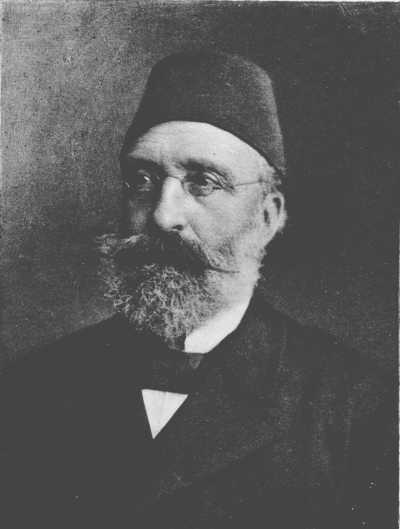
Midhat was born at Constantinople in 1822. His father,
Hadji Ali Effendi, was a native of Rustchuk, and gave
his son the usual education provided by the local schools,
until he was of an age to follow him in his different displacements,
first to Widdin and Lofdja, and afterwards to
Constantinople in 1836. A few years after this he
obtained a position in the Secretariat of the Grand Vizier’s
office, whence he was promoted to superior employment
in the provinces. He remained two years at Damascus,
and then, after a short interval spent in Constantinople,
he proceeded, in 1844, to Konia, as secretary to Sami Bekir
Pasha’s Council. In 1849 he was nominated to the
Presidency of the Medjlissi‐Vala (Grand Council of State)
and promoted to the rank of Sanie, which is the first rank
in the Ottoman hierarchy, and in 1851 to that of Mutemaiz,
with the functions of First Secretary to the Grand Council.
Soon after this, difficulties in the provinces of Damascus
and Aleppo, connected with the Custom House, and with
the conduct of the Commander‐in‐Chief of the Army of
Arabia, Kibrissli Mehemet Pasha, necessitated the despatch
of a public functionary with full power to inquire into the
irregularities, civil and military, which were notorious in
those provinces. Midhat was chosen for this important
and confidential mission. In the space of six months he
settled the question of the Customs in favour of the
Government, by which the sum in dispute, £T150,000,
was restored to the Ottoman Treasury, and a further
surplus of £70,000 was secured. He further fixed the
responsibility for the insurrection of the Druses on the
Commander‐in‐Chief, Kibrissli Mehemet Pasha, and recommended
his recall.
The courage and capacity of which Midhat gave proof
in this mission attracted to him the attention of the Grand
Vizier of the day, the famous Reshid Pasha, who appointed
him to a confidential post in the Superior Council of the
State, which he occupied during the successive Grand
Vizierates of Reshid, Aali, and Great Rifat Pashas. This
may be considered the initiation of Midhat into political,
as distinguished from administrative, life. It was in this
post that he assisted, in 1852, at the historical interview
between Rifat Pasha, Turkish Minister of Foreign Affairs,
and Prince Mentchikoff, the special envoy of the Emperor
Nicholas, in the negotiations that preceded the Crimean
War.
In 1854, Kibrissli Mehemet Pasha, who in consequence
of Midhat’s report had been dismissed from the command
of the Syrian Army Corps, became Grand Vizier. He
now charged Midhat with the difficult and delicate
mission of pacifying the disturbed provinces of Adrianople
and the Balkans, and clearing them of the brigandage
that infested them. The organising genius of Midhat
proved equal to the task. He suppressed brigandage
with a strong hand, and by restoring tranquillity in this
district he deprived the neighbouring States of all pretexts
for chronic complaints. To prevent the return of trouble
he further elaborated a whole plan of re‐organisation,
which he submitted to the approval of the Government
at Constantinople, where Reshid Pasha had again become
Grand Vizier. The draft of this plan arrived at the very
time that Reshid and Aali Pashas were engaged in
drawing up regulations for the government of the Eyalets
(provinces), with a view to their decentralisation. Midhat’s
plan was accepted, and it was decided that he should be
nominated to the governorship of the important province
of the Danube (Bulgaria), when suddenly another change
of Ministry at Constantinople delayed the execution of
the whole plan of reform. In the meantime an appalling
earthquake at Broussa had caused terrible damage in
that important city and much misery among its inhabitants.
Midhat was now despatched thither with a mission to
succour sufferers and to help to restore confidence among
the terrified inhabitants.
On his return from Broussa he was despatched as
special commissioner to inspect the provinces of Widdin
and Silistria, which were in open rebellion against the
central authorities. Here Midhat, as he had previously
done in Syria, made a detailed report, pointing out the
faulty administration of the provinces, and fearlessly
inculpating the two Valis (governors).
This discharge of a public duty was met by the usual
manœuvres of inculpated Pashas. Their friends at the
Palace bestirred themselves in their favour, and induced
the Sultan to reject the proposals of Midhat, and to
send a well‐known Ulema at Constantinople, Haireddin
Effendi, to the two vilayets in question, to make a further
report in verification or contradiction of that of Midhat.
To the confusion and disappointment of the friends of the
incriminated Valis, Haireddin Effendi made a report in
every way confirming the views and recommendations,
and emphasizing the accusations of Midhat.
At this time (1858) Reshid Pasha died, and Aali Pasha,
his successor, obtained six months’ leave of absence for
Midhat, to be spent in travelling in Europe, with a view
to the study of certain points of European administration
with which he desired to make himself acquainted. Paris,
London, Vienna, and Brussels were successively visited
in this short period of time, and much valuable information
obtained, both as to the spirit and working of
European governments.
Midhat had by this time already acquired a certain
reputation as a successful provincial governor and whenever
trouble in the empire declared itself, his name
recurred as a fit and proper person to be despatched as
special envoy or governor to pacify the province in
question. Kibrissli Mehemet Pasha had now again
become Grand Vizier, and as trouble of a serious
kind had for some time been brewing in the vilayet of
Nish (Servia), where, in spite of the presence of an imposing
force of regular and irregular troops, insecurity
of life and property was rampant, and an alarming emigration
of the inhabitants was taking place, he nominated
Midhat to the Governorship of this important province
(1861).
Midhat resolved to make an attempt to pacify
the province without the use of armed force, and to
gain the confidence of the Bulgarians by the redress of
their just grievances. His first step was to invite the
notabilities of the different districts to conferences, to
state their complaints, and attentively examine with him
the remedies that should be applied. These grievances
practically resolved themselves into two: (1) the entire
absence of roads and other means of intercommunication,
which made it impossible for the inhabitants—exclusively
cultivators of the soil—to find markets for their produce;
(2) the rampant brigandage that everywhere existed,
rendering life and property insecure. These two causes,
it was, that induced the emigration into Servia, which
was assuming large proportions, where the Bulgarians
found among their fellow‐Slavs both greater security and
more favourable conditions of labour.
Midhat readily acknowledged the justice and reasonableness
of these complaints, and proceeded to strike a
bargain with the notables. They were to undertake to
use their influence to pacify the country and discourage
emigration for two years, and Midhat engaged within
this time to carry out the reforms and improvements
that were mutually agreed upon between them. Midhat
strictly carried out the terms of this agreement. He
ordered the troops back to their barracks, commenced
the great high road between Nish and Sofia with the
byroads connected with it, and by means of military
patrols sent out in every direction, brigandage very soon
entirely disappeared from the country. Roads were now
being laid out in every direction, and bridges constructed
over the Morava and other rivers, so as to meet the requirements
of an agricultural population, and facilitate the
outlet for their produce. An elaborate system of block‐houses
all along the Servian frontier put an end to the
incursions of armed bands of Servians, which had long
fostered and sustained disturbance in the province, and
many Bulgarian families who had emigrated into Servia
now began to return to their former habitations. Concurrently
with these material ameliorations, Midhat
occupied himself with the solution of other economical
and moral problems that concerned the well‐being of
the community. The relations between proprietors and
tenants of the soil had long been in an unsatisfactory
condition. Midhat convoked representatives of both these
classes to a conference, and with much pains, and after
long discussions, he succeeded in finding a means of
reconciliation between their opposing pretensions, to the
satisfaction of both parties.
At Prisrend, in that part of the provinces inhabited
by the Arnauts, he was confronted with problems of a
peculiar nature. Here a vendetta (similar to the Corsican
vendetta) existed among the unruly mountaineers of
Albanian descent. Midhat, faithful to his system of
working hand in hand with the inhabitants themselves,
convoked an assembly of notables of the district, and
with their co‐operation, and by their own initiative, instituted
a permanent commission to settle money compositions
for bloodshed, and by this means he succeeded
in suppressing a vendetta that had existed for centuries
among this brave but unruly people. He further induced
them to give up the practice of carrying arms, and, for
the first time in the history of the provinces, to submit to
Imperial conscription; he further organised a gendarmerie,
secured the peaceful collection of taxes, and put an end
to all religious persecution; schools, too, were established,
and hospitals for members of all religious denominations
without distinction. Thus the vilayets of Nish and
Prisrend gradually recovered the full enjoyment of tranquillity
and peace, and Christians and Mussulmans alike
began to enjoy the prospect of returning prosperity.
In the provinces of Widdin and Silistria the problem
of pacification was complicated by a factor which rendered
the solution far more difficult. Here the continued and
systematic interference of Russia by means of her consuls
and agents, supported by the Russian ambassador at
Constantinople, working hand in hand with the agents
of the Slav Committees, who were overrunning the
country and preaching the gospel of rebellion, created
quite a new set of problems to be dealt with. It was no
longer local grievances to be redressed, but a political
propagandism to be faced.
Aali and Fuad Pashas, the successors of Reshid Pasha,
appreciating the administrative and reforming talents of
Midhat, summoned him in 1864 to Constantinople, to
consider with them a general organic law for the government
of the provinces of the empire (loi des vilayets), and
it was there resolved that the vilayets of Silistria, Widdin,
and Nish should be combined into a single government
under the name of the “Vilayet of the Danube,” and entrusted
to Midhat. The Imperial sanction to this appointment
and to the organic reforms proposed was obtained
(in 1865) in spite of the opposition of the reactionary party
in Constantinople, headed by the Sheik‐ul‐Islam of the
day, Saadeddine Effendi, strenuously backed by Sourrouri
Effendi Naib, an avowed enemy of the new Vali, whom we
shall meet with later on figuring, as a reward for his zeal,
and in acknowledgment of his impartiality, as the President
of the tribunal that tried and condemned Midhat. But
the influence of Fuad Pasha was sufficient to overcome
all such opposition, and Midhat forthwith entered upon
his new and important functions.
It will be sufficient to give a summary account of
the radical reforms introduced by the new Vali in the
government of this important province.
The whole vilayet was divided into seven distinct
sandjaks (districts), the sandjak into cazas (cantons), and
the cazas into nahies (communes), and in each of these
centres councils were created for the levying of taxes and
local administration of the district.
Forced labour (corvée) was abolished; bridges to the
number of 1400 were constructed; and 3000 kilometres
(circ. 2000 miles) of roads constructed; brigandage was
effectually stamped out and a local gendarmerie raised, and
agricultural banks, with a view of relieving the small farmer
from the exactions of the usurer, established. The capital
for these purposes was procured by an ingenious system,
founded on the cultivation of the public and waste lands,
by which not only was relief given to distressed and needy
agriculturists, but a local fund was created for important
local improvements. Agriculture, the staple industry of
the inhabitants, soon began to flourish in consequence
of these wise and energetic measures, and with agriculture
the affiliated industries and commerce of the country. The
navigation of the Danube, the great artery of the province,
next engaged the attention of the Pasha, and soon two,
and then four, vessels, flying the Ottoman flag for the first
time, made their appearance on this river. A postal
service was likewise started, and through the initiative of
the governor a manufactory of carriages established at
Rustchuk, which at the end of the very first year paid
a dividend of 10 per cent. Charitable institutions too
were not neglected, and orphan asylums for Christian and
Mahomedan children alike were constructed at Rustchuk
and Sofia, and the pupils initiated in trades and
industries.
The key of all these reforms, and the cardinal principle
of this administration, was to work hand in hand with the
local authorities. By their aid the valuation of all property
held in the respective districts was carried out equitably
and fairly, and taxes founded on this assessment were
levied without complaint; and although the salaries of
responsible officials, such as the police and judges,
were considerably increased, and many vexatious taxes
abolished, the new revenue of the province showed a
considerable and increasing surplus.
The prosperity of this large province under its new
administrator could not fail to attract the attention of the
authorities at Constantinople, and Midhat now received
the congratulations both of the Sultan and of the Sublime
Porte. An Imperial Irade, moreover, enjoined all the
governors of the other provinces of the empire to apply
in their respective vilayets the same reforms that Midhat
had introduced in that of the Danube, a detailed plan and
description of which had been forwarded to Constantinople
by Rifat Effendi, the secretary of the vilayet (subsequently
Grand Vizier).
So far everything seemed to go well, and a new era of
prosperity seemed about to dawn for the provinces of the
empire generally. It is worth while for those who really
desire to obtain an inside view of the working of Turkish
absolutism, and to discern the secret springs that move the
Government of Turkey, and make themselves acquainted
with the hidden causes that have time after time wrecked
the hopes of Turkish reformers, to follow attentively what
we are now about to relate, on the authority, be it noted, of
one in a position, if any one was, to know the truth and
put his fingers on the plague‐spot.
Midhat felt that his work would not be complete,
nor would the return of material prosperity suffice to
attach his province permanently to the Government of
the Sultan, unless he applied himself as well to the moral
side of the problem and succeeded in counteracting the
manœuvres of the enemies of the empire to sow disaffection
in the minds of the youth of the province.
One of the most effective devices contrived by them
with this view was the plan, pursued for many years, of
sending large numbers of Bulgarian youths to carry on
their studies at the Russian universities of Odessa,
Kharkoff, and Kieff, and these, on their return, became
the chiefs of the staffs of the active propagandists of
Panslavic ideas among the youths of Bulgaria. These
missionaries of disaffection constituted one of the most
serious dangers to Ottoman sovereignty, and one of the
most difficult problems to deal with. Midhat determined
to grapple with it, and with this view he determined to
establish in the principal centres of the province schools
and universities where the Bulgarian youths, Christians
and Mussulmans alike, should enjoy all the advantages
of a first‐class modern education without having to
seek it abroad. The incidental advantage of a fusion
of Christian and Mussulman elements in the country,
under the inspiring influence of a common education, at
an age when friendships are most easily formed and
generous sentiments evoked, did not escape the sagacity
of Midhat. The whole project was explained by him
in a detailed report to the Sublime Porte, the expenses
being provided half by the surplus revenues of the
province, and the rest by voluntary subscriptions.
When this project was made known at Constantinople,
the person who most readily seized the full import of it
was General Ignatieff, the Russian ambassador. It went
directly counter to all the most cherished plans and
projects of the Panslavic party, of which he was the
moving spirit. There was nothing that he did not do
to wreck the plan and upset the Pasha. Unfortunately
the nature of an absolute government and the character
of an Eastern autocrat afforded him ample means of
action. The interference of a foreign ambassador in the
internal economy of a province of the empire had nothing
in it which appeared abnormal or impertinent; such
interference was consecrated by long usage and had
become chronic and accepted. Ignatieff began by representing
to the sovereign that the spirit of the reforms
effected by Midhat in his vilayet, especially the institution
of local councils (which was of the very essence of
the reforms introduced), were in direct opposition to
the spirit of absolutism, and that the result would infallibly
be that little by little the province itself would become
detached from the body of the empire, and would claim
its entire independence, as had already happened in the
case of Egypt. It is not certain, however, that the
ambassador would have gained his point, even with a
sovereign so tenacious of his prerogatives as was Abdul
Aziz, had not an unfortunate error of typography, eagerly
seized on and exploited by Ignatieff, played into the
hands of the ambassador. In a passage of the official
journal of the province, the term “deputies” was inadvertently
applied to the members of the chief council
of the vilayet. This apparently trivial circumstance, the
slip of a typographist, was sufficient to turn the scale
in the Sultan’s mind and to wreck the project. Abdul
Aziz refused his consent to the proposal, on the obviously
insincere pretext of the expense connected with it. Thus
this crowning act of Midhat’s work, the reform which
above all others was calculated to attach the Bulgarians
to the central government and to destroy a nest of disaffectation
in the province, was defeated by a foreign
ambassador playing on the ignorant susceptibilities and
autocratic instincts of the sovereign of the country. If
this were a single and exceptional example of the working
of autocracy, it might be passed over in comparative
silence, however regrettable it was in this particular
instance; but the whole modern history of Turkey shows
that such intervention was nothing less than a system
of statecraft whereby autocracy was cunningly worked
for the ruin of the country in as certain and deadly a
way as was the Liberum Veto of the Polish constitution.
The spontaneous caprices and whims of an autocrat
are the least part of the baneful effects of autocracy; it
is in the shadows that flit behind the throne, stronger
than the throne itself, working systematically on the
ignorance and fears of the autocrat, with settled purpose
and in pursuit of settled plans, that lies, in the East
at any rate, the real curse of absolutism.
Simultaneously with this diplomatic action at Constantinople,
order was given to the Panslavic Committees
established at Bucharest and Kichenew to prepare for action
in the field. Midhat’s agents had kept him informed of
the revival of agitation entertained by the agents of these
committees among the Bulgarian peasants, and he lost no
time in transmitting this information to the Porte.
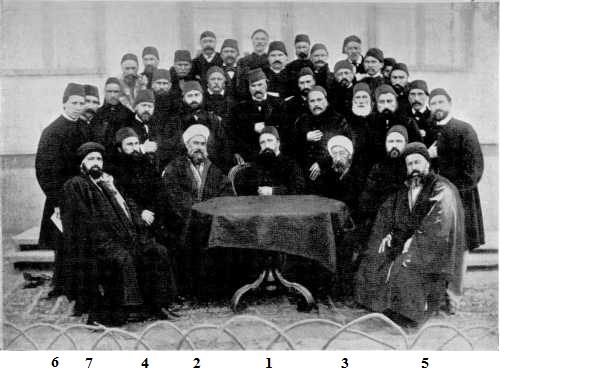
Midhat Pasha and his Suite in the Government of the Province of the Danube.
| 1. Midhat Pasha. | 2. “Inspecteur de la Cour Judiciare.” | 3. “Juge du Cheri.” |
4. Adib Effendi, Minister of Customs (1889). | 5. Rifat Pasha, Grand Vizier (1897). | 6. Raïf Pasha, Minister (1890). |
| | 7. Chakir Pasha, “Maréchal” (1878). | |
On the 2nd May, 1867, Midhat received the following
telegram from Sistovo:—“Last night numerous armed
bands crossed the frontier close to Sistovo, and were
immediately joined by other bands who were waiting
for them on this side of the frontier, and early this
morning they commenced operations by the horrible
mutilation of five Mussulman children, aged from eight
to twelve, who were tending sheep on the plains.”
The object and purpose of these barbarities was
obvious: it was to excite reprisals on the part of the
Mussulman population, which would afford a pretext
to the enemies of the empire to fill Europe with an
outcry against Turkish barbarity and fanaticism. The
same policy, heralded by the same acts, ruthlessly
pursued later on, did produce the desired effect, and
Bulgarian atrocities became a proverb and byword in
the world; but on this occasion the energy of Midhat,
and the patience and forbearance of the Mussulman
population, defeated the purpose of the conspirators.
Midhat, immediately on receiving the above telegram,
embarked two companies of regulars on board a steamer
and despatched them to Sistovo, whither he accompanied
them himself. He found the whole population, Christian
and Mussulman, in a state of the greatest excitement,
and his first care was to calm the effervescence and
to inspire confidence in the energy and resolution of the
authorities.
The plan of the insurgents was to push on as rapidly
as they could to the Balkans, increasing their forces as
they went along by the native levies which had been
organised by the committees for this purpose, until they
reached the monastery of Kapanbova, where a large dépôt
of arms had been collected, and which was intended to be
the headquarters of the insurrection.
The presence of four battalions of regulars at
Capriova prevented the execution of this plan, and after
suffering several defeats in the field, the bands dispersed
in various directions, closely pursued by the troops and the
local levies that had joined them. Midhat now instituted
a special tribunal, composed of six Mussulmans and six
Christian judges, to try the rebel prisoners, and the
evidence given by the prisoners themselves, clearly demonstrated
that the invading bands had been equipped and
sent out by the Slav Committees of Bucharest and
Kichenew, and were acting in unison with corresponding
committees established throughout the province. By the
unanimous vote of this tribunal, sentences of death were
passed on the leaders, and penal servitude and minor
punishment, according to their status and degree of
culpability, on all the rebels taken in arms. By these
energetic means the insurrection was effectually stamped
out and tranquillity restored to the province.
An outcry, however, was quickly raised in the
European Press against the “methods of barbarism”
adopted to repress the insurrection, and the Pasha was
accused of ultra severity against Christian insurgents and
reprehensible leniency towards Mussulman offenders.
So far from this latter accusation having any real
foundation, the very composition of the special tribunal
appointed to deal with these troubles was a guarantee of
its impartiality. Moreover, the following fact will afford
an example of the impunity enjoyed by the Mahomedan
criminals. In the course of these troubles two dead bodies
of Christians were found in a field near Biscara; a judicial
investigation was immediately ordered on the spot, and
the result was that the evidence pointed to a sergeant
of gendarmerie, a Mussulman of the name of Mehemet
Tchavouch, as having committed the murder. Pressed by
questions Mehemet made a full confession, and he was
thereupon condemned to death and forthwith executed.
Midhat now turned his attention to the best means of
anticipating and guarding against similar raids and
insurrections in the future. He knew well that the central
revolutionary committees at Bucharest and Kichenew
would not disarm, but would simply watch for a more
favourable opportunity to put their plans into execution.
To garrison the whole frontier with regular troops would
expose the province to large expenditure, and the troops,
when called upon to act, to calumny and misrepresentation.
He accordingly conceived the plan of organising a local
militia of 40,000 men, recruited from all classes of the
population, Christian and Mussulman alike, to whom the
defence of their own localities should be entrusted, and
they were to be indemnified if called upon to act beyond
the boundaries of their district. By this means a cheap
and effective force was provided against all contingencies,
and at the same time the confidence reposed in the
loyalty of the population generally received a conspicuous
demonstration. The defence of the line of the Danube
was secured in a similar manner. A succession of guard‐houses
was established throughout the length of the river,
and their defence confided to a river‐guard recruited equally
from the Christian and Mussulman riverine population.
So ingenious was the plan of organisation, that the
term of service for each guardsman did not exceed one
month in ten years. The arms and equipments were
provided by voluntary subscription raised from all the
inhabitants of the province.
During all this time the greater the energy shown by
Midhat in the organisation, development and defence of
this frontier province of the empire, the greater became
the determination of the Slav Committees to undo and
defeat his work.
After the late exploits of these committees in Bulgaria,
Midhat had organised a system of surveillance at the
headquarters of these committees, and information having
reached him that emissaries had been despatched from
Galatz to Belgrade in order to organise a new raid
into Bulgaria, he ordered these emissaries to be closely
watched and followed in all their movements. On their
embarkation at Rustchuk, on board the Austrian vessel
Germania, he sent photographs of them to the Austrian
Consul, with a request that the Ottoman authorities should
be allowed to examine the passports of the passengers.
Accompanied by an Austrian Consular Agent the Turkish
authorities accordingly proceeded on board, where they were
immediately received by shots from revolvers on the part
of the two suspected agents, who had barricaded themselves
in the saloon of the vessel, and had determined to resist
arrest. After an indescribable scene of confusion among
the panic‐stricken passengers aboard, the Turkish gendarmerie,
acting with the consent of the Consul, succeeded
in effecting the capture of the agents, who were both
mortally wounded in the encounter.
The capture of these revolutionary agents made a
great noise in Europe. General Ignatieff at Constantinople,
seized on the circumstance as a pretext to demand
the recall of Midhat, accompanying the Servian Agent to
the Palace in the audience accorded to the latter, whose
complaints were founded on the fact that one of the
captured agents was a Servian. Midhat’s influence, however,
was still in the ascendant, and these intrigues
remained for a time without effect.
Other means failing, a desperate and criminal attempt
was now made to get rid of this too energetic Pasha.
Two attempts to assassinate him followed in quick
succession, the first at Rustchuk, where the overseer of
the training school fired a shot, fortunately without effect,
on the Pasha as he was walking in the school enclosure;
and the other by a Servian, who attempted to enter his
service with the view to assassinating him, and who made
a full confession seriously compromising two important
personages in Servia. He was sent to Constantinople,
tried, and condemned to penal servitude for life, in spite
of the strenuous efforts of General Ignatieff in his favour.
Not very long after these stirring events (1868)
Midhat was summoned to Constantinople, where he was
placed at the head of the Council of State, and he
was succeeded in the governorship of the province, for
which he had done so much, by Sabri Pasha, the deputy‐governor
of Nish.
As President of the Council, Midhat marked his short
tenure of that office by the institution of a school of Arts
and Sciences at Sultan Ahmed, in Stamboul, and by the
establishment of a bank for loans, with the special
purpose of relieving small employers from the tyranny
of usurers. This bank (Emniet Sandighie) still exists.
It soon, however, became obvious to Midhat that his
system of usefulness in his new ministerial position was
strictly limited; his authority in matters pertaining to his
own office was constantly overruled on important matters,
especially those concerning finance, by the Grand Vizier,
acting on the authority of the Sultan, and this incompatibility
of views culminated on the question of Turkish
railways, whereupon Midhat insisted on resigning. Just
at this time Nakieddine Pasha was dismissed from the
governorship of the province of Bagdad, and Midhat was
appointed Vali of Bagdad (1869).
Hardly had the new Vali reached his post, when he
found himself confronted with some difficult problems of
quite a different order from those he had dealt with on
the Danube, but of a not less serious description. The
question of recruiting was the most urgent, and called for
immediate solution. The Arab tribes, turbulent and independent
by nature, had always shown themselves refractory
to enlistment, and were now in open revolt against its
enforcement. One of the difficulties of the situation consisted
in the fact that the military authority in the province
was separated from the civil, and was in the hands of
the commander of the 6th Army Corps, Samih Pasha,
whereas the situation required all authority, military as
well as civil, to be concentrated in the hands of a single
strong central authority. Midhat did not hesitate at such
a crisis to assume the full responsibility of this concentration,
and took immediate military steps to suppress the
insurrection by force. He ordered the city of Bagdad to
be surrounded by cavalry, and sent infantry and artillery
to protect the foreign Mission Houses and the non‐Mussulman
quarters from the fanaticism of the Arabs.
He at the same time ordered the bridge over the Tigris
to be cut, so as to prevent intercommunication among
the rebels; and when these energetic measures had fairly
intimidated the Arabs, he offered them a general amnesty
on condition of immediate surrender. These conditions
were now accepted, and the insurrection suddenly
collapsed, and no further resistance was offered to the
recruiting. The promptitude with which this dangerous
rebellion was suppressed was appreciated by the Porte,
and a telegram was received from Constantinople approving
the measures he had taken, and placing officially the
supreme command of the 6th Army Corps in his hands.
The next serious difficulty was connected with the
levying of taxes. This had always been a difficult operation
among the nomad tribes, of which the population in
a great measure consisted, and was the cause of continual
disputes and insurrections. Matters had, however, now
reached a crisis, for a colonel at the head of a battalion of
regulars sent to Divanie and Dogara to collect the tithes
was surrounded by tribesmen to the number of ten
thousand men, and himself killed and his troops killed
or dispersed. The new Vali seized at once the seriousness
of the situation, for the encouragement which this success
afforded the tribesmen threatened to give rise to a general
insurrection of all the surrounding nomads.
It was necessary to avenge the defeat at once and
to make a signal example of the tribesmen concerned.
Midhat accordingly ordered a large force, consisting of
seven battalions of infantry, four thousand cavalry, with
a complement of artillery, to proceed directly to Dogara,
under the command of Samih Pasha, whilst with three
thousand chosen troops he hastened himself to the disaffected
district. A pitched battle now took place between
the Arabs and the troops, which resulted in the complete
defeat of the former and the capture of their chief. A
not unusual incident accompanied the close of the battle.
A Shiite Sheik, Abdul Kerim, was marching at the head
of a considerable force of tribesmen from the Shiite
districts of Urfa and Aleppo to join the rebels, when
he received the news of their defeat. Pretending that he
was on the road to offer his services to the Government,
he joined his forces to those of the Vali, and accompanied
the victorious troops on their entry into Bagdad. A
military tribunal was at once instituted to try the rebels;
the rebel chiefs were condemned and executed, but the
tribesmen, on the promise of future good behaviour, were
released.
Midhat Pasha clearly discerned that if an end was
to be put to these chronic troubles, and these nomad
tribes were to be reduced to anything like permanent
order, it was not sufficient to defeat them in battle, and
that a radical change had to be brought about in their
general status, and especially the conditions of land
tenure in the country. The Arab cultivator, for the most
part, held his lands from the State on the condition of
giving three‐fourths of the produce to the State, retaining
one‐fourth for himself. Such a system naturally discouraged
agriculture and rendered all improvements in
cultivation impossible. The consequence was that, for
the most part, the Arab shunned the soil, preferring
predatory to industrial modes of gaining his living.
Midhat determined to attach him to the soil by giving
him rights of proprietorship, and divided large tracts of
land into plots, which were offered for sale on easy and
advantageous terms, special provision being made against
accumulation of plots into single hands. The success of
this policy was remarkable, and whereas the revenues of
the State increased, the turbulence of the tribesmen, and
the risings which had become chronic, greatly diminished.
The agricultural prosperity that resulted from these
measures stimulated other branches of industry and
rendered it necessary to provide outlets for the newly
created surplus of the country. The first step in this
direction was to render navigable the Tigris and
Euphrates, the great arteries of the country, and to
improve or create the means of communication between
their two banks, and between the different towns situated
along their course. The only service of the kind that
existed consisted of the boats of an English company
plying between Bagdad and Bussora. Midhat determined
to start a service of Turkish boats to supply adequately
the needs now felt, in the same way that he had formerly
done on the Danube when he was Governor of Bulgaria.
He ordered the existing vessels to be repaired, new
vessels of a larger tonnage to be constructed, and coal
dépôts to be formed at Mascat, Aden, Bender and
Bushire; and now, for the first time in history, steamers
under the Ottoman flag were to be seen periodically
in the Suez Canal, on their way to Constantinople. The
Babel, one of these vessels, which had originally cost
£T88,000 for construction, was bought for the sum of
£T33,000 from a bankrupt company, and on its very
first voyage between Constantinople and Bussora, which
coincided with the time of the pilgrimages, it cleared
£T35,000—more than sufficient to cover its purchase
price. A net surplus of £T1000 a month resulted from
this improved river navigation, and Midhat now determined
on extensive dredging works, with a view to
extending the navigation northwards and adapting it
to vessels of a larger tonnage. Chakir Bey (afterwards
Marshal and Ambassador to St Petersburg, and one of
Midhat’s faithful partisans) was despatched north with a
company of engineers, and reported favourably on the
enterprise. Thereupon dredging and other engineering
works were immediately ordered to be undertaken.
The periodical overflow of the waters of the Euphrates
had converted large tracts of country into marshes, and
marsh fevers in consequence becoming endemic, rendered
them uninhabitable. Drainage works on a large scale,
with a view of reclaiming these lands and of curing the
insalubrity, were also undertaken. Irrigation works were
likewise started, and much attention was devoted to this
subject by the Pasha, with a view to gradually restoring
the system introduced by the first Arab conquerors, which
had converted this country into the Garden of the East,
and rendered the Caliphate of Bagdad proverbial for its
wealth and prosperity. A tramway, too, between Bagdad
and Kiazimie was constructed, and its entire length, 7
miles, completed within a year. A textile manufactory, too,
was started, and an engine of 70‐h.p. ordered in France,
the despatch of which was only delayed by the breaking
out of the Franco‐German War (1870).
Whilst energetically pursuing these material improvements,
Midhat Pasha was far from neglecting the moral
side of the problem of Reform. Schools were opened
in every district; hospitals, refuges for old age, and loan
banks everywhere arose, and a printing‐press established
where the newspaper Zora was published, and municipal
institutions for lighting and watering and other local
purposes were instituted in all the principal centres. A
petroleum spring discovered in the vilayet was immediately
utilised for public purposes. It was not too much
to hope that a decade of such enlightened government
would have repaired the neglect of centuries and restored
their ancient prosperity to the rich valleys of the Tigris
and Euphrates.
In 1870 the Shah of Persia, accompanied by a
numerous suite, came to visit the holy places of Nejef
and Kerbela, and although the province had to support
the whole expense of this costly visit, amounting to
over £T30,000, Midhat Pasha determined to give the
royal visitor a reception worthy of his exalted rank, and
to profit by the occasion by settling some vexed questions
long pending between the two neighbouring Mahomedan
countries. The circulation of depreciated Persian money
in the province had long disturbed the value of exchanges
and created confusion in commercial transactions. The
exchange value of this currency, and the amount of it
to be issued in the future, were now agreed upon. The
incursions and depredations of nomad Kurds, the Hamavends,
Sendjabi, etc., shifting their camping‐ground from
Persian to Turkish territory, and vice versa, so as to
evade taxation and elude the authorities of either nation,
whilst plundering indiscriminately the peaceful inhabitants
of both, had long been a scandal, creating a state of
affairs on the frontier difficult to cope with. A better
understanding and a combined policy of surveillance
between the Persian and Turkish authorities on the
frontier were now established, and block‐houses on the
model of those successfully introduced on the Servian
frontier were constructed, to the infinite relief of the
agricultural population of both nations, situated on
the entire length of this extensive line. Midhat Pasha
failed, however, to obtain the sanction of the Persian
authorities to a scheme which he had long cherished,
and which he trusted to this occasion to be able to put
into execution.
At Nejef, one of the sacred places to which periodical
pilgrimages were made, there were rich treasures, the
proceeds of the offerings of Indian and Persian devotees
of the Shiite sect during centuries past, which, on the
invasion of the Wahabites, had been hidden in a cave.
Midhat Pasha had ordered the cave to be opened and
an official inventory to be made of the treasures that it
contained. This inventory revealed treasures of diamonds,
rubies, pearls, and other precious stones, to the value of
no less than £T300,000, and Midhat proposed a public
sale of the treasure and the appropriation of its proceeds
to works of public utility, such as a railway between
Persia and Bagdad, or, if such an appropriation of a sacred
treasure appeared too secular, at least to the creation of
such much‐needed institutions as hospitals and refuges
and caravanserai for the pilgrims on the route of their
pilgrimages to the holy places. Even this reasonable
proposal, however, was vetoed by the Persian Ulemas,
and the whole scheme falling through, Midhat ordered
the treasure to be carefully deposited again in the cave
from which it had been taken, and its entrance secured
with the official seals of the Turkish and Persian
authorities.
Certain events now took place having a bearing beyond
the boundaries of the province and of a quasi‐international
character. The town of Bussora, important on account
of its geographical position as the terminus station of
the Euphrates on the Persian Gulf, suffered from the
inconvenience of an extremely unhealthy climate, resulting
from the stagnant waters of the Achar, a branch of
the river Shat‐el‐Arab, on which it was built. Midhat
determined to remove the site of the township on to
the main river, and with that view built a Governor’s
house and Government buildings on the new site as a
nucleus for a new city. Outside this enclosure, the
township of Nassrieh was laid out on plans furnished by
the Pasha, to become the capital of the sandjak of
Muntefik, and to replace the old town of Suk esh‐sheyuh
which was falling into ruins, and was deficient in all the
necessaries of civilisation.
Sixty miles from Bussora, and on the coast of Nedjed,
is situated the little town of Koweit of six thousand houses,
the inhabitants of which are all Mussulmans. Midhat
Pasha’s predecessor, Namik Pasha, had endeavoured to
bring this population within the influence of his jurisdiction,
but they successfully resisted all attempts at imposing
taxation upon them, and had maintained their
quasi‐independence under their own chiefs, the descendants
of one Sabah who had come with this tribe of
“Moutayer” from Nedjed five hundred years before, and
had maintained ever since with practical independence a
republican form of government, choosing by election their
own judges (cadis) and the professors of their religious
schools (medresses). Owing to the restricted extent of
their territory, the inhabitants, like those of Venice, took
chiefly to maritime pursuits, and upwards of two hundred
small vessels of various tonnage traversed in every
direction the Indian Ocean, as far as the coasts of
Zanzibar, and practically monopolised the pearl fisheries
of the Persian Gulf. Although they had adopted a
special flag of their own, they occasionally hoisted a
Dutch or English flag, to secure certain privileges
accorded to these flags by the capitulations. It seemed
highly desirable to Midhat Pasha to put an end to this
equivocal status of the inhabitants of Koweit, and to
regularise their position. He accordingly entered into
negotiations with them, and offered the full enjoyment
of their autonomy and privileges under the government
of their own Sheik Sabah, provided they recognised
themselves as forming part and parcel of the Ottoman
empire, and adopted the Ottoman flag as their national
ensign. These conditions were accepted by the people
of Koweit, and their territory became a sandjak of the
vilayet of Bagdad. A formal treaty to that effect was
drawn up and signed and confirmed by berats (writs of
investiture) from Constantinople, and new schools and
mosques arose in Koweit.
After the settlement of Koweit, Midhat’s attention was
turned to the conquest of the Nedjed, the most important
event that marked his governorship of Bagdad.
The Nedjed is the geographical denomination of an
extent of country including about a quarter of the Arabian
peninsula. Soliman, the conqueror, after defeating the
Portuguese squadron in the Persian Gulf, had annexed
it to his empire, and had despatched a special governor
from Constantinople to administer the province of Hassa.
A century after this, the inhabitants rose in revolt and
formed themselves into a separate State, which included
the island of Bahrein in its limits. On the first breaking
out of these troubles, the Egyptian troops sent out to
repress the revolt had been successful, and had defeated
the rebels at Riad and Derayeh, forcing the Wahabites to
recognise the authority of the Sultan, but the Ottoman
Government, whose attention was now turned elsewhere,
neglected to follow up this success, and the Nedjed
gradually regained its independence under the dynasty
of Wahab.
In the time of Midhat Pasha, the reigning Sheik,
Abdul Fazil, whilst in the enjoyment of quasi‐independence
himself, had never dreamt of encroaching on the
neighbouring territories under the authority of the Sultan,
nor of exciting revolt among their inhabitants by preaching
among them the particular tenets of Wahabism;
but his brother Saood, under the instigation of certain
counsellors, with a view to supplanting him in the
government of the country, declared war on him, and
succeeded in dethroning him.
Abdul Fazil now had recourse to the intervention
of Midhat Pasha, whom he warned of the probable
consequences that would follow the victory of his brother
with respect to the propagandism of Wahabite ideas
among the surrounding tribes. Midhat determined to
act, but before entering on a campaign that might prove
an arduous undertaking, he took measures to ascertain
the exact forces that Saood had at his disposal, as well
as the topography of the country where military operations
would have to be carried out. With this view, spies
and agents disguised as merchants were sent in various
directions, and soundings were taken of different parts
of the coast. A full report as to the situation of the
Nedjed in all these respects was in due course furnished
to Midhat, who in the meantime had requested and
obtained the necessary authorisation from the Grand
Vizier, Aali Pasha, for the projected campaign.
Midhat was aware that certain delicate international
questions might arise in the course of the expedition.
The policy of England, as represented by its Indian
Government, had always been to favour rather than to
discourage the desire of independence on the part of
the Arab chiefs in this part of the world. A serious
and systematic attempt, therefore, to suppress their independence
and to attach these distant members permanently
to the body of the Ottoman Empire might
seem to run counter to the policy of the Indian Government
on the shores of the neighbouring Persian Gulf.
Midhat had always been a stout and consistent supporter
of the English Alliance, but he was by no means inclined
for that reason to sacrifice to that alliance the essential
interest of the Ottoman Empire; and while resolved to
proceed with tact and due considerateness for the interests
and susceptibilities of a friendly Power, he did not hesitate,
in spite of a certain amount of sympathy manifested by
England towards Saood, to proceed with the expedition
he had resolved upon.
The most populous province of Nedjed was Hassa,
with its port Elkatif. Thirty‐two hours distant from this
port are situated the townships of Elhofuf and Elmuberez,
surrounded by fortified walls. Six hours distant from
Elkatif is the port of Ras Tannurah, offering favourable
conditions for a disembarkation of troops. Securing his
communications between Bussora and Elkatif, a distance
of 360 miles by sea, by means of the proffered co‐operation
of Abdullah Elsabah, Sheik of Koweit, who put his flotilla
at the disposal of the Pasha for that purpose, Midhat embarked
five battalions of regular troops with a complement
of artillery under the command of Nafiz Pasha, General
of division, for the port of Ras Tannurah, whence they
immediately marched to Elkatif, which after a faint resistance
capitulated to the Ottoman troops. The surrender
of Elmuberez and other strategical points in the Wahabs’
country followed in quick succession, and in a very short
space of time the partisans of Saood were dispersed and
the whole country brought under Imperial rule.
Midhat was now about to start himself for the Nedjed,
with a view to organise the country as a province of
the Ottoman Empire, when his attention was called by
the Governor of Diarbekir, Kurd Ismail Pasha, to the
suspicious movements in the neighbourhood of Urfa of
Sheik Abdul Kerim, of the tribe of Chamar, the same, it
will be remembered, who, on the occasion of the revolt
of the Dogara tribesmen, arriving too late to assist the
defeated rebels, turned round and offered his services to
the victorious Pasha.
Thinking the present occasion more favourable for
carrying out his cherished policy, he was marching straight
on Bagdad, killing and pillaging on his route. Warned
by Kurd Ismail, Midhat took immediate steps to crush
him. Abdul Kerim had divided his forces into three
parts, the first advancing on Zor, the second on Mosul,
and the third, under his own command, marching on
Bagdad. On this information reaching him, Midhat
ordered two battalions of regulars to reinforce Kurd
Ismail, whilst General Echeref Pasha was directed to
fortify Zor and other strategical points on the Tigris
and Euphrates. These troops coming into collision with
the first division of Abdul Kerim’s army in the neighbourhood
of Zor, easily dispersed them, whilst Kurd Ismail
himself, attacking the second division of the rebels in the
neighbourhood of Mosul, completely routed it. On
learning of the successive defeats of the two wings of
this invading army, Abdul Kerim quickly abandoned all
idea of advancing, and took measures to secure his own
safety. His retreat by the desert being cut off by the
droughts prevailing at this season, he made for his own
native country, the Chamar, but Midhat threatening Sheik
Ibn Reshid, chief of the tribe Djebel, if he ventured to
offer refuge to the rebel, diverted Abdul Kerim’s retreat
to the direction of Muntefik by Hilah and Kerbela, where
he fell in with Nassir Pasha, and in the fight that ensued
was wounded and taken prisoner. After a regular trial for
armed rebellion and treachery, he was condemned to death,
and the sentence being approved of by the authorities at
Constantinople, he was in due course hanged at Mosul.
His brother, Ferhan Pasha, now received the chieftainship
of the tribe Chamar, with an increase of territory and a
regular monthly subsidy, whilst the turbulent tribesmen
acknowledged the authority of the Imperial Government
and consented to pay the taxes. This settlement was
followed by a resumption of agricultural pursuits on the
part of the inhabitants, and the general pacification of the
country.
But troubles in these parts did not end with the
conquest of the Nedjed and the defeat of Abdul Kerim.
Abdullah Fazil—who had by means of Ottoman arms
been restored to the government of Elkatif, with the
Turkish title of Mutessarif, in the new vilayet of Nedjed—once
freed from all apprehension respecting the ambition
of his brother Saood, began to manifest restlessness under
Turkish regular administration. Discontent, too, with
Turkish fiscal arrangements was felt by the tribesmen,
and affairs began again to assume a threatening aspect.
Midhat determined to inquire into the causes of this
discontent, and finding that exemption from all taxation,
save that sanctioned by the Mussulman law, viz. the tithe,
had been consecrated by secular usage among them, and
that the neighbouring tribes who had come under English
protection, Oman, Mascat, etc., fully enjoyed the privilege
of this exemption, determined to satisfy the population
of Elkatif in this respect, and forthwith consented to limit
their liability to taxation to the regular payment of the
tithe.
There remained the island of Bahrein, the conquest
of which, on account of the importance of its position on
the Persian Gulf, Midhat now determined to effect. In
order to superintend operations himself, and in case of
any international friction demanding his presence, Midhat
started for the Nedjed. Abdullah Fazil hearing of this,
and fearing that his own equivocal conduct was the cause
of the journey, fled from Elkatif to Riad, and in spite of
the Pasha’s assurances, refused to return. His dismissal
from the Government was thereupon pronounced, and the
district converted into the sandjak of Hassa, and together
with the command of the troops, was entrusted to Nafiz
Pasha. A friendly interchange of views now took place
between Midhat Pasha and the Government of India, the
result of which was that the island of Bahrein was officially
annexed to the Mutessarifat of Hassa. Two Turkish
corvettes, the Libnan and the Iskenderoun, under the
command of Arif Bey, sailed for the island, followed
by two English gunboats under Commander Pelly, and
the Turkish and English vessels exchanged salutes and
other friendly courtesies in the port. When the Turkish
sailors disembarked on the island they were received with
the most indescribable enthusiasm by the islanders, who
had not seen the Turkish ensign flying on a man‐of‐war
for two centuries past. The Sheik of the island offered
an appropriate piece of land to be used as a dépôt for
coals for Turkish vessels, and offered to place the resources
of the island at the disposition of the Turkish authorities
if necessity should arise. On weighing anchor from
Bahrein the two corvettes were joined by the vessel that
had Midhat Pasha on board, and the little flotilla sailed
together to Koweit. Here the same scenes were enacted
that had distinguished the visit to Bahrein, and nothing
occurred to mar the cordiality that existed between the
Ottoman and British forces that met in these Eastern
ports. The convention which had been previously agreed
upon between Midhat and the British authorities prevented
any friction between them.
The re‐establishment of Imperial authority in these
regions justified, and indeed necessitated, a considerable
increase in the Turkish flotilla in these waters. Before the
opening of the Suez Canal, Turkey only possessed the
two corvettes the Boursa, and the Ismir, neither of which
was in a sea‐going condition. Midhat sent the Boursa
to Bombay to undergo repairs, and added the Libnan,
Iskenderoun, Deniz, Babel, Ninova, Nedjed, and Assour,
besides ten vessels of light draught for river police,
and to reinforce the Bagdad squadron. The port of
Bussora, no longer adequate to the naval requirements
of the province, was enlarged and improved, and works
for an inner harbour capable of anchoring vessels of 10‐feet
draught were commenced at Kut‐el‐Frenghi on the
river Shat‐el‐arab.
All these various improvements and reforms, and the
general advance in the political and administrative status
of this important province, were highly appreciated by
the Government of the Porte, which was now under the
enlightened guidance of Aali Pasha, who addressed the
following letter to Midhat Pasha:—
“Excellency,—The very weak state of health from
which I have been for some time suffering has been the
cause of the delay that has occurred in answering your
letters concerning the voyage of His Majesty the Shah.
Pray accept my most sincere excuses. I beg to congratulate
you in a very especial manner, on your brilliant
successes in the Nedjed. Everything seems to indicate
that, thanks to the tact with which you have brought
about the pacification of the Provinces of Assir, the political
importance of which is so considerable, the whole Arabic
peninsula will soon return to its ancient status. By your
services you have merited the glorious title, ‘Haremein
Muhteremein.’
“The effect of the Shah’s visit on the Shiite population
in the province was the subject of considerable preoccupation
with us, but the good intentions and loyalty
manifested on both sides, have smoothed over many
difficulties and brought about highly desirable results....
It is quite certain that Nevab Ikbal Eldevle, being a
just and upright man, will blame and discourage any
flagrant departure from justice and equity on the part of
his co‐religionists.
“Be good enough to thank him in my name, when the
occasion offers, for the seal in agate, the engraving and
inscription on which are very fine.
“Prince Abbas Mirza has arrived here, and he has
twice been received in Audience by his Majesty.... He
seems a polished and intelligent person, but I have not yet
had any opportunity to form an estimate of his character.
“I am,
“(seal) Mehmed Emin Aali.
“23 Djemaziel Evel, 1288 (1871), Hegira.”
By the same courtier the Sultan Abdul Aziz sent
Midhat Pasha a sword of honour set with diamonds, with
the inscription “Nedjed” engraved on it. This was the
closing scene of Midhat’s governorship of Bagdad, and
with it closed the first half of his career, viz., as Provincial
Governor. Circumstances were occurring at Constantinople
destined to bring him on the scene there, to play
his part in the important political events about to occur in
the metropolis.
But a change of a portentous nature had taken place
at Constantinople. Fuad Pasha and Aali Pasha, whose
prestige and popularity had gained an ascendancy over
the Sultan, and had, since his accession, practically monopolised
power, and who had strenuously supported Midhat
in all his reforming measures both on the Danube and the
Euphrates, died within a few months of each other. The
disappearance of these two able and powerful Ministers
synchronized with the return of Abdul Aziz from a tour
in Europe, when symptoms of an ominous character began
to reveal themselves in the sovereign. He showed himself
impatient of contradiction or advice of any kind, expressing
openly his relief at being freed from the incubus of
his former Grand Viziers; he completely changed the etiquette
of the Court, imposing on the occasion of audiences
an antiquated ceremonial, accompanied by unwonted prostrations
to be observed on entering the Imperial presence,
and he directed that henceforth he should be addressed in
inflated language, strange even to the forms of Oriental
adulation. But what was more serious than these triflings
of Imperial vanity, was the fact that he now launched out,
careless of the resources of the budget, on the most
lavish expenditure of every kind both of a public and
private nature. Fleets of costly ironclads were ordered
and equipped without regard to their cost; marble palaces
rose, as by enchantment, on the banks of the Bosphorus,
and every whim and caprice on his own part or that of the
Palace had to be gratified without stint or delay. He
found in Mahmoud Nedim a compliant Grand Vizier, who,
in return for the retention of power, undertook to find the
ways and means for the gratification of all his master’s
wishes.
The reflex action of this state of things at headquarters
was felt in the most distant provinces. When
the exactions of the Palace had expropriated the balance
of the sums destined to the various services of the State,
recourse was had to the provinces to make good the
deficiencies by extraordinary “benevolences” and remittances.
Works of public utility or necessity were
accordingly suspended, and the funds necessary for their
completion diverted to the metropolis. Incompetent
favourites arrived from Constantinople with orders to
the Vali to provide them with lucrative posts, and by
these means the whole fabric of the new administration,
painfully and patiently built up, was dislocated and
deranged. Midhat, recognising the impossibility of governing
in such conditions, resigned his Governorship and set
out for Constantinople.
On his arrival in Constantinople, Midhat found that an
order had been issued for his banishment from the capital,
under cloak of nominating him to the government of
Adrianople. Insisting, however, on the exercise of his
right of audience with the sovereign before setting out for
his new post, he made such strong representations to the
Sultan with respect to the general situation of the empire,
that Abdul Aziz thereupon abruptly dismissed Mahmoud
Nedim, and appointed Midhat Grand Vizier in his place
(1873).
As soon as he had filled the principal offices of State
with the best material he could find—Chirvani Rushdi
Pasha, Djémil Pasha, and Sadik Pasha—the first and
most pressing necessity that confronted him was to
endeavour to put the Finances in order. This was no
easy task. The public accounts presented were entirely
fictitious. His first discovery was to the effect that whereas
the budget showed a surplus of half a million (£T),
there was in point of fact a deficit of three millions. The
actual appropriation of the sums debited in the accounts
presented another difficulty. A sum of £T100,000 disbursed
by the Treasury was not accounted for at
all. Midhat insisted on a full inquiry, and, discovering
that this sum had been appropriated by the late Grand
Vizier, directed an investigation into the matter before the
members of the Council of State, who ordered its immediate
restitution by Mahmoud Nedim, and recommended
his banishment. He, however, alleging in private that this
sum in question although nominally attributed to him was
really allotted to the Palace, found in the Valide Sultan
and her entourage most powerful allies in his duel with
Midhat. Banished by the insistence of the Grand Vizier,
first to Adrianople and then to Trebizond, he soon
obtained permission to return to Constantinople.
Two distinct parties began now to stand out in clear
relief. On the one side was Midhat, warmly supported by
public opinion in the capital and in the provinces, and by all
that was most enlightened among the Softas and Ulemas,
headed by Chakir Effendi, and on the other side the whole
army of corruption, headed by Mahmoud Nedim and
protected by the Valide Sultan and the Palace Camarilla.
Another powerful ally of the late Grand Vizier was
General Ignatieff, who by the most ingenious and persistent
methods—condescending even to the resources of
the stage—worked on the mind of the Sultan in order
to restore Mahmoud Nedim to power.
An incident soon occurred which brought matters to
a crisis. The Khedive of Egypt, desirous of changing
the order of succession in his family and of obtaining
various privileges and prerogatives from his suzerain, was
in the habit of making periodical visits to Constantinople,
carrying away with him each time, by judicious payments,
some shred of the sovereign rights of the Porte. These
visits became a regular source of income and emolument
to the Palace and all its myrmidons. Arriving at
Constantinople on the occasion of one of these visits
he found Midhat Pasha installed as Grand Vizier, and
to his surprise and disappointment, and to the discomfiture
of the Palace clique, he was obliged this time
to return to Alexandria with his presents, re infectâ.
It soon became apparent that one of two things must
happen: the Sultan would either have to change the
whole régime and scale of expenditure of the Palace,
or change his Grand Vizier; and as he never really
contemplated the former course, he adopted the latter.
The determining cause was Midhat’s action with reference
to certain scandals—incidents connected with Baron
Hirsch’s railway schemes.
It is only in a despotic country, where State contracts
are signed in the dark, and cahiers de charge are examined
by carefully chosen experts and passed by complaisant
accountants, that such a scandal as the Hirsch railways
is possible or conceivable. If the cynicism of the whole
transaction had not become notorious, and thus excited
as much laughter as its nefariousness caused indignation,
it would be worth while to set out in detail all the
circumstances of this stupendous business.
To obtain a contract giving unlimited control over
the richest forests in the world, on the pretext of cutting
sleepers, is in itself a pretty smart stroke of business.
To stipulate for payment of railways according to the
mileage executed, irrespective of topographical considerations
or local requirements, is a triumph of
contracting skill; but to claim payment for work
done in the plains only, on the basis of an average
calculated for working through plains and mountain‐chains
alike, is the very glory of financial genius. The
secret, too, of the art was as simple as the result was
lucrative. Backsheesh in adequate amounts, distributed
at appropriate moments in the right quarters, was the
alpha and omega of the business.
Midhat, in his determination to strike at the root of
the whole system of corruption, irrespective of persons
or of consequences, having discovered that the highest
person in the land was himself a recipient of the largesses
of the Austrian baron, insisted on the restitution of the
sums received. The Sultan listened to the advice
tendered, returned the money, and dismissed his Grand
Vizier.