Some unpublished (in one case privately
published) Letters and Papers, written
by Mazzini.
- 1. Letter to Mr W. E. Hickson, about 1844.
- 2. A Prayer for the Planters, 1846.
- 3. Letter to Mrs Peter Taylor, 1847.
- 4. Letter to Mr Peter Taylor, February 1854.
- 5. Letter to Mr Peter Taylor, October 1854.
- 6. Letter to Mrs Peter Taylor, 1857.
- 7. Two Letters to Mrs Milner-Gibson, 1859.
- 8. Letter to Mr Peter Taylor, 1860.
- 9. Letter to Mrs Peter Taylor, 1865.
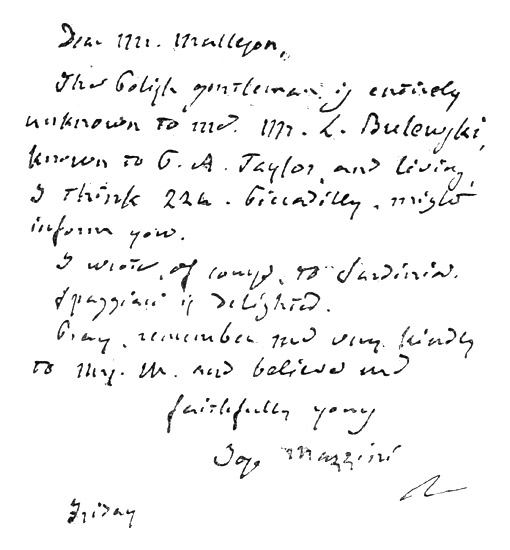
- 10. Letter to Mr W. Malleson, 1865.
- 11. Rest. A Paper written for the Pen and Pencil Club, 1867.
- 12. Letter to Mrs Peter Taylor, 1868.
- 13. Letter to Mr William Shaen, 1870.
I
Letter to Mr W. E. Hickson, Editor of the Westminster
Review (probably in 1844).
[This letter gives some details concerning his early life, which
are not mentioned in his works or in any of the biographies.]
Dear Sir,—I began to attract the attention of the Government
in Italy by my literary writings. I had been pleading warmly the
cause of what was then called Romanticism, and was the right of
progressive life in Literature. Then, as now, all pleading for
literary liberty, independence, progression, were suspected in
Italy as educating the mind to forbidden tendencies. I published
in 1828 a weekly literary paper the "Indicatore Genovese": it
was, at the end of the year, and though published under the double
ecclesiastical and temporal censorship, suppressed. I caused the
paper to be continued at Leghorn under the title of "Indicatore
Livornese";[47] it was, at the end of the year, suppressed again. I
wrote one long article on "a European Literature" in the best of
our reviews, the "Antologia" of Florence. The review was persecuted
and after some time suppressed. In 1830, after the
Revolution of July I was arrested. The accusation was the
spreading of a secret association tending to the overthrow of the
Italian Government. I recollect a fact, well apt to give a summary
of our condition in Italy. My father, Professor of Anatomy in the
Genoese University, went to the Governor of the town, Venanson,
enquiring at the cause of my imprisonment. "Your son," he was
told amongst other things, "is fond of walking every night, alone,
sadly pensive, on the outskirts of the town. What on earth has
he at his age to think about? We don't like young people
thinking, without our knowing the subject of their thoughts." A
committee of Senators was appointed, in Turin, to try me. They
found no proofs, and acquitted both me and some friends who had
been arrested with me. Nevertheless I was sent, in solitary confinement,
at Savona, in the fortress for five months: and afterwards,
sent in exile, without leave of seeing anybody, except
my parents. There was no duration determined; but I was
told that my subsequent conduct would shorten or prolong the
time of my being an exile. I came through Savoy and Switzerland
to France, at a time in which the Government of Louis Philippe,
not yet acknowledged by the absolutist Governments, was active
in exciting all insurrectional schemes, both in Spain and Italy. I
merged, of course into them.
When the insurrection of 1831 was quenched in the Estates of
the Pope, I established myself at Marseilles, and founded from
there the new association "la giovine Italia." Of the distinctions
to be made between this and the old Carbonari associations, I
have spoken in four letters that have been printed in the "Monthly
Chronicle." They—the fourth especially—I would advise you to
peruse: I have not a single copy in my possession and cannot
even remember the number; but they must have appeared between
1838 and 1839. The rapidity with which the Association spread
evinced the justice of the fundamental views. At the beginning
of 1832, the organisation was powerful throughout all Italy. As
one of the main features of La Giovine Italia was to not content
itself as Carbonarism did, with a secret war, but to reach insurrection
through the open preaching of its belief, an organ was
established at Marseilles expounding all the principles of the
Association. La Giovine Italia, a review, or rather a collection
of political pamphlets springing from the Association, was under
my direction; and, in fact, the two-thirds of each volume were my
own. The effect was really electric among our youth. From
Marseilles, through the merchant-ships of our country, the
captains of which were almost generally volunteering their
efforts, the volumes were smuggled into Italy, where they raised
the enthusiasm of the patriots to such a pitch that it was evident
a general outbreak would ensue. Then, the persecutions began.
Applications were made by all the Italian Governments to the
French: the policy of Louis Philippe had already changed, and
the most active co-operation against the Association and me was
promised. Measures were taken at Marseilles against such of our
exiles as were living upon the subsidies. They were sent away to
the interior. But few as we were, we could, by multiplying our
activity, front the task. At last, under the pretence of my being
likely to be connected with the republican agitation in France, I
was ordered to leave France. I protested, and claimed the
common justice of a trial; but unsuccessfully. My presence at
Marseilles was imperiously required by the interests of the
Association; the writing, publishing, and sending to Italy the
correspondencies with the country, for which Marseilles was
offering every facility, the interviews with Italian patriots who
flocked to Marseilles for instructions and communications,
were all resting on me. I decided to stop; and concealed
myself. During one year I succeeded in baffling all the
activity of the French police, and of our own spies. But
it was through the most rigorous seclusion you can imagine.
During one year, I remember having had only twice, a
breath of fresh air in the night, once dressed in woman's garb,
the other as a Garde-National. At last things had reached
such a point that a general rising was thought of. I left France
and went to Geneva: there to await for the event, and prepare an
expedition into Savoy, so as to divide the forces of the enemy and
establish co-operation between the patriots in Italy and their
exiles. How the hopes of an insurrection failed in Italy, the
fourth of my letters in the "Monthly Chronicle" will tell you.
How we too failed, through our military leader, General Ramorino,
in the attempt on Savoy—an attempt I thought it our duty to
realise, as a practical teaching to our countrymen, that promises,
once given, are to be kept,—would now be too long to say. But a
tolerably true account of the enterprise is to be found in one of
the volumes of "Histoire de Dix Ans" par Louis Blanc. Meanwhile
the attempt, once unsuccessful, drew upon Switzerland and
à fortiori upon me, the anger of all Governments. Notes were
literally showering upon the poor Swiss Cantons, where we sojourned.
The most of us left Switzerland for France or England.
I with few others remained. Driven away from Geneva, I went
to the Canton de Vaud: driven away from there, to Berne.
There, owing to the friendship of some of the members of the
Government, I stopped for some time, keeping a very secluded
life. At last the insistence of the foreign Embassies prevailed
upon the weakness of the Bernese Government, and I was obliged
to go to Solothurn. Meanwhile the principles, embodied in our
writings and in our associations had awakened the sympathies of
the Swiss patriots. A National Association was founded on a
ground of brotherhood with our own. The persecutions with
which the unwilling but weak Swiss Governments were hunting
me, excited almost as much indignation as the opening of the
letters here. The weakness of the Cantons had its source in the
deficiency of national unity, in the detestable organisation of the
Central Power, on the old Pacte Federal, forced by the Allies on
Switzerland at the overthrow of Napoleon. I was requested to
write a periodical advocating and unifying under our political
belief, the national feelings. Funds were given. The "Jeune
Suisse" was established. It appeared twice a week in French and
in German, for the course of one year. Through the German
exiles, and working-men, through the Tyrolese working-men,
rather numerous in the Canton of Zürich, through the Italian
Tessin, and the frequent contact with Italian people travelling to
the frontier, the spirit of liberty began to spread again in the
countries approaching Switzerland. The terrors of the Governments
re-excited the persecution. They threatened Switzerland
with war. German troops came to the frontier, M. Thiers was
menacing to ruin Swiss commercial resources with a "blocus
hermetique." We were sent away. The paper suppressed; the
most horrible calumnies spread against us: all exiles left with or
without compulsion. I decided to remain as long as necessary to
prove to the Swiss people, that they were the slaves of the Foreign
Powers, and devoid of all real liberty, of all independence. During
seven months, I went from place to place, from house to house,
living in places apparently empty, with mats at the windows,
without even going beyond the room, except when receiving
advices of the house being suspected: then with a guide, I was
crossing the mountains in the night, and going to another shelter.
While the Governments were raging, I received from all classes
of population marks of sympathy that made and still make me
consider Switzerland as a second Fatherland. Ministers [of religion]
were inviting me to their houses as one of their family. [At]
Grenchen, a village of a thousand inhabitants, near Solothurn,
when I had spent one year, in an establishment of baths, I was,
during the storm, made citizen spontaneously and without expense.
The poor people, good souls of the village, believed that as a
Swiss citizen, I would be respected; the grant of course, was not
admitted. Still had I been alone, I would have, hardened as I
was to all privations, kept on resisting; [but I was not alone] so I
decided to leave and come to England. It was then that I had
a correspondence with the Duke of Montebello, which ended in
his sending three passports for us to a place I named; and in
January or February 1837 I landed in England.
The "Giovine Italia" had six volumes published at different
times. All that I have ever written concerning politics bears my
name. Before I established the Association I wrote a long letter
to Charles Albert, who had just then come to reign over Piedmont,
remembering him of what he had promised and done, when not a
king, pointing to him all the dangers of his position, the impossibility
of keeping down long the spirit of the nation, the system of
blood-shedding reaction to which he would soon be bound, and on
the other side, the Possible, the Beautiful, the Grand, the Godlike
that there would be in his putting himself at the head of the
National party; the letter was printed, and signed only "An
Italian." My name was then quite unknown, and would not have
added the least weight to the considerations; besides, I did not
believe that the "Italian People" would ever spring from under a
royal cloak; and I was writing, not my own opinion, but that of
many of my countrymen still fond of such a hope. I wanted to
have the true intentions of the man on whom they relied, as much
as possible unveiled. As soon as the letter reached him, my
"signalement" was given to all the authorities of the coast, so as
to have me arrested if ever I attempted to cross the frontier
again.... I have been in 1833 condemned to be shot in the
back by a military commission sitting in Alessandria, as having led
from without the agitation. Here in London I have exerted, as I
will exert, what influence I possess with my countrymen to endeavour
to raise them from the nothingness and worse than
nothingness in which now they are; from English affairs I have
kept myself entirely separated; nor sought the help of English
people even for our Italian affairs. As to all the present agitation,
I had nothing to do with it, on the beginning. I did not think
that the time was properly chosen. But, when the patriots of the
interior decided that they would attempt, nothing of course, was
left to me than helping them; and so I did, or rather prepared me
to do so, should a rising take place.
It seems to me that the right of an Italian to work out from whatever
place he finds himself in, the welfare of his country, ought to
be clearly and boldly asserted by an English writer.
Of the hopes I have of the Italian patriots succeeding at a not
very remote period, in what they are now struggling for, I cannot
now speak here. It would prove too long a subject for a letter;
but I am in intention, if I find time for it, of publishing very soon,
a Pamphlet on the question, showing how, all weary of slow, legal,
national progress being interdicted to us, our only hope must lie
in insurrection as the starting-point for a national education. If
there are points upon which you want more notions, be so kind as
to write, and meanwhile, with sincere thanks for the interest you
take in my case, believe me now dear Sir,—
Truly yours,
Joseph Mazzini.
47 Devonshire Street,
Queen Square.
II
A Prayer to God for the Planters, by an Exile.
[The original is in French. It has probably not been published
before. It was sent in 1846 to Mr William Shaen in response to
a request for a paper on the abolition of slavery. It was to have
appeared in Lady Blessington's Keepsake, presumably in a translation,
but was not published in it. In sending it Mazzini writes:
"To write one or two pages on abolitionism is just the same to me
as to prove that the sun gives light and warmth; or to prove an
axiom. So that I was during one full hour at a loss what to
write, till my soul melted away in prayer."]
God of pity, God of peace and love, forgive, oh forgive the
planters. Their sin is great; but thy mercy is infinite. As of old
thou didst make refreshing waters gush from the desert rock for
the multitude of thy servants, so now make the living spring of
charity gush out in the desert of their souls. Let the angel of
repentance descend and settle on their dying pillow. And between
them and thy justice, at their last hour,—for them and for
their country, which they dishonour,—may the prayer rise up of
all who suffer for thy holy cause, for thy holy truth, for the freedom
of the peoples and of the Soul of man.
Their sin is great. They have sinned, they are sinning still
against thee and against Humanity, which is the interpreter of thy
law on earth. The Spirit of Evil, which tempted Jesus, thy son
so dear to Genius and to Love, by offering him, when he began
his divine career, the riches and the thrones of earth, has also
tempted them, men bereft of Genius and of Love, by taking
the semblance of the idol, which is self-interest. They have
yielded. They are the bondsmen of the senses, and have forsworn
knowledge and feeling. They have set the slave in the
place of man, the fetish of the sugar-cane in the place of thy
holy image. But thou, didst thou not hear thy son, so dear to
Genius and to Love, when he prayed for those who slew him?
Forgive them, Father, forgive the planters too.
Thou hast placed, as symbol of the eye of thy Providence,
one sun in heaven for the earth. Thou hast interwoven in one
mighty harmony, of which human Music, Religion's eldest child,
is but a faint and stammering echo, the worlds, those finite rays
of thy infinite Thought, that move around us, like the scattered
letters of a heavenly alphabet, which we shall know one day. In
this fair physical Universe, which is the garment of the Idea,
thou hast everywhere taught Unity, and the bright light of thy
teaching shines upon their souls; but they have veiled the eyes
of their souls, they have broken in pieces that which is so fair,
and on the wreck of thy Unity they have built a warring Dualism:
two natures, two laws, two ways of life. Have pity, Lord,
forgive, oh forgive the planters.
In History, which is thy life, manifesting itself progressively in
time and space, thou hast set in their sight another fount of truth,
whence in great waves flows the great thought of Unity, which is
thy whole Law. Thou madest all mankind spring from one Adam;
at the teaching of thy providence, more clearly seen from day to
day, thou hast led man, collective, social man, from slavery to
serfdom, from serfdom to wage-earning; and that nought may
be wanting to make the progression clear, thou makest now the
nations to desire impatiently that to wage-earning association
may succeed. And over these three stages, which are the image
of thy triune working, hovers the holy voice of Golgotha, All ye
are brothers, for ye are all one in God. And they have stopped
their ears to the holy voice of Golgotha, they have shut their eyes
to the evolution of Thought in History: they have said: we are
not brothers, we are masters and slaves. They have kept one
page alone of the Great Book, the page that tells of Cain and
Abel, of Violence and Right; and they have said to themselves:
there are then two races of men, the race that is accursed, and the
race that is privileged, and of this last race are we; they know
not that the sign of thy curse is on their own forehead, since it is
by Violence alone that they make slaves of men. Have pity,
Lord, forgive, oh forgive the planters.
And for the third witness of thy Truth, thou hast put a voice in
each man's heart, an impulse in each man's conscience, which
says: I am free; free because I am responsible, free because I am
a man, made in God's image, inherently possessing in myself the
powers and aspirations and destinies of all Humanity. And they
have denied that this is the voice of all men. They have shut
themselves up in their selfish Ego, and have said: this voice is
ours alone, and they see not, wretched men that they are, that if
they put a bound to it, they blot it out from all creation, since God
did not create the planter but the man. They have sown hate,
and they will reap revolt: they have denied the God of love, and
they have provoked the God of vengeance. Listen not to their
blasphemy, O Lord. Forgive, oh forgive the planters.
O Lord, open their understandings and soften their hearts. Let
the angel, that inspires good thoughts, descend upon them in
their dreams by night. Let them hear through him the cry
of horror that ascends from all Humanity that believes and
loves;—the sorrowing cry of all who endure and fight for the
Good in Europe, and whose confidence and faith is shaken by
their stubborn crime;—the mocking cry of the princes and kings
of the earth, who, when their subjects are full of turmoil, point to
the proud republicans of America, who alone of men maintain the
helotism of pagan ages;—the long anguish of Jesus, who, because
of them, still suffers on his cross to-day! And when in the morning
they awake, let their children lay their innocent curly heads
beside their lips, and whisper, inspired by thee: "Father, father,
free our brother, the black man; buy and sell no more the son of
man for thirty pennies; see, this black man too has a mother and
little children like us; Oh that his old mother could rejoice to see
him proud and free! that his children could smile on him, fresh
and happy, in the morning, as we smile now on you, father."
God of pity, God of peace and love, forgive, oh forgive the planters.
Their sin is great, but thy mercy is infinite. Open in the desert
of their souls the living spring of charity. Let the angel of repentance
descend and settle on their dying pillow. And between
them and thy justice, at their last hour,—for them and for their
country, which they dishonour,—may the prayer rise up of all,
who, like myself, suffer for thy holy cause, for thy holy truth, for
the freedom of the peoples and of the Soul of man.
Joseph Mazzini.
III
Letter to Mrs Peter Taylor [May 15, 1847].
Dear Mrs Taylor,—First of all let me tell you that my
silence before your note has been owing to my having been most
unpoetically ill, with head-ache, sore throat, prostration of forces,
fever and other things, till I was thinking that Mr Taylor would
perhaps get rid all at once of me and of the League: however
Homœopathy—that is taking nothing—has cured me: then that
my silence after the note has been owing to a hope in which I have
been indulging both on Friday evening, and on Saturday, to call
on you unexpectedly and talk instead of writing. However that
hope too—the other is Mr Taylor's hope—has vanished: and I
find myself having so much to do that I doubt whether I will find
a moment of freedom this week. So, I write, and hope to be
forgiven for the past.
And now to Poetry. Alas! After mature consideration, I find
no definition at all; by you it is not needed; I am sure you have
the thing in your own Soul, and that is better than all definitions
one could supply; for Mr Taylor I fear no definition of mine
would do. Suppose I gave a definition that seems to me very
true, but that I ought to explain in ten pages at least. "Poetry is
the feeling of a former and of a future world"[48]: he would find out
that it belongs to Byron, and would find himself pledged to refuse
it. Suppose that I gave one of mine:
"Poetry is the Religion of the individual Soul."
"Religion is the Poetry of the collective Soul."
I fear that not only he, but perhaps you too, would ask for
explanations which would fill up a lecture, not a note. Suppose
that I quoted lines like these:
"A Poet's art
Lies in tolerating wholly, and accounting for in part
By his own heart's subtle working, those of every other heart"
he would say that that is charity, and nothing else; we would
say that it is incomplete. Suppose that I adopted yours—which,
with due comments and interpretations, I am not far from—that
"Poetry is the soul of the Universe," it would not avail. You
gave it already, I am sure, and it was declared unsatisfactory.
We must one day or other talk about this. I fear vaguely
that even we do differ in some way respecting the essence of
Poetry. I suspect that you leave out in your own definition the
element of Action, which seems to me inseparable from it.
Poetry is for me something like the third person of Trinity, the
Holy Spirit, which is Action. But this amounts to declare
incomplete, the poetry, for instance, of Wordsworth, Coleridge,
etc. Is that a heresy for you? If so, our definitions will not
agree.—ever faithfully yours,
Jos. Mazzini.
IV
Letter to Mr Peter Taylor [February 16, 1854].
[This letter is inserted, because of its historical importance.
It is, I believe, the earliest existing mention of any scheme for a
French protectorate in Tuscany. It also antedates by a few
weeks the earliest known mention of Garibaldi's scheme for an
expedition to Sicily. Mazzini's information respecting Louis
Napoleon's plans was probably derived from Dr Conneau, but it
was generally inaccurate.]
My Dear Friend,—I write because I have no time for coming,
and I write, I must avow, to silence conscience, with very little
hope.
Do not smile, and say "the man is mad"; but put your head
in your two hands and try to solve this question: "is there any
earthly way of getting one thousand pounds in a very short time,
ten days, a fortnight at the most?"
With you I have no secrets, and I shall state to you summarily
the why.
We must act: as early as possible in March: in fact as soon
as the declaration of war or an action amounting to the same
takes place, we must act, because the initiative is everything for
us.
The actual schemes of the French Emperor, assented to by
your cabinet, are these:
A Muratist movement in Naples: reinforcements in Rome
ready to help, as Piedmont would object to the establishment
of a French dynasty in the South. France offers to patronise
the King of Piedmont to the North of Italy. Lombardy will be
Piedmontese. But Lombardy and the Venetian territory would
together with Piedmont form too large, too threatening a state.
Lombardy and Venice shall therefore be divided. Venice like
Greece will be given up to some foreign prince, or to Austria
again if Austria yields and submits in other respects. Rome
will remain to the Pope. Only as there are provinces so
disaffected that the case is hopeless, from them and Tuscany
a central Dukedom or Princedom will be formed under French
patronage. Sicily will be given—the old scheme of 1848—to
the Duke of Genoa, son of the Piedmontese king.
Thus Italy will have two more divisions, Sicily and Venice;
new foreign dynasties would be settled there, new interests would
group themselves around them: a new partition would begin,
with high sanction, a new phasis, and we should have to begin
anew our secret work, our clandestine printing, our series of
martyrdoms, as if nothing had been done.
To all this I know only of a [one] remedy: to initiate: to give
the leadership to the national party. The multitude will follow
the first who acts; the very elements prepared by all these
intrigues will accrue to us if we move first.
And beyond all, to move in the South. We would thus check
the French scheme before its realisation. As we would, for the
present, leave Rome aside and untouched, we do not damage in
the least the actual position of England with France.
Garibaldi is here: ready to act. Garibaldi's name is all
powerful among the Neapolitans, since the Roman affair of
Velletri. I want to send him to Sicily, where they are ripe for
insurrection and wishing for him as a leader.
Of course another action would simultaneously take place in a
point of the centre, and I would lead a third operation in the
North.
For these two, I have, though very little, still enough of money.
For the first, that is for Garibaldi, I have none, and claiming
it from Italy would imply expenses for travellers, risks, the
unveiling of the secret, and uncertain indefinite time.
Are there not to be found in England ten persons willing for
the sake of Italy and for the sake of baffling schemes of French
domination absolutely antagonistic to English interests, to take
each £100 of our National Loan notes?[49]—or twenty ready to
take £50 each?
This is the problem.
I know nobody almost. It must be the work of some Englishman.
If any plan could be devised of certain fulfilment, but
requiring longer time, the sum could be perhaps advanced by
some person who would keep all that would come in by degrees.
—ever yours affectionately,
Joseph Mazzini.
To friends whom you can trust, you may, under pledge of
honour, communicate what you think proper.
Feb. 16. 15 Radnor St.
King's Road, Chelsea.
V
Letter to Mr Peter Taylor [October 26, 1854].
My Dear Friend,—Are you astonished at our inertness? at
our talking so much and doing so little? I often think that you
feel so. I could explain everything in two hours of conversation;
but take my word in spite of all, we are ripe for the aim, and
that ere long we shall reach it. In fact, had I not been exceptionally
prudent and calm, action would have been already
initiated. It would be any day, were it not for Piedmont and
the "Western Powers." Piedmont is our curse.
First, on account of its enjoying liberty, it is so much withdrawn
from the field of action; then we have, just as in 1848,
a whole world of courtiers, of ministerial agents, of journalists,
and even of clandestine-press-writers, spreading everywhere
that the King will draw the sword one of these days, that France
and England will cause the revolution to spring up in Naples,
that you will quarrel with Austria about the Principalities, that
a better opportunity will come, must come, if only we have
patience for one month, for two months, for two weeks. There
was a whole dream-dispelling work to be done before thinking
of immediate action. This work is, for the two-thirds, done,
the other third will take, perhaps some two months. The field
will be mine then. The people, the working-classes, are
admirable: they are mine, mine devotedly to blindness.
One thing is out of doubt: any initiative will be an Italian
one: one spark will settle the whole on fire, only, the initiative
MUST be a successful one. This is the source of all my delays.
I feel too certain of success after the first blow being struck for
my risking uncautiously the first blow.
The English agitation I am trying to spread would be of real
importance to me, if taking a certain degree of consistence, both
from the financial point of view and from the moral one. You
have not an idea of how proud and stronger my working men do
feel here, when they find themselves noticed, encouraged and
helped in England. I trust you will do what is in your power to
promote and help.
How are you? How is your wife? Are you ever talking about
me? against me? I am well in health, spite of the forcedly
sedentary life I lead. I think very often, under these radiant
skies, of the London fogs, and always regretfully. Individually
speaking, I was evidently intended for an Englishman.
What are you doing at Pinner? What little dogs have you
caused to disappear? How many poor hens kept in a state of
bondage, and tied by the leg somewhere, are awaiting for a
revolutionist to untie them?... What do you read? What do
you anticipate for England's politics? Do you smoke much?...
I wish we could have a talk of one hour all together, with
cigars and sherry, and then be back where I am wanted....
Ever your friend,
Joseph.
VI
Letter to Mrs Peter Taylor [March 19, 1857].
Thanks, my dear Friend, for your having remembered my
name's day [St Joseph's Day]. I don't know why, but every anniversary
concerning myself finds me very sad: those friendly
whisperings are checking the tendency.
The box has arrived. You have made out the only point of
contact between Shakespeare and myself, on all the rest we
deeply differ. He was an extraordinary poet: I am not. He
was—spite of your interpretations—calm:[50] I am not. He looked
on the world from above: I look at it from within and want to
make a revolution. He was—if reports are correct—merrily
poaching: I have always before my eyes, like a remorse, the
large convulsion with which a poor thrush, shot by me at the age
of sixteen, was twisting with her beak a bit of grass. He was the
Lord of Individuality: all my tendency, if developed, would have
been a generalising one. He was powerful: I am powerless—and
so on, to the end of the chapter.—your friend,
Joseph Mazzini.
VII
Two Letters to Mrs Milner-Gibson
(Translated from the French)
[Mrs Milner-Gibson had just lost a little boy. Mazzini was
godfather to a younger brother.]
[April 15, 1859.]
Dear Friend,—What can I say? You believe, as I do, in
God and immortality. It is there that you must find your
comfort and strength. Love your boy as if he were alive, for
in that you will have what will restore him to you in the series
of existences, which follows this one. Become even better than
you are by thinking of him, for this will make a bond of love
and mutual influence between you and him. Think of him when
you are doing good. Think of him, when impulses of selfishness
or human frailty assail you. Be good and strong. Give your
other children the love he gave them himself. And count on
God. There is immortality to link the mother and the child, and
only forgetfulness can break it. I have heard of his last words
and kisses: he loved you to his last moment, love him to yours,
and believe it, this will have been but the parting for a journey.
This is all I can say. From me to you such commonplace
words of comfort as the world generally gives would be a kind of
sin. I suffer with your grief. I, who have no home now, know
what the sorrows of home are,—they leave a scar in the heart,
which never goes, and that is sad, but it is well. Cherish this
scar, it is a pledge of the future. Do not give yourself up to
the barren, cowardly sorrow, called despair. There is no death
in the world except forgetfulness. Everything that loves and has
loved to death meets again. Good-bye, my friend. Think of
your health for the sake of your other children. God bless you
in them,—your friend,
Joseph.
[This letter was succeeded by the following.]
Dear Friend,—I have received your letters, they are more and
more sad. You have been ill and you are unhappy. Your visit
to the Continent will do you good physically, I hope, but as to
your moral health, you must cure that yourself. Rouse your soul,
which is in danger of being benumbed by sorrow; you will find
at the bottom of it, I don't say happiness, I don't say even hope,
but duty and faith in some affections which do count. For God's
sake, do not despair: you have dear children to bring up; you
can still do good, and you have friends who esteem and love you
and suffer with your sufferings and find strength in your own.
Ah me, what the devil should I do myself, if I allowed the little
strength, which God has left me, to desert me, as it often threatens
to do.... Good-bye. Yours with all my heart,
Joseph.
VIII
Letter to Mr Peter Taylor [September 11, 1860].
Dear Peter,—
I have yours of the 29th of Aug. written with an improved
handwriting, and the article on Lady Byron. It is according to
me, unwise and unjust: unwise, because to praise Lady Byron for
her life's silence and to abuse the very man about whom she has
chosen to be silent, is inconsistent: unjust, because it grounds
a verdict on the wrongs of one party, without taking into
account those of the other. Everybody seems to forget that
Lady Byron did not only leave her husband for ever, going "à la
promenade," but that she did set at him before, lawyers and
doctors to try if she could make him be proved mad! I wish—no,
I don't—that your wife should set at you Dr E— and Mr
S— for such a purpose, only to see what you would do when
discovering it, and I wish I had time to write, before dying, a
book on Byron and abuse all England, a few women excepted,
for the way she treats one of her greatest souls and minds: I
shall never write the book nor—it begins to be clear—any other.
Well, I do not go into particulars about our condition here [at
Naples]. As a party we are going through that sort of method
which you called one day a suicide, preparing and attempting
things which are calling on us calumnies, abuse and persecution,
but which are taken up by the other Party as soon as we are put
out of the field. After having been baffled and most shamefully
so, in an attempt against the Pope's dominions,[51] they are now, at
a few days' distance, taking up our plan. We shall have to do
the same, soon or late, concerning Rome, and then Venice. And
we shall, if life endures. Only, I am worn out, morally and
physically.
Everything is now resting on Garibaldi: will he go on, without
interruption, in his invading career, or will he not? That is the
question. If he does, we shall have unity within five months:
Austria, spite of the boasted position, will not hold up, if the
proper means—a coup de main in the Tyrol, an insurrection in
the Venetian mountainous districts, an attack by land, and a landing
near Trieste—are adopted. If he does not, we shall have
slumber, then anarchy—then—a little later—unity. That you
may consider as settled, and so far so good. The rest is all
wrong. And as for myself don't talk of either prosperity or consciousness
of having done, etc. All that is chaff. The only real
good thing would be to have unity atchieved [sic] quickly through
Garibaldi, and one year, before dying, of Walham Green or Eastbourne,
long silences, a few affectionate words to smooth the
ways, plenty of sea-gulls, and sad dozing.
Ah! if you had, in England, condescended to see that the
glorious declaration of non-interference ought to have begun by
taking away the French interference in Rome! How many
troubles and sacrifices you would have saved us!—ever your
truly affectionate and grateful
Joseph.
[In another letter to Mr Taylor, dated June 5, 1860, he says:]
Yes, I heard of Lady Byron's death and her last gift. I wish
something came out, now that she is dead, to explain the separation
mystery. I shall ever regret the burning of the memoirs,
which was a crime towards Byron; and I have ever indulged in
the dream that a copy should be extant in somebody's hands to
come out after the disappearing of the principal actors. I saw
Lady Byron twice, and she looked to me a good sharp positive
somewhat dry puritanical woman, sad from the past, conscious of
not having been altogether right and doing good half for good-doing's
sake, half for forgetfulness' sake. But I am so thoroughly
Byronian, so deeply convinced that he has been wronged by
everybody, that my impression cannot be trusted.
IX
Letter to Mrs Peter Taylor [February 9, 1865]
Dear Clementia,—
I shall send back the magazine: read the article again: take
away all phrases and periphrases: squeeze every period; and
then send to me the first idea or view which strikes you as new
to yourself. I shall retract.
The whole article amounts to this: repeating fifty times in
rather harmonious words that Art is the reproduction of Beauty,
etc., etc. Many thanks. Only, what is Beauty? How to discern
it? Why is Nature beautiful? Are we to copy, to reproduce
Nature? or to add a work of our own, finding out the idea shut
in within every symbol? Is Nature anything but the symbolic
representation of some truth, which we are to evolve? Or is the
drapery of Nature, Nature? Miss C—— says that the Artist
must choose the object which is Beautiful. Is not every object
more or less so? Is not the grotesque causing the beautiful to
shine by contrast? Are the grave-diggers to be suppressed in
Hamlet?
Without sifting the nature of Beauty, without giving some
definition of it, nobody can attempt to construct a Hierarchy
of Art. Miss C. has not even attempted to do so. Still you
have been in raptures. Something, therefore, must be in the
article. I have not been able to make it out. I beg pardon
humbly. That is all I can say.
—ever affectionately yours,
Joseph.
Thursday.
X
Letter to Mr William Malleson [Nov. 11, 1865].
My Dear Friend,—I feel ashamed, but I have been overwhelmed
by work, not flourishing in health, although better now,
and altogether unable to fulfil what I had promised. Then, and
after all, I write to say that I cannot fulfil it. I said that I would
write about the education of your son. I find that I cannot. I
ought to know him, his tendencies, his capabilities, what he has
already learned. To give general rules is nothing. He may
require special ones.
I have mentioned his tendencies. That must be your special
object. Every man is a speciality, is capable of some definite
thing. You must try to discover that special tendency, and
then frame his education accordingly. After a general teaching
of those branches which are good for any man, direct his studies
towards the development of that special tendency which you will
have discovered. Education means drawing out, educere, what is
in the boy: not creating in him what is not. You cannot create.
But one thing is, must be common to all. You must give him
a proper notion of what Life is, and of what the world in which
he has been put for the fulfilment of a task is.
Life is a duty, a function, a mission. For God's sake, do not
teach him any Benthamite theory about happiness either individual
or collective. A creed of individual happiness would make him
an egotist: a creed of collective happiness will reach the same
result soon or late. He will perhaps dream Utopias, fight for
them, whilst young; then, when he will find that he cannot realise
rapidly the dream of his soul, he will turn back to himself and
try to conquer his own happiness: sink into egotism.
Teach him that Life has no sense unless being a task:—that
happiness may, like sunshine on a traveller, come to him, and he
must welcome it and bless God for it; but that to look for it is
destroying both the moral man and his duty and most likely the
possibility of ever enjoying it:—that to improve himself, morally
and intellectually, for the sake of improving his fellow-creatures,
is his task:—that he must try to get at Truth and then represent
it, in words and deeds, fearlessly and perennially:—that to get
at Truth, two criteria have been given to him, his own conscience
and tradition, the conscience of mankind:—that whenever he
will find the inspiration of his own conscience harmonising with
that of mankind, sought for not in the history of a single period
or of a single people, but of all periods and peoples, then he is
sure of having Truth within his grasp:—that the basis of all
Truth is the knowledge of the Law of Life, which is indefinite
Progression:—that to this Law he must be a servant.
This knowledge of the Law of Progression must be your aim
in all your teaching.
Elementary Astronomy, elementary Geology, ought to be taught
as soon as possible. Then, universal History, then Languages.
The difficult thing is to get the proper teaching. When I
speak, for instance, of Astronomy, I mean a survey of the
Universe, of which the Earth is part, grounded on Herschel's
theory and tending to prove how everything is the exponent of
a Law of Progression, how the Law is one, how every part of
the Universe accomplishes a function in the whole. Herschel,
Nichol, Guillemin's recently translated "Heavens" are the guides
to be chosen.
Languages are easily learned in boyhood. French, German,
and Italian ought to be taught. Two years of study may put
the boy in communication with three worlds.
I would not teach any positive Religion; but the great fundamental
Trinity, God, the immortality of the soul, the necessity
of a religion as a common link of brotherhood for mankind,
grounded on the acknowledgment of the Law of Progression.
At a later period he will choose.
Geography of course will be taught. But everything taught in
a general way and not applied is easily forgot. The best way is
to have a collection of good maps and to give him the habit of
never reading a historical book or even a tale without following
it up on the map. It is the best and most lasting way.
Avoid novels and tales. Give him a taste for historical books
and scientific descriptive illustrated books of natural history
travels, etc.
In one word, a religious conception of life—then a full notion
of the world he lives in—then the special branch of activity to
which he seems inclined: that is the whole of education for
your boy.
Forgive these hurried notes. Apply to me freely for any detail
or special suggestion. I shall be most happy to answer. Give
my love to Mrs Malleson and to Miss K. M. How are they?
How is your father? Where are you all now?—Ever affectionately
yours,
Joseph Mazzini.
Saturday.
XI
Rest.
[Written for the Pen and Pencil Club in April 1867, and
privately published in 1877, with other papers written by its
members.]
Dearest Friend,—The subject of your meeting of to-morrow is
so suggestive that I would gladly join you all, and write an essay on
it, if I had health and time. I have neither, and, perhaps, better so.
My essay, I candidly avow, would tend to prove that no essay
ought to be written on the subject. It has no reality. A sort of
intuitive instinct led you to couple "Ghosts and Rest" together.
There is, here down,[52] and there ought to be, no Rest. Life is
an aim; an aim which can be approached, not reached, here down.
There is, therefore, no rest. Rest is immoral.
It is not mine now to give a definition of the aim; whatever it
is, there is one, there must be one. Without it, Life has no sense.
It is atheistical; and moreover an irony and a deception.
I entertain all possible respect for the members of your Club;
but I venture to say that any contribution on Rest which will not
exhibit at the top a definition of Life will wander sadly between
wild arbitrary intellectual display and commonplaces.
Life is no sinecure, no "recherche du bonheur" to be secured, as
the promulgators of the theory had it, by guillotine, or, as their
less energetic followers have it, by railway shares, selfishness, or
contemplation. Life is, as Schiller said, "a battle and a march";
a battle for Good against Evil, for Justice against arbitrary privileges,
for Liberty against Oppression, for associated Love against
Individualism; a march onwards to Self, through collective Perfecting
to the progressive realisation of an Ideal, which is only
dawning to our mind and soul. Shall the battle be finally won
during life-time? Shall it on Earth? Are we believing in a
millennium? Don't we feel that the spiral curve through which
we ascend had its beginning elsewhere, and has its end, if any,
beyond this terrestrial world of ours. Where is then a possible
foundation for your essays and sketches?
Goethe's "Contemplation" has created a multitude of little
sects aiming at Rest, where is no rest, falsifying art, the element
of which is evolution, not reproduction, transformation, not contemplation,
and enervating the soul in self-abdicating Brahmanic
attempts. For God's sake let not your Club add one little sect to
the fatally existing hundreds!
There is nothing to be looked for in life except the uninterrupted
fulfilment of Duty, and, not Rest, but consolation and strengthening
from Love. There is, not Rest, but a promise, a shadowing
forth of Rest in Love. Only there must be in Love absolute
trust; and it is very seldom that this blessing depends [? descends]
on us. The child goes to sleep, a dreamless sleep, with unbounded
trust, on the mother's bosom; but our sleep is a restless one,
agitated by sad dreams and alarms.
You will smile at my lugubrious turn of mind; but if I was one
of your Artists, I would sketch a man on the scaffold going to die
for a great Idea, for the cause of Truth, with his eye looking trustfully
on a loving woman, whose finger would trustfully and
smilingly point out to him the unbounded. Under the sketch I
would write, not Rest, but "a Promise of Rest." Addio: tell me
one word about the point of view of your contributors.—Ever
affectionately yours,
Joseph Mazzini.
XII
Letter to Mrs Peter Taylor [From Lugano,
December 12, 1868.]
Dear Clementia,—
I am better, although not so much as my friends here
suppose. I feel, from various little symptoms, as if I could any
week have the complaint back. I may, and hope to be mistaken,
however. So, let us accept what instalment is granted, and not
think of the future. I might give myself an additional chance, if
I could keep absolutely silent and motionless during one month.
But I cannot. There is—at least—a possibility of the Republic
being proclaimed in Spain; and if so, we must try to follow, a
preparatory very complex work is therefore unavoidable. It is
useless to tell me: "if you keep quiet now, you will be able to
work better henceforward." The important thing is to work now.
Your cabinet[53] is a shameful contrivance.... It is an implement
good for the conquest of the Irish measure, and soon after,
I think, the majority will split into two or three fractions. As to
your—quite forgotten—international life, the main thing about
which, according to me, you ought to care, Lord Clarendon's
policy will be a French and Austrian policy. What does Peter
say? Is he still enthusiastic about Gladstone?
Your women-emancipating movement is fairly imitated in
Italy. We have a central committee of ladies in Naples, and
sub-committees here and there, and one or two members of our
House pleading for them. All this is very right, and I hope that
next year, European events will help this movement; but meanwhile,
I should wish very much that, whilst you attack men with
their gross injustice, you should teach women to deserve their
emancipation: nothing is conquered unless deserved. The poor
working men have deserved; they have for one century fought,
bled, acted for all the good causes in Europe: the majority of
your women still fight almost entirely for a husband to be won by
their personal genuine or artificial appearance; they worship
fashion more than the Ideal. You ought to write one tract to men
and one to them.
Try to be well: give my love to Peter and believe in the deep
and lasting affection of
Joseph.
XIII
Letter to Mr William Shaen [From Gaeta, Oct. 12, 1870].
Dear Shaen,—I know that a few words from me and from
here will please you. You do not forget me, and you have never
been forgotten: none is of those whom I loved in England. For
many reasons, I cannot write to all my friends, and they know
the general state of things concerning me from good, faithful,
dear Caroline.[54] I am, physically, tolerably well; for the rest
"fata viam invenient."
I know that you have been and are very active in the "Woman's
Emancipation Movement." Every good cause has ever found
you ready to help; and I had no doubt of your coming forward in
one which ought to be a matter of simple duty for anyone believing
that there is but one God—one Life—one Law of progress
through Love, Equality and Association for it. Still, it is
comforting to hear of it. The movement has begun and with
some degree of power in Italy too: it would rapidly and successfully
increase had we not to complete, before all other things, our
national edifice.
Ever and most affectionately yours,
Jos. Mazzini.
28/9/70, Gaeta.
This note was written, as you see, long ago: and through some
reason or other, it did not go; and I am able now to add that
to-morrow I shall be free, and the day after I shall leave Gaeta.
The amnesty, of course, I shall refuse to avail myself of! I must
be free of doing whatever I think right and without even the
shadow of ungratefulness to any body—even to a King. After a
few days I shall therefore leave Italy again. It may be that
during next month I come—for one month—to see my English
friends: I wish and hope so. Meanwhile: live and prosper.—Yours
ever,
Joseph.
12/10/70.