The Year 1814—Popular Performances Repeated—Revision
of “Fidelio”—The Opera Succeeds—Anton Schindler Enters
Beethoven’s Life—The Quarrel with Mälzel—Moscheles—The
Vienna Congress—J. W. Tomaschek—Count
Rasoumowsky’s Palace Burned—Compositions of the
Year.
On the last day of 1813, the “Wiener Zeitung” contained
this public notice:
Musical Academy
The desire of a large number of music-lovers whom I esteem as
worthy of honor, to hear again my grand instrumental composition on
“Wellington’s Victory at Vittoria,” makes it my pleasant duty herewith to
inform the valued public that on Sunday, the 2d of January, I shall have
the honor to perform the aforementioned composition with added vocal
pieces and choruses and aided by the most admirable musicians of Vienna
in the R. I. large Ridotto Room for my benefit.
Tickets of admission are to be had daily in the Kohlmarkt in the
house of Baron v. Haggenmüller, to the right of the court on the ground
floor, in the comptoir of Baron v. Pasqualati; parterre 2 fl. gallery 3 fl.
Vienna standard.
Ludwig van Beethoven.
Mälzel saw, therefore, that the objects for which he had
sacrificed the “Battle,” for which he had lost so many precious
weeks and had spent so much labor and pains, were accomplished
in so far as Beethoven’s new works were now the subjects of
general interest and curiosity, and their repeated performance to
large and profitable audiences was secured. To his courage and
sagacity this was wholly due. It is thoroughly unjust to deny or
ignore the value of his services. What his feelings were now, to
find himself deprived of all share in the benefit resulting from them,
and therefore left without compensation, may readily be conceived.
His Mechanical Trumpeter was necessarily discarded with himself,
and Beethoven had to find something to take its place on the
programme. Hence this note (in December) to Moritz Lichnowsky:
If you, worthy Count, want to take part in our consultation I
inform you that it will be held this afternoon at half after 3 o’clock in the
Spielmann house on the Graben 1188 in the fourth storey at Hr. Weinmüller’s—it
would rejoice me time permitting if you were to attend.
Entirely your
Beethoven.
The result of this conference was the selection of Nos. 6, 7 and
8 of the “Ruins of Athens” music, viz: the “Solemn March with
Chorus” and the concluding Bass Air, sung by Weinmüller, with the
choruses. The last was exceedingly appropriate in a concert in
the Redouten-Saal, it being the number in which (as in the old
Bonnian “Blick in die Zukunft”) the bust of the monarch is made
suddenly to appear. To insure the effectiveness of this is the
object of a humorous note to Zmeskall, on New Year’s Day.
All would be well if there were but a curtain, without it the Air will
fall through. Only to-day do I learn this from S. and it grieves me—let
there be a curtain even if it be only a bed-curtain, only a sort of screen
which can be removed for the moment, a veil, etc. There must be something,
the Air is too dramatic, too much written for the theatre, to be
effective in a concert; without a curtain or something of the sort all of its
meaning will be lost!—lost!—lost!—To the devil with everything!
The Court will probably come, Baron Schweiger asked me to go there at
once, Archduke Karl admitted me to his presence and promised to come.
The Empress did not accept nor did she decline.
Hangings!!! or the Air and I will hang to-morrow. Farewell in
the new year, I press you as warmly to my heart as in the old—with or
without curtain.
The orchestra was for the most part composed of the same
professional and amateur artists as had taken part in the two
previous concerts, so that the rehearsals were comparatively inexpensive,
the only new music being the selections from “The
Ruins”; but Salieri, as director of the cannonade, gave place to
Hummel. Franz Wild, the singer, was present and records in his
“Autobiography” his reminiscences of the occasion thus:
He (Beethoven) mounted the conductor’s platform, and the orchestra,
knowing his weakness, found itself plunged into an anxious excitement
which was justified only too soon; for scarcely had the music begun
before its creator offered a bewildering spectacle. At the piano passages
he sank upon his knee, at the forte he leaped up, so that his figure, now
shrivelling to that of a dwarf, disappeared under the desk and anon
stretched up far above it like a giant, his hands and arms working as if
with the beginning of the music a thousand lives had entered every
member. At first this happened without disturbance of the effect of the
composition, for the disappearance and appearance of his body was
synchronous with the dying away and the swelling of the music; but all at
once the genius ran ahead of his orchestra and the master disappeared at
the forte passages and appeared again at the piano. Now danger was imminent
and at the critical moment Chapelmaster Umlauf took the commander’s
staff and it was indicated to the orchestra that he alone was to
be obeyed. For a long time Beethoven noticed nothing of the change;
when he finally observed it, a smile came to his lips which, if ever a one
which kind fate permitted me to see could be called so, deserved to be
called “heavenly.”
Success of the Battle Music
The composer had every reason to be satisfied with the
result, for not only was it pecuniarly profitable but
the applause was general and reached the highest ecstasy. Many
things had to be repeated, and there was a unanimous expression of a
desire on the part of all the hearers to hear the compositions again and
often, and to have occasion more frequently to laud and admire our native
composer for works of his brilliant invention.
So speaks the “Wiener Zeitung” on the 9th, which on the 24th
of January printed this:
Note of Thanks.
I had the good fortune on the occasion of a performance of my compositions
at the concert given by me on January 2, to have the support
and help of a large number of the most admirable and celebrated artists
of the city, and to see my works brilliantly made known by the hands
of such virtuosos. Though these artists may have felt themselves rewarded
by their own zeal for art and the pleasure which they gave the
public through their talents, it is yet my duty publicly to express to them
my thanks for their mark of friendship for me and ready support.
Ludwig van Beethoven.
“Only in this room” (the large Redoutensaal), says Schindler,
“was the opportunity offered to put into execution the manifold
intentions of the composer in the Battle Symphony. With the
help of the long corridors and the rooms opposite to each other
the opposing forces were enabled to approach each other and the
desired illusion was strikingly achieved.” Schindler was among
the listeners on this occasion and gives assurance that the
enthusiasm awakened by the performance, “heightened by the
patriotic feeling of those memorable days,” was overwhelming.
Among the direct consequences of this sudden and boundless
popularity of Beethoven’s music, to which Mälzel had given the
occasion and impulse, was one all the more gratifying, because
totally unexpected—the revival of “Fidelio.”
“The Inspizienten of the R. I. Court Opera, Saal, Vogel and
Weinmüller, about this time were granted a performance for their
benefit, the choice of a work being left to them, without cost.”
There was then no opera, German, French or Italian, likely to
draw a remunerative house in the repertory of the theatre, which
could be produced without expense to the institution. The
sensation caused by Beethoven’s new music, including the numbers
from “The Ruins of Athens” in which Weinmüller had just
sung, suggested “Fidelio.” All three had been in Vienna at its
production and therefore knew it sufficiently to judge of its fitness
for them as singers, and the probability of its now being successful;
at all events the name of Beethoven would surely secure for their
night a numerous audience. “Beethoven was approached for the
loan of the opera,” says Treitschke, who had this year been re-appointed
stage-manager and poet at the Kärnthnerthor-Theater
after having been employed some years at the Theater-an-der-Wien,
“and very unselfishly declared his willingness, but on the
unequivocal condition that many changes be made.”
At the same time he proposed my humble self as the person to
make these changes. I had enjoyed his more intimate friendship for
some time, and my twofold position as stage-manager and opera-poet
made his wish a pious duty. With Sonnleithner’s permission I first took
up the dialogue, wrote it almost wholly anew, succinct and clear as possible—an
essential thing in the case of Singspiele.
Treitschke’s Revision of “Fidelio”
The principal changes made by Treitschke were, by his own
account, these:
The scene of the entire first act was laid in an open court; the positions
of Nos. 1 and 2, were exchanged; later the guard entered to a
newly composed march; Leonore’s Air received a new introduction, and
only the last movement, “O du, für den ich alles trug,” was retained.
The succeeding scene and duet—according to Seyfried’s description “a
charming duettino for soprano voices with concertante parts for violin
and violoncello, C major, 6/8 time”—which was in the old book, Beethoven
tore out of the score; the former (he said) was unnecessary, the latter a
concert-piece; I was compelled to agree with him; the purpose in view
was to save the opera as a whole. A little terzetto for Rocco, Marcelline
and Jacquino which followed (“a most melodious terzetto in E-flat”
as Seyfried says) fared no better. There had been a want of action
and the music did not warm the hearers. A new dialogue was desired to
give more occasion for the first finale. My friend was again right in
demanding a different ending. I made many plans; at length we came
to an agreement: to bring together the return of the prisoners at the
command of Pizarro and their lamentation.
The second act offered a great difficulty at the very outset. Beethoven
at first wanted to distinguish poor Florestan with an aria, but
I offered the objection that it would not be possible to allow a man
nearly dead of hunger to sing bravura. We composed one thing and
another; at last, in my opinion, I hit the nail on the head. I wrote words
which describe the last blazing up of life before its extinguishment:
“Und spür’ ich nicht linde, sanft säuselnde Luft,
Und ist nicht mein Grab mir erhellet?
Ich seh’, wie ein Engel, in rosigem Duft,
Sich tröstend zur Seite mir stellet.
Ein Engel, Leonoren, der Gattin so gleich!
Der führt mich zur Freiheit,—ins himmlische Reich!”
What I am now relating will live forever in my memory. Beethoven
came to me about seven o’clock in the evening. After we had
discussed other things, he asked how matters stood with the aria? It
was just finished, I handed it to him. He read, ran up and down the
room, muttered, growled, as was his habit instead of singing—and tore
open the pianoforte. My wife had often vainly begged him to play;
to-day he placed the text in front of him and began to improvise marvellously—music
which no magic could hold fast. Out of it he seemed to
conjure the motive of the aria. The hours went by, but Beethoven improvised
on. Supper, which he had purposed to eat with us, was served,
but—he would not permit himself to be disturbed. It was late when he
embraced me, and declining the meal, he hurried home. The next day
the admirable composition was finished.
Concerning this air, Röckel writes:
Measurably to satisfy the new Florestan (the Italian Radichi), who
wanted to be applauded after his air, which was not possible nor fitting
to the situation nor desirable after the pianissimo conclusion of Florestan’s
air with the con sordino accompaniment of the violins, without writing a
new air, Beethoven cut the Adagio in two and concluded with an Allegro
in the high register of the singer; but as the noise of applause would not
have been increased by Rocco and Fidelio, who enter at this moment to
dig a grave for the supposedly dead man, the composer concluded the
noisy Allegro with a coda for the orchestra ending with a new pianissimo,
by which device the silence essential to the succeeding scene was
again restored.
Treitschke continues:
Nearly all the rest in the second act was confined to abbreviations
and changes in the poetry. I think that a careful comparison of the
two printed texts will justify my reasons. The grandiose quartet: “Er
sterbe,” etc., was interrupted by me with a short pause during which
Jacquino and other persons report the arrival of the Minister and make
the accomplishment of the murder impossible by summoning Pizarro
away. After the next duet Rocco comes and accompanies Florestan and
Leonore to the Minister.
At this point, Treitschke avoided what had always appeared
to him to be “a great fault”—namely, that the dungeon was the
scene of the entire second act—by introducing a change in the
scenery so that the conclusion should be “in full daylight upon
a bright green courtyard of the palace.”
Before the middle of February the alterations to be made
were determined by musician and poet, and each began his task;
both were hindered by frequent interruptions, and its completion
deferred.[116]
Beethoven’s attention to it was immediately called away by
the concert of which these two notes speak:
No. I.
(To Brunswick.)
Vienna, February 13, 1814. Dear friend and brother! You wrote
to me recently, I write to you now—you no doubt rejoice over all victories—also
over mine—on the 27th of this month I shall give a second concert
in the large Ridotto Room—Come up—You know it now. Thus I am
gradually rescuing myself from my misery, for from my salaries I have
not yet received a penny.[117] Schuppanzigh has written to Michalcovics[118]
whether it would be worth while to come to Ofen; what do you think?
Of course such a thing would have to take place in a theatre. My opera
is going to be performed, but I am writing much of it over. I hope you are
living contentedly, that is not a little, so far as I am concerned, good
heavens, my kingdom is in the air, like the wind the tones often whirl in
my soul—I embrace you.
No. II.
(To Archduke Rudolph.)
I hope for pardon for my non-attendance. Your displeasure would
punish me when I am innocent; in a few days I will make it all up. They
intend to perform my opera “Fidelio” again. This gives me a great deal
of work, and despite my healthy appearance I am not well. For my
second concert the arrangements have been made in part, I must compose
something new for Milder in it. Meanwhile I hear, and it is
comforting to me, that Y. I. H. is in better health,[119] I hope, unless I am
flattering myself too much, soon again to contribute to it. In the meantime
I have taken the liberty to inform my Lord Falstaff[120] that he will
soon graciously be permitted to appear before Y. I. H.
The “Wiener Zeitung” of February 24th contains the advertisement
of the “Akademie, next Sunday, the 27th inst. in
the large Redoutensaal,” announcing “a new symphony not yet
heard and an entirely new as yet unheard terzetto” as novelties.
To Hummel, Beethoven now wrote:
I beg of you conduct this time again the drumheads and cannonades
with your admirable chapelmaster and field-marshall’s bâton—do
it, I beg of you, and if ever I am wanted to cannonade you, I shall be
at your service body and soul.
“Wellington’s Victory” Repeated
The report in the “Allg. Mus. Zeit.” contains the programme
in full with a few short and pertinent observations:
1. The new symphony (A major) which was received with so much
applause, again. The reception was as animated as at the first time;
the Andante (A minor) the crown of modern instrumental music, as at
the first performance had to be repeated.
2. An entirely new Italian terzetto (B-flat major) beautifully
sung by Mad. Milder-Hauptmann, Hrn. Siboni and Hrn. Weinmüller,
is conceived at the outset wholly in the Italian style, but ends with a
fiery Allegro in Beethoven’s individual style. It was applauded.
3. An entirely new, hitherto unheard symphony (F major, ¾
time). The greatest interest of the listeners seemed centered on this, the
newest product of B’s muse, and expectation was tense, but this was not
sufficiently gratified after the single hearing, and the applause which it
received was not accompanied by that enthusiasm which distinguishes a
work which gives universal delight; in short—as the Italians say—it did
not create a furore. This reviewer is of the opinion that the reason does
not lie by any means in weaker or less artistic workmanship (for here
as in all of B’s works of this class there breathes that peculiar spirit by
which his originality always asserts itself); but partly in the faulty judgment
which permitted this symphony to follow that in A major, partly
in the surfeit of beauty and excellence which must necessarily be followed
by a reaction. If this symphony should be performed alone hereafter,
we have no doubt of its success.
4. At the close, “Wellington’s Victory in the battle of Vittoria” was
given again, the first part, the Battle, having to be repeated. The
performance left nothing to be desired; and the attendance was again very
large.
The “something new for Milder” resulted in something rather
old; for the terzetto in which she sang was the “Tremate, empj,
tremate,” fully sketched in 1801-1802, but now first written out
and completed in its present form.
Schindler discovered among Beethoven’s papers, and has
communicated substantially in his book, certain accounts of expenses
incurred in this concert. Only the Eighth Symphony and the
terzetto had to be copied; for these “the specification amounted
in total: 452 written pages at 12 kreutzers, makes 90 florins, 24
kr.; the specified cost of the orchestra alone at this concert
amounted to 344 florins. Nevertheless, only 7 first violinists and
only 6 seconds who were paid some 5 some 7 fl. are mentioned by
name, because in each part twice as many dilettanti had played.”
One of Beethoven’s own memoranda gives the exact number of the
string instruments: “At my last concert in the large Ridotto-room
there were 18 first violins, 18 second, 14 violas, 12 violoncellos,
17 contra-basses, 2 contra-bassoons.” Whether the audience
numbered 5000, as Schindler reports, or 3000, which is
more likely, the clear pecuniary profits of the two concerts were
very large. Czerny remembered that on this occasion the Eighth
Symphony “by no means pleased” and Beethoven was angry
thereat, “because it is much better,” he said. Another of his
reminiscences is that Beethoven “often related with much pleasure
how, when walking on the Kahlenberg after the performance of the
Eighth Symphony, he got some cherries from a couple of girls and
when he asked the price of one of them, she replied: ‘I’ll take
nothing from you. We saw you in the Ridotto-room when we
heard your beautiful music.’”
The University Law Students had a composition by Beethoven
on the programme of their concert, on February 12; the Medical
Students opened their concert, March 6, with the “Egmont”
Overture; and the Regiment Deutschmeister, theirs of March 25
with that to “Coriolan”; with these concerts Beethoven had nothing
to do; but in the Annual Spring “Akademie,” March 25, in the
Kärnthnerthor-Theater for the Theatre Poor Fund, he conducted
the “Egmont” Overture and “Wellington’s Victory.”
Both poet and composer had now been again delayed in their
“Fidelio” studies, in this wise: The French Armies had so often
taken possession of the capitals of the various Continental states,
that the motives are inconceivable, which induced Schwarzenberg
to restrain the approach of the allied armies on Paris, until
Blücher’s persistence, enforced by his victories, at last compelled
the Commander-in-Chief to yield the point. When this became
known in Vienna, it was determined to celebrate the event, so
soon as news of it should arrive, by an appropriate performance in
the Court Opera. To this end, Treitschke wrote a Singspiel in
one act entitled “Gute Nachricht” (“Good News”). Of the nine
pieces of music in it, the overture was given to Hummel and the
concluding chorus, “Germania, wie stehst du jetzt im Glanze da,”
to Beethoven.
In a note to Treitschke, called out by the proposed changes in
the scenery of “Fidelio,” Beethoven wrote:
The arrival of the Spaniards, which is only suggested in the play,
not visibly presented, might be utilized for the multitude to open the big
hole of the Wiedener Theatre [the stage]—and there might be a good deal
of spectacle besides and the music would not be wholly lost, and I should
willingly add something new if it were asked.
Towards the end of March, Beethoven received the new text
to “Fidelio.” To Treitschke he wrote: “I have read your amendments
to the opera with great pleasure; they determine me to rebuild
the ruins of an old castle.” A letter to the poet refers again
to the chorus which he had composed for Treitschke’s Singspiel:
I beg you, dear T., to send me the score of the song so that the interpolated
note may be written into all the instruments—I shall not take
it at all amiss if you have it newly composed by Gyrowetz or anybody
else—preferably Weinmüller—I make no pretensions in the matter,
but I will not suffer that any man—no matter who he may be—change
my compositions.
First Performance of the Trio in B-flat
Beethoven’s attention was now again called away from the
opera by a concert in the hall of the Hotel zum Römischen
Kaiser, arranged by the landlord and Schuppanzigh for a military
charity. Czerny relates that a new grand trio had then for some
time been a subject of conversation among Beethoven’s friends,
though no one had heard it. This work, Op. 97, in B-flat major,
was to open the second part of the concert and the composer had
consented to play in it. Spohr was by chance in Beethoven’s
rooms at one of the rehearsals and heard him play—the only time.
“It was not a treat,” he writes:
for, in the first place, the pianoforte was badly out of tune, which Beethoven
minded little, since he did not hear it; and secondly, there was
scarcely anything left of the virtuosity of the artist which had formerly
been so greatly admired. In forte passages the poor deaf man pounded
on the keys till the strings jangled, and in piano he played so softly that
whole groups of tones were omitted, so that the music was unintelligible
unless one could look into the pianoforte part. I was deeply saddened at
so hard a fate. If it is a great misfortune for any one to be deaf, how
shall a musician endure it without giving way to despair? Beethoven’s
continual melancholy was no longer a riddle to me.[121]
The concert took place at noon on Monday, April 11.
Moscheles was present and wrote in his diary:
In the case of how many compositions is the word “new” misapplied!
But never in Beethoven’s, and least of all in this, which again is full of
originality. His playing, aside from its intellectual element, satisfied
me less, being wanting in clarity and precision; but I observed many
traces of the grand style of playing which I had long recognized in his
compositions.
In those days a well-to-do music-lover, named Pettenkofer,
gathered a number of young people into his house every Saturday
for the performance of instrumental music. One evening a pupil
of Schuppanzigh’s requested his neighbor at the music-stand, a
youth of 18 years, to take a note from his teacher next day to
Beethoven, proposing a rehearsal of the Trio, and requiring no
answer but “yes” or “no.” “I undertook the commission with
joy,” he records:
The desire to be able to stand for even a moment beside the man
whose works had for several years inspired me with the greatest reverence
for their author, was now to be so unexpectedly and strangely realized.
The next morning the bearer of the note, with beating heart, climbed the
four flights in the Pasqualati house, and was at once led by the sartorial
servant to the writing table of the master. After he had read the missive,
he turned to me and said “Yes”; with a few rapidly added questions the
audience came to an end; but at the door I permitted myself to tarry
a little while to observe the man, who had already resumed his writing,
closely.
This youth was Anton Schindler. He continues his narrative:
This, almost the most important event in the life-history of the poor
student up to that time, was soon followed by the acquaintanceship of
Schuppanzigh. He gave me a ticket for the concert of April 11, given
by him.... On this occasion I approached the great master with more
confidence, and greeted him reverently. He answered pleasantly and
showed that he remembered the carrier of the note.
And thus ended all personal intercourse between Schindler and
Beethoven until the end of the year—a fact to be noted.
A few weeks later Beethoven played in the Trio again at a
morning concert of Schuppanzigh’s in the Prater, and thus—excepting
once accompanying a song—he took leave of the
public as a pianist.
“Gute Nachricht” was first played also on the evening of
Monday, April 11; for the news of the triumphal entry of the allied
armies (March 31), as Moscheles records in his diary, reached
Vienna the day before. It was repeated on the 12th, 14th, 17th,
24th and May 3rd, in the Kärnthnerthor-Theater, and on June
11th and 14th in the Burg.
Meantime an event had occurred, the effect of which on Beethoven
is nowhere indicated; but let us hope and believe that it,
for the moment, unfitted him for labor—Prince Carl Lichnowsky,
his old friend and protector, died April 15. It is gratifying that
the last notice of him in our work is that touching reminiscence
by Schindler, which proves that time had neither cooled nor
diminished the warm affection that he had conceived twenty years
before for the young Bonn pianist.
The following note to Zmeskall was written about this time:
Dear Z.: I am not going on the journey, at least I am not going to
hurry—the matter must be pondered more carefully—meanwhile the
work has already been sent to the Prince Regent:—If I am wanted I can
be had, and then liberty remains with me to say yes or no. Liberty!!!
What more do I want???
I should like to consult with you about how to settle myself in my
lodging.
This new lodging, for which Beethoven now left the Pasqualati
house, was in the 1st storey of the Bartenstein house, also
on the Mölker Bastei (No. 96); so that he still remained in the
immediate vicinity of his friends, Princess Christine Lichnowsky
and the Erdödys.
Beethoven Quarrels with Mälzel
The other matters mentioned in the note call our attention
again to Mälzel, who, notwithstanding his bitter disappointment
at the turn which his affairs with Beethoven had taken, had still
lingered in Vienna several weeks in the hope of making some
kind of amicable arrangement with him. As his side of the story
was never made public, there is little to add to the information
on the subject contained in the papers of Beethoven, preserved
by Schindler. From them these facts appear; that Beethoven
repaid the fifty ducats of borrowed money; that Mälzel and he had
several interviews at the office of the lawyer, Dr. Adlersburg,
which had for their subject the “Battle of Vittoria” and the journey
to England; that he made various propositions which Beethoven
would not accept “to get the work, or at least the right of first
performance for himself,” and the like; that, incensed by the
conduct of the composer and hopeless of benefit from any farther
consultation, he did not appear at the last one appointed; and that
he obtained by stealth so many of the single parts of the “Battle”
as to be enabled therefrom to have a pretty correct score of the
work written out, with which he departed to Munich and there
produced it in two concerts on the 16th and 17th of March.
When this became known in Vienna[122] Beethoven’s wrath was
excited and, instead of treating the matter with contemptuous
silence, or at most making an appeal to the public in the newspapers,
he committed the absurdity of instituting a lawsuit against
a man already far on his way to the other extremity of Europe, at
the same time in all haste preparing a copy of the “Battle” and
sending it to the Prince Regent of England, that at least he might
prevent Mälzel from producing it there as a novelty. It was a
costly and utterly useless precaution; for, on the one hand, Mälzel
found in London no inducement to attempt orchestral concerts,
and on the other, the score sent by Beethoven lay buried in the
library of the Prince, who neither then nor ever took the slightest
notice of it (except to permit its performance, as we shall presently
see) or made any acknowledgment to the composer.
Documents in the Mälzel Case
Casting aside all extraneous matter contained in Beethoven’s
documents, the real question at issue is very clear. The two
leading facts—one of which is admitted by implication, and the
other explicitly stated by Beethoven himself—are already known
to the reader: First, that the plan of the work was Mälzel’s;
second, that the composer wrought it out for the Panharmonicon
gratis. In this form, therefore, the composition beyond all doubt
was Mälzel’s property. There was, therefore, but one point to be
decided: Did the arrangement of the work for orchestra at
Mälzel’s suggestion and request, transfer the proprietorship? If
it did, Beethoven had a basis for his suit; if it did not, he had none.
This question was never decided; for after the process had lingered
through several years, the two men met, made peace, Beethoven
withdrew his complaint, and each paid the half of all expenses
that had been incurred![123]
Thus had been caused a new interruption of the work on
“Fidelio.”
“The beneficiaries,” says Treitschke, “urged its completion
to take advantage of the favorable season; but Beethoven made
slow progress. To one of the poet’s notes urging haste, Beethoven
wrote, probably in April:
The damned Academy, which I was compelled to give partly by
my bad circumstances, has set me back so far as the opera is concerned.
The cantata which I wanted to give robbed me of 5 or 6 days.
Now, of course, everything must be done at once and I could write
something new more quickly than add new things to old—I am accustomed
in writing, even in my instrumental music—to keep the whole
in view, but here my whole, has—in a manner—been distributed everywhere
and I have got to think myself back into my work ever and anon—it
is not likely that it will be possible to give the opera in a fortnight, I
think that it will be 4 weeks.
Meanwhile the first act will be finished in a few days—but there
remains much to do in the 2nd Act, and also a new overture, which will
be the easiest because I can compose it entirely new. Before my Academy
a few things only were sketched here and there, in the first as well as
the second act, it was not until a few days ago that I could begin to
write the matters out. The score of the opera is as frightfully written
as any that ever I saw, I had to look through note after note (it is probably
a pilfered one) in short I assure you, dear T. the opera will secure for me
the crown of martyrdom, if you had not given yourself so much pains
with it and revised everything so successfully, for which I shall be eternally
grateful to you, I could scarcely be able to force myself (to do the
work). You have thereby saved some good remainders of a stranded
ship.
If you think that the delay with the opera will be too long, postpone
it till some future time, I shall go ahead now until everything is ended,
and just like you have changed and improved it, which I see more and
more clearly every moment, but it cannot go so fast as if I were composing
something new—and in 14 days that is impossible—do as you think
best, but as a friend of mine, there is no want of zeal on my part.
Your Beethoven.
Rehearsals for the Revised “Fidelio”
The repetitions of the “Gute Nachricht” came to a conclusion
with the performance in the Kärnthnerthor-Theater on
May 3, and the beneficiaries became more and more impatient.
Hence, Treitschke wrote again to Beethoven, asked him what use
was to be made of the chorus “Germania,” and urged him to
make haste with the work on “Fidelio.” Notwithstanding so
much was wanting, the rehearsals had begun in the middle of
April, and the performance was now fixed for the 23rd of May.
Beethoven’s memorandum of his revisal of the opera reads:
“The opera Fidelio [?] March to 15th of May, newly written and
improved.” May 15th was Sunday, the “Tuesday” of his answer
to Treitschke was therefore the 17th, and the date, doubtless,
about the 14th:
Your satisfaction with the chorus delights me infinitely. I was of
the opinion that you ought to apply all the works to your profit and
therefore mine also, but if you do not want to do this I should like to have
you sell it outright for the benefit of the poor.
Your copyists —— [illegible] and Wranitzky were here yesterday
about the matter, I told them, most worthy man, that you were entire
master in the affair. For this reason I await now your frank opinion—your
copyist is—an ass!—but he is completely lacking in the well-known
splendid Eselshaut[124]—therefore my copyist has undertaken the work of
copying, and by Tuesday little will remain to be done, and my copyist will
bring everything to the rehearsal. As for the rest the whole matter of
the opera is the most wearisome thing in the world, and I am dissatisfied
with most of it—and—there is hardly a piece in it to which in my present
state of dissatisfaction I ought not to have patched on some satisfaction.
That is the great difference between being able to surrender to free
reflection or enthusiasm.
Wholly your Beethoven.
“The final rehearsal,” says Treitschke, “was on May 22d,
but the promised new overture was still in the pen of the creator.”
It was then, on the 20th or 21st, that Beethoven dined with his
friend Bertolini in the Römischer Kaiser. After dinner he took a
bill of fare, drew lines on the blank side and began to write.
“Come, let us go,” said Bertolini; “No, wait a little; I have the
idea for my overture,” replied Beethoven, who remained and
finished his sketches then and there. Treitschke continues:
The orchestra was called to rehearsal on the morning of the performance.
B. did not come. After waiting a long time we drove to his
lodgings to bring him, but—he lay in bed, sleeping soundly, beside him
stood a goblet with wine and a biscuit in it, the sheets of the overture
were scattered on the bed and floor. A burnt-out candle showed that
he had worked far into the night. The impossibility of completing the
overture was plain; for this occasion his overture to “Prometheus” [?]
was taken and the announcement that because of obstacles which had
presented themselves the new overture would have to be dispensed with
to-day, enabled the numerous audience to guess the sufficient reason.
Schindler says an overture to “Leonore,” Seyfried the overture
to “The Ruins of Athens,” was played on this occasion. The
“Sammler” in its contemporary notice confirms Seyfried: “The
overture played at the first performance does not belong to the
opera and was originally written for the opening of the theatre
at Pesth.” In 1823, Beethoven in conversation happened to
speak of this substitution and remarked: “The people applauded,
but I stood ashamed; it did not belong to the rest.” In the manuscript
book of the text prepared for use in the theatre on this
occasion, one is surprised to see the title begun thus:
“Leonore, Fidelio
An Opera in Two Acts, etc.”
The word “Leonore” is crossed out and “Fidelio” written at
the side in red pencil afterwards inked over. There was then on
the part of some one—whom?—an intention subsequently abandoned,
of thus changing the title. Again, in the list of “properties,”
stands
A wallet
2 chains | } | Mme. Hönig. |
and the same name occurs in the list of the
Dramatis Personæ
| Herr Saal | Don Fernando, minister. |
| Herr Vogel | Don Pizarro, Governor of a State’s prison. |
| Herr Radichi | Florestan, a prisoner. |
| M. Hönig | Leonore, his wife, under the name of Fidelio. |
| Hr. Weinmüller | Rokko, jailer. |
| Mlle. Bondra | Marzelline, his daughter. |
| Hr. Frühwald | Jaquino. |
| Prisoners of State, etc., etc. |
Madame Hönig was a new soprano, engaged after the “Hoftheater-Taschenbuch”
for 1814 had been printed, whose name
appears in that for 1815. Though appointed to the part when
this text-book was copied, she gave place before the day of performance
to the original Fidelio, Mme. Milder-Hauptmann.
The opera was capitally prepared (says Treitschke), Beethoven
conducted, his ardor often rushed him out of time, but Chapelmaster
Umlauf, behind his back, guided everything to success with eye and
hand.[125] The applause was great and increased with every representation.
“Herr v. B.,” says the “Sammler,” “was stormily called out
already after the first act, and enthusiastically greeted.” The
opera was first repeated on the 26th, when the new overture in
E major “was received with tumultuous applause and the composer
again called out twice at this repetition.”
The chorus “Germania,” in pianoforte arrangement, was
published in June “im K. K. Hoftheater-Verlag.” A characteristic
note of Beethoven to Treitschke asks for the manuscript for
the purpose of correcting the proof and introduces to our acquaintance
a personage or two, who will often meet us henceforth to the
end, and therefore merit a short personal paragraph here.
Tobias Haslinger Becomes Music Publisher
The “K. K. Priv. Chemische Druckerey,” the property of
Rochus Krasinzky and Sigmund Anton Steiner, passed about 1810
into the hands of Steiner alone. In that year Tobias Haslinger
(of Zell in Upper Austria), who had been one of Chapelmaster
Glöggl’s singing-boys at Linz and assistant in his music-shop, came
to Vienna with the design of establishing himself in business, and
there soon became acquainted with Steiner. He detailed to him
his purposes and plans and induced him to withdraw his prints
and other wares from Grund’s bookstore in the Singerstrasse, and
open a shop of his own in the narrow passage then existing at the
northeast corner of the Graben, known as the “Paternoster-Gassel,”
employing him (Haslinger) as bookkeeper and manager;
from which position he soon rose to be partner in the firm, “S. A.
Steiner and Co.” Beethoven conceived an odd and whimsical
liking for the young man, and in a few years his relations to the
firm became very much the same as those which formerly existed
between him and the “Kunst- und Industrie-Comptoir.” Haslinger
had learned divers instruments in Linz, had begun the study
of composition there and continued it in Vienna. His Opus 10,
“Ideal einer Schlacht,” for the pianoforte, had just been published—the
subject of Homeric laughter to Jupiter-Beethoven and the
other gods. He made his place of business attractive and it
became a favorite resort of composers, musicians, singers, writers
for the theatre, the public press, and the like. In his correspondence
with the firm Beethoven was “Generalissimus”; Steiner
“Lieutenant-General”; Haslinger “Adjutant” or rather “Adjutanterl”
(the diminutive of Adjutant); their assistants were
“Subalterns”; and the shop, “Office of the Lieutenant-General.”
These titles make their appearance in a note, typical of many,
written to Treitschke:
The thoughts and endeavors (Dichten und Trachten) of Hr. v.
Treitschke are directed to the duty of immediately delivering the manuscript
to the subaltern of the Lieutenant-General’s office, so that the
engraved page scratched full of errors may immediately be rescratched
as it ought to be, and, indeed, all the more, as otherwise the thoughts and
endeavors will be frightfully scratched and beaten.
Given in Paternoster Lane, at the primitive publishing house of all
who publish. June 4, 1814.[126]
One of Beethoven’s minor productions (still unpublished)
was now composed for his friend Bertolini. The occasion was an
evening festival arranged by the doctor at his own expense on the
name-day (St. John’s day) and in honor of Malfatti. It was a
little piece for four voices with pianoforte accompaniment to a
text written by Abbate Bondi:
Un lieto brindisi
Tutti a Giovanni,
Cantiam così, così,
Viva longhi anni, etc., etc.
Invitations were extended not only to Malfatti’s relatives and
personal friends but to a large number of artists of the various
professions, resident or temporarily in Vienna—Dragonetti among
the musicians. The scene was Malfatti’s villa in Weinhaus.
There they feasted; the wine flowed; the cantata was sung; Beethoven,
“thoroughly unbuttoned,” improvised; fun and frolic
ruled the hour. “The sport cost me a few hundred florins,”
laughingly said the good doctor fifty years afterwards.
“Fidelio” was repeated on May 26, June 2d and 4th and on
Tuesday, June 7th. The theatre was then “closed because of
preparations for the spectacle to be presented on the return of the
Emperor.” After this the theatre closed again for two days and
on the 21st was reopened with “Fidelio.” A letter to Treitschke
was written about this time:
Dear and worthy Tr.! What you say about a quarter of the
receipts is understood, of course! and for a moment only I must moreover
remain your debtor, but I will not forget that I am—as regards a benefit
performance for me I should like to have the day set on a week from
yesterday, that is next Thursday.
I called on Hrn. Palffy to-day but did not find him in. Do not let
the opera rest too much! It is surely injurious.
The day here proposed for the benefit was not granted.
The “Wiener Zeitung” of July 1st contained a “Musical Notice”
which may be quoted as a comment on the first topic of the above
note:
The undersigned, at the request of the Herren Artaria and Co.,
herewith declares that he has given the score of his opera Fidelio to
the aforesaid art establishment for publication under his direction in a
complete pianoforte score, quartets, or arrangements for military band.
The present musical version is not to be confounded with an earlier one,
since hardly a musical number has been left unchanged, and more than half
of the opera was composed anew. Scores in the only authorized copy
and also the book in manuscript may be had of the reviser of the book,
Herrn F. Treitschke, R. I. Court Poet. Other unauthorized copies will
be punished by law.
Ludwig van Beethoven.
Vienna, June 28, 1814.
Moscheles’s Pianoforte Score
Moscheles, then just twenty years of age, wrote about this
time in his diary: “The offer has been made to me to make the
pianoforte score of the masterpiece ‘Fidelio.’ What could be
more desirable?” “We now find entries,” says his widow, “of
how he carried two, and again two numbers to Beethoven, who
looked through them; and then, alternately, ‘he changed little’
or ‘he changed nothing,’ or sometimes ‘he simplified it’ or ‘he
reinforced it.’ One note reads, ‘Coming early to Beethoven, he
was still in bed; this day he was particularly merry, leaped up at
once, and, as he was, went to the window, which opened on the
Schottenbastei, to look through the arranged numbers. Naturally
the street boys assembled under the window until he cried out:
‘Damn the youngsters, what do they want?’ I smilingly pointed
to his garment. ‘Yes, yes, you are right,’ said he and hastily
threw a dressing-gown over his shoulders.[127] When we reached
the last great duet, ‘Namenlose Freude,’ where I had written
down the text ‘Ret-terin des Gat-ten,’ he crossed it out and wrote
‘Rett-erin des Gatt-en’; for it was not possible to sing on ‘t.’
Under the last number I had written ‘fine with God’s help.’ He
was not at home when I carried it to him; and when he sent it back
under mine were the words: ‘O man, help yourself.’”
Before bidding Moscheles farewell for the next half a dozen
years, let us look at a few sentences from the preface to the
English translation of Schindler’s book, partly for the information
they impart and partly to prevent a mistake or two from passing
into history on his authority. He thus writes:
In the year 1809[128] my studies with my master, Weber (Dionysius),
closed; and being then also fatherless, I chose Vienna for my residence to
work out my future musical career. Above all, I longed to see and become
acquainted with that man, who had exercised so powerful an influence
over my whole being; whom though I scarcely understood, I
blindly worshipped. I learnt that Beethoven was most difficult of
access and would admit no pupil but Ries; and for a long time my anxiety
to see him remained ungratified. In the year 1810, however, the longed-for
opportunity presented itself. I happened to be one morning in the
music-shop of Domenico Artaria, who had just been publishing some of
my early attempts at composition, when a man entered with short and
hasty steps, and, gliding through the circle of ladies and professors
assembled on business, or talking over musical matters, without looking
up, as though he wished to pass unnoticed, made his way direct for
Artaria’s private office at the bottom of the shop. Presently Artaria
called me in and said: “This is Beethoven!” and to the composer, “This
is the youth of whom I have just spoken to you.” Beethoven gave me
a friendly nod and said he had just heard a favorable account of me. To
some modest and humble expressions, which I stammered forth, he made
no reply and seemed to wish to break off the conversation[129].... I
never missed the Schuppanzigh Quartets, at which he was often present,
or the delightful concerts at the Augarten, where he conducted his own
Symphonies.[130] I also heard him play several times, which, however, he
did but rarely, either in public or in private. The productions which
made the most lasting impression upon me, were his Fantasia with
orchestral accompaniments and chorus and his Concerto in C minor. I
also used to meet him at the lodgings of Zmeskall and Zizius, two of his
friends, through whose musical meetings Beethoven’s works first made
their way to public attention [?]: but, in place of better acquaintance
with the great man, I had mostly to content myself on his part with a
distant salute.
It was in the year 1814, when Artaria undertook to publish a pianoforte
arrangement of Beethoven’s “Fidelio,” that he asked the composer
whether I might be permitted to make it: Beethoven assented upon
condition that he should see my arrangement of each of the pieces, before
it was given into the engraver’s hands. Nothing could be more welcome
to me, since I looked upon this as the long wished-for opportunity to
approach nearer to the great man and to profit by his remarks and
corrections. During my frequent visits, the number of which I tried to
multiply by all possible excuses, he treated me with the kindest indulgence.
Although his increasing deafness was a considerable hindrance
to our conversation, yet he gave me many instructive hints, and even
played to me such parts as he wished to have arranged in a particular
manner for the pianoforte. I thought it, however, my duty not to put
his kindness to the test by robbing him of his valuable time by any
subsequent visits; but I often saw him at Mälzel’s, where he used to
discuss the different plans and models of a Metronome (the Chronometer),
which the latter was going to manufacture, and to talk over the
“Battle of Vittoria,” which he wrote at Mälzel’s suggestion. Although
I knew Mr. Schindler, and was aware that he was much with Beethoven
at that time [?], I did not avail myself of my acquaintance with him for
the purpose of intruding myself upon the composer.
As to the “Fidelio,” Moscheles told the writer (February
22, 1856) that he was selected to arrange it because Beethoven
was on bad terms with Hummel; and that to hasten the work,
Hummel did arrange one of the finales; but when Beethoven received
it and looked it through, he tore it to pieces without remark,
or explaining why he did so. Two errors in these last
sentences will at once strike the reader—that Schindler was then
much with Beethoven, and that Beethoven was on bad terms
with Hummel. The explanation is easy. Moscheles had translated
Schindler’s book, and unconsciously had adopted certain
ideas from it, which in course of time had taken the form of memories.
This is a common experience with us all. The true reason
why Beethoven rejected Hummel as the arranger of “Fidelio” is
obvious: Hummel was a man of sufficient talent and genius to
have a style of his own—and one (as is well known) not much to
Beethoven’s taste; “Fidelio” arranged by him would necessarily
exhibit more or less of this style; moreover, Beethoven could not
feel the same freedom in discarding, correcting, making suggestions
if the work were done by him, as when performed by a young man
like Moscheles.
Publishers Steal the Pianoforte Score
So the score was not now published—a mistake, as the event
proved, and as Beethoven himself confessed in the note to
Treitschke below. “In accordance with his wish,” says Treitschke,
in concluding the relation from which so much has been cited,[131]
“I offered our work to foreign theatres; several ordered it, others
declined because they already had the opera by Paër. Still
others preferred to get it in a cheaper way by hiring cunning
copyists who, as is still the custom, stole the text and music and
sacrificed them for a few florins’ profit. It was of little use to us
that others translated ‘Fidelio’ into several languages and made
large sums by it. The composer received scarcely more than a
handsome laurel-wreath, and I a little leaf, and the sincere affection
of the Immortal.”
Meantime the season had far advanced, the summer heats
were approaching, the departure of the nobility and the wealthy
for their country-seats was near, and Beethoven thought, perhaps
justly, that new attractions must be added to “Fidelio” and the
public journals moved to say an appropriate word, to secure
him a full house at his benefit, so long deferred. Doubtless
with this last object in view, he now gave the “Friedensblätter”
the song “An die Geliebte” (text by Stoll), which was engraved
as a supplement to the number for July 12, and a notice
closing with
A Word to His Admirers.
How often in your chagrin, that his depth was not sufficiently
appreciated, have you said that van Beethoven composes only for posterity!
You have, no doubt, been convinced of your error since if not
before the general enthusiasm aroused by his immortal opera “Fidelio”;
and also that the present finds kindred souls and sympathetic hearts for
that which is great and beautiful without withholding its just privileges
from the future.
This was certainly to the purpose. The earliest hint as to
what the new attractions of the opera were to be is found in a
note to Treitschke:
For heaven’s sake, dear friend! It seems that you have no instinct
for money-making! See to it that “Fidelio” is not given before my benefit,
this was the arrangement with Schreyvogel—since Saturday when
you last saw me at the theatre, I have been confined to my bed and room,
and not until yesterday did I feel a trace of improvement. I might
have visited you to-day did I not know that poets like faiaken observe
Sunday! We must talk about sending out the opera so that you may
receive your quarter and that it is not sent out in stolen copies all over
the world. I know nothing of business but think that if we were to sell
the score to a publisher here and it were to be printed, the result would be
better for you and me. If I understand you correctly I ought to have the
song by this time—please, dear friend, hurry it up! Are you angry?
Have I offended you? If so, it was done inadvertently, and therefore
forgive an ignoramus and musician. Farewell, let me know something
soon.
Milder has had her aria for a fortnight, I shall learn to-day or
to-morrow whether she knows it. It will not take her long.[132]
The Great Air in “Fidelio”
Beethoven’s benefit performance of “Fidelio” took place on
Monday evening, July 18, 1814. The song so impatiently
awaited could have been no other than Rocco’s “gold aria” which
had been sung only in the two performances of 1805. Beethoven,
desiring now to give Weinmüller a solo, restored it to the score.
Jahn, in his edition of “Leonore,” gives two texts—the original
by Sonnleithner and one which he conjectures may have been
written by Breuning. From them Treitschke now prepared a
text, as we have it, by changing somewhat and improving Sonnleithner’s
first stanza and joining to it the second stanza of the
other, unchanged except by the omission of its close.
As to the new piece for Milder, Treitschke says explicitly it
was “a grand aria for Leonore, but as it checked the rapid movement
of the rest it was again omitted.” In the advertisement of
his benefit Beethoven says only: “For this performance ... two
new pieces have been added.” The notice in the “Friedensblätter”
next day is somewhat more explicit: “‘Fidelio’ will be given with
two entirely new arias to be sung by Mme. Milder and Hrn.
Weinmüller, for the benefit of the composer”; and from the
“Sammler” we learn that at the performance the new air sung by
Madame Milder-Hauptmann “was very effective and the excellent
performance seemed to labor under peculiarly great
difficulties.” What is known from printed sources concerning
this air is this: it was in E-flat major with four horns obbligati;[133]
the text was “Komm’ Hoffnung, etc.”; it was not the aria already
sung by the Milder six times this season; it was one which the
composer is not certain that she can sing after fourteen days’
study; it was not the one which Moscheles had arranged for the
new edition of the opera.
Now we read in the “Fidelio” sketchbook about the time when
Beethoven wrote to Treitschke about “sending out the opera”
(p. 107): “Hamburg, 15 ducats in gold; Grätz, 12 fl.; Frankfort,
15 ducats in gold; Stuttgart, 12 ducats in gold; Carlsruhe,
12 ducats in gold; Darmstadt, 12 ducats in gold”—evidently the
price of the opera; and on the next page, “Abscheulicher, wo
eilst du hin!” i. e., sketches for the recitative; but sketches
for the aria are not known. Are not our informants in error?
Was not the new air after all the one which Moscheles arranged
and which is still sung? And if not, what has become of it?[134]
Shortly before the performance on July 14, 1814, Beethoven
wrote a letter to Archduke Rudolph in which he said:
The management of the theatre is so honest that in spite of a promise,
it has already performed my opera “Fidelio” without thinking of
my benefit. This amiable honesty it would have practised again had
I not been on guard like a former French Danube watchman. Finally
after considerable exertion on my part it has been arranged that my
benefit of “Fidelio” shall take place on Monday, July 18. This benefit
is rather an exception[135] at this time of the year, but a benefit for the
author may become a little festival if the work has had at least a modicum
of success. To this festival the master humbly invites his exalted
pupil, and hopes—yes I hope that your Imperial Highness will graciously
accept and illumine the occasion with your presence. It would be nice
if Y. I. H. would try to persuade the other Imperial Highnesses to attend
this representation of my opera. I shall observe here all that respectful
homage demands. Because of Vogel’s illness I was unable to gratify my
desire to give the rôle of Pizarro to Forti, for which his voice is better
adapted—but because of this there are daily rehearsals, which will
benefit the performance, but make it impossible to wait upon Y. I. H. in
Baden before the benefit.
Next day, Friday the 15th, appeared, over his own signature,
the advertisement of “Beethoven’s Benefit” on Monday, the
18th. “Boxes and reserved seats may be ordered Saturday and
Sunday in the lodgings of the undersigned on the Mölkerbastei,
in the Baron Pasqualati house, No. 94, in the first storey.”
Imagine his comical consternation when the “Wiener Zeitung”
came to hand and he read the “Pasqualatischen” instead of the
“Bartenstein’schen” house! But the number was correct and
that would save his friends the needless ascent of four flights to
his old lodging. The contemporary reports of the performance
are numerous and all very eulogistic. Forti, as Pizarro, was
“entirely satisfactory”; the “gold aria,” although well sung by
Weinmüller, “did not make a great effect”; “beautiful and of
large artistic value was the aria in E-flat major with four [!]
obbligato French horns, but the reviewer is of the opinion that it
retards the rapid progress of the first act. The house was very
full; the applause extraordinary; the enthusiasm for the composer,
who has now become a favorite of the public, manifested itself in
calls before the curtain after every act.” All free tickets were
invalid; the pecuniary results must therefore have been in a
high degree satisfactory.
The Latronne-Höfel Portrait
Another consequence of Beethoven’s sudden popularity, was
the publication of a new engraving of him by Artaria, the crayon
drawing for which was executed by Latronne, a French artist
then in Vienna. Blasius Höfel, a young man of 22 years, was
employed to engrave it. He told the writer,[136] how very desirous
he was of producing a good likeness—a matter of great importance
to the young artist—but that Latronne’s drawing was not a good
one, probably for want of a sufficient number of sittings. Höfel
often saw Beethoven at Artaria’s and, when his work was well
advanced, asked him for a sitting or two. The request was
readily granted. At the time set, the engraver appeared with
his plate. Beethoven seated himself in position and for perhaps
five minutes remained reasonably quiet; then suddenly springing
up went to the pianoforte and began to extemporize, to Höfel’s
great annoyance. The servant relieved his embarrassment by
assuring him that he could now seat himself near the instrument
and work at his leisure, for his master had quite forgotten him
and no longer knew that anyone was in the room. This Höfel
did; wrought so long as he wished, and then departed with not the
slightest notice from Beethoven. The result was so satisfactory,
that only two sittings of less than one hour each were needed.
It is well known that Höfel’s is the best of all the engravings made
of Beethoven. In 1851, Alois Fuchs showed to the writer his
great collection, and when he came to this, exclaimed with strong
emphasis: “Thus I learned to know him!”
Höfel in course of the conversation unconsciously corroborated
the statements of Madame Streicher, as reported by Schindler, in
regard to Beethoven’s wretched condition in 1812-13. The effect
upon him of his pecuniary embarrassments, his various disappointments,
and of a mind ill at ease, was very plainly to be seen in his
personal habits and appearance. He was at that time much accustomed
to dine at an inn where Höfel often saw him in a distant
corner, at a table, which though large was avoided by the
other guests owing to the very uninviting habits into which he
had fallen; the particulars may be omitted. Not infrequently
he departed without paying his bill, or with the remark that his
brother would settle it; which Karl did. He had grown so
negligent of his person as to appear there sometimes positively
“schmutzig” (dirty). Now, however, under the kind care of the
Streichers, cheered and inspirited by the glory and emolument of
the past eight months, he became his better self again; and—though
now and to the end, so careless and indifferent to mere
externals as occasionally to offend the sensitiveness of very nice
and fastidious people—he again, as before quoted from Czerny,
“paid attention to his appearance.” From a note of apology to
the Archduke, written while busy with the “arrangements for my
opera,” we learn that Beethoven contemplated another visit to
Teplitz; but the public announcement of a royal congress to
meet in Vienna, August 1, put an end to that project, and Baden
again became his summer retreat, for recreation but not for rest.
Sketches for the “Elegiac Song” (“Sanft wie du lebtest”) are found
among the studies for the new “Fidelio,” and this short work was
probably now completed in season to be copied and delivered to
his friend Pasqualati on or before the 23rd of August, that day
being the third anniversary of the death of his “transfigured
wife,” in honor of whose memory it was composed. The Sonata
in E minor, Op. 90, bears date August 16. Then comes a
cantata—as it is named in the “Fidelio” sketchbook, where some
hints for it are noted; in fact, it is but a chorus with orchestra—a
piece of flattery intended for the royal personages of the coming
congress.
Ihr weisen Gründer glücklicher Staaten,
Neigt euer Ohr dem Jubelsang,
Es ist die Nachwelt, die eure Thaten
Mit Segen preist Aeonen lang.
Vom Sohn auf Enkel im Herzen hegen
Wir eures Ruhmes Heiligthum,
Stets fanden in der Nachwelt Segen
Beglückende Fürsten ihren Ruhm.
This is the text; but as the congress was deferred, there was no
haste, and the chorus was not finished until September 3rd.
A Compromise with Prince Kinsky’s Heirs
Meanwhile the controversy with the Kinsky heirs had entered
upon a new phase. Dr. Johann Kanka, a lawyer in Prague,
in a communication to the author,[137] wrote:
The information (concerning Beethoven) which I am able to give,
refers for the greater part to business relations out of which, because of
my personal and official position, grew the friendly intercourse with Beethoven
which was cultivated for several years.
Then, after a rather protracted history of the annuity and
the effect produced upon it by the Finanz-Patent of 1811, “whereby
Beethoven’s means of subsistence were materially reduced and
his longer residence in Vienna rendered impossible,” he continues:
In this fateful crisis, I, as the judicially appointed curator of the
estate of Prince Kinsky and later of that of Prince Lobkowitz, was
enabled to bring about a more temperate presentation of the case
already presented to the authorities charged with testamentary and
guardianship affairs, touching the contractual annuities to be paid to
Beethoven—a presentation which reconciled a severely literal interpretation
of the law with the righteous demands of equity, and by
paving the way for mutual concessions to secure a satisfactory judicial
decision which Beethoven, actuated throughout his life by the noblest of
feelings, bore in faithful remembrance and described to his few trusted
friends as the firm cement of the friendly relations which we bore
towards each other, and the reason of his continued residence in
Vienna.
Dr. Kanka closed with the promise to grant for use in this
work, such letters of Beethoven—“precious relics”—as remained
in his possession—a promise fulfilled a few days afterwards.
Thus, in half a dozen lines—indeed, by the single statement that
he was the curator of the Kinsky estate and as such effected a
compromise between the parties—the venerable doctor exposes
the mistakes and destroys the hypotheses of all who treated the
topic at length from Schindler onward. Beethoven’s lawyer in
Vienna was Dr. Adlersburg, and his “legal friend” in Prague, Dr.
Wolf, who must have already become heartily weary of his
client, for Beethoven himself writes in a letter to the court at
Prague:
My continual urging of him to take an interest in the matter, also,
I must confess, the reproaches made against him that he had not pursued
the matter zealously enough because the steps which he took against the
guardians remained without fruit, may have misled him into beginning
the litigation.
That, as is here insinuated, Wolf instituted the suit against
the Kinsky heirs without explicit instructions from his client, is
doubtful; but at all events that proceeding brought matters to a
crisis, and led to an interview in the course of the summer between
Beethoven and the Verlassenschafts-Curator, with the object, on
the part of the latter, of effecting a settlement of the affair by
compromise. Kanka, a fine musician and composer, an old friend,
or rather acquaintance of Beethoven’s, and of the same age, was
a man also whose legal talents and knowledge must have no
less deeply than favorably impressed him. The letters written
during the next six months to his new friend, show us how Beethoven
first relinquished the notion of a legal claim to the 1800
florins in notes of redemption, then abandoned the claim in equity,
and at length came into a rational view of the matter, saw the
necessity of compromising, and sought no more than to effect this
on the best terms possible.[138]
There is a letter to Thomson dated September 15, and another
in October, the day not specified. Both are in Italian and only
signed by Beethoven. In the first, the demand of “4 zecchini”
per melody is renewed and “mille ringraziamente” sent to the
author of a sonnet printed in the “Edinburgh Magazine” which
Thomson had enclosed to the composer. The occasion of the
poem was the performance of selections of Beethoven’s music at
a rural festival of artists in England. The hour was advanced
to near midnight, when Grahame, the Scotch poet, who was
present, inspired by the music and by the beauty of the bright
moonlit night, improvised the lines:
Hark! from Germania’s shore how wildly floats
That strain divine upon the dying gale;
O’er Ocean’s bosom swell the liquid notes
And soar in triumph to yon crescent pale.
It changes now! and tells of woe and death;
Of deep romantic horror murmurs low;
Now rises with majestic, solemn flow,
While shadowy silence soothes the wind’s rude breath.
What magic hand awakes the noon of night
With such unearthly melody, that bears
The raptured soul beyond the tuneful spheres
To stray amid high visions of delight?
Enchanter Beethoven! I feel thy power
Thrill every trembling nerve in this lone witching hour.
Beethoven’s thanks came too late; Grahame was dead. The
letter of October again presses the demand of “4 zecchini,” but is
for the most part devoted to urging Thomson to purchase for
publication the “Wellington’s Victory”—about as preposterous
as if Professor Max Müller had solicited the editor of a popular
magazine, to which he had contributed articles, to undertake a
Sanskrit dictionary. Our narrative brings us to a letter
To Count Moritz von Lichnowsky.
Baden, Sept. 21, 1841 [sic].
Worthy honored Count
and friend.
I did not receive your letter, unfortunately until yesterday—cordial
thanks for your thought of me and all manner of lovely messages to the
worthy Princess Christine—yesterday, I made a lonely promenade with a
friend in the Brühl and you up came particularly in our friendly conversation
and behold on arriving here yesterday I find your good letter—I
see that you still persist in overwhelming me with kindnesses, as I do
not want you to think that a step which I have taken was prompted by
a new interest or anything of that kind, I tell you that a new sonata of
mine will soon appear which I have dedicated to you. I wanted to surprise
you, for the dedication was set apart for you a long time ago, but
your letter of yesterday leads me to make the disclosure, no new cause
was needed for the public expression of my feelings for your friendship and
kindness—but you would give me pain with anything resembling a gift,
since you would totally misapprehend my purpose, and everything of
the kind I could only refuse.
I kiss the hands of the Princess for her thought of me and her
kindness, I have never forgotten how much I owe you all, even if an unfortunate
circumstance brought about conditions under which I could not show
it as I should have liked to do—what you tell me about Lord Castleregt,
the matter is already well introduced, if I were to have an opinion on the
subject, it would be that I think that Lord Castleregt ought not to write
about the work on Wellington until the Lord has heard it here—I am
soon coming to the city where we will talk over everything concerning
a grand concert—nothing can be done with the court, I have made an offer—but
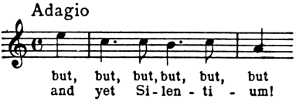
Adagio
but, but, but, but, but, but
and yet Silentium!
Farewell, my honored friend and think of me always as worthy of
your kindness—
Your
Beethoven.
I kiss the hands of the honored Princess C. a thousand times.
Beethoven’s “Lord Castleregt” was Viscount Castlereagh,
now in Vienna as British plenipotentiary in the coming congress;
and his object was to obtain through him some recognition from
the Prince Regent for the dedication of the “Wellington’s Victory.”
Nothing came of it.
Prince Lichnowsky’s Romance
The Sonata was the Op. 90, dated “August 16, 1814”—the
subject of one of Schindler’s authentic and pleasantest anecdotes.
Lichnowsky, after the decease of his first wife, fell in love with
Fräulein Stummer, a singer just now transferred from the Theater-an-der-Wien
to the Hoftheater, whose talents and unblemished
character rendered her worthy of the Count’s affection. Difference
in social position long prevented their marriage, nor was it
solemnized until some time after the death of Prince Karl.
When Count Lichnowsky received a copy of the Sonata dedicated
to him (writes Schindler), it seemed to him that his friend Beethoven had
intended to give expression to a definite idea in the two movements of
which it is composed. He made no delay in asking Beethoven about it.
As the latter was never secretive about anything, least of all when a
witticism or joke was in question, he could not hold back his explanation
long. Amidst peals of laughter he told the Count that he had tried to
set his courtship of his wife to music, observing also, that if the Count
wanted a superscription he might write over the first movement “Struggle
between head and heart” and over the second “Conversation with the
loved one.” Obvious reasons made Beethoven refrain from publishing
the Sonata with these superscriptions.... This circumstance shows
again that Beethoven frequently put a poetic idea at the bottom of his
works, if he did not always do so.
The only new work suitable for a grand concert which Beethoven
now had, was the chorus; “Ihr weisen Gründer.” Over
the title of the manuscript is written in pencil by him: “About
this time the Overture in C.” This work he had now in hand;
also a vocal composition of considerable length. The author of
the text, whoever he was, must have profoundly studied and
heartily adopted the principles of composition as set forth by
Martinus Scriblerus in his “Treatise on Bathos, or the Art of
Sinking in Poetry”: for anything more stilted in style, yet more
absurdly prosaic, with nowhere a spark of poetic fire to illuminate
its dreary pages, is hardly conceivable. It begins something like
this:
Nach Frankreichs unheilvollem Sturz, die Gottverlassene
Erhob sich auf den blutigen Trümmern, ein düster Schreckensbild,
Gigantisch hoch empor, die Geieraugen weithin nach Raube drehend,
Mit starker Hand schwingend die eherne Sklavengeissel!
«Wer ist mir gleich?» erscholl mit Macht des Frevlers Stimme,
«Mein fester Sitz ist Frankreich; Italien meiner Stirne Schmuck;
Meiner Füsse Schemel Hispania; nun, Deutschland, du bist mein;
Vertilgen will ich Albion vom Grund: zum Knecht soll mir Moskwa dienen.»
Und furchtbar zog der Riese aus,
Brach ein ins deutsche Kaiserhaus,
Griff frevelnd nach Hispaniens Land,
Verheerte schwer der Moskwa Strand,
Und an der Po und an der Spree
Erschall der Völker lautes Weh.
(And so forth, ad nauseam.)
Alois Weissenbach’s Enthusiasm
Neither the Overture nor the Cantata was finished, when the
arrival at Vienna of the King of Wurtemberg on the 22d of September,
of the King of Denmark on the 23d and the announcement
of the coming of the Russian Emperor with the King of Prussia
on Sunday the 25th, brought Beethoven back to the city. Owing
to the failure of Lobkowitz, the Court theatres had passed under
the management of Palffy. If there be any truth whatever in his
alleged hostility to Beethoven, it is not a little remarkable that
the first grand opera performed in the presence of the monarchs—Monday
the 26th—was “Fidelio.” One of the audience on that
evening, in a published account of his “Journey to the Congress,”
records: “To-day I went to the Court Theatre and was carried
to heaven—the opera ‘Fidelio’ by L. v. Beethoven was given.”
Then follow some fifteen pages of enthusiastic eulogy. That
auditor was Alois Weissenbach, R. I. Councillor, Professor of
Surgery and Head Surgeon of the St. John’s Hospital in Salzburg,
where after sixteen years’ service in the Austrian armies he had settled,
devoting his leisure to poetry and the drama. His tragedy
“Der Brautkranz” in iambics, five acts, was produced January
14, 1809, at the Kärnthnerthor-Theater. Whether his “Barmeciden”
and “Glaube und Liebe” were also brought out in Vienna
we have no means of deciding. At all events, he was a man of
high reputation. Of him Franz Graeffer writes:
That Weissenbach was a passionate admirer of Beethoven’s is a
matter of course; their natures were akin, even physically, for the Tyrolean
was just as hard of hearing. Both were manly, straightforward, liberal,
upright figures. Weissenbach comes to Vienna in 1814, and “Fidelio” is
performed. An indescribable longing seizes him to make the personal
acquaintance of the author of the immortal work. When he reaches his
lodgings a card of invitation from Beethoven lies on his table. Beethoven
had been there himself. What a mysterious, magnetic play of congenial
spirits! The next day he received kiss and handgrasp. Afterward it
was possible often to sit at table with them in the rooms on the ground
floor of the Roman Emperor. But it was pitiful to hear them shout at
each other. It was therefore not possible thoroughly to enjoy them.
Strangely enough in a little room, as also in the inn Zur Rose in the
Wollzeile, Weissenbach heard much better, and conversed more freely
and animatedly. Otherwise the most prolific, amiable, lively of social
companions. A blooming man, aging, always neatly and elegantly clad.
How learned he was as a physician will not be forgotten.
Weissenbach himself writes:
Completely filled with the gloriousness of the creative genius of this
music, I went from the theatre home with the firm resolve not to leave
Vienna without having made the personal acquaintance of so admirable
a man; and strangely enough! when I reached my lodgings I found
Beethoven’s visiting card upon my table with a cordial invitation to
breakfast with him in the morning. And I drank coffee with him and
received his handgrasp and kiss. Yes, mine is the proud privilege of
proclaiming publicly, Beethoven honored me with the confidence of his
heart. I do not know if these pages will ever fall into his hands: if he
learns that they mention his name either in praise or blame he will indeed
(I know him and know his strong self-reliance) not read them at all;
herein, too, he maintains his independence, he whose cradle and throne
the Lord established away from this earth.... Beethoven’s body has
a strength and rudeness which is seldom the blessing of chosen spirits.
He is pictured in his countenance. If Gall, the phrenologist, has correctly
located the mind, the musical genius of Beethoven is manifest in
the formation of his head. The sturdiness of his body, however, is in his
flesh and bones only; his nervous system is irritable in the highest degree
and even unhealthy. How it has often pained me to observe that in this
organism the harmony of the mind was so easily put out of tune. He
once went through a terrible typhus and from that time dates the decay
of his nervous system and probably also his melancholy loss of hearing.
Often and long have I spoken with him on this subject; it is a greater
misfortune for him than for the world. It is significant that before that
illness his hearing was unsurpassably keen and delicate, and that even now
he is painfully sensible to discordant sounds; perhaps because he is himself
euphony.... His character is in complete agreement with the
glory of his talent. Never in my life have I met a more childlike nature
paired with so powerful and defiant a will; if heaven had bestowed nothing
upon him but his heart, this alone would have made him one of those in
whose presence many would be obliged to stand up and do obeisance.
Most intimately does that heart cling to everything good and beautiful
by a natural impulse which surpasses all education by far.... There is
nothing in the world, no earthly greatness, nor wealth, nor rank, nor
state can bribe it; here I could speak of instances in which I was a
witness.
Remarks follow upon Beethoven’s ignorance of the value of
money, of the absolute purity of his morals (which, unfortunately,
is not true) and of the irregularity of his life. “This irregularity
reaches its climax in his periods of productiveness. Then he is
frequently absent days at a time without any one knowing whither
he is gone.” [?]
We know no reason to suppose that Beethoven received
Weissenbach’s poem before the interview with him; but, on the
contrary, think the citations above preclude such a hypothesis.
Moreover, the composer’s anxiety to have an interview at the
earliest possible moment arose far more probably from a hint or
the hope, that he might obtain a text better than the one in
hand, than from any desire to discuss one already received.
What is certain is this: Beethoven did obtain from Weissenbach
the poem “Der glorreiche Augenblick,” and cast the other aside
unfinished—as it remains to this day.
First, Beethoven had to complete his overture, the supposed
scope and design of which may occupy us a moment.
Europe After the Vienna Congress
Scott said, that when he wrote “Waverly, or ’Tis Sixty Years
Since,” it had already become impossible for the people of England
and Scotland, in their greatly changed and improved condition,
to form any correct conception of the state of public feeling in those
kingdoms in 1745, when the Pretender made that last effort against
the House of Brunswick which is the subject of “Waverly,” and
the defeat of which is commemorated by Handel in “Judas
Maccabæus.” It is equally difficult for us to conceive adequately
the sensations caused by the downfall of Napoleon at the time of
which we are writing.
When monarchs play chess with armies, “check to the king”
means the shock of contending foes and all the horrors of war; but
in perusing the history of Bonaparte’s campaigns, we become so
interested in the “game” as to forget the attendant ruin, devastation
and destruction, the blood, carnage and death, that made
all central Europe for twenty long years one vast charnel-house.
But only in proportion as the imagination is able to form a vivid
picture of the horrors of those years, can it conceive that inexpressible
sense of relief, the universal joy and jubilee, which outside
of France pervaded all classes of society, from prince to peasant,
at the fall of the usurper, conqueror and tyrant. And this
not more because of that event, than because of the all-prevailing
trust, that men’s rights, political and religious—now doubly theirs
by nature and by purchase at such infinite cost—would be gladly
and gratefully accorded to them. For sovereign and subject had
shared danger and suffering and every evil fortune together, and
been brought into new and kindlier relations by common calamities;
thus the sentiment of loyalty—the affectionate veneration of
subject for sovereign—had been developed to a degree wholly
unprecedented. Nothing presaged or foreboded the near advent
and thirty years’ sway of Metternichism. No one dreamed, that
within six years the “rulers” at this moment “of happy states”
would solemnly declare, “all popular and constitutional rights to
be holden no otherwise than as grants and indulgences from
crowned heads”;[139] that they would snuff treason in every effort of
the people to hold princes to their pledged words; and that their
vigilance would effectually prevent the access of any Leonore to
the Pellicos, Liebers and Reuters languishing for such treasons in
their state prisons. At that time all this was hidden in the future;
the very intoxication of joy and extravagant loyalty then ruled the
hour. It was, as we believe, to give these sentiments musical
expression, that Beethoven now took up and wrought out certain
themes and motives, noted by him five years before in connection
with the memorandum: “Freude schöner Götterfunken Tochter—Ouverture
ausarbeiten.”[140] The poetic idea of the work was not
essentially changed—the joy of liberated Europe simply taking
the place of the joy of Schiller’s poem. But the composer’s
particular purpose was to produce it as the graceful homage of a
loyal subject on the Emperor’s name-day. How else can the
autograph inscription upon the original manuscript be understood:
“Overture by L. v. Beethoven, on the first of Wine-month, 1814—Evening
to the name-day of our Emperor”? In the arts, as in
literature, there is no necessary connection between that which
gives rise to the ideas of a work, and the occasion of its composition;
the occasion of this overture was clearly the name-day festival of
Emperor Franz; why then may it not in the future, as in the past,
be known as the “Namensfeier” Overture?
Assuming the “first of the Wine-month” (October 1) to date
the completion of the work, there remained three days for copying
and rehearsal. The theatre had been closed on the 29th and
30th of September, to prepare for a grand festival production of
Spontini’s “La Vestale” on Saturday evening, October 1st; but
for the evening of the name-day, Tuesday the 4th, “Fidelio”
(its 15th performance) was selected. It was obviously the intention
of Beethoven to do homage to Emperor Franz, by producing
his new overture as a prelude on this occasion. What, then,
prevented? Seyfried answers this question. He writes: “For
this year’s celebration of the name-day of His Majesty, the Emperor,
Kotzebue’s allegorical festival play ‘Die hundertjährigen
Eichen’ had been ordered. Now, as generally happens, this decision
was reached so late that I, as the composer, was allowed
only three days, and two more for studying and rehearsing all the
choruses, dances, marches, groupings, etc.” This festival play
was on the 3d and rendered the necessary rehearsals of Beethoven’s
overture impossible.[141]
“Fidelio” was sung the sixteenth time on the 9th. Tomaschek,
one of the auditors on that evening, gave to the public in
1846 notes of the impression made upon him, in a criticism which,
by its harshness, forms a curious contrast to Weissenbach’s eulogy.
Having exhausted that topic, however, Tomaschek describes his
meetings in an account which has a peculiar interest not only
because, though general descriptions of Beethoven’s style of conversation
are numerous, attempts to report him in detail are very
rare. The description is also valuable because of its vivid display
of Beethoven’s manner of judging his contemporaries, which
was so offensive to them and begat their lasting enmity. A
dramatic poem, “Moses,” words by Klingemann, music (overture,
choruses and marches) by von Seyfried, was to be given on the
evening of Tomaschek’s first call. Tomaschek says he has no
desire “to hear music of this kind” and the dialogue proceeds as
follows:
Beethoven’s Opinion of Meyerbeer
B.—My God! There must also be such composers, otherwise what
would the vulgar crowd do?
T.—I am told that there is a young foreign artist here who is said
to be an extraordinary pianoforte player.[142]
B.—Yes, I, too, have heard of him, but have not heard him. My
God! let him stay here only a quarter of a year and we shall hear what
the Viennese think of his playing. I know how everything new pleases
here.
T.—You have probably never met him?
B.—I got acquainted with him at the performance of my Battle, on
which occasion a number of local composers played some instrument.
The big drum fell to the lot of that young man. Ha! ha! ha!—I was not
at all satisfied with him; he struck the drum badly and was always behind-hand,
so that I had to give him a good dressing-down. Ha! Ha! Ha!—That
may have angered him. There is nothing in him; he hasn’t the
courage to hit a blow at the right time.
Before Tomaschek visited Beethoven again, Meyerbeer’s opera
“Die beiden Caliphen” had been produced at the Kärnthnerthor
Theatre. Tomaschek comes to take his farewell. Beethoven is
in the midst of preparations for his concert and insists upon
giving him a ticket. Then the conversation goes on:
T.—Were you at ——’s opera?
B.—No; it is said to have turned out very badly. I thought of
you; you hit it when you said you expected little from his compositions.
I talked with the opera singers, and that night after the production of the
opera at the wine-house where they generally gather, I said to them
frankly: You have distinguished yourselves again!—what piece of
folly have you been guilty of again? You ought to be ashamed of yourselves
not to know better, nor to be able to judge better, to have made
such a noise about this opera! I should like to talk to you about it, but
you do not understand me.
T.—I was at the opera; it began with hallelujah and ended with
requiem.
B.—Ha, ha, ha, ha, ha! It’s the same with his playing. I am
often asked if I have heard him—I say no; but from the opinions of my
acquaintances who are capable of judging such things I could tell that
he has agility indeed, but otherwise is a very superficial person.
T.—I heard that before he went away he played at Herrn ——’s and
pleased much less.
B.—Ha, ha, ha, ha! What did I tell you?—I understand that.
Let him settle down here for half a year and then let us hear what will
be said of his playing. All this signifies nothing. It has always been
known that the greatest pianoforte players were also the greatest composers;
but how did they play? Not like the pianists of to-day, who prance
up and down the keyboard with passages which they have practised—putsch,
putsch, putsch;—what does that mean? Nothing! When true
pianoforte virtuosi played it was always something homogeneous, an
entity; if written down it would appear as a well thought-out work.
That is pianoforte playing; the other thing is nothing!
T.—I am also carrying away from here a very small opinion of
----’s knowledge.
B.—As I have said, he knows nothing outside of singing.
T.—I hear that —— is creating a great sensation here.
B.—My God! he plays nicely, nicely—but aside from that he is
a — —. He will never amount to anything. These people have their
little coteries where they go often; there they are praised and praised and
that’s the end of art! I tell you he will never amount to anything. I
used to be too loud in my judgments and thereby made many enemies—now
I criticize nobody and, indeed, for the reason that I do not want to
injure anybody, and at the last I say to myself: if there is any good in it
it will survive in spite of all attacks and envy; if it is not solid, not firm,
it will fall to pieces, no matter how it is bolstered up.
Of some minor compositions belonging to this autumn, this
is the story: The Prussian King’s Secretary, Friedrich Duncker,
brought to Vienna, in the hope of producing it there, a tragedy,
“Leonore Prohaska,” “which tells the story of a maiden who, disguised
as a soldier, fought through the war of liberation.” For
this Beethoven composed a soldiers’ chorus for men’s voices
unaccompanied: “Wir hauen und sterben”; a romance with
harp, 6/8, “Es blüht eine Blume”; and a melodrama with harmonica.
It is also stated, that he instrumentated for orchestra the march
in the Sonata, Opus 26, Duncker preferring this to a new marcia
funebre.[143] Dr. Sonnleithner had also a note from some quarter—discredited
by him—that even an overture and entr’actes were
written. Nothing of the kind is known to exist, and doubtless
never did. “It is said the censor would not allow the piece”—it
certainly never came to performance; and until its production
was made sure, Beethoven would of course—even if he had the
time—not have engaged in a work of such extent.
Cantata: “Der glorreiche Augenblick”
Beethoven had announced a grand concert for November 20,
in the large Ridotto Room, but advertisements in the “Wiener
Zeitung” of the 18th postponed it till November 22d, then till the
27th, and finally till the 29th. On November 30th, the newspaper
reports:
At noon of yesterday, Hr. Ludwig v. Beethoven gave all music-lovers
an ecstatic pleasure. In the R. I. Ridotto Room he gave performances of
his beautiful musical representation of Wellington’s Battle at Vittoria, preceded
by the symphony which had been composed as a companion-piece.
Between the two works an entirely new, etc., etc., cantata, Der
glorreiche Augenblick.
One would like to know what Beethoven said when he read
this; for the symphony supposed by the writer to be composed as a
companion-piece (Begleitung) to the “Wellington’s Victory” was
the magnificent Seventh![144]
The solo singers in the Cantata were Mme. Milder, Dem.
Bondra, Hr. Wild and Hr. Forti, all of whom sang well, and the
Milder wonderfully. “The two Empresses, the King of Prussia”
and other royalties were present and “the great hall was crowded.
Seated in the orchestra were to be seen the foremost virtuosi, who
were in the habit of showing their respect for him and art by taking
part in Beethoven’s Academies.” All the contemporary notices
agree as to the enthusiastic reception of the Symphony and the
Battle, and that the Cantata, notwithstanding the poverty of the
text, was, on the whole, worthy of the composer’s reputation and
contained some very fine numbers. The concert, with precisely
the same programme, was repeated in the same hall on Friday,
December 2d, for Beethoven’s benefit—nearly half the seats
being empty! And again in the evening of the 25th for the benefit
of the St. Mark’s Hospital, when, of course, a large audience was
present. Thus the Cantata was given three times in four weeks,
and probably Spohr, who was still in Vienna, played in the orchestra;
yet he gravely asserts in his autobiography that “the work
was not performed at that time.”
The proposed third concert for Beethoven’s benefit was abandoned
and there is no clue to the “new things in hand” for it, which
Beethoven mentioned in a letter to Archduke Rudolph, unless
possibly the “Meeresstille und glückliche Fahrt” may have been
begun for the occasion. The most remarkable and gratifying
thing in the letter, however, is to find Beethoven once more
speaking of “pleasures and joy”—whence arising, we learn from
Schindler. True, he does not, nor cannot yet, speak from personal
observation; but his well-known relations to the composer
began while the memories of these days were still fresh; and what
he records is derived from Beethoven himself for the most part,
though, as usual, he has inserted a statement or two, honestly
made, but not the less incorrect on that account. But first, a
paragraph from an article by Schindler in Raumer’s “Hist.
Taschenbuch,” published in 1863:
The rôle which Rasoumowsky played in Vienna at this time was one
of unparalleled brilliancy. From the first weeks of the Congress his house
was full. Thus Gentz notes under date Sept. 18: “Visited Rasoumowsky;
there innumerable visitors, among others Lord and Lady Castlereagh,
Count Münster, Count Westphalen, Mr. Coke, the Marquis de Saint-Marsan,
Count Castellafu, all the Prussians, etc.” But as balls soon
became the order of the day and Count Stackelberg had given his on
October 20, 1814, when the Czar and Czarina of Russia, the King of
Prussia and other grandees of all kinds appeared, he also planned one
for December 6, and Gentz, who permitted himself the magical vision for
only a moment and had to work that night till two o’clock on his dispatches,
assures us that this feast was the most beautiful of all that he had
attended since the arrival of the French monarch. It was only overshadowed
by that which Czar Alexander gave in the same palace, which
he borrowed for the occasion from his princely subject.
Honors Received at the Vienna Congress
Turn we to Schindler:
The end of the second period (in Beethoven’s life) showed us the
composer on a plane of celebrity which may fairly be described as one of
the loftiest ever reached by a musician in the course of his artistic strivings.
Let us not forget that it was the fruit of twenty years of tireless
endeavor. The great moment in the history of the world with which
this celebration of his fame was synchronous could not fail to give the
incident a brilliancy unparalleled in the history of music. The apparent
extravagance of the statement is pardonable when we add that nearly all
the rulers of Europe who met at the Vienna Congress placed their seals
on our master’s certificate of fame.
As Rasoumowsky was not elevated to the rank of Prince until
June 3rd, 1815, Schindler, in his next sentences, is all wrong in
making that incident “the cause of festivities of a most extraordinary
character to which Beethoven was always invited.”
There (Schindler continues) he was the object of general attention on
the part of all the foreigners; for it is the quality of creative genius combined
with a certain heroism, to attract the attention of all noble natures.
Shall we not call it heroism, when we see the composer fighting against
prejudices of all kinds, traditional notions in respect of his art, envy,
jealousy and malice on the part of the mass of musicians, and besides this
against the sense most necessary to him in the practice of his art, and yet
winning the exalted position which he occupies? No wonder that all
strove to do him homage. He was presented by Prince [Count] Rasoumowsky
to the assembled monarchs, who made known their respect for
him in the most flattering terms. The Empress of Russia tried in particular
to be complimentary to him. The introduction took place in the
rooms of Archduke Rudolph, in which he was also greeted by other exalted
personages. It would seem as if the Archduke was desirous always to
take part in the celebration of his great teacher’s triumph by inviting the
distinguished foreigners to meet Beethoven. It was not without emotion
that the great master recalled those days in the Imperial castle and the
palace of the Russian Prince; and once he told with a certain pride how
he had suffered the crowned heads to pay court to him and had always
borne himself with an air of distinction.
There is reason to believe that these receptions in the apartments
of the Archduke did not begin until those at Rasoumowsky’s
had come to their disastrous end. Huge as the palace was, it
lacked space for the crowds invited thither to the Czar’s festivities.
A large temporary structure of wood was therefore added
on the side next the garden, in which, on the evening of December
30th, a table for 700 guests was spread. Between five and six
o’clock of the morning of the 31st, this was discovered to be on
fire—probably owing to a defective flue—the conflagration extending
to the main building and lasting until noon.
Within the space of a few hours several rooms in this gorgeous
establishment, on which for 20 years its creator had expended everything
that splendor, artistic knowledge and liberality could offer, were prey
of the raging flames. Among them were the precious library and the
inestimable Canova room completely filled with sculptures by this master,
which were demolished by the falling of the ceiling.
The loss was incalculable. To rebuild the palace out of his own
means was not to be thought of; but Alexander lost no time in offering his
assistance and in sending Prince Wolkonski to him to learn how much
money would be required to defray the principal cost. The Count estimated
it at 400,000 silver rubels, which sum he requested as a loan, and
received on January 24, 1815. But the sum was far from enough, and in
order to obtain further loans, ownership of the splendid building had to be
sacrificed.
And thus Rasoumowsky also passes out of our history.—Among
the visitors to Vienna at the time of the Congress was
Varnhagen von Ense, who had gone into the diplomatic service;
he came in the company of the Prussian Chancellor von Hardenburg.
His attitude toward Beethoven had cooled—probably
because of Oliva’s complaints touching Beethoven’s behavior
towards him. His brief report of his meeting with the composer
derives some interest from its allusion to Prince Radziwill, to
whom Beethoven dedicated the Overture, Op. 115 (which was
not published until 1825). The report (printed in Varnhagen’s
“Denkwürdigkeiten,” Vol. III, pp. 314-15) is as follows:
Musical treats were offered on all hands, concerts, the church, opera,
salon, virtuosi and amateurs all gave of their best. Prince Anton
Radziwill, who was already far advanced in his composition of Goethe’s
“Faust” and here gave free rein to his musical inclinations, was the cause
of my again looking up my sturdy Beethoven, who, however, since I saw
him last had grown more deaf and unsociable, and was not to be persuaded
to gratify our wishes. He was particularly averse to our notables
and gave expression to his repugnance with angry violence. When
reminded that the Prince was the brother-in-law of Prince Louis Ferdinand
of Prussia, whose early death he had so deeply deplored and whose
compositions he esteemed highly, he yielded a trifle and agreed to the
visit. But it is not likely that a more intimate acquaintance followed.
I also refrained from taking the uncouth artist to Rahel, for society
rendered him obstreperous and nothing could be done with him alone,
nothing could be done unless he was disposed to play. Besides, though
famous and honored, he was not yet on that pinnacle of recognition which
he has since attained.
Compositions and Publications of 1814
The compositions of the year 1814 were these:
I. Vocal Trio: “Tremate, empj, tremate.” Practically composed
in 1801-02, but not known to have been completed and written out for
performance and publication until “something for Milder” was needed in
the concert of February 27th.
II. “Germania’s Wiedergeburt”; chorus in Treitschke’s “Gute
Nachricht.”
III. “Fidelio”; revised and altered.
IV. “Un lieto Brindisi”; cantata campestre, four voices.
V. Elegiac Song: “Sanft wie du lebtest,” four voices and strings.
VI. Chorus: “Ihr weisen Gründer.”
VII. Sonata for Pianoforte, E minor, Op. 90.
VIII. Overture in C, Op. 115.
IX. Cantata: “Der glorreiche Augenblick.”
X. Three vocal pieces and march (orchestration of the march in
the Sonata, Op. 26), for Duncker’s tragedy “Leonore Prohaska.”
XI. Canon: “Kurz ist der Schmerz”; second form as written in
Spohr’s Album “on March 3d, 1815.”
XII. Song: “Des Kriegers Abschied.”
XIII. Song: “Merkenstein,” Op. 100; “On December 22d, 1814.”
XIV. “Abschiedsgesang”; for two tenors and bass (“Die Stunde
schlägt”). Note on the publication in the “Completed Works, etc.”:
“Beethoven wrote this terzetto at the request of Magistrate Mathias
Tuscher for the farewell party of Dr. Leop. Weiss before his removal to
the city of Steyer.” Beethoven inscribed it: “From Beethoven, so that
he may no longer be touched up.” (Um nicht weiter tuschiert zu werden.
The pun on the Magistrate’s name is lost in the translation. Tuschiren
means to touch up with India ink.)
The publications of the year:
I. Irish Airs, Vol. I, complete, published by Thomson.
II. Chorus: “Germania’s Wiedergeburt”; published in June.
III. Song: “An die Geliebte,” by J. L. Stoll; published as a supplement
to the “Friedensblätter,” July 12.
IV. Six Allemandes for Pianoforte and Violin, advertised by
Ludwig Maisch on July 30. (The author lacks means and opportunity
to determine the authenticity of these dances. It is, however, hardly
probable that a Viennese publisher would venture at that time to use
Beethoven’s name thus without authority.)
V. “Fidelio”; Pianoforte arrangement by I. Moscheles. Published
by Artaria and Co., in August.


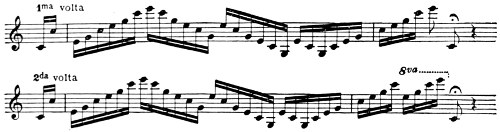
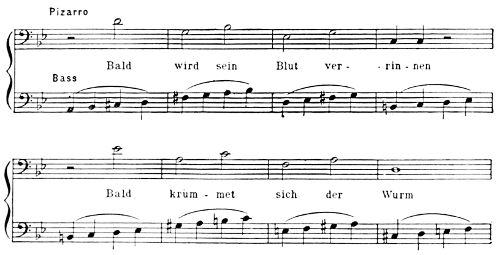


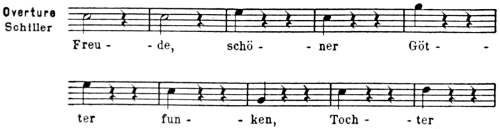

 but as this key seems too little natural and so little in harmony with the
direction Amoroso that it might better be written Barbaresco, I have set
it in a more appropriate key.
but as this key seems too little natural and so little in harmony with the
direction Amoroso that it might better be written Barbaresco, I have set
it in a more appropriate key.