TO the great majority who knew Senator Kern as he appeared in court, in
social circles, in the free and easy environment of convention and
campaign, his geniality created the impression that he always preferred
company to solitude. To the comparative few who knew him in the routine
intercourse of daily contact he was exactly the opposite—one of the
most reticent of men, given to the keeping of his own councils. Few men
have disclosed their mental processes to a less degree. Throughout the
greater portion of his life, when confronted with a problem, personal,
political, or professional, he retired within himself and in solitude
worked it out. At one period of his life when called upon to reach a
decision on any matter of moment it was his practice to shut himself in
a room alone and for hours debate the pros and cons over a game of
solitaire. As his problems multiplied in numbers and grew in importance
after his election to the senate this reticence intensified, and his
tendency to withdraw within himself became more pronounced. At times
when he was grappling with one of his numerous problems he would relax
into sociability in moments of his own choosing, but he was passionately
intolerant of intrusion at other times. He would often lock himself up
in his committee room at the capitol, but more frequently he would hide
himself in his private room in the Senate Office building, which was not
connected with his public offices and inaccessible to the uninitiated by
telephone. He alone carried the key and even those occupying the most
confidential relations with him dared not intrude upon him there. Here
he would sometimes shut himself in for hours at a time.
In this connection it is proper to emphasize a mental trait with which
he was probably not popularly credited—an extraordinary power of
concentration. Engaged in working out a problem he was able to bring all
his mental powers to bear upon just that, and put all else beyond his
consciousness. At such times he was utterly oblivious to anything that
might be transpiring about him, and nothing could divert him.
It was not his habit to rush speedily to conclusions. He viewed the
problem, always a political one after he entered the senate, from every
possible angle. He weighed all reasons, for and against, with scrupulous
care, brushing aside all prejudices, and coldly analyzing all
possibilities. And he seldom acted at once on his first conclusion. Time
and again he would return to this debate within his own mind, in the
meanwhile guarding his mental processes from all others.
This called for another trait which he possessed to an infinite
degree—an untiring patience. Others might act on prejudice or
impulse—he never did. And while others were often confusing the issue
he was seeking the solution. And this quality was quite as prominent
where his own personal interests were involved. Nothing could startle
him into inconsidered action. He took his time. He was in the habit of
permitting his political enemies to exhaust their ammunition while he,
unmoved, apparently indifferent, almost oblivious to the attack,
withheld his fire. And very often the result was that he did not think
it worth while to fire. Frequently he struck, when forced to fight, with
such subtlety that the wounded adversary did not know whence the blow
had come. He could hear of these attacks with scarcely any show of
curiosity, and almost invariably without comment, unless it be in the
nature of a witticism. He first gauged his foe and planned his battle
accordingly—aiming unerringly at the vulnerable heel.
There was something almost uncanny in his ability to ignore an attack
and appear to be in ignorance of an affront.
Throughout his life Senator Kern was a voluminous letter-writer and
notwithstanding the extent of his correspondence he stubbornly refused
to resort to such labor-saving devices as stenography until toward the
close of his life when overwhelmed with the multiplicity of duties. It
was his life-long habit to reply to every letter he received, no matter
how trivial its nature, with pen and ink. With him letter writing was
not a lost art and he liked to write when he had the time.
There was an art to a Kern letter. He knew how, better than most men of
his generation, to put personality, individuality, atmosphere into a
note. No one ever put more tenderness into a letter of sympathy, more
jollity into one of congratulation, more comradry into a letter to a
friend or occasionally more biting sarcasm or sting into one to an
enemy. Enveloped in tobacco smoke, he would write slowly by the hour,
with infinite patience, painstaking in his phrasing, and his chirography
was as clear, individual and beautiful as that of James Whitcomb Riley.
To the vast majority of letters that reached him in connection with the
routine business of the senate he did not personally reply for that
would have been an impossibility, but letters of a fault-finding nature
were by his direction always called to his attention. In some cases
where the motive was apparent he made no reply, but in cases where the
writer was laboring under a misapprehension, or honestly differed in his
views, he would write at length with pen and ink, setting his
correspondent right. Nor did it make any difference whether the
correspondent was known to him personally or by reputation or not, if he
was a constituent he went upon the theory that he was entitled to a
response. These letters almost invariably brought apologetic replies,
and many warm friends and supporters were made from among strangers who
were thus impressed with the honesty of his own views and his genuine
desire for the respect and good will of his fellow men.
His method of preparing such speeches as were formally prepared was also
unique. Except for especially important occasions it was not his custom
to write political speeches or special occasion addresses. He would
arrange the headlines in his mind and nothing more.
Unlike most public men he did not dictate the speeches he prepared, but
he would shut himself up in his room with a supply of cigars, a rough
scratch pad and several sharpened pencils and write them slowly and
carefully in the same beautiful chirography which gave such character to
his letters. Even in the longest and most important of these there was
scarcely any eliminations or additions—the copy was clean. They might
have been copied rather than created, judging from the absence of
erasures or emendations.
There was a deep undercurrent of religious reverence in Senator Kern
which did not flout itself upon the surface. Reference has been made to
his conversion at a revival meeting during his boyhood when for a time
he became ardent in his devotion to religious duties, and while this
phase passed, he retained through life a profound reverence for sacred
things. During the greater portion of his life, while retaining his
membership with the Presbyterian church, he was not much given to church
attendance. This was not due to any compromise with his faith. He was
not interested in dogma or creed. He cared little for the outer
manifestations of the spirit of worship. He seldom quoted from the Bible
in his speeches and had a horror of the politician who attempts to
capitalize his religion. The thought of the life beyond was to him too
solemn for conversational purposes. He never or seldom discussed it. But
he never permitted himself to doubt it. His veneration for the cloth
asserted itself less in tributes to the dignity of the clergy than in
his occasional excoriations of members of the clergy who lowered their
dignity and compromised their religion by lending themselves to the
support of inhumanity. For the minister from Lawrence, Massachusetts,
who appeared for the mill owners at the strike hearings in Washington
to gravely assure the committee that there was a good moral effect in
throwing children of twelve and thirteen into factories to labor for a
pittance while paying the mill owners for the cold water that they drank
rather than permit them to play “in the streets” in the sunshine he had
no words with which to express his contempt. The only letter protesting
against the passage of the child labor law that he cared to notice was
from a minister of the cotton mill section—and it blazed with indignant
protest against—not the protest, but the source of it.
He had the average man’s appreciation of the occasional value of an
explicative, but he never lightly played with the name of his Creator.
And he had a quiet contempt for the man who did.
No man ever put more of the genuine spirit of Christianity into his
political philosophy. He loved his fellow men. And throughout his life
he particularly concerned himself with the alleviation of suffering
whenever possible, and the amelioration of the condition of the poor.
Because of that quality he was sometimes looked upon as not quite
“respectable” by some more prone to pose in prayer in the market places.
For these, too, he had a profound contempt.
It was in his attitude toward his fellow men that he disclosed the
profundity of his religious convictions. He had faith—it followed him
from the cradle to the grave.
I have before me a letter by Kern to his sister, Sarah, on the death of
her little boy, which so perfectly mirrors the man and his religious
views:
“Kokomo, January 4, 1883.
“Dear Sister—Father’s letter, containing the sad news of the death
of your little Frank was received to-day, and I hasten to write
you. Our hearts are full of loving sympathy for you in this
terrible affliction and we would like to be able to be with you to
mingle our tears with yours, and try to say something to break the
force of the overpowering sorrow which has come so heavily upon
you. The brave, sturdy little fellow. We imagined him in perfect
health, rollicking about your fireside enjoying the holiday
season—the pride and joy of all of you. And to hear of his death.
It startled and shocked us and saddened our household almost as
much as though it had been our child, for we had all become so
attached to him during our long stay with you. While death is
terrible, and while great heart-breaking grief always follows, yet
there are other matters to be considered in the case of the death
of children especially which ought to go a long way in the
direction of comforting the heart.
“He is safe. The possibilities of evil, which go along with all
boys and which increase as they grow older, are no more. There is
now no danger for little Frank. His footsteps need not now be
guarded—there need be no anxiety in the mother’s heart for the
future of her boy. His future is not only secure, but it is a
future resplendent with glory. Had he lived a long, useful life,
he could never have attained that happiness which is now and always
will be his.
“I was thinking to-day of the comfort there is in afflictions like
this in the religion of the Bible. Without it what gloom and utter
hopelessness. With it the future is full of good cheer and joyous
anticipations. Accepting it as true—and let no doubt ever obtrude
itself—then must we not believe that our good, pure angel mother
who has been waiting over there so long welcomed little Frank with
exceeding great joy as the representative of her own children whom
she left so long ago and toward whom her heart went in such tender
solicitude?
“My dear sister, your little boy is safe. He was the first of our
family to be welcomed by her whose memory we treasure so fondly.
From this on there will be more frequent additions to the family in
the summerland of happiness—one by one we will be summoned there,
until, ere long, the family circle will be completed, and every
sorrow and pang of grief will be forgotten in the perfect happiness
of heaven. Let not this picture be marred. We must all see to it
that it is not. We must. I feel that we will all gather together
over there, parents, children, grandchildren, and together enjoy
forever the glories of the land of love.
“Let not your heart be troubled. There can be no more sorrow for
the little boy. No ill can ere betide him now. Trust in God who
doeth all things well. Let His will be done. God bless and comfort
you.
“Your loving brother,
“John.”
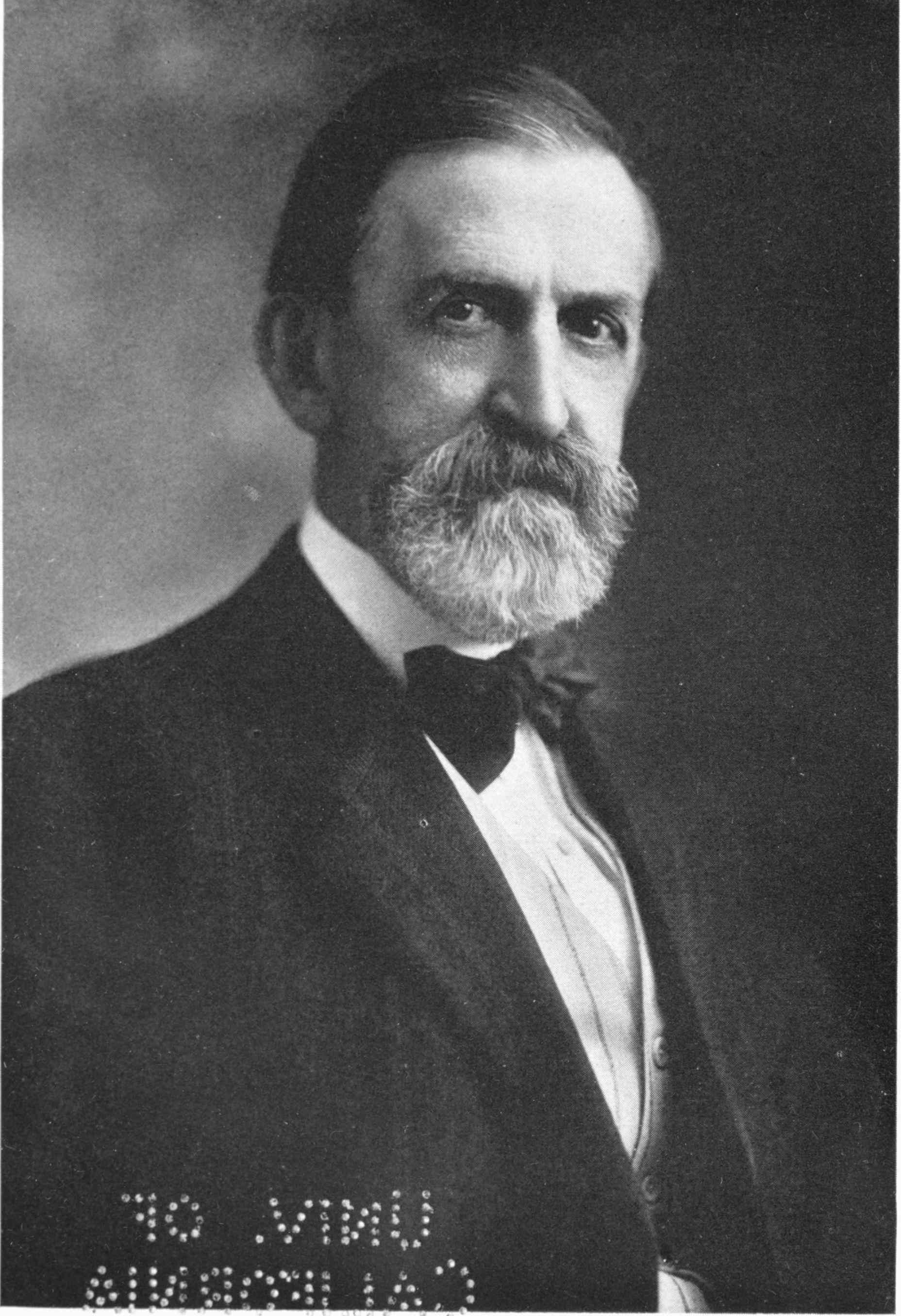
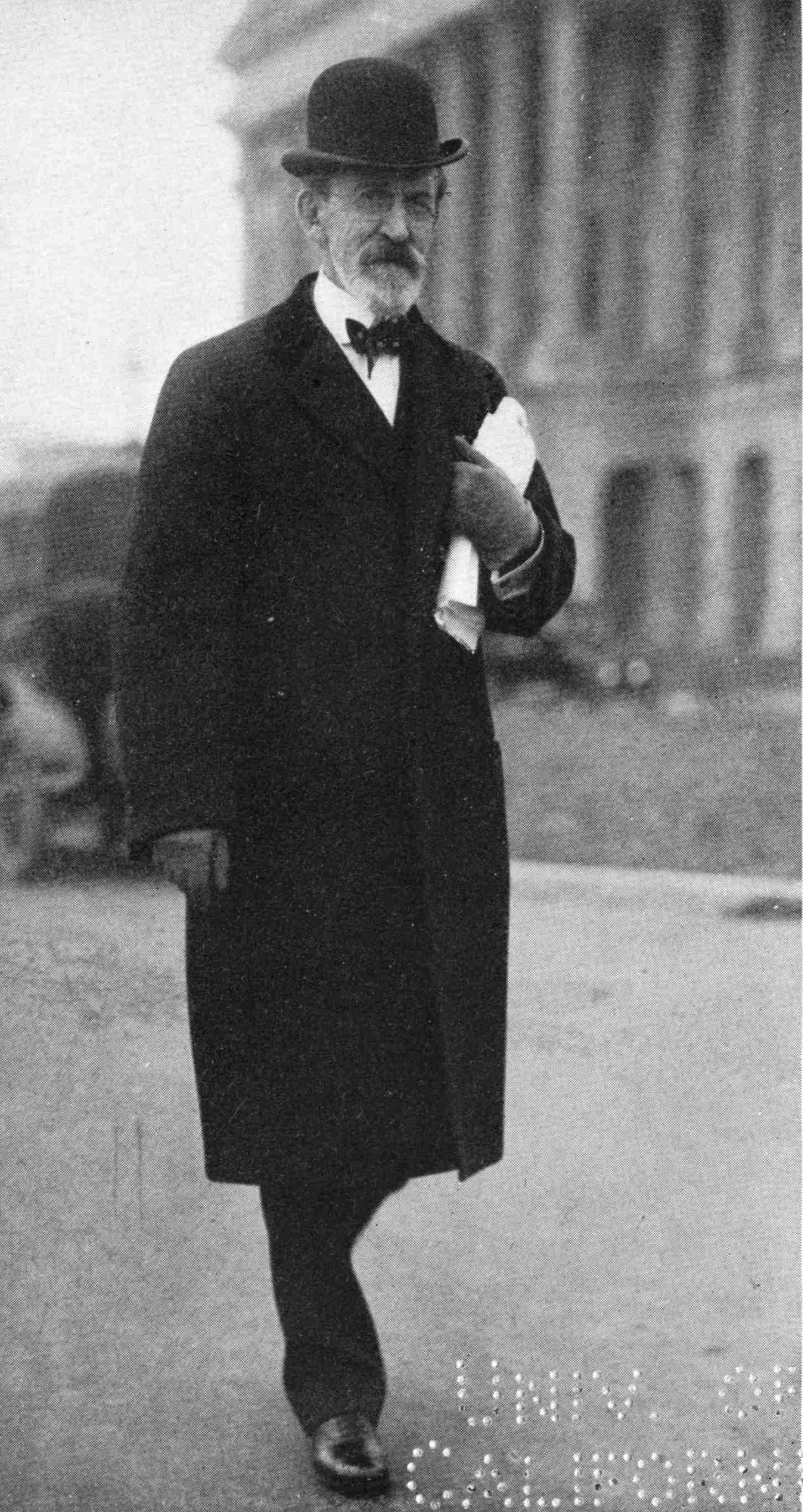
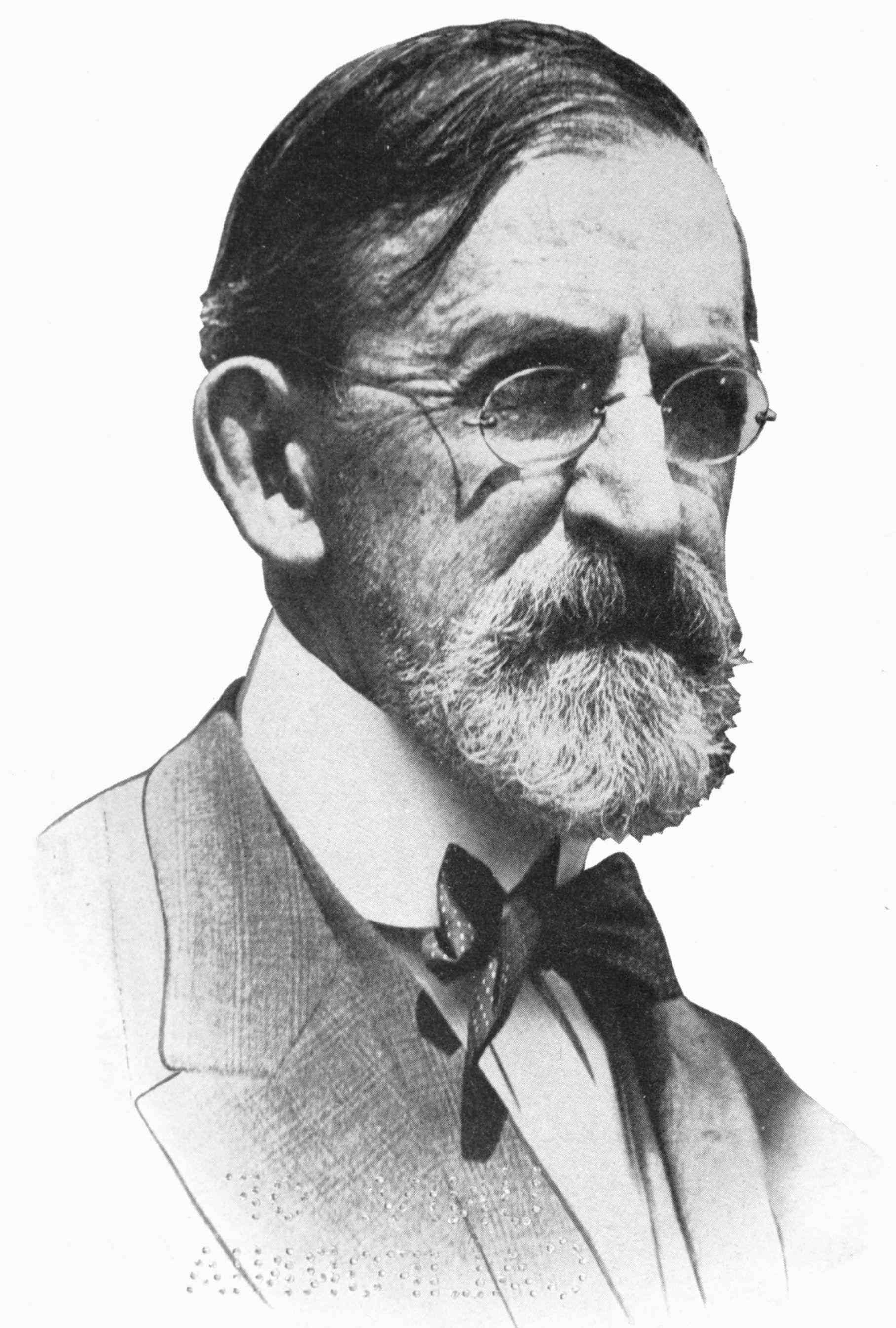
In personal appearance Senator Kern was always slender and never very
robust, and in his younger days this was the more noticeable because of
his custom of affecting the Prince Albert coat of the period and the
high silk hat. Soon after leaving Ann Arbor he permitted his beard to
grow to a considerable length and as the political “speaker with the
long black beard” he was known through the length and breadth of the
state for many years. His height, slender form, black beard, and keen,
penetrating dark eyes, an inheritance from his mother, made him in his
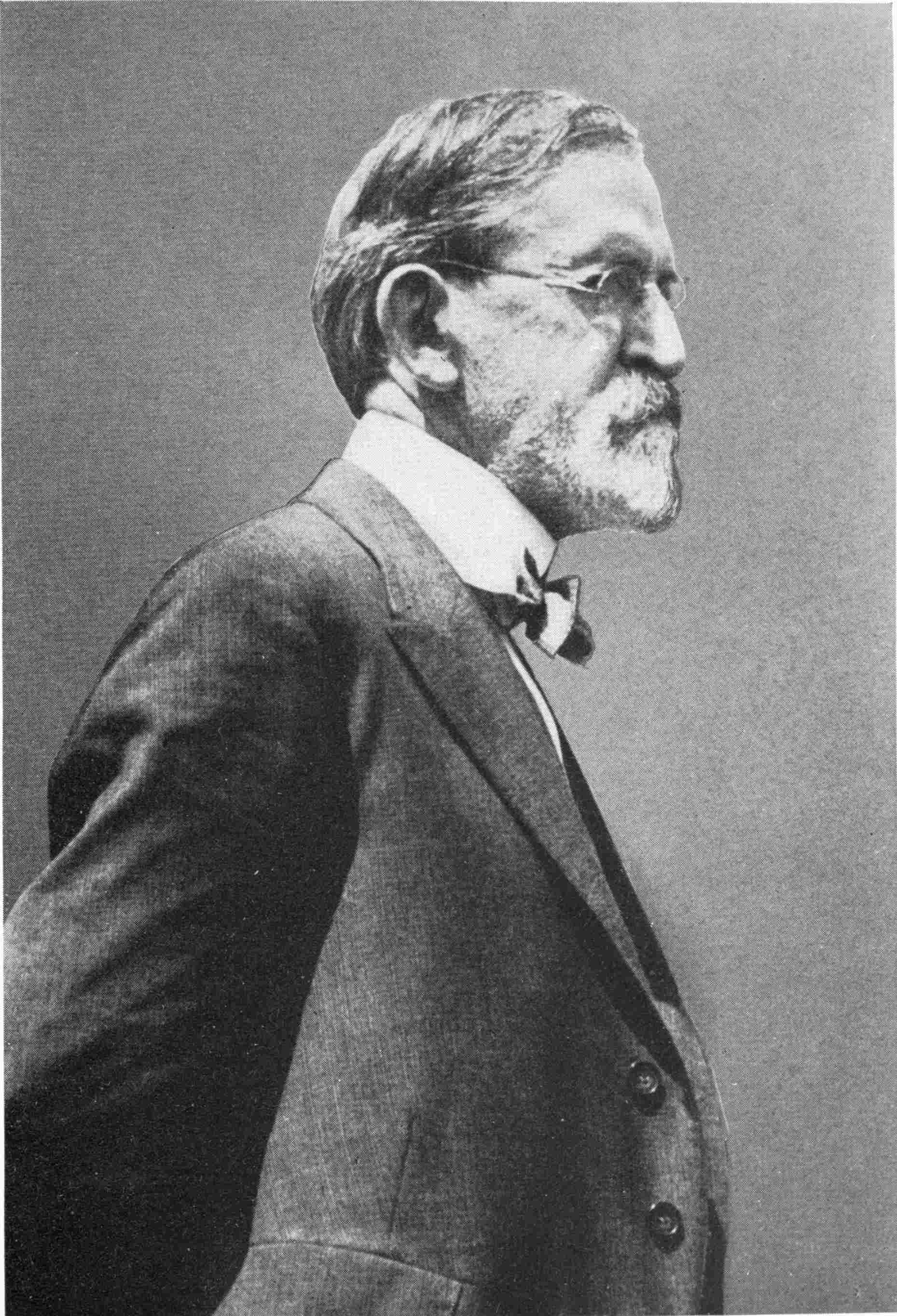
youth an impressive figure. In later years he abandoned the Prince
Albert for a business man’s sack suit, and seldom wore a silk hat except
on state occasions. His beard, now gray, was cropped short and little
more than covered his chin, but the memory of the flowing beard
persisted in the minds of the cartoonists and curbstone wits, and
constant reference, which was offensive to him, was made to his beard
which differed little from that of Harrison or Fairbanks and was a very
modest affair compared to that of Hughes. He never indicated, however,
that he cared for the strained witticisms about his beard, and when an
acquaintance, presuming upon his friendship, wrote him and suggested
that he part with it after his election to the senate he merely wrote
that “the beard has been attached to me so long it would be an act of
base ingratitude to desert it now.” His eyes, always his finest feature,
never lost their luster or fire. He was always perfectly groomed without
being noticeably so.
In some quarters he had the reputation of being cold and unappreciative,
but this was due to his temperamental inability to gush, and he had more
of a tendency among men to conceal rather than reveal his affections. No
senator was ever served by assistants with greater zeal, fidelity or
personal devotion, and yet with one or two exceptions he never by word
of mouth in the course of six years gave any expression of his
appreciation; and this reticence, together with an apparent coldness,
due to preoccupation, was discouraging to them at first. Then during
some recess or absence and when many miles away and without any special
occasion for it he would write a letter teeming with affectionate
appreciation. Perhaps a little later on he would return, and entering
the office as though he had just left it, he would sometimes pass by
with a scant nod and a faint smile and without pausing for a chat. He
had a great heart, but he did not carry it upon his sleeve.
This was shown in his attitude toward members of his family, to whom he
was tenderly devoted—he seldom mentioned them even among his
intimates. That he kept for and to himself.
And yet, as the old viking, Andrew Furseth, who knew, said few men were
more prone to take unto themselves the troubles and sorrows of others.
After hearing the pathetic story of the suffering of the wives and
children of the striking miners of Colorado, and looking upon the
pictures of some of the slaughtered innocents, he sat smoking in silence
for a long while, with the saddest expression on his face and in his
eyes that I have ever seen. And that was not a pose—there was only one
there to see, and Kern was scarcely conscious of his presence. Finally
coming out of his revery and observing the presence of another, he
smiled rather sadly and remarked, “Well, I guess God reigns and the
government at Washington still lives.”
The Kern of the out-of-doors was not the same man as the Kern of the
closet, and popular and likeable as the Kern of the out-of-doors was,
the Kern of the closet was infinitely the greater—and the real Kern.
As a companion in moments of relaxation Kern had few equals, and no one
appreciated this more than his congressional cronies at Congress Hall
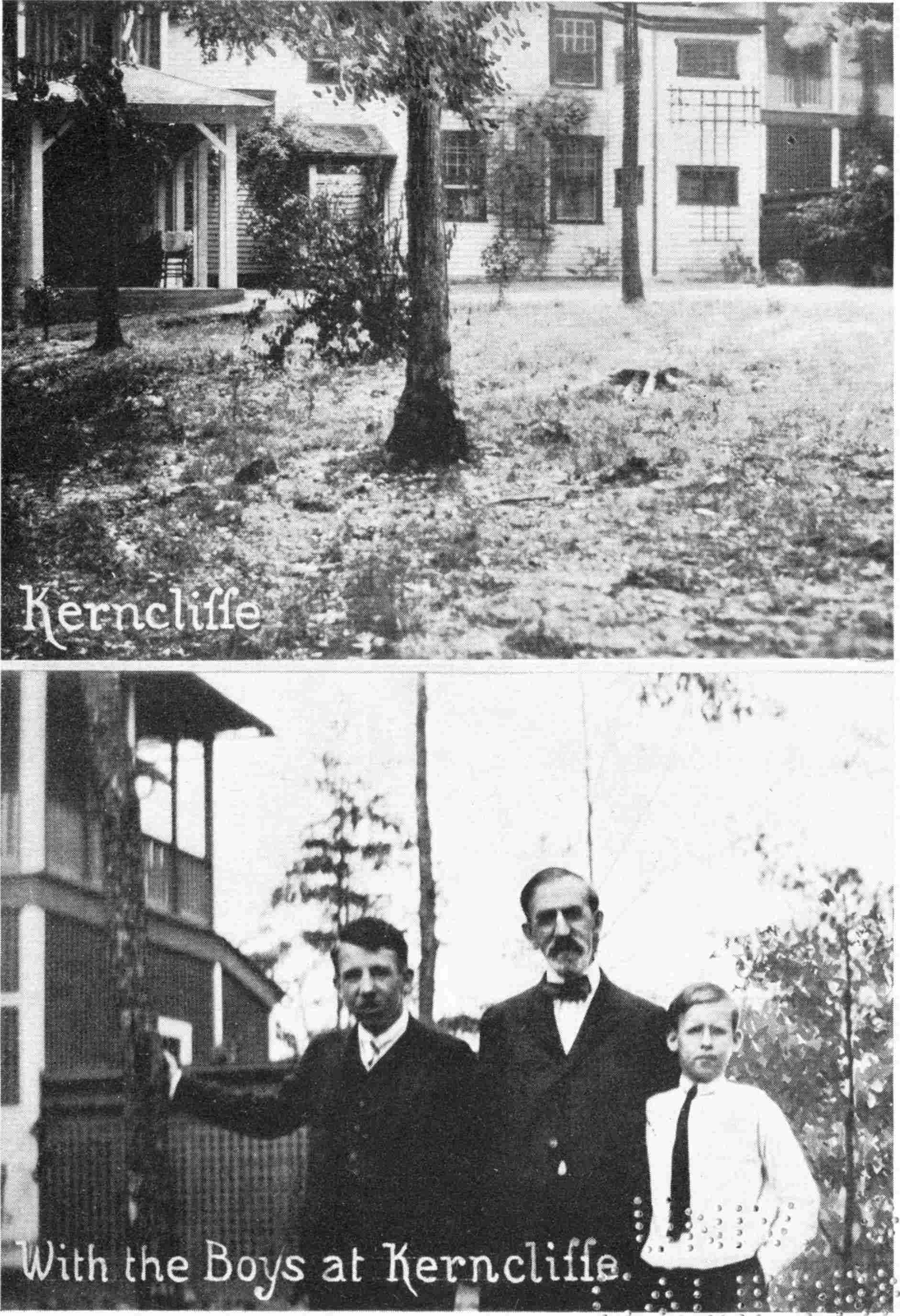
Hotel, where he made his home during his service in the senate. When he
first went to Washington he took up his residence here, but in the fall
of 1911 he went to the Arlington, near the White House, feeling that
this would encourage him to walk more. But the somber dignity and
aloofness of that ancient hostelry soon palled upon him, and a longing
for the companionship of his friends soon drove him back to Congress
Hall.
I am indebted to Henry A. Barnhart for a picture of the Kern of Congress
Hall:
“Socially speaking, Senator Kern gave little attention to society
functions in the national capital and yet he was a social favorite.
He rarely went out except on state occasions, when his leadership
in the senate necessitated his presence to add dignity or
importance to occasions; where the foremost of the nation’s
official leaders assembled in social formality. Seldom, indeed, did
he ever attend the theater, while golf, baseball and other like
recreations, resorted to by many great men as relaxation for tired
minds and bodies, had no attraction for him. Likewise he was not a
churchgoer and yet he had a sacred and profound regard for the
church and for sincere religious convictions. Although a constant
reader, cheap fiction was not a pastime for him and in his reading,
like his physical relaxations, he did everything to rest except
rest. When he read he worked industriously at it and it was
something worth while.
“The senator was socially at his best when in an environment of
informality, and gained largest relief from fatigue or
responsibilities when surrounded by a group of congenial friends
at Congress Hall Hotel, where he lived during his official career
in Washington. His hotel life was methodical. He went to bed at ten
o’clock every night and was at the breakfast table at eight in the
morning. After supper each evening (or dinner, as fashionable
Washington calls it) he would retire to his room and recline in a
comfortable chair and there for an hour, under canopy of smoke from
a ‘home made’ cigar, he would read the evening papers. Then he
would go down to the lobby of the hotel and there join the
‘statesman’s circle’ and lightly or seriously discuss the issues of
the day, swap refreshing anecdotes of laughable incidents on the
hustings, in the courts and in politics, and rarely failing to
illustrate some feature of the conversation by recounting some
misfortune or act of unsophistication of his boyhood career in a
village neighborhood near his dear Kokomo, or of his struggles to
gain a footing in law or politics. Not only did he love to indulge
in personal reminiscences, but even more did he enjoy communing
with memories of happy association with brilliant and picturesque
men of other days in every county in Indiana. His fund of
true-to-life stories was voluminous and ever delightful. He could
not ‘hold a candle’ to Champ Clark in recital of rare and
fascinating biography of great men, but in dramatic or quaint
description of their striking or peculiar characteristics and in
portrayal of the attributes which made them conspicuous as state or
national figures he was a delight extraordinary.
“Also in friendly repartee and ready wit he was a great favorite.
Speaking of his passive regard for the theater, the wife of a
well-known Indiana congressman one evening approached her husband
and the senator, as they were indulging in their daily visit, and
inquired of the former if she should order tickets for an evening
with the drama, then on at a Washington playhouse. When advised to
do so she invited the senator to accompany them. ‘Is it a good
laugh?’ he inquired. ‘No,’ she said, ‘but next week Montgomery and
Ward (slip of the tongue for Montgomery and Stone) are to be here
in the Red Mill and that will be a laugh for you.’ ‘Delightful,’
the senator replied, ‘when will Sears and Roebuck be here?’
“One evening the lone Socialist of the house was regaling a group,
of which Senator Kern was one, with an impassioned screed against
whatever was and reached a climax in the vociferous explosion, ‘My
God, Senator, has reason been entirely dethroned?’ ‘I guess it
has,’ was the senator’s meek and pacific reply.
“At another time the senator and one of his Democratic
congressional associates had been out to address a mass meeting and
the congressman spoke first and used almost an hour of the hour and
a half allotted to the two. When they returned to the hotel several
gentlemen who had accompanied them gathered about them and one
said, ‘Congressman, better have a chair, you have made a very
vigorous speech and are doubtless tired.’ ‘No, thank you,’ replied
the congressman, ‘I do not care to sit down.’ ‘I noticed that when
you were speaking,’ was Kern’s pat and mirth-provoking injection.
“Two middle-aged Indiana congressmen always occupied connecting
bachelor apartments when their families were not with them, and one
was telling the senator how the other seemed to be growing old and
childish. ‘Why, he sleeps with his watch under his pillow,’ the
solon said, ‘to help him wake up in the morning and when I go in
and call to him and tell him it is time to look at his watch he
rears up like a wild horse and acts like one.’ ‘Probably
frightened, in his half-awake condition,’ said the senator, ‘with
apprehension that you are some constituent about to ask him a
direct question as to where he stands on free garden seed.’
“But the real milk of human kindness in Senator Kern’s life was not
touchingly revealed in his tireless devotion to the needy—to the
underdog in the struggle for existence—and his patience with these
was none the less marked than with the most influential in the
country. And therefore what little social life he enjoyed was
constantly invaded by innumerable callers with a mission of self
help, to be relieved by the senator, and he would leave the social
circle, leave his dinner table, and leave the helpful comfort of
his bed when in ill health to see them, not only once, but again
and again.
“Indeed, none ever came to him for an audience and for hope in
vain. Sometimes he would go to his room immediately after his
supper and take one of his congenial friends with him to get
much-needed freedom from official cares and to rest through an
informal chat. Once on such occasion, the writer saw him take down
the telephone receiver and leave it off the hook, explaining that
he did it that the hotel telephone operator could not ring him a
call down into the lobby to give audience to some one who wanted
official assistance. The receiver had been off the hook but a short
time when the senator put it back, saying, ‘Possibly some poor
mortal might want to see me on a matter in which prompt action
would mean happiness to him and delay would cause him despair, and
I’d rather be harassed and nerveworn by ninety-nine undeserving
than to disappoint one in actual need of help.’ So whether it was
some dignified message bearer from the administration suggesting
congressional action or some earnest representative of labor with a
plea for legislative justice, or some agent of business interests
about to be affected by revenue taxes, or some governmental clerk
‘in bad’ with his chief, or some Oliver Twist in politics shoving
up his plate for more, or some poor old woman with no family and
few friends begging that the wolf scratching at the door of her
abode of squalor be driven away by official interference, all were
alike patiently heard and so kindly treated that they went away
with a lump of sugar in the mouth and a rising tide of hope eternal
in the heart.
“Therefore Senator Kern’s social life while in congress consisted
in evening indulgence in conversational round tables with friends,
who talked both business and pleasure, frequently interrupted by
requests of never-ending procession of favor hunters for official
influence in their behalf. He disliked so-called caste and
blue-blood breeding and society shams of whatsoever kind,
preferring the companionship of men and women of strength of
character which lifted them above the frivolous, the irresponsible
and the pretentious.
“And so his social life was really a busy and a cheering life, and
while in no sense a society man, socially he was the noble Roman
par excellent.”
No one is so well qualified to tell the story of John Kern, the
campaigner and man, as members of the newspaper fraternity who were
assigned to “cover” him on many a tour, and called regularly at his
office for many years. There was something in the temperament of the
average newspaper man that appealed to him, and for practically all the
reporters and correspondents who came into contact with him he formed
personal friendship that was very real. This feeling was almost
invariably reciprocated. The fact that many of these represented
politically hostile papers made no difference with him. He was broad
enough to understand.
Among the gentlemen of the press peculiarly qualified to speak, not only
because of extensive experience with him, but because of the personal
friendship that existed between him and them, are Louis Ludlow, the
Washington correspondent, for many
years representative of The Indianapolis Sentinel and The
Indianapolis Star; W. H. Blodgett, the veteran political writer of The
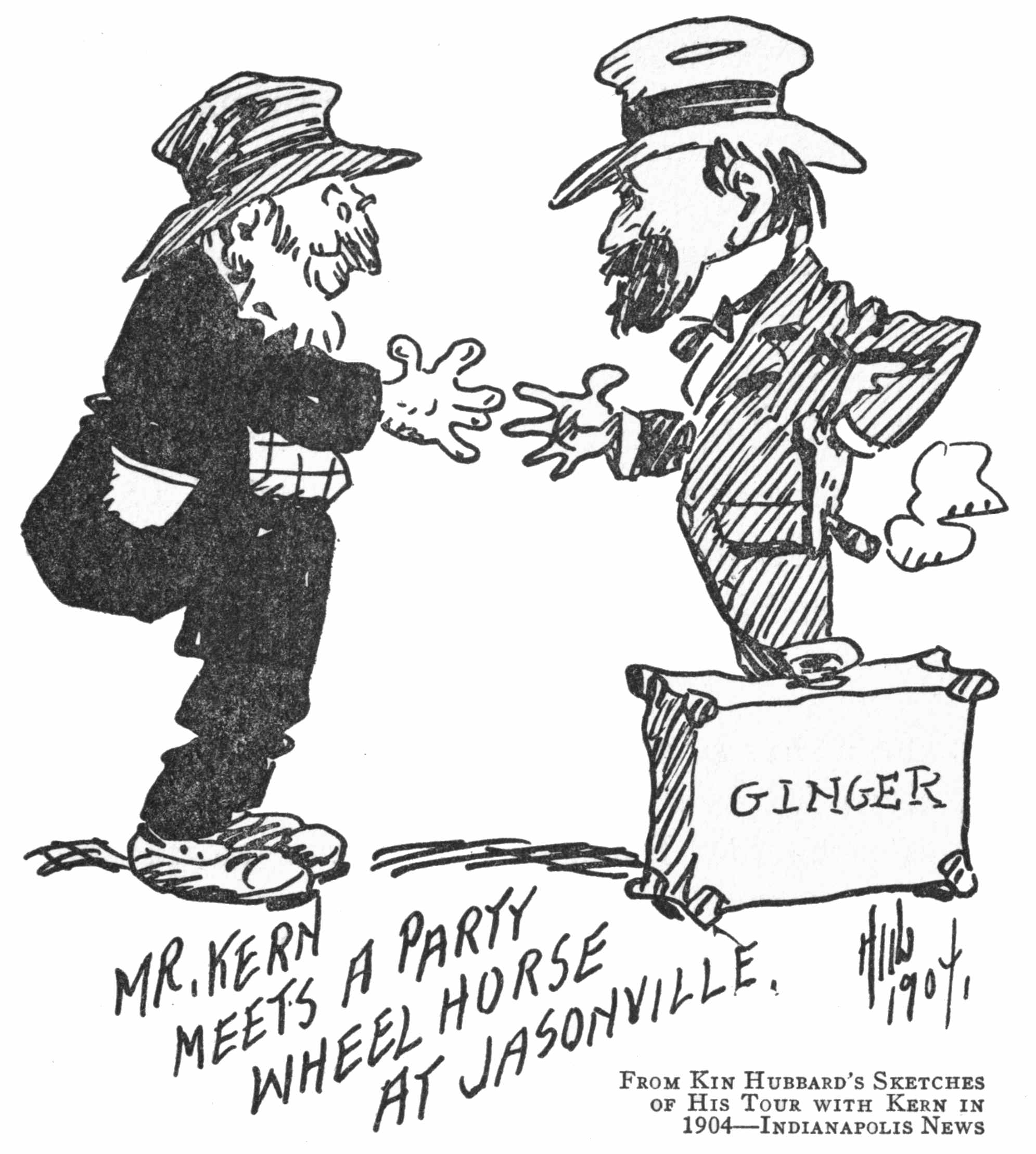
Indianapolis News, and Kin Hubbard, the cartoonist and creator of “Abe
Martin,” who frequently accompanied Kern upon his tours sketching the
crowds, and whose work was a delight to the senator. These men knew the
Kern of the campaign more intimately than the politicians for he
unburdened himself to them with greater freedom and his confidence was
never betrayed.
Among the press correspondents with whom Senator Kern was associated for
many years none were more intimately identified with him than Louis
Ludlow, the Washington correspondent, for many years the representative
at the national capitol of The Indianapolis Sentinel and The
Indianapolis Star. I am indebted to Mr. Ludlow for the following
reminiscences:
“The writer of this article campaigned with John W. Kern for five
weeks in 1910 when he was contesting with Mr. Beveridge for the
senatorial toga. We shared together the exhilarating novelties and
disappointing hardships, the bitter and the sweet, of that five
weeks’ strenuous tour. We rode together in the same rickety
day-coaches and stuffy interurban cars, bunked at the same hotel
and rooming houses, participated in the same miseries and
inconvenience of travel inflicted upon us by a campaign schedule
that knew neither rhyme or reason, and whatever social recognitions
came his way he very considerately insisted that I should share. He
treated me in every respect as a comrade, although the paper I was
writing for at the time was politically hostile to him and was
giving him an editorial wallop every day.
“This was the longest period of intensive campaigning I ever had
with Mr. Kern, and it gave me a clearer insight into his human
trait and interesting mental processes, as well as his breadth of
vision and nobility of character, than I ever had before; but
compared with my long association with him, he as a leader of his
party in state and nation and I as a newspaper writer, this five
weeks’ tour was but a brief span. I had long before and on many
occasions campaigned with Mr. Kern up and down Indiana, criss-cross
and in every other way, and his office in the Stevenson, afterward
the State Life building, was one of the stations on my daily beat
at Indianapolis. I would no more have thought of letting a day pass
without calling on Mr. Kern at least once than I would of going
without my breakfast. In fact, as a zealous news gatherer I thought
infinitely more of having my daily (often twice-daily) talk with
Mr. Kern than of any mere culinary diversion.
“Our acquaintance had extended over a rounded period of an even
quarter of a century when this good man was called to his reward.
When, as a green country boy from the backwoods with hayseed—lots
of it—in my hair, I went to Indianapolis in 1892 to get a job on a
newspaper, Mr. Kern took a friendly interest in me. Perhaps he
thought I needed some attention; at any rate from that time to the
hour of his death he was a true and loyal friend. He was even then
a leader at the bar, and with the passing of Thomas A. Hendricks he
easily held first rank as the most popular Democrat in Indiana. His
office on North Pennsylvania street, Indianapolis, was a mecca for
Democrats from every nook and corner of the state. I remember him
as a tall, slender distinguished-looking man with jet black
whiskers, worn much longer than the style of beard he affected in
later years.
“About that time the Indianapolis National Bank blew up,
precipitating a train of sensations that shook the foundations of
the state. Mr. Kern, who was in all the big cases in those days,
was appointed attorney for the receiver of the bank. I was assigned
by The Indianapolis Sun to cover the developments, and, speaking
in the vernacular, it certainly was ‘some’ job for a cub reporter.
I think I must have driven Federal Judges Baker and Woods nearly
crazy trying to extract some news from the court, for I even called
on them at their homes at unseemly hours, and if I had been a
sophisticated reporter and they had not possessed a benevolent
disposition they probably would have haled me up for contempt of
court for some of the irregularities I committed. Mr. Kern was my
particular prey. On one occasion, after I had had the boots scooped
off me by a virile opposition, I went to Mr. Kern, determined that
henceforth not the slightest atom of news about that bank failure
should escape me.
“‘There isn’t any news to-day; not a bit in the world,’ he told me.
“‘Well,’ I said, making my last stand, ‘have you heard any rumors?’
“Mr. Kern often told me in after years that, considering all the
circumstances, my positiveness and the comical way I spoke, that
was the funniest question ever put to him. He never got over it.
The last time I called on him for news at his office in the
federal capitol he looked up from behind a stack of letters and
said, quizzically:
“‘Any rumors to-day?’
“While Mr. Kern, while not in the public service, enjoyed a large
law practice, he had a greater non-paying clientele than any other
lawyer I ever knew. He was always giving freely of his time and
talent, without money and without price. Sometimes he made charges
that were ridiculously nominal, but in cases of poverty and
distress he was more likely to make no charges at all, even in
cases that involved a great deal of work. If all those whom he
helped to get out of difficulties and keep out of trouble, without
one cent of recompense, could be compiled it would be a long one.
His law practice, to a very extraordinary extent, was made of
unrewarded kindnesses to others.
“One day on entering his office I saw lying on a table a shining
new quarter. I also saw at a glance that Mr. Kern was very much
amused about something. Then he told the story.
“One of his numerous impecunious but devoted admirers had been in
difficulties and had come to him for advice on a law point. It was
not an easy nut to crack and Mr. Kern spent the greater part of two
days looking up the authorities and had given him a decision that
fit the case and ended the trouble. The client was fully grateful
and asked the amount of his bill.
“Not a cent,” was the reply.
“The client was one of those self-important individuals. He
insisted.
“‘There is no charge; it’s all right. Good luck to you,’ protested
Mr. Kern.
“‘Now I’ll tell you, John,’ said the benevolent client with the air
of one who was conferring a great favor, ‘I never get anything
without paying for it. Here’s a quarter and if you’ll stand by me
I’ll bring you some more business some time.’
“So saying, he laid the twenty-five-cent piece on the table and Mr.
Kern was so flabbergasted he let him go without saying another
word.
“Mr. Kern’s honor shines through all his professional transactions
with an illuminating glow. I know an instance where a well-to-do
man employed Mr. Kern as attorney in an alienation suit. The man
was not altogether to blame; there were extenuating circumstances,
but enough guilt to make the outcome exceedingly precarious if the
aggrieved party carried out his threat to file suit, to say nothing
of the notoriety. Mr. Kern was not one of those lawyers who
believed in fostering litigation. In this case, as many others, he
advised settlement out of court. His client virtually turned over
his fortune to Mr. Kern with authority to affect a settlement on
the best terms possible.
“After exercising his wonderful powers of diplomacy and persuasion
he (this was in his early days at the bar) returned to his client.
“‘What would you say if I told you that I had settled your case for
$10,000?’ he asked.
“‘I would say it is pretty high, but you have performed a real
service for me and I’m glad to get out of it.’
“‘What would you say then if I told you I had settled for $8,000?’
“‘That would be better; I would indorse that settlement right from
the start.’
“‘Then,’ persisted Mr. Kern, ‘what would you say if I told you I
had settled for $5,000.’
“‘I’d be tickled to death.’
“‘Well,’ said Mr. Kern, ‘at the risk of a sudden termination of
your earthly career I will tell you that this whole matter has been
adjusted and that you are to pay only $1,000.’
“And then, to top it all off, Mr. Kern charged him a nominal fee,
finding his reward mainly in the satisfaction of having got
somebody out of trouble.
“Mr. Kern’s sense of humor was exquisite. Whether in the court room
or on the hustings the ‘human side’ of things appealed to him with
mighty force and often, especially in his younger days, when he was
practicing in the courts of Kokomo his quick wit won his cases. On
a certain occasion a Kokomo roisterer got into trouble and engaged
Mr. Kern to defend him in a justice of the peace court. A hog knows
infinitely more about Sunday than that justice knew about law. Mr.
Kern saw that the only salvation for his client was to force
through an immediate trial. It was after dark when his client was
haled into court. The squire adjusted his spectacles in a knowing
way and said:
“‘This case will be continued until to-morrow and the defendant
will be remanded to the county jail.’
“‘May it please the court,’ said the young attorney, ‘nothing of
the kind will be done. We are entitled to justice speedily and
without delay and this trial goes on.’
“‘Will the attorney at the bar consent to tell this here court what
is his authority for that statement?’
“‘Certainly; it is contained right here in the bill of rights.’
“Then Mr. Kern read that part which says that justice shall be
speedy and without delay.
“‘Would this court presume that it has the power to set aside that
fundamental guarantee?’ he asked dramatically.
“The court remarked that he guessed his young friend ‘knowed what
he was talkin’ about’ and ordered the trial to go on. A jury was
impaneled, the trial lasted all night, and at daybreak Mr. Kern’s
client was cleared. This was one of many stories that Mr. Kern used
to tell about justice as she was dispensed at Kokomo in his early
manhood.
“Mr. Kern had a way of making use of ridicule as a very effective
weapon in a law suit. He could lampoon an adversary out of court
and do it in a way that left no sting. A Republican state
administration a decade or so ago started a crusade against Thomas
Taggart’s establishment at French Lick. A constable from the
vicinity swooped down and made a raid. This was followed by
proceedings brought in Judge Tom Van Buskirk’s court at Paoli,
looking, as I recall it, toward a revocation of the charter. I was
sent down to report the trial for an Indianapolis paper. Mr. Kern
was attorney for Mr. Taggart and one of his first acts was to give
me an interview, which he wrote in long hand, setting forth an
imaginary description of the raid that had been conducted by the
‘one-eyed constable from Stamper Creek township.’ It so happened
that the valorous constable did have one eye as Mr. Kern, who knew
everybody, was aware. The interview made bully copy and it caused
that case to be laughed out of court. Thereafter the issues
involved were obscured by the one outstanding feature—the
‘one-eyed constable from Stamper Creek township.’
“As a campaigner Mr. Kern never indulged in camouflage. He
disdained, for instance, to resort to the usual artifices to work
up a crowd. If people came to hear him he was glad, but he would
not permit any spectacular side shows to drum up audiences. In some
places during the memorable campaign of 1910 the crowds that turned
out were distressingly small, but those who attended came because
they were earnestly seeking to be enlightened and not solely to be
entertained. Therefore it could always be said that his speeches
rated very high from the standpoint of effectiveness. While he
interspersed many stories and jokes throughout his speeches he
never did so without pointing a moral and he often rose to the
sublime heights of eloquence. He was so sociable, so easily
approached, so companionable that he made friends everywhere and
riveted them to him with hooks of steel.
“The campaigning was strenuous and Mr. Kern was no longer young in
years, but his buoyancy and ability to accommodate himself to
situations as they arose enabled him to see the silver lining to
every cloud. We had to arise in all hours of the night to make
train schedules. One night, in making the jump from Brownstown to
Washington, Indiana, the train was due to arrive at Ewing, which is
connected with Brownstown by two streaks of rust, shortly after
midnight. It was several hours late, however, and in a frolicsome
mood Mr. Kern insisted that we arouse a village restaurateur and
have him cook us a breakfast of his favorite kind, consisting of
bacon and eggs. This the restaurateur did gladly and sent us on our
way rejoicing.
“An interesting contretemps occurred down in a town in the First
district. The reception committee slipped a cog and we arrived
without attracting attention and made our way to the best hotel in
the town, which was none too good. No sooner had we deposited our
luggage on the floor than in came the reception committee in a
state of breathless agitation. Mr. Kern was beckoned to one side
and the startling information was imparted to him that it would
never do for him to stop at that hotel and that quarters had been
reserved for him at a rooming house down the street. It seemed that
there were two hotels in the place, both run by Democrats.
Representative Boehne had been there a short time before and had
stopped at the crackerjack hotel, and now it was imperatively
necessary, in order to preserve the political equilibrium, that Mr.
Kern should stop at the place down the street. Being myself under
no such restrictions of political expediency I turned in at the
best hotel and had a good night’s rest. Before I did so I went down
the street to see how Mr. Kern was faring. His room was over a
billiard hall and the cracking of the ivories resounded for half a
block. If I were made to guess I would say that he did not sleep a
wink that night, but he accepted the situation with sweet
resignation, just as he did every other situation in life.
“On the interurban car returning to Evansville something happened.
The car came to a standstill with a suddenness that caused
everybody to pitch forward and then the lights went out. Without
was Stygian darkness. It was a darkness that was absolutely black.
After what seemed an interminably long time the motorman returned
to the car, the conductor and motorman indulged in the usual bell
talk preliminary to getting away and the car proceeded.
“‘What did we hit back there?’ Mr. Kern asked the motorman.
“‘We hit a cow,’ replied the motorman, none too pleasantly.
“Quick as a flash Mr. Kern said: ‘Permit me to congratulate you on
being able to tell the gender of the animal on a night like this.’
“The senatorial campaign ended with both of the candidates speaking
in their home city, Indianapolis. The Republicans arranged as a
grand finale a monster meeting at Tomlinson Hall, preceded by a
street parade in which it seemed that half of Marion county
participated. On the Democratic side the plan was for a number of
ward meetings, to be addressed by the Democratic senatorial
candidate. The brilliant genius who made the arrangements staged
the last of these meetings, the very closing of the campaign, to
take place in a south-side saloon. It was to be a sort of
hand-shaking affair. Mr. Kern was ushered into the room before he
recognized the character of the place. He left immediately and that
was the only time during the campaign when he showed any
manifestations of anger. He expressed in plain terms his opinion of
the dunderhead who had made the arrangements.
“As a senator of the United States Mr. Kern at once took high rank
in Washington and advanced in position and influence with a
swiftness that was amazing. His election to the leadership of the
controlling party after he had been a senator only a fraction of
his first term was wholly without precedent. Hard, intelligent
work, combined with personal popularity, won for him a prestige
never before accorded to a first termer. He saw through the thin
veneer of Washington society and formed an intense dislike for its
sham. Aside from White House functions and those of a few
senatorial friends, about the only dinners and receptions he
attended were those occasionally given by Indianians, and then he
sometimes got his dates curiously mixed. An instance that
Vice-President Marshall relates occurred one night when Mr. Kern
was discovered by the vice-president groping his way through one of
the halls of the Willard Hotel. The vice-president hailed him.
“‘Where do you think you are going, John?’ he asked.
“‘I am going to your apartment to take dinner with you,’ was the
reply.
“‘That can’t be because I am going out to dinner now.’
“‘But you invited me,’ said the senator.
“‘Look at your invitation,’ came back the vice-president, who could
hardly restrain his mirth.
“Senator Kern did so and a light broke. The invitation was for the
next night. They had a good laugh together. On the next night the
senator forgot all about the invitation and did not attend. All of
which illustrates the fact that when it came to society matters he
was not a J. Hamilton Lewis.
“It would be impossible to speak of Senator Kern’s successful
regime as a leader of the greatest law-making body in the world
without paying a high tribute to the personal equation.
“His magnetic and lovable personality held sway in the senate and
made him the greatest conciliator among all the leaders that held
that position of high responsibility. In ironing out differences
and bringing contending elements together he was the master.
“It would be impossible to speak of Senator southern senator once
remarked, ‘except to say that you can’t talk with him two minutes
without falling in love with him. He captivates you, suh.’
“Perhaps this explains why Senator Kern, a northern man, never
lacked southern support in the senate, although the party leaders
almost invariably have been southern men. Nor was there any
semblance of the mailed fist in his leadership. He made it a point
to cultivate friendly relations with all the senators. They
regarded him as a companion and a comrade. He had a joke for every
occasion and sometimes a playful senator would perpetrate a joke on
the leader.
“I shall never forget an occasion, for instance, when Senator Kern
received a letter from Senator Saulsbury of Delaware, now the
president pro tem. of the senate. Senator Kern had been lecturing
Democratic senators on the necessity of maintaining a quorum and
the evils of absenteeism. Senator Saulsbury had planned a cherished
trip to Europe and one fine day, unknown to Senator Kern, he set
sail from New York. When the outgoing vessel passed Sandy Hook he
sat down and wrote a letter to Senator Kern that bristled with
belligerency. He told him he had grown tired of his ‘tyrannical
rule’ of the ‘autocratic’ senate leader and had decided to ‘set
himself free.’ He bade defiance to the senate ‘boss’ and dared him
to cross the pond and get him. Of course the anger assumed in the
letter was all camouflage, as better friends than Senators Kern and
Saulsbury never lived. Some months later when Senator Saulsbury
returned they had a merry laugh over it. One could as easily
imagine the Washington monument bending over to salute the morning
sun as to think of a kittenish senator issuing such a challenge for
example to Senator Martin, the predecessor and successor of Senator
Kern in the senate leadership.
“In my capacity as one of the correspondents at the capitol I
naturally was brought into close contact with the leader. Senator
Kern was fond of taking long walks and frequently I was with him on
these strolls. His high position did not make the slightest
modification in his democratic ways. Correspondents could go to him
at any hour of the day or night with perfect assurance that they
would receive courteous treatment and straightforward answers. We
met on unusual occasions as, for instance, when we stood up as
witness at the wedding of two dear friends, now Mr. and Mrs. W. S.
Ryan.
“This same Mr. Ryan was the ‘Bill’ Ryan who was featured in some of
Mr. Kern’s speeches back in the 1910 campaign. He would challenge
the correctness of statistics presented on the stump by the
Republican speakers to prove that their administration of affairs
had been a success. He would point out that figures are misleading
unless one knows how to analyze them.
“‘They remind me of Bill Ryan’s watch,’ he would say. ‘When the
hour hand points to eight and the minute hand to three Bill knows
it is half past four.’
“The brightest senate page I ever knew bore the euphonious nickname
of ‘Christopher Columbus.’ His real name was Weirisk, but in a
moment of facetiousness I bestowed the name of ‘Christopher
Columbus’ upon him for no other reason than that he was born and
reared at Columbus, Ohio. Though the name finally came to be
abbreviated down to ‘Chris’ it was as ‘Chris’ that he was known to
scores of correspondents, to whose service he was assigned. He was
as keen as a whip and bright as a new dollar, and, withal, had a
sense of the dignity of his position and a constant care not to
offend any one.
“One afternoon I sent ‘Chris’ into the senate chamber to ask
Senator Kern if I could see him. When the lad returned he was
plainly agitated. He hemmed and hawed and made no response that I
could understand.
“‘Mr. Ludlow,’ he finally said, ‘I don’t like to tell you what
Senator Kern told me.’
“That was interesting.
“‘Why?’ I asked.
“‘Because it is not a bit favorable to you.’
“‘Oh, pshaw, Chris,’ I insisted, ‘I haven’t got all afternoon to
waste. What did he say?’
“‘Senator Kern told me to tell you to go to the hot place,’
answered ‘Chris,’ who looked as if he would gladly have sacrificed
his right arm rather than have delivered that message. Just then
the senator came out of the chamber shaking with laughter.
“A little later another page nearly fell over when Senator Kern, on
being told that I would like to see him, asked whether I was ‘drunk
or sober.’ Subsequently he made that inquiry so often that the
pages, who were my friends, learned to respond instantly, ‘Sober,
sir.’
“Senator Kern’s kind heart made him the prey of impecunious and
designing individuals who were always trying to ‘touch’ him and
seldom unsuccessfully.
“One day the senator was called into the marble room by a smooth
citizen who said he lived at Elwood, Indiana, and told of meeting
the senator there when he was one of the appreciative and
applauding auditors. After recalling these pleasant and
circumstantial facts he wound up by asking the senator for the loan
of the small sum of a dollar, which the senator readily granted,
thankful that the request was not for ten dollars, the usual
amount.
“The senator then returned to the chamber and was sitting by the
side of his colleague, Senator Shively, when the same man sent in a
card to the latter. Senator Shively went into the marble room and
when he resumed his seat five minutes later Senator Kern asked:
“‘Who was your friend?’
“‘He was from Elwood and he just wanted to talk to me about old
times. He recalled one occasion when I spoke at Elwood and he was
kind enough to say it was a corking good speech.’
“‘Honest Injun, Ben,’ how much did he touch you for?’
Senator Shively jumped as if startled.
“‘Fifty cents,’ he answered.
“‘Well, that shows he thinks I am the better senator. He stung me
for a dollar,’ said Kern.
“‘No, I think he sized you up as the easier mark,’ came back
Shively, and they then adjourned to the cloak room and told the
story to a group of senators, who enjoyed it hugely.
“Reminiscences with Senator Kern as the central and radiating
figure might be told by the hour, but even reminiscences must come
to an end. It so happened that I was the last man in Washington to
bid him a final good-bye. He had come from his room at the Congress
Hall Hotel and summoned a taxi to take him to the depot. Passing me
at the entrance of the hotel he extended his hand and said, brave:
“‘Good-bye; I am going down to the sanatorium at Asheville to take
a post-graduate course.’
“I was inexpressibly shocked a few days later to learn that his
spirit had winged its flight to the blessed Summerland.”
After Mr. Ludlow no newspaper man was thrown into such frequent contact
in the discharge of professional duties with Senator Kern as William H.
Blodgett, who has been for so many years the political writer of The
Indianapolis News. In campaign after campaign he has been assigned by
his paper to cover the tours of the party leaders, and has reported all
the conventions, state and national, for an equal period. He made one of
the “Kern party” on practically every important tour that Kern made
during the last eighteen years of his career. Mr. Blodgett’s
reminiscences throw an interesting side light on the character of the
senator:
“When John W. Kern answered the final call there passed out of the
lives of the newspaper fraternity one with whom they were always
bound by a strong chain with links of admiration, respect, honor
and friendship. To them it was not the United States senator who
died. It was the man whose soul had gone away; and while the
newspaper men may remember for a time the public acts of John W.
Kern as United States senator, so long as they live they will never
forget his personal attributes, and his kind and courteous
treatment of them; and the cold grave where he lies can never chill
the steadfast, kindly and unfaltering friendship the men and women
of the press bore him—a friendship that can not be calculated.
“It is doubtful if there is a public man between whom and the
newspaper fraternity there were so many confidences. He trusted
them, and they believed in him, even if they did not at all times
agree with his political policies. The political writers were
always pleased when they were assigned to ‘cover’ John Kern. He was
the best ‘copy’ in the United States, and day or night he was
always good for a story. Without journalistic experience himself,
he knew just what kind of news the public wanted. He always had his
ear to the ground, and many a good story for which the
correspondent received a telegram of thanks from his managing
editor was really worked out by Mr. Kern. He had no grades or
classes among his newspaper friends—the small town reporter looked
just as big to him as did the staff man from the metropolitan
dailies, and he would go just as far to help the small town
reporter as he would to assist the staff ‘star.’ My acquaintance
with Senator Kern began long years ago when I was a small town
reporter. In a particular town that need not be named a young
society man had been arrested, for what no one knew. The arrest was
very quietly made by Ed Rathbone, who figured years afterward in
Cuban affairs, and Rathbone tried to slip his prisoner out of town,
but the local reporters caught them at the railway station. With
considerable curtness he refused to talk with the reporters. A man
carefully dressed, and with a pleasant smile, standing near by
turned to Rathbone:
“‘Ed,’ said he, ‘there is no reason why these boys shouldn’t have
this item (that was before ‘items’ became dignified as ‘stories’).
‘It is in their territory and it will be interesting to the readers
of their papers, and anyhow it will come out as soon as you get to
Indianapolis and these boys will be scooped.’
“‘All right, John, you can tell them,’ replied Rathbone, walking
away.
“‘Well, boys,’ as we gathered around him, ‘this is what it is all
about’—and sitting on a baggage truck the stranger (I can see him
now as plainly as I did then more than thirty years ago) he told us
the story.
“‘Who are you, and what part in this affair do you take?’ one of
our party asked.
“‘I’m just an innocent bystander. My name is John W. Kern. I am a
lawyer up at Kokomo, and I bumped into this thing accidentally.’
Some of the small town reporters clustered about that baggage truck
listening to Mr. Kern’s recital of the story of the young man’s
arrest in later years became well known in journalistic work, and
the friendship for Mr. Kern that began on the railway platform was
never broken. Mr. Kern never changed that policy of dealing with
newspaper men. The correspondents who campaigned with Mr. Kern were
always sure of fair and equal treatment. He played no favorites.
When he gave out a story every one got it. Knowing that a careless
or indifferent reporter, or a representative of an unfriendly paper
could cause him great annoyance, and perhaps deep injury by not
truthfully quoting him, or twisting his language to a meaning other
than what he intended to say, Mr. Kern never asked the
correspondents with him to submit their dispatches before putting
them on the wire. He was willing to trust to their fairness and
honor.
“‘Gentlemen,’ he would say at the beginning of the tour, ‘I won’t
say anything that I do not wish published, and I know you won’t
send anything I don’t say.’ And among the hundreds of
correspondents who ‘covered’ Mr. Kern in his long political career
not one ever disappointed him. When John W. Kern was the principal
figure in the noise and music of the feast the newspaper men with
him were never forgotten. Reception committees might try to drag
him away, but he would not be dragged.
“‘There will be no show,’ he used to tell the eager committeemen,
each striving for the honor of leading him to his carriage or to
the speaker’s stand, ‘until the orchestra is ready. I want the
newspaper men put where they can see and hear.’ And he would not
move until the correspondents with him were provided for. Once he
was dragged to a boarding house by the reception committee, who
thought it would be a good political stroke to have Mr. Kern take
dinner with the boarding house keeper who was off the county
ticket. The newspaper men returning from the telegraph office were
met at the gate by Mr. Kern.
“‘Boys,’ he whispered, ‘don’t come in here. The grub is ghastly and
the board of health has gone fishing. If you must eat in this town
go to the hotel.’
“In his campaigns Mr. Kern always prepared a schedule of his own
itinerary, and used to fret a great deal if trains were late or
wheeled transportation was not promptly on hand. He was always
called in the morning at least an hour before train time, and part
of his regular work before breakfast was to see that the baggage of
the correspondents was ready to be taken to the station—he would
not trust anybody but himself to look after the baggage, and he was
always impatient until breakfast was served. At one hotel the
waiter was slow because the waiter and cook were one and the same.
Mr. Kern’s watch was propped against a glass of water on the table.
He became nervous and restless and finally shouted to the landlord,
who was sweeping out the office:
“‘Pete, I’ve only got fifteen minutes to make that train—can’t you
hurry breakfast a little?’
“‘Don’t worry, John,’ came back through the dust clouds in the
office. ‘You can eat all there is in the house and still have
plenty of time for your train.’
“This put Mr. Kern in a good humor, and he made his railroad
connection all right.
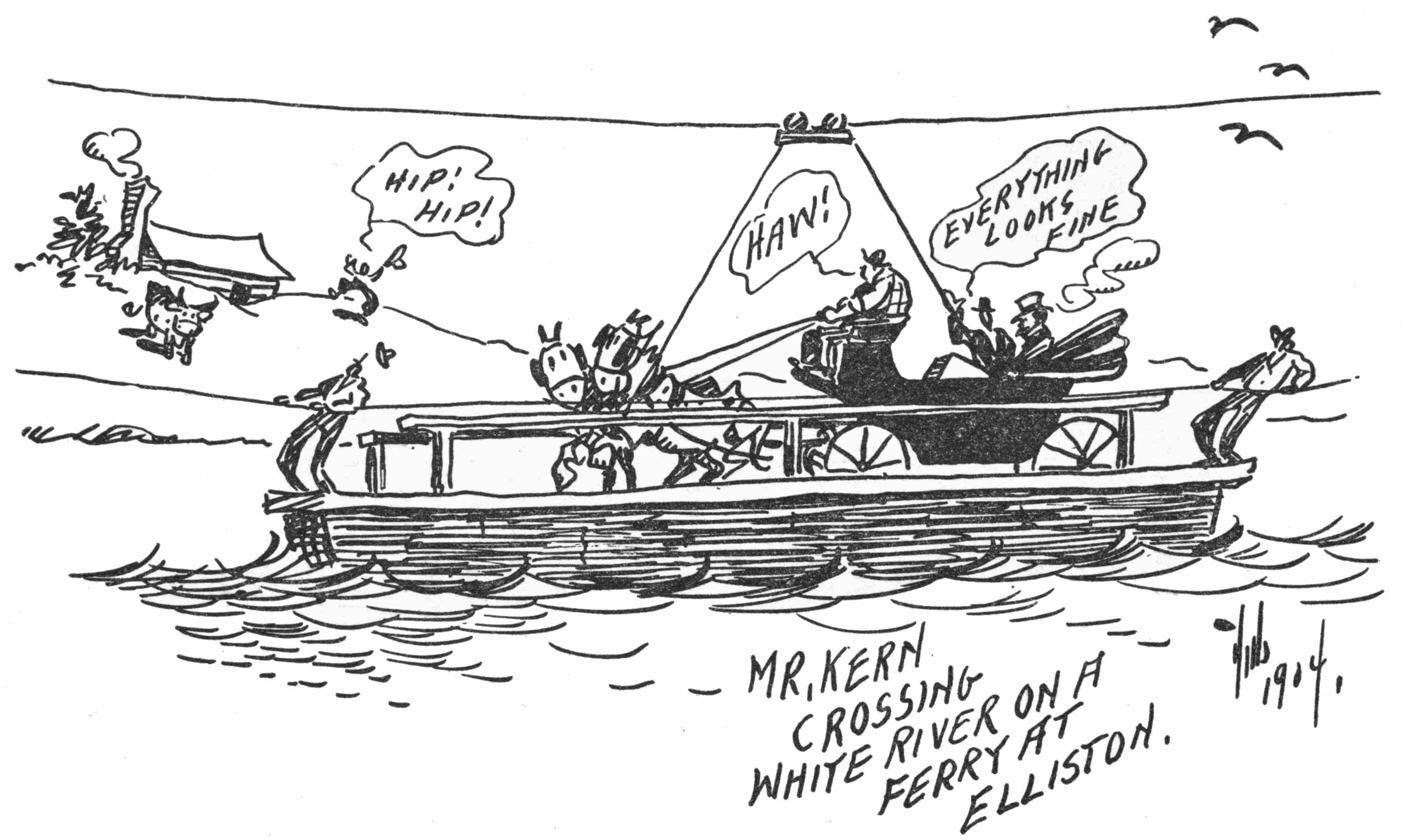
“On another occasion the party with Mr. Kern had to cross a small
river on an old-fashioned ferry. In midstream the rope broke and
the craft began floating on the current. Mr. Kern struck up ‘Life
on the Ocean Wave’ and the correspondents joined in with him. It
was the first time correspondents knew Senator Kern was a singer,
and for that matter none of them ever heard him attempt to sing
again. Kin Hubbard, who was in the party, drew a cartoon of the
float down the river for The Indianapolis News, which pleased Mr.
Kern greatly and he always declared that the cartoon was Hubbard’s
masterpiece.
“He had a most wonderful memory for names, faces and incidents, and
his speeches were generally punctuated with entertaining stories, a
greater part of which he usually located in the vicinity of Kokomo.
There was always a story to properly illustrate a point, and if the
anecdote related by John W. Kern could be compiled in one volume it
would make a book as huge as Webster’s Unabridged. And these
stories were not of a kind that offended or hurt, and the occasion
for their use was always appropriate. He had a way, too, of
rebuilding a speech with new words, and sometimes the
correspondents who were with him perhaps for weeks and had heard
him speak many times would burden the wires with a warmed-over
speech, to the distraction of the managing editors and the delight
of the copy editors, whose mission is to knock and destroy.
“When Mr. Kern was the nominee for vice-president on the Democratic
ticket he was frequently alluded to by Republican papers as
‘Alfalfa John.’ But there are only a few people who know that Mr.
Kern himself was the originator of the term. We landed at the
Auditorium Hotel in Chicago direct from Denver and Mr. Kern gave
audience to a large number of reporters, and among them several
‘sob sisters’ (which is the craft name for women journalists). One
of these, a piquant little creature with fluffy hair from The
Chicago Tribune, startled the nominee for vice-president by
suddenly asking:
“‘Mr. Kern, what is the actual color of your whiskers?’
“‘I really don’t know,’ replied Mr. Kern in all seriousness, ‘I
have never seen them, except in a mirror, and you know how
deceptive looking glasses are after one has past forty years. Down
in Kokomo, Indiana, the boys call them alfalfa.’
“The next morning a splendid word portrait of Mr. Kern appeared in
The Tribune in which he was portrayed as ‘Alfalfa John,’ and the
name clung to him all through the campaign.
“To write the full story of campaigning with John W. Kern would be
to write many pages of political history. Ambitious perhaps he was,
but I have known many instances where he smothered his own
ambitions to advance the interest of his own political party. He
never was called that he did not answer, and he never was asked to
go that he failed. I have known him, tired and weary and racked
with pain, to crawl from his bed at three o’clock in the morning
and ride miles that he might address children at a country school
house, who were anxious to hear him. All through his political
campaigns, strenuous as some of them were, his kindly disposition,
his inexplicable sweetness of manner, was never ruffled. I never
knew him to say a cross word, even in his most impatient moments,
and the blare of bands and the pomp of political parades he never
forgot his home. At Denver, when his nomination for vice-president
was assured, when statesmen were trying to grasp his hand, and a
platoon of newspaper men were climbing over each other to get a
word with him, Mr. Kern turned to me:
“‘Won’t you please telegraph the good news to Mrs. Kern,’ he said.
“‘Certainly, but what shall I say?’
“‘I don’t need to tell you how happy I am, or what word to send to
my wife—you have a wife at home—just tell my wife what you would
say to your wife under the same circumstances.’
“That was John W. Kern, honest, trusting, with faith in his
friends, and with the picture of his home ever before him. The
newspaper fraternity lost a good friend when Death ushered John W.
Kern through the Gates of Life.
“We all must die.
And leave ourselves, no, it matters not where, when
Nor how, so we die well; and can that man that does
Need lamentation for him.”
No picture of Kern would be complete which did not delineate him in his
professional character. While actively engaged in political activities
from the hour of his admission to the bar until his election to the
senate in 1911, he never abandoned the practice of the law, or lost his
love for the profession. No one knew him more intimately in this rôle
than Leon O. Bailey, now engaged in the practice with former United
States Senator Charles A. Towne in New York City, with whom he was
associated during the first ten years of his residence in Indianapolis.
It will be observed that in the portrait presented in the analysis of
Mr. Bailey there is nothing that does not harmonize in a general way
with the pictures we have had of the Man, the Companion, the Campaigner,
and the Student:
“‘Was Kern a great lawyer?’ I would not justly record my own
knowledge of the man’s mental qualities, or give response to my own
judgment, did I not answer this query in the affirmative.
“As a boy he possessed a thirst for knowledge and certainly up to
the time of my intimate association with him terminated, was one of
the most consistent, energetic and untiring students within my
knowledge of men. He was logical, of retentive memory, a voracious
reader of good literature, always delving and digging into his law
books, with which he was ever surrounded, and thorough to the last
word in his analysis of questions submitted for his investigation.
It is very easy to see that with his mental habits above mentioned,
when combined with the qualities of humanity and personal magnetism
for which the world best knew him, Kern was, in the very nature of
things, a great lawyer. It was my extreme good fortune, during my
twenty-odd years in Indiana, to have enjoyed an intimate
acquaintance with such great lawyers as Thomas A. Hendricks (in
whose office I was a student for three years), Major Jonathan W.
Gordon, Daniel W. Voorhees, David Turpie, Joseph E. McDonald,
Conrad Baker, Byron K. Elliott, Addison C. Harris, William A.
Ketcham, all judges of the Supreme Courts, and scores of brilliant
members of the Indiana bar; and it is in comparison with these men
that I rate Kern well up in the list. He was forceful before a
jury, not only because of his eloquence and pleasing personality,
but because of the candid and scrupulous manner with which he
explained every principle and applied every fact of importance to
be taken into consideration. His presentation, always manifestly
trustworthy, carried conviction that always follows a logical and
consistent development of the truth. Kern never could or did resort
to tricks or pretense of any sort, but in every important battle
met his enemy in the open and planted his batteries upon the rock
foundation of truth and of the legal principles fairly applicable
to the facts established. Like Oscar B. Hord, of the great firm of
Baker, Hord and Hendricks, he was one of the most adroit
cross-examiners at the Indiana bar. His skill in this particular
constituted one of his most potent weapons in the court room. One
of his rules was: ‘We have little to fear from our friends in a
lawsuit. The danger usually lies behind the armor mask of falsehood
or deception worn by the enemy. If this can be destroyed or
penetrated we are safe.’ His method of handling an unfriendly or
unwilling, timid or refractory witness was an interesting study. In
this his quick and accurate judgment of men was of the greatest
assistance. A perfect knowledge of his case, the exact line to be
developed, and danger points to be avoided, were the first
essentials, and absolute self poise the second. He never prejudiced
a jury by an attitude of brutality toward an adverse witness. His
affability at the beginning was usually rewarded with important
admissions, then came the rapid-fire questions, a method commonly
adopted by him, which in most instances brought confusion and often
anger to the witness. Kern’s experience lead him to assert that ‘a
witness that loses his temper loses his influence.’ He did not
include in this rule those whose resentment was justly aroused by
the ill treatment of counsel. Kern regarded this feature of his
trial work as a distinct art and almost felt contempt for a lawyer
who failed to appreciate its great value or possess the necessary
skill for obtaining the best results. So much of interest did he
feel in, and real importance attach to, this question that he often
spoke of his intention, at some time, of giving his observations to
the profession in a suitable book to be entitled ‘The Ideal
Cross-Examiner.’ Master as he was of the subject, it is unfortunate
he never found time to put this purpose, which would have been a
distinct pleasure to him, into execution.
“I recall a very amusing instance of Kern’s cleverness in the
cross-examination of witnesses, which I may be excused for
relating. It well demonstrates his ability for quickly and
accurately taking the measurement of a witness. We were appearing
for the defendant in a damage suit for personal injuries. While
having reason to know that the claim of the plaintiff was based on
fraud, the truth being difficult of establishment, we realized our
client’s danger. The extent and nature of the plaintiff’s injury
had been elaborately and with much exaggeration, presented by a
bombastic and pretentious doctor, whose use of big words and highly
technical scientific terms, with little knowledge on his part as to
their meaning, were poured out in a flood before the jury. The
appearance of the witness, nevertheless, was impressive, and his
statements, freed from the slightest appearance of doubt, were
calculated to convince a jury not only of the speaker’s wisdom, but
the complete reliability of the conclusions he had reached. We both
knew the witness personally and were well aware of his real status
among the members of his profession. We not only knew that he was a
‘quack,’ and to a large extent illiterate despite his bold
assurance, but were convinced that he was deliberately attempting
to establish the plaintiff’s claim by falsehood. How to best show
the character of this man to the jury was Kern’s purpose, quickly
formed. He must wait until the ‘Doctor’ should be turned over for
cross-examination. Mr. Kern began with a few flattering
observations calculated to throw the witness off his guard and
then, as if to further exploit the scholarly attainments of the
witness (knowing full well he possessed none), the examiner quickly
asked:
“Doctor, in describing the sphincter muscles, please explain to the
court and jury the difference, if any, between the functions and
location in the human body of the “oribucularis oris” and the
“orbicularis ani.”
“The doctor, bewildered and as far at sea as a mortal can ever be,
overlooking the possibility of any trap, but thinking only of
keeping up his front to the jury, replied in his most affable and
composed manner:
“‘Practically none, Mr. Kern, practically none. The terms are used
quite interchangeably.’
“That question and answer removed the mask and was the end of the
plaintiff’s case. The doctor’s usefulness had been destroyed. As
the real meaning of the answer reached the presiding judge and
filtered through the minds of the jury, the dignity of the court
for the time was wholly lost. In thus exposing the ignorance and
presumption of his opponent’s chief witness, Kern had employed a
means not only expressive of his contempt for so great an impostor,
but one also gratifying to his own sense of humor.
“He was unselfish and never employed money as a standard in
measuring the ability, honor or integrity of men. He earned good
fees, but was never able to save, and like many public men of his
type and greatness, was seldom free from the worry and anxiety of
debt. Had his splendid talents and untiring energies been dominated
by greed or open to employment by class interests for corrupt
purposes, Kern might have amassed a fortune, instead of ending his
life a poor man, but such opportunities never attracted him and his
contempt for those who would lend their influence to base purposes
because of the profit involved was well known to his friends. Much
of his time was devoted without pay to the advancement of party,
and this, together with his professional work, made for him a full
and busy life. It was a clean, open and honorable one. He threw his
entire soul into every engagement and much of his best energies
were devoted to the interest of those who had grievances to remedy,
but little or no money for compensation. If worthy, and possessing
a just cause, this made little difference to Kern, and I have
heard him say: ‘I am too busy with the things I believe in and am
doing for the betterment of mankind to follow the sordid schemes of
the mere money-grabbers, and I am happier that it is so.’ How true
this philosophy of Kern, a man developed from the people, and yet
how difficult for most men to understand.”