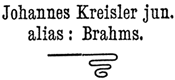
It was to the kindness of Frau Schumann that I owed my
introduction to Brahms, which took place the very day of
my arrival on my first visit to Germany. I had had lessons
from the great pianist during her visit to London early in
the year 1871, and on her departure from England she
allowed my father to arrange that I should follow her, as
soon as I could possibly get ready, to her home in Lichtenthal,
a suburb of Baden-Baden, in order to continue my
studies under her guidance.
I can vividly recall the bright morning in the beginning
of May on which I arrived at Baden-Baden, rather home-sick
and dreadfully tired, for owing to a railway breakdown
en route my journey had occupied fourteen hours longer
than it ought to have done, and my father's arrangements
for my comfort had been completely upset. It was too
early to go at once to Frau Schumann's house, and I
remember to have dreamily watched, whilst waiting at the
station, a passing procession of young girl communicants
in their white wreaths and veils, as I tried to realize that
I was, for the first time in my life, far away from home and
from England. When the morning was sufficiently advanced,
I took an open Droschke, and driving under the great trees
of the Lichtenthaler Allée to the door of Frau Schumann's
house, I obtained the address of the lodgings that had been
taken for me in the village. Without alighting, I proceeded
at once to my rooms, where I was almost immediately
joined by Frau Schumann herself, who came round, as
soon as she had finished breakfast, to bid me welcome.
My delight at seeing the great artist again, combined
with her irresistible charm and kindness, at once made me
feel less strange in my new surroundings, and I joyfully
accepted the invitation she gave me at the close of a few
minutes' visit, to go to her house the same afternoon at
four o'clock and take coffee with her in her family circle.
On presenting myself at the appointed hour, I was at
once shown into a pleasant balcony at the back of the
house, overlooking garden and river. In it was seated
Frau Schumann with her daughters, and with a gentleman
whom she presently introduced to me as Herr Brahms.
The name awakened in my mind no special feeling of interest,
nor did I look at its owner with any particular curiosity.
Brahms' name was at that time almost unknown in
England, and I had heard of him only through his arrangement
of two books of Hungarian dances for four hands on
the pianoforte. As, however, from that day onwards I was
accustomed, during a period of months, to meet him almost
daily, it may be convenient to say at once a few words
about his appearance and manner as they seemed to me
after I had had time to become familiar with them.
Brahms, then, when I first knew him, was in the very
prime of life, being thirty-eight years of age. Below middle
height, his figure was somewhat square and solidly built,
though without any of the tendency to corpulency which
developed itself at a later period. He was of the blonde type
of German, with fair, straight hair, which he wore rather
long and brushed back from the temples. His face was
clean-shaven. His most striking physical characteristic was
the grand head with its magnificent intellectual forehead,
but the blue eyes were also remarkable from their expression
of intense mental concentration. This was accentuated
by a constant habit he had of thrusting the rather thick
under-lip over the upper, and keeping it compressed there,
reminding one of the mouth in some of the portraits of
Beethoven. His nose was finely formed. Feet and hands
were small, the fingers without 'cushions.'
'I have none,' he said one day, when I was speaking to
him about pianists' hands; and he spread out his fingers,
at my request, to show me the tips. 'Frau Schumann has
them, and Rubinstein also; Rubinstein's are immense.'
His dress, though plain, was always perfectly neat in
those days. He usually wore a short, loose, black alpaca
coat, chosen, no doubt, with regard to his ideas of comfort.
He was near-sighted, and made frequent use of a double
eyeglass that he wore hanging on a thin black cord round
his neck. When walking out, it was his custom to go bare-headed,
and to carry his soft felt hat in his hand, swinging
the arm energetically to and fro. The disengaged hand
he often held behind him.
In Brahms' demeanour there was a mixture of sociability
and reserve which gave me the impression of his being a
kindly-natured man, but one whom it would be difficult
really to know. Though always pleasant and friendly, yet
there was a something about him—perhaps it may have
been his extraordinary dislike to speaking about himself—which
suggested that his life had not been free from disappointment,
and that he had reckoned with the latter and
taken his course. His manner was absolutely simple and
unaffected. To his own compositions he alluded only on
the very rarest occasions, nor could he be induced to play
them before even a small party. His great satisfaction and
pleasure were evidently found in the society of Frau Schumann,
for whom he displayed the most devoted admiration,
an admiration that seemed to combine the affection and
reverence of an elder son with the sympathetic camaraderie
of a colleague in art. He had established himself for the
spring and summer months at Lichtenthal, in order to be
near her, and was always a welcome guest at her house,
coming and going as he liked. I met him there continually
at the hour of afternoon coffee, as on the day of my arrival;
and very often, when the coffee-cups were done with, it
was my good fortune to listen to the two great artists
playing duets; Brahms, the favoured, being always allowed
to retain the beloved cigar or cigarette between his lips
during the performance, and taking his turn in playing the
treble part.
It was Frau Schumann's kind habit to invite me to her
mid-day dinner on Sundays, and frequently to supper
during the week. Brahms was rarely absent, and was sometimes
accompanied by one or two of his friends. The talk
on these occasions was more or less general, but naturally
my chief interest was in listening to Frau Schumann and
Brahms, who used to discuss all sorts of topics with great
animation. Brahms' interest in politics was keen, and
although he had been settled in Vienna for some years, and
had become much attached to that city and to his friends
and surroundings there, yet it was evident that he remained
an ardent German patriot.
He was a great walker, and had a passionate love of
nature. It was his habit during the spring and summer
to rise at four or five o'clock, and, after making himself a
cup of coffee, to go into the woods to enjoy the delicious
freshness of early morning and to listen to the singing of
the birds. In adverse weather he could still find something
to admire and enjoy.
'I never feel it dull,' he said one day, in answer to some
remark about the depressing effect of the long-continued
rain, 'my view is so fine. Even when it rains, I have only
another kind of beauty.'
He was considerate for others, even in trifles. I remember
that one evening, before we had quitted the supper-table,
someone produced a copy of 'Kladderadatsch,' and, pointing
out to Brahms a set of sarcastic verses dedicated to John
Bull, begged him to read them aloud for the entertainment
of the assembled party. Brahms, after glancing down the
column, playfully declined to do as he was asked, indicating,
with a wave of the hand, his English vis-à-vis as his reason
for objecting; and it was not until I had laughingly and
repeatedly expressed my earnest wish to hear whatever
might be in store for me as Mr. Bull's representative, that
he at length, and still reluctantly, complied with the request.
Frau Schumann often spoke to me of his extraordinary
genius and acquirements both as composer and executant,
as well as of his general intellectual qualities, and especially
of his knowledge and love of books. She wished me to hear
him play, but said it was no easy matter to do so, as he was
extremely dependent on his mood, and not only disliked to
be pressed to perform, but was unable to do justice either
to himself or his composer when not in the right humour.
The first time, indeed, that I heard him, at a small afternoon
gathering at Frau Schumann's house, I was utterly disappointed.
After a good deal of pressing, he crossed over
to the piano and gave the first movement of the G major
Fantasia-Sonata and the first movement of the A minor
Sonata, Op. 42, both of Schubert, but his playing was
ineffective. It appeared to me to be forced and self-conscious,
and he himself seemed to remain, as it were, outside
the music. I missed the living throb and impulse of
feeling by which I had been accustomed to be carried away
when listening to Frau Schumann, and he left one of his
audience, at all events, cold and unmoved. When I told
this to Frau Schumann afterwards, she answered that I
had not yet really heard him; that he had not wished to
play, but had yielded to over-persuasion, and that I must
wait for a better opportunity of judging before forming an
opinion.
The opportunity came the very next evening, when the
same friends were assembled and Brahms played again.
The next day I wrote home as follows:
'... Then Brahms played. It was an entirely different
thing from the day before. Two pieces were by some composer
whose name I can't remember, and then he played a
wild piece by Scarlatti as I never heard anyone play before.
He really did give it as though he were inspired; it was
so mad and wild and so beautiful. Afterwards he did a
little thing of Gluck's. I hope I shall hear him often if
he plays as he did last night. The Scarlatti was like nothing
I ever heard before, and I never thought the piano capable
of it.'
Such were the general impressions I formed of Brahms
during the first seven or eight weeks of my stay at Lichtenthal.
To say the truth, I thought but little about him at
the time, my whole attention being absorbed in my studies
and in the charm of my new experiences of life. To me he
seemed a very unaffected, kind-hearted, rather shy man,
who appeared quietly happy and content when under the
influence of Frau Schumann's society. As yet I had
had scant opportunity of testing my own capacity for
appreciating his musical genius, and next to none of
individual personal intercourse with him. Frequently,
when my landlady's servant came to attend me to my
lodgings after an evening spent at Frau Schumann's house,
and Brahms and I took our leave at the same moment, he
would say, 'I am coming, too,' and, our ways lying partly
in the same direction, would walk the short distance by
my side; but these occasions did not add much to my knowledge
of him. He would make a few casual remarks, often
playful, always kindly, on any topics of the hour, but did
not touch on musical subjects. One evening, however, I
asked him if he intended to visit England. 'I think not,'
he immediately replied, as though his mind were definitely
made up on this point. I ventured to pursue the subject,
telling him he ought to come, in order to make his compositions
known. 'It is for that they are printed,' he said
rather decidedly, and with these words he certainly gave
me some real insight into his character. The composer
of a long series of works which included such masterpieces
as the second serenade, the two string sextets, the first and
second pianoforte quartets, the inspired German Requiem,
and a host of others already before the world (but of which
I then knew nothing), could, of course, do no otherwise than
allow his compositions to rest quietly on their merits; and
doubtless the intense pride which is equally inherent with
intense modesty in the higher order of genius had its share
in causing Brahms' reticence about all things concerning
himself.
From his determination not to visit England I do not
believe he ever seriously wavered. Only on one occasion—a
few years before his death—did I ever hear him speak
doubtfully on the subject, and I then felt sure that he was
only playing with the idea of coming. Of when or why he
formed his resolution I cannot speak with absolute certainty;
it had become fixed before I made his acquaintance.
His want of familiarity with our language may have had
something to do with it; he could read English a little, but
I never heard him attempt to speak it. He had a horror of
being lionized and of involving himself in an entanglement
of engagements; perhaps, also, he was possessed with an
exaggerated notion of the inflexibility of English social
laws, especially as to the wearing of dress-clothes and the
restrictions with regard to smoking. Before and behind all
such superficial considerations, however, I suspect that
early in his career the idea had taken root in him, right or
wrong as it may have been, that to visit England would
not further his artistic development. Brahms had certainly
formed the clearest conception not only of his purpose in
life, but of the means by which he felt he could best pursue
and achieve it, and from first to last he inflexibly adhered
to the conclusions he had come to on these points. If his
aim was to give the most complete possible expression in
his musical creations to the very best that was in him, his
method, while it satisfied an inner craving of his being, was
yet, as I believe, deliberately adopted; and it was to lay
himself open to every kind of influence which could healthily
foster the ideal side of his nature, and more or less completely
to eschew all others. It would be ridiculous, at the present
time, to touch upon the completeness of his technical musical
equipment, to dilate on his easy grasp of all the resources
of counterpoint, on his mastery of form, of harmonic and
rhythmic combinations, and the like. These things are
matter of course. But Brahms knew that not alone his
intellect, but his mind and spirit and fancy, must be constantly
nurtured if they were to bring forth the highest of
which they were capable, and he so arranged his life that
they should be fed ever and always by poetry and literature
and art, by solitary musing, by participation in so much
of life as seemed to him to be real and true, and, above all
and in the highest degree, by the companionship of Nature.
'How can I most quickly improve?' I asked him one
day later on. 'You must walk constantly in the forest,'
he answered; and he meant what he said to be taken literally.
It was his own favourite prescription that he advised for
my application. For such a man, with a name practically
unknown in England, life in London, and especially during
a concert season, would have been not only uncongenial,
but impossible. It would only have been a hindrance to
him for the time being. It was not his business to push his
works before either conductors or the public, and, after
early successes and failures in this direction, he had almost
entirely given up planning for the future of his compositions,
and had yielded himself wholly to his destiny, which
was to create.
In adopting this attitude, there was nothing whatever of
outward posing. He simply did faithfully what he found
lying before him to do, and did not look beyond.
Life at Lichtenthal passed quickly onwards, and the time
approached when Frau Schumann would pay her annual
visit to Switzerland. At the close of one of my lessons she
said to me:
'I have been thinking that perhaps you might like to
have some lessons from Herr Brahms whilst I am away.
It would be a very great advantage for you in every way,
and he would be able to help you immensely with your
technique. He has made a special study of it, and can do
anything he likes with his fingers on the piano. He does
not usually give lessons, but if you like I will ask him, and
I think he would do it as a favour to me.'
I must here explain that my visit to Germany had been
undertaken with the special object of correcting certain
deficiencies in my mechanism which Frau Schumann had
pointed out, she having advised me to study for a year
with this aim particularly in view.
It need hardly be said that I now eagerly accepted her
proffered kindness, and it was decided that she should sound
Herr Brahms on the question of his willingness to give me
lessons. If he should show himself favourable to the
project, the arrangement was to be considered as decided,
subject only to the approval of my father, who was on the
point of starting from London to join me at Lichtenthal.
The next morning Frau Schumann informed me that Brahms
had consented to the plan, and a few days later, on my
receiving my father's ready assent to my request, all preliminaries
were settled, and it was arranged that I should
have two lessons every week from Brahms.
'You must ask him to play to you,' Frau Schumann said;
'and if he will do it, it will give you a real opportunity to
hear him. And now, now you will begin to know Brahms.'
Brahms united in himself each and every quality that
might be supposed to exist in an absolutely ideal teacher
of the pianoforte, without having a single modifying drawback.
I do not wish to rhapsodize; he would have been
the first to object to this. Such lessons could only have
come from such a man. I have never to this day got over
the wonder of his giving them, or the wonder and the joy
of its having fallen to my lot to receive them.
He was strict and absolute; he was gentle and patient
and encouraging; he was not only clear, he was light itself;
he knew exhaustively, and could teach, and did teach, by
the shortest possible methods, every detail of technical
study; he was unwearied in his efforts to make his pupil
grasp the full musical meaning of whatever work might be
in hand; he was even punctual.
I cannot hope in what I may say to convey more than a
faint impression of what his lessons were to me. From the
very first hour of coming under his immediate musical
influence I felt that it was a power which would continue
to act upon and develop within me to the end of life.
Perhaps, however, I may succeed in helping lovers of his
music to add to their conception of his character and his
gifts, by writing of him as he was in a capacity in which,
so far as I know, he has not hitherto been described. Such
personal details as I may introduce will be given with the
object of illustrating that side of Brahms' character which
I once knew so well; of exhibiting him as the all-capable,
single-hearted, encouraging, inspired and inspiring teacher
and friend.
Remembering what Frau Schumann had said of his
ability to assist me with my technique, I told him, before
beginning my first lesson, of my mechanical difficulties, and
asked him to help me. He answered, 'Yes, that must come
first,' and, after hearing me play through a study from
Clementi's 'Gradus ad Parnassum,' he immediately set to
work to loosen and equalize my fingers. Beginning that
very day, he gradually put me through an entire course of
technical training, showing me how I should best work, for
the attainment of my end, at scales, arpeggii, trills, double
notes, and octaves.
He not only showed me how to practise: he made me, at
first, practise to him during a good part of my lessons,
whilst he sat watching my fingers; telling me what was
wrong in my way of moving them, indicating, by a movement
of his own hand, a better position for mine, absorbing
himself entirely, for the time being, in the object of helping
me.
He did not believe in the utility for me of the daily
practice of the ordinary five-finger exercises, preferring to
form exercises from any piece or study upon which I might
be engaged. He had a great habit of turning a difficult
passage round and making me practise it, not as written,
but with other accents and in various figures, with the
result that when I again tried it as it stood the difficulties
had always considerably diminished, and often entirely disappeared.
'How must I practise this?' I would ask him,
with confidence, which was never disappointed, that some
short-cut would be found for me by which my way would
be effectually smoothed.
His method of loosening the wrist was, I should say,
original. I have, at all events, never seen it or heard of it
excepting from him, but it loosened my wrist in a fortnight,
and with comparatively little labour on my part.
How he laughed one day, when I triumphantly showed
him that one of my knuckles, which were then rather stiff
and prominent, had quite gone in, and said to him: 'You
have done that!'
It may seem incredible, but it is none the less true, that
after a very few weeks of work with him the appearance
of my hands had completely changed. My father says,
writing to my mother:
'Her hand has an entirely different conformation from
what it used to have; it has lost all its angular appearance,
and it really is the case, as she says, that her knuckles are
disappearing. I have given up all idea of inducing her to
go anywhere with me; she will allow nothing to interfere
with her practising. She is enthusiastic in her admiration
of Brahms, and says his patience is wonderful. He keeps
her strictly to finger-work.'
He was never irritable, never indifferent, but always
helped, stimulated, and encouraged. One day, when I
lamented to him the deficiencies of my former mechanical
training and my present resultant finger difficulty, 'It will
come all right,' he said; 'it does not come in a week nor
in four weeks.'
Perceiving at once the extraordinary value of my technical
studies with him, I was desirous of not being hampered by
feeling obliged, at first, to get up many pieces to play through.
That, he said, was quite right; I must practise a great deal
in little bits for a time. Here is an extract from one of my
letters. I copy it exactly as it stands, without altering the
careless wording of a girl's letter hastily penned for home
perusal in an interval between practice times:
'My lessons with Brahms are too delightful; not only the
lessons themselves, but he makes me feel I must practise
all day and all night. I have begun to eat a great deal for
the mere purpose of being able to practise! He is so patient,
and takes such pains, and I ask all sorts of questions, and
the lessons are too delightful. I can't understand his giving
lessons, and yet he is never angry at any sort of foolishness,
only says, "Ah! that is so difficult." As for an hour's
lesson, that is nothing. He systematically arranges for an
hour and a half. I absolutely revel in my lessons. He
makes the saraband sound on the piano just as on a violin.
Then he never expects too much, and does not give much
to learn, but is always satisfied with little if one is really
trying.'
He was extremely particular about my fingering, making
me rely on all my fingers as equally as possible. One day
whilst watching my hands as I played him a study from
the 'Gradus,' he objected to some of my fingering, and
asked me to change it. I immediately did so, but said,
knowing there was no danger of his being offended by the
remark, that I had used the one marked by Clementi.
Brahms, not having had his eyes on the book at the moment,
had not perceived this to be the case. He at once said I
must, of course, not change it, and would not allow me to
adopt his own, as I begged him, saying: 'No, no; he
knew.'
I had with me at Lichtenthal my own copies of Bach,
which I had brought from England, but the edition was
unfingered, and Brahms desired me to get copies with
Czerny's fingering, and always to use it. The other indications
in the edition I was not to adopt.
A good part of each lesson was generally devoted to Bach,
to the 'Well-tempered Clavier,' or the English Suites; and
as my mechanism improved Brahms gradually increased
the amount and scope of my work, and gave more and more
time to the spirit of the music I studied. His phrasing, as
he taught it me, was, it need hardly be said, of the broadest,
whilst he was rigorous in exacting attention to the smallest
details. These he sometimes treated as a delicate embroidery
that filled up and decorated the broad outline of
the phrase, with the large sweep of which nothing was ever
allowed to interfere. Light and shade, also, were so managed
as to help to bring out its continuity. Be it, however, most
emphatically declared that he never theorized on these
points; he merely tried his utmost to make me understand
and play my pieces as he himself understood and
felt them.
He would make me repeat over and over again, ten or
twelve times if necessary, part of a movement of Bach, till
he had satisfied himself that I was beginning to realize his
wish for particular effects of tone or phrasing or feeling.
When I could not immediately do what he wanted, he would
merely say, 'But it is so difficult,' or 'It will come,' tell me
to do it again till he found that his effect was on its way
into being, and then leave me to complete it. On the two
or three days that intervened between my lessons, I would,
after practising at the pianoforte, sometimes take my music
into the forest to try to think myself more completely into
his mind, and if, when he next came, I had partially succeeded,
he took delight in showing his satisfaction. His
face would light up all over, and he would be unstinting
in his praise. 'Very good, quite right; Frau Schumann
would be very surprised to hear you play like that,' or,
'That will make a great effect with Frau Schumann.'
In spite of his extraordinary conscientiousness about
detail, Brahms was entirely free from pedantry and from
the tendency to worry or fidget his pupil. His great
pleasure was to commend, and if I played anything to him
for the first time, in the way he liked, nothing would induce
him to suggest, with one word, any change at all. 'That
is quite right; there is nothing to say about it,' he would
say; and though I have felt disappointed not to get any
remark from him, and have entreated him to make some
suggestions, he would remain firm. 'No, it must be like
that; we will go on,' and there was an end of the matter.
One morning my father, coming into the room at the
close of my lesson, asked Brahms: 'Has she been a good
girl to-day?' 'Sehr fein,'[1] answered he, and suddenly
turning to me added imperatively: 'Tell your father that.'
I was equal to the occasion, however, and promptly translated:
'Herr Brahms says he is not very satisfied to-day,
papa.' My father's face fell a little. Brahms looked
straight before him, displeased and impassive. 'I have
told him,' said I. 'No, you have not told him.' 'But
you don't know that; you don't understand English.' 'I
understand enough to know that'—stonily. 'Herr Brahms
says I have done pretty well,' I reassured my father; then
to Brahms: 'Now I have.' 'Yes, now,' he admitted, with
relenting countenance.
Another day, in the middle of my lesson, the door of my
sitting-room opened, and my landlady begged to speak to
me. 'No, Frau Falk,' I said; 'I am engaged and can see
no one: you must please go away.' 'One moment, gnädiges
Fräulein,' she said, and persisted, to my displeasure, in
coming in. I then perceived she had with her a pretty
little girl of about five years old, who held some beautiful
yellow roses in her hand. Frau Falk led the child straight
up to the piano and made her little speech. The small
maiden was the daughter of the gentleman living in the
neighbouring villa, and, being with her father in his beautiful
rose-garden, had begged him to let her carry some of
his roses to the Fräulein to whose playing they had been
listening. The little one, seeing I was not alone, became
suddenly shy as she handed me the lovely flowers, and,
turning away her face, looked downwards with very red
cheeks as she stood quietly at Brahms' knee. But this
was not the kind of interruption to displease him. 'Na,'
he said, coaxing her, 'you must look at the Fräulein, and
let her thank you. Look at her; she wants to thank you.'
Between us we reassured the little one, who held up her
face to me to be kissed, and sedately allowed Frau Falk
to lead her away.
Soon after beginning my work with Brahms, I asked him
at the end of my lesson if he would play to me, telling him
I did so by Frau Schumann's desire. There was an instant's
hesitation; then he sat down to the piano. Just as he was
about to begin, he turned his head round, and said almost
shyly: 'You must learn by the faults also.' That was the
beginning. From that day it became his regular habit to
play to me for about half an hour at the close of the hour's
lesson, which he never shortened. Oftenest he chose Bach
for his performance. He would play by heart one or two
of the preludes and fugues from the 'Well-tempered Clavier,'
then take up the music and continue from book as the
humour took him. When he reached the end of a composition,
I would say little or nothing beyond 'Some more,' for
fear of stopping him, and he would turn over the leaves to
find another favourite. I do not remember his ever making
a remark to me either between-whiles or after he had
finished playing, beyond, perhaps, telling me to get him
another book. Once, and once only, he resisted. I had
made my usual request at the end of the lesson, when he
quaintly and unexpectedly replied: 'Not every time; it
is silly. Frau Schumann would say it is silly to play every
time'. 'It is so disappointing,' I wished to say, but was
uncertain of the right German word. He, as was his wont
on similar occasions, made me show it him in the dictionary.
There was some little argument between us, and he returned
to the piano and took his place there. It was of no use,
however. He could not play that day, and almost seemed
to take pleasure in doing as badly as possible. Every time
he was conspicuously faulty he turned round to me with a
sardonic smile, as though he would say: 'There! you have
got what you wanted; how do you like it?' 'Very unkind,'
I murmured, and he soon rose. 'I will not play next time,'
he angrily declared as he took leave. 'I will never ask
you again,' I rejoined. A shrug of the shoulders was his
only answer, and, with the usual 'good-day,' he left the
room.
After two days came my next lesson. It passed off
delightfully, as usual, and at the close Brahms departed,
without a word about his playing being said on either side;
but I was left with a feeling of something having been very
much wanting. In the middle of the following lesson, giving
way to a sudden impulse which I could not have explained,
but which, perhaps, arose from the fear of renewed disappointment,
I abruptly ceased playing in the middle of
my piece, saying, 'I cannot play any more to-day.' Brahms
glanced at me with rather an inquiring expression, and
asked, 'Why?' 'I don't know; I cannot,' I replied. There
was an instant of dead silence, during which I did not look
round. Then Brahms spoke. 'I will play to you,' he said
quietly, 'in order that you may have something.' We
immediately changed places, and he never refused me
again.
My father, writing to my mother, says:
'Brahms is recognised in Germany as the greatest
musician living. It is said to be most difficult to get him
to play; however, after every lesson he plays piece after
piece. He is a delightful man—so simple, so kind and
quiet. He lives in a beautiful situation amongst the hills,
and cares only for seclusion, and time to devote himself to
composition. He was pleased the other day by F.'s asking
him about a passage in Goethe that she could not comprehend,
and went into it in a way which delighted her.
With all his genius he is thoroughly practical. Punctual
to a minute in his lessons, and of extreme delicacy.'
It was my happiness to hear, amongst other things, his
readings of many of the forty-eight preludes and fugues, and
his playing of them, and especially of the preludes, impressed
me with such force and vividness that I can hear it in memory
still. His interpretation of Bach was always unconventional
and quite unfettered by traditional theory, and he
certainly did not share the opinion, which has had many
distinguished adherents, that Bach's music should be performed
in a simply flowing style. In the movements of
the suites he liked variety of tone and touch, as well as
a certain elasticity of tempo. His playing of many of the
preludes and some of the fugues was a revelation of exquisite
poems, and he performed them, not only with graduated
shading, but with marked contrasts of tone effect. Each
note of Bach's passages and figures contributed, in the hands
of Brahms, to form melody which was instinct with feeling
of some kind or other. It might be deep pathos, or light-hearted
playfulness and jollity; impulsive energy, or soft
and tender grace; but sentiment (as distinct from sentimentality)
was always there; monotony never. 'Quite
tender and quite soft,' was his frequent admonition to
me, whilst in another place he would require the utmost
impetuosity.
He loved Bach's suspensions. 'It is here that it must
sound,' he would say, pointing to the tied note, and insisting,
whilst not allowing me to force the preparation, that
the latter should be so struck as to give the fullest possible
effect to the dissonance. 'How am I to make this sound?'
I asked him of a few bars of subject lying for the third,
fourth, and fifth fingers of the left hand, which he wished
brought out clearly, but in a very soft tone. 'You must
think particularly of the fingers with which you play it,
and by-and-by it will come out,' he answered.
The same kind of remarks may be applied to his conception
of Mozart. He taught me that the music of this
great master should not be performed with mere grace and
lightness, but that these effects should be contrasted with
the expression of sustained feeling and with the use of the
deep legato touch. Part of one of my lessons was devoted
to the Sonata in F major—
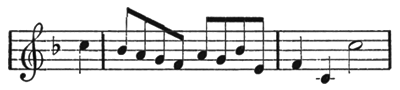 etc.
etc.
[Listen]
Brahms let me play nearly a page of the first movement
without making any remark. Then he stopped me. 'But
you are playing without expression,' said he, and imitated
me, playing the same portion, in the same style, on the
upper part of the piano, touching the keys neatly, lightly,
and unmeaningly. By the time he left off we were both
smiling at the absurd performance.
'Now,' he said, 'with expression,' and he repeated the
first few bars of the subject, giving to each note its place
as an essential portion of a fine melody. We spent a long
time over the movement that day, and it was not until
the next lesson, after I had had two, or perhaps three, days to
think myself into his conception, that I was able to play it
broadly enough to satisfy him. At the close of the first
of these two Mozart lessons I said to him: 'All that you
have told me to-day is quite new to me.' 'It is all there,'
he replied, pointing to the book.
Brahms, in fact, recognised no such thing as what is sometimes
called 'neat playing' of the compositions either of
Bach, Scarlatti, or Mozart. Neatness and equality of finger
were imperatively demanded by him, and in their utmost
nicety and perfection, but as a preparation, not as an
end. Varying and sensitive expression was to him as the
breath of life, necessary to the true interpretation of any
work of genius, and he did not hesitate to avail himself of
such resources of the modern pianoforte as he felt helped
to impart it; no matter in what particular century his composer
may have lived, or what may have been the peculiar
excellencies and limitations of the instruments of his day.
Whatever the music I might be studying, however, he
would never allow any kind of 'expression made easy.' He
particularly disliked chords to be spread unless marked so
by the composer for the sake of a special effect. 'No
arpége,' he used invariably to say if I unconsciously gave
way to the habit, or yielded to the temptation of softening
a chord by its means. He made very much of the well-known
effect of two notes slurred together, whether in a
loud or soft tone, and I know from his insistence to me on
this point that the mark has a special significance in his
music.
Aware of his reluctance to perform his compositions, I
let some weeks pass before I asked him to play me something
of his own. When I at length ventured to do so, he
objected: 'Not mine; something by another composer.'
But I had resolved to carry my point. 'No, no,' I insisted;
'a composition played by the composer himself is what I
wish to hear,' and my importunity gained the day. He
gave me a splendid performance of a splendid theme with
variations, which, as I found out some months afterwards,
was from the now familiar string Sextet in B flat. It was
the first time I had heard anything of Brahms' composition
with the exception of one or two songs, and it raised in me
a tumult of delight. Probably I said to him little beyond
thanks, but the power of the music and the performance
must have worked itself in me to some manifest effect, for
on my taking my seat directly after the lesson at the table
d'hôte of the Hôtel Bär, the village inn where my father and
I used to dine, a lady of our acquaintance exclaimed: 'What
is the matter with you to-day that you look so excited?'
I remember answering her: 'Brahms has just played me
something quite magnificent—something of his own—and
it keeps going in my head.'
Since then I have heard the movement times innumerable
in England and on the Continent, performed by various
combinations of artists, but I never listen to it without
being carried back in thought to the gardener's house on
the slope of the Cäcilienberg where, in my blue-papered,
carpetless little room, Brahms sat at the piano and played
it to me. The scent of flowers was borne in through the
open lattice-windows, of which the green outside sun shutters
were closed on one side of the room to keep out the
blazing August sun, and open on another to views of the
beautiful scenery.
The merits of our respective views had been the subject
of some friendly argument soon after my arrival at Lichtenthal.
Brahms had declared that no prospect from any
windows in the village could possibly be as fine as his,
whilst I was equally sure that mine must be quite unrivalled.
Two of my windows looked right across the valley of the
Oos as far as the plain of Strassburg, and showed, in fine
weather, the distant peaks of the Vosges glimmering in the
sunlight. Two others commanded a prospect of the pine-covered
ranges of Black Forest hills. The first time Brahms
came to my rooms, in order to give me a lesson, the variety
and loveliness of my view drew from him an exclamation of
delight. 'But yours is really grander and sterner, is it
not?' I magnanimously asked. 'This is more suitable for
a girl,' he prettily replied.
On the next occasion after the day when he had performed
his own work, I reminded Brahms that he had promised he
would allow my father, who was anxious to hear him play
to better advantage than from the room overhead, to share
with me this great pleasure some time. 'But he is not
here,' he said, and taking this as a token of assent, I quickly
called my father, who was writing letters above, to come
down. When we were all three seated, I told Brahms I
wished to have the piece he had played to me two or three
days before, but he said he would not play anything of his
own—'something else.' 'No,' I said, 'something of yours,
and the same; my father wishes to hear the same.' 'Ah,
I forget what it was; I have composed a great many things.
I will play something else.' 'But no, no, no!' I urged. 'I
know what it was. I must have the same. Play the first
two or three chords.' 'Well, then, I think it was this,'
said he, giving way; and he repeated the movement from
beginning to end, carrying us both completely away.
Brahms' playing at this period of his life was, indeed,
stimulating to an extraordinary degree, and so apart as to
be quite unforgettable. It was not the playing of a virtuoso,
though he had a large amount of virtuosity (to put it
moderately) at his command. He never aimed at mere
effect, but seemed to plunge into the innermost meaning of
whatever music he happened to be interpreting, exhibiting
all its details and expressing its very depths. Not being in
regular practice, he would sometimes strike wrong notes—and
there was already a hardness, arising from the same
cause, in his playing of chords; but he was fully aware of
his failings, and warned me not to imitate them.
He was acutely, though silently, sensitive to the susceptibility
or non-susceptibility of his audience. As I
have already mentioned, but few words passed between him
and myself during the momentary intervals between his
playing of one piece and another, but he would now and
then suddenly turn his head round towards where I sat and
give me a swift, searching glance, as though to satisfy himself
that I understood and followed him. Once only he refused
to go on. It was soon after his performance before my
father. I had begged for another of his compositions, and
he had begun to play one. I was sitting rather behind
him, listening intently and trying to follow, but I knew I did
not understand. Very soon he turned to give his usual
scrutinizing look, and immediately ceased playing, saying:
'No, really I can't play that.' I did not attempt to make
him think I had entered into the meaning of the music, but
only entreated him to begin it again and give me one more
chance, as it was difficult to follow. Nothing would induce
him, however, to play another note of it, and he went on
to something by another composer, much to my disappointment
and mortification.
Brahms disliked to hear anything said which could
possibly be interpreted as depreciation of either of the great
masters. Once, when two or three people were present, a
remark was made on the growing indifference of the younger
musicians to Mendelssohn, and particularly on the neglect
with which his once popular 'Songs without Words' had
for some time been treated. 'If it is the case, it is a great
pity,' observed Brahms, 'for they are quite full of beauty.'
He especially loved Schubert, and I have heard him declare
that the longest works of this composer, with all their
repetitions, were never too long for him.
He greatly admired my copy, which was of the original
edition and in good preservation, of Clementi's 'Gradus,'
and asked me to lend it him for a day or two to compare
with his own. I did not at that time attach much value
to original editions; and, fancying he merely wished to
prevent me from overworking, against which he often
cautioned me, I said I could not spare it. 'You won't
lend it me!' he exclaimed, very much astonished indeed.
I answered that if he did take it away it would make no
difference, as I could practise as well without it. Finding,
however, that he really wished to examine the copy, I said
it was too hot for him to carry so large a book in the middle
of the day, and that I would send it in the evening. 'I
am not so weak!' he replied, but consented to the proposal.
He sent it back after a few days, strongly scented with the
odour of his tobacco, which it retained through many a
long year, and which rather enhanced its value to me.
Rather curiously, he liked the scent of eau-de-Cologne.
My father brought me a case from Cöln, and if, on my lesson
day, I had an open bottle near at hand, and offered some
to Brahms, he would place his hands together, palm upwards,
for me to pour into, and, dipping his head, would rub the
scent over his forehead, protesting as he did so, 'But it
really does not become a man.' Seeing that he liked it, I
used it sometimes to wash the keys of the piano when he
was coming, but I do not think he ever found me out.
He delighted in the music of Strauss' band, which was
engaged to play daily at Baden-Baden through some
weeks of the season. It was then conducted by the great
Johann Strauss, Brahms' particular friend, and he used to
walk over every evening to hear it. 'Are you so engrossed?'
said a voice behind me one evening as I was standing in
the Lichtenthal village street with a friend, looking at the
performances of a dancing bear. On turning round I found
Brahms, hat in hand, smiling with amusement at our preoccupation,
himself on his way, as usual at that hour, to
listen to the delicious music of the Vienna waltz-king.
Brahms disliked mere compliment, but he had a warm
appreciation of the genuine expression of friendly feeling
towards himself, and did not try to hide the pleasure it
gave him. His countenance would change, and he would
answer in a simple, modest way that was almost touching.
One day when I told him how I valued his teaching, and
felt it was something for my whole life, 'You ought to
tell Frau Schumann,' replied the composer of the German
Requiem, as though he were asking me to give a good
report of him. On my assuring him that I had already
done so by letter, he added hastily: 'But not too much;
never praise too highly; always keep within bounds.'
Shortly before Frau Schumann's return I said to him that
I hoped he would not lose all interest in my music at the
termination of my lessons with him, and that I should like,
if it were possible, to make some additional arrangement
by which it might be maintained. He did not give me
any definite reply at the moment one way or the other, but
on my saying the same thing to him another day he replied:
'It is very nice and very kind of you, but I don't think
it can be done. You must, however, play to me very often.
Everything you learn with Frau Schumann you must play
to me.'
About this time, however, my father, who was about to
start on his homeward journey, persuaded me to go away
with him for a week's holiday before his departure for
England, and on my return to Lichtenthal Frau Schumann
arranged that I should continue my studies under Brahms
for the remainder of my stay, saying I had become more
his pupil than hers. There were, indeed, but few more
lessons to look forward to. Autumn had set in, and everyone
was thinking of departure. Brahms had to go sometimes
to Carlsruhe, where he was occupied with rehearsals,
but he punctually kept his remaining appointments with
me. His concluding lessons were as magnificent as the
earlier ones, and when I went back to England my ground
was clear. I do not mean to assert that my hand was
already completely developed from a pianist's point of
view, or my technique as yet fully in my possession. These
things were physically impossible; but Brahms had shown
me the path which led straight to my goal, and had himself
brought me a considerable distance on the way. A cast
of one of my hands taken on my return to England, when
compared with one that had been done shortly before I
left, could not have been recognised as being from the
same person.
Those were, indeed, golden days, when Brahms sat by
my side and taught me; memorable to me no less for their
revelation of an exquisite nature than for the musical
advantages they brought. I have often been told that
there was another side to his character, and that he could,
even at that time, be bitter and rough and satirical. I
dare say he was not faultless, but I do not think that he
can at any period of his life have been bitter in the sense
of being soured. He no doubt had a strong feeling about
the indifference and downright antagonism against which
his works long had to struggle; but if it had ever been a
feeling even of disappointment, I am sure this had mellowed,
before I knew him, into a firm though silent belief in the
future of his compositions, and had only served to intensify,
if possible, his determination to put into them of his very
best.
Rough he may have been sometimes, and in later years
I had occasional opportunity of perceiving that he was not
always gentle, though he was never otherwise with me.
His roughness was, in certain instances, no doubt caused
by his resolution in protecting his time from celebrity-hunters,
and even from friends. It may have been partly
traceable, also, to the circumstances of his youth, when he
must often have been placed amid surroundings where
rough-and-ready frankness of speech was more cultivated
than conventional polish of manner. It is, however, certain
that during the latter part of his life he sometimes availed
himself of the privilege of the enfant gâté to yield to the
caprice of the moment, and that he now and again said
things which could not but wound the feelings of others.
This was to be regretted, and it hardly excused him that
his pungent words came from the lips only, and not from
the heart. I am, however, quite certain that many of his
acerbities were assumed to cover his naturally acute sensibility
of temperament, of which he stood a little in dread,
and which he liked to conceal even from himself. He was
a firm believer, for himself and for others, in the salutary
process of bracing both mental and physical energies.
A year or two before Brahms' death I revisited Lichtenthal,
staying a night at the Hôtel Bär, where I used to dine
in the old days. I looked up old acquaintances, and
amongst them the former mistress of the dear old inn,
whom I found retired and living in a charming villa close
by, her brother being still the proprietor of the hotel.
She, of course, had known Brahms well, and during the
hour or two that I spent with her we talked chiefly about
him. She repeated the verdict given by everyone really
acquainted with him: 'So simple and natural, so kind and
cheerful, able to take pleasure in trifles. He was such a
simple-hearted man.' A tease, certainly, but his teasing
was never unkind, never more than mere raillery. He
would often bring a friend to dine at the Bär in the old
days, and she always had the cloth laid for him in a private
room or in the back part of the garden, so that he should
not be worried by the visitors. 'He never minded what he
did. He would sometimes drop in, if he were passing, to
say good-morning to us, and if we were very busy he would
make a joke of sitting down and amusing himself by helping
us cut up the vegetables for dinner. Only he could not
bear to go into formal society, or to have to wear his dress-clothes.
I have not seen him now for several years. The
last time was in September, 1889, when he paid a flying
visit to the Bär. He was very angry to find that three
pine-trees had been cut down near the house where he used
to lodge, thinking the poetry of the view had been impaired,
and he said he would never stay in the place again. What
a warm heart he had! He liked to know all the country
people of the neighbourhood, and took a pride in feeling
that every man, woman, and child whom he met in his
early morning walks interchanged greetings with him. I
begged for his autograph the last time he was here. You
will like to see what he wrote;' and my old friend sent for
the album in which the master had written:
| 'Johannes Brahms. |
('J. B. |
| eines schönen Tages |
one fine day |
| im schönen Baden |
in beautiful Baden |
| im lieben Bären.' |
at the dear Bear.') |
Years were destined to elapse before my next meeting
with Brahms. After my return to England I worked unremittingly
on the lines he had indicated, and found that
by the observation and practice of his principles I was
guided straight onwards in the path of progress. His
teaching had been of such a kind that its development did
not cease with the actual lessons. As the weeks and
months went by I found myself growing continually into
a clearer perception of the aims and results it had had in
view. It caused me no surprise to find, on becoming
acquainted with his pianoforte compositions, that I must
postpone for a time the delightful task of getting them
up. Brahms himself had prepared me for this. He had
always been extremely careful, when selecting music for me
to work at, to choose what would develop my technical
power without straining my hands, and when I had wished
to study something of his had answered that his compositions
were unfit for me for the present, as they required too
much physical strength and grasp. He fancied, indeed, at
that time that nearly all of them were beyond a woman's
strength. When I asked why it was that he composed only
such enormously difficult things for the pianoforte, he said
they came to him naturally, and he could not compose
otherwise ('Ich kann nicht anders').
In the winter of 1881-82 I found myself in Berlin. It is
difficult to describe the feelings with which I one day read
the announcement that von Bülow, in the course of a
tournée with the Meiningen Orchestra, of which he was
conductor, would shortly visit the city to give a three
days' series of concerts in the hall of the Singakademie;
that Brahms' compositions would figure conspicuously in
the programmes; that Brahms himself would be present,
and that he would probably take part in one or more of
the performances. The life at Lichtenthal had come to
seem to me a sort of far-away fairy-tale impossible of any
sort of renewal, and I could hardly realize that I should
soon see Brahms again. Finding, however, from subsequent
announcements, that the concerts were really to take
place, I lost no time in securing a subscription ticket for
the series.
Feeling sure that every moment of Brahms' short stay in
Berlin would be occupied, I decided that my only chance
of getting a word or two with him would be to gain admission
to one of the rehearsals, and to watch for a favourable
moment in which to make myself known to him. As ill
luck would have it, I was claimed on the first day by engagements
that could not be postponed. I was, however,
the less inconsolable since Brahms was to take an active part
only in the second and third concerts. Their respective
programmes included a new pianoforte concerto still in
MS. (No. 2 in B flat), to be played by the composer, with
von Bülow as conductor; and the first pianoforte concerto,
with Bülow as pianist and Brahms at the conductor's
desk.
Betaking myself to the Singakademie in good time for
the rehearsal on the second morning of the series, I explained,
to the friendly custodian at the entrance-door, my
claims to admission. He allowed me to enter the hall and
to take my place amongst the small audience of persons
privileged to attend.
The members of the orchestra were already assembled,
and after some moments of waiting von Bülow came in
with several gentlemen. Lusty applause broke forth from
platform and stalls, and a small stir of greetings took place.
But where was Brahms? I could perceive him nowhere
at first, and it was only as the rehearsal proceeded, and he
took his place on the platform, that I felt certain he was
really present. I had prepared myself to find him looking
changed and older, but not beyond recognition. It is,
however, no exaggeration to say that as I gazed at him,
knowing him to be Brahms, I was utterly unable to recognise
the man I had known ten years previously. There,
indeed, was the great head with the hair brushed back as
of old, though less tidily than in former days; but his
figure had become much heavier, and both mouth and
chin were hidden by a thick moustache and shaggy, grizzled
beard that had completely transformed his appearance.
When I first knew him at the time of his early middle age,
one might fancy that his countenance and expression had
retained more than a trace of his youthful period of Sturm
und Drang, but this had now quite vanished. I felt, with
a shock, that my foreboding that I should never see my old
friend again had been realized, though in a way different
from that anticipated by me.
Brahms received an ovation when he had finished his
performance of the new concerto, and as he was retiring
from the platform Bülow, unable to restrain his excitement,
darted forward and gave him a kiss. It seemed to take
him rather aback, but he submitted passively.
At length the rehearsal came to an end, and Brahms was
immediately surrounded by friends eager to offer their
congratulations and to receive a word of greeting from
him. 'Now or never,' I thought, and, taking my courage
in my hand, I managed to get near, though a little behind
him. 'I, also, should like to say a word of thanks to you,
Herr Brahms,' I said. Brahms turned his head. 'Are you
here in Berlin, then?' he rejoined instantly, answering as
he might have done if we had met the previous week.
Someone else pressed forward to claim his attention as I
was replying, and I fell behind again. I did not like to
wait for a second opportunity, feeling there was no chance
of his being free, so I straightway departed and went back
to my lodgings.
Thinking things over on my road, I came to the conclusion
that Brahms had not recognised me, but that when
my words caught his ear he had uttered the first casual
reply that rose to his lips, and which might be appropriate
to any acquaintance whom he did not at the moment
remember. However exceptional his memory for faces
might be, it appeared to me incredible that, after the lapse
of so many years, he should have known me without the
hesitation of a second at a moment when his attention was
preoccupied by the concert business of the day and by the
claims of his Berlin friends.
It was in this frame of mind that I took my seat in the
evening to hear the concert. Having got over the first
excitement of seeing Brahms again, and knowing what I
had to expect in regard to his personal appearance, I was
able to listen to the music in a more composed mood than
had been possible to me in the morning. My pleasure in
the performance of the concerto was, of course, in some
measure impaired by the circumstance that the long,
intricate work was quite new. I think, however, that I
should have enjoyed it more if Brahms had conducted and
Bülow performed the solo. I did not think Brahms'
playing what it had been. His touch in forte passages had
become hard, and though he might, perhaps, be said to
have mastered the difficulties of his part, he had not sufficiently
surmounted them to execute them with ease. It
could not, in fact, have been otherwise. No composer
having attained to the height of Brahms' greatness could
have kept his technical command of the pianoforte unimpaired;
life is too short for this. I knew, however, that
I had listened to a magnificent work of immense proportions,
and longed for opportunity to hear it again that I
might assimilate it.
There was a scene of tumultuous enthusiasm at the close
of the work. The public applauded wildly, and shouted
itself hoarse; the band joined in with its fanfare of trumpet
and drum; Brahms and von Bülow were recalled again and
again, separately and together; and in the moment of the
great composer's triumph I saw the earlier Brahms once
more standing before me, for, whilst his eyes shone and his
face beamed with pleasure, I recognised in his bearing and
expression the old familiar look of almost diffident, shy
modesty which had been one of his characteristics in former
days.
I did not, of course, seek for a further opportunity of
speaking to Brahms on the evening of which I am writing,
but I laid my plans for the next morning, and at the proper
hour again made my way to the Singakademie and successfully
begged for admission to the rehearsal.
During the first part Brahms sat as one of the audience
in the front row of stalls, and in a convenient break between
the pieces I sent my English visiting-card to him, having
written on it a few lines recalling myself to his remembrance.
He read it and looked round. 'I know that already,' he
said coldly, but rising and coming towards me. 'I saw
you yesterday.' 'But you did not know who I was?' I returned,
still sceptical. 'Yes, I knew.' 'It seemed to me
quite impossible you could have recognised me!' I ejaculated.
'Oh yes, yes—oh yes!' said Brahms in quite a
different tone, and for a couple of seconds I forgot to look
up or say anything.
'Are you taking notes?' he asked by way of recalling
me to myself, touching my pencil. But the rehearsal had
to proceed, and Brahms presently took his place on the
platform with Bülow for the performance of the Concerto
in D minor. When the rehearsal was over, I did not leave
the hall so quickly as on the previous day, but waited in the
hope of getting another word with Brahms, and was rewarded
by having a good many.
In the evening, as he faced the audience before the commencement
of the concerto, catching sight of me in the
third row of stalls, he was at the pains to bestow upon me
a kind bow and smile of recognition. He glanced slightly
at me again once or twice during the evening, and I knew,
though his appearance still seemed a little strange to me,
that Brahms was in the world after all.
The execution of the D minor Concerto was one of those
rare performances that remain in the memory as unforgettable
events. Brahms, when conducting, indulged in no
antics, and was sparing of his gestures, often keeping his
left hand in his pocket, or letting it hang quietly at his side;
but he cast the spell of his genius over orchestra and pianist
alike. The performance was remarkable for its power and
grandeur, but not chiefly so, for these qualities were to be
expected. It was made supremely memorable by the subtle
imagination that touched and modified even the rather
hard intellectuality of von Bülow's usual style. Good performances
of Brahms' orchestral works may not seldom be
heard, and great ones occasionally; but the particular
quality of his poetic fancy, by which, when conducting an
orchestra, he made the music sound from time to time as
though it were floating in some rarefied atmosphere, vibrating
now with fairy-like beauty and grace, now with ethereal
mystery, was, I should say, peculiar to himself, and is
hardly to be reproduced or imitated.
As soon as Brahms had finished his share in the evening's
programme I quitted the hall, for I was thoroughly exhausted
by the excitement of the past two days, and felt
I could bear nothing more. Early the next morning he
left Berlin to fulfil engagements in another town.
During the next four years much of my time was passed
in Berlin. I delighted in the concerts and general musical
atmosphere of the German capital, and did not allow my
plans to be disturbed by a vague invitation to visit Vienna
which Brahms had given me in the course of our short
interview in the hall of the Singakademie. I felt that
however kind and friendly his recollection of me might
have remained, yet I could not hope to derive direct musical
benefit from one absorbed in the intense thought and
brooding to which the life of a really great composer must
be largely devoted.
It was not until December, 1888, that I paid my first
visit to Vienna. I arrived there towards the end of the
month, armed with letters of introduction which met with
a kind response and obtained for me immediate admission
into those English and Austrian circles to members of
which they were addressed. I waited for a week before
letting Brahms know of my arrival, as I wished not only
to be settled before calling on him, but also to be in such a
position in regard to my acquaintance as would make it
impossible for him to suspect that I could want anything
whatever of him beyond the delight and honour of seeing
him again, and of recalling myself to his remembrance.
Meanwhile I gathered, from all I heard, that his dislike of
anything approaching to general society had steadily grown
upon him. Some, even, of his old friends spoke of the increasing
rarity of his visits. A lady at whose house he had
been intimate for many years told me it had once been his
custom to announce himself for the evening from time to
time at a few hours' notice, with the proviso that he should
find her and her husband alone in their family circle, or at
most with one or two chosen friends. On these occasions
he had been used to play to them one after another of his
newest compositions. This habit, however, he had almost
entirely given up.
I heard but one opinion, both from friends and outsiders,
as to his essentially high character and sterling qualities of
nature; but his manners were described with unanimity,
by those not within his immediate circle, as difficult, sarcastic,
and arrogant. I was, indeed, so repeatedly assured
that I should do no good by trying to see him that I almost
began to fear I should find he had become rude and impossible,
if not hopelessly inaccessible. To all that was
said to me on the subject I answered merely that I had
once known him well, and had never found him otherwise
than kind and simple, but that I had prepared myself to
find him changed and rough in his behaviour to me.
At length, on a dark afternoon of one of the closing days
of the year, I made my way to the Wieden, the quarter of
Vienna inhabited by Brahms, and, turning in at the doorway
of No. 4, Carlsgasse, I ascended the worn stone staircase
as far as the third étage. Here I pulled the shining
brass handle of the old-fashioned door-bell, and the feeling
of doubt which had possessed me changed to one of positive
alarm as I listened to the prolonged peal I had awakened.
I thought it must sound to Brahms like the announcement
of a most daring and determined intruder, and that it
would inevitably prove the death-knell of any chance of
my admission.
The door was soon opened by a friendly maid-servant,
who told me, indeed, that the Herr Doctor was not at
home, but satisfied me that I was not being put off with
a mere phrase by adding that she thought he would probably
be back by six o'clock, and that she advised me to return
about that hour if I particularly wished to see him, as he
was to start on a journey early the next morning. I
thanked the girl, said I would follow her suggestion, and,
without leaving my name, returned to my rooms to wait
for the evening.
The second visit was again unsuccessful, but on trying
a third time, at seven o'clock, I found that Brahms had
returned. 'Please to walk in,' said the landlady, who this
time opened the door. But this unexpected facility of
access to the master was even more embarrassing than
would have been the conflict of argument I had anticipated.
'Please take my card,' said I, 'to the Herr Doctor, and
ask if he will see me.' 'Oh, it is not necessary,' she said;
but took it in, returning immediately and asking me to
enter. As I advanced, the formidable and overbearing
Brahms hastened to meet me. 'Why did you not leave
your address? I should have come to find you out,' he
said, giving me his hand. And returning with me to the
sitting-room, he bade me take a seat on the sofa, whilst he
placed himself on a chair opposite.
He did not try to hide that he was pleased to see his old
pupil. He evidently wished me to understand that our
acquaintanceship was to be taken up from the exact point
at which it had been last left, and reminded me, when I
alluded to his lessons at Baden-Baden, that he had seen
me since those early days. 'Oh, for a moment at the
rehearsals at Berlin,' I answered. 'But since then,' he
insisted. 'Only at the concert,' said I, rather surprised.
'Yes, at the concert,' he agreed, 'and you sat downstairs,
I remember.'
I told him I had lately been getting up the same B flat
Concerto which he had played at the time, and had performed
it in London before a private audience. He was
interested in hearing the particulars of the occasion, and
when I said, laughingly, that the fatigue entailed by the
practice of its enormous difficulties had given me all sorts
of aches and pains, and made it necessary for me to go into
the country for change of air after the performance was
over, he replied in the same vein: 'But that is very
dangerous; one must not compose such things. It is too
dangerous!'
He informed me rather slyly, 'I am the most unamiable
of all the musicians here,' as though he would like to know
if I had heard of his reputation for cross-grained perversity,
and was frankly gratified when I answered: 'That I will
never believe, Herr Brahms—never!' He was to be absent
at the longest for ten days only, and when I took leave of
him it was with the pleasant consciousness that he would
be glad to find me still in Vienna on his return.
In appearance, Brahms had again greatly altered since
our meeting in Berlin. Though not fifty-six, he looked an
old man. His hair was nearly white, and he had grown
very stout. I had a good opportunity of observing him,
myself unnoticed, soon after his return from his journey.
The first public performance in Vienna was given of his newly-published
Gipsy Songs, at the concert of a resident singer,
one of his friends. Brahms had not been announced to take
part in the performance, but when the evening came, he
walked quietly on to the platform as the singers were arranging
themselves in their places and took his seat at the
pianoforte as accompanist. Of course his appearance was
the signal for an outburst of enthusiastic welcome from the
crowded audience, some hopes, but no certainty, having
been entertained that he would show himself.
As I sat in my corner and watched, I was aware that not
only his general aspect, but his expression also, had undergone
another and a curious change during the last years.
He now wore the happy, sunshiny look of one who had
realized his purpose, and was content with his share in
life; of one to whom the complete measure of success had
come, and not too late to be valued. If in Baden-Baden
he had made upon me the impression of a man awaiting
full recognition, who had already waited long for it; if in
Berlin, the impression of one who, having attained a glorious
pinnacle of fame whilst still in the plenitude of his powers,
was untiringly pressing onward towards higher summits of
fulfilment—I had the feeling, when I looked at him in Vienna,
that the second phase, too, was more or less belonging to
the past, and that he had entered upon a period of reward,
and perhaps of less strenuous exertion.
One of the very few opportunities I ever had of seeing
Brahms avail himself of a great man's license to follow his
whims regardless of convention, and, perhaps, of due respect
to others, was afforded me at a meeting of the Vienna
Tonkünstlerverein, the musicians' club, of which he was
honorary president. It was one of the special social
evenings of the society, when the members supped together.
Brahms was late in coming, and when he arrived supper
was proceeding. He allowed himself to be conducted to
the place, at the top of a long table, which had been reserved
for him as president, but did not sit down. Leisurely
scanning the assembled company, he picked out the position
he preferred, which happened to be at the side near
the bottom. A slight space was certainly there, but not
enough for a seat. 'There,' he said, pointing to it, and he
sauntered down the room, apparently quite unconcerned
at the disturbance and inconvenience which he caused, a
bench having to be moved and several people being obliged
to shift their places to make room for him. When once in
occupation of the seat he fancied, he contributed his share
to the cordiality of the evening, and was in no hurry to
leave.
Another occasion was very similar. He was again dissatisfied
with a place that had been assigned him at a
supper-party. This time it was at a private house, and,
as he could not have declined the seat without making
himself unbearably rude, he submitted, with a kind of half-protest,
to occupy it. During the greater part of the entertainment,
however, he was not only in a wayward mood,
but in a thoroughly bad temper, which he could not control.
There was, when all is said, certainly no ill-natured intention
in what he did on either occasion, but at the worst a
mere childish petulance and over-excitability under slight
disappointment.
I discovered, though Brahms had no fixed hour, that the
right time to call upon him was about eleven o'clock.
Always an early riser, he had then completed his morning's
work, and if at home, as was generally the case, was ready
to receive a visitor. He was sometimes to be found seated
at the piano with an open volume (often Bach) on the
music-stand, which was placed on the closed top lid of the
instrument, playing softly, or silently studying the work
in front of him. I have never felt that I was disturbing
him when I called. It is true that I only went occasionally,
and when provided with a legitimate excuse. Still, I do
not altogether understand how he acquired such a reputation
for incivility. He was, in his own way, of a sociable
disposition.
One day when I was with him, some terrible pianoforte
strumming was going on in the flat above him. I commented
on the strange constitution of people who could
deliberately plant themselves in his immediate neighbourhood—for
he had occupied the same rooms for years—and
then worry him with such noise. He said there was sometimes
bad singing and violin-playing, both of which he
found even harder to bear than the piano, but added:
'They have their rights, and I know how to help myself;'
and he held out his hands in keyboard position, to indicate
that when too much disturbed to do anything else, he shut
out the sounds and employed his time by playing.
Brahms generally went out at about a quarter to twelve
at latest, and would arrive before one o'clock at his favourite
restaurant, Zum Rothen Igel. After his early dinner he
walked, finding his way to a café in another part of the
town, where he would read the papers over a cup of black
coffee. After this was his best time for paying visits, and
about six o'clock he often returned to his rooms to write
letters or do other work. Later on he would go out again
to fulfil his evening engagements. Sometimes it happened
that he did not go home, after leaving in the morning, until
after supper. These details I learnt incidentally in the
course of my stay in Vienna.
Brahms made a great point of being polite to ladies on
the question of smoking, and was very particular in asking
permission before lighting his cigar. Of course, if I found
him alone, he never smoked. One day, however, when I
had been with him only a very few minutes, the door-bell
rang, and two gentlemen appeared, one a friend of Brahms',
the other a youth whom he had brought to introduce to
the master. Brahms wished me to remain, and I therefore
kept my seat. Very soon he produced his box of cigars,
according to Continental custom, and handed it to his
visitors, saying, however: 'But I do it unwillingly, as a
lady is present.' The elder of the two gentlemen put his
cigar into his breast-pocket, the younger lighted his and
vigorously puffed away alone, from sheer confusion, I
think, at finding himself in the presence of the master.
Brahms returned to his seat without taking one. 'But
won't you smoke, Herr Brahms?' I said, after a few seconds.
'If you allow it,' he answered, making as much as possible
of the few words, and taking a cigar.
Though Brahms was not, during the latter part of his life,
a frequenter of concert-rooms, he nearly always attended
the concerts of the Philharmonic Society and of the Gesellschaft
der Musikfreunde in Vienna, sitting, usually, in the
'artists' box' in the gallery. In the intervals between the
pieces he would lean forward, both arms on the front, with
his opera-glasses to his eyes, spying out his acquaintances
in different parts of the hall.
When I called to say good-bye to him at the close of my
first visit to Vienna, I happened to mention that I had made
a small collection of works written for the keyed instruments
of the seventeenth and eighteenth centuries, and had
picked up one or two rather valuable first editions. He
was greatly interested, and saying, 'We have done the same
thing,' took down from the bookcase one or two of his own
old music-books to show me. I especially remember an
original edition of Scarlatti's Sonatas, in first-rate preservation,
but without the title-page, of which he was particularly
fond and proud. He asked if I would bring one or two of
mine to show him on my next visit, and I told him that I
happened to have one with me—an original Rameau—and
that if he had not got a copy I would send it him at once.
'No,' he answered; 'it is too late now—you are going
away to-morrow—but next year when you come again.'
'But I mean,' I rejoined, 'that I will give it you.' Brahms
did not immediately answer, and I added: 'Would you
rather not? If so, I will not do it.' 'No, I would not
"rather not," but you must not immediately give your
things away,' he replied. 'Then I will do it,' I declared,
delighted that I possessed something he would like to have,
and to accept from me. Later in the day I sent him the
book, with a few lines telling him how much pleasure it
would give me if I might leave it with him as a remembrance.
Early the next morning I left Vienna. I was not to arrive
in London for another week, having engagements en route,
and this Brahms knew. On the evening of my return home,
as soon as my mother's first greetings were over, she said:
'There is a letter for you from Brahms; it arrived this
morning.' 'From Brahms! How do you know?' I
answered. 'From his having written his name on the
outside,' she returned, handing me the precious missive.
On the outside of the envelope, above the adhesive, he
had written 'J. Brahms, Vienna, Austria,' and, opening the
envelope, I read as follows:
'Very esteemed and dear Fräulein,
'It was too late the other evening for me to be able
to do as I wished, and come and express my thanks to you
in person.
'Let me, therefore, send them very heartily after you,
for your so kind and valuable gift.
'It was indeed much too kind of you to part with the
pretty treasure in order to give me pleasure, and it shall
still be at your disposal next year!
'In the hope of seeing you here again next year, and of
being able to repeat my hearty thanks,
'Yours very sincerely,
'J. Brahms.'[2]
On my first visit to Brahms in the following winter, he
led the way to his bookcase and showed me the Rameau,
saying: 'I shall die in ten years, and you will get it back
again.' I told him that should I outlive him I should prefer
not to have it back, but to let it go with his collection,
and thus the matter remained.
The success of my first visit to Vienna induced me to pay
several subsequent ones, the last of which took place rather
more than a year before Brahms' death. A minute account
of each would be wearisome, and I will only allude, therefore,
to the opportunity that I had, in the course of two
separate winters, of hearing the concerts of the Joachim
Quartet in Vienna, and of seeing Brahms as one of the
audience. On one of these enchanting evenings the Clarinet
Quintet was given, with Mühlfeld as clarinettist. Brahms
had his seat downstairs, at the end of the room reserved for
resident and other musicians, and separated from the
general audience by the performers' platform. My place
was only two or three away from his, and so situated that
I could see him all the time the work was being played.
His face wore an unconscious smile, and his expression was
one of absorbed felicity from beginning to end of the performance.
When the last movement was finished, he was
not to be persuaded to come forward and take his part in
acknowledging the deafening clamour of applause, but, as
it were, disclaimed all right in it himself by vigorously
applauding the executants. At the last moment, however,
as the noise was beginning to subside, up he got, and
stepping on to the platform, in his loose, short, shabby
morning-coat, made his bow to the audience. Another
item in the programme was the Clarinet Trio, played by
himself, Mühlfeld, and Hausmann. Joachim, sitting on the
right-hand side of the piano, turned over for him. I
changed my seat during the performance of this work,
taking the place that Brahms had vacated, which was close
to the piano and gave me a full view of the keyboard. In
spite of my several experiences of the master's tenacious
memory for small things, I confess that I felt a thrill of surprise
at the end of the first movement, and again at the
end of the second, when he turned his head suddenly round
and glanced straight at me in the very same quick, searching
way to which I had been accustomed in the old Lichtenthal
days, as though to satisfy himself as to whether or not I had
understood.
I spent several weeks at Ischl during the summers of
1894 and 1895, and was much interested in observing the
life of my old friend in surroundings that were new to me.
His habits, during these closing years of his life, were in all
essential respects the same as when I had first known him
in Baden-Baden. Rising soon after four o'clock, his days
were passed in the same simple, natural routine of walking,
studying, and composing, in the enjoyment of the society
of his friends and of the cordial relations which he maintained
with the people of the country, between whom and
himself a perfect understanding existed.
His love of children has often been recorded. I have seen
him sitting reading on the bench of the little garden of his
lodgings, apparently quite undisturbed by his landlady's
boys, who romped round and about him, jumping on and
off the bench, playing hide-and-seek behind his back, and
the like. Now and then he would interrupt his studies to
caress a couple of kittens that were taking part in the
frolics.
'I know this man,' said a droll, tiny boy of about five or
six, in a funny red suit, who, taking a stroll along the
promenade one afternoon with some companions, came
upon Brahms sitting under the trees before Walter's coffee-house,
the centre of a large group of musicians and friends.
The great composer was quite ready to acknowledge the
acquaintanceship, and called his small friend to his table
to receive a spoonful of half-melted sugar from his coffee-cup.
'My Katie knows Brahms,' said a village dressmaker to
me, alluding to her pretty little fair-haired daughter of
eight. 'We have met him out walking very early in the
morning, but Katie was frightened the other day and cried
because he ran round her and pretended he wanted her
piece of bread.'
'The Herr Doctor has already seen him,' a young peasant
mother observed to me as she showed me her three-months-old
son, 'and says he is a strapping boy.'
One morning when I called on Brahms to say good-bye, I
found him in the midst of preparations for his own departure.
An open portmanteau, in process of being packed, was in
the sitting-room, and there was a litter of small things
about. Brahms invited me to take a seat on the sofa. A
book which he had been reading lay open, face downwards.
I ventured, with an apologetic glance at him, to take it
up and look at it. This he did not at all mind. He had
been amusing himself with an essay on Bismarck. After
we had chatted a little while, as I rose to say farewell, my
eye was caught by a table on which were a number of cheap
German playthings—small boxes of puzzles, toy knives and
forks, etc., evidently destined for parting or returning gifts
to quite poor children.
'What is this?' I involuntarily exclaimed, taking up,
before I knew what I was doing, a toy fork of most ungainly
make, broad, squat, and almost without handle. An inquisitiveness,
however, which seemed to hint at the soft side
of Brahms' nature could not be allowed. 'What does that
matter to you?' he cried. Then, instantly, as though
afraid he had been rough, he added: 'It is for small things—fruit,
fish, or the like.' Only I, having seen the clumsy
toy, can quite appreciate the comicality of the answer,
which of course simply meant: 'No allusion, if you please.'
Brahms, however, had saved appearances, and without
being hard on me, had drawn a thin veil over his kind
intentions to his little friends. I held the fork another
instant, and then replaced it on the table, saying with
gravity: 'I thought it was a plaything, Herr Brahms.'
A young lady, an inhabitant of Ischl, who taught singing,
and gave an annual concert there, and who, during the
season, presided over a milliner's business on the Promenade,
was a great ally of Brahms', and never omitted to stand
outside the door of her atelier as the hour approached for
him to pass to his café, in order to get a greeting from him.
The little ceremony was duly honoured by the great composer,
who was always ready with, at the least, his genial
'Good-day.'
Fräulein L. talked of him to me in just the same way as
all others did who were content to be natural and unostentatious
in their manner towards him. He was so good-natured
and bright, she remarked, and though he loved to
tease, his teasing was so kindly. He made a point of calling
on her formally once every season. Taking advantage of
this ceremony, she one day placed before him a cabinet
photograph of himself, and asked if he could do her the
honour of writing his name underneath.
'Yes, I can do that,' he answered in his cheerful tone,
'I learned that at school. But why do you keep this ugly
old face? Why not have a handsome, curly-haired one?
Ah, what have we here?'—catching sight of a little saucer
containing cigar-ash. 'You smoke!'
Fräulein L. laughingly assured him that neither she nor
her assistant had been guilty of the cigar. 'So much the
worse!' he retorted. 'Who was it? Is he dark or fair?'
By such genial intercourse and harmless banter, Brahms
endeared himself to all the towns-people with whom he came
in contact, and his preference for Ischl was a source of pride
and gratification to them. His sociability had in it no
suggestion of patronage; it was that of a friend with friends,
and was valued accordingly.
A few words spoken to me by his landlady at Ischl are
not without their value, coming, as they do, from one who
had the opportunity of knowing him in small things. The
occasion was as follows. My lodging was opposite to Brahms'
on the other side of the valley, but on a much higher mountain
slope. I could see his house from my balcony and
windows, but was too far away to have the least apprehension
that he could be disturbed by hearing anything of my
piano. Someone suggesting to me, however, that, with the
wind in a certain direction, the sound might possibly reach
his windows, I went across one afternoon, when I knew he
would be out, to interview his landlady on the subject.
She assured me nothing had ever been heard, and added:
'You can play quite without fear, gnädiges Fräulein;
nothing is heard here—the water makes too much noise.
And even if a tone were to be heard now and then—it could
not be more—the master is not so particular: it would not
disturb him. He is not capricious: no one can say that
of him.'
That Brahms had his little prejudices and limitations,
however, cannot be denied, and these grew more pronounced
as he advanced in years and became less pliable. The
mere circumstance of his having inflexibly adhered to the
particular method of life adopted by him as a young man,
by which he shut himself away as much as possible from
whatever was at all distasteful to him in ordinary social
intercourse, contributed, as time went on, to increase his
sensitiveness and make him impatient of contradiction.
He became rather too prone to suspect people to whom he
did not take a fancy, of conceit and affectation; and,
without knowing it, he acquired a habit, which sometimes
made conversation with him difficult, of dissenting forcibly
from trifling remarks made more with the object of saying
something than for the sake of asserting a principle. He
had his own particular code of polite manners, and was
rigorous in expecting others to adhere to it, yet he was apt,
in his latter years, to be intolerant of those whose ideas of
what was due to the amenities of life were more extended
than his own, or somewhat differed from them.
What, however, were his prepossessions, his little sarcasms,
and occasional roughnesses, but as the tiniest flecks
on the sun? We may well be thankful, we musicians and
music-lovers of this generation, to have passed some part
of our lives with Brahms in our midst—Brahms the composer
and Brahms the man. As his music may be searched
through and through in vain for a single bar that is not
noble and pure, so also in his mind dwelt no thought which
was otherwise than good and true. We may even be glad
that he was not perfect, but human, the dear, great, tenderhearted
master, whose lofty message, vibrating with the
pulsations of the nature he so loved, was of such rare
beauty and consolation.
The few lines with which I conclude these slight personal
reminiscences were the last I ever received from Brahms.
They were written on his card and sent, enclosed in an
envelope, when I was at Ischl. I had been expecting him
to come to see me, and he had not appeared.
'Esteemed Fräulein,
'Prevented by many things, I venture to ask if it
is not possible for you to call on
'Your most sincerely
'Johannes Brahms.'[3]


 etc.
etc. etc.
etc.
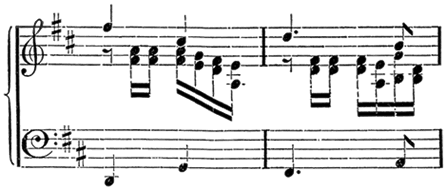 etc.
etc.


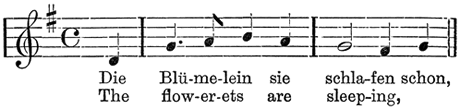
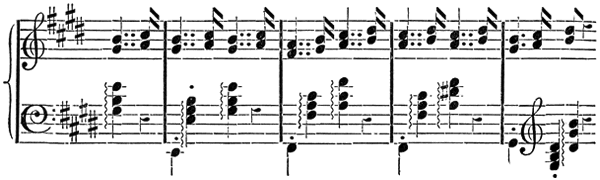 etc.
etc.