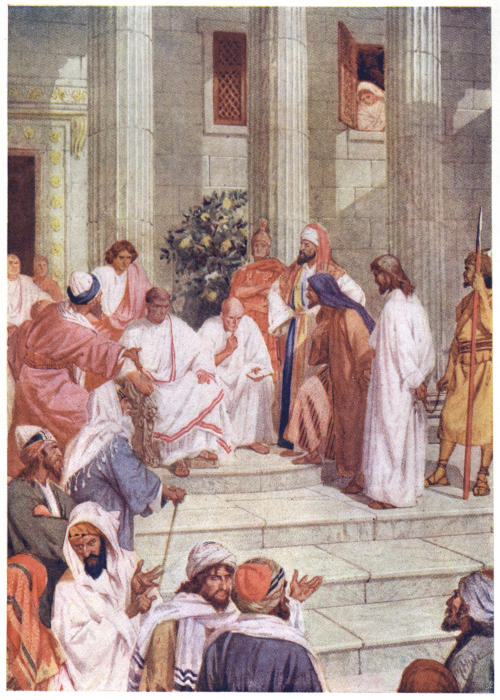
JESUS IN GETHSEMANE
In sailing across the ocean, if we attempt to
measure the depth of the water in different
places, we shall find that it varies very much.
There are hardly two places in which it is
exactly the same. In some places it is easy
enough to find the bottom. In others, it is
necessary to lengthen the line greatly before
it can be reached. And then there are other
places where the water is so deep that the
longest line ordinarily used cannot reach to
the bottom. We know that there is a bottom,
but it is very hard to get down to it.
And, in studying the history of our Saviour’s
life, we may compare ourselves to persons sailing
over the ocean. The things that he did,
and the words that he spoke, are like the water
over which we are sailing. And when we try to
understand the meaning of what Jesus said and
did, we are like the sailor out at sea who is
trying to fathom the water over which he is
sailing, and to find out how deep it is. And in
doing this we shall find the same difference
that he finds. Some of the things that Jesus
did and said are so plain and simple that a
child can understand them. These are like
those parts of the ocean where a very little line
will reach the bottom. Other things that Jesus
did and said require hard study, if we wish to
understand them. But then, there are other
parts of the sayings and doings of Jesus which
the best and wisest men, with all their learning
and study, cannot fully understand or explain.
These are like those places in the sea where
we cannot reach the bottom with our longest
lines.
We find our illustration of this in the garden
of Gethsemane. Some of the things that were
done and said there we can easily understand.
But other things are told us, of what Jesus
did and said there which are very hard to
explain.
In speaking about this part of our Saviour’s
life, there are two things for us to notice. These
are what we are told about Gethsemane, and
what we are taught by the things that took place
there. Or, a shorter way of stating it will be to
say that our subject now is—the facts—and the
lessons of Gethsemane.
Let us look now at the facts that are told us
about Gethsemane. It is a fact that there was
such a place as Gethsemane, near Jerusalem,
when Jesus was on earth, and that there is such
a place there now. It is a fact that Gethsemane
was a garden or orchard of olive trees then, and
so it is still. Everyone who goes to Jerusalem
is sure to visit this spot, because it is so sacred
to all Christian hearts on account of its connection
with our Saviour’s sufferings. The side
of the Mount of Olives on which Gethsemane
stands is dotted over with olive trees. A portion
of the hill has been enclosed with stone
walls. This is supposed to be the spot where
our Lord’s agony took place. Inside of these
walls are eight large olive trees. They are
gnarled and crooked, and very old. Some suppose
they are the very trees which stood there
when Jesus visited the spot, on the night in
which he was betrayed. But this is not likely.
For we know that when Titus, the Roman
general, was besieging Jerusalem, he cut down
all the trees that could be found near the city.
But the trees now there have probably sprung
from the roots of those that were growing in
Gethsemane on this very night.
It is a fact that after keeping the last Passover,
and observing, for the first time the Lord’s
Supper with his disciples, Jesus left Jerusalem
near midnight with the little band of his followers.
He went down the side of the hill on
which the city stood and crossed the brook
Kedron on the way to Gethsemane. It is a
fact that on going into the garden he left eight
of his disciples at the entrance. It is a fact
that he took with him the chosen, favored three,
Peter, James, and John, and went further into
the garden. It is a fact that then he “began to
be sorrowful and very heavy. Then saith he—my
soul is exceeding sorrowful, even unto
death.” It is a fact that he withdrew from the
three disciples, and, alone with God, he bowed
himself to the earth, and prayed, saying, “O,
my Father, if it be possible, let this cup pass
from me.” It is a fact that after offering this
earnest prayer he returned to his disciples and
found them asleep, and said to Peter, “What!
could ye not watch with me one hour? Watch
and pray, that ye enter not into temptation.”
It is a fact that he went away again, “and being
in an agony he prayed more earnestly, and his
sweat was, as it were, great drops of blood
falling down to the ground.” It is a fact that
in the depths of his agony, “there appeared
unto him an angel from heaven strengthening
him.” We are not told what the angel said to
him. No doubt he brought to him some tender,
loving words from his Father in heaven, to
comfort and encourage him. It is a fact that
he returned to his disciples again and found
them sleeping, for their eyes were heavy. It is
a fact that he went away again, and prayed,
saying, “O, my Father, if this cup may not pass
from me except I drink it, thy will be done.”
It is a fact that he returned the third time to
his disciples, and said—“Sleep on now, and
take your rest: behold the hour is at hand, and
the Son of Man is betrayed into the hands of
sinners. Rise, let us be going: behold he is at
hand that doth betray me.” And it is a fact
that, immediately after he had spoken these
words, the wretched Judas appeared with his
band to take him. These are the facts told us
by the evangelists respecting Jesus and his
agony in Gethsemane. They are very wonderful
facts, and the scene which they set before us
in our Saviour’s life is one of the most solemn
and awful that ever was witnessed.
And now, let us go on to speak of the lessons
taught us by these facts. These lessons are four.
The first lesson we learn from Gethsemane is a
lesson—about prayer.
As soon as this great trouble came upon our
blessed Lord in Gethsemane, we see him, at
once separating himself from his disciples, and
seeking the comfort and support of his Father’s
presence in prayer. And this was what he was
in the habit of doing. We remember how he
spent the night in prayer before engaging
in the important work of choosing his disciples.
And now, as soon as the burden of
this great sorrow comes crushing down upon
him, the first thing he does is to seek relief in
prayer.
The apostle Paul is speaking of this, when he
says, “he offered up prayers and supplications,
with strong crying and tears, unto him that was
able to save him from death, and was heard in
that he feared.” Heb. v: 7. This refers particularly
to what took place here in Gethsemane.
The earnestness which marked our Saviour’s
prayers on this occasion is especially mentioned.
He mingled tears with his prayers. It appears
from what the apostle here says, that there was
something connected with his approaching
death upon the cross that Jesus particularly
feared. We are not told what it was. And it
is not worth while for us to try and find it out,
for we cannot do it. But the prayer of Jesus,
was not in vain. “He was heard, in that he
feared.” No doubt this refers to what took
place when the angel came to strengthen him.
His prayer was not answered literally. He was
not actually saved from death; but he was saved
from what he feared in connection with death.
Our Lord’s experience, in this respect, was like
that of St. Paul when he prayed to be delivered
from the thorn in the flesh. The thorn was not
taken away, but grace was given him to bear it,
and that was better than having it taken away.
The promise is—“Cast thy burden upon the
Lord, and he shall sustain thee.” Ps. lv: 22.
And so, from the gloomy shades of Gethsemane,
with our Saviour’s agony and bloody sweat, there
comes to us a precious lesson about prayer. We
see Jesus praying under the sorrows that overwhelmed
him there: his prayer was heard, and
he was helped.
And thus, by the example of our blessed Lord,
we are taught, when we have any heavy burden
to bear, or any hard duty to do, to carry it to
the Lord in prayer.
Let us look at some examples from every day
life of the benefit that follows from prayer.
“Washington’s Prayer.” General Washington
was one of the best and greatest men that this
country, or any other, ever had. He was a man
of piety and prayer.
While he was a young man, he was appointed
by Governor Dinwiddie, of Virginia, to the
command of a body of troops, and sent on
some duty in the western part of that state. A
part of these troops was composed of friendly
Indians. There was no chaplain in that little
army, and so Washington used to act as chaplain
himself. He was in the habit of standing up,
in the presence of his men, with his head
uncovered, and reverently asking the God of
heaven to protect and bless them in the work
they were sent to do. And no doubt, the great
secret of Washington’s success in life, was his
habit of prayer. He occupied many positions
of honor and dignity during his useful life.
But, never did he occupy any position in which
he appeared so manly, so honorable, and so
truly noble, as when he stood forth, a young
man, in the presence of his little army, and tried
to lift up their thoughts to God above, as the
one “from whom all blessings flow.”
“Praying Better Than Stealing.” A poor family
lived near a wood wharf. The father of this
family got on very well while he kept sober;
but when he went to the tavern to spend his
evenings and his earnings, as he did sometimes,
then his poor family had to suffer. One winter,
during a cold spell of weather, he was taken
sick from a drunken frolic. Their wood was
nearly gone.
After dark one night, he called his oldest boy
John to his bedside, and whispered to him to
go to the wood wharf and bring an armful of
wood.
“I can’t do that,” said John.
“Can’t do it—why not?”
“Because that would be stealing, and since I
have been going to Sabbath-school, I’ve learned
that God’s commandment is, ‘Thou shalt not
steal.’”
“Well, and didn’t you learn that another of
God’s commandments is—‘Children, obey your
parents?’”
“Yes, father,” answered the boy.
“Well, then, mind and do what I tell you.”
Johnny was perplexed. He knew there must
be some way of answering his father, but he
did not know exactly how to do it. The right
thing would have been for him to say that,
when our parents tell us to do what is plainly
contrary to the command of God, we must obey
God rather than men. But Johnny had not
learned this yet. So he said:
“Father, please excuse me from stealing. I’ll
ask God to send us some wood. Praying’s
better than stealing. I’m pretty sure God will
send it. And if it don’t come before I come
home from school at noon to-morrow, I will go
and work for some, or beg some. I can work,
and I can beg, but I can’t steal.”
Then Johnny crept up into the loft where he
slept, and prayed to God about this matter. He
said the Lord’s prayer, which his teacher had
taught him. And after saying—“give us this
day our daily bread;” he added—“and please
Lord send us some wood too, and let father see
that praying is better than stealing—for Jesus’
sake. Amen.”
And at noon next day when he came home
from school, as he turned round the corner, and
came in sight of their home, what do you think
was the first thing he saw? Why, a load of
wood before their door! Yes, there it was.
His mother told him the overseers of the
poor had sent it. He did not know them. He
believed it was God who sent it. And he was
right.
The first lesson from Gethsemane is about
prayer.
The second lesson from this hallowed spot is—about
sin.
Here, in Gethsemane, we see Jesus engaged
in paying the price of our redemption: this
means, what he had to suffer for us before our
sins could be pardoned. The pains and sorrows
through which Jesus passed, in the agony of
the garden, and the death on the cross: the
sighs he heaved—the groans he uttered—the
tears he shed—the fears, the griefs, the unknown
sufferings that he bore—all these were
part of the price he had to pay, that we might
be saved from our sins.
When we read of all that Jesus endured in
Gethsemane: when we hear him say—“my soul
is exceeding sorrowful, even unto death:” when
we see him fall to the earth, in such an agony
that “his sweat was, as it were, great drops of
blood falling down to the ground:” we may
well ask the question—what was it which caused
him all this fearful suffering? And there is only
one way of answering this question; and this
is by saying that he was bearing the punishment
of our sins. There was nothing else that could
have made him feel so sad and sorrowful. But
this explains it all. Then, as the prophet says—“He
was wounded for our transgressions, he
was bruised for our iniquities;—and the Lord
had laid on him the iniquity of us all.” Is. liii:
5, 6. Our sins had provoked the wrath of God
against us, and Jesus was bearing that wrath for
us. In all the world, there is nothing that
shows so clearly what a fearful thing sin is, as
the awful sufferings of Jesus when he was paying
the price of our sins, or making atonement
for us. And it is by knowing what took place
in Gethsemane, and on Calvary, and only in this
way, that we can learn what a terrible evil sin
is, and how we are to be saved from it.
Some years ago, there was a good Christian
lady in England who had taken into her family
a deaf and dumb boy. She was anxious to teach
him the lesson of Gethsemane and Calvary;
that Christ had suffered and died for our sins.
Signs and pictures were the only means by
which she could teach him. So she drew a
picture of a great crowd of people, old and
young, standing near a deep, wide pit, out of
which smoke and flames were issuing, and into
which they were in danger of being driven.
Then she drew the figure of one who came
down from heaven, representing Jesus, the Son
of God. She explained to the boy that when
this person came, he asked God not to throw
those people into the pit, because he was willing
to suffer and to die for them, that the pit might
be shut up and the people saved.
The deaf and dumb boy wondered much:
and then made signs that the person who
offered to die was only one, while the guilty
ones who deserved to die were many. He did
not understand how God could be willing to
take one, in the place of so many. The lady
saw the difficulty that was in the boy’s mind.
Then she took a gold ring off from her finger,
and put it down by the side of a great heap of
withered leaves, from some faded flowers, and
then asked the boy, by signs, which was the
more valuable, the one gold ring, or the many
withered leaves? The boy took in the idea at
once. He clapped his hands with delight,
and then by signs exclaimed—“The one—the
golden one.” And then to show that he knew
what this meant, and that the life of Jesus was
worth more than the world of sinners for which
he died, he ran and got his letters, and spelled
the words—“Good! The golden one good!”
The deaf and dumb boy had learned two great
lessons that day. For one thing he had learned
this lesson about sin which we are trying to
learn from Gethsemane. He saw what a dreadful
thing sin is, when it was necessary for Jesus
to die before it could be pardoned. And then,
at the same time, he learned a lesson about
Jesus. He saw what a golden, glorious character
he is: that he is perfect man, and perfect God.
This made his blood so precious that the shedding
of that blood was a price sufficient to pay
for the sins of the whole world.
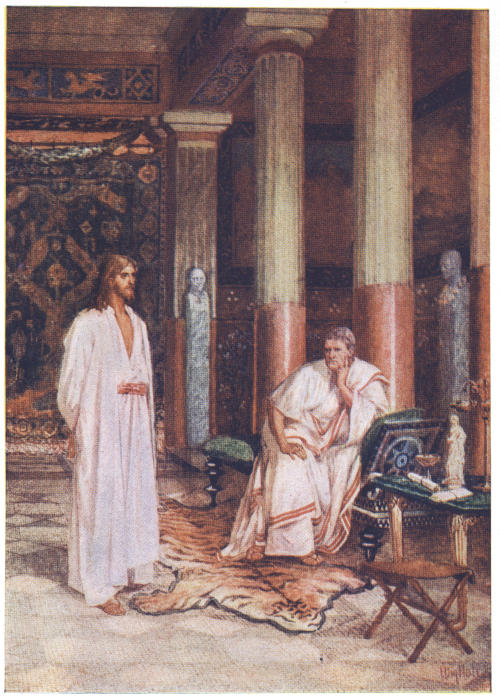
Jesus Privately Examined by Pilate
Then Pilate entered into the judgment hall again, and called Jesus,
and said unto him, Art thou the King of the Jews? Jesus answered
him, Sayest thou this thing of thyself, or did others tell it thee of
me? Pilate answered, Am I a Jew? Thine own nation and the
chief priests have delivered thee unto me: what hast thou done? Jesus
answered, My kingdom is not of this world: if my kingdom were of this
world, then would my servants fight, that I should not be delivered to
the Jews: but now is my kingdom not from hence. Pilate therefore
said unto him, Art thou a king then? Jesus answered, Thou sayest
that I am a king. To this end was I born, and for this cause came I
into the world, that I should bear witness unto the truth. Every one
that is of the truth heareth my voice. Pilate saith unto him, What is
truth?—St. John xviii: 33-38.
NOTE BY THE ARTIST
If Herod’s palace was built according to the customary Roman method,
the private examination of Jesus would naturally be conducted either in the
library, or in Pilate’s business room—apartments which usually occupied positions
on opposite sides of a short passage leading from the further extremity
of the spacious atrium to the inner halls and chambers of the palace. There
were six examinations of our Lord: (1) before Annas for fact; (2) before
Caiaphas for determinations; (3) before the Sanhedrim for official confirmation;
(4) before Pilate for preliminary enquiry; (5) before Herod Antipas as
Tetrarch of Galilee; (6) before Pilate for final acquittal or condemnation.
62
And now, let us see, for a moment, how
much good is done by telling to poor sinners
this story of Gethsemane and Calvary, and of
the sufferings of Jesus there. Here is an illustration
of the power of this story, for which we
are indebted to one of the Moravian Missionaries
in Greenland.
Kazainak was a robber chief, who lived among
“Greenland’s icy mountains.” He came, one
day to a hut, where the missionary was engaged
in translating into the language of that country
the gospel of St. John. He saw the missionary
writing and asked him what he was doing.
Pointing to the letters he had just written, he
said those marks were words, and that the book
from which they were written could speak. Kazainak
said he would like to hear what the book
had to say. The missionary took up the book,
and read from it the story of Christ’s crucifixion.
When he stopped reading the chief asked:
“What had this man done, that he was put
to death? had he robbed any one? or murdered
any one? had he done wrong to any one? Why
did he die?”
“No,” said the missionary. “He had robbed
no one; he had murdered no one; he had done
no wrong to any one.”
“Then, why did he die?”
“Listen,” said the missionary. “Jesus had
done no wrong; but Kazainak has done wrong.
Jesus had robbed no one; but Kazainak has
robbed many. Jesus had murdered no one; but
Kazainak has murdered his brother; Kazainak
has murdered his child. Jesus suffered that
Kazainak might not suffer; Jesus died that
Kazainak might not die.”
“Tell me that again,” said the astonished
chief. It was told him again, and the end of it
was that the hard-hearted, blood-stained murderer
became a gentle, loving Christian. He
never knew what sin was till he heard of
Christ’s sufferings for it.
The second lesson we learn from Gethsemane
is—the lesson about sin.
The third lesson from Gethsemane is the lesson
about submission.
Jesus taught us in the Lord’s prayer to say,
“Thy will be done on earth, as it is in heaven.”
And this is one of the most important lessons
we ever have to learn. It is very easy to say
these words—“Thy will be done;” but it is not
so easy to feel them, and to be and do just what
they teach. The will of God is always right,
and good, and holy. Everything opposed to
his will is sinful. St. Paul tells us that—“sin is
the transgression of the law.” To transgress a
law, means to walk over it, or to break it. But
the law of God is only his will made known.
And so, everything that we think, or feel, or
say, or do, contrary to the will of God—is sin.
And when we remember this it should make us
very anxious to learn the lesson of submission
to the will of God. If we could all learn to do
the will of God as the angels do, it would make
our earth like heaven. And this is one reason
why Jesus was so earnest in teaching us this
lesson. He not only preached submission to
the will of God, but practised it. When he
entered Gethsemane, he compared the dreadful
sufferings before him to a cup, filled with something
very bitter, which he was asked to drink.
Now, no person, however good or holy he may
be, likes to endure dreadful sufferings. It is
natural for us to shrink back from suffering,
and to try to get away from it. And this was
just the way that Jesus felt. He did not love
suffering any more than you or I do. And so,
when he prayed the first time in Gethsemane,
with those terrible sufferings immediately before
him, his prayer was—“Father, if it be possible,
let this cup pass from me.” But the cup did
not pass away. It was held before him still.
He saw it was his Father’s will for him to drink
it. So, when he prayed the second time, his
words were—“O, my Father, if this cup may
not pass from me, except I drink it: thy will
be done!” This was the most beautiful example
of submission to the will of God the world has
ever seen.
When Adam was in the garden of Eden he
refused to submit to the will of God. He said,
by his conduct, “Not thy will, but mine be
done:” and that brought the curse upon the
earth, and filled it with sorrow and death.
When Jesus was in the garden of Gethsemane,
he submitted to the will of God. He said, “Not
my will, but thine, be done.” This took away
the curse which Adam brought upon the earth,
and left a blessing in the place of it—even life,
and peace, and salvation.
We ought to learn submission to the will of
God, because he knows what is best for us.
“The Curse of the Granted Prayer.” A
widowed mother had an only child—a darling
boy. Her heart was wrapped up in him. At
one time he was taken very ill. The doctor
thought he would die. She prayed earnestly
that his life might be spared. But she did not
pray in submission to the will of God. She said
she did not want to live unless her child was
spared to her. He was spared. But, he grew
up to be a selfish, disobedient boy. One day,
in a fit of passion, he struck his mother. That
almost broke her heart. He became worse and
worse; and, at last, in a drunken quarrel, he
killed one of his companions. He was taken to
prison; was tried—condemned to be hanged—and
ended his life on the gallows. That quite
broke his mother’s heart.
Now God, in his goodness, was going to save
that mother from all this bitter sorrow. And
would have done so if she had only learned
to say—“Thy will be done.” She would not
say that. The consequence was that she brought
on herself all that heart-breaking sorrow.
And then we ought to learn submission to
the will of God—because, whatever he takes away
from us—he leaves us so many blessings still!
Here is a good illustration of this part of our
subject. Some years ago, in a town in New
England, there was a minister of the gospel
who was greatly interested in his work. But
he was attacked with bleeding of the lungs and
was obliged to stop preaching and resign the
charge of his church. About the same time his
only child was laid in the grave; his wife, for a
time, lost the use of her eyes; his home was
broken up, and his prospects were very dark.
They had been obliged to sell their furniture
and take boarding at a tavern in the town where
they lived. But, under all these trials, he was
resigned and cheerful. He felt the supporting
power of that precious gospel which he had so
loved to preach. His wife had not felt as contented
and cheerful under their trials as he was.
One day, as he came in from a walk, she said
to him: “Husband dear, I have been thinking
of our situation here, and have made up my
mind to try and be patient and submissive to
the will of God.”
“Ah,” said he, “that’s a good resolution. I’m
very glad to hear it. Now, let us see what we
have to submit to. I will make a list of our
trials. Well, in the first place, we have a comfortable
home; we’ll submit to that. Secondly,
we have many of the blessings of life left to us;
we’ll submit to that. Thirdly, we are spared to
each other; we’ll submit to that. Fourthly, we
have a multitude of kind friends; we’ll submit
to that. Fifthly, we have a loving God, and
Saviour, who has promised to take care of us,
and ‘make all things work together for our
good;’ we’ll submit to that.”
This was a view of their case which his wife
had not taken. And so by the time her husband
had got through with his fifthly, her heart was
filled with gratitude, her eyes with tears, and
she exclaimed: “Stop, stop; please stop, my dear
husband; and I’ll never say another word about
submission.”
The lesson of submission is the third lesson
that we are taught in Gethsemane.
The last lesson for us to learn from this solemn
scene in our Saviour’s life is a lesson—about
tenderness.
Jesus taught us this when he came back, again
and again, from his lonely struggles with the
sufferings he was passing through, and found
his disciples asleep. It seemed very selfish and
unfeeling in them to show no more sympathy
with their Master in the time of his greatest
need. He had told them how full of sorrow he
was, and had asked them to watch with him.
Now, we should have supposed that, under such
circumstances, they would have found it impossible
to sleep. They ought to have been
weeping with him in his sorrow, and uniting in
prayer to God to help and comfort him. But,
instead of this, while he was bearing all the
agony and bloody sweat which was caused
him by their sins, they were fast asleep! If
Jesus had rebuked them sharply for their want
of feeling, it would not have been surprising.
But, he did nothing of the kind. He only
asked, in his own quiet, gentle way—“could
ye not watch with me one hour?” And
then he kindly excused them for their fault,
saying—“The spirit indeed is willing, but
the flesh is weak!” How tender and loving
this was! Here we have the lesson of tenderness
that comes to us from Gethsemane.
We see here, beautifully illustrated, the gentle,
loving spirit of our blessed Saviour. And
the exhortation of the apostle, is—“Let this
mind be in you, which was also in Christ
Jesus.” Phil. ii: 5.
Someone has well said, that “the rule for us
to walk by, if we are true Christians, is, when
any one injures us, to forget one half of it, and
forgive the rest.” This is the very spirit of our
Master. This was the way in which he acted
towards his erring disciples in Gethsemane.
And, if all who bear the name of Christ were
only trying to follow his example, in this
respect, who can tell how much good would
be done?
Here are some beautiful illustrations of this
lesson of tenderness and forbearance which
Jesus taught us in Gethsemane.
“The Influence of This Spirit in a Christian
Woman.” A parish visitor had a district to
attend to which contained some of the worst
families in town. There was a sick child in
one of those families. The visitor called on her
every day. The grandfather of this child was a
wicked, hardened man, who hated religion and
everything connected with it. He had a big
dog that was about as savage as he was himself.
Every day, when he saw this Christian woman
coming to visit the sick child, he would let
loose the dog on her. The dog flew at her,
and caught hold of her dress. But she was a
brave woman, and stood her ground nobly. A
few kind words spoken to the dog took away
all his fierceness. She continued her visits, day
after day, bringing to the poor child such nice
things as she needed. At first the dog was set
upon her every day; but as she went on in her
kind and gentle way, the old man began to feel
ashamed of himself; and before a week was
over, when he saw this faithful Christian woman
coming to the suffering little one, instead of
letting loose the dog upon her, he would take
his pipe out of his mouth with one hand and
lift the cap from his head with the other, and
make a polite bow to her, saying, “Good morning,
ma’am: werry glad to see you.”
And so the spirit of Christ, as practised by
that good woman, won the way for the gospel
into that home of sin and misery, and it brought
a blessing with it, as it always does.
“The Spirit of Christ in a Little Girl.” “Sitting
in school one day,” says a teacher, “I overheard
a conversation between a little girl and
her brother. He was complaining of various
wrongs that had been done to him by another
little boy belonging to the school. His face
grew red with anger, and he became very much
excited in telling of all that this boy had done
to him. He was going on to say how he intended
to pay him back, when his sister interrupted
him by saying, ‘Brother, please don’t
talk any more in that way. Remember that
Charley has no mother.’
“Her brother’s lips were closed at once. This
gentle rebuke from his sister went straight to
his heart. He walked quietly away, saying to
himself—‘I never thought of that.’ He remembered
his own sweet home and the teaching of
his loving mother; and the question came up
to him—‘What should I be if I had no mother?’
He thought how lonely Charley must feel, and
how hard it must be for him to do right without
a mother. This took away all his anger. And
he made up his mind to be kind and forbearing
to poor Charley, and to try to do him all the
good he could. This little girl was following
the example of Christ, and we see what a good
effect it had upon her brother.”
“A Boy with the Spirit of Christ.” Two boys—Bob
Jones and Ben Christie—were left alone
in a country school-house between the morning
and afternoon sessions. Contrary to the
master’s express orders Bob Jones set off some
fireworks. When afternoon school began, the
master called up the two boys, to find out who
had done the mischief.
“Bob, did you set off those fireworks?”
“No, sir,” said Bob.
“Did you do it, Ben?” was the next question.
But Ben refused to answer; and so the master
flogged him severely for his obstinacy.
At the afternoon recess the boys were alone
together. “Ben, why didn’t you deny it?”
asked his companion.
“Because there were only us two there, and
one of us must have lied,” said Ben.
“Then why didn’t you say I did it?”
“Because you had said you didn’t, and I
would rather take the flogging than fasten the
lie on you.”
Bob’s heart melted under this. Ben’s noble
spirit quite overcame him. He felt that he
never could allow his companion to lie under
the charge of the wrong that he had done.
As soon as the school began again, Bob
marched up to the master’s desk, and said:
“Please, sir, I can’t bear to be a liar. Ben
Christie didn’t set off these fire-crackers. I did
it, and he took the flogging rather than charge
me with the lie.” And then Bob burst into
tears.
The master looked at him in surprise. He
thought of the unjust punishment Ben had
received, his conscience smote him, and his
eyes filled with tears. Taking hold of Bob’s
hand, they walked to Ben Christie’s seat; then
the master said aloud:
“Ben, Ben, my lad, Bob and I have done you
wrong; we both ask your pardon!”
The school was hushed and still as the grave.
You might almost have heard Ben’s big-boy
tears dropping on his book. But, in a moment,
dashing the tears away, he cried out—“Three
cheers for the master.” They gave three cheers.
And then Bob Jones added—“And now three
cheers for Ben Christie”—and they made the
school-house ring again with three rousing
cheers for Ben.
Ben Christie was acting in the spirit of Christ
in what he did that day. And in doing so he did
good to his companion, Bob Jones. He did good
to the master, and to every scholar in the school.
And there is no way in which we can do so
much real good to all about us as by trying to
catch the spirit and follow the example of our
blessed Saviour.
And so, when we think of Jesus in Gethsemane,
let us never forget the facts and the
lessons connected with that sacred place. The
facts are too many to be repeated. The lessons
are four. There is the lesson about prayer; the
lesson about sin; the lesson about submission;
and the lesson about tenderness.
And, as we leave this solemn subject, we may
each of us say, in the words of the hymn:
“Can I Gethsemane forget?
Or there thy conflict see,
Thine agony and bloody sweat,
And not remember thee?
“Remember thee, and all thy pains,
And all thy love to me;
Yes, while a breath, a pulse remains,
Will I remember thee.
“And when these failing lips grow dumb,
And mind, and memory flee,
When thou shalt in thy kingdom come,
Jesus, remember me.”
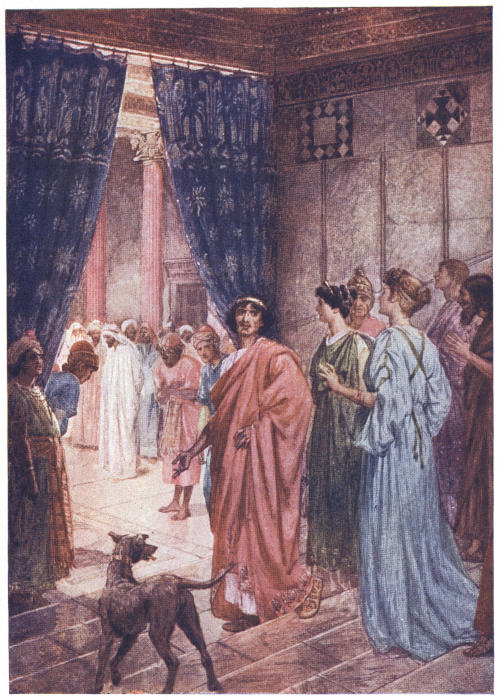
Herod Expecteth to be Amused
Then said Pilate to the chief priests and to the people, I find no
fault in this man. And they were the more fierce, saying, He stirreth
up the people, teaching throughout all Jewry, beginning from Galilee
to this place. When Pilate heard of Galilee, he asked whether the
man were a Galilæan. And as soon as he knew that he belonged unto
Herod’s jurisdiction, he sent him to Herod, who himself also was at
Jerusalem at that time. And when Herod saw Jesus, he was exceeding
glad: for he was desirous to see him of a long season, because he had
heard many things of him; and he hoped to have seen some miracle
done by him. Then he questioned with him in many words; but he
answered him nothing. And the chief priests and scribes stood and
vehemently accused him. And Herod with his men of war set him at
nought, and mocked him, and arrayed him in a gorgeous robe, and sent
him again to Pilate.—St. Luke xxiii: 4-11.
NOTE BY THE ARTIST
While in residence in Jerusalem, Herod Antipas occupied the ancient
palace of the Hasmonæan kings, situated on the western hill, not far from
that built by Herod the Great. A weak, cruel sensualist, Antipas, like other
princelings of his family, affected the dress and manners and the refined
luxury of the Greeks. Blasé and wearied doubtless with the monotonous
pleasures of the dissolute court, he welcomed the excitement promised by the
appearance of Jesus at his judgment-seat, anticipating that the prisoner
would thankfully purchase his life at the cost of amusing him and his
courtiers by some display of the magical power with the possession of which
rumor had credited him. Herod was devoted to hunting and had special
hunting grounds near the Lake of Gennesaret, so a favorite hound is appropriately
introduced.
63
THE BETRAYAL AND DESERTION
One of the darkest chapters in the history
of our Saviour’s life is this now before
us. Here we see him betrayed into the hands
of his enemies by one of his disciples and deserted
by all the rest.
In studying this subject, we may look at the
history of the betrayal and desertion, and then
consider some of the lessons that it teaches.
The man who committed this awful crime
was Judas Iscariot. He was one of the twelve
whom Jesus chose, in the early part of his ministry,
to be with him, all the time, to see all the
mighty works that he did, and to hear all that
he said in private as well as in public. He is
called Judas Iscariot, to distinguish him from
another of the disciples of the same name, viz.,
Judas, the brother of James. Different explanations
have been given of the meaning of this
name Iscariot. The most likely is, that it was
used to denote the place of his birth. If this be
so, then it was written at first, Judas-Ish-Kerioth—which
means a man of Kerioth. And then
this would show us that he belonged to a town
in the southern part of Judah, called Kerioth.
We know nothing about Judas before we
hear him spoken of as one of the twelve apostles.
In the different lists of the names of the
apostles, he is always mentioned last, because of
the dreadful sin which he finally committed.
When his name is mentioned he is generally
spoken of as “the traitor”—or as the man
“which also betrayed him.” Jesus knew, of
course, from the beginning, what kind of a man
Judas was, and what he would do in the end.
But, we have no reason to suppose that Judas
himself had any idea of committing this horrible
crime when he first became an apostle; or
that the other apostles ever had the least suspicion
of him. There can be no doubt that he
took part with the other apostles when Jesus
sent them before his face to “preach the gospel
of the kingdom,” and to perform “many mighty
works.” Yes, Judas, who afterwards betrayed
his Master, preached the gospel and performed
miracles in the name of Jesus. His fellow-disciples,
so far from suspecting any harm of
him, made him the treasurer of their little
company, and let him “have the bag” and
manage their money affairs. And this, may
have been the very thing that ruined him.
The first time that we see anything wrong in
Judas is at the supper given to our Lord at
Bethany. We read about this in St. John 12:
1-9. On this occasion, Mary, the sister of Lazarus,
brought a very precious box of ointment,
and anointed the feet of Jesus with it. Judas
thought this ointment was wasted, and asked
why it had not been sold for three hundred
pence, and given to the poor. This would be
about forty-five or fifty dollars of our money.
It is added—“This he said, not because he cared
for the poor; but because he was a thief, and
had the bag, and bore what was put therein.”
None of his disciples suspected Judas of being a
thief at this time. These words were added,
long after the death of Judas, when his true
character was well known.
But, when Jesus rebuked Judas for finding
fault with Mary, and praised her highly for
what she had done, he was greatly offended.
And then, it seems, he first made up his mind
to do that terrible deed which has left so deep
and dreadful a stain upon his memory. For we
read—St. Matt. xxvi: 14-16—“Then one of the
twelve, called Judas Iscariot, went unto the
chief priests and said unto them, What will ye
give me, and I will deliver him unto you? And
they covenanted with him for thirty pieces of
silver. And from that time he sought opportunity
to betray him.” The paltry sum for
which Judas agreed to betray his Master was
about fifteen dollars of our money—the price of
a common slave.
Very soon after this Jesus met his disciples in
that upper chamber of Jerusalem, to eat the
Passover together for the last time. And Judas
came with them. How could the wretched
man venture into the presence of Jesus, when
he had already agreed to betray him?
But Jesus knew all about it. How startled
Judas must have been when he heard Jesus
say before them all—“One of you shall betray
me.” It is probable that Jesus said this to
drive Judas out from his presence, for it must
have been very painful to him to have him
there. And, after Jesus had given the sop to
Judas, to show by this that he knew who the
traitor was, we read that—“Satan entered into
him. Then Jesus said unto him, That thou
doest do quickly.” Then he “went immediately
out;” and hastened to the chief priests to
make arrangements for delivering Jesus unto
them.
It is clear, I think, from this that Judas was
not present while Jesus was instituting the
Lord’s Supper. It must have been a wonderful
relief to Jesus when Judas left their little company.
And we are not surprised to find it written—“When
he was gone out Jesus said, Now
is the Son of man glorified, and God is glorified
in him,” St. John xiii: 31. Then followed
the Lord’s Supper; and the glorious things
spoken of in the 14th, 15th, and 16th chapters
of St. John, and the great prayer in the 17th
chapter. After this came the agony in the
garden of Gethsemane.
Just as this was over, Judas appeared with the
band of soldiers and servants of the chief priests
“with lanterns, and torches, and weapons.”
Jesus went forth to meet them, and asked whom
they were seeking. They answered, “Jesus of
Nazareth. Jesus saith unto them, I am he. As
soon as he had said unto them I am he, they
went backward and fell to the ground.” Then
Judas came to Jesus according to the signal he
had given them, and said, Hail, Master, and
kissed him. But Jesus said unto him, Judas,
betrayest thou the Son of man with a kiss?
Then Peter drew his sword to defend his Master,
and struck a servant of the high-priest, and cut
off his right ear. Jesus touched the ear, and
healed it; and told Peter to put up his sword.
Then they came to Jesus and bound him, and
led him away to the high-priest; and it is added:
“Then all the disciples forsook him and fled.”
He was betrayed by one of his own disciples
and forsaken by all the rest.
Nothing is said about Judas during the time
of the trial of Jesus. Some suppose that he expected
our Lord would deliver himself out of
the hands of his enemies. We have no authority
for thinking so. But, when he found, at last,
that Jesus was condemned and was really to be
put to death, his conscience smote him for
what he had done. He brought back the thirty
pieces of silver—the beggarly price he had received
for betraying his Master—and threw
them down at the feet of the chief priests, saying—“I
have sinned, in that I have betrayed
the innocent blood. And they said—What is
that to us? See thou to that. And he went
and hanged himself.”
This was the end of the wretched man, so
far as this world is concerned. And such is
the history of the betrayal and desertion of
Jesus.
We might refer to many lessons taught us by
this sad history, but we shall speak of only four.
Two of these relate to Jesus, and two of them
to Judas.
One of the lessons about Jesus, taught us here,
refers to—the loneliness of his sufferings.
We all know how natural it is, when we are in
trouble, to desire to have one near who loves us.
The very first thing a child does when worried
about anything is to run to its mother and throw
itself into her loving arms. It would almost break
the child’s heart if it could not have its mother’s
presence and gentle sympathy at such a time.
And it is the same when we grow older. We
naturally seek the company of our dearest
friends in times of trouble. And it adds greatly
to our suffering if we cannot have those we
love near us when we are in sorrow. But, in
the history of our Saviour’s betrayal and desertion,
we see how it was with him. In the midst
of his great trouble, when the wrath of God,
occasioned by our sins, was pressing heavily
upon him, he was betrayed into the hands of
his enemies by one of the little band of his
own chosen followers. How much this must
have added to his sorrow! And if the rest of
his apostles had only stood by him faithfully,
as they had promised to do, during that night
of sorrow, it would have been some comfort to
him. But they did not. As soon as they saw
the traitor Judas deliver him into the hands of
his enemies, we read these sad, and melancholy
words, “Then all the disciples forsook him, and
fled!” How hard this must have been for
Jesus to bear! The cup of his sorrows was full
before; this must have made it overflow. He
knew it was coming. For, not long before, he
had told them that “the hour was coming,
when they would be scattered, and leave him
alone.” This shows how deeply he felt, and
feared this loneliness. Seven hundred years
before he came into our world, the prophet
Isaiah represented him as saying—“I have trodden
the wine-press alone,” chap. lxiii: 3. And
this was what he was doing now. In the midst
of the multitudes he came to save he was left—alone.
There was not an earthly friend to stand
by him—to speak a kind word to him—or to
show him any sympathy in this time of his
greatest sorrow. The only comfort left to him
was the thought that his Father in heaven had
not forgotten him.
When he spoke of his disciples leaving him
alone, he said, “And yet, I am not alone, because
the Father is with me.” St. John xvi: 32.
Jesus never forgets how lonely he felt at this
time; and he loves to come near and comfort
us when we are left alone. We should always
remember at such times how well able he is to
help and comfort us.
Here are some simple illustrations of the
blessing which those find who look to Jesus in
their loneliness.
An aged Christian was carried to a consumptives’
hospital to die. He had no relation or
friend to be near him except the nurse and the
doctor. Yet he always seemed bright and happy.
The doctor, in talking with him one day, asked
him how it was that he could be so resigned and
cheerful? His reply was—“When I am able to
think, I think of Jesus; and when I am not able
to think of him, I know he is thinking of me.”
And this was just the way King David felt
when he said, “I am poor and needy; yet the
Lord thinketh upon me.”
“Not Alone.” Little Bessie was sitting on
the piazza. The nurse came in and found her
there. “Ah! Bessie dear, all alone in the dark,”
said the nurse, “and yet not afraid?”
“No, indeed,” said little Bessie, “for I am not
all alone. God is here. I look up and see the
stars, and God seems to be looking down at me
with his bright eyes.”
“To be sure,” said the nurse, “but God is up
in the sky, and that is a great way off.”
“No,” said Bessie; “God is here too; sometimes
He seems to be clasping me in his arms,
and then I feel so happy.”
“The Help of Feeling Jesus Near.” There
was a poor man in a hospital. He was just
about to undergo a painful and dangerous
operation. They laid him out ready, and the
doctors were about to begin, when he asked
them to wait a moment. “What shall we wait
for?” was the inquiry of one of the doctors.
“Oh, wait a moment,” said he, “till I ask the
Lord Jesus Christ to stand by my side. I know
it will be dreadful hard to bear; but it will be
such a comfort to think that Jesus is near me.”
One thing we are taught by the betrayal and
desertion of Christ, is the loneliness of his
sufferings.
Another thing, taught us by this part of our
Saviour’s history is—his willingness to suffer.
We often make up our minds to suffer certain
things, because we have no power to help it.
But it was not so with Jesus. He had power
enough to have saved himself from suffering,
if he had chosen to do so. Sometime before
this, when he was speaking to his disciples
about his death, or, as he called it, laying down
his life, he said—“No man taketh it from me,
but I lay it down of myself. I have power to
lay it down, and I have power to take it again.”
John x: 18. And he showed plainly what his
power was at the very time of his betrayal.
When his enemies came to take him, he “went
forth, and said unto them, Whom seek ye?
They answered him, Jesus of Nazareth. Jesus
saith unto them, I am he.” John xviii: 4. But
he put such wonderful power into these simple
words—“I am he”—that, the moment they
heard them, the whole multitude, soldiers, servants,
and all, fell to the ground before him.
It was nothing but the power of Jesus which
produced this strange effect. It seems as if
Jesus did this, on purpose to show that the
mighty power by which he had healed the sick,
and raised the dead, and cast out devils, and
walked on the water, and controlled the stormy
winds and waves, was in him still. He was not
taken by his enemies because he had no power
to help himself. The same power which made
his enemies fall to the ground with a word
could have held them there while he walked
away; or could have scattered them, as the chaff
is scattered by the whirlwind; or could have
made the earth open and swallow them up.
But he did not choose to exercise it in any of
these ways. He was willing to suffer for us;
and so he allowed himself to be taken.
As the Jews were seizing him Peter drew his
sword, and smote one of the servants of the
high-priest, and cut off his right ear. Jesus
touched the ear, and healed it, in a moment,
thus showing again what power he had. Then
he told Peter to put up his sword, and said—“Thinkest
thou that I cannot now pray to my
Father, and he shall presently give me more
than twelve legions of angels?” St. Matt. xxvi:
53. A full Roman legion contained six thousand
men. Jesus had power enough in his own
arm to keep himself from being taken, if he
had chosen to use it. And more than seventy
thousand angels would have flown with lightning
speed to his deliverance, if he had but
lifted his finger; or said—“come.” There was
so much power in himself, and so much power
in heaven, at his command, that all the soldiers
Rome ever had could not have taken him,
unless he had been willing to be taken. But
he was willing. And when they came to crucify
him, all the nails ever made could not
have fastened him to the cross, unless he had
been willing to be fastened there. But his
wonderful love for you and for me and for a
world of lost sinners, made him willing to be
fastened there, to suffer and to die, that our
sins might be pardoned and that we might
enter heaven.
And it is the thought of this amazing love of
Christ, making him willing to suffer for us,
which gives to the story of the cross the marvellous
power it has to melt the hardest hearts
and win the worst of men to his service. There
is a power in love to do what nothing else can
do,—to make men good and holy. And this is
what we are taught when told that—“Christ
suffered for sins, the just for the unjust, that he
might bring us to God.” I. Peter iii: 18. And
when we find people acting in this way towards
each other in everyday life it has just
the same effect. Here is an illustration of what
I mean. We may call it:
“The Power of Love; or, The Just for the
Unjust.” In a town near Paris, is a school for
teaching poor homeless boys who are found
wandering about the streets of that city and are
growing up in idleness and crime.
When one of the boys breaks the rules of the
school and deserves punishment, the rest of the
school are called together, like a jury, to decide
what shall be done with the offender. One of
the punishments is confinement for several days
in a dungeon, called “the black-hole.” The prisoner
is put on a short allowance of food, and, of
course, forfeits all the liberties of the other boys.
After the boys have, in this way, passed sentence
on one of their companions and the
master approves of it, this question is put to the
rest of the school:—“Will any of you become
this boy’s substitute? i. e., take his place, and
bear his punishment, and let him go free?”
And it generally happens that some little friend
of the criminal comes forward and offers to
bear the punishment instead of him. Then the
only punishment the real offender has to bear
is to carry the bread and water to his friend as
long as he is confined in the dungeon. In this
way, it generally happens that the most stubborn
and hard-hearted boys are melted down,
by seeing their companions willingly suffering
for them what they know they deserved to
suffer themselves.
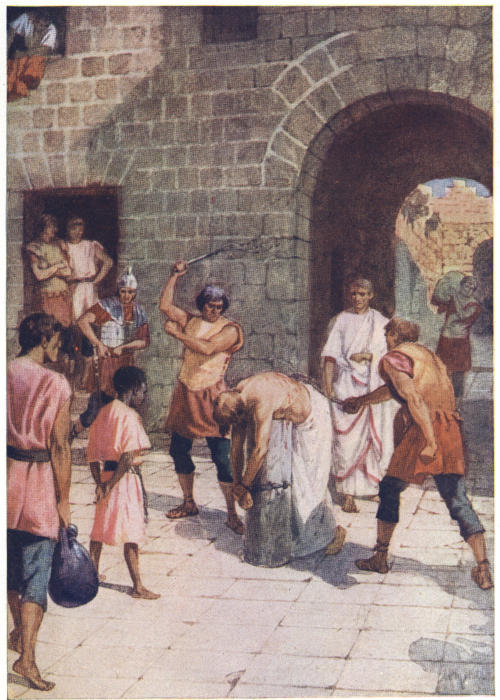
Jesus is Scourged
And Pilate, when he had called together the chief priests and the
rulers and the people, said unto them, Ye have brought this man unto
me, as one that perverteth the people: and, behold, I, having examined
him before you, have found no fault in this man touching those things
whereof ye accuse him. No, nor yet Herod: for I sent you to him;
and, lo, nothing worthy of death is done unto him. I will therefore
chastise him, and release him. (For of necessity he must release one
unto them at the feast.) And they cried out all at once, saying, Away
with this man, and release unto us Barabbas. (Who for a certain
sedition made in the city, and for murder, was cast into prison.)—Then
Pilate therefore took Jesus, and scourged him.—St. Luke xxiii: 13-19;
St. John xix: 1.
NOTE BY THE ARTIST
In endeavoring to apprehend, however imperfectly, the sufferings endured
by Jesus during this terrible day, there may be a tendency to under-estimate
the significance of one detail which is only incidentally mentioned by the evangelists,
namely, the punishment of scourging. But this was nevertheless so
barbarously cruel, that the mind recoils in horror from the effort to realize
the awful agony which it entailed. Bound in a crouching attitude to the
pillar of torment, the quivering flesh lacerated by the fragments of bone and
metal intertwisted with the thongs, few of its victims, save such as were in
perfect physical health, were able to survive the infliction of the scourge, but
perished either then and there, or shortly afterwards, from nervous shock or
from mortification of the wounds. Yet it was a punishment so common, such
an everyday occurrence, that the scourging of one more malefactor—Jesus by
name—the justice or injustice of whose sentence they neither knew nor cared
to know, would be regarded with utter indifference by the brutal soldiery
charged with its infliction.
64
Not long ago, a boy about nine or ten years
old, named Pierre, was received into this school.
He was a boy whose temper and conduct were
so bad that he had been dismissed from several
schools. He behaved pretty well at first; but
soon his bad temper broke out, and one day he
quarrelled with a boy about his own age, named
Louis, and stabbed him in the breast with a
knife.
Louis was carried bleeding to his bed. His
wound was painful, but not dangerous. The
boys were assembled, to consult about what
was to be done with Pierre. Louis was a great
favorite with the boys, and they all agreed at
once that Pierre should be turned out of the
school and never allowed to come back.
This was a very natural sentence under the
circumstances, but the master thought it was
not a wise one. He said that if Pierre was
turned out of school, he would grow worse and
worse, and probably end his life on the gallows.
He asked them to think again. They then
agreed upon a long imprisonment, without
saying how long it was to be. They were asked
as usual, if any one was willing to go to prison
instead of Pierre. But no one offered and he
was marched off to prison.
After some days, when the boys were all together,
the master asked again if any one was
willing to take Pierre’s place. A feeble voice
was heard, saying—“I will.” To the surprise of
every one this proved to be Louis—the wounded
boy, who was just getting over the effect of his
wound.
Louis went to the dungeon and took the
place of the boy who had tried to kill him;
while Pierre was set at liberty. For many days
he went to the prison carrying the bread and
water to Louis, but with a feeling of pride and
anger in his heart.
But at last he could bear it no longer. The
sight of his kind-hearted, generous friend, still
pale and feeble from the effects of his wound,
pining in prison—living on bread and water—and
willingly suffering all this for him—who
had tried to murder him—this was more than
he could bear. His fierce temper and stubborn
pride broke down under it. The generous love
of Louis had fairly conquered him. He went
to the master, fell down at his feet, and with
bitter tears confessed his fault, begged to be forgiven,
and promised to be a good boy.
He kept his promise, and became one of the
best boys in the school.
And so it is the love of Christ in being willing
to suffer for us that wins the hearts and lives of
men to him, and gives to the story of the cross
all its power.
The willingness of Christ to suffer is the
second thing taught us by the history of the
betrayal and desertion.
These are the two things taught us about
Jesus by this history: his loneliness in suffering,
and his willingness to suffer.
But, there are two things taught us about
Judas, also, by this history.
One of these is—the power of sin.
The sin of Judas was covetousness, or “the
love of money.” The apostle Paul tells us that
this—“is the root of all evil.” I. Tim. vi: 10.
The little company of the apostles made Judas
their treasurer. He carried the purse for them.
He received the money that was contributed for
their expenses, and paid out what was needed
from day to day. We may suppose that, soon
after his appointment to this office, he found
himself tempted to take some of this money
for his own use. Perhaps he only took a penny
or two, at first, but then he soon went on to
take more. Now, if he had watched and striven
against this temptation, at the very first, and
had prayed for strength to resist it, what a different
man he might have been! There is an
old proverb which says—“Resist the beginnings.”
Our only safety is in doing this. Judas
neglected to resist the beginning of his temptation
and the end of it was his ruin. We never
can tell what may come out of one sin that is
not resisted.
If you want to sink a ship at sea, it is not
necessary to make half a dozen big holes in her
side; one little hole, which you might stop
with your finger, if left alone, will be enough
to sink that ship. Judas gave himself up to the
power of one sin, and that led him on to betray
his Master.
Let us look at some illustrations of the power
of one sin.
“Clara’s Obstinacy.” Little Clara Cole was
saying her prayers one evening before going to
bed. Part of her evening prayer was the simple
hymn—“And now I lay me down to sleep.”
When she came to the last line she stopped
short and would not say it. “Go on, my dear,
and finish it,” said her mother. “I can’t,” she
said, although she knew it perfectly well, and
had said it hundreds of times before. “Oh,
yes! go right on, my child.”
“No; I can’t.” “My dear child, what makes
you talk so? Say the last line directly.”
But, in spite of her mother’s positive commands
and loving entreaties, Clara was obstinate,
and would not do it. “Very well,” said
Mrs. Cole at last: “you can get into bed; but
you will not get up till you have said that line.”
Next morning Mrs. Cole went into Clara’s
room as soon as she heard her stir. “Now,
Clara,” she said pleasantly, “say the line, and
jump up.”
“I can’t say it,” said Clara, obstinately, and
she actually lay in bed all that day, and part of
the next rather than give up. The second day
was her birthday and a number of little girls
had been invited, in the evening, to her birthday
party. That little, strong, cruel will of hers
held out till three o’clock; then she said, “I
pray the Lord my soul to take,” and bursting
into tears asked her mother’s forgiveness.
How much power there was in that one sin!
No one can tell what trouble it might have
caused that poor child if she had not been
taught to conquer it. But after that it never
gave her much trouble.
“One Drop of Evil.” “I don’t see why you
won’t let me play with Willie Hunt,” said
Walter Kirk, with a frown and a pout. “I know
he doesn’t always mind his mother. He smokes
segars, and once in a while he swears just a
little; but I’ve been brought up better than
that; he won’t hurt me. I might do him some
good.”
“Walter,” said his mother, “take this glass
of pure water, and put just one drop of ink
into it.”
Walter did so, and then in a moment exclaimed,
“Oh! mother, who would have thought
that one drop would blacken a whole glass so!”
“Yes, it has changed the color of the whole.
And now just put one drop of clear water in it,
and see if you can undo what has been done.”
“Why, mother, one drop, or a dozen, or fifty
won’t do that.”
“That’s so, my son; and that is the reason
why I don’t want you to play with Willie Hunt.
For one drop of his evil ways, like the drop of
ink in the glass, may do you harm that never
can be undone.”
Here we see the power of a single sin.
“One Worm Did It.” One day a gentleman
in England, went out with a friend who was
visiting him, to take a walk in the park. As
they were walking along, he drew his friend’s
attention to a large sycamore tree, withered
and dead.
“That fine tree,” said he, “was killed by a
single worm.”
In answer to his friend’s inquiries, he said:
“About two years ago, that tree was as healthy
as any in the park. One day I was walking out
with a friend, as we are walking now, when I
noticed a wood-worm about three inches long
forcing its way under the bark of the tree. My
friend, who knew a great deal about trees, said—‘Let
that worm alone, and it will kill this tree.’
I did not think it possible, and said—‘well,
we’ll let the black worm try, and see what it
can do.’”
The worm tunnelled its way under the bark.
The next summer the leaves of the tree dropped
off, very early. This year the tree has not put
out a single green leaf. It is a dead tree. That
one worm killed it.
Here we see the power of one sin. The third
lesson taught us by the history of the betrayal
and desertion, is—the power of sin.
The fourth lesson taught us by this history is—the
growth of sin.
Solomon says, “The beginning of strife”—and
the same is true of all sin—“is as when one
letteth out water.” Prov. xvii: 14. There is a
bank of earth that keeps the water of a mill-dam
in its place. You notice one particular
spot where the bank seems weak. The water
is beginning to make its way through. At first,
it only just trickles down, drop by drop. By
and by, the drops come faster. Now, they run
into each other, and make a little rill. Every
moment the breach grows wider and deeper,
till, at last, there is a roaring torrent rushing
through that nothing can stop.
Every sin is like a seed. If it be planted in the
heart and allowed to spring up, no one can tell
what it will grow into. Suppose, that you and
I knew nothing about the growth of trees. We
are sitting under the wide-spreading branches
of a vast oak tree. A friend picks up a tiny,
little acorn, and holding it up before us, says—“This
giant tree, under whose shade we are
sitting, has all grown out of a little acorn, like
this.” It would seem impossible to us. We
could hardly be made to believe it. But we
need no argument to prove this. We know it
is so.
But the growth of sin in the hearts and lives
of men is quite as surprising as the growth of
trees in the forest. We see this in the case of
Judas. Suppose that we could have seen him
when he first let his love of money lead him to
do wrong. Perhaps he only stole a penny or
two, at first. That was not much. And then,
suppose we had not seen Judas again till the
night in which he had made up his mind to
commit that greatest and most awful of all sins—the
sin of betraying his Master! what a wonderful
change we should have seen in him!
The growth of a river from a rill—of a giant
oak from a tiny acorn—would not be half so
surprising as the monstrous growth in wickedness
that we should have seen in Judas. When
we saw him committing his first sin, he was
like a little child. When we saw him committing
his last awful sin—the child had sprung
up into a huge, horrible giant. Jesus said he
had become a devil. St. John vi: 70. How
fearful it is to think of such growth in wickedness!
And yet, if we allow the seed of sin to
be sown in our hearts, and to spring up there,
we cannot tell but what its growth may be as
fearful in us as it was in Judas.
Let us look at some illustrations of the growth
of sin.
“The Growth of Lying.” Some time ago a
little boy told his first falsehood. It was like
a solitary little thistle seed, sown in the mellow
soil of his heart. No eye but that of God saw
him as he planted it. But, it sprung up—O,
how quickly! and, in a little time, another seed
dropped from it into the ground, and then another,
and another, each in its turn bearing
more and more of those troublesome thistles.
And now, his heart is like a field of which the
weeds have taken entire possession. It is as
difficult for him to speak the truth as it is for
the gardener to clear his land of the ugly thistles
that have once gained a rooting in the soil.
“The Snake and the Spider.” A black snake,
about a foot long, lay sunning itself on a garden-bed
one summer’s day. A spider had hung out
his web on the branches of a bush, above where
the snake lay. He saw the huge monster lying
there, for huge indeed he was compared to the
little spider, and he concluded to take him
prisoner. But, you ask, is not the snake a thousand
times stronger than the spider? Certainly
he is. Then how can he take him prisoner?
Well, let us see how he did it. The spider spun
out a fine, slender thread. He slipped down,
and touched the snake with it. It stuck. He
took another, and touched him with that, and
that stuck too. He went on industriously. The
snake lay quiet. Another, and another thread,
was fastened to him, till there were hundreds
and thousands of them. And, by and by, those
feeble threads, not one of which was strong
enough to hold the smallest fly, when greatly
multiplied, were strong enough to make the
snake a prisoner. The spider webbed him
round and round, till, at last, when the snake
tried to move, he found it was impossible. The
web had grown strong out of its weakness. By
putting one strand here, and another there, and
drawing, first on one, and then on another, the
spider had the snake bound fast, from head to
tail, to be a supply of food for himself and
family for a long while.
And so, if we give way even to little sins,
they may make us their prisoner as the spider
did the snake, and before we are aware of it, we
may be bound hand and foot and unable to
help ourselves.
“Sin Like a Whirlpool.” The Columbia river,
in Oregon, has a great bend in it at one place
where it passes through a mountain range.
When the water in the river is high there is a
dangerous whirlpool in this part of the river.
An officer connected with the United States
Exploring Expedition was going down this
river, some years ago, in a boat which was
manned by ten Canadians. When they reached
this bend in the river, they thought the water
was so low that the whirlpool would not be
dangerous. So they concluded to go down the
river in the boat, as this would save them the
labor of carrying the boat with its baggage
across the portage to the place where they
would take the river again below the rapids.
But, the officer was put on shore, to walk across
the portage. He had to climb up some high
rocks. From the top of these rocks he had a
full view of the river beneath and of the boat
in her passage. At first, she seemed to skim
over the waters like a bird. But, soon he saw
they were in trouble. The struggles of the
oarsmen and the shouts of the man at the helm
showed that there was danger from the whirlpool,
when they thought there would be none.
He saw the men bend on their oars with all
their might. But, in spite of all, the boat lost
its straightforward course, and was drawn into
the whirl. It swept round and round, with increasing
force and swiftness. No effort they
could make had the least control of it. A few
more turns, each more rapid than the rest, and
at last, the centre was reached; and the boat,
with all her crew, was drawn into the dreadful
whirlpool, and disappeared. Only one of the
ten bodies was found afterwards, in the river
below; and that was all torn and mangled by
the rocks, against which it had been dashed.
Just such a whirlpool is sin. Judas was drawn
into it when he first gave way to his covetousness
and began to steal money from the purse
with which he was entrusted. Like the men
in the boat, he soon lost all control of himself
and was carried round and round, till
at last he was “drowned in destruction and
perdition.”
And thus we have considered the history of
the betrayal and the lessons that it teaches.
Two of these lessons refer to Jesus. They
show us the loneliness of his sufferings, and
his willingness to suffer. Two of them refer
to Judas. They show us the power, and the
growth of sin.
There is a beautiful Collect in the Prayer
Book which is very suitable to use in connection
with such a subject as this. It is the Collect for
the Fourth Sunday after Epiphany, and teaches
us to pray thus:
“O God, who knowest us to be set in the
midst of so many and great dangers, that by
reason of the frailty of our nature, we cannot
always stand upright; grant to us such strength
and protection as may support us in all dangers,
and carry us through all temptations, through
Jesus Christ, our Lord. Amen.”
The blessings asked for in this prayer are
just what we need amidst the dangers and
temptations that surround us in this evil
world. If we only obtain for ourselves “the
strength and protection” here prayed for, and
which God has promised to give to those
who truly seek it, we need not be afraid
either of the power or the growth of sin.
This strength will be a safeguard to us against
the power of sin, and this protection will
check the growth of sin in our hearts. It
will indeed, “support us in all dangers, and
carry us through all temptations.” If Judas
had used such a prayer as this, and had earnestly
sought “the strength and protection”
here spoken of, he would never have been
known as “the traitor,” and the end of his
earthly life would never have been wound
up with this shameful sentence—“he went
and hanged himself.” But, as wrecks along
the shore show us where the danger lies, so,
when we see the wrecks we should try to
avoid the rocks on which they struck and go
on our way in safety.
I know not how to finish this subject better
than for each of us to say, in the words of the
hymn:
“My soul, be on thy guard;
Ten thousand foes arise;
And hosts of sins are pressing hard
To draw thee from the skies.
“O watch, and fight, and pray;
The battle ne’er give o’er;
Renew it boldly every day,
And help divine implore.”
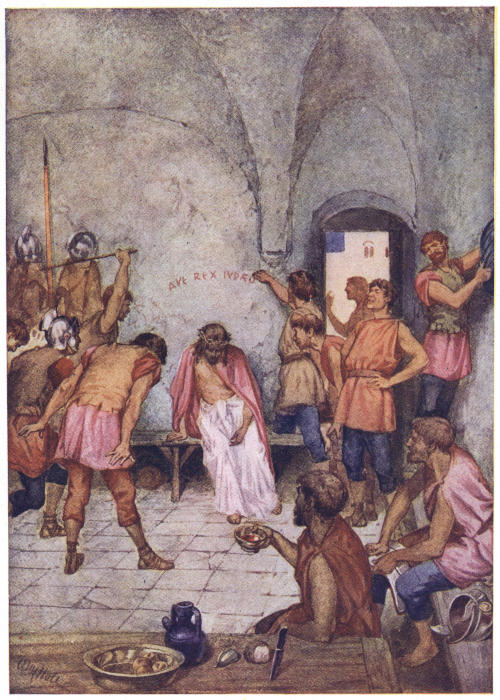
Jesus, Arrayed in Mock State, is Crowned
and Beaten
Then the soldiers of the governor took Jesus into the common hall,
and gathered unto him the whole band of soldiers. And they stripped
him, and put on him a scarlet robe. And when they had platted a
crown of thorns, they put it upon his head, and a reed in his right hand:
and they bowed the knee before him, and mocked him, saying, Hail,
King of the Jews! And they spit upon him, and took the reed, and
smote him on the head.—St. Matt. xxvii: 27-30.
NOTE BY THE ARTIST
Had it been possible to add a pang to the suffering already endured, this
must surely have been effected by the foul jests and ribald mockery which Jesus
was now called upon to endure at the hands of the ruffians of the barrack-room.
The lust of cruelty, delight in inflicting and witnessing torture, marks
the lowest depth of human depravity; and to sorrow of heart beyond what
we can comprehend, to physical suffering as great as any which mortal man
can endure and live, was now added the humiliation of being the object of
sport and derision to the dregs of mankind. For these men were not even
Romans, save in name; the ranks of the imperial armies called upon for
foreign service being mainly recruited from the scum of the population of
tributary provinces.
65
THE TRIAL
We come now to another of the dark and
sad chapters in the history of our Saviour’s
life. We have seen how he was betrayed
by one of his disciples, and forsaken by all the
rest. Then his enemies seized him, and led
him away to those who had sent them—the
priests and rulers of the Jewish church. We
speak of what then took place at the trial of
our Saviour. But it was only the form or
mockery of a trial. It was not conducted at
all in the way in which regular trials were
required to be conducted among the Jews.
The simple truth is that the enemies of Jesus
had made up their minds to put him to death,
and they merely pretended to have a trial because
they were afraid to do it without.
And in studying this part of the life of our
Saviour, we may look, very briefly, at the history
of his trial; and then at some of the lessons that
it teaches us.
When the band of soldiers and servants had
seized Jesus, and made him prisoner, they led
him away to the house of Caiaphas the high-priest.
He had gathered together the chief-priests
and other members of the Jewish high
council, called the Sanhedrim. This was the
highest court among the Jews. It was composed
of seventy, or seventy-two of the oldest,
the most learned, and honorable men of the
nation. The high-priest was generally the
president of this council. Their usual place of
meeting was in one of the courts of the temple.
But, on special occasions, they met in the house
of the high-priest, as they did now. Jesus was
brought before this council. Here they tried
to bring some charge against him of teaching
false doctrines, or of doing something contrary
to the laws of their church. But though they
had hired many false witnesses against him, the
witnesses did not agree in their testimony, and
they found it impossible to prove anything
wrong against him.
Then the high-priest made a solemn appeal
to him, and asked him to say whether he was
the Son of God. “Jesus saith unto them—I am.
Hereafter shall the Son of man sit on the right
hand of the power of God.” Then they said
he was guilty of blasphemy, and deserved to be
put to death. St. Matt. xxvi: 59-66; St. Mark
xiv: 55-64; John xviii: 19-24.
After this, the servants of the priests blindfolded
Jesus, and began to mock him, to smite
him, to spit on him, and to say all manner
of insulting and blasphemous things to him.
St. Matt. xxvi: 67, 68; St. Mark xiv: 65; St. Luke
xxii: 62-65.
Then the priests and other members of the
council seem to have gone home, leaving Jesus
to the mockery and insults of the servants. As
soon as it was morning the priests and scribes
met again. They asked him once more if he
were the Christ, the Son of God. Again he
declared that he was. Then they arose and led
him to Pilate, the Roman governor, to get his
consent for them to put him to death. This was
necessary because Jerusalem was then under
the power of the Romans, and no one but the
governor, whom they appointed, had the power
of putting a prisoner to death according to law.
But, when the priests brought Christ before
Pilate, they changed their plan. They did not
accuse him of blasphemy now, because they
knew very well that Pilate would not care at all
about that. So they pretended that he had been
trying to stir up the people in opposition to the
Roman government. This was a very serious
charge, and one for which, if it could be proved,
the punishment would be death.
But, they could not prove their charge. As
soon as Pilate looked on Jesus, he seemed to be
satisfied that he was an innocent man. Then
he took him aside and had a long conversation
with him, alone by himself. The result of this
was that Pilate was perfectly satisfied of the
innocence of Jesus, and was resolved to release
him.
But, on returning to the judgment hall and
telling the Jews what he wished to do, he found
that they would not listen to this for a moment.
Thus he was in trouble, and knew not what to
do. Just then something was said about Galilee.
This was in the northern part of Palestine, and
out of the dominion of Pilate. Herod was the
governor of Galilee. He happened to be in Jerusalem
at that time. Pilate resolved to send his
prisoner to him, and hoped in this way, to get rid
of any further trouble in connection with him.
So Jesus was sent to Herod—the Herod under
whose dominion John was beheaded. He asked
him many questions; but Jesus declined to
answer one of them. Then Herod, with his
men of war, mocked him and sent him back to
Pilate, only saying that he found no fault in
him. St. Matt. xxvii: 1, 2, 11-14; Mark xv: 1-5;
Luke xxiii: 1-12; John xviii: 28-38.
After this Pilate made several attempts to
release Jesus; but the Jews were so fierce in
their opposition that he was afraid to do it.
Then he thought he saw his way out of the
difficulty by the help of a custom that had prevailed
in connection with the feast of the Passover,
which was then about to be kept. He
had been in the habit of allowing the Jews to
ask for the release of some prisoner who deserved
to be put to death, and of setting him at
liberty, when they requested it, while they were
keeping the feast. There was a prisoner then
in Jerusalem named Barabbas. He had been
guilty of murder and other dreadful crimes.
Pilate thought that when he should bring Jesus
and Barabbas before the people, side by side,
and offer to release to them whoever they should
choose, they would be sure to ask for the gentle,
loving Jesus, in preference to a wretched, blood-stained
murderer. And no doubt they would,
if they had been left to their own choice. But
they were not so left. The priests and scribes
had made up their minds that Jesus should
be put to death. So they went about among
the people, when this offer was made, and persuaded
them to cry out—“Not this man, but
Barabbas.”
Thus Pilate was disappointed again.
While this was going on, his wife sent a
message to him saying she had had a dream
about this prisoner Jesus, which troubled her
greatly. She said he was a just and good man,
and begged her husband not to have anything
to do with putting him to death. This made
Pilate feel still more resolved than ever to let
him ago.
Then he told the Jews that Jesus had done
no wrong, and he would therefore chastise him
and let him go. This made the Jews very
furious. They told Pilate that if he let this
man go, it would show that he was not a true
friend of the emperor, Cæsar. They gave him
to understand that they would complain of him
to the emperor, and in this way he would be
likely to lose his office. This alarmed him so
that he could stand out no longer. He let the
Jews have their way, and delivered Jesus up to
them, to be crucified.
Then the soldiers took Jesus and stripped him
of his own clothes, and put a purple robe upon
him; and platted a crown of thorns and put it
on his head, and bowed the knee before him in
shameful mockery, and cried—“Hail! king of
the Jews!” Then they smote him with the
palms of their hands, and with the reed, and
showed their utmost contempt by spitting on
him. Then Pilate had him brought forth before
the Jews, wearing the crown of thorns, and the
purple robe, and pointing to him in scorn, said—“Behold
the man! Behold your king!”
“And he delivered him to be crucified.” St.
Matt. xxvii: 11-30; St. Mark xv: 1-20; St. Luke
xxiii: 1-25; St. John xviii: 13-24, 28-40; xix:
1-16.
Such is the history of our Saviour’s trial.
And now, we may go on to speak of five
lessons taught us by this history.
The first lesson is about—the weak ruler.
We refer, of course, here to Pontius Pilate.
We know very little about him beyond what
we learn from the gospels. He belonged to a
highly honorable Roman family. He had been
the governor of Judea for several years. He
was not a very cruel or oppressive ruler, although
he sometimes did hasty and unjust things. Our
Saviour referred to one of these when he spoke
of—“the Galileans whose blood Pilate had
mingled with their sacrifices.” We know none
of the particulars of this event. But, from reading
the history of our Lord’s trial we can see,
very well, what sort of a man Pilate was. He
was a weak man. I do not mean weak in body,
but weak in character. He could see what was
right, and was willing to do it, if it could be
done without injury to himself.
When Jesus was brought before him as a
prisoner, he soon saw that he was an innocent
man, and that it would be wrong to put him to
death. But, at the same time, he saw that unless
he did put him to death, he would give great
offence to the Jews. And if he offended them, he
was afraid they would complain of him to the
emperor, and he would lose his office. And so
his fear led him to condemn an innocent man to
death, although he knew it was wrong to do so.
He tried to get rid of the guilt connected with
this act by washing his hands before the Jews, and
saying “I am innocent of the blood of this just
person: see ye to it.” But this was very foolish.
Why, all the waters in the ocean could not wash
away the stain of the Saviour’s blood from the
hands of Pilate. He knew that the right thing for
him to do was to let Jesus go: but he was afraid
to do it. This shows what a weak man he was.
And the wrong that he did on this occasion
did not save him from the dangers that he
dreaded. The Jews did accuse him to the emperor
for some other things. He lost his office
in disgrace. And of what happened to him
after losing his office, different accounts are
given. One of the stories about him is that he
retired into Switzerland and spent the rest of
his days on a mountain, near the city of Lucerne.
This mountain is named Pilatus after
him. The story says that he lived a very unhappy
life there, and that he finally drowned
himself in a lake on the top of that mountain.
But the things for us to remember about Pilate
are that he was a weak man; that he committed
a dreadful sin when he condemned Jesus to
death; and that the punishment of his sin
which followed him in this life was the loss of
his office, and the deep disgrace which it has
fastened on his name. Wherever the two great
creeds of the church are repeated, all over the
earth, we hear it publicly proclaimed that Jesus—“suffered
under Pontius Pilate.”
We see plainly illustrated in Pilate’s case the
punishment that followed from his weakness
in not doing what he knew to be right. If we
have the courage to refuse to do what is wrong,
we shall always be rewarded for it.
“Brave Charlie.” Two little boys were walking
along a village street one day, when they
stopped before the garden connected with a
gentleman’s house and gazed with admiration
on the many beautiful flowers that were growing
there. Presently the smaller of the two
boys exclaimed, “Oh, how I wish I had one or
two of those beautiful roses, to take home to
my sick sister. Every day she says she wishes
she could see some flowers again.”
“Then, why don’t you take some of them,
you little goose,” said the other boy. “Here, I
am taller than you, and I can reach over the
fence. I’ll get some for both of us.”
“No, no, Tim,” said the little boy, seizing his
arm; “I wouldn’t steal even a flower, if I never
had one in the world; but I’ll go in and ask the
lady for a rose for Ellen.”
“Well, you’ll only get sent away for your
pains,” said the older boy; “for my part I shall
help myself.”
But, just as Tim was reaching over the fence
and had seized a branch of beautiful roses, the
gardener spied him, and dropping a basket that
was in his hand, he rushed after the boy and
caught him. He gave him a sound flogging and
told him that if he ever found him doing that
again, he would have him put in jail as a thief.
In the meantime little Charlie had gone up
the steps and rung the door-bell. The door
was opened immediately by a kind-looking
lady.
“Please, ma’am will you give me a rose or
two for my sick sister?” asked Charlie.
“Yes, indeed, my little man,” said the lady.
“I have been sitting at the window and I heard
your conversation with the boy who wished
you to steal some of my roses; and I’m very
glad to see that you would not steal ‘even a
flower.’ Now come with me, and I will cut
you a beautiful bunch of roses.” Then she
asked him about his mother and sister, and told
him to come and get some flowers whenever
his sister wanted them.
After this she went to see his sick sister and
mother and helped them in many ways. She
kept up her interest in Charlie, and when he
had done going to school, she got him a nice
situation and remained his friend for life.
And when we think of Pontius Pilate, the
weak ruler, let us remember that if we do wrong,
we must always suffer for it; and that if we do
right God will surely reward and bless us.
“Dare to do right! dare to be true!
You have a work that no other can do;
Do it so bravely, so kindly, so well,
Angels will hasten the story to tell.
“Dare to do right! dare to be true!
The failings of others can never save you;
Stand by your conscience, your honor, your faith;
Stand like a hero, and battle till death.
“Dare to do right! dare to be true!
God, who created you, cares for you too—
Treasures the tears which his striving ones shed,
Counts, and protects every hair of your head.”
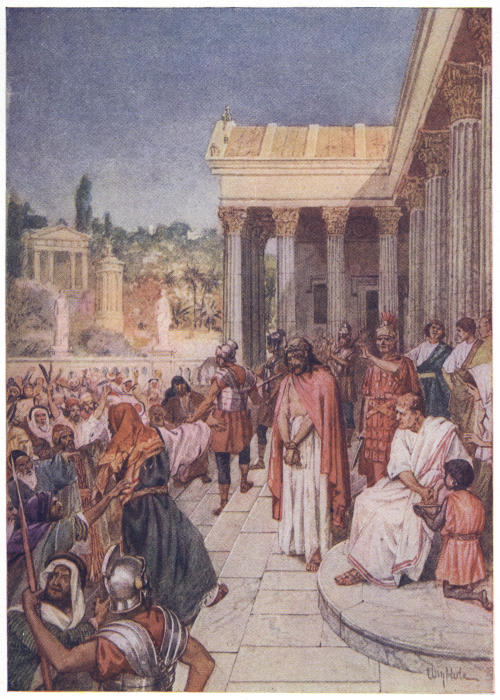
Pilate Washeth His Hands
Pilate therefore went forth again, and saith unto them, Behold, I
bring him forth to you, that ye may know that I find no fault in him.
Then came Jesus forth, wearing the crown of thorns, and the purple
robe. And Pilate saith unto them, Behold the man! When the chief
priests therefore and officers saw him, they cried out, saying, Crucify
him, crucify him. Pilate saith unto them, Take ye him, and crucify him:
for I find no fault in him.—And the governor said, Why, what evil hath
he done? But they cried out the more, saying, Let him be crucified.
When Pilate saw that he could prevail nothing, but that rather a tumult
was made, he took water, and washed his hands before the multitude,
saying, I am innocent of the blood of this just person: see ye to it.
Then answered all the people, and said, His blood be on us, and on our
children. Then released he Barabbas unto them: and when he had
scourged Jesus, he delivered him to be crucified.—St. John xix: 4-6;
St. Matt. xxvii: 23-26.
NOTE BY THE ARTIST
Once more the scene is “Gabbatha”—the place where Pilate sat; and
Jesus, his lacerated shoulders covered with a cast-off soldier’s cloak of scarlet,
and wearing a crown of thorns, is exposed to the gaze of the rabble of Jerusalem,
who now surged and thronged in the courtyard of the palace. Pilate
vainly hoped that the sight of the sufferings the prisoner had already endured
might satisfy the fury of his enemies; but the relentless hatred of the priests
was voiced through the insensate yells of the ignorant and bloodthirsty mob,
and their final argument was cunningly directed to the point of least resistance.
Pilate’s sense of justice yielded to that of self-interest. “He released
unto them one who (Barabbas), for sedition and murder, was cast into prison,
whom they had desired; but he delivered Jesus to their will.”
66
The second lesson that we may learn from the
history of Christ’s trial is a lesson about—the
wicked priests.
If our Saviour had been persecuted and put
to death by infidels or by men who did not
profess to be religious, it would not have been
surprising. But, when we find that it was the
priests—men occupying the highest places in
the church, and whose business it was to study
the Scriptures, and teach them to the people—when
these were the men most forward in having
Jesus put to death—it seems very strange. And
yet, it was just so. When Jesus began his
ministry, the priests were the first to oppose
him. As he went on with the work of his
ministry, they were always the most ready to
persecute him, and give him trouble. And at
the last, it was the priests who resolved he
should be put to death and who took the lead
in bringing about that awful result. It was the
priests who hired Judas to betray him. It was
the priests who brought false charges against
him. And, when Pilate was willing to let him
go, it was the priests who stirred up the people
to insist on his being put to death. Jesus had
come at the time and in the way that the
prophets had said he should come; and yet the
priests would not receive him. He had been
loving, and gentle, and kind; and yet they hated
him. He had spent his life in going about
doing good; and yet the priests made up their
minds that he must be put to death.
And the question that comes up here is—how
was it possible that these men—these priests—should
be so wicked? This is a very serious
and important question. And the answer to it
is this: that being ministers, or priests, or being
engaged in the outward duties of religion will
do us no good and make us no better than
other people, unless we are careful to have our
hearts made right in the sight of God; unless
we are willing to believe what he tells us, and
to think, and feel, and speak, and act, as he
wishes us to do. The best things, when spoiled,
always become the worst things. Women have
many things that help to make them better
than men. But a bad woman is always worse
than a bad man. Satan was once an archangel.
But he sinned. He fell. He is now
an angel ruined, and this makes him the worst,
the wickedest person to be found in all the
universe.
There is one passage of Scripture which explains
to us how it was possible for those priests
to become so wicked. This passage is found in
II. Thess. ii: 11, 12. Here the apostle Paul tells
us that if we are not willing to let God be our
teacher, and if we do not love the teachings
that he gives us, God will let Satan come and
deceive us, and lead us to believe what is not
the truth. This will make us very wicked; and
the end of it will be that our souls will be lost.
This explains to us how it was that those Jewish
priests became so wicked. They were not willing
to let God be their Teacher. They would
not receive the things that God had taught
about Jesus in the Old Testament. Then Satan
came and deceived them. He made them believe
what was not true about Jesus. And it was this
which led to their becoming such wicked men.
They were the wickedest men in the world at
the time they lived.
And this should make us very careful not to
think too much of ourselves or of our own
opinions. It should make us willing to believe
all that God tells us about Jesus, or about ourselves,
in the Bible, whether we understand it
or not. This is the only way in which we can
become wise, and good, and happy; and be kept
from following the example of these wicked
priests.
There is only room for one illustration here:
“The Two Brothers.” Some years ago there
lived in the State of Rhode Island two boys
who were brothers, twin-brothers. They grew
up together. They both had the same home,
the same education, and everything about them
the same. They were very much alike in size
and appearance. They were both bright, intelligent,
sensible, good-natured boys. This
continued till they were about sixteen years of
age. Then one of them read an infidel book—called
Paine’s Age of Reason. He made up his
mind to follow the teachings of that book. The
other brother had read the Bible and resolved
to take that as his guide and teacher through
life. And from this time, the two brothers,
who had been so much alike before, soon began
to be very different from each other. One of
them turned around and walked in a wrong
way, the other went on in the right way. One
of them fell into habits of intemperance, and so
was led on to all kinds of wickedness. The
other learned the lessons which the Bible
teaches, and practised them in his daily life.
One of them became an idle, worthless vagabond,
while the other became a useful, prosperous,
and happy citizen. One of them sank
down to the low level of a wretched gambler,
while the other rose to occupy a seat in the
Legislature of the State in which he lived.
And the end of these two men was that one
of them committed murder. He was put in
prison; was tried, found guilty, condemned to
be hanged, and died upon the gallows. The
other lived a long and useful and happy life,
and died at last loved and honored by all who
knew him.
This is the lesson about the wicked priests.
The next lesson from this history of the trial is
about—the patience of christ.
There are many things told us of the life of
Christ which are wonderful, but the most wonderful
of all is his patience. There are other
examples of patience in the Bible, but none that
can be compared with the example of Jesus.
The apostle James tells us of “the patience of
Job.” Ch. v: 11. He was indeed very patient.
In one day he lost all his property and his
children. The messengers that brought him
the sad tidings of his losses followed each other,
like the waves of the sea. It must have been
very hard for him to bear. And if we had been
told that he was very much excited and had
said some very violent and bitter words on
hearing of all that had happened to him, we
should not have been at all surprised. But he
did nothing of the kind. After hearing of all
his terrible losses, he simply bowed himself to
the earth, and said—“The Lord gave, and the
Lord hath taken away; blessed be the name of
the Lord.” Job i: 21. Here is a noble example
of patience.
Joseph was very patient. When he first saw
his brethren, as they came down to Egypt to
buy corn, he remembered all the bitter wrongs
they had done to him. He was now the governor
of all the land of Egypt. They were
completely in his power. How easily he could
have taken revenge upon them by throwing
them all into prison or putting them to
death! But there was no such feeling in his
heart. He was forgiving and patient. He
only thought of doing them good and showing
them kindness.
But, all other examples of patience dwindle
into nothing when compared to the example
of Christ. What a beautiful picture of his
patience the prophet Isaiah gives when he thus
speaks of him: “He was oppressed and he was
afflicted, yet he opened not his mouth; he is
brought as a lamb to the slaughter, and as a
sheep before her shearers is dumb, so he opened
not his mouth.” Is. liii: 7. He let his enemies
say all manner of evil things against him falsely;
he let them mock him,—and smite him on the
face,—and spit upon him. Yes, he whom the
angels of heaven had been accustomed to honor
and worship, as they bowed in reverence before
him, allowed himself to be so shamefully treated
by sinful worms of the dust, by the very men
he had come down from heaven to save; and
yet, he never spoke one cross or angry word to
them! How wonderful this was! How amazed
the angels must have been when they saw it!
Oh! what an example of patience we have in
Jesus! And if we call ourselves the friends and
followers of Christ, let us try to have the same
mind in us that was in him, by imitating the
example of his patience. There is no way in
which we can do so much good to others, and
make them think well of the religion of Christ,
as by trying to practise the same patience which
he practised.
“How to Learn Patience.” A good many
years ago there was a celebrated physician in
Germany, named Boerhave. He was famous
for his learning and also for his piety. He had
learned well this lesson of patience. One day
he had been greatly provoked, but without getting
angry in the least. A friend who had witnessed
it, asked him if he knew what it was to
be angry. “O, yes,” said he, “my temper was
naturally very violent and passionate.”
“Then, pray tell me,” said his friend, “how
you ever learned to be so patient.” Now mark
what that great and good man said in answer
to this inquiry.
“I learned to be patient,” was his reply, “by
doing two things; one was by thinking of Christ;
the other was by asking him to help me.”
We may all learn patience in this way.
“A Soldier’s Example of Patience.” Some
years ago an English missionary in India baptized
a soldier. This man had been a famous
prize-fighter in England. He was a powerful,
lion-looking, lion-hearted man. With a single
blow he could level the strongest man to the
ground. The men in his regiment were all
afraid of him. He had not been in the habit of
going to church, but, as he afterwards told the
missionary, “he sauntered into the chapel one
evening, hardly knowing where he was going.”
What he heard that night led him to repentance
and he became a Christian. The change
which took place in his temper and conduct
was very surprising. The lion was changed into
a lamb. A month or so after this, when they
were dining in the mess-room one day, some
of his comrades, who had always been afraid of
him, began to ridicule him on account of his
religion. One of them said, “I’ll find out
whether he is a real Christian or not;” and taking
a bowl of hot soup, he threw it into his
breast. The whole company were alarmed at
this. They looked on in speechless silence,
expecting to see the roused lion leap up, and
spring in fury on his foe. But he quietly opened
his waistcoat, and wiped his scalded breast.
Then turning calmly round he said, “This is
what I must expect. If I become a Christian, I
must suffer persecution. But my Saviour was
patient, and I want to be like him.” His comrades
were filled with astonishment. But they
were satisfied he was a true Christian and he
had no more trouble from them. The patience
of Christ is the third lesson for us to learn from
his trial.
The fourth lesson taught us by this subject is—the
humiliation of christ.
If we desired to put the whole history of the
life of our blessed Saviour into a single sentence,
I do not think we could find a better one than
that which the apostle Paul uses when he says
of him that—“He humbled himself.” Phil. ii: 8.
Before he came into our world he was “in the
form of God, and thought it not robbery to be
equal with God.” This means that he was God.
Now if he had chosen to become an angel,
holy, and pure, and good, he would have had
to humble himself very much, even for that.
But, instead of becoming an angel, he became
a man. And, in becoming a man, he took our
nature upon him in its fallen state. He was
made like us in all points, except sin. How he
humbled himself here! And, in coming into
our world, if he had chosen to come as one of
the richest men in it,—as a great king or emperor—that
would have been an act of great
humiliation. But he came as a poor man. He
was one of the poorest men that ever lived on
the earth. He had made the world, and was
the owner of all its treasures, and yet he could
say of himself with truth—“The foxes have
holes, and the birds of the air have nests, but
the Son of man hath not where to lay his head.”
What humiliation there was here! We see his
humiliation in the poverty and suffering that
he endured. His whole life was an act of
humiliation. But how greatly this humiliation
was increased during the time of his trial!
Think how his back was torn by the cruel
scourges! What humiliation was there! Think
how he was mocked, and insulted! Think how
the soldiers put an old purple robe upon him:
how they platted a crown of thorns, and put it
upon his head; how they put a reed in his hand
in mockery for a sceptre: how they bowed the
knee before him in scorn, and cried—“Hail!
king of the Jews!” How wonderful this was
O, never let us forget the humiliation of Christ!
And when we think of all this—how can we, as
Christians, ever feel proud? Our great duty is,
as the apostle says, to be “clothed with humility.”
No wonder that Augustine, one of the
old fathers of the early church, when asked—“What
is the first thing for a Christian to
learn?” should have said—“humility.” “What
is the second?”—“humility.” “And what is
the third?” should still have said—“humility.”
“Examples of Humility.” A converted South
Sea Islander was helping to translate the New
Testament into his native language. On coming
to the passage, “Behold what manner of love
the Father hath bestowed upon us, that we
should be called the sons of God;” I. John iii:
1, he hastened to Mr. Williams, the missionary
and said, “No, no, this is too much, too much!
let us say—‘Now are we allowed to kiss God’s
feet.’” That man was clothed with humility.
A pious nobleman in England was in the
habit of attending a prayer meeting in the
country village where he lived, and where a
few of the poor people of the neighborhood
were accustomed to assemble on a week-day
evening. When he first came in they were
surprised to see him, and they all rose up at
once to offer him the best seat in the room.
This troubled him greatly. He gently said to
them, “Please take your seats my friends, and
have the kindness not to do this again. When
I go to the ‘House of Lords,’ I go as one of
the lords of the realm. But when I come to
this cottage prayer meeting, I come simply as a
disciple of Jesus among my fellow disciples, and
must be allowed to take any seat that may be
empty.” That nobleman was clothed with
humility.
“The Humble King.” A French monarch
was found one day by some of his attendants
engaged in instructing out of the Bible a boy
belonging to his cook.
They said it was beneath his dignity as the
King of France to be engaged in teaching the
child of his cook. His answer was a noble one.
“My friends,” said he, “this boy has a soul that
is as precious as mine, and it was bought with the
same precious blood. If it was not beneath the
dignity of my Saviour, the King of heaven, to
die for him, it is not beneath my dignity as
king of France to tell him what has been done
for his salvation.”
That king was clothed with humility. The
humiliation of Christ is the fourth lesson taught
us by this trial.
The last lesson we learn from the history of the
trial is about—the glory of Christ.
Perhaps some may think it strange to speak
of the glory of Christ in connection with this
part of his history. Here we see him betrayed,
and deserted by his own disciples. He is delivered
into the hands of his enemies. They
pretend to try him. But it is only the form of
a trial through which he is made to pass. He
is charged with great crimes. These cannot be
proved against him. But still he is condemned
to the most disgraceful of all deaths. He is
handed to the soldiers to do what they please
with him. And is it right to speak of the glory
of Christ in connection with such scenes as
these? Yes. For this was just what Jesus did
himself. It was, as he was about to enter on all
this humiliation and suffering, when Judas
went out from his presence to betray him,
that Jesus said:—“Now is the Son of man glorified.”
Thus he himself connected the thought
of his glory with these very scenes. And surely
he was not mistaken. He knew what he was
saying.
Now just think what it is in which true glory
consists. It is not in wearing fine clothes. It
is not in occupying high positions. It is not in
having people say fine and flattering things
about us. No; but it is in thinking, and feeling,
and saying, and doing, and suffering that which
is right and according to the will of God. And
this is just the position that Jesus was occupying
during his trial. He was fulfilling the will of
God in things that were the hardest of all for
him to do and to suffer. And that was what
made him glorious.
If we were asked to point to that part of our
Saviour’s life in which he appears to us in the
greatest glory, there would probably be considerable
difference of opinion among us. Some
of us, no doubt, would point to his transfiguration;
some to the times when he walked upon
the water, or controlled the winds and the waves
with his word; and others would point to the
times when he healed the sick, or raised the
dead, and cast out devils. But it was not so.
No; but it was when he was betrayed and forsaken—when
he was condemned to death, and
mocked, and insulted by his enemies that Jesus
appeared most glorious: for it was then that he
was showing, in the strongest possible light, his
desire to do his Father’s will and the greatness
of his love for the people he came to save. It is
not clothing, but character that makes us great
or glorious. And the more we try to be like
Jesus, in doing the will of God as he did it, in
this part of his life, the greater will be the glory
belonging to us.
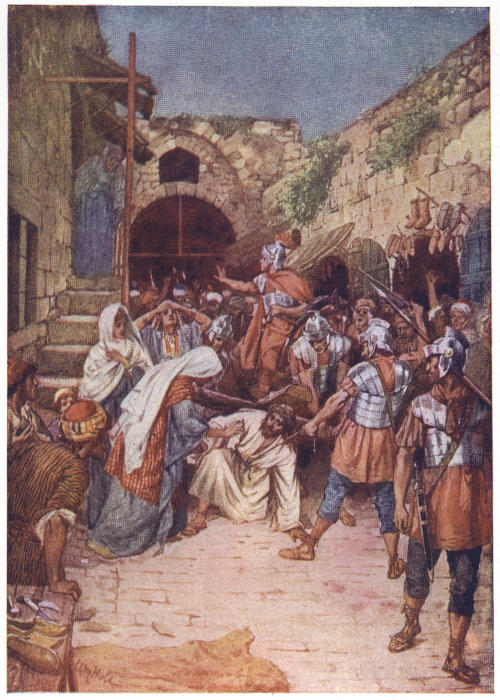
“Daughters of Jerusalem, Weep Not for Me”
And when they had mocked him, they took off the purple from him,
and put his own clothes on him, and led him out to crucify him.—And
there followed him a great company of people, and of women, which
also bewailed and lamented him. But Jesus turning unto them said,
Daughters of Jerusalem, weep not for me, but weep for yourselves, and
for your children. For, behold, the days are coming, in the which they
shall say, ... to the mountains, Fall on us; and to the hills, Cover
us. For if they do these things in a green tree, what shall be done in
the dry?—St. Mark xv: 20; St. Luke xxiii: 27-31.
NOTE BY THE ARTIST
Needless to say, the route followed by the actual “Via Dolorosa” is lost
beyond recovery, its very direction being entirely dependent upon that of
Calvary, the site of which has for long been a matter of controversy. In
any case the veritable Path of Sorrow lies concealed beneath a mass of débris,
the ruins of the ancient city upon which modern Jerusalem is built. The
street in the painting does not form part of the traditional route; it is the
“Street of the Shoemakers,” a coincidence which recalls the mediæval legend
of “The Wandering Jew,” who, it may be remembered, was a follower of
this craft.
67
“The True Hero.” A number of boys were
playing after school one day. The playground
was on the bank of a river. One of the biggest
boys was named Tom Price. He was the
strongest boy in the school. He loved to get
up quarrels among the boys to show how easily
he could whip any of them. But there was one
boy in the school who never would fight. His
name was Joe Wilson. He was not so big or
so strong as Tom Price. But it was not this
which made him unwilling to fight. He was
trying to be a Christian. He knew it was
wrong to fight, and so he always refused to do it.
One day Tom Price agreed with some of the
other boys to try and force a fight on Joe Wilson.
So while they were playing after school,
Tom knocked Joe’s cap off his head, and it fell
into the river.
“Tom threw your cap over on purpose, Joe,”
said one of the boys; “fight him for it.”
“Yes, give it to him, Wilson,” said the other
boys, “we’ll see that you have fair play.”
Price squared off and stood in a fighting
position. “I won’t fight,” said Wilson. “I’m
sorry you threw the cap over, Price; for it
was all but new, and I don’t see any fun in
such mischief. But, I’m not going to fight
about it.”
“Come on, if you dare,” said Price, shaking
his fist at him. All the boys gathered round
and urged Wilson to “go on, and give it to
him.”
“No, I don’t think it right to fight,” said
Wilson, “and I won’t do it.”
“Coward! coward! he’s afraid,” cried the
boys. “I am not a coward,” said Wilson; “I
dare do anything that’s right. But this is not
right, and I won’t do it.”
“Go home, coward! go home, coward!”
shouted the boys after him, as he turned to go
home.
He had not gone far before there was a
sound of a heavy splash. “He’s in! He’ll
drown!—he can’t swim! Price is drowning,”
cried the boys as they stood on the edge of
the bank.
Joe Wilson heard these shouts and ran to the
bank of the river. He saw Price struggling in
the stream. The other boys were running
about and shouting, but they were afraid to go
in. In a moment Joe Wilson threw off his
jacket, stepped back a few paces—ran—and
jumped into the river. He swam out to Price—caught
him by the hair of his head, and
managed, though with great difficulty and at
the risk of his own life, to bring him safely to
the shore. Wilson walked quietly home, not
only to change his wet clothes, but also to avoid
the praise of those who but a moment ago were
calling him a coward.
An old gentleman was standing there who
had witnessed this whole scene. As soon as
Wilson was gone, he called the boys to him and
said: “Boys! learn a lesson from what has just
taken place. Don’t mistake a hero for a coward
next time. The boy who is afraid to do what
he knows to be wrong in God’s sight, is the
true hero. He is not afraid of anything else;
not afraid of man—of danger—or of death.”
The point of greatest glory in Joe Wilson’s
conduct that day was not when he bravely
plunged into the river. No; but it was when
he nobly stood his ground among his companions,
and said “I think it wrong to fight;
and I won’t do it.”
And so, even amidst the sorrowful scenes of
our Saviour’s trials, we see his glory shining out
in the way in which he did and suffered what
was according to the will of God.
And from this study of the trial of our Saviour,
let us carry away with us the five lessons of
which we have spoken.
These are the lesson about the weak ruler:—the
wicked priests:—the patience—the humiliation—and
the glory of Christ.
THE CRUCIFIXION
We read in St. Matthew’s gospel these
three simple, but solemn words: “They
crucified him.” Chap. xxvii: 35. Here we have
set before us the greatest event in the history
of our Saviour while he was on earth. They
tell us of the most important event that ever
took place in our own world, or in any other
world. We have no reason to suppose that
Jesus ever took upon himself the nature of any
other race of creatures, as he did take our
nature. We have no reason to suppose that he
ever died, in any other world, as he died in
ours. How wonderful this makes the thought
of his crucifixion! And how diligently we
should study it, and try to understand what it
was intended to teach! This is what we come
now to do. And in doing this, the two great
things for us chiefly to consider, are—The history
of the Crucifixion; and its Lessons.
And in looking at this history the first thing
for us to notice is—the place of the crucifixion.
In speaking of this place, St. Matt. xxvii: 33,
says it was—“a place called Golgotha, that is to
say a place of a skull.” St. Luke xxiii: 33, says
it was a place “called Calvary.” Golgotha is
a Hebrew word, and Calvary is a Latin word;
but they both mean the same thing, namely a
skull, or the place of a skull. Some have
thought that this name was given to it because
it was the spot where public execution took
place and criminals were buried. But there is
no proof of this. It is often spoken of as “the
hill of Calvary”: but it is never so called in
the New Testament. It is supposed to have
received its name from the fact of its being a
smooth and rounded piece of ground, resembling
somewhat the shape of a skull, and looking
like what we call the brow of a hill. Exactly
where this place was we cannot tell. In the
Church of the Holy Sepulchre at Jerusalem
they show a hole in a rock, which they pretend
to say was the very hole in which the cross of
Jesus was placed. But it is impossible to prove
this. And the thought which shows how unlikely
this is to be the Calvary where Jesus died
is this, that Jesus died outside the walls of
Jerusalem, but this is inside the walls, and we
know that the city at that time was much
larger than the present city. The apostle Paul
tells us that “Jesus suffered without the gate.”
Heb. xiii: 13. We are sure then that Calvary,
or Golgotha, the place of the crucifixion, was
outside the walls of Jerusalem, but nigh unto
the city. This is all that we can find about it
with any certainty.
The time of the crucifixion is the next thing
to consider. It was on Friday of the last week
of his earthly life. What is called “Good Friday,”
in the week before Easter, known as
Passion Week, is kept by a large part of the
Christian Church in memory of this event.
As to the hour of the day when the crucifixion
took place, there is some difference in
the statements made by the different evangelists.
St. Matthew says nothing about the hour
when Jesus was crucified. He only says that
during the time of the crucifixion, “from the
sixth hour there was darkness over all the land
unto the ninth hour.” St. Matt. xxvii: 45. This
means from twelve o’clock at noon, till three
o’clock in the afternoon. St. Luke and St. John
both say that it was—“about the sixth hour,”
when this great event took place. But it is
clear from their way of speaking of it, that they
did not wish to be understood as stating the
time very exactly. St. Mark says—ch. xv: 25,
“And it was the third hour, and they crucified
him.” There seems to be a disagreement between
these statements. But it is easy enough
to reconcile the difference. There are two ways
of doing this. One is by supposing that when
St. Mark says: “It was the third hour, and they
crucified him,” he was speaking of the time
when they began to make preparations for the
crucifixion, while St. Luke and St. John refer to
the time when the preparations were all finished,
and the crucifixion had actually taken place.
But there is another way of reconciling this
apparent difference. The Jews were accustomed
to divide their day into four parts, corresponding
with the four watches into which the night
was divided. Beginning at six o’clock in the
morning, which was the time when their day
commenced, they sometimes called the first
three hours, from six to nine o’clock, the first
hour. The next three hours, from nine to
twelve o’clock, they called the second hour;
and then, according to this way of reckoning,
the three hours following, from twelve to three
o’clock, would be the third hour. And if this
was the way in which St. Mark was speaking,
then his third hour would agree exactly with
the sixth hour mentioned by St. Luke and
St. John. And so, when we think of the time
of the crucifixion, we may remember that Jesus
hung upon the cross, in dreadful agonies, from
“about” twelve o’clock at noon-day until three
in the afternoon. O, how long and painful
those hours must have seemed to him!
The next thing to notice is—the manner of
the crucifixion. Suppose that you and I had
been standing on Calvary at the time of our
Saviour’s death: what should we have seen?
Why, lying there on the ground, we should
have seen the great wooden cross, on which
Jesus was to suffer. It is made of two pieces.
There is one long, upright piece of timber, and
a shorter one fastened across this upright beam,
at the upper end. There is Jesus standing by—bound,
and bleeding, and crowned with thorns.
The soldiers take him and lay his body on the
cross, with his back towards it. They stretch
out his arms to their full length, along the
upper beam of the cross. They take heavy
hammers and drive great rough nails through
the palms of his hands, and through the tender
part of his feet. How terrible the suffering
caused by every blow of those hammers! And
see, when this is done, the soldiers raise up the
cross, and place the lower end of it in a hole
they had prepared for it. It comes down with
a jar. What terrible tortures that jar sends
through every part of the suffering Saviour’s
frame! About the middle of the cross is a projecting
piece of wood, to form a sort of seat, so
as to prevent the whole weight of the body
from hanging from the nails, and tearing the
flesh of the hands and feet. And there the Son
of God is left to suffer tortures that cannot be
expressed, till death shall come and bring relief.
The witnesses of the crucifixion is the next
thing of which to speak.
Near the cross was his mother and the good
women who were her companions. John is the
only one of the apostles found near the cross at
the time when their Lord was crucified. The
soldiers and the priests were there. The walls
of Jerusalem were, no doubt, lined with people
looking anxiously on; and crowds of strangers
were standing by, beholding this sad event; for
Jerusalem was always full of persons from a
distance at that season who came to keep the
feast of the Passover. And then, if our eyes
had been opened, as the eyes of Elisha’s servant
were, (II. Kings vi: 17), so that we could have
seen as spirits do, we should have beheld multitudes
of angels among the spectators of the
crucifixion. We should have seen them hovering
over the cross and gazing with wonder on the
sight that met their view there—the Son of God—hanging
on the cross in agonies and blood!
The wonders attending the crucifixion is another
thing to notice. There was the darkness over
all the land from the sixth to the ninth hour,
or from twelve to three o’clock. This was not
a natural darkness caused by an eclipse of the
sun, for the Jewish Passover was held at the time
of the full moon, and it is impossible to have
an eclipse then. No; it was a miraculous darkness.
The sun hid his face, as if he was ashamed
to look on and see
“When God, the Mighty Maker died,
For man, the creature’s sin.”
And then there was an earthquake. The
great globe itself seemed to tremble at the
thought of the dreadful deed that was taking
place on its surface. The solid rocks were rent
in pieces. The graves were opened, and many
of the dead buried in them rose, and came back
to life. And then, at the same time, the vail
of the temple—that thick, strong vail—which
hung between the holy place and the most
holy place, without any one touching it, was
rent in twain from the top to the bottom.
This was done by miracle. If you and I had
been there, with our eyes opened, as I said a
little while ago, we should probably have seen
two mighty angels, taking hold of that vail and
rending it. These were the wonders that attended
the crucifixion.
And then there are the words spoken by Jesus
on the cross, to notice. Seven times the blessed
Lord opened his mouth and spoke as he hung
amidst the torturing agonies of the cross. The
first time he spoke there, was to pray for his
murderers. St. Luke xxiii: 34. Then he spoke
to his disciple John, who was standing near the
cross, and asked him to take care of his mother.
St. John xix: 25-27. Then he answered the
prayer of the dying thief, and told him he
should be with him in paradise that day. St.
Luke xxiii: 39-43. Then he said—“I thirst.”
St. John xix: 28. Then came the awful cry
which he uttered when his Father in heaven
forsook him and left him alone. St. Matt.
xxvii: 46. Then he said—“It is finished!”
St. John xix: 30. Then he “cried with a loud
voice,” and said—“Father, into thy hands I commend
my spirit.” St. Luke xxiii: 46. And then
he meekly bowed his head and died.
Such is the history of the crucifixion—the
most solemn, the most awful, the most important
event that ever took place since the
world was made.
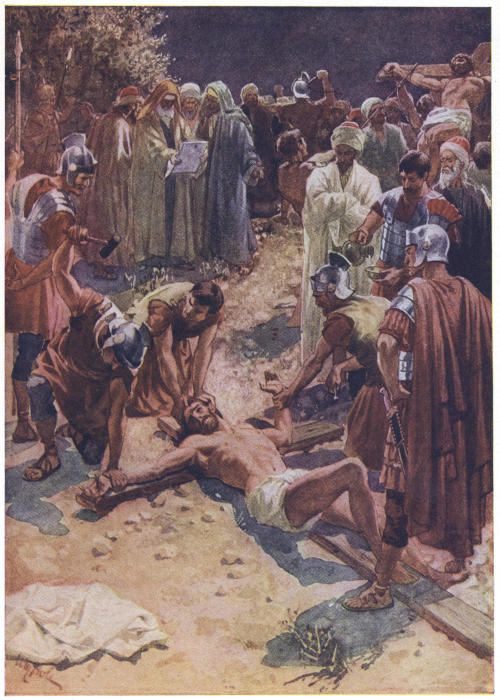
Jesus Attached to the Cross
And there were also two other, malefactors, led with him to be put
to death. And when they were come to the place, which is called
Calvary, there they crucified him, and the malefactors, one on the right
hand, and the other on the left. Then said Jesus, Father, forgive them;
for they know not what they do. And they parted his raiment, and
cast lots. And the people stood beholding. And the rulers also with
them derided him, saying, He saved others; let him save himself, if he
be Christ, the chosen of God. And the soldiers also mocked him,
coming to him, and offering him vinegar. And saying, If thou be the
king of the Jews, save thyself. And a superscription also was written
over him in letters of Greek, and Latin, and Hebrew, THIS IS THE
KING OF THE JEWS.—St. Luke xxiii: 32-38.
NOTE BY THE ARTIST
In spite of all that has been spoken and written on the subject, the site
of the place called “Golgotha” remains, as has been said, and must always
remain, undecided. But to those who can maintain an open mind, unbiased
by sentimental associations, the weight of evidence bears heavily against the
traditional Calvary (which shares with many other “sacred sites” the shelter
of the church of the Holy Sepulchre) and in favor of a little knoll overhanging
the grotto of Jeremiah, about an arrow-flight beyond the Damascus
Gate of Jerusalem.
68
A great many very valuable lessons are taught
us by the history of the crucifixion. We can
speak of only five.
The first lesson taught us by the crucifixion
is—the lesson of forgiveness.
It was probably while the Roman soldiers
were driving the rough nails through his tender
hands and feet, or just after the cross was set up
in its place, that Jesus taught us this lesson.
He looked on his murderers with a pitying eye.
If he had asked God to punish them, as they
deserved for their cruelty, or if he had spoken
to them ever so severely, it would not have been
surprising. But though they were causing him
so much suffering, when he had done them
no harm, still there was not one angry feeling
in his heart towards them, and not one unkind
word fell from his lips. Instead of this, he
lifted up his eyes to heaven, and offered the
prayer—“Father, forgive them; for they know
not what they do.” Here we have the most
perfect pattern of forgiveness the world has ever
known. If we wish to be true followers of
Jesus, we must try to be like him in this respect.
We must learn well this lesson of forgiveness.
“Examples of Forgiveness.” Dr. Duff, the
late excellent missionary to India, once read
our Saviour’s sermon on the mount to some
Hindoo young men whom he was teaching.
As he read on he came to the passage in which
Jesus says, “I say unto you love your enemies,
bless them that persecute you, and pray for them
that despitefully use you, and persecute you.”
One of the young men was so impressed by our
Saviour’s words that he exclaimed, with great
earnestness, “O how beautiful! how divine!
this is the truth!” And for days and weeks
afterwards he would exclaim, from time to time,
“Love your enemies! who ever heard such teaching?
How beautiful this is! This is heavenly
teaching!”
“A Forgiving Boy.” “Mamma,” said little
Charley, “now I’ve got a new sled, what shall I
do with my old one?” Presently he added,
“Mamma, there’s a chance to do something
real good.”
“What is it, Charley?”
“Why, you see, mamma, if there’s any boy I
hate, it’s Tim Tyson. He’s always plaguing
and teasing me and all the other little boys. It
never does any good to get cross, for that is just
what he likes: but then Tim likes sledding very
much and he has no sled. I’ve a notion to give
the old sled to him. It will show him that I
forgive him. It might make him think, and do
him good. Mightn’t it?” “Yes, it might,”
said the mother.
So Tim got Charley’s sled. The kind, forgiving
spirit of the little boy he had teased so
much touched him greatly. It made him think.
It did him good. After that Tim never teased
Charley again, or any of the other little boys.
“How a Bishop Taught Forgiveness.” There
was once a good bishop who lived at Alexandria
in Egypt. One day a nobleman came to see
him. He told the bishop about a person who
had done him a great wrong. He got very
angry about it. “I never will forgive him,”
said he, “as long as I live.”
Just then the bell tinkled for prayers in the
bishop’s private chapel. He rose to go into the
chapel and asked the nobleman to follow him.
The bishop kneeled at the railing of the little
chancel. He asked his friend to repeat the
Lord’s prayer after him, sentence by sentence.
This was done till they came to the sentence
“Forgive us our trespasses, as we forgive those
who trespass against us.” When the bishop had
offered this prayer he waited for the nobleman
to say it after him, but he was silent. He said
it again but there was no answer. Then the
bishop was silent and gave his friend time to
think. Presently the nobleman rose to his feet
and said:
“I dare not offer that prayer, while I feel as I
now do. It would be asking God never to
forgive me. I must forgive if I expect to be
forgiven.”
Then he left the chapel, sought out the person
who had injured him, and told him that he
freely forgave him. After this he went back
and finished his prayer with the good bishop.
The lesson of forgiveness, is one lesson taught
us by the crucifixion of our Saviour.
The second lesson we are here taught is—the
lesson of duty to our parents.
When we think of Jesus hanging on the cross
and bearing all the dreadful pains of crucifixion,
it seems to us that he must have been so fully
occupied with his own terrible sufferings as to
have had no thought or feeling for any one but
himself. But it was not so. He did not forget
his duty to his mother even then. He saw her
standing by his cross weeping. Joseph, her
husband, was no doubt dead. She would have
no one now to take care of her. John, the disciple
whom Jesus loved, was standing near his
mother. Jesus looked at his mother, and told
her to consider John as her own son. Then he
looked at John, and turning his eye to the
weeping Mary, he told John to treat her as his
own mother. And from that time John took
the mother of Jesus to his own home and took
care of her, as if she had been his own mother.
How thoughtful and tender this was in Jesus!
How much it was like the loving Saviour!
And how touchingly we may learn from this
crucifixion scene the lesson of our duty to our
parents, and especially to our mothers! No
child can ever fully repay a faithful, loving
mother for all that she has done. Let us try
to follow the example which Jesus set us from
the cross about our duty to our parents.
Let us look at some examples of those who
have learned and practised this lesson.
“The Polish Prince.” Here is a story of a
Polish prince who had a very good father. This
young man was in the habit of carrying the
picture of his father in his bosom. And when
he was tempted to do anything that was wrong,
he would take out this picture and look at it,
saying, “Let me do nothing that would grieve
my good father.”
“Ashamed to Tell Mother.” Some boys were
playing one day after school. Among them
was a little fellow whom his companions were
trying to tempt to do something wrong. “I
can’t do it,” said he, “because I should be
ashamed to tell mother of it.”
“Well, but you needn’t tell her; and she won’t
know anything about it.”
“But I should know all about it myself, and
I’d feel mighty mean if I wouldn’t tell mother!”
The boys laughed at him and said: “The
idea of a boy running and telling his mother
every little thing! What a pity you weren’t
a girl!”
“You may laugh about it as much as you
please,” said the noble little fellow, “but I’ve
made up my mind never, as long as I live, to
do anything I would be ashamed to tell my
mother.” That boy was a hero. He was doing
just what Jesus would have done in his place.
Many a boy would have been saved from ruin
if he had only acted in this way.
“Honoring His Mother.” “Is there a vacant
place in this bank, which I could fill?” asked a
boy with a glowing face, as he stood, with cap
in hand, before the president of the bank.
“There is none,” was the reply. “Were you
told that we wanted a boy? Who recommended
you?”
“No one recommended me, sir,” calmly said
the boy. “I only thought I would see.”
There was an honesty and manliness about
the lad which pleased the president and led
him to continue the conversation.
“You must have friends who could help you
in getting a situation; have you told them?”
With a saddened feeling, the boy said: “My
mother told me it would be useless to try
without friends,” then apologizing for the interruption,
he turned to go away; but the
gentleman detained him, saying: “Why don’t
you stay at school a year or two longer, my
young friend, and then try to get a situation?”
“I have no time for school,” was his reply.
“I study at home, and keep up with the other
boys as well as I can.”
“Then you have had a place already,” said
the officer, “why did you leave it?”
“I have not left it, sir,” quietly answered the
boy.
“But you wish to leave it. What is the
matter?”
The boy was confounded for a moment—but
presently said—“I want to do more for mother,
sir.”
These brave words of the boy touched the
gentleman’s heart. And grasping the hand of
the little fellow he said:—“My boy, what is
your name? and where do you live? You shall
have the first vacancy, for a boy, that occurs in
the bank. And in the meantime if you need a
friend, come to me. But now tell me frankly,
why do you wish to do more for your mother?
Have you no father?”
The boy’s eyes filled with tears. He had to
make an effort before he could speak. But
recovering himself directly he said:
“My father is dead: my brothers and sisters
are dead. My mother and I are left alone to
help each other. But she is not strong, and I
wish to do all I can for her. It will please her,
sir, that you have been so kind to me, and I am
very much obliged to you.” And then leaving
his name and residence with the gentleman, he
made a bow and retired.
It was not long before the president of that
bank called to see this boy and his mother. He
cheered their hearts by telling them that he had
a situation for the boy, who found a warm friend
in him as long as he lived. God’s blessing
followed that boy, and he rose to occupy an
important position in the bank. And God’s
blessing will always follow those who learn
and practise the lesson Jesus taught us on the
cross—of honoring our parents.
The third lesson we may learn from the
crucifixion is about—the power and willingness
of Jesus to save.
This lesson is taught us by what took place
between Jesus and the dying thief, as they
each hung upon the cross. Jesus was crucified
between two thieves. One of them cast reproaches
upon Jesus, as he hung by his side.
The other rebuked his fellow thief; and then,
turning his eyes towards Jesus, said—“Lord,
remember me when thou comest into thy
kingdom.” Jesus at once heard and accepted
his prayer, and told the thief that he should be
with him in paradise that day. This was one
of the most wonderful things that took place
in connection with the crucifixion of our Saviour.
There were many wonders in it. It was
wonderful that this dying thief should have
understood so clearly as he did the true character
of Jesus. It was wonderful that he should
have had faith to trust the salvation of his soul
to one who was dying what seemed to be a
criminal’s death. It was wonderful that he
should have repented truly of his sins, and have
prayed earnestly, as he did, while hanging on
the cross. It was wonderful that Jesus was able
and willing to pardon him, to change his heart,
and make him fit for heaven at the last hour of
his life. And it was wonderful that Jesus was
so ready to help and save another at the very
time when he was suffering so much himself.
The apostle Paul tells us that “he is able to
save unto the uttermost, those who come unto
God through him.” Heb. vii: 25. There could
not be a more striking illustration of the power
and willingness of Jesus to save sinners than we
have here in the case of the dying thief.
But illustrations of the same kind, though
not so striking as this, do often occur.
“The Cleansing Fountain.” There was once
a man who had been a very great sinner. He
had long been in the habit of committing all
sorts of wickedness. But at last he grew weary of
his evil ways, and wanted to become a Christian.
But he thought his sins were too great to be
forgiven. A Christian man talked and prayed
with him. To encourage him he repeated the
first verse of the hymn, which says:
“There is a fountain filled with blood
Drawn from Immanuel’s veins;
And sinners plunged beneath that flood
Lose all their guilty stains.”
But the poor man shook his head, and said,
“There’s nothing in that for me. My sins are
too great to be washed away.” Then his friend
repeated the second verse:
“The dying thief rejoiced to see
That fountain in his day;
And there may I, though vile as he
Wash all my sins away.”
“That means me,” said the penitent sinner.
He was encouraged to pray to Jesus, and he
found that he was able and willing to save him.
“Muckle Bess—A Hopeless Case.” This was
the name of a woman who lived in Scotland
many years ago. Her history illustrates very
well the point now before us, and shows the
power and willingness of Christ to save. She
was the daughter of a good, pious farmer. But
she was led into evil company. She left her
father’s house, and became a most wicked and
abandoned woman. She was a terror to every
one, even to the wicked people among whom
she had gone to live. At last she left them and
spent her time in wandering among the highlands,
living like a wild beast, stealing what she
could get to eat, or to wear, and sleeping in
barns or stables, in sheepfolds, or in the dens
and caves of the mountains. She used to roam
over the country begging, or stealing, cursing
and swearing, and doing all sorts of wicked
things. Everybody was afraid of her. No one
thought of speaking to her, or even of praying
for her; and every one looked upon her case as
hopeless.
At one time, when Muckle Bess had passed
middle life, there was a great religious interest
among the churches in that part of the country.
On one Sabbath day they were holding services
in the open air. A great crowd of people
had gathered round the minister. To the surprise
of every one, who should appear, at the
outside of the crowd, but poor Bess. Ragged,
and wild-looking, she seemed just like the
witch of Endor. The women trembled at the
sight of her, and the men thought she had only
come for mischief. But she sat quietly down
on the grass and listened to the preaching. It
led her to think of her wicked life, and filled
her heart with anguish. Presently she rose to
her feet, stretched out her brawny arms, and
cried in tones of agony that melted the hearts
of all who heard her, “Oh, thou God o’ my
fathers; oh, thou God o’ bonnie Scotland, that
has been steeped in blood for thy name’s sake;
look on me a wretched sinner, who has scorned
thee, and robbed thee, and defied thee! Hast
thou na’ promised cleansin’ to them whose sins
are scarlet and crimson? And whose sins are
o’ deeper dye than mine? God, be merciful to
me a sinner!” And then she sank sobbing to
the earth.
The stillness of death was over that congregation.
The minister paused till poor Bess’s sobs
were no longer heard. Then he went on with
the sermon. He spoke of the love of Christ in
being willing to suffer and die for us. He told
of his power and readiness to pardon and save
all who truly turn to him, and referred to the
case of the dying thief to prove the truth of
what he said. This touched the heart of poor
Bess, and led her to feel that there might be
hope, even for her. Then she rose to her feet
again, and cried, “Hear me, ye people o’ God!
Hear me, ye angels above! Hear me, ye powers
o’ evil, while I vow afore ye all, that I will e’en
tak’ him at his word, and leave it there!”
From that time Muckle Bess became a changed
woman. She went back to her father’s house
to live. But she occupied her time in going
from house to house, to tell the story of Jesus
and his love. And the rest of her life she spent
in speaking kind words and doing kind acts to
all about her. She was never tired of telling,
with tears of heartfelt gratitude, what Jesus had
done for her soul.
How beautifully this story illustrates the
power and willingness of Jesus to save!
The fourth lesson we learn from the crucifixion
of Christ is about—the depth of his sufferings.
The sufferings of his body were very great.
When the Roman soldiers beat him on the
back with their rods, his flesh was torn, and
made to quiver with pain. Then his brow was
torn by the sharp points of the crown of thorns
that were pressed upon his head. His hands
and feet were torn by the rough, cruel nails
that were driven through them. And when
the cross was set upright in the earth, and his
body was hanging by those nails, who can tell
the agony that must have been wringing every
nerve in it? Think of him as hanging thus for
three or four dreadful hours! how long the
moments must have seemed that made up those
hours! And if he tried to change his position
in the slightest degree, every movement must
have increased the torture he was feeling a
hundred fold.
But this was not all: this was not half the
suffering that Jesus endured. If he had been
feeling peaceful and comfortable in his mind
while all this was going on, he would not have
cared much for these bodily pains. But he had
no such feeling. His mind or soul was enduring
sufferings much worse than those which the
scourges, and the crown of thorns, and the
crucifixion, caused to his body. He said to his
disciples as he entered Gethsemane—“My soul
is exceeding sorrowful, even unto death.” This
was the sorrow he felt from thinking that his
Father in heaven was angry with him, and was
looking at him as if he were a sinner. He had
taken our sins upon himself, and God was treating
him as if he had really been a sinner. He
was bearing the wrath of God that we had deserved
for our sins. The apostle Paul tells us
that—“He was made a curse for us.” Gal. iii:
13. We cannot understand what Jesus had to
feel when this curse came down upon him.
But it was this which wrung from him that
bitter cry when the darkness came around him,
as he hung upon the cross,—“My God! My
God! why hast thou forsaken me?”
This made the sufferings that Jesus bore for
us greater than we can tell, and greater than
we can understand.
This part of our subject we must leave without
attempting any illustration. There never
was any sorrow or suffering like that which he
bore for us. I know of nothing that could be
used as an illustration here. This thought of the
sufferings of Christ is like one of those places
in the ocean which is so deep that we cannot
get a line long enough to reach the bottom.
And then the last lesson for us to learn from
the crucifixion of Christ is about—the wonders of
his love.
The apostle Paul tells us that the love of
Christ—“passeth knowledge.” Ephes. iii: 19.
He says the riches of this love are “unsearchable.”
The love of Christ is like a mountain,
so high that we cannot climb to the top of it.
It is like a valley, so deep that we cannot get
down to the bottom of it. It is like a plain, so
broad that we cannot get to the beginning of it,
on the one hand, or to the end of it on the
other. And when we are looking at Jesus as he
hangs upon the cross, we are in the best position
we ever can occupy for trying to understand
the wonders of his love. It was the love of
Jesus which made him willing to come down
from heaven and “humble himself unto death,
even the death of the cross.” It was the love
of Jesus which made him willing to be nailed
to the cross, and to hang there in agony and
blood, till as the Te Deum says, he had “overcome
the sharpness of death, and had opened
the kingdom of heaven to all believers.” And
as we stand before the cross of Christ, and think
of the depth of his sufferings, and the wonders
of his love, we may well ask in the language of
the hymn:
“O Lamb of God! was ever pain,
Was ever love like Thine?”
And it is this wonderful love of Jesus, in dying
for us, which gives to the story of the cross
the strange power it has over the hearts of men.
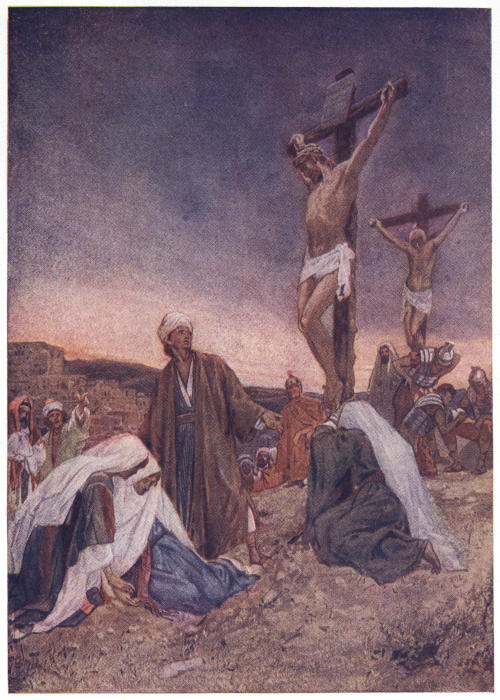
Jesus Commendeth His Mother to John
And one of the malefactors which were hanged railed on him, saying,
If thou be Christ, save thyself and us. But the other answering
rebuked him, saying, Dost not thou fear God, seeing thou art in the
same condemnation? And we indeed justly; for we receive the due
reward of our deeds: but this man hath done nothing amiss. And he
said unto Jesus, Lord, remember me when thou comest into thy kingdom.
And Jesus said unto him, Verily I say unto thee, To-day shalt
thou be with me in paradise.—Now there stood by the cross of Jesus
his mother, and his mother’s sister, Mary the wife of Cleophas, and
Mary Magdalene. When Jesus therefore saw his mother, and the disciple
standing by, whom he loved, he saith unto his mother, Woman,
behold thy son! Then saith he to the disciple, Behold thy mother!
And from that hour that disciple took her unto his own home.—St. Luke
xxiii: 39-43; St. John xix: 25-27.
NOTE BY THE ARTIST
Oft-repeated words are apt, for this very reason, to lose the force of their
significance; and the Cross of Calvary has furnished so frequent a theme
for Christian literature and Christian art, that it is by an effort only, which
we do well to exert, that the anguish of that lingering death can even dimly
be appreciated. The harrowing details have often been recounted, and it is
sufficient here to state in brief, that it comprised, in one awful agony, well-nigh
every pang which the human body can be called upon to suffer; withholding
for long the boon of death itself, and even the pitiful mercy of
isolation. For that “lifting up,” by which artists have striven to indicate
the loneliness of Jesus, is not in accordance with the facts of the case. No
timber in Palestine is of sufficient size to furnish crosses such as are generally
represented, and we are forced instead to picture the patient sufferer during
those many fatal hours, as raised but slightly above the level of the ground,
and literally face to face with his tormentors.
69
“The Influence of the Love of Christ.” We
are so accustomed to hear of the blessed Saviour,
and his amazing love, that it often gets to be a
familiar story to us, and so it does not have its
proper influence on our hearts. But it is different
with the missionaries of the gospel. When
they tell the heathen about Jesus, and his love, it
is new to them, and sometimes it has a strange
effect upon them. Here is an instance of this:
The Rev. Mr. Nott, an English missionary in
the South Sea Islands, was reading the third
chapter of the gospel of St. John to a number
of the natives. Presently he came to that wonderful
statement in the 16th verse, “God so
loved the world that he gave his only begotten
Son, that whosoever believeth on him should
not perish but have everlasting life.” When he
heard this, one of the natives said, “What words
were those you read? Let me hear those
words again.” The missionary read the verse
again, slowly and deliberately. On hearing
them again, the native rose and said, “Is that
so? Can it be true that God loved the world,
when the world did not love him?” “It is true,”
said the missionary. “And this is the message
we bring you. If you believe in Jesus, and his
love, it will save your soul, and make you happy
forever.” This wonderful love of Jesus won that
heathen’s heart, and he became a Christian.
This illustrates what the apostle Paul means
when he says, “the love of Christ constraineth
us.” To constrain, means to draw. The power
which the gospel has to draw men’s hearts to
God is in the love of Christ.
“The Power of Love.” A teacher was giving a
lesson to a class of children, on metals and minerals.
They were told that gold could be melted,
and that all metals could be melted. Then
the teacher asked: “Can stones be melted?”
“Yes,” said a little boy; “stones are melted
in volcanoes.”
“That is true; and now, can you tell me
what can melt a heart as hard as stone?”
After thinking for a few minutes, the little
boy said: “I think it is God only who can melt
a hard heart.”
“You are right, my child; and now can you
tell me how does God melt hard hearts?”
“It is by his love.”
“You are right again, my child; it is the love of
God that melts stony hearts. And it is by giving
his Son to die for us that God shows his love.”
Here is a very striking story to show the
power of the love of Christ in melting a hard
heart. We may call it:
“Hope for the Lost.” Charles Anderson was
the son of a sailor. His father was drowned at
sea. Charles was left an orphan, in a seaport
town in England. Having no one to take care
of him, he got in with bad boys, and grew up
an idle, careless, swearing, drunken young man.
In a drunken spree one night, he and his companions
broke into a house and robbed it. He
was taken to prison, tried, and sentenced to
seven years’ transportation to New South Wales.
After his arrival there, thinking that he was unjustly
punished, he became sulky, obstinate, and
rebellious. He cared for no rules. He minded
no orders, but did just as he pleased. For his
bad conduct he was flogged again and again.
But punishment did him no good. He grew
worse and worse. He became so thoroughly
bad and unmanageable that at last he was sentenced
to receive three hundred lashes on his
back, and to be chained for two years to a
barren rock that stood by itself in the middle
of the harbor of Sydney. The wretched man
was fastened by his waist to this rock, with a
chain twenty-six feet long.
He had irons on his legs and had hardly a
rag to cover him. His only bed was a hollow
place scooped out in the rock. He had no
other shelter than a wooden lid, with holes
bored in it. This was locked over him at night
and removed in the morning. If he had been
a wild beast, instead of a man, he could hardly
have been treated worse. His food was pushed
to him once a day, in a box, with a long pole.
Sometimes people going by in boats, would
throw him pieces of bread or biscuit. But no
one was allowed to go near him or speak to him.
Thus he spent two long years, a prisoner on
that lonely rock. Of course, he grew no better,
but worse, under such treatment. When his
time was out, and he was released from the rock,
he behaved so badly that very soon he was
taken up again, and sent a prisoner to Norfolk
Island, to work in chains for the rest of his life.
Now, what good could possibly be expected
from such a man? None at all, if the same
hard treatment had been continued towards
him. But it was not continued. No, at Norfolk
Island, he came under the care of a good
Christian gentleman. This was Capt. Maconochie,
an officer of the English army. He had
great faith in the power of kindness and love.
He found this man Anderson one of the very
worst men he had ever met with; but he resolved
to try the power of the gospel upon him.
He treated him kindly, as one man ought to
treat another. He got him to attend a night
school which he had opened, and there had him
taught to read. Then he persuaded him to join
a Bible class which he taught. He showed an
interest in him and sympathy for him. He
often took him apart by himself and talked
kindly to him. He told him of the wonderful
love of Jesus, as shown in the story of the
cross. This touched and melted the hard and
stony heart of that desperate man. He wept
like a child, at the thought of his life of sin.
He prayed earnestly for pardon, and found it.
Charles Anderson—the fierce, unmanageable
man—the man who had been chained, like a
wild beast to that lonely rock, became a Christian.
And he was a thoroughly changed man
in every respect. The change from midnight
to mid-day, from mid-winter to mid-summer,
is not greater than the change that appeared in
him. From being an ill-tempered, gloomy,
disobedient, idle man who was a plague to all
about him, he became gentle, and kind, cheerful,
obedient, and trustworthy; a man who
gained the respect and the love of all who
knew him. Capt. Maconochie got him released
from being a prisoner, on account of his good
behaviour. Then he took him into his own
service, and a more useful and excellent servant
he never had in all his life. Here we see the
power of the love of Christ. And so when we
think of the history of the crucifixion, let us
remember these six things,—the place—the
time—the manner—the witnesses—the wonders—and
the words—which make up that history.
And when we think of the lessons it teaches—let
us remember the lesson of forgiveness—the
lesson of duty to our parents—the lesson about
the power and willingness of Christ to save—about
the depths of his sufferings—and the
wonders of his love.
We cannot better close this subject than with
the words of the hymn we often sing:
“When I survey the wondrous cross,
On which the Prince of glory died,
My richest gain I count but loss,
And pour contempt on all my pride.
“Forbid it, Lord, that I should boast,
Save in the cross of Christ my God,
All the vain things that charm me most,
I sacrifice them to his blood.
“See from his head, his hands, his feet,
Sorrow and love flow mingled down!
Did e’er such love and sorrow meet,
Or thorns compose so rich a crown?
“Were the whole realm of nature mine,
That were a tribute far too small;
Love so amazing, so divine,
Demands my life—my soul—my all.”
THE BURIAL
In the last chapter, we left our blessed Lord
hanging dead upon the cross. Deep darkness
was spread over the land, as if to hide from
view the awful wickedness which men were
committing.
We have now to consider what became of the
dead Saviour after this. When death enters our
homes and lays his icy hand on some one whom
we love, we know that the next thing to follow
is the funeral. We have to make preparation,
as Abraham said on the death of Sarah, his wife,
to “bury our dead out of our sight.” Gen.
xxiii: 4. And so, after the crucifixion, or death
of our Saviour, the next thing for us to consider
is—his burial. We have an account of this
burial in each of the four gospels. We can read
all that is said about it in the following places:—St.
Matt. xxvii: 56-66; St. Mark xv: 42-47; St.
Luke xxiii: 50-56, and St. John xix: 38-42.
The history of the burial of Christ, given in
these different places, briefly stated, is, that as
soon as he was dead, and while he was yet
hanging on the cross, two men came forward
and took charge of his burial. One of these
is called “Joseph of Arimathea.” We know
nothing about him before this. His name was
never mentioned before, and after this it is never
mentioned again in the Scriptures. What we
are told about him is, that he was a rich man—an
honorable counsellor, or a member of the
Jewish Sanhedrim: he was a just and good man—a
disciple of Jesus—but had kept his thoughts
and feelings on this subject to himself, because
he was afraid of the Jews. And with him came
Nicodemus—of whom we read in the third
chapter of St. John—who came to Jesus by night
to have a talk with him on the subject of religion.
He was also a member of the Jewish
Sanhedrim, and “a ruler of the Jews.” Joseph
went boldly in before Pilate, and asked permission
from him to take the body of Jesus down
from the cross and have it buried. This was in
the afternoon of the same day on which the
crucifixion had taken place. Pilate was surprised
to think that Jesus could have died
so soon. Death by crucifixion, although very
painful, was still a lingering death. It is said
that cases have been known of persons who
have hung upon the cross for two or three days
before death put an end to their sufferings. We
do not wonder, therefore, that Pilate should
have felt surprised, when he heard that Jesus,
who was crucified about twelve o’clock, should
have been dead about three o’clock the same
afternoon. He sent for the centurion, who had
charge of the crucifixion, and asked if it was
true that Jesus was already dead. The centurion
had carefully examined the body, and told Pilate
that he was really dead.
Then Pilate gave Joseph and Nicodemus
permission to take down the body and bury it.
Immediately they went back to Calvary and
took the body of Jesus down from the cross.
They could hardly do it by themselves, and
they had, no doubt, engaged some other persons
to help them. We are not told how the body
was taken down. In the art gallery, at Antwerp
in Belgium, there is a famous painting of this
scene, by Rubens the celebrated Flemish artist.
It is called—“The Descent from the Cross.”
Here, Joseph and Nicodemus are represented
as having set up ladders against the cross. They
have climbed up the ladder, and have drawn out
the nails, and then we see them carefully handing
down the dead body of our blessed Lord. This
would be one way of taking the body down.
Another way would be to lift the cross up
from the place in the earth, where it was fastened,
and lay it carefully down on the ground,
with the body of Jesus still nailed to it. It
would be much easier to get the nails out, with
the cross in this position, than while it was
standing upright. But we are not told how it
was done, and so we are at liberty to think of
either of these ways as the one that was adopted.
And now, the mangled body of the dead Saviour
is removed from the cross. Then, it is reverently
wrapped in the linen which Joseph had
brought with him for this purpose. Nicodemus
had brought a hundred pounds weight of spices,
myrrh and aloes. These were probably in the
form of powder. It was the custom of the Jews
to use these spices in the burial of the dead,
because they have the power of preventing
decay from taking place immediately.
In a warm country like Palestine, decay begins
very soon after death. And in a body that had
been torn and mangled, as was the case with the
body of Jesus, it would take place still sooner.
And so the use of the spices was necessary.
No doubt the wounds made by the nails in
the hands and feet of our Saviour, and the gash
of the spear in his blessed side, were gently
filled with those powdered spices. And then
the spices were put freely in between the folds
of the linen that were wrapped about his dead
cold limbs. The Jews did not use coffins. Their
dead were only wrapped in grave-clothes, as was
the case with Lazarus, and here with our Lord.
And now the preparations are made. The
body is ready for the burial. And the grave is
ready for the body. Near to Calvary, where
Jesus was crucified, there was a garden. And in
that garden was a new tomb, in which no dead
body had ever lain. This tomb was dug out
from the solid rock. The rocks around Jerusalem
are filled with such tombs. They are
not generally dug down below the surface of
the ground, as we make our graves, but into the
side of the rock, and on a level with the ground.
This tomb belonged to Joseph of Arimathea.
It had, no doubt, been made for himself and
family. How little he thought when he had
that new tomb made, that Jesus, the Son of God,
and the Redeemer of the world, would be the
first one to occupy it! What an honor and
privilege Joseph had in being permitted to
furnish the tomb in which the dead body of
the Lord of life was to rest till the morning
of the resurrection!
And now, the funeral procession is formed.
Joseph and Nicodemus, and their helpers, take
reverently hold of the body of Jesus, and bear
it quietly and solemnly away to the open tomb
in yonder garden. No doubt the good women,
who lingered round the cross, joined in the
procession, and followed the body of their Lord
to the place where it was to lie. They reach
the tomb. On the rocky floor of that tomb,
the lifeless body of Jesus is gently laid. They
linger in silence around it. They gaze at it
with loving wonder and amazement. Then
they go out. A great stone is rolled against
the mouth of the tomb. And now, all that
loving hearts can suggest, or willing hands
can do for the buried one has been done.
They pause awhile to meditate on that silent
tomb, and then slowly retire to their homes, to
prepare for the Jewish Sabbath, which began at
six o’clock on Friday evening.
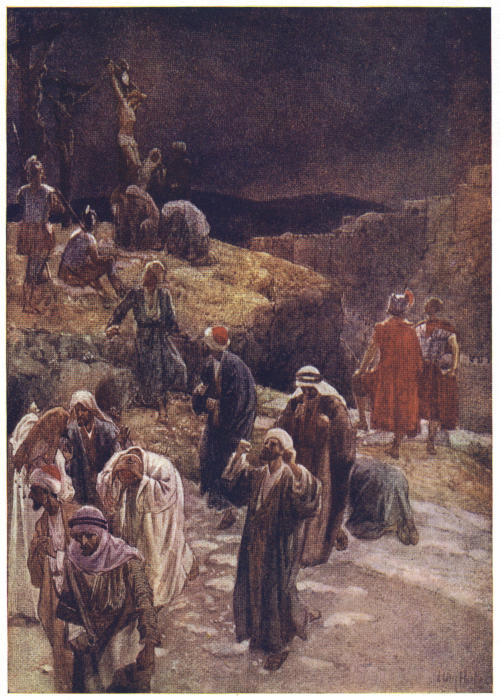
Jesus Yieldeth Up the Ghost
And it was about the sixth hour, and there was a darkness over all
the earth until the ninth hour. And the sun was darkened, and the
veil of the temple was rent in the midst. And when Jesus had cried
with a loud voice, he said, Father, into thy hands I commend my spirit:
and having said thus, he gave up the ghost. Now when the centurion
saw what was done, he glorified God, saying, Certainly this was a righteous
man. And all the people that came together to that sight, beholding
the things which were done, smote their breasts, and returned.—St.
Luke xxiii: 44-48.
NOTE BY THE ARTIST
Of the various points of evidence which may be adduced in favor of
the identity of the spot referred to in picture No. 68 with the Golgotha
of the Gospels one only need here be dwelt upon. “The place of the skull”
is the interpretation of the Hebrew word as given in the Authorized Version,
but according to the Revised Version “the place called the ‘Skull’” is
the more accurate translation, and the singular suitability of this name to the
hillock in question is obvious to anyone looking at it from the Mount of Olives;
the caves and apertures in the face of the cliff beneath its rounded summit
bearing a strange resemblance to the eye-sockets and nostrils of a human skull.
The significance also of the words, “They that passed by railed on him,” is
at once apparent; as the knoll is in full view of passers-by to east and
north, standing as it does at the junction of the high roads from Jericho
and Damascus.
70
But there is one other thing to notice in
connection with this burial. The priests had
heard Jesus speak of rising from the dead on
the third day. They went to Pilate and told
him of this. They said they were afraid that
his disciples might come by night and steal
away his body, and then declare that he had
risen from the dead. They asked him, therefore,
to allow them to seal the stone over the
mouth of the grave with his seal, and to have a
guard of Roman soldiers appointed to keep
watch over the tomb till the third day was
passed. Pilate gave them leave to do this. And
we read, “so they went and made the sepulchre
sure, sealing the stone, and setting a watch.”
St. Matt. xxvii: 66.
Such is the history of the burial of our Saviour.
And as we stand in thought before the silent
tomb in which the body of Jesus is lying, we
may well say, in the words of one of our hymns
for Easter even:
“All is o’er, the pain, the sorrow,
Human taunts, and Satan’s spite;
Death shall be despoiled to-morrow
Of the prey he grasps to-night,
Yet once more, his own to save,
Christ must sleep within the grave.
“Fierce and deadly was the anguish
On the bitter cross he bore;
How did soul and body languish,
Till the toil of death was o’er!
But that toil, so fierce and dread,
Bruised and crushed the serpent’s head.
“Close and still the tomb that holds him,
While in brief repose he lies;
Deep the slumber that enfolds him,
Veiled awhile from mortal eyes;
Slumber such as needs must be
After hard won victory.
“Near this tomb, with voice of sadness,
Chant the anthem sweet and low;
Loftier strains of praise and gladness
From to-morrow’s harps shall flow;
Death and hell at length are slain,
Christ hath triumphed, Christ doth reign.”
This is the history of the burial of Christ.
And now we may speak of four lessons taught
us by this history.
The first lesson taught us is about—the certainty
of his death.
Sometimes the enemies of our religion have
ventured to say that Jesus did not really die,
but that he only fainted, or swooned, or appeared
to die. But it is of the highest importance for
us to know that Jesus did really die. When we
are saying or singing that grand old anthem—the
Te Deum, we look up to Jesus and say,
“When thou had’st overcome the sharpness of
death, thou did’st open the kingdom of heaven
to all believers.” By Christ’s overcoming the
sharpness of death is meant his resurrection
from the dead. But, if his resurrection was a
real resurrection, then the death from which he
rose, must have been a real death. We cannot
come out of a state, or place, if we have never
been in it. It is impossible that you, or I, for
example, should go out of this church, unless
we were first in it. And when we know that
none of us could enter heaven, unless Jesus
had really died for us, we see how important
it is for us to be sure of the certainty of his
death.
Now there was one thing connected with the
burial of Christ which proves that he was really
dead, and that was the drawing out of the nails
from his hands and feet. When a great, rough
nail or spike has been driven into a piece of solid
wood, we know how hard it is to draw it out.
There were two such spikes driven through the
palms of the hands of Jesus, and two through
his feet. In trying to draw these out, I suppose
they must have made use of a large pair of
pincers, or of a hammer with a claw on one
side of it. As they came to those nails, one by
one, they would have to get the nippers of the
pincers or the claw of the hammer under the
head of the nail. Then they would have to
press down hard on the bruised and torn part of
the hands and feet of our Saviour. Now this
must have been so very painful that if he had
only fainted on the cross this dreadful operation,
as they went through with it four times, would
certainly have brought him out from his fainting
fit. But it did not. It had not the slightest
effect upon him. There was no more feeling
in his hands or feet than there was in the wood
of the cross to which he was nailed. And this
proves that he was really dead.
But then there was another thing that took
place at the crucifixion of Jesus which also
proves the certainty of his death. We read in
St. John xix: 34—“But one of the soldiers with
a spear pierced his side, and forthwith came
there out blood and water.” If Jesus had not
been dead before this took place, that cruel
spear, thrust into his heart, would certainly
have killed him. If Jesus had been alive when
the soldier did this, not blood and water, but
only blood, would have flowed out from the
wound which the spear made. And learned
physicians who have examined this matter tell
us that two things are clearly proved by this
flowing out of blood and water from the wound
which the soldier’s spear had made in our
Saviour’s side. One of these is, that he was
already dead. The soldier’s spear did not kill
him, but it proved that he was dead before the
wound was made.
And then the other thing which it proved
was that Jesus had died of a broken heart. In
Dr. Hanna’s “Life of Christ,” Vol. III. pp. 369-379,
may be found letters from several eminent
Scottish physicians, showing that nothing but
a broken heart could account for the flowing
out of “blood and water” from the wound in
our Saviour’s side. It was not being nailed to
the cross that killed our blessed Lord. Neither
was it the wound made by the spear. No, but
it was the great sorrow he had felt in being
made to bear our sins, that had really broken
his heart.
The sixty-ninth Psalm is one of the passages
in the Old Testament that refers to Christ. It
is he who is speaking there. And in the twentieth
verse of that Psalm, we find him saying
of himself, “Reproach hath broken my heart.”
And so when we think of “the blood and water”
that flowed out from his wounded side, and of
the drawing out of those nails from his hands
and feet, we may feel perfectly sure about the
certainty of the death of Christ.
The next lesson that we learn from the burial
of Christ is about—the fulfillment of his word.
The prophet Isaiah had spoken about the
death and burial of our Saviour seven hundred
years before he was born into our world. In
the ninth verse of the fifty-third chapter of his
prophecy, where he is speaking of Jesus he says,
“And he made his grave with the wicked, and
with the rich in his death.” This means that
it was arranged, or intended, that he should be
buried with the wicked, and yet it would so
happen that he would be with the rich in his
death. We can easily see how it was to be
expected that Jesus would be buried with the
wicked, because he died with them. He was
crucified between two thieves. These thieves
were buried “with the wicked,” or in the place
where common criminals were generally buried.
And as Jesus had died with them, so it was to
be expected that he would have been buried
with them. And this is what would have happened
if God had not ordered it otherwise.
The disciples of Jesus had all forsaken him.
And even if they had not done so, none of them
were rich. Pilate would not have given them
leave to take charge of the body of their dead
Master. And if they had had it, they could not
have procured a rich man’s grave in which to
bury it. It seemed impossible, therefore, that
what Isaiah had spoken should come to pass.
But that was the word of God. It was written
in the scripture that Jesus was to be “with
the rich in his death.” And “the scriptures
cannot be broken.” God’s word must be fulfilled.
And so, just when Jesus was dying,
Joseph of Arimathea, who had been a secret
disciple of Jesus, made his appearance. He was
a rich man. He had a sepulchre near at hand.
He asked Pilate to let him have the body of
Jesus, for the purpose of burying it. Pilate gave
it to him. He buried it in his new tomb. And
so the words of Isaiah were fulfilled to the very
letter; although it seemed impossible before
that such should have been the case. Jesus
died with the wicked, and yet was buried with
the rich. And here we see how wonderfully
God’s word was fulfilled.
And we meet with instances, continually, to
show that God is still fulfilling his word in
ways that are equally wonderful.
“Try It.” A Christian woman, rich in faith,
but poor in this world’s goods, was greatly perplexed
about the meaning of the words, “Give,
and it shall be given unto you.” She said to
herself: “the best way to find out the meaning
of such a promise, is to try it. I’ll try it.”
It was Saturday night. After buying what
her children would need for Sunday, she had
just two dollars left. Putting this money in
her pocket, she went out. She had not gone
far when a friend met her, who was in great
distress, and asked the loan of two dollars. She
gave the money to her friend, and resolved she
would wait and see how God would fulfill his
word.
Monday morning came. She had nothing
with which to buy food for her family. While
wondering what she should do, there came a
knock at the door. On opening it a lady came
in with a bundle in her hand. “Can you do
some work for me?” she asked. “Certainly.”
“What will you charge?” The price was named.
The lady put two dollars in her hand, saying,
“This is more than you ask, but you may as
well have it.”
The good woman shouted for joy. She had
tried God’s promise, and had found out how
wonderfully he fulfills his word.
“The Bullfinch.” Andrew Austin lived in
Scotland. He was a tailor by trade, a good,
honest, Christian man, but very poor. At the
time to which this story refers, he was in great
trouble. Sickness in his family had used up all
his money. The rent of his cottage was due,
and he had nothing to pay it with. “What
shall I do?” he said to himself, in great distress.
He took down his Bible, and opened it at the
book of Psalms. His eye rested on the fourth
verse of the seventy-second Psalm—“For he
shall deliver the needy when he crieth.” He
kneeled down and told God of his trouble, and
asked him to fulfill that promise in his present
distress. As he rose from his knees his heart
was comforted, and he felt sure that God would
fulfill his word and send, in some way, the
help that was needed.
He resolved to go and see his landlord, and
ask him to allow him a week’s time in which
to pay the rent.
Just as he opened the door to go out, a little
bird flew past him, perched upon the mantle-shelf,
and hopped about, chirping merrily.
Andrew closed the door, and watched the
movements of the little fellow with great interest.
He saw that it was a bullfinch, a piping
bullfinch. This is a bird something like a
sparrow, with a round head and short thick
bill. Bullfinches are great singers. They can
learn tunes, and carry them all through nicely.
While Andrew was watching the bird, it hopped
on to the Bible which he had just been reading,
and lifting up its little head began to sing the
tune of “Old Hundred.” Of course the bird
only had the music without the words. But
Andrew joined him, and put in the words:
“Praise God, from whom all blessings flow;
Praise him, all creatures here below;
Praise him above, ye heavenly host;
Praise Father, Son, and Holy Ghost.”
When he got through singing this verse, the
old man felt perfectly happy. Leaving the little
stranger in his room, he went to see the landlord;
and as he walked along he was repeating
to himself the words of the twenty-third Psalm—“The
Lord is my shepherd, I shall not want.”
He found the landlord very pleasant. He
readily gave him the additional time he wanted
to make up his rent. As he was going home
feeling very bright and cheerful, he was singing
to a simple tune these words which just suited
his circumstances:
“The birds, without barn or storehouse, are fed;
From them let us learn to trust for our bread;
His saints, what is fitting, shall ne’er be denied,
So long as ’tis written, ‘The Lord will provide.’”
As he went on, he was spoken to by a servant
in livery, whom he recognized at once as the
footman of Lady Armistead, a rich and pious
old lady, who lived at Basford Hall, about three
miles from the village where he resided.
“You seem to be in good spirits, Andrew,”
said the servant, who was an old acquaintance.
“You sing so well, one would think you had
swallowed Lady Armistead’s bullfinch. It’s been
missing these two days. I’m going home now,
for it’s no use seeking any more. Her ladyship
takes on dreadfully about the bird, for it was a
great favorite, and a regular tip-topper at singing.”
Then Andrew asked him to go home with
him, and said he should find his bird again.
As they walked along towards the cottage,
Andrew told his friend the story of his troubles;
how he had prayed; what God had said to him
out of his Book; and how the bullfinch came
and cheered his heart; how he had been to the
landlord’s, and had got another week to turn
round in; “and look you here John Morris, my
rent’ll be ready when it’s wanted, as sure as my
name’s Andrew; for that bird was sent from
my heavenly father, and brought me His message
on its wings, ‘for his mercy endureth
for ever.’”
So John got the bullfinch and took it home
to his mistress. When she heard about it, Lady
Armistead sent for the tailor. His simple story
moved her to tears. She thought more of her
bullfinch than ever, since God had made him a
messenger of mercy to one of his suffering
children. She gave the tailor money enough
to pay his rent, and told him that he should
have work from Basford Hall as long as he lived.
“God bless your ladyship,” said Andrew, with
a grateful heart. Just then the bullfinch struck
up its favorite tune, and Andrew joined in the
song.
“Praise God from whom all blessings flow.”
Lady Armistead smiled with sympathy, and
Andrew added—“Yes, yes: Praise the Lord, for
his mercy endureth forever.”
Now, however long old Andrew might have
lived after that, I think he would never read
over that verse in the seventy-second Psalm—“He
shall deliver the needy when he crieth,”
without remembering the lesson we are here
taught by the burial of Christ—and that is, how
wonderfully he fulfills his word.
The next lesson we learn from the burial of
Christ is about—the working of his providence.
Suppose we are looking at a great clock. Its
wheels are moving slowly on. We listen, and
hear it going—tick-tick-tick. The hands on
the dial plate are getting near to twelve o’clock;
and the very moment the minute hand comes
over the figure 12, the hammer in the clock
starts up, and begins to pound on the bell, and
the clock strikes twelve. The maker of that
clock arranged every part of its machinery in
such a way that it would be sure to keep time
and strike the hours as they came.
And the providence of God is just like such a
clock. He is the maker of it. And he not only
made the wheels of its machinery in the beginning,
but he manages them all the time. He
has his hand on every part of it. “God so loved
the world that he gave his only begotten Son”
to die for us. He was willing to have him
crucified with wicked men. But he wished to
have him buried with rich men. And seven
hundred years before Jesus was born into our
world he had said that it should be so. And
when the time for Christ’s burial came, the
clock of his providence struck, just as he said it
should do. Joseph of Arimathea was one of the
wheels in this clock; and when the right time
came, there he was—ready to bury the dead
Saviour in his own new tomb. And thus, in
the wonderful working of God’s providence, it
came to pass that Jesus was—“with the rich in
his death.” And as we think of ourselves, as
standing by the tomb in which Jesus was buried,
and seeing how strangely the prophecy about
his burial was fulfilled, we cannot help wondering
at the working of God’s providence. It
is true indeed, as the hymn says—that
“God moves in a mysterious way,
His wonders to perform:
He plants his footsteps in the sea,
And rides upon the storm.”
And it is just the same now as it was then.
Here are some examples of the working of this
providence.
“The Raven of Winslade Quarry.” Winslade
is a small town in England, famous for its stone
quarries. Some years ago an incident occurred
there which strikingly illustrates this part of our
subject. The men were at work in the lower
part of the quarry. Directly above was a great
mass of overhanging rocks. Dinner time came;
but just as they were getting ready for it, a raven
flew down, picked up the little parcel which
contained one of the miners’ dinner and flew
away with it. The man of course did not want
to lose his dinner, so he ran after the bird,
thinking that she would soon have to stop, and
lay down her heavy burden, and then he would
get his dinner again.
His companions wished to see the fun and
they joined in the chase. The bird was stronger
than they thought and led them a long way off
before she alighted. But, at last she flew down
the side of a steep and dangerous precipice and
laid her bundle on a projecting rock. She
seemed to feel that she was safe there, and so
she was, for no one was willing to risk his life
by attempting to go down that perilous place.
Then the men gave up the chase, and went back
to the quarry. On reaching the spot they
found to their surprise that a great mass of rock
had fallen down just where they would have
been eating their dinner. It would have crushed
them to death if the raven had not come and
taken them away in time to save them. Thus
God made use of that bird to save the lives of
those men. Here we see the wonderful working
of God’s providence.
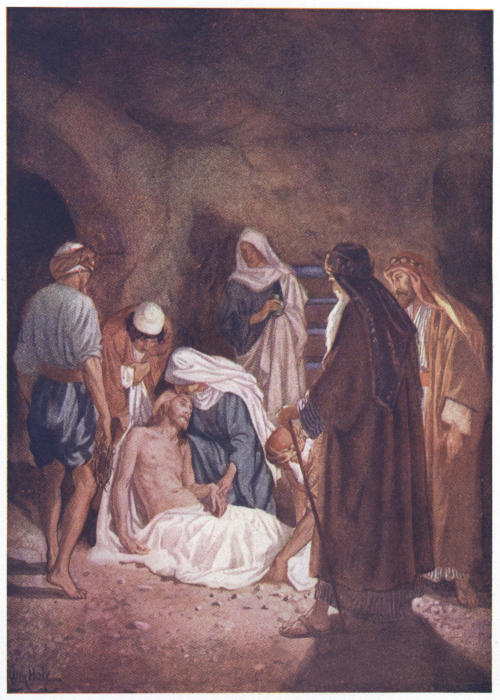
The Body of Jesus Laid in the Tomb
And, behold, there was a man named Joseph, a counsellor; and he
was a good man, and a just. (The same had not consented to the
counsel and deed of them;) he was of Arimathea, a city of the Jews:
who also himself waited for the kingdom of God. This man went unto
Pilate, and begged the body of Jesus. And he took it down, and wrapped
it in linen, and laid it in a sepulchre that was hewn in stone, wherein
never man before was laid. And that day was the preparation, and the
sabbath drew on. And the women also, which came with him from
Galilee, followed after, and beheld the sepulchre, and how his body
was laid. And they returned, and prepared spices and ointments.—St.
Luke xxiii: 50-56.
NOTE BY THE ARTIST
In a garden beneath this cliff, where Joseph’s new tomb was, there is a
tomb bearing marked characteristics. The workmanship shows it to be Jewish
and of the Herodian period, yet when first discovered there were traces of a
cross painted upon the wall. Although there is room in the sepulchre for four
bodies, one only of these has been completed, one only occupied. In digging near
the foundations of a neighboring monastery, a Christian grave was found
bearing the remarkable words, “Laid near his Lord.” We may never know
the real meaning of these facts, but they are at least significant, and especially
so in view of the cogent arguments which can be urged against the acceptance
of the traditional site of the Holy Sepulchre.
71
“Delivered by a Dog.” A minister of the
gospel, who had a country parish in New England,
tells this story:
“A farmer belonging to my parish, and who
was quite well off, died suddenly. Shortly after
his death his widow, who was a good Christian
woman, concluded to give up the farm and take
a small house in the neighboring village. The
farm was sold and then an auction was held to
sell the things on the farm and in the house,
except the furniture that would be needed for
the little house in the village.
“I went to see her,” said the minister on the
day of the sale. “I told her I thought she had
done wisely in concluding to give up the farm,
for it was half a mile away from any other
house, and she would be lonely and unprotected
there.
“‘Oh! no,’ she said, ‘not unprotected; far
from it! You forget that I am now under the
special charge of that God “who careth for the
widow and the fatherless,” and who, I am sure,
will protect us.’
“And now, let me tell you how God did
protect them. There was a good deal of money
in the house that night from the sale which
had taken place. The only persons in the
house were the mother with her three young
children and their maid servant.
“Some time after going to bed she heard a
strange and unusual noise at the back of the
house. Then she was startled by the barking
of a dog, apparently in the room under her
chamber. This alarmed her still more as they
had no dog of their own.
“She arose and dressed herself hastily. She
awoke her maid and they went down stairs.
They first looked into the room where they
heard the dog. There they saw a huge black
dog, scratching and barking furiously at the
door leading into the kitchen. She told her
servant to open the door where the dog was
scratching. The girl was brave, and opened
the door without a fear. In a moment the dog
rushed out, and through the open door the
widow saw two men at the kitchen window,
which was also open. The men instantly
turned to run, and the dog leaped through the
window and ran after them. There was a fierce
fight between them, but the men finally got
away, though followed far off by the faithful
dog.
“Mrs. M., and her maid fastened the window
and doors, and concluded to sit up for the rest
of the night, for, of course it would be impossible
to sleep after what had taken place. They
had hardly taken their seats before they heard
their noble protector scratching at the outer
door for admittance. They gladly let him
in, and when he came up to them, wagging
his great bushy tail, they patted and praised
him for his goodness and courage. Then he
stretched his huge form beside the warm stove,
closed his eyes and went to sleep. The next
morning they gave him a breakfast that any dog
might have been glad to get. As soon as he
had finished his breakfast, he went to the door,
and stood impatiently whining till the door
was opened, when off he ran in a great hurry,
and they never saw him again.
“They had never seen the dog before, and
knew not to whom it belonged. But the grateful
widow felt sure that her Father in heaven
had sent him for their protection that night.
And her faith was stronger than ever at the
mysterious working of his providence.”
“Say not, my soul, From whence
Can God relieve my care?
Remember that omnipotence
Hath servants everywhere.”
The last lesson taught us by the burial of Christ
is—a lesson of comfort.
If Christ had not suffered, and died, and been
buried for us, we should have no comfort when
we come to die. The thought of having to lie
down in the grave would have been terrible
to us. But Jesus died and laid in the grave
for us, on purpose that we might not be afraid
to die.
It is true as the hymn says, that:
“The graves of all his saints he blest
When in the grave he lay.”
David had learned this lesson, by faith in the
promised Saviour, long before he came to earth,
and it was this that enabled him to say, “Yea,
though I walk through the valley of the shadow
of death, I will fear no evil, for thou art with me;
thy rod and thy staff they comfort me.” Ps. 23:4.
And the apostle Paul had learned the same
lesson, when he exclaimed so joyfully, “O
death, where is thy sting? O grave, where is
thy victory? Thanks be to God who giveth us
the victory through our Lord Jesus Christ.”
I. Cor. xv: 55, 57.
Good Dr. Muhlenberg put this lesson very
sweetly into a single verse of his beautiful
hymn, when he said:
“I would not live alway; no; welcome the tomb,
Since Jesus hath lain there I dread not its gloom.
There sweet be my rest, till he bid me arise,
To hail him in triumph descending the skies.”
The sweet Scottish poet Bonar had learned
this lesson well, and was feeling the comfort
which the thought of Christ’s burial gives when
he could think of dying and lying in the grave,
and speak about it in these words:
“I go to life and not to death;
From darkness to life’s native sky;
I go from sickness and from pain
To health and immortality.
“Let our farewell, then, be tearless,
Since I bid farewell to tears;
Write this day of my departure
Festive in your coming years.
“I go from poverty to wealth,
From rags to raiment angel-fair,
From the pale leanness of this flesh
To beauty such as saints shall wear.
“I go from chains to liberty,
These fetters will be broken soon;
Forth over Eden’s fragrant fields
I’ll walk beneath a glorious noon.
“For toil there comes the crowned rest;
Instead of burdens, eagles’ wings;
And I, even I, this life-long thirst
Shall quench at everlasting springs.”
We see the true effect of Christ’s burial in
the feeling of comfort which those who believe
in him experience when they come to die.
Here are some examples of what I mean.
When Dr. Watts was on his death-bed, he
said, “I bless God that I can lie down at night
without the slightest fear whether I wake in
this world or another.”
Another good minister, when asked how he
felt at the approach of death, said,—“I am just
going into eternity; but I bless God, I am neither
ashamed to live, nor afraid to die.”
During the reign of Henry VIII, of England,
many good men were cruelly put to death for
the sake of their religion. Among these was
Dr. Fisher, Bishop of Rochester. When he
came in sight of the scaffold on which he
was to die, he took out of his pocket a Greek
Testament, and looking up to heaven, said,
“Now, O Lord, direct me to some passage
which may comfort me in this trying hour.”
Then he opened the book, and his eye rested
on this passage, “This is life eternal, to know
thee, the only true God, and Jesus Christ whom
thou hast sent.” He closed the book and said,
“Praised be God! this is all I need. This is
enough for life, or for death; for time, or for
eternity.”
When the Rev. James Harvey came to his
last sickness, his physician came in one day
and told him he had but very little time to live.
“Then let me spend my last moments,” said
he, “in praising my blessed Saviour. Though
my heart and my flesh fail, yet God is the
strength of my heart, and my portion forever.
St. Paul says: ‘All things are yours, whether life
or death; things present, or things to come; all
are yours, and ye are Christ’s, and Christ is
God’s.’ Here is the treasure of a Christian, and
a noble treasure it is. Death is ours. Jesus
has made it our friend, by his death and
burial. Praise God for this truth. And now
welcome death! How well thou mayest be
welcomed among the treasures of the Christian.
‘For me to live is Christ, but to die
is gain.’”
The Rev. William Janeway was another excellent
and faithful minister of Christ. In his
closing sickness, these were among the last
words that he spoke: “I bless God I can die
in peace. I know what that means, ‘The peace
of God which passeth all understanding shall
keep your hearts.’ It is keeping mine now.
My joy is greater than I can express. Bless the
Lord, O my soul, and all that is within me,
bless his holy name. Now I can die. It is
nothing. I long to die. I desire to depart and
be with Christ.” And so he died.
These good men had studied well the subject
of Christ’s burial, and had learned the lesson of
comfort it was intended to teach us. And when
we think of the burial of Christ, let us remember
the lessons of which we have now spoken
in connection with it. These are the lessons
about the certainty of his death:—the fulfillment
of his word;—the working of his providence;—and
the comfort we derive from his burial.
The collect for Easter-even, is a very appropriate
one with which to close this subject:—“Grant,
O Lord, that as we are baptized into
the death of thy blessed Son, our Saviour, Jesus
Christ, so by continual mortifying our corrupt
affections, we may be buried with him; and
that through the grave and gate of death, we
may pass to our joyful resurrection, for his
merits, who died, and was buried, and rose
again for us, thy Son, Jesus Christ our Lord.
Amen.”
THE RESURRECTION
The rising of our blessed Lord from the
dead was one of the most important
events in the history of his life on earth.
Let us take an illustration of its importance.
Suppose that we were living in England, and
that we were well acquainted with Victoria—the
good and gracious queen of that great kingdom.
And suppose that it should please the
queen to make us a present of one of the fine
old castles of England, with all the lands and
property belonging to it. In giving us this
castle, or, as the lawyers say, in “conveying it to
us,” the queen would order a title deed to be
made out. This deed would be necessary;
because if any one else should claim that the
castle belonged to him, we could then open the
deed and show that the queen had really given
it to us. A title deed, like this of which we
are now speaking, is generally written on a sheet
of parchment. In this deed would be found
the name of the castle, with a full description
of it, and all the property belonging to it. It
would be stated here how many acres of land
were connected with it; and then it would be
written down that the queen had given it to us,
and that it was to belong to us, and to our
children, or heirs forever. But after all this
had been written out, the deed would be good
for nothing unless something more were done
to it. It would be necessary for the queen to
sign her own name to the deed—Victoria Regina—and
then put the royal seal upon it. The
property described in it could never become
ours, unless the queen’s signature and seal were
added to it.
When Jesus came down from heaven to earth,
his great object was to secure for his people
a home in heaven,—a mansion in the skies.
When he hung upon the cross, we may well
say that he was writing out the title deed to
those mansions, in his own blood. But, after
this deed had thus been written, it was necessary
for his Father in heaven to show that he
approved of what had been done. When Jesus
died and was buried, we may say that he took
with him the title deed to our heavenly home,
to get his Father to sign it and seal it. And
when the resurrection of Jesus took place it
showed that this was done. Then God the
Father did, as it were, say—“I approve of what
my beloved son has done. I sign and seal the
title deed which he has written out to secure a
home in heaven for all who love and serve him.”
This shows us how very important the resurrection
of Jesus was. And because it is so
important, we may well feel a great interest in
studying the subject of Christ’s resurrection.
And in doing this there are two things for us
carefully to consider. These are—The proof of
the resurrection of Christ; and the lessons we are
taught by it.
Let us begin by considering—the proof of the
resurrection of Christ. We have great cause for
thankfulness that the proof given us on this
subject is so clear and strong. There is no fact
of history supported by stronger proof than is
the fact of Christ’s resurrection. We believe
that there was such a person as Napoleon
Bonaparte; that he was emperor of France;
and that he died a prisoner on the island of St.
Helena. We believe that there was such a
person as George Washington; that he was the
leader of our armies during the revolutionary
war; and that, after the war, he was the first
president of the United States. We believe that
there was such a person as Julius Cæsar; that
he was a successful general of the Roman
armies; and that he met his death in the Senate
chamber from the daggers of the Roman senators.
No one doubts these facts. They are
matters of history. And yet the proof we have
of the resurrection of Christ is clearer and
stronger than the proof we have for what we
believe respecting Julius Cæsar, or George Washington,
or Napoleon Bonaparte. Nothing that
we read of in history is more sure than this,
that Jesus did rise from the dead.
Many years ago, there was an infidel club in
England. It was composed of learned and distinguished
men. At the meetings of the club,
its members were in the habit of ridiculing the
Bible and of trying to show it was not worthy
of being believed. On one occasion a member
of this club was appointed to examine the subject
of the resurrection of Christ and to write
an essay for the purpose of showing that there
was no satisfactory proof that he ever rose from
the dead.
He examined carefully what is said on this
subject in the New Testament. And the end
of it was, that he became fully convinced of the
fact that Christ did rise from the dead. And,
instead of writing an article for that infidel club
to show that what Christians believe about the
resurrection of Christ is not true, he wrote one
of the best books that ever has been written, to
prove, beyond all doubt, that the resurrection
of Christ is true. He became an earnest Christian.
And that which led to this great change
was the convincing proof he found in the New
Testament of the truth of the resurrection of
Christ. He saw it was true that Jesus did rise
from the dead. And when he became satisfied
that this was true, he was obliged to admit that
all the other teachings of the New Testament
respecting Christ must be true also. The resurrection
of Christ is the foundation stone on
which the religion of the Bible is built up. If
that falls, this must fall. But if that stands firm
and sure, then this must stand firm and sure also.
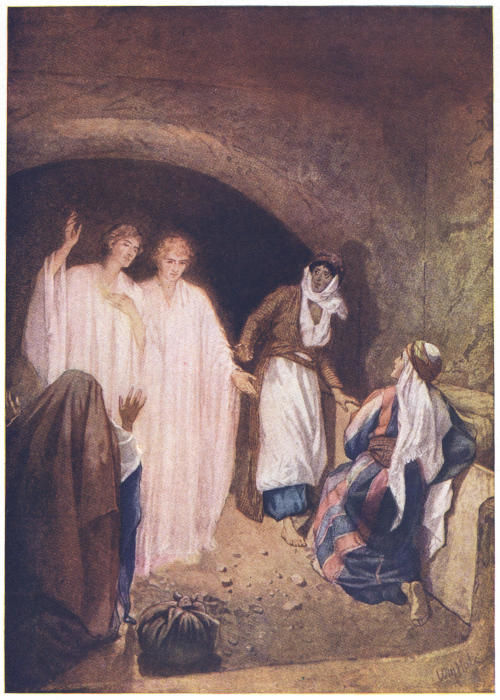
“He is not Here, but is Risen”
And they returned, and prepared spices and ointments; and rested
the sabbath day according to the commandment.—Now upon the first
day of the week, very early in the morning, they came unto the sepulchre,
bringing the spices which they had prepared, and certain others
with them. And they found the stone rolled away from the sepulchre.
And they entered in, and found not the body of the Lord Jesus. And
it came to pass, as they were much perplexed thereabout, behold, two
men stood by them in shining garments. And as they were afraid, and
bowed down their faces to the earth, they said unto them, Why seek
ye the living among the dead? He is not here, but is risen: remember
how he spake unto you when he was yet in Galilee, Saying, The Son
of man must be delivered into the hands of sinful men, and be crucified,
and the third day rise again. And they remembered his words.
And returned from the sepulchre, and told all these things unto the
eleven, and to all the rest.—St. Luke xxiii: 56; xxiv: 1-9.
NOTE BY THE ARTIST
This and the following picture present the chief features of the rock-hewn
tomb referred to in Note facing picture No. 71. It is about fifteen feet long
by eleven feet wide, and eight feet in height, and it is divided transversely
by a flattened arch supporting the roof. The single completed grave is formed
by the erection on the floor-level of a limestone slab in notches cut in the rock
for its support, thus forming, with the walls, a sort of built sarcophagus, or
coffin. An additional hollow, cut in the rock for the reception of the head,
explains the meaning of “the napkin that was about his head” being “in a
place by itself.” Sepulchres of this type are comparatively rare, and, providing
as it does a minimum of accommodation for the labor expended on its
construction, this new tomb must obviously have belonged to a man of wealth.
72
And in examining the proof of the resurrection
of Christ the most important thing to
notice is—the number and character of the witnesses.
The first person who saw our blessed Lord,
after he rose from the dead, was Mary Magdalene.
We read about this in St. Mark xi: 9.
St. John xx: 11-18. After this he appeared to
certain other women, who were returning from
the sepulchre. St. Matt. xxviii: 9, 10. Then he
appeared to Simon Peter, alone. St. Luke xxiv:
34, I. Cor. xv: 5. His next appearance was to
two of his disciples, as they were walking
together from Jerusalem to a village called
Emmaus. He had a long talk with them and
stopped and ate bread with them. St. Luke
xxiv: 13-32. The fifth appearance of the risen
Saviour was to ten of his disciples, Thomas
being the only one of them who was not there.
This was at Jerusalem, on the evening of the
first glad Easter day. St. John xx: 19-32. After
this we hear nothing of him for a week. But
on the evening of “the first Sunday after Easter,”
he made his sixth appearance. On this occasion
the eleven disciples were all together. Thomas
was with them now. They were sitting in a
room, with the door closed, and no doubt fastened,
for fear of the Jews. Only one subject
could occupy their thoughts—and that was the
resurrection of their wonderful Master. Suddenly
Jesus himself stood in the midst of them,
and said, “Peace be unto you.” In spite of all
that he had heard from the other disciples,
Thomas declared he could not believe it possible
that Jesus had risen from the dead. When
his brethren told him that it was true, he said,
“Except I shall see in his hands the print of
the nails, and put my finger into the print of the
nails, and thrust my hand into his side, I will
not believe.” But on this occasion the loving
and gracious Saviour met his doubting disciple
in the very way in which he had desired to be
met. For we read: “Then saith he to Thomas,
reach hither thy finger, and behold my hands:
and reach hither thy hand, and thrust it into
my side; and be not faithless, but believing.”
St. John xx: 26-29.
The seventh appearance of the risen Saviour,
was on the shore of the sea of Galilee. A
number of the apostles were together on this
occasion. It was one of the most touching and
impressive of all his interviews with them. The
deeply interesting account of what took place
at this time is given in full in the twenty-first
chapter of St. John’s gospel; but we cannot
enlarge on the subject now.
The eighth time that Jesus was seen after his
resurrection was by the eleven disciples again.
We read in St. Matt. xxviii: 16—“Then the
eleven disciples went away into Galilee, into a
mountain where Jesus had appointed them.”
This refers to St. Matt. xxvi: 32, when as they
were partaking together of the Lord’s Supper
for the first time, after referring to his death
he said, “But after I am risen again, I will go
before you into Galilee.” We are not told
where this meeting was held, or what took
place on that occasion.
The ninth appearance of the risen Lord, is
that of which St. Paul speaks in I. Cor. xv: 7,
where he tells us that “he appeared to above
four hundred brethren at once.” The place
here referred to is not mentioned, and so cannot
be known. It was probably in Galilee. Jesus
had spent most of his public life in that part of
the country. He had made most of his disciples
there. It was proper, therefore, that those disciples,
who would, of course, hear of his death,
should have some public proof given them of
the fact of his resurrection. No doubt the
eleven disciples went to Galilee after Jesus rose.
They would spread the news that he had risen,
and that he was about to show himself to his
friends on a certain mountain. Nothing more
would be necessary anywhere to draw together
a great concourse of people than a report that
one who was dead had come to life again, and
was about to show himself; and in this case
where they greatly loved him, and where, no
doubt, many believed he would rise, they would
naturally come together in great numbers to
see him once more.
The tenth appearance of Christ after his
resurrection was to the apostle James. This is
told us by St. Paul, who says I. Cor. xv: 7.
“After that he was seen of James.” This is not
mentioned in any of the gospels. But as Jesus
was on earth for forty days after his resurrection,
it is most likely that he appeared often to his
disciples, and that only enough of the more
prominent appearances were mentioned, to
prove the fact that he had risen.
The eleventh occasion on which Jesus was
seen after his resurrection was on the Mount of
Olives, just before his ascension into heaven.
On this occasion all the eleven apostles were
present, and no doubt great numbers of his
other disciples.
And then there was one other occasion on
which Jesus appeared, making twelve in all.
This was after his ascension into heaven. To
this the apostle Paul refers, when he says, “And
last of all he was seen of me also.” I. Cor. xv: 8.
This was when he had that wonderful vision
near Damascus. Then the great apostle to the
Gentiles, saw the same Lord Jesus, in the same
body which had been seen by others. Unless
it were so, this would be no proof that Jesus
was risen from the dead. It was not a fancy
therefore that he had seen him. It was not
revealed to him, that Jesus was risen. “Last of
all he was seen of me.” With his bodily eyes,
St. Paul actually saw, in a bodily form, that
same Jesus who had died upon the cross; who
had been buried in that rocky sepulchre; who
had risen from the dead and had ascended into
heaven. Such were the witnesses of the resurrection,
as to their number.
And now look at the character of these witnesses.
They were sensible men. They knew
what they were doing. They could not be
mistaken about the fact of Christ’s resurrection.
They had seen him put to death upon the
cross. They had seen him buried. On the third
day after his burial they had found his tomb
empty. His body was gone. Then they saw
him alive. They could not be mistaken about
his person. They knew him too well for this.
They had seen the print of the nails in his hands.
This made the proof of his resurrection perfect.
And then they were honest men. They had
no motive for preaching the resurrection of
Christ but the sincere belief that it was true.
If they could have made money or gained
honor by preaching the resurrection, that would
have been a reason for their doing so even if it
had not been true. But the very opposite of
this was the case. Preaching the resurrection
brought on them the loss of all they had in the
world. It caused them to be persecuted, imprisoned,
and put to death. And yet they went
on preaching that Christ had risen. And they
would have been guilty of the greatest folly if
they had done this without being thoroughly
convinced that it was true. But they were
perfectly satisfied of the truth of what they
preached, and this was the reason why they
went on preaching it.
And then, if Christ had not risen from the
dead, it would have been the easiest thing in
the world for the enemies of his cause to have
denied it. That would have ended the matter.
But they never did this. And the only reason
why they did not do so, was that they knew it
was true that Christ had risen. They could
not deny the fact. And when we put these
things all together, we see how perfectly
convincing is the proof of the resurrection
of Christ.
And now let us look at some of the lessons
taught us by our Lord’s resurrection.
The first lesson we may learn from this great
fact is about—the power of christ.
We know of nothing that is harder to do than
to bring the dead back to life. Men can do
many things, but this is one thing which they
cannot do. All the men in the world and all
the angels in heaven could never, by their own
strength, restore life to the dead. When the
blood stops flowing through the veins, and the
heart stands still, there is nothing but the power
of God that can make the heart begin to beat,
and the blood begin to flow again. But Jesus
had the power to do this. He raised Lazarus
to life after he had lain in the grave four days.
And he did the same to the widow’s son, and
to the daughter of Jairus. And what he did for
others in this matter, he did for himself also.
And he did it by his own power. On one
occasion, when speaking to his disciples about
his death, or, as he called it, laying down his
life, he said, “I lay it down of myself; I have
power to lay it down, and I have power to take it
again.” And he did this on the morning of
the resurrection. He exercised his own power
to give new life to his dead body. Here we
have a grand lesson about the power of Christ.
And it is very comforting to know how great
the power of Jesus is, because we so often need
to have him exercise that power to help us
when we are in trouble. And he is exercising
his power in this way continually.
Let us look at some of the ways in which he
does this.
“The Power of Christ to Save.” A young
man, the son of a pious mother, was wandering
away from the paths in which he had been
trained to walk. He had given up going to
church, and in the summer time generally spent
his Sundays in sailing on the river in a boat
with his gay companions. One Sunday the
boat upset. He could not swim and he went
down in the deep water. As he rose to the
surface for the last time, he was seized and his
cold and apparently lifeless body was brought
to the shore. He was carried home. Everything
possible was done for his recovery, but for
a long time it seemed uncertain whether he
would come back to life. There was a feeble
flutter about the wrist, just enough to keep
hope alive.
His mother knelt by his bedside, and prayed
in her agony that he might be spared at least
till he could seek and find pardon. As she thus
prayed, the cold hand held in hers gave a feeble
pressure. The eyelids quivered a little, but
did not open. After a while he looked at his
mother, and said, in a low whisper, “Mother I
am saved.” Supposing that he meant saved
from drowning, she replied, “Yes, dear, thank
God you are saved.” And then in broken sentences,
with long intervals between them, he
gave this remarkable experience:
“Mother, I heard you praying: if I had died
you would have thought me lost: but I am
saved. When I let go my hold upon the boat,
the thought flashed across my mind—I am lost.
I am going into eternity with all my sins unpardoned.
I lifted up my heart to heaven, and
said, ‘God be merciful to me a sinner. Lord
save me!’ I seemed to hear a voice distinctly
saying, ‘I will save thee, trust me.’ I am sure
it was the voice of Jesus. All my fear was
gone. But after that I knew nothing until I
heard you praying for me. You would have
mourned for me as lost; but mother I am
saved.”
And the result proved that he was right. As
soon as he recovered his health and strength, he
gave up all his wicked ways, and lived the life
of an earnest and devoted Christian. How
wonderful is the power of Jesus to save!
“The Power of Jesus to Provide.” A Christian
widow was dying. She was very poor, and
had four young children to leave helpless and
alone in the world. As she took leave of her
little ones, Nettie, the oldest girl, about fourteen
years of age, said amidst heart-breaking sobs
and tears, “O, mother dear, what shall we do
when you are gone?”
“Nettie, darling,” said the mother, “God’s
hand will help you. It is an omnipotent hand.
Never let go of it.”
The mother died and was buried. Towards
evening of the next day, little Dick, the youngest
of the children, came to Nettie and said,
“Nettie, Dick’s awful hungry. Isn’t there a bit
of crust anywhere?” “Poor Dick,” said Nettie,
“what shall we do?” And then, remembering
what her dying mother had said about the
Omnipotent hand, she dropped on her knees,
and said, “O God, our God, and our mother’s
God, look on these hungry little ones, left in
my care, and send them some food for Christ’s
sake. Amen.”
A rich merchant of the town was going home
that evening. He was a widower, but had no
children. Without knowing why, he took a
different way home from the one ordinarily
taken. As he walked slowly along he happened
to be just under the open window when Nettie
made that prayer for bread. The tone of deep
sadness in it touched his heart. He stopped.
He knocked at the door. Nettie opened it, and
asked him in. He found out the sad condition
of those helpless orphans. He gave them money
to get what they needed. He continued to visit
them, and finally became so much interested
in them that he took them to live with him in
his own home. Nettie felt the blessedness of
holding on to the Omnipotent hand. Here
we see the power of Jesus to provide.
One other illustration shows us—“The Power
of Jesus to Protect.”
A young Christian woman, whose family
were very well off, was confined to her sick bed
for many years. She seldom had any one in
the room with her at night. On one occasion
she lay awake about midnight. The family
were all asleep and the house was very still,
when the door of her chamber opened and a
man walked softly in. He came towards her
bed and then stopped a moment. Her little
night lamp was shining on them both, from the
stand by her bedside. She did not scream, or
cry. The robber looked at this lovely girl, as
she gazed on him with perfect calmness. Lifting
her finger, and pointing solemnly towards
heaven, she said, “Do you know that God sees
you?” The man waited a moment, but made
no reply. Then he turned and walked quietly
away. He had opened no other doors than the
street door and the door of her chamber. The
omnipotent hand was there, too. What a blessed
thing it is to hold on to that hand! Here we
see the power of Jesus to protect. The power
he had to raise himself from the dead, he has still,
to use for the help and comfort of his people.
The second lesson to be learned from the resurrection
is a lesson about—the tenderness of
Christ.
We learn this lesson from two little incidents
connected with the resurrection.
You remember that on the night of our Saviour’s
trial, though all the disciples forsook
him, yet Peter was the only one of them who
denied him. In the very presence of Jesus, he
declared with oaths and curses, that he did not
know him. How painful this must have been
to the blessed Saviour! It might have been
expected that when he met Peter again, for the
first time after this, he would have had some
sharp rebuke to give him. But it was not so.
Instead of this, we find that when the angels at
the empty tomb met the women who had
come early to anoint the body of Jesus, they
told them that he had risen from the dead, and
then charged them to go and tell the good
news to “his disciples, and Peter.” He was
the only one of all the disciples who was mentioned
by name in this message of the angels.
“Tell his disciples, and Peter!” How strange
this was! The angels did not do it of their
own accord. No doubt Jesus had told them to
say this. And why did he do so? What led
him to do it? It was the tenderness of his
loving heart. He knew how badly Peter had
been feeling about his shameful denial of him.
He knew what bitter tears he had been shedding
over his sin. And he wished to let him know
that, notwithstanding what he had done, his
injured Master had no unkind feeling in his
heart towards him. And so he told the angels
to say to the women that they should—“go tell
his disciples, and Peter,” that their Lord was
risen. Here we see the tenderness of Jesus.
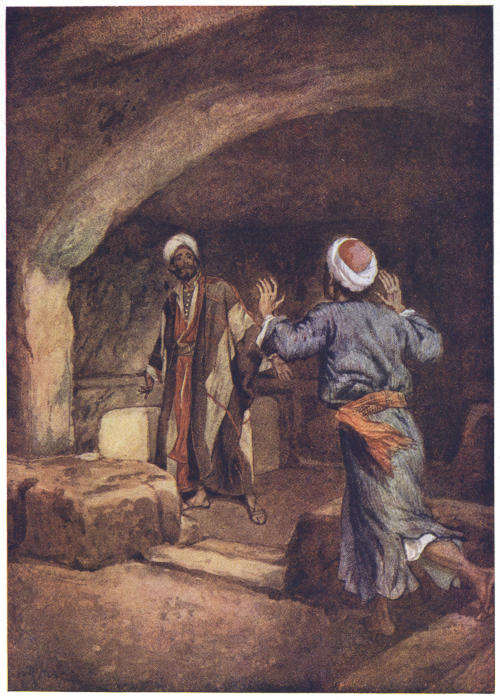
Peter and John in the Sepulchre
Peter therefore went forth, and that other disciple, and came to the
sepulchre. So they ran both together: and the other disciple did outrun
Peter, and came first to the sepulchre. And he stooping down
and looking in, saw the linen clothes lying; yet went he not in. Then
cometh Simon Peter following him, and went into the sepulchre, and
seeth the linen clothes lie. And the napkin, that was about his head,
not lying with the linen clothes, but wrapped together in a place by
itself. Then went in also that other disciple, which came first to the
sepulchre, and he saw and believed. For as yet they knew not the
scripture, that he must rise again from the dead. Then the disciples
went away again unto their own home.—St. John xx: 3-10.
NOTE BY THE ARTIST
The peculiar construction of the tomb furnishes an interesting commentary
upon the text, of which this picture is an illustration. John is described as
coming first to the sepulchre “and he stooping down and looking in saw the
linen clothes lying; yet went he not in.” Why? Because from his position
at the entrance, he could perceive in the uncertain light the outline of the
grave-clothes, and he hastily concluded from their undisturbed appearance that
the body of his Master was still there. Peter, with characteristic impulsiveness,
entered in, and announced the startling discovery that the body of Jesus
was indeed removed. “Then went in also that other disciple,” and further
examination revealed the well-nigh incredible fact that the grave-clothes and
the head-napkin had simply fallen together in a manner only compatible with
the supposition that they had not been unwound, but that in some mysterious
way the body of the Lord Jesus had actually risen through the cerements of
the tomb, leaving not a fold disturbed. As yet the two disciples had not
grasped the meaning of their Master’s words that he should rise again, nor
of the prophetic utterance of David; but now, they “saw and believed.”
73
And then there was another incident connected
with the resurrection of Jesus which
shows his tenderness still more touchingly. He
arranged matters so that Peter might have a
private interview with him, early in the day on
which he rose from the dead. St. Luke tells us,
Ch. xxiv: 34, that Jesus “appeared unto Simon.”
And St. Paul says that—“he was seen of Cephas.”
I. Cor. xv: 5. This was a meeting that Peter
had with the Master whom he had denied, all
by himself. We are not told what took place at
this meeting. Peter never said a word about
it; and it was too sacred for any one else to
intrude upon. But we can very well imagine
what was said and done. We can imagine how
the poor penitent disciple would sob, as if his
heart were breaking, when he saw his injured
Master. We can fancy we see him throwing
himself at the feet of Jesus and bathing them
with bitter, burning tears, as he begged to be
forgiven. And then we can think of the kind
and gentle words that Jesus would speak to him.
How tenderly he would assure him of his free
forgiveness! How he would tell him that he
loved him still! and how willing he was to put
him back in his old place as a disciple, and let
him go and preach salvation for lost sinners
through his death and resurrection! How kind
it was in Jesus thus to give Peter an opportunity
of making up with him, when they were all
alone by themselves!
Let us never forget the tenderness of Jesus, as
shown by these two incidents. And let us try,
like him, to be loving and gentle and kind to all.
See how much good may be done by those who
imitate the example of Christ in this respect.
“The Power of Kindness.” An English
merchant had taken passage on board a Turkish
vessel, on the Mediterranean Sea. During the
voyage his attention was called to an interesting
man on the vessel, who was a slave belonging
to the captain. He had frequent conversations
with him and found him to be a kind-hearted,
active, and intelligent person. In the course of
their conversations together, he learned that the
man had been born free, but had been taken
captive in war, and was now a slave for life.
The merchant felt a great sympathy for the
poor captive and had a desire to get him released.
He inquired what it would cost to
purchase his freedom. The sum named was
more than the whole profit of his voyage. Still
he could not give up the thought. He offered
the captain a price for his slave. The offer was
accepted. The slave overheard this conversation.
He supposed the merchant was going to
purchase him, that he might keep him as his
own slave. This made him very angry. He
sprang forward and said, with great excitement,
“You call yourself a lover of freedom, an enemy
to slavery, wherever found, and yet you are
purchasing me!”
The merchant turned and looked kindly on
him, as he calmly said, “My friend, I have
bought you to set you at liberty. Now you are a
free man.”
In a moment the storm of passion was stilled.
The slave burst into tears; and falling at the feet
of his deliverer, he exclaimed, “You have taken
my heart captive! I am your servant forever!”
Few of us may have the opportunity of
showing kindness as this merchant did. But
every boy and girl in the land may follow the
example of the noble lad whose kindness to
the aged is told in these simple lines:
“The woman was old, and ragged and gray,
And bent with the chill of the winter’s day;
The street was wet with recent snow,
And the woman’s feet were aged and slow.
She stood at the crossing, and waited long,
Alone, uncared for, amid the throng
Of human beings who passed her by,
None heeded the glance of her anxious eye.
“Down the street, with laughter and shout,
Glad in the freedom of ‘school let out,’
Came the boys, like a flock of sheep,
Hailing the snow piled white and deep.
Past the woman so old and gray,
Hastened the children on their way,
Nor offered a helping hand to her
So meek, so timid, afraid to stir
“Lest the carriage-wheels, or the horses’ feet
Should crowd her down in the slippery street.
At last came one of the merry troop,
The gayest laddie of the group;
He paused beside her and whispered low
‘I’ll help you across if you wish to go.’
Her aged hand on his strong young arm
She placed, and so, without hurt, or harm,
“He guided the trembling feet along,
Glad that his own were firm and strong.
Then back again to his friends he went,
His young heart happy and well content.
‘She’s somebody’s mother, you know,
Altho’ she is aged, and poor, and slow;
And I hope some fellow will lend a hand
To help my mother, you understand,
“‘If ever she’s poor, and old, and gray,
When her own dear boy is far away.’
And ‘somebody’s mother’ bowed low her head
In her home that night, and the prayer she said
Was, ‘God be kind to that noble boy,
Who is somebody’s son, and pride, and joy!’”
Let us never forget the lesson of tenderness
which Jesus taught on the morning of his
resurrection.
The only other lesson, in connection with the
resurrection of Christ, of which we would now
speak is about—the way of showing our love to
him.
This lesson was taught on the shore of the
Sea of Galilee. Some of the disciples of Jesus
had gone back to their old trade of fishing. On
one occasion they had been out all night, but
had caught nothing. The next morning, Jesus
stood on the shore of the lake, but they did not
know him. He asked them if they had anything
to eat. They said no. He told them to
cast the net on the right side of the ship, and
they would find plenty of fish. They did so,
and their nets were filled at once. Then John,
the loving disciple, was the first to find out who
it was. He said to Peter, “It is the Lord.” As
soon as Peter heard this, he fastened his fishing
coat about him, plunged into the sea, and swam
to the shore. The other disciples rowed to
land in their boat. As soon as they landed,
they found a fire of coals, with fish and bread
all ready for eating. Jesus invited them to
come and dine with him. They did so, and
when the dinner was over, he had a long conversation
with them. As they were talking
together, he said to Peter, “Simon, son of Jonas,
lovest thou me?” He saith unto him, “Yea,
Lord; Thou knowest that I love thee.” He
saith unto him, “Feed my lambs.” This question
was repeated by Jesus the second and the
third time. Peter gave the same answer each
time. The reply of Jesus was—“Feed my
sheep.” The lambs of Christ’s flock mean the
children, or young members of his church.
The sheep of Christ mean the older members
of his church. By feeding his lambs and his
sheep, Jesus meant teaching his people, both
young an old, about himself, and what he has
done for their salvation. And by what Jesus
said on this occasion, he meant to teach Peter,
and you and me, and all his people, that if we
really love him, the way in which he wishes us
to show that love, is by being kind to others—by
teaching them about him, and by trying to
get them to love and serve him, too.
This is a good lesson for ministers to learn;
for parents, for teachers, and for all who love
Jesus. When we have found what a faithful
friend, what a loving Saviour, what a kind and
tender comforter we have in him, then he wishes
us to do all we can to help others to know him,
and love him, and serve him. This is what we
should all be trying to do.
Let us look at some of the ways in which we
may do this.
“The Unexpected Friend.” The Rev. Mr.
Moffatt,—the missionary to Southern Africa,
tells an interesting story which illustrates very
strikingly this part of our subject. “In one of
my early journeys in this land,” he says, “I
came, with my companions, to a heathen village
on the banks of a river. We had travelled far,
and were hungry and thirsty and very weary.
The people of the village would not let us come
near them. We asked for water and they would
not give us any. We offered to buy milk, but
they refused to sell us any. We had no prospect
but that of spending the night without anything
to eat, or to drink. But at the close of the day
a woman came to us from the village. She bore
on her head a bundle of wood, and had a vessel
of milk in her hand. Without saying a word,
she handed us the milk. She laid down the
wood and returned to the village. Presently
she came again with a cooking vessel on her
head, with a leg of mutton in one hand and a
vessel of water in the other. Silently she kindled
the fire and put on the meat. Again and again
we asked her who she was and why she was
doing all this for us strangers. At last she said
that years before there had been a missionary in
her neighborhood. He had gone away a long
while ago; but from him she had learned to
know the Saviour. ‘I love him,’ she said, ‘whose
servants you are, and I wish to show my love to
him by doing what I can to help you.’ ‘I asked
her,’ said Mr. Moffatt, ‘how she, alone in that
dark land, without a minister, without a church,
and without any Christian friends, had kept up
the light of God in her heart?’ She drew from
her bosom a soiled and worn copy of the New
Testament, which the missionary had given her.
‘This,’ she said, ‘is the fountain from which I
drink; this is the oil that makes my lamp burn.’”
“How a Boy Showed his Love for Christ.”
Some time ago a dreadful accident took place
on the river Thames, in England. A steamer,
called the Princess Alice, when crowded with
passengers, on an excursion, was run into by
another vessel and sunk. Fearful screams filled
the air as the great crowd of people were
plunged into the water. Among those who
were drawn to the spot was a good Christian
boy, about sixteen years of age, who worked in
the neighborhood. Being a good swimmer, he
at once plunged into the water, took hold of
the first struggler he met with, and bore him
away in safety to the shore. He did the same
the second time, and then the third. As he was
nearing the shore the third time he saw a small
bundle floating on the water, which he thought
must be a baby. He caught it with his teeth,
and thus was the means of saving four lives on
that terrible occasion. By the time he had done
this, his strength was exhausted, and he was
unable to venture again among the drowning
ones. But he carried the baby home to his
mother’s humble dwelling, and placing the little
orphan in her arms, he said, “Here, mother, suppose
you nurse this baby for our blessed Saviour;
and I will work for its support as long as I live.”
A noble boy that was! and a beautiful illustration
he gave of the way in which we should
show our love to Jesus, by feeding and taking
care of his lambs, and doing good to his people.
I never saw the lesson now before us better
expressed than in the following simple lines:
“Are you shining for Jesus children? You have given your hearts to Him;
But is the light strong within them, or is it but pale and dim?
Can everybody see it—that Jesus is all for you?
That your love to Him is burning with radiance warm and true?
Is the seal upon your forehead, so that it must be known
That you are ‘all for Jesus,’ that your hearts are all His own?
“Are you shining for Jesus, children, so that the holy light
May enter the hearts of others, and make them glad and bright?
Have you spoken a word for Jesus, and told to some around—
Who do not care about Him,—what a Saviour you have found?
Have you lifted the lamp for others, that has guided your own glad feet?
Have you echoed the loving message, that seemed to you so sweet?
“Are you shining for Jesus, children, shining just everywhere?
Not only in easy places, not only just here or there?
Shining in happy gatherings, where all are loved and known?
Shining where all are strangers,—shining when quite alone?
Shining at home, and making true sunshine all around?
Shining at school, and faithful—perhaps among faithless—found?
“Oh! rise, and ‘watching daily,’ ask Him your lamps to trim,
With the fresh oil which He giveth, that they may not burn dim.
Yes, rise and shine for Jesus! Be brave, and bright and true,
To the true and loving Saviour, who gave Himself for you.
Oh! shine for Jesus, children! and henceforth be your way
Bright with the light that shineth unto the perfect day!”
THE ASCENSION
We come now to the last event in the
history of our Saviour’s life on earth.
His work is done. His teachings are finished.
His sufferings are ended. Nothing remains for
him to do but to return to heaven, from whence
he came, and take his seat at the right hand of
God. And this is the subject we are now to
consider—The Ascension of Christ.
And in considering it, the first thing for us to
notice is—the time of the Ascension.
And in all the New Testament there is only
one place in which anything is said about the
time of the ascension. Indeed it is surprising
that so little is said about it altogether. Two
of the gospels, that of St. Matthew and St. John,
have not a word to say on the subject. And
the other two do not say much. All that
St. Mark says about it is in a single verse. We
read thus in Chap. xvi: 19:—“So, then, after
that the Lord had spoken unto them, he was
received up into heaven, and sat on the right
hand of God.” There are two verses in St. Luke
in which the ascension is spoken of. In Ch.
xxiv: 50, 51, we find the ascension thus described:
“And he led them out as far as to
Bethany; and he lifted up his hands and blessed
them. And it came to pass, while he blessed
them, he was parted from them, and carried up
into heaven.”
The most particular account of the ascension
that we have in the New Testament is given in
the “Acts of the Apostles.” In the first chapter
of this book we are told that the ascension took
place “forty days after the resurrection.” We
are told of the “many infallible proofs” that he
had risen, and how he spoke to them “of the
things pertaining to the kingdom of heaven.”
And he “commanded them not to depart from
Jerusalem,” until they should “be baptized with
the Holy Ghost,” which was to take place “not
many days” after his ascension. “Ye shall
receive power,” said he, “after that the Holy
Ghost is come upon you.” Then he told them
how “they should be witnesses for him, both in
Jerusalem and in all Judea, and unto the uttermost
parts of the earth.” “And when he had
spoken these things, while they beheld, he was
taken up; and a cloud received him out of
their sight.”
And then we read about the two angels who
appeared to the disciples and told them that
“this same Jesus, which was taken up from you
into heaven, shall so come, in like manner, as
ye have seen him go into heaven.”
In the third verse of this chapter we have the
only information which the whole Bible gives
us about the time of the ascension. Here we
learn that this great event took place on the
fortieth day after his resurrection. We are not
told why the ascension was delayed so long
after Jesus had risen from the dead. But, no
doubt, there were good reasons for it. And it
may be that we shall know all about these
reasons hereafter, though we do not know
them now.
If we begin and count the forty days from
Easter Sunday, the fortieth day will always
come on the Thursday in the fifth week after
Easter. And this day is always kept in the
Church of England, in the Protestant Episcopal
Church in this country, and in some other
churches in memory of the important event we
are now considering. It is called Ascension
Day, or Holy Thursday; and the portions of
Scripture read on that day all have reference to
the ascension of our blessed Lord. And this
is all that need be said about the time of the
ascension.
The place where the ascension occurred is
the next thing to notice.
From what we read in the gospel of St. Luke,
we might suppose it was from Bethany that
Jesus made his ascension. Here it says, “He
led them out as far as to Bethany, and he lifted
up his hands and blessed them. And it came
to pass, while he blessed them, he was parted
from them, and carried up into heaven.” St.
Luke xxiv: 50, 51. But in the first chapter of
the Acts of the Apostles, after describing his
ascension, we read that the disciples “returned
unto Jerusalem from the Mount called Olivet.”
Acts i: 12. But there is no contradiction here;
for Bethany, the home of Lazarus and his sisters,
was on the Mount of Olives. It was situated
just below the top of the Mount, on the other
side from Jerusalem. And so we know that it
was either from the village of Bethany, or from
some spot between that and the summit of the
Mount, that Jesus made his ascension. When he
was here on earth he often went to the Mount
of Olives. It was from this mountain that “Jesus
beheld the city and wept over it,” when he used
that beautiful illustration, “how often would I
have gathered thy children together, even as a
hen gathereth her chickens under her wings,
and ye would not!” It was on this mountain
that he sat with his disciples when he gave that
wonderful prophecy about the destruction of
Jerusalem, and his coming again into our world,
of which we read in the twenty-fourth chapter
of St. Matthew.
The Mount of Olives was the last spot of this
earth on which the feet of the blessed Saviour
stood before he went up to heaven. And when
he comes again into our world he will return to
the place from which he ascended. This we
are told by the prophet Zechariah. For it is
when he is speaking of the return of Jesus from
heaven that he says—“And his feet shall stand
at that day on the Mount of Olives.” Ch. xiv: 4.
This thought very naturally makes Olivet an
interesting place to visit.
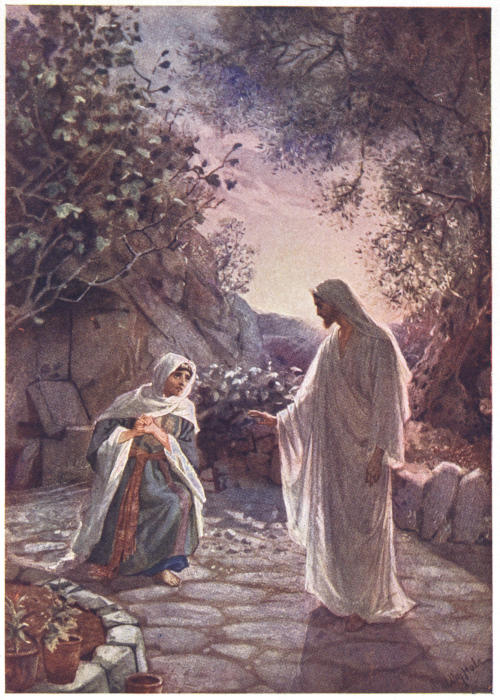
Jesus Revealeth Himself to Mary Magdalene
Mary stood without at the sepulchre weeping: and as she wept, she
stooped down, and looked into the sepulchre. And seeth two angels in
white sitting, ... where the body of Jesus had lain. And they
say unto her, Woman, why weepest thou? She saith unto them, Because
they have taken away my Lord, and I know not where they have
laid him. And when she had thus said she turned herself back, and
saw Jesus standing, and knew not that it was Jesus. Jesus saith unto
her, Woman, why weepest thou? whom seekest thou? She, supposing
him to be the gardener, saith unto him, Sir, if thou have borne him
hence, tell me where thou hast laid him, and I will take him away.
Jesus saith unto her, Mary. She turned herself, and saith unto him,
Rabboni; which is to say, Master. Jesus saith unto her, Touch me
not; for I am not yet ascended to my Father: but go to my brethren,
and say unto them, I ascend unto my Father, and your Father; and to
my God, and your God. Mary Magdalene came and told the disciples
that she had seen the Lord, and that he had spoken these things
unto her.—St. John xx: 11-18.
NOTE BY THE ARTIST
It would appear that Mary Magdalene was one of the little company of
faithful women who came very early in the morning to the sepulchre, but
that she had hastened back to the city before the angelic revelation to her
companions. Once more bending her steps in sorrow to the empty grave, to
Mary, loving greatly because greatly forgiven, was vouchsafed the privilege of
first beholding her risen Lord and Master—the same, yet wondrously changed,
so that now, as on subsequent occasions when Jesus appeared to his disciples and
“their eyes were holden that they should not know him,” it was not by outward
form and aspect, but by words of love and tenderness such as he alone could
utter, that his identity was revealed. Although the external aspect of the
sepulchre bears little resemblance to that which it presented in former times,
the rock-cut grooves which still remain, render it abundantly evident that
the entrance with its rolling stone, and the method by which the latter was
“sealed,” were such as have been already described in my Note to the picture
“The Resurrection of Lazarus.”
74
I remember, when at Jerusalem, a very pleasant
visit we made to this sacred Mount. It was
at the close of a Sunday afternoon. The sun
went down as we stood there. And there
was something very sweet and solemn in the
thought that Jesus, our glorious Lord, had once
stood on that Mount, near where we then were.
It was from there that his disciples saw him go
into heaven. And when he comes back from
heaven, his feet will stand again upon the Mount
of Olives. And so, when we think of our Saviour
going back to heaven, we may always
remember that some spot on or near the top
of the Mount of Olives was the place of the
ascension.
The Manner of the Ascension—is the third
thing of which to speak.
It was a visible ascension. There are only
two other persons spoken of in the Bible as
having gone up from earth to heaven in a bodily
form. One of them was “Enoch, the seventh
from Adam.” His ascension was not visible.
No one saw him go. It took place in secret.
We are told in one place that “he was not, for
God took him.” In another place it is said, “he
was translated.” This is all we know about the
translation of Enoch.
The other case mentioned in the Bible is
that of the prophet Elijah. His ascension was
visible, indeed, but it was only seen by one
person, and that was the prophet Elisha. But
it was different with the ascension of Christ.
This did not take place in secret, but in public.
It was not only visible, but was witnessed by a
crowd of people. All the eleven disciples were
there to see it. And there can be no doubt
that a great many others, besides the apostles,
were there too. And they all saw him, as he
rose from the midst of them, and went up to
heaven. It was a visible ascension.
It was a calm and tranquil ascension. It was
not done in a hurry. Solomon tells us, when
speaking of God’s doings, that his “judgments
are not executed speedily.” This means they
are not done in haste. God never works in a
hurry. After he gave to Adam the first promise,
of a future deliverer from the effects of sin, he
waited more than four thousand years before
he sent him into the world. And, after Christ
had risen from the dead, he was not in haste to
leave the world, and go back to heaven. We
might have expected that he would just have
shown himself once or twice to his disciples,
so as to make them sure of his resurrection, and
would have left immediately for heaven. But
it was not so. Instead of this he remained here
for forty days. He did not spend all this time
in the company of his disciples. He only
showed himself to them from time to time, and
talked with them “of things pertaining to the
kingdom of God.” And when at last these days
were over, and the time came for him to go,
still there was no haste about it. He did not
go up with a rush, as a rocket goes up. That
would not have been like him. But, as he
stood on the Mount of Olives talking to his
disciples, who were standing round him, he
began to rise slowly and silently towards heaven.
And as he began, so he went on. Slowly and
silently he continued to rise. Upwards he went,
higher—and higher,—till at last a cloud received
him out of their sight. That cloud became, as
it were, the chariot in which he was carried up
in triumph to heaven. It was a calm and tranquil
ascension.
It was a blessed ascension. You know how it
is at the close of a service in church. The
minister lifts up his hands to bless the people,
or as we say, to pronounce the benediction.
And this was what Jesus was doing at the very
moment of his ascension. He knew that the
time had come for him to go. He knew that
he was about to be separated from his disciples,
and that they would see him no more in this
world. So he lifted up his hands to bless them;
and, while he was in the act of speaking those
words of blessing, the ascension took place. As
his hands were stretched out to bless his disciples,
he rose calmly in the midst of them and
went back to heaven, from whence he came.
It was said of him before he came into our
world, that—“men should be blessed in him:”
Ps. lxxii: 17. He was the promised seed of
Abraham, in whom it was declared that “all the
nations of the earth should be blessed.” Gen.
xxii: 18. The blessing of the world was wrapped
up in Jesus. When he came into the world, he
came to bless it. And when he began his
public ministry in the Sermon on the Mount,
the first thing of which he had to speak was
the blessings he came to bring. We read, “And
when he was set, his disciples came to him, and
he opened his mouth and taught them, saying,
Blessed are the poor in spirit, &c. Blessed are
they that mourn, &c. Blessed are the meek,
&c. Blessed are the merciful, &c. Blessed are
the pure in heart, &c.” He began his work in
blessing; he continued it in blessing; and he
ended it in blessing. But the work of blessing
in which he had been engaged here did not
cease when he ascended into heaven. He has
been carrying on the work of blessing men
ever since he ascended. He went to heaven to
procure for his people the best of all possible
blessings. He told his disciples that it was
necessary for him to leave them and go to
heaven; because if he did not go the Holy
Ghost would not come to them; but that when
he went to heaven he would send the Spirit to
be their helper and comforter. It is the Holy
Spirit who helps us to understand the Scriptures
and who teaches us how to love and serve God.
And whatever helps us to do this is the best
thing—the greatest blessing for us. And when
we know that Jesus went to heaven to obtain
for us the help of God’s grace and Spirit, we
may well say that the ascension of Christ was a
blessed ascension.
The only other thing we have to say about
the ascension of Christ is that it was a wonderful
ascension. There were two wonderful things
connected with it. It was wonderful to think
where he went. He did not go simply to join
the company of the angels, who have always
lived in heaven, and of the good people who
went there when they died. No; but he went
where no one else had ever gone before, and
where no one else could go. When he arrived
in heaven, he rose above all the company that
was there, and took his seat at the right hand
of the throne of God. This was wonderful,
indeed. When Jesus was on earth, he was so
poor that he “had not where to lay his head.”
He was despised and persecuted; “a man of
sorrows and acquainted with grief.” He was
put to death as a criminal, by being crucified
between two thieves. But when he ascended
into heaven it was to take his place “far above
all principalities and powers.” And so his ascension
was wonderful when we think—where he
went.
And it was wonderful, too, when we think
how he went there. If he had left his human
body behind him, and had ascended to heaven
simply in his divine nature, as God, it would
not have been so wonderful. But he did not do
this. He took his human body with him. The
body that was nailed to the cross and laid in
the grave, he took with him to heaven. He
ascended, indeed, as the Son of God. But that
was not all. No, for he ascended as the Son of
man, too. It was Jesus Christ who ascended
into heaven. But it was our human nature, as
well as the divine nature which helped to make
up the person of Jesus Christ. And so when
he ascended into heaven, and sat down at the
right hand of the throne of God, he took our
human nature with him. He took a body like
yours and mine, up to that high and glorious
place. And he is sitting there now, on the
throne of God, as our brother. This is the most
surprising thing connected with the great event
we are now considering. This shows us how
wonderful the ascension of Christ was.
And so, in studying this subject, these are the
things about it that we have noticed, viz.: the
time of the ascension—forty days after the resurrection;
the place of the ascension—the Mount
of Olives; the manner of the ascension—visible—calm
and tranquil—blessed—and wonderful.
There are several lessons that may be learned
from the ascension of our Saviour, but we can
only speak of one. This is the lesson of obedience
to the command of Christ.
Just before he went up to heaven, Jesus said
to his disciples—“Go ye into all the world, and
preach the gospel to every creature.” St. Mark
xvi: 15. This is the last command he gave to
his people. He kept it till now because he
wished it to be especially remembered. When
we lose a father, or mother, or a friend whom
we love very much, we listen attentively to the
words spoken by that friend as we gather round
the dying bed. We may forget some things
spoken by him in the days of his health and
strength, but those last words that were spoken
just before he died, we always remember. They
seem very sacred to us, and we pay particular
attention to them. And no doubt this was the
reason why Jesus kept this command about the
missionary work he wishes his people to engage
in, till now. He had finished his work for
them. He had died for them. He had done
all that was necessary for them to be saved, and
to be happy with him forever in heaven. He
knew how much they ought to love him for
all this. And he knew that those who really
did love him would wish to show their love by
doing what he had told them to do. And so
he kept this—the most important of all his
commands—to the last. He wished it to be
connected with the thought of his leaving the
world and going back to heaven. And as they
gathered round him, to see him and hear him
for the last time on earth, he spoke these words:—“Go,
ye, into all the world, and preach the
gospel to every creature.” He did not speak
them for the apostles or the early Christians
only. No; but he spoke them for you, and for
me, and for all his people, till the end of time.
He intended his church to be a missionary
church. He intended that all the members of
that church should feel an interest in the missionary
work, and that they should do all they
can to help it on. This command is very broad.
It takes in “all the world,” and “every creature.”
We have no right to make the field for this
work narrower than Jesus made it. And, until
the gospel has been preached in “all the world,”
and until “every creature” has heard it, this
command of Christ is binding upon all his
loving people. If we do not have the missionary
spirit which these words require us to have,
that is, if we are not trying all we can to bring
“every creature,” in “all the world,” to be the
friend and servant of Jesus and to be saved by
him, then, it is clear, either that we are not
loving Jesus as we ought to love him; or else,
we are not showing our love for him in the way
in which he wishes us to show it. He says, “If
ye love me, keep my commandments.” And
this is his last and most solemn command for
us to remember, and keep.
When he says—“Go ye into all the world
and preach,” he does not mean that all his
people must leave their homes and go out as
ordained ministers. What he means is that
whether we go out as missionaries, or not, we
must have the missionary spirit, and must do
all we can to help the missionaries in their
work. We must try to get those around us to
know, and love, and serve Jesus. And the important
question for us all to consider here is—how
can we do this? In answering this
question, let me point out four ways in which
this may be done.
We can be missionaries, and help to preach
the gospel, by our example.
A little boy named Ernest had begun to love
the Lord Jesus Christ and to be a Christian.
One day he said to his aunt, “Now I want to
grow up a big man, and then I will be a minister
and preach to lots of people about Jesus.”
His aunt told him that he need not wait till
he was a man before he began to preach. “Try
now, every day, to learn your lessons well,” said
his aunt; “to be kind, and gentle to all, and
try by God’s help to overcome your bad temper,
and so, by your example you may be preaching
Jesus every day.”
“The Children’s Service.” A little girl went
to a Children’s service one Sunday afternoon.
On going home she told her mother about
it. “What led you to go, Mary?” asked the
mother.
“I went, mamma,” she said, “because I was
invited to come by a kind boy that I met in
the street yesterday. I saw him stop and stroke
a donkey that was frightened by a cruel boy.
Then he kindly picked up my ball that was
rolling away and returned it to me. As he did
this he handed me a paper about the children’s
service, and invited me to come. I knew he
was a good boy because he was so kind and
had such a happy face. He said he was sure I
would like the services; and I did like them.
And I mean to go every time.”
“A Young Hero.” Thirty years ago a boy
had given his heart to the Saviour. He had been
confirmed and joined the church. The next
day he went to school. Some of the wild boys
of the school heard that he had joined the
church, and they made up their minds to have
some fun with him about it. At recess time
they formed a ring about him, and cried out:
“Oh! here is the good boy, Charley! He is
going to be a Christian!”
And what did Charley do? Did he feel
ashamed and try to steal away? Did he get
angry, and hit, or kick, or speak cross to them?
No. But he calmly looked the rude boys in
the face, and said, in a manly way: “Yes, boys,
I am trying to be a Christian. And isn’t that
right?”
The boys’ consciences told them he was right.
They felt ashamed. The ring was broken up
at once, and Charley had no more trouble.
He was preaching by his example.
“A Beautiful Illustration.” Mary Duncan was
a little girl, only four years old, who was trying
to be a Christian. This incident shows us that
even at that early age she was beginning to
preach, and do good by her example.
One day she was playing with her little
brother. In a fit of anger he struck her in the
face. But instead of screaming out, or striking
him back, she quietly turned to him the other
cheek; and said, “There Corie, now strike
that!” The uplifted hand was dropped. The
tears came into her brother’s eyes. He kissed
her, and said—“Forgive me, sister, and I’ll never
strike you again.”
When Mary was asked what led her to do so,
her reply was that she had heard her papa read
out of the Bible, at prayers that morning, what
Jesus had said about it.
And so if we try to be like Jesus, we may be
helping to keep his last command, and to preach
the gospel—by our example.
Another way in which we may do this is—by
our efforts. This means by what we say and
do to show that we love him, and to try to
bring others to do so too. We find many illustrations
of the way in which this may be done.
“Preaching in the Hayfield.” A good, earnest
minister of the gospel was riding one day past
a hayfield. A sudden shower was coming up.
He saw a farmer, who never went to church,
sending off in haste for a horse to draw his hay
in before the rain came. The minister stopped
and offered his horse to do the work. It was
declined; but the minister insisted, and pulling
off his coat, unhitched his horse and went to
work helping the farmer to load the hay. They
got in several loads, and when the last load was
in the barn, and the rain came pouring down,
the farmer drew out his pocket book, and said:
“How much do I owe you, sir, for your help?”
“Oh, nothing,” said he, “nothing at all.”
But the farmer insisted on paying him for his
work.
“Well, my friend,” said the minister, “did
you ever hear an Irishman preach?”
“No,” said the farmer.
“Well, you come next Sunday, and hear me
preach, and we’ll call it even.”
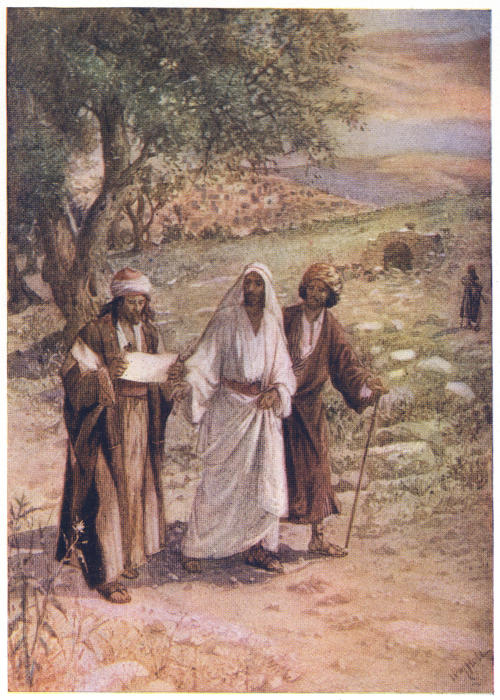
On the Road to Emmaus
And, behold, two of them went that same day to a village called
Emmaus, which was from Jerusalem about threescore furlongs. And
it came to pass, that, while they communed together and reasoned, Jesus
himself drew near, and went with them. But their eyes were holden
that they should not know him. And he said unto them, What manner
of communications are these that ye have one to another, as ye
walk, and are sad? And the one of them, whose name was Cleophas,
answering said unto him, Art thou only a stranger in Jerusalem, and
hast not known the things which are come to pass there in these days?
And he said unto them, What things? And they said unto him, Concerning
Jesus of Nazareth.... And how the chief priests and our
rulers delivered him to be condemned to death, and have crucified him....
To-day is the third day since these things were done. Yea, and
certain women also of our company made us astonished, which were
early at the sepulchre. And when they found not his body, they came,
saying, that they had also seen a vision of angels, which said that he was
alive. And certain of them which were with us went to the sepulchre,
and found it even so as the women had said: but him they saw not.
Then he said unto them, O fools.... And beginning at Moses and
all the prophets, he expounded unto them in all the scriptures the things
concerning himself.—St. Luke xxiv: 13, 15-25, 27.
NOTE BY THE ARTIST
Efforts to identify Emmaus with any existing village within the prescribed
radius of “threescore furlongs” from Jerusalem have proved unsuccessful,
and its actual locality is still a matter of controversy, in spite of the
assistance which might have been anticipated from the name itself, the word
Emmaus signifying “warm springs.” Consensus of opinion, however, is in
favor of some situation in the hill-country to the northwest of the city,
possibly El-Kubêbeh.
75
The farmer agreed to do it, and for the first
time in many years was present in the house of
prayer. He found out that the man who could
load the hay could preach the gospel too. He
believed it. He obeyed it. That hour’s work,
helping him to save his hay from the rain, was
the means of leading him to Jesus, and of saving
his soul.
“The Lost Diamond.” An elegantly dressed
lady, as she stepped one day from her carriage,
in the city of Washington, missed her
valuable diamond ring. It had slipped from
her finger in some way, as she left the carriage,
and had fallen into the gutter, where it was
speedily buried in the filth that flowed toward
the sewer. She looked with dismay on that
muddy stream, and offered a policeman five
dollars to put his hand into the gutter and
find the ring. He hesitated awhile, but finally
agreed, and reached down into the filth and
spent some time in groping about the gutter.
But he failed to find the lost jewel. At length
he gave up the search and told the lady that it
had probably been washed along, and gone
down the sewer. She paid him the five dollars,
and he went away. But the lady stood there
still, looking sadly down at the place where her
lost gem had disappeared. She could not bear
to give it up. She lingered and hesitated; and
finally, taking off her glove, and pushing back
her silks and ruffles and laces, she bared her
arm for the work, put her fair hand down into
the reeking filth, and after searching patiently
in every direction, she found the precious jewel,
and carried it away in triumph.
Now there are lost souls all about us, souls
for whom Christ died, ten thousand times more
precious than that lady’s gem. They are lost
in the mire of filth and sin. But they may be
found and brought to Christ, by such earnest,
persevering efforts as she made for that lost
jewel. And if we put forth such loving, personal
efforts for them, they may be saved. And those
who make such efforts are obeying the Saviour’s
command to preach the gospel to every
creature.
“It’s All I Can Do.” Bessie King was a
bright child about fourteen years old. She was
a serious, thoughtful girl, who wanted to make
herself useful. One summer afternoon she
went into her father’s garden and gathered a
bunch of flowers. While doing so, she wondered
if she could not make some one happy
by the gift of these flowers. All at once she
thought of her young friend, Nellie Vance.
Nellie was sick with consumption. She had
been confined to her room for months, and
was not expected to live very long. Her mother
was a poor widow, and unable to do much for
her sick child. But Nellie was trying to be a
Christian, and the thought of the loving Saviour
made her cheerful and happy.
Bessie was very fond of Nellie and loved to
visit her whenever she could. So she gathered
some of the loveliest flowers in the garden
and hastened with them to her friend Nellie’s
humble home. As she entered her chamber,
she said—“Nellie, dear, I’ve come to bring you
a bit of my summer,” and she laid the flowers
down by Nellie, who was lying on a couch
near the window. Nellie’s delight at seeing
the flowers was an abundant reward to Bessie
for bringing them. It was touching to see the
sick child as she lay there, with the bright
flowers around her. She handled them so tenderly,
one by one, almost forgetting, in the
pleasure they gave her, the weary, aching pain,
she was always feeling.
“I am so glad you came this afternoon,
Bessie dear,” said Nellie, when the flowers
were arranged. “I have something so happy to
tell you.” Bessie looked at her with surprise,
wondering what happiness poor suffering Nellie
could have left to her.
“I have been thinking for a long time,” said
Nellie, “how little I have done for the Lord
Jesus. I have been shut out from people so
long, that I’m afraid no one knows I love him;
and I can’t bear to go away from earth without
a word out loud for him. So Bessie, I am going
to be confirmed. That will be standing up for
Jesus, and it’s all I can do.”
“But, Nellie dear, how can you be confirmed?
You hav’n’t been out of your room for months,
and church is more than two miles away.”
“I can do it for Jesus,” she said firmly. “Mr.
Gray has promised to take me in his carriage,
and to carry me up in the church.”
Bessie could say no more. Her heart was
full, and she threw her arms round Nellie’s
neck and wept.
“I want you to come with me, Bessie dear,”
said Nellie. But Bessie could not speak. So
Nellie went on, and said: “You have your whole
life to live for him, so you ought to begin right
off. But mine is so nearly ended, that I must
come now, or I never can come. It’s all I can
do. But Bessie I want you to come with me.”
And they did both come. Bessie held back
at first, afraid of herself, but Nellie talked so
sweetly to her that she had to yield. “When
Jesus called the little child to him, Bessie,” said
her friend, “don’t you think he would have felt
hurt if he had held back, and refused to come
to him? Suppose he had said he wasn’t good
enough, or old enough! Jesus wanted him,
just as he was. He had plenty of grown up
people. He wanted a little child then, and he
wants us now.”
It was a touching sight when the sick child
was carried up the aisle, to join her young
companions at the chancel; and when the
bishop laid his hands on her head, and his
voice trembled there was not a dry eye in the
church.
Not long after, Nellie was carried again into
the church. Yet this time it was not Nellie
herself, but only the poor worn body that had
suffered so long, and was now at rest. Her
sufferings were now over, and her work was
done. Her spirit was with her Saviour she had
loved, to be forever happy in his presence.
Nellie was faithfully carrying out the last
command of Jesus, when she tried so lovingly
to get her friend Bessie to stand with her and
confess him before men. By our efforts to bring
those around us to Jesus, we may help to carry
out that last command of his.
We can do this also—by our gifts. There is
no better use to make of our money than to
give it to help in sending the gospel of Jesus to
those who do not know him. And the smallest
sums are often very useful when given for this
purpose. Here is a story of a poor little orphan
girl who had earned six cents by running
errands, and of the great good that was done by
her gift. Her name was Dixey, and we may
call the story:
“Dixey’s Six Cents.” One day, a pale-faced
little girl walked hurriedly into a book store in
Boston, and said to the man at the counter:
“Please sir, I want a book that’s got, ‘Suffer
little children to come unto me,’ in it; and how
much is it sir? and I’m in a great hurry.”
The bookseller wiped his spectacles, and looking
down at the poor child, he took her thin
little hand in his, and said: “What do you want
the book for my child? and why are you in
such a hurry?”
“Well, sir, you see, I went to Sunday-school,
last Sunday, when Mrs. West, the woman who
takes care of me, was away; and the teacher
read about a Good Shepherd, who loves little
children, and who said these words. And the
teacher told us about a beautiful place where he
takes care of his children and makes them all
happy, and I want to go there.
“I’m so tired of being where there’s nobody
to care for a girl like me, only Mrs. West who
says I’d better be dead than alive.”
“But why are you in such a hurry, my
child?”
“My cough’s getting so bad now, sir, and I
want to know about him before I die; it would
be so strange to see him and not know him.
Besides, if Mrs. West knew I was here she’d take
away the six cents I’ve saved from running
errands, to buy the book with, so I’m in a hurry
to get served.”
The bookseller wiped his spectacles again,
and taking a book from the shelf, he said, “I’ll
find the words you want, my child; listen while
I read them.” Then he turned to St. Luke
xviii: 16, and read to her the sweet words of the
loving Saviour. After reading them he told her
about the Good Shepherd; how he came down
from heaven to seek and save the lost sheep;
how he suffered and died for us that we might
live; and about the bright and beautiful home
in heaven, which he has prepared for all who
love and serve him.
“Oh, how sweet that is!” said the earnest
and almost breathless little listener. “He says—‘Come.’
I’ll go to him. How long do you
think it’ll be sir, before I see him?”
“Not long, I think,” said the bookseller, turning
away his head to hide the tears that were
running down his cheeks. “Now you can keep
the six cents and come here every day, and I
will read to you some more out of this Book.”
The little girl thanked him and hurried away.
The next day, and the next, and many days
passed away, but the poor child never came to
hear about Jesus again. Some time after this a
rough-looking woman came into the bookstore,
and said in a loud voice, “Dixey’s dead!
She died rambling about some Good Shepherd,
and she said you were to have these six cents
for the mission-box at school. I don’t like to
keep dead people’s money, so here it is,” and
throwing the six cents down on the counter,
she hurried out of the store.
The six cents were put into the missionary
box on the next Sunday, and when the story of
Dixey was told it touched so many hearts and
led so many to follow her example with their
pennies that by the end of the year “Dixey’s
cents,” as they were called, had brought in
money enough to send out a missionary to
China, to help in finding out the lost sheep and
bringing them to Jesus. And if little Dixey, in
her feebleness and poverty, could help to carry
out our Saviour’s last command, then we may
all do so.
But there are other things than money that
may be given to the work of saving lost souls.
We see this illustrated in the following story.
It may be called:
“The Rescue.” “O my child, my child!”
cried an almost heart-broken mother, as she
met a party of gentlemen, among the hills of
Scotland.
“What’s the matter?” they asked.
“A few hours ago I left the house and my
baby-boy in charge of his sister. Being a fine
day, he was lying in the cradle, outside the
cottage-door, prattling away in the sunshine.
After awhile, baby fell asleep, and my little girl
being hungry, went in-doors to get some food.
While she was lingering there, I returned, but
only in time to see an eagle bearing away my
child in his talons. O sirs! pity me, help me,
recover my darling child.”
The mother’s loving eye had watched the
flight of the eagle; and with these gentlemen
she went to the edge of the cliff, and looking
over the precipice they could see, far down its
steep sides, the nest of the eagles, to which the
child had been carried. The distress of the
mother touched the heart of one of the gentleman
who was a Scotch nobleman. He resolved,
by God’s help, to try and snatch the child from
the terrible death that awaited it.
Ropes were procured, and at his own request,
the nobleman was lowered down over the rugged
cliff. The two eagles fluttered round, as if
daring the intruder to approach their nest; but
a brave heart was beating beneath that Scotch
plaid. Fearlessly the heroic Scotchman approached
the nest. He took the child from
among the young eagles. He bound it to his
bosom, and gave the signal to be pulled up.
Gently, but steadily, he was raised in safety to
the top of the cliff; and with a glad heart he
gave back the recovered child to the arms of its
grateful and rejoicing mother.
This story illustrates what Jesus has done for
us; but, at the same time it shows what we
should do for those whose souls have been
carried away by Satan the great enemy, and who
are in danger of perishing forever. If we feel
for them, as this good nobleman felt for that
lost child, it will lead us to give, not our money
only, but our sympathy, and everything in our
power, to bring them to Jesus, that they may be
saved through him forever. And so we see how
by our gifts, we may help to carry out the great
command which Jesus left for his people, just
before his ascension into heaven.
And then, there is one other way in which we
may help to do this, and that is by—our prayers.
There is a wonderful power in prayer. It is
a power which all may use, and which will
reach all around the world. We see this strikingly
illustrated in the case of the Syro-Phœnician
woman mentioned in St. Matt. xv: 20-28.
Her prayers caused the casting out of the devil
from her daughter. When Jesus was on earth
he said to his disciples—“All things whatsoever
ye shall ask in prayer, believing, ye shall receive.”
St. Matt. xxi: 22. This is God’s promise to you
and to me and to all his people. And so when
we pray for ministers and missionaries; when
we pray for the conversion of the heathen, and
for others who do not love and serve God,
we are helping on the good work which Jesus
left for his people to do when he said—“Go ye
into all the world and preach the gospel to
every creature.” It would be easy enough to
fill a volume with incidents which illustrate the
power of prayer. But we have only room for a
single illustration.
“Saved by Prayer.” Some years ago, a boy left
his home in Indiana for Chicago. He was not
there long before he fell into bad company, and
was led astray. A friend of his father’s, who lived
in the same town, happening to visit Chicago,
saw that boy on the street one night drunk.
On returning home, he thought at first that
he would not say anything to the father about
what he had seen; but afterwards he felt that it
was his duty to tell him. So meeting him one
day in the crowded street of their little town,
he took him aside and told him what he had
seen in Chicago. It was a terrible blow to him.
On returning home that night, before going
to bed, he told his wife what he had heard.
They were both so much distressed that they
could not sleep. They spent the greater part
of the night in earnest prayer for their poor
boy. Before morning the mother said, “I don’t
know how it is, but God has given me faith to
believe that our son will be saved and not be
allowed to fill a drunkard’s grave.”
Not long after this, that boy left Chicago.
He could not tell why, but an unseen power
seemed to lead him to his mother’s home. On
entering the house the first thing he said was:
“Mother I have come home to ask you to pray
for me.” She prayed with him, and for him,
and he soon became a sincere and earnest
Christian. Here we see the power of prayer.
Let us all use this power, and we shall be helping
on the preaching of the gospel in all the
world, and to every creature.
And so, when we think of the ascension of
Christ, let us always remember the great work
that Jesus commanded his people to do; and let
us try to help on that work in the four ways of
which we have spoken,—by our examples—by
our efforts—by our gifts—and by our prayers.
The Collect for Ascension Day is a very suitable
one with which to close this subject:
“Grant, we beseech thee, Almighty God, that
like as we do believe thy only-begotten Son, our
Lord Jesus Christ, to have ascended into the
heavens; so we may also in heart and mind
thither ascend, and with him continually dwell,
who liveth and reigneth, with thee and the Holy
Ghost, One God, world without end. Amen.”
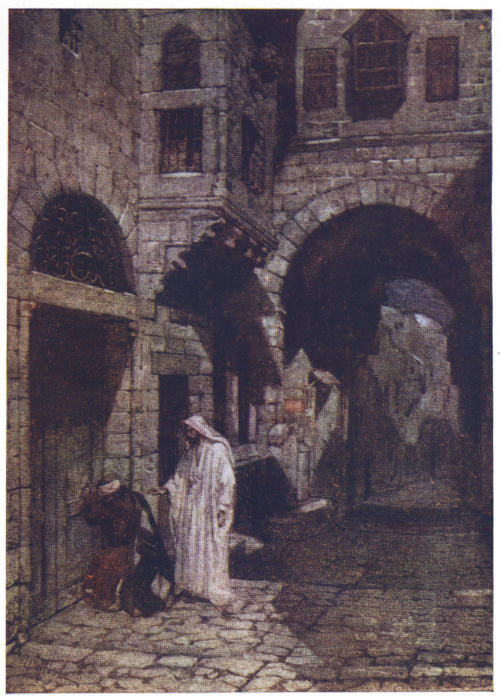
Jesus Appeareth to and Pardons Simon Peter
And they drew nigh unto the village, whither they went, and he
made as though he would have gone further. But they constrained
him, saying, Abide with us: for it is toward evening, and the day is far
spent. And he went in to tarry with them. And it came to pass, as
he sat at meat with them, he took bread, and blessed it, and brake, and
gave to them. And their eyes were opened, and they knew him; and
he vanished out of their sight. And they said one to another, Did not
our heart burn within us, while he talked with us by the way, and while
he opened to us the scriptures? And they rose up the same hour, and
returned to Jerusalem, and found the eleven gathered together, and them
that were with them, Saying, The Lord is risen indeed, and hath appeared
to Simon.—St. Luke xxiv: 28-34.
NOTE BY THE ARTIST
Beyond the simple statement that “he was seen of Cephas,” nothing is
recorded regarding the appearance of Jesus to his sinning and repentant disciple,
although, if we accept the sequence of events in the order in which they
are narrated, it may safely be supposed that this took place after night-fall.
But where nothing is known, conjecture is justifiable, and we may think of
Peter as shrinking from the society of his comrades, unable to rest, and wandering,
he knows not whither, in the silent, moon-lit streets. Chance leads
him to the door of the house of Caiaphas, and there, on the scene of his lost
opportunity, he realizes the presence of his risen Lord, and receives the gracious
assurance of forgiveness.
76
THE DAY OF PENTECOST
Jesus has finished his work on earth and
gone back to heaven. We have now, in
bringing this history to a close, to consider how
the work was carried on, after he was gone.
After the ascension of Christ there was a
pause. For some days everything stood still
in connection with the great cause for which
Jesus had lived and died. This pause continued
until the day of Pentecost. Then the Holy
Ghost was sent down from heaven. He took up
the work where Jesus had left it, and has been
engaged in carrying it on from that day to this.
Nothing could be done till he came. No sermons
were preached. No lessons were taught.
No souls were converted till the Holy Ghost
came. This shows us how important his presence
and help are in all the work which the church
of Christ has to do for the glory of God and for
the salvation of men. Take an illustration.
Here is a locomotive, standing on a railway,
with a train of cars attached to it. The engine
is new and beautiful. Every wheel and crank
and pin is in its proper place. It is complete;
it is perfect. The boiler is full of water. The
tender, attached to the locomotive, is full of
fuel. The passengers are all waiting; but yet
the engine stands still. Nothing moves. What
is the matter? Simply this: there is no steam
in the boiler. And what is wanting to make
the steam? Why a fire in the furnace. Can
nothing take the place of this? Nothing in the
world. This is absolutely necessary. Everything
depends on this. But now see, the fire is
kindled. There is steam in the boiler. The
wheels begin to move, and away goes the
train.
When Jesus went to heaven, the church he
left on earth might well be compared to such
an engine. He had built it well. Its machinery
was all complete; but it stood still. The power
was wanting to put it in motion. The Holy
Spirit alone could give this power. When he
came the fire was kindled: the steam was generated;
and the train was started, which was
to run around the world, and carry countless
numbers of ransomed souls to heaven.
And in speaking about the coming of the
Spirit, there are three things for us to notice.
These are—the time of the Spirit’s coming: the
manner of the Spirit’s coming; and the purpose
of the Spirit’s coming.
The time of the Spirit’s coming is pointed out
in the name of the day when he came. It was
on the day of Pentecost. This word means the
fiftieth: whether it be a day, or a number, or
anything else to which it may be applied. The
Jews used this word as the name of one of the
three great feasts which they were commanded
to keep every year. This one was called “the
feast of Pentecost,” because it was kept on
the fiftieth day after the feast of the Passover.
It was sometimes called also—“the feast of
Weeks.” This name was given to it, because
the forty-nine days, which came in between
these two feasts, just made up seven weeks.
It pleased God to connect with this day of
Pentecost the most important event that has
ever taken place in the history of the church or
of the world since the ascension of Jesus into
heaven—and that was—the coming of the Holy
Ghost.
And this great event has always been remembered
with interest by the Christian church. In
the early days of the church, the day kept in
memory of the coming of the Holy Ghost was
set apart as one of the solemn seasons for baptizing
persons who wished to be received into
the church. The candidates for baptism on
these occasions were clothed in white garments,
to denote the purity which should mark those
who received baptism properly, by truly repenting
of their sins, and having their souls washed
in the blood of Christ. And for this reason, the
Sunday on which the day of Pentecost was thus
celebrated, was called Whit-Sunday, or Whit-Suntide.
In the Episcopal Church in this country, in
the Church of England, and in some other
branches of the Church of Christ, this Whit-Suntide
festival is still kept with great interest.
The scriptures read on this day refer to the
coming of the Spirit and to the importance of
his work; and the sermons preached at this
season generally have reference to the same
subject. And when we remember how the
success of the great work in which the Church
of Christ is engaged depends upon the help
which the Holy Spirit gives, we see how important
it is that we should be constantly reminded
of the necessity of having his presence
and power with us in all our efforts to do
good to the souls of men. And so, when we
think of the time of the Spirit’s coming, we
may bear in mind that it was on the day of
Pentecost, or on the fiftieth day after the death
of Christ.
And now, we may go on to speak of—the
manner of the Spirit’s coming.
It was an expected coming. Jesus had told
his disciples about the coming of the Spirit and
had given them a promise that he should come.
He said to them on one occasion: “It is expedient
for you that I go away; for if I go not
away, the Comforter will not come to you;
but if I depart, I will send him unto you.” St.
John xvi: 7.
And then, just before his ascension into
heaven, he repeated this promise, commanding
them “not to depart from Jerusalem, but to
wait for the promise of the Father:” again he
said, “ye shall be baptized with the Holy Ghost
not many days hence;” and again, “ye shall
receive power after that the Holy Ghost is come
upon you.” Acts i: 4, 5, 8.
And, according to these promises, we find that
the apostles were waiting for the coming of the
Holy Spirit and expecting it when the day of
Pentecost arrived. They had not been told
how long they were to wait. All that had been
said about the time of his coming was that it
would be “not many days hence.” After
Jesus left them and went to heaven, they seem
to have met together every day, engaging in
prayer and praise. No doubt they read the
scriptures on these occasions, and talked together
about their ascended Lord and the fulfilment
of the promise he had left them. Day
after day, they had met for this purpose, waiting
for the Holy Spirit. But one day passed by
after another and the Spirit did not come. Still
they felt sure that he would come. They were
waiting for his coming: and when at last he
came, we may well say of it, that it was an
expected coming.
It was a sudden coming. We know how often
it happens that something we have been expecting
for a long time comes suddenly at last.
And it was so with the disciples on this occasion.
They had met once more for their daily worship.
As they came together, on the day of Pentecost,
there was no more sign of the coming of the
Spirit on that day than there had been on any
of the previous days; but he came at last. We
are not told whether it was at the beginning, or
the middle, or the close of their meeting, that
he came. The Holy Spirit did not send a
messenger before him, to tell of his coming, as
kings and great men in the East were in the
habit of doing. No trumpet was sounded. No
signal was given. But, all at once, the promise
of the Father was fulfilled; the expectation of
the disciples was met—the Holy Ghost came
down from heaven. But it was a sudden coming.
Acts i: 2.
In the next place it was—a startling coming.
The sound connected with it made it such for
one thing. We read that “there came a sound
as of a rushing, mighty wind.” We are not told
that there was a wind on this occasion; but only
that the sound which attended the coming of
the Spirit was like that of a mighty wind. The
Spirit might have come to the disciples on this
occasion as “the still, small voice” of God
came to the prophet Elijah, on Mount Horeb.
But it was not so. On the contrary, he chose
that his coming should be attended with a loud
noise. We read that “it,” that is the sound,
“filled all the house where they were sitting.”
We are not told what this sounding noise was
for. It may have been to arouse the attention
of the disciples and make them fully awake to
the important event that was then taking place.
And, no doubt, another reason why this rushing
sound attended the Spirit’s coming was to indicate
to them what great power would attend
the Spirit in the work he was to carry on in the
church and in the world. The wind, when it
goes rushing on, in the form of a tempest, is
one of the most powerful agents that we know
of. It can lash the ocean into foam and fury.
It can dash to pieces the noblest works of men,
whether on the land, or on the sea. It can tear
up the giant oak by its roots and lay it prostrate
on the ground. And the sound of that “rushing,
mighty wind” with which the Spirit came
was intended, it may be, to make the disciples
feel how great was the power he was able to
give them in the important work they had to do.
“The sound, as of a rushing, mighty wind,”
seemed to tell of this.
But again, we are always startled by that
which is unusual. And there were several
things about this coming of the Holy Spirit
which were unusual, and so calculated to startle
the waiting disciples. There was, for instance,
the direction of this sound. It came “down
from heaven.” The winds, with whose sound
we are familiar, never act in this direction.
From whatever point of the compass they come,
they always blow around, or over the earth. A
wind blowing “down from heaven,” directly
towards the earth, as was the case with that
sound which the disciples heard, was something
unusual, and so calculated to startle them.
Another unusual thing about this sound was,
that it was a sound like that of a wind, but yet
without any wind at all. They heard that
sound. It reminded them of the wind. But
there was no motion there, such as the wind
produces when it blows. Nothing stirred in
that upper chamber. A feather would not have
been moved. So far as motion was concerned—all
was calm, and still there. And yet there
was that mighty sound. How startling this
must have been!
And then, what accompanied this sound was
startling, as well as the sound itself. There
were those “cloven tongues, like as of fire.”
Little long pieces of flame were seen in the air
of that chamber. There were about a hundred
and twenty persons present there. And a hundred
and twenty of these fiery tongues were
seen. How strange it must have been to look
on such a number of these marvellous appearances,
and to see one of them come down and
rest on the head of each person present! But,
the Holy Spirit was come; and these things
must have made it a startling coming.
And then it was—an abiding coming. When
the Holy Spirit came down upon the Church of
Christ, on the day of Pentecost, he did not
come to remain for a little while, and then go
back to heaven. No! but he came to stay.
When Jesus spoke to the disciples about the
coming of the Holy Ghost, he used these words:
“And I will pray the Father, and he shall give
you another Comforter, that he may abide with
you forever.” St. John xiv: 16.
It was not for the help and comfort of the
apostles and early Christians only that the
Holy Spirit came. No; but it was for the help
and comfort of all the people of Christ, down
to the end of the world. The coming of the
Spirit, which took place on the day of Pentecost
was intended to be an abiding coming. He
has never left the church from that day. But
he may be present, without putting forth his
power and making his presence felt. What we
need to pray for is not that the Holy Spirit
may come into our churches; for he is there;
but that he may make his power and presence
felt. What we want above all things, in our
hearts, in our homes, in our Sunday Schools,
and in our churches, is to feel the power and
presence of that Spirit, who came on the day of
Pentecost, and whose coming was to be an
abiding coming.
And so, when we would show the manner of
the Spirit’s coming to the early church, we may
say that it was an expected coming—a sudden
coming—a startling coming—and an abiding
coming.
And now, the only other thing to notice, is—The—purpose—of
the Spirit’s coming.
And if we wish to understand clearly the
meaning of this part of the subject, there are
these two things for us to consider; viz., what
the Holy Spirit is; and what the Holy Spirit does.
And in order to understand satisfactorily what
the Holy Spirit is—we must find out what the
scriptures call him; and how the scriptures
speak of him. Here are some of the titles
given to the Holy Spirit in the scriptures, or the
names by which he is called.
The great names, Jehovah, Lord, and God are
all given to the Spirit. He is called—the Most
High—the Holy Spirit—the Holy Ghost—the
Free Spirit—the Good Spirit—the Spirit of Life—the
Spirit of Truth—the Spirit of Grace—the
Spirit of Adoption—the Spirit of Wisdom—the
Spirit of Counsel—the Spirit of Might—the
Spirit of Knowledge—the Spirit of the fear of
the Lord—the Spirit of Promise—the Eternal
Spirit—the Power of the Highest—the Comforter—the
Guide—the Teacher.
And the giving of such names as these to the
Holy Spirit proves two things about him, one
is that he is a real person; and the other is that
he is God. He is a divine person, equal to God
the Father and to God the Son.
And this is proved, not only by the names
given to him, but also by the way in which the
scriptures speak of him. Let us look at one or
two illustrations of the way in which they do
this. When the prophet Isaiah is speaking of
Christ, the Messiah, he represents him, as saying
of himself—“And now, the Lord God and
his Spirit hath sent me.” Is. xlviii: 16. Here
we see the three persons of the Holy Trinity—God
the Father—God the Son—and God the
Holy Spirit are spoken of as all working together.
God the Son is sent, and God the
Father and God the Spirit are the ones who
send him.
We see them uniting together again, in the
same way, on the occasion of our Saviour’s
baptism. Thus we read, “And Jesus, when he
was baptized, went up straightway out of the
water, and lo, the heavens were opened unto
him, and he saw the Spirit of God descending
like a dove, and lighting upon him; And lo, a
voice from heaven saying, This is my beloved
Son, in whom I am well pleased.” St. Matt.
iii: 16, 17. Here we see the three Persons of
the blessed Trinity acting together. God the
Son has taken our nature upon him, and is
baptized, as a man, in the river Jordan. God
the Spirit comes down from heaven in the form
of a dove, and rests upon him; while God the
Father speaks from heaven, in a voice that was
heard by those who were attending that baptism.
This proves to us that there are three
Persons, in the One God whom we worship;
and that the Holy Spirit, who came down upon
the church on the day of Pentecost, is the third
Person in this Trinity. He is a divine Person,
equal to the Father and the Son. It is impossible
to explain, satisfactorily, what took place
at the baptism of our Saviour in any other way.
And in this way, we get a clear view of the first
thing, important for us to know, in order to
understand the meaning of the Spirit’s coming.
We see now what the Holy Spirit is. He is a
divine Person—united with the Father and the
Son in the great work of our salvation, and
equal to them both.
And then there is another thing that we
must understand clearly, if we would know the
purpose of the Spirit’s coming on the day of
Pentecost—and that is—what the Spirit does.
This refers to the work which the Holy Spirit
has to do in the Church of Christ. It takes in
both what he had to do in the church when he
first came and also what he has to do now.
The work which the Spirit has to do for the
souls of men is the same now that it was then.
There were, indeed, works of wonder, great
miracles, to be performed in the early church
which are not done now.
But, apart from this, there is no difference.
The work of the Holy Spirit has always been
the same. How important his work was to the
church at first, we see in the fact that nothing
was done till the Spirit came. After Jesus had
ascended to heaven there was, as we have
already said, a long pause before anything else
was done. This pause lasted for ten days. Jesus
had left a great work for his disciples to carry
on in the world; but during those days nobody
moved a step or lifted a finger towards doing
that work. Everything stood still. And the
reason for this long pause was that nothing
could be properly done in carrying on this
work till the Spirit came. The disciples had
been distinctly told to wait for his coming.
They waited till the day of Pentecost. Then,
this Spirit came. Then the work began—the
work of saving souls from death. The work
has never ceased. It has been going on to the
present day; and it will continue to go on till
Jesus comes again.
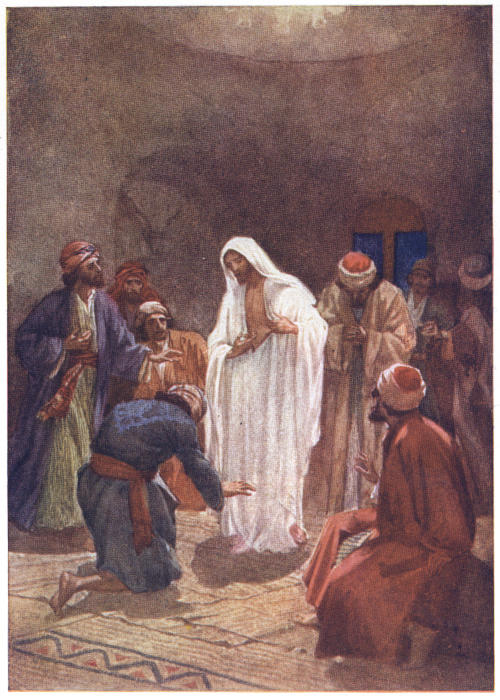
The Incredulity and Confession of Thomas
And after eight days again his disciples were within, and Thomas
with them: then came Jesus, the doors being shut, and stood in the
midst, and said, Peace be unto you. Then saith he to Thomas, Reach
hither thy finger, and behold my hands; and reach hither thy hand, and
thrust it into my side: and be not faithless, but believing. And Thomas
answered and said unto him, My Lord and my God. Jesus saith unto
him, Thomas, because thou hast seen me, thou hast believed: blessed
are they that have not seen, and yet have believed.—St. John xx: 26-29.
NOTE BY THE ARTIST
Five times during that memorable Easter Day did Jesus manifest himself
to his followers, and it was not until the eighth day at even, that the
sixth appearance is recorded as having taken place; this time for the special
purpose of confirming the belief of one of the eleven who still doubted. Ten
manifestations in all are specifically mentioned, but it would appear (Acts i:3)
that Jesus also revealed himself to his chosen apostles on many other occasions,
speaking of the things pertaining to the building up of that church, of which
he was himself at once the Foundation and the Corner-stone.
77
Now there are four things that must be done
for every soul that is to be saved through Jesus
Christ. And none but the Holy Spirit can do
these things.
The first thing that the Holy Spirit has to do
for every soul is to—convert—it.
He began this work at once when he came.
He set the apostles to preaching Jesus Christ,
and the result of the first day’s preaching was—that
three thousand souls were converted.
The conversion of the soul refers to the great
change which takes place when a person becomes
a Christian. The word conversion is
only one of several words applied to this subject
in the Scriptures. Sometimes it is called
being quickened, or made alive; and at other
times it is called being “born again.” This was
the way in which our Saviour spoke of the
great change we are now considering, in his
interesting conversation with Nicodemus. And
he spoke of the Holy Spirit as the One who is
to work out this change in every case when he
said—“Except a man be born of water and of
the Spirit, he cannot enter into the kingdom of
God.” St. John iii: 5. To be “born of the
Spirit,” is the same as to be converted, or to
have the heart changed, and to be made a new
creature in Christ Jesus. Good people differ
much in their opinions about what our Saviour
means by “water” here. Some think it means
the truth of God’s word, which is spoken of as
the means employed in the conversion of souls;
while others think that the word “water” here
refers to baptism; but we cannot stop to argue
the point now.
Some souls are converted, or born again, before
they are old enough to understand the
truth that God has taught us in his holy word.
We have two cases of this kind mentioned in
the Bible. One is the prophet Jeremiah, chap.
i: 5, and the other John the Baptist, St. Luke i:
15. When it says of one of these that he was
“sanctified;” and of the other that he was
“filled with the Holy Ghost” from the time he
was born, it means that the great change, of
which we are now speaking, was made in them
both, by the Holy Spirit, at that early time.
And so it may be now with children, even
while they are very young, especially if they
have Christian parents to pray for them. But,
if they are not converted, or born again, till
they grow up to be boys and girls, or men and
women, then the word or truth of God is that
which the Holy Spirit makes use of in causing
them to be converted, or born again. Here is
an illustration of one, out of many ways, in
which the Spirit does this:
“How a Christmas Card Saved a Soul.” There
was a merchant in one of our large cities who
had failed in business. He had lost everything
that he had. He was not a Christian, and did
not know where to go for comfort. His troubles
and disappointments made him gloomy and sad.
He saw no way in which he could get out of
his troubles; and after thinking over them a
long time, he finally made up his mind to go
to the river and drown himself. He was not
married, and had no family of his own; but
there were a number of children in the house
where he lived.
This happened on a Christmas day. The
children had just come home from their Sunday-school
festival. In passing through the entry,
one of them dropped a beautifully illuminated
card, with a text of scripture on it. As the poor
man was going out on his sad errand, his eye
rested on this card, lying on the entry floor.
He stooped down and picked it up, and read
on it these sweet words—“Casting all your care
on him, for he careth for you.” I. Peter v: 7.
Reading these words had a strange effect upon
him. Instead of going out to drown himself,
he went back to his room, got his Bible, found
the passage there, and meditated on it. He
thought of the great sin he had just been going
to commit in taking away his own life. Then
he thought of all his other sins. This filled him
with great distress. The burden of his sins soon
grew to be heavier than the burden of his losses
and cares. He kneeled to pray. With many
tears and cries he asked for the pardon of his
sins and for grace to make him a Christian. His
prayer was heard. His sins were pardoned. His
burdens were lifted off. He became a Christian.
He was converted by God’s blessing on that text
of scripture. And it might truly be said of him
that he was “born of water and of the Spirit.”
One part of the work which the Holy Spirit
has to do for men is to convert them. And this
is a fair illustration of one of the ways in which
he does it.
But another part of the Spirit’s work is to—teach—men,
as well as to convert them.
When Jesus was speaking to the disciples of
the Spirit whom he promised to send, he said,
“He shall teach you all things.” St. John xiv:
26. But, when our Lord spoke of the Spirit
teaching us “all things,” he did not mean those
things which we can find out ourselves by
diligence in study. We do not need the help
of the Holy Spirit to teach us spelling, or reading,
or history, or geography. He meant “all
things” about himself and the work he has
done for our salvation. Sin has closed the eyes
of our souls. It has made us blind to spiritual
things. One part of the Spirit’s work is to open
our eyes so that we may see. David was seeking
the Spirit’s help in this matter when he offered
the prayer, “Open thou mine eyes, that I may
behold wondrous things out of thy law.” We
may be very learned in the things that are taught
in our schools and colleges. We may know a
great deal about different languages; about
botany, and chemistry, and mathematics, and
astronomy, and other studies of that kind. But
all this will not help us to understand the things
taught in the Bible about Christ, and the way to
heaven. The knowledge of other things is sometimes
a hindrance, rather than a help, in trying to
understand the Bible. In learning what is here
taught, none but the Spirit of God can help us.
Suppose we take a blind man into a large
gallery, filled with fine paintings and beautiful
statuary. It is a clear day. The sun is shining
through the windows, and there is plenty of
light there. But that is no help to our blind
friend. We point to one after another of the
beautiful paintings before us, and describe them
to him. But still he cannot see one of them.
And then, suppose that we had the power to
open the blind man’s eyes, so that he could see
them all for himself; what a wonderful change
that would make to him! And this is what the
Holy Spirit does for us. The Bible is like a
great gallery. It is full of beautiful pictures,
such as none but God can make. But our eyes
are blinded, and we cannot see them. The
Spirit’s work is to open these blind eyes so that
we may see.
And the great end of all the Spirit’s teaching
is to help us to see Jesus, as our Saviour, and
the one in whom we must trust for everything
necessary to our salvation. Here is an illustration
of what I mean. We may call it:
“Jesus Only.” A lady had been trying for
some time to be a Christian, but she could find
no comfort. The minister of the church which
she attended called to see her. Finding that
though she went regularly to church, and read
her Bible at home, and prayed every day, she
yet found no peace; he said to her, “My friend,
do you expect to be saved because you are doing
these things?”
“Certainly I do,” was the answer.
“Well this is your mistake. You are putting
these in the place of Jesus. There is no peace,
or comfort, or salvation anywhere but in Jesus
only. Now let me give you one verse to think
about, and act upon. Jesus said—‘Come unto
me—and I will give you rest.’ Have you gone
to Jesus only for rest and peace and salvation?”
She looked amazed. She thought awhile of
what had been said to her, and then burst into
tears. New light shone in upon her. It was
like opening the eyes that had been blind. She
saw that it was Jesus, and Jesus only, that she
needed. She came to him; that is she trusted
or believed in him, and here she found rest and
peace and salvation.
When Jesus was speaking to his disciples
about the coming of the Holy Spirit, he said—“he
shall testify to me.” This was what the
Spirit did in the case just mentioned. And
this is what he is doing all the time. The end
of all his teaching is to show us that “Jesus
only” can give rest and peace and salvation to
poor lost sinners.
Another part of the Spirit’s work is to—sanctify—or
make holy—all the people of Christ.
He is called—the Holy Spirit—not only because
he is holy himself, but because his work
is to make his people holy. And this is what
we all need to make us fit for heaven. The
great law of that blessed world, the law that is
written, as it were, over the gate of heaven,
is this—“without holiness no man shall see the
Lord.” And Jesus pointed out the way in
which this holiness or sanctification is to be
secured when he was praying for his disciples,
and said, “Sanctify them through thy truth.”
The truth here spoken of, means “the truth as
it is in Jesus”; or the things that the Bible tells
us about him. This truth is the instrument, or
means, which the Spirit employs in making us
holy. The best definition of holiness is to say
that it means being made like Jesus. He is the
example, or model, we have set before us, which
we must try to imitate. We must ask ourselves
what would Jesus think, or feel, or say, or do, if
he were in our position? and then we must try
to think, and feel, and speak, and act as much
like him as possible. And so you see how
important it is for us to know “the truth,” or
what the Bible teaches us about him, because
it is only in this way that we can ever hope to
become like him, or to be made holy.
There was a famous artist in Italy many years
ago, whose name was Michael Angelo. He was
a great painter and a great sculptor. And when
he was occupied on any work he always took
the greatest pains to finish it as finely as possible.
He was once engaged in making the statue of
an angel out of a block of white marble. At
last it was nearly done; but still, he lingered
over it, trying to improve it in every possible
way. He was a firm believer in the old proverb,
that “whatever is worth doing, is worth doing
well.” A person who had been in his studio
and had seen him at work upon this statue
came back, several days after, and found him
busy with it still. “Why,” said he, “I don’t
see that you have done anything since I was
here before.”
“O, yes, I have,” said the great artist. “It was
too full here, and I have reduced it somewhat.
I have brought that muscle out better. I have
rounded off this arm. I have improved the lip
here; and the chin there, and I have put more
expression into the face.”
“Well, but these are mere trifles,” said the
visitor.
“They help to make my work perfect; and
perfection is no trifle,” was the great man’s wise
reply.
And this shows us exactly what the Spirit’s
work is in making us holy. It is trying to make
us more and more like the model of perfection
we have set before us in Jesus. But there is one
point of difference between Michael Angelo’s
work on his marble statue and the Spirit’s work
upon us. That block of marble was a dead
stone. It could do nothing at all to help the
sculptor in his work upon it. But we are living
stones, in the hands of the heavenly Artist. We
can and must take hold, and help in the great
work which the Holy Spirit is carrying on, in
trying to make us more holy, or more like
Jesus. And as we yield ourselves to the blessed
influences of the Spirit, we should be lifting
up our hearts to Jesus in the prayer:
“Make us, by transforming grace,
Dear Saviour, daily more like thee!”
And then there is one other thing the Holy
Spirit has to do in carrying on his great work,
and that is to—help and comfort—us.
The work we have to do, as the followers of
Christ, is what we never can do of ourselves.
We need the help of the Holy Spirit here all
the time. It is only he who can, in the language
of one of our beautiful Collects, help us
to “think those things that are good, and then
enable us to perform the same.” But he can,
as another of the Collects says, both “put into
our hearts good desires, and give us grace to
bring the same to good effect.” The Spirit is
given for this purpose. And if we seek and
secure his help, we shall not only be able to do
all that God requires, but we shall find comfort
in doing it. The work of the Spirit is
to give help and comfort to those who are
trying to serve the blessed Saviour. And it
is because he does this that he is so often
called the Comforter. How many illustrations
we find of the way in which the Spirit
does this part of his work! But we have only
room for one.
“Blind Robert.” Robert’s mother was a poor
widow. She had a large family of children.
Robert was the youngest. His mother took in
washing. His brothers and sisters all helped
to support the family by working in one way
or other. But poor blind Robert could not
work. The only way in which he could help
his mother was by carrying home the clothes
for her when the washing and ironing were
over. And it was a touching sight to see him
with a large basket on his arm, full of clothes,
and groping his way slowly and carefully along.
But Robert had been taught by the Spirit to
know and love the Saviour; and what help and
comfort he found in him appears in the following
conversation, between him and a gentleman
who met him on the road one day.
After talking with him for a while about his
mother and family, the gentleman asked him if
it did not make him unhappy to think of being
blind. For a moment, he looked sad; then he
smiled, and said: “Sometimes I think it hard
to have to creep about so. I should so like to
look at the bright sun that warms me; and the
sweet birds that sing for me; and the beautiful
flowers that feel so soft as I touch them. But
God made me blind, and I know that it is best
for me. I am glad that he did not make me
deaf and dumb, too. I am glad that he gave
me such a good mother. But, above all, I am
so glad that he has taught me to know and
love the blessed Saviour; for I find it such a
help and comfort to think about him.”
“And how does the Saviour help you?”
“Oh, sir, I pray to him; and then I seem to
hear him say, ‘I forgive you Robert; I love you,
poor, blind boy! I will take away your evil
heart and give you a new one!’ And then I
feel so happy; it seems to me as if I could
almost hear the angels singing up in heaven.”
“I am glad to hear this, Robert. And do you
ever expect to see the angels?”
“Oh, yes, sir! When I die, my spirit will
not be blind. It is only my clay house that has
no windows. I can see with my mind now;
and that, mother tells me, is the way they see
in heaven. I heard mother reading in the Bible
the other day, where it tells about heaven, and
it said there is ‘no night there.’ But here, it is
night to blind people all the time. Oh! sir, when
I feel bad because I can’t see, I think of Jesus and
heaven, and that helps and comforts me.”
This is a beautiful illustration of this part of
the work of the Holy Spirit. It shows us how
the Spirit helps and comforts us. It is by testifying
of Jesus, or by teaching us to know what
a precious Saviour he is and what glorious
things he does for those who love him.
And now we have considered the three things
about the coming of the Holy Spirit, mentioned
at the beginning of this chapter. We have
spoken of the time of his coming—on the day
of Pentecost; the manner of his coming—expected—sudden—startling—and
abiding; and we
have spoken of the purpose of his coming; this
led us to show what the Spirit is—he is a divine
Person—one of the three Persons in the blessed
Trinity; and what the Spirit does. His work is
to convert—to teach—to sanctify, or make holy,—and
help and comfort all the people of Christ.
Jesus left the great work to be done for his
church, and by his church, in good hands, when
he left it with the Holy Spirit.
Let us pray God to give us a larger measure
of the Holy Spirit’s presence and power in our
hearts, and then we shall be holy and useful
and happy!
THE APOSTLE PETER — THE APOSTLE PETER.
In our last chapter, we saw how the Spirit of
God came down from heaven to carry on
the work which Jesus left for his people to do
after his ascension. And now, before leaving
this subject, it is necessary to show what the
Holy Spirit did to build up the Church on the
foundation which Jesus had laid for it; and to
make known to a world of lost sinners, the
great salvation which he had prepared for them.
The best way of doing this, would be to give a
sketch of the lives and labors of the twelve
apostles whom our Lord had chosen, and left
behind him, to carry on the important work
begun by him. But this would take more room
than we can spare. There are only two numbers
now remaining to finish this work. All
that can be done, therefore, is to make choice
of three of the principal apostles, and take their
histories as fair specimens of the way in which
the work of building up the Church was carried
on by them and their companions after Jesus,
their great Master, had ascended into heaven.
The three selected for this purpose are the
apostle Peter, the apostle John, and the apostle
Paul. All will agree in regarding these as
among “the very chief of the apostles.” We
begin then with
And in considering the life of this great and
good man, the two points of view from which
we may look at it are the facts of his history; and
the lessons which it teaches.
We begin then, with considering the facts of
St. Peter’s history, as mentioned in the New
Testament. We shall not attempt to give all
the facts woven into this history. It will be
enough for our present purpose if the principal
facts are stated. The first fact to notice about
this good man is that he was a native of the
city of Bethsaida, on the northern coast of the
Sea of Galilee, and that his father’s name was
Jonas, or Jonah. The next thing known of
him is that his occupation was that of a fisherman.
It is a fact that he was first brought to
Jesus by his brother Andrew, who had been one
of the disciples of John the Baptist. Jesus spoke
kindly to him, and told him that his name
should be changed from Simon, as he was then
called, to Cephas, which is the Greek word for
a rock, or a stone. The Latin word, that means
the same thing, is the word Petrus. And so
Cephas, or Peter, is the name by which he was
afterwards called. St. John i: 41, 42; St. Matt.
xvi: 18. It is a fact that he did not continue
to follow Jesus, as one of his disciples, immediately
after this first interview with him, but
went back, for a while, to his old employment
as a fisherman.
It is a fact that some time after this he was
called by Jesus to be one of his disciples. It
happened in this way:—One day, Jesus was
standing on the shore of the Sea of Galilee. A
crowd of people were pressing around him, to
hear him preach. He wanted a convenient
place from which to speak to them. Peter was
near at hand, in his fishing-boat. Jesus stepped
on board the boat, and asked Peter to push it
out a little way from the land. He did so; and
Jesus made a pulpit of that boat, and preached
to the people, as they stood upon the shore of
the lake. When the sermon was ended, Jesus
told Peter to push the boat out into deep water
and let down the net, and he would catch a fine
lot of fish. Peter said they had been fishing
all night and had caught nothing. Still, he
did as Jesus told him; and immediately they
found more fish than their net would hold.
This showed Peter the wonderful knowledge
and power of Jesus. He felt afraid of him, and
fell down at his feet, saying, “Depart from me,
for I am a sinful man, O Lord!” Jesus said
unto him, “Fear not; from henceforth thou
shalt catch men.” St. Luke vi: 1-11. St. Matthew
tells us that on this occasion Jesus said
to Peter and his brother Andrew, “Follow me;
and I will make you fishers of men.” St. Matt.
iv: 18, 19.
It is a fact that some time after this, Jesus
chose out from the rest of his disciples Peter
and eleven others, to be his twelve apostles.
They were to be with him at all times, to hear
his teachings, in private, as well as in public; to
witness his miracles; and be prepared, in this
way, to take up and carry on his work when
he should return to heaven. We have the
account of this in St. Matt. x: 2-4; St. Mark iii:
13-19; and St. Luke vi: 13-17.
It is a fact that in these different lists of the
apostles, the name of Peter always stands first.
We are not told why this was so. One thing is
certain, however, it was not because he was set
above the rest of the apostles, or had any power
or authority superior to what was given to the
others. It was, probably, only because he was
quicker to speak and more ready to act than
his brethren were. Two occasions are mentioned
in the gospels on which he did this.
One of them was when some of the followers
of Jesus were offended at his preaching. They
went away and would not hear him any more.
Then Jesus turned to his chosen twelve and
said: “Will ye also go away?” Peter, speaking
for the rest, immediately replied: “Lord, to
whom shall we go? Thou hast the words of
eternal life.” St. John vi: 66-69.
The other occasion was when the disciples
had returned from one of the missionary tours
on which they had been sent. Jesus asked
them what men said about him. Different
answers were given to this question; but none
of them were correct. Then he asked them
what they thought about him. Peter at once,
answering for the rest, said: “Thou art the
Christ, the Son of the living God.” This was a
noble confession. It showed that Peter had
very clear views of the character of Jesus and
of the work he came on earth to do. Jesus
pronounced a blessing on him for this, and said:
“Thou art Peter; and upon this rock I will
build my Church, and the gates of hell shall
not prevail against it.” St. Matt. xvi: 18. There
has been great difference of opinion among
good Christian people about the meaning of
these words of our Saviour. They cannot mean
that Peter, in his person or in his office as an
apostle, was to be the rock, or foundation, on
which the Church of Christ was to be built.
This is certain; because St. Paul tells us that
there is only one foundation on which this
Church is built, and that is Christ himself.
I. Cor. iii: 11. There can be no doubt, I think,
that what Jesus meant here was that the noble
confession which Peter made on this occasion
was the truth on which his Church was to be
built. And this we know is the case.
It is a fact that Peter, with James and John,
was present to see and hear what Jesus said, and
did, and suffered, on several occasions when the
other disciples were not present. One of these
occasions was when he raised the daughter of
Jairus from the dead. Another occasion was
when Jesus appeared in such wondrous glory
on the Mount of Transfiguration. And, in
striking contrast to this, when he sank to the
earth, amidst the gloomy shades of Gethsemane,
overwhelmed by the “agony and bloody sweat,”
Peter was one of the three chosen witnesses of
that awful scene.
It is a fact that when he saw his Master
walking on the water, he asked permission to
come and meet him, by walking over the surface
of the sea. Jesus gave him leave to come.
He got out of the ship, and began that watery
walk. But, when he saw the rough waves rising
and swelling against him, his heart sank, his
faith failed, and he was beginning to sink, when
Jesus stretched forth his hand and saved him.
It is a fact that, on one occasion, Jesus sent
Peter to the seaside with a fishing-line to catch
a fish, in whose mouth he was to find the money
required to pay the taxes due to the government
for himself and his Master.
It is a fact that the night before the crucifixion
of our Lord, Peter solemnly declared that
he would never forsake his Master, though all
the rest of his followers should do so; and, even
though he should have to die for clinging to
him. It is a fact, nevertheless, that he did forsake
him that very night, and three times deny
that he knew him; yea, even with oaths and
curses. It is a fact that, notwithstanding this,
Peter was freely forgiven, on the morning of
the resurrection, and restored to the place which
he had forfeited, as one of the twelve apostles.
It is a fact that after the ascension of Jesus
into heaven, Peter was the first to propose the
election of another apostle to fill the place
which had been left vacant by the death of the
traitor Judas.
It is a fact that when the Holy Ghost came
down on the day of Pentecost, Peter was the
first of all the apostles to preach the gospel;
and that three thousand souls were converted,
as the result of one day’s labor; and that, in all
the work done in the earliest history of the
new church, he was the principal preacher.
It is a fact that the first miracle of which we
read in the history of the new church was performed
by Peter. It was the miracle of healing
the lame man, who was sitting at “the gate of
the temple called Beautiful,” when Peter and
John were entering the temple, at the hour for
evening prayer. Acts iii: 1-9.
It is a fact that when the apostles were forbidden
by the Jewish rulers to preach in the
name of Jesus, Peter was the first boldly to tell
them to their faces, that they must “obey God,
rather than men”; and that, in spite of all that
might be said, or done, to hinder them, they
would go on, and preach “Jesus Christ, and
him crucified.” Acts iv: 13-23.
It is a fact that as the first miracle of mercy
in the early church was performed by this
apostle, so was the first miracle of judgment.
We read about this in Acts v: 1-10. It was
before him that Ananias and Sapphira were
struck dead for the sin of lying and cheating.
It is a fact that the miraculous power of
Peter was so great and so well-known that
people laid their sick friends down in the
streets along which he was walking, that his
shadow might fall upon them, and heal them.
Acts v:15.
It is a fact that the first missionary journey
undertaken, in the early church, was by this
apostle.
It is a fact that in the course of this journey
he healed a lame man, who had been confined
to his bed eight years, with palsy. He also
raised to life a good Christian woman, named
Tabitha, or Dorcas. She lived at Joppa, and
had spent her time in making garments for the
poor. She was the founder of the first Dorcas
society of which we have ever heard; and her
name has been connected with these excellent
charities since then, all over the world. Acts
ix: 32-43.
It is a fact that when the time came for the
opening of the kingdom of heaven to the Gentiles,
it was the apostle Peter who had the honor
of performing this important act. He was the
first minister of Christ who ever preached the
gospel to a Gentile, and made to him the offer
of eternal life. He did this when he preached
to Cornelius, the Roman centurion, and received
him into the church by baptism. We
read about this great event in the tenth chapter
of the Acts.
It is a fact that, after this, Peter was put in
prison by Herod, who was persecuting the
Christians. He had just put the apostle James
to death and intended to do the same with
Peter. But his friends united in earnest prayer
to God for him; and God sent an angel, who
struck off his chains, opened the prison door,
and set him free. Acts xii: 1-20.
After this we have no clear account of the
ministry of St. Peter. We only know that he
spent the rest of his life in going about from
place to place, preaching the blessed gospel of
the great Master whom he loved so well.
It is a fact, however, that he wrote the two
epistles which bear his name and which have
been such a comfort and blessing to the church
for more than eighteen centuries. And then,
the last fact in his history is that he suffered
martyrdom, by crucifixion, in the city of Rome.
We have no definite information about the
time when this event took place, or about the
particulars connected with it. It is generally
believed that the death of St. Peter occurred
about the same time as that of the apostle
Paul; and, that they both took place during
the persecution that arose under the cruel and
bloody emperor Nero. The tradition is that
when St. Peter came to the place of execution,
he requested to be crucified with his head
downwards, because he felt that he was not
worthy to suffer in the same way in which his
great Master was put to death.
Here we have woven together more than
twenty facts that make up the history of the
apostle Peter.
The next thing for us to do is to notice some of
the more important lessons taught us by this history.
The first lesson we may learn from the history
of this apostle is, about—the danger of self-confidence.
Solomon says, “He that trusteth in his own
heart is a fool.” Prov. xxviii: 26. By a man
trusting in his own heart, he means, having too
much self-confidence. And the folly of this
sort of trust is seen in this, that it keeps us from
seeking the help of God; and without this help,
we are not able to resist temptation when it
overtakes us; and then we are sure to fall. We
see a striking illustration of this in the case of
Peter. When Jesus told the disciples that they
would all forsake him, Peter had such trust in
his own heart—such confidence in himself,—that
he said, “Though all men forsake thee,
yet will I never forsake thee.” And, when
Jesus told him that, on that very night, he
would deny him thrice, Peter, confidently, declared:
“Though I should die with thee, yet
will I not deny thee.” And, no doubt, he was
perfectly honest in saying this. He meant just
what he said. The trouble with him was that
he did not know himself. He trusted too much
in his own heart. His confidence in himself
led him to neglect praying for the help and
strength he would need when the temptation
to deny his Master came before him.
And so, that very night, when Jesus was delivered
into the hands of his enemies, and some
of those about him said to Peter,—“Thou art
one of this man’s disciples,” his courage failed
him. He not only denied that he was a follower
of Jesus, but even declared, with oaths and
curses, that he did not know him. Here we
see the folly of self-confidence, of which Solomon
speaks.
And how many illustrations of this self-confidence
we meet with!
“The Folly of a Soldier’s Self-Confidence.”
When the English commander, General Braddock,
in the early history of this country, was
leading his little army through Pennsylvania to
attack the French fort DuQuesne, where Pittsburgh
now stands, George Washington, then a
colonel, was an officer in the general’s staff.
The French had enlisted the Indians on their
side. Washington understood the mode of
fighting which the Indians adopted. He knew
their custom was to hide themselves in trees
and fire upon their enemies without being
seen.
As the English army was pursuing its march,
not far from the fort they were to attack, they
came to a dense forest through which they had
to make their way. Washington knew that it
was in just such a woody region that they might
expect to find the Indians. He told General
Braddock what he feared and suggested that he
should command the army to halt, and send
forward some scouts to examine the woods and
find out if there were any Indians there before
marching through. But the general had so
much confidence in himself and in his own
way of managing his army that he refused to
listen to Washington’s advice.
The army entered the forest; but they had
not gone far before they were fired upon from
every side. The firing was kept up. The soldiers
were falling to the ground, killed, or
wounded; but no enemy was in sight, and no
one could see where the firing came from.
General Braddock and his chief officers were
killed. The army was defeated; and Washington,
the principal officer left alive, gathered
their shattered ranks together; led them out
from the woods and marched them back to the
place from which they had started. The failure
of that military enterprise, stands out on the
page of history as a striking illustration of the
folly of self-confidence.
“The Folly of a Sailor’s Self-Confidence.”
The captain of a ship had brought his vessel to
the entrance of the channel that leads to the
harbor of one of the principal seaport towns of
Scotland. He had often sailed in and out of
that harbor. He felt confident that he could
take the vessel in himself. When the pilot
came and offered his services, he said: “No,
I’ll be my own pilot. I know every rock in
the channel. I am sure I can take the ship
safely in.”
He started on his way. It was blowing a gale
at the time. But he had not got far before the
ship was dashed against a hidden rock of which
he did not know. The vessel went to pieces,
almost in sight of the harbor, and the captain
and his crew were all lost. Here we see the
folly of self-confidence.
But we often see this folly even when it does
not lead to such fatal results as followed in
the illustrations already given. This is clearly
shown in the following fable:
“The Owl That Thought He Could Sing.”
“What in the world can bring so many people
into the grove to hear the nightingales sing?”
said a young owl to his mother.
The old owl didn’t know and didn’t care—she
was busy watching a bat.
“I am sure I have as fine a voice as any
nightingale and a good deal stronger.”
“Stronger, certainly, my son,” said the owl,
blinking her eyes, for the bat had escaped.
“I shall go into the grove to-night, and give
them a song,” said the self-confident young
owl.
The old owl opened her round eyes very
wide, but said nothing.
So, when night came, and the hour for the
sweet singing of the birds drew near, he flew
heavily along and placed himself in a part of
the grove where he could be seen and heard to
the best advantage.
But the nightingales did not like the prospect
either of his company or his help in their concert;
so those of them who were going to sing
flew away to another grove, while those who
were to be quiet for the night kept snugly at
roost.
“Where can the nightingales be?” said one
of the people who had come to hear them.
Then the self-confident young owl set up a
hoot so long and loud that it startled the people.
“That horrid creature has frightened them
all away,” said one. “Where’s my gun? I’ll
soon fix him.” The owl took the hint and
without waiting till the gun appeared hastened
back home.
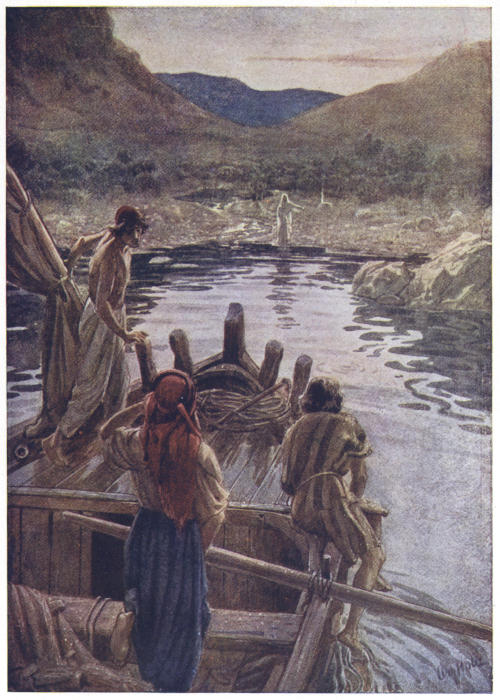
Jesus Showeth Himself at the Sea of Tiberius
But when the morning was now come, Jesus stood on the shore:
but the disciples knew not that it was Jesus. Then Jesus saith unto
them, Children, have ye any meat? They answered him, No. And
he said and unto them, Cast the net on the right side of the ship, and
ye shall find. They cast therefore, and now they were not able to draw
it for the multitude of fishes. Therefore that disciple whom Jesus
loved saith unto Peter, It is the Lord. Now when Simon Peter heard
that it was the Lord, he girt his fisher’s coat unto him, (for he was naked,)
and did cast himself into the sea. As soon then as they were come to
land, they saw a fire of coals there, and fish laid thereon, and bread.
Jesus saith unto them, Bring of the fish which ye have now caught....
And none of the disciples durst ask him, Who art thou? knowing
that it was the Lord. Jesus then cometh, and taketh bread, and
giveth them, and fish likewise. This is now the third time that Jesus
shewed himself to his disciples, after that he was risen from the dead.—St.
John xxi: 4-7, 9, 10, 12-14.
NOTE BY THE ARTIST
Next in order of the recorded appearances is that by the Sea of Tiberius,
whither the disciples had returned to await the promised meeting with their
Master, the seven who were fishermen resuming meanwhile their former
occupation. Disheartened and weary with a fruitless night’s toil, they were
returning homeward at dawn, when they perceived in the dim light the
figure of one who had seemingly come down to the shore to buy their fish;
and supposing from his words that he had noticed indications of a shoal, they
readily followed his directions, laying out the net in the manner still in use
on the lake. The success of the cast at once suggested its true cause, and
Peter, standing naked in the boat after swimming round with the net to “ring”
the fish, paused but a moment to gird on his short, striped abba, and once more
leapt into the sea, eager to verify the glad surmise that the stranger was none
other than the Master himself. The background of the picture is the shore
of the lake to the north of Magdala with the Wady Hammâm and Kurn
Hattîn in the distance.
78
“Your feathers are ruffled, my son,” said the
old owl. “Have you been singing?”
Then the foolish young owl told about his
disgrace and his narrow escape from death.
“It is just what I expected,” said his mother,
“and I’m glad you are safe back.”
“Then why did you let me go?” he asked.
“Because I saw you wouldn’t mind what I
said, and that nothing but experience would
teach you the folly of thinking too much of
yourself.”
That young owl had reason to feel thankful
that he had learned this lesson without any
greater harm or loss to himself.
The first lesson from the history of this apostle
is about the danger of self-confidence.
The second lesson from this history is about—deliverance
from temptation.
When we rise in the morning we can never
tell what will happen to us before evening.
But Jesus knows all about things before they
come to pass. At the beginning of a day, or
week, or month, or year, he has a clear view of
all that can happen to the end of it. Early in
the evening of the night on which he was
betrayed, Jesus said to Peter: “Simon, Simon,
Satan hath desired to have you, that he may sift
you as wheat; but I have prayed for thee, that
thy faith fail not.” St. Luke xxii: 31, 32. Looking
forward through that sad and solemn night
Jesus saw that Satan, the great enemy of souls,
had laid a snare or prepared a temptation for
Peter which, he thought, would ruin his soul
forever. He had arranged things in such a way
that Peter would be tempted to deny his Master,
and would be most likely to yield to the temptation;
and this was so great a sin that it would
seem sure to prevent him from being one of the
apostles, and cause him to lose his soul. And
such would have been the result, no doubt, if
Jesus had not seen this temptation coming, and
had not prepared a way of escape in the very
midst of it. He prayed for Peter, “that his faith
might not fail.” And it was this prayer of Jesus
that saved Peter. For we read in the gospel
that as soon as he had committed his great sin
he was sorry for it. “He went out and wept
bitterly.” And it was just here that the prayer
of Jesus secured to Peter the grace that led him
to true repentance; and this was what saved
him. It was in this way that he was brought
out of his temptation. We do not wonder,
therefore, to find St. Peter using these comforting
words in one of his epistles: “The Lord
knoweth how to deliver the godly out of temptation.”
II. Peter ii: 9. He knew very well
about this. He could speak from his own
experience here. His history affords a beautiful
illustration of this passage from his epistle.
And as we are all exposed to temptation it will
be a great help and comfort to us to remember
that what Jesus did for Peter he can do for us.
“An Illustration from History.” In an old
English history, called “The Chronicles of
Froissart,” there is an account given of the
escape of the garrison from a besieged citadel,
which illustrates very well this part of our subject.
An enemy’s army had encamped before
this citadel, for the purpose of taking it. They
had completely surrounded it. It was impossible
for anyone to go in or out of the place. The
day was fixed for storming the fortifications and
putting the garrison to death. The assault was
made. The walls were mounted and the gates
forced open; but no one was found within.
What had become of them? On examining
the place, it was found that through the solid
rock, on which the fortress was built, a secret
passage-way had been made. It led down under
the walls, far away from the besieged citadel,
out into the beautiful country beyond it. Thus
the soldiers and inhabitants of that fortress
found “a way of escape” from the power of
their enemies.
“An Illustration from Daily Life.” A gentleman
who lived in a small country town in
England obtained a situation for his son, a
promising young man, in one of the banks in
the city of London. His father took him up to
London and introduced him to the president
of the bank and the other officers. On taking
leave of his son, the father said: “Harry, my
boy, you must be obedient, obliging, civil, and
respectful; be attentive to your business and
trustworthy. Above all things, never forget
these four words—‘Thou, God, seest me.’” Harry
promised his father, solemnly, to do as he had
said. And he did so for awhile. He gained
the confidence of all about him, and rose, by
degrees, till he held one of the most responsible
positions in the bank. Thousands of pounds
passed through his hands every day. At last,
temptation overtook him. The thought came
into his mind how easy it would be to make
himself rich by quietly taking some of this
gold and silver, without anyone knowing it.
He was frightened when this idea first entered
his mind, and tried to put it away. But still it
would come back to him, again and again, till
he ceased to be alarmed at it. Finally, it seemed
to take full possession of him. He made up his
mind to do it.
One evening, when all the others had left the
bank, he remained behind, under pretence of
finishing some business. He went to the vault
and put in the keys. The heavy door flew open.
But, just as he had reached out his hands, and
grasped the money, his father’s words—“Thou,
God, seest me”—came into his mind. The
money dropped from his hands, as if it had
been red-hot iron. He fell on his knees and
cried,—“O, God, save me from this temptation!”
And God did save him. He put the money back,
and closed the vault. Then he went to the president,
and, with bitter cries and tears, confessed
his fault and offered to resign his situation.
The president was a wise and good man. He
said he would keep the secret to himself; and
not allow him to give up his situation in the
bank. But he told him to seek every day the
help of that God who had delivered him from
this great temptation.
He went back to his duties, feeling that he
had no strength in himself, but firmly relying
on the grace of God to “deliver him from evil,”
and remembering the great truth—“Thou, God,
seest me.”
Let us always remember this lesson from
the history of St. Peter, about deliverance from
temptation.
The third lesson we learn from this history is
about—overcoming prejudice.
The word prejudice is made up of two Latin
words. One of these means, to judge, or to
form an opinion, or to make up our minds on
any subject; and the other means, beforehand.
And a person who has a prejudice, is one who
has made up his mind about something before
he understands it. When Nathanael first heard
our Saviour spoken of as “Jesus of Nazareth,”
he asked: “Can any good thing come out of
Nazareth?” He had a prejudice against it. He
had made up his mind that nothing good could
come out of it, before he really knew the place.
And so the Jews and the Samaritans had a very
great prejudice against each other. The Jews
thought it impossible that there should be any
good Samaritans, and the Samaritans thought
it impossible that there should be any good
Jews. But they were both mistaken. They
had made up their minds on this subject before
they understood it.
But perhaps there never was a stronger prejudice
than that which the Jews had toward the
Gentiles. They thought it was impossible for
them to be saved; and they would never share
any of their religious privileges with them. And
as the apostle Peter was a Jew, he had this
strong prejudice against the Gentiles. And
how strong this prejudice was, we see from the
great trouble taken to overcome it. When
God wished to have Peter go and preach the
gospel to the Gentiles, his prejudice against
them was so strong, that three miracles had
to be performed before that prejudice could
be overcome and he be willing to obey God’s
command in this matter. We read about this
in the tenth chapter of the Acts of the Apostles.
Peter was at Joppa, at this time, staying at the
house of Simon the tanner, by the seaside. Here
he had a vision. In the vision, he saw a great
sheet, fastened by the four corners, and let down
from heaven. In this sheet were all manner of
four-footed beasts, and creeping things, and
fowls of the air. As he gazed on them, he
heard a voice saying, “Rise, Peter, slay and
eat.” But many of these creatures were such
as the Jews thought unclean. So Peter declined
to do this, for he said that “nothing common,
or unclean, had ever entered his mouth.” The
same voice told him not to call anything
unclean that God had cleansed. This was done
three times; and all was taken up to heaven.
Here was the first miracle performed to overcome
the prejudice of Peter.
Just as this vision ended, three men came to
the house of Simon, inquiring for Peter. They
were sent by Cornelius, a Roman centurion,
who lived at Cæsarea, on the seacoast, more
than a day’s journey from Joppa. Cornelius
was trying to find out the way of salvation. He
had prayed earnestly to God for direction. God
had sent an angel to tell him to send to Joppa,
and ask Simon Peter to come and preach the
gospel to him, or to tell him how he was to be
saved. This was the second miracle wrought
on purpose to overcome the prejudice of Peter.
And while these men were inquiring for
Peter, the Spirit of God spoke to him and told
him to go with the men and do what they
wanted him to do, because he had sent them.
This was the third miracle that took place on
this occasion. And thus the strong prejudice
of Peter was overcome. He went with these
men. He preached the gospel to a company
of Gentiles. And when he saw the Holy Ghost
come down on them, in a visible form, as it
had come down on the apostles, on the day of
Pentecost, he baptized them, and received them
into the church. And thus Peter had the honor
of being the first minister of Christ who
preached the gospel to the Gentiles. He first
opened the door of the Christian church to
them. The prejudice of Peter, if it had not
been overcome, would have prevented him from
being useful in this way.
And if we wish to be useful, and do the work
God has for us to do, we must try to overcome
our prejudices.
“A Lesson from a Pair of Shoes.” There was
a minister of the gospel once, who had a member
of his church who was a shoemaker. He
thought no one could be a Christian who did
not think and feel just as he did. This interfered
with his usefulness. His minister had
often talked with him on the subject, but in
vain. At last, he concluded to give him a
lesson from his own trade, which he would not
be likely to forget, and which he hoped would
do him good. He did it in this way:
He sent for the shoemaker one day, and when
he came in, he said, “I wish you to take my
measure for a pair of shoes.”
“I will do so with pleasure; please take off
your boot.”
The minister did so; and the shoemaker took
his measure, put down the figures in his notebook,
and was going away, when the minister said
to him, “I want a pair of boots also for my son.”
“Very good, sir. Can I take the young man’s
measure?”
“That is not necessary,” said the pastor, “you
can make my boots and his from the same last.”
“Please, your reverence, that will never do,”
said the shoemaker, with a smile of surprise.
“O yes, it will do very well. Make my shoes
and my son’s on the same last.”
“That cannot be, your reverence. If a shoe
is to fit it must be made on a last that is just
the size of the person’s foot who is to wear it.”
“Is that so?” said the minister. “You say
every pair of shoes must be made on their own
last or they will not fit. And yet you think
that God must make all Christians on your last;
and if they do not think and feel just as you do
you think they are not true Christians.”
“I thank your reverence for this lesson,” said
the shoemaker. “I will try and remember it, and
pray God to help me to overcome my prejudices.”
This is a good lesson for us all to learn.
The last lesson of which we may speak, as taught
us by the history of this apostle, is about—the
benefit of trials.
When Jesus foresaw the great trial that was
coming on Peter, during the night of his betrayal,
he could easily have saved him from it
if he had thought it best and wisest to do so.
Before leaving the upper chamber in Jerusalem
where he kept the Passover for the last time
with his disciples, he could have sent Peter on
some errand or could have given him something
to do that would have occupied him till the
next day. Then he would not have been exposed
to the temptation of denying his Master.
This could easily have been done. But Jesus
did not do this. And the reason was he knew
very well that though the trial would be very
painful to Peter, and would cause him to shed
many bitter and sorrowful tears, yet it would
be useful to him in the end, and would help to
make him a better minister than he could have
been without it. It would show him his own
weakness, and teach him how to sympathize
with others in their troubles and to be kind
and tender in his dealings with them. And
this is what Jesus meant when he said to
Peter after telling him about this coming trial:
“And when thou art converted, strengthen thy
brethren.”
And no doubt Peter had this sorrowful event
in his mind, and the benefit he had derived
from it, when, in one of his epistles, he compares
the trials through which God causes us
to pass to the fire into which the jeweler puts
his gold when he desires to have it purified.
I. Peter i: 17. He was a more useful minister
for having passed through this trial than he ever
could have been without it. The benefit of it
followed him through all his life. And this was
the reason why Jesus did not save him from
that trial, but saved him in it.
And in the same way God intends to do us
good by all the trials through which he causes
us to pass. It is not for his pleasure, but for
our profit that these trials are allowed to come
upon us; and the profit will surely follow if, as
Paul says, we are rightly “exercised thereby.”
It would be easy enough to give many illustrations
of this important lesson, but there is
room for only one. We may call it:
“The Marble-Block; or, The Sculptor’s Lesson.”
“One of my scholars,” says a Sunday-school
teacher, “had a little sister who was
lame. Her name was Annie. I often called to
see her, and pitied her as I saw her sitting by
the window watching the other children on the
playground. In addition to her lameness she
was sometimes so sick that she could not sit at
the window. One bright spring day I bought
for her some oranges and candies and a pretty
picture-book, and hoped to comfort her with
these. I gave her the oranges and candies, and
read to her from the little book; but still she
seemed sad.
“‘Why are you so sad to-day, Annie, dear?’
I said.
“‘Oh, ma’am,’ she replied, ‘I don’t see why
God should afflict me, and yet let other children
be so well and happy. But if I only knew
that God was not angry with me I shouldn’t
care so much.’
“I asked her to take a little walk with me.
In the course of our walk I took her into the
room of a sculptor whom I knew. Here were
a number of beautiful marble figures and some
blocks of rough marble. The artist was at
work on one of these, and Annie and I watched
him with great interest. Presently I pointed to
a great rough, dark block of marble that stood
in the middle of the room, and said: ‘Do you
like that, Annie?’
“‘Oh, no,’ she said, ‘why did they bring such
an ugly block here?’
“‘That block,’ said the artist, ‘I shall begin to
work upon to-morrow. Come in and see it again.’
“The next day Annie and I went in again.
The artist spent most of that day in simply
knocking off the rough places. Day after day
we watched him; and every day the block
seemed to grow less ugly. The sharp chisel
cut here, and there, and everywhere. As we
watched him we often thought if the block was
alive and could feel how much it would suffer
from the blows of that chisel!
“After a while the artist sent us an invitation
to come to his studio. I took my little friend
and went. As we entered, he said: ‘I have
something to show Annie.’ Then he drew
aside a thin, white veil, and behold! there
stood before us, white as the driven snow,
the beautiful image of an angel, that had
been made out of that rough marble block.
Annie shouted with joy when she saw it.
“‘Now, Annie, dear,’ I said, ‘do you think
the sculptor hated that rough block of marble
when he gave it so many hard knocks?’
“‘Oh, no,’ said she, ‘he loved it; and every
blow he gave showed his love for it.’
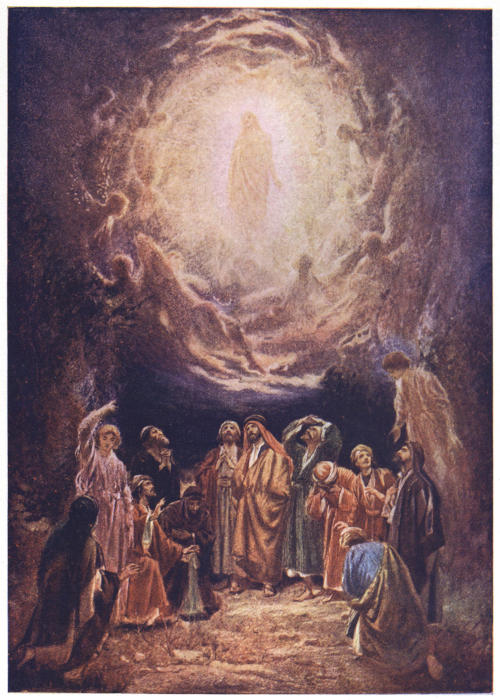
Jesus, His Work Accomplished, Ascends
Into Heaven
And he led them out as far as to Bethany, and he lifted up his
hands, and blessed them. And it came to pass, while he blessed them,
he was parted from them, and carried up into heaven.—And while they
looked stedfastly toward heaven as he went up, behold, two men stood
by them in white apparel; Which also said, Ye men of Galilee, why
stand ye gazing up into heaven? this same Jesus, which is taken up
from you into heaven, shall so come in like manner as ye have seen
him go into heaven.—St. Luke xxiv: 50, 51; Acts i: 10, 11.
NOTE BY THE ARTIST
“And he led them out as far as to Bethany,” passing through the streets
of the city, thronged with busy crowds, who knew not that Jesus of Nazareth
passed by. Over the ridge of Olivet there is a path leading to Bethany,
and following this the traveller reaches a secluded spot on the further slope
of the hill, and within sight of the home that Jesus had known and loved;
and he pauses in reverence, for these silent stones may have witnessed the
crowning scene of the world’s Redemption—Jesus, son of God and son of
Man, received up to Heaven, a cloud of adoring angels concealing from
mortal gaze his entrance through the everlasting doors into the presence of
the Father.
79
“‘And so, my dear child,’ said I, ‘does God
love us. And the trials which he sends on us
are the proofs of his love. As the sculptor was
trying to make this image of an angel out of
the marble block, by every blow he gave it, so
God, by all the afflictions of this life, is fitting us
to be like the angels in the heavenly kingdom.’
“‘Now, I shall never feel sad on account of
my lameness,’ said Annie. ‘To think that this
is a proof of God’s love will always make me
happy.’”
Let us remember these four lessons when
we think of the history of the apostle Peter.
The lesson about self-confidence—about deliverance
from temptation—about overcoming prejudice—and
about the benefit of trials.
We may close this subject with the Collect
for All Saints’ Day: “O Almighty God, who
hast knit together thine elect in one communion
and fellowship, in the mystical body of thy
Son Christ, our Lord: grant us grace so to follow
thy blessed saints, in all virtuous and godly
living, that we may come to those unspeakable
joys which thou hast prepared for those who
unfeignedly love thee; through Jesus Christ,
our Lord. Amen.”
ST. JOHN AND ST. PAUL — THE APOSTLE PAUL.
In the original plan of this work, it was intended
to have a separate chapter for each
of these two noble workers in the cause of
Christ. But room for this fails. All that can
be done is to give a brief sketch of each in this
closing chapter.
We have now to speak of the apostle John.
Most of the pictures that have been made of
this apostle, represent him as looking more like
a woman than a man. But we shall find that
there was no authority for this when we come
to see what his real character was.
He is supposed to have been born in Bethsaida,
the city of Andrew and Peter. This town
was situated on the western shore of the sea of
Galilee, or the lake of Tiberias, at the upper part
of the lake. His father’s name was Zebedee,
and his mother’s, Salome. We know nothing
more of Zebedee than that he was a fisherman,
the husband of Salome, and the father of James
and John. Salome, the mother of John, we
often read of afterwards, as one of those good
women who followed our Lord through the
different scenes of his ministry, and were a great
help and comfort to him. John is supposed to
have been younger than his brother James,
who is generally mentioned first when they are
spoken of together. They are referred to, as
“James and John, the sons of Zebedee.” John
was probably the youngest of all the apostles.
It is said, that he was younger than the Saviour
himself, having been born in the year four,
Anno Domini, or when Jesus was four years old.
The family of this apostle is supposed to
have been better off in regard to property than
any of the other apostles. This is evident from
several things mentioned about him and his
family. One thing which shows this is that
when John and his brother James were called
from their business as fishermen, to follow
Christ, we are told that “they left their father
Zebedee in the ship with the hired servants.”
St. Mark i: 20. Andrew and Peter were too
poor to have hired servants. They had to do
all their own work. But Zebedee could afford
to hire help for himself and sons. And then, at
the time of our Saviour’s trial, the servants who
kept the door of the judgment hall, in which
the trial took place, allowed John to enter the
hall, because they knew he was acquainted
with the high priest. St. John xviii: 16. And
then when Jesus left his mother in the charge
of John, while hanging on the cross, we are told,
that from that day, “he took her to his own
home.” St. John xix: 27. John had a home of
his own at Jerusalem. From all this, it seems
clear that the family of this apostle were better
off in worldly things than were the families of
the other apostles.
Now we may just glance at what John’s
character was by nature, or before he was a
Christian; and what it was by grace, or after he
became a Christian.
From what we read of this apostle in the
gospel history, we see that there were three
things in John’s natural character which show
that he was not the weak, womanly sort of man
he is represented to have been in most of the
pictures that have been made of him.
For one thing, it is clear that John was naturally
an ambitious man. This is evident from
the request to Jesus by John and his brother
James, through their mother, that they might
have the highest places in his kingdom. St.
Matt. xx: 20-23. Their mother made the request.
But she probably consulted them about
it first. And if they had not agreed in it, she
would not be likely to have done it. This
shows that they were all ambitious together.
And so we are right in saying that John was
ambitious. He wanted the best place in Christ’s
kingdom for himself, without thinking whether
others might not be better fitted for it. Our
Saviour’s reply shows that he was wrong in
giving way to this ambitious feeling. But then
this shows that there was a good deal of strength
in John’s natural character. He was ambitious.
And then he was narrow-minded, as well as
ambitious in his natural character.
Persons of this character are accustomed to
think that all those who think, or feel, or act
differently from what they do, must certainly
be wrong. And this was the way John felt
when he first became a disciple of Christ. He
came to Jesus one day and said, “Master, we
saw one casting out devils in thy name, and
we forbade him, because he followeth not us.”
Jesus rebuked him for giving way to his narrow-mindedness,
or bigotry, or uncharitableness. It
was wrong for him to think that no one could
be doing good, or be serving God acceptably,
unless it was done in just the same way in
which he was doing it. This was a wrong
feeling to have, but it shows there was a good
deal of decision and strength about John’s
natural character.
And then another thing about John before
he became a Christian, was that he was an
angry, or passionate man. As Jesus was going
up to Jerusalem on one occasion, in the company
of his disciples, they came to a Samaritan
village.
When the Samaritans in the village found
that he was going to Jerusalem, it stirred up all
their prejudice against the Jews, and they refused
to receive him. They would not let him
stop for rest or refreshment. This made the
disciples very angry, and John and his brother
James showed their anger by saying, “Lord,
wilt thou that we call down fire from heaven,
to consume them, as Elias did?” St. Luke
ix: 51-57. But Jesus rebuked them, and showed
them that this was not the right spirit for his
disciples to have.
These traits of John’s natural character,
although they are not to be approved or admired,
yet show that he was a man of a good
deal of force of character, and very different
from what his pictures represent him to have
been. But when we turn from considering
what he was by nature, or before he became a
Christian, and think of what he was by grace,
or after he became a Christian, we see a wonderful
change. The apostle Paul tells us, “that
if any man be in Christ, he is a new creature;
old things have passed away, and all things have
become new.” And it was so with this apostle.
When he learned to know and love Christ, the
old things about his character passed away, and
all things became new. After this we see no
more of his ambition, of his narrow-mindedness,
or of his passion.
The one thing that marked his character as a
Christian was love. He seemed to get nearer
to Jesus than any of the other disciples. And
it is always the case, that the nearer we get to
Jesus and the more we learn to know him, the
more we shall love him. John’s love to Christ
seemed to take entire possession of him. It
filled his whole soul. And so we think of him
as the apostle of love. He is spoken of particularly
as “the disciple whom Jesus loved.” It
was he who sat nearest to his Lord and leaned
on his bosom at the last Passover. Peter was
great for his readiness in serving Christ; Paul
was great for the learning and the labor with
which he served his Master; but John was great
in the love for that Master, which ran through
all he did. And this great love made him useful
both in his life and in his writings.
It made him useful in his life. There is
nothing that will lead to such earnest and devoted
labor as this principle of love. We know
but little of the life of this loving apostle after
the ascension of Christ. We have no report of
his missionary journeys, as we have in the case
of the apostles Peter and Paul. But we know
he was so earnest in the cause of his Master
that he was sent a prisoner to the island of
Patmos to stop his labor, but in vain. He was
willing to be an exile, a prisoner, and, as some
say, a laborer in the mines, but he was not willing
to give up working for his Master. Tradition
tells us that he had to take his choice
between stopping his work for Jesus and being
thrown into a cauldron of boiling oil. He could
not cease from his work. He was thrown into
the boiling oil; but came out uninjured and
kept on with that work which his love constrained
him to do. He lived the longest of all
the apostles, and was the only one of them who
died a natural death. And in the closing days
of his life, when too feeble to do anything else,
we are told that he used to be carried into the
church at Ephesus, where his latest labors had
been performed, and, standing up in the midst
of the congregation, would stretch forth his
trembling hands and say, “Little children, love
one another.” What a beautiful close to the
life of this loving apostle! Truly his love made
him useful in his life.
And then it made him useful in his writings,
too. Think of the gospel of St. John. How
different it is from all the others! John’s love
for Jesus seemed to bring him nearer to his
great heart of love than the rest of the brethren.
We are not surprised, therefore, to see that love
speaking out more clearly and fully in his writings
than it does anywhere else. It is only John
who gives us that wondrous statement, that
glorious, golden epitome of the gospel which
is found in the sixteenth verse of his third chapter—“God
so loved the world that he gave his
only begotten Son; that whosoever believeth in
him should not perish, but have everlasting
life.” And then think of the marvellous discourses
of our Saviour found in the fourteenth,
fifteenth, and sixteenth chapters of this gospel;
and of that most sublime and wonderful prayer
of Jesus, for all his people, found in the seventeenth
chapter. O, no one can tell what an
unspeakable loss the Church of Christ would
have sustained if this loving apostle had not
written his precious gospel!
And then how useful he has been in his
epistles, too, as well as in his gospel! Love is
the golden thread that runs through them all.
Look at the opening words of the third chapter
of his first epistle. How the very heart of the
loving disciple seems to be speaking out when
he exclaims: “Behold, what manner of love the
Father hath bestowed upon us, that we should
be called the sons of God!” It is remarkable
that the two shortest verses in the whole Bible,
and yet two among those that most melt, and
stir our hearts, were written by this apostle.
One of these is in his gospel and contains only
two words—“Jesus wept.” The other is in one
of his epistles and contains only three words—“God
is love.” If he had never written anything
else than these two verses, how well it might be
said that he was useful in his writings!
And then think of that marvellous book
with which the Bible closes. We call it “The
Revelation of St. John the Divine.” For,
although it is true that there is much in this
book that we cannot understand, yet its opening
and closing chapters have been an unspeakable
blessing to the Church in all ages. When St.
John closes the Bible with those last two chapters
of the Revelations, it seems as if he had
been permitted to leave the gates of heaven
ajar on purpose that we might gaze through
them in wondering awe. Those jewelled walls;
those pearly gates; those golden streets; that
river of the water of life, clear as crystal; and
all the sparkling imagery employed by this
loving apostle in what he here tells us about
heaven, how can we sufficiently thank God
for permitting his servant John to write such
glorious things for us? Truly we may say that
his love made him useful in his life and useful
in his writings!
I know not how better to close this brief
sketch of the life of St. John the Evangelist than
by quoting here the words of that beautiful
Collect which our Church uses on the day with
which his memory is connected:
“Merciful Lord, we beseech thee to cast thy
bright beams of light upon thy church, that it,
being instructed by the doctrine of thy blessed
Apostle and Evangelist, St. John, may so walk
in the light of thy truth, that it may at length
attain to everlasting life, through Jesus Christ
our Lord. Amen.”
“Praise, for the loved disciple, exile on Patmos’ shore;
Praise for the faithful record he to thy Godhead bore;
Praise for the mystic vision, through him to us revealed;
May we, in patience waiting, with thine elect be sealed.”
It would require a large volume to consider
fully and properly the character and work of
this apostle. We have only space to take a
hasty glance at the subject. But even this, it is
hoped, may prove useful to those who read it.
St. Paul spoke of himself as “the least of all
the apostles.” I. Cor. xv: 9. It was natural
and proper enough for him to think lowly of
himself. But he stands alone in this opinion.
Nobody agrees with him here. We all love to
think and speak of him as—“the great apostle
of the Gentiles.” When first converted, he
began his ministry by preaching to his own
countrymen, the Jews. But finding their
prejudices against “Jesus of Nazareth,” were so
strong that they would not listen to him, he
changed his course and turned to the Gentiles.
And well he may be called—“the great apostle.”
He was great in every view we can take of him.
Let us notice now, as briefly as we can, some of
the elements of greatness about this apostle.
In the first place, he was great in the natural
talents that it pleased God to give him. He had
a stronger, clearer mind than any other of the
apostles. He could take hold of the greatest
subjects brought before him and handle them
and master them with wonderful power. He
had great reasoning powers. He could argue
and reason about anything in the grandest way.
And then he had great powers as a speaker.
He was marvellously eloquent. See what an
illustration we have of this in his famous speech
on the top of Mar’s Hill, in the city of Athens,
as we read it in Acts xvii: 16-32. We have
another illustration of this in his speech before
Agrippa, in Acts, twenty-sixth chapter. I would
gladly give anything I have in the world to
have enjoyed the privilege of hearing Paul
deliver that speech. When Agrippa interrupted
him by saying, “Almost thou persuadest me to
be a Christian;” only think how touching it
must have been to see Paul lift up his chained
hands towards heaven and say with the tenderest
feeling—“I would to God, that not only thou,
but also all that hear me this day, were both
almost, and altogether such as I am; except
these bonds!”
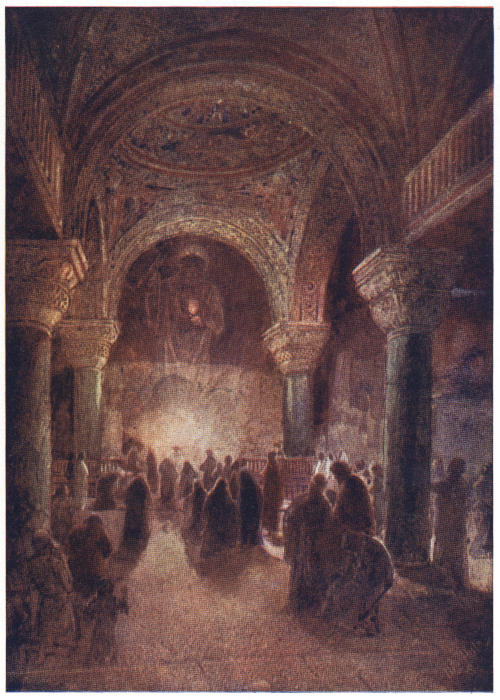
The Church of Jesus Christ
For where two or three are gathered together in my name, there
am I in the midst of them.—Teaching them to observe all things whatsoever
I have commanded you: and, lo, I am with you alway, even
unto the end of the world. Amen.—St. Matt. xviii: 20; xxviii: 20.
NOTE BY THE ARTIST
Yet this is not the close of the Great Story, and the painter’s work is
incomplete unless he endeavors to visualise the Truth, that, as the Master
has promised, his presence and his blessing are with his faithful worshipers
even unto the end of the world. The picture represents no special people or
period, and the Byzantine architecture most fitly symbolizes One, Universal
Church, of which Jesus Christ is the Founder and the Head.
80
He was great in his early opportunities. He
was born at Tarsus, and had a better education
than any of the other apostles. His family were
well off. It is no argument against this to say
that he was a tent-maker by trade. For it was
customary among the Jews, even with the richest
families, to teach their sons some useful trade.
Paul went through the best schools that were
to be had then. He had studied all about
history, and philosophy, and poetry. And he
was learned also in all matters concerning the
religion of the Jews. He tells us himself that
he was “brought up at the feet of Gamaliel”—who
was, at that time, the most famous of all
their teachers.
He was great in his prejudices. He was a real
Jew in this respect. They all had very strong
prejudices against people who differed from
them in their religion. But Paul was stronger
in his prejudices than even his countrymen
were. We see this in the first mention that is
made of him in the New Testament. This was
at the death of the first martyr, St. Stephen.
The wicked men who stoned him, we are told,
“laid down their clothes at the feet of a young
man whose name was Saul.” And then we see
the strength of his prejudice in the fierceness
of the persecution which he carried on against
the followers of Jesus. He “breathed out
threatenings and slaughter” against them. He
was “exceeding mad against them.” Not content
with imprisoning and putting to death
those who lived in Jerusalem, he “persecuted
them even unto strange cities.” Furnished with
letters from the chief priests, he went as far as
Damascus, that he might seize and bring bound
to Jerusalem any of the followers of Jesus found
there. How unlikely it seemed that one who
was so very strong in his prejudices should
ever, himself, become a follower and an apostle
of Jesus!
But he was great in his conversion. It was
impossible for him to be converted as other
men were. It is hearing about Jesus which
leads to the conversion of men. But Paul
would not listen to the preaching of the gospel.
He would allow no one to speak to him about
Jesus of Nazareth. He believed that he was a
wicked impostor, and he hated him most bitterly.
And so it pleased God to work a miracle
for his conversion. He had gone on his journey,
till he had nearly reached Damascus, when
a marvellous scene occurred. Suddenly the
heavens seemed to open above him. A light
shone around him above the brightness of the
sun. A strange voice was heard speaking to
him. It came from heaven. The words it spoke
were—“Saul, Saul, why persecutest thou me!”
He gave one look at the opening heavens and
then fell overpowered to the earth. “Who art
thou, Lord!” was his astonished inquiry. And
the answer, more astonishing still, was—“I am
Jesus whom thou persecutest!” What a revelation
that was to him! How overwhelming
was his amazement! No wonder that he was
converted by that vision. It was indeed a great
conversion. He was baptized by Ananias at
Damascus, and began at once to preach that
gospel which he had gone there hoping to destroy.
Such was the commencement of Paul’s
life as a Christian and his labors as an apostle.
Everything about it was great.
And then he was great in his privileges. He
saw the risen and ascended Lord amidst the
glories of the heavenly world. What a privilege
this was! It was a privilege which none
of the other apostles enjoyed except St. John.
We have an account of his vision of the glorious
Saviour in the first chapter of the Revelation,
verses 10-20. And then afterwards, St. Paul was
taken up into the third heavens, or into Paradise,
and saw and heard things of which it is
not lawful or possible to speak. He had broader
and fuller and clearer views of the great doctrines
of our holy religion than any of the
apostles. And this is one of the greatest privileges
we can have in this world. We see the
proof of Paul’s privileges in this respect in all
the blessed teachings he has given us in his
epistles about Christ and his salvation.
He was great in his labors. When he found
out the great mistake he had made respecting
Christ, and learned to know and love him as
the one, only glorious Saviour of lost sinners,
the love for Christ kindled in his soul by this
discovery constrained him to give himself a
living sacrifice to him. And the burning zeal
with which he began to work for his Saviour
never grew cold. The apostles were all earnest
in their labors for Jesus; but Paul was the most
earnest and the most untiring of them all. In
his case, it was indeed true, that the last became
first. No one city or country was large enough
to be the field of his labors. He went from city
to city, and from country to country, till he
had gone all over the world as it was then
known. And when he had gone all over the
earth once, preaching the gospel, he was not
satisfied. When one missionary journey was
ended, he began another; and then another,
and so on to the end of his days. Then he
sealed his life’s labors with his blood, and died
a martyr’s death at Rome by order of the cruel
emperor Nero. The tradition is that he was
beheaded outside of the walls of that great city.
And on the spot which is said to be the place
of his death, there stands a beautiful church,
called after him, and which is a monument to
his memory.
How well it may be said of him that he was
great in his labors. And yet the Saviour, whom
he served so faithfully, had done nothing for
him which he has not done for you and me.
He bore the same cross, and shed the same
precious blood for us, that he did for Paul.
Then, in our labors for Jesus, let us try to follow
Paul, as he followed Christ. If we try to
catch Paul’s spirit, whoever we are, or wherever
we may be, we shall find it easy and pleasant
to work for our blessed Master. Here is an
illustration of what I mean. We may call it:
“Paul’s Spirit in a Child.” A little girl had
great dislike for sewing. She had commenced
making a bed-quilt, but was not likely to finish
it soon. One day she came home from Sabbath-school.
They had been having a missionary-meeting
there, and she was full of zeal in the
missionary cause. “Mamma,” she asked, “can’t
I do some work to earn money for our missionary
box?”
“Well, Lizzie, darling,” said her mother, “if
you will finish one block for the quilt, every
other day, I will gladly pay you for it, and
you can give this as your own offering to the
missionary cause.”
Poor Lizzie’s face grew sad on hearing this;
for she disliked this kind of work very much.
It seemed as if her missionary spirit was likely
to die out at once. But, after thinking over
it a little while, her face brightened up and
she said, “Well, mamma, I’ll piece blocks, or
do anything else you wish me to do, for Jesus’
sake. Amen.” That quilt was soon finished,
and there is now an earnest, active little worker
for missions in that home. This was Paul’s
spirit in a child. And if we get that spirit, it
will make us all, like Paul, great in our labors
for Christ.
But Paul was great in his sufferings, too, as
well as in his labors.
Before he became a Christian he had the
prospect of rising to a position of great honor
and great profit in connection with the Jewish
church. But he gave this all up at the time of
his conversion. He tells us that, “what things
were gain to me, those I counted loss for Christ.
Yea, doubtless, and I count all things but loss for
the excellency of the knowledge of Christ Jesus,
my Lord.” Phil. iii: 7, 8. There is something
very touching in the record which this great
apostle has left us of his sufferings for Christ.
He speaks of himself as having been—“In labors
more abundant, in stripes above measure, in
prisons more frequent, in deaths oft. Of the
Jews five times received I forty stripes save one.
Thrice I was beaten with rods, once was I stoned,
thrice I suffered shipwreck, a night and a day I
have been in the deep. In journeyings often, in
perils of water, in perils of robbers, in perils by
mine own countrymen, in perils by the heathen,
in perils in the city, in perils in the wilderness,
in perils in the sea, in perils among false
brethren. In weariness and painfulness, in
watchings often, in hunger and thirst, in fastings
often, in cold and nakedness.” II. Cor.
xi: 23-28. What a marvellous record of sufferings
we have here! There is perhaps nothing
like it to be found in the whole history of the
Church of Christ. And yet the apostle never
had a word of complaint to make. The spirit
in which he bore his sufferings for Christ is
beautifully illustrated in the glimpse we have
of him in the prison at Philippi. His back had
been torn with cruel scourges. His feet were
made fast in the stocks. We might have expected
that he would spend that night in sighing
and crying. But, instead of this, we read
that—“At midnight, Paul and Silas,”—his companion
in labor and suffering—“prayed, and
sang praises to God.” Acts xvi: 25. Surely this
should make us ashamed of complaining on account
of any trifling suffering we may have to
bear in the cause of our great Master. And Paul
had no relief from these sufferings. He went
on bearing them cheerfully to the very close of
his life. How was he able to do this? There
is only one answer to give to this question. It
was his love for Jesus that made him so willing
to labor and to suffer for him. And if we love
Jesus, we should be willing to suffer for him, too.
Here is a striking illustration of the way in
which real love will make one willing to suffer
even for a friend or fellow-creature. We may
call it:
“Love Triumphing Over Suffering.” Some
years ago a fine church was built in one of the
towns in Belgium. It was all finished at last,
except the fastening of the weather-vane on the
top of the steeple. The scaffolding was not
high enough to reach it. There was no way
in which the work could be done, but for one
workman to stand on the highest part of the
scaffolding and let the other workman stand
on his shoulders, while he put the vane on the
steeple, and soldered it in its place. A brave-hearted,
broad-shouldered workman agreed to
stand there for this purpose. He took his
position, holding on to a piece of scaffolding.
His companion climbed up and stood on his
shoulders. The vane and vessel of melted lead
were handed up to him. It was a perilous thing
to do. A crowd of spectators below watched
the operation almost breathless with anxiety.
The moments seem like hours, as the work
goes on. At last it is done. The men come
down amidst the shouts of the multitude. But,
when the brave man who had borne his friend
on his shoulders reached the bottom of the
ladder, he fell exhausted to the earth, and had
to be carried home. Then it was found that
the poor fellow’s back was in a dreadful state.
While the man was doing his work on the vane,
some of the melted lead had dropped down on
the friend who was supporting him. But he
stood bravely still. He would not move an
inch, for that would have caused the death of
his companion. Here was love triumphing over
suffering. And if that brave man was willing to
bear all this for his earthly friend, what should
we not be willing to bear for Christ, “the friend
who sticketh closer than a brother?”
In the next place the apostle Paul was great
in his influence. Suppose we could have a
history written of all the persons who were converted
by the preaching of this apostle during
his life; and then of all who were converted
by them, and so on, from one generation to
another, down to our own times, what a wonderfully
interesting history that would be! Or
suppose we could trace out, in the same way,
all the good that has been done by the writings
of this apostle; the persons who have been
brought to Jesus by reading the truths found
in those writings, or who have been instructed,
or guided, or comforted, encouraged, and helped
by the same—how surprising it would be! Then
we should see, indeed, how great this influence
has been!
There are twenty-one epistles in the New
Testament. Of these the apostle Paul wrote
fourteen. They form a large part of the New
Testament. Now, suppose we could take these
epistles of St. Paul, chapter by chapter, and
follow every verse in each chapter as it has gone
round the world from age to age, and find out
every case where good has been done to any
soul, what a history we should have! No one
could write such a history now. But I suppose
we shall have such a history set before us when
we get to heaven. Then, we shall understand
better than we can do now how great the
apostle Paul was, in the influence for good
which he exerted. But, though none of us can
be compared at all with this great man, yet, if
we are trying, like him, to love and serve the
blessed Saviour, we may all, even to the youngest,
be exerting influence for good that will last
forever. Here is an illustration of what I mean.
We may call it:
“A Child’s Influence for Good.” Bessie was
a sweet little girl who was trying to love the
Saviour. The nursery in which she slept was
on the first floor of the house adjoining the
street. It was summer time when the incident
here referred to took place. Her mother was
sitting near the open window one evening,
when Bessie knelt down by her side to say her
evening prayer. She first repeated, after her
mother, the words that she taught her to use in
prayer. After this she was in the habit of offering
up little prayers of her own for anything
she wished to ask from her Father in heaven.
She did so on this occasion; and these were the
last words she had to offer: “God help everybody
to love Jesus. Amen.” While Bessie was
saying her prayers that evening her mother
heard the steps of some one passing. He lingered
a moment under the window and listened
to the words of the dear child. It happened
that this was a neighbor of theirs, an infidel,
whose name was Jones. The closing words of
Bessie’s prayer made a deep impression on his
mind. After this he manifested the greatest
interest in her, though he always said that what
she prayed for never could take place; for he
was certain that he, for one, never could be a
Christian.
Not long after this Mr. Jones was taken sick.
He had a long and severe spell of illness. As
he was living in a boarding house, and had
no family of his own, Bessie’s mother used
to send the dear child in every day to inquire
how he was and to take him little things
that he might need. He would allow no one
to speak to him on the subject of religion;
but Bessie’s father and mother hoped that her
gentle ways and simple loving words might do
him good.
A week or two had passed away, and one
night, as Bessie’s mother was putting her to
bed—she said: “Mamma, Mr. Jones loves Jesus
now.”
A few days after this they heard that their
sick neighbor was near his end. Taking her
little one by the hand the kind mother went in
to see him. They found that he was dying.
As Bessie sat on her mother’s lap, by the side of
his bed, the sick man died; but just before his
spirit passed away, these were the last words
heard from his lips: “God, help everybody to
love Jesus—everybody.”
And so dear Bessie’s words were the means
which God employed to save a soul from death.
And if a little child can exert such an influence
as this, then we see how, by loving and serving
Jesus, we may all make ourselves useful. We
may so live that every act and word may be a
good seed sown that will yield fruit unto everlasting
life.
“Not ourselves, but the truths that in life we have spoken,
Not ourselves, but the seed that in life we have sown,
May pass on for ages—all about us forgotten,
Save the truth we have spoken, the things we have done.
“So let our living be—so be our dying;
So let our names lie, unblazoned, unknown;
Unpraised, and unmissed, we shall yet be remembered;
But only remembered by what we have done.”
The apostle Paul was great in his influence.
And then, as the only other point to speak
of, he was great in his reward.
This is true of all God’s people who serve
him faithfully. David, when speaking of God’s
words, or commandments, tells us that “in
keeping of them there is great reward.” Ps.
xix: 11. When St. Paul had reached the close
of his life, he paused to look back upon the
past, and then forward to the future; and as he
did so, these are the words that he used: “I am
now ready to be offered, and the time of my
departure is at hand. I have fought a good
fight, I have finished my course, I have kept
the faith; henceforth there is laid up for me a
crown of righteousness, which the Lord, the
righteous judge, will give me at that day; and
not to me only, but unto all them also that love
his appearing.” II. Tim. iv: 6-9. We learn
from this passage that there is a crown in heaven
prepared for every follower of Jesus. These
crowns are procured or purchased by what
Jesus did and suffered for us. But they will be
very different in the number and character of
the jewels that are to sparkle in them. And
how many jewels, and what kind of jewels your
crown, or my crown, will have must depend
upon how much we do for Jesus. I suppose
the apostle Paul will have the most beautiful
crown that any of the servants of Jesus will
wear. He was greater in his labors, in his sufferings,
and in his influence for good than
others—and his reward will be greater. He
will have more jewels in his crown than will
be found in any other; and they will sparkle
with more brightness and beauty. But none will
envy him. We shall all feel that he is worthy
of it, and we shall rejoice to see him wear it.
But let us remember that every work we do
for Jesus, and every sacrifice we make for him,
will put another jewel in our crown. Then let
us try to serve him faithfully with all our hearts,
and we may be sure that we shall receive a great
reward. I close with just one little incident, to
show how we may add jewels to our crowns.
We may call it:
“A Star in the Crown.” A young lady was
standing before a large mirror, preparing to go
to a ball. She had just placed a light crown on
her head, ornamented with silver stars. While
she stood there, looking at herself in the glass,
her little sister, about five years old, climbed
upon a chair, and putting out her tiny fingers,
tried to touch the beautiful crown. “What are
you doing, Nellie, darling? You mustn’t touch
my crown,” said her sister.
“I was looking at that and thinking of something
else,” was the little one’s reply.
“Pray tell me, Nellie, what you were thinking
about?”
“I was remembering what my teacher said
last Sunday. She told us that if we brought
sinners to Jesus by our influence, we should
win stars for our crown in heaven; and when I
saw those stars in your crown, I wished I could
save some soul.”
These simple words that Nellie spoke took a
strong hold of her sister’s feelings. She went
to the ball that night, but felt little interest in
it. She had no heart for the music or the
dancing, and was truly glad when all was over.
On reaching home she went to Nellie’s room.
There she lay, sleeping sweetly. She stooped
and kissed her loving lips; and then, kneeling
down by the side of her bed, she asked God to
forgive her for the giddy, careless life she had
been living. She gave herself to Jesus then and
there, and prayed for grace to live henceforth
for him and for heaven.
Then she kissed Nellie again and said, “Precious
darling, you have won one star for your
crown!” God help us all to win many stars
for our crowns!
Thus we have taken a hasty view of this great
apostle. We have seen that he was great in
his natural talents; great in his opportunities;
great in his prejudices; great in his conversion;
great in his privileges; great in his labors;
great in his sufferings; great in his influence;
and great in his reward.
And now this work is done. I thank God,
with all my heart, for permitting me to engage
in it, and for helping me to get through with
it. It humbles me in the dust to think how
utterly unworthy it is of the glorious Saviour to
whom it refers. But I know he is pleased to
work by feeble means. He puts the treasure
of the gospel in earthen vessels, on purpose that
“the excellency of the power may be of God,
and not of us.” My earnest prayer is that he
will graciously accept it as a tribute of grateful
love from one of the least and most unworthy
of his followers; that he will pardon all the
mistakes and imperfections connected with it;
and bless it, notwithstanding, and make it useful.
And if it shall prove helpful to Christian
parents and teachers in training their children
for Jesus; and if the young who read these
pages shall find anything here to aid and encourage
them in trying to know and love and
serve the blessed Saviour, I shall feel that the
time and labor spent upon this work have not
been in vain! Amen!