Insurrection in North Carolina.... Dissatisfaction of
Massachusetts.... Corresponding committees.... Governor
Hutchinson's correspondence communicated by Dr. Franklin....
The assembly petition for his removal.... He is succeeded by
general Gage.... Measures to enforce the act concerning
duties.... Ferment in America.... The tea thrown into the
sea at Boston.... Measures of Parliament.... General
enthusiasm in America.... A general congress proposed....
General Gage arrives.... Troops stationed on Boston neck....
New counsellors and judges.... Obliged to resign.... Boston
neck fortified.... Military stores seized by general
Gage.... Preparations for defence.... King's speech....
Proceedings of Parliament.... Battle of Lexington....
Massachusetts raises men.... Meeting of Congress....
Proceedings of that body.... Transactions in Virginia....
Provincial congress of South Carolina.... Battle of Breed's
hill.
1770
In the middle and southern colonies, the irritation against the mother
country appears to have gradually subsided and no disposition was
manifested to extend opposition farther than to the importation of
tea. Insurrection in North Carolina.Their attention was a good deal directed to an insurrection in
North Carolina, where a number of ignorant people, supposing
themselves to be aggrieved by the fee bill, rose in arms for the
purpose of shutting up the courts of justice, destroying all officers
of government, and all lawyers, and of prostrating government itself.
Governor Tryon marched against them, defeated them in a decisive
battle, quelled the insurrection, and restored order.
Dissatisfaction of Massachusetts.
In Massachusetts, where the doctrine that parliament could not
rightfully legislate for the colonies was maintained as a corollary
from the proposition that parliament could not tax them, a gloomy
discontent was manifested. That the spirit of opposition seemed to be
expiring, without securing the rights they claimed, excited
apprehensions of a much more serious nature in the bosoms of that
inflexible people, than the prospect of any conflict, however
terrible. This temper displayed itself in all their proceedings.
The legislature, which the governor continued to convene at Cambridge,
remonstrated against this removal as an intolerable grievance; and,
for two sessions, refused to proceed on business. In one of their
remonstrances, they asserted the right of the people to appeal to
heaven in disputes between them and persons in power, when power shall
be abused.
Corresponding committees.
From the commencement of the contest, Massachusetts had been
peculiarly solicitous to unite all the colonies in one system of
measures. In pursuance of this favourite idea, a committee of
correspondence was elected by the general court, to communicate with
such committees as might be appointed by other legislatures.[219]
Similar committees were soon afterwards chosen by the towns[220]
throughout the province, for the purpose of corresponding with each
other; and the example was soon followed by other colonies.
1772
While this system of vigilance was in progress, a discovery was made
which greatly increased the ill temper of New England. Doctor
Franklin, the agent of Massachusetts, by some unknown means, Governor Hutchinson's correspondence.obtained
possession of the letters which had been addressed by governor
Hutchinson, and by lieutenant governor Oliver, to the department of
state. He transmitted these letters to the general court. They were
obviously designed to induce government to persevere in the system
which was alienating the affections of the colonists. The opposition
was represented as being confined to a few factious men, whose conduct
was not generally approved, and who had been emboldened by the
weakness of the means used to restrain them. More vigorous measures
were recommended; and several specific propositions were made, which
were peculiarly offensive. Among these was a plan for altering the
charters of the colonies, and rendering the high officers dependent
solely on the crown for their salaries.[221]
1773
Petition for the removal of the governor and lieutenant
governor.
The assembly, inflamed by these letters, unanimously resolved, "that
their tendency and design were to overthrow the constitution of the
government, and to introduce arbitrary power into the province." At
the same time, a petition to the King was voted, praying him to remove
governor Hutchinson and lieutenant governor Oliver, for ever, from the
government of the colony. This petition was transmitted to Doctor
Franklin, and laid before the King in council. After hearing it, the
lords of the council reported "that the petition in question was
founded upon false and erroneous allegations, and that the same is
groundless, vexatious, and scandalous, and calculated only for the
seditious purposes of keeping up a spirit of clamour and discontent in
the provinces." This report, his majesty was pleased to approve.
Hutchinson succeeded by Gage.
Governor Hutchinson however was soon afterwards removed, and general
Gage appointed to succeed him.
The fears of Massachusetts, that the spirit which had been roused in
the colonies might gradually subside, were not of long continuance.
The determination not to import tea from England, had so lessened the
demand for that article, that a considerable quantity had accumulated
in the magazines of the East India company. They urged the minister to
take off the import American duty of three pence per pound, and
offered, in lieu of it, to pay double that sum on exportation. Measures to enforce the duties.1774Instead
of acceding to this proposition, drawbacks were allowed on tea
exported to the colonies; and the export duty on that article was
taken off. These encouragements induced the company to make shipments
on their own account; and large quantities were consigned to agents in
Boston, New York, Philadelphia, Charleston, and other principal places
on the continent.[222]
The crisis was arrived; and the conduct of the colonies was now to
determine whether they would submit to be taxed by parliament, or meet
the consequences of a practical assertion of the opinions they had
maintained. The tea, if landed, would be sold; the duties would,
consequently, be paid; and the precedent for taxing them established.
The same sentiment on this subject appears to have pervaded the whole
continent at the same time. This ministerial plan of importation was
considered by all, as a direct attack on the liberties of the people
of America, which it was the duty of all to oppose. Ferment in America.A violent ferment
was excited in all the colonies; the corresponding committees were
extremely active; and it was almost universally declared that whoever
should, directly or indirectly, countenance this dangerous invasion of
their rights, was an enemy to his country. The consignees were,
generally, compelled to relinquish their consignments; and, in most
instances, the ships bringing the tea were obliged to return with it.
At Boston, a town meeting appointed a committee to wait on the
consignees to request their resignation. This request not being
complied with, another large meeting[223] assembled at Faneuil Hall,
who voted, with acclamation, "that the tea shall not be landed, that
no duty shall be paid, and that it shall be sent back in the same
bottoms." With a foreboding of the probable consequences of the
measure about to be adopted, and a wish that those consequences should
be seriously contemplated, a leading member[224] thus addressed the
meeting:
"It is not, Mr. Moderator, the spirit that vapours within these walls
that must stand us in stead. The exertions of this day will call forth
events which will make a very different spirit necessary for our
salvation. Whoever supposes that shouts and hosannahs will terminate
the trials of the day, entertains a childish fancy. We must be grossly
ignorant of the importance and value of the prize for which we
contend; we must be equally ignorant of the power of those who have
combined against us; we must be blind to that malice, inveteracy, and
insatiable revenge, which actuate our enemies, public and private,
abroad and in our bosoms, to hope that we shall end this controversy
without the sharpest, sharpest conflicts;—to flatter ourselves that
popular resolves, popular harangues, popular acclamations, and popular
vapour, will vanquish our foes. Let us consider the issue. Let us look
to the end. Let us weigh and consider, before we advance to those
measures, which must bring on the most trying and terrible struggle
this country ever saw."[225]
The question was again put, and passed unanimously in the affirmative.
The captain of the vessel, aware of the approaching danger, was
desirous of returning, and applied to the governor for a clearance.
Affecting a rigid regard to the letter of his duty, he declined giving
one, unless the vessel should be properly qualified at the custom
house. This answer being reported, the meeting was declared to be
dissolved; and an immense crowd repaired to the quay, Tea thrown into the sea.where a number
of the most resolute, disguised as Mohawk Indians, boarded the vessel,
broke open three hundred and forty-two chests of tea, and discharged
their contents into the ocean.[226]
Measures of parliament.
These proceedings were laid before parliament in a message from the
crown, and excited a high and general indignation against the
colonies. Both houses expressed, almost unanimously, their approbation
of the measures adopted by his Majesty; and gave explicit assurances
that they would exert every means in their power, to provide
effectually for the due execution of the laws, and to secure the
dependence of the colonies upon the crown and parliament of Great
Britain. The temper both of the parliament and of the nation was
entirely favourable to the high-handed system of coercion proposed by
ministers; and that temper was not permitted to pass away unemployed.
A bill was brought in "for discontinuing the lading and shipping of
goods, wares, and merchandises, at Boston or the harbour thereof, and
for the removal of the custom-house with its dependencies to the town
of Salem." This bill was to continue in force, not only until
compensation should be made to the East India company for the damage
sustained, but until the King in council should declare himself
satisfied as to the restoration of peace and good order in Boston. It
passed both houses without a division, and almost without
opposition.[227]
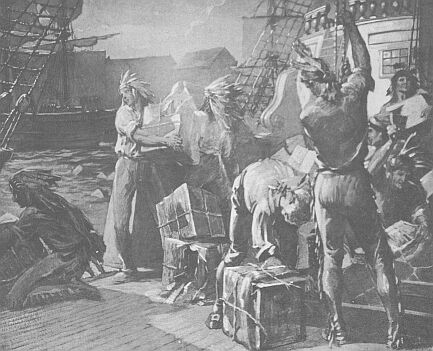
[Enlarge]
The Boston Tea Party
From the painting by Robert Reid, in the Massachusetts State House
In this picture, a leading modern American artist has succeeded
admirably in depicting the band of Boston citizens who, disguised as
Indians, boarded three British ships in Boston Harbor, December 16,
1773, and threw their cargoes of tea overboard, in defying England to
impose on the American colonies a tax on tea for the benefit of the
straitened East India Company; 342 chests, valued at about £18,000
were destroyed in this manner, without a sound from a great mob of
onlookers thronging the wharves. The mob dispersed quietly as soon as
the last chest went overboard.
Soon afterwards, a bill was brought in "for better regulating the
government of the province of Massachusetts Bay." This act entirely
subverted the charter, and vested in the crown the appointment of the
counsellors, magistrates, and other officers of the colony, who were
to hold their offices during the royal pleasure. This bill also was
carried through both houses by great majorities; but not without a
vigorous opposition, and an animated debate.[228]
The next measure proposed was a bill "for the impartial administration
of justice in the province of Massachusetts Bay. It provided that in
case any person should be indicted, in that province, for murder or
any other capital offence, and it should appear by information given
on oath to the governor, that the fact was committed in the exercise
or aid of magistracy in suppressing riots, and that a fair trial could
not be had in the province, he should send the person so indicted to
any other colony, or to Great Britain to be tried." This act was to
continue in force for four years.[229]
A bill was also passed for quartering soldiers on the inhabitants; and
the system was completed, by "an act making more effectual provision
for the government of the province of Quebec." This bill extended the
boundaries of that province so as to comprehend the territory between
the lakes, the Ohio, and the Mississippi; and established a
legislative council to be appointed by the crown, for its
government.[230]
Amidst these hostile measures, one single conciliatory proposition was
made. Mr. Rose Fuller moved that the house resolve itself into a
committee to take into consideration the duty on the importation of
tea into America, with a view to its repeal. This motion was seconded
by Mr. Burke, and supported with all the power of reasoning, and all
the splendour of eloquence which distinguished that consummate
statesman; but reason and eloquence were of no avail. It was lost by a
great majority. The earl of Chatham, who had long been too ill to
attend parliament, again made his appearance in the house of lords. He
could have been drawn out, only by a strong sense of the fatal
importance of those measures into which the nation was hurrying. But
his efforts were unavailing. Neither his weight of character, his
sound judgment, nor his manly eloquence, could arrest the hand of fate
which seemed to propel this lofty nation, with irresistible force, to
measures which terminated in its dismemberment.[231]
It was expected, and this expectation was encouraged by Mr.
Hutchinson, that, by directing these measures particularly against
Boston, not only the union of the colonies would be broken, but
Massachusetts herself would be divided. Never was expectation more
completely disappointed. All perceived that Boston was to be punished
for having resisted, only with more violence, the principle which they
had all resisted; and that the object of the punishment was to coerce
obedience to a principle they were still determined to resist. They
felt therefore that the cause of Boston was the cause of all, that
their destinies were indissolubly connected with those of that devoted
town, and that they must submit to be taxed by a parliament, in which
they were not and could not be represented, or support their brethren
who were selected to sustain the first shock of a power which, if
successful there, would overwhelm them all. The neighbouring towns,
disdaining to avail themselves of the calamities inflicted on a sister
for her exertions in the common cause, clung to her with increased
affection; General enthusiasm.and that spirit of enthusiastic patriotism, which, for a
time, elevates the mind above all considerations of individual
acquisition, became the ruling passion in the American bosom.
On receiving intelligence of the Boston port bill, a meeting of the
people of that town was called. They perceived that "the sharpest,
sharpest conflict" was indeed approaching, but were not dismayed by
its terrors. Far from seeking to shelter themselves from the
threatening storm by submission, they grew more determined as it
increased.
Resolutions were passed, expressing their opinion of the impolicy,
injustice, inhumanity, and cruelty of the act, from which they
appealed to God, and to the world; and also inviting the other
colonies to join with them in an agreement to stop all imports and
exports to and from Great Britain, Ireland, and the West Indies, until
the act should be repealed.[232]
It was not in Boston only that this spirit was roused. Addresses were
received from every part of the continent, expressing sentiments of
sympathy in their afflictions, exhorting them to resolution and
perseverance, and assuring them that they were considered as suffering
in the common cause.
The legislature of Virginia was in session when intelligence of the
Boston port bill reached that province. The house of Burgesses set
apart the first of June, the day on which the bill was to go into
operation, for fasting, prayer, and humiliation, to implore the divine
interposition to avert the heavy calamity which threatened the
destruction of their civil rights, the evils of a civil war; and to
give one heart and one mind to the people, firmly to oppose every
invasion of their liberties. Similar resolutions were adopted in
almost every province; and the first of June became, throughout the
colonies, a day of fasting, humiliation, and prayer, in the course of
which sermons were preached to the people, well calculated to inspire
them with horror, against the authors of the unjust sufferings of
their fellow subjects in Boston.
This measure occasioned the dissolution of the assembly. The members,
before separation, entered into an association, in which they declared
that an attack on one colony to compel submission to arbitrary taxes,
is an attack on all British America, and threatens ruin to the rights
of all, unless the united wisdom of the whole be applied in
prevention. A general congress proposed.They, therefore, recommended to the committee of
correspondence, to communicate with the several committees of the
other provinces, on the expediency of appointing deputies from the
different colonies, to meet annually in congress, and to deliberate on
the common interests of America. This measure had already been
proposed in town meetings, both in New York and Boston.
General Gage arrives in Boston.
While the people of Boston were engaged in the first consultations
respecting the bill directed particularly against themselves, general
Gage arrived in town. He was received, notwithstanding the deep gloom
of the moment, with those external marks of respect which had been
usual, and which were supposed to belong to his station.
The general court convened by the governor at Salem, passed
resolutions, declaring the expediency of a meeting of committees from
the several colonies; and appointed five gentlemen as a committee on
the part of Massachusetts. The colonies from New Hampshire to South
Carolina inclusive, adopted this measure; and, where the legislatures
were not in session, elections were made by the people. The
legislature of Massachusetts also passed declaratory resolutions
expressing their opinion on the state of public affairs, and
recommending to the inhabitants of that province to renounce, totally,
the consumption of East India teas, and to discontinue the use of all
goods imported from the East Indies and Great Britain, until the
grievances of America should be completely redressed.
The governor, having obtained intelligence of the manner in which the
house was employed, sent his secretary with directions to dissolve the
assembly. Finding the doors shut, and being refused admittance, he
read the order of dissolution aloud on the staircase. The next day,
the governor received an address from the principal inhabitants of
Salem, at that time the metropolis of the province, which marks the
deep impression made by a sense of common danger. No longer
considering themselves as the inhabitants of Salem, but as Americans,
and spurning advantages to be derived to themselves from the distress
inflicted on a sister town, for its zeal in a cause common to all,
they expressed their deep affliction for the calamities of Boston.
About this time rough drafts of the two remaining bills relative to
the province of Massachusetts, as well as of that for quartering
troops in America, were received in Boston, and circulated through the
continent. They served to confirm the wavering, to render the moderate
indignant, and to inflame the violent.
An agreement was framed by the committee of correspondence in Boston,
entitled "a solemn league and covenant," whereby the subscribers bound
themselves, "in the presence of God," to suspend all commercial
intercourse with Great Britain, from the last day of the ensuing month
of August, until the Boston port bill, and the other late obnoxious
laws should be repealed. They also bound themselves, in the same
manner, not to consume, or purchase from any other, any goods whatever
which should arrive after the specified time; and to break off all
dealings with the purchasers as well as with the importers of such
goods. They renounced, also, all intercourse and connexion with those
who should refuse to subscribe to that covenant, or to bind themselves
by some similar agreement; and annexed to the renunciation of
intercourse, the dangerous penalty of publishing to the world, the
names of all who refused to give this evidence of attachment to the
rights of their country.
General Gage issued a proclamation in which he termed this covenant
"an unlawful, hostile, and traitorous combination, contrary to the
allegiance due to the King, destructive of the legal authority of
parliament, and of the peace, good order, and safety of the
community." All persons were warned against incurring the pains and
penalties due to such dangerous offences; and all magistrates were
charged to apprehend and secure for trial such as should be guilty of
them. But the time when the proclamation of governors could command
attention had passed away; and the penalties in the power of the
committee of correspondence were much more dreaded than those which
could be inflicted by the civil magistrate.[233]
Resolutions were passed in every colony in which legislatures were
convened, or delegates assembled in convention, manifesting different
degrees of resentment, but concurring in the same great principles.
All declared that the cause of Boston was the cause of British
America; that the late acts respecting that devoted town were
tyrannical and unconstitutional; that the opposition to this
ministerial system of oppression ought to be universally and
perseveringly maintained; that all intercourse with the parent state
ought to be suspended, and domestic manufactures encouraged; and that
a general congress should be formed for the purpose of uniting and
guiding the councils, and directing the efforts, of North America.
The committees of correspondence selected Philadelphia for the place,
and the beginning of September as the time, for the meeting of this
important council.
Congress assembles.
On the fourth of September, the delegates from eleven[234] provinces
appeared at the place appointed; and, the next day, they assembled at
Carpenter's Hall, when Peyton Randolph, late speaker of the house of
Burgesses of Virginia, was unanimously chosen president. The
respective credentials of the members were then read and approved; and
this august assembly, having determined that each colony should have
only one vote; that their deliberations should be conducted with
closed doors; and that their proceedings, except such as they might
determine to publish, should be kept inviolably secret; entered on the
solemn and important duties assigned to them.[235]
Committees were appointed to state the rights claimed by the colonies,
which had been infringed by acts of parliament passed since the year
1763; to prepare a petition to the King, and addresses to the people
of Great Britain, to the inhabitants of the province of Quebec, and to
the twelve colonies represented in congress.
Certain resolutions[236] of the county of Suffolk in Massachusetts,
having been taken into consideration, it was unanimously resolved
"that this assembly deeply feels the suffering of their countrymen in
Massachusetts Bay, under the operation of the late unjust, cruel, and
oppressive acts of the British parliament; that they most thoroughly
approve the wisdom and fortitude with which opposition to these wicked
ministerial measures has hitherto been conducted; and they earnestly
recommend to their brethren, a perseverance in the same firm and
temperate conduct, as expressed in the resolutions determined upon, at
a meeting of the delegates for the county of Suffolk, on Tuesday the
sixth instant; trusting that the effect of the united efforts of North
America in their behalf, will carry such conviction to the British
nation of the unwise, unjust, and ruinous policy of the present
administration, as quickly to introduce better men, and wiser
measures."
It was resolved, unanimously, "that contributions from all the
colonies, for supplying the necessities, and alleviating the
distresses of our brethren in Boston, ought to be continued, in such
manner, and so long, as their occasions may require."
The merchants of the several colonies were requested not to send to
Great Britain any orders for goods, and to direct the execution of
those already sent to be suspended, until the sense of congress on the
means to be taken for preserving the liberties of America, be made
public. In a few days, resolutions were passed, suspending the
importation of goods from Great Britain, or Ireland, or any of their
dependencies, and of their manufactures from any place whatever, after
the first day of the succeeding December; and against the purchase or
use of such goods. It was also determined that all exports to Great
Britain, Ireland, and the West Indies, should cease on the 10th of
September, 1775 less American grievances should be redressed before
that time. An association, corresponding with these resolutions, was
then framed, and signed by every member present. Never were laws more
faithfully observed, than were these resolutions of congress; and
their association was, of consequence, universally adopted.
Early in the session, a declaration[237] of rights was made in the
shape of resolutions. This paper merits particular attention, because
it states precisely the ground then taken by America. It is observable
that it asserted rights which were not generally maintained, at the
commencement of the contest; but the exclusive right of legislation in
the colonial assemblies, with the exception of acts of the British
parliament bona fide made to regulate external commerce, was not
averred unanimously.
The addresses prepared, the various papers drawn up, and the measures
recommended by this congress, form the best eulogy of the members who
composed it. Affection to the mother country, an exalted admiration of
her national character, unwillingness to separate from her, a
knowledge of the hazards and difficulties of the approaching contest,
mingled with enthusiastic patriotism, and a conviction that all which
can make life valuable was at stake, characterise their proceedings.
Address to the people of Great Britain.
"When," they say in the address to the people to the people of Great
Britain, "a nation led to greatness by the hand of liberty, and
possessed of all the glory that heroism, munificence, and humanity,
can bestow, descends to the ungrateful task of forging chains for her
friends and children, and, instead of giving support to freedom turns
advocate for slavery and oppression, there is reason to suspect she
has either ceased to be virtuous, or been extremely negligent in the
appointment of her rulers.
"In almost every age, in repeated conflicts, in long and bloody wars,
as well civil as foreign, against many and powerful nations, against
the open assaults of enemies, and the more dangerous treachery of
friends, have the inhabitants of your island, your great and glorious
ancestors, maintained their independence, and transmitted the rights
of men and the blessings of liberty to you their posterity.
"Be not surprised therefore that we, who are descended from the same
common ancestors, that we, whose forefathers participated in all the
rights, the liberties, and the constitution, you so justly boast of,
and who have carefully conveyed the same fair inheritance to us,
guaranteed by the plighted faith of government, and the most solemn
compacts with British sovereigns, should refuse to surrender them to
men, who found their claims on no principles of reason, and who
prosecute them with a design, that by having our lives and property
in their power, they may with the greater facility enslave you."
After stating the serious condition of American affairs, and the
oppressions, and misrepresentations of their conduct, which had
induced the address; and their claim to be as free as their fellow
subjects in Britain; they say, "are not the proprietors of the soil of
Great Britain lords of their own property? Can it be taken from them
without their consent? Will they yield it to the arbitrary disposal of
any men, or number of men whatever? You know they will not.
"Why then are the proprietors of the soil of America less lords of
their property than you are of yours, or why should they submit it to
the disposal of your parliament, or any other parliament or council in
the world, not of their election? Can the intervention of the sea that
divides us cause disparity of rights, or can any reason be given why
English subjects, who live three thousand miles from the royal palace,
should enjoy less liberty than those who are three hundred miles
distant from it?
"Reason looks with indignation on such distinctions, and freemen can
never perceive their propriety."
After expatiating on the resources which the conquest of America would
place in the hands of the crown for the subjugation of Britain, the
address proceeds, "we believe there is yet much virtue, much justice,
and much public spirit in the English nation. To that justice we now
appeal. You have been told that we are seditious, impatient of
government, and desirous of independency. Be assured that these are
not facts but calumnies. Permit us to be as free as yourselves, and we
shall ever esteem a union with you to be our greatest glory, and our
greatest happiness;—we shall ever be ready to contribute all in our
power to the welfare of the empire;—we shall consider your enemies as
our enemies, and your interest as our own.
"But if you are determined that your ministers shall wantonly sport
with the rights of mankind:—if neither the voice of justice, the
dictates of the law, the principles of the constitution, nor the
suggestions of humanity, can restrain your hands from shedding human
blood in such an impious cause, we must then tell you that we will
never submit to be hewers of wood or drawers of water for any ministry
or nation in the world.
"Place us in the same situation that we were at the close of the late
war, and our former harmony will be restored."[238]
Petition to the King.
The petition to the King states succinctly the grievances complained
of, and then proceeds to say:
"Had our creator been pleased to give us existence in a land of
slavery, the sense of our condition might have been mitigated by
ignorance and habit. But thanks be to his adorable goodness, we were
born the heirs of freedom, and ever enjoyed our right under the
auspices of your royal ancestors, whose family was seated on the
British throne, to rescue and secure a pious and gallant nation from
the popery and despotism of a superstitious and inexorable tyrant.
Your majesty, we are confident, justly rejoices that your title to the
crown is thus founded on the title of your people to liberty; and,
therefore, we doubt not but your royal wisdom must approve the
sensibility that teaches your subjects anxiously to guard the blessing
they received from divine providence, and thereby to prove the
performance of that compact, which elevated the illustrious house of
Brunswick to the imperial dignity it now possesses.
"The apprehensions of being degraded into a state of servitude, from
the pre-eminent rank of English freemen, while our minds retain the
strongest love of liberty, and clearly foresee the miseries preparing
for us and for our posterity, excites emotions in our breasts, which,
though we cannot describe, we should not wish to conceal. Feeling as
men, and thinking as subjects, in the manner we do, silence would be
disloyalty. By giving this faithful information, we do all in our
power to promote the great objects of your royal cares—the
tranquillity of your government, and the welfare of your people.
"Duty to your majesty and regard for the preservation of ourselves and
our posterity,—the primary obligations of nature and society, command
us to entreat your royal attention; and, as your majesty enjoys the
signal distinction of reigning over freemen, we apprehend the language
of freemen cannot be displeasing. Your royal indignation, we hope,
will rather fall on those designing and dangerous men, who, daringly
interposing themselves between your royal person and your faithful
subjects, and for several years past incessantly employed to dissolve
the bonds of society, by abusing your majesty's authority,
misrepresenting your American subjects, and prosecuting the most
desperate and irritating projects of oppression, have at length
compelled us, by the force of accumulated injuries, too severe to be
any longer tolerable, to disturb your majesty's repose by our
complaints.
"These sentiments are extorted from hearts that much more willingly
would bleed in your majesty's service. Yet so greatly have we been
misrepresented, that a necessity has been alleged of taking our
property from us without our consent, to defray the charge of the
administration of justice, the support of civil government, and the
defence, protection, and security of the colonies."
After assuring his majesty of the untruth of these allegations, they
say, "yielding to no British subjects in affectionate attachment to
your majesty's person, family, and government, we too dearly prize the
privilege of expressing that attachment, by those proofs that are
honourable to the prince that receives them, and to the people who
give them, ever to resign it to any body of men upon earth.
"We ask but for peace, liberty, and safety. We wish not a diminution
of the prerogative, nor do we solicit the grant of any new right in
our favour. Your royal authority over us, and our connection with
Great Britain, we shall always carefully and zealously endeavour to
support and maintain."
After re-stating in a very affecting manner the most essential
grievances of which they complain, and professing that their future
conduct, if their apprehensions should be removed, would prove them
worthy of the regard they had been accustomed, in their happier days
to enjoy, they add:
"Permit us then most gracious sovereign, in the name of all your
faithful people in America, with the utmost humility to implore you,
for the honour of Almighty God, whose pure religion our enemies are
undermining; for your glory which can be advanced only by rendering
your subjects happy, and keeping them united; for the interest of your
family, depending on an adherence to the principles that enthroned it;
for the safety and welfare of your kingdom and dominions, threatened
with almost unavoidable dangers and distresses; that your majesty, as
the loving father of your whole people, connected by the same bonds of
law, loyalty, faith, and blood, though dwelling in various countries,
will not suffer the transcendent relation formed by these ties, to be
farther violated, in uncertain expectation of effects that, if
attained, never can compensate for the calamities, through which they
must be gained."[239]
Address to the American people.
The address to their constituents is replete with serious and
temperate argument. In this paper, the several causes which had led to
the existing state of things, were detailed more at large; and much
labour was used to convince their judgments that their liberties must
be destroyed, and the security of their property and persons
annihilated, by submission to the pretensions of Great Britain. The
first object of congress being to unite the people of America, by
demonstrating the sincerity with which their leaders had sought for
reconciliation on terms compatible with liberty, great earnestness was
used in proving that the conduct of the colonists had been uniformly
moderate and blameless. After declaring their confidence in the
efficacy of the mode of commercial resistance which had been
recommended, the address concludes with saying, "your own salvation,
and that of your posterity, now depends upon yourselves. You have
already shown that you entertain a proper sense of the blessings you
are striving to retain. Against the temporary inconveniences you may
suffer from a stoppage of trade, you will weigh in the opposite
balance, the endless miseries you and your descendants must endure,
from an established arbitrary power. You will not forget the honour of
your country, that must, from your behaviour, take its title in the
estimation of the world to glory or to shame; and you will, with the
deepest attention, reflect, that if the peaceable mode of opposition
recommended by us, be broken and rendered ineffectual, as your cruel
and haughty ministerial enemies, from a contemptuous opinion of your
firmness, insolently predict will be the case, you must inevitably be
reduced to choose, either a more dangerous contest, or a final,
ruinous, and infamous submission.
"Motives thus cogent, arising from the emergency of your unhappy
condition, must excite your utmost diligence and zeal, to give all
possible strength and energy to the pacific measures calculated for
your relief. But we think ourselves bound in duty to observe to you,
that the schemes agitated against the colonies have been so conducted,
as to render it prudent that you should extend your views to mournful
events, and be in all respects prepared for every contingency. Above
all things, we earnestly entreat you, with devotion of spirit,
penitence of heart, and amendment of life, to humble yourselves, and
implore the favour of Almighty God; and we fervently beseech his
divine goodness to take you into his gracious protection."[240]
The letter to the people of Canada required no inconsiderable degree
of address. The extent of that province was not so alarming to its
inhabitants as to their neighbours; and it was not easy to persuade
the French settlers, who were far the most numerous, that the
establishment of their religion, and the partial toleration of their
ancient jurisprudence, were acts of oppression which ought to be
resisted. This delicate subject was managed with considerable
dexterity, and the prejudices of the Canadians were assailed with some
success.
Letters were also addressed to the colonies of St. Johns, Nova Scotia,
Georgia, and the Floridas, inviting them to unite with their brethren
in a cause common to all British America.[241]
After completing the business before them, and recommending that
another Congress should be held at the same place on the tenth of the
succeeding May, the House dissolved itself.
October.
The proceedings of Congress were read throughout America, with
enthusiastic admiration. Their recommendations were revered as
revelations, and obeyed as laws of the strongest obligation. Absolute
unanimity could not be expected to exist; but seldom has a whole
people been more united; and never did a more sincere and perfect
conviction of the justice of a cause animate the human bosom, than was
felt by the great body of the Americans. The people, generally, made
great exertions to arm and discipline themselves. Independent
companies of gentlemen were formed in all the colonies; and the whole
face of the country exhibited the aspect of approaching war. Yet the
measures of Congress demonstrate that, although resistance by force
was contemplated as a possible event, the hope was fondly cherished
that the non-importation of British goods would induce a repeal of the
late odious acts. It is impossible to account for the non-importation
agreement itself. Had war been considered as inevitable, every
principle of sound policy required that imports should be encouraged,
and the largest possible stock of supplies for an army be obtained.
New counsellors and judges.
With the laws relative to the province, governor Gage received a list
of thirty-two new counsellors, a sufficient number of whom, to carry
on the business of the government, accepted the office, and entered on
its duties.
All those who accepted offices under the new system, were denounced as
enemies to their country. The new judges were unable to proceed in the
administration of justice. When the court houses were opened, the
people crowded into them in such numbers that the judges could not
obtain admittance; and, on being ordered by the officers to make way
for the court, they answered that they knew no court, independent of
the ancient laws and usages of their country, and to no other would
they submit.[242] Obliged to resign.The houses of the new counsellors were surrounded by
great bodies of people, whose threats announced to them that they must
resign their offices, or be exposed to the fury of an enraged
populace. The first part of the alternative was generally embraced.
Boston neck fortified.
In this irritable state of the public mind, and critical situation of
public affairs, it was to be expected that every day would furnish new
matter of discontent and jealousy. General Gage deemed it a necessary
measure of security, to fortify Boston neck; and this circumstance
induced the inhabitants to contemplate seriously an evacuation of the
town, and removal into the country. Congress was consulted on this
proposition; but was deterred from recommending it, by the
difficulties attending the measure. It was however referred to the
provincial congress, with the declaration that, if the removal should
be deemed necessary, the expense attending it ought to be borne by all
the colonies.
Military stores seized by general Gage.
The fortification of Boston neck was followed by a measure which
excited still greater alarm. The time for the general muster of the
militia approached. Under real or pretended apprehensions from their
violence, the ammunition and stores which were lodged in the
provincial arsenal at Cambridge, and the powder in the magazines at
Charlestown, and some other places which was partly private and partly
provincial property, were seized, by order of the governor, and
conveyed to Boston.
Under the ferment excited by this measure, the people assembled in
great numbers, and were with difficulty dissuaded from marching to
Boston, and demanding a re-delivery of the stores. Not long
afterwards, the fort at Portsmouth in New Hampshire was stormed by an
armed body of provincials; and the powder it contained was transported
to a place of safety. A similar measure was adopted in Rhode Island.
About the same time a report reached Connecticut that the ships and
troops had attacked Boston, and were actually firing on the town.
Several thousand men immediately assembled in arms, and marched with
great expedition a considerable distance, before they were undeceived.
It was in the midst of these ferments, and while these indications of
an opinion that hostilities might be expected daily were multiplying
on every side, that the people of Suffolk assembled in convention, and
passed the resolutions already mentioned, which in boldness surpass
any that had been adopted.
Provincial congress in Massachusetts.
Before the general agitation had risen to its present alarming height,
governor Gage had issued writs for the election of members to a
general assembly. These writs were afterwards countermanded by
proclamation; but the proclamation was disregarded; the elections were
held; and the delegates, who assembled and voted themselves a
provincial congress, conducted the affairs of the colony as if they
had been regularly invested with all the powers of government; and
their recommendations were respected as sacred laws.
Prepares for defence.
They drew up a plan for the defence of the province; provided
magazines, ammunition and prepares stores for twelve thousand militia;
and enrolled a number of minute men, a term designating a select part
of the militia, who engaged to appear in arms at a minute's warning.
On the approach of winter, the general had ordered temporary barracks
to be erected for the troops, partly for their security, and partly to
prevent the disorders which would unavoidably result from quartering
them in the town. Such however was the detestation in which they were
held, that the select men and committees obliged the workmen to desist
from the work, although they were paid for their labour by the crown,
and although employment could, at that time, be seldom obtained. He
was not much more successful in his endeavours to obtain carpenters in
New York; and it was with considerable difficulty that these temporary
lodgments could be erected.
The agency for purchasing winter covering for the troops was offered
to almost every merchant in New York; but such was the danger of
engaging in this odious employment, that not only those who were
attached to the party resisting the views of administration, but those
also who were in secret friendly to those views, refused undertaking
it, and declared "that they never would supply any article for the
benefit of men who were sent as enemies to their country."
King's speech to parliament.
In Great Britain, a new parliament was assembled; and the King, in his
opening speech, informed them, "that a most daring spirit of
resistance and disobedience still prevailed in Massachusetts, and had
broken forth in fresh violences of a very criminal nature; that the
most proper and effectual measures had been taken to prevent these
mischiefs; and that they might depend upon a firm resolution to
withstand every attempt to weaken or impair the supreme authority of
this legislature over all the dominions of the crown."
Proceedings of that body.
The addresses re-echoed the sentiments of the speech; all amendments
to which were rejected in both houses by considerable majorities.[243]
Yet the business respecting America was not promptly introduced.
Administration seems to have hesitated on the course to be adopted;
and the cabinet is said to have been divided respecting future
measures. 1775The few friends of conciliation availed themselves of this
delay, to bring forward propositions which might restore harmony to
the empire. Lord Chatham was not yet dead. "This splendid orb," to use
the bold metaphor of Mr. Burke, "was not yet entirely set. The western
horizon was still in a blaze with his descending glory;" and the
evening of a life which had exhibited one bright unchequered course of
elevated patriotism, was devoted to the service of that country whose
aggrandisement seemed to have swallowed up every other passion of his
soul. Taking a prophetic view of the future, he demonstrated the
impossibility of subjugating America, and urged, with all the powers
of his vast mind, the immediate removal of the troops from Boston, as
a measure indispensably necessary, to open the way for an adjustment
of the existing differences with the colonies. Not discouraged by the
great majority against this motion, he brought forward a bill for
settling the troubles in America, which was rejected by sixty-one to
thirty-two voices.
The day after the rejection of this bill, lord North moved, in the
house of commons, an address to his Majesty, declaring that, from a
serious consideration of the American papers, "they find a rebellion
actually exists in the province of Massachusetts Bay." In the course
of the debate on this address, several professional gentlemen spoke
with the utmost contempt of the military character of the Americans;
and general Grant, who ought to have known better, declared that "at
the head of five regiments of infantry, he would undertake to traverse
the whole country, and drive the inhabitants from one end of the
continent to the other."
The address was carried by 288 to 106; and on a conference, the house
of lords agreed to join in it. Lord North, soon after, moved a bill
for restraining the trade and commerce of the New England provinces,
and prohibiting them from carrying on the fisheries on the banks of
Newfoundland.[244]
While this bill was pending, and only vengeance was breathed by the
majority, his lordship, to the astonishment of all, suddenly moved,
what he termed his conciliatory proposition. Its amount was, that
parliament would forbear to tax any colony, which should tax itself in
such a sum as would be perfectly satisfactory. Apparent as it must
have been that this proposition would not be accepted in America, it
was received with indignation by the majority of the house; and
ministers found some difficulty in showing that it was in maintenance
of the right to tax the colonies. Before it could be adopted lord
North condescended to make the dangerous, and not very reputable
acknowledgment, that it was a proposition designed to divide America,
and to unite Great Britain. It was transmitted to the governors of the
several colonies, in a circular letter from lord Dartmouth, with
directions to use their utmost influence to prevail on the
legislatures to accede to the proposed compromise. These endeavours
were not successful. The colonists were universally impressed with too
strong a conviction of the importance of union, and understood too
well the real principle of the contest, to suffer themselves to be
divided or deceived by a proposition, conciliatory only in name.
After the passage of the bill for restraining the trade of New
England, information was received that the inhabitants of the middle
and southern colonies, were supporting their northern brethren in
every measure of opposition. In consequence of this intelligence, a
second bill was passed for imposing similar restrictions on East and
West Jersey, Pennsylvania, Maryland, Virginia, South Carolina, and the
counties on the Delaware. The favourite colonies of New York and North
Carolina were omitted, as being less disaffected than the others.
Fortunately, some time afterwards, the house of commons refused to
hear a petition from the legislature of New York, which alone had
declined acceding to the resolutions of congress, on the suggestion of
the minister that it contained claims incompatible with the supremacy
of parliament. This haughty rejection had some tendency to convince
the advocates of milder measures than had been adopted in their sister
colonies, that there was no medium between resistance and absolute
submission.
The King's speech, and the proceedings of parliament, served only to
convince the leaders of opposition in America, that they must indeed
prepare to meet "mournful events." They had flattered themselves that
the union of the colonies, the petition of congress to the King, and
the address to the people of Great Britain, would produce happy
effects. But these measures removed the delusion. The provincial
congress of Massachusetts published a resolution informing the people
that there was real cause to fear that the reasonable and just
applications of that continent to Great Britain for peace, liberty,
and safety, would not meet with a favourable reception; that, on the
contrary, the tenor of their intelligence, and general appearances,
furnished just cause for the apprehension that the sudden destruction
of that colony, at least, was intended. They therefore urged the
militia in general, and the minute men in particular, to spare neither
time, pains, nor expense, to perfect themselves in military
discipline; and also passed resolutions for procuring and making fire
arms and bayonets.[245]
In the mean time, delegates were elected for the ensuing congress.
Even in New York, where the influence of administration in the
legislature had been sufficient to prevent an adoption of the
recommendations of congress, a convention was chosen for the purpose
of electing members to represent that province in the grand council of
the colonies.
In New England, although a determination not to commence hostility
appears to have been maintained, an expectation of it, and a settled
purpose to repel it, universally prevailed.
It was not long before the firmness of this resolution was put to the
test.
On the night preceding the 19th of April, general Gage detached
lieutenant colonel Smith, and major Pitcairn, with the grenadiers and
light infantry of the army, amounting to eight or nine hundred men,
with orders to destroy some military stores which had been collected
at Concord, about eighteen miles from Boston, notwithstanding the
secrecy and dispatch which were used, the country was alarmed by
messengers sent out by Doctor Warren; Battle of Lexington.and, on the arrival of the
British troops at Lexington, about five in the morning, part of the
company of militia belonging to the town, was found on the parade,
under arms. Major Pitcairn, who led the van, galloped up, calling out,
"disperse, rebels, disperse." He was followed close by his soldiers,
who rushed upon the militia with loud huzzas. Some scattering guns
were fired, which were immediately followed by a general discharge,
and the firing was continued as long as any of the militia appeared.
Eight men were killed, and several wounded.
After dispatching six companies of light infantry to guard two bridges
which lay at some distance beyond the town, lieutenant colonel Smith
proceeded to Concord. While the main body of the detachment was
employed in destroying the stores in the town, some minute men and
militia, who were collected from that place and its neighbourhood,
having orders not to give the first fire, approached one of the
bridges, as if to pass it in the character of common travellers. They
were fired on, and two of them were killed. The fire was instantly
returned, and a skirmish ensued, in which the regulars were worsted,
and compelled to retreat with some loss. The alarm now becoming
general, the people rushed to the scene of action, and attacked the
King's troops on all sides. Skirmish succeeded skirmish, and they were
driven, from post to post, into Lexington. Fortunately for the
British, general Gage did not entertain precisely the opinion of the
military character of the Americans, which had been expressed in the
house of commons. Apprehending the expedition to be not entirely
without hazard, he had, in the morning, detached lord Percy with
sixteen companies of foot, a corps of marines, and two companies of
artillery, to support lieutenant colonel Smith. This seasonable
reinforcement, happening to reach Lexington about the time of his
arrival at that place, kept the provincials at a distance with their
field pieces, and gave the grenadiers and light infantry time to
breathe. But as soon as they resumed their march, the attack was
re-commenced; and an irregular but galling fire was kept up on each
flank, as well as in front and rear, until they arrived, on the common
of Charlestown. Without delay, they passed over the neck to Bunker's
hill, where they remained secure for the night, under the protection
of their ships of war; and, early next morning, crossed over to
Boston.
In this action, the loss of the British in killed, wounded, and
prisoners, was two hundred and seventy-three; while that of the
provincials did not exceed ninety. This affair, however trivial in
itself, was of great importance in its consequences. It was the
commencement of a long and obstinate war, and had no inconsiderable
influence on that war, by increasing the confidence which the
Americans felt in themselves, and by encouraging opposition, with the
hope of being successful. It supported the opinion which the colonists
had taken up with some doubt, that courage and patriotism were ample
substitutes for the knowledge of tactics; and that their skill in the
use of fire arms, gave them a great superiority over their
adversaries.
Although the previous state of things was such as to render the
commencement of hostilities unavoidable, each party seemed anxious to
throw the blame on its opponent. The British officers alleged that
they were fired on from a stone wall, before they attacked the militia
at Lexington; while the Americans proved, by numerous depositions,
that at Lexington, as well as at the bridge near Concord, the first
fire was received by them. The statement made by the Americans is
supported, not only by the testimony adduced, but by other
circumstances. In numbers, the militia at Lexington did not exceed
one-ninth of the British; and it is not probable that their friends
would have provoked their fate while in that perilous situation, by
commencing a fire on an enraged soldiery. It is also worthy of
attention, that the Americans uniformly sought to cover their
proceedings with the letter of the law; and, even after the affair at
Lexington, made a point of receiving the first fire at the bridge
beyond Concord.
The provincial congress, desirous of manifesting the necessity under
which the militia had acted, sent to their agents, the depositions
which had been taken relative to the late action, with a letter to the
inhabitants of Great Britain, stating that hostilities had been
commenced against them, and detailing the circumstances attending that
event.
But they did not confine themselves to addresses. They immediately
passed a resolution for raising thirteen thousand six hundred men in
Massachusetts, to be commanded by general Ward; and called on New
Hampshire, Rhode Island, and Connecticut, for their respective quotas,
to complete an army of thirty thousand men for the common defence.
They also authorised the receiver general to borrow one hundred
thousand pounds on the credit of the colony, and to issue securities
for the re-payment thereof, bearing an interest of six per centum per
annum.
The neighbouring colonies complied promptly with this requisition;
and, in the mean time, such numbers assembled voluntarily, that many
were dismissed in consequence of the defect of means to subsist them
in the field; and the King's troops were themselves blocked up in the
peninsula of Boston.
About the same time, that enterprising spirit, which pervaded New
England, manifested itself in an expedition of considerable merit.
The possession of Ticonderoga and Crown Point, and the command of
lakes George and Champlain, were objects of importance in the
approaching conflict. It was known that these posts were weakly
defended; and it was believed that the feeble garrisons remaining in
them were the less to be dreaded, because they thought themselves
perfectly secure. Under these impressions, some gentlemen of
Connecticut, at the head of whom were Messrs. Deane, Wooster, and
Parsons, formed the design of seizing these fortresses by surprise;
and borrowed a small sum of money from the legislature of the colony,
to enable them to carry on the expedition. About forty volunteers
marched from Connecticut towards Bennington, where they expected to
meet with colonel Ethan Allen, and to engage him to conduct the
enterprise, and to raise an additional number of men.
Colonel Allen readily entered into their views, and engaged to meet
them at Castleton. Two hundred and seventy men assembled at that
place, where they were joined by colonel Arnold, who was associated
with colonel Allen in the command. They reached lake Champlain in the
night of the ninth of May. Ticonderoga surprised.Both Allen and Arnold embarked with the
first division consisting of eighty-three men, who effected a landing
without being discovered, and immediately marched against the fort,
which, being completely surprised, surrendered without firing a gun.
The garrison consisted of only forty-four rank and file, commanded by
a captain and one lieutenant. Crown Point surrenders.From Ticonderoga, colonel Seth Warren
was detached to take possession of Crown Point, which was garrisoned
only by a sergeant and twelve men. This service was immediately
executed, and the fort was taken without opposition.
At both these places, military stores of considerable value fell into
the hands of the Americans. The pass at Skeensborough was seized about
the same time by a body of volunteers from Connecticut.
To complete the objects of the expedition, it was necessary to obtain
the command of the lakes, which could be accomplished only by seizing
a sloop of war lying at St. Johns. This service was effected by
Arnold, who, having manned and armed a schooner found in South bay,
surprised the sloop, and took possession of her without opposition.
Thus, by the enterprise of a few individuals, and without the loss of
a single man, the important posts of Ticonderoga and Crown Point were
acquired, with the command of the lakes on which they stand.
Meeting of congress.
Intelligence of the capture of Ticonderoga was immediately transmitted
to congress, then just assembled at Philadelphia. The resolutions
passed on the occasion, furnish strong evidence of the solicitude felt
by that body, to exonerate the government, in the opinion of the
people, from all suspicion of provoking a continuance of the war, by
transcending the limits of self defence. Indubitable evidence, it was
asserted, had been received of a design for a cruel invasion of the
colonies from Canada, for the purpose of destroying their lives and
liberties; and it was averred that some steps had actually been taken
towards carrying this design into execution. To a justifiable desire
of securing themselves from so heavy a calamity, was attributed the
seizure of the posts on the lakes by the neighbouring inhabitants; and
it was recommended to the committees of New York and Albany to take
immediate measures for the removal of the cannon and military stores
to some place on the south end of lake George, there to be preserved
in safety. An exact inventory of the stores was directed to be taken,
"in order that they might be safely returned, when the restoration of
the former harmony between Great Britain and the colonies, so ardently
wished for by the latter, should render it prudent, and consistent
with the overruling law of self preservation."
Measures, however, were adopted to maintain the posts; but, to quiet
the apprehensions of their neighbours, congress resolved that, having
nothing more in view than self defence, "no expedition or incursion
ought to be undertaken or made by any colony, or body of colonists,
against, or into, Canada."
This resolution was translated into the French language, and
transmitted to the people of that province, in a letter in which all
their feelings, and particularly their known attachment to France,
were dexterously assailed; and the effort was earnestly made to kindle
in their bosoms, that enthusiastic love of liberty which was felt too
strongly by the authors of the letter, to permit the belief that it
could be inoperative with others.
During these transactions, generals Howe, Burgoyne, and Clinton,
arrived at Boston, soon after which general Gage issued a proclamation
declaring martial law to be in force, and offering pardon to those who
would lay down their arms and submit to the King, with the exception
of Samuel Adams, and John Hancock.
On receiving intelligence of the battle of Lexington, New York
appeared to hesitate no longer. In that place also, the spirit which
animated the colonies generally, obtained the ascendancy. Yet the
royal party remained formidable; and it was thought advisable to march
a body of Connecticut troops into the neighbourhood, professedly to
protect the town against some British regiments expected from Ireland,
but really with the design of protecting the patriotic party.
The middle and southern colonies, though not so forward as those of
the north, laid aside the established government, and prepared for
hostilities.
Transactions in Virginia.
In Virginia, the governor, lord Dunmore, had just returned from a
successful expedition against the Indians, in which he had acquired
considerable popularity. Presuming too much on the favour of the
moment, and dissatisfied with some recommendations concerning the
militia and independent companies made by the colonial convention
which had assembled in Richmond, he employed the captain of an armed
vessel then lying in James river, a few miles from Williamsburg, to
convey to his ship by night, a part of the powder in the magazine,
belonging to the colony.
This measure, though conducted with great secrecy, was discovered; and
the people of the town assembled next morning in arms, for the purpose
of demanding restitution of the property which had been taken. The
magistrates, having prevailed on them to disperse, presented an
address to the governor, remonstrating against the removal of the
powder, which they alleged to be the more injurious, because it was
necessary for their defence in the event of an insurrection among
their slaves.
The governor acknowledged that the powder had been removed by his
order, but gave assurances that he would restore it, if an
insurrection of the slaves should render the measure necessary.
Unsatisfactory as this answer was, no farther means were used in
Williamsburg for its recovery.
This transaction excited a strong sensation in the interior of the
country. Meetings were held in several counties, and the conduct of
the governor was greatly condemned. The independent companies of
Hanover and King William, at the instance of Mr. Patrick Henry, a
member of congress, assembled, and marched for Williamsburg, with the
avowed design of compelling restitution of the powder, or of obtaining
its value. Their march was stopped by the active interposition of Mr.
Braxton, who obtained from the King's receiver general, a bill for the
value of the property that had been removed, with which he returned to
the companies, and prevailed on them to relinquish a farther
prosecution of the enterprise.[246]
The alarm occasioned by this movement induced lady Dunmore, to retire
with her family on board the Fowey man of war, lying in James river;
whilst his lordship fortified his palace, which he garrisoned with a
corps of marines; and published a proclamation in which he charged
those who had procured the bill from the receiver general, with
rebellious practices.
During this state of irritation, lord North's conciliatory proposition
was received; and an assembly was suddenly called, to whose
consideration it was submitted. The governor used all his address to
procure its acceptance; but, in Virginia, as in the other colonies, it
was rejected, because it obviously involved a surrender of the whole
subject in contest.
One of the first measures of the assembly was to inquire into the
causes of the late disturbances, and particularly to examine the state
of the magazine. Although this building belonged to the colony, it was
in the custody of the governor; and, before admittance could be
obtained; some persons of the neighbourhood broke into it, one of whom
was wounded by a spring gun, and it was found that the powder which
remained had been buried, and that the guns were deprived of their
locks. Governor Dunmore retires to the Fowey ship of war.These circumstances excited so great a ferment that the
governor thought proper to withdraw to the Fowey man of war. Several
letters passed between him and the legislature containing reciprocal
complaints of each other, in the course of which they pressed his
return to the seat of government, while he insisted on their coming on
board the Fowey. They were content that he should, even there, give
his assent to some bills that were prepared, but he refused so to do,
and the assembly dissolved itself; the members being generally elected
to a convention then about to meet in Richmond.
Thus terminated for ever, the regal government in Virginia.
Provisional congress of South Carolina.
In South Carolina, so soon as intelligence of the battle of Lexington
was received, a provincial congress was called by the committee of
correspondence. An association was formed, the members of which
pledged themselves to each other to repel force by force, whenever the
continental or provincial congress should determine it to be
necessary; and declared that they would hold all those inimical to the
colonies, who should refuse to subscribe it. The congress also
determined to put the town and province in a posture of defence, and
agreed to raise two regiments of infantry, and one of rangers.
Arrival of lord William Campbell.
While the congress was in session, lord William Campbell, who had been
appointed governor, arrived in the province, and was received with
those demonstrations of joy which had been usual on such occasions.
The congress waited on him with an address expressing the causes of
their proceedings; in which they declared that no love of innovation,
no desire of altering the constitution of government, no lust of
independence, had the least influence on their councils; but that they
had been compelled to associate and take up arms, solely for the
preservation, and in defence, of their lives, liberties, and property.
They entreated his excellency to make such a representation of the
state of the colony, and of their true motives, as to assure his
majesty that he had no subjects who more sincerely desired to testify
their loyalty and affection, or would be more willing to devote their
lives and fortunes to his real service. His lordship returned a mild
and prudent answer.[247]
For some time lord William Campbell conducted himself with such
apparent moderation, as to remain on good terms with the leaders of
the opposition; but he was secretly exerting all the influence of his
station to defeat their views; and was, at length, detected in
carrying on negotiations with the Indians, and with the disaffected in
the interior. These people had been induced to believe that the
inhabitants of the sea coast, in order to exempt their tea from a
trifling tax, were about to engage them in a contest, which would
deprive them of their salt, osnaburgs, and other imported articles of
absolute necessity. The detection of these intrigues excited such a
ferment that the governor was compelled to fly from Charleston, and
take refuge on board a ship of war in the river. The government was
then, as elsewhere, taken entirely into the hands of men chosen by the
people; and a body of provincial troops was ordered into that part of
the country which adhered to the royal cause, where many individuals,
contrary to the advice of governor Campbell, had risen in arms. The
leaders were seized, and their followers dispersed.
In North Carolina also, governor Martin was charged with fomenting a
civil war, and exciting an insurrection among the negroes. Relying on
the aid he expected from the disaffected, especially from some
Highland emigrants, he made preparations for the defence of his
palace; but the people taking the alarm before his troops were raised,
he was compelled to seek safety on board a sloop of war in Cape Fear
river; soon after which, the committee resolved "that no person or
persons whatsoever should have any correspondence with him, on pain of
being deemed enemies to the liberties of America, and dealt with
accordingly."
As soon as congress was organised, Mr. Hancock laid before that body
the depositions showing that, in the battle of Lexington, the King's
troops were the aggressors; together with the proceedings of the
provincial congress of Massachusetts on that subject.
The affairs of America were now arrived at a crisis to which they had
been, for some time, rapidly tending; and it had become necessary for
the delegates of the other provinces finally to determine, either to
embark with New England in war, or, by separating from her, to
surrender the object for which they had jointly contended, and submit
to that unlimited supremacy which was claimed by parliament.
Even among the well informed, the opinion, that the contest would
ultimately be determined by the sword, had not become general. The
hope had been indulged by many of the popular leaders, that the union
of the colonies, the extent and serious aspect of the opposition, and
the distress which their non-importation agreements would produce
among the merchants and manufacturers of the parent state, would
induce administration to recede from its high pretensions, and restore
harmony and free intercourse. This opinion had derived strength from
the communications made them by their zealous friends in England. The
divisions and discontents of that country had been represented as much
greater than the fact would justify; and the exhortations transmitted
to them to persevere in the honourable course which had been commenced
with so much glory, had generally been accompanied with assurances
that success would yet crown their patriotic labours. Many had engaged
with zeal in the resistance made by America, and had acted on a full
conviction of the correctness of the principles for which they
contended, who would have felt some reluctance in supporting the
measures which had been adopted, had they believed that those measures
would produce war. But each party counted too much on the divisions of
the other; and each seems to have taken step after step, in the hope
that its adversary would yield the point in contest, without resorting
to open force. Thus, on both sides, the public feeling had been
gradually conducted to a point, which would, in the first instance,
have been viewed with horror, and had been prepared for events, which,
in the beginning of the controversy, would have alarmed the most
intrepid. The prevailing sentiment in the middle and southern colonies
still was, that a reconciliation, on the terms proposed by America,
was not even yet impracticable, and was devoutly to be wished; but
that war was to be preferred to a surrender of those rights, for which
they had contended, and to which they believed every British subject,
wherever placed, to be unquestionably entitled. They did not hesitate
therefore which part of the alternative to embrace; and their
delegates united cordially with those of the north, in such measures
as the exigency required. The resolution was unanimous that, as
hostilities had actually commenced, and as large reinforcements to the
British army were expected, these colonies should be immediately put
in a state of defence, and the militia of New York be armed and
trained, and kept in readiness to act at a moment's warning. Congress
also determined to embody a number of men, without delay, for the
protection of the inhabitants of that place, but did not authorise
opposition to the landing of any troops which might be ordered to that
station by the crown. The convention of New York had already consulted
congress on this subject, and had been advised to permit the soldiers
to take possession of the barracks, and to remain there so long as
they conducted themselves peaceably; but, if they should commit
hostilities, or invade private property, to repel force by force. Thus
anxious was congress even after a battle had been fought, not to widen
the breach between the two countries. In addition to the real wish for
reconciliation, sound policy directed that the people of America
should engage in the arduous conflict which was approaching, with a
perfect conviction that it was forced upon them, and not invited by
the intemperate conduct of their leaders. The divisions existing in
several of the States suggested the propriety of this conduct, even to
those who despaired of deriving any other benefit from it, than a
greater degree of union among their own countrymen. In this spirit,
congress mingled with the resolutions for putting the country in a
state of defence, others expressing the most earnest wish for
reconciliation with the mother country, to effect which, that body
determined to address, once more, an humble and dutiful petition to
the King, and to adopt measures for opening a negotiation in order "to
accommodate the unhappy disputes subsisting between Great Britain and
the colonies."
As no great confidence could be placed in the success of pacific
propositions, the resolution for putting the country in a state of
defence was accompanied with others rendered necessary by that
undetermined state between war and peace, in which America was placed.
All exports to those colonies, which had not deputed members to
congress, were stopped; and all supplies of provisions, and other
necessaries, to the British fisheries, or to the army or navy in
Massachusetts Bay, or to any vessels employed in transporting British
troops to America, or from one colony to another, were prohibited.
Though this resolution was only an extension of the system of
commercial resistance which had been adopted before the commencement
of hostilities, and was evidently provoked by the late act of
parliament, it seems to have been entirely unexpected, and certainly
produced great distress.
Massachusetts having stated the embarrassments resulting from being
without a regular government, "at a time when an army was to be raised
to defend themselves against the butcheries and devastations of their
implacable enemies," and having declared a readiness to conform to
such general plan as congress might recommend to the colonies, it was
resolved "that no obedience is due to the act of parliament for
altering the charter of that colony, nor to officers who, instead of
observing that charter, seek its subversion." The governor and
lieutenant governor, therefore, were to be considered as absent, and
their offices vacant. To avoid the intolerable inconveniences arising
from a total suspension of government, "especially at a time when
general Gage had actually levied war, and was carrying on hostilities
against his majesty's peaceable and loyal subjects in that colony," it
was "recommended to the convention to write letters to the inhabitants
of the several places which are entitled to representation in the
assembly, requesting them to choose such representatives; and that
such assembly or council exercise the powers of government until a
governor of his majesty's appointment will consent to govern the
colony, according to its charter."[248]
These resolutions were quickly followed by others of greater vigour,
denoting more decidedly, a determination to prepare for the last
resort of nations.
It was earnestly recommended to the conventions of all the colonies to
provide the means of making gun powder, and to obtain the largest
possible supplies of ammunition. Even the non-importation agreement
was relaxed in favour of vessels importing these precious materials.
The conventions were also urged to arm and discipline the militia; and
so to class them, that one-fourth should be minute men. They were also
requested to raise several regular corps for the service of the
continent; and a general resolution was entered into, authorising any
province thinking itself in danger, to raise a body of regulars not
exceeding one thousand men, to be, paid by the united colonies.
Congress also proceeded to organise the higher departments of the
army, of which, colonel George Washington of Virginia was appointed
commander in chief.[249]
Bills of credit to the amount of three millions of dollars were
emitted for the purpose of defraying the expenses of the war, and the
faith of the twelve confederated colonies was pledged for their
redemption. Articles of war for the government of the continental army
were formed; though the troops were raised under the authority of the
respective colonies, without even a requisition from congress, except
in a few instances. Manifesto of congress.A solemn dignified declaration, in form of a
manifesto, was prepared, to be published to the army in orders, and to
the people from the pulpit. After detailing the causes of their
opposition to the mother country, with all the energy of men feeling
the injuries of which they complain, the manifesto exclaims, "but why
should we enumerate our injuries in detail? By one statute, it is
declared that parliament can, of right, make laws to bind us in all
cases whatsoever! What is to defend us against so enormous, so
unlimited a power? Not a single man of those who assume it, is chosen
by us, or is subject to our control or influence: but, on the
contrary, they are, all of them, exempt from the operation of such
laws; and an American revenue, if not diverted from the ostensible
purposes for which it is raised, would actually lighten their own
burdens in proportion as they increase ours. We saw the misery to
which such despotism would reduce us. We, for ten years, incessantly
and ineffectually, besieged the throne as supplicants; we reasoned, we
remonstrated with parliament in the most mild and decent language."
The manifesto next enumerates the measures adopted by administration
to enforce the claims of Great Britain, and then adds,—"we are
reduced to the alternative of choosing an unconstitutional submission
to the tyranny of irritated ministers, or resistance by force.—The
latter is our choice. We have counted the cost of this contest, and
find nothing so dreadful as voluntary slavery. Honour, justice, and
humanity, forbid us tamely to surrender that freedom which we received
from our gallant ancestors, and which our innocent posterity have a
right to receive from us. We cannot endure the infamy and guilt of
resigning succeeding generations to that wretchedness which inevitably
awaits them, if we basely entail hereditary bondage upon them.
"Our cause is just. Our union is perfect. Our internal resources are
great; and, if necessary, foreign assistance is undoubtedly
attainable. We gratefully acknowledge, as signal instances of the
divine favour towards us, that his providence would not permit us to
be called into this severe controversy, until we were grown up to our
present strength, had been previously exercised in warlike operation,
and possessed of the means of defending ourselves. With hearts
fortified with these animating reflections, we most solemnly, before
God and the world, DECLARE that, exerting the utmost energy of those
powers which our beneficent creator hath graciously bestowed upon us,
the arms we have been compelled by our enemies to assume, we will, in
defiance of every hazard, with unabating firmness and perseverance,
employ for the preservation of our liberties; being with one mind
resolved to die freemen, rather than to live slaves.
"Lest this declaration should disquiet the minds of our friends and
fellow subjects in any part of the empire, we assure them that we mean
not to dissolve that union which has so long and so happily subsisted
between us, and which we sincerely wish to see restored. Necessity has
not yet driven us to that desperate measure, or induced us to excite
any other nation to war against them. We have not raised armies with
ambitious designs of separating from Great Britain, and establishing
independent states. We fight not for glory, or for conquest. We
exhibit to mankind the remarkable spectacle of a people attacked by
unprovoked enemies, without any imputation or even suspicion of
offence. They boast of their privileges and civilization, and yet
proffer no milder conditions than servitude or death.
"In our own native land in defence of the freedom that is our birth
right, and which we ever enjoyed until the late violation of it, for
the protection of our property, acquired solely by the honest industry
of our forefathers, and ourselves, against violence actually offered,
we have taken up arms. We shall lay them down when hostilities shall
cease on the part of the aggressors, and all danger of their being
renewed shall be removed, and not before."
Some intelligence respecting the movements of the British army having
excited a suspicion that general Gage intended to penetrate into the
country, the provincial congress recommended it to the council of war
to take measures for the defence of Dorchester neck, and to occupy
Bunker's hill, a commanding piece of ground just within the peninsula
on which Charlestown stands. In observance of these instructions, a
detachment of one thousand men, commanded by colonel Prescott, was
ordered to take possession of this ground; but, by some mistake,
Breed's hill, situate nearer to Boston, was marked out, instead of
Bunker's hill, for the proposed intrenchments.
The party sent on this service worked with so much diligence and
secrecy that, by the dawn of day, they had thrown up a small square
redoubt, without alarming some ships of war which lay in the river at
no great distance. As soon as the returning light discovered this work
to the ships, a heavy cannonade was commenced upon it, which the
provincials sustained with firmness. They continued to labour until
they had thrown up a small breast work stretching from the east side
of the redoubt to the bottom of the hill, so as to extend considerably
their line of defence.
As this eminence overlooked Boston, general Gage determined to drive
the provincials from it; and for this purpose, detached major general
Howe, and brigadier general Pigot, at the head of ten companies of
grenadiers, and the same number of light infantry with a proper
proportion of field artillery. These troops landed at Moreton's point;
but, perceiving that the Americans waited for them with firmness, they
remained on their ground until the arrival of a reinforcement from
Boston, for which general Howe had applied. During this interval, the
Americans also were reinforced by a detachment under the command of
generals Warren and Pommeroy; and they availed themselves of this
delay to strengthen their defences with some adjoining posts and rails
which they pulled up and arranged in two parallel lines at a small
distance from each other; rilling the space between with hay, so as to
form a complete cover from the musketry of the assailants.
The British troops, on being joined by their second detachment,
advanced slowly, in two lines, under cover of a heavy discharge of
cannon and howitzers, frequently halting in order to allow their
artillery time to demolish the works. While they were advancing,
orders were given to set fire to Charlestown, a handsome village,
which flanked their line of march, and which was soon consumed.
It is not easy to conceive a spectacle more grand and more awful than
was now exhibited, nor a moment of more anxious expectation. The scene
of action was in full view of the heights of Boston and of its
neighbourhood, which were covered with spectators taking deep and
opposite interests in the events passing before them. The soldiers of
the hostile armies not on duty, the citizens of Boston, and the
inhabitants of the adjacent country; all feeling emotions which set
description at defiance, were witnesses of the majestic and tremendous
scene.
Battle of Breed's hill.
The provincials permitted the English to approach unmolested, within
less than one hundred yards of the works, and then poured in upon them
so deadly a fire that their line was broken, and they fell back with
precipitation towards the landing place. By the great exertions of
their officers, they were rallied and brought up to the charge; but
were again driven back in confusion by the heavy and incessant fire
from the works. General Howe is said to have been left, at one time,
almost alone; and it is certain that few officers about his person
escaped unhurt.
The impression to be made by victory or defeat in this early stage of
the war, was deemed so important that extraordinary exertions were
used once more to rally the English. With difficulty, they were led a
third time to the works. The redoubt was attacked on three sides,
while some pieces of artillery raked the breast work from end to end.
At the same time, a cross fire from the ships, and floating batteries
lying on both sides of the isthmus by which the peninsula is connected
with the continent, not only annoyed the works on Breed's hill, but
deterred any considerable reinforcements from entering the peninsula.
The ammunition of the Americans being nearly exhausted, they were no
longer able to keep up the same incessant stream of fire which had
twice repulsed the assailants; and the redoubt, which the English
mounted with ease, was carried at the point of the bayonet. Yet the
Americans, many of whom were without bayonets, are said to have
maintained the contest with clubbed muskets, until the redoubt was
half filled with the King's troops.
The redoubt being lost, the breast work was abandoned; and the
hazardous movement was accomplished, of retreating in the face of a
victorious enemy over Charlestown neck; exposed to the same cross
fire, which had deterred the reinforcements from coming to their
assistance.
The detachment employed on this enterprise consisted of about three
thousand men, composing the flower of the British army; and high
encomiums were bestowed on the resolution they displayed. According to
the returns, their killed and wounded amounted to one thousand and
fifty four,—an immense proportion of the number engaged in the
action. Notwithstanding the danger of the retreat over Charlestown
neck, the loss of the Americans was stated at only four hundred and
fifty men. Among the killed was Doctor Warren, a gentleman greatly
beloved and regretted, who fell just after the provincials began their
retreat from the breast work.
At the time, the colonial force on the peninsula was generally stated
at fifteen hundred men. It has been since estimated at four thousand.
Although the Americans lost the ground, they claimed the victory. Many
of the advantages of victory were certainly gained. Their confidence
in themselves was greatly increased; and it was asked, universally,
how many more such triumphs the invaders of their country could
afford?
The British army had been treated too roughly, to attempt farther
offensive operations. They contented themselves with seizing and
fortifying Bunker's hill, which secured the peninsula of Charlestown;
in which, however, they remained as closely blockaded as in that of
Boston.
The Americans were much elated by the intrepidity the raw troops had
displayed, and the execution they had done, in this engagement. They
fondly cherished the belief that courage, and dexterity in the use of
fire arms, would bestow advantages amply compensating the want of
discipline. Unfortunately for the colonies, this course of thinking
was not confined to the mass of the people. It seems to have extended
to those who guided the public councils, and to have contributed to
the adoption of a system, which, more than once, brought their cause
to the brink of ruin. They did not distinguish sufficiently between
the momentary efforts of a few brave men, brought together by a high
sense of the injuries which threatened their country, and carried into
action under the influence of keen resentments; and those steady
persevering exertions under continued suffering, which must be
necessary to bring an important war to a happy termination. Nor did
they examine with sufficient accuracy, several striking circumstances
attending the battle which had been fought. It is not easy to read the
accounts given of the action without being persuaded, that, had the
Americans on Breed's hill been supplied with ammunition, and been
properly supported; had the reinforcements ordered to their assistance
entered the peninsula, as soldiers in habits of obedience would have
done, and there displayed the heroic courage which was exhibited by
their countrymen engaged in defence of the works; the assailants must
have been defeated, and the flower of the British army cut to pieces.
It ought also to have been remarked that, while the few who were
endowed with more than a common portion of bravery, encountered the
danger of executing the orders they had received, the many were
deterred by the magnitude of that danger. But it is not by the few
that great victories are to be gained, or a country to be saved.
Amidst these hostile operations, the voice of peace was yet heard.
Allegiance to the King was still acknowledged; and a lingering hope
remained that an accommodation was not impossible. Congress voted a
petition to his majesty, replete with professions of duty and
attachment; and addressed a letter to the people of England, conjuring
them by the endearing appellations of "friends, countrymen, and
brethren," to prevent the dissolution of "that connexion which the
remembrance of former friendships, pride in the glorious achievements
of common ancestors, and affection for the heirs of their virtues, had
heretofore maintained." They uniformly disclaimed any idea of
independence, and professed themselves to consider union with England
on constitutional principles, as the greatest blessing which could be
bestowed on them.
But Britain had determined to maintain, by force, the legislative
supremacy of parliament; and America was equally determined, by force,
to repel the claim.

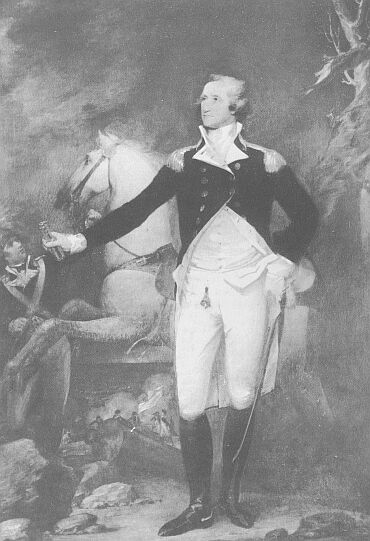
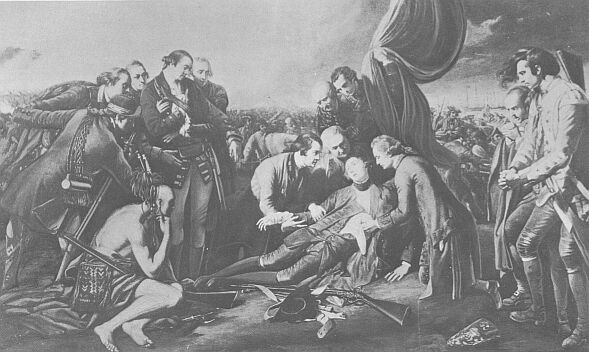
![[Enlarge]](images/352b.jpg)
![[Enlarge]](images/416b.jpg)