Letter from General Washington to Mr. Jefferson.... Hostile
measures of France against the United States.... Mr. Monroe
recalled and General Pinckney appointed to succeed him....
General Washington's valedictory address to the people of
the United States.... The Minister of France endeavours to
influence the approaching election.... The President's
speech to Congress.... He denies the authenticity of certain
spurious letters published in 1776.... John Adams elected
President, and Thomas Jefferson Vice President.... General
Washington retires to Mount Vernon.... Political situation
of the United States at this period.... The French
government refuses to receive General Pinckney as
Minister.... Congress is convened.... President's speech....
Three envoys extraordinary deputed to France.... Their
treatment.... Measures of hostility adopted by the American
government against France.... General Washington appointed
Commander-in-chief of the American army.... His death....
And character.
1796
The confidential friends of the President had long known his fixed
purpose to retire from office at the end of his second term, and the
people generally suspected it. Those who dreaded a change of system,
in changing the person, of the chief magistrate, manifested an earnest
desire to avoid this hazard, by being permitted once more to offer to
the public choice a person who, amidst all the fierce conflicts of
party, still remained the object of public veneration. But his
resolution was to be shaken only by the obvious approach of a perilous
crisis, which, endangering the safety of the nation, would make it
unworthy of his character, and incompatible with his principles, to
retreat from its service. In the apprehension that the co-operation of
external with internal causes might bring about such a crisis, he had
yielded to the representations of those who urged him to leave himself
master of his conduct, by withholding a public declaration of his
intention, until the propriety of affording a reasonable time to fix
on a successor should require its disclosure. "If," said Colonel
Hamilton in a letter on this subject of the fifth of July, "a storm
gathers, how can you retreat? this is a most serious question."
The suspense produced in the public opinion by this silence on the
part of the chief magistrate, seemed to redouble the efforts of those
who laboured to rob him of the affection of the people, and to attach
odium to the political system which he had pursued. As passion alone
is able successfully to contend with passion, they still sought, in
the hate which America bore to Britain, and in her love to France, for
the most powerful means with which to eradicate her love to
Washington. Amongst the various artifices employed to effect this
object, was the publication of those queries which had been propounded
by the President to his cabinet council, previous to the arrival of
Mr. Genet. This publication was intended to demonstrate the existence
of a disposition in the chief magistrate unfriendly to the French
republic, of "a Machiavellian policy, which nothing but the universal
sentiment of enthusiastic affection displayed by the people of the
United States, on the arrival of Mr. Genet, could have subdued." Some
idea of the intemperance of the day may be formed from the conclusion
of that number of a series of virulent essays, in which these queries
were inserted, and from recollecting that it was addressed to a man
who, more than any other, had given character as well as independence
to his country; and whose life, devoted to her service, had exhibited
one pure undeviating course of virtuous exertion to promote her
interests.
It is in these words: "The foregoing queries were transmitted for
consideration to the heads of departments, previously to a meeting to
be held at the President's house. The text needs no commentary. It has
stamped upon its front in characters brazen enough for idolatry to
comprehend, perfidy and ingratitude. To doubt in such a case was
dishonourable, to proclaim those doubts treachery. For the honour of
the American character and of human nature, it is to be lamented that
the records of the United States exhibit such a stupendous monument of
degeneracy. It will almost require the authenticity of holy writ to
persuade posterity that it is not a libel ingeniously contrived to
injure the reputation of the saviour of his country."
As this state paper was perfectly confidential, and had been
communicated only to the cabinet ministers, Mr. Jefferson thought
proper to free himself from any possible suspicion of having given it
publicity, by assuring the President that this breach of confidence
must be ascribed to some other person.
Letter from General Washington to Mr. Jefferson.
In answer to this letter the President said—
"If I had entertained any suspicion before, that the queries which
have been published in Bache's paper proceeded from you, the
assurances you have given of the contrary would have removed
them:—but the truth is, I harboured none. I am at no loss to
conjecture from what source they flowed, through what channel they
were conveyed, nor for what purpose they and similar publications
appear.
"As you have mentioned[43] the subject yourself, it would not be
frank, candid, or friendly to conceal, that your conduct has been
represented as derogating from that opinion I conceived you
entertained of me; that to your particular friends and connexions you
have described, and they have denounced me, as a person under a
dangerous influence, and that, if I would listen more to some
other opinions, all would be well. My answer invariably has been,
that I had never discovered any thing in the conduct of Mr. Jefferson
to raise suspicions in my mind of his sincerity; that if he would
retrace my public conduct while he was in the administration, abundant
proofs would occur to him, that truth and right decisions were the
sole objects of my pursuit; that there were as many instances within
his own knowledge of my having decided against as in favour of
the person evidently alluded to; and moreover, that I was no believer
in the infallibility of the politics or measures of any man living. In
short, that I was no party man myself, and that the first wish of my
heart was, if parties did exist, to reconcile them.
"To this I may add, and very truly, that until the last year or two, I
had no conception that parties would, or even could go the lengths I
have been witness to; nor did I believe, until lately, that it was
within the bounds of probability—hardly within those of
possibility—that while I was using my utmost exertions to establish a
national character of our own, independent as far as our obligations
and justice would permit, of every nation of the earth; and wished by
steering a steady course to preserve this country from the horrors of
a desolating war, I should be accused of being the enemy of one nation
and subject to the influence of another; and to prove it, that every
act of my administration would be tortured, and the grossest and most
insidious misrepresentations of them be made, by giving one side only
of a subject, and that too in such exaggerated and indecent terms as
could scarcely be applied to a Nero—to a notorious defaulter—or even
to a common pick-pocket.
"But enough of this—I have already gone further in the expression of
my feelings than I intended."
Of the numerous misrepresentations and fabrications which, with
unwearied industry, were pressed upon the public in order to withdraw
the confidence of the nation from its chief, no one marked more
strongly the depravity of that principle which justifies the means by
the end, than the republication of certain forged letters, purporting
to have been written by General Washington in the year 1776.
These letters had been originally published in the year 1777, and in
them were interspersed, with domestic occurrences which might give
them the semblance of verity, certain political sentiments favourable
to Britain in the then existing contest.
But the original fabricator of these papers missed his aim. It was
necessary to assign the manner in which the possession of them was
acquired; and in executing this part of his task, circumstances were
stated so notoriously untrue, that, at the time, the meditated
imposition deceived no person.
In the indefatigable research for testimony which might countenance
the charge that the executive was unfriendly to France, and under the
influence of Britain, these letters were drawn from the oblivion into
which they had sunk, it had been supposed forever, and were
republished as genuine. The silence with which the President treated
this as well as every other calumny, was construed into an
acknowledgment of its truth; and the malignant commentators on this
spurious text, would not admit the possibility of its being
apocryphal.
Those who laboured incessantly to establish the favourite position
that the executive was under other than French influence, reviewed
every act of the administration connected with its foreign relations,
and continued to censure every part of the system with extreme
bitterness. Not only the treaty with Great Britain, but all those
measures which had been enjoined by the duties of neutrality, were
reprobated as justly offensive to France; and no opinion which had
been advanced by Mr. Genet, in his construction of the treaties
between the two nations, was too extravagant to be approved. The
ardent patriot can not maintain the choicest rights of his country
with more zeal than was manifested in supporting all the claims of the
French republic upon the United States. These discussions were not
confined to the public prints. In almost every assemblage of
individuals, whether for social or other purposes, this favourite
theme excluded all others; and the pretensions of France were
supported and controverted with equal earnestness. The opposing
parties, mutually exasperated by unceasing altercations, cherished
reciprocal suspicions of each other, and each charged its adversary
with being under a foreign influence.[44] Those who favoured the
measures adopted by America were accused as the enemies of liberty,
the enemies of France, and the tools of Britain. In turn, they charged
their opponents with disseminating principles subversive of all order
in society; and with supporting a foreign government against their
own.
Whatever might be the real opinion of the French government on the
validity of its charges against the United States, those charges were
too vehemently urged, and too powerfully espoused in America, to be
abandoned at Paris. If at any time they were in part relinquished,
they were soon resumed.
For a time, Mr. Fauchet forbore to press the points on which his
predecessor had insisted; but his complaints of particular cases which
grew out of the war, and out of the rules which had been established
by the executive were unremitting. The respectful language in which
these complaints were at first urged, soon yielded to the style of
reproach; and in his correspondence with the secretary of state,
towards its close, he adopted the sentiments, without absolutely
discarding the manner of Mr. Genet.
Mr. Adet, the successor of Mr. Fauchet, arrived at Philadelphia, while
the senate was deliberating on the treaty of amity with Great Britain.
In the observations he made on that instrument, when submitted to his
consideration by order of the President, he complained particularly of
the abandonment of the principle that free ships should make free
goods; and urged the injustice, while French cruisers were restrained
by treaty from taking English goods out of American bottoms, that
English cruisers should be liberated from the same restraint. No
demonstration could be more complete than was the fallacy of this
complaint. But the American government discovered a willingness
voluntarily to release France from the pressure of a situation in
which she had elected to place herself.
Hostile measures of France against the United States.
In the anxiety which was felt by the President to come to full and
immediate explanations on this treaty, the American minister at Paris
had been furnished, even before its ratification, and still more fully
afterwards, with ample materials for the justification of his
government. But, misconceiving[45] the views of the administration, he
reserved these representations to answer complaints which were
expected, and omitted to make them in the first instance, while the
course to be pursued by the Directory was under deliberation.
Meanwhile, his letters kept up the alarm which had been excited with
regard to the dispositions of France; and intelligence from the West
Indies served to confirm it. Through a private channel, the President
received information that the special agents of the Directory in the
islands were about to issue orders for the capture of all American
vessels, laden in the whole or in part with provisions, and bound for
any port within the dominions of the British crown.
Mr. Monroe recalled and General Pinckney appointed to
succeed him.
Knowing well that the intentions of the executive towards the French
republic had been at all times friendly, and entertaining a strong
conviction that its conduct was liable to no just objection, the
President had relied with confidence on early and candid
communications, for the removal of any prejudices or misconceptions,
which the passions of the moment might have occasioned. That the
French government would be disappointed at the adjustment of those
differences which had threatened to embroil the United States with
Great Britain, could not be doubted; but as neither this adjustment,
nor the arrangements connected with it, had furnished any real cause
of complaint, he cherished the hope that it would produce no serious
consequences, if the proper means of prevention should be applied in
time. He was therefore dissatisfied with delays which he had not
expected; and seems to have believed that they originated in a want of
zeal to justify a measure, which neither the minister himself nor his
political friends had ever approved. To insure an earnest and active
representation of the true sentiments and views of the administration,
the President was inclined to depute an envoy extraordinary for the
particular purpose, who should be united with the actual minister; but
an objection drawn from the constitution was suggested to this
measure. During the recess of the senate, the President can only fill
up vacancies; and the appointment of a minister when no vacancy
existed, might be supposed to transcend his powers. From respect to
this construction of the constitution, the resolution was taken to
appoint a successor to Colonel Monroe. The choice of a person in all
respects qualified for this mission was not without its difficulty.
While a disposition friendly to the administration was a requisite not
to be dispensed with, it was also desirable that the person employed
should have given no umbrage to the French government. No individual
who had performed a conspicuous part on the political theatre of
America, fitted both branches of this description. All who had openly
sustained with zeal and with talents, the measures of the American
government, had been marked as the enemies of France, and were on this
account to be avoided.
For this critical and important service, the President, after some
deliberation, selected General Charles Cotesworth Pinckney, of South
Carolina, an elder brother of Mr. Thomas Pinckney, the late[46]
minister of the United States at London. No man in America was more
perfectly free from exception than this gentleman. Having engaged with
ardour in that war which gave independence to his country, he had, in
its progress, sustained from the British army indignities to his
person, and injuries to his fortune, which are not easily forgotten.
In the early part of the French revolution, he had felt and expressed
all the enthusiasm of his countrymen for the establishment of the
republic; but, after the commencement of its contests with the United
States, he stood aloof from both those political parties which had
divided America. Restrained by the official situation of his brother
during the negotiations which had been carried on with England, he had
forborne to express any opinion respecting the treaty in which those
negotiations terminated, and had consequently taken no part with those
who approved, or with those who condemned that instrument. No man,
therefore, who had not declared himself unfriendly to the principles
he would be deputed to support, could be less objectionable to France.
To the President he was recommended by an intimate knowledge of his
worth; by a confidence in the sincerity of his personal attachment to
the chief magistrate; by a conviction that his exertions to effect the
objects of his mission would be ardent and sincere; and that, whatever
might be his partialities for France, he possessed a high and delicate
sense of national as well as individual honour, was jealous for the
reputation of his country, and tenacious of its rights.
In July, immediately after the appointment of General Pinckney,
letters were received from Colonel Monroe communicating the official
complaints against the American government which had been made to him
in March by Mr. de La Croix, the minister of exterior relations,
together with his answer to those complaints.
In this answer the American minister had effectually refuted the
criminations of Mr. de La Croix; and the executive was satisfied with
it. But the Directory had decided on their system, and it was not by
reasoning, however conclusive, that this decision was to be changed.
As the time for electing the chief magistrate approached, the anxiety
of the public respecting the person in office, seemed to increase. In
states where the electors are chosen by the people, names of great
political influence were offered for their approbation. The strong
hold which Washington had taken of the affections of his countrymen
was, on this occasion, fully evinced. In districts where the
opposition to his administration was most powerful, where all his
measures were most loudly condemned, where those who approved his
system possessed least influence, the men who appeared to control
public opinion on every other subject, found themselves unable to move
it on this. Even the most popular among the leaders of the opposition
were reduced to the necessity of surrendering their pretensions to a
place in the electoral body, or of pledging themselves to bestow their
suffrage on the actual President. The determination of his fellow
citizens had been unequivocally manifested, and it was believed to be
apparent that the election would again be unanimous, when he announced
his resolution to withdraw from the honours and the toils of office.
Having long contemplated this event, and having wished to terminate
his political course with an act which might be at the same time
suitable to his own character, and permanently useful to his country,
he had prepared for the occasion a valedictory address, in which, with
the solicitude of a person, who, in bidding a final adieu to his
friends, leaves his affections and his anxieties for their welfare
behind him, he made a last effort to impress upon his countrymen those
great political truths which had been the guides of his own
administration, and could alone, in his opinion, form a sure and solid
basis for the happiness, the independence, and the liberty of the
United States.
This interesting paper was published in September, at a time when
hopes were entertained that the discontents of France might be
appeased by proper representations. It contains precepts to which the
American statesman can not too frequently recur, and though long, is
thought too valuable to be omitted or abridged.
General Washington's valedictory address to the people of
the United States in which he declines being considered as a candidate
for the presidency.
TO THE PEOPLE OF THE UNITED STATES.
"Friends and fellow citizens,
"The period for a new election of a citizen to administer the
executive government of the United States being not far distant, and
the time actually arrived when your thoughts must be employed in
designating the person who is to be clothed with that important trust,
it appears to me proper, especially as it may conduce to a more
distinct expression of the public voice, that I should now apprize you
of the resolution I have formed, to decline being considered among the
number of those, out of whom a choice is to be made.
"I beg you, at the same time, to do me the justice to be assured, that
this resolution has not been taken, without a strict regard to all the
considerations appertaining to the relation which binds a dutiful
citizen to his country; and that, in withdrawing the tender of service
which silence in my situation might imply, I am influenced by no
diminution of zeal for your future interest; no deficiency of grateful
respect for your past kindness; but am supported by a full conviction
that the step is compatible with both.
"The acceptance of, and continuance hitherto in the office to which
your suffrages have twice called me, have been a uniform sacrifice of
inclination to the opinion of duty and to a deference for what
appeared to be your desire. I constantly hoped that it would have been
much earlier in my power, consistently with motives which I was not at
liberty to disregard, to return to that retirement from which I had
been reluctantly drawn. The strength of my inclination to do this,
previous to the last election, had even led to the preparation of an
address to declare it to you; but mature reflection on the then
perplexed and critical posture of our affairs with foreign nations,
and the unanimous advice of persons entitled to my confidence,
impelled me to abandon the idea.
"I rejoice that the state of your concerns, external as well as
internal, no longer renders the pursuit of inclination incompatible
with the sentiment of duty or propriety; and am persuaded, whatever
partiality may be retained for my services, that in the present
circumstances of our country, you will not disapprove my determination
to retire.
"The impressions with which I first undertook the arduous trust, were
explained on the proper occasion. In the discharge of this trust, I
will only say that I have, with good intentions, contributed towards
the organization and administration of the government, the best
exertions of which a very fallible judgment was capable. Not
unconscious in the outset, of the inferiority of my qualifications,
experience, in my own eyes, perhaps still more in the eyes of others,
has strengthened the motives to diffidence of myself; and, every day,
the increasing weight of years admonishes me more and more, that the
shade of retirement is as necessary to me as it will be welcome.
Satisfied that if any circumstances have given peculiar value to my
services, they were temporary, I have the consolation to believe that,
while choice and prudence invite me to quit the political scene,
patriotism does not forbid it.
"In looking forward to the moment which is to terminate the career of
my political life, my feelings do not permit me to suspend the deep
acknowledgment of that debt of gratitude which I owe to my beloved
country, for the many honours it has conferred upon me; still more for
the steadfast confidence with which it has supported me; and for the
opportunities I have thence enjoyed of manifesting my inviolable
attachment, by services faithful and persevering, though in usefulness
unequal to my zeal. If benefits have resulted to our country from
these services, let it always be remembered to your praise, and as an
instructive example in our annals, that under circumstances in which
the passions, agitated in every direction, were liable to mislead
amidst appearances sometimes dubious, vicissitudes of fortune often
discouraging—in situations in which not unfrequently, want of success
has countenanced the spirit of criticism—the constancy of your
support was the essential prop of the efforts, and a guarantee of the
plans by which they were effected. Profoundly penetrated with this
idea, I shall carry it with me to my grave, as a strong incitement to
unceasing vows, that heaven may continue to you the choicest tokens of
its beneficence—that your union and brotherly affection may be
perpetual—that the free constitution, which is the work of your
hands, may be sacredly maintained—that its administration in every
department may be stamped with wisdom and virtue—that, in fine, the
happiness of the people of these states, under the auspices of
liberty, may be made complete by so careful a preservation, and so
prudent a use of this blessing, as will acquire to them the glory of
recommending it to the applause, the affection, and adoption of every
nation which is yet a stranger to it.
"Here, perhaps, I ought to stop. But a solicitude for your welfare,
which can not end but with my life, and the apprehension of danger,
natural to that solicitude, urge me, on an occasion like the present,
to offer to your solemn contemplation, and to recommend to your
frequent review, some sentiments which are the result of much
reflection, of no inconsiderable observation, and which appear to me
all important to the permanency of your felicity as a people. These
will be offered to you with the more freedom, as you can only see in
them the disinterested warnings of a parting friend, who can possibly
have no personal motive to bias his counsel. Nor can I forget, as an
encouragement to it, your indulgent reception of my sentiments on a
former and not dissimilar occasion.
"Interwoven as is the love of liberty with every ligament of your
hearts, no recommendation of mine is necessary to fortify or confirm
the attachment.
"The unity of government which constitutes you one people, is also now
dear to you. It is justly so; for it is a main pillar in the edifice
of your real independence; the support of your tranquillity at home;
your peace abroad; of your safety; of your prosperity; of that very
liberty which you so highly prize. But, as it is easy to foresee, that
from different causes, and from different quarters, much pains will be
taken, many artifices employed, to weaken in your minds the conviction
of this truth; as this is the point in your political fortress against
which the batteries of internal and external enemies will be most
constantly and actively (though often covertly and insidiously)
directed; it is of infinite moment, that you should properly estimate
the immense value of your national union to your collective and
individual happiness; that you should cherish a cordial, habitual, and
immovable attachment to it; accustoming yourselves to think and speak
of it as of the palladium of your political safety and prosperity;
watching for its preservation with jealous anxiety; discountenancing
whatever may suggest even a suspicion that it can, in any event, be
abandoned; and indignantly frowning upon the first dawning of every
attempt to alienate any portion of our country from the rest, or to
enfeeble the sacred ties which now link together the various parts.
"For this you have every inducement of sympathy and interest. Citizens
by birth, or choice, of a common country, that country has a right to
concentrate your affections. The name of American, which belongs to
you in your national capacity, must always exalt the just pride of
patriotism, more than any appellation derived from local
discriminations. With slight shades of difference, you have the same
religion, manners, habits, and political principles.—You have, in a
common cause, fought and triumphed together; the independence and
liberty you possess, are the work of joint counsels, and joint
efforts, of common dangers, sufferings, and successes.
"But these considerations, however powerfully they address themselves
to your sensibility, are greatly outweighed by those which apply more
immediately to your interest.—Here, every portion of our country
finds the most commanding motives for carefully guarding and
preserving the union of the whole.
"The north in an unrestrained intercourse with the south,
protected by the equal laws of a common government, finds in the
productions of the latter, great additional resources of maritime and
commercial enterprise, and precious materials of manufacturing
industry.—The south, in the same intercourse, benefiting by the
same agency of the north, sees its agriculture grow, and its
commerce expand. Turning partly into its own channels the seamen of
the north, it finds its particular navigation invigorated; and while
it contributes, in different ways, to nourish and increase the general
mass of the national navigation, it looks forward to the protection of
a maritime strength, to which itself is unequally adapted. The east,
in a like intercourse with the west, already finds, and in the
progressive improvement of interior communications by land and water,
will more and more find a valuable vent for the commodities which it
brings from abroad, or manufactures at home. The west derives from
the east supplies requisite to its growth and comfort—and what is
perhaps of still greater consequence, it must of necessity owe the
secure enjoyment of indispensable outlets for its own productions,
to the weight, influence, and the future maritime strength of the
Atlantic side of the union, directed by an indissoluble community of
interest as one nation. Any other tenure by which the west can
hold this essential advantage, whether derived from its own separate
strength, or from an apostate and unnatural connexion with any foreign
power, must be intrinsically precarious.
"While then every part of our country thus feels an immediate and
particular interest in union, all the parts combined can not fail to
find in the united mass of means and efforts, greater strength,
greater resource, proportionably greater security from external
danger, a less frequent interruption of their peace by foreign
nations; and, what is of inestimable value, they must derive from
union an exemption from those broils and wars between themselves,
which so frequently afflict neighbouring countries not tied together
by the same government; which their own rivalships alone would be
sufficient to produce, but which, opposite foreign alliances,
attachments, and intrigues, would stimulate and embitter.—Hence
likewise, they will avoid the necessity of those overgrown military
establishments, which under any form of government are inauspicious to
liberty, and which are to be regarded as particularly hostile to
republican liberty. In this sense it is, that your union ought to be
considered as a main prop of your liberty, and that the love of the
one ought to endear to you the preservation of the other.
"These considerations speak a persuasive language to every reflecting
and virtuous mind, and exhibit the continuance of the union as a
primary object of patriotic desire. Is there a doubt whether a common
government can embrace so large a sphere? Let experience solve it. To
listen to mere speculation in such a case were criminal. We are
authorized to hope that a proper organization of the whole, with the
auxiliary agency of governments for the respective subdivisions, will
afford a happy issue to the experiment. It is well worth a fair and
full experiment. With such powerful and obvious motives to union,
affecting all parts of our country, while experience shall not have
demonstrated its impracticability, there will always be reason to
distrust the patriotism of those, who, in any quarter, may endeavour
to weaken its bands.
"In contemplating the causes which may disturb our union, it occurs as
matter of serious concern, that any ground should have been
furnished for characterizing parties by geographical
discriminations,—northern and southern—Atlantic and western;
whence designing men may endeavour to excite a belief that there is a
real difference of local interests and views. One of the expedients of
party to acquire influence within particular districts, is to
misrepresent the opinions and aims of other districts. You can not
shield yourselves too much against the jealousies and heart burnings
which spring from these misrepresentations: they tend to render alien
to each other those who ought to be bound together by fraternal
affection. The inhabitants of our western country have lately had a
useful lesson on this head: they have seen, in the negotiation by the
executive, and in the unanimous ratification by the senate of the
treaty with Spain, and in the universal satisfaction at the event
throughout the United States, a decisive proof how unfounded were the
suspicions propagated among them of a policy in the general government
and in the Atlantic states, unfriendly to their interests in regard to
the Mississippi. They have been witnesses to the formation of two
treaties, that with Great Britain and that with Spain, which secure to
them every thing they could desire, in respect to our foreign
relations, towards confirming their prosperity. Will it not be their
wisdom to rely for the preservation of these advantages on the union
by which they were procured? will they not henceforth be deaf to those
advisers, if such there are, who would sever them from their brethren,
and connect them with aliens?
"To the efficacy and permanency of your union, a government for the
whole is indispensable. No alliances, however strict, between the
parts can be an adequate substitute; they must inevitably experience
the infractions and interruptions which all alliances, in all times,
have experienced. Sensible of this momentous truth, you have improved
upon your first essay, by the adoption of a constitution of government
better calculated than your former for an intimate union, and for the
efficacious management of your common concerns. This government, the
offspring of our own choice uninfluenced and unawed, adopted upon full
investigation and mature deliberation, completely free in its
principles, in the distribution of its powers uniting security with
energy, and containing within itself a provision for its own
amendment, has a just claim to your confidence and your support.
Respect for its authority, compliance with its laws, acquiescence in
its measures, are duties enjoined by the fundamental maxims of true
liberty. The basis of our political systems is the right of the people
to make and to alter their constitutions of government.—But the
constitution which at any time exists, until changed by an explicit
and authentic act of the whole people, is sacredly obligatory upon
all. The very idea of the power and the right of the people to
establish government, presupposes the duty of every individual to obey
the established government.
"All obstructions to the execution of the laws, all combinations and
associations under whatever plausible character, with the real design
to direct, control, counteract, or awe the regular deliberations and
action of the constituted authorities, are destructive of this
fundamental principle, and of fatal tendency.—They serve to organize
faction, to give it an artificial and extraordinary force, to put in
the place of the delegated will of the nation the will of party, often
a small but artful and enterprising minority of the community; and,
according to the alternate triumphs of different parties, to make the
public administration the mirror of the ill concerted and incongruous
projects of faction, rather than the organ of consistent and wholesome
plans digested by common councils, and modified by mutual interests.
"However combinations or associations of the above description may now
and then answer popular ends, they are likely, in the course of time
and things, to become potent engines, by which cunning, ambitious, and
unprincipled men, will be enabled to subvert the power of the people,
and to usurp for themselves the reins of government; destroying
afterwards the very engines which have lifted them to unjust dominion.
"Towards the preservation of your government and the permanency of
your present happy state, it is requisite, not only that you steadily
discountenance irregular oppositions to its acknowledged authority,
but also that you resist with care the spirit of innovation upon its
principles, however specious the pretext. One method of assault may be
to effect, in the forms of the constitution, alterations which will
impair the energy of the system; and thus to undermine what can not be
directly overthrown. In all the changes to which you may be invited,
remember that time and habit are at least as necessary to fix the true
character of governments, as of other human institutions:—that
experience is the surest standard by which to test the real tendency
of the existing constitution of a country:—that facility in changes,
upon the credit of mere hypothesis and opinion, exposes to perpetual
change from the endless variety of hypothesis and opinion: and
remember, especially, that for the efficient management of your common
interests, in a country so extensive as ours, a government of as much
vigour as is consistent with the perfect security of liberty is
indispensable. Liberty itself will find in such a government, with
powers properly distributed and adjusted, its surest guardian. It is,
indeed, little else than a name, where the government is too feeble to
withstand the enterprises of faction, to confine each member of the
society within the limits prescribed by the laws, and to maintain all
in the secure and tranquil enjoyment of the rights of person and
property.
"I have already intimated to you the danger of parties in the state,
with particular references to the founding them on geographical
discriminations. Let us now take a more comprehensive view, and warn
you in the most solemn manner against the baneful effects of the
spirit of party generally.
"This spirit, unfortunately, is inseparable from our nature, having
its root in the strongest passions of the human mind.—It exists under
different shapes in all governments, more or less stifled, controlled,
or repressed; but in those of the popular form, it is seen in its
greatest rankness, and is truly their worst enemy.
"The alternate domination of one faction over another, sharpened by
the spirit of revenge natural to party dissension, which, in different
ages and countries has perpetrated the most horrid enormities, is
itself a frightful despotism.—But this leads at length to a more
formal and permanent despotism. The disorders and miseries which
result, gradually incline the minds of men to seek security and repose
in the absolute power of an individual; and, sooner or later, the
chief of some prevailing faction, more able or more fortunate than his
competitors, turns this disposition to the purposes of his own
elevation on the ruins of public liberty.
"Without looking forward to an extremity of this kind, (which
nevertheless ought not to be entirely out of sight,) the common and
continual mischiefs of the spirit of party, are sufficient to make it
the interest and duty of a wise people to discourage and restrain it.
"It serves always to distract the public councils, and enfeeble the
public administration. It agitates the community with ill founded
jealousies and false alarms; kindles the animosity of one part against
another; foments occasional riot and insurrection. It opens the door
to foreign influence and corruption, which finds a facilitated access
to the government itself through the channels of party passions. Thus
the policy and the will of one country are subjected to the policy and
will of another.
"There is an opinion that parties in free countries are useful checks
upon the administration of the government, and serve to keep alive the
spirit of liberty. This, within certain limits, is probably true; and,
in governments of a monarchical cast, patriotism may look with
indulgence, if not with favour, upon the spirit of party. But in those
of the popular character, in governments purely elective, it is a
spirit not to be encouraged. From their natural tendency, it is
certain there will always be enough of that spirit for every salutary
purpose. And there being constant danger of excess, the effort ought
to be, by force of public opinion, to mitigate and assuage it. A fire
not to be quenched, it demands a uniform vigilance to prevent it
bursting into a flame, lest, instead of warming, it should consume.
"It is important likewise, that the habits of thinking in a free
country should inspire caution in those intrusted with its
administration, to confine themselves within their respective
constitutional spheres, avoiding in the exercise of the powers of one
department, to encroach upon another. The spirit of encroachment tends
to consolidate the powers of all the departments in one, and thus to
create, whatever the form of government, a real despotism. A just
estimate of that love of power and proneness to abuse it which
predominate in the human heart, is sufficient to satisfy us of the
truth of this position. The necessity of reciprocal checks in the
exercise of political power, by dividing and distributing it into
different depositories, and constituting each the guardian of the
public weal against invasions of the others, has been evinced by
experiments ancient and modern: some of them in our country, and under
our own eyes.—To preserve them must be as necessary as to institute
them. If, in the opinion of the people, the distribution or
modification of the constitutional powers be in any particular wrong,
let it be corrected by an amendment in the way which the constitution
designates.—But let there be no change by usurpation; for though
this, in one instance, may be the instrument of good, it is the
customary weapon by which free governments are destroyed. The
precedent must always greatly overbalance in permanent evil, any
partial or transient benefit which the use can at any time yield.
"Of all the dispositions and habits which lead to political
prosperity, religion and morality are indispensable supports. In vain
would that man claim the tribute of patriotism, who should labour to
subvert these great pillars of human happiness, these firmest props of
the duties of men and citizens. The mere politician, equally with the
pious man, ought to respect and to cherish them.—A volume could not
trace all their connexions with private and public felicity. Let it
simply be asked, where is the security for property, for reputation,
for life, if the sense of religious obligation desert the oaths
which are the instruments of investigation in courts of justice? And
let us with caution indulge the supposition that morality can be
maintained without religion. Whatever may be conceded to the influence
of refined education on minds of peculiar structure, reason and
experience both forbid us to expect, that national morality can
prevail in exclusion of religious principle.
"It is substantially true, that virtue or morality is a necessary
spring of popular government. The rule, indeed, extends with more or
less force to every species of free government. Who that is a sincere
friend to it can look with indifference upon attempts to shake the
foundation of the fabric?
"Promote, then, as an object of primary importance, institutions for
the general diffusion of knowledge. In proportion as the structure of
a government gives force to public opinion, it should be enlightened.
"As a very important source of strength and security, cherish public
credit. One method of preserving it is to use it as sparingly as
possible, avoiding occasions of expense by cultivating peace, but
remembering also, that timely disbursements, to prepare for danger,
frequently prevent much greater disbursements to repel it; avoiding
likewise the accumulation of debt, not only by shunning occasions of
expense, but by vigorous exertions in time of peace, to discharge the
debts which unavoidable wars may have occasioned, not ungenerously
throwing upon posterity the burden which we ourselves ought to bear.
The execution of these maxims belongs to your representatives, but it
is necessary that public opinion should co-operate. To facilitate to
them the performance of their duty, it is essential that you should
practically bear in mind, that towards the payment of debts there must
be revenue; that to have revenue, there must be taxes; that no taxes
can be devised which are not more or less inconvenient and unpleasant;
that the intrinsic embarrassment inseparable from the selection of the
proper objects, (which is always a choice of difficulties,) ought to
be a decisive motive for a candid construction of the conduct of the
government in making it, and for a spirit of acquiescence in the
measures for obtaining revenue, which the public exigencies may at any
time dictate.
"Observe good faith and justice towards all nations; cultivate peace
and harmony with all. Religion and morality enjoin this conduct; and
can it be that good policy does not equally enjoin it? it will be
worthy of a free, enlightened, and, at no distant period, a great
nation, to give to mankind the magnanimous and too novel example of a
people always guided by an exalted justice and benevolence. Who can
doubt but, in the course of time and things, the fruits of such a plan
would richly repay any temporary advantages which might be lost by a
steady adherence to it; can it be that Providence has not connected
the permanent felicity of a nation with its virtue? the experiment, at
least, is recommended by every sentiment which ennobles human nature.
Alas! is it rendered impossible by its vices?
"In the execution of such a plan, nothing is more essential than that
permanent, inveterate antipathies against particular nations, and
passionate attachments for others, should be excluded; and that, in
place of them, just and amicable feelings towards all should be
cultivated. The nation which indulges towards another an habitual
hatred, or an habitual fondness, is in some degree a slave. It is a
slave to its animosity or to its affection, either of which is
sufficient to lead it astray from its duty and its interest. Antipathy
in one nation against another, disposes each more readily to offer
insult and injury, to lay hold of slight causes of umbrage, and to be
haughty and intractable when accidental or trifling occasions of
dispute occur. Hence, frequent collisions, obstinate, envenomed, and
bloody contests. The nation, prompted by ill will and resentment,
sometimes impels to war the government, contrary to the best
calculations of policy. The government sometimes participates in the
national propensity, and adopts through passion what reason would
reject; at other times, it makes the animosity of the nation
subservient to projects of hostility, instigated by pride, ambition,
and other sinister and pernicious motives.—The peace often, sometimes
perhaps the liberty of nations has been the victim.
"So likewise, a passionate attachment of one nation for another
produces a variety of evils. Sympathy for the favourite nation,
facilitating the illusion of an imaginary common interest in cases
where no real common interest exists, and infusing into one the
enmities of the other, betrays the former into a participation in the
quarrels and wars of the latter, without adequate inducements or
justification. It leads also to concessions to the favourite nation,
of privileges denied to others, which is apt doubly to injure the
nation making the concessions; by unnecessarily parting with what
ought to have been retained; and by exciting jealousy, ill will, and a
disposition to retaliate in the parties from whom equal privileges are
withheld: and it gives to ambitious, corrupted or deluded citizens who
devote themselves to the favourite nation, facility to betray or
sacrifice the interests of their own country, without odium, sometimes
even with popularity; gilding with the appearances of a virtuous sense
of obligation, a commendable deference for public opinion, or a
laudable zeal for public good, the base or foolish compliances of
ambition, corruption, or infatuation.
"As avenues to foreign influence in innumerable ways, such attachments
are particularly alarming to the truly enlightened and independent
patriot. How many opportunities do they afford to tamper with domestic
factions, to practise the arts of seduction, to mislead public
opinion, to influence or awe the public councils!—such an attachment
of a small or weak, towards a great and powerful nation dooms the
former to be the satellite of the latter.
"Against the insidious wiles of foreign influence, (I conjure you to
believe me, fellow citizens) the jealousy of a free people ought to be
constantly awake; since history and experience prove, that foreign
influence is one of the most baneful foes of republican government.
But that jealousy, to be useful must be impartial; else it becomes the
instrument of the very influence to be avoided, instead of a defence
against it. Excessive partiality for one foreign nation, and excessive
dislike for another, cause those whom they actuate to see danger only
on one side, and serve to veil and even second the arts of influence
on the other. Real patriots, who may resist the intrigues of the
favourite, are liable to become suspected and odious; while its tools
and dupes usurp the applause and confidence of the people, to
surrender their interests.
"The great rule of conduct for us, in regard to foreign nations, is,
in extending our commercial relations, to have with them as little
political connexion as possible. So far as we have already formed
engagements, let them be fulfilled with perfect good faith.—Here, let
us stop.
"Europe has a set of primary interests, which to us have none, or a
very remote relation. Hence, she must be engaged in frequent
controversies, the causes of which are essentially foreign to our
concerns.—Hence, therefore, it must be unwise in us to implicate
ourselves, by artificial ties, in the ordinary vicissitudes of her
politics, or the ordinary combinations and collisions of her
friendships or enmities.
"Our detached and distant situation invites and enables us to pursue a
different course. If we remain one people, under an efficient
government, the period is not far off when we may defy material injury
from external annoyance; when we may take such an attitude as will
cause the neutrality we may at any time resolve upon, to be
scrupulously respected; when belligerent nations under the
impossibility of making acquisitions upon us, will not lightly hazard
the giving us provocation; when we may choose peace or war, as our
interest, guided by justice, shall counsel.
"Why forego the advantages of so peculiar a situation? why quit our
own to stand upon foreign ground? why, by interweaving our destiny
with that of any part of Europe, entangle our peace and prosperity in
the toils of European ambition, rivalship, interest, humour, or
caprice?
"It is our true policy to steer clear of permanent alliances with any
portion of the foreign world; so far, I mean, as we are now at liberty
to do it; for let me not be understood as capable of patronizing
infidelity to existing engagements. I hold the maxim no less
applicable to public than to private affairs, that honesty is always
the best policy. I repeat it, therefore, let those engagements be
observed in their genuine sense. But in my opinion, it is unnecessary,
and would be unwise to extend them.
"Taking care always to keep ourselves, by suitable establishments, on
a respectable defensive posture, we may safely trust to temporary
alliances for extraordinary emergencies.
"Harmony, and a liberal intercourse with all nations, are recommended
by policy, humanity, and interest. But even our commercial policy
should hold an equal and impartial hand; neither seeking nor granting
exclusive favours or preferences; consulting the natural course of
things; diffusing and diversifying by gentle means the streams of
commerce, but forcing nothing; establishing with powers so disposed,
in order to give trade a stable course, to define the rights of our
merchants, and to enable the government to support them, conventional
rules of intercourse, the best that present circumstances and mutual
opinion will permit, but temporary, and liable to be from time to time
abandoned or varied as experience and circumstances shall dictate;
constantly keeping in view, that it is folly in one nation to look for
disinterested favours from another; that it must pay with a portion of
its independence for whatever it may accept under that character; that
by such acceptance, it may place itself in the condition of having
given equivalents for nominal favours, and yet of being reproached
with ingratitude for not giving more. There can be no greater error
than to expect, or calculate upon real favours from nation to nation.
It is an illusion which experience must cure, which a just pride ought
to discard.
"In offering to you, my countrymen, these counsels of an old and
affectionate friend, I dare not hope they will make the strong and
lasting impression I could wish; that they will control the usual
current of the passions; or prevent our nation from running the course
which has hitherto marked the destiny of nations; but if I may even
flatter myself, that they may be productive of some partial benefit,
some occasional good; that they may now and then recur to moderate the
fury of party spirit, to warn against the mischiefs of foreign
intrigue, to guard against the impostures of pretended patriotism;
this hope will be a full recompense for the solicitude for your
welfare by which they have been dictated.
"How far, in the discharge of my official duties, I have been guided
by the principles which have been delineated, the public records and
other evidences of my conduct must witness to you and to the world. To
myself, the assurance of my own conscience is, that I have, at least,
believed myself to be guided by them.
"In relation to the still subsisting war in Europe, my proclamation of
the 22d of April, 1793, is the index to my plan. Sanctioned by your
approving voice, and by that of your representatives in both houses of
congress; the spirit of that measure has continually governed me;
uninfluenced by any attempts to deter or divert me from it.
"After deliberate examination, with the aid of the best lights I could
obtain, I was well satisfied that our country, under all the
circumstances of the case, had a right to take, and was bound, in duty
and interest, to take a neutral position.—Having taken it, I
determined, as far as should depend upon me, to maintain it with
moderation, perseverance, and firmness.
"The considerations which respect the right to hold this conduct, it
is not necessary on this occasion to detail.—I will only observe
that, according to my understanding of the matter, that right, so far
from being denied by any of the belligerent powers, has been virtually
admitted by all.
"The duty of holding a neutral conduct may be inferred, without
anything more, from the obligation which justice and humanity impose
on every nation, in cases in which it is free to act, to maintain
inviolate the relations of peace and amity towards other nations.
"The inducements of interest for observing that conduct will best be
referred to your own reflections and experience. With me, a
predominant motive has been to endeavour to gain time to our country
to settle and mature its yet recent institutions, and to progress,
without interruption, to that degree of strength and consistency which
is necessary to give it, humanly speaking, the command of its own
fortunes.
"Though in reviewing the incidents of my administration, I am
unconscious of intentional error; I am nevertheless too sensible of my
defects not to think it probable that I may have committed many
errors. Whatever they may be, I fervently beseech the Almighty to
avert or mitigate the evils to which they may tend. I shall also carry
with me the hope that my country will never cease to view them with
indulgence; and that, after forty-five years of my life dedicated to
its service, with an upright zeal, the faults of incompetent abilities
will be consigned to oblivion, as myself must soon be to the mansions
of rest.
"Relying on its kindness in this as in other things, and actuated by
that fervent love towards it, which is so natural to a man who views
in it the native soil of himself and his progenitors for several
generations; I anticipate with pleasing expectation that retreat in
which I promise myself to realize, without alloy, the sweet enjoyment
of partaking, in the midst of my fellow citizens, the benign influence
of good laws under a free government—the ever favourite object of my
heart, and the happy reward, as I trust, of our mutual cares, labours,
and dangers."
The sentiments of veneration with which this address was generally
received, were manifested in almost every part of the union. Some of
the state legislatures directed it to be inserted at large in their
journals; and nearly all of them passed resolutions expressing their
respect for the person of the President, their high sense of his
exalted services, and the emotions with which they contemplated his
retirement from office. Although the leaders of party might rejoice at
this event it produced solemn and anxious reflections in the great
body even of those who belonged to the opposition.
The person in whom alone the voice of the people could be united
having declined a re-election, the two great parties in America
brought forward their respective chiefs; and every possible effort was
made by each, to obtain the victory. Mr. John Adams and Mr. Thomas
Pinckney, the late minister at London, were supported as President and
Vice President by the federalists: the whole force of the opposite
party was exerted in favour of Mr. Jefferson.
Motives of vast influence were added, on this occasion, to those which
usually impel men in a struggle to retain or acquire power. The
continuance or the change not only of those principles on which the
internal affairs of the United States had been administered, but of
the conduct which had been observed towards foreign nations, was
believed to depend on the choice of a chief magistrate. By one party,
the system pursued by the existing administration with regard to the
belligerent powers, had been uniformly approved; by the other, it had
been as uniformly condemned. In the contests therefore which preceded
the choice of electors, the justice of the complaints which were made
on the part of the French republic were minutely discussed, and the
consequences which were to be apprehended from her resentment, or from
yielding to her pretensions, were reciprocally urged as considerations
entitled to great weight in the ensuing election.
The minister of France endeavors to influence the
approaching election.
In such a struggle, it was not to be expected that foreign powers
could feel absolutely unconcerned. In November, while the parties were
so balanced that neither scale could be perceived to preponderate, Mr.
Adet addressed a letter to the secretary of state, in which he
recapitulated the numerous complaints which had been urged by himself
and his predecessors, against the government of the United States; and
reproached that government, in terms of great asperity, with violating
those treaties which had secured its independence, with ingratitude to
France, and with partiality to England. These wrongs, which commenced
with the "insidious" proclamation of neutrality, were said to be so
aggravated by the treaty concluded with Great Britain, that Mr. Adet
announced the orders of the Directory to suspend his ministerial
functions with the federal government. "But the cause," he added,
"which had so long restrained the just resentment of the executive
Directory from bursting forth, now tempered its effects. The name of
America, notwithstanding the wrongs of its government, still excited
sweet emotions in the hearts of Frenchmen; and the executive Directory
wished not to break with a people whom they loved to salute with the
appellation of a friend." This suspension of his functions therefore
was not to be regarded "as a rupture between France and the United
States, but as a mark of just discontent which was to last until the
government of the United States returned to sentiments and to measure
more conformable to the interests of the alliance, and to the sworn
friendship between the two nations."
This letter was concluded in the following terms:
"Alas! Time has not yet demolished the fortifications with which the
English roughened this country—nor those the Americans raised for
their defence; their half rounded summits still appear in every
quarter, amidst plains, on the tops of mountains. The traveller need
not search for the ditch which served to encompass them; it is still
open under his feet. Scattered ruins of houses laid waste, which the
fire had partly respected, in order to leave monuments of British
fury, are still to be found.—Men still exist, who can say, here a
ferocious Englishman slaughtered my father; there my wife tore her
bleeding daughter from the hands of an unbridled Englishman.—Alas!
the soldiers who fell under the sword of the Britons are not yet
reduced to dust: the labourer in turning up his field, still draws
from the bosom of the earth their whitened bones; while the ploughman,
with tears of tenderness and gratitude, still recollects that his
fields, now covered with rich harvests, have been moistened with
French blood. While every thing around the inhabitants of this country
animates them to speak of the tyranny of Great Britain, and of the
generosity of Frenchmen; when England has declared a war of death to
that nation, to avenge herself for its having cemented with its blood
the independence of the United States:—It was at this moment their
government made a treaty of amity with their ancient tyrant, the
implacable enemy of their ancient ally. Oh Americans covered with
noble scars! Oh you who have so often flown to death and to victory
with French soldiers! You who know those generous sentiments which
distinguish the true warrior! whose hearts have always vibrated with
those of your companions in arms! consult them to-day to know what
they experience; recollect at the same time, that if magnanimous souls
with liveliness resent an affront, they also know how to forget one.
Let your government return to itself, and you will still find in
Frenchmen faithful friends and generous allies."
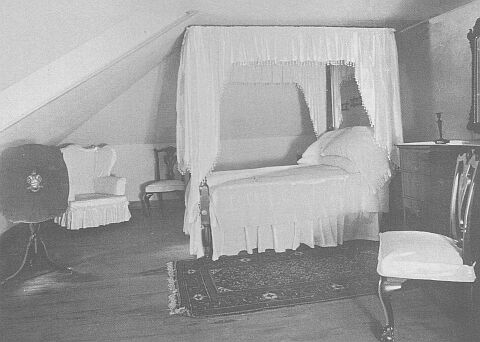
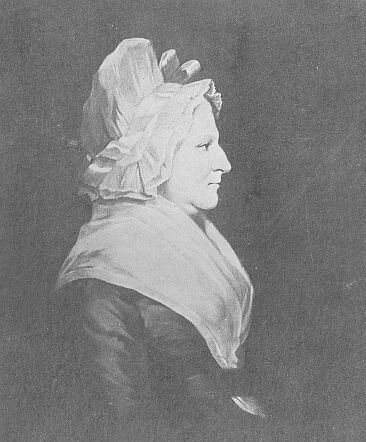
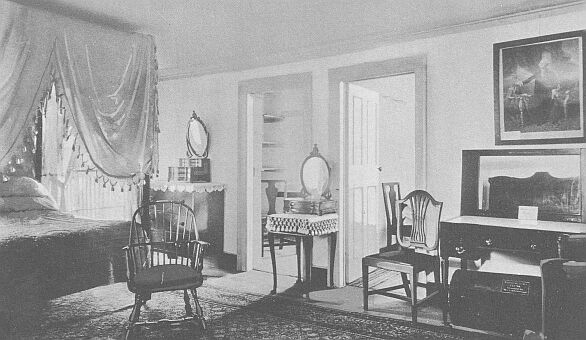
Martha Washington's Bedroom at Mount Vernon
Returning to their beloved Mount Vernon with General Washington after
his retirement, in 1796, as First President of the United States,
Martha Washington seldom spent a night away from the historic mansion
overlooking the Potomac. There she continued to offer a gracious
hospitality to the many visitors attracted by her distinguished
husband. She never recovered from his death in 1799, and dwelt in deep
mourning until she followed him, May 22, 1802. Her remains rest with
those of Washington in the vault at Mount Vernon.
As if to remove all doubts respecting the purpose for which this
extraordinary letter was written, a copy was, on the day of its date,
transmitted to a printer for publication.
Whatever motives might have impelled Mr. Adet to make this open and
direct appeal to the American people, in the critical moment of their
election of a chief magistrate, it does not appear, in any material
degree, to have influenced that election. Many reflecting men, who had
condemned the course of the administration, could not approve this
interference in the internal affairs of the United States; and the
opposite party, generally, resented it as an attempt to control the
operations of the American people in the exercise of one of the
highest acts of sovereignty, and to poison the fountain of their
liberty and independence, by mingling foreign intrigue with their
elections. Viewing it as a fulfilment of their most gloomy prognostics
respecting the designs of France to establish an influence in the
councils of America, they believed the best interests of their country
to require that it should be defeated; and their exertions against the
candidate Mr. Adet was understood to favour, were the more determined
and the more vigorous.
The president's speech to congress.
On the 7th of December, while this dubious and ardently contested
election was depending, the President, for the last time, met the
national legislature in the senate chamber. His address on the
occasion was comprehensive, temperate, and dignified. In presenting a
full and clear view of the situation of the United States, and in
recommending those great national measures, in the utility of which he
felt a confidence, no personal considerations could induce the
omission of those, to which open and extensive hostility had been
avowed.
After congratulating congress on the internal situation of the United
States, and on the progress of that humane system which had been
adopted for the preservation of peace with their Indian neighbours;
after stating the measures which had been taken in execution of the
treaties with Great Britain, Spain, and Algiers, and the negotiations
which were pending with Tunis and Tripoli; he proceeded to say:
"To an active external commerce, the protection of a naval force is
indispensable—this is manifest with regard to wars in which a state
is itself a party—but besides this, it is in our own experience, that
the most sincere neutrality is not a sufficient guard against the
depredations of nations at war. To secure respect to a neutral flag,
requires a naval force, organized and ready to vindicate it from
insult or aggression—this may even prevent the necessity of going to
war, by discouraging belligerent powers from committing such
violations of the rights of the neutral party, as may first or last,
leave no other option. From the best information I have been able to
obtain, it would seem as if our trade to the Mediterranean, without a
protecting force, will always be insecure; and our citizens exposed to
the calamities from which numbers of them have but just been relieved.
"These considerations invite the United States to look to the means,
and to set about the gradual creation of a navy. The increasing
progress of their navigation promises them, at no distant period, the
requisite supply of seamen; and their means, in other respects, favour
the undertaking. It is an encouragement likewise, that their
particular situation will give weight, and influence, to a moderate
naval force in their hands. Will it not then be adviseable, to begin
without delay, to provide and lay up the materials for the building
and equipping of ships of war; and to proceed in the work by degrees,
in proportion as our resources shall render it practicable, without
inconvenience; so that a future war of Europe may not find our
commerce in the same unprotected state, in which it was found by the
present?"
The speech next proceeded earnestly to recommend the establishment of
national works for manufacturing such articles as were necessary for
the defence of the country; and also of an institution which should
grow up under the patronage of the public, and be devoted to the
improvement of agriculture. The advantages of a military academy,[47]
and of a national university, were also urged; and the necessity of
augmenting the compensations to the officers of the United States, in
various instances, was explicitly stated.
Adverting to the dissatisfaction which had been expressed by one of
the great powers of Europe, the President said, "while in our external
relations some serious inconveniences and embarrassments have been
overcome, and others lessened, it is with much pain and deep regret I
mention, that circumstances of a very unwelcome nature have lately
occurred. Our trade has suffered, and is suffering extensive injuries
in the West Indies from the cruisers and agents of the French
republic; and communications have been received from its minister
here, which indicate the danger of a further disturbance of our
commerce by its authority; and which are, in other respects, far from
agreeable.
"It has been my constant, sincere and earnest wish, in conformity with
that of our nation, to maintain cordial harmony, and a perfectly
friendly understanding with that republic. This wish remains unabated;
and I shall persevere in the endeavour to fulfil it to the utmost
extent of what shall be consistent with a just and indispensable
regard to the rights and honour of our country; nor will I easily
cease to cherish the expectation, that a spirit of justice, candour
and friendship, on the part of the republic, will eventually ensure
success.
"In pursuing this course, however, I can not forget what is due to the
character of our government and nation; or to a full and entire
confidence in the good sense, patriotism, self-respect, and fortitude
of my countrymen.
"I reserve for a special message, a more particular communication on
this interesting subject."
The flourishing state of the revenue, the expectation that the system
for the gradual extinction of the national debt would be completed at
this session, the anxiety which he felt respecting the militia, were
successively mentioned, and the speech was concluded in the following
terms:
"The situation in which I now stand, for the last time, in the midst
of the representatives of the people of the United States, naturally
recalls the period when the administration of the present form of
government commenced; and I can not omit the occasion to congratulate
you, and my country, on the success of the experiment; nor to repeat
my fervent supplications to the Supreme Ruler of the universe, and
sovereign arbiter of nations, that his providential care may still be
extended to the United States;—that the virtue and happiness of the
people may be preserved; and that the government, which they have
instituted for the protection of their liberties, may be perpetual."
The answer of the senate embraced the various topics of the speech,
and approved every sentiment it contained.
To a review of the prosperous situation of the interior of the United
States, the senate subjoined—
"Whilst contemplating the causes that produce this auspicious result,
we must acknowledge the excellence of the constitutional system, and
the wisdom of the legislative provisions;—but we should be deficient
in gratitude and justice, did we not attribute a great portion of
these advantages, to the virtue, firmness, and talents of your
administration; which have been conspicuously displayed, in the most
trying times, and on the most critical occasions—it is therefore,
with the sincerest regrets, that we now receive an official
notification of your intentions to retire from the public employments
of your country.
"When we review the various scenes of your public life, so long and so
successfully devoted to the most arduous services, civil and military;
as well during the struggles of the American revolution, as the
convulsive periods of a recent date, we can not look forward to your
retirement without our warmest affections, and most anxious regards,
accompanying you; and without mingling with our fellow citizens at
large, in the sincerest wishes for your personal happiness, that
sensibility and attachment can express.
"The most effectual consolation that can offer for the loss we are
about to sustain, arises from the animating reflection, that the
influence of your example will extend to your successors, and the
United States thus continue to enjoy an able, upright, and energetic
administration."
In the house of representatives, a committee of five had been
appointed to prepare a respectful answer to the speech, three of whom
were friends to the administration. Knowing well that the several
propositions it contained could not be noticed in detail, without
occasioning a debate in which sentiments opposed to those of the
address would be expressed, probably by a majority of the house; and
hoping that the disposition would be general to avow in strong terms
their attachment to the person and character of the President, the
committee united in reporting an answer, which, in general terms,
promised due attention to the various subjects recommended to their
consideration, but was full and explicit in the expression of
attachment to himself, and of approbation of his administration.
But the unanimity which prevailed in the committee did not extend to
the house.
After amplifying and strengthening the expressions of the report which
stated the regrets of the house that any interruption should have
taken place in the harmony which had subsisted between the United
States and France, and modifying those which declared their hopes in
the restoration of that affection which had formerly subsisted between
the two republics, so as to avoid any implication that the rupture of
that affection was exclusively ascribable to France, a motion was made
by Mr. Giles to expunge from the answer the following paragraphs.
"When we advert to the internal situation of the United States, we
deem it equally natural and becoming to compare the present period
with that immediately antecedent to the operation of the government,
and to contrast it with the calamities in which the state of war still
involves several of the European nations, as the reflections deduced
from both tend to justify, as well as to excite a warmer admiration of
our free constitution, and to exalt our minds to a more fervent and
grateful sense of piety towards Almighty God for the beneficence of
his Providence, by which its administration has been hitherto so
remarkably distinguished.
"And while we entertain a grateful conviction that your wise, firm,
and patriotic administration has been signally conducive to the
success of the present form of government, we can not forbear to
express the deep sensations of regret with which we contemplate your
intended retirement from office.
"As no other suitable occasion may occur, we can not suffer the
present to pass without attempting to disclose some of the emotions
which it can not fail to awaken.
"The gratitude and admiration of your countrymen are still drawn to
the recollection of those resplendent virtues and talents which were
so eminently instrumental to the achievement of the revolution, and of
which that glorious event will ever be the memorial. Your obedience to
the voice of duty and your country, when you quitted reluctantly, a
second time, the retreat you had chosen, and first accepted the
presidency, afforded a new proof of the devotedness of your zeal in
its service, and an earnest of the patriotism and success which have
characterized your administration. As the grateful confidence of the
citizens in the virtues of their chief magistrate has essentially
contributed to that success, we persuade ourselves that the millions
whom we represent, participate with us in the anxious solicitude of
the present occasion.
"Yet we can not be unmindful that your moderation and magnanimity,
twice displayed by retiring from your exalted stations, afford
examples no less rare and instructive to mankind than valuable to a
republic.
"Although we are sensible that this event, of itself, completes the
lustre of a character already conspicuously unrivalled by the
coincidence of virtue, talents, success, and public estimation; yet we
conceive we owe it to you, sir, and still more emphatically to
ourselves and to our nation, (of the language of whose hearts we
presume to think ourselves, at this moment, the faithful interpreters)
to express the sentiments with which it is contemplated.
"The spectacle of a free and enlightened nation offering by its
representatives the tribute of unfeigned approbation to its first
citizen, however novel and interesting it may be, derives all its
lustre (a lustre which accident or enthusiasm could not bestow, and
which adulation would tarnish) from the transcendent merit, of which
it is the voluntary testimony.
"May you long enjoy that liberty which is so dear to you, and to which
your name will ever be so dear; may your own virtue and a nation's
prayers obtain the happiest sunshine for the decline of your days, and
the choicest of future blessings. For our country's sake; for the sake
of republican liberty, it is our earnest wish that your example may be
the guide of your successors; and thus, after being the ornament and
safeguard of the present age, become the patrimony of our
descendants."
In support of this motion, after urging the indelicacy of exulting
over the misfortunes of others by contrasting our happiness with their
misery, Mr. Giles said, that with respect to the wisdom[48] and
firmness of the President, he differed in opinion from the answer; and
though he might be singular, yet it being his opinion, he should not
be afraid to avow it. He had not that grateful conviction there
mentioned, and if he were to come there and express it, he should
prove an inconsistent character. He should not go into a lengthy
discussion on this point, but if they turned their eyes to our foreign
relations, there would be found no reason to exult in the wisdom and
firmness of the administration. He believed, on the contrary, that it
was from a want of wisdom and firmness that we were brought into our
present critical situation. If gentlemen had been satisfied with
expressing their esteem of the patriotism and virtue of the President,
they might have got a unanimous vote; but they could not suppose that
gentlemen would so far forget self-respect as to join in the proposed
adulation.
Mr. Giles said he was one of those citizens who did not regret the
President's retiring from office. He hoped he would retire to his
country seat and enjoy all the happiness he could wish; and he
believed he would enjoy more there than in his present situation. He
believed the government of the United States would go on without him.
The people were competent to their own government. What calamities
would attend the United States if one man alone was essential to their
government! He believed there were a thousand men in the United States
who were capable of filling the presidential chair as well as it had
been filled heretofore. And although a clamour had been raised in all
parts of the United States, more or less, from apprehensions on the
departure of the President from office, yet, not feeling these
apprehensions himself, he was perfectly easy on the occasion. He
wished the President as much happiness as any man; and hoping he would
retire, he could not express any regrets at the event. And it would be
extraordinary, if gentlemen whose names in the yeas and nays are found
in opposition to certain prominent measures of the administration,
should now come forward and approve those measures. This could not be
expected. He, for his part, retained the same opinions he had always
done with respect to those measures, nor should any influence under
heaven prevent him from expressing that opinion—an opinion in which
he was confident, ere long, all America would concur.[49]
This motion was opposed with great earnestness by the party which had
supported the administration. The advantages which had resulted from
the constitution were said to be too obvious to be controverted; and
it was maintained that a comparison of the present situation of the
United States with its condition anterior to the adoption of that
instrument, or with the condition of foreign powers, was natural and
proper. This comparison was made not for the purposes of exultation,
but of exciting just sentiments respecting their own conduct.
In reply to the observations respecting the President, it was said,
that the whole course of his administration had demonstrated the
correctness with which the terms "wisdom and firmness" were applied to
it. Particular circumstances were stated in which these qualities had
been pre-eminently displayed; but the general impression which facts
had made on the public mind was considered as dispensing with the
necessity of stating the particular facts themselves.
It might be true, they said, that there were many others who could
fill with propriety and advantage the presidential chair, but no man
could fill it who possessed, in an equal degree, the confidence of the
people. The possession of this confidence enabled the chief magistrate
to perform the duties of his office in a manner greatly conducive to
the interests of the nation, and the loss of so valuable a public
servant was certainly just cause of regret. With this sentiment, the
feelings of the community fully accorded. In every part of the United
States, the declarations of their constituents attested the regrets
with which this event was contemplated by them. Those gentlemen who
did not participate in these feelings would have an opportunity to
record their names with their opinions. But those who did participate
in them ought not to be restrained from expressing them.
The motion to strike out was lost; after which the words "the
spectacle of a whole nation, the freest and most enlightened in the
world," were amended, so as to read, "the spectacle of a free and
enlightened nation," and the answer was carried by a great majority.
1797
Early in the session, the President communicated to congress in a
special message, the complaints alleged by the representative of the
French republic against the government of the United States. These
complaints embracing most of the transactions of the legislative and
executive departments, in relation to the belligerent powers, a
particular and careful review of almost every act of the
administration, which could affect those powers, became indispensable.
The principal object for the mission of General Pinckney to Paris,
having been to make full and fair explanations of the principles and
conduct of the American government, this review was addressed to that
minister. It presented a minute and comprehensive detail of all the
points of controversy which had arisen between the two nations; and
defended the measures which had been adopted in America, with a
clearness, and a strength of argument, believed to be irresistible. To
place the subject in a point of view, admitting of no possible
misunderstanding, the secretary of state had annexed to his own full
and demonstrative reasoning, documents, establishing the real fact in
each particular case, and the correspondence relating to it.
This letter, with its accompanying documents, was laid before
congress.
Those who read these valuable papers will not be surprised, that the
President should have relied upon their efficacy in removing from the
government of France, all impressions unfavourable to the fairness of
intention which had influenced the conduct of the United States; and
in effacing from the bosoms of the great body of the American people,
all those unjust and injurious suspicions which had been entertained
against their own administration. Should their immediate operation on
the executive of France disappoint his hopes, he persuaded himself
that he could not mistake their influence in America; and he felt the
most entire conviction that the accusations against the United States
would cease, with the evidence that those accusations were
countenanced and supported by a great portion of the American people.
These documents were communicated to the public; but, unfortunately,
their effect at home was not such as had been expected, and they were
consequently inoperative abroad. The fury of political controversy
seemed to sustain no diminution; and the American character continued
to be degraded by reciprocal criminations, which the two great parties
made upon each other, of being under a British, and a French
influence.
The measures particularly recommended by the President in his speech,
at the opening of the session, were not adopted; and neither the
debates in Congress, nor the party publications with which the nation
continued to be agitated, furnished reasonable ground for the hope,
that the political intemperance which had prevailed from the
establishment of the republican form of government in France, was
about to be succeeded by a more conciliatory spirit.
The President contemplated with a degree of pleasure[50] seldom felt
at the resignation of power, his approaching retirement to the
delightful scenes of domestic and rural life.
It was impossible to be absolutely insensible to the bitter
invectives, and malignant calumnies of which he had long been the
object. Yet in one instance only, did he depart from the rule he had
prescribed for his conduct regarding them. Apprehending permanent
injury from the republication of certain spurious letters which have
been already noticed, he, on the day which terminated his official
character, addressed to the secretary of state the following letter.
He denies the authenticity of certain spurious letters
published as his in 1776.
"Dear Sir,
"At the conclusion of my public employments, I have thought it
expedient to notice the publication of certain forged letters which
first appeared in the year 1777, and were obtruded upon the public as
mine. They are said by the editor to have been found in a small
portmanteau that I had left in the care of my mulatto servant named
Billy, who, it is pretended, was taken prisoner at Fort Lee, in 1776.
The period when these letters were first printed will be recollected,
and what were the impressions they were intended to produce on the
public mind. It was then supposed to be of some consequence to strike
at the integrity of the motives of the American Commander-in-chief,
and to paint his inclinations as at variance with his professions and
his duty—another crisis in the affairs of America having occurred,
the same weapon has been resorted to, to wound my character and
deceive the people.
"The letters in question have the dates, addresses, and signatures
here following:
New York, June 12th, 1776.
To Mr. Lund Washington, at Mount Vernon, Fairfax county,
Virginia.
G.W.
June 18th, 1776.
To John Parke Custis, Esqr., at the Hon Benedict Calvert's
Esqr., Mount Airy, Maryland.
G.W.
New York, July 8th, 1776.
To Mr. Lund Washington, Mount Vernon, Fairfax county,
Virginia.
G.W.
New York, July 16th, 1776.
To Mr. Lund Washington.
G.W.
New York, July 15th, 1776.
To Mr. Lund Washington.
G.W.
New York, July 22d, 1776.
To Mr. Lund Washington.
G.W.
June 24th, 1776.
To Mrs. Washington.
G.W.
"At the time when these letters first appeared, it was notorious to
the army immediately under my command, and particularly to the
gentlemen attached to my person, that my mulatto man Billy had never
been one moment in the power of the enemy. It is also a fact that no
part of my baggage, or any of my attendants, were captured during the
whole course of the war. These well known facts made it unnecessary,
during the war, to call the public attention to the forgery by any
express declaration of mine; and a firm reliance on my fellow
citizens, and the abundant proofs they gave of their confidence in me,
rendered it alike unnecessary to take any formal notice of the revival
of the imposition, during my civil administration. But as I can not
know how soon a more serious event may succeed to that which will this
day take place, I have thought it a duty that I owed to myself, to my
country, and to truth, now to detail the circumstances above recited,
and to add my solemn declaration that the letters herein described are
a base forgery, and that I never saw or heard of them until they
appeared in print. The present letter I commit to your care, and
desire it may be deposited in the office of the department of state,
as a testimony of the truth to the present generation and to
posterity. Accept, &c. &c."
John Adams elected president, and Thomas Jefferson vice
president.
In February, the votes for the first and second magistrates of the
union were opened and counted in presence of both houses; and the
highest number appearing in favour of Mr. Adams, and the second in
favour of Mr. Jefferson, the first was declared to be the President,
and the second the Vice President, of the United States, for four
years to commence on the fourth day of the ensuing March.
On that day, the members of the senate, conducted by the Vice
President, together with the officers of the general and state
governments, and an immense concourse of citizens, convened in the
hall of the house of representatives, in which the oaths were
administered to the President.
The sensibility which was manifested when General Washington entered,
did not surpass the cheerfulness which overspread his own countenance,
nor the heartfelt pleasure with which he saw another invested with the
powers that had so long been exercised by himself.[51]
General Washington retires to Mount Vernon.
After the solemnities of the occasion had been concluded, and he had
paid to his successor those respectful compliments which he believed
to be equally due to the man and to the office, he hastened[52] to
that real felicity which awaited him at Mount Vernon, the enjoyment of
which he had long impatiently anticipated.
The same marks of respect and affection for his person, which had on
all great occasions been manifested by his fellow citizens, still
attended him. His endeavours to render his journey private were
unavailing; and the gentlemen of the country through which he passed,
were still ambitious of testifying their sentiments for the man who
had, from the birth of the republic, been deemed the first of American
citizens. Long after his retirement, he continued to receive addresses
from legislative bodies, and various classes of citizens, expressive
of the high sense entertained of his services.
Notwithstanding the extraordinary popularity of the first President of
the United States, scarcely has any important act of his
administration escaped the most bitter invective.
Political situation of the United States at this period.
On the real wisdom of the system which he pursued, every reader will
decide for himself. Time will, in some measure, dissipate the
prejudices and passions of the moment, and enable us to view objects
through a medium which represents them truly.
Without taking a full review of measures which were reprobated by one
party and applauded by the other, the reader may be requested to
glance his eye at the situation of the United States in 1797, and to
contrast it with their condition in 1788.
At home, a sound credit had been created; an immense floating debt had
been funded in a manner perfectly satisfactory to the creditors: an
ample revenue had been provided; those difficulties which a system of
internal taxation, on its first introduction, is doomed to encounter,
were completely removed; and the authority of the government was
firmly established. Funds for the gradual payment of the debt had been
provided; a considerable part of it had been actually discharged; and
that system which is now operating its entire extinction, had been
matured and adopted. The agricultural and commercial wealth of the
nation had increased beyond all former example. The numerous tribes of
warlike Indians, inhabiting those immense tracts which lie between the
then cultivated country and the Mississippi, had been taught, by arms
and by justice, to respect the United States, and to continue in
peace. This desirable object having been accomplished, that humane
system was established for civilizing, and furnishing them with the
conveniences of life which improves their condition, while it secures
their attachment.
Abroad, the differences with Spain had been accommodated; and the free
navigation of the Mississippi had been acquired, with the use of New
Orleans as a place of deposit for three years, and afterwards, until
some other equivalent place should be designated. Those causes of
mutual exasperation which had threatened to involve the United States
in a war with the greatest maritime and commercial power in the world,
had been removed; and the military posts which had been occupied
within their territory, from their existence as a nation, had been
evacuated. Treaties had been formed with Algiers and with Tripoli, and
no captures appear to have been made by Tunis; so that the
Mediterranean was opened to American vessels.
This bright prospect was indeed, in part, shaded by the discontents of
France. Those who have attended to the particular points of difference
between the two nations, will assign the causes to which these
discontents are to be ascribed, and will judge whether it was in the
power of the President to have avoided them, without surrendering the
real independence of the nation, and the most invaluable of all rights
—the right of self-government.
Such was the situation of the United States at the close of
Washington's administration. Their circumstances at its commencement
will be recollected; and the contrast is too striking not to be
observed.
That this beneficial change in the affairs of America is to be
ascribed exclusively to the wisdom which guided the national councils
will not be pretended. That many of the causes which produced it
originated with the government, and that their successful operation
was facilitated, if not secured, by the system which was adopted, will
scarcely be denied. To estimate that system correctly, their real
influence must be allowed to those strong prejudices, and turbulent
passions, with which it was assailed.
Accustomed in the early part of his life to agricultural pursuits, and
possessing a real taste for them, General Washington was particularly
well qualified to enjoy, in retirement, that tranquil felicity which
he had anticipated. Resuming former habits, and returning to ancient
and well known employments, he was familiar with his new situation,
and therefore exempt from the danger of that disappointment which is
the common lot of those who, in old age, retire from the toils of
business, or the cares of office, to the untried pleasures of the
country. A large estate, which exhibited many proofs of having been
long deprived of the attentions of its proprietor, in the management
and improvement of which he engaged with ardour, an extensive
correspondence, and the society of men and books, gave employment to
every hour which was equally innocent and interesting, and furnished
ground for the hope that the evening of a life which had been devoted
to the public service, would be as serene, as its mid-day had been
brilliant.
Though devoted to these occupations, an absolute indifference to
public affairs would have been incompatible with that love of country
which had influenced all his conduct. Feeling strong impressions in
favour of that system, with regard to foreign powers, which had been
adopted by himself, and which was faithfully pursued by his successor,
he could not be inattentive to the immense, and continued exertions,
made by a powerful party to overturn it. Yet for a time, he sought to
abstract himself from these political contests, and to diminish the
interest which his feelings impelled him to take in them. His letters
abound in paragraphs not unlike the following. "I have confidence
however in that Providence which has shielded the United States from
the evils that have hitherto threatened them; and, as I believe the
major part of the people of this country to be well affected to its
constitution and government, I rest satisfied that, should a crisis
ever arise to call forth the sense of the community, it will be strong
in support of the honour and dignity of the nation. Therefore, however
much I regret the opposition which has for its object the
embarrassment of the administration, I shall view things in the 'calm
light of mild philosophy,' and endeavour to finish my course in
retirement and ease."
But the designs of France were soon manifested in a form which, to the
veteran soldier and statesman of Mount Vernon, appeared to be too
dangerous as well as unequivocal, to admit the preservation of this
equanimity.
The French government refuses to receive General Pinckney
as minister.
In the executive of that republic, General Pinckney encountered
dispositions of a very different character from that amicable and
conciliatory temper which had dictated his mission. After inspecting
his letter of credence, the Directory announced to him their haughty
determination "not to receive another minister plenipotentiary from
the United States, until after the redress of grievances demanded of
the American government, which the French republic had a right to
expect from it." This message was succeeded, first by indecorous
verbal communications, calculated to force the American minister out
of France, and afterwards, by a written mandate to quit the
territories of the republic.
This act of hostility was accompanied with another which would explain
the motives for this conduct, if previous measures had not rendered
all further explanation unnecessary.
On giving to the recalled minister his audience of leave, the
president of the directory addressed a speech to him, in which terms
of outrage to the government, were mingled with expressions of
affection for the people of the United States; and the expectation of
ruling the former, by their influence over the latter, was too clearly
manifested not to be understood. To complete this system of hostility,
American vessels were captured wherever found; and, under the pretext
of their wanting a document, with which the treaty of commerce had
been uniformly understood to dispense, they were condemned as prize.
Congress is convened.
President's speech.
This serious state of things demanded a solemn consideration. On
receiving from General Pinckney the despatches which communicated it,
the President issued his proclamation requiring congress to meet on
the 15th day of June. The firm and dignified speech delivered by the
chief magistrate at the commencement of the session, exhibited that
sensibility which a high minded and real American might be expected to
feel, while representing to the national legislature the great and
unprovoked outrages of a foreign government. Adverting to the audience
of leave given by the executive Directory to Colonel Monroe, he said,
"the speech of the President discloses sentiments more alarming than
the refusal of a minister, because more dangerous to our independence
and union; and, at the same time, studiously marked with indignities
towards the government of the United States. It evinces a disposition
to separate the people from their government; to persuade them that
they have different affections, principles, and interests from those
of their fellow citizens whom they themselves have chosen to manage
their common concerns; and thus to produce divisions fatal to our
peace. Such attempts ought to be repelled with a decision which shall
convince France, and the world, that we are not a degraded people,
humiliated under a colonial spirit of fear, and sense of inferiority,
fitted to be the miserable instruments of foreign influence, and
regardless of national honour, character, and interest."
"Retaining still the desire which had uniformly been manifested by the
American government to preserve peace and friendship with all nations,
and believing that neither the honour nor the interest of the United
States absolutely forbade the repetition of advances for securing
these desirable objects with France, he should," he said, "institute a
fresh attempt at negotiation, and should not fail to promote and
accelerate an accommodation on terms compatible with the rights,
duties, interests, and honour of the nation." But while he should be
making these endeavours to adjust all differences with the French
republic by amicable negotiation, he earnestly recommended it to
congress to provide effectual measures of defence.
Three envoys extraordinary deputed to negotiate with
France.
To carry into effect the pacific dispositions avowed in the speech,
three envoys extraordinary were appointed, at the head of whom General
Pinckney was placed. Their instructions conformed to the public
language of the President. Peace and reconciliation were to be pursued
by all means, compatible with the honour and the faith of the United
States; but no national engagements were to be impaired; no innovation
to be permitted upon those internal regulations for the preservation
of peace which had been deliberately and uprightly established; nor
were the rights of the government to be surrendered.
The debates in the house of representatives, on the answer to the
speech, were long and earnest. To expressions approving the conduct of
the executive with regard to foreign nations, the opposition was
ardent, but unsuccessful. On the third of June, an answer was agreed
to which contained sentiments worthy of an American legislature, and
for which several of the leaders of the opposition voted.
The speech of the President was well adapted to the occasion, and to
the times. It was calculated to rouse those indignant feelings which a
high spirited people, insulted and injured by a foreign power, can
never fail to display, if their judgment be not blinded, or their
sensibility to external wrongs blunted, by invincible prejudices. He
relied principally on the manifestation of these feelings for the
success of the negotiation; and on their real existence, for the
defence of the national rights, should negotiation fail. His
endeavours were not absolutely unsuccessful. Some impression was made
on the mass of the people; but it was too slight to be productive of
the advantages expected from it. The conduct of France was still
openly defended; and the opinion, that the measures which had been
adopted by the executive of the United States furnished that republic
with just cause of war, was still publicly maintained, and
indefatigably circulated. According to these opinions, America could
entitle herself to peace, only by retracing the steps she had taken,
and yielding to the demands of her justly offended but generous and
magnanimous ally.
Still jealous for the honour, as well as confident of the importance,
of his country, and retaining that full conviction respecting the
propriety of its measures which had induced their adoption, General
Washington could not repress the solicitude with which he contemplated
passing events. His confidential letters disclose the strong feelings
of his own bosom, but betray no apprehensions that the French
government would press its present system to extremities. He firmly
believed that the hostile attitude it had assumed was to be,
exclusively, ascribed to the conduct of those Americans who had been
the uniform advocates of all the pretensions of France, and who were
said to be supported by a real majority of the people; and confidently
expected that, under the old pretext of magnanimous forbearance, the
executive directory would, slowly, and gradually, recede from its
present system, so soon as the error in which it originated should
become manifest. The opinion he had always entertained of the good
sense and patriotism of his fellow citizens, silenced every doubt
respecting the manner in which they would act, when their real
situation should be perceived by themselves.
1798
For a considerable length of time, no certain intelligence reached the
United States respecting the negotiation at Paris. At length, in the
winter of 1798, letters were received from the American envoys,
indicating an unfavourable state of things; and, in the spring,
despatches arrived which announced the total failure of the mission.
History will scarcely furnish the example of a nation, not absolutely
degraded, which has received from a foreign power such open contumely,
and undisguised insult, as were, on this occasion, suffered by the
United States in the persons of their ministers.
Their treatment.
It was insinuated that their being taken from the party[53] which had
supported the measures of their own government furnished just cause of
umbrage; and, under slight pretexts, the executive directory delayed
to accredit them as the representatives of an independent nation. In
this situation, they were assailed by persons, not indeed invested
with formal authority, but exhibiting sufficient evidence of the
source from which their powers were derived, who, in direct and
explicit terms, demanded money from the United States as the condition
which must precede, not only the reconciliation of America to France,
but any negotiation on the differences between the two countries.
That an advance of money by a neutral to a belligerent power would be
an obvious departure from neutrality, though an insuperable objection
to this demand, did not constitute the most operative reason for
repelling it. Such were the circumstances under which it was made,
that it could not be acceded to without a surrender of the real
independence of the United States; nor without being, in fact, the
commencement of a system, the end of which it was impossible to
foresee.
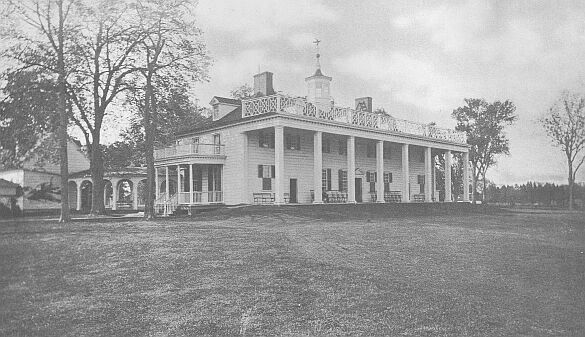
Mount Vernon
This colonial mansion overlooking the Potomac River fifteen miles
south of Washington, D.C., and famous as the home and burial-place of
the "Father of His Country," was built in 1743 by Washington's elder
brother, Lawrence, who called it Mount Vernon, after Admiral Vernon,
under whom he had served in the British Navy. Mount Vernon, which was
much enlarged by President Washington, was by him bequeathed to
Bushrod Washington, upon whose death it came into the hands of John A.
Washington, his nephew, who sold it in 1858 to the Ladies Mount Vernon
Association, which holds it in trust as a national shrine.
A decided negative was therefore given to the preliminary required by
these unofficial agents; but they returned to the charge with
wonderful perseverance, and used unwearied arts to work upon the fears
of the American ministers for their country, and for themselves. The
immense power of France was painted in glowing colours, the
humiliation of the house of Austria was stated, and the conquest of
Britain was confidently anticipated. In the friendship of France
alone, it was said, could America look for safety; and the fate of
Venice was held up to warn her of the danger which awaited those who
incurred the displeasure of the great republic. The ministers were
assured that, if they believed their conduct would be approved in the
United States, they were mistaken. The means which the Directory
possessed, in that country, to excite odium against them, were great,
and would unquestionably be employed.
This degrading intercourse was at length interrupted by the positive
refusal of the envoys to hold any further communication with the
persons employed in it.
Meanwhile, they urged the object of their mission with persevering but
unavailing solicitude. The Directory still refused to acknowledge them
in their public character; and the secretary of exterior relations, at
unofficial visits which they made him, renewed the demand which his
agents had unsuccessfully pressed.
Finding the objections to their reception in their official character
insurmountable, the American ministers made a last effort to execute
the duties assigned to them. In a letter addressed to the secretary of
exterior relations, they entered at large into the explanations
committed to them by their government, and illustrated, by a variety
of facts, the uniform friendliness of its conduct to France.[54]
Notwithstanding the failure of this effort, and their perfect
conviction that all further attempts would be equally unavailing, they
continued, with a passiveness which must search for its apology in
their solicitude to demonstrate to the American people the real views
of the French republic, to employ the only means in their power to
avert the rupture which was threatened, and which appeared to be
inevitable.
During these transactions, occasion was repeatedly taken to insult the
American government; open war was continued to be waged by the
cruisers of France on American commerce; and the flag of the United
States was a sufficient justification for the capture and condemnation
of any vessel over which it waved.
At length, when the demonstration became complete, that the resolution
of the American envoys was not less fixed, than their conduct had been
guarded and temperate, various attempts were made to induce two of
them, voluntarily, to relinquish their station; on the failure of
which, they were ordered to quit the territories of the republic. As
if to aggravate this national insult, the third, who had been selected
from that party which was said to be friendly to France, was permitted
to remain, and was invited to resume the discussions which had been
interrupted.
The despatches communicating these events were laid before congress,
and were afterwards published. The indignation which they excited was
warm and extensive. The attempt to degrade the United States into a
tributary nation was too obvious to be concealed; and the resentment
produced, as well by this attempt as by the threats which accompanied
it, was not confined to the federalists. For the moment, a spirit was
roused on which an American may reflect with pride, and which he may
consider as a sure protection from external danger. In every part of
the continent, the favourite sentiment was "millions for defence, not
a cent for tribute."
The disposition still existed to justify France, by criminating the
American government, by contending that her intentions were not really
hostile, that her conduct was misrepresented by men under British
influence, who wished for war, or had been deceived by unauthorized
intriguers; that, admitting it to be otherwise, she only demanded
those marks of friendship which, at a critical moment, she had herself
afforded; that the real interests of the United States required a
compliance with this demand; that it would cost more money to resist
than to yield to it; that the resistance would infallibly be
ineffectual; and that national honour was never secured by national
defeat. Neither these sentiments, nor the arguments which were founded
on them, accorded with the general feeling; and it required the
co-operation of other causes to establish the influence of those who
urged them.
Measures of hostility adopted by the American government
against France.
In congress, vigorous measures were adopted for retaliating injuries
which had been sustained, and for repelling those which were
threatened. Amongst these was a regular army. A regiment of
artillerists and engineers was added to the permanent establishment;
and the President was authorized to raise twelve additional regiments
of infantry, and one regiment of cavalry, to serve during the
continuance of the existing differences with the French republic if
not sooner discharged. He was also authorized to appoint officers for
a provisional army, and to receive and organize volunteer corps who
would be exempt from ordinary militia duty; but neither the volunteers
nor the officers of the provisional army were to receive pay unless
called into actual service.
Addresses[55] to the executive from every part of the United States
attested the high spirit of the nation, and the answers of the
President were well calculated to give it solidity and duration.
No sooner had a war become probable, to the perils of which no man
could be insensible, than the eyes of all were directed to General
Washington, as the person who should command the American army. He
alone could be seen at the head of a great military force without
exciting jealousy; he alone could draw into public service, and
arrange properly the best military talents of the nation; and he more
than any other, could induce the utmost exertions of its physical
strength.
Indignant at the unprovoked injuries which had been heaped upon his
country, and convinced that the conflict, should a war be really
prosecuted by France with a view to conquest, would be extremely
severe, and could be supported, on the part of America, only by a
persevering exertion of all her force, he could not determine, should
such a crisis arrive, to withhold those aids which it might be in his
power to afford, should public opinion really attach to his services
that importance which would render them essential. His own reflections
appear to have resulted in a determination not to refuse once more to
take the field, provided he could be permitted to secure efficient aid
by naming the chief officers of the army, and to remain at home until
his service in the field should be required by actual invasion.
A confidential and interesting letter from Colonel Hamilton of the
19th of May, on political subjects, concludes with saying, "You ought
also to be aware, my dear sir, that in the event of an open rupture
with France, the public voice will again call you to command the
armies of your country; and though all who are attached to you will
from attachment as well as public considerations, deplore an occasion
which should once more tear you from that repose to which you have so
good a right; yet it is the opinion of all those with whom I converse
that you will be compelled to make the sacrifice. All your past
labours may demand, to give them efficacy, this further, this very
great sacrifice."
"You may be assured," said General Washington in reply, "that my mind
is deeply impressed with the present situation of public affairs, and
not a little agitated by the outrageous conduct of France towards the
United States, and at the inimitable conduct of those partisans who
aid and abet her measures. You may believe further, from assurances
equally sincere, that if there was any thing in my power to be done
consistently, to avert or lessen the danger of the crisis, it should
be rendered with hand and heart.
"But, my dear sir, dark as matters appear at present, and expedient as
it is to be prepared for the worst that can happen, (and no man is
more disposed to this measure than I am) I can not make up my mind
yet, for the expectation of open war; or, in other words, for a
formidable invasion by France. I can not believe, although I think her
capable of any thing, that she will attempt to do more than she has
done. When she perceives the spirit and policy of this country rising
into resistance, and that she has falsely calculated upon support from
a large part of the people[56] to promote her views and influence in
it, she will desist even from those practices, unless unexpected
events in Europe, or the acquisition of Louisiana and the Floridas,
should induce her to continue them. And I believe further, that
although the leaders of their party in this country will not change
their sentiments, they will be obliged to change their plan, or the
mode of carrying it on. The effervescence which is appearing in all
quarters, and the desertion of their followers, will frown them into
silence—at least for a while.
"If I did not view things in this light, my mind would be infinitely
more disquieted than it is: for, if a crisis should arrive when a
sense of duty, or a call from my country should become so imperious as
to leave me no choice, I should prepare for relinquishment, and go
with as much reluctance from my present peaceful abode, as I should go
to the tombs of my ancestors."
The opinion that prudence required preparations for open war, and that
General Washington must once more be placed at the head of the
American armies, strengthened every day; and on the 22d of June, the
President addressed him a letter in which that subject was thus
alluded to.
"In forming an army, whenever I must come to that extremity, I am at
an immense loss whether to call out the old generals, or to appoint a
young set. If the French come here, we must learn to march with a
quick step, and to attack, for in that way only they are said to be
vulnerable. I must tax you, sometimes, for advice. We must have your
name, if you will in any case permit us to use it. There will be more
efficacy in it than in many an army."
A letter from the secretary of war, written four days afterwards,
concludes with asking, "May we flatter ourselves that, in a crisis so
awful and important, you will accept the command of all our armies? I
hope you will, because you alone can unite all hearts and all hands,
if it is possible that they can be united."
These letters reached General Washington on the same day. The
following extract from his reply to the President will exhibit the
course of his reflections relative to his appearance once more at the
head of the American armies.
"At the epoch of my retirement, an invasion of these states by any
European power, or even the probability of such an event in my days,
was so far from being contemplated by me, that I had no conception
either that or any other occurrence would arise in so short a period
which could turn my eyes from the shades of Mount Vernon. But this
seems to be the age of wonders. And it is reserved for intoxicated and
lawless France (for purposes of Providence far beyond the reach of
human ken) to slaughter her own citizens, and to disturb the repose of
all the world besides. From a view of the past,—from the prospect of
the present,—and of that which seems to be expected, it is not easy
for me to decide satisfactorily on the part it might best become me to
act. In case of actual invasion by a formidable force, I certainly
should not intrench myself under the cover of age and retirement, if
my services should be required by my country to assist in repelling
it. And if there be good cause to expect such an event, which
certainly must be better known to the government than to private
citizens, delay in preparing for it may be dangerous, improper, and
not to be justified by prudence. The uncertainty however of the
latter, in my mind, creates my embarrassment; for I can not bring it
to believe, regardless as the French are of treaties, and of the laws
of nations, and capable as I conceive them to be of any species of
despotism and injustice, that they will attempt to invade this country
after such a uniform and unequivocal expression of the determination
of the people in all parts to oppose them with their lives and
fortunes. That they have been led to believe by their agents and
partisans among us that we are a divided people, that the latter are
opposed to their own government, and that the show of a small force
would occasion a revolt, I have no doubt; and how far these men (grown
desperate) will further attempt to deceive, and may succeed in keeping
up the deception, is problematical. Without that, the folly of the
Directory in such an attempt would, I conceive, be more conspicuous,
if possible, than their wickedness.
"Having with candour made this disclosure of the state of my mind, it
remains only for me to add, that to those who knew me best, it is best
known that, should imperious circumstances induce me to exchange once
more the smooth paths of retirement for the thorny ways of public
life, at a period too when repose is more congenial to nature, it
would be productive of sensations which can be more easily conceived
than expressed."
His letter to the secretary of war was more detailed and more
explicit. "It can not," he said, "be necessary for me to promise to
you or to others who know my sentiments, that to quit the tranquillity
of retirement, and enter the boundless field of responsibility, would
be productive of sensations which a better pen than I possess would
find it difficult to describe. Nevertheless, the principle by which my
conduct has been actuated through life, would not surfer me, in any
great emergency, to withhold any services I could render when required
by my country;—especially in a case where its dearest rights are
assailed by lawless ambition and intoxicated power, in contempt of
every principle of justice, and in violation of solemn compact, and of
laws which govern all civilized nations:—and this too with the
obvious intent to sow thick the seeds of disunion for the purpose of
subjugating our government, and destroying our independence and
happiness.
"Under circumstances like these, accompanied by an actual invasion of
our territory, it would be difficult for me, at any time, to remain an
idle spectator, under the plea of age or retirement. With sorrow, it
is true, I should quit the shades of my peaceful abode, and the ease
and happiness I now enjoy, to encounter anew the turmoils of war, to
which, possibly, my strength and powers might be found incompetent.
These, however, should not be stumbling blocks in my own way. But
there are other things highly important for me to ascertain and settle
before I could give a definite answer to your question.
1st. The propriety in the opinion of the public, so far as
that opinion has been expressed in conversation, of my
appearing again on the public theatre, after declaring the
sentiments I did in my valedictory address of September,
1796.
2dly. A conviction in my own breast, from the best
information that can be obtained, that it is the wish of my
country that its military force should be committed to my
charge; and,
3dly. That the army now to be formed should be so appointed
as to afford a well grounded hope of its doing honour to the
country, and credit to him who commands it in the field.
"On each of these heads you must allow me to make observations."
General Washington then proceeded to detail his sentiments on those
points on which his consent to take command of the army must depend.
General Washington appointed commander-in-chief of the
American Army.
Some casual circumstances delayed the reception of the letters of the
President and secretary of war for several days, in consequence of
which, before the answer of General Washington reached the seat of
government, the President had nominated him to the chief command of
all the armies raised or to be raised in the United States, with the
rank of Lieutenant General; and the senate had unanimously advised and
consented to his appointment.
By the secretary of war, who was directed to wait upon him with his
commission, the President addressed to him the following letter:
"Mr. M'Henry, the secretary of war, will have the honour to wait on
you in my behalf, to impart to you a step I have ventured to take,
which I should have been happy to have communicated in person, had
such a journey, at this time, been in my power.
"My reasons for this measure will be too well known to need any
explanation to the public. Every friend and every enemy of America
will comprehend them at first blush. To you, sir, I owe all the
apology I can make. The urgent necessity I am in of your advice and
assistance, indeed of your conduct and direction of the war, is all I
can urge; and that is a sufficient justification to myself and to the
world. I hope it will be so considered by yourself. Mr. M'Henry will
have the honour to consult you upon the organization of the army, and
upon every thing relating to it."
Open instructions, signed by the President, were on the same day
delivered to the secretary of war, of which the following is a copy:
"It is my desire that you embrace the first opportunity to set out on
your journey to Mount Vernon, and wait on General Washington with the
commission of Lieutenant General and Commander-in-chief of the armies
of the United States, which, by the advice and consent of the senate,
has been signed by me.
"The reasons and motives which prevailed on me to venture on such a
step as the nomination of this great and illustrious character, whose
voluntary resignation alone occasioned my introduction to the office I
now hold, were too numerous to be detailed in this letter, and are too
obvious and important to escape the observation of any part of America
or Europe. But as it is a movement of great delicacy, it will require
all your address to communicate the subject in a manner that shall be
inoffensive to his feelings, and consistent with all the respect that
is due from me to him.
"If the General should decline the appointment, all the world will be
silent, and respectfully acquiesce. If he should accept it, all the
world, except the enemies of his country, will rejoice. If he should
come to no decisive determination, but take the subject into
consideration, I shall not appoint any other lieutenant general until
his conclusion is known.
"His advice in the formation of a list of officers would be extremely
desirable to me. The names of Lincoln, Morgan, Knox, Hamilton, Gates,
Pinckney, Lee, Carrington, Hand, Muhlenberg, Dayton, Burr, Brooks,
Cobb, Smith, as well as the present Commander-in-chief, may be
mentioned to him, and any others that occur to you. Particularly, I
wish to have his opinion on the men most suitable for inspector
general, adjutant general, and quarter master general.
"His opinion on all subjects would have great weight, and I wish you
to obtain from him as much of his reflections upon the times and the
service as you can."
The communications between General Washington and the secretary of war
appear to have been full and unreserved. The impressions of the former
respecting the critical and perilous situation of his country had
previously determined him to yield to the general desire, and accept
the commission offered him, provided he could be permitted to select
for the high departments of the army, and especially for the military
staff, those in whom he could place the greatest confidence. Being
assured that there was every reason to believe his wishes in this
respect would not be thwarted, he gave to the secretary the
arrangement[57] which he would recommend for the principal stations in
the army; and, on the 13th of July, addressed the following letter to
the President.
"I had the honour, on the evening of the 11th instant, to receive from
the hands of the secretary at war, your favour of the seventh,
announcing that you had, with the advice and consent of the senate,
appointed me Lieutenant General and Commander-in-chief of the armies
raised or to be raised for the service of the United States.
"I can not express how greatly affected I am at this new proof of
public confidence, and at the highly flattering manner in which you
have been pleased to make the communication. At the same time, I must
not conceal from you my earnest wish that the choice had fallen upon a
man less declined in years, and better qualified to encounter the
usual vicissitudes of war.
"You know, sir, what calculations I had made relative to the probable
course of events on my retiring from office, and the determination,
with which I had consoled myself, of closing the remnant of my days in
my present peaceful abode. You will therefore be at no loss to
conceive and appreciate the sensations I must have experienced, to
bring my mind to any conclusion that would pledge me, at so late a
period of life, to leave scenes I sincerely love, to enter upon the
boundless field of public action, incessant trouble, and high
responsibility.
"It was not possible for me to remain ignorant of, or indifferent to
recent transactions. The conduct of the Directory of France towards
our country; their insidious hostility to its government; their
various practices to withdraw the affections of the people from it;
the evident tendency of their arts, and those of their agents, to
countenance and invigorate opposition; their disregard of solemn
treaties and the laws of nations; their war upon our defenceless
commerce; their treatment of our ministers of peace; and their
demands, amounting to tribute, could not fail to excite in me
sentiments corresponding with those my countrymen have so generally
expressed in their affectionate addresses to you.
"Believe me, sir, no man can more cordially approve the wise and
prudent measures of your administration. They ought to inspire
universal confidence, and will no doubt, combined with the state of
things, call from congress such laws and means as will enable you to
meet the full force and extent of the crisis.
"Satisfied, therefore, that you have sincerely wished and endeavoured
to avert war, and exhausted to the last drop the cup of
reconciliation, we can, with pure hearts, appeal to heaven for the
justice of our cause, and may confidently trust the final result to
that kind Providence who has heretofore, and so often, signally
favoured the people of the United States.
"Thinking in this manner, and feeling how incumbent it is upon every
person of every description to contribute, at all times, to his
country's welfare, and especially in a moment like the present, when
every thing we hold dear and sacred is so seriously threatened, I have
finally determined to accept the commission of Commander-in-chief of
the armies of the United States, with the reserve only,—that I shall
not be called into the field until the army is in a situation to
require my presence, or it becomes indispensable by the urgency of
circumstances.
"In making this reservation, I beg it to be understood that I do not
mean to withhold any assistance to arrange and organize the army,
which you may think I can afford. I take the liberty also to mention
that I must decline having my acceptance considered as drawing after
it any immediate charge upon the public, or that I can receive any
emoluments annexed to the appointment before I am in a situation to
incur expense."
From this period, General Washington intermingled the cares and
attentions of office with his agricultural pursuits. His solicitude
respecting the organization of an army which he might possibly be
required to lead against an enemy the most formidable in the world,
was too strong to admit of his being inattentive to its arrangements.
Yet he never did believe that an invasion of the United States would
actually take place. His conviction that it was not the interest of
France to wage an unprovoked war with America, and that the hostile
measures which the executive Directory had adopted originated in the
opinion that those measures would overthrow the administration, and
place power in the hands of those who had uniformly supported all the
pretensions of the French republic, remained unshaken. As a necessary
consequence of this conviction, he was persuaded that the indignation
which this system had excited, would effect its change. The only
circumstance that weakened this hope, arose from the persevering
opposition which was still maintained in congress, and from the
evidence which was daily afforded that those party animosities, to
which he ascribed the present dangerous crisis, were far from being
healed. Those who had embraced the cause of France in the controversy
between that nation and the United States, had been overwhelmed by a
flood of testimony which silenced them for a time, but which weakened
them more in appearance than in reality. They were visibly recovering
both strength and confidence. It is not therefore wonderful that
General Washington should have expressed himself more freely than had
been his custom, respecting American parties, and that he should have
exerted an influence which he had not been in the habit of employing,
to induce men whose talents he respected, but who had declined
political life, to enter into the national and state legislatures.
Events soon demonstrated that he had not calculated unreasonably on
the effects of the spirit manifested by his country. Although America,
supplicating for peace, had been spurned with contempt; although the
executive Directory had rejected with insult her repeated and sincere
prayers to be permitted to make explanations, and had haughtily
demanded a concession of their arrogant and unfounded claims or the
advance of pecuniary aids, as a preliminary to negotiation;—America,
in arms, was treated with some respect. Indirect pacific overtures
were made, and a willingness on the part of France, to accommodate the
existing differences on reasonable terms, was communicated.
1799
The President, truly solicitous to restore that harmony and good
understanding which the United States had laboured so incessantly and
so sincerely to preserve with their ancient ally, caught at the
overtures which were indirectly made, and again appointed three envoys
extraordinary and ministers plenipotentiary to the French republic.
These gentlemen found the government in the hands of a person who had
taken no part in those transactions which had embroiled the two
countries, and who entered into negotiations with them which
terminated in the amicable adjustment of differences.
General Washington did not live to witness the restoration of peace.
His death.
On Friday the 13th of December, while attending to some improvements
upon his estate, he was exposed to a light rain, by which his neck and
hair became wet. Not apprehending danger from this circumstance, he
passed the afternoon in his usual manner; but, in the night, was
seized with an inflammatory affection of the windpipe. The disease
commenced with a violent ague, accompanied with some pain in the upper
and fore part of the throat, a sense of stricture in the same part, a
cough, and a difficult rather than a painful deglutition, which were
soon succeeded by fever, and a quick and laborious respiration.
Believing bloodletting to be necessary, he procured a bleeder who took
from his arm twelve or fourteen ounces of blood, but he would not
permit a messenger to be despatched for his family physician until the
appearance of day. About eleven in the morning Doctor Craik arrived;
and perceiving the extreme danger of the case, requested that two
consulting physicians should be immediately sent for. The utmost
exertions of medical skill were applied in vain. The powers of life
were manifestly yielding to the force of the disorder; speaking, which
was painful from the beginning, became almost impracticable:
respiration became more and more contracted and imperfect, until half
past eleven on Saturday night; when, retaining the full possession of
his intellect, he expired without a struggle.
Believing at the commencement of his complaint, as well as through
every succeeding stage of it, that its conclusion would be mortal, he
submitted to the exertions made for his recovery, rather as a duty,
than from any expectation of their efficacy. Some hours before his
death, after repeated efforts to be understood, he succeeded in
expressing a desire that he might be permitted to die without
interruption. After it became impossible to get any thing down his
throat, he undressed himself and went to bed, there to die. To his
friend and physician, Doctor Craik, who sat on his bed, and took his
head in his lap, he said with difficulty, "Doctor, I am dying, and
have been dying for a long time, but I am not afraid to die."
During the short period of his illness he economized his time, in
arranging with the utmost serenity those few concerns which required
his attention; and anticipated his approaching dissolution with every
demonstration of that equanimity, for which his life was so uniformly,
and singularly, conspicuous.
The deep and wide spreading grief occasioned by this melancholy event,
assembled a great concourse of people for the purpose of paying the
last tribute of respect to the first of Americans. His body, attended
by military honours and the ceremonies of religion, was deposited in
the family vault at Mount Vernon, on Wednesday, the 18th of December.
So short was his illness that, at the seat of government, the
intelligence of his death preceded that of his indisposition. It was
first communicated by a passenger in the stage to an acquaintance whom
he met in the street, and the report quickly reached the house of
representatives which was then in session. The utmost dismay and
affliction was displayed for a few minutes; after which a member
stated in his place, the melancholy information which had been
received. This information he said was not certain, but there was too
much reason to believe it true.
"After receiving intelligence," he added, "of a national calamity so
heavy and afflicting, the house of representatives can be but ill
fitted for public business." He therefore moved an adjournment. Both
houses adjourned until the next day.
On the succeeding day, as soon as the orders were read, the same
member addressed the chair in the following terms:
"The melancholy event which was yesterday announced with doubt, has
been rendered but too certain. Our Washington is no more! the hero,
the patriot, and the sage of America;—the man on whom, in times of
danger, every eye was turned, and all hopes were placed,—lives now
only in his own great actions, and in the hearts of an affectionate
and afflicted people.
"If, sir, it had even not been usual openly to testify respect for the
memory of those whom heaven has selected as its instruments for
dispensing good to man, yet, such has been the uncommon worth, and
such the extraordinary incidents which have marked the life of him
whose loss we all deplore, that the whole American nation, impelled by
the same feelings, would call, with one voice, for a public
manifestation of that sorrow which is so deep and so universal.
"More than any other individual, and as much as to one individual was
possible, has he contributed to found this our wide spreading empire,
and to give to the western world independence and freedom.
"Having effected the great object for which he was placed at the head
of our armies, we have seen him convert the sword into the
ploughshare, and sink the soldier into the citizen.
"When the debility of our federal system had become manifest, and the
bonds which connected this vast continent were dissolving, we have
seen him the chief of those patriots who formed for us a constitution
which, by preserving the union, will, I trust, substantiate and
perpetuate those blessings which our revolution had promised to
bestow.
"In obedience to the general voice of his country calling him to
preside over a great people, we have seen him once more quit the
retirement he loved, and, in a season more stormy and tempestuous than
war itself, with calm and wise determination, pursue the true
interests of the nation, and contribute, more than any other could
contribute, to the establishment of that system of policy, which will,
I trust, yet preserve our peace, our honour, and our independence.
"Having been twice unanimously chosen the chief magistrate of a free
people, we have seen him, at a time when his re-election with
universal suffrage could not be doubted, afford to the world a rare
instance of moderation, by withdrawing from his high station to the
peaceful walks of private life.
"However the public confidence may change, and the public affections
fluctuate with respect to others, with respect to him, they have, in
war and in peace, in public and in private life, been as steady as his
own firm mind, and as constant as his own exalted virtues.
"Let us then, Mr. Speaker, pay the last tribute of respect and
affection to our departed friend. Let the grand council of the nation
display those sentiments which the nation feels. For this purpose I
hold in my hand some resolutions which I take the liberty of offering
to the house."
The resolutions,[58] after a preamble stating the death of General
Washington, were in the following terms.
"Resolved, that this house will wait on the President in condolence of
this mournful event.
"Resolved, that the speaker's chair be shrouded with black, and that
the members and officers of the house wear black during the session.
"Resolved, that a committee, in conjunction with one from the senate,
be appointed to consider on the most suitable manner of paying honour
to the memory of the Man, first in war, first in peace, and first in
the hearts of his fellow citizens."
Immediately after the passage of these resolutions, a written message
was received from the President, accompanying a letter from Mr. Lear,
which he said, "will inform you that it had pleased Divine Providence
to remove from this life our excellent fellow citizen, George
Washington, by the purity of his life, and a long series of services
to his country, rendered illustrious through the world. It remains for
an affectionate and grateful people, in whose hearts he can never die,
to pay suitable honour to his memory."
To the speaker and members of the house of representatives who waited
on him in pursuance of the resolution which has been mentioned, he
expressed the same deep-felt and affectionate respect "for the most
illustrious and beloved personage America had ever produced."
The senate, on this melancholy occasion, addressed to the President
the following letter:
"The senate of the United States respectfully take leave, sir, to
express to you their deep regret for the loss their country sustains
in the death of General George Washington.
"This event, so distressing to all our fellow citizens, must be
peculiarly heavy to you who have long been associated with him in
deeds of patriotism. Permit us, sir, to mingle our tears with yours.
On this occasion it is manly to weep. To lose such a man, at such a
crisis, is no common calamity to the world. Our country mourns a
father. The Almighty disposer of human events has taken from us our
greatest benefactor and ornament. It becomes us to submit with
reverence, to Him who 'maketh darkness his pavilion.'
"With patriotic pride we review the life of our Washington, and
compare him with those of other countries who have been pre-eminent in
fame. Ancient and modern names are diminished before him. Greatness
and guilt have too often been allied; but his fame is whiter than it
is brilliant. The destroyers of nations stood abashed at the majesty
of his virtues. It reproved the intemperance of their ambition, and
darkened the splendour of victory. The scene is closed,—and we are no
longer anxious lest misfortune should sully his glory; he has traveled
on to the end of his journey, and carried with him an increasing
weight of honour: he has deposited it safely where misfortune can not
tarnish it; where malice can not blast it. Favoured of heaven, he
departed without exhibiting the weakness of humanity; magnanimous in
death, the darkness of the grave could not obscure his brightness.
"Such was the man whom we deplore. Thanks to God, his glory is
consummated. Washington yet lives on earth in his spotless
example—his spirit is in heaven.
"Let his countrymen consecrate the memory of the heroic general, the
patriotic statesman, and the virtuous sage: let them teach their
children never to forget that the fruits of his labours and his
example are their inheritance."
To this address the President returned the following answer: "I
receive, with the most respectful and affectionate sentiments, in this
impressive address, the obliging expressions of your regret for the
loss our country has sustained in the death of her most esteemed,
beloved, and admired citizen.
"In the multitude of my thoughts and recollections on this melancholy
event, you will permit me to say that I have seen him in the days of
adversity, in some of the scenes of his deepest distress and most
trying perplexities. I have also attended him in his highest elevation
and most prosperous felicity, with uniform admiration of his wisdom,
moderation, and constancy.
"Among all our original associates in that memorable league of this
continent in 1774, which first expressed the Sovereign will of a Free
Nation in America, he was the only one remaining in the general
government. Although with a constitution more enfeebled than his, at
an age when he thought it necessary to prepare for retirement, I feel
myself alone, bereaved of my last brother; yet I derive a strong
consolation from the unanimous disposition which appears in all ages
and classes to mingle their sorrows with mine on this common calamity
to the world.
"The life of our Washington can not suffer by a comparison with those
of other countries who have been most celebrated and exalted by fame.
The attributes and decorations of royalty could only have served to
eclipse the majesty of those virtues which made him, from being a
modest citizen, a more resplendent luminary. Misfortune, had he
lived, could hereafter have sullied his glory only with those
superficial minds who, believing that characters and actions are
marked by success alone, rarely deserve to enjoy it. Malice could
never blast his honour, and Envy made him a singular exception to
her universal rule. For himself, he had lived long enough to life and
to glory:—for his fellow citizens, if their prayers could have been
answered, he would have been immortal: for me, his departure is at a
most unfortunate moment. Trusting, however, in the wise and righteous
dominion of Providence over the passions of men, and the results of
their councils and actions, as well as over their lives, nothing
remains for me but humble resignation.
"His example is now complete; and it will teach wisdom and virtue to
magistrates, citizens, and men, not only in the present age, but in
future generations, as long as our history shall be read. If a Trajan
found a Pliny, a Marcus Aurelius can never want biographers,
eulogists, or historians."
The joint committee which had been appointed to devise the mode by
which the nation should express its feelings on this melancholy
occasion, reported the following resolutions:
"That a marble monument be erected by the United States at the city of
Washington, and that the family of General Washington be requested to
permit his body to be deposited under it; and that the monument be so
designed as to commemorate the great events of his military and
political life.
"That there be a funeral procession from congress hall to the German
Lutheran church, in memory of General Washington, on Thursday, the
26th instant, and that an oration be prepared at the request of
congress, to be delivered before both houses on that day; and that the
president of the senate, and speaker of the house of representatives,
be desired to request one of the members of congress to prepare and
deliver the same.
"That it be recommended to the people of the United States to wear
crape on the left arm as a mourning for thirty days.
"That the President of the United States be requested to direct a copy
of these resolutions to be transmitted to Mrs. Washington, assuring
her of the profound respect congress will ever bear to her person and
character, of their condolence on the late affecting dispensation of
Providence, and entreating her assent to the interment of the remains
of General Washington in the manner expressed in the first resolution.
"That the President be requested to issue his proclamation, notifying
to the people throughout the United States the recommendation
contained in the third resolution."
These resolutions passed both houses unanimously, and those which
would admit of immediate execution were carried into effect. The whole
nation appeared in mourning. The funeral procession was grand and
solemn, and the eloquent oration, which was delivered on the occasion
by General Lee, was heard with profound attention and with deep
interest.
Throughout the United States, similar marks of affliction were
exhibited. In every part of the continent funeral orations were
delivered, and the best talents of the nation were devoted to an
expression of the nation's grief.
To the letter of the President which transmitted to Mrs. Washington
the resolutions of congress, and of which his secretary was the
bearer, that lady answered, "Taught by the great example which I have
so long had before me, never to oppose my private wishes to the public
will, I must consent to the request made by congress which you have
had the goodness to transmit to me;—and in doing this, I need not, I
can not say what a sacrifice of individual feeling I make to a sense
of public duty."
The monument, however, has not been erected. That the great events of
the political as well as military life of General Washington should be
commemorated, could not be pleasing to those who had condemned, and
who continued to condemn, the whole course of his administration. This
resolution, although it passed unanimously, had many enemies. That
party which had long constituted the opposition, and which, though the
minority for the moment, nearly divided the house of representatives,
declared its preference for the equestrian statue which had been voted
by congress at the close of the war. The division between a statue and
a monument was so nearly equal, that the session passed away without
an appropriation for either. The public feelings soon subsided, and
those who possessed the ascendancy over the public sentiment employed
their influence to draw odium on the men who favoured a monument; to
represent that measure as a part of a general system to waste the
public money; and to impress the idea that the only proper monument to
the memory of a meritorious citizen, was that which the people would
erect in their affections.
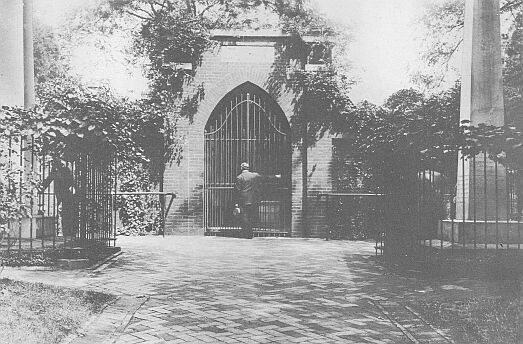
Resting-Place of George and Martha Washington at Mount Vernon
Dying December 14, 1799, the body of Washington Was placed, with
simple but impressive ceremonies, in the old family vault, from which
it was removed in 1831 to a tomb of plain brick construction, near a
wooded ravine a short distance from the house. Behind an iron grating
may be seen the two sarcophagi which contain the mortal remains of
George Washington and his wife, Martha.
General Washington was rather above the common size, his frame was
robust, and his constitution vigorous—capable of enduring great
fatigue, and requiring a considerable degree of exercise for the
preservation of his health. His exterior created in the beholder the
idea of strength, united with manly gracefulness.
And character.
His manners were rather reserved than free, though they partook
nothing of that dryness, and sternness, which accompany reserve when
carried to an extreme; and on all proper occasions, he could relax
sufficiently to show how highly he was gratified by the charms of
conversation, and the pleasures of society. His person and whole
deportment exhibited an unaffected and indescribable dignity,
unmingled with haughtiness, of which all who approached him were
sensible; and the attachment of those who possessed his friendship,
and enjoyed his intimacy, was ardent, but always respectful.
His temper was humane, benevolent, and conciliatory; but there was a
quickness in his sensibility to any thing apparently offensive, which
experience had taught him to watch, and to correct.
In the management of his private affairs he exhibited an exact yet
liberal economy. His funds were not prodigally wasted on capricious
and ill examined schemes, nor refused to beneficial though costly
improvements. They remained therefore competent to that expensive
establishment which his reputation, added to a hospitable temper, had
in some measure imposed upon him; and to those donations which real
distress has a right to claim from opulence.
He made no pretensions to that vivacity which fascinates, or to that
wit which dazzles, and frequently imposes on the understanding-More
solid than brilliant, judgment, rather than genius, constituted the
most prominent feature of his character.
Without making ostentatious professions of religion, he was a sincere
believer in the Christian faith, and a truly devout man.
As a military man, he was brave, enterprising, and cautious. That
malignity which was sought to strip him of all the higher qualities of
a General, has conceded to him personal courage, and a firmness of
resolution which neither dangers nor difficulties could shake. But
candour will allow him other great and valuable endowments. If his
military course does not abound with splendid achievements, it
exhibits a series of judicious measures adapted to circumstances,
which probably saved his country.
Placed, without having studied the theory, or been taught in the
school of experience the practice of war, at the head of an
undisciplined, ill organized multitude, which was impatient of the
restraints, and unacquainted with the ordinary duties of a camp,
without the aid of officers possessing those lights which the
Commander-in-chief was yet to acquire, it would have been a miracle
indeed had his conduct been absolutely faultless. But, possessing an
energetic and distinguishing mind, on which the lessons of experience
were never lost, his errors, if he committed any, were quickly
repaired; and those measures which the state of things rendered most
adviseable, were seldom, if ever, neglected. Inferior to his adversary
in the numbers, in the equipment, and in the discipline of his troops,
it is evidence of real merit that no great and decisive advantages
were ever obtained over him, and that the opportunity to strike an
important blow never passed away unused. He has been termed the
American Fabius; but those who compare his actions with his means,
will perceive at least as much of Marcellus as of Fabius, in his
character. He could not have been more enterprising, without
endangering the cause he defended, nor have put more to hazard,
without incurring justly the imputation of rashness. Not relying upon
those chances which sometimes give a favourable issue to attempts
apparently desperate, his conduct was regulated by calculations made
upon the capacities of his army, and the real situation of his
country. When called a second time to command the armies of the United
States, a change of circumstances had taken place, and he meditated a
corresponding change of conduct. In modelling the army of 1798, he
sought for men distinguished for their boldness of execution, not less
than for their prudence in counsel, and contemplated a system of
continued attack. "The enemy," said the General in his private
letters, "must never be permitted to gain foothold on our shores."
In his civil administration, as in his military career, ample and
repeated proofs were exhibited of that practical good sense, of that
sound judgment, which is perhaps the most rare, and is certainly the
most valuable quality of the human mind. Devoting himself to the
duties of his station, and pursuing no object distinct from the public
good, he was accustomed to contemplate at a distance those critical
situations in which the United States might probably be placed; and to
digest, before the occasion required action, the line of conduct which
it would be proper to observe. Taught to distrust first impressions,
he sought to acquire all the information which was attainable, and to
hear, without prejudice, all the reasons which could be urged for or
against a particular measure. His own judgment was suspended until it
became necessary to determine; and his decisions, thus maturely made,
were seldom if ever to be shaken. His conduct therefore was
systematic, and the great objects of his administration were steadily
pursued.
Respecting, as the first magistrate in a free government must ever do,
the real and deliberate sentiments of the people, their gusts of
passion passed over, without ruffling the smooth surface of his mind.
Trusting to the reflecting good sense of the nation for approbation
and support, he had the magnanimity to pursue its real interests, in
opposition to its temporary prejudices; and, though far from being
regardless of popular favour, he could never stoop to retain, by
deserving to lose it. In more instances than one, we find him
committing his whole popularity to hazard, and pursuing steadily, in
opposition to a torrent which would have overwhelmed a man of ordinary
firmness, that course which had been dictated by a sense of duty.
In speculation, he was a real republican, devoted to the constitution
of his country, and to that system of equal political rights on which
it is founded. But between a balanced republic and a democracy, the
difference is like that between order and chaos. Real liberty, he
thought, was to be preserved, only by preserving the authority of the
laws, and maintaining the energy of government. Scarcely did society
present two characters which, in his opinion, less resembled each
other, than a patriot and a demagogue.
No man has ever appeared upon the theatre of public action, whose
integrity was more incorruptible, or whose principles were more
perfectly free from the contamination of those selfish and unworthy
passions, which find their nourishment in the conflicts of party.
Having no views which required concealment, his real and avowed
motives were the same; and his whole correspondence does not furnish a
single case, from which even an enemy would infer that he was capable,
under any circumstances, of stooping to the employment of duplicity.
No truth can be uttered with more confidence than that his ends were
always upright, and his means always pure. He exhibits the rare
example of a politician to whom wiles were absolutely unknown, and
whose professions to foreign governments, and to his own countrymen,
were always sincere. In him was fully exemplified the real
distinction, which forever exists, between wisdom and cunning, and the
importance as well as truth of the maxim that "honesty is the best
policy."
If Washington possessed ambition, that passion was, in his bosom, so
regulated by principles, or controlled by circumstances, that it was
neither vicious, nor turbulent. Intrigue was never employed as the
means of its gratification, nor was personal aggrandizement its
object. The various high and important stations to which he was called
by the public voice, were unsought by himself; and, in consenting to
fill them, he seems rather to have yielded to a general conviction
that the interests of his country would be thereby promoted, than to
an avidity for power.
Neither the extraordinary partiality of the American people, the
extravagant praises which were bestowed upon him, nor the inveterate
opposition and malignant calumnies which he encountered, had any
visible influence upon his conduct. The cause is to be looked for in
the texture of his mind.
In him, that innate and unassuming modesty which adulation would have
offended, which the voluntary plaudits of millions could not betray
into indiscretion, and which never obtruded upon others his claims to
superior consideration, was happily blended with a high and correct
sense of personal dignity, and with a just consciousness of that
respect which is due to station. Without exertion, he could maintain
the happy medium between that arrogance which wounds, and that
facility which allows the office to be degraded in the person who
fills it.
It is impossible to contemplate the great events which have occurred
in the United States under the auspices of Washington, without
ascribing them, in some measure, to him. If we ask the causes of the
prosperous issue of a war, against the successful termination of which
there were so many probabilities? of the good which was produced, and
the ill which was avoided, during an administration fated to contend
with the strongest prejudices, that a combination of circumstances,
and of passions, could produce? of the constant favour of the great
mass of his fellow citizens, and of the confidence which, to the last
moment of his life, they reposed in him? the answer, so far as these
causes may be found in his character, will furnish a lesson well
meriting the attention of those who are candidates for political fame.
Endowed by nature with a sound judgment, and an accurate
discriminating mind, he feared not that laborious attention which made
him perfectly master of those subjects, in all their relations, on
which he was to decide: and this essential quality was guided by an
unvarying sense of moral right, which would tolerate the employment,
only, of those means that would bear the most rigid examination; by a
fairness of intention which neither sought nor required disguise: and
by a purity of virtue which was not only untainted, but unsuspected.