Differences between Great Britain and the United States....
Mr. Adams appointed minister to Great Britain....
Discontents excited by the commercial regulations of
Britain.... Parties in the United States.... The convention
at Annapolis.... Virginia appoints deputies to a convention
at Philadelphia.... General Washington chosen one of
them.... Insurrection at Massachusetts.... Convention at
Philadelphia.... A form of government submitted to the
respective states, as ratified by eleven of them....
Correspondence of General Washington respecting the chief
magistracy.... He is elected president.... Meeting of the
first congress.
1783 to 1787
While the friends of the national government were making these
unavailing efforts to invest it with a revenue which might enable it
to preserve the national faith, many causes concurred to prepare the
public mind for some great and radical change in the political system
of America.
Misunderstandings between Great Britain and the United
States.
Scarcely had the war of the revolution terminated, when the United
States and Great Britain reciprocally charged each other with
violations of the treaty of peace. On the construction of that part of
the seventh article which stipulates against the "destruction or
carrying away of any negroes, or other property of the American
inhabitants," a serious difference of opinion prevailed which could
not be easily accommodated. As men seldom allow much weight to the
reasoning of an adversary, the construction put upon that article by
the cabinet of London was generally treated in America as a mere
evasion; and the removal of the negroes who had joined the British
army on the faith of a proclamation offering them freedom, was
considered as a flagrant breach of faith. In addition to this
circumstance, the troops of his Britannic Majesty still retained
possession of the posts on the American side of the great lakes. As
those posts gave their possessors a decided influence over the warlike
tribes of Indians in their neighbourhood, this was a subject to which
the United States were peculiarly sensible.
On the other hand, the United States were charged with infringing the
fourth, fifth, and sixth articles, which contain agreements respecting
the payment of debts, the confiscation of property, and prosecution of
individuals for the part taken by them during the war.
On the 14th of January, 1784, the day on which the definitive articles
were ratified, congress passed a resolution containing a
recommendation in the words of the treaty, respecting confiscated
property, which was transmitted without delay to the several states.
They considered this resolution as merely formal; and contended that
neither the American nor the British government expected from it any
beneficial results. But other stipulations which are explicit, the
performance of which was not to rest on the recommendation of the
government, especially that respecting the payment of debts, were also
neglected. These causes of mutual complaint being permitted to rankle
for some time in the bosoms of both nations, produced a considerable
degree of irritation. The British merchants had large credits in
America. Those engaged in the colonial trade had been nearly ruined by
the rupture between the two countries; and, without taking into the
account the embarrassments in which the war had involved their
debtors, they calculated, after the restoration of peace, on the
prompt collection of the vast sums which were due to them. But the
impediments to the recovery of debts were, in many instances,
permitted to remain; and the dispositions manifested by those states
in which they were chiefly due, did not authorize a belief that any
favourable change of measures was about to take place. The complaints
of the creditors were loud and incessant. They openly charged the
American government with violating the most solemn obligations which
public and private contract could create; and this charge affected the
national character the more seriously, because the terms of the treaty
were universally deemed highly advantageous to the United States. The
recriminations on the part of individuals in America, were also
uttered with the angry vehemence of men who believe themselves to be
suffering unprovoked injuries. The negroes in possession of the
British armies at the restoration of peace, belonged, in many cases,
to actual debtors; and in all, to persons who required the labour of
which they were thus deprived, to repair the multiplied losses
produced by the war. To the detention of the posts on the lakes was
ascribed the hostile temper manifested by the Indians; and thus, to
the indignity of permitting a foreign power to maintain garrisons
within the limits of the nation, were superadded the murders
perpetrated by the savages, and the consequent difficulty of settling
the fertile and vacant lands of the west.[28] On the north-eastern
frontier too, the British were charged with making encroachments on
the territory of the United States. On that side, the river St. Croix,
from its source to its mouth in the bay of Passamaquoddy, is the
boundary between the two nations. Three rivers of that name empty into
the bay. The Americans claimed the most eastern, as the real St.
Croix, while settlements were actually made under the authority of the
government of Nova Scotia to the middle river, and the town of St.
Andrews was established on its banks.
Mr. Adams appointed to negotiate with the British cabinet.
But the cause of most extensive disquiet was the rigorous commercial
system pursued by Great Britain. While colonists, the Americans had
carried on a free and gainful trade with the British West Indies.
Those ports were closed against them as citizens of an independent
state; and their accustomed intercourse with other parts of the empire
also was interrupted by the navigation act. To explore new channels
for the commerce of the nation was, in the actual state of things,
opposed by obstacles which almost discouraged the attempt. On every
side they met with rigorous and unlooked for restrictions. Their trade
with the colonies of other powers, as well as with those of England,
was prohibited; and in all the ports of Europe they encountered
regulations which were extremely embarrassing. From the Mediterranean,
they were excluded by the Barbary powers, whose hostility they had no
force to subdue, and whose friendship they had no money to purchase.
Thus, the characteristic enterprise of their merchants, which, in
better times, has displayed their flag in every ocean, was then in a
great measure restrained from exerting itself by the scantiness of
their means. These commercial difficulties suggested the idea of
compelling Great Britain to relax the rigour of her system, by
opposing it with regulations equally restrictive; but to render
success in such a conflict possible, it was necessary that the whole
power of regulating commerce should reside in a single legislature.
Few were so sanguine as to hope that thirteen independent governments,
jealous of each other, could be induced to concur for a length of
time, in measures capable of producing the desired effect. With many,
therefore, the desire of counteracting a system which appeared to them
so injurious, triumphed over their attachment to state sovereignty;
and the converts to the opinion that congress ought to be empowered to
regulate trade, were daily multiplied. Meanwhile, the United States
were unremitting in their endeavours to form commercial treaties in
Europe. Three commissioners had been appointed for that purpose; and
at length, as the trade with England was peculiarly important, and the
growing misunderstandings between the two countries threatened serious
consequences should their adjustment be much longer delayed, Mr. John
Adams was appointed minister plenipotentiary to the court of St.
James. His endeavours to form a commercial treaty were not successful.
His overtures were declined by the cabinet of London, because the
government of the United States was unable to secure the observance of
any general commercial regulations; and it was deemed unwise to enter
into stipulations which could not be of reciprocal obligation. In
fact, it is not probable that, had even this difficulty been
surmounted, Britain could have been induced to grant advantages that
would have been satisfactory to America. The latter expected great
relaxations of the navigation act, and a free admission into the
colonies of the former; and believed its commerce of sufficient
importance to obtain these objects, if it could be regulated by a
single legislature. The reflecting part of America did not require
this additional evidence of the sacrifice which had been made of
national interest on the altars of state jealousy, to demonstrate the
defectiveness of the existing system. On the mind of no person had
this impression been more strongly made, than on that of General
Washington. His extensive correspondence bears ample testimony to the
solicitude with which he contemplated the proceedings of the states on
this interesting subject.
The opinion he sought to inculcate was, that the trade between the
United States and Great Britain was equally important to each; and
therefore, that a commercial intercourse between the two nations might
be established on equal terms, if the political arrangements in
America would enable its government to guard its interests; but
without such arrangements, those interests could not be protected, and
America must appear in a very contemptible point of view to those with
whom she was endeavouring to form commercial treaties, without
possessing the means of carrying them into effect:—who "must see and
feel that the union, or the states individually are sovereign as best
suits their purposes:—in a word, that we are one nation to day, and
thirteen to-morrow. Who," he added, "will treat with us on such
terms?"
About this time, General Washington received a long and affectionate
letter from the Marquis de Lafayette, who had just returned from a
tour through the north of Europe. In communicating the occurrences at
the courts he had visited, and especially at that of Prussia, whose
aged and distinguished monarch, uniting the acquirements of the
scholar and the statesman with the most profound skill in the art of
war, could confer either literary or military fame, he dwelt with
enthusiasm on the plaudits which were universally bestowed on his
military patron and paternal friend. "I wish," he added, "the other
sentiments I have had occasion to discover with respect to America,
were equally satisfactory with those that are personal to yourself. I
need not say that the spirit, the firmness, with which the revolution
was conducted, has excited universal admiration:—That every friend to
the rights of mankind is an enthusiast for the principles on which
those constitutions are built:—but I have often had the mortification
to hear, that the want of powers in congress, of union between the
states, of energy in their government, would make the confederation
very insignificant. By their conduct in the revolution," he added,
"the citizens of America have commanded the respect of the world; but
it grieves me to think they will in a measure lose it, unless they
strengthen the confederation, give congress power to regulate their
trade, pay off their debt, or at least the interest of it, establish a
well regulated militia, and, in a word, complete all those measures
which you have recommended to them."
"Unhappily for us," said the general in reply, "though the reports you
mention are greatly exaggerated, our conduct has laid the foundation
for them. It is one of the evils of democratic governments, that the
people, not always seeing, and frequently misled, must often feel
before they act right. But evils of this nature seldom fail to work
their own cure. It is to be lamented, nevertheless, that the remedies
are so slow, and that those who wish to apply them seasonably, are not
attended to before they suffer in person, in interest, and in
reputation. I am not without hopes that matters will soon take a
favourable turn in the federal constitution. The discerning part of
the community have long since seen the necessity of giving adequate
powers to congress for national purposes, and those of a different
description must yield to it ere long."
Discontents of the Americans against the commercial
regulations of Britain.
While the recommendation of the 30th of April, 1784, was before the
states, many causes contributed to diffuse through the community such
a general dissatisfaction with the existing state of things, as to
prepare the way for some essential change in the American system. In
the course of the long war which had been carried on in the bosom of
their country, the people of the United States had been greatly
impoverished. Their property had been seized for the support of both
armies; and much of their labour had been drawn from agriculture for
the performance of military service. The naval power of their enemy
had almost annihilated their commerce; from which resulted the
two-fold calamity, that imported commodities were enhanced to an
enormous price, while those for exportation were reduced much below
their ordinary value. The inevitable consequence was, that those
consumable articles which habit had rendered necessary, were
exhausted; and peace found the American people, not only destitute of
the elegancies, and even of the conveniences of life, but also without
the means of procuring them, otherwise than by anticipating the
proceeds of future industry. On opening their ports, an immense
quantity of foreign merchandise was introduced into the country, and
they were tempted by the sudden cheapness of imported goods, and by
their own wants, to purchase beyond their capacities for payment. Into
this indiscretion, they were in some measure beguiled by their own
sanguine calculations on the value which a free trade would bestow on
the produce of their soil, and by a reliance on those evidences of the
public debt which were in the hands of most of them. So extravagantly
too did many estimate the temptation which equal liberty and vacant
lands would hold out to emigrants from the old world, as to entertain
the opinion that Europe was about to empty itself into America, and
that the United States would derive from that source such an increase
of population, as would enhance their lands to a price heretofore not
even conjectured. Co-operating with the cause last mentioned, was the
impression which had been made by paper money on public morals, and on
public opinion. It had not escaped observation that every purchaser on
credit, however excessive the price might apparently be, had not only
been relieved by the depreciation, but had derived great gains from
his contract. Speculating on a similar course of things, many
individuals had made extensive purchases at high prices; and had thus
contributed to continue for a time, the deception imposed on
themselves by those who supposed that the revolution was a talisman,
whose magic powers were capable of changing the nature of things. The
delusive hopes created by these visionary calculations were soon
dissipated, and a great proportion of the inhabitants found themselves
involved in debts they were unable to discharge. One of the
consequences resulting from this unprosperous state of things was a
general discontent with the course of trade. It had commenced with the
native merchants of the north, who found themselves incapable of
contending in their own ports with foreigners; and was soon
communicated to others. The gazettes of Boston contained some very
animated and angry addresses, which produced resolutions for the
government of the citizens of that town, applications to their state
legislature, a petition to congress, and a circular letter to the
merchants of the several sea-ports throughout the United States. After
detailing the disadvantages under which the trade and navigation of
America laboured, and expressing their confidence that the necessary
powers to the federal government would be soon, if not already,
delegated, the petition to congress thus concludes: "Impressed with
these ideas, your petitioners beg leave to request of the very august
body which they have now the honour to address, that the numerous
impositions of the British, on the trade and exports of these states,
may be forthwith contravened by similar expedients on our part: else
may it please your excellency and honours, the commerce of this
country, and of consequence its wealth, and perhaps the union itself,
may become victims to the artifice of a nation whose arms have been in
vain exerted to accomplish the ruin of America."
The merchants of the city of Philadelphia presented a memorial to the
legislature of that state, in which, after lamenting it as a
fundamental defect in the constitution that full and entire power over
the commerce of the United States had not been originally vested in
congress, "as no concern common to many could be conducted to a good
end, but by a unity of councils;" they say, "hence it is that the
intercourses of the states are liable to be perplexed and injured by
various and discordant regulations, instead of that harmony of
measures on which the particular, as well as general interests depend;
productive of mutual disgusts, and alienation among the several
members of the empire.
"But the more certain inconveniences foreseen and now experimentally
felt, flow from the unequal footing this circumstance puts us on with
other nations, and by which we stand in a very singular and
disadvantageous situation; for while the whole of our trade is laid
open to these nations, they are at liberty to limit us to such
branches of theirs as interest or policy may dictate:—unrestrained by
any apprehensions, as long as the power remains severally with the
states, of being met and opposed by any consistent and effectual
restrictions on our part."
This memorial prayed that the legislature would endeavour to procure
from congress, a recommendation to the several states, to vest in that
body the necessary powers over the commerce of the United States.
It was immediately taken into consideration, and resolutions were
passed conforming to its prayer. Similar applications were made by
other commercial towns.
From these proceedings, and from the general representations made by
the American merchants, General Washington had augured the most happy
effects.
In a letter to the Marquis de Lafayette, he thus expressed his hope of
the consequences which would attend the efforts then making to enlarge
the powers of congress. "However unimportant America may be considered
at present, and however Britain may affect to despise her trade, there
will assuredly come a day when this country will have some weight in
the scale of empires."
But a concurrence of the states in granting to the general government
the beneficial powers in question, was not so near being effected as
was hoped by its friends. A resolution was moved in congress,
recommending it to the several states to vest in that body full
authority to regulate their commerce, both external and internal, and
to impose such duties as might be necessary for that purpose. This
power was to be fettered with several extraordinary limitations, which
might render it more acceptable to the governments who were asked to
bestow it, among which was a provision that the duties should be
"collectible under the authority, and accrue to the use of the state
in which the same should be made payable." Notwithstanding these
restrictions, marking the keen sighted jealousy with which any
diminution of state sovereignty was watched, this resolution
encountered much opposition even in congress.
During these transactions, the public attention was called to another
subject which served to impress still more powerfully on every
reflecting mind, the necessity of enlarging the powers of the general
government, were it only to give efficacy to those which in theory it
already possessed.
The uneasiness occasioned by the infractions of the treaty of peace on
the part of Great Britain, has been already noticed. To obtain its
complete execution, constituted one of the objects for which Mr. Adams
had been deputed to the court of St. James. A memorial presented by
that minister in December, 1785, urging the complaints of America, and
pressing for a full compliance with the treaty, was answered by an
enumeration of the violations of that compact on the part of the
United States. The Marquis of Carmarthen acknowledged explicitly the
obligation created by the seventh article to withdraw the British
garrisons from every post within the United States; but insisted that
the obligation created by the fourth article, to remove every lawful
impediment to the recovery of bona fide debts, was equally clear and
explicit.
"The engagements entered into by a treaty ought," he said, "to be
mutual, and equally binding on the respective contracting parties. It
would, therefore, be the height of folly as well as injustice, to
suppose one party alone obliged to a strict observance of the public
faith, while the other might remain free to deviate from its own
engagements as often as convenience might render such deviation
necessary, though at the expense of its own credit and importance."
He concluded with the assurance, "that whenever America should
manifest a real determination to fulfil her part of the treaty, Great
Britain would not hesitate to prove her sincerity to co-operate in
whatever points depended upon her, for carrying every article of it
into real and complete effect."
This letter was accompanied by a statement of the infractions of the
fourth article.
Copies of both documents were immediately transmitted by Mr. Adams to
congress, by whom they were referred to Mr. Jay, the secretary for
foreign affairs. The report of that upright minister did not, by
contravening facts, affect to exculpate his country. "Some of the
facts," said he in a letter to General Washington, written after
permission to communicate the papers had been given, "are inaccurately
stated and improperly coloured; but it is too true that the treaty has
been violated. On such occasions, I think it better fairly to confess
and correct errors, than attempt to deceive ourselves and others, by
fallacious though plausible palliations and excuses.
"To oppose popular prejudices, to censure the proceedings and expose
the impropriety of states, is an unpleasant task, but it must be
done."[29]
That the United States might with reason be required to fulfil the
treaty before they could entitle themselves to demand a strict
performance of it on the part of Great Britain, was a position the
propriety of which they were prevented from contesting by the
miserably defective organization of the government. If their treaties
were obligatory in theory, the inability of congress to enforce their
execution had been demonstrated in practice. Restrained by this defect
in the constitution from insisting that the evacuation of the western
posts should precede the removal of the impediments to the bona fide
execution of the treaty on the part of America, government exerted its
earnest endeavours to prevail on the several states to repeal all
existing laws which might be repugnant to that compact. The
resolutions which were passed on that subject, and the circular
letters which accompanied them to the several governors, contain
arguments which ought to have demonstrated to all, the constitutional
obligation of a treaty negotiated under the authority of congress, and
the real policy, as well as the moral duty of faithfully executing
that which had been formed with Great Britain. To the deep
mortification of those who respected the character of the nation,
these earnest representations did not produce the effect which was
expected from them. "It was impolitic and unfortunate, if not unjust
in these states," said General Washington to a member of congress by
whom the objectionable conduct of America was first intimated to him,
"to pass laws which by fair construction might be considered as
infractions of the treaty of peace. It is good policy at all times to
place one's adversary in the wrong. Had we observed good faith, and
the western posts had been withheld from us by Great Britain, we might
have appealed to God and man for justice."
"What a misfortune it is," said he in reply to the secretary for
foreign affairs, "that the British should have so well grounded a
pretext for their palpable infractions, and what a disgraceful part,
out of the choice of difficulties before us, are we to act!"
Rise of parties in the United States.
The discontents arising from the embarrassments in which individuals
were involved, continued to increase. At length, two great parties
were formed in every state, which were distinctly marked, and which
pursued distinct objects, with systematic arrangement.
The one struggled with unabated zeal for the exact observance of
public and private engagements. By those belonging to it, the faith of
a nation, or of a private man was deemed a sacred pledge, the
violation of which was equally forbidden by the principles of moral
justice, and of sound policy. The distresses of individuals were, they
thought, to be alleviated only by industry and frugality, not by a
relaxation of the laws, or by a sacrifice of the rights of others.
They were consequently the uniform friends of a regular administration
of justice, and of a vigorous course of taxation which would enable
the state to comply with its engagements. By a natural association of
ideas, they were also, with very few exceptions, in favour of
enlarging the powers of the federal government, and of enabling it to
protect the dignity and character of the nation abroad, and its
interests at home.
The other party marked out for themselves a more indulgent course.
Viewing with extreme tenderness the case of the debtor, their efforts
were unceasingly directed to his relief. To exact a faithful
compliance with contracts was, in their opinion, a harsh measure which
the people would not bear. They were uniformly in favour of relaxing
the administration of justice, of affording facilities for the payment
of debts, or of suspending their collection, and of remitting taxes.
The same course of opinion led them to resist every attempt to
transfer from their own hands into those of congress, powers, which by
others were deemed essential to the preservation of the union. In many
of these states, the party last mentioned, constituted a decided
majority of the people; and in all of them, it was very powerful. The
emission of paper money, the delay of legal proceedings, and the
suspension of the collection of taxes, were the fruits of their rule
wherever they were completely predominant. Even where they failed to
carry their measures, their strength was such as to encourage the hope
of succeeding in a future attempt; and annual elections held forth to
them the prospect of speedily repairing the loss of a favourite
question. Throughout the union, the contest between these parties was
periodically revived; and the public mind was perpetually agitated
with hopes and fears on subjects which essentially affected the
fortunes of a considerable proportion of the society.
These contests were the more animated, because, in the state
governments generally, no principle had been introduced which could
resist the wild projects of the moment, give the people an opportunity
to reflect, and allow the good sense of the nation time for exertion.
This uncertainty with respect to measures of great importance to every
member of the community, this instability in principles which ought,
if possible, to be rendered immutable, produced a long train of ills;
and is seriously believed to have been among the operating causes of
those pecuniary embarrassments, which, at that time, were so general
as to influence the legislation of almost every state in the union.
Its direct consequence was the loss of confidence in the government,
and in individuals. This, so far as respected the government, was
peculiarly discernible in the value of state debts.
The war having been conducted by nations in many respects independent
of each other, the debts contracted in its prosecution were due, in
part from the United States, and in part from the individual states
who became immediately responsible to the creditors, retaining their
claim against the government of the union for any balances which might
appear to be due on a general settlement of accounts.
That the debt of the United States should have greatly depreciated
will excite no surprise, when it is recollected that the government of
the union possessed no funds, and, without the assent of jealous and
independent sovereigns, could acquire none, to pay the accruing
interest: but the depreciation of the debt due from those states which
made an annual and adequate provision for the interest, can be
ascribed only to a want of confidence in governments which were
controlled by no fixed principles; and it is therefore not entirely
unworthy of attention. In many of those states which had repelled
every attempt to introduce into circulation a depreciated medium of
commerce, or to defeat the annual provision of funds for the payment
of the interest, the debt sunk in value to ten, five, and even less
than four shillings in the pound. However unexceptionable might be the
conduct of the existing legislature, the hazard from those which were
to follow was too great to be encountered without an immense premium.
In private transactions, an astonishing degree of distrust also
prevailed. The bonds of men whose ability to pay their debts was
unquestionable, could not be negotiated but at a discount of thirty,
forty, and fifty per centum: real property was scarcely vendible;
and sales of any article for ready money could be made only at a
ruinous loss. The prospect of extricating the country from these
embarrassments was by no means flattering. Whilst every thing else
fluctuated, some of the causes which produced this calamitous state of
things were permanent. The hope and fear still remained, that the
debtor party would obtain the victory at the elections; and instead of
making the painful effort to obtain relief by industry and economy,
many rested all their hopes on legislative interference. The mass of
national labour, and of national wealth, was consequently diminished.
In every quarter were found those who asserted it to be impossible for
the people to pay their public or private debts; and in some
instances, threats were uttered of suspending the administration of
justice by violence.
By the enlightened friends of republican government, this gloomy state
of things was viewed with deep chagrin. Many became apprehensive that
those plans from which so much happiness to the human race had been
anticipated, would produce only real misery; and would maintain but a
short and a turbulent existence. Meanwhile, the wise and thinking part
of the community, who could trace evils to their source, laboured
unceasingly to inculcate opinions favourable to the incorporation of
some principles into the political system, which might correct the
obvious vices, without endangering the free spirit of the existing
institutions.
While the advocates for union were exerting themselves to impress its
necessity on the public mind, measures were taken in Virginia, which,
though originating in different views, terminated in a proposition for
a general convention to revise the state of the union.
To form a compact relative to the navigation of the rivers Potomac and
Pocomoke, and of part of the bay of Chesapeake, commissioners were
appointed by the legislatures of Virginia and Maryland, who assembled
in Alexandria, in March, 1785. While at Mount Vernon on a visit, they
agreed to propose to their respective governments, the appointment of
other commissioners, with power to make conjoint arrangements, to
which the assent of congress was to be solicited, for maintaining a
naval force in the Chesapeake; and to establish a tariff of duties on
imports, to which the laws of both states should conform. When these
propositions received the assent of the legislature of Virginia, an
additional resolution was passed, directing that which respected the
duties on imports to be communicated to all the states in the union,
who were invited to send deputies to the meeting.
On the 21st of January, 1786, a few days after the passage of these
resolutions, another was adopted appointing certain commissioners,[30]
"who were to meet such as might be appointed by the other states in
the union, at a time and place to be agreed on, to take into
consideration the trade of the United States; to examine the relative
situation and trade of the said states; to consider how far a uniform
system in their commercial relations may be necessary to their common
interest, and their permanent harmony; and to report to the several
states such an act relative to this great object, as, when unanimously
ratified by them, will enable the United States in congress assembled
effectually to provide for the same."
In the circular letter transmitting these resolutions to the
respective states, Annapolis in Maryland was proposed as the place,
and the ensuing September as the time of meeting.
Before the arrival of the period at which these commissioners were to
assemble, the idea was carried by those who saw and deplored the
complicated calamities which flowed from the intricacy of the general
government, much further than was avowed by the resolution of
Virginia. "Although," said one of the most conspicuous patriots[31] of
the revolution, in a letter to General Washington, dated the 16th of
March, 1786, "you have wisely retired from public employments, and
calmly view from the temple of fame, the various exertions of that
sovereignty and independence which Providence has enabled you to be so
greatly and gloriously instrumental in securing to your country, yet I
am persuaded you can not view them with the eye of an unconcerned
spectator.
"Experience has pointed out errors in our national government which
call for correction, and which threaten to blast the fruit we expected
from our tree of liberty. The convention proposed by Virginia may do
some good, and would perhaps do more, if it comprehended more objects.
An opinion begins to prevail that a general convention for revising
the articles of confederation would be expedient. Whether the people
are yet ripe for such a measure, or whether the system proposed to be
attained by it is only to be expected from calamity and commotion, is
difficult to ascertain.
"I think we are in a delicate situation, and a variety of
considerations and circumstances give me uneasiness. It is in
contemplation to take measures for forming a general convention. The
plan is not matured. If it should be well connected and take effect, I
am fervent in my wishes that it may comport with the line of life you
have marked out for yourself, to favour your country with your
counsels on such an important and single occasion. I suggest this
merely as a hint for consideration."
In the moment of tranquillity, and of real or imaginary security, the
mind delights to retrace the intricate path by which this point of
repose has been attained. The patriots who accomplished that great
revolution which has given to the American people a national
government capable of maintaining the union of the states, and of
preserving republican liberty, must be gratified with the review of
that arduous and doubtful struggle, which terminated in the triumph of
human reason, and the establishment of that government. Even to him
who was not an actor in the busy scene, who enjoys the fruits of the
labour without participating in the toils or the fears of the patriots
who have preceded him, the sentiments entertained by the most
enlightened and virtuous of America at the eventful period between the
restoration of peace and the adoption of our present free and
effective constitution, can not be uninteresting.
"Our affairs," said the same gentleman in a letter of the 27th of
June, "seem to lead to some crisis, some revolution—something that I
can not foresee or conjecture. I am uneasy and apprehensive, more so
than during the war. Then, we had a fixed object, and though the
means and time of obtaining it were often problematical, yet I did
firmly believe that we should ultimately succeed, because I did firmly
believe that justice was with us. The case is now altered; we are
going, and doing wrong, and therefore I look forward to evils and
calamities, but without being able to guess at the instrument, nature,
or measure of them.
"That we shall again recover, and things again go well, I have no
doubt. Such a variety of circumstances would not, almost miraculously,
have combined to liberate and make us a nation, for transient and
unimportant purposes. I therefore believe we are yet to become a great
and respectable people—but when or how, only the spirit of prophecy
can discern.
"There doubtless is much reason to think and to say that we are
wofully, and, in many instances, wickedly misled. Private rage for
property suppresses public considerations, and personal rather than
national interests have become the great objects of attention.
Representative bodies will ever be faithful copies of their originals,
and generally exhibit a chequered assemblage of virtue and vice, of
abilities and weakness. The mass of men are neither wise nor good, and
the virtue, like the other resources of a country, can only be drawn
to a point by strong circumstances, ably managed, or strong
governments, ably administered. New governments have not the aid of
habit and hereditary respect, and being generally the result of
preceding tumult and confusion, do not immediately acquire stability
or strength. Besides, in times of commotion, some men will gain
confidence and importance who merit neither; and who, like political
mountebanks, are less solicitous about the health of the credulous
crowd, than about making the most of their nostrums and prescriptions.
"What I most fear is, that the better kind of people (by which I mean
the people who are orderly and industrious, who are content with their
situations, and not uneasy in their circumstances) will be led by the
insecurity of property, the loss of confidence in their rulers, and
the want of public faith and rectitude, to consider the charms of
liberty as imaginary and delusive. A state of uncertainty and
fluctuation must disgust and alarm such men, and prepare their minds
for almost any change that may promise them quiet and security."
To this interesting letter, General Washington made the following
reply: "Your sentiments that our affairs are drawing rapidly to a
crisis, accord with my own. What the event will be is also beyond the
reach of my foresight. We have errors to correct; we have probably had
too good an opinion of human nature in forming our confederation.
Experience has taught us that men will not adopt and carry into
execution measures the best calculated for their own good, without the
intervention of coercive power. I do not conceive we can exist long as
a nation, without lodging somewhere a power which will pervade the
whole union in as energetic a manner, as the authority of the state
governments extends over the several states. To be fearful of
investing congress, constituted as that body is, with ample
authorities for national purposes, appears to me the very climax of
popular absurdity and madness. Could congress exert them for the
detriment of the people, without injuring themselves in an equal or
greater proportion? Are not their interests inseparably connected with
those of their constituents? By the rotation of appointment, must they
not mingle frequently with the mass of citizens? Is it not rather to
be apprehended, if they were possessed of the powers before described,
that the individual members would be induced to use them, on many
occasions, very timidly and inefficaciously, for fear of losing their
popularity and future election? We must take human nature as we find
it: perfection falls not to the share of mortals. Many are of opinion
that congress have too frequently made use of the suppliant humble
tone of requisition in applications to the states, when they had a
right to assert their imperial dignity, and command obedience. Be that
as it may, requisitions are a perfect nullity, where thirteen
sovereign, independent, disunited states, are in the habit of
discussing, and refusing or complying with them at their option.
Requisitions are actually little better than a jest and a bye-word
throughout the land. If you tell the legislatures they have violated
the treaty of peace, and invaded the prerogatives of the confederacy,
they will laugh in your face. What then is to be done? Things can not
go on in the same train for ever. It is much to be feared, as you
observe, that the better kind of people, being disgusted with these
circumstances, will have their minds prepared for any revolution
whatever. We are apt to run from one extreme into another. To
anticipate and prevent disastrous contingencies, would be the part of
wisdom and patriotism.
"What astonishing changes a few years are capable of producing! I am
told that even respectable characters speak of a monarchical form of
government without horror. From thinking, proceeds speaking, thence to
acting is often but a single step. But how irrevocable and tremendous!
what a triumph for our enemies to verify their predictions!—what a
triumph for the advocates of despotism to find that we are incapable
of governing ourselves, and that systems founded on the basis of equal
liberty are merely ideal and fallacious! Would to God that wise
measures may be taken in time to avert the consequences we have but
too much reason to apprehend.
"Retired as I am from the world, I frankly acknowledge I can not feel
myself an unconcerned spectator. Yet having happily assisted in
bringing the ship into port, and having been fairly discharged, it is
not my business to embark again on a sea of troubles.
"Nor could it be expected that my sentiments and opinions would have
much weight on the minds of my countrymen.—They have been neglected,
though given as a last legacy in the most solemn manner.—I had then
perhaps some claims to public attention.—I consider myself as having
none at present."
The convention at Annapolis.
The convention at Annapolis was attended by commissioners from only
six states.[32] These, after appointing Mr. Dickinson their chairman,
proceeded to discuss the objects for which they had convened.
Perceiving that more ample powers would be required to effect the
beneficial purposes which they contemplated, and hoping to procure a
representation from a greater number of states, the convention
determined to rise without coming to any specific resolutions on the
particular subject which had been referred to them. Previous to their
adjournment, however, they agreed on a report to be made to their
respective states, in which they represented the necessity of
extending the revision of the federal system to all its defects, and
recommended that deputies for that purpose be appointed by the several
legislatures, to meet in convention in the city of Philadelphia, on
the second day of the ensuing May.
The reasons for preferring a convention to a discussion of this
subject in congress were stated to be, "that in the latter body, it
might be too much interrupted by the ordinary business before them,
and would, besides, be deprived of the valuable counsels of sundry
individuals who were disqualified by the constitution or laws of
particular states, or by peculiar circumstances, from a seat in that
assembly."
A copy of this report was transmitted to congress in a letter from the
chairman, stating the inefficacy of the federal government, and the
necessity of devising such further provisions as would render it
adequate to the exigencies of the union.
Virginia appoints deputies to meet those of other states at
Philadelphia for the purpose of revising the federal system.
On receiving this report, the legislature of Virginia passed an act
for the appointment of deputies to meet such as might be appointed by
other states; to assemble in convention at Philadelphia, at the time,
and for the purposes, specified in the recommendation from the
convention which had met at Annapolis.
In communicating this act to General Washington, its principal
advocate[33] thus intimated the intention of aiding it by the
influence and character of the chief of the revolution. "It has been
thought adviseable to give the subject a very solemn dress, and all
the weight which could be derived from a single state. This idea will
also be pursued in the selection of characters to represent Virginia
in the federal convention. You will infer our earnestness on this
point, from the liberty which will be used of placing your name at the
head of them. How far this liberty may correspond with the ideas by
which you ought to be governed, will be best decided where it must
ultimately be decided. In every event it will assist powerfully in
marking the zeal of our legislature, and its opinion of the magnitude
of the occasion."
"Although," said the general in reply, "I have bid a public adieu to
the public walks of life, and had resolved never more to tread that
theatre; yet, if upon an occasion so interesting to the well being of
the confederacy, it had been the wish of the assembly that I should be
an associate in the business of revising the federal system, I should
from a sense of the obligation I am under for repeated proofs of
confidence in me, more than from any opinion I could entertain of my
usefulness, have obeyed its call; but it is now out of my power to do
this with any degree of consistency—the cause I will mention.
"I presume you heard, sir, that I was first appointed, and have since
been rechosen president of the society of the Cincinnati; and you may
have understood also, that the triennial general meeting of this body
is to be held in Philadelphia the first Monday in May next. Some
particular reasons combining with the peculiar situation of my private
concerns, the necessity of paying attention to them, a wish for
retirement and relaxation from public cares, and rheumatic pains which
I begin to feel very sensibly, induced me, on the 31st ultimo, to
address a circular letter to each state society, informing them of my
intention not to be at the next meeting, and of my desire not to be
rechosen president. The vice-president is also informed of this, that
the business of the society may not be impeded by my absence. Under
these circumstances, it will readily be perceived that I could not
appear at the same time and place on any other occasion, without
giving offence to a very respectable and deserving part of the
community—the late officers of the American army."
Washington chosen one of them.
Notwithstanding this letter, the name of General Washington was not
withdrawn, and he was unanimously chosen a member of the convention.
On receiving private information of this appointment, he addressed a
second letter to his confidential friend, in which he detailed more at
large, the motives which induced him to decline a service, the
importance of which he felt sensibly, and which he would willingly
have undertaken but for the peculiar circumstances which were stated.
His name, however, was continued in the appointment. The gloomy aspect
of affairs in the north rendered this the more necessary, and it was
thus explained by his correspondent. "I have considered well the
circumstances which it (your letter) confidentially discloses, as well
as those contained in your preceding favour. The difficulties which
they oppose to an acceptance of the appointment in which you are
included, can as little be denied, as they can fail to be regretted.
But I still am inclined to think, that the posture of our affairs, if
it should continue, would prevent any criticism on the situation which
the contemporary meetings would place you in; and wish that at least a
door could be kept open for your acceptance hereafter, in case the
gathering clouds should become so dark and menacing as to supersede
every consideration but that of our national existence or safety. A
suspense of your ultimate determination would be nowise inconvenient
in a public view, as the executive are authorized to fill vacancies,
and can fill them at any time; and in any event, three out of seven
deputies are authorized to represent the state. How far it may be
admissible in another view, will depend perhaps in some measure on the
chance of your finally undertaking the service, but principally on the
correspondence which is now passing on the subject, between yourself
and the governor."
The governor of Virginia,[34] who was himself also elected to the
convention, transmitted to General Washington the act, and the vote of
the assembly in the following letter. "By the enclosed act you will
readily discover that the assembly are alarmed at the storms which
threaten the United States. What our enemies have foretold seems to be
hastening to its accomplishment, and can not be frustrated but by an
instantaneous, zealous, and steady union among the friends of the
federal government. To you I need not press our present dangers. The
inefficiency of congress you have often felt in your official
character; the increasing languor of our associated republics you
hourly see; and a dissolution would be, I know, to you, a source of
the deepest mortification.
"I freely then entreat you to accept the unanimous appointment of the
general assembly to the convention at Philadelphia. For the gloomy
prospect still admits one ray of hope, that those who began, carried
on, and consummated the revolution, can yet rescue America from the
impending ruin."
"Sensible as I am," said the general in reply, "of the honour
conferred on me by the general assembly of this commonwealth, in
appointing me one of the deputies to a convention proposed to be held
in the city of Philadelphia in May next, for the purpose of revising
the federal constitution; and desirous as I am on all occasions of
testifying a ready obedience to the calls of my country—yet, sir,
there exist at this moment, circumstances which I am persuaded will
render this fresh instance of confidence incompatible with other
measures which I had previously adopted, and from which seeing little
prospect of disengaging myself, it would be disingenuous not to
express a wish that some other character, on whom greater reliance can
be had, may be substituted in my place, the probability of my
non-attendance being too great to continue my appointment.
"As no mind can be more deeply impressed than mine is with the
critical situation of our affairs, resulting in a great measure from
the want of efficient powers in the federal head, and due respect to
its ordinances, so consequently those who do engage in the important
business of removing these defects, will carry with them every good
wish of mine, which the best dispositions towards their attainment can
bestow."
The executive, unwilling to relinquish the advantages which the
legislature had expected to derive from exhibiting the name of
Washington at the head of the Virginia delegation, refused to consider
him as having declined the appointment. That his judgment had not
completely decided on the course which duty and patriotism required
him to pursue; that in a crisis on which probably depended the union
of the states, and the happiness of America, he refused himself
reluctantly to the anxious wishes of his countrymen; were too apparent
not to leave a hope that events might yet determine him to yield to
their desires. He was therefore emphatically requested not to decide
absolutely, and was informed that as no inconvenience would result
from not appointing a successor, the option of complying with the
earnest solicitations of those who considered the effort about to be
made as the last hope of the union, would, as long as possible, be
permitted to remain with him. In the mean time, those who persuaded
themselves that much good might result from the proposed convention,
continued to urge him with delicacy but with earnestness, not to
withhold on this great and particular occasion, those inestimable
services which the confidence so justly reposed by the public in his
talents and character, enabled him alone to render.
Placed in these circumstances, General Washington weighed deliberately
in his own mind the arguments for and against accepting the
appointment which was so seriously pressed upon him. That the proposed
convention was, in any point of view in which it could be
contemplated, an object of the first magnitude, appeared to him to be
undeniable. It was apparent that the actual government could not exist
much longer without additional means. It was therefore necessary to
meet the solemn question whether it ought to be supported or
annihilated. Those who embraced the former part of the alternative
must consider the convention as the only remaining experiment from
which the federal government could derive powers sufficiently ample
for its preservation. Those who embraced the latter, who thought that
on a full and dispassionate revision of the system, its continuance
would be adjudged impracticable or unwise, could not hesitate to admit
that their opinion would derive great additional weight from the
sanction of so respectable a body as that which was about to assemble:
and that in such an event, it was greatly desirable, and would afford
some security against civil discord, to put the public in possession
of a plan prepared and digested by such high authority. "I must
candidly confess," he added in a letter to Colonel Humphries, "as we
could not remain quiet more than three or four years in time of peace,
under the constitutions of our own choosing, which were believed in
many states to have been formed with deliberation and wisdom, I see
little prospect either of our agreeing on any other, or that we should
remain long satisfied under it, if we could. Yet I would wish any
thing and every thing essayed to prevent the effusion of blood, and to
avert the humiliating and contemptible figure we are about to make in
the annals of mankind!"
Earnestly as General Washington wished success to the experiment about
to be made, he could not surrender his objections to the step its
friends urged him to take, without the most serious consideration. In
addition to that which grew out of his connexion with the Cincinnati,
and to the reluctance with which he could permit himself to be drawn,
on any occasion, into a political station, there were others which
could not be disregarded. A convention, not originating in a
recommendation of congress, was deemed by many an illegitimate
meeting; and as the New England states had neglected the invitation to
appear by their representatives at Annapolis, there was reason to
apprehend they might be equally inattentive to the request now made
them to assemble at Philadelphia. To appear in a public character, for
a purpose not generally deemed of the utmost importance, would not
only be unpleasant to himself, but might diminish his capacity to be
useful on occasions which subsequent events might produce. "If," said
he in a private letter to a military friend, "this second attempt to
convene the states for the purposes proposed by the report of the
partial representation at Annapolis in September, should also prove
abortive, it may be considered as unequivocal evidence that the states
are not likely to agree on any general measure which is to pervade the
union, and of course, that there is an end of the federal government.
The states which make this last dying essay to avoid this misfortune
would be mortified at the issue, and their deputies would return home
chagrined at their ill success and disappointment. This would be a
disagreeable circumstance to any one of them, but more particularly to
a person in my situation." His letters of consultation therefore, with
a few confidential friends, also requested information respecting
those points on which his own judgment might ultimately be formed. He
was particularly desirous of knowing how the proposition made by
Virginia was received in the other states, and what measures were
taken to contravene, or to give it effect. He inquired too with the
utmost solicitude how the members of the Cincinnati would receive his
appearance in convention, after declining to be rechosen the president
of that society.
The enlightened friends of the union and of republican government,
generally regarded the convention as a measure which afforded the best
chance for preserving liberty and internal peace. And those whose
hopes predominated over their fears, were anxious to increase the
probability of deriving from it every practicable good, by retaining
on the list of its members, the most conspicuous name of which America
could boast. But this opinion was not universal. Among those who felt
the importance of the crisis, and who earnestly wished that a free
government, competent to the preservation of the union, might be
established, there were some who despaired of a favourable issue to
the attempt, and who were therefore anxious to rescue their general
from the increased mortification which would attend its failure,
should he be personally engaged in it. They believed that all the
states would not be represented in the convention. In a letter of the
20th of January, 1787, Colonel Humphries, who was himself under this
impression, thus accounts for the omission of the federal men in the
assembly of Connecticut, to press the appointment of deputies. "The
reason," he said, "was a conviction that the persons who could be
elected were some of the best anti-federal men in the state, who
believed, or acted as if they believed, that the powers of congress
were already too unlimited, and who would wish, apparently, to see the
union dissolved. These demagogues," continued the letter, "really
affect to persuade the people (to use their own phraseology) that they
are only in danger of having their liberties stolen away by an artful
designing aristocracy. But should the convention be formed under the
most favourable auspices, and should the members be unanimous in
recommending, in the most forcible, the most glowing, and the most
pathetic terms which language can afford, that it is indispensable to
the salvation of the country, congress should be clothed with more
ample powers, the states," he thought, "would not all comply with the
recommendation. They have a mortal reluctance to divest themselves of
the smallest attribute of independent separate sovereignties." After
assigning many reasons against accepting the appointment, this
gentleman added: "the result of the convention may not perhaps be so
important as is expected, in which case your character would be
materially affected. Other people can work up the present scene. I
know your personal influence and character is justly considered the
last stake which America has to play. Should you not reserve yourself
for the united call of a continent entire?
"If you should attend on this convention, and concur in recommending
measures which should be generally adopted, but opposed in some parts
of the union, it would doubtless be understood that you had in a
degree pledged yourself for their execution. This would at once sweep
you back inevitably into the tide of public affairs."
The same opinion was also intimated by another military friend[35] who
had always possessed a large portion of the esteem and affection of
his general. After stating the various and contradictory plans of
government which were suggested by the schemers of the day, he added:
"you will see by this sketch, my dear sir, how various are the
opinions of men, and how difficult it will be to bring them to concur
in any effective government. I am persuaded, if you were determined to
attend the convention, and it should be generally known, it would
induce the eastern states to send delegates to it. I should therefore
be much obliged for information of your decision on this subject. At
the same time, the principles of the purest and most respectful
friendship induce me to say, that however strongly I wish for measures
which would lead to national happiness and glory, yet I do not wish
you to be concerned in any political operations, of which there are
such various opinions. There may indeed arise some solemn occasion, in
which you may conceive it to be your duty again to exert your utmost
talents to promote the happiness of your country. But this occasion
must be of an unequivocal nature, in which the enlightened and
virtuous citizens should generally concur."
While the confidential friends of General Washington were thus divided
on the part which it behoved him to act, there was much reason to fear
that a full representation of the states would not be obtained. Among
those who were disinclined to a convention, were persons who were
actuated by different, and even by opposite motives. There were
probably some who believed that a higher toned[36] government than was
compatible with the opinions generally prevailing among the friends of
order, of real liberty, and of national character, was essential to
the public safety. They believed that men would be conducted to that
point only through the road of misery into which their follies would
lead them, and that "times must be worse before they could be better."
Many had sketched in their own minds a plan of government strongly
resembling that which had been actually adopted, but despaired of
seeing so rational a system accepted, or even recommended; "some
gentlemen," said the correspondent last mentioned, "are apprehensive
that a convention of the nature proposed to meet in May next, might
devise some expedient to brace up the present defective confederation,
so as just to serve to keep us together, while it would prevent those
exertions for a national character which are essential to our
happiness: that in this point of view it might be attended with the
bad effect of assisting us to creep on in our present miserable
condition, without a hope of a generous constitution, that should, at
the same time, shield us from the effects of faction, and of
despotism."[37] Many discountenanced the convention, because the mode
of calling it was deemed irregular, and some objected to it, because
it was not so constituted as to give authority to the plan which
should be devised. But the great mass of opposition originated in a
devotion to state sovereignty, and in hostility to any considerable
augmentation of federal power.
The ultimate decision of the states on this interesting proposition
seems to have been in no inconsiderable degree influenced by the
commotions which about that time agitated all New England, and
particularly Massachusetts.
Insurrection in Massachusetts.
Those causes of discontent which existed, after the restoration of
peace, in every part of the union, were particularly operative in New
England. The great exertions which had been made by those states in
the course of the war, had accumulated a mass of debt, the taxes for
the payment of which were the more burdensome, because their fisheries
had become unproductive. The restlessness produced by the uneasy
situation of individuals, connected with lax notions concerning public
and private faith, and erroneous opinions which confound liberty with
an exemption from legal control, produced a state of things which
alarmed all reflecting men, and demonstrated to many the indispensable
necessity of clothing government with powers sufficiently ample for
the protection of the rights of the peaceable and quiet, from the
invasions of the licentious and turbulent part of the community.
This disorderly spirit was cherished by unlicensed conventions, which,
after voting their own constitutionality, and assuming the name of the
people, arrayed themselves against the legislature, and detailed at
great length the grievances by which they alleged themselves to be
oppressed. Its hostility was principally directed against the
compensation promised to the officers of the army, against taxes, and
against the administration of justice: and the circulation of a
depreciated currency was required, as a relief from the pressure of
public and private burdens which had become, it was alleged, too heavy
to be borne. Against lawyers and courts, the strongest resentments
were manifested; and to such a dangerous extent were these
dispositions indulged, that, in many instances, tumultuous assemblages
of people arrested the course of law, and restrained the judges from
proceeding in the execution of their duty. The ordinary recourse to
the power of the country was found an insufficient protection, and the
appeals made to reason were attended with no beneficial effect. The
forbearance of the government was attributed to timidity rather than
to moderation, and the spirit of insurrection appeared to be organized
into a regular system for the suppression of courts.
In the bosom of Washington, these tumults excited attention and alarm.
"For God's sake tell me," said he in a letter to Colonel Humphries,
"what is the cause of all these commotions? Do they proceed from
licentiousness, British influence disseminated by the tories, or real
grievances which admit of redress? if the latter, why was redress
delayed until the public mind had become so much agitated? if the
former, why are not the powers of government tried at once? It is as
well to be without, as not to exercise them. Commotions of this sort,
like snow-balls, gather strength as they roll, if there is no
opposition in the way to divide and crumble them."
"As to your question, my dear general," said Colonel Humphries in
reply, "respecting the cause and origin of these commotions, I hardly
find myself in condition to give a certain answer. If from all the
information I have been able to obtain, I might be authorized to
hazard an opinion, I should attribute them to all the three causes
which you have suggested. In Massachusetts particularly, I believe
there are a few real grievances; and also some wicked agents or
emissaries who have been busy in magnifying the positive evils, and
fomenting causeless jealousies and disturbances. But it rather appears
to me, that there is a licentious spirit prevailing among many of the
people; a levelling principle; a desire of change; and a wish to
annihilate all debts, public and private." "It is indeed a fact," said
General Knox, after returning from a visit to the eastern country,
"that high taxes are the ostensible cause of the commotion, but that
they are the real cause, is as far remote from truth, as light is from
darkness. The people who are the insurgents have never paid any, or
but very little taxes. But they see the weakness of government. They
feel at once their own poverty compared with the opulent, and their
own force; and they are determined to make use of the latter, in order
to remedy the former. Their creed is, that the property of the United
States has been protected from confiscation by the joint exertions of
all, and therefore ought to be common to all. And he that attempts
opposition to this creed is an enemy to equity and justice, and ought
to be swept from the face of the earth."
The force of this party throughout New England was computed by General
Knox at twelve or fifteen thousand men. "They were chiefly," he said,
"of the young and active part of the community, who were more easily
collected than kept together. Desperate and unprincipled, they would
probably commit overt acts of treason which would compel them, for
their own safety, to embody and submit to discipline. Thus would there
be a formidable rebellion against reason, the principle of all
government, and the very name of liberty. This dreadful situation," he
added, "has alarmed every man of principle and property in New
England. They start as from a dream, and ask—what has been the cause
of our delusion? What is to afford us security against the violence of
lawless men? Our government must be braced, changed, or altered, to
secure our lives and our property. We imagined that the mildness of
the government, and the virtue of the people were so correspondent,
that we were not as other nations, requiring brutal force to support
the laws. But we find that we are men, actual men, possessing all the
turbulent passions belonging to that animal; and that we must have a
government proper and adequate for him. Men of reflection and
principle are determined to endeavour to establish a government which
shall have the power to protect them in their lawful pursuits, and
which will be efficient in cases of internal commotions, or foreign
invasions. They mean that liberty shall be the basis, a liberty
resulting from the equal and firm administration of the laws."
Deeply affected by these commotions, General Washington continued his
anxious inquiries respecting the course they threatened to take. "I
feel, my dear General Knox," said he, in answer to the letter from
which the foregoing extracts are taken, "infinitely more than I can
express to you, for the disorders which have arisen in these states.
Good God! who besides a tory could have foreseen, or a Briton have
predicted them? I do assure you that even at this moment, when I
reflect upon the present aspect of our affairs, it seems to me like
the visions of a dream. My mind can scarcely realize it as a thing in
actual existence:—so strange, so wonderful does it appear to me. In
this, as in most other matters, we are too slow. When this spirit
first dawned, it might probably have been easily checked; but it is
scarcely within the reach of human ken, at this moment, to say when,
where, or how it will terminate. There are combustibles in every
state, to which a spark might set fire.
"In bewailing, which I have often done with the keenest sorrow, the
death of our much lamented friend General Greene,[38] I have
accompanied my regrets of late with a query, whether he would not have
preferred such an exit to the scenes which it is more than probable,
many of his compatriots may live to bemoan."
Ostensibly, on account of the danger which threatened the frontiers,
but, really, with a view to the situation of Massachusetts, congress
had agreed to augment the military establishment to a legionary corps
of two thousand and forty men, and had detached the secretary of war,
General Knox, to that state, with directions to concert measures with
its government for the safety of the arsenal at Springfield. So
inauspicious was the aspect of affairs, as to inspire serious fears
that the torch of civil discord, about to be lighted up in
Massachusetts, would communicate its flame to all New England, and
perhaps to the union. Colonel Lee, a member of congress, drew the
following picture of the condition of the eastern country at that
time. "General Knox has just returned, and his report, grounded on his
own knowledge, is replete with melancholy information. A majority of
the people of Massachusetts are in opposition to the government. Some
of the leaders avow the subversion of it to be their object, together
with the abolition of debts, the division of property, and a reunion
with Great Britain. In all the eastern states, same temper prevails
more or less, and will certainly break forth whenever the opportune
moment may arrive. The malcontents are in close connexion with
Vermont, and that district, it is believed, is in negotiation with the
government of Canada. In one word, my dear general, we are all in dire
apprehension that a beginning of anarchy with all its calamities is
made, and we have no means to stop the dreadful work. Knowing your
unbounded influence, and believing that your appearance among the
seditious might bring them back to peace and reconciliation,
individuals suggest the propriety of an invitation to you from
congress to pay us a visit. This is only a surmise, and I take the
liberty to mention it to you, that, should the conjuncture of affairs
induce congress to make this request, you may have some previous time
for reflection on it."
"The picture which you have exhibited," replied the general, "and the
accounts which are published of the commotions and temper of numerous
bodies in the eastern country, present a state of things equally to be
lamented and deprecated. They exhibit a melancholy verification of
what our transatlantic foes have predicted; and of another thing
perhaps which is still more to be regretted, and is yet more
unaccountable—that mankind when left to themselves are unfit for
their own government. I am mortified beyond expression when I view the
clouds which have spread over the brightest morn that ever dawned upon
any country. In a word, I am lost in amazement when I behold what
intrigue, the interested views of desperate characters, ignorance and
jealousy of the minor part, are capable of effecting as a scourge on
the major part of our fellow citizens of the union; for it is hardly
to be supposed that the great body of the people, though they will not
act, can be so short sighted or enveloped in darkness, as not to see
rays of a distant sun through all this mist of intoxication and folly.
"You talk, my good sir, of employing influence to appease the present
tumults in Massachusetts. I know not where that influence is to be
found; nor if attainable, that it would be a proper remedy for these
disorders. Influence is not government. Let us have a
government, by which our lives, liberties, and properties will be
secured; or let us know the worst at once. Under these impressions, my
humble opinion is, that there is a call for decision. Know precisely
what the insurgents aim at. If they have real grievances, redress
them if possible; or acknowledge the justice of them, and your
inability to do it in the present moment. If they have not, employ the
force of the government against them at once. If this is inadequate,
all will be convinced that the superstructure is bad, or wants
support. To be more exposed in the eyes of the world, and more
contemptible than we already are, is hardly possible. To delay one or
the other of these expedients, is to exasperate on the one hand, or to
give confidence on the other, and will add to their numbers; for like
snow-balls, such bodies increase by every movement, unless there is
something in the way to obstruct and crumble them before their weight
is too great and irresistible.
"These are my sentiments. Precedents are dangerous things. Let the
reins of government then be braced, and held with a steady hand; and
every violation of the constitution be reprehended. If defective, let
it be amended, but not suffered to be trampled upon while it has an
existence."
In a letter written about the same period, Colonel Humphries, after
stating his apprehensions that the insurgents would seize the
continental magazine at Springfield, proceeded to add: "a general
failure to comply with the requisitions of congress for money, seems
to prognosticate that we are rapidly advancing to a crisis. The wheels
of the great political machine can scarcely continue to move much
longer, under their present embarrassment. Congress, I am told, are
seriously alarmed, and hardly know which way to turn, or what to
expect. Indeed, my dear general, nothing but a good Providence can
extricate us from our present difficulties, and prevent some terrible
conclusion.
"In case of civil discord I have already told you it was seriously my
opinion that you could not remain neuter; and that you would be
obliged in self defence, to take part on one side or the other, or
withdraw from the continent. Your friends are of the same opinion; and
I believe you are convinced that it is impossible to have more
disinterested or zealous friends, than those who have been about your
person."
"It is," said the general in reply, "with the deepest and most
heartfelt concern, I perceive by some late paragraphs extracted from
the Boston papers, that the insurgents of Massachusetts, far from
being satisfied with the redress offered by their general court, are
still acting in open violation of law and government, and have obliged
the chief magistrate, in a decided tone, to call upon the militia of
the state to support the constitution. What, gracious God, is man!
that there should be such inconsistency and perfidiousness in his
conduct. It is but the other day that we were shedding our blood to
obtain the constitutions under which we now live—constitutions of our
own choice and making—and now, we are unsheathing the sword to
overturn them. The thing is so unaccountable, that I hardly know how
to realize it; or to persuade myself that I am not under the illusion
of a dream.
"My mind, previous to the receipt of your letter of the first ultimo,
had often been agitated by a thought similar to the one you expressed
respecting an old friend of yours: but heaven forbid that a crisis
should come when he shall be driven to the necessity of making a
choice of either of the alternatives there mentioned."
Finding that the lenient measures which had been taken by the
legislature to reclaim the insurgents, only enlarged their demands;
and that they were proceeding systematically to organize a military
force for the subversion of the constitution; Governor Bowdoin
determined, with the advice of council, on a vigorous exertion of all
the powers he possessed, for the protection and defence of the
commonwealth. Upwards of four thousand militia were ordered into
service, and were placed under the command of the veteran General
Lincoln. "His military reputation," says Mr. Minot, "and mildness of
temper, rendered him doubly capacitated for so delicate and important
a trust." But the public treasury did not afford the means of keeping
this force in the field a single week; and, the legislature not being
in session, the government was incapable of putting the troops in
motion. This difficulty was removed by individual patriotism. From the
commencement of the commotions, the citizens of Boston had manifested,
unequivocally, their fidelity to the constitution. On this occasion, a
number of gentlemen, preceded by the governor, subscribed, in a few
hours, a sufficient sum to carry on the proposed expedition.
In the depth of winter, the troops from the eastern part of the state
assembled near Boston, and marched towards the scene of action. Those
from the western counties met in arms under General Shepard, and took
possession of the arsenal at Springfield. Before the arrival of
Lincoln, a party of the insurgents attempted to dislodge Shepard, but
were repulsed with some loss. Not being pursued by that officer, who
could not venture to weaken his post by detachments, they continued
embodied, but did not venture again to undertake offensive operations.
Urging his march with the utmost celerity, Lincoln soon came up; and,
pressing the insurgent army, endeavoured, by a succession of rapid
movements, in which the ardour of his troops triumphed over the
severity of the season, to disperse, or to bring it to action. Their
generals retreated from post to post with a rapidity which for some
time eluded his designs; and, rejecting every proposition to lay down
their arms, used all their address to produce a suspension of
hostilities until an accommodation might be negotiated with the
legislature. "Applications were also made," says General Lincoln, "by
committees and select men of the several towns in the counties of
Worcester and Hampshire, praying that the effusion of blood might be
avoided, while the real design of these applications was supposed to
be, to stay our operations until a new court should be elected. They
had no doubt, if they could keep up their influence until another
choice of the legislature and of the executive, that matters might be
moulded in general court to their wishes. To avoid this, was the duty
of government." In answer to these applications, Lincoln exhorted
those towns who sincerely wished to put an end to the rebellion
without the effusion of blood, "to recall their men now in arms, and
to aid in apprehending all abettors of those who should persist in
their treason, and all who should yield them any comfort or supplies."
The army of government continued to brave the rigours of the climate,
and to press the insurgents without intermission. At length, with the
loss of a few killed, and several prisoners, the rebels were
dispersed, their leaders driven out of the state, and this formidable
and wicked rebellion was quelled.
The same love of country which had supported the officers and soldiers
of the late army through a perilous war, still glowed in their bosoms;
and the patriot veterans of the revolution, uninfected by the wide
spreading contagion of the times, arranged themselves almost
universally under the banners of the constitution and of the laws.
This circumstance lessened the prejudices which had been excited
against them as creditors of the public, and diminished the odium
which, in the eastern states, especially, had been directed against
the order of the Cincinnati. But the most important effect of this
unprovoked rebellion was, a deep conviction of the necessity of
enlarging the powers of the general government; and the consequent
direction of the public mind towards the convention which was to
assemble at Philadelphia.
In producing this effect, a resolution of congress had also
considerable influence. New York had given her final veto to the
impost system, and in doing so, had virtually decreed the dissolution
of the existing government. The confederation was apparently expiring
from mere debility. The last hope of its friends having been
destroyed, the vital necessity of some measure which might prevent the
separation of the integral parts of which the American empire was
composed, became apparent even to those who had been unwilling to
perceive it; and congress was restrained from giving its sanction to
the proposed convention, only by an apprehension that their taking an
interest in the measure would impede rather than promote it. From this
embarrassment, the members of that body were relieved by the
legislature of New York. A vote of that state, which passed in the
senate by a majority of only one voice, instructed its delegation to
move in congress, a resolution, recommending to the several states, to
appoint deputies to meet in convention, for the purpose of revising
and proposing amendments to the federal constitution. On the 21st of
February, 1787, the day succeeding the instructions given by New York,
the subject, which had been for some time under consideration, was
finally acted upon: and it was declared, "in the opinion of congress,
to be expedient that, on the second Monday in May next, a convention
of delegates, who shall have been appointed by the several states, be
held at Philadelphia, for the sole and express purpose of revising the
articles of confederation, and reporting to congress and the several
legislatures, such alterations and provisions therein, as shall, when
agreed to in congress, and confirmed by the states, render the federal
constitution adequate to the exigencies of government, and the
preservation of the union."
This recommendation removed all objections to the regularity of the
convention; and co-operated with the impressions made by the
licentious and turbulent spirit which had lately endangered the peace
and liberty of New England, to incline those states to favour the
measure. By giving the proposed meeting a constitutional sanction, and
by postponing it to a day subsequent to that on which the Cincinnati
were to assemble, it also removed one impediment, and diminished
another, to the attendance of General Washington as a member. He
persuaded himself that by repairing to Philadelphia previous to the
second Monday in May, in order to attend the general meeting of the
Cincinnati, he should efface any impressions unfavourable to the
attachment he felt to his military friends, which might otherwise be
excited in their bosoms by his appearing in a public character, after
declining the presidency of their society. The increasing probability
that the convention would be attended by a full representation of the
states, and would propose a scheme of government which, if accepted,
might conduce to the public happiness, and would not be unworthy of
his character, had also its influence on his mind. An opinion too
began to prevail, that the government must be invigorated by agreement
or by force, and that a part of the opposition to the convention
originated in a desire to establish a system of greater energy than
could spring from consent. The idea that his refusing his aid in the
present crisis might be attributed to a dereliction of republican
principles, furnished additional motives for yielding to the wishes of
his fellow citizens. On the 28th of March, he addressed a letter to
the governor of Virginia, in which, after stating the reasons which
had induced him to decline attending the convention, the influence of
which he still felt, he added—"However, as my friends, with a degree
of solicitude which is unusual, seem to wish for my attendance on this
occasion, I have come to a resolution to go if my health will permit,
provided from the lapse of time between your excellency's letter and
this reply, the executive may not (the reverse of which would be
highly pleasing to me) have turned their thoughts to some other
character."
After communicating this determination to the executive of Virginia,
he received a letter from the secretary of war, one of the small
number of his friends who had endeavoured to dissuade him from the
resolution he had ultimately taken, in which that officer avowed an
entire change of opinion on this subject. "It is," said he, "the
general wish that you should attend. It is conceived to be highly
important to the success of the propositions which may be made by the
convention.
"The mass of the people feel the inconvenience of the present
government, and ardently wish for such alterations as would remedy
them. These must be effected by reason and by agreement, or by force.
The convention appears to be the only mean by which to effect them
peaceably. If it should not be attended by a proper weight of wisdom
and character to carry into execution its propositions, we are to look
to events, and to force, for a remedy. Were you not then to attend the
convention, slander and malice might suggest that force would be the
most agreeable mode of reform to you. When civil commotion rages, no
purity of character, no services, however exalted, can afford a secure
shield from the shafts of calumny.
"On the other hand, the unbounded confidence the people have in your
tried patriotism and wisdom, would exceedingly facilitate the adoption
of any important alterations that might be proposed by a convention of
which you were a member; and (as I before hinted) the president."
Convention at Philadelphia.
At the time and place appointed, the representatives of twelve states
convened. In Rhode Island alone a spirit sufficiently hostile to every
species of reform was found, to prevent the election of deputies on an
occasion so generally deemed momentous. Having unanimously chosen
General Washington for their president, the convention proceeded, with
closed doors, to discuss the interesting and extensive subject
submitted to their consideration.
On the great principles which should constitute the basis of their
system, not much contrariety of opinion is understood to have
prevailed. But on the various and intricate modifications of those
principles, an equal degree of harmony was not to be expected. More
than once, there was reason to fear that the rich harvest of national
felicity, which had been anticipated from the ample stock of worth
collected in convention, would all be blasted by the rising of that
body without effecting the object for which it was formed. At length
the high importance attached to union triumphed over local interests;
and, on the 17th of September, that constitution which has been alike
the theme of panegyric and invective, was presented to the American
public.
The instrument with its accompanying resolutions was by the unanimous
order of the convention, transmitted to congress in a letter
subscribed by the president, in which it was said to be, "the result
of a spirit of amity, and of that mutual deference and concession,
which the peculiarity of their political situation rendered
indispensable.
A form of government for the United States is submitted to
the respective states, which is ratified by eleven of them.
"That it will meet the full and entire approbation of every state,"
continued the letter, "is not, perhaps, to be expected; but each will
doubtless consider, that had her interests been alone consulted, the
consequences might have been particularly disagreeable or injurious to
others. That it is liable to as few exceptions as could reasonably
have been expected, we hope and believe; that it may promote the
lasting welfare of that country so dear to us all, and secure her
freedom and happiness, is our most ardent wish."
Congress resolved unanimously, that the report with the letter
accompanying it be transmitted to the several legislatures, in order
to be submitted to a convention of delegates chosen in each state by
the people thereof.
Neither the intrinsic merits of the constitution nor the imposing
weight of character by which it was supported, gave assurance to its
friends that it would be ultimately adopted. A comparison of the views
and interests by which a powerful party was actuated, with particular
provisions in the constitution which were especially designed to
counteract those views and interests, prepared them to expect a mass
of zealous and active opposition, against which the powers of reason
would be in vain directed, because the real motives in which it
originated would not be avowed. There were also many individuals,
possessing great influence and respectable talents, who, from
judgment, or from particular causes, seemed desirous of retaining the
sovereignty of the states unimpaired, and of reducing the union to an
alliance between independent nations. To these descriptions of
persons, joined by those who supposed that an opposition of interests
existed between different parts of the continent, was added a numerous
class of honest men, many of whom possessed no inconsiderable share of
intelligence, who could identify themselves perfectly with the state
government, but who considered the government of the United States as
in some respects foreign. The representation of their particular state
not composing a majority of the national legislature, they could not
consider that body as safely representing the people, and were
disposed to measure out power to it with the same sparing hand with
which they would confer it on persons not chosen by themselves, not
accountable to them for its exercise, nor having any common interest
with them. That power might be abused, was, to persons of this
opinion, a conclusive argument against its being bestowed; and they
seemed firmly persuaded that the cradle of the constitution would be
the grave of republican liberty. The friends and the enemies of that
instrument were stimulated to exertion by motives equally powerful;
and, during the interval between its publication and adoption, every
faculty of the mind was strained to secure its reception or rejection.
The press teemed with the productions of temperate reason, of genius,
and of passion; and it was apparent that each party believed power,
sovereignty, liberty, peace, and security;—things most dear to the
human heart;—to be staked on the question depending before the
public. From that oblivion which is the common destiny of fugitive
pieces, treating on subjects which agitate only for the moment, was
rescued, by its peculiar merit, a series of essays which first
appeared in the papers of New York. To expose the real circumstances
of America, and the dangers which hung over the republic; to detect
the numerous misrepresentations of the constitution; to refute the
arguments of its opponents; and to confirm, and increase, its friends,
by a full and able development of its principles; three gentlemen,[39]
distinguished for their political experience, their talents, and their
love of union, gave to the public a series of numbers which, collected
in two volumes under the title of the FEDERALIST, will be read and
admired when the controversy in which that valuable treatise on
government originated, shall be no longer remembered.
To decide the interesting question which agitated a continent, the
best talents of the several states were assembled in their respective
conventions. So balanced were parties in some of them, that, even
after the subject had been discussed for a considerable time, the fate
of the constitution could scarcely be conjectured; and so small, in
many instances, was the majority in its favour, as to afford strong
ground for the opinion that, had the influence of character been
removed, the intrinsic merits of the instrument would not have secured
its adoption. Indeed, it is scarcely to be doubted that, in some of
the adopting states, a majority of the people were in the opposition.
In all of them, the numerous amendments which were proposed,
demonstrate the reluctance with which the new government was accepted;
and that a dread of dismemberment, not an approbation of the
particular system under consideration, had induced an acquiescence in
it. The interesting nature of the question, the equality of the
parties, the animation produced inevitably by ardent debate, had a
necessary tendency to embitter the dispositions of the vanquished, and
to fix more deeply, in many bosoms, their prejudices against a plan of
government, in opposition to which all their passions were enlisted.
1788
At length, the conventions of eleven states[40] assented to and
ratified the constitution; and the preparatory measures were taken for
bringing it into operation.
From the moment the public was possessed of this new arrangement of
their political system, the attention of all was directed to General
Washington as the first President of the United States. He alone was
believed to fill so pre-eminent a station in the public opinion, that
he might be placed at the head of the nation without exciting envy;
and he alone possessed the confidence of the people in so unlimited a
degree that under his auspices, the friends of the government might
hope to see it introduced with a degree of firmness which would enable
it to resist the open assaults, and secret plots of its numerous
adversaries. By all who knew him, fears were entertained that his
preference for private life would prevail over the wishes of the
public; and, soon after the adoption of the constitution was
ascertained, his correspondents began to press him on a point which
was believed essential to the completion of the great work on which
the grandeur and happiness of America was supposed to depend. "We can
not," said Mr. Johnson, a gentleman of great political eminence in
Maryland, "do without you, and I, and thousands more can explain to
any body but yourself, why we can not do without you." "I have ever
thought," said Mr. Gouverneur Morris, a gentleman who had been among
the most valuable members of congress through great part of the war,
and who had performed a most splendid part in the general convention,
"and have ever said that you must be president; no other man can fill
that office. No other man can draw forth the abilities of our country
into the various departments of civil life. You alone can awe the
insolence of opposing factions, and the greater insolence of assuming
adherents. I say nothing of foreign powers, nor of their ministers.
With these last you will have some plague. As to your feelings on this
occasion, they are, I know, both deep and affecting; you embark
property most precious on a most tempestuous ocean: for, as you
possess the highest reputation, so you expose it to the perilous
chance of popular opinion. On the other hand, you will, I firmly
expect, enjoy the inexpressible felicity of contributing to the
happiness of all your countrymen. You will become the father of more
than three millions of children; and while your bosom glows with
parental tenderness, in theirs, or at least in a majority of them, you
will excite the duteous sentiments of filial affection. This, I repeat
it, is what I firmly expect; and my views are not directed by that
enthusiasm which your public character has impressed on the public
mind. Enthusiasm is generally short sighted and too often blind. I
form my conclusions from those talents and virtues which the world
believes, and which your friends know you possess."
To those who attribute human action in every case to the motives which
most usually guide the human mind, it will appear scarcely possible
that the supreme magistracy could possess no charms for a man long
accustomed to command others; and that ambition had no share in
tempting the hero of the American revolution to tread once more the
paths of public life. Yet, if his communications to friends to whom he
unbosomed the inmost sentiments of his soul be inspected, it will be
difficult to resist the conviction that the struggle produced by the
occasion was unaffected, and that, in accepting the presidency of the
United States, no private passion was gratified; but a decided
preference for private life yielded to a sense of duty, and a deep
conviction of his obligations to his country.
As this is an important æra in the life of Washington, and the motives
by which he was actuated will assist in developing his real character,
the American reader, at least, will be gratified at seeing copious
extracts from his correspondence on this interesting occasion.
In a letter detailing those arrangements which were making for the
introduction of the new government, Colonel Lee proceeded thus to
speak of the presidency of the United States. "The solemnity of the
moment, and its application to yourself, have fixed my mind in
contemplations of a public and a personal nature, and I feel an
involuntary impulse which I can not resist, to communicate without
reserve to you some of the reflections which the hour has produced.
Solicitous for our common happiness as a people, and convinced as I
continue to be that our peace and prosperity depend on the proper
improvement of the present period, my anxiety is extreme that the new
government may have an auspicious beginning. To effect this, and to
perpetuate a nation formed under your auspices, it is certain that
again you will be called forth.
"The same principles of devotion to the good of mankind, which have
invariably governed your conduct, will no doubt continue to rule your
mind, however opposite their consequences may be to your repose and
happiness. It may be wrong, but I can not suppress, in my wishes for
national felicity, a due regard for your personal fame and content.
"If the same success should attend your efforts on this important
occasion which has distinguished you hitherto, then, to be sure, you
will have spent a life which Providence rarely if ever before gave to
the lot of one man. It is my anxious hope, it is my belief, that this
will be the case; but all things are uncertain, and perhaps nothing
more so than political events." He then proceeded to state his
apprehensions, that the government might sink under the active
hostility of its foes, and in particular, the fears which he
entertained from the circular letter of New York, around which the
minorities in the several states might be expected to rally.
To counteract its baneful influence with the legislature of Virginia,
he expressed his earnest wish, that Mr. Madison might be prevailed on
to take a seat in that assembly, and then added,
"It would certainly be unpleasant to you, and obnoxious to all who
feel for your just fame, to see you at the head of a trembling system.
It is a sacrifice on your part unjustifiable in any point of view. But
on the other hand no alternative seems to be presented.
"Without you, the government can have but little chance of success;
and the people, of that happiness which its prosperity must yield."
1789
Letters from Gen. Washington respecting the chief
magistracy of the new government.
In reply to this letter General Washington said, "Your observations on
the solemnity of the crisis, and its application to myself, bring
before me subjects of the most momentous and interesting nature. In
our endeavours to establish a new general government, the contest,
nationally considered, seems not to have been so much for glory, as
existence. It was for a long time doubtful whether we were to survive
as an independent republic, or decline from our federal dignity into
insignificant and wretched fragments of empire. The adoption of the
constitution so extensively, and with so liberal an acquiescence on
the part of the minorities in general, promised the former; but
lately, the circular letter of New York has manifested, in my
apprehension, an unfavourable, if not an insidious tendency to a
contrary policy. I still hope for the best; but before you mentioned
it, I could not help fearing it would serve as a standard to which the
disaffected might resort. It is now evidently the part of all honest
men, who are friends to the new constitution, to endeavour to give it
a chance to disclose its merits and defects, by carrying it fairly
into effect, in the first instance.
"The principal topic of your letter, is to me a point of great
delicacy indeed;—insomuch that I can scarcely, without some
impropriety, touch upon it. In the first place, the event to which you
allude may never happen, among other reasons, because, if the
partiality of my fellow citizens conceive it to be a mean by which the
sinews of the new government would be strengthened, it will of
consequence be obnoxious to those who are in opposition to it, many of
whom, unquestionably, will be placed among the electors.
"This consideration alone would supersede the expediency of announcing
any definitive and irrevocable resolution. You are among the small
number of those who know my invincible attachment to domestic life,
and that my sincerest wish is to continue in the enjoyment of it
solely, until my final hour. But the world would be neither so well
instructed, nor so candidly disposed, as to believe me to be
uninfluenced by sinister motives, in case any circumstance should
render a deviation from the line of conduct I had prescribed for
myself indispensable. Should the contingency you suggest take place,
and (for argument sake alone, let me say) should my unfeigned
reluctance to accept the office be overcome by a deference for the
reasons and opinions of my friends; might I not, after the
declarations I have made, (and heaven knows they were made in the
sincerity of my heart,) in the judgment of the impartial world, and of
posterity, be chargeable with levity and inconsistency, if not with
rashness and ambition? Nay, farther, would there not even be some
apparent foundation for the two former charges? Now, justice to
myself, and tranquillity of conscience require that I should act a
part, if not above imputation, at least capable of vindication. Nor
will you conceive me to be too solicitous for reputation. Though I
prize as I ought the good opinion of my fellow citizens, yet, if I
know myself, I would not seek or retain popularity at the expense of
one social duty, or moral virtue. While doing what my conscience
informed me was right, as it respected my God, my country, and myself,
I could despise all the party clamour and unjust censure which must be
expected from some, whose personal enmity might be occasioned by their
hostility to the government. I am conscious, that I fear alone to give
any real occasion for obloquy, and that I do not dread to meet with
unmerited reproach. And certain I am, whensoever I shall be convinced
the good of my country requires my reputation to be put in risque,
regard for my own fame will not come in competition with an object of
so much magnitude.
"If I declined the task, it would be upon quite another principle.
Notwithstanding my advanced season of life, my increasing fondness for
agricultural amusements, and my growing love of retirement, augment
and confirm my decided predilection for the character of a private
citizen, yet it will be no one of these motives, nor the hazard to
which my former reputation might be exposed, or the terror of
encountering new fatigues and troubles, that would deter me from an
acceptance;—but a belief that some other person, who had less
pretence and less inclination to be excused, could execute all the
duties full as satisfactorily as myself. To say more would be
indiscreet; as a disclosure of a refusal before hand might incur the
application of the fable, in which the fox is represented as
undervaluing the grapes he could not reach. You will perceive, my dear
sir, by what is here observed (and which you will be pleased to
consider in the light of a confidential communication), that my
inclinations will dispose and decide me to remain as I am, unless a
clear and insurmountable conviction should be impressed on my mind,
that some very disagreeable consequences must in all human probability
result from the indulgence of my wishes."
About the same time, Colonel Hamilton concluded a letter on
miscellaneous subjects with the following observations. "I take it for
granted, sir, you have concluded to comply with what will, no doubt,
be the general call of your country in relation to the new government.
You will permit me to say that it is indispensable you should lend
yourself to its first operations. It is to little purpose to have
introduced a system, if the weightiest influence is not given to its
firm establishment in the outset."
"On the delicate subject," said General Washington in reply, "with
which you conclude your letter, I can say nothing; because the event
alluded to may never happen; and because in case it should occur, it
would be a point of prudence to defer forming one's ultimate and
irrevocable decision, so long as new data might be afforded for one to
act with the greater wisdom and propriety. I would not wish to conceal
my prevailing sentiment from you. For you know me well enough, my good
sir, to be persuaded that I am not guilty of affectation, when I tell
you it is my great and sole desire to live and die in peace and
retirement on my own farm. Were it even indispensable a different line
of conduct should be adopted, while you and some others who are
acquainted with my heart would acquit, the world and posterity might
probably accuse me of inconsistency and ambition. Still I hope,
I shall always possess firmness and virtue enough to maintain (what I
consider the most enviable of all titles) the character of an honest
man."
This answer drew from Colonel Hamilton the following reply: "I should
be deeply pained, my dear sir, if your scruples in regard to a certain
station should be matured into a resolution to decline it; though I am
neither surprised at their existence, nor can I but agree in opinion
that the caution you observe in deferring the ultimate determination
is prudent. I have, however, reflected maturely on the subject, and
have come to a conclusion (in which I feel no hesitation) that every
public and personal consideration will demand from you an acquiescence
in what will certainly be the unanimous wish of your country.
"The absolute retreat which you meditated at the close of the late war
was natural and proper. Had the government produced by the revolution
gone on in a tolerable train, it would have been most adviseable to
have persisted in that retreat. But I am clearly of opinion that the
crisis which brought you again into public view left you no
alternative but to comply; and I am equally clear in the opinion that
you are by that act pledged to take a part in the execution of the
government. I am not less convinced that the impression of the
necessity of your filling the station in question is so universal,
that you run no risk of any uncandid imputation by submitting to it.
But even if this were not the case, a regard to your own reputation,
as well as to the public good, calls upon you in the strongest manner
to run that risk.
"It can not be considered as a compliment to say, that on your
acceptance of the office of president, the success of the new
government in its commencement may materially depend. Your agency and
influence will be not less important in preserving it from the future
attacks of its enemies, than they have been in recommending it in the
first instance to the adoption of the people. Independent of all
considerations drawn from this source, the point of light in which you
stand at home and abroad, will make an infinite difference in the
respectability with which the government will begin its operations, in
the alternative of your being or not being at the head of it. I
forbear to mention considerations which might have a more personal
application. What I have said will suffice for the inferences I mean
to draw.
"First. In a matter so essential to the well being of society as the
prosperity of a newly instituted government, a citizen of so much
consequence as yourself to its success, has no option but to lend his
services if called for. Permit me to say, it would be inglorious, in
such a situation, not to hazard the glory, however great, which he
might have previously acquired.
"Secondly. Your signature to the proposed system, pledges your
judgment for its being such an one as upon the whole was worthy of the
public approbation. If it should miscarry, (as men commonly decide
from success or the want of it) the blame will in all probability be
laid on the system itself. And the framers of it will have to
encounter the disrepute of having brought about a revolution in
government, without substituting any thing that was worthy of the
effort; they pulled down one Utopia, it will be said, to build up
another. This view of the subject, if I mistake not, my dear sir, will
suggest to your mind greater hazard to that fame, which must be, and
ought to be dear to you, in refusing your future aid to the system,
than in affording it. I will only add, that in my estimate of the
matter, that aid is indispensable.
"I have taken the liberty to express these sentiments, and to lay
before you my view of the subject. I doubt not the considerations
mentioned have fully occurred to you, and I trust, they will finally
produce in your mind the same result which exists in mine. I flatter
myself the frankness with which I have delivered myself, will not be
displeasing to you. It has been prompted by motives which you would
not disapprove."
In answer to this letter General Washington opened himself without
reserve. "In acknowledging," said he, "the receipt of your candid and
kind letter by the last post, little more is incumbent on me than to
thank you sincerely for the frankness with which you communicated your
sentiments, and to assure you that the same manly tone of intercourse
will always be more than barely welcome,—indeed it will be highly
acceptable to me.
"I am particularly glad, in the present instance, that you have dealt
thus freely and like a friend. Although I could not help observing
from several publications and letters that my name had been sometimes
spoken of, and that it was possible the contingency which is the
subject of your letter might happen, yet I thought it best to maintain
a guarded silence, and to lack the counsel of my best friends (which I
certainly hold in the highest estimation) rather than to hazard an
imputation unfriendly to the delicacy of my feelings. For, situated as
I am, I could hardly bring the question into the slightest discussion,
or ask an opinion even in the most confidential manner, without
betraying, in my judgment, some impropriety of conduct, or without
feeling an apprehension that a premature display of anxiety, might be
construed into a vain glorious desire of pushing myself into notice as
a candidate. Now; if I am not grossly deceived in myself, I should
unfeignedly rejoice, in case the electors, by giving their votes in
favour of some other person, would save me from the dreadful dilemma
of being forced to accept or refuse. If that may not be, I am in the
next place, earnestly desirous of searching out the truth, and of
knowing whether there does not exist a probability that the government
would be just as happily and effectually carried into execution
without my aid, as with it. I am truly solicitous to obtain all the
previous information which the circumstances will afford, and to
determine (when the determination can with propriety be no longer
postponed) according to the principles of right reason, and the
dictates of a clear conscience; without too great a reference to the
unforeseen consequences which may affect my person or reputation.
Until that period, I may fairly hold myself open to conviction, though
I allow your sentiments to have weight in them; and I shall not pass
by your arguments without giving them as dispassionate a consideration
as I can possibly bestow upon them.
"In taking a survey of the subject, in whatever point of light I have
been able to place it, I will not suppress the acknowledgment, my dear
sir, that I have always felt a kind of gloom upon my mind, as often as
I have been taught to expect I might, and perhaps must ere long be
called to make a decision. You will, I am well assured, believe the
assertion (though I have little expectation it would gain credit from
those who are less acquainted with me) that if I should receive the
appointment, and should be prevailed upon to accept it; the acceptance
would be attended with more diffidence and reluctance, than ever I
experienced before in my life. It would be, however, with a fixed and
sole determination of lending whatever assistance might be in my power
to promote the public weal, in hopes that at a convenient and an early
period, my services might be dispensed with; and that I might be
permitted once more to retire—to pass an unclouded evening after the
stormy day of life, in the bosom of domestic tranquillity."
This correspondence was thus closed by Colonel Hamilton. "I feel a
conviction that you will finally see your acceptance to be
indispensable. It is no compliment to say that no other man can
sufficiently unite the public opinion, or can give the requisite
weight to the office, in the commencement of the government. These
considerations appear to me of themselves decisive. I am not sure that
your refusal would not throw every thing into confusion. I am sure
that it would have the worst effect imaginable.
"Indeed, as I hinted in a former letter, I think circumstances leave
no option."
Although this correspondence does not appear to have absolutely
decided General Washington on the part he should embrace, it could not
have been without its influence on his judgment, nor have failed to
dispose him to yield to the wish of his country. "I would willingly,"
said he to his estimable friend General Lincoln, who had also pressed
the subject on him, "pass over in silence that part of your letter, in
which you mention the persons who are candidates for the two first
offices in the executive, if I did not fear the omission might seem to
betray a want of confidence. Motives of delicacy have prevented me
hitherto from conversing or writing on this subject, whenever I could
avoid it with decency. I may, however, with great sincerity, and I
believe without offending against modesty or propriety, say to
you, that I most heartily wish the choice to which you allude might
not fall upon me: and that if it should, I must reserve to myself the
right of making up my final decision, at the last moment, when it can
be brought into one view, and when the expediency or inexpediency of a
refusal can be more judiciously determined than at present. But be
assured, my dear sir, if from any inducement I shall be persuaded
ultimately to accept, it will not be (so far as I know my own heart)
from any of a private or personal nature. Every personal consideration
conspires, to rivet me (if I may use the expression) to retirement. At
my time of life, and under my circumstances, nothing in this world can
ever draw me from it, unless it be a conviction that the partiality
of my countrymen had made my services absolutely necessary, joined to
a fear that my refusal might induce a belief that I preferred the
conservation of my own reputation and private ease, to the good of my
country. After all, if I should conceive myself in a manner
constrained to accept, I call heaven to witness, that this very act
would be the greatest sacrifice of my personal feelings and wishes,
that ever I have been called upon to make. It would be to forego
repose and domestic enjoyment for trouble, perhaps for public obloquy:
for I should consider myself as entering upon an unexplored field,
enveloped on every side with clouds and darkness.
"From this embarrassing situation I had naturally supposed that my
declarations at the close of the war would have saved me; and that my
sincere intentions, then publicly made known, would have effectually
precluded me forever afterwards from being looked upon as a candidate
for any office. This hope, as a last anchor of worldly happiness in
old age, I had still carefully preserved; until the public papers and
private letters from my correspondents in almost every quarter, taught
me to apprehend that I might soon be obliged to answer the question,
whether I would go again into public life or not?"
"I can say little or nothing new," said he in a letter to the Marquis
de Lafayette, "in consequence of the repetition of your opinion on the
expediency there will be, for my accepting the office to which you
refer. Your sentiments indeed coincide much more nearly with those of
my ether friends, than with my own feelings. In truth, my difficulties
increase and magnify as I draw towards the period, when, according to
the common belief, it will be necessary for me to give a definitive
answer in one way or other. Should circumstances render it, in a
manner, inevitably necessary to be in the affirmative, be assured, my
dear sir, I shall assume the task with the most unfeigned reluctance,
and with a real diffidence, for which I shall probably receive no
credit from the world. If I know my own heart, nothing short of a
conviction of duty will induce me again to take an active part in
public affairs. And in that case, if I can form a plan for my own
conduct, my endeavours shall be unremittingly exerted (even at the
hazard of former fame or present popularity) to extricate my country
from the embarrassments in which it is entangled through want of
credit; and to establish a general system of policy, which, if
pursued, will ensure permanent felicity to the commonwealth. I think I
see a path, as clear and as direct as a ray of light, which leads to
the attainment of that object. Nothing but harmony, honesty, industry,
and frugality, are necessary to make us a great and happy people.
Happily, the present posture of affairs, and the prevailing
disposition of my countrymen, promise to co-operate in establishing
those four great and essential pillars of public felicity."
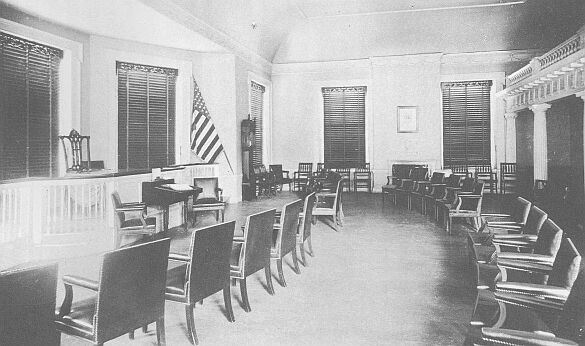
The Room in Which the First Constitutional Convention Met in
Philadelphia
Delegates from twelve of the thirteen States (Rhode Island alone
being unrepresented) assembled at Philadelphia, where the opening
sessions of the first Constitutional Convention were held in this room
in Independence Hall, May 14, 1787. George Washington presided during
the four months taken to draft the Constitution of the United States.
When it was completed on September 17th, it is said that many of the
delegates seemed awe-struck and that Washington himself sat with his
head bowed in deep meditation. As the Convention adjourned, Franklin,
who was then over eighty-one years of age, arose and pointing to the
President's quaint armchair on the back of which was emblazoned a half
sun, brilliant with gilded rays, observed: "As I have been sitting
here all these weeks, I have often wondered whether yonder sun is
rising or setting, but now I know that it is a rising sun."
He is unanimously elected president.
After the elections had taken place, a general persuasion prevailed
that the public will, respecting the chief magistrate of the union,
had been too unequivocally manifested not to be certainly obeyed; and
several applications were made to General Washington for those offices
in the respective states, which would be in the gift of the president
of the United States.
As marking the frame of mind with which he came into the government,
the following extract is given from one of the many letters written to
persons whose pretensions he was disposed to favour. "Should it become
absolutely necessary for me to occupy the station in which your letter
presupposes me, I have determined to go into it, perfectly free from
all engagements of every nature whatsoever.—A conduct in conformity
to this resolution, would enable me, in balancing the various
pretensions of different candidates for appointments, to act with a
sole reference to justice and the public good. This is, in substance,
the answer that I have given to all applications (and they are not
few) which have already been made. Among the places sought after in
these applications, I must not conceal that the office to which you
particularly allude is comprehended. This fact I tell you merely as
matter of information. My general manner of thinking, as to the
propriety of holding myself totally disengaged, will apologize for my
not enlarging farther on the subject.
"Though I am sensible that the public suffrage which places a man in
office, should prevent him from being swayed, in the execution of it,
by his private inclinations, yet he may assuredly, without violating
his duty, be indulged in the continuance of his former attachments."
Meeting of the first congress.
The impotence of the late government, added to the dilatoriness
inseparable from its perplexed mode of proceeding on the public
business, and to its continued session, had produced among the members
of congress such an habitual disregard of punctuality in their
attendance on that body, that, although the new government was to
commence its operations on the 4th of March, 1789, a house of
representatives was not formed until the first, nor a senate until the
6th day of April.
At length, the votes for the president and vice president of the
United States were opened and counted in the senate. Neither the
animosity of parties, nor the preponderance of the enemies of the new
government in some of the states, could deprive General Washington of
a single vote. By the unanimous voice of an immense continent, he was
called to the chief magistracy of the nation. The second number of
votes was given to Mr. John Adams. George Washington and John Adams
were therefore declared to be duly elected president and vice
president of the United States, to serve for four years from the 4th
of March, 1789.[41]