Account of the Commentaries on the
motions of Mars—Discovery of the
Law of the equable description of
Areas, and of Elliptic Orbits.
We may now proceed to examine Kepler's
innovations, but it would be doing
injustice to one of the brightest points
of his character, not to preface them by
his own animated exhortation to his
readers. "If any one be too dull to comprehend
the science of astronomy, or too
feeble-minded to believe in Copernicus
without prejudice to his piety, my advice
to such a one is, that he should quit the
astronomical schools, and condemning,
if he has a mind, any or all of the theories
of philosophers, let him look to his own
affairs, and leaving this worldly travail,
let him go home and plough his fields:
and as often as he lifts up to this goodly
heaven those eyes with which alone he
is able to see, let him pour out his
heart in praises and thanksgiving to
God the Creator; and let him not fear
but he is offering a worship not less acceptable
than his to whom God has
granted to see yet more clearly with the
eyes of his mind, and who both can and
will praise his God for what he has so
discovered."
Kepler did not by any means underrate
the importance of his labours, as is
sufficiently shewn by the sort of colloquial
motto which he prefixed to his
work. It consists in the first instance
of an extract from the writings of the
celebrated and unfortunate Peter Ramus.
This distinguished philosopher was professor
of mathematics in Paris, and in
the passage in question, after calling on
his contemporaries to turn their thoughts
towards the establishment of a system of
Astronomy unassisted by any hypothesis,
he promised as an additional inducement
to vacate his own chair in favour
of any one who should succeed in
this object. Ramus perished in the
massacre of St. Bartholomew, and Kepler
apostrophizes him as follows:—"It is
well, Ramus, that you have forfeited your
pledge, by quitting your life and professorship
together: for if you still held it,
I would certainly claim it as of right belonging
to me on account of this work,
as I could convince you even with your
own logic." It was rather bold in Kepler
to assert his claim to a reward held out
for a theory resting on no hypothesis, by
right of a work filled with hypotheses of
the most startling description; but of
the vast importance of this book there
can be no doubt; and throughout the
many wild and eccentric ideas to which
we are introduced in the course of it, it
is fit always to bear in mind that they
form part of a work which is almost the
basis of modern Astronomy.
The introduction contains a curious
criticism of the commonly-received
theory of gravity, accompanied with
a declaration of Kepler's own opinions
on the same subject. Some of the most
remarkable passages in it have been
already quoted in the life of Galileo; but,
nevertheless, they are too important to
Kepler's reputation to be omitted here,
containing as they do a distinct and
positive enunciation of the law of universal
gravitation. It does not appear,
however, that Kepler estimated rightly
the importance of the theory here traced
out by him, since on every other occasion
he advocated principles with which
it is scarcely reconcileable. The discussion
is introduced in the following
terms:—
"The motion of heavy bodies hinders
many from believing that the earth is
moved by an animal motion, or rather
a magnetic one. Let such consider the
following propositions. A mathematical
point, whether the centre of the universe
or not, has no power, either effectively
or objectively, to move heavy bodies to
approach it. Let physicians prove if
they can, that such power can be possessed
by a point, which, neither is a
body, nor is conceived unless by relation
alone. It is impossible that the
form[189] of a stone should, by moving its
own body, seek a mathematical point,
or in other words, the centre of the universe,
without regard of the body in
which that point exists. Let physicians
prove if they can, that natural things
have any sympathy with that which is
nothing. Neither do heavy bodies tend
to the centre of the universe by reason
that they are avoiding the extremities of
the round universe; for their distance
from the centre is insensible, in proportion
to their distance from the extremities
of the universe. And what reason
could there be for this hatred? How
strong, how wise must those heavy
bodies be, to be able to escape so carefully
from an enemy lying on all sides of
them: what activity in the extremities
of the world to press their enemy so
closely! Neither are heavy bodies
driven into the centre by the whirling of
the first moveable, as happens in revolving
water. For if we assume such a
motion, either it would not be continued
down to us, or otherwise we
should feel it, and be carried away with
it, and the earth also with us; nay,
rather, we should be hurried away first,
and the earth would follow; all which
conclusions are allowed by our opponents
to be absurd. It is therefore plain
that the vulgar theory of gravity is erroneous.
"The true theory of gravity is founded
on the following axioms:—Every corporeal
substance, so far forth as it is corporeal,
has a natural fitness for resting in
every place where it may be situated by
itself beyond the sphere of influence of a
body cognate with it. Gravity is a mutual
affection between cognate bodies
towards union or conjunction (similar in
kind to the magnetic virtue), so that the
earth attracts a stone much rather than
the stone seeks the earth. Heavy bodies
(if we begin by assuming the earth to
be in the centre of the world) are not
carried to the centre of the world in its
quality of centre of the world, but as to
the centre of a cognate round body,
namely, the earth; so that wheresoever
the earth may be placed, or whithersoever
it may be carried by its animal
faculty, heavy bodies will always be
carried towards it. If the earth were
not round, heavy bodies would not tend
from every side in a straight line towards
the centre of the earth, but to different
points from different sides. If two stones
were placed in any part of the world
near each other, and beyond the sphere of
influence of a third cognate body, these
stones, like two magnetic needles, would
come together in the intermediate point,
each approaching the other by a space
proportional to the comparative mass of
the other. If the moon and earth were
not retained in their orbits by their animal
force or some other equivalent, the
earth would mount to the moon by a
fifty-fourth part of their distance, and
the moon fall towards the earth through
the other fifty-three parts and they would
there meet; assuming however that the
substance of both is of the same density.
If the earth should cease to attract its
waters to itself, all the waters of the sea
would be raised and would flow to the
body of the moon. The sphere of the attractive
virtue which is in the moon extends
as far as the earth, and entices up
the waters; but as the moon flies rapidly
across the zenith, and the waters cannot
follow so quickly, a flow of the ocean is
occasioned in the torrid zone towards
the westward. If the attractive virtue
of the moon extends as far as the earth,
it follows with greater reason that the
attractive virtue of the earth extends as
far as the moon, and much farther;
and in short, nothing which consists of
earthly substance any how constituted,
although thrown up to any height, can
ever escape the powerful operation of this
attractive virtue. Nothing which consists
of corporeal matter is absolutely light,
but that is comparatively lighter which
is rarer, either by its own nature, or by
accidental heat. And it is not to be
thought that light bodies are escaping to
the surface of the universe while they are
carried upwards, or that they are not
attracted by the earth. They are attracted,
but in a less degree, and so are
driven outwards by the heavy bodies;
which being done, they stop, and are kept
by the earth in their own place. But
although the attractive virtue of the
earth extends upwards, as has been said,
so very far, yet if any stone should be at
a distance great enough to become sensible,
compared with the earth's diameter,
it is true that on the motion of
the earth such a stone would not follow
altogether; its own force of resistance
would be combined with the attractive
force of the earth, and thus it would
extricate itself in some degree from the
motion of the earth."
Who, after perusing such passages in
the works of an author, whose writings
were in the hands of every student of astronomy,
can believe that Newton waited
for the fall of an apple to set him thinking
for the first time on the theory which
has immortalized his name? An apple
may have fallen, and Newton may have
seen it; but such speculations as those
which it is asserted to have been the
cause of originating in him had been
long familiar to the thoughts of every
one in Europe pretending to the name
of natural philosopher.
As Kepler always professed to have
derived his notion of a magnetic attraction
among the planetary bodies from
the writings of Gilbert, it may be worth
while to insert here an extract from the
"New Philosophy" of that author, to
show in what form he presented a similar
theory of the tides, which affords the
most striking illustration of that attraction.
This work was not published till
the middle of the seventeenth century,
but a knowledge of its contents may, in
several instances, be traced back to the
period in which it was written:—
"There are two primary causes of the
motion of the seas—the moon, and the
diurnal revolution. The moon does
not act on the seas by its rays or its
light. How then? Certainly by the
common effort of the bodies, and (to explain
it by something similar) by their
magnetic attraction. It should be known,
in the first place, that the whole quantity
of water is not contained in the sea
and rivers, but that the mass of earth (I
mean this globe) contains moisture and
spirit much deeper even than the sea.
The moon draws this out by sympathy,
so that they burst forth on the arrival of
the moon, in consequence of the attraction
of that star; and for the same
reason, the quicksands which are in the
sea open themselves more, and perspire
their moisture and spirits during
the flow of the tide, and the whirlpools
in the sea disgorge copious waters; and
as the star retires, they devour the same
again, and attract the spirits and moisture
of the terrestrial globe. Hence the
moon attracts, not so much the sea as
the subterranean spirits and humours;
and the interposed earth has no more
power of resistance than a table or any
other dense body has to resist the force
of a magnet. The sea rises from the
greatest depths, in consequence of the
ascending humours and spirits; and
when it is raised up, it necessarily flows
on to the shores, and from the shores it
enters the rivers."[190]
This passage sets in the strongest
light one of the most notorious errors of
the older philosophy, to which Kepler
himself was remarkably addicted. If
Gilbert had asserted, in direct terms,
that the moon attracted the water, it is
certain that the notion would have been
stigmatized (as it was for a long time in
Newton's hands) as arbitrary, occult,
and unphilosophical: the idea of these
subterranean humours was likely to be
treated with much more indulgence. A
simple statement, that when the moon
was over the water the latter had a tendency
to rise towards it, was thought
to convey no instruction; but the assertion
that the moon draws out subterranean
spirits by sympathy, carried with it
a more imposing appearance of theory.
The farther removed these humours
were from common experience, the
easier it became to discuss them in vague
and general language; and those who
called themselves philosophers could
endure to hear attributes bestowed on
these fictitious elements which revolted
their imaginations when applied to things
of whose reality at least some evidence
existed.
It is not necessary to dwell upon the
system of Tycho Brahe, which was identical,
as we have said, with one rejected
by Copernicus, and consisted in making
the sun revolve about the earth, carrying
with it all the other planets revolving
about him. Tycho went so far as to
deny the rotation of the earth to explain
the vicissitudes of day and night, but
even his favourite assistant Longomontanus
differed from him in this part of
his theory. The great merit of Tycho
Brahe, and the service he rendered to
astronomy, was entirely independent of
any theory; consisting in the vast accumulation
of observations made by him
during a residence of fifteen years at
Uraniburg, with the assistance of instruments,
and with a degree of care, very far
superior to anything known before his
time in practical astronomy. Kepler is
careful repeatedly to remind us, that without
Tycho's observations he could have
done nothing. The degree of reliance that
might be placed on the results obtained
by observers who acknowledged their inferiority
to Tycho Brahe, maybe gathered
from an incidental remark of Kepler to
Longomontanus. He had been examining
Tycho's registers, and had occasionally
found a difference amounting sometimes
to 4´ in the right ascensions of the
same planet, deduced from different stars
on the same night. Longomontanus
could not deny the fact, but declared that
it was impossible to be always correct
within such limits. The reader should
never lose sight of this uncertainty in
the observations, when endeavouring to
estimate the difficulty of finding a theory
that would properly represent them.
When Kepler first joined Tycho Brahe
at Prague, he found him and Longomontanus
very busily engaged in correcting
the theory of Mars, and accordingly
it was this planet to which he also first
directed his attention. They had formed
a catalogue of the mean oppositions of
Mars during twenty years, and had discovered
a position of the equant, which (as
they said) represented them with tolerable
exactness. On the other hand, they were
much embarrassed by the unexpected
difficulties they met in applying a system
which seemed on the one hand so
accurate, to the determination of the latitudes,
with which it could in no way be
made to agree. Kepler had already suspected
the cause of this imperfection, and
was confirmed in the view he took of
their theory, when, on a more careful
examination, he found that they overrated
the accuracy even of their longitudes.
The errors in these, instead of
amounting as they said, nearly to 2´,
rose sometimes above 21´. In fact they
had reasoned ill on their own principles,
and even if the foundations of their
theory had been correctly laid, could not
have arrived at true results. But Kepler
had satisfied himself of the contrary,
and the following diagram shews the nature
of the first alteration he introduced,
not perhaps so celebrated as some of his
later discoveries, but at least of equal
consequence to astronomy, which could
never have been extricated from the
confusion into which it had fallen, till
this important change had been effected.
The practice of Tycho Brahe, indeed
of all astronomers till the time of Kepler,
had been to fix the position of the planet's
orbit and equant from observations
on its mean oppositions, that is to
say, on the times when it was precisely
six signs or half a circle distant from
the mean place of the sun. In the
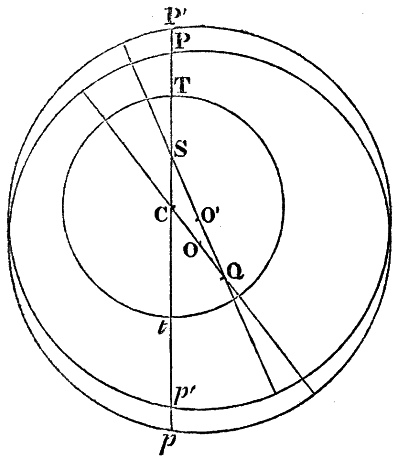
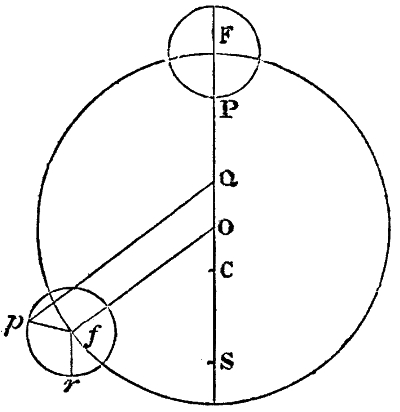
annexed figure, let S represent the sun,
C the centre of the earth's orbit, Tt.
Tycho Brahe's practice amounted to this,
that if Q were supposed the place of the
centre of the planet's equant, the centre
of Pp its orbit was taken in QC, and not
in QS, as Kepler suggested that it ought
to be taken. The consequence of this
erroneous practice was, that the observations
were deprived of the character for
which oppositions were selected, of being
entirely free from the second inequalities.
It followed therefore that as part of
the second inequalities were made conducive
towards fixing the relative position
of the orbit and equant, to which
they did not naturally belong, there was
an additional perplexity in accounting
for the remainder of them by the size
and motion of the epicycle. As the line
of nodes of every planet was also made to
pass through C instead of S, there could
not fail to be corresponding errors in the
latitudes. It would only be in the rare
case of an opposition of the planet in
the line CS, that the time of its taking
place would be the same, whether O, the
centre of the orbit, was placed in CQ or
SQ. Every other opposition would involve
an error, so much the greater as
it was observed at a greater distance
from the line CS.
It was long however before Tycho
Brahe could be made to acquiesce in the
propriety of the proposed alteration; and,
in order to remove his doubts as to the
possibility that a method could be erroneous
which, as he still thought, had
given him such accurate longitudes,
Kepler undertook the ungrateful labour
of the first part of his "Commentaries."
He there shewed, in the three systems of
Copernicus, Tycho Brahe, and Ptolemy,
and in both the concentric and excentric
theories, that though a false position
were given to the orbit, the longitudes
of a planet might be so represented, by
a proper position of the centre of the
equant, as never to err in oppositions
above 5´ from those given by observation;
though the second inequalities and
the latitudes would thereby be very
greatly deranged.
The change Kepler introduced, of observing
apparent instead of mean oppositions,
made it necessary to be very accurate
in his reductions of the planet's
place to the ecliptic; and in order to be
able to do this, a previous knowledge of
the parallax of Mars became indispensable.
His next labour was therefore
directed to this point; and finding that
the assistants to whom Tycho Brahe had
previously committed this labour had
performed it in a negligent and imperfect
manner, he began afresh with
Tycho's original observations. Having
satisfied himself as to the probable limits
of his errors in the parallax on which
he finally fixed, he proceeded to determine
the inclination of the orbit and
the position of the line of nodes. In
all these operations his talent for astronomical
inquiries appeared pre-eminent
in a variety of new methods by
which he combined and availed himself
of the observations; but it must be
sufficient merely to mention this fact,
without entering into any detail. One
important result may be mentioned, at
which he arrived in the course of them,
the constancy of the inclination of the
planet's orbit, which naturally strengthened
him in his new theory.
Having gone through these preliminary
inquiries, he came at last to fix the proportions
of the orbit; and, in doing so, he
determined, in the first instance, not to assume,
as Ptolemy appeared to have done
arbitrarily, the bisection of the excentricity,
but to investigate its proportion
along with the other elements of the orbit,
which resolution involved him in much
more laborious calculations. After he
had gone over all the steps of his theory no
less than seventy times—an appalling labour,
especially if we remember that logarithms
were not then invented—his final
result was, that in 1587, on the 6th of
March, at 7h 23´, the longitude of the
aphelion of Mars was 4s 28° 48´ 55´´;
that the planet's mean longitude was
6s 0° 51´ 35´´; that if the semidiameter of
the orbit was taken at 100000, the excentricity
was 11332; and the excentricity of
the equant 18564. He fixed the radius
of the greater epicycle at 14988, and
that of the smaller at 3628.
When he came to compare the longitudes
as given by this, which he afterwards
called the vicarious theory, with
the observations at opposition, the result
seemed to promise him the most brilliant
success. His greatest error did
not exceed 2´; but, notwithstanding
these flattering anticipations, he soon
found by a comparison of longitudes
out of opposition and of latitudes, that
it was yet far from being so complete
as he had imagined, and to his infinite
vexation he soon found that the
labour of four years, which he had expended
on this theory, must be considered
almost entirely fruitless. Even
his favourite principle of dividing the
excentricity in a different ratio from
Ptolemy, was found to lead him into
greater error than if he had retained the
old bisection. By restoring that, he made
his latitudes more accurate, but produced
a corresponding change for the
worse in his longitudes; and although
the errors of 8´, to which they now
amounted, would probably have been
disregarded by former theorists, Kepler
could not remain satisfied till they were
accounted for. Accordingly he found
himself forced to the conclusion that
one of the two principles on which this
theory rested must be erroneous; either
the orbit of the planet is not a perfect
circle, or there is no fixed point within
it round which it moves with an uniform
angular motion. He had once before admitted
the possibility of the former of
these facts, conceiving it possible that the
motion of the planets is not at all curvilinear,
but that they move in polygons
round the sun, a notion to which he probably
inclined in consequence of his favourite
harmonics and geometrical
figures.
In consequence of the failure of a
theory conducted with such care in all
its practical details, Kepler determined
that his next trial should be of an entirely
different complexion. Instead of
first satisfying the first inequalities of
the planet, and then endeavouring to account
for the second inequalities, he resolved
to reverse the process, or, in
other words, to ascertain as accurately
as possible what part of the planet's
apparent motion should be referred
solely to the optical illusion produced
by the motion of the earth, before proceeding
to any inquiry of the real inequality
of the planet's proper motion.
It had been hitherto taken for granted,
that the earth moved equably round the
centre of its orbit; but Kepler, on resuming
the consideration of it, recurred
to an opinion he had entertained very
early in his astronomical career (rather
from his conviction of the existence of
general laws, than that he had then felt
the want of such a supposition), that it
required an equant distinct from its
orbit no less than the other planets.
He now saw, that if this were admitted,
the changes it would everywhere introduce
in the optical part of the planet's
irregularities might perhaps relieve him
from the perplexity in which the vicarious
theory had involved him. Accordingly
he applied himself with renewed
assiduity to the examination of
this important question, and the result
of his calculations (founded principally
on observations of Mars' parallax) soon
satisfied him not only that the earth's
orbit does require such an equant, but
that its centre is placed according to the
general law of the bisection of the excentricity
which he had previously found
indispensable in the other planets. This
was an innovation of the first magnitude,
and accordingly Kepler did not
venture to proceed farther in his theory,
till by evidence of the most varied and
satisfactory nature, he had established
it beyond the possibility of cavil.
It may be here remarked, that this
principle of the bisection of the eccentricity,
so familiar to the Ptolemaic astronomers,
is identical with the theory
afterwards known by the name of the
simple elliptic hypothesis, advocated by,
Seth Ward and others. That hypothesis
consisted in supposing the sun to be
placed in one focus of the elliptic orbit
of the planet, whose angular motion was
uniform round the other focus. In
Ptolemaic phraseology, that other focus
was the centre of the equant, and it is
well known that the centre of the ellipse
lies in the middle point between the two
foci.
It was at this period also, that Kepler
first ventured upon the new method of
representing inequalities which terminated
in one of his most celebrated discoveries.
We have already seen, in the
account of the "Mysterium Cosmographicum,"
that he was speculating, even
at that time, on the effects of a whirling
force exerted by the sun on the planets
with diminished energy at increased distances,
and on the proportion observed
between the distances of the planets from
the sun, and their periods of revolution.
He seems even then to have believed in
the possibility of discovering a relation
between the times and distances in different
planets. Another analogous consequence
of his theory of the radiation of
the whirling force would be, that if the
same planet should recede to a greater
distance from the central body, it would
be acted on by a diminished energy of
revolution, and consequently, a relation
might be found between the velocity at
any point of its orbit, and its distance
at that point from the sun. Hence he
expected to derive a more direct and
natural method of calculating the inequalities,
than from the imaginary
equant. But these ingenious ideas had
been checked in the outset by the erroneous
belief which Kepler, in common with
other astronomers, then entertained of
the coincidence of the earth's equant
with its orbit; in other words, by the
belief that the earth's linear motion was
uniform, though it was known not to
remain constantly at the same distance
from the sun. As soon as this prejudice
was removed, his former ideas recurred
to him with increased force, and he set
himself diligently to consider what relation
could be found between the velocity
and distance of a planet from the
sun. The method he adopted in the beginning
of this inquiry was to assume
as approximately correct Ptolemy's doctrine
of the bisection of the excentricity,
and to investigate some simple relation
nearly representing the same effect.
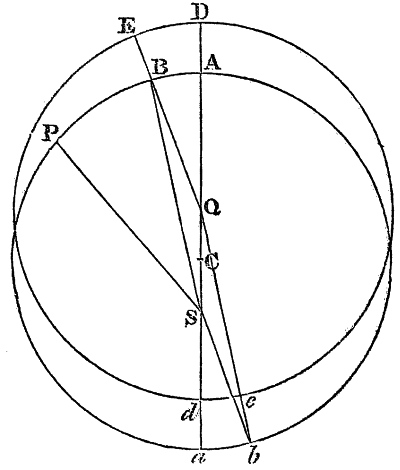
In the annexed figure, S is the place
of the sun, C the centre of the planet's
orbit ABab, Q the centre of the equant
represented by the equal circle DEde,
AB, ab, two equal small arcs described
by the planet at the apsides of its orbit:
then, according to Ptolemy's principles,
the arc DE of the equant would be proportional
to the time of passing along
AB, on the same scale on which de would
represent the time of passing through
the equal arc ab.
QD:QA :: DE:AB, nearly; and
because QS is bisected in C, QA, CA
or QD, and SA, are in arithmetical
proportion: and, therefore, since an
arithmetical mean, when the difference
is small, does not differ much from a
geometrical mean, QD:QA :: SA:QD,
nearly. Therefore, DE:AB :: S
A:QD, nearly, and in the same manner
de:ab :: Sa:Qd nearly; and
therefore DE:de :: SA:Sa nearly.
Therefore at the apsides, the times of
passing over equal spaces, on Ptolemy's
theory, are nearly as the distances from
the sun, and Kepler, with his usual
hastiness, immediately concluded that
this was the accurate and general law,
and that the errors of the old theory
arose solely from having departed from it.
It followed immediately from this
assumption, that after leaving the point
A, the time in which the planet would
arrive at any point P of its orbit
would be proportional to, and might be
represented by, the sums of all the lines
that could be drawn from S to the arc
AP, on the same scale that the whole
period of revolution would be denoted by
the sum of all the lines drawn to every
point of the orbit. Kepler's first attempt
to verify this supposition approximately,
was made by dividing the
whole circumference of the orbit into
360 equal parts, and calculating the
distances at every one of the points of
division. Then supposing the planet to
move uniformly, and to remain at the
same distance from the sun during the
time of passing each one of these divisions,
(a supposition which manifestly would not
differ much from the former one, and
would coincide with it more nearly, the
greater was the number of divisions
taken) he proceeded to add together these
calculated distances, and hoped to find
that the time of arriving at any one of the
divisions bore the same ratio to the whole
period, as the sum of the corresponding
set of distances did to the sum of the
whole 360.
This theory was erroneous; but by almost
miraculous good fortune, he was
led by it in the following manner to the
true measure. The discovery was a consequence
of the tediousness of his first
method, which required, in order to
know the time of arriving at any point,
that the circle should be subdivided, until
one of the points of division fell exactly
upon the given place. Kepler therefore
endeavoured to discover some shorter
method of representing these sums of
the distances. The idea then occurred
to him of employing for that purpose
the area inclosed between the two distances,
SA, SP, and the arc AP,
in imitation of the manner in which
he remembered that Archimedes had
found the area of the circle, by dividing
it into an infinite number of small triangles
by lines drawn from the centre.
He hoped therefore to find, that the
time of passing from A to P bore nearly
the same ratio to the whole period of
revolution that the area ASP bore to
the whole circle.
This last proportion is in fact accurately
observed in the revolution of one
body round another, in consequence of
an attractive force in the central body.
Newton afterwards proved this, grounding
his demonstration upon laws of
motion altogether irreconcileable with
Kepler's opinions; and it is impossible
not to admire Kepler's singular good
fortune in arriving at this correct result
in spite, or rather through the means, of
his erroneous principles. It is true that
the labour which he bestowed unsparingly
upon every one of his successive
guesses, joined with his admirable candour,
generally preserved him from long
retaining a theory altogether at variance
with observations; and if any relation
subsisted between the times and distances
which could any way be expressed
by any of the geometrical quantities
under consideration, he could scarcely
have failed—it might be twenty years
earlier or twenty years later,—to light
upon it at last, having once put his indefatigable
fancy upon this scent. But
in order to prevent an over-estimate of
his merit in detecting this beautiful law
of nature, let us for a moment reflect
what might have been his fate had he
endeavoured in the same manner, and
with the same perseverance, to discover
a relation, where, in reality, none existed.
Let us take for example the inclinations
or the excentricities of the
planetary orbits, among which no relation
has yet been discovered; and if any
exists, it is probably of too complicated
a nature to be hit at a venture. If Kepler
had exerted his ingenuity in this
direction, he might have wasted his life
in fruitless labour, and whatever reputation
he might have left behind him as
an industrious calculator, it would have
been very far inferior to that which has
procured for him the proud title of the
"Legislator of the Heavens."
However this may be, the immediate
consequence of thus lighting upon the
real law observed by the earth in its passage
round the sun was, that he found
himself in possession of a much more accurate
method of representing its inequalities
than had been reached by any of his
predecessors; and with renewed hopes
he again attacked the planet Mars,
whose path he was now able to consider
undistorted by the illusions arising out
of the motion of the earth. Had the
path of Mars been accurately circular,
or even as nearly approaching a circle as
that of the earth, the method he chose
of determining its position and size by
means of three distances carefully
calculated from his observed parallaxes,
would have given a satisfactory result;
but finding, as he soon did, that almost
every set of three distances led him to a
different result, he began to suspect
another error in the long-received opinion,
that the orbits of the planets must
consist of a combination of circles; he
therefore, determined, in the first instance,
to fix the distances of the planet
at the apsides without any reference to
the form of the intermediate orbit. Half
the difference between these would, of
course, be the excentricity of the orbit;
and as this quantity came out very
nearly the same as had been determined
on the vicarious theory, it seemed clear
that the error of that theory, whatever it
might be, did not lie in these elements.
Kepler also found that in the case of
this planet likewise, the times of describing
equal arcs at the apsides were proportional
to its distances from the sun,
and he naturally expected that the method
of areas would measure the planet's
motion with as much accuracy as he had
found in the case of the earth. This hope
was disappointed: when he calculated the
motion of the planet by this method, he
obtained places too much advanced when
near the apsides, and too little advanced
at the mean distances. He did not, on
that account, immediately reject the
opinion of circular orbits, but was
rather inclined to suspect the principle
of measurement, at which he felt that
he had arrived in rather a precarious
manner. He was fully sensible that
his areas did not accurately represent
the sums of any distances except those
measured from the centre of the circle;
and for some time he abandoned the
hope of being able to use this substitution,
which he always considered merely
as an approximate representation of the
true measure, the sum of the distances.
But on examination he found that the
errors of this substitution were nearly
insensible, and those it did in fact produce,
were in the contrary direction of
the errors he was at this time combating.
As soon as he had satisfied himself of
this, he ventured once more on the supposition,
which by this time had, in his
eyes, almost acquired the force of demonstration,
that the orbits of the planets
are not circular, but of an oval form,
retiring within the circle at the mean
distances, and coinciding with it at the
apsides.
This notion was not altogether new;
it had been suggested in the case of
Mercury, by Purbach, in his "Theories
of the Planets." In the edition of this
work published by Reinhold, the pupil
of Copernicus, we read the following
passage. "Sixthly, it appears from
what has been said, that the centre of
Mercury's epicycle, by reason of the
motions above-mentioned, does not, as
is the case with the other planets, describe
the circumference of a circular
deferent, but rather the periphery of a
figure resembling a plane oval." To this
is added the following note by Reinhold.
"The centre of the Moon's epicycle describes
a path of a lenticular shape;
Mercury's on the contrary is egg-shaped,
the big end lying towards his apogee,
and the little end towards his perigee."[191]
The excentricity of Mercury's orbit is,
in fact, much greater than that of any
of the other planets, and the merit of
making this first step cannot reasonably
be withheld from Purbach and his commentator,
although they did not pursue
the inquiry so far as Kepler found himself
in a condition to do.
Before proceeding to the consideration
of the particular oval which Kepler
fixed upon in the first instance, it will
be necessary, in order to render intelligible
the source of many of his doubts
and difficulties, to make known something
more of his theory of the moving
force by which he supposed the planets
to be carried round in their orbits. In
conformity with the plan hitherto pursued,
this shall be done as much as possible
in his own words.
"It is one of the commonest axioms in
natural philosophy, that if two things always
happen together and in the same
manner, and admit the same measure,
either the one is the cause of the other,
or both are the effect of a common cause.
In the present case, the increase or languor
of motion invariably corresponds
with an approach to or departure from
the centre of the universe. Therefore,
either the languor is the cause of the
departure of the star, or the departure
of the languor, or both have a common
cause. But no one can be of opinion
that there is a concurrence of any third
thing to be a common cause of these
two effects, and in the following chapters
it will be made clear that there is
no occasion to imagine any such third
thing, since the two are of themselves
sufficient. Now, it is not agreeable to
the nature of things that activity or
languor in linear motion should be the
cause of distance from the centre. For,
distance from the centre is conceived
anteriorly to linear motion. In fact
linear motion cannot exist without distance
from the centre, since it requires
space for its accomplishment, but distance
from the centre can be conceived
without motion. Therefore distance is
the cause of the activity of motion, and
a greater or less distance of a greater or
less delay. And since distance is of the
kind of relative quantities, whose essence
consists in boundaries, (for there
is no efficacy in relation per se without
regard to bounds,) it follows that the
cause of the varying activity of motion
rests in one of the boundaries. But the
body of the planet neither becomes
heavier by receding, nor lighter by approaching.
Besides, it would perhaps
be absurd on the very mention of it,
that an animal force residing in the
moveable body of the planet for the purpose
of moving it, should exert and relax
itself so often without weariness or
decay. It remains, therefore, that the
cause of this activity and languor resides
at the other boundary, that is, in
the very centre of the world, from which
the distances are computed.—Let us
continue our investigation of this moving
virtue which resides in the sun, and
we shall presently recognize its very
close analogy to light. And although
this moving virtue cannot be identical
with the light of the sun, let others look
to it whether the light is employed as
a sort of instrument, or vehicle, to convey
the moving virtue. There are these
seeming contradictions:—first, light is
obstructed by opaque bodies, for which
reason if the moving virtue travelled on
the light, darkness would be followed
by a stoppage of the moveable bodies.
Again, light flows out in right lines
spherically, the moving virtue in right
lines also, but cylindrically; that is, it
turns in one direction only, from west to
east; not in the opposite direction, not
towards the poles, &c. But perhaps
we shall be able presently to reply to
these objections. In conclusion, since
there is as much virtue in a large and
remote circle as in a narrow and close
one, nothing of the virtue perishes in
the passage from its source, nothing is
scattered between the source and the
moveable. Therefore the efflux, like that
of light, is not material, and is unlike that
of odours, which are accompanied by a
loss of substance, unlike heat from a
raging furnace, unlike every other emanation
by which mediums are filled. It
remains, therefore, that as light which
illuminates all earthly things, is the immaterial
species of that fire which is in
the body of the sun, so this virtue, embracing
and moving all the planetary
bodies, is the immaterial species of that
virtue which resides in the sun itself, of
incalculable energy, and so the primary
act of all mundane motion.—I should
like to know who ever said that there
was anything material in light!—Guided
by our notion of the efflux of this
species (or archetype), let us contemplate
the more intimate nature of
the source itself. For it seems as if
something divine were latent in the body
of the sun, and comparable to our own
soul, whence that species emanates
which drives round the planets; just as
from the mind of a slinger the species
of motion sticks to the stones, and carries
them forward, even after he who
cast them has drawn back his hand.
But to those who wish to proceed
soberly, reflections differing a little from
these will be offered."
Our readers will, perhaps, be satisfied
with the assurance, that these sober
considerations will not enable them to
form a much more accurate notion of
Kepler's meaning than the passages
already cited. We shall therefore proceed
to the various opinions he entertained
on the motion of the planets.
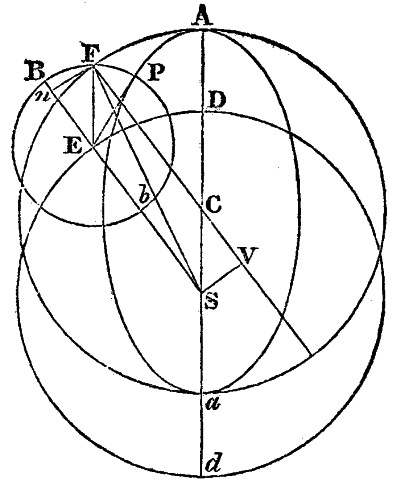
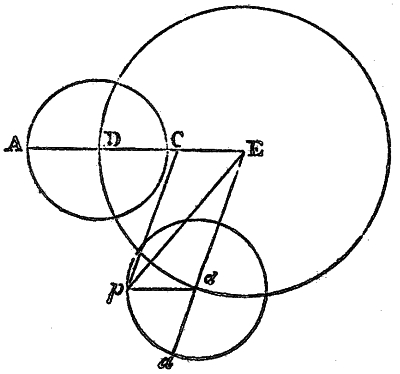
He considered it as established by his
theory, that the centre E of the planet's
epicycle (see fig. p. 33.) moved round
the circumference of the deferent Dd,
according to the law of the planet's distances;
the point remaining to be settled
was the motion of the planet in the
epicycle. If it were made to move according
to the same law, so that when
the centre of the epicycle reached E, the
planet should be at F, taking the angle
BEF equal to BSA, it has been shewn
(p. 19) that the path of F would still be
a circle, excentric from Dd by DA the
radius of the epicycle.
But Kepler fancied that he saw many
sound reasons why this could not be the
true law of motion in the epicycle, on
which reasons he relied much more
firmly than on the indisputable fact,
which he mentions as a collateral proof,
that it was contradicted by the observations.
Some of these reasons are subjoined:
"In the beginning of the work
it has been declared to be most absurd,
that a planet (even though we suppose
it endowed with mind) should form any
notion of a centre, and a distance from
it, if there be no body in that centre to
serve for a distinguishing mark. And
although you should say, that the planet
has respect to the sun, and knows beforehand,
and remembers the order in
which the distances from the sun are
comprised, so as to make a perfect excentric;
in the first place, this is rather
far-fetched, and requires, in any mind,
means for connecting the effect of an
accurately circular path with the sign
of an increasing and diminishing diameter
of the sun. But there are no
such means, except the position of the
centre of the excentric at a given distance
from the sun; and I have already
said, that this is beyond the power of a
mere mind. I do not deny that a centre
may be imagined, and a circle round it;
but this I do say, if the circle exists
only in imagination, with no external
sign or division, that it is not possible
that the path of a moveable body should
be really ordered round it in an exact
circle. Besides, if the planet chooses
from memory its just distances from
the sun, so as exactly to form a circle,
it must also take from the same source,
as if out of the Prussian or Alphonsine
tables, equal excentric arcs, to be described
in unequal times, and to be described
by a force extraneous from the
sun; and thus would have, from its
memory, a foreknowledge of what effects
a virtue, senseless and extraneous from
the sun, was about to produce: all these
consequences are absurd.
"It is therefore more agreeable to
reason that the planet takes no thought,
either of the excentric or epicycle; but
that the work which it accomplishes, or
joins in effecting, is a libratory path in
the diameter Bb of the epicycle, in the
direction towards the sun. The law is
now to be discovered, according to which
the planet arrives at the proper distances
in any time. And indeed in this inquiry,
it is easier to say what the law is not
than what it is."—Here, according to his
custom, Kepler enumerates several laws
of motion by which the planet might
choose to regulate its energies, each of
which is successively condemned. Only
one of them is here mentioned, as a specimen
of the rest. "What then if we
were to say this? Although the motions
of the planet are not epicyclical, perhaps
the libration is so arranged that the distances
from the sun are equal to what
they would have been in a real epicyclical
motion.—This leads to more incredible
consequences than the former suppositions,
and yet in the dearth of better
opinions, let us for the present content
ourselves with this. The greater number
of absurd conclusions it will be found
to involve, the more ready will a physician
be, when we come to the fifty-second
chapter, to admit what the observations
testify, that the path of the planet is not
circular."
The first oval path on which Kepler
was induced to fix, by these and many
other similar considerations, was in the
first instance very different from the
true elliptical form. Most authors would
have thought it unnecessary to detain
their readers with a theory which they
had once entertained and rejected; but
Kepler's work was written on a different
plan. He thus introduces an explanation
of his first oval. "As soon as I
was thus taught by Brahe's very accurate
observations that the orbit of a planet
is not circular, but more compressed
at the sides, on the instant I thought
that I understood the natural cause of
this deflection. But the old proverb was
verified in my case;—the more haste the
less speed.—For having violently laboured
in the 39th chapter, in consequence
of my inability to find a sufficiently
probable cause why the orbit of
the planet should be a perfect circle,
(some absurdities always remaining with
respect to that virtue which resides in
the body of the planet,) and having now
discovered from the observations, that
the orbit is not a perfect circle, I felt furiously
inclined to believe that if the
theory which had been recognized as
absurd, when employed in the 39th
chapter for the purpose of fabricating a
circle, were modulated into a more probable
form, it would produce an accurate
orbit agreeing with the observations.
If I had entered on this course a little
more warily, I might have detected the
truth immediately. But, being blinded
by my eagerness, and not sufficiently regardful
of every part of the 39th chapter,
and clinging to my first opinion, which
offered itself to me with a wonderful
show of probability, on account of the
equable motion in the epicycle, I got entangled
in new perplexities, with which
we shall now have to struggle in this
45th chapter and the following ones as
far as the 50th chapter."
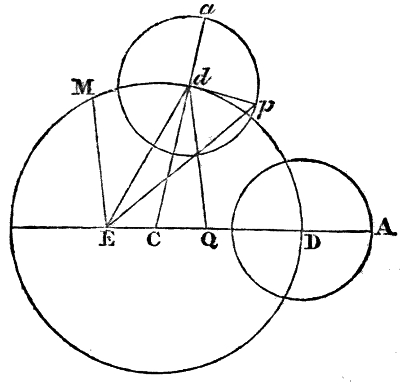
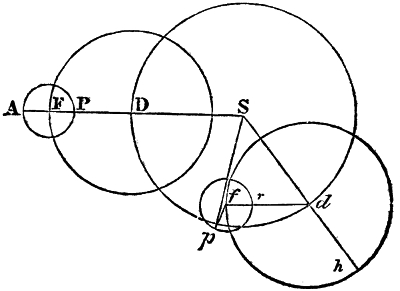
In this theory, Kepler supposed that
whilst the centre of the epicycle was
moving round a circular deferent according
to the law of the planets' distances
(or areas) the planet itself moved equably
in the epicycle, with the mean angular
velocity of its centre in the deferent.
In consequence of this supposition, since
at D, when the planet is at A the aphelion,
the motion in the deferent is less than
the mean motion, the planet will have advanced
through an angle BEP greater
than BEF or BSA, through which the
centre of the epicycle has moved; and
consequently, the path will lie everywhere
within the circle Aa, except at
the apsides. Here was a new train of
laborious calculations to undergo for the
purpose of drawing the curve APa
according to this law, and of measuring
the area of any part of it. After a
variety of fruitless attempts, for this
curve is one of singular complexity, he
was reduced, as a last resource, to suppose
it insensibly different from an
ellipse on the same principal axes, as an
approximate means of estimating its
area. Not content even with the results
so obtained, and not being able to see
very clearly what might be the effect of
his alteration in substituting the ellipse
for the oval, and in other simplifications
introduced by him, he had courage
enough to obtain the sums of the
360 distances by direct calculation, as
he had done in the old circular theory.
In the preface to his book he had spoken
of his labours under the allegory of a
war carried on by him against the planet;
and when exulting in the early prospects
of success this calculation seemed to
offer, he did not omit once more to warn
his readers, in his peculiar strain, that
this exultation was premature.
"Allow me, gentle reader, to enjoy
so splendid a triumph for one little day
(I mean through the five next chapters),
meantime be all rumours suppressed of
new rebellion, that our preparations
may not perish, yielding us no delight.
Hereafter if anything shall come to pass,
we will go through it in its own time and
season; now let us be merry, as then
we will be bold and vigorous." At the
time foretold, that is to say, at the end
of the five merry chapters, the bad news
could no longer be kept a secret. It is
announced in the following bulletin:—"While
thus triumphing over Mars,
and preparing for him, as for one
altogether vanquished, tabular prisons,
and equated eccentric fetters, it is
buzzed here and there that the victory
is vain, and that the war is raging
anew as violently as before. For the
enemy, left at home a despised captive,
has burst all the chains of the equations,
and broken forth of the prisons of the
tables. For no method of geometrically
administering the theory of the 45th
chapter was able to come near the accuracy
of approximation of the vicarious
theory of the 16th chapter, which gave
me true equations derived from false
principles. Skirmishers, disposed all
round the circuit of the excentric, (I
mean the true distances,) routed my
forces of physical causes levied out of
the 45th chapter, and shaking off the
yoke, regained their liberty. And now
there was little to prevent the fugitive
enemy from effecting a junction with his
rebellious supporters, and reducing me
to despair, had I not suddenly sent into
the field a reserve of new physical reasonings
on the rout and dispersion of the
veterans, and diligently followed, without
allowing him the slightest respite, in
the direction in which he had broken
out."
In plainer terms, Kepler found, after
this labour was completed, that the
errors in longitude he was still subject
to were precisely of an opposite nature
to those he had found with the circle;
instead of being too quick at the apsides,
the planet was now too slow there,
and too much accelerated in the mean
distances; and the distances obtained
from direct observation were everywhere
greater, except at the apsides,
than those furnished by this oval theory.
It was in the course of these tedious
investigations that he established, still
more satisfactorily than he had before
done, that the inclinations of the planets'
orbits are invariable, and that the lines
of their nodes pass through the centre
of the Sun, and not, as before his time
had been supposed, through the centre
of the ecliptic.
When Kepler found with certainty
that this oval from which he expected
so much would not satisfy the observations,
his vexation was extreme, not
merely from the mortification of finding
a theory confuted on which he had spent
such excessive labour, for he was accustomed
to disappointments of that kind,
but principally from many anxious and
fruitless speculations as to the real physical
causes why the planet did not move
in the supposed epicycle, that being the
point of view, as has been already shewn,
from which he always preferred to begin
his inquiries. One part of the reasoning
by which he reconciled himself to
the failure exhibits much too curious a
view of the state of his mind to be
passed over in silence. The argument
is founded on the difficulty which he
met with, as above mentioned, in calculating
the proportions of the oval path
he had imagined. "In order that
you may see the cause of the impracticability
of this method which we have
just gone through, consider on what
foundations it rests. The planet is supposed
to move equably in the epicycle,
and to be carried by the Sun unequably
in the proportion of the distances. But
by this method it is impossible to be
known how much of the oval path corresponds
to any given time, although
the distance at that part is known, unless
we first know the length of the
whole oval. But the length of the oval
cannot be known, except from the law
of the entry of the planet within the
sides of the circle. But neither can the
law of this entry be known before we
know how much of the oval path corresponds
to any given time. Here you
see that there is a petitio principii; and
in my operations I was assuming that of
which I was in search, namely, the length
of the oval. This is at least not the
fault of my understanding, but it is also
most alien to the primary Ordainer of
the planetary courses: I have never yet
found so ungeometrical a contrivance
in his other works. Therefore we must
either hit upon some other method of
reducing the theory of the 45th chapter
to calculation; or if that cannot be done,
the theory itself, suspected on account of
this petitio principii, will totter." Whilst
his mind was thus occupied, one of those
extraordinary accidents which it has been
said never occur but to those capable
of deriving advantage from them (but
which, in fact, are never noticed when
they occur to any one else), fortunately
put him once more upon the right path.
Half the extreme breadth between the
oval and the circle nearly represented the
errors of his distances at the mean point,
and he found that this half was 429 parts
of a radius, consisting of 100000 parts;
and happening to advert to the greatest
optical inequality of Mars, which amounts
to about 5° 18´, it struck him that 429
was precisely the excess of the secant of
5° 18´ above the radius taken at 100000.
This was a ray of light, and, to use his
own words, it roused him as out of sleep.
In short, this single observation was
enough to produce conviction in his
singularly constituted mind, that instead
of the distances SF, he should everywhere
substitute FV, determined by
drawing SV perpendicular on the line
FC, since the excess of SF above FV
is manifestly that of the secant above
the radius in the optical equation SFC
at that point. It is still more extraordinary
that a substitution made for such
a reason should have the luck, as is
again the case, to be the right one.
This substitution in fact amounted to
supposing that the planet, instead of
being at the distance SP or SF, was
at Sn; or, in other words, that instead of
revolving in the circumference, it librated
in the diameter of the epicycle, which was
to him an additional recommendation.
Upon this new supposition a fresh set of
distances was rapidly calculated, and to
Kepler's inexpressible joy, they were
found to agree with the observations
within the limits of the errors to which
the latter were necessarily subject. Notwithstanding
this success, he had to
undergo, before arriving at the successful
termination of his labours, one more
disappointment. Although the distance
corresponding to a time from the aphelion
represented approximately by the
area ASF, was thus found to be accurately
represented by the line Sn, there
was still an error with regard to the direction
in which that distance was to be
measured. Kepler's first idea was to set
it off in the direction SF, but this he
found to lead to inaccurate longitudes;
and it was not until after much perplexity,
driving him, as he tells us,
"almost to insanity," that he satisfied
himself that the distance SQ equal to
FV ought to be taken terminating in
Fm, the line from F perpendicular to Aa,
the line of apsides, and that the curve so
traced out by Q would be an accurate
ellipse.
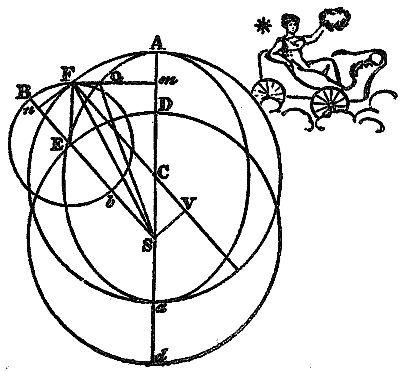
He then found to his equal gratification
and amazement, a small part of which he
endeavoured to express by a triumphant
figure on the side of his diagram, that
the error he had committed in taking the
area ASF to represent the sums of the
distances SF, was exactly counterbalanced;
for this area does accurately
represent the sums of the distances FV or
SQ. This compensation, which seemed
to Kepler the greatest confirmation of
his theory, is altogether accidental and
immaterial, resulting from the relation
between the ellipse and circle. If the
laws of planetary attraction had chanced
to have been any other than those which
cause them to describe ellipses, this last
singular confirmation of an erroneous
theory could not have taken place, and
Kepler would have been forced either to
abandon the theory of the areas, which
even then would have continued to measure
and define their motions, or to renounce
the physical opinions from which
he professed to have deduced it as an
approximative truth.
These are two of the three celebrated
theorems called Kepler's laws: the first
is, that the planets move in ellipses round
the sun, placed in the focus; the second,
that the time of describing any arc is
proportional in the same orbit to the
area included between the arc and the
two bounding distances from the sun.
The third will be mentioned on another
occasion, as it was not discovered till
twelve years later. On the establishment
of these two theorems, it became
important to discover a method of measuring
such elliptic areas, but this is a
problem which cannot be accurately
solved. Kepler, in offering it to the
attention of geometricians, stated his belief
that its solution was unattainable by
direct processes, on account of the incommensurability
of the arc and sine, on
which the measurement of the two parts
AQm, SQm depends. "This," says
he in conclusion, "this is my belief, and
whoever shall shew my mistake, and
point out the true solution,
Is erit mihi magnus Apollonius."
 . Now I have discovered
a court for Jupiter, and two
servants for this old man, who aid his
steps and never quit his side." Galileo
was, however, no match in this style
of writing for Kepler, who disapproved
his friend's metaphor, and, in his usual
fanciful and amusing strain,—"I will
not," said he, "make an old man of
Saturn, nor slaves of his attendant
globes, but rather let this tricorporate
form be Geryon, so shall Galileo be
Hercules, and the telescope his club;
armed with which, he has conquered
that distant planet, and dragged him
from the remotest depths of nature, and
exposed him to the view of all." Galileo's
glass was not of sufficient power to
shew him the real constitution of this
extraordinary planet; it was reserved
for Huyghens, about the year 1656, to
declare to the world that these supposed
attendant stars are in fact part of a
ring which surrounds, and yet is completely
distinct from the body of Saturn;
. Now I have discovered
a court for Jupiter, and two
servants for this old man, who aid his
steps and never quit his side." Galileo
was, however, no match in this style
of writing for Kepler, who disapproved
his friend's metaphor, and, in his usual
fanciful and amusing strain,—"I will
not," said he, "make an old man of
Saturn, nor slaves of his attendant
globes, but rather let this tricorporate
form be Geryon, so shall Galileo be
Hercules, and the telescope his club;
armed with which, he has conquered
that distant planet, and dragged him
from the remotest depths of nature, and
exposed him to the view of all." Galileo's
glass was not of sufficient power to
shew him the real constitution of this
extraordinary planet; it was reserved
for Huyghens, about the year 1656, to
declare to the world that these supposed
attendant stars are in fact part of a
ring which surrounds, and yet is completely
distinct from the body of Saturn;
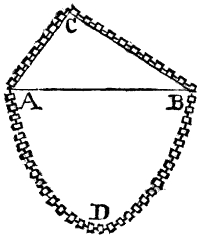 This being
conceded, he remarks further, that the
parts AD and BD are also in equilibrium,
being exactly similar to each
other; and therefore
if they are taken
away, the remaining
parts AC and BC
will also be in equilibrium.
The weights
of these parts are
proportional to the
lengths AC and BC;
and hence Stevin
concluded that two
weights would balance on two inclined
planes, which are to each other as the
lengths of the planes included between
the same parallels to the horizon.
This being
conceded, he remarks further, that the
parts AD and BD are also in equilibrium,
being exactly similar to each
other; and therefore
if they are taken
away, the remaining
parts AC and BC
will also be in equilibrium.
The weights
of these parts are
proportional to the
lengths AC and BC;
and hence Stevin
concluded that two
weights would balance on two inclined
planes, which are to each other as the
lengths of the planes included between
the same parallels to the horizon.
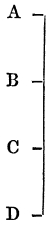 as for instance,—if a heavy
body drop from A towards
D, by the line ABCD, I
suppose the degree of velocity
which it has at B to
bear to the velocity at C the
ratio of AB to AC. I shall
be very glad if your Reverence
will consider this, and
tell me your opinion of it.
If we admit this principle,
not only, as I have said, shall
we demonstrate the other
conclusions, but we have
it in our power to show that
a body falling naturally, and another
projected upwards, pass through the
same degrees of velocity. For if the projectile
be cast up from D to A, it is clear
that at D it has force enough to reach
A, and no farther; and when it has
reached C and B, it is equally clear that
it is still joined to a degree of force
capable of carrying it to A: thus it is
manifest that the forces at D, C and B
decrease in the proportion of AB, AC,
and AD; so that if, in falling, the degrees
of velocity observe the same proportion,
that is true which I have hitherto maintained
and believed."
as for instance,—if a heavy
body drop from A towards
D, by the line ABCD, I
suppose the degree of velocity
which it has at B to
bear to the velocity at C the
ratio of AB to AC. I shall
be very glad if your Reverence
will consider this, and
tell me your opinion of it.
If we admit this principle,
not only, as I have said, shall
we demonstrate the other
conclusions, but we have
it in our power to show that
a body falling naturally, and another
projected upwards, pass through the
same degrees of velocity. For if the projectile
be cast up from D to A, it is clear
that at D it has force enough to reach
A, and no farther; and when it has
reached C and B, it is equally clear that
it is still joined to a degree of force
capable of carrying it to A: thus it is
manifest that the forces at D, C and B
decrease in the proportion of AB, AC,
and AD; so that if, in falling, the degrees
of velocity observe the same proportion,
that is true which I have hitherto maintained
and believed."
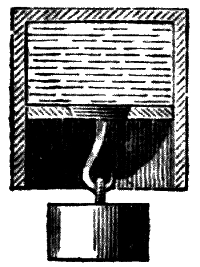 This consisted of a cylinder,
into which is tightly
fitted a piston; through
the centre of the piston
passes a rod with a conical
valve, which, when
drawn down, shuts the
aperture closely, supporting
a basket. The space between the
piston and cylinder being filled full of
water poured in through the aperture, the
valve is closed, the vessel reversed, and
weights are added till the piston is drawn
forcibly downwards. Galileo concluded
that the weight of the piston, rod, and
added weights, would be the measure of
the force of resistance to the vacuum
which he supposed would take place between
the piston and lower surface of
the water. The defects in this apparatus
for the purpose intended are of no
consequence, so far as regards the present
argument, and it is perhaps needless
to observe that he was mistaken in
supposing the water would not descend
with the piston. This experiment occasions
a remark from Sagredo, that he
had observed that a lifting-pump
would not work when the water in the
cistern had sunk to the depth of thirty-five
feet below the valve; that he thought
the pump was injured, and sent for the
maker of it, who assured him that no
pump upon that construction would lift
water from so great a depth. This story
is sometimes told of Galileo, as if he
had said sneeringly on this occasion
that Nature's horror of a vacuum does
not extend beyond thirty-five feet; but
it is very plain that if he had made such
an observation, it would have been seriously;
and in fact by such a limitation
he deprived the notion of the
principal part of its absurdity. He evidently
had adopted the common notion
of suction, for he compares the column
of water to a rod of metal suspended
from its upper end, which may be lengthened
till it breaks with its own weight.
It is certainly very extraordinary that
he failed to observe how simply these phenomena
may be explained by a reference
to the weight of the elastic atmosphere,
which he was perfectly well acquainted
with, and endeavoured by the
following ingenious experiment to determine:—"Take
a large glass flask
with a bent neck, and round its mouth
tie a leathern pipe with a valve in it,
through which water may be forced into
the flask with a syringe without suffering
any air to escape, so that it will be
compressed within the bottle. It will be
found difficult to force in more than
about three-fourths of what the flask
will hold, which must be carefully
weighed. The valve must then be
opened, and just so much air will rush
out as would in its natural density occupy
the space now filled by the water.
Weigh the vessel again; the difference
will show the weight of that quantity
of air."
This consisted of a cylinder,
into which is tightly
fitted a piston; through
the centre of the piston
passes a rod with a conical
valve, which, when
drawn down, shuts the
aperture closely, supporting
a basket. The space between the
piston and cylinder being filled full of
water poured in through the aperture, the
valve is closed, the vessel reversed, and
weights are added till the piston is drawn
forcibly downwards. Galileo concluded
that the weight of the piston, rod, and
added weights, would be the measure of
the force of resistance to the vacuum
which he supposed would take place between
the piston and lower surface of
the water. The defects in this apparatus
for the purpose intended are of no
consequence, so far as regards the present
argument, and it is perhaps needless
to observe that he was mistaken in
supposing the water would not descend
with the piston. This experiment occasions
a remark from Sagredo, that he
had observed that a lifting-pump
would not work when the water in the
cistern had sunk to the depth of thirty-five
feet below the valve; that he thought
the pump was injured, and sent for the
maker of it, who assured him that no
pump upon that construction would lift
water from so great a depth. This story
is sometimes told of Galileo, as if he
had said sneeringly on this occasion
that Nature's horror of a vacuum does
not extend beyond thirty-five feet; but
it is very plain that if he had made such
an observation, it would have been seriously;
and in fact by such a limitation
he deprived the notion of the
principal part of its absurdity. He evidently
had adopted the common notion
of suction, for he compares the column
of water to a rod of metal suspended
from its upper end, which may be lengthened
till it breaks with its own weight.
It is certainly very extraordinary that
he failed to observe how simply these phenomena
may be explained by a reference
to the weight of the elastic atmosphere,
which he was perfectly well acquainted
with, and endeavoured by the
following ingenious experiment to determine:—"Take
a large glass flask
with a bent neck, and round its mouth
tie a leathern pipe with a valve in it,
through which water may be forced into
the flask with a syringe without suffering
any air to escape, so that it will be
compressed within the bottle. It will be
found difficult to force in more than
about three-fourths of what the flask
will hold, which must be carefully
weighed. The valve must then be
opened, and just so much air will rush
out as would in its natural density occupy
the space now filled by the water.
Weigh the vessel again; the difference
will show the weight of that quantity
of air."
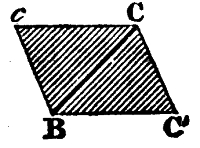 if a body have motion
communicated to it in two directions,
by one of which motions alone it would
have passed through a given space in a
given time, as for instance, through BC´
in one second, and by the other alone
through any other space Bc in the same
time, it will, when both are
given to it at the same instant,
pass in the same
time (in the present instance
in one second) through BC the
diagonal of the parallelogram of which
BC´ and Bc are sides.
if a body have motion
communicated to it in two directions,
by one of which motions alone it would
have passed through a given space in a
given time, as for instance, through BC´
in one second, and by the other alone
through any other space Bc in the same
time, it will, when both are
given to it at the same instant,
pass in the same
time (in the present instance
in one second) through BC the
diagonal of the parallelogram of which
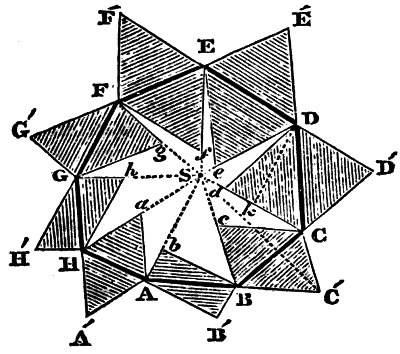
BC´ and Bc are sides.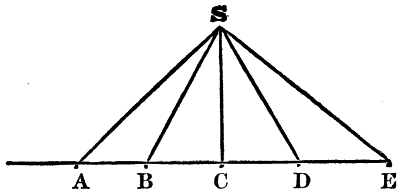
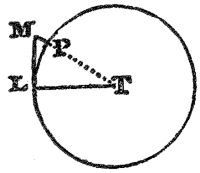 Taking LP
to represent part of
the moon's orbit described
in one minute,
the line PM between
the orbit and the
tangent at L would
shew the space through which the central
force at the earth (assuming the above
principles of motion to be correct) would
draw the moon. From the known distance
and motion of the moon, this line
PM is found to be about sixteen feet.
The distance of the moon is about sixty
times the radius of the earth, and therefore
if the law of the central force in this
instance were such as has been supposed,
the force at the earth's surface would
be 60 times 60, or 3600 times stronger,
and at the earth's surface, the central
force would make a body fall through
3600 times 16 feet in one minute. Galileo
had already taught that the spaces
through which a body would be made
to fall, by the constant action of the
same unvarying force, would be proportional
to the squares of the times during
which the force was exerted, and
therefore according to these laws, a
body at the earth's surface ought (since
there are sixty seconds in a minute) to
fall through 16 feet in one second, which
was precisely the space previously established
by numerous experiments.
Taking LP
to represent part of
the moon's orbit described
in one minute,
the line PM between
the orbit and the
tangent at L would
shew the space through which the central
force at the earth (assuming the above
principles of motion to be correct) would
draw the moon. From the known distance
and motion of the moon, this line
PM is found to be about sixteen feet.
The distance of the moon is about sixty
times the radius of the earth, and therefore
if the law of the central force in this
instance were such as has been supposed,
the force at the earth's surface would
be 60 times 60, or 3600 times stronger,
and at the earth's surface, the central
force would make a body fall through
3600 times 16 feet in one minute. Galileo
had already taught that the spaces
through which a body would be made
to fall, by the constant action of the
same unvarying force, would be proportional
to the squares of the times during
which the force was exerted, and
therefore according to these laws, a
body at the earth's surface ought (since
there are sixty seconds in a minute) to
fall through 16 feet in one second, which
was precisely the space previously established
by numerous experiments.