Larger versions of the illustrations may be seen by right-clicking them
and selecting an option to view them separately, or by double-tapping and/or
stretching them.
AUTHOR OF “PERSONAL LIFE OF QUEEN VICTORIA,” “LIFE OF QUEEN
ALEXANDRA,” “ROYAL PALACES AND THEIR MEMORIES,” “THE
HISTORY OF NURSING IN THE BRITISH EMPIRE,” ETC.
MEMORIAL EDITION
CASSELL AND COMPANY, Ltd.
LONDON, NEW YORK, TORONTO AND MELBOURNE
ALL RIGHTS RESERVED
TO THE LADY HERBERT OF LEA
THE LIFE-LONG FRIEND OF FLORENCE NIGHTINGALE
THIS BOOK
IS BY PERMISSION Dedicated
PREFACE
The writing of the Life of Florence Nightingale
was undertaken with the object of marking
the jubilee of the illustrious heroine who left London
on October 21st, 1854, with a band of thirty-eight
nurses for service in the Crimean War. Her
heroic labours on behalf of the sick and wounded
soldiers have made her name a household word
in every part of the British Empire, and it
was a matter for national congratulation that Miss
Nightingale lived to celebrate such a memorable
anniversary.
A striking proof of the honour in which her
name is held by the rising generation was given
a short time ago, when the editor of The Girl’s Realm
took the votes of his readers as to the most popular
heroine in modern history. Fourteen names were
submitted, and of the 300,000 votes given, 120,776
were for Florence Nightingale.
No trouble has been spared to make the book
as accurate and complete as possible, and when
writing it I spent several months in the vicinity
of Miss Nightingale’s early homes, and received
much kind assistance from people of all classes
acquainted with her. In particular I would thank
Lady Herbert of Lea for accepting the dedication
of the book and for portraits of herself and Lord
Herbert; Sir Edmund Verney for permission to
publish the picture of the late Lady Verney and
views of Claydon; Pastor Düsselhoff of Kaiserswerth
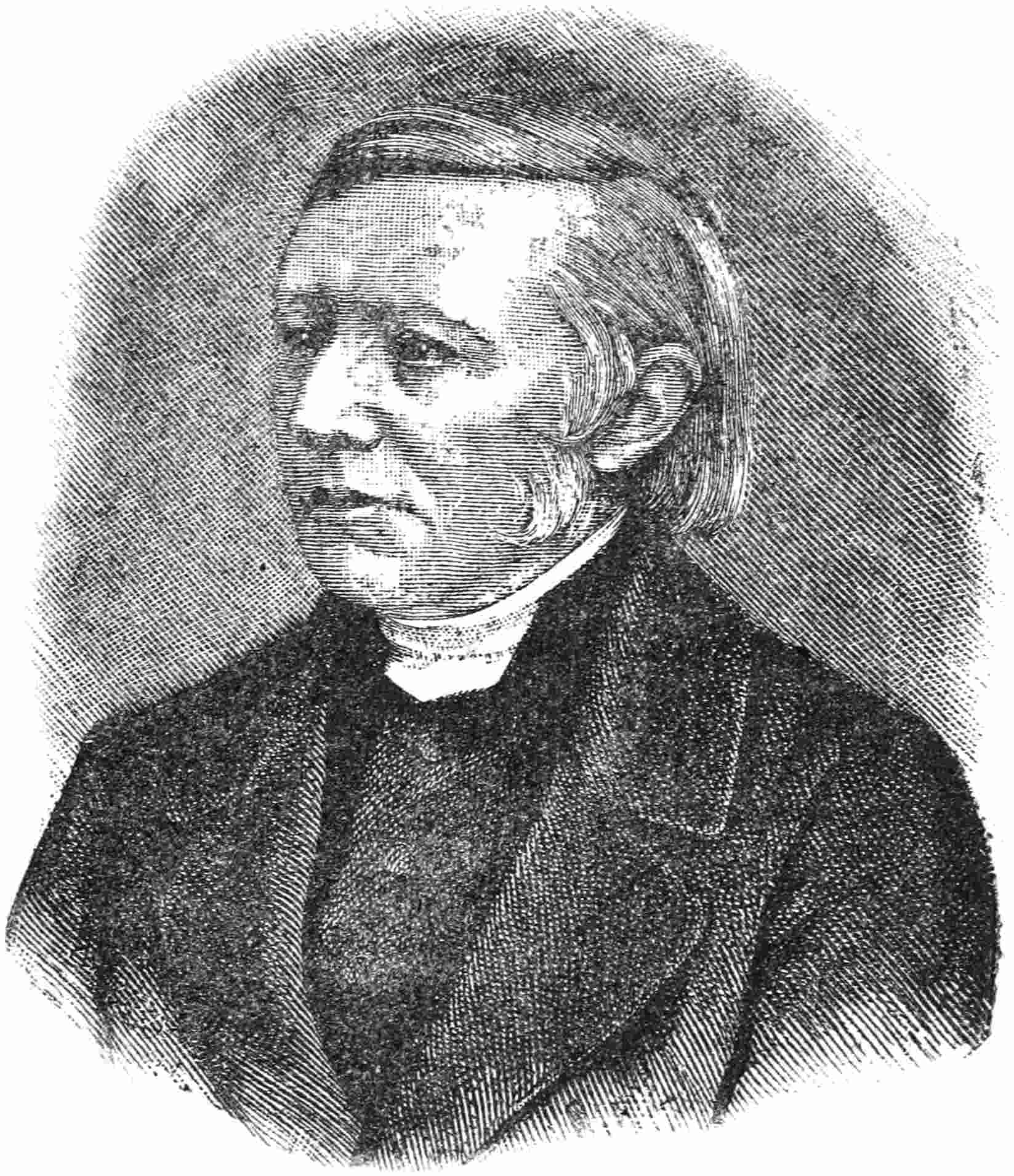
for the portrait of Pastor Fliedner and some recollections
of Miss Nightingale’s training in that
institution; the late Sister Mary Aloysius, of the
Convent of Sisters of Mercy, Kinvara, co. Galway,
for memories of her work at Scutari Hospital; and
Mr. Crowther, Librarian of the Public Library,
Derby, for facilities for studying the collection of
material relating to Miss Nightingale presented to
the Library by the late Duke of Devonshire.
In the preparation of the revised edition I am
indebted to Lady Verney, the late Hon. Frederick
Strutt, and Mrs. Dacre Craven for valuable
suggestions.
SARAH A. TOOLEY
Kensington.
CONTENTS
CHAPTER I
BIRTH AND ANCESTRY
PAGE
Birth at Florence—Shore Ancestry—Peter Nightingale of Lea—Florence Nightingale’s Parents
An Accomplished Girl—An Angel in the Homes of the Poor—Children’s “Feast Day” at Lea Hurst—Her Bible-Class for Girls—Interests at Embley—Society Life—Longing for a Vocation—Meets Elizabeth Fry—Studies Hospital Nursing—Decides to go to Kaiserswerth
Enrolled a Deaconess at Kaiserswerth—Paster Fliedner—His Early Life—Becomes Pastor at Kaiserswerth—Interest in Prison Reform—Starts a Small Penitentiary for Discharged Female Prisoners—Founds a School and the Deaconess Hospital—Rules for Deaconesses—Marvellous Extension of his Work—His Death—Miss Nightingale’s Tribute
An Interesting Letter—Description of Miss Nightingale when she entered Kaiserswerth—Testimonies to her Popularity—Impressive Farewell to Pastor Fliedner
Visits the Sisters of St. Vincent de Paul in Paris—Illness—Resumes Old Life at Lea Hurst and Embley—Interest in John Smedley’s System of Hydropathy—Mr. and Mrs. Sidney Herbert’s Philanthropies—Work at Harley Street Home for Sick Governesses—Illness and Return Home
Gladstone on Lord Herbert—Early Life of Lord Herbert—His Mother—College Career—Enters Public Life—As Secretary for War—Benevolent Work at Salisbury—Lady Herbert—Friendship with Florence Nightingale—Again Secretary for War
Tribute to Florence Nightingale by the Countess of Lovelace—Outbreak of the Crimean War—Distressing Condition of the Sick and Wounded—Mr. W. H. Russell’s Letters to The Times—Call for Women Nurses—Mr. Sidney Herbert’s Letter to Miss Nightingale—She offers her Services
Public Curiosity Aroused—Description of Miss Nightingale in the Press—Criticism—She selects Thirty-Eight Nurses—Departure of the “Angel Band”—Enthusiasm of Boulogne Fisherwomen—Arrival at Scutari
The Barrack Hospital—Overwhelming Numbers of Sick and Wounded—General Disorder—Florence Nightingale’s “Commanding Genius”—The Lady with the Brain—The Nurses’ Tower—Influence over Men in Authority
An Appalling Task—Stories of Florence Nightingale’s Interest in the Soldiers—Lack of Necessaries for the Wounded—Establishes an Invalids’ Kitchen and a Laundry—Cares for the Soldiers’ Wives—Religious Fanatics—Letter from Queen Victoria—Christmas at Scutari
Lavish Gifts for the Soldiers—The Times Fund—The Times Commissioner visits Scutari—His Description of Miss Nightingale—Arrival of M. Soyer, the Famous Chef—He Describes Miss Nightingale
Death of Seven Surgeons at Scutari—The First of the “Angel Band” Stricken—Deaths of Miss Smythe, Sister Winifred, and Sister Mary Elizabeth—Touching Verses by an Orderly
On Board the Robert Lowe—Story of a Sick Soldier—Visit to the Camp Hospitals—Sees Sebastopol from the Trenches—Recognised and Cheered by the Soldiers—Adventurous Ride Back
Continued Visitation of Hospitals—Sudden Illness—Conveyed to Sanatorium—Visit of Lord Raglan—Convalescence—Accepts Offer of Lord Ward’s Yacht—Returns to Scutari—Memorial to Fallen Heroes
Fall of Sebastopol—The Nightingale Hospital Fund—A Carriage Accident—Last Months in the Crimea—“The Nightingale Cross”—Presents from Queen Victoria and the Sultan—Sails for Home
Arrives Secretly at Lea Hurst—The Object of Many Congratulations—Presentations—Received by Queen Victoria at Balmoral—Prepares Statement of “Voluntary Gifts”—Tribute to Lord Raglan
Ill Health—Unremitting Toil—Founds Nightingale Training School at St. Thomas’s Hospital—Army Reform—Death of Lord Herbert of Lea—Palmerston and Gladstone pay Tributes to Miss Nightingale—Interesting Letters—Advises in American War and Franco-German War
Origin of the Liverpool Home and Training School—Interest in the Sick Paupers—“Una and the Lion” a Tribute to Sister Agnes Jones—Letter to Miss Florence Lees—Plea for a Home for Nurses—On the Question of Paid Nurses—Queen Victoria’s Jubilee Nursing Institute—Rules for Probationers
The Nightingale Home—Rules for Probationers—Deaths of Mr. and Mrs. Nightingale—Death of Lady Verney—Continues to Visit Claydon—Health Crusade—Rural Hygiene—A Letter to Mothers—Introduces Village Missioners—Village Sanitation in India—The Diamond Jubilee—Balaclava Dinner
Miss Nightingale To-day—Her Interest in Passing Events—Recent Letter to Derbyshire Nurses—Celebrates Eighty-fourth Birthday—King confers Dignity of a Lady of Grace—Appointed by King Edward VII. to the Order of Merit—Letter from the German Emperor—Elected to the Honorary Freedom of the City of London—Summary of her Noble Life In Memoriam
THE LIFE OF FLORENCE NIGHTINGALE — CHAPTER I BIRTH AND ANCESTRY
Birth at Florence—Shore Ancestry—Peter Nightingale of Lea—Florence
Nightingale’s Parents.
We are born into life—it is sweet, it is strange,
We lie still on the knee of a mild mystery
Which smiles with a change;
But we doubt not of changes, we know not of spaces,
The heavens seem as near as our own mother’s face is,
And we think we could touch all the stars that we see.
Elizabeth Barrett Browning.
Thought and deed, not pedigree, are the passports to enduring
fame.—General Skobeleff.
At a dinner given to the military and naval
officers who had served in the Crimean
War, it was suggested that each guest should
write on a slip of paper the name of the person
whose services during the late campaign would
be longest remembered by posterity. When the
papers were examined, each bore the same name—“Florence
Nightingale.”
The prophecy is fulfilled to-day, for though little
more than fifty years have passed since the joy-bells
throughout the land proclaimed the fall of Sebastopol,
the majority of people would hesitate if
asked to name the generals of the Allied Armies,
while no one would be at a loss to tell who was
the heroine of the Crimea. Her deeds of love and
sacrifice sank deep into the nation’s heart, for they
were above the strife of party and the clash of arms.
While Death has struck name after name from the
nation’s roll of the great and famous, our heroine
lives in venerated age to shed the lustre of her
name upon a new century.
Florence Nightingale was born on May 12th,
1820, at the Villa Colombaia near Florence, where
her parents, Mr. and Mrs. William Shore Nightingale,
of Lea, Derbyshire, were staying.
“What name should be given to the baby girl
born so far away from her English home?” queried
her parents, and with mutual consent they decided
to call her “Florence,” after that fair city of flowers
on the banks of the Arno where she first saw the
light. Little did Mr. and Mrs. Nightingale then
think that the name thus chosen was destined to
become one of the most popular throughout the
British Empire. Every “Florence” practically owes
her name to the circumstances of Miss Nightingale’s
birth.
It seemed as though the fates were determined
to give an attractive designation to our heroine.
While “Florence” suggested the goddess of flowers,
“Nightingale” spoke of sweet melody. What
could be more beautiful and euphonious than a
name suggesting a song-bird from the land of
flowers? The combination proved a special joy
to Mr. Punch and his fellow-humorists when the
bearer of the name rose to fame.
However, Miss Nightingale’s real family name
was Shore. Her father was William Edward Shore,
the only son of William Shore of Tapton, Derbyshire,
and he assumed the name of Nightingale, by
the sign manual of the Prince Regent, when he
succeeded in 1815 to the estates of his mother’s
uncle, Peter Nightingale of Lea. This change took
place three years before his marriage, and five
before the birth of his illustrious daughter.
Through her Shore ancestry Miss Nightingale is
connected with the family of Baron Teignmouth. Sir
John Shore, Governor-General of India, was created
a baron in 1797 and took the title of Teignmouth.
Another John Shore was an eminent physician at
Derby in the reign of Charles II., and a Samuel Shore
married the heiress of the Offleys, a Sheffield family.
It is through her paternal grandmother, Mary,
daughter of John Evans of Cromford, the niece
and sole heir of Peter Nightingale, that Florence
Nightingale is connected with the family whose
name she bears. Her great-great-uncle, Peter
Nightingale, was a typical Derbyshire squire who
more than a century ago lived in good style at
the fine old mansion of Lea Hall. Those were
rough and roystering days in such isolated villages
as Lea, and “old Peter” had his share of the
vices then deemed gentlemanly. He could
swear with the best, and his drinking feats might
have served Burns for a similar theme to The
Whistle. His excesses gained for him the nickname
of “Madman Nightingale,” and accounts of
his doings still form the subject of local gossip.
When in his cups, he would raid the kitchen, take
the puddings from the pots and fling them on
the dust-heap, and cause the maids to fly in terror.
Nevertheless, “old Peter” was not unpopular; he
was good-natured and easy going with his people,
and if he drank hard, well, so did his neighbours.
He was no better and little worse than the average
country squire, and parson too, of the “good old
times.” His landed possessions extended from Lea
straight away to the old market town of Cromford,
and beyond towards Matlock. It is of special interest
to note that he sold a portion of his Cromford
property to Sir Richard Arkwright, who erected
there his famous cotton mills. The beautiful
mansion of Willersley Castle, which the ingenious
cotton-spinner built, and where he ended his days
as the great Sir Richard, stands on a part of the
original Nightingale property. When “old Peter”
of jovial memory passed to his account, his estates
and name descended to his grand-nephew, William
Edward Shore.
The new squire, Florence Nightingale’s father,
was a marked contrast to his predecessor. He
is described by those who remember him as a
tall, slim, gentlemanly man of irreproachable
character. He had been educated at Edinburgh
and Trinity College, Cambridge, and had broadened
his mind by foreign travel at a time when the average
English squire, still mindful of the once terrifying
name of “Boney,” looked upon all foreigners as
his natural enemies, and entrenched himself on
his ancestral acres with a supreme contempt for
lands beyond the Channel. Mr. Nightingale was
far in advance of the county gentry of his time
in matters of education and culture. Sport had no
special attraction for him, but he was a student, a
lover of books and a connoisseur in art. He was
not without a good deal of pride of birth, for
the Shores were a very ancient family.
As a landlord he had a sincere desire to benefit
the people on his estates, although not perhaps
in the way they most appreciated. “Well, you
see, I was not born generous,” is still remembered
as Mr. Nightingale’s answer when solicited for
various local charities. However, he never begrudged
money for the support of rural education,
and, to quote the saying of one of his old
tenants, “Many poor people in Lea would not be
able to read and write to-day, if it had not been
for ‘Miss Florence’s’ father.” He was the chief
supporter of what was then called the “cheap
school,” where the boys and girls, if they did not
go through the higher standards of the present-day
schools, at least learned the three R’s for
the sum of twopence a week. There was, of course,
no compulsory education then, but the displeasure of
the squire with people who neglected to send their
children to school was a useful incentive to parents.
Mr. Nightingale was a zealous Churchman, and
did much to further Christian work in his district.
Florence Nightingale’s mother was Miss Frances
Smith, daughter of William Smith, Esq., of
Parndon in Essex, who for fifty years was M.P.
for Norwich. He was a pronounced Abolitionist,
took wide and liberal views on the questions of
the time, and was noted for his interest in various
branches of philanthropy. Mrs. Nightingale was
imbued with her father’s spirit, and is remembered
for her great kindness and benevolence to the poor.
She was a stately and beautiful woman in her
prime and one of the fast-dying-out race of
gentlewomen who were at once notable house-keepers
and charming and cultured ladies. Her
name is still mentioned with gratitude and affection
by the old people of her husband’s estates.
It was from her mother, whom she greatly
resembles, that Florence Nightingale inherited the
spirit of wide philanthropy and the desire to break
away, in some measure, from the bonds of caste
which warped the county gentry in her early
days and devote herself to humanitarian work.
She was also fortunate in having a father who
believed that a girl’s head could carry something
more than elegant accomplishments and a knowledge
of cross-stitch. While our heroine’s mother trained
her in deeds of benevolence, her father inspired
her with a love for knowledge and guided her
studies on lines much in advance of the usual
education given to young ladies at that period.
Mr. and Mrs. Nightingale had only two children—Frances
Parthenope, afterwards Lady Verney, and
Florence, about a year younger. Both sisters were
named after the Italian towns where they were born,
the elder receiving the name of Parthenope, the
classic form of Naples, and was always known as
“Parthe,” while our heroine was Florence.
CHAPTER II EARLIEST ASSOCIATIONS
Lea Hall first English Home—Neighbourhood of Babington Plot—Dethick
Church.
... Those first affections,
Those shadowy recollections,
Which be they what they may,
Are yet the fountain light of all our day,
Are yet a master light of all our seeing.
Wordsworth.
When Mr. and Mrs. Nightingale returned
from abroad with their two little daughters,
they lived for a time at the old family seat of
Lea Hall, which therefore has the distinction of
being the first English home of Florence Nightingale,
an honour generally attributed to her parents’ subsequent
residence of Lea Hurst.
Lea Hall is beautifully situated high up amongst
the hills above the valley of the Derwent. I visited
it in early summer when the meadows around were
golden with buttercups and scented with clover, and
the long grass stood ready for the scythe. Wild
roses decked the hedgerows, and the elder-bushes,
which grow to a great size in this part of Derbyshire,
made a fine show with their white blossoms. Seen
then, the old grey Hall seemed a pleasant country
residence; but when the north wind blows and
snow covers the hillsides, it must be a bleak and
lonely abode. It is plainly and solidly built of grey
limestone from the Derbyshire quarries, and is of
good proportions. From its elevated position it has
an imposing look, and forms a landmark in the open
country. Leading from it, the funny old village
street of Lea, with its low stone houses, some of
them very ancient, curls round the hillside downwards
to the valley. The butcher proudly displays
a ledger with entries for the Nightingale family
since 1835.
The Hall stands on the ancient Manor of
Lea, which includes the villages of Lea, Dethick,
and Holloway, and which passed through several
families before it became the property of the
Nightingales. The De Alveleys owned the manor
in the reign of John and erected a chapel there.
One portion of the manor passed through the
families of Ferrar, Dethwick, and Babington, and
another portion through the families of De la Lea,
Frecheville, Rollestone, Pershall, and Spateman to
that of the Nightingales.
The house stands a little back from the Lea
road in its own grounds, and is approached by a
gate from the front garden. Stone steps lead up
to the front door, which opens into an old-fashioned
flag-paved hall. Facing the door is an oak staircase
of exceptional beauty. It gives distinction to
the house and proclaims its ancient dignity. The
balustrade has finely turned spiral rails, the steps
are of solid oak, and the sides of the staircase
panelled in oak. One may imagine the little
Florence making her first efforts at climbing up
this handsome old staircase.
In a room to the left the date 1799 has been
scratched upon one of the window-panes, but the
erection of the Hall must have been long before that
time. For the rest, it is a rambling old house with
thick walls and deep window embrasures. The
ceilings are moderately high. There is an old-fashioned
garden at the back, with fruit and shady
trees and a particularly handsome copper beech.
The Hall has long been used as a farmhouse, and
scarcely one out of the hundreds of visitors to the
Matlock district who go on pilgrimages to Lea Hurst
knows of its interesting association. The old lady
who occupied it at the time of my visit was not a little
proud of the fact that for forty-four years she had lived
in the first English home of Florence Nightingale.
The casual visitor might think the district amid
which our heroine’s early years were spent was
a pleasant Derbyshire wild and nothing more,
but it has also much historic interest. Across the
meadows from Lea Hall are the remains of the
stately mansion of Dethick, where dwelt young
Anthony Babington when he conspired to release
Mary Queen of Scots from her imprisonment at
Wingfield Manor, a few miles away. Over these
same meadows and winding lanes Queen Elizabeth’s
officers searched for the conspirators and apprehended
one at Dethick. The mansion where the
plot was hatched has been largely destroyed, and
what remains is used for farm purposes. Part of
the old wall which enclosed the original handsome
building still stands, and beside it is an underground
cellar which according to tradition leads into a
secret passage to Wingfield Manor. The farm
bailiff who stores his potatoes in the cellar has not
been able to find the entrance to the secret passage,
though at one side of the wall there is a suspicious
hollow sound when it is hammered.
The original kitchen of the mansion remains
intact in the bailiff’s farmhouse. There is the
heavy oak-beamed ceiling, black with age, the
ponderous oak doors, the great open fireplace, desecrated
by a modern cooking range in the centre,
but which still retains in the overhanging beam
the ancient roasting jack which possibly cooked
venison for Master Anthony and the other gallant
young gentlemen who had sworn to liberate the
captive Queen. In the roof of the ceiling is an innocent-looking
little trap-door which, when opened,
reveals a secret chamber of some size. This delightful
old kitchen, with its mysterious memories, was a place
of great fascination to Florence Nightingale and
her sister in their childhood, and many stories did
they weave about the scenes which transpired long
ago in the old mansion, so near their own home.
It was a source of peculiar interest to have the
scenes of a real Queen Mary romance close at
hand, and gave zest to the subject when the
sisters read about the Babington plot in their history
books.
Dethick Church, where our heroine attended her
first public service, and continued to frequently
worship so long as she lived in Derbyshire, formed
a part of the Babingtons’ domain. It was originally
the private chapel of the mansion, but gradually
was converted to the uses of a parish church. Its
tall tower forms a picturesque object from the
windows of Lea Hall. The church must be one
of the smallest in the kingdom. Fifty persons
would prove an overflowing congregation even
now that modern seating has utilised space, but in
Florence Nightingale’s girlhood, when the quality
sat in their high-backed pews and the rustics on
benches at the farther end of the church, the sitting
room was still more limited. The interior of the
church is still plain and rustic, with bare stone walls,
and the bell ropes hanging in view of the congregation.
The service was quaint in Miss
Nightingale’s youth, when the old clerk made the
responses to the parson, and the preaching sometimes
took an original turn. The story is still
repeated in the district that the old parson, preaching
one Sunday on the subject of lying, made the
consoling remark that “a lie is sometimes a very
useful thing in trade.” The saying was often
repeated by the farmers of Lea and Dethick in the
market square of Derby.
Owing to the fact that Dethick Church was
originally a private chapel, there is no graveyard.
It stands in a pretty green enclosure on the top of
a hill. An old yew-tree shades the door, and near
by are two enormous elder-bushes, which have twined
their great branches together until they fall down to
the ground like a drooping ash, forming an absolutely
secluded bower, very popular with lovers and truants
from church.
The palmy days of old Dethick Church are past.
No longer do the people from the surrounding
villages and hamlets climb its steep hillside, Sunday
by Sunday, for, farther down in the vale, a new
church has recently been built at Holloway, which, if
less picturesque, is certainly more convenient for the
population. On the first Sunday in each month,
however, a service is still held in the old church
where, in days long ago, Florence Nightingale sat
in the squire’s pew, looking in her Leghorn hat
and sandal shoes a very bonny little maiden
indeed.
CHAPTER III LEA HURST
Removal to Lea Hurst—Description of the House—Florence
Nightingale’s Crimean Carriage preserved there.
L o! in the midst of Nature’s choicest scenes,
E mbosomed ’mid tall trees, and towering hills,
A gem, in Nature’s setting, rests Lea Hurst.
H ome of the good, the pure at heart and beautiful,
U ndying is the fame which, like a halo’s light,
R ound thee is cast by the bright presence of the holy Florence
S aint-like and heavenly. Thou hast indeed a glorious fame
T ime cannot change, but which will be eternal.
Llewellyn Jewett.
When Florence Nightingale was between
five and six years old, the family removed
from Lea Hall to Lea Hurst, a house which
Mr. Nightingale had been rebuilding on a site
about a mile distant, and immediately above the
hamlet of Lea Mills. This delightful new home
is the one most widely associated with the life of
our heroine. To quote the words of the old lady
at the lodge, “It was from Lea Hurst as Miss
Florence set out for the Crimea, and it was to Lea
Hurst as Miss Florence returned from the Crimea.”
For many years after the war it was a place of
pilgrimage, and is mentioned in almost every guidebook
as one of the attractions of the Matlock
district. It has never been in any sense a show
house, and the park is private, but in days gone
by thousands of people came to the vicinity, happy
if they could see its picturesque gables from the
hillside, and always with the hope that a glimpse
might be caught of the famous lady who lived
within its walls. Miss Nightingale remains tenderly
attached to Lea Hurst, although it is eighteen
years since she last stayed there. After the death
of her parents it passed to the next male heir,
Mr. Shore Smith, who later assumed the name of
Nightingale.
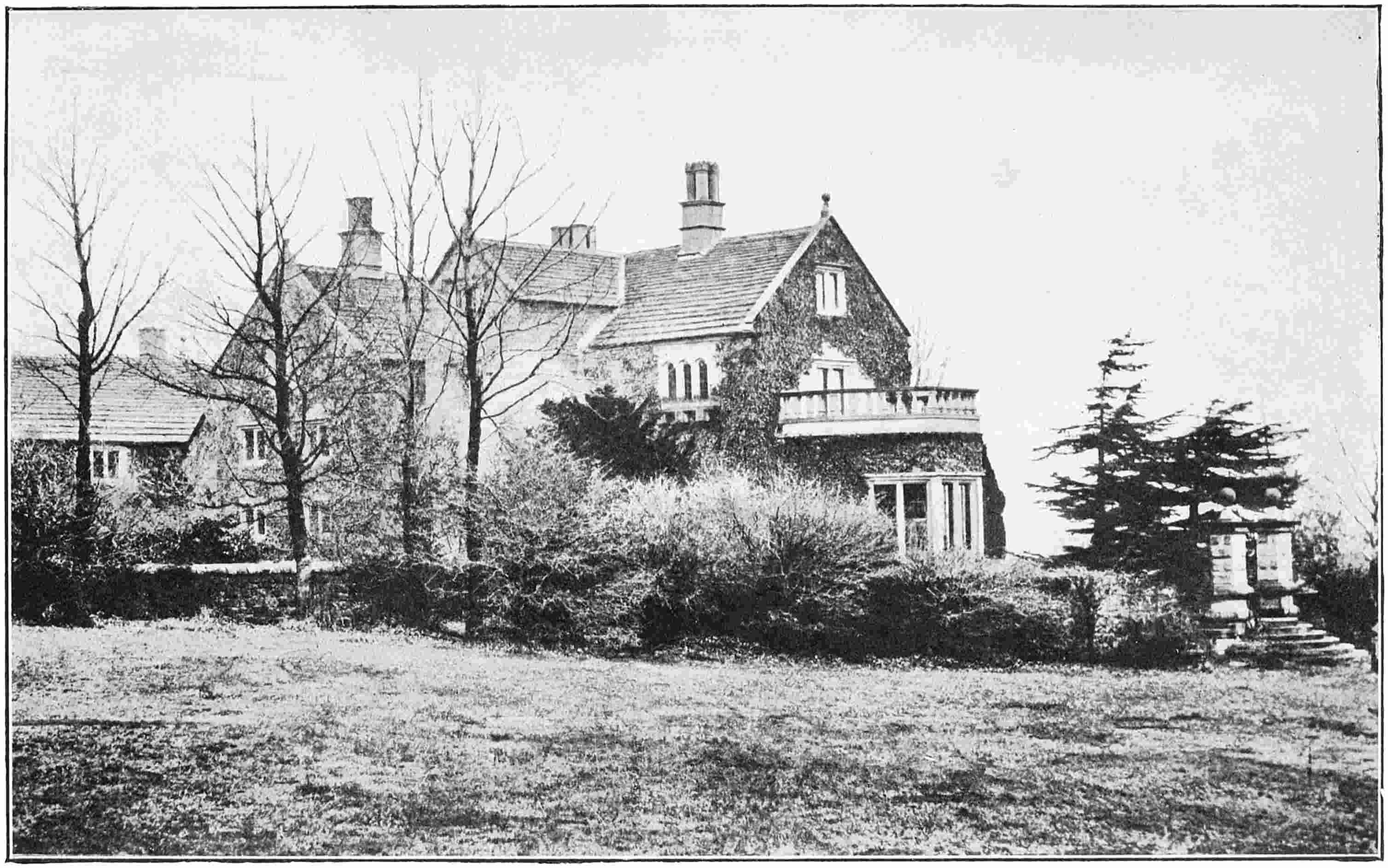
LEA HURST, DERBYSHIRE.
(Photo by Keene, Derby.)
[To face p. 16.
Lea Hurst is only fourteen miles from Derby,
but the following incident would lead one to
suppose that the house is not as familiar in the
county town as might be expected. Not long ago
a lady asked at a fancy stationer’s shop for a
photograph of Lea Hurst.
“Lea Hurst?” pondered the young saleswoman,
and turning to her companion behind the counter,
she inquired, “Have we a photograph of Lea
Hurst?”
“Yes, I think so,” was the reply.
“Who is Lea Hurst?” asked the first girl.
“Why, an actor of course,” replied the second.
There was an amusing tableau when the truth
was made known.
Miss Nightingale’s father displayed a fine discrimination
when he selected the position for his
new house. One might search even the romantic
Peak country in vain for a more ideal site than
Lea Hurst. It stands on a broad plateau looking
across to the sharp, bold promontory of limestone
rock known as Crich Stand. Soft green hills and
wooded heights stud the landscape, while deep
down in the green valley the silvery Derwent—or
“Darent,” as the natives call it—makes music as
it dashes over its rocky bed. The outlook is one
of perfect repose and beauty away to Dove’s
romantic dale, and the aspect is balmy and sunny,
forming in this respect a contrast to the exposed
and bleak situation of Lea Hall.
The house is in the style of an old Elizabethan
mansion, and now that time has mellowed the stone
and clothed the walls with greenery, one might
imagine that it really dated from the Tudor period.
Mr. Nightingale was a man of artistic tastes, and
every detail of the house was carefully planned for
picturesque effect. The mansion is built in the
form of a cross with jutting wings, and presents a
picture of clustering chimneys, pointed gables, stone
mullioned windows and latticed panes. The fine
oriel window of the drawing-room forms a projecting
wing at one end of the house. The rounded
balcony above the window has become historic. It
is pointed out to visitors as the place where “Miss
Florence used to come out and speak to the people.”
Miss Nightingale’s room opened on to this balcony,
and after her return from the Crimea, when she
was confined to the house with delicate health, she
would occasionally step from her room on to the
balcony to speak to the people, who had come as
deputations, while they stood in the park below.
Facing the oriel balcony is a gateway, shadowed
by yew-trees, which forms one of the entrances
from the park to the garden.
In front of the house is a circular lawn with
gravel path and flower-beds, and above the hall
door is inscribed N. and the date 1825, the year
in which Lea Hurst was completed. The principal
rooms open on to the garden or south front, and
have a delightfully sunny aspect and a commanding
view over the vale. From the library a flight
of stone steps leads down to the lawn. The old
schoolroom and nursery where our heroine passed
her early years are in the upper part of the house
and have lovely views over the hills.
In the centre of the garden front of the mansion
is a curious little projecting building which goes
by the name of “the chapel.” It is evidently an
ancient building effectively incorporated into Lea
Hurst. There are several such little oratories
of Norman date about the district, and the old
lady at Lea Hurst lodge shows a stone window
in the side of her cottage which is said to be seven
hundred years old. A stone cross surmounts the roof
of the chapel, and outside on the end wall is an
inscription in curious characters. This ancient little
building has, however, a special interest for our
narrative, as Miss Nightingale used it for many
years as the meeting place for the Sunday afternoon
Bible-class which she held for the girls of
the district. In those days there was a large bed
of one of Miss Nightingale’s favourite flowers, the
fuchsia, outside the chapel, but that has been replaced
by a fountain and basin, and the historic building
itself, with its thick stone walls, now makes an
excellent larder.
The gardens at Lea Hurst slope down from the back
of the house in a series of grassy terraces connected
by stone steps, and are still preserved in all their
old-fashioned charm and beauty. There in spring
and early summer one sees wallflowers, peonies,
pansies, forget-me-nots, and many-coloured primulas
in delightful profusion, while the apple trellises which
skirt the terraces make a pretty show with their
pink blossoms, and the long border of lavender-bushes
is bursting into bloom. In a secluded
corner of the garden is an old summer-house with
pointed roof of thatch which must have been
a delightful playhouse for little Florence and
her sister.
The park slopes down on either side the plateau
on which the house stands. The entrance to
the drive is in the pleasant country road which
leads to the village of Whatstandwell and on
to Derby. This very modest park entrance,
consisting of an ordinary wooden gate supported
by stone pillars with globes on the top, has been
described by an enthusiastic chronicler as a “stately
gateway” with “an air of mediæval grandeur.”
There is certainly no grandeur about Lea Hurst,
either mediæval or modern. It is just one of
those pleasant and picturesque country mansions
which are characteristic of rural England, and no
grandeur is needed to give distinction to a house
which the name of Florence Nightingale has
hallowed.
Beyond the park the Lea woods cover the
hillside for some distance, and in spring are
thickly carpeted with bluebells. A long winding
avenue, from which magnificent views are obtained
over the hills and woodland glades for many miles,
skirts the top of the woods, and is still remembered
as “Miss Florence’s favourite walk.”
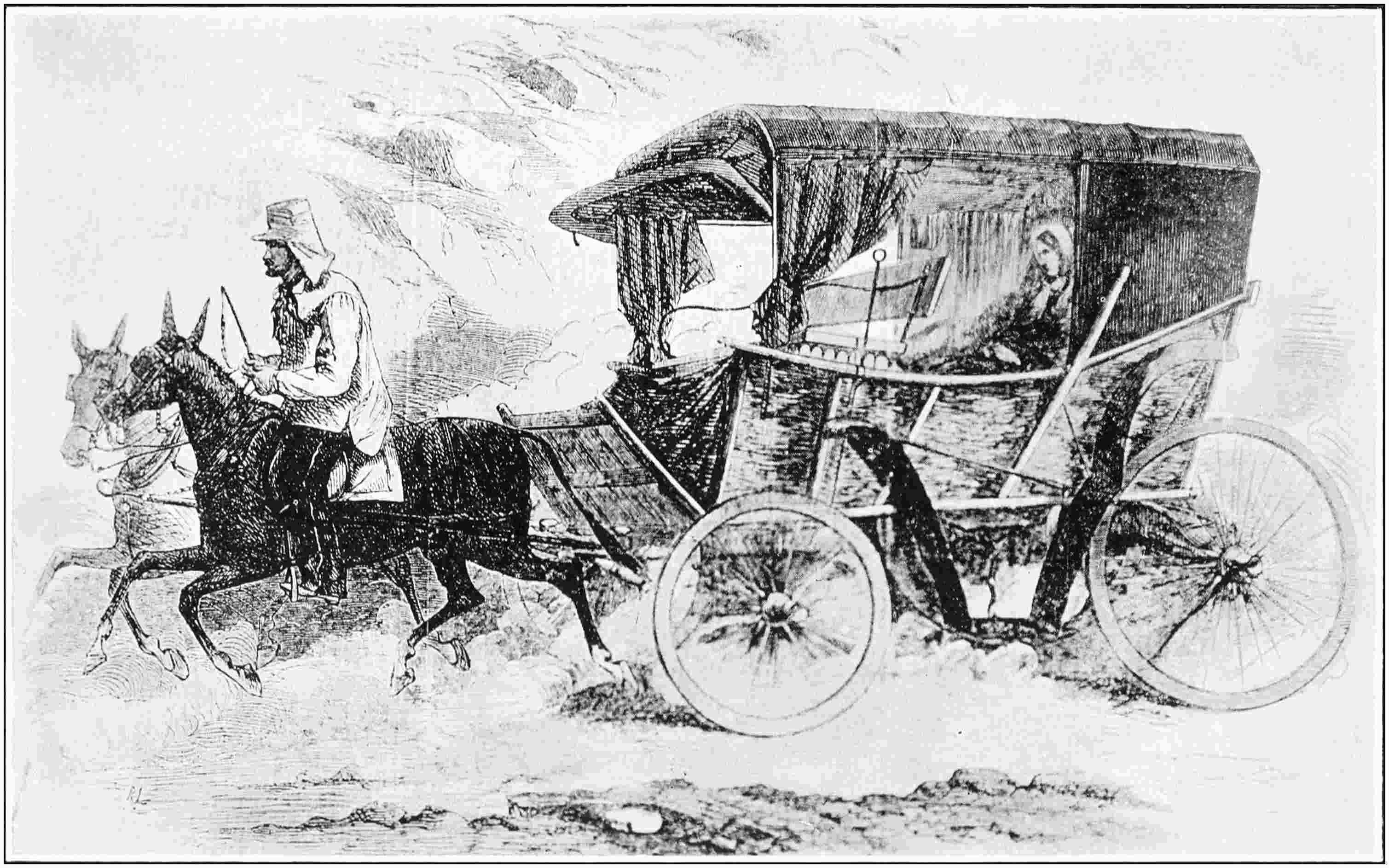
The chief relic preserved at Lea Hurst is the
curious old carriage used by Miss Nightingale
in the Crimea. What memories does it not suggest
of her journeys from one hospital to another
over the heights of Balaclava, when its utmost
carrying capacity was filled with comforts for the
sick and wounded! The body of the carriage
is of basket-work, and it has special springs made
to suit the rough Crimean roads. There is a
hood which can be half or fully drawn over the
entire vehicle. The carriage was driven by a
mounted man acting as postilion.
It seems as though such a unique object ought
to have a permanent place in one of our public
museums, for its interest is national. A native
of the district, who a short time ago chanced to
see the carriage, caught the national idea and
returned home lamenting that he could not put
the old carriage on wheels and take it from
town to town. “There’s a fortune in the old
thing,” said he, “for most folks would pay
a shilling or a sixpence to see the very identical
carriage in which Miss Florence took the wounded
about in those Crimean times. It’s astonishing
what little things please people in the way of a
show. Why, that carriage would earn money
enough to build a hospital!”
CHAPTER IV THE DAYS OF CHILDHOOD
Romantic Journeys from Lea Hurst to Embley Park—George Eliot
Associations—First Patient—Love of Animals and Flowers—Early
Education.
The childhood shows the man,
As morning shows the day.
Milton.
There is a lesson in each flower;
A story in each stream and bower;
On every herb o’er which you tread
Are written words which, rightly read,
Will lead you from earth’s fragrant sod,
To hope and holiness and God.
Allan Cunningham.
The childhood of Florence Nightingale, begun,
as we have seen, in the sunny land of Italy,
was subsequently passed in the beautiful surroundings
of her Derbyshire home, and at Embley
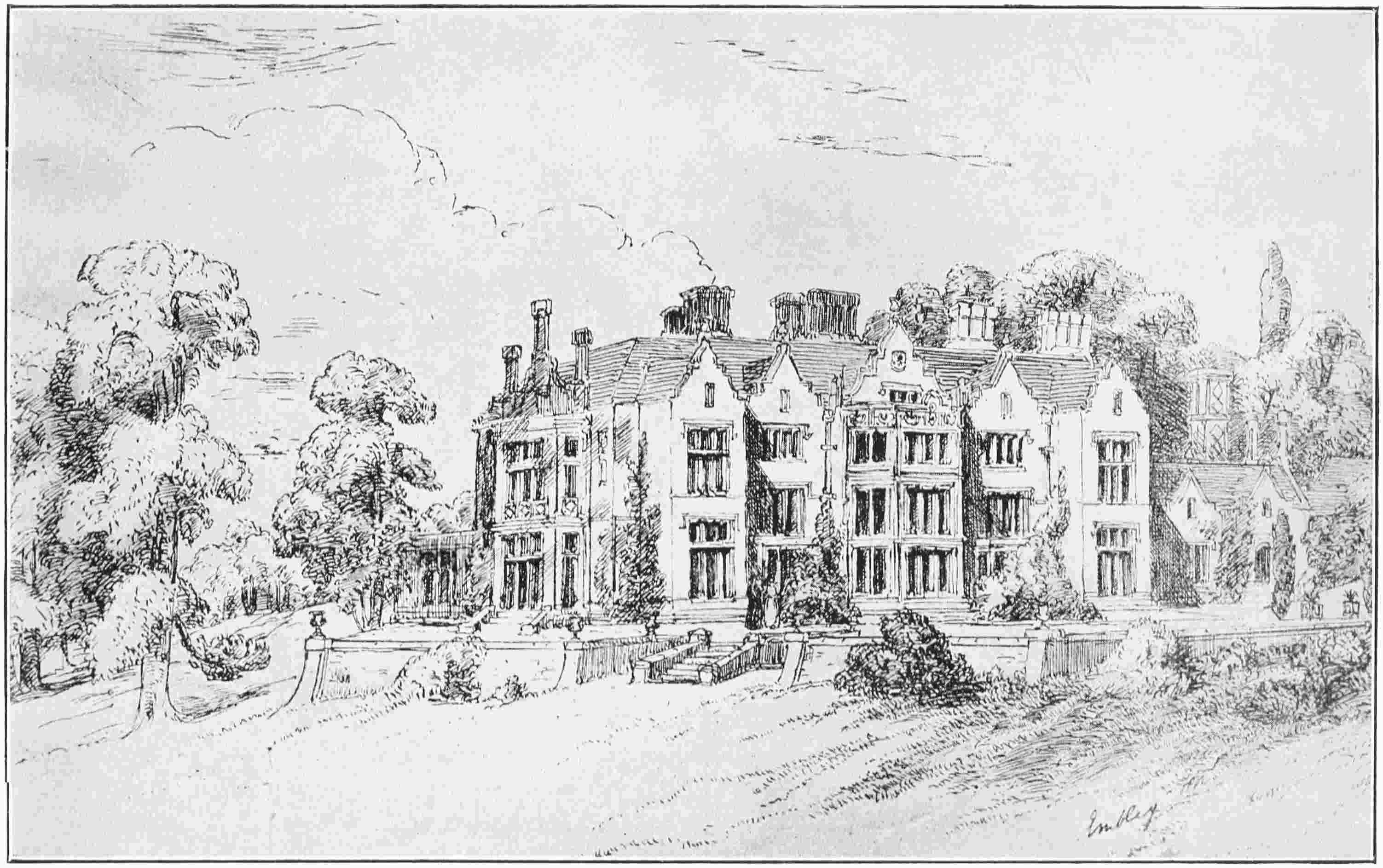
Park, Hampshire, a fine old Elizabethan mansion,
which Mr. Nightingale purchased when Florence
was about six years old.
The custom was for the family to pass the summer
at Lea Hurst, going in the autumn to Embley for
the winter and early spring. And what an exciting
and delightful time Florence and her sister Parthe
had on the occasions of these alternative “flittings”
between Derbyshire and Hampshire in the days
before railroads had destroyed the romance of
travelling! Then the now quiet little town of
Cromford, two miles from Lea Hurst, was a busy
coaching centre, and the stage coaches also stopped
for passengers at the village inn of Whatstandwell,
just below Lea Hurst Park. In those times
the Derby road was alive with the pleasurable
excitements of the prancing of horses, the crack
of the coach-driver’s whip, the shouts of the post-boys,
and the sound of the horn—certainly more
inspiring and romantic sights and sounds than the
present toot-toot of the motor-car, and the billows
of dust-clouds which follow in its rear.
Sometimes the journey from Lea Hurst was
made by coach, but more frequently Mr. and Mrs.
Nightingale with their two little girls drove in their
own carriage, proceeding by easy stages and putting
up at inns en route, while the servants went before
with the luggage to prepare Embley for the reception
of the family.
How glorious it was in those bright October
days to drive through the country, just assuming
its dress of red and gold, or again in the return
journey in the spring, when the hills and dales of
Derbyshire were bursting into fresh green beauty.
The passionate love for nature and the sights and
sounds of rural life which has always characterised
Miss Nightingale was implanted in these happy days
of childhood. And so, too, were the homely wit
and piquant sayings which distinguish her writings
and mark her more intimate conversation. She
acquired them unconsciously, as she encountered
the country people.
In her Derbyshire home she lived in touch
with the life which at the same period was
weaving its spell about Marian Evans, when she
visited her kinspeople, and was destined to be
immortalised in Adam Bede and The Mill on the
Floss. Amongst her father’s tenants Florence
Nightingale knew farmers’ wives who had a touch
of Mrs. Poyser’s caustic wit, and was familiar
with the “Yea” and “Nay” and other quaint
forms of Derbyshire speech, such as Mr. Tulliver
used when he talked to “the little wench” in the
house-place of the ill-fated Mill on the Floss. She
met, too, many of “the people called Methodists,”
who in her girlhood were establishing their preaching-places
in the country around Lea Hurst, and
she heard of the fame of the woman preacher, then
exercising her marvellous gifts in the Derby district,
who was to become immortal as Dinah Morris.
In Florence Nightingale’s early womanhood, Adam
Bede lived in his thatched cottage by Wirksworth
Tape Mills, a few miles from Lea Hurst, and the
Poysers’ farm stood across the meadows.
The childhood of our heroine was passed amid
surroundings which proved a singularly interesting
environment. Steam power had not then revolutionised
rural England: the counties retained
their distinctive speech and customs, the young
people remained on the soil where they were
born, and the rich and the poor were thrown
more intimately together. The effect of the
greater personal intercourse then existing between
the squire’s family and his people had an important
influence on the character of Florence Nightingale
in her Derbyshire and Hampshire homes. She
learned sympathy with the poor and afflicted,
and gained an understanding of the workings
and prejudices of the uneducated mind, which
enabled her in after years to be a real friend to
those poor fellows fresh from the battlefields
of the Crimea, many of whom had enlisted from
the class of rural homes which she knew so well.
When quite a child, Florence Nightingale showed
characteristics which pointed to her vocation in
life. Her dolls were always in a delicate state
of health and required the utmost care. Florence
would undress and put them to bed with many
cautions to her sister not to disturb them. She
soothed their pillows, tempted them with imaginary
delicacies from toy cups and plates, and nursed
them to convalescence, only to consign them to
a sick bed the next day. Happily, Parthe did
not exhibit the same tender consideration for her
waxen favourites, who frequently suffered the loss
of a limb or got burnt at the nursery fire.
Then of course Florence’s superior skill was
needed, and she neatly bandaged poor dolly and
“set” her arms and legs with a facility which
might be the envy of the modern miraculous
bone-setter.
The first “real live patient” of the future
Queen of Nurses was Cap, the dog of an old
Scotch shepherd, and although the story has been
many times repeated since Florence Nightingale’s
name became a household word, no account of
her childhood would be complete without it. One
day Florence was having a delightful ride over
the Hampshire downs near Embley along with
the vicar, for whom she had a warm affection.
He took great interest in the little girl’s fondness
for anything which had to do with the relief of
the sick or injured, and as his own tastes lay in
that direction, he was able to give her much useful
instruction. However, on this particular day, as
they rode along the downs, they noticed the
sheep scattered in all directions and old Roger, the
shepherd, vainly trying to collect them together.
“Where is your dog?” asked the vicar as he
drew up his horse and watched the old man’s futile
efforts.
“The boys have been throwing stones at him,
sir,” was the reply, “and they have broken his leg,
poor beast. He will never be any good for anything
again and I am thinking of putting an end
to his misery.”
“Poor Cap’s leg broken?” said a girlish voice
at the clergyman’s side. “Oh, cannot we do
something for him, Roger? It is cruel to leave
him alone in his pain. Where is he?”
“You can’t do any good, missy,” said the old
shepherd sorrowfully. “I’ll just take a cord to
him to-night—that will be the best way to ease
his pain. I left him lying in the shed over yonder.”
“Oh, can’t we do something for poor Cap?”
pleaded Florence to her friend; and the vicar,
seeing the look of pity in her young face, turned
his horse’s head towards the distant shed where
the dog lay. But Florence put her pony to the
gallop and reached the shed first. Kneeling down
on the mud floor, she caressed the suffering dog
with her little hand, and spoke soothing words to
it until the faithful brown eyes seemed to have
less of pain in them and were lifted to her face in
pathetic gratitude.
That look of the shepherd’s dog, which touched
her girlish heart on the lonely hillside, Florence
Nightingale was destined to see repeated in the
eyes of suffering men as she bent over them in
the hospital at Scutari.
The vicar soon joined his young companion, and
finding that the dog’s leg was only injured, not
broken, he decided that a little careful nursing
would put him all right again.
“What shall I do first?” asked Florence, all
eagerness to begin nursing in real earnest.
“Well,” said her friend, “I should advise a hot
compress on Cap’s leg.”
Florence looked puzzled, for though she had
poulticed and bandaged her dolls, she had never
heard about a compress. However, finding that
in plain language it meant cloths wrung out of
boiling water, and laid upon the affected part, she
set nimbly to work under the vicar’s directions.
Boiling water was the first requisite, and calling
in the services of the shepherd’s boy, she lighted
a fire of sticks in the cottage near by, and soon had
the kettle boiling.
Next thing, she looked round for cloths to make
the compress. The shepherd’s clean smock hung
behind the door, and Florence seized it with delight,
for it was the very thing.
“If I tear it up, mamma will give Roger another,”
she reasoned, and, at an approving nod from the
vicar, tore the smock into suitable lengths for
fomentation. Then going back to the place where
the dog lay, accompanied by the boy carrying
the kettle and a basin, Florence Nightingale set to
work to give “first aid to the wounded.” Cap
offered no resistance—he had a wise confidence in
his nurse—and as she applied the fomentations the
swelling began to go down, and the pain grew less.
Florence was resolved to do her work thoroughly,
and a messenger having been despatched to allay
her parents’ anxiety at her prolonged absence, she remained
for several hours in attendance on her patient.
In the evening old Roger came slowly and
sorrowfully towards the shed, carrying the fatal
rope, but no sooner did he put his head in at the
door than Cap greeted him with a whine of pleasure
and tried to come towards him.
“Deary me, missy,” said the old shepherd in
astonishment, “why, you have been doing wonders.
I never thought to see the poor dog greet me
again.”
“Yes, doesn’t he look better?” said the youthful
nurse with pardonable pride. “You can throw
away that rope now, and help me to make
compresses.”
“That I will, missy,” said Roger, and stooping
down beside Florence and Cap, he was initiated into
the mysteries.
“Yes,” said the vicar, “Miss Florence is quite
right, Roger—your dog will soon be able to walk
again if you give it a little rest and care.”
“I am sure I can’t thank your reverence and the
young lady enough,” replied the shepherd, quite
overcome at the sight of his faithful dog’s look of
content and the thought that he would not lose
him after all; “and you may be sure, sir, I will
carry out the instructions.”
“But I shall come again to-morrow, Roger,”
interposed Florence, who had no idea of giving
up her patient yet. “I know mamma will let me
when I tell her about poor Cap.” After a parting
caress to the dog, and many last injunctions to
Roger, Florence mounted her pony and rode away
with the vicar, her young heart very full of joy.
She had really helped to lessen pain, if only for
a dumb creature, and the grateful eyes of the
suffering dog stirred a new feeling in her opening
mind. She longed to be always doing something
for somebody, and the poor people on her father’s
estates soon learned what a kind friend they had in
Miss Florence. They grew also to have unbounded
faith in her skill, and whenever a pet animal was
sick or injured, the owner would contrive to let
“Miss Florence” know.
She and her sister were encouraged by Mr.
and Mrs. Nightingale in a love of animals, and
were allowed to have many pets. It was
characteristic of Florence that her heart went out
to the less favoured ones, those which owing to
old age or infirmity were taken little notice of by
the servants and farm-men. She was particularly
attached to Peggy, an old grey pony long since
past work, who spent her days in the paddock at
Lea Hurst. Florence never missed a morning, if
she could help it, without going to talk to Peggy,
who knew her footstep, and would come trotting
up to the gate ready to meet her young mistress.
Then would follow some good-natured sport.
“Would you like an apple, poor old Peggy?”
Florence would say as she fondled the pony’s
neck; “then look for it.”
At this invitation Peggy would put her nose
to the dress pocket of her little visitor and
discover the delicacy. Or it might be a carrot,
held well out of sight, which Peggy was invited
to play hide-and-seek for. If the stable cat had
kittens, it was Florence who gave them a welcome
and fondled and played with the little creatures
before any one else noticed them. She had, too,
a quick eye for a hedge-sparrow’s nest, and would
jealously guard the brooding mother’s secret until
the fledgelings were hatched and ready to fly.
Some of the bitterest tears of her childhood were
shed over the broken-up homes of some of her
feathered friends. The young animals in the fields
were quickly won by her kind nature, and would
come bounding towards her. Out in those beautiful
Lea Hurst woods she made companions of the
squirrels, who came fearlessly after her as she
walked, to pick up the nuts mysteriously dropped
in their path. Then, when master squirrel least
expected it, Florence turned sharp round and
away raced the little brown creature up the tall
beech, only to come down again with a quizzical
look in his keen little eye at nuts held too temptingly
for any squirrel of ordinary appetite to resist.
With what delight she watched their funny antics,
for she had the gift to make these timid creatures
trust her.
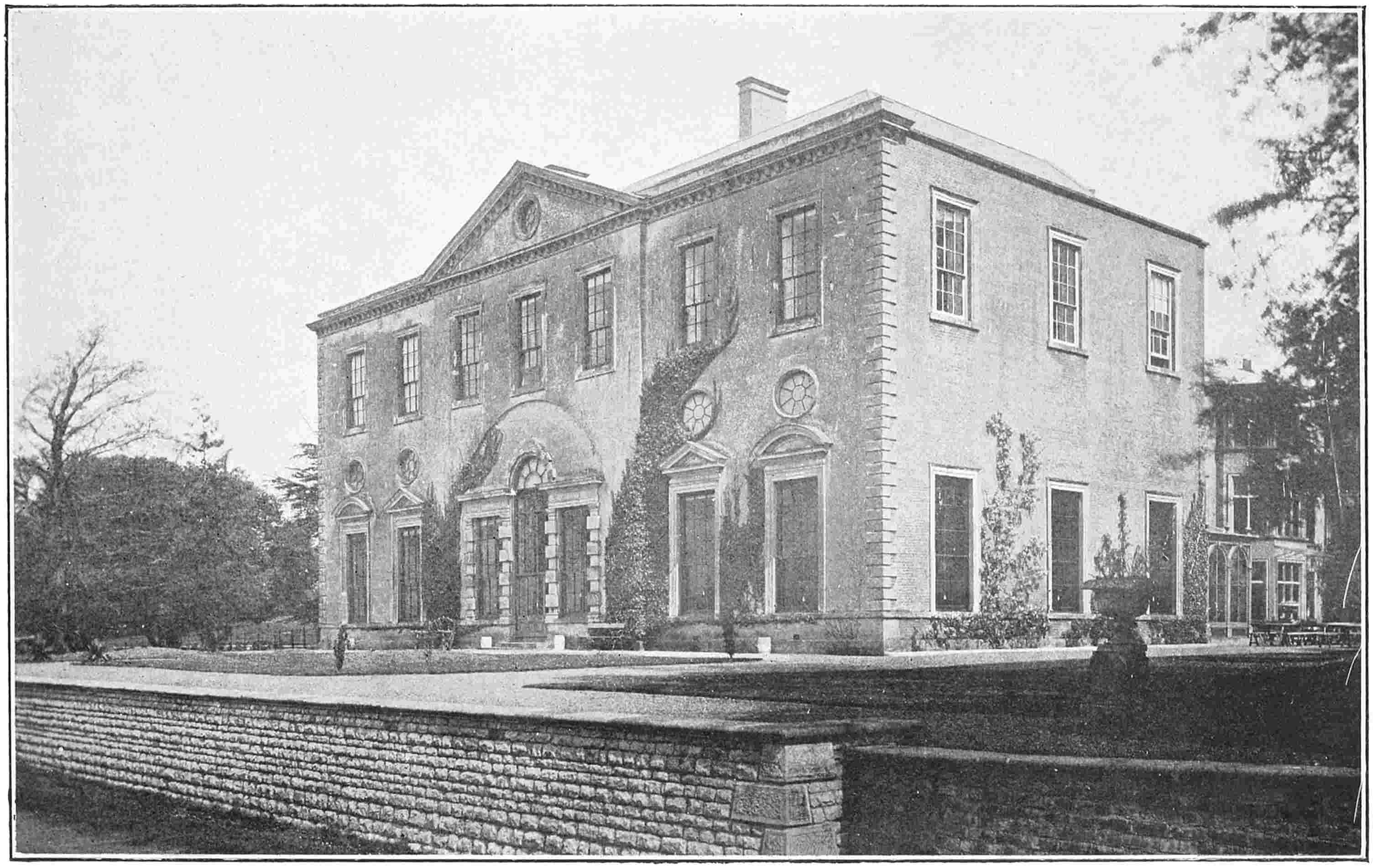
EMBLEY PARK, HAMPSHIRE.
(From a drawing by the late Lady Verney.)
[To face p. 32.
Then in spring-time there was sure to be a
pet lamb to be fed, and Florence and her sister
were indeed happy at this acquisition to the home
pets. The pony which she rode and the dog
which was ever at her side were of course her
particular dumb friends. I am not sure, however,
that she thought them dumb, for she and they
understood one another perfectly. The love of
animals, which was so marked a characteristic in
Florence Nightingale as a child, remained with her
throughout life and made her very sympathetic
to invalids who craved for the company of some
favourite animal. Many nurses and doctors disapprove
of their patients having pets about them,
but, to quote the Queen of Nurses’ own words, “A
small pet animal is often an excellent companion
for the sick, for long chronic cases especially.
An invalid, in giving an account of his nursing
by a nurse and a dog, infinitely preferred that of
the dog. ‘Above all,’ he said, ‘it did not talk.’”
It was a great source of pleasure to Florence in
her early years to be allowed to act as almoner
for her mother. Mrs. Nightingale was very kind
and benevolent to the people around Lea Hurst
and Embley, and supplied the sick with delicacies
from her own table. Indeed, she made her homes
centres of beneficence for several miles around, and,
according to the best traditions of those times,
was ready with remedies for simple ailments when
the doctor was not at hand. Owing to the fact
that Florence had never had measles and whooping
cough, her parents had to exercise great caution
in permitting her to visit the cottage people; however,
she could call at the doors on her pony and
leave jelly and puddings from the basket at her
saddle-bow without incurring special risk. And she
could gather flowers from the garden to brighten
a sick-room, or in the lovely spring days load her
basket with primroses and bluebells and so carry
the scent of the woods to some delicate girl who,
like Tennyson’s May Queen, was pining for the
sight of field and hedgerow and the flowers
which grew but a little distance from her cottage
door.
Such attentions to the fancies of the sick were
little thought of in those times, before flower
missions had come into vogue, or the necessity
for cheering the patients by pleasing the eye, as
well as tending the body, was recognised, but in
that, as in much else, our heroine was in advance
of her time. Her love of flowers, like fondness
for animals, was a part of her nature: it came too
as a fitting heritage from the city of flowers under
whose sunny sky she had been born.
Both at Embley and Lea Hurst, Florence and
her sister had their own little gardens, in which
they digged and sowed and planted to their hearts’
delight, and in summer they ran about with their
miniature watering cans, bestowing, doubtless, an
almost equal supply on their own tiny feet as
on the parched ground. In after years this early
love of flowers had its pathetic sequel. When,
after months of exhausting work amongst the
suffering soldiers, Florence Nightingale lay in a
hut on the heights of Balaclava, prostrate with
Crimean fever, she relates that she first began to
rally after receiving a bunch of flowers from a
friend, and that the sight of them beside her sick
couch helped her to throw off the languor which
had nearly proved fatal. She dated her recovery
from that hour.
In every respect the circumstances of Florence
Nightingale’s childhood were calculated to fit her
for the destiny which lay in the future. Not only
was she reared among scenes of exceptional beauty
in both her Derbyshire and her Hampshire homes
and taught the privilege of ministering to the poor
and sick, but she was mentally trained in advance
of the custom of the day. Without that equipment
she could not have held the commanding position
which she attained in the work of army nursing and
organisation.
She and her sister Parthe, being so near in
age, did their lessons together. Their education
was conducted entirely at home under a private
governess, and was assiduously supervised by their
father. Mr. Nightingale was a man of broad
sympathies, artistic and intellectual tastes, and much
general cultivation, and, having no sons, he made
a hobby of giving a classical education to his girls,
and found a fertile soil in the quick brain of his
daughter Florence. He was a strict disciplinarian,
and none of the desultory ways which characterised
the home education of young ladies in the early
Victorian days was allowed in the schoolrooms at
Embley and Lea Hurst. Rules were rigidly fixed
for lessons and play, and careless work was never
passed unpunished. It was in the days of childhood
that the future heroine of the Crimea laid
the foundation of an orderly mind and a habit of
method which served her so admirably when suddenly
called to organise the ill-regulated hospital at
Scutari.
As a child Florence excelled in the more intellectual
branches of education and showed a great
aptitude for foreign languages. She attained creditable
proficiency in music and was clever at drawing,
but in these artistic branches her elder sister Parthe
excelled most. From her father Florence learned
elementary science, Greek, Latin, and mathematics,
and under his guidance, seated in the dear old
library at Lea Hurst, made the acquaintance of
standard authors and poets. But doubtless the
sisters got an occasional romance not included in
the paternal list and read it with glowing cheeks
and sparkling eyes in a secluded nook in the
garden.
If study was made a serious business, the sisters
enjoyed to the full the healthy advantages of country
life. They scampered about the park with their
dogs, rode their ponies over hill and dale, spent
long days in the woods amongst the bluebells
and primroses, and in summer tumbled about in
the sweet-scented hay. During the summer at
Lea Hurst, lessons were a little relaxed in favour
of outdoor life, but on the return to Embley for
the winter, schoolroom routine was again enforced
on very strict lines.
Mrs. Nightingale supervised the domestic side
of her little girls’ education, and before Florence
was twelve years old she could hemstitch and seam,
embroider bookmarkers, and had worked several
creditable samplers. Her mother trained her too
in matters of deportment, and nothing was omitted
in her early years which would tend to mould her
into a graceful and accomplished girl.
CHAPTER V THE SQUIRE’S DAUGHTER
An Accomplished Girl—An Angel in the Homes of the Poor—Children’s
“Feast Day” at Lea Hurst—Her Bible-Class for
Girls—Interests at Embley—Society Life—Longing for a
Vocation—Meets Elizabeth Fry—Studies Hospital Nursing—Decides
to go to Kaiserswerth.
God made her so,
And deeds of week-day holiness
Fall from her gentle as the snow;
Nor hath she ever chanced to know
That aught were easier than to bless.
Lowell.
When Florence Nightingale reached her
seventeenth year she began to take her
place as the squire’s daughter, mingling in the
county society of Derbyshire and Hampshire and
interesting herself in the people and schools of
her father’s estates. She soon acquired the reputation
of being a very lovable young lady as well
as a very talented one. She had travelled abroad,
could speak French, German, and Italian, sang
very sweetly, and was clever at sketching, and when
the taking of photographs became a fashionable
pastime, “Miss Florence” became an enthusiast
for the art. There were no hand-cameras in those
days and no clean and easy methods for developing,
and young lady amateur photographers were obliged
to dress for their work. Nothing daunted “Miss
Florence,” and she photographed groups on the
lawn and her pet animals to the admiration of her
family and friends, if sometimes to the discoloration
of her dainty fingers.
She was also a skilful needlewoman, and worked
cushions and slippers, mastered the finest and most
complicated crochet patterns, sewed delicate embroideries,
and achieved almost invisible hems on
muslin frills. At Christmas-time her work-basket
was full of warm comforts for the poor. She was
invaluable at bazaars, then a newly introduced method
of raising money for religious purposes, and was
particularly happy at organising treats for the old
people and children.
The local clergy, both at Embley and Lea, found
the squire’s younger daughter a great help in the
parish. The traits of character which had shown
themselves in the little girl who tended the shepherd’s
injured dog, and was so ready with her
sympathy for all who suffered or were in trouble,
became strengthened in the budding woman and
made Florence Nightingale regarded as an angel
in the homes of the poor. Her visits to the
cottages were eagerly looked for, and she showed
even in her teens a genius for district visiting.
The people regarded her not as the “visiting lady,”
whom they were to impress with feigned woes or
a pretence of abject poverty, but as a real friend
who came to bring pleasure to their homes and
to enter into their family joys and sorrows. She
had a bright and witty way of talking which made
the poor folks look forward to her visits quite apart
from the favours she might bring.
If there was sickness or sorrow in any cottage
home, the presence of “Miss Florence” was eagerly
sought, for even at this period she had made some
study of sick nursing and “seemed,” as the people
said, “to have a way with her” which eased pain
and brought comfort and repose to those who were
suffering. She had, too, such a clear, sweet voice
and sympathetic intonation that the sick derived
great pleasure when she read to them.
As quite a young girl the bent of her mind was
in the direction of leading a useful and beneficent
life. She was in no danger of suffering from the
ennui which beset so many girls of the leisured
classes in those times, when there was so little in
the way of outdoor sport and amusements or independent
interests to fill up time. In whatsoever
circumstances of life Florence Nightingale had been
placed, her nature would have prompted her to
discover useful occupation.
The “old squire,” as Mr. Nightingale is still
called at Lea, took a great interest in the village
school, and Florence became his right hand in
looking after the amusements of the children.
There were many little treats devised for them
from time to time, but the great event of the year
was the children’s “feast day,” when the scholars
assembled at the school-house and walked in procession
to Lea Hurst, carrying “posies” in their
hands and sticks wreathed with garlands of flowers.
A band provided by the squire headed the procession.
Arrived at Lea Hurst, the company were served
with tea in the field below the garden, Mrs. Nightingale
and her daughters assisting the servants to
wait upon their guests. After tea, the band struck up
lively airs and the lads and lasses danced in a style
which recalled the olden times in Merrie England,
while the squire and his family beamed approval.
Then there were games for the little ones devised
by “Miss Florence,” who took upon herself their
special entertainment; and so the summer evening
passed away in delightful mirth and recreation until
the crimson clouds began to glow over the beautiful
Derwent valley, and the children re-formed in
line and marched up the garden to the top terrace
of the lawn. Meantime “Miss Florence” and
“Miss Parthe” had mysteriously disappeared, and
now they were seen standing on the terrace behind a
long table laden with presents. As the procession
filed past, each child received a gift from one or other
of the young ladies, and there were kindly words
from the squire and gracious smiles from Mrs.
Nightingale and much bobbing of curtseys by the
delighted children, and so the “feast day” ended
in mutual joy and pleasure.
The scene was described to me by an old lady
who had many times as a child attended this
pretty entertainment at Lea Hurst, and still treasures
the little gifts—fancy boxes, books, thimble cases
and the like—which she had received from the
hands of the then beloved and now deeply reverenced
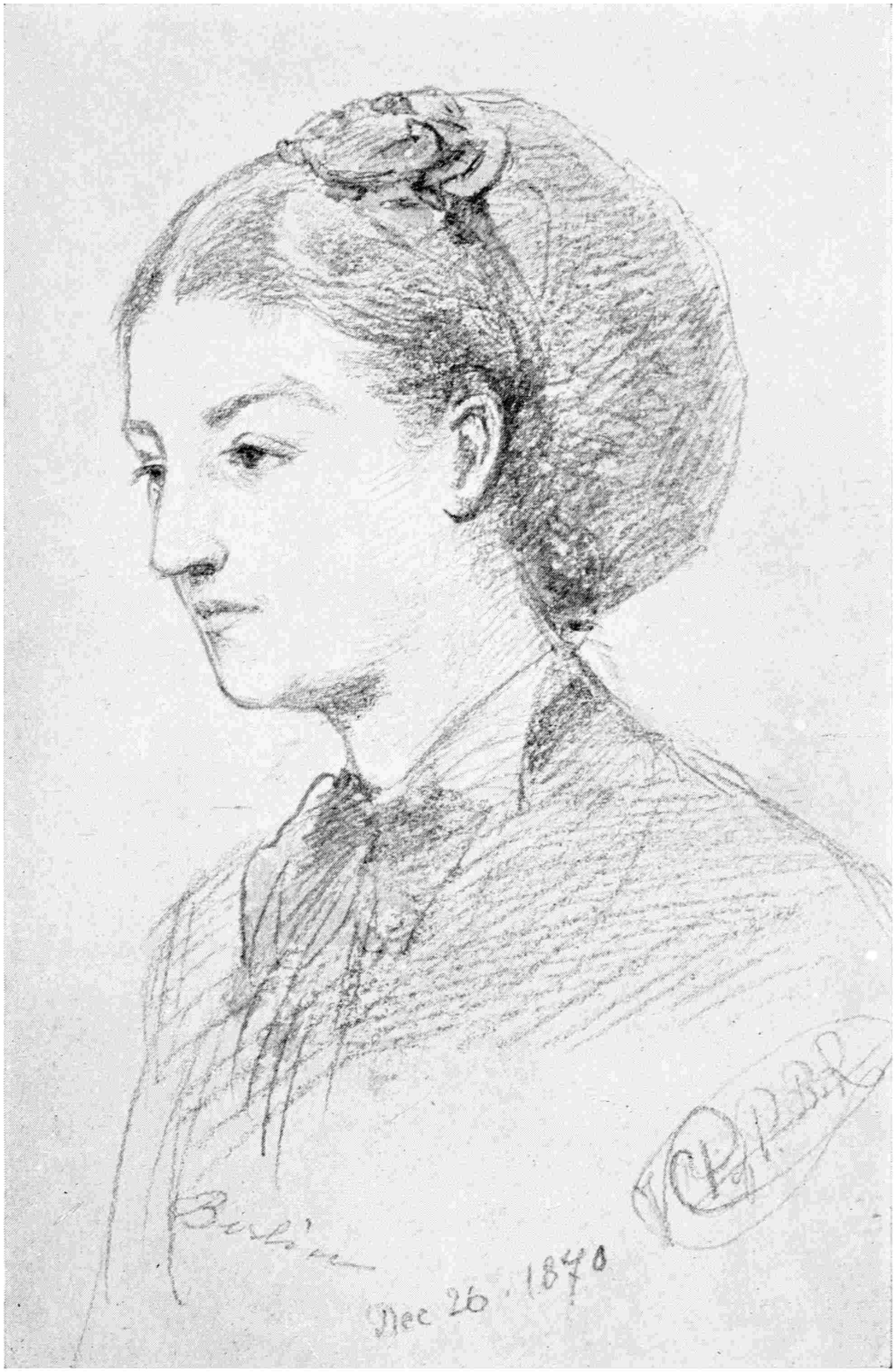
“Miss Florence.” She recalls what a sweet young
lady she was, with her glossy brown hair smoothed
down each side of her face, and often a rose placed
at the side, amongst the neat plaits or coils. Her
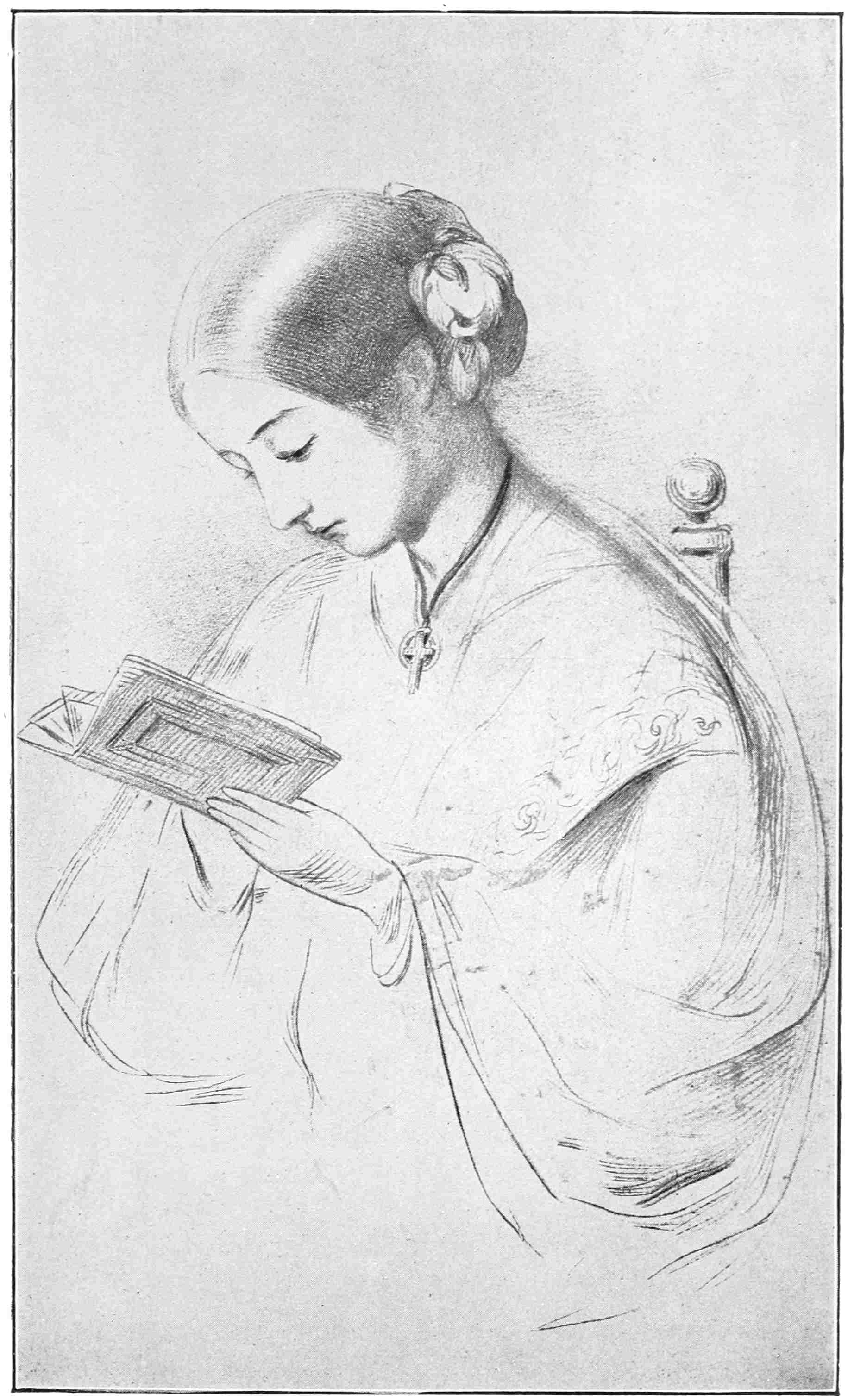
appearance at this period can be judged from the
pencil sketch by her sister, afterwards Lady Verney,
in which, despite the quaint attire, one recognises
a tall, graceful girl of charm and intelligence.
In Derbyshire, Florence Nightingale’s interest in
Church work was divided between the historic little
church of Dethick, described in a former chapter,
and the beautiful church which Sir Richard
Arkwright had built at Cromford on the opposite
side of the river from his castle of Willersley.
To-day, Cromford Church is thickly covered with
ivy and embowered in trees, and, standing on the
river bank with greystone rocks towering on one
side and the wooded heights of Willersley on
the other, presents a mellowed and picturesque
appearance. In our heroine’s girlhood it was
comparatively new and regarded as the wonder of
the district for the architectural taste and decoration
which Sir Richard had lavished upon it. The great
cotton-spinner himself had been laid beneath its
chancel in 1792, but an Arkwright reigned at
Willersley Castle in Miss Nightingale’s youth—as
indeed there does to-day—and carried on the
beneficent schemes of the founder for the people
of the district. Then the Arkwright Mills—long
since disused—gave employment to hundreds of
people, and the now sleepy little town of Cromford
was alive with an industrial population. It was
something of a model village, as the neat rows
of low stone houses which flank Cromford hill
testify, and there were schools, reading-rooms, and
other means devised for the betterment of the
people. Many schemes originated with the vicar
and patron of Cromford Church, and the young
ladies from Lea Hurst sometimes assisted at
entertainments.
We may imagine “Miss Florence” when she
drove with her parents down to Cromford Church
making a very pretty picture indeed, dressed in
her summer muslin, with a silk spencer crossed over
her maiden breast and her sweet, placid face beaming
from out the recesses of a Leghorn bonnet,
wreathed with roses.
It was, however, in connection with the church
of Dethick and the adjoining parishes of Lea and
Holloway that Florence Nightingale did most of
her philanthropic work. This district was peculiarly
her father’s domain, and also embraced the church
and village of Crich. Like Cromford, it was the
seat of a village industry. Immediately below Lea
Hurst were Smedley’s hosiery mills, which employed
hundreds of women and girls, many of
whom lived on the Nightingale estate, and Miss
Florence took great interest in their welfare. As
she grew into womanhood, she started a Bible-class
for the young women of the district, holding it
in the old building at Lea Hurst known as the
“chapel.” The class was unsectarian, for “Smedley’s
people,” following the example of their master,
“Dr.” John Smedley, were chiefly Methodists.
However, religious differences were not bitter in
the neighbourhood, and Miss Nightingale welcomed
to her class all young girls who were disposed to
come, whether their parents belonged to “chapel”
or “church.”
The memory of those Sunday afternoons, as they
sat in the tiny stone “chapel” overlooking the
sunny lawns and gardens of Lea Hurst, listening
to the beautiful expositions of Scripture which fell
from their beloved “Miss Florence,” or following
her sweet voice in sacred song, is green in the
hearts of a few elderly people in the neighbourhood.
A softness comes into their voice, and a smile of
pleasure lights up their wrinkled faces, as they
tell you how “beautifully Miss Florence used to
talk.” In years long after, when she returned for
holiday visits to Lea Hurst, nothing gave Miss
Nightingale greater pleasure than for the young
girls of the district, some of them daughters of
her former scholars, to come on summer Sunday
afternoons and sing on the lawn at Lea Hurst as
she sat in her room above. Infirmity prevented
her from mingling with them, but the girls were
pleased if they could only catch a sight of her
face smiling down from the window.
During the winter months spent in her Hampshire
home, Florence Nightingale was also active
amongst the sick poor and the young people.
Embley Park is near the town of Romsey, in the
parish of East Willow, and Mr. Nightingale and
his family attended that church. “Miss Florence”
had many friends amongst the cottagers, and a few
of the old people still recall seeing the “young
ladies” riding about on their ponies, and stopping
with kind inquiries at some of the house doors.
Although the sisters were such close companions,
it is always “Miss Florence” who is remembered
as the chief benefactress. She had the happy gift
for gaining the love of the people, and the instinct
for giving the right sort of help, though “Miss
Parthe” was no less kind-hearted.
At Christmas, Embley Park was a centre from
which radiated much good cheer. “Florence”
was gay indeed, as, in ermine tippet and muff and
beaver hat, she helped to distribute the parcels of
tea and the warm petticoats to the old women.
She devised Christmas entertainments for the children
and assisted in treats for the workhouse poor. Local
carol-singers received a warm welcome at Embley,
especially from Miss Florence, who would come into
the hall to see the mince-pies and coin distributed
as she chatted with the humble performers. Training
the boys and girls to sing was to her a matter of
special interest, and she did much in those far-away
days to promote a love of music amongst
the villagers both at Lea Hurst and Embley. It
would afford her pleasure to-day could she listen
to the well-trained band formed by the mill-workers
at Lea, which one hears discoursing sweet music
outside the mills on a summer’s evening.
Embley overlooked the hills of the Wiltshire
border, and the cathedral city of Salisbury, only
some thirteen miles distant, afforded Miss Nightingale
a wider field of philanthropic interest. She was
always willing to take part in beneficent work in
the neighbourhood, and the children’s hospital and
other schemes founded and conducted by her friends
Mr. and Mrs. Sidney Herbert, afterwards Lord
and Lady Herbert of Lea, formed a special interest
for her in the years immediately preceding the outbreak
of the Crimean War.
It must not, however, be supposed that in the
early years of her womanhood Miss Nightingale
gave herself up entirely to religious and philanthropic
work, though it formed a serious background
to her social life. Mr. Nightingale, as
a man of wealth and influence, liked to see his
wife and daughters taking part in county society.
During the winter he entertained a good deal at
Embley, which was a much larger and handsomer
residence than Lea Hurst. Mr. and Mrs. Nightingale
had a large circle of friends, and their house
was noted as a place of genial hospitality, while
their charming and accomplished daughters attracted
many admirers.
The family did not confine themselves only to
county society. They sometimes came to London
for the season, and Florence and her sister made
their curtsey to Queen Victoria when in the
heyday of her early married life, and entered into
the gaieties of the time.
However, as the years passed by Florence
Nightingale cared less and less for the excitement
and pleasures of society. Her nature had begun to
crave for some definite work and a more extended
field of activity than she found in private life.
Two severe illnesses among members of her family
had developed her nursing faculty, and when they
no longer required her attention, she turned to a
systematic study of nursing.
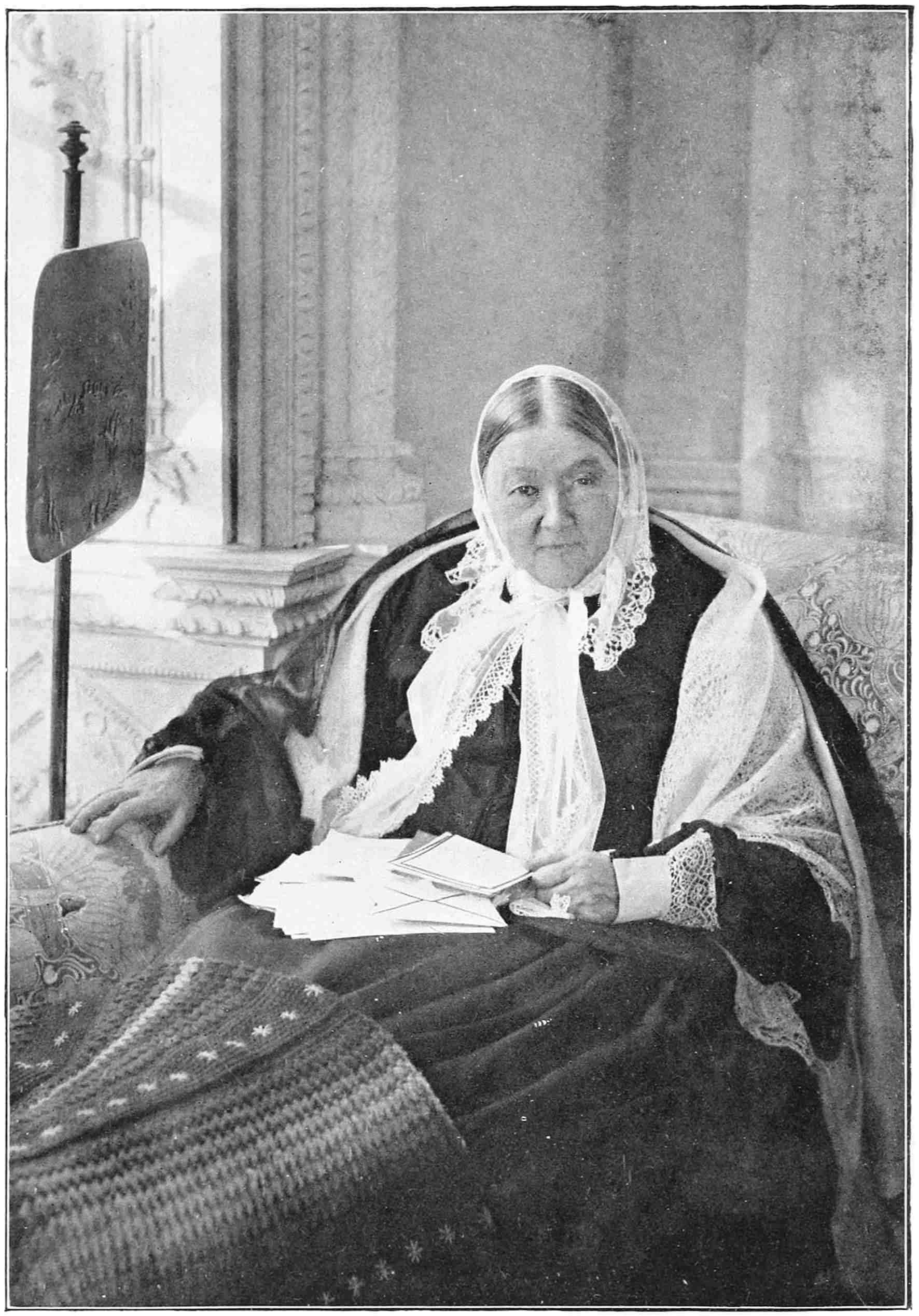
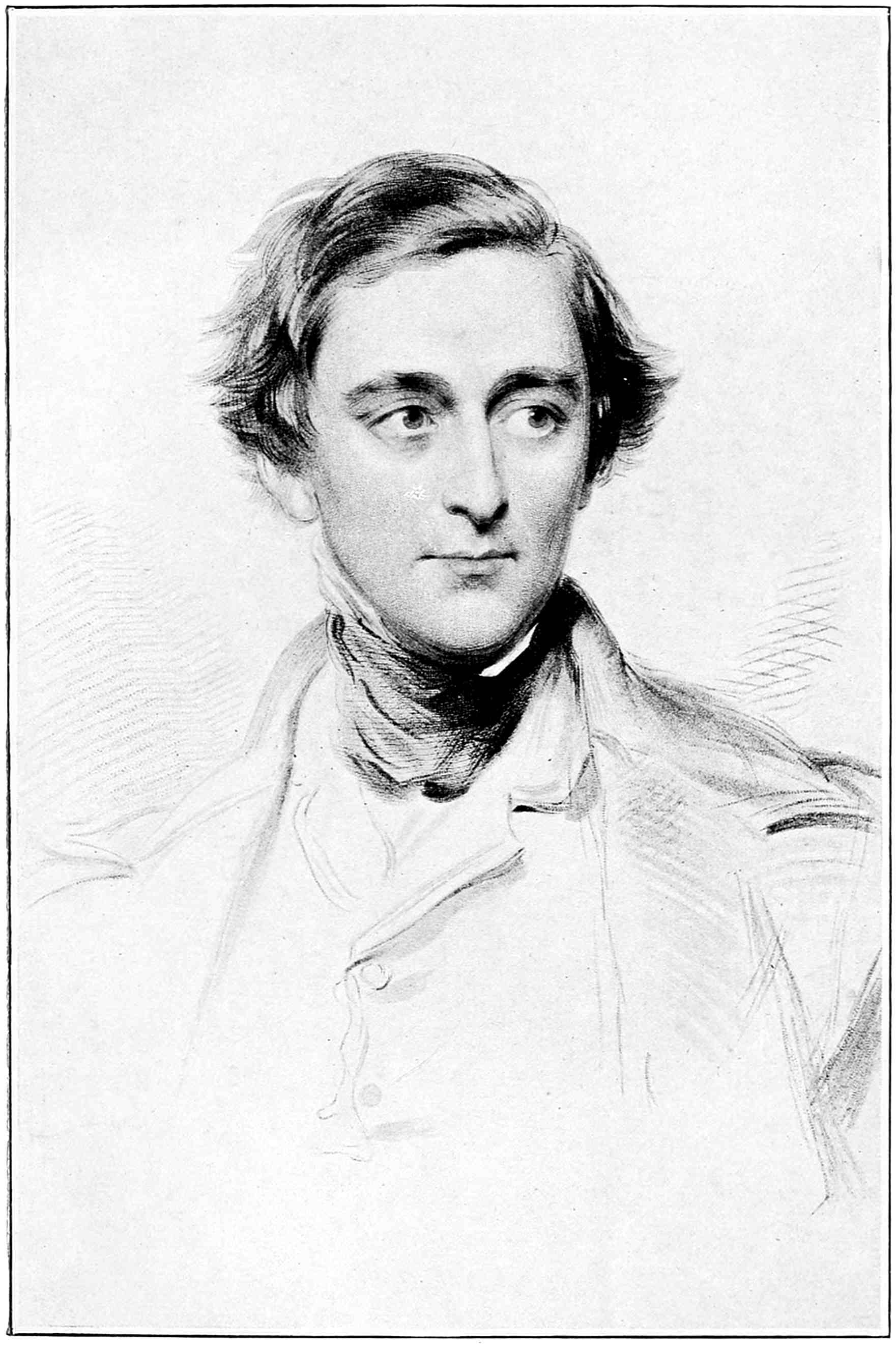
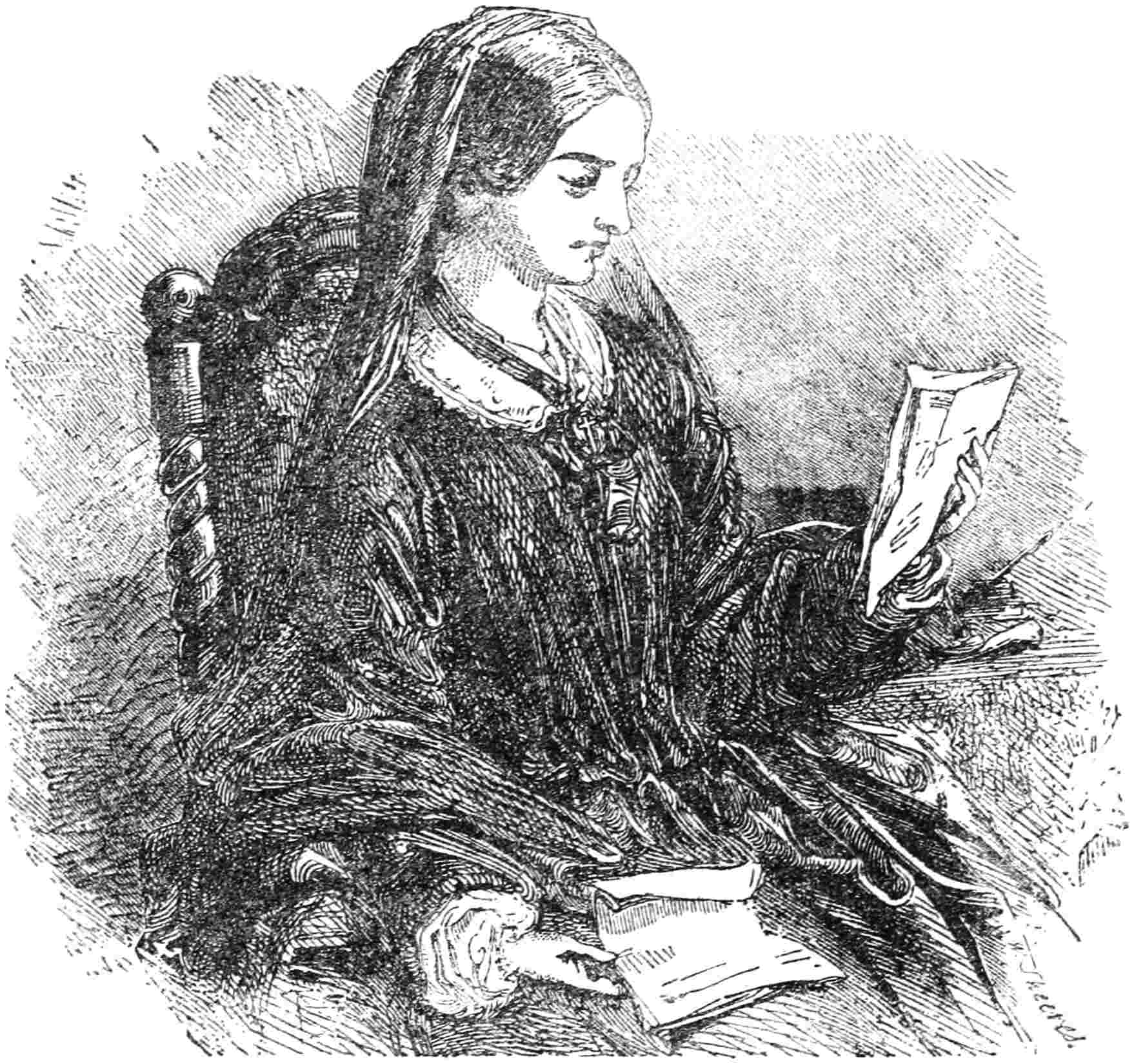
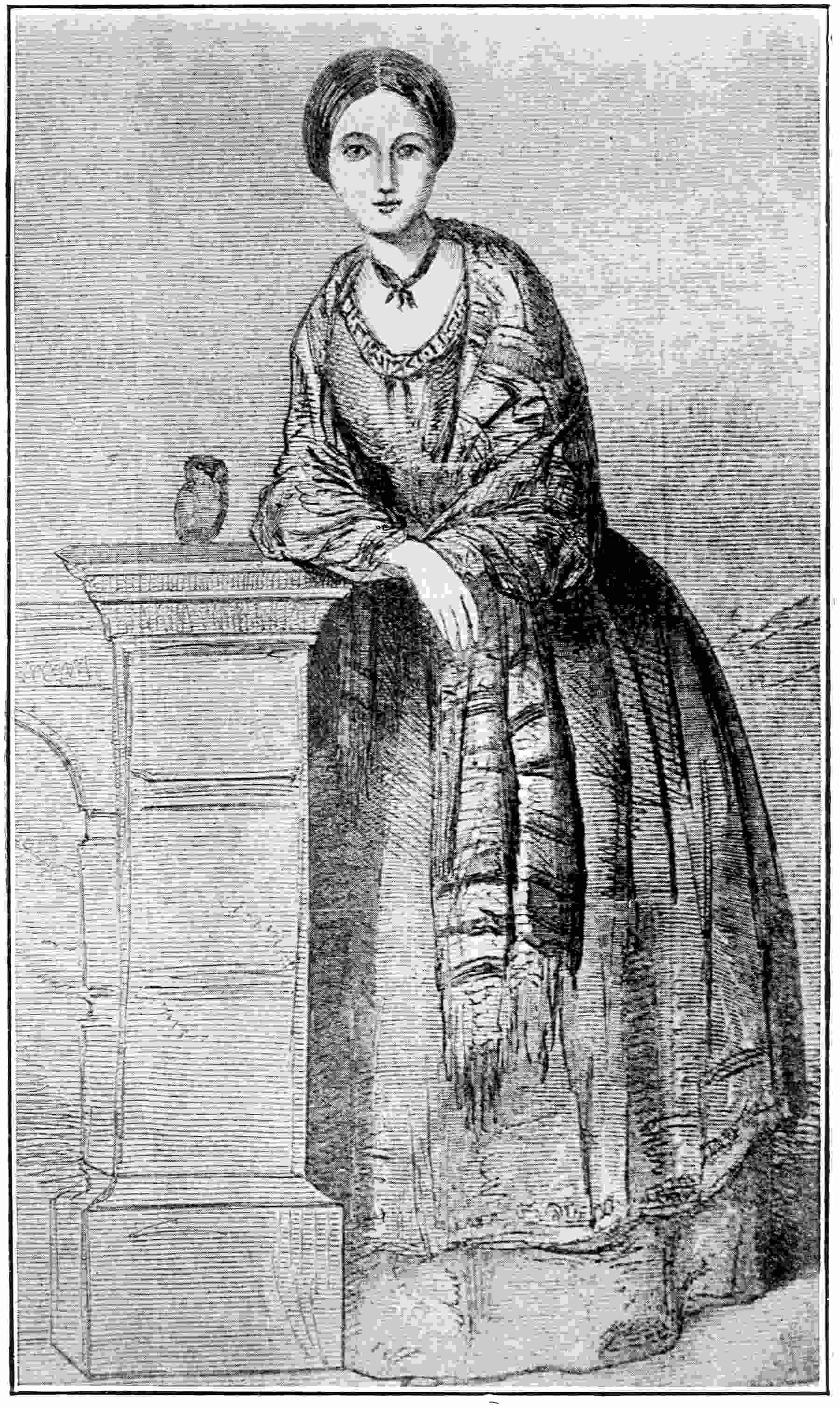
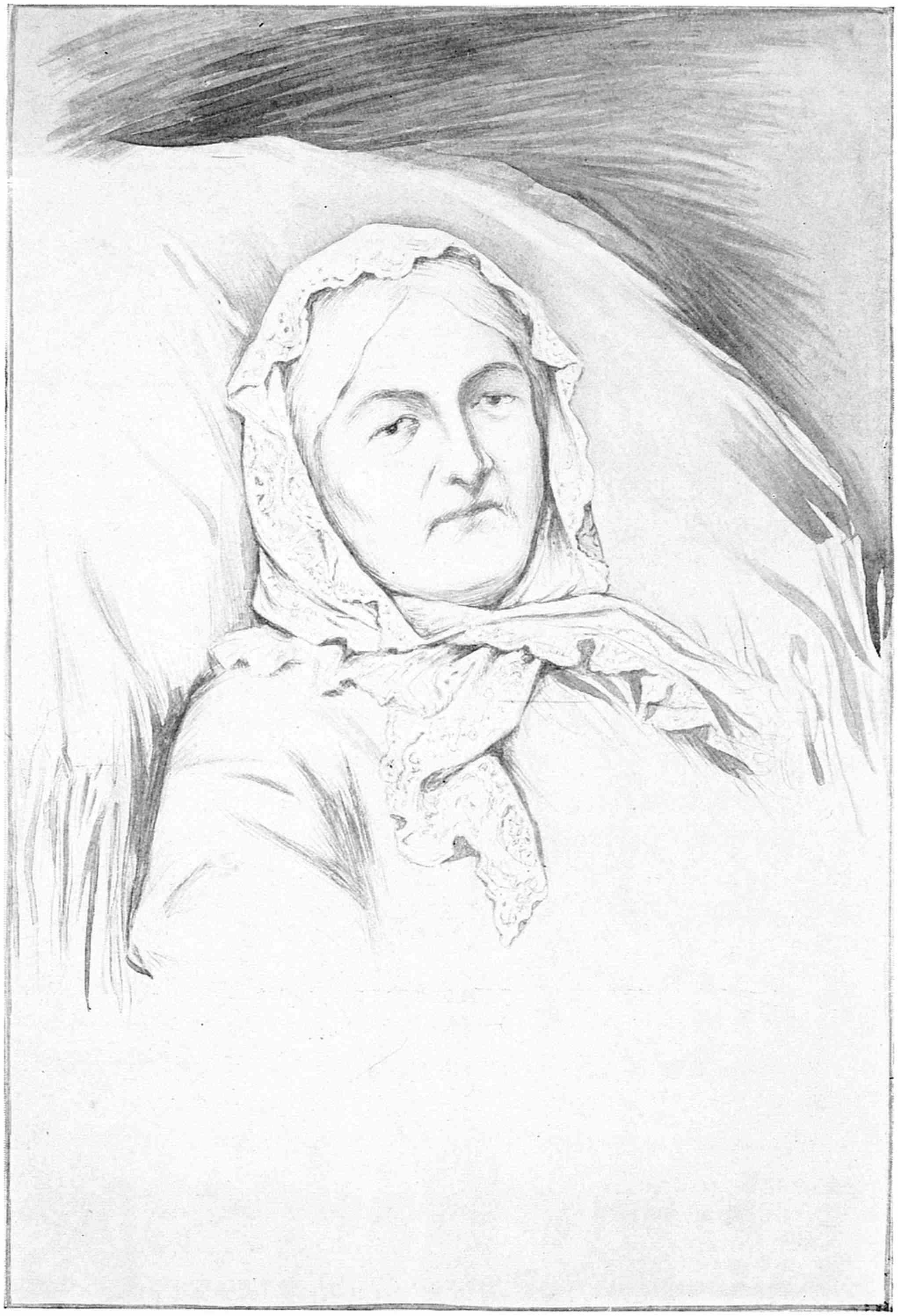
MISS NIGHTINGALE.
(From a Drawing.)
[To face p. 48.
To-day it seems almost impossible to realise
how novel was the idea of a woman of birth and
education becoming a nurse. Miss Nightingale was
a pioneer of the pioneers. She herself had not
then any clear course before her for the future,
but she realised the important point that she could
not hope to accomplish anything without training.
The faculty was necessary and the desire to be
helpful to the sick and suffering, but a trained
knowledge was the important thing. In a letter
which Miss Nightingale wrote in after years to
young women on the subject of “Work and Duty”
she remarked: “I would say to all young ladies
who are called to any particular vocation, qualify
yourselves for it as a man does for his work. Don’t
think you can undertake it otherwise. Submit
yourselves to the rules of business as men do, by
which alone you can make God’s business succeed;
for He has never said that he will give His success
and his blessing to sketchy and unfinished work.”
And on another occasion she wrote: “Three-fourths
of the whole mischief in women’s lives arises from
their excepting themselves from the rules of training
considered needful for men.”
This was the spirit in which Miss Nightingale
entered upon her chosen work, for she was the
last person to “preach and not practise.” The
advice which she gave to other women, when she
had herself risen to the head of her profession, had
been the guiding influence of her own probation.
The beneficent work which distinguished her as
the squire’s daughter had given her useful experience,
and had opened her eyes to the need of
trained nurses for the sick poor. What is now
called “district nursing” at this period exercised the
mind of Florence Nightingale, and her attention
to military nursing was called forth later by a
national emergency.
It was at this critical period of her life, when
her mind was shaping itself to such high purpose,
that Florence Nightingale met Elizabeth Fry. The
first grasping of hands of these two pioneer women
would serve as subject for a painter. We picture
the stately and beautiful old Quakeress in the characteristic
garb of the Friends extending a sisterly
welcome to the young and earnest woman who
came to learn at her feet. The one was fast
drawing to the close of her great work for the
women prisoners, and the other stood on the
threshold of a philanthropic career to be equally
distinguished. We have no detailed record of
what words were spoken at this meeting, but we
know that the memory of the heavenly personality
of Elizabeth Fry was an ever-present inspiration
with Florence Nightingale in the years which
followed.
It was a meeting of kindred spirits, but of
distinct individualities. We do not find Miss Nightingale
making any attempt to take up the mantle
fast falling from the experienced philanthropist:
she had her own line of pioneer work forming in
her capable brain, but was eager to glean something
from the wide experience through which her
revered friend had passed. Mrs. Fry had during
the past few years been visiting prisons and
institutions on the Continent, and had established
a small training home for nurses in London. She
was a friend of Pastor Fliedner, the founder of
Kaiserswerth, and had visited that institution. The
account of his work, and of the order of Protestant
deaconesses which he had founded for tending the
sick poor, given by Mrs. Fry, made a profound
impression on Florence Nightingale, and resulted
a few years later in her enrolment as a voluntary
nurse at that novel institution.
In the meantime she studied the hospital system
at home, spending some months in the leading
London hospitals and visiting those in Edinburgh
and Dublin. Then she undertook a lengthened
tour abroad and saw the different working of
institutions for the sick in France, Germany, and
Italy. The comparison was not favourable to this
country. The nursing in our hospitals was largely
in the hands of the coarsest type of women, not
only untrained, but callous in feeling and often
grossly immoral. There was little to counteract
their baneful influence, and the atmosphere of
institutions which, as the abodes of the sick and
dying, had special need of spiritual and elevating
influences, was of a degrading character. The
occasional visits of a chaplain could not do very
much to counteract the behaviour of the unprincipled
nurse ever at the bedside. The habitual
drunkenness of these women was then proverbial,
while the dirt and disorder rampant in the wards
was calculated to breed disease. The “profession,”
if the nursing of that day can claim a title so
dignified, had such a stigma attaching to it that
no decent woman cared to enter it, and if she did,
it was more than likely that she would lose her
character.
In contrast to this repulsive class of women,
whom Miss Nightingale had encountered to her
horror in the hospitals of London, Edinburgh,
and Dublin, and to the “Sairey Gamps” who
were the only “professional” nurses available for
the middle classes in their own homes, she found
on the Continent the sweet-faced Sister of Charity—pious,
educated, trained.
For centuries the Roman Catholic community
had trained and set apart holy women for ministering
to the sick poor in their own homes, and had
established hospitals supplied with the same type
of nurse. A large number of these women were
ladies of birth and breeding who worked for the
good of their souls and the welfare of their Church,
while all received proper education and training, and
had abjured the world for a religious life. An
excellent example of the work done by the nun-nurses
is seen in the quaint old-world hospital of
St. John, with which visitors to Bruges are familiar.
It was one of the institutions visited by Miss
Nightingale, and, religious differences apart, she
viewed with profound admiration the beneficent
work of the sisters.
After pursuing her investigations from city to
city, Miss Nightingale decided to take a course
of instruction at the recently founded institution for
deaconesses at Kaiserswerth on the Rhine. There
a Protestant sisterhood were working on similar
lines to Sisters of Charity, and had already done
much to mitigate the poverty, sickness, and misery
in their own district, and were beginning to extend
their influence to other German towns. At Kaiserswerth
the ideal system of trained sick nursing which
Miss Nightingale had been forming in her own
mind was an accomplished fact.
CHAPTER VI FLORENCE NIGHTINGALE’S ALMA MATER AND ITS FOUNDER
Enrolled a Deaconess at Kaiserswerth—Paster Fliedner—His Early
Life—Becomes Pastor at Kaiserswerth—Interest in Prison
Reform—Starts a Small Penitentiary for Discharged Female
Prisoners—Founds a School and the Deaconess Hospital—Rules
for Deaconesses—Marvellous Extension of his Work—His Death—Miss
Nightingale’s Tribute.
Just precepts thus from great examples given,
She drew from them what they derived from Heaven.
Pope.
The year 1849 proved a memorable one in
the career of Florence Nightingale, for it was
then that she enrolled herself as a voluntary nurse
in the Deaconess Institution at Kaiserswerth on the
Rhine, which may be described as her Alma Mater.
It was the first training school for sick nurses
established in modern times, and it seems a happy
conjunction of circumstances that she who was
destined to hold the blue riband of the nursing
sisterhood of the world should have studied within
its walls.
PASTOR FLIEDNER, FOUNDER OF KAISERSWERTH.
Although she had already gained valuable insight
into hospital work and management during her
visits to various hospitals at home and abroad, it
was not until she came to Kaiserswerth that she
found her ideals realised. Here was a Protestant
institution which had all the good points of the
Roman Catholic sisterhoods without their restrictions.
It further commended itself as being under the
guidance of Pastor Fliedner, a man of simple and
devoted piety and a born philanthropist.
He had had the perspicacity to see that the world
needed the services of trained women to grapple
with the evils of vice and disease, and to this end
he revived the office of deaconess which had been
instituted by the early Christian Church. The
idea of training women to minister to the sick and
the poor seems natural enough to-day, but in Miss
Nightingale’s young womanhood it was entirely
novel. The district nurse had not then been
invented. The Kaiserswerth institution combined
hospital routine and instruction with beneficent work
among the poor and the outcast.
Pastor Fliedner, the founder, was indeed a kindred
spirit, and it seems fitting to give a little account
of the man who exercised such a remarkable
influence over our heroine in the days of her
probation. Theodore Fliedner was just twenty years
her senior, having been born in 1800 at Eppstein,
a small village near the Rhine. He was “a son
of the manse,” both his father and grandfather
having been Lutheran clergymen. At an early
age he showed a desire to become a power for
good in the world, and his sensitive feelings were
much hurt when a child, by his father playfully
calling him “the little beer-brewer” on account
of his plump round figure. The jest caused little
Theodore much heart-searching and made him feel
that his nature must be very carnal and in need of
great discipline. In these days he would probably
have resorted to Sandow’s exercises or a bicycle.
Of course Theodore was poor and had to work
his way from school to college. He studied at
the Universities of Giessen and Göttingen, giving
instruction in return for food and lodging, and was
not above doing manual labour also. He sawed
wood, blacked boots, and did other odd jobs. He
also mended his own clothes, but in a somewhat
primitive fashion, for in a letter to his mother he
says that he sewed up the holes in his trousers
with white thread which he afterwards inked over.
His vacations were spent in tramping long distances
and subsisting on the barest necessaries of life,
in order to gain an acquaintance with the world.
He studied foreign languages, read widely, and as
a college student showed the after bent of his mind
by collecting songs and games for children which
later were used in his own kindergarten, and have
spread throughout the world. He also learned
the use of herbs and acquired much homely knowledge
on the treatment of disease.
After leaving college he became tutor in a
private family at Cologne, and the mother of his
pupils took his deportment in hand. Possibly this
lady had physical culture views about the rotundity
of his figure. However, Theodore in speaking of
the benefit derived from lessons in deportment
quaintly confesses that “gentle ways and polite
manners help greatly to further the kingdom of
God.” While at Cologne he assisted a clergyman
of the place in parish work, and occasionally
preached in the prison, thus gaining an insight
into the unhappy condition of discharged prisoners
which inspired his later beneficent work on their
behalf.
When he had reached the age of twenty-two,
Theodore Fliedner received a call to become the pastor
of a struggling Protestant community at the little
town of Kaiserswerth on the Rhine, near Düsseldorf,
which he accepted. At Eppstein, his native village,
he was ordained, surrounded by a delighted family
circle. It is characteristic that the young pastor
set out on foot for Kaiserswerth, and arrived before
he was expected in order to save his parishioners
the expense of giving him a reception.
His position was humbler even than Goldsmith’s
Vicar, for he received the modest yearly stipend
of 180 thaler (£27), and had to share the parsonage
with the mother of his predecessor, while in
order to relieve his own widowed mother he
took two younger brothers and a sister to live
with him. Hardly was his modest household
arranged, than a velvet-factory upon which the
Protestant population of Kaiserswerth depended
failed, and the young pastor found himself with
a destitute flock. He received two other calls,
but his heart was fixed at Kaiserswerth, and he
determined to set forth staff in hand like the
Apostles, and tramp through the Protestant countries
seeking aid for his people. He visited Germany,
Holland, and England, and received help and
encouragement.
The most important friendship which the young
Lutheran pastor made in London was with Elizabeth
Fry. The work of this noble philanthropist
amongst the prisoners of Newgate was a revelation
to him, and he returned to his parish of Kaiserswerth
burning with zeal to do something for the prisoners
of his own land. He began work in the neighbouring
prison of Düsseldorf, where he became
a regular visitor and started services. On June
26th, 1826, he was instrumental in founding at
Düsseldorf the first German society for improving
prison discipline.
The great problem which confronted him was
how to protect the discharged female prisoners
from the life of evil to which their unhappy
circumstances drove them when the term of their
imprisonment ended. They had as a rule neither
home nor protector, and were cast upon the
world with the prisoner’s brand upon them. He
determined to devote himself to the rescue and
protection of these unfortunate women.
In September of 1833 he began his experiment
by preparing with his own hands an old summer-house,
some twelve feet square, which stood in a
retired part of his garden as a refuge for discharged
female prisoners. He protected it from wind and
rain, made it clean and habitable, and placing there
a bed, a table, and a chair, prayed that God would
direct some outcast wanderer to its shelter. One
night a poor forlorn woman presented herself, and
the pastor and his good wife led her to the room
prepared. This destitute creature housed in the
old summer-house was practically the inauguration
of the now famous Kaiserswerth institution. In the
course of the winter nine other women voluntarily
sought the refuge, and the work went forward until
a new separate building was erected near the pastor’s
house, having its own garden and field and affording
accommodation for twenty women. Madame
Fliedner, the founder’s wife, and Mademoiselle
Göbel, a voluntary helper, had charge of the
penitentiary.
Some of the women had children, and Pastor
Fliedner’s next step was to start an infant school
on very much the same lines as a modern kindergarten.
Now it was that the children’s games and
songs which it had been his hobby to collect during
his tramps abroad when a college student became
of use. Teachers were needed for the increasing
school, and in course of time a Normal school
for the training of infant-school mistresses was
started.
MISS NIGHTINGALE.
(From the bust at Claydon.)
This bust was presented to Miss Nightingale by the soldiers after the
Crimean War, and was executed by the late Sir John Steele.
[To face p. 61.
However, the idea which most actively dominated
the pastor’s mind was the training of women in
hospital work and to tend the poor. In his
parish of Kaiserswerth there was much poverty
and incompetence amongst the people and no
provision for dealing with disease. Three years
after he had founded the penitentiary for discharged
female prisoners, as already described, he started
his more important venture of founding a hospital
for the reception of poor patients and for the
training of nurses or deaconesses.
On October 13th, 1836, the “Deaconess Hospital,
Kaiserswerth,” was opened, practically without
patients and without deaconesses. For his hospital
the pastor had secured a part of the deserted factory,
the stopping of which had plunged his people into
destitution in the first year of his pastorate—a
singular example of the realisation of poetic justice.
He fitted the “wards” with mended furniture,
cracked earthenware, and such utensils as he could
beg. His stock of linen embraced only six sheets.
But cleanliness cost nothing, and the hospital
certainly had that. On the Sunday morning after
the opening the first patient, a poor suffering
servant girl, knocked at the door for admittance.
Four other sick persons came during the month,
and in the course of a year sixty patients had been
received in the primitive hospital, and funds were
coming in for the support of the work.
Almost simultaneously with the patients came the
nurses. First a solitary candidate presented herself
for training as a deaconess and several probationers
followed. In the course of a year seven nurses
had entered the institution. There was nothing
haphazard about their admission, for the pastor, when
he instituted his order of Protestant deaconesses,
made a simple code of rules. No deaconess was to
be under twenty-five years of age, and although she
was engaged for a term of five years, she was free
to leave at any moment. The candidates were
solemnly received into the community and consecrated
to their work by the laying on of hands
by the pastor, who invoked a final blessing in the
words: “May God the Father, the Son, and the
Holy Ghost, three Persons in one God, bless you;
may He stablish you in the Truth until death, and
give you hereafter the Crown of Life. Amen.”
The dress of the deaconesses is very quaint
and simple, but not unbecoming. It consists of
a plain blue cotton gown, a white apron, large
white turned-down collar, and a white muslin cap
surrounding the face in the old style and tied
under the chin with a large bow. The young
girl probationers look very sweet and attractive
in the cap, which has a tendency to heighten
the beauty of a fresh young face while it seems
singularly appropriate to the elderly women who
have passed from active service to the Home of
Rest, later provided.
Unlike their Roman Catholic sisters, the Kaiserswerth
deaconesses were not fettered by a vow.
Their vocation was to be the servants of Christ and
the servants of the sick and poor. They could
at any time return to their families if their services
were needed, and were at liberty to marry, but
not to remain in the hospital afterwards, as it
was considered that the new ties would interfere
with entire devotion to their work.
Pastor Fliedner was a man of social instincts
and had himself married twice. His first wife
lived only a short time, and the story of his
second wooing is quaintly told in his journal. He
went to Hamburg to ask Amalia Sieveking to
take charge of a deaconess home. She was unable
to comply with the request, but recommended in her
place a young friend and pupil, Caroline Bertheau,
who had been nursing in the Hamburg Hospital.
The pastor was so pleased with the substitute
that he offered her the choice of either taking
charge of a deaconess home or becoming his wife.
Caroline demurely elected to do both. They were
married at once, and spent their honeymoon in
Berlin for the purpose of establishing the first five
deaconesses in the Charité Hospital, returning in
due course to Kaiserswerth, where the young wife
became the Deaconess Mother of the institution
and the devoted helpmeet of her husband in all
his after-work.
But to return to the training of the deaconesses.
After the institution had become established in all
its branches, a candidate decided on entering
whether she wished to train as a teacher or as a
nurse, and was enrolled in the Krankenschwestern
or Lehrschwestern according to her choice. Each
probationer goes through a course of practical
housework. She learns to cook, sew, iron, and
scrub by taking a share in the menial work of
the hospital, and this fits her to be of real help
when she comes to enter the homes of the poor.
The probationer also has instruction in simple
book-keeping, letter-writing, and reading aloud.
After she has gone through the general course,
she goes into particular training according to her
choice. If she desires to become a nurse, she
enters the surgical and medical wards of the
hospital; and if a teacher, she trains in the kindergarten
and the other schools.
The Kaiserswerth deaconesses receive no salaries,
the primary idea being that they should give themselves
to the work. They have free board and are
supplied each year with two blue cotton gowns
and two aprons, and every five years with a new
blue woollen gown and a black alpaca apron for
best wear. They receive at intervals new outdoor
dress, which consists of long black cloaks and
black bonnets which fit closely over the white cap.
If a deaconess has private property, she retains
the full control of it, and on her death it reverts
to her nearest of kin unless she has otherwise
disposed of it by will. Each deaconess is allowed
a small sum for pocket money.
During the first ten years of the founding of
Kaiserswerth Pastor Fliedner spread his system of
deaconesses until he had established sixty nurses
in twenty-five different centres, and calls were
coming from all sides. In 1849 he resigned his
pastorate in order to journey about establishing
branch houses in different parts of the world.
His first long journey was to the United States,
to conduct deaconesses to Dr. Passavant’s German
parish at Pittsburg; and the second was to Jerusalem,
where he founded a “mother house” with four
deaconesses on Mount Zion in a building given
by the King of Prussia. This branch undertakes
to nurse all sick persons irrespective of creed, and
forms a training school for nurses in the East.
From Jerusalem he proceeded to Constantinople,
established a branch there, and then proceeded to
Alexandria, Beyrout, Smyrna, Bucharest, and other
places. He had already started a deaconess home
in London. The institutions spread rapidly through
Germany, and to-day there is scarcely a town of any
size in the Fatherland which has not its deaconess
home which sends nurses to the poor without charge
and supplies middle-class families at moderate fees.
The last years of the pastor’s life were passed in
bodily suffering, but he still kept his hand on the
helm. His last work was to found at Kaiserswerth
a Home of Rest for retired deaconesses. The good
man was much cheered not only by the marvellous
extension of his work—he left behind him a hundred
houses attended by four hundred and thirty deaconesses—but
at the fruit which seeds of his sowing
had produced in the heart of the English lady
who became the heroine of the Crimean War. It
was with peculiar interest that he followed the
work of Florence Nightingale in that campaign,
for her deeds shed a reflected lustre on her Alma
Mater.
On October 4th, 1864, Pastor Fliedner, to use
Miss Nightingale’s words, “passed to his glorious
rest.” Almost his last words were: “As I look
back upon my life, I appreciate how full it has been
of blessings; every heart-beat should have been
gratitude and every breath praise.”
Commenting upon his work, Miss Nightingale
made this characteristic summary: “Pastor Fliedner
began his work with two beds under a roof, not with
a castle in the air, and Kaiserswerth is now diffusing
its blessings and its deaconesses over almost every
Protestant land.”
CHAPTER VII ENTERS KAISERSWERTH: A PLEA FOR DEACONESSES
An Interesting Letter—Description of Miss Nightingale when she
entered Kaiserswerth—Testimonies to her Popularity—Impressive
Farewell to Pastor Fliedner.
The travelled mind is the catholic mind educated from exclusiveness
and egotism.—A. Bronson Alcott.
When Florence Nightingale entered the
Deaconess Hospital at Kaiserswerth, the
institution, if we count the first primitive penitentiary,
had been in existence sixteen years. It already
consisted of a hospital and training home for
deaconesses, a seminary for infant-school teachers,
a kindergarten, an orphan asylum, and a penitentiary,
but was small compared with the extensive settlement
of to-day. It was managed on very simple
and primitive lines, and the nurses came almost
entirely from the peasant class. The fashion of
“lady” nurses was practically unknown. Deaconess
Reichardt, the first sister enrolled in the institution,
was still there at the time of Miss Nightingale’s
sojourn.
An interesting bit of autobiography regarding her
Kaiserswerth days is given by Miss Nightingale
in a letter preserved by the authorities of the
British Museum. The letter was sent in reply
to their request for a copy of the little history of
Kaiserswerth which Miss Nightingale published
after her return from the institution, and was
hastily written in pencil. It is dated September 24th,
1897, from her house 10, South Street, Park Lane,
and runs as follows:—
“Messrs. Dubau,—
“A gentleman called here yesterday from you,
asking for a copy of my Kaiserswerth for, I
believe, the British Museum.
“Since yesterday, a search has been instituted—but
only two copies have been found, and one
of those is torn and dirty. I send you the least
bad-looking. You will see the date is 1851, and
after the copies then printed were given away,
I don’t think I have ever thought of it.
“I was twice in training there myself. Of course,
since then hospital and district nursing have made
great strides. Indeed, district nursing has been
invented.
“But never have I met with a higher love,
a purer devotion than there. There was no
neglect.
“It was the more remarkable because many of
the deaconesses had been only peasants—(none
were gentlewomen when I was there).
“The food was poor—no coffee but bean coffee—no
luxury but cleanliness.
“Florence Nightingale.”
One can imagine the flutter of excitement
amongst the good simple deaconesses as they
flitted about in their blue cotton gowns, white
aprons, and prim muslin caps when it was known
that an English lady of wealth and position had
come to study amongst them. That such a woman
should voluntarily undertake the duties of a hospital
nurse, tending the sick poor with her own delicate
hands, was at that time almost unprecedented. But
the “Fraulein Nightingale” was quickly at home
amongst her fellow-nurses and eager to learn all
that the more experienced could teach her. She
took both day and night nursing and entered into
all branches of work. Garbed in the simple nurse’s
dress she moved through the wards of the hospital
carrying the charm of her presence from bed to bed,
as she was later to do at Scutari. Was there a difficult
case to attend or an operation to be performed, the
English Fraulein was sure to be on the scene.
At this period Miss Nightingale was in the
strength and beauty of her early womanhood. She
was tall, slight, and graceful, with abundance of
brown hair neatly arranged on either side her high
broad forehead, and had penetrating grey-blue eyes
and a mouth which though firm indicated a sense
of humour. The deaconesses, with whom she could
talk in their own language, found her a diverting
companion, for she had a sharp incisive wit, a certain
homely shrewdness of expression, and a knowledge
acquired not only from a superior education, but
from a good experience of foreign travel. Above
everything else she was distinguished by the power
of adapting herself to circumstances, and she settled
down to the humble fare and simple routine of life
at Kaiserswerth as easily as though she had never
known the refined luxuries of her father’s house.
It is small wonder that the sweet old faces of the
retired deaconesses, living out the last spell of life in
the Kaiserswerth Home of Rest, light up with smiles
to-day at the mention of the “Fraulein Nightingale.”
Some can recall her gracious kindly presence
amongst them, and all feel a community of satisfaction
that her honoured name is enrolled among
the sisterhood.
Sister Agnes Jones, the devoted and famous nurse
of Liverpool, was at Kaiserswerth in 1860, and
records the impression which Miss Nightingale’s
personality had left on the deaconesses. She wrote
in a letter to a friend: “Their love for Miss
Nightingale is so great; she was only a few months
there, but they so long to see her again. I was
asking much about her; such a loving and lovely
womanly character hers must be, and so religious.
Sister S. told me many of the sick remembered
much of her teaching, and some died happily,
blessing her for having led them to Jesus.”
Although training in hospital work was Miss
Nightingale’s primary object in going to Kaiserswerth,
she was deeply interested in all Pastor
Fliedner’s schemes for helping the poor in his
parish, and did a good deal of what in these days
would be termed “district visiting,” along with
Frau Fliedner. She also took a keen interest in
the school and the teachers’ seminary, and formed
a warm friendship with Henrietta Frickenhaus, the
first schoolmistress at Kaiserswerth, who was still
in charge of the seminary, and had at that time
trained four hundred candidates.
Pastor Fliedner had given up parish work to
travel abroad and found deaconess institutions in
various towns at the time when Miss Nightingale
first came to Kaiserswerth, but they occasionally met,
and during the latter part of her residence he was
at home and took, as may be readily imagined, a
deep interest in the training of so brilliant and distinguished
a pupil. Mr. Sidney Herbert visited
Kaiserswerth during Miss Nightingale’s probation,
and had therefore an opportunity of seeing the
efficient training of the lady who was later to be
his honoured coadjutor in hospital and nursing
reforms.
A very impressive scene took place when
Florence Nightingale left Kaiserswerth. The
present head of the institution, Pastor Düsselhoff,
tells me that his mother, the eldest daughter of
Pastor Fliedner, vividly recalls the scene to-day.
After bidding good-bye to the deaconesses, Miss
Nightingale bent her head to the pastor and asked
for his blessing. With hands resting on her head,
and face upturned to heaven, he prayed that her
sojourn at Kaiserswerth might bear precious fruit
and her great powers be dedicated to the service of
humanity. Then, repeating his usual formula—“May
God the Father, the Son, and the Holy
Ghost, three Persons in one God, bless you; may
He stablish you in the Truth until death, and give
you hereafter the Crown of Life. Amen”—he sent
her forth dedicated to the service of the sick and
suffering. Little did he think what the magnitude
of that service was to be. Teacher and pupil were
not destined to meet again, but the good pastor
lived to hear the name of Florence Nightingale
resound through the world.
After Miss Nightingale’s return home from her
second sojourn at Kaiserswerth, she published in
1851 a booklet on the institution, and in the introduction
gives some excellent advice to the girls of
the time. Her remarks may seem a little out
of date to-day, but are interesting as showing the
desire for useful work which was beginning to
actuate women of the leisured classes and which
needed to be directed into fitting channels. There
was then the great cry of the untrained. Women
were longing for occupation, but few had received
definite courses of training.
Miss Nightingale was at this period a pioneer of
her sex and a decidedly “advanced” woman, but
the desire for freedom of action was tempered by a
naturally well-balanced nature. She put forward
the plea on women’s behalf that they should be
encouraged to seek occupation and properly trained
for their work. In Kaiserswerth she deals more
particularly with the vocation of a nurse or deaconess,
but as a prelude to the little work she refers to the
position of women in her own century. There is “an
old legend,” she writes, “that the nineteenth century
is to be the century of women,” but she thinks that
up to the present (1851) it has not been theirs. She
magnanimously exempts man from blame. The
fault, has not been his, for “in no country has
woman been given such freedom to cultivate her
powers” as in England. “She [woman] is no
longer called pedantic if her powers appear in conversation.
The authoress is courted not shunned.”
Women, she thinks, have made extraordinary intellectual
development, but as human beings cannot
move two feet at once, except they jump, so
while the intellectual foot of woman has made a
step in advance, the practical foot has remained
behind. “Woman,” says Miss Nightingale, “stands
askew. Her education for action has not kept pace
with her education for acquirement. The woman
of the eighteenth century was perhaps happier, when
practice and theory were on a par, than her more
cultivated sister of the nineteenth century. The
latter wishes, but does not know how to do many
things! The former, what she wished at least that
she could do.”
It appears that when Miss Nightingale was a
young woman, the fashion for extolling the single
girl as against her sister who had entered the bonds
of matrimony was coming into vogue, but on this
point our heroine was racily sincere. “It has become
of late the fashion,” she says, “to cry up ‘old
maids,’ to inveigh against regarding marriage as the
vocation of all women, to declare that a single life is
as happy as a married one, if people would but think
so. So is the air as good an element for fish as the
water, if they did but know how to live in it.
Show us how to be single and we will agree. But
hitherto we have not found that young Englishwomen
have been convinced. And we must confess
that, in the present state of things, their horror of
being ‘old maids’ seems justified ... a life without
love, and an activity without an aim, is horrible
in idea and wearisome in reality.”
Miss Nightingale does not touch on the point
that the disparity between the numbers of the sexes
makes singleness not a choice but a necessity to many
women, and that in the interests of those who
must remain unwed, training for a definite calling
in life should be given to girls as well as to boys.
She goes on to speak of the longing of women
for work and the ennui which results from the lack
of it, and draws the picture of five or six daughters
living in well-to-do houses with no other occupation
than taking a class in a Sunday-school and of
the middle-class girls who become burdensome to
fathers and brothers.
She expends some characteristic witticisms on the
young ladies who try to drive away ennui by a little
parish visiting, and because of their want of knowledge
only succeed in demoralising the poor. In
evidence of this, Miss Nightingale tells the story
that one day on entering a cottage which was usually
neat and tidy she found everything upside down.
“La! now! why, miss,” said the cottage woman
at her visitor’s look of astonishment, “when the
district-visiting ladies comes, if we didn’t put
everything topsy-turvy they would not give us
anything.”
“To be able to visit well,” says Miss Nightingale,
commenting upon the foregoing incident, “is one of
the rarest accomplishments. But when attained,
what a blessing to both visitors and visited!”
These remarks in regard to the work of
women were by way of preliminary to introducing
the subject of deaconesses. Miss Nightingale had
returned from Kaiserswerth full of enthusiasm for
the vocation of trained nurse and visitor to the
poor, and was endeavouring to introduce the then
highly novel subject to her young countrywomen
as a way of getting rid of listlessness and ennui.
That she felt the ground to be dangerous is shown
by the detailed account of the connection of the
office of a deaconess with the early Christian Church,
which she deemed it necessary to give in order to
allay the Protestant fear that a deaconess was a
nun in disguise.
In these days, when women are actively employed
in Church work and philanthropy, and when their
assistance is welcomed by the clergy in parishes
all over the land, it seems strange to find how
cautiously Miss Nightingale recommended the office
of deaconess. She labours through scholastic arguments
and cites the Fathers. St. Chrysostom
speaks of forty deaconesses at work in Constantinople
in the fourth century. Holy women
of the order worked amongst the Waldensian,
Bohemian and Moravian Brotherhoods. Luther
complained of the lack of deaconesses in his neighbourhood,
adding, “Women have especial graces to
alleviate woe, and the words of women move the
human being more than those of men.” Under
Queen Elizabeth, deaconesses were instituted into the
Protestant Church during public service. The Pilgrim
Fathers when first driven to Amsterdam and Leyden
carried their deaconesses with them, and Miss
Nightingale cites the improving example of the
Amsterdam deaconess who sat in her place at
church with a little birchen rod in her hand to
correct the children, and relates how she called
upon the young maidens for their services, when
they were sick, and she was “obeyed like a mother
in Israel.”
She considers it clearly proved that before the
establishment of the order of sisters of mercy by
St. Vincent de Paul in 1633, the office of deaconess
had been recognised by all divisions of Christians,
and was therefore not borrowed from the Roman
Catholic Church. The reason why such sisterhoods
had not flourished among Protestants was owing
to the lack of preparatory schools and training
homes. This want had been supplied at the
Kaiserswerth institution, and she proceeds to give a
history of its foundation and growth. There she
had found her ideal, and for the next few years
her life was devoted to philanthropic and religious
work. Military nursing had not as yet dawned
upon her horizon.
CHAPTER VIII A PERIOD OF WAITING
Visits the Sisters of St. Vincent de Paul in Paris—Illness—Resumes
Old Life at Lea Hurst and Embley—Interest in John
Smedley’s System of Hydropathy—Mr. and Mrs. Sidney
Herbert’s Philanthropies—Work at Harley Street Home for
Sick Governesses—Illness and Return Home.
They also serve who only stand and wait.—Milton.
Three years had yet to transpire before
Florence Nightingale was called to her great
life work. After leaving Kaiserswerth, she stayed
for a time on her way home with the Sisters of St.
Vincent de Paul in Paris. She was without religious
bigotry in the pursuit of knowledge, and sincerely
admired the devoted and unselfish work of this
Roman Catholic sisterhood. They were indeed sisters
of mercy, and the hospitals and schools of their
community had obtained world-wide renown. Their
institutions had the advantage over Kaiserswerth,
at that period, of being in long-established working
order. In Paris, too, Miss Nightingale found
opportunity for studying surgery in the hospitals.
The skill of the Paris surgeons stood remarkably
high, and she could scarcely have had a better
ground for observation than the French capital.
With her good friends the sisters, too, Miss
Nightingale visited the homes of the poor and
made a minute inspection of their methods of
organised charity.
SIR WILLIAM HOWARD RUSSELL.
(Photo by Elliott & Fry.)
[To face p. 80.
While pursuing this interesting work, Miss
Nightingale was taken ill. She had now a personal
experience of the skill and tender care of the sisters,
who nursed her back to convalesence.
As soon as she was able to travel, she returned to
her family and completed her restoration to health
in the beautiful surroundings of her well-loved
homes of Embley Park and Lea Hurst. There she
spent the ensuing months in her old work of quiet
benevolence amongst the poor and infirm in the
parishes, where her name was even then a household
word. Added to her kindness of heart, which
the people had long known, “Miss Florence” had
now returned from “furren parts” with a knowledge
of sick nursing which astounded the rustic mind.
It was rumoured that she could set a broken leg
better than the doctor, and had remedies for
“rheumatiz” and lumbago which made old men
feel young again, and as for her lotions for the eyes,
“Why, they was enough to ruin the spectacle folk.”
At this period the immediate vicinity of Miss
Nightingale’s Derbyshire home was the scene of
the labours of “Dr.” John Smedley, the Father of
Hydropathy and the founder of the now famous
“Smedley’s Hydropathic” at Matlock Bank. Although
Miss Nightingale did not, I believe, specially
ally herself with hydropathy, she has always been
an advocate for the simple rules of health and diet
as against the drug treatment. She could not fail
to have been deeply interested in the experiments
which good John Smedley and his mother were
conducting practically at her own door, and they
form a part of the environment which was shaping
her mind at this period.
The old stone house in which John Smedley lived
while he was experimenting still stands near the
bottom of the steep road leading to Lea Hurst.
It has been divided into three small dwellings, but
the outside railings over which Mrs. Smedley used
to hand her son’s simple remedies to the villagers,
and to the employees at Smedley’s Mills, on the
opposite side of the road, are still pointed out by
old inhabitants. The hamlet was particularly good
for pioneer work of this kind, because of the
hundreds of workers, chiefly women and girls, from
the surrounding countryside who obtained employment
at Lea Mills. The Derbyshire quarries and
smelting works in the vicinity also yielded further
patients for treatment. In course of time John
Smedley started two free hospitals near his house,
one for men and one for women, and the patients
were subjected to the hydropathic regimen with such
beneficial results that he started the hydropathic
establishment known by his name at Matlock.
When at Embley, Miss Nightingale was much
interested in the benevolent schemes of Mr.
Sidney Herbert, afterwards Lord Herbert of Lea,
and his accomplished and beautiful wife, who
were friends and neighbours. The Herberts’
residence, Wilton House, was a few miles from
Embley on the Wiltshire border, and at this
period they were engaged in the founding of a
children’s hospital, schools, and other philanthropic
ventures, and were actively interested in schemes
for the emigration of poor women. We shall,
however, deal later with the very congenial friendship
existing between Miss Nightingale and Lord
and Lady Herbert of Lea.
As soon as Miss Nightingale had recovered her
health she left the quiet surroundings of her country
homes for a life of philanthropic activity in London.
She was greatly interested in the Ragged School
work of the Earl of Shaftesbury, and devoted the
proceeds of her recently published booklet on
Kaiserswerth, which had been printed by the inmates
of the London Ragged Colonial Training
School, to charitable objects.
In choosing a line of benevolent activity, Miss
Nightingale was at this period actuated by a desire
to help poor ladies, so many of whom were suffering
silently and unheeded, and largely through their
lack of proper training for remunerative callings.
Reference has already been made to her common-sense
plea that women should receive training to
fit them for work, in her advocacy of a revival
of the order of deaconesses. But while she sought
to influence the girls of the future, Miss Nightingale
made it a present duty to soothe and brighten the
lives of poor ladies who had fallen helpless in the
race of life. With this end in view she took in
charge the Harley Street Home for Sick Governesses,A
which was in a very unsatisfactory condition.
A Now known as the Hospital for Invalid Gentlewomen.
Much has been written on the underpaid and
badly treated private governess in days gone by.
Her woes, and sometimes her machinations, were
the stock-in-trade of romancers. When a pretty
young creature in cheap mourning appeared at the
Grange as governess to the younger children, you
might predict a proud, harsh mistress, troublesome
and insulting pupils, and a broken heart by reason
of the squire’s son, almost to a certainty. But the
novelist rarely followed the governess beyond the
interesting age of youth and beauty; if he had,
there would have been sad tales to tell of friendless
old age, penury, and want. The Harley Street Home
had been founded to help such, more particularly
those who were in bad health. In this institution
Miss Nightingale found a work which brought into
active use the knowledge of sick nursing which
she had been acquiring, gave a vent for her
womanly benevolence, afforded a field for the
exercise of her organising abilities, and proved a
valuable preparation for what lay in the future.
The Home had been languishing through mismanagement
and lack of funds, and its new superintendent
set to work with characteristic method.
She got donations from her friends, inspired old
subscribers with a new confidence, and managed to
get the institution on its feet again, but not without
a serious strain of overwork.
A lady who visited her at this time speaks of the
untiring labour which Miss Nightingale gave to
the institution. “She was to be found,” she
writes, “in the midst of the various duties of a
hospital—for the Home was largely a sanatorium—organising
the nurses, attending to the correspondence,
prescriptions, and accounts; in short,
performing all the duties of a hard-working matron
as well as largely financing the institution.”
Miss Nightingale shut herself off entirely from
outside society and only occasionally received her
most intimate friends. Her assiduity bore fruit
in the improved state of the Home, not only on its
comfort which she brought to it. The task of
dealing with sick and querulous women, embittered
and rendered sensitive and exacting by the unfortunate
circumstances of their lives, was not
an easy one, but Miss Nightingale had a calm
and cheerful spirit which could bear with the
infirmities of the weak. And so she laboured on
in the dull house in Harley Street summer and
winter, bringing order and comfort out of a wretched
chaos and proving a real friend and helper to
the sick and sorrow-laden women. At length the
strain proved too much for her delicate body, and
she was compelled most reluctantly to resign her
task.
Again she returned to Embley Park and Lea
Hurst to recruit her health. When a few months
later the supreme call of her life came and she
was summoned to the work for which a special
Providence seemed to have been preparing her from
childhood, she was found ready.
CHAPTER IX SIDNEY, LORD HERBERT OF LEA
Gladstone on Lord Herbert—Early Life of Lord Herbert—His
Mother—College Career—Enters Public Life—As Secretary for
War—Benevolent Work at Salisbury—Lady Herbert—Friendship
with Florence Nightingale—Again Secretary for War.
Formed on the good old plan,
A true and brave and downright honest man.
Whittier.
None knew thee but to love thee,
None named thee but to praise.
Halleck.
“I wish,” wrote Gladstone to Richard Monckton-Milnes
(afterwards Lord Houghton) in October,
1855, “that some one of the thousand who in
prose justly celebrate Miss Nightingale would say
a single word for the man of ‘routine’ who devised
and projected her going—Sidney Herbert.”
Acting on such distinguished advice I propose
to attempt a slight account of the career and personality
of this singularly attractive man, who was
at the head of the War Office when Florence
Nightingale and her staff of nurses were sent to
the aid of the soldiers wounded in the Crimea.
No Life of Lord Herbert of Lea has at the time
of writing been published, although one is, I
understand, in course of preparation. The name
of Sidney Herbert is distinguished as that of the
War Minister who, in defiance of official tradition,
enlisted the devotion and organising power of
women on behalf of our soldiery perishing in the
pestilential hospitals of the East.
Sidney Herbert was born at Richmond in Surrey
on September 16, 1810, and was the second son of
George Augustus, eleventh Earl of Pembroke, by
his second wife, Countess Catherine, only daughter
of Count Woronzoff, Russian Ambassador to the
British Court. His maternal uncle, Prince Michael
Woronzoff, was a companion in arms of Wellington,
and the founder of the prosperous era in the
Crimea. Sidney Herbert’s mother, though of
Russian birth, was chiefly brought up and educated
in this country, and owing to her father’s official
position, moved as a girl in the atmosphere of the
Court. He owed much to her example and training.
She is described as having been a woman of quick
intelligence and sound judgment, of large generosity
and noble bearing. Her husband, Lord Pembroke,
died when their son Sidney was about seventeen,
and her influence moulded his early manhood.
He was educated at Harrow under Dr. Butler, and
matriculated at Oriel College, Oxford, in 1828, where
he was counted an elegant scholar and noted as a
speaker at the Union Debating Society, when he
matched his strength beside Gladstone, Roundell
Palmer, and other distinguished young orators. Upon
his entrance into public life, as M.P. for South Wiltshire
in the first Reformed Parliament of 1832, Sidney
Herbert was considered a graceful and accomplished
young Tory.
Sir Robert Peel on taking office in 1834 offered
Sidney Herbert a post in the Government, and it
was characteristic of him that he refused the Lordship
of the Treasury because the duties were slight,
and accepted the laborious post of Secretary to the
Board of Control, which he held during Peel’s
Administration. He returned to office with his old
leader in 1841 as Secretary to the Admiralty.
While holding that position Sidney Herbert set
to work to reform the Naval School at Greenwich,
which then contained some eight hundred boys and
was the nursing-ground for the navy. While thus
engaged he exhibited that administrative faculty
which was later so conspicuously shown in his efforts
on behalf of the sister service.
In 1845 he was transferred to the office of
Secretary of War, with a seat in the Cabinet. He
gave special attention to the regimental schools
and introduced very necessary reforms in their
management, and also instituted an inquiry into
the state of the Royal Military Asylum at Chelsea.
On the resignation of Sir Robert Peel’s Ministry,
Sidney Herbert left office, and his work of military
reform remained in abeyance.
He remained out of office for six years, and
during that period devoted himself largely to private
philanthropy in the vicinity of his home, Wilton
House, near Salisbury. He had married in 1846
Elizabeth, the daughter of General Aske A’Court
and the niece of Lord Heytesbury, a young lady
of singular beauty and charm, who entered most
sympathetically into his many philanthropic enterprises,
and herself instituted several benevolent
schemes. She became the authoress of several books
dealing with biography and travel.
Florence Nightingale was a frequent visitor at
Wilton House and Mr. and Mrs. Sidney Herbert
were amongst her dearest and most sympathetic
friends. She took a great interest in the home
for scrofulous children which they had founded and
maintained at Mudiford in Hampshire, and was able
to give much practical help in its management.
Having heard from Miss Nightingale of a particular
bath which she had seen employed with good effect
at Kaiserswerth, Mr. Herbert procured the ingredients
from that distant institution for use in
the Mudiford home. One can readily imagine how
useful her technical knowledge was to her friends
in their various undertakings, and how congenial
interests drew them more and more together.
Humanity in every form appealed to Mr. and Mrs.
Sidney Herbert. They erected at Wilton a model
lodging-house for agricultural labourers, and formulated
schemes for the emigration of poor women.
So actively interested were they in the latter that
they frequently accompanied parties of emigrants on
to the vessel to speed them on their way. Some of
their later schemes were for the establishment of
day-rooms and institutes in the rural districts
around their county town of Salisbury.
Like Miss Nightingale, Sidney Herbert was a
devoted worker in connection with the Established
Church, and proved a generous benefactor to his
diocese. He built at his own cost of £30,000 the
magnificent church at Wilton, and presented a new
rectory and grounds. He also built the new church
at Bemerton in memory of his saintly kinsman,
George Herbert, and gave liberally to the restoration
of churches in the Salisbury diocese. He was a
great supporter of missionary bishops. It has well
been said of him that the “bede-role of his private
charities would weary the patience of any reader.”
He was the founder of hospitals, the builder of
churches, the maintainer of schools, and his right
hand knew not what his left hand gave.
In social life Sidney Herbert was a fascinating
personality, and might be described as a modern
hero of chivalry. He was strikingly handsome, with
a commanding figure and courtly manners. He
appeared to possess every social advantage—high
birth, a great estate, a beautiful wife and children,
one of the happiest homes in England, many
accomplishments, a ready address, a silvery voice,
irresistible manners, and a rare power for making
friends. It was said that men would give up to
Sidney Herbert what they would grant to no one
else. In his younger days Sidney Herbert was
sneered at by Disraeli as a maker of “pretty
speeches,” but he later proved that there was grit
behind the polished exterior of his personality.
He was also, as Gladstone described him, a “man
of routine.” His labours were unceasing; he never
spared himself, and gave up life and luxury for toil
and trouble. His industry and power of organisation
were remarkable. “Great as were the works
of Lord Herbert,” said Mr. Gladstone in referring
to the army reforms which he executed after the
Crimea, “there was something if possible still greater,
and that was the character of Lord Herbert....
His gentleness combined with a modesty such as I,
for one, never knew equalled in any station of
life.”
Such, then, was the perfect knight, the gallant
gentleman, under the stimulus of whose private
friendship and official supervision and support
Florence Nightingale entered upon the great work
of her life.
In 1852 Sidney Herbert, after six years’ retirement,
again took office and became Secretary of War in
Lord Aberdeen’s Government. Immediately on his
return to the War Office he began his schemes for
army reform. He instituted classes for army school-masters,
established industrial and infant schools in
regiments, and also matured a plan for forming a
board of examiners who should conduct all examinations
for commissions by direct appointment or for
promotion within the ranks of regimental officers.
His plans were interrupted by the outbreak of the
Crimean War.
CHAPTER X THE CRIMEAN WAR AND CALL TO SERVICE
Tribute to Florence Nightingale by the Countess of Lovelace—Outbreak
of the Crimean War—Distressing Condition of the
Sick and Wounded—Mr. W. H. Russell’s Letters to The Times—Call
for Women Nurses—Mr. Sidney Herbert’s Letter to
Miss Nightingale—She offers her Services.
The bullet comes—and either
A desolate hearth may see;
And God alone to-night knows where
The vacant place may be.
Adelaide Procter.
Then, then a woman’s low soft sympathy
Comes like an angel’s voice to teach us how to die.
Edwin Arnold.
Before the more heroic elements in Florence
Nightingale’s character had been evoked by
the events of the Crimean War, her intimate friends
had begun to regard her as a woman for whom the
future held some great destiny. This was strikingly
shown in a poem by Ada, Countess of Lovelace,
the daughter of Byron, who described the future
heroine of the Crimea in a poem entitled A
Portrait from Life. She draws the picture of her
slender form, her “grave but large and lucid eye,”
her “peaceful, placid loveliness,” refers to her love
of books, her “soft, silvery voice” and delight in
singing sacred songs—
She walks as if on heaven’s brink,
Unscathed through life’s entangled maze—
and in a concluding verse Lady Lovelace makes the
following remarkable prophecy:—
In future years in distant climes
Should war’s dread strife its victims claim,
Should pestilence, unchecked betimes,
Strike more than sword, than cannon maim,
He who then reads these truthful rhymes
Will trace her progress to undying fame.
The “war’s dread strife” which, in fulfilment of
the poet’s intuition, was to lift Florence Nightingale
into “undying fame,” began in the early spring of
1854. An outbreak of hostilities between Great
Britain and Russia had been impending for some
months. Russia made no reply to the ultimatum
sent by Great Britain, and on March 27th, 1854,
the Queen’s Message to Parliament announced that
the negotiations were broken off with Russia and
she felt bound to give aid to the Sultan of Turkey.
The following day, March 28th, Her Majesty’s
formal declaration of war was read amid scenes of
excitement and enthusiasm from the steps of the
Royal Exchange.
France was England’s ally for the protection of
Turkey against Russian aggression, and vigorous
preparations for the campaign proceeded on either
side of the Channel.
A few days after the declaration of war, the
English fleet, under the command of the gallant Sir
Charles Napier, sailed for the Baltic, speeded on its
way by thousands of cheering spectators and by the
Queen and Prince Consort, who came in their yacht,
the Fairy, to take leave of the officers and men.
The eyes of elderly people still beam and brighten
if one mentions this memorable sailing of the fleet
for the Baltic. It was then forty years since
Wellington had returned victorious from Waterloo,
and the blood of the nation was up for another
fight. Time had deadened the memory of the
horrors and suffering which war entails: only a
thirst for glory and conquest remained. The whole
nation echoed the words of Napier to his men:
“Lads, war is declared. We are to meet a bold
and numerous enemy. Should they offer us battle,
you know how to dispose of them. Should they
remain in port, we must try to get at them.
Success depends upon the quickness and decision of
your fire. Lads, sharpen your cutlasses, and the
day is ours.”
SIDNEY, LORD HERBERT OF LEA.
[To face p. 96.
In due time tidings came of the victory of Alma.
But alas for the brave “lads,” for the news came
too of the wounded lying uncared for, the sick
untended, the dying unconsoled. In the midst of
the nation’s rejoicings at victory a cry of indignation
arose on behalf of her soldiers.
There had been gross neglect in the war
administration, and the commissariat had broken
down. Food, clothing, and comforts had been
stowed in the hold of vessels beneath ammunition
and could not be got at when required, while
other stores rotted on the shores of the Bosphorus
while awaiting delivery. Not only were food and
clothing lamentably scarce, but the surgeons were
often without even lint and bandages, to say
nothing of other requisites for ambulance and
hospital work. “The commonest accessories of a
hospital are wanting,” wrote The Times war correspondent,
William Howard Russell, “there is not
the least attention paid to decency or cleanliness,
the stench is appalling; ... and for all I can
observe, the men die without the least effort to save
them. There they lie just as they were let gently
down on the ground by the poor fellows, the
comrades, who brought them on their backs from
the camp with the greatest tenderness, but who are
not allowed to remain with them.”
The staff of army doctors was insufficient to deal
with the wounded, which after the battles of Alma
and Inkerman accumulated in appalling numbers,
and there were no nurses except the untrained
male orderlies, many of whom were only a little
less sick than those whom they were supposed to
tend. There was no woman’s hand to soothe
the fevered brow, administer nourishment, perform
the various little offices for the sick, and console the
dying.
The untended and uncared-for state of our
own soldiers was rendered more conspicuous by
the humane system which prevailed amongst our
French allies. In camp and hospital sisters of
mercy glided from stretcher to stretcher, and from
bed to bed, administering food and help to the
wounded. In their convent homes all over France
they had been trained in the work of sick nursing,
and their holy vocations did not prevent them
from going forth to the scene of battle.
Soon came the appeal which roused Englishwomen
and their country to a sense of duty, and the
honour of uttering it belongs to Mr. (later Sir)
William Howard Russell, the veteran war correspondent,
then representing The Times at the seat
of war. After describing the suffering which he
had witnessed amongst the sick and wounded
soldiers, he raised the clarion note:—
“Are there no devoted women amongst us, able
and willing to go forth to minister to the sick
and suffering soldiers of the East in the hospitals
at Scutari? Are none of the daughters of England,
at this extreme hour of need, ready for such a
work of mercy?... France has sent forth her
sisters of mercy unsparingly, and they are even
now by the bedsides of the wounded and the
dying, giving what woman’s hand alone can give
of comfort and relief.... Must we fall so far below
the French in self-sacrifice and devotedness, in a
work which Christ so signally blesses as done unto
Himself? ‘I was sick and ye visited Me.’”
The wives of officers at the seat of war sent
home harrowing accounts of the distress amongst
the wounded and the futility of their own efforts
to cope with it. “Could you see the scenes that
we are daily witnessing,” wrote one lady to her
friends, “you would indeed be distressed. I am
still in barracks, but the sick are now lying in
the passages, within a few yards of my room.
Every corner is filled up with the sick and wounded.
However, I am enabled to do some little good,
and I hope I shall not be obliged to leave just
yet. My time is occupied in cooking for the
wounded. Three doors from me there is an officer’s
wife who devotes herself to cooking for the sick.
There are no female nurses here, which decidedly
there ought to be. The French have sent fifty
sisters of mercy, who, we need hardly say, are
devoted to the work. We are glad to hear that
some efforts are being made at home.”
The reason why female nurses had not been
sent out at the beginning of the war was explained
by the Duke of Newcastle, Secretary of State for
War, when he gave evidence before Mr. Roebuck’s
Commission, which sat in 1855 to inquire into
the conduct of the campaign, and it is of interest
to quote the evidence as it so exactly explains the
train of circumstances which led to Miss Nightingale’s
appointment. Asked “When did you first determine
on sending nurses to Scutari?” the Duke
replied:—
“The employment of nurses in the hospital at
Scutari was mooted in this country, at an early
stage before the army left this country, but it was
not liked by the military authorities. It had been
tried on former occasions. The class of women
employed as nurses had been very much addicted
to drinking, and they were found even more callous
to the sufferings of soldiers in hospitals than men
would have been. Subsequently, in consequence of
letters in the public press, and of recommendations
made by gentlemen who had returned to this
country from Scutari, we began to consider the
subject of employing nurses. The difficulty was to
get a lady to take in hand the charge of superintending
and directing a body of nurses. After
having seen one or two I almost despaired of the
practicability of the matter until Mr. Sidney Herbert
suggested Miss Nightingale, with whom he had
been previously acquainted, for the work, and that
lady eventually undertook it.”
Here we have the difficulty of the situation
revealed. The nurses hitherto employed in military
hospitals had been of a coarse, low character. They
had neither education, training, nor sympathy for
their work. To compare them to “Sairey Gamp”
would be an insult to that immortal lady’s memory,
for she had her good points and a certain professional
knowledge and respectability to maintain,
while the average soldiers’ nurse was little more than
a mere camp follower. On the other hand were
the good, kindly ladies who felt that they had a
vocation for nursing, but, alas! were absolutely
devoid of training and incapable of organising and
controlling subordinates. Between these two impossible
classes the war authorities had come to
the conclusion that the army in the Crimea would
be better without female nurses.
The rousing appeal to the women of the country
from Mr. Russell, The Times correspondent, already
quoted, had the effect of inundating the authorities
with applications from women of all classes who,
moved by the harrowing accounts of the suffering
soldiers, were anxious to go out as nurses. The
offers of help were bewilderingly numerous, but
there was no organisation and no leader.
Mr. Sidney Herbert was at the head of the War
Department, and, in the midst of the excitement
and general futility of things, his thoughts naturally
turned to his honoured friend, Florence Nightingale.
In his opinion she was the “one woman” in England
who was fitted by position, knowledge, training, and
character to organise a nursing staff and take them
out to the aid of the suffering soldiers. He had,
as we have already seen, an intimate personal
knowledge of Miss Nightingale, was aware of the
thorough and systematic study which she had for
some years been giving to hospital nursing at home
and abroad, and he knew also of the organising skill
which she had been recently displaying in the
management of the Harley Street Home for Sick
Governesses. Mrs. Herbert, a lady of great insight
and knowledge, felt with her husband that if Miss
Nightingale could be induced to undertake the
hazardous task of organising a band of military
nurses, the success of the scheme would be ensured.
But Mr. and Mrs. Herbert had a natural
hesitation in making such a suggestion. It was
tantamount to asking their dear friend to go out
with her life in her hands, as well as to brave the
adverse criticism of a large number of short-sighted
but well-meaning people, who would lift up their
hands in protest at the idea of a lady of birth and
breeding going out to nurse the common soldier.
Poor “Tommy” had a worse character then than
now.
It was clear to Mr. Herbert that if Miss
Nightingale were to be asked to undertake this
work, she must be placed in an undisputed position
of authority and supported by the Government.
Everything depended on having a recognised head.
To allow bands of lady nurses to start for the seat
of war, each carrying out their pet and immature
notions on hospital work, would have been futile
and useless. To send them to Scutari and place
them under the control of the authorities then
in charge of the hospital, would have defeated the
chief object of the plan, which was to reform and
amend the existing order of nursing prevailing at
the hospital. Neither was it likely that so shrewd
and capable a woman as Miss Nightingale would
consent to organise a new nursing system—for
it practically amounted to that—unless she was
guaranteed a position of undisputed authority.
How necessary that was to the success of the
enterprise after events fully proved.
Fortunately, Sidney Herbert was a statesman in
a position to influence his colleagues in the Government,
and his recommendation of Miss Nightingale
as a lady fully qualified to perform the task of
Superintendent of Nurses for the Crimea was
received with approval, and indeed with a sense of
relief. Here was the woman whom distraught
Ministers had been vainly looking for amidst the
motley throng of the unfit. When things were so
far arranged, Sidney Herbert addressed the following
letter to his friend:—
“October 15th, 1854.
“Dear Miss Nightingale,—
“You will have seen in the papers that
there is a great deficiency of nurses at the hospital
of Scutari. The other alleged deficiencies—namely,
of medical men, lint, sheets, etc.—must, if they ever
existed, have been remedied ere this, as the number
of medical officers with the army amounted to one
to every ninety-five men in the whole force, being
nearly double what we have ever had before; and
thirty more surgeons went out there three weeks
ago, and must by this time, therefore, be at Constantinople.
A further supply went on Monday,
and a fresh batch sail next week. As to medical
stores, they have been sent out in profusion, by
the ton weight—fifteen thousand pairs of sheets,
medicine, wine, arrowroot in the same proportion;
and the only way of accounting for the deficiency at
Scutari, if it exists, is that the mass of the stores
went to Varna, and had not been sent back when
the army left for the Crimea, but four days would
have remedied that.
“In the meanwhile, stores are arriving, but the
deficiency of female nurses is undoubted; none
but male nurses have ever been admitted to military
hospitals. It would be impossible to carry about
a large staff of female nurses with an army in the
field. But at Scutari, having now a fixed hospital,
no military reason exists against the introduction,
and I am confident they might be introduced with
great benefit, for hospital orderlies must be very
rough hands, and most of them, on such an occasion
as this, very inexperienced ones. I receive numbers
of offers from ladies to go out, but they are ladies
who have no conception of what a hospital is, nor
of the nature of its duties; and they would, when
the time came, either recoil from the work or be
entirely useless, and consequently, what is worse,
entirely in the way; nor would those ladies probably
even understand the necessity, especially in a military
hospital, of strict obedience to rule....”
Mr. Sidney Herbert then proceeds to name
certain people who were anxious to organise and
send out nurses, but about whose capability for the
work he is in doubt. The letter then continues:—
“There is but one person in England that I
know of who would be capable of organising
and superintending such a scheme, and I have
been several times on the point of asking you
hypothetically if, supposing the attempt were made,
you would undertake to direct it. The selection
of the rank and file of nurses would be difficult—no
one knows that better than yourself. The
difficulty of finding women equal to a task after
all full of horror, and requiring, besides knowledge
and goodwill, great knowledge and great courage,
will be great; the task of ruling them and introducing
system among them great, and not the
least will be the difficulty of making the whole
work smoothly with the medical and military
authorities out there. This it is which makes
it so important that the experiment should be
carried out by one with administrative capacity and
experience.
“A number of sentimental enthusiastic ladies
turned loose in the hospital at Scutari would probably,
after a few days, be mises à la porte by
those whose business they would interrupt, and
whose authority they would dispute. My question
simply is, Would you listen to the request to go
out and supervise the whole thing? You would,
of course, have plenary authority over all the nurses,
and I think I could secure you the fullest assistance
and co-operation from the medical staff, and you
would also have an unlimited power of drawing
on the Government for whatever you think requisite
for the success of your mission....
“I do not say one word to press you,” continues
Mr. Sidney Herbert, and then proceeds to pay a
tribute to Miss Nightingale’s capabilities for filling
a public post at an hour of crisis such as no
responsible Minister of a Government had ever paid
to a woman before, or indeed since.
“I must not conceal from you,” he continues,
“that upon your decision will depend the ultimate
success or failure of the plan. Your own personal
qualities, your knowledge, and your power of
administration, and, among greater things, your rank
and position in society, give you advantages in such
a work which no other person possesses. If this
succeeds, an enormous amount of good will be done
now, and to persons deserving everything at our
hands; and which will multiply the good to all
time.
“I hardly like to be sanguine as to your answer.
If it were yes, I am certain the Bracebridges would
go with you, and give you all the comforts you
would require, and which her [Mrs. Bracebridge’s]
society and sympathy only could give you. I have
written very long, for the subject is very near my
heart. Liz [Mrs. Sidney Herbert] is writing to
our mutual friend Mrs. Bracebridge, to tell her
what I am doing. I go back to town to-morrow
morning. Shall I come to you between three and
five? Will you let me have a line at the War
Office, to let me know?
“There is one point which I have hardly a
right to touch upon, but I trust you will pardon
me. If you were inclined to undertake the great
work, would Mr. and Mrs. Nightingale consent?
The work would be so national, and the request
made to you proceeding from the Government,
your position would ensure the respect and consideration
of every one, especially in a service where
official rank carries so much weight. This would
secure you any attention or comfort on your way
out there, together with a complete submission
to your orders. I know these things are a matter
of indifference to you, except as far as they may
further the great object you may have in view,
but they are of importance in themselves, and of
every importance to those who have a right to take
an interest in your personal position and comfort.
I know you will come to a right and wise decision.
God grant it may be one in accordance with my
hopes.
“Believe me, dear Miss Nightingale, “Ever yours,
“Sidney Herbert.”
Meantime the “one woman in all England”
deemed worthy of this high trust was in the
quietude of her country home pondering over the
stirring words of Mr. Russell, The Times correspondent:
“Are there no devoted women amongst
us, able and willing to go forth to minister to
the sick and suffering soldiers in the hospitals of
Scutari?” Each morning the newspapers revealed
fresh sufferings and privations amongst the stricken
soldiers, and the cries for help grew more importunate.
Florence Nightingale was not the woman to
listen in vain, and ere the sun had faded away
behind the beech-trees on that memorable 15th of
October, she had written to Mr. Sidney Herbert
offering her services in the hospitals at Scutari.
Her letter crossed that of Mr. Herbert, of which
she was in complete ignorance. The unique circumstance
gives a rounded completeness to the call of
Florence Nightingale which came as the voice
of God speaking through her tender woman’s
heart.
CHAPTER XI PREPARATION AND DEPARTURE FOR SCUTARI
Public Curiosity Aroused—Description of Miss Nightingale in the
Press—Criticism—She Selects Thirty-Eight Nurses—Departure
of the “Angel Band”—Enthusiasm of Boulogne Fisherwomen—Arrival
at Scutari.
Lo, what gentillesse these women have,
If we coude know it for our rudenesse!
How busie they be us to keepe and save,
Both in hele, and also in sickenesse!
And always right sorrie for our distresse,
In every manner; thus shew thy routhe,
That in hem is al goodnesse and trouthe.
Chaucer.
It is characteristic of Miss Nightingale’s method
and dispatch that only a week elapsed from
the day on which she made her great resolve to
go to the help of the wounded soldiers until she
had her first contingent of nurses in marching order.
She was a “general” who had no parleying by the
way, but worked straight for her ultimate object,
and she possessed also the rare faculty of inspiring
others to follow her lead. Her attention was now
concentrated on procuring the right kind of nurses
to accompany her to the hospital at Scutari.
Her mission was duly proclaimed from the War
Office in an official intimation that “Miss Nightingale,
a lady with greater practical experience of hospital
administration and treatment than any other lady in
this country,” had undertaken the noble and arduous
work of organising and taking out nurses for the
soldiers. The Times also notified that “Miss
Nightingale had been appointed by Government to
the office of Superintendent of Nurses at Scutari,”
and subscriptions for the relief of the soldiers were
solicited.
Lady Canning, writing on October 17th, 1854, immediately
after Miss Nightingale’s appointment was
made known, gave the following interesting description
of her quiet demeanour in the midst of
the general excitement: “You will be glad to
hear that Government sends out a band of nurses
to Scutari, and Miss Nightingale is to lead them.
Her family have consented, and no one is so well
fitted as she is to do such work—she has such
nerve and skill, and is so gentle and wise and
quiet. Even now she is in no bustle or hurry,
though so much is on her hands, and such numbers
of people volunteer services.”
The public naturally asked the question, “Who
is Miss Nightingale?” and were answered by a
descriptive and biographic account in The Examiner,
which was repeated by The Times. One feels that
the account must have appeared startling in days
before attention had been given to the Higher
Education of women, and when Girton and Newnham
were not even dreams of the future. It ran
that Miss Nightingale was “a young lady of singular
endowments both natural and acquired. In a knowledge
of the ancient languages and of the higher
branches of mathematics, in general art, science, and
literature, her attainments are extraordinary. There
is scarcely a modern language which she does not
understand, and she speaks French, German, and
Italian as fluently as her native English. She has
visited and studied all the various nations of Europe,
and has ascended the Nile to its remotest cataract.
Young (about the age of our Queen), graceful,
feminine, rich, popular, she holds a singularly gentle
and persuasive influence over all with whom she
comes in contact. Her friends and acquaintances
are of all classes and persuasions, but her happiest
place is at home, in the centre of a very large band
of accomplished relatives, and in simplest obedience
to her admiring parents.”
The last clause would satisfy apprehensive people
that a young lady of such unusual attainments was
not a “revolting daughter.”
Another and more intimate description of Miss
Nightingale at this period reveals to us the true
and tender womanhood which learning had left
untouched. “Miss Nightingale is one of those
whom God forms for great ends. You cannot hear
her say a few sentences—no, not even look at her,
without feeling that she is an extraordinary being.
Simple, intellectual, sweet, full of love and benevolence,
she is a fascinating and perfect woman.
She is tall and pale. Her face is exceedingly lovely;
but better than all is the soul’s glory that shines
through every feature so exultingly. Nothing can
be sweeter than her smile. It is like a sunny day
in summer.”
MR. PUNCH’S CARTOON OF THE “LADY-BIRDS.”
The euphonious name of the lady nurse who
had thus suddenly risen into fame was quickly
caught by the populace, and the nurses selected to
accompany her were dubbed the “nightingales,”
and there was much pleasantry about their singing.
Mr. Punch slyly surmised that some of the “dear
nightingales” going to nurse the sick soldiers
would “in due time become ringdoves.” A
cartoon showed a hospital ward with the male
inmates beaming with content as the lady-birds
hovered about them. Another illustration depicted
a bird, with the head of a nurse, flying through
the air carrying by one claw a jug labelled “Fomentation,
Embrocation, Gruel.” It was entitled
“The Jug of the Nightingale.”
Punch’s poet contributed “The Nightingale’s
Song to the Sick Soldier,” which became a popular
refrain, and is worthy of quotation:—
Listen, soldier, to the tale of the tender nightingale,
’Tis a charm that soon will ease your wounds so cruel,
Singing medicine for your pain, in a sympathetic strain,
With a jug, jug, jug of lemonade or gruel.
Singing bandages and lint; salve and cerate without stint,
Singing plenty both of liniment and lotion,
And your mixtures pushed about, and the pills for you served out,
With alacrity and promptitude of motion.
Singing light and gentle hands, and a nurse who understands
How to manage every sort of application,
From a poultice to a leech; whom you haven’t got to teach
The way to make a poppy fomentation.
Singing pillow for you, smoothed; smart and ache and anguish smoothed,
By the readiness of feminine invention;
Singing fever’s thirst allayed, and the bed you’ve tumbled made,
With a cheerful and considerate attention.
Singing succour to the brave, and a rescue from the grave,
Hear the nightingale that’s come to the Crimea,
’Tis a nightingale as strong in her heart as in her song,
To carry out so gallant an idea.
While there was a large majority to wish God-speed
to the enterprise, there were also many people
who considered it an improper thing for women to
nurse in a military hospital, while others thought it
nonsense for young ladies to attempt “to nurse
soldiers when they did not even yet know what it
was to nurse a baby.” Others predicted that no
woman could stand the strain of work in an Eastern
hospital, that the scheme would prove futile, and all
the nurses be invalided home after a month’s
experience.
The undertaking was so new, and so much at
variance with English custom and tradition, that
criticism was to be expected. But Florence Nightingale
was one of those lofty souls who listen to
the voice within, and take little heed of the voices
without. It was for her to break down the
“Chinese wall” of prejudices, religious, social, and
professional, and establish a precedent for all time.
In the midst of the pleasantries, satire, and condemnation
she placidly pursued the work of
organising her band, having indefatigable assistants
in Mr. and Mrs. Sidney Herbert. Applications
were made for volunteer nurses to the few nursing
institutions which existed, and advertisements were
put in The Record and The Guardian. A bewildering
number of fair applicants besieged the War Office,
and Sidney Herbert was driven to make a little
proclamation to the effect that “many ladies whose
generous enthusiasm prompts them to offer services
as nurses are little aware of the hardships they
would have to encounter, and the horrors they
would have to witness. Were all accepted who
offer,” he added with a touch of grim humour, “I
fear we should have not only many indifferent
nurses, but many hysterical patients.”
This astute Minister was very cautious about the
admission of society ladies in the guise of amateur
nurses into the military hospital. He managed
things with a stricter hand than did the authorities
during the South African War, as illustrated by the
story of a soldier in the Capetown Hospital who,
when a visiting lady asked if he would like her
to wash his face, replied, “Excuse me, miss, but
I’ve already promised fourteen ladies as they shall
wash my face!”
The first appeal for nurses did not bring satisfactory
applicants. Kind, generous, and sympathetic
women volunteered by the score, but Miss
Nightingale and her friends felt that they were
dealing with a crisis of urgency. There was no
time to start ambulance classes and train candidates.
It was an imperative necessity that the nurses should
start without delay, and therefore they must have
been already trained for the work. In the emergency
Miss Nightingale applied to both Protestant and
Roman Catholic institutions for volunteers. This
caused a good deal of adverse criticism. The “No
Popery” cry was raised, and zealous clerics inveighed
against Miss Nightingale as a Puseyite
who was bent on perverting the British soldier to
papacy. She certainly was at the time more engaged
with the bodily than with the spiritual needs of
the soldiers. Nurses were required, not religious
instructors.
With some of the Protestant institutions a
difficulty arose in respect to the rule of strict
obedience to Miss Nightingale as the Superintendent
appointed by the Government. These
institutions were unwilling that their members should
be separated from home control. Miss Nightingale
and her advisers remained firm on this point.
Strict obedience was the pivot upon which the
organisation would have to work, if it was to be
successful. The military nurse, like the military
man, must render obedience to her superior officer.
The St. John’s House, one of the most important
of the Protestant sisterhood, stood out for a day
or two, but finally yielded the point.
The Roman Catholic bishop at once agreed to
the regulations laid down, and signed a paper
agreeing that the sisters of mercy joining the
expedition should give entire obedience to Miss
Nightingale, and that they should not enter into
religious discussion except with the soldiers of their
own faith. Mutual arrangement was made that the
Roman Catholic sisters should attend on the soldiers
of their own faith, and the Protestant sisters on
those of their faith.
The position was later defined by Mr. Sidney
Herbert to allay the agitation which prevailed after
the band had set forth. He said: “The Roman
Catholic bishop has voluntarily, and in writing, released
the benevolent persons who were previously
under his control from all subjection to himself.
Englishmen may have the pleasure of feeling that
a number of kind-hearted British women, differing
in faith, but wishing to do practical good, are gone
in one ship, as one corps, with one aim, without
any compromise of our national Protestantism....
Thirty-eight nurses on their way to Scutari are truer
successors of the Apostles shipwrecked at Melita
than an equal number of cardinals. May the war
teach men many such lessons.”
The thirty-eight nurses selected to accompany
Miss Nightingale as the first contingent were
made up of fourteen Church of England sisters, taken
from St. John’s House and Miss Sellon’s Home;
ten Roman Catholic sisters of mercy; three nurses
selected by Lady Maria Forrester, who had first
formed a plan for sending nurses to Scutari; and
eleven selected from among miscellaneous applicants.
Miss Nightingale’s friends, Mr. and Mrs. Bracebridge
of Atherstone Hall, and a clergyman and courier
accompanied the expedition. It started from London
on the evening of October 21st, 1854.
Our heroine has ever been one of those who
shunned the glare of publicity, and it was characteristic
of her that she set forth with her devoted band
under cover of night. Only a few relations and
friends stood on the platform of the terminus on
that October evening when Florence Nightingale
bade farewell to home and kindred and started
on her great mission, the magnitude and difficulty
of which she had yet to discover. Quietly dressed
in black, plain as a Quakeress, she was yet a striking
figure. As the last hand-shake was given and the
last farewells said her beautiful face retained its
calm demeanour and was illumined by a sweet smile.
Ever thoughtful for others, her chief wish was to
spare her nearest and dearest, who had yielded a
hesitating consent to her undertaking, from anxiety.
None knew better than herself the perils which lay
in those far-off Eastern hospitals.
Early next morning the “Angel Band,” as Kinglake
so beautifully termed Miss Nightingale and
her nurses, landed at Boulogne, where a reception
awaited them which was in marked contrast to the
quiet and almost secret departure from London the
night before. France was our ally; her sons had
fallen in the recent battle of the Alma beside our own,
and here was a band of English sisters, Protestant
and Roman Catholic, united in a common errand
of mercy passing through her land to the relief of
the sick and wounded. It was a circumstance to
arouse French enthusiasm, and when Miss Nightingale
and her nurses stepped ashore they were met by
a stalwart company of Boulogne fishwives, a merry
and picturesque band in snowy caps and gay
petticoats, who seized trunks and bags and almost
fought for the privilege of carrying the luggage
of les sœurs to the railway station. They would
accept no pay, not a sou, and they bustled along
with their brawny arms swinging to straps and
handles, or with boxes hoisted on their broad backs,
chattering of “Pierre” or of “Jacques” out at
the war, and praying the bon Dieu that if he
suffered the sisters might tend him. The tears
streamed down many of the old and weather-beaten
cheeks when they said adieu. They claimed but
one reward, a shake of the hand, and then as the
train steamed out of the station they waved their
hands and cried Vive les sœurs!
They proceeded to Paris and made a passing stay
at the mother-house of the sisters of St. Vincent
de Paul, where Miss Nightingale was no stranger.
The good sisters were overwhelmed with joy to
receive her, and delighted to have the opportunity
of entertaining the company. Before leaving Paris
Miss Nightingale called on her friend Lady Canning,
who, in a letter, October 24th, 1854, says: “To-day
we are appointed to go to St. Cloud, and I have
had to rush about after bonnets, etc. It is horrid
to be given to frivolities just now, when one is
hearing all the horrors from the Crimea, and in the
expectation of more.... Miss Nightingale came to
see me—very happy and stout-hearted, and with an
ample stock of nurses.” When, after a short rest
in Paris, Miss Nightingale and her band set out
for Marseilles, the port of embarkation, they met
with the utmost attention as they travelled. Porters
declined to be tipped and hotel proprietors would
make no charges. It was an honour to serve les
bonnes sœurs.
At Marseilles they embarked for Constantinople
in the Vectis, a steamer of the Peninsular line.
Alas! the elements showed no more favour to the
“Angel Band” than they did to St. Paul in the
same seas. The passage was a terrible one. A
hurricane blew straight against the Vectis in the Mediterranean,
and for a time the ship was in danger.
The company reached Malta on October 31st, and
after a brief stay set sail for Scutari. Miss Nightingale
arrived at the scene of her labours on
November 4th, the day before the battle of Inkerman.
What that victory meant in the tale of suffering and
wounded men even the hospital authorities then
formed no adequate conjecture. Never surely did
a band of women arriving in an unknown land
meet such a gigantic task.
The sufferers already in hospital had heard of the
coming of the sisters, but the news seemed too good
to be true, and when Miss Nightingale went her
first round of the wards, accompanied by members
of her devoted band, “Tommy’s” heart was full.
One poor fellow burst into tears as he cried, “I
can’t help it, I can’t indeed, when I see them.
Only think of English women coming out here to
nurse us! It seems so homelike and comfortable.”
CHAPTER XII THE LADY-IN-CHIEF
The Barrack Hospital—Overwhelming Numbers of Sick and
Wounded—General Disorder—Florence Nightingale’s “Commanding
Genius”—The Lady with the Brain—The Nurses’
Tower—Influence over Men in Authority.
A perfect woman, nobly planned,
To warn, to comfort and command;
And yet a spirit still and bright,
With something of an angel light.
Wordsworth.
The official position which the Government
had accorded Miss Nightingale was Superintendent
of the Nursing Staff in the East, and the
title by which she eventually became known was
that of Lady-in-Chief.
Her control extended over the nursing staffs of
all the hospitals, some eight in number, in which
our wounded soldiers were placed on the Bosphorus
and the Levantine. The first and chief scene of
Miss Nightingale’s personal ministrations, however,
was the great Barrack Hospital at Scutari, lent to
the British Government by the Turkish authorities.
It was beautifully situated on a hill overlooking the
glittering waters of the Bosphorus, and commanded
a view of the fair city of Constantinople, with its
castellated walls, marble palaces, and domes, rising
picturesquely on the horizon. No more enchanting
prospect could have been desired than that which
met the Lady-in-Chief when she reached Scutari,
the “silver city,” held in such veneration by the
Turks. The town seemed placed in a perfect
Garden of Eden, and the lovely blue of the Eastern
sky enhanced the beauty of the scene.
The Barrack Hospital was a fine handsome
building, forming an immense quadrangle with a
tower at each corner. An idea of its size may be
gathered from the fact that each side of the
quadrangle was nearly a quarter of a mile long.
It was estimated that twelve thousand men could
be exercised in the central court. Galleries and
corridors, rising story above story, surrounded
three sides of the building, and, taken continuously,
were four miles in extent. The building and
position were alike good, but the interior of the
hospital, as Miss Nightingale soon discovered, was
a scene of filth, pestilence, misery, and disorder
impossible to describe. On either side the endless
corridors the wounded men lay closely packed
together without the commonest decencies or
necessaries of life.
After being disembarked at the ferry below the
hospital from the vessels which brought them from
the battlefields of the Crimea, the wounded men
either walked or were dragged or carried up the
hill to the hospital. Surgical, fever, and even cholera
cases came along the road together in one long
stream of suffering humanity.
THE BARRACK HOSPITAL AT SCUTARI.
Several days had elapsed since the men left the
battlefield, and the majority had not had their
wounds dressed or their fractured limbs set. The
agony and misery of the poor fellows in this untended
and often starving state can be well imagined.
And how their hearts sank when they at length
reached the hospital, where at least they expected
food and comfort. Alas! there was little provision
of any kind for the sufferers. Nolan, in his history
of the campaign, says that in these early months of
the war “there were no vessels for water or
utensils of any kind; no soap, towels, or cloths,
no hospital clothes; the men lying in their uniforms,
stiff with gore and covered with filth to a degree
and of a kind no one could write about; their
persons covered with vermin, which crawled about
the floors and walls of the dreadful den of dirt,
pestilence, and death to which they were consigned.
“Medical assistance would naturally be expected
by the invalid as soon as he found himself in a
place of shelter, but many lay waiting for their turn
until death anticipated the doctor. The medical men
toiled with unwearied assiduity, but their numbers
were inadequate to the work.” Invalids were set to
take care of invalids and the dying nursed the dying.
It was a heart-breaking experience for the Lady-in-Chief
when she made her first round of the
wards at Scutari. The beds were reeking with
infection and the “sheets,” she relates, “were of
canvas, and so coarse that the wounded men
begged to be left in their blankets. It was indeed
impossible to put men in such a state of emaciation
into those sheets. There was no bedroom furniture
of any kind, and only empty beer or wine bottles
for candlesticks.”
In addition to the miseries entailed by overcrowding,
the men lying on the floors of the
corridors were tormented by vermin and their limbs
attacked by rats as they lay helpless in their pain.
The immediate surroundings of the hospital were
a hotbed of pestilence; Miss Nightingale counted
six dogs lying under the windows in a state of decomposition.
Add to this that in this vast caravanserai
of wounded, sick, and dying men there was no
proper provision for washing, no kitchens, culinary
conveniences, or cooks suitable for hospital needs,
and no sanitation, and some conception may be
formed of the Augean stable which the Lady-in-Chief
and her nurses had to cleanse, and the chaos
out of which order was to be brought.
It is not altogether surprising that the doctors
and hospital authorities did not immediately welcome
the very unique band of sisters who had come to
their assistance. These already overwrought gentlemen
were disposed to think that the ladies would
prove a greater hindrance than help. In those days
it was regarded as unavoidable that a soldier should
suffer, and humanitarian attempts to lessen the sufferings
were considered sentimental and effeminate.
Possibly some of the younger medical men
thought that the rats which infested the hospital
would prove the needed scare to the newly arrived
nurses. Of course it was held that the most strong-minded
women would fly at the approach of a mouse:
what therefore would be the effect of a rat? But
this idea was dispelled when it was known that the
Lady-in-Chief had fearlessly dislodged a rat from
above the bed of one of the nurses with an umbrella.
The sheds where the sisters sorted the stores were
over-run with the pests. “Our home rats,” said
one of them, “would run if you ‘hushed’ them;
but you might ‘hush’ away, and the Scutari rats
would not take the least notice.”
Only twenty-four hours after the arrival of Miss
Nightingale at Scutari the wounded from the battle
of Inkerman began to arrive in appalling numbers,
and soon every inch of room in the General and
in the Barrack Hospitals was filled with sufferers.
Many of the men had indeed no other resting-place
than the muddy ground outside. The Lady-in-Chief
had had no time to initiate reform, collect
stores, or get any plans for the relief of the patients
into working order before this fearful avalanche
of wounded soldiery came upon her.
BOULOGNE FISHERWOMEN CARRYING THE LUGGAGE OF MISS NIGHTINGALE AND HER NURSES.
[To face p. 128.
It was the testing moment of her life. Had
Florence Nightingale failed at this crisis in personal
endurance, or in power to inspire her subordinates
with a like courage, her mission would have sunk
into a benevolent futility. She and her nurses might
have run hither and thither smoothing pillows,
administering gruel, and doing other kind and
womanly service, but grateful as that would be to
the poor fellows in their extreme misery, it would
not have remedied the root of the evil. The Lady-in-Chief
had to look beyond the present moment,
though not neglectful of its demands, to the more
important future, and institute a system of nursing
reform which should make such scenes as she now
witnessed impossible. It was her ability to do this
which lifted Florence Nightingale into such a
supreme position.
The attention and praises bestowed on her during
the Crimean period roused a little jealousy and resentment
in some quarters. Other women engaged
in nursing the sick soldiers possibly thought that
they had made equal personal sacrifices with Miss
Nightingale—some indeed gave their life in the
cause. Others again, returning to a life of seclusion
after toiling through the arduous nursing of the
campaign, might perhaps have felt some injustice
that one name alone rang through the land, while
others who also had borne the heat and burden of
the day remained unhonoured and unsung. No
one would wish to exempt from due praise even
the humblest of that “Angel Band” who worked
with Florence Nightingale and still less would she,
but in every great cause there is the initiating
genius who stands in solitary grandeur above the
rank and file of followers.
Such was the Lady-in-Chief: she came to
Scutari as something far more even than an efficient
nurse. She brought the organising and governing
faculty and the brain power of which the officials
in charge seemed bereft. Delicate, high-bred, and
retiring in nature as Miss Nightingale was, she
possessed the subtle quality which gave her command
over others, that undefinable something which broke
down the opposition of the most conservative obstructionist
when he came under her personal influence.
She was unfettered by precedent or red tape, and
brought to her task a clear idea of the administrative
mechanism which was needed to afford due care
and provision for the prostrate soldiery.
Her woman’s nature was roused to indignation
at the sight of suffering which she could only
regard as the result of unbending and unthinking
routine, and she brought her quick intuitions and
agile brain to remedy the evil. When men were
dying daily by the score for the want of suitable
nourishment, she declined to listen to under officials
who feared to disobey regulations by opening stores
without the usual order, and took the responsibility
of having the packages undone. The Lady-in-Chief
was herself a strict disciplinarian, or she would never
have brought order out of chaos, but she had
humanity enough to know when the iron rule
might be relaxed in the interests of those under
her care. Her common sense, her spirit of unselfish
devotion, and her strong, though gentle, persuasiveness
gradually overcame the prejudice of the
constituted authorities against the new element
introduced into hospital work.
Mr. Sidney Herbert in his letter to the Principal
Medical Officer at Scutari (Dr. Menzies) announcing
the coming of the nurses, had enjoined him “to
receive with attention and deference the counsels
of the Lady-in-Chief.” Great as was the power
which the unflinching support of this distinguished
man gave her, it was secondary to the influence
which she attained by the force of her own character.
The late Dean Stanley, who was not a man to
misuse the English language, described Miss Nightingale’s
faculty as “commanding genius.”
We read in the thrilling accounts of the period
how the Lady-in-Chief went her rounds at night,
passing along the endless corridors and through
the hospital wards carrying a little lamp, the gleam
of which lighted her progress of mercy and love.
Dying men turned on their pillows to bless her
shadow as it passed. In far-away New England
the idea of “The Lady with the Lamp” inspired
the muse of Longfellow:—
A Lady with a Lamp shall stand
In the great history of the land,
A noble type of good
Heroic womanhood;
and it has remained the most beautiful and popular
title bestowed upon Florence Nightingale, but at
the risk of appearing modern and prosaic we
venture to re-christen our heroine “The Lady with
the Brain.”
When Miss Nightingale began her work, her
energies were concentrated on the Barrack Hospital
already described, and on the General Hospital at
Scutari, which was a little farther removed. The
other British hospitals in the East also came under
her supervision, but Scutari claimed at first her
undivided personal attention. Attached to her staff
were the thirty-eight trained nurses who had
accompanied her, the Rev. Sidney Osborne, the
chaplain, and her friends, Mr. and Mrs. Bracebridge
of Atherstone Hall. Mrs. Bracebridge was to act as
overseer of the housekeeping department. A most
valuable helper also was Mr. Stafford, a young man
of family who had left the drawing-rooms of Mayfair
to go to Scutari and “fag” for the Lady-in-Chief.
He wrote letters, went on missions of inquiry, and
did anything and everything which a handy and
gallant gentleman could do to make himself useful
to a lady whom he felt honoured to serve.
Taken collectively, this little group may be termed
the “party of reform” who were installed at
Scutari at the beginning of the winter of 1854.
Lady Stratford de Redcliffe, the wife of our Ambassador
at Constantinople, and her “beauteous guest,”
Lady George Paget, were also most helpful in
sending little comforts for the wounded officers, but
it was said of Miss Nightingale that she “thought
only of the men.” The common soldier was
undoubtedly her chief concern.
THE LADY-IN-CHIEF IN HER QUARTERS AT THE BARRACK HOSPITAL.
The Lady-in-Chief and her staff had their
quarters in a tower at one of the corners of the
hospital, and the busy life which went on there from
day to day is thus described by the Rev. Sidney
Osborne. “Entering the door leading into the
Sisters’ Tower,” he writes, “you at once find yourself
a spectator of a busy and interesting scene.
There is a large room with two or three doors
opening from it on one side; on the other, one
door opening into an apartment in which many of
the nurses and sisters slept, and had, I believe, their
meals. In the centre was a large kitchen table:
bustling about this might be seen the high-priestess
of the room, Mrs. C——. Often as I have had
occasion to pass through this room I do not
recollect ever finding her absent from it or unoccupied.
At this table she received the various
matters from the kitchen and stores of the sisterhood,
which attendant sisters or nurses were ever ready
to take to the sick in any and every part of these
gigantic hospitals. It was a curious scene, and a
close study of it afforded a practical lesson in the
working of true common-sense benevolence.
“The floor on one side of the room was loaded
with packages of all kinds—stores of things for the
internal and external consumption of the patients;
bales of shirts, socks, slippers, dressing-gowns,
flannel, heaps of every sort of article likely to be
of use in affording comfort and securing cleanliness....
It was one feature of a bold attempt upon
the part of extraneous benevolence to supply the
deficiencies of the various departments which as
a matter of course should have supplied all these
things.
“In an adjoining room were held those councils
over which Miss Nightingale so ably presided, at
which were discussed the measures necessary to
meet the daily-varying exigencies of the hospital.
From hence were given the orders which regulated
the female staff working under this most gifted
head. This, too, was the office from which were
sent those many letters to the Government, to friends
and supporters at home, telling such awful tales of
the sufferings of the sick and wounded, their utter
want of so many necessaries.”
We have in this description a glimpse into the
beginning of the Lady-in-Chief’s organising work.
In the sisters’ quarters she was from the first
undisputed head, and by degrees the order and
method which she established there affected every
other part of the hospital.
While she was battling with red-tapism in order
to get access to stores which lay unpacked in the
vicinity of a hospital filled with poorly fed, badly
clothed, and suffering men because nobody seemed
to know who had the right to dispense them,
sympathetic friends were keeping the store in the
Sisters’ Tower replenished. But it was impossible
to keep pace with the needs. The published letters
sent home by the nursing staff at this period all
contain requests for invalid requisites and clothing.
The wounded were dying in scores for want of
a little stimulant to rouse their exhausted systems
when they first arrived at the hospitals, and men
lying in clothing stiff with gore could not even
procure a change of garment. As the cold increased,
the frost-bitten patients, arriving from the trenches
before Sebastopol, had not even the luxury of a
warm shirt. One of the nurses writing home said:
“Whenever a man opens his mouth with ‘Please,
ma’am, I want to speak to you,’ my heart sinks
within me, for I feel sure it will end in flannel
shirts.”
The task of the Lady-in-Chief was to bring
benevolent as well as neglectful chaos into order.
She had to inquire into the things most urgently
needed and advise her friends in England. All
this was unexpected work, for it will be remembered
that Mr. Sidney Herbert, in the letter inviting
Miss Nightingale to go to Scutari, had dwelt on
the fact, as he believed it, that the hospitals were
supplied with every necessary. “Medical stores,”
he had said, “had been sent out by the ton weight.”
Alas! through mismanagement, these stores had
been rotting on the shore at Varna, instead of
reaching Scutari, and much that had arrived was
packed beneath heavy ammunition and difficult to
get at. The loss of the Prince, laden with supplies,
was a culminating disaster which occurred on
November 14th, about two weeks after Miss
Nightingale’s arrival.
The reticence of the hospital authorities prevented
the true state of affairs from reaching the
British public. Indeed, the whole Service, from
commandant to orderly, conspired to say “All right,”
when all was wrong. One of the sisters has described
how this policy worked in the wards. An orderly
officer took the rounds of the wards every night,
to see that all was in order. He was of course
expected by the orderlies, and the moment he raised
the latch he received the word, “All right, your
honour,” and passed on. This was hospital inspection!
In excuse for the officers who were thus easily
put off, it may be said that the wards were filled
with pestilence, and the air so polluted by cholera
and fever patients that it seemed courting death
to enter.
For that reason orderlies already on the sick list
were set to act as nurses, and they often drank
the brandy which it was their duty to administer
to the patients, in order to keep up their spirits,
or “drown their grief,” as they preferred to put
it. Men in this condition became very callous.
Those stricken with cholera had their sufferings
terribly enhanced by the dread of being buried
alive, and used to beseech the orderlies not to
send them to the dead-house until quite sure that
they had breathed their last. Utter collapse was
the last stage of Asiatic cholera, and the orderlies
took little pains to ascertain when the exact
moment of dissolution came; consequently numbers
of still living men were hurried to the dead-house.
One does not wish to hold up to blame
and execration the seeming inhumanity of the
orderlies. They were set to do work for which
they were untrained and often physically unfit,
and were also demoralised by the shocking condition
of the wards. It was the system rather than
individuals which was to blame.
Into these insanitary, filthy, and pestilential wards
came the Lady-in-Chief, and she did not say “All
right.” It was useless for officialdom to “pooh-pooh”:
she, fortunately, had Government authority.
What her quick eye saw was communicated to the
Commander-in-Chief, Lord Raglan, and to Mr.
Sidney Herbert at the War Office, and brought in
due course the needed instructions for reform.
Not the least quality of the Lady-in-Chief was
her influence over men in authority. She was not
dictatorial, she was not aggressive, but she possessed
the judgment which inspired confidence and the
knowledge which compelled respectful attention.
Her letters to the War Minister at home, and to
Lord Raglan, the General in the field, were models
of clear and concise documents, devoid of grumbling,
rancour, or fidgety complaints, but they contained
some appalling facts. Unerringly she laid her finger
on the loose joints of the commissariat and hospital
administration. By the enlightening aid of her
letters from Scutari the Home Government was
enabled to pierce the haze which surrounded the
official accounts from the Bosphorus, and gradually
the hospital management was put on a footing
which harmonised with the Lady-in-Chief’s recommendations.
Lord William Paulet, who succeeded Major Sillery
as Military Commandant at Scutari shortly after
Miss Nightingale’s arrival, soon learned to place
entire confidence in her judgment. “You will find
her most valuable, ... her counsels are admirable
suggestions,” wrote the War Minister to the new
Commandant and Lord William proved the truth of
the statement. Lord Raglan in one of his dispatches
to the Duke of Newcastle said, “Lord William
[Paulet] like Brown [Sir George Brown] speaks
loudly in praise of Miss Nightingale,” adding that
he was confident that she had “done great good.”
As the weeks passed by, Lord Raglan grew to
consider the Lady-in-Chief a most efficient auxiliary
“general.”
CHAPTER XIII AT WORK IN THE BARRACK HOSPITAL
An Appalling Task—Stories of Florence Nightingale’s interest in
the Soldiers—Lack of Necessaries for the Wounded—Establishes
an Invalids’ Kitchen and a Laundry—Cares for the
Soldiers’ Wives—Religious Fanatics—Letter from Queen
Victoria—Christmas at Scutari.
Neglected, dying in despair,
They lay till woman came,
To soothe them with her gentle care,
And feed life’s flickering flame.
When wounded sore, on fever’s rack,
Or cast away as slain,
She called their fluttering spirits back,
And gave them strength again.
Francis Bennoch.
The events of the war in the autumn of 1854
will convey some idea of the number of
wounded men crowded into the hospitals on the
Bosphorus when Florence Nightingale entered
upon her duties at Scutari. Balaclava was fought on
October 25th, four days after she left London; the
battle of Inkerman followed on November 5th, the
day after she landed. Before the average woman
would have found time to unpack her boxes, Miss
Nightingale was face to face with a task unparalleled
in its magnitude and appalling in its nature.
The wounded arrived by the shipload until every
ward, both in the General and in the Barrack
Hospital, was crowded to excess, and the men lay in
double rows down the long corridors, forming several
miles of suffering humanity. During these terrible
days Florence Nightingale was known to stand for
twenty hours at a time, on the arrivals of fresh detachments
of sick, apportioning quarters, directing her
nurses and attending at the most painful operations
where her presence might soothe and support. She
would spend hours over men dying of cholera or fever.
“Indeed,” wrote one who watched her work, “the
more awful to every sense any particular case might
be, the more certainly might be seen her slight form
bending over him, administering to his ease by
every means in her power and seldom quitting his
side until death released him.”
Her womanly heart prompted her to acts of
humanity which at once made her recognised by the
men as the soldier’s friend. When the wounded
were brought by hundreds to Scutari after Inkerman,
the first duty of the surgeons was to separate the
hopeful cases from the desperate. On one occasion
Miss Nightingale saw five soldiers set aside in a
hopeless condition. She inquired if nothing could
be done for the poor fellows, and the surgeons
replied that their first duty was with those whom
there seemed to be more hope of saving.
“Will you give me these five men?” said the
Lady-in-Chief.
“Do as you like with them,” replied the surgeons;
“we think their case is hopeless.”
If life could be saved, Florence Nightingale was
determined to save it, and throughout the night,
assisted by one of the nurses, she sat beside the
men, feeding them with a spoon until their senses
awakened and their strength began to return. She
washed their wounds, cheered their hearts with kind
words, and in the morning had the satisfaction of
finding that they were in a fit condition to be
operated on.
At another time a Highland soldier was about
to undergo an amputation. Miss Nightingale asked
that the operation might be delayed, as she thought
that careful nursing might render it unnecessary.
Through her unremitting care the man’s arm was
saved; and when asked what he felt towards his
preserver, he said that the only mode he had of
giving vent to his feelings was to kiss her shadow
when it fell on his pillow as she passed through
the wards on her nightly rounds.
When cholera and plague cases came in, foaming
at the mouth and black in the face, none were too
bad for Florence Nightingale’s patient care. Her
influence over the men was established from the
first. She was their “good angel” and their confidence
in her was unbounded.
Still, her task was a heavy one in these first days.
There was official prejudice to overcome, and an
overwhelming number of patients to deal with in a
huge building devoid of the commonest hospital accessories
and arrangements. The Barrack “Hospital,”
so called, had been designed only for soldiers’
barracks, so that when suddenly converted into a
hospital it lacked almost everything necessary for
the sick, and the supplies forwarded from England
had by a series of misadventures been delayed. A
letter sent home by one of the nurses six days after
the arrival of Miss Nightingale and her band may
be quoted as giving a graphic picture of the state
of affairs at this time. She writes:—
“I have come out here as one of the Government
nurses, and the position in which we are
placed induces me to write and ask you, at once,
to send out a few dozens of wine, or in short
anything which may be useful for the wounded
or dying, hundreds of whom are now around us,
under this roof, filling up even the passages to the
very rooms we occupy. Government is liberal,
and for one moment I would not complain
of their desire to meet all our wants, but with
such a number of the wounded coming in from
Sebastopol, it does appear absolutely impossible to
meet the wants of those who are dying of dysentery
and exhaustion; out of four wards committed to
my care, eleven men have died in the night,
simply from exhaustion, which, humanly speaking,
might have been stopped, could I have laid my
hand at once on such nourishment as I knew they
ought to have had.
“It is necessary to be as near the scene of
war as we are, to know the horrors which we have
seen and heard of. I know not which sight is most
heartrending—to witness fine strong men and
youths worn down by exhaustion and sinking under
it, or others coming in fearfully wounded.
“The whole of yesterday was spent, first in
sewing the men’s mattresses together, and then
in washing them, and assisting the surgeons, when
we could, in dressing their ghastly wounds, and
seeing the poor fellows made as easy as their
circumstances would admit of, after their five days’
confinement on board ship, during which space
their wounds were not dressed.
“Miss Nightingale, under whom we work, is
well fitted in every way to fill her arduous post,
the whole object of her life having hitherto been
the superintendence of hospitals abroad. Wine and
bottles of chicken broth, preserved meat for soups,
etc., will be most acceptable.
“We have not seen a drop of milk, and the
bread is extremely sour. The butter is most
filthy—it is Irish butter in a state of decomposition;
and the meat is more like moist leather than food.
Potatoes we are waiting for until they arrive from
France.”
MISS NIGHTINGALE IN THE HOSPITAL AT SCUTARI.
[To face p. 144.
Nursing in a hospital which received soldiers
straight from the battlefield, their wounds aggravated
by days of neglect, was a difficult task under
the most favourable circumstances, but when intensified
by the lack even of proper food, such
as the above letter discloses, the task was indeed
formidable.
There was an organising brain, however, at work
in that dreadful Barrack Hospital now, and within
ten days of her arrival, in spite of the terrible influx
of patients which taxed her powers to the utmost,
Miss Nightingale had fitted up an impromptu
kitchen, from which eight hundred men were daily
supplied with well-cooked food and other comforts.
It was largely supplied with the invalid food from
the private stores of the Lady-in-Chief, which fortunately
she had brought out with her in the Vectis.
Beef-tea, chicken broth, jelly, and little delicacies
unheard of before were now administered to the sick
by the gentle hands of women nurses. Small wonder
that the poor fellows could often only express their
gratitude in voices half-choked with sobs!
One Crimean veteran told the writer that when
he received a basin of arrowroot on his first arrival
at the hospital early in the morning, he said to
himself, “Tommy, me boy, that’s all you’ll get into
your inside this blessed day, and think yourself
lucky you’ve got that. But two hours later, if
another of them blessed angels didn’t come entreating
of me to have just a little chicken broth!
Well, I took that, thinking maybe it was early
dinner, and before I had well done wondering what
would happen next, round the nurse came again
with a bit o’ jelly, and all day long at intervals
they kept on bringing me what they called ‘a little
nourishment.’ In the evening, Miss Nightingale
she came and had a look at me, and says she, ‘I
hope you’re feeling better.’ I could have said,
‘Ma’am, I feels as fit as a fightin’ cock,’ but I
managed to git out somethin’ a bit more polite.”
Hitherto, not only had there been a lack of food,
but the cooking had been done by the soldiers
themselves in the most free and easy manner.
Meat and vegetables were boiled together in the
huge coppers, of which there were thirteen in the
kitchen attached to the barracks. Separate portions
were enclosed in nets, and all plunged together into
the seething coppers, and taken up when occasion
demanded. Some things were served up done to
rags, while others were almost raw. This kind of
cooking was bad enough for men in ordinary health,
but for the sick it meant death.
The daily comforts which the nurses’ kitchen
afforded received ample testimony from the
witnesses before Mr. Roebuck’s Commission for inquiry
into the conduct of the war. In one day
sometimes thirteen gallons of chicken broth and
forty gallons of arrowroot were distributed amongst
the sick. At first nearly all the invalid food had
to come from the private stores brought out by
the Lady-in-Chief, which the charitable at home replenished
as the true state of affairs became known,
for not only was there a deficiency in the Government
stores, but the things supplied officially were
often not fit for food. It was the general testimony
of witnesses before the Commission that Miss
Nightingale’s services were invaluable in the hospital
as well for what she did herself as for the manner
in which she kept the purveyors to their duties.
The method of distributing the Government
stores was as erratic as the cooking. There appeared
to be no regulations as to time. Things asked for
in a morning were probably not forthcoming until
evening, when the cooking fires in the barracks
kitchen were all but out. Nothing could be obtained
until various “service rules” had been observed.
An official board must inspect and approve all stores
before they could be distributed. One can think
of nothing more exasperating to the Lady-in-Chief,
in her responsible duty towards the sick, than to
see exhausted men dying for want of the proper
nourishment because the board of inspection had
not completed its arrangements. On one recorded
occasion she took the law into her own hands,
and insisted that the stores should be given out,
inspected or not. She could not ask under-officials
to incur the penalty of martial law by fulfilling her
behests, but she could brave the authorities herself
and did so. The storehouse was opened on the
responsibility of the Lady-in-Chief, and the goods
procured for the languishing soldiery.
Miss Nightingale’s defiance of red-tape made
her some enemies, and the “groove-going men,” as
Kinglake calls them, “uttered touching complaints,
declaring that the Lady-in-Chief did not choose
to give them time, and that the moment a want
declared itself, she made haste to supply it herself.”
“This charge,” says the same authority in an
appendix note, “was so utterly without foundation
as to be the opposite of truth. The Lady-in-Chief
used neither to issue her stores, nor allow any others
to do so, until the want of them had been evidenced
by a duly signed requisition. Proof of this is
complete, and has been furnished even by adversaries
of the Lady-in-Chief.”
After her improvised kitchen was in working
order, Miss Nightingale next set to work to
establish a laundry for the hospital and institute a
system for disinfecting the clothes of fever and
cholera patients. Up to the time of her arrival
there was practically little washing done, the
“authorities” had only succeeded in getting seven
shirts washed, and no attempt was made to separate
the bed-linen and garments of infectious patients
from those suffering only from wounds. Washing
contracts were in existence, but availed little. At
the General Hospital the work was in the hands of
a corps of eight or ten Armenians. There was no
fault to be found with the manner in which they
did the work, only they stole so habitually that
when a man sent his shirt to be washed he was
never sure that he would get it back again, and
in consequence the sick were unwilling to part
with their garments.
At the Barrack Hospital a Levantine named
Uptoni had the washing contract, but broke it
so repeatedly that the sick were practically without
clean linen, except when they were able to get
the soldiers’ wives to do a little washing for them.
Such was the state of affairs in a hospital where two
to three thousand men lay wounded and sick.
Miss Nightingale hired a house close to the
hospital and set up an efficient laundry, partly out
of her private funds, and partly out of money
subscribed to The Times fund started for the relief
of the soldiery. She had it fitted up with coppers
and regulated under sanitary conditions, and there
five hundred shirts and one hundred and fifty other
articles were washed each week.
There was a further difficulty to meet, and that
was to provide the men with a change of linen
while the soiled went to the wash. Many of the
wounded had been obliged to leave their knapsacks
behind and had no clothing save the dirty and
dilapidated garments in which they arrived. In the
course of the first three months Miss Nightingale
provided the men with ten thousand shirts from
her own private sources.
There was the same scarcity in surgical dressings,
and the nurses had to employ every minute that
could be spared from the bedside of the sufferers
in making lint, bandages, amputation stumps, and
in sewing mattresses and making pillows.
Great confusion existed with regard to the dispensing
of drugs. The apothecaries’ store at
Scutari, which supplied the hospitals and indeed the
whole army in the Crimea, was in the same state
of confusion as everything else. The orderlies
left to dispense often did not know what the store
contained. On one occasion Mrs. Bracebridge,
Miss Nightingale’s invaluable friend and helper,
applied three times for chloride of lime and was told
there was none. Miss Nightingale insisted on a
more thorough search being made, with the result
that 90 lbs. were discovered.
The defective system of orderlies was another
evil which the Lady-in-Chief had to contend with.
These men had been taken from the ranks, most of
them were convalescents, and they did not trouble
to understand the duties of an orderly because they
were liable to return and serve in the ranks.
The advent of the ladies had an excellent effect
upon the orderlies in arousing their sense of chivalry,
and they soon grew to think it an honour to serve
the Lady-in-Chief. During all that dreadful period,
when she had to tax the patience and devotion
of the orderlies and other soldiers attending in the
wards to the utmost, not one of them failed her
“in obedience, thoughtful attention, and considerate
delicacy.” For her they toiled and endured a strain
and stress of work which mere officialdom would have
failed to obtain. Yet “never,” Miss Nightingale
says, “came from any one of them one word nor
one look which a gentleman would not have used;
and while paying this humble tribute to humble
courtesy, the tears come into my eyes as I think
how amidst scenes of loathsome disease and death
there arose above it all the innate dignity, gentleness,
and chivalry of the men (for never surely was
chivalry so strikingly exemplified), shining in the
midst of what must be considered as the lowest
sinks of human misery, and preventing instinctively
the use of one expression which could distress a
gentlewoman.”
If such was the chivalrous devotion yielded by
the orderlies and convalescent soldiers, it can readily
be understood that the prostrate sufferers worshipped
the Lady-in-Chief. Her presence in the operating
room acted like magic. Case after case became
amenable to the surgeon under the calming influence
of her presence. It is not surprising that men
prostrate with weakness and agonised with pain
often rebelled against an operation. Anæsthetics
were not administered as freely then as they are to-day,
and many brave fellows craved death rather than
meet the surgeon’s knife. But when they felt the
pitying eyes of the Lady-in-Chief fixed upon them,
saw her gentle face, heard her soothing words of
comfort and hope for the future, and were conscious
that she had set herself to bear the pain of
witnessing pain, the men would obey her silent
command, and submit and endure, strengthened by
her presence.
Those who at first were inclined to cavil at the
power which the Government had placed in the
hands of the Lady-in-Chief speedily reversed their
judgment, as day by day they witnessed her
strength of character and her amazing fortitude
and self-control in the midst of scenes which tried
the strongest men.
The magnitude of Miss Nightingale’s work in
the hospital wards has caused historians to overlook
the womanly help and sympathy which she gave
to the soldiers’ wives who had come out with their
husbands. Even Kinglake, who is unsurpassed in
his admiration for the Lady-in-Chief, does not mention
this side of her work.
When Miss Nightingale arrived at Scutari she
found a number of poor women, the wives or the
widows (may be) of soldiers who had gone to the
front, living in a distressing condition, literally in
the holes and corners of the Barrack Hospital.
These women, being detached from their husbands’
regiments, had no claim for rations and quarters.
The colonel of each regiment had power to allow
a certain number of women to accompany their
husbands on foreign service. Each woman belonged
to her regiment, and if separated, even through no
choice of her own, there was no provision for her.
No organisation to deal with them existed at this
period, because for forty years there had been no
general depôt of an English army. The widows
were by degrees sent home by order of the Commandant,
but the other women, many of them wives
of soldiers in the hospital or of orderlies, refused
to return home without their husbands.
Miss Nightingale found these poor creatures,
for the most part respectable women, without decent
clothing—their clothes having worn out—going about
bonnetless and shoeless and living as best they
could. After many changes from one “hole” to
another the women were housed by the authorities
in three or four dark rooms in the damp basement
of the hospital. The only privacy to be obtained
was by hanging up rags of clothes on lines. There,
by the light of a rushlight, the meals were taken,
the sick attended, and there the babies were born
and nourished. There were twenty-two babies born
from November to December, and many more
during the winter.
It needs no words to picture the gratitude of the
women to the dear Lady-in-Chief who sought them
out in their abject misery, gave them decent
clothing and food from her own stores in the
Nurses’s Tower, and saw that the little lives ushered
into the world amid the horrors and privations of
war had at least tender care. At the end of
January, owing to a broken drain in the basement,
fever broke out, and Miss Nightingale now persuaded
the Commandant to remove the women to healthier
quarters. A Turkish house was procured by
requisition and Miss Nightingale had it cleaned
and furnished out of her funds. Throughout the
winter the women were assisted with money, food
and clothes, and outfits were provided for widows
returning home. Miss Nightingale also organised
a plan to give employment to all the soldiers’
wives who were willing to work in her laundry
at ten shillings to fourteen shillings a week. The
upper part of the wash-house was divided into a
sick ward and a laundry, and offered a refuge for
the more respectable women. She obtained situations
for others in families in Constantinople. A school
was also started for the children. Lady Alicia
Blackwood, wife of Dr. Blackwood, an army chaplain,
visited the women and helped to care for them.
Through Miss Nightingale’s initiative about five
hundred women were raised from their wretched
condition at Scutari and enabled to earn honest
livings. “When,” wrote Miss Nightingale later,
“the improvements in our system which the war
must suggest are discussed, let not the wife and
child of the soldier be forgotten.”
While Florence Nightingale was thus heroically
grappling with disease, suffering, and death, and
bringing order out of chaos in the hospitals at Scutari,
small-minded fanatics at home were attacking her
religious opinions. Some declared that she had
gone to the East for the purpose of spreading
Puseyism amongst the British soldiers, others that
she had become a Roman Catholic, some people were
certain that she was a Unitarian, while others
whispered the dreadful heresy, “Supralapsarian.”
A clergyman warned his flock against subscribing
money for the soldiers in the East if it was to
pass through Popish hands. Controversy waxed
strong in The Times and The Standard, and Mr.
and Mrs. Sidney Herbert warmly defended their
absent friend.
“It is melancholy to think,” wrote Mrs. Herbert
to a lady parishioner of an attacking clergyman,
“that in Christian England no one can undertake
anything without these most uncharitable and
sectarian attacks, and, had you not told me so,
I could scarcely believe that a clergyman of the
Established Church could have been the mouthpiece
of such slander. Miss Nightingale is a
member of the Established Church of England,
and what is called rather Low Church, but ever
since she went to Scutari her religious opinions
and character have been assailed on all points.
It is a cruel return to make towards one to whom
all England owes so much.”
An Irish clergyman, when asked to what sect
Miss Nightingale belonged, made the effective
reply: “She belongs to a sect which, unfortunately,
is a very rare one—the sect of the Good Samaritan.”
Queen Victoria and the Prince Consort had from
the first taken a sympathetic interest in Miss
Nightingale’s work, and the following letter from
the Queen to Mr. Sidney Herbert did much
towards silencing adverse criticism, as it showed
the confidence which her Majesty had in Miss
Nightingale and her nurses:—
“Windsor Castle.
“December 6th, 1854.
“Would you tell Mrs. Herbert,” wrote the
Queen to Mr. Sidney Herbert, “that I beg she
would let me see frequently the accounts she
receives from Miss Nightingale or Mrs. Bracebridge,
as I hear no details of the wounded, though I see
so many from officers, etc., about the battlefield,
and naturally the former must interest me more
than any one.
“Let Mrs. Herbert also know that I wish Miss
Nightingale and the ladies would tell these poor,
noble wounded and sick men that no one takes
a warmer interest or feels more for their sufferings
or admires their courage and heroism more than their
Queen. Day and night she thinks of her beloved
troops. So does the Prince.
“Beg Mrs. Herbert to communicate these my
words to those ladies, as I know that our sympathy
is much valued by these noble fellows.
“Victoria.”
This kindly letter, coming straight from the
good Queen’s heart, without any official verbiage
to smother the personal feeling, was forwarded to
Miss Nightingale, and on its receipt she placed
it in the hands of one of the chaplains, who went
from ward to ward reading it to the men, ending
each recital of the letter with “God save the
Queen,” in which the poor sufferers joined with
such vigour as they possessed. Copies of the letter
were afterwards posted up on the walls of the
hospital.
Although the Lady-in-Chief’s work and personality
had already overcome much official prejudice,
there is no doubt that Queen Victoria’s letter
greatly strengthened her position. It was now
evident that it was to Miss Nightingale that the
Sovereign looked for tidings of the wounded and
in her that she trusted for the amelioration of their
terrible sufferings.
When Christmas Day dawned in the great
Barrack Hospital in that terrible war winter of 1854,
it at least found its suffering inmates lying in cleanliness,
with comfortable surroundings and supplied
with suitable food. Not a man throughout the
huge building but had such comforts as the willing
hands and tender hearts of women could devise.
This change had been brought about in less than
two months by the clear head and managing brain
which ruled in the Nurses’ Tower.
The “Merry Christmas” passed from man to
man was not a misnomer, despite the pain and
suffering; the men were at least “merry” that
the “nightingales” had come. When the Queen’s
health was drunk, in some cases from medicine
glasses, each man in his heart coupled with the
loyal toast the names of the Lady-in-Chief and
her devoted band.
CHAPTER XIV GRAPPLING WITH CHOLERA AND FEVER
Florence Nightingale describes the Hardships of the Soldiers—Arrival
of Fifty More Nurses—Memories of Sister Mary Aloysius—The Cholera Scourge.
So in that house of misery,
A lady with a lamp I see
Pass through the glimmering gloom,
And flit from room to room.
Longfellow.
The New Year of 1855 brought no mitigation
in Florence Nightingale’s arduous task.
Though there was no longer the influx of wounded
from the battlefields, disease was making fearful
ravages amongst the soldiers now engaged in the
prolonged siege of Sebastopol. Miss Nightingale
thus described the hardships endured by the men
in a letter to a friend. “Fancy,” she writes,
“working five nights out of seven in the trenches!
Fancy being thirty-six hours in them at a stretch,
as they were all December, lying down, or half
lying down, after forty-eight hours, with no food
but raw salt pork sprinkled with sugar, rum, and
biscuit; nothing hot, because the exhausted soldier
could not collect his own fuel, as he was expected
to do, to cook his own rations; and fancy through
all this the army preserving their courage and
patience as they have done. There is something
sublime in the spectacle.”
The result of this life of exposure in the trenches
during the rigours of the Crimean winter was
terrible suffering amongst the soldiers from frost-bite
and dysentery, and there was a great increase
in cholera and fever, which kept the hospitals
more crowded than ever.
At the beginning of the year a further staff of
fifty trained nurses under Miss Stanley, the sister
of the late Dean, arrived at Scutari and were
distributed amongst the various hospitals in the
East. Miss Nightingale had now five thousand
sick and wounded under her supervision, and eleven
hundred more were on their way from the Crimea.
Under her immediate personal care in the Barrack
Hospital were more than two thousand wounded, all
severe cases. She had also now established her régime
in the General Hospital at Scutari, and some of the
new nurses were installed there under Miss Emily
Anderson, while others went to Kullali Hospital on
the other side of the Bosphorus and worked under
Miss Stanley until she returned to England.
Sisters of mercy from some of the Irish convents
were among the new nurses, and one of the number,
Sister Mary Aloysius, is still at the time of writing
living in her convent home at Gort, Co. Galway.
Her “Memories” of the Crimea afford a graphic
picture of the state of the General Hospital at
Scutari and of the arduous toil of the nurses.
The aged sister has a keen sense of humour,
and in describing the departure of Miss Stanley’s
company from London Bridge for Scutari, evidently
derived some satisfaction that her nun’s garb was
less extraordinary than the dresses provided by the
Government for its nurses. “The ladies and the
paid nurses,” she relates, “wore the same uniform—grey
tweed wrappers, worsted jackets, white caps
and short woollen cloaks, and a frightful scarf of
brown holland embroidered in red with the words
‘Scutari Hospital.’ The garments were contract
work and all made the same sizes. In consequence
the tall ladies appeared to be attired in short dresses
and the short ladies in long.” It was a similar
evidence of official blundering to that which sent
a cargo of boots for the soldiers in the Crimea
all shaped for the left foot. “That ladies could
be found to walk in such a costume was certainly
a triumph of grace over nature,” adds Sister
Aloysius. The fact is interesting as showing the
advance made in modern times in a nurse’s official
dress as exemplified in the charming though useful
costumes worn by military nurses in the South
African war.
However, all honour to the noble pioneers who
sank personal considerations and effaced self in
a desire to discharge their errand of mercy.
A powerful sidelight is thrown on the work
of the Lady-in-Chief by the experiences of her
subordinates. Sister Mary Aloysius writes: “Where
shall I begin, or how can I ever describe my first
day in the hospital at Scutari? Vessels were arriving
and orderlies carrying the poor fellows, who with
their wounds and frost-bites had been tossing about
on the Black Sea for two or three days and sometimes
more. Where were they to go? Not an available
bed. They were laid on the floor one after another,
till the beds were emptied of those dying of cholera
and every other disease. Many died immediately
after being brought in—their moans would pierce
the heart—and the look of agony on those poor
dying faces will never leave my heart. They may
well be called ‘the martyrs of the Crimea.’
“The cholera was of the very worst type, and the
attacked men lasted only four or five hours. Oh,
those dreadful cramps! You might as well try to
bend a piece of iron as to move the joints. The
medical staff did their best, and daily, hourly, risked
their own lives with little or no success. At last
every one seemed to be getting paralysed and the
orderlies indifferent as to life or death.... The
usual remedies ordered by the doctors were stuping
and poultices of mustard. They were very anxious
to try chloroform, but did not trust any one with it
except the sisters.”
If the Lady-in-Chief and her nurses had been at
first rather coldly welcomed in the surgery wards,
their presence when the epidemic of cholera set in
was indeed counted a blessing. These trained and
devoted women could be entrusted with applying
the desperate remedies needed for the disease, which
the medical staff would have felt it useless to
leave in the hands of orderlies. The stuping, for
example, required the most careful attention to have
any chance of success. The method of the sisters
was to have a large tub of boiling water, blankets
torn in squares, and a piece of canvas with a running
at each end to hold a stick. The blankets were put
into the boiling water, lifted out with tongs and put
into the canvas. An orderly at each end wrung
the flannel out so dry that not a drop of moisture
remained. Then chloroform was sprinkled on the
hot blanket, which was then applied to the patient’s
stomach. Rubbing with mustard and even with
turpentine followed, until the iron grip which had
seized the body was released or the end had come.
The nurses fought with the dread disease in the
most heroic manner, but the proportion saved among
the stricken was small indeed. The saddest thing
was that it was generally the strong and healthy
soldier who was attacked.
“One day,” says Sister Aloysius, “a fine young
fellow, the picture of health and strength, was carried
in on a stretcher to my ward. I said to the orderlies,
‘I hope we shall be able to bring him through.’ I
set to work with the usual remedies; but the doctor
shook his head, and said, ‘I am afraid it’s all no
use, sister.’ When the orderlies, poor fellows, were
tired, I set to work myself, and kept it on till nearly
the end—but you might as well rub iron; no heat,
no movement from his joints. He lived about the
usual time—four or five hours.”
Week after week the fearful scourge continued,
until the avenues to the wards were never free from
the two streams of stretchers, one bringing in the
stricken, the other carrying out the dead. The
spread of the infection was thought to be largely
due to the graves not being deep enough, and
the air surrounding the hospitals had become
putrid.
Scarcely less dreadful than the cholera patients
were the men suffering from frost-bite, who arrived
in hundreds from the trenches before Sebastopol.
Nothing enables one to realise their terrible condition
like the narrative of one on the spot. Referring
to her experience amongst the frost-bitten
patients, Sister Aloysius says: “The men who
came from the ‘Front,’ as they called it, had only
thin linen suits—no other clothing to keep out the
severe Crimean frost. When they were carried
in on the stretchers, which conveyed so many to
their last resting-place, their clothes had to be cut
off. In most cases the flesh and clothes were frozen
together; and, as for the feet, the boots had to be
cut off bit by bit—the flesh coming off with them;
many pieces of the flesh I have seen remain in the
boot. Poultices were applied with some oil brushed
over them. In the morning, when these were
removed—can I ever forget it?—the sinews and
bones were seen to be laid bare. We had surgical
instruments; but in almost every case the doctors
or staff-surgeons were at hand, and removed the
diseased flesh as tenderly as they could. As for the
toes, you could not recognise them as such.”
One could multiply these ghastly descriptions if
further evidence was needed to show the terrible
sufferings endured by officers and men alike in the
trenches before Sebastopol. Mention the famous
siege to any of the old Crimean veterans as they sit
beneath the trees in the grounds of Chelsea Hospital,
and they will tell you stories of hardships endured
which makes one regard their still living bodies with
amazement. And they are not mere soldiers’ tales:
the old heroes could scarcely invent greater horrors
than history has recorded. The weary weeks were
passed for the most part by the men sitting or lying
in holes dug in the frozen ground deep enough to
shelter their heads from the flying bullets and
bursting bombs. If a poor fellow decided to stretch
his numbed and cramped legs, he was more than
likely to have his head blown off. Lord Wolseley
bears to-day the marks of his experiences as a
venturesome young subaltern in the trenches at
Sebastopol, when, riddled with bullets and a part of
his face blown away, he was laid on one side by the
surgeons as a “dead un.” Fortunately he managed
to prove that he was yet alive. The Life of
Captain Hedley Vicars reveals also the privations of
the time. He himself lay in the open air on a
bed of stones and leaves, having given up his tent to
men who were sick.
The cold was so intense that in a sudden skirmish
the men were often unable to draw their triggers.
A frost-bitten soldier lying ill at Balaclava, when he
tried to turn in the night, found that his feet were
frozen to those of another soldier lying opposite.
Hundreds of these poor men, worn out by
every imaginable kind of suffering, were constantly
arriving at the already crowded hospitals at Scutari.
As many as sixty men were known to die in a single
night, and for two months the death rate stood at
60 per cent.
Florence Nightingale seemed to be everywhere,
and particularly did her deep religious feelings
prompt her to speak with the dying and point
their thoughts to heaven. She was a ministering
angel alike for soul and body. In her ear was
often murmured the last message home, and to
her was entrusted the bit of money, the watch,
or the cherished keepsake to be sent to wife or
sweetheart. How faithfully these dying commissions
were carried out, in spite of overwhelming duties
to the living, is known to families all over the land
who have loved ones sleeping beneath the cypress-trees
on the shores of the Bosphorus.
At night, after the surgeons had gone their
rounds, the figure of the Lady-in-Chief was seen
in her simple black dress, white apron, and small
closely fitting white cap gliding through the wards
and corridors carrying a tiny lamp in her hand. By
its light she saw where pain was greatest, where
the Angel of Death was about to descend, and she
would pause to smooth a pillow, or give the word
of consolation.
Florence Nightingale’s sublime courage was
strikingly shown in these nocturnal rounds. Then,
when silence for the most part reigned, and the
sufferers were courting slumber, the ear was
most likely to be startled by some heart-breaking
sound. The delirious call of the poor emaciated
fellow who still fancied himself in the trenches
before Sebastopol, or on the blood-stained ridges
of Inkerman fighting for dear life, the smothered
sob at thought of home, the hacking cough, the
groan of agony, the gasp of death—these were
the sounds which fell on the stillness as “the
lady with the lamp” moved from bed to bed.
One such experience would be a memory for a life-time,
but night after night, week after week, and
month after month, our heroine fulfilled this sad
and tender ministry to the suffering. Longfellow
paid his beautiful tribute to the lady with the lamp
in verses which impel quotation, familiar as they
are:—
So in that house of misery,
A lady with a lamp I see
Pass through the glimmering gloom,
And flit from room to room.
And slowly, as in a dream of bliss,
The speechless sufferer turns to kiss
Her shadow, as it falls
Upon the darkening walls.
On England’s annals, through the long
Hereafter of her speech and song,
A light its rays shall cast
From portals of the past.
A lady with a lamp shall stand
In the great history of the land,
A noble type of good,
Heroic womanhood.
To the poet’s vision, Florence Nightingale was
the modern Santa Filomena, the beautiful saint
pictured by Sabatelli descending from heaven with
attendant angels to minister to the sick and
maimed.
CHAPTER XV TIMELY HELP
Lavish Gifts for the Soldiers—The Times Fund—The Times
Commissioner Visits Scutari—His Description of Miss Nightingale—Arrival
of M. Soyer, the Famous Chef—He Describes
Miss Nightingale.
This is true philanthropy, that buries not its gold in ostentatious
charity, but builds its hospital in the human heart.—G. D. Harley.
Miss Nightingale’s personal efforts for
the sick and wounded soldiery were nobly
and most generously seconded by sympathisers at
home. Ladies were continually arriving at the
Admiralty Office in carriages piled with huge boxes
and chests labelled “Miss Nightingale,” and such
large cargoes reached Scutari that it was said at
the time the officials might fancy that the Indian
mail had been landed by mistake.
The Queen in her palace, assisted by the young
princesses, in common with women of all degrees
throughout the land, were making lint and bandages,
sewing shirts and knitting socks, for the poor
soldiers. Nothing indeed was deemed too good
for the suffering heroes. Sister Mary Aloysius relates
that when she first began to sort the stores
in the sheds at Scutari, she thought that the
“English nobility must have emptied their wardrobes
and linen stores to send out bandages for
the wounded. There was the most beautiful underclothing,
and the finest cambric sheets, with merely
a scissors run here and there through them, to
ensure their being used for no other purpose, some
from the Queen’s palace, with the Royal monogram
beautifully worked.” Amongst these delicate things
the rats had a fine time, and on the woollen goods
they feasted sumptuously ere the sisters could get
them sorted and distributed from their temporary
resting-place in the sheds outside the hospitals.
While private charity was sending its promiscuous
bales of goods, The Times, to which belonged the
honour of having first aroused public interest in
the suffering soldiery, had organised a fund for the
relief of the wounded which met with the most
generous support. The great journal undertook to
distribute the fund, and for this purpose appointed
Mr. Macdonald, a man of high character and
endowed with good sense and discrimination, to
proceed to the East and ascertain on the spot the
manner in which the money could be best applied
for the relief of the distressed army.
Before setting forth Mr. Macdonald called on the
Duke of Newcastle, Secretary of State for War,
also on Dr. Andrew Smith, the Inspector-General,
and was assured by both that such ample measures
had been taken by Government that The Times
fund was really scarcely needed for the relief of
the sick and wounded. However, Mr. Macdonald
proceeded on his way, for there was at least one
man connected with the War Office—Sidney Herbert—who
knew from Florence Nightingale’s letters
what the true state of affairs was.
When The Times commissioner reached the
Bosphorus, he again had cold water thrown on his
mission. Officialdom laughed amiably over “bringing
coals to Newcastle.” Mr. Macdonald found,
however, that the men of the 39th Regiment on
their way to the seat of war were going to face
the rigours of a Crimean winter in the trenches
before Sebastopol in the light and airy garments
which they had been wearing at Gibraltar, and he
got rid of some of his Times gold by going into the
markets of Constantinople and purchasing suits of
flannels for the men.
When Mr. Macdonald at length reached the
hospitals at Scutari—those hospitals the deficient and
insanitary state of which had moved the heart of the
country to its core—he must have felt dumfounded
when Dr. Menzies, the chief medical officer, in
answer to his offer of help, told him that “nothing
was wanted.” It seemed that officialdom was
leagued together to deny the existence of wants
which the Government ought to have met. In a
higher quarter still, Kinglake relates that The
Times commissioner was met with the astounding
proposal that as the fund was wholly unneeded, he
might disembarrass himself of it by building an
Episcopal Church at Pera!
However, there was one person to whom Mr.
Macdonald had not yet offered his money-bags, and
he forthwith proceeded to the Barrack Hospital
and sought an interview with the Lady-in-Chief
and related his experiences.
“Help not needed! the soldiers provided with
all necessaries! the proffered money thrown back
on the donors!” Florence Nightingale must have
taken a long gasp when she heard that. She
marshalled the excellent Mr. Macdonald and his
superfluous cash away to her office in the Nurses’
Tower, where he could see for himself the daily
demands on her private stores made by the sick
and wounded soldiers, and how impossible it was,
despite the generous gifts already received from the
charitable at home, to meet all requirements.
The Lady-in-Chief could tell of men arriving by
hundreds without a shred of decent clothing on their
backs, of the lack of hospital furniture, of beds,
pillows, sheets, and sanitary appliances, even of
drugs, to say nothing of materials for invalid food.
Before the narration was concluded Mr. Macdonald
must have come to the conclusion that there would
be no church built at Pera just yet.
The Times almoner now found his days fully
taken up in visits of investigation to the wards,
under the guidance of the Lady-in-Chief, and many
hours of each day were spent in her office in the
Nurses’ Tower, taking down in his notebook the
things which were pressingly needed and dispatching
orders to the storekeepers of Constantinople. Miss
Nightingale had now found the kind of help really
needed. Here was English gold to replenish her
stores at discretion, and she was no longer left
to depend on promiscuous charity, which sent
embroidered cambric when good stout calico would
have been more useful, or fancy mufflers to men who
needed shirts. On the eve of his return to England
Mr. Macdonald wrote of the Lady-in-Chief:—
“Wherever there is disease in its most dangerous
form, and the hand of the spoiler distressingly nigh,
there is this incomparable woman sure to be seen.
Her benignant presence is an influence for good
comfort even among the struggles of expiring nature.
She is a ‘ministering angel’ without any exaggeration
in these hospitals, and as her slender form glides
quietly along each corridor, every poor fellow’s face
softens with gratitude at the sight of her. When all
the medical officers have retired for the night, and
silence and darkness have settled down upon those
miles of prostrate sick, she may be observed alone,
with a little lamp in her hands, making her solitary
rounds.
“The popular instinct was not mistaken which,
when she had set out from England on the mission
of mercy, hailed her as a heroine; I trust she may
not earn her title to a higher though sadder appellation.
No one who has observed her fragile figure
and delicate health can avoid misgivings lest these
should fail. With the heart of a true woman
and the manners of a lady, accomplished and refined
beyond most of her sex, she combines a surprising
calmness of judgment and promptitude and decision
of character.
MISS NIGHTINGALE AND THE DYING SOLDIER—A SCENE AT SCUTARI HOSPITAL WITNESSED BY M. SOYER.
[To face p. 176
“I have hesitated to speak of her hitherto as
she deserves, because I well knew that no praise
of mine could do justice to her merits, while it
might have tended to embarrass the frankness with
which she has always accepted the aid furnished
her through the fund. As that source of supply
is now nearly exhausted and my mission approaches
its close, I can express myself with more freedom
on this subject, and I confidently assert that but
for Miss Nightingale the people of England would
scarcely, with all their solicitude, have been spared
the additional pang of knowing, which they must
have done sooner or later, that their soldiers, even
in the hospital, had found scanty refuge and relief
from the unparelleled miseries with which this war
has hitherto been attended.”
After the departure of Mr. Macdonald, Miss
Nightingale received another welcome and also an
entertaining visitor in the person of M. Soyer, an
expert in cooking and culinary matters generally,
to offer his services at the hospitals. M. Soyer’s
“campaign” was initiated in February, 1855, by the
following letter to the editor of The Times:—
“Sir,—
“After carefully perusing the letter of your
correspondent, dated Scutari, in your impression
of Wednesday last, I perceive that, although the
kitchen under the superintendence of Miss Nightingale
affords so much relief, the system of management
at the large one in the Barrack Hospital is
far from being perfect. I propose offering my
services gratuitously, and proceeding direct to
Scutari at my own personal expense, to regulate
that important department, if the Government will
honour me with their confidence, and grant me
the full power of acting according to my knowledge
and experience in such matters.
“I have the honour to remain, sir, “Your obedient servant, “A. Soyer.”
The services of M. Soyer having been accepted,
he in due course sailed for the East and arrived
at Scutari in April. The gallant Frenchman was
all anxiety to pay his respects to “Mademoiselle
Nightingale,” and was gratified to hear that she had
heard of his arrival and would be much pleased to
see him. As soon as he reached the Barrack
Hospital he inquired for Miss Nightingale’s
apartment, and was immediately shown into what
he terms “a sanctuary of benevolence.”
Upon entering the room, M. Soyer was received
by the Lady-in-Chief, to whom, after the inevitable
complimentary speech, he presented parcels and
letters from Mr. Stafford, who had been such an
indefatigable helper to Miss Nightingale in the past
winter, and other friends, among them one from
Harriet, Duchess of Sutherland, who strongly commended
M. Soyer to Miss Nightingale as likely
to be of service in the kitchen department. The
Lady-in-Chief arranged to accompany her visitor in
a tour of inspection, and M. Soyer thus records his
impressions:—
“On my arrival I first visited, in company with
Miss Nightingale and one of the medical officers,
all the store-rooms, cook-houses, kitchens, and
provision departments, to glean an idea of the
rules, regulations, and allowances made by the
authorities. Instead of there being no appropriate
kitchen, as was represented by several Government
employees prior to my embarkation for the East,
I found ample room and space adapted for culinary
purposes even upon the most elaborate and extensive
scale.
“I must especially express my gratitude to Miss
Nightingale, who from her extraordinary intelligence
and the good organisation of her kitchen procured
me every material for making a commencement,
and thus saved me at least one week’s sheer loss
of time, as my model kitchen did not arrive until
Saturday last.”
The Lady-in-Chief found a very valuable ally in
M. Soyer, who was eagerly ready to carry out
her suggestions for the furtherance of various
schemes for the better dietary arrangements for the
sick, and who introduced new stoves and fuel and
many other reforms of which she had hardly dared
to dream in the first months of her work. To
these new arrangements Lord William Paulet, the
military Commandant, and Drs. Cummings, Menzies
and Macgregor the principal medical officers, gave
their entire approval, and Miss Nightingale had at
length the satisfaction of seeing the culinary arrangements
of the Scutari hospitals arranged on a
model plan.
During his stay M. Soyer obtained a glimpse
into the “ministering angel” side of the lady
whose excellent business faculty had filled him
with admiration as he inspected stoves and boilers
and discussed rations and diets in their rounds of
the kitchens. He had been spending a jovial
evening in the doctors’ quarters, and in making
his way at two o’clock in the morning to his own
apartment, he saw, at an angle of one of the long
corridors filled with sick and wounded, a group
revealed in silhouette by a faint light. A dying
soldier was half reclining upon his bed, at the side
of which sat Florence Nightingale pencilling down
his last wishes home. A sister stood at her back
holding a lighted candle. The group thus outlined,
like a sombre study of Rembrandt, drew M. Soyer
to the spot, and for a time unseen he observed
the dying man pass his watch and trinkets into
those tender womanly hands of the Lady-in-Chief,
and heard the laboured gasp of the man to articulate
the last message to wife and children. Then
approaching Miss Nightingale, M. Soyer inquired
as to the complaint of her patient, when she replied
in French that the poor fellow had been given up
by the doctors and was not likely to last many
hours, and she was noting down his last wishes for
his relatives. The incident enables one to realise
how manifold were Miss Nightingale’s duties and
how after laborious days she gave up hours of
needed rest in order to comfort the dying.
Soon after the opening of his model kitchen,
M. Soyer received a visit from General Vivian, and
while the General was there Miss Nightingale
entered the kitchen, and an animated conversation
ensued regarding hospital treatment. At the conclusion,
M. Soyer relates that the General said,
“M. Soyer, Miss Nightingale’s name and your
own will be for ever associated in the archives
of this memorable war.”
One can understand the ecstasy of the volatile
Frenchman at finding himself coupled in such
distinguished company and forgive his little conceit,
for he was an enthusiastic admirer of our heroine,
and has left one of the best pen portraits of her
extant. “She is rather high in stature,” he writes,
“fair in complexion and slim in person; her hair
is brown, and is worn quite plain; her physiognomy
is most pleasing; her eyes, of a bluish tint, speak
volumes, and are always sparkling with intelligence;
her mouth is small and well formed, while her lips
act in unison, and make known the impression of
her heart—one seems the reflex of the other. Her
visage, as regards expression, is very remarkable,
and one can almost anticipate by her countenance
what she is about to say: alternately, with matters
of the most grave import, a gentle smile passes
radiantly over her countenance, thus proving her
evenness of temper; at other times, when wit or
a pleasantry prevails, the heroine is lost in the
happy, good-natured smile which pervades her face,
and you recognise only the charming woman.
“Her dress is generally of a greyish or black
tint; she wears a simple white cap, and often a
rough apron. In a word, her whole appearance
is religiously simple and unsophisticated. In conversation
no member of the fair sex can be more
amiable and gentle than Miss Nightingale. Removed
from her arduous and cavalier-like duties,
which require the nerve of a Hercules—and she
possesses it when required—she is Rachel on the
stage in both tragedy and comedy.”
CHAPTER XVI THE ANGEL OF DEATH
Death of Seven Surgeons at Scutari—The First of the “Angel Band”
Stricken—Deaths of Miss Smythe, Sister Winifred, and Sister
Mary Elizabeth—Touching Verses by an Orderly.
Sleep that no pain shall wake,
Night that no morn shall break,
Till joy shall overtake
Her perfect calm.
Christina Rossetti.
It is the cause, and not the death, that makes the martyr.—Napoleon.
Throughout the spring of 1855 disease
continued its ravages amongst the soldiers
in the Crimea without abatement, and there was
an increase of typhus fever in its worst form. The
constitutions of the men were so undermined by
the privations through which they had passed that
they were unable to fight against the disease.
The “men with the spades” had no cessation
from their melancholy toil at Scutari. Deaths
occurred daily in the hospitals, and the stricken
took the places of the dead only themselves to die
before another day had dawned.
The fever also attacked the hospital staff. Eight
of the surgeons were prostrated, and of these seven
died. Miss Nightingale herself tended Dr. Newton
and Dr. Struthers in their last moments, a
matter of inexpressible comfort to their friends.
For a time there was only one medical attendant
in a fit state of health to wait on the sick in the
Barrack Hospital, and his services were needed in
twenty-four wards. Three of the nurses were also
attacked by the fever. With the medical staff
prostrated and fever threatening her own band,
the duties and responsibilities of the Lady-in-Chief
became more formidable. She bore the strain in
a marvellous manner, and there is no record
that throughout this terrible winter at Scutari she
was once unable to discharge her duties. An
inflexible will and iron nerve carried her over
all difficulties, and it seemed as though Florence
Nightingale led a charmed life.
Hitherto she had been spared the sorrow of
seeing any of her own band stricken by death, but
just when the sweet spring-time was lifting the gloom
of this winter of terrible experiences the call came
to one of the best beloved of her nurses, Miss
Elizabeth Anne Smythe. She had accompanied Miss
Nightingale to Scutari, was a personal friend, and
had been trained by her. Miss Smythe’s beautiful
character and her capabilities as a nurse made her
very valuable to her chief, who with great regret
consented that she should go from Scutari to the
hospital at Kullali, where help seemed more urgently
needed. Miss Nightingale had hoped that they
might have continued to work side by side until
the end of the campaign, but the young sister felt
a call to go to Kullali, where help was needed.
Shortly after her arrival she wrote to her friends
in excellent spirits with every indication of being
in good health, and said how glad she was to have
had the courage to come. The presence of such
a bright, well-qualified nurse was a great acquisition
to the hospital staff, and she soon became a favourite
with the patients. In a few days, however, she was
stricken with the malignant fever. It was hoped
against hope that her youth and good constitution
would enable her to resist the attack, and for eight
days she lay between life and death, anxiously
watched by doctors and nurses. Then peacefully
she fell asleep and passed to her martyr’s crown.
She was the first of the “Angel Band” to be
stricken by death, and her loss cast a gloom over
those that remained, but as Miss Nightingale has
herself said, “Martyrs there must be in every cause.”
The funeral of the beloved young sister took
place at Easter-time under bright azure skies,
when Nature was decking that Eastern land in a
fresh garb of loveliness. The simple coffin, covered
with a white pall, emblematic of the youthful purity
of her who slept beneath, was conveyed through
the streets of Smyrna to the English burying-ground,
a route of two miles, through crowds of sympathetic
spectators. The coffin was preceded by a detachment
of fifty soldiers, marching sorrowfully with
arms reversed. Immediately in front of the coffin
walked two chaplains, and on either side were sisters
and nurses. Military and medical officers followed
the cortège, which passed through the silent streets,
a touching and pathetic spectacle. Christian and
Moslem alike joined in paying a tribute of homage
to one whose deeds of mercy lifted her above the
strife of creeds.
The first young Christian martyr
Is carried to the tomb,
And busy marts and crowded streets
Are wrapt alike in gloom.
And men who loathe the Cross and name
Which she was proud to own,
Yet pay their homage, meet and due,
To her good deeds alone.
Before many weeks had passed by, Miss Nightingale
was again called to mourn the loss of another
of her helpers. The next claimed by death was
Sister Winifred, a Sister of Charity, who, with other
nuns from Ireland, was tending the Irish soldiers
in the hospital at Balaclava, to which they had
recently come from Scutari and Kullali. Only a
few days after her arrival Sister Winifred was
attacked by cholera, which had broken out afresh
at Balaclava.
Very touching is the account which Sister Mary
Aloysius gives of the death of her comrade: “Our
third day in Balaclava was a very sad one
for us. One of our dear band, Sister Winifred,
got very ill during the night with cholera. She
was a most angelic sister, and we were all deeply
grieved. She was attacked at about three o’clock
in the morning with the symptoms which were
now so well known to us; every remedy was
applied; our beloved Rev. Mother never left her.
She was attended by Father Unsworth, from whom
she received the last rites of our holy religion;
and she calmly breathed her last on the evening
of the same day. A hut was arranged in which
to place the remains; and so alarming were the
rats—and such huge animals were they—that we
had to watch during the night so that they should not
touch her. She, the first to go of our little band (viz.
the Roman Catholic sisters), had been full of life
and energy the day before. We were all very
sad, and we wondered who would be the next.”
A burial-place was found for Sister Winifred on
a piece of ground between two rocks, on the hills
of Balaclava, where her remains could repose without
fear of desecration. The funeral formed a contrast
to that of the Protestant sister at Smyrna, but was
equally impressive. We can picture the sad cavalcade,
distinguished by the symbols of the Roman Catholic
faith, wending its way up the hillside to the lonely
spot in the rocks above the Black Sea. Two priests
preceded the coffin, chanting the prayers, and the
black-robed nuns came closely behind, while soldiers
and military and medical officers followed.
Amongst the mourning band walked one tall,
slight figure dressed simply in black whose presence
arrested attention. It was Florence Nightingale,
who had come to pay her tribute of love and honour
to the sister who, if divided by faith, had been
united with her in holy work and deeds of mercy.
A tribute was paid to the memory of Sister
Winifred in a poem by a friend, from which we
quote the following verses:—
They laid her in her lonely grave upon a foreign strand,
Far from her own dear island home, far from her native land.
They bore her to her long last home amid the clash of arms,
And the hymn they sang seemed sadly sweet amid war’s fierce alarms.
They heeded not the cannon’s roar, the rifle’s deadly shot,
But onward still they sadly went to gain that lowly spot;
And there, with many a fervent prayer and many a word of love,
They left her in her lowly grave with a simple cross above.
* * * * *
Yet far away from her convent grey, and far from her lowly cell,
And far from the soft and silvery tone of the sweet convent bell,
And far from the home she loved so well, and far from her native sky,
’Mid the cannon’s roar on a hostile shore she laid her down to die.
* * * * *
She went not forth to gain applause, she sought not empty fame;
E’en those she tended might not know her history or her name;
No honours waited on her path, no flattering voice was nigh;
For she only sought to toil and love, and ’mid her toil to die.
They raise no trophy to her name, they rear no stately bust,
To tell the stranger where she rests, co-mingling with the dust;
They leave her in her lowly grave, beneath that foreign sky,
Where she had taught them how to live, and taught them how to die.
The grave of Sister Winifred was, unhappily, not
destined to remain solitary. In the early spring
of 1856—to anticipate the sequence of our
narrative a little—another funeral was seen wending
its way, to the chanting of priests, up the hills of
Balaclava. It was the body of Sister Mary Elizabeth,
who had died of fever, caught amongst the patients
of her ward. Our informant, Sister Mary Aloysius,
thus describes the death scene as it occurred amid a
storm which threatened to unroof the wooden hut
where the dying sister lay: “It was a wild, wild
night. The storm and wind penetrated the chinks
so as to extinguish the lights, and evoked many a
prayer that the death-bed might not be left roofless.
It was awful beyond description to kneel beside her
during these hours of her passage and to hear the
solemn prayers for the dead and dying mingling
with the howling of the winds and the creaking
of the frail wooden hut. Oh, never, never can
any of us forget that night: the storm disturbed all
but her, that happy being for whom earth’s joys
and sorrows were at an end, and whose summons
home had not cost her one pang or one regret.”
They buried Sister Mary Elizabeth beside Sister
Winifred, and the 89th Regiment requested the
honour of carrying the coffin. Hundreds of soldiers
lined the way in triple lines from the hospital to the
hut where the body lay, and a procession of various
nationalities and differing faiths followed the body
to its lonely resting place on the rocky ledge of
Balaclava heights.
Later, when the graves of the two sisters were
visited, it was found that flowers and evergreens
were growing in that lonely spot, planted by the hands
of the soldiers they had tended. On the white cross
of Sister Winifred’s grave was found a paper, on
which were written the following lines:—
Still green be the willow that grows on the mountain,
And weeps o’er the grave of the sister that’s gone;
* * * * *
And most glorious its lot to point out to the stranger,
The hallowed remains of the sainted and blest;
For those angels of mercy that dared every danger
To bring to the soldier sweet comfort and rest.
It was discovered that these lines had been composed
and placed there by one of Sister Winifred’s
orderlies.
CHAPTER XVII SAILS FOR THE CRIMEA AND GOES UNDER FIRE
On Board the Robert Lowe—Story of a Sick Soldier—Visit to the
Camp Hospitals—Sees Sebastopol from the Trenches—Recognised
and Cheered by the Soldiers—Adventurous Ride Back.
The walls grew weak; and fast and hot
Against them pour’d the ceaseless shot,
With unabating fury sent,
From battery to battlement;
And thunder-like the pealing din
Rose from each heated culverin:
And here and there some crackling dome
Was fired before th’ exploding bomb.
Byron.
On May 2nd, 1855, Florence Nightingale,
having completed six months’ continuous
labour in establishing a system of good administration
in the hospitals at Scutari, set out for Balaclava.
She was anxious to see how the sick and wounded
were faring at the actual seat of war, and it was
also her duty as Superintendent of the Nursing Staff
in the East to inspect the hospitals in the Crimea.
LADY HERBERT OF LEA.
[To face p. 192.
There were some sad good-byes to say before
she quitted the scene of her work at Scutari, for
death would have claimed many brave fellows ere
she returned to her old post. Sorrowful eyes
followed the gleam of the familiar lamp as she
went her final rounds on the night before her
departure, and heads were pathetically turned to
catch a last look at her shadow as it passed on the
whitened wall.
Rarely has any human being had such a retrospect
of harrowing experience and of insuperable difficulties
overcome as passed through Florence Nightingale’s
mind when she reviewed the past six months. The
Barrack Hospital as she had found it, crowded with
suffering humanity in the most appalling state of
loathsome neglect, seemed like a hideous nightmare,
scarcely to be realised in comparison with the order,
comfort, and cleanliness which now prevailed.
It was with a heart of thankfulness to the Giver
of all Good that she had been permitted to accomplish
this great work that Florence Nightingale on a
bright May morning stepped aboard the good
ship Robert Lowe and set sail for the Crimea. She
was accompanied by a staff of nurses and her friend
Mr. Bracebridge, and by M. Soyer, the celebrated
chef, who was going to reform culinary matters
at the “front,” and attended by her boy Thomas,
a young drummer who had abandoned his “instruments
and sticks,” as he called them, to devote
himself to the Lady-in-Chief. No general in the
field had a more devoted aide-de-camp than Florence
Nightingale had in Thomas. He was a lad of
twelve, full of life, fun, and activity and of amusing
importance, but such was his devotion that he
would have been cut to bits ere harm came near his
beloved mistress.
The short voyage was made in lovely weather,
when the spring air was redolent with perfume
and freshness, and scarcely a ripple moved the blue
waters of the Bosphorus. Miss Nightingale greatly
enjoyed being on deck as the vessel glided past
some of the most beautiful scenes in that Eastern
land. There rose the mosques and minarets of
Constantinople, enveloped, as it seemed, in golden
vapour, then the Golden Horn was passed, and
the European and Asiatic shores opened out in a
scene of Oriental beauty. The picturesque caiques
skimmed the waters like magic craft, and Miss
Nightingale was fortunate in seeing the gorgeous
flotilla of the Sultan, consisting of large caiques
brilliantly decorated with gilded and rich silken
hangings, and manned by gaily dressed oarsmen,
leave the marble staircase of the Dolmabatchke Palace
to convey the Sultan and his suite to the Mosque
of Sultan Mahomet, for it was Friday, the Turkish
Sunday. Fifty guns proclaimed the departure of
the nautical procession. Then Kullali was passed,
and the voyagers thought sadly of the young sister
who had recently died there at her post in the
hospital. On went the vessel, past the Sweet
Waters of Asia, where the Turks hold high festival,
and the resorts of Therapia and Buyukdére, until
at length the dazzling Oriental coast was almost lost
to view as the ship entered the Black Sea.
However, Miss Nightingale’s delight in the sights
and scenes through which she was passing did
not render her oblivious to her fellow-passengers.
There were six hundred soldiers on board and many
officers and Government officials. The second day
of the voyage, being Sunday, Miss Nightingale,
accompanied by the captain, visited the lower deck
and talked with the soldiers, and having heard that
there were some invalids on board, asked to see
them. In passing from sufferer to sufferer, she at
length came to a fever patient who had refused
to take his medicine.
“Why will you not take the medicine?” asked
Miss Nightingale.
“Because I took some once,” the man replied,
“and it made me sick; and I haven’t liked physic
ever since.”
“But if I give it to you myself,” said the Queen
of Nurses with a pleasant smile, “you will take it,
won’t you?”
The poor fellow looked very hard at her and
replied, “Well, sure enough, ma’am, it will make
me sick just the same.” However, he took the
draught and forgot the anticipated consequence as
Miss Nightingale chatted to him about the last
engagement he was in.
The distant booming of the cannon in Sebastopol
intimated to the travellers that they were nearing their
destination, and on one of the high peaked mountains
they could plainly see the Russian picket mounting
guard. An hour later the vessel reached the harbour
of Balaclava, which presented a wonderful sight
with the numerous great ships lying at anchor. The
news had spread that Miss Nightingale was expected
to arrive that day, and the decks of the vessels
in harbour were crowded with people anxious to
get a glimpse of her. Immediately the Robert Lowe
came to anchor, the chief medical officer of the
Balaclava Hospital and other doctors and officials
came on board to welcome Miss Nightingale, and
for an hour she held what her fellow-voyager,
M. Soyer, facetiously termed “a floating drawing-room.”
Later, Lord Raglan, Commander-in-Chief
of the British forces, came to welcome the illustrious
heroine, but only to find that she had already landed
and begun her work of hospital inspection.
Next day, Miss Nightingale, accompanied by Mr.
Bracebridge, M. Soyer, and an escort of other friends,
set out for the camp to return Lord Raglan’s visit.
She “was attired simply in a genteel amazone, or
riding-habit,” relates M. Soyer, “and had quite a
martial air. She was mounted upon a very pretty
mare, of a golden colour, which, by its gambols
and caracoling, seemed proud to carry its noble
charge. The weather was very fine. Our cavalcade
produced an extraordinary effect upon the motley
crowd of all nations assembled at Balaclava,
who were astonished at seeing a lady so well
escorted.”
The people did not, however, know how illustrious
the lady was, for Miss Nightingale preserved an
incognito on her way to the camp. At that time
there were only four ladies in the Crimea, excepting
the sisters of mercy, who were never seen out,
so there was great curiosity as the cavalcade
approached headquarters to know who the lady
was, and Mr. Bracebridge had to give evasive
replies to enquiring officers.
Florence Nightingale’s ride to camp proved an
adventurous one. The road was bad and not
nearly wide enough for all the traffic. Crowds of
many nationalities, together with a ceaseless stream
of mules, horses, oxen, artillery waggons, cannon,
infantry, and cavalry struggled over the uneven
muddy road, drivers and officers shouting, horses
kicking, sometimes a waggon overturned, and everybody
in a state of turmoil. Miss Nightingale’s
horse kicked and pranced in company with the
horses of her escort, and but for a cool nerve and
steady hand she would certainly have come to
grief. But the skill in horsemanship which she
had acquired as a girl amongst the hills and dales
of Derbyshire now served her in good stead, and
the ride was accomplished in safety.
The first halt was made at the hospital in a small
Greek church at the village of Kadikoi. After a
little tour of inspection Miss Nightingale and her
party galloped up to the top of a high hill from
which was visible a panorama of the camp, with
its myriads of white tents dotted over the landscape.
Now, indeed, she was in touch with that great
bivouac of warfare which the wounded at the
Barrack Hospital in Scutari had raved about in their
fever wanderings. Upon the air came the roar
of the cannon from Sebastopol, the sound of
trumpets, the beating of drums, and the general
din of military manœuvres. Around the martial
plain rose the rugged heights of Balaclava with
that valley of death sacred to the “noble six
hundred”:—
Stormed at with shot and shell,
Boldly they rode and well,
Into the jaws of Death,
Into the mouth of Hell
Rode the six hundred.
Florence Nightingale sat long on her horse,
gazing afar at the stirring scene and then turned
sadly away. She knew that hundreds of poor
fellows away in yonder trenches were doomed to
swell the ranks of the dead and wounded ere the
siege of Sebastopol was ended.
Proceeding on her way to headquarters, Miss
Nightingale called to inspect several of the small
regimental hospitals. When at length the vicinity
of Lord Raglan’s house was reached, Mr. Bracebridge,
acting as advance guard, galloped forward,
to announce the approach of the Lady-in-Chief, only
to find, however, that the Commander-in-Chief,
who had not received intimation of her coming, was
away. Miss Nightingale having left a message of
thanks to Lord Raglan for his visit of the previous
day, now proceeded to the General Hospital before
Sebastopol.
This hospital contained some hundreds of sick
and wounded, and great was the joy of the poor
fellows at receiving a visit from the “good lady
of Scutari,” as they called Miss Nightingale. When
she went out past the huts to the cooking encampment,
some of the men who had been patients
at the Barrack Hospital recognised Miss Nightingale
and gave her three hearty cheers, followed by three
times three. She was much affected by such an
unexpected demonstration, and being on horseback
could only bow to the men by way of thanks.
The shouts grew so vociferous that Miss Nightingale’s
horse turned restive, and one of her friends
was obliged to dismount and lead it by the bridle
until the men’s enthusiasm had abated.
The party now proceeded through the French
and English camps which surrounded Sebastopol.
Miss Nightingale expressed a wish to have a peep
into the besieged stronghold, and a column was
formed to escort her to a convenient point. Some
sharp firing was going on, and as the visitors
approached a sentry in much trepidation begged
them to dismount, pointing to the shot and shell
lying around, and remarking that a group of people
would attract the enemy to fire in their direction.
Miss Nightingale laughingly consented to seek the
shelter of a stone redoubt where she could view
Sebastopol through a telescope. From this vantage
ground she obtained an excellent sight of the
doomed city, being able to discern the principal
buildings and to see the duel of shot proceeding
between the allied armies and the enemy.
Miss Nightingale was in an adventurous mood,
and proposed to go still farther into the trenches
up to the Three-Mortar Battery. Her friends
Mr. Bracebridge, Dr. Anderson, and M. Soyer
were favourable to her wish, but the sentry was
in a great state of consternation.
“Madam,” said he, “if anything happens I call
on these gentlemen to witness that I did not fail to
warn you of the danger.”
“My good young man,” replied Miss Nightingale,
“more dead and wounded have passed through
my hands than I hope you will ever see in the
battlefield during the whole of your military career;
believe me, I have no fear of death.”
The party proceeded and, arrived at the battery,
obtained a near view of Sebastopol. M. Soyer
was in his most volatile mood, and relates that
the following incident occurred: “Before leaving
the battery, I begged Miss Nightingale as a favour
to give me her hand, which she did. I then
requested her to ascend the stone rampart next
the wooden gun carriage, and lastly to sit upon
the centre mortar, to which requests she very
gracefully and kindly acceded.” Having thus
unsuspectedly beguiled Miss Nightingale into this
position, the irrepressible Frenchman boldly exclaimed:
“Gentlemen, behold this amiable lady sitting
fearlessly upon that terrible instrument of war!
Behold the heroic daughter of England—the soldier’s
friend!” All present shouted “Bravo! Hurrah!
hurrah! Long live the daughter of England.”
When later Lord Raglan was told of this incident,
he remarked that the battery mortar ought
to be called “the Nightingale mortar.”
While in that elevated position the heroine was
recognised by the 39th Regiment, and the men
set up such ringing cheers as wakened echoes in
the caves of Inkerman and startled the Russians
in Sebastopol.
The sun was beginning to sink below the horizon
and shadows to gather over the trenches and fortifications
of the besieged city when Miss Nightingale
started on the return journey. She and her party,
proceeding at a sharp gallop through the camps, were
overtaken by darkness when only half-way back
to Balaclava, and losing their way, found themselves
in a Zouave camp, where the men were drinking
coffee and singing their favourite African song.
They informed the travellers that brigands were
roaming about, and that it was dangerous to take
the road after nightfall. However, brigands or
not, there was nothing for it but to push on down
the deep ravine which now faced them. The
road was so steep and slippery that one of the
gentlemen dismounted to lead Miss Nightingale’s
horse by the bridle. When they halted to water
the horses, this gentleman received a severe blow
in the face by coming in sharp contact in the dark
with the head of Miss Nightingale’s steed. He
concealed the injury, though his face was streaming
with blood and his eyes blackened, until they reached
Balaclava hospital, when the Queen of Nurses returned
his kind attention by helping to dress his
wounds. Proceeding to the harbour, she retired
to her state cabin on the Robert Lowe, and so ended
Florence Nightingale’s adventurous visit to the camp
hospitals before Sebastopol.
CHAPTER XVIII STRICKEN BY FEVER
Continued Visitation of Hospitals—Sudden Illness—Conveyed to
Sanatorium—Visit of Lord Raglan—Convalescence—Accepts
Offer of Lord Ward’s Yacht—Returns to Scutari—Memorial
to Fallen Heroes.
Know how sublime a thing it is
To suffer and be strong.
Longfellow.
Nothing daunted by the fatiguing journey
to the camp hospitals at headquarters
related in the last chapter, Miss Nightingale,
although she was feeling indisposed, set out the
next morning to visit the General Hospital at
Balaclava and the Sanatorium. She was accompanied
by the ubiquitous M. Soyer, who was carrying
out his culinary campaign at the Crimean hospitals,
and attended by her faithful boy Thomas.
After spending several hours inspecting the wards
of the General Hospital, Miss Nightingale proceeded
to the Sanatorium, a collection of huts perched
on the Genoese heights nearly eight hundred feet
above the sea. She was escorted by Mr. Bracebridge,
Dr. Sutherland, and a sergeant’s guard. The
weather was intensely hot, as is usual in the Crimea
during the month of May, and the journey, following
on the fatigue of the previous day, proved a
trying one. Half-way up the heights, Miss
Nightingale stopped to visit a sick officer in one
of the doctor’s huts, and afterwards proceeded to
inspect the Sanatorium.
She returned to Balaclava, and next day went
to install three nurses in the Sanatorium; and
on her way up again visited the invalid officer in
his lonely hut. During the succeeding days she
continued her inspection of the hospitals in Balaclava,
and also removed her quarters to the London,
as the Robert Lowe, in which she sailed, was ordered
home.
It was when on board the London, while she
was transacting business with one of her nursing
staff, that Miss Nightingale was suddenly seized with
alarming illness. The doctors pronounced it to be
the worst form of Crimean fever, and ordered that
she should be immediately taken up to the Sanatorium.
She was laid on a stretcher, and tenderly
carried by sad-eyed soldiers through Balaclava and
up the mountain side amid general consternation.
Her own private nurse, Mrs. Roberts, attended
her, a friend held a large white umbrella to
protect her face from the glaring sun, and poor
Thomas, the page-boy, who had proudly called
himself “Miss Nightingale’s man,” followed his
mistress, crying piteously. So great was the lamenting
crowd that it took an hour to get the precious
burden up to the heights. A hut was selected
near a small stream, the banks of which were gay
with spring flowers, and there for the next few
days Florence Nightingale lay in a most critical
condition, assiduously nursed by Mrs. Roberts
and attended by Drs. Henderson and Hadley.
It seemed strange to every one that Miss
Nightingale, after passing unscathed through her
hard labours at Scutari, when she had been in
daily contact with cholera and fever, should have
succumbed to disease at Balaclava, but the fatigues
of the past days, undertaken during excessive heat,
accounted largely for the seizure, and some of her
friends thought also that she had caught infection
when visiting the sick officer on her way up to
the Sanatorium.
Alarmist reports quickly spread, and at Balaclava
it was currently reported that Florence Nightingale
was dying. The sad tidings were told at the
Barrack Hospital at Scutari amidst the most pathetic
scenes. The sick men turned their faces to
the wall and cried like children. The news in due
time reached London, and the leading articles in
the papers of the time show that the public
regarded the possible death of our heroine as a
great national calamity. Happily the suspense was
brief, and following quickly on the mournful tidings
came the glad news that the worst symptoms were
passed, and that in all human probability the
precious life would be spared.
Miss Nightingale, in a touching bit of autobiography,
attributes her first step towards convalescence
to the joy caused on receiving a bunch
of wild-flowers.
During the time that Miss Nightingale lay in
her hut on the Genoese heights, some very sharp
skirmishes were taking place between the allied
troops and the enemy, and it was reported that
the Russians were likely to attack Balaclava by the
Kamara side. Miss Nightingale’s hut being the
nearest to that point, would, in the event of such
a plan being carried out, have been the first to be
attacked. Thomas, the page boy, constituted himself
guard of his beloved mistress and was ready
to die valiantly in her defence. It would, however,
be an injustice to the Russian troops to
imply that they would knowingly have harmed
even a hair of Florence Nightingale’s head. Her
person was sacred to friend and foe alike.
Lord Raglan was deeply concerned at Miss
Nightingale’s illness, and as soon as he heard from
the doctors in attendance that he might visit her,
rode over from headquarters for the purpose.
Mrs. Roberts, the nurse, thus related to M. Soyer
the account of the Commander-in-Chief’s unexpected
call:—
“It was about five o’clock in the afternoon when
he came. Miss Nightingale was dozing, after a
very restless night. We had a storm that day, and
it was very wet. I was in my room sewing when
two men on horseback, wrapped in large gutta-percha
cloaks and dripping wet, knocked at the
door. I went out, and one inquired in which
hut Miss Nightingale resided.
“He spoke so loud that I said, ‘Hist! Hist!
don’t make such a horrible noise as that, my man,’
at the same time making a sign with both hands
for him to be quiet. He then repeated his question,
but not in so loud a tone. I told him this was
the hut.
“‘All right,’ said he, jumping from his horse,
and he was walking straight in when I pushed him
back, asking what he meant and whom he wanted.
“‘Miss Nightingale,’ said he.
“‘And pray who are you?’
“‘Oh, only a soldier,’ was the reply; ‘but I
must see her—I have come a long way—my name
is Raglan—she knows me very well.’
FLORENCE NIGHTINGALE AS A GIRL.
(From the drawing by her sister, Lady Verney.)
[To face p. 208.
“Miss Nightingale overhearing him, called me
in, saying, ‘Oh! Mrs. Roberts, it is Lord Raglan.
Pray tell him I have a very bad fever, and it will
be dangerous for him to come near me.’
“‘I have no fear of fever or anything else,’ said
Lord Raglan.
“And before I had time to turn round, in came
his lordship. He took up a stool, sat down at
the foot of the bed, and kindly asked Miss Nightingale
how she was, expressing his sorrow at her
illness, and thanking and praising her for the good
she had done for the troops. He wished her a
speedy recovery, and hoped that she might be able
to continue her charitable and invaluable exertions,
so highly appreciated by every one, as well as by
himself.
“He then bade Miss Nightingale good-bye, and
went away. As he was going out, I said I wished
‘to apologize.’
“‘No! no! not at all, my dear lady,’ said Lord
Raglan; ‘you did very right; for I perceive
that Miss Nightingale has not yet received my
letter, in which I announced my intention of paying
her a visit to-day—having previously inquired of
the doctor if she could be seen.’”
Miss Nightingale became convalescent about
twelve days after her seizure, and the doctors were
urgent that she should immediately sail for England.
This our heroine steadfastly declined to do, feeling
that her mission was not accomplished, and that she
could not desert her post. Although in a state
of extreme weakness and exhaustion, she felt that
time would accomplish her recovery, and she decided
to return in the meantime to Scutari, with the
intention of coming back to the Crimea to complete
her work.
A berth was arranged for her in the Jura, and
Miss Nightingale was brought down from the
Sanatorium upon a stretcher carried by eight soldiers
and accompanied by Dr. Hadley, Mrs. Roberts (the
nurse), several Sisters of Charity and other friends.
When the procession reached the Jura, tackle was
attached to the four corners of the stretcher, and
the invalid was thus swung on deck by means of
pulleys. She was carefully carried to the chief
cabin, and it was hoped that she would now accomplish
the voyage in comfort. Unfortunately, a
disagreeable smell was discovered to pervade the
Jura, caused by a number of horses which had
recently been landed from it, and shortly after being
brought aboard Miss Nightingale fainted. The
page Thomas was dispatched to recall Dr. Hadley,
who, when he arrived, ordered that the illustrious
patient should at once be conveyed to another vessel.
Miss Nightingale was temporarily taken to the
Baraguay a’Hilliers, until an order could be
procured from the admiral for another vessel.
Meantime Lord Ward, afterwards Earl of Dudley
and father of the present Lord-Lieutenant of
Ireland, who had been active in sending help to
the sick and wounded, heard with great concern of
the inconvenience, and indeed danger to life, which
Miss Nightingale was suffering, and at once offered
her the use of his yacht, the New London, to take
her to Scutari. Lord Ward further arranged that
the yacht should be at her entire disposal, and no
one should be on board except his medical man
and those whom she chose to take with her. Miss
Nightingale was pleased to accept Lord Ward’s
offer, and she was accordingly conveyed to the
yacht, and established in great ease and comfort.
Besides her personal attendants Miss Nightingale
was accompanied by Mr. Bracebridge and M. Soyer.
Before her departure Lord Raglan visited Miss
Nightingale on board the New London, but little
did she think that in a few short weeks the brave
commander would have passed to the great majority.
He had shown himself most sympathetic to her
mission to the East, and had received her letters
in regard to reforms in the hospitals with attention,
while in his dispatches to the Government he had
paid the highest tribute to the value of her work
amongst the sick soldiers. During the period of
Miss Nightingale’s convalescence, he sent frequent
inquiries after her health.
Meantime, Lord Raglan’s difficulties as Commander-in-Chief
of the British forces were daily
increasing. On June 18th, 1855, the allied armies
were to make the general assault on Sebastopol.
Lord Raglan had proposed to preface the assault
by a two hours’ cannonade to silence the guns
remounted by the enemy during the night, but
Pélissier, the French commander, pressed for an
immediate attack at daybreak, and Lord Raglan
yielded rather than imperil the alliance. The result
was disastrous, ending in the terrible assault and
repulse of the British troops at the Redan. The
Commander-in-Chief felt the failure deeply, and
it was to announce this defeat that he wrote his
last dispatch to the Government, June 26th. On
the 28th he breathed his last, worn out and disheartened
by the gigantic task with which he had
been called to grapple.
Miss Nightingale, in her own weakened condition,
was deeply affected by Lord Raglan’s death. He
was a man of charming and benevolent disposition,
and thoroughly straightforward in all his dealings.
Wellington described him as “a man who wouldn’t
tell a lie to save his life.” He had served under
that great commander during half his career, and
was proud to the last, when he had to contend with
much adverse criticism, that he had enjoyed the
confidence of Wellington.
Lord Raglan was blamed for not visiting the
camps during the earlier stages of the Crimean
war and ascertaining the condition of his soldiers,
whereby much of the sickness and misery might
have been obviated, but his biographers say that
this charge, though not groundless, was exaggerated.
Lord Raglan was a rough and ready soldier, who
disliked ostentation, and in this way many of
his visits to the camp passed almost unnoticed.
The impromptu call which he made at Miss
Nightingale’s hut, already related, was thoroughly
characteristic of Lord Raglan’s methods.
Miss Nightingale returned to Scutari a little more
than a month after she had left for the Crimea, and
was received on landing by Lord William Paulet,
Commandant, Dr. Cumming, Inspector-General, and
Dr. Macgregor, Deputy-Inspector. Lord Stratford
de Redcliffe, the Ambassador, offered her the use
of the British Palace at Pera, but Miss Nightingale
preferred to use the house of the chaplain, the
Rev. Mr. Sabin, and there she made a good recovery
under the care of solicitous friends.
Often in these days of returning strength she
would stroll beneath the trees of the cemetery
of Scutari, where so many of our brave men lay.
It is situated on a promontory high above the
sea, with a fine outlook over the Bosphorus.
Flowers planted by loving hands were decking
the graves of many of her friends who had
passed away during the winter, and the grasses
had begun to wave above the deep pits where the
soldiers lay in a nameless grave. During these
walks Miss Nightingale gathered a few flowers here,
a bunch of grasses there, and pressed and dried
them, to keep in loving memory of the brave dead.
They eventually formed part of a collection of
Crimean mementoes which she arranged after her
return home to Lea Hurst.
This burying-ground was really a portion of
the ancient cemetery of Scutari, the most sacred
and celebrated in the Ottoman Empire. Travellers
have described the weird effect of the dense masses
of cypress-trees, which bend and wave over three
miles of unnumbered tombs, increasing each year
in extent. The Turks never disturb their dead,
and regard a burying-ground with great veneration,
hence the ancient and yet modern character of the
Scutari cemetery, and the great extent of the graves
over the wide solitude. So thick are the cypress-trees
that even the Oriental sun does not penetrate
their shade. Byron has described the scene as—
The place of thousand tombs
That shine beneath, while dark above
The sad but living cypress glooms
And withers not, though branch and leaf
Are stamped by an eternal grief.
According to a poetic legend, myriads of strange
birds hover over the tombs, or flit noiselessly
from the Black Sea to the fairer one of Marmora,
when they turn and retrace their flight. These
birds have never been known to stop or feed,
and never heard to sing. They have a dark
plumage, in unison with the sombre cypress-trees
over which they incessantly flit. When there is
a storm on the Bosphorus, they send up sharp
cries of agony. The Turks believe that the weird
birds are condemned souls who have lived an evil
life in this world, and are not permitted to rest
in a tomb, and so in a spirit of unrest they
wander over the tombs of others. One of the
most beautiful monuments in the vast cemetery is
the one which marks the grave of Sultan Mahmoud’s
favourite horse.
The Turkish Government gave a piece of ground
adjacent to the sacred cemetery to serve as a
burying-place for the British soldiers who fell in
the Crimea. And it was at the instance of Miss
Nightingale that a memorial was erected there to
the fallen heroes. She started the scheme during
her period of convalescence at Scutari, and it was
completed after the conclusion of the war. Some
four thousand British soldiers lie in the cemetery,
and in the midst of the nameless graves rises
a gleaming column of marble. The shaft is
supported by four angels with drooping wings. On
each side of the base is inscribed in four different
languages:—
“THIS MONUMENT WAS ERECTED BY QUEEN VICTORIA
AND HER PEOPLE.”
CHAPTER XIX CLOSE OF THE WAR
Fall of Sebastopol—The Nightingale Hospital Fund—A Carriage
Accident—Last Months in the Crimea—“The Nightingale
Cross”—Presents from Queen Victoria and the Sultan—Sails
for Home.
How many now are left of those whose serried ranks
Were first to land on Eupatoria’s hostile shore;
Who rushed victoriously up the Alma’s banks,
And won the primal honours of that mighty war?
Theirs were the fadeless laurels!—yet not theirs alone,
Who bore the stern privations of that Eastern camp:—
Scutari’s coronet of glory is thine own,
O Florence Nightingale, dear
Lady with the Lamp.
Major A. St. John Seally.
The autumn of 1855 brought the final act
in the great drama of the Crimean War.
On the morning of September 8th the allied armies
before Sebastopol were ready for the final assault.
The day dawned gloriously, and by five o’clock the
guards were on the march for the besieged city,
and troops from all quarters pressed silently in
the same direction. The supreme moment had
come; the long tension of the siege was broken,
and each man braced him to the fight and looked
for death or glory.
The elements seemed to voice the situation. A
brilliant sky gave the promise of victory, then
suddenly changed to storm-clouds which burst in
a furious tempest as the batteries opened fire upon
the doomed city. The earth groaned and shook
with the noise of cannon and the air was filled
with the rattle of musketry. An hour elapsed,
and then came the first shouts of victory. The
French allies had captured the Malakhoff and the
British had taken the Redan, the fort which three
months before had repulsed the attacking force
with fearful carnage and brought Lord Raglan to
a despairing death. The fight raged fiercely until
nightfall and ere another day dawned the Russians
had retreated, leaving Sebastopol in flames.
On the morning of September 9th the tidings
spread far and wide that the mighty stronghold had
fallen and the power of the enemy was broken.
The news was received in London with a universal
outburst of rejoicing. The Tower guns proclaimed
the victory, every arsenal fired its salute, and the
joy-bells rang from cathedral minster to the
humblest village church as the tidings spread
through the land. The long night of War was
over, and white-robed Peace stood on the threshold.
With the plaudits that rang through the land
in honour of the victorious armies, the name of
Florence Nightingale was mingled on every hand.
The nation was eager to give our heroine a right
royal welcome home, but she sought no great
ovation, no public demonstration, and her home-coming
was not to be yet. The war had ended,
but the victims still remained in hospital ward and
lonely hut, and as long as the wounded needed
her care Florence Nightingale would not leave
her post.
Meanwhile, however, the Queen and all classes
of her people were eager to give proof of the
nation’s gratitude to the noble woman who had
come to the succour of the soldiers in their dire
need. Mr. and Mrs. Sidney Herbert were approached
on the matter by Mrs. S. C. Hall as to
what form of testimonial would, be most acceptable
to Miss Nightingale, and Mrs. Herbert replied:—
“49, Belgrave Square, July, 1855.
“Madam,—
“There is but one testimonial which would
be accepted by Miss Nightingale.
“The one wish of her heart has long been to
found a hospital in London and to work it on
her own system of unpaid nursing, and I have
suggested to all who have asked for my advice in
this matter to pay any sums that they may feel
disposed to give, or that they may be able to
collect, into Messrs. Coutts’ Bank, where a subscription
list for the purpose is about to be opened,
to be called the ‘Nightingale Hospital Fund,’
the sum subscribed to be presented to her on her
return home, which will enable her to carry out
her object regarding the reform of the nursing
system in England.”
A Committee to inaugurate such a project was
formed. It was presided over by His Royal Highness
the late Duke of Cambridge, and included
representatives of all classes. The Hon. Mr.
Sidney Herbert and Mr. S. C. Hall acted as
honorary secretaries, and the latter summarised the
variety of interests represented when he described
the Committee as having “three dukes, nine other
noblemen, the Lord Mayor, two judges, five right
honourables, foremost naval and military officers,
physicians, lawyers, London aldermen, dignitaries
of the Church, dignitaries of Nonconformist
Churches, twenty members of Parliament, and
several eminent men of letters.” While no state
party was omitted, none was unduly prominent.
It was resolved by the Committee to devote the
money subscribed to the Nightingale Fund to
founding an institute for the training, sustenance,
and protection of nurses and hospital attendants,
to embrace the paid and the unpaid, for whom a
home should be provided and a retreat for old
age. A copy of the resolution was forwarded to
Miss Nightingale at Scutari and she replied to Mrs.
Herbert in the following letter:—
“Exposed as I am to be misinterpreted and
misunderstood, in a field of action in which the
work is new, complicated, and distant from many
who sit in judgment on it, it is indeed an abiding
support to have such sympathy and such appreciation
brought home to me in the midst of labours and
difficulties all but overpowering. I must add, however,
that my present work is such I would never
desert for any other, so long as I see room to
believe that which I may do here is unfinished.
May I then beg you to express to the Committee
that I accept their proposals, provided I may do so
on their understanding of this great uncertainty as
to when it will be possible for me to carry it out?”
The gift, indeed, gave Florence Nightingale a
further task to perform on her return home, but
as Mr. Sidney Herbert said: “Miss Nightingale
looks to her reward from this country in having a
fresh field for her labours, and means of extending
the good that she has already begun. A compliment
cannot be paid dearer to her heart than in giving
her more work to do.”
A public meeting was held at Willis’s Rooms on
November 29th, 1855, to inaugurate the scheme. It
was presided over by the Duke of Cambridge and
addressed by the venerable Lord Lansdowne, Sir
John Pakington (Lord Hampton), Monckton-Milnes
(Lord Houghton), Lord Stanley (Earl
of Derby), the Lord Mayor, the Marquis of
Ripon, Rev. Dr. Cumming, and Dr. Gleig, the
Chaplain-General. All paid eloquent tributes to
the work accomplished by Miss Nightingale, but
the most touching incident of the meeting was
when Mr. Sidney Herbert read a letter from a
friend who said: “I have just heard a pretty
account from a soldier describing the comfort it
was even to see Florence pass. ‘She would speak
to one and another,’ he said, ‘and nod and smile
to many more, but she could not do it to all,
you know, for we lay there by hundreds; but
we could kiss her shadow as it fell, and lay our
heads on the pillow again content.’” That story
brought £10,000 to the Nightingale Fund, and
the soldier who had related it out of the fulness
of his heart must have felt a proud man.
Public meetings in aid of the scheme were held
during the ensuing months in all the principal
cities and towns throughout the kingdom, and
also in all parts of the Empire, including India
and the colony in China. Never, I believe, has the
work of any British subject been so honoured and
recognised in every part of our vast dominions as
that of Florence Nightingale.
Collections were made for the ‘fund’ in churches
and chapels of varying creeds in all parts of the
country, and concerts and sales of work were got
up by enthusiastic ladies to help the subscriptions.
As in the dark winter of 1854–5 everybody was
doing their part to strengthen Miss Nightingale’s
hands by supplying her with comforts and necessaries
for the soldiers, so in the joyous winter of 1855–6
people gave of their time and money to present
the heroine with means for inaugurating a scheme
which should revolutionise the nursing methods
of the civil and military hospitals, and render impossible
the suffering and misery among the sick
soldiers which had characterised the late war.
There were no more enthusiastic and grateful
supporters of the Nightingale Fund than the brave
“boys” of the Services. The officers and men
of nearly every regiment and many of the vessels
contributed a day’s pay.
Books were opened by the principal bankers
throughout the kingdom, and a very handsome
gift to the fund came from M. and Madame
Goldschmidt (Jenny Lind), who gave a concert at
Exeter Hall on March 11th, 1856, which realised
nearly £2,000. M. and Madame Goldschmidt
defrayed all the expenses of the concert, amounting
to upwards of £500, and gave the gross receipts to
the Committee. In recognition of their generosity
a gift was made to M and Madame Goldschmidt
of a marble bust of Queen Victoria, the result of
a private subscription.
In course of time the Nightingale fund reached
£44,000, and in evidence of the widespread interest
which it evoked the detailed statement of the
honorary secretaries may be quoted:—
General Abstract of Subscriptions to the
Nightingale Fund
£
s.
d.
From Troops or all arms in various parts of the world, including the Militia
8,952
1
7
From the officers and men of sixty-one ships of Her Majesty’s Navy
758
19
8
From the officers and men of the Coastguard service, thirty-nine stations
155
9
0
From the officers and men of Her Majesty’s Dockyards at Woolwich and Pembroke
29
6
4
From East and West Indies, Australia, North America, and other British possessions
4,495
15
6
From British residents in foreign countries, transmitted through their respective ambassadors, consuls, etc
1,647
16
10
From provincial cities and towns, collected and forwarded by local committees
5,683
15
4
From church or parish collections in other towns and villages, transmitted by the clergy and ministers of various denominations
1,162
4
9
From merchants, bankers, etc, connected with the City of London
3,511
13
6
Carried forward
26,397
2
6
Brought forward
26,397
2
6
From other general subscriptions not included under the above heads, made up of separate sums from one penny to five hundred pounds
15,697
14
10
The contribution of M. and Madame Goldschmidt, being the gross proceeds of a concert given by them at Exeter Hall
1,872
6
0
Proceeds of sale of the “Nightingale Address” (a lithographic print and poem published at one shilling), received from Mrs. F. P. B. Martin
53
0
0
Proceeds of a series of “Twelve Photographic Views in the Interior of Sebastopol,” by G. Shaw-Lefevre, Esq.
18
18
0
Total
£44,039
1
4
There is little doubt that the fund would have
reached the £50,000 which the Committee had
set itself to obtain if Miss Nightingale, after her
return home, had not herself brought the subscription
list to a close in order that public benevolence
might be diverted to the fund raised to help the
victims of the devastating inundations in France
in 1857. Miss Nightingale had seen with great
admiration the self-sacrificing work of French ladies
and sisters amongst the soldiers in the Crimea, and
had been supported in her own efforts by the
sympathy of commanding officers of the French
troops, so that it gave her peculiar pleasure to
promote a fund for helping our late allies when
distress came upon their country.
Meantime, the heroine whose work had evoked
the great outburst of national gratitude of which
the Nightingale Fund was the expression, still
remained in the East, to complete her work, for
though the fall of Sebastopol had brought the war
to an end, the sick and wounded soldiers still
lay in the hospitals, and there was an army of
occupation in the Crimea pending the conclusion
of the peace negotiations. None knew better than
Miss Nightingale the evils which beset soldiers in
camp when the exigencies of active warfare no
longer occupy them, and she now divided her
attention between administering to the sick and providing
recreation and instruction for the convalescents
and the soldiers in camp.
As soon as her health was sufficiently established
after the attack of fever, she again left Scutari for
the Crimea. Two new camp hospitals, known as the
“Left Wing” and the “Right Wing,” consisting
of huts, had been put up on the heights above
Balaclava, not far from the Sanatorium, and Miss
Nightingale established a staff of nurses there, and
took the superintendence of the nursing department.
She lived in a hut consisting of three rooms with
a medical store attached, situated by the Sanatorium
and conveniently near the new camp hospitals.
Three of the Roman Catholic sisters who had
been working at Scutari accompanied Miss Nightingale
to the Crimea, and writing from the hut encampment
there to some of the sisters who remained
at Scutari, she says: “I want my ‘Cardinal’ (a
name bestowed on a valued sister) very much up
here. The sisters are all quite well and cheerful,
thank God for it! They have made their hut look
quite tidy, and put up with the cold and inconveniences
with the utmost self-abnegation. Everything,
even the ink, freezes in our hut every night.”
The sisters and their Chief had a rough experience
on these Balaclava heights. One relates
that their hut was far from weather-proof, and on
awakening one morning they found themselves
covered with snow, which had fallen heavily all
night. They were consoled for those little discomforts
by the arrival of a gentleman on horseback
“bearing the princely present of some eggs,
tied up in a handkerchief.” The benefactor was
the Protestant chaplain, and the sisters returned his
kindness by washing his neckties. But alas! there
was no flat iron available, and the sisters, not to
be beaten, smoothed out the clerical lawn with a
teapot filled with boiling water!
One of the sisters was stricken by fever, and
Miss Nightingale insisted on nursing her herself.
While watching over the sick bed one night, she
saw a rat upon the rafters over the sister’s head,
and taking an umbrella, knocked it down and killed
it without disturbing her patient.
Strict Protestant as Miss Nightingale was, she
maintained the most cordial relations with the Roman
Catholic nurses, and was deeply grateful for the loyal
way in which they worked under her. When the
Rev. Mother who had come out with the sisters
to Scutari returned in ill-health to England, Miss
Nightingale sent her a letter of farewell in which
she said: “You know that I shall do everything
I can for the sisters whom you have left me. I
will care for them as if they were my own children.
But it will not be like you. I do not presume to
express praise or gratitude to you, Rev. Mother,
because it would look as though I thought you
had done this work, not unto God, but unto me.
You were far above me in fitness for the general
superintendency in worldly talent of administration,
and far more in the spiritual qualifications which
God values in a superior; my being placed over
you was a misfortune, not my fault. What you
have done for the work no one can ever say. I
do not presume to give you any other tribute but
my tears. But I should be glad that the Bishop
of Southwark should know, and Dr. Manning
[afterwards Cardinal], that you were valued here
as you deserve, and that the gratitude of the army
is yours.”
The roads over this mountain district where Miss
Nightingale was located in the Crimea were very
uneven and dangerous, and one day while driving
to the hospitals she met with an accident. Her
carriage was drawn by a mule, and being carelessly
driven by the attendant over a large stone, was
upset. Miss Nightingale suffered some injury, and
one of the Sisters accompanying her was severely
wounded.
To prevent the repetition of such an accident,
Colonel Macmurdo presented Miss Nightingale with
a specially constructed carriage for her use. It
is described as “being composed of wood battens
framed on the outside and basket-work. In the
interior it is lined with a sort of waterproof canvas.
It has a fixed head on the hind part and a canopy
running the full length, with curtains at the side
to enclose the interior. The front driving seat
removes, and thus the whole forms a sort of small
tilted waggon with a welted frame, suspended on the
back part, on which to recline, and well padded
round the sides. It is fitted with patent breaks
to the hind wheels so as to let it go gently down
the steep hills of the Turkish roads.” This is
the carriage which after many vicissitudes is now
preserved at Lea Hurst.
The carriage was one of the most interesting
exhibits in the Nursing Section of the Victorian
Era Exhibition at Earl’s Court. Its preservation
and removal to this country are due to the excellent
M. Soyer, who on the eve of his departure from
the Crimea rescued it from the hands of some
Tartar Jews. Miss Nightingale had left it behind,
doubtless thinking that it had served its purpose,
and being too modest to imagine that it would be
of special interest to her fellow-countrymen. M.
Soyer, however, saw in that old battered vehicle a
precious relic for future generations, and hearing
that some Jews were going to purchase it next
day, along with a lot of common carts and harness,
he obtained permission from Colonel Evans of the
Light Infantry to buy the carriage. He afterwards
sent it to England by the Argo. The sketch reproduced
was taken by Mr. Landells, the artist
representing The Illustrated London News in the
Crimea. The carriage was an object of great public
interest when it arrived at Southampton on the
Argo. The Mayor took charge of it until the
arrival of M. Soyer, who had the extreme pleasure
of restoring it to its famous owner.
After Miss Nightingale received the gift of
this convenient vehicle, she redoubled her exertions
on behalf of the soldiers still remaining in the
Crimea. The winter was severe and snow lay
thick on the ground, but it did not deter her from
constantly visiting the camp hospitals, and she was
known to stand for hours at the top of a bleak
rocky mountain near the hospitals, giving her
instructions while the snow was falling heavily.
Then in the bleak dark night she would return
down the perilous mountain road with no escort
save the driver. Her friends remonstrated and
begged her to avoid such risk and exposure, but
she answered by a smile, which seemed to say,
“You may be right, but I have faith.” M. Soyer
was so impressed by the danger that Miss
Nightingale was incurring, that he addressed, as he
relates, “a letter to a noble duchess, who I knew
had much influence with her.” I am afraid, however,
that neither the solicitous M. Soyer nor the
“noble duchess” deterred Miss Nightingale from
following what she felt to be the path of duty.
During this period she was much engaged in
promoting schemes for the education and recreation
of the convalescent soldiers and those forming the
army of occupation. She formed classes, established
little libraries or “reading huts,” which were
supplied with books and periodicals sent by friends
at home. Queen Victoria contributed literature and
the Duchess of Kent sent Miss Nightingale a
useful assortment of books for the men. All the
reading huts were numerously and constantly
attended, and Miss Nightingale remarked in her
after report that the behaviour of the men was
“uniformly quiet and well-bred.”
Lectures and schoolrooms were established for
the men, both at Scutari and in the Crimea, by
various officers and chaplains, and in these Miss
Nightingale took a deep interest and was herself
instrumental in establishing a café at Inkerman,
to serve as a counter-attraction to the canteens
where so much drunkenness prevailed. As she
had ministered to the bodily needs of the men
while sickness reigned, now she tried to promote
their mental and moral good by providing them
with rational means of occupation and amusement.
With solicitous womanly thought for the wives
and mothers at home, Miss Nightingale had from
the first encouraged the men to keep up communication
with their families by supplying those
in hospital with stationery, and stamps and writing
materials were now at her instance supplied to the
convalescent and other reading huts. In the first
months of the war the men had been allowed to
send any letters to Miss Nightingale’s quarters in
the Barrack Hospital to be stamped, and many a
reckless lad who had run away and enlisted was
by her gentle persuasions prevailed upon to write
home and report himself.
Often she herself had the painful duty of
writing to wives and mothers to tell of the death
of their dear ones, and several of these letters were
published by the recipients in journals of the time,
and are full of that thoughtful practical help which
distinguished all the Lady-in-Chief’s efforts. She
would send home little mementoes, the last book
perhaps which the dying man had read, and would
tell the bereaved women how to apply for their
widow’s allowance, send papers for them to fill up,
and in cases of doubtful identity would sift matters
to the bottom to discover whether such or such a
man was among the slain.
Another matter of concern with Miss Nightingale
was to induce the men to send their pay home to
their families. For this purpose she formed at
Scutari an extempore money order office in which
she received, four afternoons in the month, the
money of any soldier who desired to send it home
to his family. Each month about £1,000 was sent
home in small sums of twenty or thirty shillings,
which were, by Post Office orders obtained in England,
sent to their respective recipients. “This money,”
as Miss Nightingale says, “was literally so much
rescued from the canteen and drunkenness.”
Following her initiative, the Government during
the last months that the army remained in the
East established money order offices at Constantinople,
Scutari, Balaclava and headquarters, Crimea,
and in the course of about six months, from
January 30th to July 26th, 1856, no less than
£71,000 was sent home by the men. “Who will
say after this,” writes Miss Nightingale, “that the
soldier must needs be reckless, drunken, or disorderly?”
But it may be added that Miss
Nightingale’s presence in the Crimea during the
months which followed victory, when “Tommy”
was in an exulting state of mind and ready to
drink healths recklessly, and make each day an
anniversary of the fall of Sebastopol, had a great
moral effect on the men.
The Treaty of Peace was signed at Paris on
March 30th, 1856, and the final evacuation of
the Crimea took place on the following July 12th,
on which day General Codrington formally gave
up Sebastopol and Balaclava to the Russians. Not
until all the hospitals were closed, and the last
remnant of the British army was under sailing
orders for home, did Florence Nightingale quit
the scene of her labours. Just before leaving the
Crimea, she was amazed to find that some fifty
or sixty women, who had followed their husbands
to the Crimea without leave, but had been allowed
to remain because they were useful, were actually
left behind before Sebastopol when their husbands’
regiments had sailed. The poor women gathered
around Miss Nightingale’s hut in great distress,
and she managed to induce the authorities to send
them home on a British ship.
Miss Nightingale’s last act before leaving the
Crimea was to order, at her own expense, the
erection of a monument to the dead. It took the
form of a monster white marble cross twenty feet
high, and was placed on the peak of a mountain
near the Sanatorium above Balaclava, and dedicated
to the memory of the fallen brave, and to those
sisters of her “Angel Band” who slept their
last sleep in that far-away Eastern land. She
caused it to be inscribed with the words,
Lord, have mercy upon us. Gospodi pomilori nass.
The “Nightingale Cross,” as the monument came
to be called, strikes the eye of the mariner as he
crosses the Black Sea, and to the British sailor it
must ever be an object to stir a chivalrous feeling for
the noble woman who thus honoured the brave dead.
On her way home from the Crimea, Miss
Nightingale called at Scutari, that place of appalling
memories, and saw the final closing of the hospitals.
The Barrack Hospital had now been taken back
by the Turkish authorities, but the suite of
rooms which Miss Nightingale had occupied in
the southern tower were preserved as she left them,
and kept so for some years.
The Sultan had been an admiring witness of
Miss Nightingale’s labours, and presented her with
a magnificent diamond bracelet as a farewell gift
and a mark of his estimation of her devotion.
Before leaving the Crimea Miss Nightingale had
received from Queen Victoria a beautiful jewel, for
which the Prince Consort made the design. It
consists of a St. George’s Cross in red enamel,
on a white field, representative of England. On
the cross are the letters V.R., surmounted by a
crown in diamonds. A band of black enamel,
inscribed in gold letters with the words “Blessed
are the merciful,” surrounds the cross. Palm leaves,
in green enamel, form a framework for the shield,
and on the blue enamel ribbon which confines the
palms is inscribed in letters of gold “Crimea.”
On the back of the jewel is an inscription written
by Queen Victoria, recording that the gift was made
in memory of services rendered to her “brave
army” by Florence Nightingale. The following
letter accompanied the gift.
“Windsor Castle, “January 1856.
THE NIGHTINGALE JEWEL
“Dear Miss Nightingale,—You are I know,
well aware of the high sense I entertain of the
Christian devotion which you have displayed during
this great and bloody war, and I need hardly repeat
to you how warm my admiration is for your services,
which are fully equal to those of my dear and brave
soldiers, whose sufferings you have had the privilege
of alleviating in so merciful a manner. I am, however,
anxious of marking my feelings in a manner
which I trust will be agreeable to you, and therefore
send you with this letter a brooch, the form
and emblems of which commemorate your great and
blessed work, and
which I hope you will
wear as a mark of the
high approbation of
your Sovereign!
“It will be a very
great satisfaction to
me when you return
at last to these shores,
to make the acquaintance
of one who has
set so bright an example
to our sex. And with
every prayer for the
preservation of your valuable health, believe me,
always, yours sincerely,
“Victoria R.”
The Government did not forget to officially
acknowledge the work of the Lady-in-Chief, and
when the Treaty of Peace was under consideration
in the spring of 1856, Lord Ellesmere paid the
following eloquent tribute to her services:—
“My Lords, the agony of that time has become
a matter of history. The vegetation of two successive
springs has obscured the vestiges of Balaclava
and of Inkerman. Strong voices now answer
to the roll-call, and sturdy forms now cluster round
the colours. The ranks are full, the hospitals are
empty. The angel of mercy still lingers to the
last on the scene of her labours; but her mission
is all but accomplished. Those long arcades of
Scutari, in which dying men sat up to catch the
sound of her footstep or the flutter of her dress,
and fell back on the pillow content to have seen
her shadow as it passed, are now comparatively
deserted. She may be thinking how to escape, as
best she may, on her return, the demonstration of
a nation’s appreciation of the deeds and motives
of Florence Nightingale.”
Lord Ellesmere had correctly guessed Miss
Nightingale’s desire to escape a public demonstration.
She declined the Government’s offer of
a British man-of-war to convey her home, and,
embarking at Scutari on a French vessel, sailed for
Marseilles. She passed through France at night,
halted in Paris to visit her old friends, the Sisters
of St. Vincent de Paul, and then, accompanied by
her aunt, Mrs. Smith, and travelling incognito as
“Miss Smith,” proceeded to Boulogne and sailed
for dear old England. What a life-time of
memories had been crowded into those twenty-one
months which had elapsed since she had left on
her great mission!
CHAPTER XX THE RETURN OF THE HEROINE
Arrives Secretly at Lea Hurst—The Object of Many Congratulations—Presentations—Received
by Queen Victoria at Balmoral—Prepares
Statement of “Voluntary Gifts”—Tribute
to Lord Raglan.
Then leave her to the quiet she has chosen; she demands
No greeting from our brazen throats and vulgar clapping hands.
Leave her to the still comfort the saints know that have striven.
What are our earthly honours? Her honours are in heaven.
Punch.
Florence Nightingale, under a carefully
preserved incognito, arrived quietly at
Whatstandwell, the nearest station to her Derbyshire
home, on August 8th, 1856, and succeeded in making
her way unrecognised to Lea Hurst. According
to local tradition she entered by the back door,
and the identity of the closely veiled lady in black
was first discovered by the old family butler. The
word quickly circulated round Lea and the adjacent
villages that “Miss Florence had come back from
the wars,” and dearly would the good people have
liked to light a bonfire on Crich Stand or some
other available height to testify their joy, but all
demonstration was checked by the knowledge that
Miss Florence wanted to remain quiet.
During the ensuing weeks hundreds of people
from the surrounding towns of Derby, Nottingham,
and Manchester, and from more distant parts,
crowded the roads to Lea Hurst and stood in
groups about the park, hoping to catch a glimpse
of the heroine. “I remember the crowds as if
it was yesterday,” said an old lady living by the
park gate, “it took me all my time to answer them.
Folks came in carriages and on foot, and there was
titled people among them, and a lot of soldiers,
some of them without arms and legs, who had
been nursed by Miss Florence in the hospital,
and I remember one man who had been shot
through both eyes coming and asking to see
Miss Florence. But not ten out of the hundreds
who came got a glimpse of her. If they
wanted help about their pensions, they were told
to put it down in writing and Miss Florence’s
maid came with an answer. Of course she was
willing to help everybody, but it stood to reason
she could not receive them all; why, the park
wouldn’t have held the folks that came, and besides,
the old squire wouldn’t have his daughter made a
staring stock of.”
THE CARRIAGE USED BY MISS NIGHTINGALE IN THE CRIMEA.
[To face p. 240.
London shared the disappointment of Derbyshire
in not being permitted to give Florence
Nightingale a public welcome, but the situation
was realised by the genial Mr. Punch in the
sympathetic lines quoted at the heading of this
chapter.
Punch had had his joke when the “dear
Nightingales” first went to the succour of the
soldiers, but the day for raillery was past; a great
humanitarian work had been accomplished, which
the genial humorist was quick to acknowledge on
the return of the heroine in a cartoon showing
“Mr. Punch’s design for a statue to Miss Nightingale.”
It represented her in nurse’s dress, wearing
the badge “Scutari” across her breast, and holding a
wounded soldier by the hand. Below was a scene
portraying the good Samaritan.
The public interest in Miss Nightingale was
testified in many ways. Not only did platforms
all over the land resound with her praises, but
her portrait became a popular advertisement for
tradesmen. I have seen preserved in the Derby
Town Library paper bags used in the shops of
Henry Calvert, grocer, Hulme, the tobacconist, and
Bryer, provision merchant, Derby, decorated with
portraits of Florence Nightingale. Playbills displayed
the heroine’s name, beside Romeo and
Juliet, songs and musical compositions were dedicated
to the “good angel of Derbyshire.” There
was the “Nightingale Varsoviana” and “The Song
of the Nightingale,” published with a full-page
picture of the heroine on the cover. Almanacks
displayed her portrait and ballads innumerable
told of her gentle deeds. Street minstrels found
a Nightingale song the most remunerative piece
in their repertoire, and people who had hitherto
been guiltless of versifying were compelled to
satisfy an importunate muse by writing verses on
Florence Nightingale. Broadsheet ballads were
sung and sold in the streets, and the following
extract is from one emanating from Seven Dials:—
When sympathy first in thy fair breast did enter,
The world must confess ’twas a noble idea,
When through great danger you boldly did venture,
To soothe the afflicted in the dread Crimea.
No female on earth sure could ever be bolder;
When death and disease did you closely surround,
You administered comfort to the British soldier—
You soothed his sorrows and healed his wounds.
Before her return home Miss Nightingale’s
services had been recognised by an influential
meeting at St. George’s Hospital, presided over by
the late Duke of Cambridge. It was moved by
Viscount Chelsea that “Miss Nightingale should
be elected an honorary Governor of St. George’s
Hospital in testimony of the respectful admiration
felt by the supporters of this charity for her self-denial
and disinterestedness and her devoted
heroism.” The Duke of Cambridge spoke of what
he had himself seen of Miss Nightingale’s work
amongst the sick and wounded soldiers during
his stay at Scutari, and said that her name was
revered alike by English, French, Turks, and
Russians.
Letters of congratulation and expressions of
esteem from all sorts and conditions of people
poured in upon Miss Nightingale after it was
known that she was settled in her Derbyshire home,
and public associations and societies sent deputations.
If Florence Nightingale could have been
persuaded to hold a reception, it would have been
attended by delegates from every representative
body in the kingdom; but while such a national
appreciation of her labours was very gratifying to
our heroine, her chief desire now was to escape
publicity, and her enfeebled health made quietude
a necessity.
She was specially pleased by an address sent by
the workmen of Newcastle-on-Tyne, and replied
in the following beautiful letter:—
“August 23rd, 1856.
“My Dear Friends,—
“I wish it were in my power to tell you
what was in my heart when I received your letter.
“Your welcome home, your sympathy with what
has been passing while I have been absent, have
touched me more than I can tell in words. My
dear friends, the things that are the deepest in our
hearts are perhaps what it is most difficult for
us to express.
“‘She hath done what she could.’ These words
I inscribed on the tomb of one of my best helpers
when I left Scutari. It has been my endeavour,
in the sight of God, to do as she has done.
“I will not speak of reward when permitted
to do our country’s work—it is what we live
for; but I may say to receive sympathy from
affectionate hearts like yours is the greatest support,
the greatest gratification, that it is possible for me
to receive from man.
“I thank you all, the eighteen hundred, with
grateful, tender affection. And I should have
written before to do so, were not the business,
which my return home has not ended, been almost
more than I can manage. Pray believe me, my
dear friends, yours faithfully and gratefully.
“Florence Nightingale.”
The working men of Sheffield subscribed a testimonial
to Miss Nightingale and presented her with
a case of cutlery. Each blade, instead of bearing
the maker’s name in the customary way, was stamped
with the words “Presented to Florence Nightingale,
1857.” The oak case containing the cutlery was
bound in silver, and the top inlaid with a device
representing the “Good Samaritan,” and inscribed
with the words “Inasmuch as ye have done it
unto one of the least of these My brethren, ye have
done it unto Me.”
Another very interesting and tenderly prized
gift was a writing-desk, inlaid with pearl, presented
to Miss Nightingale by her friends in the neighbourhood
of her Derbyshire home. On the front
of the desk was a silver plate inscribed with the
words “Presented to Florence Nightingale on
her safe arrival at Lea Hurst from the Crimea,
August 8th, 1856, as a token of esteem from the
inhabitants of Lea, Holloway, and Crich.” Miss
Nightingale, on being told that her friends and
neighbours wished to celebrate her home-coming by
a presentation, requested that it might be done as
privately as possible; accordingly a small deputation
waited on her at Lea Hurst a few weeks after
her arrival and presented the desk.
Amongst other old friends whom Miss Nightingale
received on her return home was the late
Duke of Devonshire, who drove over from Chatsworth
to Lea Hurst and presented his distinguished
neighbour with a silver owl and some other tokens
of his esteem. The duke caused a collection of
press notices—there were no press cutting agencies
in those days—to be made with regard to Miss
Nightingale and her work and made into a
scrap-book, which His Grace eventually presented
to the Derby Town Library.
During these weeks, in which Miss Nightingale
was recruiting her health at Lea Hurst, she entertained
from time to time little parties of her humble
friends and neighbours, who enjoyed the privilege
of seeing the mementoes which she had brought
from the Crimea.
There are still living a few old people in the
neighbourhood of Lea Hurst who recall the awe
and wonder with which they regarded cannon balls
from Sebastopol, bullets taken from Balaclava heroes,
and other martial objects in Miss Florence’s collection,
and the emotion they felt at sight of the flowers and
grasses which she had gathered from the graves of
the soldiers in the cemeteries of Scutari and Balaclava.
Then there was “Miss Florence’s Crimean
dog,” a large Russian hound which was the wonder
of the countryside, second only in interest to the
drummer boy Thomas, who attended his lady home
from the war and was a very big person indeed
as “Miss Nightingale’s own man.” For graphic
and thrilling narrative of the fall of Sebastopol,
Thomas could outvie the special correspondent of
The Times, and if he was unavoidably absent from
the Balaclava charge, he had the details of the
engagement by heart.
Queen Victoria had taken from the first a deep
interest in Miss Nightingale’s work, and was wishful
to receive and thank her in person, while the young
Princesses were with natural girlish enthusiasm eager
to see the heroine of the war. Accordingly, it
was arranged that Miss Nightingale should proceed
to Balmoral, where the Queen and Prince Consort
were spending the autumn. She arrived in the
middle of September, a month after her return from
the Crimea, and was privately received by the Queen.
The favourable impression made by Miss Nightingale
on the royal circle is recorded in the Life of
the Prince Consort. One can imagine, too, the
emotions of the Crown Princess and Princess Alice,
whose desire to help the suffering soldiers had
been fired by the visitor’s noble work. Both these
young Princesses were destined to experience the
anxiety of the soldier’s wife whose husband is at
the front, and both followed in the footsteps of
Florence Nightingale in organising hospital work
in the Prussian War of 1866 and in the Franco-German
War of 1870, while tiny Princess Helena
was to become in after years an accomplished nurse,
and an active leader in the nursing movement of
this country; and, alas! to yield her soldier son
on the fatal field of South Africa.
Miss Nightingale spent several weeks in the
Highlands as a guest at Birkhall, near Balmoral.
She was present at a dance at the Castle, and sat
with the Royal Family at one end of the hall, and
is described as looking very graceful and pleasing.
She wore a pretty lace cap to conceal her short hair,
her abundant tresses having been cut off during
her attack of Crimean fever. On Sundays Miss
Nightingale worshipped at the old church of
Crathie, and her sweet, pale face was affectionately
regarded by the village congregation, for there
were many brave sons of Scotland whose pains she
had soothed and whose dying lips had blessed
her.
After leaving the Highlands, Miss Nightingale
joined her family for the customary stay at Embley
Park, her Hampshire home, where she was received
by the people with many expressions of congratulation.
At Embley she was in the near vicinity
of Wilton House, the home of her friends, the
Hon. Mr. and Mrs. Sidney Herbert, with whom
there was much to discuss regarding the founding
of the training home for nurses to which the
Nightingale Fund was to be devoted. The fund
was the people’s gift to Florence Nightingale,
and continued to be enthusiastically supported
by private contributions, from the pennies of the
poor to the cheques of the rich, and by means
of public entertainments throughout the winter
which succeeded the return of the heroine from
the Crimea.
During the months which succeeded her return,
Miss Nightingale, with characteristic business
promptitude, prepared a clear and comprehensive
statement regarding the “free gifts” which had
been sent to her for the sick and wounded, and
in the latter months of the war for the convalescent
soldiers. One can read between the lines of this
report the general muddle which characterised the
transit of goods from London to the seat of war,
in consequence of which bales of things sent by
benevolent people made wandering excursions
everywhere but to the Scutari hospitals where they
were so urgently wanted, and in some instances were
actually brought back to their donors unopened.
This was owing to the fact that from May, 1854,
when our army first encamped at Scutari, until
March, 1855, no office for the reception and delivery
of goods had been established either at Scutari or
Constantinople. In consequence packages arriving
by merchant vessels not chartered by Government
passed into the Turkish Custom House, from which
they were never extracted without delay and confusion,
and many were destroyed or lost. In
cases of ships chartered by Government, masses
of goods were delayed, as Miss Nightingale wittily
remarks, by “an unnecessary trip to Balaclava and
back” before they reached her at Scutari.
In face of such confusion the task of giving a
detailed account of the “free gifts” would have
hopelessly baffled a less clear head than Miss
Nightingale’s. “The Statement of the Voluntary
Contributions” which she had received for the
hospitals in the East was published in 1857,
and in it Miss Nightingale took occasion to pay
a tribute to the devotion and zeal of the medical
officers in the hospitals, who had been so handicapped
by the lack of proper medical supplies and comforts
in the early part of the campaign. She also refers
to the liberality of the British Government and
the support which she had received from the War
Office, and acknowledges the sympathy and help
received from various general and commanding
officers, both British and French, and pays the
following tribute to her old friend Lord Raglan, the
Commander-in-Chief: “Miss Nightingale cannot but
here recall, with deep gratitude and respect, the
letters of support and encouragement which she
received from the late Lord Raglan, who invariably
acknowledged all that was attempted for the good
of his men with the deepest feeling, as well as
with the high courtesy and true manliness of his
character. No tinge of petty jealousy against those
entrusted with any commission, public or private,
connected with the army under his command, ever
alloyed his generous benevolence.”
At this period, though in weakened health, Miss
Nightingale was under the impression that she
was still “good for active service.” When the
Indian Mutiny broke out, she wrote to her friend
Lady Canning, the wife of the Governor-General,
offering to go out to organise a nursing staff for
the troops in India. Lady Canning writes, November
14th, 1857: “Miss Nightingale has written to me.
She is out of health and at Malvern, but says
she would come at twenty-four hours’ notice if I
think there is anything for her to do in her ‘line
of business.’” Lady Canning did not, however,
encourage Miss Nightingale to undertake a task
for which she had not the strength, neither did
she at that time see the practicability of forming
nursing establishments in the up-country stations
of India. That Miss Nightingale made the offer
is characteristic of her indomitable spirit.
CHAPTER XXI THE SOLDIER’S FRIEND AT HOME
Ill Health—Unremitting Toil—Founds Nightingale Training School
at St. Thomas’s Hospital—Army Reform—Death of Lord
Herbert of Lea—Palmerston and Gladstone pay Tributes to Miss
Nightingale—Interesting Letters—Advises in American War
and Franco-German War.
Her heart it means good—for no bounty she’ll take,
She’d lay down her life for the poor soldier’s sake,
She prays for the dying, she gives peace to the brave,
She feels that a soldier has a soul to be saved.
The wounded they love her, as it has been seen,
She’s the soldiers’ preserver, they call her their queen.
May God give her strength and her heart never fail!
One of Heaven’s best gifts is Miss Nightingale.
Ballad of the Time.
After Miss Nightingale’s return from the
Crimea it was expected that she would become
the active leader of the nursing movement which
her brilliant example had initiated. “We intend
to be merciless to Miss Nightingale in the future,”
said Mr. Sidney Herbert, “and see that her abilities
are not allowed to slumber. The diamond has
shown itself and must not be allowed to return
to the mine. Miss Nightingale must be chained to
the oar for the rest of her life. It is hers to raise
the system of nursing to a pitch of efficiency never
before known.”
Gladly indeed would Miss Nightingale have
started on the great work of nursing reform had
her health permitted. The spirit was more than
willing, it was eager to start, but the flesh was weak.
It was hoped that a few months’ rest would restore
her health, and that she would herself be able to
organise an institute for the training of hospital
nurses, to which purpose she proposed to devote
the Nightingale Fund. Unfortunately, as time
passed it became apparent that the malady from
which she suffered was increasing, and that she
would never again be able to lead her old active
life.
It was indeed a hard cross to bear for a woman
comparatively young and with a mind full of
humanitarian projects, and as the first years of
waiting passed Florence Nightingale drank deep
of the cup of life’s disappointments. But she
faced the situation with noble resignation. All
through the land were brave fellows who had
returned from the war maimed or shattered in health,
and the soldier’s nurse showed the soldier’s heroism
in the service of her country.
But though compelled to be a recluse, not a day
of Miss Nightingale’s time was passed unoccupied.
Work, work, ever work, was her great panacea.
She spent a good deal of her time in London, for
she liked to be in the “hum” of things and
within easy communication of kindred spirits in the
great city.
Her sick-room might have passed for an adjunct
of the War Office, so filled was it with schemes
for army hospital reform and communications from
all sorts and conditions of soldiers. Whenever
“Tommy” had a grievance, he wrote to Miss
Nightingale. She was still his Lady-in-Chief, and
invested in his mind with unlimited power and
influence, and to some extent he was not mistaken.
The War Office authorities had such a profound
belief in Miss Nightingale’s judgment and discrimination
that any recommendation made by her
received attention. She was able to render help
to deserving men with regard to their pensions,
and in procuring civil occupation for the maimed
and disabled, while she was an ever-helpful friend
to the widows and orphans, and by her influence
obtained grants from the Patriotic Fund for many
destitute soldiers’ families. The amount of work
of this kind which Miss Nightingale did in the year
succeeding the war is incalculable.
When in 1854 her name had first come before
the public, nothing was known of Miss Nightingale,
but now that it was understood that she was the
daughter of a rich and influential gentleman, she
was overwhelmed with begging letters. These
increased to such an extent that she was forced
to make a public protest in The Times and state
her inability to reply to the letters which poured
in upon her. However, let it be stated to the
honour of the army that not a single begging
letter for money was ever sent to Miss Nightingale
by a British soldier.
During the first years of her illness Miss Nightingale
still hoped against hope that she might be
sufficiently restored to health as to be able to
take active steps for the formation of an institute
for nurses, and in 1859 it was still thought
by the Committee that she would eventually be
able to administer the Nightingale Fund, and it
agreed to hold the scheme in abeyance. At this
time the sum subscribed and the accumulated interest
amounted to £48,000. After another year
had passed and her health showed no signs of
improvement, Miss Nightingale entered into an
arrangement by which she placed the money in
the hands of trustees for the training of hospital
nurses. The net income of the fund amounted
to £1,426 and a Council was named to administer
it. Miss Nightingale, to whom the fund had been
a personal gift from the nation, only reserved to
herself the power to give advice. The Hon.
Sidney Herbert, shortly to become Lord Herbert
of Lea, was the guiding spirit of the Council.
It was arranged with Miss Nightingale’s approval
to devote two-thirds of the income to the maintenance
and instruction of nurses at St. Thomas’s
Hospital, the probationers engaging to take service
in public hospitals and infirmaries. The remaining
third was to be spent at King’s College Hospital
for the maintenance and instruction of midwifery
nurses, the want of whom was at that time much
felt in the villages of England.
The movement thus begun by Florence Nightingale
for the systematic training of lay hospital nurses
was first established at old St. Thomas’s Hospital,
near London Bridge, in 1860. This hospital was
one of the oldest foundations in the country, having
been first established in 1213 as an “almery”
or hospital in connection with the Priory of Bermondsey.
It was later assigned for the use of
the poor. At the dissolution of the monasteries
St. Thomas’s was surrendered to Henry VIII. It
had then forty beds for poor people, a master, six
brethren, and three lay sisters. Later it was enlarged
and opened as a hospital for the sick poor
under the patronage of the young King Edward VI.
During the period of the Restoration it was used
as a military hospital, and is mentioned in this
connection by Pepys in his Diary. In 1732
it was rebuilt and the grand entrance made from
Wellington Street, Southwark. It is interesting to
find that at this period each ward of the hospital
was under the care of a sister and two or three
nurses.
In selecting St. Thomas’s for the home and
training school of her pioneer nurses, Miss Nightingale
was carrying on the traditions of the hospital,
as nursing sisters had been associated with it from
early times. It also specially commended itself
to her sympathies as being one of the oldest institutions
in the kingdom where the sick poor could
be relieved. Later, the hospital was rebuilt in
palatial style on its present site on the Thames
Embankment, and the Nightingale Training Home
became a part of the new hospital.
Meantime, an upper floor in a new wing of
old St. Thomas’s was arranged as the quarters for
the Nightingale nurses. There was a separate bedroom
for each probationer, a common sitting-room,
and two rooms for the sister-in-charge.
In May, 1860, candidates were advertised for, and
on June 15th the first fifteen probationers were
admitted. They were under the authority of the
matron and subject to the rules of the hospital.
They were provided with board and lodging, received
a salary of £10 during the first year of
their probation, and were to serve as assistant nurses
in the wards and receive instruction from the sisters
and medical officers. At the end of a year those
who passed examination were certified as nurses
and entered into hospital work. The first superintendent
of the Nightingale Training School was
Mrs. Wardroper.
During the first year of the experiment four
probationers were dismissed and others received
in their places. Out of those who were placed on
the register as certified nurses, six received appointments
in St. Thomas’s, and two entered workhouse
infirmaries.
It was an anxious year for Miss Nightingale,
and many heart-felt prayers went up from her sick-room
that the work might be successful, while she
encouraged the young probationers by friendly chats
and advice. The Council considered the result
of the first year satisfactory, and the scheme
continued to steadily work.
It is clear, however, that the girls of England
were not then all “mad to be nurses.” The
profession had not become fashionable. Mrs.
Grundy still shook her head over “young females”
nursing in hospitals and feared wholesale elopements
with medical students. Parents were afraid of infection;
the fastidious thought attendance upon
the sick poor incompatible with the feelings of a
lady, and there was the conventional idea that
it was derogatory to the position of a gentlewoman
to enter a wage-earning profession.
Miss Nightingale fought steadily and patiently
against criticism and prejudice, and now and again
from her sick-room came stirring appeals to the
young womanhood of England that they would
regard the nursing of the sick as the noblest work
to which they could devote themselves. “We hear
so much of idle hands and unsatisfied hearts,”
she wrote, “and nowhere more than in England.
All England is ringing with the cry for ‘Woman’s
Work’ and ‘Woman’s Mission.’ Why are there
so few to do the work?... The remunerative
employment is there, and in plenty. The want
is the women fit to take it.”
Miss Nightingale then goes on to explain the
kind of training given to her nurses at St. Thomas’s,
and although this was written in the first stage of the
work, when she was asking for recruits, it remains
the basis upon which the Nightingale Training
School in the present palatial St. Thomas’s Hospital
is conducted.
“We require,” she writes, “that a woman be
sober, honest, truthful, without which there is no
foundation on which to build.
“We train her in habits of punctuality, quietness,
trustworthiness, personal neatness. We teach her
how to manage the concerns of a large ward or
establishment. We train her in dressing wounds
and other injuries, and in performing all those
minor operations which nurses are called upon day
and night to undertake.
“We teach her how to manage helpless patients
in regard to moving, changing, feeding, temperature,
and the prevention of bed sores.
“She has to make and apply bandages, line
splints and the like. She must know how to
make beds with as little disturbance as possible to
their inmates. She is instructed how to wait at
operations, and as to the kind of aid the surgeon
requires at her hands. She is taught cooking for
the sick; the principle on which sick wards ought
to be cleansed, aired, and warmed; the management
of convalescents, and how to observe sick and
maimed patients, so as to give an intelligent and
truthful account to the physician or surgeon in
regard to the progress of cases in the intervals
between visits—a much more difficult thing than
is generally supposed.
“We do not seek to make ‘medical women,’
but simply nurses acquainted with the principle
which they are required constantly to apply at the
bedside.
“For the future superintendent is added a
course of instruction in the administration of a
hospital, including, of course, the linen arrangements
and what else is necessary for a matron to
be conversant with.
“There are those who think that all this is
intuitive in women, that they are born so, or, at
least, that it comes to them without training. To
such we say, by all means send us as many such
geniuses as you can, for we are sorely in want of
them.”
While Miss Nightingale was thus piloting nursing
reform in the country and endeavouring to enlist
recruits, she was also actively engaged in assisting
the Hon. Sidney Herbert in carrying out his
important schemes for the improvement of the
condition of the soldier, a work to which Mr.
Herbert devoted himself most strenuously in the last
years of his life.
Up to the period of the Crimean War the sanitary
condition of the soldier was utterly neglected.
He was as a general rule left to his chance. At
home in barracks he was ill-lodged and ill-fed, and
during active service was practically uncared for.
He was a constant victim to preventable disease
by reason of unhealthy camps and ill-managed and
defective hospitals. Fever and dysentery slew
their tens of thousands. The mortality returns
showed a deplorable death rate. Seventeen out
of every thousand soldiers died annually at home as
against eight in every thousand of civilians. It was
calculated at this period that of every two soldiers
who died, one died from causes which a proper
attention to his surroundings would have removed.
Miss Nightingale had probably the best first-hand
knowledge of any person in the country of
the ills to which the soldiers in camp and hospital
were subjected during active warfare, and the
wealth of her experience and knowledge were given
to Mr. Sidney Herbert when he started on his
campaign of reform.
We have already seen the marvellous change
which Miss Nightingale had been instrumental in
bringing about in the military hospitals in the
East, and the useful work she had accomplished
during the last months in the Crimea by providing
useful occupation and recreation for the convalescent
soldiers and the men in camp, and by furthering
reforms in the cooking and diet of the soldiers.
The war was ended, the army was home again, and
it now remained to see that the men who took
up arms for their country should have their lives
protected by the ordinary rules of health and sanitation,
and that they should be educated, encouraged to
live like self-respecting citizens of the Empire for
which they fought, and that their wives and children
should be cared for. Our heroine was not actuated
by mere passing emotions easily roused and as
readily quieted. Florence Nightingale had sacrificed
her own health to cure the ills arising from the
soldiers’ neglected condition and now turned her
attention to prevention.
The horrors of the Crimean War impelled Sidney
Herbert to concentrate his attention on army
reform, a matter upon which he had been engaged
before the outbreak of hostilities. Now he returned
to it with redoubled vigour. Barracks as well as
hospitals must be reorganised, the soldier preserved
in health as well as tended in sickness. There
must be good sanitary regulations, improved military
cookery, and the soldier must have some enjoyment
in life.
Mr. Sydney Herbert had to endure his share of
blame with the other members of Lord Aberdeen’s
Government for the terrible sufferings of the troops
during the Crimean War, but for which in the light
of history no one seemed less to blame than he,
if blame there was, and he atoned for it now by
a long penance of work for the good of the soldier.
For every man who had perished in those bitter
trenches before Sebastopol, died in the ill-fed camps
of hunger or disease, or groaned his life away in
the crowded and pestilential hospitals, Sidney Herbert
saved at least the life of one British soldier by
his labours.
He was the mainspring of the Royal Commission
which, after the return of the troops from the
Crimea, was appointed to inquire into the sanitary
condition of the army, and on his suggestion and
with his assistance four supplementary Commissions
were issued on the subjects of Hospitals and Barracks,
Army Medical Department, Army Medical Statistics,
and on a Medical School at Chatham, and he drafted
the code of regulations for the Army Medical
Department which appeared in October, 1859.
With the return of Lord Palmerston to power
in the summer of that year, Sidney Herbert again
took office as Secretary for War. He now laboured
more assiduously than ever in army reform, and
in the furthering of those schemes which he had
been compelled to abandon on the outbreak of
hostilities. To his efforts were due the constitution
of the militia, the reconstruction of the
artillery system, the amalgamation of the Indian
and the general forces, and the consolidation of
what were then the “new” volunteers. At Aldershot
he established instruction in barrack and hospital
cookery, and in place of that peculiar method which
required that the soldier should fit his foot to the
boot, had the machinery of the boot-factory constructed
to secure a variety of sizes to suit different
feet, thereby adding to the comfort and marching
power of the troops.
Sidney Herbert began the overwhelming task of
reorganising the War Office, but the strain of work
unfortunately compelled him to retire from active
official position, and in 1859 he accepted a peerage
and entered the House of Lords as Baron Herbert
of Lea.
Lord Herbert still continued his efforts on behalf
of bettering the condition of the soldier morally
and physically, but his beneficent career was soon
to be cut short. To the deep regret of all classes
in the country Lord Herbert of Lea died on
August 2nd, 1861, at Wilton House, Salisbury.
Just before his death he had reformed the Hospital
Corps, and the very day on which he died saw the
opening of the General Hospital at Woolwich, which
had been planned under his auspices as a model of
what a military hospital should be. It was ultimately
transformed into the present magnificent
building, on which Queen Victoria fittingly bestowed
the name of the Herbert Hospital.
Next to his devoted widow and children there
was no one who felt more keenly the loss of Lord
Herbert of Lea than Florence Nightingale. To
his inspiration and support she owed in great
measure the success of her mission to the Eastern
hospitals, and since her return she had laboured
with him to promote the betterment of the soldier’s
condition. How much the nation really owes to
Miss Nightingale for her labours in the sanitary
and educational reform of the army during the
years 1857–60 in which, though a prisoner in her
sick-room, she toiled with Lord Herbert, will not
be known until the private records of that period
are published. At the request of the War Office
she drew up an exhaustive and confidential report
on the working of the Army Medical Department
in the Crimea, which materially assisted in the reorganisation
of the medical branch of the service
then taking place.
In writing on “The Sanitary Condition of the
Army” in The Westminster Review for January,
1859, Lord Herbert frequently quotes the opinions
of Miss Nightingale, based on her experiences of
the defects of the military hospitals’ nursing system,
and mentions her recommendations for reform.
Her services and advice were not only highly
valued by Lord Herbert, but were acknowledged
by the first statesmen of the day. In the tributes
paid to the memory of Lord Herbert at the time
of his death, the name of Florence Nightingale was
coupled with his in the work of army reform.
At a meeting held in Willis’s Rooms on November
28th, 1861, to consider the erection of a memorial
in London to Lord Herbert of Lea, Lord Palmerston,
then Prime Minister, speaking of the work
in army reform accomplished by Lord Herbert,
with the assistance of the Duke of Cambridge,
Commander-in-Chief, said: “There were not only
two; there was a third engaged in these honourable
exertions, and Miss Nightingale, though a volunteer
in the service, acted with all the zeal of a volunteer
and was greatly assistant.”
Mr. Gladstone, then Chancellor of the Exchequer,
followed with a similar appreciation. Referring to
the above remarks of Lord Palmerston, he said:
“My noble friend who moved the first resolution
directed attention to one name in particular that
ought never to be mentioned with any elaborate
attempt at eulogy; for the name of Miss Nightingale
by its own unaided power becomes a talisman
to all her fellow-countrymen.”
Mr. Gladstone then proceeded to summarise the
work of Lord Herbert in which our heroine had
so signally helped. “To him we owe the Commission
for Inquiry into Barracks and Hospitals, to
him we are indebted for the reorganisation of the
Medical Department of the Army. To him we owe
the Commission of Inquiry into and remodelling the
medical education of the army. And lastly we owe
him the Commission for presenting to the public the
vital statistics of the army in such a form, from
time to time, that the great and living facts of the
subjects are brought to view.”
Such was the perfect knight, the gallant gentleman,
and the high-souled reformer whose loss Florence
Nightingale now deplored. From her sick-room
she followed with interest the schemes to honour
his memory. It was proposed to erect his statue
outside the War Office in Pall Mall, and to endow
an exhibition of gold medals in connection with
the Army Medical School at Chatham, which had
been founded under his auspices. At Salisbury,
the city where the names of Lord and Lady Herbert
were household words as benefactors to the sick
and distressed, a public meeting was held to promote
a fund for erecting a bronze statue to Lord Herbert
and for the support of a Convalescent Hospital at
Charmouth as a branch of the Salisbury Hospital,
to which he had been such a liberal benefactor.
Miss Nightingale had also the satisfaction of
knowing that the reforms at which she had laboured
with him were already bearing fruit. This was
being demonstrated in China at this time (1860–64)
where General Gordon was waging war against the
Taiping Rebellion. While, during the first seven
months of the Crimean War, the mortality amongst
the soldiers had been at the alarming rate of sixty-one
in every hundred per annum, exclusive of those killed
in action, in the Chinese campaign, when the army had
been sent half across the globe to an unhealthy country,
the death-rate, including the wounded, was little
more than three men in every hundred per annum,
while the loss of those killed in action amounted to
less than six men in every hundred per annum.
But now her chief was gone, cut off in the prime
of his manhood, and at the pinnacle of public
estimation and usefulness, and Miss Nightingale’s
usually hopeful spirit grew despondent. The following
letter, written fourteen months after Lord
Herbert’s death, reveals how sorely she was suffering
in body and in spirit. She writes:—
“October 22nd, 1861.
“Dear Sir,—
“... In answer to your kind inquiry,
I have passed the last four years between four walls,
only varied to other four walls once a year; and
I believe there is no prospect but of my health
becoming ever worse and worse till the hour of
my release. But I have never ceased, during one
waking hour since my return to England five
years ago, labouring for the welfare of the army
at home, as I did abroad, and no hour have I given
to friendship or amusement during that time but
all to work. To that work the death of my dear
chief, Sidney Herbert, has been a fatal blow. I
assure you it is always a support-giving strength
to me to find a national sympathy with the army
and our efforts for it—such a sympathy as you
express.
Happily the succeeding years brought some
improvement in health, and the gloomy forebodings
of this letter were not realised. After her recovery
from the shock occasioned by Lord Herbert’s death,
Miss Nightingale continued to give her experience
and advice in matters of army and hospital reform
both at home and abroad. She had correspondents
in all parts of the globe, and the builders of hospitals
and pioneers in nursing and sanitary reforms all
drew from the fount of her practical knowledge.
She took a deep and sympathetic interest in the
Italian War for Liberty, for she had herself been
born on Italian soil, and felt something of the
patriot’s spirit as she followed the progress of
the Italian arms both in the struggle for independence
and in the Austro-Prussian War of 1866.
In response to a request in 1866 from Cavaliere
Sebastiano Fenzi, one of the committee for organising
a system of volunteer assistance to the hospital
department of the Italian army, that she would
come to Florence to give advice and personal
superintendence, Miss Nightingale replied giving a
lengthy series of recommendations. We quote the
conclusion of the letter for its personal interest:—
“Thus far,” writes Miss Nightingale, “I have
given dry advice as drily as I could. But you must
permit me to say that if there is anything I could
do for you at any time, and you would command
me, I should esteem it the greatest honour and
pleasure. I am a hopeless invalid, entirely a prisoner
to my room, and overwhelmed with business.
Otherwise how gladly would I answer to your call
and come and do my little best for you in the
dear city where I was born. If the giving my
miserable life could hasten your success but by
half an hour, how gladly would I give it. But
you will not want for success or for martyrs, or
for volunteers or for soldiers.
“Our old General, Lord Clyde (he is dead now),
was standing at the port of Balaclava when, eleven
years ago, the Italian Bersagliere were landing;
and he turned round and said to his companion
(a man high in office), ‘I wish to hide my face—I
blush for ourselves when I see the perfect way
in which those glorious troops are brought up to
their work.’ And what have not the Italians done
since, in those eleven years?—the work of almost
eleven centuries!
“I, too, remember the Italian (Sardinian) hospitals
on the heights of Balaclava, and their admirable
government; and since then what has not the
progress been? I wish you God-speed with my
whole heart, and by that you will believe me, sir,
your ever faithful servant,
“Florence Nightingale.”
“Cavaliere Sebastiano Fenzi, Florence.”
Miss Nightingale would certainly have been
cheered in her sick-room if she could have seen
the enthusiasm and emotion excited in her native
city when her letter was read to the people.
The United States, which has to-day such an
efficient organisation for the succour of the sick
and wounded soldiers, owes the inception of the
movement to Florence Nightingale. When the
American Civil War broke out in 1860, her name
had become a talisman not only to her fellow-countrymen,
but to English-speaking people all
over the world, and to her example the women of
the United States looked when their land became
devastated by war. Soon after the outbreak of
hostilities, women in the leading cities of the States
formed themselves into working parties to provide
lint and bandages and suitable clothing for the
suffering soldiery. But as the colossal needs of
the regiments being formed all over the States
became apparent, a special Sanitary Commission was,
at the instance of various Medical and Relief
Associations, founded by the Secretary of War to
deal with the sick and wounded in hospital and
camp. Hundreds of women volunteered as nurses,
and in time a most efficient organisation was built
up.
MISS NIGHTINGALE AFTER HER RETURN FROM THE CRIMEA.
(Photo by Keene, Derby.)
[To face p. 272.
The observations and advice of Miss Nightingale
were continually laid before this Commission, and
her name became almost as much a household
word in the States as at home. She was regarded
as the great friend of the American soldiers and
the beneficent genius of their hospitals. Had
Miss Nightingale been in a more robust state of
health, there is little doubt that she would have
visited America during this great crisis, to give personal
help in the initial work of the establishment
of army nursing.
About this period, also, the seed of her example
bore fruit in the establishment of the Red Cross
Society, the branches of which to-day cover the
civilised world. The honour of the inception
belongs to M. Henri Dunant, a citizen of
Geneva, who, appalled by the fearful carnage and
disease among the soldiery in the Italian campaign,
succeeded in drawing together an International Congress
at the city of Geneva on October 26th, 1863,
to consider how a neutral body might be formed
for the relief of the wounded in battle. The result
of Henri Dunant’s grand scheme was the extension
of the work begun by Florence Nightingale in
the Crimea over the entire Continent of Europe by
means of the Red Cross Societies, which act in
close relationship with their respective Governments
and in conjunction with the army.
The work thus begun spread rapidly when that
most sanguinary struggle of modern times, the
Franco-German War, broke out in 1870. During
that period Miss Nightingale’s advice was repeatedly
sought and she was specially appealed to by the
German authorities when organising their medical
and nursing corps.
CHAPTER XXII WISDOM FROM THE QUEEN OF NURSES
Literary Activity—Notes on Hospitals—Notes on Nursing—Hints
for the Amateur Nurse—Interest in the Army in India—Writings
on Indian Reforms.
This noble ensample to his sheep he gaf,
That first he wroughte and afterward he taught.
Chaucer.
In the years succeeding her return from the
Crimea Miss Nightingale, in addition to the
important labours recorded in the foregoing
chapter, was actively engaged with her pen. Her
writings dealt with the subjects so near her heart
of hospital reform, sick nursing and household
sanitation. If the soldier needed hygienic reforms
in barracks and camps, so did the great mass of the
people in their own homes. Miss Nightingale’s
interest in army reform did not absorb her attention
to the neglect of civil matters.
Her writings are distinguished not only by
expert and technical knowledge, but by much homely
practical wisdom. There is nothing of the blue-stocking
about Florence Nightingale. She puts
aside formulas, and with tender human feeling,
enlivened by witty epigram and racy humour, goes
right to the heart of her subject, particularly in
regard to the needs and management of the
sick.
Her first published work after her return home
was a statistical account of her distribution of the
“Voluntary Contributions,” placed at her disposal
for the sick soldiers, which has already been dealt
with. In the following year (1858) she issued her
Notes on Matters affecting the Health, Efficiency,
and Hospital Administration of the British Army,
which was of great value to the Commission on
the War, then sitting, and led to the institution of
many reforms.
In 1859 Miss Nightingale published her Notes
on Hospitals, the basis of which was a paper she
prepared for the Social Science Association. “It
may seem a strange principle,” she writes with grim
humour, “to enunciate as the very first requirement
in a hospital that it should do the sick no harm.
It is quite necessary, nevertheless, to lay down such
a principle, because the actual mortality in hospitals,
especially in those of large crowded cities, is very
much higher than any calculation founded on the
mortality of the same class of diseases among patients
treated out of hospital would lead us to expect.”
It was the knowledge of this unsatisfactory fact
which led Miss Nightingale to thoroughly investigate
the influence which hospital construction
exercised on the death-rate of patients received into
the wards. The result was her Notes on Hospitals,
which in the enlarged edition, published in 1863,
became a standard work on the subject. It is
technical in character, and, in addition to recommendations
on the conduct and arrangements of
hospitals, gives plans for hospital construction. It
covers the whole field from floors and walls to
hospital furniture.
In the following year of 1860 came that ever
popular book, Notes on Nursing: What it Is, and
What it is Not, of which more than one hundred
thousand copies have been sold. In it Miss Nightingale
gives such homely advice as can be put into
practice by every girl and woman in the land. The
subject is always topical, and I cannot do better than
cull some of the words of wisdom from the Queen
of Nurses.
The Notes, she explains, are not intended as a
manual for nurses but simply to give hints for
thought to women who have personal charge of
the health of others, and almost every woman in
England has some time or other the charge of the
health of another. “Every woman is a nurse.”
Then she proceeds with piquant saying and homely
illustration to give simple rules for the amateur
nurse. “No need to discuss,” she says, “whether
the top of Mont Blanc will ever be inhabited—it
will be thousands of years before we have
reached the bottom of Mont Blanc in making
the earth healthy. Nursing has been limited to
signify little more than the administration of
medicines and the application of poultices. It
ought to signify the proper use of fresh air, light,
warmth, quiet, and proper selection and administration
of diet.”
She goes on to refer to the “coxcombries” of
education, by which the elements of astronomy are
taught to every schoolgirl while the future wives
and mothers are not instructed in those laws which
God has assigned to the relations of our bodies with
the world in which He has put them. It is no use
to blame the climate, which we cannot control, for
sickness. “What can we do with the east wind?”
people ask.
“Who is it who knows when the wind is in the
east?” returns Miss Nightingale. “Not the Highland
drover, certainly exposed to the east wind,
but the young lady who is worn out with the want
of exposure to fresh air, to sunlight. Put the
latter under as good sanitary condition as the former,
and she too will not know when the wind is in
the east.”
Miss Nightingale groups young ladies and soldiers
together as the most frequent victims of consumption,
owing to foul air and exposure to chills.
“Young ladies, like soldiers, go out in all weathers,
the one to parties, the other to sentry duty; both
enter foul air, the one in ball-rooms, the other in
guard-rooms; both go home in damp night air
after skin and lungs are oppressed in their functions
by overcrowding.” She implores young ladies to
open their windows and bedcurtains at night, and
not be afraid of spoiling their complexions. This
was written, it must be remembered, more than forty
years ago, when girls were more afraid of fresh
air than they are to-day, now that cycling, hockey,
and golf have inured them even to east winds.
After dealing with household hygiene in chapters
on “Ventilating and Warming,” and “Health of
Houses,” she proceeds to consider the bad results
of “Petty Management,” under which heading the
want of relays of nurses is dealt with both in
institutions and in private homes. A tired, jaded
nurse is almost worse than no nurse at all. The
nurse must have needed rest; still, the patient should
not be left alone. “I once heard a neglectful
official rebuked,” says Miss Nightingale, “in the
words, ‘Patients, sir, will not stop dying while
we are in church.’”
The subject of “Noise” gives Miss Nightingale
the occasion to speak plainly on the dress of the
amateur nurse. She wrote in the days of crinolines,
but her strictures would equally apply to the
woman who in modern times gets her long skirts
entangled in the furniture, and creates as much
noise and upset in the sick chamber as did the
nurse of the olden days with her crinoline. Miss
Nightingale endorses Lord Melbourne’s sentiments
when he said: “I would rather have men about
me when I am ill. I think it requires very
strong health to put up with women.” It was
“the fidget of silk and crinoline, the crackling of
starched petticoats, the creaking of stays and shoes,”
which led Lord Melbourne to make this ungallant
observation.
Miss Nightingale advises the private woman
called upon to nurse in her own family to copy
the neat, trim style of dressing adopted by the
professional nurse. Her manner should be as
motionless as possible. “Never gesticulate when
speaking to the sick,” cultivate conciseness and
calmness, and avoid an irresolute manner.
The chapter on “Variety” deals in a beautiful
and sympathetic spirit with the effect of colour and
variety of objects on the sick person. “The effect
in sickness,” she writes, “of beautiful objects, of
variety of objects, and especially of brilliancy of
colour, is hardly at all appreciated. Such cravings
are not fancies.... Variety of form and brilliancy
of colour in the objects presented to patients are
actual means of recovery,” and she recalls her own
case, already quoted, when a nosegay of wild-flowers
brought to her hut on the heights of Balaclava, where
she lay with fever, seemed to put new life into her.
“Form and colour,” she says, “will free your
patient from his painful ideas better than any
argument.” People say it is the effect on the
patient’s mind. It is no such thing; the effect
is on the body too. While variety in objects is
necessary, “it must be a slow variety; don’t show
a patient ten or twelve engravings successively.”
One fresh picture a day hung on his wall or brought
to his bedside will be more appreciated.
The Queen of Nurses combats the frequently
accepted idea that cut flowers and growing plants
are unhealthy in a sick-room, even at night. “The
carbonic acid they give off at nights,” she writes,
“would not poison a fly. Nay, in overcrowded
rooms they actually absorb carbonic acid and give
off oxygen. Cut flowers also decompose water and
produce oxygen gas.” The nurse should observe
what colours are most pleasing to her patient.
“Some sick persons feel stimulus from looking
at scarlet flowers, others exhaustion from looking
at deep blue.”
This reminds me of an incident which occurred
while the present writer was going over Netley
Hospital when it was filled with wounded from
the battlefields of South Africa. The convalescent
soldiers were doing fancy woolwork, and a sister
came into a ward bearing a parcel of wool sent by
a benevolent lady. When opened, the wool was
found to be all in khaki colour. The men turned
their heads in disgust. “Didn’t we see enough of
khaki in South Africa, sister?” they exclaimed.
“Why don’t these kind ladies send us bright colours
which will drive the thought of khaki out of our
minds.” A moment’s intelligent reflection on the
colours most likely to please the brave fellows at
Netley would have prevented such a foolish mistake.
Miss Nightingale’s words of wisdom, written
forty years ago, are not obsolete yet.
The subject of “Taking Food” is next dealt
with, and Miss Nightingale vigorously attacks the
accepted traditions. It is a common error “that
beef tea is the most nutritious of all articles. Now
just try and boil down a pound of beef into beef
tea, evaporate your beef tea, and see what is left of
your beef—barely a tablespoonful of solid nourishment
to half a pint of water in beef tea.” Still,
Miss Nightingale admits that there is a certain
reparative quality in beef tea, as in ordinary tea.
She denounces that favourite article with the friends
of the sick, jelly, which usually contains no nourishment
at all.
Miss Nightingale is constantly called the “soldier’s
friend” and one may add that she is above all
the patient’s friend. “Attend,” she writes, “to
the intelligent cravings of the sick. Patients crave
for things laid down in no sick dietary. It often
happens that the patient’s stomach is right and
the book wrong. You can’t diet a patient from
a book.”
How many weary invalids will thank the Queen
of Nurses for granting them the too often condemned
cup of tea. “A great deal too much against tea is
said by wise people,” she writes. “When you
see the natural and almost universal craving in
English sick for their ‘tea,’ you cannot but feel
that Nature knows what she is about. I should
be very glad if any of the abusers of tea would
point out what to give to an English patient after
a sleepless night, instead of tea. It is the almost
universal testimony of English men and women
who have undergone great fatigue, such as riding
long journeys without stopping, or sitting up for
several nights in succession, that they could do it
best upon an occasional cup of tea—and nothing
else. Let experience, not theory, decide upon this
as upon all other things.” Cocoa increases fat, but
has no restorative power, and it is “pure mockery
to offer it as a substitute for tea—you might,” adds
Miss Nightingale, “as well offer patients chestnuts
instead of tea.” She gives the warning, however,
that too much tea is given to the sick by foolish
people, and that as a rule neither tea nor coffee
should be given to invalids after five o’clock.
The remarks on “Beds and Bedding” are not
as relevant now as when they were written in
the days of the much be-curtained four-post bedstead
and luxurious feather beds. Most people
now acknowledge the superiority of the iron bedstead
with spring mattress. The bed coverings
should be light as well as warm and “a true nurse,”
says Miss Nightingale, “always makes her patient’s
bed and does not leave it to the housemaid.” She
recommends that the bed should always be in the
lightest place in the room, and the patient able
to see out of window. “A fashionable physician,”
she writes, “has been saying that he turns his
patients’ faces from the light. Yes, but Nature is
stronger than fashionable physicians, and depend
upon it, she turns the faces back and towards such light
as she can get.” Observation of the sick shows
that patients do not turn their faces to the
wall.
Miss Nightingale, in illustration of the craving of
the sick to see out of window, relates a beautiful
story of a nurse’s self-sacrifice. A poor man in
one of the hospitals was suffering from spinal
accident and expressed an intense longing just to
have one look out of the window. The nurse,
moved with compassion for the poor fellow’s craving,
raised him on her back so that he might take his
coveted look at the outside world once again. His
joy was great, but the effort cost the nurse a long
and serious illness.
Under the heading of “Chattering Hopes and
Advices,” Miss Nightingale evidently speaks out
of the fulness of her own experience. “‘Chattering
Hopes,’” she says, “may seem an odd heading. But
I really believe there is scarcely a greater worry
which invalids have to endure than the incurable
hopes of their friends. There is no one practice
against which I can speak more strongly from actual
experience, wide and long, of its effects during
sickness, observed both upon others and upon
myself. I would appeal most seriously to all friends,
visitors, and attendants of the sick to leave off this
practice of attempting to ‘cheer’ the sick by
making light of their danger and by exaggerating
their probabilities of recovery.... The fact is that
the patient is not ‘cheered’ at all by these well-meaning,
most tiresome friends.” The advice or
opinion of the experienced does not of course come
under the head of “Chattering Hopes,” but it is
the advice of “inexperience to bitter experience”
which Miss Nightingale condemns, and which
amounts to nothing more than this, “that you think
I shall recover from consumption, because somebody
knows somebody, somewhere, who has recovered
from fever.” Nurses should protect their patients
from visitors of the class indicated.
The “Observation of the Sick” is a quality
which needs cultivation. “The most important
practical lesson that can be given to nurses is to
teach them what to observe,” writes Miss Nightingale,
also “how to observe,” and to accurately state
the result of observation. It is a more difficult
thing to speak the truth than people commonly
imagine. “Courts of justice seem to think that
anybody can speak ‘the whole truth and nothing
but the truth,’ if he does but intend it.” It requires
many faculties combined of observation and memory
to do that. She quotes a little incident to illustrate
the point. “I know I fibs dreadful; but believe
me, miss, I never finds out I have fibbed until
they tells me so,” was a remark once made to her,
which is, as she says, “one of more extended
application than most people have the least idea of.”
Needless to say, unintentional “fibbing,” or in
other words lack of observation, which leads a nurse
to wrongly inform the doctor regarding the patient,
often leads to disastrous results. “I knew,” says
Miss Nightingale, “a very clever physician of large
dispensary and hospital practice, who invariably
began his examination of a patient with ‘Put your
finger where you be bad.’ That man would never
waste his time with collecting inaccurate information
from nurse or patient.” Nothing leads to inaccurate
information more than putting “leading
questions” to sick people. “How do you sleep?”
“How is your appetite?” A tactful and observant
nurse will be better able to answer such questions
than the patient himself.
Miss Nightingale thinks that Englishwomen are
not naturally good observers, though capable of
attaining to it by training. The French or Irish
woman is much quicker. She records a homely
little example of want of observation. “I remember
when a child,” she writes, “hearing the story of
an accident related by some one who sent two
nieces to fetch a ‘bottle of sal-volatile from her
room.’ ‘Mary could not stir,’ she said; ‘Fanny
ran and fetched a bottle that was not sal-volatile,
and that was not in my room.’ If Fanny had
observed the bottle of sal-volatile in the aunt’s
room every day she was there, she would have
found it when it was suddenly wanted. This habit
of inattention generally pursues a person through
life, a woman is asked to fetch a large new-bound
red book lying on the table by the window, and
she fetches five small old boarded brown books
lying on the shelf by the fire.”
In contrast to this type of careless person, Miss
Nightingale instances the trained observations of
a famous actress. “I was once taken,” she writes,
“to see a great actress in Lady Macbeth. To me
it appeared the mere transference upon the stage of
a death-bed, such as I had often witnessed. So,
just before death, have I seen a patient get out of
bed and feebly re-enact some scene of long ago,
exactly as if walking in sleep.” The actress played
her part so well because she had actually observed
life.
PARTHENOPE, LADY VERNEY.
(From the painting at Claydon by Sir William Richmond, R.A.)
[To face p. 283.
“The very alphabet of a nurse,” says Miss
Nightingale, “is to observe so well that she is
able to interpret every change which comes over
a patient’s countenance, without causing him the
exertion of saying what he feels.... A patient
is not merely a piece of furniture, to be kept clean
and arranged against the wall, and saved from
injury or breakage—though to judge from what
many a nurse does and does not do, you would
say he was.” Then comes a caution that all sick
people dislike being watched, and the nurse must
observe without appearing to do so. Miss Nightingale
relates that the best observer she ever knew
was a distinguished doctor for lunacy. “He leans
back in his chair, with half-shut eyes,” she relates,
“and, meanwhile, he sees everything, observes
everything, and you feel he knows you better than
many who have lived with you twenty years. I
believe it is this singular capacity of observation and
of understanding what observed appearances imply
which gives him his singular influence over lunatics.”
In a concluding chapter, Miss Nightingale refers
to the dangers of “reckless physicking by amateur
females,” and tells of the lady who, having procured
a prescription for a blue pill which suited her during
one indisposition, proceeded to dose not only herself
but her family too, “for all complaints upon all
occasions.” Then there are the women who have
no ideas beyond calomel and aperients, and the
Lady Bountifuls who dose their poorer neighbours
with a favourite prescription when it would be
doing more good if they persuaded the people
to “remove the dung-hill from before the door,
to put in a window which opens, or an Arnott’s
ventilator, or to cleanse and lime-wash their
cottages.”
She has some last words to say on nursing as
a profession, and gives a humorous little thrust at
“the commonly received idea among men, and even
among women themselves, that it requires nothing
but a disappointment in love, the want of an
object, a general disgust, or incapacity for other
things, to turn a woman into a good nurse.” “This
reminds one of the parish where a stupid old
man was set to be school-master because he was
‘past keeping the pigs.’”
Miss Nightingale sums up the matter with some
condensed wisdom on the question as to whether
women are fitted for the medical and other professions.
She urges them to keep clear of “the
jargon” which impels a woman on the one hand to
do things simply to imitate men, and on the other
to refrain from doing what she has the power to
accomplish simply because it has hitherto been considered
man’s work. “Surely woman,” she writes,
“should bring the best she has, whatever that is,
to the work of God’s world, without attending
to either of these cries. For what are they, but
listening to the ‘what people will say’ opinion, to
the voices from without? No one has ever done
anything great or useful by listening to the voices
from without. You want to do the thing that is
good, whether people call it ‘suitable for a woman’
or not. Oh, leave these jargons, and go your way
straight to God’s work, in simplicity and singleness
of heart.”
A year after the publication of Notes on Nursing,
Miss Nightingale issued (1861) a modified edition
of the work, under the title of Notes on Nursing for
the Labouring Classes, adding a chapter on “Minding
Baby,” which is specially addressed to young girls
in working families, who have a great deal to do
with minding mother’s baby. It is delightfully
written and reveals how conversant the author was
with the homes of the poor. It would do more
good than many tracts if distributed by the district
visitor, and would be a useful addition to the textbooks
of our elementary schools. With her usual
quick insight the Queen of Nurses recognises
the importance of the working-girl nurse. “One-half
of all the nurses in service,” she writes,
“are girls of from five to twenty years old. You
see you are very important little people. Then there
are all the girls who are nursing mother’s baby at
home; and in all these cases it seems pretty nearly
to come to this, that baby’s health for its whole
life depends upon you, girls, more than upon anything
else.” Simple rules such as a girl of six could
understand are given for the feeding, washing,
dressing, nursing, and even amusement of that
important person, “baby.”
“The healthiest, happiest, liveliest, most beautiful
baby I ever saw was the only child of a busy
laundress,” writes Miss Nightingale; “she washed
all day in a room with the door open upon a
larger room, where she put the child. It sat or
crawled upon the floor all day with no other play-fellow
than a kitten, which it used to hug. Its
mother kept it beautifully clean, and fed it with
perfect regularity. The child was never frightened
at anything. The room where it sat was the house-place;
and it always gave notice to its mother when
anybody came in, not by a cry, but by a crow. I
lived for many months within hearing of that
child, and never heard it cry day or night. I think
there is a great deal too much of amusing children
now; and not enough of letting them amuse
themselves.”
The versatility of Miss Nightingale’s pen is
shown by her next publication, The Sanitary State
of the Army in India, which came out in 1863.
The hand which could write with such tender
womanly concern about baby could deal vigorous
blows at the insanitary condition of the soldiers in
India. She had been keenly interested in Lord
Herbert’s scheme for uniting the Indian with the
Home army, and followed it up by a thorough
investigation of the causes affecting the health of
the army in India. An elaborate series of written
evidence procured from all the principal stations
of India by the Royal Commission appointed for
the purpose, was laid before Miss Nightingale in
1861, and at the request of the Commission she
wrote a valuable paper of comments on the reports.
Lord Stanley succeeded Lord Herbert as President
of the Commission, and to him Miss Nightingale
addressed her observations, which form a book of
some hundred pages. She points out in her usual
concise style the evils arising from the defective
sanitation of the camps, the bad water, lack of drainage,
and the imperfections of the hospitals, and deals
with the preventable causes which lead to drunkenness
and a low tone of morality amongst the Indian
troops.
The state of the army in India continued to be
a matter of great concern to Miss Nightingale, and
at the request of the National Social Science Congress
she prepared a paper on the subject, to which
she gave the arresting title “How People may Live
and not Die in India.” This was read at the
Edinburgh meeting in 1863, and published in
pamphlet form the following year. In a prefatory
note Miss Nightingale refers with pleasure to the
improvement in the condition of the soldiers which
had taken place in many respects. The introduction
of soldiers’ gardens, trades, and workshops
enabled the men to realise that it was better to
work than to sleep and to drink, even during hot
weather.
She gives an interesting instance of how these
reforms had worked. “One regiment marching
into a station,” she writes, “where cholera had been
raging for two years, were ‘chaffed’ by the regiments
marching out, and told they would never
come out of it alive.
“The men of the entering battalion answered,
They would see; we won’t have cholera. And they
made gardens with such good effect that they had
the pleasure not only of eating their own vegetables,
but of being paid for them too by the commissariat.
And this in a soil which no regiment had been able
to cultivate before. And not a man had cholera.
These good soldiers fought against disease, too,
by workshops and gymnasia, and at a few hill
stations the men have covered the whole hill-sides
with their gardens.”
She goes on to tell of the good results taking place
from the introduction of gymnastics for the men
and cricket and other outdoor sports. “In short,”
she adds in a pithy sentence, “work and all kinds
of exercise cause sickly men to flourish.” Soldiers’
libraries were being established by Government,
better cook-houses built, and the soldiers taught to
cook. And so far she is glad to record that the
soldiers’ habits had improved. “But the main
causes of diseases in India—want of drainage, want
of water supply for stations and towns—remain as
before,” she ironically remarks, “in all their
primitive perfection.” The death-rate of troops
serving in India was the alarming one of sixty-nine
per thousand per annum. “It takes something more
than climate to account for this,” she writes. “All
that the climate requires is that men shall adapt
their social habits and customs to it, as, indeed, they
must do to the requirements of every other climate
under heaven. There is not a shadow of proof
that India was created to be the grave of the British
race.”
Miss Nightingale then enumerates the simple
rules for dress, diet, and exercise to be observed
by soldiers serving in India. But though a man
can regulate his personal habits, “he cannot,” she
adds, “drain and sewer his own city, nor lay a
water supply on to his own station, nor build his
own barracks,” and she proceeds to urge that sanitary
reform in India is still one of the most pressing
questions for the Government. By wise measures
the enormous death-rate of sixty-nine per thousand
might be reduced to ten per thousand. “What a
work, what a noble task for a Government—no
‘inglorious period of our dominion’ that,” she writes,
“but a most glorious one!”
Ten years later Miss Nightingale again returned
to the “charge” and prepared a paper on “Life or
Death in India,” which was read at the meeting
of the National Association for the promotion of Social
Science at Norwich in 1873, and afterwards published
as a pamphlet with an appendix on “Life
or Death by Irrigation.”
In this paper Miss Nightingale pointed out the
cheering fact that during the past ten years in which
sanitary reforms had been progressing the death-rate
of the army in India had been reduced from
sixty-nine per thousand to eighteen per thousand—that
is, eighteen men died where sixty-nine had died
before. Still, she considered that this only sufficed to
show the work that yet remained to be done, especially
with regard to the drainage, water supply, and the
irrigation of the country for commercial purposes, on
account not only of the soldier, but to promote
the health of the teeming millions of our fellow-subjects
in India and their general prosperity.
Miss Nightingale disposes of the “caste”
difficulty with an amusing incident. When the
Government’s new water supply “was first introduced
into Calcutta, the high-caste Hindoos still desired
their water-carriers to bring them their sacred
water from the river; but these functionaries, finding
it much easier to take the water from the new taps,
just rubbed in a little (vulgar not sacred) mud,
and presented it as Ganges water.
“When at last the filthy fraud was discovered,
public opinion, founded on experience, had already
gone too far to return to dirty water. And the
new water supply was, at public meetings, adjudged
to be theologically as well as physically safe.”
Miss Nightingale urges that irrigation schemes
should be set on foot by the Government as a
preventive against the ever-recurring famines which
afflict our fellow Indian subjects so severely. “Is
not the Government of India,” she asks, “too
much like a dispensary, which does all that man
can do to cure when too late to do anything to
prevent?”
While Miss Nightingale’s pen was pleading so
eloquently and practically during this period for
the good of the great Empire in the East, she was
not unmindful of the people at home. Her writings
and work in connection with the sick poor must
form the subject of a separate chapter.
CHAPTER XXIII THE NURSING OF THE SICK POOR
Origin of the Liverpool Home and Training School—Interest in
the Sick Paupers—“Una and the Lion” a Tribute to Sister
Agnes Jones—Letter to Miss Florence Lees—Plea for a Home
for Nurses—On the Question of Paid Nurses—Queen Victoria’s
Jubilee Nursing Institute—Rules for Probationers.
Nursing is an Art; and if it is to be made an art, requires as exclusive
a devotion, as hard a preparation, as any painter’s or sculptor’s work;
for what is the having to do with dead canvas, or cold marble, compared
with having to do with the living body—the temple of God’s spirit....It
is one of the Fine Arts; I had almost said, the finest of the Fine Arts.—Florence Nightingale.
There is no branch of sick nursing which
appeals more strongly to Miss Nightingale
than the care of the sick poor. It was as a visitor
in the homes of her poorer neighbours at Lea Hurst
and Embley that she began her philanthropic work,
and though the outbreak of the Crimean War drew
her into the public arena and concentrated her
attention on the army, she had not ceased to feel the
importance of attending to the needs of the sick
poor, and repeatedly drew attention to the fact that
England was behind other nations in providing for
the sick poor at home, and in infirmaries.
She recognised also that for this work a special
training was needed. A nurse who had received
a course of instruction in a hospital was not
necessarily competent to nurse the poor in their
own homes. Special knowledge and special experience
were needed before a woman, however skilled
in the technical side of nursing, could become a good
district nurse.
About the same period that Miss Nightingale
was establishing and organising her Training School
for Nurses at St. Thomas’s Hospital, she was also
working in conjunction with Mr. William Rathbone,
M.P., and other philanthropic people to found a
special training school for nurses for the poor. It
was at her suggestion that this branch of pioneer
work was started in connection with the Liverpool
Infirmary, which had already made some provision
on similar lines. The prospectus for the Liverpool
Training Home for Nurses was made public in
1861–2, and a commodious building was subsequently
erected in the grounds of the infirmary.
In 1865 Miss Nightingale wrote an introduction
to a work describing the “Origin and Organisation
of the Liverpool School and Home for Nurses.”
“It is the old story, often told!” she writes, “but
this book opens a new chapter of it. It gives us
hope for a better state of things. An institution
for training nurses in connection with the infirmary
has been built and organised. This is a matter of
necessity, because all who wish to nurse efficiently
must learn how to nurse in a hospital.
“Nursing, especially that most important of all
its branches—nursing of the sick poor at home—is
no amateur work. To do it as it ought to be done
requires knowledge, practice, self-abnegation, and
as is so well said here, direct obedience to and
activity under the highest of all Masters and from
the highest of all motives. It is an essential part
of the daily service of the Christian Church. It
has never been otherwise. It has proved itself
superior to all religious divisions, and is destined, by
God’s blessing, to supply an opening the great
value of which, in our densely peopled towns, has
been unaccountably overlooked until within these
few years.”
With such noble words did Florence Nightingale
usher in a movement which has now spread to all
parts of the kingdom. There is not now a workhouse
infirmary which has not its trained nurses
in place of the rough-handed and unskilled inmate,
nor any town and few villages which have not
some provision for nursing the sick poor in their
own homes, and our beloved Queen Victoria found
it the worthiest object to which she could devote
the people’s offering in commemoration of her
Jubilee.
The main objects of the pioneer Training Home
at Liverpool were:—
1. To provide thoroughly educated professional
nurses for the poor.
2. To provide district nurses for the poor.
3. To provide sick nurses for private families.
Miss Nightingale watched the progress of the
home with keen interest and gave her advice
from time to time. She was also actively engaged
in promoting workhouse reform. A sick pauper
was to her a human being, not a “chattel” to be
handed over to the tender mercies of the Mr.
Bumbles and Mrs. Corneys. It afforded her
great satisfaction that two out of the first lot of
nurses which left her St. Thomas’s Training School
went as matrons to workhouse infirmaries. A
reform in workhouse hospitals had been brought
about by Mr. Gathorne-Hardy’s Metropolitan Poor
Act of 1867. But the introduction of trained
nurses on the Nightingale system grew directly out
of the experience and information which followed
the founding of the Liverpool Training Home.
Hitherto the workhouse nurses were the pauper
women, untrustworthy and unskilled. At Brownlow
Hill, Liverpool, Infirmary Mr. Rathbone relates that
there were twelve hundred beds occupied by people
in all stages of every kind of disease, and the only
assistants of the two women officers who superintended
the nursing were pauper women who were as untrustworthy
as they were unskilful. This was a fair
example of workhouse infirmaries all over the country.
The Select Vestry of Liverpool, having received
an anonymous offer to defray the cost of the experiment
for three years, consented to try Miss
Nightingale’s plan. With her assistance, Miss
Agnes Jones, a lady who had been trained at
Kaiserswerth like Miss Nightingale, and also at
the Nightingale School at St. Thomas’s, was appointed
Lady Superintendent, and she brought with
her a staff of twelve nurses from St. Thomas’s. At
first Miss Jones tried to get extra help by training
the able-bodied pauper women as nurses, but out
of fifty-six not one proved able to pass the necessary
examination and, worse still, the greater number
used their first salary to get drunk. The painful
fact was established that not a single respectable
and trustworthy nurse could be found amongst
the workhouse inmates, and the infirmary nursing
had to be taken entirely out of their hands.
After a two years’ trial Miss Jones’s experiment
with her trained and educated nurses proved so
satisfactory that the guardians determined never
to return to the old system, and to charge the rates
with the permanent establishment of the new one.
To the deep regret of every one, however, Miss
Agnes Jones sank under the labours which she had
undertaken, and died in February, 1868.
Miss Nightingale contributed a beautiful tribute
to the memory of her friend and fellow worker in
Good Words for June, 1868, under the title “Una
and the Lion,” which subsequently formed the
“Introduction” to The Memorials of Agnes Elizabeth
Jones, by her sister.
“One woman has died,” writes Miss Nightingale,
“a woman, attractive and rich, and young and
witty; yet a veiled and silent woman, distinguished
by no other genius but the divine genius—working
hard to train herself in order to train others to walk
in the footsteps of Him who went about doing
good.... She died, as she had lived, at her post
in one of the largest workhouse infirmaries in this
kingdom—the first in which trained nursing has
been introduced.... When her whole life and
image rise before me, so far from thinking the
story of Una and her lion a myth, I say here is
Una in real flesh and blood—Una and her paupers
far more untamable than lions. In less than three
years she had reduced one of the most disorderly
hospital populations in the world to something like
Christian discipline, and had converted a vestry to
the conviction of the economy as well as humanity
of nursing pauper sick by trained nurses.”
We must refrain from quoting more of this
singularly fine tribute of the Chief to one of her
ablest generals in the army of nursing reform, with
the exception of the beautiful closing words: “Let
us add living flowers to her grave, ‘lilies with full
hands,’ not fleeting primroses, not dying flowers.
Let us bring the work of our hands and our heads
and our hearts to finish her work which God has
so blessed. Let us not merely rest in peace, but
let hers be the life which stirs up to fight the good
fight against vice and sin and misery and wretchedness,
as she did—the call to arms which she was
ever obeying:—
The Son of God goes forth to war,
Who follows in His train?
Oh, daughters of God, are there so few to
answer?”
MRS. DACRE CRAVEN (NÉE FLORENCE LEES).
(From a drawing by the Crown Princess of Germany (the late Empress Frederick), when
Miss Lees had charge of the Crown Princess’s Lazaretto at Homburg during the
Franco-German War.)
[To face p. 304.
One cannot leave the subject without a reference
to the influence which Miss Nightingale’s own early
example had had on the gifted woman whose
memory she extolled. On the eve of going into
training at St. Thomas’s Miss Agnes Jones wrote:
“It is well that I shall, at my first outset in hospital
work, bear the name of ‘Nightingale Probationer,’
for that honoured name is associated with my first
thought of hospital life. In the winter of ’54,
when I had those first earnest longings for work,
and had for months so little to satisfy them, how I
wished I were competent to join the Nightingale band
when they started for the Crimea! I listened to the
animadversions of many, but I almost worshipped her
who braved all, and I felt she must succeed.”
The system inaugurated by Miss Agnes Jones
at Liverpool Infirmary spread over the country,
and Miss Nightingale had the satisfaction of seeing
in a comparatively short time a great improvement
in the nursing and treatment of the sick in workhouses.
Gaols had long been visited and reformed,
lunatic asylums opened to inspection, and it seemed
unaccountable that the misery of sick workhouse
paupers should have been so long overlooked.B
B Miss Louisa Twining in 1854 began her pioneer efforts in
workhouse reform, which resulted in 1874 in the establishment of
the Workhouse Nursing Association.
The success of the introduction of trained nurses
into workhouses gave an impulse to sick poor
nursing generally, and in 1868 the East London
Nursing Society was founded by the Hon.
Mrs. Stuart Wortley and Mr. Robert Wigram. In
1874 the movement received a further important
impulse from the formation of the National Nursing
Association, to provide skilled nurses for the sick
poor in their own homes, to establish district organisations
in London and in the country, and to
establish a training school for district nurses in
connection with one of the London hospitals.
This work appealed most strongly to Miss
Nightingale, and she expressed her sympathy in the
following letter to that devoted pioneer of district
nursing, Miss Florence Lees,C now Mrs. Dacre
Craven, who was the indefatigable honorary secretary
of the newly founded National Nursing Association.
C Miss Lees was described by Kinglake as “the gifted and
radiant pupil” of Florence Nightingale. She was a probationer
at the St. Thomas’s Training School when it was temporarily
located in the old Surrey Gardens.
“As to your success,” writes Miss Nightingale,
“what is not your success? To raise the homes
of your patients so that they never fall back again
to dirt and disorder: such is your nurses’ influence.
To pull through life and death cases—cases which it
would be an honour to pull through with all the
appurtenances of hospitals, or of the richest in the
land, and this without any sick-room appurtenances
at all. To keep whole families out of pauperism
by preventing the home from being broken up,
and nursing the bread-winner back to health.”
The next point in Miss Nightingale’s letter was
one which was at the root of the movement and
which she invariably emphasised: “To drag the
noble art of nursing out of the sink of relief doles.”
It was believed that nothing would so effectually
stop the pauperising of the people by indiscriminate
charity as the trained nurse in the homes of the sick
poor, who would teach her patients how best to help
themselves. “To carry out,” continues Miss
Nightingale, “the practical principles of preventing
disease by stopping its causes and the causes of infections
which spread disease. Last but not least, to
show a common life able to sustain the workers in
this saving but hardest work under a working head,
who will personally keep the training and nursing
at its highest point. Is not this a great success?
“District nursing, so solitary, so without the
cheer and the stimulus of a big corps of fellow-workers
in the bustle of a public hospital, but
also without many of its cares and strains, requires
what it has with you, the constant supervision and
inspiration of a genius of nursing and a common
home. May it spread with such a standard over the
whole of London and the whole of the land.”
Two years later (1876) Miss Nightingale made
an eloquent plea in a long letter to The Times for
the establishment of a Home for Nurses in connection
with the National Society for Providing
Trained Nurses for the Poor. This letter was later
reprinted as a pamphlet on Trained Nursing for
the Sick Poor. In specially pleading for a Central
Home for Nurses, she wrote, “If you give nurses
a bad home, or no home at all, you will have only
nurses who live in a bad home, or no home at all,”
and she emphasises the necessity for the district
nurse to have a knowledge of how “to nurse the
home as well as the patient,” and for that reason
she should live in a place of comfort herself free
from the discomforts of private lodgings.
Miss Nightingale’s plea bore fruit in the establishment
of the Central Home for Nurses, 23,
Bloomsbury Square, under the able management
of Miss Florence Lees. Nothing pleased Miss
Nightingale better than to get reports of the experience
of the district nurses amongst the poor, and
to hear how the people received their visits and what
impression they were able to make on the habits of
the people. She was specially delighted with the
story of a puny slum boy who vigorously rebelled
against a tubbing which Miss Lees was administering.
“Willie don’t like to be bathed,” he roared;
“oo may bath de debil, if oo like!” The implication
that Miss Lees was capable of washing the
devil white Miss Nightingale pronounced the finest
compliment ever paid to a district nurse.
She has always impressed upon district nurses
the need not only of knowing how to give advice,
but how to carry it out. The nurse must be able
to show how to clean up a home, and Miss Nightingale
used frequently to quote the case of a bishop
who cleansed the pigsties of the normal training
school, of which he was master, as an example—“one
of the most episcopal acts ever done,” was
her comment.
At first the district nurses were recruited almost
entirely from the class known as “gentlewomen,”
as it was thought both by Miss Nightingale and
Miss Lees that it required women of special refinement
and education to exercise influence over
the poor in their own homes. Also, one of the
objects of the National Association was to raise the
standard of nursing in the eyes of the public. It
was soon proved that the lady nurses did not shirk
any of the disagreeable and menial offices which fall
to the lot of the district nurse. Broadly speaking,
it is only the educated women with a vocation for
nursing who will undertake such duties; the woman
who merely wants to earn an income will choose
hospital or private nursing. In the earlier stages
of the movement the district nurses received high
remuneration, and on this question of fees the Queen
of Nurses may be quoted:—
“I have seen somewhere in print that nursing
is a profession to be followed by the ‘lower middle-class.’
Shall we say that painting or sculpture is
a profession to be followed by the ‘lower middle-class’?
Why limit the class at all? Or shall
we say that God is only to be served in His sick
by the ‘lower middle-class’?
“It appears to be the most futile of all distinctions
to classify as between ‘paid’ and unpaid art, so
between ‘paid’ and unpaid nursing—to make into
a test a circumstance as adventitious as whether the
hair is black or brown, viz., whether people have
private means or not, whether they are obliged or
not to work at their art or their nursing for a
livelihood. Probably no person ever did that well
which he did only for money. Certainly no person
ever did that well which he did not work at as hard
as if he did it solely for money. If by amateur in
art or in nursing are meant those who take it up
for play, it is not art at all, it is not nursing at all.
You never yet made an artist by paying him well;
but an artist ought to be well paid.”
A most important outcome of the introduction
of a system of trained nurses for the sick poor was
the establishment of the Queen’s Jubilee Nurses.
Queen Victoria, moved by the great benefit which
the National Nursing Association had conferred,
decided, on the representations of the Committee
of the Women’s Jubilee Fund, furthered by Princess
Christian, to devote the £70,000 subscribed, to the
extension of this work.D The interest of the fund,
amounting to £2,000 per annum, was applied to
founding an institution for the education and
maintenance of nurses for tending the sick poor
in their own homes, with branch centres all over
the kingdom. The charter for the new foundation
was executed on September 20th, 1890.
D Mrs. Dacre Craven had in 1877 proposed, in a letter laid
before Queen Victoria, that a part of the fund of St. Katharine’s
Royal Hospital should be devoted to founding a Training Institute
for District Nurses of gentle birth, to be called “Queen’s Nurses.”
The central institute was at first connected with
St. Katharine’s Royal Hospital, Regent’s Park, an
institution which had always been under the
patronage of the Queens of England since it was
founded by Queen Matilda, the wife of Stephen, at
St. Katharine’s Wharf, near the Tower of London.
Subsequently the headquarters of the Queen Victoria’s
Jubilee Nursing Institute was removed to Victoria
Street. Central homes have also been established at
Edinburgh, Dublin, and Cardiff, and district homes
all over the kingdom are affiliated to the Institute.
The National Association for Providing Trained
Nurses for the Sick Poor, in which Miss Nightingale
had so deeply interested herself, was affiliated
to the Queen Victoria’s Jubilee Institute, but it
still has its original headquarters at the Nurses’
Home, 23, Bloomsbury Square, so ably managed
by the present Lady Superintendent, Miss Hadden.
The Chairman of the Executive Committee is
Henry Bonham Carter, Esq., an old friend and
fellow worker of Miss Nightingale, while the
Hon. Secretary is the Rev. Dacre Craven, Rector
of St. Andrew’s, Holborn, whose wife was Miss
Florence Lees, the first Superintendent-General of
the home and branches, and one of Miss Nightingale’s
devoted friends. Her Royal Highness Princess
Christian is President of the Association.
There is probably no movement which has spread
over the country so rapidly, and which appeals to
the goodwill of all classes, as the nursing of the
sick poor in their own homes, and its success
has been one of the chief satisfactions of Miss
Nightingale’s life. She is always eager to hear
of fresh recruits being added to the nursing army
of the sick poor, and it may prove of interest to
quote the regulations issued by the National
Association:—
REGULATIONS FOR THE TRAINING OF
NURSES FOR THE SICK POOR, AND THEIR SUBSEQUENT ENGAGEMENT
1. A Nurse desiring to be trained in District Nursing must
have previously received at least two years’ training in a large
general Hospital, approved by the Committee, and bring satisfactory
testimonials as to capacity and conduct.
2. If considered by the Superintendent likely to prove
suitable for District Nursing, she will be received on trial
for one month. If at the end of that time she is considered
suitable, she will continue her course of training, with technical
class instruction for five months longer.
3. The Nurse will, at the end of her month of trial, be
required to sign an agreement with the Queen Victoria’s
Jubilee Institute that she will, for one year from the date
of the completion of her District training, continue to work
as a District Nurse wherever the District Council of the
Queen’s Institute may require her services.
4. While under training, the Nurse will be subject to the
authority of the Superintendent of the Training Home, and
she must conform to the rules and regulations of the Home.
She will be further subject, as to her work, to the inspection
of the Inspector of the Queen’s Institute.
5. If, during the time of her training, the Nurse be found
inefficient, or otherwise unsuitable, her engagement may,
with the consent of the Inspector of the Queen’s Institute,
be terminated by the Superintendent of the Training Home,
at a week’s notice. In the case of misconduct or neglect of
duty she will be liable to immediate dismissal by the Superintendent
of the Training Home, with the concurrence of
the Inspector of the Queen’s Institute.
6. During her six months’ training she will receive a payment
of £12 10s., payable, one-half at the end of three
months from admission, and the remainder at the end of
six months; but should her engagement be terminated from
any cause before the end of her training, she will not, without
the consent of the Queen’s Institute, be entitled to any part
payment. She will be provided with a full board, laundry,
a separate furnished bedroom or cubicle, with a sitting room
in common, as well as a uniform dress, which she will be
required to wear at all times when on duty. The uniform
must be considered the property of the Institute.
7. On the satisfactory completion of her training, the
Nurse will be recommended for engagement as a District
Nurse, under some Association affiliated to the Queen’s
Institute, the salary usually commencing at £30 per annum.
CHAPTER XXIV LATER YEARS
The Nightingale Home—Rules for Probationers—Deaths of Mr. and
Mrs. Nightingale—Death of Lady Verney—Continues to Visit
Claydon—Health Crusade—Rural Hygiene—A Letter to
Mothers—Introduces Village Missioners—Village Sanitation in
India—The Diamond Jubilee—Balaclava Dinner.
When a noble life has prepared old age, it is not the decline that
it reveals, but the first days of immortality.—Madame de Stael.
Miss Nightingale’s work for the profession
which her name and example had
lifted into such high repute continued with unbated
energy. The year 1871 brought what must have
seemed like the crowning glory of her initial work
when the Nightingale Home and Training School
was opened as an integral portion of the new St.
Thomas’s Hospital, the finest institution of its kind
in Europe. This circumstance added greatly to
the popularity of nursing as a profession for educated
women.
Queen Victoria had laid the foundation-stone of
the new hospital on May 13th, 1868, on the fine site
skirting the Thames Embankment opposite the
Houses of Parliament. It was erected on the block
system, which Miss Nightingale has always recommended,
and she took a keen interest in all the
model appliances and arrangements introduced into
this truly palatial institution for the sick.
The hospital extends from the foot of Westminster
Bridge along the river to Lambeth Palace,
and has a frontage of 1,700 ft. It is built in eight
separate blocks or pavilions. The six centre blocks
are for patients, the one at the north end next
Westminster Bridge is for the official staff, and the
one at the south end is used for lecture rooms
and a school of medicine. Each block is 125 ft.
from the other, but coupled by a double corridor.
The corridor fronting the river forms a delightful
terrace promenade. Each block has three tiers of
wards above the ground floor. The operating
theatre is capable of containing six hundred students.
A special wing in one of the northern blocks was
set apart for the Nightingale Home and Training
School for Nurses. All the arrangements of this
wing were carried out in accordance with Miss
Nightingale’s wishes.
The hospital contains in all one thousand distinct
apartments, and the building cost half a million of
money. It was opened by Queen Victoria on June
21st, 1871, and The Times in its account of the
proceedings is lost in admiration of “the lady
nurses, in their cheerful dresses of light grey [blue
is the colour of the Sisters’ dresses], ladies, bright,
active, and different altogether from the old type
of hospital nurse whom Dickens made us shudder
to read of and Miss Nightingale is helping us
to abolish.” The new building gave increased
accommodation and provided for forty probationers.
The rules for admission remained practically the
same as when the Training School was first started
at the old St. Thomas’s.
At a dinner to inaugurate the opening of the new
hospital, the Chairman, Sir Francis Hicks, related
that Miss Nightingale had told him that she thought
it “the noblest building yet erected for the good
of our kind.”
But our interest centres in the Nightingale wing.
The dining hall is a pleasant apartment which contains
several mementoes of the lady whose name it
bears. One is a unique piece of statuary enclosed
in a glass case and standing on a pedestal. To the
uninitiated, it might stand for a representation of
a vestal virgin, but we know it to have a nobler
prototype than the ideal of womanly perfection
sacred to the Romans. That statuette is not the
blameless priestess of Vesta, “the world forgetting,
by the world forgot,” but our heroine, whom the
sculptor has modelled in the character of “The Lady
with the Lamp.” She stands, a tall, slim figure,
in simple nurse’s dress, holding in one hand a small
lamp—such as she used when going her nightly
rounds at Scutari hospital—which she is shading
with the other hand. There is also a bust of Miss
Nightingale in the hall, a portrait of her brother-in-law,
the late Sir Harry Verney, for many years
the Chairman of the Council of the Nightingale
Fund, and a portrait of Mrs. Wardroper, the first
head of the Nightingale Home when originally
founded. There is also a clock presented by the
Grand Duchess of Baden, sister of the late
Emperor Frederick of Germany, who was a great
admirer of Miss Nightingale’s work and herself
an active organiser of relief for the sick soldiers
during the Franco-German War.
The dining-hall leads into the nurses’ sitting-room.
Each nurse has her own private room.
The number of probationers slightly varies from
year to year, but is usually fifty-two, and there are
always more applicants than can be entertained.
They are divided into Special probationers, who are
gentlewomen by birth and education, daughters
of professional men, clergymen, officers, merchants,
and others of the upper and middle classes, age from
twenty-four to thirty, and Ordinary probationers.
The Special probationers are required to be trained
to be future heads of hospitals, or of departments
of hospitals. They learn every detail of a nurse’s
work, and also the duties to fit them for responsible
posts as matrons, etc. The Ordinary probationers
are trained to be efficient nurses, and after some
years’ service may obtain superior appointments.
All nurses who have passed through St. Thomas’s
are united by a special tie to Miss Nightingale, who
rejoices in their successes, and likes to hear from
time to time of the progress of their work in the
various hospitals and institutions of which they
have become heads.
Mr. Bonham Carter, her old and valued friend,
remains the secretary of the Nightingale Fund, and
Miss Hamilton is the matron of the hospital, and
has control of the Nightingale Home.
In the same year (1871) that the new Nightingale
Home and Training School was opened, Miss Nightingale
published a valuable work on Lying-in
Hospitals, and two years later she made a new
literary departure by the publication in Fraser’s
Magazine of two articles under the heading “Notes
of Interrogation,” in which she dealt with religious
doubts and problems. Miss Nightingale from her
youth up has shown a deeply religious nature, and her
attempt to grapple with some of the deep questions
of faith, as she had thought them out in the solitude
of her sick-room, merit thoughtful consideration.
Miss Nightingale has lived so entirely for the
public good that her private family life is almost
lost sight of. But her affections never ceased to
twine themselves around the homes of her youth.
After busy months in London occupied in literary
work and the furthering of various schemes, came
holidays spent at Lea Hurst and Embley with her
parents, when she resumed her interest in all the
old people, and ministered to the wants of the sick
poor. Though no longer able to lead an active
life and visit amongst the people, she had a system
of inquiry by which she kept herself informed
of the wants and needs of her poorer friends. She
was particularly interested in the young girls of the
district, and liked to have them come to Lea Hurst
for an afternoon’s enjoyment as in the days gone
by. It was soon known in the vicinity of her
Derbyshire or Hampshire home when “Miss
Florence” had arrived.
In January, 1874, Miss Nightingale sustained
the first break in her old home life by the death of
her father. He passed peacefully away at Embley
in his eightieth year and was buried in East Willows
Churchyard. His tomb bears the inscription:—
WILLIAM EDWARD NIGHTINGALE,
of Embley in this County, and of Lea Hurst, Derbyshire. Died January 5th, 1874, in his eightieth year.
“And in Thy Light shall we see Light.”—Ps. xxxvi. 9.
After her father’s death, Miss Nightingale spent
much of her time with her widowed mother at
Embley and Lea Hurst, between which residences
the winter and summer were divided as in the old
days. It was well known that “Miss Florence’s”
preference was for Lea Hurst, and she would linger
there some seasons until the last golden leaves had
fallen from the beeches in her favourite “walk” in
Lea Woods.
Some of the old folks had passed away and the
young ones had settled in homes of their own, but
no change in the family history of the people
escaped Miss Florence. She ministered through
her private almoner to the wants of the sick, and
bestowed her name and blessing on many of the
cottage babes. By her thoughtful provision a
supply of fresh, pure milk from the dairy of Lea
Hurst was daily sent to those who were in special
need of it. People on the estate recall that before
she left in the autumn “Miss Florence” always
gave directions that a load of holly and evergreens
should be cut from Lea Woods and sent to
the Nurses’ Home at St. Thomas’s, the District
Nurses’ Home in Bloomsbury Square, and the
Harley Street Home, for Christmas decoration.
CLAYDON HOUSE, THE SEAT OF SIR EDMUND VERNEY, WHERE THE “FLORENCE NIGHTINGALE” ROOMS ARE PRESERVED.
(Photo by Payne, Aylesbury.)
[To face p. 320.
On February 1st, 1880, Miss Nightingale suffered
another loss in the death of her beloved mother,
whose last years she had so faithfully tended as far
as her strength would allow. Mrs. Nightingale, to
whose beautiful character and example her famous
daughter owes so much, passed away at Embley
and was buried beside her husband in East Willows
Churchyard. Her tomb bears the inscription:—
Devoted to the Memory of our Mother, FRANCES NIGHTINGALE, Wife of William Edward Nightingale, Esq. Died February 1st, 1880.
“God is Love.”—1 John iv. 16.
“Bless the Lord, O my soul, and forget not all His
benefits.”—Ps. ciii. 2.
BY F. PARTHENOPE VERNEY AND FLORENCE NIGHTINGALE
After the death of her mother, Miss Nightingale
still occasionally stayed at Lea Hurst and Embley,
which had passed to her kinsman, Mr. William
Shore Nightingale, and continued her old interest
in the people of the district. In 1887 the members
of a working men’s club in Derbyshire presented
Miss Nightingale with a painting of Lea Hurst,
a gift which she received with peculiar pleasure.
It was about this time that she paid her last visit
to the loved home of her childhood.
Miss Nightingale’s time was now passed between
her London house, 10, South Street, Park Lane,
and Claydon, the beautiful home near Winslow,
Buckinghamshire, of her sister, who had in 1859
become the second wife of Sir Harry Verney.
Sir Harry was the son of Sir Harry Calvert,
Governor of Chelsea Hospital and Adjutant-General
of the Forces. He had been a Major in
the army, and in 1827 assumed the name of
Verney. The family of Verney had been settled in
Buckinghamshire since the fifteenth century. Sir
Harry was at various times member of Parliament
for Bedford and also Buckingham. He was deeply
interested in all matters of army reform and in
active sympathy with the schemes of his distinguished
sister-in-law, and acted as Chairman of the Nightingale Fund.
At Claydon Miss Nightingale found a beautiful
and congenial holiday retreat with Sir Harry
Verney and her beloved sister, who was well known
in literary and political circles; her books on social
questions had the distinction of being quoted in the
House of Commons. In the second year of her
marriage (1861) Lady Verney had laid the foundation
stone of the new Buckinghamshire Infirmary
at Aylesbury, the construction of which Miss
Nightingale watched with great interest during her
visits to Claydon. Her bust adorns the entrance
hall of the infirmary. During her summer visits to
Claydon, Miss Nightingale frequently gave garden
parties for the Sisters from St. Thomas’s Hospital.
Lady Verney died, after a long and painful illness,
in 1890, sadly enough on May 12th, her sister’s
birthday. Sir Harry Verney survived his wife
barely four years, and at his death Claydon passed
to Sir Edmund Hope Verney, the son of his first
marriage with the daughter of Admiral Sir George
Johnstone Hope.
Sir Edmund was a gallant sailor, who as a young
lieutenant had served in the Crimean War and
received a Crimean medal, Sebastopol clasp. He
had again distinguished himself in the Indian
Mutiny, was mentioned in dispatches, and received
an Indian medal, Lucknow clasp. He was
Liberal M.P. for North Bucks 1885–6 and 1889–91,
and represented Brixton on the first London
County Council. Sir Edmund married the eldest
daughter of Sir John Hay-Williams and Lady Sarah,
daughter of the first Earl Amherst, a lady who
has taken an active part in the movement for higher
education in Wales, and served for seven years on
a Welsh School Board. She is a member of the
Executive Committee of the Welsh University.
Sir Edmund has estates in Anglesey. Lady Verney
is a member of the County Education Committee
for Buckinghamshire. She is continuing her mother-in-law’s
work of editing the “Verney Memoirs.”
Sir Edmund takes great interest in education and
rural questions. He is a member of the Bucks
County Council and the Dairy Farmers’ Association,
and has published articles on Agricultural Education
and kindred subjects.
After her sister’s death Miss Nightingale continued
to pass some of her time at Claydon until, in 1895,
increasing infirmity made the journey impracticable,
and she has continued to interest herself in the rural
affairs of the district. The suite of apartments which
Miss Nightingale occupied at Claydon are preserved
by Sir Edmund and Lady Verney as when she
occupied them, and are now styled “The Florence
Nightingale Rooms.” They consist of a large,
charmingly furnished sitting-room with a domed
ceiling, situated at a corner of the mansion and so
commanding a double view over the grounds, and
a bedroom and ante-room. Miss Nightingale’s
invalid couch still stands in her favourite corner of
the sitting-room, and beside it is a large china bowl
which loving hands once daily replenished with fresh
flowers, such as our heroine loved to have about
her when she occupied the room. In the adjoining
apartment stands Miss Nightingale’s half-tester
bedstead and old-fashioned carved wardrobe and
chest of drawers. A large settee is at the foot of
the bed, and was a favourite lounge with Miss
Nightingale during the day. Pictures and family
portraits hang on the various walls, and to these
have been added by Sir Edmund Verney a series
of interesting pictures culled from various sources
to illustrate events in Miss Nightingale’s work in
the East. The rooms will doubtless in time form
an historic museum in Claydon House.
After her beloved sister’s death Miss Nightingale
was sad and despondent, and one detects the note
of weariness in a letter which she addressed in 1890
to the Manchester Police Court Mission for Lads.
She was anxious that more should be done to reclaim
first offenders and save them from the contaminating
influences of prison life. “I have no power
of following up this subject,” she wrote, “though
it has interested me all my life. For the last (nearly)
forty years I have been immersed in two objects,
and undertaken what might well occupy twenty
vigorous young people, and I am an old and
overworked invalid.”
Happily Miss Nightingale’s work was not done
yet. Two years later (1892) found her at the age
of seventy-two starting a vigorous health crusade
in Buckinghamshire in particular, and in the rural
districts generally. The 1890 Act for the Better
Housing of the Working Classes specially roused
her attention in a subject in which she had always
been interested. She had little faith in Acts of
Parliament reforming the habits of the people. “On
paper,” she writes, “there could not be a more
perfect Health Directory [than the Act] for making
our sanitary authorities and districts worthy of the
name they bear. We have powers and definitions.
Everything is provided except the two most necessary:
the money to pay for and the will to carry
out the reforms.” If the new Act were enforced,
Miss Nightingale was of opinion that three-fourths
of the rural districts in England would be depopulated
and “we should have hundreds and thousands
of poor upon our hands, owing to the large proportion
of houses unfit for habitation in the rural
districts.”
In 1892 Miss Nightingale addressed a stirring
letter to the Buckinghamshire County Council on the
advisability of appointing a Sanitary Committee to
deal with the health questions of the district.
“We must create a public opinion which will
drive the Government,” she wrote, “instead of the
Government having to drive us—an enlightened
public opinion, wise in principles, wise in details.
We hail the County Council as being or becoming
one of the strongest engines in our favour, at once
fathering and obeying the great impulse for national
health against national and local disease. For we
have learned that we have national health in our
hands—local sanitation, national health. But we
have to contend against centuries of superstition
and generations of indifference. Let the County
Council take the lead.”
Miss Nightingale believed that the best method
for promoting sanitary reform among the people
was to influence the women—the wives and mothers
who had control of the domestic management of
the homes. Her next step was, with the aid of
the County Council Technical Instruction Committee,
to arrange for a missioner to teach in the
rural districts of Buckinghamshire. She selected
three specially trained and educated women, who
were not only to give addresses in village schoolrooms
on such matters as disinfection, personal
cleanliness, ventilation, drainage, whitewashing, but
were to visit the homes of the poor and give
friendly instruction and advice to the women.
She knew, and respected the feeling, that an
Englishman regards his home, however humble, as
a castle into which no one may enter uninvited.
Miss Nightingale had no sympathy with the class
of “visiting ladies” who lift the latch of a poor
person’s cottage and walk in without knocking.
In launching her scheme of visitation she did the
courteous thing by writing a circular letter to the
village mothers, asking them to receive the missioners.
The letter runs:—
“Dear Hard-working Friends,
“I am a hard-working woman too. May
I speak to you? And will you excuse me, though
not a mother?
“You feel with me that every mother who
brings a child into the world has the duty laid
upon her of bringing up the child in such health
as will enable him to do the work of his life.
“But though you toil all day for your children,
and are so devoted to them, this is not at all an
easy task.
“We should not attempt to practise dress-making
or any other trade without any training for
it; but it is generally impossible for a woman to
get any teaching about the management of health;
yet health is to be learnt....
“Boys and girls must grow up healthy, with
clean minds, clean bodies, and clean skins. And
for this to be possible, the air, the earth, and the
water that they grow up in and have around them
must be clean. Fresh air, not bad air; clean earth,
not foul earth; pure water, not dirty water; and
the first teachings and impressions that they have
at home must all be pure, and gentle, and firm.
It is home that teaches the child, after all, more
than any other schooling. A child learns before
it is three whether it shall obey its mother or
not; and before it is seven, wise men tell us that
its character is formed.
“There is, too, another thing—orderliness. We
know your daily toil and love. May not the
busiest and hardest life be somewhat lightened,
the day mapped out, so that each duty has the
same hours? It is worth while to try to keep
the family in health, to prevent the sorrow, the
anxiety, the trouble of illness in the house, of
which so much can be prevented.
“When a child has lost its health, how often
the mother says, ‘Oh, if I had only known! but
there was no one to tell me.’ And, after all, it is
health and not sickness that is our natural state—the
state that God intends for us. There are more
people to pick us up when we fall than to enable
us to stand upon our feet. God did not intend
all mothers to be accompanied by doctors, but He
meant all children to be cared for by mothers.
God bless your work and labour of love.
“Florence Nightingale.”
Still following up the subject of rural sanitation,
Miss Nightingale prepared a paper on “Rural
Hygiene: Health Teachings in Towns and Villages,”
which was read at the Conference of Women
Workers at Leeds in November, 1893. It was
written in her usual clear and incisive manner, going
straight to the root of the matter and illustrating
her points with humorous illustrations. “What
can be done for the health of the home,” she asks,
“without the women of the home?... Let not
England lag behind. It is a truism to say that
the women who teach in India must know the
languages, the religions, superstitions, and customs
of the women to be taught in India. It ought to
be a truism to say the very same for England.”
Referring to the village mothers, she says, “We
must not talk to them, or at them, but with them.”
As an instance of the happy-go-lucky style in
which sick cottagers are occasionally treated, Miss
Nightingale relates the following amusing stories:—
“A cottage mother, not so very poor, fell into
the fire in a fit while she was preparing breakfast,
and was badly burnt. We sent for the nearest
doctor, who came at once, bringing his medicaments
in his gig. The husband ran for the horse-doctor,
who did not come, but sent an ointment for a horse.
The wise woman of the village came of her own
accord, and gave another ointment.
“‘Well, Mrs. Y.,’ said the lady who sent for
the doctor, ‘and what did you do?’
“‘Well, you know, miss, I studied a bit, and
then I mixed all three together, because then, you
know, I was sure I got the right one.’
“The consequences to the poor woman may
be imagined!
“Another poor woman, in a different county,
took something which had been sent to her husband
for a bad leg, believing herself to have fever.
‘Well, miss,’ she said, ‘it did me a sight of good,
and look at me, baint I quite peart?’ The ‘peartness’
ended in fever.”
The manners of the women to their children in
many cases are greatly in need of reform, and Miss
Nightingale quotes the injunction of an affectionate
mother to her child about going to school, “I’ll
bang your brains out if you don’t do it voluntally.”
Miss Nightingale deals in her paper with the
need for drastic measures to promote rural sanitation
such as drainage, proper water supply, scavenging,
removal of dust and manure heaps from close
proximity to the houses, and the inspection of
dairies and cowsheds. In regard to the latter she
writes, “No inspection exists worthy of the name.”
This was in 1893, and the alarming facts about the
non-inspection of rural milk supplies exposed in
The Daily Chronicle in 1904 show that matters are
little improved since Miss Nightingale laid an
unerring finger on the defect eleven years ago.
In addition to an independent medical officer
and sanitary inspector under him, “we want,”
said Miss Nightingale, “a fully trained nurse for
every district and a health missioner,” and she
defines her idea of the duties of a missioner. These
women must of course be highly qualified for their
work. They should visit the homes of the people
to advocate rules of health. Persuade the careful
housewife, who is afraid of dirt falling on to her
clean grate, to remove the sack stuffed up the
unused chimney, teach the cottagers to open their
windows in the most effective way for free ventilation.
“It is far more difficult to get people to
avoid poisoned air than poisoned water,” says
Miss Nightingale, “for they drink in poisoned air
all night in their bedrooms.” The mothers should
be taught the value of a daily bath, the way to
select nourishing food for their families, what to
do till the doctor comes and after he has left.
However, the first great step for the missioner
is to get the trust and friendship of the women.
And this “is not made by lecturing upon bedrooms,
sculleries, sties, and wells in general, but
by examination of particular rooms, etc.” The
missioner, above all, must not appear to “pry”
into the homes, or to talk down to the women,
neither should she give alms. The whole object of
the recommendations was to teach people how to
avoid sickness and poverty.
Miss Nightingale’s efforts to promote sanitary
reforms were not confined to our own land, but
extended to far-away India, a country in which
she has, as we have already seen, taken a great
interest. She had watched the success of some of
the sanitary schemes carried out by the municipalities
of large towns of India with satisfaction, but
there yet remained the vast rural population for
which little was done, a very serious matter indeed
when we consider that ninety per cent. of the two
hundred and forty millions of India dwell in small
rural villages. Miss Nightingale prepared one of
her “searchlight” papers on “Village Sanitation in
India,” which was read before the Tropical Section
of the eighth International Congress of Hygiene
and Demography, held at Buda Pesth in September,
1894.
In this she considers the condition of the rural
provinces of India from facts obtained by correspondence
with people of authority on the spot,
and deals with the defective sewage, water supply,
and the difficulties arising from the insanitary
habits of the people and their attachment to old
customs. “Still,” she pleads, “with a gentle and
affectionate people like the Hindoos much may
be accomplished by personal influence. I can give
a striking instance within my own knowledge. In
the Bombay Presidency there was a village which
had for long years been decimated by cholera.
The Government had in vain been trying to
‘move’ the village. ‘No,’ they said, ‘they would
not go; they had been there since the time of
the Mahrattas: it was a sacred spot, and they
would not move now.’
“At last, not long ago, a sanitary commissioner—dead
now alas!—who by wise sympathy, practical
knowledge and skill had conquered the confidence
of the people, went to the Pancháyat, explained
to them the case, and urged them to move to a
spot which he pointed out to them as safe and
accessible. By the very next morning it had all
been settled as he advised.
“The Government of India is very powerful, and
great things may be accomplished by official authority,
but in such delicate matters affecting the homes and
customs of a very conservative people almost more
may be done by personal influence exercised with
kindly sympathy and respect for the prejudices of
others.”
The celebration of Queen Victoria’s Diamond
Jubilee in 1897 was an occasion of great interest
to Miss Nightingale, and in her sick-room she
followed all the events of that joyous time with
keen appreciation. She was delighted at the idea
of making a special feature of “Nursing” in the
Women’s Section of the Victorian Era Exhibition,
and sent her Crimean carriage as an exhibit. All
visitors to Earl’s Court will recall the throngs of
sight-seers who stood all day long peering into the
recesses of the old vehicle as eagerly as though
they expected to still find some remnant of the
wounded. There was no more popular exhibit on
view, while the smiling nurses in their becoming
uniforms who flitted about the Nursing Section
were a living testimony to the revolution in the
art of nursing which Florence Nightingale had
effected. Lady George Hamilton, who had charge
of this section, was in frequent consultation with
Miss Nightingale while preparations were going
forward.
One of the most interesting celebrations of the
Diamond Jubilee year was the dinner of the
Balaclava Society on the anniversary of the famous
“Charge,” October 25th. After the loyal toasts,
the health of Miss Nightingale was proposed by
Mr. F. H. Roberts, who amid ringing cheers said,
“Her name will live in the annals of England’s
regiments as long as England lasts.” The company
numbered one hundred and twenty, of whom sixty
were survivors of the Charge.
RECENT SPECIMEN OF MISS NIGHTINGALE’S HANDWRITING.
Miss Nightingale has continued to take an interest
in the Hospital for Invalid Gentlewomen at
Harley Street, where she worked so assiduously
before going to the Crimea.
This most useful institution continues its efforts
for the relief of sick ladies with unabated vigour,
under the able Lady Superintendent, Miss Tidy,
who has laboured at her post now for fourteen
years. The home looks so bright and cheerful
that it must have a very beneficial effect on the
minds of those suffering women who seek its
shelter. In the pretty reception-room stands the
old-fashioned mahogany escritoire which Miss
Nightingale used more than fifty years ago, when
she voluntarily performed the drudgery of superintending
the home. It was at this house in
Harley Street that she stayed while organising her
nursing band for the Crimea, and from it she set
forth for her journey to the East.
MISS NIGHTINGALE’S OLD ROOM AT CLAYDON.
(Photo by Payne, Aylesbury.)
[To face p. 336.
In April, 1902, Margaret, Lady Verney laid the
foundation stone of a new public library and village
hall at Steeple Claydon. The cost of £1,500 was
defrayed by Sir Edmund Verney. Miss Nightingale
was much interested in the project and sent the
following message to Sir Edmund and Lady
Verney:—
“So glad the foundation stone is being laid
of the Steeple Claydon Public Library. I do with
all my heart wish it success, and think a public
library is good for body and soul. That God’s
blessing may rest upon it is the fervent wish of
“Florence Nightingale.”
Miss Nightingale also sent £50 for the purchase
of books for the library.
The institution of the Royal Pension Fund for
Nurses, in which Queen Alexandra has taken such
an active interest, was a subject of satisfaction to
Miss Nightingale, as helping to improve the position
of the sisterhood which she has so much at heart.
She was deeply interested in hearing accounts of
the garden-parties given by the Queen, as Princess
of Wales, to the nurses in the grounds of Marlborough
House, and also of the reception of the
nurses by the Queen after the King’s accession.
CHAPTER XXV AT EVENTIDE — Transcriber’s Notes
Miss Nightingale to-day—Her Interest in Passing Events—Recent
Letter to Derbyshire Nurses—Celebrates Eighty-fourth Birthday—King
confers Dignity of a Lady of Grace—Appointed by
King Edward VII. to the Order of Merit—Letter from the
German Emperor—Elected to the Honorary Freedom of the
City of London—Summary of her Noble Life.
The golden evening brightens in the west;
Soon, soon to faithful warriors comes their rest.
Dr. Walsham How.
The shadows of evening have fallen about the
life of our revered heroine. Miss Nightingale
has not left her London house for many years, and
remains principally in bed. Her mind is still
unclouded, and she follows with something of the
old eager spirit the events of the day, more
particularly those which relate to the nursing world.
She is no longer able to deal personally with her
correspondence, all of which passes through the
hands of her secretary. Nothing gives her greater
pleasure than to chat over past days with her old
friends and fellow-workers, and she occasionally
receives by invitation members of the nursing profession
who are heads of institutions with which
her name is connected.
She followed with intense interest the elaborate
preparations made for dealing with the sick and
wounded in the South African War, bringing home
to her as it so vividly did the difficulties of the
pioneer work at the time of the Crimean campaign.
It gave her peculiar pleasure to receive
and bid God-speed to some of the nurses before
their departure for South Africa.
Even at her great age Miss Nightingale retains
the distinction of manner and speech which gave
her such influence in the past, and now and again
a flash of the old shrewd wit breaks out when views
with which she is not in agreement are advanced.
Her friends marvel most at the almost youthful
roundness and placidity of her face. Time has
scarcely printed a line on her brow, or a wrinkle
on her cheeks, or clouded the clearness of her
penetrating eyes, which is the more remarkable
when it is remembered that she has been a suffering
and over-worked invalid ever since her return from
the Crimea. The dainty lace cap falling over the
silver hair in long lapels gives a charming frame
to Miss Nightingale’s face which is singularly
beautiful in old age. When receiving a visitor,
she seems, as one phrased it, “to talk with her
hands,” which retain their beautiful shape, and
which she has a habit of moving over the coverlet,
as from a sitting posture she inclines towards her
friends in the course of conversation.
A delightful trait in Miss Nightingale’s character
is the honour which she pays to the women of a
younger generation, who are now bearing the heat
and burden of the day. “Will you give me your
blessing?” said the Superintendent of a benevolent
institution to her recently, when taking her leave.
“And you must give me your blessing,” replied
Miss Nightingale, as she took her hand. On
another occasion she said to the same lady, after
listening to an account of good work going
successfully forward, “Why, you have put new
life into me.”
No subject interests Miss Nightingale more to-day
than that of district nursing. She inquires minutely
into the experiences of those engaged amongst the
sick poor. “Are the people improving in their
habits?” is a question she often asks, or again,
“Tell me about these model dwellings, which they
are putting up everywhere. Have they had a good
effect on the personal habits of the people?” If
a Sister chances to mention some new invalid
appliance, the old keen interest comes to the
surface and Miss Nightingale will have it all
explained to her, even to the place where the
apparatus was procured.
MISS NIGHTINGALE.
(From a memory sketch.)
[To face p. 340.
The popularity of nursing as a profession is
another topic of great interest to Miss Nightingale,
and when she hears of more applications to enter
the Training Home at St. Thomas’s than the
Council can entertain, she recalls the very different
state of things when she used in the early days
to issue her urgent call for recruits. While she
is particularly anxious that a high standard of
character and efficiency should be maintained
amongst nurses, she keeps strictly to her original
attitude that “a nurse should be a nurse and not
a medical woman.” Miss Nightingale feels that
ability to pass a technical examination does not
necessarily prove that a woman will make a good
nurse. It is a profession in which natural aptitude
and personal character count for a great deal; to
use a familiar axiom, a nurse is “born, not made.”
Often Miss Nightingale’s mind travels back to
her old Derbyshire home. Embley has passed
out of the family, but Lea Hurst is occupied
by a relative, Mrs. William Shore Nightingale,
and Miss Nightingale keeps up her interest in
the old people of the place. In August, 1903,
the late Hon. Frederick Strutt, the Mayor of
Derby and a distant cousin of Miss Nightingale’s,
entertained the nurses of the borough at Lea
Hurst, which was specially lent for the occasion,
and Miss Nightingale, hearing of what was about
to take place, wrote the following letter to Mr.
Strutt: “Will you,” she said, “express to each
and to all of them my very warmest wishes for their
very highest success, in the best meaning of the
word, in the life’s work which they have chosen.
We hear a great deal nowadays about nursing as a
profession, but the question for each nurse is, ‘Am
I living up to my profession?’ The nurse’s life
is above all a moral and practical life—a life not
of show, but of practical action. I wish the nurses
God-speed in their work, and may each one strive
with the best that is in her to act up to her profession,
and to rise continually to a higher level of
thought and practice, character and dutifulness.”
The reading of this letter from Miss Nightingale
to the nurses assembled in the garden of her old home
was an occasion of impressive interest. Fifty years
ago she would not have predicted that Derby would
ever possess such a large body of nurses, and still
less that the members of the profession in Great
Britain should have reached such a large total.
Oh, small beginnings, ye are great and strong,
Based on a faithful heart and weariless brain!
Ye build the future fair, ye conquer wrong,
Ye earn the crown, and wear it not in vain.
So far as her own personality is concerned, the
founder of this sisterhood of ministry is “a veiled
and silent woman,” shunning publicity. Her name
has circled the globe, her deeds are known in every
clime, and people cite her noble heroism without
even knowing that she still lives, at such pains
has Miss Nightingale been to keep herself in strict
seclusion. The power of her fame, the brilliance
of her example, and the wisdom of her counsels are
a national heritage. Women who now wear the
garb of a nurse with honour and dignity owe it
to the lofty tradition which has come down with
the first of the gracious dynasty.
On May 12th, 1904, Miss Nightingale was the
recipient of many congratulations from her friends
on the attainment of her eighty-fourth birthday, and
the King paid a graceful compliment to the lady
who is without doubt the most illustrious heroine in
His Majesty’s Empire, by conferring upon her the
dignity of a Lady of Grace of the Order of St.
John of Jerusalem. Miss Nightingale received the
Red Cross from Queen Victoria.
A more unique honour was however yet in store
for the heroine of the Crimea and the founder of the
modern nursing movement. In November 1907,
King Edward VII. appointed Miss Nightingale to
the Order of Merit, which was founded by His
Majesty in 1902 and first announced in the Coronation
Honours List. The King is Sovereign of the
Order, which originally consisted of twelve men
distinguished in war, science, letters, and art. Other
names have since been added, but Florence Nightingale
is the only woman placed amongst these Immortals.
The conferring of the Order was not accompanied
by any ceremony, as Miss Nightingale was unable,
through failing health, to receive Sir Douglas Dawson,
the representative appointed by the King, and the
insignia was simply handed to Miss Nightingale’s
nephew. The badge of the Order is a cross of
red and blue enamel of eight points, bearing the
legend “For Merit” in gold letters within a laurel
wreath. The reverse side shows the King’s royal
and imperial cipher in gold. Members of the Order
rank after the Order of the Bath, and use the letters
O.M. The appointment of Miss Nightingale to the
Order was received with great enthusiasm throughout
the country.
The German Emperor, who was visiting our
shores at the time, took occasion to pay Miss
Nightingale a very graceful compliment, by sending
her a bouquet of flowers, accompanied by the following
letter from the German Ambassador:
“Dear Miss Nightingale,—His Majesty the
Emperor, having just brought to a close a most
enjoyable stay in the beautiful neighbourhood of
your old home [Embley Park] near Romsey, has
commanded me to present you with some flowers as
a token of his esteem for the lady who, after receiving
her education in nursing by the Sisters of Mercy at
Kaiserswerth, on the Rhine, rendered such invaluable
services to the cause of humanity during the Crimean
War, and subsequently founded a house for the
training of nurses in England, which is justly
considered to be a model institution of European
fame.
“His Majesty sends you his best wishes, and I
have the honour to remain,—Yours sincerely,
“P. Metternich,
“German Ambassador.”
The following letter was sent in reply:
“Your Excellency,—I have the honour to
acknowledge, on behalf of Miss Nightingale, the
receipt of your letter of to-day, and of the very
beautiful flowers, which she greatly appreciated.
“Miss Nightingale desires me to request you to
be good enough to convey to His Majesty the
Emperor how much she values his Majesty’s
gracious expressions of esteem and good wishes.
She has always thought most highly of the nursing
of the Sisters of Mercy at Kaiserswerth.
“She also recalls with deep gratitude the friendship
and sympathy with which his Majesty’s august
mother, the late Empress, was pleased to honour her.
Miss Nightingale would write personally but that
failing health and eyesight prevent her.—I have the
honour, etc.
“K. Shore Nightingale.”
The City of London might most fittingly have
bestowed its honourable freedom upon Miss Nightingale
when she returned from the Crimea in 1856,
but the heroine’s retiring disposition and the conservatism
of an ancient corporation stood in the way
of that honour being bestowed. The late Baroness
Burdett-Coutts was the first woman presented with
the freedom of the City, and she has had no
successor until, in February 1908, the Corporation,
with the Lord Mayor presiding, passed with great
enthusiasm the following resolution moved by Mr.
Deputy Wallace:
“That the honourable freedom of this City, in a
gold box of the value of one hundred guineas, be
presented to Miss Florence Nightingale, in testimony
of this Court’s appreciation of her philanthropic and
successful efforts for the improvement of hospital
nursing and management, whereby invaluable results
have been attained for the alleviation of human
suffering.”
Mr. Deputy Wallace in moving the resolution said
that, “never in the history of the freedom of the
City, including on its roll of fame the names of
monarchs, statesmen, soldiers, and famous men of
all kinds and of all callings, had it enrolled among
the recipients of its honorary freedom a nobler
name than that of Florence Nightingale.”
In accepting the honour of the Freedom of the
City, thus offered, Miss Nightingale requested that
the sum of one hundred guineas, which it was proposed
to spend on the gold box for containing the
scroll, should be given as a donation to the Queen
Victoria Jubilee Institute for Nurses and the Hospital
for Invalid Gentlewomen, Harley Street, of which
Miss Nightingale was the first Superintendent.
The Court of Common Council acceded to Miss
Nightingale’s request and arranged for an oak box
to be used instead of the traditional gold casket.
Miss Nightingale was unable to make the journey
to the Guildhall to receive the Freedom, and it was
arranged that the presentation should be made, on
her behalf, to her nearest relative.
The ceremony took place March 16th, 1908, in
the Council Chamber at the Guildhall, the Right
Hon. the Lord Mayor, Sir John Bell, Kt., presiding.
There was a large attendance, invitations having
been issued to leading medical and hospital authorities
and to other representative people. There was
a goodly gathering of nurses.
The City Chamberlain (Sir Joseph Dimsdale) asked
Mr. L. H. Shore Nightingale, who represented
Miss Nightingale, to accept the casket containing the
Freedom, and made a most felicitous speech. A
cheque for 106 guineas, to be devoted to any charities
which Miss Nightingale was pleased to name, was
given with the casket.
Mr. Shore Nightingale replied, regretting that
Miss Nightingale was unable to be present, and
accepting the honour on her behalf.
Mr. Henry Bonham Carter, for many years
secretary of the Nightingale Fund, gave an interesting
account of his early recollections of Miss
Nightingale, and related that on one occasion when
they were young people she had given him first
aid after an accident. In conclusion he spoke of
the high qualities of heart, mind, and character
which had enabled Miss Nightingale to achieve such
great and signal success in the work to which she
devoted her life.
We honour the soldier and applaud the valiant
hero, but it required a more indomitable spirit, a
higher courage, to purge the pestilential hospital
of Scutari; to walk hour after hour its miles of
fetid corridors crowded with suffering, even agonised,
humanity, than in the heat of battle to go “down
into the jaws of death,” as did the noble “Six
Hundred.” A grateful nation laid its offering
at the feet of the heroine of the Crimea, poets
wafted her fame abroad, and the poor and suffering
loved her. In barracks, in hospital, and in camp
the soldier has cause to bless her name for the
comfort he enjoys, the sufferers in our hospital wards
have trained nurses through her initiative, the sick
poor are cared for in their own homes, and the
paupers humanely tended in the workhouse, as
a direct result of reforms which her example
or counsel prompted. No honour or title can
ennoble the name of Florence Nightingale; it is
peerless by virtue of her heroic deeds.
In Memoriam
The death of Miss Nightingale occurred somewhat
suddenly on the afternoon of August 13th,
1910, at her residence 10, South Street, Park Lane.
The cause of death was heart failure. She sank
peacefully to rest in the presence of two of her
relatives. Until the day before her death she was
in her usual health and bright spirits. In the
previous May she celebrated her ninetieth birthday,
spending the day quietly with her household. On
that occasion she was the recipient of many congratulations
from her friends, and her room was
gay with spring flowers. The King, in the midst
of his own bereavement, in the recent death of his
father, was not unmindful of the heroine of the
Crimea, and sent her the following message:
“To Miss Florence Nightingale, O.M.
“On the occasion of your Ninetieth Birthday,
I offer you my heartfelt congratulations and trust
that you are in good health.
“(Signed) George R. & I.”
On receiving the tidings of Miss Nightingale’s
death, the King sent the following telegram from
Balmoral to her relatives:—
“The Queen and I have received with deep
regret the sad news of the death of Miss Florence
Nightingale, whose untiring and devoted services
to the British soldiers in the Crimea will never be
forgotten, and to whose striking example we practically
owe our present splendid organisation of
trained nurses. Please accept the expression of our
sincere sympathy.
“George R.I.”
Amongst the soldier heroes in St. Paul’s, or with
the great ones in Westminster Abbey, would have
been the fitting burial place for our greatest national
heroine, whose deeds will live for ever in the records
of our country. But she ever shunned publicity,
and in deference to her wishes her funeral was not
of a public character. The offer of the Dean and
Chapter of Westminster of a burial place in the
Abbey was declined by her executors. She was
quietly laid to rest on Saturday, August 20th, in
the little churchyard of East Wellow, Hampshire,
near to her old home of Embley Park, and within
sight of the hills where, as a child, she found her
first patient in the old shepherd’s dog.
An impressive Memorial Service for those wishing
to pay a tribute of love and honour to the heroine
of the Crimea was held on the day of the funeral,
in St. Paul’s Cathedral.
“On England’s annals, through the long
Hereafter of her speech and song,
A light its rays shall cast
From portals of the past.
“A lady with a lamp shall stand
In the great history of the land,
A noble type of good,
Heroic womanhood.”
Printed by Cassell and Co., Ltd., La Belle Sauvage, London, E.C. 10-1-16
Punctuation, hyphenation, and spelling were made
consistent when a predominant preference was found
in the original book; otherwise they were not changed.
Simple typographical errors were corrected; unbalanced
quotation marks were remedied when the change was
obvious, and otherwise left unbalanced.
Illustrations in this eBook have been positioned
between paragraphs and outside quotations. In versions
of this eBook that support hyperlinks, the page
references in the List of Illustrations lead to the
corresponding illustrations.