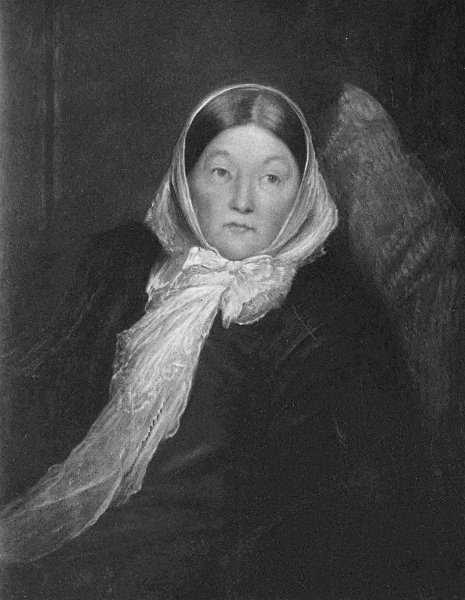
I ask no heaven till earth be Thine,
Nor glory-crown, while work of mine
Remaineth here. When earth shall shine
Among the stars,
Her sins wiped out, her captives free,
Her voice a music unto Thee,
For crown, New Work give Thou to me.
Lord here am I.
I found this in an intensely evangelical Baptist American's work—a
lecture he had delivered upon me. Now these lines appear to me exactly
true, and an extraordinary advance in the way of truth on English Evangelicalism
which banishes work, like sin, from heaven, and has no idea
that heaven is to be made out of earth by us.—Florence Nightingale
(from a letter to her father, 1869).
I am glad that you have given up drudgery for public offices.… The
position which you held was always a precarious one, because dependent on
“temples of friendship” and the goodwill of the Minister. I am glad
that you have a straightforward work to do now in which you are dependent
on yourself.… I want you to have a new life and interest. The way
of influencing mankind by ideas is the more excellent way.—Benjamin
Jowett (Letters to Miss Nightingale, 1871, 1872).
“Something which you said to me on Sunday has rather
disquieted me, and I hope that you will allow me to remonstrate
with you about it. You said that you were going to
ask admission as a Patient to St. Thomas's Hospital. Do
not do this. (1) Because it is eccentric and we cannot
strengthen our lives by eccentricity. (2) Because you will
not be a Patient but a kind of Directress to the institution,
viewed with great alarm by the doctors. (3) When a person
is engaged in a great work I do not think the expense of
living is much to be considered; the only thing is that you
should live in such a way that you can do your work best.
(4) I would not oppose you living at less expense if you wish,
though I think that a matter of no moment; but I would
live independently. (5) Do you mean really to live as a
Patient? it will kill you. I do not add the annoyance to
your father of a step which he can never be made to understand;
I look at the matter solely from the point of view
of your own work. I have cared about you for many years;
and though I have little hope of prevailing with you, I
would ask you not to set aside these reasons without consideration.”
So Mr. Jowett wrote to Miss Nightingale
on June 22, 1872. “I am flattered to hear,” he wrote a
little later (July 11), “that you have disregarded duty and
conscience for my sake. I hope that you will never in future
obey a conscience which tells you to kill yourself. Will
you try to hope and be at peace; and just ask of God time
to complete your work? You who have done so much for
others ought sometimes to reflect that you have had a great
blessing and happiness.”
The intention which Miss Nightingale had formed and
from which Mr. Jowett dissuaded her was not a passing fancy.
It was in accord with a deep-seated conviction, as may be
seen from a document already quoted (p. 103). Nor, though
she listened to Mr. Jowett's advice, did she entirely abandon
her purpose. Later in the year, she still thought of giving
up her pleasant house in South Street, and she set various
friends to report upon furnished apartments in the immediate
neighbourhood of St. Thomas's Hospital. They could not
find anything that seemed suitable, and she gave up the
idea; but as she could not go to St. Thomas's, she contrived,
as we shall hear in a later chapter, that St. Thomas's
should come to her. She devoted herself from this time
more largely than heretofore to the detailed supervision of
the Nightingale School. Both in what she did, and in what
she now left undone, the year 1872 marks a new departure in
her life. It is explained by a summary entry in her diary:
“This year I go out of office.”
Miss Nightingale had been “in office,” as she called it,
continuously since her departure for Scutari in October
1854. She had been closely employed, that is to say, sometimes
officially, sometimes unofficially, upon the administrative
work of various Departments in matters pertaining to
her special interests. With the advent of Mr. Gladstone to
power in 1868, her work in this sort had much diminished.
Her friend, Captain Galton, had gone from the War Office.
She occasionally intervened in minor matters, as on one
occasion when her friend, Mr. Lowe, agreed with Mr. Cardwell
to accept her view about a certain pension to the widow
of an officer, and there were other cases of the kind: as
when she obtained an attentive hearing from Mr. Bruce
(Home Secretary) for a memorandum which she submitted
on the working of the Contagious Diseases Act. But her
constant employment in connection with the War Office
was over. She had argued with herself, in some meditations
during 1871, whether she ought to make a bid, as it were,
for “office” again. She could still exercise a certain official
influence, she thought, if she chose to seek out Ministers
and ask them to call upon her. But the political times
were out of joint, she argued on the other side, so far as
her special aptitudes were concerned. The strength of Mr.
Gladstone's Government was thrown into political reform,
not into administration; the administration of the departments,
as she was not alone in thinking, was defective.
There are many letters of this period in which she contrasts
the days of Peel and Sidney Herbert with those of Gladstone
or Disraeli. “But I must stop,” she says in one of them, “or
you will say that I am aping Southey who said, you know,
that the last Ministry was so bad that nothing could be worse
except the present; but Coleridge differed from him, for he
thought the present Ministry so bad that nothing could be
worse except the last.”[129] At any rate what Miss Nightingale
cared for and was fitted for, she said to herself, was only
administration; in the years when she was “in office”
she had not only written Reports, she had been able to
organize the mechanism for carrying them out. Now that
administration was going, as she thought, to the dogs, it
was time for her to be out of office. That such was the lot
appointed to her, was borne in by something that happened
early in 1872. In February Lord Mayo was assassinated—a
personal grief to Miss Nightingale and “a great blow,”
she said, to her cause; and Lord Northbrook was appointed
to succeed him as Governor-General. Miss Nightingale
was personally acquainted with Lord Northbrook, who had
been a friend (as also for a time a colleague) of Sidney Herbert,
but he left for India without coming to see her. “You
have worked for eternity,” wrote Mr. Jowett (April 3), to
whom she had reported the new Viceroy's neglect; “why
should you be troubled at the Governor-General not coming
to see you (as he most certainly ought to have done)? Put
not your trust in princes or in princesses or in the War
Office or in the India Office; all that sort of thing necessarily
rests on a sandy foundation. I wonder that you have been
able to carry on so long with them.” Lord Northbrook
was friendly nevertheless, as appears from his reply when
she wrote and asked him to see Mr. Clark, the sanitary and
civil engineer:—
(Lord Northbrook to Miss Nightingale.) Calcutta, Jan. 3
[1873]. I had great pleasure in seeing Mr. Clark, for I had seen
his works at Barrachpore and knew of the great results which,
so far as the statistics up to the present time can be said to prove
them, have followed from the supply of pure water to Calcutta.
I hope soon to see his drainage works at the Salt Lakes, and I
have got the particulars of his plan for catch-water roofs for
military buildings, which I will look at carefully as soon as I can.
At present I am a little overwhelmed with business which has
been accumulating during my tour. You may be assured of
two things, that I fully understand the importance of pure water
for the soldiers, and that I shall always receive with pleasure
and consider with attention any suggestions, which you may
kindly give me, both on your own account and because you were
so much associated on these matters with my old master, Lord
Herbert. Yours very sincerely, Northbrook.
The question had become instant thereupon, What
was she to do next? Mr. Jowett's letters to her at this time,
as also her own private notes, show that she was in a mood
of great depression; due in part to much physical weakness
and suffering, but in part also to unsettlement in her plan
of life. She knew not exactly what to be at. She saw
before her, as she wrote, “no consecutive path growing
out of one's own deeds, but only a succession of disjointed
lives and unconnected events.” “Never,” she wrote again,
“has God let me feel weariness of active life, but only
anxiety to get on. Now in old age I never wish to be relieved
from new work, but only to have it to do.” With what
zeal she threw herself into fuller work for the Nightingale
School at St. Thomas's, we shall hear; but that was not
enough. She could not see nurses and write to nurses all
day long—though indeed she devoted to such duties as
many hours as some people would consider a sufficient day's
work, and besides she was now spending a large part of the
year with her father or mother in the country. She needed
some recreation, and the only recreation she ever found
was in change of work. She sought no “glory-crown”
over folded hands. Mr. Jowett seized the occasion to repeat
his advice that she should find recreation in literary work.
Now that she meant to free herself from official drudgery,
let her gain permanent influence by writing books or essays.
“I think,” he said, “that you seem to me to have more
ideas than any one whom I know.” And again (Dec. 14,
1871): “You have many original thoughts, but you either
insert them in Blue-books or cast them before swine—that
is me, and I sometimes insert them in sermons. You should
have a more consecutive way of going on.” She recalled,
too, advice and remonstrances which she had received from
Mr. Mill. In 1867 the “National Society for Woman's
Suffrage” was founded. Mill had asked her to join it and
she had at first refused:—
(John Stuart Mill to Miss Nightingale.) Blackheath Park,
August 9 [1867]. As I know how fully you appreciate a great
many of the evil effects produced upon the character of women
(and operating to the destruction of their own and others' happiness)
by the existing state of opinion, and as you have done me
the honour to express some regard for my opinion on these
subjects, I should not like to abstain from mentioning the formation
of a Society aimed in my opinion at the very root of all the
evils you deplore and have passed your life in combating. There
are a great number of people, particularly women, who, from
want of the habit of reflecting on politics, are quite incapable of
realizing the enormous power of politics, that is to say, of legislation,
to confer happiness and also to influence the opinion and
the moral nature of the governed. As I am convinced that
this power is by far the greatest that it is possible to wield for
human happiness, I can neither approve of women who decline
the responsibility of wielding it, nor of men who would shut out
women from the right to wield it. Until women do wield it to
the best of their ability, little or great, and that in a direct open
manner, I am convinced that the evils of which I know you to be[216]
peculiarly aware can never be satisfactorily dealt with. And
this conviction must be my apology for troubling you.
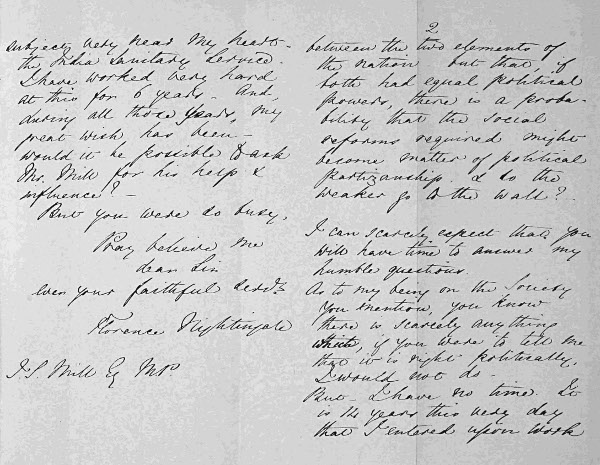
(Miss Nightingale to John Stuart Mill.) 35 South Street,
August 11 [1867]. I can't tell you how much pleased I was nor
how grateful I feel that you should take the trouble to write to
me. And if I ill-naturedly answer your question by asking one,
it is because I have scarcely any one who can give me (as my
dear friend, Mr. Clough, long since dead, said) a “considered
opinion.” That women should have the suffrage, I think no one
can be more deeply convinced than I. It is so important for a
woman to be a “person,” as you say. And I think I see this
most strongly in married life. If the woman is not a “person,”
it does almost infinite harm even to her husband. And the harm
is greatest when the man is a very clever man and the woman a
very clever woman. But it will be years before you obtain the
suffrage for women. And in the meantime there are evils which
press much more hardly on women than the want of the suffrage.
And will not this when obtained put women in opposition to
those who withhold these rights from them, so as to retard still
further the legislation which is necessary to put them in possession
of their rights? I ask humbly, and I am afraid you will laugh
at me. Could not the existing disabilities as to property and
influence of women be swept away by the legislature as it stands
at present? and equal responsibilities be given, as they ought
to be, to both men and women? I do not like to take up your
time with giving instances, redressible by legislation, in which
my experience tells me that women, and especially poor and
married women, are most hardly pressed upon now. No matron,
serving on a large scale as I have done, and with the smallest
care for her Nurses, can be unaware of these. Till a married
woman can be in possession of her own property, there can be no
love or justice. But there are many other evils, as I need not
tell you. Is it possible that, if woman suffrage is agitated as a
means of removing these evils, the effect may be to prolong their
existence? Is it not the case that at present there is no opposition
between the two elements of the nation, but that, if both
had equal political power, there is a probability that the social
reforms required might become matter of political partizanship,
and so the weaker go to the wall? I can scarcely expect that
you will have time to answer my humble questions.
As to my being on the Society you mention, you know there
is scarcely anything which, if you were to tell me that it is right
politically, I would not do. But I have no time. It is 14 years
this very day that I entered upon work which has never left me
ten minutes' leisure, not even to be ill. And I am obliged never
to give my name where I cannot give my work. If you will not[217]
think me egotistical, I will say why I have kept off the stage
of these things. In the years that I have passed in Government
offices, I have never felt the want of a vote—because, if I had been
a Borough returning two members to Parliament, I should have
had less administrative influence. And I have thought that I
could work better for others off the stage than on it. Added to
which, I am an incurable invalid, entirely a prisoner to my room.
But I entirely agree, if I may be allowed to agree with so great
an authority, that women's “political power” should be “direct
and open,” not indirect. And I ought to ask your pardon for
occupying you for one single moment with my own personal
situation.
As you have had the kindness to let me address you, I cannot
help putting in one more word on a subject very near my heart—the
India Sanitary Service. I have worked very hard at this for
six years. And during all those years, my great wish has been:
would it be possible to ask Mr. Mill for his help and influence?
But you were so busy. Pray believe me, dear Sir, ever your
faithful servant, Florence Nightingale.
Mr. Mill found time for a “considered opinion,” of
great elaboration and weight; it has been printed elsewhere.[130]
With his reply to Miss Nightingale's humble but argumentative
questions, we are not here concerned. Though she
never took any prominent part in the movement for female
suffrage, she joined the Society in 1868, allowed her name
to be placed on the General Committee in 1871, was an
annual subscriber to its funds, and in 1878 sent an expression
of her opinion on the subject for publication.[131] It was,
however, Mr. Mill's remarks upon her “personal situation”
that now, in 1872, came back to her. “If,” he had said,
“you prefer to do your work rather by moving the hidden
springs than by allowing yourself to be known to the world
as doing what you really do, it is not for me to make any
observations on this preference (inasmuch as I am bound
to presume that you have good reasons for it) other than to
say that I much regret that this preference is so very general
among women.” She ought not, he went on to suggest, to
hide her good deeds; and “finally I feel,” he wrote, “some
hesitation in saying to you what I think of the responsibility
that lies upon each one of us to stand steadfastly, and with
all the boldness and all the humility that a deep sense of
duty can inspire, by what the experience of life and an honest
use of our own intelligence has taught us to be the truth.”
To some of this expostulation she had at the time a conclusive
rejoinder. She could not write to the Times and
say, “Be it known that I suggested such and such a dispatch
to a Secretary of State, and am corresponding in such and
such a sense with a Governor-General.” But if she were
out of office, the plea for seclusion behind the scenes failed;
nor was it ever perhaps of much cogency in relation to her
views on religious and social matters. Now that she had
“gone out of office,” was it not her duty to come into the
open with her pen?
The first literary task which Miss Nightingale set herself
under this impulse took the form of a series of magazine
articles, in which she hoped to embody the leading ideas
contained in the voluminous Suggestions for Thought already
described (Vol. I. p. 470). “During the ten years and more
that I have known you,” wrote Mr. Jowett (Oct. 31, 1872),
“you have repeated to me the expression ‘Character of God’
about 1000 times, but I can't say that I have any clear idea
of what you mean.” Why did she not try and explain?
In an earlier letter (Feb. 28, 1871) Mr. Jowett had suggested
“the form of short papers or essays.” She now wrote
three of them (of which the first two were published)—entitled
respectively “A ‘Note’ of Interrogation,” “A
Sub-Note of Interrogation: What will our Religion be in
1999,” and “On what Government night will Mr. Lowe bring
out our New Moral Budget? another Sub-Note of Interrogation.”
In the first Paper, Miss Nightingale in a questioning
and allusive style defined her conception of God as a God
of Law, whose character may be learnt from social and
moral science, and defended such a conception against
some current ideas of Christian churches on the one side,
and against the too cold and impersonal creed, as she
thought, of Positivism on the other. The affinity of her
doctrine at some points with the creed of Positivism is
obvious; but she held as an axiom that the existence of
law implied a law-giver; and “it is a very different thing,”
she wrote elsewhere,[132] “fighting against evil for our own
sakes or fighting for the sake of the Law-Giver who arms us—fighting
with or without a Commander.” The scope of the
second Paper is harder to describe, for it throws out a large
number of criticisms and suggestions on life, morals, and
philosophy in no very closely related order. The general
idea, however, is that the purification of religion requires
not destructive criticism but reconstruction and a re-ordering
of modern life on the lines of social service; in which
latter connection Miss Nightingale paid a glowing tribute
to the pioneer of East-end “settlers.”[133] These two Papers,
though they attempt to cover too much ground in a small
space, abound in happy things by the way. We are told,
for instance, that Matthew Arnold's Literature and Dogma is
“marred by a tendency not to fight like a man but to
scratch like a cat.” The doctrine of eternal punishment
is criticized in the words of the pauper who said to his
nurse after seeing the chaplain, “It does seem hard to have
suffered so much here, only to go to everlasting torments
hereafter.” The creed of some contented politicians is
hit off by saying that they talk of “the ‘masses,’ as if they
were Silurian strata.” The third of Miss Nightingale's
Papers is the hardest to describe, because it is the most
crowded of the series. Its practical purpose may be said
in the language of later politics to be a plea for “social
reform.” “There must be a Chancellor of the Exchequer,
and a Budget, for Morality and Crime, as for Finance.”
Her conception of social and moral science as an almost
statistical study[134] is glanced at, and the controversy between
Free Will and Necessity is disposed of by the way. Miss
Nightingale sent her Papers successively to Mr. Froude.
He was delighted with the first and with the second. “Your
second Note,” he said, “is even more pregnant than the
first. I cannot tell how sanitary, with disordered intellects,
the effects of such Papers will be.” They appeared in
Fraser's Magazine for May and July 1873. Carlyle was not
so favourably impressed. Miss Nightingale's second Paper,
he said, was like “a lost lamb bleating on the mountain.”
Mr. Froude's criticism on the third was that it lacked
focussing: “the whole art of getting culinary fire out of
intellectual sunlight depends on that.” The third article,
accordingly, was not printed. Miss Nightingale did not
relish Carlyle's remark, and her equanimity was perhaps
not restored by the domestic assurance that Florence's
mistake had been in not submitting the manuscript to her
sister's revision. One of the best things in the Paper which
was not published was a Postscript. The first article had
been widely noticed in the pulpit and the press, and had
brought to the author many letters—some sympathetic, as
from Mr. Edward Maitland,[135] others sorrowfully critical.
There were those who promised to pray for her conversion
daily, and invited her to join them in that exercise. They
had not read the article, it seemed, but only a review of it;
and among the printed critiques was one which began:
“My knowledge of the scope of this Paper is derived from
the report of a discourse upon it.” In her proposed
Postscript Miss Nightingale took “this opportunity of
thanking unknown friends for their sympathy and suggestions,
and, still more, unknown friend-enemies for their
criticisms; but yet more should I have thanked the latter,
had their criticisms been on my poor little Article in its
rough state—the ‘Original Cow and Snuffers’—and not on
seeing the Extract of a Criticism of an Extract of my Article.
Certainly a new Art must have arisen in my elderly age:—
out-magazining magazining. And I hereby confidentially
inform the shade of Mr. Fraser that he may, on application
to me, see columns, closely-printed columns, of small (but
cruel) print upon a Paper which the writers state that they
have not read.—What! read a Paper which we are going
to review!—Yes, Mr. Fraser, this is what magazine-ing has
come to. Articles are not even written on original works,
even if that work be only an Article, but on a Review of an
Article; and not even upon that, but upon a Review of a
Review of an Extract of an Article, or sometimes upon an
Extract of a Sermon upon an Extract of a Review of an
Article. I ought to feel flattered: I try to feel flattered.
But, Mr. Fraser, is life long enough for this? is this the
way to ‘human progress’? And … but as this will not
be read by my unknown critics, I come to a stop.” The
practice which Miss Nightingale thus satirised has not
become less frequent in later days when the newspapers
supply their readers not with political speeches but with
opinions based on summaries of them, and when what are
called “educational handbooks” aim at giving the student
the power of passing a critical judgment upon authors
without the necessity of reading them.
A few days after the appearance of Miss Nightingale's first
Paper in Fraser, Mr. Mill died of a “local endemic disease”
at his house near Avignon. She was profoundly moved:—
(Miss Nightingale to Julius Mohl.) May 20 [1873]. John
Stuart Mill's death was a great shock to me. Mr. Grote used
to say of him “Talk of Mill's Logic! why he is thrilling with
emotion to the very finger-ends.” That is just what he was.
Now, speaker and subject are both gone. He said at Mr. Grote's
funeral, with an agony of tears, “We might have kept him 10
years longer.” And now we say of himself with tears “We
might have kept him for 10 years longer.” He was only 67.
He was always urging me to publish. He used to say, with
the passion which he put into everything he did say: “I have
no patience with people who will not publish because they think
the world is not ripe enough for their ideas: that is only conceit
or cowardice. If anybody has thought out any thing which he
conceives to be truth, in Heaven's name, let him say it!” I did
not answer that letter. I thought that this year (I have left
much of the India and War Office work, and much of it has left
me) I would resume with John Stuart Mill and do as he told me.
I put the article in Fraser's Magazine (which I now send you) to
please him. And now he is dead, and will never know that I
intended to do what he wished. He used to say, “Tell the world
what you think—your experience. It will probably strike the
world more than anything that could be told it.” He quoted
my “Stuff” in his book, which he ought not to have done.[136]
I published my book on Socrates' mother[137] partly to please him.[222]
It was a very odd thing: it was a subject he had taken up: he
was President of a Society for that. When he was in England
(till a fortnight before his death) I could not find his address:
I was so overwhelmed with business and illness. I did not know
he was going away. And I did not send him this book. And
now he is dead, and will never know. But I scarcely regret his
death. He was not a happy man. He was a man who was so
sure to develop very much in a future life. He had queer religious
notions: did not believe in a God or in a future life: but believed
in a sort of conflict between two Powers of Good and Evil. I
remember showing you one of his letters. And you said it was
just like Zoroaster. But he was the most truly “Liberal” man
I ever knew. If it were for the cause of Truth that he should
be defeated, he would have liked to have been defeated. And
now he is dead. And we shall never see his like again.
It was characteristic of Miss Nightingale that she
entered into correspondence with Mr. Chadwick on the
sanitary state of Mr. Mill's house and the climatic conditions
of Provence in May. Mr. Chadwick had to put himself
right in her eyes by explaining that he had not been consulted
by their friend on those subjects and had never been
invited by him to Avignon.
Other literary work which occupied Miss Nightingale
a good deal at this time was undertaken either to help Mr.
Jowett or in accordance with his advice. He had urged
her to work out her notion of Divine Perfection, and her
theory of the Family in relation to “sisterhoods” and other
forms of association. Miss Nightingale wrote Essays
accordingly on “What is the Evidence that there is a
Perfect God?” on “What is the Character of God?” and on
“Christian Fellowship as a Means to Progress.” The gist
of the latter essay may be given in a letter of an earlier
date:—
(Miss Nightingale to Benjamin Jowett.) July [1870].… I
think that Faraday's idea of friendship is very high: “One
who will serve his companion next to his God.” And when one
thinks that most, nay almost all people have no idea of friendship
at all except pleasant juxtaposition, it strikes one with admiration.
Yet is Faraday's idea not mine. My idea of a friend is one who[223]
will and can join you in work the sole purpose of which is to
serve God. Two in one, and one in God. It almost exactly
answers Jesus Christ's words. And so extraordinarily blessed
have I been that I have had three such friends. I can truly say
that, during the 5 years that I worked with Sidney Herbert
every day and nearly all day, from the moment he came into the
room no other idea came in but that of doing the work with the
best of our powers in the service of God. (And this tho' he
was a man of the most varied and brilliant conversational genius
I have ever known—far beyond Macaulay whom I also knew.)
This is Heaven; and this is what makes me say “I have had
my heaven.”
The two other friends with whom in former time she
had been a fellow-worker were Arthur Clough and her
Aunt, Mrs. Smith. Miss Nightingale's other Essays led to
much correspondence with Mr. Jowett, but as they failed
to come up to his standard they were laid aside. Many of
her letters to him were themselves almost Essays. Extracts
from one or two consecutive letters will show the kind of
discussions into which Miss Nightingale loved to involve
her Oxford friend, and upon which he was nothing loath to
enter:—
(Benjamin Jowett to Miss Nightingale.) Torquay, Sept. 29
[1871].… I must answer your letter by driblets. When
you admit that a part of the witness of the character of God is
to be sought for in nature, how do you distinguish between the
true and false witness of nature? For we cannot deny that
physical good is sometimes at variance with moral—e.g. in
marriage the sole or chief principle ought to be health and
strength in the parents whether with or without a marriage
ceremony—in other words Plato's Republic: I mean on physical
principles. Or again the laws of physical improvement would
require that we should get rid of sickly and deformed infants.
And if, as Huxley would say, you reconstruct the world on a
physical basis, you have to go to war with received principles of
morality. I suppose that the answer is you must take man as
a whole, and make morality and the mind the limit of physical
improvement. But it is not easy to see what this limit is, because
men's conceptions of morality vary, and although we may form
ideals we have to descend from them in practice. Therefore
I do not agree with you in thinking that there are no difficulties,
although the old difficulties, about origin of evil &c., are generally
a hocus of Theologians.
(Miss Nightingale to Benjamin Jowett.)[138] Lea Hurst,[224]
Oct. 3 [1871]. I am quite scandalized at your materialism.
(I shall shut up you and Plato for a hundred years in punishment
in another world till you have both obtained clearer views.)
Is it for an old maid like me to be preaching to you a Master
in Israel that even “on physical principles” there are essential
points in marriage (to turn out the best order of children), which,
being absent, the perfection of “health and strength” in both
parents is of no avail even for the physical part of the children?
And might I just ask one small question: whether you consider
man has a little soul? If he has ever such a little one, you can
scarcely consider him as a simple body, an animal, or even as
a twin, the soul being one twin and the body the other, but as
all one, the soul and the body making one being (altho' only
in this sense). If you do, at all events God does not. And
consequently He makes a great many more things enter into the
“physical” constitution even of the children than the mere
“health and strength” of the parents. (My son, really Plato
talked nonsense about this.) Take a much more material thing
than the producing of a bad or degenerate family or race. Take
a railway accident. What are the laws therein concerned?
You have by no means only to consider the “physical” laws—the
strength of iron, the speed of steam, the smoothness of rails,
the friction &c., &c.—but you have to consider the state of mind
of Directors, whether they care only for their dividends, so that
the railway-servants are underpaid or overworked &c., &c.
You quote Huxley. He is undoubtedly one of the prime educators
of the age, but he makes a profound mistake when he says to
Mankind: objects of sense are more worthy of your attention
than your inferences and imaginations. On the contrary, the
finest powers man is gifted with are those which enable him to
infer from what he sees what he can't see. They lift him into
truth of far higher import than that which he learns from the
senses alone. I believe that the laws of nature all tend to
improve the whole man, moral and physical, that it is absurd
to consider man either as a body to be “improved,” or as a soul
to be “improved,” separately.
As to the “laws of physical improvement requiring that we
should get rid of sickly and deformed infants,” they require that
we should prevent or improve, not that we should kill them.
That would be to get rid of some of the finest intellectual and
moral specimens of our human nature that have ever existed.
And, even were this not the case, the heroism, the patience,
the wisdom of our race have been more called forth by dealing[225]
with these and the like forms of evil than by almost anything
else. The good of man in its highest sense cannot be attained by
neglecting one set of laws or one aspect of man's nature and
cultivating another.
I entirely therefore agree that “you must take man as a
whole.” But this seems at variance with a celebrated author's
next sentence “and make morality and the mind the limit of
physical improvement.” If I were writing, I should use a word
signifying the exact reverse; not limit, but expansion, enlargement,
multiplication, master or informing spirit. As Plato says:
the mind informs the body, owns the body, the body is the servant
of the mind. How can the owner and the master be the limit?
We must really pray for your conversion.…
(Benjamin Jowett to Miss Nightingale.) Torquay, Oct. 4.…
What have I said to deserve such an outburst? I have no wish
to shake the foundation of Society. What I think about these
matters is feebly expressed in a part of Essay at the end of the
introduction to the Republic. But when I come to a second
edition I will express it better.
A comparison of the passage in the first and second
editions of Mr. Jowett's Introduction respectively[139] shows
how largely he profited by the criticisms in the foregoing
letter. His Plato first appeared in 1871, and at once
he began revising it. In this work Miss Nightingale gave
him great help. Her Greek had now grown a little rusty,[140]
but her interest in the substance of Plato was intense.
She annotated Mr. Jowett's summaries and introductions
very closely, and sent him voluminous suggestions for
revision. “You are the best critic,” he wrote, “whom I
ever had.” Several of Miss Nightingale's notes are preserved,
in rough copy, amongst her Papers, and by means
of them her hand may be traced in many a page of Mr.
Jowett's revised work. In the first edition of the introduction
to the Republic he made some remarks on love as a
motive in poetry which excited Miss Nightingale's strong
disapproval. She agreed that “the illusion of the feelings
commonly called love” was a motive of which too much
had been made; but the poets, she thought, had as yet
hardly touched the theme of true love—“two in one, and
one in God”—as an incentive to heroic action. “The
philosopher may be excused,” Mr. Jowett had written,
“if he imagines an age when poetry and sentiment have
disappeared, and truth has taken the place of imagination,
and the feelings of love are understood and estimated at
their proper value.” “Take out that mean calumny, my
son,” wrote Miss Nightingale; “take it out this minute;
blaspheme not against Love.” The offending sentence was
expunged in the second edition. Mr. Jowett had gone on to
“blaspheme” a little against Art, citing the Mahommedans
as a case of the state of the human mind in which “all
artistic representations are regarded as a false and imperfect
expression either of the religious or of the philosophical
ideal.” Miss Nightingale objected that the Mahommedans
had renounced the use of pictures and images, but not of
architecture: “Mosques are the highest kind of art: the
one true representation of the One God: the Glory of God
in the highest: the most high of the Most High: higher
than any Christian art or architecture—as you would say
if you had seen the mosques of Cairo.” Mr. Jowett recast
his passage, and used Miss Nightingale's illustration, almost
in her words.[141] “I am always stealing from you,” he said.
On his Introduction to the Gorgias, she made an interesting
criticism:—
Is not Socrates more ineffably tiresome, and at the same time
does he not speak higher truth, in the Gorgias than anywhere
else? Why call these higher truths “paradoxes”? Are not
your sermons always a sort of apology for talking to them of
God? And why should your Introductions be a sort of apology
for recognizing that Socrates speaks the highest truth and no
paradox? Have guarded statements, whether about God or
any particular moral or truth, ever produced enthusiasm of
religion or in morality? Is there any Dialogue, not even excepting
the Phaedo and Crito, where he is so much in earnest? He is
so terribly in earnest that towards the end he even throws all
his dialectic aside, and makes even Polus in earnest. To me,
speaking as one of the stupid and ignorant, it seems that your[227]
Introduction dwells too much on the form of the Gorgias and does
not bring out in sufficiently striking relief the great truths which
Socrates labours so strenuously to enforce that he almost seems
to lose himself in them. These great moral truths are (are they
not?):—(1) It is a greater evil to do than to suffer injustice. If
you call this a “paradox,” why do you not call the 53rd Chapter
of Isaiah a paradox? Is it not the highest of truths? (2) It
is a greater evil not to be punished than to be punished for wrong.
I have no idea why you call this a paradox. It follows from
all the higher experience of the life of every one of us. In family
life I see it every day. I see the “spoilt child” making himself,
and oftener herself, and everyone else miserable, down to mature
life or extreme old age. (Tho' the “punishments” of my life
have been somewhat severe, yet I can bless God, even in this
world, that never in all my life have I been allowed to “do as I
liked.”) …
If the reader cares to take this passage to a comparison
of the second with the first edition of Mr. Jowett's Introduction,[142]
he will discover again how largely, and closely, Miss
Nightingale's criticisms were accepted. She dealt similarly—giving
precise references for every statement—with the
greater part of the Dialogues. “In the Phaedrus,” said
Mr. Jowett (July 22, 1873), “I have put in most of what
you suggested and made some additions. You are quite
right in thinking that I should get as much modern truth
into the Introductions as possible. It is a great opportunity;
which I have had in view, but not so clearly as since you
wrote to me.”
Miss Nightingale continued, as in former years, to send
Mr. Jowett suggestions for sermons. “I have written part
of your sermon,” he wrote, when she had sent him an
outline of what she would like him to preach from the
University pulpit. When he became Master of Balliol he
projected a Special Form for daily service in the College
Chapel, and Miss Nightingale suggested a selection of
passages from the Psalms under the heads of “God the
Lord,” “God the Judge,” “God the Father,” “God the
Friend,” “the Way of the Cross,” and so forth. Mr.
Jowett had, however, to abandon the project in deference
to superior authority.[143] Another scheme was carried out.
In 1873 an edition of the Bible appeared which has a history
of some interest. The School and Children's Bible it
was called; the name of the Rev. William Rogers, of
Bishopsgate, appears on the title-page, but the selection
was in fact made for the most part by Mr. Jowett, with the
help of some of his friends.[144] That Mr. Swinburne was one
of these friends, we know from the poet's own recollections;
it is not generally known that the other principal collaborator
with Mr. Jowett was Miss Nightingale. Mr. Swinburne's
help was in one respect disappointing. “I wanted you,”
said Mr. Jowett to him with a smile, “to help me to make
this book smaller, and you have persuaded me to make it
much larger.” The poet, who was complimented on his
thorough familiarity with sundry parts of the sacred text,
thought that Mr. Jowett had excluded too much of the
prophetic and poetic elements, not taking into account
“the delight that a child may take in things beyond the
grasp of his perfect comprehension, though not beyond the
touch of his apprehensive or prehensile faculty.” Miss
Nightingale, whose familiarity with the Bible was probably
even closer and more extensive than Mr. Swinburne's and
with whom Biblical criticism was a favourite study, also
wanted a great deal put in which Mr. Jowett had left out,
but her instinct for edification led her to suggest equivalent
omissions. She took great pains with her suggestions,
illustrating them in letters to Mr. Jowett with many
characteristic remarks by the way:—
It is impossible to keep up acquaintance with a man, however
otherwise estimable, who separates the 26 last chapters of Isaiah
from Isaiah merely by a shabby little note and asterisk. Surely
those chapters belong to the end of the Babylonish Captivity[229]
and should be separated by a distinct division; while the shabby
little note and asterisk might go to some isolated chapters (e.g.
xiii., xiv.) among the first 39 which belong to the same time,
the end of the Captivity—whereas the first 39 chapters (generally)
appear to belong to the “Middle Ages” of Prophecy. But
as it may be judged inconvenient to put Chaps. xl.–lxvi. of
Isaiah in a different part of the Bible, I will concede that point
and simply classify them (I follow Ewald's order). But they
must be under a separate Heading with “End of Babylonian
Captivity” (or words to that effect) printed distinctly under the
heading (not in a note).
More generally, she criticized the first selection sent
to her as showing some want of proportion. There was
no clear plan, she thought, as to the space to be given,
respectively, to:—
(a) Matters of universal importance, moral and spiritual
(e.g. the finest parts of Isaiah, Jeremiah, Ezekiel and the New
Testament); (b) matters of historical importance (e.g. which
embrace the history of great nations, Egypt, Assyria, Babylon.
The petty wars of the petty tribes seem to take up a quite disproportionate
space); (c) matters of local importance, which
have acquired a universal moral significance (e.g. Jonah is
entirely left out: yet Jonah has a moral and spiritual meaning,
while Samson, Balaam and Bathsheba have none); (d) matters
of merely local importance, with no significance but an immoral
one (e.g. the stories about Abraham, Isaac and Jacob, almost
all Joshua and Judges, and very much of Samuel and Kings).
The story of Achilles and his horses is far more fit for children
than that of Balaam and his ass, which is only fit to be told to
asses. The stories of Samson and of Jephthah are only fit to be
told to bull-dogs; and the story of Bathsheba, to be told to
Bathshebas. Yet we give all these stories to children as “Holy
Writ.” There are some things in Homer we might better call
“Holy” Writ—many, many in Sophocles and Aeschylus. The
stories about Andromache and Antigone are worth all the women
in the Old Testament put together; nay, almost all the women
in the Bible.
“I have just finished the Children's Bible,” wrote Mr.
Jowett (Feb. 10, 1872). “I blessed you every time I took
the papers up, especially in the Prophets. I have adopted
your selection almost entirely, with a slight abridgement,
and it is further approved by Mr. Cheyne's authority.”
These various literary enterprises, undertaken at Mr.
Jowett's instance, occupied a great deal of Miss Nightingale's
time—more time, as she sometimes said to herself, than
could rightly be spared from primary duties; and the time
was spent, she added in her self-reproaches, to little purpose.
In some respects Mr. Jowett's suggestions to her were not
very happy. One cannot elaborate in a consecutive form
a Scheme of Theology or a Social Philosophy, even through
the medium of essays, in odd hours as a bye-work. So
Miss Nightingale soon found, and the failure weighed
heavily on her spirits; but Mr. Jowett did not realize how
great was the strain upon his friend's faculties involved in
her nursing work, nor how much time, effort, and emotion
she was devoting, though “out of office,” to the complicated
problems of Indian administration. We, who have access
to her Papers, shall learn the full extent of these preoccupations
in later chapters (III. and IV.). But something must
first be said of another literary enterprise. To it Miss
Nightingale's close study of the Bible and of Plato was
entirely relevant. Such studies were, as we shall find in
the next chapter, part of the food which sustained her
inner life.
Mysticism: to dwell on the unseen, to withdraw ourselves from the
things of sense into communion with God—to endeavour to partake of the
Divine nature; that is, of Holiness. When we ask ourselves only what
is right, or what is the will of God (the same question), then we may truly
be said to live in His light.—Florence Nightingale.
It has been mentioned incidentally in an earlier chapter
that Miss Nightingale was fond of reading the books of
Catholic devotion which the Reverend Mother of the Bermondsey
Convent used to send her. Long before, she had
studied carefully the writings of the Port Royalists; and at
the Trinità de' Monti she had seen the ideal of Catholic
devotion in real life. She used to pass on some of her devotional
works to Mr. Jowett. He began with St. Teresa,
and, at first repelled, he gradually became interested. Miss
Nightingale was in the habit of copying out passages for
her own edification, sometimes in the original, sometimes
translating them. The idea of making a selection for
publication occurred to her, and Mr. Jowett encouraged
it. “Do not give up your idea,” he said, “of making a
selection of the better mind of the Middle Ages and the
Mystics.” “You will do a good work,” he wrote again
(Oct. 3, 1872), “if you point out the kind of mysticism
which is needed in the present day—not mysticism at all,
but as intense a feeling, as the mystics had, of the power of
truth and reason and of the will of God that they should
take effect in the world. The passion of the reason, the
fusion of faith and reason, the reason in religion and the
religion in reason—if you can only describe these, you will
teach people a new lesson. The new has something still
to learn from the old; and I am not certain whether we
ought not to retire into mysticism (I thought I should not
use the word) when the antagonism with existing opinions
becomes too great.” Miss Nightingale's close study of
Plato and of the Bible, described in the last chapter, increased
her interest in Christian mysticism. The Fourth
Gospel was the work of a mystic. And there were curious
analogies, which she pointed out to Mr. Jowett,[145] between
Plato and the mediæval mystics. The famous myth of
the purified soul, for instance, recalled a passage in the
Fioretti of St. Francis, except that there the purgatorial
stage, before the “wings grow,” lasts 150 years, instead of
10,000. Miss Nightingale said of the closing prayer in the
Phaedrus—“Give me beauty in the inward soul, and may
the outward and inward man be at one”—a prayer
unequalled, she thought, by any Collect in the service-book—that
it “put in seventeen words the whole, or at least half,
of the doctrine of St. John of the Cross.” Plato made her
the more interested in the Christian Mystics; the Christian
Mystics, the more interested in Plato. Concurrently with
her work for Mr. Jowett's revised Plato she gave much
time during 1873 and 1874 (with additions in later years)
to transcribing or translating and arranging passages from
devotional writers of the Middle Ages. She had sent some
of her book in various stages to Mr. Jowett, who, with other
suggestions, said (April 18, 1873) that she ought to add
“a Preface showing the use of such books. They are apt
to appear unreal, and yet Thomas à Kempis has been one
of the most influential books in the world. The subject
of the Preface should be the use of the ideal and especially
the spiritual ideal. I do not say what may be the case with
great Saints themselves, but for us I think it is clear that
this mystic state ought to be an occasional and not a permanent
feeling—a taste of heaven in daily life. Do you
think it would be possible to write a mystical book which
would also be the essence of Common Sense?”
I construct the Preface from various notes and rough
drafts in Miss Nightingale's hand:—
It may seem a strange thing to begin a book with:—this
Book is not for any one who has time to read it—but the meaning
of it is: this reading is good only as a preparation for work.
If it is not to inspire life and work, it is bad. Just as the end of
food is to enable us to live and work, and not to live and eat, so
the end of—most reading perhaps, but certainly of—mystical
reading is not to read but to work.
For what is Mysticism? Is it not the attempt to draw near
to God, not by rites or ceremonies, but by inward disposition?
Is it not merely a hard word for “The Kingdom of Heaven is
within”? Heaven is neither a place nor a time. There might
be a Heaven not only here but now. It is true that sometimes
we must sacrifice not only health of body, but health of mind
(or, peace) in the interest of God; that is, we must sacrifice
Heaven. But “thou shalt be like God for thou shalt see Him as
He is”: this may be here and now, as well as there and then. And
it may be for a time—then lost—then recovered—both here and
there, both now and then.
That Religion is not devotion, but work and suffering for the
love of God; this is the true doctrine of Mystics—as is more
particularly set forth in a definition of the 16th century: “True
religion is to have no other will but God's.” Compare this
with the definition of Religion in Johnson's Dictionary: “Virtue
founded upon reverence of God and expectation of future rewards
and punishments”; in other words on respect and self-interest,
not love. Imagine the religion which inspired the life of Christ
“founded” on the motives given by Dr. Johnson!
Christ Himself was the first true Mystic. “My meat is to
do the will of Him that sent me and to finish His work.” What
is this but putting in fervent and the most striking words the
foundation of all real Mystical Religion?—which is that for all
our actions, all our words, all our thoughts, the food upon which
they are to live and have their being is to be the indwelling
Presence of God, the union with God; that is, with the Spirit
of Goodness and Wisdom.
Where shall I find God? In myself. That is the true
Mystical Doctrine. But then I myself must be in a state for
Him to come and dwell in me. This is the whole aim of the
Mystical Life; and all Mystical Rules in all times and countries
have been laid down for putting the soul into such a state.[234]
That the soul herself should be heaven, that our Father which
is in heaven should dwell in her, that there is something within
us infinitely more estimable than often comes out, that God
enlarges this “palace of our soul” by degrees so as to enable
her to receive Himself, that thus he gives her liberty but that
the soul must give herself up absolutely to Him for Him to do
this, the incalculable benefit of this occasional but frequent
intercourse with the Perfect: this is the conclusion and sum of
the whole matter, put into beautiful language by the Mystics.
And of this process they describe the steps, and assign periods
of months and years during which the steps, they say, are
commonly made by those who make them at all.
These old Mystics whom we call superstitious were far before
us in their ideas of God and of prayer (that is of our communion
with God). “Prayer,” says a mystic of the 16th century,
“is to ask not what we wish of God, but what God wishes of
us.” “Master who hast made and formed the vessel of the
body of Thy creature, and hast put within so great a treasure,
the Soul, which bears the image of Thee”: so begins a dying
prayer of the 14th century. In it and in the other prayers
of the Mystics there is scarcely a petition. There is never a word
of the theory that God's dealings with us are to show His
“power”; still less of the theory that “of His own good pleasure”
He has “predestined” any souls to eternal damnation. There
is little mention of heaven for self; of desire of happiness for
self, none. It is singular how little mention there is either of
“intercession” or of “Atonement by Another's merits.” True
it is that we can only create a heaven for ourselves and others
“by the merits of Another,” since it is only by working in
accordance with God's Laws that we can do anything. But
there is nothing at all in these prayers as if God's anger had to be
bought off, as if He had to be bribed into giving us heaven by
sufferings merely “to satisfy God's justice.” In the dying
prayers, there is nothing of the “egotism of death.” It is the
reformation of God's church—that is, God's children, for whom
the self would give itself, that occupies the dying thoughts.
There is not often a desire to be released from trouble and suffering.
On the contrary, there is often a desire to suffer the greatest
suffering, and to offer the greatest offering, with even greater
pain, if so any work can be done. And still, this, and all, is
ascribed to God's goodness. The offering is not to buy anything
by suffering, but—If only the suppliant can do anything for
God's children!
These suppliants did not live to see the “reformation” of
God's children. No more will any who now offer these prayers.
But at least we can all work towards such practical “reformation.”[235]
The way to live with God is to live with Ideas—not
merely to think about ideals, but to do and suffer for them.
Those who have to work on men and women must above all
things have their Spiritual Ideal, their purpose, ever present.
The “mystical” state is the essence of common sense.
The authors whom Miss Nightingale read for the purpose
of her selection included St. Angela of Foligno, Madame de
Chatel, St. Francis of Assisi, St. Francis Xavier, St. John
of the Cross, Peter of Alcantara, Father Rigoleuc, St.
Teresa, and Father Surin. She arranged her extracts from
these and other writers under headings, and supplied marginal
summaries. She prepared also a title-page:—Notes
from Devotional Authors of the Middle Ages, Collected, Chosen,
and Freely Translated by Florence Nightingale.
This and all other literary work was interrupted, however,
at the beginning of 1874 by the death of her father.
She was in London; her sister and Sir Harry Verney were
with him and Mrs. Nightingale at Embley. He was 80;
but, though his strength of body and mind had failed a little,
he had been out for his usual ride a few days before. Lady
Verney had wished him good-night. “Say not good-night,”
he said in reply, quoting Mrs. Barbauld, “but in some
brighter clime Bid me good-morning.” A day or two
later, he came down to breakfast as usual, but found that
he had forgotten his watch. He went to fetch it, slipped
upon the stairs, and died on the spot. Miss Nightingale
felt the loss of her father deeply. “His reverent love for
you,” wrote Lord Houghton in a letter of condolence (Jan.
13, 1874), “was inexpressibly touching,” and her love for
him, though of a different kind, was very tender. Unlike
in many respects, father and daughter were yet kindred
spirits in intellectual curiosity, in a taste for speculative
inquiry. M. Mohl noted among Mr. Nightingale's engaging
characteristics “a modest curiosity about everything, a
surprised, innocent, incredulous smile as he listened intently.”
Miss Irby spoke of his “exceeding sweetness and
childlikeness of wisdom.” These qualities were conspicuous
in much of his intercourse with his daughter Florence, and
she was now deprived of the father who had, in things of
the mind, sat at her feet and sympathized in her searches
after truth. The death of her father was quickly followed,
on January 31, 1874, by that of her dearly loved friend, Mrs.
Bracebridge. “She was more than mother to me,” wrote
Florence to M. and Madame Mohl (Feb. 3); “and oh that
I could not be a daughter to her in her last sad days! What
should I have been without her? and what would many
have been without her? To one living with her as I did
once, she was unlike any other human being: as unlike as
a picture of a sunny scene is to the real light and warmth
of sunshine: or as this February lamp we call our sun is
to her own Sun of living light in Greece.… Other people
live together to make each other worse: she lived with all
to make them better. And she was not like a chastened
Christian saint: no more like that than Apollo; but she
had qualities which no Greek God ever had—real humility
(excepting my dear Father, I never knew any one so really
humble), and with it the most active heart and mind and
buoyant soul that could well be conceived.” Mr. Bracebridge
had died eighteen months before (July 18, 1872),
and Miss Nightingale had said: “He and she have been
the creators of my life. And when I think of him at Scutari,
the only man in all England who would have lived with
willingness such a pigging life, without the interest and
responsibility which it had to me, I think that we shall
never look upon his like again. And when I think of Atherstone,
of Athens, of all the places I have been in with them,
of the immense influence they had in shaping my own life—more
than earthly father and mother to me—I cannot doubt
that they leave behind them, having shaped many lives
as they did mine, their mark on the century—this century
which has so little ideal at least in England. They were so
immeasurably above any English ‘country gentry’ I have
ever known.” Miss Nightingale's estimate of her friends
was shared by others who had enjoyed their hospitality.
“The death of Mrs. Bracebridge,” wrote M. Mohl (Feb. 14),
“is a sad blow for you. The breaking of these old associations
which nothing new can replace impoverishes one's
life, and a part of ourselves dies out with old friends even if
they have not been to us what Mrs. Bracebridge was to you.
Und immer stiller wird's und stiller auf unserm Pfad until
the great problem of life opens for ourselves. Two better
people than the Bracebridges, different as they were, I have
never seen. Madame d'Abbadie has a queer expression for
a woman she approves of; she says elle est honnête homme,
and nothing is more appropriate to Mrs. Bracebridge. I
can never think of Atherstone without emotion; it is people
like these in whom lies the glory of England and the strength
of the country. They were so genuine, so ready to help
and to impoverish themselves for public purposes, and to
do it unostentatiously and without fishing for popularity.”
To the end of her life Miss Nightingale cherished the memory
of these faithful and helpful friends. “To my beloved and
revered friends,” she said in her Will, “Mr. Charles Bracebridge
and his wife, my more than mother, without whom
Scutari and my life could not have been, and to whom
nothing that I could ever say or do would in the least express
my thankfulness, I should have left some token of my
remembrance had they, as I expected, survived me.”
The death of her companion at Scutari removed one of
the few links with Miss Nightingale's happier past. The
death of her father was not only a bereavement which she
felt deeply; it also involved her in much distracting business.
Her father's landed properties, at Embley and Lea
Hurst, now passed, under the entail, to his sister, “Aunt
Mai,” and her husband. Florence did not attend her
father's funeral, but soon she went down to Embley to look
after her mother. There, and afterwards in London, she
was immersed in worrying affairs. Her only comfort, she
wrote repeatedly in private notes, was the “goodness”
of Mr. Shore Smith—“her boy” of old days. The letters
of Mr. Coltman, one of her father's executors, were full of
humour, but Florence was never able to take things lightly.
There were questions of property and residence to be discussed;
servants to be dismissed and engaged; her mother's
immediate movements and future mode of life to be settled.
Everybody had a different plan, and Florence complained
that nobody but she had the same plan for two days running.
Her letters and notes at this period are of a quite tragic
intensity. Something may be ascribed to a characteristic
over-emphasis. “We Smiths,” she said once of herself,
“all exaggerate”; and Mr. Jowett said of some remarks
made by her about him: “You are as nearly right as an
habitual spirit of exaggeration will ever allow you to be.”
“We are a great many too many strong characters,” she
wrote of herself and her family, “and very different: all
pulling different ways. And we are so dreadfully au sérieux.
Oh, how much good it does us to have some one to laugh
at us!”
But there was no exaggeration in one of her woes. A
third of her time was taken up with the Nightingale Nurses;
another third with Indian affairs (for in relation to India,
as we shall hear, she never quite “went out of office”);
the remaining third, which might have been devoted to
working out a scheme of social and moral science on the
statistical methods of M. Quetelet, or on preparing for the
press her selections from the Mystics, was being wasted in
family worries. M. Quetelet, with whom she had been
corresponding, had recently died. “I cannot say,” she
wrote to Dr. Farr (Feb. 23, 1874), “how the death of our old
friend touches me: he was the founder of the most important
science in the whole world. Some months ago I prepared
the first sketch of an Essay I meant to publish and
dedicate to him on the application of his discoveries to explain
the Plan of God in teaching us by these results the laws
by which our Moral Progress is to be attained. I had
pleased myself with thinking that this would please him.
But painful and indispensable business prevented the
finishing of my paper.” “O God,” she exclaimed in the
bitterness of her heart, “let me not sink in these perplexities:
but give me a great cause to do and die for.” And again:
“What makes the difference between man and woman?
Quetelet did his work, and I am so disturbed by my family
that I can't do mine.”
So, then, Miss Nightingale never finished her book on
the Mystics; but she did something which, if we take her
view of literary work, we may account far better; she lived
it. No words of Florence Nightingale's that have been
quoted in the course of this Memoir are more intensely
autobiographical, none express more truly the spirit in
which she lived and moved and had her being, than those
which I have put together on a preceding page from her
Notes on the Mystics. Her creed may seem cold to some
minds, but she invested it with a spiritual fervour which
none of the Mystics has surpassed. This woman, so practical,
so business-like, and in her outward dealings with men
and affairs so worldly-wise, was a dreamer, a devotee, a
religious enthusiast. The Lady-in-Chief, who was to others
a tower of strength, was to herself a weak vessel, praying
continually for support, and conscious, with bitter intensity,
of short-coming, of faithlessness, of rebellion to the will of
God. Self-possessed in the presence of others, she was
tortured and agonized, often to the verge of despair, in the
solitude of her chamber. “I have done nothing for seven
years,” she said to a friend, “but write regulations.” And
that was broadly true of one side of her life. Of another
side, she might have said with almost equal truth, “I have
done nothing all my life but write spiritual meditations.”
She lived with a pen or pencil ever at her side; and reams
of her paper are covered with confessions, self-examinations,
communings with God. She suffered much, and especially
during these years, from sleeplessness, and in the watches
of the night she would turn to read the Mystics for comfort,
or to write on her tablets for spiritual exercise. Though she
liked best the books of the Catholic saints, her Catholicism
was wider than theirs, and she could find spiritual kinship
also, as in the lines prefixed to the present Part, with the
hymns of American evangelists. At one and the same time
mystic and practical administrator, Miss Nightingale had
two soul-sides; but each was a reflection of the other.
Her religion was her work; and her work was her religion.
She read the Mystics, not to lull her active faculties into
contemplative ecstasy, but to consecrate them to more
perfect service. In one place she makes these notes from
St. Catherine of Siena:—“It is not the occupation but the
spirit which makes the difference. The election of a
bishop may be a most secular thing. The election of a
representative may be a religious thing. It is not the
preluding such an election with public prayer that would
make it a religious act. It is religious so far as each
man discharges his part as a duty and a solemn responsibility.
The question is not whether a thing is done for
the State or the Church, but whether it is done with God
or without God.” Miss Nightingale's heading to this
passage was “Drains.” She applied her religion to every
aspect of her life; and in her meditations, passages of
solemn profundity are sometimes side by side with entries
of a quaint, and almost humorous, directness, like a gargoyle
above a church porch or a dog in a Madonna picture. “O
Lord I offer him to Thee. He is so heavy. Do Thou take
care of him. I can't.” “I must strive to see only God in
my friends, and God in my cats.” Such passages are
thought “profane” by professors of a purely formal religion;
but are characteristic of the true mystics in all
denominations.
The mystical self-abasement of the Saints was never
more complete than in the private meditations of Florence
Nightingale. Once in the middle of the night she started up
and saw pictures on the wall by the night-light lamp. “Am
I she who once stood on that Crimean height? ‘The Lady
with a Lamp shall stand.’ The lamp shows me only my
utter shipwreck.” From the year 1872 onwards, when she
went “out of office,” and with increased intensity after
her father's death, Miss Nightingale's mood, in all communings
with herself, was of deep dejection and of utter
humbleness. The notes are often heart-rending in their
impression of loneliness, of craving for sympathy which she
could not find, of bitter self-reproach. The loss of friends
may account for something of all this, and even her friendship
with Mr. Jowett had now lost somewhat of its consoling
power. She felt that she gave more sympathy than she
received; she sometimes found her interviews with him
exhausting or disturbing; “he talks to me,” she said once,
“as if I were some one else.” The strange manner of her
life should be remembered. Her habit of seeing only one
person at a time, and that at set times, must have made
intercourse rather formidable for both parties. Nobody,
even if staying in the house, ever happened to come into her
room, and no outside visitor appeared unexpectedly. She
never had the relief of hearing two other people talk, or of
witnessing, even for a moment, two other personalities in
contact. Something too must be accounted to the fact
that many of her meditations were written at night or in
the early morning hours when she could not sleep. Periods
of sleepless dejection, which in the lives of most men and
women leave little record of themselves behind, were by her
spent in writing down their weary tale. No doubt, the self-expression
gave relief; and she would often turn at the
instant from her tablets of despair to amuse a visitor with
humorous conversation, or write a vivacious letter to a
friend.
These are considerations for which allowance must be
made in estimating what was morbid in Miss Nightingale's
moods. But for the most part the despondency and the
self-abasement which coloured her meditations, and which
sometimes appear in her letters, were the expression of the
mystical way of her soul. They are the utterance of a soul
which was striving after perfection, and found the path
difficult and thorny. Miss Nightingale was masterful and
eager; she had often been able to impress her will upon
men and upon events; she found it difficult to bear disappointments
and vexations with that entire resignation
which the mystics taught her. She was “out of office”;
she had been interrupted, suddenly and painfully, in a long
career of almost unceasing action. The pause in her public
life gave her new occasion for self-criticism and fresh consciousness
of the difficulty of sustaining in active life that
absolute purity of motive which makes light even of success
or failure. She strove to attain, and she taught others to
ensue, passivity in action—to do the utmost in their power,
but to leave the result to a Higher Power. In a poem
which gave her much comfort in later years she marked
this passage:—
Abstaining from attachment to the work,
Abstaining from rewardment in the work,
While yet one doeth it full faithfully,
Saying, “'Tis right to do!”—that is true act
And abstinence! Who doeth duties so,
Unvexed if his work fail, if it succeed
Unflattered, in his own heart justified,
Quit of debates and doubts, his is “true” act.[146]
But the lesson was hard to learn. “There are trying
days before us,” she wrote to one of her dearest friends
(Aug. 1873); “however, we cannot change a single ‘hair’;
we must look to Him ‘Alike who grasps eternity, And
numbers every hair.’ I don't know that it is ever difficult
to me to entrust my ‘hair’ to Him, but to entrust A.'s,
and yours, and poor matron's I find very difficult. And I
thought He did not take care of B.'s hairs. What a reprobate
I am!” And a worse “reprobate” than this letter
says; for in fact she did find it very difficult to entrust even
her own “hair to Him”—as she confessed in another letter
to the same friend: “God is displeased when we enquire too
anxiously. A soul which has really given itself to God does
His will in the present, and trusts to the Father for the
future. Now it is twenty years to-day [Aug. 11, 1873] since
I entered ‘public life’—and I have not learnt that lesson
yet—though the greater part of those twenty years have
been as completely out of my hands to mould, and in His
alone, as if they had been the movements of the planets.”
The surrender of her will to the keeping of the Supreme Will
was the spiritual perfection at which she most continuously
aimed. In consciousness of failure, she reproached herself
for censoriousness, rebellion, impatience. She knew that
some of all this, and much of her dejection, were morbid,
and warned others against the like weakness. “Do not
depend, darling,” she wrote to a friend, “upon ‘light’
in one sort of mystical way. There are things, as I know
by experience, in which He sends us light by the hard good
sense of others, not by our going over in sickness and solitude
one thought, or rather feeling, over and over again by ourselves,
which rather brings darkness. I have felt this so
much in my lonely life.” But there was another mystical
way in which she found strength. In her spiritual life,
which was at once the complement and the sustaining source
of her outward life, she followed, as she was fond of writing,
“the Way of the Cross.” There were moments indeed, but
they were rare, in which she was inclined to draw back, and
when her faith grew faint. “O my Creator, art Thou
leading every man of us to perfection? Or is this only a
metaphysical idea for which there is no evidence? Is man
only a constant repetition of himself? Thou knowest that
through all these 20 horrible years [1873] I have been supported
by the belief (I think I must believe it still or I am
sure I could not work) that I was working with Thee who
wert bringing every one, even our poor nurses, to perfection.”
Yet from every doubt her assurance grew the stronger; and
as she followed the Way of the Cross, she rose triumphant
over suffering, finding in each loss of human sympathy a
lesson that she should throw herself more entirely into the
Eternal Arms, and in every outbreak of human despondency
or rebellion a call to closer union with the Eternal Goodness.
“O Father, I submit, I resign myself,” she wrote in one of
hundreds of similar meditations, “I accept with all my
heart this stretching out of Thy hand to save me: Deal
with me as Thou seest meet: Thy work begin, Thy work
complete. O how vain it is, the vanity of vanities, to live
in men's thoughts, instead of God's.” And again: “Wretch
that I was not to see that God was taking from me all human
help in order to compel me to lean on Him alone.” She had
little interest in rites and ceremonies as such, and she interpreted
the doctrines of Christianity in her own way; but
she found great comfort in the Communion Service, as an
expression of the individual believer's participation in the
sufferings and the triumph of the greatest of the Mystics.
For some years she entered in her diary a text from the
mystical writers for each day. She took to herself their
devotion, their communion with God, their self-surrender;
she adjusted their doctrine to her own beliefs. “I believe,”
she wrote, “in God the Father Almighty, Maker of Heaven
and Earth. And in Jesus Christ, His best son, our Master,
who was born to show us the way through suffering to be
also His sons and His daughters, His handmen and His
handmaidens, who lived in the same spirit with the Father,
that we may also live in that Holy Spirit whose meat was
to do His Father's will and to finish His work, who suffered
and died saying, ‘That the world may love the Father.’
And I believe in the Father Almighty's love and friendship,
in the service of man being the service of God, the growing
into a likeness with Him by love, the being one with Him
in will at last, which is Heaven. I believe in the plan of
Almighty Perfection to make us all perfect. And thus I
believe in the Life Everlasting.”
This was the creed by which Miss Nightingale guided
her life; this, the path to perfection along which she ever
moved. There was nothing ecstatic in her mysticism,
though she notes occasionally that she heard “The voice,”
and often that she was conscious of receiving “strong
impressions.” They were impressions which came in
moments of imaginative insight, but yet which followed
rationally from self-examination and meditation on her
creed. Patience and resignation were the states of the
purified soul which she found hardest of attainment. She
marked for her edification many a passage from devotional
writers in which such virtues are enjoined; as in this from
Thomas à Kempis: “Oh Lord my God, patience is very
necessary for me, for I perceive that many things in this life
do fall out as we would not.… It is so, my son. But
my will is that thou seek not that peace which is void of
temptations, or which suffereth nothing contrary; but
rather think that thou hast found peace, when thou art
exercised with sundry tribulations and tried in many adversities.”
Her tribulations were often caused, she confessed,
by her impatience. “O Lord, even now I am trying
to snatch the management of Thy world out of Thy hands.”
The middle path of perfection between the acquiescence
of the quietist and the impatience of the worker was hard.
“Too little have I looked for something higher and better
than my own work—the work of Supreme Wisdom, which
uses us whether we know it or not. O God to Thy glory
not to mine whatever happens, may be all my thought!”
Miss Nightingale's meditations, written in the purgatorial
stage, are many and poignant. But there were times
also when the mount of illumination was reached, when
“the palace of her soul” was enlarged to receive the indwelling
Presence, and she found the perfect peace of the
mystic in the consciousness of union with the Supreme
Wisdom; times when on the wings of the soul she attained
with Dante to the empyrean:—
Lume è lassù che visibile face
Lo Creatore a quella creatura,
Che solo in lui vedere ha la sua pace.
Perfected in weakness, she was strong in moments of
illumination “to see God in all things, and all things in
God, the Eternal shining through the accidents of space and
time.” [147]
Let each Founder train as many in his or her spirit as he or she
can. Then the pupils will in their turn be Founders also.—Florence
Nightingale.
Miss Nightingale did not do as she had planned, and go
in her own person to St. Thomas's Hospital, but in another
sense the year 1872 was the year of her descent upon it. Not,
indeed, as we saw in the preceding Part, that she had ever
abandoned a personal interest in the Training School, but
there were now new conditions which called for additional
care, and Miss Nightingale, being out of office, was more
free to give it. Henceforth she became, in a yet more direct
manner than heretofore, the head of the Nightingale School,
and the Chief of the Nightingale Nurses.
The year 1871 had seen the removal of St. Thomas's
Hospital from its temporary quarters in the old Surrey
Gardens to the present building opposite the Houses of
Parliament. The foundation-stone had been laid by Queen
Victoria in 1868. Miss Nightingale had been requested to
ask the Queen to do this, and she had preferred the petition
through Sir James Clark. “I never pressed Her Majesty
so hard upon anything before,” said he, in announcing the
Royal pleasure. The Queen had again shown her interest
in the Hospital by opening the new building in June 1871.
The number of beds was now greatly increased, and with it
the number of nurses and probationers. The control of the
nurses was likely to be relaxed as it was spread over a larger
number, and Miss Nightingale resolved to hold a Visitation.
First, she sent Dr. Sutherland with the consent of the
hospital authorities to inspect the new buildings and to
consider all the arrangements from the point of view of an
expert sanitarian. She examined and cross-examined Sisters
and Nurses on the same points, and put into print a list of
the defects which needed remedy.[148] Then Miss Nightingale
took in hand the education, technical and moral, of her
own Nightingale School. She had already observed that the
Lady Probationers, appointed to responsible posts, were
not always adequate to their duties: the overworked
Matron had perhaps sometimes recommended unsuitable
persons. She found on questioning the Nurses that their
technical education did not reach the high standard which
she desired to maintain. She feared that the moral standard
similarly fell short of her ideal; nursing was coming to be
regarded too much as a business profession, and too little
as a sacred calling. Miss Nightingale determined to throw
herself into a sustained effort for the better realization of her
ideal. Directly or indirectly, she instituted sweeping reforms.
The result of them was, as she wrote to Mr. Bonham
Carter (Aug. 1875), that the Training School became “a
Home—a place of moral, religious and practical training—a
place of training of character, habits, intelligence, as well as
of acquiring knowledge.” Those who saw the Nightingale
nurses in these years were struck by the bright, kindly and
pleasant spirit which seemed to pervade the company of
them, and could well understand that the Institution was
really, as its foundress intended, a home as well as a school.
Mr. Whitfield, the Resident Medical Officer, who had
acted since the foundation of the Nursing School as Medical
Instructor of the Probationers, resigned that post, and Mr.
J. Croft, who had lately become one of the Surgeons to the
Hospital, was appointed in his stead. Miss Nightingale
saw and corresponded with Mr. Croft, and liked him much.
“I have always dreaded,” he wrote (Feb. 24, 1873), “remaining
a ‘stagnant man.’[149] I hope to become, as you
would have me, an active and faithful comrade.” He
gave clinical instruction to the Probationers; delivered
courses of lectures—general, medical, and surgical in the
several terms—throughout the year, of which he submitted
the syllabus to Miss Nightingale, and at her request drew up
a “Course of Reading for Probationers.” Other members
of the Medical Staff gave courses of lectures also, and
examinations were made more regular and searching. The
answers written by the Probationers, and their notes on the
lectures, were from time to time sent in to Miss Nightingale,
so that she might gain an idea of the general standard of
instruction, and perhaps administer rebuke or encouragement
to individual pupils. “I think,” Miss Nightingale was told
on one occasion, “that the ladies are thoroughly ashamed
of the appearance they made at Mr. Croft's last examination,
and wish to retrieve themselves.” Their good resolutions
seem to have been successful, for presently one of the Medical
Officers reported that “the answers which I have received
this year collectively are much better than in former years,
they are indeed exceedingly good.” “I read your Case-papers,”
Miss Nightingale wrote in one of her Addresses,
“with more interest than if they were novels. Some are
meagre, especially in the history of the cases. Some are good.
Please remember that, besides your own instruction, you can
give me some too, by making these most interesting cases
as interesting as possible by making them accurate and
entering into the full history.” The new Hospital had
greatly increased the demands upon the time of the Matron,
Mrs. Wardroper, and left her less able to supervise the
Probationers. An Assistant-Superintendent of the School
was appointed with the title of Home Sister.[150] It was one
of her duties to supplement the lectures and bedside demonstration
of the medical officers by regular class-teaching.
Miss Nightingale, however, attached even more importance
to the Home Sister's influence on the moral and spiritual
side of the School. The Home Sister was to encourage
general reading, to arrange Bible classes, to give interests to
the nurses in order “to keep them above the mere scramble
for a remunerative place.” The two sides of the School are
closely joined in the letters to Miss Nightingale from the Home
Sister and Matron—letters telling on one page of the progress
of Probationers in antiseptic dressing and so forth, and on
another of their Bible readings or selected hymns. Miss
Nightingale was especially pleased when Canon Farrar
allotted some seats at St. Margaret's to her nurses and took
a Confirmation class among them.
Miss Nightingale relied, however, upon her own influence
also. During her residence in London she now made
a point of seeing regularly all the Sisters, Nurses, and
Probationers attached to her School. She had resolved,
when Agnes Jones died, to “give herself up to finding
more Agnes Joneses.” This was the task to which she
now devoted a large part of her life. She was still untiring
in the attempt to procure promising raw material.
She applied to Mr. Spurgeon, among others, who in reply
(July 29, 1877) hoped that from his church “there would
come quite a little army of recruits for your holy war.
Rest assured that to me in common with all my countrymen
your name is very fragrant.” When applications
came to her for trained nurses from provincial towns, she
used to tell them what Pastor Fliedner said when similar
applications came to him for trained Deaconesses from
Kaiserswerth: “Have you sent me any Probationers?
I can't stamp material out of the ground.” From 1872
onwards all the “raw material” passed under Miss Nightingale's
own eye.
She was a shrewd judge of character. A collection of
extracts from Mr. Jowett's notes to her about his pupils,
and of her pencilled notes upon her pupils, would furnish
a gallery of types of young English men and English women.
He used to write to her very freely about his undergraduates;
and she liked it—teasing him sometimes about his dukes
and marquises and inventing humorous nicknames for them.
“Why do I write to you,” he said, “about all these young
men? Because it pleases me, and because I know that you
are a student of human nature.” She was indeed. She
read her visitors through and through. As soon as a Sister
or a Nurse took leave, Miss Nightingale wrote down a
memorandum of the attainments, knowledge, and character
of each. The character-sketches are terse and vivid, expressed
sometimes in racy English. “Miss A.[151] Tittupy,
flippant, pretension-y, veil down, ambitious, clever, not
much feeling, talk-y, underbred, no religion, may be persevering
from ambition to excel, but takes the thing up as
an adventure like Nap. III.” “Nurse B. A good little
thing, spirited, too much friends with G., shares in her
flirtations.” “Miss C. Seems a woman of good feeling and
bad sense; much under the meridian of anybody who will
try to persuade her. I think her praises have been sung
exaggerated-ly. She wants a very steady hand over her.
Such long-winded stories 5 points or at least half the compass
off the subject in hand. Had I not been intent on persuading
her I should have been out of all patience.” “Miss D. As
self-comfortable a jackass (or Joan-ass) as ever I saw.”
“Nurse E. A most capable little woman, no education, but
one can't find it in one's heart to regret it, she seems as good
as can be.” “Miss X. More cleverness than judgment,
more activity than order, more hard sense than feeling,
never any high view of her calling, always thinking more
of appearances than of the truth, more flippant than witty,
more petulance than vigour.” “Nurse Y. As poor a
two-fisted thing as ever I saw, a mawkin to frighten away
good nurses.” There were many Sisters and Nurses so
excellent in every respect that they needed nothing but
encouragement; she was more careful to mark defects, and
sometimes she would write a note of warning or remonstrance
immediately after an interview, as to Miss Z.: “A wise
man says that true knowledge of anything whether in
heaven or earth can only be gained by a true love of the
Ideal in it—that is, of the best that we can do in it. Forgive
me, dear Miss Z., do you think that you have the true love
of the best in nursing? This is a question I ask myself
daily in all I do. Do not think me governess-ing. It is a
question which each one of us can only ask of, and answer
to, herself.” The notes which Miss Nightingale took of
conversations with Probationers did not refer only to those
ladies themselves. She questioned them closely of the state
of the wards, the kind and extent of instruction they received,
and the influence exerted by the several Sisters. She came
to the conclusion that the Probationers were not always
adequately taught by the Sisters, and she drew up accordingly
a “Memorandum of Instruction to Ward Sisters on
their duties to Probationers.” In one of her cross-examinations
of herself, she wrote, “God meant me for a reformer
and I have turned out a detective.” But the reformer
must needs on occasion play the detective—especially if
she cannot herself be on the scene. The close hand which
Miss Nightingale kept upon her School during these years
from her room in South Street or at Lea Hurst is extraordinary,
but it was done at a prodigious expenditure of
labour. She notes the point herself: it was one of the sore
trials of her lot that she had to “write 100 letters to do one
little thing instead of being able to do it directly.” “It
takes a great deal out of me,” she wrote to a friend. “I
have never been used to influence people except by leading
in work; and to have to influence them by talking and
writing is hard. A more dreadful thing than being cut
short by death is being cut short by life in a paralysed state.”
Miss Nightingale's sense of the seriousness of the nurse's
vocation by no means stifled her appreciation of fun. Each
nurse had to write once a month a report, for submission to
the Chief, of a day's work in the wards. “I well remember,”
says one of her pupils, “coming off duty one evening at 8
P.M. fagged, footsore, and weary. On entering the Home,
the Sister informed me that my report must be written
immediately (we never knew beforehand on which day this
sword of Damocles would fall upon us). So after a hurried
supper, I commenced jotting down the day's work. One
of the rules was that everything we had done in the wards
must be entered. A combination of truthfulness and temper
resulted in the following paragraph:—‘8.15 A.M. Tooth-combed
seven heads, had grand sport; mixed bag, measured
one teaspoonful; cleanliness is next to godliness!’ Miss
Nightingale, when she came to know me, had a hearty
laugh at this cheeky probationer's description of sport in
Hospital coverts.” The cheekiness by no means prejudiced
Miss Nightingale against the pupil, who, a few years afterwards,
was selected for a very responsible post.[152] To be
invited to tea and talk with the Chief was regarded as a
great honour by her pupils, but, as young people will, they
sometimes made fun of it among themselves. “Carefully
dressed in my best garments I was just starting on my first
visit to South Street when one of the nurses rushed up to me
exclaiming, ‘Miss Nightingale always gives a cake to the
probationer who has tea with her, and the size of the cake
varies according to the poverty or otherwise of the nurse's
dress.’ So I hurried upstairs, exchanged my best coat for
one that had done country service for many years and came
home from my tea-party the proud possessor of a cake so
large that it went the round of all the thirty-six probationers.”
This story also was told presently to Miss Nightingale, who
enjoyed it hugely. She herself often wrote in a playful
vein; as in this note to a pupil who was not taking due care
of herself: “Ah, what a villain you are! I knowed yer!
If any one else were to do as you do in nursing yourself, you
would discharge her from the face of the earth. And see
the results! Then, I'll be bound you've eaten none of those
victuals yourself.”
The dossiers which Miss Nightingale preserved and,
annotated (often picking out special points by black, blue,
and red pencil respectively) were of use to her in the important
work of selecting particular ladies for particular
posts. The most notable appointment during these years
was that of a Lady Superintendent to organize District
Nursing in London. We have heard already that Miss
Nightingale regarded this development as the proper sequel
to the reform of workhouse nursing. That was in 1866,
and now she reproached herself: “I had then resolved to
give myself to promoting District Nursing, and now that
District Nursing comes it is too late for me to help.” This
lament, however, was unnecessary. It was Miss Nightingale's
published Suggestions[153] upon which the promoters
of the movement acted. Foremost among them was Mr.
Rathbone, who was moved to extend to London the experiment
which he had carried out successfully in Liverpool.[154]
He at once came to consult Miss Nightingale. It was her
letter to the Times, too, reprinted as a pamphlet,[155] that
made the “Metropolitan Nursing Association” well known
to the public. In this letter, as in all her writings on the
same subject, Miss Nightingale insisted that nothing second
best would be good enough for nursing among the sick poor,
that such nurses must be health missionaries, and that to
obtain suitable women for the service there must be “a real
home, within reach of their work, for the nurses to live in.”
The system thus inaugurated in London was, she said,
“twenty years ago a paradox, but twenty years hence will
be a commonplace.” But the chief of the direct services
which Miss Nightingale rendered to the movement was in
persuading one of the ablest of her pupils—Miss Florence
Lees (Mrs. Dacre Craven)—to accept the position of Superintendent-General.
She filled the post with high efficiency
for some years, and throughout her work was in constant
consultation with Miss Nightingale.
In April 1878 it looked as if Miss Nightingale would
have to find Superintendents and Nurses for another purpose.
War with Russia was believed to be imminent; two Army
Corps were being prepared for immediate embarkation;
and Sir William Muir, Director-General of the Army Medical
Department, came to a consultation in South Street upon
the female nursing establishment to be dispatched to the
(unknown) seat of war. Miss Nightingale spent some
anxious days and sleepless nights in considering which of her
pupils were best fitted and could best be spared for this
special service, but the war-cloud passed away.
The appointment of Miss Lees to organize District
Nursing in London was only one, though it was the most
important, of many responsible appointments, over which
Miss Nightingale took infinite pains in order to place the
right person in the right place. Hospitals and workhouse
Infirmaries in London and in various parts of the country
looked to the Nightingale School for superintendents; or
sometimes if an important post were thrown open by
advertisement, Miss Nightingale used her influence to secure
the election of a Nightingale candidate. Here, again, her
labour was the greater because she was not herself on the
spot and had others to consult. There was a Triumvirate,
she used to say; the Triumvirs being Mr. Henry Bonham
Carter (the Secretary of the Nightingale Fund), Mrs.
Wardroper (the Matron) and Miss Nightingale (here, as in
the Crimea, the Lady-in-Chief)—with Dr. Sutherland,
sometimes, in the background as a court of ultimate appeal.
Whenever an important post fell vacant, the amount of
cross-correspondence was prodigious. As soon as a lady
was selected by the triumvirate for promotion, Miss Nightingale
would call the chosen pupil more closely to her, make
her intimate acquaintance and prepare her for the work.
Then there was the difficult duty of effecting exchanges.
The Sisters when they had once left St. Thomas's were,
after all, free agents; and though the deference which they
all paid to Miss Nightingale's wishes was great, yet the
ladies had ambitions, preferences, views of their own, and
her influence had often to be exercised by humouring,
petting, coaxing:—
(To Miss Rachel Williams.) 35 South Street, Jan. 17
[1874].… We thought that this arrangement was what
would approve itself best to your best judgment. But as I am
well aware that my dear Goddess-baby has—well, a baby-side,
I shall not be surprised at any outburst—though I know full
well that in the dear Pearl's terrible distress, you will do everything
and more than everything possible to drag her through
and to spare her and to keep her up and the place going. Only
don't break yourself down, my dear child.… Alas, I would
so fain relieve you of your “bitterness.” You say you are
“bitter”; and indeed you are.… I would not have written
thus much, unless urged by seeing my Goddess-baby suffering
from delusions. And how can a woman be a Superintendent
unless she has learnt to superintend herself?
(To the same.) May 2 [1874]. I have this moment received[255]
your charming letter, which is just like yourself. And I must
write and thank you for it at once. It has taken a load off my
heart. It is a pure joy to me: because I see yourself (and not
another) in it. And life has not many joys for me, my darling.
(To the same.) Dec. 5 [1874]. After much consideration
my suggestion was that you should remain another six months
in the same position, not because I had any idea of your remaining
indefinitely on and on as you are, but because Edinburgh serves
as a capital and indispensable preparation. But this is only
an old woman's advice: which probably the Goddess will not
much regard and which is subject any way, of course, to hearing
your own wishes, ideas and reasons for one course or another.…
If there is such violent haste, telegraph to me any day and come
up by the next express or on the wires. And I will turn out
India, my Mother, and all the Queen's horses and all the Queen's
men together, with one-sixth of the human race, and lay my
energies (not many left) at the Goddess' feet.
Miss Nightingale had a large heart and an unprejudiced
mind; she was open to discern character and efficiency
in many different forms; but naturally there were those,
among her pupils, by whom she was more particularly
attracted. The letters just quoted introduce us to two
of these. Of one of them Miss Nightingale noted in
her diary, after the first interview: “Miss P. came.
I have found a pearl of great price.” The name
was adopted, and she became in familiar correspondence
“The Pearl.” She filled important posts, and became
one of Miss Nightingale's dearest friends. Of the other
Probationer, she wrote: “Besides the pleasure of becoming
acquainted with Miss Williams it was quite a pleasure to
my bodily eyes to look at her. She is like a queen; and all
her postures are so beautiful, without being in the least
theatrical.” This lady was “the Goddess” of the letters
already quoted. She was for many years Matron of St.
Mary's Hospital in London, with a Training School under
her, and she was afterwards appointed Lady Superintendent
of Nurses during the Egyptian campaign of 1884–85. Even
her marriage shortly afterwards did not break her friendship
with Miss Nightingale. Sometimes a pupil on leaving St.
Thomas's would take a situation against Miss Nightingale's
advice or without consulting her. “I should feel happier,”
wrote one pupil, “if you saw the matter in the same light
as I do.” I expect that in such a case the self-willed pupil
had to do very well in her post in order to win Miss
Nightingale's approval. There were few important posts
in the nursing world which were not filled during these and
the following years by pupils of the Nightingale School.
An appointment which gave special satisfaction to Miss
Nightingale and her Council was that of Miss Machin to be
Matron of St. Bartholomew's (1878).[156] At one and the same
time (1882), former Nightingale Probationers held the post
of Matron or of Superintendent of Nurses in the following
among other institutions:—Cumberland Infirmary (Carlisle),
Edinburgh Royal Infirmary, Huntingdon County Hospital,
Leeds Infirmary, Lincoln County Hospital; at Liverpool,
in the Royal Infirmary, the Southern Hospital, and the
Workhouse Infirmary; Netley, Royal Victoria Hospital;
Putney, Royal Hospital for Incurables; Salisbury Infirmary;
Sydney (N.S.W.) General Hospital; and in London, at
Marylebone Workhouse Infirmary, the Metropolitan and
National Nursing Association, the North London District
Nursing Association, the Paddington Association, St. Mary's
Hospital, and the Westminster Hospital. To many of
these Institutions a large number of nurses, forming in some
cases a complete Nursing staff, had been provided from the
Nightingale School, and the result was the gradual introduction
into British Hospitals of an organized system of trained
nursing.[157] The movement was not confined to Great Britain.
“Nightingale Nurses” became Matrons or Superintendents
in many Colonies (e.g. Canada and Ceylon), in India, in
Sweden, in Germany, and in the United States. Moreover,
other Hospitals and Institutions had followed the lead of
Miss Nightingale and established Training Schools, and
several of these were again superintended by her pupils; as,
for instance, at Edinburgh (under Miss Pringle), at the
Marylebone Infirmary (Miss Vincent), at St. Mary's (Miss
Williams), and at the Westminster (Miss Pyne). These
Schools in their turn sent out Lady Superintendents, Matrons,
and nurses to other institutions, and thus the movement of
the waters, which Miss Nightingale was able to start after
her return from the Crimea, extended in an ever-widening
circle. “Let us hail,” she said in an Address to her own
Probationers (1884), “the successes of other Training Schools,
sprung up, thank God, so fast and well in latter years. But
the best way we can hail them is not to be left behind
ourselves. Let us, in the spirit of friendly rivalry, rejoice
in their progress, as they do, I am sure, in ours. All can
win the prize. One training school is not lowered because
others win. On the contrary, all are lowered if others fail.”
The appointment of a Nightingale Nurse to a post outside
St. Thomas's did not mean that she passed out of Miss
Nightingale's ken. On the contrary, it meant, as we
have already heard (p. 191), that her cares took further
scope. “I am immersed,” she wrote to M. Mohl (June 21,
1873), “in such a torrent of my trained matrons and nurses,
going and coming, to and from Edinburgh and Dublin, to
and from watering-places for their health, dining, tea-ing,
sleeping—sleeping by day as well as by night.” “Her
attitude to her lieutenants,” says one of them, “was that of
a mother to daughters. Yet they were not living with her
in an enclosure, but were out in the open encountering the
experiences of their individual lives, often under very
difficult conditions. When they confided their trials to her,
she advised them in the spirit of her own high aims, wrestling
with them or encouraging them, as the case might be, with
fulness of attention, which might lead each one of us in turn
to think that she had no other care.” Miss Nightingale's
own papers, and letters to nurses which I have seen, bear out
all this in the fullest degree and to an amazing point of
detail. With an erring Sister she took infinite pains. She
was firm to save from any discredit the good name of the
Nightingale School and to maintain the efficiency of its
work; but this firmness went hand in hand with infinite
pity for the individual, and any pain which her discipline
may have caused to others was as nothing compared to the
agony which her own tender and self-torturing soul endured.
All Nightingale Sisters were her “daughters,” alike in Canada
or in Scotland, as at St. Thomas's. She advised them,
helped them, planned for them, with an extraordinary
thoroughness. Was a Sister returning to work in the North
after a holiday in London? She would remember how
careless girls sometimes are of regular meals, and her Commissionaire
would be dispatched to see the Sister off and put
a luncheon-basket in the carriage. Miss Nightingale was an
old hand at purveying, and amongst her papers are careful
lists of what such baskets were to contain. She heard of a
member of a certain nursing staff being run down. “What
Miss X. wants is to be fed like a baby,” she wrote, sending a
detailed dietary and adding, “Get the things out of my
money.” She was constant in seeing that her “daughters”
took proper holidays; sometimes helping to defray the
expense, more often having them to stay with her in South
Street or in the country. She was constant, too, in sending
them presents of books—both of a professional kind likely
to be of help to them in their work, and such as would
encourage a taste for general literature. To those who were
in London hospitals or infirmaries, her notes were often
accompanied by “fresh country eggs,” game, or flowers.
She always remembered them when Christmas came round
and sent evergreens for the wards. At one or two of the
London Infirmaries there is a Matron's Garden, planted
with rhododendrons. The plants were sent by Miss Nightingale
from Embley. To the nurses serving under her friends
she sent presents also. She had a verse of the Hospital
Hymn[158] finely illuminated on a large scale and gave it,
suitably framed, to various institutions. She was as curious
and as helpful in relation to the nursing arrangements in
other hospitals as in St. Thomas's itself. Her pupils,
wherever they might be, referred to their “dear Mistress”
or “dearest friend” in all their trials, difficulties, perplexities,
and she never failed them—sending words of
encouragement, advice, and good cheer. “Should there
be anything in which I can be of the least use, here I am”:
this was a frequent formula in her messages. In these
letters a religious note is seldom absent. Never, I imagine,
has there been a series of letters in which a high ideal
was more continually and persistently presented. But the
letters are not less conspicuous for shrewd practical sense
and worldly wisdom—as, for instance, when she advises
a candidate for a certain post not to frighten the Hospital
Board by starting a suggestion at once “to reform the
whole system.” Miss Nightingale put a high value, too,
upon esprit de corps as an aid to maintaining a high standard
of duty. Every pupil of the Nightingale School was taught
to think of it as an Alma Mater to which she owed much,
even as she had received much; all the Sisters who went
out into the world from the School were encouraged to
regard themselves as members still of a corporate body,
however widely separated from one another they might be.
Miss Nightingale's letters often included news of one “old
boy,” so to speak, passed on to another; each was inspired
to take courage from the success of others. The volume of
correspondence thus grew from year to year, as the circle
widened, and at the time with which we are now concerned it
was enormous. The wonder is how Miss Nightingale was
able to do anything else besides. Mothers with large families
sometimes find the burden of correspondence heavy as the
sons and daughters leave home and have families of their
own. Headmasters, who make a point of keeping in touch
with old pupils, find it heavier still, when they are called
upon to advise or sympathise with each successive school-generation
upon openings, prospects, careers. The secretaries
of the Appointments Boards, which now organize this
kind of work in the case of Universities, do not find their
duties light. Combine these functions of mother, headmaster,
and Appointments Board, and an idea will be
obtained of Miss Nightingale's work as the Nursing Chief.
A selection of extracts from particular letters to various
correspondents will perhaps convey the impression better
than any further attempt at general description. The
extracts are only not typical in that I omit details about
nursing arrangements and hospital cases:—
(To a Matron whose assistant was leaving to undertake a new
work.) 35 South Street, Sept. 30 [1876]. 6 A.M. My Dearest
“Little Sister”—This comes that you may know (though you[260]
cannot know) how much one is thinking of you—here below—in
what must be a terrible wrench in our lot: as to the little
mother who is left behind and to the daughter who goes to try
her fate even in the happiest change of a new and untried future,
it must be a terrible wrench. But if I am thinking and feeling
and praying for you so much, how must the One Above feel for
you? A sober view both you and I take of the possible futures
of life: veiled in mist and sometimes, nay often, in drizzle:
with gleams of the Father's love, in bright sunshine: and both
of us knowing well that “behind the clouds” He is still shining,
brightly shining: the Sun of Righteousness. Though I ought
to take a far soberer view than you, my dear “Little Sister,”
for I have undergone twice your years. And for the same reason
I ought too, though I am afraid faith often fails me, to take a
brighter view too. But whether I do or not and whether I
write or not, your trials shall always be my trials, dear “Little
Sister,” your people shall be my people, as my God is your God.
There can be no stronger tie. I think this letter will reach you
just as Miss Williams has started. She will find a letter of welcome
from me at St. Mary's.[159] I daresay just now she feels dreary
enough. But her great spirit will soon buckle to her work: and
find a joy in it. I am glad she takes some of your own people.
I do earnestly trust that you will find help and comfort in Miss
Pyne, to whom my best love, and Miss Mitchelson. I am sure
you do not feel so stranded as I did when I was left at Scutari in
the Crimea War alone, when Mr. and Mrs. Bracebridge went
home: on many, many times since—when Sidney Herbert,
the War Minister with whom I had worked five years in the War
Office died: when Sir John Lawrence, the Indian Viceroy, left
India: and many other times when the future fell across my life
like a great black wall, not (as in other lives) making a change,
but completely cutting off the future from the past: and again
when my Father's death brought upon me a load of cares which
would have been too great had I had nothing else to do and had
I been in health. I tell you these things, my dear “Little
Sister,” or rather my dearest child, because—because—I was
going to say something, but I can only pray.… Give all our
members of our common calling with you who remember me
my heart-felt sympathy that they are losing Miss Williams:
and give them joy that they have you. God bless us all: a
solemn blessing.—F. N.
(To a Nurse confronted with a difficult situation.) Lea Hurst,[261]
August 30 [1873].… It is quite useless for either
you or me to take upon ourselves the solution of this enormous
difficulty: we must leave it to God. But at present the duty is
plain. And God always helps those who are obeying His call
to duty: often gives them the privilege of saving others. Do
you remember the great London theatre which was burnt down
at a Christmas pantomime? Who were the heroes then? The
poor clown and the poor pantaloon who were at their duty!
The audience who were there because they liked it made a selfish
stampede, and but for a lucky accident might all have been
crushed or burnt. But the clown and the pantaloon, though
there was not a moment to save a shawl or a coat to throw over
the ballet-dancers—gauze-dressed women who, if a spark had
fallen upon them would have been instantly in a blaze—actually
carried out every one of these women safely into the snow, gauze
and all. And the carpenter collected the poor little ballet-children
and dragged them through the snow and slush to his own house,
where he kept them in safety. Brave clown—brave pantaloon—brave
carpenter (while the selfish audience who were there for
amusement almost jostled each other to death). So does God
always stand by those who are there for duty—though they be
only a clown or pantaloon. All our cares arise from one of two
things: either we have not taken up our work for His love,
in which case we know He has bound Himself to take our cares
upon Him: or we do not sufficiently see His love in calling us
to His work.
(To a Lady Superintendent.) 35 South Street, Dec. 30
[1874]. I wish you and all our Nurses “God Speed” with all
my soul and strength at the beginning of this New Year which
I hardly expected to see. May it bring every blessing to them;
though sometimes, do you know, I am so cowardly that I scarcely
dare to say “God bless you” to those I love well: because we
know what His blessings are. “Blessed are they that mourn:
Blessed are they that are persecuted for righteousness' sake:
Blessed are the pure in heart.” And as we get on in life, we
know both how truly those blessings are blessings, and how much
there is to go through to win them. You are young, my dear:
a thousand years younger than this old black beetle. And I
have often a shuddering sort of maternal feeling in wishing you
“blessings.” …
(To a Matron who was having a dispute with her Committee.) …
My thoughts are your thoughts; they are full of your—may I
not say our?—sad affair. And I was just sending you a note
to ask what was doing when your sad little note came. Is not
the thing of first importance to lay a statement of the whole case[262]
before your President? Nay, would it not be breaking faith
with him if it were not done? This is now being done. Is not
the next thing for you to take no step till you know the results
of this letter to him—the next action he will take? You will
remember that I stated to him at your friend's suggestion and at
yours, that you wished for, that you invited, a full investigation
to be made by him and that you wished to abide by his decision. I
thought this so important, in order that I might not appear to
be asking for any personal favour but only for justice, that I
underlined it. Will it not seem as if you were afraid to await his
full understanding of the case (how far from the truth!) if you
precipitately resigned before he had had time even to consider
the statement? The Matron must show no fear, else it would
indeed be sacrificing the fruit of eight years' most excellent work.
Surely she should wait quietly—that is the true dignity—with
her friends around her till the President's answer is given. The
“persecuted for righteousness' sake” never run away.
(To a Matron after a visit to South Street.) Dearest Little
Sister and Extraordinary little Villainess—You absconded
last night just as your dinner was going up, and it would not
have taken you longer to eat your dinner here than your supper
at hospital. I was a great goose not to make certain of this
when you arrived. But I thought it was agreed. To punish
you I send your dinner after you.
(To the same.) 10 South Street, April 21 [1879]. Dearest,
very Dearest—Very precious to me is your note. I almost
hope you will not come to-morrow: the weather is so cold here.
St. Mary's expects you: and next do I. Be sure that the word
“trouble” is not known where you are concerned. Make up
your dear mind to a long holiday: that's what you have to do
now. God bless you. We shall have time to talk.
Thus day after day and year after year did such correspondence
continue—now grave, now gay; filled alike with
affection and with counsel. I have counted as many as a
hundred letters received in a year from a single Superintendent.
There were several years in which the total of
Miss Nightingale's nursing correspondence has to be counted
in thousands. As the years passed the demand on her
affections, her brain-power, and her bodily strength became
well-nigh overwhelming.
Miss Nightingale did not rely only upon individual
intercourse for the exercise of influence. She believed in
the pulpit, as well as in the closet, and from time to time
addressed the Probationer-Nurses collectively.[160] Of the
first of the series, written in 1872, Dr. Sutherland, to whom
Miss Nightingale submitted her manuscript, said: “It is
just what it ought to be, written as the thoughts come up.
This is the only writing which goes like an arrow to its mark.
It is full of gentle wisdom and does for Hospital nursing what
your Notes did for nursing.” It is the best of her Addresses,
and the medical officers at St. Thomas's insisted on every
Probationer mastering it. There is naturally a good deal
of repetition in the Discourses as a whole. The gist of them
is: that nursing requires a special call; that it needs, more
than most occupations, a religious basis; that it is an art,
in which constant progress is the law of life; and lastly,
that the nurse, whether she wills it or not, has of necessity
a moral influence. These ideas appear in almost every
Address, and are illustrated in various ways. “A woman
who takes the sentimental view of Nursing (which she calls
‘ministering,’ as if she were an angel) is of course worse than
useless; a woman possessed with the idea that she is making
a sacrifice will never do; and a woman who thinks any kind
of Nursing work ‘beneath a Nurse’ will simply be in the
way.” The true Nurse must have a vocation; and, next,
she must follow the call in a religious spirit. “If we have
not true religious feeling and purpose, Hospital life, the
highest of all things with these, becomes without them a
mere routine and bustle, and a very hardening routine and
bustle.” To follow nursing as a religious vocation is, however,
not enough; for it is a difficult art, requiring constant
study and effort. This is the note which Miss Nightingale
struck in the opening words of her first Address and it is
the one which most frequently recurs. The besetting sin
of the Nightingale Nurses in the early days was, it seems,
self-sufficiency. They knew that their Training School was
the first of its kind; and they were apt to give themselves
airs. Mr. Henley's character-sketches in verse of the “Lady
Probationer” and “Staff-Nurse, New Style,” hint pleasantly
at this, and in plain prose men used to write of “the conceited
Nightingales.” The day is gone by, it was said in a medical
journal, when a novel would picture a Nurse as a Mrs. Gamp;
she would figure, rather, as active, useful, and clever, but
also as “a pert and very conceited young woman.” Self-sufficiency,
then, is the failing which the Chief of the Nurses
constantly chastises. She does so by holding up before
her pupils the ideal of nursing as a progressive art. “For
us who nurse,” she says, “our nursing is a thing in which,
unless in it we are making progress every year, every month,
every week,—take my word for it, we are going back. The
more experience we gain, the more progress we can make.
The progress you make in your year's training with us is as
nothing to what you must make every year after your year's
training is over. A woman who thinks in herself: ‘Now
I am a full Nurse, a skilled Nurse, I have learnt all that there
is to be learnt’—take my word for it, she does not know
what a Nurse is, and she never will know; she is gone back
already.” This rule applies to the technical side of the work,
and perhaps yet more to the moral side. Nurses cannot
avoid exercising a moral influence. They exercise it by
their characters, and no point can ever be reached at which
a woman can say, “Now my character is perfect.” “Nurses
are not chaplains”; “it is what a nurse is in herself, and
what comes out of herself, out of what she is (almost without
knowing it herself) that exercises a moral or religious
influence over her patients. No set form of words is of any
use. And patients are so quick to see whether a Nurse is
consistent always in herself—whether she is what she says
to them. And if she is not, it is no use. If she is, of how
much use may the simplest word of soothing, of comfort,
or even of reproof—especially in the quiet night—be to the
roughest patient! But if she wishes to do this, she must
keep up a sort of divine calm and high sense of duty in her
own mind.” And every good nurse ought to wish to do
this, because her opportunities are unique. “Hospital
nurses have charge of their patients in a way that no other
woman has charge. No other woman is in charge really of
grown-up men. Also the hospital nurse is in charge of
people when they are singularly alive to impressions. She
leaves her stamp upon them whether she will or no.”
Such are the leading ideas which Miss Nightingale
develops in her series of Hospital Sermons. I have heard
it said that she addressed the Nurses in the style and spirit
of the Sunday School. There are passages to which such
a description may be applied; but, taken as a whole, the
discourses suggest a different comparison: they recall the
style and spirit of the best Public School or College Sermons.
Sometimes the likeness is close and explicit. On one occasion
Miss Nightingale thought that the prevailing evil in
her School was a spirit of irresponsible and ill-informed
criticism. She rebuked it by telling a true story, which
perhaps she may have had from Mr. Jowett:—
In a large college, questions, about things which the students
could but imperfectly understand in the conduct of the college,
had become too warm. The superintendent went into the hall
one morning, and after complimenting the young men on their
studies, he said: “This morning I heard two of the porters,
while at their work, take up a Greek book lying on my table;
one tried to read it, and the other declared it ought to be held
upside down to be read. Neither could agree which was upside
down, but both thought themselves quite capable of arguing about
Greek, though neither could read it. They were just coming
to fisticuffs when I sent the two on different errands.” Not a
word was added: the students laughed and retired, but they
understood the moral well enough, and from that day there were
few questions or disputes about the plans and superiors of the
college, or about their own obedience to rules and discipline.
Then, again, what boy has not heard in Chapel or in
school-song a moral drawn from how things will look “forty
years on”? Here is Miss Nightingale's passage on the
theme:—
Most of you here present will be in a few years in charge of
others, filling posts of responsibility. All are on the threshold of
active life. Then our characters will be put to the test, whether
in some position of charge or of subordination, or of both. Shall
we be found wanting? unable to control ourselves, therefore
unable to control others? with many good qualities, perhaps,[266]
but owing to selfishness, conceit, to some want of purpose, some
laxness, carelessness, lightness, vanity, some temper, habits of
self-indulgence, or want of disinterestedness, unequal to the
struggle of life, the business of life, and ill-adapted to the employment
of Nursing which we have chosen for ourselves and which,
almost above all others, requires earnest purpose and the reverse
of all these faults. Thirty years hence, if we could suppose us
all standing here again passing judgment on ourselves, and telling
sincerely why one has succeeded and another has failed—why
the life of one has been a blessing to those she has had charge of,
and another has gone from one thing to another, pleasing herself
and bringing nothing to good—what would we give to be able
now to see all this before us?
Then she exhorted her pupils not to be too nice in the
picking and choosing of places. “Our brains are pretty
nearly useless, if we only think of what we want and should
like ourselves; and not of what posts are wanting us, what
our posts are wanting in us. What would you think of a
soldier who—if he were to be put on duty in the honourable
post of difficulty, as sentry may be, in the face of the enemy
(and we nurses are always in the face of the enemy, always
in the face of life or death for our patients)—were to answer
his commanding officer, ‘No, he had rather mount guard at
barracks or study musketry’; or, if he had to go as pioneer,
or on a forlorn hope, were to say, ‘No, that don't suit my
turn?’” So, again, there are excellent little discourses on
the Uses and Limits of School Friendships, on the Right
Use of Dress, and on the Art of Exercising Authority, with
wise sayings taken direct in some cases from Plato. “Those
who rule must not be those who are desirous to rule.” “The
world, whether of a ward or of an Empire, is governed, not
by many words, but by few; though some, especially women,
seem to expect to govern by talk and nothing else.” “She
who is the most royal mistress of herself is the only woman
fit to be in charge; for she who has no control over herself,
who cannot master her own temper, how can she be placed
over others, to control them through the better principle,
if she has none or little of her own?” Her remarks on
Dress are interesting, and might be applied, mutatis mutandis,
to young men who sometimes combine a habit of slovenliness
with a garish taste in waistcoats. Some of the Nightingale
nurses seem to have grumbled at the uniform, and to have
taken their revenge upon it by gorgeous apparel when off
duty. Miss Nightingale avers that to her eye no women's
dress was so becoming as that of her Nurses, and for the rest
she draws a moral from God's “clothing” of the field
flowers:—
First: their “clothes” are exactly suitable for the kind of
place they are in and the kind of work they have to do. So
should ours be. Second: field flowers are never double: double
flowers change their useful stamens for showy petals and so
have no seeds. These double flowers are like the useless appendages
now worn on the dress, and very much in your way.
Wild flowers have purpose in all their beauty. So ought dress
to have;—nothing purposeless about it. Third: the colours of
the wild flower are perfect in harmony, and not many of them.
Fourth: there is not a speck on the freshness with which flowers
come out of the dirty earth. Even when our clothes are getting
rather old we may imitate the flower: for we may make them
look as fresh as a daisy.… Oh, my dear Nurses, whether
gentlewomen or not, don't let people say of you that you are like
“Girls of the Period”: let them say that you are like “field
flowers,” and welcome.
Miss Nightingale often sought, as every good School
Preacher seeks, to arrest the attention of the young by
topical allusions, especially to stirring and heroic deeds.
She often compared Hospital Nurses to missionaries, and
held up Livingstone as an example. He was one of the
best of missionaries, not as going about “with a Bible in
his hand and another in his pack,” but by the influence of
his own purity, fidelity, and uprightness. She introduced,
in similar fashion, stories of Rorke's Drift, of Tel-el-Kebir,
and of Gordon at Khartoum. More rarely she referred to
incidents in her own career, and such passages, one can
understand, must have sent a thrill through an audience in
which most of the Nurses looked up to Florence Nightingale
as their “honoured Chief” or “Queen.” But when she
thus referred to herself, it was only to say that any success
or repute she had attained was due to faithful attention to
the smallest details. “The greatest compliment,” she said,
“I ever received as a Hospital nurse was this: that I was
put to clean and ‘do’ every day the Special Ward, with the
severest medical or surgical case which I was nursing, because
I did it thoroughly and without disturbing the patient.
That was at the first Hospital I ever served in. I think I
could give a lesson in Hospital housemaid's work now.”
“I have had more experience,” she said in another discourse,
“in all countries and in different ways of Hospitals
than almost any one ever had before; but if I could recover
strength so much as to walk about, I would begin all over
again. I would come for a year's training to St. Thomas's
Hospital under your admirable Matron (and I venture to
add that she would find me the closest in obedience to all
our rules), sure that I should learn every day, learn all the
more for my past experience, and then I would try to be
learning every day to the last hour of my life—‘And when
his legs were cuttit off, He fought upon his stumps.’”
The reading of the “Address from Miss Nightingale”
was one of the events of the nursing year. Sir Harry Verney,
as chairman of the Nightingale Fund, often read the addresses
to the assembled Probationers, but they were also printed,
and a copy was given to each nurse. For the most part
they were written for the Probationers at St. Thomas's,
but from time to time Miss Nightingale sent a similar address
to the Nightingale Nurses serving in Edinburgh. “The
Nurses had been asking me only a few days before,” wrote
the Lady Superintendent (Jan. 6, 1875), “whether you had
remembered them this year, and were going to write to them.
Most of them prize your letters very much. They are
trumpet-calls to duty and to greater efforts for a higher
standard.” In some years there was another “field-day”
for the Nightingale Nurses, when a party of them were
invited by Sir Harry and Lady Verney to Claydon, and a
long summer day, passed in sauntering in the grounds or
in lawn-tennis, ended with a short service in the Church.
On one or two of these occasions, Miss Nightingale was able
to be present, and photographs were taken of her seated
in the midst of the nurses.
The high ideal of the Nurse's calling which Miss Nightingale
cherished throughout her life, and strove to inculcate
upon her disciples, explains her dislike of schemes of certification,
registration, orders, and other professional organization.
She was indeed much interested in, and she did much to
promote, the practice of thrift and provident assurance
among the Nurses.[161] But further than this, in the organization
of nursing as a kind of trade union, Miss Nightingale
was never inclined to go, and, as we shall hear in a later
chapter, she was altogether opposed to a professional
“register.” There were those who maintained that the
problem of improving Nursing was an economic problem;
that good pay would attract good nurses; that the market
was spoiled by the intrusion of “lady” volunteers. But
to Miss Nightingale Nursing was a Sacred Calling, only to
be followed by those who felt the vocation, and only followed
to good purpose by those who pursued it as the service of
God through the highest kind of service to man. There
were those, again, who approached the problem from a
point of view the opposite of the economic, and thought that
a “religious” motive (in the ordinary sense of the term)
was the sure way to good nursing, and who thus attached
supreme importance to organization in “Orders,” “Companies,”
and the like. To this view Miss Nightingale was
equally opposed, because to her Nursing was an Art, and
the essence of success was artistic training. A collection
of passages, taken from a mass of correspondence, etc., on
the subject,[162] may serve to make her point of view clear.
“The Supply and Demand principle, taken alone, is a fallacy.
It leaves out altogether the most important element, viz.
the state of public opinion at the time. You have to educate
public opinion up to wanting a good article. Patent pills
are not proved to be good articles because the public pays
heavily for them. Many matrons are dear at £30 a year.
Do you suppose that if we were to offer £150 we should get
a good article at once? I trow not; and I say this from
no theory, but from actual experience. It is very easy to
pay. It is very difficult to find good Nurses, paid or unpaid.
It is trained Nurses, not paid nurses, that we want. It is
not the payment which makes the doctor, but the education.—It
is a question of no importance in regard to any art,
whether the painter, sculptor, or poet is a ‘lady’ or a person
working for her bread, a volunteer, or a person of the
‘lower middle class.’ Some thirty years ago I remember
reading Rejected Addresses. A gentleman, endeavouring to
explain how a certain lady ‘became the mother of the
Pantalowski’ observes, ‘The fineness of the weather, the
blueness of her riding-habit all conspired to interest me’
(I quote from memory). We are pleased to hear that the
weather was fine and that the habit was blue, but we do not
see what they have to do with it. I am neither for nor
against ‘Lady Nurses’ (what a ridiculous term! what
would they say if we were to talk about ‘Gentlemen
Doctors’?). I am neither for nor against ‘Paid Nurses.’
My principle has always been: that we should give the best
training we could to any woman of any class, of any sect,
paid or unpaid, who had the requisite qualifications, moral,
intellectual, and physical, for the vocation of a Nurse.
Unquestionably, the educated will be more likely to rise to
the post of Superintendents, not because they are ladies,
but because they are educated.—The relation of a nursing
staff to the medical officers is that of the building staff to
an architect. And neither can know its business if not
trained to it. To pit the medical school against the nurse-training
school is to pit the hour-hand against the minute-hand.
The worst nursing in Europe is that of Sisterhoods,
where no civil administration or medical school is admitted.
The worst hospitals in Europe are those where no nurse-training
schools are admitted, where the doctor is, in fact,
the matron.—You ask me whether it is possible to follow
out successfully the profession of Nursing except from
‘higher motives.’ What are the ‘higher motives’? That
is what I want to know. Nearly all the Christian Orders
will tell you: the first is to save your soul. The Roman
Catholics will tell you, to serve God's Church. But they do
not infer that you are to strain mind and soul and strength
in finding out the laws of health. The religious motive is
not higher, but lower, if the element of religion enters in to
impede this search. In the perfect nurse, there ought to
be what may be called (1) the physical (or natural) motive,
(2) the intellectual (or professional) motive, and (3) the
religious motive—all three. The natural motive is the love
of nursing the sick, which may entirely conquer (as I know
by personal experience) a physical loathing and fainting at
the sight of operations, etc., and I do not believe that the
‘higher motive’ (as it is usually called) can so disguise a
natural disinclination as to make a nurse acceptable to the
patients. The good nurse is a creature much the same all
the world over, whether in her coif and cloister, or taking
her £20 or £50 a year. The professional motive is the desire
and perpetual effort to do the thing as well as it can be done,
which exists just as much in the Nurse, as in the Astronomer
in search of a new star, or in the Artist completing a picture.
These may be thought fine words. I can only say that I
have seen this professional ambition in the nurse who could
hardly read or write, but who aimed just as much at perfection
in her care and dressings as the surgeon did in his
operation. The ‘professional’ who does this has the higher
motive; the ‘religious’ who thinks she can serve God
‘anyhow’ has not. But I do entirely and constantly believe
that the religious motive is essential for the highest kind of
nurse. There are such disappointments, such sickenings of
the heart, that they can only be borne by the feeling that
one is called to the work by God, that it is a part of His
work, that one is a fellow-worker with God. ‘I do not
ask for success,’ said dear Agnes Jones, even while she was
taking every human means to ensure success, ‘but that the
will of God may be done in me and by me.’”
Holding these convictions, Miss Nightingale believed
much in individual influence, and little in organized institutions.
“For my part,” she said, “I think that people
should always be Founders. And this is the main argument
against Endowments. While the Founder is there, his or
her work will be done, not afterwards. The Founder cannot
foresee the evils which will arise when he is no longer there.
Therefore let him not try to establish an Order. This has
been most astonishingly true with the Order of the Jesuits
as founded by S. Ignatius Loyola, and with S. Vincent de
Paul's Sœurs de la Charité. It is quite immeasurable the
breadth and length which now separates the spirit of those
Orders from the spirit of their Founders. But it is no less
true with far less ambitious Societies.” So, then, Miss
Nightingale had little faith in forms and institutions, and in
one of her later Addresses (1888) she expressed herself in
terms of apprehensive scepticism about the validity of nursing
Certificates and Associations, and of the importance attached
to making nursing a “Profession.” It was the higher
motive (as interpreted above) to which she attached supreme
importance, and for inculcating it she believed that only
individual influence could avail. Did she succeed or fail
herein? It may be that, in dearth of inspiring individuals,
professional organization is the second best thing, and fills
a useful place. Miss Nightingale herself was always more
conscious of her failures than of her successes. But it is
impossible for anyone who has been privileged to read the
correspondence between Miss Nightingale and her pupils
not to feel assured that the spirit of the Founder was imparted
to other high-minded women who carried the work
into many fields. The best of her pupils were the most
conscious, like their Mistress, of shortcomings. “I have
failed,” wrote one of them, in pouring out her soul during
a holiday retrospect, “failed in the thing you most speak
of, failed in carrying on my Nurses ‘in the path towards
perfection.’” “But the Master whisper'd, ‘Follow the
Gleam.’” Of one of her best pupils it was recorded that
“she never spoke or cared to be reminded of what she had
done; her constant cry was ‘How many things still remain
to be done.’”[163] This lady was a true disciple of the Founder.
To the end of her life it was on the path towards perfection
that Miss Nightingale's heart and mind were set. In her
last years, when her secretary sought to interest her by talk
about hospitals and nurses, she was never greatly pleased
by any record of things well done. “Tell me,” she would
say, “of something which might be made better.”
Never to know that you are beaten is the way to victory. To be before
one's Government is an honourable distinction. What greater reward
can a good worker desire than that the next generation should forget him,
regarding as an obsolete truism work which his own generation called a
visionary fanaticism?—Florence Nightingale (1877).
Miss Nightingale was in one sense never more in office
than when she was “out of office.” The passion of her
later life was the redress of Indian sufferings and grievances,
and during the years 1874–79, and for many years afterwards,
she did an enormous amount of work to that end.
It was the kind of work which a Minister does, or sets
his subordinates to do, when he is getting up a subject for
parliamentary debate, or framing a project of legislation.
The milieu in which Miss Nightingale did this work was also
in a sense official. Her excursions into difficult problems
of Indian policy and administration were regarded by many
people as unsafe and inexpedient, and this view was not
confined to such officials as disagreed with her conclusions.
Mr. Jowett was alternately overborne by her enthusiasm
into trying to help her Indian work, and insistent upon her
giving up most of it. The latter attitude predominated.
Indian land questions were not her special subjects; she
could never hope to know the ins and outs of them. Her
sister was uniformly of the same opinion: “What can you
know about such things, my dear?” But, after all, how
much does a minister know at first-hand of the business of
a Department new to him? Generally, far less than Miss
Nightingale knew of Indian business. A minister either
accepts the views of his subordinates, or becomes himself a
master of his subject by using access to the best sources of
information. Miss Nightingale, to a considerable extent,
had access to the same sources. She corresponded with
successive Secretaries of State and Viceroys. She was
in close touch during many years with the Permanent Under-Secretary,
Sir Louis Mallet, who, though he did not always
agree with her particular conclusions, was entirely sympathetic
in her general aims, and, so far as official propriety
admitted, gave her every facility for pursuing her researches.
Indian Governors and ex-Governors were at her service for
information or discussion. There is voluminous correspondence
during these years with her old friends, Lord
Napier and Ettrick and Sir Bartle Frere, and with new
friends, Sir George Campbell and Sir Richard Temple. With
Sir George, a frequent visitor at South Street, she was
especially well pleased. “Not for years,” she wrote to M.
Mohl (Aug. 10, 1874), “have I seen a man in such heroic
passion against oppression.” Anglo-Indians, when in retirement
in South Kensington, are seldom averse from
imparting their views, and Miss Nightingale had a retinue
of them, pleased to give her information. Those who had
inside experience knew how much she had done for India,
and took it as a compliment that she should notice their
work and ask them for advice. “Accept my most grateful
thanks,” wrote General Baker, on retiring from the India
Office Council (Oct. 11, 1875), “not only for your very kind
letter[164] and important pamphlet, but also for one of the most
complete and agreeable surprises that I have ever met with.
It never occurred to me for a moment that my humble
efforts for the sanitation of India were so indulgently
watched by the High Priestess of the Science.” Colonel
Yule, the member of Council who succeeded Sir Bartle
Frere in the charge of sanitary affairs, and Mr. W. T. Thornton,
the Secretary for Public Works, were in frequent correspondence
with her. On the special subject of irrigation, she
was “coached,” not only by a leading authority presently
to be mentioned, but by General Rundall (ex-Inspectorgeneral
of Indian irrigation), Colonel J. G. Fife, Colonel
F. T. Haig, and many other experts. When she turned to
Indian education, Mr. A. W. Croft, the Director of Public
Instruction, corresponded freely with her. Of her private
studies, there is evidence in a great accumulation of Indian
Blue-books, Proceedings, Minutes, pamphlets, and other
papers, of which many are annotated, abstracted, collated.
She had, too, a network of correspondents in India. There
were in various parts of the country Sanitary Commissioners,
doctors, engineers, Irrigation officers, who wrote to her
constantly, and sometimes more freely than in official reports.
There were occasions—as in a dispute, once hot,
now as dead as the unhappy subjects of it[165]—when her
friends in the India Office had to admit that her information
was earlier and better than theirs. So, then, if her friends
asked why she meddled in affairs of which she could not
really know anything, she only set the harder to work in
mastering the voluminous information at her disposal.
Yet, all the while, she was “out of office.” The conjunction
of circumstances which gave her much immediate
power at the War Office, through Sidney Herbert, and
afterwards in the earlier stages of Indian sanitary reform,
was no longer operative; and there was now disproportion
between her expenditure of effort and the immediate effect
which it produced. In this part of her life's work Miss
Nightingale suffered from some confusion of aim. Her
official connections, though they gave her the advantage of
some good information, interfered with the effect of her work
as a publicist. Her work as a publicist made her distrusted
in some official circles. She would perhaps have done better
to confine her exertions to the influencing of public opinion
by more consistent and sustained writing. The pity of it
is, as we shall learn presently, that the book which she
designed as a permanent contribution to the Indian question
was never completed in her life-time. Still, in spite of all,
Miss Nightingale's work as an Indian Reformer, which
absorbed many hours of every day in her life for twenty-five
years, was not without effect. In various specific matters she
exerted some influence at the time; whilst her personal
influence and her writings did something to form the public
opinion which made later reforms possible.
Miss Nightingale's primary interest in India was in
connection with sanitation, and I shall give one or two
instances of her resumed activity in this field before passing
to the larger sphere into which that interest came necessarily
to be absorbed. From time to time she still intervened, and
not without success, to promote the health of the Army in
India. Thus, on July 21, 1874, the Commander-in-Chief,
Lord Napier of Magdala, wrote to her, enclosing a Minute
which he had “been obliged to write in defence of the
soldiers,” as improvements to barracks and in other respects
were “delayed year after year.” The Minute, he explained,
was Private and Confidential, but he wished that the facts
which had called it forth could be used in some legitimate
way. “I cannot help telling you, dear Miss Nightingale,
as I know you love the soldiers as well as you did in the
Crimea when you broke down the doors of red tape for them,
a scene which I hope to see embodied in marble before I
die.” On receipt of this letter, Miss Nightingale called a
meeting of her Indian Council—Sir Bartle Frere and Dr.
Sutherland. Sir Bartle made inquiries about the Minute,
and found that the Government of India had not yet communicated
it to the India Office. He prepared the ground
by informing the Secretary of State of the fact that such a
Minute had been written. He suggested to Miss Nightingale
that, without using any private and confidential information,
it would be possible to draw up a statement upon measures
urgently needed for the further improvement of the health
of the soldiers in India. With the help of Sir Bartle Frere
and Dr. Sutherland this was done; and Miss Nightingale
in Council sent a dispatch to the Secretary of State. In
Disraeli's second Administration Lord Cranborne (now
become Marquis of Salisbury) had resumed his former place
at the India Office:—
(Miss Nightingale to Lord Salisbury.) Lea Hurst, Oct. 28[277]
[1874]. Dear Lord Salisbury—As you were so very good,
when you were kind enough to acknowledge my paper on “Life
or Death in India,” as to ask me (where permission was all that
I could have expected as most gracious on your part) to submit
any facts or suggestions to you, I venture without troubling you
with more apology to lay before you the following:—(1) The
grasp of the Famine is now relaxed, though to make it relax has
cost a vast expenditure with very little return except in lives.
Other lives seem now to be in jeopardy from the economy consequent
upon this noble and never to be regretted expenditure,
viz. soldiers' lives. There is no greater extravagance than
extravagance in lives. The Crown Prince of Germany said two
months ago[166] (a very remarkable doctrine for him) that we could
add to the strength and numbers of organized armies by sanitary
works, and that money well employed in these will as much contribute
to military force as money spent on fortifications and on
direct military organizations. A great deal has been done
already in India, and great results to our Soldiers' health have
followed; but does not much more remain to be done before
the results of 2 or 3 favourable years (for there was little
cholera) can become permanent? Does not experience show
that, as the greatest saving in outlay is that which can be effected
in the cost of the military defences of the country, so it is the
truest economy not to stay your hand in improving the military
stations and their surroundings until every station in India has
been put in the most healthy state practicable? In the meantime,
if it is necessary to check outlay, should not the check be exercised
on things that can stand over for a few years? (2) For in reality
points connected with the soldier's health cannot stand over.
The man is dead or invalided—the man, the most costly article
we have; and you have to replace him with another costly
article. Is not every neglect or miscalculation on this point
sure to add to the national expenditure a far higher amount
than would be the capitalized cost of the improvements? The
improvements required now at many Stations are the following.…
[a detailed list, under various heads of kind and place].
(6) To you it is needless to say that this relates to one half only
of the Indian Army (i.e. that under the direct control of Lord
Napier of Magdala), and that Madras and Bombay have (between
them) at least an equal proportion of unsupplied wants, for
they have not had five years of Lord Napier's wise and humane
advocacy. (7) In India it is always possible to fall into the
mistake of spending money uselessly. Fortunately, however, there[278]
is a way out of it in the appointment of Mr. Clark, the great
Calcutta Municipality Engineer, who has drained and water-supplied
Calcutta, to go out and do a similar scheme for Madras.…
[detailed suggestions for further instructions to Mr. Clark].
(Lord Salisbury to Miss Nightingale.) Arlington Street,
Nov. 4 [1874]. Dear Miss Nightingale—I assure you we are
not blind to the importance of the objects which you advocate,
nor are we the least inclined to interpose any unnecessary delay
in their prosecution. The difficulty, of course, is money. It
is perfectly true that, if the remedies were as certain of their
effect as the existence of the evils is certain and serious, we
might obviate the difficulty of the money by borrowing without
stint. But the consideration which withholds the Indian Government
from such a course is the very fact that the remedies are
by no means absolutely certain. Take the case of Peshawur
for instance. A great deal of money has been spent there already,
and a great deal more will be spent; and yet, if I am to believe
the reports which I receive from trustworthy authorities, when
all the money is spent, it will still be a very unhealthy station,
and a very small improvement upon the death-rate will ultimately
be the result. I heard Sir George Clark the other day state in
Council that one of the new stations in Rajpootana,—I forget
which it was,—had become decidedly more unhealthy since
remedial measures recommended by the sanitary authorities
had been adopted.
There may be something of prejudice and something of
timidity in these apprehensions. I do not wish to give to them
more weight than they deserve. But it is obvious that in sanitary
action we are still groping our way, and that we are far from
having arrived at that point of certainty at which it would be
safe, on account of any particular series of undertakings, very
heavily to pledge the future industry of the Indian people. You
must always bear in mind that at this moment our expenditure
treads very closely upon the heels of our revenue, and that we
absolutely do not know where to turn in order to obtain any
great increase of revenue. But if we borrowed very largely, a
great increase of revenue would be absolutely necessary to meet
the interest of the new debt. However great the value of the
improvements, we cannot afford to be bankrupt, and a new
productive Indian tax seems as distant as the philosopher's stone.
I do not say all this to indicate that we shall slacken in our efforts
towards sanitary improvement, or fail to push them forward as
fast as we possibly can. But I want you to believe that financial
considerations are of some importance; and I feel sure that we
should only hinder sanitary improvement, and prevent sanitary
truths from being heartily accepted, either by statesmen or by[279]
the public at large, if we associated them with a disregard of
those financial exigencies upon which such enormous interests
depend. We must not let it be said, or even suspected, that
sanitary improvement means reckless finance.… But I think
the best answer I can give you to the details of your letter is to
send it out to the Viceroy, and ask him to let me have a confidential
and unofficial report of his intentions in each of these
cases. I am sure he feels the importance of these matters as
strongly as any one; but I repeat that no one can thoroughly
appreciate the difficulties of his position in respect to them who
does not understand the extreme anxiety that is connected with
the management of Indian finance.
No time was lost, for on January 2, 1875, Lord Salisbury
forwarded to Miss Nightingale, with a private note, the
reply which he had received from the Governor-General:—
(Lord Northbrook to Lord Salisbury.) Calcutta, Dec. 11
[1874]. I am much obliged to you for sending me Miss Nightingale's
letter to you, and although at the risk of answering it
imperfectly, I will not delay putting down what occurred to me
till another mail—especially as one never can feel secure of one's
time in India. First, I beg you to assure Miss Nightingale that
I am not likely so much to forget my training under Sidney
Herbert at the War Office as to feel indifferent about the health
of the soldier in India. She knows as well as I do how much
has been done of late years and how satisfactory the result has
been, as is shown by the death and sickness returns, and admitted
by the Army Sanitary Commission and Sir William Muir (the
doctor) in evidence recently given before a Parliamentary Committee.
Miss Nightingale is evidently more anxious for the future
than dissatisfied with the past. The best thing I can say to reassure
her is that in the face of the financial difficulties of last
year I left the expenditure upon military public works untouched.
It stands for the year at something more than a million, which
is as much as we can afford and nearly as much as can be properly
supervised. The year before, although most anxious to show a
budget which would justify me in discontinuing the Income Tax,
I gave an addition of £100,000 to the sum allotted to military
public works at the request of Lord Napier. So much for my
personal disposition and what I have done hitherto.
As to what remains to be done, I know there is much.… I
quite agree in principle with Miss Nightingale's views as to the
relative importance of different sorts of works, and we should
be guided by the same considerations as far as possible. But
there are practical considerations which must interfere with[280]
their universal application. For instance, in many places in
India owing to a want of labour we can only go on at a certain
rate unless at a very greatly increased cost. Again, it is better
for many reasons to carry out all the necessary works at one
station at the same time, and these works may very probably
include some which in themselves may not be so much wanted
as other works at other stations. Subject to these qualifications,
barracks, hospitals, water-supply, and drainage should come
first, and recreation-rooms, &c., follow.… Miss Nightingale
has evidently carefully studied some of the details of our requirements,
and is not very far out in her list of works. She will be
glad to hear that it is not very different from that of the works
the Commander-in-Chief has lately brought to our notice, so
that their relative importance is sure to be well weighed. Lord
Napier takes the liveliest interest in all the military public works,
and having nothing to do with finding the money, is pretty sure
to have no scruple in pressing us hard. Some of the works mentioned
in the list I know myself, so I will make one or two remarks
… [detailed observations]. I am very glad to hear
that Mr. Clark is well enough to come out to India again. When
he has done his work in Madras I think we may very probably
ask him to advise us as to the water-supply of some stations.
I was much taken with the apparent simplicity and economy of
a plan which he showed me. As regards Miss Nightingale's
observations on the subject of recreation-rooms and the sale of
spirits in canteens: the soldiers are uncommonly well off in India
generally for recreation-rooms and take advantage of them
largely. The reason for selling spirits at canteens is, I believe,
that if not sold men would buy noxious spirits in the bazaars.
No head of the Army in India has ever recommended that the
sale should be prohibited. The temperance movement is spreading
widely among the troops in Bengal. By the last returns
there were between 5 and 6 thousand members of the Temperance
Society in the British Army in Bengal (including women and
children). I have been struck generally with the good conduct
and respectable appearance of British soldiers in India, and
think we may well be proud of our army.
I have written on, as the subject is one in which I have for
a long time taken a personal interest, and Miss Nightingale may
be glad to know that I have not neglected it here. I can promise
you that, so far as our funds will permit, every attention shall
be paid to the health of the British and the Native Army in India.
Such intervention, as is disclosed in the foregoing
documents, was repeated from time to time in connection
with various sanitary measures, and was not without effect
in keeping those matters to the front. A parliamentary
debate, even sometimes a mere question in Parliament, has
effect upon bureaucracy. In the times with which we are
now dealing, “Members of Parliament for India” were
few. “I could have kissed Lord Cranborne,” exclaimed Miss
Nightingale once, “for saying that in the approaching
elections for a Parliament which is to decide on the destinies
of 180 millions, the future representatives who are to represent
India as well as us had only in two instances in their
addresses mentioned the existence of India.”[167] Miss Nightingale's
private letters and printed articles did something
to fill the gap. She had the ear of the great personages;
they knew how much she knew, and they respected her
devotion and sincerity. They listened to her, and her
letters often produced the kind of stimulating result that
sometimes follows a parliamentary intervention. She
showed the correspondence with Lord Salisbury and Lord
Northbrook to Sir Bartle Frere. “That Caesar,” he wrote
(Jan. 16, 1875), “should at once sit down and write six
sheets of quarto letter paper, to show he is taking proper
care of his Legions is satisfactory; as proving that your
letter moved him and that the subject greatly interested
him.” “The result is just what I expected,” wrote another
Anglo-Indian, on the occasion of a later intervention by Miss
Nightingale. “They treat me with contempt, but they
don't ignore you. The first thing the Governor did on seeing
your letter was to sit down and write a full exoneration of
himself to the Secretary of State. The second, I have no
doubt, will be to call for his officials and hurry on the work.”
As Public Health Missionary for India, Miss Nightingale
made the state of the town of Madras a text for constant
exhortations. Madras ranked at that time second for unhealthiness
among the great cities of India (Delhi being
first[168]). Whereas the death-rate in Calcutta and in Bombay
was falling, in Madras it was rising.[169] Miss Nightingale,
like every other sanitary expert who had examined the
facts, ascribed the high rate of mortality to the deplorable
state of the drains; and there were Indian officials, both in
London and in India, who turned to her in the hope that
she might be able to stir up the higher authorities to insist
on something being done. Her friend, Mr. Clark, had
devised a scheme; either it should be carried out, or a
better one should be substituted. On this subject there is
a long correspondence amongst her Papers; and as her
principal correspondent was Lord Salisbury, it is not devoid
of dry humour. Lord Salisbury confessed that the subject
was beyond him; all he could clearly ascertain was that
there were as many different opinions as there were persons
professing to understand it; but he had good news for his
correspondent. The next Governor of Madras was to be
the Duke of Buckingham, and the Duke had a curious
passion for details. He might be expected, it seemed to be
suggested, to take to drains like a rat. So Miss Nightingale
waited, and presently Lord Salisbury was sent to the Constantinople
Conference on the Eastern Question. At
Madras nothing had come of the Duke's love of detail; and
as soon as Lord Salisbury returned to England, Miss Nightingale
returned to the charge. Lord Salisbury sent her
memorandum of suggestions to the Duke, and in due course
forwarded to her the Duke's reply (of July 24, 1877). The
Governor was studying the question closely, and Lord
Salisbury hoped that Miss Nightingale would be pleased.
True, there was delay; but then, as he had previously
written to her, “The period of growth of all projects in
India, in point of length, savours much of the periods of
Indian cosmogony.” “I think you will be satisfied,” he
now wrote (Aug. 22), “that the Governor of Madras is
giving his mind very heartily to the question; and that
his previous experience, and the kind of observations into
which his singular taste for detail has guided him, have
given him some special qualifications for coming to a right
decision.” And then came what in a postscript to the High
Priestess of sanitation might be thought a “blazing indiscretion,”
if it were not obviously a piece of teasing:
“I was much impressed at Constantinople with the advantage
of having no drains at all, but keeping dogs instead.”
I am afraid that from the moment of the receipt of this
letter Miss Nightingale's opinion of Lord Salisbury fell;
but she was not to be shaken off, and, in consultation with
Dr. Sutherland (with hints, too, from an Indian official),
she sent a reasoned reply to Lord Salisbury, to his jest
about the Constantinople dogs (erroneously called scavengers)
and all. She had the advantage of knowing all about
Constantinople, and the merits of its natural drainage.
As for Madras, she thought that there had been “consideration”
enough (it had lasted for more than 20 years), and
that the Secretary of State ought to insist on action, in
which connection she sent various proposals. Lord Salisbury's
reply to Miss Nightingale did not appear to be
promising. “The indecision of the Madras Government,”
he said (Sept. 19), “is partly due to the fact that various
authorities have to be consulted, and no orders from the
Secretary of State will prevent those authorities from
differing. But the real difficulty,” he added, “is money.”
It was all that the Madras Government could do to find
money for “imperious necessities.” The implication was
that the protection of the public health was not an imperious
necessity. A rank heresy, this, in Miss Nightingale's eyes.
In sending on Lord Salisbury's letter to Dr. Sutherland, her
comment was: “And they call me a dangerous man!”
To which Dr. Sutherland replied: “So you are! They
tell you a thing can't be done, and you won't believe them!
It is all nonsense that the Municipality cannot find money
to drain with, and no number of letters can make it sense.”
Lord Salisbury's action was, however, more favourable to
Miss Nightingale than his letter, for it was presently announced
in the Madras papers that the Secretary of State
had ordered drainage works of some sort to be carried out
at once. If this were so, the words “at once” were interpreted
with some reference to “the periods of Indian cosmogony.”
The scientific drainage of Black Town, the most
thickly populated quarter of Madras, was begun in 1882;
that of the remainder of the town was in progress twenty-five
years.
Miss Nightingale's interest in details of sanitary reform
was gradually merged into larger questions. Recurrent
Indian famines gave a new turn to her thoughts. “I have
been doing sanitary work for India for 18 years,” she explained
in a letter to Lord Houghton (Nov. 27, 1877);
“but for the last four have been continually struck by this
dreadful fact: What is the good of trying to keep people
in health if you can't keep them in life? These ryots are
being done to death by floods, by drought, by Zemindars,
and usurers. You must live in order to be well.” This
indisputable proposition appealed strongly to her emotions.
“My mind,” she wrote to Mr. Chadwick (Sept. 14, 1877),
“is full of the dying Indian children, starved by hundreds
of thousands from conditions which have been made for
them, in this hideous Indian famine.… How I wish that
some one would now get up an agitation in the country—as
Mr. Gladstone did as regards Bulgaria—which should
say to the country, You shall, as regards Indian famines
and the means of preventing them, among which Irrigation
and Water Transit must rank foremost; if we had given
them water, we should not now have to be giving them
bread.” Miss Nightingale had reached this conclusion by
herself in 1873, and it was strongly confirmed in the following
year. In February 1874 she was moved to write to Sir
Arthur Cotton, “the greatest living master,” as she truly
called him, “of the Water Question.” Her letter—the
letter of one enthusiast to another—greatly delighted the
old Anglo-Indian. “If,” he wrote (Feb. 4), “fifty years
of hard work and contempt had produced no other return
but a letter from you, it would be an honour beyond what
I deserve. The plot is now rapidly thickening, and I have
not the smallest doubt that your having taken up this great
subject will turn the scale. It is impossible for any person
not resident in India to conceive the strength of the prejudice
in the minds, not only of the civil officials, but of
multitudes out of office on both the points of irrigation and
navigation in India. I am assured that there is not a single
person in high office now in India who is not in his heart
opposed to them both. But we have arrived at a most
remarkable crisis now, first in the occurrence of this most
terrible famine, and, second, in the revolution in the India
Office. Lord Salisbury will think for himself in spite of an
Indian Council composed—with only the exception of Sir
B. Frere—of men of incurable old Indian bias.” Sir Arthur
Cotton's inventive genius has left a permanent impress upon
India; but he was now en disponibilité, and he was one of
those enthusiasts who, when out of office and unable to
carry on their plans, conceive the world to be in wilful
conspiracy against them. Moreover, in urging the case for
canals, he overstated it by too uncompromising a criticism of
railways. During ensuing years Sir Arthur Cotton was
one of the most voluminous of Miss Nightingale's correspondents.
She was fully alive to the faults of manner
which hindered the acceptance of his ideas, and from time
to time she pleaded with him for more moderation and less
asperity. She herself was sometimes blamed, by Mr.
Jowett and others, for over-emphasis. She would laughingly
wonder in reply what they thought of Sir Arthur Cotton
who gave the public “strong alcohol,” in comparison with
which anything of hers was but “watered milk.” She had
not far pursued her researches into the Irrigation question
before she perceived that it was intimately bound up with
the Land question. Who was to pay for irrigation? Were
the ryots willing to pay a water-rate? Could they pay it?
Were not the Zemindars rapacious? Was not the cultivator
at the mercy of the usurers? Sir George Campbell was full
of such subjects, and Miss Nightingale proceeded, with his
assistance, to master the intricacies of Land tenure in various
parts of India, and especially of the “Permanent Settlement”
in Bengal. One subject led her on to another, and
she became deeply interested in the questions of representation,
land, education, usury. She became, in short, an
Indian Reformer, or an Indian Agitator, at large.
Her immediate effort, however, was thrown into the
advocacy of Irrigation. In view alike of the poverty of
India, and of the ever present danger of famine, she held
that it was the duty of the Government to promote Irrigation
in every way—by great works as well as small, by wells
and tanks as much as by great and small canals—by encouraging
private capital as well as by making great national
grants and loans. The Indian tax-payer was poor, it was
said to her; the way to make him less poor, she replied,
was to irrigate his land.
Miss Nightingale began her Irrigation campaign with an
appeal to Lord Salisbury, and she approached him on a
point which she thought would be common ground. She
knew that he was of a scientific turn of mind, and hoped he
would agree with her that the first thing needful was to
obtain complete and trustworthy statistics. She sent him
some tentative figures as to the cost of irrigation works
already carried out, and the financial results accruing therefrom,
confessing, however, that she had experienced great
difficulty in obtaining the figures. “I have been too long on
the search for such returns myself,” he replied (May 10, 1875),
“not to sympathise with your distress.” He proceeded at
some length to enumerate “the difficulties in the way of a
really rigorous exhibit,” and to state the questions which
seemed to him still unsolved with regard to irrigation in
general; for instance, “Is irrigation,” he asked, “the
creation or merely the anticipation of fertility? Does it
make vegetable wealth, which but for it would never have
existed, or does it crowd into a few years the enjoyment of
the whole productive power of the soil?” Meanwhile he
had her figures submitted to critical annotation at the India
Office, directed various Papers to be sent to her, and promised
to see whether fuller returns could be obtained. As nothing
definite resulted, Miss Nightingale suggested the appointment
of a Committee or Commission to investigate and
report. The suggestion elicited a characteristic reply from
Lord Salisbury. “As for a Commission,” he wrote (Nov.
1, 1875), “I doubt its efficiency. Commissions are very
valuable to collect and summarize opinion, and they are
often able to decide one or two distinct issues of fact. But
they are too unwieldy for the collection and digestion of a
great variety of facts and figures. With the best intentions,
their work is slow and routinier, and in their report they
gloss over the weak places with generalities.… As a rule,
administrative force is in the inverse proportion of the
number of men who exercise it. One man is twice as strong
as two; two men are twice as strong as four. Boards and
Commissions are only contrivances for making strong men
weak.”
From time to time she jogged Lord Salisbury's elbow,
asking whether he had yet been able to obtain trustworthy
figures, and beseeching him to initiate a great irrigation
policy. “Do not for a moment imagine,” he wrote (Feb.
27, 1876), “that I have forgotten the question. The more
I go into it, the deeper the mystery appears. Every one
who has a right to entertain an opinion on it vindicates
that right by entertaining a different one from his neighbour.
General Strachey and Sir Barrow Ellis have been engaged
upon the matter for years. Both of these assert with confidence
that one set of statements is true, while the Government
of India, backed by Mr. Thornton, our excellent
Public Works Secretary, assert it with no less confidence
to be false.… When I am able to get a little light I will
let you know; but as long as my oracles flatly contradict
each other, I am not likely to get nearer certainty than I
am now.” As Lord Salisbury was disinclined to a Committee
of experts, she begged him to procure returns from
India, and she drew up a model form of inquiry, on which
particulars might be asked of the extent of cultivated land
in each district, the amount of land under irrigation, the
cost of annual repairs, and so forth, and so forth. Lord
Salisbury took the suggestion into consideration, and some
returns were called for, but nothing came of it for the time.
Miss Nightingale then tried to obtain information in another
way. There were, she was told, masses of data in the India
Office itself, which only needed analysis and tabulation to
yield valuable results. Lord Lawrence had introduced to
her Mr. Edward Prinsep (late Settlement Commissioner,
Punjab) as a man likely to be helpful in such work. She
made friends with him; Sir Louis Mallet gave facilities, and
Mr. Prinsep began making researches on Miss Nightingale's
behalf. Unfortunately for her success, she had the correctitude
to ask Lord Salisbury's permission. Lord Salisbury
referred her request to the Revenue Department, who in a
solemn minute represented the serious precedent that
would be set by allowing an outsider to delve in official
archives, and Mr. Prinsep had to discontinue his researches.
“You are doubtless aware,” Sir Louis Mallet told her dryly,
“that in the India Office opinions diametrically opposed are
usually entertained on every subject which is discussed.”
There was only one certainty, he added, that any decision
taken at one time would be reversed at another. Ultimately
a good deal of information was collected by a Select Committee
of the House of Commons on Public Works in India
(1878) and by Famine Commissions. Returns, such as Miss
Nightingale asked for, are now regularly made.
Some irrigation works were carried out during these
years,[170] but no great forward policy in that direction was
instituted. The “forward policy” presently adopted was
of a very different sort. The thoughts of the politicians
were absorbed in other things; the opinions of the bureaucrats
were divided, and there was stringency in Indian
finance. If the experts could not agree on the proper basis
of estimating the results of irrigation, still less were they at
one on the kind of irrigation work that was desirable.
Every one was agreed in favour of irrigation “in principle”;
but as soon as it became a question of detail, whether in
finance or in engineering, there were as many opinions as
there were experts. One school said, “Borrow the money
and the land will be so enriched that the ryot will be able
to pay increased taxation.” Another school retorted,
“But he will be squeezed out of existence first; therefore,
retrench all round, and wait for better times.” Or, if the
financial difficulty were overcome, engineering difficulties
were raised. One school said, “Make navigable canals,”
but that meant fulness of water in them. Another said,
“Make canals primarily for irrigation,” but that meant
depletion. And so the controversy continued, with no
decided impulse from the men in office. Famines came
and went; some works were carried out as a form of “relief”;
no great preventive policy was established.
Miss Nightingale was much disheartened, but she persevered.
She corresponded with everybody of importance
whom she could hope to influence. With Lord Lytton, who
had succeeded Lord Northbrook as Viceroy in 1876, she
was not acquainted; and Lord Beaconsfield she never
approached, except on another matter, and then without
any encouragement on his part.[171] In April 1878 Lord
Salisbury became Foreign Secretary, and was succeeded at
the India Office by Mr. Gathorne-Hardy (Lord Cranbrook),
Mr. Edward Stanhope becoming Under-Secretary. Mr.
Stanhope came to see her (June 1878); and in the following
year she sent him the figures of mortality in the last Indian
famine, which she had compiled with great labour from
various sources of information, and correspondence ensued.
She saw and corresponded largely with Sir James Caird,
the English representative on the Famine Commission.
She tried to incense Lord Houghton on the subject of Indian
grievances. She saw and corresponded with Mr. Fawcett.
She saw Mr. Bright. She kept up a large and regular
correspondence with officials in India. She supplied
materials for lectures in England; and, with skilled assistance,
she had some maps drawn and engraved, to show the
principal works which might be constructed. These maps
did service at lectures; and Miss Nightingale also wrote
repeatedly in newspapers and magazines—heralding “water-arrivals,”[172]
pointing out districts which famine had not
visited owing to previous irrigation, and others where similar
works might be expected to prevent famine in future;
comparing the cost of relief and prevention; urging the
importance of extending education; calling attention to
oppression in forms of land-tenure and by money-lenders;
and generally seeking to arouse public interest at home in
the life and sufferings of the voiceless millions in India.
The piece by Miss Nightingale which attracted most
attention was an article on “The People of India” in the
Nineteenth Century for October 1878. Sir James Knowles's
magazine was then in the early days of its influence, and he
gave the first place to this article, in which Miss Nightingale
administered a wholesome shock to British complacency.
“We do not care for the people of India,” she exclaimed.
“The saddest sight in the world” was to be seen in the
British Empire; it was the condition of the Indian peasant.
She gave pitiable facts and figures of Indian famines, and
passed on to describe in more detail the evils of usury in the
Bombay Deccan. “I cannot tell you,” she wrote to a
correspondent in the following year,[173] “the intense interest
that I take in the subject: how to raise the indebted poor
cultivators of India out of their wretched bondage of poverty,
whether by monts de piété, by some National Bank, such as
you propose, by some co-operative system, or by all or any
of such means.” Miss Nightingale's article was received
as a kind of manifesto by those who sympathized with her
point of view, and the publication brought a large accession
to her Indian correspondence. In official circles it caused
some flutter. “I have read your article,” wrote a friend in
the India Office (Aug. 8), “with the greatest interest and
admiration. The official mind is much disturbed. I overheard
a conversation between two magnates (not in the
present Government) in which the article was described as a
shriek, and the question was whether something could not be
done to counteract the impression.” Lord Northbrook, after
reading the article, sent to Miss Nightingale an elaborate
criticism, not traversing her case in all points, but pleading
that she had exaggerated the shadows. With Lord Salisbury's
successor at the India Office there was the following
correspondence:
(Miss Nightingale to Lord Cranbrook.) August 10 [1878].
Dear Lord Cranbrook—Very meekly I venture to send you
a poor little article of mine on the People of India in the Nineteenth
Century. I hope if you read it you will not call it a shriek
(I am astonished at my own moderation). I am not so troublesome
as to expect that you can find time to read it, but the India
Office has untold treasures (which it does not know itself) in
Reports on these subjects which will engage your busy time;
and especially the Deccan Riots Commission Report, on the
relation of the ryots and the extortionate money-lenders in the
Bombay Deccan, will, I am sure, call for your attention. Can
there be any private enterprise in trade or commerce, in manufacture,
or in new interests, when to money-lenders are guaranteed
by our own Courts the profits, the enormous and easy profits,
which no enterprise of the kind that India most wants can rival?
What are the practical remedies for extortionate usury in India,
and principally in the Bombay Deccan? The Bill now before
the Legislature at Simla does not seem to promise much. Does
it? The whole subject is, I know, before you. Pray believe me
(with some wonder at my own audacity), ever your faithful and
grateful servant, Florence Nightingale.
(Lord Cranbrook to Miss Nightingale.) India Office,
August 13 [1878]. Dear Miss Nightingale—Having been out
of town for two days your note only reached me this morning. I
read your article last week with much interest; but, without
underrating the griefs of India, I think you generalise too much
from one locality. Nevertheless there is enough to stir the heart
and mind in search of remedies for admitted evils.—Yours very
sincerely, Cranbrook.
The Secretary of State wrote to the Viceroy, Lord
Lytton, in much the same sense; calling his attention to
Miss Nightingale's article, saying that she had generalized
too much, but adding, “I shall be truly glad if your legislation
can afford a remedy.”[174] The Viceroyalty of Lord Lytton
was more famous, however, for the forward policy in Afghanistan
than for internal reforms. Miss Nightingale, as a
disciple of Lord Lawrence, was wholly opposed to an
aggressive policy which, moreover, had the effect of causing
retrenchment in all departments except the military.
Miss Nightingale in her propagandist zeal now turned
to Mr. Gladstone. She made an article of his, called “Friends
and Foes of Russia,” which appeared in the Nineteenth
Century (January 1879), the occasion of a letter to him. In
this article he had incidentally referred to the loss of
“1,400,000 lives” in the last Indian famine. She pointed
out to him that his estimate was far below the truth, and
she sought to enlist him in a crusade for the Indian causes
dear to her heart:—
(Mr. Gladstone to Miss Nightingale.) Hawarden, Jan. 26
[1879]. How many years have elapsed since your name used
to sound daily in my ears, and how many sad events, events of
varied sadness, have happened in the very place where I used to
hear it! All through this Eastern controversy, the most painful
of my life, it has been a consolation to know that I was in sympathy
with you—especially I remember your most striking
declaration about the war against Turkey. I am glad that you
approve of my article on the Friends and Foes of Russia, glad
that the error you notice is one of under-statement. I had not
the means of complete reference when I sent off the sheets, and
1,400,000 seemed to me so awful that I trembled lest I should be
over-stating. The first correction I received put four millions—and
now you raise it higher still.[175] The Indian question under
most vicious handling is growing gigantic and most perilous.
Depend on it I will do what I can in it: but I fear this must be
little. I fear that—apart from other reasons weighty enough—my
taking a leading part in it would at once poison its atmosphere,
now that it has come to be a main ground of the controversy
between Government and Opposition. When I dealt with the
Vernacular Press Act last year, there was no Indian controversy,
and I took all the care in my power not to treat it as a contentious
question. All this is now changed: and whatever I recommend
about India the Tories will oppose. You can hardly be aware[293]
of the extraordinary degree in which prejudice and passion have
gathered round my very name (as well, I am bound to say, as
favour and affection) since the Eastern Question came up.
Whether by my fault or not, I can hardly say: but such is the
fact. In the line I have followed I must steadily persist to the
end of the conflict; but I have all along foreseen the likelihood
that it would probably disable me, even if age and other circumstances
did not, for rendering any other serious public service
in the way of acting, which, it must always be remembered, is
so different from that of objecting and censuring.… The
whole Indian question will, however, force itself forward, and
there will be plenty of hands to deal with it. Mr. Bright is
coming here in two days, and I hope to have full conversation
with him about it. Believe me, with warm regard and respect,
sincerely yours, W. E. Gladstone.
Miss Nightingale continued the correspondence, and
presently Mr. Gladstone called upon her to talk over Indian
affairs, which were now beginning to assume some importance
in his general campaign against the policy of Lord
Beaconsfield. Mr. Gladstone's visit was in May. On June
26 Lord Lawrence died, and Miss Nightingale was deeply
moved:—
(Miss Nightingale to Mr. Gladstone.) July 6 [1879]. I see
you were at Lord Lawrence's funeral yesterday, and you
may care to hear the story of his last days from one who
has been privileged to know and serve with two such men as
Sidney Herbert and John Lawrence—very different, but alike
in the “one thing needful”—the serving with all their souls
and minds and without a thought of self their high ideal of right.
Lord Lawrence's last years were spent in work: he did not read,
he studied; though almost blind, he waded with the help of a
Private Secretary (who was a lady[176]) thro' piles of blue books—chiefly,
but not wholly Indian—bringing the weight of his
unrivalled experience to bear upon them. Up to Tuesday night,
tho' very ill (he died on Friday), he worked. On the Thursday
before, he had spoken in the House of Lords on the Indian Finance
question. The disease, tedious and trying, of which he died,
was brought on by the London School Board work. He used to
come home quite exhausted, saying that he could have done the
thing himself in half-an-hour; yet having entered, with a
patience very foreign, to his nature, into all the niggling crotchets
of everybody on the Board. He gave the impression, I believe,[294]
of sternness in public, but the tenderness and the playfulness of
his intercourse in private were beyond a woman's tenderness.
He was a man of iron; he had gone thro' 40 years of Indian
life, in times of danger, toil, and crisis; had been brought seven
times to the brink of the grave; and had weathered it all—to
die of a School Board at last! He had the blue eye, and the
expression in it (before his operation), of a girl of 16, and the
massive brow and head of a General of Nations rather than
of Armies.… I received a letter from him the day after his
death—dictated, but signed by himself, sending me some recent
Indian Reports—private papers—which he had read and wished
me to read—all marked and the page turned down where he had
left off. This was his legacy. O that I could do something
for India for which he lived and died! The simplicity of the
man could not be surpassed—the unselfishness, the firmness. It
was always, “Is it right?” If it was, it was done. It was the
same thing: its being right and its being done.… A photograph
was taken a few hours after death. If it had been a sketch
by Carracci, or Leonardo, or Michael Angelo, we should have
said, How far Art transcends Nature. In the holiest pictures
of the Old Masters, I have never seen anything so beautiful or
so holy. The lips are slightly parted (like those of a child in a
rapture of joy on first awakening), with a child-like joy at entering
into the presence of the Heavenly Father whom he had served so
nobly and so humbly. The poor eyes are looking down, but as
if they were looking inward into the soul to realize the rapture—like
Milton's “And joy shall overtake him like a flood.” The
face is worn. I think sometimes the youth, the physical beauty
in the old Italian pictures of Christ do not give the full meaning
of “it behoved Him to have suffered these things that He might
enter into His glory”; or else, like Titian's “Moneta,” it is the
mere ascetic. But here it was the joy arising out of the long
trial, the Cross out of which came the Crown. The expression
was that of the winged soul, the child-soul as in the Egyptian
tomb-paintings, rising somehow without motion (spiritually)
out of the worn-out body. (He said on the Sunday, “I can't
tell you how I feel: I feel worn out.”) All India will feel his loss.
No one now living knows what he did there—in private, I mean,
as well as in public—the raising of the people by individuals
as well as by Institutions—the letters and messages from Sikhs
to him, the Indian gentlemen who used to come to see him here
and treated him as their father. The little curs here have barked
and bit round the heels of the old lion. He heard them but he
heeded not. And now he is gone to undertake yet greater labours,
to bless more worlds in the service of God. Lady Lawrence
wished to give every one something which had belonged to his[295]
personal use. But it was found he had nothing. There were
some old clothes, and a great many boots, patched; but nothing
else, not even a pin, except his watch, 20 years old, and his walking-stick,
which she kept. The lady who served as his secretary
after his blindness had his old shoe-horn, and told me this story
with an infinite relish of its beauty. It was so characteristic
of him. Pardon me if I have taken up your time with my thoughts
of John Lawrence. I felt as if I were paying him a last tribute
in commending his memory to you.
“O that I could do something for India!” She had
done much, and was yet to do more; but it was a constant
regret of her later years that she had failed to carry through
one piece of work which she had planned. This was a book
on the allied questions of Indian Irrigation and Indian
Land Tenure, to which, in her first draft, she had given the
fanciful title The Zemindar, the Sun and the Watering Pot
as Affecting Life or Death in India. Miss Nightingale had
first written the book in 1874, and she had several copies
privately printed. The earliest copies are prefaced by the
following notes on “Dramatis Personæ.” They introduce,
besides the Minister on whom at this time she pinned her
hopes, her principal informants, and they show the spirit
of the book:—
The Marquis of Salisbury: A real workman and born
ruler of men. Secretary of State for India by the grace of
God.
Sir George Campbell: Ex-Lieutenant Governor of Bengal.
Gulliver among the Lilliputians.
Sir Arthur Cotton, R.E.: The most perfect master of the
water question living.
Colonel Rundall, R.E.: Head of Water Department of
Bengal, then of all India; now at home.
Colonel Haig, R.E.: Head of Water Department of Bengal;
now at home ill.
The Zemindar: Created Landlord out of Tax-Gatherer.
Growing rich.
The Ryot: Created Slave out of Landowner or Privileged
Cultivator. Starving. For while “wealth accumulates,
men decay.”
Mr. Jowett revised the book many times, and among
the first things which he cut out was the characteristic
“Dramatis Personæ.” His unfavourable opinion of the
book as a literary work prevented the publication of it in
1874. “The style,” he wrote (Aug. 11, 1874), “is too jerky
and impulsive, though I think it is logical and effective.
You must avoid faults of taste and exaggeration. The
more moderate a statement is the stronger it is. But
strength lies in paragraphs, in pages, in the whole; not in
single sentences. The form should appear to flow irresistibly
from the facts and reasonings. ‘What does the man mean
by talking to me about style when I am thinking only of
the sufferings and oppression of 100,000,000 of Ryots?’
Yes, but if you want to make the English people think about
the Ryots you must be careful of the least indiscretion or
exaggeration. You must make style a duty, and then your
book will last.” And again, “I find myself amid striking
expressions, but I do not know where I am.” He told her
that she must rewrite the whole thing before publishing it.
He offered to help her, and drew out a more methodical
scheme; but she was impatient of his “passion for making
heads”; besides, his heads “do not cover the ground that
I must cover, and do cover ground that I don't want to
cover.” She was disheartened, and laid the book aside for
a while; but at various times during the following years
she resumed work upon it. The book was in two Parts,
the first dealing with the Land Question, and being a plea
for a reform of the Permanent Settlement, with an appendix
(largely contributed by M. Mohl) “On Prussian, Austrian,
and Russian Reforms in Abolition of Servitude.” The
second Part dealt with Irrigation as affecting Life or Death
in India, with an appendix of statistical data. For the
first Part she had prepared a series of illustrations of Indian
agricultural life and customs. Many of the woodcuts were
from sketches by the son of her old friend, Sir Ranald
Martin. For the second Part she had prepared the Irrigation
maps already mentioned. Meanwhile, the tables of
statistics which she had compiled had, owing to the delay,
become out of date. Some of her friends—Sir Bartle
Frere and Sir George Campbell and Sir Arthur Cotton—urged
her to revise the book and publish it; and there are
in existence a series of proofs, in various stages, and belonging
to various years, corrected by the three friends just
mentioned and by many others. Lord Lawrence too had
read the book carefully, and one of his last letters to Miss
Nightingale contained a full discussion of many of the points
involved in it. Clearly the book first written in 1874 required
in 1879 large revision, and she could not bring herself
to do it. In later years she used some of the material in
other ways; it served, indeed, as a quarry for many articles,
papers, and private letters; but she never ceased to regret
that she had not been able to leave in permanent literary
form her views on the questions discussed in the book. In
her Will, made in 1896, she left special provision for the
publication of “such part, if any,” as her executors might
think fit, of the “books, papers (whether manuscript or
printed), and letters relating to my Indian work (together
with two stones for Irrigation maps of India, and also with
the woodcut blocks for illustration of those works).” By
“those works” I take it that she meant principally the book
written in 1874. I do not know whether her suggestion will
be carried out. If it were, much revision and editing would
be necessary. Indian reform moves, it is true, at a rate
which “savours much of the periods of Indian cosmogony”;
but yet it moves. There is a good deal in Miss Nightingale's
published and unpublished writings about India which
might be collected and still serve as Tracts for the Times;
but there is at least as much which is now happily out of
date. Of the reform of the Bengal Land System, projected
by Lord Ripon, and carried into effect by Lord Dufferin,
we shall hear something in a later chapter (VI.). Some of
the principal Irrigation works which Miss Nightingale
advocated were presently carried out with success, and to
the great benefit of the country, notably the Swat river
canal (1885), the Chenab canal (1887), and the Jhelum
canal (1902). Her Irrigation map, “brought up to date by
statistics at the India Office,” was published in 1900;[177] and
maps brought up to a later date are accessible.[178] Twenty
years after the date of Miss Nightingale's paper on “The
People of India,” the area irrigated by “productive”
canals had increased from 5 million acres to 9½ million, and
since 1901 a consistent policy of “preventive” irrigation
has been adopted.[179] The policy of introducing some element
of representation and of admitting the natives of India
more largely to administrative and judicial posts has slowly
but steadily progressed since the years when Miss Nightingale
turned her attention to such questions.
On all these matters, Miss Nightingale suffered much
disappointment and felt great impatience. The positive
and statistical bent of her mind inclined her to the conviction
that for every acknowledged evil there must be a definite
remedy. She wanted a positive policy, clearly laid down
and immediately carried out. The attitude of successive
Secretaries of State and Governments of India in the years
under consideration in this chapter was different. There
is a State Paper in which Lord Salisbury, when Secretary
for India, wrote a Philosophic Defence of the Policy of
Drift.[180] The immediate reference in the Paper was to the
land question in Madras, but its argument is applicable to
larger ground: it is entirely in keeping, as the reader
will observe, with Lord Salisbury's letters to Miss Nightingale
on the subject of Irrigation in India. “We must be content
to contribute our mite towards a gradual change.… Sir
George Campbell appears to dread this gentle mode of
progression which he denounces under the name of drifting.
I cannot accept the metaphor in its entirety, for I believe
that there is still left some, though not a very important,
influence for the helm. But with this reservation, I see no
terror in the prospect of ‘drifting.’ On the contrary, I
believe that all the enduring institutions which human
societies have attained have been reached, not of the set
design and forethought of some group of statesmen, but by
that unbidden and unconscious convergence of many
thoughts and wills in successive generations, to which, as it
obeys no single guiding hand, we may give the name of
‘drifting.’ It is assuredly only in this way that a permanent
solution of these difficult questions will be given to the vast
communities of India. The vacillation of purpose, the chaos
of opinion we are now deploring, only indicate that the
requisite convergence has not yet been attained.”
When statesmen assume only an unimportant influence
on the helm, the need is the greater for independent workers
to guide public opinion in a definite direction. In 1879 Miss
Nightingale thought that her work as an Indian Reformer
had failed; but she is entitled to an honourable place
among the company of clear thinkers who prepared public
opinion for the era of Indian reform which was inaugurated
during Lord Ripon's Viceroyalty, and whose persistent
advocacy helped to produce at last “the requisite convergence”
of opinion in favour of Irrigation as the best, if
not the only or all-sufficient, preventive of famine. The
“fanaticism,” which she shared with Sir Arthur Cotton, is
not now so “visionary” as it once seemed. “Lord Napier,”
she wrote,[181] “calls Sir Arthur Cotton a splendid madman.
And so he is. But all these must be splendid madmen who
initiate any great thing, any great work, which does not
recommend itself to the present knowledge, or ignorance,
of minds which do not see so far as the splendid madmen
of this age, who will be sensible men to the next age and
perhaps a little in arrear to the age after that.”
Life made strait
On purpose to make sweet the life at large.
Browning.
“You live,” said Lord Napier and Ettrick, in calling upon
Miss Nightingale one day, “between a Palace and a Park,
and have one of the best views in London.” A pilgrim who
makes his way to No. 10 South Street and looks up to the
tall, unpretentious house, now marked by a tablet recording
the residence of Florence Nightingale in it, will not see the
Palace, and may wonder how she can have had any view at
all. The principal rooms, however, are at the back of the
house, and on the upper floors command a view of the Park,
across the grounds of Dorchester House—the finest of
London's Italian “palaces.” Miss Nightingale was fond of
the view, especially in spring mornings, but in the afternoons
she moralized her landscape. In a letter to her father from
South Street she quoted Samson Agonistes: “Eyeless in
Gaza, at the mill with slaves. Since I have lived looking on
the Park, and seen those people making their trivial round,
or rather their treadmill round, blind slaves to it, I have
scarce ever had that line out of my head. It will be a
material alleviation to me if I have to spend September in
London that the ‘mill’ is gone. Also, tho' my whole
life is laid out to secure it against interruptions, no one
could believe how much it is interrupted. And September
diminishes this. The beggars are out of town.” How strict
was Miss Nightingale's rule against interruption, even from
her best friends, is shown amusingly in some notes of this
date from Lady Ashburton and her daughter. “I wish,”
wrote Lady Ashburton, “that you would let me sit like a
poor old rat in the corner, while you are at dinner; it is
much wholesomer not to eat in solitude; but I know I
shan't get in, so I can only leave this at the door.” “Mother
bids me add a P.S. to my letter and ask with her dear love
if you could see her any time to-day; she will talk through
the keyhole and not detain you five minutes.”
“The nicest little house in London,” No. 10 was called
by Lady Verney, whose own house was only a few doors off.
The proximity did not altogether facilitate Florence's
measures for security against interruption. There was
underlying affection between the sisters, but at times each
was acutely conscious of the other's shortcomings. Also
each thought that the proximity was more valuable to the
other than to herself. No. 10 had been taken by Mr.
Nightingale on the advice of Sir Harry and Lady Verney,
who thought it would be well for Florence to be near them.
Florence, on her part, felt that she was often very useful to
her sister. Their common friend, Madame Mohl, was
sometimes in perplexity to decide which sister's hospitality
to accept. “Go to the Verneys, if you prefer,” wrote
Florence on one occasion; “but we shall have to do for
you all the same. You know what her housekeeping is.
We shall have to send in clean sheets, and food, and scrub
down the floors.” In one respect, the proximity of the
two houses was certainly convenient to Florence. Sir
Harry and Lady Verney took a willing share, as we shall
hear presently, in the entertainment of Florence's nursing
friends; and Sir Harry, the chairman of the Council of her
Training School, was within easy call. She was not, however,
accessible at all times in person, either to her sister or
to her brother-in-law, any more than to others; much of the
communication between them was by letter or message.
In later years, however, a morning visit from Sir Harry was
part of the day's routine. When still in full health, he was
one of her chief links with the great world, bringing her its
news and carrying out her behests with pride and alacrity.
He was her senior by nineteen years, and he lived to be
ninety-three. In his old age one of his great consolations
was a morning call upon his sister-in-law, during which they
read together in some religious book of his choosing. He
was of the old evangelical school, but in such matters
except in opinion they did not disagree.
Miss Nightingale's manner of life made her messenger
an important member of the South Street staff. She had
taken a great and liberal interest in the Corps of Commissionaires
established in 1859, and a Commissionaire was in
her regular service, acting both as Cerberus and Mercury.
Miss Nightingale's messenger must have been a familiar
figure, with his notes for Dr. Sutherland, at the War Office,
and, for the Matron, at St. Thomas's Hospital. For the
rest, Miss Nightingale kept a staff of maidservants. Her
own particular maid for many years was Temperance
Hatcher; but at the time with which we are now concerned
she had married one of Miss Nightingale's Crimean protégés,
Peter Grillage,[182] who for some years had been a manservant
at Embley. Miss Nightingale was much attached to this
exemplary pair, constantly sent presents to them and their
children, corresponded with them almost to the end of her
life, and remembered them in her Will. At an earlier date
Mr. Jowett in letters written after visits to Miss Nightingale—letters
known as “roofers” by “the younger gown”—refers
gratefully to the care of neat-handed Temperance.
Miss Nightingale took infinite pains in the selection of her
maids. Kind Mrs. Sutherland did much of the work in
this sort for her, and when she was away in the country
Mrs. Sutherland was often asked to keep an eye on South
Street. Miss Nightingale's love of method and precision,
her fondness for having everything in black and white,
appear in many a formidable schedule of duties and requirements
which she drew up for the information of applicants.
Perhaps these had the effect of weeding out the unfit; for,
with some exceptions, Miss Nightingale was well served:
as was meet and right, for good mistresses make good
servants, and she was solicitous of their comfort and welfare.
She was an excellent housekeeper; and here again she
brought into play the methodical and critical habits which
she had practised in larger spheres. I have seen a book in
which a young cook entered the day's menu and, on the
following morning, the mistress wrote comments on each
course—for the most part kindly and encouraging, but sometimes
trenchant; as in this note upon stewed cutlets, “Why
was the glue-pot used?”; or this upon a dish of minced veal,
“Meat hard, and remember that mincing makes hard meat
harder.” Miss Nightingale was a small, though delicate,
eater; it was for her visitors that she took most pains. Cakes
of different kinds, fresh eggs, and coffee used to be sent regularly
to St. Thomas's Hospital, to two wards every week;
and meat soufflées and jelly were sent weekly to two invalids
at Lea Hurst and one at Liverpool. If a nursing friend was
coming to South Street, who was likely to want “feeding up,”
or, suffering from overwork, would require to have her
appetite coaxed, Miss Nightingale would draw up the menu
herself, and write out her own recipes for particular dishes.
She had not served in the East with the great Soyer in vain.
Her father, after his first visit to South Street, pronounced
“Florence's maids and dinner perfect”; and the Crown
Princess, going down to lunch by herself after seeing Miss
Nightingale, sent word that the luncheon was “a work
of art.”
Of Miss Nightingale as a hostess, and of the pleasures of
South Street to her nursing visitors, one of her pupils who
was often invited gives this account:—“Early tea, if you
would accept it, was brought to you; and following close
upon the housemaid, came Miss Nightingale's own maid to
inquire how you had slept; and then to ask if you had any
plans for the day or would like any visitor invited to lunch
or otherwise. When this had been ascertained there came,
by note or message, proposals for the vacant time; and an
hour was appointed for your visit to her: that is, for the
visit in chief, for you might have other glimpses of her during
the day. She was always on the look-out to make your
visit not only restful and restoring by all manner of material
comfort, but to make it interesting and brightening as well.
If the Verneys were in residence at No. 4, Miss Nightingale
laid them under contribution for our entertainment, and
right kindly did they both respond. Sometimes the guest
went there to dinner, dining alone with Sir Harry and
spending the time before and after with Lady Verney, then
in some degree an invalid, in the drawing-room. The
conversation there was amusing, relating to a world not
centred in hospitals, for Sir Harry loved to talk of his early
days in France and Spain. Lady Verney would sometimes
take you driving with her, and as she was of the great world
you were likely to have a peep at its attractions. Perhaps
the carriage would be stopped while she chatted with Dean
Stanley; or it would pause to allow of cards being left at
some great house. Then Lady Verney would turn and
tease her guest from the hospital about coming to town in
the season and leaving cards at the French Embassy. Or
Sir Harry would include you in his party, going to visit
Miss Octavia Hill in her London Courts, and houses not at
all resembling the Embassy. Or he would take you to the
House of Commons when the Irish members were lively,
and you would see Mr. Gladstone, Mr. Trevelyan and Mr.
Parnell, and have an exciting story to bring home to the
Chief. Or it might be that you were taken to a meeting of
the Royal Geographical Society where Stanley, surrounded
by Dr. Moffat, Sir Samuel Baker, and other great travellers,
was telling a crowded audience amid breathless silence how
he crossed the Dark Continent.
But these pleasures which Miss Nightingale lavished
on her workers and in which she shared only by sympathy,
were not the event of the day to her visitor. The chief
privilege was always the interview with herself. It was
usually arranged to begin at half-past four and often lasted
through several hours; sometimes with a short interval.
At times Miss Nightingale was well enough to come down
to the drawing-room and rest on a couch there while she
received her guests. Couch or bed was always strewn with
letters and papers, and a pencil was ever at hand. It was
cheerful to find her on the couch, relieved from the imprisonment
of the bed. She was dressed then in soft black silk
with a shawl over her feet; always the transparent white
kerchief laid over her hair and tied under the chin. [The
‘transparent white kerchief’ was an exquisite little curtain
of fine net, edged with real lace, often very fine; for Miss
Nightingale was of the old-fashioned persuasion that a
gentlewoman cannot wear imitation lace. Some of her lace
was Buckinghamshire, made in cottages near Claydon.]
Whether sad or glad, there was a bright smile of welcome.
Once or twice I found her with her Persian kittens about, but
they were soon dismissed. If you had come only for the
interview on business, that might occupy all the time;
though even on such occasions, business might be dispatched
in time for other pleasant talk. But if you were staying
in the house, though business was discussed and counsel
given, a wide range was allowed to other conversation.
Naturally you gave her an account of the day's doings; she
entered into them with zest and was led on to other subjects.
Sometimes she would speak of India and the Ryots; sometimes
of Egypt and the Fellaheen; it was rare for her to
touch upon the Crimean episode: if she did so, it was
generally to speak with affectionate remembrance of Mrs.
Bracebridge. Miss Nightingale encouraged her pupils to
speak at these interviews, and it was a common matter of
self-reproach with me that whereas I went desirous and
resolved to listen, I had occupied too much of the time
talking. However it was perhaps her design and gave her
the best opportunities of helping her pupils. She listened to
all one said with an open mind and made much of any point
of which she approved. But now and again she flashed out
a dissent, in a tone of maternal authority, and gave you a
forcible exposition from the point of view of her powerful
intellect and wide outlook. She was enthusiastic, but she
was not a prey to illusions. Sometimes when there was not
a clear contradiction, there was a quiet questioning. Indeed
many of her lessons were given in the form of questions.
Among our happiest subjects of conversation were the
children in the hospitals. Miss Nightingale seemed never
to weary of hearing of them; of their sufferings, their home
circumstances, their pathetic knowledge of life, their heroic
patience, their quaint sayings, their brave fun in intervals
of ease, their interest in one another, their thousand sweetnesses.
Not the less was her sympathy given to the older
patients, while the Nurses had, if possible, a still larger
place in her regard.”
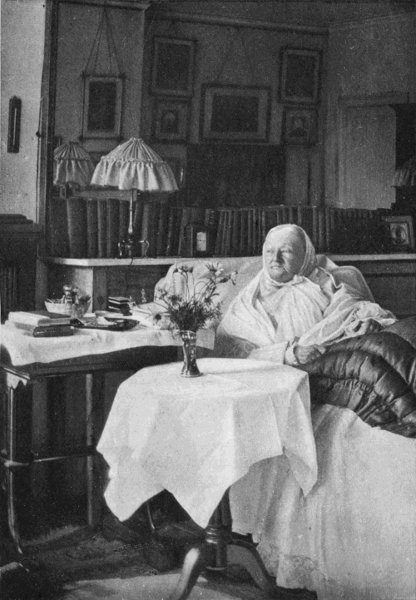
Florence Nightingale in her room in South Street
from a photograph by Miss Bosanquet, 1906
The room in which these treasured interviews took
place was either the drawing-room, or Miss Nightingale's
bedroom on the second floor—both at the back of the house.
The bedroom had a crescent-shaped outer wall with pleasant
French windows and flower-balconies. The bed stood
between the windows and the door, with its foot facing the
fireplace, and behind the bed was a long shelf conveniently
placed for books and papers. There were always flowers in
the room. Those in pots on a stand were provided by Mr.
Rathbone (as already related) until his death; and a box
of cut flowers was sent every week from Melchet Court by
Lady Ashburton. The walls were white and there were
no blinds or curtains; the room seemed full of light and
flowers. What impressed visitors was the exquisite cleanliness
and daintiness of all the appointments which served as
the frame to their mistress. “It always seemed a beautiful
room,” says one visitor, “but there was very little in it
beside the necessary furniture, which was neat, but cheap
and simple, except a few pieces which had come from
Embley and Lea Hurst. A large arm-chair, in which Miss
Nightingale would sometimes sit, stood between two of the
three windows. There were few pictures on the walls—a
photograph of Lord Lawrence's portrait, a water-colour of
an Egyptian sunset, and one or two other gifts. The two
things of most meaning were a long chromolithograph of
‘the ground about Sebastopol,’ as she called it in her Will[183]—this
was opposite her on the right; and, on the mantelpiece,
exactly facing her bed, a framed chromolithographed text,
‘It is I. Be not afraid.’ The drawing-room was loftier
and more severe, and on the walls were some fine engravings
and photographs of the Sistine ceiling. There were many
bookcases in the drawing-room, the back drawing-room, and
the dining-room, mostly full of Blue-books. As a little girl,
I spent many hours in the dining-room while my mother
was upstairs, and can bear witness that except Blue-books
the only reading was The Ring and the Book.”
Occasionally Miss Nightingale would be seen standing
or moving about in her room; what was then remarked was
the grace and dignity of her bearing, though the “willowy
figure” which distinguished her in earlier years had now
become large. More often she received her visitors in bed
or on her couch. What they then observed was the head,
the face, the hands. Her head, in girlhood and early
womanhood, had been remarked as small. Possibly it had
grown somewhat, and something must be put down to the
increased size of the face as affecting the appearance; but
at any rate her head in later years was certainly large. An
Army Surgeon who visited Miss Nightingale frequently in
the 'eighties and 'nineties tells me that he was always struck
by the massiveness of the head, comparable, he thought, to
Mr. Gladstone's. There was an unusually fine rounded form
of the fore-part of the head just above where the hair begins.
The eyes were not specially remarkable, though there was a
suggestion of intellectual keenness in them. The nose was fine
and rather prominent; the mouth, small and firm. The hands
were small and refined. Every one who saw her felt that
he was in the presence of a woman of personality—of marked
character, energy, and capacity. As her visitor entered,
Miss Nightingale would bend forward from her bed or couch
with a smile of welcome; the visitor would be invited to
an easy chair beside her, and talk would begin.
In her youth Miss Nightingale was a brilliant talker, as
witnesses cited in an earlier chapter have told us. In later
years, too, she had flashes of brilliance. Madame Mohl,
whose standard was high, wrote to her husband from Lea
Hurst in 1873: “Mr. Jowett spent three days here. He is
a man of mind; I think he would suit you. He is very
fond of Flo, which also would suit you. She is here, and her
conversation is most nourishing. I would give a great deal
for you to be here to enjoy it. She is really eloquent.
Yesterday she quite surprised me.”[184] But for the most part
Miss Nightingale's talk was rather earnest, inquiring, sometimes
searching, than sparkling or eloquent. “She is worse
than a Royal Commission to answer,” said Colonel Yule;
“and, in the most gracious, charming manner possible,
immediately finds out all I don't know.”[185] Younger
visitors sometimes felt in awe of her; she could flash out a
searching question upon a rash generalization as formidably
as Mr. Gladstone himself. She was interested in everything
except what was trivial. Her intellectual vitality was
remarkable; visitors who knew nothing of her special
interests or pursuits were yet delighted by the stimulating
freshness of her talk. She liked to keep herself au
courant with all that was going on in the political and
learned worlds. The letters to her from more than one
Indian Viceroy show that the pleasant gossip from the
lobbies or the Universities, with which she relieved her
discourses on drains, was keenly appreciated. If the
visitor talked of matters which appealed to her, she was
instantly curious of detail. “Yes,” she would say, leaning
forward, “and what about this or that? and have you
thought of doing so and so?” Or if some difficulty were
propounded, “I wonder if I could help you at all? The
person to speak to is Mr. A. or Mr. B. Do you think that he
would be so good as to come and see me?” “I am sure he
would feel honoured.” “Then do you think I might write
to him? or you will ask him? Very well, then we will see
what can be done.” And so a new network of helpful
influence would be made. To younger visitors—a London
clergyman, it may be, or a student, or a budding official—she
would show something of the maternal solicitude that
was conspicuous in her intercourse with nursing “daughters.”
“But you are not looking well to-day. You have been
sitting up too late? Yes? Then you must promise me
to take better care of yourself.” Or, “Are you careful to
take regular meals? No? Then you must let an old
nurse give you some good advice.” The humour which was
characteristic of Miss Nightingale came more readily perhaps
to her pen than to her tongue; but she always enjoyed a
joke in conversation—even, as we have heard already from
one of her nursing friends, at her own expense. Sometimes
she was teasing. A High Church young lady once went to
South Street. She was delighted with her interview, but
Miss Nightingale, she said, “laughed at High Church curates
a good deal: she said they had no foreheads.” She sometimes
quizzed even her greatest friends. She used to talk
with humorous indignation of Mr. Jowett's God as a “man-jelly,”
in contrast with the future life of work which she
looked forward to.
It was in the bedroom above described, or in the smaller
room in front with which it communicated, that the greater
part of Miss Nightingale's life for forty-five years was passed.
She seldom went out of doors in London. It was believed
that occasionally, at times when her heart and nerves were
giving her less than the usual sense of weakness, she went
out on foot into the Park; but the belief was only whispered:
it was a point of honour amongst her circle to respect her
house-ridden seclusion. The secret may now be divulged,
on the authority of many notes from Sir Harry Verney,
that he lured her out now and then for a morning drive and
stroll in the Park, especially in rhododendron-time, “to
remind her of Embley,” as aforesaid. Miss Nightingale,
except in the few travel-years of her youth, had little enjoyment
from nature in its grander or larger aspects, but she
knew how to find pleasure in the commoner sights and
sounds; in flowers and birds, and in London skies. There
was a tree in the garden of Dorchester House where the
birds used to gather, and from which they flew to be fed
at Miss Nightingale's window. She had studied the
dietary of birds as carefully as of hospital patients, and
imparted the rudiments of such lore to the “Dicky-Bird
Society.”[186] In the country she liked to have a view from
her bedroom of trees and flowers, and often in the early
morning watches she wrote down her observations. Her
balcony at Lea Hurst gave her a great deal of pleasure.
It is large, being the top of the drawing-room bow; you
see a wide stretch of sky from it, and it commands the
view described by Mrs. Gaskell.[187] At Claydon she had
her pet birds and squirrels, and used to write about
them to Sir Harry's grandchildren. She took a great
interest in elementary education, and insisted almost as
much upon the importance of simple nature studies as
upon that of physical training. “On very fine noondays
in London,” she wrote (Dec. 1888), “when there is nearly
as much light as there is in a country dusk, the storm-like
effects of the sun peeping out are more like the light streaming
from the Glory in Heaven of the old Italian Masters than
anything I know. And I wonder whether the poor people
see it. And in old days when I walked out of doors, the
murky effect at the end of the perspective of a long dull
street running E. and W. was a real peep into heaven.
I should teach these things in Board Schools to children
condemned to live their lives in the streets of London, as
I would teach the botany of leaves and trees and flowers to
country children.” Cheap popular books were much
wanted giving account of “the habits, structure, and
characters (what they are about, not classification) of plants
as living beings”; and of birds treated in like fashion, and
not from the point of view of ornithological classification.
“I had a lovely little popular book with woodcuts, published
in Calcutta,” she wrote,[188] “on the plants of Bengal. The
author, an Englishman, offered me to write one on English
plants in the same fashion; but one of the most popular
and enterprising of all our publishers refused on the ground
that it would not tell in Board School examinations and
therefore would not pay.”
During the years following her father's death (1874),
Miss Nightingale devoted much time to the society of her
mother, and this took her for a considerable part of each
year out of London. In 1874 she and her mother spent a
month at Claydon (Aug.–Sept.), and then two months at
Lea Hurst. In 1875 the experiment was tried of taking
a house at Upper Norwood, and there Miss Nightingale lived
with her mother for some weeks (June–July). “I am out
of humanity's reach,” wrote Florence to Madame Mohl
(June 18): “in a red villa like a monster lobster: a place
which has no raison d'être except the raison d'être of lobsters
or crabs—viz. to go backward and to feed and be fed upon.
Stranger vicissitudes than mine in life few men have had—vicissitudes
from slavery to power, and from power to
slavery again. It does not seem like a vicissitude: a red
villa at Norwood: yet it is the strangest I yet have had.
It is the only time for 22 years that my work has not been
the first cause for where I should live and how I should
live. Here it is the last. It is the caricature of a life.”
The lobster-like villa was, however, soon given up. Mrs.
Nightingale longed to be taken to her home—though,
strictly, hers no longer, and from July to October she and
Florence were at Lea Hurst. The year's routine now
became fixed. The care of Mrs. Nightingale in London was
undertaken by her nephew, Mr. Shore Smith, and his wife.
She lived with them in their house in York Place, and from
July or August in each year to November or December the
Shore Smith family, with Mrs. Nightingale and her companion,
moved to Lea Hurst, and there also Florence went—sometimes
going to Lea Hurst before the others arrived,
and sometimes staying there when they were absent.[189] Mr.
Shore Smith was “more than son and daughter to her,”
Mrs. Nightingale said; and Florence, during her residence
at Lea Hurst, devoted a stated number of hours each day—generally
two or three in the morning—to companionship
with her mother. In the country, as in South Street, Miss
Nightingale constantly had nursing friends to stay with her.
“At Lea Hurst,” writes the friend already quoted, “she
was as good to us as in London. I remember being there
once with another of her pupils, and she told us that the
rooms assigned to us had been the nurseries of her childhood.
Long drives were contrived for us; luncheon was packed
in the waggonette, and excursions were mapped out. During
our visit Mr. Jowett came for a few days; he was very
pleasant to us and full of kindness. I remember his speaking
of a quality in our hostess which always struck us; I mean
the thoroughness in all details of her hospitality, even to
putting flowers in our rooms, gathered by herself in the
garden. Miss Nightingale thought one of us was tired,
and said she was not to get up too early in the morning.
Mr. Jowett reminded us in this connection of the man who
made a virtue of always rising very early and who was
‘conceited all the morning and cross all the afternoon.’”
At Lea Hurst, during these years, Miss Nightingale
devoted herself to her poorer neighbours, and threw into the
task the thoroughness and system which characterized all
her doings. She took a part in establishing a village coffee-room
and a village library, and in organizing mothers'
meetings. She gave doles to all deserving families. The
dossiers which she kept of their characters and circumstances
were as careful as those referring to the Nightingale Probationers.
There are sheets and sheets amongst her papers,
on which she entered the quantities of each kind of provision
supplied to each family, as elaborate as the purveying
accounts which she kept at Scutari. She was a sort of
National Health Insurance scheme (non-contributory) for
the neighbourhood; for she employed a doctor to attend
the sick and infirm at her expense, and to report fully to her
on all the cases. There are fifty letters from him in this
sort during a single year, and as many of a like kind from
the village schoolmaster, whom she commissioned to give
extra tuition to promising pupils. There were those who
thought that Miss Nightingale wasted on these rustic cares
energies that might swell the great wave of the world.
Among the number was her old friend, Madame Mohl.
“Now, my own Flo,” she wrote (Oct. 16, 1879), “you
believe me, I am sure, to love you truly; therefore you
will bear what I say, and also you believe me to have
common sense: you can't help believing it, I defy you!
Now I declare that if you don't leave that absurd place, Lea
Hurst, immediately, you must be a little insane—partially,
not entirely; and that if you saw another person knowingly
risking a life that might be useful dans les grandes choses
d'ensemble to potter after sick individuals, and if you were
in a lucid moment you would say, ‘That person is not quite
sane or she has not the strength of will to follow her judgment
in her actions.’” Miss Nightingale was not well pleased by
this letter. She felt something of the sort herself; but it
is one thing to doubt our own wisdom, and quite another to
hear it doubted even by our oldest friends. Miss Nightingale
replied that she was doing her duty, which was a duty of
affection, to her mother, and Madame Mohl, with ready tact,
explained her letter away by saying that the real reason of
it was only a selfish impatience to see her dear “Flochen”
in London.
Miss Nightingale's mother was now very old; her mind
was barely coherent; and it would perhaps have been much
the same to her if Florence had not been by her side. Yet
the actual presence was a great comfort; and Miss Nightingale,
whose calls in earlier life had estranged her somewhat
from her mother, was the more anxious to be with her now.
There were gleams of brightness in the mother's manner
which touched the daughter deeply. “Her mind,” she
afterwards wrote, “was like the ceiling of the Sistine Chapel—darkened,
blotted, effaced, and with great gaps; but if
you looked and looked and accustomed your eye to the
dimness and the broken lights, there were the noble forms
transparent through the darkness.”[190] Mother and daughter
had much converse on spiritual things. At other times,
pride and pleasure in her famous daughter were mixed in
the mother's mind with the regrets of earlier years. “Where
is Florence?” she once asked, in the daughter's absence;
“is she still in her hospital? I suppose she will never
marry now.” She loved to have Longfellow's poem read
to her; “it is all true,” she would say, “all real.” When
Florence came, the mother loved her presence dearly.
“Who are you? Oh, yes, I see you are Florence. Stay
with me. Do not leave me. It makes me so happy to see
you sitting by me. You come down to teach us to love;
but you have so much that is important to do, you must
not stay with me.” “Oh, are you my dearest Florence?
I ought to kiss your hand, I am sure.” The daughter's wit
cheered her mother. “You have a right to laugh,” she
said; “so few of us have. You are so good—so much
better than the rest of us. You do me so much good.”
Something of the same impression was made by Miss
Nightingale upon all who visited her, whether at Lea Hurst
or in her upper room at South Street. She was often lonely
and despondent, and accounted herself, as we have heard,
the weakest of human vessels, the lowest of God's servants.
To those who knew her well, she was a tower of strength.
Mr. Jowett used to say that he never saw Miss Nightingale
or received a letter from her without feeling strengthened
for his duties. The thought of her working in solitude was
constantly with him. “I think no day passes,” he wrote
to her, “in which I do not think of you and your work with
pride and affection.” If men admired Miss Nightingale,
women worshipped her. To many a devoted woman, who
had learnt from her example and who was inspired by her
friendship, she was “My Mistress and Queen,” or “My
Hero Saint.” Women of the great world laid at her feet
an almost equal adoration, and young girls had something
of the same feeling. “I used at first to be shy with her,”
says one of them, “but when I was older and talked more
freely, I found her the most charming person to talk to. She
always seemed interested and glad to see one. I always
used to come away with a sort of buoyant feeling. She
seemed to raise one into a different atmosphere.” “I shall
ever remember my visit to you,” wrote her “ever affectionate
Luise” (the Grand Duchess of Baden) in 1879, “as one of
those moments coming directly out of God's hand and
leading men's hearts up to Him in thankfulness. It belongs
to those things which are in themselves a sanctuary.”[191]
And Lady Ashburton, who still came sometimes to see the
friend of earlier days, her “Beloved Zoë,” wrote: “I like
to think of you in your tower—so high up above us all”;
and, again, “I am humbled in the dust when I think of
what you say of me—poor, wretched, profitableless me, and
yourself the guiding-star to so many of our lives.”
The friends to whom Miss Nightingale wrote most
regularly on matters other than business, and in whose visits
she took the greatest intellectual pleasure, were, next to
Mr. Jowett, Monsieur and Madame Mohl. Her letters to
them show some of her more general interests:—
(To M. Mohl.) Feb. 16 [1868].… I see Mad. Blanchecotte
is publishing her Impressions de Femme—what is that? Do
men publish their Impressions d'Homme? I think it is a pity
that women should always look upon themselves (and men look
upon them) as a great curiosity—a peculiar strange race, like
the Aztecs; or rather like Dr. Howe's Idiots, whom, after the
“unremitting exertions of two years,” he “actually taught to
eat with a spoon.”
(To M. Mohl.) South St., Nov. 24 [1872].… Insensible,
cruel, aggravating man! you break off just where I want to
hear. The only thing that amuses me is Papal Infallibility.
The only thing that interests me not painfully (out of my Chaos)—always
excepting Livingstone, East African Slave-trade,
Central African exploration—is Prussian Politics. Not that
I suppose you to be very well satisfied with them, but I want
to know about the doings—Bismarck, Old Catholics, Infallibilists—this
extraordinary conflict between the old man at
Rome and the Junker-Devil-statesman, Bismarck; also about
the struggle with the Upper House and the de-feudalizing Bill.
I am athirst to know your mind about these things.… Have
you seen Stanley's How I found Livingstone? I have desired
the publisher to send you a copy. It is, without exception,
the very worst book on the very best subject I ever saw in all
my life.… Still I can't help devouring the book to the end,
though it tells little more of Livingstone than what Livingstone
in the despatches has told himself already. But then Stanley
and his newspaper have discovered and relieved Livingstone,
when all our Government, all our Societies, all our Subscriptions,
all the Queen's men could not set Livingstone up again!…
Quetelet has sent me his last books—Anthropométrie and
Physique Sociale—with a charming letter. I answered by a
violent and vehement exhortation to him to prepare his second
edition at once—the first (1869) of the Physique Sociale being
entirely exhausted.[192] Did I tell you that when Mr. Jowett was[316]
elected chairman for the subjects of Final Examination at Oxford,
I insisted on Social Physics being one?
(To Madame Mohl.) South St., Dec. 19 [1873].…
You asked me what Mill's Autobiography was like: and as it is
a book impossible to describe, I send it to you. I think it
almost the most curious and interesting of modern books I ever
read; but curious just as much for its nonsense as for its sense.
I should think the account he gives of his intellectual and moral
growth from the age of three quite unique: quite as singular
as if a man were able to describe all his anatomy and physiology
in a state of growth from the time he was three. But quite,
quite as extraordinary as this is his own stupidity in not seeing
that very many of his moral and intellectual, and especially of
his religious, opinions were fixed inalterably for him by the
process he underwent, so that all his reasoning afterwards upon
them was unreasoning: fixed as much beyond his power to
change, or even to see that a change was desirable or possible,
as the eyes of a man who becomes stone-blind in his youth, or
the right arm of a man who is paralysed on that side, or &c., &c.,
&c. He has written me pages and pages, which I never could
understand—from a man so able—till I read his Autobiography:
that—there being Laws was no proof of there being a Law-giver;
that—if evil were to produce good, there ought to be more of
it! Then, you see he says in his book that his wife was to be
applauded, because she had thrown aside the “monstrous
superstition” that this world could be made on the best possible
design for perfecting Good thro' Evil!… And I still think
the Autobiography, its high tone, its disinterested nobility of
feeling and love of mankind, one of the most inspiring (modern)
books I know. But then please to remember: when Mill left
the India Office he might most materially have helped all my
Sanitary Commissions, Irrigation and Civilizing Schemes for
India. He did nothing. He was quite incapable of understanding
anything but schemes on paper, correspondence, the
literary Office aspect in short, for India. As for that jargon
about the “Inspiration” coming from “woman,” I really am
incapable of conceiving its meaning: if it has any at all. I am
sure that my part in Administration has been the very reverse
of “Inspiration”: it has been the fruit of dogged work, of hard
experience and observation, such as few men have undergone:
correcting by close detail work the errors of men which came
from what I suppose is called their “inspiration”: what I
should call their Theory without Practical knowledge or patient
personal experience.
(To Madame Mohl.) South St., Feb. 27 [1875].…
Do read Pascal's Provinciales. There is nothing like it in the[317]
world; it is as witty as Molière; it is as closely reasoned as
Aristotle; it has a style transparent like Plato. You said
you had not read it. I have a great mind to send it you. I
read it every year (as Lord Morpeth said he did Miss Austen's
novels) for the pure pleasure it gives my imagination. Voltaire
said, did he not? that tho' Pascal was “fou,” he fixed the
language.
Nothing that she read in these years pleased her more
than Mr. John Morley's fine address on “Popular Culture,”
now included in his Miscellanies, which first appeared in the
Fortnightly Review for November 1876. She wrote to him
to express her grateful admiration and to ask if she might be
allowed to distribute copies of the paper. Mr. Morley, who
had already arranged for a cheap reprint, sent her several
copies.
In January 1876 came the death of M. Mohl—to
Madame Mohl an irreparable loss; she was never the same
woman after it; to Miss Nightingale also a heavy loss.
“I am grieved to see,” wrote Mr. Jowett to her (Jan. 7),
“that you have lost a friend, one of the best and truest you
ever had. His death must bring back many old recollections.
Your father told me of his fetching you away from the
Convent when you were ill, and, as he thought, saving your
life.” But it was not only that his death revived affectionate
recollections. M. Mohl had a great admiration for Miss
Nightingale's intellectual powers. He loved to talk and
correspond with her on politics, literature, and philosophy,
and she regarded his studies in Eastern religion as a real contribution
to “theodikë,” one of her principal preoccupations.
Miss Nightingale lost another friend a few weeks later,
whose death greatly moved her:—
(Dr. E. A. Parkes to Miss Nightingale.) Southampton,
March 9 (dictated). Your letter reached me on what must be,
I believe, my deathbed. Perhaps before you receive this I shall
be summoned to my account. For what you say I thank and
bless you. About two months hence the Society for Promoting
Christian Knowledge will publish a little book on “the personal
care of health.” A copy will be sent to you. I had small space,
only 26 pages, but I put in as much sanitary information as
I could, of a very simple kind. I hope it may be a little useful
to you. It is addressed entirely to the poor. And now thank[318]
you and bless you for all the support you have always given me.
Believe me, very gratefully, (signed) E. A. Parkes.
(Miss Nightingale to Dr. H. W. Acland.) 35 South Street,
March 17 [1876]. The death of our dear friend, Dr. Parkes,
fills me with grief: and also with anxiety for the future of the
Army Medical School at Netley. He was a man of most rare
modesty: of singular gifts. His influence at the School—there
was not a man who did not leave the better for having been
under him—is irreplaceable. But the knowledge and instruction
he has diffused from the School as a centre has extended and
will extend wherever the English language is spoken, and beyond.
Dr. Parkes died like a true Christian hero “at his post,” and
with the simplicity of one. I think I have never known such
disinterestedness, such self-abnegation, such forgetfulness of
self. His death was like a resurrection. When he was dying,
he dictated letters or gave messages to everybody: all about
what ought to be done for the School, for the spread of hygienic
knowledge, for other useful and Army purposes: none about
himself.… On March 9, when it was evident he could not
last many days, he commended the School to Sir William Jenner
and dictated a letter to me about hygienic interests, merely
saying of himself that he might be “summoned to his last
account” before I received it. On March 13 he rallied. I was
allowed to send down a Trained Nurse. On March 15 he died.… Let
us, as he went to the sacrifice of himself (he was only 56)
with joy and praise—as the heroes of old—so part with him.
But let us try to save what he would have saved.…
The Professors at the Army Medical School had written
to Miss Nightingale in alarm at a report in the newspapers
that the institution was once more threatened. She begged
Dr. Acland, who was a friend of the War Secretary (Mr.
Gathorne Hardy), to do what he could; and meanwhile
she took direct action herself. She drew up for Mr. Hardy,
as she had done years before for Mr. Cardwell, the case for
the defence of the School; she added personal entreaties
of her own; and she sent Sir Harry Verney to present the
documents to the minister in person. “Mr. Hardy listened
attentively while I read your papers,” reported Sir Harry.
“I emphasised passages underlined by you, indeed showing
him your marks and initials. He said that he had not
decided the matter, and I replied, ‘And Miss Nightingale
wants to get hold of you before you do.’ I shall congratulate
you most earnestly, my dearest Florence, if your representations
save the School, for I know that such success cheers
you more than anything else.” Three weeks later, the
minister returned the papers to Sir Harry, announced that
the School would not be touched, and said he might tell
Miss Nightingale that he would make the appointments she
had suggested.
Some unfinished letters from M. Mohl, found in his
blotter after his death, were sent to Miss Nightingale by
Madame Mohl, who leaned much on her “Flochen's”
sympathy in her loss:—
(To Madame Mohl.) Lea Hurst, August 6 [1876]. Dearest
very Dearest Friend—Indeed I do think I was worthy of him
if always thinking of him, rejoicing in his progress in perfection
and (formerly) grieving with his troubles and cares (but now he
has none, now he is always making glorious progress, else this
world is a nonsense), made me so. But why do you distress
yourself (your loss is great enough, immeasurable, irreparable,
for this world) with saying such things about not having made
the most of him while you had him? He would not have said so.
You found him a melancholy man: you made him a happy one.
You gave zest to his life: all that it wanted. He always felt
this himself: he could not bear to be without you. O thank God
and say (like the Lord of Ossory about his son): I had rather
have my dead son than any one else's living one. Who has
been so blest as you? Where will you find so perfect a man?
And you felt it, I know you did. And he felt your feeling it.… For
M. Mohl's glorious life on earth I thank God: but I thank
Him yet more, because this was only a beginning of life infinitely
more glorious—as Milton says: “death, called life, which us
from life doth sever.” Fare you well. May God be with us all.
Your old Flo. It is 20 years to-day since I came back from the
Crimea. It is 15 since I lost Sidney Herbert.
(To the same.) South St., Feb. 7 [1878]. Dearest Friend,
ever Dearest—Indeed I do: I think daily and nightly of him
and of you: the world is darker every year to me, and darker
without him: for it seems as if a great light were gone out of it.
And the people who survive seem so weary, stale, flat, and
unprofitable compared with those I knew once, loved once.… No:
we shan't give a doit to help the Turks. What! crush all
those struggling young peoples, Sclav and Greek, back under the
hideous massacres and oppression and corruption of the Turk?
We could not if we would. I don't feel very hopeful: for the
worst Eurasian Government, we are allowing the worst European
Government to substitute itself. Turkey was falling to pieces[320]
anyhow by its own bad weight; and we should not have let
Russia act alone in the coming freedom. May God give liberty
to the Christian provinces to work out their own salvation!
Miss Nightingale's interest in the Eastern Question,
moved by the Turkish atrocities in Bulgaria, had been
heightened by her close friendship with Miss Paulina Irby.
Of the women friends whom Miss Nightingale saw frequently,
and with whom she corresponded regularly, Miss Irby was
one of the few who could in any intellectual and spiritual
sense be called her equal. Miss Irby was a woman of the
highest cultivation, an excellent scholar; a woman of most
generous kindliness and simplicity of mind who truly
thought no evil.[193] There was a sort of innocence in her that
seemed to disperse difficulties of itself, and Miss Nightingale's
papers contain references to occasions on which Miss Irby's
friendly offices resolved many worries. She was a friend of
Mr. and Mrs. Nightingale, and Florence had first met her
at Embley in 1869. She was one of the many women who
revered the name of Florence Nightingale, and she had
spent some months at Kaiserswerth. She was enraptured
by making the personal acquaintance of her heroine, and
was used to say henceforth that any good she was able to
do was owing to Miss Nightingale's example and sympathy.
The good that Miss Irby did was great; in promoting
education among the Sclavonic Christians of Bosnia and
Herzegovina, and in relieving the distress among orphans
and refugees. During the years 1874–79 Miss Irby was
often in England, to collect funds and for other purposes
connected with her work in the East. Miss Nightingale
helped her much therein, and thus became very familiar
with some aspects of the Eastern Question. This interest,
combined with her detestation of the forward policy on the
Indian frontier, formed a link of sympathy with Mr. Gladstone.
Was Miss Nightingale's life happy or unhappy? Her
sister used to say to her, thinking of her many political
acquaintances: “You lead such an interesting life.” Mr.
Jowett told her that her life was a blessed one, and that she
ought so to think it. He always sent her a New Year's
letter, and on the last day of 1879 he wrote to her thus:—
(Benjamin Jowett to Miss Nightingale.) I cannot let the new
year begin without sending my best and kindest wishes for you
and for your work: I can only desire that you should go on as
you are doing, in your own way. Lessening human suffering
and speaking for those who cannot make their voices heard,
with less of suffering to yourself, if this, as I fear, be not a necessary
condition of the life you have chosen. There was a great deal
of romantic feeling about you 23 years ago when you came
home from the Crimea (I really believe that you might have
been a Duchess if you had played your cards better!). And
now you work on in silence, and nobody knows how many lives
are saved by your nurses in hospitals (you have introduced a
new era in nursing); how many thousand soldiers who would
have fallen victims to bad air, bad water, bad drainage and
ventilation, are now alive owing to your forethought and diligence;
how many natives of India (they might be counted probably
by hundreds of thousands) in this generation and in generations
to come have been preserved from famine and oppression and
the load of debt by the energy of a sick lady who can scarcely
rise from her bed. The world does not know all this or think
about it. But I know it and often think about it, and I want
you to, so that in the later years of your course you may see (with
a side of sorrow) what a blessed life yours is and has been. Is
there anything which you could do, or would wish to do, other
than you are doing? though you are overtaxed and have a feeling
of oppression at the load which rests upon you. I think that
the romance, too, which is with the past, did a great deal of good.
Like Dr. Pusey, you are a Myth in your own life-time. Do you
know that there are thousands of girls about the ages of 18
to 23 named after you? As you once said to me “the world
has not been unkind.” Everybody has heard of you and has
a sweet association with your name. It is about 17 years since
we first became friends. How can I thank you properly for
all your kindness and sympathy—never failing—when you
had so many other things to occupy your mind? I have not
been able to do so much as you expected of me, and probably[322]
never shall be, though I do not give up ambition. But I have
been too much distracted by many things; and not strong
enough for the place. I shall go on as quietly and industriously
as I can. If I ever do much more, it will be chiefly owing to
you: your friendship has strengthened and helped me, and
never been a source of the least pain or regret. Farewell. May
the later years of your life be clearer and happier and more
useful than the earlier! If you will believe it, this may be so.
In Mr. Jowett's example, his friend found strength and
help, even as he did in hers. “He offers himself up to
Oxford,” she used to say of him with admiration; and she
offered up all her powers to the causes she had espoused.
There were still to be many years during which she was able
to work unceasingly for them. Her life was to be not less
useful than before, and perhaps, as increasing years brought
greater calm, her life was also clearer. But happiness, as
the world accounts it, she neither attained nor desired.
She had a friend who was losing his devotion to high ideals,
as she thought, in domestic contentment. “O Happiness,”
she said of him, “like the bread-tree fruit, what a corrupter
and paralyser of human nature thou art!”
I thank God for all He is doing in India through Lord Ripon.—Florence
Nightingale (1884).
General Gordon was the bravest of men where God's cause and that of
others was concerned, and his courage rose with loneliness. He was the
meekest of men where himself only was concerned. You could not say
he was the most unselfish of men: he had no self.—Florence Nightingale
(1886).
“South Street, Feb. 2 [1880]. Dearest—My dear
mother fell asleep just after midnight, after much weariness
and painfulness. The last three hours were in beautiful
peace and all through she had been able to listen to and
to repeat her favourite hymns and prayers, and to smile
a smile as if she said, ‘I'm dying: it's all right.’ Then she
composed her own self to death at 9 last night: folded her
hands: closed her own eyes: laid herself down, and in
three hours she was gone to a Greater Love than ours.…
Do you remember what Ezekiel says: ‘And at eve my wife
died: and I did in the morning as I was commanded.’”[194]
Miss Nightingale's mother had almost completed her 93rd
year. Queen Victoria sent a message of sympathy to which
Miss Nightingale replied with particulars of the last hours
such as Her Majesty was known to like, and she asked leave
to address a letter to the Empress of India on the condition
of that country. Permission was granted, and “doing in
the morning as she was commanded” Miss Nightingale
turned from thoughts of her mother's death to the grievances
of the Indian peoples and composed in general terms a plea
for their redress. The Queen made no response, but presently
she sent a copy of the Life of the Prince Consort. The Life
contains much information about the famous Proclamation
to the People of India, in which the Queen and the Prince
Consort had been personally concerned, and Miss Nightingale
made use of the fact when she next had an opportunity of
addressing her Sovereign on Indian subjects.
Meanwhile, Miss Nightingale was suffering from nervous
collapse, and the doctors ordered sea air. She went for
three weeks to the Granville Hotel, Ramsgate, but the
change did her little good. “The doctors tell me,” she
wrote to Miss Pringle (March 28), “I must be ‘free’ for at
least a year ‘from the responsibilities which have been
forced upon me’ (and which, they might say, I have so ill
fulfilled) and from ‘letters.’ But when is that year to
come? I believe, however, I must go away again for a time,
if only to work up the arrears of my Indian work, which
weigh heavily on my mind.” She went in April for a few
weeks to Seaton, where Lady Ashburton had placed Seaforth
Lodge at her disposal. She was not to be disturbed, but
her hostess came from Melchet for a few days, and had, as
she wrote, “the deep joy of communion with my beloved.”
In the following month Miss Nightingale spent some days at
Claydon, where in subsequent years she often stayed for a
longer time, taking much interest in local affairs there.
Her sister was now and henceforth an invalid, suffering
sadly from rheumatic arthritis. Nothing cheered her so
much, said Sir Harry Verney, as her sister's society, and
now that Mrs. Nightingale's death made visits to Lea
Hurst less imperative they hoped that Florence “would
treat Claydon more as a home” than heretofore. She did
as she was bidden, and for several years paid an annual
visit to Claydon, where “Florence Nightingale's room”
is still shown. For the rest, Miss Nightingale's life continued
on the old lines,[195] and whether at Claydon or in South Street
the Sabbatical year of freedom from responsibilities, letters,
interviews, and Blue-books did not come.
In the spring of 1880, Miss Nightingale was intensely
interested in the elections. Her dislike of Lord Beaconsfield's
policy, her recent intercourse with Mr. Gladstone, her
hopes for India, her interest in the Verneys, as well as her
own sympathy with liberal ideas and the Liberalism traditional
in her family, made her a stout partisan. “I hope,
dearest,” she wrote to a nursing friend (March 28), “you care
about the elections. You are in the thick of them. Sir
Harry with patriotic pluck is in his 79th year fighting a losing
battle at Buckingham.[196] But what delights me is that the
Liberal side find that the labourers and the working man
have waked up during the last 6 years to interests entirely
new to them. Then, 6 years ago, we could hardly get a
hearing: now men jam themselves into small hot rooms,
struggling for standing-room while for 3 hours they listen
to political talk. Whether we win or not, such interest
will never die.” When the Liberal victory was complete,
she was eager, like the rest of the political world, to know
who would be Prime Minister, and more anxious than other
people (except the few personally concerned) to know who
would succeed Lord Lytton as Viceroy of India. Sir Harry
Verney sent her the latest rumours from the Row in the
morning and from the Clubs in the afternoon. She must
have been greatly pleased when Lord Ripon's appointment
to India was announced; but curiously there is no note
about it, nor any record of a visit from him, nor at this stage
any correspondence. They were, however, old friends;
and as soon as Lord Ripon set to work in India, correspondence,
at once cordial and confidential, began. Advocacy
of Lord Ripon's Indian policy was indeed one of the absorbing
interests which occupied Miss Nightingale during the years
covered in the present chapter. Her other main preoccupation
was the state of the Army Medical and Hospital
service—a matter which became urgent in connection with
the campaigns in South Africa, Egypt, and the Soudan.
These two branches of work now occupied the front;
but they did not cause Miss Nightingale to abandon other
responsibilities, and the reader must supply a background
of the various kinds of work described in earlier chapters.
She was still busy with details of Indian sanitation, for the
Sanitary Annual was still submitted to her revision. She
was still consulted on questions of nursing administration
and hospital construction. “They are in difficulties,”
wrote Sir Harry Verney (Jan. 30, 1881), in forwarding an
application of this kind; “so they appeal to you—the
Family Solicitor to whom we all turn when we get into a
scrape, but your Family is a large one—the whole human
race.” She still filled the part of Lady Bountiful, with more
than that lady's usual care for detail, to her poorer neighbours
in the country. The Working-Men's Institute at Holloway
(near Lea Hurst) referred to her the question whether
playing-cards should be admitted. She was in favour of
the cards, but a majority of the Committee were against
them, and, before giving her opinion, she conducted an
inquiry as elaborate and far-searching as if it were a case
of cholera. And more assiduously, rather than less, did
she devote herself to the affairs of the Nightingale School
and its old pupils. There are years at this period during
which as many as 400 letters from nurses were preserved
in this sort, and there are Sisters to each of whom more
than fifty letters were written. She introduced the innovation
of sending her probationers to the National Training
School of Cookery, and she looked over their notes on the
lessons, founding thereon hints to the teachers. The
extension of trained nursing in workhouse infirmaries
called for more Nightingale nurses. “Yesterday,” she
wrote to Madame Mohl (June 30, 1881), “we opened the
new Marylebone Infirmary (760 beds). We nurse it with
our trained nurses, thank God! I have each of these
women to see for three or four hours alone before she begins
work.” It was during this period that Miss Nightingale paid
her first visit to the new St. Thomas's Hospital. She drove
there on January 27, 1882, and inspected the quarters of
her Training School and one of the Hospital wards. “Just
one week has elapsed,” wrote the Matron (Feb. 4), “since
you honoured us with your more than welcome presence,
and I cannot go to bed to-night until I have thanked you
for all the admiration in which you speak of your Home and
the pretty Alexandra Ward. No words of mine can ever
express the delight it gave us to welcome you, our dearly
loved Chief, to the Home and School which has for more
than 20 years borne ‘her honoured name.’” The time
was drawing near when pupils of the School were to follow
in the footsteps of their Chief and do nursing service in
the East.
In April 1880 a notable addition was made to Miss
Nightingale's hero friends. General Gordon introduced himself
to her in order to introduce his cousin, Mrs. Hawthorn.
She was the wife of a Colonel in the Engineers, and devoted
herself to good work in military hospitals. She had been
painfully impressed by the inefficiency of the orderlies, and
had begged General Gordon to “go to Miss Nightingale”
in the matter. The character of “Chinese Gordon” was
already most sympathetic to Miss Nightingale, and the
personal touch now heightened her admiration. She
gained at the same time in his cousin a friend to whom she
became warmly attached, and who served as eyes and ears
for her in a way which enabled her to forward useful reforms.
General Gordon's letters appealed strongly to Miss Nightingale
as those of a kindred soul:—
(General Gordon to Miss Nightingale.) April 22 [1880].
In these days when so much is talked of the prestige of England,
&c., &c. I cannot help feeling a bitter sentiment when one considers
how little we care for those near and how we profess to
care for those afar off. You wrote some kind words on your
card when I called, and I am much obliged for them, but I do
not think that I have done 1/20 part or suffered anything
like the nurse of a hospital who, forgotten by the world, drudges
on in obscurity. (April 29.) I do not know the details myself.
I took up the paper on the entreaties of my cousin, feeling sure
that the truest way to gain recruits to our army would be by so
remedying the defects and alleviating the sufferings of soldiers
that universally should it be acknowledged that the soldier is
cared for in every way. Decorations may popularise the army
to the few, but proper and considerate attention to the many is
needed to do so to the public. To my mind it is astonishing how[328]
great people, who have all the power to remedy these little defects,
who pride themselves on the prestige of our name, whose time
must hang so very heavily on their hands, can remain year after
year heedless of the sick and afflicted. I speak from experience
when I say that both in China and Soudan, I gained the hearts
of my soldiers (who would do anything for me) not by my justice,
&c., but by looking after them when sick and wounded, and by
continually visiting the Hospitals.… [If you cannot help us]
well! I fall back on my verse “If thou seest the oppression of
the poor and violent perversity of judgment marvel not at it,
for He that is higher than the Highest regardeth it.”
Miss Nightingale took the matter up at once. She put
the case into form, and submitted it, through Sir Harry
Verney, to the Secretary for War, Mr. Childers, who promised
to look into it. Presently he called for a report on hospital
nursing by orderlies, and in August the Departmental
answer was forwarded to Miss Nightingale. “I have seen
such answers,” she wrote,[197] “at the Crimean war time.
‘The patient has died of neglect and want of proper attendance;
but by Regulations should not have died; therefore
the allegation that he is dead is disposed of.’” In this
case the allegations were not disposed of, as we shall hear
presently.
Early in May General Gordon left England as private
secretary to Lord Ripon, and before starting he sent one of
his “little books of comfort” to Miss Nightingale. He
resigned the incongruous appointment almost as soon as
he had reached India, and after a special mission in China
returned to England. He saw Miss Nightingale and announced
his intention of going to Syria. Miss Nightingale
upbraided him. His past claimed more of his future than
a tour of curiosity in the East. Why should he not return
to India in an unofficial character? She could tell him of
much work to do there:—
(General Gordon to Miss Nightingale.) Southampton,
April 4 [1881]. You have written most kindly and far too highly
of me, for I find no responding tone in my heart to make me
claim such praise. I will explain exactly how I am situated.[329]
I consider my life done, that I can never aspire to or seek employment,
when one's voice must be stilled to some particular note;
therefore I say it is done, and the only thing now left to me is
to drift along to its natural end and in the endeavour to do what
little good one may be able to do. Syria is, to me, no land of
attraction, all lands are indifferent. I go for no desire of curiosity,
but simply because it is a quiet land and a land where small
means can do much good. That is all my reason for going there.
I would have gone to the Cape. I would have gone to India as
you suggest, but I would never do so if I had to accept the
shibboleth of the Indian or Colonial official classes.… My life
is truly to me a straw, but I must live. Would that it could go
to give you and all others the sense that they are all risen in
Christ even now, even if it was at the cost of my eternal existence—such
is the love I have for my fellow-creatures, but the door is
shut. I cannot live in England; for though I have many many
millions in my Home, I am only put on short allowance here,
tho' it is ample for me with my wants. I cannot visit the sick
in London: it is too expensive. I can do so in Syria, and
where the sick are, there is our Lord. I would do anything I
could for India, but I feel sure my advent there would not be
allowed.
The time was presently to come when Gordon's wish
was in a way he knew not to be granted, and his death was
to be an inspiration unto many. For the present, Miss
Nightingale hoped for the Cape or some other Colonial duty
rather than Syria; and Sir Harry Verney wrote to Mr.
Gladstone on the matter, mentioning her name. This
she had not intended. Never reluctant to intervene in
cases which might be considered within her competence,
she had the strongest objection to weakening her influence
by any appearance of meddling in matters wherein she had
no better right to express an opinion than anybody else.
She scolded Sir Harry severely for his indiscretion; but
Mr. Gladstone sent a friendly answer (April 26): “he will
make the circumstances known to Lord Kimberley who,
he is sure, will, like himself, desire to turn Colonel Gordon's
services to account.” Gordon, meanwhile, whose rapid
changes of intention must at this time have been puzzling
to his friends, had accepted a military appointment at
Mauritius, which, however, was soon followed by one at
the Cape. Before leaving England, he again sent Miss
Nightingale some of his little books.[198] She never saw or
heard directly from him again; but from Brussels, on the
day before his fateful interview with the British Cabinet in
London, he wrote to Sir Harry Verney (Jan. 17, 1884):
“I daily come and see you in spirit—you and Miss Nightingale.”
And from Khartoum (Feb. 26): “I am among
the ruins of a Government, and it is not cheerful work.
However, many pray for me, and if it is God's will, I shall
hope to get all things quieted down ere long. There is not
much human hope in my wish, but I force myself to trust
Him. Indeed one ought to be content with His help, and
in fact can lean on no other, for I have none. Unless He
will turn the hearts of men towards peace, I have no hope.
I wish I could have called and seen you and Miss Nightingale,
but I had no time.” After his death, she took for
some years a lively interest in the management of the Gordon
Boys' Home. It was at a meeting in connection with it that
her words, quoted at the head of this chapter, were read.[199]
During the years 1881 and 1882 Miss Nightingale was
very busy with Indian questions, and when Lord Ripon's
policy was disclosed, he became a hero to her almost comparable
to General Gordon. In forwarding to Lord Ripon
a copy of one of her Indian pieces, she sent her “deepest
reverence and highest hopes for all the great measures by
which the Viceroy is bringing peace to the people of India
and fulfilling England's pledges. And the love and blessing
of India's people be upon him!” Readers of the present
generation, who do not remember the political controversies
of thirty years ago, and who are familiar with experiments
in Indian reform, more daring in some respects than any
which Lord Ripon attempted, may wonder at Miss Nightingale's
enthusiasm. But it was very natural to one holding
her views at the time. The admiration which she felt for
Lord Ripon and his policy was equalled by the passionate
detestation felt by the larger, if not the better, part of
Anglo-Indian opinion. The opposition to the “Ilbert Bill,”
named after the member of the Legislative Council who
introduced it, was intensely bitter; that to some other
branches of Lord Ripon's policy, hardly less so. Miss
Nightingale was behind the scenes both at Calcutta or Simla
and in London: in India by confidential communications
from Lord Ripon himself, in London through friends in
the India Office. She knew how uncertain was the support
he received in his own Council, and how strong was the
opposition in the Council in Downing Street. He was a
good man fighting against adversity, and she was eager to
do what she could to help him. His reforms were also hers.
She had spent years of labour in mastering the intricacies
of land tenure in India. For years her heart had been full
of the grievances of the cultivators. And now Lord Ripon
had prepared Land Reform Bills for Bengal and Oudh
which, if passed, would give the ryot security against oppression.
She had thought much and written something on
Indian education.[200] It was “not enough,” she had said, “to
read Locke and Mill.” She wanted an education which
would teach the peoples of India to be “men,” which would
encourage them to the better cultivation of agriculture and
industries, which would enable every patel (village headman)
to understand and enforce the principles of sanitation.
And Lord Ripon had appointed an Education Commission
(1882), from which some useful reforms followed. As for
the “Ilbert Bill,” which sought to confer upon duly qualified
native judges powers equal to their position, it was in Miss
Nightingale's eyes a measure of simple justice and duty;
it was an honest fulfilment, within its scope, of the Proclamation
of 1858, in which the Queen declared her pleasure,
that as far as may be “Our subjects of whatever race or
creed be impartially admitted to Our service, the duties of
which they may be qualified by their education, ability, and
integrity duly to discharge.” Lord Ripon's measures in the
direction of local self-government similarly appealed to Miss
Nightingale. It has been thought by some that Lord Ripon
attempted too much and allowed too little for Lord Salisbury's
“periods of Indian cosmogony.” But in these
matters some one must begin; and if some of the hopes
raised by Lord Ripon's pronouncements have been doomed
to disappointment, the fears of his more frantic opponents
have been in at least equal measure belied by the event.
Miss Nightingale was among those with whom hope ran
highest. Her fundamental doctrine of human perfectibility
by Divine order encouraged her to see in Lord Ripon the
Providential instrument of vast changes. She approved
whole-heartedly of all that he actually proposed, writing
him letters of enthusiastic encouragement, and she also
plied him with suggestions of further reforms. In particular,
she sent him a scheme—in which Captain Galton, Dr.
Sutherland, and Sir Richard Temple collaborated with
her—for village sanitation in India. She regarded his
Viceroyalty almost as the beginning of the millennium.
Miss Nightingale, however, was no idle or vague enthusiast.
She was one of those who, while they fix their
eyes on the stars, keep their feet firmly planted on the ground.
She was as indefatigable as ever in mastering every detail,
a process in which Lord Ripon's supply of Minutes and
other documents provided abundant material, and she continued
to see and correspond with every available Anglo-Indian
or Indian who could help her, or whom she could
hope to influence. There were two main lines on which
her activities moved. “India says,” she wrote, “‘We
want all the help you can give us from home.’” So, then,
she devoted herself, in the first place, to the support of
Lord Ripon's policy. She was constant in inspiring sympathisers
at home to fresh exertions. She suggested meetings
and propaganda. She wrote articles and assisted others to
write. She was in constant communication with Sir William
Wedderburn. She made the acquaintance of Mr. A. O.
Hume, “the father of the Indian National Congress.”
She saw Mr. Dadabhai Naoroji, Mr. Lalmohun Ghose, and
other Indian gentlemen. But Miss Nightingale had no
fanatical belief in the value of legislative reforms in themselves.
They are worth no more than the public opinion
and the individual effort which they express or inspire.
If Lord Ripon's policy was indeed to inaugurate a millennium
in India, there must be a new zeal alike in Anglo-Indian
administration and among the more educated
classes of India. In her interviews with the latter, she was
constant in impressing upon them how much each one
might do in promoting sanitation and education. She
took a lively interest in the Zenana mission. She saw
Mrs. Scharlieb when that lady went out to practise medicine
in India, corresponded with her, and gave her introductions.
Lord Roberts came to see her (June 1881) before taking up
his appointment as Commander-in-Chief in Madras. Mr.
Ilbert had seen her before going out as judicial member of
the Governor-General's Council, and they kept up a correspondence.
Sir Mountstuart Grant Duff similarly called
on his appointment to the Governorship of Madras (June
1881), and throughout his term of office he wrote reporting
progress on all matters likely to interest her.
Miss Nightingale was particularly interested in agricultural
development and education. She saw much of
Sir James Caird, and corresponded with Mr. W. R. Robertson,
the Principal of the Agricultural College in Madras.
Candidates selected for the Indian Civil Service were now
given the option of a year's study at the University before
going out, and at Balliol Mr. Arnold Toynbee was appointed
a lecturer to them. Miss Nightingale made his acquaintance,
and corresponded with him. “I know nothing,”
she wrote (May 30, 1882), “that tells so soon, so widely, so
vigorously as Indian Civil Service administration. Balliol
sends forth her raw missionaries; and in four years from
the time he was an undergraduate, see what a man may
do!” “Could not some instruction be given,” she suggested
(Oct. 20, 1882), “in agriculture and forestry,” so as
“at least to direct your students' attention to what are the
peculiar wants of India, a knowledge often absent in her
rulers? In agricultural chemistry, in botany (as regards
plants and woods), in geology (as regards soils and water-supply),
in forestry (as regards rainfall and fuel), in animal
physiology (as regards breeds, fodder, and cattle-diseases),
there is much ignorance in India. What if Scientific Agriculture
could be taught at Oxford?” These things have
of late years been done both at Oxford and at Cambridge.
Then Miss Nightingale discussed with Mr. Toynbee the
importance of familiarizing the students with the agrarian
conditions in India, “so as to open the minds of these future
administrators and judges to the real significance of their
position and its responsibilities.” To this end she induced
her friend, Sir George Campbell, to give a course of lectures
at Oxford. Of her own writings during this period[201] the
most considerable was an elaborate exposition and defence
of Lord Ripon's Bengal Land Tenure Bill, of which, as of
his other measures, the fate was hanging in the balance.
This Paper—entitled in her fanciful way The Dumb shall
speak, and the Deaf shall hear, or, The Ryot, the Zemindar,
and the Government—was read (by Mr. Frederick Verney) at
a meeting of the East India Association at Exeter Hall on
June 1, 1883, with Sir Bartle Frere in the chair. It was
well reported; there was a full attendance of distinguished
Anglo-Indians, and a lively discussion followed. Miss
Nightingale printed her Paper as a pamphlet and distributed
it widely. The discussion showed much difference of
opinion, but every speaker paid a tribute to Miss Nightingale's
knowledge and devotion. There was one who was
able from personal experience to recall the thoughts of the
audience to other scenes wherein she had won her first
renown. This was Surgeon-Major Vincent Ambler. “I
was sick in hospital at Balaclava,” he said, “and she nursed
me through a long illness of Crimean fever. She was with
me, I might almost say, night and day, and it is to her
good nursing and energetic attention I owe my recovery.
Previous to my illness I had had experience of her friendship
when at Scutari, where the hospitals were crammed with
dead and dying, and cholera was carrying off hundreds of
victims a day; it was amid such scenes as this that I constantly
beheld Miss Nightingale.” Scenes not quite so
terrible, but yet not entirely different, had been witnessed
at this time in other fields of war; and Miss Nightingale,
though no longer able to be in the midst of them herself,
played some part, nevertheless, in ministering to the sick
through her pupils, and in seeking to remedy defects in
administration which the test of war had once more revealed.
To these scenes, leaving Lord Ripon's measures trembling
in the balance, we must now turn.
The Egyptian campaign of 1882 called for female nurses,
and Miss Nightingale worked at high pressure in selecting
them, and arranging details of their outfit. “I have been
working some days,” she told Mrs. Hawthorn (Aug. 3,
1882), “from 4.30 A.M. till 10 P.M.” Mrs. Deeble, of Netley,
was in command of the female nursing corps, twenty-four
strong, in which several old pupils of the Nightingale School
at St. Thomas's were enrolled. They wrote repeatedly to
their “Chief” at home, and she sent them constant messages
of advice and encouragement. “A thousand thanks for
your dear kind letter, which seems to have given me fresh
vigour to combat against our many difficulties.” “How
good and kind you are to send me that welcome telegram.
A few words now and then from you are so cheering.” There
are hundreds of such notes. The spirit of an old campaigner
revived in Miss Nightingale as she read of stirring deeds,
whether earlier in South Africa or now in Egypt. Nor had
her “children” in the army altogether forgotten their old
friend. There were four men, wounded at Majuba, who
were detained for some weeks in hospital at Netley. They
spent their time of convalescence in making a patchwork
quilt, and asked that it should be sent from them “to
Florence Nightingale.” In November 1882 the Guards
began to return from Egypt. A regiment of them (Grenadiers)
was under the command of Colonel Philip Smith, a
nephew of Sir Harry Verney, who persuaded Miss Nightingale
to drive to the station to see their arrival. She was
deeply moved:—
November 13 [1882]. For the first time for 25 years I
went out to see a sight—to Victoria Station to see the return
of the Foot Guards. Anybody might have been proud of these
men's appearance—like shabby skeletons, or at least half their
former size—in worn but well-cleaned campaigning uniform;[336]
not spruce or showy, but alert, silent, steady. And not a man
of them all, I am sure, but thought he had nothing in what he
had done to be proud of; tho' we might well be proud of
them. Royalty was there with its usual noble simplicity to bid
them an unobtrusive welcome. The men, not the Royalty,
were to be all in all on that occasion. A more deeply felt and
less showy scene could not have been imagined.
So Miss Nightingale noted at the time, and presently
she included her description in one of the letters which she
sent every now and then at the Commanding Officer's
request for him to read out to the men of the Volunteer
Corps at Romsey, near her old home. She used the incident
again in an address to the Nightingale Probationers (1883).
A few days later (Nov. 18, 1882) there was a Royal Review,
on the Horse Guards Parade, of the troops returned from
the Egyptian campaign, and Miss Nightingale was present,
at Mr. Gladstone's invitation, on a stand erected in the
Prime Minister's garden. She was seated between him and
Mrs. Gladstone, and Mrs. Gladstone, in recalling the occasion,
used to say that “there were tears in Miss Nightingale's
dear eyes as the poor ragged fellows marched past.” Her
presence on this occasion was observed, and she was invited
accordingly to attend the opening of the new Law
Courts by the Queen (Dec. 4). She was given a place on
the dais, and the Queen, noticing her, sent a message to
say “how pleased she was to see Miss Nightingale there,
looking well.”
Lord Wolseley's Egyptian campaign of 1882 was short
and sharp, and from the combative point of view admirably
managed, but there was a good deal of sickness among the
soldiers. The fighting during these years (1880–82), both
in South Africa and in Egypt, put to the test the re-organizations
of the Army Medical and Hospital Service which had
taken place since Miss Nightingale was “in office” with
Sidney Herbert. The result of the test was far from satisfactory.
There were, indeed, no scandals on the scale of
the Crimean War, and the death-rate during the Egyptian
campaign may fairly be cited as proof that great improvements
had been effected since that time.[202] But there were
grave defects, and Miss Nightingale played an active part
both in bringing them to light and in striving for their
prevention in future. She was in close touch with the hospital
arrangements both in Natal and in Egypt through her
friends among the lady nurses and lady visitors. From
Natal, one of the latter, Mrs. Hawthorn, had sent her many
particulars, supported by evidence, of neglect in the hospitals.
Miss Nightingale wrote a memorandum on the subject,
which she submitted, again through Sir Harry Verney, to
the Secretary for War. Mr. Childers appointed a Court of
Inquiry (June 1882), presided over by Sir Evelyn Wood,
to investigate the charges. The Committee reported that
“improvements in the system of nursing are both practicable
and desirable.” “This is rather a mild opinion,” wrote
Sir Robert Loyd Lindsay (Lord Wantage) to Miss Nightingale
(Oct. 23, 1882), “considering that all the independent
evidence went to show that the orderlies were often drunk
and riotous, that they ate the rations of the sick, and left
the nursing of the patients to the convalescents.” The
Egyptian campaign followed, and many cases of neglect
were alleged. The Committee was reconstituted (Oct.
1882) on an enlarged basis, under the chairmanship of the
Earl of Morley, with instructions to inquire, with special
reference to the Egyptian campaign, into the organization of
the Army Hospital Corps and the whole question of hospital
management and nursing in the field. Miss Nightingale
had a close ally during this inquiry in Lord Wantage, who
was a member of the Committee. She suggested witnesses
to him; and sent him elaborate briefs for their examination.
She was furnished day by day with the minutes of evidence;
and when the time came for preparing the Report, she wrote
successive papers of suggestions, which Lord Wantage submitted
to the Chairman. “I think,” wrote Lord Wantage
(May 5, 1883), “that the Report, although dealing with
details, and not going much beyond them, will be of service.
And I am bound to say many of the best suggestions come
from you, and for these I beg to thank you most sincerely”;
and, again, in sending her an early proof of the Report
(June 12): “I can only repeat once more how valuable
your aid was to me during the enquiry. If the Secretary of
State carries out the Report, some of the most useful improvements
will have originated with you.”
Miss Nightingale found in the evidence a justification
of her forebodings during past years. It disclosed evils
comparable in kind, though not in extent, to those at
Scutari and in the Crimea.[203] Supplies procurable had not
been procured. Hospital equipment was incomplete. The
cooking was defective, and so forth. These defects were
due, Miss Nightingale considered, to the undoing of Sidney
Herbert's work. The Purveyor's Department, reorganized
by him and her, had been abolished. For the rest, their
whole scheme of reorganization had been based on the regimental
system, which had now been abandoned for a unitary
system, though in time of war some return to the former was
a necessity. Miss Nightingale did not wholly condemn
these changes in themselves. What she complained of was
that they had not been thought out in all the details or in
terms of war. This was what she meant when she noted
the progress of reorganization during previous years, and
pronounced it lacking in administrative skill.[204] She now
said that the changes must be accepted, and threw herself
into the work of lending aid towards improvement. She
saw and corresponded with the Director-General of the
Army Medical Department, Dr. T. Crawford, than whom,
she said, “we have not had such a man of unflagging energy
since Alexander.”[205] She made friends with many other
army doctors. Among them was Surgeon-Major G. J. H.
Evatt, who had seen service in India, and was now at the
Royal Military Academy. He assisted Miss Nightingale
in suggestions for the reorganization of the Army Hospital
Corps in India, which she sent to Lord Ripon. She
was consulted on revised regulations for various branches of
the medical service. She was in constant communication
with her old associates, Captain Galton and Dr. Sutherland,
and she urged the former to keep the question of reform to
the front by writing in the papers and magazines.
In the middle of 1883 Miss Nightingale was in the thick
of her two main preoccupations—the defence of Lord
Ripon's Indian policy and the reform of the Army Hospital
Service—when an opportunity came to her for putting in a
word on behalf of each of these causes in the highest quarter.
The decoration of the Royal Red Cross had been instituted
by Royal Warrant on April 23, 1883, and Miss Nightingale's
attendance was requested at Windsor on July 5 to receive
the decoration for her “special exertions in providing for
the nursing of the sick and wounded soldiers and sailors.”
She was invited to dine and sleep at the castle on the
occasion. The Queen, whose observant eye had noticed
at the opening of the Law Courts that Miss Nightingale was
attended by Sir Harry Verney, hoped that he would again
accompany her. The state of her health compelled Miss
Nightingale to decline the invitation[206]; with the greater
reluctance because there were two subjects—India and the
Army Medical Service—on which the Queen had permitted
her to speak on a previous occasion and on which she would
now have highly prized the opportunity of speaking again.
She begged to be permitted to write to Her Majesty instead.
The permission was given, and Miss Nightingale sent a
letter upon the state of the Army Medical and Hospital
Services. A second letter contained an expository vindication
of Lord Ripon's Indian measures. In this connection it
had been intimated to Miss Nightingale by a friend that she
would do well to describe in a few words what the Ilbert
Bill really was. The Queen had doubtless read voluminous
dispatches “about it and about,” and perhaps been addressed
on the subject by copious Ministers “as if she were
a public meeting,” and like the greater number of her
subjects may have felt little the wiser. Miss Nightingale
condensed into the following words the nature of the Bill
and the case for it: “The so-called ‘Ilbert Bill’ is intended
to give limited powers to try Europeans, outside of
the Presidency towns, to Native Magistrates and Judges
who, after long trial of their judicial qualification, in corresponding
positions, have shown themselves worthy to be
entrusted with this duty and have risen to that grade where
for their official responsibility such powers are required.
It is no new experiment, but has been tried on the Bench of
the High Courts and in the Chief Magistracies of the Presidency
towns.” Miss Nightingale then went on to refer to
the Queen's “noble proclamation” of 1858, and to connect
the Ilbert Bill with it. “The Queen has proclaimed that
she will admit the natives of India to share in the government
of that country without distinction of race and creed. She
has invited them to educate themselves to qualify for her
service as Englishmen do. In face of the greatest difficulties
they have in competition with our ablest young men gained
honourable place, and by trial in long service have proved
themselves efficient and trustworthy.” It would be
disastrous, Miss Nightingale went on to argue, if, in deference
to clamour, the Queen's Government were to draw back
from giving effect to Her Majesty's gracious assurances:—
(Sir Henry Ponsonby to Miss Nightingale.) Osborne,
August 13 [1883]. The Queen hopes you will forgive her for not
answering your letters herself. Her Majesty has been so constantly
interrupted in writing that she has entrusted to me the
duty of conveying to you her thanks for the two very interesting
communications you have been good enough to address to Her
Majesty.
With regard to the “Ilbert Bill” which is now being
so vehemently discussed, The Queen cannot but deplore the
acrimony with which the question has been treated; but as it
is a matter under the consideration of Her Majesty's Government,
The Queen is unwilling to express any opinion upon the
measure at present.
It gave The Queen sincere pleasure to confer the decoration
of the Royal Red Cross upon you, who have worked so hard
and who have effected so much in the Sanitary Departments
of the Army, and The Queen is very grateful for your observations
on the Military Medical questions, and has read with much interest
the paper in the Fortnightly Review[207] to which you called her
attention. Her Majesty considers your remarks of the highest[341]
value, and fully concurs in your opinion that the Hospital
Services should be carried out in a manner calculated to relieve
the Medical officer from the care of details not belonging to his
Medical work. The abolition of the Purveyor's Department
and the change from the Regimental to the General system—which
The Queen much regrets—were both effected on the
recommendation of the Medical officers, and The Queen observes
that those who gave evidence before the late Committee of
Enquiry consider these steps to have improved the efficiency of
their Department. These matters have been prominently
brought to Her Majesty's notice lately, as the selection of a new
Commandant to Netley Hospital is now under consideration,
and the comparative advantages of naming a Combatant or
Medical officer are being discussed.
The Queen was extremely sorry to have missed the opportunity
of seeing you at Windsor, but trusts that on some future
occasion she may be more fortunate. I am to repeat to you
Her Majesty's thanks for your letters, and to assure you that
The Queen will always be glad to receive any communications
from you.
The practical interest which Queen Victoria took in
Army matters may have been a factor in the prompt attempt
to remedy the evils to which Miss Nightingale had called
attention. In the following year Miss Nightingale obtained,
through Lord Wantage, a statement from the War Office
(Oct. 17, 1884) “showing how far the recommendations of
Lord Morley's Committee had been carried out.” There
were very few of the evils left unremedied—at any rate on
paper.
There was one feature of the Hospital Service upon which
the inquiries above mentioned threw nothing but praise,
and that was the female nursing. Lord Wolseley, whose
service dated back, like Miss Nightingale's, to the Crimean
War, was particularly emphatic on this point. “I have
always thought,” he said, “that the presence of lady nurses
in our military hospitals was a matter of the first consequence.
When, as a General, I have inspected hospitals, I always
felt I could not really ‘get at’ the patients; few men
would dare to speak against the orderlies of a hospital,
no matter how you may question them, but they would
tell what they think very freely to a lady nurse who is
attendant upon them. Apart from the incalculable boon
which the care and kindness of such ladies confers upon the
sick or wounded soldier, I regard their presence in all our
hospitals as a most wholesome check upon the whole personnel
in them. I am sure that the patients in a ward
where there was a lady nurse would always receive the wine,
food, etc., ordered them by the doctor, and the irregularities
of the orderlies, such as those complained of by Mrs. Hawthorn,
could not take place. I am therefore of opinion that
it was very wrong to have prevented that lady from entering
the wards at Pietermaritzburg, and I think it would be
desirable to call attention in the Queen's Regulations to the
great advantage of procuring the aid of lady nurses at all
stations, both in peace and war.”[208] All this is precisely the
doctrine preached by Miss Nightingale when she said that
the most important function of the female nurse was the
education of the male orderly. Lord Wolseley, in the
Memorandum just quoted, was speaking from personal
experience in South Africa. Subsequent experience in
Egypt confirmed his opinions, and in his evidence before the
later Committee of Inquiry he was even more emphatic.
“The employment of lady nurses to a very large extent in
every hospital on service” was the surest way to efficiency.
The female nurses at Cairo, Ismailia, and Alexandria were
of the “greatest assistance.” “It was delightful to go into
a ward where there was a female nurse. Their presence
made the greatest difference.” “If I might so describe
them, although it is not perhaps a complimentary way of
describing them, they are the best spies in the hospital upon
everybody.”[209]
The nurses were soon to have another opportunity of
proving their usefulness; but we must first return, with
Miss Nightingale, to Lord Ripon's Indian reforms, the fate
of which was in the middle of 1883 still uncertain. “Which
way,” she wrote to friends likely to know, “do you think
the storm is going?” She had urged the Viceroy “not to
yield to the storm which raged round him,” and he had
assured her that he had no inclination whatever to do so,
though he would not be unwilling to admit reasonable
amendments to his proposals. The Viceroy's letters showed
Miss Nightingale that his policy would need all the support
that those in England who agreed with it could give. The
storm-centre was the Ilbert Bill, and Lord Ripon's letter
had prepared Miss Nightingale for coming events. “Reasonable
amendments” were ultimately accepted, and the
“Ilbert Bill” was passed (Jan. 1884). The compromise
was that Europeans tried before native judges should have
the right of claiming a jury. “The so-called compromise is,
in fact, a surrender,” wrote one of Miss Nightingale's Radical
friends; but for her part she held that the Viceroy had
wisely yielded somewhat on a less important point, in order
to improve the prospects of his more important measures.
With these, from time to time, Lord Ripon reported satisfactory
progress. After some difficulties with the India
Office, he was allowed to establish an Agricultural Department
in Bengal. The prospects of the Land Tenure Bills
were favourable.[210] The local self-government Bills were
passed. Educational reforms had been made. Then,
presently, it was announced in London that Lord Ripon
had resigned and would shortly return to England. Miss
Nightingale was much perturbed, and accused her friend of
“deserting the Empire.” Lord Ripon in reply sent her a
long letter of explanation, the gist of which was that he had
exhausted his powers of usefulness in India, and that, by
retiring now instead of serving his full term, he would be
more likely to obtain a sympathetic successor. The successor
was soon appointed, and early in November Lord
Dufferin came to see Miss Nightingale. “My visit from
Lord Dufferin,” she wrote to Dr. Sutherland (Nov. 6), “took
place yesterday. We went over many things—Sanitation,
Land Tenure, Agriculture, Civil Service, etc. etc. And I
am to send him a Note of each. But about sanitary things
he says he is perfectly ignorant, especially of Indian sanitary
things. But he says, ‘Give me your instructions and I
will obey them. I will study them on my way out. Send
me what you think. Supply the powder and I will fire the
shot.’ Give me quickly what instructions you think I
should send him.” This letter reached Dr. Sutherland on a
Friday, and she had commanded him to send in his notes
“before Monday.” But, as ill luck had it, the Doctor was
busy “in working at the cholera bacillus with a beautiful
Vienna microscope purchased with this object.” That
would occupy him on Friday and Saturday, and Sunday was
Sunday; so “the Viceroy must wait.” The reader who
remembers an earlier chapter will be able to imagine Miss
Nightingale's wrath. Notes and telegrams, now withering,
now pleading, followed fast upon each other. “I did not
know the bacillus was of more consequence than a Viceroy.”
“If you did a little on Sunday, the Recording Angel would
drop not a tear but a smile.” But Dr. Sutherland was not
to be cajoled into abandoning either his science or his
Sabbatarianism; and on the former point he put in a very
good plea in mitigation of judgment. If Dr. Koch's cholera
bacillus turned out well, the discovery would save many
more lives than Lord Dufferin, however carefully instructed,
was likely to do. Miss Nightingale did not believe in the
bacillus but allowed herself to be appeased, especially as
it turned out that Lord Dufferin was not leaving London
till a day or two later than she had supposed. So, she and
Dr. Sutherland collaborated in indoctrinating their fifth
Viceroy in the truths of their Sanitary gospel. There is a
formidable list in her hand of “Papers for Lord Dufferin.”
As he was as good as his word, he must have had a strenuous
voyage. On starting he sent to her one of his pretty little
letters:—
(Lord Dufferin to Miss Nightingale.) S.S. “Tasmania,”
Nov. 13 [1884]. My dear Miss Nightingale—I duly received
the papers you were good enough to send me, and you may
be quite sure of my studying them with the attention they
deserve. I well know how well entitled you are to speak with
authority in reference to Indian questions, and I can well believe
that you have thought out many conclusions which it would
be of the greatest benefit to me to ponder over. I hope you will[345]
forgive me for adding that one of the pleasantest “sweets of
office” I have yet tasted has been the privilege I acquired of
coming to pay you that little visit.
Meanwhile, Miss Nightingale, in the hope of completing
the new Viceroy's education, had written an account of her
interview to Lord Ripon, so that when they met he might
know on what points his successor most needed indoctrinating.
Lord Dufferin had not long been gone when an
opportunity offered itself for another effort at evangelization.
At the end of November Mr. Gladstone called upon Miss
Nightingale. He had come without an appointment, and
she was unable to see him; but assuming, for her purpose,
that he had proposed to discuss Indian questions, she sent
him a written statement of her views on various matters,
and asked leave to write again with more special reference
to Lord Ripon's splendid record. Mr. Gladstone thanked
her (Dec. 6) for the valuable letter; said that the best use
he could make of it would be to commend it to the attention
of Lord Kimberley[211]; and added that he would be very glad
to hear her views about Lord Ripon's administration. She
had wanted to interest Mr. Gladstone, and was disappointed
that he had only passed her letter on to Lord Kimberley,
who, she thought, meant the India Council, a body not
sympathetic to the Ripon policy. But, as she had been
given the opening, she made another attempt. Mr. Gladstone
was, of course, in general sympathy with Lord Ripon,
but she wanted the Prime Minister to give greater prominence
and emphasis to Indian internal reforms in his speeches.
She did not succeed. “I wish I could hope,” wrote a friend
who knew both India and Mr. Gladstone well (Jan. 4, 1885),
“that you could make some real impression on him; but
at his age and at this time, when his hands are so full, what
can you expect? He has never given his mind to India,
and it is too late now.” It was not only Mr. Gladstone who
was preoccupied at this time with other things than the
welfare of the Indian peoples. Miss Nightingale soon
discovered this. Lord Ripon was nearly due in England.
He ought, she said, to receive a popular welcome as enthusiastic
as any accorded to a conquering General. As there
were no signs of any preparation in that sort, she worked
very hard, though with very little success, to organize a
welcome in the form of laudatory articles in various newspapers
and reviews.[212] She herself wrote an enthusiastic
appreciation, but she was unwilling to sign it. The editors
were willing to publish anything to which Miss Florence
Nightingale would give her name, but for articles in praise
of Lord Ripon's policy without that attraction there was
no demand. As soon as it was disclosed that what was
offered was only an unsigned article, or an article signed by
some nominee of hers, the editors, with one consent, discovered
that exigencies of space prevented its insertion.
And this was not surprising; for Khartoum had fallen, and
the Government was tottering. Miss Nightingale was as
keenly interested as any one else in those things; but there
were few beside herself to whom the standing problems of
Indian administration were matters of “life and death,”
no less passionately interesting than the fate of a hero or
the fall of a ministry.
Lord Wolseley had been appointed to command a Gordon
Relief Expedition in August 1884. There were already
female nurses in Egypt. Some had been retained at Cairo
after the Arabi Campaign of 1882. Others had been sent
to Suakin during the “military operations” of 1883. More
were now sent by the Government, and some were ordered
up the Nile to Wady Halfa. Miss Nightingale felt this to
be a great event. “Luther says,” she wrote to Miss Pringle
(Claydon, Oct. 11, 1884), “that he looks and sees the firmament
which God has made without pillars, and we wretched
men are always afraid that it will tumble down unless we
make our little pillars half a foot high. It is 34 years since
I was at Wady Halfa. How little I could ever have thought
that there would be trained nurses now there! O faithless
me, that think God cannot make His firmament without
pillars.” But Miss Nightingale's religion enjoined, as we
know, “working with God.” The ultimate issue did not
rest upon the little pillars; but they must be set up for
what they are worth none the less, and Miss Nightingale
threw herself, heart and soul, into forwarding the Egyptian
nursing campaign. Presently more nurses were sent out
on private initiative—some by the National Aid Society,
others by a committee of ladies. On February 20, 1885,
Lady Rosebery called at South Street. She and Mrs. Gladstone
and Lady Salisbury, and other ladies, with the Princess
of Wales, were proposing to establish a Committee of their
own to send additional comforts for the sick and wounded,
as well as additional nurses. In order to secure unity of
administration, and in loyalty to Lord Wantage's Society,
Miss Nightingale advised against any separate organization,
and the Committee, which she then agreed to join, was
reconstituted as “The Princess of Wales's Branch of the
National Aid Society.” The Superintendent of the nurses
sent out by the Government was one of Miss Nightingale's
dearest pupils, Miss Rachel Williams, whose acquaintance
we have made already under her pet-name of “The Goddess.”
She had been in indifferent health and much worried. She
stayed in South Street while arrangements were pending,
and Miss Nightingale announced the departure to Miss
Pringle (March 4): “Our darling has started this morning
by the Navarino with seven nurses for Suez. If you had
seen, as I did, how, the moment it was settled that she was
to have this work, the cloud and the load were lifted off her,
and she became again the Goddess and her youth returned,
you would have felt, as she said, that Providential Goodness
had opened and guided every step of her way. As soon as
her appointment was made she looked as beautiful and
bonny as ever.”
The rapidity of Miss Nightingale's decision, her memory
for matters of detail, her thoughtfulness for others even
in trivial things, her kindliness of heart interlacing the
practical instinct, the mingled playfulness and gravity of
her manner—these things are all illustrated in the reminiscences
of another member of the party which sailed for
Egypt in the Navarino:—
I was then Sister of one of the surgical wards at King's[348]
College Hospital. It was on a Saturday in February, about
midday, just as I was due to attend the operation cases from my
ward, that a one-armed commissionaire appeared at the ward
door: “A note for Sister Philippa from Miss Nightingale,” he
said. The request it contained was characteristic of the writer—decisive,
yet kindly. Would I leave in three days' time for
service in the Soudan? if so, I must be at her house for instructions
on Monday at 8.30 A.M., at Marlborough House to be
interviewed by Queen Alexandra (then Princess of Wales) at
11 A.M.; and immediately afterwards at Messrs. Cappers,
Gracechurch Street, to be fitted for my war uniform. Would I
also breakfast with her on Wednesday, so that she “might check
the fit of my uniform, and wish me God-speed.” Months afterwards,
when the war was over, and we were quietly chatting
over things at Claydon, how she enjoyed hearing the numerous
trivial details of that three days' rush! Again and again she
would refer to that afternoon when I had to stand by the patient's
side in the operating theatre, mechanically waiting on the surgeons,
outwardly placid, yet inwardly, as I told her, in a fever
of excitement, not so much at the thought of going to the front, as
at the fact I had been chosen by her to follow in her footsteps.
On the Monday above referred to, punctually at half-past
eight, I arrived at South Street, wondering what my reception
would be, but before ten minutes had passed all wonder and
speculation had given place to unbounded admiration and (even
at that early acquaintanceship) affection for the warm-hearted
old lady who counselled me as a nurse, mothered me as an out-put
from her Home, and urged me to spare no point—myself specially—where
the soldiers were concerned. “Remember;” she said,
“when you are far away up-country, possibly the only English
woman there, that those men will note and remember your
every action, not only as a nurse, but as a woman; your life to
them will be as the rings a pebble makes when thrown into a
pond—reaching far, reaching wide—each ripple gone beyond
your grasp, yet remembered almost to exaggeration by those
soldiers lying helpless in their sickness. See that your every
word and act is worthy of your profession and your womanhood.”
Then she asked me to accept an india-rubber travelling bath as
“her parting gift to a one-time probationer who had once reminded
her that cleanliness was next to Godliness,”[213] and in[349]
spite of the merry twinkle in her eye as she said this, there were
tears of anxious kindness as she added, “God guard you in His
safe keeping and make you worthy of His trust—our soldiers.”
I saw nothing more of her till Wednesday morning. The
troop-ship in which we were to go out left Tilbury Docks at 11
o'clock, and I was to breakfast with Miss Nightingale at half-past
seven. It was rather a rush to manage it, but it was well worth
any amount of inconvenience to have that last hour with her,
and it was a picture that will always remain above all others in
my memory. Propped up in bed, the pillows framing her kindly
face with its lace-covered silvery hair, and twinkling eyes. I
often think her sense of humour must have been as strong a bond
between her and the soldiers as her sympathy was. The coffee,
toast, eggs, and honey, “a real English breakfast, dear child,”
she said, “and it is good to know you will have honestly earned
the next one you eat in England.” “And suppose I don't
return to eat one at all?” I asked. “Well! you will have
earned that too, dear heart,” she answered quietly. Who can
be surprised that we worshipped our Chief? Other nurses
were going out in the same ship as I, and when we entered our
cabins we found a bouquet of flowers for each of us, attached to
which was “God-speed from Florence Nightingale.”
Six months after, in the glare and heat of an August afternoon,
when the Egyptian campaign was a thing of the past, a shipload
of sick and wounded soldiers glided slowly into the docks
at Southampton. While I was helping to transfer some of the
most serious cases to Netley, a telegram was handed to me. It
was from Miss Nightingale: “Am staying at Claydon, cleaners
and painters in possession of 10 South Street, but two rooms,
Mrs. Neild [the Housekeeper], and a warm welcome are awaiting
your arrival there. Use them as long as you wish.” On arriving
at South Street I found it all just as she had said, and by the
first post next day came a letter from Claydon, such a home
welcome! It was well worth all the heat and glare of a Soudan
summer, all the absence of water, and presence of insects, and
the hundred and one other uncomfortable things that flesh is
heir to during similar circumstances, to get such a letter of
welcome as that. It ended up with “make South Street your
headquarters till your work is finished” (there was much detail
to complete in connection with the National Aid Society before
I could leave London), “and then come to me at Claydon.” So
after a couple of weeks' work in London, I went to Claydon,
and there, during a month's rest in one of the most beautiful of
England's country homes, I learned to know and understand
Miss Nightingale, to realize what the friendship of a character
like hers means. “The essence of Friendship,” says Emerson,[350]
“is tenderness and trust.” No words better describe our Chief
than these.
Sister Philippa was only one of the many war-nurses
to whom their Chief showed this tender friendship. During
their service abroad, she was constant in letters of encouragement
and advice:—
(To Miss Williams, at Suez.) 10 South Street, July 3.…
The Orderlies are not hopeless but untrained. Government are
now doing all they can. In my day they were hopeless. They
place them now under the Sisters. The great business of the
Sisters is to train them. It is the more aggravating when there
are so few Sisters that they can't give time to train these men
who are essential in the Field. O how I wish I could send you
several Sisters at once! But I am altogether puzzled. Your
telegrams, which I suspect were not dictated by you, say
“Sufficient.” Would that I could help you to nurse the Typhoids!
I am sure you are doing great good among the Orderlies, even
tho' you do not know it. The very fact that they see you
think neglect a crime does good. How well I know their fatal
neglects with Typhoid cases! But 30 years ago women Nurses
were just as bad. See the difference now. There is a Miss
Williams. Cheer up: fight the good fight of faith. I need not
say this to my dear, for she is fighting it. God bless her! When
I am gone, she will see the fruit of her labours. Three cheers
for her! A Dieu. To God I commend you. Would I were
His servant as you are. I wonder whether you have had my
letters. I have written by every mail.[214]
(To the same.) 10 South Street, July 17 [1885]. Yesterday
the Guards Camel Corps and the Heavies marched into London,
after having been reviewed by the Queen at Osborne. Sir Harry
went to see them inspected by the Commander-in-Chief at
Wellington Barracks. (I would have given anything to have
seen the Meeting with their comrades if I had been well enough
to go.) And he said it was the most affecting thing he ever saw.
These were the men who marched across the Bayuda Desert—a
handful of men taking tender care of their handful of wounded,
attacked by twelve times their number—and reached the Nile
below Khartoum; but when the steamer reached Khartoum,
Khartoum had fallen and Gordon was dead. There is a picture
of Gordon called “The Last Watch,” where he is watching on
the ramparts, the last night. It is very fine. He is unseen and[351]
alone; there is the far-off look in his eyes of solemn happiness
at his reunion with God, so near, of deep grief for the poor black
populations whom he has to leave to their misery, and whom he
has failed to extricate; and yet of abiding, faithful trust in God
that He will do all things for the best. It was his constant
prayer—first for God's glory, then for these people's welfare,
and his own humiliation—that is, that he should feel the more,
himself being humbled, the indwelling God in himself. Have the
little Lives of Gordon reached your men yet?[215]
Florence Nightingale was living her Crimean life again in
the life of her pupils. Many a little incident recalled the old
days to her. One of the nurses wrote that in her hospital the
supply of soap had given out. “Send to Cairo,” Miss Nightingale
answered, “for any quantity you like, and I'll pay, but
only if you can do it without embroiling yourself with the
authorities.” Another of her pupils was nursing in the Citadel
Hospital at Cairo. “I am on night duty now,” she wrote,
“and I don't dislike it at all: in fact I enjoy trotting about
this weird old place all by myself in the solemnity of the
night! and now and then hearing a low voice saying, ‘Sister,
would you mind doing so and so,’ ‘Sister, can you give me
something to ease my face,’ etc., etc., and then feeding the
hungry enteric patients at stated times who open their
mouths in turn like so many little birds!” The picture
drawn in this letter, and the zest which it showed, pleased
Miss Nightingale greatly, and she passed it on to old pupils
at home. They were thrilled. Lucky Sybil! they said;
she is doing work like the Chief's at Scutari! another Lady
with the Lamp amid the glimmering gloom! And Miss
Nightingale, who received from the medical authorities of
the Army most satisfactory reports on the services rendered
by her nurses, rejoiced in their successes and usefulness.
She would have smiled upon any pupil “at the first stroke
which passed what she could do.”
Yet with thankfulness that she had been able to show
the way to others, there was mingled something of the
wistful regrets of old age. There was much in the administrative
conduct of the nursing service at the front
which she could have ordered better. There was a paragraph
in a newspaper about the attractions of “afternoon
tea in the nurses' tent” which pained her (though the
reference here was not, I think, to any of her own Nightingale
nurses). Encouraging, cheery, helpful to others, she
was in herself sad and almost sombre. It was in vain
that Mr. Jowett still enjoined her to dwell upon all that
she had been able to do, upon the many blessings which
had attended her work. “You will have felt General
Gordon's death,” he wrote (Feb. 22), “as much as any one.
What poor creatures most of us seem in comparison with
him! But not you, not you!” But the note which she
struck in her next Address to the Probationers was all of
humility. Old friends and comrades were dying. In 1882
a dear friend of her girlhood—Madame Mohl—died in Paris.
In the same year Dr. Farr died—one of the founders in this
country of her favourite science of statistics, and an associate
of hers in work with Sidney Herbert. One of the most
valued of her allies in later Indian work—Sir Bartle Frere—died
in 1884. In the previous year a yet older friend, and
one of her wisest counsellors—Sir John McNeill—had died.
He had sent her a copy of the last piece he wrote; the
preface to a new edition of Sir Alexander Tulloch's Reply
to the Chelsea Board, in which Sir John in turn replied
to the version of that affair given by Mr. Kinglake.[216] Her
letter to him, sent “with the deepest affection and veneration,”
was in a sombre vein. The correspondence recalled
old days, but again “How little permanent progress had
been made!” She only, she began to feel, was left; and
she so unworthy! What opportunities she had been given!
How little use she had been able to make of them! There
were “dark nights of the soul” when such self-reproaches
were grievous. But some years of life would perhaps still
be granted to her. She would consecrate them the more
devotedly to higher service. “To-day,” she wrote (Christmas
Day, 1885), “let me dedicate this poor old crumbling
woman to Thee. Behold the handmaid of the Lord. I was
Thy handmaid as a girl. How have I back-slidden!”
Nursing cannot be formulated like engineering. It cannot be numbered
or registered like population.—Florence Nightingale (1890).
What can be done for the health of the home without the woman of
the home? In the West, as in the East, women are needed as Rural
Health Missioners.—Florence Nightingale (1893).
The period of Miss Nightingale's life covered in this chapter
includes the year of Queen Victoria's Jubilee; which was
also what Miss Nightingale used to consider her Jubilee Year.
She fixed her effectual call at February 7, 1837. In 1887
she had thus completed fifty years vowed to service. In
August, a month of many memories to her, she looked back
over the past and around her in the present, and was in a
despondent mood:—
(Miss Nightingale to Mrs. S. Smith.) Claydon House,
Aug. 5 [1887]. Dearest Aunt Mai—Thinking of you always,
grieved for your suffering, hoping that you have still to enjoy.
In this month 34 years ago you lodged me in Harley St. (Aug. 12).
And in this month 31 years ago you returned me to England
from Scutari (Aug. 7). And in this month 30 years ago the
first Royal Commission was finished (Aug. 7). And since then,
30 years of work often cut to pieces but never destroyed. God
bless you! In this month 26 years ago, Sidney Herbert died,
after five years of work for us (Aug. 2). In this month 24 years
ago, the work of the second Royal Commission (India) was
finished. And in this month this year it seems all to have to
be done again. And in this month this year the work at St.
Thomas's Hospital seems all to have to be done again—changing
Matrons—after 27 years. And in this month this year my powers
seem all to have failed and old age set in. May the Father[354]
Almighty, Irresistible—for Love is irresistible—whose work
and none other's this is, conduct it always, as He has done,
while I have misconducted it. May He do in us what He would
have us do. God bless you, dearest Aunt Mai. As ever your old
loving Flo.
And in this month, too, Florence Nightingale was to die;
but nearly a quarter of a century of life was first granted to
her, and for the greater part of the time she remained in
full possession of her faculties. Though she might be an
“old lady” to young nurses, others remarked that she
looked wonderfully fresh and youthful for her years. If
old age had set in, her powers had by no means failed, and
in many directions her work, though sometimes sore beset,
continued to prosper. We will take first in our survey her
work in the nursing world.
The “change of matrons” at St. Thomas's Hospital,
caused by the retirement of Mrs. Wardroper, was hardly such
a tragedy as it seemed to Miss Nightingale. Mrs. Wardroper
had done her work, and there were younger women competent
to fill the place. Mr. Jowett often begged Miss
Nightingale to remember that “there is no necessary man—or
woman”—“not even,” as, greatly daring, he once added,
“yourself.” But in this case the Chief of the Nightingale
School was not yet retiring, and she would still be able to
supervise it—perhaps even more closely under a new Matron.
For many years Miss Nightingale continued to maintain
the intimate touch with her School that has been described
in an earlier chapter: seeing the Sisters constantly, making
the personal acquaintance of nurses, conferring with their
medical instructors, reading their diaries and examination
papers. Her heart was even more closely in the work when
she secured the appointment, as Mrs. Wardroper's successor,
of her dear friend, Miss Pringle. Presently, however,
there came what was a heavy blow to Miss Nightingale.
Miss Pringle joined the Roman communion, and it was
necessary that she should retire from the Matronship of
St. Thomas's. The months of unsettlement before the
conversion was made were full of grief to Miss Nightingale.
Indeed her notes and meditations suggest that the “loss”
of her favourite pupil was one of the heaviest griefs of her
life; but she loved her friend too well for the sorrow to
leave any abiding bitterness. Over and over again in her
meditations she wrote down lines from Clough's Qua Cursum
Ventus. Miss Pringle was succeeded by Miss Gordon, an
old pupil of the Nightingale School; she and Miss Nightingale
speedily became the best of friends, and things went
on much as before in the School. All these changes, with
the delicate weighing of rival claims and sometimes with
the worrying conflict of personal ambitions, caused Miss
Nightingale heavy anxiety. Intensely conscientious, acutely
sensitive, and seeing in every change a great potentiality of
good or evil, she could not treat such things as mere matters
of business. There have been Prime Ministers who could
not sleep of nights under the sense of responsibility caused
by ecclesiastical preferment; and to Miss Nightingale the
selection of a Superintendent or a Home Sister was even as
the appointment of a bishop.
The movement for District Nursing, which was always
near to Miss Nightingale's heart, and which, in conjunction
with Mr. Rathbone and others, she had done much to promote,
received considerable extension by the action of
Queen Victoria in 1887. The bulk of the sum presented
as the “Women's Jubilee Gift” was devoted by the Queen
to “the nursing the sick poor in their own homes by means
of trained nurses.” She appointed the Duke of Westminster,
Sir Rutherford Alcock, and Sir James Paget to be trustees
of the Fund, and to advise upon its administration. Sir
James Paget consulted Miss Nightingale, who, in several
conversations, impressed upon him her view that the
essential things were the training of nurses for the work,
and the association of them in “Homes.” The lines of the
“Metropolitan District Nursing Association,” which had
for many years been largely supported by nurses trained in
the Nightingale School and by grants from the Nightingale
Fund, were adopted as the basis of the “Jubilee Institute
for Nurses,” and the Association presently became affiliated
to the Institute. In an introduction which she contributed
in 1890 to a book giving account of these matters,[217] Miss
Nightingale struck a warning note. “The tendency is
now to make a formula of nursing; a sort of literary expression.
Now, no living thing can less lend itself to a
formula than nursing. Nursing has to nurse living bodies
and spirits. It must be sympathetic. It cannot be tested
by public examinations, though it may be tested by current
supervision.” The Royal Jubilee Institute in some ways
advanced Miss Nightingale's cause, but she had misgivings.
“Vexilla regis prodeunt; yes, but of which King?” Was
the oriflamme, which was now beginning to wave above the
nursing sisterhood, “of heavenly fire, or of terrestrial
tissue?” “We are becoming the fashion,” Miss Nightingale
was fond of saying; “we must be on our guard.
Royalty is smiling on us; we must have a care.” Such
misgivings were speedily to be justified.
The nursing world was for some years rent in twain by
a dispute about Royal Charters and Registration. The
controversy lasted for seven years (1886–93); Miss Nightingale
was in the thick of it, and during the more critical
period of the dispute (1891, 1892) it was her main public
preoccupation. In 1886 the Hospitals Association[218] appointed
a Committee to inquire into the possibility of
establishing a General Register of Nurses. The Committee
violently disagreed; in 1887 the majority retired, and the
minority founded the British Nurses Association with a
view to carrying forward a scheme of Registration. In
1888 the Hospitals Association appointed a second committee
which proceeded to collect opinions from the various Nurse
Training Schools. These Schools were for the most part
opposed to the idea of a General Register; but there was
difference of opinion among leaders alike in the medical
profession and in the nursing world. “I have a terror,”
wrote Miss Nightingale to Mr. Bonham Carter (April 20,
1889), “lest the B.N.A.'s and the anti-B.N.A.'s should form
two hostile camps, judging one another by that test chiefly
or alone. This would be disastrous. The Unionists and
the Home Rulers show us an example of what this is. They
are two hostile camps, dividing families. It is like a craze.
The test, e.g. even of a good doctor or of an acquaintance is,
to which camp does he belong? Even a doctor, canvassing
for an appointment, is asked whether he is Home Ruler or
Unionist. I can remember nothing so distressing since the
Reform Bill, which I remember very well, when the two
sides would not meet each other at dinner.” I do not
know that feeling between the pro-Registrationists and the
anti-Registrationists went to the length of war-to-the-knife-and-fork;
but the “Nurses' Battle” (as it was called in the
newspapers) was hot and prolonged. From a fighting point
of view, the two sides were fairly matched. On each side
there were eminent doctors. The “anti's” had an advantage
in that they included the greater number of those
who had the longest and closest knowledge of nurse-training;
but the “pro's” had a Princess at their head. The Princess
Christian had accepted the presidency of the British Nurses
Association; and when the time came for applying for a
Charter, it was the Princess who petitioned the Queen.
“This makes it awkward for us,” said Mr. Rathbone to Miss
Nightingale; and undoubtedly it did. There were courtly
personages even among Miss Nightingale's devoted adherents
who were inclined to trim; and there were other persons,
who, having never perhaps thought out the questions, were
predisposed to do as the Princess did. Let each man in the
battle have such credit as is due for his personal loyalty.
“In any matter of nursing, Miss Nightingale is my Pope,”
wrote Mr. Rathbone, “and I believe in her infallibility.”
“Nothing can save us,” he said to Miss Nightingale herself,
“except your intervention.” She was not slow to give it.
Suggestions were made by intimate friends—Sir Henry
Acland and Sir Harry Verney—that she should see the
Princess Christian and endeavour to come to terms; and
later on, in 1893, when the Empress Frederick visited Miss
Nightingale, they renewed the suggestion. But the Princess
Christian had made no overtures; she was committed to
the particular scheme advocated by the Association of which
she was President; and, to Miss Nightingale, opposition to
that scheme was a matter of vital principle. She threw
herself into the fray with an equipment of argumentative
resource derived from her unequalled experience, and with
a passionate conviction inspired by long brooding over a
fixed ideal.
The objects of the British Nurses Association were “to
unite all qualified British Nurses in membership of a recognized
Profession”; “to provide for their Registration on
terms satisfactory to physicians and surgeons as evidence of
their having received systematic training”; “to associate
them for mutual help and protection and for the advantage
in every way of their professional work”; and “with a view
to the attainment of these objects, to obtain a Royal Charter
incorporating the Association and authorizing the formation
of a Register.”[219] It was around the second and the fourth
of these objects that the principal battle raged. The case of
the Association was prima facie a strong one. A Register
of Nurses, duly certified as competent, would, it was argued,
be a protection against impostors. The certification was to
be by a Board which would insist on a certain standard of
professional proficiency. Three years' training in a hospital
was suggested as the preliminary test. The case, on the
other side, as developed by Miss Nightingale and her allies,
was that the apparent advantages of a Register were deceptive.
Who was to be protected? Not the hospitals: they
protected themselves, without any general register, by their
own methods. If any one was to be protected, it must be
the public; but the Register would rather mislead than
protect them. The placing of a name on a register would, at
best, only certify that at a certain date the nurse had satisfied
the required tests; but the date might be long ago, and the
fact of registration would tell nothing of her subsequent
conduct or competence. The registration of midwives stood
on a different footing from that of nurses; for in the former
case, a certain definite technical skill is of the essence of the
matter: in the case of nursing, character is as much of its
essence as any technical qualification. As for the three
years' training in a hospital, there were hospitals and hospitals,
training-schools and training-schools; and who was to
guarantee the guarantors? The General Register would
not raise the profession of nursing; it would do an injury to
the better nurses by putting them on a level with the worse,
and to the profession by stereotyping a minimum standard.
The British Nurses Association had published a preliminary
“register.” Miss Nightingale analysed it, and found that
in the case of nurses “trained” at one hospital, the private
Register of that Hospital excluded nearly one-third of those
entered on the B.N.A.'s register; and that another Hospital's
Register included, as “duly certificated,” only one-third of
those entered on the B.N.A.'s register as trained thereat.
“You cannot select the good from the inferior by any test
or system of examination. But most of all, and first of
all, must their moral qualifications be made to stand pre-eminent
in estimation. All this can only be secured by the
current supervision, tests, or examination which they receive
in their training-school or hospital, not by any examination
from a foreign body like that proposed by the British
Nurses Association. Indeed, those who come best off in
such would probably be the ready and forward, not the best
nurses.”[220] The much vexed question of “internal” or
“external” examination was, it will be seen, involved in
this dispute. But to Miss Nightingale a larger and a more
vital issue was at stake. It was a conflict between two
ideals—or rather, as she would have said, between a high
ideal and a material expediency. Mr. Jowett, though he
agreed in her view “that nurses cannot be registered and
examined any more than mothers,” was distressed that she
was so greatly perturbed over what seemed to him so small
a matter. “It is a comparative trifle,” he wrote (May 26,
1892), “among all the work which you have done, and you
must not be over-anxious.” To Miss Nightingale it was
not a trifle, but a trial—a possible parting of the ways. It
was diverting attention from training-homes to examination-tests;
it was sacrificing a high calling to professional
advancement. “There comes a crisis,” she wrote to Mr.
Jowett (May), “in the lives of all social movements, rough-hew
them as you will, when the amateur and outward and
certifying or registering spirit comes in on the one side,
and the mercantile or buying-and-selling spirit on the other.
This has come in the case of Nursing in about 30 years;
for Nursing was born about 30 years ago. The present
trial is not persecution but fashion; and this brings in all
sorts of amateur alloy, and public life instead of the life
of a calling, and registering instead of training. On the
other hand, an extra mercantile spirit has come in—of
forcing up wages, regardless of the truism that Nursing has
been raised from the sink it was, not more by training, than
by making the Hospital, Workhouse Infirmary, or District
Home a place of moral and healthful safe-guards, inspiring
a sense of duty and love of the calling.” The true way of
“protecting the public” was “to extend Homes for Private
Nurses on sound lines, aided by the Nurses' Training Schools
and Hospitals”; not, by means of a Chartered Register,
to encourage nurses “to flock to the Institutions which
gave the easiest certificate at the least trouble of training.”
Miss Nightingale could not, then, regard the dispute as a
trifle. It caused her days and nights of grievous anxiety.
Her meditations are full of despondency and searchings
of heart both bitter and self-reproachful. The Princess
Christian, with the best intentions, was giving her name to
undermine Miss Nightingale's ideal. This could not justly
be attributed in blame to the Princess; the fault must have
been with her, Florence Nightingale, who had misused her
opportunities, and had failed to impress her ideal on other
minds. She was an unprofitable servant. But here, as in
all things, the sensitive reproaches of the night-watches
left no trace of themselves on the work of the day; or rather,
they left their trace in greater activity and devotion.
It was in 1889 that the occasion came for resolute
action. The British Nurses Association announced their
intention of applying for a Charter, and proceeded to enlist
public support. Miss Nightingale set to work on the other
side. She made the acquaintance at this time of Miss
Lückes, then, as now (1913), the Matron of the London
Hospital, who was strongly opposed to the idea of registration.
The acquaintance speedily ripened into friendship,
and henceforth Miss Nightingale was looked to for support
and sympathy by the Matron of the London, hardly less
than by her of St. Thomas's. Other nurse-training schools
came into line, and a manifesto was issued announcing their
intention to oppose any petition for a Charter. There was
desultory skirmishing for some time between the Registrationists
and anti-Registrationists. There was a lively
polemic in the newspapers. There were as many fly-sheets
and pamphlets as if it were a theological dispute in a University.[221]
In 1891 the British Nurses Association applied to
the Board of Trade to be registered as a Public Company,
without the addition of the word “Limited” to its name.
The Memorandum and proposed Articles of Association
were duly filed, and the foremost place was again given,
among the declared objects, to a register of trained nurses,
and to power to determine from time to time the test for
registration. Miss Nightingale and her allies took up the
challenge. Through Sir Harry Verney she approached the
President of the Board of Trade (Sir Michael Hicks-Beach)
with a statement of the case against the Association. A
counter-petition was presented; and after full consideration
the Board refused the application. The first engagement
had thus resulted in a victory for Miss Nightingale. In the
same year there was a Committee of the House of Lords to
inquire into the London Hospitals. Mr. Rathbone, coached
by Miss Nightingale, gave evidence on the question of the
registration of nurses, and the Committee reported against it.
A second victory! But the Registrationists now brought
up their most formidable reserves. Permission was obtained
from the Sovereign to use the title “Royal.” Thus
strengthened by favour in the highest quarter, the Royal
British Nurses Association petitioned the Queen for a Royal
Charter. The petition was referred in the usual course
to a special Committee of the Privy Council, and the two
sides marshalled their forces. A campaign fund was raised
by the anti-Registrationists. Miss Nightingale appealed
privately to the Lord President of the Council and wrote
various letters, Memoranda, Statements. She enlisted support
from the medical profession. Her old pupils, now in
charge of nurse-training schools throughout the country,
rallied round her. Two petitions, of special weight, were
presented to the Privy Council against the Charter. One
was from the Council of the Nightingale Fund, the body
which had been the pioneer in promoting the training of
nurses. The other was the “Petition of Executive Officers,
Matrons, Lady Superintendents, and Principal Assistants
of the London and Provincial Hospitals and Nurse Training
Schools, and of Members of the Medical Profession and
Ladies directly connected with Nursing and the Training
of Nurses.” The list of signatures, which occupies twenty-three
folio pages, was headed by “Florence Nightingale.”
In the preparation of these documents, Miss Nightingale had
a large share, though much of the work—especially in the
instruction of the lawyers, in consultations and so forth—was
done by Mr. Bonham Carter.
The Committee of the Privy Council sat in November
1892 to hear the case.[222] Of the first day's proceedings Miss
Nightingale wrote an account in which, as will be seen, she
did not let the Registrationist dogs have the better of it, but
which betrays at the same time serious anxiety about the
result:—
(Miss Nightingale to Sir Harry Verney.) 10 South Street,
Nov. 22 [1892]. Yesterday was the first day of the Privy Council
Trial. We had to change our senior counsel at the last moment,
because Mr. Finlay was engaged on an Election Committee.
And our previous four days were, therefore, as you may suppose,
very busy. We were fortunate enough to have Sir Richard
Webster. Sir Horace Davey opened the Ball on behalf of
Princess Christian. His speech was dull, and contained only
the commonplaces we have heard for a year in favour of the
Royal Charter. The Judges were: Lord Ripon (who only
stayed half the time), Lord Monson, and two Law Lords
[Lord Hannen and Lord Hobhouse]. They appeared to have
been chosen as knowing nothing of the matter and as not having
been on the Lords Committee on Hospitals. Our side, Sir Richard
Webster, followed with a masterly speech—masterly from being[363]
that of a shrewd man of sense, without rhetoric, and from his
splendid getting up of our case at short notice. He put very
strongly our contention that character, unregistrable, rather
than technical training, makes the nurse, and other of our points.
The Judges adjourned till Monday in the middle of his speech
where he was saying as we do—What is the use of saying that a
Nurse has had 3 years' training at such a Hospital? how can
you certify the Hospital? He will resume this subject and others
on Monday. The Judges asked all the questions—not to the
point—that you can fancy men perfectly ignorant of the subject
to ask, and which we have answered over and over again. Sir
Richard Webster said to Bonham Carter at the end of yesterday,
“The judges are dead against us.” The Charter pledges itself
to admit on the Register only nurses of three years' Hospital
training—which the Judges pronounced could do no harm. But
it provides for itself what may put into its hands the whole
control of what constitutes training. Is it not wonderful these
men do not see this? Well, “we are in God's hands, brother,
not in theirs” (the Privy Council's). In all my strange life
through which God has guided me so faithfully (O that I had
been as faithful to Him as He to me!), this is the strangest episode
of all—to see a number of Doctors of the highest eminence
giving their names to what they know nothing at all about.
Sir James Paget told me himself that the names were asked for
at a Court Ball,—following each other like a flock of sheep;
to see their Council of Registration made up of Sirs, only one
of whom knows anything about nurse-training (Sir James Paget
himself asked me, why can't nurses lodge out as students do!!);
to see these able, good, and shrewd men ignoring that such a
thing is sure to fall into a clique. They have let Princess
Christian fall into such an one already. She is made a tool of
by two or three people. “Lift up your heads, ye gates, and the
King of Glory shall come in. Who is the King of Glory? The
Lord strong in battle.” O God of Battles, steel thy soldiers'
hearts against happy-go-luckiness, against courtiership, fashion,
and mere money-making on the part of the Nurses and their
Societies! P.S. This trial will cost us £700 at least.
The Committee took time to consider their advice to
Her Majesty. In May 1893 the decision was announced.
The Committee advised Her Majesty in Council to grant a
Charter in accordance with a Draft revised by them. On
June 6 the Charter was granted.
Each side claimed the victory. The Nursing Record
(June 15)—an organ of the Registrationists—claimed that
they had won all, and even more than all, that they asked,
and declared proudly that henceforth “members of the
Royal Chartered Association will hold a higher position than
any others.” The Hospital, on the other side, argued that
all this was ill-founded, but if the “British Nurses” wanted
to be congratulated on nothing, “we are willing to congratulate
them” (June 24). The fight before the Privy Council
now became a fight in the press on the meaning of the verdict.
The anti-Registrationists, headed by Miss Nightingale and
the Duke of Westminster, put their interpretation in a quiet
letter to the Times (July 3), which the Royal British Nurses
Association hotly denounced as “untrue in fact and injurious
in intention” (July 6). The fact was that the Lords of the
Council had steered a middle course. They granted the
Charter; but in it for the words “the maintenance of a list
or register of nurses, showing as to each nurse registered,” etc.,
they substituted the words “the maintenance of a list of
persons who may have applied to have their names entered
therein as nurses,” etc. There was nothing in the Charter
which gave any nurse the right to call herself “chartered”
or “registered.” What the promoters hoped we need not
discuss; what the opponents feared was a Charter in such
terms as would give the Corporation an authoritative, and
perhaps ultimately, an exclusive right to register nurses,
and thereby would give it also indirect control over nurse-training.
No such Charter was obtained; and in this sense
the opposition of Miss Nightingale and her friends had
prevailed. The controversy is not dead; but, so far, her
view has continued to prevail,[223] and the official registration
of nurses is still a pious hope to its supporters, a heresy to
its opponents. Miss Nightingale greatly deplored the feud,
but sought to bring good out of evil. “Forty years hence,”
she wrote to Mr. Rathbone (Feb. 26, 1891), “such a scheme
might not be preposterous, provided the intermediate time
be diligently and successfully employed in levelling up, that
is, in making all nurses at least equal to the best trained
nurses of this day, and in levelling up Training Schools in
like manner.” “Great good may be done,” she wrote to
Mr. Jowett (May 1892), “by rousing our side to an increased
earnestness about (1) providing Homes for Nurses while
engaged in their work of nursing, and (2) full private Hospital
Registers, tracing the careers of nurses trained by them.”
There were no years in which Miss Nightingale herself gave
more thought and trouble, than in 1891–3, to personal care
for the affairs of the Nightingale School.
In a Paper which Miss Nightingale was invited to contribute
to a Congress on Women's Work, held at Chicago in
1893, she treated the whole subject of nursing.[224] This paper
embodies in a methodical form her characteristic views, and
in it she takes occasion in several places to touch obliquely
upon the controversy described in preceding pages. “A
new art, and a new science, has been created since and within
the last forty years. And with it a new profession—so they
say; we say, calling.” She dwells on the conditions necessary
to make a good training school for nurses. She dilates
upon the dangers to which nursing is subject. These are
“Fashion on the one side, and a consequent want of earnestness;
mere money-getting on the other side; and a mechanical
view of nursing.” “Can it be possible that a testimonial
or certificate of three years' so-called training or service
from a hospital—any hospital with a certain number of beds—can
be accepted as sufficient to certify a nurse for a place
in a public register? As well might we not take a certificate
from any garden of a certain number of acres, that plants
are certified valuable if they have been three years in the
garden?” Then there was “imminent danger of stereotyping
instead of progressing. No system can endure that
does not march. Objects of registration not capable of
being gained by a public register!” The whole paper is
written with a good deal of gusto. The volume in which it
appeared was dedicated to Princess Christian.
In the following year Miss Nightingale had some correspondence
with the Princess, who, as President of the Royal
British Nurses Association, had made a scheme for enrolling
a “War Nursing Reserve” through the Hospitals, and had
written to consult Miss Nightingale about it. The Hospital
Sisters were according to this scheme to be placed “in
subordination to the Army Sisters”—nurses with the larger
experience under those with the smaller. This seemed to
Miss Nightingale a mistake; and she noted other details
in which the scheme appeared to her inadequately considered.
She pointed these things out faithfully to the Princess, but
the correspondence on both sides was cordial. The letters
from the Princess made Miss Nightingale exclaim, “How
gracefully Royalty can do things!” And on her part she
desired to be conciliatory. “We should, I think, be earnestly
anxious,” she wrote, “to do what we can for Princess
Christian as she holds out the flag of truce, in order to put
an end as far as we can to all this bickering, which does such
harm to the cause.”
There were thoughts in Miss Nightingale's mind throughout
this controversy still deeper than any which have yet
been noticed. She had an esoteric conception of Nursing
which made her regard the view of it as a registrable business
in the light almost of sacrilege. “A profession, so they
say; we say, calling.” And not only a calling, but a form
through which religious satisfaction might be found. Her
view comes out in a letter which she wrote to Mr. Jowett
in 1889 in the course of a discussion with him upon the
necessity of external forms for the religious life: “You
say that ‘mystical or spiritual religion is not enough for
most people without outward form.’ And I may say I can
never remember a time when it was not the question of my
life. Not so much for myself as for others. For myself
the mystical or spiritual religion as laid down by St. John's
Gospel, however imperfectly I have lived up to it, was and
is enough. But the two thoughts which God has given me
all my whole life have been—First, to infuse the mystical
religion into the forms of others (always thinking they would
show it forth much better than I), especially among women,
to make them the ‘handmaids of the Lord.’ Secondly, to
give them an organization for their activity in which they
could be trained to be the ‘handmaids of the Lord.’ (Training
for women was then unknown, unwished for, and is the
discovery of the last thirty years. One could have taken
up the school education of the poor, but one was specially
called then to hospitals and nursing—both sanitation and
nursing proper.) This was then the ‘organization’ which
we had to begin with, to attract respectable women and
give religious women a ‘form’ for their activity.… When
very many years ago I planned a future, my one idea was
not organizing a Hospital, but organizing a Religion.” Now,
“handmaids of the Lord” cannot be certified by external
examiners, nor can a religious service be guaranteed by
registers.
Does this view of the matter seem a little transcendental?
It was in accord, at any rate, with another of Miss Nightingale's
fundamental doctrines, which in its application to
the controversy had a severely practical force. Nursing,
she held, is a progressive art, in which to stand still is to go
back. No note is more often struck in her Addresses to
Nurses. She held, as may already have been gathered from
the foregoing summary of her case, that the Registrationists,
consciously or unconsciously, had lost hold of that essential
truth about nursing. It was right that precautions should
be taken against impostors, and that the fullest inquiries
should be made. Miss Nightingale's objection was not to
the precautions, but to their misleading nature; not to the
tests, but to their inadequacy. The only real and sufficient
guarantee, in the case of an art in which the training, both
technical and moral, is a continuous process, was, she held,
that the public should be able to obtain a recent recommendation
of the nurse, who was to be passed on from one doctor,
hospital, or superintendent to another with something of
the same elaborate record of work and character that she
herself required in the case of Nightingale Probationers and
Nurses.
The fate of Miss Nightingale's work in the cause of Public
Health both in India and at home was chequered during
these years, even as was that in the cause of trained nursing,
but here again substantial advance was made in several
directions. There was once a Secretary of State who entered
the India Office possessed by a strong and personal interest
in sanitation. There was some excitement in the Office.
There were one or two men around the Minister who heartily
approved; there were more who shook their heads. The
Minister must have been listening, they thought, directly
or indirectly, to a certain lady's “beautiful nonsense.”
He was too impressionable. He was anxious to do things,
in spite of the claims of economy. He was too much in a
hurry. They took him in hand in order to quiet him down.
They thought to have succeeded in making him satisfied
to leave things as they were. The other side became
conscious of a change. “It is essential,” wrote one of them
to a certain lady, “that you should see him at once.” The
lady, who was the hope of one side and the fear of the other,
was Miss Nightingale. The Minister need not be identified;
for these things, though true also of a particular case and
time, are here given as a general allegory. For thirty years
and more, through all changes and chances in the political
world, Miss Nightingale was a permanent force, importuning,
indoctrinating, inspiring, in the interests of better sanitary
administration.
For some time after the early months of 1885 the political
situation was very unsettled. The Government formed by
Lord Salisbury after the defeat of Mr. Gladstone in June
was only a “Cabinet of Caretakers,” and it was not worth
Miss Nightingale's while to approach any of them. Besides,
she instinctively recognized the Secretary of State for India
as a hopeless subject. She was right. Lord Randolph
Churchill was all against Lord Ripon, and all for economy.
When Lord Salisbury's Government was in turn overthrown,
after the general election in December, Miss Nightingale,
through various channels, approached Mr. Gladstone, and
begged him to send Lord Ripon to the India Office. He
returned polite but evasive answers, and so controversial
an appointment was obviously improbable. Lord Ripon
went to the Admiralty. The excitement of the first Home
Rule Bill followed; the Government was defeated; another
general election was necessary, and all was in confusion.
Dr. Sutherland, anxious to retire from the public service
(for he was now nearly 80), was pressing Miss Nightingale
to devise measures for safeguarding his department after
he was gone. She pressed him to stay on yet a while.
“During the political earthquakes of the last 8 months,
still continuing, no permanent interest can be expected,”
she wrote to him (July 20, 1886), “in those who are so little
permanent. The subject excruciates me.” Lord Ripon,
who came to see her ten days later, thought that the times
were unpropitious generally for good causes—an opinion
which defeated Ministers are apt to hold. “There are
waves in these matters,” he said. “The thing is to come
in upon the crest of the waves. You would have done
nothing for the Army and Sanitation if it had not been
for the crash in the Crimea. Now, the wave is against
India.”
Miss Nightingale, however, did not allow herself to be
tempted into inactivity by this wave-theory. For the
moment, indeed, there was nothing to be done with Ministers
at home; but she had not been neglectful of cultivating
relations with Anglo-Indians and Indians in positions of influence.
In 1885 she had added Sir Neville Chamberlain and
Sir Peter Lumsden to her list of Anglo-Indian acquaintances.
Lord Reay had called upon her (March 1885) before leaving to
take up the governorship of Bombay, and she corresponded
with him frequently on sanitary subjects. In October,
Lord Roberts came before going out to India as Commander-in-Chief.
Miss Nightingale took great pains with this interview,
Dr. Sutherland having furnished her in advance with
an admirable synopsis of what might still be done to improve
the health and welfare of the troops. Lord Roberts's command
was fruitful of some reforms in which Miss Nightingale
had been a pioneer. He established a club or institute in
every British regiment and battery in India. He closed
canteens. He opened coffee-stalls. He established an
Army Temperance Association.[225] No letter which Miss
Nightingale received in her Jubilee Year can have pleased
her more than one which the Commander-in-Chief in India
sent her from Simla on August 6. In this letter Lord
Roberts told her that the Government of India had sanctioned
the employment of female nurses in the Military
Hospitals. A commencement was to be made at the two
large military centres of Umballa and Rawalpindi, and 18
nurses, with lady superintendents in each case, were to be
sent out from England at once. The selection of nurses
was entrusted to Surgeon-General Arthur Payne, who in the
following month had several interviews with Miss Nightingale.
Thus, after twenty-two years, was the scheme which
she had put before Sir John Lawrence brought to fruition.
Miss Nightingale saw the Superintendents before they went
out, and letters from them were now added to the pile of
those which she received from hospitals throughout the
world, reporting progress or asking advice. Miss C. G.
Loch wrote from Rawalpindi (April 12, 1888) describing
how she had found that, as Miss Nightingale always said,
the education of the Orderlies was the most important thing
for the nurses to do.
The official introduction of female nursing into the
Indian military hospitals was by no means the only satisfaction
which Miss Nightingale received during Lord
Dufferin's Viceroyalty. He had declared himself ignorant
of Indian sanitary things, but had promised to learn; and
not only was he as good as his word, but Lady Dufferin was
keenly interested also. She founded the “National Association
for Supplying Medical Aid to the Women of India.”
Miss Nightingale had long been interested in the subject,
and Lady Dufferin consulted her at every stage. One of
the first things needful, Lady Dufferin had written (Sept.
19, 1885), was a supply of Sanitary Tracts. “In using the
word tract, I am thinking of some little books in Hindustani
written by A.L.O.E. which I am obliged to read as part of
my studies in the language. They are stories with a moral,
and I don't see why something of the kind might not be
published with health as a moral.” Miss Nightingale took
great pains in collecting suitable raw material, and during
the remainder of Lord Dufferin's Viceroyalty wrote to her
by almost every mail.
Yet more was to be “fired,” during Lord Dufferin's
Viceroyalty, of sanitary “shot” supplied, as he had requested,
by Miss Nightingale; but we must now turn back
to London, where, partly from circumstances and partly of
necessity, Miss Nightingale was presently engaged in a
vigorous campaign. There is a large bundle of correspondence
during these years upon a matter which is referred to in
some of the letters as “The Sutherland Succession.” Now,
Dr. Sutherland was in Miss Nightingale's eyes the indispensable
man. Not any longer in the personal sense, as
described in an earlier chapter; for he was now a very old
man, and was only able to help her on rare occasions. She
had already found a successor in this personal sense, or rather
she had put Dr. Sutherland's place into commission. Sir
William Wedderburn was during these later years her most
constant collaborator in Indian matters, and for the rest she
relied upon Sir Douglas Galton.[226] She had often chafed at
Dr. Sutherland's delays, but I expect that when Sir Douglas
succeeded to him she may in one respect have parodied
to herself the well-known Cambridge epigram, and said,
“Poor Dr. Sutherland! we never felt his loss before.”
For Sir Douglas Galton, though devoted also to Miss
Nightingale's service, was an exceedingly busy and much-travelling
man, and she had to be content with the crumbs
of his time. “As it was some time in the dark ages,” she
wrote (May 13, 1887), “since I saw you last—my memory
impaired by years cannot fix the date within a decade—I
seize the first day you kindly offer.” And again (Dec. 3,
1889): “I must take your leavings, as beggars must not
be choosers. Yes, please, your dog will see you to-morrow
on your way from Euston for as long as you can stop.”
Miss Nightingale relied greatly on Sir Douglas Galton's
advice; she had a very high opinion, not only of his thorough
knowledge of all sanitary subjects, but of his sound judgment
generally. From the personal point of view, then, Dr.
Sutherland was gone already; but in his official capacity
he was still indispensable. He was the mainspring of the
system of sanitary administration, both for the home Army
and for India, which Miss Nightingale had built up. He
was the one paid working member, and he was also the
working brain, of the Army Sanitary Committee, and it was
to that Committee that Indian sanitary reports were
referred. But he was impatient to retire. At any moment
his health might become worse, and he might send in his
resignation before arrangements had been made for the
appointment of a successor. So long as he remained at his
post, no changes were likely to be made; but if he retired,
it was very probable that no successor would be appointed,
and that the whole system would collapse. That the heads
of the Army were ignorant of Dr. Sutherland's services, had
been burnt in upon Miss Nightingale's mind a few years
before. In discussing some matter of army nursing with
the minister of the day, she had suggested the reference of
it to Dr. Sutherland. “Who is he?” said the minister;
“I have never heard of him.” At the India Office it was
much the same. “I don't think,” wrote a friend (Sept. 8,
1886), “that this office in general appreciates the importance
of those reviews of Indian sanitary matters of which Dr.
Sutherland has been the real author hitherto.” The whole
system would lapse, he feared, unless she was able to do
something.
Nor was this all. The sanitary service in India itself
was in danger. The annexation of Burma had made retrenchment
necessary; a Finance Committee was at work
in recommending economies; and Miss Nightingale received
private information that the Sanitary Commissioners
were marked down by the Committee for destruction. The
whole edifice thus seemed to be crumbling. This was
what she had in her mind when, in the Jubilee retrospect
quoted at the beginning of the chapter, she said that the
work of thirty years had all to be done again.
She turned with all her old energy to efforts commensurate
to the threatened calamity. In accordance with her
usual method, she first consulted many influential friends
(Lord Ripon amongst others), and then acted with great
energy. She wrote a long statement to Lord Dufferin
(Nov. 5). “I have sent your letter in extenso,” he replied
(Jan. 18, 1887), “to the head of the Finance Committee.
You should understand that it does not at all follow, because
the Committee recommend a thing, that their recommendation
will, as a matter of course, be accepted by the Government.
On the contrary, I will go most carefully into this
question in which you naturally take so deep an interest,
and will be careful to have it thoroughly discussed in Council
by my colleagues with the advantage of having had your
views placed before them.” A few months later came
welcome news:—
(Lord Dufferin to Miss Nightingale.) Simla, August 20
[1887]. I write you a little line to tell you that the Indian
Government have finally determined not to sanction the proposals
of the Finance Commission for the abolition of the Sanitary
Commissioners, about which you were naturally alarmed. There
is no doubt that the Finance Commission was in a position to
prove that these officers had been able to do very little, owing
to the unwillingness, or rather the inability of the local
Authorities to supply funds, and in some cases to their own
listlessness and want of energy. We are now, however, taking
the question up, and the result of the attack upon your protégés
will be, not their disappearance, but their being compelled to
give us the worth of the money we spend upon them. I am also
inviting all the local governments to put the whole subject of
sanitation upon a more satisfactory footing, and to establish a
system of concerted action and a well-worked-out programme
in accordance with which from year to year their operations are
to be conducted. I cannot say how grateful I am to Sir Harry
Verney for his kindness in writing me such interesting and
pleasant letters. In them he tells me from time to time, I am
afraid I cannot say of your well-being, but of your unflagging
energy in the pursuit of your noble and useful aims.
Meanwhile Miss Nightingale had been busy with Ministers
at home. In the latter half of 1886 Lord Salisbury's
Government was firmly seated, and she received visits from
the Secretaries of State for India and for War (Lord Cross
and Mr. W. H. Smith). She found Lord Cross most sympathetic;
he saw her from time to time during following years,
and they had a good deal of correspondence. To Mr. W. H.
Smith she paid her highest compliment; in some ways he
reminded her, she said in her notes, of Sidney Herbert.
Superficially, and in several of their real characteristics, no
two men could be more unlike; but in certain respects Mr.
Smith resembled her ideal of a War Minister. He had a
sincere concern for the welfare, alike physical and moral,
of the soldiers; and he showed a quick and industrious
aptitude for administrative detail. She saw Mr. Smith
several times, and at his request had an interview with the
Chaplain-General.[227] It seemed as if the work, which she
had done with Sidney Herbert, might be resumed with Mr.
Smith, when there was a thunder-clap from a clear sky.
Lord Randolph Churchill resigned. The Ministry was for
a while in confusion, and Miss Nightingale in despair.
“We are unlucky,” she wrote to Sir Douglas Galton (Dec.
23). “As soon as we seem to have got hold of two Secretaries
of State, this Randolph goes out! The Cabinet will
have to be remodelled, and perhaps we shall lose our men.
All the more reason for doing something at once.” Of her
two “men,” the one was taken, the other left. Mr. W. H.
Smith became First Lord of the Treasury, but Lord Cross
remained at the India Office. “I am very sorry to give up
the War Office,” said Mr. Smith to Miss Nightingale, “but
I am told it is my duty, and duty leaves no choice.” She
begged him to indoctrinate his successor, Mr. Edward
Stanhope. She was already acquainted with him, and
presently he came to see her. It was with peculiar satisfaction
that she presently heard of the Government's intention
to take a loan for four millions for the building of new
barracks and the reconstruction of old ones. This was a
resumption of the work of Sidney Herbert, thirty years after.[228]
An early intimation of this policy made Miss Nightingale
the more anxious about the fate of the Army Sanitary Committee.
If the sanitary condition of the barracks was to be
improved, it was all-important that a strong Sanitary Committee
should be in existence to supervise the work. At
first, however, she had been unable to secure any promise
about the Sutherland Succession. The War Office would
not consider the matter until a vacancy occurred; the India
Office would do nothing until it knew what the War Office
meant to do. In 1888 the long threatened thing happened.
Dr. Sutherland resigned. No successor was appointed. The
whole subject, she was informed, was under consideration,
and then under reconsideration. Ultimately Mr. Stanhope,
after interviews with Miss Nightingale, reconstituted the
Committee (June 1890). Sir Douglas Galton remained upon
it. Dr. J. Marston was appointed paid member in succession
to Dr. Sutherland, and Miss Nightingale's friend and ally,
Surgeon-General J. W. Cunningham (formerly Sanitary
Commissioner with the Government of India) was appointed
as an Indian expert. Her friend Mr. J. J. Frederick retained
his post as Secretary to the Committee. The danger
was overpast.
Sanitary reports from India were still to be referred to
the Committee, but Miss Nightingale and some of her friends
thought that the time had come for an advance in India.
Lord Cross was so sympathetic that the occasion seemed
opportune for reviving her former plea for a sanitary department
in India which should be more directly executive. Sir
Henry Cunningham (married to a niece of Sir Harry Verney)
had been in communication with her for some years. He
was a judge of the High Court of Calcutta, and had taken
an active part in the cause of sanitation in that city. He
now prepared a memorandum advocating a forward policy.
Miss Nightingale's ally on the India Council, Sir Henry Yule,
prepared another, which was so far approved by the Secretary
of State that he ordered it to be circulated in the Office
as the draft of a proposed dispatch to the Government of
India. This draft was, in fact, the joint production of Sir
Henry Cunningham, Colonel Yule, and Miss Nightingale. It
went the rounds. It was minuted on. It was considered
and reconsidered; printed and reprinted. Sometimes the
report to Miss Nightingale was that it would be adopted
and sent; at other times, that it had been postponed for
further revision, recirculation, and reconsideration. Ultimately
it became in some sort out of date, because the
Government of India took a step on its own motion, in accordance
with the intention which Lord Dufferin had already
communicated to Miss Nightingale (p. 373). By Resolution,
dated July 27, 1888, the Government of India provided for
the constitution of a Sanitary Board in every province, which
would not only advise the Government and local authorities
upon sanitary measures, but would also be an executive
agency. The passages in which the latter point is insisted
upon might have been written by Miss Nightingale herself.[229]
Lord Dufferin's term of office was now drawing to a close.
He had proved himself an apt pupil of the “Governess of
Governors-General.” As on the voyage out he had promised
to do her bidding, so now on the voyage home he gave some
account of his stewardship:—
(Lord Dufferin to Miss Nightingale.) SS. Kaiser-i-Hind
at sea, Dec. 26 [1888]. We are now on our way home and
are having a beautiful passage, thanks to which we are all picking
up wonderfully, and shall arrive in Europe quite rejuvenated.
This is merely a line to apologise for having sent you the Report
of a speech I made at Calcutta recently. I would not have
troubled you with it, were it not that on page 15 I have tried
to give a parting lift to sanitation.[230] My ladies go home at
once, but I, alas, am compelled to take up my business at Rome,
so that I shall not get my holiday for another two or three
months. Amongst the first persons whose hands I hope to
come and kiss will be yours.
Lord Dufferin was succeeded by Lord Lansdowne,
who was introduced to Miss Nightingale by Mr. Jowett.
She saw Lord Lansdowne twice before he left for India, and
they corresponded frequently on sanitary affairs. “He did
much for us in every way” is her comment on his Viceroyalty.
The constitution of the Sanitary Boards in India
proceeded with due regard to “the periods of Indian
cosmogony,” and Miss Nightingale watched their formation
and their proceedings carefully, putting in words of
encouragement, expostulation, or reminder, whenever and
wherever an opportunity was offered or could be made.
It was soon apparent that the great obstacle to sanitary
progress among the masses of India lay, where perhaps
for many generations it is still likely to lie, in the immobility
of immemorial custom, especially in the villages.
Education was making some slight impression, but the force
of passive resistance, combined with lack of funds, prevented
the hope of any rapid or signal advance. Recognition of
these factors now led Miss Nightingale to concentrate her
efforts upon Village Sanitation, and a scheme for combining
the power of education with a financial expedient formed
the motive for the last of her Indian campaigns.
Miss Nightingale had been watching with the closest
attention the Bombay Village Sanitation Bill, a measure
first projected in 1887. She analysed and criticized it, and
sent her views to Lord Cross at the India Office, and to Lord
Lansdowne and Lord Reay in India. Her main objection
was to the exclusion from the scope of the Bill of the smaller
villages, an exclusion which did not figure in the revised
draft of 1889. She wrote letters for circulation in India to
Native Associations in explanation and support of Village
Sanitation.[231] There was some slight stirring of Indian
opinion, and Miss Nightingale's next concern was to give
to it articulate expression in London. The holding of an
International Congress of Hygiene and Demography in the
autumn of 1891 furnished an opportunity. Sir Douglas
Galton was Chairman of the Organizing Committee of the
Congress, so that there was no difficulty in arranging for
an Indian section. Miss Nightingale then circularized the
Native Association in Bombay, begging that representatives
might be sent to the Congress, and papers be contributed
by Indian gentlemen. This was done, and Miss Nightingale
interested herself greatly in the Congress. “Sir Harry
Verney,” she wrote to Sir Douglas Galton (Aug. 1, 1891),
“renews his invitations to Claydon to the native Indian
delegates, ‘three or four at a time.’ I have seen Mr. Bhownaggree,
who seems to be acting for the other native gentlemen,
not yet come, and asked him to manage this, as is
most suitable to these gentlemen. I may hope to see them
one by one, if I am able to be there. I have also seen (of
Delegates) Sir William Moore and Dr. Payne and Sir W.
Wedderburn. Mr. Digby seems to be doing a great work.[232]
Do you remember that it is 30 years to-morrow since Sidney
Herbert died?” The Congress was opened by the Prince
of Wales (Aug. 10), whose speech on the occasion formed
the text of many leading articles in the press. People
talked, he said, of “preventable diseases”; but “if preventable,
why not prevented?” It was, however, in the
Indian section that Miss Nightingale was most interested,
and she used it to promote her schemes. The Bombay
Village Sanitation Act was failing to produce the desired
results because there were no funds definitely allocated
to sanitation. Sanitary education was making some little
progress, but not enough, in view of the poverty of Indian
villages, to make it likely that additional taxation would be
borne. In these circumstances might not some portion of
the existing taxation (the village “cesses”) be appropriated
to sanitation as a first charge? “Until the minimum
of sanitation is completed, until the cess of a particular
village has been appropriated to it, while typhoidal or
choleraic disease is still prevalent, should not the claims
for any general purposes be postponed?” Such was Miss
Nightingale's case. She had a memorandum drawn up
embodying it in short form, and canvassed for signatures
to it among members of the Indian section of the Congress.
Sir Douglas Galton, Sir George Birdwood, Sir William
Guyer Hunter, Sir William Wedderburn, Dr. Corfield, and
Dr. Poore were among those who signed it. Miss Nightingale
then forwarded the Memorandum, with a covering
letter going more fully into the case, to the Secretary of
State. She wrote at the same time to the Governor-General
and to the Governor of Bombay. Lord Cross received
the communication very sympathetically, and forwarded it
at once (April 1892) to the Government of India. Lord
Lansdowne then circulated Miss Nightingale's dispatch
among the Local Governments, and during following years
a formidable mass of printed Papers accumulated, “Reporting
on the Proposals made by Miss Nightingale, relative
to the Better Application of the Proceeds of Village Cesses
to the purposes of Sanitation.” The official view, though
not unsympathetic to Miss Nightingale's object, was opposed
to her financial expedient; it was thought that other
purposes, especially the improvement of roads, etc., had a
claim prior to sanitation. “It seems clear,” wrote Sir
William Wedderburn to her (July 7, 1893), “that you have
most effectively drawn attention to the subject. The
official replies are what we might naturally expect, but
reading between the lines I think they admit the justice of
our contention, and have been impressed by your action.”
Perhaps this was to some extent the case. “You have most
effectively drawn attention to the subject”; that was,
perhaps, the main service which during these years Miss
Nightingale rendered to the cause of Indian sanitation.
Certainly she was importunate in asking successive Governors-General
for reports of progress; her importunity often
caused them to jog the elbows of Local Governments; and
she may thus not unjustly be credited with such gradual
progress as was made. The final reply to Miss Nightingale's
immediate suggestion was sent in a dispatch to the Secretary
of State (Mr. Fowler) from the Government of India in 1894
(March 28), enclosing letters on her Memorandum from
the several Local Governments. The Government of India
declined for various reasons to adopt her suggestion; but
admitting that something ought to be done, considered that
“sanitation in its simplest form of a pure water-supply
and simple latrine arrangements should be regarded as
having to some extent a claim on Provincial revenues,”
and it promised “to press this claim upon Local Governments
and Administrations as opportunity offers.” A
covering letter to Miss Nightingale from the Secretary of
State (May 9, 1894), while informing her that Mr. Fowler
“is disposed to accept the view taken by the Government
of India,” expressed the belief “that India will benefit by
the renewed attention which your action has caused to be
given to the important subject of rural sanitary reform.”
There are passages in some of the replies from Local
Governments, enclosed in the dispatch, which bear out
this belief.
Miss Nightingale, on her own part, was diligent in appeals
to Indian gentlemen to bestir themselves. She had an ally
at this time in Sir William Wilson Hunter, who, in his
fortnightly summary of “Indian Affairs” in the Times,
sometimes enforced her points or called attention to her
writings. She had urged her friend to write a detailed
description of the actual working of Indian administration,
and this he did in 1892.[233] The Preface to his book was a
dedicatory letter to Miss Nightingale. In it he says that
the book was written at her request, describes its scope,
and thus concludes: “Now that the work is done, to whom
can I more fitly dedicate it than to you, dear Miss Nightingale—to
you whose life has been a long devotion to the
stricken ones of the earth—to you whose deep sympathy
with the peoples of India no years of suffering or of sickness
are able to abate?” In her own pieces written at this date,
Miss Nightingale preached more especially the gospel of
Health Missionaries for Rural India.[234] Some reference to
progress made in this respect will be found in a later chapter
(p. 406). She believed in State action, but no less in Self-help,
and this point of view is emphasized in a retrospect of
her work for India which she wrote, or partly wrote, probably
as hints for some vernacular publication, in 1889.[235]
Some passages from the document, here rearranged, may
fitly close this account of her later Indian work.
“Miss Nightingale saw in the Queen's Proclamation of
1858 a text and a living principle to fulfil. Every Englishman
and Englishwoman interested in India were bound in
duty and in honour to do their utmost to help British subjects
to understand the principle and to practise the life. To this
she has adhered through illness and overwork for thirty-one
years. First attracted to India by the vital necessity of
health for 200 or 250 millions, imperilled by sanitary ignorance,
apathy, or neglect, she believed it to be a fact that since
the world began, criminals have not destroyed more life
and property than do epidemic diseases (the result of well-known
insanitary conditions) every year in India. The
protection of life and property from preventable epidemics
ranks next to protection from criminals, as a responsibility
of Government, if indeed it is not even higher in importance.
The first thing was to awaken the Government. This was
done by the Royal Commission upon the Sanitary State of
the Army in India, which was the origin of practical action
for the vast native population. But the difficulties were
enormous. You must have the people on your side. And
the people, alas, did not care. You cannot give health to
the people against their wills, as you can lock up people
against their wills. Impressed by these facts, Miss Nightingale
saw the necessity of Sanitary Missionaries among the
people—of sanitary manuals and primers in the schools
(‘Give me the—schools—of a country and I care not who
makes its laws’); of sanitary publications of all kinds, for
man, woman, and child. The Sanitary Commissioner, in
one instance at least,[236] has been a Sanitary Missionary, crying
out, ‘Bestir yourselves, gentlemen, don't you see we are
all dying?’ The people must be awakened, not to call on
the Goddess of Epidemics, but to call upon the Sirkar to do
its part, and also to bestir themselves to do theirs in the
matter of cleanliness and pure water. Miss Nightingale
found in Local Government the only remedy; in Local
Government combined with Education.” The Paper touches
also upon Miss Nightingale's interest in irrigation, land-tenure,
usury, agriculture, and in all these matters connects
State action with Self-help. “To the native gentlemen it is
that Miss Nightingale appeals. She appeals to them also
on the Sanitary point. And first of all it is for them to
influence their ladies. Let them lead in their own families
in domestic sanitation. Then, doubtless, the lady will lead
in general sanitation in India as she does in England.”
Another passage gives incidentally an autobiographical
summary. “Miss Nightingale has deeply sympathized
with the honourable efforts of the National Congress which
has now held three Sessions, in which its temperate support
of political reforms has been no less remarkable for wisdom
than for loyalty. But her whole life has been given deliberately,
not for political, but for social and administrative
progress.”
At the time when Miss Nightingale's Indian work was
thus largely concentrated upon village sanitation, she was
no less busily employed, though in a different way, upon
work of a like kind at home. Her interest in local affairs at
Claydon has already been touched upon, and this was much
increased after the death of her sister in 1890. Lady
Verney had been a sufferer for many years, but had borne
her illness with unflagging spirit. In May 1890 she was
in London, very ill, and was counting the hours to her
removal to Claydon, but she would not give up a Sunday
in town—a day which Florence now kept sacred for her
sister. On Sunday May 4 Lady Verney was carried into
Florence's room, and the sisters did not see each other again.
On Monday Lady Verney was moved to Claydon, and there,
a week later, on Florence's birthday, she died. “You
contributed more than anyone,” wrote Sir Harry (May 15),
“to what enjoyment of life was hers. I have no comfort so
great as to hold intercourse with you. You and I were the
objects of her tender love, and her love for you was intense.
It was delightful to me to hear her speak of you, and to see
her face, perhaps distorted with pain, look happy when she
thought of you.” Miss Nightingale at once went to Claydon,
where she remained for several months. Sir Harry, now in
his 90th year, relied greatly upon his sister-in-law, and for
the remainder of his life she devoted herself to him with
constant solicitude. He was never happy if many days
passed without sight of her or hearing from her. The butler
always put Miss Nightingale's letter on the top of his master's
morning pile, and no mouthful of breakfast was eaten till
he had read it through. When he was in the country and
she in London, he was always wanting to run up to town for
the day—to buy a new waistcoat, or to consult his solicitor:
any excuse would serve so that he could see his sister-in-law
in South Street. They used to say at Claydon that there
was a sure way of discovering whether Sir Harry found a
new guest sympathetic or not: if he did, the conversation
was invariably turned to Miss Nightingale. Upon the death
of her sister, Claydon became Miss Nightingale's country-home,
and she brought her managerial thoroughness into
play there. She looked into Sir Harry's affairs, interested
herself greatly in the estate, inquired into the conditions
of surrounding village life, made acquaintance with local
doctors. These interests brought home to her the conviction
that village sanitation was necessary to civilize England
hardly less than India, and she saw that as in India, so in
England, education must be one at least of the civilizing
agencies. She set herself to make a beginning where her
lot now happened to be cast, in Buckinghamshire.
The time was favourable to a new experiment. County
Councils had been established by the Act of 1888. In 1889
they were empowered to levy and expend money upon
Technical Education. By the Local Taxation Act of 1890
they received a windfall for the same purpose from what
was known as the “Whisky Money.” Funds were thus
available, and the definition of “technical” education was
wide. Why should not some of it be used for education in
the science of “Health at Home”? Mr. Frederick Verney
was chairman of the Technical Education Committee of
North Bucks, and with Miss Nightingale, as he said, “to
inspire, advise, and guide,” the thing was done. She was
already, as we have heard, possessed by the idea of the
district nurse as health missioner. It now occurred to her
to institute an order of health-missioners as such. The
Health Officer for the district (Dr. De'Ath was first employed
to train ladies for the work by means of lectures and classes.
The instruction was practical as well as theoretical, for the
doctor took his pupils with him to some of the villages,
introduced the ladies to the village mothers, and pointed
out particular matters in which knowledge sympathetically
given might be invaluable to the cottagers. An independent
examination followed, and the ladies who passed it satisfactorily
were, after a period of probation in practical work,
granted certificates as Health Missioners, in which capacity
some of them were engaged by the Technical Education
Committee to visit and lecture in the country villages. The
scheme, started in the spring of 1892, was a simple one, but
it involved Miss Nightingale, as huge bundles of documents
attest, in much labour for two or three years. She enlisted
recruits; collected the best that was known and thought
about simple sanitary instruction; considered syllabuses
and examination papers; corresponded with other Technical
Education Committees; wrote memoranda and letters on
the subject.[237] To the Women Workers' Conference, held at
Leeds in November 1893, she sent a paper dealing exhaustively
with the whole subject of Rural Hygiene—a paper
which is unhappily by no means out of date to-day, though
the work, in which Miss Nightingale was a pioneer, has
branched out in many directions. “We want duly qualified
Sanitary Inspectors,” she wrote, and she was delighted
when she heard a few years later of the good work done by
some women sanitary inspectors in the north. Full qualification,
practical training, she insisted upon; and then
something else was wanted also. Her last word to the
Health Missioner was the same as to the Nurse. “The
work that tells is the work of the skilful hand, directed by
the cool head, and inspired by the loving heart.”
Let every dawn of morning be to you as the beginning of life, and every
setting sun be to you as its close—then let every one of these short lives
leave its sure record of some kindly thing done for others.—Ruskin.
The last chapter was largely concerned with Miss Nightingale's
activity in public affairs and with acquaintanceships
which she formed in connection with them. In such affairs
she was forcible, clear-sighted, methodical. Sir Bartle
Frere, on first making her acquaintance, had said to a friend
that it was “a great pleasure to meet such a good man of
business as Miss Nightingale.” But she was many-sided,
and even in her converse with men or women on public
affairs she was generally something more than a good
“man of business.” Much of her influence was due to
the fact that so many of those who first saw her as a matter
of affairs became her friends, and that to the qualities of a
good man of business she added those of a richly sympathetic
nature.
This aspect of Miss Nightingale's life and character has
already been illustrated sufficiently in the case of her relations
with Matrons, Superintendents, and Nurses. It may be
discerned clearly enough, too, in the account of her official
work with Sidney Herbert and other of her earlier allies.
But it was as marked in her later as in her earlier years, and
in relation to the men as to the women with whom she was
brought into touch. In reading her collection of letters
from various doctors and officials of all sorts, I have been
struck many times with a quick change of atmosphere.
The correspondence begins on a formal note. Her correspondent
will be “pleased to make the acquaintance of a
lady so justly esteemed,” etc., etc. The interview has
taken place, or a few letters have passed, and then the note
alters. Wives or sons or daughters have been to see her,
or kindly inquiries and messages have been sent, and the
correspondence becomes as between old family friends.
Young and old alike felt the sympathetic touch of Miss
Nightingale's manner. The name of Mr. J. J. Frederick
has been mentioned in earlier pages. He was a junior
clerk in the War Office when Miss Nightingale first made
his acquaintance. Not many months had passed before
she was helpfully interested both in his family and in various
good works to which he devoted his spare time. There is
much correspondence, during the years with which we were
concerned in the last chapter, with Mr. (now Sir Robert)
Morant, at that time tutor in the Royal Family of Siam.
Miss Nightingale had made his acquaintance before he
left for Siam; and he came to see her when he was on leave
in England, “leave apparently meaning,” she wrote (Sept.
24, 1891), “working on his Siamese subjects 23 hours out
of the 24.” She became almost as much interested in
Siamese affairs as in those of India itself; but the letters
show that the public interest was combined with a personal,
and almost motherly, affection. Mr. J. Croft, on the staff
at St. Thomas's, who had for many years been medical
instructor to the Nightingale Probationers, resigned that
post in 1892, and in returning thanks for a testimonial
described the pleasure he had found in working under “so
lovable and adorable a leader as Miss Nightingale.” Colonel
Yule had first made Miss Nightingale's acquaintance in an
official capacity as the member of the India Council charged
with sanitary affairs, but he soon came to love her as a
friend. In 1889 he was ill, and wrote her a valedictory
letter (May 2), in which, after giving advice about some
official matters, he said: “As long as I live, but I am not
counting on that as a long period, it will be a happiness to
think that I was brought into communication with you—useless
as I fear I have been in your great task: in fact my
strength had already begun to fail. And so, dear Miss
Nightingale, I take my leave: let it be with the words of
the 4th Book of Moses, ch. vi., and those that come after
us will put in your mouth those of Job, xxix.”[238] His
strength failed more rapidly; and in his last illness he
craved to know that Miss Nightingale had not forgotten
him. She sent him a message of fervent gratitude. “I
will look at it not as misapplied to myself,” he answered
(Dec. 17, a few days before his death), “but as part of the
large and generous nature which you are ready to apply
to others who little deserve it. I praise God for the privilege
of having known you. I am sunk very low in strength, and
cannot write with my own hand, so use that of one of my
oldest and dearest friends. God bless and keep you to the
end, as you have been for so many years, a pillar in Christ's
Kingdom of Love and of this state of England. Ever, with
the deepest affection and veneration, your faithful servant,
H. Yule.” The strength of her older friend and fellow-worker,
Dr. Sutherland, ebbed rapidly, and he did not
long survive his retirement. He died in July 1891. He
was in great weakness at the end, and was hardly able to
read or to speak; but his wife said that she had received
a letter from Miss Nightingale with messages for him. To
her surprise he roused himself once more, read the letter
through, and said, “Give her my love and blessing.” They
were almost his last words.
The affectionate sympathy which Miss Nightingale gave
to her friends was not lacking to her relations. In 1889 one
of the dearest of them, her “Aunt Mai,” had died at the age
of 91. Her husband, the “Uncle Sam” of earlier chapters,
had died eight years before; and the widow's bereavement
seems to have done away with such estrangement as there
had been between her and her niece. They resumed their
former affectionate correspondence on religious matters,
and Miss Nightingale was again the “loving Flo” of earlier
years. “Dearest friend,” she wrote on the card sent with
flowers when her aunt died; “lovely, loving soul; humble
mind of high and holy thought.”
Miss Nightingale was not one of those persons who keep
their tact and kindly consideration for the outside world
and think indolent indifference or rough candour good
enough for the family circle. I have been told a little
anecdote which is instructive in this connection. Miss Irby
came into the garden hall at Lea Hurst one day, fresh from
an interview with Miss Nightingale. “I must tell you,”
she said, laughing, to one of Miss Nightingale's younger
cousins, “what Florence has just said; it's so like her.
She said to me, ‘I wonder whether R. remembered to have
that branch taken away that fell across the south drive.’
I said, ‘I will ask her.’ ‘Oh, no,’ said Florence, ‘don't ask
her that. Ask her whom she asked to take the branch
away.’” This is only a trifle; but the method of the thing
was very characteristic. Miss Nightingale was a diplomatist
in small affairs as in great. She was careful not to run a
risk of making mischief through intermediaries. She took
real trouble to that end, and never seemed to find anything
in this sort too much to do. Her influence with every
member of her family was used to make relations between
them better and more affectionate. With many of the
younger generation of her cousins and other kinsfolk she
maintained affectionate relations. She regulated her hours
very strictly, as we have heard, but she found time, especially
in her later years, to see some of these young friends
repeatedly. When she did not see them, she liked to be
informed of their comings and goings, their doings and
prospects, their marriages and belongings. She held in deep
affection the memory of Arthur Hugh Clough, and she loved
tenderly her cousin, Mr. Shore Smith. She entertained a
generous solicitude for Mr. Clough's family; and the family
of her cousin, Shore, were especially close to her. A little
note to Mrs. Shore Smith—one of hundreds—illustrates
incidentally Miss Nightingale's love of flowers and their
insect friends:—
10 South Street, April 24, 1894. Dearest, I feel so anxious
to know how you are. Thank you so much for your beautiful
Azaleas which have come out splendidly, and the yellow tulips.[389]
The smell of the Azaleas reminds me so of Embley. On a tulip
sat a poor little tiny, tiny, pretty little snail of a sort unknown
to me. He said: “I was so happy in my garden on my tulip,
and I was kidnapped into that horrid box. And whatever am
I to do?” So we carried him out and carefully put him among
the shrubs in the boxes on the leads (lilacs). But my opinion
is that he is very particular about his diet and that his opinion
was that he could find nothing worthy of his acceptance there.
He must either have been drowned in the water-spout, or dree'd
the penalty of being particular. Now I return to our brutality
in letting you go without even partaking of “Baby's bottle.”
My kindest regards to Baby and its Mama. Ever your loving
F. N.
Miss Nightingale was godmother to Mr. and Mrs. Hugh
Bonham Carter's son, Malcolm. With Norman, an Indian
Civilian, a younger son of Mr. Henry Bonham Carter,
she kept up a correspondence. She was much attached to
Miss Edith Bonham Carter,[239] who had taken up nursing,
and there were several other relations who saw her
and in whom she was much interested. The number
of family letters which she preserved is very large;
and among them those relating to the family into which
her sister had married are almost as numerous as
those relating to her own kith and kin. For Margaret
Lady Verney, in particular, Miss Nightingale entertained a
deep admiration and a most tender affection. She was
attached also to Sir Harry's younger son, Mr. Frederick
Verney, who in these later years helped her in many of her
undertakings, and whom she in turn helped greatly in his.
A few of her own family letters, covering a large space
of time, will best show the pleasantly affectionate terms,
now grave, now gay, on which she placed herself with her
relations:—
(To Mrs. Clough.) 35 South Street, Jan. 2 [1873]. I
lit upon the edition of Byron (without Don Juan) which we wished
for. There are two vols. more than in our edition, which may
be trash. But Childe Harold,—the descriptions of Greece in
the Tale: Poems,—Chillon,—but above all Manfred: there is
nothing like it in the world, especially the last scene. The Spirit
there is really a spirit—the only spirit out of Job and Saul. The[390]
Ghost in Hamlet is surely a very gross unpleasant dead-alive
unburied man, with the most vulgar full-bodied sentiments,
clamouring for vengeance on his murderer (not even so spirit-like
as a dying man), quite unlike what his son describes him—a
Thief and Impostor, I am sure, going to take the spoons. Manfred,
to my mind, stands alone, and is the most spiritual view
of immortality, of what hell and heaven really are, of any poetry
in the world. One only wonders how Byron ever wrote it.
(To a niece,[240] who was going to College.) 10 South Street,
August 22 [1881]. My very dearest R.—Aunt Florence is
filled with you and your going to Girton. I can say nothing
I would and, saying nothing, I would ask those greatest of the
“heathens”—Plato, Aeschylus, Thucydides—to say much to
you. Aeschylus, whose Prometheus is evidently a foreshadowing
of, or, if you like it better, the same type (with Osiris of Egypt)
as, Christ: the one who brought “gifts to men,” who defied
“the powers that be” (the “principalities” and “powers”
of evil), who suffered for men in bringing them the “best gifts”
(the “fire from heaven”), who could only give by suffering
himself, and who finally “led captivity captive.” It seems to
me that I see in nothing so much the history of God—in the religions
of the world which M. Mohl learnt Oriental languages
to write—as in these great “heathens”—Persian, Chinese, Indian,
Greek also, and Latin too, but specially Aeschylus and Plato;
and perhaps, too, in Physiology—the greatness of His work,
the silence of His work, what spirit He is of. His “glory”
and poorness of spirit—and that to be “poor of spirit” constitutes
His glory, if to be poor of spirit means utter unselfishness,
perfect freedom from self and from the very thought of self,
and from affectations and from “vain glory.” My very dearest
child, fare you very well—very, very well is the deepest prayer
of Aunt Florence.
(To a niece who had taken up vegetarianism.) 10 South
Street, Nov. 8 [1887]. Dearest—I send you two “vegetables”
in their shells. We shall have some more fresh ones to-morrow.
A new potato is, I assure you, not a vegetable. It is a mare's
egg, laid by her, you know, in a “mare's nest.” No vegetarian
would eat it. I send you some Egyptian lentils. I have them
every night for supper, done in milk, which I am not very fond
of. The delicious thing is lentil soup, as made every day by
an Arab cook in Egypt, over a handful of fire not big enough
to roast a mosquito.… Ever your loving Aunt Florence.
(To a niece, who was full of the co-operative movement.) 10[391]
South Street, July 14 [1888]. Dearest—Your co-operative
usefulness is delightful. If it is not in the lowest degree vulgar,
I should ask if I might give them some books. But I suppose
this is contrary to all Co-operative principle. Lady Ashburton
is gone to Marienbad, to distribute Bibles and Tracts in Czech-ish.
There is a very large Co-operative Estate about 20 miles distant
on the borders of the Forest, which she has seen and believes to
be entirely successful. And I have charged her to send me
home (for you) details—and of course to prove its success.
You see how my manners and principles have been corrupted
by you, the youthful prophet. If you observe aberration, do
not lay it at my door. It is sad how youth corrupts old age.
Your faithful and loving old (co-operative) Aunt, Florence
Nightingale.
(To Mrs. Vaughan Nash.) Claydon House, Jan. 3 [1895].
I have never thanked you, except in my heart, which is always,
for my beautiful book—Villari's History of Florence: its first
two centuries. It does look so interesting, and I have always
been interested in Florentine history above all others. I think
it was from studying Sismondi's Républiques Italiennes when I
was a young girl (book now despised—you rascal!) and from
knowing Sismondi himself afterwards at Geneva. The end
of this Villari does look so very enthralling, where he traces
the causes of the decline and fall of the Florentine Republic—its
very wealth and commerce assisting its ruin, and shows how its
“Commune” could not develop into a “State” (that may help
some reflections on Indian Village Communities). But I do not
see that he shows—tho' as I am reading backwards, like the
Devil, I may come to it—how different were the Florentine ideas
of Liberty from ours. With them it was that everybody should
have a share in governing everybody else; with us, that everybody
should have the power of self-development without hurting
anybody else. I remember Villari's Savonarola well: it must
have been published 30 or 40 years ago. (I always had an enthusiasm
for Savonarola.) It was heavy, learned, impartial,
exhaustive. It was my father's book: he read it much. I
think I told you that I possess copies of the last things that
Savonarola ever wrote—Commentaries on two Psalms—not
a word against his enemies and persecutions, or any mention of
them, or indeed any lamentation at all, but all one long and
fervent aspiration after a perfect re-union with the Father of
light and love. Good Fenzi, Evelina Galton's husband, had
these copies made for me from the originals in the Palazzo
Vecchio.
(To Norman Bonham Carter.) 10 South Street, August 2
[1895].… You will see by the accounts of the General Election[392]
how the Conservatives have got in by an enormous majority,
and the Liberals are discomfited. But I am an old fogey, and
have been at this work for 40 years. And I have always found
that the man who has the genius to know how to find details,
and the still greater genius of knowing how to apply them will
win, and party does not signify at all. My masters[241]—that is,
Sir Robert Peel's school, never cared for place, but always worked
for both sides alike. I learn the lesson of life from a little kitten
of mine, one of two. The old cat comes in and says, very cross,
“I didn't ask you in here, I like to have my Missis to myself!”
And he runs at them. The bigger and handsomer kitten runs
away, but the littler one stands her ground, and when the old
enemy comes near enough kisses his nose, and makes the peace.
That is the lesson of life, to kiss one's enemy's nose, always standing
one's ground. I am rather sorry for Lord Salisbury. A
majority is always in the wrong.
(To Louis Shore Nightingale.[242]) 10 South Street, Dec. 21
[1896]. I have been thinking a great deal of what you said
on both sides about a Church at Lea. I wish you could consult
some one, not Church-y, like Harry B. C., upon it. What you
say that, if the Church is to be done, the proprietors and trustees
of Lea Hurst should not set themselves against it is true. The
Church is like the Wesleyans, another Christian sect—not to be
put down. On the other hand, the Church is now more like the
Scribes and Pharisees than like Christ. The Bishops and the
High Church look upon work among Dissenters as work among
the heathen. They would upset all the present work in Lea
and Holloway if they could. Christ would have laughed at the
“Validity of Orders” difficulty of the present day. He would
have no dogma. His Dogmas were, He tells us distinctly, Unselfishness,
Love to God and our neighbour. He takes the Ten
Commandments to pieces and shows us the spirit of them (without
which they are nothing) in the Sermon on the Mount. He
even ridicules Sabbath observance. What are now called the
“essential doctrines” of the Christian religion He does not even
mention. A High Churchman and especially a H. Ch.'s wife
would upset everything.… Ever your loving Aunt F.
(To Norman Bonham Carter.) August 27 [1897].… I wish
you God-speed, my dear friend. India is a glorious field, provided
you keep out of “little wars.” As you are not a military man,
there is just a chance that you may not have perverse views on
this subject. I see Charlie sometimes. He is a very good fellow,[393]
tho' a military man. But then his mind is not warped by
“Frontier Wars.” And I know at Dublin he did a good deal for
the men. One of our nurses, Sister Snodgrass, who died just after
she had gone out to foreign service, was some years in Dublin
military fever wards. She did so much for them, and got many
of her orderlies to reform their lives. When they heard of her
death, they cried like children. I know how hard worked you
are. So am I. But your Father helps me with his excellent
judgment. God bless you.
(To Louis Shore Nightingale.) 10 South St., Dec. 23
[1898]. I send a small contribution to your journey. I approve
of Switzerland, but wish you could prick on to Italy. I always
do. If you make a bother about this bit of paper, you will find
that, in the words of the immortal Shakespeare, “Ravens shall
pick out your eyes and eagles eat the same.” I have the Doctor
coming this afternoon, whom I dare not put off, from considerations
of the same nature. If you are so good as to come, please
come at 5—for only half an hour, that is till 5.30.
Multiply such letters largely; add to them letters of a
like kind, mutatis mutandis, addressed to her “children” in
the nursing world; bring further into count her solicitude
for servants and dependents: and it will be seen how
faithfully Miss Nightingale followed the words placed at the
head of this chapter—words which she had copied out as
“A New Year's Greeting” for 1889. She had a soft place
in her heart even for criminals who despitefully used her.
In July 1892 burglary was committed in her house in
South Street. It was in the early morning, and she espied
the burglar resting for a moment with his spoils (some of
her plate and her maid's money) in a hiding-place behind
the house. If her maids or the police or both had been
more alert, the malefactor would have been arrested. Her
sense for efficiency was outraged, but she relented when the
Inspector came to see her. “Perhaps it was just as well
that you didn't catch the man,” she said with a twinkle,
“for I am afraid you don't do them much good when you
lock them up.” She was fond of the police, and during the
Jubilee year admired from her window their handling of the
crowds. She noted the long hours; made friends with the
Inspector at Grosvenor Gate, and sent supplies of hot tea
and cakes for his men.
There was a time, as we have heard, when Miss Nightingale's
friendship with Mr. Jowett, though it did not diminish,
yet became sensible, on her side at least, of a certain discomfort;[243]
but that time was short. Later years brought
occasion for a renewal of more effective sympathy; and as
old age began to steal upon them, the friends held closer
together. Mr. Jowett was deeply interested in many of
Miss Nightingale's later Indian interests—especially in those
that related to education, whether in India itself or of
Indians and Indian civil servants in this country. He
introduced to her Miss Cornelia Sorabji, whom he befriended
at Oxford. He talked and corresponded much with Miss
Nightingale about University courses in relation to India.
“I want to prove to you,” he wrote (Oct. 14, 1887), “that
your words do sometimes affect my flighty or stony heart
and are not altogether cast to the winds. Therefore I send
you the last report of the Indian Students, in which you
will perceive that agricultural chemistry has become a
reality; and that, owing to YOU (though I fear that, like
so many other of your good deeds, this will never be known
to men), Indian Students are reading about agriculture,
and that therefore Indian Ryots may have a chance of
being somewhat better fed than hitherto.” When Lord
Lansdowne had settled down in India, Mr. Jowett thought
that he might without impertinence write to his friend and
tell him what he should do to become “a really great
Viceroy.” What should be suggested? Perhaps Miss
Nightingale would consider? She took the hint most
seriously: the education of Viceroys was a favourite occupation
with her. Without disclosing the particular occasion,
she took many advisers into council, and discussed with
them what reforms might most usefully be introduced.
She forwarded her views to Oxford, and they filtered through
Mr. Jowett to Simla. Mr. Jowett continued throughout
these years to see Miss Nightingale frequently, and generally
stayed with her once or twice a year—either in London or
at Claydon. In 1887 he was staying in South Street when
he was taken ill. Miss Nightingale found him “a very
wilful patient”; he would not take the complete rest
which she and the doctor considered essential; and she
had to enter into a secret plot with Robert Browning to keep
him from the excitement of seeing friends. “I am greatly
ashamed,” he wrote on his return to Oxford (Oct. 13), “at
the trouble and interference to your work which I caused.
The recollection of your infinite kindness will never fade
from my mind.” She sent him elaborate instructions for
the better care of his “Brother Ass,” the body. “How can
I thank you enough for your never ending kindness to me?
May God bless you 1000 times in your life and in your work.
I sometimes think I gossip to you too much. It is due to
your kindness and sympathy, and you know that I have
no one else to gossip to.” From this time forward Miss
Nightingale was constantly solicitous about her friend's
health, and entered into regular correspondence with his
housekeeper, Miss Knight, who was grateful for being
allowed to share her anxieties with so high an authority
on matters of health. During Mr. Jowett's illnesses, Miss
Nightingale had daily letters or telegrams sent to her reporting
the patient's condition in much detail. This was
her regular practice in the case of relations or friends for
whom she was solicitous. Such bulletins were especially
numerous during the fatal illness of her cousin, Miss Hilary
Bonham Carter. Miss Nightingale thought, no doubt, that
her request for daily particulars would keep the nurses up
to the mark; and sometimes it was that she had herself
recommended the nurse. There were bulletins of the kind
sent to her about Lady Rosebery, whose acquaintance she
had made, as already related, in 1882. Lord Rosebery
was during some years an occasional caller at South Street.
The friendship of Miss Nightingale and Mr. Jowett was
to have been commemorated between themselves in an
interesting way, for Mr. Jowett desired to contribute towards
a scheme which occupied much of Miss Nightingale's time
during 1890 and 1891. It was connected with one of the
ruling thoughts of her life. She was, as I have said, a
Passionate Statistician. Statistics were to her almost
a religious exercise. The true function of theology was to
ascertain “the character of God.” Law was “the thought
of God.” It was by the aid of statistics that law in the
social sphere might be ascertained and codified, and certain
aspects of “the character of God” thereby revealed. The
study of statistics was thus a religious service. In the
sphere of immediate application, she had pointed out thirty
years before[244] that there were enormous masses of statistical
data, already pigeon-holed in government offices or easily
procurable by government action, of which little or no use
was made. Statistics, said Lord Brougham, in a passage
already quoted, were to the legislator as the compass or
the lead to the navigator; but the actual course of legislation
was too often conducted without any such compass or lead
at all. “The Cabinet Ministers,” she now wrote,[245] “the
army of their subordinates, the Houses of Parliament have
for the most part received a University education, but no
education in statistical method.” The result was that
legislation is “not progressive, but see-saw-y.” “We
legislate without knowing what we are doing. The War
Office has on some subjects the finest statistics in the world.
What comes of them? Little or nothing. Why? Because
the Heads don't know how to make anything of them (with
the two exceptions of Sidney Herbert and W. H. Smith).
Our Indian statistics are really better on some subjects
than those of England. Of these no use is made in administration.
What we want is not so much (or at least not at
present) an accumulation of facts as to teach the men who
are to govern the country the use of statistical facts.”
She gave particular instances of the kind of questions which
she desired to see thoroughly explored by the statistical
method. What had been the result of twenty years of
compulsory education? What proportion of children forget
all that they learnt at school? What result has the school-teaching
on the life and conduct of those who do not forget
it? Or, again, what is the effect of town life on offspring,
in number and in health? What are the contributions of
the several classes (as to social position and residence) to the
population of the next generation? Some of the questions
which she hoped to see solved by the statistical method
came near to those with which a later generation is familiar
under the name of Eugenics. Her friend M. Quetelet had
made a beginning in the science of “Social Physics.” Both
he and Dr. Farr had hoped that she would carry on the
work. She had often talked with Mr. Jowett on the subject,
and now a scheme was suggested. She would give a sum
of money, and he a like amount, and between them they
would found at Oxford a Professorship or Lectureship in
Applied Statistics. They agreed first to consult various
friends and experts. Mr. Jowett seems to have discussed
the matter with Mr. Arthur Balfour and Professor Alfred
Marshall. Of Mr. Balfour, he wrote (Dec. 4, 1890) that
“he has more head and power of thinking than any statesman
whom I have ever known.” Miss Nightingale on her
side called into council Mr. Francis Galton, who took up the
idea warmly and elaborated a detailed scheme. He raised,
however, a preliminary objection. A Professor at Oxford
or Cambridge of any subject which is not a principal element
in an examination “School” is a Professor without a class,
and often sinks into somnolence. He suggested that the
Professorship would be more useful if attached to the Royal
Institution. Mr. Jowett, who had perhaps entered into the
scheme from interest rather in Miss Nightingale than in
the subject, was not very helpful in matters of detail, but he
was ready to acquiesce in any scheme which Miss Nightingale
adopted. He made only two conditions; first, that he
should be allowed to contribute; and next, that the Professorship
should be called by her name. Mr. Galton went
on with his plans which, as they were developed, were found
to require a very large sum of money. Miss Nightingale,
whose resources were in great part tied up by settlements,
consulted her trustees. They did not deny that she could
put down £4000,—the sum which Mr. Galton's scheme
seemed to require as her contribution,—but they were not
passionate statisticians and did not underrate the objections
to such a gift. Meanwhile time was passing; Mr. Galton
was busy with other things, and Miss Nightingale herself,
being much occupied during this year (1891) with other
affairs, laid the scheme aside.
Mr. Jowett, moreover, was very ill in the same year—having
a serious heart attack, from which he barely recovered
and which was premonitory of the end. At the beginning
of October he spent a few days at Claydon with Sir Harry
Verney and Miss Nightingale. On returning to Oxford he
was worse. “You will be tired of hearing from me,” he
said to her in a dictated letter of farewell (Oct. 16), “and I
begin to think that I may as well cease. Many interesting
things have been revealed to me in my illness, of which I
should like to talk to you. I never had an idea of what
death was, or of what the human body was before, and am
very far from knowing now. I am always thankful for having
known you. I try to go on to the end as I was. I hope
you will do so too; it is best. I hope that you may continue
many years, and that you may do endless kindnesses to
others. Will you cast a look sometimes on my old friends,
Miss Knight and Mrs. [T. H.] Green, and my two young
friends, F. and J.? It would please me if you could say a
word to them from time to time. But perhaps it is rather
drivelling to try and make things permanent which are
already passing away. Ever yours affectionately, B. J.”
He thought that he was on the point of death, and in a
will made at this time he bequeathed “£2000 to Miss Nightingale
for certain purposes.” It was the sum which he had
meant to contribute to the “Nightingale Professorship of
Statistics.” He rallied, however, and begged her to do as
she had offered, and come over from Claydon to see him.
“I am delighted to hear,” he wrote (Nov. 18), “that you
will do me the honour to come to Balliol to see me. Acland
will send his carriage for you to the station. It will be a
great event for me to have a visit from you.” Mr. Jowett
was spared for nearly two years, and he still came from
time to time to see her. “I want to hold fast to you, dear
friend,” he wrote (May 26, 1892), “as I go down the hill.
You and I are agreed that the last years of life are in a sense
the best, and that the most may be made of them even at a
time when health and strength may seem to be failing.”
In August 1893 Mr. Jowett was again very ill. He dictated
a letter to Miss Nightingale, commending some of his friends
to her once more. He rallied a little and came up to London
to stay with Mr. and Mrs. Lewis Campbell. On September
18 he dictated his last letter to Miss Nightingale: “We
called upon you yesterday in South Street, but finding no
one at home supposed you had migrated to Claydon. Fare
you well! How greatly am I indebted to you for all your
affection. How large a part has your life been of my life.
There is only time I think for a few words.” On October 1
he died at the house of Mr. Justice Wright in Hampshire,
to which he had gone a few days before. “Do you know,”
wrote Miss Nightingale to Mrs. Clough (Nov. 7), “that he
sometimes felt glad in the society of ‘Clough’ during his
last illness? He was in London at the house of those dear
Lewis Campbells for doctoring and nursing from September
16 to 23rd. He was lying in the way he liked—silent, with
Mr. Lewis Campbell sitting beside him—when suddenly he
opened his eyes and said, ‘Oh, is it you? I thought it was
Clough.’” Pinned to Miss Nightingale's letter, there is
one which Mr. Jowett had written, thirty-two years before,
to Mrs. Clough on the death of his friend, her husband. In
it he had said: “I loved him and think of him daily. I
should like to have the memory of him, and also of Miss
Nightingale, present with me in death, as of the two persons
whose example I value most, as having ‘walked by faith.’”
Miss Nightingale had other bereavements at this time.
“I have lost,” she wrote, “the three nearest to me in twelve
months” (1893–94). In February 1894, Sir Harry Verney
died, and she felt the loss of “his courage, his courtesy, his
kindness.” In August, her cousin, Mr. Shore Smith, died—“her
boy” of the old days, whom throughout his life she
had regarded with something of a mother's love; nor had
she ever forgotten the fond and dutiful affection which he
had shown towards her own mother. Miss Nightingale felt
the three losses deeply, but a note of serenity marked her
old age. “This is a sad birthday, dearest,” she wrote a
little later; “but let me send a few roses to say what words
cannot say. There is so much to live for. I have lost
much in failures and disappointment, as well as in grief;
but, do you know, life is more precious to me now in my old
age.” The place left vacant by Mr. Jowett's death was in
some respects filled henceforth by the Rev. Thory Gage
Gardiner, who from time to time administered the Sacrament
to Miss Nightingale in her room, and in whose work in South
London she came to take a lively interest.
The Professorship which Mr. Jowett and Miss Nightingale
were to have founded was never realized. Miss Nightingale
had laid the scheme aside at the end of 1891—“with a sore
heart,” she said, for it had been “an object of a lifetime.”
Mr. Jowett, knowing that she had abandoned the scheme,
had omitted his bequest in a new will made during his last
illness. But when three years later she in turn came to make
her will she still had the scheme in mind. It was a trust,
she used to say, committed to her by M. Quetelet and Dr.
Farr, and it was connected with memories of Mr. Jowett.
She gave accordingly “to Francis Galton £2000 for certain
purposes,” and declared that “the same shall be paid in
priority to all other bequests given by her Will for charitable
and other purposes.” Her hope was that the £2000 would
suffice for some educational work in the use of Statistics, but
Mr. Galton differed, and in the following year she revoked
the bequest by Codicil. A pencilled note found among her
Papers gives the reason: “I recall or revoke the legacy of
£2000 to Mr. Francis Galton because he does not think it
sufficient for the purpose I wished and proposes a small
Endowment for Research, which I believe will only end in
endowing some bacillus or microbe, and I do not wish that.”
Miss Nightingale's life, said Mr. Jowett, had been a
large part of his. That his life had also been a large part
of hers, this Memoir will have shown. Few men or women
had known him so well, and into the inscription which she
sent with her flowers she distilled her memories: “In loving
remembrance of Professor Jowett, the Genius of Friendship,
above all the Friend of God.” Among the many letters
which she received about his death none touched or interested
her so much as those of Lord Lansdowne:—
Simla, October 11. Our dear old friend is, as far as his
bodily presence in our midst is concerned, lost to us. It is a real
sorrow to me. I had no more constant friend, and I cannot[401]
express the gratitude with which I look back to his unfailing interest
in all that befell me and to his help and guidance at times
when they were most needed. His saying that he meant to get
better “because he had yet so much to do” is touching and
characteristic. He was one who would never have sate down
and said that his task was done, or that he was entitled to rest
from toil for the remainder of his days. It would, however, be
very far from the truth to think that his work was at an end
because he is no longer here to carry it on with his own hands.
Simla, October 25. Of all the true and appreciative words
which you have written of him, none seem to me truer than those
in which you speak almost impatiently of the shallow fools who
thought that he had “no religion.” His religion always seemed
to me nearer to that which The Master taught his followers than
that of any other man or woman whom I have met, and I doubt
whether any one of our time has done so much to spread true
religion and Christianity in the best sense of the word.
All this was precisely and profoundly what Miss
Nightingale felt about her friend. Of all men whom
she had known, none seemed to her to have led a
Christian life more consistently than Mr. Jowett. In her
thoughts about him she had only one regret. It was that
their friendship had never resulted in any formal re-statement
of religious doctrine. She had not been able to put
into any such form as satisfied him the scheme of Theodicy
which they had discussed during thirty years, and he had
devoted too much time, she thought, to criticism and too
little to reconstruction. But in religious practice, how
rich was his legacy—both in precept and in example! In
letters of his later years, no thought had been more often
expressed by Mr. Jowett than that of Browning's Rabbi
Ben Ezra—a poem which he was constantly recommending
to Miss Nightingale. And there was another poem which
he sent her: The Song Celestial, translated from the Mahâbhârata
by Sir Edwin Arnold. “I think,” he wrote (Nov.
6, 1886), “it expresses some of the deepest thoughts of the
human heart.” These two poems which Miss Nightingale
read, marked, and learnt, were to set the note of her last
years.
The truer, the safer, the better years of life are the later ones. We
must find new ways of using them, doing not so much, but in a better
manner—economising because economy has become necessary, for bodily
strength obviously grows less: that is the will of God and cannot be
escaped or denied.—Benjamin Jowett (Letter to Miss Nightingale, Dec. 30,
1887).
Let fruits of labour go,
Renouncing hope for Me, with lowliest heart,
So shalt thou come; for tho' to know is more
Than diligence, yet worship better is
Than knowing, and renouncing better still.
Near to renunciation—very near—
Dwelleth Eternal Peace.
Sir Edwin Arnold: The Song Celestial.
It was in the spirit of Rabbi Ben Ezra that Miss Nightingale
faced old age, and for a few years after she had passed
her 75th birthday she was able to enjoy “the last of life”
with full zest. Something of her former vigour was lost,
but something of tenderness and acquiescence was gained.
Then her powers gradually failed; she was still in this
world, but hardly any longer of it. The time for renunciation
was come. There were several years of pensive evening;
and then, the end—or, as Miss Nightingale believed with
passionate intensity, the beginning of new work in another
world. In her later years, a young cousin, in speaking to
her of the death of a relation whom they both loved, said
that now at any rate he was at rest and in peace. Miss
Nightingale, who had been lying back on her pillows, sat up
on the instant and said with full fire and vigour, “Oh no,
I am sure it is an immense activity.”
Miss Nightingale's fervour in preaching the gospel that
a man's latter years should be his best appears in a series
of letters which touch successively on three of the main
interests of her life. The first is to the cousin who now for
thirty-five years had been her right-hand man in all that
concerned the Nightingale School; the second is to a politician
with whose aspirations for a new era in India she had
sympathized; and the third, to her old comrades in the
British Army:—
(To Henry Bonham Carter.) 10 South Street, March 4
[1894]. My dear Harry—F. N. did not know or did not
remember—more abominable me!—that your birthday, a day
we must all bless—was on Feb. 15. And don't say “alas!”
when you say “it completes my 67th year.” Your sun is still
in the meridian, thank God! Mr. Jowett always said that the
last years of life were and ought to be the best—and of himself
he said (tho' he had, I fear, plenty of suffering in the last two years,
and some ingratitude among those whom he had really created),
that these years were his happiest—his energy never flagged.
Sir Harry, an extraordinarily different man, has often told me
that the last two or three were the happiest. And his energy,
fitful as it always was, never flagged till the very last week of
his life. Sidney Herbert worked till his last fortnight. And
Mr. Gladstone—for this is like his death[246]—will be lamented
not because he worked at Home Rule to his last moment, but
because to his last moment he maintained the House of Commons
at what it was in the years I so well remember, its palmy days
under the School of Sir Robert Peel, of whom he is the last.
Now, haven't we cause to rejoice in your life ever more and more
every year, and to thank you more and more, and to sing not the
Dies Iræ but the Te Deum for your life. And a great many
more besides us. Hoot, hoot, laddie! you are one of those who
“open the Kingdom of heaven”—that which is “within” and
here—“to all believers”; and not one of those who leap from a
pinnacle of the temple knowing nothing, but just thinking that
the “angels will bear them up”—like some I could name but
refrain. And one at least of the “angels” is always a vulgar
wretch. And the real “angels” who are working hard, and
in detail entirely repudiate the “bearing up” of the leaper
from the pinnacle.… Believe me, ever yours gratefully and
affectionately, F. N.
(To Sir William Wedderburn.) 10 South Street, August 13[404]
[1896].… You have no business to be low-spirited about
the future. There is Providence still. It is 40 years this
month since I came back from the Crimea. See how poor I
have been helped, though I have lost all my friends among
Ministers. When I am low-spirited I read about the Duke of
Wellington in the Battle of Waterloo or the Peninsular War.
And I see how he held on. Alone he did it. And what was the
end? He saved Europe. So it will be with you. You will
save India.
(To the Crimean Veterans.) October 25 [1897]. My dear
old Comrades—I think of you on Balaclava Day and many
days besides. In peace as in war, I wish you the best wish:
Quit ye like men! God, from whom the soldiers take their orders,
has as much work for us to do for Him in peace as in war—thank
His Love and Wisdom!—and to the last years of our lives which
ought to be the best years of our lives. Never say “poor lives.”
Life is a splendid gift if we will but let Him make it so, here and
hereafter, for Himself. God bless you all.
A few weeks before the date of her letter to the Crimean
veterans, she had thanked God in her meditations for all
he had given her—“work, constant work, work with
Sidney Herbert, work with Lord Lawrence, and never out
of work still.” “I am soaked in work,” she wrote to Sir
Douglas Galton (Jan. 1897). “You see,” she said to Mr.
Bonham Carter (Sept. 1895), “I have my hands full, and
am not idle, though people naturally think that I have gone
to sleep or am dead.” Once or twice, her death had been
reported. On another occasion, a paragraph went the
round of the religious press stating that Miss Nightingale
having contracted a spinal complaint from her long hours
of standing in the Crimea, had “now for some years been
an in-patient at St. Thomas's Hospital.” The paragraph
brought a sheaf of letters from persons with “sure remedies”
for spinal disease, from faith-healers, from mothers who had
daughters similarly affected; and to the Hospital, many
flowers and letters of consolation. “They know nothing,”
she wrote to Mr. Bonham Carter (July 6, 1897), “of what
a press my life is, and often a hopeless press but for you.”
It was a busy life, and, until near its end, it was less subject
to ill-health than in earlier years. She had outgrown the
weakness of heart and nerves which had often been distressing
in middle life, and though she still kept to her room, the
impression which she now made upon all who saw her was
of robust and vigorous old age.
All the active interests of her life still occupied her.
She interested herself closely in the progress of sanitary
reform in India, and it was not till 1906 that her secretary
had to inform the India Office that Sanitary Papers could
no longer usefully be forwarded to her. Lord Elgin, who
succeeded Lord Lansdowne as Viceroy in 1894, had sent his
private secretary, Sir Henry Babington Smith, to call upon
her, and through him she had still corresponded with the
Governor-General. Her days of vigorous campaigning were
over; she became more reconciled, as she grew older, to
those “periods of Indian cosmogony” of which Lord
Salisbury, in the years of her impatience, had reminded
her. She realized more fully than before that in India the
progress of sanitary education must be slow. In 1898 she
received the Aga Khan. “A most interesting man,” she
said in her note of the interview; “but you could never
teach him sanitation. I never understood before how
really impossible it is for an Eastern to care for material
things. I told him as well as I could all the differences
both in town and in country during my life. Do you think
you are improving? he asked. By improving he meant
Believing more in God. To him sanitation is unreal and
superstitious; religion, spirituality, is the only real thing.”
And, besides, Miss Nightingale had now to accept limitations
in what she could any longer hope to effect. These
limitations, and the work within them which she still was
able to do, are touched upon in a piece from her pen in
1896.[247] “I am painfully aware how difficult, how almost
impossible, it is for any one at a great distance to do anything
to help forward a movement requiring unremitting labour
and supervision on the spot. But it is my privilege to meet
in England from time to time Indian friends who are heartily
desirous of obtaining for their poorer fellow-countrymen
the benefits which, through sanitary science, are gradually
being extended to the masses here, both in town and country,
and which are doing so much to promote their health and
happiness. So I never lose an opportunity of urging a
practical beginning, however small, for it is wonderful how
often in such matters the mustard-seed germinates and
roots itself.” And she went on to describe the steps which
her friend Mr. Malabari was taking to promote sanitary
education, and even to institute Health Missionaries, in
selected districts of Rural India. The Government of India
was co-operating to some extent in such work. In a Paper
written in 1894[248] she tendered “cordial acknowledgments
to Lord Cross, Lord Kimberley, and Mr. Fowler, the successive
Secretaries of State for India, also to Lord Lansdowne
and Lord Elgin, the Viceroys, for the personal interest they
have shown” in the matter of Village Sanitation. She
especially commended the practical and helpful spirit shown
in the Government of India's Dispatch of March 1895
instituting “Village Sanitary Inspection Books.”
In the Army, too, Miss Nightingale continued to take
a lively interest, and Sir Douglas Galton was still within—not
always instant—call to give her information or advice:—
(Miss Nightingale to Sir Douglas Galton.) 10 South Street,
Nov. 24 [1895]. Oh you Turk, oh you rascal, Sir Douglas, not
to tell me that you were in London, not to reward me for my
good resolution in not troubling you. I would have asked but
few questions, but these called for haste. (i.) Most important:
How the troops for Kumassi are to be supplied with water, day
and night, fit to drink? Spirit ration only as medicine? Are
they to have salt pork and beef? Then about their shoes,
stockings, and boots? Are these things now recognized at Head
Quarters? Probably I am disquieting myself in vain. Lord
Lansdowne is so overwhelmed with amateur schemes for W. O.
reform—not that I am in that line of business now at all; but
I do not like to write to him just now. (ii.) Barracks at Newcastle-on-Tyne,
depot where 5th Fusiliers are quartered, said to be[407]
in an awful state of bad drainage: not denied, but remedy
“would cost too much.” I know nothing of it personally.
“Ladies Sanitary Association” dying to interfere. Sir Thomas
Crawford dead, or I should have asked his advice. (iii.) We
have another Nurse (a Sister of St. Thomas's) going out to India
to join the Army Nursing Staff. Three are going out in three
ships—they don't know where—each goes alone. (The I.O.
sends them out like the famous pair of Painted Marmots who
came over in three ships, on the crust of a twopenny loaf which
served them for provisions during the voyage.) Mine asks me
for an Army Medical Book. Don't misunderstand: the Nurses
must not know anything about anything, to be looked well on
by the Doctors, whose treatment is, I believe, what it was 40
years ago. But if there is a book which could put her up to
things, not excepting the terrible increase of the vicious disease,
do recommend it me if you can.
In 1895 came the reluctant retirement of the Duke of
Cambridge from the post of Commander-in-Chief which he
had held for nearly fifty years, and Sir Douglas suggested
to Miss Nightingale that the old soldier might be pleased
by a letter from her. “I should never have thought that
myself,” she said; but she had a soft place in her heart for
the Duke, as we have seen,[249] and she took kindly to the
suggestion. She sent a sympathetic letter in which, as an
old servant of the soldiers herself, she ventured to thank
the Duke for his many services to the British Army. “I
have had such a very nice answer,” she told Sir Douglas.
The terms in which the Duke replied (Oct. 1) show that
Miss Nightingale's kindly compliments had brought some
balm to him in his “great grief and sorrow.”
One of Miss Nightingale's latest interventions in administrative
affairs was an urgent plea for improvement in
the barracks at Hong-Kong, about which she had received
private information in connection with the outbreak of
bubonic plague in 1896. She prepared a careful summary
of the case, and through Sir Douglas Galton made representations
both to the War Office (Sir Evelyn Wood) and
to the Colonial Office (Mr. Chamberlain). Sir Evelyn Wood,
I feel sure, must at any rate have listened attentively to
what she had to say. In 1898 he gave an appointment to
a godson of hers[250] and told her with what pleasure he had
done so “as a patient of yours in 1856.” As for the Colonial
Office, she noted a wise saw which some one told her: “If
you get a private reply, the thing is done; if an official
reply, all is up.” Her reply was official, but nevertheless
something was done; though not, I think, all that she
wanted. Another matter which much occupied Miss
Nightingale's mind at this time was the effect of the repeal
of the Contagious Diseases Act, especially in connection
with India. In 1896–97 a Departmental Committee was
appointed to report upon the facts, and there was much
discussion. Miss Nightingale was besieged by both sides
for her opinion. She had found reason in the facts for some
modification of her former opinions.[251] She was still opposed
to the complete reintroduction of the old system, but she
thought, on close examination of the facts, that the balance
of advantage, moral and physical, lay with some amount
of sanitary precaution. She signed, with a reservation,[252] a
memorial promoted by Princess Christian, Lady Jeune,
and others, “expressing our anxious hope that effectual
measures will be taken to check the spread of contagious
diseases among our soldiers, especially in India.” There
was much abuse of Miss Nightingale, and some praying over
her for such “backsliding.” It was in connection with
this matter that she wrote a characteristic comment upon
one of her friends: “She does not want to hear facts; she
wants to be enthusiastic.”
Study of the facts, forethought, good administration:
these were the things which constantly occupied Miss
Nightingale's mind in relation to military, as to other,
affairs. They were the things which had been indelibly
impressed upon her by the Crimean War. In the year of
the Diamond Jubilee, the enterprising Mr. Kiralfy bethought
himself of a Victorian Era Exhibition, in which one section
should be devoted to Nursing. Great ladies took up the
idea, and Miss Nightingale was besieged from many quarters
to let herself be “represented” by photographs, busts,
autographs, and “relics of the Crimean War.” Miss
Nightingale at the first attack was in her most withering
vein. “Oh the absurdity of people,” she wrote, “and
the vulgarity! The ‘relics,’ the ‘representations’ of the
Crimean War! What are they? They are, first, the tremendous
lessons we have had to learn from its tremendous
blunders and ignorances. And next they are Trained
Nurses and the progress of Hygiene. These are the ‘representations’
of the Crimean War. And I will not give my
foolish Portrait (which I have not got) or anything else as
‘relics’ of the Crimea. It is too ridiculous. You don't
judge even of the victuals inside a public-house by the sign
outside. I won't be made a sign at an Exhibition. Think
of Sidney Herbert's splendid Royal Commissions which
struck the keynote of progress in the British Army! Think
of the unwearied toil of the Sanitarians! And you ask me
for the photograph of a rat! and at the moment too when
there is the Plague at Bombay!” But having delivered
her mind in some letters to this effect, Miss Nightingale let
her heart be persuaded. Lady Wantage, whom she held in
affectionate admiration, climbed the stairs in South Street
to press the suit in person, and Miss Nightingale surrendered.
“Lady Wantage was so charming,” she wrote, half-ashamed
of the surrender, “and she wouldn't ‘take’ when I went
off upon Royal Commissions et id genus omne, and she stuck
to her point and she was so gracious and she is such a very
good woman.” So the “bust of Florence Nightingale” was
lent, and her old “Crimean carriage,” brought down from
a loft in the country, was patched up to serve as a “relic.”
A distinguished writer (but he was a humorist) has averred
that he once saw an Italian organ-grinder on his knees before
a shop-window in St. Martin's Lane, having taken a dentist's
showcase for relics of the saints. That was perhaps pushing
things a little far; but “hope in the hem of the garment”
is deeply rooted in men's hearts. “We want something to
love,” said one of Miss Nightingale's friends in supporting
Lady Wantage's petition, “and one cannot love Royal
Commissions.” The Crimean relic served. At the Exhibition
an old soldier was seen to go up to the carriage and kiss
it. The bust was also bedecked. “Now I must ask you,”
wrote Miss Nightingale to her cousin Louis (Oct. 16, 1897),
when the Exhibition was to be closed, “about my bust.
(Here I stop to utter a great many bad words, not fit to put
on paper. I also utter a pious wish that the bust may be
smashed.) I should not have remembered it, but that I
am told somebody came every day to dress it with fresh
flowers. I utter a pious wish that that person may be
saved. You (for I know not what sins), it appears, are
my ‘man of business.’ What is to be done about that
bust?” Miss Nightingale's private meditations were the
more earnest for her compliance in what she regarded as a
mere triviality. The Exhibition was to her an occasion
for giving thanks to God. “How inefficient I was in the
Crimea! Yet He has raised up Trained Nursing from it!”
Memories of the Crimea were much in Miss Nightingale's
mind during these years. On Waterloo Day, 1898, she
made an interesting note:—
What an administrator was the Duke! He chose the ground
for the battle—he, not the enemy. By his constructive arrangements,
having forced them to accept the ground he chose, he,
who had no staff fit to help him, supervised everything himself.
He made each Corps lie down on the ground he had chosen for it
the next day; the ammunition each would require was conveyed
to it under his own orders (how many a battle has been lost from
want of ammunition!); he provided for every possible contingency.
Nothing was neglected, nothing lost, nothing failed.
And so he delivered Europe from the greatest military genius
the world has seen. How different was the Duke from Lord
Raglan, excepting that both were honourable gentlemen! Lord
Raglan was told in a letter by a chance Doctor, a volunteer, a
civilian, a man whom nobody had ever heard of, that if the men
were not better hutted, better fed, better clothed, in a few weeks
he would have no army at all. Lord Raglan rode down at once
alone with the exception of a single Orderly, and got off his horse
and went into his informant's tent and said, “You know I could
try you by Court Martial for this letter.” He answered, “My
Lord, that is just what I want. Then the truth will come out.
What signifies what becomes of me? But will you ride round first
alone just as you are now at once and see whether what I have[411]
said is true?” Lord Raglan did so, and found that it was within
the truth. And so the Army was saved. The men were dying
of scurvy from salt meat; but the shores of the Euxine were
crowded with cattle.
The outbreak of war in South Africa led her thoughts to
another interest which had much occupied her at Scutari—the
better employment of the soldier in peace:—
“London is full,” she noted (October 1899), “of rumours
of war with the Boers. I cannot say these rumours are frightful
in my ears. Few men and fewer women have seen so much of
the horrors of war as I have. Yet I cannot say that war seems
to me an unmitigated evil. The soldier in war is a man: devoted
to his duty, giving his life for his comrade, his country, his God.
I cannot bear to say: Compare him with the soldier in peace in
barracks; for you will say, Then would you always have war?
Well, I have nothing to do with the making of war or peace. I
can only say that you must see the man in war to know what he
is capable of. If you drive past a barrack, you will see two
heads idling and lolling out of every window. And the only
creature who is doing anything is the dog who is carrying victuals
to his wife who has puppies. And the moral is: Provide the
soldier with active employment.”
She was unable to take any active part in connection with
sending out nurses to South Africa; though many inquiries
were addressed to her, and many nurses wrote to her from
the scene of war. To the “Scottish Hospital in South
Africa,” she contributed £100—a gift which was partly
inspired by affection for her “grateful and loving child,”
Miss Spencer, matron of the Edinburgh Infirmary, who was
much interested in the scheme.
Miss Nightingale's interest in the work of her old pupils
all over the country, in the education of her Probationers
at St. Thomas's, and in the affairs of the nursing world in
general, was unabated during the closing years of the
century. The “Nurses' Battle” about registration was
still active, and from time to time she was appealed to for
aid. In 1895 certain overtures were made. “Shall I
royally discard it,” she asked, “or give them a buster?”
She chose the latter course. A little later, one of her allies
was thought to be weakening. “I did my ‘spiriting,’”
she reported, “with that gentleness for which I am so
remarkable! He gives in. He is a very striking man, and
of great presence of mind; masterful too, but he is staggered
by Princesses.” She was hard at work, too, with advising
on appointments. There was one part of the world, however—Buenos
Ayres—of which Miss Nightingale began to
wash her hands. “Of the last party, all were married
within a year; what is the use of sending out any more?”
At home there were “four successors wanted,” she wrote
(1896), “and four staffs howling.” A matron in a country
hospital was about to resign: “I had two letters and four
telegrams from her on Tuesday and other days in proportion.”
The volume of her nursing correspondence during 1896–97
is, indeed, as great as at any previous time, and she still
received regular visits from matrons, sisters, and nurses.
“After looking over a mass of Sisters' Records, Probationers'
examination-papers, case-books, and diaries, and having had
the pleasure of many afternoons with Probationers and ex-Probationers,”
she found “much cause for thankfulness”
in her School; but “as we are always trying to make
progress,” she went on to propose to her Council a series of
detailed suggestions for reform. For some years, too, she
was much occupied in advising Lord and Lady Monteagle
in a matter which they were promoting—the training of
nurses for Irish Workhouses. Her affectionate concern in
her nursing friends was constant. In the year of the Jubilee
(1897) Queen Victoria invited her to come in a bath-chair
to the forecourt of Buckingham Palace to witness the
procession. She was unable to leave her room, but she
remembered the nurses and purchased a number of seats
for distribution among them. She was deeply interested
in a nurse who volunteered for plague-service in India:
“The deepest, quietest, most striking person I have seen
from our present staff, and so pretty. Not enthusiastic
except in the good old original sense: God in us. She is
firmly and cautiously determined to go to the Plague.”
After a series of interviews with nurses and letters from
them (1898), Miss Nightingale noted some impressions of
types. She valued efficiency, but she deplored a tendency
which she detected to substitute professionalism for heart.
Who are the “ministering angels”? she asked. “The
Angels are not they who go about scattering flowers: any
naughty child would like to do that, even any rascal. The
Angels are they who, like Nurse or Ward-maid or Scavenger,
do disgusting work, removing injury to health or obstacles
to recovery, emptying slops, washing patients, etc., for all
of which they receive no thanks. These are the Angels.
They speak kind words too, and give sympathy. The
drabby Nurse, crying as if her heart would break, with apron
over her head, because a poor little peevish thing who has
never given her anything but trouble is dead—is an Angel;
while the nurse who coolly walks down a Ward noting how
many children are dead who were alive when she last made
her round, is by no means an Angel.”
In such thoughts Miss Nightingale had a constant
sympathizer in the Grand Duchess of Baden, who wrote to
her year by year, in terms of warm affection, reporting
progress in German nursing—reports which told of professional
improvement, but also, as the Grand Duchess thought,
of some lack of high ideal. The Empress Frederick, too,
continued to see Miss Nightingale from year to year, and
their talk was very sympathetic. Of her allies at home,
Mr. Bonham Carter was helpful, not only in the conduct
of the Nightingale School but in the management
of her private affairs. Mr. Rathbone retained to the last
his devotion to her as the founder of modern nursing. “To
have been allowed,” he wrote (Dec. 27, 1897), “to work with
your inspiration and wise counsels for more than 35 years
as one of your agents in your great work is a thing I am
deeply grateful for. I remain while life lasts your devoted
friend, and in effort at least your faithful servant.” “From
the confinement of your room,” he added, “you have done
more to spread reform than you could have done with the
most perfect health and strength.” That was not the
opinion of Miss Nightingale; she could only direct or advise;
she had for many years been forced to leave action to others.
The sense of this disability did not grow less, but as years
passed, it was felt to be the common lot of the old. She
was not well pleased with all that she saw, but she was,
of necessity and by discipline of character, less impatient.
She could now regard with affectionate tolerance a wedding
in her family of nurses. To one “child” she sent a present
“With the very best marriage wishes of F. N., though
sorry to lose you. Come and see me.” She even forgave
an old friend whose marriage many years before she had
resented as “desertion.” She saw much around her to
criticize, but she was content to uphold her own ideals and
her criticisms became less censorious. “Remember,” she
said to herself in her meditations, “God is not my Private
Secretary.” As old friends disappeared, she looked the
more earnestly to the younger generation. Sir Robert
Rawlinson, who for more than forty years had corresponded
with her on sanitary affairs, died in 1898; Sir Douglas
Galton, in 1899; Mr. Rathbone, in 1902.[253] She was anxious
that Sir Douglas Galton's services should be rightly appreciated
in the press, and took some measures to that end.
“The man whom we have lost,” she wrote privately (March
12, 1899), “Sir Douglas Galton, was the first Royal Engineer
who put any sanitary work into R. Engineering. The head
of these men at the War Office, the R. Engineers, himself
said to me: ‘our business is to make roads and to build
bridges—we have nothing to do with health and that kind
of Doctor's work,’ or words to that effect. Sir D. G. opened
his own ears and his heart and his mind, and put all his
powers into saving life while working in his profession.”
“One does feel,” she had written on All Souls' Day, 1896,
“the passing away of so many who seemed essential to the
world. I have no one now to whom I could speak of those
who are gone. But all the more I am eager to see successors.
What is that verse—that the earnest expectation of the
creature waiteth for the manifestation of the sons (and
daughters) of God. And I am thankful for the many noble
souls I have known.”
Gradually Miss Nightingale's powers failed. For the
last fifteen years of her life she seldom left her room in South
Street. Her last visit to Embley had been in August 1891.
The property there was sold in 1896, “and I don't like being
turned out of Hampshire,” she said. Her last visit to
Claydon was in 1894–95. To Lea Hurst, which had been
let for 10 years in 1883, she never went after her mother's
death, though she retained her interest in local affairs there
to the end. Already in 1887 she had talked of herself as
“almost blind”; and in 1895, in a note of symptoms about
which to ask her doctor, she had included “want of memory.”
The loss at first was only of dates and names, but after a
few years it became more general. Her eyesight, which had
troubled her for some time, now failed. The long series of
pencilled meditations ceased. In the later years of them
though there was still much self-condemnation, there was
more of peace and hope. “November 3–4, 1893. Thirty-nine
years ago arrival at Scutari. The immense blessings
I have had—the longings of my heart accomplished—and
now drawn to Thee by difficulties and disappointments.”
“Homeward bound.” “I have entered in.”
Owing to her eyesight being the first among her powers
to fail, there is one exception to the general statement that
the failure was gradual. Her power of writing failed all
at once. Miss Nightingale's handwriting, of which a
facsimile has already been given, was very characteristic:
clear, bold, and careful. She was possessed with the idea
of doing everything that she undertook as perfectly as pains
could enable her. In her handwriting every letter is well
formed, every word has its clear space: paragraphs, insets,
and intervals are arranged carefully to help the reader to
the sense; yet all is done with an air of freedom and
distinction. There is artistic feeling about the script;
the distinctive formation of the F in her signature may
be instanced. Few persons, I imagine, have ever written
so much as Miss Nightingale did with her own hand,
and the writing never deteriorated. Some of her best
friends and helpers—Sidney Herbert, for instance, and
Douglas Galton—wrote, when hurried, the worst hands;
and she would often pencil, over their almost indecipherable
scrawls, a fair copy of what she conjectured the words to be.
Many of her own letters were in pencil, for she wrote much
in bed; but she used a particular brand—procured by her
friend Mr. Frederick, of the War Office—hard, and not
easily delible, and her handwriting is as good in pencil as
with the pen. There were some variations in its manner.
In middle life, as some one said of it, her writing “galloped
across the page tossing its mane.” In youth and in age,
it was extremely careful. The very latest examples which
I have seen show only a slight quaver in the lines; the
formation of the letters and the spacing are as exact as ever.
Then the sight failed, and the writing almost ceased.
From about 1901 or 1902 onwards she could neither
read nor write except with the greatest difficulty. There
were no longer papers on the bed. The hands were quiet.
Her eyes rested on her friends with even more than the old
kindness, but not with the old penetrating clearness. In
1902 Miss Nightingale was persuaded to accept the services
of a companion, Miss Cochrane; who, on leaving to be
married, was succeeded in 1904 by Miss Elizabeth Bosanquet.
Some diplomacy was necessary, and at first it was agreed
that the post should be called that of “lady housekeeper.”
In reality it was that of private secretary, with large initiative.
Miss Nightingale did not easily yield to her infirmities; she
concealed them, too, so cleverly as sometimes to mislead
visitors, who took a kindly “yes, dear” to express more
intellectual apprehension and assent than really lay behind
it. Lord Kitchener, who paid her a visit, remarked to Miss
Cochrane after the interview how closely Miss Nightingale
in her old age followed what was going on; but she had
known that Lord Kitchener was coming and had prepared
herself by questioning Miss Cochrane fully and impressing
on her own memory what her visitor had lately been doing.
For some years she liked to feel that she was still in the
movement of the world, and to have the daily newspaper
read to her—thus submitting in old age to an exercise which
had caused her much impatient disgust in youth. Her
Notes on Nursing, written nearly half a century before,
proved true in some respects of her own case, though
not in others. She was indifferent to some of her maxims,
and in the last years paid little attention to the gospel of
the open window. But what she had observed in sickrooms
about the tastes of others was recognized as
true by those in attendance upon her. So long as
she could see at all, she greatly loved to have flowers
about her. Then, again, she had written that what
those like who are past the power of action themselves is
“to hear of good practical action by others.” And that
was what she found in her old age. She liked to have
biographies read to her, and essays which recounted or
commended vigorous doing. She was never tired of some
pages in Mr. Roosevelt's Strenuous Life, and would signify
approval by rapping energetically on the table beside her.
For several years her bodily strength was well maintained,
and she suffered little, except from occasional rheumatism.
She was rather a difficult patient, for she could not bring
herself to believe that she needed care. She did not take
kindly to the introduction of a nurse. The ruling passion
of her life was strong; and when the nurse had tucked her
up for the night, she would often reverse the parts, get out
of bed and go into the adjoining room to tuck up the nurse.
She could not realize that her secretary lived with her night
and day; and when good-night was said, she would reply,
“And now, my dear, how are you going home? do let me
send for a cab.” Her voice still retained its quality. In
extreme old age she used to recite Milton and Shelley and
pieces of Italian and French in rich, full tones. Sometimes
she would sing, still in a sweet and gay voice, a snatch of
an Italian song. Her voice seemed, says one who was
much with her, to fill the room. “One day,” says a cousin,
“she was objecting to being helped in dressing, and I was
summoned from the bottom to the top of the house by
splendid easy shouts.” But there was only occasional
revolt. The abiding impression made upon all who served
her was of an unfailing kindness and consideration.
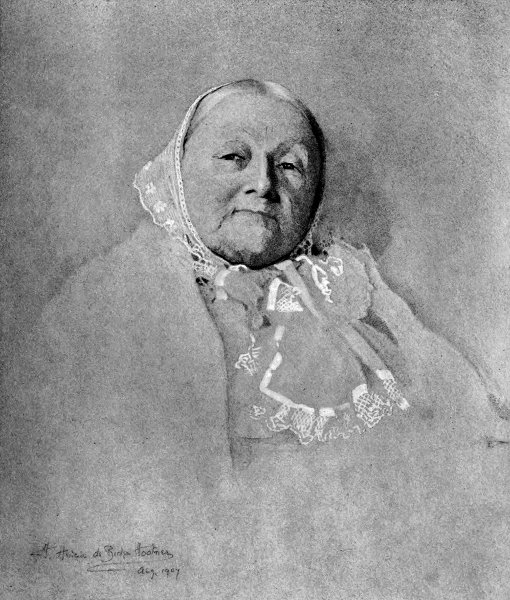
Florence Nightingale
1907
from a water-colour drawing by Miss F. Alicia de Biden Footner
She still received many visitors, in addition to her cousins
and other kinsfolk. Among old friends, Miss Paulina Irby
saw her the most frequently. Sometimes the visit was
from a stranger, to whom the occasion had almost an hieratic
impressiveness. Miss Nightingale liked best those visitors
who had an abundant flow of vigorous talk. A pause in the
conversation, which she might be expected to fill by starting
a new topic, was a strain to her. The visits which tired her
least were those of Matrons and nursing Sisters. She loved
to hear of their work, their patients, and especially of
suggestions they made for improvements. One of her
nursing friends paused in the talk to ask, “But am I not
tiring you?” “Oh, no,” replied Miss Nightingale quickly,
“you give me new life.” To dictate any message on her
own part was now beyond her. Of the messages sent to
her, those which she longest retained the power of apprehending
were from Crimean veterans.
Memory, sight, and mental apprehension were rapidly
failing when the crowning honours of her life (as the world
counts them) were conferred upon her. On November 28,
1907, King Edward wrote with “much pleasure,” to offer
the Order of Merit “in recognition of invaluable services to
the country and to humanity.” A suitable reply was
framed for her, and on December 5, Sir Douglas Dawson, on
the King's behalf, brought the Order—then for the first
time bestowed upon a woman—to South Street. Miss
Nightingale understood that some kindness had been done
to her, but hardly more. “Too kind, too kind,” she said.
On March 16, 1908, the Freedom of the City of London was
conferred upon her—hitherto conferred on only one woman,
Lady Burdett-Coutts. Miss Nightingale was able with
great difficulty to sign from her bed her initials upon the
City's roll of honour, but it is doubtful if she understood
what she was being asked to sign. Perhaps it was better
so. In the years of her strength she had ever a dread and
a misgiving of the world's praises. In the days of her
weakness, when power of work in this world had gone from
her, she would have regarded such honours, had she understood
them, as coming too late. She sought no glory-crown
but the opportunity of doing New Work.
But the prizes of the world may be of real value to others
than those who receive them. The signal honour conferred
by the Crown upon Miss Nightingale had the effect of calling
fresh attention to her work and her example. Not,
indeed, that these depended on adventitious aids to remembrance.
To some men and women whose years are many
it is fated that they should outlive their fame. It was not
so with Miss Nightingale. To her it was given to become
in her lifetime a tradition and almost an institution; and
the longer she lived, the greater, the more widespread was
her fame. Already on her 80th birthday (1900), Miss
Nightingale had been the recipient of congratulations from
Queens and Royal Highnesses, from schools and societies,
and from nurses and nursing associations in all parts of the
world. In the United States the name of Florence Nightingale
was even more widely known and loved than in Great
Britain, and already in 1895 the American Ambassador
(Mr. Bayard) had begged the honour of an interview in
order to tell her “how much revered she is in the United
States.” Perhaps the congratulations which might have
pleased Miss Nightingale most—for she loved efficiency
and had read The Soul of a People—were those which came
from the Far East. From Tokio, on November 28, 1900,
the Princess Imperial sent this letter: “The Committee of
the Ladies of the Red Cross Society of Japan have the
pleasure of presenting to you their hearty congratulation
on the occasion of your 80th birthday. That the Address
reaches you late in time is due to the great distance which
separates your land from ours. But far as our country is
from yours, the example of your noble efforts, now become
historic, has not affected its inhabitants the less; for it is
due to the impulse you have given to the humane work of
nursing sick and wounded soldiers that the trained nurses
of our Society, amounting to more than 1500 in number,
as well as the members of our Committee, are applying
themselves with eager zeal to the study and practice necessary
for complete efficiency in the hour of need. May your day
still be long that you may see the lasting influence of your
work expand by its own virtue more and more in all the
lands of the earth.”
Miss Nightingale had thus not been forgotten when the
Sovereign bestowed the Order of Merit; but the public
honour set up a fresh cult of her name and work. Among
the private congratulations sent to her, there was one which
if she were able to realize it, must have warmed the soldier's
heart in her. It was from Lord Roberts: “Allow me to
offer you on behalf of Lady Roberts and myself sincerest
congratulations on the honour the King has been graciously
pleased to confer upon you. It is indeed an honour conferred
upon the Order of Merit; all the members of which must
feel proud to have the name of Florence Nightingale added
to the list.” The German Emperor, a little later, had a
kindly thought. He had been staying in the New Forest.
“His Majesty,” wrote the German Ambassador (Dec. 10),
“having just brought to a close a most enjoyable stay in
the beautiful neighbourhood of your old home near Romsey,
has commanded me to present you with some flowers as a
token of his esteem.” The Mayor of her native city, Florence,
sent congratulations; the Patriotic Society of Bologna made
her a Companion of Honour. From all parts of Great
Britain, from the Dominions, from the United States,
messages poured in. It was the story of “The Popular
Heroine” repeated after fifty years. The beggars and
autograph-hunters were insistent; the poetasters, industrious.
A great tribe of Florences, named after the heroine of the
Crimea, sent messages. Flowers, needlework, illuminated
cards were offered. Companies of girl-scouts called themselves
“The Nightingales.” There were “Florence Nightingale
Societies” in America. “Birthday letters to Florence
Nightingale” became a favourite school-exercise. There
were Crimean veterans who sent flowers or messages recalling
stirring times in which they had “served with her,” or who
“in old age and suffering” desired to let Miss Florence
Nightingale know that they held her “in lively and grateful
remembrance.”
In June 1907 there was an International Conference of
Red Cross Societies in London. Queen Alexandra sent a
message referring to “the pioneer of the first Red Cross
movement, Miss Florence Nightingale, whose heroic efforts
on behalf of suffering humanity will be recognized and
admired by all ages as long as the world shall last.” The
Conference, on the initiative of the Hungarian delegates,
resolved unanimously that “the great and incomparable
name of Miss Florence Nightingale, whose merits in the
field of humanity are never to be forgotten, and who raised
the care of the sick to the position of a charitable art, imposes
on the Eighth International Conference of Red Cross Societies
the noble duty of rendering homage to her merits by
expressing warmly its high veneration.”
In May 1910 there was a large gathering in the Carnegie
Hall in New York, at which the public orator of America,
Mr. Choate, delivered an eulogium, “testifying to the admiration
of the entire American people for Florence Nightingale's
great record and noble life.” The meeting, assembled in
honour of the Jubilee of the Nightingale Training School,
was eloquent of the spread of her work, being representative
of a thousand Nurse Training Schools in that country.
The subject of these friendly manifestations was already
passing beyond reach of the hubbub. Her sight was gone.
Her understanding had grown more feeble. Her regular
medical attendant was now Dr. May Thorne, whose skill and
unremitting care did much to alleviate the last bed-ridden
years. Sir Thomas Barlow was called in for consultations
periodically. Visitors had now been restricted to two or
three a week. Visits were found tiring, for she could not
realize when the visitors were gone that they were no longer
in the room. Nor did she always remember which of her
old friends were still alive. She did not realize that Sir
Harry Verney was dead, she would sometimes ask for him,
and wonder why he did not come. Besides her own “nieces,”
she still saw Sisters from St Thomas's or other nursing
friends, and occasionally was able by a question or two to
show interest in what they said. One of the last to see her
outside the immediate circle was Miss Pringle, her dear friend,
the Pearl of an earlier chapter. “She was sitting up by the
fire in the familiar room, her mind evidently busy with
happy thoughts, and once or twice she spoke in a tone of
satisfaction.” This was in February 1910. She could no
longer follow sustained reading, but still liked to hear
familiar hymns. A favourite, if one may judge by the
frequency with which verses from it appear in her latest
written meditations, was “O Lord, how happy should we
be, If we could cast our care on Thee, If we from self could
rest.” Once, the expression of an aspiration; now perhaps,
of attainment. The end came very peacefully. At the
beginning of August, 1910, she had some ailment, but there
seemed no cause for immediate apprehension. On August
13, she fell asleep at noon, and did not wake again. She
died at about half-past two in the afternoon. She had
lived 90 years and three months.
The offer of burial in Westminster Abbey was declined
by her relatives. She had left directions that her funeral
should be of the simplest possible kind, and that her body
should be accompanied to the grave by not more than two
persons. She was buried beside her father and mother
in the churchyard of East Wellow, near her old home in
Hampshire. The body was borne to the grave by six of
her “children” of the British Army—sergeants drawn
from the several regiments of the Guards. Her desire
that only two persons should follow the coffin could
not be fulfilled. The funeral arrangements were kept
as private as was possible; but there was a wealth of
flowers from people of every kind, age, and degree, and the
lane and churchyard were filled with a great crowd of men,
women, and children, most of them poorly dressed.
The family grave is marked by a four-sided stone monument.
On two of the sides are inscriptions, composed by
Miss Nightingale, recording the burial there of her father
and mother; on the third, is an inscription in memorial
of their elder daughter, Lady Verney, who is buried at
Claydon. On the fourth side is a small cross with the
letters “F. N.,” and the words “Born 1820. Died 1910.”
The family, as she desired, set up no other memorial.[254] The
hymn sung over her grave was Bishop Heber's. She had
never tired of quoting it in messages to her nurses and her
soldiers, and those who had been about her in the closing
years were often thrilled by the fire which she still put into
her recital of the lines:
The Son of God goes forth to war,
A kingly crown to gain,
His blood-red banner streams afar:
Who follows in his train?