Who is the happy Warrior? Who is he
That every man in arms should wish to be?
—It is the generous Spirit, who, when brought
Among the tasks of real life, hath wrought
Upon the plan that pleased his boyish thought…
Or if an unexpected call succeed,
Come when it will, is equal to the need.
Wordsworth.
Not for delectations sweet,
Not the cushion and the slipper, not the peaceful and the studious,
Not the riches safe and palling, not for us the tame enjoyment,
Pioneers! O pioneers!
Walt Whitman.
On September 20 the Battle of the Alma was fought, and
the country, as Greville noted, was “in a fever of excitement.”
The disembarkation of the allied British and French
forces for the invasion of the Crimea had begun on the 14th.
Their advance was not resisted until they reached the bank
of the Alma, where the Russian commander was awaiting
attack, in so strong a position that he was confident of
victory. In less than three hours the allied troops had driven
the enemy from every part of the ground. Lord Raglan,
the Commander of the Forces, congratulated the troops on
“the brilliant success that attended their unrivalled efforts
in the battle, on which occasion they carried a most formidable
position, defended by large masses of Russian infantry,
and a most powerful and numerous artillery.” The river
which the Russian commander had hoped to make the grave
of the invaders became famous in the annals of British
valour:—
Thou, on England's banners blazoned with the famous fields of old,
Shalt, where other fields are winning, wave above the brave and bold;
And our sons unborn shall nerve them for some great deed to be done,
By that twentieth of September, when the Alma's heights were won.
O thou river! dear for ever to the gallant, to the free,
Alma! roll thy waters proudly, proudly roll them to the sea!
Nearly forty years had passed since the British army
had been engaged in European warfare. The Battle of the
Alma, though it disclosed little tactical skill, and though it
was not followed up as it might have been, had at any rate
shown the desperate courage of the British soldier. The
note of exultation which inspired the verses of Archbishop
Trench expressed the popular mood.
Presently there was a change. The number of killed
and wounded was very large; but though many homes were
thrown into mourning, it was felt, in the words of the official
bulletin, that such a victory “could not be achieved without
a considerable sacrifice.” The country did not at the time
grudge the sacrifice; but Lord Raglan's dispatch was
followed by another. The Crimean War was the first in
which the “Special Correspondent” played a conspicuous
part, and the dispatches sent to the Times by Mr. William
Howard Russell availed even to overthrow a Ministry.
In the Times of October 9, attention was drawn to the
futility of the nursing arrangements on the British side.
The old pensioners, who had been sent out for such service,
were “not of the slightest use”; the soldiers had to
“attend upon each other.” On the 12th a long letter
from “Our Special Correspondent,” dated “Constantinople,
September 30,” ended with the following passage:—
It is with feelings of surprise and anger that the public will
learn that no sufficient preparations have been made for the
proper care of the wounded. Not only are there not sufficient
surgeons—that, it might be urged, was unavoidable; not only
are there no dressers and nurses—that might be a defect of system
for which no one is to blame; but what will be said when it is
known that there is not even linen to make bandages for the
wounded? The greatest commiseration prevails for the sufferings
of the unhappy inmates of Scutari, and every family is
giving sheets and old garments to supply their wants. But
why could not this clearly foreseen want have been supplied?
Can it be said that the Battle of the Alma has been an event to
take the world by surprise? Has not the expedition to the
Crimea been the talk of the last four months? And when the
Turks gave up to our use the vast barracks to form a hospital
and depot, was it not on the ground that the loss of the English
troops was sure to be considerable when engaged in so dangerous
an enterprise? And yet, after the troops have been six months[147]
in the country, there is no preparation for the commonest surgical
operations! Not only are the men kept, in some cases, for a
week without the hand of a medical man coming near their
wounds; not only are they left to expire in agony, unheeded
and shaken off, though catching desperately at the surgeon
whenever he makes his rounds through the fetid ship; but now,
when they are placed in the spacious building, where we were
led to believe that everything was ready which could ease their
pain or facilitate their recovery, it is found that the commonest
appliances of a workhouse sick-ward are wanting, and that the
men must die through the medical staff of the British army
having forgotten that old rags are necessary for the dressing of
wounds. If Parliament were sitting, some notice would probably
be taken of these facts, which are notorious and have excited
much concern; as it is, it rests with the Government to make
inquiries into the conduct of those who have so greatly neglected
their duty.
On the following day a further letter from the “Special
Correspondent” was published. “It is impossible,” he
wrote, “for any one to see the melancholy sights of the last
few days without feelings of surprise and indignation at
the deficiencies of our medical system. The manner in
which the sick and wounded are treated is worthy only of
the savages of Dahomey.… The worn-out pensioners
who were brought as an ambulance corps are totally useless,
and not only are surgeons not to be had, but there are no
dressers or nurses to carry out the surgeon's directions,
and to attend on the sick during the intervals between his
visits. Here the French are greatly our superiors. Their
medical arrangements are extremely good, their surgeons
more numerous, and they have also the help of the Sisters
of Charity, who have accompanied the expedition in incredible
numbers.[69] These devoted women are excellent nurses.”
These scathing attacks changed the mood of the country.
There was still exultation in victory, and still readiness to
pay its price; but the “Special Correspondent's” charges
of neglect towards the sick and wounded raised a feeling
of bitter resentment—of resentment against the authorities,
but also of pity for the victims. The Times accompanied
the “Special Correspondent's” letter on October 12 by
a leading article, making appeal to its readers, who were
sitting comfortably at home, to bestir themselves, and
render such help as might be possible to the soldiers in the
East. A letter was published next day from Sir Robert Peel,
who had enclosed £200 to start a fund for supplying the
sick and wounded with comforts. Other contributions were
quickly forthcoming, and on October 14 a letter was published
asking: “Why have we no Sisters of Charity? There
are numbers of able-bodied and tender-hearted English
women who would joyfully and with alacrity go out to
devote themselves to nursing the sick and wounded, if they
could be associated for that purpose, and placed under
proper protection.”
There were those among the ladies of England who had
not waited to be stung into action by such appeals. On the
first news of the failure of the British nursing arrangements,
they had asked themselves whether they might not help,
not merely by money, but by personal service. One of the
first to move was Lady Maria Forester. She must have
read and marked the letter in the Times on October 9, for
already by October 11 she had placed herself in communication
with Miss Nightingale, offering money to send out some
trained nurses. “I was so anxious something should be
done,” she said to Lady Verney, “that I would have gone
myself, only I knew that I should not have been the slightest
use.” Happily the minds of those who could be of the
greatest use were moving in the same direction. If a party
of women nurses were to be sent out to the East with any
prospect of success, there were two persons in England
whose co-operation was essential, and by fortunate chance
they were personal friends.
One was Mr. Sidney Herbert, the Secretary at War. The
preposition which I have placed in italics must be noted.
The reader would not thank me for entering at length into
all the intricacies of War Office organization, disorganization,
and reorganization, which went on during the Crimean War,
and have continued to our own day. But this much it is
necessary to remember, that in 1854 there was a Secretary
for War (the Duke of Newcastle) and a Secretary at War
(Mr. Sidney Herbert). The curious part of the arrangement
was that the Secretary at War had nothing to do with war,
as such; he was, technically, only a financial and accounting
official. But Mr. Sidney Herbert, in the emergency created
by the Crimean War, stepped courageously beyond the
strict bounds of his office. He had already shown himself
by many beneficent measures of practical reform to be the
Soldiers' Friend. He was deeply interested, as we have
heard (p. 80), in the care of the sick. He knew how over-worked
was his colleague, the Duke of Newcastle, and in
this matter of hospitals he assumed the position of volunteer
delegate of the Secretary of State. “I wish,” wrote Mr.
Gladstone to Monckton Milnes (Oct. 15, 1855), “that some
one of the thousand who in prose justly celebrate Miss
Nightingale would say a single word for the man of ‘routine’
who devised and projected her going.”[70] Lord Stanmore
has said not a word, but a volume, in that sense; what was
truly admirable was “the man of routine's” bold departure
from routine. The employment of female nurses in the
army was in this country entirely novel. It would probably
excite some jealousy in the medical profession; it was sure
to be criticized by the military men. The Cabinet had
much else to think of. The Duke of Newcastle had more
on his hands than any one human being could properly
accomplish. Mr. Herbert, from his influence in the Cabinet,
from his winning manner and general popularity, was the
man to carry through the new departure. He had pondered
long over the problems of nursing, both in military hospitals
and in civil life. He could see no reason why a task, which
in civil life was entrusted almost exclusively to women,
should in the case of military hospitals be confined to men.
The French Government had sent out fifty Sisters of Mercy.
Mr. Herbert could see no reason why England should not
do something of a like kind. He determined to make the
experiment.
He was strengthened in his resolve by the fact that he
was intimately acquainted with the character and the
powers of the second indispensable person. He knew Miss
Florence Nightingale. The preceding Part of this volume
has shown by “what circuit first” her life had been one
long preparation for precisely such work as was now wanted.
She and the Minister had read the dispatch in the Times
with equal, if different, interest. To Mr. Herbert it came
as a call for something to be done, if the Ministry were to
avoid dangerous criticism; and to this motive, which must
rightly actuate every Minister, there was added the conscience
of a high-minded man, sincerely and eagerly anxious
to do all that was possible to improve the treatment of the
sick and wounded soldiers. To Miss Nightingale, as she
read the dispatch, and the stirring appeal which accompanied
it, the words came with something of the force of
a call from Above. For nearly ten years of her life she had
consciously yearned, and half-consciously for a much larger
period, after ample scope in which to exercise her power of
organization, and her desire to serve the sick and suffering.
During many of those years she had been training herself
so as to be ready to use her opportunity when it should
occur. And here was the opportunity at hand, in which
patriotism confirmed her personal aspirations. “God's
good time” had come.
The minds of the Minister and of Miss Nightingale were
kindled together. They reached the flash-point of action
at almost an identical moment. Private initiative forestalled
official overtures only by a few hours. Working in
harmony, they carried the scheme into operation with an
unparalleled rapidity.
Within two days of the publication of the dispatch from
Constantinople, Miss Nightingale and her friends had made
their plans. She submitted them to the Minister in the
following letter addressed to his wife:—
(Miss Nightingale to Mrs. Herbert.) 1 Upper Harley Street,
October 14 [1854]. My Dearest—I went to Belgrave Square this
morning for the chance of catching you or Mr. Herbert even, had
he been in town.
A small private expedition of nurses has been organized for
Scutari, and I have been asked to command it. I take myself
out and one nurse.
Lady Maria Forester has given £200 to take out three others.[151]
We feed and lodge ourselves there, and are to be no expense
whatever to the country. Lord Clarendon has been asked by
Lord Palmerston to write to Lord Stratford for us, and has
consented. Dr. Andrew Smith of the Army Medical Board,
whom I have seen, authorizes us, and gives us letters to the
Chief Medical Officer at Scutari.
I do not mean to say that I believe the Times accounts, but
I do believe that we may be of use to the wounded wretches.
Now to business.
(1) Unless my Ladies' Committee feel that this is a thing
which appeals to the sympathies of all, and urge me, rather than
barely consent, I cannot honourably break my engagement here.
And I write to you as one of my mistresses.
(2) What does Mr. Herbert say to the scheme itself? Does
he think it will be objected to by the authorities? Would he
give us any advice or letters of recommendation? And are
there any stores for the Hospital he would advise us to take out?
Dr. Smith says that nothing is needed.
I enclose a letter from E. Do you think it any use to apply
to Miss Burdett Coutts?
We start on Tuesday if we go, to catch the Marseilles boat
of the 21st for Constantinople, where I leave my nurses, thinking
the Medical Staff at Scutari will be more frightened than amused
at being bombarded by a parcel of women, and I cross over to
Scutari with some one from the Embassy to present my credentials
from Dr. Smith, and put ourselves at the disposal of the Drs.
(3) Would you or some one of my Committee write to Lady
Stratford to say, “This is not a lady but a real Hospital Nurse,”
of me? “And she has had experience.”
My uncle went down this morning to ask my father and
mother's consent.
Would there be any use in my applying to the Duke of
Newcastle for his authority?
Believe me, dearest, in haste, ever yours, F. Nightingale.
Perhaps it is better to keep it quite a private thing, and not
apply to Govt. qua Govt.
This letter was posted on Saturday. Mr. Herbert had
left London to spend Sunday at Bournemouth, and thence,
unaware of the communication which was on its way to him
from Miss Nightingale, he addressed the following letter to
her:—
(Sidney Herbert to Miss Nightingale.) Bournemouth,
October 15 [1854]. Dear Miss Nightingale—You will have[152]
seen in the papers that there is a great deficiency of nurses at the
Hospital at Scutari.
The other alleged deficiencies, namely of medical men, lint,
sheets, etc., must, if they have really ever existed, have been
remedied ere this, as the number of medical officers with the
army amounted to one to every 95 men in the whole
force, being nearly double what we have ever had before, and
30 more surgeons went out 3 weeks ago, and would by this
time, therefore, be at Constantinople. A further supply went
on Thursday, and a fresh batch sail next week.
As to medical stores, they have been sent out in profusion;
lint by the ton weight, 15,000 pairs of sheets, medicine, wine,
arrowroot in the same proportion; and the only way of accounting
for the deficiency at Scutari, if it exists, is that the mass of
stores went to Varna, and was not sent back when the army left
for the Crimea; but four days would have remedied this. In
the meanwhile fresh stores are arriving.
But the deficiency of female nurses is undoubted, none but
male nurses having ever been admitted to military hospitals.
It would be impossible to carry about a large staff of female
nurses with the army in the field. But at Scutari, having now
a fixed hospital, no military reason exists against their introduction,
and I am confident they might be introduced with great
benefit, for hospital orderlies must be very rough hands, and
most of them, on such an occasion as this, very inexperienced
ones.
I receive numbers of offers from ladies to go out, but they
are ladies who have no conception of what an hospital is, nor of
the nature of its duties; and they would, when the time came,
either recoil from the work or be entirely useless, and consequently—what
is worse—entirely in the way. Nor would these ladies
probably ever understand the necessity, especially in a military
hospital, of strict obedience to rule. Lady M. Forester (Lord
Roden's daughter) has made some proposal to Dr. Smith, the
head of the Army Medical Department, either to go with or to
send out trained nurses. I apprehend she means from Fitzroy
Square, John Street, or some such establishment. The Rev. Mr.
Hume, once chaplain to the General Hospital at Birmingham
(and better known as author of the scheme for transferring the
city churches to the suburbs), has offered to go out himself as
chaplain with two daughters and twelve nurses. He was in the
army seven years, and has been used to hospitals, and I like the
tone of his letters very much. I think from both of these offers
practical effects may be drawn. But the difficulty of finding
nurses who are at all versed in their business is probably not
known to Mr. Hume, and Lady M. Forester probably has not[153]
tested the willingness of the trained nurses to go, and is incapable
of directing or ruling them.
There is but one person in England that I know of who would
be capable of organizing and superintending such a scheme;
and I have been several times on the point of asking you hypothetically
if, supposing the attempt were made, you would
undertake to direct it.
The selection of the rank and file of nurses will be very
difficult: no one knows it better than yourself. The difficulty
of finding women equal to a task, after all, full of horrors,
and requiring, besides knowledge and goodwill, great energy and
great courage, will be great. The task of ruling them and
introducing system among them, great; and not the least will
be the difficulty of making the whole work smoothly with the
medical and military authorities out there. This it is which
makes it so important that the experiment should be carried out
by one with a capacity for administration and experience. A
number of sentimental enthusiastic ladies turned loose into the
Hospital at Scutari would probably, after a few days, be mises à
la porte by those whose business they would interrupt, and whose
authority they would dispute.
My question simply is, Would you listen to the request to go
and superintend the whole thing? You would of course have
plenary authority over all the nurses, and I think I could secure
you the fullest assistance and co-operation from the medical staff,
and you would also have an unlimited power of drawing on the
Government for whatever you thought requisite for the success
of your mission. On this part of the subject the details are too
many for a letter, and I reserve it for our meeting; for whatever
decision you take, I know you will give me every assistance and
advice.
I do not say one word to press you. You are the only person
who can judge for yourself which of conflicting or incompatible
duties is the first, or the highest; but I must not conceal from
you that I think upon your decision will depend the ultimate
success or failure of the plan. Your own personal qualities,
your knowledge and your power of administration, and among
greater things your rank and position in Society give you advantages
in such a work which no other person possesses.
If this succeeds, an enormous amount of good will be done
now, and to persons deserving everything at our hands; and a
prejudice will have been broken through, and a precedent established,
which will multiply the good to all time.
I hardly like to be sanguine as to your answer. If it were
“yes,” I am certain the Bracebridges would go with you and
give you all the comfort you would require, and which their[154]
society and sympathy only could give you. I have written very
long, for the subject is very near my heart. Liz [Mrs. Herbert]
is writing to Mrs. Bracebridge to tell her what I am doing. I go
back to town to-morrow morning. Shall I come to you between
3 and 5? Will you let me have a line at the War Office to
let me know?
There is one point which I have hardly a right to touch upon,
but I know you will pardon me. If you were inclined to undertake
this great work, would Mr. and Mrs. Nightingale give their
consent? The work would be so national, and the request made
to you proceeding from the Government who represent the nation
comes at such a moment, that I do not despair of their consent.
Deriving your authority from the Government, your position
would secure the respect and consideration of every one, especially
in a service where official rank carries so much weight. This
would secure to you every attention and comfort on your way
and there, together with a complete submission to your orders.
I know these things are a matter of indifference to you except
so far as they may further the great objects you have in view;
but they are of importance in themselves, and of every importance
to those who have a right to take an interest in your personal
position and comfort.
I know you will come to a wise decision. God grant it may
be in accordance with my hopes! Believe me, dear Miss
Nightingale, ever yours, Sidney Herbert.[71]
There was no hitch, such as Sidney Herbert half feared,
from reluctance on the part of Miss Nightingale's parents.
Her uncle, Mr. Samuel Smith (husband of her Aunt Mai,
of whose helpfulness we have heard), had already half
obtained their consent to her going as a volunteer. All
hesitation was removed when the news came that she was
asked to go by and for the Government itself:—
“My Love,” wrote Miss Nightingale's sister to a friend
(Oct. 18), “Government has asked, I should say entreated, Flo
to go out and help in the Hospital at Scutari. I am sure you will
feel that it is a great and noble work, and that it is a real duty;
for there is no one, as they tell her, and I believe truly, who has
the knowledge and the zeal necessary to make such a step
succeed.”
And to the same friend a day or two later:—
Before, in Harley Street, I did not feel sure that she was
right, there seemed so much to be done at home; but now there
is no doubt that she is fitted to do this work, and that no one else
is, and that it is a work. I must say the way in which all things
have tended to and fitted her for this is so very remarkable that
one cannot but believe she was intended for it. None of her
previous life has been wasted, her experience all tells, all the
gathered stores of so many years, her Kaiserswerth, her sympathy
with the R. Catholic system of work, her travels, her search
into the hospital question, her knowledge of so many different
minds and different classes, all are serving so curiously—and
much more than I have time for.
Yes, and perhaps even the difficulties which affectionate
solicitude had placed in Florence Nightingale's way might
have been counted among her preparations for a task involving
great power of will and determination.
Miss Nightingale saw Mr. Herbert on Monday, October
16, and the matter was arranged between them. Mrs.
Sidney Herbert and the other ladies of the Harley Street
Committee readily released their Superintendent. Her
faithful friends, Mr. and Mrs. Bracebridge, agreed to accompany
her. Mr. Herbert had assured Miss Nightingale
of their willingness, without any previous consultation—a
fine instance, surely, of friendly confidence. The Duke of
Newcastle, who had some slight personal acquaintance with
Miss Nightingale, and the other members of the Cabinet
cordially approved the initiative of their colleague, and
three days later Miss Nightingale received her official
appointment and instructions:—
(The Secretary-at-War to Miss Nightingale.) War Office,
October 19 [1854]. Madam—Having consented at the pressing
instance of the Government to accept the office of Superintendent
of the female nursing establishment in the English General
Military Hospitals in Turkey, you will, on your arrival there,
place yourself at once in communication with the Chief Army
Medical Officer of the Hospital at Scutari, under whose orders
and direction you will carry on the duties of your appointment.
Everything relating to the distribution of the nurses, the
hours of their attendance, their allotment to particular duties,
is placed in your hands, subject, of course, to the sanction and
approval of the Chief Medical Officer; but the selection of the[156]
nurses in the first instance is placed solely under your control,
or under that of persons to be agreed upon between yourself and
the Director-General of the Army and Ordnance Medical Department,
and the persons so selected will receive certificates from
the Director-General or the principal Medical Officer of one of
the General Hospitals, without which certificate no one will be
permitted to enter the Hospital in order to attend the sick.
In like manner the power of discharge on account of illness
or of dismissal for misconduct, inaptitude, or other cause, is
vested entirely in yourself; but in cases of such discharge or
dismissal the cost of the return passage of such person home will,
if you think it advisable and if they proceed at once or so soon
as their health enables them, be defrayed by the Government.
Directions will be given by the mail of this day to engage
one or two houses in a situation as convenient as can be found
for attendance at the Hospital, or to provide accommodation in
the Barracks if thought more advisable. And instructions will
be given to Lord Stratford de Redcliffe to afford you every
facility and assistance on landing at Constantinople, as also to
Dr. Menzies, the Chief Medical Officer of the Hospital at Scutari,
who will give you all the aid in his power and every support in
the execution of your arduous duties.
The cost of the passage both out and home of yourself and
the nurses who may accompany you, or who may follow you,
will be defrayed by the Government, as also the cost of house
rent, subsistence, &c., &c.; and I leave to your discretion the rate
of pay which you may think it advisable to give to the different
persons acting under your authority.
In the meanwhile Sir John Kirkland, the Army Agent, has
received orders to honor your drafts to the amount of One
Thousand Pounds for the necessary expense of outfit, travelling
expenses, &c., &c., of which sum you will render an account to
the Purveyor of the Forces at Scutari.
You will, for your current expenses, payment of wages, &c.,
&c., apply to the Purveyor through the Chief Medical Officer, in
charge of the Hospital, who will provide you with the necessary
funds.
I feel confident that, with a view to the fulfilment of the
arduous task you have undertaken, you will impress upon those
acting under your orders the necessity of the strictest attention
to the regulations of the Hospital, and the preservation of that
subordination which is indispensable in every Military Establishment.
And I rely on your discretion and vigilance carefully to guard
against any attempt being made among those under your
authority, selected as they are with a view to fitness and without[157]
any reference to religious creed, to make use of their position in
the Hospitals to tamper with or disturb the religious opinions of
the patients of any denomination whatever, and at once to check
any such tendency and to take, if necessary, severe measures
to prevent its repetition.
I have the honor to be, Madam, your most obedient servant,
Sidney Herbert.
The instructions promised in this letter were duly sent
to the Commander of the Forces, the Purveyor-in-Chief,
and the Principal Medical Officer;[72] and the way was
smoothed for Miss Nightingale, as they thought in Downing
Street, by supplementary letters to some of the officials.
A letter was sent to the Purveyor-General (Oct. 19), in
which “Mr. Sidney Herbert trusts that you will use every
endeavour to assist Miss Nightingale in the performance
of the arduous duties she has voluntarily undertaken, the
success of which must necessarily depend upon the assistance
and co-operation of others, and cannot fail to be of great
benefit to those Gallant Men who have suffered in the service
of their country.” Similarly Sir Charles Trevelyan, Assistant-secretary
to the Treasury, remarking that the commissariat
officers are the bankers and stewards of the army,
wrote, as he told Miss Nightingale (Oct. 20), “to Commissary-General
Filder and Deputy-Commissary-General Smith, the
Senior Officer at Scutari, to request that they will from the
first give you all the support they are able, and instruct their
officers of every grade to do the same.” Any difficulties
which might confront her would not be caused, it seemed, by
lack of support at home.
Private support was forthcoming as readily as official.
Mr. Henry Reeve, an old friend of Miss Nightingale and her
family, rejoicing that she had now “an opportunity of action
worthy of her,” spoke to the great Delane, and requested
him to direct Mr. Macdonald—who was being sent out to
administer the Times Fund—to co-operate with Miss
Nightingale. Mr. Macdonald was a man, as Mr. Reeve
testified, and as Miss Nightingale was to discover—to the
great advantage of their common cause,—“of remarkable
intelligence and activity.”
Two days after the receipt of her official instructions,
five days after her interview with Mr. Herbert, Miss Nightingale
and her party left London (Oct. 21). The amount of
work which fell upon Miss Nightingale during the ten days
(Oct. 12–21) was enormous, and some of the details she was
obliged to delegate to others. The headquarters of the
expedition during its outfit were established at Mr. Sidney
Herbert's house in Belgrave Square, and there Miss Mary
Stanley and Mrs. Bracebridge interviewed applicants. Miss
Nightingale, foreseeing (only too truly, as the event was to
show) the difficulty both of finding suitable women and of
supervising them, was inclined to limit the number to twenty.
Mr. Herbert, thinking that such a new departure should be
made on a considerable scale, proposed a larger number,
and Miss Nightingale gave way. Forty was the number
agreed upon; but the material which offered itself was not
promising. “Here we sit all day,” wrote Miss Stanley;
“I wish people who may hereafter complain of the women
selected could have seen the set we had to choose from.
All London was scoured for them. We sent emissaries in
every direction to every likely place.… We felt ashamed
to have in the house such women as came. One alone expressed
a wish to go from a good motive. Money was the
only inducement.”[73] Ultimately thirty-eight nurses were
obtained.
Mr. Herbert, in the concluding passage of his Instructions,
relied on Miss Nightingale's vigilance to prevent
religious “tampering.” This was an instruction which she
had discussed with him, for she foresaw (again only too well)
the odium theologicum that might confront her. She was
primarily concerned to get the best nurses as such, but she
was anxious also that the different churches or shades
should be represented. In this desire she was in large
measure disappointed. Application was made both to St.
John's House, an institution inclined towards Tractarianism,
and to the Protestant Institution for Nurses in Devonshire
Square. In each case the answer was returned that nurses
could only be supplied if they were to be subject to their
own Committees; the Government's condition of subjection
to Miss Nightingale's control was rejected. The authorities
of St. John's House proposed that their nurses should be
accompanied by the Master of the House, to act as “their
guardian.” It will readily be imagined how impossible
Miss Nightingale's position would have been on such terms.
The proposal shows incidentally how little some people
understood of the conditions of discipline necessary in a
military hospital. Mr. Sidney Herbert, the Chaplain-General
of the Forces, and Miss Nightingale met the Council
of St. John's House; the point of Miss Nightingale's exclusive
control was conceded, and the Master stayed at home.
The Lady Superior of St. John's House at this time was Miss
Mary Jones, who to the end of her life remained one of the
most valued and tenderly devoted of Miss Nightingale's
friends.[74] The authorities in Devonshire Square, on the
other hand, would not surrender the point of separate control,
and accordingly no nurses were supplied by the distinctively
Protestant institution. “We are only vexed,”
wrote Lady Verney, “because Flo so earnestly desired to
include all shades of opinion, to prove that all, however they
differed, might work together in a common brotherhood of
love to God and man.”
The party, as ultimately recruited, was composed of ten
Roman Catholic Sisters (five from Bermondsey and five from
Norwood), eight Anglican Sisters (from Miss Sellon's Home at
Devonport), six nurses from St. John's House, and fourteen
from various English hospitals. It has often been supposed
that the nurses who accompanied Miss Nightingale were ladies
of gentle birth, but, with a few exceptions, this was not
the case. On the eve of their departure, the nurses were
addressed by Mr. Herbert in his dining-room. He told
them that if any desired to turn back, now was the time of
decision, and he impressed upon them that all who went were
bound implicitly to obey Miss Nightingale in all things.
“All started on their ways,” we are told,[75] “strengthened
by his heart-stirring words, and cheered no less by the
sunny brightness of his presence than by his kindly and
unfailing sympathy.” Unhappily the effect was not in all
cases permanent, as we shall hear.
“Do not answer this,” wrote a Minister to Miss Nightingale;
“for I am sure you must have more on your hands
now than a Secretary of State.” But what struck those
about her was her perfect calm. “No one is so well fitted
as she to do such work,” wrote Lady Canning to Lady
Stuart de Rothesay (Oct. 17); “she has such nerve and
skill, and is so wise and quiet. Even now she is in no bustle
and hurry, though so much is on her hands, and such numbers
of people volunteer services.” She had only one worry.
Her pet owl had died. When her family were leaving
Embley to see her off, the feeding of the owl was forgotten
in the hurry and flurry. It was embalmed, and “the only
tear its mistress shed through that tremendous week,” says
her sister, “was when I put the little body into her hands.
‘Poor little beastie, it was odd how much I loved you.’”[76]
For the rest, she was “as calm and composed in this furious
haste,” wrote her sister (Oct. 19), “with the War Office,
the Military Medical Board, half the nurses in London to
speak to, her own Committee and Institution, as if she were
going out for a walk.” She was quiet because, like Wordsworth's
Happy Warrior, in the heat of excitement, she
“kept the law in calmness made, and saw what she foresaw.”
Like the character drawn by another master-hand, “in the
tumult she was tranquil,” because she had pondered when
at rest.
A small black pocket-book is preserved in which were
found, at Miss Nightingale's death, a few of the many letters
received just before she left England for the East. Perhaps
they were the very last letters received; perhaps they were
there for other reasons. One spoke of a mother's love:—
Monday morning. God speed you on your errand of mercy,[161]
my own dearest child. I know He will, for He has given you
such loving friends, and they will be always at your side to help
in all your difficulties. They came just when I felt that you
must fail for want of strength, and more mercies will come in
your hour of need. They are so wise and good, they will be to
you what no one else could. They will write to us, and save
you in that and in all ways. They are to us an earnest of blessings
to come. I do not ask you to spare yourself for your own sake,
but for the sake of the cause.—Ever Thine.
Another letter reminded her of the love of God:—
God will keep you. And my prayer for you will be that
your one object of Worship, Pattern of Imitation, and Source of
consolation and strength may be the Sacred Heart of our Divine
Lord. Always yours for our Lord's sake,
Henry E. Manning.
And a third among them was from the friend whose life
she had declined to share, but whose sympathy was still
precious to her:—
“My dear Friend,” he wrote (Oct. 18), “I hear you are
going to the East. I am happy it is so, for the good you will do
there, and the hope that you may find some satisfaction in it
yourself. I cannot forget how you went to the East once before,
and here am I writing quietly to you about what you are going
to do now. You can undertake that, when you could not undertake
me. God bless you, dear Friend, wherever you go.”
On the ocean no post brings us letters which we are compelled to
answer. No newspaper tempts us into reading the last night's debate in
Parliament. The absence of distracting incidents, the sameness of the
scene, and the uniformity of life on board ship, leave us leisure for reflection;
we are thrown in upon our own thoughts, and can make up our
accounts with our consciences.—Froude.
Miss Nightingale and her party left London on Saturday,
October 21. Among those who saw them off was her
cousin, Arthur Hugh Clough. The principal halts were made
in Paris and Marseilles. At Paris, Miss Nightingale had
hoped to recruit some Sisters for nursing service. She went
to the headquarters of the Order of St. Vincent de Paul,
furnished with letters from the British Government and the
French military authorities, and accompanied by the British
Ambassador's private secretary in order to strengthen her
application; but it was refused.[77] At Marseilles, with what
turned out to be admirable forethought, she laid in a large
store of miscellaneous provisions. Her uncle, Mr. Sam
Smith, accompanied the party to Marseilles, and from his
letters we obtain vivid glimpses of the expedition en route:—
“Kindly received everywhere,” he wrote (Oct. 26), “by
French and English. Still it was very hard work for Flo to
keep 40 in good humour; arranging the rooms of 5 different
sects each night, before sitting down to supper, took a long
time; then calling all to be down at 6 ready to start. She bears
all wonderfully—so calm, winning everybody, French and
English.”
A correspondent wrote to the Times from Boulogne,
describing how the arrival of the party there caused so much
enthusiasm, that the sturdy fisherwomen seized their bags
and carried them to the hotel, refusing to accept the slightest
gratuity; how the landlord of the hotel gave them dinner,
and told them to order what they liked, adding that they
would not be allowed to pay for anything; and how waiters
and chambermaids were equally firm in refusing any acknowledgment
for their attentions. Lady Verney, in a
letter to a friend, acutely noted a yet more remarkable
thing, “the railroad would not be paid for her boxes.”
At Marseilles the expedition excited lively interest, and
its Chief was overwhelmed with attentions:—
“Where she was seen or heard,” wrote the proud uncle,
“there was nothing but admiration from high and low. Her
calm dignity influenced everybody. I am sure the nurses quite
love her already. Some cried when she exhorted them at the
last, and all promised well. Blessings on her! She makes
everybody who joins with her feel the good and like it (instead
of disposing them against it, as some well-meaning oppositious
spirits do).”
And again in another letter:—
Words cannot tell Mrs. Bracebridge's devotion to Flo, nor
Flo's to the cause. Neither sat down but for a hurried meal.
Shopkeepers, visitors, nurses, servants, every single instant. Flo
never crossed the threshold. There she was, receiving in her
little bedroom (not at bedtime) the Inspector-General, the
Consul and Agent, a Queen's Messenger, Times Correspondent,
and two or three shopkeepers with the same serenity as if in a
drawing-room quite désœuvrée. Her influence on all (to captain
and steward of boat) was wonderful. The rough hospital nurses,
on the third day after breakfasting and dining with us each
day, and receiving all her attentions, were quite humanized and
civilized, their very manners at table softened. “We never
had so much care taken of our comforts before; it is not people's
way with us; we had no notion Miss N. would slave herself
so for us.” She looked so calm and noble in it all, whether
waiting on the nurses at dinner in the station (because no one
else would), or carrying parcels, or receiving functionaries.
The Bracebridges are fuller than ever of admiration of her, as
I am. She looked better and handsomer than even the day she
sailed. I went back with the literary public of Marseilles, all
full of admiration. It was very doleful sitting in Flo's deserted
room.
She sailed from Marseilles on board the Vectis on Friday,
October 27, loudly cheered from an English vessel in the
harbour, carrying with her, as a friend had written, “the
deep prayers and gratitude of the English people.”
From the moment when public announcement of her
mission was made, she had, indeed, become a popular
heroine. Though well known in Society, she had been as yet
a stranger to public fame; so much so that the Times itself,
in printing the announcement (Oct. 19), said: “We are
authorised to state that Mrs. Nightingale,” etc. Delane
cannot have kept his eye on the news-columns, for not until
some days had elapsed was it discovered to the public that
“Mrs.” Nightingale was in fact “Miss.” “Who is ‘Mrs.’
Nightingale?” was a heading in the Examiner (Oct. 28),
and the question was answered in a biographical article.
Some passages of it deserve record here, for it went the
round of the press throughout the world, and was the source
from which, from that day to this, the popular idea of
Florence Nightingale has been derived. The article stated
succinctly, and with substantial accuracy, the course of
her life; dwelt upon the facts that she was “young, graceful,
feminine, rich, and popular”; enlarged, with less
accuracy, upon her delight in the “palpable and heart-felt
attractions” of her home; described her forsaking the
“assemblies, lectures, concerts, exhibitions, and all the
entertainments for taste and intellect with which London
in its season abounds,” in order to sit beside the sick and
dying; and concluded thus: She had set out for the scene
of war
… at the risk of her own life, at the pang of separation from
all her friends and family, and at the certainty of encountering
hardship, dangers, toils, and the constantly renewing scene of
human suffering, amid all the worst horrors of war. There are
few who would not recoil from such realities, but Miss Nightingale
shrank not, and at once accepted the request that was made
her to form and control the entire nursing establishment for all
sick and wounded soldiers and sailors in the Levant. While we
write, this deliberate, sensitive, and highly-endowed young lady[165]
is already at her post, rendering the holiest of women's charities
to the sick, the dying, and the convalescent. There is a heroism
in dashing up the heights of Alma in defiance of death and all
mortal opposition, and let all praise and honour be, as they are,
bestowed upon it; but there is a quiet forecasting heroism and
largeness of heart in this lady's resolute accumulation of the
powers of consolation, and her devoted application of them,
which rank as high and are at least as pure. A sage few will
no doubt condemn, sneer at, or pity an enthusiasm which to
them seems eccentric, or at best misplaced; but to the true heart
of the country it will speak home, and be there felt that there is
not one of England's proudest and purest daughters who at this
moment stands on so high a pinnacle as Florence Nightingale.
The discovery by the public that the head of the Nursing
Expedition was not “Mrs.” Nightingale, a matron, but a
young lady, “graceful, rich, and popular,” added to the
enthusiasm which her devotion called forth. Her services
were rendered gratuitously; her necessary expenses were
to be defrayed by the Government, and officialdom opined
that no voluntary contributions, either in money or in kind,
were needed. Happily for the comfort of our soldiers in
the East, private individuals took a different view, and—in
addition to the Times Fund—donations were sent to
Miss Nightingale personally, both by her friends and by the
general public. An account rendered after her return[78] from
the East shows that from the general public she received
nearly £7000 in money. This fund, added to the help which
she obtained from the Times, and supplemented by expenditure
out of her private purse, enabled Miss Nightingale
greatly to extend the scope of her work. The statement
that she was rich requires some qualification. Her father
was rich, but the personal allowance which he had made to
her, when she declared her independence in 1853, was £500
a year, and it remained at this figure for several years.
During her mission to the East she devoted the whole of
it to her work.
Gifts in kind and offers of personal service also poured in.
Now that Miss Nightingale was at sea, the task of dealing
with such matters was undertaken by her sister and a friend.
The Nightingale family had taken a house for the time in
Cavendish Square (No. 4), which became the headquarters
of a charitable bureau.
“I am well nigh writ out,” wrote Lady Verney to Madame
Mohl (Nov. 6), “170 letters to answer in the last fortnight, and
very difficult ones, some of them. I should like you to hear a
batch of the offers of all kinds we receive, some so pretty, some
so queer. Old linen is abating, I am happy to say; even knitted
socks are slacker; but nurses, rabble and respectable, ladies,
and very much the reverse, continue to rain. It is tremendous;
however, having reached No. 276, we are going to shut the door.
Mary Stanley and I sit daily at the receipt of custom, and funny
things do we see and hear! Human nature is a wondrous work,
whether of God Almighty I sometimes begin to doubt.”
It is worth noting, in view of an unfortunate dispute
that presently arose, that both Lady Verney and Miss
Stanley distinctly understood that additional nurses would
only be sent “if Flo asks.” All applicants were so informed;
but so keen was the desire to serve, that “many ladies,”
so Lady Verney wrote, “are undergoing hospital training
on chance.”
Miss Nightingale, meanwhile, was at sea on her way to
Constantinople, revolving many things in her mind. She
had been called to a mission upon which issues very near to
her heart depended. If it succeeded, then, as Mr. Herbert
had written to her, not only would an enormous amount of
good be done now to the sick and wounded, but “a prejudice
would have been broken through, and a precedent established,
which would multiply the good to all time.” And
so, as we all know, it was destined to be. But at the time
the fate of the experiment was doubtful. It was Mr.
Herbert's conviction that no one except Florence Nightingale
could make it succeed, but it was by no means certain that
even she could do so. She took in her hands the reputation
of the Minister who trusted her, and her own; and not her
reputation only, but the hopes, the aspirations, the ambitions
which had ruled her life.
She determined to succeed, and she counted the difficulties
which would confront her. Writing two years later
and giving account of her stewardship, she paid her tribute
of thanks to those “among the officials, medical as well as
military, to whose benevolence, ability, and unselfish devotion
to duty she was indebted for facilities, without which,
in a position such as hers, new to the service, and exposed
to much criticism and difficulty, she would have been utterly
unable to perform the work entrusted to her.”[79] She saw
from the start that she would be exposed, in the very nature
of the case, to some medical jealousy and much military
prejudice.
The idea of employing female nurses at Scutari had been
mooted before the army left for the East, but was abandoned,
as the Duke of Newcastle explained, because “it was not
liked by the military authorities.”[80] Of the military
prejudice against the intrusion of women, even for the
gentle office of nursing, into the rough work of war, some
entertaining illustrations are happily on record. Lieutenant-Colonel
Sterling, afterwards Sir Anthony Sterling, K.C.B.,
was on active service during the Crimean campaign, first
as brigade-major, and afterwards as assistant adjutant-general
to the Highland division. He was an elder brother
of Carlyle's John Sterling, and himself possessed of some
literary skill. “A solid, substantial man,” Carlyle calls
him; he was also a man who loved to stand by the ancient
ways. He wrote a series of lively letters during the campaign,
and in his will directed that they should be published.
Nowhere, so clearly as in Sterling's Highland Brigade in the
Crimea, have I found contemporary evidence of the prejudices
against which the experiment of Mr. Herbert and
Miss Nightingale had to contend. During Miss Nightingale's
visit to Balaclava in 1855, some dispute arose among
the nurses. “Miss—— has added herself,” wrote Colonel
Sterling, “to the hospital of the 42nd; and will not acknowledge
the voice of the Nightingale, who has written an
official letter to Lord Raglan on the subject. I suppose he
will order a court-martial composed of nurses, who will
administer queer justice.” Our Colonel is something of a
wag. He cannot help laughing at “the Nightingale,”
because, as he explains, he has such “a keen sense of the
ridiculous.” He is so pleased with his quip about the female
court-martial that he returns to it in another letter. He is
tickled, too, by a saying of the mess-room, that “Miss
Nightingale has shaved her head to keep out vermin.” One
can almost hear the honest Colonel's guffaw as he wonders
whether “she will wear a wig or a helmet?” Women, he
supposes, imagine that “war can be made without wounds”;
they will be teaching us how to fight next; and as for their
ideas of nursing, why some of the ladies actually took to
“scrubbing floors”! It amused him, but angered him no
less. He has to admit that he believes “the Nightingale”
has been of some use; but he bitterly resents her “capture”
of orderlies for mere purposes of nursing, and when he is
asked, “When will she go home?” answers with Christopher
Sly, “Would it were done.” “However,” he writes,
“—— (presumably Sidney Herbert) is gone; and I hope
there is not to be found another Minister who will allow
these absurdities.” Miss Nightingale read Sir Anthony's
book when it came out in 1895, and made some severe
marginalia upon it; remarking upon his “absolute ignorance
of sanitary things,” noting the “misprints as a fair index to
the whole,” and finally dismissing the book as “one long
string of Seniority complaints.” But I protest that she
need not have been so angry. And, indeed, perhaps she was
not so angry as she seemed, for her caustic pen was not
always a true index of her mind. For my part I take my
hat off to Sir Anthony Absolute. His honest, old-fashioned
outbursts let in a flood of light upon one side of the difficulties
which were to confront Miss Nightingale upon landing
at Scutari.
She pondered much also upon the possibilities of friction
with the medical officers; and here, too, our Colonel has
some light to give us. “The Chief Medical Officer out here,”
he wrote, “ought to have been intrusted with Nightingale
powers.” The Service in all its branches stuck together, it
will be seen, and no blame to it for that! But if a fighting
colonel smarted under what he deemed a slight upon an
army medical officer, how much more might the Medical
Service itself be expected to resent any encroachment upon
its appointed province! How keenly it did resent such
encroachment may be gathered from the Life and Letters of
Sir John Hall, M.D., by Mr. Mitra, whose book supplies us
with the same kind of illustration in regard to the army
doctors that we may gather from Colonel Sterling's in regard
to the soldiers. Sir John, like Sir Anthony, thought the
whole thing “very droll.” He was stationed in the Crimea,
and we shall hear something of the strained relations between
him and Miss Nightingale, when we follow her thither.
But at Scutari also, there were some few medical officers
who retained even to the last a ridiculous jealousy of any
“meddling” by Miss Nightingale and her staff.[81] She
foresaw this danger, and made up her mind to avert it by
every means in her power.
And there was a third danger which she foresaw also.
Not only had she to overcome military prejudice and to
avert medical jealousy, but she had also to prevent religious
disputation. This last task was beyond her powers, as it
has ever proved beyond those of men, women, and angels;
for by this cause even the angels fell. No work, however
beneficent, has ever yet been found beyond the capacity of
the odium theologicum to mar and embitter. Miss Nightingale's
mission did not escape the common lot, as we shall
hear; but she was keenly sensible of the danger.
Miss Nightingale pondered over all these things as the
ship sped on its way to the Golden Horn; and the more she
pondered, the more she was driven to decide upon a course
of action, very different from what many people supposed
that she would adopt, but entirely consonant with the bent
of her own mind. She saw quite clearly that, if she was to
avoid the rocks ahead of her, what was needed was not so
much genial, impulsive kindness, reckless of rules and
defiant of constituted authority, but rather strict method,
stern discipline, and rigid subordination. The criticisms
to which she exposed herself in the superintendence of her
nurses were based, not upon laxity, but upon her alleged
severity.[82] As for her own conduct, she supposed that her
work, when she landed, would be that of the matron of a
hospital. If, as it turned out, she became rather (as she
put it) mistress of a barrack, it was because she found
herself in the midst of conditions which the constituted
authorities at home had not foreseen, and before which those
on the spot stood powerless. Miss Nightingale was happily
possessed of an original mind and a resolute will. She saw
evils which cried out for remedies; and new occasions
taught new duties.
Dearth of creative brain-power showed itself in our Levantine hospitals,
for there industrious functionaries worked hard at their accustomed tasks,
and doggedly omitted to innovate at times when not to be innovating
was surrendering, as it were, at discretion to want and misery. But
happily, after a while, and in gentle, almost humble, disguise, which put
foes of change off their guard, there acceded to the state a new power.—Kinglake.
Miss Nightingale reported the arrival of her expedition at
Constantinople in a short note to her parents:—
Constantinople, November 4, on board Vectis.—Dearest
People—Anchored off the Seraglio point, waiting for our fate
whether we can disembark direct into the Hospital, which, with
our heterogeneous mass, we should prefer.
At six o'clock yesterday morn I staggered on deck to look
at the plains of Troy, the tomb of Achilles, the mouths of the
Scamander, the little harbour of Tenedos, between which and
the mainshore our Vectis, with steward's cabins and galley torn
away, blustering, creaking, shrieking, storming, rushed on her
way. It was in a dense mist that the ghosts of the Trojans
answered my cordial hail, through which the old Gods, nevertheless,
peered down from the hill of Ida upon their old plain. My
enthusiasm for the heroes though was undiminished by wind and
wave.
We made the castles of Europe and Asia (Dardanelles) by
eleven, but also reached Constantinople this morn in a thick
and heavy rain, through which the Sophia, Sulieman, the Seven
Towers, the walls, and the Golden Horn looked like a bad
daguerrotype washed out.
We have not yet heard what the Embassy or Military Hospital
have done for us, nor received our orders.
Bad news from Balaclava. You will hear the awful wreck of
our poor cavalry, 400 wounded, arriving at this moment for us
to nurse. We have just built another hospital at the Dardanelles.[172]
You will want to know about our crew. One has turned out
ill, others will do.
(Later) Just starting for Scutari. We are to be housed in the
Hospital this very afternoon. Everybody is most kind. The
fresh wounded are, I believe, to be placed under our care. They
are landing them now.
The Hospital, to which Miss Nightingale refers, was to
be the chief scene of her labours for the next six months,
and a few particulars about it and other hospitals, in which
the nursing was under her superintendence, must be given
in order to make future proceedings intelligible. The
principal hospitals of the British army during the Crimean
War—four in number—were at Scutari (or in its immediate
neighbourhood), the suburb of mournful beauty which looks
across to Constantinople from the Asiatic side of the Bosphorus.
The first hospital to be established was in the Turkish
Military Hospital. This was made over to the British in
May 1854, and was called by them The General Hospital.
Having been originally designed for a hospital, and being
given up to the English partially fitted, it was, wrote Miss
Nightingale, “reduced to good order early, by the unwearied
efforts of the first-class Staff Surgeon in introducing
a good working system. It was then maintained
in excellent condition till the close of the war.”[83] It had
accommodation for 1000 patients, but the Battle of the
Alma showed that much larger accommodation would be
wanted.
North of the General Hospital, and near to the famous
Turkish cemetery of Scutari, are the Selimiyeh Barracks—a
great yellow building with square towers at each angle.
This building was made over to the British for use as a
hospital after the Battle of the Alma, and by them was
always called The Barrack Hospital. This is the hospital
in which Miss Nightingale and her band of female nurses
were first established, and in which she herself had her
headquarters throughout her stay at Scutari. It is built
on rising ground, in a beautiful situation, looking over the
Sea of Marmora on one side, towards the Princes' Islands on
another, and towards Constantinople and up the Bosphorus
on a third. “I have not been out of the Hospital Walls
yet,” wrote Miss Nightingale ten days after her arrival,
“but the most beautiful view in all the world, I believe, lies
outside.” Her quarters were in the north-west tower, on
the left of the Main Guard (or principal entrance). There
was a large kitchen or storeroom, of which we shall hear
more presently, and out of it on either side various other
rooms opened. Mr. Bracebridge and the courier slept in
one small room; Miss Nightingale and Mrs. Bracebridge in
another. The nurses slept in other rooms. The whole
space occupied by Miss Nightingale and her nurses was
about equal to that allotted to three medical officers and
their servants, or to that occupied by the Commandant.
“This was done,” she explained, “in order to make no
pressure for room on an already overcrowded hospital. It
could not have been done with justice to the women's
health, had not Miss Nightingale later taken a house in
Scutari at private expense, to which every nurse attacked
with fever was removed.”[84] The quarters were as uncomfortable
as they were cramped. “Occasionally,” wrote
Miss Nightingale, “our roof is torn off, or the windows are
blown in, and we are under water for the night.” The
Hospital was infested also with rodents and vermin; and,
among other new accomplishments acquired under the
stress of new occasions, Miss Nightingale became an expert
rat-killer. This skill was afterwards called into use at
Balaclava. In the spring of 1856, one of the nuns whom
she had taken with her to the Crimea—Sister Mary Martha—had
a dangerous attack of fever. Miss Nightingale nursed
the case; and one night, while watching by the sick-bed,
she saw a large rat upon the rafters over the Sister's head;
she succeeded in knocking it down and killing it, without
disturbing the patient.[85] The condition of physical discomfort
in which, surrounded by terrible scenes of suffering,
she had to do her work, should be remembered in taking
the measure of her fortitude and devotion.[86]
The maximum number of patients accommodated at
any one time (Dec. 23, 1854) in the Barrack Hospital was
2434. It was half-an-hour's walk from the General Hospital,
and an invalided soldier records that he used to accompany
Miss Nightingale from one hospital to another in order to
light her home on wet stormy nights, across the barren
common which lay between them.
Farther south of the General Hospital, in the quarter of
Haidar Pasha, was what was known as The Palace Hospital,
consisting of various buildings belonging to the Sultan's
Summer Palace. These were occupied as a hospital in
January 1855. Miss Nightingale had no responsibility
here; but in the summer of 1855, the female nursing of sick
officers, quartered in one of these buildings, was placed
under the superintendence of Mrs. Willoughby Moore, the
widow of an officer who had died a noble death in the war,
and four female nurses, sent out specially from England.
Finally, there were hospitals at Koulali, four or five
miles farther north, upon the same Asiatic shore of the
Bosphorus. These hospitals were opened in December 1854.
The nursing in them was originally under Miss Nightingale's
supervision, but she was presently relieved of it (p. 193 n.).
The hospitals were broken up in November 1855, when, of the
female nursing establishment, a portion went home, and
the rest passed under Miss Nightingale into the hospitals at
Scutari.
There were also five hospitals in the Crimea, but particulars
of these may be deferred till the time comes for following
Miss Nightingale upon her expeditions to the front. For
the nursing in the Civil Military Hospitals (i.e. hospitals
controlled by a civilian medical staff) at Renkioi (on the
Dardanelles) and at Smyrna, and for the Naval Hospital
at Therapia, Miss Nightingale had no responsibility, though
there is voluminous correspondence among her papers
showing that she was constantly consulted upon the site
and arrangements of these hospitals. The medical superintendent
of the hospital at Renkioi was Dr. E. A. Parkes,
with whom Miss Nightingale formed a friendship which
endured to the end of his life.
The state of the hospitals when Miss Nightingale arrived
requires some description, which, however, need not be long.
The treatment of the sick and wounded during the Crimean
War was the subject of Departmental Inquiries, Select
Committees, and Royal Commissions, which, when they
had finished sitting upon the hospitals, began sitting upon
each other. Enormous piles of Blue-books were accumulated,
and in the course of my work I have disturbed much
dust upon them. The conduct of every department and
every individual concerned was the subject of charge,
answer, and countercharge innumerable. Each generation
deserves, no doubt, the records of mal-administration which
it gets; but one generation need not be punished by having
to examine in detail the records of another. Some of the
details of the Crimean muddle will indeed necessarily be
disinterred in the course of our story; but all that need
here be collected from the heaps aforesaid are three general
conclusions.
The reader must remember, in the first place, that, apart
from controverted particulars, it was made abundantly
manifest that there was gross neglect in the service of the
sick and wounded. The conflict of testimony is readily
intelligible. It was easy to give an account based upon the
facts of one hospital or of one time which was not applicable
to another. At Scutari, for instance, the General Hospital
was from the first better ordered than the Barrack Hospital.
Then, again, different witnesses had different standards of
what was “good” in War Hospitals; to some, anything
was good if it was no worse than the standard of the Peninsular
War. Of Sir George Brown, who commanded the
Light Division in the Crimea, it was said: “As he was
thrown into a cart on some straw when shot through the
legs in Spain, he thinks the same conveyances admirable
now, and hates ambulances as the invention of the Evil
One.”[87] Miss Nightingale had much indignant sarcasm for
those who seemed content that the soldier in hospital should
be placed in the condition of “former wars,” instead of
perceiving that he “should be treated with that degree of
decency and humanity which the improved feeling of the
nineteenth century demands.” But the principal reason for
the conflict of testimony was that the very facts of protest
and inquiry put all the officials concerned upon the defensive.
Any suggestion of default or defect was resented as a personal
imputation. There is a curious illustration in the
letter which the Head of the Army Medical Department
wrote to his Principal Medical Officer in view of the Roebuck
Committee. “I beg you to supply me, and that immediately”—with
what? with the truth, the whole truth, and
nothing but the truth? No—“with every kind of information
which you may deem likely to enable me to establish
a character for it [the Department], which the public appear
desirous to prove that it does not possess.”[88] But though
there was much conflict of evidence, the final verdict was
decisive. What Greville wrote in his Journal—“the accounts
published in the Times turn out to be true”—was
established by official inquiry and admitted by Ministers.
In consequence of the indictment in the Times, a Commission
of Inquiry was dispatched to the East by the Secretary of
State. The Commission arrived at Constantinople simultaneously
with Miss Nightingale, and four months later it
reported to the Duke of Newcastle.[89] I need not trouble the
reader here with many particulars of its Report; for they
were adopted and confirmed by a Select Committee of the
House of Commons a few months later (the famous “Roebuck
Committee”), which pronounced succinct sentence
that “the state of the hospitals was disgraceful.” The
ships which brought the sick and wounded from the Crimea
were painfully ill-equipped. The voyage from Balaclava to
Scutari usually took eight days and a half. During the first
four months of the war, there died on a voyage, no longer
than from Tynemouth to London, 74 out of every 1000
embarked. The landing arrangements added to the men's
sufferings. To an unpractised eye the buildings used as
hospitals at Scutari were imposing and convenient; and
this fact accounts for some of the rose-coloured descriptions
by which persons in high places were for a time misled.
Even the Principal Medical Officer on the spot was naïvely
content with whitewash as a preparation to fit the Barrack
for use as a hospital. In fact, however, the buildings were
pest-houses. Underneath the great structures “were sewers
of the worst possible construction, loaded with filth, mere
cesspools, in fact, through which the wind blew sewer air
up the pipes of numerous open privies into the corridors
and wards where the sick were lying.”[90] There was also
frightful overcrowding. For many months the space for
each patient was one-fourth of what it ought to have been.
And there was no proper ventilation. “It is impossible,”
Miss Nightingale told the Royal Commission of 1857, “to
describe the state of the atmosphere of the Barrack Hospital
at night. I have been well acquainted with the dwellings
of the worst parts of most of the great cities in Europe,
but have never been in any atmosphere which I could
compare with it.” Lastly, hospital comforts, and even
many hospital necessaries, were deficient.[91] The supply of
bedsteads was inadequate. The commonest utensils, for
decency as well as for comfort, were lacking. The sheets,
said Miss Nightingale, “were of canvas, and so coarse that
the wounded men begged to be left in their blankets. It
was indeed impossible to put men in such a state of emaciation
into those sheets. There was no bedroom furniture of
any kind, and only empty beer or wine bottles for candlesticks.”
Necessary surgical and medical appliances were
often either wanting or not forthcoming. There was no
machinery, until Miss Nightingale came, for providing any
hospital delicacies. The result of this state of things upon
patients arriving after a painful voyage in an extreme state
of weakness and emaciation, from wounds, from frost-bite,
from dysentery, may be imagined, and it is no wonder that
cholera and typhus were rife. In February 1855 the mortality
per cent of the cases treated was forty-two. No
words are necessary to emphasize so terrible a figure.
Mr. Herbert had not waited for the reports of Commission
and Committee to reach the conclusion that things were
wrong:—
“I have for some time,” he wrote on December 14, 1854,
to the Commandant at Scutari, “been very anxious and very
much dissatisfied as to the state of the hospital. I believe that
every effort has been made by the medical men, and I hear that
you have been indefatigable in the conduct of the immediate
business of your department. But there has been evidently a
want of co-operation between departments, and a fear of responsibility
or timidity, arising from an entire misconception of
the wishes of the Government. No expense has been spared at
home, and immense stores are sent out, but they are not forthcoming.
Some are at Varna, and for some inexplicable reason
they are not brought down to Scutari. When stores are in the
hospital, they are not issued without forms so cumbrous as to
make the issue unavailing through delay. The Purveyor's
staff is said to be insufficient. The Commissariat staff is said
to be insufficient, your own staff is said to be insufficient,” etc.
By admission, then, and by official sentence, there were
things amiss at Scutari which urgently called for amendment.
This is the first general conclusion which has to be
remembered in relation to Miss Nightingale's work.
To what individuals the disgrace of “a disgraceful state
of things” attached, it is happily no concern of ours here to
inquire. But as I have called Mr. Sidney Herbert as a
witness to the fact of the disgrace, I must add my conviction
that his own part in the business was wholly beneficent.
Some research among the documents entitles me, perhaps,
to express entire agreement with Mr. Kinglake's remark
upon “what might have been if the Government, instead of
appointing a Commission of enquiry on the 23rd of October,
had then delegated Mr. Sidney Herbert to go out for a
month to the Bosphorus, and there dictate immediate action.”
At home, Mr. Herbert was a good man struggling in the toils.
The fact is that, though there were some individuals palpably
to blame, the real fault was everybody's or nobody's. It
was the fault of a vicious system, or rather the vice was that
there was no system at all, no co-ordination, but only
division of responsibility. The remarks of Mr. Herbert,
just quoted, point to the evil, and on every page of the
Blue-books it is written large. There were at least eight
authorities, working independently of each other, whose
co-operation was yet necessary to get anything well done.
There was the Secretary of State; there was the War Office
(under the Secretary-at-War); there were the Horse Guards,
the Ordnance, the Victualling Office, the Transport Office,
the Army Medical Department, and the Treasury. The
Director-General of the Medical Department in London
told the Roebuck Committee that he was under five distinct
masters—the Commander-in-Chief, the Secretary of State,
the Secretary-at-War, the Master-General of Ordnance, and
the Board of Ordnance. The Secretary of State said that
he had issued no instructions as to the hospitals; he had
left that to the Medical Board. But the Medical Director-General
said that it would have been impertinent for him
to take the first step.[92] If I were writing the history of the
Crimean War, or of the Government Offices, other fundamental
reasons for the disgraceful state of things in the
hospitals—notably the miscalculated plan of military campaign—would
have to be taken into account; but I am
writing only the life of Miss Nightingale, and all that under
this head the reader need be asked to bear in mind is this:
That the root of the evils which had to be dealt with was
division of responsibility, and reluctance to assume it.
The third conclusion of the official inquiries, which I
want to emphasize, is contained in a passage in the Roebuck
Committee's Report, which prefaced a reference to Miss
Nightingale's mission: “Your Committee in conclusion
cannot but remark that the first real improvements in the
lamentable condition of the hospitals at Scutari are to be
attributed to private suggestions, private exertions, and
private benevolence.”
So, then, we see that there were disgraceful evils at
Scutari needing amendment, and that in order to amend
them what was needed was bold initiative. This it was that
Miss Nightingale supplied. The popular voice thought of
her only or mainly as the gentle nurse. That, too, she was;
and to her self-devotion in applying a woman's insight to a
new sphere, a portion of her fame must ever be ascribed.
But when men who knew all the facts spoke of her “commanding
genius,”[93] it was rather of her work as an administrator
that they were thinking. “They could scarcely
realize without personally seeing it,” Mr. Stafford told the
House of Commons, “the heartfelt gratitude of the soldiers,
or the amount of misery which had been relieved” by Miss
Nightingale and her nurses; and, he added, “it was impossible
to do justice, not only to the kindness of heart,
but to the clever judgment, the ready intelligence, and the
experience displayed by the distinguished lady to whom
this difficult mission had been entrusted.” These were the
qualities which enabled her to reform, or to be the inspirer
and instigator of reforms in, the British system of military
hospitals. She began her work, where it lay immediately
to her hand, in the Barrack Hospital at Scutari. She did
the work in three ways. She applied an expert's touch and
a woman's insight to a hospital hitherto managed exclusively
by men. She boldly assumed responsibility, and did things
herself which she could find no one else ready to do. And,
thirdly, she was instant and persistent in suggestion, exhortation,
reproaches, addressed to the authorities at home.
It will not be possible to keep these three branches of our
subject entirely distinct; but in the main they will form
the topics successively of the next three chapters.
Write that, when pride of human skill
Fell prostrate with the weight of care,
And men pray'd out for some strong will,
Some reason 'mid the wild despair,—
The loving heart of Woman rose
To guide the hand and clear the eye,
Gave hope amid the sternest woes,
And saved what man had left to die.
R. M. M.: “A Monument for Scutari,”
Times, Sept. 10, 1855.
Miss Nightingale arrived at Scutari, as we have seen, on
November 4, and was immediately in the midst of heavy
work in nursing. The Battle of Balaclava was fought on
October 25; and on the day after her arrival, the Battle
of Inkerman.
“Miss N. is decidedly well received,” reported Mr.
Bracebridge to Mr. Herbert (Nov. 8). A few days later, the
Commander of the Forces, in a letter dated “Before Sevastopol,
Nov. 13th, 1854,” bade her a hearty welcome, tendering
to her a “grateful acknowledgment for thus charitably
devoting yourself to those who have suffered in the service
of their country, regardless of the painful scenes you may
have to witness.” With some of the military officers she
had difficulties; from the Commander she received nothing
but courtesy, sympathy, and support.
“Miss Nightingale cannot but here recall,” she wrote after
the war, “with deep gratitude and respect, the letters of support
and encouragement which she received from the late Lord
Raglan, who invariably acknowledged all that was attempted,[182]
for the good of his men, with the deepest feeling, as well as with
the high courtesy and true manliness of his character. No tinge
of petty jealousy against those entrusted with any commission,
public or private, connected with the Army under his command,
ever alloyed his generous benevolence.”[94]
The behaviour of some (but not all) of the military
officers, and of the men who caught their manners from the
officers, was at first different. There was sometimes ill-disguised
jealousy, and consequent sulkiness. Outwardly,
there was politeness; but difficulties were put into the way
of “the Bird,” as some of them called her behind her back,
and she was left to shift for herself, when a little help might
have eased the burden. “It is the Bird's duty,” they
would say. Miss Nightingale, however, kept perfect command
of her temper. “She was always calm and self-possessed,”
says one of the Roman Catholic Sisters; “she
was a perfect lady through everything—never overbearing.
I never heard her raise her voice.”
Upon most of the medical men on the spot she made a
good impression at once, because she proved herself to be
efficient and helpful. She applied the expert's touch. But
there were doctors and doctors. Some welcomed her and
her staff, and made as much use of them as possible. Others
resented their presence, and threw obstacles in their way.
There was one ward in which the junior medical officers
had been advised by their superior to have as little to do
with Miss Nightingale as possible. She showed exemplary
patience under this kind of opposition, and gradually won
her way into the confidence of most of the doctors.[95] “Miss
Nightingale told us,” says one of her staff, “only to attend
to patients in the wards of those surgeons who wished for
our services, and she charged us never to do anything for the
patients without the leave of the doctors.”[96] “The number
of nurses admitted into each division of a hospital depended,”
Miss Nightingale herself explained, “upon the medical
officer of that division, who sometimes accepted them,
sometimes refused them, sometimes accepted them after
they had been refused; while the duties they were permitted
to perform varied according to the will of each individual
medical officer.”[97] That this ill-defined state of things
called constantly for tact and diplomacy on the part of the
Lady Superintendent, and often for severe self-restraint, will
readily be perceived.
On the first arrival of Miss Nightingale and her staff, the
wounded were pouring in fast, and the nurses were told off
to the worst surgical cases:—
“Comfort yourselves,” wrote Mr. Bracebridge to her parents
(Nov. 20), “that what the good Flo has done and is doing is
priceless, and is felt to be so by the medical men—the cleanliness
of the wounds, which were horribly dirty, the general order and
arrangement. There has not been half the jealousy I expected
from them towards her.”
“As to Miss Nightingale and her companions,” wrote Mr.
Osborne to Mr. Herbert (Nov. 15), “nothing can be said too
strong in their praise; she works them wonderfully, and they are
so useful that I have no hesitation in saying some 20 more of
the same sort would be a very great blessing to the establishment.
Her nerve is equal to her good sense; she, with one of the nurses
and myself, gave efficient aid at an amputation of the thigh
yesterday. She was just as cool as if she had had to do it herself.”[98]
A letter from Miss Nightingale herself to her friend of
Harley Street, Dr. Bowman, the ophthalmic surgeon, gives
a lively account of some of her difficulties, and a vivid picture
of the horrors amid which her work was done (Nov.
14):—
“I came out, Ma'am, prepared to submit to everything, to be
put upon in every way. But there are some things, Ma'am, one
can't submit to. There is the Caps, Ma'am, that suits one face,
and some that suits another. And if I'd known, Ma'am, about the
Caps, great as was my desire to come out to nurse at Scutari, I
wouldn't have come, Ma'am.”—Speech of Mrs. Lawfield.—Time
must be at a discount with the man who can adjust the balance
of such an important question as the above, and I for one have
none: as you will easily suppose when I tell you that on Thursday
last we had 1715 sick and wounded in this Hospital (among whom
120 Cholera Patients), and 650 severely wounded in the other
Building called the General Hospital, of which we also have
charge, when a message came to me to prepare for 510 wounded[184]
on our side of the Hospital who were arriving from the dreadful
affair of the 5th November from Balaklava, in which battle were
1763 wounded and 442 killed, besides 96 officers wounded and
38 killed. I always expected to end my Days as Hospital Matron,
but I never expected to be Barrack Mistress. We had but half
an hour's notice before they began landing the wounded. Between
one and 9 o'clock we had the mattresses stuffed, sewn
up, laid down—alas! only upon matting on the floor—the men
washed and put to bed, and all their wounds dressed. I wish
I had time. I would write you a letter dear to a surgeon's heart.
I am as good as a Medical Times! But oh! you Gentlemen of
England who sit at Home in all the well-earned satisfaction of
your successful cases, can have little Idea from reading the
newspapers of the Horror and Misery (in a Military Hospital) of
operating upon these dying, exhausted men. A London Hospital
is a Garden of Flowers to it.
We have had such a Sea in the Bosphorus, and the Turks,
the very men for whom we are fighting, carry in our Wounded
so cruelly, that they arrive in a state of Agony. One amputated
Stump died 2 hours after we received him, one compound
Fracture just as we were getting him into Bed—in all, twenty-four
cases died on the day of landing. The Dysentery Cases have died
at the rate of one in two. Then the day of operations which
follows.…
We are very lucky in our Medical Heads. Two of them are
brutes, and four are angels—for this is a work which makes either
angels or devils of men and of women too. As for the assistants,
they are all Cubs, and will, while a man is breathing his last
breath under the knife, lament the “annoyance of being called
up from their dinners by such a fresh influx of wounded”!
But unlicked Cubs grow up into good old Bears, tho' I don't
know how; for certain it is the old Bears are good. We have
now four miles of Beds, and not eighteen inches apart.
We have our Quarters in one Tower of the Barrack, and all
this fresh influx has been laid down between us and the Main
Guard, in two Corridors, with a line of Beds down each side, just
room for one person to pass between, and four wards. Yet in
the midst of this appalling Horror (we are steeped up to our necks
in blood) there is good, and I can truly say, like St. Peter, “It is
good for us to be here”—though I doubt whether if St. Peter
had been here, he would have said so. As I went my night-rounds
among the newly wounded that first night, there was
not one murmur, not one groan, the strictest discipline—the
most absolute silence and quiet prevailed—only the steps of the
Sentry—and I heard one man say, “I was dreaming of my friends
at Home,” and another said, “I was thinking of them.” These[185]
poor fellows bear pain and mutilation with an unshrinking heroism
which is really superhuman, and die, or are cut up without a
complaint.
The wounded are now lying up to our very door, and we are
landing 540 more from the Andes. I take rank in the Army as
Brigadier General, because 40 British females, whom I have with
me, are more difficult to manage than 4000 men. Let no lady
come out here who is not used to fatigue and privation.…
Every ten minutes an Orderly runs, and we have to go and cram
lint into the wound till a Surgeon can be sent for, and stop the
Bleeding as well as we can. In all our corridor, I think we have
not an average of three Limbs per man. And there are two Ships
more “loading” at the Crimea with wounded—(this is our
Phraseology). Then come the operations, and a melancholy,
not an encouraging List is this. They are all performed in the
wards—no time to move them; one poor fellow exhausted with
hæmorrhage, has his leg amputated as a last hope, and dies ten
minutes after the Surgeon has left him. Almost before the breath
has left his body it is sewn up in its blanket, and carried away
and buried the same day. We have no room for Corpses in the
Wards. The Surgeons pass on to the next, an excision of the
shoulder-joint, beautifully performed and going on well. Ball
lodged just in the head of the joint and fracture starred all round.
The next poor fellow has two Stumps for arms, and the next has
lost an arm and a leg. As for the Balls they go in where they like
and come out where they like and do as much harm as they can
in passing. That is the only rule they have.…
I am getting a Screen now for the amputations, for when one
poor fellow, who is to be amputated to-morrow sees his comrade
to-day die under the knife, it makes impression and diminishes
his chance. But, anyway, among these exhausted Frames, the
mortality of the operations is frightful. We have Erysipelas,
fever and gangrene, and the Russian wounded are the worst.
We are getting on nicely though in many ways. They were
so glad to see us. The Senior Chaplain is a sensible man, which
is a remarkable Providence.… If you ever see Mr. Whitfield,
the House Apothecary of St. Thomas', will you tell him that the
nurse he sent me, Mrs. Roberts, is worth her weight in gold.…
Mrs. Drake is a Treasure. The four others are not fit to take care
of themselves, but they may do better by and bye if I can convince
them of the absolute necessity of discipline. We hear there was
another engagement on the 8th and more wounded, who are
coming down to us. This is only the beginning of things.
The Senior Chaplain had the sense, among other things,
to appreciate Miss Nightingale. “The Chaplain says,”
wrote Mr. Nightingale to a friend (Dec. 12), “‘Miss
Nightingale is an admirable person; none of us can sufficiently
admire her. A perfect lady, she wins and rules
every one, the most rugged official melts before her gentle
voice, and all seem glad to do her bidding.’”
Florence Nightingale had that “excellent thing in
woman”: Lady Lovelace, in the poem already quoted, spoke
of her friend's “soft, silvery voice”; but it could command,
as well as charm, unless indeed it were the charm
that commanded. “She scolds sergeants and orderlies
all day long,” wrote Mr. Bracebridge to her parents
(Nov. 20); “you would be astonished to see how fierce
she is grown.” That was written, of course, in fun; but
there was always a note of calm authority in her voice.
A Crimean veteran recalled her passing his bed with
some doctors, who were saying, “It can't be done,”
and her replying quietly, “It must be done.” “I seem
to hear her saying it,” writes one who knew her well;
“there seemed to be no appeal from her quiet conclusive
manner.”
With regard to the nurses, Miss Nightingale, as may be
gathered from the letter to Dr. Bowman, found them rather
a difficult team to drive, and this fact should be remembered
in considering an episode presently to be related (II.). She
had to send one nurse back to England at once, filling the
vacancy by a German Sister from the Kaiserswerth colony
at Constantinople. Of the six nurses supplied by St. John's
House, “four, alas! returned shortly from Scutari, not being
prepared to accept the discipline and privations of the life
out there.”[99] We need not be too impatient with Mrs.
Lawfield (who turned out an excellent nurse) for her objection
to the cap. The uniform, devised on the spur of the
moment, seems to have been very much less becoming than
that of the “Staff Nurse, New Style,” with her “gown of
silver gray, bright steel chain, and chignon's elegant array.”[100]
The Nightingale nurses in the East wore “grey tweed
wrappers, worsted jackets, with caps and short woollen
cloaks, and a frightful scarf of brown holland, embroidered
in red with the words, ‘Scutari Hospital.’”[101] Such is the
description of the costume worn by the seculars which is
given by one of the Roman Catholic Sisters, not without
some pity as she thought of her own religious habit. But
the short cloak should not be so contemptuously dismissed.
“The red uniform cape worn by the ladies of the Queen
Alexandra's Imperial Military Nursing Service is modelled
on that originally introduced by Florence Nightingale for
the nurses whom she took with her to Scutari. This cape
may therefore be regarded as a memorial to the great
founder of military nursing.”[102] As for the “frightful
scarf” some such distinctive badge was a very necessary
precaution amid the rough-and-tumble of a military
depot and its camp-followers. A raw new-comer was seen
to approach one of the nurses in the street. “You leave
her alone,” said his mate, “don't you see she's one of
Miss Nightingale's women?” Their cloth was respected
throughout the camps; but Miss Nightingale had to dismiss
two or three for levity of conduct. On arriving at Scutari,
she had placed ten in the General Hospital and twenty-eight
in the Barrack Hospital, and in neither did she find it easy
to maintain discipline. From time to time she transferred
nurses, sending the best to other hospitals, keeping the less
trustworthy under her own eye; and sending some home,
who were unwilling to stay or found incompetent, as other
recruits arrived. Of the thirty-eight in the first party, she
considered that not more than sixteen were really efficient,
whilst five or six were in a class of excellence by themselves.
The difficulties—including the great Dress Question—which
Miss Nightingale had with her staff, appear clearly
enough in the “Rules and Regulations for the Nurses
attached to the Military Hospitals in the East,” which Miss
Nightingale presently sent home to Mr. Herbert, who had
them printed, and handed to every candidate for appointment
as nurse. “As it has been stated,” says the preamble,
“that the nurses who have gone to the hospitals in the East,
have in some instances complained of being subject to hardships
and to rules for which they were not previously prepared,
and of having to do work differing from what they
expected, it has been thought desirable to state distinctly
the regulations relative to the outfit, clothing, duties, and
position of nurses in military hospitals.” The nurses, it
is then set forth, “are required to appear at all times in the
regulation dress with the badge, and never to wear flowers
in their bonnet-caps, or ribbons, other than such as are
provided for them, or are sanctioned by the superintendent.”
Another rule defines the precise quantities of spirituous
liquor which a nurse will be allowed; a third states that
“no nurse will be allowed to walk out except with the
housekeeper, or with a party of at least three nurses together,
and never without leave previously obtained.” The whole
code shows the necessity which Miss Nightingale had found
for enforcing strict discipline.[103] And even with these new
regulations to back her, she still found discipline hard to
enforce. Her official letters to the War Office complain of
unsuitable recruits being sent out to her, and of the greater
number of them as being “wholly undisciplined.”
In December 1854 Miss Nightingale was astonished to
receive an announcement that a party of forty-seven more
nurses, under the care of her friend, Miss Mary Stanley,
were on their way to join her. She remonstrated, and
threatened to resign:—
“You have sacrificed the cause so near my heart,” she wrote
to Mr. Sidney Herbert (Dec. 15); “you have sacrificed me, a
matter of small importance now; you have sacrificed your own
written word to a popular cry. You must feel that I ought to
resign, where conditions are imposed upon me which render the
object for which I am employed unattainable, and I only remain
at my post till I have provided in some measure for these poor
wanderers.”
Mr. Herbert replied, as his biographer states, in terms
of courtesy and kindliness, and without any trace of the
bitterness which Miss Nightingale's vehemence might have
evoked in a smaller-minded man. There is a letter to Mrs.
Bracebridge (Dec. 27) in which Mrs. Herbert says: “I am
heart-broken about the nurses, but I do assure you, if you
send them all home without a trial, you will lose some really
valuable women.” The Minister had authorized Miss
Nightingale, if on full consideration she thought fit, to
return Miss Stanley's party to England at his own private
expense. Her good sense soon showed her that such a
course would be, as she wrote, “a moral impossibility”;
and in the end she made the best she could of what she considered
a bad job—to the great advantage, as it was to turn
out, of the wounded soldiers, though at a great increase
to her own responsibilities and difficulties.
Much has been made in some quarters[104] of this episode,
and it may be well here to explain Miss Nightingale's position
clearly; for the affair throws strong light upon the difficulties
of her task. It is essential to know, in the first place,
that Mr. Herbert had distinctly stated that the selection of
nurses was to be exclusively in Miss Nightingale's hands.
This is implied in his official instructions (p. 156), and was
stated with the utmost emphasis in a letter “to a correspondent,”
which he had caused to be inserted in the newspapers
of October 24. Already the cry had been raised that
more nurses should be sent, and volunteers were clamouring
for enlistment. Mr. Herbert thereupon wrote:—
War Office, October 21 [1854].… The duties of a hospital
nurse, if they are properly performed, require great skill as well
as strength and courage, especially where the cases are surgical
cases and the majority of them are from gunshot wounds. Persons
who have no experience or skill in such matters would be of no
use whatever; and in moments of great pressure, such as must
of necessity at intervals occur in a military hospital, any person
who is not of use is an impediment. Many ladies, whose generous
enthusiasm prompts them to offer their services as nurses, are
little aware of the hardships they would have to encounter, and[190]
the horrors they would have to witness, which would try the
firmest nerves. Were all accepted who offer, I fear we should
have not only many inefficient nurses, but many hysterical
patients themselves requiring treatment instead of assisting
others.…
No additional nurses will be sent out to Miss Nightingale
until she shall have written home from Scutari and reported
how far her labours have been successful, and what number and
description of persons, if any, she requires in addition.… No
one can be sent out until we hear from Miss Nightingale that they
are required.
Miss Nightingale had not written home in that sense
at all, but Mr. Herbert had sent the nurses. That was what
she meant when she said that he had “sacrificed his own
written word.” “Had I had the enormous folly,” she
wrote to Mr. Herbert (Dec. 15), “at the end of eleven days'
experience, to require more women, would it not seem that
you, as a statesman, should have said, ‘Wait till you can
see your way better.’ But I made no such request.” She
was an expert, and did not wish to be inundated with amateurs.
Moreover, everybody at Scutari knew, as she wrote,
the terms of Mr. Herbert's letter to the newspapers, and the
medical men knew that she had not asked for any more
nurses. Yet here was a new party sent out; and, to make
the encroachment on her domain the more marked, Miss
Stanley had received instructions to, and reported herself
to, not the Superintendent of the Nurses, but other officials.
Miss Nightingale felt that her authority had been flouted,
her position undermined. But personal considerations were
not the cause of her vexation. It was not a case of “pique,”
as some people in England imagined. Mr. Herbert and she
were engaged in making a new experiment. It was full of
difficulties, and the only chance of success lay in the maintenance
of undivided responsibility and clearly established
authority. Miss Nightingale could not quietly have accepted
the new situation without sacrificing the key of the position.
Had she acquiesced, she would have admitted that Mr.
Herbert might henceforth send out nurses without consulting
her, and without placing them expressly under her orders.
She would have left herself at the mercy of any well-meaning
person in England who thought that this or that might be
helpful to her. Her judgment would no longer have been
the governing factor; while yet for any confusion or failure
that might follow, she would be held responsible. Mr.
Herbert thought, no doubt, that already the experiment
had been a great success, as indeed it was, and he was
eager to increase the scale of it. He might not unreasonably
think that, as the number of the wounded increased,
so should the number of female nurses be increased
also. Mr. Osborne's remark, cited above (p. 183), must
have confirmed him in such an opinion. But to Miss
Nightingale on the spot the case wore a very different
aspect. We must remember the severe mental strain of
her position; the high pressure of work and emotion at
which she was living, all the higher to one of her intensely
sensitive conscientiousness; the continual failure (to her
critical mind) of attempts to reform cruel abuses; the
danger of real, acknowledged failure always present. In
such a position, the arrival of a fresh batch of nurses, unexpected
and unsolicited, must have seemed to her the
break-up of all her plans, the destruction of the standard
of nursing which she was painfully creating, the gravest
peril to an experiment, still on its trial, and ever subject to
hostile criticism.
Immediate and practical difficulties were also great.
There was no accommodation in the hospitals at Scutari
available for additional female nurses. “The 46,” wrote
Mr. Bracebridge to Mr. Smith (Dec. 18), “have fallen on
us like a cloud of locusts. Where to house them, feed
them, place them, is difficult; how to care for them, not
to be imagined.” The Principal Medical Officer flatly
refused to have any more, and Miss Nightingale herself
felt that she could not manage any more:—
“I have toiled my way,” she wrote (Dec. 15), “into the
confidence of the Medical Men. I have, by incessant vigilance,
day and night, introduced something like system into the disorderly
operations of these women. And the plan may be said
to have succeeded in some measure, as it stands.… But to
have women scampering about the wards of a Military Hospital
all day long, which they would do, did an increased number
relax the discipline and increase their leisure, would be as improper
as absurd.”
And there was a further objection. A considerable
number of the second party were Roman Catholics, and Miss
Stanley herself (as Miss Nightingale well knew) was on the
verge of joining the Roman Communion. How much this
factor in the case added to the force of Miss Nightingale's
objections, we shall learn in a later chapter. Mr. Herbert
thought, I suppose, that the additional nurses would be
welcome to her because they came under the escort of a
friend. But so strongly did Miss Nightingale feel on the
subject, that Miss Stanley's part in the affair rankled the
more. It was in the house of her friends, she felt, that
she had been wounded. Their personal relations were
further embittered by the case of a nurse whom Miss
Nightingale (with the concurrence of the other authorities)
felt obliged to dismiss, but whom Miss Stanley believed to be
ill-used. Miss Nightingale's friendship with Mr. and Mrs.
Herbert was in no way impaired. They had confessed
themselves in the wrong; and so she was deeply touched, as
she wrote, by their kindness and generosity. But between
her and Miss Stanley the breach was never healed. Their
later lives took different directions, and they did not meet
again.
Miss Nightingale's resentment was perfectly justified.
Her remonstrances to Mr. Herbert were necessary. His
well-intentioned action was calculated to undermine her
authority, and to aggravate her difficulties; and, in both
of these ways, to imperil the success of their joint experiment.
Her handling of the crisis which had burst upon her was,
perhaps, in relation to the subordinates unfortunate. Miss
Stanley was accompanied by Dr. Meyer, a medical man,
and Mr. Jocelyne Percy, who had gone out (as Mrs. Herbert
wrote to Mrs. Bracebridge) devoted to Miss Nightingale,
“saying he would be her footman, etc.”[105] “We picked
out,” added Mrs. Herbert plaintively, “the two men in
England who, we thought, would help Flo most,” and they
returned sad and sore at their cold reception. Miss Nightingale,
acting on advice she received on the spot, asked them
to sign notes of their conversation with her;[106] this rankled
with them, and Mr. Percy made a grievance of it in England.
Mrs. Herbert, in reporting all this to Mrs. Bracebridge
(Jan. 7, 1855), made the final reflection: “Perhaps it is
wholesome for us to be reminded that Flo is still a mortal,
which we were beginning to doubt.” Mortals have to deal
with entanglements as best they may on the spur of the
moment; and those at a distance hardly made enough
allowance for the difficulties with which Miss Nightingale
was suddenly confronted, for the danger which Mr. Herbert's
dispatch of unsolicited reinforcements involved, and, therefore,
for the importance which she attached to having all
the conditions defined in black and white.
Her practical genius and good sense speedily triumphed,
however, over the difficulties of the case. In agreement
with the medical authorities, the number of female nurses
at Scutari was raised to 50, and Miss Nightingale weeded
out some of her original staff in favour of new-comers.
Others of them were sent to the hospitals at Balaclava
(p. 254); and others to those at Koulali (p. 174). Miss
Stanley, whose intention it had been to return to England
as soon as she had deposited her party, remained for several
months in charge at the latter place, not administering the
nursing service altogether according to Miss Nightingale's
ideas,[107] but rendering aid to the afflicted of which her brother,
the Dean, has left us so charming and sympathetic a
memorial.[108]
In the end, then, the scope of Miss Nightingale's experiment
was considerably enlarged; and the deeper significance
of the episode is to be found in the emphasis which it throws
upon the novelty and difficulties of Miss Nightingale's
enterprise. In these days, nurses, trained and distinctively
attired, are so much part of everyday life, women-nurses
serving under the Red Cross are so normal a feature of war,
and Territorial nurses, smartly uniformed, are so familiar a
unit of auxiliary forces, that some effort of imagination is
required to realize the conditions which existed sixty years
ago. We remember that a staff of nearly 800 female nurses
was maintained for service in the South African War, and
may be tempted to smile at the question between 20 and 40,
or 40 and 90 for the Crimea. But it was Miss Nightingale
who showed the way, and the way of the pioneer is rough.
No one who reads this volume will suspect her of timidity, or
think her wanting in self-confidence; yet so conscious was
she of the difficulties that in this instance she under-rated
her power, and was anxious to keep the experiment within
much narrower limits than it assumed. Her original idea
had been to limit the number of female nurses to 20, but at
various dates after Miss Stanley's arrival she sent home for
more nurses, and, before the war was over, she had had
control of 125.
Miss Nightingale's reluctance to assume the superintendence
of additional nurses will be the more readily understood
when we pass to the multifarious duties which circumstances
led her to discharge.
“Having understood,” she wrote to Lord Stratford de
Redcliffe (Nov. 7), “that Your Excellency has the power of
drawing upon Government for the uses of the sick and wounded,
I beg to state that there is at present a great deficiency of linen
among the men in the Hospitals until the Government Stores
can arrive and be appropriated to them. A hundred pairs of
sheets and 200 shirts might be applied to such a temporary
purpose, and would never be de trop. Also a few American
stoves, upon which we might prepare delicate food for the worst
cases, who require to be fed every two or three hours, which is
of course impossible for the Medical Officers and Orderlies to
attend to; many deaths are necessarily the consequence.”
This suggestion to the Ambassador, made on the third
day after Miss Nightingale's arrival, serves to introduce two
main directions in which she applied a woman's insight to
the condition of things at Scutari. Efficient nursing requires,
she well knew, cleanliness and delicately cooked food.
She set herself with characteristic energy to supply these
necessities. She found “not a basin, nor a towel, nor a bit
of soap, nor a broom,” and instantly requisitioned 300
scrubbing brushes. "The first improvements took place,"
said Mr. Macdonald, “after Miss Nightingale's arrival—greater
cleanliness and greater order. I recollect one of the
first things she asked me to supply was 200 hard scrubbers
and sacking for washing the floors, for which no means
existed at that time.”[109] Miss Nightingale had foreseen that
washing would be one of the first things necessary. During
the voyage out, as the ship was approaching Constantinople,
one of the party went up to her and said earnestly, “Oh,
Miss Nightingale, when we land, don't let there be any red-tape
delays, let us get straight to nursing the poor fellows!”
“The strongest will be wanted at the wash-tub,” was the
reply. Until Miss Nightingale arrived, the number of shirts
washed during a month was six.[110] Up to the date of her
arrival, the Purveyor-General had contracted for the washing
of the hospital bedding, and of the linen of the patients.
Simultaneously, however, with the arrival of the wounded
from Inkerman, it was found that the contractor had broken
down in the latter part of his contract. And even with
regard to the former part, the bedding was washed, Miss
Nightingale discovered, in cold water. She insisted upon
hot; the more since it was found, as the Duke of Newcastle's
commissioners reported, that many of the articles sent back
from the wash as clean, had to be destroyed as being in fact
verminous. Miss Nightingale accordingly took a Turkish
house, had boilers supplied in it by the Engineer's Office,
employed soldiers' wives to do the washing, and thus gave
the sick and wounded the comfort of clean linen. All this
was paid for partly out of her private funds and partly by
the Times fund.
Yet more important, perhaps, to the comfort and
recovery of the sick, were Miss Nightingale's “Extra Diet
Kitchens.” When she came to the Barrack Hospital she
found that all the cooking was done in thirteen large coppers,
situated at one end of the vast building. The patients' beds
extended over a space of from three to four miles (including,
of course, both wards and corridors); it took three or four
hours to serve the ordinary dinners, and there were no
facilities whatever for preparing delicacies between times.
Within ten days of her arrival, Miss Nightingale had remedied
this defect. She opened two “extra diet kitchens” in
different parts of the building, and had three supplementary
boilers fixed on one of the staircases for the preparation of
arrowroot and the like. As explained more fully below
(p. 201), nothing was supplied except in accordance with
medical directions; and she met the doctors' requisitions
out of her private stores only when the government stores
failed. “It is obvious,” she explained, “that Miss Nightingale
would have shielded herself from heavy responsibility
by adhering, and by obtaining the adherence of the medical
officers, to the strict precedents of Military Hospital Regulations,
according to which the materials for the Extra Diets
would have been sent in to her by the purveyor without
requisition, in the same manner as is practised in the case
of the ordinary diets; but she felt that in doing so she would
most frequently be defeating the object she was sent to carry
out, for in the majority of cases the purveyor had either no
supply, or a supply of a very indifferent quality of the
articles required.”[111] It is safe to say that many lives were
saved by the application by Miss Nightingale of the good
housewife's care to the kitchen of the hospitals. The
woman's eye was not above distinguishing between bone
and gristle and meat in the men's dinner, and she wanted
to have the meat issued from the stores boned, so that one
patient should not get all bone, another all gristle, and
another all meat. But on this point she was beaten. The
Inspector-General informed her that it would require a new
“Regulation of the Service” to “bone the meat”!! The
notes of exclamation are hers.[112] In the culinary department
an invaluable volunteer arrived in 1855 in the person of
Alexis Soyer, once famous as the chef of the Reform Club,
and still alive as M. Mirobolant in Thackeray's Pendennis.
M. Soyer rearranged and partly superseded Miss Nightingale's
kitchens at Scutari. We shall meet with him and his
good work again when we accompany her to the Crimea.
Miss Nightingale was not long at Scutari without being
touched by the pitiable condition of the women camp-followers,
separated often from their regiments, and in a very
forlorn state. Miss Nightingale deputed the care of them in
large measure to Mrs. Bracebridge, who, with her husband,
collected and administered a separate fund for giving
assistance to the wives, women, and children of soldiers at
Scutari. A Lying-in Hospital was organized; and Miss
Nightingale found employment for many of the women, both
in washing as aforesaid, and in making up old linen into
various hospital requisites. Here, too, helpful volunteers
presently arrived. The Rev. Dr. and Lady Alicia Blackwood
were moved after the Battle of Inkerman to go out to Scutari
and see if they could be of use. Dr. Blackwood asked and
obtained an appointment as a military chaplain; and, on
their arrival, Lady Alicia went straight to Miss Nightingale
and asked what she could do to help:—
“The reply she gave me,” wrote Lady Alicia, “or rather
the question she put me in reply, after a few seconds of silence,
with a peculiar expression of countenance, made an indelible
impression. ‘Do you mean what you say?’ ‘Yes, certainly;
why do you ask me?’ ‘Because I have had several such applications
before, and when I have suggested work, I found it
could not be done, or some excuse was made; it was not exactly
the sort of thing intended, it required special suitability, &c.’
‘Well,’ I replied, ‘I am in earnest; we came out here with no
other wish than to help where we could.’ ‘Very well, then,
you really can help me if you will. In this Barrack are now
located some two hundred poor women in the most abject misery.
A great number have been sent down from Varna; they are in
rags, and covered with vermin. My heart bleeds for them; but
my work is with the soldiers, not with their wives. Now, will
you undertake to look after them? If you will take them as
your charge, I will send an orderly who will show you their
haunts.’”[113]
Lady Alicia went, and with her husband was of great
assistance. Miss Nightingale was mindful also of the
families of her nurses. Some of them were wives and widows
who had left children at home. “Many things turn up,”
wrote Lady Verney to a friend, “for us to do for Florence;
as in looking after the children of her nurses.” And Mrs.
Nightingale wrote similarly (April 1855):—
Flo has been writing incessantly lately about her nurses'
families, for whom the best seem getting very anxious, and she
scarcely mentions anything else. We have seen and heard much
in visiting them which is a great pleasure to us.
Before the Roebuck Committee, Dr. Andrew Smith, the
head of the Army Medical Department in London, was
asked, “What do you think was the result of Miss Nightingale's
mission?” “I daresay,” he answered, apparently with
some reluctance, “it was very advantageous”; and then,
pulling himself together like a man and seeking to be just, he
added: “There is no doubt about it; because females are
able to discover many deficiencies that a man would not
think of, and they will look at things that a man will have no
idea of looking to.” A very true statement; and perhaps
as much as could reasonably be expected from an official
on the defensive. But I think we shall find in the next
chapter that some of the things which Miss Nightingale
saw and did were not unworthy of the more comprehensive
sweep claimed by Dr. Smith for the male faculty of vision.
I have no hesitation in saying that Miss Nightingale has exhibited
greater power of organization, a greater familiarity with details, while at
the same time taking a comprehensive view of the general bearing of the
subject, than has marked the conduct of any one connected with the
hospitals during the present war.—Sidney Herbert (speech at Willis's
Rooms, Nov. 29, 1855).
Ostensibly, and by the strict letter of her original instructions,
Miss Nightingale was only Superintendent of the
Female Nursing establishment. In fact, and by force of
circumstances, she became a Purveyor to the Hospitals, a
Clothier to the British Army, and in many emergencies a Dea
ex machina.
She became, first, Purveyor-Auxiliary to the hospitals at
Scutari. My statements under this head might seem to be
the inventions of a satirist if I did not disclaim credit for
such ingenuity by adding that they are in every case extracted
from official sources. Of the ignorance existing in
high places of the true state of things at Scutari, the best
illustration is the answer which the British Ambassador gave
when he was asked by the Commissioner of the Times Fund
what things were most needed in the hospitals. “Nothing
is needed,” said Lord Stratford, and the only suggestion he
could make to the Times was that it should devote its fund
to building an English Church at Pera. Miss Nightingale
thought that the service of God included the service of man,
and Mr. Macdonald, the Times Commissioner, agreed with
her. Between them, they established not a church, but a
store. The Ambassador of course formed his conclusions
from what he was told; and the Principal Medical Officer at
Scutari “stated that he wanted nothing in the shape of
stores or medical comforts at a time when his patients were
destitute of the commonest necessaries. Assistance which
had been discouraged as superfluous was eventually found
essential for the lives of the patients.”[114]
“I am a kind of General Dealer,” wrote Miss Nightingale
to Mr. Herbert (Jan. 4, 1855), “in socks, shirts, knives and forks,
wooden spoons, tin baths, tables and forms, cabbage and carrots,
operating tables, towels and soap, small tooth combs, precipitate
for destroying lice, scissors, bedpans and stump pillows. I will
send you a picture of my Caravanserai, into which beasts come
in and out. Indeed the vermin might, if they had but 'unity of
purpose,' carry off the four miles of beds on their backs, and
march with them into the War Office, Horse Guards, S.W.”
The caravanserai was the large kitchen aforesaid (p. 173).
“From this room,” wrote one of the lady volunteers,
“were distributed quantities of arrowroot, sago, rice puddings,
jelly, beef-tea, and lemonade upon requisitions made
by the surgeons. This caused great comings to and fro;
numbers of orderlies were waiting at the door with requisitions.
One of the nuns or a lady received them, and saw
they were signed and countersigned before serving. We
used, among ourselves, to call this kitchen the tower of
Babel. In the middle of the day everything and everybody
seemed to be there: boxes, parcels, bundles of sheets, shirts,
and old linen and flannels, tubs of butter, sugar, bread,
kettles, saucepans, heaps of books, and of all kinds of rubbish,
besides the diets which were being dispensed; then the
people, ladies, nuns, nurses, orderlies, Turks, Greeks, French
and Italian servants, officers and others waiting to see Miss
Nightingale; all passing to and fro, all intent upon their
own business, and all speaking their own language.”[115]
There was also in “The Sisters' Tower,” as this part of
the Barrack Hospital came to be called, a small sitting-room;
and in it “were held those councils over which Miss
Nightingale so ably presided, at which were discussed the
measures necessary to meet the daily-varying exigencies of
the hospital. From hence were given the orders which
regulated the female staff. This, too, was the office from
which were sent those many letters to the Government, to
friends and supporters at home, telling of the sufferings of the
sick and wounded.”[116] In the Report of the Duke of Newcastle's
Commission, as also in Miss Nightingale's Statement
to Subscribers, the full list of articles supplied by her may be
found, tabulated with a precision and amplitude of detail
characteristic of her. It included the miscellaneous utensils,
etc., enumerated above, and also various articles of food
required for the “extra diets” mentioned in the preceding
chapter. The supplies were furnished partly by the Times
Fund, partly out of moneys sent to her by benevolent persons,
and partly out of the private purse of herself and her immediate
friends. Much of the expenditure was ultimately
refunded to her by the Government. The sick and wounded
soldiers at Scutari would, I fear, have felt ill requited for
the lack of linen, sheets, utensils, and extra diet by hearing
that a beautiful new church was being built at Pera.
But, it may be asked, were the things which Miss
Nightingale procured and issued really wanted? May
they not have been her fads? and was not hers perhaps a
work of supererogation, for could not the official Purveyor
have supplied them? Such statements were widely made
at the time, and one can readily understand the reason.
By drawing upon her own stores, Miss Nightingale not only
furnished the soldiery with the things they were needing,
but “administered to the defaulting administrators a
telling, though silent, rebuke; and it would seem that
under this discipline the groove-going men winced in agony,
for they uttered touching complaints, declaring that the
Lady-in-Chief did not choose to give them time (it was
always time the males wanted), and that the moment a
want declared itself, she made haste to supply it herself.”[117]
But such complaints were entirely unfounded; for it was
shown by the Duke of Newcastle's Commission that she
never issued anything from her stores, nor did she allow
any one else to do so, except upon the demand of the medical
officers, and after inquiry of the Purveyor if he could supply
them. I find among Miss Nightingale's papers a few of the
original requisitions from medical officers. Here is one
of them:—
Palace Hospital, 18th January 1855. Madam—I have the
honor to forward a requisition for 50 shirts and 50 warm flannels.
The Purveyor has none. Knowing the extensive demand, I
have limited my request to meet the urgent requirements of the
most serious cases in my charge. I have the honor to be,
Madam, your most obedient humble servant,
Edward Menzies, Staff Surgeon in Charge.
The list, said the commissioners drily, “must not be regarded
as conclusive proof that the articles mentioned in it were
invariably wanting in the [Government] stores.” Goods,
they explained, “have been refused, although they were,
to our personal knowledge, lying in abundance in the store
of the Purveyor.” Why refused? Because the Purveyor
took it upon himself to override the requisition of the
medical officers? Not at all. “This was done because
they had not been examined by the Board of Survey. On
one occasion, in the month of December last [1854], we found
that this was the case with respect to Hospital rugs, and it
is probable that this has not been the only instance of such
an occurrence.” Miss Nightingale's letters to Mr. Herbert
show that it was a frequent occurrence. For instance, in
February 1855, she received a requisition from the medical
officers at Balaclava for shirts. She knew that 27,000 shirts
had at her instance been sent by Government from home,
and they were already landed. But the Purveyor would
not let them be used; “he could not unpack them without
a Board.” Three weeks elapsed before the Board released
the shirts. The sick and wounded, lying shivering for want
of rugs and shirts, would have expressed themselves forcibly,
I fear, if it had been explained that they must shiver still
until the Board of Survey's good time had arrived.
Miss Nightingale's impatience at such delays was the
origin, doubtless, of a story which had wide currency at
the time that on one occasion she ordered a Government
consignment to be opened forcibly, while the officials wrung
their hands at the thought of what the Board of Survey
might presently say. The story was mentioned in the
Roebuck Committee; and, though it was not confirmed, I
think that Miss Nightingale was quite capable of the dreadful
deed. Certainly she often insisted on obtaining first-hand
evidence for herself, instead of trusting to the report of
others; for in one of her letters to Mr. Herbert (Dec. 21,
1854), I find this passage: “This morning I foraged in the
Purveyor's Store—a cruise I make almost daily, as the
only way of getting things. No mops, no plates, no wooden
trays (the engineer is having these made), no slippers, no
shoe-brushes, no blacking, no knives and forks, no spoons,
no scissors (for cutting the men's hair, which is literally
alive), no basins, no towelling, no chloride of zinc.” Then
she enumerates the things which Mr. Herbert should send
from London, adding, “The other articles mentioned above
as not now in store can be had at Constantinople” or
Marseilles; whence, I imagine, she proceeded to get them.
Shopping at Scutari was not an afternoon's easy amusement:—
“English people,” she wrote to Mr. Herbert (Dec. 10), “look
upon Scutari as a place with inns and hackney-coaches, and
houses to let furnished. It required yesterday, to land 25 casks
of sugar, four oxen and two men for six hours, plus two passes,
two requisitions, Mr. Bracebridge's two interferences, and one
apology from a quarter-master for seizing the araba, received
with a smile and a kind word, because he did his duty; for every
araba is required on Military store or Commissariat duty. There
are no pack-horses and no asses, except those used by the
peasantry to attend the market 1¼ miles off. An araba consists
of loose poles and planks, extended between two axle-trees,
placed on four small wheels, and drawn by a yoke of weak oxen.…
Four days in the week we cannot communicate with Constantinople,
except by the other harbour, 1¼miles off, to which
the road is almost impassable.”
But, somehow or other, Miss Nightingale was able to
supply from her stores in hand, or to obtain from Constantinople
or Smyrna or elsewhere, many things which the
Purveyor-General could not, or would not, obtain. She
had the forethought, as already related, to lay in at Marseilles
on her way out a large supply of articles which she
deemed likely to be useful; and at Scutari Mr. Macdonald
of the Times was untiring and resourceful. In the course
of time, as funds continued to pour in, and the Government
purveying became more efficient, Miss Nightingale was
able on emergency to supply, not only the British, but their
allies. In the spring of 1856, when the scourge of typhus
committed sad ravages among the French, and the amour
propre of the Intendance prevented the acceptance of the
humane offer of medical comforts as a loan from the British
Government, Miss Nightingale paved the way in overcoming
this scruple by sending, as a present to the French
Sisters and Medical Officers, large quantities of wine, arrowroot,
and meat-essence. The Sardinian Sisters of Mercy
also experienced much kindness at her hands when the
destruction of a supply-ship by fire had left them without
many things needed by their patients. She sent supplies
also to the Prussian Civil Hospital, where many Britishers
were treated; for this good office she received a letter of
thanks from the king of Prussia (Sept. 1856). To her
quarters at Scutari, the Turks, too, often resorted for
medicine and advice. In her, says an eye-witness, the sickly
and needy of all nations found an active friend.[118] “She
embraced in her solicitude,” said a French historian of the
Crimean War, “the sick of three armies.”[119]
Miss Nightingale's initiative was further useful in
extracting needed articles which were contained in the
Government store, but yet had not been forthcoming, either
because nobody else had asked for them, or because somebody
had not been lucky enough to hit upon the right
moment for asking. The system in force was most ingeniously
contrived to bring about such a state of things. Articles
were only supplied to the hospitals by the Purveyor on the
requisition of a medical officer. The medical officers were
overburdened with work, and perhaps omitted to send in a
requisition. Or they sent in a requisition, and the form
was returned, marked “None in store.” The articles may
subsequently have been obtained or have arrived from
England, but no note was kept in the Purveying Department
of unfulfilled requisitions, and unless the medical
officers requisitioned again, the articles were not supplied.
The Commissioners found that from this cause patients were
sometimes left without beds, though there were bedsteads
in store at the time. Happily Miss Nightingale had laid in
a good many at Marseilles.
There was another sphere in which Miss Nightingale
came to the rescue of the sick and wounded from the blunders
of official administration. She clothed them, 50,000 shirts
in all having been issued from her store. The history of
this private clothing department is curious. The regulations
of the War Office assumed that every soldier brought
with him into hospital an adequate kit, and it was no part
of the Purveyor's duty to supply such a thing as a shirt.
But three of the four generals of division in the Crimea
had decided not to disembark the men's knapsacks.
Sebastopol, it was confidently expected, would fall in a few
days' time, and the men were to march light. In most cases
they never saw their knapsacks again.[120] Hence the sick and
wounded who arrived at Scutari immediately after the
Battle of the Alma were destitute of all clothing except
what was on their persons, and that was in many cases fit
only for the furnace. No regulation existed whereby, if
the soldier had for military reasons been deprived of his
kit, the deficiency could be made good. The supply of a
change of linen for the sick and wounded while in hospital,
and of clean shirts to wear when invalided home or returned
to the front, was perhaps a better allocation of benevolent
funds than a supply of altar-cloths for a new church at Pera.
At any rate Miss Nightingale thought so; and thus she and
her coadjutors were in some measure the clothiers as well
as the purveyors of the wounded soldiers.
Miss Nightingale assumed responsibility on one occasion
as a builder, and this was at the time the usurpation which
was most condemned in some quarters and the most commended
in others. Some wards in the Barrack Hospital
were in so dilapidated a condition as to be unfit for the
reception of patients. The Commander-in-Chief had warned
the hospital authorities that additional sick and wounded
might shortly be upon their hands. The uninhabited wards
might by prompt expenditure be made capable of accommodating
800 cases. The expenditure, however, would be
considerable, and no one seemed willing to incur it without
superior authority. Miss Nightingale stepped into the
breach. With the concurrence of Dr. McGrigor, a senior
medical officer of the hospital, she represented the urgency
of the case to Lady Stratford de Redcliffe. The Ambassador
had been empowered, as we have seen, to incur expenditure;
and his wife, as she had given Miss Nightingale to understand,
was the authorized intermediary between the Ambassador
and the authorities of the hospitals. Lady Stratford
saw the urgent necessity of the work, and Mr. Gordon,
the chief of the engineering staff, was instructed to put it
immediately in hand. The workmen, 125 in number,
presently struck, whereupon Miss Nightingale, on her own
authority, succeeded in engaging 200 other workmen, and
the work was rapidly completed. Lord Stratford subsequently
disclaimed any responsibility,[121] and Miss Nightingale
paid the bill out of her own private resources. The War
Department, when the affair came to their knowledge,
approved her action, and reimbursed her. This instance
of “the Nightingale power” made a great impression, and
she herself regarded it as the most beneficent thing she did
in the East. The fame of the affair was noised abroad, and
reached the British camp at Balaclava, where our unfailing
friend, Colonel Sterling, heard of it with hot indignation.
Miss Nightingale, he wrote, “coolly draws a cheque. Is
this the way to manage the finances of a great nation?
Vox populi? A divine afflatus. Priestess, Miss N. Magnetic
impetus drawing cash out of my pocket!” In normal times
it would certainly not be the way to manage the finances of
a great nation. And even in times of emergency the way
which would of course have occurred to any well-regulated
slave of routine was that Miss Nightingale should have
spoken to some officer on the spot, that he should have
represented the case to the Director-General of the Army
Medical Department in London, that the Director-General
should have moved the Horse Guards, and the Horse Guards
the Ordnance, that the Ordnance should then have approached
the Treasury, and that after process of minuting
and countersigning, the work should in due course have
been officially ordered. But meanwhile Lord Raglan's
wounded would have arrived at the hospital, and there
would have been no wards ready to receive them. As it
was, “the wards were ready,” as Miss Nightingale reported
to Mr. Herbert (Dec. 21), “to receive 500 men on the 19th
from the ships Ripon and Golden Fleece. They were received
in the wards by Dr. McGrigor and myself, and were generally
in the last stage of exhaustion. I supplied all the utensils,
including knives and forks, spoons, cans, towels, etc.,
clearing our quarters of these.”
In all these things Miss Nightingale may be warmly
commended, but the officials need not be too hotly condemned.
They were but doing their duty, as they had
learnt it; and for the rest, it was the system, or want of
system, that was at fault. Just as in London there was no
co-ordination among the Departments, so at Scutari there
was no unity of action, and no clear personal responsibility.
“It is a current joke here,” wrote Miss Nightingale from
Scutari, “to offer a prize for the discovery of any one willing
to take responsibility.” It was never awarded, for Miss
Nightingale herself was, I suppose, “barred.” In writing
to Mr. Herbert, she called many of the officials at Scutari
by very hard names, but in other letters she admitted that
the ultimate fault lay elsewhere. “The grand administrative
evil,” she said (Dec. 10), “emanates from home—in
the existence of a number of departments here, each
with its centrifugal and independent action, uncounteracted
by any centripetal attraction, viz. a central authority
capable of supervising and compelling combined effort for
each object at each particular time.” Mr. Herbert might
write, but the officials would not act. The force of custom
was too strong. Miss Nightingale showed the Purveyor a
letter from the Minister. “This is the first time,” he said,
“I have had it in writing that I was not to spare expense.
I never knew that I might not be thrown overboard.”
“Your name,” she had told Mr. Herbert (Nov. 25), “is
continually used as a bug-bear. They make a deity of
cheapness, and the Secretary at War stands as synonymous
here with Jupiter Tonans, whose shafts end only in a brutum
fulmen. The cheese-paring system, which sounds unmusical
in British ears, is here identified with you by the
officers who carry it out. It is in vain to tell the Purveyors
that they will get no kudos by this at home.”
It should not be supposed, however, that Miss Nightingale
was a spurner of rules, and a despiser of discipline,
routine, and subordination. The very reverse is the case.
Her whole career makes it probable, the character of her
mind suggests it, and the administration of the funds placed
at her disposal, with which the present chapter has mainly
been concerned, proves it. If she shocked and staggered
some official minds by her daring innovations, it was her
strictness and insistence upon rules and regulations that was
most criticized in unofficial quarters. She explained the
matter very clearly in her final Statement to Subscribers. She
had been placed by the Government in two positions of
trust, each independent of the other. She had been appointed
superintendent of the nursing establishment; and
she further had received authority, as almoner of the “Free
Gifts” (as the Royal Bounty was called), to apply them, and
any other gifts derived from private sources, in the War
Hospitals. In the second of these capacities, she could, if
she had chosen, have administered her stores solely at her
personal discretion, and have delegated a like discretion to
other superintendents, sisters, or nurses appointed by her.
But, except in a few special cases, which it were superfluous
to enumerate, she rejected the liberty of personal discretion,
and administered her funds only upon the requisition of
medical officers. (She lays repeated stress on this fact, but
I daresay that she herself was often the originating source of
the requisitions. We have seen that in Harley Street she
had learnt the art of managing overworked doctors.) Her
statement of the reasons which governed her action is
characteristic of her good sense. The exercise of personal
discretion alone would have been the easier course; but the
objections to it were “the abrogation of ordinary rule; the
impossibility of preventing irregular issues, or at least of disproving
the charge, and the unfitness of a large proportion of
the women, who efficiently discharge the duty of the Nurses,
to be the judges of the wants of soldiers and distribution of
supplies to them; and, farther, the abuse which some would
undoubtedly make of the power. To those to whom the
charge of dishonesty would not apply, religious partiality
either would, or, what in matters of this kind is only less
mischievous, would be believed to, apply.” Next, there was
the danger of patients being given other food than what the
medical officers ordered. “It is needless to state to any
sensible person, even without hospital experience, the manifold
dangers of issuing to Nurses, whether ‘Ladies, Sisters,
or Nurses,’ stores or facilities for procuring stores, to be
distributed at their own discretion through the Wards. It
is to be remembered that the employment of women in Army
Hospitals is recent, that many experienced and able Surgeons
are opposed to it, that, among these, some are honestly, and
some are unscrupulously prone to find objections to it, and
to exaggerate mischiefs arising from it; that the Surgeon
can, to a considerable extent, allow the Nurse to be useful,
or force her to be comparatively useless, in his Wards; that
the War Hospitals are a bad field for investing the Nurse
with powers and offices which she never exercises in Civil
Hospitals. On these grounds, as strict an adherence to
existing rules as was possible appeared to be the only
course.… Miss Nightingale exacted and she rendered
adherence to rules to a large extent, and she strictly reverted
to them when any emergency, during which, at the instance
of authorities, she had departed from them, had ceased. A
position such as hers necessarily exposes the holder to
attacks from different quarters upon opposite grounds.
While previously existing authorities are disposed to complain
of all novel expenditure as lavish, and tending to the
relaxation of discipline by over-indulgence, others, who feel
themselves checked or restrained by regulations in the
distribution of comforts according to their ideas of benevolence,
will naturally object to the obstruction, in their view
unnecessarily, interposed to the current of public liberality.
While the experience of all who have conducted the operations
of any extensive charity proves that the application of
the ordinary axioms of business is the only road to success,
it also sufficiently shows that such application is surely
attended by no small measure of unpopularity.”[122]
She saw the value of rules, and respected them, sometimes
even when they were ridiculous. On a cold night in January
1856, she was by the bedside of a dying patient; whose feet
she found to be stone cold. She requested an orderly to
fetch a hot-water bottle immediately. He refused, on the
ground that his instructions were to do nothing for a patient
without directions from a medical officer. Miss Nightingale
stood corrected, and trudged off to find a doctor and make
requisition for the bottle in due form. On a night in the
following month, there was an unusually cold east wind, with
a heavy snowfall. The patients in the ward attended by a
civilian doctor were exposed to the wind and complained
bitterly of the cold, but the regulation supply of fuel had given
out. As the Government store was closed, Miss Nightingale
waived the rule about applying first to the Purveyor, and
gave the doctor fuel from her private stores. Next day the
civilian doctor requisitioned in due form for an extra supply
of fuel. He was refused. He carried his case to the
Inspector-General. That official pleaded that he could not
depart from the regulations which allowed only a certain
quantity of wood for each stove. But, urged the civilian,
exceptional cold calls for an extra allowance. Possibly,
replied the Inspector-General with exemplary gravity, but
“a Board must first sit” upon the question. The civilian
smiled good-humouredly, and begged the great man to
supply the wood first, and let the Board sit upon it when
the weather was milder. The Inspector-General consented.
These little incidents[123] throw a flood of light upon the difficulties
through which Miss Nightingale had to thread her
way. She was a firm believer in rules; but she was one of
those able administrators who have the sense to know, and
the courage to act upon the knowledge, that rules sometimes
exist only to be broken.
And this was precisely the kind of initiative that the
state of things in the hospitals at Scutari demanded. Miss
Nightingale's adherence to rules may have brought unpopularity
upon her from some of her subordinates or subscribers;
but her departure from rules, on due cause of
emergency, and her cutting of knots—perhaps even her
breaking open of consignments—brought from her official
superior, Mr. Sidney Herbert, nothing but commendation
and support. One sees this sometimes in his letters to
herself, sometimes in those which he addressed to others, and
which reflect the impression made upon him by her vigour
and resource. “Pray recollect,” he wrote to the senior
medical officer (Dec. 1, 1854), “in your demands upon us
here, whether for more men, more comforts, or more necessaries,
that there is no question of pounds, shillings and
pence in such matters, but that whatever can be got must be
got.” And to the Purveyor-General he wrote: “This is
not a moment for sticking at forms, but for facilitating the
rapid and easy transaction of business. There is much
mischief done to the public service by the stickling for precedence
and dignity between departments.” Thus he wrote
to many others also; but he confessed to Mr. Bracebridge
that he had “small hopes of these men. I have been
writing in this sense before, and in vain; but I trust there is
some improvement. They are so saturated with the cheese-paring
economy of forty years' peace, that there is no getting
them to act up to a great occasion.”[124] Miss Nightingale's
initiative alone saved the situation.
I have in this chapter separated various illustrations of
that initiative from others which, in the preceding chapter,
were attributed to “the woman's insight.” But perhaps the
separation, though convenient, is imaginary, and all the cases
of Miss Nightingale's administrative energy are ascribable to
the same cause. Such was Mr. Kinglake's opinion; yet I
have always suspected that the exceeding prominence given
by him to the woman's touch in Miss Nightingale's work
may in part have been caused by a desire to heighten the
contrasts, and to barb with deadlier point his brilliant
satire upon incompetence in official places. Let those who
believe that it is possible to make a sharp delimitation
between the “masculine” and the “feminine mind” settle
this matter as they may. It seems to me that as there are
old women of both sexes, so in both sexes there are men of
business. My object in this chapter has been to show that
Miss Nightingale brought to bear upon the task which confronted
her at Scutari those high powers of the administrative
mind, be they masculine or feminine, which, in moments
of emergency, are capable of resource, initiative, decision.
We have made Miss Nightingale's acquaintance, and are delighted
and very much struck by her great gentleness and simplicity, and wonderful,
clear, and comprehensive head. I wish we had her at the War Office.—Queen
Victoria (Letter to the Duke of Cambridge, 1856).
“When one reads such twaddling nonsense,” wrote Dr. Hall
in November 1855 from the Crimea to Dr. Andrew Smith in
London, “as that uttered by Mr. Bracebridge, and which
was so much lauded in the Times because the garrulous old
gentleman talked about Miss Nightingale putting hospitals,
containing three or four thousand patients, in order in a
couple of days by means of the Times funds, one cannot
suppress a feeling of contempt for the man who indulges in
such exaggerations, and pity for the ignorant multitude who
are deluded by these fairy tales.”[125] The contempt and pity
of the Inspector-General of the hospitals in the East were
not unmixed, I think we may surmise, with a good deal of
anger, which, we may also surmise, was shared by his friend,
the Director-General of the Medical Department in London.
Such feelings were in the course of human nature, and the
exaggeration in the statements cited by Dr. Hall is palpable.
Miss Nightingale was not a magician. It would be an idle
fairy tale to represent that by her exertions, either in a
couple of days, or a couple of months, she effected a complete
transformation scene. And it would be unfair to attribute
solely to Miss Nightingale the gradual improvements which,
though largely due to her initiative and resource (as described
in preceding chapters), were in fact the result of the exertions
of many persons both at home and in the East. “I have an
unbounded admiration of Miss Nightingale's qualifications,”
said a deputy medical inspector, “and of the manner she
applies them, but I see dozens of things placed to her credit
which I happen to know she had nothing to do with.”[126]
Such was doubtless the case. Yet though in one sense
Dr. Hall was perfectly right, in another he was profoundly
wrong. Neither he, however, nor any of the other medical
men who shared his views, need be blamed for their
misapprehension. The facts of the case can only be fully
understood now that access is obtainable to the private
correspondence of Miss Nightingale and other actors in the
drama.
She did many things herself, but she was also the inspirer
and instigator of more things which were done by others.
She was able of her own initiative to institute considerable
reforms; but she was a reformer on a larger scale through the
influence which she exercised. Though she was in truth no
magician, there were men on the spot who, not being able to
understand the secret and sources of her power, seemed to
find something uncanny in it. Our good friend, Colonel
Sterling, who hated the intrusion of petticoats into a campaign,
was very much puzzled. The thing seemed to him
“ludicrous,” as we have heard, but he had to admit that
“Miss Nightingale queens it with absolute power”; and
elsewhere he speaks of “the Nightingale power” as something
mysterious and “fabulous.” The secret, however, is
simple. “The Nightingale power” was due to causes of
which some were inherent in herself and others were adventitious.
The inherent strength of her influence lay in the
masterful will and practical good sense which gave her
dominion over the minds of men. The adventitious sources
of her power were that she had both the ear and the confidence
of Ministers, and the interest and sympathy of the
Court. I have called this accession of influence “adventitious,”
but it also accrued to her, in a secondary degree, from
the inherent force of her character.
The influence of the Court in strengthening, in speeding
up, and sometimes in chiding Ministers, especially in military
matters, was, during the reign of Victoria, very great, as all
readers of memoirs of the time are aware.[127] And from an
early period of Miss Nightingale's mission the Court had
expressed a lively interest in it, and had intimated a wish
that full consideration should be paid to her experiences and
impressions. “Would you tell Mrs. Herbert,” wrote the
Queen to Mr. Sidney Herbert (Dec. 6, 1854), “that I beg she
would let me see frequently the accounts she receives from
Miss Nightingale or Mrs. Bracebridge, as I hear no details of
the wounded, though I see so many from officers, etc., about
the battlefield, and naturally the former must interest me
more than any one. Let Mrs. Herbert also know that I wish
Miss Nightingale and the ladies would tell these poor, noble
wounded and sick men that no one takes a warmer interest or
feels more for their sufferings or admires their courage and
heroism more than their Queen. Day and night she thinks
of her beloved troops. So does the Prince. Beg Mrs.
Herbert to communicate these my words to those ladies, as
I know that our sympathy is much valued by these noble
fellows.” Upon the receipt of the Queen's message, the
chaplain went through the wards reading it to the men, and
copies of it were also posted on the walls of the several
hospitals. “The men were touched,” Miss Nightingale reported
to Mr. Herbert (Dec. 25). “‘It is a very feeling letter,’
they said. ‘She thinks of us’ (said with tears). ‘Each
man of us ought to have a copy which we will keep till our
dying day.’ ‘To think of her thinking of us,’ said another;
‘I only wish I could go and fight for her again.’” The
Queen's message was followed by more substantial proof of
Her Majesty's interest, and here again Miss Nightingale was
made the intermediary between the throne and the soldiers.
Through Mr. Sidney Herbert, the Queen had ascertained from
Miss Nightingale the kind of comforts which would be useful
to the wounded, and the following letter was sent to her by
the Keeper of the Queen's Purse:—
Windsor Castle, December 14 [1854]. Madam—I have
received the commands of Her Majesty the Queen to forward
by the ship Eagle some packages containing some comforts and
useful articles which Her Majesty wishes to be placed in your
hands for distribution, as you may think fit, amongst the wounded
and sick at Scutari.
Her Majesty has wished to mark by some private contribution
from herself her deep personal sympathy for the sufferings of
these noble soldiers, and her admiration of the patience and fortitude
with which they have suffered both wounds and hardships.
The Queen has directed me to ask you to undertake the
distribution and application of these articles, partly because
Her Majesty wished you to be made aware that your goodness
and self-devotion in giving yourself up to the soothing attendance
upon these wounded and sick soldiers had been observed by the
Queen with sentiments of the highest approval and admiration;
and partly because, as the articles sent did not come within the
description of Medical or Government stores, usually furnished,
they could not be better entrusted than to one who, by constant
personal observation, would form a correct judgment where they
would be most usefully employed.
The Queen sent presents of warm scarves and the like to
Miss Nightingale's nurses. The position of Almoner of the
Free Gifts and the confidence thus shown by the Sovereign
greatly extended the prestige of Miss Nightingale, who was
already known to command influence with the Government,
to have the favour of the Press, and to be the darling of
popular opinion. Officials might feel sore, and old fogeys
might grumble, but the fact became palpable that “the
Nightingale power” had to be reckoned with.
It was, however, behind the scenes that Miss Nightingale's
activity as a reformer was most powerfully exercised. In
accordance with Her Majesty's command, reports from Miss
Nightingale were forwarded to the Queen, and by her were
sent on to the Duke of Newcastle. The Duke, writing to the
Queen on December 22, 1854, assured Her Majesty that the
condition of the Hospitals at Scutari, and the entire want of
all method and arrangement in everything which concerns
the comfort of the army, were subjects of constant and most
painful anxiety to him. “Nothing can be more just,” he
added, “than all your Majesty's comments upon the state of
facts exhibited by these letters, and the Duke of Newcastle
has repeatedly, during the last two months, written in the
strongest terms respecting them—but hitherto without
avail, and with little other result than a denial of charges, the
truth of which must now be considered to be substantiated.”[128]
It remained for Ministers to do what was possible to remedy
the evils.
Mr. Sidney Herbert, who (as already stated) had relieved
the Duke of Newcastle of hospital matters, needed no
compulsion to zeal, and Miss Nightingale's letters to him
showed in what directions his zeal could most usefully be
employed. The Government of Lord Aberdeen, defeated
on the motion appointing the Roebuck Committee, resigned
in January 1855, and Lord Palmerston became Prime
Minister. The offices of Secretary for War and Secretary
at War were amalgamated, and Lord Panmure became
Secretary of State in place of the Duke of Newcastle. Mr.
Herbert became for a short time Secretary of State for the
Colonies, and then resigned. But Mr. Herbert begged
Miss Nightingale to continue writing to him, promising
to forward her representations to the proper quarters.
Lord Palmerston knew her personally, and Lord Panmure
paid deference to her wishes and opinions, so that the change
of Government did not weaken her position. I have before
me copies of a long series of letters addressed by Miss Nightingale
to Mr. Herbert between November 1854 and May 1855.
He had given her private instructions that she was to act
as eye and ear for him in the East. Of her letters a few were
printed by Lord Stanmore in his Memoir of Sidney Herbert,
where also a series of Mr. Herbert's letters, both to her and
to various officials concerned, is given. A comparison of
the one set with the other shows very clearly how much
of the improvements which the Government of Lord Aberdeen
and its successor were able to effect was due to the
suggestions, the remonstrances, the entreaties of Miss
Nightingale. Her letters are written with complete freedom
and often in great haste. It would be possible to make
isolated extracts from them which would suggest that the
writer was a censorious and uncharitable scold. But such
a selection would convey a misleading impression. Miss
Nightingale wrote unreservedly about individuals, because
she saw, as Mr. Herbert himself saw also, that the personnel
was at fault, and that the most admirable instructions from
home would be useless unless there were men of some
initiative and vigour to carry them out on the spot. She
wrote in anger, because she saw, what Mr. Herbert soon came
to know, that such men were not forthcoming. “I write
all this savagery,” she said (March 5, 1855), “because of
the non-success of your unwearied efforts for the good of
these poor Hospitals.” And then something must be allowed
to the caustic humour which, when Miss Nightingale had a
pen in her hand, could not be denied. “I shall make no
further remark about him,” she writes of a certain individual,
“than that he is a fossil of the pure Old Red Sandstone.”
“Some newspaper has said of me,” she writes on another
occasion, “that I am the fourth woman (query, Old Woman)
that has had to do with the war. Who are the other three?”
And she goes on for Mr. Herbert's amusement to nominate
three of his principal subordinates for the distinction. It
would argue a lack of humour to take such epistolary diversions
with no grain of salt. But I do not propose to follow
the example of a previous writer, who has had access to
these letters, in recording Miss Nightingale's remarks on
individuals. I desire rather to illustrate from the letters,
and from other sources, first, the practical contributions
to reform which Miss Nightingale made in some matters of
detail, and then her firm grasp of the large principles of
sound administration.
Miss Nightingale performed the duties, as we have seen,
of a Purveyor to the sick and wounded portion of the British
army. The duty was assumed by her only because the home
authorities had been deficient in foresight, or the authorities
on the spot were inefficient and hampered by official restrictions.
Hence her earlier letters to Mr. Herbert were
largely filled with urgent suggestions for the sending of
Government stores. She begs for “hair mattresses, or
even flock, as cheaper.” The French hospitals were furnished
throughout with hair mattresses; the British soldier
was suffering terribly from bed-sores. She pleads for knives
and forks: “the men have to tear their meat like wild
beasts.” She suggests mops, plates, dishes, towelling, disinfectants,
and so forth,—obvious requirements, no doubt,
but, as Mr. Herbert said, the responsible authorities seem
to have shrunk sometimes from making requisitions lest
they should thereby confess the inadequacy of their preparations.
It was Miss Nightingale, again, who suggested
the need of carpenters to do odd jobs in the vast and
imperfectly equipped Turkish buildings which served for
the British hospitals. She expressed herself most gratefully
for an “invaluable reinforcement” of them which Mr.
Herbert had sent out; but their arrival necessitated a
depletion in one department of her private stores. “These
men,” she wrote (Feb. 19, 1855), “I had to find with knives,
forks, and spoons, in default of the Purveyor, who besides
would not provide them with rations unless the Officer of
Engineers wrote ‘urgent’ and asked it ‘as a favour.’”
Some building operations, Miss Nightingale, as we have
seen, took it upon herself to carry out; and some sanitary
reforms she was able, by her personal influence with the
orderlies, to effect.[129] “The instruction of the Orderlies in
their business was,” she said,[130] “one of the main uses of us
in the War Hospitals.” Other sanitary engineering works,
on a larger scale, were ultimately carried out, thanks in
part to her urgent and detailed representations to the
authorities at home. She had pointed out repeatedly to
them that the mere issuing of orders was insufficient; it
was essential that executive powers should be placed in the
hands of officials directly responsible for immediate action.
When the Government was reconstituted after the fall of
Lord Aberdeen, with Lord Panmure as Secretary for War,
this lesson was taken faithfully to heart, and a Commission
of Three—Dr. John Sutherland, Dr. Hector Gavin, and
Mr. Robert Rawlinson, C.E.—was sent out to the East with
full executive powers. They received their instructions on
February 19, 1855, and within three days they sailed. “The
tone of the instructions,” says Kinglake, “is peculiar, and
such as to make one believe that they owed much to feminine
impulsion. The diction of the orders is such that, in housekeeper's
language, it may be said to have ‘bustled the
servants.’” The credit for the bustling at home belongs,
however, to Lord Shaftesbury, who had pressed the appointment
of the Commissioners upon Lord Panmure, and who
was employed to draft their instructions.[131] The duties of
these Sanitary Commissioners were laid down with a minuteness
of detail which Miss Nightingale herself could not have
excelled; and they were then told that “the utmost expedition
must be used in the execution of all that is necessary
at the place of your destination. It is important that you
be deeply impressed with the necessity of not resting content
with an order, but that you see instantly, by yourselves
or your agents, to the commencement of the work and to
its superintendence day by day until it is finished.”[132] It
is from the Report of the Sanitary Commissioners that I
drew many of the statements about the condition of the
hospitals given in an earlier chapter. They set about the
work of sanitary engineering with great dispatch, and the
death-rate in the hospitals fell, as the result of their reforms,
with remarkable rapidity.[133] “The sanitary conditions of
the hospitals of Scutari,” Miss Nightingale told the Royal
Commission of 1857, “were inferior in point of crowding,
ventilation, drainage, and cleanliness, up to the middle of
March 1855, to any civil hospital, or to the poorest homes
of the worst parts of the civil population of any large town
that I have ever seen. After the sanitary works undertaken
at that date were executed (June), I know no buildings in
the world which I could compare with them in these points,
the original defects of construction of course excepted.”
It was this Commission, as Miss Nightingale said afterwards
to Lord Shaftesbury, that “saved the British Army.” In
Dr. Sutherland, the head of the Sanitary Commission, Miss
Nightingale found a warm admirer and a stout supporter.
During his stay at Scutari he acted as her physician. On her
return to England she was on terms of intimate friendship
with him and his wife; and Dr. Sutherland was, as we shall
hear, one of her close allies in the battle for reform in army
hygiene. With Mr. (afterwards Sir Robert) Rawlinson she
also formed a friendship which lasted to the end of his life. Dr.
Gavin died in the Crimea during the work of the Commission.
In the matter of stores, whatever suggestions or requisitions
Miss Nightingale sent home were complied with by
Government. But it was one thing to send stores out, and
quite another to secure that they should arrive when and
where they were wanted. “Sidney,” wrote Mrs. Herbert to
Mrs. Bracebridge (Nov. 17, '54), “has sent heaps of armchairs,
etnas, and other comforts, but is in terrible fear that
they may have been carried on with the troops to Balaclava
from some blunder.” Miss Nightingale's unerring eye for
detail and perception of the point saw where the evil lay.
First, there was no co-ordination among the departments
at home in packing the things. The Prince (the wreck of
which in the famous hurricane of November 14 was disastrous
to the welfare of the soldiers) “had on board,” she
wrote, “a quantity of medical comforts for us, which were
so packed under shot and shell as that it was found impossible
to disembark them here, and they went to Balaclava and
were lost.” But there was a second obstacle. The army
had encamped at Scutari as early as May 1854, but it had
occurred to nobody to establish either there or at Constantinople
an office for the reception and delivery of goods.
Packages, intended for the army or the hospitals, if they
arrived in merchant vessels, were detained in the Turkish
Custom House, from which they were never extracted
without much delay, difficulty, and confusion; many were
partially or entirely destroyed; and many abstracted and
totally lost. “The Custom House,” said Miss Nightingale,
“was a bottomless pit, whence nothing ever issued of all that
was thrown in.” In the case of ships chartered by the
Government, great masses of goods were necessarily landed
together and stowed away promiscuously for want of time
and space for sorting, and were often delayed by an unnecessary
trip to Balaclava and back again. There were
occasions in which vessels containing hospital stores, as well
as munitions of war, made three voyages to and fro before
the former were landed at Scutari. Sometimes when Miss
Nightingale happened to hear of an incoming vessel betimes,
she was able, by special petition to the military authorities,
to intercept hospital stores; but she saw (what no one else
seems to have done) that the whole system was at fault.
“It is absolutely necessary,” she wrote, “that there should
be a Government Store House, in the shape of a hulk, where
stores for the British, from whatever ships, could be received
at once from them, and be delivered on the ship-store-keeper's
receipt. There are no store-houses to be had by the
water's-edge, and porterage is very expensive and slow.”
In March 1855 Miss Nightingale's solution was adopted.[134]
As Purveyor, Miss Nightingale was directly concerned
only with the sick and wounded; but the condition in
which the men arrived at Scutari enabled her to learn
the state of things at the front, and she urged upon Mr.
Herbert the necessity of sending out warm clothing to the
army in the Crimea. “The state of the troops who return
here, particularly those 500 who were admitted on the 19th,
is frost-bitten, demi-nude, starved, ragged. If the troops
who work in the trenches are not supplied with warm
clothing, Napoleon's Russian campaign will be repeated
here.” The terrible experiences of the British army before
Sebastopol during the winter of 1854–55 were some fulfilment
of her prediction. When opportunity offered she
similarly sent suggestions to Lord Panmure; then, in reply
to a letter of kind inquiries from him about her health
(Aug. 1855), she called attention to the disproportionate
number of patients which came from the Artillery, and
threw out hints for economizing the men's labour.[135] On a
matter of the soldiers' pay, she was the means of remedying
a hardship which had struck her at Scutari. She pressed
earnestly upon Mr. Herbert that hospital stoppages against
the daily pay of the sick soldier (9d.) should be made equal
to the hospital stoppage against the wounded soldier (4½.),
provided that the sickness be incurred while on duty before
the enemy. She made this representation in December
1854, not only to Mr. Herbert, but to the Queen. On
February 1, 1855, she heard with great satisfaction that her
suggestion had been adopted, and that the soldiers' accounts
were to be rectified in that sense as from the Battle of the
Alma.
The Queen had asked Miss Nightingale to make suggestions
as to what Her Majesty could do “to testify her sense
of the courage and endurance so abundantly shown by her
sick soldiers.” One of the suggestions submitted was the
rectification just mentioned. Another suggestion was that
a Firman should be immediately asked of the Sultan granting
the military cemetery at Scutari to the British, and that
Her Majesty should have it enclosed by a stone wall. “There
are already, alas!” wrote Miss Nightingale, “about a
thousand lying in this cemetery. Nine hundred were
reported last week. We have buried one hundred in the
last two days only. The spot is beautiful, overlooking the
Sea of Marmora, and occupies the space between the General
Hospital wall and the edge of the sea-cliff.” The suggestion
must have gone straight to the Queen's heart, for Miss
Nightingale was informed that Her Majesty had written
on the subject both to Lord Clarendon, the Secretary of
State for Foreign Affairs, and to the British Ambassador
to the Porte. The Firman was obtained in due course, and
the well-kept British enclosure attracts the attention of
travellers to this day by contrast with the Oriental burial-places.
It was again at Miss Nightingale's suggestion that
a memorial obelisk, far seen in lonely splendour, was erected
“by Queen Victoria and her people.”[136]
But I must not linger further over points of detail. Miss
Nightingale's eye for detail did not prevent her from taking
comprehensive views, and from time to time she sent to
Mr. Herbert schemes of reorganization. In the following
letter, of January 8, 1855, she exposed the extent and nature
of the evil in the hospitals, and the kind of reform which
was needed to remedy them:—
As the larger proportion of the army (in which we are told
that there are not two thousand sound men) is coming into
hospital—as there are therefore thousands of lives at stake—as,
in a service where the future of the official servants is dependent
upon the personal interest of one man, these cannot be expected
to peril that future by getting themselves shelved as innovators.
I feel that this is no time for compliments or false shame;
and that you will never hear the whole truth, troublesome as it is,
except from one independent of promotion.…
I subjoin a rough estimate of what has been given out by me
during one month—the whole at the “requisition” of the Medical
Men—all of which I have by me (merely in order to substantiate
the facts of the destitution of these hospitals).
Since the 17th December, we have received 3400 sick, and I
have made no sum total as yet of what has been done for these
new-comers by us—excepting for one corridor, which I enclose.
(1) Thus the Purveying is nil—that is the whole truth,
beyond bedding, bread, meat, cold water, fuel.
Beyond the boiling en masse in the great coppers of the
general kitchen the meat is not cooked, the water is not boiled
except what is done in my subsidiary kitchens. My schedule
will show what I have purveyed.
I have refused to go on purveying for the third Hospital,
the Sultan's Serail[137]—the demands upon me there having been
begun with twelve hundred articles, including shirts, the first
night of our occupying it. I refer you to a List of what was not
in store, and to a copy of one requisition upon me sent last
letter.
(2) The extraordinary circumstance of a whole army having
been ordered to abandon its kits, as was done when we landed
our men before Alma, has been overlooked entirely in all our
system. The fact is, that I am now clothing the British Army.
The sick were re-embarked at Balaclava for these Hospitals,
without resuming their kits, also half-naked besides. And when
discharged from here, they carry off, small blame to them, even
my knives and forks—shirts, of course, and Hospital clothing
also. The men who were sent to Abydos as convalescents
were sent in their Hospital dresses, or they must have gone naked.[225]
The consequence is that not one single Hospital dress is now left
in store, and I have substituted Turkish dressing-gowns from
Stamboul (three bales in the passage are marked Hospital Gowns,
but have not yet been “sat upon”). To purvey this Hospital
is like pouring water into a sieve; and will be, till regimental
stores have been sent out from England enough to clothe the
naked and refill the kit.
I have requisitions for Uniform trousers, for each and all of
the articles of a kit, sent in to me.
We have not yet heard of boots being sent out; the men
come into Hospital half-shod.
In a time of such calamity, unparalleled in the history, I
believe, of calamity, I have a little compassion left even for the
wretched Purveyor, swamped amid demands he never expected.
But I have no compassion for the men who would rather see
hundreds of lives lost than waive one scruple of the official
conscience.
(3) The Hospital and Army Stores come out in the same
vessels—and up go our stores to Balaclava, and down they never
come again, or have not yet.
(4) The total inefficiency of the Hospital Orderly System
as now is. The French have a permanent system of Orderlies,
trained for the purpose, who do not re-enter the ranks. It is
too late for us to organize this. But if the convalescents, being
good Orderlies, were not sent away to the Crimea as soon as they
have learnt their work—if the Commander-in-Chief would call
upon the Commanding Officer of each Regiment to select ten men
from each as Hospital Orderlies to form a depot here (not young
soldiers, but men of good character), this would give some hope
of organizing an efficient corps. Above all, that the class of
Ward-Master I shall mention should be sent out from England.
We require:—
(1) An effective staff of Purveyors out from England—but
beyond this,
(2) A head, some one with authority to mash up the departments
into uniform and rapid action. He may as well stay at
home unless he have power to modify the arrangements of
departments made expressly by Sir C. Trevelyan with Mr. Wreford
before he came away in May.
(3) We want Medical Officers.
(4) Three Deputy Inspectors-General (whereas we have only
one).… It is obvious from what has been said in former
letters who, if there are two Deputy Inspector-Generals made to
these Hospitals, should be made Deputy Inspector-General of
this Barrack Hospital, past and present efficiency being considered.
(5) We want discharged Non-Commissioned Officers, not[226]
past the meridian of life—not the Ambulance Corps, who all died
of delirium tremens or cholera—but the class of men employed
as Ward-Masters of Military Prisons, or as Barrack Sergeants, or
Hospital Sergeants of the Guards who can be highly recommended.
We want these men as Ward-Masters and Assistant Ward-Masters
as Stewards. They must be under the orders of the
Senior Medical Officer, removable by him; they must be well
paid so as to make it worth their while,—say 5s. per day, 1st class,
2s. 6d. per day 2nd class—for they must be superior men, not
the rabble we have now. (N.B.—There are three Ward-Masters
to each division of this Hospital—of which there are three—containing
800 and odd sick in each.)
The book of Hospital regulations, admirable in time of peace,
contains nothing for a time of war, much less a time of war like
this, unexampled for calamity.
The Hospital Sergeants are, of course, up in the Crimea with
their regiments,—and we have nothing but such raw Corporals
and Sergeants as can be spared, new to their work, to place in
charge of the divisions and wards. And these Lord Raglan
complains of our keeping. We must have Hospital Sergeants
if there is to be the remotest hope of efficiency among the Orderlies
here.
(6) The Orderlies ought to be well paid, well fed, well housed.
They are now overworked, ill fed, and underpaid. The sickness
and mortality among them is extraordinary—ten took sick in one
Division to-night.…
I had written a plan for the systematic organization of these
Hospitals upon a principle of centralization, under which the
component parts might be worked in unison. But, on reconsideration,
deeming so great a change impracticable during
the present heavy pressure of calamities here, I refrain from
forwarding it, and substitute a sketch of a plan, by which great
improvement might be made from within, without abandoning
the forms under which the service is carried on.…
This further scheme may, however, be given more
shortly from a later letter (Jan. 28):—
As the Purveying seems likely to come to an end of itself,
perhaps I shall not be guilty of the murder of the Innocents if I
venture to suggest what may take the place of the venerable
Wreford. Cornelius Agrippa had a broom-stick which used to
fetch water for his use. When the broom-stick was cut in two
by the axe of an unwary student, each end of the severed broom,
catching up a pitcher, began fetching water with all its might.
Were the Purveyor here cut in three, we might conceive some[227]
hope of having not only water, but food also, and clothing fetched
us. Let there be three distinct offices instead of one indistinct
one:—
(1) To provide us with food.
(2) With Hospital furniture and clothing.
(3) To keep the daily routine going.
These are now the three offices of the unfortunate Purveyor;
and none of them are performed.
But the Purveyor is supposed to be only the channel through
which the Commissariat stores pass. Theoretically, but not practically,
it is so. (For practically Wreford gets nothing through
the Commissary, but employs a contractor.)
Now, why should not the Commissariat purvey the Hospital
with food? perform the whole of Purveyor's office, No. 1?
The practice of drawing raw rations, as here seen, seems invented
on purpose to waste the time of as many Orderlies as possible,
who stand at the Purveyor's office from 4 to 9 A.M. drawing the
patients' breakfast, from 10 to 12, drawing their dinner—and
to make the patients' meals as late as possible—because it is
impossible to get the diets, thus drawn, cooked before 3 or 4
o'clock. The scene of confusion, delay, and disappointment
where all these raw diets are being weighed out by twos, and
threes, and fours, is impossible to conceive, unless one has seen it,
as I have, day after day. And one must have been, as I have,
at all hours of the day and night in this Hospital to conceive
the abuses of this want of system—raw meat, drawn too late to
be cooked, standing all night in the wards, etc., etc., etc. Why
should not the Commissariat send at once the amount of beef and
mutton, etc., etc., required into the kitchens, without passing
through this intermediate stage of drawing by Orderlies?
Let a Commissariat Officer reside here—let the Ward-Masters
make a total from the Diet Rolls of the Medical Men—so many
hundred full diets—so many hundred half-diets—so many hundred
spoon diets, and give it over to the Commissariat Officer the day
before. The next day the whole quantity, the total of all the
Ward-Masters' totals, is given into the kitchens direct.
It should be all carved in the kitchens on hot plates, and at
meal-times the Orderlies come to fetch it for the patients—carry
it through the wards, where an Officer tells it off to every bed,
according to the Bed-ticket, on which he reads the Diet, hung up
at every bed. The time and confusion thus saved would be
incalculable. Punctuality is now impossible; the food is half-raw,
and often many hours after time. Some of the portions are
all bone, whereas the meat should be boned in the kitchen,
according to the plan now proposed, and the portions there
carved contain meat only. Pray consider this.
There might be, besides, an Extra Diet Kitchen to each[228]
division; a teapot, issue of tea, sugar, etc., to every mess, for
which stores make the Ward-Master responsible; arrow-root,
beef-tea, etc., to be issued from the Extra Diet Kitchens.
But into these details it is needless to enter to you.
(2) The second office of the Purveyor now is to furnish, upon
requisition, the Hospital with utensils and clothing. But let
the Hospital be furnished at once, as has been already described
in former letters. If 2000 beds exist, let these 2000 beds have
their appropriate complement of furniture and clothing, stationary
and fixed. Whether these be originally provided by a
Commissary or a storekeeper, let those who are competent decide.
The French appear to give as much too much power to their
Commissariat, who are the real chiefs of their Hospitals, while the
Medical Men are only their slaves, as we give too little. But the
Hospital being once furnished, and a store-keeper appointed to
each division to supply wear and tear, let the Ward-Masters be
responsible. Let an inventory hang on the door of each ward
of what ought to be found there. Let the Ward-Masters give up
the dirty linen every night and receive the same quantity in clean
linen every morning. Let the Patient shed his Hospital clothing
like a snake when he goes out of Hospital, be inspected by the
Quarter-Master, and receive, if necessary, from Quarter-Master's
store what is requisite for his becoming a soldier again. While
the next patient succeeds to his bed and its furniture.
(3) The daily routine of the Hospital. This is now performed,
or rather not performed by the Purveyor. I am really cook,
housekeeper, scavenger (I go about making the Orderlies empty
huge tubs), washer-woman, general dealer, store-keeper. The
Purveyor is supposed to do all this, but it is physically impossible.
And the filth, and the disorder, and the neglect, let those describe
who saw it when we first came.…
Let us have a Hotel-keeper, a House-steward, who shall take
the daily routine in charge—the cooking, washing and cleaning
us—the superintending the housekeeping, in short, be responsible
for the cleanliness of the wards, now done by one
Medical Officer, Dr. M'Grigor, by me, or by no one—inspect the
kitchens, the wash-houses, be what a housekeeper ought to be
in a private Asylum.
With the French the chef d'administration, the Commissary,
as we should call him, is the master of the Orderlies. And the
Medical Men just come in and prescribe, as London physicians do,
and go away again. With us the Medical Officers are everything,
and have to do everything, however heterogeneous. The French
system is bad, because, though there may be twenty things down
on the Carte for the Medical Man to choose his patient's diet[229]
from, nominally, the Chef d'Administration may have provided
only two, and the Patient has no redress.
Whether, in any new plan, the House Stewards have the
command of the Orderlies, or the Medical Man, which I am
incompetent to determine, whichever it be let us have a Governor
of the Hospital. As it is a Military Hospital, a Military Head is
probably necessary as Governor.
On September 20, 1855, a Royal Warrant was issued,
reorganizing the Medical Staff Corps, “for the better care
of the sick and wounded,” revising the duties of the several
officers, and improving their pay. Any one who cares to
refer to this Warrant, and to compare it with Miss Nightingale's
letters just given, will see that in large measure her
suggestions were adopted by the War Department.
Miss Nightingale was careful, as we have seen, not to
interfere with the doctors, and, though she thought that as
administrators some of them were ineffective, she bore
willing testimony to their skill and devotion (with some
few exceptions) in their proper work. But she could not
abstain from deploring one great omission, and she offered
to subscribe largely towards repairing it:—
“One thing which we much require,” she wrote to Mr. Herbert
(Feb. 22, 1855), “might easily be done. This is the formation
of a Medical School at Scutari. We have lost the finest opportunity
for advancing the cause of Medicine and erecting it into
a Science which will probably ever be afforded. There is here
no operating room, no dissecting room; post-mortem examinations
are seldom made, and then in the dead-house (the ablest
Staff Surgeon here told me that he considered that he had killed
hundreds of men owing to the absence of these) no statistics are
kept as to between what ages most deaths occur, as to modes of
treatment, appearances of the body after death, etc., etc., etc.,
and all the innumerable and most important points which contribute
to making Therapeutics a means of saving life, and not,
as it is here, a formal duty. Our registration generally is so
lamentably defective that often the only record kept is—a man
died on such a day. There is a kiosk on the Esplanade before
the Barrack Hospital, rejected by the Quarter-Master for his
stores, which I have asked for and obtained as a School of
Medicine. It is not used now for any purpose—£300 or £400
(which I would willingly give) would put it in a state of repair.
It is not overlooked and is in every way calculated for the purpose
I have named. The Medical teaching duties could not be carried[230]
on efficiently with a less staff than two lecturers on Physiology
and Pathology, and one lecturer on Anatomy, who will be employed
in preparing the subject for demonstration, and performing
operations for the information of the Juniors.”
This suggestion also was in part adopted. An excellent
dissecting-room was built, provided with numerous instruments,
microscopes and other apparatus.[138]
And so this woman of ideas went on, week by week,
month by month, pouring in requisitions, hints, plans, to
the Government at home; sometimes getting things done
as she wanted, at others making suggestions which, had they
been adopted, would still more have conduced to efficiency.
Something of that calm and clear sagacity, which impressed
Queen Victoria and Prince Albert when they made her
personal acquaintance,[139] was reflected in her appearance and
demeanour as observed by eye-witnesses at Scutari. “In
appearance,” wrote Mr. Osborne, “Miss Nightingale is
just what you would expect in any other well-bred woman,
who may have seen perhaps rather more than thirty years of
life; her manner and countenance are prepossessing, and
this without the possession of positive beauty; it is a face
not easily forgotten, pleasing in its smile, with an eye betokening
great self-possession, and giving, when she wishes,
a quiet look of firm determination to every feature. Her
general demeanour is quiet and rather reserved; still, I
am much mistaken if she is not gifted with a very lively sense
of the ridiculous. In conversation, she speaks on matters
of business with a grave earnestness one would not expect
from her appearance. She has evidently a mind disciplined
to restrain under the principles of the action of the moment
every feeling which would interfere with it. She has trained
herself to command, and learned the value of conciliation
towards others and constraint over herself. I can conceive
her to be a strict disciplinarian; she throws herself into a
work as its head. As such she knows well how much
success must depend upon literal obedience to her every
order.”[140]
It was soon perceived at Scutari that Miss Nightingale
was a power. She mentioned incidentally at a later period
a curious fact, which shows the way in which officers appealed
to her as a kind of emergency-man. In 1862 she
was pressing the War Office to separate the function of
Banker from that of Purveyor, and she illustrated the confusion
caused by the amalgamation from her own experience.
Among the instances was this: “I had at Scutari thousands
of sovereigns at a time in my bedroom, entrusted to me by
officers who preferred making me their banker because of
the perpetual discord. ‘Offend the Commissary or Purveyor,
and you won't be able to get your money.’”[141] It
was soon perceived also that Miss Nightingale was the person
who, if any one, could get things done, and any official who
had an idea took it to her. In the letters to Sidney Herbert
she sometimes bids him know that what she says does not
merely come from “poor me,” but represents the views “of
all the best men here.” But she, I think, was the best man
of them all.[142] Such was the opinion, at any rate, of a man
among men, the redoubtable Sydney Godolphin Osborne.
“Every day,” he wrote in describing his experience at
Scutari, “brought some new complication of misery to be
somehow unravelled. Every day had its peculiar trial to
one who had taken such a load of responsibility, in an untried
field, and with a staff of her own sex, all new to it. Hers
was a post requiring the courage of a Cardigan, the tact and
diplomacy of a Palmerston, the endurance of a Howard,
the cheerful philanthropy of a Mrs. Fry. Miss Nightingale
fills that post; and, in my opinion, is the one individual
who in this whole unhappy war has shown more than any
other what real energy guided by good sense can do to
meet the calls of sudden emergency.”[143] And hence it was,
too, that any official who felt the urgency of some
particular need in his own department carried his case
to the Lady-in-Chief. Did a surgeon want some point
represented with special urgency to the authorities at
home? He went to Miss Nightingale. Did a purveyor
want some special authority from the military to
facilitate his task? He went to Miss Nightingale. The
centre of initiative at Scutari was in the Sisters' Tower;
and going to Miss Nightingale had something of the magic
that in earlier days was found in “going to Mr. Pitt.”[144]
Then in such hour of need …
Ye, like angels, appear,
Radiant with ardour divine! …
Order, courage, return …
Ye move through the ranks, recall
The stragglers, refresh the outworn,
Praise, reinspire the brave!
Eyes rekindling, and prayers,
Follow your steps as ye go.
Matthew Arnold.
In the preceding chapters we have seen at work the impelling
power of a brain and a will; but, with these, Florence
Nightingale brought to her mission the tenderness of a
woman's heart. She was the matron of a hospital no less
than the mistress of a barrack. She was a resolute administrator;
but also, as was said at the time in a hundred
speeches, letters, articles:
When pain and anguish wring the brow,
A ministering angel thou.
Upon those behind the scenes, upon ministers and officials,
it was the former side of her activity that made the profounder
impression. Some of them applauded what she
did, recognizing that only the advent of a new force could
have driven a way through the quagmire; others complained
that in her methods there was something too imperious and
masterful; all alike perceived her power and strength of will.
But to the sick and wounded among whom she lived and
moved, and to the great public at home which heard of her
work, it was the softer side of her character that made the
more instant appeal. By them she was known and honoured
not as the rigid disciplinarian or creative organizer, but as
the compassionate and tender nurse. Those who had no
means of knowing what other work she had to do supposed
that ministration to the sick, in the narrower sense, comprised
it all. But, in fact, as she wrote to Mr. Herbert
(Jan. 14, 1855), nursing was “the least important of the
functions into which she had been forced”; and those on the
spot, who watched the arduousness of these other duties,
wished that she could be persuaded to spare herself more of
one kind of work or of the other. The marvel is that in
unstinted measure she combined them both.
Her devotion and her power of work were prodigious.
“I work in the wards all day,” she said, “and write all
night”; and this was hardly exaggeration. A letter
from Miss Stanley (Dec. 21, 1854) gives an interesting
glimpse of Florence Nightingale at work in the Barrack
Hospital:—
We turned up the stone stairs; on the second floor we came
to the corridors of sick, on low wooden stands, raised about a
foot from the floor, placed about 2 feet apart, and leaving 2 or
3 feet down the middle, along which we walked. The atmosphere
worsened as we advanced. We passed down two or three of
these immense corridors, asking our way as we went. At last we
came to the guard-room, another corridor, then through a door
into a large busy kitchen, where stood Mrs. Margaret Williams,
who seemed much pleased to see me: then a heavy curtain was
raised[145]; I went through a door, and there sat dear Flo writing
on a small unpainted deal table. I never saw her looking better.
She had on her black merino, trimmed with black velvet, clean
linen collar and cuffs, apron, white cap with a black handkerchief
tied over it; and there was Mrs. Bracebridge, looking so nice
too. I was quite satisfied with my welcome.… A stream of
people every minute. “Please, ma'am, have you any black-edged
paper?” “Please, what can I give which would keep on
his stomach; is there any arrowroot to-day for him?” “No;
the tubs of arrowroot must be for the worst cases; we cannot
spare him any, nor is there any jelly to-day; try him with some
eggs.” “Please, Mr. Gordon [the Chief Engineer] wishes to see[235]
Miss Nightingale about the orders she gave him.” Mr. Sabin
comes in for something else. Mr. Bracebridge in and out about
General Adams,[146] and orders of various kinds.[147]
The occasion described by Miss Stanley was post-day.
Still busier were the awful days on which fresh consignments
of sick and wounded arrived from the Crimea. Miss Nightingale
has been known, said General Bentinck, to pass eight
hours on her knees dressing wounds and administering
comfort. There were times when she stood for twenty
hours at a stretch, apportioning quarters, distributing
stores, directing the labours of her staff, or assisting at the
painful operations where her presence might soothe or
support. She had, said Mr. Osborne, “an utter disregard
of contagion. I have known her spend hours over
men dying of cholera or fever. The more awful to every
sense, any particular case, especially if it was that of a dying
man, the more certainly might her slight form be seen bending
over him, administering to his ease by every means in
her power, and seldom quitting his side till death released
him.”[148] “We cannot,” wrote Mr. Bracebridge to her uncle,
Mr. Smith (Dec. 18, 1854), “prevent her self-sacrifice for
the dying. She cannot delegate as we could wish; but
the cases are so interesting and painful; who could leave
them when once taken up?—boys and brave men dying
who can be saved by nursing and proper diet.” It is
recorded that on one occasion she saw five soldiers set
aside as hopeless cases. The first duty of the overworked
surgeons was with those whom there seemed to be more hope
of saving. She asked to be given the care of the five men,
and the surgeons consented. Assisted by one of her nurses,
she tended the cases throughout the night, administering
nourishment from her stores, and in the morning they were
found to be in a fit condition for surgical treatment.[149]
“Miss Nightingale,” said a Chelsea pensioner, in recalling
his experiences at Scutari, “was always coming in and out.
She used to attend to all the worst cases herself. Some of
the new men were a bit shy at first, but many a time I've
heard her say, ‘Never be ashamed of your wounds, my
friend.’”[150] “I believe,” wrote a Civilian doctor who saw her
at work, “that there was never a severe case of any kind that
escaped her notice, and sometimes it was wonderful to see her
at the bedside of a patient who had been admitted perhaps
but an hour before, and of whose arrival one would hardly
have supposed it possible she could be already cognisant.”[151]
Sometimes when exhausted nature could not be denied
repose, she would depute the last sad office to another lady.
“Selina [Mrs. Bracebridge] is sitting up with a dying man.
Florence at last asleep, 1 A.M.” Her days were always long;
for she deemed it well not to allow any of her nurses to be in
the wards after eight at night. And often, when all else was
quiet, and she had been sitting up to finish her heavy correspondence,
she would make a final tour of the wards. A
lady volunteer, who two days after her arrival was sent for to
accompany Miss Nightingale on such a tour, recalled the
scene. “We went round the whole of the second story, into
many of the wards and into one of the upper corridors. It
seemed an endless walk, and it was one not easily forgotten.
As we slowly passed along, the silence was profound; very
seldom did a moan or cry from those deeply suffering ones
fall on our ears. A dim light burned here and there. Miss
Nightingale carried her lantern, which she would set down
before she bent over any of the patients. I much admired
her manner to the men—it was so tender and kind.”[152] The
description of these midnight vigils, given by Mr. Macdonald,
the commissioner of the Times Fund, became famous, by
adaptation, throughout the world:—
Wherever there is disease in its most dangerous form and
the hand of the despoiler distressingly nigh, there is that incomparable
woman sure to be seen. Her benignant presence is an
influence for good comfort, even amid the struggles of expiring
nature. She is a “ministering angel” without any exaggeration
in these hospitals, and as her slender form glides quietly along
each corridor, every poor fellow's face softens with gratitude
at the sight of her. When all the medical officers have retired[237]
for the night and silence and darkness have settled down upon
those miles of prostrate sick, she may be observed alone, with
a little lamp in her hand,[153] making her solitary rounds.
Famous, too, became the words which one poor fellow
sent home. “What a comfort it was to see her pass even.
She would speak to one and nod and smile to as many
more; but she could not do it to all, you know. We lay
there by hundreds; but we could kiss her shadow as it
fell, and lay our heads on the pillow again, content.”
“Before she came,” said another soldier's letter, “there
was cussin' and swearin', but after that it was holy as a
church.” Mr. Sidney Herbert read out these letters at a
public meeting in November 1855.[154] Lord Ellesmere used
Mr. Macdonald's description in the House of Lords in May
1856.[155] And Longfellow, in the following year, made a
poem of it all, one of the most widely known poems, I
suppose, that have ever been written:—
Lo! in that hour of misery
A lady with a lamp I see
Pass through the glimmering gloom,
And flit from room to room.
And slow, as in a dream of bliss,
The speechless sufferer turns to kiss
Her shadow, as it falls
Upon the darkening walls.
The men idolized her. They kissed her shadow, and they
saluted her as she passed down their wounded ranks. “If
the Queen came for to die,” said a soldier who lost a leg at
the Alma, “they ought to make her queen, and I think they
would.” Her lively sense of humour, which Mr. Osborne
had discerned in talks with her in the hospital, was appreciated
also by the patients. “She was wonderful,” said one,
“at cheering up any one who was a bit low,” “She was all
full of life and fun,” said another, “when she talked to us,
especially if a man was a bit down-hearted.”[156] Who can
tell what comfort was brought by the sound of a woman's
gentle voice, the touch of a woman's gentle hand, to many
a poor fellow racked by fever, or smarting from sores? And
who can say how often her presence may have been as “a
cup of strength in some great agony”? “The magic of
her power over men was felt,” as Kinglake has described,
“in the room—the dreaded, the blood-stained room—where
operations took place. There perhaps the maimed soldier,
if not yet resigned to his fate, might at first be craving
death rather than meet the knife of the surgeon; but,
when such a one looked and saw that the honoured Lady-in-Chief
was patiently standing beside him, and—with
lips closely set and hands folded—decreeing herself to go
through the pain of witnessing pain, he used to fall into the
mood for obeying her silent command, and—finding strange
support in her presence—bring himself to submit and endure.”[157]
And when the hour of death came, how often must
the passing have been soothed by a presence which, with
words of womanly comfort, may have carried the soldier's
last thoughts back to home and wife, or child? A member
of Parliament, well known in London Society, Mr. Augustus
Stafford, went out during the recess of 1854 to Scutari, and
made himself very useful to Miss Nightingale. “He says,”
wrote Monckton Milnes (Jan. 1855), “that Florence in the
Hospital makes intelligible to him the Saints of the Middle
Ages. If the soldiers were told that the roof had opened,
and she had gone up palpably to Heaven, they would not be
the least surprised. They quite believe she is in several
places at once.”[158] They were impressed by her power, no
less than they were touched by her tenderness, and ascribed
to the Lady-in-Chief the gifts of leadership in the field.
“If she were at their head, they would be in Sebastopol in a
week;” was a saying often heard in the hospital wards.
Of all the documents that have passed under my eyes
in writing this memoir, none have touched me more than a
bundle of letters to and from friends and relatives of Crimean
soldiers. Miss Nightingale was careful to take note of any
dying man's last wishes or messages, and the letters in which
she forwarded these, to wife or mother, must, by their touch
of womanly sympathy, have brought balm to many a
stricken heart. “My dear Miss,” writes one mother, “I
feel the loss of my poor son's death very keenly, but if
anything could help my grief it is the thought that he was
looked to and cared for by kind friends when so many miles
away from his native land.” “I beg,” writes a sister, “to
return you my grateful thanks for all your kindness to my
poor dear brother and for writing to tell me of his death.
It is great consolation to know that both his soul and body
were so kindly cared for.” “I can assure you,” writes
another, “that you are beloved by every poor soldier I
have seen.” Correspondence of this kind continued in the
same manner when Miss Nightingale passed on from Scutari
to the Crimea. One letter to a bereaved mother may be
given as a representative of many:—
… The first time I saw your son was in going round the
wards in the General Hospital at Balaklava. He had been
brought in, in the morning.… He was always conscious, and
remained so till the very last. He prayed aloud so beautifully
that, as the Nurse in charge said, “It was like a sermon to hear
him.” He asked “to see Miss Nightingale.” He knew me, and
expressed himself to me as entirely resigned to die. He pressed
my hand when he could not speak. He died in the night.…
He was decently interred in a burial-ground we have about a mile
from Balaklava. One of my own Sisters lies in the same ground,
to whom I have erected a monument. Should you wish anything
similar to be done over the grave of your lost son, I will endeavour
to gratify you, if you will inform me of your wishes. With true
sympathy for your loss, I remain, dear Madam, yours sincerely,
Florence Nightingale.
There is another bundle, hardly less touching, which
contains letters of anxious inquiry addressed to Miss Nightingale
from all parts of the United Kingdom, begging her to
send, if she can, particulars of the whereabouts or of the
illness or of the last hours of husband, brother, father, or son.
“In order that you may know him,” writes one fond mother,
“he is a straight, nice, clean-looking, light-complexioned
youth.” “Died in hospital, in good frame of mind,” was
Miss Nightingale's docket for the reply. Every letter was
carefully answered, and every message was, I doubt not,
given whenever it was in her power to do so. Many are the
blessings invoked on Miss Nightingale's head. Often the
writer begins by explaining that the newspapers have told
of her great kindness and so she will forgive the intrusion.
Others show that they take all that for granted by beginning,
“Dear Friend,” or ending, “Yours affectionately.” Many
wives beg her to let the soldier know that the children are
well and happy. And one letter sends a message to a
wounded Lancer from the girl he left behind him, “If alive,
please mention my name to him.”
The strain upon Miss Nightingale's physical and mental
powers was incessant. Her health, as it proved in the end,
was seriously impaired; but during all her work at Scutari,
she was never absent from her post. “You had the best
opportunities,” she was asked by the Royal Commission of
1857, “for observing the condition of the soldier when he
entered the hospitals, while he resided in them, when he died
and was sent to the cemeteries, when he was sent home as
an invalid, and when he rejoined the army?” “Yes,” she
answered; “I was never out of the hospitals.” During the
worst time of cholera and typhus, three of her nurses died,
and seven of the army doctors. Miss Nightingale tended
two of the doctors in their last moments, and the thinning,
for a while, of the medical ranks increased her labours.
The amount of clerical work which devolved on her
was, it may be well imagined, enormous. Lady Alicia
Blackwood records that when she was starting a school in
the women's and children's quarters at Scutari, Miss Nightingale
said laughingly, “Oh, are you really going to do that
unkind thing—to teach children to write? I am so tired of
writing, I sometimes wish I could not write!” The laugh
must have had a certain grimness in it, I fear. The extent of
the correspondence which Miss Nightingale kept up with
Ministers at home, with military and medical officers at the
seat of war and at Scutari, may be gathered from the foregoing
chapters. Her superintendence of the nurses entailed
in account-keeping and in letters to complainants among
them, and to their relatives, another mass of correspondence.
Then I find next, amongst her papers, piles of store-keeping
accounts (mostly in her own handwriting), and other bundles
of correspondence referring to offers of help in money or in
kind. That Miss Nightingale ultimately broke down under
the strain was natural; the marvel is that she bore up against
it so long. She could not have coped with the mass of detail
involved in her multifarious labours without a good deal
of help. To Mr. Macdonald's assistance I have already
referred; and like assistance was rendered for a time by the
Rev. and Hon. Sydney Godolphin Osborne, the famous S.G.O.
of letters to the Times. Mr. Kinglake devotes a charming
page to “the enthusiastic young fellow who, abandoning his
life of ease, pleasure, and luxury, went out, as he probably
phrased it, to 'fag' for the Lady-in-Chief.” The reference
is probably to Mr. Percy, mentioned in a previous chapter,
or possibly to Mr. William Shore, a distant relative of Miss
Nightingale's father; he was put in charge of a soldiers'
library. But it was Miss Nightingale's old friends, Mr.
and Mrs. Bracebridge, who rendered the longest and the
most helpful aid. Mrs. Bracebridge shared alike her
room and her labours, and with Mr. Bracebridge cared,
as we have heard, for the soldiers' wives. But Mr.
Bracebridge did much else. His knowledge of the East, and
his persevering good humour, determined to help everybody
about everything, were invaluable. Faithful, cheery, and
indefatigable, no less now among the arduous labours of
Scutari than in former days of sight-seeing at Rome and in
Egypt, he fetched and carried for Miss Nightingale, wrote
letters or orders for her, and kept minutes of her interviews;
and, at times of less strain, relieved her of visitors or callers
by taking them for excursions in the Straits or to Constantinople.
Miss Nightingale's thoughtfulness devised many practical
ways of helping the men who were not too ill to think
of their worldly affairs. In order to encourage them as
much as possible to occupy themselves and to keep up a
communication with home, she supplied stationery and
postage stamps to those in hospital. If a soldier was
illiterate or too ill to write, she or one of her nurses, or some
other volunteer, would write at the sick man's dictation.
Mr. Augustus Stafford, as mentioned above, spent some
portion of the autumn recess (Nov.–Dec. 1854) at Scutari,
and he gave his experiences to the Roebuck Committee. He
described the pitiable condition of the wounded on their
arrival, “their thigh and shoulder bones perfectly red from
rubbing against the deck” of the vessel which had brought
them from the Crimea; but then Miss Nightingale's nurses
came round, “and with a precision and rapidity which you
would scarcely believe, would bring the soldiers arrowroot
mixed with port wine, which was the greatest comfort; the
men expressed themselves very thankfully, and said that
they felt themselves in heaven.” But it was in writing
letters for the soldiers that this “cherished, yet unspoilt,
favourite of English society”[159] spent most of his time at
Scutari. Of Miss Nightingale's reading-rooms some account
will be found in another chapter (XI.).
She was much touched by the men's appreciation of
these attentions, and she was no less impressed by the
conduct of the orderlies in the hospitals. In describing to
the Secretary of State certain sanitary reforms which she
carried out in the hospitals of Scutari, she wrote: “I must
pay my tribute to the instinctive delicacy, the ready attention
of orderlies and patients during all that dreadful period;
for my sake they performed offices of this kind (which they
neither would for the sake of discipline, nor for that of the
importance to their own health, which they did not know),
and never was there one word nor one look which a gentleman
would not have used; and while paying this humble
tribute to humble courtesy, the tears come into my eyes as
I think how, amidst scenes of loathsome disease and death,
there rose above it all the innate dignity, gentleness, and
chivalry of the men (for never, surely, was chivalry so
strikingly exemplified), shining in the midst of what must
be considered as the lowest sinks of human misery, and
preventing instinctively the use of one expression which
could distress a gentlewoman.”[160]
Even in the lowest sinks of human misery there are
chords which will respond to a sympathetic touch. It was
the innate dignity of her bearing that struck every one
who saw Florence Nightingale; and, amidst those scenes of
loathsome disease and death, she was herself “the sweet
presence of a good diffused.”
Your sectarians of every species, small and great, Catholic or Protestant,
of high church or low, … these are the true fog children.—Ruskin.
Whereof cometh envy, strife, railings, evil surmisings, perverse disputings.—St.
Paul.
Every generation has its own “religious difficulty,” by
which phrase is meant, not the difficulty which the individual
soul or the collective soul of a nation may find in its religious
beliefs themselves, but a difficulty which intrudes itself
into allied or alien matters from the sphere of religious
disputation. In the present day, the religious difficulty
with which we are most familiar concerns questions of education.
In the days of Miss Nightingale's mission to the East
there was a religious difficulty in questions of nursing.
It was not enough that such a mission as hers was conceived
in the very spirit of the Founder of Christianity:
“I was sick, and ye visited me.” The question was eagerly
and angrily canvassed under which of the rival Christian
banners the visitation of the sick soldiers should be, and
was being, carried on. The country had at the time hardly
recovered its mental equilibrium after the shock administered
to it by the Tractarian movement, and echoes of the “No
Popery” cry of 1850 were still resonant in many quarters.
The religious difficulty appeared at the very start of Miss
Nightingale's Crimean work, and dogged her footsteps to
the end of it. I have dealt already with the difficulties
which her experiment encountered from social ideas, military
prejudices, official routine; but I am not sure that of all
her difficulties the religious one was not the most wearing
and worrying, as it was also assuredly the most unnecessary
and the least excusable. It enveloped a noble undertaking
in a fog of envy, strife, and futile railing.
Mr. Sidney Herbert, who was supposed to be of the High
Church persuasion, had scented the difficulty from the first,
as we have heard, and Miss Nightingale was keenly alive
to it. They had desired to make the first party of nurses
representative of all the leading sects; but owing to the
abstention of a Protestant institution, the Roman Catholics
and the High Church party were in a considerable majority
among the thirty-eight nurses. This fact gave the alarm,
and a sectarian hue-and-cry was immediately raised. It
began, as I am sorry to have to say, in the Daily News; it
was taken up, as goes without saying, in the so-called “religious
press.” On October 28, 1854, when Miss Nightingale
was on her way to Scutari, an attack upon her was given
great prominence in the first-named paper. It was signed
“Anti-Puseyite,” and it included the text of Mr. Herbert's
letter which had somehow or other been obtained.[161] “Miss
Nightingale recruited her staff of nurses from Miss Sellon's
house [a High Church one] and from a Romanist establishment.”
This awful fact explained “the party spirit which
actuated the choice of Miss Nightingale for this important
and responsible office, and which set aside Lady Maria
Forester”—a lady, it seems, of Evangelical principles. It
was not yet too late to remedy the offence “if the feeling
of the nation be at once aroused and expressed.” “A
Reader of the Bible” and other correspondents followed,
and the controversy raged furiously. Mrs. Sidney Herbert's
intervention, with an assurance that Miss Nightingale was
somewhat Low Church, did not stop it. S. G. O. referred
to it in his book. “I have heard and read,” he wrote,
“with indignation the remarks hazarded upon her religious
character. Her works ought to answer for her faith. If
there is blame in looking for a Roman Catholic priest to
attend a dying Romanist, let me share it with her—I did
it again and again.”[162] An admirable avowal, but not
calculated, I fear, to allay the anger of “No Popery”
fanatics. The publication of Queen Victoria's letter of
December 6 (p. 215), showing the confidence which Her
Majesty placed in Miss Nightingale, did something to stem
the tide, but for many months the feud flowed on in the
press.
Miss Nightingale's comment, when echoes of the storm
reached her on the Bosphorus, was characteristic. “They
tell me,” she wrote to Mr. Herbert (Jan. 28, 1855), “that
there is a religious war about poor me in the Times, and that
Mrs. Herbert has generously defended me. I do not know
what I have done to be so dragged before the Public. But I
am so glad that my God is not the God of the High Church
or of the Low, that He is not a Romanist or an Anglican—or
a Unitarian. I don't believe He is even a Russian,
though His events go strangely against us. (N.B.—A
Greek once said to me at Salamis, ‘I do believe God Almighty
is an Englishman.’)” Excellent, too, was the answer given
by an Irish clergyman when asked to what sect Miss Nightingale
belonged. “She belongs to a sect which, unfortunately,
is a very rare one—the sect of the Good Samaritan.” Miss
Nightingale was by descent a Unitarian, by practice a communicant
of the Church of England; but she was addicted
neither to High Church nor to Low. Her God was the God
of Moral Law, a God of infinite pity and benevolence, but
also One who worked out His purpose by the free will of
human instruments. Her service of God was the service of
Man, and her service of Man mingled efficiency with tenderness.
She applied only one kind of test to a nurse: Was she
a good woman, and did she know her business? To be a
good woman, a religious woman, a noble woman was not in
itself sufficient. “Excellent, gentle, self-devoted women,”
Miss Nightingale said in a note upon some of her staff, “fit
more for Heaven than for a Hospital, they flit about like
angels without hands among the patients, and soothe their
souls, while they leave their bodies dirty and neglected.
They never complain, they are eager for self-mortification.
But I came not to mortify the nurses, but to nurse the
wounded.” Therefore if a nurse was a good woman and
knew her business, it was nothing that she was Romanist,
Anglican, High Church, Low Church, or Unitarian. If she
was not a good nurse, the fact that she belonged, or did not
belong, to this or that persuasion was no recommendation.
Miss Nightingale was, it is true, desirous from the first to
include Roman Catholics in her staff, and she did so, in spite
of many difficulties, to the end. But her reasons therein
were practical, not sectarian. In the first place, many of
the soldiers were Roman Catholics; and, secondly, her
apprenticeship in nursing had shown her the excellent
qualities, as nurses, of many Catholic Sisters. But here
efficiency was the test, and a Protestant Deaconess from
Kaiserswerth was all one to her with a Sister from “a
Romanist establishment.” And one practical advantage of
vowed Sisters was that she did not lose them from marriage.
One morning six nurses came in to Miss Nightingale, declaring
that they one and all wished to be married. They were
followed by six soldiers—sergeants and corporals—declaring
their desire to claim the nurses as brides. This matrimonial
deluge carried off six of her best nurses.[163]
Such, then, was Miss Nightingale's position; and one can
understand the amused contempt with which she heard of
the picture drawn of her in certain quarters as a conspirator
in a Tractarian or Romanist plot. But she was a practical
person, and, though herself broad-minded, took stock of a
narrower world as she found it. She was intensely desirous
of making her experiment of woman nurses a success, and
she felt acutely the danger of wrecking it by even the suspicion
of sectarian prejudice. This fact supplies a further
explanation of the alarm with which she received the coming
of the second party of nurses under Miss Stanley.[164] It
included a batch of fifteen nuns. “The proportion of R.
Catholics,” she wrote to Mr. Herbert, “which is already
making an outcry, you have increased to 25 in 84. Mr.
Menzies [the Principal Medical Officer] has declared that he
will have two only at the General Hospital, and I cannot
place them here [in the Barrack Hospital] in a greater
proportion than I have done, without exciting the suspicion
of the Medical Men and others.” The difficulty was ultimately
adjusted, but only at the cost of infinite trouble and
worry to Miss Nightingale. Her letters to Mr. Herbert are
full of references to the subject, some of them very amusing,
and perhaps it was her lively sense of humour that helped
to carry her through this religious difficulty. “Such a
tempest,” she wrote (Dec. 25, 1854), “has been brewed in
this little pint pot as you could have no idea of. But I,
like the Ass, have put on the Lion's skin, and when once I
have done that (poor me, who never affronted any one
before), I can bray so loud that I shall be heard, I am afraid,
as far as England. However, this is no place for lions;
and as for asses, we have enough.” One proposition
made to her was that, as the doctors did not want many
more woman nurses, “ten of the Protestants should be
appropriated as clerical females by the chaplains, and
ten of the nuns by the priests, not as nurses, but as female
ecclesiastics. With this of course I have nothing to do.
It being directly at variance with my instructions, I cannot
of course appropriate the Government money to such
a purpose.” Miss Nightingale's own proposition was to
allocate the party in various proportions to various hospitals;
but the Superior of the new set of nuns objected that “it
would be uncanonical” for any of her party to be separated
from her. Then Miss Nightingale proposed sending some
of the nuns, either of the first or of the second batch, back
to England; but Father Cuffe said that to send them away
would be “like the driving of the Blessed Virgin through the
desert by Herod.” “I believe it may be proved as a logical
proposition,” wrote Miss Nightingale in the midst of her religious
difficulty, “that it is impossible for me to ride through
all this; my caique is upset, but I am sticking on the bottom
still.” Three days later she still despaired. “The fifteen
New Nuns are leading me the devil of a life, trying to get in
vi et armis, and will upset the coach; there is little doubt of
that.” However, she held her ground. She had started with
a Protestant howl at her; she was now prepared to face “a
Roman Catholic storm.” Happily the Reverend Mother
of the first party of nuns was on her side, and strove to
compose the canonical difficulty. To another Reverend
Mother, who was less peaceably minded, Miss Nightingale
often referred in her letters as “the Reverend Brickbat.”
In any case, Miss Nightingale was resolved, as she wrote,
“not to let our little Society become a hot-bed of Roman
Catholic Intriguettes.” Ultimately it was arranged that
five of the second party of nuns should go to the General
Hospital, and ten to the newly opened hospital at Koulali.
Miss Nightingale suspected some of the second party of a
desire to proselytize; and presently she had to inform Mr.
Herbert (Feb. 15, 1855) of “a charge of converting and
rebaptizing before death, reported to me by the Senior Chaplain,
by him to the Commandant, by him to the Commander-in-Chief.”
She promptly exchanged the suspected nun.
The ingenuity of theological rancour was infinite.
Having caught wind of the fact that there was some difference
of view among the Roman Catholic Sisters, an Evangelical
writer sought to fan the flame by denouncing the
absurdity of “Catholic Nuns transferring their allegiance
from the Pope of Rome to a Protestant Lady.” One of
the Sisters, on hearing of this diatribe, playfully addressed
Miss Nightingale as “Your Holiness,” who in turn dubbed
the Sister “her Cardinal.”[165] I hereby give notice, in case
Crimean letters from Miss Nightingale should chance to be
printed (such as I have seen) in which she says, “I do so
want my Cardinal,” that the expression signifies no dark and
secret adhesion to any Prince of the Roman Church, but
only a desire for the services of a particularly efficient
nursing Sister. If a nurse was efficient, Miss Nightingale
was on the friendliest terms with her, equally whether the
nurse were Catholic or Protestant. Miss Nightingale herself
was accused successively, and with equal absurdity in each
case, of being prejudiced for, or against, Catholics and
Protestants, and of being inimical to religious ministrations
altogether.[166] The Protestant charges of proselytizing by
Catholic nurses were of course met by counter-charges of
attempts by Protestant nurses to convert Roman Catholic
patients; and finally a chaplain solemnly appealed to the
War Department in London to remove one of Miss Nightingale's
staff on the ground that the nurse had been heard
to avow herself a Socinian. Miss Nightingale protested
successfully against any such disciplinary measure, urging
that the lady, whether Socinian or not, was an excellent
nurse. Much of all this perverse disputing was born of
sheer ignorance and intolerance. One of Miss Stanley's
ladies was accused by a certain chaplain of “circulating
improper books in the wards.” Particulars were asked, and
it was found that the offending book was Keble's Christian
Year.[167]
No sooner was any one phase of the religious difficulty
adjusted than another appeared. There were Anglicans
and Roman Catholics among the Nightingale nurses, and
there were others selected from English hospitals, who, so
far as their religious views were concerned, might be anything
or nothing. But why, it was asked, were there no
Presbyterians? Representations were made to the War
Office. “I object,” wrote Miss Nightingale (Feb. 19, 1855),
“to the principle of sending out any one, qua sectarian, not
qua nurse. But this having already been done in the case
of the R.C.'s, etc., I do not see how the Presbyterians can
be refused. And therefore let six trained nurses be sent out,
if you think fit, of whom let two-thirds be Presbyterians.
But I must bar these fat drunken old dames. Above 14
stone we will not have; the provision of bedsteads is not
strong enough. Three were nearly swamped in a caique,
whom Mr. Bracebridge was conducting to the ship, and,
had he not walked with the fear of the police before his
eyes, he might easily have swamped them whole.” The
stout old dames were not Presbyterians; but, sad to relate,
two of the Presbyterian party did turn out to be over-fond
of drink, and Miss Nightingale had to return them to England.
I regret to say that there were similar cases, not
amongst the Presbyterians.
The charges and counter-charges of proselytism were
referred by the chaplains to the Secretary of State. Lord
Panmure, in reply (April 27, 1855), had “to say in the first
place, that he has perused the correspondence with great
regret, and that he deeply laments to find that religious
differences have arisen to such an extent as to mar the
united energies and labours of those who are devoting
themselves with such disinterestedness and heroic courage
and success to the relief of the sick and wounded.” The
Minister then proceeded to promulgate instructions designed
to prevent any proselytism by the nurses and Sisters.
Unfortunately, his dispatch was so worded as to make
things, from Miss Nightingale's point of view, no better,
but rather worse. “The instructions,” she wrote to Lady
Canning (Sept. 9, 1855), “have been so completely misunderstood
that they have been my principal difficulty.
The R.C.'s who before were quite amenable have chosen to
construe the rule that they ‘are not to enter upon the discussion
of religious subjects with any patients other than
those of their own faith,’ to mean therefore with all of
their own faith, and the second party of nuns who came out
now wander over the whole Hospital out of nursing hours,
not confining themselves to their own wards, nor even to
patients, but ‘instructing’ (it is their own word) groups
of Orderlies and Convalescents in the corridors, doing the
work each of ten chaplains, and bringing ridicule upon the
whole thing, while they quote the words of the War Office.”
Lady Canning, who was at this time acting as Miss Nightingale's
agent for the enlistment of nurses, had proposed
to embody Lord Panmure's instructions in the printed
Rules and Regulations. Miss Nightingale begged her to do
no such thing. I doubt not that Miss Nightingale's own
verbal instructions were less ambiguous. She was one who
never failed to say exactly what she meant.
A great obstacle with which Miss Nightingale's work in
the East had to contend throughout was the scarcity at
the time of properly trained nurses. She had long ago
formed a resolve to remedy this defect; the seriousness of
it was still further enforced upon her mind by painful
experience in the Crimean War; and her resolve was the
more strengthened. The religious difficulty—demanding
that nurses should be selected, to some extent, not qua
nurses, but qua sectarians—accentuated the obstacle of
inadequate training, which, however, would in any case
have existed. The case is excellently put, in terms which
doubtless reflect Miss Nightingale's own views, in a letter
from Lady Verney to Mrs. Gaskell (May 17, 1855):—
Until women have gone through a real training, it is vain
to hope that four or five weeks in a Hospital can fit them for
one of the most difficult works that any one can be called on
to undertake. I cannot tell you the details, you can guess
many of them; but when I hear estimable people talking as
if you could turn 40 women of all ranks, degrees of virtue, and
intelligence, into a Military Hospital, with drunken orderlies, unmarried
Chaplains, young Surgeons, &c., &c., and expect that
they are not more likely to be unwise or tempted astray than
the R.C. Sisters of Charity, who are bound by well-considered
vows, love of their kind and the fear of Hell fire, then we feel that
the “estimable people” have very little knowledge of human
nature. F.'s form of Sisterhood is infinitely higher, I believe,
than the R.C. and will be carried out, I doubt no more than in her
own existence, but as it must exist without the checks and safeguards
of the other and inferior form, so it requires higher elements
in the actors and a more severe training and examination. Instead
of which the loosest possible choice takes place by people most
excellent but not in the least qualified to choose; goodwill and
a “love of nursing” is enough for the Lady class.
It is the fact, though it is not popularly known, that
Miss Nightingale was at this time strongly opposed to
“lady” nurses. She objected to them, not because they
were ladies, but because they were unlikely to be well
trained. Pious and benevolent ladies were more given, she
said, to “spiritual flirtations with the patients,” than apt
at the proper business of surgical nursing. It was the
trained hospital nurses that she preferred. There were
among the 125 women who passed through her hands in
the East more efficient and less, and in so large a flock there
were some black sheep. But amongst the band, in all
classes and of all denominations, there were devoted and
competent women, whose services deserve to be held in
grateful remembrance beside those of their Lady-in-Chief.
And as I have had to record Miss Nightingale's criticism
upon some of the Roman Catholics among her flock, it
should be added that of others she wrote to Mr. Herbert:
“They are the truest Christians I ever met with—invaluable
in their work—devoted, heart and head, to serve God and
mankind—not to intrigue for their Church.” To the
Reverend Superior, who came out from Bermondsey with
the first party of nuns, Miss Nightingale was particularly
attached. “She writes,” said Cardinal Wiseman, “that
great part of her success is due to Rev. Mother of Bermondsey,
without whom it would have been a failure.”[168]
The aspect of Miss Nightingale's work, touched upon in
this chapter, adds another to the accumulation of difficulties
with which she had to deal. It was the one which troubled
her most. “In this sink of misery, in this tussle of life or
death,” she felt the bitter futility of personal grievances and
religious differences. It is worry, more than work, that
kills; and the religious difficulty was perhaps the last
straw which caused the Lady-in-Chief to break down, as we
shall hear in the next chapter, under her heavy load of
responsibility and care.
For myself, I have done my duty. I have identified my fate with
that of the heroic dead.—Florence Nightingale (private notes, 1855).
In the spring of 1855 Miss Nightingale decided to leave
Scutari for a while in order to visit the hospitals in the
Crimea. The conditions at Scutari were now greatly improved.
Sanitary works had been executed. The hospitals
were better supplied. The pressure in the wards, caused
by the terrible winter before Sebastopol, was relieved.
There were only 1100 cases in the Barrack Hospital, and of
those only 100 were in bed. The rate of mortality had
fallen from 42 per cent to 22 per thousand of the cases treated.
The siege was likely soon to be accompanied by assaults,
and the pressure might rather be in the hospitals at Balaclava,
where the sick and wounded were if possible to
remain, in order to avoid the sufferings of the sea passage
to Scutari.
In the Crimea, besides the regimental hospitals, there
were four general hospitals. There was the General Hospital
at Balaclava, established after the British occupation in
September 1854. There was the Castle Hospital, consisting
of huts on the “Genoese heights” above Balaclava, opened
in April 1855. There was the Hospital of St. George's Monastery,
also consisting of huts, intended for convalescent and
ophthalmic cases; and, lastly, there were the Hospitals of the
Land Transport Corps, again consisting of huts, near Karani.
All these hospitals had a complement of female nurses,
though the Monastery Hospital not until December 1855,
and the Land Transport Hospitals not until 1856. In the
spring of 1855, then, there were already female nurses at the
General Hospital and the Castle Hospital, under their own
superintendents, but all ultimately responsible to Miss
Nightingale—as she apprehended, and as the War Office
intended. She was now anxious to inspect these hospitals;
to increase the efficiency of the female nursing establishments;
and, in particular, to introduce those washing and
cooking arrangements which had been productive of so
much benefit at Scutari. Her visit of inspection was approved
by the War Office; and, by instructions dated April
27, she was invested with full authority as Almoner of the
Free Gifts in all the British Hospitals in the Crimea. But in
other respects her position was somewhat ambiguous. The
original instructions, issued by Mr. Herbert, had named her
as Superintendent of the female nurses in all the British
military hospitals in Turkey; and these words gave a
standing-ground to her opponents in the Crimea. The
intention of the War Office was to give her general superintendence,
but to relieve her of direct responsibility for the
nurses in the Crimea so long as she was at Scutari. The
matter was not, however, cleared up till a later date,[169] and
the indefiniteness of her position in the Crimea exposed her
to infinite worry and intrigues.
On May 2, Miss Nightingale set forth from Scutari,
where Mrs. Bracebridge was left in charge:—
“Poor old Flo,” Miss Nightingale wrote from the Black
Sea, May 5, 1855, “steaming up the Bosphorus and across the
Black Sea with four nurses, two cooks, and a boy to Crim Tartary
(to overhaul the Regimental Hospitals) in the Robert Lowe or
Robert Slow (for an exceedingly slow boat she is), taking back
420 of her patients, a draught of convalescents returning to their
regiments to be shot at again. ‘A Mother in Israel,’ Pastor
Fliedner called me; a Mother in the Coldstreams, is the more
appropriate appellation. What suggestions do the above ideas
make to you in Embley drawing-room? Stranger ones perhaps
than to me, who, on the 5th May, year of disgrace 1855, having
been at Scutari six months to-day, am in sympathy with God,
fulfilling the purpose I came into the world for. What the[256]
disappointments of the conclusion of these six months are no
one can tell. But I am not dead, but alive.”
Miss Nightingale was accompanied to the Crimea by the
faithful Mr. Bracebridge, willing as ever to serve her. Among
the nurses was Mrs. Roberts, whose exceptional efficiency
and personal devotion to the Lady-in-Chief were soon to
be called in need. Of the cooks, the chief was Soyer the
Great, from whose cheerfully gossiping and pleasantly
egotistical pages[170] some details are drawn in this chapter.
The “boy” mentioned in Miss Nightingale's letter was
Thomas, a drummer, who, though only twelve years of age,
used to call himself “Miss Nightingale's Man.” He was a
regular enfant de troupe, says M. Soyer, full of activity, wit,
intelligence, and glee. He would draw himself up to his
full height, and explain that he had “forsaken his instruments
in order to devote his civil and military career to
Miss Nightingale.” She was attended also by a soldier
invalided from the 68th Light Infantry, whom Mr. Bracebridge
had picked out to serve as messenger. In 1860 he
wrote a manuscript account of his experiences in the Crimea,[171]
and this is another first-hand source from which particulars
are drawn in the present chapter. The party arrived at
Balaclava on May 5, and the decks of vessels in the harbour
were crowded with spectators anxious to catch a glimpse
of the famous Lady-in-Chief. There was no accommodation
for her ashore; so her headquarters were on board the
Robert Lowe, and when that vessel left, on the sailing transport
London.
Miss Nightingale set to work immediately, and with
characteristic energy. One of her first duties was a visit
of ceremony to Lord Raglan. She was a good horsewoman,
and as a girl had been fond of riding. She was now mounted
“upon a very pretty mare, which, by its gambols and
caracoling, seemed proud to carry its noble charge, and our
cavalcade produced an extraordinary effect upon the motley
crowd of all nations assembled at Balaclava, who were
astonished at seeing a lady so well escorted.” Was not the
great Soyer himself among the escort? The Commander of
the Forces was away, but Miss Nightingale was taken to the
Three Mortar Battery, and the soldiers, as she passed, gave
her three times three. This visit to the front made a
profound and indelible impression upon her.[172] It is first
recorded in a letter of May 10, which was forwarded to
Windsor Castle.[173] “Fancy,” she wrote, “working five
nights out of seven in the trenches! Fancy being 36 hours
in them at a stretch, as they were all December, lying down,
or half lying down, often 48 hours with no food but raw
salt pork, sprinkled with sugar, rum, and biscuit; nothing
hot, because the exhausted soldier could not collect his own
fuel, as he was expected to do, to cook his own ration; and
fancy through all this the army preserving their courage
and patience as they have done, and being now eager (the
old ones more than the young ones) to be led even into
the trenches. There was something sublime in the spectacle.”
“When I see the camp,” she wrote to Lady Canning
(May 10), “I wonder not that the army suffered so much,
but that there is any army left at all; but now all is looking
up. Sir John M'Neill has done wonders.” With Sir John
M'Neill, a doctor who afterwards entered the Political Service
in the East, Miss Nightingale formed a great friendship. He,
with Colonel Tulloch, had been sent out to the Crimea by
Lord Palmerston's Government to report upon the Commissariat
system.
Miss Nightingale, on this and her later visits to the
Crimea, saw and heard of many deeds of heroism which she
loved to tell. “I remember,” she wrote, “a sergeant, who
was on picket, the rest of the picket killed, and himself
battered about the head, stumbled back to camp, and on his
way picked up a wounded man, and brought him in on his
shoulders to the lines, where he fell down insensible. When,
after many hours, he recovered his senses, I believe after
trepanning, his first words were to ask after his comrade,
‘Is he alive?’ ‘Comrade, indeed! yes, he's alive, it is
the General.’ At that moment the General, though badly
wounded, appeared at the bedside. ‘Oh, General, it's you,
is it, I brought in, I'm so glad. I didn't know your honour,
but if I'd known it was you, I'd have saved you all the same.’
This is the true soldier's spirit.”[174]
During the few days immediately after her arrival at
Balaclava, Miss Nightingale carried on an active investigation
of the hospitals, regimental and general; arranged
various affairs in connection with the sisters and nurses;
discussed the building of new huts; and, in conjunction
with M. Soyer, planned the erection of several kitchens for
extra diet. Here, as at Scutari, she was fearless of contagion,
and tended patients stricken with fever. On return to her
ship one evening she complained of great fatigue; and on
the following morning, feeling no better, she sent for Dr.
Anderson, Chief Medical Officer at the General Hospital.
He called others of the medical staff into consultation, and a
joint bulletin was issued to the effect that Miss Nightingale
was suffering from Crimean fever. They advised that she
should be removed from the ship, and she was carried on a
stretcher by relays of soldiers to the Castle Hospital on the
Genoese Heights. The hut in which she lay was immediately
behind those of the wounded soldiers. The attack of fever
was sharp, and she was, as she afterwards admitted to her
friends, “very near to death.” There are scraps of manuscript
among her papers (for even in illness she could not
be kept from the use of her pen) which show a wandering
mind.
The news of Miss Nightingale's illness was received with
consternation in England, and the anxiety of her friends
was intense, though Lord Raglan had thoughtfully arranged
that a telegraphic dispatch from him should not reach
them till, after two or three days of the fever, the doctors
were able to hold out hopes of recovery. “Sitting to-day,”
wrote her sister to a friend, from Embley (May 27), “in
the little Vicarage woodhouse, waiting for the people to come
out from church (for we were not up to the whole service),
in order to go in to the Communion which she loves so well,
and which we always take with her and God, and which she
is taking in spirit or reality to-day if she is alive, and if not
is taking in a higher and happier sense—Mama said, 'I
thank God she is ready for life or for death'; and in that,
dear, we truly strive to rest, though the spirit would
quail, I am afraid, if there were not hope at the bottom.”
The anxiety in the War Hospitals was scarcely less.
“The soldiers turned their faces to the wall,” said one,
“and cried.” The crisis passed, and on May 24 Lord
Raglan was able to telegraph home that the patient was out
of danger, and three days later that she was going on favourably.
The bulletins were forwarded to the Queen, and on
May 28 Her Majesty, in writing to Lord Panmure, was
“truly thankful to learn that excellent and valuable
person, Miss Nightingale, is safe.”[175] At this time a horseman
rode up to her hut, and the nurse, Mrs. Roberts, who
had been enjoined to keep the patient quiet, refused to let
him in. He said that he most particularly desired to see
Miss Nightingale. “And pray,” said Mrs. Roberts, “who
are you?” “Ah, only a soldier,” replied the visitor,
“but I have ridden a long way, and your patient knows
me very well.” He was admitted, and a month later was
himself laid low and died. It was Lord Raglan.
Miss Nightingale, on becoming convalescent, was strongly
advised by the doctors to take a voyage to England. She
would not listen to such advice. Her work at the front had
but just begun, and she was resolved to return to it after
the shortest possible delay. The voyage to the Bosphorus
was the longest that she could be induced to take. Her
good Mrs. Bracebridge had arrived from Scutari just in
time to accompany her friend on the return voyage. Lord
Ward, whose steam-yacht was in harbour at the time,
pressed the use of it upon her, and in it she was taken to
Scutari. When the yacht reached Scutari, all the high
officials were present to meet it. One of the large barges,
used to remove the sick and wounded, was brought alongside,
and Miss Nightingale, in a state of extreme weakness
and exhaustion, was lowered into it. At the pier soldiers
were in readiness, who carried her on a stretcher to the
chaplain's house, followed by a large and sympathetic
crowd. “I do not remember anything during the campaign,”
wrote the good-hearted Soyer, “so gratifying to
the feelings as that simple though grand procession.”
“Ah,” said a soldier, “there was no sadder sight than to
see that dear lady carried up from the pier on a stretcher
just like we men, and perhaps by some of the fellows she
nursed herself.”[176] It was the same when she was presently
moved from Scutari to the shore in order to go to Therapia,
where the Ambassador had placed his summer residence at
her disposal. She was carried in a litter by four guardsmen,
but, though it was only five minutes' walk to the shore,
there were two relays, and her baggage was divided among
twelve soldiers, though two could easily have carried the
whole,[177] so great was the desire of the men to share in the
honour of helping the Lady-in-Chief.
Her recovery was gradual, and her weakness great. Mrs.
Bracebridge described her as unable to feed herself or speak
above a whisper. The extreme exhaustion was more from
the previous overstrain on mind and body than from the
fever, the doctors said, and they recommended complete
change and rest. Mr. Sidney Herbert wrote, imploring her
to come home for two months: “We are delighted,” wrote
her mother (July 9), “to think of you at Therapia. Oh, my
love, how I trust that you will, among the numerous lessons
which your life has been spent in learning, be able to perfect
that most difficult one of standing and waiting.” She
was to be lessoned in that form of service, but not till
after many more years of arduous labour, and for the
present she would not hear of any return to England. The
feeling of the soldiers for her touched her so deeply that
she could not bear, she said, to leave them. Gradually
she recovered strength. “We have a charming account,”
wrote her sister (Aug. 21), “from Lothian Nicholson just
ordered out to Crimea, who is quite enthusiastic, dear old
boy, about her good looks, which, as all her hair has been
cut off, is good testimony—‘her own smile,’ he talks of, and
says he can hardly believe she has gone through such a
winter. The dear Bracebridges say that her improvement
in the last week was delightful and wonderful.” Already,
in July, her business letters were resumed. In August
she was in the full rush of work again. The doctors and
her friends still besought her to take rest. But her indomitable
spirit would listen to no counsels of retreat. The
end of the war was not yet in sight. Even Sebastopol had
not yet fallen. So long as there remained sick and wounded
in the Levant to be cared for, she was resolved to remain
also. A soldier was told that the Lady-in-Chief would
probably be sent home. “But how will they pairt with
her,” he said, “what'll they do without her? they set all
their hopes on she.” There were nurses, too, naturally
anxious to rejoin their families or friends at home, who said
that, if she went, they would go. The presence of Miss
Nightingale, with her lofty ideals and inspiring self-devotion,
was the attraction which kept many of these women at their
posts. Some had already died. Mrs. Elizabeth Drake,
one of the nurses whom Miss Nightingale had taken with her
to the Crimea, died on August 9 of low fever at Balaclava.
“I cannot tell you,” wrote Miss Nightingale to the Master
of St. John's House (Aug. 16, 1855), “what I felt when I
heard of her death, unexpected alike by all. Her two
physicians thought her going on well, and I expected her in
every convoy that came down from Balaclava, as she was
coming to me to recruit. I have lost in her the best of all
the women here. Once I proposed to her to go home, but
she scouted the idea entirely and said her health was better
here than in England. I feel like a criminal in having robbed
you of one so truly to be loved and honoured. It seemed
as if it pleased God to remove from the work those who
have been most useful to it. His will be done!” Nurse
Drake's body was brought to Scutari, and Miss Nightingale
erected a small marble cross over it in the cemetery.
It was no time, when members of the rank-and-file
were falling at the post of duty, for the chief to listen to
counsels of medical prudence. Nor, indeed, at any time did
Miss Nightingale harbour even a passing thought of what
would have seemed to her an act of military desertion.
She remained till the end of the war came, and till the last
transport had sailed; working indefatigably as ever, and
in some respects in new spheres of usefulness, both in the
Crimea and at Scutari; to what good effect we shall hear
in later chapters, but at great cost to her own comfort and
bodily strength. She had been appointed, as she used to
say, to a subsidiary post in the Queen's Army[178]; the
humblest post, it might be, but still a post of duty. The
men had dared and suffered; and Florence Nightingale
was resolved to show that a woman too had strength to
suffer and endure.
During the weeks of convalescence at Scutari, Miss
Nightingale used sometimes to walk at evening on the shore,
in full sight of that view which, when she had first come
there, they told her was the finest in the world, but which,
in the crush of work, she had no time to enjoy.[179] She sent
a letter to her people at home describing one such evening
walk, and it was read out in the family circle. Lady Byron,
who was staying with them at the time, heard it read, and
said that it was “like a hymn—simple and deep-toned.”
She described how, on the opposite side, the city of Constantinople
was defined against the burning sky of the
setting sun, but the outline was changed by the fall of some
mounds in an earthquake. Near her were the graves of
the heroic dead, the thousands with whom, she said, she
felt identified. “It went into my heart,” wrote Lady
Byron, “as the poetry of fact—for she has made poetry
fact.” The letter went on to speak of the British burying-ground
at Scutari, and Miss Nightingale added these lines:—
“They are not here!” No, not beneath that sod,
And yet not far away,
For they can mingle their new life from God
With living souls, not clay.
And they, “the heroic dead,” will softly pour
Into thy spirit's ear
A music human still, but sad no more,
To tell thee they are near—
Near thee with higher ministering aid
Thy heart-work to return,
So that each sacrifice that love has made
A victory shall earn![180]
Miss Nightingale looks to her reward from this country in having a
fresh field for her labours, and means of extending the good that she has
already begun. A compliment cannot be paid dearer to her heart than
in giving her work to do.—Sidney Herbert.
The news of Miss Nightingale's illness spread sympathetic
anxiety throughout Great Britain. Even more than when
her mission of mercy was first announced, she became the
popular heroine; and more than ever men and women of
all classes sought means of showing their sympathy.
Lady Verney, whose depth of feeling is not concealed by
the play of humour which sparkles pleasantly upon the surface,
described, successively, the penalties and the pleasures
of being the sister of a heroine:—
(Miss F. P. Nightingale to Miss Ellen Tollet.) Embley,
Friday [Summer of 1855]. I am quite done with writing, a
second blast of linen and knitted socks was nearly the death of me,
and ‘hints,’ my dear!—oh, my horror of being asked for hints,—such
as “can newspapers be put into the post free?” and such
like niaiseries. How grateful I am to you for never once having
inquired whether socks or muffetees are most required, and
whether you are safe in sending 6 towels and an old tablecloth to
London, or whether they had better come to us. It sounds very
ungrateful, I am afraid, but when one's wrist aches over the two
hundredth repetition of the matter, I do wish the public would
apply to the nearest post office, or read that scarce and erudite
work the Times, and use their sense not their pens.
However, these words are only when I am cross at having
been prevented from writing to the folk I love, such as thee, of
the progress of Scutari. Else generally the feeling in every soul,
so wide and so deep, touches us more than I can tell, and helps us
over the inevitable weight of the anxiety more than I thought[265]
possible—heavy, redfaced, old fox-hunting Squires, who never
had a “sentiment” in their lives, come with their eyes full of
tears; narrow-minded Farmers with both eyes on the main chance
are melted; young ladies who never got beyond balls and concerts
are warmed. Dearest, I do feel of the feeling she has raised, it
blesseth “him here who gives and those out there who take,” and
will do good wider than one hoped. I can't so much as write for
a dispatch box for her (thinking an official of her scale must
want one for her papers) without its coming back full of pretty
little match boxes as an offering, and wrapped in a large contribution
of old sheets.… I must give you the cream of this last
three or four days' letters. Firstly, Mr. Hookham, the bookseller,
sending down a parcel, says he “trusts to hear of the return of
Miss N., as he does not think, though convalescent, she can get
well on the shores of Bosphorus or Black Sea; that a General or
Admiral can be replaced, but there can be no successor to Miss N.,
her skill, her fortitude, her courage cannot be replaced. I speak
of courage in the most exalted sense that it is possible to characterise
the bravery and devotion of woman.” Then comes a
letter from a shipowner in the north of Scotland going to launch
a vessel, and wanting to call it after her, sends to have her name
quite “correct.” Next, Lady Dunsany saying that “Joan of
Arc was not more a creation of the moment and for the moment
than F. Joan's was the same unearthly influence carrying all
before its spirit might—Joan's was the same strange and sexless
identity, which, belonging as it were neither to man nor woman,
seemed to disembody and combine the choicest results of both, and
then to sweep down conventionalities, prejudices, and pruderies,
with the clear, cold, crystal sceptre of its majestic purity. Joan's
mission, too, was the condensation of her country's moral and
intellectual power in the person of a young and single woman when
the men of that country were so many of them imbecile and effete!
I think my parallel runs pretty close.” Lord Dunsany adds
that he has no time to write, so he says, “ditto to Mrs. Burke,”
and that I know he is “fanatico for Joan of Arc rediviva, God bless
her.” Then a bit from Lady Byron, saying, “even her illness
will advance her work as all things must for those who do all with
His aid,” and more that is most beautiful. Then 2 copies of the
History of Women, with portrait of Miss N. to be sent to her
“from the author,” and a flaming extract from a County paper
in a pamphlet, Stroll to Lea Hurst, 20 copies ditto, ditto, and a
majestic effusion from the family grocer about “heroic conduct,”
“brave and noble Miss N.,” “identified with Crimean success
and sad disasters,” “posterity,” “arm of civilisation,” “rampant
barbarism,” &c. &c., and so on.
(To Florence Nightingale.) Dec. 8 [1855]. It has been curious[266]
(as your representative) how our Burlington Street room has
seen Manning and Maurice, Mr. Best and the Chancellor, Lady
Amelia Jebb and Mrs. Herbert, Lady Byron and Lady Canning,
the extremes of all kinds crowding in to help you in every way
that they could devise. Then come in tradespeople, all so intent
on you; and working folk, your stoutest supporters, and those
you will care most for. And we are tenderly treated and affectionately
welcomed by one and all of all classes and opinions for
your sake, my dear, and very sweet to me is kindliness for your
dear sake; it seems as if it were part of you coming to meet me.
But Miss Nightingale's popularity was not limited to
such circles as those in which her family moved. Letters
from soldiers in the Crimea had made her known in thousands
of humble homes, and she became the heroine of the cottage,
the workshop, and the alleys. Old soldiers dropped into
poetry about her, and rhymed broadsheets, with rough
woodcuts of the Lady with the Lamp, issued from printers
in Seven Dials and Soho. One of these songs, entitled “The
Nightingale in the East,” and intended to go to the tune of
“The Cottage and Water Mill,” was especially popular with
its refrain:—
So forward, my lads, may your hearts never fail,
You are cheer'd by the presence of a sweet Nightingale.[181]
Then from the same class of printing-offices there issued
“Price One Penny, The Only and Unabridged Edition of
the Life of Miss Nightingale, Detailing her Christian Heroic
Deeds in the Land of Tumult and Death, which has made
her name most deservedly Immortal, not only in England,
but in all Civilized Parts of the World, winning the Prayers
of the Soldier, the Widow, and the Orphan.” The poets
and biographers were not only in Seven Dials. The Poet's
Corner of every newspaper, from Punch and the Spectator
to the smallest country journal, was devoted to the praise of
the heroine. Ingenious triflers were at work, and it was
found that her anagram was indeed, as an old definition has
it, poesie transferred, and Florence Nightingale became
“Flit on, cheering angel.” Prize poems at the universities
pictured her, in the manner of such compositions, walking
fearlessly
Where strong men tremble and where brave hearts fail.
Then the musicians took up the Popular Heroine, and
both now, and after her return from the Crimea, sentimental
songs, set to music, were inscribed to her: “Angels with
Sweet Approving Smiles,” “The Shadow on the Pillow,”
“The Soldier's Widow,” “The Woman's Smile,” “The
Soldier's Cheer”—this latter “played by the band of the
97th Regiment,”—“Die Soldaten Lebewohl,” “The Star
of the East,” and so forth. The stationers followed in the
wake of the printers, and brought out note-paper with a
picture of Florence Nightingale as the water-mark, or with
lithographed views of “Lea Hurst, her home.” Portraits
of her were eagerly sought; and as the family were unwilling
to supply them, likenesses had to be invented to
adorn sentimental prints. Life-boats and emigrant-ships
were christened The Florence Nightingale. Children, streets,
valses, and race-horses were named after her. “The
Forest Plate Handicap was won by Miss Nightingale,
beating Barbarity and nine others.” Tradesmen printed
portraits and short lives of her on their paper bags.
At Fairs there were “Grand Exhibitions of Miss Florence
Nightingale administering to the Sick and Wounded.”
China figures, with no recognizable likeness to her, but
inscribed “Florence Nightingale,” were put on sale. The
public would not be denied. “Yes, indeed,” wrote Lady
Verney to her sister, “the people love you with a sort
of passionate tenderness that goes to my heart.”
Miss Nightingale did not relish all this. They had
sent her various supplies for the sick, and also a packet
of “Lives,” “Portraits,” and the like to Scutari. “My
effigies and praises,” she wrote in reply, “were less welcome.
I do not affect indifference to real sympathy, but I have
felt painfully, the more painfully since I have had time to
hear of it, the éclat which has been given to this adventure.
The small still beginning, the simple hardship, the silent and
gradual struggle upwards, these are the climate in which an
enterprise really thrives and grows. Time has not altered
our Saviour's lesson on that point, which has been learnt
successively by all reformers from their own experience.
The vanity and frivolity which the éclat thrown upon this
affair has called forth has done us unmitigated harm, and
has brought mischief on (perhaps) one of the most promising
enterprises that ever set sail from England. Our own old
party which began its work in hardship, toil, struggle, and
obscurity has done better than any other.”
When it became known in England that Miss Nightingale
had recovered from her illness, and had resolved to remain
at her post until the end of the war, a movement at once
sprang up for marking in some public manner the nation's
appreciation of her services and her devotion. There was
at first some idea, as Lady Verney wrote, of a personal
testimonial in the “teapot and bracelet” kind. Mrs.
Herbert, who was consulted in the matter, knew her
friend well enough to be certain that Miss Nightingale would
decline to accept any such proposal. The only form of
testimonial to which she would ever listen was something
to enable her the better to carry on her work for others.
Miss Nightingale was written to, and replied, in accordance
with Mrs. Herbert's expectation, that she must absolutely
decline any testimonial of a personal character. Her friends
knew well that what she would best like was the establishment
in one form or another of “an English Kaiserswerth.”
This suggestion was accordingly put before her, and she
was asked to submit a plan. Her reply was, again, very
characteristic. Immersed in the crowded work of the
moment, she was in no mood to make future plans; but she
took the earliest opportunity of intimating that, whatever
the plan might be, she must be the autocrat of it. “Dr.
Bence-Jones has written to me,” she said (Sept. 27), “for
a plan. People seem to think that I have nothing to do
but to sit here and form plans. If the public choose to
recognize my services and my judgment in this manner,
they must leave those services and that judgment unfettered.”
She was experiencing enough of fetters in the
East to last her for a lifetime. An influential Committee was
formed, on which Mr. Sidney Herbert and Mr. S. C. Hall
served as honorary secretaries, and it was decided to raise
a fund for the establishment of some School for Nurses,
under a Council, to be nominated by Miss Nightingale. A
public meeting was called for November 29, 1855, at Willis's
Rooms, “to give expression to a general feeling that the
services of Miss Nightingale in the hospitals of the East
demand the grateful recognition of the British people.” The
room proved far too small. It was crowded to suffocation;
and never, said the Times, in reporting the meeting, had a
more brilliant, enthusiastic, and unanimous gathering been
held in London.
“Burlington St., this 29th of November,” wrote Mrs.
Nightingale to Florence, “the most interesting day of thy
mother's life. It is very late, my child, but I cannot go to
bed without telling you that your meeting has been a glorious
one. I believe that you will be more indifferent than any
of us to your fame, but be glad that we feel this is a proud
day for us; for the like has never happened before, but will,
I trust, from your example, gladden the hearts of many
future mothers. One thing will rejoice you. We were all
as anxious as you were there that the good Bracebridges'
devoted love should be publicly recognized, and Sidney
Herbert has taken this occasion to do it most gracefully.
The Duke of Cambridge was in the chair and made a simple,
manly speech. Sidney Herbert's delighted every one.
Lord Stanley, the Duke of Argyll, and Sir J. Pakington spoke
capitally. Monckton Milnes was very touching. Lord
Lansdowne as good as in his best days. All seemed inspired
by their subject. Parthe and I, though we could not take
courage to go ourselves, staid it over; our informants came
flocking in, and we were rewarded.” “Fancy if you can,”
wrote Mr. Nightingale to his sister, “our joy at the universal
oneness of the meeting which has honoured Flo with its
absolute fiat of ‘Well done’ and well to do. I am not apt
to be easily satisfied with the things which I see and feel
or hear or think, but all people seem to agree that there
was there nothing wanting.”
The speeches deserve, I think, all that the proud mother
said of them. Mr. Sidney Herbert's was, perhaps, the best,
if one can judge from the reports; and certainly it is the
best remembered, for in the course of it he read out the
soldier's letter, which, as mentioned already (p. 237), became
famous throughout the world. But “the truest thing,” as
Lady Verney wrote to her sister, “was said by Monckton
Milnes. He said that too much had been made of the
sacrifice of position and luxury in your case.” How true
that was is known to all who have read the first part of this
volume. “God knows,” said Mr. Milnes, “that the luxury
of one good action must to a mind such as hers be more
than equivalent for the loss of all the pomps and vanities
of life.”
And Mr. Milnes, with the touch of a poet and the feeling
of a friend, said another very true thing. He drew a contrast
between the crowded and brilliant scene before him,
and “the scene which met the gaze of that noble woman,
who was now devoting herself to the service of her suffering
fellow-creatures on the black shores of Crim Tartary, overlooking
the waters of the inhospitable sea.” She was
grateful for sympathy; but the glitter of praise and reputation
was as nothing, or less than nothing, to her. She was
wrestling by those bleak shores with disease and death,
wrestling, too, with jealousies and intrigues and other
difficulties. She cared for no recognition, except in so far
as it could help her in her work. A contribution of £1000
to her private fund, sent by the people of New Zealand in
November, greatly pleased her. “If my name,” she wrote
to her parents, “and my having done what I could for God
and mankind has given you pleasure, that is real pleasure to
me. My reputation has not been a boon to me in my work;
but if you have been pleased, that is enough. I shall love
my name now, and shall feel that it is the greatest return
that you can find satisfaction in hearing your child named,
and in feeling that her work draws sympathies together—some
return for what you have done for me. Life is sweet
after all.”
The form taken by the memorial, inaugurated at the
public meeting in Willis's Rooms, was the establishment of a
“Nightingale Fund,” to enable her to establish and control
an institute for the training, sustenance, and protection of
nurses, paid and unpaid. A copy of the resolution was sent
to Miss Nightingale, who acknowledged it in a letter from
Scutari (Jan. 6, 1856): “Dear Mr. Herbert—In answer
to your letter (which followed me to the Crimea and back
to Scutari) proposing to me the undertaking of a Training
School for Nurses, I will first beg to say that it is impossible
for me to express what I have felt in regard to the sympathy
and the confidence shown to me by the originators and supporters
of this scheme. Exposed as I am to be misinterpreted
and misunderstood, in a field of action in which the
work is new, complicated, and distant from many who sit
in judgment upon it,—it is indeed an abiding support to
have such sympathy and such appreciation brought home
to me in the midst of labour and difficulties all but overpowering.
I must add, however, that my present work is
such as I would never desert for any other, so long as I see
room to believe that what I may do here is unfinished. May
I, then, beg you to express to the Committee that I accept
their proposal, provided I may do so on their understanding
of this great uncertainty as to when it will be possible for
me to carry it out?”[182]
Public meetings in support of the Fund were held
throughout England and in the British Dominions.[183] Among
the speeches made at these meetings, one of the most notable
was Lord Stanley's at Manchester. “There is no part of
England,” he said, “no city or county, scarcely a considerable
village, where some cottage household has not been
comforted amidst its mourning for the loss of one who had
fallen in the war, by the assurance that his last moments
were watched, and his worst sufferings soothed, by that
care, at once tender and skilful, which no man, and few
women, could have shown. True heroism is not so plentiful
that we can afford to let it pass unrecognized—if not for the
honour of those who show it, yet very much for our own.
The best test of a nation's moral state is the kind of claim
which it selects for honour. And with the exception of
Howard, the prison reformer, I know no person besides
Miss Nightingale, who, within the last hundred years,
within this island, or perhaps in Europe, has voluntarily
encountered dangers so imminent, and undertaken offices
so repulsive, working for a large and worthy object, in a pure
spirit of duty towards God and compassion for man.” Lord
Stanley showed a true appreciation, too, of the facts in
pointing out the strength of character which Miss Nightingale
had shown as a pioneer. “It is not easy everywhere,
especially in England, to set about doing what no one has
done before. Many persons will undergo considerable
risks, even that of death itself, when they know that they
are engaged in a cause which, besides approving itself to
their consciences, commands sympathy and approval, when
they know that their motives are appreciated and their
conduct applauded. But in this case custom was to be
violated, precedent broken through, the surprise, sometimes
the censure of the world to be braved. And do not underrate
that obstacle. We hardly know the strength of those
social ties that bind us until the moment when we attempt
to break them.”[184] The Nightingale Fund was taken up
heartily, but there was some carping criticism, and the
jealousies which attended Miss Nightingale's work found
expression against the Fund in her honour. There were
great ladies who, strange as it may now seem, regarded
the attempt to raise the status of the nursing profession as a
silly fad. “Lady Pam,” wrote Lord Granville, “thinks
the Nightingale Fund great humbug. ‘The nurses are very
good now; perhaps they do drink a little, but so do the
ladies' monthly nurses, and nothing can be better than
them; poor people, it must be so tiresome sitting up all
night.’”[185] The existence of the Fund was notified in General
Orders to the army in the East. “I hear,” wrote Dr.
Robertson at Scutari to Dr. Hall in the Crimea, “that you
have not (any more than myself) subscribed your day's
pay to the Nightingale Fund. I certainly said, the moment
it appeared in Orders, I would not do so, and thereby
countenance what I disapproved. Others may do as they
please, but though Linton, Cruikshanks, and Lawson have
all subscribed, I believe the subscriptions in the hospital
are not many or large.”[186] But this disgruntlement of
the doctors was not shared by the troops, who subscribed
nearly £9000 to the Fund. The Commander of the Forces,
in sending to the Secretary of the Fund a first remittance
of £4000 from “Headquarters, Crimea,” wrote (February
5, 1856) that this amount, “the result of voluntary
individual offerings, plainly indicates the universal
feeling of gratitude which exists among the troops
engaged in the Crimea for the care bestowed upon, and
the relief administered to, themselves and their comrades,
at the period of their greatest sufferings, by the skilful
arrangements, and the unwearying, constant personal
attention, of Miss Nightingale and the other ladies associated
with her.” The Navy and the Coastguard Service subscribed
also. Nor was “society” all on the side of Lady
Palmerston. A concert given by Madame Goldschmidt
(Jenny Lind) brought in nearly £2000. The ultimate
application of the Fund did not follow precisely the lines
originally proposed, but it was the means of enabling Miss
Nightingale to do one of the most useful pieces of her
life's work.[187]
The sympathy and interest of the Royal Family in Miss
Nightingale's work had been shown by the presence of the
Duke of Cambridge in the chair at Willis's Rooms; but
the Queen desired to associate herself in some more direct
and signal measure with “the grateful recognition” by her
people. A few weeks after the Public Meeting the following
letter was sent:—
Windsor Castle [November 1855].[188] Dear Miss Nightingale—You
are, I know, well aware of the high sense I entertain
of the Christian devotion which you have displayed during
this great and bloody war, and I need hardly repeat to you how
warm my admiration is for your services, which are fully equal
to those of my dear and brave soldiers, whose sufferings you have
had the privilege of alleviating in so merciful a manner. I am,
however, anxious of marking my feelings in a manner which I
trust will be agreeable to you, and therefore send you with this
letter a brooch, the form and emblems of which commemorate
your great and blessed work, and which, I hope, you will wear as
a mark of the high approbation of your Sovereign!
It will be a very great satisfaction to me, when you return
at last to these shores, to make the acquaintance of one who has
set so bright an example to our sex. And with every prayer for
the preservation of your valuable health, believe me, always,
yours sincerely,Victoria R.
The jewel, which was designed by the Prince Consort,
resembles a badge rather than a brooch, bearing a St.
George's Cross in red enamel, and the Royal cypher surmounted
by a crown in diamonds. The inscription,
“Blessed are the Merciful,” encircles the badge, which also
bears the word “Crimea.” On the reverse is the inscription:
“To Miss Florence Nightingale, as a mark of esteem
and gratitude for her devotion towards the Queen's brave
soldiers.—From Victoria R., 1855.”
“I hope,” wrote Lady Verney (Dec. 27, 1855), “you will
wear your Star to please the soldiers on Sundays and holidays;
because, judging from those at home, it will be such a
pleasure to them to know that the Queen has done her best
to do you honour.” At home, Miss Nightingale never wore
the decoration. She wore it in the East, on one occasion
certainly (p. 296); and possibly on other occasions. If so,
it would have been for the reason suggested by her sister.
She loved the soldiers. Honours and reputation, so far as
they were valued by her at all (and that was little), were
valued only as a means to the end of further service. With
what zeal, and to what good purpose, she was now devoting
herself to serve the best interests of the common soldier,
we shall learn in the next chapter.
Human nature is a noble and beautiful thing; not a foul nor a base
thing. All the sin of men I esteem as their disease, not their nature; as a
folly which can be prevented, not a necessity which must be accepted.
And my wonder, even when things are at their worst, is always at the
height which this human nature can attain.—Ruskin.
“What the horrors of war are,” wrote Miss Nightingale on
her way to the Crimea in May 1855,[189] “no one can imagine.
They are not wounds, and blood, and fever, spotted and low,
and dysentery, chronic and acute, and cold and heat and
famine. They are intoxication, drunken brutality, demoralization
and disorder on the part of the inferior; jealousies,
meanness, indifference, selfish brutality on the part of the
superior.” Then she goes on to deplore the drunkenness she
had witnessed at the Depot, and the seeming indifference of
the staff to it. And yet, as her experience had shown, the
men were quickly susceptible to better influences. “We
have established a reading-room for convalescents, which is
well attended; and the conduct of the soldiers is uniformly
good. I believe that we have been the most efficient means
of restoring discipline instead of destroying it, as I have
been accused of. They are much more respectful to me
than they are to their own officers. But it makes me cry
to think that all these 6 months we might have had a
trained schoolmaster, and that I was told it was quite
impossible; that in the Indian army effectual and successful
measures are taken to prevent intoxication and disorganization,
and that here the Convalescents are brought in emphatically
dead drunk (for they die of it), and officers look on with
composure and say to me, ‘You are spoiling the brutes.’
The men are so glad to read, so glad to give their money.”
This passage serves to introduce us to a side of Miss Nightingale's
work which occupied much of her thoughts and activities
during the latter portion of her sojourn in the East. Her
work in tending the sick bodies of the soldiers is that which
is best known, but her work in appealing to their moral and
mental nature was not less admirable, and hardly less novel.
A high authority, who had been through the war, said of
her at the time, “She has taught officers and officials to
treat the soldiers as Christian men.” Not every officer
needed thus to be lessoned, but Miss Nightingale's example,
and the practical experiments which directly or indirectly
she set on foot during the Crimean War, did much to humanize
the British Army. She deserves to be remembered as
the Soldiers' Friend no less than as the Ministering Angel.
Miss Nightingale, like all moral and social reformers,
believed in the nobility of human nature. She had seen in
the hospital wards at Scutari, and in the trenches before
Sebastopol, the heroism of which the common soldier was
capable. She refused to believe that the vices to which
he was prone were inherent in his nature. “I have never
been able to join,” she wrote to Lady Verney from Scutari
(March 1856), “in the popular cry about the recklessness,
sensuality, and helplessness of the soldiers. On the contrary
I should say (and perhaps few women have ever seen more of
the manufacturing and agricultural classes of England than
I have before I came out here) that I have never seen so
teachable and helpful a class as the Army generally. Give
them opportunity promptly and securely to send money
home and they will use it. Give them schools and lectures
and they will come to them. Give them books and games
and amusements and they will leave off drinking. Give
them suffering and they will bear it. Give them work and
they will do it. I had rather have to do with the Army
generally than with any other class I have ever attempted to
serve.” It was a common belief of the time that it was in the
nature of the British soldier to be drunken. The same idea
was entertained of the British nurse.[190] She utterly refused
to believe it, and she set herself, in her determined and
resourceful way, to put measures of reform into practice.
Miss Nightingale, as I have already explained (p. 215),
had the ear of the Court, and she took an opportunity of
laying her views before the Queen. The immediate sequel
is told in a letter from Lord Granville to Lord Canning:—
Dec. 21 [1855]. In the Cabinet an interesting letter was read
from Miss Nightingale thanking the Queen for a handsome present,
and discussing the causes and remedies for the drunkenness in the
army. Pam thought it excellent. Clarendon said it was full
of real stuff, but Mars said it only showed that she knew nothing
of the British soldier.[191]
But Lord Panmure, though a believer in the original sin
of the soldier, was moved none the less by the forces thus
set in motion to sanction some useful measures of reform.
Miss Nightingale, however, had not waited for official action.
That was never her way. When she wanted a thing done,
she showed on such scale as was possible to her how to do it.
Her first endeavour was to help and encourage the
soldiers in sending home a portion at least of their pay. She
formed an extempore Money Order Office, in which, on four
afternoons in each month, she received the money of any
soldier who desired to send it home to his family. About
£1000 was thus received monthly in small sums, which, by
post-office orders obtained in England, were transmitted to
their several recipients. Her uncle, Mr. Samuel Smith,
undertook the English agency for her. After the Cabinet
Council, just described, Lord Panmure wrote to the Commander
of the Forces in the Crimea, adverting to Miss
Nightingale's “cry,” and remarking that if a soldier wanted
to send money home he could do so through the Paymaster,
but adding that it had been decided to increase the facilities.
In the following month (January 1856) the Government
accepted the hint of Miss Nightingale's private initiative
and established offices for money orders at Constantinople,
Scutari, Balaclava, and “Headquarters, Crimea.” “It will
do no good,” wrote “Mars,” convinced against his will;
“the soldier is not a remitting animal.”[192] But in fact,
during the following six months, a sum of £71,000 was sent
home.[193] Miss Nightingale felt much satisfaction in having
been the means of “rescuing this money from the canteen.”
She was instrumental also in establishing a rival house,
named, after a soldiers' battle, the “Inkerman Café.” This
was pleasantly situated close to the shore of the Bosphorus,
midway between the main hospitals at Scutari. Miss
Nightingale devoted much attention to the details of this
coffee-house, and framed the list of prices. In all such
work for the good of the soldiers, she found a cordial supporter
in Sir Henry Storks, who had succeeded Lord William
Paulet in the command at Scutari in the latter part of 1855.
Sir Henry agreed with her, as he wrote, “that drunkenness
can be made the exception, not the rule, in the Army”;
and in later years he referred in grateful recollection to the
time when “we served together at Scutari.”
Her personal influence with the men was great. “I
promised Her I would not drink,” or “I promised Her to
send my money home,” they would say, “in such a tone,”
as Mr. Stafford recorded, “as if it were ingrained in the very
stuff of them.” A curious and, as I think the reader will
agree with me, a pretty illustration of this side of Miss
Nightingale's work, was brought under my notice during
the preparation of this Memoir. On January 23, 1856, Miss
Nightingale wrote the following letter from Scutari to the
Rev. R. Glover, then Chaplain to the Forces at Maidstone:—
In reply to yours of Jan. 10—I have the pleasure to inform
you that I have just seen Thomas Whybron, 12th Lancers, and
that he has promised me that he will not only write to his wife,
but transmit money to her through me after 1st of next month,
when he will receive his pay. I trust he will keep his word.
She had better also write to him herself, and send her letter
through me. He tells me that he has had one letter from her.
However he is well, but he has been in debt. However he
sends his wife a kind message of love, which he begs me to give
her through you, and to beg that she will not come out here. I[280]
am myself of this opinion. Independently of the fact that, at
this moment, I could not possibly receive any more nurses,
there are many reasons against bringing out more soldiers' wives
here, which you will readily apprehend. With regard to the
Regiment, I consider the 12th Lancers the most “respectable”
Regiment we have. They send home more money and put it
to better uses than all the other Regiments here put together.
And I hope that Whybron will improve in it.
In January 1912 Lieutenant-Colonel Clifton Brown,
commanding the 12th Royal Lancers, then quartered at
Potchefstroom in the Transvaal, bought the original of this
letter, “beautifully written, not a blot or a scratch in it,”
framed it with glass on both sides, and presented it to his
regiment. Thus may an echo of Miss Nightingale's care for
the British soldier and pride in his good name roll from soul
to soul, and grow for ever and for ever.
Then Miss Nightingale set herself to establish and equip
reading-rooms and class-rooms. She took measures to let
her schemes be made known in England, and the popularity
of the heroine led to a speedy and generous response from
all classes—from the Royal Family to the humblest printer's
boy. Miss Nightingale's relations at home received, and
transmitted to her, the gifts. Her cousin, Mr. Henry
Bonham Carter, was especially useful. “Harry Carter,”
she wrote (Jan. 6, 1856), “must be a man of business; for I
can assure you that the boxes he sent me are the only ones
which have not lost me hours of unnecessary labour, because
he has given me invoices of the contents of each box and
bills of lading.” Her sister was receiver-general, and from
Lady Verney's letters we obtain a lively account of the
work:—
(To Miss Ellen Tollet.) [Nov. 1855.] I don't know whether
Mrs. Milnes told you how hard we worked to send off boxes for
F.'s education of the army! let me tell you, Ma'am, to instruct
50,000 men is no joke. Seriously tho', my love, it is small things
any one can do amid such a mass, which made one the more
anxious to enable her to do what she could, and we have sent a dose
of 1000 copybooks, writing materials in proportion, Diagrams,[281]
Maps, books illustrated and other. Macbeth (6) to read 6 at a
time, and the music in the interludes, which Mr. Best (a pattern
man whom I love more even than the Dean of H.) recommended
as having been successful in his village. Chess, Footballs, other
games, a magic Lanthern for Dissolving views, a Stereoscope (very
fine!), plays for acting, music, &c. &c. Finally I thought a little
art would be advisable, and had a number of prints stretched and
varnished which are to be my subscription towards the improvement
of the British army!
But, my dear, you can't conceive how pretty the sort of help
is that everybody poured in; the P. & O. says, nothing is to be
paid, Miss N.'s things all go free.
(To Florence Nightingale.) [Nov. 16, 1855.] Please, my dear,
acknowledge a print which the Queen sends you for the soldiers.
She heard thro' Lady Augusta Bruce that you had asked
for one of her for the “Inkerman Café”; and she accordingly
sends you the one of the Duke of Wellington presenting May
flowers to the little Prince Arthur his godson; which is very
pretty of her, for it combines so many things. It is sent to you
to do what you like with, so I have said you most likely will wish
to have it at Balaclava for your Reading Room plans. We have
been racking our brains to get together amusing things for your
men.… To mitigate the science I have slipped in the Madonna
of the Sedia; which, my love, is domestic, if you please, not
Popish. The Duchess of Kent sends a capital lot of books; she
has been so pleased to be of use.
Both in the Crimea and at Scutari Miss Nightingale
carried on, as opportunity offered, what her sister laughingly
called “the education of the British Army.” But it was at
Scutari, where she principally stayed, that the effort took
the largest scope. Outside the Barrack Hospital a building
was bought by Sir Henry Storks, on behalf of the Government,
to provide a reading-room and a school-room. The
reading-room, opened in January 1856, was supplied by
Miss Nightingale with books, prints, maps, games, and
newspapers. The other room was used as a garrison school;
two schoolmasters were sent out; and evening lectures and
classes were given. A second school was conducted in a hut
between the two large hospitals at Scutari.[194] For the convalescents,
Miss Nightingale had at an earlier date established
reading-huts in the Barrack Hospital, furnishing them
with books, newspapers, writing materials, prints, and
games. In all the reading-huts the men attended numerously
and constantly, their behaviour when there being,
Miss Nightingale added, uniformly quiet and well-bred.
The good manners, no less than the uncomplaining heroism
of the common soldier, made an indelible impression upon
the Lady-in-Chief.
It was out of her experiences in the Crimean War that
grew her love for the British soldier, to whose health, care,
and comfort, at home and in India, she was to devote many
years of her long life. In extreme old age, when failing
powers were not equally alert to every call, she would sometimes,
I have been told, show listlessness if her companion
talked of nurses or nursing, but the old light would ever
come into her eye, and the faltering mind would instantly
stand at attention, upon the slightest reference to the British
soldier.
I am ready to stand out the War with any man.—Florence Nightingale
(Nov. 4, 1855).
On September 8, 1855, Sebastopol fell, after assaults, as
every one remembers, which had filled the British cemeteries
and hospitals. Miss Nightingale's time from this date to
the end of the war was divided between the Crimea and
Scutari. On October 9, 1855, she left Scutari for Balaclava,
and she remained in the Crimea till the end of November,
when she hurried back to Scutari on hearing of a serious
outbreak of cholera in the Barrack Hospital at that place.
On Good Friday, 1856 (March 21), she again left Scutari for
Balaclava, in consequence of an urgent appeal from the
hospitals of the Land Transport Corps, and she remained
there till the beginning of July. She left Scutari for England
on July 28.
Miss Nightingale's work during her second and third
visits to the Crimea (of two months in 1855, and of three in
1856) was the most arduous, and in some respects the most
worrying, of all her labours in the East. The distances
between the several Crimean hospitals, enumerated in an
earlier chapter (p. 254), were great; how bad were the roads
is known to every one who has read anything about the
Crimean War; and Miss Nightingale experienced much of
the rigour of a Crimean winter. “The extraordinary exertions
she imposed upon herself would have been perfectly
incredible,” wrote M. Soyer, “if they had not been witnessed
by many. I can vouch for the fact, having frequently
accompanied her to the [Castle] Hospital as well as to the
Monastery. The return from these places at night was a
very dangerous experience, as the road led across a very
uneven country. It was still more perilous when snow was
upon the ground. I have seen her stand for hours at the
top of a bleak rocky mountain near the Hospital, giving her
instructions while the snow was falling heavily.” She had
for some years been somewhat subject to rheumatism,
and in the Crimea she was at times tortured by sciatica.
But she was “acclimatised,” she said, and was strong to
endure. Sometimes she spent long days in the saddle.
At other times she drove in a rough cart. Her first conveyance
was a cart—drawn by a mule and driven, adds
the lively Soyer, by a donkey; and she suffered a nasty
upset in it. Colonel McMurdo, Commandant of the Land
Transport Corps,[195] then kindly gave her the best vehicle
procurable. It has been dignified by the name of “Miss
Nightingale's Carriage,” but was, in fact, a hooded
baggage-car without springs.[196] Some time later M. Soyer
identified the vehicle among other “Crimean effects”
which were on sale at Southampton. It was shown at the
Victorian Era Exhibition forty years later,[197] and is still preserved
at Lea Hurst.
In this hooded vehicle, or on horseback, or if the roads
were very bad on foot, Miss Nightingale made her rounds in
all weathers, her headquarters being sometimes at the General
and sometimes at the Castle Hospital. She never presumed
on her sex to save herself trouble or fatigue at the expense
of others. She was now without Mr. Bracebridge's assistance,
but she found that the absence of a civilian go-between
was no disadvantage. “A woman,” she said, “obtains
from military courtesy (if she does not shock either their
habits of business or their caste prejudices) what a man
who pitted the civilian against the military effectually
hindered.” She superintended the nursing in all the
hospitals under her orders. Of the hospital huts on the
Genoese Heights, there is a vivid picture in Lady Hornby's
Travels. “The first day of our arrival,” she wrote, May
1856, “we took a long ramble on the heights of Balaclava,
by the old Genoese castle. On one side is a solitary and
magnificent view of sea and cliffs; but pass a sharp and lofty
turning, and the crowded port beneath, and all the active
military movements, are instantly before your eyes. Higher
up we came to Miss Nightingale's hospital huts, built of
long planks, and adorned with neatly bordering flowers.
The sea was glistening before us, and as we lingered to admire
the fine view, one of the nurses, a kind, motherly-looking
woman, came into the little porch, and invited us to enter
and rest. A wooden stool was kindly offered to us by
another and younger Sister. On the large deal table was
a simple pot of wild flowers, so beautifully arranged, they
instantly struck my eye. How charming the little deal
house appeared to me, with its perfect cleanliness, its glorious
view, and the health, contentment, and usefulness of its
inmates! How respectable their few wants seemed; how
suited their simple dress to the stern realities, as well as to
the charities of life, and how fearlessly they reposed on the
care and love of God in that lonely place, far away from all
their friends; how earnestly they admired and tended the
few spring flowers of a strange land,[198] these brave, quiet
women, who had witnessed and helped to relieve so much
suffering! This was the pleasantest visit I ever made. Miss
Nightingale had been there but a few days before, and
this deal room and stool were hers.”[199] Miss Nightingale
established reading-rooms, bored for water to improve the
supply near the hospitals, had the huts covered with felt
for protection against the winter, and brought her extra-diet
kitchens, with M. Soyer's good help, into full efficiency.
In her absence the work had met with many difficulties
from the supineness or hostility of officials towards what
some regarded as her fads, and others as her interference.
“In April,” she wrote to Mrs. Herbert from the Castle
Hospital (Nov. 17, 1855), “I undertook this Hospital, and
from that time to this we cooked all the Extra Diet for 500
to 600 patients, and the whole diet for all the wounded
officers by ourselves in a shed; and though I sent up a
French cook in July to whom I gave £100 a year, I could not
get an Extra Diet Kitchen built, promised me in May, till
I came up this time to do it myself in October. During the
whole of this time, every egg, every bit of butter, jelly, ale,
and Eau de Cologne which the sick officers have had has
been provided out of Mrs. Samuel Smith's or my private
pocket. On Nov. 4 I opened my Extra Diet Kitchen.”
Miss Nightingale's work in the Crimea was attended by
ceaseless worry. She had to fight her way into full authority.
She knew that she would win, but her enemies were active,
and were for the moment in possession of the field. “There
is not an official,” she said, “who would not burn me like
Joan of Arc if he could, but they know that the War Office
cannot turn me out because the country is with me.” She
was beset with jealousies in the Crimea, both in military and
in medical quarters; and to make matters worse, religious,
and even racial animosities mixed themselves up in the
disputes. Lord Raglan, who believed in her and always
supported her, was now dead; and by some strange omission,
the instructions which had been sent to him from
London at the time of her original appointment were unknown
to his successors in the command. The words in the
published instructions—“in Turkey”—gave a sort of technical
excuse (as already mentioned) to jealous officials for
regarding Miss Nightingale as an interloper in the Crimea.
The point, however, had no substance; for there was a
female nursing establishment already in the Crimea, which
had received no separate or independent instructions, and
which was yet supported by Government. By what
authority could it be there, except as delegated from the
Lady Superintendent in Chief? But the intrusion of Miss
Nightingale was, I suppose, resented by some military
officers the more at Balaclava than at Scutari, in proportion
as the scene was nearer to the front; how keen the resentment
was, we have heard from Colonel Sterling. And as
Headquarters were unsympathetic also, Miss Nightingale
had an uphill task. “We get things done all the same,”
she wrote to Mrs. Herbert, “only a little more slowly.
When we have support at Headquarters matters advance
faster, that is all. The real grievance against us is that,
though subordinate to the Medical Chiefs in Office, we are
superior to them in influence and in the chance of being heard
at home. It is an anomaly, but so is war in England.”
There had been in England no due provision for all the
needs of the war. Miss Nightingale, seeing things that
needed to be done, preferred to get them done by anomalous
means rather than that by rule they should not be done at
all.
That her analysis of the situation correctly explains
the jealousy and opposition of the Medical Chiefs in Office
may be gathered from their correspondence. The personal
situation in the Crimea had not been eased by the statements
of Mr. Bracebridge, already mentioned (p. 213). On his
return home, he had not only extolled Miss Nightingale,
but had made severe strictures upon the whole medical
service in the East. His speech, delivered at a public
meeting, was reported very fully in the Times (Oct. 16,
1855). Miss Nightingale was doubtless suspected of complicity
in this attack; but in fact she was innocent, and she
was quite as angry as were the doctors when she saw the
report. Mr. Bracebridge was her friend, but truth and
expediency were greater friends; and she proceeded to
give Mr. Bracebridge a trenchant piece of her mind (Nov.
4). She objected to his speech: “First, because it is not
our business, and I have expressly denied being a medical
officer, and rejected all applications both of medical men and
quacks to have their systems examined[200]; secondly, because
it justifies all the attacks made against us for unwarrantable
interference and criticism; and, thirdly, because I believe
it to be utterly unfair.” And she proceeded in much detail
to defend the doctors against Mr. Bracebridge's aspersions.
His indiscretion doubtless raised prejudice in medical
quarters against Miss Nightingale; but there were other
and deeper causes at work. Dr. Hall, the Principal Medical
Officer in the Crimea, was, in some sort, the person most
responsible, individually, for the state of things which had
stirred so much outcry in England; and Mr. Sidney Herbert
at a very early stage had put his finger on Dr. Hall's touchy
spot. “I cannot help feeling,” he had written to Lord
Raglan in December 1854, “that Dr. Hall resents offers
of assistance as being slurs on his preparations.”[201] Dr.
Hall wrote fiercely about “a system of detraction
against our establishments kept up by interested parties
under the garb of philanthropy.” Some became detractors,
he went on, “to make their mission of importance, and they
wish the world to believe that all the ameliorations in our
institutions are entirely owing to their own exertions or
those of a few nurses; and I am sorry to say some of our
own department have pandered to this, and have been
rewarded for it.” Miss Nightingale's remark upon this
tirade was characteristic: “One is tempted to ask, have
no others been rewarded who have nothing to show for the
result of this same boasted hospital system, but the wreck
of an Army, which they did not advise even the most ordinary
precautions (as to diet and clothing) to prevent, and
the graves at Scutari.”[202] To me, after much reading of
the documents, it seems that Dr. Hall was the victim of a
false position. He had been appointed Medical Inspector-General
in the Crimea when he was still in India, and he did
not arrive on the scene in time to think out the preparations
properly. Miss Nightingale never allowed personal feeling
to affect the impartiality of her judgments. Dr. Hall
disputed her authority and resented her interference. She
fought him, and in the end she beat him; but there are
passages in her letters which bear testimony to his good
services and high capacity in many respects. Nor were
their personal relations unfriendly; but she saw in him
throughout an antagonist influence. The Deputy Purveyor-in-Chief,
Mr. David Fitz-Gerald, regarded her coming
to the Crimea with equal, or greater, suspicion and dislike,
and he sent home to the War Office a Confidential Report,
criticizing the female nursing establishment, and making
out an argumentative case against the desirability of sanctioning
Miss Nightingale's claim to be the Lady Superior
of the Crimean nurses. Miss Nightingale had been shown
these reports by a friend, and she was angry at what she
considered a campaign of secret hostility against her.
To add to the mischief, the professional difficulty (as I
may call it) became entangled with the religious difficulty.
Some of the nuns who had previously been assigned to the
hospitals at Koulali, proceeded in October 1855, at Dr.
Hall's instance, to the General Hospital at Balaclava. This
was naturally regarded by Miss Nightingale as an act of
usurpation upon her authority; it gave an undue proportion
of Roman Catholics to a particular hospital; and,
moreover, she did not consider these particular ladies,
or their Reverend Mother, Mrs. Bridgeman, wholly
efficient. They were most devoted and self-sacrificing, and
their spiritual ministrations were admirable, but as nurses
and administrators she thought less highly of them. Mr.
Fitz-Gerald, on the other hand, was strongly prepossessed,
as independent observers thought, in their favour. As ill-luck
would have it, these ladies were for the most part Irish,
and the matter was made to assume the aspect of a racial-religious
feud. People who could not understand Miss
Nightingale's single-minded devotion to efficient and business-like
administration supposed that she was actuated
by prejudice. Dr. Hall was not moved by any such suspicion;
but the ladies, whom Miss Nightingale regarded as
not among the more efficient of her staff of nurses, were his
nominees, and he strongly backed them. There was a
somewhat similar dispute about another transference of
nurses in the Crimea made without Miss Nightingale's
sanction; and some of the women, taking their cue from
their superiors, were inclined to question and flout her
authority. “I don't know what she wants here,” said one,
when the Lady Superintendent appeared on the scene.[203]
All this controversy raised Miss Nightingale's vexation
to white heat. On January 7, 1856, she wrote an official
letter to the War Office, complaining of the encroachment
on her department by the Medical Officer. In semi-private
letters to Mr. Sidney Herbert (Feb. 20, 21, 1856) she formulated
her grievances. Dr. Hall was “attempting to root
her out of the Crimea.” Other officials were traducing her
behind her back. The War Office was not adequately
supporting her. “It is profuse,” she said, “in tinsel and
empty praise which I do not want, and does not give me
the real business-like efficient standing which I do want.”
She begged Mr. Herbert to move in the House of Commons
for the production of correspondence, so that the public
might be able to judge between her and those who were
traducing her, and striving to thwart her work. Mr.
Herbert, in a reply[204] marked alike by good sense and good
feeling, ventured “to criticize and to scold” his friend.
“You have been overdone,” he said, “with your long,
anxious, harassing work. You see jealousies and meannesses
all round you. You hear of one-sided, unfair, and unjust
reports made of your proceedings and of those under you.
But you over-rate their importance, you attribute too much
motive to them, and you write upon them with an irritation
and vehemence which detracts very much from the weight
which would attach to what you say.” There are letters
to show that this was the opinion also of the more sagacious
among Miss Nightingale's nearest friends. To move for
papers would, Mr. Herbert added, be very injudicious. There
was no public attack, and the publication of papers would
call needless attention to disputes. The answers to her
critics, which she had sent home, appeared to Mr. Herbert
to be complete, and he understood that the War Office so
considered them. Moreover the Secretary of State was
about to issue orders which would clear up Miss Nightingale's
position once and for all. And her own letters, though
conclusive as to the facts, had in their tone done herself
“less than justice.”
All this was excellent advice, and Miss Nightingale took
it in good part, but not, in a phrase now sanctioned in high
politics, “lying down.” She replied at great length and
with full vigour. The gist of her letter was that it was
easy to be calm and “statesmanlike” at a distance, but
difficult not to be angry and downright when you were on
the spot finding your work for the sick and wounded hampered
at every turn. She had been criticized, among other
things, for interference in the Purveyor's sphere. Her
reply to Mr. Herbert on this point is decidedly effective,
and incidentally throws light on the hardness of her life
in the Crimea. Happily, she said, she had brought with her
adequate supplies for herself and her staff. If she had not,
they would have been in danger of starvation:—
(Miss Nightingale to Sidney Herbert.) Crimea, April 4 [1856].
I arrived here March 24 with Nurses for the two Land Transport
Hospitals required by Dr. Hall in writing on March 10.[205] We
have now been ten days without rations. Lord Cardigan was
surprised to find his horses die at the end of a fortnight because
they were without rations, and said that they “chose” to do
it, obstinate brutes! The Inspector-General and Purveyors
wish to see whether women can live as long as horses without
rations. I thank God my charge has felt neither cold nor hunger
(and is in efficient working order, having cooked and administered
in both Hospitals the whole of the extras for 260 bad cases
ever since the first day of their arrival). I have, however, felt
both. I do not wish to make a martyr of myself; within sight
of the graves of the Crimean Army of last winter (too soon forgotten
in England), it would be difficult to do so. I am glad to
have had the experience. For cold and hunger wonderfully
sharpen the wits.… During these ten days I have fed and
warmed these women at my own private expense by my own
private exertions. I have never been off my horse till 9 or 10 at
night, except when it was too dark to walk home over these crags
even with a lantern, when I have gone on foot. During the greater
part of the day I have been without food necessarily, except a
little brandy and water (you see I am taking to drinking like my
comrades of the Army). But the object of my coming has been
attained, and my women have neither starved nor suffered.
The memory of the petty persecution to which she was
subjected by hostile and jealous officials in the Crimea
never faded from Miss Nightingale's mind. A reference to
it will be found in a much later chapter,[206] and she often
mentioned it in her notes and letters. But, though she
fought the officials hard, she never showed temper in public,
and she did not allow either the obstruction itself or her
vexation at it to impede her work. She had come to the
Crimea prepared, and her private stores sufficed to feed her
staff till official obstruction was removed; whilst as for her
vexation, she was careful not to show it lest her work should
suffer.
Meanwhile a dispatch was already on its way from the
War Department, which gave to Miss Nightingale the full
support for which she had asked. The dispatch was not
settled, however, without a stiff fight against it by subordinates
at the War Office, who sided with Sir John Hall
and Mr. Fitz-Gerald. The curious in such matters may
consult the minutes and counter-minutes upon Miss Nightingale's
letter of protest preserved in the archives of the War
Office. Lord Panmure, however, took her view. Even
when the lines of the dispatch were settled in accordance
with his instructions, protests were still made against a
policy which, in supporting Miss Nightingale, would censure
Dr. Hall, but the Minister was not moved. He had already,
on November 5, 1855, written to Miss Nightingale herself,
stating that Mrs. Bridgeman was not justified in acting as
she had done.[207] He now, on February 25, 1856, wrote to
the Commander of the Forces directing that Dr. Hall's
attention should be called to the irregularity of his proceeding
in introducing nurses into a Hospital without previous
communication with Miss Nightingale, and that the following
statement should be issued:—
The Secretary of State for War has addressed the following
dispatch to the Commander of the Forces, with a desire that it
should be promulgated in General Orders: “It appears to me
that the Medical Authorities of the Army do not correctly comprehend
Miss Nightingale's position as it has been officially
recognized by me. I therefore think it right to state to you
briefly for their guidance, as well as for the information of the
Army, what the position of that excellent lady is. Miss Nightingale[293]
is recognized by Her Majesty's Government as the General
Superintendent of the Female Nursing Establishment of the
military hospitals of the Army. No lady, or sister, or nurse
is to be transferred from one hospital to another, or introduced
into any hospital, without consultation with her. Her instructions,
however, require to have the approval of the Principal
Medical Officer in the exercise of the responsibility thus vested
in her. The Principal Medical Officer will communicate with
Miss Nightingale upon all subjects connected with the Female
Nursing Establishment, and will give his directions through that
lady.”[208]
Miss Nightingale's strong feeling in this matter was not
caused, as a hasty, prejudiced, or uncharitable judgment
might suggest, by wounded amour propre. It was based
on the conviction which experience had given her, that only
by the strictest discipline exercised through properly constituted
authority, could the experiment of female nursing
in military hospitals be made successful. In the Confidential
Reports which were sent to the War Office criticizing the
experiment, advantage was taken of mistakes and misdeeds
which Miss Nightingale felt that she might have prevented
had she been armed earlier with explicit and plenary
authority.[209]
Armed with this full authority, Miss Nightingale proceeded
to make such transferences among the nurses as she
deemed necessary in the cause of efficiency. She had no
desire to remove Mrs. Bridgeman and the nuns; she was
anxious only to make some reforms in their administration,
as she would now have express authority to do; and she
begged Mrs. Bridgeman to remain. Sir John Hall and the
Deputy Purveyor-in-Chief, smarting under the War Office's
edict, seem to have laid their heads together, and advised
Mrs. Bridgeman to resign.[210] “It must rest with you to
decide,” wrote Sir John, “whether you wish to remain
subservient to the control of Miss Nightingale or not.” She
and her Sisterhood, resigning forthwith (March 28), returned
to England, and Miss Nightingale filled their places by
others of the staff. In her retrospect of the whole campaign,
she regarded the spring of 1856 in the Crimea as one
of the three periods when her nurses gave the greatest proof
of their utility.[211] There was then great sickness among the
Land Transport Corps. The other two periods were on
the arrival of the wounded from Inkerman at Scutari
(p. 181), and “during the heavy summer work of nursing
the wounded at Balaclava in 1855.” There is, I think, no
memorial of Miss Nightingale in the Crimea. But on the
heights above Balaclava, visible from a great distance at
sea, is a tall marble cross, erected to the memory of the
heroic dead, “and to those Sisters of Charity who had fallen
in their service.” The words engraved upon it are, “Lord,
have mercy upon us.”[212]
Miss Nightingale was much exhausted by her labours
in the Crimea, and, a few weeks before she left it for the last
time, she wrote some testamentary dispositions which, in
the event of her death, were to be handed to General Storks,
in command at Scutari: “As you,” she wrote to him (Balaclava,
May 3, 1856), “are of all those in office, whether at
home or abroad, the officer who has given the most steady
and consistent support to the work entrusted to me by Her
Majesty's Government, I venture to appeal to you to continue
that support after my death, and to carry out as far as
possible my last requests.” She expressed an “earnest
desire” that Mrs. Shaw Stewart should be appointed to
succeed her. She left messages of commendation and
pecuniary gifts to the Reverend Mother of the Bermondsey
Nuns, Sister Bertha Turnbull, and Mrs. Roberts: “To the
Queen I beg humbly to restore the ‘Order’ with which
Her Majesty was pleased to decorate me. If she sees fit
to return it to my family, it will be prized the more by them.
I cannot express the support which the approbation of my
Sovereign has been to me in all my trials. But I would
assure Her that neither by word or thought or deed have I
ever for one moment been unworthy of Her service or of the
charge entrusted to me by Her. I would wish the Commander
of the Forces in the East, in restoring to Her this
jewel, to assure Her of this.” There were other requests,
but her last thought was of the Army: “I would wish that
I could have done something more to prove to the noble
Army, whom I have so cared for, my respect and esteem. If
the Commander of the Forces would put into General Orders
a message of farewell from me, of remembrance of the time
when we lived and suffered and worked together, I should be
grateful to him.” She was to be spared to render services
to the British Army greater than any she had been able to
render in the Crimea.
At Scutari, during the last months of Miss Nightingale's
sojourn (Nov. 1855—March 1856, and July 1856), her work
was as continuous as in the Crimea. Her companions, Mr.
and Mrs. Bracebridge, had returned to England in August
1855, and their place was taken by Mrs. Samuel Smith.
From her letters we get a glimpse of Florence's daily toil
at Scutari. “Mine,” wrote the aunt (Dec. 31, 1855), “is
mere copying; hers is perplexing brain-work. I go to bed
at 11; she habitually writes till 1 or 2, sometimes till 3 or
4; has in the last pressure given up 3 whole nights to it.
We seldom get through even our little dinner (after it has
been put off one, two, or three hours on account of her
visitors), without her being called away from it. I never
saw a greater picture of exhaustion than Flo last night at
ten (Jan. 7). ‘Oh, do go to bed,’ I said. ‘How can I; I
have all those letters to write,’ pointing to the divan covered
with papers. ‘Write them to-morrow.’ ‘To-morrow will
bring its own work.’ And she sat up the greater part of
the night.” But with all this pressure, there was no flurry.
“Such questions as food, rest, temperature,” wrote her
aunt in another letter (Jan. 25, 1856), “never interfere with
her during her work; I suppose she has gained some advantage
over other people in her entire absence of thought
about these things; that is, her mind overtasked with great
things has not these little questions to entertain. She is
extremely quick and clear too, as you know, in her work.
This I suppose has increased upon her, and she can turn from
one thing or one person to another, when in the midst of
business, in a most extraordinary manner. She has attained
a most wonderful calm and presence of mind. She is, I
think, often deeply impressed, and depressed, though she
does not show it outwardly, but no irritation of temper, no
hurry or confusion of manner, ever appears for a moment.”
Mrs. Smith's work was not only copying. Mrs. Bracebridge
had called herself “Boots,” because she did all
Florence's odd jobs, and to this part Mrs. Smith had succeeded.
“Aunt Mai,” who had helped so greatly in Florence's
struggle for independence, must have felt rewarded for her
self-sacrifice in leaving husband, home, and children, by
being able to stand at her niece's side through some part
of the life of action.
For Christmas Day (1855) Miss Nightingale accepted
an invitation to the British Embassy, and another guest
has drawn a picture of her on this occasion:—
By the side of the Ambassadress was a tall, fashionable,
haughty beauty. But the next instant my eye wandered to a
lady modestly standing on the other side of Lady Stratford.
At first I thought she was a nun, from her black dress and close
cap. She was not introduced, and yet Edmund and I looked
at each other at the same moment to whisper Miss Nightingale.
Yes, it was Florence Nightingale, greatest of all now in name and
honour among women. I assure you that I was glad not to be
obliged to speak just then, for I felt quite dumb as I looked at her
wasted figure and the short brown hair combed over her forehead
like a child's, cut so when her life was despaired of from a fever
but a short time ago. Her dress, as I have said, was black, made
high to the throat, its only ornament being a large enamelled
brooch, which looked to me like the colours of a regiment surmounted
with a wreath of laurel, no doubt some graceful offering
from our men. To hide the close white cap a little, she had tied
a white crape handkerchief over the back of it, only allowing
the border of lace to be seen; and this gave the nun-like appearance
which first struck me on her entering the room; otherwise
Miss Nightingale is by no means striking in appearance. Only
her plain black dress, quiet manner and great renown told so
powerfully altogether in that assembly of brilliant dress and
uniforms. She is very slight, rather above the middle height;
her face is long and thin, but this may be from recent illness and[297]
great fatigue. She has a very prominent nose, slightly Roman;
and small dark eyes, kind, yet penetrating; but her face does not
give you at all the idea of great talent. She looks a quiet, persevering,
orderly, lady-like woman.… She was still very weak,
and could not join in the games, but she sat on a sofa, and looked
on, laughing until the tears came into her eyes.[213]
It was during this latter portion of Miss Nightingale's
sojourn at Scutari that she made a new friendship, which was
of some importance to her work. In October 1855 Colonel
Lefroy,[214] confidential adviser on scientific matters to the
Secretary for War, was sent out by Lord Panmure to report
privately on the state of the hospitals. He formed a high
opinion of Miss Nightingale's work and abilities, and a
friendship with her then began which continued to the end
of his life. Lord Panmure's confidence in her, and the full
authority with which, as already related (p. 292), he invested
her, were partly due to Colonel Lefroy's reports.[215] At the
time when the matter was under discussion, he had returned
to his post at the War Office, and the papers were sent to
him. His view of the case was the same as Miss Nightingale's,
and he expressed it with a force inspired by his
personal observation, alike of her services and of her difficulties.
The medical men, he wrote in one minute, are
jealous of her mission. “Dr. Hall would gladly upset it
to-morrow.” “A General Order,” he wrote in another
minute, “recognizing and defining her position would save
her much annoyance and harassing correspondence. It is
due, I think, to all she has done and has sacrificed. Among
other reasons for it, it will put a stop to any spirit of growing
independence among these ladies and nurses who are still
under her, a spirit encouraged with no friendly intention in
more than one quarter.” For many years Colonel Lefroy
was one of Miss Nightingale's most constant correspondents
on subjects connected with military hospitals and nurses,
and they often co-operated in schemes for the welfare of
the soldiers. Colonel Lefroy's services to the army, both
in scientific matters and in philanthropic directions, were
long and distinguished. Miss Nightingale had detractors
and opponents in the service; but the more progressive
an officer was, the more probably may he be included among
her admirers and supporters.
I love the people,
But do not like to stage me to their eyes.
Though it do well, I do not relish well
Their loud applause and aves vehement.
Shakespeare.
Peace was signed at Paris on March 30, 1856; but there
was still work to be done in the Crimean hospitals, and Miss
Nightingale remained at Balaclava, as we have seen, till
the beginning of July. On her return to Scutari she was
occupied in winding up the affairs of her mission. Meanwhile
the nurses were already beginning to go home. The
Reverend Mother (Moore), who had come out from Bermondsey
with the first party, left the East at the end of
April. She had been throughout one of the mainstays of
Miss Nightingale, who wrote to her thus from Balaclava
(April 29): “God's blessing and my love and gratitude
with you, as you well know. You know well too that I shall
do everything I can for the Sisters whom you have left me.
But it will not be like you. Your wishes will be our law.
And I shall try and remain in the Crimea for their sakes as
long as we are any of us there. I do not presume to express
praise or gratitude to you, Revd. Mother, because it would
look as if I thought you had done the work not unto God
but unto me. You were far above me in fitness for the
General Superintendency, both in worldly talent of administration,
and far more in the spiritual qualifications which
God values in a Superior. My being placed over you in an
unenviable reign in the East was my misfortune and not my
fault.” Another of those whom Miss Nightingale described
as her mainstays was Mrs. Shaw Stewart, who served in the
Crimea as Superintendent of the nurses, successively in the
“General” and in the “Castle” Hospital, and of her Miss
Nightingale wrote in terms of similarly grateful fervour.
I quote a few of these appreciations (and many more might
be added), because it has been supposed, on the strength
of isolated expressions penned in moments of vexation or
despondency, that Miss Nightingale was ungenerous in
recognition of the work of others.[216] Nothing could be
further from the fact. She was, it is true, unsparing in
blame wherever she saw, or thought she saw, incompetence,
or unfaithfulness, or a lack of single-mindedness; she
was also impatient of opposition; and hers was not
one of those soft natures which readily forget and forgive.
But wherever efficiency and faithful zeal were to be
found, she was quick to recognize them, and she was as
unstinted in praise as in blame. Of Mrs. Shaw Stewart,
she wrote to Lady Cranworth (who had succeeded Lady
Canning in good offices towards the nurses): “Without her
our Crimean work would have come to grief—without her
judgment, her devotion, her unselfish, consistent looking
to the one great end, viz. the carrying out the work as a
whole—without her untiring zeal, her watchful care of the
nurses, her accuracy in all trusts and accounts, her truth,
her faithfulness. Her praise and her reward are in higher
hands than mine.” Of the same “noble, brave” lady,
Miss Nightingale had written to Mrs. Bracebridge (Nov. 4,
1855): “Faithfulness is so eminently her, that I hear her
Master saying, Thou hast been faithful over a few things, I
will make thee ruler over many things.” I could multiply
Miss Nightingale's praises of her fellow-workers, for of every
one of them she sent home to Lady Cranworth a terse
character-sketch. This was done mainly for the sake of
the professional nurses, in order that they might be helped
to find suitable situations on their return. The sketches
show how close a touch the Lady-in-Chief kept upon her
staff, and they reveal no reluctance either to criticize or to
praise. It would be invidious to particularize further than
to cite Miss Nightingale's appreciation of her third mainstay,
Mrs. Roberts, who came out as a paid nurse with her in
October 1854, and served throughout the war: “Having
been 23 years Sister in St. Thomas's Hospital, her qualifications
as a nurse were, of course, infinitely superior to any
other of those with me. She is indeed a surgical nurse of
the first order. Her valuable services have been recognized
even and most of all by the surgeons (of Scutari, where she
has principally been and where, after Inkerman, her exertions
were unremitting). Her total superiority to all the vices
of a Hospital Nurse, her faithfulness to the work, her disinterested
love of duty and vigilant care of her patients, her
power of work equal to that of ten, have made her one of the
most important persons of the expedition.”
On June 3 the Secretary of State wrote to Miss Nightingale,
“as the period is now fast approaching when your
generous and disinterested labours will cease, with the
occasion which called them forth,” to inquire what arrangements
should be made for her return. “In thus contemplating,”
he continued, “the close of those anxious and
trying duties, which you imposed upon yourself solely
with a view to alleviate the sufferings of Her Majesty's
Army in the East, and which you have accomplished with
a singleness of purpose beyond all praise, it is not necessary
for me to inform you how highly Her Majesty appreciates
the services you have rendered to Her Army; as Her
Majesty has already conveyed to you a signal proof of Her
gracious approbation. But I desire now, on behalf of my
colleagues and myself, to offer you our most cordial thanks
for your humane and generous exertions. In doing so,
I feel confident that I simply express the unanimous feelings
of the people of this country.”
There were things which Miss Nightingale valued
more highly than the approbation of the people. One
of them was correctly surmised by Sir Henry Storks.
Writing to her from Headquarters at Scutari, on July 25,
he said:—
I have received your kind note with mingled feelings of[302]
extreme pleasure and regret—the former, because I appreciate
your good opinion very highly; the latter, because your note
is a Farewell. It will ever be to me a source of pride and gratification
to have been associated with you in the work which you
have performed with so much devotion and with so much courage.
Amidst the acknowledgments you have received from all classes,
and from many quarters, I feel persuaded there are none more
pleasing to yourself than the grateful recognition of the poor
men you came to succour and to save. You will ever live in
their remembrance, be assured of that; for amongst the faults
and vices, which ignorance has produced, and a bad system has
fostered and matured, ingratitude is not one of the defects of the
British soldier. I indulge the hope that you will permit me
hereafter to continue an acquaintance (may I say friendship?)
which I highly value and appreciate.
The gratitude of the British soldier was very dear to Miss
Nightingale, and the disposition which she ultimately made
of her Crimean decorations was characteristic. Before she
left the East, the Sultan had presented her with a diamond
bracelet and a sum of money for the nurses and hospitals,
both of which presents the Queen permitted her to accept.[217]
The bracelet, with the badge given by the Queen, may be
seen to-day in the Museum of the United Service Institution,
placed there in accordance with her desire that they should
be deposited “where the soldiers could see them.”
At length it was time for Miss Nightingale, having seen
off the last of her nurses, and filed the last of her inventories
and accounts, to leave also. The Government had offered
her a British man-of-war for the voyage home. The view
she was likely to take of such a proposal had been correctly
surmised in the House of Lords some weeks before. On
May 5 Lord Ellesmere moved the Address on the conclusion
of peace. He was something of a poet, as well as a statesman,
and this was his last appearance in the House. In a
speech, which was much admired at the time, and which
may still be read with pleasure as a specimen of the more
ornate kind of parliamentary eloquence, he paid a tribute
to the memory of Lord Raglan, and then passed by a happy
transition to the heroine of the war: “My Lords, the agony
of that time has become matter of history. The vegetation
of two successive springs has obscured the vestiges of Balaclava
and Inkerman. Strong voices now answer to the
roll-call, and sturdy forms now cluster round the colours.
The ranks are full, the hospitals are empty. The angel of
mercy still lingers to the last on the scene of her labours; but
her mission is all but accomplished. Those long arcades of
Scutari in which dying men sat up to catch the sound of her
footstep or the flutter of her dress, and fell back content to
have seen her shadow as it passed, are now comparatively
deserted. She may probably be thinking how to escape,
as best she may on her return, the demonstrations of a
nation's appreciation of the deeds and motives of Florence
Nightingale.”
The offer of the man-of-war was declined; and Miss
Nightingale, with her aunt, sailed in the Danube for Athens,
Messina, and Marseilles. A Queen's messenger was in
attendance to help the travellers with passports. They
stayed a night in a humble hotel in Paris (August 4), and
travelling thence, as Miss Smith, she reached London next
day. The “return of Florence Nightingale is on every
one's lips,” said a letter of the time, and all the newspaper-world
was alert to discover her movements. “Weary and
worn as she is,” wrote her aunt, “I cannot tell you the dread
she has of the receptions with which she is threatened.”
It became known that on her arrival in England she would
proceed at once to her country-home. Triumphal arches,
addresses from mayors and corporations, and a carriage
drawn by her neighbours were at once suggested; but
Miss Nightingale had prudently withheld information of
her time-table even from her family, and the public reception
was avoided. It had been proposed, too, that the reception
should be military. “The whole regiments” of the Coldstreams,
the Grenadiers, and the Fusiliers “would like to
come, but as that was impossible, they desired to send down
their three Bands to meet her at the station and play her
home, whenever she might arrive, whether by day or by
night, if only they could find out when.” But the attention
even of her soldiers was eluded. She lay lost for a night in
London, and at eight o'clock next morning she presented
herself, according to a promise given to the Bermondsey
Nuns, at their Convent door. It was the first day of their
annual Retreat, and she rested with them for a few hours.
Then, taking the train, she reached her home on August 7,
1856, after nearly two years' absence in the East, arriving
at an unexpected hour, having walked up from the little
country station. “A little tinkle of the small church bell
on the hills, and a thanksgiving prayer at the little chapel
next day, were,” wrote her sister, “all the innocent greeting.”
Florence's spoils of war, as Lady Verney wrote to Mrs.
Gaskell, arrived in advance, and were characteristic. There
was, first, William, a one-legged sailor boy, who was ten
months in her hospitals. Occupation was found for him.
Next there was Peter,[218] a little Russian prisoner who came
into hospital, and of whom, as he was an orphan, she took
charge. “One of the Lady Nurses was his theological instructor,
and asked him where he would go when he died if
he were a good boy? He answered, ‘To Miss Nightingale.’
Thirdly, there was a big Crimean puppy, given her by the
soldiers. He was found in a hole in the rocks near Balaclava,
and was called ‘Rousch,’ which is supposed to be ‘soldier’
in Russian. A little Russian cat, a similar gift, died on the
road; but the three remaining are the happiest things I
have seen for some time, careering about in the intervals
of school, where they are made much of, and ‘glory’ is more
agreeable to them than to their mistress!” But Florence
had another Crimean spoil, unknown, perhaps, to her sister,
which she accounted one of the most sacred of her possessions.
It was a bunch of grass which she had “picked out
of the ground watered by our men's blood at Inkerman.”
“If ever I live to see England again,” she had written
in November 1855, “the western breezes of my hill-top
home will be my first longing, though Olympus with its
snowy cap looks fair over our blue Eastern sea.” It was
to Lea Hurst, then, that she went on her return. It was
there, ten years before, that she had found a fortnight's
happiness in the humble work of parish nursing and visiting,
and had thought to herself that with a continuation of such
life she would be content.[219] The aspirations of her youth
were to receive, as this second Part of the volume has shown,
a larger, a fuller, and a more conspicuous attainment. Yet
it would be a mistake to regard Miss Nightingale's mission
in the Crimean War either as the summit of her attainment
or the fulfilment of her life. Rather was it a starting-point.
Her work in the East did, it is true, attain some great
ends, and satisfy in some measure the aspiration of her
mind and heart. “She has done a great deed,” wrote a
friend in December 1854, “not less than that of those who
stood at Inkerman or advanced at the Alma; and she has
made the first move towards wiping away a reproach from
this country—that our women could not do what others
do, irreproachably, and with advantage to their fellow-creatures.”
She had proved that there was room for nurses
in British military hospitals. She had shown the way to a
new and high calling for women. “What Florence has
done,” wrote Lady Verney to a friend (April 1856), “towards
raising the standard of women's capabilities and work
is most important. It is quite curious every day how questions
arise regarding them which are answered quite differently,
even when she is not alluded to, from what they would
have been 18 months ago.” Lord Stanley, in the speech at
Manchester already mentioned, had made the same point.
“Mark,” he said, “what, by breaking through customs and
prejudices, Miss Nightingale has effected for her sex. She
has opened to them a new profession, a new sphere of usefulness.
I do not suppose that, in undertaking her mission,
she thought much of the effect which it might have on the
social position of women. Yet probably no one of those who
made that question a special study has done half as much as
she towards its settlement. A claim for more extended freedom
of action, based on proved public usefulness in the
highest sense of the word, with the whole nation to look on
and bear witness, is one which must be listened to, and
cannot be easily refused.” Lord Stanley was mistaken in
supposing that Miss Nightingale thought little of the effect
of her mission upon the position of women; for, though
she had misgivings about “woman's missionaries,” yet to
make “a better life for woman”[220] was an object very near
her heart. When she was in the Crimea, working as hard as
any of the men, confronting disease and death with the bravest
of them, administering, reforming, counselling as energetically
as the best of them, this resolute woman felt that she and
her companions had raised their sex to the height of a great
occasion. “War,” she wrote to her friend, Mr. Bracebridge
(Nov. 4, 1855), “makes Deborahs and Absaloms and Achitophels;
and when, if ever the Magnificat has been true,
has it been more true than now, every word of it? My soul
doth magnify the Lord, and my spirit hath rejoiced in God
my Saviour. For He hath regarded the lowliness of His
handmaiden.” The words, which had often been in her
mouth in moments of despondency and thwarted yearning,[221]
came to her with the sense of happy fulfilment when she had
been able to act as the handmaiden of God in the service of
the sick and wounded soldiers. Her sister, understanding
her better in the years of attainment than in those of
aspiration, wrote to her (Nov. 15, 1855): “What anxious
work you have upon you, my Greatheart, and yet in spite of
it all have you not found your true home—the home of
your spirit?”
All this was true. Yet Miss Nightingale's Crimean
mission was, in the scheme of her life as she had planned it,
and in the facts of her life so far as failing health permitted,
not so much a climax, as an episode. It was an episode
remarkable in itself, and it had given her a world-wide
reputation; but in reputation she saw nothing except an
opportunity for further work. “The abilities which she
has displayed,” said Mr. Sidney Herbert in Willis's Rooms,
“cannot be allowed to slumber. So long as she lives, her
labours are marked out for her. The diamond has shown
itself, and it must not be allowed to return to the mine.”
Her friend well knew that he was only expressing the feelings
of her own mind. What she sought on her return to England
was to utilize her reputation and her experience for the
furtherance of her ideals. Her experiences during the
Crimean War had enlarged the scope of her work. She
had gained an insight into military administration, and had
shown a grasp of the subject, which had caused the Queen
and Prince to “wish we had her at the War Office.” Her
first duty, then, was to use her experience, so far as opportunity
offered, to improve the medical administration of the
Army. But the main desire of her life had been to raise
nursing to the rank of a trained calling. Her mission to
the East had not accomplished this object. It had only
advertised it, and for the rest had shown how urgently the
thing needed to be done. The world praised her achievement.
She was rather conscious of its shortcoming, and of
the obstacles and difficulties with which it had been attended.
She came back from the East more resolved than ever to
be a pioneer in the reform of nursing.
But first she needed rest and seclusion. Rest, in which
to recuperate from the long strain of labours, hardships, and
anxieties. Seclusion, in which to hide herself from publicity
and applause. The world praised her self-sacrifice. She
felt that she had made none. Rather had she been privileged
to attain that harmony between the soul of a human being
and its appointed work, in which, according to her philosophy,
lay the union of man with the Divine Spirit. She
shrank from glory in dread of vain-glory. “‘Paid by the
world, what dost thou owe Me?’ God might question.”
“I believe,” she had written to her father in 1854, shortly
before her Call to the Crimea came, “that there is, within
and without human nature, a revelation of eternal existence,
eternal progress for human nature. At the same time I
believe that to do that part of this world's work which
harmonizes, accords with the idiosyncrasy of each of us, is
the means by which we may at once render this world the
habitation of the Divine Spirit in Man, and prepare for other
such work in other of the worlds which surround us. The
Kingdom of Heaven is within us. Those words seem to me
the most of a revelation, of a New Testament, of a Gospel—of
any that are recorded to have been spoken by our Saviour.”
Her period of rest was to be very short, as we shall learn;
but let us leave her communing silently in her chamber
with such thoughts, till another Part opens a new chapter
of activity in her life.
PART III FOR THE HEALTH OF THE SOLDIERS (1856–1861) — CHAPTER I THE QUEEN, MISS NIGHTINGALE, AND LORD PANMURE (August–November 1856) — II — III — IV — V — VI — CHAPTER II SOWING THE SEED (Nov. 1856–Aug. 1857) — II — III — IV — V — VI — VII — CHAPTER III ENFORCING A REPORT (August–December 1857) — II — III — CHAPTER IV REAPING THE FRUIT (1858–1860) — II — III — IV — V — VI — CHAPTER V THE DEATH OF SIDNEY HERBERT (1861) — II — III
We can do no more for those who have suffered and died in their
country's service; they need our help no longer; their spirits are
with God who gave them. It remains for us to strive that their
sufferings may not have been endured in vain—to endeavour so to
learn from experience as to lessen such sufferings in future by forethought
and wise management.—Florence Nightingale (Reply
to Address from the Parishioners of East Wellow, Dec. 1856).
To shape the whisper of a throne.—Tennyson.
Whenever the British people have muddled through a war,
there is a time of repentance and heart-searching. England
the Unready turns round uneasily and thinks that she must
now mend her ways. The lessons of the war must be learnt.
The word “efficiency” is blessed in every mouth. Radical
reforms, with a view to ensuring a better state of preparedness
next time, are canvassed, and a few of them are sometimes
carried out. And then to the hot fit, a cold fit succeeds.
War and its lessons fade into the past. Economy displaces
efficiency as the favourite word. Peace seems to be more
likely than another war, and, if war should unhappily come,
it is cheerily hoped that England will again “muddle
through somehow.” The spasm of reform is over, leaving
the permanent vis inertiae of ministers and departments
once more in undisturbed possession. Reformers, familiar
with this succession of flow and ebb, know that they must
seize the favourable moment, and more or less is done,
according as they are more or less prompt and energetic.
In the field of the Army Medical Service, where the Crimean
War had exposed deficiencies both glaring and terrible,
large and far-reaching reforms were set in motion during
the years immediately following the Crimean peace. Indeed
it may be said that from this period dates the first
serious and sustained movement for the application of
sanitary science to the British Army.
That effective use was thus made of the spasm of repentance
which followed the Crimean War was due primarily
and mainly to the zealous co-operation of two individuals,
the same two whose alliance formed a principal subject
of the preceding Part of this Memoir—Sidney Herbert and
Florence Nightingale. When her friend died in 1861, worn
out prematurely by unceasing labours for the British Army,
Miss Nightingale devoted to his memory an account of his
work during the years 1856–1861. In that pamphlet[222]—a
model of lucidity and concision—while yet informed with
comprehensive insight, and not untouched by emotion—she
made no reference of any kind to her own share in the work.
She described the reforms, and said that in all that was
done “Sidney Herbert was head and centre.” And so in
many respects he was. He was the Chairman of the Royal
Commission and the Sub-Commissions. He was afterwards
Minister for War. He was from first to last the official head
of the reform movement. And he was much more than the
official head. He worked with unfailing zeal, and threw
his heart and soul into the work. Yet if Sidney Herbert
had written the account, he might have said that Florence
Nightingale was the head and centre of it all. If she could
have done little without him, so also might he have done
little without her. He was in the foreground, she in the
background. His was the public voice; the words which
he spoke or wrote were often the words of Florence Nightingale.
He was the practical politician who carried out their
common schemes. The initiating, the inspiring, the impelling
force was hers. And she did much more than give
general impetus. Her mastery of detail was ever at Mr.
Herbert's elbow. “I never intend to tell you,” he wrote to
her when the first of the Royal Commissions in which they
co-operated was nearing its end (August 7, 1857), “how
much I owe you for all your help during the last three
months, for I should never be able to make you understand
how helpless my ignorance would have been among the
Medical Philistines. God bless you!” But between two
such loyal allies and understanding friends, it were needless
to apportion the relative shares. They spoke and wrote of
their working together as “our Cabinet,” “our Cabal,”
or “our Mess.” It is the story of this comradeship, rich
in human interest, and fraught with lasting benefit to the
British Army, that is to form the main subject of this and
the following four chapters.
What Miss Nightingale needed on her return from the
East, and what, had she thought only of herself, she would
have taken, was a long spell of rest. She had been through
a campaign of labour and anxiety, under conditions of
strain and distress, such as might have undermined the
strongest constitution. Mr. Herbert, who was in Ireland
when she returned to England, surmised from her letters
that she was overwrought, and sent her the prescription of
his Carlsbad doctor—ni lire, ni écrire, ni réfléchir. After
such severe tension of mind and body, a reaction was inevitable.
He sent the prescription, but he did not expect
her entirely to adopt it. “I should doubt,” he wrote to her
uncle, “with a mind constituted as hers is, whether entire
rest, with a total cessation from all active business, would
not be a greater trial and less effective for her restoration to
health than a life of some, though very limited and moderate,
occupation.” He seems to have hoped that she might be
persuaded to take up comparatively quiet nursing work in
a London hospital. Presently they met (Sept.) in the
country-house of their mutual friends, the Bracebridges, and
Mr. Bracebridge thought that Mr. Herbert was “lukewarm”
on the subject of Army Reform. Perhaps it was that he
wished to consider Miss Nightingale's health and keep her
free from exciting activity. But nothing was further from
her thoughts than neutrality or passive spectatorship. She
was burning for the fray, and flung all consideration of
health aside in order to devote herself to rousing the lukewarm
and organizing the resolute.
To understand the passionate devotion, the self-sacrificing
ardour, with which Miss Nightingale set to work immediately
upon her return, we must remember what she had
seen in the East. She had “identified herself,” as we have
heard, “with the heroic dead,” and she knew that many of
her “children,” as she called them, had died, not of necessity,
but from neglect. “No one,” she wrote,[223] “can feel
for the Army as I do. These people who talk to us have all
fed their children on the fat of the land and dressed them in
velvet and silk, while we have been away. I have had to
see my children dressed in a dirty blanket and an old pair
of regimental trousers, and to see them fed on raw salt meat,
and nine thousand of my children are lying, from causes
which might have been prevented, in their forgotten graves.
But I can never forget. People must have seen that long,
long dreadful winter to know what it was.” Others might
know the facts, but she felt them. The strength of her
character and powers lay, however, in the combination
of intense feeling with intellectual grasp. She not only
felt the neglect which had sacrificed her children's lives,
but she tabulated the causes. The facts which had come
under her eye, the figures in which she summarized and
analysed them, filled her with a passion of resentment.
During her residence in the Eastern hospitals she had seen
4600 soldiers die. And as she studied the figures, the conclusion
was irresistibly borne in upon her that the greater
number need not have died at all. Many of the diseases to
which they had succumbed were induced, and others were
aggravated, in the hospitals themselves. Her personal
observation told her that it was so; statistical inquiry
proved it. “We had,” she pointed out, “during the first
seven months of the Crimean campaign, a mortality among
the troops at the rate of 60 per cent per annum from disease
alone, a rate of mortality which exceeds that of the Great
Plague in London, and a higher ratio than the mortality in
cholera to the attacks.” By a series of reforms, largely the
result of Miss Nightingale's own untiring efforts and vehement
expostulations, this terrible rate of mortality was
reduced. “We had, during the last six months of the war,
a mortality among our sick not much more than among our
healthy guards at home, and a mortality among our troops,
in the last five months, two-thirds only of what it is among
our troops at home.” It was obvious from this comparison
that the mortality during the first period was largely preventable.
Here was “a complete example—history does
not afford its equal—of an army, after a great disaster
arising from neglects, having been brought into the highest
state of health and efficiency.” It was the most complete
experiment ever made in army hygiene. And Miss Nightingale
was filled with a passionate desire that the lessons of
the experiment should be taken to heart by the nation;
that such radical reforms should be made as would render
a repetition of the disaster and the neglects impossible
in the future. She knew that nothing short of radical
reform would suffice. “There is nothing,” she wrote
in summarizing the neglect of sanitary precautions at
Scutari, “in the education of the Medical Officer—nothing
in the organization or powers of the Army Medical
Department—nothing in the whole Hospital procedure—nothing
in the Army Regulations which would have met
the case of these Hospitals. And were a similar necessity
to arise again, especially after the lapse of a few years of
peace, the whole thing would occur over again. This is the
frightful consideration which ought to make us recall over
and over again this experience—otherwise, let bygones be
bygones.”[224]
But this was not the whole case. Miss Nightingale
carried further the principle, which in these days is perhaps
at last coming to be understood, that success in war
depends upon preparation in peace. “You cannot improvise
an Army,” says Lord Roberts. “You cannot improvise the
sanitary care of an Army in the field,” said Miss Nightingale.
If the medical service in the field were deficient, if the lessons
of sanitary science were neglected in war hospitals, it was
probable, she perceived, that there were like defects at home.
She put her thesis to the test of figures, and was appalled
at the verification which they supplied. The idea had first
occurred to her on meeting Dr. Farr, the statistician in the
Registrar-General's office, at dinner with her friends Colonel
and Mrs. Tulloch. Dr. Farr had talked of mortality tables
in civil life, and Miss Nightingale resolved to compare them
with the death-rate in British barracks. She found that
in the Army, from the age of twenty to thirty-five, the
mortality was nearly double that which it was in civil life.
This was the case even in the Guards, who yet were select
lives, the pick of the recruits. “With our present amount
of sanitary knowledge,” she wrote to Sir John McNeill
(March 1, 1857), “it is as criminal to have a mortality of
17, 19, and 20 per 1000 in the Line, Artillery, and Guards in
England, when that of Civil life is only 11 per 1000, as it
would be to take 1100 men per annum out upon Salisbury
Plain and shoot them—no body of men being so much
under control, none so dependent upon their employers for
health, life, and morality as the Army.” And again (March
28): “This disgraceful state of our Chatham Hospitals,
which I have been visiting lately,[225] is only one more symptom
of a system which, in the Crimea, put to death 16,000 men—the
finest experiment modern history has seen upon a large
scale, viz. as to what given number may be put to death
at will by the sole agency of bad food and bad air.” She
saw the facts and figures with piercing clearness, and personal
recollections gave intensity to her convictions. She
had deep pity for the victims of preventable disease, and
still deeper admiration for the uncomplaining heroism with
which such sufferings were borne. Nothing ever effaced
from her mind what she had witnessed in this sort at Scutari
and in the Crimea. “We hear with horror,” she wrote, “of
the loss of 400 men on board the Birkenhead by carelessness
at sea; but what should we feel if we were told that 1100
men are annually doomed to death in our Army at home by
causes which might be prevented? The men in the Birkenhead
went down with a cheer. So will our men fight for us
to the last with a cheer. The more reason why all the means
of health which Sanitary Science has put at our command,
all the means of morality which Educational Science has
given us, should be given them.” Then she turned to the
Crimea, described in the words of Sir John McNeill and
Colonel Tulloch[226] the sufferings and the endurance of the
troops, and drew her moral: “Upon those who watched,
week after week and month after month, this enduring
courage, this unalterable patience, simplicity, and good
strength, this voiceless strength to suffer and be still, it has
made an impression never to be forgotten. The Anglo-Saxon
on the Crimean heights has won for himself a greater
name than the Spartan at Thermopylae, as the six months'
struggle to endure was a greater proof of what man can do
than the six hours' struggle to fight. The traces of the
name and sacrifice of Iphigeneia may still be seen in Taurus;
but a greater sacrifice has been there accomplished by a
‘handful’ of brave men who defended that fatal position,
even to the death. And if Inkerman now bears a name
like that of Thermopylae, so is the story of those terrible
trenches, through which these men patiently and deliberately,
and week after week, went, till they returned no more,
greater than that of Inkerman. Truly were the Sebastopol
trenches, to our men, like the gate of the Infernal Regions—Lasciate
ogni speranza, voi ch' entrate. And yet these men
would refuse to report themselves sick, lest they should
throw more labour on their comrades. They would draw
their blankets over their heads and die without a word.
Well may it be said that there is hardly an example in history
to compare with this long and silent fortitude. But surely
the blood of such men is calling to us from the ground, not
to avenge them, but to have mercy on their survivors!”[227]
To that cry, Florence Nightingale, at least, responded
through every fibre of her being. She was resolved to be
“a saviour,” and to press home every lesson of the Crimean
campaign.
The strength of her resolve was heightened by a sense
of the responsibility which her opportunities laid upon her.
She had enjoyed peculiar facilities for observing the whole
medical history of the campaign. She had been able to
take the measure of many of the military and medical
officials; she knew which were the men from whom help
might be expected in the work of reform, and of most of such
men she had the ear and the respect. Her popular fame
added to the authority with which her experience and her
services invested her. There were others who knew, or
might have known, the facts as well as she. There were
few who could exercise the same influence, and perhaps
there was not one who could judge the facts with the same
disinterestedness. She was not a politician. She had no
party to defend, no officials to shield, no susceptibilities to
consider. She had nothing to gain, nothing to lose, nothing
to fear. She stood only for a cause; and, come what
might, she was resolved to fling every power of mind and
body into it. Among her private notes of 1856 I find this:
“I stand at the altar of the murdered men, and, while I live,
I fight their cause.”
The opportunity was not long in coming. For a week
or two at Lea Hurst she was engaged in such laborious, but
unexciting, tasks as settling accounts and claims with the
nurses; distributing the Sultan's gift among them; answering
congratulatory addresses and the like; escaping from
public appearances;[228] and dealing with hailstorms, as her
sister called them, of miscellaneous letters. She was besieged
by Vegetarians, Spiritualists, Sectaries, and other
birds of the feather that swoop down upon conspicuous
personages. With distressed gentlewomen she was a favourite
prey. “Can you find soldiers' orphans for me to educate,”
wrote one, “because I don't like leaving my sisters?”
“Please find a place for me,” wrote another, “where there
will be something to do not derogatory. I am an Irish lady
of family.” The begging-letters were innumerable, and the
answering of these was taken over by her sister. “I think
I can now repeat the formula to perfection,” she said, “and
I could write a begging-letter at the shortest notice in the
character of every individual, from a staff-officer to a
costermonger, and a widow with six children.” But here
Lady Verney's lively pen suggests some little injustice.
Officers did occasionally write to Miss Nightingale, I find,
to beg her “vote and interest,” as it were; but of begging-letters
proper, she told Mr. Kinglake that there had never
come one to her from a soldier.[229] Mr. Kinglake, I may here
say, made her acquaintance in the spring of 1857, when her
mind was full of the McNeill-Tulloch affaire. She failed to
make him take her view of that controversy,[230] and her first
impression of the historian-to-be of the Crimean War was
that he would write a book more brilliant than judicial.
“Though I have no doubt he is a good counsel,” she wrote,[231]
“he strikes me as a very bad historian.” Three years later,
she wrote in a similar strain:—
I had two hours' good conversation with Mr. Kinglake. I
found him exceedingly courteous and agreeable; looking upon
the whole idea as a work of art and emotion, and upon me as
one of the colours in the picture; upon the Chelsea Board as a
safe (or rather an infallible) authority; upon McNeill and Tulloch
as interlopers; upon figures (arithmetical) as worthless; upon
assertion as proof. He was utterly and self-sufficiently in the
dark as to all the real causes of the Crimean Mortality. And
you might as well try to enlighten Sir G. Brown himself. For
Lord Raglan he has an enthusiasm which I fully share but which
entirely blinds Mr. Kinglake, who besides came home long before
the real distress, to the causes of that distress. I put him in
possession of some of the materials. But I do not hope that he
will, I am quite sure that he will not, make use of them.[232]
Miss Nightingale here was wrong. Mr. Kinglake made
considerable use of her materials, and drew from them and
from his personal impressions an excellent picture of the
Lady-in-Chief; though on the point about which she was
concerned, the McNeill-Tulloch affaire, he remained of the
same opinion still.
Of Miss Nightingale's demeanour during her short
holiday at home in August 1856, there is a pleasant account
in a letter from her sister[233]:—
She is better, I think, but I quite hate the sight of the post
with its long official envelopes. She will go on as long as she
has strength doing everything which cannot be left without
detriment to the work to which she has devoted her life. I
cannot conceive anything more beautiful than her frame of mind.
It is so calm, so cheerful, so simple. The physical hardships
one does not wonder at her forgetting to speak of; but the
marvel to me is how the mental ones,—the indifference, the
ignorance, the cruelty, the falsehood she has had to encounter—never
seem to ruffle her for an instant (and never have done,
Aunt Mai says). It is as if she dwelt in another atmosphere of
peace and trust in Him which nothing wicked can dim. She speaks
of these things sadly and quietly as some one from another world
might do, seeing so plainly the excuses for the wrong-doers,
while the personal part never seems to come in, and there is such
a charm about her perfect simplicity. There is not the smallest
particle of the martyr about her; she is as merry about little
things as ever, in the intervals of her great thought, and with
as much interest about the little things of home as if she had not
been wielding the management and organization of the material
and spiritual comfort of the 50,000 men passing through hospital
and out. If you heard all the evidence we have had lately from
doctors, chaplains and officers, you would not think I am exaggerating
in saying that these depended mainly upon her during
the whole of these 21 months. As to her indifference to praise,
it is most extraordinary; she just passes on and does not heed it,
as it comes in every morning in its flood—papers, music, poetry,
friends, letters, addresses.
The addresses and presentations which she most valued
came from working-men. A case of Sheffield cutlery, presented
by artisans in that city, was always treasured, and was
the subject of a specific bequest in her will. She was much
touched by an address from 1800 working-men at Newcastle-on-Tyne.
“My dear friends,” she wrote in the course of her
reply (August 1856), “the things that are deepest in our
hearts are perhaps what it is most difficult to express. ‘She
hath done what she could.’ These words I inscribed on the
tomb of one of my best helpers when I left Scutari. It has
been my endeavour, in the sight of God, to do as she has
done.”
Presently there came to Lea Hurst a letter of much
importance in Miss Nightingale's life. Her friend, Sir James
Clark, the Queen's physician, wrote from Osborne (August
23, 1856) begging her to stay during the following month
at his home, Birk Hall, near Ballater. The air of Scotland
would be beneficial, he said, to her health; and there were
other reasons. The Court would shortly be moved to Balmoral.
The Queen would doubtless invite Miss Nightingale
there. Meanwhile Her Majesty knew of the present invitation;
and there would be opportunity at Birk Hall for quiet
and informal talk in addition to any “command” visit at
Balmoral. Miss Nightingale heard in this letter a call
hardly less important than that to the Crimea, two years
before. She had served with the Queen's army in the East.
Her services had received sympathetic support and approbation
from the Queen and the Prince. She was now to
have full opportunities for bringing to their knowledge, in
personal intercourse, what she had seen of the soldiers'
sufferings, and for enlisting their support, if she could, in
what she knew to be necessary for the prevention of such
sufferings in the future. She succeeded, as will presently
appear; and she deserved her success by the thoroughness
with which she prepared herself to make the best use of
her opportunity.
The two men who had thrown light most searchingly
on the defects of the campaign, in the matter of supply and
transport, were Sir John McNeill and Colonel Tulloch. Miss
Nightingale arranged to see and confer with the former at
Edinburgh on her way to Ballater. Colonel Tulloch, though
he was far distant at the time, agreed to join the conclave,
and, meanwhile, he wrote (from Killin, Sept. 6): “If H.M.
should afford you an opportunity of telling the whole truth,
as I think it likely she wishes to do from her desire to see
you under another roof, without her enquiries being noticed,
perhaps you might bring to her knowledge,” etc., etc.
[various points which he deemed of special importance].
Mr. Herbert's advice was more general. “I hope,” he
wrote (Sept. 9), “that your Highland foray will do you
good. I am sure it will, if you find help and encouragement
for your plans. I hope you will talk fully, and illustrate by
facts and details. They explain best. Men and women
require picture-books, just as much as children, when they
are to learn something of which they know nothing previously.”
She armed herself, by study of statistics, by
collection of her notes and memoranda, by inquiries on all
sides, for every occasion which the sympathetic interest of
the Queen or the Prince might give her. She felt, and others
felt, that great things might turn on her use of such occasions.
The fullest and most suggestive letter which she received
was from Colonel Lefroy. He was employed at the War
Office. He knew the weaknesses of his Chief. He knew
also the strength of the Department to resist. He had been
employed, as we have heard already,[234] on a confidential mission
to the Crimea, and had formed the highest opinion of “the
glorious fidelity, the self-sacrifice, the heroic courage, and
single-minded devotion” with which Miss Nightingale had
performed her duties in the East. He looked for great
results from her visit to Scotland:—
(Colonel Lefroy to Miss Nightingale.) August 28.… I
never had the good fortune to have an interview with the Queen,
but I have had several with Prince Albert. The Prince exhibited
such a remarkable knowledge of the subjects he was
enquiring about, so strong and clear and business-like a capacity
that you will, I think, find it both expedient and necessary, or
rather unavoidable, to enter into a full and unreserved communication
of your observations, and be tempted irresistibly to let fall
such suggestions as are most likely to germinate in that high
latitude. If I am correct in this impression, a similar frankness
with Lord Panmure follows. I was once amused by the Prince
remarking on a point of military education, “I have urged it
over and over again; they do not mind what I say,” showing that
even he cannot always overcome the vis inertiae of Departmental
indifference or prevail on people to move. It may be so in any
question of medical reform. Lord Panmure hates detail, and does
not appreciate system. He can reform but not organise. It is
organisation we want, but which arouses every instinct of resistance
in the British bosom, and it is this which can be least
influenced by H.M.'s personal interest in it. Like a rickety
clumsy machine, with a pin loose here and a tooth broken there,
and a makeshift somewhere else, in which the force of Hercules
may be exhausted in a needless friction and obscure hitches before[323]
the hands are got to move, so is our Executive, with the Treasury,
the Horse Guards, the War Department, the Medical Department
all out of gear, but all required to move together before a
result can be attained. He will be stronger than Hercules, who
gets out of it the movement we require. I think I would recommend …
[a long statement of suggested reforms, including
“a Commission to enquire into the existing Regulations for
Hospital Administration”]. In some form or other we have
almost a right to ask at your hands an account of the trials you
have gone through, the difficulties you have encountered, and
the evils you have observed—not only because no other person
ever was or can be in such a position to give it, but because,
permit me to say, no one else is so gifted. It will be no ordinary
task; and no ordinary powers of reasoning, illustrating, grouping
facts will be requisite. Another might repeat what you told him,
but the burning conviction, the vis viva of the soul cannot be
imparted.… It appears to me that either a confidential report
addressed to Lord Panmure upon a formal request, or evidence
before such a Commission as I have proposed above would be
suitable means—the latter the most so, as I fear that more
publicity than attends confidential reports will be necessary.
I earnestly hope that your interviews with the Queen and Lord
Panmure may be the means of leading both to interest themselves
effectually in the vital reforms required. The axe has to
be laid to the root of the tree yet.
Various friends tendered advice as to what Miss Nightingale
should say if she were to be asked what the Queen could
“do for her.” She might petition to be placed in charge
of the new hospital about to be built at Netley, or to be
appointed Lady Superintendent of Nurses in all military
hospitals, and so forth. Her own ideas were on the lines of
Colonel Lefroy's letter. She would, first, tell the whole
truth of the campaign, so far as it had come under her personal
observation. If given any encouragement to proceed,
she would explain in general terms the kind of remedies
which she deemed essential. She would offer, if the conversation
took a suitable turn, to embody her observations
and suggestions in a written report. If further honoured
by any suggestion of Royal favour, she would ask—for herself,
nothing but for the sake of the soldiers, a Royal
Commission to inquire into the whole condition of barracks,
hospitals, and the Army Medical Department.
Thus armed, and thus resolved, Miss Nightingale set out
for Scotland, under her father's escort. Between father
and daughter there was genuine affection; but Mr. Nightingale
was in indifferent health, and was constitutionally of a
retiring disposition. After a few days he beat a retreat.
It had been supposed that the “foray” would be short.
In fact it lasted for a month. Miss Nightingale reached
Edinburgh on September 15, and, staying there a few days,
took occasion to inspect the barracks and hospitals. She
left for Birk Hall on September 19, and two days later she
was introduced to the Queen and the Prince at Balmoral by
Sir James Clark. “She put before us,” wrote the Prince in
his diary, “all the defects of our present military hospital
system, and the reforms that are needed. We are much
pleased with her; she is extremely modest.”[235] A few days
later (Sept. 26) the Queen drove over from Balmoral to
Birk Hall, and Miss Nightingale had “tea and a great talk”
with Her Majesty. The impression made on the Queen
has been already recorded in her letter to the Duke of Cambridge:
“I wish we had her at the War Office.” The Duke,
who was not exactly a red-hot reformer, must have been
thankful that the wish of his August Relative for a new
broom did not extend to the Horse Guards. “My hopes
were somewhat raised,” wrote Miss Nightingale to Sir John
McNeill (Sept. 27), “by the great willingness of the Queen,
Prince Albert, and Sir George Grey, all of whom I have
seen together and separately, to listen and to ask questions.”
“I have had most satisfactory interviews,” she wrote to her
Uncle Sam (Sept. 25), “with the Queen, the Prince, and Sir
George Grey. Satisfactory, that is, as far as their will,
not as their power is concerned.” Miss Nightingale is not
the only impatient reformer who has been tempted to wish
that knots of red tape could be cut by a direct exercise of
the Royal Prerogative. The Prince knew “in what limits”
he and the Queen moved. Nothing could be done except
through Ministers, and the Minister for War would shortly be
in attendance at Balmoral. “The Queen,” continued Miss
Nightingale, “wished me to remain to see Lord Panmure
here rather than in London, because she thinks it more
likely that something might be done with him here with her
to back me. I don't. But I am obliged to succumb.” So
she stayed on at Birk Hall, her “command” visit to Balmoral
being postponed till Lord Panmure should arrive. The Queen
sent a good character of Miss Nightingale to the Minister
in advance. “Lord Panmure,” she wrote, “will be much
gratified and struck with Miss Nightingale—her powerful,
clear head, and simple, modest manner.”[236] The Queen had
“accepted with great grace” the suggestion that any letter
of recommendations sent by Miss Nightingale to Lord
Panmure should be sent also to Her Majesty direct.
The point of interest among Miss Nightingale's Reform
“Cabinet” now shifted from the Queen to her Ministers.
The Court had been won. “Lord Auckland says,” wrote
Lady Verney to her sister, “that he hears from Lord Clarendon
that the Queen was enchanted with you.” But what
impression would she make upon the less susceptible “Bison”
(for so the burly Scot, Lord Panmure, was called by Miss
Nightingale and her friends)? She had reported herself to
him immediately on her return from the East, and he had
replied politely, but postponed the pleasure of an interview.
Mr. Herbert was not sure that much would come of it even
in the sympathetic air of Balmoral. “I gather,” he wrote
(Oct. 3), “that upon the whole you are pleased with the
result of your conversations with the Queen and Prince
Albert. I hope you will do equally well with Panmure,
tho' I am not sanguine; for, tho' he has plenty of shrewd
sense, there is a vis inertiae in his resistance which is very
difficult to overcome.” Sir John McNeill was more hopeful.
He attached great importance to the personal factor in
Miss Nightingale's favour:—
“I anticipate considerable advantage,” he wrote (Sept. 29),
“from your interview with Lord Panmure. He has seen your[326]
name in every newspaper, and probably has no very accurate,
or perhaps a very inaccurate notion, of what sort of person Miss
Florence Nightingale is. He may perhaps think that a lady
whose name is so frequently mentioned can hardly be indifferent
to popular applause and that with so strong a hold upon the
feelings of the nation, she is not unlikely to use it for the gratification
of personal ambition. If he has such notions, he will be undeceived.
He will find that influenced by higher motives you
have no desire to employ your influence for any other purpose
than to do all the good you can in the work which you have
chosen, and that the absence of personal motive it is which gives
you the courage and the right to speak fearlessly the whole truth,
and to persevere in the direct line of duty whatever may be the
difficulties or the obstacles. He will see that you have no desire
to become in any sense a rival, and that it rests with him to make
you a co-adjutor or an opponent, as he may be willing or unwilling
to promote the good which you consider it your plain
duty as far as in you lies to carry out.”
Sir John's attitude to Miss Nightingale was always a
little paternal, and I think that we may perhaps read between
the lines of his well-turned sentences a hint and a
caution, under the guise of an encomium. The hint was
not needed. She was entirely free from any temptation
to use her popularity for purposes of personal ambition;
but she was to show considerable skill in the use of it,
as a weapon in reserve, for furthering her public objects.
Mr. Herbert and Sir John McNeill were both right. The
personal factor prevailed, as Sir John hoped; and Miss
Nightingale won the Minister, even as she had won the Court—or
seemed to win him. He promised all she asked; but
it was also as Mr. Herbert feared, and the force of passive
resistance was long maintained.
When Lord Panmure reached Balmoral, Miss Nightingale
was commanded thither. The Court Circular (Oct. 6)
chronicled her attendance at church with the Queen, and at
the ball given to the gillies it was noticed that she was seated
with the Royal Family. She had an opportunity to “tell
the Prince the whole story” of her experiences in the East.
Another side of her interests also came into play on this
occasion. She had talks with Prince Albert “on metaphysics
and religion.” Then Lord Panmure, following in
the steps of his Sovereign, went to see Miss Nightingale at
Birk Hall, and they had long conversations. “You may
like to know,” wrote Mr. John Clark[237] (Oct. 13), “that you
fairly overcame Pan. We found him with his mane absolutely
silky, and a loving sadness pervading his whole
being.” “I forget whether I told you,” wrote Sidney
Herbert (Nov. 2), “that the Bison wrote to me very much
pleased with his interview with you. He says that he was
very much surprised at your physical appearance, as I
think you must have been with his. God bless you!”
Lord Panmure, I suspect, was one of those men who presume
that any strong-minded woman will be physically ill-favoured.
At any rate Miss Nightingale greatly impressed
the Minister, even as the Queen had predicted. In general
terms, Lord Panmure seemed very favourable to Miss
Nightingale's suggestions. It was agreed that she should
presently write out her experiences with notes on necessary
reforms for the information of the Government, and in this
request the Prime Minister, Lord Palmerston, associated
himself with Lord Panmure. The Minister for War seemed
well disposed towards a scheme to which she attached great
importance—the establishment of an Army Medical School.
He agreed in principle to the appointment of a Royal Commission.
So she had gained, it seemed, all she wanted, and
the Minister threw in an additional point of his own.[238] The
plans for the hospital at Netley—the first General Military
Hospital—were at this time far advanced. Lord Panmure
would send the plans to Miss Nightingale, and would be
much obliged for her remarks upon them. Conversation
on this and all the other subjects just mentioned was
to be resumed when they would both be in London in
November.
When news of the spoils, which Miss Nightingale had
brought back from her Highland “foray,” reached her little
“Cabinet” of reformers, their hopes ran high, and arrangements
were promptly made for meetings and consultations.
The Lady-in-Chief broke her journey southwards at Edinburgh,
in order to confer again with Sir John McNeill. On
October 15 she was back at Lea Hurst, and entered into
correspondence with other of the confederates. On November
2, she came to London, making her headquarters at
the Burlington in Old Burlington Street, the favourite
hostelry at this time of her family: a house which came
to be known among those behind the scenes as “The Little
War Office.” She drew up lists of an ideal Royal Commission,
and circulated it among her allies for their suggestions,
and, in the case of those whom she proposed to nominate,
for their consent. One of these latter was her friend and
physician at Scutari, Dr. Sutherland. “I have just received
your letter,” he wrote (Nov. 12), “and am led to
believe that there must be a foundation of truth under the
old myth about the Amazon women somewhere to the East
of Scutari. All I can say is that if you had been queen of
that respectable body in old days, Alexander the Great
would have had rather a bad chance. Your project has
developed itself far better than I expected, and I think I see
a way of doing good and therefore I shall serve on the Commission.
Get Alexander. Nobody else if you cannot. He
is our man. I am to meet you to-night at Sir James Clark's
to dinner, and shall be very glad to talk over the subject
further.” Dr. Sutherland assumed, it will be seen, that the
Amazon would carry him in; and she did. Over Dr.
Alexander there was a stiff fight. Miss Nightingale had been
greatly impressed in the Crimea by his skill, fearlessness, and
activity. He had now received an appointment in Canada,
and Lord Panmure objected to recalling him; but Mr.
Herbert made his own acceptance of the Chairmanship
conditional on the appointment of Dr. Alexander, “the
ablest and most effective man with our Army.”[239] Sir James
Clark's consent to serve was doubtless secured at the dinner
just mentioned. Sir James Ranald Martin was also willing,
and he had a candidate of his own. “Farr,” he wrote to
Colonel Tulloch (Nov. 11), “ought to be a member. I wish
you would take an early opportunity of bringing the question
before Miss Nightingale with all the force of which you are
capable.” She was already in correspondence with Dr.
William Farr; they had a link in their common passion for
statistics. She did not succeed in carrying him on to the
Commission, but they collaborated in the preparation of
statistical evidence for it. Then she approached Sir Henry
Storks, who was willing to serve. She hoped to be able to
include her friend Colonel Lefroy also, but there she failed.
That Sidney Herbert was the Chairman of her choice goes
without saying. The other appointment to which she
naturally attached vital importance was that of a secretary,
and her choice fell upon Dr. Graham Balfour.[240] Having
settled the Commissioners, Miss Nightingale proceeded to
draft their Instructions, and this draft also she circulated
for criticism and advice.
She was now ready for the promised interview with Lord
Panmure. On the morning of the fateful day, Sir James
Clark wrote to her: “I think it would be well when you see
Lord Panmure to make him understand that the enquiry is
intended as, and must comprehend, an investigation into
the whole Medical Department of the Army, and everything
regarding the health of the Army.” A needless reminder
to her who had everything cut and dried in that sense long
before! “I long to hear,” wrote Mr. Herbert, “what
results you obtain from the Bison.” Miss Nightingale
preserved her note of the results written at the time, and
it is so characteristic of her humour that I print it very
nearly in extenso:—
[Nov. 16.] My “Pan” here for three hours. Wrote down—
| President— |
Mr. Herbert |
|
Jury. |
| |
General Storks |
| |
Colonel Lefroy |
| |
Dr. A. Smith |
|
Army Doctors. |
| |
Dr. McLachlan |
| |
Dr. Brown |
| |
Dr. Sutherland |
|
Civil Doctors. |
| |
Dr. Martin |
| |
Dr. Farr |
| Secretary— |
Dr. Balfour |
|
Army Doctor. |
Will have Drs. balanced. Not fair: two soldiers reckon as[330]
against Civil element. Whenever I represented it (I did not
know old “Pan” was so sharp), he offered to take off Col. Lefroy!
So I had to knock under.
Won't bring back Alexander from Canada. Will have three
Army Doctors. So, like a sensible General in retreat, I named
[Dr. Joseph] Brown, Surgeon Major, Grenadier Guards, therefore
not wedded to Dr. Smith, an old Peninsular and Reformer.
Left Lord P. his McLachlan, who will do less harm than a better
man. He has generously struck out Milton.[241] Seeing him in such
a “coming on disposition,” I was so good as to leave him Dr.
Smith, the more so as I could not help it.
Have a tough fight of it: Dr. Balfour as Secretary. Pan
amazed at my condescension in naming a Military Doctor; so
I concealed the fact of the man being a dangerous animal and
obstinate innovator.
Failed in one point. Unfairly. Pan told Sir J. Clark he was
to be on. Won't have him now. Sir J. Clark has become interested.
Agreeable to the Queen to have him—just as well to
have Her on our side.…
Besides things Ld. P. finds convenient to forget, has really
an inconveniently bad memory as to names, facts, dates, and
numbers. Hope I know what discipline is too well, having had
the honour of holding H.M.'s Commission, to have a better
memory than my Chief.
Pan has four Army Doctors really, ∴ according to his
principle I have a right to four Civilians.
Instructions: general and comprehensive, comprising the
whole Army Medical Department, and the health of the Army,
at home and abroad. Semi-official letter from Secretary of State
on Memorandum from President giving details. Smith, equal
parts lachrymose and threatening, will say, “I did not understand
that we were to inquire into this.”
My master jealous. Does not wish it to be supposed he
takes suggestions from me, which crime indeed very unjust to
impute to him.
You must drag it through. If not you, no one else.
(1) Col. Lefroy to be instructed by Lord P. to draw up
scheme and estimate for Army Medical School, appendix to his
own Military Education.—I won.
(2) Netley Hospital plans to be privately reported on by[331]
Sutherland and me to Lord P.—I won.
(3) Commissariat to be put on same footing as Indian.—I
lost.
(4) Camp at Aldershot to “do for” themselves—kill cattle,
bake bread, build, drain, shoe-make, tailor, &c.—Lord P. will
consider: quite agrees; means “will do nothing.”
(5) Sir J. Hall not to be made Director-General while Lord
P. in office.—I won.
(6) Colonel Tulloch to be knighted.—I lost (unless I can
make Col. T. accept an agreement, which I shan't).[242]
(7) About Statistics, Lord P. said (i.) the strength of these
regiments averaged only 200, (ii.) denied the mortality, (iii.) said
that statistics prove anything.—And I, a soldier, must not know
better than my Chief.
(8) Lord P. contradicted everything—so that I retain the
most sanguine expectations of success.
A good three hours' work! But many months were to
elapse before Lord Panmure's promise to appoint a Commission
was fulfilled. It will be convenient, however, to
anticipate the course of events in one respect, and to finish
here the story of the personnel of the Commission. Lord
Panmure at once wrote to Mr. Herbert, asking him to accept
the Chairmanship: “I wrote to Panmure,” he sent word to
Miss Nightingale from Wilton (Nov. 25), “as agreed between
us, as suaviter as I could as to the modo, but in re trying to
name the Commission and define the Instructions. I hope
I shall hear to-morrow from him, and I will let you know
how the land lies the moment I get any sign from him.
Supposing that he yields, it will be a task of great labour
and difficulty, but one well worth undertaking with a fair
prospect of attaining an immense good, even if we do not
get all we want. If he stands out, we must hold another
Council for which I will run up.” The text of Mr. Herbert's
letter to Lord Panmure has been printed elsewhere.[243] On
the matter of personnel, he suggested General Storks and
Colonel Lefroy; two army doctors, one of whom he insisted
should be Dr. Alexander; two civil doctors, one of whom
should be Sir James Clark; a sanitary authority, Dr.
Sutherland; and, lastly, a good examining lawyer. The
Commission, as ultimately appointed, consisted of
Mr. Herbert (Chairman), Mr. Augustus Stafford, M.P.,
General Storks, Dr. A. Smith, Dr. T. Alexander, Sir
T. Phillips, Sir J. Ranald Martin, Sir James Clark, and
Dr. J. Sutherland, with Dr. Graham Balfour as Secretary.
If the reader will compare the ten names resulting
from Miss Nightingale's bargaining with Lord Panmure,
it will be seen that there were four changes. She lost one
friend, Colonel Lefroy, but gained another, Mr. Stafford.
She gained Dr. Alexander in place of Dr. McLachlan, and
Sir James Clark in place of Dr. Brown. Dr. Farr was struck
off in favour of Mr. Herbert's “good examining lawyer,”
Sir T. Phillips. He was the one dark horse; and, before the
Commission sat, Miss Nightingale was asked to meet him.
“We propose an irregular mess,” wrote Mrs. Herbert to
her (May 12, '57), “as Sidney thinks Sir T. Phillips wants
cramming.” There was on the Commission only one
upholder of the old régime, Dr. Andrew Smith.
Had the facts recited in this chapter been known at the
time, Miss Nightingale's opponents might have found some
warrant for a suggestion that she had packed the Commission.
But she and Mr. Herbert packed it only in the public interest.
In discussions about women's rights it is sometimes said
that women need no other opportunities for influence than
such as have always been within their reach. Miss Nightingale,
who was in favour of Female Suffrage, would hardly
have gained more influence by the possession of a vote.
But then very few women, and not many men, have the
opportunities, the industry, the mental grasp, and the
strength of will which in combination were the secret of
“the Nightingale power.”
Lord Panmure delayed his formal reply to Mr. Herbert's
letter of conditions, but sent a short note meanwhile of a
friendly character. Mr. Herbert at once forwarded it to
Miss Nightingale (Nov. 30, '56), and said: “I hope the note
augurs well.… All I can promise is to do my best, and
to postpone all other business to this one object till it is
achieved. I shall require great assistance from and thro' you.
I shall like to see all that you are writing as it goes on, if
you see no objection. It would probably tell me much, and
lead me to question, and so learn more.” Thus, then, three
months after her return from the Crimean War, broken in
bodily health, was this indomitable woman thrown into
the maelstrom of work which will be described in the next
chapter. But it was work for the salvation of the British
Army. She “stood at the altar of the murdered men”;
and she shrank from no self-sacrifice.
You have sown the seed, and the harvest will come. God will give
the increase.—Sir John Mcneill (Letter to Florence Nightingale, on her
“Notes affecting the Health of the British Army”).
The power of passive resistance wielded by a Department,
and the reluctance or the inability of an easy-going Minister
to withstand it, are unintelligible to those who are not themselves
part of an administrative machine, and they are
exasperating to those who are possessed of an impetuous
temper and a resolute will. The Royal Commission on the
health of the Army had been settled “in principle” between
Lord Panmure and Miss Nightingale at their interview on
Nov. 16, 1856, and a week later the Minister had received
Mr. Herbert's conditional acceptance of the chairmanship.
It was not till May 5, 1857, that the Royal Warrant actually
setting up the Commission was issued. Throughout the six
months of delay, Mr. Herbert and Miss Nightingale were
busily employed in endeavours to persuade or coerce the
Secretary of State into granting the Commission effective
powers; the War Office and the Army Medical Department
were as busily counter-working in the hope of so restricting
its scope that any recommendations it might make would be
of a “harmless” character.[244] There is no reason, I think, to
suspect Lord Panmure of insincerity, but he was not the man
to force the pace.
There were moments during the months of delay when
Miss Nightingale's patience was exhausted, and there was one
moment when her spirit for the fight quailed and she thought
of taking service in a civil hospital. Lord Panmure from
time to time was afflicted by the gout—“in the hands,” Mr.
Herbert said to Miss Nightingale, “and this explains his not
writing.” “His gout is always handy,” she retorted. Then
there was the call of the birds to be shot and the stags to be
stalked. “But the Bison himself is bullyable, remember
that.” This was the word which she constantly passed
round among her allies. At one time she pressed Mr. Herbert
to issue an ultimatum. Let him renounce the chairmanship
forthwith, unless Lord Panmure put an end peremptorily to
the delays and gave a pledge that the recommendations of
the Commission should be acted upon. Mr. Herbert and her
other friends were for a more cautious policy, and she was
overborne. “If you can get us out of the old, miry rut,”
wrote Sir John McNeill (Dec. 19, 1856), “and put us fairly on
the rail, though the plant may be defective and the speed
small, we shall go on improving. Do not allow yourself to be
discouraged by delays.” She was not in the end discouraged,
but she was not the woman to sit still under the delays. She
remembered her own mot d'ordre; and if she did not “bully
the Bison,” I imagine that she sometimes administered a
feline stroke or two. In December Lord Panmure asked
leave to come to her quiet room in Burlington Street for a
talk. And the talk was quiet, too, I doubt not, for Miss
Nightingale, sometimes biting in private letters, was never
vehement in conversation. But she could be quietly
emphatic. She was fully conscious of the strength of a
weapon which she held in reserve. That weapon was her
popularity, and the command, which she could use, if she
chose, of the ear of the press and the public. Lord Panmure
must have been conscious of this factor in the case also. It
had been settled at Balmoral, again “in principle,” that
Miss Nightingale was to prepare a Report embodying the
results of her experience and thought. If she and the
Minister remained on good terms, if she felt assured that the
Army in medical and sanitary matters would be reformed
from within, her Report would remain confidential. But if
she were not so persuaded, there was nothing to prevent her
from heading a popular agitation for reform from without.
This was her weapon for “bullying the Bison.” In a note
of self-communing, written during some moment of disappointment,
she reproaches herself with having been “a bad
mother” to the heroic dead, but pledges herself to continue
the fight to the end. She had “begun at the highest, my
Sovereign,” and had proceeded to work through the politicians.
If all else failed, she would make a last appeal, “like
Cobden with the Corn Law,” to the country. “Three
months from this day,” she wrote in one of her letters of
incitement to Mr. Herbert, “I publish my experience of the
Crimean Campaign, and my suggestions for improvement,
unless there has been a fair and tangible pledge by that time
for reform.”
Miss Nightingale's exasperation was increased by the
attitude of the Government towards the report of the
“Chelsea Board.” The McNeill-Tulloch affaire, which
filled a large space in public attention at the time, requires
only a brief notice here; the dramatic aspect of the now
forgotten scene at Chelsea is admirably presented by Kinglake
who, however, is not to be accepted as an unbiased
authority on the merits of the dispute.[245] Sir John McNeill
and Colonel Tulloch, it will be remembered,[246] had been sent
out to the East in 1855 to inquire into the transport and
commissariat arrangements of the campaign. Their Report,
issued in January 1856, was the one official document among
the pile produced by the Crimean War which brought responsibility
directly home to specified individuals. Every
one remembers the story of Lord Melbourne's protest
when he had accidentally heard a rousing evangelical sermon
with a direct “application”: “Things have come to a
pretty pass,” he said, “when religion is allowed to invade the
sphere of private life.” Something of the same indignant
remonstrance was rife when a Report on the Crimean muddle
presumed to invade the sphere of personal responsibility.
The impugned officers raised an outcry, and the Government
appointed an examining Board of other officers to report on
the Report which had reported them. This Board—called
after the “Chelsea” Hospital where it sat—removed all
blame from individuals, and found in July 1856 that the
true cause of the Crimean muddle was the failure of the
Treasury to send out, at the proper moment, a particular
consignment of pressed hay. Miss Nightingale had many a
gibe at this ridiculous mouse; and, many years later, Sir
John McNeill rebuked “the levity” which referred “the
fatal privations so heroically endured by the troops to so
ludicrously inadequate a cause.”[247] Some months were next
occupied in the drafting, by the Treasury officials, of an
explanation of the regrettable incident of the hay. The
Government acquiesced, and the affair seemed to be over.
And so it would have been, but for two factors—the press
and public opinion. The Times led a spirited attack upon
the Chelsea Board, and public opinion espoused the cause of
Sir John McNeill and Colonel Tulloch. Their Report had
been set aside, and Lord Panmure had omitted even to
thank them for their labours. Sir John remained contemptuously
silent, but Colonel Tulloch, who was of a
warmer temper, was vigorous in self-defence and rejoinder.
In several large towns sympathy was expressed with the
slighted Commissioners—a movement which Miss Nightingale
and her family, through friends in various places, did
something to advance. Complimentary addresses were sent
to the Commissioners from the Mayor and Citizens of Bath,
of Birmingham, of Liverpool, of Manchester and of Preston,
as also from the Company of Merchants of the City of
Edinburgh.[248] Noting this movement of public opinion,
which was beginning to be reflected in the House of Commons,
Lord Panmure bethought himself of doing something. His
expedient was signally ill-judged. He had “the honour to
acquaint” the Commissioners “that Her Majesty's Government
have decided to mark the services rendered by you in
the discharge of your duties in the Crimea, by tendering to
each of you the sum of £1000.” This pecuniary estimate of
their services was promptly refused by each of them. “To
accept it,” wrote Mrs. Tulloch, “is almost the only thing I
could not pardon in my husband, but, thank God, he feels as I
do on the subject.” Miss Nightingale was equally indignant,
but her political instinct was not at fault. “I am glad,” she
wrote in reply to Mrs. Tulloch (Feb. 20), “that they have
been such fools! I am sure the British Lion will sympathise
in this insult, and if it does not, then it is a degraded beast.”
She proceeded to rouse the beast. She told Mr. Herbert
about the Government's offer, and he concurred in her view.
It was decided to raise the whole subject in the House of
Commons. On March 12, 1857, Mr. Herbert moved a
Humble Address to the Crown praying that Her Majesty
might be pleased to confer some signal mark of favour upon
Sir John McNeill and Colonel Tulloch. The Prime Minister,
noting the course of the debate, accepted the motion,
which was agreed to without a division. “Victory!” wrote
Miss Nightingale in her diary; “Milnes came in to tell us.”
She thought she had lost in her round with Lord Panmure
about Colonel Tulloch (above, p. 331); but she won after all.
He was created K.C.B., and Sir John, who was already
G.C.B., was sworn of the Privy Council. This episode,
which in its initial stages exasperated Miss Nightingale so
much that she was half inclined to throw up the fight, ended
by giving her fresh spirit and encouragement. Her mot
d'ordre had come true: the “Bison” had proved bullyable—by
parliamentary pressure. “I direct my letter,” she wrote
to the now Right Honourable Sir John McNeill (May 12),
“with a great deal of pleasure. I consider that you and Sir
Alexander Tulloch have been borne on the arms of the
people—a much higher triumph than a mere gift of honours
by the Crown. The poor Crown has been worsted. I am
sorry for it. But it was not our fault.”[249]
It was her friend Mr. Milnes who had suggested that Miss
Nightingale should go a little outside her “Cabinet” and
increase her influence by extending the range of her parliamentary
acquaintances. “Before the Estimates come on,”
he had written (Feb. 1857), “you should surely have some
people in the House who know what you want.” And again:
“You should know Lord Stanley; he is the best man you
could get in the House in whatever you wish to be done.
Come and dine with him here on Sunday.” Mr. Milnes was
right about Lord Stanley.[250] His public appreciation of Miss
Nightingale has been mentioned already. He was not
enthusiastic about many persons or things, but Miss Nightingale
and her work were among the number. On now
making her personal acquaintance, he sat, as it were, at her
feet; he told her that he lived in hopes of being allowed to
receive “future instructions” from her; he sent her early
copies of papers and bills likely to interest her, and asked
questions in the House of Commons which she suggested.
When presently he became a Secretary for State they were
to be associated in important work.
Miss Nightingale, for all her impetuosity of spirit, had
plenty of tact, and knew how to adjust the means to her
several ends. In the spring of 1857, an expeditionary force
was being dispatched to China, and she was very anxious
that the health of her “children,” the British troops, should
be better cared for than it was, at sea or on land, in the
Crimean Campaign. Her ally, Sir James Clark, was on
friendly terms with her opponent, Dr. Andrew Smith. So
she used her ally to coax her enemy. “I had a very satisfactory
conversation with Dr. Smith,” reported Sir James.
“I find he has attended to almost everything I suggested—the
ventilation of the ships, the diet of the troops; and they
are to have fresh meat and vegetables during the whole
voyage and while on the station when it is possible. Nothing
seems to be forgotten or neglected on Smith's part, and the
Duke of Cambridge backed our recommendations. So that
the disasters of the Crimea are already telling for the benefit
of the soldiers.”
In the fight over the Netley Hospital, Miss Nightingale
was defeated by Lord Panmure on the main issue; but she
had some success in minor matters; and, though on the main
issue she lost in the particular case, she won the day for the
future. She was a pioneer in this country in advocating the
“pavilion” system of hospital construction, which she had
studied in France. Well-known examples of it are the
Herbert Hospital at Woolwich, and St. Thomas's at Westminster.
The plans for the Netley Hospital, which Lord
Panmure sent her, were laid on the old “corridor” lines, and
she instantly condemned the plans on that and other grounds.
Into this cause, as into everything that she took up, she
flung herself with full energy. She consulted all the best
authorities, she collected information at home and abroad,
she drew up memoranda, she prepared alternative plans.
Lord Panmure did not dispute that her alternative might, in
the abstract, be better, but pleaded that in this case the cost
of alteration, now that the foundations were already laid,
would be too great. Besides, there were susceptibilities—his
own and other people's—to be considered. Miss Nightingale
thereupon appealed to the Prime Minister. “If Miss
Nightingale's suggestions are good,” he wrote to Lord
Panmure (Nov. 30, 1856), “it will be worth while to alter our
intended arrangement of the building rather than have an
imperfect Hospital.”[251] Determining to press her advantage,
Miss Nightingale went down to Embley in the Christmas
vacation, and dined and slept at Broadlands. How great
was the impression she made upon Lord Palmerston is
shown by the peremptory letter which he next addressed to
Lord Panmure (Jan. 17). It has been printed in extenso
elsewhere[252]; and a sentence or two will here suffice. “I am
bound to say she has left on my mind at present a conviction
that the plan is fundamentally wrong, and that it would be
better to pull down and rebuild all that has been built. She
brought hither the ground-plan and elevation of the proposed
Netley Hospital, and the ground-plan of the last new Military
Hospital at Paris, which she says has been adopted as the
model for the Hospital at Aldershot.” (The reader will note,
I doubt not, Miss Nightingale's diplomatic touch; she only
asked Lord Panmure to do at Netley what he himself was
doing at Aldershot.) “It seems to me,” continued Lord
Palmerston most characteristically, “that at Netley all
consideration of what would best tend to the comfort and
recovery of the patients has been sacrificed to the vanity
of the architect, whose sole object has been to make a building
which should cut a dash when looked at from the
Southampton River.… Pray, therefore, for the present,
stop all further progress in the work till the matter can be
duly considered.” But even the most peremptory of Prime
Ministers are not all-powerful. Lord Panmure immediately
replied that the step ordered by his Chief “would involve us
in great difficulties, as it would entail a rupture of all our
extensive contracts, not to mention the reflections which it
must cast on all concerned in the planning of those designs
on which we have worked.… Many of Miss Nightingale's
suggestions in the Report signed by herself and Dr. Sutherland
can be carried out by alterations, but the total abandonment
of the plan will be a most serious affair.”[253] It appears
from Miss Nightingale's papers that the War Office's estimate
of the cost was £70,000; and these 70,000 reasons, combined
with the argument from amour propre, caused Lord Panmure
to win. Though ever reluctant to acknowledge defeat till
she had fired her last shot, Miss Nightingale knew when she
was finally beaten on one ground and she then made a stand
on another. Foiled in her attempt to improve the Hospital
root and branch, she used in good part the opportunities
which Lord Panmure gave her of patching up “the patient,”
as she called it, so far as was still possible. The corridor was
thrown more open; more window-space was given to the
wards; borrowed lights and odd corners were abolished;
the appurtenances were separated; and the ventilation was
improved.[254] With regard to the future, Miss Nightingale in
her private Report, and in almost identical words the Royal
Commission in its public Report, recommended “that all
plans for the original construction of Hospitals be submitted
to competent sanitary authorities before such plans are
finally approved,” and “that all new Hospitals be constructed
in separate pavilions, in order to prevent a large number of
sick from being agglomerated under one roof.” This recommendation
was stoutly opposed by medical officers of the
old school. “Poor Andrew Smith,” wrote Mr. Herbert
during a sitting of the Royal Commission, “swallowed some
bitter pills to-day, including Pavilions.” The bitter pill,
administered by Miss Nightingale, is now the recognized
prescription in the building of Hospitals.
This fight for the pavilion was only an incident in Miss
Nightingale's work during the latter part of 1856 and earlier
part of 1857. Her main work was preparation for the Royal
Commission. This involved heavy correspondence, many
travels, and close application. Until August 1857, she resided
principally in London, at the Burlington Hotel; but in the
spring she had spent some weeks, within easy distance of
London, at Combe Hurst, the home of her uncle and aunt,
Mr. and Mrs. Samuel Smith; and in April, a fortnight in
Edinburgh, in order to confer with Sir John McNeill. She
prepared for the Royal Commission by writing her own
Report. The suggestion had been made at Balmoral in
October 1856; but Lord Panmure, who seldom did to-day
what could be put off till to-morrow, did not write his official
instructions until February 1857. In asking her “further
assistance and advice,” he said: “Your personal experience
and observation, during the late War, must have furnished
you with much important information relating not only to
the medical care and treatment of the sick and wounded,
but also to the sanatory requirements of the Army generally.”
She had, it will be observed, carried her point, that the
Report was to be of general scope. “I now have the honour
to ask you,” continued the letter, “to favour me with the
results of that experience, on matters of so much importance
to Her Majesty's Army. I need hardly add that, should you
do so, they will meet with the most attentive consideration,
and that I shall endeavour to further, so far as it lies in
my power, the large and generous views which you entertain
on this important subject.”
The Report which Miss Nightingale wrote in response
to this request—entitled Notes affecting the Health,
Efficiency, and Hospital Administration of the British Army—is,
I suppose, the least known, but it is the most remarkable,
of her works. It is little known because it was
never published. As in the end she extracted a Royal
Commission from Lord Panmure, and as the Commission was
followed by practical measures, she did not feel the necessity
of appealing to the public. The War Office itself did not
print her Report, and thus it never became generally known
how much of the Report of the subsequent Royal Commission,
and how many of the administrative reforms
consequent upon it, were in fact the work of Miss Nightingale.
But at her own expense she printed the Notes for
private circulation among influential people, and upon all
who read it the work created, as well it might, a profound
impression. Kinglake describes it as “a treasury of
authentic statement and wise disquisition, affording a complete
elucidation of the causes which had brought about
failure, whilst also showing the means by which, in the wars
of the future, our country might best hope to compass the
truly sacred task of providing for the health of its troops.”[255]
Sir John McNeill, who read the proofs of the Notes as they
passed through the press, was impressed equally with the
vigour of the style and the cogency of the reasoning. “Be
assured,” he wrote, “that the Report will detract nothing
from your reputation but, on the contrary, that it will greatly
add to it, and make it very plain why you have been placed
where you stand in the estimation of the country. No other
person could have written it.” Of another batch of the
proofs, he said: “It flows on so naturally, it gives so clearly
the impression of being the genuine expression of earnest
conviction, it has so much the character of good, sincere
enlightened conversation on a subject which is thoroughly
understood and appreciated, and so little the appearance of
having been ‘got up’ or of pretension of any kind, literary or
artistic, that you ought to be very cautious how you alter it
in any respect that would at all detract from the unambitious
and perfectly natural, but, at the same time, clear and
vigorous, enunciation of important truths and wise propositions.”
And again: “It does not signify much what
Lord Panmure thinks or proposes or objects to. You have
set up a Landmark which neither he nor any other man or
body of men can remove. Permanent progress has been
made, though but small, and your ideas and plans will be
pirated and claimed as their own by men who now disparage
them.” When the book was finally printed, and a copy of
the volume sent to him, Sir John McNeill thought the same.
“A few days ago,” he wrote (Nov. 18, 1858), “I read a
passage to one of the most admired essayists of our time[256]
without telling him what I was reading from. When I had
done he said, ‘That is perfect, whose is that?’ I bade him
guess. He said, ‘There are not many men in England who
could have done it. I think I know them all, but I cannot
quite bring it home with confidence to any of them. It
may be some new writer.’ I said it was, and then I told
him who it was. So much for the manner of the thing,
which you care little about. But for the matter: after a
very careful study of the whole, I am fully satisfied that it
is a mine of facts and inferences which will furnish materials
for every scheme that is likely to be built up on that ground
for several generations. No man or woman can henceforth
pretend to deal with the subject without mastering these
volumes and, if honest, without referring to them.… Regarded
as a whole, I think it contains a body of information
and instruction, such as no one else so far as I know has ever
brought to bear upon any similar subject. I regard it as a
gift to the Army, and to the country altogether priceless.”
These estimates, given respectively by the literary historian
of the Crimean War and by the man of affairs who
had probed most deeply into the Crimean muddle, will be
confirmed, I am confident, by any competent reader of Miss
Nightingale's Notes.[257] The wide range of the book, and its
mastery of detail on a great variety of subjects, are as remarkable
as its firm and consistent grasp of general principles.
The key-note is struck in the Preface. The question of Army
Hospitals is shown to be part of wider questions involving the
health and efficiency of the Army at large. Defects, similar
to those which occasioned so high a rate of mortality among
the sick in Hospital during the war, were the cause why so
many healthy men came into Hospital at all. Those who
fell before Sebastopol by disease were above seven times the
number of those who fell by the enemy. A large number fell
from preventable causes; but the causes could only be prevented
in the future by the adoption of new systems. The
bad health of the British Army in peace was shown to be
hardly less appalling than was the mortality during the
Crimean War. The only way to prevent a recurrence of such
disasters was to improve the sanitary conditions of the
soldier's life during peace, and during peace to organize and
maintain General Hospitals in practical efficiency. The
necessity of reorganization, and the application of sanitary
science to the Army generally, are the two principles of
which Miss Nightingale never loses sight in any of the
branches of her subject. There is an Introductory Chapter
giving the history of the health of the British armies in
previous campaigns, and the book then contains twenty
sections. The first six of these deal under different heads
with the medical history of the Crimean War. Then come
three sections dealing with the organization of Regimental
and General Hospitals. The remainder of the book takes
wider scope, discussing, in succession, the Need of Sanitary
Officials in connection with the Army; the Necessity of a
Statistical Department; the Education, Employment and
Promotion of Medical Officers; Soldiers' Pay and Stoppages;
the Dieting and Cooking of the Army; the Commissariat;
Washing and Canteens; Soldiers' Wives; the Construction
of Army Hospitals; and the Mortality of Armies in Peace
and War. A twentieth section gives, after the manner of
Royal Commissions, a summary of Defects and Suggestions.
There are also various Appendices, Supplementary Notes,
Diagrams and Illustrations. The first volume of the book
consists of 830 octavo pages, some numbered in Roman
numerals. The pages thus numbered were an after-thought.
The main body of the book was ready for press in August
1857, but it was not desirable that the Nightingale Report
should forestall, even in private circulation, the publication
of the Royal Commission's Report. A final appendix to the
latter Report contained a mass of official correspondence on
the care of the sick and wounded during the Crimean War.
Miss Nightingale pounced upon this, and prefixed to several
of her sections a classified abstract of the principal documents.
“A masterly analysis,” wrote Sir John McNeill,
when she sent him the proofs; “it is conclusive, because it
is quite fair, and nothing could be more fatal to false pretension.”
Sometimes Miss Nightingale could not deny herself
an ironical comment[258]; but the mere collocation of facts and
utterances, as she arranged them, in deadly parallel, is more
effective even than her sarcasm.
Lord Panmure's instructions to Miss Nightingale of
February 1857 were afterwards supplemented by a request
that she would submit a Confidential Report on “The
Introduction of Female Nursing into Military Hospitals
in Peace and in War.” The request had an amusing sequel.
“You directed me last week,” she wrote to Lord Panmure
(May 3), “to make suggestions to yourself as to
the organization of Female Nursing in Army Hospitals.
The Director-General, Army Medical Department, directed,
last week, the expulsion of all female nurses but two from
the Woolwich Artillery Hospitals.… I have a little
pencil composition, to be 'dedicated, with permission, to
your Lordship,' exhibiting the order emanating from the
Secretary of State to introduce nurses, and a simultaneous
order from the Army Medical Board to turn them out. I
enclose a memorandum (merely tentative and experimental)
as to the duties of nurses. I cannot expect the Secretary
of State to enter into the details. Perhaps I may ask to
hear his decision as to the ultimate steps to be taken.”[259]
The tentative memorandum was afterwards expanded
into a treatise, forming the second volume (pp. 184) of the
Notes. Its title—Subsidiary Notes as to the Introduction of
Female Nursing into Military Hospitals in Peace and War—hardly
describes the scope of the volume, which is, in fact
almost a treatise on Nursing at large. “I read the Subsidiary
Notes first,” wrote Mrs. Gaskell (Dec. 31, 1858).
“It was so interesting I could not leave it. I finished it at
one long morning sitting—hardly stirring between breakfast
and dinner. I cannot tell you how much I like it, and
for such numbers of reasons. First, because you know of a
varnish which is as good or better than black-lead for grates[260]
(only I wonder what it is). Next because of the little sentences
of real deep wisdom which from their depth and true
foundation may be real helps in every direction and to every
person; and for the quiet continual devout references to
God which make the book a holy one.”
As the work of a single hand, and that the hand of a
woman in delicate health, the writing of Miss Nightingale's
Notes on the British Army, in the space of six months, is an
astonishing tour de force. Only the most intense application,
assisted by great power of brain and will, could have accomplished
it. She had no staff of secretaries. Mr. Arthur
Hugh Clough, then employed in the Education Office, gave
her some help, out of office hours, with the proofs; and her
faithful Aunt Mai did some copying and correspondence.
But for the most part everything was written in her own
hand, and not for one moment did she allow herself any
relaxation. Nor were the Notes the only work of the same
months. She prepared also (with some assistance from Mr.
Bracebridge), and issued, in 1857, the masterly Statement to
Subscribers which has been quoted frequently in the foregoing
Part of this Memoir. “Why do you do all this,”
wrote Mr. Herbert (Jan. 16), “with your own hands? I
wish you could be turned into a cross-country squire like me
for a few weeks.”
One peculiar advantage Miss Nightingale enjoyed in the
preparation of her Notes, which, however, added as greatly to
her labour as to their effectiveness and authority. Experts
of many kinds were willing and eager to help her. There
were in all branches of the public service broad-minded men
who knew alike the needs and the difficulties of reform, and
who recognized in her an invaluable ally. Just as in the
East, reformers in difficulty “went to Miss Nightingale,” so
now officials and officers—some openly, others with careful
secrecy—approached her with hints and offers of assistance,
or sometimes with petition that she would come and help
them. Thus Sir John Liddell, Director-General of the Navy
Medical Department, hearing what was on foot, begged her
“to take up the sailors,” and to “introduce female nurses
into naval hospitals.” She inspected Haslar Hospital at his
request (Jan. 1857), and he consulted her on the plans for
a Naval Hospital at Woolwich. “I return with many
thanks,” he wrote (Feb. 17), “your very clever Report on
the Construction of Hospitals [a section of her Notes], from
which I mean to profit largely in both our new and old buildings;
but as you have only allowed me the privilege of reading
your Report privately, I trust that when you see your
notions carried out in our Hospitals you will not reproach me
with being a plagiarist without conscience.” Sir John in
return supplied her with facts which she needed about naval
stores, dietaries, and statistics. He also escorted her on a
visit of inspection to Chatham, a military, as well as a naval,
station. She was received on all sides with the utmost
consideration, and a Military Medical Officer gave her free
access to everything. Dr. Andrew Smith was exceeding
wrath when he learnt that she had been prying into his
domain there. The Medical Officer wrote to her explaining
that he had misunderstood the case, imagining that her visit
had official sanction on the military, as well as on the naval
side, and begging her, in fear and trembling, to treat everything
he had said and shown as strictly secret. The main
object of her inspection of Barracks and Hospitals was to
collect data for her Report, but sometimes she was able to
effect a stroke of reform by the way and at once. She
was invited to inspect Chelsea Military Hospital by Dr.
McLachlan, the Principal Medical Officer. She went,
marked many defects, and wrote to him on the subject. He
concurred in what she said, explained that “reform moves
slowly in old establishments, obstruction coming from sources
least expected,” and hoped that she might be able to
exercise “a little pressure from without.” The chairman of
the Board was Mr. Robert Lowe, at that time Vice-President
of the Board of Trade and Paymaster-General. She sought
an introduction to Mr. Lowe, who “had much pleasure in
calling upon her.” The sequel is told in a letter from Dr.
McLachlan: “If you have not already been made acquainted
with it, I am sure you will be glad to learn that all
the really important points mentioned in your letter to me
some time ago have been conceded. Mr. Lowe's perseverance
carried the Treasury. The men are to have flannel
vests and drawers, knives, forks, spoons, plates, &c., &c.”
And Mr. Lowe himself, who could be soft sometimes, wrote
to her with regard to “the improvements which you were
good enough to suggest,” that he was “happy to believe
that the flannel is a very great comfort to the poor old men.”
Many Crimean veterans were afterwards Chelsea pensioners,
and I have given some of their recollections of Miss Nightingale
in an earlier chapter. They probably did not know
that they owed their hospital comforts at home to the same
woman's touch that had tended them at Scutari or in the
Crimea. Miss Nightingale, during these months, inspected
also the leading Civil Hospitals in London. Many of them
had appointed her an Honorary Life Governor in recognition
of her services during the war.
Military officers also tendered their assistance. “Ask
questions,” says a letter from Wellington Barracks addressed
to a friend of Miss Nightingale, “until you arrive at what you
want. It is a pleasure to assist that excellent lady in her
noble work”: “I was quite charmed,” wrote an officer from
Aldershot, “with the opportunity of again communicating
with Miss Nightingale. She is the most single-minded and
benevolent person I ever met, and is truly the wonder of her
sex. Do, pray, convey to her my desire to place my humble
services and experience at her disposal whenever and however
she may desire.” Within the War Office itself, she had
influential friends. Sir Henry Storks was in frequent correspondence
with her, and sent for her criticism drafts of new
Regulations. Colonel Lefroy had, in accordance with her
suggestion,[261] been instructed by Lord Panmure to draft a
Scheme for a School of Military Medicine and Surgery.
Miss Nightingale's notes on this Draft (Nov. 1856) include
suggestions which might have come from some Royal Commission
of our own day. She urges that the Board of
Examiners should consist of the teachers. She suggests
that the teachers in hospitals should not be doctors of
eminence; “a man with an eminent practice rarely becomes
an eminent teacher; many good men may be found
to take the position of teachers at a moderate salary.”
She forestalled the idea of Imperial inter-change, of which
the War Office of to-day says much. “A most important
part of this School,” she writes, would be to afford opportunities
for study and comparison to Medical Officers
from the Colonies. Like Dr. McLachlan at Chelsea, Colonel
Lefroy at the War Office sometimes “came to Miss Nightingale.”
He told her of a certain military hospital which was
very much overcrowded. The Principal Medical Officer had
represented the case to Headquarters and demanded extra
accommodation, but in vain: “a letter from Miss Nightingale
might lead to better things.” Colonel Lefroy was
helpful in another matter. Miss Nightingale was a pioneer,
as we have heard during the account of her work in the East,
in devising means for encouraging the better employment of
the private soldier's leisure, and for promoting his intelligent
recreation. And this effort, commenced by her among the
soldiers on service during the Crimean War, was continued
upon her return to England. To the initiative and generosity
of Florence Nightingale, the establishment of soldiers'
reading-rooms is due. Her friend, Mr. Sabin, who had been
the principal chaplain at Scutari, was now stationed at
Aldershot, and Miss Nightingale concerted measures with
him for continuing there the experiment which they had
made in the East.[262] After much negotiation, permission
was obtained from the military authorities to use one of
the canteens as a reading-room, and on June 17, 1857,
“Divisional Reading-Room, H Canteen, Aldershot Camp”
was opened. The funds were provided by Miss Nightingale.
The experiment was so much appreciated by the soldiers
that she determined to enlarge it. She invoked the good
offices of Colonel Lefroy, who wrote to her on August
19 as follows: “A propitious moment offered itself
yesterday, and I asked the Chief whether I was at liberty
to accept the offer of ‘a private person’ to contribute to
the amusement of the Soldiers, and the improvement of
their Reading-rooms. He laughed, having probably a
shrewd suspicion of the identity of the unknown, and gave
leave. I am now therefore quite at your service.…
There will be no difficulty in finding means of applying any
funds you will supply, and I have but one regret in the
matter, viz. that a duty so essential to the moral improvement
of the soldier should be left to private benevolence.
I should like to print Milton's IXth Sonnet[263] on everything
you give us.” Miss Nightingale herself had no taste for
publicity or praise. She loved to do good by stealth, and
most of her influence was exerted behind the scenes.
Statisticians, sanitary engineers, architects, and other
experts were all in correspondence or personal communication
with Miss Nightingale during the preparation of her
Report. Dr. William Farr, the first authority on the former
subject, was at work with her in January and February 1857
upon comparisons of the mortality in the army and in civil
life. “It will always give me the greatest pleasure,” he
wrote, “to render you any assistance I can in promoting the
health of the Army. We shall ask your assistance in return
in the attempts that are now being made to improve the
health of the civil population. It is in the House and the
Home that sound principles will work most salutarily.”
Later chapters will show how readily Miss Nightingale lent
assistance in that field. When she had finished the statistical
section of her Report, she sent the proofs with her illustrative
diagrams for Dr. Farr's revision. He found nothing to alter.
“This speech,” he wrote, “is the best that ever was written
on Diagrams or on the Army. I can only express my
Opinion briefly in ‘Demosthenes himself with the facts
before him could not have written or thundered better.’
The details appear to me to be quite correct.” He specially
commended her diagrams for the clearness with which they
explained themselves. She was something of a pioneer in
the graphic method of statistical presentation. In every
branch of her inquiry she was equally thorough; consulting
the best authorities, collecting the essential facts. She was
in communication with Sir Robert Rawlinson and Sir
Edwin Chadwick, and with Sir John Jebb, the architect of
model prisons. She collected plans of all the best hospitals
and infirmaries in Great Britain and on the Continent. She
consulted Professor Christison on dietetics, and procured
dietaries from foreign hospitals. She corresponded with
Army Surgeons whom she had met in the East, and with
Army chaplains and missionaries. The feeling which fellow-workers
had for Miss Nightingale appears characteristically in
a note from Sir Robert Rawlinson to her aunt (1858). “To
have earned the good word of Miss N. is most gratifying. I
trust I may deserve a continuance of it. I learn with sorrow
that her health is so doubtful, but I have a full and abiding
faith in the providence of God. She has sown seed that
will give a full harvest, and mankind will be better for her
practical labours to the end of time. Hospitals will be constructed
according to her wise arrangements, and they will
be managed in conformity with her humane rules. One
man in the army will be more useful than two formerly, and
reason will preside over comfort and health. So far as my
weak means extend I will strive to work in the same field,
and do that which in me lies to embody the lessons I have
received.” “It is very pretty,” wrote her sister to
Madame Mohl (May 2, '57), “to see these wise old men
so profoundly convinced of her knowledge as well as of
her disinterestedness, and looking up at her with such a
mixture of reverence and tenderness, of desire that she
should not overwork herself, and of desire that she should do
the work which she alone can do so well.” “You cannot
think what it is,” wrote her sister to another friend, “to
watch a great mind like hers fully at work and fully equal
to that great work. To see each emergency as it arises met
and conquered, to see in her great plans for reform and
improvement, how even each hindrance only seems to give
a fresh impetus of power to overcome (if my heart was not
in each move of the game it would be like watching a gigantic
game of chess, whereof the pawns were men and the result
the lives of thousands); how she collects the honey out of
each man's information and binds it up into the whole that
is to carry on the work.” Miss Nightingale's Notes were
her own work in a peculiar degree and, as Sir John McNeill
said, no one else could have done it. But it is also true
that the book collects from many quarters the best that
was known and thought at the time on the subjects with
which it deals.
Miss Nightingale's own Report was more than half
finished when the long-promised and long-delayed Royal
Commission on the same subject was appointed. The
importunity of Mr. Herbert and Miss Nightingale had at last
“brought the Bison to bay.” On April 26 she received the
welcome intimation that Lord Panmure would call at the
Burlington Hotel on the following day with the Official
Draft of the Instructions for the Commission. She suggested
a few alterations, and these were accepted, and the documents
were sent for the Royal approval. Miss Nightingale
kept a copy of the manuscript, and sent it to her friend,
Dr. Graham Balfour, the secretary of the Commission.
“Every one of the members of the Commission,” she explained
to him (April 27), “was carried by force of will
against Dr. Andrew Smith, and poor Pan has been the
shuttlecock”; and with regard to the Instructions, “You
will see curious traces of the struggle to exclude and to include
all reform in the progress of the MS. I think I am
not without merit for labouring at bullying Pan—a petty
kind of warfare, very unpleasant.”
It throws an interesting side-light on the relation of
Ministers to their subordinates to know, as appears from
Miss Nightingale's papers, that Lord Panmure was careful
to have the documents initialled by the Queen before submitting
them to Dr. Smith. To those who have delved into
the history of the Crimean muddle, few things are more
curious at first sight than the long ascendancy of Dr. Smith.
Perhaps no one was to blame, but only the system; but if
any individuals were to blame for the medical defects, then
surely the Medical Director-General must have been one.
Lord Grey sent to Miss Nightingale a very long and elaborate
Memorandum on her Notes. He admired the skill with
which she marshalled the facts; but maintained that the
true conclusion to be drawn from them was not that radical
reform was needed, but that several persons (including Dr.
Smith) should have been court-martialled. I doubt if Miss
Nightingale differed from the latter proposition. But in
fact Dr. Smith was decorated, and when the war was over
he was allowed for many months to obstruct the course of
reform. The explanation, however, is simple. The permanent
head of a Department is a master of its detail,
and if he be a man of any ability, this fact often gives him
an ascendancy over his political chief. If the Minister be
indolent, or incapable of detail, or for any other reason
disposed to the line of least resistance, he becomes as clay
in the hands of his permanent subordinate, whenever a
matter comes down from generals to particulars. So Lord
Panmure, at the final stage of this affair, took the precaution
of barring out details. Dr. Smith, who was a pertinacious
man, had, I dare say, many criticisms to offer when the
Instructions for the Commission were shown to him. But, if
so, Lord Panmure had a general and a conclusive answer.
What the Queen had signed must not be altered.
The Royal Warrant, instructing the Commission, was
in very wide and comprehensive terms, and Mr. Herbert and
his colleagues set to work without a day's delay. Six months
had elapsed between his acceptance of the Chairmanship
and the issue of the Royal Warrant. The Report of the
Commission was prepared in precisely three months. To
appreciate fully the industry which such a result involved,
one must have looked into the mountainous mass of detail
which the Commission accumulated and sifted. No praise
can be too high for the unremitting attention, the incessant
hard work which Mr. Herbert, as Chairman, threw into the
task. But even so, such speed in the preparation of the
Commission's Report would have been impossible, but that
much of the ground had been already explored, and most
of it exhaustively covered, by Miss Nightingale. In all
Royal Commissions, as also in more august bodies, there is
an Inner Cabinet, and sometimes an Innermost Cabinet as
well. In the present case there was an Innermost Cabinet
of three, and one of the three was not a member of the
Commission—Mr. Herbert, Dr. Sutherland, and Miss Nightingale.
There was no man so closely associated with Miss
Nightingale's work for so many years, and in so many
different directions, as Dr. John Sutherland. He was
recognized as one of the leading sanitarians of the day. He
had been an Inspector under the first Board of Health
(1848), and had been employed by the Government in many
special inquiries. As head of the Sanitary Commission sent to
the Crimea in 1855, he had, as already stated, made Miss Nightingale's
acquaintance, and from that time forth they were
close colleagues. He served on almost every Commission,
Sub-Commission, and Committee with which she had anything
to do. If he was not nominated in the first list, she always
insisted on his inclusion. He sometimes exasperated her,
as we shall hear in later chapters, but they worked together
in constant comradeship. He was, as it were, her Chief-of-the-Staff;
and also in large measure her Private Secretary
for official matters. Upon Dr. Sutherland and Miss Nightingale
the Chairman of the Royal Commission mainly relied.
I have already quoted Mr. Herbert's general tribute to her
assistance (p. 312). It is fully borne out by the evidence
contained in her papers.
Throughout the proceedings of the Commission, Miss
Nightingale was in daily communication—personal, or by
letter—with Mr. Herbert or Dr. Sutherland, or with both.
I have before me, of this date, fifty letters from each of them
to her. She was an unremitting task-master. “My dear
Lady,” wrote Dr. Sutherland one Friday (May 22), “do
not be unreasonable. I fear your sex is much given to
being so. I would have been with you yesterday, had I been
able, but alas! my will was stronger than my legs. I have
been at the Commission to-day, and as yet there is nothing
to fear. I was too much fatigued and too stupid to see you
afterwards, but I intend coming to-morrow about 12 o'clock,
and we can then prepare for the campaign of the coming
week. There won't be much to do, as the Commission is
going to the Derby, except your humble servant and Alexander,
who, for the sake of example, are going to see Portsmouth
and Haslar to give evidence on both. We shall
meet on Monday and Friday only. The Sanitary arguing
goes on on both these days, and I hope to-morrow to be
able to perform the coaching operation you desiderate, and
as you don't go to church you can coach Mr. Herbert on
Sunday. I have now sent you a Roland for your Oliver,
and am ever yours faithfully.” Of the letters from Mr.
Herbert, written after the Commission was appointed, the
first defines the position: “We must meet and agree our
course.” A few other brief extracts will fill in the sketch.
“I am getting up the examinations; does anything occur to
you?” “I send you Hall's correspondence. You know the
matters treated with all the dates which I do not, and will see
in them what I should not.” He consults her about the order
in which to call the witnesses, “or we shall seem to be always
examining one another.” He asks her to look into a comparison
of the mortality among marines and sailors respectively.
She secured on another subject some damning
documents. “I return your stolen goods,” he writes.
“Pray keep them carefully. If ever we have to besiege the
Army Medical Department, no Lancaster gun could be more
formidable than this document; it is really almost unbelievable.”
“I should very much like to have a Cabinet
Council with you to-day. Shall I come to you at 5 o'c.,
or would you come here?” And so forth, and so forth,
almost daily. But I can perhaps best convey an idea of
the co-operation in terms of legal procedure. Miss Nightingale
was the solicitor who gave instructions in the case to
Mr. Herbert. As each branch of the inquiry came up, she
sent him a memorandum upon it; often, no doubt, a copy
of her own Report on the same subject. She suggested the
witnesses, and often saw them before they gave their evidence,
in order, as it were, to take their proof. In the case
of some important witnesses, she prepared the briefs for
cross-examination, as well as examination. In June, Sir
John Hall, whom the reader will remember as Principal
Medical Officer in the Crimea, was to be in the box. “I
have been asked,” she wrote to Sir John McNeill (June 12),
“to request you to give us some hints as to his examination,
founded upon what you saw of him when in your hands.
My own belief is that Hall is a much cleverer fellow than
they take him for, almost as clever as Airey,[264] and that he
will consult his reputation in like manner, and perhaps give
us very useful evidence, no thanks to him.… I would
only recall to your memory the long series of proofs of his
incredible apathy, beginning with the fatal letter approving
of Scutari, Oct. '54,[265] continuing with all the negative
errors of non-obtaining of Lime Juice, Fresh Bread, Quinine,
etc., up to his not denouncing the effects of salt meat before
you.… We do not want to badger the old man in his
examination, which would do us no good and him harm.
But we want to make the best out of him for our case.
Please help us. I understand that Dr. Smith says he was
much afraid of ‘the Commission’ at first, and ‘thought it
would do harm.’ But now ‘thinks it is taking a good turn.’
Is this for us or against us?” Sir John McNeill thought
“for us,” and advised that Dr. Hall should “not be put too
much on the defensive,” but should be led in examination
“to slip quietly into the current of reform as Dr. A. Smith
seems from what you say to have done.” Still, if he proved
obdurate he must of course “be put in a corner”; and
so Sir John McNeill assisted the lady-solicitor to prepare
posers for a possibly refractory witness. It was difficult,
however, to be refractory with Mr. Herbert. “He was a
man of the quickest and most accurate perception,” she
wrote of him in later years, “that I have ever known. Also
he was the most sympathetic. His very manner engaged
the most sulky and the most recalcitrant of witnesses. He
never made an enemy or a quarrel in the Commission. He
used to say, ‘There takes two to be a quarrel, and I won't
be one.’” Then, again, Miss Nightingale was always at
Mr. Herbert's call to supply details, missing dates, and
references. Every one familiar with the courts knows how
even the ablest counsel will sometimes stumble over a date
or fumble among his papers for a particular document,
till a junior behind him or the solicitor in front of him
comes to his rescue. That was another rôle played by
Miss Nightingale, though behind the scenes. “Sidney is
again in despair for you,” wrote Mrs. Herbert; “can you
come? You will say, Bless that man, why can't he leave
me in peace? But I am only obeying orders in begging
for you.”
A difficulty arose upon the question whether Miss
Nightingale should or should not give evidence herself. She
was averse from doing so, and Sir John McNeill strongly
supported her. In his paternal way he did not like the idea
of her exposing herself to such a strain, and indeed her
physical weakness at the time was great. In the present day
she would of course, in like circumstances, have been made a
member of the Royal Commission. In those days the idea of
calling a woman as a witness caused some qualms. Her own
objection was founded rather on regard for Mr. Herbert's
susceptibilities. She could not tell the truth, the whole truth,
and nothing but the truth without going into the past, and
such evidence might seem to cast reflections on the conduct
of her friend as Minister during the earlier part of the war.
Mr. Herbert, however, brushed this point aside, and urged
her to come and tell the whole truth. Her friend Mr.
Stafford was yet more emphatic. “Let me entreat you,”
he wrote (June 11, “to reconsider your determination.
You have done so much, you ought to do all. This is our
last effort for the soldier. No one can aid us so well as you,
and you can aid us so well in no other manner; even if your
opinions should offend some few individuals, the fault is
theirs, not yours. The absence of your name from our list
of witnesses will diminish the weight of our Report, and will
give rise to unfounded rumours; it will be said either that
we were afraid of your evidence, and did not invite you to
tender it, or that you made suggestions, the responsibility
of which you were reluctant to incur in public.” There was
obvious force in Mr. Stafford's arguments, and it was decided
that Miss Nightingale should give evidence in the form of
written answers to written questions. Her evidence, which
occupies thirty-three pages of the Blue-book, is in effect
a condensed summary of her confidential Report. None
of the evidence given to the Commission was more direct
and cogent. “It may surprise many persons,” wrote an
army doctor at the time, “to find, from Miss Nightingale's
evidence that, added to feminine graces, she possesses, not
only the gift of acute perception, but that, on all the points
submitted to her, she reasons with a strong, acute, most
logical, and, if we may say so, masculine intellect, that may
well shame some of the other witnesses. They maunder
through their subjects as if they had by no means made up
their minds on any one point—they would and they would
not; and they seem almost to think that two parallel roads
may sometimes be made to meet, by dint of courtesy and
good feeling, amiable motives that should never be trusted
to in matters of duty. When you have to encounter uncouth,
hydra-headed monsters of officialism and ineptitude,
straight hitting is the best mode of attack. Miss Nightingale
shows that she not only knows her subject, but feels it
thoroughly. There is, in all that she says, a clearness, a
logical coherence, a pungency and abruptness, a ring as
of true metal, that is altogether admirable.”[266] “I have
perused with the greatest interest,” wrote a member of
the Commission (Sir J. R. Martin) to her, “your most conclusive
evidence now in circulation for the perusal of the
Commissioners. It contains an assemblage of facts and
circumstances which, taken throughout their entire extent,
must prove of the most vital importance to the British
soldier for ages to come.”
The Report of the Commission was written by Mr.
Herbert in August 1857, with much assistance from Miss
Nightingale. “A thousand thanks,” he wrote to her (Aug.
5). “The list of recommendations and defects is very
clear and good. I have noted one or two additions.” A
comparison of the Recommendations at the end of Miss
Nightingale's Report with those at the end of the Royal
Commission's Report shows how closely the latter document
followed the earlier. The Report was not issued to
the public until January 1858. The reason for the delay is
intimately connected with the story of Miss Nightingale's
life during the latter half of 1857. The salient feature of the
Report was its adoption and confirmation of the appalling
figures which she had first tabulated many months before.
“It is of infinite importance to the success of all you have
still to accomplish,” wrote Sir John McNeill (Nov. 9) when
she sent him a proof of Mr. Herbert's Report, “that the
accuracy of your statements as to the condition of the
Barracks has been established beyond question. It deprives
interested cavillers of all right to be listened to when they
desire to question your other propositions.” It was shown
conclusively by the Royal Commission that, as Miss Nightingale
had said, the rate of mortality in the Army at home
in time of peace was double that of the civil population.
A comparison of the civil and military mortality in certain
London parishes was yet more startling. In St. Pancras
the civil rate was 2·2; the rate in the barracks of the 2nd
Life Guards was 10·4. In Kensington the civil rate was
3·3; the rate in the Knightsbridge barracks was 17·5.
Every one who knew the contents of the Report perceived
that this was the point which would cause a sensation. The
Crimean War and its muddles were beginning to fade into
the past, especially in view of the Indian Mutiny; and
reorganization of a department of the Army would never
be likely to arrest popular attention. But the case was
different with facts and figures showing that the health
of the Army, even when at home and in peace, was shamefully
sacrificed by official neglect. There was to be a
sitting of Parliament in December, and nasty questions
would assuredly be asked unless something were done.
There was a masterful and importunate woman behind the
scenes who was firmly resolved that something should be
done. Without a moment's rest, without thought of recess
or relaxation, Miss Nightingale flung herself into a new
campaign.
The Nation is grateful to you for what you did at Scutari, but all that
it was possible for you to do there was a trifle compared with the good
you are doing now.—Sir John Mcneill (Letter to Florence Nightingale,
Dec. 1857).
Reformers, who are familiar with the ways of the political
world, more often sigh than rejoice when they hear that a
subject in which they are interested has been “referred to a
Royal Commission.” They know that the chances are many
to one that the subject, like the Report, will be placed on
a shelf and stay there. Sometimes the reference is a well-understood
euphemism for such an intention; and even
when it is not, there are many things which may bring about
the same result. The Commission will perhaps produce a
litter of Reports from whose discordant voices no definite
conclusion can be drawn. In any case the Report, or Reports,
will have to “engage the earnest attention” of His or
Her Majesty's Government, and the attention, earnest or
otherwise, is sure to be prolonged. Before the process has
come to an end, many things may have happened to overlay
the subject in question. Every generation of reformers sees
a certain number of subjects on which its heart has been set
deeply interred under a pile of Blue-books.
This was the danger with which Mr. Herbert and Miss
Nightingale were confronted in August 1857 in the case
of their Royal Commission on the sanitary condition of
the British Army. Against the risk of an equivocal Report
they had, indeed, guarded themselves in advance; but the
danger of a definite Report leading to no immediate action
had still to be met. Mr. Herbert was no less anxious than
Miss Nightingale to meet it. He had devoted unsparing
toil to the Commission; his toil would be reduced to futility
if the Report were merely to be pigeon-holed. They laid
their plans on the consideration mentioned at the end of
the last chapter—namely, the effect which the disclosures
of the Royal Commission was likely to have on public
opinion. Mr. Herbert communicated the gist of the Report
privately to Lord Panmure. It could be officially presented
and published sooner or later as the negotiations with
Ministers might go. Mr. Herbert pointed out to Lord
Panmure that the Report was “likely to arrest a good deal
of general attention”; that there was time to take measures
towards reform before the Report became known to the
public; that the simultaneous publication both of its
recommendations and of orders and regulations founded
upon them would “give the prestige which promptitude
always carries with it.” Mr. Herbert would gladly give
every assistance in his power towards that end. He put the
case with his usual suavity. But there was iron within the
velvet. The publication of the Report could properly be
postponed for a while, but not indefinitely. Lord Panmure
had to choose between committing himself to instant reform,
so as to whitewash the Government beforehand, and postponing
reform, in which case he would have to reckon with
a public opinion inflamed by the disclosures of the Report.
And meanwhile Miss Nightingale still held her Report in
reserve, for use in an appeal to public opinion, should the
negotiations fail to secure any guarantee for prompt reform.
The plan of active reform agreed upon between her and
Mr. Herbert was that four Sub-Commissions should be
appointed, with Mr. Herbert himself as Chairman of each,
to settle the details of reform, and in some measure to
execute it, in accordance with the general recommendations
of the Report. These Sub-Commissions were severally (1)
To put the Barracks in sanitary order, (2) To organize a
Statistical Department, (3) To institute a Medical School, and
(4) To reconstruct the Army Medical Department, to revise
the Hospital Regulations, and draw up a Warrant for the
Promotion of Medical Officers. This last, from its comprehensive
and cleansing scope, was called by Miss Nightingale
“The Wiping Commission.” Mr. Herbert sent these proposals
to Lord Panmure on August 7,[267] and two days later he
wrote to Miss Nightingale: “Panmure writes fairly enough,
but he has gone to shoot grouse. I have asked Alexander to
meet me at the Burlington on Wednesday at 3, to discuss and
settle things. So I have disposed of your time and rooms.”
The grouse, however, were not quite ready, and on the 14th
Mr. Herbert caught Lord Panmure on the wing. Mr. Herbert
seemed to carry his point, the four Sub-Commissions were
agreed to in general terms, and, as he sent word to Miss
Nightingale on the same day, he was “able to leave for
Ireland with a lighter heart after seeing Pan. But I am not
easy about you. Here am I going to lead an animal life for
a month, get up early, pursue your animal, catch him, eat
him, and go to sleep. Why can't you, who do men's work,
take man's exercise in some shape?… This is my parting
sermon. I use, for the purpose of scolding you, a liberty
which nothing gives me but my hearty regard and affection
for you.”
Mr. Herbert had well earned his month's fishing. But as
Dr. Sutherland presently wrote to her, “one thing is quite
clear, that women can do what men would not do, and that
women will dare suffering knowingly where men would
shrink.” Miss Nightingale would not, and could not, take
man's rest because she felt her cause too intensely; she
could not be of so light a heart as her friend, because she
knew “her Pan” a little better than he did. Dr. Andrew
Smith, she heard, was putting up a stiff fight against reform.
Lord Panmure stayed on in the Highlands late into the
autumn, paying only a flying visit or two to London. His
subordinates were as laborious as ever in piling up objections.
He became frightened at his own acts, and at one time
revoked (but afterwards, under pressure, reinstated) the
authority he had given for the Wiping Sub-Commission.
Mr. Herbert returned to England in September, and came up
to London to see Miss Nightingale before the first meeting
of the first Sub-Commission. Many weeks elapsed before all
of them were set on foot. She meanwhile was incessantly at
work, and Dr. Sutherland, who lived at Highgate, was
constantly with her. She wrote reminders to Lord Panmure,
“although I hear you saying, There is that bothering
woman again,” and she begged Mr. Herbert to do the like.
She drafted instructions and schemes for each of the Sub-Commissions.
As each of them set to work, there were
meetings in her rooms to settle the procedure. There were
periods, as Miss Nightingale afterwards recalled, “when
Sidney Herbert would meet the Cabal, as he used to call it,
which consists of ‘you and me and Alexander and Sutherland,
and sometimes Martin and Farr,’ every day either at
Burlington Street, or at Belgrave Square, and sometimes as
often as twice or even three times a day.” A few extracts
from her correspondence will show the extent of her work
and the eagerness of her temper:—
August 7 (Miss Nightingale to Sir J. McNeill). The reconstitution
of the Army Medical Department as to its government
has been carried by the commission almost in the form which
you recommended. I have been requested by Mr. Herbert, who
went out of town last night for a few days, to draw up a scheme
as to what these new men are to do. And I now venture to enclose
it to you, earnestly begging you to consider it and send it
me back with your remarks in as short a time as you possibly can.
We have carried the Barracks Sub-Commission with Panmure,
Dr. Sutherland to be the Sanitary Head.
Sept. 29 (Mr. Herbert to Miss Nightingale). Pan is still
shooting. It is to me unconscionable. In future you must
defend the Bison, for I won't.
Oct. 10 (Miss Nightingale to Sir J. McNeill). I will not say
a word about India. You know so much more about it than
anybody here. We have seen terrible things in the last 3 years,
but nothing to my mind so terrible as Panmure's unmanly and
stupid indifference on this occasion! I have been three years
“serving in” the War Department. When I began, there was
incapacity, but not indifference. Now there is incapacity and
indifference.… Panmure's coming up to town last Thursday
week was the consequence of reiterated remonstrance.… And
he is going away again after the next Indian mail. That India
will have to be occupied by British troops for several years, I
suppose there is no question. And so far from the all-absorbing
interest of this Indian subject diminishing the necessity of
immediately carrying out the reforms suggested by our Commission,
I am sure you will agree that they are now the more
vitally important to the very existence of an army. I came up[366]
to town [from Malvern] on Thursday week and met Mr. Herbert
for this purpose. Panmure had not done a thing. It was
extracted from him then and there that the four Sub-Commissions
… should be issued immediately. The Instructions had been
approved by P. seven weeks ago. A week, however, has elapsed,
and we have heard nothing. I shall not, however, leave P. alone
till this is done. Mr. Herbert's honour is at stake, which gives
us a hold upon him. Without him, of course, I could do nothing.
Nov. 9 (Sir J. McNeill to Miss Nightingale). We may now
reckon on something being done to rescue the country from the
sin and shame of having so culpably neglected our soldiers. I
rejoice that you are to see the fruits of your labours in their
behalf.
Nov. 15 (Miss Nightingale to Sir J. McNeill). Here I come
again. Panmure has granted the wiping “Commission” with
such ample instructions for “preparing draft Instructions and
Regulations,” defining the duties of etc., etc., and revising the
“Queen's Q.M.G's., Barracks', Purveyor's and Hospital Regulations,”
as you may guess them to be, when I tell you they were
written by me.… Mr. Herbert is, besides, to send Panmure
a “Constitution” for the Army Medical Board, and a Warrant
for “Promotion” himself. All that is necessary now is to keep
Mr. Herbert up to the point. The strength of his character is
its simplicity and candour, with extreme quickness of perception;
its fault is its excessive eclecticism. Ten years have I been
endeavouring to obtain an expression of opinion from him and
have never succeeded yet.… This new Sub-Commission
entails upon me a labour I most gladly undertake of putting
together Draft Regulations to be submitted to Mr. Herbert, as
suggestions for the Draft he will propose to the Sub-Commission.
These Regulations must, of course, rhyme with the Report. I
think you would recommend, etc., etc.
Dec. 1 (Miss Nightingale to Sir J. McNeill). This is the first
rough proof of the Regulations chiefly written by myself, which
Mr. Herbert will submit to the Regulations Committee on Monday.
I send them to you with his sanction, begging you to cut them
up severely, and to send them back as soon as possible. I, in
my own name, direct your particular attention to criticize the
Regulations for Nurses. You will of course understand that
my name does not appear. We are so sorry to give you this
trouble, but feel the necessity of having your advice.
Dec. 14 (Mrs. Herbert to Miss Nightingale). Dearest—Sidney
wishes me to send you these, if you will be so kind as to
look over them. I know it's wrong.
A later letter from Sir John McNeill is quoted at the head
of this chapter. He considered that compared with the work
which she was doing now, what she had done at Scutari was
“a trifle”—“mere child's play” was the phrase which she
herself used in making the comparison. Preceding pages
will, I think, have inclined the reader to the same conclusion,
or, at any rate, have enabled him to understand what Miss
Nightingale and Sir John meant. And this large and
difficult work was being done by a woman who had already
taxed her physical strength dangerously in the East, and
who was now threatened, in the opinion of competent
observers, by a complete breakdown. Of the members of
what was called her “Cabinet,” Sir John McNeill was the
one for whose intellectual power and judgment she had the
highest respect, to Mr. Herbert she was personally the most
attached, but to Dr. Sutherland also she sometimes opened
her inner thoughts and feelings. He was of a somewhat
wayward disposition, which alternately pleased and vexed
the business-like Lady-in-Chief, but he was an indispensable
helper, whilst in his wife Miss Nightingale inspired deep
affection, and the two women interchanged intimate religious
experiences. All Miss Nightingale's friends, and Dr. Sutherland
as a medical man more especially, saw that she was
over-working. Change of air and seclusion she herself felt
compelled to seek; and she found them at Malvern, in
the establishment of Dr. Johnson, who had moved thither
from Umberslade[268]; but rest from work she would not,
and could not, take. She was at Malvern in August and
September, and again in December. Her faithful Aunt Mai—her
“true mother,” as the niece at this time called her—kept
watch over her alike at Malvern and in London. The
society of her own mother and sister, with their many and
lively interests, she found distracting. Whether at the
Burlington or at Malvern, she desired to use every hour of
strength for her work and for nothing else. And when Dr.
Sutherland joined the others in begging her to desist, her
heart was heavy within her. She was sore that her friend
should understand her so little. She surmised that he had
been prompted by her sister. She was morbidly anxious at
this time that no member of the family except Aunt Mai
should know how ill she was. She had attained her freedom
for the life of independent work, at a great price, as the first
Part of this Memoir has shown. Perhaps in her present
over-wrought condition she was haunted by a dread lest the
galling solicitude of her family might lure her back into the
cage. Dr. Sutherland had written two letters at the end of
August begging her to put all work aside. She was thinking
of everybody's “sanitary improvement,” he said, except her
own. “Pray leave us all to ourselves, soldiers and all, for
a while. We shall all be the better for a rest. Even your
‘divine Pan’ will be more musical for not being beaten quite
so much. As for Mr. Sidney Herbert, he must be in the
seventh heaven. Please don't gull Dr. Gully, but do eat and
drink and don't think. We'll make such a precious row
when you come back. The day you left town it appeared as
if all your blood wanted renewing, and that cannot be done
in a week. You must have new blood, or you can't work,
and new blood can't be made out of tea, at least so far as I
know. There is a paper of Dr. Christison's about 28 ounces
of solid food per diem. You know where that is, and depend
on it the Dr. is right.… And now I have done my duty as
confessor, and hope I shall find you an obedient penitent.”
To this letter she replied as follows:—
(Miss Nightingale to Dr. Sutherland.) And what shall I say
in answer to your letter? Some one said once, He that would
save his life shall lose it; and what shall it profit a man if he
gain the whole world and lose his own soul? He meant, I
suppose, that “life” is a means and not an end, and that
“soul,” or the object of life, is the end. Perhaps he was right.
Now in what one respect could I have done other than I have
done? or what exertion have I made that I could have left
unmade?… Had I “lost” the Report, what would the health
I should have saved have “profited” me? or what would ten
years of life have advantaged me, exchanged for the ten weeks
this summer? Yes, but, you say, you might have walked or
driven or eaten meat. Well, since we must come to sentir della
spezieria, let me tell you, O Doctor, that after any walk or drive
I sat up all night with palpitation. And the sight of animal[369]
food increased the sickness. The man here put me, as soon as
I arrived, on a sofa and told me not to move and to take no solid
food at all till my pulse came down. I remind myself of a little
dog, a friend of mine, who barked himself out of an apoplectic
fit, when the Dog-Doctor did something he had always manifested
an objection to. Now I have written myself into a
palpitation. Do you think me one of Byron's young ladies?
He, it was, I think, who made a small appetite the fashion. Or
do you think me an Ascetic? Asceticism is the trifling of an
enthusiast with his power, a puerile coquetting with his selfishness
or his vanity, in the absence of any sufficiently great object
to employ the first or overcome the last. Or, since I am speaking
to an artist and must illustrate and not define, the “Cristo della
Moneta” of Titian at Dresden is an ascetic. The “Er ist
vollbracht” of Albert Dürer at Nuremberg is a Christ—he whom
we call an example, though little we make of it. For our Church
has daubed that tender, beautiful image with coarse bloody
colours till it looks like the sign of a road-side inn. And another
has mysticized him out of all human reach till he is the God and
God is the Devil. But are we not really to do as Christ did?
And when he said the “Son of Man,” did he not mean the sons of
men? He was no ascetic.
But shall I tell you what made you write to me? I have
no second sight, I do not see visions nor dream dreams. It was
my sister. Or rather I will tell you that I have second sight.
I have been greatly harassed by seeing my poor owl[269] lately,
without her head, without her life, without her talons, lying in
the cage of your canary (like the statue of Rameses II. in the
pool at Memphis[270]), and the little villain pecking at her. Now,
that's me. I am lying without my head, without my claws,
and you all peck at me. It is de rigueur, d'obligation, like the
saying something to one's hat, when one goes into church, to
say to me all that has been said to me 110 times a day during the
last three months. It is the obbligato on the violin, and the
twelve violins all practise it together, like the clocks striking
12 o'clock at night all over London, till I say like Xavier de
Maistre, Assez, je le sais, je ne le sais que trop. I am not a penitent;
but you are like the R.C. Confessor, who says what is de rigueur,
what is in his Formulary to say, and never comes to the life of the
thing,—the root of the matter.
(Dr. Sutherland to Miss Nightingale.) Highgate, Sept. 7.[370]
What can I say, my dear friend, to your long scold of a letter?… You
are decidedly wrong in passing yourself off for a dead
owl, and in thinking that I have joined with other equally charitable
people in pecking at you. It is I that have got all the
pecking, altho' I hope that I am neither an owl, nor dead;
and your little beak is one of the sharpest. But like a good,
live hero, I bear it all joyfully because it is got in doing my duty
to you. I want you to live, I want you to work. You want to
work and die, and that is not at all fair. I admire your heroism
and self-devotion with all my heart, but alas! I cannot forget
that it is all within the compass of a weak, perishing body; and
am I to encourage you to wear yourself in the vain attempt to
beat not only men, but time? You little know what daily anxiety
it has cost me to see you dying by inches in doing work fit only
for the strongest constitution.…
Dr. Sutherland urged her to take at any rate a week's
complete rest. But she would not. Her cause was her life,
and she could not for the sake of life lose what alone made
life worth living. While they were delaying, the soldiers
were dying. Her work would not wait. She begged him
to come down to Malvern and work with her in order
that they might have everything ready to put before
Mr. Herbert in London by the time he returned from
his fishing. Dr. Sutherland wrote pretty excuses. Mrs.
Sutherland made counter-suggestions. Why should not
Miss Nightingale stay on at Malvern altogether? “Would
not Mr. Herbert,” she wrote (Sept. 11), “go to you for a
few days, settle all the points, and then communicate
daily by letter? You have so much tact that you would be
able to maintain your influence. Do think if this be possible.
It is quite against my own interest to desire it, for if you come
to London, I may get a glimpse of your dear face.” But
Miss Nightingale persisted, and Dr. Sutherland surrendered.
He went down to Malvern, was himself ill there, and Miss
Nightingale reported progress of “the sick baby” to his wife.
But the two invalids, we may be sure, talked of other things
than their ailments.
So little was Miss Nightingale in a mood to succumb to
her physical weakness, that she had offered to go out to
India, where her friend Lady Canning was at the Viceroy's
side during the Mutiny. “Miss Nightingale has written
to me,” wrote Lady Canning to her mother (Nov. 14);
“she is out of health and at Malvern, but says she
would come at twenty-four hours' notice if I think there
is anything for her to do in her ‘line of business.’ I think
there is not anything here, for there are few wounded men in
want of actual nursing, and there are plenty of native
servants and assistants who can do the dressings. Only one
man, who was very ill of dysentery, has died since we went
to the hospital a fortnight ago. The up-country hospitals
are too scattered for a nursing establishment, and one could
hardly yet send women up.”[271] Miss Nightingale was very
serious in the offer, for she had made it twice; first through
Mr. Herbert, and then in a personal letter, carried by her
cousin, Major Nicholson, who had been ordered to India at
this time. She thought of herself as a soldier in the ranks;
and absorbed intently though she was in her work for the
Army at home, she would have considered active service in
the field a superior call. Had the Viceroy felt the need of
accepting Miss Nightingale's offer, it is possible that her
power of will and the excitement of activity might have
carried her through the ordeal; but she had barely strength
for the work on which she was already engaged.
Of her daily life during this period, at Malvern and in
London successively, her sister's letters give a vivid description:—
(Lady Verney to Madame Mohl.) [September 1857.] The
accounts of F. have been very anxious. Aunt Mai says she
does not sleep above two hours in the night, and continues most
feverish and feeble, and cannot eat. She never left that room
where you saw her, was scarcely off her sofa for a month. Now
she goes down for half an hour into a parlour, to do business with
a Commissioner who has been there to see her. Aunt Mai says
it throws her back more to put off work for “the cause” she
lives for than to do a little every day—so we reconcile ourselves.
Tuesday, she says, was a very uneasy day, and F. said she felt
as she had done when recovering from the fever at Balaclava.
Still both doctors say there is no disease, that it is only entire
exhaustion of every organ from overwork, and that rest will alone[372]
restore her—rest for much longer than she will give herself, I
fear. She has two “packs” a day; this is all the water-curing;
it seems to bring down the pulse, and she lies at that open window
the chief part of the day, not reading or writing, only just still.
She cannot be better anywhere, no one can get at her; Aunt Mai
is a dragon, and the Commissioner is the only person who has
seen her. Aunt M. says, “I cannot disguise to myself that she
is in a very precarious state.”
(Lady Verney to M. Mohl.) [Dec. 5, 1857.] Aunt Mai's
bulletin is generally the same: “Mr. Herbert for 3 hours in the
morning, Dr. Sutherland for 4 hours in the afternoon, Dr. Balfour,
Dr. Farr, Dr. Alexander interspersed.” They are drawing up
the new Regulations (but this you must not tell. F. is as nervous
of being known to have anything to do with it as other people
are of getting honour).… Dr. Sutherland burst out to Aunt
Mai the other day that F.'s “clearness and strength of mind, her
extraordinary powers, her grasp of intellect and benevolence of
heart struck him more and more as he worked with her—that no
one who did not see her proved and tried as he did could conceive
the extent of both.” “The most gifted of God's creatures,”
he called her. And the determined way in which she will not
let any one know what she is about is so curious. She will not
even tell us; we only hear it from these men. She is killing
herself with work (which they all say no one else can do, no one
else has the threads of it, or the perseverance for it), and yet no
one will ever know it. Others will have all the credit of the
very things she suggested and introduced, at the cost one may say
of life and comfort of all kinds, for it is an intolerable life she is
leading—lying down between whiles to enable her just to go on,
not seeing her nearest and dearest, because, with her breath so
hurried, all talking must be spared except what is necessary, and
all excitement, that she may devote every energy to the work.…
Aunt Mai says again to-day how Mr. Herbert is in sometimes
twice a day and Dr. Sutherland the whole day (but please don't
tell any one), because she alone can give facts which no one else
hardly possesses, because she knows the bearings of the whole
which no one else has followed, has both the smallest details at
her fingers' ends and the great general views of the whole—what
is to be gained and what avoided.
While Miss Nightingale was lying ill at Malvern,
she was being courted in counterfeit at Manchester.
Her parents and sister were visiting Manchester to see
the “Art Treasures Exhibition,” and the newspapers
had included Florence in the party. The sightseers,
wrote Lady Verney, took Lady Newport, “a very sweetlooking
woman in black,” for Florence and “treated
her like a saint of the Middle Ages. ‘Let me touch your
shawl only,’ they said as they crowded round, or ‘Let me
stroke your arm.’ Mrs. Gaskell told me we could have no
idea how deep the feeling is for you in the hearts of the
people.”
The feeling would perhaps have been yet deeper if the
people had known the work which Miss Nightingale was still
doing, and the delicate health from which she was suffering.
At the end of 1857 she thought that death might overtake
her in the middle of her work with Sidney Herbert, and she
wrote this letter to him “to be sent when I am dead”:—
30 Old Burlington Street, November 26, 1857. Dear
Mr. Herbert—(1) I hope you will not regret the manner of my
death. I know that you will be kind enough to regret the fact
of it. You have sometimes said that you were sorry you had
employed me. I assure you that it has kept me alive. I am
sorry not to stay alive to do the “Nurses.” But I can't help it.
“Lord, here I am, send me” has always been religion to me. I
must be willing to go now as I was to go to the East. You know
I always thought it the greatest of your kindnesses sending me
there. Perhaps He wants a “Sanitary Officer” now for my
Crimeans in some other world where they are gone.—(2) I have
no fears for the Army now. You have always been our “Cid”—the
true chivalrous sort—which is to be the defender of what
is weak and ugly and dirty and undefended, rather than of what
is beautiful and artistic. You are so now more than ever for us.
“Us” means in my language the troops and me.—(3) I hope you
will have no chivalrous ideas about what is “due” to my
“memory.” The only thing that can be “due” to me is what
is good for the troops. I always thought thus while I was alive.
And I am not likely to think otherwise now that I am dead.
Whatever your own judgment has accepted from me will come
with far greater force from yourself. Whatever your own judgment
has rejected would come with no force at all.—(4) What
remains to be done has, however, already been sanctioned by
your judgment:—(i.) as to Army Medical Council, Army Medical
School, General Hospital scheme, Gymnastics; (ii.) as to what
Dr. Sutherland must needs do for the Sanitary branch; (iii.) as
to Colonial Barracks,—Canadian, Mediterranean, W. and E.
Indian.—(5) I am very sorry about the Nursing scheme. It seems
like leaving it in the lurch. Mrs. Shaw Stewart is the only
woman I know who will do for Superintendent of Army Nurses.—Believe[374]
me ever, while I can say God bless you, yours gratefully,
F. Nightingale.
Then she asked her uncle to assist her in making a will.
She was anxious about the Nightingale Fund, to the management
of which she had not as yet been able to devote
attention. She proposed to leave it to St. Thomas's Hospital.
The property to which she would ultimately be entitled upon
the death of her father and mother she proposed to apply to
the building of a model Barrack according to her ideas;
“that is, with day-rooms for the men, separate places
to sleep in (like Jebb's Asylum at Fulham), lavatories,
gymnastic-places, reading-rooms, etc., not forgetting the
wives, but having a kind of Model Lodging-House for the
married men.” In a letter of instructions to her uncle, she
named Sir John McNeill, Mr. Herbert, and Dr. Sutherland as
the men who would best carry out such a plan. She included
a few family bequests; but what was nearest to her heart at
this time was to leave personal keepsakes to Mrs. Herbert and
other friends who had “worked for her long and faithfully.”
For this purpose, in order that there might be no question
about possession, she begged her sister to send up to London
from Embley various goods and chattels which had personal
association with herself. And she had one other wish; it
related to her “children.” “The associations with our
men,” she wrote to her sister (Dec. 11), “amount to me to
what I never should have expected to feel—a superstition,
which makes me wish to be buried in the Crimea, absurd as
I know it to be. For they are not there.”
With aching hands, and bleeding feet
We dig and heap, lay stone on stone;
We bear the burden and the heat
Of the long day, and wish 'twere done.
Not till the hours of light return,
All we have built do we discern.
Matthew Arnold.
“You must now feel,” wrote Sir John McNeill to Miss
Nightingale (May 13, 1858), when her work for the health of
the British soldier at home was beginning to bear fruit,
“that you have not laboured in vain, that you have made
your talent ten talents, and that to you more than to any
other man or woman alive, will henceforth be due the welfare
and efficiency of the British Army. Napoleon said that in
military affairs the moral are to the physical forces as four to
one, but you have shown that he greatly underrated their
value. The rapidity with which you have obtained unanimous
consent to your principles much exceeds my expectations.
I never dared to doubt that truth and justice and
mercy would prevail, but I did not hope to live long enough
to see their triumph when we first communed here of such
things.[272] I thank God that I have lived to see your success.”
Sir John's thanksgiving was caused by the tone and the
result of a debate which had taken place in the House of
Commons upon May 11, 1858. Lord Ebrington, prompted
by Mr. Herbert and Miss Nightingale, had moved a series of
Resolutions with regard to the Health of the Army, founded
upon the Report of the Royal Commission. He had laid
special stress upon the figures, due to Miss Nightingale's
insight and industry, comparing the mortality in the Army
and in civil life respectively; he called attention to the
horrible state of the Barracks, and his Resolutions concluded
thus: “That in the opinion of this House, improvements
are imperatively called for not less by good policy and true
economy, than by justice and humanity.” The Government
accepted the Resolutions, and Miss Nightingale's campaign
had thus obtained the unanimous approval of the House of
Commons.
She had worked indefatigably, and through many
channels, and she continued so to work, in order to focus and
stimulate public opinion in the sense of Lord Ebrington's
Resolutions. By the end of 1857 the Sub-Commissions on
Army Medical Reform were making good progress, and the
Report of the Royal Commission was about to be published.
She devised an effective means of forcing its salient feature
upon the attention of every person most concerned in the
evils or most influential towards securing the necessary
remedies. I have referred already (p. 352) to her diagrams
illustrative of the mortality in the British Army. As finally
prepared with Dr. Farr's assistance, they showed most
effectively at a glance, by means of shaded or coloured
squares, circles and wedges, (1) the deaths due to preventable
causes in the Hospitals during the Crimean War,
and (2) the rate of mortality in the British Army at home:
“our soldiers enlist,” as she put it, “to Death in the
Barracks.” She now wrote a memorandum, explaining the
diagrams and pointing their moral, and had 2000 copies
printed. This anonymous publication—entitled Mortality
of the British Army—is called in her correspondence Coxcombs,
primarily from the shape and colours of her diagrams.
She had proposed, and Mr. Herbert agreed, that the memorandum
and diagrams should be included as an appendix in
his Report, in order that her pamphlet might appear as
“Reprinted from the Report of the Royal Commission,”
and thus be given the greater authority. So soon as the
Report was issued, she distributed her Coxcombs to the
Queen and other members of the Royal Family, to Ministers,
to leading members of both Houses of Parliament, and to
Medical and Commanding Officers throughout the country,
in India and in the colonies. She had a few copies of the
diagrams glazed and framed, and three of these she sent to
the War Office, the Horse Guards, and the Army Medical
Department. I do not know whether these Departments
hung up the present. “It is our flank march upon the
enemy,” she wrote in sending an early copy to Sir John
McNeill, “and we might give it the old name of God's Revenge
upon Murder.”
The Report of the Royal Commission appeared at the
beginning of February (1858), and the Secretary sent one of
the earliest copies to Miss Nightingale. “I like him very
much,” she replied (Feb. 5); “I think he looks very handsome.
Lady Tulloch says I make my pillow of Blue-books.
It certainly has been the case with this.” She did not sleep
over it, however. She was immediately up and doing.
Among her papers there is a curious collection of letters and
memoranda, partly in her handwriting, partly in that of
Mr. and Mrs. Herbert, showing how industriously they set
to work to pull wires in the press. The monthly and
quarterly Reviews were in those days deemed of great importance
in influencing public opinion, and Miss Nightingale
drew up and sent for Mr. Herbert's criticism a list of the
principal among them, entering against each magazine or
review the name of the writer whom she designated as the
ideal contributor of an article upon the Report. They had
as much trouble in adjusting the parts as a theatrical
manager finds in settling his cast. Lord Stanley, for example,
promised to write, but he was particular about his place of
appearance. It must be the Westminster Review or nowhere,
and Miss Nightingale had already allotted that place to the
principal star, Mr. Herbert himself.[273] And, moreover, the
managers in this instance were drawing up a cast for other
people's houses, and the editors did not in all cases prove
amenable. Mr. Elwin, the editor of the Quarterly, rejected the
article submitted to him. But Mr. Reeve, of the Edinburgh,
was an old friend of Miss Nightingale, and he accepted
her nominee, though he displeased her by mangling the
article in the Ministerial interest. However, in the dailies,
the monthlies and the quarterlies, the Report had, on the
whole, “a good press,” and, what is no less important for
influencing public opinion, a prompt press.
These things had hardly been arranged when there was a
political crisis, and this involved Miss Nightingale and her
allies in additional work. Lord Palmerston's Government
was defeated on the Conspiracy Bill, and resigned. Lord
Derby came in (Feb. 25), with General Peel as Secretary for
War. Here, then, we say good-bye, for the present, to “the
Bison.” He had been dilatory to the last. Mr. Herbert had
hoped to see the Army Medical School established in January,
and had written to Miss Nightingale to nominate suitable men
for the various chairs—“not,” he added despairingly, “that
Panmure would appoint any one even if the Angel Gabriel
had offered himself, St. Michael and all angels to fill the
different chairs. He is very slow to move.” Miss Nightingale
took formal leave of Lord Panmure later in the year, in
sending him a copy of one of her books. “You shock me,”
he replied from the Highlands (Nov.), “by telling me I once
called you ‘a turbulent fellow.’ Had any one else said so, I
should have denied it, but I must have been vilely rude.
Accept my apology now; and to bribe you to do so, I send
you a box of grouse.” Mr. Herbert at first cherished high
hopes of Lord Panmure's successor. Miss Nightingale and
Mr. Herbert were particularly anxious upon a personal point.
The Army Medical Department had not yet been reformed,
and it was known that Sir Andrew Smith would shortly
retire. By seniority Sir John Hall would have claims to
the post, and his appointment would, the allies considered, be
disastrous to the cause of reform; it would be useless, they
felt, to frame new regulations without an infusion of new
blood. This, therefore, was the first point on which representations
were made to Lord Panmure's successor. “I
have seen General Peel,” wrote Mr. Herbert to Miss Nightingale
(Feb. 27), “and he promised to make no appointment
nor to take any step in regard to the Medical Department or
sanitary measures till he has conferred with me. I think
Peel may do well if we can put him well in possession of the
case.” General Peel duly did what they wanted on this
personal issue. “I hope we may assume,” wrote Mr.
Herbert to Miss Nightingale (May 25), “that Smith is
really gone. It is no use trying to realize the enormous
importance of such a fact.” They must now, he continued,
“fix the appointment of Alexander.” Three days later
he wrote to Dr. Sutherland: “Please tell Miss N. that
I warned Peel against the expected recommendation of
Sir J. Hall, and he will, I think, be prepared to turn a deaf
ear to it. I wrote yesterday to him on another subject and
threw in some praise of Alexander.” Such is the gentle art
of influencing Ministers. On June 11 Dr. T. Alexander was
appointed to succeed Sir Andrew Smith. Dr. Alexander
unhappily died suddenly at the beginning of 1860, but it was
a great thing for the Reformers, at a time when the Army
Medical Department was being recast, to have one of themselves
at the head of it, instead of a supporter of the ancien
régime. “I cannot say,” wrote Mr. Herbert to Miss Nightingale
(Sept. 16, 1858), “how glad I am to have your account
of Alexander. Everything in futuro must depend on him.
You cannot maintain a commission sitting permanently in
terrorem over the Director-General, and Alexander seems able
and willing to be his own commission.” So the allies had
done at least one good stroke of business with General Peel.
Another of the new ministers—Lord Stanley, the Colonial
Secretary—was also helpful. “He will send the Coxcombs
out to the Colonial Governors,” wrote Mr. Herbert (March
16); “he offered any service his position can enable him to
give to assist our cause, and suggests that a Commission
should inspect Colonial barracks, and he proposes to discuss
the matter with you.” Presently, however, Lord Stanley
was moved from the Colonial to the India Office; where
Miss Nightingale enlisted his interest in another sanitary
campaign, which was thenceforward to fill a large space
in her working life, as will appear in a later Part. So,
then, the new Government seemed promising; but it soon
began to appear that at the War Office the cobwebs were
beyond the power of the new broom to sweep away.
Some reforms were carried out, but the permanent officials
were as obstructive under General Peel as under Lord
Panmure. “These War Office Subs.,” wrote Mr. Herbert to
Miss Nightingale (June 29), “are intolerable—half a dozen
fellows sitting down to compose Minutes just for the fun of
the thing on a subject which they cannot possibly know
anything about! Peel ought not to let these Subs. interfere,
spoil and delay as they do. That office wants a thorough recasting,
but I doubt whether Peel is the man to do it. He
has a clear head and good sense, but I think he is over-powered
by the amount of work which Panmure by the
simple process of never attempting to do it found so easy.”
But alike amid hope and care, amid fear and anger, Mr.
Herbert and Miss Nightingale worked away at their reforms
unceasingly. Throughout the year 1858 she was in a very
weak state of health. She divided her time, as before,
between Malvern and Old Burlington Street, travelling
backwards and forwards in an invalid carriage, and escorted
by Mr. Clough, now sworn to her service. Her aunt, Mrs.
Smith, was still in frequent attendance upon her. Her
father was with her for a while at Malvern, and, like every
one else, enjoined the desirability of rest. “Well, my dear
child,” he wrote afterwards from Lea Hurst (Sept. 25), “it's
no small matter to see your handwriting again, and to make
believe that you are a good deal more than half alive. But
the worst of it is, that there's no depending upon you for any
persistence in curing yourself, while you have so many others
to cure. I often wonder how it is that you who care so little
for your own life should have such wonderful love for the
lives of others.” She seldom saw her mother and sister. In
June 1858 her sister married. “Thank you very much,”
wrote Miss Nightingale to Lady McNeill (July 17), “for
your congratulations on my sister's marriage, which took
place last month. She likes it, which is the main thing.
And my father is very fond of Sir Harry Verney, which is the
next best thing. He is old and rich, which is a disadvantage.
He is active, has a will of his own and four children ready-made,
which is an advantage. Unmarried life, at least in
our class, takes everything and gives nothing back to this
poor earth. It runs no risk, it gives no pledge to life. So,
on the whole, I think these reflections tend to approbation.”
For herself she “thinks,” wrote her aunt, “that each day
may be the last on which she will have power to work.”
And her ally, Mr. Herbert, was also feeling the strain.
He had all the four Sub-Commissions at work, and from time
to time during this year (1858) he broke down—on one
occasion under a sharp attack of pleurisy. It was now Miss
Nightingale's turn to lecture him. She wrote to Mrs.
Herbert, begging her not to let Sidney call. “I really am
not ill,” he wrote (March 18), “only washy and weak, while
I always recover wonderfully, and paying you a visit
to-morrow will do me no harm but the contrary.” She
wrote to Mr. Herbert himself, suggesting a cure at Malvern.
“I should like to come,” he said (Sept. 16), “and look at the
Place which I have a notion I shall some day go to, and see
you episodically, unless you had rather not be seen.” But
I do not think that either of the allies expected, or desired,
the other to take the advice which they interchanged. Well
or ill, each of them worked unrestingly.
Upon the matter of Barracks, Mr. Herbert did the harder
work.[274] He inspected barracks and hospitals throughout the
Kingdom; he wrote or revised each report upon them. But
he or Dr. Sutherland, or Captain Galton, or all of them, reported
the results of each inspection to their “Chief,” as they
sometimes called her, and she was unfailing in suggestions
and criticisms. When the London barracks were being overhauled
(for General Peel had obtained a substantial grant
from the Treasury for immediate improvements), the
“woman's touch” came into play. She called into counsel
her Crimean colleague, Mr. Soyer, and took the improvement
of the kitchens in hand. The work was only just begun
when Mr. Soyer died suddenly. “His death,” she wrote to
Captain Galton (Aug. 28), “is a great disaster. Others have
studied cookery for the purposes of gormandizing, some for
show, but none but he for the purpose of cooking large
quantities of food in the most nutritious manner for great
numbers of men. He has no successor. My only comfort is
that you were imbued before his death with his doctrines,
and that the Barracks Commission will now take up the
matter for itself.” In the work of the other three Sub-Commissions
Miss Nightingale had a large share. Mr.
Herbert, Dr. Sutherland, Dr. Farr (Statistics) were in
constant consultation with her, personally or by correspondence.
There are hundreds of letters to her at this period,
full of technical detail. “I give in,” writes Mr. Herbert;
“your arguments are not to be answered.” “I want your
help very much.” “I send a disagreeable letter I have
received from Sir J. Hall. I will call on you to-morrow and
talk it over.” “I send you a copy of the Instructions.”
“I want help and advice.” At every stage of each transaction
the allies were in close co-operation. The correspondence
with Dr. Sutherland is sometimes in a lighter
vein, and Mrs. Sutherland's letters to Miss Nightingale are
deeply affectionate. But the doctor, who was not always
very business-like, sometimes tried the patience of the
exacting Lady-in-Chief. Her aunt records a day when a tiff
with Dr. Sutherland caused her niece a serious attack of
palpitation of the heart. Mr. Herbert was ill at the time
and was waiting for a draft, which Dr. Sutherland was to
prepare, for submission to the Secretary of State. Miss
Nightingale was requested to put pressure upon the doctor.
At last the draft came, and Mr. Herbert did not like it. He
begged Miss Nightingale to use her influence in obtaining
some revisions. Dr. Sutherland did not take this move
kindly, and declined to call upon her. The quarrel, however,
was speedily composed. At a later date, Miss Nightingale
spent some weeks in the house of William and Mary Howitt
at Highgate. “It is not a mere phrase,” wrote Mary Howitt,
“when I say that we shall feel as if she had left a blessing
behind.” I suspect that this visit was in order to enable
Miss Nightingale to keep a firmer touch upon the “Big
Baby,” as she and Mrs. Sutherland sometimes called the
doctor. “This is the first day of grouse shooting, Caratina,”
wrote he, when the Barracks Commissioners were in the
north; “but as you will allow none of your ‘wives’ to go
to the moors, the festival has passed off without observance.”
Thus, then, the Reformers worked during 1858. Their
main labours were interrupted in the middle of the year by a
last fight over the Netley Hospital. Lord Panmure had gone
ahead with the building in spite of Miss Nightingale's
objections and of her conversion of Lord Palmerston to her
views (p. 341). But since then, the Report of the Royal
Commission had appeared, the Hospitals and Barracks Sub-Commission
had presented an interim report against Netley,
and there was a new Secretary of State. Mr. Herbert and
Miss Nightingale made a hard fight, and she wrote a series of
newspaper articles[275] in the hope of stirring up public opinion.
But General Peel was actuated by the same motives that
governed Lord Panmure. He appointed another Committee
to report on the adverse Report, and proceeded with
the building. “Unhappily, the country which has led the
van in sanitary science,” says an impartial authority, “has
as its chief military hospital a building far from satisfactory.”[276]
Miss Nightingale's final defeat on this particular issue
suggested to her the importance of instructing public opinion
upon the whole question of Hospital Construction. She
accordingly contributed two Papers on the subject to the
Social Science Congress at Liverpool in October 1858. Her
friend, Dr. Farr, who was present, reported the marked
attention which the reading of the Papers attracted, and at
the request of Lord Shaftesbury, the President of the
Congress, Miss Nightingale presented her manuscript to the
city of Liverpool as a memento of the occasion. These
Papers were the germ of her famous Notes on Hospitals, to
which we shall come in the next Part of this Memoir.
On the main issue of Army Medical Reform, Miss Nightingale
sought to influence public opinion by the distribution
among carefully selected persons of her Notes on Matters
affecting the Health, Efficiency and Hospital Administration of
the British Army. The Notes were written, and for the most
part printed, in the preceding year, and I have already
described them. The distribution of them at this time
brought her letters of encouragement from many of the most
illustrious and influential personages in the land. The
Prince Consort, in an autograph letter of thanks, took
occasion to assure her once more of “the Queen's high appreciation
of her services.” The Princess Royal, then Crown
Princess of Prussia, begged for a copy; and Miss Nightingale,
in reply (Nov. 9), asked Sir James Clark to express for her
how “very gratifying the Princess Royal's kind message
was. I cannot tell you the deep interest I feel in that young
heart so full of all that is true and good, or with what pleasure
I anticipate the benefit to her country and ours from her
being what she is.” These two women, between whom there
were many points of sympathy, were often to correspond and
to meet in later years. The Duke of Cambridge, in a particularly
cordial letter, assured Miss Nightingale “that the
whole Army is most sensible of the devotion with which you
may be said to have sacrificed yourself to its work on a
recent memorable occasion, and I cannot but add my
personal admiration of your noble conduct on that as on all
other occasions.” The Duke added the hope that from time
to time he might have it in his power to carry out her
“valuable suggestions for the comfort and welfare of the
troops.” Miss Nightingale often trounced the Commander-in-Chief
in her correspondence. He had so little sympathy
with any radical reform that she could not consider his
popular title of “The Soldier's Friend” to be really well
deserved. Yet she had a certain fondness for him, and was
alive to his better qualities. She had seen him first during
the Crimean War, and she recalled a characteristic incident.
“What makes ‘George’ popular,” she wrote, “is this kind
of thing. In going round the Scutari Hospitals at their
worst time with me, he recognized a sergeant of the Guards
(he has a royal memory, always a great passport to popularity)
who had had at least one-third of his body shot away,
and said to him with a great oath, calling him by his
Christian and surname, ‘Aren't you dead yet?’ The man
said to me afterwards, ‘Sa feelin' o' Is Royal Ighness, wasn't
it, m'm?’ with tears in his eyes. George's manner is very
popular, his oaths are popular, with the army. And he is
certainly the best man, both of business and of nature, at the
Horse Guards: that, even I admit. And there is no man I
should like to see in his place.”[277]
Miss Nightingale was careful to send copies of her Notes
to those who, by their pens, could influence public opinion.
Among these was Harriet Martineau, to whom Miss Nightingale
wrote (Nov. 30): “The Report is in no sense public
property. And I have a great horror of its being made use of
after my death by Women's Missionaries and those kinds of
people. I am brutally indifferent to the wrongs or the
rights of my sex. And I should have been equally so to any
controversy as to whether women ought or ought not to do
what I have done for the Army; though a woman, having
the opportunity and not doing it, ought, I think, to be burnt
alive.” Miss Martineau, promising to be discreet, asked if
she might make use of Miss Nightingale's facts and suggestions.
The offer was promptly accepted, and Miss
Martineau was supplied with copious powder and shot.
Miss Nightingale was probably the more attracted by Miss
Martineau's offer to popularise her Notes owing to a very
earnest letter from Dean Milman. He had read the Notes
“with serious attention and profound interest,” and asked
(Dec. 18): “Is all this important knowledge, this strong
practical good sense, this result of much toil, thought,
experience to be confined to half-averted official ears, to be
forced only on the reluctant attention of a few, and most of
these too busy and perhaps too opinionated to profit by it?
Is it to be buried in that most undisturbed grave of wise
thought and useful information, a blue book? that most
repulsive, unapproached, unapproachable place of sepulture?
Surely you have not lived and laboured your life of devotion,
your labour of love, to leave public opinion untouched and unenlightened
but by what may creep out, as the general result
of your views, or what may be adopted by Government, perhaps
imperfectly and parsimoniously? Are the many, who
alone by the expression of their judgment and feelings can
keep the few up to their work, and encourage them by their
approval and co-operation, to remain ignorant of what is of
such vital import to the army, to the country, to mankind?”
A series of articles by Miss Martineau in The Daily News, and
afterwards a popular volume,[278] carried Miss Nightingale's suggestions,
at second-hand, into a large circle. Between these
two women there was a marked attraction. The correspondence
about the illness and death of Miss Martineau's
niece, and her reliance upon Miss Nightingale's sympathy, are
particularly touching. Each of them had sorrows, each was
seriously ill, and each alike at once turned to her public work.
At the end of 1858 Miss Nightingale put out one of the
most effective of her controversial pieces. Her facts and
figures about the mortality of the Army in the East, as
printed in her Notes and in the Royal Commission's Report,
had not passed unchallenged, and a pamphlet had appeared
calling them in question. Mr. Herbert and Miss Nightingale
suspected in it the hand of Sir John Hall, and she immediately
prepared a reply. This is entitled A Contribution to
the Sanitary History of the British Army during the late War
with Russia. It was published, early in 1859, anonymously,
but all her friends detected her “Roman hand.” The
pamphlet which provoked it is dismissed in a contemptuous
footnote: “An obscure pamphlet, circulated without a
printer's name, reproduces nearly every possible statistical
blunder on this and other points. It purports to be a
defence of the defunct Army Medical Department, ‘By a
Non-Commissioner,’ but it is more like a jeu d'esprit.” The
answer contained in the body of Miss Nightingale's brochure
is conclusive, and the “coxcombs” were repeated in a yet
more telling and attractive form than before. It is the most
concise, the most scathing, and the most eloquent of all
her accounts of the preventable mortality which she had
witnessed in the East. “In a few truthful words,” wrote Sir
John McNeill, in acknowledging an early copy (Dec. 26), “you
have told the whole dreadful story, and I do not think that
we shall hear any more of controversial medical statistics.
‘Facts are chiels that winna ding and downa be disputed.’
So sang Burns, and he was seldom mistaken in his opinions.
I have read every word of the Contribution, and pondered
every column and diagram, and I come to the conclusion that
it is complete and unanswerable, but that it would be disparaging
to such a work to regard it as controversial. I wish
with all my heart that every young officer in the British Army
had a copy of it. The old I have little hope of.” Miss
Nightingale's mastery of the art of marshalling facts to logical
conclusions was recognized by her election in 1858 as a
member of the Statistical Society.
The new year (1859) brought an event of great importance
to the cause of Army Reform. In March, Lord Derby's
stop-gap government was defeated on Mr. Disraeli's Reform
Bill, and after a general election Lord Palmerston returned
to power. Mr. Sidney Herbert, who for some years had been
working at army reform as an outsider, now became Secretary
for War. “I must send you a line,” he wrote to Miss
Nightingale (June 13), “to tell you that I have undertaken
the Ministry of War. I have undertaken it because in
certain branches of administration I believe that I can be of
use, but I do not disguise from myself the severity of the task
nor the probability of my proving unequal to it. But I
know that you will be pleased to hear of my being there.…
I will try to ride down to you to-morrow afternoon. God
bless you!” Mr. Herbert's task was not rendered less
severe by the appointment of Mr. Gladstone as Chancellor of
the Exchequer. They were close and affectionate friends,
but public economy was with Mr. Gladstone the greater
friend. Much of Mr. Herbert's strength was exhausted in
disputes with the Chancellor of the Exchequer over the
question of the national defences. Mrs. Herbert sent to Miss
Nightingale the current riddle: “Why is Gladstone like a
lobster?” “Because he is so good, but he disagrees with
everybody.” Mr. Herbert could by no means always count
upon the Treasury for consent in all his schemes for improving
the sanitary and moral condition of the Army. Still he
was able, as Secretary of State, to accomplish a great deal;
and it will be convenient here,—with some slight anticipation,
in certain cases, of chronological order—to summarize
shortly the fruits of the long collaboration between Mr.
Herbert and Miss Nightingale for the health of the British
soldier. She herself wrote such a summary in 1861, in a
Paper to which reference has been made already (p. 312), and
I often use her own words.
The Barracks and Hospitals Improvement Commission
had already done a good deal when he came into office, and he
continued the work. Buildings were ventilated and warmed.
Drainage was introduced or improved. The water-supply
was extended. The kitchens were remodelled. Gas was
introduced in place of the couple of “dips,” by the light of
which it was impossible for the men to read or pursue any
occupation except smoking. Structural improvements were
made in many cases, and Mr. Herbert, so far as he could
extract money from the Treasury, reconstructed buildings
which had been condemned by his Commission. This policy
was abandoned for many years after his death, and later
generations heard in consequence of sanitary scandals in
barracks at Windsor and Dublin and elsewhere. The
General Report of the Barracks and Hospitals Commission,
dated April 1861, was presented to Parliament in that year,
and many of Miss Nightingale's friends, on reading it, referred
to it as “her book.” They were not far wrong, for much of
the Report, and especially the long section dealing with the
proper principles of Hospital and Barrack Construction, was
in large measure her work.
Miss Nightingale, in order to ensure that such principles
should be better understood and carried out in the future,
induced Mr. Herbert to appoint a special Barracks Works
Committee, “to report as to measures to simplify and improve
the system under which all works and buildings, other
than fortifications, are constructed, repaired, and maintained,
in order to give a more direct responsibility to the persons
employed in those duties.” Of this committee Captain
Galton was a member, and the Draft Report was submitted
to Miss Nightingale for criticism and suggestion.[279] There
are many causes to which the improved health of the Army
in our own time may be attributed, but the chief of them has
probably been the improvement of barrack accommodation,
and for this the name of Florence Nightingale deserves to be
held in grateful remembrance by the Army and by the nation.
As a supplement to the improvements in barrack
kitchens, Mr. Herbert introduced a reform in a direction
which Miss Nightingale had pressed upon Lord Panmure's
attention[280]; he established a School of Practical Cookery
at Aldershot, for the training of regimental and hospital
cooks in the art of giving men a wholesome meal. Miss
Nightingale had been painfully impressed in the Crimea by
the importance of this reform.
The second Sub-Commission was charged with the duty
of reorganizing the Army medical statistics. This was one
of the requirements of rational reform which had most
forcibly struck Miss Nightingale in the East. The emphasis
which she laid upon this side of her experience, the persistence
with which she pressed the matter, the statistical skill
with which she showed the way to a better system, are
amongst the most valuable of her services to the cause of
Army Reform. When the suggestions of the Sub-Commission
were carried out, the British Army Statistics became
the best and most useful then obtainable in Europe.[281]
The third Sub-Commission was to carry out another of
Miss Nightingale's favourite ideas: the establishment of an
Army Medical School. There were here the most wearisome
delays and obstructions,[282] and it was not until Mr. Herbert
himself became Secretary of State that he was able to give
effect to his Sub-Commission's Report. And even then,
as soon as the Minister's personal oversight was averted,
the War Office “Subs.” set to work to defeat their chief.
Mr. Herbert had appointed the staff in 1859, but it was not
till September 1860 that the first students arrived at Fort
Pitt, Chatham. They promptly came to the conclusion
“that the School was a hoax.” As well they might, for the
School was without fittings or instruments of any kind!
The explanation, which may be read elsewhere,[283] is remarkable
even in the annals of departmental muddles. There
was, apparently, no method known to the red-tape of the
routine-men whereby the School could be fitted, and it
might have remained empty indefinitely, but that a
trenchant letter from Miss Nightingale secured the personal
intervention of the Secretary of State. “There! At last!”
wrote Mr. Herbert to her, in forwarding the official order
at the end of its long travels through departments and sub-departments.
The Army Medical School was peculiarly
Miss Nightingale's child, and she watched over its early
stages with constant solicitude. Mr. Herbert had commissioned
her, in consultation with Sir James Clark, to make
the Regulations. She had the nomination of the professors.
For the chair of Hygiene she nominated Dr. E. A. Parkes,
whose acquaintance she had made during the Crimean War.
It would be difficult to exaggerate the services which the
stimulating teaching of this great sanitarian rendered to the
cause of military hygiene. He had much correspondence
with Miss Nightingale in connection with the syllabus of
his first course of lectures. In every administrative difficulty
the professors went to her for help. The correspondence
between her and Dr. Aitken[284] is especially voluminous.
She had made a successful fight, against much opposition,
to have pathology included in the professoriate, and Dr.
Aitken was ultimately appointed to the chair. He it was
who set Miss Nightingale in motion about the fittings of the
School. He often asked her to “give us another push.”
“Kind thanks,” he wrote (March 1861) when a further
hitch had arisen, “for placing our train on the proper line.”
Her intervention at headquarters was necessary even to
extract pay for the professors. “I have just received an
intimation from the War Office,” Dr. Aitken wrote to her
(Aug. 7, 1860), “that Sir John Kirkland has been authorised
to issue my pay; so I presume the numerous officials concerned
have been able to satisfy each other that I am in
existence. The ‘at once’ in this instance is equal to six
days—an activity I am inclined to believe is due to your
exertions on Sunday.” Sunday was the day of the week on
which, if on no other, she always saw Mr. Herbert. Dr.
Aitken was sarcastic, and not without cause, about the
Circumlocution Office; but it is possible that the fault was
not always only on one side. Professors are said to be
sometimes “children” in matters of business; and on one
tale of woe addressed to Miss Nightingale, the docket (in
Dr. Sutherland's handwriting, but doubtless at her dictation)
is this: “I hope the present difficulty has been got
over, but it will be well to bear in mind that the School is
so nearly connected with the administrative part of the War
Office, that all your future proceedings, whether by minute
or otherwise, should be concise and practical.” The School
survived the perils of its infancy, and introduced a most
beneficent reform by affording means of instruction in military
hygiene and practice to candidates for the Army
Medical Service. “Formerly,” as Miss Nightingale wrote,
“young men were sent to attend sick and wounded soldiers,
who perhaps had never dressed a serious wound, or never
attended a bedside, except in the midst of a crowd of
students, following in the wake of some eminent lecturer,
who certainly had never been instructed in the most ordinary
sanitary knowledge, although one of their most important
functions was hereafter to be the prevention of disease in
climates and under circumstances where prevention is everything,
and medical treatment often little or nothing.” Miss
Nightingale's services as the true founder of the School were
publicly acknowledged at the time. Dr. Longmore, the
Professor of Military Surgery, told the students that it was
she “whose opinion, derived from large experience and
remarkable sagacity in observation, exerted an especial
influence in originating and establishing this School.”[285] “In
the Army Medical School just instituted,” wrote Sir James
Clark, “hygiene will form the most important branch of
the young medical officer's instruction. For originating
this School we have to thank Miss Nightingale, who, had
her long and persevering efforts effected no other improvement
in the Army, would have conferred by this alone an
inestimable boon upon the British soldier.”[286]
The School was afterwards moved to Netley. It is now
in London, is one of the Medical Schools in the University,
and is placed in convenient proximity to a military hospital.
The Tate Gallery, on the Embankment at Millbank, stands
between two buildings which are of peculiar interest to any
one concerned in the life and work of Florence Nightingale.
To the east of the Gallery is the Royal Alexandra Hospital,
a general military hospital for the London district. It is
built, of course, on the “pavilion” plan, and in every other
respect conforms to Miss Nightingale's ideas of what a
hospital should be—with many additions to its resources,
which the progress of science has suggested since her day.
A complete apparatus for X-ray treatment, capable of being
packed into five cases for service in the field, is likely to
attract the special attention of a visitor. But in connection
with Miss Nightingale there was something else which struck
me more. As I went through the surgical wards with the
Commandant, the smart “orderlies” (old style, now the
trained men of the Army Medical Corps) stood at attention.
The Colonel entered into conversation with the Sergeant of a
ward. He was awaiting promotion until he had qualified
in the hospital, under the Matron, Sisters, and Staff Nurses.
Promotion in the Corps is now dependent on an examination
plus a certificate from the nursing authorities. Into how
great a thing has the introduction of female nursing for the
Army, due to Miss Nightingale, grown, and how ironical
are some of time's revenges which the development has
brought with it! Originally the female nurses occupied
the lowest place; sometimes they were little more than
superior domestics, often they were amateurs, and their
position was always a little nondescript. Now they represent
the most highly-trained and professional element, and
without a certificate from them no male hospital attendant
can win full promotion! And there was another thing that
struck me. After a tour of the surgical wards, I inquired
about the medical wards; but time was pressing, “and you
would find little to see there,” said the Colonel, “for the
Army is so healthy in these days that there are few medical
cases.”[287]
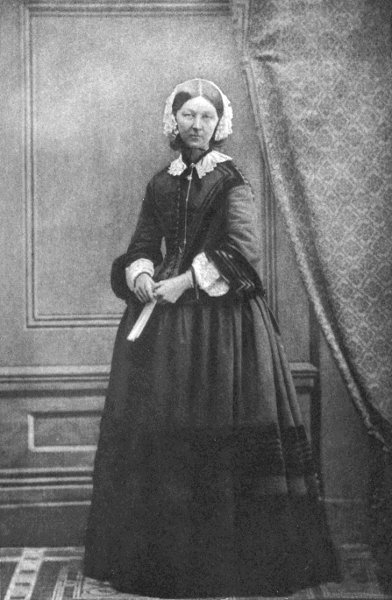
Florence Nightingale
about 1858
from a photograph by Goodman
On the west of the Tate Gallery stands another, and a
larger, pile of buildings. These are occupied by the Royal
Army Medical College, through which every Army Medical
Officer has now to pass both a preliminary and a post-graduate
course. Shortly before I visited the College, I
had been reading the large mass of Miss Nightingale's
papers which contain her first suggestions for the foundation
of the school, with her drafts for its rules and regulations;
and which describe the struggles and difficulties of its humble
infancy. And then I was taken through the noble institution
into which it has developed; equipped with large laboratories
which are, I believe, among the best in the country,
with smaller laboratories for private research; with a department
for those “cultures” which are said to have done so
much to preserve the health of the Army in India[288]; with
a spacious lecture-theatre, a fine library, a large museum;
and with handsome mess-rooms for the comfort and convenience
of studious youth. The transition was like a
transformation-scene in a pantomime. The Fairy Godmother
of the College would have rejoiced to see it. Only
one thing seemed to me to be wanting. There are portraits
or other memorials of many of the men whose acquaintance
we have made in these pages. In the entrance lobby there
is a bust of Dr. Thomas Alexander, whose appointment
as Director-General Miss Nightingale procured. In the
smoking-room there are portraits of the first professors whom
she nominated. I noticed no memorial of the two founders
to whom the original institution of the College was due—Sidney
Herbert and Florence Nightingale.
The last of the four Sub-Commissions—the “wiping”
Sub-Commission—had very varied duties assigned to it,
and there was no branch of the reform bill which encountered
more stubborn opposition from the permanent officials.
One of Mr. Herbert's many letters to Miss Nightingale on
the subject speaks of the “gross ignorance, and darkness
beyond all hope” of the principal obstructive, who maintained
that the idea of a sanitary official was all fudge.
Some of the work of this Sub-Commission need not be
detailed here. It framed a new Army Medical Officers'
Warrant (issued by General Peel in 1858), and reorganized
the Army Medical Department (1859). These were useful
steps at the time, but there have been so many new warrants
and so many War Office reorganizations since then that
this part of the reforms of Mr. Herbert and Miss Nightingale
belongs in any detail only to ancient history. The case is
different with the general work of the Wiping Sub-Commission.
Here also there have been new developments, and
some of the forms have been changed; but in substance,
these have all been built upon the foundations laid in the
years 1859–60. To Miss Nightingale primarily, and to
her more than to any other individual, is due the recognition
of a principle which may seem self-evident at the present
time, but which was entirely novel in her day—the principle
that the Army Medical Department should care for the
soldier's health as well as for his sickness. The Sub-Commission—or
to go behind the form to the reality, Miss
Nightingale and Mr. Herbert—drew up a Code for introducing
the sanitary element in the Army, defining the
positions of Commanding and Medical Officers and their
relative duties regarding the soldier's health, and constituting
the regimental surgeon the sanitary adviser of his
commanding officer. The same code contained regulations
for organizing General Hospitals, and for improving the
administration of Regimental Hospitals, both in peace and
during war. Formerly, general hospitals in the field had
to be improvised, on no defined principles and on no defined
personal responsibility. The wonder is, not that they broke
down, as they did in all our wars, but that they could be
made to stand at all. In all our wars, again, the general
hospitals had been signal failures—examples, as during the
earlier months at Scutari, of how to kill, not to cure. The
general hospital system, devised in the Code—including its
governor, principal medical officer, captain of orderlies,
female nurses, and their Superintendent (Mrs. Shaw Stewart)—was
realized in 1861 in the hospital at Woolwich.
There were some other reforms introduced by Mr.
Herbert, as Secretary of State, which owed their origin to
Miss Nightingale's experiences, observation, and suggestions.
In January 1861 Mr. Herbert issued a new Purveyor's
Warrant and Regulations. Hitherto “the Purveying Department,
like many others, had no well-defined position,
duties, or responsibilities. It was efficient or inefficient
almost by chance. Like other departments, it broke down
when tried by war; and all its defects were visited on the
sick and wounded men, for whose special benefit it professed
to exist.” The new Code “defined with precision the duties
of each class of purveying officers, together with their relation
to the Army Medical Department. They provided all
necessaries and comforts for men in hospital (both in the
field and at home) on fixed scales, instead of requiring
sick and wounded men (even in the field) to bring with them
into hospital articles for their own use, which they had lost
before reaching it.” The reader will remember how largely
purveying defects entered into Miss Nightingale's difficulties
in the East, and a reference to her letters from Scutari will
show that Mr. Herbert's Code was based on the broad lines
of her suggestions. As is hardly surprising, since she drafted
the Code in consultation with Sir John McNeill.
Mr. Herbert also appointed a Committee to reorganize
the Army Hospital Corps (1860). “In former times there
were no proper attendants on the sick. For regimental
hospitals a steady man was appointed hospital sergeant,
and two or three soldiers, fit for nothing else, were sent into
the hospital to be under the orders of the medical officer,
who, if he were fortunate enough to find one man fit to nurse
a patient, was sure to lose him by his being recalled ‘to
duty’; sometimes, indeed, men were nominated in rotation
over the sick in hospital as they would mount guard over a
store. No special training was considered necessary; no
one, except the medical officer, who was helpless, had the
least idea that attendance on the sick is as much a special
business as medical treatment. Unsuccessful attempts had
been made to organize a corps of orderlies, unconnected
with regiments; the result was most unsatisfactory. Mr.
Herbert's Committee proposed to constitute a corps—the
members of which, for regimental purposes, were to be carefully
selected by the commanding and medical officers—specially
trained for their duties, and then attached permanently
to the regimental hospital.” This reform, which
owed much to Miss Nightingale's suggestions, was carried
into effect shortly after Mr. Herbert's death.
Mr. Herbert also took up those questions of the soldier's
moral health in which Miss Nightingale had been a pioneer.[289]
In 1861 he appointed a Committee[290] to consider how best to
provide soldiers' day-rooms and institutes, in order to
counteract the moral evils supposed to be inseparable from
garrisons and camps. The Committee, of which Miss
Nightingale's friends, Colonel Lefroy, Captain Galton, and
Dr. Sutherland were members, showed that “the men's
barracks can be made more of a home, can be better provided
with libraries and reading-rooms; that separate
rooms can be attached to barracks, where men can meet their
comrades, sit with them, talk with them, have their newspaper
and their coffee, if they want it, play innocent games,
and write letters; that every barrack, in short, may easily
be provided with a kind of soldiers' club, to which the men
can resort when off duty, instead of to the everlasting
barrack-room or the demoralizing dram-shop; and that in
large camps or garrisons, such as Aldershot and Portsmouth,
the men may easily have a club of their own out of barracks.
The Committee also recommended increased means of occupation,
in the way of soldiers' workshops, out-door games
and amusements, and rational recreation by lectures and
other means. The plan was tried with great success at
Gibraltar, Chatham, and Montreal. Mr. Herbert's latest
act was to direct an inquiry at Aldershot as to the best means
of introducing the system there.” Miss Nightingale, in thus
summarizing the case, did not state, what her correspondence
shows to have been the fact, that she had been the
prime mover in the appointment of the Committee;
that, as already related (p. 351), she had worked hard
to obtain a reading-room, etc., at Aldershot; and that,
in the case of Gibraltar, the equipment of the room owed
much to gifts from her own private purse and to the contributions
of personal friends (Mrs. Gaskell among them)
whom she had interested in the scheme. Here, as in so
many other directions, Miss Nightingale's work as a pioneer
has been greatly developed; and no modern barrack is
deemed complete without its regimental institute, with
recreation room, reading-room, coffee-room, and lecture-room,
while means of out-door recreation and shops for
various trades are also provided.
In recounting Mr. Herbert's reforms, Miss Nightingale
brought the results of them, after her usual manner, to the
statistical test. She prefixed to her Memoir some coloured
diagrams showing how Mr. Herbert found the Army and how
he left it. In the three years 1859–60–61, just one-half
of the Englishmen who entered the Army died (at home
stations) per annum as formerly died. The total mortality
at home stations from all diseases had become less than was
formerly the mortality from consumption and chest diseases
alone. The results of comparisons of British armies in the
field were equally striking. The China expedition put the
reforms to the test. “An expeditionary force was sent to
the opposite side of the world, into a hostile country, notorious
for its epidemic diseases. Every required arrangement
for the preservation of health was made, with the result
that the mortality of this force, including wounded, was little
more than 3 per cent per annum, while the ‘constantly
sick’ in hospital were about the same as at home. During
the first months of the Crimean War the mortality was at
the rate of 60 per cent, and the ‘constantly sick’ in the
hospitals were sevenfold those in the war hospitals in China.”
The improvement in the health of the Army has, in
peace at any rate, been progressive. In 1857 the annual
rate of mortality in the Army at home was 17·5 per 1000.
Forty years later it had fallen to 3·42. In 1911 it was 2·47.
Besides all this, Mr. Herbert undertook in 1859 the chairmanship
of the Royal Commission on the Sanitary State of
the Indian Army. Other work of his in connection with the
Army is well known; and some of it—such as his Fortification
Scheme—did not endure, but these matters do not
concern us here. His measures for the health and well-being
of the soldiers were what Miss Nightingale was interested
in; and this joint work of theirs has been of lasting
benefit. After Sidney Herbert's death there was an arrest
in reform; but the main lines laid down by him have been
followed to our own day. In 1896 a friend in the War
Office went through Miss Nightingale's Memoir of Sidney
Herbert for her, and noted the present state of things in
relation to it. The Army Sanitary Committee was still in
existence. The School of Cookery at Aldershot was in the
Queen's Regulations. The General Military Hospitals were
maintained. The Army Medical School had been moved to
Netley. The Army Medical Statistics were still published
annually. The position of Army Medical Officers had been
further improved. There was a regularly organized Medical
Staff Corps. The recommendations of the Barracks Works
Committee of 1861 had been carried out, with the result
that the engineer officers had more individual responsibility,
and were better acquainted than formerly with the details
of healthy barrack and hospital construction. Soldiers'
Institutes had been put up on War Office land at several
stations. Recreation and reading-rooms were to be found
in most barracks, and no new barrack was erected without
them. Such changes as have taken place since 1896 have
been for the better, as I have indicated in preceding pages;
for the better, and more in line with Miss Nightingale's ideas.
Her great work, Notes on the Army, contained, as events were
to prove, not only the scheme of all Sidney Herbert's reforms
(except those relating to defence), but the germ, and
often the details, of further reforms (within the same sphere)
which have continued to our own day. During the years of
her co-operation with Mr. Herbert, Miss Nightingale chafed
at obstruction and delay, and after his death she cried out
bitterly at the cessation of further progress. But in the
end it was as her wise mentor, Sir John McNeill, wrote
(March 26, 1859):—“It vexes me greatly to find that you
are thwarted and annoyed by such things as you tell me of,
but I am not in the least surprised. I did not expect you
to accomplish so much in so short a time. Be assured that
the progress from a worse to a better system is in almost
every department of human affairs a progress slow and interrupted.
Do not then be discouraged. If you have not
done all that you desired—and who ever did?—you have
done more than any one else ever did or could have done,
and the good you have done will live after you, growing from
generation to generation. I do not remember any instance
in which new ideas have made more rapid progress.”
The bearing of the new ideas in relation to the Army
was pointed out in Miss Nightingale's summary of Mr.
Herbert's services. “He will be remembered chiefly,” she
wrote, “as the first War Minister who ever seriously set
himself to the task of saving life, who ever took the trouble
to master a difficult subject so wisely and so well as to be
able to husband the resources of this country, in which human
life is more expensive than in any other, more expensive than
anything else, and to preserve the efficiency of its defenders.”
In this work, during Mr. Herbert's term of office, as in
the preceding years, Miss Nightingale was his constant
assistant, and often the originator. They conferred personally
or by letter almost every day. No move in
the sphere of sanitary reform was made by the Minister
for War until he had taken her opinion. Every draft
was submitted to her criticism and suggestion. When
Mr. Herbert took office, his wife wrote (June 16, 1859) to
thank Miss Nightingale for her “dear note of congratulations,”
adding, “He entirely agrees with your suggestions
of this morning, and I am copying your Circular Note for
the four pundits.” In the following month (July 26), he
sends her the proposed Sanitary Regulations: “I shall be
very much obliged if you will go over the papers with
Sutherland.” “Sidney is coming to see you to-day (Aug.
13) to talk about the Regulations.” Four days later:
“Can Miss Nightingale give me the names of some Governors
for our new General Hospitals?” In later months, the
scheme for the Medical School and the new Regulations for
Purveyors were discussed between them. On one occasion
a dispatch from Miss Nightingale, enclosed under cover to
Mrs. Herbert, followed the Minister to Windsor: “I gave
your letter to your ‘Sovereign’; it's lucky the real one did
not see your cover.” The correspondence of 1860 is to like
effect. “Here is a dispute which is Hebrew to me; would
you look it over with Sutherland?” “I have written in
our joint sense,” and so forth. Miss Nightingale supplied,
however, more than detail—for one thing, persistent
stimulus. At the end it was stimulus to a dying man.
Cavour's last words: La cosa va. That is the life I should like to have
lived. That is the death I should like to die.—Sidney Herbert (as
recorded by Florence Nightingale).
The progress of the reforms, sketched in the foregoing
chapter, was somewhat impeded, and an extension of them
to a further point was altogether arrested, by a cause against
which neither Mr. Herbert's courageous spirit nor Miss
Nightingale's resolute will could avail. The Minister's
health broke down under the long strain; he was stricken by
disease; and, with failing health, his grasp of affairs was
necessarily relaxed.
The beginning of the end came early in December 1860.
“A sad change,” wrote Miss Nightingale from Hampstead
(Dec. 6) to her uncle, “has come over the spirit of my (not
dreams, but) too strong realities. Mr. Herbert is said to
have a fatal disease. You know I don't believe in fatal
diseases, but fatal to his work I believe this will be. He came
over himself to tell me and to discuss what part of the work
had better be given up. I shall always respect the man for
having seen him so. He was not low, but awe-struck. It
was settled that he should give up the House of Commons,
but keep on office at least till some of the things are done
which want doing. It is another reason for my wishing to
go to town soon, as he is particularly forbidden damp, and to
see him here always entails a night-ride.” To their meeting
on this occasion, early in December, Miss Nightingale often
referred in letters of a later date. Mr. Herbert had put
before her the three alternatives between which he had to
choose. He might retire from public life altogether. He
might retire from office, retaining his seat in the House of
Commons. Or he might retain his office, and leave the
House of Commons for the House of Lords. The first
alternative, though it might seem to promise the best hope
of recovery, was soon put away: it offered small temptation
to a man of Herbert's buoyancy of spirit and high sense of
public duty. The second alternative was that to which he
at first inclined. He was essentially a politician, and a
“House of Commons man.” He had sat for twenty-eight
years in that House, where his fine appearance, his personal
charm, and his considerable gift of eloquence made him a
commanding and popular figure. To go to the House of
Lords was, as he thought and said, to be “shelved.”[291]
Miss Nightingale urged him with all her formidable powers of
persuasion, to make the sacrifice for the sake of their unfinished
work. And so it was agreed; at the cost of many a
pang on his part, as he confessed, but to the relief of his
wife. “A thousand thanks,” she wrote to Miss Nightingale,
“for all you have said and done,” and “God bless you for
all your love and sympathy.” Mr. Herbert retained office,
resigned his seat in the Commons, and was created Lord
Herbert of Lea.
Miss Nightingale did not fully realize how ill Lord
Herbert was. She did not remember that a life entirely laid
out, as hers was, for work, and freed from all distraction,
involves less strain than one in which social ties, general
conversation, family responsibilities and journeyings to and
fro fill up the time between hours of work. And she was
passionately set upon the accomplishment of the work in
which they were engaged; she longed to see it crowned and
made secure. Every step already taken by Mr. Herbert in
the War Office had been an administrative improvement.
“The great principle involved in his reforms” was, she wrote,
“to simplify procedure, to abolish divided responsibility, to
define clearly the duties of each head of a department, and
of each class of office; to hold heads responsible for their
respective departments, with direct communication with the
Secretary of State.”[292] The cause of Army Reform would
not be completed, the permanence of the improvements
already made would not be secured, unless every department
of the War Office was similarly reorganized under a
general and coherent scheme. So Miss Nightingale urged
her friend forward to “one fight more, the best and the last.”
The War Office, she had written to him (Nov. 18, 1859), “is
a very slow office, an enormously expensive office, and one
in which the Minister's intentions can be entirely negatived
by all his sub-departments and those of each of the sub-departments
by every other.” Mr. Herbert had agreed. A
departmental committee had been appointed to report upon
reorganization, and Lord de Grey[293] (who was Under-Secretary
until Mr. Herbert went to the Lords) had drafted a scheme.
This was the scheme which in substance Miss Nightingale
now urged Lord Herbert to carry through. But the Horse
Guards was on the alert to mark the least infringement of its
privileges, and Sir Benjamin Hawes, the Permanent Under-Secretary
at the War Office, was copious with objections.
There are amongst Miss Nightingale's papers many drafts
in which she and Dr. Sutherland reorganized the War Office
from top to bottom. Sir Benjamin might have smiled
rather grimly, and then set himself with the greater determination
to keep things as they were, had he seen how near
the bottom was the place into which Miss Nightingale
proposed to reorganize him. She was quite frank about it.
“The scheme will probably result in Hawes's resignation,”
she wrote; “that is another of its advantages.” To reorganize
the War Office on paper is an occupation which,
during fifty following years, was to beguile the leisure of
amateurs, and to fill with disappointed hopes the laborious
days of many a Minister. To carry out any such scheme
into practice is a task which only a Minister, in full fighting
force, could hope to accomplish. It was beyond the power
of a dying man.
Miss Nightingale had her fears from the first. “Our
scheme of reorganization,” she wrote to Sir John McNeill
(Jan. 17, 1861), “is at last launched at the War Office; but I
feel that Hawes may make it fail: there is no strong hand
over him.” Lord Herbert struggled on manfully with his
many tasks (including, it should be remembered, constant
dispute with Mr. Gladstone over the Army Estimates), but
his strength grew constantly less. At last he had to confess
that, on the matter which Miss Nightingale had urged him
to carry through, he was beaten:—
(Lord Herbert to Miss Nightingale.) June 7 [1861].…
As to the organization I am at my wits' end. The real truth is
that I do not understand it. I have not the bump of system in
me. I believe more in good men than in good systems. De
Grey understands it much better.… [He then describes
certain minor reforms in personnel, including a definite sphere
of responsibility for Captain Galton.] This I should like to do
before I go. And now comes the question, when is that to be
and what had I best do and what leave to be done by others. I
feel that I am not now doing justice to the War Office or myself.
On days when the morning is spent on a sofa drinking gulps of
brandy till I am fit to crawl down to the Office, I am not very
energetic when I get there. I have still two or three matters
which I should like to settle and finish, but I am by no means
clear that the organization of the Office is one of them.…
[Further official details.] I cannot end even this long letter
without a word on a subject of which my mind is full and yours
will be too—Cavour. What a life! what a life! and what a
death! I know of no fifty lives which could be put in competition
with his. It casts a shade over all Europe. While he
lived, one felt so confident for Italy, that he could hold his own
against Austria, against the wild Italians, against the Pope,
and above all against L. Napoleon. But what a glorious career!
and what a work done in one life! I don't know where to look
for anything to compare with it.
Cavour had died the day before, and his last recorded
words were of his Cause: la cosa va. The pathos with which
the events of the next few weeks were to invest this letter
from Sidney Herbert made a deep impression upon Miss
Nightingale. Among some pencilled jottings of hers, written
thirty or forty years after, she recalled phrases in the letter
and in conversations of the same date. But, at the immediate
moment, Lord Herbert's confession of failure filled her
with despairing vexation. Sir John McNeill, to whom she
poured out her soul, took the truer view of the case. It was
sad, he admitted (June 18), that Lord Herbert should have
been “beaten on his own chosen ground by Ben Hawes.
But,” he added, “the truth, I suspect, is that he has been
beaten by disease, and not by Ben.” “What strikes me in
this great defeat,” she replied (June 21), “more painfully
even than the loss to the Army is the triumph of the bureaucracy
over the leaders—the political aristocracy who at
least advocate higher principles. A Sidney Herbert beaten
by a Ben Hawes is a greater humiliation really (as a matter
of principle) than the disaster of Scutari.”
Disease held Lord Herbert in its grasp, but with indomitable
spirit he worked on at matters, other than reorganization,
in which he and Miss Nightingale were specially
interested. One of these matters was the establishment of a
General Military Hospital at Woolwich. “Among the few
practical things,” wrote Miss Nightingale to Sir John
McNeill (June 21), “which I hope to succeed in saving from
the general wreck of the War Office is the organization of one
General Hospital on your plan. Colonel Wilbraham has
consented to be Governor. Last week we made a list of the
staff, and the names were approved by Lord Herbert.
There has been an immense uproar, perhaps no more than
you anticipated, from the Army Medical Department and
the Horse Guards.” Lord Herbert was to send her the draft
of the Governor's Commission, and she asked Sir John
McNeill's assistance in revising it. Then she was requested
to name a Superintendent of nurses. Her choice fell upon
one of her Crimean colleagues, Mrs. Shaw Stewart, an
admirable, though a somewhat “difficult” lady, who had
now quarrelled with Miss Nightingale, but whose efficiency
marked her out for the post. Two other of Lord Herbert's
last official acts referred also to the health of the British
soldier, and each was suggested by Miss Nightingale. One
was the appointment of the Barracks Works Committee
(June 6) already mentioned (p. 389); the other, the appointment
of Captain Galton and Dr. Sutherland as Commissioners,
with Mr. J. J. Frederick as Secretary, to improve
the Barracks and Hospitals on the Mediterranean Station.
By the end of June, Lord Herbert's health had become
worse, and he was ordered abroad to Spa. On July 9 he
called at the Burlington Hotel to say good-bye to Miss
Nightingale. They never met again. A week later, he
wrote to her from Spa:—
I enclose a letter from Mrs. Shaw Stewart. To cut matters
short and start the thing, I have begged her to select the nurses
on their own terms. I mean as to qualifications, as the Regulations
define salary, etc. So I hope we shall at any rate start the
thing now. I have written an undated letter of resignation to
Palmerston to be used whenever convenient to him. I have not
written it without a pang, but I believe it to be the right and best
course. I believe Lewis, with de Grey for under-secretary, is to
be my successor. I can fancy no fish more out of water than
Lewis amidst Armstrong guns and General Officers, but he is a
gentleman, an honest man, and de Grey will be invaluable for
the office and for many of the especial interests to which I specially
looked. I have a letter from Codrington proposing another site
for the new branch Institute. I have sent it to Galton. I wish
I had any confidence that you are as much better as I am.
Lord Herbert's buoyancy of spirit remained to him when
physical strength was quickly ebbing. He became worse,
and, on July 25, left Spa for home. He died at Wilton on
August 2. “To the last,” wrote his sister to Miss Nightingale,
“he had the same charm, that dear winning smile, that
almost playful, pretty way of saying everything.” But
among his last articulate words were these: “Poor Florence!
Poor Florence! Our joint work unfinished.”
The death of Sidney Herbert was a heavy blow to Miss
Nightingale—the heaviest, perhaps, which she ever had to
suffer. It meant not only the loss of an old friend and companion,
in whose society she had constantly lived and
moved for five years. It meant also the interruption of
their joint work, which was more to her than life itself. She
felt in the severance of their alliance the true bitterness of
death:—
(Miss Nightingale to her Father.) Hampstead, Aug. 21
[1861]. Dear Papa—Indeed your sympathy is very dear to me.
So few people know in the least what I have lost in my dear
master. Indeed I know no one but myself who had it to lose.
For no two people pursue together the same object, as I did with
him. And when they lose their companion by death, they have
in fact lost no companionship. Now he takes my life with him.
My work, the object of my life, the means to do it, all in one,
depart with him. “Grief fills the room up of my absent” master.
I cannot say it “walks up and down” with me. For I don't
walk up and down. But it “eats” and sleeps and wakes with
me. Yet I can truly say that I see it is better that God should
not work a miracle to save Sidney Herbert, altho' his death
involves the misfortune, moral and physical, of five hundred
thousand men, and altho' it would have been but to set aside
a few trifling physical laws to save him.… “The righteous
perisheth and no man layeth it to heart.” The Scripture goes
on to say “none considering that he is taken away from the evil
to come.” I say “none considering that he is taken away from
the good he might have done.” Now not one man remains
(that I can call a man) of all those whom I began work with,
five years ago. And I alone, of all men “most deject and
wretched,” survive them all. I am sure I meant to have died.…
Ever, dear Papa, your loving child, F.
Her grief was accompanied and intensified by some
remorse:—
(Miss Nightingale to Harriet Martineau.) Hampstead,
Sept. 24 [1861].… And I, too, was hard upon him. I told
him that Cavour's death was a blow to European liberty, but
that a greater blow was that Sidney Herbert should be beaten
on his own ground by a bureaucracy. I told him that no man
in my day had thrown away so noble a game with all the winning
cards in his hands. And his angelic temper with me, at the same
time that he felt what I said was true, I shall never forget. I
wish people to know that what was done was done by a man
struggling with death—to know that he thought so much more
of what he had not done than of what he had done—to know
that all his latter suffering years were filled not by a selfish desire
for his own salvation—far less for his own ambition (he hated
office, his was the purest ambition I have ever known), but by
the struggle of exertion for our benefit.
Happily for her peace of mind there came to her an
almost immediate call to be up and doing in the service
of her “dear master,” as in her letters of this time she
constantly named Sidney Herbert.
The newspapers had at first been somewhat grudging in
their obituary notices of him. He had been thought of in
connection more with the defects of the War Office during the
early months of the Crimean War, than with his services as
a reformer. His family and his friends were pained, and
on their behalf Mr. Gladstone applied to Miss Nightingale.
She did not feel well enough to see him, and, on August 6, he
wrote explaining the case, “taking the liberty of intruding
upon her for aid and counsel,” and asking “the assistance of
her superior knowledge and judgment in a matter which so
much interests our feelings.” Miss Nightingale instantly set
to work and wrote a Memorandum on Sidney Herbert's work
as an Army Reformer. She wrote quickly, but with her
usual care in giving chapter and verse for every statement.
The Memorandum was anonymous, and was marked
“Private and Confidential”; but she had it printed, and
circulated it among Lord Herbert's friends and various
publicists. Among those who saw it was Abraham Hayward
who, when a memorial to Lord Herbert was being mooted a
few weeks later, strongly urged that she should be asked to
publish the Paper. “No one,” he wrote, “could or would
misconstrue her motives. Nothing has been more remarkable
in her beneficent and self-sacrificing career than its
unobtrusiveness. It has only become famous because its
results were too great and good to be shrouded in silence and
retirement. Admirably as she writes, she is obviously never
thinking about her style; which, for that very reason, is
most impressive; and I feel quite sure that the Paper in
question would suggest no thought or feeling beyond conviction
and sympathy.”[294]
The Memorandum, in so far as it relates to what Sidney
Herbert did, has been described and quoted above; but at
the end of it, Miss Nightingale was careful to touch upon
what he had meant to do and what remained for others to do.
“He died before his work was done.” The work on which
his heart was set was the preservation of the health, physical
and moral, of the British soldiers. “This is the work of
his which ought to bear fruit in all future time, and which his
death has committed to the guardianship of his country.”
Having finished her Memorandum, Miss Nightingale sent
it to Mr. Gladstone. She knew how warm had been the
friendship between him and Sidney Herbert. She thought
that in the friend who remained the saying might perchance
come true: uno avulso non deficit alter. At any rate it was
her duty to throw out the hint. So she underlined, as it
were, the closing words of her Paper by offering to talk with
Mr. Gladstone about the unfinished work which, as she knew,
was nearest to Sidney Herbert's heart. To this overture,
Mr. Gladstone replied in a letter, giving account of his
friend's funeral:
(W. E. Gladstone to Florence Nightingale.) 11 Carlton
House Terrace, Aug. 10 [1861]. The funeral was very sad
but very soothing. Simplicity itself in point of form, it was
most remarkable from the number of people gathered together,
and especially from their demeanour. Many men were weeping:
not one unconcerned face among several thousands could be seen.
But it all brings home more and more the immense void that he
has left for all who loved, that is for all who knew, him.… I
read last night with profound interest your important paper.
I see at once that the matter is too high for me to handle. Like
you I know that too much would distress him, too little would not.
I am in truth ignorant of military administration: and my
impressions are distant and vague. It is your knowledge and
authority more than that of any living creature that can do him
justice, at the proper time, whenever that may be—do him justice,
as he would like it, without exaggeration, without defrauding
others. I shall return the paper to you: but of it I venture to
keep a copy.…
With respect to your making known to me the “three
subjects” I will beg you to exercise your own discretion after
simply saying this much; my duty is to watch and control on
the part of the Treasury rather than to promote officially departmental
reforms. To him I could personally suggest: I am not
sure that I should be justified in taking the same liberty with
Sir G. Lewis, especially new to his work. On the other hand,
my desire to promote Herbert's wishes, as his wishes, was not
stronger than my confidence in his judgment as an administrator.
(If I now seem reluctant to touch that subject it is for fear I
should spoil it.) In the conduct of a department he seemed to
me very nearly if not quite the first of his generation.—I remain,
dear Miss Nightingale, Very sincerely yours, W. E. Gladstone.
On the afternoon of November 28, in Willis's Rooms—in
the same place where, in the same month six years before,
Mr. Herbert had spoken in support of a memorial to Miss
Nightingale's honour, a public meeting was held to promote
a memorial to him. “I think you would have been
satisfied,” wrote Mr. Gladstone to her on the same evening,
“even if a fastidious judge, with the tone and feeling of the
meeting to-day. I mean as regards Herbert. As respects
yourself, you might have cared little, but could not have been
otherwise than pleased. I made no allusion to you in connection
with the paper you kindly sent me, although I made
some use of the materials. I acted thus after conference
with Count Strzelechi,[295] and with his approval. I thought
that if I mentioned you along with that paper, I should seem
guilty of the assumption to constitute myself your organ.”
Miss Nightingale's Paper, summarizing Lord Herbert's
services to the health and comfort of the British Army,
formed, indeed, the staple of more than one of the speeches,[296]
and the long alliance between them in that cause, which has
been the subject of preceding chapters in this Memoir, was
frequently referred to at the meeting. General Sir John
Burgoyne said breezily that Lord Herbert's “hobby was to
promote the health and comfort of the soldier, and his pet
was Miss Nightingale, who had for many years devoted
herself to the same pursuit.” Mr. Gladstone mentioned
as Lord Herbert's “fellow-labourer” the “name of Miss
Nightingale, a name that had become a talisman to all
her fellow-countrymen.” And Lord Palmerston, the Prime
Minister, in associating the Commander-in-Chief with the
late Minister for War, added that “they did not labour alone.
They were not the only two; there was a third engaged in
those honourable exertions, and Miss Nightingale, though
a volunteer in the service, acted with all the zeal of a
volunteer, and was greatly assistant, as I am sure your Royal
Highness will bear witness, to the labours of your Royal
Highness and Lord Herbert.”
The alliance which was dissolved by Lord Herbert's
death is probably unique in the history of politics and of
friendship. “As for his friendship and mine,” said Miss
Nightingale, “I doubt whether the same could ever occur
again.”[297] For five years the politician in the public eye, and
this woman behind the scenes, were in active co-operation;
often seeing each other daily, at all times in uninterrupted
communication. There have been other instances in which
the same thing has happened, but happened with many
differences. There have been statesmen who have made
confidantes of their wives, and who have found in them wise
counsellors and helpful supporters. Sidney Herbert himself
received much help in his public work from his wife, to whom
he was devotedly attached. In some pencilled jottings
about her friends, Miss Nightingale records a beautiful trait;
Sidney Herbert made it a rule, she says, to mark each anniversary
of his wedding-day by beginning some new work of
kindness towards others. Yet there was room in the ordering
of his life, during the five years following the Crimean War,
for taking constant counsel from another woman—so constant
as, perhaps, in the days of his illness and over-work
to cause his wife some anxiety. Yet Miss Nightingale was
as dear to the wife as she was helpful to the husband, and
affectionate friendship between her and Mrs. Herbert was not
impaired. There have been many statesmen, again, and
many other eminent men, who have found inspiration or
support, no less than solace or pleasure, in the friendship of
women. But Sidney Herbert's attraction to Miss Nightingale,
and hers to him, were on a plane by themselves. She,
indeed, was susceptible, as was every man and every woman
who knew him, to Sidney Herbert's singular charm and
courtesy; she admired the brilliance of his conversation;
she felt pleasure in his presence. And he, with his quick
perception, must have enjoyed the ready humour which
played around Miss Nightingale's wisdom. But they were
also comrades or colleagues even as men are. “A woman
once told me,” Miss Nightingale said to an old friend,
“that my character would be more sympathized with by
men than by women. In one sense I don't choose to
have that said. Sidney Herbert and I were together
exactly like two men—exactly like him and Gladstone.”[298]
The secret of this rare friendship between Sidney Herbert
and Miss Nightingale is to be found, first, in the fact that the
character and gifts of the one were precisely complementary
to those of the other. Though of a sanguine temperament,
Sidney Herbert had the politician's caution. Miss Nightingale,
though of an eminently practical genius, was eager and
full of impelling force. She supplied inspiration which he
had the means of translating into political action. Sidney
Herbert had the political mind; Miss Nightingale, the
administrative. Not indeed that he was deficient in some
of the administrative gifts, or she in political instinct. But
what was peculiarly characteristic of her was the combination
of a firm grasp of general principles with a complete
command of detail; and in the particular work in which
they were engaged, her experience supplied what he lacked.
“I supplied the detail,” she said herself; “the knowledge of
the actual working of an army, in which official men are so
deficient; he supplied the political weight.”[299] Each was
thus indispensable to the other. And they were united by
perfect sympathy in the service of high ideals. “He,”
wrote Miss Nightingale of Sidney Herbert, “with every
possession which God could bestow to make him idly enjoy
life, yet ran like a race-horse his noble course, till he fell—and
up to the very day fortnight of his death struggled on
doing good, not for the love of power or place (he did not
care for it), but for the love of mankind and of God.”[300] He
was, “in the best sense,” she wrote elsewhere, “a saver
of men.”[301] In that honourable record Miss Nightingale
deserves an equal place with her friend.