The unity of the Frankish State, so dearly purchased
by the heroic labors of Charles Martel, was
as usual placed in jeopardy by the dying ruler’s
arrangements for the succession to that which was
now openly spoken of as his “principatus.”
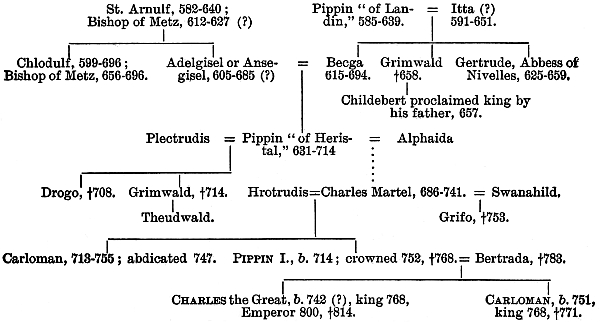
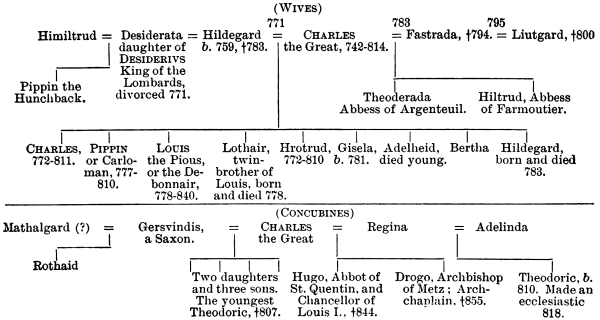
He left two sons, Carloman and Pippin, by his
first wife Hrotrudis, and one, Grifo, by a Bavarian
princess named Swanahild, whom he had married
after an invasion of her country, and whose sister
was the wife of the Lombard king Liutprand.
This was the manner in which Charles Martel
divided his dominions among his sons. To the
eldest, Carloman, he gave the greater part of Austrasia,
Alamannia, and Thuringia; to Pippin, the
younger, Neustria, Burgundy and Provence. Apparently
both Aquitaine in the south-west, and Bavaria
in the south-east were too nearly independent
to be thus disposed of by a ruler who, after all, was
still, in theory only the chief adviser of a Merovingian
king, though that king’s royalty was for the
present in abeyance.
To Grifo, whose turbulent attempts at insurrection
aided by his mother Swanahild, had troubled the
last years of Charles, who assigned a small central
state carved out of all the three realms, Austrasia,
Neustria, and Burgundy, at their point of meeting.
“As to this third portion,” says the chronicler,
“which the dying prince had assigned to the young
man Grifo, the Franks were sorely displeased
that by the advice of a wicked woman they should
be cut up and separated from the lawful heirs. Taking
counsel together and joining with them the
princes Carloman and Pippin, they collected an
army for the capture of Grifo, who, hearing of their
intent, took to flight, together with his mother
Swanahild and all who were willing to follow him,
and all shut themselves up in Lugdunum Clavatum
(Laon). But Grifo, seeing that he could not possibly
escape, surrendered himself to the keeping of his
brothers. Carloman receiving the captive sent him
to be kept in safe custody at the New Castle (Neuf
Château in the Ardennes): and they placed Swanahild
in the monastery of Cala (Chelles near Paris.)”
We shall rapidly pass in review the events which
led to the concentration of the whole power of the
State in the hands of Pippin alone, but first we must
notice that for some unexplained reason, possibly in
order to give them a better title to the obedience of
Aquitaine and Bavaria, the princely brothers decided
to bring the kingless period to an end. In
743 Childeric III. was placed on the throne. He
was probably about twenty years of age, but the
date of his birth, and even his place in the royal
pedigree are doubtful. Of his character, of course,
we know nothing. He is but the shadow of a
shadow, this last Merovingian king.
Very different from shadows were the two Arnulfing
brothers, as they warred with Hunald, Duke of
Aquitaine (son of their father’s old troubler Eudo),
with Odilo, Duke of Bavaria, with the heathen
Saxons, with the restless and disloyal Alamanni.
Of the two brothers, Pippin seems to have been
somewhat the gentler. It was Carloman the strong
and stern warrior, who, infuriated by the faithlessness
of the Alamanni, entered their territory, called
a muster of their warriors at Cannstadt (near Stuttgart),
and then surrounding them by his Franks,
disarmed them, and slew many of their leaders.
The accounts of this assembly at Cannstadt are dark
and perplexing, but on comparing them it certainly
seems probable that there was great severity on the
part of Carloman, probably treachery and possibly
widespread slaughter.
Was it remorse for this bloody deed which changed
the character and career of Carloman? It is not
expressly so said by any of the chroniclers, yet the
statement seems a probable inference from their
meagre notices. For it was in the same year (746)
in which the strange transaction with the Alamanni
had taken place at Cannstadt that Carloman began
to talk to his brother Pippin concerning his desire
to relinquish the world and devote himself to the
service of Almighty God: “Therefore both the
brothers made their preparations, Carloman that
he might go to the threshold of the apostles Peter
and Paul, and Pippin that his brother might make
the journey with all honor and splendid gifts.”
Carloman’s decision to embrace the monastic life
was not an unexampled sacrifice for a ruler in that
day. Sixty years before, Ceadwalla, King of the
West Saxons, and twenty years before, his royal
kinsman Ine had left their palaces and come to live
and die as tonsured monks in Rome. Two years before
Carloman’s abdication, Hunald of Aquitaine, and
three years after it, Ratchis the Lombard took the
same step. Still, the splendid position which Carloman
abandoned, and the lowliness of his demeanor
after his abdication, touched and awed the hearts of
his contemporaries.
In 747 Carloman formally renounced his share of
power, and went with along train of nobles and with
costly presents in his hand to Rome, “to the threshold
of the apostle Peter.” There he submitted to
the tonsure and received the clerical habit from Pope
Zacharias. After a time, by the pope’s advice, he
withdrew to the mountain solitude of Soracte,
twenty-eight miles from Rome, where he erected a
monastery in honor of St. Sylvester. This saint
was the Bishop of Rome who, according to an ecclesiastical
fable which was just at this time obtaining
wide currency, received from the Emperor Constantine
the celebrated “Donation” of Rome and the
larger part of Italy. The fable also related that
Sylvester had previously sought a refuge in Mount
Soracte from the persecution ordained by Constantine
while still a Pagan, and had afterwards cured
that emperor of leprosy by directing him to a pool
on the mountain in which he was to perform a threefold
immersion. It need hardly be said that all this
is utterly valueless as history, but as it was in that
uncritical age accepted as unquestioned truth, the
fact that the enthusiast Carloman sought the solitudes
of Soracte for the place of his retirement and
there dedicated his monastery to St. Sylvester is
important as showing what was passing in the minds
of men, and especially of devout Frankish princes in
that age. Later on, he left his mountain home in
Soracte and sought the far-famed monastery of St.
Benedict on Monte Cassino. Tradition said that he
fled thither by night, with one faithful squire, his
companion from infancy, and with no sign of his
once high dignity. Knocking at the door of the convent
he desired speech with the abbot, and when that
dignitary appeared, threw himself on the ground before
him, confessing that he was a murderer and
praying to be allowed to expiate his crime by repentance
in the monastery. The abbot, seeing that he
was a foreigner asked him of his race and country.
“I am a Frank,” said Carloman, “and for my crime
I have left my native land of Francia. I heed not
exile if only I may not fail of the heavenly fatherland.”
He was received into the cell of the novices
with his companion and was subjected to severe discipline,
as became a man of barbarous race and unknown
name, for the abbot was mindful of the
apostolic precept, “Try the spirits whether they are
of God.” To all these hardships and humiliations
Carloman submitted with exemplary patience. It
chanced at last that it fell to his lot as a novice to
take a week’s turn in the kitchen of the convent.
He did his work zealously but made many blunders,
for which the head cook, heated with wine, rewarded
him with a slap on the face. Meekly the princely
scullion replied, “Is that how you ought to serve
the brethren? May God pardon you, my brother,
and Carloman too.” The last words were perhaps
uttered under his breath, for he had not yet revealed
his name to any one. A second and a third time this
incident was repeated, and on the last occasion the
cook’s blows were cruel and brutal. His faithful
squire could then bear the sight no longer. He
snatched up the pestle with which the bread was
being pounded for the brethren’s soup, and struck
the head cook with all his might, saying, “Neither
may God spare thee, vile slave, nor may Carloman
forgive thee.” Then followed uproar, indignation
at the foreigner’s presumption, arrest, imprisonment.
Next day the squire was set in the midst of the assembled
monks and asked why he had dared to stretch
forth his hand against a serving brother. “Because,”
he answered, “I was indignant at seeing a slave, the
meanest of mankind, not only flout and jeer, but
actually strike a man, the best and noblest of all
that I have ever met with on the earth.” The angry
monks demanded who was this man whom he, a foreigner,
dared to rank before all others, not even excepting
the abbot himself. Thus was the truth
forced out of him, since it was the will of God that
it should no longer be concealed. “That man is
Carloman, formerly ruler of the Franks, who, for the
love of Christ hath left his kingdom and the glory of
the world: who from such high estate has so humbled
himself as to be subject not only to the insults
but even to the blows of the vilest of men.” Then
the monks rose from their seats in terror and prostrated
themselves at the feet of Carloman, imploring
his forgiveness for aught that they might have done
to him in ignorance of his rank. Vainly did he in
turn grovel on the earth before them and try to assure
them that his comrade had lied and that he
was not Carloman. He was recognized by all, held
in the highest reverence, and as we shall afterwards
see, was selected by the abbot for an important
mission.
On the abdication of Carloman, Grifo was liberated
by Pippin from his imprisonment which had
lasted six years, received by him in his palace with
every mark of honor and affection, and invested
with several countships and large revenues. This was
not enough, however, for Grifo, who probably aspired
to an equal share of his father’s late dominions.
He allied himself with the Saxons and shared
their defeat in battle (748); he sought refuge in
Bavaria, and for a time made himself duke of that
country (749); expelled from thence by Pippin he
betook himself first to Aquitaine and then to the
King of the Lombards, but was met at Maurienne
by Count Theodowin, who was guarding the passes
of the Alps in the Frankish interest. A skirmish
followed, in which many Frankish nobles fell, Grifo
himself and Theodowin among them (753). There
was no further obstacle raised by any member of
the Arnulfing family to the sole domination of
Pippin.
Fateful for all the after-history of Europe were
the middle years of the eighth century, upon which
we have now entered. The time had at last come
when Pippin, virtual sovereign of Gaul and Western
Germany, could venture to take the step which had
proved fatal to his kinsman Grimwald, and to
bring names and facts into accord by proclaiming
himself King of the Franks. But in taking this
step it behoved him to be sure of two things, the
consent of the nation and the sanction of the
Church. By the advice and with the consent of all
the Franks, expressed no doubt by some assembly
of the chief men of the nation, two great ecclesiastics,
Fulrad, Abbot of St. Denis representing Neustria,
and Burchard, Bishop of Würzburg representing
Austrasia, were sent to Rome to ask the opinion of
the pope on the great problem. It will be well to
state their commission in the words of a contemporary
chronicler:
“In the year 750 [it should be 751] from the
incarnation of our Lord, Pippin sends ambassadors
to Rome to Zacharias the Pope to ask concerning
the Kings of the Franks who were of the royal race
and were called kings, but had no power in the kingdom
except only that grants and charters were
drawn up in their names, but they had absolutely
no royal power; but what the major domus of the
Franks willed, that they did. But on the [first]
day of March in the Campus [Martis] according to
ancient custom gifts were offered to those kings by
the people, and the king himself sat on the royal
throne with the army standing round him and the
major domus close by, and on that day he gave forth
as his orders whatever had been decreed by the
Franks, but on every other day thenceforward he
sat quietly at home. Pope Zacharias thereupon answered
their question according to his apostolic
authority, that it seemed better and more expedient
to him that he should be called and be king who
had power in the kingdom rather than he who was
falsely called king. Therefore the aforesaid pope
commanded the king and people of the Franks that
Pippin who exercised the royal power should be
called king and be placed on the royal seat; which
was accordingly done by the anointing of the holy
archbishop Boniface in the city of Soissons. Pippin
is called king, and Childeric who falsely bore that
title receives the tonsure and is sent into a monastery.”
So at length was the great change accomplished
towards which Frankish history had been tending
for more than a century. What happened was undoubtedly
a revolution, though of a peaceful kind.
The papal sanction, the archiepiscopal unction might
impress the minds of the multitude; this new
Christian consecration might partly compensate for
the missing glamour of a descent from gods and
heroes which had surrounded the dynasty of the
Merovings; but in strict right, of course, the Bishop
of Rome had no title to command the change, no
power to absolve the Salian and Ripuarian Franks
from their plighted faith to the descendants of
Clovis. It was well thought of to put the scene of
the consecration of the new dynasty at Soissons, that
place so memorable in the history of the older race.
It was also important, if the pope himself could not
be induced to cross the Alps to perform the ceremony
of anointing, to have it performed by Boniface the
Apostle of the Germans, and the most conspicuous
ecclesiastical figure in Europe.
We may pause for a moment to notice the remarkable
share taken by this man and others of our
fellow countrymen in bringing about the conversion
of large portions of the German nation to Christianity,
and indirectly in founding the Teutonic “Holy
Roman Empire” of the Middle Ages. Scarcely
had the Anglo-Saxon peoples been won over to the
Christian Church, when they began with missionary
zeal to preach the faith among their still heathen
kinsmen on the Continent. The mission of St.
Augustine23 to Britain took place in the year 596.
In 634 was born the Northumbrian Wilfrid, and in
658 his countryman Willibrord, both of whom labored
with zeal and success for the conversion of the heathens
of Friesland. A generation later the young Devonian
Winifried, born at Crediton, appeared on the banks
of the Lower Rhine, to profit by the experience of
the aged Willibrord and to catch his falling mantle.
Three times he visited Rome to confer with those
great popes, the second and the third Gregory, and
to receive their orders for the conversion of fresh
tribes in Germany, or for the consolidation of spiritual
conquests already achieved. On one of these
visits, probably, he received that name of Boniface
by which he is best known in history, together with
a sort of roving commission as archbishop, and authority
to act as legate in the churches of Germany.
Armed with this power he set up bishoprics in Bavaria,
revived the dying Christianity of Thuringia,
and chastised heretics in Gaul. Wherever the armies
of Charles Martel marched, in Friesland, in Saxony,
in Hesse, Archbishop Boniface followed, smashing
idols, felling sacred oaks, and baptizing half-unwilling
converts. Towards the end of his life his
roving commission was changed into the more
stationary office of Archbishop of Mainz, and he sometimes
retired for repose to the great monastery of
Fulda, which he had founded in the Hessian land
near the source of the Weser. But the old warhorse
was still stirred by the sound of the trumpet.
Three years after his consecration of Pippin, Boniface
went forth on a last expedition for the conversion
of the Frisians. When he reached Dockum (in the
north of the present province of Friesland) he found
there, instead of the expected catechumens, a multitude
of the heathen, zealous for the honor of their
idols which Boniface had so often destroyed, and
eager for the spoil of the ecclesiastical invader.
From their hands he received the crown of martyrdom
for which he longed.
The career of Boniface is of especial importance
because of his absolute devotion to the see of
Rome. It was observed that the recently converted
nations, as is so often the case with new
converts, surpassed their older brethren in the
fervor of their faith. While the bishops of Gaul
were lukewarm, sometimes almost insubordinate,
the Anglo-Saxon bishops were the devoted adherents
of the papacy. Boniface especially professed
the most unbounded reverence for the chair of St.
Peter, and took with alacrity an oath of implicit
obedience, substantially the same which was exacted
from the “suburbicarian” bishops of the sees in the
immediate neighborhood of Rome. This was the
spirit in which the infant churches were trained,
and this no doubt was the tenor of the advice
which the zealous Archbishop of Mainz gave to the
new King of the Franks on the day of his coronation.
A traveller through the pleasant valleys of Devonshire
when he comes to the little town, scarcely
more than a village, of Crediton between its two
overhanging hills, may reflect with interest that he
beholds the birthplace of the man who, more than
any other, brought about the entrance of the
German nation into the family of Christian Europe.24
The coronation of Pippin took place probably
about November 751. In four months from that
time Pope Zacharias died, doubtless without any
presentiment of the abiding importance of the event
in which by his answer to the Frankish messengers
he had borne a part, but which is not even mentioned
by his biographer in the Liber Pontificalis.
After a short interval, an ecclesiastic of Roman
parentage, who figures in the annals of the papacy
as Stephen II., was raised to the papal see. His pontificate
was short; it lasted but five years, but they
were years full of import for the destinies of Europe.
In order to concentrate our attention on the
transformation of the Arnulfing mayors of the
palace into Frankish kings, I have hitherto said as
little as possible about the affairs of Italy, but this
silence can be kept no longer, now that a Roman
pope is about to cross the Alps and ask for Frankish
aid to enable him to smite down his foes.
The Lombards had invaded Italy in the year 568,
and for nearly two centuries from that time there
had been waged a kind of triangular contest which,
to compare great things with small, was like the
litigation which might go on in an English parish
between an absentee landlord, a big Nonconformist
farmer, and a cultured but acquisitive parson.
The Emperor was the great absentee. Though
still always spoken of as Emperor of Rome, he had
been in fact for some centuries an absolutely Oriental
Sovereign. Since the deposition of Romulus
Augustulus in 476, no Roman Emperor had touched
the soil of Italy save for one brief and most unwelcome
visit paid by Constance II. in 663. The
Imperial dominion in the peninsula was by this time
limited to the Venetian islands, two provinces on
the Adriatic coast called the Exarchate of Ravenna
and the Pentapolis, the city of Hydruntum
(Otranto), the province of Bruttii at the very end
of the peninsula, Paestum, Naples and the duchy
of Rome, which included the city of Rome, the
present province of Latium and a little bit of
Etruria. This scattered and fragmentary dominion,
which as will be seen was almost entirely confined
to the sea-coast, and embraced only a part of that,
was ruled by an imperial lieutenant who bore the
title of Exarch, and whose seat of government was
the strong, almost impregnable, city of Ravenna.
Far the largest part of Italy, including all the fertile
valley of the Po, all the central chain of the Apennines
and the valleys leading from them, the greater
part of Tuscany and almost the whole of Apulia,
was in the possession of the rough and masterful
Lombards, who had been fierce savages when they
entered Italy, but who had lost most of their savagery
and some of their warlike vigor by long
residence in the delightful land and by contact with
the vestiges of Roman civilization. Arians for the
most part, and even with some heathens among
them at the time of their first invasion, they had
now embraced the Catholic faith, were generous
benefactors of the Church, and desired to be considered
her dutiful sons. But still the remembrance
of their old heresies continued, and whenever
the political interests of the King of the Lombards
clashed with those of the Pope of Rome—and they
did clash as often and as irreconcilably as do those
of pope and king at the present day—the old
epithets “unspeakable,” “sacrilegious,” “diabolical,”
flowed from the pens of the scribes in the
papal chancery as freely as they had flowed when
the Lombards were yet idolaters.
As for the pope, how to describe in few words his
anomalous and fast-changing position? Undoubted
Patriarch of the Western Church, he nevertheless
had many a struggle with the Patriarch of Constantinople
as to his claim to rule the Church Universal.
The missionaries whom he had sent forth to convert
the Teutonic tribes of England and Germany were,
as has been said, zealous asserters of his spiritual
pre-eminence, and, like the Jesuits of the sixteenth
and seventeenth centuries, the great champions of the
rights of Rome. Herein also they were vigorously
supported by the monks who had spread widely
over all Christian lands, and who at this time were
almost without exception followers of the rule of
the Italian saint, Benedict. Some of the bishops,
however, especially some of the Gaulish bishops,
were, as has been said, by no means equally prompt
in their obedience to the papal see. The pope’s relation
to the distant emperor at Constantinople during
these centuries of transition is one of the hardest
things to describe with accuracy. A subject, and
yet in a certain sense a rival, often severely snubbed
by the emperor’s representative at Rome, almost
adored on one or two occasions when he set foot in
Constantinople; elected by the clergy and people of
Old Rome, yet for many generations not venturing
to assume the title of pope till he received the imperial
confirmation from New Rome; a mere ecclesiastic
without as yet any pretension to temporal
sovereignty, and yet under the stress of circumstances
ordering campaigns against the Lombards,
installing dukes and displacing tribunes—such in
the time of Gregory the Great25 and for more than a
century afterwards had been the anomalous relation
of the beatissimus Papa or sanctissimus Pontifex, to
his serenissimus Dominus, Christianissimus principum,
the man who at Constantinople wore the
diadem of Diocletian.26 The relation was strained
and difficult, and one would have said that it could
not long endure; and yet (as anomalies, especially
in the relations of Church and State, are apt to do),
it lasted long, for at least six generations of mankind.
During this time the popes had certainly
often to complain of harsh and overbearing treatment
on the part of their imperial masters. One
pope was dragged from the altar to a dungeon;
another was banished to the Crimea, and died in
that remote place of exile; the life of another was
conspired against by murderers in the pay of the
emperor’s Italian representative, and these were only
the more striking passages in a long history of estrangement
and mutual suspicion. Through all, the
hold of the pope on the affections of the Roman
people was steadily increasing, since he was looked
upon as the representative of Roman nationality and
Roman orthodoxy against the often schismatical
Greek and the always domineering Lombard.
Of late—that is to say, during the greater part of
the mayoralty of Charles Martel—the antagonism
between pope and emperor had been increased by
the dispute about the worship of images. In 726
Leo III. the great Isaurian emperor who had successfully
repelled the Saracens from the walls of
Constantinople, put forth his edicts for the destruction
of the sacred images throughout the empire.
These decrees, which roused some of the Greeks to
actual insurrection, were met by sullen disobedience
on the part of the Italians. The authority of the
Exarch of Ravenna was set at naught; the local
government was vested in dukes chosen by the enraged
image-worshippers; it seemed as though the
empire would utterly lose even the vestiges of its
dominion in Italy. But at this crisis the pope
(Gregory II.), though he had been in strong opposition
to the emperor, and had sharply denounced
his iconoclastic edicts, restrained the Italians from
actual revolt and from the election of a counter-emperor,
“hoping for the conversion of the sovereign.”
It is difficult to say how the matter ended. Apparently
the decrees were not enforced in Italy, nor did
the movement of insurrection gather head. The
exarch still ruled in Ravenna; the pope still considered
himself the subject of the eastern emperor;
but there was no cordiality between them, and more
and more the popes looked across the Alps to the
new Austrasian potentate, rather than to the old
Augustus by the Bosphorus, for defence, patronage,
and endowment.
The question of the pope’s position is somewhat
complicated by the fact that he was probably the
largest landowner in Italy. The “Patrimony of
St. Peter,” as it was called, comprised great estates
in the Campagna, in Samnium, on the Adriatic
coast, besides a considerable portion of Sicily.
Any estimate of their extent and value can be only
guess-work, but it is conjectured that in the time of
Gregory the Great they would, if all massed together,
have formed a district as large as Lancashire,27
and that the yearly revenue derived from
them amounted to £420,000. It is to be observed
that we are here dealing not with sovereignty but
with ownership, and that the wide domains thus
actually owned by the Bishop of Rome had probably
been increased rather than diminished in the century
and a half that had elapsed since the death of
Gregory.
As to the purposes to which this vast wealth was
applied, even a severe critic of the mediæval papacy
must admit that they were, in the main, right and
noble ones. We have no hint now of that nepotism
which was the disgrace of the Roman see in much
later ages. None of these early popes, as far as we
know, ever “founded a family.” The maintenance
of the large and brilliant papal household was doubtless
a first charge on the revenues of the see. The
costly and somewhat ostentatious gifts of plate
to St. Peter’s Church, which are punctually recorded
in the Liber Pontificalis, were perhaps a
second charge upon them. But after all, a large
proportion of these revenues must have gone towards
the relief of poverty, sickness, and distress.
The pope was now what the emperor had once been,
the great relieving officer of Rome; not only in the
Eternal City, but all over Italy, at any rate while
such a pope as the first Gregory sat in St. Peter’s
chair, whenever a bishop brought a case of distress
under his notice there was a strong probability that
he would receive a grant in aid from the papal revenues.
It is needless to point out what enormous power
the ownership of such vast estates and the distribution
of such princely revenues must have placed in
the hands of the elderly ecclesiastic who was acclaimed
as pope by the assembled multitude in the
basilica of St. Peter. In the year 751 he was not
yet a sovereign, but he was that kind of territorial
magnate out of whom a sovereign might easily be
made.
The curious and difficult relation which had subsisted
for so long between the three great powers
in Italy was ended in 751, the year of Pippin’s coronation,
when Aistulf, King of the Lombards, captured
the city of Ravenna and terminated the exarch’s
rule in Italy. Believing evidently that the
time had come for the long postponed consolidation
of Italy under the Lombard rule, he drew nigh to
the city of Rome, and in some way or other threatened
its independence. What he actually did it is
difficult to discover from the verbose and passionate
declamation of the papal biographer, but it seems
clear that his soldiers committed some depredations
on the “Patrimony of St. Peter,” and it is probable
that without laying formal siege to the city he
threatened it with war unless the citizens would consent
to pay him a poll-tax in acknowledgment of his
sovereignty over them.
These depredations, or these schemes of conquest,
were not needed to arouse the fierce and passionate
hostility of the pope to the all-absorbing Lombard.
So long as there had been three great powers in Italy
there had been an equilibrium of a certain kind
between them. In fact, the pope had more than
once invoked the help of the Lombard, “unspeakable”
as he called him, against his “most Christian”
sovereign in Constantinople, when the latter pressed
him too hard. But now the pope and the Lombard
king stood face to face with no other rival to their
greatness, and each of them probably felt, dimly but
certainly, that it would be a duel to the death
between them.
It was probably in the year 752, some months
after the conquest of Ravenna, and when the hostile
intentions of King Aistulf against Rome had been
sufficiently indicated, that Pope Stephen II. sent a
secret message by a pilgrim who had visited Rome,
imploring the King of the Franks to give him a
formal invitation to his court. In the spring of 753
the envoys of Pippin brought the desired invitation,
and a letter, in which there was probably some promise
of protection against the Lombards. Just about
the same time a messenger, the silentiarius28 John, arrived
from the Emperor Constantine V., desiring the
pope to repair to the court of Pavia and solicit King
Aistulf to grant the restoration of Ravenna to the
empire. The pope had sent more than one urgent
message to the emperor imploring his protection,
and this futile commission was the only reply.
The form of the despatch showed that the emperor
still regarded the pope as his subject, but its substance
was certainly some justification to Stephen for that
transfer of his allegiance from Constantine to Pippin,
which had now begun to present itself to his mind
as a possible way of escape from his difficulties. In
itself the Imperial Commission was not unwelcome,
since it necessitated a safe conduct from Aistulf for
the journey to Pavia.
On the 13th of October, 753, Pope Stephen set
forth from Rome. Many of the Romans followed
him out of the gates, weeping and wailing, and striving
in vain to prevent him from undertaking the
journey. But, though weak in body, he had a stout
heart, and was not to be turned from his purpose.
When he reached Pavia he was met by the envoys
of Aistulf, who brought him the king’s command
not to mention the word restitution in connection
with Ravenna or the exarchate. He answered
boldly that no intimidation should procure his
silence on that subject. When admitted to the
royal presence he exhibited the gifts which he had
brought for the king, and, with many tears, implored
him to restore the captured cities to the empire. The
request was utterly vain; probably even the imperial
silentiarius, who was standing by, hardly expected
that it would be anything else. But then came
another request of much more serious import. Bishop
Chrodegang and Duke Autchar, the high-born and
powerful representatives of the King of the Franks,
asked, in no obsequious tones, that the pope should
be allowed to visit their master. The pope was summoned
to the royal presence, and questioned as to his
desire to cross the Alps. Several of the officers of
the court had been sent to Stephen to warn him that
he would incur the severe displeasure of the king if
he persisted in his project; but when questioned by
Aistulf himself, he boldly answered, “If it be your
will to relax my bonds, it is altogether my will to
undertake the journey.” King Aistulf, we are told,
“gnashed his teeth like a lion.” He knew too well
what danger this journey foreboded to himself and
the whole Lombard state, but the request, so made
and so supported, was one that he dared not refuse,
and he most reluctantly gave his consent. On the
15th of November the pope started from Pavia, and
travelled rapidly lest Aistulf should after all seek to
detain him. When he reached Aosta he was already
in Frankish territory, though on the Italian side of
the Alps. The danger which after that point terrified
the pope and his long train of trembling ecclesiastics
were only the dangers of nature’s contriving, the
steep cliffs and impending avalanches of the Great
St. Bernard; henceforth they were safe from the
fear of man. Having arrived at the great monastery
of St. Maurice, in the valley of the Rhone, the pope
and his followers rested there certain days. That
had been the appointed place of meeting with the
Frankish king, but apparently the impetuous old
pope had reached it before he was expected.
“But the king,” says the papal biographer, “hearing
of the pope’s arrival, went with great speed to
meet him, together with his wife, his sons, and his
chief nobles. For which purpose also he directed his
son, named Carolus, to meet that quasi-angelic pope,
together with some of his nobles. Then he himself,
starting from his palace at Ponticum [Ponthieu], dismounted
from his horse, and going three miles to meet
him, with great humility prostrated himself before
him on the ground, and so, together with his wife,
sons, and nobles, received that most holy pope, to
whom also he served the office of a groom, running
for some distance by his stirrup. Then the aforesaid
health-bringing man, with all his train, in a loud
voice giving glory and ceaseless praises to Almighty
God, marched to the palace, together with the king,
with hymns and spiritual songs. This befell on the
6th day of January (754), on the most holy festival
of the Epiphany.”
This journey of the pope across the Alps is not
only the first of a long and fateful series, but affords us
our first glance at that young lad who was then only
“the king’s son Carolus,” but who was one day to
deal with popes on his own account, and was to
be known, the world over, as Carolus Magnus. The
date, as well as the place of his birth, is uncertain,
but it is probable that he was born in 742, the year
after his father’s accession to the mayoralty, and
was therefore under twelve years of age when he
was sent by his father to accompany Pope Stephen
II. on his journey of not less than 200 miles from
St. Maurice in Switzerland, to Ponthieu in Champagne.
At the entry of the pope, the Frankish king had
humbled himself before him. On the next day the
parts were reversed. “The pope appeared, together
with his clerical companions, in the presence of Pippin.
Clothed in sackcloth, and with ashes on his
head, he cast himself on the ground, and besought
the king, by the mercies of Almighty God, and by
the merits of the blessed Apostles Peter and Paul,
that he would free himself and the Roman people
from the hand of the Lombards, and from slavery to
the proud king Aistulf; nor would he arise until
King Pippin, together with his sons and the nobles
of the Franks, stretched forth their hands and lifted
him from the ground as a sign of their future support
and a pledge of his liberation.”
There are some indications that the nobles and warriors
of the Frankish Court were averse to undertaking
the risks and hardships of a Transalpine campaign,
and it was probably for the sake of winning
their concurrence that this scene was enacted.
The king, though not perhaps very eager in the
cause, was sufficiently bound to the pope by the
memory of past favors, and the hope of favors to
come, in the shape of papal blessings on his newly-assumed
royalty.
The winter months of 754 were passed in embassies
between the two kings. Pippin called upon Aistulf
to cease from his impious presumption, and to leave
unmolested the city of St. Peter and St. Paul.
His ambassadors brought back naught but words of
pride and obstinacy from the Lombard. War was
resolved on, but before it began, Pippin, mindful of
the chances of war, and determined to secure the
succession in his family, resolved to have another
confirmation of his doubtful title from the hands of
his venerable guest. Pope Stephen, who had passed
the winter at the wealthy convent of St. Denis,
“anointed the most pious Prince Pippin King of the
Franks and Patrician of the Romans with the oil of
holy anointing, according to the custom of the ancients,
and at the same time crowned his two sons,
who stood next him, in happy succession, namely,
Charles and Carloman, with the same honor.”
This passage is an important one, and we must
pause upon it for a few minutes.
First, as to the rite of anointing. The writers
who have most carefully inquired into the matter,
are clear that this rite, though it had been practised
upon the later Visigothic kings of Spain, and upon
some of the British kings in Wales, was new to the
Frankish monarchy, when performed first by Boniface
and then by Stephen on the head of Pippin.
It really rested upon Old Testament precedents, such
as the anointings of Saul and of David: and it was
possibly intended, as already hinted, to replace in
some degree the religious sanction which in old
heathen days royal families, such as the Merovingians,
had possessed in their fabled descent from
gods and demi-gods.
Secondly: as to the bestowal on Pippin of the
title “Patrician of the Romans.” Long ago, before
the series of Western emperors came to an end, the
word patrician had ceased to denote an aristocratic
class, and had been used of a single powerful
individual, otherwise called “the Father of the
Emperor,” who in fact bore to the sovereign a
relation not unlike that which the Frankish mayor
of the palace bore to the Merovingian king. Thus,
in the fifth century, Aetius and Ricimer had successively
borne the dignity of patrician, and in the
sixth, the Ostrogothic king Theodoric, speaking by
the mouth of his minister Cassiodorus, had said,
“The great distinction of the patriciate is that it is a
rank held for life, like that of the priesthood from
which it sprang. The patrician takes precedence of
all other dignities save one, the consulship, and that
is one which we ourselves sometimes assume.” Since
then, the imperial lieutenant in Italy had apparently
always assumed the title of patrician at Rome,
in addition to that of exarch by which he was best
known at Ravenna. Now that the exarchs were
gone, the sonorous and imposing title might perhaps
be said to be nobody’s property. If any one had a
right to bestow it the emperor at Constantinople
was the man: but he was far off and unpopular.
There was an obvious temptation to the Bishop of
Rome to pick the shining bauble out of the dust
and present it to his powerful friend on the other
side of the Alps. It is not likely that it included
any definite functions of government, but it probably
carried with it, in a somewhat ill-defined and
shadowy form, the right and the duty of defending
from external attacks the people and city of Rome.
Thirdly: the pope included in his coronation-service
the two boyish sons of Pippin, Charles and
Carloman, and at the same time (if we may trust a
curious memorandum, the Clausula de Pippino,
which professes to have been written in 767 and which
is now generally considered authentic) the pope
“blessed the Queen Bertrada and the nobles of the
Frankish nation, and while confirming them in
the grace of the Holy Spirit, he bound them
under penalty of interdict and excommunication
never to presume to elect a king who should come
forth from the loins of any other than these persons
whom Divine Providence had raised to the throne,
and who through the intercession of the holy Apostles
had been consecrated and confirmed by the
hands of their vicar, the pope.” Even so: that
which had been done in the case of the last Merovingian
was never to be repeated in the case of any
Arnulfing however inefficient. The ruler who four
years ago was only king de facto must now claim to
the uttermost all the rights of a king de jure descended
from a long line of regal ancestors.
This solemn coronation of Pippin took place, we
are told, on the 28th of July, 754. We naturally ask
what had so long delayed the intended expedition
into Italy. There had been a dangerous illness of
the pope, the result of the hardships of his journey
and of the unaccustomed rigors of a Gaulish
winter. There had also been more embassies: apparently
Pippin would exhaust all the resources of
negotiation before he proceeded to war. And lastly
there had appeared at the royal villa of Carisiacum
an unexpected advocate to plead for the Lombard
king. This was none other than Pippin’s
brother Carloman, lately ruler of Austrasia, and
the senior partner in the semi-royal firm, now a
tonsured monk, humbly though earnestly advocating
the cause of peace. The papal biographer sees in
him only a dupe tempted forth from his monastery
by the “devilish persuasions of the unspeakable
tyrant, Aistulf,” and “striving vehemently with all
his might to subvert the cause of God’s Holy
Church.” Certainly this intervention of the newly-made
monk against the great Head and Patron of all
monks, is one of the strangest incidents in his
strange career: but it may be permitted us to conjecture
that during his seven years’ residence in
Italy he had acquired somewhat of an Italian heart
and had learnt to dread the ravages of
“the arméd torrent poured
Down the steep Alps.”
Possibly too in the silence of his convent he had
learned to estimate at their true value the papal
claims to wealth and wide dominion, and with prophetic
soul foresaw that the armed interference of
the Franks in the quarrels of pope and Lombard
king would in the end bring good neither to the
Church nor to his father’s house.
But whatever Carloman’s motives might be, his
interposition on behalf of Aistulf was firmly, perhaps
ungraciously, repelled. He was not allowed to
return to Italy, but was confined in a monastery in
France, “where after certain days,” says the biographer,
“at the call of God he migrated from the
light of day.” He died on the 17th of August, 754.
There is no suggestion of foul play, and indeed
Pippin’s character, as far as we know it, is too noble
to warrant any such suggestion. It seems probable
that Carloman died broken-hearted at the discovery
that he had renounced the honest worldliness of the
palace for the baser and more hypocritical worldliness
of the cloister and the cathedral.
After this episode of the intervention of Carloman,
his sons were shorn and sent to a convent.
Grifo also, as we have seen, perished a little before
this time. There now remained only Pippin and
his sons visibly before the world as representatives
of the great Arnulfing House.
At last all negotiations were ended, and in the
late summer Pippin with his whole army marched
against Aistulf. He had reached S. Jean de Maurienne:
the pass of Mont Cenis rose before him, by
which he must make his way into Italy. He was
still, however, on Frankish ground, for, as the result
of the wars between Lombards and Franks two
centuries previously, both Mont Cenis and (as has
been already said) the Great St. Bernard with their
adjacent towns of Susa and Aosta formed part of
the Frankish kingdom. The Lombard king had
come as far as Susa and had there accumulated
great store of warlike machines, “for the nefarious
defence of his kingdom against the republic and the
Roman Apostolic see.” He had, however, neglected
the obvious precaution of sending soldiers forward
to secure the heights and harass the Frankish army
in their passage over the mountain. Thus it came
to pass that a small but brave body of men, the
advance-guard of Pippin’s army, emerged unhindered
into the valley of Susa. Thinking to win an easy
victory Aistulf launched the Lombard host upon
them. But the Franks, strong in their pious faith
in God and St. Peter, and fighting also in a narrow
valley, where the superior numbers of the enemy
gave them no advantage, bravely repelled the
Lombard onset. After Aistulf had seen many of
his dukes and counts fall around him he turned to
flee, and halted not till with few followers he had
reached his capital of Pavia. Now was the path
clear before the Frankish king, who without difficulty
crossed the mountains, sacked the rich Lombard
camp, laid waste the valley of the Po with
fire and sword, and appeared with all his host
under the walls of Pavia. After some days Aistulf
sounded the trumpet for parley, and sought terms
of peace. This was granted to him on condition of
his paying 30,000 soldi (£18,000) to Pippin and promising
to restore to the papacy all the estates
which he had torn from the papal patrimony and to
live henceforth at peace with the successor of St.
Peter, who had by this time returned to Rome.
Possibly there was also included in the terms of
this peace the far more important condition that he
should surrender to the pope the Pentapolis and the
cities of Ceccano and Narni in the neighborhood of
Rome, as well as pay a yearly tribute of 5,000 soldi
(£3000) to the Frankish king.
Though hostages had been given and solemn oaths
sworn for the performance of these conditions, the
Lombard king did not keep, perhaps had never
intended to keep them. Narni indeed was handed
over to the pope, but apparently none of the other
cities or lands which Aistulf had promised to
restore; and on New Year’s day, 756, he appeared
with a large army before the gates of Rome. The
men of Tuscany blockaded the gate of St. Peter’s;
the Beneventans, the gates of St. Paul and St. John
Lateran; while Aistulf himself, like another Alaric,
appeared before the Salarian gate and called upon
the citizens as they valued their lives, to open the
gate and hand over the pontiff to his tender mercies.
For nearly two months had the siege lasted when
Stephen II. contrived, through the agency of the
abbot Warnehar, to make audible to Pippin his
piteous cries for help. In the last and most urgent
of these letters the pope associates St. Peter with
himself, represents the Apostle as praying Pippin
to hasten his aid, “lest you should allow this city of
Rome to perish in which the Lord has appointed
that my body should rest, and which He has commended
to my protection and made the foundation
of the faith.” This letter is certainly a very daring
rhetorical artifice, but it is probable that it was
understood to be that and nothing more, both by
the sender and the receiver.
This time the Frankish king required but little
persuasion. The flagrant breach of the treaty made
with himself, as well as with the pope, was an insult
which called for vengeance. In the spring of
756 he put his army in motion, and after a rapid
march by way of Chalons and Geneva he was once
more under the snows of Mont Cenis. The Lombard
soldiers again failed to prevent his passage
over the crest of the pass, and when he had descended
into the higher valleys where they were
stationed, the Franks, who had evidently among
them many trained mountaineers (no doubt from
the regions now known as Dauphiné, Savoy, and
Switzerland) turned the position of the Lombards
by mountain tracks which they had left unguarded,
and descending upon them with that furia Francese
of which in a later day Italy was to have so many
and such fatal examples, slew a multitude of the
enemy and put the rest to flight. Again was all
the upper valley of the Po devastated by the Frankish
troops, and again did Pippin pitch his tents on
either side of the Ticino under the walls of Pavia.
At the sight thereof, Aistulf, abandoning all hope
of successful resistance, obtained the mediation of
the nobles and bishops in the invading army, and,
imploring pardon for his broken promises, submitted
to the conditions, hard as they were, imposed by
the conqueror. These were, the surrender to Pippin
of one third of the royal hoard stored up through
many generations at Pavia, the bestowal of large
presents on the nobles of the Frankish court, the
payment of long arrears of tribute, and, now at
length in very deed, the cession of the cities of the
exarchate29 and the Pentapolis.30
But to whom were these cities, wrested as they
had been by the Lombards from the representative
of the Eastern Emperor, to be ceded? That was a
question which, though it had probably been discussed
and decided by the Pope and the King of the
Franks, had not received a definite answer in the
face of Europe till this summer of 756. It happened
that at the very time when Pippin was opening his
campaign, there arrived in Rome, George and John,
Chief Secretary and Captain of the Guard, from
the Emperor Constantine V. on a mission to the
Frankish king. Journeying by sea to Marseilles, and
then crossing the Alps, the Secretary found Pippin
under the walls of Pavia, and entreated him with
much earnestness and with the promise of many
gifts from the emperor, to hand over the city of
Ravenna and the other cities of the exarchate to the
imperial rule. “But not thus,” says the papal biographer,
“did he avail to bend the strong will of that
most Christian and most benign man, so loyal to
God and such a lover of St. Peter, King Pippin, to
hand over those cities to the imperial dominion; for
that devout and most mild-mannered king declared
that never should those cities be alienated from the
power of St. Peter, and the rights of the Roman
Church and the pontiff of the Apostolic see: affirming
with an oath that not to win the favor of any
mortal man had he twice addressed himself to the
fight, but solely for love of St. Peter and for the
pardon of his sins: and vowing too that no amount
of money should induce him to take away what he
had once given to St. Peter. With this answer he
gave the imperial messenger leave to return to his
country by another way, and he having failed in his
commission returned to Rome.”
This is apparently the critical point from which
we must date the pope’s independence of the Eastern,
or as we ought still to call him, the Roman Emperor.
Up to this time, whatever divergencies there may
have been in doctrine or in policy, the Bishop of
Rome has always been in theory the subject of the
Emperor of Rome. Now he distinctly asserts, by
the mouth of his powerful friend from over the
Alps, that certain broad domains which have been
conquered from the empire, shall be handed over
not to the emperor but to himself. He shakes himself
loose from his old subjection and becomes by
the same act a sovereign prince, not only—and this
is an important point—in the newly-acquired territory
of the exarchate, but also in his old home of the
Ducatus Romae.
The cities now handed over to the see of Rome
were twenty-two in number, and stretched along
the Adriatic coast from the mouths of the Po to
within a few miles of Ancona and inland as far as
the Apennines. The plenipotentiary of the Frankish
king, Fulrad, Abbot of St. Denis, travelled through
the Pentapolis, and the exarchate, together with
Aistulf’s commissioner, entered each city, received
its keys and was introduced to the chief magistrates,
who journeyed onward in his train. All these arrived
at Rome. The local magistrates were doubtless
presented to their new sovereign. The keys of
Ravenna and all the other cities were laid on St.
Peter’s tomb along with the donation by which
King Pippin granted them for ever to St. Peter
and the pope. This done Abbot Fulrad returned to
Paris having accomplished his world-historical mission.
Stephen II., 94th Bishop of Rome, was now
in fact not only pope but king, and a beginning was
made of those “States of the Church” which with
one brief interval have down to our own day intersected
the map of Italy.
I have dwelt at considerable length on Pippin’s
relations with the papacy, because they are inseparably
connected with the most important event in the
history of his son. His other achievements, though
remarkable, and though they were evidently much
nearer to his heart (for his intervention in Italian
affairs was done grudgingly and almost against his
will), must be dismissed in a few words.
In the first place, in the year 759 a Frankish army
besieged Narbonne. A solemn oath was sworn to
the Goths, that if they would surrender the city to
Pippin they should be allowed to keep their own
separate laws, and on this the Goths rose, slew the
Saracens who held the city for the Caliph of
Cordova, and handed it over to the Frankish generals.
With this capture ended the Moslem domination
in Southern Gaul, though it was not the last
time that the turbans of the Moors were to be seen
north of the Pyrenees.
The conditions upon which the Christian inhabitants
of Narbonne consented to help the Frankish
host against the Saracens, show how strong was
still the spirit of separate Gothic nationality in that
part of Gaul. Something of the same spirit, blended
with other elements, tended to make all that great
region south and west of the Loire, which went by
the name of Aquitaine, seek for independence from
the Franks whom she still looked upon as strangers
and foreigners. We have seen how this spirit of independence
was working when Eudo was Duke of
Aquitaine and Charles Martel major domus of
Francia, and how it was only the pressure of a terrible
danger which caused Eudo to seek the help of
Charles before the battle of Poitiers. Eudo was
succeeded (735) by his son Hunold, who seven years
after, on the death of Charles Martel, strove to throw
off the Frankish yoke, but soon found that what the
father had won his two sons were well able to maintain.
In 744 Hunold, by false oaths, enticed into
his power his brother Hatto, who apparently aspired
to share his dominion, put out his eyes and thrust
him into prison. Then, apparently in penitence for
this crime, he, like Carloman, retired into a monastery
and was succeeded in his duchy by his son
Waifar.
This Waifar, Duke of Aquitaine, is a man of whom
we would gladly know more, but of whose deeds no
song or saga has preserved the memory. Only a
few dry sentences in chronicles, written by the
flatterers of his foe, tell us that for nine years (760–768)
King Pippin carried on with him a war which,
beginning with complaints about the withholding of
the revenues of some Frankish churches, was more
and more embittered as time went on, and in the
end became nothing less than a struggle for the
absolute subjugation of Aquitaine and the destruction
of the dynasty of Eudo. In 768 the Frankish
king took the mother, sister, and nieces of Waifar
prisoners in the town of Saintes. Still the chief
fugitive escaped him. In the forests of Perigord,
among the mountain-caves of the Dordogne where,
ages before, neolithic man had graven the likeness
of the reindeer and the bear,31 the grandson of Eudo
made his ever-changing hiding-places. At length
the warriors of Pippin dividing themselves into four
bands ran him to earth somewhere in Saintonge.
He was at once put to death, and the dream of an
independent Aquitaine vanished.
While Pippin was laboring over the work, so
necessary from his point of view, of the subjugation
of Aquitaine, Bavaria, which held a somewhat similar
position of semi-independence on the south-east
of the kingdom, was escaping from his grasp. The
work of the reconquest of this great duchy had to
be left to his sons, and I must postpone to a future
chapter the story of the changing fortunes of Tassilo,
Duke of Bavaria.
It was while tarrying at Saintes and celebrating
his triumph over Waifar that Pippin was attacked
by his last and fatal sickness. In vain did he visit
the shrines of St. Martin at Tours and St. Denis at
Paris. The hand of death was upon him, and having
convoked all the nobles, dukes, and counts of the
Franks, and all the bishops and chief ecclesiastics
of the kingdom to an assembly at Paris, he there
solemnly, “with the consent of his chiefs,” divided
his dominions between his two sons, Charles and
Carloman. He then after a few days died (24th
September, 768) and was buried at St. Denis with
great pomp. He had governed the people of the
Franks either as major domus or as king for twenty-six
years, and he had probably reached about the
54th year of his age. The princes of the Arnulfing
line, though not like the debauched and short-lived
Merovings, seldom saw the end of their sixth decade
of life.
What Pippin did for the foundation of the monarchy
which was to be the basis of the new settlement
of Europe, was in its way quite as important
and even more enduring than that which was done
by his more illustrious son, upon whose reign we
now enter.