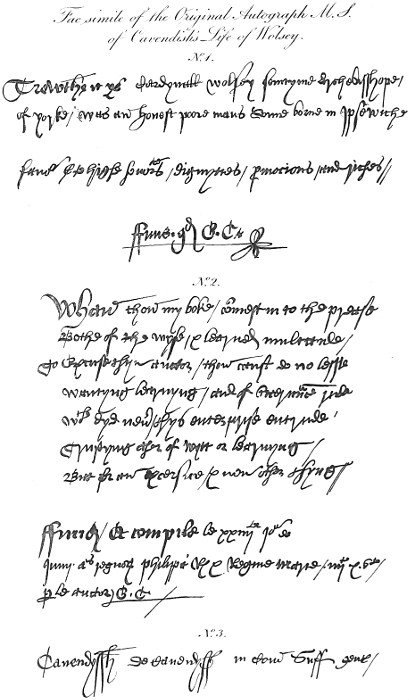
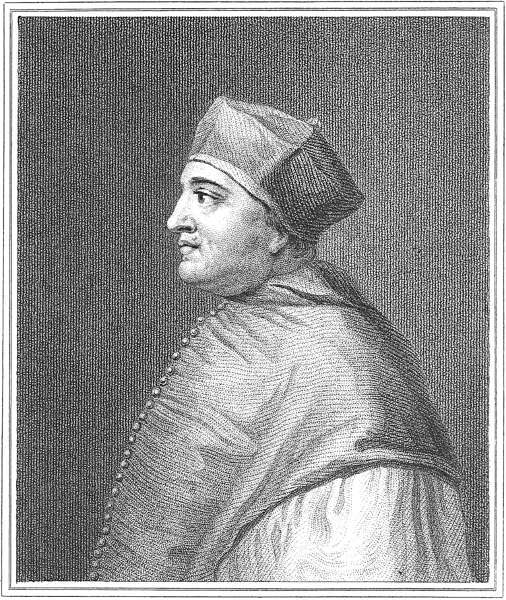
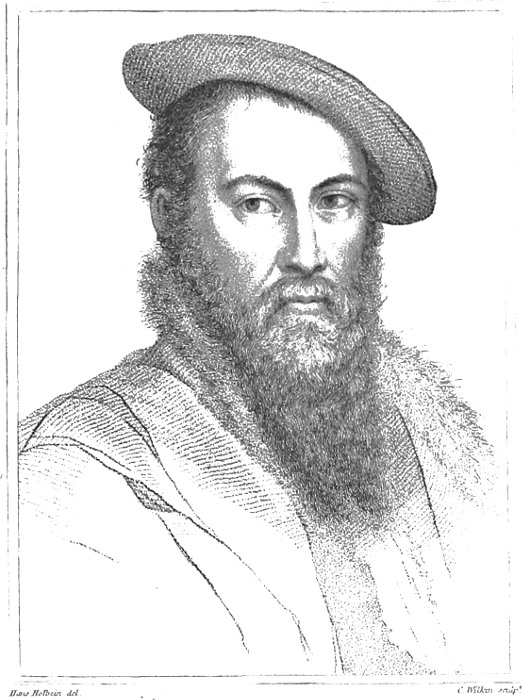
THE PROLOGUE.
THE
LIFE
OF
CARDINAL WOLSEY.
[Meseems it were no wisdom to credit every
light tale, blasted abroad by the blasphemous
mouth of the rude commonalty. For we daily
hear how, with their blasphemous trump, they
spread abroad innumerable lies, without either
shame or honesty, which primâ facie showeth
forth a visage of truth, as though it were a perfect
verity and matter indeed, whereas there is
nothing more untrue. And amongst the wise
sort so it is esteemed, with whom those babblings
be of small force and effect.
Forsooth I have read the exclamations of
divers worthy and notable authors, made against
such false rumours and fond opinions of the fantastical
commonalty, who delighteth in nothing
more than to hear strange things, and to see
new alterations of authorities; rejoicing sometimes
in such new fantasies, which afterwards
give them more occasion of repentance than of
joyfulness. Thus may all men of wisdom and
discretion understand the temerous madness of
the rude commonalty, and not give to them too
hasty credit of every sudden rumour, until the
truth be perfectly known by the report of some
approved and credible person, that ought to
have thereof true intelligence. I have heard
and also seen set forth in divers printed books
some untrue imaginations, after the death of
divers persons, which in their life were of great
estimation, that were invented rather to bring
their honest names into infamy and perpetual
slander of the common multitude, than otherwise.
The occasion therefore that maketh me to
rehearse all these things is this; for as much as
I intend, God willing, to write here some part
of the proceedings of][44] Legate and Cardinal
Wolsey, Archbishop of York, and of his ascending
and descending from honorous estate; whereof
some part shall be of mine own knowledge, and
some of other person’s information.
Forsooth this cardinal was my lord and master,
whom in his life I served, and so remained
with him, after his fall, continually, during the
term of all his trouble, until he died; as well in
the south as in the north parts, and noted all his
demeanor and usage in all that time; as also in
his wealthy triumph and glorious estate. And
since his death I have heard diverse sundry surmises
and imagined tales, made of his proceedings
and doings, which I myself have perfectly
known to be most untrue; unto the which I
could have sufficiently answered according to
truth, but, as me seemeth, then it was much
better for me to suffer, and dissemble the matter,
and the same to remain still as lies, than to
reply against their untruth, of whom I might,
for my boldness, sooner have kindled a great
flame of displeasure, than to quench one spark
of their malicious untruth. Therefore I commit
the truth to Him who knoweth all things. For,
whatsoever any man hath conceived in him when
he lived, or since his death, thus much I dare
be bold to say, without displeasure to any person,
or of affection, that in my judgment I never
saw this realm in better order, quietness, and
obedience, than it was in the time of his authority
and rule, ne justice better ministered with
indifferency; as I could evidently prove, if I
should not be accused of too much affection, or
else that I set forth more than truth. I will
therefore here desist to speak any more in his
commendation, and proceed farther to his original
beginning [and] ascending by fortune’s
favour to high honours, dignities, promotions,
and riches.
Finis quod G. C.
Truth it is, Cardinal Wolsey, sometime Archbishop
of York, was an honest poor man’s son[45],
born in Ipswich, within the county of Suffolk;
and being but a child, was very apt to learning;
by means whereof his parents, or his good
friends and masters, conveyed him to the University
of Oxford, where he prospered so in
learning, that, as he told me [in] his own person,
he was called the boy-bachellor, forasmuch
as he was made Bachellor of Arts at fifteen
years of age, which was a rare thing, and seldom
seen.
Thus prospering and increasing in learning,
[he] was made Fellow of Magdalen College,
and after appointed, for his learning, to be
schoolmaster there; at which time the Lord
Marquess Dorset had three of his sons there at
school with him, committing as well unto him
their virtuous education, as their instruction and
learning. It pleased the said marquess against
a Christmas season, to send as well for the
schoolmaster as for his children, home to his
house, for their recreation in that pleasant and
honourable feast. They being then there, my
lord their father perceived them to be right well
employed in learning, for their time: which contented
him so well, that he having a benefice[46]
in his gift, being at that time void, gave the
same to the schoolmaster, in reward for his diligence,
at his departing after Christmas upon his
return to the University. And having the presentation
thereof [he] repaired to the ordinary
for his institution and induction; then being
fully furnished of all necessary instruments at
the ordinary’s hands for his preferment, he made
speed without any farther delay to the said
benefice to take thereof possession. And being
there for that intent, one Sir Amyas Pawlet,
knight, dwelling in the country thereabout, took
an occasion of displeasure against him, upon
what ground I know not[47]: but, sir, by your
leave, he was so bold to set the schoolmaster by
the feet during his pleasure; the which was
afterward neither forgotten nor forgiven. For
when the schoolmaster mounted the dignity to
be Chancellor of England, he was not oblivious
of the old displeasure ministered unto him by
master Pawlet, but sent for him, and after many
sharp and heinous words, enjoined him to attend
upon the council until he were by them dismissed,
and not to depart without license, upon an urgent
pain and forfeiture: so that he continued within
the Middle Temple, the space of five or six
years, or more; whose lodging there was in the
gate-house next the street, which he reedified
very sumptuously, garnishing the same, on the
outside thereof, with cardinals’ hats and arms,
badges and cognisaunces of the cardinal, with
divers other devices, in so glorious a sort, that
he thought thereby to have appeased his old
unkind displeasure.
Now may this be a good example and precedent
to men in authority, which will sometimes
work their will without wit, to remember in their
authority, how authority may decay; and [those]
whom they punish of will more than of justice,
may after be advanced in the public weal to high
dignities and governance, and they based as
low, who will then seek the means to be revenged
of old wrongs sustained wrongfully before.
Who would have thought then, when Sir Amyas
Pawlet punished this poor scholar, that ever
he should have attained to be Chancellor of
England, considering his baseness in every condition.
These be wonderful works of God, and
fortune. Therefore I would wish all men in
authority and dignity to know and fear God in
all their triumphs and glory; considering in all
their doings, that authorities be not permanent,
but may slide and vanish, as princes’ pleasures
do alter and change.
Then as all living things must of very necessity
pay the due debt of nature, which no earthly
creature can resist, it chanced my said Lord
Marquess to depart out of this present life[48].
After whose death this schoolmaster, considering
then with himself to be but a small beneficed
man, and to have lost his fellowship in the College
(for, as I understand, if a fellow of that
college be once promoted to a benefice he shall
by the rules of the house be dismissed of his
fellowship), and perceiving himself also to be
destitute of his singular good lord, thought not
to be long unprovided of some other succour or
staff, to defend him from all such harms, as he
lately sustained.
And in his travail thereabout, he fell in acquaintance
with one Sir John Nanphant[49], a very
grave and ancient knight, who had a great room[50]
in Calais under King Henry the Seventh. This
knight he served, and behaved him so discreetly,
and justly, that he obtained the especial favour
of his said master; insomuch that for his wit,
gravity, and just behaviour, he committed all the
charge of his office unto his chaplain. And, as
I understand, the office was the treasurership of
Calais, who was, in consideration of his great
age, discharged of his chargeable room, and
returned again into England, intending to live
more at quiet. And through his instant labour
and especial favour his chaplain was promoted
to the king’s service, and made his chaplain.
And when he had once cast anchor in the port of
promotion, how he wrought, I shall somewhat
declare.
He, having then a just occasion to be in the
present sight of the king daily, by reason he
attended, and said mass before his grace in his
private closet, and that done he spent not the
day forth in vain idleness, but gave his attendance
upon those whom he thought to bear
most rule in the council, and to be most in
favour with the king, the which at that time were
Doctor Fox, Bishop of Winchester, then secretary
and lord privy seal, and also Sir Thomas
Lovell, knight, a very sage counsellor, and witty;
being master of the king’s wards, and constable
of the Tower[51].
These ancient and grave counsellors in process
of time after often resort, perceived this
chaplain to have a very fine wit, and what wisdom
was in his head, thought [him] a meet and
an apt person to be preferred to witty affairs.
It chanced at a certain season that the king
had an urgent occasion to send an ambassador
unto the emperor Maximilian[52], who lay at that
present in the Low Country of Flanders, not far
from Calais. The Bishop of Winchester, and
Sir Thomas Lovell, whom the king most highly
esteemed, as chief among his counsellors (the
king one day counselling and debating with
them upon this embassy), saw they had a convenient
occasion to prefer the king’s chaplain,
whose excellent wit, eloquence[53], and learning
they highly commended to the king. The king
giving ear unto them, and being a prince of an
excellent judgment and modesty, commanded
[them] to bring his chaplain, whom they so much
commended, before his grace’s presence. At
whose repair [thither] to prove the wit of his
chaplain, the king fell in communication with
him in matters of weight and gravity: and, perceiving
his wit to be very fine, thought him
sufficient to be put in authority and trust with
this embassy; [and] commanded him thereupon
to prepare himself to this enterprise and journey,
and for his depeche[54], to repair to his grace and
his trusty counsellors aforesaid, of whom he
should receive his commission and instructions.
By means whereof he had then a due occasion
to repair from time to time into the king’s presence,
who perceived him more and more to be
a very wise man, and of a good entendment[55].
And having his depeche, [he] took his leave of
the king at Richmond about noon, and so came
to London with speed [about four of the clock[56]],
where then the barge of Gravesend was ready
to launch forth, both with a prosperous tide and
wind. Without any farther abode he entered
the barge, and so passed forth. His happy
speed was such that he arrived at Gravesend
within little more than three hours; where he
tarried no longer than his post horses were
provided; and travelling so speedily with post
horses, that he came to Dover the next morning
early, whereas the passengers[57] were ready
under sail displayed, to sail to Calais. Into
which passengers without any farther abode he
entered, and sailed forth with them, [so] that he
arrived at Calais within three hours, and having
there post horses in a readiness, departed incontinent,
making such hasty speed, that he was
that night with the emperor; who, having understanding
of the coming of the King of England’s
ambassador, would in no wise defer the time,
but sent incontinent for him (his affection unto
King Henry the Seventh was such, that he
rejoiced when he had an occasion to show him
pleasure). The ambassador having opportunity,
disclosed the sum of his embassy unto the emperor,
of whom he required speedy expedition,
the which was granted; so that the next day
he was clearly dispatched, with all the king’s
requests fully accomplished. At which time he
made no farther tarriance, but with post horses
rode incontinent that night toward Calais again,
conducted thither with such number of horsemen
as the emperor had appointed, and [was] at
the opening of the gates there, where the passengers
were as ready to return into England as
they were before in his advancing; insomuch
that he arrived at Dover by ten of the clock
before noon; and having post horses in a readiness,
came to the court at Richmond that night.
Where he taking his rest for that time until the
morning, repaired to the king at his first coming
out of his grace’s bedchamber, toward his closet
to hear mass. Whom (when he saw) [he]
checked him for that he was not past on his
journey. “Sir,” quoth he, “if it may stand with
your highness’ pleasure, I have already been
with the emperor, and dispatched your affairs, I
trust, to your grace’s contentation.” And with
that delivered unto the king the emperor’s letters
of credence. The king, being in a great confuse
and wonder of his hasty speed with ready furniture
of all his proceedings, dissimuled all his
imagination and wonder in that matter, and demanded
of him, whether he encountered not his
pursuivant, the which he sent unto him (supposing
him not to be scantly out of London)
with letters concerning a very necessary cause,
neglected in his commission and instructions,
the which the king coveted much to be sped.
“Yes, forsooth, Sire,” quoth he, “I encountered
him yesterday by the way: and, having no understanding
by your grace’s letters of your pleasure
therein, have, notwithstanding, been so
bold, upon mine own discretion (perceiving that
matter to be very necessary in that behalf) to
dispatch the same. And for as much as I have
exceeded your grace’s commission, I most humbly
require your gracious remission and pardon.”
The king rejoicing inwardly not a little, said
again, “We do not only pardon you thereof,
but also give you our princely thanks, both for
the proceeding therein, and also for your good
and speedy exploit[58],” commanding him for that
time to take his rest, and to repair again to him
after dinner, for the farther relation of his embassy.
The king then went to mass; and after
at convenient time he went to dinner.
It is not to be doubted but that this ambassador
hath been since his return with his
great friends, the Bishop of Winchester, and
Sir Thomas Lovell, to whom he hath declared
the effect of all his speedy progress; nor yet
what joy they conceived thereof. And after his
departure from the king in the morning, his
highness sent for the bishop, and Sir Thomas
Lovell; to whom he declared the wonderful
expedition of his ambassador, commending
therewith his excellent wit, and in especial the
invention and advancing of the matter left out of
his commission and instructions. The king’s
words rejoiced these worthy counsellors not a
little, for as much as he was of their preferment.
Then when this ambassador remembered the
king’s commandment, and saw the time draw
fast on of his repair before the king and his
council, [he] prepared him in a readiness, and
resorted unto the place assigned by the king,
to declare his embassy. Without all doubt he
reported the effect of all his affairs and proceedings
so exactly, with such gravity and eloquence
that all the council that heard him could
do no less but commend him, esteeming his
expedition to be almost beyond the capacity of
man. The king of his mere motion, and gracious
consideration, gave him at that time for his
diligent and faithful service, the deanery of
Lincoln[59], which at that time was one of the
worthiest spiritual promotions that he gave
under the degree of a bishoprick. And thus
from thenceforward he grew more and more into
estimation and authority, and after [was] promoted
by the king to be his almoner. Here
may all men note the chances of fortune, that
followeth some whom she listeth to promote,
and even so to some her favour is contrary,
though they should travail never so much, with
[all the] urgent diligence and painful study, that
they could devise or imagine: whereof, for my
part, I have tasted of the experience.
Now ye shall understand that all this tale
that I have declared of his good expedition in
the king’s embassy, I received it of his own
mouth and report, after his fall, lying at that
time in the great park of Richmond, I being
then there attending upon him; taking an occasion
upon divers communications, to tell me
this journey, with all the circumstances, as I have
here before rehearsed.
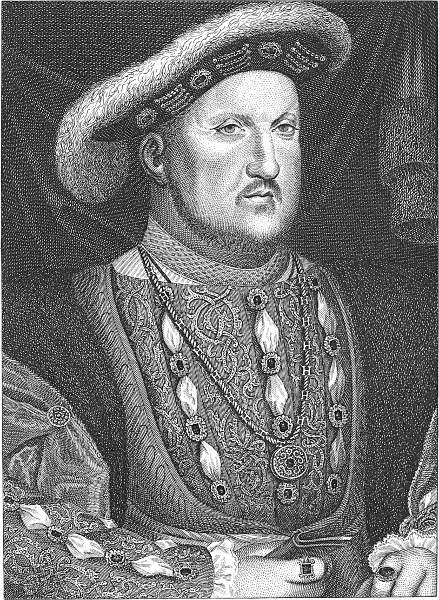
HENRY THE EIGHTH.
FROM AN ORIGINAL PICTURE BY HOLBEIN.
IN THE COLLECTION OF BARRET BRYDGES ESQ.
AT LEE PRIORY IN KENT.
London, Published Jany. 1, 1825; by Harding, Triphook & Lepard.
When death (that favoureth none estate, king
or keiser) had taken that prudent prince Henry
the Seventh out of this present life (on whose
soul Jesu have mercy!) who for his inestimable
wisdom was noted and called, in every Christian
region, the second Solomon, what practices, inventions,
and compasses were then used about
that young prince, King Henry the Eighth, his
only son, and the great provision made for the
funerals of the one, and the costly devices for
the coronation of the other, with that virtuous
Queen Catherine[60], then the king’s wife newly
married. I omit and leave the circumstances
thereof to historiographers of chronicles of
princes, the which is no part mine intendment.
After all these solemnities and costly triumphs
finished, and that our natural, young, lusty and
courageous prince and sovereign lord, King
Henry the Eighth, entering into the flower of
pleasant youth, had taken upon him the regal
sceptre and the imperial diadem of this fertile
and plentiful realm of England (which at that
time flourished in all abundance of wealth and
riches, whereof he was inestimably garnished
and furnished), called then the golden world, such
grace of plenty reigned then within this realm.
Now let us return again unto the almoner (of
whom I have taken upon me to write), whose head
was full of subtil wit and policy, [and] perceiving
a plain path to walk in towards promotion, [he]
handled himself so politicly, that he found the
means to be made one of the king’s council, and
to grow in good estimation and favour with the
king, to whom the king gave a house at Bridewell,
in Fleet Street, sometime Sir Richard
Empson’s[61], where he kept house for his family,
and he daily attended upon the king in the
court, being in his especial grace and favour,
[having][62] then great suit made unto him, as
counsellors most commonly have that be in
favour. His sentences and witty persuasions in
the council chamber [were][63] always so pithy that
they, always as occasion moved them, assigned
him for his filed tongue and ornate eloquence, to
be their expositor unto the king’s majesty in all
their proceedings. In whom the king conceived
such a loving fantasy, and in especial for that
he was most earnest and readiest among all the
council to advance the king’s only will and
pleasure, without any respect to the case; the
king, therefore, perceived him to be a meet instrument
for the accomplishment of his devised
will and pleasure, called him more near unto
him, and esteemed him so highly that his estimation
and favour put all other ancient counsellors
out of their accustomed favour, that
they were in before; insomuch that the king
committed all his will and pleasure unto his disposition
and order. Who wrought so all his
matters, that all his endeavour was only to satisfy
the king’s mind, knowing right well, that it
was the very vein and right course to bring him
to high promotion. The king was young and
lusty, disposed all to mirth and pleasure, and
to follow his desire and appetite, nothing minding
to travail in the busy affairs of this realm.
The which the almoner perceiving very well,
took upon him therefore to disburden the king
of so weighty a charge and troublesome business,
putting the king in comfort that he shall
not need to spare any time of his pleasure, for
any business that should necessarily happen in
the council, as long as he, being there and having
the king’s authority and commandment, doubted
not to see all things sufficiently furnished and
perfected; the which would first make the king
privy of all such matters as should pass through
their hands before he would proceed to the
finishing or determining of the same, whose
mind and pleasure he would fulfill and follow
to the uttermost, wherewith the king was wonderly
pleased. And whereas the other ancient
counsellors would, according to the office of
good counsellors, diverse times persuade the
king to have sometime an intercourse in to
the council, there to hear what was done in
weighty matters, the which pleased the king
nothing at all, for he loved nothing worse than
to be constrained to do any thing contrary to
his royal will and pleasure; and that knew the
almoner very well, having a secret intelligence
of the king’s natural inclination, and so fast as
the other counsellors advised the king to leave
his pleasure, and to attend to the affairs of his
realm, so busily did the almoner persuade him
to the contrary; which delighted him much, and
caused him to have the greater affection and love
to the almoner. Thus the almoner ruled all
them that before ruled him; such [things] did
his policy and wit bring to pass. Who was
now in high favour, but Master Almoner? Who
had all the suit but Master Almoner? And who
ruled all under the king, but Master Almoner?
Thus he proceeded still in favour; at last, in
came presents, gifts, and rewards so plentifully,
that I dare say he lacked nothing that might
either please his fantasy or enrich his coffers;
fortune smiled so upon him; but to what end
she brought him, ye shall hear after. Therefore
let all men, to whom fortune extendeth her
grace, not trust too much to her fickle favour
and pleasant promises, under colour whereof
she carrieth venemous gall. For when she seeth
her servant in most highest authority, and that
he assureth himself most assuredly in her favour,
then turneth she her visage and pleasant countenance
unto a frowning cheer, and utterly forsaketh
him: such assurance is in her inconstant
favour and sugared promise. Whose deceitful
behaviour hath not been hid among the wise sort
of famous clerks, that have exclaimed her and
written vehemently against her dissimulation and
feigned favour, warning all men thereby, the less
to regard her, and to have her in small estimation
of any trust or faithfulness.
This almoner, climbing thus hastily on fortune’s
wheel, that no man was of that estimation
with the king as he was, for his wisdom and
other witty qualities, he had a special gift of
natural eloquence[64], with a filed tongue to pronounce
the same, that he was able with the
same to persuade and allure all men to his purpose.
Proceeding thus in fortune’s blissfulness,
it chanced the wars between the realms
of England and France to be open, but upon
what occasion I know not, in so much as the
king, being fully persuaded, and resolved in
his most royal person to invade his foreign
enemies with a puissant army, to delay their
hault[65] brags, within their own territory: wherefore
it was thought very necessary, that this
royal enterprise should be speedily provided
and plentifully furnished in every degree of
things apt and convenient for the same; the
expedition whereof, the king’s highness thought
no man’s wit so meet, for policy and painful travail,
as his wellbeloved almoner’s was, to whom
therefore he committed his whole affiance and
trust therein. And he being nothing scrupulous
in any thing, that the king would command him
to do, although it seemed to other very difficile,
took upon him the whole charge and burden of
all this business, and proceeded so therein, that
he brought all things to a good pass and purpose
in a right decent order, as of all manner of victuals,
provisions, and other necessaries, convenient
for so noble a voyage and puissant army.
All things being by him perfected, and furnished,
the king, not minding to delay or neglect
the time appointed, but with noble and valiant
courage advanced to his royal enterprise, passed
the seas between Dover and Calais, where he
prosperously arrived[66]; and after some abode
there of his Grace, as well for the arrival of his
puissant army royal, provisions and munitions,
as to consult about his princely affairs, marched
forward, in good order of battle, through the
Low Country, until he came to the strong
town of Terouanne. To the which he laid his
assault, and assailed it so fiercely with continual
assaults, that within short space he caused them
within to yield the town. Unto which place the
Emperor Maximilian repaired unto the king our
sovereign Lord, with a puissant army, like a
mighty and friendly prince, taking of the king
his Grace’s wages[67], as well for his own person
as for his retinue, the which is a rare thing seldom
seen, heard, or read, that an emperor
should take wages, and fight under a king’s
banner. Thus after the king had obtained the
possession of this puissant fort, and set all
things in due order, for the defence and preservation
of the same to his highness’ use, he
departed from thence, and marched toward the
city of Tournay, and there again laid his siege;
to the which he gave so fierce and sharp assaults,
that they within were constrained of fine
force[68] to yield up the town unto his victorious
majesty. At which time he gave the Almoner
the bishoprick of the same See, for some part
of recompense of his pains sustained in that journey.
And when the King had established all
things there agreeable to his princely pleasure,
and furnished the same with noble valiant captains
and men of war, for the safeguard of the
town against his enemies, he returned again into
England, taking with him divers worthy persons
of the peers of France, as the Duke of Longueville,
and Countie Clermont, and divers
other taken there in a skirmish most victoriously.
After whose return immediately, the
See of Lincoln fell void by the death of Doctor
Smith, late bishop of that dignity, the which
benefice and promotion his Grace gave unto his
Almoner[69], Bishop elect of Tournay, who was
not negligent to take possession thereof, and
made all the speed he could for his consecration:
the solemnization whereof ended, he found the
means to get the possession of all his predecessor’s
goods into his hands, whereof I have
seen divers times some part thereof furnish his
house. It was not long after that Doctor Bambridge[70],
Archbishop of York, died at Rome,
being there the king’s ambassador unto the
Pope Julius; unto which benefice the king presented
his new Bishop of Lincoln; so that he
had three bishopricks[71] in one year given him.
Then prepared he again of new as fast for his
translation from the See of Lincoln, unto the See
of York. After which solemnization done, and
he being in possession of the Archbishoprick
of York, and Primas Angliæ, thought himself
sufficient to compare with Canterbury; and
thereupon erected his cross in the court, and in
every other place, as well in the presence of the
Archbishop of Canterbury, and in the precinct
of his jurisdiction as elsewhere. And forasmuch
as Canterbury claimeth superiority and obedience
of York, as he doth of all other bishops within
this realm, forasmuch as he is primus totius Angliæ,
and therefore claimeth, as a token of an
ancient obedience, of York to abate the advancing
of his cross, in the presence of the cross
of Canterbury; notwithstanding York, nothing
minding to desist from bearing of his cross in
manner as is said before, caused his cross to be
advanced[72] and borne before him, as well in the
presence of Canterbury as elsewhere. Wherefore
Canterbury being moved therewith, gave
York a certain check for his presumption; by
reason whereof there engendered some grudge
between Canterbury and York. And York perceiving
the obedience that Canterbury claimed
to have of York, intended to provide some such
means that he would rather be superior in dignity
to Canterbury than to be either obedient
or equal to him. Wherefore he obtained first
to be made Priest Cardinal, and Legatus de
latere; unto whom the Pope sent a Cardinal’s
hat, with certain bulls for his authority in that
behalf[73]. Yet by the way of communication ye
shall understand that the Pope sent him this hat
as a worthy jewel of his honour, dignity, and authority,
the which was conveyed hither in a varlet’s
budget, who seemed to all men to be but a
person of small estimation. Whereof York being
advertised, of the baseness of the messenger,
and of the people’s opinion and rumour, thought
it for his honour meet, that so high a jewel
should not be conveyed by so simple a messenger;
wherefore he caused him to be stayed
by the way, immediately after his arrival in
England, where he was newly furnished in all
manner of apparel, with all kind of costly silks,
which seemed decent for such an high ambassador.
And that done, he was encountered upon
Blackheath, and there received with a great
assembly of prelates, and lusty gallant gentlemen,
and from thence conducted and conveyed
through London, with great triumph. Then was
great and speedy provision[74] and preparation
made in Westminster Abbey for the confirmation
of his high dignity; the which was executed
by all the bishops and abbots nigh or about
London, in rich mitres and copes, and other
costly ornaments; which was done in so solemn
a wise as I have not seen the like unless it had
been at the coronation of a mighty prince or
king.
Obtaining this dignity [he] thought himself
meet to encounter with Canterbury in his high
jurisdiction before expressed; and that also he
was as meet to bear authority among the temporal
powers, as among the spiritual jurisdictions.
Wherefore remembering as well the
taunts and checks before sustained of Canterbury,
which he intended to redress, having a
respect to the advancement of worldly honour,
promotion, and great benefits, [he] found the
means with the king, that he was made Chancellor
of England; and Canterbury thereof dismissed,
who had continued in that honourable
room and office, since long before the death of
King Henry the Seventh[75].
Now he being in possession of the chancellorship,
endowed with the promotion of an Archbishop,
and Cardinal Legate de latere, thought
himself fully furnished with such authorities and
dignities, that he was able to surmount Canterbury
in all ecclesiastical jurisdictions, having
power to convocate Canterbury, and other
bishops, within his precincts, to assemble at his
convocation, in any place within this realm
where he would assign; taking upon him the
correction of all matters in every diocese, having
there through all the realm all manner of spiritual
ministers, as commissaries, scribes, apparitors,
and all other officers to furnish his courts;
visited also all spiritual houses, and presented
by prevention whom he listed to their benefices.
And to the advancing of his Legatine honours
and jurisdictions, he had masters of his faculties,
masters Ceremoniarum, and such other like
officers to the glorifying of his dignity. Then
had he two great crosses of silver, whereof one of
them was for his Archbishoprick, and the other
for his Legacy, borne always before him whither
soever he went or rode, by two of the most tallest
and comeliest priests that he could get within
all this realm[76]. And to the increase of his gains
he had also the bishoprick of Durham, and the
Abbey of St. Albans in commendam; howbeit
after, when Bishop Fox, of Winchester, died,
he surrendered Durham into the King’s hands,
and in lieu thereof took the Bishoprick of
Winchester. Then he held also, as it were in
ferme, Bath, Worcester, and Hereford, because
the incumbents thereof were strangers[77], born out
of this realm, continuing always beyond the
seas, in their own native countries, or else at
Rome, from whence they were sent by the Pope
in legation into England to the king. And for
their reward, at their departure, the prudent
King Henry the Seventh thought it better to
reward them with that thing, he himself could
not keep, than to defray or disburse any thing
of his treasure. And then they being but
strangers, thought it more meet for their assurance,
and to have their jurisdictions conserved
and justly used, to permit the Cardinal to have
their benefices for a convenient yearly sum of
money to be paid them by exchanges in their
countries, than to be troubled, or burdened with
the conveyance thereof unto them: so that all
their spiritual promotions and jurisdictions of
their bishopricks were clearly in his domain and
disposition, to prefer or promote whom he listed
unto them. He had also a great number daily
attending upon him, both of noblemen and worthy
gentlemen, of great estimation and possessions,
with no small number of the tallest yeomen,
that he could get in all this realm, in so much
that well was that nobleman and gentleman, that
might prefer any tall and comely yeoman unto
his service.
Now to speak of the order of his house and
officers, I think it necessary here to be remembered.
First ye shall understand, that he had
in his hall, daily, three especial tables furnished
with three principal officers; that is to say, a
Steward, which was always a dean or a priest;
a Treasurer, a knight; and a Comptroller, an
esquire; which bare always within his house
their white staves. Then had he a cofferer,
three marshals, two yeomen ushers, two grooms,
and an almoner. He had in the hall-kitchen
two clerks of his kitchen, a clerk comptroller, a
surveyor of the dresser, a clerk of his spicery.
Also there in his hall-kitchen he had two master
cooks, and twelve other labourers, and children
as they called them; a yeoman of his scullery,
and two other in his silver scullery; two yeomen
of his pastry, and two grooms[78].
Now in his privy kitchen he had a Master
Cook who went daily in damask satin, or velvet,
with a chain of gold about his neck; and two
grooms, with six labourers and children to serve
in that place; in the Larder there, a yeoman
and a groom; in the Scalding-house, a yeoman
and two grooms; in the Scullery there, two
persons; in the Buttery, two yeomen and two
grooms, with two other pages; in the Pantry,
two yeomen, two grooms, and two other pages;
and in the Ewery likewise: in the Cellar, three
yeomen, two grooms, and two pages; beside a
gentleman for the month: in the Chaundery,
three persons: in the Wafery, two; in the
Wardrobe of beds, the master of the wardrobe,
and ten other persons; in the Laundry, a yeoman,
a groom, and three pages: of purveyors,
two, and one groom; in the Bakehouse, a
yeoman and two grooms; in the Wood-yard, a
yeoman and a groom; in the Garner, one; in
the Garden, a yeoman and two labourers. Now
at the gate, he had of porters, two tall yeomen
and two grooms; a yeoman of his barge: in the
stable, he had a master of his horse, a clerk of
the stable, a yeoman of the same; a Saddler, a
Farrier, a yeoman of his Chariot, a Sumpter-man,
a yeoman of his stirrup; a Muleteer; sixteen
grooms of his stable, every of them keeping four
great geldings: in the Almeserie, a yeoman and
a groom.
Now I will declare unto you the officers of
his chapel, and singing men of the same. First,
he had there a Dean, who was always a great
clerk and a divine; a Sub-dean; a Repeater of
the quire; a Gospeller[79], a Pisteller; and twelve
singing Priests: of Scholars, he had first, a Master
of the children; twelve singing children; sixteen
singing men; with a servant to attend upon
the said children. In the Revestry[80], a yeoman
and two grooms: then were there divers retainers
of cunning singing men, that came thither at
divers sundry principal feasts. But to speak
of the furniture of his chapel passeth my capacity
to declare the number of the costly ornaments
and rich jewels, that were occupied in
the same continually. For I have seen there,
in a procession, worn forty-four copes of one
suit, very rich, besides the sumptuous crosses,
candlesticks, and other necessary ornaments to
the comely furniture of the same. Now shall ye
understand that he had two cross bearers, and
two pillar bearers: and in his chamber, all these
persons; that is to say: his high Chamberlain,
his Vice Chamberlain; twelve Gentlemen
ushers, daily waiters; besides two in his privy
chamber; and of Gentlemen waiters in his privy
chamber he had six; and also he had of Lords
nine or ten[81], who had each of them allowed two
servants; and the Earl of Derby had allowed
five men. Then had he of Gentlemen, as cup-bearers,
carvers, sewers, and Gentlemen daily
waiters, forty persons; of yeomen ushers he had
six; of grooms in his chamber he had eight;
of yeomen of his chamber he had forty-six
daily to attend upon his person; he had also a
priest there which was his Almoner, to attend
upon his table at dinner. Of doctors and chaplains
attending in his closet to say daily mass
before him, he had sixteen persons: and a clerk
of his closet. Also he had two secretaries, and
two clerks of his signet; and four counsellors
learned in the laws of the realm.
And for as much as he was Chancellor of
England, it was necessary for him to have divers
officers of the Chancery to attend daily upon
him, for the better furniture of the same. That
is to say: first, he had the Clerk of the Crown,
a Riding Clerk, a Clerk of the Hanaper, a Chafer
of Wax. Then had he a Clerk of the Check, as
well to check his Chaplains, as his Yeomen of the
Chamber; he had also four Footmen, which were
apparelled in rich running coats, whensoever he
rode any journey. Then had he an herald at
Arms, and a Sergeant at Arms; a Physician;
an Apothecary; four Minstrels; a Keeper of
his Tents, an Armourer; an Instructor of his
Wards; two Yeomen in his Wardrobe; and a
Keeper of his Chamber in the court. He had
also daily in his house the Surveyor of York, a
Clerk of the Green Cloth; and an Auditor. All
this number of persons were daily attendant
upon him in his house, down-lying and up-rising.
And at meals, there was continually in his
chamber a board kept for his Chamberlains, and
Gentlemen Ushers, having with them a mess
of the young Lords[82], and another for gentlemen.
Besides all these, there was never an officer and
gentleman, or any other worthy person in his
house, but he was allowed some three, some
two servants; and all other one at the least;
which amounted to a great number of persons.
Now have I showed you the order of his house,
and what officers and servants he had, according
to his checker roll, attending daily upon him;
besides his retainers, and other persons being
suitors, that most commonly were fed in his hall.
And whensoever we shall see any more such
subjects within this realm, that shall maintain
any such estate and household, I am content he
be advanced above him in honour and estimation.
Therefore here I make an end of his
household; whereof the number was about the
sum of five hundred[83] persons according to his
checker roll.
You have heard of the order and officers of
his house; now I do intend to proceed forth
unto other of his proceedings; for, after he was
thus furnished, in manner as I have before rehearsed
unto you, he was twice sent in embassy
unto the Emperor Charles the Fifth, that now
reigneth; and father unto King Philip, now our
sovereign lord. Forasmuch as the old Emperor
Maximilian was dead, and for divers urgent
causes touching the king’s majesty, it was
thought good that in so weighty a matter, and
to so noble a prince, that the Cardinal was most
meet to be sent on so worthy an embassy.
Wherefore he being ready to take upon him the
charge thereof, was furnished in all degrees and
purposes most likest a great prince, which was
much to the high honour of the king’s majesty,
and of this realm. For first in his proceeding
he was furnished like a cardinal of high estimation,
having all things thereto correspondent
and agreeable. His gentlemen, being in number
very many, clothed in livery coats of crimson
velvet of the most purest colour that might be
invented, with chains of gold about their necks;
and all his yeomen and other mean officers were
in coats of fine scarlet, guarded with black velvet
a hand broad. He being thus furnished in this
manner, was twice sent unto the emperor into
Flanders, the emperor lying then in Bruges;
who entertained our ambassador very highly[84],
discharging him and all his train of their charge;
for there was no house within all Bruges, wherein
any gentlemen of the Lord Ambassador’s lay, or
had recourse, but that the owners of the houses
were commanded by the emperor’s officers, that
they, upon pain of their lives, should take no
money for any thing that the cardinal’s servants
should take or dispend in victuals; no, although
they were disposed to make any costly banquets:
furthermore commanding their said hosts, to see
that they lacked no such thing as they desired
or required to have for their pleasures. Also
the emperor’s officers every night went through
the town, from house to house, where as any
English men lay or resorted, and there served
their liveries[85] for all night; which was done
after this manner: first, the emperor’s officers
brought in to the house a cast of fine manchet
bread[86], two great silver pots, with wine, and a
pound of fine sugar; white lights and yellow; a
bowl or goblet of silver, to drink in; and every
night a staff torch. This was the order of their
liveries every night. And then in the morning,
when the officers came to fetch away their stuff,
then would they accompt with the host for the
gentlemen’s costs spent in that night and day
before. Thus the emperor entertained the cardinal
and all his train, for the time of his embassy
there. And that done, he returned home again
into England, with great triumph, being no less
in estimation with the king than he was before,
but rather much more.
Now will I declare unto you his order in going
to Westminster Hall, daily in the term season.
First, before his coming out of his privy chamber,
he heard most commonly every day two
masses in his privy closet; and there then said
his daily service with his chaplain: and as I
heard his chaplain say, being a man of credence
and of excellent learning, that the cardinal,
what business or weighty matters soever he had
in the day, he never went to his bed with any
part of his divine service unsaid, yea not so
much as one collect; wherein I doubt not but
he deceived the opinion of divers persons. And
after mass he would return in his privy chamber
again, and being advertised of the furniture of
his chambers without, with noblemen, gentlemen,
and other persons, would issue out into
them, appareled all in red, in the habit of a cardinal;
which was either of fine scarlet, or else of
crimson satin, taffety, damask, or caffa, the best
that he could get for money: and upon his head
a round pillion, with a noble of black velvet set
to the same in the inner side; he had also a
tippet of fine sables about his neck; holding in
his hand a very fair orange, whereof the meat
or substance within was taken out, and filled
up again with the part of a sponge, wherein
was vinegar, and other confections against the
pestilent airs; the which he most commonly
smelt unto, passing among the press, or else
when he was pestered with many suitors. There
was also borne before him first, the great seal
of England, and then his cardinal’s hat, by a
nobleman or some worthy gentleman, right solemnly,
bareheaded. And as soon as he was entered
into his chamber of presence, where there
was attending his coming to await upon him to
Westminster Hall, as well noblemen and other
worthy gentlemen, as noblemen and gentlemen
of his own family; thus passing forth with two
great crosses of silver borne before him[87]; with
also two great pillars of silver, and his pursuivant
at arms with a great mace of silver gilt. Then
his gentlemen ushers cried, and said: “On, my
lords and masters, on before; make way for
my Lord’s Grace!” Thus passed he down from
his chamber through the hall; and when he came
to the hall door, there was attendant for him
his mule, trapped all together in crimson velvet,
and gilt stirrups. When he was mounted, with
his cross bearers, and pillar bearers[88], also upon
great horses trapped with [fine] scarlet. Then
marched he forward, with his train and furniture
in manner as I have declared, having about him
four footmen, with gilt pollaxes in their hands;
and thus he went until he came to Westminster
Hall door. And there alighted, and went after this
manner, up through the hall into the chancery;
howbeit he would most commonly stay awhile at
a bar, made for him, a little beneath the chancery
[on the right hand], and there commune
some time with the judges, and sometime with
other persons. And that done he would repair
into the chancery, sitting there till eleven of the
clock, hearing suitors, and determining of divers
matters. And from thence, he would divers
times go into the star chamber, as occasion did
serve; where he spared neither high nor low,
but judged every estate according to their merits
and deserts.
He used every Sunday to repair to the court,
being then for the most part at Greenwich, in
the term; with all his former order, taking his
barge at his privy stairs, furnished with tall
yeomen standing upon the bayles, and all gentlemen
being within with him; and landed again
at the Crane in the vintry. And from thence he
rode upon his mule, with his crosses, his pillars,
his hat, and the great seal, through Thames
Street, until he came to Billingsgate, or thereabout;
and there took his barge again, and
rowed to Greenwich, where he was nobly received
of the lords and chief officers of the
king’s house, as the treasurer and comptroller,
with others; and so conveyed to the king’s
chamber: his crosses commonly standing for the
time of his abode in the court, on the one side
of the king’s cloth of estate. He being thus in
the court, it was wonderly furnished with noblemen
and gentlemen, much otherwise than it was
before his coming. And after dinner, among
the lords, having some consultation with the
king, or with the council, he would depart homeward
with like state[89]: and this order he used
continually, as opportunity did serve.
Thus in great honour, triumph, and glory, he
reigned a long season, ruling all things within
this realm, appertaining unto the king, by his
wisdom, and also all other weighty matters of
foreign regions, with which the king of this
realm had any occasion to intermeddle. All
ambassadors of foreign potentates were always
dispatched by his discretion, to whom they had
always access for their dispatch. His house
was also always resorted and furnished with
noblemen, gentlemen, and other persons, with
going and coming in and out, feasting and banqueting
all ambassadors diverse times, and other
strangers right nobly.
And when it pleased the king’s majesty, for
his recreation, to repair unto the cardinal’s house,
as he did divers times in the year, at which time
there wanted no preparations, or goodly furniture,
with viands of the finest sort that might be
provided for money or friendship. Such pleasures
were then devised for the king’s comfort
and consolation, as might be invented, or by
man’s wit imagined. The banquets were set
forth, with masks and mummeries, in so gorgeous
a sort, and costly manner, that it was a heaven
to behold. There wanted no dames, or damsels,
meet or apt to dance with the maskers, or to garnish
the place for the time, with other goodly
disports. Then was there all kind of music and
harmony set forth, with excellent voices both of
men and children. I have seen the king suddenly
come in thither in a mask, with a dozen
of other maskers, all in garments like shepherds,
made of fine cloth of gold and fine crimson satin
paned, and caps of the same, with visors of good
proportion of visnomy; their hairs, and beards,
either of fine gold wire, or else of silver, and
some being of black silk; having sixteen torch
bearers, besides their drums, and other persons
attending upon them, with visors, and clothed
all in satin, of the same colours. And at his
coming, and before he came into the hall, ye
shall understand, that he came by water to the
water gate, without any noise; where, against
his coming, were laid charged many chambers[90],
and at his landing they were all shot off, which
made such a rumble in the air, that it was like
thunder. It made all the noblemen, ladies, and
gentlewomen, to muse what it should mean
coming so suddenly, they sitting quietly at a
solemn banquet; under this sort: First, ye shall
perceive that the tables were set in the chamber
of presence, banquet-wise covered, my Lord Cardinal
sitting under the cloth of estate, and there
having his service all alone; and then was there
set a lady and a nobleman, or a gentleman and
gentlewoman, throughout all the tables in the
chamber on the one side, which were made and
joined as it were but one table. All which order
and device was done and devised by the Lord
Sands, Lord Chamberlain to the king; and also
by Sir Henry Guilford, Comptroller to the king.
Then immediately after this great shot of guns,
the cardinal desired the Lord Chamberlain, and
Comptroller, to look what this sudden shot
should mean, as though he knew nothing of the
matter. They thereupon looking out of the
windows into Thames, returned again, and
showed him, that it seemed to them there should
be some noblemen and strangers arrived at his
bridge, as ambassadors from some foreign prince.
With that, quoth the cardinal, "I shall desire
you, because ye can speak French, to take the
pains to go down into the hall to encounter and
to receive them, according to their estates, and
to conduct them into this chamber, where they
shall see us, and all these noble personages sitting
merrily at our banquet, desiring them to sit down
with us, and to take part of our fare and pastime.
Then [they] went incontinent down into the
hall, where they received them with twenty new
torches, and conveyed them up into the chamber,
with such a number of drums and fifes as I have
seldom seen together, at one time in any masque.
At their arrival into the chamber, two and two
together, they went directly before the cardinal
where he sat, saluting him very reverently; to
whom the Lord Chamberlain for them said: "Sir,
for as much as they be strangers, and can speak
no English, they have desired me to declare unto
your Grace thus: they, having understanding
of this your triumphant banquet, where was
assembled such a number of excellent fair dames,
could do no less, under the supportation of your
good grace, but to repair hither to view as well
their incomparable beauty, as for to accompany
them at mumchance[91], and then after to dance
with them, and so to have of them acquaintance.
And, sir, they furthermore require of your Grace
licence to accomplish the cause of their repair."
To whom the cardinal answered, that he was
very well contented they should so do. Then
the maskers went first and saluted all the dames
as they sat, and then returned to the most worthiest,
and there opened a cup full of gold, with
crowns, and other pieces of coin, to whom they
set divers pieces to cast at. Thus in this manner
perusing all the ladies and gentlewomen, and
to some they lost, and of some they won. And
thus done, they returned unto the cardinal, with
great reverence, pouring down all the crowns in
the cup, which was about two hundred crowns.
“At all,” quoth the cardinal, and so cast the
dice, and won them all at a cast; whereat was
great joy made. Then quoth the cardinal to my
Lord Chamberlain, “I pray you,” quoth he,
“show them that it seemeth me that there should
be among them some noble man, whom I suppose
to be much more worthy of honour to sit
and occupy this room and place than I; to whom
I would most gladly, if I knew him, surrender
my place according to my duty.” Then spake
my Lord Chamberlain unto them in French,
declaring my Lord Cardinal’s mind, and they
rounding[92] him again in the ear, my Lord Chamberlain
said to my Lord Cardinal, “Sir, they
confess,” quoth he, “that among them there is
such a noble personage, whom, if your Grace
can appoint him from the other, he is contented
to disclose himself, and to accept your place
most worthily.” With that the cardinal, taking
a good advisement among them, at the last,
quoth he, “Me seemeth the gentleman with the
black beard should be even he.” And with that
he arose out of his chair, and offered the same
to the gentleman in the black beard, with his cap
in his hand. The person to whom he offered
then his chair was Sir Edward Neville, a comely
knight of a goodly personage, that much more
resembled the king’s person in that mask, than
any other. The king, hearing and perceiving
the cardinal so deceived in his estimation and
choice, could not forbear laughing; but plucked
down his visor, and Master Neville’s also, and
dashed out with such a pleasant countenance and
cheer, that all noble estates there assembled,
seeing the king to be there amongst them, rejoiced
very much. The cardinal eftsoons desired
his highness to take the place of estate, to whom
the king answered, that he would go first and
shift his apparel; and so departed, and went
straight into my lord’s bedchamber, where was a
great fire made and prepared for him; and there
new apparelled him with rich and princely garments.
And in the time of the king’s absence,
the dishes of the banquet were clean taken up,
and the tables spread again with new and sweet
perfumed cloths; every man sitting still until
the king and his maskers came in among them
again, every man being newly apparelled. Then
the king took his seat under the cloth of estate,
commanding no man to remove, but sit still, as
they did before. Then in came a new banquet
before the king’s majesty, and to all the rest
through the tables, wherein, I suppose, were
served two hundred dishes or above, of wondrous
costly meats and devices, subtilly devised. Thus
passed they forth the whole night with banqueting,
dancing, and other triumphant devices, to the
great comfort of the king, and pleasant regard of
the nobility there assembled.
All this matter I have declared at large, because
ye shall understand what joy and delight
the cardinal had to see his prince and sovereign
lord in his house so nobly entertained and
pleased, which was always his only study, to
devise things to his comfort, not passing of the
charges or expenses. It delighted him so much,
to have the king’s pleasant princely presence,
that no thing was to him more delectable than
to cheer his sovereign lord, to whom he owed so
much obedience and loyalty; as reason required
no less, all things well considered.
Thus passed the cardinal his life and time,
from day to day, and year to year, in such great
wealth, joy, and triumph, and glory, having
always on his side the king’s especial favour;
until Fortune, of whose favour no man is longer
assured than she is disposed, began to wax something
wroth with his prosperous estate, [and]
thought she would devise a mean to abate his
high port; wherefore she procured Venus, the
insatiate goddess, to be her instrument. To work
her purpose, she brought the king in love with a
gentlewoman, that, after she perceived and felt
the king’s good will towards her, and how diligent
he was both to please her, and to grant all her
requests, she wrought the cardinal much displeasure;
as hereafter shall be more at large
declared. This gentlewoman, the daughter of
Sir Thomas Boleyn, being at that time but only
a bachelor knight, the which after, for the love
of his daughter, was promoted to higher dignities.
He bare at divers several times for the
most part all the rooms of estimation in the
king’s house; as Comptroller, Treasurer, Vice
Chamberlain, and Lord Chamberlain. Then was
he made Viscount Rochford; and at the last
created Earl of Wiltshire, and Knight of the
noble Order of the Garter; and, for his more
increase of gain and honour, he was made Lord
Privy Seal, and most chiefest of the king’s privy
council. Continuing therein until his son and
daughter did incur the king’s indignation and
displeasure. The king fantasied so much his
daughter Anne, that almost all things began to
grow out of frame and good order[93].
To tell you how the king’s love began to take
place, and what followed thereof, I will even as
much as in me lieth, declare [unto] you. This
gentlewoman, Mistress Anne Boleyn, being very
young[94] was sent into the realm of France, and
there made one of the French[95] queen’s women,
continuing there until the French queen died.
And then was she sent for home again; and
being again with her father, he made such means
that she was admitted to be one of Queen Katharine’s
maids, among whom, for her excellent
gesture and behaviour, [she] did excel all other;
in so much, as the king began to kindle the
brand of amours; which was not known to any
person, ne scantly to her own person.
In so much [as] my Lord Percy, the son and
heir of the Earl of Northumberland, then attended
upon the Lord Cardinal, and was also his servitor;
and when it chanced the Lord Cardinal at
any time to repair to the court, the Lord Percy
would then resort for his pastime unto the
queen’s chamber, and there would fall in dalliance
among the queen’s maidens, being at the last
more conversant with Mistress Anne Boleyn
than with any other; so that there grew such a
secret love between them that, at length, they
were insured together[96], intending to marry.
The which thing came to the king’s knowledge,
who was then much offended. Wherefore he
could hide no longer his secret affection, but
revealed his secret intendment unto my Lord
Cardinal in that behalf; and consulted with him
to infringe the precontract between them: insomuch,
that after my Lord Cardinal was departed
from the court, and returned home to his
place at Westminster, not forgetting the king’s
request and counsel, being in his gallery, called
there before him the said Lord Percy unto his
presence, and before us his servants of his
chamber, saying thus unto him. “I marvel not
a little,” quoth he, "of thy peevish folly, that
thou wouldest tangle and ensure thyself with a
foolish girl yonder in the court, I mean Anne
Boleyn. Dost thou not consider the estate that
God hath called thee unto in this world? For
after the death of thy noble father, thou art
most like to inherit and possess one of the most
worthiest earldoms of this realm. Therefore it
had been most meet, and convenient for thee,
to have sued for the consent of thy father in
that behalf, and to have also made the king’s
highness privy thereto; requiring therein his
princely favour, submitting all thy whole proceeding
in all such matters unto his highness,
who would not only accept thankfully your submission,
but would, I assure thee, provide so
for your purpose therein, that he would advance
you much more nobly, and have matched you
according to your estate and honour, whereby
ye might have grown so by your wisdom and
honourable behaviour into the king’s high estimation,
that it should have been much to your
increase of honour. But now behold what ye
have done through your wilfulness. Ye have
not only offended your natural father, but also
your most gracious sovereign lord, and matched
yourself with one, such as neither the king, ne
yet your father will be agreeable with the matter.
And hereof I put you out of doubt, that I
will send for your father, and at his coming, he
shall either break this unadvised contract, or
else disinherit thee for ever. The king’s majesty
himself will complain to thy father on thee,
and require no less at his hand than I have
said; whose highness intended to have preferred
[Anne Boleyn] unto another person, with whom
the king hath travelled already, and being
almost at a point with the same person, although
she knoweth it not, yet hath the king, most like
a politic and prudent prince, conveyed the matter
in such sort, that she, upon the king’s motion,
will be (I doubt not) right glad and agreeable
to the same." “Sir,” (quoth the Lord Percy, all
weeping), "I knew nothing of the king’s pleasure
therein, for whose displeasure I am very sorry.
I considered that I was of good years, and
thought myself sufficient to provide me of a
convenient wife, whereas my fancy served me
best, not doubting but that my lord my father
would have been right well persuaded. And
though she be a simple maid, and having but a
knight to her father, yet is she descended of
right noble parentage. As by her mother she
is nigh of the Norfolk blood: and of her father’s
side lineally descended of the Earl of Ormond,
he being one of the earl’s heirs general[97]. Why
should I then, sir, be any thing scrupulous to
match with her, whose estate of descent is
equivalent with mine when I shall be in most
dignity? Therefore I most humbly require your
grace of your especial favour herein; and also
to entreat the king’s most royal majesty most
lowly on my behalf for his princely benevolence
in this matter, the which I cannot deny or forsake."
“Lo, sirs,” quoth the cardinal, “ye may
see what conformity and wisdom is in this wilful
boy’s head. I thought that when thou heardest
me declare the king’s intended pleasure and
travail herein, thou wouldest have relented and
wholly submitted thyself, and all thy wilful and
unadvised fact, to the king’s royal will and prudent
pleasure, to be fully disposed and ordered
by his grace’s disposition, as his highness should
seem good.” “Sir, so I would,” quoth the Lord
Percy, “but in this matter I have gone so far,
before many so worthy witnesses, that I know
not how to avoid my self nor to discharge my
conscience.” “Why, thinkest thou,” quoth the
cardinal, "that the king and I know not what we
have to do in as weighty a matter as this? Yes
(quoth he), I warrant thee. Howbeit I can see
in thee no submission to the purpose." “Forsooth,
my Lord,” quoth the Lord Percy, “if it
please your grace, I will submit myself wholly
unto the king’s majesty and [your] grace in this
matter, my conscience being discharged of the
weighty burthen of my precontract.” “Well
then,” quoth the cardinal, “I will send for your
father out of the north parts, and he and we shall
take such order for the avoiding of this thy hasty
folly as shall be by the king thought most expedient.
And in the mean season I charge thee,
and in the king’s name command thee, that thou
presume not once to resort into her company,
as thou intendest to avoid the king’s high indignation.”
And this said he rose up and went
into his chamber.
Then was the Earl of Northumberland sent
for in all haste, in the king’s name, who upon
knowledge of the king’s pleasure made quick
speed to the court. And at his first coming out
of the north he made his first repair unto my
Lord Cardinal, at whose mouth he was advertised
of the cause of his hasty sending for; being
in my Lord Cardinal’s gallery with him in secret
communication a long while. And after their
long talk my Lord Cardinal called for a cup of
wine, and drinking together they brake up, and
so departed the earl, upon whom we were commanded
to wait to convey him to his servants.
And in his going away, when he came to the
gallery’s end, he sat him down upon a form that
stood there for the waiters some time to take
their ease. And being there set called his son the
Lord Percy unto him, and said in our presence
thus in effect. “Son,” quoth he, "thou hast
always been a proud, presumptuous, disdainful,
and a very unthrift waster, and even so hast thou
now declared thyself. Therefore what joy, what
comfort, what pleasure or solace should I conceive
in thee, that thus without discretion and
advisement hast misused thyself, having no manner
of regard to me thy natural father, ne in
especial unto thy sovereign lord, to whom all
honest and loyal subjects bear faithful and
humble obedience; ne yet to the wealth of thine
own estate, but hast so unadvisedly ensured thyself
to her, for whom thou hast purchased thee
the king’s displeasure, intolerable for any subject
to sustain! But that his grace of his mere wisdom
doth consider the lightness of thy head, and
wilful qualities of thy person, his displeasure
and indignation were sufficient to cast me and
all my posterity into utter subversion and dissolution:
but he being my especial and singular
good lord and favourable prince, and my Lord
Cardinal my good lord hath and doth clearly
excuse me in thy lewd fact, and doth rather
lament thy lightness than malign the same; and
hath devised an order to be taken for thee; to
whom both thou and I be more bound than we
be able well to consider. I pray to God that
this may be to thee a sufficient monition and
warning to use thyself more wittier hereafter;
for thus I assure thee, if thou dost not amend
thy prodigality, thou wilt be the last earl of our
house. For of thy natural inclination thou art
disposed to be wasteful prodigal, and to consume
all that thy progenitors have with great
travail gathered together and kept with honour.
But having the king’s majesty my singular good
and gracious lord, I intend (God willing) so to
dispose my succession, that ye shall consume
thereof but a little. For I do not purpose,
I assure thee, to make thee mine heir; for,
praises be to God, I have more choice of boys
who, I trust, will prove themselves much better,
and use them more like unto nobility, among
whom I will choose and take the best and most
likeliest to succeed me. Now, masters and
good gentlemen," (quoth he unto us), "it may
be your chances hereafter, when I am dead, to
see the proof of these things that I have spoken
to my son prove as true as I have spoken them.
Yet in the mean season I desire you all to be
his friends, and to tell him his fault when he
doth amiss, wherein ye shall show yourselves to
be much his friends." And with that he took
his leave of us. And said to his son thus:
“Go your ways, and attend upon my lord’s
grace your master, and see that you do your
duty.” And so departed, and went his way
down through the hall into his barge.
Then after long debating and consultation
upon the Lord Percy’s assurance, it was devised
that the same should be infringed and
dissolved, and that the Lord Percy should marry
with one of the Earl of Shrewsbury’s daughters[98];
(as he did after); by means whereof the former
contract was clearly undone. Wherewith Mistress
Anne Boleyn was greatly offended, saying,
that if it lay ever in her power, she would work
the cardinal as much displeasure; as she did in
deed after. And yet was he nothing to blame,
for he practised nothing in that matter, but it was
the king’s only device. And even as my Lord
Percy was commanded to avoid her company,
even so was she commanded to avoid the court,
and sent home again to her father for a season;
whereat she smoked[99]: for all this while
she knew nothing of the king’s intended purpose.
But ye may see when fortune beginneth to
lower, how she can compass a matter to work
displeasure by a far fetch. For now, mark, good
reader, the grudge, how it began, that in process
[of time] burst out to the utter undoing of the
cardinal. O Lord, what a God art thou! that
workest thy secrets so wonderfully, which be
not perceived until they be brought to pass
and finished. Mark this history following, good
reader, and note every circumstance, and thou
shaft espy at thine eye the wonderful work of
God, against such persons as forgetteth God
and his great benefits! Mark, I say, mark them
well!
After that all these troublesome matters of
my Lord Percy’s were brought to a good stay,
and all things finished that were before devised,
Mistress Anne Boleyn was revoked unto the
court[100], where she flourished after in great estimation
and favour; having always a privy indignation
unto the cardinal, for breaking off the
precontract made between my Lord Percy and
her, supposing that it had been his own device
and will, and none other, not yet being privy to
the king’s secret mind, although that he had a
great affection unto her. Howbeit, after she
knew the king’s pleasure, and the great love
that he bare her in the bottom of his stomach,
then she began to look very hault and stout,
having all manner of jewels, or rich apparel,
that might be gotten with money. It was therefore
judged by-and-bye through all the court of
every man, that she being in such favour, might
work masteries with the king, and obtain any
suit of him for her friend.
And all this while, she being in this estimation
in all places, it is no doubt but good Queen
Katharine, having this gentlewoman daily attending
upon her, both heard by report, and perceived
before her eyes, the matter how it framed against
her (good lady), although she showed ne to
Mistress Anne, ne unto the king, any spark or
kind of grudge or displeasure; but took and
accepted all things in good part, and with wisdom
and great patience dissimuled the same,
having Mistress Anne in more estimation for
the king’s sake than she had before, declaring
herself thereby to be a perfect Griselda, as her
patient acts shall hereafter more evidently to all
men be declared[101].
The king waxed so far in amours with this
gentlewoman that he knew not how much he
might advance her. This perceiving, the great
lords of the council, bearing a secret grudge
against the cardinal, because that they could not
rule in the scene well for him as they would,
who kept them low, and ruled them as well as
other mean subjects, whereat they caught an
occasion to invent a mean to bring him out of
the king’s high favour, and them into more
authority of rule and civil governance. After
long and secret consultation amongst themselves,
how to bring their malice to effect against
the cardinal, they knew right well that it was
very difficile for them to do any thing directly
of themselves. Wherefore, they perceiving the
great affection that the king bare lovingly unto
Mistress Anne Boleyn, fantasying in their heads
that she should be for them a sufficient and an
apt instrument to bring their malicious purpose
to pass, with her they often consulted in this
matter. And she having both a very good wit,
and also an inward desire to be revenged of the
cardinal[102], was as agreeable to their requests as
they were themselves. Wherefore there was no
more to do but only to imagine some presented
circumstances to induce their malicious accusations.
Insomuch that there was imagined and
invented among them diverse imaginations and
subtle devices, how this matter should be brought
about. The enterprise thereof was so dangerous,
that though they would fain have often attempted
the matter with the king, yet they durst
not; for they knew the great loving affection
and especial favour that the king bare to the
cardinal, and also they feared the wonderous
wit of the cardinal. For this they understood
very well, that if their matter that they should
propone against him were not grounded upon a
just and an urgent cause, the king’s favour
being such towards him, and his wit such, that
he would with policy vanquish all their purpose
and travail, and then lye in a-wait to work them
an utter destruction and subversion. Wherefore
they were compelled, all things considered, to
forbear their enterprise until they might espy a
more convenient time and occasion.
And yet the cardinal, espying the great zeal
that the king had conceived in this gentlewoman,
ordered himself to please as well the king as her,
dissimuling the matter that lay hid in his breast,
and prepared great banquets and solemn feasts
to entertain them both at his own house. And
thus the world began to grow into wonderful inventions,
not heard of before in this realm. The
love between the king and this gorgeous lady
grew to such a perfection, that divers imaginations
were imagined, whereof I leave to speak
until I come to the place where I may have more
occasion.
Then began a certain grudge to arise between
the French king and the Duke of Bourbon, in so
much as the Duke, being vassal to the house of
France, was constrained for the safeguard of his
person to flee his dominions, and to forsake his
territory and country, doubting the king’s great
malice and indignation. The cardinal, having
thereof intelligence, compassed in his head, that
if the king our sovereign lord (having an occasion
of wars with the realm of France), might
retain the duke to be his general in the wars
there: in as much as the duke was fled unto the
emperor, to invite him also, to stir wars against
the French king. The cardinal having all this
imagination in his head thought it good to move
the king in this matter. And after the king
was once advertised hereof, and conceived the
cardinal’s imagination and invention, he dreamed
of this matter more and more, until at the last it
came in question among the council in consultation,
so that it was there finally concluded that
an embassy should be sent to the emperor about
this matter; with whom it was concluded that
the king and the emperor should join in these
wars against the French king, and that the Duke
of Bourbon should be our sovereign lord’s champion
and general in the field; who had appointed
him a great number of good soldiers over and
besides the emperor’s army, which was not small,
and led by one of his own noblemen; and also
that the king should pay the duke his wages, and
his retinue monthly. In so much as Sir John
Russel, (who was after Earl of Bedford), lay
continually beyond the seas in a secret place,
assigned both for to receive the king’s money
and to pay the same monthly to the duke. So
that the duke began fierce war with the French
king in his own territory and dukedom, which
the French king had confiscated and seized into
his hands; yet not known to the duke’s enemies
that he had any aid of the king our sovereign
lord. And thus he wrought the French king
much trouble and displeasure; in so much as
the French king was compelled of fine force to
put harness on his back, and to prepare a puissant
army royal, and in his own person to advance to
defend and resist the duke’s power and malice.
The duke having understanding of the king’s
advancing was compelled of force to take Pavia,
a strong town in Italy, with his host, for their
security; where as the king besieged him, and
encamped him wondrous strongly, intending to
enclose the Duke within this town, that he
should not issue. Yet notwithstanding the duke
would and did many times issue and skirmish
with the king’s army.
Now let us leave the king in his camp before
Pavia, and return again to the Lord Cardinal,
who seemed to be more French than Imperial.
But how it came to pass I cannot declare [unto]
you: but the [French] king lying in his camp,
sent secretly into England a privy person, a very
witty man, to entreat of a peace between him and
the king our sovereign lord, whose name was
John Joachin[103]; he was kept as secret as might
be, that no man had intelligence of his repair;
for he was no Frenchman, but an Italian born, a
man before of no estimation in France, or known
to be in favour with his master, but to be a
merchant, and for his subtle wit elected to
entreat of such affairs as the king had commanded
him by embassy. This Joachin after
his arrival here in England was secretly conveyed
unto the king’s manor of Richmond, and
there remained until Whitsuntide, at which time
the cardinal resorted thither, and kept there the
said feast very solemnly. In which season my lord
caused this Joachin divers times to dine with him,
whose talk and behaviour seemed to be witty, sober,
and wondrous discreet. [He] continued in
England long after, until he had (as it seemed)
brought his purposed embassy to pass which he
had in commission. For after this there was
sent out immediately a restraint unto Sir John
Russell, into those parts where he made his abiding
beyond the seas, that he should retain and
keep back that month’s wages still in his hands,
which should have been paid unto the Duke of
Bourbon, until the king’s pleasure were to him
further known; for want of which money at the
day appointed of payment, the duke and his
retinue were greatly dismayed and sore disappointed;
and when they saw that their money
was not brought unto them as it was wont to
be. And being in so dangerous a case for want
of victuals, which were wondrous scant and
dear, there were many imaginations what should
be the cause of the let thereof. Some said this,
and some said they wist never what; so that they
mistrusted no thing less than the very cause
thereof. In so much at the last, what for want
of victual and other necessaries which could
not be gotten within the town, the captains and
soldiers began to grudge and mutter; and at the
last, for lack of victuals, were like all to perish.
They being in this extremity came before the
Duke of Bourbon their captain, and said, “Sir, we
must be of very force and necessity compelled
to yield us in to the danger of our enemies;
and better it were for us so to do than here to
starve like dogs.” When the duke heard the
lamentations, and understood the extremities
that they were brought unto for lack of money,
he said again unto them, “Sirs,” quoth he, "ye
are both valiant men and of noble courage, who
have served here under me right worthily; and
for your necessity, whereof I am participant, I
do not a little lament. (Howbeit) I shall desire
you, as ye are noble in hearts and courage, so to
take patience for a day or twain: and if succour
come not then from the King of England,
as I doubt nothing that he will deceive us, I will
well agree that we shall all put ourselves and all
our lives unto the mercy of our enemies;" wherewith
they were all agreeable. And expecting
the coming of the king’s money the space
of three days, (the which days passed), the
duke seeing no remedy called his noble men,
and captains, and soldiers before him, and all
weeping said, "O ye noble captains and valiant
men, my gentle companions, I see no remedy in
this necessity but either we must yield us unto
our enemies, or else famish. And to yield the
town and ourselves, I know not the mercy of
our enemies. As for my part I pass not of their
cruelties, for I know very well I shall suffer
most cruel death if I come once into their hands.
It is not for myself therefore that I do lament,
but it is for your sakes; it is for your lives; it
is also for the safeguard of your persons. For
so that ye might escape the danger of your enemies’
hands, I would most gladly suffer death.
Therefore, good companions and noble soldiers,
I shall require you all, considering the dangerous
misery and calamity that we stand in at
this present, to sell our lives most dearly rather
than to be murdered like beasts. If ye will follow
my counsel we will take upon us this night
to give our enemies an assault in their camp, and
by that means we may either escape, or else give
them an overthrow. And thus it were better to
die in the field like men, than to live in captivity
and misery as prisoners." To the which they all
agreed. “Then,” quoth the duke, "Ye perceive
that our enemy hath encamped us with a strong
camp, and that there is no way to enter but
one, which is so planted with great ordnance,
and force of men, that it is not possible to enter
that way to fight with our enemies without great
danger. And also, ye see that now of late they
have had small doubt of us, insomuch as they
have kept but slender watch. Therefore my
policy and advice shall be this: That about the
dead time of the night, when our enemies be
most quiet at rest, there shall issue from us a
number of the most deliverest soldiers to assault
their camp; who shall give the assault right
secretly, even directly against the entry of the
camp, which is almost invincible. Your fierce
and sharp assault shall be to them in the camp
so doubtful, that they shall be compelled to
turn the strength of their entry that lyeth over
against your assault, to beat you from the
assault. Then will I issue out at the postern,
and come to the place of their strength newly
turned, and there, or they be ware, will I enter
and fight with them at the same place where
their guns and strength lay before, and so come
to the rescue of you of the assault, and winning
their ordnance which they have turned, beat
them with their own pieces. And then we joining
together in the field, I trust we shall have
a fair hand of them. This device pleased them
wondrous well. Then prepared they all that
day for the purposed device, and kept them
secret and close, without any noise or shot of
piece within the town, which gave their enemies
the less fear of any trouble that night, but every
man went to their rest within their tents and
lodgings quietly, nothing mistrusting that after
ensued.
Then when all the king’s host was at rest,
the assailants issued out of the town without any
noise, according to the former appointment, and
gave a fierce and cruel assault at the place
appointed; that they within the camp had as
much to do to defend it as was possible: and even
as the duke had before declared to his soldiers,
they within were compelled to turn their shot
that lay at the entry against the assailants.
With that issued the duke, and with him about
fifteen or sixteen thousand men or more, and
secretly in the night, his enemies being not privy
of his coming until he was entered the field.
And at his first entry he was master of all the
ordnance that lay there, and slew the gunners;
and charged the said pieces and bent them
against his enemies, [of] whom he slew wondrously
a great number. He cut down tents and
pavilions, and murdered them within them, or
they wist of [his] coming, suspecting nothing
less than the duke’s entry; so that he won the
field or ever the king could arise to the rescue:
who was taken in his lodging or ever he was
armed. And when the duke had obtained the
field, and the French king taken prisoner, his
men slain, and his tents robbed and spoiled,
which were wondrous rich. And in the spoil,
searching of the king’s treasure in his coffers
there was found among them the league newly
concluded between the King of England and the
French king, under the great seal of England;
which once by [the duke] perceived, he began
to smell the impediment of his money which
should have come to him from the king. Having
upon due search of this matter further intelligence
that all this matter and his utter undoing
was concluded and devised by the Cardinal of
England, the duke conceived such an indignation
hereupon against the cardinal, that after he
had established all things there in good order and
security, he went incontinent unto Rome, intending
there to sack the town, and to have taken the
pope prisoner: where, at his first assault of the
walls, he was the first man that was there slain.
Yet, notwithstanding, his captains continued
there the assault, and in conclusion won the
town, and the pope fled unto Castle Angell, where
he continued long after in great calamity.
I have written thus this history at large because
it was thought that the cardinal gave the
chief occasion of all this mischief[104]. Ye may perceive
what thing soever a man purposeth, be he
prince or prelate, yet notwithstanding God disposeth
all things at his will and pleasure.
Wherefore it is great folly for any wise man to
take any weighty enterprise of himself, trusting
altogether to his own wit, not calling for grace
to assist him in all his proceedings.
I have known and seen in my days that
princes and great men [who] would either assemble
at any parliament, or in any other great
business, first would most reverently call to
God for his gracious assistance therein. And
now I see the contrary. Wherefore me seems
that they trust more in their own wisdoms and
imaginations than they do to God’s help and
disposition; and therefore often they speed
thereafter, and their matters take no success.
Therefore not only in this history, but in divers
others, ye may perceive right evident examples.
And yet I see no man almost in authority or
high estate regard or have any respect to the
same; the greater is the pity, and the more to
be lamented. Now will I desist from this matter
and proceed to other.
Upon the taking of the French king, many
consultations and divers opinions were then in
argument among the council here in England.
Whereof some held opinion that if the king
would invade the realm of France in proper
person, with a puissant army royal, he might
easily conquer the same; considering that the
French king, and the most part of the noble
peers of France, were then prisoners with the
emperor. Some again said how that were no
honour for the king our sovereign lord, (the
king being in captivity). But some said that
the French king ought by the law of arms to
be the king’s prisoner, forasmuch as he was
taken by the king’s champion and general captain,
the Duke of Bourbon, and not by the
emperor. So that some moved the king to
take war thereupon with the emperor, unless he
would deliver the French king out of his hands
and possession; with divers many other imaginations
and inventions, even as men’s fantasies
served them, too long here to be rehearsed:
the which I leave to the writers of chronicles.
Thus continuing long in debating upon the
matter, and every man in the court had their
talk, as will without wit led their fantasies; at
the last it was devised by means of divers embassies
sent into England out of the realm of
France, desiring the king our sovereign lord to
take order with the emperor for the French
king’s deliverance, as his royal wisdom should
seem good, wherein the cardinal bare the stroke;
so that after long deliberation and advice taken
in this matter, it was thought good by the cardinal
that the emperor should redeliver out
of his ward the French king, upon sufficient
pledges. And that the king’s two sons, that is
to say, the Dolphin and the Duke of Orleans
should be delivered in hostage for the king
their father; which was in conclusion brought
to pass.
After the king’s deliverance out of the emperor’s
bondage, and his two sons received in
hostage to the emperor’s use, and the king our
sovereign lord’s security for the recompense of
all such demands and restitutions as should be
demanded of the French king, the cardinal,
lamenting the French king’s calamity, and the
pope’s great adversity, who yet remained in
castle Angell, either as a prisoner, or else for
his defence and safeguard (I cannot tell whether),
travailed all that he could[105] with the king
and his council to take order as well for the
delivery of the one as for the quietness of the
other. At last, as ye have heard here before,
how divers of the great estates and lords of
the council lay in a-wait with my Lady Anne
Boleyn, to espy a convenient time and occasion
to take the cardinal in a brake[106]; [they]
thought then, now is the time come that we
have expected, supposing it best to cause him
to take upon him the king’s commission, and to
travel beyond the seas in this matter, saying, to
encourage him thereto, that it were more meet
for his high discretion, wit, and authority, to
compass and bring to pass a perfect peace
among these great and most mighty princes of
the world than any other within this realm or
elsewhere. Their intent and purpose was only
but to get him out of the king’s daily presence,
and to convey him out of the realm, that they
might have convenient leisure and opportunity to
adventure their long desired enterprise, and by
the aid of their chief mistress, my Lady Anne,
to deprave him so unto the king in his absence,
that he should be rather in his high displeasure
than in his accustomed favour, or at the least
to be in less estimation with his majesty.
Well! what will you have more? This matter
was so handled that the cardinal was commanded
to prepare himself to this journey; the
which he was fain to take upon him; but whether
it was with his good will or no, I am not
well able to tell you. But this I know, that
he made a short abode after the determined
resolution thereof, but caused all things to
be prepared onward toward his journey. And
every one of his servants were appointed that
should attend upon him in the same.
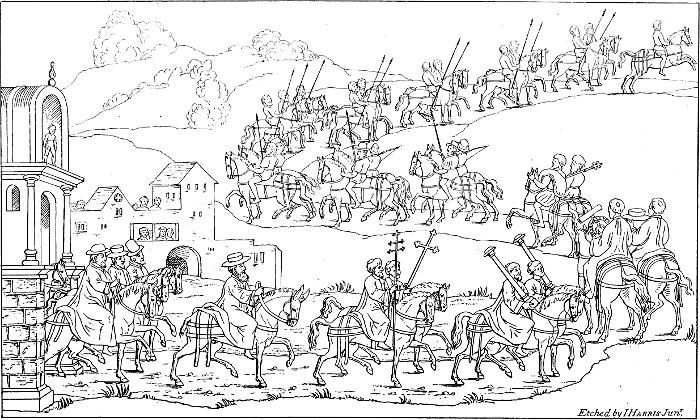
Etched by I Harris Junr.
CARDINAL WOLSEY AND HIS SUITE IN PROGRESS.
From a M.S. in the Collection of Francis Douce Esq.r F.S.A.
Published by Harding, Triphook, & Lepard, 1824.
When all things were fully concluded, and
for this noble embassy provided and furnished,
then was no lett, but advance forwards in the
name of God. My Lord Cardinal had with him
such of the lords and bishops and other worthy
persons as were not privy of the conspiracy.
Then marched he forward out of his own house
at Westminster, passing through all London[107],
over London Bridge, having before him of gentlemen
a great number, three in a rank, in black
velvet livery coats, and the most part of them
with great chains of gold about their necks.
And all his yeomen, with noblemen’s and gentlemen’s
servants following him in French tawny
livery coats; having embroidered upon the backs
and breasts of the said coats these letters: T.
and C., under the cardinal’s hat. His sumpter
mules, which were twenty in number and more,
with his carts and other carriages of his train,
were passed on before, conducted and guarded
with a great number of bows and spears. He
rode like a cardinal, very sumptuously, on a
mule trapped with crimson velvet upon velvet,
and his stirrups of copper, and gilt; and his
spare mule following him with like apparel.
And before him he had his two great crosses
of silver, two great pillars of silver, the great
seal of England, his cardinal’s hat, and a gentleman
that carried his valaunce, otherwise
called a cloakbag; which was made altogether
of fine scarlet cloth, embroidered over and over
with cloth of gold very richly, having in it a
cloak of fine scarlet. Thus passed he through
London, and all the way of his journey, having
his harbingers passing before to provide lodging
for his train.
The first journey he made to Dartford in
Kent, unto Sir Richard Wiltshire’s house,
which is two miles beyond Dartford; where all
his train were lodged that night, and in the
country thereabouts. The next day he rode to
Rochester, and lodged in the bishop’s palace
there; and the rest of his train in the city, and
in Stroud on this side the bridge. The third
day he rode from thence to Feversham, and there
was lodged in the abbey, and his train in the
town, and some in the country thereabouts.
The fourth day he rode to Canterbury, where
he was encountered with the worshipfullest of
the town and country, and lodged in the abbey
of Christchurch, in the prior’s lodging. And
all his train in the city, where he continued
three or four days; in which time there was the
great jubilee, and a fair in honour of the feast of
St. Thomas their patron. In which day of the
said feast, within the abbey there was made a
solemn procession; and my Lord Cardinal went
presently in the same, apparelled in his legantine
ornaments, with his Cardinal’s hat on his
head; who commanded the monks and all their
quire to sing the litany after this sort, Sancta
Maria ora pro papa nostro Clemente; and so
perused the litany through, my Lord Cardinal
kneeling at the quire door, at a form covered
with carpets and cushions. The monks and all
the quire standing all that while in the midst of
the body of the church. At which time I saw
the Lord Cardinal weep very tenderly; which
was, as we supposed, for heaviness that the
pope was at that present in such calamity and
great danger of the Lance Knights[108].
The next day I was sent with letters from
my Lord Cardinal unto Calais, by empost, insomuch
as I was that same night at Calais. And
at my landing I found standing upon the pier,
without [the] Lantern Gate, all the council of
the town, to whom I delivered and dispatched
my message and letters or ever I entered the
town; where I lay two days or my lord came
thither; who arrived in the haven the second
day after my coming, about eight of the clock
in the morning: where he was received in procession
with all the worshipfullest persons of
the town in most solemn wise. And in the
Lantern Gate was set for him a form, with
carpets and cushions, whereat he kneeled and
made his prayers before his entry any further
in the town; and there he was censed with two
great censers of silver, and sprinkled with holy
water. That done he arose up and passed on,
with all that assembly before him, singing, unto
St. Mary’s church, where he standing at the
high altar, turning himself to the people, gave
them his benediction and clean remission. And
then they conducted him from thence unto a
house called the Checker, where he lay and
kept his house as long as he abode in the town;
going immediately to his naked bed, because he
was somewhat troubled with sickness in his
passage upon the seas.
That night, unto this place of the Checker,
resorted to him Mons. du Biez, captain of
Boulogne, with a number of gallant gentlemen,
who dined with him; and after some consultation
with the cardinal, he with the rest of the
gentlemen departed again to Boulogne. Thus
the cardinal was daily visited with one or other
of the French nobility.
Then when all his train and his carriages were
landed at Calais, and every thing prepared in a
readiness for his journey, he called before him
all his noblemen and gentlemen into his privy
chamber; where they being assembled, [he]
said unto them in this wise in effect: "I have
called you hither to this intent, to declare unto
you, that I considering the diligence that ye
minister unto me, and the good will that I bear
you again for the same, intending to remember
your diligent service hereafter, in place where
ye shall receive condign thanks and rewards.
And also I would show you further what authority
I have received directly from the king’s
highness; and to instruct you somewhat of the
nature of the French men; and then to inform
you what reverence ye shall use unto me for
the high honour of the king’s majesty, and also
how ye shall entertain the French men, whensoever
ye shall meet at any time. First, ye
shall understand that the king’s majesty, upon
certain weighty considerations, hath for the
more advancement of his royal dignity, assigned
me in this journey to be his lieutenant-general;
and what reverence belongeth to the
same I will tell you. That for my part I must,
by virtue of my commission of lieutenantship,
assume and take upon me, in all honours and
degrees, to have all such service and reverence
as to his highness’ presence is meet and
due: and nothing thereof to be neglected or
omitted by me that to his royal estate is appurtenant.
And for my part ye shall see me
that I will not omit one jot thereof. Therefore,
because ye shall not be ignorant in that behalf,
is one of the special causes of this your assembly,
willing and commanding you as ye entend
my favour not to forget the same in time and
place, but every of you do observe this information
and instruction as ye will at my return
avoid the king’s indignation, but to obtain his
highness’ thanks, the which I will further for you
as ye shall deserve.
“Now to the point of the Frenchmen’s nature,
ye shall understand that their disposition is
such, that they will be at the first meeting as
familiar with you as they had been acquainted
with you long before, and commune with you
in the French tongue as though ye understood
every word they spake: therefore in like manner,
be ye as familiar with them again as they
be with you. If they speak to you in the
French tongue, speak you to them in the English
tongue; for if you understand not them, they
shall no more understand you.” And my lord
speaking merrily to one of the gentlemen there,
being a Welshman, “Rice,” quoth he, "speak
thou Welsh to him, and I am well assured that
thy Welsh shall be more diffuse[109] to him than his
French shall be to thee." And then quoth he
again to us all, "let all your entertainment and
behaviour be according to all gentleness and
humanity, that it may be reported, after your
departure from thence, that ye be gentlemen of
right good behaviour, and of much gentleness,
and that ye be men that know your duty to your
sovereign lord, and to your master, allowing
much your great reverence. Thus shall ye not
only obtain to yourselves great commendation
and praise for the same, but also advance the
honour of your prince and country. Now go
your ways admonished of all these points, and
prepare yourselves against to-morrow, for then
we intend, God willing, to set forward." And
thus, we being by him instructed and informed,
departed to our lodgings, making all things in a
readiness against the next day to advance forth
with my lord.
The next morrow, being Mary Magdalen’s
day, all things being furnished, my Lord Cardinal
rode out of Calais with such a number of
black velvet coats as hath not been seen with an
ambassador. All the spears of Calais, Guines,
and Hammes, were there attending upon him in
that journey, in black velvet coats, and many
great and massy chains of gold were worn there.
Thus passed he forth with three gentlemen
in a rank, which occupied the length of three
quarters of a mile or more, having all his accustomed
and glorious furniture carried before him,
as I before have rehearsed, except the broad
seal, the which was left with Doctor Taylor, in
Calais, then Master of the Rolls, until his return[110].
Passing thus on his way, and being scant a mile
of his journey, it began to rain so vehemently
that I have not seen the like for the time; that
endured until we came to Boulogne; and or we
came to Sandyngfeld, the Cardinal of Loraine, a
goodly young gentleman, encountered my lord,
and received him with great reverence and joy;
and so passed forth together, until they came to
Sandyngfeld, which is a place of religion, standing
between the French, English, and the Emperor’s
dominions, being neuter, holding of neither of
them. And being come thither, met with him
there Le Countie Brion, Captain of Picardy,
with a great number of men of arms, as Stradiots
and Arbenois[111] with others standing in array, in
a great piece of oats, all in harness, upon light
horses, passing with my lord, as it were in a wing,
all his journey through Picardy; for my lord
somewhat doubted the emperor, lest he would
lay an ambush to betray him; for which cause
the French king commanded them to await upon
my lord for the assurance of his person out of
the danger of his enemies. Thus rode he accompanied
until he came to the town of Boulogne,
where he was encountered within a mile
thereof, with the worshipfullest citizens of the
town, having among them a learned man, that
made to him an oration in Latin; unto the
which my lord made answer semblably in Latin.
And that done, Monsieur du Biez, Captain of
Boulogne, with the retinue there of gentlemen,
met him on horseback; which conveyed him
into the town with all this assembly, until he
came to the abbey gate, where he lighted and
went directly into the church, and made his
prayers before the image of our Lady, to whom
he made his offering. And that done, he gave
there his blessing to the people, with certain
days of pardon[112]. Then went he into the abbey
where he was lodged, and his train were lodged
in the high and basse towns.
The next morning, after he heard mass, he
rode unto Montreuil sur la mer, where he was
encountered in like case as he was the day before,
with the worshipfullest of the town, all in one
livery, having one learned that made an oration
before him in Latin, whom he answered in like
manner in Latin; and as he entered in to the
town, there was a canopy of silk embroidered
with the letters and hat that was on the servants
coats, borne over him [by] the persons of most
estimation within the town. And when he was
alighted his footmen seized the same as a fee
due to their office. Now was there made divers
pageants for joy of his coming, who was called
there, and in all other places within the realm of
France as he travelled, Le Cardinal Pacifique;
and in Latin Cardinalis Pacificus. [He] was
accompanied all that night with divers worthy
gentlemen of the country there about[113].
The next day he rode toward Abbeville,
where he was encountered with divers gentlemen
of the town and country, and so conveyed
unto the town, where he was most honourably
received with pageants of divers kinds, wittily
and costly invented, standing in every corner of
the streets as he rode through the town; having
a like canopy borne over him, being of more
richer sort than the other at Montreuil, or at
Boulogne was; they brought him to his lodging,
which was, as it seemed, a very fair house newly
built with brick. At which house King Louis
married my Lady Mary, King Henry the VIIIth
sister; which was after married to the Duke of
Suffolk, Charles Brandon. And being within,
it was in manner of a gallery, yet notwithstanding
it was very necessary. In this house my
lord remained eight or ten days; to whom
resorted, daily, divers of the council of France,
feasting them, and other noble men, and gentlemen
that accompanied the council, both at
dinners and suppers.
Then when the time came that he should
depart from thence, he rode to a castle beyond
the waters of Somme, called Pincquigny Castle,
adjoining unto the said water, standing upon
a great rock or hill, within the which was a
goodly college of priests; the situation whereof
was most like unto the castle of Windsor in
England; and there he was received with a
solemn procession, conveying him first into the
church, and after unto his lodging within the
castle. At this castle King Edward the Fourth
met with the French king, upon the bridge that
goeth over the water of Somme, as ye may
read in the chronicles of England.
When my lord was settled within his lodging,
it was reported unto me that the French king
should come that day into Amiens, which was
within six English miles of Pincquigny Castle;
and being desirous to see his first coming into
the town, [I] axed license and took with me
one or two gentlemen of my lord’s, and rode
incontinent thither, as well to provide me of a
necessary lodging as to see the king. And
when we came thither, being but strangers, [we]
took up our inn (for the time) at the sign of the
Angel, directly against the west door of the
cathedral church de notre Dame Sainte Marie.
And after we had dined there, tarrying until
three or four of the clock, expecting the king’s
coming, in came Madame Regent, the king’s
mother, riding in a very rich chariot; and in
the same with her was her daughter, the Queen
of Navarre, furnished with a hundred ladies and
gentlewomen or more following, riding upon
white palfreys; over and besides divers other
ladies and gentlewomen that rode some in rich
chariots, and some in horse litters; who lighted
at the west door with all this train, accompanied
with many other noblemen and gentlemen besides
her guard, which was not small in number.
Then, within two hours after, the king
came into the town with a great shot of guns
and divers pageants, made for the nonce at the
king’s bien venue; having about his person both
before him and behind him, besides the wonderful
number of noblemen and gentlemen, three
great guards diversely apparelled. The first was
of Soutches[114] and Burgonyons, with guns and
havresacks. The second was of Frenchmen,
some with bows and arrows, and some with
bills. The third guard was pour le corps, which
was of tall Scots, much more comelier persons
than all the rest. The French guard and the
Scots had all one livery, which was rich coats of
fine white cloth, with a guard of silver bullion
embroidered an handful broad. The king came
riding upon a goodly genet, and lighted at the
west door of the said church, and so [was] conveyed
into the church up to the high altar, where
he made his prayers upon his knees, and [was]
then conveyed into the bishop’s palace, where
he was lodged, and also his mother.
The next morning I rode again to Pincquigny
to attend upon my lord, at which time my lord was
ready to take his mule towards Amiens; and passing
on his journey thitherward, he was encountered
from place to place with divers noble and
worthy personages, making to him divers orations
in Latin, to which he made answer again extempore;
at whose excellent learning and pregnant
wit they wondered very much. Then was word
brought my lord that the king was coming to
encounter him; with that, he having none other
shift, was compelled to alight in an old chapel that
stood by the high way, and there newly apparelled
him into more richer apparel; and then mounted
upon a new mule very richly trapped, with a
footcloth and traps of crimson velvet upon velvet,
purled with gold, and fringed about with
a deep fringe of gold very costly, his stirrups
of silver and gilt, the bosses and cheeks of his
bridle of the same[115]. And by that time that
he was mounted again after this most gorgeous
sort, the king was come very near,
within less than a quarter of a mile English,
mustering upon an hill side, his guard standing
in array along the same, expecting my
lord’s coming; to whom my lord made as much
haste as conveniently it became him; until he
came within a pair of butt lengths, and there
he staid awhile. The king perceiving that, stood
still; and having two worthy gentlemen young
and lusty [with him], both brethren to the
Duke of Lorraine, and to the Cardinal of Lorraine;
whereof one of them was called Monsieur
de Guise, and the other Monsieur Vaudemont:
they were both apparelled like the king, in purple
velvet lined with cloth of silver, and their
coats cut, the king caused Monsieur Vaudemont
to issue from him, and to ride unto my lord to
know the cause of his tracting. [This monsieur]
rode upon a fair courser, taking his
race in a full gallop, even until he came unto
my lord; and there caused his horse to come
aloft once or twice so nigh my lord’s mule, that
he was in doubt of his horse; and with that he
lighted from his courser, and doing his message
to my lord with humble reverence; which done,
he mounted again, and caused his horse to do
the same at his departing as he did before, and
so repaired again to the king; and, after his
answer made, the king advanced forward. That
seeing my lord did the like, and in the mid way
they met, embracing each other on horseback,
with most amiable countenance entertaining each
other right nobly. Then drew into the place
all noblemen and gentlemen on both sides, with
wonderful cheer made one to another, as they
had been of an old acquaintance. The prease
was such and [so] thick, that divers had their
legs hurt with horses. Then the king’s officers
cried “Marche, marche, devant, allez devant.”
And the king, and my Lord Cardinal on his
right hand, rode together to Amiens, every
English gentleman accompanied with another
of France. The train of French and English
endured two long miles, that is to say from
the place of their encounter unto Amiens;
where they were very nobly received with shot
of guns and costly pageants, until the king had
brought my lord to his lodging, and there departed
asunder for that night, the king being
lodged in the bishop’s palace. The next day
after dinner, my lord with a great train of noblemen
and gentlemen of England, rode unto
the king’s court; at which time the king kept
his bed, being somewhat diseased, yet notwithstanding
my lord came into his bedchamber,
where sat on the one side of his bed his mother,
Madam Regent, and on the other side the
Cardinal of Lorraine, with divers other noblemen
of France. And after a short communication,
and drinking of a cup of wine with the
king’s mother, my lord departed again to his
lodging, accompanied with divers gentlemen
and noblemen of France, who supped with him.
Thus continued the king and my lord in Amiens
the space of two weeks and more, consulting[116]
and feasting each other divers times. [And in
the feast of the Assumption of our Lady, my
lord rose betimes and went to the cathedral
church de notre Dame, and there before my
Lady Regent and the Queen of Navarre, in
our Lady Chapel, he said his service and
mass; and after mass, he himself ministered the
sacrament unto my Lady Regent and to the
Queen of Navarre. And that done, the king
resorted unto the church, and was conveyed
into a rich travers at the high altar; and directly
against him, on the other side of the
altar, sat my Lord Cardinal in another rich
travers[117], three gressis[118] higher than the king’s.
And at the altar, before them both, a bishop
sang high mass, and at the fraction of the host
the same bishop divided the sacrament between
the king and the cardinal, for the performance
of the peace concluded between them; which
mass was sung solemnly by the king’s chapel,
having among them cornets and sackbuts.
And after mass was done the trumpeters blew
in the roodeloft[119] until the king was past inward
to his lodging out of the church. And
at his coming in to the bishop’s palace, where
he intended to dine with my Lord Cardinal,
there sat, within a cloister, about two hundred
persons diseased with the king’s evil, upon
their knees. And the king, or ever he went to
dinner, provised every of them with rubbing
and blessing them with his bare hands, being
bare headed all the while; after whom followed
his almoner distributing of money unto the persons
diseased. And that done he said certain
prayers over them, and then washed his hands,
and so came up into his chamber to dinner,
where as my lord dined with him[120].]
Then it was determined that the king and my
lord should remove out of Amiens, and so they
did, to a town or city called Compeigne, which
was more than twenty English miles from
thence; unto which town I was sent to prepare
my lord’s lodging. And as I rode on
my journey, being upon a Friday, my horse
chanced to cast a shoe in a little village, where
stood a fair castle. And as it chanced there
dwelt a smith, to whom I commanded my servant
to carry my horse to shoe, and standing
by him while my horse was a shoeing, there
came to me one of the servants of the castle,
perceiving me to be the cardinal’s servant and
an Englishman, who required me to go with
him into the castle to my lord his master, whom
he thought would be very glad of my coming
and company. Whose request I granted, because
that I was always desirous to see and be
acquainted with strangers, in especial with men
in honour and authority, so I went with him;
who conducted me unto the castle, and being
entered in the first ward, the watchmen of
that ward, being very honest tall men, came
and saluted me most reverently, and knowing
the cause of my coming, desired me to stay a
little while until they had advertised my lord
their master of my being there; and so I did.
And incontinent the lord of the castle came
out to me, who was called Monsieur Crequi, a
nobleman born, and very nigh of blood to King
Louis, the last king that reigned before this King
Francis. And at his first coming he embraced
me, saying that I was right heartily welcome,
and thanked me that I so gently would visit
him and his castle, saying furthermore that he
was preparing to encounter the king and my
lord, to desire them most humbly the next day
to take his castle in their way, if he could so
intreat them. And true it is that he was ready
to ride in a coat of velvet with a pair of velvet
arming shoes on his feet, and a pair of gilt
spurs on his heels. Then he took me by the
hand, and most gently led me into his castle,
through another ward. And being once entered
into the base court of the castle, I saw all his
family and household servants standing in goodly
order, in black coats and gowns, like mourners,
who led me into the hall, which was hanged
with hand-guns, as thick as one could hang by
another upon the walls; and in the hall stood
an hawk’s perch, whereon stood three or four
fair goshawks. Then went we into the parlour,
which was hanged with fine old arras, and being
there but a while, communing together of my
lord of Suffolk, how he was there to have besieged
the same, his servants brought to him
bread and wine of divers sorts, whereof he
caused me to drink. And after, “I will,” quoth
he, “show you the strength of my house, how
hard it would have been for my Lord of Suffolk
to have won it.” Then led he me upon the
walls, which were very strong, more than fifteen
foot thick, and well garnished with great battery
pieces of ordnance ready charged to [be]
shot off against the king and my lord’s coming.
When he had showed me all the walls and
bulwarks about the castle, he descended from
the walls, and came down into a fair inner
court, where his genet stood for to mount upon,
with twelve other genets, the most fairest and
best that ever I saw, and in especial his own,
which was a mare genet, he showed me that he
might have had for her four hundred crowns.
But upon the other twelve genets were mounted
twelve goodly young gentlemen, called pages
of honour; all bare headed in coats of cloth
of gold, and black velvet cloaks, and on their
legs boots of red Spanish leather, and spurs
parcel gilt.
Then he took his leave of me, commanding
his steward and other his gentlemen to attend
upon me, and conduct me unto my lady his
wife, to dinner. And that done he mounted
upon his genet, and took his journey forth out
of his castle. Then the steward, with the rest
of the gentlemen, led me up into a tower in the
gatehouse, where then my lady their mistress
lay, for the time that the king and my lord
should tarry there.
I being in a fair great dining chamber, where
the table was covered for dinner, and there I
attended my lady’s coming; and after she came
thither out of her own chamber, she received me
most gently, like [one of] noble estate, having a
train of twelve gentlewomen. And when she
with her train came all out, she said to me, “For
as much,” quoth she, "as ye be an Englishman,
whose custom is in your country to kiss[121] all ladies
and gentlewomen without offence, and although
it be not so here in this realm, yet will I be so
bold to kiss you, and so shall all my maidens."
By means whereof I kissed my lady and all her
women. Then went she to her dinner, being
as nobly served as I have seen any of her
estate here in England, having all the dinner
time with me pleasant communication, which
was of the usage and behaviour of our gentlewomen
and gentlemen of England, and commended
much the behaviour of them, right excellently;
for she was with the king at Ardres,
when the great encounter and meeting was between
the French king and the king our sovereign
lord: at which time she was, both for her person
and goodly haviour, appointed to company with
the ladies of England. To be short, after dinner,
pausing a little, I took my leave of her, and so
departed and rode on my journey.
By reason of my tracting of time in Chastel
de Crequi[122], I was constrained that night to lye
in a town by the way, called Montdidier, the
suburbs whereof my Lord of Suffolk had lately
burned. And in the next morning I took my
journey and came to Compeigne upon the Saturday,
then being there the market day; and at
my first coming I took my inn in the midst of the
market-place, and being there set at dinner in a
fair chamber, that had a window looking into
the street, I heard a great rumour and clattering
of bills. With that I looked out into the street,
and there I espied where the officers of the
town brought a prisoner to execution, whose
head they strake off with a sword. And when
I demanded the cause of his offence, it was answered
me, that it was for killing of a red deer
in the forest thereby, the punishment whereof
is but death. Incontinent they had set up the
poor man’s head upon a pole in the market-place,
between the stag’s horns; and his quarters
in four parts of the forest.
Thus went I about to prepare my lord’s
lodging, and to see it furnished, which was
there in the great castle of the town, whereof
to my lord was assigned the one half, and the
other half was reserved for the king; and in
like wise there was a long gallery divided between
them, wherein was made in the midst
thereof a strong wall with a door and window,
and there the king and my lord would many
times meet at the same window, and secretly
talk together, and divers times they would go
the one to the other, at the said door.
Now was there lodged also Madame Regent,
the king’s mother, and all her train of ladies
and gentlewomen. Unto which place the Chancellor
of France came (a very witty man), with
all the king’s grave counsellors, who took great
pains daily in consultation. In so much as I
heard my Lord Cardinal fall out with the Chancellor,
laying unto his charge, that he went
about to hinder the league which my said Lord
Cardinal had before his coming concluded between
the king our sovereign lord and the
French king his master; insomuch that my lord
stomached the matter very stoutly, and told
him, "That it should not lie in his power to
dissolve the amicable fidelity between them.
And if his master the king being there present
forsook his promise and followed his counsel,
he should not fail after his return into England
to feel the smart, and what a thing it is to break
promise with the King of England, whereof
he should be well assured." And therewithal
he arose and went into his own lodging, wondrously
offended. So that his stout countenance,
and bold words, made them all in doubt
how to pacify his displeasure, and revoke him
again to the council, who was then departed in
a fury. There was sending, there was coming,
there was also intreating, and there was great
submission made to him, to reduce him to his
former friendly communication; who would in
no wise relent until Madame Regent came herself,
who handled the matter so discreetly and
wittily, that she reconciled him to his former
communication. And by that means he brought
other matters to pass, that before he could not
attain, nor cause the council to grant; which
was more for fear, than for any affection to the
matter, he had the heads of all the council
so under his girdle that he might rule them
all there as well as he might the council of
England.
The next morning after this conflict, he rose
early, about four of the clock, sitting down to
write letters into England unto the king, commanding
one of his chaplains to prepare him to
mass, insomuch that his said chaplain stood
revested until four of the clock at afternoon;
all which season my lord never rose once to
——, ne yet to eat any meat, but continually
wrote his letters, with his own hands, having
all that time his nightcap and keverchief on his
head. And about the hour of four of the clock,
at afternoon, he made an end of writing, conmanding
one Christopher Gunner, the king’s
servant, to prepare him without delay to ride
empost into England with his letters, whom he
dispatched away or ever he drank. And that
done, he went to mass, and said his other
divine service with his chaplain, as he was
accustomed to do; and then went straight into
a garden; and after he had walked the space
of an hour or more, and said his evensong[123], he
went to dinner and supper all at once; and
making a small repast, he went to his bed, to
take his rest for that night.
The next night following he caused a great
supper to be provided for Madame Regent,
and the Queen of Navarre, and other great
estates of ladies and noble women.
There was also Madame Reneé, one of the
daughters of King Louis, whose sister, (lately
dead), King Francis had married. These sisters
were, by their mother, inheritrices of
the Duchy of Britanny, and for as much as
the king had married one of the sisters, by
whom he had the moiety of the said duchy,
and to attain the other moiety, and so to be
lord of the whole, he kept the said Lady Reneé
without marriage, intending that, she having
none issue, the whole duchy might descend to
him, or to his succession, after her death, for
want of issue of her body.
But now let us return again to the supper or
rather a solemn banquet, where all these noble
persons were highly feasted; and in the midst
of their triumph, the French king, with the king
of Navarre, came suddenly in upon them unknown,
who took their places at the nether end
of the table. There was not only plenty of fine
meats, but also much mirth and solace, as well
in communication, as in instruments of music
set forth with my lord’s minstrels, who played
there so cunningly and dulce all that night, that
the king took therein great pleasure, insomuch
that he desired my lord to lend them unto him
the next night. And after supper and banquet
finished, the ladies and gentlewomen went to
dancing; among whom one Madame Fountaine,
a maid, had the prize. And thus passed they
the night in pleasant mirth and joy.
The next day the king took my lord’s minstrels
and rode unto a nobleman’s house, where
was some goodly image that he had avowed a
pilgrimage unto, to perform his devotion. When
he came there, he danced, and others with him,
the most part of that night; my lord’s minstrels
played there so excellently all that night, that
the shalme—[124], (whether it were with extreme
labour of blowing, or with poisoning, as some
judged, because they were more commended
and accepted with the king than his own, I cannot
tell), but he that played upon the shalme, an
excellent man in that art, died within a day or
twain after.
Then the king returned again unto Compeigne,
and caused a wild boar to be lodged for
him in the forest there; whither my lord rode
with the king to the hunting of the wild swine
within a toil; where the Lady Regent stood in
chariots or wagons, looking on the toil, on the
outside thereof, accompanied with many ladies
and damosels; among whom my lord stood by
the Lady Regent, to regard and behold the
pastime and manner of hunting. There was
within the toil divers goodly gentlemen with the
king, ready garnished to this high enterprise
and dangerous hunting of the perilous wild
swine. The king being in his doublet and
hosen only, without any other garments, all of
sheep’s colour cloth; his hosen, from the knee
upward, was altogether thrummed with silk very
thick of the same colour: having in a slip a fair
brace of great white greyhounds, armed, as the
manner is to arm their greyhounds from the
violence of the boar’s tusks. And all the rest of
the king’s gentlemen, being appointed to hunt
this boar, were likewise in their doublets and
hosen, holding each of them in their hands a
very sharp boar’s spear.
The king being thus furnished, commanded
the hunts to uncouch the boar, and that every
other person should go to a standing, among
whom were divers gentlemen and yeomen of
England; and incontinent the boar issued out
of his den, chased with an hound into the plain,
and being there, stalked a while gazing upon
the people, and incontinent being forced by the
hound, he espied a little bush standing upon a
bank over a ditch, under the which lay two lusty
gentlemen of France, and thither fled the boar,
to defend him, thrusting his head snuffing into
the same bush where these two gentlemen lay,
who fled with such speed as men do from the
danger of death. Then was the boar by violence
and pursuit of the hounds and the hunts
driven from thence, and ran straight to one of
my lord’s footmen, a very comely person, and
an hardy, who held in his hand an English
javelin, with the which he was fain to defend
himself from the fierce assault of the boar,
who foined at him continually with his great
tusks, whereby he was compelled at the last
to pitch his javelin in the ground between
him and the boar, the which the boar brake
with his force of foining. And with that
the yeoman drew his sword, and stood at defence;
and with that the hunts came to the
rescue, and put him once again to flight. With
that he fled and ran to another young gentleman
of England, called Master Ratcliffe, son and
heir to the Lord Fitzwalter, and after[125] Earl of
Sussex, who by chance had borrowed of a
French gentleman a fine boar spear, [very
sharp, upon whom, the boar being sore chafed,
began to assault very eagerly, and the young
gentleman deliverly avoided his strokes, and in
turning about he struck the boar with such violence
(with the same spear that he had borrowed)
upon the houghs, that he cut the sinews
of both his legs at one stroke, that the boar was
constrained to sit down upon his haunches and
defend himself, for he could go no more; this
gentleman perceiving then his most advantage,
thrust his spear into the boar under the shoulder
up to the heart, and thus he slew the great boar.
Wherefore among the noblemen of France it
was reputed to be one of the noblest enterprises
that a man might do (as though he had
slain a man of arms); and thus our Master
Ratcliffe bare then away the prize of that feat of
hunting, this dangerous and royal pastime, in
killing of the wild boar, whose tusks the Frenchman
doth most commonly doubt above all other
dangers, as it seemed to us Englishmen then
being present.]
[In this time of my lord’s being in France,
over and besides his noble entertainment with
the king and nobles, he sustained diverse displeasures
of the French slaves, that devised a
certain book, which was set forth in diverse
articles upon the causes of my lord’s being there:
which should be, as they surmised, that my lord
was come thither to conclude two marriages;
the one between the king our sovereign lord
and Madame Reneé[126], of whom I spake heretofore;
and the other between the then princess
of England, (now being queen of this realm) my
Lady Mary the king’s daughter and the French
king’s second son, the Duke of Orleans, who is
at this present king of France: with diverse
other conclusions and agreements touching the
same. Of this book many were imprinted and
conveyed into England, unknown to my lord,
[he] being then in France, to the great slander
of the realm of England, and of my Lord Cardinal.
But whether they were devised of policy
to pacify the mutterings of the people, which
had diverse communications and imaginations
of my lord’s being there; or whether [they]
were devised of some malicious person, as the
dispositions of the common people are accustomed
to do, upon such secret consultations, I
know not; but whatsoever the occasion or
cause was, the author hath set forth such
books. This I am well assured, that after
my lord was thereof well advertised, and had
perused one of the said books, he was not a little
offended, and assembled all the privy council of
France together, to whom he spake his mind
thus; saying, that it was not only a suspicion
in them, but also a great rebuke and a defamation
to the king’s honour to see and know any
such seditious untruths openly divulged and set
forth by any malicious and subtle traitor of
this realm; saying furthermore, that if the like
had been attempted within the realm of England,
he doubted not but to see it punished according
to the traitorous demeanour and deserts. Notwithstanding
I saw but small redress[127]].
So this was one of the displeasures that the
Frenchmen showed him, for all his pains and
travail that he took for qualifying of their king’s
ransom.
Also another displeasure was this. There
was no place where he was lodged after he
entered the territory of France, but that he was
robbed in his privy chamber, either of one thing
or other; and at Compeigne he lost his standish
of silver, and gilt: and there it was espied, and
the party taken, which was but a little boy of
twelve or thirteen years of age, a ruffian’s page
of Paris, which haunted my lord’s lodging without
any suspicion, until he was taken lying under
my lord’s privy stairs; upon which occasion he
was apprehended and examined, and incontinent
confessed all things that were missed, which
he stole, and brought to his master the ruffian,
who received the same, and procured him so to
do. After the spial of this boy, my lord revealed
the same unto the council, by means
whereof the ruffian was apprehended, and set
on the pillory, in the midst of the market-place;
a goodly recompense for such an heinous offence.
Also another displeasure was; some lewd person,
whosoever it was, had engraved in the great
chamber window where my lord lay, upon the
leaning stone there, a cardinal’s hat with a pair
of gallows over it, in derision of my lord; with
divers other unkind demeanours, the which I
leave here to write, they be matters so slanderous.
Thus passing divers days in consultation,
expecting the return of Christopher Gunner,
which was sent into England with letters unto
the king, as it is rehearsed heretofore, by empost,
who at last returned again with other
letters; upon receipt whereof my lord made
haste to return into England.
In the morning that my lord should depart
and remove, being then at mass in his closet,
he consecrated the Chancellor of France a cardinal,
and put upon him the habit due to that
order; and then took his journey into Englandward,
making such necessary expedition that
he came to Guisnes, where he was nobly received
of my Lord Sands, then captain there,
with all the retinue thereof. And from thence
he rode to Calais, where he tarried the shipping
of his stuff, horses, and train; and in the
meantime he established there a mart, to be
kept for all nations; but how long it endured,
and in what sort it was used, I know not, for I
never heard of any great good that it did, or
of any worthy assembly there of merchants or
merchandise, that was brought thither for the
furniture of so weighty a matter.
These things finished, and others for the
weal of the town, he took shipping and arrived
at Dover, from whence he rode to the king,
being then in his progress at Sir Harry Wyatt’s
house, in Kent, [it was] supposed among us
that he should be joyfully received at his home
coming, as well of the king as of all other
noblemen: but we were deceived in our expectation.
Notwithstanding he went, immediately
after his coming, to the king, with whom he
had long talk, and continued there in the court
two or three days; and then returned to his
house at Westminster, where he remained until
Michaelmas term, which was within a fortnight
after, and using his room of Chancellorship, as
he was wont to do.
At which time he caused an assembly to be
made in the Star Chamber, of all the noblemen,
judges, and justices of the peace of every shire
that were at that present in Westminster Hall,
and there made to them a long oration, declaring
unto them the cause of his embassy into
France, and of his proceeding there; among
the which he said, "he had concluded such an
amity and friendship as never was heard of in
this realm in our time before, as well between
the emperor and us, as between the French
king and our sovereign lord, concluding a
perpetual peace, which shall be confirmed in
writing, alternately, sealed with the broad seals
of both the realms graved in fine gold; affirming
furthermore, that the king should receive yearly
his tribute, by that name, for the Duchy of
Normandy, with all other costs which he hath
sustained in the wars. And where there was a
restraint made in France of the French queen’s
dower, whom the Duke of Suffolk had married,
for divers years during the wars, it is fully concluded,
that she shall not only receive the same
yearly again, but also the arrearages being unpaid
during the restraint. All which things
shall be perfected at the coming of the great
embassy out of France: in the which shall be
a great number of noblemen and gentlemen for
the conclusion of the same, as hath not been
seen repair hither out of one realm in an embassy.
This peace thus concluded, there shall
be such an amity between gentlemen of each
realm, and intercourse of merchants with merchandise,
that it shall seem to all men the territories
to be but one monarchy. Gentlemen
may travel quietly from one country to another
for their recreation and pastime; and merchants,
being arrived in each country, shall be assured
to travel about their affairs in peace and tranquillity:
so that this realm shall joy and prosper
for ever. Wherefore it shall be well done for
all true Englishmen to advance and set forth
this perpetual peace, both in countenance and
gesture, with such entertainment as it may be
a just occasion unto the Frenchmen to accept
the same in good part, and also to use you with
the semblable, and make of the same a noble
report in their countries.
“Now, good my lords and gentlemen, I most
entirely require you in the king’s behalf, that
ye will show yourselves herein very loving and
obedient subjects, wherein the king will much
rejoice [at] your towardness, and give to every
man his princely thanks for such liberality and
gentleness, as ye or any of you shall minister
unto them.” And here he ended his persuasion,
and so departed into the dining chamber,
and dined among the lords of the council.
This great embassy[128], long looked for, was
now come over [with a great retinue], which were
in number above fourscore persons, of the most
noblest and worthiest gentlemen in all the court
of France, who were right honourably received
from place to place after their arrival, and so
conveyed through London unto the bishop’s
palace in Paul’s Churchyard, where they were
lodged. To whom divers noblemen resorted
and gave them divers goodly presents; and in
especial the Mayor and city of London, as
wine, sugar, wax, capons, wild fowl, beefs,
muttons, and other necessaries in great abundance,
for the expenses of their house. Then
the next Sunday after their resort to London,
they repaired to the court at Greenwich, and
there, by the king’s majesty, most highly received
and entertained. They had a special
commission to create and stall the king’s highness
in the Royal order of France; for which
purpose they brought with them a collar of fine
gold of the order, with a Michael hanging thereat,
and robes to the same appurtenant, the which
was wondrous costly and comely, of purple
velvet, richly embroidered; I saw the king in
all this apparel and habit, passing through the
chamber of presence unto his closet; and afterward
in the same habit at mass beneath in the
chapel. And to gratify the French king with
like honour, [he] sent incontinent unto [him] the
like order of England by a nobleman (the Earl of
Wiltshire), purposely for that intent, to create
him one of the same order of England, accompanied
with Garter the Herald, with all robes, garter,
and other habiliments to the same belonging;
as costly in every degree as the other was of the
French king’s, the which was done before the
return of the great embassy.
And for the performance of this noble and
perpetual peace, it was concluded and determined
that a solemn mass should be sung in
the cathedral church of Paul’s by the cardinal;
against which time there was prepared a gallery
made from the west door of the church of Paul’s
[through the body of the same], unto the quire
door, railed on every side, upon the which stood
[vessels] full of perfumes burning. Then the king
and my Lord Cardinal, and all the Frenchmen,
with all other noblemen and gentlemen, were
conveyed upon this gallery unto the high altar
into the traverses; then my Lord Cardinal prepared
himself to mass, associated with twenty-four
mitres of bishops and abbots, attending
upon him, and to serve him, in such ceremonies
as to him, by virtue of his legatine prerogative,
were due.
And after the last agnus[129], the king rose out
of his travers and kneeled upon a cushion and
carpet at the high altar; and the Grand Master
of France, the chief ambassador, that represented
the king his master, kneeled by the king’s
majesty, between whom my lord divided the
sacrament, as a firm oath and assurance of this
perpetual peace. That done, the king resorted
again to his travers, and the Grand Master in
like wise to his. This mass finished, which was
sung with the king’s chapel and the quire of
Paul’s, my Lord Cardinal took the instrument
of this perpetual peace and amity, and read the
same openly before the king and the assembly,
both of English and French, to the which the king
subscribed with his own hand, and the Grand Master,
for the French king, in like wise, the which
was sealed with seals of fine gold, engraven,
and delivered to each other as their firm deeds;
and all this done and finished they departed.
The king rode home to the cardinal’s house at
Westminster, to dinner, with whom dined all
the Frenchmen, passing all day after in consultation
in weighty matters, touching the conclusion
of this peace and amity. That done, the king
went again by water to Greenwich; at whose
departing it was determined by the king’s device,
that the French gentlemen should resort unto
Richmond to hunt there, in every of the parks,
and from thence to Hampton Court, and therein
likewise to hunt, and there my Lord Cardinal
to make for them a supper, and lodge them
there that night; and from thence they should
ride to Windsor, and there to hunt, and after
their return to London they should resort to the
court, whereas the king would banquet them.
And this perfectly determined, the king and
the Frenchmen all departed.
Then was there no more to do but to make
provision at Hampton Court for this assembly
against the day appointed. My Lord Cardinal
called for his principal officers of his house, as
his Steward, Comptroller, and the Clerks of his
Kitchen, whom he commanded to prepare for
this banquet at Hampton Court; and neither to
spare for expenses or travail, to make them such
triumphant cheer, as they may not only wonder
at it here, but also make a glorious report
in their country, to the king’s honour and [that]
of this realm. His pleasure once known, to
accomplish his commandment they sent forth all
the caterers, purveyors, and other persons, to
prepare of the finest viands that they could get,
other for money or friendship among my lord’s
friends. Also they sent for all the expertest
cooks, besides my lord’s, that they could get in
all England, where they might be gotten, to serve
to garnish this feast.
The purveyors brought and sent in such plenty
of costly provision, as ye would wonder at the
same. The cooks wrought both night and day
in divers subtleties and many crafty devices;
where lacked neither gold, silver, ne any other
costly thing meet for the purpose.
The yeomen and grooms of the wardrobes
were busied in hanging of the chambers with
costly hangings, and furnishing the same with
beds of silk, and other furniture apt for the same
in every degree. Then my Lord Cardinal sent
me, being gentleman usher, with two other of
my fellows, to Hampton Court, to foresee all
things touching our rooms, to be noblily garnished
accordingly. Our pains were not small
or light, but traveling daily from chamber to
chamber. Then the carpenters, the joiners, the
masons, the painters, and all other artificers necessary
to glorify the house and feast were set
at work. There was carriage and re-carriage of
plate, stuff, [and] other rich implements; so that
there was nothing lacking or to be imagined or
devised for the purpose. There were also fourteen
score beds provided and furnished with all
manner of furniture to them belonging, too long
particularly here to rehearse. But to all wise
men it sufficeth to imagine, that knoweth what
belongeth to the furniture of such triumphant
feast or banquet.
The day was come that to the Frenchmen was
assigned, and they ready assembled at Hampton
Court, something before the hour of their appointment.
Wherefore the officers caused them
to ride to Hanworth, a place and park of the
king’s, within two or three miles, there to hunt
and spend the time until night. At which time
they returned again to Hampton Court, and
every of them conveyed to his chamber severally,
having in them great fires and wine ready to
refresh them, remaining there until their supper
was ready, and the chambers where they should
sup were ordered in due form. The first waiting-chamber
was hanged with fine arras, and so
was all the rest, one better than an other, furnished
with tall yeomen. There was set tables
round about the chamber, banquet-wise, all covered
with fine cloths of diaper. A cupboard
of plate, parcel gilt, having also in the same
chamber, to give the more light, four plates of
silver, set with lights upon them, a great fire in
the chimney.
The next chamber, being the chamber of presence,
hanged with very rich arras, wherein
was a gorgeous and a precious cloth of estate
hanged up, replenished with many goodly gentlemen
ready to serve. The boards were set as the
other boards were in the other chamber before,
save that the high table was set and removed
beneath the cloth of estate, towards the midst
of the chamber, covered with fine linen cloths of
damask work, sweetly perfumed. There was a
cupboard made, for the time, in length, of the
breadth of the nether end of the same chamber,
six desks high[130], full of gilt plate, very sumptuous,
and of the newest fashions; and upon the nethermost
desk garnished all with plate of clean
gold, having two great candlesticks of silver
and gilt, most curiously wrought, the workmanship
whereof, with the silver, cost three hundred
marks, and lights of wax as big as torches burning
upon the same. This cupboard was barred
in round about that no man might come nigh it;
for there was none of the same plate occupied
or stirred during this feast, for there was sufficient
besides. The plates that hung on the walls
to give light in the chamber were of silver and
gilt, with lights burning in them, a great fire in
the chimney, and all other things necessary for
the furniture of so noble a feast.
Now was all things in a readiness and supper
time at hand. My lord’s officers caused the
trumpets to blow to warn to supper, and the
said officers went right discreetly in due order
and conducted these noble personages from their
chambers unto the chamber of presence where
they should sup. And they, being there, caused
them to sit down; their service was brought up
in such order and abundance, both costly and
full of subtleties, with such a pleasant noise of
divers instruments of music, that the Frenchmen,
as it seemed, were rapt into a heavenly
paradise.
Ye must understand that my lord was not
there, ne yet come, but they being merry and
pleasant with their fare, devising and wondering
upon the subtleties. Before the second course,
my Lord Cardinal came in among them, booted
and spurred, all suddenly, and bade them proface[131];
at whose coming they would have risen
and given place with much joy. Whom my
lord commanded to sit still, and keep their
rooms; and straightways, being not shifted of
his riding apparel, called for a chair, and sat
himself down in the midst of the table, laughing
and being as merry as ever I saw him in all my
life. Anon came up the second course, with so
many dishes, subtleties, and curious devices,
which were above a hundred in number, of so
goodly proportion and costly, that I suppose the
Frenchmen never saw the like. The wonder was
no less than it was worthy indeed. There were
castles with images in the same; Paul’s church
and steeple, in proportion for the quantity as well
counterfeited as the painter should have painted
it upon a cloth or wall. There were beasts, birds,
fowls of divers kinds, and personages, most lively
made and counterfeit in dishes; some fighting,
as it were with swords, some with guns and
crossbows, some vaulting and leaping; some
dancing with ladies, some in complete harness,
justing with spears, and with many more devices
than I am able with my wit [to] describe.
Among all, one I noted: there was a chess board
subtilely made of spiced plate, with men to the
same; and for the good proportion, because
that Frenchmen be very expert in that play, my
lord gave the same to a gentleman of France,
commanding that a case should be made for the
same in all haste, to preserve it from perishing
in the conveyance thereof into his country.
Then my lord took a bowl of gold, which was
esteemed of the value of five hundred marks,
filled with hypocras, whereof there was plenty,
putting off his cap, said, “I drink to the
king my sovereign lord and master, and to the
king your master,” and therewith drank a good
draught. And when he had done, he desired
the Grand Master to pledge him cup and all, the
which cup he gave him; and so caused all the
other lords and gentlemen in other cups to pledge
these two royal princes.
Then went cups merrily about, that many
of the Frenchmen were fain to be led to their
beds. Then went my lord, leaving them sitting
still, into his privy chamber to shift him; and
making there a very short supper, or rather a
small repast, returned again among them into
the chamber of presence, using them so nobly,
with so loving and familiar countenance and
entertainment, that they could not commend him
too much.
And whilst they were in communication and
other pastimes, all their liveries were served to
their chambers. Every chamber had a bason
and a ewer of silver, some gilt, and some parcel
gilt; and some two great pots of silver, in like
manner, and one pot at the least with wine and
beer, a bowl or goblet, and a silver pot to drink
beer in; a silver candlestick or two, with both
white lights and yellow lights [of] three sizes of
wax; and a staff torch; a fine manchet, and a
cheat loaf of bread. Thus was every chamber
furnished throughout the house, and yet the
two cupboards in the two banqueting chambers
not once touched. Then being past midnight, as
time served they were conveyed to their lodgings,
to take their rest for that night. In the
morning of the next day, (not early), they rose
and heard mass, and dined with my lord, and so
departed towards Windsor, and there hunted,
delighting much of the castle and college, and
in the Order of the Garter. They being departed
from Hampton Court, my lord returned
again to Westminster, because it was in the midst
of the term.
It is not to be doubted, but that the king was
privy of all this worthy feast, [and] intended far
to exceed the same; (whom I leave until the
return of the Frenchmen), who gave a special
commandment to all his officers to devise a far
[more] sumptuous banquet for the strangers,
otherwise than they had at Hampton Court;
which was not neglected, but most speedily put
in execution with great diligence.
After the return of these strangers from
Windsor, which place with the goodly order
thereof they much commended, the day approached
that they were invited to the court
at Greenwich; where first they dined, and after
long consultation of the sagest with our counsellors,
and dancing of the rest and other pastimes,
the time of supper came on. Then was the banqueting
chamber in the tiltyard furnished for the
entertainment of these strangers, to the which
place they were conveyed by the noblest persons
being then in the court, where they both supped
and banqueted. But to describe the dishes, the
subtleties, the many strange devices and order
in the same, I do both lack wit in my gross old
head, and cunning in my bowels to declare the
wonderful and curious imaginations in the same
invented and devised. Yet this ye shall understand:
that although it was at Hampton Court
marvellous sumptuous, yet did this banquet far
exceed the same, as fine gold doth silver in
weight and value; and for my part I must needs
confess, (which saw them both), that I never
saw the like, or read in any story or chronicle of
any such feast. In the midst of this banquet,
there was tourneying at the barriers (even in the
chamber), with lusty gentlemen in gorgeous
complete harness, on foot; then was there the
like on horseback; and after all this there was
the most goodliest disguising or interlude, made
in Latin and French, whose apparel was of such
exceeding riches, that it passeth my capacity to
expound.
This done, then came in such a number of the
fair ladies and gentlewomen that bare any bruit
or fame of beauty in all this realm, in the most
richest apparel, and devised in divers goodly
fashions that all the cunningest tailors could
devise to shape or cut, to set forth their beauty,
gesture, and the goodly proportion of their bodies:
who seemed to all men more angelic than
earthly [creatures] made of flesh and bone;—surely
to me, simple soul, it seemed inestimable
to be described, and so I think it was to other
of a more higher judgment,—with whom these
gentlemen of France danced until another mask
came in of noble gentlemen, who danced and
masked with these fair ladies and gentlewomen,
every man as his fantasy served [him]. This
done, and the maskers departed, there came in
another mask of ladies so gorgeously apparelled
in costly garments, that I dare not presume to
take upon me to make thereof any declaration,
lest I should rather deface than beautify them,
therefore I leave it untouched. These lady
maskers took each of them a French gentleman
to dance and mask with them. Ye shall understand
that these lady maskers spake good
French, which delighted much these gentlemen,
to hear these ladies speak to them in their own
tongue.
Thus was this night occupied and consumed
from five of the clock until two or three after
midnight; at which time it was convenient for
all estates to draw to their rest. And thus every
man departed whither they had most relief.
Then as nothing either health, wealth, or pleasure,
can always endure, so ended this triumphant
banquet, the which in the morning seemed
to all the beholders but as a fantastical dream.
After all this solemn cheer, at a day appointed
they prepared them to return with bag and baggage.
Then, as to the office of all honourable
persons doth appertain, [they] resorted in good
order to the court, to take their leave of the
king, and other noblemen, then being there: to
whom the king committed his princely commendations
to the king their master, and thanked
them of their pains and travel, and after long
communication with the most honourable of the
embassy, he bad them adieu.
[They were] assigned by the council to repair
to my Lord Cardinal for to receive the king’s
most noble reward, wherefore they repaired to
my lord, and taking of their leave, they received
every man the king’s reward after this sort; every
honourable person in estimation had most commonly
plate, to the value of three or four hundred
pounds, and some more, and some less,
besides other great gifts received at the king’s
hands before; as rich gowns, horses, or goodly
geldings of great value and goodness; and some
had weighty chains of fine gold, with divers other
gifts, which I cannot now call to my remembrance;
but this I know, that the least of them
all had a sum of crowns of gold: the worst page
among them had twenty crowns for his part:
and thus they (nobly rewarded), departed. And
my lord, after humble commendations had to the
French king, bad them adieu. And the next day
they conveyed all their stuff and furniture unto
the seaside, accompanied with lusty young gentlemen
of England: but what praise or commendation
they made in their country at their
return, in good faith, I cannot tell you, for I never
heard any thing thereof.
Then began other matters to brew and take
place that occupied all men’s heads with divers
imaginations, whose stomachs were therewith full
filled without any perfect digestion. The long
hid and secret love between the king and Mistress
Anne Boleyn began to break out into every
man’s ears. The matter was then by the king
disclosed to my Lord Cardinal; whose persuasion
to the contrary, made to the king upon his
knees, could not effect: the king was so amorously
affectionate, that will bare place, and high
discretion banished for the time[132]. My lord,
provoked by the king to declare his wise opinion
in this matter for the furtherance of his
desired affects, who thought it not meet for
him alone to wade too far, to give his hasty
judgment or advice in so weighty a matter,
desired of the king license to ask counsel of
men of ancient study, and of famous learning,
both in the laws divine and civil. That obtained,
he by his legatine authority sent out
his commission unto all the bishops of this realm,
and for other that were either exactly learned
in any of the said laws, or else had in any estimation
for their prudent counsel and judgment
in princely affairs of long experience.
Then assembled these prelates before my
Lord Cardinal at his place in Westminster, with
many other famous and notable clerks of both
the Universities (Oxford and Cambridge), and
also divers out of colleges and cathedral churches
of this realm, renowned and allowed learned
and of witty discretion in the determination of
doubtful questions. Then was the matter of the
king’s case debated, reasoned and argued; consulting
from day to day, and time to time; that
it was to men learned a goodly hearing; but in
conclusion, it seemed me, by the departing of
the ancient fathers of the laws, that they departed
with one judgment contrary to the expectation
of the principal parties. I heard
the opinion of some of the most famous persons,
among that sort, report, that the king’s case was
so obscure and doubtful for any learned man to
discuss; the points therein were so dark to be
credited that it was very hard to have any true
understanding or intelligence. And therefore
they departed without any resolution or judgment.
Then in this assembly of bishops it was thought
most expedient that the king should first send
out his commissioners into all the Universities
of Christendom, as well here in England as in
foreign countries and regions, to have among
them his grace’s case argued substantially, and
to bring with them from thence the very definition
of their opinions in the same, under the
seals of every several University. Thus was their
determination for this time; and thereupon
agreed, that commissioners were incontinent
appointed and sent forth about this matter into
several Universities, as some to Oxford, some
to Cambridge, some to Louvain, some to Paris,
some to Orleans, some to Bologna, and some
to Padua, and some to other. Although these
commissioners had the travail, yet was the
charges the king’s; the which was no small
sums of money, and all went out of the king’s
coffers into foreign regions. For as I heard it
reported of credible persons (as it seemed indeed),
that besides the great charges of the
commissioners, there was inestimable sums of
money given to the famous clerks to choke them,
and in especial to such as had the governance
and custody of their Universities’ seals[133]. Insomuch
as they agreed, not only in opinions, but
also obtained of them the Universities’ seals, (the
which obtained), they returned home again furnished
for their purpose. At whose return
there was no small joy made of the principal
parties. Insomuch as the commissioners were
not only ever after in great estimation, but also
most liberally advanced and rewarded, far beyond
their worthy deserts. Notwithstanding,
they prospered, and the matter went still forward,
having then (as they thought), a sure
foundation to ground them upon.
These proceedings being once declared to my
Lord Cardinal, [he] sent again for all the bishops,
whom he made privy of the expedition of the
commissioners; and for the very proof thereof
he showed them the opinions of the several
Universities in writing under the Universities
seals[134]. These matters being thus brought to
pass, they went again to consultation how these
matters should be ordered to the purpose. It
was then thought good and concluded, by the
advice of them all, that the king should (to avoid
all ambiguities), send unto the pope a legation
with the instruments, declaring the opinions of
the Universities under their seals; to the which
it was thought good that all these prelates in
this assembly should join with the king in this
legation, making intercession and suit to the
pope for advice and judgment in this great and
weighty matter; and if the pope would not
directly consent to the same request, that then
the ambassadors should farther require of him
a commission to be directed (under lead[135]), to
establish a court judicial in England, (** ****
*****) directed to my Lord Cardinal, and unto
the Cardinal Campeggio, (who was then Bishop
of Bath), although he was a stranger, which
[bishopric] the king gave him at such time as he
was the pope’s ambassador here in England), to
hear and determine according to the just judgment
of their conscience. The which after long
and great suit, they obtained of the pope his
commission. This done and achieved, they
made return into England, making report unto
the king of their expedition, trusting that his
grace’s pleasure and purpose should now be
presently brought to pass, considering the estate
of the judges, who were the Cardinal of England
and Campeggio, being both his highness’s subjects
in effect.
Long was the desire, and greater was the
hope on all sides, expecting the coming of the
legation and commission from Rome, yet at length
it came. And after the arrival of the Legate
Campeggio with his solemn commission in
England, he being sore vexed with the gout,
was constrained by force thereof to make a long
journey or ever he came to London; who should
have been most solemnly received at Blackheath,
and so with great triumph conveyed to
London; but his glory was such, that he would
in nowise be entertained with any such pomp or
vainglory, who suddenly came by water in a
wherry to his own house without Temple Bar,
called then Bath Place, which was furnished for
him with all manner of stuff and implements of
my lord’s provision; where he continued and
lodged during his abode here in England.
Then after some deliberation, his commission
understood, read, and perceived it was by the
council determined, that the king, and the queen
his wife, should be lodged at Bridewell. And
that in the Black Friars a certain place should
be appointed where as the king and the queen
might most conveniently repair to the court,
there to be erected and kept for the disputation
and determination of the king’s case, where as
these two legates sat in judgment as notable
judges; before whom the king and the queen were
duly cited and summoned to appear. Which
was the strangest and newest sight and device
that ever was read or heard in any history or
chronicle in any region; that a king and a queen
[should] be convented and constrained by process
compellatory to appear in any court as
common persons, within their own realm or
dominion, to abide the judgment and decrees of
their own subjects, having the royal diadem
and prerogative thereof. Is it not a world to
consider the desire of wilful princes, when they
fully be bent and inclined to fulfil their voluptuous
appetites, against the which no reasonable
persuasions will suffice; little or nothing weighing
or regarding the dangerous sequel that doth
ensue as well to themselves as to their realm
and subjects. And above all things, there is no
one thing that causeth them to be more wilful
than carnal desire and voluptuous affection of
foolish love. The experience is plain, in this
case both manifest and evident, for what surmised
inventions have been invented, what laws
have been enacted, what noble and ancient monasteries
overthrown and defaced, what diversities
of religious opinions have risen, what executions
have been committed, how many famous
and notable clerks have suffered death, what
charitable foundations were perverted from the
relief of the poor, unto profane uses, and what
alterations of good and wholesome ancient laws
and customs hath been caused by will and wilful
desire of the prince, almost to the subversion and
dissolution of this noble realm. All men may
understand what hath chanced to this region;
the proof thereof hath taught all us Englishmen
a common experience, the more is the pity,
and is to all good men very lamentable to be
considered. If eyes be not blind men may see,
if ears be not stopped they may hear, and if pity
be not exiled they may lament the sequel of
this pernicious and inordinate carnal love. The
plague whereof is not ceased (although this love
lasted but a while), which our Lord quench;
and take from us his indignation! Quia pecavimus
cum patribus nostris, et injuste egimus, &c.
Ye shall understand, as I said before, that
there was a court erected in the Black Friars
in London, where these two cardinals sat for
judges. Now will I set you out the manner and
order of the court there. First, there was a
court placed with tables, benches, and bars, like
a consistory, a place judicial (for the judges to
sit on). There was also a cloth of estate under
the which sat the king; and the queen sat some
distance beneath the king: under the judges’
feet sat the officers of the court. The chief
scribe there was Dr. Stephens[136], (who was after
Bishop of Winchester); the apparitor was one
Cooke, most commonly called Cooke of Winchester.
Then sat there within the said court,
directly before the king and the judges, the
Archbishop of Canterbury, Doctor Warham,
and all the other bishops. Then at both the
ends, with a bar made for them, the counsellors
on both sides. The doctors for the king were
Doctor Sampson, that was after Bishop of Chichester,
and Doctor Bell, who after was Bishop
of Worcester, with divers other. The proctors
on the king’s part were Doctor Peter, who was
after made the king’s chief secretary, and Doctor
Tregonell, and divers other.
Now on the other side stood the counsel for
the queen, Doctor Fisher, Bishop of Rochester,
and Doctor Standish, some time a Grey Friar,
and then Bishop of St. Asaph in Wales, two
notable clerks in divinity, and in especial the
Bishop of Rochester, a very godly man and a
devout person, who after suffered death at Tower
Hill; the which was greatly lamented through
all the foreign Universities of Christendom.
There was also another ancient doctor, called,
as I remember, Doctor Ridley, a very small
person in stature, but surely a great and an excellent
clerk in divinity.
The court being thus furnished and ordered,
the judges commanded the crier to proclaim
silence; then was the judges’ commission, which
they had of the pope, published and read openly
before all the audience there assembled. That
done, the crier called the king, by the name of
“King Henry of England, come into the court,
&c.” With that the king answered and said,
“Here, my lords!” Then he called also the
queen, by the name of “Katherine Queen of
England, come into the court, &c.;” who made
no answer to the same, but rose up incontinent
out of her chair, where as she sat, and because
she could not come directly to the king for the
distance which severed them, she took pain to
go about unto the king, kneeling down at his feet
in the sight of all the court and assembly, to
whom she said[137] in effect, in broken English, as
followeth:
“Sir,” quoth she, “I beseech you for all the
loves that hath been between us, and for the
love of God, let me have justice and right, take
of me some pity and compassion, for I am a
poor woman and a stranger born out of your
dominion, I have here no assured friend, and
much less indifferent counsel; I flee to you as
to the head of justice within this realm. Alas!
Sir, wherein have I offended you, or what occasion
of displeasure? Have I designed against
your will and pleasure; intending (as I perceive)
to put me from you? I take God and
all the world to witness, that I have been to you
a true humble and obedient wife, ever conformable
to your will and pleasure, that never said
or did any thing to the contrary thereof, being
always well pleased and contented with all things
wherein you had any delight or dalliance, whether
it were in little or much, I never grudged
in word or countenance, or showed a visage
or spark of discontentation. I loved all those
whom ye loved only for your sake, whether I had
cause or no; and whether they were my friends
or my enemies. This twenty years I have been
your true wife or more, and by me ye have had
divers children, although it hath pleased God to
call them out of this world, which hath been no
default in me.
“And when ye had me at the first, I take
God to be my judge, I was a true maid without
touch of man; and whether it be true or no, I
put it to your conscience. If there be any just
cause by the law that ye can allege against me,
either of dishonesty or any other impediment to
banish and put me from you, I am well content
to depart to my great shame and dishonour;
and if there be none, then here I most lowly
beseech you let me remain in my former estate,
and receive justice at your hands. The king
your father was in the time of his reign of such
estimation thorough the world for his excellent
wisdom, that he was accounted and called of all
men the second Solomon; and my father Ferdinand,
King of Spain, who was esteemed to
be one of the wittiest princes that reigned in
Spain, many years before, were both wise and
excellent kings in wisdom and princely behaviour.
It is not therefore to be doubted, but
that they elected and gathered as wise counsellors
about them as to their high discretions was
thought meet. Also, as me seemeth, there was
in those days as wise, as well learned men, and
men of as good judgment as be at this present
in both realms, who thought then the marriage
between you and me good and lawful. Therefore
it is a wonder to hear what new inventions
are now invented against me, that never intended
but honesty. And cause me to stand to the
order and judgment of this new court, wherein
ye may do me much wrong, if ye intend any
cruelty; for ye may condemn me for lack of sufficient
answer, having no indifferent counsel, but
such as be assigned me, with whose wisdom and
learning I am not acquainted. Ye must consider
that they cannot be indifferent counsellors for
my part which be your subjects, and taken out
of your own council before, wherein they be
made privy, and dare not, for your displeasure,
disobey your will and intent, being once made
privy thereto. Therefore I most humbly require
you, in the way of charity, and for the love of
God, who is the just judge, to spare me the
extremity of this new court, until I may be advertised
what way and order my friends in Spain
will advise me to take. And if ye will not extend
to me so much indifferent favour, your
pleasure then be fulfilled, and to God I commit
my cause[138]!”
And with that she rose up, making a low
courtesy to the king, and so departed from
thence. [Many] supposed that she would have
resorted again to her former place; but she
took her way straight out of the house, leaning
(as she was wont always to do) upon the arm
of her General Receiver, called Master Griffith.
And the king being advertised of her departure,
commanded the crier to call her again, who
called her by the name of “Katherine Queen of
England, come into the court, &c.” With that
quoth Master Griffith, “Madam, ye be called
again.” “On, on,” quoth she, “it maketh no
matter, for it is no indifferent court for me,
therefore I will not tarry. Go on your ways.”
And thus she departed out of that court, without
any farther answer at that time, or at any other,
nor would never appear at any other court
after.
The king perceiving that she was departed
in such sort, calling to his grace’s memory all
her lament words that she had pronounced before
him and all the audience, said thus in effect:
“For as much,” quoth he, “as the queen is gone,
I will, in her absence, declare unto you all my
lords here presently assembled, she hath been
to me as true, as obedient, and as conformable
a wife as I could in my fantasy wish or desire.
She hath all the virtuous qualities that ought to
be in a woman of her dignity, or in any other of
baser estate. Surely she is also a noble woman
born, if nothing were in her, but only her conditions
will well declare the same.” With that
quoth my Lord Cardinal, "Sir, I most humbly
beseech your highness to declare me before all
this audience, whether I have been the chief
inventor[139] or first mover of this matter unto your
majesty; for I am greatly suspected of all men
herein." “My Lord Cardinal,” quoth the king,
"I can well excuse you herein. Marry (quoth
he), ye have been rather against me in attempting
or setting forth thereof. And to put you all
out of doubt, I will declare unto you the special
cause that moved me hereunto; it was a certain
scrupulosity that pricked my conscience upon
divers words that were spoken at a certain time
by the Bishop of Bayonne, the French King’s
Ambassador[140], who had been here long upon the
debating for the conclusion of a marriage to be
concluded between the princess our daughter
Mary, and the Duke of Orleans, the French
king’s second son.
“And upon the resolution and determination
thereof, he desired respite to advertise the king
his master thereof, whether our daughter Mary
should be legitimate, in respect of the marriage
which was sometime between the queen here,
and my brother the late Prince Arthur. These
words were so conceived within my scrupulous
conscience, that it bred a doubt within my
breast, which doubt pricked, vexed, and troubled
so my mind, and so disquieted me, that I
was in great doubt of God’s indignation; which
(as seemed me), appeared right well; much the
rather for that he hath not sent me any issue
male; for all such issue male as I have received
of the queen died incontinent after
they were born; so that I doubt the punishment
of God in that behalf. Thus being troubled
in waves of a scrupulous conscience, and
partly in despair of any issue male by her, it
drave me at last to consider the estate of this
realm, and the danger it stood in for lack of
issue male to succeed me in this imperial dignity.
I thought it good therefore in relief of
the weighty burden of scrupulous conscience,
and the quiet estate of this noble realm, to
attempt the law therein, and whether I might
take another wife in case that my first copulation
with this gentlewoman were not lawful;
which I intend not for any carnal concupiscence,
ne for any displeasure or mislike of the queen’s
person or age, with whom I could be as well
content to continue during my life, if our marriage
may stand with God’s laws, as with any
woman alive; in which point consisteth all this
doubt that we go now about to try by the learned
wisdom and judgment of you our prelates and
pastors of this realm here assembled for that
purpose; to whose conscience and judgment I
have committed the charge according to the
which (God willing), we will be right well contented
to submit ourself, to obey the same for
our part. Wherein after I once perceived my
conscience wounded with the doubtful case
herein, I moved first this matter in confession
to you, my Lord of Lincoln[141], my ghostly father.
And for as much as then yourself were in some
doubt to give me counsel, moved me to ask
farther counsel of all you my lords; wherein I
moved you first my Lord of Canterbury, axing
your license, (for as much [as] you were our
metropolitan) to put this matter in question;
and so I did of all you my lords, to the which ye
have all granted by writing under all your seals,
the which I have here to be showed.” “That
is truth if it please your highness,” quoth the
Bishop of Canterbury, “I doubt not but all my
brethren here present will affirm the same.”
“No, Sir, not I,” quoth the Bishop of Rochester,
“ye have not my consent thereto.” “No!
ha’ the!” quoth the king, “look here upon this,
is not this your hand and seal?” and showed
him the instrument with seals. “No forsooth,
Sire,” quoth the Bishop of Rochester, “it is
not my hand nor seal!” To that quoth the king
to my Lord of Canterbury, “Sir, how say ye,
is it not his hand and seal?” “Yes, Sir,” quoth
my Lord of Canterbury. “That is not so,”
quoth the Bishop of Rochester, “for indeed you
were in hand with me to have both my hand and
seal, as other of my lords had already done;
but then I said to you, that I would never consent
to no such act, for it were much against my
conscience; nor my hand and seal should never
be seen at any such instrument, God willing,
with much more matter touching the same communication
between us.” “You say truth,”
quoth the Bishop of Canterbury, “such words
ye said unto me; but at the last ye were fully
persuaded that I should for you subscribe your
name, and put to a seal myself, and ye would
allow the same.” “All which words and matter,”
quoth the Bishop of Rochester, “under
your correction my lord, and supportation of
this noble audience, there is no thing more
untrue.” “Well, well,” quoth the king, “it
shall make no matter; we will not stand with
you in argument herein, for you are but one
man.” And with that the court was adjourned
until the next day of this session.
The next court day the cardinals sat there
again, at which time the counsel on both sides
were there present. The king’s counsel alleged
the marriage not good from the beginning,
because of the carnal knowledge committed
between Prince Arthur her first husband, the
king’s brother, and her. This matter being
very sore touched and maintained by the king’s
counsel; and the contrary defended by such as
took upon them to be on that other part with
the good queen: and to prove the same carnal
copulation they alleged many coloured reasons
and similitudes of truth. It was answered again
negatively on the other side, by which it seemed
that all their former allegations [were] very
doubtful to be tried, so that it was said that no
man could know the truth. “Yes,” quoth the
Bishop of Rochester, “Ego nosco veritatem,
I know the truth.” “How know you the truth?”
quoth my Lord Cardinal. “Forsooth, my lord,”
quoth he, “Ego sum professor veritatis, I know
that God is truth itself, nor he never spake
but truth; who saith, quos Deus conjunxit, homo
non separet. And forasmuch as this marriage
was made and joined by God to a good intent,
I say that I know the truth; the which cannot
be broken or loosed by the power of man upon
no feigned occasion.” “So much doth all faithful
men know,” quoth my Lord Cardinal, "as well
as you. Yet this reason is not sufficient in this
case; for the king’s counsel doth allege divers
presumptions, to prove the marriage not good
at the beginning, ergo, say they, it was not joined
by God at the beginning, and therefore it is not
lawful; for God ordaineth nor joineth nothing
without a just order. Therefore it is not to be
doubted but that these presumptions must be
true, as it plainly appeareth; and nothing can
be more true in case these allegations cannot be
avoided; therefore to say that the matrimony
was joined of God, ye must prove it farther than
by that text which ye have alleged for your
matter: for ye must first avoid the presumptions.”
“Then,” quoth one Doctor Ridley, “it
is a shame and a great dishonour to this honourable
presence, that any such presumptions should
be alleged in this open court, which be to all
good and honest men most detestable to be
rehearsed.” “What,” quoth my Lord Cardinal,
“Domine Doctor, magis reverenter.” “No, no,
my lord,” quoth he, “there belongeth no reverence
to be given to these abominable presumptions;
for an unreverent tale would be unreverently
answered.” And there they left, and
proceeded no farther at that time.
Thus this court passed from session to session,
and day to day, in so much that a certain day
the king sent for my lord at the breaking up one
day of the court to come to him into Bridewell.
And to accomplish his commandment he went
unto him, and being there with him in communication
in his grace’s privy chamber from eleven
until twelve of the clock and past at noon, my
lord came out and departed from the king and
took his barge at the Black Friars, and so went
to his house at Westminster. The Bishop of
Carlisle being with him in his barge said unto
him, (wiping the sweat from his face), “Sir,”
quoth he, “it is a very hot day.” “Yea,” quoth
my Lord Cardinal, “if ye had been as well
chafed as I have been within this hour, ye would
say it were very hot.” And as soon as he came
home to his house at Westminster, he went
incontinent to his naked bed, where he had not
lain fully the space of two hours, but that my
Lord of Wiltshire came to speak with him of a
message from the king. My lord, having understanding
of his coming, caused him to be brought
unto his bed’s side; and he being there, showed
him the king’s pleasure was, that he should incontinent
(accompanied with the other cardinal)
repair unto the queen at Bridewell, into her
chamber, to persuade her by their wisdoms,
advising her to surrender the whole matter unto
the king’s hands by her own will and consent;
which should be much better to her honour than
to stand to the trial of law and to be condemned,
which would seem much to her slander and
defamation. To fulfil the king’s pleasure, my
lord [said] he was ready, and would prepare
him to go thither out of hand, saying farther to
my Lord of Wiltshire, “Ye and other my lords
of the council, which be near unto the king, are
not a little to blame and misadvised to put any
such fantasies into his head, whereby ye are the
causes of great trouble to all the realm; and at
length get you but small thanks either of God
or of the world,” with many other vehement
words and sentences that were like to ensue of
this matter, which words caused my Lord of
Wiltshire to water his eyes, kneeling all this
while by my lord’s bedside, and in conclusion
departed. And then my lord rose up, and
made him ready, taking his barge, and went
straight to Bath Place to the other cardinal;
and so went together unto Bridewell, directly
to the queen’s lodging: and they, being in her
chamber of presence, showed to the gentleman
usher that they came to speak with the queen’s
grace. The gentleman usher advertised the
queen thereof incontinent. With that she came
out of her privy chamber with a skein of white
thread about her neck, into the chamber of presence,
where the cardinals were giving of attendance
upon her coming. At whose coming quoth
she, “Alack, my lords, I am very sorry to cause
you to attend upon me; what is your pleasure
with me?” “If it please you,” quoth my Lord
Cardinal, “to go into your privy chamber, we
will show you the cause of our coming.” “My
lord,” quoth she, “if you have any thing to say,
speak it openly before all these folks; for I fear
nothing that ye can say or allege against me,
but that I would all the world should both hear
and see it; therefore I pray you speak your
minds openly.” Then began my lord to speak
to her in Latin. “Nay, good my lord,” quoth
she, “speak to me in English I beseech you;
although I understand Latin.” “Forsooth then,”
quoth my lord, "Madam, if it please your grace,
we come both to know your mind, how ye be
disposed to do in this matter between the king
and you, and also to declare secretly our opinions
and our counsel unto you, which we have
intended of very zeal and obedience that we
bear to your grace." “My lords, I thank you
then,” quoth she, “of your good wills; but to
make answer to your request I cannot so suddenly,
for I was set among my maidens at work,
thinking full little of any such matter, wherein
there needeth a longer deliberation, and a better
head than mine, to make answer to so noble wise
men as ye be; I had need of good counsel in
this case, which toucheth me so near; and for
any counsel or friendship that I can find in
England, [they] are nothing to my purpose or
profit. Think you, I pray you, my lords, will
any Englishmen counsel or be friendly unto me
against the king’s pleasure, they being his subjects?
Nay forsooth, my lords! and for my
counsel in whom I do intend to put my trust
be not here; they be in Spain, in my native
country. Alas, my lords! I am a poor woman
lacking both wit and understanding sufficiently
to answer such approved wise men as ye be
both, in so weighty a matter. I pray you to
extend your good and indifferent minds in your
authority unto me, for I am a simple woman,
destitute and barren of friendship and counsel
here in a foreign region: and as for your counsel
I will not refuse but be glad to hear.”
And with that she took my lord by the hand
and led him into her privy chamber, with the
other cardinal; where they were in long communication:
we, in the other chamber, might sometime
hear the queen speak very loud, but what
it was we could not understand. The communication
ended, the cardinals departed and went
directly to the king, making to him relation of
their talk with the queen; and after resorted
home to their houses to supper.
Thus went this strange case forward from
court-day to court-day, until it came to the
judgment, so that every man expected the judgment
to be given upon the next court-day[142]. At
which day the king came thither, and sat within
a gallery against the door of the same that
looked unto the judges where they sat, whom he
might both see and hear speak, to hear what
judgment they would give in his suit; at which
time all their proceedings were first openly read
in Latin. And that done, the king’s learned
counsel at the bar called fast for judgment.
With that, quoth Cardinal Campeggio, "I[143] will
give no judgment herein until I have made relation
unto the pope of all our proceedings, whose
counsel and commandment in this high case I
will observe. The case is too high and notable,
known throughout the world, for us to give any
hasty judgment, considering the highness of the
persons and the doubtful allegations; and also
whose commissioners we be, under whose authority
we sit here. It were therefore reason,
that we should make our chief head [of] counsel
in the same, before we proceed to judgment
definitive. I come not so far to please any
man, for fear, meed, or favour, be he king or
any other potentate. I have no such respect to
the persons that I will offend my conscience.
I will not for favour or displeasure of any high
estate or mighty prince do that thing that should
be against the law of God. I am an old man,
both sick and impotent, looking daily for death.
What should it then avail me to put my soul in
the danger of God’s displeasure, to my utter
damnation, for the favour of any prince or high
estate in this world? My coming and being
here is only to see justice ministered according
to my conscience, as I thought thereby the matter
either good or bad. And forasmuch as I do
understand, and having perceivance by the allegations
and negations in this matter laid for both
the parties, that the truth in this case is very
doubtful to be known, and also that the party
defendant will make no answer thereunto, [but]
doth rather appeal from us, supposing that we
be not indifferent, considering the king’s high
dignity and authority within this his own realm
which he hath over his own subjects; and we
being his subjects, and having our livings and
dignities in the same, she thinketh that we cannot
minister true and indifferent justice for fear
of his displeasure. Therefore, to avoid all these
ambiguities and obscure doubts, I intend not
to damn my soul for no prince or potentate
alive. I will therefore, God willing, wade no
farther in this matter, unless I have the just
opinion and judgment, with the assent of the
pope, and such other of his counsel as hath
more experience and learning in such doubtful
laws than I have. Wherefore I will adjourn
this court for this time, according to the order
of the court in Rome, from whence this court
and jurisdiction is derived. And if we should
go further than our commission doth warrant
us, it were folly and vain, and much to our
slander and blame; and [we] might be accounted
for the same breakers of the order
of the higher court from whence we have (as
I said) our original authorities." With that
the court was dissolved, and no more pleas
holden.
With that stepped forth the Duke of Suffolk[144]
from the king, and by his commandment spake
these words, with a stout and an hault countenance,
“It was never merry in England,” (quoth
he), “whilst we had cardinals among us:” which
words were set forth both with such a vehement
countenance, that all men marvelled what he
intended; to whom no man made answer. Then
the duke spake again in great despight. To the
which words my Lord Cardinal, perceiving his
vehemency, soberly made answer and said, "Sir,
of all men within this realm, ye have least cause
to dispraise or be offended with cardinals: for
if I, simple cardinal, had not been, you should
have had at this present no head upon your
shoulders, wherein you should have a tongue to
make any such report in despight of us, who
intend you no manner of displeasure; nor have
we given you any occasion with such despight
to be revenged with your hault words. I would
ye knew it, my lord, that I and my brother here
intendeth the king and his realm as much honour,
wealth, and quietness, as you or any other, of
what estate or degree soever he be, within this
realm; and would as gladly accomplish his
lawful desire as the poorest subject he hath.
But, my lord, I pray you, show me what ye would
do if ye were the king’s commissioner in a foreign
region, having a weighty matter to treat
upon: and the conclusion being doubtful thereof,
would ye not advertise the king’s majesty or
ever ye went through with the same? Yes,
yes, my lord, I doubt not. Therefore I would
ye should banish your hasty malice and despight
out of your heart, and consider that we be but
commissioners for a time, and can, ne may not,
by virtue of our commission proceed to judgment,
without the knowledge and consent of the
chief head of our authority, and having his consent
to the same; which is the pope. Therefore
we do no less ne otherwise than our warrant
will bear us; and if any man will be offended
with us therefore, he is an unwise man. Wherefore
my lord, hold your peace, and pacify yourself,
and frame your tongue like a man of honour
and of wisdom, and not to speak so quickly or
reproachfully by your friends; for ye know best
what friendship[145] ye have received at my hands,
the which I yet never revealed to no person
alive before now, neither to my glory, ne to your
dishonour." And therewith the duke gave over
the matter without any words to reply, and so
departed and followed after the king, who was
gone into Bridewell at the beginning of the
duke’s first words.
This matter continued long thus, and my Lord
Cardinal was in displeasure with the king, for
that the matter in his suit took no better success,
the fault whereof was ascribed much to
my lord, notwithstanding my lord excused him
always by his commission, which gave him no
farther authority to proceed in judgment, without
knowledge of the pope, who reserved the
same to himself.
At the last they were advertised by their post
that the pope would take deliberation in respect
of judgment until his courts were opened, which
should not be before Bartholomew tide next.
The king considering the time to be very long
or the matter should be determined, thought it
good to send a new embassy to the pope, to
persuade him to show such honourable favour
unto his grace, that the matter might be sooner
ended than it was likely to be, or else at the
next court in Rome, to rule the matter over, according
to the king’s request.
To this embassy was appointed Doctor Stephens[146],
then secretary, that after was made
Bishop of Winchester. Who went thither, and
there tarried until the latter end of summer, as
ye shall hear after.
The king commanded the queen to be removed
out of the court, and sent to another
place; and his highness rode in his progress,
with Mistress Anne Boleyn in his company, all
the grece season[147].
It was so that the Cardinal Campeggio made
suit to be discharged, that he might return again
to Rome. And it chanced that the secretary,
who was the king’s ambassador to the pope, was
returned home from Rome; whereupon it was
determined that the Cardinal Campeggio should
resort to the king at Grafton in Northamptonshire,
and that my lord Cardinal should accompany
him thither, where Campeggio should take
his leave of the king. And so they took their
journey thitherward from the Moor, and came to
Grafton[148] upon the Sunday in the morning, before
whose coming there rose in the court divers
opinions, that the king would not speak with
my Lord Cardinal; and thereupon were laid
many great wagers.
These two prelates being come to the gates
of the court, where they alighted from their
horses, supposing that they should have been
received by the head officers of the house as
they were wont to be; yet for as much as Cardinal
Campeggio was but a stranger in effect,
the said officers received them, and conveyed
him to his lodging within the court, which was
prepared for him only. And after my lord had
brought him thus to his lodging, he left him
there and departed, supposing to have gone
directly likewise to his chamber, as he was
accustomed to do. And by the way as he was
going, it was told him that he had no lodging
appointed for him in the court. And being
therewith astonied, Sir Henry Norris, Groom
of the Stole [to] the king, came unto him, (but
whether it was by the king’s commandment or
no I know not), and most humbly offered him
his chamber for the time, until another might
somewhere be provided for him: “For, Sir, I
assure you,” quoth he, “here is very little room
in this house, scantly sufficient for the king;
therefore I beseech your grace to accept mine
for the season.” Whom my lord thanked for his
gentle offer, and went straight to his chamber,
where as my lord shifted his riding apparel, and
being thus in his chamber, divers noble persons
and gentlemen, being his loving friends, came to
visit him and to welcome him to the court, by
whom my lord was advertised of all things touching
the king’s displeasure towards him; which
did him no small pleasure; and caused him to be
the more readily provided of sufficient excuses
for his defence.
Then was my lord advertised by Master
Norris, that he should prepare himself to give
attendance in the chamber of presence against
the king’s coming thither, who was disposed
there to talk with him, and with the other cardinal,
who came into my lord’s chamber, and
they together went into the said chamber of
presence, where the lords of the council stood
in a row in order along the chamber. My lord
putting off his cap to every of them most gently,
and so did they no less to him: at which time
the chamber was so furnished with noblemen,
gentlemen, and other worthy persons, that only
expected the meeting, and the countenance of
the king and him, and what entertainment the
king made him.
Then immediately after came the king into
the chamber, and standing there under the cloth
of estate, my lord kneeled down before him,
who took my lord by the hand, and so he did
the other cardinal. Then he took my lord up
by both arms and caused him to stand up, whom
the king, with as amiable a cheer as ever he did,
called him aside, and led him by the hand to a
great window, where he talked with him, and
caused him to be covered.
Then, to behold the countenance of those
that had made their wagers to the contrary, it
would have made you to smile; and thus were
they all deceived, as well worthy for their presumption.
The king was in long and earnest
communication with him, in so much as I heard
the king say: “How can that be: is not this
your own hand?” and plucked out from his
bosom a letter or writing, and showed him the
same; and as I perceived that it was answered
so by my lord that the king had no more to say
in that matter; but said to him: "My lord, go
to your dinner, and all my lords here will keep
you company; and after dinner I will resort to
you again, and then we will commune further
with you in this matter; and so departed the
king, and dined that same day with Mrs. Anne
Boleyn, in her chamber, who kept there an
estate more like a queen than a simple maid.
Then was a table set up in the chamber of
presence for my lord, and other lords of the
council, where they all dined together; and sitting
thus at dinner communing of divers matters.
Quoth my lord, “It were well done if the king
would send his chaplains and bishops to their
cures and benefices.” “Yea marry,” quoth my
Lord of Norfolk, “and so it were for you too.”
“I could be contented therewith, very well,”
quoth my lord, “if it were the king’s pleasure
to grant me license, with his favour, to go to my
benefice of Winchester.” “Nay,” quoth my Lord
of Norfolk, “to your benefice of York, where
consisteth your greatest honour and charge.”
“Even as it shall please the king,” quoth my
lord, and so fell into other communications. For
the lords were very loth to have him planted so
near the king as to be at Winchester[149].
Immediately after dinner they fell in secret talk
until the waiters had dined.
And as I heard it reported by them that
waited upon the king at dinner, that Mistress
Anne Boleyn was much offended with the king,
as far as she durst, that he so gently entertained
my lord, saying, as she sat with the king
at dinner, in communication of him, “Sir,”
quoth she, “is it not a marvellous thing to consider
what debt and danger the cardinal hath
brought you in with all your subjects?” “How
so, sweetheart?” quoth the king. “Forsooth,”
quoth she, “there is not a man within all your
realm, worth five pounds, but he hath indebted
you unto him;” (meaning by a loan that the
king had but late of his subjects). “Well,
well,” quoth the king, “as for that there is in
him no blame; for I know that matter better
than you, or any other.” “Nay, Sir,” quoth
she, "besides all that, what things hath he
wrought within this realm to your great slander
and dishonour? There is never a nobleman
within this realm that if he had done but half so
much as he hath done, but he were well worthy
to lose his head. If my Lord of Norfolk, my
Lord of Suffolk, my lord my father, or any other
noble person within your realm had done much
less than he, but they should have lost their
heads or this." “Why, then I perceive,” quoth
the king, “ye are not the cardinal’s friend?”
“Forsooth, Sir,” then quoth she, “I have no
cause, nor any other that loveth your grace,
no more have your grace, if ye consider well
his doings.” At this time the waiters had taken
up the table, and so they ended their communication.
Now ye may perceive the old malice
beginning to break out, and newly to kindle the
brand that after proved to a great fire, which
was as much procured by his secret enemies,
[of whom] I touched something before, as of
herself.
After all this communication, the dinner thus
ended, the king rose up and went incontinent
into the chamber of presence, where as my lord,
and other of the lords were attending his coming,
he called my lord into the great window, and
talked with him there a while very secretly.
And at the last, the king took my lord by the
hand and led him into his privy chamber, sitting
there in consultation with him all alone without
any other of the lords of the council, until it was
night; the which blanked his enemies very sore,
and made them to stir the coals; being in doubt
what this matter would grow unto, having now
none other refuge to trust to but Mistress Anne,
in whom was all their whole and firm trust and
affiance, without whom they doubted all their
enterprise but frustrate and void.
Now was I fain, being warned that my lord
had no lodging in the court, to ride into the
country to provide for my lord a lodging; so
that I provided a lodging for him at a house
of Master Empson’s called Euston, three miles
from Grafton, whither my lord came by torch
light, it was so late or the king and he departed.
At whose departing the king commanded him
to resort again early in the morning to the intent
they might finish their talk which they had then
begun and not concluded.
After their departing my lord came to the
said house at Euston to his lodging, where he
had to supper with him divers of his friends of
the court; and sitting at supper, in came to
him Doctor Stephens, the secretary, late ambassador
unto Rome; but to what intent he
came I know not; howbeit my lord took it, that
he came to dissemble a certain obedience and
love towards him, or else to espy his behaviour
and to hear his communication at supper. Notwithstanding
my lord bade him welcome, and
commanded him to sit down at the table to
supper; with whom my lord had this communication,
under this manner. “Master Secretary,”
quoth my lord, “ye be welcome home out of
Italy; when came ye from Rome?” “Forsooth,”
quoth he, “I came home almost a month ago.”
“And where,” quoth my lord, “have you been
ever since?” “Forsooth,” quoth he, “following
the court this progress.” “Then have ye hunted,
and had good game and pastime,” quoth my lord.
“Forsooth, sir,” quoth he, “and so I have, I
thank the king’s majesty.” “What good greyhounds
have ye?” quoth my lord. “I have
some, sir,” quoth he. And thus in hunting, and
like disports, passed they all their communication
at supper; and after supper my lord and he
talked secretly together, till it was midnight or
they departed.
The next morning my lord rose early and rode
straight to the court; at whose coming the king
was ready to ride, willing my lord to resort to
the council with the lords in his absence, and
said he could not tarry with him, commanding
him to return with Cardinal Campeggio, who had
taken his leave of the king. Whereupon my
lord was constrained to take his leave also of the
king, with whom the king departed amiably in
the sight of all men. The king’s sudden departing
in the morning was by the special labour
of Mistress Anne, who rode with him, only to
lead him about, because he should not return
until the cardinals were gone, the which departed
after dinner, returning again towards the Moor[150].
The king rode that morning to view a ground
for a new park, which is called at this day Hartwell
Park, where Mistress Anne had made provision
for the king’s dinner, fearing his return
or the cardinals were gone.
Then rode my lord and the other cardinal after
dinner on their way homeward, and so came to
the monastery of St. Alban’s (whereof he himself
was commendatory), and there lay one whole
day; and the next day they rode to the Moor;
and from thence the Cardinal Campeggio took
his journey towards Rome, with the king’s reward;
what it was I am uncertain. Nevertheless,
after his departure, the king was informed
that he carried with him great treasures of my
lord’s, (conveyed in great tuns) notable sums of
gold and silver to Rome, whither they surmised
my lord would secretly convey himself out of
this realm. In so much that a post was sent
speedily after the cardinal to search him; whom
they overtook at Calais[151], where he was stayed
until search was made; there was not so much
money found as he received of the king’s reward,
and so he was dismissed and went his way.
After Cardinal Campeggio was thus departed
and gone, Michaelmas Term[152] drew near, against
the which my lord returned unto his house at
Westminster; and when the Term began, he
went to the hall in such like sort and gesture as
he was wont most commonly to do, and sat in
the Chancery, being Chancellor. After which
day he never sat there more. The next day he
tarried at home, expecting the coming of the
Dukes of Suffolk and Norfolk, [who] came not
that day; but the next day they came thither
unto him; to whom they declared how the king’s
pleasure was that he should surrender and deliver
up the great seal into their hands, and to
depart simplily unto Asher[153], a house situate
nigh Hampton Court, belonging to the Bishoprick
of Winchester. My lord understanding
their message, demanded of them what commission
they had to give him any such commandment?
who answered him again, that they were
sufficient commissioners in that behalf, having
the king’s commandment by his mouth so to do.
“Yet,” quoth he, “that is not sufficient for me,
without farther commandment of the king’s pleasure;
for the great seal of England was delivered
me by the king’s own person, to enjoy during
my life, with the ministration of the office and
high room of chancellorship of England: for my
surety whereof, I have the king’s letters patent
to show.” Which matter was greatly debated
between the dukes and him with many stout
words between them; whose words and checks
he took in patience for the time: in so much
that the dukes were fain to depart again without
their purpose at that present; and returned
again unto Windsor to the king: and what report
they made I cannot tell; howbeit, the next
day they came again from the king, bringing
with them the king’s letters. After the receipt
and reading of the same by my lord, which was
done with much reverence, he delivered unto
them the great seal[154], contented to obey the king’s
high commandment; and seeing that the king’s
pleasure was to take his house, with the contents,
was well pleased simply to depart to Asher,
taking nothing but only some provision for his
house.
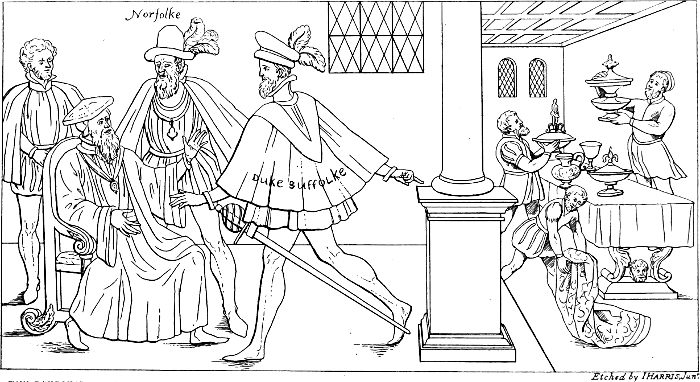
Etched by I Harris, Junr.
THE CARDINAL SURRENDERS THE GREAT SEAL TO THE DUKES OF SUFFOLK & NORFOLK, AND ALL HIS GOODS TO THE KING.
From a M.S. in the Collection of Francis Douce Esq.[r] F.S.A.
Published by Harding, Triphook & Lepard, 1824.
And after long talk between the dukes and
him, they departed, with the great seal of England,
to Windsor, unto the king. Then went
my Lord Cardinal and called all officers in every
office in his house before him, to take account
of all such stuff as they had in charge[155]. And
in his gallery there was set divers tables, whereupon
a great number of rich stuffs of silk, in
whole pieces, of all colours, as velvet, satin, damask,
caffa, taffeta, grograine, sarcenet, and of
other not in my remembrance; also there lay
a thousand pieces of fine holland cloth, whereof
as I heard him say afterward, there was five
hundred pieces thereof, conveyed both from the
king and him[156].
Furthermore there was also all the walls of the
gallery hanged with cloth of gold, and tissue of
divers makings, and cloth of silver likewise on
both the sides; and rich cloths of baudkin[157], of
divers colours. There also hung the richest
suits of copes of his own provision, (which he
caused to be made for his colleges of Oxford and
Ipswich), that ever I saw in England. Then
had he two chambers adjoining to the gallery,
the one called the gilt chamber, and the other
called, most commonly, the council chamber,
wherein were set in each two broad and long
tables, upon tressels, whereupon was set such a
number of plate of all sorts, as were almost incredible.
In the gilt chamber was set out upon
the tables nothing but all gilt plate; and a cupboard
standing under a window, was garnished
all wholly with plate of clean gold, whereof some
was set with pearl and rich stones. And in the
council chamber was set all white plate and
parcel gilt; and under the tables, in both the
chambers, were set baskets with old plate, which
was not esteemed but for broken plate and old,
not worthy to be occupied, and books containing
the value and weight of every parcel laid by
them ready to be seen; and so was also books
set by all manner of stuff, containing the contents
of every thing. Thus every thing being
brought into good order and furnished, he gave
the charge of the delivery thereof unto the king,
to every officer within his office, of such stuff as
they had before in charge, by indenture of every
parcel; for the order of his house was such, as
that every officer was charged by indenture with
all such parcels as belonged to their office.
Then all things being ordered as it is before
rehearsed, my lord prepared him to depart by
water. And before his departing, he commanded
Sir William Gascoigne, his treasurer,
to see these things before remembered delivered
safely to the king at his repair [thither]. That
done, the said Sir William said unto my lord,
“Sir, I am sorry for your grace, for I understand
ye shall go straightway to the Tower.”
“Is this the good comfort and counsel,” quoth
my lord, "that ye can give your master in adversity?
It hath been always your natural inclination
to be very light of credit; and much
more lighter in reporting of false news. I would
ye should know, Sir William, and all other such
blasphemers, that it is nothing more false than
that, for I never (thanks be to God), deserved
by no ways to come there under any arrest, although
it hath pleased the king to take my house
ready furnished for his pleasure at this time. I
would all the world knew, and so I confess, to
have nothing, either riches, honour, or dignity,
that hath not grown of him and by him; therefore
it is my very duty to surrender the same to
him again as his very own, with all my heart, or
else I were an unkind servant. Therefore go
your ways, and give good attendance unto your
charge, that nothing be embezzled." And therewithal
he made him ready to depart, with all his
gentlemen and yeomen, which was no small
number, and took his barge at his privy stairs,
and so went by water unto Putney, where all his
horses waited his coming. And at the taking
of his barge there was no less than a thousand
boats full of men and women of the city of
London, waffeting up and down in Thames, expecting
my lord’s departing, supposing that he
should have gone directly from thence to the
Tower, whereat they rejoiced, and I dare be
bold to say that the most part never received
damage at his hands.
O wavering and new fangled multitude! Is
it not a wonder to consider the inconstant mutability
of this uncertain world! The common
people always desiring alterations and novelties
of things for the strangeness of the case; which
after turneth them to small profit and commodity.
For if the sequel of this matter be well
considered and digested, ye shall understand
that they had small cause to triumph at his fall.
What hath succeeded all wise men doth know,
and the common sort of them hath felt. Therefore
to grudge or wonder at it, surely were but
folly; to study a redress, I see not how it can
be holpen, for the inclination and natural disposition
of Englishmen is, and hath always been,
to desire alteration of officers, which hath been
thoroughly fed with long continuance in their
rooms with sufficient riches and possessions;
and they being put out, then cometh another
hungry and a lean officer in his place, that biteth
nearer the bone than the old. So the people be
ever pilled and polled with hungry dogs, through
their own desire of change of new officers, nature
hath so wrought in the people, that it will not
be redressed. Wherefore I cannot see but always
men in authority be disdained with the
common sort of men; and such most of all, that
justly ministereth equity to all men indifferently.
For where they please some one which receiveth
the benefit of the law at [their] hands according
to justice, there doth they in likewise displease
the contrary party, who supposeth to sustain
great wrong, where they have equity and right.
Thus all good justices be always in contempt
with some for executing of indifferency. And
yet such ministers must be, for if there should
be no ministers of justice the world should run
full of error and abomination, and no good
order kept, ne quietness among the people.
There is no good man but he will commend such
justices as dealeth uprightly in their rooms, and
rejoice at their continuance and not at their fall;
and whether this be true or no, I put it to the
judgment of all discreet persons. Now let us
leave, and begin again where we left.
When he was with all his train arrived and
landed at Putney, he took his mule, and every
man his horse. And setting forth, not past the
length of a pair of garden butts, he espied a
man come riding empost down the hill, in Putney
town, demanding of his footmen who they
thought it should be? And they answered
again and said, that they supposed it should be
Sir Harry Norris. And by and bye he came to
my lord and saluted him, and said “that the
king’s majesty had him commended to his grace,
and willed him in any wise to be of good cheer,
for he was as much in his highness’ favour as
ever he was, and so shall be.” And in token
thereof, he delivered him a ring of gold, with a
rich stone, which ring he knew very well, for it
was always the privy token between the king
and him whensoever the king would have any
special matter dispatched at his hands. And
said furthermore, “that the king commanded him
to be of good cheer, and take no thought, for he
should not lack. And although the king hath
dealt with you unkindly as ye suppose, he saith
that it is for no displeasure that he beareth you,
but only to satisfy more the minds of some
(which he knoweth be not your friends), than for
any indignation: and also ye know right well,
that he is able to recompense you with twice as
much as your goods amounteth unto; and all
this he bade me, that I should show you, therefore,
sir, take patience. And for my part, I
trust to see you in better estate than ever ye
were.” But when he heard Master Norris rehearse
all the good and comfortable words of
the king, he quickly lighted from off his mule,
all alone, as though he had been the youngest
person amongst us, and incontinent kneeled
down in the dirt upon both his knees, holding
up his hands for joy. Master Norris perceiving
him so quickly from his mule upon the ground,
mused, and was astonied. And therewith he
alighted also, and kneeled by him, embracing
him in his arms, and asked him how he did, calling
upon him to credit his message. “Master
Norris,” quoth he, "when I consider your comfortable
and joyful news, I can do no less than
to rejoice, for the sudden joy surmounted my
memory, having no respect neither to the place
or time, but thought it my very bounden duty
to render thanks to God my maker, and to the
king my sovereign lord and master, who hath
sent me such comfort in the very place where I
received the same."
And talking with Master Norris upon his knees
in the mire, he would have pulled off his under
cap of velvet, but he could not undo the knot
under his chin; wherefore with violence he rent
the laces and pulled it from his head, and so
kneeled bare headed. And that done, he covered
again his head, and arose, and would have
mounted his mule, but he could not mount again
with such agility as he lighted before, where his
footmen had as much ado to set him in his saddle
as they could have. Then rode he forth
up the hill into the town, talking with Master
Norris. And when he came upon Putney Heath,
Master Norris took his leave and would have
departed. Then quoth my lord unto him,
“Gentle Norris, if I were lord of a realm, the
one half thereof were insufficient a reward to
give you for your pains, and good comfortable
news. But, good Master Norris, consider with
me, that I have nothing left me but my clothes
on my back. Therefore I desire you to take
this small reward of my hands;” the which was
a little chain of gold, made like a bottle chain,
with a cross of gold hanging thereat, wherein
was a piece of the Holy Cross, which he wore
continually about his neck next his skin; and
said furthermore, “I assure you, Master Norris,
that when I was in prosperity, although it seem
but small in value, yet I would not gladly have
departed with it for the value of a thousand
pounds. Therefore I beseech you to take it in
gree, and wear it about your neck for my sake,
and as often as ye shall happen to look upon it,
have me in remembrance to the king’s majesty,
as opportunity shall serve you, unto whose
Highness and clemency, I desire you to have
[me] most lowly commended; for whose charitable
disposition towards me, I can do nothing
but only minister my prayer unto God for the
preservation of his royal estate, long to reign in
honour, health, and quiet life. I am his obedient
subject, vassal, and poor chaplain, and do
so intend, God willing, to be during my life, accounting
that of myself I am of no estimation
nor of no substance, but only by him and of him,
whom I love better than myself, and have justly
and truly served, to the best of my gross wit.”
And with that he took Master Norris by the
hand and bade him farewell. And being gone
but a small distance, he returned, and called
Master Norris again, and when he was returned,
he said unto him: “I am sorry,” quoth he,
“that I have no condign token to send to the
king. But if ye would at this my request present
the king with this poor Fool, I trust his
highness would accept him well, for surely for a
nobleman’s pleasure he is worth a thousand
pounds[158].” So Master Norris took the Fool with
him; with whom my lord was fain to send six
of [his] tall yeomen, to conduct and convey the
Fool to the court; for the poor Fool took on
and fired so in such a rage when he saw that he
must needs depart from my lord. Yet notwithstanding
they conveyed him with Master Norris
to the court, where the king received him most
gladly.
After the departure of Master Norris with his
token to the king, my lord rode straight to Asher,
a house appertaining to the Bishoprick of Winchester,
situate within the county of Surrey, not
far from Hampton Court, where my lord and
his family continued the space of three or four
weeks, without beds, sheets, table cloths, cups
and dishes to eat our meat, or to lie in. Howbeit,
there was good provision of all kind of
victuals, and of drink, both beer and wine,
whereof there was sufficient and plenty. My
lord was of necessity compelled to borrow of the
Bishop of Carlisle, and of Sir Thomas Arundell,
both dishes to eat his meat in, and plate to drink
in, and also linen cloths to occupy. And thus
continued he in this strange estate until the feast
of All-hallown tide was past[159].
It chanced me upon All-hallown day to come
there into the Great Chamber at Asher, in the
morning, to give mine attendance, where I found
Master Cromwell leaning in the great window,
with a Primer in his hand, saying of our Lady
mattins; which had been since a very strange
sight[160]. He prayed not more earnestly than the
tears distilled from his eyes. Whom I bade
good morrow. And with that I perceived the
tears upon his cheeks. To whom I said, “Why
Master Cromwell, what meaneth all this your
sorrow? Is my lord in any danger, for whom ye
lament thus? or is it for any loss that ye have
sustained by any misadventure?”
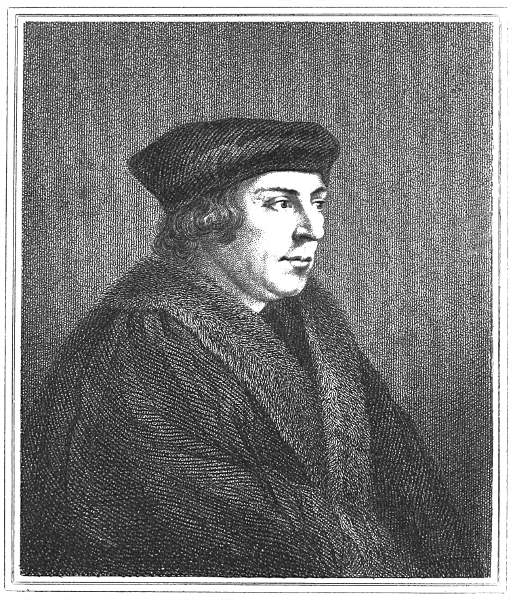
THOMAS CROMWELL,
EARL OF ESSEX.
ENGRAVED BY E. SCRIVEN, AFTER
THE ORIGINAL PICTURE BY HOLBEIN.
London, Published Jan. 1, 1825, by Harding, Triphook & Lepard.
“Nay, nay,” quoth he, “it is my unhappy
adventure, which am like to lose all that I have
travailed for all the days of my life, for doing
of my master true and diligent service.” “Why,
sir,” quoth I, “I trust ye be too wise, to commit
any thing by my lord’s commandment, otherwise
than ye might do of right, whereof ye have any
cause to doubt of loss of your goods.” “Well,
well,” quoth he, "I cannot tell; but all things
I see before mine eyes, is as it is taken; and
this I understand right well, that I am in disdain
with most men for my master’s sake; and
surely without just cause. Howbeit, an ill name
once gotten will not lightly be put away. I
never had any promotion by my lord to the increase
of my living. And thus much will I say
to you, that I intend, God willing, this afternoon,
when my lord hath dined, to ride to London,
and so to the court, where I will either make
or mar[161], or I come again. I will put myself in
prease[162], to see what any man is able to lay
to my charge of untruth or misdemeanour."
“Marry, sir,” quoth I, “in so doing, in my
conceit, ye shall do very well and wisely, beseeching
God to be your guide, and send you
good luck, even as I would myself.” And with
that I was called into the closet, to see and
prepare all things ready for my lord, who intended
that day to say mass there himself; and
so I did.
And then my lord came thither with his
chaplain, one Doctor Marshall, saying first his
mattins, and heard two masses on his knees.
And then after he was confessed, he himself said
mass. And when he had finished mass, and all
his divine service, returned into his chamber,
where he dined among divers of his doctors,
where as Master Cromwell dined also; and
sitting at dinner, it chanced that my lord commended
the true and faithful service of his gentlemen
and yeomen. Whereupon Master Cromwell
took an occasion to say to my lord, that in
conscience he ought to consider their truth and
loyal service that they did him, in this his present
necessity, which never forsaketh him in all
his trouble.
“It shall be well done, therefore,” said he,
“for your grace to call before you all these
your most worthy gentlemen and right honest
yeomen, and let them understand, that ye right
well consider their patience, truth, and faithfulness;
and then give them your commendation,
with good words and thanks, the which shall be
to them great courage to sustain your mishap
in patient misery, and to spend their life and
substance in your service.”
“Alas, Thomas,” quoth my lord unto him,
"ye know I have nothing to give them, and
words without deeds be not often well taken.
For if I had but as I have had of late, I would
depart with them so frankly as they should be
well content: but nothing hath no savour; and
I am ashamed, and also sorry that I am not able
to requite their faithful service. And although
I have cause to rejoice, considering the fidelity
I perceive in the number of my servants, who
will not depart from me in my miserable estate,
but be as diligent, obedient, and serviceable
about me as they were in my great triumphant
glory, yet do I lament again the want of substance
to distribute among them." “Why, sir,”
quoth Master Cromwell, “have ye not here a
number of chaplains, to whom ye have departed
very liberally with spiritual promotions, in so
much as some may dispend, by your grace’s
preferment, a thousand marks by the year, and
some five hundred marks, and some more, and
some less; ye have no one chaplain within all
your house, or belonging unto you, but he may
dispend at the least well (by your procurement
and preferment) three hundred marks yearly,
who had all the profit and advantage at your
hands, and other your servants none at all; and
yet hath your poor servants taken much more
pains for you in one day than all your idle chaplains
hath done in a year. Therefore if they will
not freely and frankly consider your liberality,
and depart with you of the same goods gotten in
your service, now in your great indigence and
necessity, it is pity that they live; and all the
world will have them in indignation and hatred,
for their abominable ingratitude to their master
and lord.”
“I think no less, Thomas,” quoth my lord,
"wherefore, [I pray you,] cause all my servants
to be called and to assemble without, in my
great chamber, after dinner, and see them stand
in order, and I will declare unto them my mind,
according to your advice." After that the board’s
end was taken up, Master Cromwell came to me
and said, “Heard you not, what my Lord said
even now?” “Yes, sir,” quoth I, “that I did.”
“Well, then,” quoth he, “assemble all my lord’s
servants up into the great chamber;” and so I
did, and when they were all there assembled, I
assigned all the gentlemen to stand on the right
side of the chamber, and the yeomen on the left
side. And at the last my lord came thither,
appareled in a white rochet upon a violet gown
of cloth like a bishop’s, who went straight into
the great window. Standing there a while, and
his chaplains about him, beholding the number
of his servants divided in two parts, he could
not speak unto them for tenderness of his heart;
the flood of tears that distilled from his eyes
declared no less: the which perceived by his
servants, caused the fountains of water to gush
out of their faithful hearts down their cheeks,
in such abundance as it would cause a cruel
heart to lament. At the last, after he had
turned his face to the wall, and wiped his eyes
with his handkerchief, he spake to them after
this sort in effect: "Most faithful gentlemen
and true hearted yeomen, I do not only lament
[to see] your persons present about me, but I do
lament my negligent ingratitude towards you all
on my behalf, in whom hath been a great default,
that in my prosperity [I] have not done for you
so much as I might have done, either in word
or deed, which was then in my power to do:
but then I knew not my jewels and special treasures
that I had of you my faithful servants in
my house; but now approved experience hath
taught me, and with the eyes of my discretion,
which before were hid, I do perceive well the
same. There was never thing that repented me
more that ever I did than doth the remembrance
of my oblivious negligence and ungentleness,
that I have not promoted or preferred you to condign
rooms and preferments, according to your
demerits. Howbeit, it is not unknown to you
all, that I was not so well furnished of temporal
advancements, as I was of spiritual preferments.
And if I should have promoted you to any of
the king’s offices and rooms, then should I have
incurred the indignation of the king’s servants,
who would not much let to report in every place
behind my back, that there could no office or
room in the king’s gift escape the cardinal and
his servants, and thus should I incur the obloquy
and slander before the whole world. But now
it is come to this pass, that it hath pleased
the king to take all that ever I have into his
possession, so that I have nothing left me but
my bare clothes upon my back, the which be
but simple in comparison to those that ye have
seen me have or this: howbeit, if they may do
you any good or pleasure, I would not stick to
divide them among you, yea, and the skin of
my back, if it might countervail any thing in
value among you. But, good gentlemen and
yeomen, my trusty and faithful servants, of
whom no prince hath the like, in my opinion,
I most heartily require you to take with me
some patience a little while, for I doubt not
but that the king, considering the offence suggested
against me by my mortal enemies, to be
of small effect, will shortly, I doubt not, restore
me again to my living, so that I shall be more
able to divide some part thereof yearly among
you, whereof ye shall be well assured. For the
surplusage of my revenues, whatsoever shall remain
at the determination of my accompts, shall
be, God willing, distributed among you. For I
will never hereafter esteem the goods and riches
of this uncertain world but as a vain thing, more
than shall be sufficient for the maintenance of
mine estate and dignity, that God hath or shall
call me unto in this world during my life. And
if the king do not thus shortly restore me, then
will I see you bestowed according to your own
requests, and write for you, either to the king,
or to any other noble person within this realm,
to retain you into service; for I doubt not but
the king, or any noble man, or worthy gentleman
of this realm, will credit my letter in your
commendation. Therefore, in the mean time,
mine advice is, that ye repair home to your
wives, such as have any: and such among you
as hath none, to take this time to visit your
parents and friends in the country. There is
none of you all, but once in a year would require
licence to visit your wives and other of
your friends: take this time, I pray you, in respect
thereof, and at your return I will not
refuse you, if I should beg with you. I consider
that the service of my house hath been such,
and of such sort, that ye be not meet or apt to
serve [any] man under the degree of a king;
therefore I would wish you to serve no man but
the king, who I am sure will not reject you.
Therefore I desire you to take your pleasures
for a month, and then ye may come again unto
me, and I trust by that time, the king’s majesty
will extend his clemency upon me." “Sir,”
quoth Master Cromwell, "there is divers of
these your yeomen, that would be glad to see
their friends, but they lack money: therefore
here is divers of your chaplains who have received
at your hands great benefices and high
dignities; let them therefore now show themselves
unto you as they are bound by all humanity
to do. I think their honesty and charity
is not so slender and void of grace that they
would not see you lack where they may help to
refresh you. And for my part, although I have
not received of your grace’s gift one penny
towards the increase of my yearly living, yet
will I depart with you this towards the dispatch
of your servants," and [therewith] delivered
him five pounds in gold. “And now let us see
what your chaplains will do. I think they will
depart with you much more than I have done,
who be more able to give you a pound than I
one penny.” “Go to, masters,” quoth he to the
chaplains: in so much as some gave to him ten
pounds, some ten marks, some a hundred shillings,
and so some more and some less, as at that
time their powers did extend; whereby my lord
received among them as much money of their
liberality as he gave to each of his yeomen a
quarter’s wages, and board wages for a month;
and they departed down into the hall, where
some determined to go to their friends, and some
said that they would not depart from my lord
until they might see him in better estate. My
lord returned into his chamber lamenting the
departure from his servants, making his moan
unto Master Cromwell, who comforted him the
best he could, and desired my lord to give him
leave to go to London, where he would either
make or mar or he came again, which was always
his common saying. Then after long communication
with my lord in secret, he departed
and took his horse, and rode to London, at
whose departing I was by, whom he bade farewell;
and said, “ye shall hear shortly of me,
and if I speed well, I will not fail to be here
again within these two days.” And so I took
my leave of him, and he rode forth on his
journey. Sir Rafe Sadler, (now knight), was
then his clerk, and rode with him.
After that my lord had supped that night, and
all men gone to bed, (being All-hallown day),
it chanced so, about midnight, that one of the
porters came unto my chamber door, and there
knocked, and waking me, I perceived who it
was; [and] asked him, “what he would have
that time of the night?” “Sir,” quoth the
porter, “there is a great number of horsemen
at the gate, that would come in, saying to me,
that it is Sir John Russell, and so it appears to
me by his voice; what is your pleasure that I
should do?” “Marry,” quoth I, “go down
again, and make a great fire in your lodge,
against I come to dry them;” for it rained all
that night the sorest that it did all that year
before. Then I rose and put on my nightgown,
and came to the gates, and asked who was there.
With that Master Russell spake, whom I knew
by his voice, and then I caused the porter to
open the gates and let them all in, who were
wet to the skin; desiring Master Russell to go
into the lodge to the fire; and he showed me
that he was come from the king unto my lord
in message, with whom he required me to speak.
“Sir,” quoth I, “I trust your news be good?”
“Yea, I promise you on my fidelity,” quoth
he, “and so, I pray you, show him, I have
brought him such news that will please him
right well.” “Then I will go,” quoth I, “and
wake him, and cause him to rise.” I went incontinent
to my lord’s chamber door, and waked
my lord, who asked me, “what I would have?”
“Sir,” said I, “to show you that Sir John
Russell is come from the king, who is desirous
to speak with you;” and then he called up one
of his grooms to let me in; and being within I
told him “what a journey Sir John Russell had
that night.” “I pray God,” quoth he, “all
be for the best.” “Yes, sir,” quoth I, “he
showed me, and so bade me tell you, that he
had brought you such news as ye would greatly
rejoice thereat.” “Well, then,” quoth he, “God
be praised, and welcome be his grace! Go ye
and fetch him unto me, and by that time I will
be ready to talk with him.”
Then I returned from him to the lodge, and
brought Master Russell from thence to my lord,
who had cast on his nightgown. And when
Master Russell was come into his presence, he
most humbly reverenced him, upon his knee,
[to] whom my lord bowed down, and took him
up, and bade him welcome. “Sir,” quoth he,
“the king commendeth him unto you;” and
delivered him a great ring of gold with a Turkis,
for a token; “and willeth you to be of good
cheer; who loveth you as well as ever he did,
and is not a little disquieted for your troubles,
whose mind is full of your remembrance. In
so much as his grace, before he sat to supper,
called me unto him, and commanded me to take
this journey secretly to visit you, to your comfort
the best of my power. And Sir, if it please
your grace, I have had this night the sorest
journey, for so little a way, that ever I had to
my remembrance.”
My lord thanked him for his pains and good
news, and demanded of him if he had supped;
and he said “Nay.” “Well, then,” quoth my
lord to me, “cause the cooks to provide some
meat for him; and cause a chamber with a good
fire to be made ready for him, that he may take
his rest awhile upon a bed.” All which commandment
I fulfilled; and in the meantime my
lord and Master Russell were in very secret
communication; and in fine, Master Russell
went to his chamber, taking his leave of my
lord for all night, and said, “he would not tarry
but a while, for he would, God willing, be at
the court at Greenwich again before day, for he
would not for any thing that it were known, his
being with my lord that night.” And so being
in his chamber, having a small repast, rested
him a while upon a bed, whilst his servants
supped and dried themselves by the fire; and
then incontinent he rode away with speed to
the court. And shortly after his being there,
my lord was restored again unto plenty of household
stuff, vessels, and plate, and of all things
necessary some part, so that he was indifferently
furnished much better than he was of late, and
yet not so abundantly as the king’s pleasure was,
the default whereof was in the officers, and in
such as had the oversight of the delivery thereof;
and yet my lord rejoiced in that little in comparison
to that he had before.
Now let us return again to Master Cromwell,
to see how he hath sped, since his departure last
from my lord. The case stood so, that there
should begin, shortly after All-hallown tide, the
Parliament, and [he], being within London, devised
with himself to be one of the Burgesses of
the Parliament, and chanced to meet with one
Sir Thomas Rush, knight, a special friend of his,
whose son was appointed to be one of the Burgesses
of that Parliament, of whom he obtained
his room, and by that means put his foot into
the Parliament House: then within two or three
days after his entry into the Parliament, he came
unto my lord, to Asher, with a much pleasanter
countenance than he had at his departure, and
meeting with me before he came to my lord,
said unto me, “that he had once adventured to
put in his foot, where he trusted shortly to be
better regarded, or all were done.” And when
he was come to my lord, they talked together
in secret manner; and that done, he rode out
of hand again that night to London, because he
would not be absent from the Parliament the
next morning. There could nothing be spoken
against my lord in the Parliament House but he
would answer it incontinent, or else take until
the next day, against which time he would resort
to my lord to know what answer he should
make in his behalf; in so much that there was
no matter alleged against my lord but that he
was ever ready furnished with a sufficient answer;
so that at length, for his honest behaviour
in his master’s cause, he grew into such estimation
in every man’s opinion, that he was esteemed
to be the most faithfullest servant to his master
of all other, wherein he was of all men greatly
commended.
Then was there brought in a Bill of Articles
into the Parliament House to have my lord condemned
of treason; against which bill Master
Cromwell inveighed so discreetly, with such
witty persuasions and deep reasons, that the
same bill could take there no effect[163]. Then were
his enemies compelled to indite him in a premunire,
and all was done only to the intent to
entitle the king to all his goods and possessions,
the which he had gathered together, and purchased
for his colleges in Oxford and Ipswich,
and for the maintenance of the same, which was
then abuilding in most sumptuous wise. Wherein
when he was demanded by the judges, which
were sent [to] him purposely to examine him
what answer he would make to the same, he
said: "The king’s highness knoweth right well
whether I have offended his majesty and his
laws or no, in using of my prerogative legatine,
for the which ye have me indited. Notwithstanding
I have the king’s license in my coffers,
under his hand and broad seal, for exercising
and using the authority thereof, in the largest
wise, within his highness’ dominions, the which
remaineth now in the hands of my enemies.
Therefore, because I will not stand in question
or trial with the king in his own cause, I am
content here of mine own frank will and mind,
in your presence, to confess the offence in the
inditement, and put me wholly in the mercy and
grace of the king, having no doubt in his godly
disposition and charitable conscience, whom I
know hath an high discretion to consider the
truth, and my humble submission and obedience.
And although I might justly stand on the trial
with him therein; yet I am content to submit
myself to his clemency, and thus much ye may
say to him in my behalf, that I am entirely in
his obedience, and do intend, God willing, to
obey and fulfil all his princely pleasure in every
thing that he will command me to do; whose
will and pleasure I never yet disobeyed or repugned,
but was always contented and glad to
accomplish his desire and commandment before
God, whom I ought most rathest to [have]
obeyed; the which negligence now greatly repenteth
me. Notwithstanding, I most heartily
require you, to have me most humbly to his
royal majesty commended, for whom I do and
will pray for the preservation of his royal person,
long to reign in honour, prosperity, and quietness,
and to have the victory over his mortal and
cankered enemies." And they took their leave
of him and departed.
Shortly after the king sent the Duke of Norfolk
unto him in message; but what it was I
am not certain. But my Lord being advertised
that the duke was coming even at hand, he
caused all his gentlemen to wait upon him
down through the Hall into the Base Court, to
receive the duke at the entry of the gates; and
commanded all his yeomen to stand still in the
Hall in order. And he and his gentlemen went
to the gates, where he encountered with my Lord
of Norfolk, whom he received bareheaded; who
embraced each other: and so led him by the
arm through the Hall into his chamber. And
as the duke passed through the Hall, at the
upper end thereof he turned again his visage
down the Hall, regarding the number of the tall
yeomen that stood in order there, and said:
“Sirs,” quoth he, "your diligent and faithful
service unto my lord here your master, in this
time of his calamity, hath purchased for yourselves
of all noble men much honesty; in so
much as the king commanded me to say to
you in his grace’s name, that, for your true and
loving service that ye have done to your master,
his highness will see you all furnished at all
times with services according to your demerits.”
With that my Lord Cardinal put off his cap,
and said to my Lord of Norfolk; “Sir,” quoth
he, “these men be all approved men: wherefore
it were pity they should want other service
or living; and being sorry that I am not able
to do for them as my heart doth wish, do therefore
require you, my good lord, to be good lord
unto them, and extend your good word for them,
when ye shall see opportunity at any time hereafter;
and that ye will prefer their diligent
and faithful service to the king.” “Doubt ye
not thereof,” quoth my Lord of Norfolk, “but I
will do for them the best of my power: and when
I shall see cause, I will be an earnest suitor for
them to the king; and some of you I will retain
myself in service for your honesty’s sake. And
as ye have begun, so continue and remain here
still with my lord until ye hear more of the
king’s pleasure:—God’s blessing and mine be
with you!” And so went up into the great
chamber to dinner, whom my Lord Cardinal
thanked, and said unto him, “Yet, my lord, of
all other noble men, I have most cause to thank
you for your noble heart and gentle nature,
which ye have showed me behind my back, as
my servant, Thomas Cromwell, hath made report
unto me. But even as ye are a noble man
in deed, so have ye showed yourself no less to
all men in calamity, and in especial to me, and
even as ye have abated my glory and high estate,
and brought it full low, so have ye extended
your honourable favour most charitably unto me,
being prostrate before you. Forsooth, Sir, ye do
right well deserve to bear in your arms the noble
and gentle lion, whose natural inclination is, that
when he hath vanquished any beast, and seeth
him yielded, lying prostrate before him at his
feet, then will he show most clemency unto his
vanquished, and do him no more harm, ne suffer
any other devouring beast to damage him: whose
nature and quality ye do ensue; therefore these
verses may be applied to your lordship:
Parcere prostratis scit nobilis ira leonis:
Ta quoque fac simile, quisquis regnabis in orbem.”
With that the water was brought them to
wash before dinner, to the which my lord called
my Lord of Norfolk to wash with him: but he
refused of courtesy, and desired to have him
excused, and said “that it became him not to
presume to wash with him any more now, than
it did before[164] in his glory.” “Yes, forsooth,”
quoth my Lord Cardinal, “for my authority and
dignity legatine is gone, wherein consisted all
my high honour.” “A straw,” quoth my Lord
of Norfolk, “for your legacy. I never esteemed
your honour the more or higher for that. But
I regarded your honour, for that ye were Archbishop
of York, and a cardinal, whose estate
of honour surmounteth any duke now being
within this realm; and so will I honour you, and
acknowledge the same, and bear you reverence
accordingly. Therefore, I beseech you, content
yourself, for I will not presume to wash with you;
and therefore I pray you, hold me excused.”
Then was my Lord Cardinal constrained to
wash alone; and my Lord of Norfolk all alone
also. When he had done, my Lord Cardinal
would fain have had him to sit down on the
chair, in the inner side of the table, but surely
he refused the same also with much humbleness.
Then was there set another chair for
my Lord of Norfolk, over against my Lord
Cardinal, on the outside of the table, the which
was by my Lord of Norfolk based something
beneath my lord, and during the dinner all
their communication was of the diligent service
of the gentlemen which remained with my lord
there attending upon him at dinner, and how
much the king and all other noble men doth
esteem them with worthy commendations for
so doing; and at this time how little they be
esteemed in the court that are come to the
king’s service, and [have] forsaken their master
in his necessity; whereof some he blamed by
name. And with this communication, the dinner
being ended, they rose from the table, and
went together into my lord’s bedchamber, where
they continued in consultation a certain season.
And being there, it chanced Master Shelley,
the judge, to come thither, sent from the king;
whereof relation was made to my lord, which
caused the duke and him to break up their
communication; and the duke desired to go
into some chamber to repose him for a season.
And as he was coming out of my lord’s chamber,
he met with Master Shelley, to whom
Master Shelley made relation of the cause of
his coming, and desired the duke to tarry and
to assist him in doing of his message; whom
he denied and said, “I have nothing to do with
your message, wherein I will not meddle;” and
so departed into a chamber, where he took his
rest for an hour or two. And in the mean time
my lord issued out of his chamber, and came
to Master Shelley to know his message. Who
declared unto him, after due salutation, that the
king’s pleasure was to have his house at Westminster,
(then called York Place, belonging to
the Bishoprick of York,) intending to make of
that house a palace royal; and to possess the
same according to the laws of this his grace’s
realm. His highness hath therefore sent for
all the judges, and for all his learned counsel,
to know their opinions in the assurance thereof;
in whose determinations it was fully resolved,
that your grace should recognise, before a
judge, the right thereof to be in the king and
his successors; and so his highness shall be
assured thereof. Wherefore it hath pleased
his majesty to appoint me by his commandment
to come hither, to take of you this recognisance,
who hath in you such affiance, that ye will not
refuse so to do accordingly. Therefore I shall
desire your grace to know your good will
therein."—“Master Shelley,” quoth my lord,
"I know that the king of his own nature is of
a royal stomach, and yet not willing more than
justice shall lead him unto by the law. And
therefore, I counsel you, and all other fathers of
the law and learned men of his counsel, to put
no more into his head than the law may stand
with good conscience; for when ye tell him,
this is the law, it were well done ye should tell
him also that, although this be the law, yet this
is conscience; for law without conscience is
not good to be given unto a king in counsel to
use for a lawful right, but always to have a
respect to conscience, before the rigour of the
common law, for laus est facere quod decet, non
quod licet. The king ought of his royal dignity
and prerogative to mitigate the rigour of the
law, where conscience hath the most force;
therefore, in his royal place of equal justice, he
hath constitute a chancellor, an officer to execute
justice with clemency, where conscience is
opposed by the rigour of the law. And therefore
the Court of Chancery hath been heretofore
commonly called the Court of Conscience; because
it hath jurisdiction to command the high
ministers of the common law to spare execution
and judgment, where conscience hath most effect.
Therefore I say to you in this case, although
you, and other of your profession, perceive by
your learning that the king may, by an order of
your laws, lawfully do that thing which ye demand
of me; how say you, Master Shelley, may
I do it with justice and conscience, to give that
thing away from me and my successors which is
none of mine? If this be law, with conscience,
show me your opinion, I pray you." “Forsooth,
my lord,” quoth he, “there is some conscience
in this case; but having regard to the
king’s high power, and to be employed to a
better use and purpose, it may the better be
suffered with conscience; who is sufficient to
make recompense to the church of York with
double the value.” “That I know well,” quoth
my lord, “but here is no such condition neither
promised nor agreed, but only a bare and simple
departure with another’s right for ever. And if
every bishop may do the like, then might every
prelate give away the patrimony of their churches
which is none of theirs; and so in process of
time leave nothing for their successors to maintain
their dignities, which, all things considered,
should be but small to the king’s honour. Sir,
I do not intend to stand in terms with you in
this matter, but let me see your commission.”
To whom Master Shelley showed the same, and
that seen, and perceived by him, said again thus:
“Master Shelley,” quoth he, "ye shall make report
to the king’s highness, that I am his obedient
subject, and faithful chaplain and beadman,
whose royal commandment and request I will in
no wise disobey, but most gladly fulfil and accomplish
his princely will and pleasure in all
things, and in especial in this matter, in as much
as ye, the fathers of the laws, say that I may
lawfully do it. Therefore I charge your conscience
and discharge mine. Howbeit, I pray
you, show his majesty from me, that I most
humbly desire his highness to call to his most
gracious remembrance, that there is both heaven
and hell." And therewith the clerk was called,
who wrote my lord’s recognisance[165], and after
some secret talk Master Shelley departed. Then
rose my Lord of Norfolk from his repose, and
after some communication with my lord he
departed.
Thus continued my lord at Asher, who received
daily messages from the court, whereof
some were not so good as some were bad, but
yet much more evil than good. For his enemies,
perceiving the great affection that the king
bare always towards him, devised a mean to disquiet
and disturb his patience; thinking thereby
to give him an occasion to fret and chafe, that
death should rather ensue than increase of health
or life, the which they most desired. They
feared him more after his fall than they did before
in his prosperity, doubting much his re-adoption
into authority, by reason that the king’s
favour remained still towards him in such force,
whereby they might rather be in danger of their
estates, than in any assurance, for their cruelty
ministered, by their malicious inventions, surmised
and brought to pass against him.
Therefore they took this order among them
in their matters, that daily they would send
him something, or do something against him,
wherein they thought that they might give him
a cause of heaviness or lamentation. As some
day they would cause the king to send for four
or five of his gentlemen from him to serve the
king: and some other day they would lay matters
newly invented against him. Another day
they would take from him some of his promotions;
or of their promotions whom he [had]
preferred before. Then would they fetch from
him some of his yeomen; in so much as the king
took into service sixteen of them at once, and
at one time put them into his guard. This
order of life he led continually; that there
was no one day but, or ever he went to bed,
he had an occasion greatly to chafe or fret the
heart out of his belly, but that he was a wise
man, and bare all their malice in patience[166].
At Christmas he fell sore sick, that he was
likely to die. Whereof the king being advertised,
was very sorry therefore, and sent Doctor
Buttes, his grace’s physician, unto him, to see in
what estate he was. Doctor Buttes came unto
him, and finding him very sick lying in his bed;
and perceiving the danger he was in repaired
again unto the king. Of whom the king demanded,
saying, “How doth yonder man, have
you seen him?” “Yea, sir,” quoth he. “How
do you like him?” quoth the king. “Forsooth,
sir,” quoth he, “if you will have him dead, I
warrant your grace he will be dead within these
four days, if he receive no comfort from you
shortly, and Mistress Anne.” “Marry,” quoth
the king, “God forbid that he should die. I pray
you, good Master Buttes, go again unto him,
and do your cure upon him; for I would not
lose him for twenty thousand pounds.” “Then
must your grace,” quoth Master Buttes, “send
him first some comfortable message, as shortly
as is possible.” “Even so will I,” quoth the
king, "by you. And therefore make speed to
him again, and ye shall deliver him from me
this ring for a token of our good will and favour
towards him, (in the which ring was engraved
the king’s visage within a ruby, as lively counterfeit
as was possible to be devised). This
ring he knoweth very well; for he gave me the
same; and tell him, that I am not offended with
him in my heart nothing at all, and that shall he
perceive, and God send him life, very shortly.
Therefore bid him be of good cheer, and pluck
up his heart, and take no despair. And I charge
you come not from him, until ye have brought
him out of all danger of death." And then spake
he to Mistress Anne, saying, “Good sweetheart,
I pray you at this my instance, as ye love us, to
send the cardinal a token with comfortable words;
and in so doing ye shall do us a loving pleasure.”
She being not minded to disobey the king’s
earnest request, whatsoever she intended in her
heart towards the cardinal; took incontinent her
tablet of gold hanging at her girdle, and delivered
it to Master Buttes, with very gentle and comfortable
words and commendations to the cardinal.
And thus Master Buttes departed, and
made speedy return to Asher, to my Lord Cardinal;
after whom the king sent Doctor Clement,
Doctor Wotton, and Doctor Cromer the
Scot, to consult and assist Master Buttes for my
lord’s health.
After that Master Buttes had been with my
lord, and delivered the king’s and Mistress
Anne’s tokens unto him, with the most comfortable
words he could devise on their behalf,
whereat he rejoiced not a little, advancing him
a little in his bed, and received their tokens most
joyfully, thanking Master Buttes for his comfortable
news and pains. Master Buttes showed
him furthermore, that the king’s pleasure was,
that he should minister unto him for his health:
and to join with him for the better and most
assured and brief ways, to be had for the same,
hath sent Doctor Wotton, Doctor Clement, and
Doctor Cromer, to join with him in counsel and
ministration. “Therefore, my lord,” quoth he,
"it were well done that they should be called in
to visit your person and estate, wherein I would
be glad to hear their opinions, trusting in
Almighty God that, through his grace and assistance,
we shall ease you of your pains, and
rid you clean from your disease and infirmity.
Wherewith my lord was well pleased and contented
to hear their judgments; for indeed he
trusted more to the Scottish doctor than he did
to any of the other, because he was the very
occasion that he inhabited here in England, and
before he gave him partly his exhibition in Paris.
Then when they were come into his chamber,
and had talked with him, he took upon him to
debate his disease learnedly among them, so that
they might understand that he was seen in that
art. After they had taken order for ministration,
it was not long or they brought him out of
all danger and fear of death; and within four
days they set him on his feet, and got him a good
stomach to his meat[167]. This done, and he in a
good estate of amendment, they took their leave
to depart, to whom my lord offered his reward;
the which they refused, saying, that the king
gave them in special commandment, to take
nothing of him for their pains and ministration;
for at their return his highness said that he
would reward them of his own costs: and thus
with great thanks they departed from my lord,
whom they left in good estate of recovery.
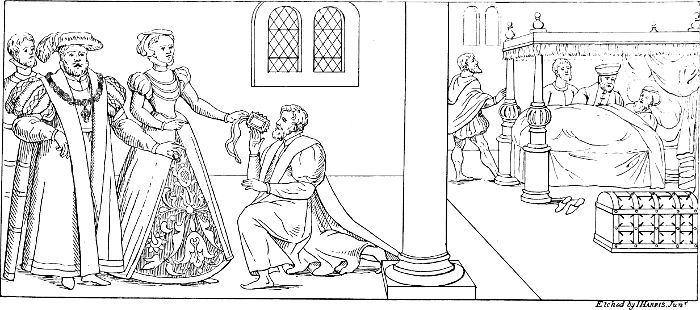
Etched by I. Harris, Jun.
DR. BUTTS SENT BY THE KING TO THE SICK CARDINAL WITH TOKENS OF FAVOUR.
From a M.S. in the Collection of Francis Douce Esqr. F.S.A.
Published by Harding, Triphook, & Lepard. 1824.
After this time my lord daily amended, and
so continued still at Asher until Candlemas;
against which feast, the king caused to be sent
him three or four cart loads of stuff, and most
part thereof was locked in great standards, (except
beds and kitchen-stuff,) wherein was both
plate and rich hangings, and chapel-stuff[168]. Then
my lord, being thus furnished, was therewith
well contented; although they whom the king
assigned did not deliver him so good, ne so
rich stuff, as the king’s pleasure was, yet was he
joyous thereof, and rendered most humble thanks
to the king, and to them that appointed the said
stuff for him, saying to us his servants, at the
opening of the same stuff in the standards, the
which we thought, and said, might have been
better appointed if it had pleased them that appointed
it: “Nay, sirs,” quoth my lord to us,
“he that hath nothing is glad of somewhat,
though it be never so little, and although it be
not in comparison half so much and good as we
had before, yet we rejoice more of this little than
we did of the great abundance that we then had;
and thank the king very much for the same,
trusting after this to have much more. Therefore
let us all rejoice, and be glad, that God and
the king hath so graciously remembered to restore
us to some things to maintain our estate
like a noble person.”
Then commanded he Master Cromwell, being
with him, to make suit to the king’s majesty,
that he might remove thence to some other
place, for he was weary of that house of Asher:
for with continual use thereof the house waxed
unsavoury; supposing that if he might remove
from thence he should much sooner recover his
health. And also the council had put into the
king’s head, that the new gallery at Asher,
which my lord had late before his fall newly set
up, should be very necessary for the king, to
take down and set it up again at Westminster;
which was done accordingly, and stands at this
present day there[169]. The taking away thereof
before my lord’s face was to him a corrosive,
which was invented by his enemies only to torment
him, the which indeed discouraged him
very sore to tarry any longer there. Now Master
Cromwell thought it but vain and much folly
to move any of the king’s council to assist and
prefer his suit to the king, among whom rested
the number of his mortal enemies, for they would
rather hinder his removing, or else remove him
farther from the king, than to have holpen him
to any place nigh the king’s common trade;
wherefore he refused any suit to them, and made
only suit to the king’s own person; whose suit
the king graciously heard, and thought it very
convenient to be granted; and through the
special motion of Master Cromwell, the king
was well contented that he should remove to
Richmond, which place my lord had a little before
repaired to his great cost and charge; for
the king had made an exchange thereof with
him for Hampton Court. All this his removing
was done without the knowledge of the king’s
council, for if they might have had any intelligence
thereof before, then would they have persuaded
the king to the contrary: but when they
were advertised of the king’s grant and pleasure,
they dissimuled their countenances in the king’s
presence, for they were greatly afraid of him,
lest his nigh being, the king might at length
some one time resort to him, and so call him
home again, considering the great affection and
love that the king daily showed towards him;
wherefore they doubted his rising again, if they
found not a mean to remove him shortly from
the king. In so much that they thought it convenient
for their purpose to inform the king
upon certain considerations which they invented,
that it were very necessary that my lord should go
down into the North unto his benefice of York,
where he should be a good stay for the country;
to the which the king, supposing that they had
meant no less than good faith, granted and condescended
to their suggestions; which were forced
so with wonderful imagined considerations, that
the king, understanding nothing of their intent,
was lightly persuaded to the same. Whereupon
the Duke of Norfolk commanded Master Cromwell,
who had daily access unto him, to say to
my lord, that it is the king’s pleasure that he
should with speed go to his benefice, where lieth
his cure, and look to that according to his duty.
Master Cromwell at his next repair to my lord,
who lay then at Richmond, declared unto him
what my Lord of Norfolk said, how it was determined
that he should go to his benefice.
“Well then, Thomas,” quoth my lord, “seeing
there is no other remedy, I do intend to go
to my benefice of Winchester, and I pray you,
Thomas, so show my Lord of Norfolk.” “Contented,
sir,” quoth Master Cromwell, and according
to his commandment did so. To the
which my Lord of Norfolk answered and said,
“What will he do there?” “Nay,” quoth he,
“let him go into his province of York, whereof
he hath received his honour, and there lieth the
spiritual burden and charge of his conscience, as
he ought to do, and so show him.” The lords,
who were not all his friends, having intelligence
of his intent, thought to withdraw his appetite
from Winchester, and would in no wise permit
him to plant himself so nigh the king: [they]
moved therefore the king to give my lord but a
pension[170] out of Winchester, and to distribute
all the rest among the nobility and other of his
worthy servants; and in likewise to do the same
with the revenues of St. Albans; and of the revenues
of his colleges in Oxford and Ipswich, the
which the king took into his own hands; whereof
Master Cromwell had the receipt and government
before by my lord’s assignment. In consideration
thereof it was thought most convenient
that he should have so still. Notwithstanding,
out of the revenues of Winchester and St. Albans
the king gave to some one nobleman three hundred
marks, and to some a hundred pounds, and
to some more and to some less, according to the
king’s royal pleasure. Now Master Cromwell
executed his office, the which he had over the
lands of the college, so justly and exactly that
he was had in great estimation for his witty behaviour
therein, and also for the true, faithful,
and diligent service extended towards my lord
his master.
It came at length so to pass that those to
whom the king’s majesty had given any annuities
or fees for term of life by patent out of the forenamed
revenues could not be good, but [only]
during my lord’s life, forasmuch as the king had
no longer estate or title therein[171], which came
to him by reason of my lord’s attainder in the
premunire; and to make their estates good and
sufficient according to their patents, it was
thought necessary to have my lord’s confirmation
unto their grants. And this to be brought
about, there was no other mean but to make
suit to Master Cromwell to obtain their confirmation
at my lord’s hands, whom they thought
might best obtain the same.
Then began both noblemen and other who had
any patents of the king, out either of Winchester
or St. Albans, to make earnest suit to
Master Cromwell for to solicit their causes to
my lord, to get of him his confirmations; and
for his pains therein sustained, they promised
every man, not only worthily to reward him,
but also to show him such pleasures as should
at all times lie in their several powers, whereof
they assured him. Wherein Master Cromwell
perceiving an occasion and a time given him to
work for himself, and to bring the thing to pass
which he long wished for; intended to work so
in this matter, to serve their desires, that he
might the sooner bring his own enterprise to
purpose.
Then at his next resort to my lord, he moved
him privily in this matter to have his counsel
and his advice, and so by their witty heads it
was devised that they should work together by
one line, to bring by their policies Master
Cromwell in place and estate, where he might
do himself good and my lord much profit.
Now began matters to work to bring Master
Cromwell into estimation in such sort as was
afterwards much to his increase of dignity; and
thus every man, having an occasion to sue for
my lord’s confirmation, made now earnest
travail to Master Cromwell for these purposes,
who refused none to make promise that he
would do his best in that case. And having a
great occasion of access to the king for the disposition
of divers lands, whereof he had the
order and governance; by means whereof, and
by his witty demeanour, he grew continually into
the king’s favour, as ye shall hear after in this
history. But first let us resort to the great
business about the assurance of all these patents
which the king hath given to divers noblemen
and other of his servants, wherein Master Cromwell
made a continuance of great suit to my
lord for the same, that in process of time he
served all their turns so that they had their
purposes, and he their good wills. Thus rose
his name and friendly acceptance with all men.
The fame of his honesty and wisdom sounded so
in the king’s ears that, by reason of his access
to the king, he perceived to be in him no less
wisdom than fame had made of him report, forasmuch
as he had the government and receipts
of those lands which I showed you before; and
the conference that he had with the king therein
enforced the king to repute him a very wise
man, and a meet instrument to serve his grace,
as it after came to pass.
Sir, now the lords thought long to remove
my lord farther from the king, and out of his
common trade; wherefore among other of the
lords, my Lord of Norfolk said to Master Cromwell,
“Sir,” quoth he, “me thinketh that the
cardinal your master maketh no haste northward;
show him, that if he go not away shortly,
I will, rather than he should tarry still, tear him
with my teeth. Therefore I would advise him
to prepare him away as shortly as he can, or
else he shall be sent forward.” These words
Master Cromwell reported to my lord at his
next repair unto him, who then had a just occasion
to resort to him for the dispatch of the
noblemen’s and others’ patents. And here I will
leave of this matter, and show you of my lord’s
being at Richmond.
My lord, having license of the king to repair
and remove to Richmond, made haste to prepare
him thitherward; and so he came and lodged
within the great park there, which was a very
pretty house and a neat, lacking no necessary
rooms that to so small a house was convenient
and necessary; where was to the same a very
proper garden garnished with divers pleasant
walks and alleys: my lord continued in this
lodge from the time that he came thither, shortly
after Candlemas, until it was Lent, with a privy
number of servants, because of the smallness of
the house, and the rest of his family went to
board wages.
I will tell you a certain tale by the way of
communication. Sir, as my lord was accustomed
towards night to walk in the garden
there, to say his service, it was my chance then
to wait upon him there; and standing still in
an alley, whilst he in another walked with his
chaplain, saying of his service; as I stood, I
espied certain images of beasts counterfeit in
timber, standing in a corner under the lodge
wall, to the which I repaired to behold. Among
whom I saw there a dun cow, whereon I mused
most, because it seemed me to be the most
lively entaylled[172] among all the rest. My lord
being, as I said, walking on the other side of
the garden, perceived me, came suddenly upon
me at my back, unawares, [and] said: “What
have you espied here, that you so attentively
look upon?” “Forsooth, if it please your grace,”
quoth I, “here I do behold these entaylled
images; the which I suppose were ordained
for to be set up within some place about the
king’s palace: howbeit, sir, among them all,
I have most considered the dun cow, [in] the
which (as it seemeth me) the workman has most
apertly showed his cunning.” “Yea, marry, sir,”
quoth my lord, “upon this dun cow dependeth
a certain prophecy, the which I will show you,
for peradventure ye never heard of it before.
There is a saying,” quoth he, "that
“When this cow rideth the bull,
Then, priest, beware thy scull.”
[Of] which prophecy neither my lord that declared
it, ne I that heard it, understood the
effect; although that even then it was a-working
to be brought to pass. For this cow the king
gave as one of his beasts appertaining of antiquity
unto his earldom of Richmond, which
was his ancient inheritance; this prophecy was
after expounded in this wise. This dun cow,
because it was the king’s beast, betokened the
king; and the bull betokened Mistress Anne
Boleyn, which was after queen, because that
her father, Sir Thomas Boleyn, gave the same
beast in his cognisance. So that when the king
had married her, the which was then unknown
to my lord, or to any other at that time, then
was this prophecy thought of all men to be fulfilled.
For what a number of priests, both religious
and secular, lost their heads for offending
of such laws as were then made to bring this
[marriage] to effect, is not unknown to all the
world. Therefore it was judged of all men that
this prophecy was then fulfilled when the king
and she were joined in marriage. Now, how
dark and obscure riddles and prophecies be,
you may behold in this same: for before it
was brought to pass there was not the wisest
prophesier could perfectly discuss it, as it is
now come to effect and purpose. Trust therefore,
by mine advice, to no kind of dark riddles
and prophecies, wherein ye may, as many have
been, be deceived, and brought to destruction.
And many times the imaginations and travailous
business to avoid such dark and strange prophecies,
hath been the very occasion to bring the
same the sooner to effect and perfection. Therefore
let men beware to divine or assure themselves
to expound any such prophecies, for who
so doeth shall first deceive themselves, and, secondly,
bring many into error; the experience
hath been lately experienced, the more pity.
But if men will needs think themselves so wise,
to be assured of such blind prophecies, and will
work their wills therein, either in avoiding or in
fulfilling the same, God send him well to speed,
for he may as well, and much more sooner, take
damage than avoid the danger thereof! Let
prophecies alone, a God’s name, apply your vocation,
and commit the exposition of such dark
riddles and obscure prophecies to God, that disposeth
them as his divine pleasure shall see
cause to alter and change all your enterprises
and imaginations to nothing, and deceive all
your expectations, and cause you to repent your
great folly, the which when ye feel the smart,
will yourself confess the same to be both great
folly and much more madness to trust in any
such fantasies. Let God therefore dispose them,
who governeth and punisheth according to man’s
deserts, and not to all men’s judgments.
You have heard herebefore what words the
Duke of Norfolk had to Master Cromwell touching
my lord’s going to the North to his benefice
of York, at such time as Master Cromwell declared
the same to my lord, to whom my lord
answered in this wise: “Marry, Thomas,” quoth
he, “then it is time to be going, if my Lord of
Norfolk take it so. Therefore I pray you go to
the king and move his highness in my behalf,
and say that I would, with all my heart, go to
my benefice at York, but for want of money;
desiring his grace to assist me with some money
towards my journey. For ye may say that the
last money that I received of his majesty hath
been too little to pay my debts, compelled by
his counsel so to do; therefore to constrain me
to the payment thereof, and his highness having
all my goods, hath been too much extremity;
wherein I trust his grace will have a charitable
respect. Ye may say also to my Lord of Norfolk,
and other of the council, that I would depart if
I had money.” “Sir,” quoth Master Cromwell,
“I will do my best.” And after other communication
he departed again, and went to
London.
My lord then in the beginning of Lent
[removed] out of the Lodge into the Charterhouse
of Richmond, where he lay in a lodging,
which Doctor Collet, sometime Dean of Paul’s,
had made for himself, until he removed northward,
which was in the Passion Week after;
and he had to the same house a secret gallery,
which went out of his chamber into the Charterhouse
church, whither he resorted every day to
their service; and at afternoons he would sit in
contemplation with one or other of the most
ancient fathers of that house in his cell, who
among them by their counsel persuaded him
from the vain glory of this world, and gave him
divers shirts of hair, the which he often wore
afterward, whereof I am certain. And thus he
continued for the time of his abode there in
godly contemplation.
Now when Master Cromwell came to the
court, he chanced to move my Lord of Norfolk
that my lord would gladly depart northward
but for lack of money, wherein he desired his
assistance to the king. Then went they both
jointly to the king, to whom my Lord of Norfolk
declared how my lord would gladly depart northward,
if he wanted not money to bring him
thither; the king thereupon referred the assignment
thereof to the council, whereupon they
were in divers opinions. Some said he should
have none, for he had sufficient of late delivered
him; some would he should have sufficient and
enough; and some contrariwise would he should
have but a small sum; and some thought it
much against the council’s honour, and much
more against the king’s high dignity to see him
want the maintenance of his estate which the
king had given him in this realm; and [who]
also hath been in such estimation with the king,
and in great authority under him; it should be
rather a great slander in foreign realms to the
king and his whole council, to see him want that
lately had so much, and now so little. “Therefore,
rather than he should lack,” quoth one
among them, “(although he never did me good
or any pleasure), yet would I lay my plate to
gage for him for a thousand pounds, rather than
he should depart so simply as some would have
him for to do. Let us do to him as we would
be done unto; considering his small offence,
and his inestimable substance that he only hath
departed withal the same, for satisfying of the
king’s pleasure, rather than he would stand in
defence with the king in defending of his case,
as he might justly have done, as ye all know.
Let not malice cloak this matter whereby that
justice and mercy may take no place; ye have
all your pleasures fulfilled which ye have long
desired, and now suffer conscience to minister
unto him some liberality; the day may come
that some of us may be in the same case, ye
have such alterations in persons, as well assured
as ye suppose yourselves to be, and to stand
upon as sure a ground, and what hangeth over
our heads we know not; I can say no more:
now do as ye list.” Then after all this they
began again to consult in this matter, and after
long debating and reasoning about the same, it
was concluded, that he should have by the way
of prest[173], a thousand marks out of Winchester
Bishoprick, beforehand of his pension, which the
king had granted him out of the same, for the
king had resumed the whole revenues of the
Bishoprick of Winchester into his own hands;
yet the king out of the same had granted divers
great pensions unto divers noblemen and unto
other of his council; so that I do suppose, all
things accompted, his part was the least. So
that, when this determination was fully concluded,
they declared the same to the king, who
straightway [commanded] the said thousand
marks to be delivered out of hand to Master
Cromwell; and so it was. The king, calling
Master Cromwell to him secretly, bade him to
resort to him again when he had received the
said sum of money. And according to the same
commandment he repaired again to the king;
to whom the king said: “Show my lord your
master, although our council hath not assigned
any sufficient sum of money to bear his charges,
yet ye shall show him in my behalf, that I will
send him a thousand pound, of my benevolence;
and tell him that he shall not lack, and bid him
be of good cheer.” Master Cromwell upon his
knees most humbly thanked the king on my
lord’s behalf, for his great benevolence and
noble heart towards my lord: “those comfortable
words of your grace,” quoth he, “shall rejoice
him more than three times the value of your
noble reward.” And therewith departed from
the king and came to my lord directly to Richmond;
to whom he delivered the money, and
showed him all the arguments in the council,
which ye have heard before, with the progress
of the same; and of what money it was, and
whereof it was levied, which the council sent
him; and of the money which the king sent
him, and of his comfortable words; whereof my
lord rejoiced not a little, and [was] greatly comforted.
And after the receipt of this money my
lord consulted with Master Cromwell about his
departure, and of his journey, with the order
thereof.
Then my lord prepared all things with speed
for his journey into the North, and sent to
London for livery clothes for his servants that
should ride with him thither. Some he refused,
such as he thought were not meet to serve; and
some again of their own mind desired him of his
favour to tarry still here in the south, being
very loath to abandon their native country, their
parents, wives, and children, [whom] he most
gladly licensed with good will and favour, and
rendered unto them his hearty thanks for their
painful service and long tarriance with him in
his troublesome decay and overthrow. So that
now all things being furnished towards this
journey, he took the same in the beginning of
the Passion Week, before Easter; and so rode
to a place, then the abbot’s of Westminster,
called Hendon; and the next day he removed
to a place called the Rye; where my Lady
Parrey lay; the next day he rode to Royston,
and lodged in the monastery there; and the
next he removed to Huntingdon, and there
lodged in the Abbey; and from thence he removed
to Peterborough, and there lodged also
within the Abbey, being then Palm Sunday,
where he made his abode until the Thursday in
Easter week, with all his train[174]; whereof the
most part went to board wages in the town,
having twelve carts to carry his stuff of his own,
which came from his college in Oxford, where
he had three score carts to carry such necessaries
as belonged to his buildings there. Upon Palm
Sunday he went in procession, with the monks,
bearing his palm; setting forth God’s service
right honourably, with such singing men as
he then had remaining with him. And upon
Maundy Thursday he made his Maundy in our
Lady’s Chapel, having fifty-nine[175] poor men,
whose feet he washed, wiped, and kissed; each
of these poor men had twelve pence in money,
three ells of canvass to make them shirts, a pair
of new shoes, a cast of bread, three red herrings,
and three white herrings, and the odd person
had two shillings. Upon Easter Day in the
morning he rode to the resurrection[176], and that
day he went in procession in his cardinal’s
vesture, with his hat and hood on his head, and
he himself sang there the high mass very devoutly;
and granted clean remission to all the
hearers[177]; and there continued [he] all the holidays.
My lord continuing at Peterborough after this
manner, intending to remove from thence, sent
me to Sir William Fitzwilliams, a knight, which
dwelt within three or four miles of Peterborough,
to provide him there a lodging until Monday
next following, on his journey northward. And
being with him, to whom I declared my lord’s
request, and he being thereof very glad, rejoiced
not a little that it would please my lord to visit
his house in his way; saying, that he should be
most heartiliest welcome of any man alive, the
king’s majesty excepted; and that he should not
need to discharge the carriage of any of his stuff
for his own use during the time of his being
there; but have all things furnished ready against
his coming to occupy, his own bed excepted.
Thus upon my report made to my lord at my
return, he rejoiced of my message, commanding
me therein to give warning to all his officers and
servants to prepare themselves to remove from
Peterborough upon Thursday next. Then every
man made all things in such readiness as was
convenient, paying in the town for all things as
they had taken of any person for their own use,
for which cause my lord caused a proclamation
to be made in the town, that if any person or
persons in the town or country there were
offended or grieved against any of my lord’s
servants, that they should resort to my lord’s
officers, of whom they should have redress, and
truly answered as the case justly required. So
that, all things being furnished, my lord took
his journey from Peterborough upon the Thursday
in Easter week, to Master Fitzwilliams,
where he was joyously received, and had right
worthy and honourable entertainment at the
only charge and expense of the said Master
Fitzwilliams, all [the] time of his being there[178].
The occasion that moved Master Fitzwilliams
thus to rejoice of my lord’s being in his house
was, that he sometime being a merchant of
London and sheriff there, fell in debate with
the city of London upon a grudge between the
aldermen of the bench and him, upon a new
corporation that he would erect of a new mystery
called Merchant Taylors, contrary to the opinion
of divers of the bench of aldermen of the city,
which caused him to give and surrender his
cloak, and departed from London, and inhabited
within the country; and against the malice of
all the said aldermen and other rulers in the
commonweal of the city, my lord defended him,
and retained him into service, whom he made
first his treasurer of his house, and then after
his high chamberlain; and in conclusion, for
his wisdom, gravity, port, and eloquence, being
a gentleman of a comely stature, made him one
of the king’s counsel: and [he] so continued
all his life afterward. Therefore in consideration
of all these gratitudes received at my lord’s
hands, as well in his trouble as in his preferment,
was most gladest like a faithful friend of good
remembrance to requite him with the semblable
gratuity, and right joys that he had any occasion
to minister some pleasure, such as lay then in
his power to do.
Thus my lord continued there until the
Monday next; where lacked no good cheer of
costly viands, both of wine and other goodly
entertainment; so that upon the said Monday
my lord departed from thence unto Stamford;
where he lay all that night. And the next day
he removed from thence unto Grantham, and
was lodged in a gentleman’s house, called Master
Hall. And the next day he rode to Newark,
and lodged in the castle all that night; the next
day he rode to Southwell, a place of my lord’s
within three or four miles of Newark, where he
intended to continue all that summer, as he did
after.
Here I must declare to you a notable tale of
communication which was done at Master Fitzwilliams
before his departure from thence, between
[my lord] and me, the which was this:
Sir, my lord being in the garden at Master Fitzwilliams,
walking, saying of his evensong with
his chaplain, I being there giving attendance
upon him, his evensong finished, [he] commanded
his chaplain that bare up the train of
his gown whilst he walked, to deliver me the
same, and to go aside when he had done; and
after the chaplain was gone a good distance, he
said unto me in this wise, “Ye have been late
at London,” quoth he; “Forsooth, my lord,”
quoth I, “not since that I was there to buy
your liveries for your servants.” “And what
news was there then,” quoth he; “heard you
no communication there of me? I pray you tell
me.” Then perceiving that I had a good occasion
to talk my mind plainly unto him, [I]
said, “Sir, if it please your grace, it was my
chance to be at a dinner in a certain place within
the city, where I, among divers other honest and
worshipful gentlemen happed to sit, which were
for the most part of my old familiar acquaintance,
wherefore they were the more bolder to enter in
communication with me, understanding that I
was still your grace’s servant; [they] asked me
a question, which I could not well assoil them.”
“What was that?” quoth my lord. “Forsooth,
sir,” quoth I, "first they asked me how ye did,
and how ye accepted your adversity, and trouble,
and the loss of your goods; to the which I answered,
that you were in health (thanks be to
God), and took all things in good part; and so
it seemed me, that they were all your indifferent
friends lamenting your decay, and loss of your
room and goods, doubting much that the sequel
thereof could not be good in the commonwealth.
For often changing of such officers which be fat
fed, into the hands of such as be lean and hungry
for riches, [they] will sure travail by all means
to get abundance, and so the poor commons be
pillaged and extorted for greedy lucre of riches
and treasure: they said that ye were full fed,
and intended now much to the advancement of
the king’s honour and the commonwealth. Also
they marvelled much that ye, being of so excellent
a wit and high discretion, would so simply
confess yourself guilty in the premunire, wherein
ye might full well have stood in the trial of your
case. For they understood, by the report of
some of the king’s learned counsel, that your
case well considered, ye had great wrong: to
the which I could make, as me thought, no sufficient
answer, but said, “That I doubt not your
so doing was upon some greater consideration
than my wit could understand.” “Is this,”
quoth he, “the opinion of wise men?” “Yea,
forsooth, my lord,” quoth I, “and almost of all
other men.” “Well, then,” quoth he, "I see
that their wisdoms perceive not the ground of
the matter that moved me so to do. For I considered,
that my enemies had brought the matter
so to pass against me, and conveyed it so, that
they made it the king’s case, and caused the
king to take the matter into his own hands and
quarrel, and after that he had upon the occasion
thereof seized all my goods and possessions into
his demayns, and then the quarrel to be his,
rather than yield, or take a foil in the law, and
thereby restore to me all my goods again, he
would sooner (by the procurement of my enemies
and evil willers) imagine my utter undoing and
destruction; whereof the most ease therein had
been for me perpetual imprisonment. And rather
than I would jeopard so far, or put my life in any
such hazard, yet had I most liefest to yield and
confess the matter, committing the sole sum
thereof, as I did, unto the king’s clemency and
mercy, and live at large, like a poor vicar, than
to lie in prison with all the goods and honours
that I had. And therefore it was the most best
way for me, all things considered, to do as I have
done, than to stand in trial with the king, for
he would have been loath to have been noted a
wrong doer, and in my submission, the king, I
doubt not, had a great remorse of conscience,
wherein he would rather pity me than malign
me. And also there was a continual serpentine
enemy about the king that would, I am well
assured, if I had been found stiff necked, [have]
called continually upon the king in his ear (I
mean the night-crow) with such a vehemency
that I should with the help of her assistance
[have] obtained sooner the king’s indignation
than his lawful favour: and his favour once lost
(which I trust at this present I have) would
never have been by me recovered. Therefore
I thought it better for me to keep still his loving
favour, with loss of my goods and dignities, than
to win my goods and substance with the loss of
his love and princely favour, which is but only
death: Quia indignatio principis mors est. And
this was the special ground and cause that I
yielded myself guilty in the premunire; which
I perceive all men knew not, wherein since I
understand the king hath conceived a certain
prick of conscience; who took to himself the
matter more grievous in his secret stomach than
all men knew, for he knew whether I did offend
him therein so grievously as it was made or no,
to whose conscience I do commit my cause,
truth, and equity." And thus we left the substance
of all this communication; although we
had much more talk: yet is this sufficient to
cause you to understand as well the cause of his
confession in his offence, as also the cause of the
loss of all his goods and treasure.
Now let us return where we left, my lord
being in the castle of Newark, intending to ride
to Southwell, which was four miles from thence,
took now his journey thitherward against supper.
Where he was fain for lack of reparation of the
bishop’s place, which appertained to the see of
York, to be lodged in a prebendary’s house
against the said place, and there kept house
until Whitsuntide next, against which time he
removed into the place, newly amended and repaired,
and there continued the most part of the
summer, surely not without great resort of the
most worshipfullest gentlemen of the country,
and divers other, of whom they were most gladly
entertained, and had of him the best cheer he
could devise for them, whose gentle and familiar
behaviour with them caused him to be greatly beloved
and esteemed through the whole country.
He kept a noble house, and plenty of both
meat and drink for all comers, both for rich and
poor, and much alms given at his gates. He
used much charity and pity among his poor
tenants and other; although the fame thereof
was no pleasant sound in the ears of his enemies,
and of such as bare him no good will, howbeit
the common people will report as they find
cause; for he was much more familiar among
all persons than he was accustomed, and most
gladdest when he had an occasion to do them
good. He made many agreements and concords
between gentleman and gentleman, and
between some gentlemen and their wives that
had been long asunder, and in great trouble,
and divers other agreements between other persons;
making great assemblies for the same purpose,
and feasting of them, not sparing for any
costs, where he might make a peace and amity;
which purchased him much love[179] and friendship
in the country.
It chanced that upon Corpus Christi eve, after
supper, [my lord] commanded me to prepare all
things for him in a readiness against the next
day, for he intended to sing high mass in the
minster that day; and I, not forgetting his commandments,
gave like warning to all his officers
of his house, and other of my fellows, to foresee
that all things appertaining to their rooms were
fully furnished to my lord’s honour. This done
I went to my bed, where I was scantly asleep
and warm, but that one of the porters came to
my chamber door, calling upon me, and said,
there was two gentlemen at the gate that would
gladly speak with my lord from the king. With
that I arose up and went incontinent unto the
gate with the porter, demanding what they were
that so fain [would] come in. They said unto
me, that there was Master Brereton, one of the
gentlemen of the king’s privy chamber, and
Master Wrotherly, who were come from the
king empost, to speak with my lord. Then
having understanding what they were, I caused
the porter to let them in. And after their entry
they desired me to speak with my lord without
delay, for they might not tarry; at whose request
I repaired to my lord’s chamber, and
waked him, who was asleep. But when he heard
me speak, he demanded of me what I would
have. “Sir,” quoth I, “there be beneath in the
porter’s lodge, Master Brereton, gentleman of
the king’s privy chamber, and Master Wrotherly,
come from the king to speak with you: they will
not tarry; therefore they beseech your grace to
speak with you out of hand.” “Well then,”
quoth my lord, “bid them come up into my
dining chamber, and I will prepare myself to
come to them.” Then I resorted to them again,
and showed them that my lord desired them to
come up unto him, and he would talk with them,
with a right good will. They thanked me, and
went with me unto my lord, and as soon as they
perceived him, being in his night apparel, did
to him humble reverence; whom he took by
the hands, demanding of them, how the king
his sovereign lord did. “Sir,” said they, "right
well in health and merry, thanks be unto our
Lord." “Sir,” quoth they, “we must desire
you to talk with you apart.” “With a right
good will,” quoth my lord, who drew them aside
into a great window, and there talked with them
secretly; and after long talk they took out of a
male a certain coffer covered with green velvet,
and bound with bars of silver and gilt, with a
lock of the same, having a key which was gilt,
with the which they opened the same chest;
out of the which they took a certain instrument
or writing, containing more than one skin of
parchment, having many great seals hanging at
it, whereunto they put more wax for my lord’s
seal; the which my lord sealed with his own seal,
and subscribed his name to the same; and that
done they would needs depart, and (forasmuch
as it was after midnight) my lord desired them
to tarry, and take a bed. They thanked him,
and said they might in no wise tarry, for they
would with all speed to the Earl of Shrewsbury’s
directly without let, because they would be there
or ever he stirred in the morning. And my
lord, perceiving their hasty speed, caused them
to eat such cold meat as there was in store within
the house, and to drink a cup or two of wine.
And that done, he gave each of them four old
sovereigns of gold, desiring them to take it in
gree, saying, that if he had been of greater
ability, their reward should have been better;
and so taking their leave they departed. And
after they were departed, as I heard say, they
were not contented with their reward. Indeed
they were not none of his indifferent friends,
which caused them to accept it so disdainously.
Howbeit, if they knew what little store of money
he had at that present, they would I am sure,
being but his indifferent friends, have given him
hearty thanks: but nothing is more lost or cast
away than is such things which be given to such
ingrate persons. My lord went again to bed;
and yet, all his watch and disturbance that he
had that night notwithstanding, he sang High
Mass the next day as he appointed before. There
was none in all his house [besides myself and the
porter] that knew of the coming or going of
these two gentlemen; and yet there lay within
the house many worshipful strangers.
After this sort and manner my lord continued
at Southwell, until the latter end of grease time;
at which time he intended to remove to Scroby,
which was another house of the Bishoprick of
York. And against the day of his removing,
he caused all his officers to prepare, as well for
provision to be made for him there, as also for
carriage of his stuff, and other matters concerning
his estate. His removing and intent was
not so secret, but that it was known abroad in
[the] country; which was lamentable to all his
neighbours about Southwell, and as it was lamentable
unto them, so was it as much joy to
his neighbours about Scroby.
Against the day of his removing divers knights
and other gentlemen of worship in the country
came to him to Southwell, intending to accompany
and attend upon him in that journey the
next day, and to conduct him through the forest
unto Scroby. But he being of their purpose
advertised, how they did intend to have lodged
a great stag or twain for him by the way, purposely
to show him all the pleasure and disport
they could devise, and having, as I said, thereof
intelligence, was very loath to receive any such
honour and disport at their hands, not knowing
how the king would take it; and being well
assured that his enemies would rejoice much to
understand that he would take upon him any
such presumption, whereby they might find an
occasion to inform the king how sumptuous and
pleasant he was, notwithstanding his adversity
and overthrow, and so to bring the king into a
wrong opinion [of him, and caused] small hope
of reconcilement, but rather that he sought a
mean to obtain the favour of the country to withstand
the king’s proceedings, with divers such
imaginations, wherein he might rather sooner
catch displeasure than favour and honour. And
also he was loath to make the worshipful gentlemen
privy to this his imagination, lest peradventure
they should conceive some toy or fantasy in
their heads by means thereof, and so to eschew
their accustomed access, and absent themselves
from him, which should be as much to his grief
as the other was to his comfort. Therefore he
devised this mean way, as hereafter followeth,
which should rather be taken for a laughing disport
than otherwise: first he called me unto him
secretly at night, going to his rest, and commanded
me in anywise most secretly that night
to cause six or seven horses, besides his mule
for his own person, to be made ready by the
break of the day for him and such persons as he
appointed to ride with him to an abbey called
Welbeck[180], where he intended to lodge by the
way to Scroby, willing me to be also in a readiness
to ride with him, and to call him so early
that he might be on horseback, after he had
heard mass, by the breaking of the day. Sir,
what will you more? All things being accomplished
according to his commandment, and the
same finished and done, he, with a small number
before appointed, mounted upon his mule, setting
forth by the breaking of the day towards
Welbeck, which is about sixteen miles from
thence; whither my lord and we came before
six of the clock in the morning, and so went
straight to his bed, leaving all the gentlemen
strangers in their beds at Southwell, nothing
privy of my lord’s secret departure, who expected
his uprising until it was eight of the
clock. But after it was known to them and to
all the rest there remaining behind him, then
every man went to horseback, galloping after,
supposing to overtake him. But he was at his
rest in Welbeck or ever they rose out of their
beds in Southwell, and so their chief hunting
and coursing of the great stag was disappointed
and dashed. But at their thither resort to my
lord, sitting at dinner, the matter was jested,
and laughed out merrily, and all the matter well
taken.
My lord the next day removed from thence,
to whom resorted divers gentlemen of my lord
the Earl of Shrewsbury’s servants, to desire my
lord, in their master’s name, to hunt in a park of
the earl’s called Worksop Park, the which was
within a mile of Welbeck, and the very best and
next[181] way for my lord to travel through on his
journey, where much plenty of game was laid in
a readiness to show him pleasure. Howbeit he
thanked my lord their master for his gentleness,
and them for their pains; saying that he was no
meet man for any such pastime, being a man
otherwise disposed, such pastimes and pleasures
were meet for such noblemen as delight therein.
Nevertheless he could do no less than to account
my Lord of Shrewsbury to be much his friend,
in whom he found such gentleness and nobleness
in his honourable offer, to whom he rendered his
most lowly thanks. But in no wise they could
entreat him to hunt. Although the worshipful
gentlemen being in his company provoked him
all that they could do thereto, yet he would not
consent, desiring them to be contented; saying,
that he came not into the country, to frequent
or follow any such pleasures or pastimes, but
only to attend to a greater care that he had in
hand, which was his duty, study, and pleasure.
And with such reasons and persuasions he pacified
them for that time. Howbeit yet as he
rode through the park, both my Lord of Shrewsbury’s
servants, and also the foresaid gentlemen
moved him once again, before whom the deer
lay very fair for all pleasant hunting and coursing.
But it would not be; but [he] made as much
speed to ride through the park as he could.
And at the issue out of the park he called the
earl’s gentlemen and the keepers unto him, desiring
them to have him commended to my lord
their master, thanking him for his most honourable
offer and good will, trusting shortly to visit
him at his own house: and gave the keepers
forty shillings for their pains and diligence who
conducted him through the park. And so rode
to another abbey called Rufford Abbey [to dinner];
and after he rode to Blythe Abbey, where
he lay all night. And the next day he came to
Scroby, where he continued until after Michaelmas,
ministering many deeds of charity. Most
commonly every Sunday (if the weather did
serve) he would travel unto some parish church
thereabout, and there would say his divine service,
and either hear or say mass himself, causing
some one of his chaplains to preach unto the
people. And that done, he would dine in some
honest house of that town, where should be
distributed to the poor a great alms, as well of
meat and drink as of money to supply the want
of sufficient meat, if the number of the poor did
so exceed of necessity. And thus with other
good deeds practising and exercising during his
abode there at Scroby, as making of love-days
and agreements between party and party, being
then at variance, he daily frequented himself
there about such business and deeds of honest
charity.
Then about the feast of St. Michael next ensuing
my lord took his journey towards Cawood
Castle, the which is within seven miles of York;
and passing thither he lay two nights and a day
at St. Oswald’s Abbey, where he himself confirmed
children in the church, from eight of the
clock in the morning until twelve of the clock
at noon. And making a short dinner, resorted
again to the church at one of the clock, and there
began again to confirm more children until four
of the clock, where he was at the last constrained
for weariness to sit down in a chair, the number
of the children was such. That done, he
said his even song, and then went to supper,
and rested him there all that night. And the
next morning he applied himself to depart towards
Cawood; and or ever he departed, he
confirmed almost a hundred children more; and
then rode on his journey. And by the way there
were assembled at a stone cross standing upon
a green, within a quarter of a mile of Ferrybridge,
about the number of two hundred children,
to confirm; where he alighted, and never
removed his foot until he had confirmed them
all; and then took his mule again and rode to
Cawood, where he lay long after with much honour
and love of the country, both of the worshipful
and of the simple, exercising himself in
good deeds of charity, and kept there an honourable
and plentiful house for all comers; and
also built and repaired the castle, which was
then greatly decayed, having a great multitude
of artificers and labourers, above the number of
three hundred persons, daily in wages.
And lying there, he had intelligence by the
gentlemen of the country, that used to repair
unto him, that there was sprung a great variance
and deadly hate between Sir Richard Tempest
and Mr. Brian Hastings, then being but a squire,
but after made knight, between whom was like to
ensue great murder, unless some good mean might
be found to redress the inconvenience that was
most likeliest to ensue. My lord being thereof
advertised, lamenting the case, made such means
by his wisdom and letters, with other persuasions,
that these two gentlemen were content to
resort to my lord to Cawood, and there to abide
his order, high and low. Then was there a day
appointed of their assembly before my lord, at
which day they came not without great number
on each part. Wherefore against [that] day, my
lord had required many worshipful gentlemen to
be there present, to assist him with their wisdoms
to appease these two worthy gentlemen,
being at deadly feud. And to see the king’s
peace kept, commanding no more of their number
to enter into the castle with these two gentlemen
than six persons of each of their menial
servants, and all the rest to remain without in
the town, or where they listed to repair. And
my lord himself issuing out of the gates, calling
the number of both parties before him,
straightly charging them most earnestly to observe
and keep the king’s peace, in the king’s
name, upon their perils, without either bragging
or quarreling either with other; and caused them
to have both beer and wine sent them into the
town; and then returned again into the castle,
being about nine of the clock. And because he
would have these gentlemen to dine with him at
his own table, thought it good in avoiding of
further inconvenience to appease their rancour
before. Whereupon he called them into his
chapel; and there, with the assistance of the
other gentlemen, he fell into communication with
the matter, declaring unto them the dangers and
mischiefs that through their wilfulness and folly
were most likeliest to ensue; with divers other
good exhortations. Notwithstanding, the parties
laying and alleging many things for their defence,
sometime adding each to other stout and
despiteful words of defiance, the which my lord
and the other gentlemen had much ado to qualify,
their malice was so great. Howbeit, at
length, with long continuance and wise arguments,
and deep persuasions made by my lord,
they were agreed, and finally accorded about
four of the clock at afternoon; and so made them
friends. And, as it seemed, they both rejoiced,
and were right well contented therewith, to the
great comfort of all the other worshipful gentlemen,
causing them to shake hands, and to go
arm in arm to dinner; and so went to dinner,
though it was very late to dine[182], yet notwithstanding
they dined together with the other
gentlemen at my lord’s table, where they drank
lovingly each to other, with countenance of great
amity. After dinner my lord caused them to discharge
their routs and assembly that remained
in the town, and to retain with them no more
servants than they were accustomed most commonly
to ride with. And that done, these gentlemen,
fulfilling his commandment, tarried at
Cawood, and lay there all night; whom my lord
entertained in such sort that they accepted his
noble heart in great worthiness [and friendship,]
trusting to have of him a special jewel in their
country: having him in great estimation and favour,
as it appeared afterward by their behaviour
and demeanour towards him.
It is not to be doubted but that the worshipful
persons, as doctors and prebendaries of the close
of York, would and did resort unto him according
to their duties, as unto their father and patron
of their spiritual dignities being at his first
coming into the country, their church of York
being within seven miles. Wherefore ye shall
understand that Doctor Hickden, dean of the
church of York[183], with the treasurer, and divers
other head officers of the same repaired to my
lord, welcoming him most joyously into the country;
saying, that it was to them no small comfort
to see him among them, as their chief head, which
hath been so long absent from them, being all
that while like fatherless children comfortless,
trusting shortly to see him among them in his
own church. “It is,” quoth he, "the especial
cause of all my travel into this country, not only
to be among you for a time, but also to spend
my life with you as a very father, and as a mutual
brother." “Sir, then,” quoth they, "ye must
understand that the ordinary rules of our church
hath been of an ancient custom, whereof although
ye be head and chief governor, yet be ye not
so well acquainted with them as we be. Therefore,
we shall under the supportation of your
grace, declare some part thereof to you, as well
of our ancient customs as of the laws and usage
of the same. Therefore ye shall understand that
where ye do intend to repair unto us, the old law
and custom of our church hath been, that the
archbishop being our chief head and pastor, as
your grace now be, might ne ought not to come
above the choir door, nor have any stall in the
choir, until he by due order were there stalled.
For, if ye should happen to die before your
stallation, ye shall not be buried above in the
choir, but in the body of the same church beneath.
Therefore we shall, una voce, require
your grace in the name of all other our brethren,
that ye would vouchsafe to do herein as your
noble predecessors and honourable fathers hath
done; and that ye will not infringe or violate any
of our laudable ordinances and constitutions of
our church, to the observance and preservation
whereof we be obliged, by virtue of an oath at our
first admittance, to see them observed and fulfilled
to the uttermost of our powers, with divers
other matters remaining of record in our treasury
house among other things." “Those records,”
quoth my lord, “would I gladly see; and these
seen and digested, I shall then show you further
of my mind.” And thus of this matter they
ceased communication, and passed forth in other
matters; so that my lord assigned them a day to
bring in their records. At which day they brought
with them their register book of records, wherein
was written their constitutions and ancient rules,
whereunto all the fathers and ministers of the
church of York were most chiefly bound, both to
see it done and performed, and also to perform
and observe the same themselves. And when my
lord had seen, read, and considered the effect of
their records, and debated with them substantially
therein, he determined to be stalled there
in the Minster the next Monday after Allhallown
day. Against which day there was made necessary
preparation for the furniture thereof, but
not in so sumptuous a wise as his predecessors
did before him; ne yet in such a sort as the common
fame was blown abroad of him to his great
slander, and to the reporters much more dishonesty,
to forge such lies and blasphemous
reports, wherein there is nothing more untrue.
The truth whereof I perfectly know, for I was
made privy to the same, and sent to York to
foresee all things, [and] to prepare according for
the same, which should have been much more
mean and base than all other of his predecessors
heretofore hath done.
It came so to pass, that upon Allhallown day,
one of the head officers of the church, which
should, by virtue of his office, have most doings
in this stallation, [was] to dine with my lord at
Cawood; and sitting at dinner they fell in communication
of the order of his stallation, who
said to my lord that he ought to go upon cloth
from St. James’s chapel (standing without the
gates of the city of York) unto the minster, the
which should be distributed among the poor.
My lord, hearing this, made answer to the same
in this wise. “Although,” quoth he, "that our
predecessors went upon cloth right sumptuously,
we do intend, God willing, to go afoot from
thence without any such glory[184], in the vamps of
our hosen. For I take God to be my very judge
that I presume not to go thither for any triumph
or vain glory, but only to fulfil the observance
and rules of the church, to the which, as ye say,
I am bound. And therefore I shall desire you
all to hold you contented with my simplicity, and
also I command all my servants to go as humbly
without any other sumptuous apparel than they
be constantly used, and that is comely and decent
to wear[185]. For I do assure you, I do intend to
come to York upon Sunday at night, and lodge
there in the dean’s house, and upon Monday to
be stalled; and there to make a dinner for you
of the close, and for other worshipful gentlemen
that shall chance to come to me at that time; and
the next day to dine with the mayor, and so
return home again to Cawood that night, and thus
to finish the same, whereby I may at all times
resort to York Minster without other scrupulosity
or offence to any of you."
This day could not be unknown to all the country,
but that some must needs have knowledge
thereof, whereby that notice was given unto the
gentlemen of the country, and they being thereof
as well advertised as abbots, priors, and others,
of the day of this solemnization, sent in such
provision of dainty victuals that it is almost incredible;
wherefore I omit to declare unto you
the certainty thereof. As of great and fat beeves
and muttons, wildfowl, and venison, both red
and fallow, and divers other dainty meats, such
as the time of the year did serve, sufficient to
furnish a great and a sumptuous feast, all which
things were unknown to my lord: forasmuch as
he being prevented and disappointed of his reasonable
purposed intent, because he was arrested,
as ye shall hear hereafter; so that the most
part of this provision was sent to York that same
day that he was arrested, and the next day following;
for his arrest was kept as close and
secret from the country as it could be, because
they doubted the people, which had him in great
love and estimation for his accustomed charity
and liberality used daily among them, with familiar
gesture and countenance, which be the
very means to allure the love and hearts of the
people in the north parts.
Or ever I wade any further in this matter, I
do intend to declare unto you what chanced him
before this his last trouble at Cawood, as a sign
or token given by God what should follow of
his end, or of trouble which did shortly ensue,
the sequel whereof was of no man then present
either premeditate or imagined. Therefore, for
as much as it is a notable thing to be considered,
I will (God willing) declare it as truly as it
chanced according to my simple remembrance,
at the which I myself was present.
My lord’s accustomed enemies in the court
about the king had now my lord in more doubt
than they had before his fall, considering the
continual favour that the king bare him, thought
that at length the king might call him home
again; and if he so did, they supposed, that he
would rather imagine against them than to remit
or forget their cruelty, which they most unjustly
imagined against him. Wherefore they compassed
in their heads that they would either by
some means dispatch him by some sinister accusation
of treason, or to bring him into the king’s
indignation by some other ways. This was their
daily imagination and study, having as many
spials, and as many eyes to attend upon his doings
as the poets feigned Argus to have; so that
he could neither work or do any thing, but that
his enemies had knowledge thereof shortly after.
Now at the last, they espied a time wherein they
caught an occasion to bring their purpose to
pass, thinking thereby to have of him a great
advantage; for the matter being once disclosed
unto the king, in such a vehemency as they purposed,
they thought the king would be moved
against him with great displeasure. And that
by them executed and done, the king, upon their
information, thought it good that he should
come up to stand to his trial; which they liked
nothing at all; notwithstanding he was sent for
after this sort. First, they devised that he should
come up upon arrest in ward, which they knew
right well would so sore grieve him that he might
be the weaker to come into the king’s presence
to make answer. Wherefore they sent Sir Walter
Walshe, knight, one of the gentlemen of the
king’s privy chamber, down into the country unto
the Earl of Northumberland[186] (who was brought
up in my lord’s house), and they twain being in
commission jointly to arrest my lord of hault
treason. This conclusion fully resolved, they
caused Master Walshe to prepare himself to this
journey with this commission, and certain instructions
annexed to the same; who made him
ready to ride, and took his horse at the court
gate about one of the clock at noon, upon Allhallown
day, towards the north. Now am I
come to the place where I will declare the thing
that I promised you before of a certain token of
my lord’s trouble; which was this.
My lord sitting at dinner upon Allhallown
day, in Cawood Castle, having[187] at his board’s
end divers of his most worthiest chaplains, sitting
at dinner to keep him company, for lack of
strangers, ye shall understand, that my lord’s
great cross of silver accustomably stood in the
corner, at the table’s end, leaning against the
tappet or hanging of the chamber. And when
the table’s end was taken up, and a convenient
time for them to arise; in arising from the table,
one Doctor Augustine, physician, being a Venetian
born, having a boisterous gown of black
velvet upon him, as he would have come out at
the table’s end, his gown overthrew the cross
that stood there in the corner, and the cross trailing
down along the tappet, it chanced to fall
upon Doctor Bonner’s head, who stood among
others by the tappet, making of curtsy to my
lord, and with one of the points of the cross
razed his head a little, that the blood ran down.
The company standing there were greatly astonied
with the chance. My lord sitting in his
chair, looking upon them, perceiving the chance,
demanded of me being next him, what the matter
meant of their sudden abashment. I showed
him how the cross fell upon Doctor Bonner’s
head. “Hath it,” quoth he, “drawn any blood?”
“Yea forsooth, my lord,” quoth I, “as it seemeth
me.” With that he cast down his head, looking
very soberly upon me a good while without any
word speaking; at the last, quoth he, (shaking
of his head) “malum omen[188];” and therewith said
grace, and rose from the table, and went into his
bedchamber, there lamenting, making his prayers[189].
Now mark the signification, how my lord
expounded this matter unto me afterward at
Pomfret Abbey. First, ye shall understand, that
the cross, which belonged to the dignity of
York, he understood to be himself; and Augustine,
that overthrew the cross, he understood to
be he that should accuse him, by means whereof
he should be overthrown. The falling upon Master
Bonner’s head, who was master of my lord’s
faculties and spiritual jurisdictions, who was
damnified by the overthrowing of the cross by
the physician, and the drawing of blood betokened
death, which shortly after came to pass; about
the very same time of the day of this mischance,
Master Walshe took his horse at the court gate,
as nigh as it could be judged. And thus my
lord took it for a very sign or token of that
which after ensued, if the circumstance be equally
considered and noted, although no man was there
present at that time that had any knowledge of
Master Walshe’s coming down, or what should
follow. Wherefore, as it was supposed, that
God showed him more secret knowledge of his
latter days and end of his trouble than all men
supposed; which appeared right well by divers
talks that he had with me at divers times of his
last end. And now that I have declared unto
you the effect of this prodigy and sign, I will
return again to my matter.
The time drawing nigh of his stallation; sitting
at dinner, upon the Friday next before
Monday on the which he intended to be stalled
at York, the Earl of Northumberland and Master
Walshe, with a great company of gentlemen,
as well of the earl’s servants as of the country,
which he had gathered together to accompany
him in the king’s name, not knowing to what
purpose or what intent, came into the hall at
Cawood, the officers sitting at dinner, and my
lord not fully dined, but being at his fruits,
nothing knowing of the earl’s being in his hall.
The first thing that the earl did, after he came
into the castle, [he] commanded the porter to
deliver him the keys of the gates, who would in
no wise deliver him the keys, although he were
very roughly commanded in the king’s name, to
deliver them to one of the earl’s servants. Saying
unto the earl, “Sir, ye do intend to deliver
them to one of your servants to keep them and the
gates, and to plant another in my room; I know
no cause why ye should so do, and this I assure
you that you have no one servant, but that I am
as able to keep them as he, to what purpose soever
it be. And also, the keys were delivered
me by my lord my master, with a charge both
by oath, and by other precepts and commandments.
Therefore I beseech your lordship to
pardon me, though I refuse your commandment.
For whatsoever ye shall command me to do that
belongeth to my office, I shall do it with a right
good will as justly as any other of your servants.”
With that quoth the gentlemen there present
unto the earl, hearing him speak so stoutly like a
man, and with so good reason: “Sir,” quoth
they, “he is a good fellow, and speaketh like a
faithful servant to his master; and like an honest
man: therefore give him your charge, and let
him keep still the gates; who, we doubt not, will
be obedient to your lordship’s commandment.”
“Well then,” quoth the earl, “hold him a book,”
and commanded him to lay his hand upon the
book, whereat the porter made some doubt, but
being persuaded by the gentlemen there present,
was contented, and laid his hand upon the book,
to whom, quoth the earl, "Thou shalt swear, to
keep well and truly these gates to the king our
sovereign lord’s use, and to do all such things
as we shall command thee in the king’s name,
being his highness’ commissioners, and as it shall
seem to us at all times good, as long as we shall
be here in this castle; and that ye shall not let in
nor out at these gates, but such as ye shall be
commanded by us, from time to time," and upon
this oath he received the keys at the earl’s and
Master Walshe’s hands.
Of all these doings knew my lord nothing;
for they stopped the stairs that went up to my
lord’s chamber where he sat, so that no man
could pass up again that was come down. At
the last one of my lord’s servants chanced to
look down into the hall at a loop that was upon
the stairs, and returned to my lord, [and] showed
him that my Lord of Northumberland was in the
hall; whereat my lord marveled, and would not
believe him at the first; but commanded a gentleman,
being his gentleman usher, to go down
and bring him perfect word. Who going down
the stairs, looking down at the loop, where he
saw the earl, who then returned to my lord, and
showed him that it was very he. “Then,” quoth
my lord, "I am sorry that we have dined, for I
fear that our officers be not stored of any plenty
of good fish, to make him such honourable cheer
as to his estate is convenient, notwithstanding he
shall have such as we have, with a right good will
and loving heart. Let the table be standing
still, and we will go down and meet him, and
bring him up; and then he shall see how far forth
we be at our dinner." With that he put the table
from him, and rose up; going down he encountered
the earl upon the midst of the stairs, coming
up, with all his men about him. And as
soon as my lord espied the earl, he put off his
cap, and said to him, “My lord, ye be most
heartily welcome; (and therewith they embraced
each other). Although, my lord,” quoth he, “that
I have often desired, and wished in my heart
to see you in my house, yet if ye had loved me
as I do you, ye would have sent me word before
of your coming, to the intent that I might have
received you according to your honour and mine.
Notwithstanding ye shall have such cheer as I
am able to make you, with a right good will;
trusting that ye will accept the same of me as of
your very old and loving friend, hoping hereafter
to see you oftener, when I shall be more able
and better provided to receive you with better
fare.” And then my lord took the Earl of Northumberland
by the hand, and led him up into
the chamber; whom followed all the earl’s servants;
where the table stood in the state that
my lord left it when he rose, saying unto the
earl, "Sir, now ye may perceive how far forth
we were at our dinner." Then my lord led the
earl to the fire, saying, “My lord, ye shall go
into my bedchamber, where is a good fire made
for you, and there ye may shift your apparel
until your chamber be made ready. Therefore let
your male be brought up: and or ever I go, I
pray you give me leave to take these gentlemen,
your servants, by the hands.” And when he had
taken them all by the hands, he returned to the
earl, and said, “Ah, my lord, I perceive well that
ye have observed my old precepts and instructions
which I gave you, when you were abiding
with me in your youth, which was, to cherish
your father’s old servants, whereof I see here
present with you a great number. Surely, my
lord, ye do therein very well and nobly, and like
a wise gentleman. For these be they that will
not only serve and love you, but they will also
live and die with you, and be true and faithful
servants to you, and glad to see you prosper in
honour; the which I beseech God to send you,
with long life.” This said, he took the earl by
the hand, and led him into his bedchamber. And
they being there all alone, save only I, that kept
the door, according to my duty, being gentleman
usher; these two lords standing at a window by
the chimney, in my lord’s bedchamber, the earl
trembling said, with a very faint and soft voice,
unto my lord, (laying his hand upon his arm)
“My lord, I arrest you of high treason.” With
which words my lord was marvellously astonied,
standing both still a long space without any further
words. But at the last, quoth my lord,
“What moveth you, or by what authority do you
this?” “Forsooth, my lord,” quoth the earl, “I
have a commission to warrant me and my doing.”
“Where is your commission?” quoth my lord;
“let me see it.” “Nay, sir, that you may not,”
quoth the earl. “Well then,” quoth my lord,
“I will not obey your arrest: for there hath been
between some of your predecessors and mine
great contentions and debate grown upon an
ancient grudge, which may succeed in you, with
like inconvenience, as it hath done heretofore.
Therefore, unless I see your authority and commission,
I will not obey you.” Even as they
were debating this matter between them in the
chamber, so busy was Master Walshe in arresting
of Doctor Augustine, the physician, at the
door, within the portal, whom I heard say unto
him, “Go in then, traitor, or I shall make thee.”
And with that, I opened the portal door, and
the same being opened, Master Walshe thrust
Doctor Augustine in before him with violence.
These matters on both the sides astonished me
very sore, musing what all this should mean; until
at the last, Master Walshe, being entered the
chamber, began to pluck off his hood, the which
he had made him with a coat of the same cloth,
of cotton, to the intent he would not be known.
And after he had plucked it off, he kneeled down
to my lord, to whom my lord spake first, commanding
him to stand up, saying thus, “Sir,
here my Lord of Northumberland hath arrested
me of treason, but by what authority or commission
he showeth me not; but saith, he hath
one. If ye be privy thereto, or be joined with
him therein, I pray you show me.” “Indeed, my
lord,” quoth Master Walshe, “if it please your
grace, it is true that he hath one.” “Well then,”
said my lord, “I pray you let me see it.” “Sir,
I beseech your grace hold us excused,” quoth
Master Walshe, “there is annexed unto our
commission a schedule with certain instructions
which ye may in no wise be privy unto.” “Why,”
quoth my lord, "be your instructions such that
I may not see them? Peradventure, if I might
be privy to them, I could the better help you to
perform them. It is not unknown unto you both
I am assured, but I have been privy and of counsel
in as weighty matters as this is, for I doubt
not for my part, but I shall prove and clear myself
to be a true man, against the expectation
of all my cruel enemies. I have an understanding
whereupon all this matter groweth. Well,
there is no more to do. I trow, gentleman, ye
be one of the king’s privy chamber; your name,
I suppose, is Walshe; I am content to yield unto
you, but not to my Lord of Northumberland,
without I see his commission. And also you are
a sufficient commissioner yourself in that behalf,
inasmuch as ye be one of the king’s privy chamber;
for the worst person there is a sufficient warrant
to arrest the greatest peer of this realm, by
the king’s only commandment, without any commission.
Therefore I am ready to be ordered
and disposed at your will, put therefore the
king’s commission and your authority in execution,
a God’s name, and spare not, and I will
obey the king’s will and pleasure. For I fear
more the cruelty of my unnatural enemies, than I
do my truth and allegiance; wherein, I take God
to witness, I never offended the king’s majesty
in word or deed; and therein I dare stand face
to face with any man alive, having indifferency,
without partiality."
Then came my Lord of Northumberland unto
me, standing at the portal door, and commanded
me to avoid the chamber: and being loath to
depart from my master, [I] stood still, and would
not remove; to whom he spake again, and said,
“There is no remedy, ye must needs depart.”
With that I looked upon my lord, (as who sayeth,
shall I go?) upon whom my lord looked
very heavily, and shook at me his head. Perceiving
by his countenance it booted me not to
abide, and so I departed the chamber, and went
into the next chamber, where abode many gentlemen
of my fellows, and other, to learn of me
some news of the matter within; to whom I made
report what I saw and heard; which was to them
great heaviness to hear.
Then the earl called divers gentlemen into the
chamber, which were for the most part his own
servants; and after the earl and Master Walshe
had taken the keys of all my lord’s coffers from
him, they gave the charge and custody of my lord’s
person unto these gentlemen. [And then] they
departed, and went about the house to set all
things in order that night against the next morning,
intending then to depart from thence (being
Saturday) with my lord; the which they deferred
until Sunday, because all things could not be
brought to pass as they would have it. They
went busily about to convey Doctor Augustine
away to London-ward, with as much speed as
they could, sending with him divers honest persons
to conduct him, who was tied under the
horse’s belly. And this done, when it was night,
the commissioners assigned two grooms of my
lord’s to attend upon him in his chamber that
night where they lay; and the most part of the
rest of the earl’s gentlemen and servants watched
in the next chamber and about the house continually
until the morrow, and the porter kept
the gates, so that no man could go in or out
until the next morning. At which time my lord
rose up, supposing that he should have departed
that day, howbeit he was kept close secretly in
his chamber, expecting continually his departure
from thence. Then the earl sent for me into his
own chamber, and being there he commanded
me to go in to my lord, and there to give attendance
upon him, and charged me upon an
oath that I should observe certain articles. And
going away from him, toward my lord, I met
with Mr. Walshe in the court, who called me
unto him, and led me into his chamber, and there
showed me that the king’s highness bare towards
me his princely favour, for my diligent and true
service that I daily ministered towards my lord
and master. “Wherefore,” quoth he, “the king’s
pleasure is, that ye shall be about your master
as most chiefest person, in whom his highness
putteth great confidence and assured trust;
whose pleasure is therefore, that ye shall be
sworn unto his majesty to observe certain articles,
in writing, the which I will deliver you.”
“Sir,” quoth I, “my Lord of Northumberland
hath already sworn me to divers articles.” “Yea,”
quoth he, "but my lord could not deliver you the
articles in writing, as I am commanded specially
to do. Therefore, I deliver you this bill with
these articles, the which ye shall be sworn to
fulfil." “Sir,” then quoth I, “I pray you to give
me leave to peruse them, or ever I be sworn, to
see if I be able to perform them.” “With a right
good will,” quoth he. And when I had perused
them, and understood that they were but reasonable
and tolerable, I answered, that I was contented
to obey the king’s pleasure, and to be
sworn to the performance of them. And so he
gave me a new oath: and then I resorted to my
lord, where he was in his chamber sitting in a
chair, the tables being covered for him ready to
go to dinner. But as soon as he perceived me
coming in, he fell into such a woful lamentation,
with such rueful terms and watery eyes, that it
would have caused the flintiest heart to have relented
and burst for sorrow. And as I and other
could, [we] comforted him; but it would not be.
“For,” quoth he, "now that I see this gentleman
(meaning me) how faithful, how diligent, and how
painful since the beginning of my trouble he hath
served me, abandoning his own country, his wife,
and children; his house and family, his rest and
quietness, only to serve me, and remembering
with myself that I have nothing to reward him
for his honest merits grieveth me not a little.
And also the sight of him putteth me in remembrance
of the number of my faithful servants,
that I have here remaining with me in this house;
whom I did intend to have preferred and advanced,
to the best of my power, from time to
time, as occasion should serve. But now, alas!
I am prevented, and have nothing left me here
to reward them; for all is deprived me, and I
am left here their desolate and miserable master,
bare and wretched, without help or succour, but
of God alone. Howbeit," quoth he to me (calling
me by my name), “I am a true man, and
therefore ye shall never receive shame of me for
your service.” I, perceiving his heaviness and lamentable
words, said thus unto him: “My lord,
I nothing mistrust your truth: and for the same
I dare and will be sworn before the king’s person
and his honourable council. Wherefore, (kneeling
upon my knees before him, I said,) my lord,
comfort yourself, and be of good cheer. The
malice of your uncharitable enemies, nor their
untruth, shall never prevail against your truth and
faithfulness, for I doubt not but coming to your
answer, my hope is such, that ye shall so acquit
and clear yourself of all their surmised and feigned
accusations, that it shall be to the king’s contentation,
and much to your advancement and
restitution of your former dignity and estate.”
“Yea,” quoth he, "if I may come to mine answer,
I fear no man alive; for he liveth not upon the
earth that shall look upon this face (pointing to
his own face), shall be able to accuse me of any
untruth; and that knoweth mine enemies full
well, which will be an occasion that I shall not
have indifferent justice, but they will rather seek
some other sinister ways to destroy me." “Sir,”
quoth I, “ ye need not therein doubt, the king
being so much your good lord, as he hath always
showed himself to be, in all your troubles.” With
that came up my lord’s meat; and so we left our
communication, I gave him water, and sat him
down to dinner; with whom sat divers of the
earl’s gentlemen, notwithstanding my lord did eat
very little meat, but would many times burst out
suddenly in tears, with the most sorrowfullest
words that hath been heard of any woful creature.
And at the last he fetched a great sigh from the
bottom of his heart, saying these words of scripture[190],
“O constantia Martirum laudabilis! O
charitas inextinguibilis! O pacientia invincibilis,
quæ licet inter pressuras persequentium visa sit
despicabilis, invenietur in laudem et gloriam ac honorem
in tempore tribulationis.” And thus passed
he forth his dinner in great lamentation and
heaviness, who was more fed and moistened with
sorrow and tears than with either pleasant meats
or delicate drinks. I suppose there was not a
dry eye among all the gentlemen sitting at the
table with him. And when the table was taken
up, it was showed my lord, that he could not
remove that night, (who expected none other all
that day), quoth he, “Even when it shall seem
my lord of Northumberland good.”
The next day, being Sunday, my lord prepared
himself to ride when he should be commanded;
and after dinner, by that time that the
earl had appointed all things in good order within
the castle, it drew fast to night. There was assigned
to attend upon him five of us, his own
servants, and no more; that is to say I, one
chaplain, his barber, and two grooms of his
chamber, and when he should go down the stairs
out of the great chamber, my lord demanded for
the rest of his servants; the earl answered, that
they were not far; the which he had inclosed
within the chapel, because they should not disquiet
his departure. “Sir, I pray you,” quoth
my lord, “let me see them or ever I depart, or
else I will never go out of this house.” “Alack,
my lord,” quoth the earl, “they should trouble
you; therefore I beseech you to content yourself.”
“Well,” quoth my lord, “then will I not
depart out of this house, but I will see them,
and take my leave of them in this chamber.” And
his servants being inclosed in the chapel, having
understanding of my lord’s departing away, and
that they should not see him before his departure,
began to grudge, and to make such a rueful
noise, that the commissioners doubted some tumult
or inconvenience to arise by reason thereof,
thought it good to let them pass out to my lord,
and that done they came to him into the great
chamber where he was, and there they kneeled
down before him; among whom was not one dry
eye, but pitifully lamented their master’s fall and
trouble. To whom my lord gave comfortable
words and worthy praises for their diligent faithfulness
and honest truth towards him, assuring
them, that what chance soever should happen
unto him, that he was a true man and a just to
his sovereign lord. And thus with a lamentable
manner, shaking each of them by the hands, was
fain to depart, the night drew so fast upon them.
My lord’s mule and our horses were ready
brought into the inner court; where we mounted,
and coming to the gate which was shut, the
porter opened the same to let us pass, where
was ready attending a great number of gentlemen
with their servants, such as the earl assigned
to conduct and attend upon his person
that night to Pomfret, and so forth, as ye shall
hear hereafter. But to tell you of the number
of people of the country that were assembled
at the gates which lamented his departing was
wondrous, which was about the number of three
thousand persons; who at the opening of the
gates, after they had a sight of his person, cried
all with a loud voice, “God save your grace,
God save your grace! The foul evil take all them
that hath thus taken you from us! we pray God
that a very vengeance may light upon them!”
Thus they ran crying after him through the town
of Cawood, they loved him so well. For surely
they had a great loss of him, both the poor and
the rich: for the poor had of him great relief;
and the rich lacked his counsel in any business
that they had to do, which caused him to have
such love among them in the country.
Then rode he with his conductors towards
Pomfret; and by the way as he rode, he asked
me if I had any familiar acquaintance among the
gentlemen that rode with him. “Yea, sir,” said
I, “what is your pleasure?” “Marry,” quoth he,
“I have left a thing behind me which I would
fain have.” “Sir,” said I, “if I knew what it
were, I would send for it out of hand.” “Then,”
said he, “let the messenger go to my Lord of
Northumberland, and desire him to send me the
red buckram bag, lying in my almonry in my
chamber, sealed with my seal.” With that I
departed from him, and went straight unto one
Sir Roger Lassels, knight, who was then steward
to the Earl of Northumberland (being among the
rout of horsemen as one of the chiefest rulers),
whom I desired to send some of his servants
back unto the earl his master for that purpose;
[who] granted most gently my request, and sent
incontinent one of his servants unto my lord to
Cawood for the said bag; who did so honestly
his message, that he brought the same to my
lord immediately after he was in his chamber
within the abbey of Pomfret; where he lay all
night. In which bag was no other thing enclosed
but three shirts of hair, which he delivered
to the chaplain, his ghostly father, very
secretly.
Furthermore, as we rode toward Pomfret, my
lord demanded of me, whither they would lead
him that night. “Forsooth, sir,” quoth I, “but
to Pomfret.” “Alas,” quoth he, “shall I go to
the castle, and lie there, and die like a beast?”
“Sir, I can tell you no more what they do
intend; but I will enquire here among these
gentlemen of a special friend of mine who is
chief of all their counsel.”
With that I repaired unto the said Sir Roger
Lassels, knight, desiring him most earnestly that
he would vouchsafe to show me, whither my lord
should go to be lodged that night; who answered
me again that my lord should be lodged within
the abbey of Pomfret, and in none other place;
and so I reported to my lord, who was glad
thereof; so that within night we came to Pomfret
Abbey, and there lodged.
And the earl remained still all that night in
Cawood Castle, to see the despatch of the
household, and to establish all the stuff in some
surety within the same.
The next day they removed with my lord towards
Doncaster, desiring that he might come
thither by night, because the people followed him
weeping and lamenting, and so they did nevertheless
although he came in by torchlight, crying,
“God save your grace, God save your grace,
my good lord cardinal,” running before him with
candles in their hands, who caused me therefore
to ride hard by his mule to shadow him from the
people, and yet they perceived him, cursing his
enemies. And thus they brought him to the
Blackfriars, within the which they lodged him
that night.
And the next day we removed to Sheffield Park,
where the Earl of Shrewsbury lay within the lodge,
and all the way thitherward the people cried and
lamented as they did in all places as we rode
before. And when we came into the park of
Sheffield, nigh to the lodge, my Lord of Shrewsbury,
with my lady his wife, a train of gentlewomen,
and all my lord’s gentlemen and yeomen
standing without the gates of the lodge to attend
my lord’s coming, to receive him with much
honour; whom the earl embraced, saying these
words, “My lord,” quoth he, “your grace is most
heartily welcome unto me, and [I am] glad to
see you in my poor lodge, the which I have often
desired; and [should have been] much more
gladder, if you had come after another sort.”
“Ah, my gentle lord of Shrewsbury,” quoth my
lord, “I heartily thank you: and although I have
no cause to rejoice, yet, as a sorrowful heart
may joy, I rejoice, my chance which is so good
to come unto the hands and custody of so noble
a person, whose approved honour and wisdom
hath been always right well known to all noble
estates. And, sir, howsoever my ungentle accusers
have used their accusations against me,
yet I assure you, and so before your lordship,
and all the world, I do protest, that my demeanour
and proceedings hath been just and
loyal towards my sovereign and liege lord; of
whose behaviour and doings your lordship hath
had good experience; and even according to
my truth and faithfulness so I beseech God to
help me in this my calamity.” “I doubt nothing
of your truth,” quoth the earl, "therefore, my
lord, I beseech you, be of good cheer, and fear
not; for I have received letters from the king of
his own hand in your favour and entertaining,
the which you shall see. Sir, I am nothing sorry,
but that I have not wherewith worthily to receive
you, and to entertain you, according to
your honour and my good will; but such as I
have, ye are most heartily welcome thereto, desiring
you to accept my good will accordingly,
for I will not receive you as a prisoner, but as
my good lord, and the king’s true faithful subject;
and here is my wife come to salute you."
Whom my lord kissed bareheaded, and all her
gentlewomen; and took my lord’s servants by the
hands, as well gentlemen and yeomen as other.
Then these two lords went arm and arm into the
lodge, conducting my lord into a fair chamber at
the end of a goodly gallery, within a new tower
where my lord was lodged. There was also in
the midst of the same gallery a traverse of sarsenet
drawn; so that the one part was preserved
for my lord, and the other part for the earl.
Then departed all the great number of gentlemen
and other that conducted my lord to the
earl of Shrewsbury’s. And my lord being there,
continued there eighteen days after; upon whom
the earl appointed divers gentlemen of his servants
to serve my lord, forasmuch as he had a
small number of servants there to serve; and
also to see that he lacked nothing that he would
desire, being served in his own chamber at dinner
and supper, as honourably, and with as
many dainty dishes, as he had most commonly
in his own house being at liberty. And once
every day the earl would resort unto him, and
sit with him communing upon a bench in a great
window in the gallery. And though the earl
would right heartily comfort him, yet would he
lament so piteously, that it would make the earl
very sorry and heavy for his grief. “Sir,” said
he, “I have, and daily do receive letters from the
king, commanding me to entertain you as one
that he loveth, and highly favoureth; whereby I
perceive ye do lament without any great cause
much more than ye need to do. And though ye
be accused (as I think in good faith unjustly),
yet the king can do no less but put you to your
trial, the which is more for the satisfying of some
persons, than for any mistrust that he hath in
your doings.” “Alas!” quoth my lord to the
earl, "is it not a piteous case, that any man
should so wrongfully accuse me unto the king’s
person, and not to come to mine answer before
his majesty? For I am well assured, my lord,
that there is no man alive or dead that looketh
in this face of mine, [who] is able to accuse me
of any disloyalty toward the king. Oh! how
much it grieveth me that the king should have
any suspicious opinion in me, to think that I
would be false or conspire any evil to his royal
person; who may well consider, that I have no
assured friend in all the world in whom I put my
trust but only in his grace; for if I should go
about to betray my sovereign lord and prince,
in whom is all my trust and confidence before
all other persons, all men might justly think and
report, that I lacked not only grace, but also
both wit and discretion. Nay, nay, my lord, I
would rather adventure to shed my heart’s blood
in his defence, as I am bound to do, by mine
allegiance and also for the safeguard of myself,
than to imagine his destruction; for he is my
staff that supporteth me, and the wall that defendeth
me against my malignant enemies, and
all other: who knoweth best my truth before all
men, and hath had thereof best and longest experience.
Therefore to conclude, it is not to be
thought that ever I would go about or intend maliciously
or traitorously to travel or wish any prejudice
or damage to his royal person or imperial
dignity; but, as I said, defend it with the shedding
of my heart blood, and procure all men so
to do, and it were but only for the defence of
mine own person and simple estate, the which
mine enemies think I do so much esteem; having
none other refuge to flee to for defence or succour,
in all adversity, but under the shadow of
his majesty’s wing. Alas! my lord, I was in a
good estate now, and in case of a quiet living
right well content therewith: but the enemy that
never sleepeth, but studieth and continually imagineth,
both sleeping and waking, my utter destruction,
perceiving the contentation of my
mind, doubted that their malicious and cruel
dealings would at length grow to their shame
and rebuke, goeth about therefore to prevent
the same with shedding of my blood. But from
God, that knoweth the secrets of their hearts
and of all others, it cannot be hid, ne yet unrewarded,
when he shall see opportunity. For,
my good lord, if you will show yourself so much
my good friend as to require the king’s majesty,
by your letters, that my accusers may come before
my face in his presence, and there that I
may make answer, I doubt not but ye shall see me
acquit myself of all their malicious accusations,
and utterly confound them; for they shall never
be able to prove, by any due probations, that
ever I offended the king in will, thought, and
deed. Therefore I desire you and most heartily
require your good lordship, to be a mean for me,
that I may answer unto my accusers before the
king’s majesty. The case is his; and if their
accusations should be true, then should it touch
no man but him most earnestly; wherefore it
were most convenient that he should hear it himself
in proper person. But I fear me, that they
do intend rather to dispatch me than I should
come before him in his presence; for they be
well assured, and very certain, that my truth
should vanquish all their untruth and surmised
accusations; which is the special cause that
moveth me so earnestly to desire to make mine
answer before the king’s majesty. The loss of
goods, the slander of my name, ne yet all my
trouble, grieveth me nothing so much as the loss
of the king’s favour, and that he should have
in me such an opinion, without desert, of untruth,
that have with such travail and pains
served his highness so justly, so painfully, and
with so faithful a heart, to his profit and honour
at all times. And also again, the truth of my
doings against their unjust accusations proved
most just and loyal should be much to my honesty,
and do me more good than to attain great
treasure; as I doubt not but it will, if [the case]
might be indifferently heard. Now, my good
lord, weigh ye my reasonable request, and let
charity and truth move your noble heart with
pity, to help me in all this my truth, wherein ye
shall take no manner of slander or rebuke, by
the grace of God." “Well then,” quoth my Lord
of Shrewsbury, “I will write to the king’s majesty
in your behalf, declaring to him by my letters
how grievously ye lament his displeasure
and indignation; and what request ye make for
the trial of your truth towards his highness.”
Thus after these communications, and divers
others, as between them daily was accustomed,
they departed asunder.
Where my lord continued the space after of
a fortnight, having goodly and honourable entertainment,
whom the earl would often require to
kill a doe or two there in the park, who always
refused all manner of earthly pleasures and disports
either in hunting or in other games, but
applied his prayers continually very devoutly;
so that it came to pass at [a] certain season sitting
at dinner in his own chamber, having at his
board’s end that same day, as he divers times had
to accompany him, a mess of the earl’s gentlemen
and chaplains, and eating of roasted wardens at
the end of his dinner, before whom I stood at the
table, dressing of those wardens for him: beholding
of him [I] perceived his colour often to
change, and alter divers times, whereby I judged
him not to be in health. Which caused me to
lean over the table, saying unto him softly, “Sir,
me seemeth your grace is not well at ease.” He
answered again and said, “Forsooth, no more I
am; for I am,” quoth he, “suddenly taken about
my stomach, with a thing that lieth overthwart
my breast as cold as a whetstone; the which is
but wind; therefore I pray you take up the cloth,
and make ye a short dinner, and resort shortly
again unto me.” And after that the table was
taken up, I went and sat the waiters to dinner,
without in the gallery, and resorted again to
my lord, where I found him still sitting where
I left him very ill at ease; notwithstanding he
was in communication with the gentlemen sitting
at the board’s end. And as soon as I was entered
the chamber, he desired me to go down to
the apothecary, and to inquire of him whether
he had any thing that would break wind upward,
and according to his commandment I went my
way towards the apothecary. And by the way
I remembered one article of mine oath before
made unto Master Walshe, which caused me
first to go to the earl, and showed him both
what estate he was in, and also what he desired
at the apothecary’s hand for his relief. With
that the earl caused the apothecary to be called
incontinent before him; of whom he demanded
whether he had any thing to break wind that
troubleth one in his breast; and he answered
that he had such gear. “Then,” quoth the earl,
“fetch me some hither.” The which the apothecary
brought in a white paper, a certain white
confection unto the earl, who commanded me to
give the assay thereof to the apothecary, and so
I did before him. And then I departed therewith
bringing it to my lord, before whom I took
also the assay thereof, and delivered the same
to my lord, who received the same wholly altogether
at once. And immediately after he had
received the same, surely he avoided exceeding
much wind upward. “Lo,” quoth he, "now you
may see that it was but wind; but by the means
of this receipt I am, I thank God, well eased
and so he rose from the table, and went to his
prayers, as he accustomedly did after dinner.
And being at his prayers, there came upon him
such a laske, that it caused him to go to his
stool; and being there the earl sent for me, and
at my coming he said, “Forasmuch as I have
always perceived you to be a man, in whom my
lord your master hath great affiance; and for my
experience, knowing you to be an honest man”
(with many more words of commendation than
need here to be rehearsed), said, "It is so, that
my lord, your lamentable master, hath often desired
me to write to the king’s majesty that he
might come unto his presence, to make answer
to his accusations; and even so have I done; for
this day have I received letters from his grace,
by Sir William Kingston, knight, whereby I do
perceive that the king hath in him a very good
opinion; and upon my often request, he hath
sent for him, by the said Sir William, to come
up to answer, according to his own desire; who
is in his chamber. Wherefore now is the time
come that my lord hath often desired to try himself
and his truth, as I trust much to his honour;
and I put no doubt in so doing, that it shall be
for him the best journey that ever he made in all
his life. Therefore now would I have you to
play the part of a wise man, to break first this
matter unto him so wittily, and in such sort,
that he might take it quietly in good part: for he
is ever so full of sorrow and dolor in my company,
that I fear me he will take it in evil part,
and then he doth not well: for I assure you, and
so show him that the king is his good lord, and
hath given me the most worthy thanks for his
entertainment, desiring and commanding me
so to continue, not doubting but that he will
right nobly acquit himself towards his highness.
Therefore, go your ways to him, and so persuade
with him that I may find him in good quiet
at my coming, for I will not tarry long after
you." “Sir,” quoth I, “I shall, if it please your
lordship, endeavour me to accomplish your commandment
to the best of my power. But, sir,
I doubt one thing, that when I shall name Sir
William Kingston, he will mistrust that all is
not well; because he is constable of the tower,
and captain of the guard, having twenty-four of
the guard to attend upon him.” “Marry it is
truth;” quoth the earl, "what thereof, though
he be constable of the tower? yet he is the
most meetest man for his wisdom and discretion
to be sent about any such message. And for
the guard, it is for none other purpose but only
to defend him against all them that would intend
him any evil, either in word or deed; and
also they be all, or for the most part, such of
his old servants as the king took of late into
his service, to the intent that they should attend
upon him most justly, and doth know best
how to serve him." “Well, sir,” said I, “I
will do what I can,” and so departed toward my
lord.
And at my repair I found him sitting at the
upper end of the gallery, upon a trussing chest
of his own, with his beads and staff in his hands.
And espying me coming from the earl, he demanded
of me what news. “Forsooth, sir,”
quoth I, “the best news that ever came to you;
if your grace can take it well.” “I pray God it
be,” quoth he, “what is it?” “Forsooth, sir,”
quoth I, “my Lord of Shrewsbury, perceiving
by your often communication that ye were always
desirous to come before the king’s majesty,
and now as your most assured friend, hath travailed
so with his letters unto the king, that the
king hath sent for you by Master Kingston and
twenty-four of the guard, to conduct you to his
highness.” “Master Kingston,” quoth he, rehearsing
his name[191] once or twice; and with that
clapped his hand on his thigh, and gave a great
sigh. “Sir,” quoth I, "if your grace could or
would take all things in good part, it should be
much better for you. Content yourself for God’s
sake, and think that God and your friends hath
wrought for you, according to your own desire.
Did ye not always wish that ye might clear yourself
before the king’s person, now that God and
your friends hath brought your desire to pass,
ye will not take it thankfully? If ye consider
your truth and loyalty unto our sovereign lord,
against the which your enemies cannot prevail,
the king being your good lord as he is, you
know well, that the king can do no less than he
doth, you being to his highness accused of some
heinous crime, but cause you to be brought to
your trial, and there to receive according to your
demerits; the which his highness trusteth, and
saith no less but that you shall prove yourself a
just man to his majesty, wherein ye have more
cause to rejoice than thus to lament, or mistrust
his favourable justice. For I assure you, your
enemies be more in doubt and fear of you, than
you of them; that they wish that thing, that I
trust they shall never be able to bring to pass
with all their wits, the king (as I said before)
being your indifferent and singular good lord and
friend. And to prove that he so is, see you not
how he hath sent gentle Master Kingston for
you, with such men as were your old true servants,
and yet be as far as it becometh them to
be only to attend upon you, for the want of your
own servants, willing also Master Kingston to
remove you with as much honour as was due to
you in your high estate; and to convey you by
such easy journeys as ye shall command him to
do; and that ye shall have all your desires and
commandments by the way in every place, to
your grace’s contentation and honour. Wherefore,
sir, I humbly beseech your grace, to imprint
all these just persuasions with many other
imminent occasions in your discretion, and be of
good cheer; I most humbly with my faithful
heart require your grace, wherewith ye shall
principally comfort yourself, and next give all
your friends and to me and other of your servants
good hope of your good speed." “Well, well,
then,” quoth he, “I perceive more than ye can
imagine, or do know. Experience of old hath
taught me.” And therewith he rose up, and
went into his chamber, to his close stool, the flux
troubled him so sore; and when he had done he
came out again; and immediately my Lord of
Shrewsbury came into the gallery unto him, with
whom my lord met, and then they both sitting
down upon a bench in a great window, the earl
asked him how he did, and he most lamentably,
as he was accustomed, answered, thanking him
for his gentle entertainment. “Sir,” quoth the
earl, "if ye remember ye have often wished in
my company to make answer before the king;
and I as desirous to help your request, as you to
wish, bearing towards you my good will, have
written especially to the king in your behalf;
making him also privy of your lamentable sorrow,
that ye inwardly receive for his high displeasure;
who accepteth all things and your doings therein,
as friends be accustomed to do in such cases.
Wherefore I would advise you to pluck up your
heart, and be not aghast of your enemies, who I
assure you have you in more doubt than ye
would think, perceiving that the king is fully
minded to have the hearing of your case before
his own person. Now, sir, if you can be of good
cheer, I doubt not but this journey which ye
shall take towards his highness shall be much to
your advancement, and an overthrow of your
enemies. The king hath sent for you by that
worshipful knight Master Kingston, and with
him twenty-four of your old servants, who be
now of the guard, to defend you against your
unknown enemies, to the intent that ye may
safely come unto his majesty." “Sir,” quoth
my lord, “as I suppose Master Kingston is constable
of the tower.” “Yea, what of that?”
quoth the earl, “I assure you he is only appointed
by the king for one of your friends, and
for a discreet gentleman, as most worthy to take
upon him the safe conduct of your person; for
without fail the king favoureth you much more,
and beareth towards you a secret special favour,
far otherwise than ye do take it.” “Well, sir,”
quoth my lord, “as God will, so be it. I am
subject to fortune, and to fortune I submit myself,
being a true man ready to accept such ordinances
as God hath provided for me, and there
an end: sir, I pray you, where is Master Kingston?”
“Marry,” quoth the earl, “if ye will,
I will send for him, who would most gladly see
you.” “I pray you then,” quoth my lord, “send
for him.” At whose message he came incontinent,
and as soon as my lord espied him coming
in to the gallery, he made haste to encounter
him. Master Kingston came towards him with
much reverence; and at his approach he kneeled
down and saluted him on the king’s behalf;
whom my lord bareheaded offered to take up,
but he still kneeled. “Then,” quoth my lord,
"Master Kingston, I pray you stand up, and
leave your kneeling unto a very wretch replete
with misery, not worthy to be esteemed, but for
a vile abject utterly cast away, without desert;
and therefore, good Master Kingston, stand up,
or I will myself kneel down by you." With that
Master Kingston stood up, saying, with humble
reverence, “Sir, the king’s majesty hath him
commended unto you.” “I thank his highness,”
quoth my lord, “I trust he be in health, and
merry, the which I beseech God long continue.”
“Yea, without doubt,” quoth Master Kingston:
"and so hath he commanded me first to say
unto you, that you should assure yourself that
he beareth you as much good will and favour as
ever he did; and willeth you to be of good cheer.
And where[192] report hath been made unto him,
that ye should commit against his royal majesty
certain heinous crimes, which he thinketh to be
untrue, yet for the ministration of justice, in
such cases requisite, and to avoid all suspect of
partiality [he] can do no less at the least than
to send for you to your trial, mistrusting nothing
your truth and wisdom, but that ye shall be able
to acquit yourself against all complaints and
accusations exhibited against you; and to take
your journey towards him at your own pleasure,
commanding me to be attendant upon you with
ministration of due reverence, and to see your
person preserved from all damage and inconveniences
that might ensue; and to elect all
such your old servants, now his, to serve you
by the way, who have most experience of your
diet. Therefore, sir, I beseech your grace to be
of good cheer; and when it shall be your good
pleasure to take your journey, I shall give mine
attendance." “Master Kingston,” quoth my
lord, "I thank you for your good news: and,
sir, hereof assure yourself, that if I were as able
and as lusty as I have been but of late, I would
not fail to ride with you in post: but, sir, I
am diseased with a flux[193] that maketh me very
weak. But, Master Kingston, all these comfortable
words which ye have spoken be but for
a purpose to bring me into a fool’s paradise: I
know what is provided for me. Notwithstanding,
I thank you for your good will and pains
taken about me; and I shall with all speed make
me ready to ride with you to-morrow." And
thus they fell into other communication, both
the earl and Master Kingston with my lord; who
commanded me to foresee and provide that all
things might be made ready to depart the morrow
after. I caused all things to be trussed up, and
made in a readiness as fast as they could conveniently.
When night came that we should go to bed,
my lord waxed very sick through his new disease,
the which caused him still continually from
time to time to go to the stool all that night;
insomuch from the time that his disease took
him, unto the next day, he had above fifty stools,
so that he was that day very weak. The matter
that he voided was wondrous black, the which
physicians call choler adustine; and when he
perceived it, he said to me, “If I have not some
help shortly, it will cost me my life.” With that
I caused one doctor Nicholas, a physician, being
with the earl, to look upon the gross matter that
he avoided; upon sight whereof he determined
how he should not live past four or five days;
yet notwithstanding he would have ridden with
Master Kingston that same day, if the Earl of
Shrewsbury had not been. Therefore, in consideration
of his infirmity, they caused him to
tarry all that day.
And the next day he took his journey with
Master Kingston and the guard. And as soon
as they espied their old master, in such a lamentable
estate, they lamented him with weeping
eyes. Whom my lord took by the hands,
and divers times, by the way, as he rode, he
would talk with them, sometime with one, and
sometime with another; at night he was lodged
at a house of the Earl of Shrewsbury’s, called
Hardwick Hall, very evil at ease. The next day
he rode to Nottingham, and there lodged that
night, more sicker, and the next day we rode to
Leicester Abbey; and by the way he waxed so
sick that he was divers times likely to have fallen
from his mule[194]; and being night before we came
to the abbey of Leicester, where at his coming
in at the gates the abbot of the place with all
his convent met him with the light of many
torches; whom they right honourably received
with great reverence. To whom my lord said,
“Father Abbot, I am come hither to leave my
bones among you,” whom they brought on his
mule to the stairs foot of his chamber, and there
alighted, and Master Kingston then took him by
the arm, and led him up the stairs; who told
me afterwards that he never carried so heavy a
burden in all his life. And as soon as he was
in his chamber, he went incontinent to his bed,
very sick. This was upon Saturday at night;
and there he continued sicker and sicker.
Upon Monday in the morning, as I stood by
his bed side, about eight of the clock, the windows
being close shut, having wax lights burning
upon the cupboard, I beheld him, as me
seemed, drawing fast to his end. He perceiving
my shadow upon the wall by his bed side, asked
who was there? “Sir, I am here,” quoth I;
“How do you?” quoth he to me. “Very well,
sir,” quoth I, “if I might see your grace well.”
“What is it of the clock?” said he to me.
“Forsooth, sir,” said I, “it is past eight of the
clock in the morning.” “Eight of the clock?”
quoth he, “that cannot be,” rehearsing divers
times, “eight of the clock, eight of the clock,
nay, nay,” quoth he at the last, “it cannot be
eight of the clock: for by eight of the clock ye
shall lose your master: for my time draweth near
that I must depart out of this world.” With that
Master Doctor Palmes, a worshipful gentleman,
being his chaplain and ghostly father, standing
by, bade me secretly demand of him if he would
be shriven, and to be in a readiness towards God,
whatsoever should chance. At whose desire I
asked him that question. “What have you to
do to ask me any such question?” quoth he, and
began to be very angry with me for my presumption;
until at the last Master Doctor took
my part, and talked with him in Latin, and so
pacified him.
And after dinner, Master Kingston sent for
me into his chamber, and at my being there,
said to me, “So it is, that the king hath sent me
letters by this gentleman Master Vincent, one
of your old companions, who hath been of late
in trouble in the Tower of London for money
that my lord should have at his last departing
from him, which now cannot be found. Wherefore
the king, at this gentleman’s request, for
the declaration of his truth hath sent him hither
with his grace’s letters directed unto me, commanding
me by virtue thereof to examine my
lord in that behalf, and to have your counsel
herein, how it may be done, that he may take it
well and in good part. This is the chief cause
of my sending for you; therefore I pray you
what is your best counsel to use in this matter
for the true acquittal of this gentleman?” “Sir,”
quoth I, “as touching that matter, my simple
advice shall be this, that your own person shall
resort unto him and visit him, and in communication
break the matter unto him; and if he
will not tell the truth, there be that can satisfy
the king’s pleasure therein; and in anywise speak
nothing of my fellow Vincent. And I would
not advise you to tract the time with him; for
he is very sick, and I fear me he will not live past
to-morrow in the morning.” Then went Master
Kingston unto him; and asked first how he
did, and so forth proceeded in communication,
wherein Master Kingston demanded of him the
said money, saying, “that my lord of Northumberland
hath found a book at Cawood that reporteth
how ye had but late fifteen hundred
pounds in ready money, and one penny thereof
will not be found, who hath made the king privy
by his letters thereof. Wherefore the king hath
written unto me, to demand of you if you know
where it is become; for it were pity that it should
be embezzled from you both. Therefore I shall
require you, in the king’s name, to tell me the
truth herein, to the intent that I may make just
report unto his majesty what answer ye make
therein.” With that my lord paused awhile and
said, “Ah, good Lord! how much doth it grieve
me that the king should think in me such deceit,
wherein I should deceive him of any one penny
that I have. Rather than I would, Master Kingston,
embezzle, or deceive him of a mite, I would
it were moult, and put in my mouth;” which
words he spake twice or thrice very vehemently.
"I have nothing, ne never had (God being my
judge), that I esteemed, or had in it any such
delight or pleasure, but that I took it for the
king’s goods, having but the bare use of the
same during my life, and after my death to leave
it to the king; wherein he hath but prevented
my intent and purpose. And for this money
that ye demand of me, I assure you it is none of
mine; for I borrowed it of divers of my friends
to bury me, and to bestow among my servants,
who have taken great pains about me, like true
and faithful men. Notwithstanding if it be his
pleasure to take this money from me, I must
hold me therewith content. Yet I would most
humbly beseech his majesty to see them satisfied,
of whom I borrowed the same for the discharge
of my conscience." “Who be they?” quoth
Master Kingston. “That shall I show you,”
said my lord. “I borrowed two hundred pounds
thereof of Sir John Allen of London; and two
hundred pounds of Sir Richard Gresham; and
two hundred pounds of the master of the Savoy;
and two hundred pounds of Doctor Hickden,
dean of my college in Oxford; and two hundred
pounds of the treasurer of the church of York;
and two hundred pounds of the dean of York;
and two hundred pounds of parson Ellis my
chaplain; and a hundred pounds of my steward,
whose name I have forgotten; trusting that the
king will restore them again their money, for it
is none of mine.” “Sir,” quoth Master Kingston,
“there is no doubt in the king; ye need
not to mistrust that, but when the king shall be
advertised thereof, to whom I shall make report
of your request, that his grace will do as shall
become him. But, sir, I pray you, where is this
money?” “Master Kingston,” quoth he, "I
will not conceal it from the king; I will declare
it to you, or I die, by the grace of God. Take
a little patience with me, I pray you." “Well,
sir, then will I trouble you no more at this time,
trusting that ye will show me to-morrow.” “Yea,
that I will, Master Kingston, for the money is
safe enough, and in an honest man’s keeping;
who will not keep one penny from the king.”
And then Master Kingston went to his chamber
to supper.
Howbeit my lord waxed very sick, most likeliest
to die that night, and often swooned, and
as me thought drew fast toward his end, until it
was four of the clock in the morning, at which
time I asked him how he did. “Well,” quoth
he, “if I had any meat; I pray you give me
some.” “Sir, there is none ready,” said I; “I
wis,” quoth he, “ye be the more to blame, for
you should have always some meat for me in a
readiness, to eat when my stomach serveth me;
therefore I pray you get me some; for I intend
this day, God willing, to make me strong, to the
intent I may occupy myself in confession, and
make me ready to God.” “Then, sir,” quoth
I, “I will call up the cook to provide some meat
for you; and will also, if it be your pleasure, call
for Master Palmes, that ye may commune with
him, until your meat be ready.” “With a good
will,” quoth he. And therewith I went first, and
called up the cook, commanding him to prepare
some meat for my lord; and then I went to Master
Palmes and told him what case my lord was
in; willing him to rise, and to resort to him with
speed. And then I went to Master Kingston, and
gave him warning, that, as I thought, he would
not live; advertising him that if he had any
thing to say to him, that he should make haste,
for he was in great danger. “In good faith,”
quoth Master Kingston, “ye be to blame: for
ye make him believe that he is sicker, and in
more danger than he is.” “Well, sir,” quoth I,
“ye shall not say another day but that I gave
you warning, as I am bound to do, in discharge
of my duty. Therefore, I pray you, whatsoever
shall chance, let no negligence be ascribed to
me herein; for I assure you his life is very short.
Do therefore now as ye think best.” Yet nevertheless
he arose, and made him ready, and came
to him. After he had eaten of a cullis made of
a chicken, a spoonful or two; at the last, quoth
he, “Whereof was this cullis made?” “Forsooth,
sir,” quoth I, “of a chicken.” “Why,”
quoth he, “it is fasting day, and St. Andrew’s
Eve.” “What though it be, sir,” quoth Doctor
Palmes, “ye be excused by reason of your sickness?”
“Yea,” quoth he, “what though? I will
eat no more.”
Then was he in confession the space of an
hour. And when he had ended his confession,
Master Kingston bade him good-morrow (for it
was about seven of the clock in the morning);
and asked him how he did. “Sir,” quoth he,
“I tarry but the will and pleasure of God, to
render unto him my simple soul into his divine
hands.” “Not yet so, sir,” quoth Master Kingston,
“with the grace of God, ye shall live, and
do very well; if ye will be of good cheer.”
“Master Kingston, my disease is such that I
cannot live; I have had some experience in my
disease, and thus it is: I have a flux with a continual
fever; the nature whereof is this, that if
there be no alteration with me of the same within
eight days, then must either ensue excoriation
of the entrails, or frenzy, or else present death;
and the best thereof is death. And as I suppose,
this is the eighth day: and if ye see in me
no alteration, then is there no remedy (although
I may live a day or twaine), but death, which is
the best remedy of the three.” “Nay, sir, in
good faith,” quoth Master Kingston, “you be
in such dolor and pensiveness, doubting that
thing that indeed ye need not to fear, which
maketh you much worse than ye should be.”
“Well, well, Master Kingston,” quoth he, "I
see the matter against me how it is framed; but
if I had served God as diligently as I have done
the king, he would not have given me over in
my grey hairs[195]. Howbeit this is the just reward
that I must receive for my worldly diligence and
pains that I have had to do him service; only
to satisfy his vain pleasure, not regarding my
godly duty. Wherefore I pray you, with all my
heart, to have me most humbly commended
unto his royal majesty; beseeching him in my
behalf to call to his most gracious remembrance
all matters proceeding between him and me from
the beginning of the world unto this day, and the
progress of the same: and most chiefly in the
weighty matter yet depending; (meaning the
matter newly began between him and good
Queen Katherine) then shall his conscience declare,
whether I have offended him or no. He
is sure a prince of a royal courage, and hath a
princely heart; and rather than he will either
miss or want any part of his will or appetite, he
will put the loss of one half of his realm in
danger. For I assure you I have often kneeled
before him in his privy chamber on my knees,
the space of an hour or two, to persuade him
from his will and appetite: but I could never
bring to pass to dissuade him therefrom. Therefore,
Master Kingston, if it chance hereafter you
to be one of his privy counsel, as for your wisdom
and other qualities ye are meet to be, I
warn you to be well advised and assured what
matter ye put in his head, for ye shall never put
it out again.
“And say furthermore, that I request his
grace, in God’s name, that he have a vigilant
eye to depress this new pernicious sect of Lutherans[196],
that it do not increase within his dominions
through his negligence, in such a sort,
as that he shall be fain at length to put harness
upon his back to subdue them; as the king of
Bohemia did, who had good game, to see his
rude commons (then infected with Wickliffe’s
heresies) to spoil and murder the spiritual men
and religious persons of his realm; the which fled
to the king and his nobles for succour against
their frantic rage; of whom they could get no
help of defence or refuge, but [they] laughed
them to scorn, having good game at their spoil
and consumption, not regarding their duties nor
their own defence. And when these erroneous
heretics had subdued all the clergy and spiritual
persons, taking the spoil of their riches, both of
churches, monasteries, and all other spiritual
things, having no more to spoil, [they] caught
such a courage of their former liberty that then
they disdained their prince and sovereign lord
with all other noble personages, and the head
governors of the country, and began to fall in
hand with the temporal lords to slay and spoil
them, without pity or mercy, most cruelly. Insomuch
that the king and other his nobles were
constrained to put harness upon their backs, to
resist the ungodly powers of those traitorous
heretics, and to defend their lives and liberties,
who pitched a field royal against them; in which
field these traitors so stoutly encountered, the
party of them was so cruel and vehement, that
in fine they were victors, and slew the king,
the lords, and all the gentlemen of the realm,
leaving not one person that bare the name or
port of a gentleman alive, or of any person that
had any rule or authority in the common weal.
By means of which slaughter they have lived
ever since in great misery and poverty without
a head or governor, living all in common like
wild beasts abhorred of all Christian nations.
Let this be to him an evident example to avoid
the like danger, I pray you. Good Master Kingston,
there is no trust in routs, or unlawful assemblies
of the common people; for when the
riotous multitude be assembled, there is among
them no mercy or consideration of their bounden
duty; as in the history of King Richard the Second,
one of his noble progenitors, which [lived]
in that same time of Wickliffe’s seditious opinions.
Did not the commons, I pray you, rise
against the king and the nobles of the realm
of England; whereof some they apprehended,
whom they without mercy or justice put to death?
and did they not fall to spoiling and robbery, to
the intent they might bring all things in common;
and at the last, without discretion or reverence,
spared not in their rage to take the
king’s most royal person out of the Tower of
London, and carried him about the city most
presumptuously, causing him, for the preservation
of his life, to be agreeable to their lewd
proclamations? Did not also the traitorous heretic,
Sir John Oldcastle, pitch a field against
King Henry the Fifth, against whom the king
was constrained to encounter in his royal person,
to whom God gave the victory? Alas!
Master Kingston, if these be not plain precedents,
and sufficient persuasions to admonish a prince
to be circumspect against the semblable mischief;
and if he be so negligent, then will God
strike and take from him his power, and diminish
his regality, taking from him his prudent counsellors
and valiant captains, and leave us in our
own hands without his help and aid; and then
will ensue mischief upon mischief, inconvenience
upon inconvenience, barrenness and scarcity of
all things for lack of good order in the commonwealth,
to the utter destruction and desolation
of this noble realm, from the which mischief God
of his tender mercy defend us.
“Master Kingston, farewell. I can no more,
but wish all things to have good success. My
time draweth on fast. I may not tarry with you.
And forget not, I pray you, what I have said
and charged you withal: for when I am dead,
ye shall peradventure remember my words much
better.” And even with these words he began
to draw his speech at length, and his tongue to
fail; his eyes being set in his head, whose sight
failed him. Then we began to put him in remembrance
of Christ’s passion; and sent for the
abbot of the place to anneal[197] him, who came
with all speed, and ministered unto him all the
service to the same belonging; and caused also
the guard to stand by, both to hear him talk
before his death, and also to witness of the same;
and incontinent the clock struck eight, at which
time he gave up the ghost, and thus departed
he this present life[198]. And calling to our remembrance
his words, the day before, how he
said that at eight of the clock we should lose our
master, one of us looking upon an other, supposing
that he prophesied of his departure.
Here is the end and fall of pride and arrogancy
of such men, exalted by fortune to honours
and high dignities; for I assure you, in
his time of authority and glory, he was the
haughtiest man in all his proceedings that then
lived, having more respect to the worldly honour
of his person than he had to his spiritual profession;
wherein should be all meekness, humility,
and charity; the process whereof I leave to
them that be learned and seen in divine laws[199].
After that he was thus departed, Master Kingston
sent an empost to the king, to advertise
him of the death of the late Cardinal of York by
one of the guard, that both saw and heard him
talk and die. And then Master Kingston calling
me unto him and to the abbot, went to consultation
for the order of his burial.
After divers communications, it was thought
good, that he should be buried the next day following;
for Master Kingston would not tarry
the return of the empost. And it was further
thought good that the mayor of Leicester and
his brethren should be sent for, to see him personally
dead, in avoiding of false rumours that
might hap to say that he was not dead but still
living. Then was the mayor and his brethren
sent for; and in the mean time the body was
taken out of the bed where he lay dead; who
had upon him, next his body, a shirt of hair,
besides his other shirt, which was of very fine
linen Holland cloth; this shirt of hair was unknown
to all his servants being continually attending
upon him in his bedchamber, except
to his chaplain, which was his Ghostly Father;
wherein he was buried, and laid in a coffin of
boards, having upon his dead corpse all such
vestures and ornaments as he was professed in
when he was consecrated bishop and archbishop,
as mitre, crosses, ring, and pall, with all other
things appurtenant to his profession. And lying
thus all day in his coffin open and barefaced, that
all men might see him lie there dead without
feigning; then when the mayor, his brethren,
and all other had seen him, lying thus until four
or five of the clock at night, he was carried so
down into the church with great solemnity by
the abbot and convent, with many torches light,
singing such service as is done for such funerals.
And being in the church the corpse was set in
our lady chapel, with many and divers tapers of
wax burning about the hearse, and divers poor
men sitting about the same, holding of torches
light in their hands, who watched about the dead
body all night, whilst the canons sang dirige,
and other devout orisons. And about four of the
clock in the morning they sang mass. And that
done, and the body interred, Master Kingston,
with us, being his servants, were present at his
said funeral, and offered at his mass. And by
that time that all things were finished, and all
ceremonies that to such a person were decent
and convenient, it was about six of the clock in
the morning.
Then prepared we to horseback, being St. Andrew’s
Day the Apostle, and so took our journey
towards the court[200], being at Hampton Court;
where the king then lay. And after we came thither,
which was upon St. Nicholas’ Eve, we gave
attendance upon the council for our depeche.
Upon the morrow I was sent for by the king
to come to his grace; and being in Master Kingston’s
chamber in the court, had knowledge
thereof, and repairing to the king, I found him
shooting at the rounds in the park, on the backside
of the garden. And perceiving him occupied
in shooting, thought it not my duty to trouble
him: but leaned to a tree, intending to stand
there, and to attend his gracious pleasure. Being
in a great study, at the last the king came
suddenly behind me, where I stood, and clapped
his hand upon my shoulder; and when I perceived
him, I fell upon my knee. To whom he
said, calling me by name, “I will,” quoth he,
“make an end of my game, and then will I talk
with you:” and so departed to his mark, whereat
the game was ended.
Then the king delivered his bow unto the
yeoman of his bows, and went his way inward
to the palace, whom I followed; howbeit he
called for Sir John Gage, with whom he talked,
until he came at the garden postern gate, and
there entered; the gate being shut after him,
which caused me to go my ways.
And being gone but a little distance the gate
was opened again, and there Sir Harry Norris
called me again, commanding me to come in to
the king, who stood behind the door in a nightgown
of russet velvet, furred with sables; before
whom I kneeled down, being with him there all
alone the space of an hour and more, during
which time he examined me of divers weighty
matters, concerning my lord, wishing that liever
than twenty thousand pounds that he had lived.
Then he asked me for the fifteen hundred pounds,
which Master Kingston moved to my lord before
his death. “Sir,” said I, “I think that I can tell
your grace partly where it is.” “Yea, can you?”
quoth the king; “then I pray you tell me, and
you shall do us much pleasure, nor it shall
not be unrewarded.” “Sir,” said I, “if it please
your highness, after the departure of David Vincent
from my lord at Scroby, who had then the
custody thereof, leaving the same with my lord
in divers bags, sealed with my lord’s seal, [he]
delivered the same money in the same bags
sealed unto a certain priest (whom I named to
the king), safely to keep to his use.” “Is this
true?” quoth the king. “Yea, sir,” quoth I,
“without all doubt. The priest shall not be
able to deny it in my presence, for I was at the
delivery thereof[201].” “Well then,” quoth the
king, “let me alone, and keep this gear secret
between yourself and me, and let no man be
privy thereof; for if I hear any more of it, then
I know by whom it is come to knowledge.”
“Three may,” quoth he, “keep counsel, if two
be away; and if I thought that my cap knew my
counsel, I would cast it into the fire and burn it.
And for your truth and honesty ye shall be one
of our servants, and in that same room with us,
that ye were with your old master. Therefore
go to Sir John Gage our vice chamberlain, to
whom I have spoken already to give you your
oath, and to admit you our servant in the same
room; and then go to my Lord of Norfolk, and
he shall pay you all your whole year’s wages,
which is ten pounds, is it not so?” quoth the
king. “Yes, forsooth, sire,” quoth I, “and I am
behind thereof for three quarters of a year.”
“That is true,” quoth the king, “for so we be
informed, therefore ye shall have your whole
year’s wages, with our reward delivered you by
the Duke of Norfolk.” The king also promised
me furthermore, to be my singular good and
gracious lord, whensoever occasion should serve.
And thus I departed from him.
And as I went I met with Master Kingston
coming from the council, who commanded me in
their names to go straight unto them, whom they
had sent for by him, “And in any wise,” quoth
he, "for God’s sake, take good heed what ye
say; for ye shall be examined of such certain
words as my lord your late master had at his
departure, and if you tell them the truth," quoth
he, “what he said, you shall undo yourself; for
in any wise they would not hear of it: therefore
be circumspect what answer ye make to their
demands.” “Why, sir,” quoth I, “how have ye
done therein yourself?” “Marry,” quoth he, “I
have utterly denied that ever I heard any such
words; and he that opened the matter first is
fled for fear; which was the yeoman of the
guard that rode empost to the king from Leicester.
Therefore go your ways, God send you
good speed; and when you have done, come to
me into the chamber of presence, where I shall
tarry your coming to see how you speed, and to
know how ye have done with the king.”
Thus I departed, and went directly to the
council chamber door; and as soon as I was
come, I was called in among them. And being
there, my Lord of Norfolk spake to me first, and
bade me welcome to the court, and said, "My
lords, this gentleman hath both justly and painfully
served the cardinal his master like an honest
and diligent servant; therefore I doubt not
but of such questions as ye shall demand of him,
he will make just report, I dare undertake the
same for him. How say ye, it is reported that
your master spake certain words, even before
his departure out of this life; the truth whereof
I doubt not ye know; and as ye know, I pray
you report; and fear not for no man. Ye shall
not need to swear him, therefore go to, how say
you, is it true that is reported?" “Forsooth,
sir,” quoth I, “I was so diligent attending more
to the preservation of his life than I was to note
and mark every word that he spake: and, sir,
indeed, he spake many idle words, as men in
such extremities do, the which I cannot now remember.
If it please your lordships to call before
you Master Kingston, he will not fail to show
you the truth.” “Marry, so have we done already,”
quoth they, “who hath been here presently
before us, and hath denied utterly that
ever he heard any such words spoken by your
master at the time of his death, or at any time
before.” “Forsooth, my lords,” quoth I, “then
I can say no more; for if he heard them not,
I could not hear them; for he heard as much
as I, and I as much as he. Therefore, my
lords, it were much folly for me to declare any
thing of untruth, which I am not able to justify.”
“Lo!” quoth my Lord of Norfolk, “I told
you as much before; therefore go your ways:”
quoth he to me, “you are dismissed, and come
again to my chamber anon, for I must needs
talk with you.”
I most humbly thanked them, and so departed;
and went into the chamber of presence
to meet with Master Kingston, whom I found
standing in communication with an ancient gentleman,
usher of the king’s privy chamber, called
Master Radcliffe. And at my coming, Master
Kingston demanded of me, if I had been with
the counsel; and what answer I made them. I
said again, that I had satisfied them sufficiently
with my answer; and told him the manner of it.
And then he asked me how I sped with the
king; and I told him partly of our communication;
and of his grace’s benevolence and princely
liberality; and how he commanded me to go to
my Lord of Norfolk. As we were speaking of
him, he came from the council into the chamber
of presence; as soon as he espied me, he came
unto the window, where I stood with Master
Kingston and Master Radcliffe; to whom I declared
the king’s pleasure. These two gentlemen
desired him to be my good lord. “Nay,” quoth
he, “I will be better unto him than ye wene;
for if I could have spoken with him before he
came to the king, I would have had him to my
service; (the king excepted) he should have
done no man service in all England but only me.
And look, what I may do for you, I will do it
with right good will.” “Sir, then,” quoth I,
"would it please your grace to move the king’s
majesty in my behalf, to give me one of the carts
and horses that brought up my stuff with my
lord’s (which is now in the tower), to carry it
into my country." “Yea, marry, will I,” quoth
he, and returned again to the king; for whom I
tarried still with Master Kingston. And Master
Radcliffe, who said, that he would go in and
help my lord in my suit with the king. And
incontinent my lord came forth, and showed me,
how the king was my good and gracious lord;
and had given me six of the best horses that I
could choose amongst all my lord’s cart horses,
with a cart to carry my stuff, and five marks for
my costs homewards; and “hath commanded
me,” quoth he, “to deliver you ten pounds for
your wages; being behind unpaid; and twenty
pounds for a reward;” who commanded to call
for Master Secretary to make a warrant for all
these things. Then was it told him, that Master
Secretary was gone to Hanworth for that night.
Then commanded he one of the messengers of
the chamber to ride unto him in all haste for
those warrants; and willed me to meet with him
the next day at London; and there to receive
both my money, my stuff, and horses, that the
king gave me: and so I did; of whom I received
all things according, and then I returned into
my country.
And thus ended the life of my late lord and
master, the rich and triumphant legate and
cardinal of England, on whose soul Jesu have
mercy! Amen.
Finis quod G. C.
Who list to read and consider, with an indifferent
eye, this history, may behold the wondrous
mutability of vain honours, the brittle assurance
of abundance; the uncertainty of dignities, the
flattering of feigned friends, and the tickle trust
to worldly princes. Whereof this lord cardinal
hath felt both of the sweet and the sour in each
degree; as fleeting from honours, losing of riches,
deposed from dignities, forsaken of friends, and
the inconstantness of princes favour; of all which
things he hath had in this world the full felicity,
as long as fortune smiled upon him: but when
she began to frown, how soon was he deprived
of all these dreaming joys and vain pleasures.
The which in twenty years with great travail,
study, and pains, obtained, were in one year and
less, with heaviness, care, and sorrow, lost and
consumed. O madness! O foolish desire! O
fond hope! O greedy desire of vain honours,
dignities, and riches! Oh what inconstant trust
and assurance is in rolling fortune! Wherefore
the prophet said full well, Thesaurizat, et ignorat,
cui congregabit ea. Who is certain to whom he
shall leave his treasure and riches that he hath
gathered together in this world, it may chance
him to leave it unto such as he hath purposed?
but the wise man saith, That an other person,
who peradventure he hated in his life, shall spend
it out, and consume it.
THE END.