To M. and Mme Massart.
“Paris, August 1864.—Yes, really and truly!
Marshal Vaillant has written a charming letter to
tell me that the Emperor has appointed us officers of
the Legion of Honour[30]—yes, madame, both you and
me. So arrange about changing your ribbon, etc.
“You would not go and dine with the Minister.
Sixty of us were there, including His Excellency’s
dog, who drank coffee out of his master’s cup.
“A great author, M. Mérimée, said to me:
“‘You ought to have been made an officer long
ago, which shows that I am not in the Ministry.’
“You see I am a little better to-day and therefore
more idiotic than usual; I hope this will find you
the same.
“Paris is en fête and you are not here! The Villerville
beach must be very dismal, how can you stay
on there?
“Massart goes shooting—he kills sea-gulls or
perhaps an occasional sperm-whale—God only knows
how you kill time! You have deserted your piano
and I would not mind betting that when you come
home you will hardly be able to play that easiest of
scales—B natural major!
“Shall I come and see you? You may safely say
‘yes’ for I shall not come. Forgive me! I am
getting serious again, the pain is beginning and I
most go to bed. Heartiest greetings to you both.”
To A. Morel.
“August 1864.—Thank you for your cordial
letter. The officer’s cross and Vaillant’s letter
pleased me—both for my friends’ sake and my
enemies’. How can you keep any illusions about
music in France? Everything is dead except
stupidity.
“I am almost alone. Louis has gone back to St
Nazaire and all my friends are scattered except
Heller, whom I see sometimes. We dine together
at Asnières and are about as lively as owls; I read
and re-read; in the evenings I stroll past the theatres
in order to enjoy the pleasure of not going in.
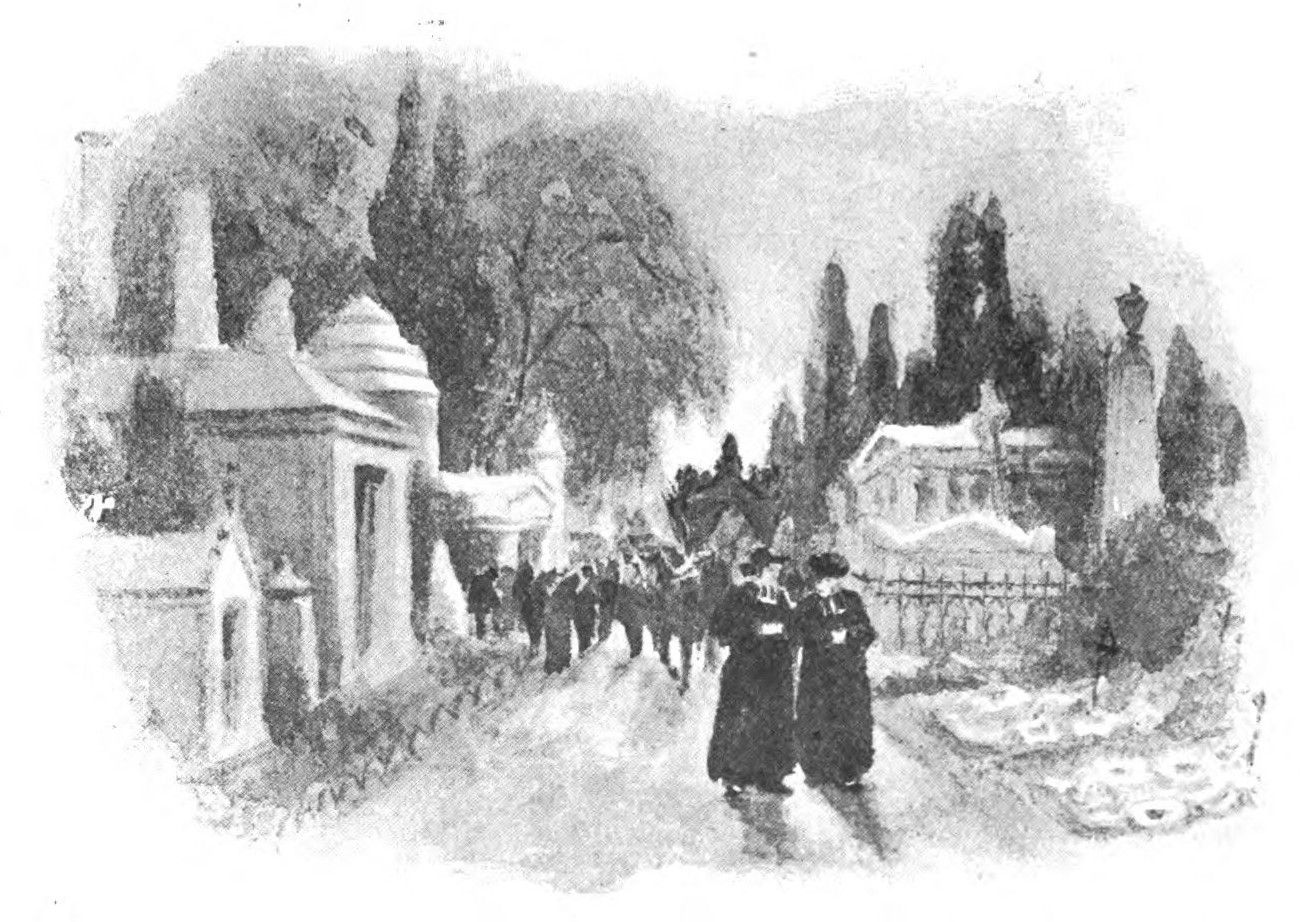
Yesterday I found a comfortable seat on a tomb in
Montmartre cemetery and slept for two hours.
“Sometimes I go and see Madame Erard at Passy,
where I am welcomed with open arms; I relish
having no articles to write and being thoroughly
lazy.
“Paris gets daily more beautiful; it is a pleasure
to watch her blossoming out.
“I hear there is to be a mighty festival at Carlsruhe;
Liszt has gone there from Rome and they are
going to discourse ear-splitting music. It is the
pow-wow of young Germany presided over by Hans
von Bulow.”
Rarely have I suffered from ennui so terribly as I
did during the beginning of September 1864.
My friends were away except Stephen Heller, the
delicate wit and learned musician, who has written
so much lovely music for the piano and whose gentle
melancholy and devotion to the true deities of Art
made him to me such a grateful companion. My
son was home from Mexico, he, too, was not lively
and we often pooled our gloom and dined together.
One day, after dinner at Asnières, we walked
beside the river and discussed Shakespeare and
Beethoven, my son taking part in the Shakespeare
portion, since, unfortunately, he was then unacquainted
with Beethoven. We finally agreed that
it was worth while living in order to worship the
Beautiful, and if we could not annihilate all that is
inimical to it we must be content to despise the
commonplace and recognise it as little as possible.
The sun was setting; we sat on the river-bank
opposite the isle of Neuilly, and, as we watched the
wayward wheeling of the swallows over the water,
I suddenly remembered where I was.
I looked at my son—I thought of his mother.
Once more, in spirit, I lay half asleep in the
snow as I had done in that very spot thirty-six
years before, during those frenzied wanderings
around Paris.
Once again I recalled Hamlet’s cold remark
over the Ophelia he loved no longer, “What! the
fair Ophelia?”
“Long ago,” I said to my companion, “one
winter’s day, I was nearly drowned here trying to
cross the Seine on the ice. I had walked aimlessly
since early morning——” Louis sighed.
The following week he left me, and a great
yearning for Vienne, Grenoble, above all, Meylan,
came over me. I wished to see my nieces and—one
other woman, if I could get her address.
I left Paris. My brother-in-law, Suat, and his
two daughters met me with joy. But my joy was
chastened, for on entering their drawing-room the
portrait of my dear Adèle—now four years dead—faced
me. It was a terrible blow, and my nieces
looked on in sorrowful amazement at my grief.
Daily familiarity with the room, its furniture,
the portrait, had already softened their loss to them;
to me all was fresh.
Dear tender-hearted Adèle! my willing slave,
my indulgent guardian. How well I remember
one day, after I came from Italy, that it rained in
torrents, and I said:
“Adèle, come for a walk.”
“Certainly, dear boy,” she said, promptly; “wait
till I get my galoshes.”
“Really,” said my elder sister, “you must be
quite crazy to want to paddle about the fields in
such weather.”
But, despite mockery and jokes, we took a big
umbrella and arm-in-arm walked about six miles
without speaking a word. We loved each other.
After spending a peaceful fortnight with my
brother-in-law, during which he got me Madame F.’s
address in Lyons, I could no longer resist a pilgrimage
to St Eynard, such as I had made sixteen
years before.
There soared the ancient rock, there stood the
small white house ... to-day, her old home;
to-morrow, perhaps, Estelle herself! Sixteen years
had passed as one night, all was unchanged. The
little shady path, the old tower, the leafy vines, the
glorious view over the valley. Till then I had kept
calm, only murmuring, “Estelle! Estelle! Estelle!”
but now, overcome with emotion, I fell prone on my
face, hearing with each heart-beat the fatal words:
“Past! Past! Gone for ever!”
I arose, and chipping from the tower a morsel
of stone that she perchance may have touched, went
on my way.
There is the rock whereon I laid my posy of
pink peas—but where are the flowers? Gone, or
perhaps only past their flowering stage. Here is
the cherry tree. How grown!
I break off a fragment of bark and, passing my
arms around the trunk, press it passionately to my
breast.
Dear tree, you remember her! You understand!
At the avenue gate I resolved to go up to the
house; perhaps the new owners would not be too
suspicious of me. In the garden I met an old lady
who seemed startled at the sight of a stranger.
“Pardon me, madame,” I stammered, “might I
go through your garden—in memory of—old
friends?”
“Certainly, monsieur, go where you will.”
Further on a girl was on a ladder gathering
pears. I bowed and passed on, pushing my way
through the bushes, now so neglected, and cutting
a branch of syringa to hide next my heart. As I
came to the open door, I paused on the threshold to
look in. The maiden of the pear tree, no doubt
warned by her mother, came forward and courteously
asked me in.
That little room, looking over the wide valley,
that she had so proudly shown me when I was
twelve years old—the same furniture, the same——I
tore my handkerchief with my teeth. The girl
watched me uneasily.
“Do not mind me, mademoiselle. All is so
strange—I have not—been here for forty-nine
years!”
And, bursting into tears, I fled.
What could those ladies have thought of that
strange scene, to which they never got a key?
Reader, do I repeat myself? In sooth it is always
so; remembrance, regret, a weary soul clutching at
the past, fighting despairingly to retain the flying
present. Always this useless struggle against time,
always this wild desire to realise the impossible,
always this frantic thirst for perfect love! How
can I help repeating myself? The sea repeats itself;
are not all its waves akin?
That night I reached Lyons and spent a sleepless
night thinking of my meeting with Madame F.
I decided to go at noon, and to send the following
letter to prepare her for her visitor:
“Madame,—I have just come from Meylan, from
my second pilgrimage to the hallowed haunts of my
childhood’s dreams. It has been even more painful
than that of sixteen years ago, after which I wrote
to you at Vif. This time I ask for more; I dare to
beg you to see me. I can control myself; you need
fear no transports from a heart out-worn and crushed
by the pressure of cruel Fate. Give me but a few
moments! Let me see you, I implore.
“23rd September 1864. Hector Berlioz.”
I could not wait till noon. At half-past eleven I rang; gave her maid my
card and the letter. She was at home. I ought only to have sent up the
letter, but I was past knowing what I was doing. Without hesitation she
came to meet me. I at once recognised her graceful yet stately air—the
step of a goddess. But, ah! how changed her face! Her complexion
darkened, her hair silvered.
Yet my heart went out to my idol as though she had been in all the
freshness of her youthful beauty.
Holding my note, she led the way to her drawing-room. My emotions choked
me, I was dumb; with gentle dignity she began:
“We are old acquaintances, M. Berlioz——” Silence.
“We were but children then——” Still silence.
Feeble as the cry of a drowning man came my halting voice:
“My letter—madame—explains this visit; would you but read it——”
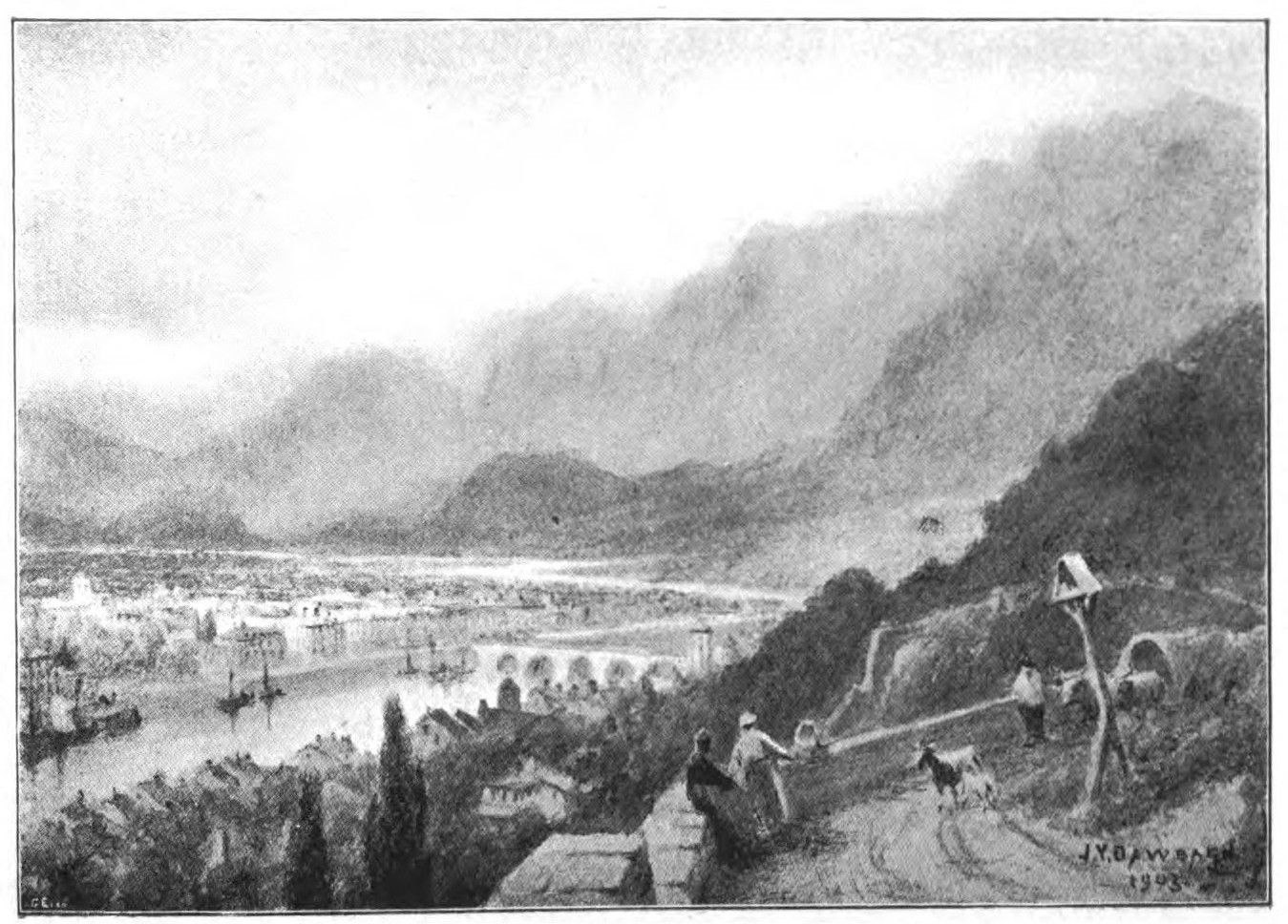 Grenoble
She opened and read it, then laid it on the chimney-piece.
“Then you have been in Meylan; by chance, no doubt?”
“Oh, madame, can you believe it needed chance to take me there? For how
long had I not yearned to see it once more?”
Again silence.
“Your life has been a stirring one, M. Berlioz.”
“How do you know, madame?”
“I have read your biography—by Méry, I think. I bought it some years
ago.”
“Pray, do not think that my friend Méry, an artist and a clever man, is
guilty of such a tissue of fables and nonsense as that! I believe I can
guess the real author. But I shall soon have a true biography ready, one
I have written myself.”
“And you write so well!”
“Nay, madame, I do not mean to praise the style, but simply to say that
at least it will be true. In it, without naming you, I have been able to
tell all my feeling for you without restraint.”
Silence.
“I have also heard of you,” went on Madame F., “from a friend of yours
who married my husband’s niece.”
“Yes, it is he whom I asked to tell me the fate of a letter I wrote you
sixteen years ago. I longed to know whether you received it. I never saw
him again, and now he is dead.”
Silence.
“My life has been very quiet, very sad. I lost some of my children, and
my husband died while the others were very young. I did my best alone to
bring them up well.”
Silence.
“I am indeed grateful, M. Berlioz, for the kind thoughts you have kept
of me.”
At her gentle words my heart beat yet more violently.
With hungry eyes I gazed and gazed, clothing her once more in the beauty
of long past days. At length I said:
“Madame, give me your hand.”
Pressing it to my lips, my heart turned to water within me, the world
sank away, a long and blessed silence brooded over us.
“Dare I hope,” I murmured, “that I may write to you? That, at long
distant intervals, I may even see you?”
“Oh, certainly; but I am leaving Lyons soon to live with my son who,
after his marriage, is to settle in Geneva.”
I rose, not daring to stay longer. She came with me to the door, saying,
“Good-bye, M. Berlioz, good-bye. I am more grateful than I can tell you
for your long and sweet memory of me.”
Once more I bent over her hand, pressing it to my burning forehead, then
tore myself away but only to wander, aimlessly and feverishly, near her
dwelling.
As I watched the swirling Rhone rush under the Pont Morand, M.
Strakosch, brother-in-law of Adelina Patti, came up to me.
“You!” he cried, “Good-luck! Adelina will be so glad to see you. She is
singing to-morrow in the Barbiere; will you have a box?”
“Many thanks, I may be leaving this evening.”
“Well, anyway come to dinner with us to-day. You know how much pleasure
it gives us.”
“I dare not promise—It depends—I am not very well—Where are you
staying?”
“Grand Hotel.”
“So am I. Well, if I am not too unsociable this evening I will come. But
don’t wait.”
I suddenly thought of an excuse to see Madame F. once more. If she would
go to the theatre I would stay also, if she would allow me the honour
of escorting her. If she would not I would leave at once.
I hurried round to her house. She was out but I left a message with her
maid and then went off to pass a day of torturing uncertainty. Hour
after hour went by and no answer came, time after time I returned to
find the house shut up and to get no answer to my ring.
Could it be that she had told her people not to admit me?
What would become of me! Where should I go! What do! There seemed no
refuge for me but the Rhone!
Finally in one last despairing attempt I heard ladies’ voices above me
on the stairs and saw her coming down, a note in her hand.
“Oh, M. Berlioz, I am so sorry I have only just got your message and
here is my answer. Unfortunately I shall be away from home to-morrow; a
thousand pardons for the inconvenience I have caused you.”
She was putting the letter in her pocket when I cried:
“Oh, please let me have it!”
“It is hardly worth while——”
“I beg of you, since it was meant for me.”
She gave it me and for the first time I saw her writing.
“Then I shall see you no more?”
“Not if you leave to-night. May your journey be pleasant.”
Pressing my hand, she and her two friends passed on, leaving me—can it
be believed?—almost happy.
I had seen, had spoken to her again, I had a letter from her in which
she sent me her kindest regards.
With my unhoped-for treasure I went back to the hotel to dine with
Mademoiselle Patti.
As I entered her salon the charming diva clapped her hands joyously
and danced up to me, holding up her lovely forehead for my accustomed
kiss.
During dinner she spoilt me with her dainty coaxing attentions.
“There is something wrong with you,” she said, “what are you thinking
of? I can’t have you miserable.”
They came with me to the station, she, with a friend and Strakosch, and
they were allowed to go on to the platform. Adelina, dear child, clung
to me until the signal was given, then the winsome creature flung both
arms round my neck and kissed me, crying gaily:
“Good-bye, good-bye just for a week. We shall be in Paris on Tuesday and
you must come and see us on Thursday.”
Why could I not claim such affection from Madame F. and mere politeness
from Mademoiselle Patti?
Adelina was like a brilliant, diamond-eyed humming-bird fluttering round
me; I was enchanted but not touched. Though I liked her greatly, I did
not love her.
My soul was given to that old, sad, unsought after woman, hers it has
always been and will be to my dying day.
Balzac and even Shakespeare—master painters of passions—knew nothing
of love like this. Tom Moore alone has imagined and voiced it in—
“Believe me if all those endearing young charms.”
How often, through that long night journey, did I repeat:
“Idiot! why did you leave? You might have seen her again to-morrow.”
True, but the fear of being troublesome restrained me and what could I
have done in Lyons during the hours we were apart? it would have been
but torture.
After a few miserable days of indecision in Paris I wrote the following
letter, which shows my deplorable state and her beautiful calm.
How much worse off am I now that I cannot even write to her! To enjoy
that romantic friendship to the end would have been too great a
blessing. Wounded, torn, alone, unsatisfied must I totter to my grave!
“Paris, 27th September 1864.—Madame! A thousand blessings on you
for your gentle reception of me! Few women could have done as much;
yet since our meeting, I suffer most cruelly. It is useless to
repeat to myself that you could not have done more than you have;
my wounded heart bleeds on unstaunched. I ask, why? why? and my
only answer is: because I saw you so little; because I said but a
tithe of all I wished; because we parted as if for ever.
“Yet I held your hand, I pressed it to my lips—to my forehead and
kept back my tears as I had promised.
“And now the inexorable thirst for another word from you has
conquered me; in pity grant it!
“Think! for forty-five years I have loved you; you are my
childhood’s dream that has weathered all the storms of my most
stormy life. It must be true—this love of a life-time—could it,
else, master me as it still does?
“Do not take me for an eccentric, a plaything of my own
imagination; I am but a man of intense sensibility, of eternal
constancy and of overwhelmingly strong affections. I loved you, I
love you still, I shall always love you, although I am sixty-one
and for me the world has no more illusions.
“Grant me, I pray you, not as a nurse, from a sense of duty to her
sick patient, but as a noble woman stooping to heal wounds she has
unwittingly given—grant me those three things that, alone, can
give me peace: permission to write sometimes, your undertaking to
reply and a promise that once a year, at least, you will allow me
to visit you.
“If I called without your permission I might arrive at the wrong
time, therefore I shall not venture near you unless you say:
‘Come.’
“Surely there is nothing strange or wrong in this? Could there be a
purer or more beautiful bond? Who shall say us nay? Still, I must
own that it would be painful to meet you only amongst others,
therefore if you bid me come it will be that we may talk as we did
last Friday when, so deeply was I moved, that I could not savour
the sweet sad charm by reason of my terror lest emotion should get
beyond control. Oh, madame! madame! I have but one end in life—to
gain your affection!
“Give me but leave to try! I will be so humble, so restrained; my
letters shall be as infrequent as you wish lest they become a
burden to you; five lines only from you will suffice me. My visits
will be but rare; yet, if our thoughts may meet, I shall feel
that—after these long and dreary years during which I have been
nothing to you—I may in time become your friend. Friends with such
devotion as mine are not too often found. I will encircle you with
love so sweet, so tender, with affection so compounded of all that
is simplest in a child and all that is best and grandest in a man
that, surely, in time you will feel its charm and turn to me one
day, saying:
“I am in very deed your friend.”
“Adieu, madame, once more I read your note of the 23rd with its
assurance of your sentiments affectueux. Surely this is no mere
formality? Tell me truly—truly!—Yours to eternity,
Hector Berlioz.”
“P.S.—I send you three books; perhaps you will glance at them
in your leisure moments. Do you see the author’s device to make you
take a little interest in him?”
Madame F.’s Answer.
“Lyons, 29th September 1864.
“Monsieur,—I should wrong both you and myself did I not reply at
once to your dream of our future friendship; believe me, I speak
from my heart.
“I am an old woman (remember I am six years your senior), worn and
withered by bodily pain and mental anguish, with all my earthly
illusions swept away.
“Since the fatal day, twenty years ago, that I lost my best friend,
I have said good-bye to worldly pleasures, and have found my sole
consolation in a few old friends and in my children.
“In this absolute calm, alone, can I find rest, and to upset it
would be burdensome indeed.
“In your letter of the 27th you say you have but one wish—that I
may become your friend. Do you believe, monsieur, that this could
possibly be? I hardly know you, I have seen you but once in
forty-nine years; how can I understand your tastes, your character,
your capacities—all those hundred and one points upon which,
alone, friendship can be based?
“With two people of like affinities, sympathy may be born and grow
into friendship, but, far apart as we are, no correspondence could
bring about what you desire.
“Besides, I must confess that I am most lazy about letters; my mind
is as torpid as my fingers. I could not, therefore, promise to
write regularly, for the promise would certainly not be kept.
Still, if you feel a certain pleasure in writing, I will read your
letters, although you must not expect speedy replies.
“Neither can I promise to receive you alone. At Geneva, in the
house of my son and his wife, it would be impossible for me to
arrange matters as you wish.
“I tell you all this with perfect frankness, for I feel so strongly
that, as grey hairs come, dreams must be thrust aside—such
friendships belong to the happy days of youth, not to the
disenchantments of old age.
“My future is so short; why indulge in a dream that must fade so
quickly? Why create these vain regrets?
“In what I say, monsieur, do not think that I wish to wound you, to
belittle your remembrance of the past. I respect it, and am greatly
touched.
“You are still young at heart, and I am old and good for nothing
but to keep a warm place for you in my memory. In your triumphs I
shall always take a cordial interest.
“Again, monsieur, I send you my affectionate regards.
Estelle F——.”
“I have received the books you so kindly sent. A thousand thanks.”
Second Letter.
“Paris, 2nd October 1864.
“Madame,—I have not answered sooner, hoping that I might overcome
the terrible depression caused by your letter—a masterpiece of sad
truth.
“You are right to avoid all that might disturb your calm; but be
assured that I should never have done so, and that this friendship,
for which I so humbly begged, should never have become
burdensome. (Is not this rather a cruel word?)
“But you will take an interest in my career, and for that I kiss
your hand with deepest gratitude. Yet, with tears, with
importunity, I pray for news of you sometimes.
“You talk so bravely of old age that I must e’en be brave too. I
pray I may die first that I may send you my last farewell! But if I
must hear that you have left this sad earth ... will your son tell
it me?—pardon!
“Give me, at least, what you would give to the merest
stranger—your address at Geneva.
“I will not go there for a year, I fear to trouble you; but your
address! your address! If your silence shows that you refuse even
this meagre concession, you will have put a crown on the
unhappiness you might have softened.
“Then, madame, may God and your conscience forgive you!
“Lost in the cold dark night wherein you have thrust me, I shall
wander—grieving, suffering, alone, but still,—Yours devotedly
until death,
Hector Berlioz.”
Madame F.’s Second Letter.
“Lyons, 14th October 1864.
“Monsieur,—I write in haste, that you may believe I have no wish
to be unkind. My son is to be married on the 19th, and I shall have
much to do.
“Immediately afterwards I must prepare to go to Geneva—no light
task for my weak health. Early in November I leave, and, as soon as
I am settled in my new home, you shall have my address, which I do
not yet know.
“I would have waited to get it from my son, but I feared to pain
you by my long silence.”
Third Letter.
“15th October 1864.
“Madame,—Oh, thank you! thank you! I will wait.
“My best wishes for the young couple and for you!
“Dear lady, may this solemn time bring you ineffable joy.
“Ah, how good you are!
“Do not fear that my adoration will become unreasonable.—Your
devoted
Hector Berlioz.”
After an impatient fortnight, I received the announcement of M. Charles
F.’s marriage, addressed in his mother’s writing; which filled me with a
joy that few can understand. I was in the seventh heaven, and wrote at
once:—
“28th October 1864.—Life is beautiful under certain aspects. I
have received the notice addressed by you! A thought for the poor
exile. May your good angel render fourfold the good you have done!
Yes, life is beautiful, but how much more beautiful death. To be at
your feet, my head upon your knee, your two hands clasped in mine,
and so to end——
Hector Berlioz.”
Days passed into weeks; Madame F. had gone to Geneva. Could she intend
to withhold her address? To break her word?
During that anxious time I believed I should write to her no more, and
my heart despaired.
But one morning, as I sat drearily musing beside the fire, a card was
brought to me:—
“M. et Mme Charles F——.”
The son and his wife, and she had sent them!
Yet how greatly it upset me to find the young man the living image of
his mother at eighteen.
The bride seemed quite bewildered at my emotion, although her husband
was not; evidently he knew all; Madame F. had shown my letters.
“How beautiful she must have been!” cried the young wife.
“Oh!—--”
“Yes,” said M. F., “I remember even now how dazzled I was, at five years
old, on seeing my mother dressed for a ball.”
Gradually I subdued my feelings, and was able to talk sensibly to my
visitors. Madame C. F. was a Dutch creole of Java, and knew Rajah Brooke
of Sarawak.
How much I should have had to ask her had I been in my usual state of
mind.
I saw them pleasantly often during their stay in Paris, and we talked of
her. As we grew more friendly, the bride scolded me for writing as I
had done.
“You frighten her,” she said. “Remember she hardly knows you. You must
learn to be calm, then your visits to Geneva will be delightful, and we
shall be so happy to see you. You will come, will you not?”
“Can you doubt it, if Madame F. gives me permission?”
Schooling myself rigidly, I gave them no letter for their mother when
they left; but, as my Trojans was to be given, I sent her a copy of
the poem, begging her to read the page I had marked with some dead
leaves at half-past two on the 18th December, the time at which that
passage would be played in Paris. Madame C. F. was to be back in Paris
then, and hoped to be present at this concert, which was making some
stir in the musical world.
A fortnight went by and she did not come, neither did I have a letter.
I was almost at the end of my patience, although I would not write,
when, on the 17th, Madame C. F. returned bringing me the following
letter:
“Geneva, 16th December 1864.
“Monsieur,—I ought to have thanked you sooner for your charming
welcome of my son and his wife had I not been unwell, and
consequently, very idle.
“But I cannot let my daughter-in-law go without my grateful thanks
for all the pleasure you have given them.
“Suzanne will tell you all about our life here; I should be as
happy as in Lyons, were it not for my separation from my other two
sons and from my dear old friends.
“Once more, thank you for the libretto of The Trojans, and also
for the sweet souvenir of the Meylan leaves—they bring back the
bright, happy days of my youth.
“My son and I will read the part of your work that you have marked,
and shall think of Suzanne listening to your music on Sunday.”
To which I replied:
“Paris, 19th December 1864.—Last September, when at Grenoble, I
visited one of my cousins, who lives near St Georges, a wretched
hamlet niched into the most barren mountains on the left bank of
the Drac, inhabited only by a few miserable peasants.
“My cousin’s sister-in-law is the sweet providence of this forsaken
corner, and on the day of my arrival she heard that one far-away
family had had no bread for three weeks.
“She started off at once to see the mother.
“‘Why, Jeanne!’ she cried, ‘how could you be in trouble and not
tell me? You know how anxious we are to help.’
“‘Oh, mademoiselle, we are not really in want yet; we still have
some potatoes and a few cabbages, only the children don’t like
them. They shout and cry for bread. You know children are so
unreasonable.’
“Well, dear lady, you too have done a kind thing in writing. I
would not write for fear of boring you, so waited for your
daughter’s return. She came not! My anxiety choked me. You see,
madame, creatures such as I are unreasonable.
“Yet surely I—if anyone—hardly need to learn lessons that have
been taught me already by so many knife-thrusts in my heart.
“It seems to me that you are sad, and that makes me the more....
From to-day I mean to restrain my language, to talk of outward
things only.
“You know what is in my heart—all that I do not say.
“Perhaps you already know that, thanks to the thousand and one
annoyances brought upon me by the Conservatoire committee, my
Trojans was not performed yesterday. Still, I thank you for the
time you have spent in thought with us in the concert-room. My son,
who has done well in Mexico, has just landed at St Nazaire. He is
first lieutenant of his ship, and, as he cannot come to Paris, I am
going to Brittany to see him. He is a good boy, but is,
unfortunately, too much like his father, and cannot reconcile
himself to the commonplaces and troubles of this world.
“We love each other dearly.
“My aged mother-in-law, whom I have promised never to leave, takes
the greatest care of me, and accepts unquestioningly my gloomy
tempers. I read again and again Shakespeare, Virgil, Homer, Paul
and Virginia, and travels of all kinds. I am horribly bored and
suffer agonies from neuralgia that doctors have tried in vain, for
nine years, to cure.
“When the pains of mind, body and estate grow too much for me, I
take three drops of laudanum to snatch some sleep.
“If I feel better I go and see my friends, M. and Mme Damcke.
“He is a German composer of rare gifts; his wife is an angel of
goodness to me.
“There I do as I like. If I am in the humour we talk or play; if
not, they draw up a big sofa to the fire, and there I lie the whole
evening without a word—chewing the cud of sweet and bitter
fancies. This, madame, is all.
“You know that I neither write nor compose, for the present state
of art in Paris makes me both sick and sorry—which proves that I
am not dead yet!
“I hope to have the honour of escorting Madame C. F. and a Russian
friend of hers to the Théâtre Italien to hear Donizetti’s
Poliuto.
“Madame Charton will give me a box.
“Good-bye, madame. May your thoughts be blest, your heart at rest,
and your life serene in the assured love of your children and
friends. But send a thought sometimes to the poor child who is
unreasonable.—Your devoted
H. B.”
“P.S.—It was good of you to send the bride and bridegroom to see
me. I was so struck with the likeness of M. Charles to Mademoiselle
Estelle that, although such compliments are out of place to a man,
I so far forgot myself as to tell him so.”
Some time later she wrote:
“Believe me, I am not without sympathy for unreasonable children.
I have always found the best way to quiet them is to give them
pictures to look at.
“I therefore take the liberty of sending you one that I hope, by
bringing home the reality of the present, will wipe out the
illusion of the past.”
She sent me her portrait! My dear lady!
And here I stop.
Now I can live calmly. I shall write, she will reply. I shall see her,
shall know where she is, and shall never again be without news of her.
Perhaps, in spite of her dread of new ties, her affection for me may
grow slowly and quietly. Already life seems more possible, since the
past is not irretrievably over and done with.
No longer is my heaven overcast. My sweet bright star smiles upon me
from afar. She does not love me, truly, but why should she? She knows,
however, that I love her.
I must find consolation in the thought that she knew me too late, just
as I comfort myself for not having known Virgil, Gluck, Beethoven or
Shakespeare—who might, perhaps, have loved me too.
(All the same, I am not comforted in the very least!)
Which power raises man the higher? Love or Music? It is a great
question. It seems to me that one might say this: “Love cannot give an
idea of music, but music can give an idea of love—why separate them?”
They are the twin wings of the soul.
Seeing the conception some people have of Love, and what they look for
in Art, makes me liken them to swine rooting in a bed of lovely flowers
and among mighty oaks, hoping to turn up with their snouts the truffles
for which they are greedy.
I will think no more of Art.... Stella! Stella! I can die now without
bitterness or anger.
1st January 1865.
[This is the end of Berlioz’ own Memoir. The rest of his life must be
gathered from the few remaining letters to his intimate friends and from
M. Bernard’s short account of his last days.]