Beethoven's Letters to Mlle. von Breuning, Wegeler, and Ries.
To Mlle. von Breuning.
Vienna, November 2nd, 1793.
Charming Eleonora—my dearest friend,
A year has elapsed since my stay in this capital, and this is the first
letter you receive from me; yet rest assured you have ever lived in my
recollection. I have often conversed with you and yours, although not
with that peace of mind which I could have desired, for the late
wretched altercation was hovering before me, showing me my own
despicable conduct. But so it was; and what would I not give, could I
obliterate from the page of my life this past action, so degrading to my
character, and so unlike my usual proceedings.[150] It is true, there
were many circumstances widening the breach between us, and I presume
that in those whisperings, conveying to us our mutual expressions, lay
the chief source of the growing evil. We both imagined that we spoke
from conviction, and yet it was but in anger, and we were both of us
deceived. Your good and noble mind has, I know, long forgiven me, but
they say that self-accusation is the surest sign of contrition, and it
is thus I wanted to stand before you. Now let us draw a veil over the
whole affair, taking a warning by it, that, should a difference arise
between friends, they should not have recourse to a mediator, but
explain face to face. You receive herewith a dedication from me to you,
and I only wish the work were greater and more worthy of you. They
wanted me here to publish this little work, and I avail myself of the
opportunity, to give you, my charming Eleonora, a token of my friendship
and esteem, as well as a proof that you and all yours are ever present
to my memory. Accept this trifle as coming from a warm admirer. Oh! if
it could but give you pleasure, my wishes would be fulfilled.[151] Let
it be a revival of the many blessed hours which I spent at your house;
perhaps it may tend to recall me to your mind until I return, which
however will not be so soon. How we will rejoice then, my dear friend;
you will find me a more cheerful creature, whose days of trouble have
passed away, their furrows smoothed by the lot of better days! Should
you see B. Koch,[152] I beg you will tell her it is not fair that she
has not once written to me, whilst I sent her two epistles, to
Malchus[153] three, and no answer. Tell her that if she chooses not
to write she should at least make Malchus do so. I venture to conclude
with a request that I might be so happy as once more to be put in
possession of an Angola waistcoat, knitted by your hand.[154] Do excuse
the troublesome request of your friend: it originates in a great
predilection for all that comes from your hands, and, let me acknowledge
the secret, in the gratification of my vanity, at being able to say that
I possess something from one of the best and most charming young ladies
of Bonn. I have still got the one which you were so kind as to give me
at Bonn, but the present fashion has made it look so antiquated, that I
can only keep it in my wardrobe as your gift, and as such it will ever
be dear to me. You would give me sincere pleasure were you to favour me
soon with a letter. Should you like to have any of mine, I promise you I
shall await the opportunity to show you in this, as in all other
instances, how truly I am
Your friend and admirer,
L. v. Beethoven.
P.S. The Variations will be somewhat difficult to play, particularly the
shake in the Coda.[155] But let not that alarm you; it is so managed
that you need only do the shake, leaving out the other notes which occur
in the violin part also. I should never have written such a thing, but
that I had noticed an individual about Vienna who, after having heard me
extemporize the preceding evening, put down many of my peculiarities the
next day, showing them off as his own.[156] Taking it for granted that
such things would shortly appear, I thought it wiser to be the first to
publish them. Another reason was to put the piano-forte masters of this
place to confusion, for many of them are my deadly enemies, and I thus
take my revenge upon them, knowing how they will be asked every now and
then to play these Variations, and to how little advantage my gentlemen
will appear in them.
BEETHOVEN.
Second Letter to Mlle. v. Breuning.
I was most agreeably surprised by the beautiful cravat, the work of your
hands. It created sensations of sorrow, much as I was pleased by the
thing itself. This sorrow was called up by a recollection of former
times, and by the shame I felt at your generous conduct. Truly, I did
not think you had deemed me worthy of your remembrance. Oh! could you
have witnessed my feelings at yesterday's occurrence, you would not deem
me guilty of extravagance when I assure you that your remembrance
saddened me and called forth many tears. Do pray believe me, little as I
may have deserved it, believe me, my friend (let me ever call you
such), I have suffered much, and still suffer, from the loss of your
friendship. Never shall I forget you and your dear mother. You were so
kind to me that your loss cannot and will not so soon be made up to me.
I know what I had, what I lost, and what you were to me; but I must
return to scenes equally painful for you to hear, as for me to relate,
were I to fill up this blank.
As a slight return for your kind recollection of me, I take the liberty
of sending the Variations and the Rondo with violin accompaniments. I am
very busy just now, or I would have copied the long-promised Sonata for
you. It is but a sketch in my manuscript, and even Paraquin, clever as
he is, would have had much difficulty in transcribing it. You may have
the Rondo copied, and return the score; that which I now send is the
only thing amongst my works which could be of use to you, and as you are
about going to Kerpen, I thought these trifles might afford you some
pleasure.
Farewell, my friend, I cannot possibly give you any other name;
indifferent as I may be to you, I hope you will believe in the assurance
of my regard for yourself and your mother. Pray let me know if I have it
in my power in any way to contribute to your pleasure; it is the only
remaining means of showing you my gratitude for past kindness. A happy
journey to you, and may your dearest mother return home perfectly
recovered! Do not forget
Your still admiring friend,
BEETHOVEN.
Beethoven to Wegeler.
Vienna, June 29, 1800.[157]
My dear and beloved Wegeler,
A thousand thanks to you for your recollection of me; I have not
deserved it; I have not even tried to deserve it; and yet my most
unpardonable carelessness cannot check your friendship, which remains
pure and unshaken. Do not for a moment think that I could forget you or
any of those once so dear to me; there are times when I long for you,
when I sincerely wish to stay with you for a while. My country and the
charming place which gave me birth are ever before my eyes; their beauty
undimmed as when I left them—in short, I shall consider that time the
happiest, which leads me back to you all, once more greeting the Rhine
in its patriarchal beauty. I cannot tell you when this may be, but
thus much I must say to you all, that you shall not see me until I am
much greater—not greater only in my art, but better and more perfect
as a man; and then, if our country should be more flourishing, I will
employ my art for the benefit of the poor only.[158] O blessed moment!
how happy do I deem myself that I can call thee forth, that I can myself
create thee! * * * You wish me to say something of my circumstances;
why, they are by no means bad. Lichnowsky, who, improbable as it may
seem to you, from the little altercations we have had, but which tended
only in confirming our friendship[159]—Lichnowsky, who has always been
my warmest patron, has settled upon me the sum of six hundred florins,
which I may draw until I find a convenient appointment; my compositions
are well paid, and I may say I have more orders than I can well execute;
six or seven publishers, and more, being ready to take any of my works:
I need no longer submit to being bargained with—I ask my terms, and am
paid. You see this is an excellent thing; as, for instance, I see a
friend in want, and my purse does not at the moment permit me to assist
him; I have but to sit down and write, and my friend is no longer in
need. I am grown much more economical too; should I remain here, I think
I may rely upon having a day for a concert once a-year. I have already
had several. But an evil spirit in the shape of my bad health plays me
false; my hearing has become weaker and weaker for the last three years,
and my constitution has been much weakened by a stomach complaint,
fearfully increased during my stay here, which is said to be the cause
of this evil. Frank wanted to restore my health by tonics, and my
hearing by oil of almonds; but, alack a-day, this was not to be! My
hearing remained impaired, my digestion in its former condition; this
continued till last autumn, when I was many a time in despair. A medical
practitioner of the genus ass advised the cold bath for me; a more
rational one ordered me that of the Danube, which is tepid: this did
wonders; my general health improved, my hearing continued bad, or became
worse. Last winter I was in a wretched state—every ailment returning
with renewed force, until about a month ago I went to Vering, judging
that my case might require surgical, as well as medical assistance, and
having much confidence in his skill. He succeeded in alleviating my
sufferings by the use of the tepid bath, into which was poured a
strengthening mixture; he gave me no medicine, only four days ago I had
some pills, besides a tea for my ears, and I may say I feel stronger
and better—but my ears! they are ringing and singing night and day. I
do think I spend a wretched life; for the last two years shunning all
society, because I cannot bring myself to walk up to people and say, "I
am deaf." In any other profession this might pass; but in the one I
have chosen, it is a wretched plight to be in; besides, my enemies, who
are not few in number, what would they say? To give you a notion of this
extraordinary deafness, I must tell you that I am forced in a theatre to
lean up close to the orchestra in order that I may understand the actor.
I do not hear the high notes of instruments or singers at a certain
distance, and it is astonishing that there are individuals who never
noticed it while conversing with me; from my having been subject to
frequent reveries, they attribute my silence to these. I sometimes hear
those who speak in a low voice—that is to say, the sounds, but not the
words, and yet if any one begins to bawl out, it annoys me excessively.
Heaven knows what it may end in! Vering says I shall certainly be much
better, although I may not entirely recover. I have often cursed my
existence; Plutarch has won me back to resignation. I will, if possible,
defy my fate, although there will be moments when I shall be the most
miserable of God's creatures. I beg of you not to mention my affliction
to any one—no, not even to Laura. I confide this secret to you only,
and should be glad if you would, some day, enter into correspondence
upon it with Vering. Should it continue, I shall come to you next
spring. You will take a cottage for me in some beautiful spot in the
country, and there I shall ruralize for six months; perhaps that may
work a change. Resignation! what a miserable resource, and yet it is the
only one left me. Do excuse my troubling you with my griefs, when you
are already in sorrow yourself.
Stephen Breuning is here, and I see him daily, enjoying those
recollections which his presence calls back to my mind. He is indeed
grown an excellent fellow, as kind and true-hearted as I trust we all
are. I have beautiful rooms just now, leading on to the Bastei
(ramparts), and of infinite value to me, on account of my health. I
believe I shall be able to prevail upon Breuning to come to me. You
shall have your Antiochus, and plenty of my music, if you do not think
they will put you to too much expense. Honestly speaking, I am truly
pleased with your love of the art. Let me but know how, and I will
send you all my works, which are now become pretty numerous, and daily
increasing. I send you in exchange for my grand-father's picture, which
I beg you will forward to me by coach, that of his grandson, your ever
faithful Beethoven; it has appeared at Artaria's, who, together with
many other publishers, solicited me to let them have it. I intend
shortly to write to Stephen, for the purpose of lecturing him upon his
obstinate mood. I will make his ears ring with our old friendship, and
entreat him not to add vexation to your sufficiently saddened
circumstances. I shall also write to the amiable Laura. I have never
forgotten one of you, dear, kind friends, even when I was most silent;
for, as to writing, why, that you know never was my forte—the dearest
friends have not had letters from me for years. I live entirely in my
music, and no sooner is one thing finished than I begin another—indeed,
I now sometimes write three or four things at the same time. Pray let me
hear from you oftener, and I will take care to find time for replying to
your letters. Kind regards to all, including my dear Mme. v. Breuning;
tell her I am still subject to the "raptus." As to K., I am not
surprised at the change in her. Fortune's wheel is round, and does not
always halt before the best and noblest.
A word about Ries, to whom give my kind regards, and say that I shall
further write to you respecting his son, although I believe Paris would
be a better place than Vienna to make his fortune in. Vienna is so
overstocked, that even those who have great merit stand a bad chance of
succeeding. By the autumn or winter I shall be able to judge what I can
do for him, as everybody then hastens back to town. Farewell, my
faithful Wegeler. Be ever assured of the love and friendship of
Yours,
BEETHOVEN.
Beethoven to Wegeler.
Vienna, Nov. 16, 1801.
My dearest Wegeler,
I am truly obliged for the new marks of your interest in my welfare, the
more so as I feel myself unworthy of them. You wish to know how I am,
what I am taking; and, much as I dislike conversing upon the subject at
all, I would rather do so with you, than with any one else. Vering, for
the last few months, has applied blisters to both my arms, consisting of
a certain bark, known to you, as I suppose.[160] This is a most
disagreeable remedy, as it deprives me of the free use of my arms for
two or three days at a time, until the bark has drawn sufficiently,
which occasions a good deal of pain. It is true, the ringing in my ears
is somewhat less than it was, especially in my left ear, in which the
disease began, but my hearing is by no means improved; indeed I am not
sure but that the evil is increased. My health is improved, and the
tepid bath always sets me up for eight or ten days. I take but little
medicine, and have begun to use the herb-poultice as you prescribed.
Vering opposes the shower-bath. I am upon the whole much dissatisfied
with him; he cares too little about his patients; were I not to call
upon him sometimes, which indeed is but seldom, I should never see him.
What do you think of Schmidt?[161] I am not fond of changing, but I
think Vering is too much of the practitioner to allow of his gathering
fresh thoughts from books. Schmidt seems to differ widely from him in
this respect, and might not be so careless. They tell me wonders of
galvanism; what is your opinion of it? A medical man told me he had seen
a deaf and dumb child recover its hearing (at Berlin), as well as a man
who had been deaf for seven years. I hear that your friend Schmidt[162]
makes experiments of this nature.
I have begun to mix in society again, and thus to enjoy my existence
rather more than I did; you cannot conceive how deserted and miserable a
life I have led these two years, my deafness pursuing me like a spectre
and scaring me from mankind: I must have appeared a perfect misanthrope,
whilst I am so far from it. A dear and charming girl has wrought this
beneficial change in me; she loves me as I do her, and this has brought
back some happy moments, the first I have enjoyed these two years; it is
the first time I feel that marriage could render me happy.[163] She is
not, unfortunately, of my station in life, and at present I certainly
could not marry, for I must be tossed about the world first. Were it
not for my hearing, I should have travelled over half the globe—that is
what I long for. My greatest enjoyment is to pursue my art and produce
in it. Do not think I should be happy with you all about me. In how far
could that ameliorate my condition? Your very anxiety for me would be
painfully visible in your looks, and would add to my misery. And that
beautiful country of mine, what was my lot in it?—the hope of a happy
futurity. This might now be realised if I were freed from my affliction.
Oh, freed from that, I should compass the world! I feel it, my youth is
but beginning—have I not hitherto been a sickly creature? My physical
powers have for some time been materially increasing, those of my mind
likewise; I feel myself nearer and nearer the mark—I feel, but cannot
describe it. This alone is the vital principle of your Beethoven. No
rest for me, I know of none but sleep, and I grieve at having to
sacrifice to it more time than I have hitherto deemed necessary. Take
but one half of my disease from me, and I will return to you a matured
and accomplished man, renewing the ties of our friendship, for you shall
see me as happy as I may be in this sublunary world—not as a
sufferer, no, that would be more than I could bear. I will blunt the
sword of fate, it shall not utterly destroy me. How beautiful it is to
live a thousand lives in one—no, I am not made for a retired life, I
feel it. You will write as soon as possible, will you? Take care Stephen
make up his mind to take an appointment somewhere in the Teutonic Order.
His health will not endure the fatiguing life which he leads here; he
is, moreover, so deserted that I do not see how he is to stand it. You
know how we get on here; indeed I will not assert that society would
diminish his exhaustion of nerve, and he is not to be prevailed upon to
go anywhere. I had some music at my rooms some time since; friend
Stephen did not appear. Do recommend him more coolness and
self-possession; I have not succeeded in enforcing it; without them he
cannot recover his health and happiness. Let me know in your next letter
whether you don't mind my sending you a great quantity of my music; you
can sell that which you do not want, and thus pay your postage having my
likeness into the bargain. My kindest remembrances to Laura, to mamma,
also to Christopher. You love me a little, eh? Be assured that I do love
you, and remain ever your faithful friend,
BEETHOVEN.
Beethoven to Ries.
Baden, July 24, 1804.
* * * * You will have been surprised at the affair with Breuning;[164]
believe me, my friend, that I had been wrought into this burst of
passion by many an unpleasant circumstance of an earlier date. I have
the gift of concealing and restraining my irritability on many subjects;
but if I happen to be touched at a time when I am more than usually
susceptible of anger, I burst forth more violently than any one else.
Breuning has doubtless most excellent qualities, but he thinks himself
utterly without faults, and yet is most open to those, for which he
blames others. He has a littleness of mind, which I have held in
contempt since my infancy. My powers of judgment had almost prophesied
to me the course which matters would take with Breuning, for we differ
too materially in our manner of thinking, acting, and feeling. I fancied
late difficulties might have been overcome—experience has taught me
otherwise, and now, no more friendship for me. I have met with two
friends only in this world with whom I never had any altercation; but
what men were they!—the one is dead, the other still alive. Although we
have not heard from each other these six years, yet I know that I hold
the first place in his heart, as he does in mine. The basis of
friendship should be the greatest similarity in the minds and feelings
of men. I only wish you would read my letter to Breuning and his to me.
No, he will never regain the place in my heart which he once held in it.
Whoever can attribute so mean a proceeding to his friend, and can
himself act so basely towards him, is not worthy of my friendship. Do
not forget the matter of my lodgings. Farewell. Do not tailor[165] too
much; make my respects to the fairest of the fair, and send me a dozen
needles. I should never have thought I could be as idle as I am here.
Should a fit of industry succeed I may accomplish something grand. Vale.
BEETHOVEN.
Beethoven to Wegeler.
Vienna, May 2nd, 1810.
My good old Friend,
I can almost fancy these lines creating a surprise in your mind; and
yet, although left without epistolary witnesses, you live most vividly
in my recollection; indeed, there is amongst my MSS. one long destined
for you, and which you will certainly receive during this summer.[166]
My retired life has ceased these last few years, and I have been
forcibly drawn into the world. I have not yet decided for or against
this change, but who has not felt the storm which is raging around us?
I, however, should be happy, perhaps the happiest of men, had not that
demon taken possession of my ears. I have read somewhere that man should
not wilfully part from this life whilst he could do but one good deed;
and, but for this, I should ere now have ceased to exist, and by my own
hand too. Oh, life is so charming; but to me it is poisoned!
You will not refuse my request to procure me a copy of my baptismal
register. The expenses, whatever they be, could be remitted to you by
Stephen Breuning, with whom I know you have a running account, and I
will settle with him. Should you think it worth your while to
investigate the matter, and should you like to go from Coblentz to Bonn
for that purpose, I beg you will put your costs down to me. There is
one thing to be considered in the matter—that I had a brother born
before me, likewise named Ludwig, with the second name of Maria, but who
died young. The birth of this brother should be ascertained previous to
my age being fixed.[167] I know I have been put down as older than I am,
by a mistake arising from this circumstance. Alas! I have lived some
time without knowing my own age. I had a family-book; but that has been
lost, the Lord knows how! Do not be angry, therefore, if I recommend
this to you most warmly, and try to find out the birth of the Ludwig
Maria, as well as that of the Ludwig who came after him. The sooner you
send me the register, the greater my obligation. They tell me you sing a
song of mine at your Freemasons' lodge; probably one in E major, which I
have not got myself; pray send it to me, and I promise to make you ample
amends for it.[168] Think of me with kindly feelings, little as I
apparently deserve it. Embrace your dear wife, kiss your children, and
all that are dear to you, in the name of your friend,
BEETHOVEN.
Beethoven to Wegeler.
Vienna, Sept. 29, 1816.
I take the opportunity which offers through J. Simrock,[169] to recall
myself to your memory. I hope you have received my engraving,[170] and
the Bohemian glass. As soon as I shall again wander through Bohemia, you
shall have something similar. Farewell, you are husband and father—so
am I, but without a wife.[171] Love to all yours—to all mine.
Your friend,
BEETHOVEN.
Beethoven to Wegeler.
Vienna, Oct. 7, 1826.
My old and dearest Friend,
I cannot give you an adequate idea of the delight I felt in your and
Laura's letter. It is true, my answers should have followed with the
swiftness of an arrow; but I am careless in replying to my friends,
because I believe those whom I really love know me without my writing to
them. I often get an answer ready in my thoughts, but when I want to put
it on paper I mostly throw away my pen, because I cannot write as I
feel. I do remember every kindness you have shown me: for instance, when
you had my room whitewashed, and thus made me a most agreeable
surprise.[172] I feel the same gratitude towards the Breunings: our
separation was the necessary result of the instability of men's
lives—each pursuing his own ends and trying to fulfil destiny—the
principle of all that is unalterably good still firmly uniting us. I
regret I cannot to-day write you at full length as I should wish, being
in bed. I will answer but a few points of your letter. You say that I am
mentioned somewhere as a natural son of the deceased King of Prussia. I
had heard this long ago, but from principle I have never written on
myself, or answered anything that others have said of me; thus I leave
you most willingly to vindicate my parents' honour, and especially that
of my mother, in the eyes of the world. You speak of your son. I hope it
is understood that when he comes here, he will find a father and a
friend in me, and that I shall serve him with the greatest pleasure
wherever I can. I have yet your Laura's silhouette, a proof positive
how I still value all that was dear and near to me in my youth. On the
subject of my diplomas, I will mention to you, but shortly, that I am an
honorary member of the Royal Society of Arts in Sweden, the same in
Amsterdam, and an honorary citizen of Vienna. Some time ago a Dr.
Spieker took away with him to Berlin my last great Symphony with
chorusses; it is dedicated to the King, and he made me write the
dedication in my own hand. I had previously asked and received
permission at the embassy to dedicate the work to the King. On Dr.
Spieker's suggestion I had to send my MS., with my own corrections and
improvements, to His Majesty, to be deposited in the royal library.
Something has been whispered to me about the order of the Red Eagle of
the Second Class. I don't know how it will end, for I never sought a
distinction like this; in our times, however, it would not be
unwelcome to me for many reasons.
My motto is always—Nulla dies sine lineâ, and if I give my muse any
rest it is but that she should arise with new vigour. I hope to achieve
a few more great works, and then to close my earthly career like an old
child amongst some good people. You will receive some music through the
brothers Schott, of Mayence. The portrait which I send herewith is a
master-piece of art, but not the last likeness which has been taken of
me. I have to name another mark of distinction conferred upon me, as I
know it gives you pleasure. A medal has been sent me by the late King of
France, with the inscription "Donné par le roi à M. Beethoven," and
accompanied by a most obliging letter of the Duc de Chartres, premier
gentilhomme du roi.[173] Thus much to-day. My dearest friend, I am
over-powered by the recollections of the past, and this letter reaches
you bedewed with my tears. Now that a beginning is made, you shall soon
hear from me again, and the more you write, the greater will be my
happiness. There can be no question as to our friendship on either side,
and so farewell. I beg you will embrace your dear Laura and your
children in my name, and think of me. God be with you. With true esteem,
ever your faithful friend,
BEETHOVEN.
Beethoven to Wegeler.
Vienna, Feb. 17, 1827.[174]
My old and worthy Friend,
I received most fortunately your second letter through Breuning. I am
still too weak to answer it, but you may think that its contents are
truly welcome to me.[175] My convalescence, if such I may call it, goes
on slowly. It is to be expected that a fourth operation must take place,
although the medical men have not yet pronounced upon this. I take
patience, and think: Evil sometimes leads to good. But how surprised I
felt to find from your last letter that you had not received anything.
From the letter which you here receive, you will see that I wrote on the
10th of December of last year. It is the same with the portrait, as the
date will show when it reaches you.[176] Stephen insisted upon sending
you the things by private hand, but they were left until now, and it was
difficult to get them back even at this moment. You will now receive the
portrait by post through Messrs. Schott, who also send you the music. I
should like to say much to you to-day, but I am too weak, so I can only
embrace you and Laura. With true friendship and devotedness to you and
yours, believe me,
Your old and faithful friend,
BEETHOVEN.
[This letter, too, was written in a strange hand, and signed by
Beethoven.]
[BEETHOVEN'S Correspondence with Mr. C. Neate, of London, and F.
Ries, (Beethoven's former pupil,) concerning the publication of
several of his Works—their performance at the Philharmonic
Concerts—Beethoven's intended Visit to England.[177]]
Beethoven to Mr. Neate, at Vienna.
Vienna, December, 1815.
My dear Mr. Neate,
I have received a letter from Mr. Ries, as amanuensis to Salomon (who
has had the misfortune to break his right shoulder in a fall from his
horse), and he tells me, on the 29th of September, that the three
Overtures which you took of me for the Philharmonic Society[178] four
months ago, had not then reached London. This being the second
remembrancer which Mr. Salomon sends me on the subject, I thought I had
better let you know. Should you not have sent them off, I should like
to revise the Overture in C major, as it may be somewhat incorrect.
With regard to any written agreement you may like to have about these
things for England, that is very much at your service at a moment's
notice. I would not have them suppose that I could ever act otherwise
than as a man of honour. There are dispositions so fickle that they
think one way to-day and another way to-morrow, and fancy others as
ready to change their mind; and with such tempers one cannot be positive
and mistrustful enough. So fare you well, my dear Mr. Neate.
Yours truly,
Ludwig von Beethoven.
Beethoven to F. Ries.
Wednesday, November 22nd, Vienna, 1815.
Dear Ries,
I hasten to inform you that I have to-day sent off the piano-forte score
of the Symphony in A by post to the house of Thomas Coutts and Co. The
court not being here, there are very few, if any, couriers, and this is,
moreover, the safest way. The Symphony is to be brought out about March.
I shall fix the day. It has been so long in doing, that I cannot name an
earlier time. The Trio in the Sonata for violin may come out later, and
both will be in London in a few weeks. I beg of you, dear Ries, to look
after these things, and to take care I receive the money; the expenses
are great ere these things reach you. I want cash; I have had a loss of
600 florins in my yearly salary. At the time of the bank-notes
(Banco-Zettel) it was nothing—the reduced paper-money
(Einlösungs-Scheine) succeeded, and it is through these I lose the 600
florins, after several years of vexation and entire loss of salary. We
are now at a juncture when the Einlösungs-Scheine stand lower than
ever did the Banco-Zettel. I pay 1000 florins rent; figure to yourself
the misery which this paper-money causes. My poor unhappy brother (Carl)
has just died; he had a bad wife; I may say he was in a consumption for
some years, and to make life bearable to him, I gave him what I may
reckon at 10,000 florins (Wiener Währung). I own this is not much for
an Englishman, but a vast deal for a poor German or Austrian. The poor
fellow was much changed of late years, and I may say I lament him with
all my heart, whilst I am truly glad to be able to say to myself, I have
not neglected anything which could contribute to his preservation. Tell
Mr. Birchall to repay you and Mr. Salomon for the postage of your
letters to me, and mine to you; he may deduct it from the sum which he
has to pay me; I am anxious that those who are active for me, should
suffer the least possible through it.
Wellington's Victory at the Battle of Vittoria[179] must have arrived
long ago at Coutts and Co.'s. Mr. Birchall need not pay me till he has
got all the works. Do let me know as soon as possible the day which Mr.
Birchall fixes for the publication of the piano-forte score. Thus much
to day, with the warmest recommendation of my concerns; I am at your
service wherever you may require it. Farewell, dear Ries!
Your friend,
BEETHOVEN.
Beethoven to Ries.
Vienna, January 20, 1816.
My dear Ries!
The Symphony will be dedicated to the Empress of Russia. The piano-forte
score of the Symphony in A must not come out till the month of June; the
publisher here cannot be ready before that time. Will you, my dearest
Ries, inform Mr. Birchall of this without delay? The Sonata, with violin
accompaniment, will be sent off by the next post, and may be likewise
published in London by the month of May—the Trio somewhat later (you
will receive it by the next post, too). I shall myself fix the time for
its publication.
And now, my dear Ries, take my sincere thanks for all your good offices,
and in particular for the correction of the proofs. May Heaven bless
you, and may you progress more and more; I shall ever take the most
sincere interest in it. My best regards to your wife.
Ever your sincere friend,
LUDWIG VAN BEETHOVEN.
Manuscript Agreement, as drawn up by Beethoven for the Philharmonic
Society of London, concerning the above-named three MS. Overtures:—
Vienna, February 5, 1816.
Mr. Neate has taken of me, in July, 1815, three Overtures for the
Philharmonic Society of London, and has paid me for them the sum of 75
guineas, for which sum I engage, not to have these said Overtures
printed elsewhere, either in parts or score, always reserving for myself
the right to have the said works performed wherever I please, and to
publish them in piano-forte arrangement so soon as Mr. Neate shall write
me word that they have been performed in London; besides which, Mr.
Neate assures me that he obligingly takes upon himself, after the lapse
of one or two years, to obtain the consent of the Society to my
publishing these three Overtures in parts as well as in score, their
consent to that effect being indispensable. Thus I respectfully salute
the Philharmonic Society.
LUDWIG VAN BEETHOVEN.
Beethoven to Ries.
Vienna, February 28, 1816.
* * * I have not been well for some time; my brother's death has had its
influence upon my mind and my writings. I am truly grieved at Salomon's
death; he had a noble mind, and I remember him since my earliest youth.
You have become his executor, and I, at the same time, the guardian of
my poor brother's child. You will scarcely have had as much vexation as
I had at this death; yet I feel the sweet consolation of having rescued
a poor little innocent from the hands of an unworthy mother.
Farewell, dear Ries! If I can be of the least use whatever to you, pray
consider me wholly as your true friend,
BEETHOVEN.
Beethoven to Ries.
Vienna, March 8, 1816.
My answer comes somewhat late; but I was ill, and had a good deal of
work. * * * As yet I have not seen a farthing of the ten ducats, and I
begin to fancy that the English are generous only in foreign countries,
the Prince Regent, too, has not even given me the value of the copying
expenses for my Battle, which I sent him, nor has he vouchsafed a verbal
or written acknowledgment. My income amounts to 3400 florins in paper; I
have to pay 1100 florins rent, and 900 florins to my servant and his
wife: now, do you calculate yourself what remains; and besides this, I
have entirely to provide for my little nephew; he is at school at
present, which costs about 1100 florins, and leaves much to desire; so I
must go into regular housekeeping to take him home. How much there is
required to live here, and yet there is no end to it
because—because—because—. You know what I mean. I should be glad of
some commissions from the Philharmonic Society, besides the concert.
Above all, my dear pupil Ries should sit down and dedicate something of
sterling worth to me, upon which the master would return measure for
measure. How can I send you my portrait? * * * My best wishes for your
wife; alas, I have none; and one only have I met, but shall never
possess her; this does not, however, make me an enemy to the sex.
Your sincere friend,
BEETHOVEN.
Beethoven to Ries.
Vienna, April 3, 1816.
* * * * Neate must be in London by this time; he has taken charge of
several of my works and has promised me all his interest for them. The
Archduke Rudolph, amongst others, plays your compositions with me, dear
Ries, and your Sogno pleases me above all the rest. Farewell. I
commend me to your well-beloved wife and to all the fair English women
who will receive my greetings. Your true friend,
BEETHOVEN.
Beethoven à Mr. Neate.
Vienne, le 15 Maj, 1816.
(Adresse Sailerstadt, No. 1055 et 1056, au 3éme étage.)
Mon tres cher ami!
L'amitié de vous envers moi me pardonnerà touts le fauts contre la
langue francaises, mais la hâte ou j'ecris la lettre, ce peu d'exercice
et dans ce moment même sans dictionnaire français tout cela m'attire
surement encore moins de critique qu'en ordinairement.
Avanthier on me portoit un extrait d'une gazette anglaise nommée
Morning cronigle, ou je lisoit avec grand plaisir, que la Société
philarmonique à donné ma Sinfonie in A♯; c'est
une grande satisfaction pour moi, mais je souhais bien d'avoir de vous
même des nouvelles, que vous ferez avec tous les compositions, que j'ai
vous donnés: vous m'avez promis ici, de donner un concert pour moi, mais
ne prenez mal, si je me méfis un peu, quand je pense que le Prince
régent d'angleterre ne me dignoit pas ni d'une reponse ni d'une autre
reconnoissance pour la Bataile que j'ai envoyé a son Altesse, et
lequelle on a donnée si souvent a Londre, et seulement les gazettes
annoncoient le reussir de cet oeuvre et rien d'autre chose—comme j'ai
deja ecrit une lettre anglaise à vous mon tres cher ami, je trouve bien
de finir, je vous ai ici depeignée ma situation fatal ici, pour attendre
tout ce de votre amitié, mais hélas, pas une lettre de vous—Ries m'a
ecrit, mais vous connoissez bien dans ces entretiens entre lui et moi,
ce que je vous ne trouve pas necessaire d'expliquer.
J'espere donc cher ami bientôt une lettre de vous, ou j'espere de
trouver de nouvelles de votre santé et aussi de ce que vous avez fait a
Londres pour moi—adieu donc, quant à moi je suis et je serai toujour
votre
vrai ami,
BEETHOVEN.
Beethoven to Mr. Neate.
Vienna, May 18, 1816.[181]
My dear Neate,
By a letter of Mr. Ries I am acquainted with your happy arrival at
London. I am very well pleased with it, but still better I should be
pleased if I had learned it by yourself.
Concerning our business, I know well enough that for the performance of
the greater works, as the Symphony, the Cantate, the Chorus, and the
Opera, you want the help of the Philharmonic Society, and I hope your
endeavour to my advantage will be successful.
Mr. Ries gave me notice of your intention to give a concert to my
benefit. For this triumph of my art at London I would be indebted to you
alone; but an influence still wholesomer on my almost indigent life,
would be to have the profit proceeding from this enterprise. You know,
that in some regard I am now father to the lovely lad you saw with me;
hardly I can live alone three months upon my annual salary of 3400
florins in paper, and now the additional burden of maintaining a poor
orphan—you conceive how welcome lawful means to improve my
circumstances must be to me. As for the Quatuor in F minor, you may sell
it without delay to a publisher, and signify me the day of its
publication, as I should wish it to appear here and abroad on the very
day. The same you be pleased to do with the two Sonatas Op. 102 for
pianoforte and violoncello;[182] yet with the latter it needs no haste.
I leave entirely to your judgment to fix the terms for both works, to
wit, the Quatuor and the Sonatas, the more the better.
Be so kind to write to me immediately for two reasons; 1st, that I may
not be obliged to shrink up my shoulders when they ask me if I got
letters from you; and 2dly, that I may know how you do, and if I am in
favour with you. Answer me in English if you have to give me happy news,
(for example, those of giving a concert to my benefit,) in French if
they are bad ones.
Perhaps you find some lover of music to whom the Trio and the Sonata
with violin, Mr. Ries had sold to Mr. Birchall, or the Symphony arranged
for the pianoforte, might be dedicated, and from whom there might be
expected a present. In expectation of your speedy answer, my dear friend
and countryman, I am, yours truly,
Ludwig von Beethoven.
Beethoven to Ries.
Vienna, June 11, 1816.
My dear Ries,
I am sorry again to put you to the expense of postage; much as I like to
serve and assist others, it always hurts me to draw upon them on my own
account. The ten ducats are not forthcoming, which leads to the
conclusion that in England, as well as here, there are people who
promise, but do not perform.
I do not blame you in this matter. Not having heard anything from
Neate, I only beg you will ask him, whether he has disposed of the
Quartett in F minor. I am almost ashamed to speak of all the other
works intrusted to him, ashamed to own to myself that I have given them
to him with that unbounded confidence which knows of no other
conditions, than those which his care and friendship would suggest for
my benefit.
I have had the translation of a notice in the Morning Chronicle on the
performance of my Symphony (probably the one in A) given to me. It seems
I shall fare with this work, and with all those which Neate has taken,
as I did with my battle (of Vittoria). I shall read of their performance
in the newspapers, and get nothing else by them.
Yours, &c.,
BEETHOVEN.
Mr. Neate had been intrusted by Beethoven with several MS. works, (the
two Sonatas, Op. 102, for pianoforte and violoncello, and the pianoforte
Trio in B flat, Op. 97,) to dispose of them to English publishers, but
found great obstacles in so doing from the difficulty of the music and
the unwillingness of some of the principal music-publishers to purchase
works so little understood, by an author too who, at that time, was more
noted for his eccentricities than for any of those noble attributes
which in after days have procured for him the admiration of the age. The
delays occasioned by these circumstances, as well as by others relating
to Mr. Neate's private life, and finally the unsatisfactory results of
his negotiations, led Beethoven to the suspicion that his interest had
been neglected and his confidence betrayed. This induced Mr. Neate to
write the following letter.
Mr. Neate to Beethoven.
London, October 29, 1816.
My dear Beethoven,
Nothing has ever given me more pain than your letter to Sir George
Smart.[183] I confess that I deserve your censure, that I am greatly in
fault; but must say also that I think you have judged too hastily and
too harshly of my conduct. The letter I sent you some time since, was
written at a moment when I was in such a state of mind and spirits
that I am sure, had you seen me or known my sufferings, you would have
excused every unsatisfactory passage in it. Thank God! it is now all
over, and I was just on the point of writing to you, when Sir George
Smart called with your letter. I do not know how to begin an answer to
it; I have never been called upon to justify myself, because it is the
first time that I ever stood accused of dishonour; and what makes it the
more painful is "that I should stand accused by the man who, of all in
the world, I most admire and esteem, and one also whom I have never
ceased to think of, and wish for his welfare, since I made his
acquaintance." But as the appearance of my conduct has been so
unfavourable in your eyes, I must tell you again of the situation I was
in, previous to my marriage. *
* * * *
* * I remain in my profession, and with no abatement of my love of
Beethoven! During this period I could not myself do anything publicly,
consequently all your music remained in my drawer unseen and unheard. I
however did make a very considerable attempt with the Philharmonic, to
acquire for you what I thought you fully entitled to. I offered all your
music to them upon condition that they made you a very handsome
present; this they said they could not afford, but proposed to see and
hear your music, and then offer a price for it; I objected and replied
"that I should be ashamed that your music should be put up by auction
and bid for!—that your name and reputation were too dear to me;" and I
quitted the meeting with a determination to give a concert and take all
the trouble myself, rather than that your feelings should be wounded by
the chance of their disapproval of your works. I was the more
apprehensive of this, from the unfortunate circumstance of your
Overtures not being well received; they said they had no more to hope
for, from your other works. I was not a Director last season, but I am
for the next, and then I shall have a voice which I shall take care to
exert. I have offered your Sonatas to several publishers, but they
thought them too difficult, and said they would not be saleable, and
consequently made offers such as I could not accept, but when I shall
have played them to a few professors, their reputation will naturally be
increased by their merits, and I hope to have better offers. The
Symphony you read of in the 'Morning Chronicle' I believe to be the one
in C minor; it certainly was not the one in A, for it has not been
played at a concert. I shall insist upon its being played next season,
and most probably the first night. I am exceedingly glad that you have
chosen Sir George Smart to make your complaints of me to, as he is a man
of honour, and very much your friend; had it been to any one else, your
complaint might have been listened to, and I injured all the rest of my
life. But I trust I am too respectable to be thought unfavourably of, by
those who know me. I am, however, quite willing to give up every sheet I
have of yours, if you again desire it. Sir George will write by the next
post, and will confirm this. I am sorry you say that I did not even
acknowledge my obligation to you, because I talked of nothing else at
Vienna, as every one there who knows me can testify. I even offered my
purse, which you generously always declined. Pray, my dear friend,
believe me to remain,
Ever yours, most sincerely,
C. Neate.
In reply to the above, Mr. Neate received the following letter from Mr.
Häring, a private gentleman and distinguished amateur on the violin, who
used to keep up a friendly intercourse with Beethoven at Vienna:--
Mr. Haring to Mr. C. Neate,
(At Beethoven's dictation.)
Vienna, 18th December, 1816.
1055, Seiler-Staette, third story.
My dear Sir,
Both letters to Mr. Beethoven and to me arrived. I shall first answer
his, as he has made out some memorandums, and would have written
himself, if he was not prevented by a rheumatic feverish cold. He says:
"What can I answer to your warmfelt excuses? Past ills must be
forgotten, and I wish you heartily joy that you have safely reached the
long-wished-for port of love. Not having heard of you, I could not delay
any longer the publication of the Symphony in A which appeared here some
few weeks ago. It certainly may last some weeks longer before a copy of
this publication appears in London, but unless it is soon performed at
the Philharmonic, and something is done for me afterwards by way of
benefit, I don't see in what manner I am to reap any good. The loss of
your interest last season with the Philharmonic, when all my works in
your hands were unpublished, has done me great harm; but it could not be
helped, and at this moment I know not what to say. Your intentions are
good, and it is to be hoped that my little fame may yet help. With
respect to the two Sonatas, Op. 102, for piano-forte and violoncello, I
wish to see them sold very soon, as I have several offers for them in
Germany, which depend entirely upon me to accept; but I should not wish,
by publishing them here, to lose all and every advantage with them in
England. I am satisfied with the ten guineas offered for the dedication
of the Trio, and I beg you to hand the title immediately to Mr.
Birchall, who is anxiously waiting for it; you'll please to use my name
with him. I should be flattered to write some new works for the
Philharmonic—I mean Symphonies, an Oratorio, or Cantatas,[184] &c. Mr.
Birchall wrote as if he wished to purchase my 'Fidelio.' Please to treat
with him, unless you have some plan with it for my benefit concert,
which in general I leave to you and Sir George Smart, who will have the
goodness to deliver this to you. The score of the Opera 'Fidelio' is not
published in Germany or anywhere else. Try what can be done with Mr.
Birchall, or as you think best. I was very sorry to hear that the three
Overtures were not liked in London. I by no means reckon them amongst
my best works, (which, however, I can boldly say of the Symphony in A),
but still they were not disliked here and in Pesth, where people are not
easily satisfied. Was there no fault in the execution? Was there no
party-spirit?
"And now I shall close, with the best wishes for your welfare, and that
you enjoy all possible felicity in your new situation of life.
"Your true friend,
"Louis van Beethoven."
Beethoven to Ries.
Vienna, July 9, 1817.
Dear Friend,
I feel much flattered by the honourable proposals you make me in your
letter of the 9th of June: this comes to show you how I appreciate them,
and, were it not for my unlucky affliction, and for the additional
attendance this would make me require on a journey and in a strange
country, I should at once accept the proposal of the Philharmonic
Society. Now place yourself in my situation, consider how many more
difficulties I have to contend with than any other artist, and then
judge whether my demands be unjust. I am going here to subjoin them,
and beg you will communicate them to the Directors of the above-named
Society.
1. I mean to be in London in the middle of January, 1818, at the latest.
2. The two grand new Symphonies are then to be ready, and are to remain
the Society's exclusive property.
3. The Society to give me for them three hundred guineas, and allow me
one hundred guineas for my travelling expenses, which will much exceed
that sum, as I must necessarily take some one with me.
4. As I shall immediately begin the two Symphonies, if my proposals be
accepted, the Society to send me at once a cheque of one hundred and
fifty guineas, that I may provide a carriage and other necessaries for
my journey without delay.
5. I accept the conditions relative to my non-appearance in any other
public orchestra, to my non-conducting, to my giving the preference to
the Philharmonic Society upon equal terms, and in fact, with my sense of
honour, all this would have been understood, though not mentioned.
6. I may rely upon the assistance of the Society in one or more benefit
concerts, as circumstances may permit. I feel sure of this, from the
feelings of friendship of several of the Directors of this estimable
body, as indeed from the kind interest which most of the professional
men have shown for my works; this will be an additional spur to my
endeavours to fulfil their expectations.
7. I also beg to have the above written out in English, signed by three
Directors of the Society, and sent over to me.
You may easily imagine how I enjoy the thoughts of becoming acquainted
with the worthy Sir George Smart, and of seeing you and Neate again.
Would I could fly across to you instead of this letter!
Your sincere admirer and friend,
L. v. Beethoven.
(P.S. in his own hand.)
Dear Ries,—I embrace you with all my heart. I have expressly made use
of another hand for the above that you might read and lay it before the
Society with more ease. I have full confidence in your feelings towards
me, and hope the Philharmonic Society will accept my proposals; you may
rest assured that I shall exert all my powers to fulfil, in the
worthiest manner possible, the honourable call of so distinguished a
body of musicians. How strong is your band? how many violins, &c. &c.,
with single or double wind instruments? Is the room large—does the
music tell in it?
Beethoven to Ries.
Vienna, March 5, 1818.
My dear Ries,
Much as I wished it, I could not possibly manage to get to London this
year; I beg you will inform the Philharmonic Society that it was my weak
state of health which prevented me. I have some hopes of being
effectually cured this spring, and then I shall avail myself about
autumn of the proposals made to me by the Society—fulfilling all their
conditions.
Will you ask Neate in my name not to make a public use, at least, of
such works of mine as he has got, until my arrival: whichever way
matters may stand with him, he has given me cause to complain.
Potter called on me several times; he seems to be a good creature, and
has much talent for composition. I hope and wish that your circumstances
may improve from day to day; I cannot say that mine do. * * * * * I
cannot bear to see want—I must give; so you may fancy how much more I
suffer in this matter. Pray let me hear from you soon. If possible, I
shall decamp sooner, to escape my utter ruin, and shall be in London
towards the end of winter at the latest. I know you will assist a
distressed friend; had it been in my power, and had I not ever been
fettered by circumstances, surely I should have done much more for you.
Fare you well! remember me to Neate, Smart, Cramer—although I
understand that the latter moves in contrary motion to you and me. Never
mind; I hope I somewhat understand the art of managing such matters, and
producing a pleasing harmony at our meeting in London. I embrace you
with all my heart.
Your friend,
LUDWIG VAN BEETHOVEN.
My kind regards to your dear, and, as I understand, beautiful wife.
Beethoven to Ries.
Vienna, April 30, 1819.
My dear Ries,
I could not ere this answer your last letter of the 18th of December.
Your sympathy does me good. It is impossible to get to London for the
present, entangled as I am in various ways; but God will assist my plans
of reaching it certainly next winter, when I shall bring the new
Symphonies. I am in expectation of the text for an Oratorio which I am
to write for our Musical Society, and which may likewise serve us in
London. Do for me what you can, for I stand in need of it. I should
gladly have accepted any orders for the Philharmonic Society; Neate's
reports, however, of the all but failure of the three Overtures have
vexed me; they have not only been successful here, each in its own way,
but those in E flat and C have even produced a powerful effect; so that
the fate of these compositions in the Philharmonic Society is a riddle
to me. You will have received the arrangement of the Quintetto and the
Sonata. Pray let them both be engraved immediately, especially the
Quintetto. The Sonata may follow a little more at leisure, but that too
not later than two or three months hence. I had not received your former
letter which you mention, and therefore did not scruple to strike a
bargain for both these works in this place too—that is to say, only for
Germany. It will be three months before the Sonata comes out here, but
you must hurry with the Quintett. As soon as you send me a cheque for
the money I shall let you have an agreement for the publisher, securing
him the property of these works for England, Scotland, Ireland, France,
&c.
The Tempi of the Sonata, according to Maelzel's Metronome, will reach
you by the next post. The Quintett and Sonata are gone by De Smidt,
courier to Prince Paul Esterhazy. I shall send my portrait by the
earliest opportunity, as I understand that you really wish for it.
Farewell! think kindly of your friend
BEETHOVEN.
My best love to your best love!!!
Vienna, April 16, 1819.
Here, dear Ries! are the Tempi of the Sonata (Op. 106). First Allegro,
Allegro alone, strike out the assai, and add
Maelzel's Metronome  [185] = 138
Second movement Scherzoso, M. M.
 = 80
= 80
Third movement, M. M.
 = 92
= 92
Observe that another bar should be prefixed to this movement, viz.:—
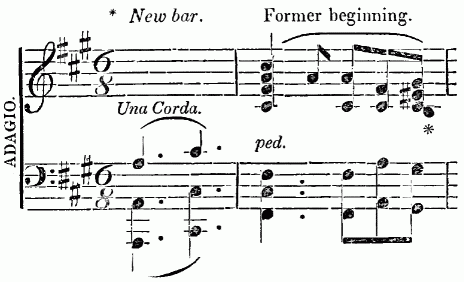
[A]
Fourth movement, Introduzione largo M. M.
 = 76
= 76
Fifth and last movement, 3/4 time
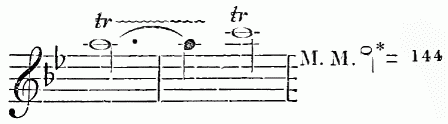
[B]
Excuse the mistakes; if you knew my circumstances you would not be
surprised at them, but would wonder at what I produce in spite of them.
The Quintett cannot be delayed any longer, and will shortly appear; not
so the Sonata, about which I anxiously expect to hear from you,
inclosing the terms. The name of the courier, through whom you have to
receive the Quintett and Sonata, is De Smidt. I beg to have a speedy
answer, and shall soon write more at length.
In haste, yours,
BEETHOVEN.
Beethoven to Ries.
Vienna, April 19, 1819.
Dear Friend,
Excuse the trouble which I am giving you. I cannot account for the
numerous mistakes which have found their way into the copy of the
Sonata, unless, indeed, they proceed from the circumstance of my not
being able any longer to keep a copyist of my own; events have brought
this about, and may the Lord help me until ... become better off. This
will take another twelvemonth. It is most shocking how this matter has
been brought about, and what has become of my salary, and no one can say
what may become of it, until the above-mentioned twelvemonth comes
round. Should the Sonata (Op. 106) not do for London, I might send
another, or you may leave out the Largo and begin with the Fugue of the
last movement, or else the first movement, the Adagio, and for the
third, the Scherzo and the Largo and Allegro risoluto. I leave it to you
to manage this as you think proper.[186] This sonata was written in time
of need; for it is hard to write almost for one's daily bread; thus far
am I reduced. We must correspond further upon my visit to London. It
would certainly be the only means of saving me from my miserable and
needy condition, which ruins my health, and will never permit my
faculties to act as they might under more favourable circumstances.
BEETHOVEN.
Beethoven to Ries.
Vienna, May 25, 1819.
* * * I was all the while oppressed with such cares as I had never
known, and all through my excessive benevolence to others. Write on
industriously. My dear little Archduke Rudolph and I, we often play your
works, and he says the former pupil does his master credit. Now fare you
well. I content myself with embracing your wife—who, I understand is
very handsome—in fancy only, for the present, but hope to have that
pleasure in reality during next winter. Do not forget the Quintett, and
the Sonata, and the money—I meant to say the honoraire, avec ou sans
honneur. I trust to hear from you not only as fast as allegro, but
veloce prestissimo, and good tidings too. This letter reaches you
through a right clever Englishman; they are a powerful race for the
most part, and I should like to spend some time amongst them in their
own country.
Prestissimo—Responsio, il suo amico e maestro
BEETHOVEN.
Beethoven to Ries.
Vienna, November 10, 1819.
Dear Ries,
I write to let you know that the Sonata is out, that is to say, only
about a fortnight; and it is about six months since both were sent to
you—the Quintett and the Sonata. I shall despatch in a few days through
a courier who leaves this, the Quintett as well as the Sonata, so that
you will be able to correct both works. Not having heard from you of the
receipt of either, I thought the matter had fallen to the ground. Have I
not been wrecked once before in this year through Neate? I wish you
could try to get me the fifty ducats; I have reckoned upon receiving
them, and, indeed, have many ways for my money. Enough for to-day, only
let me tell you that I have almost concluded a new Mass; let me know
what you could do with it in London; but that soon, very soon, and soon
too let me have the money for both the works. I will write more fully
another day. In haste, your true and sincere friend,
BEETHOVEN.
Beethoven to Ries.
Vienna, April 6, 1822.
My dearest Ries,
I have been ill again for the last six months and more, and thus could
never answer your letter. I have received the £26, and am sincerely
obliged to you for them, but your Symphony dedicated to me has not
arrived. My greatest work is a grand Mass, which I have lately written,
&c. &c. Time presses to-day, so I say only the needful; what might the
Philharmonic Society offer me for a Symphony?
I will think of coming to London, if my health would but permit
it—perhaps next spring! You would find in me a master who truly
appreciates the pupil, in his turn become a great master, and who knows
how, and in what way, the art might be benefited from our acting
jointly. I am as ever completely devoted to my muses, and this alone can
ensure me happiness. I act for others, too, as best I may. You have two
children—I have one (my brother's son)—but you are married,
consequently your two cannot be as expensive as my one.
Now, farewell; kiss your fair lady, until I may perform this solemn act
in person.
Your sincere friend,
BEETHOVEN.
P.S. Be quick in letting me have your dedication, that I may show off in
return, which I mean to do as soon as I have received yours.
Beethoven to Ries.
Vienna, December 20, 1822.
My dear Ries,
I have had so much business on hand, that I could not send you a reply
to your letter of the 15th of November. I gladly accept the request of
the Philharmonic Society to write a new Symphony for them; although the
terms offered are not what they ought to be, and what the English might
afford, in comparison to other nations.
If I could but get to London, what would I not write for the
Philharmonic Society! for, Heaven be praised, Beethoven can write,
although he can do nothing else. If it please God to restore my health,
which is somewhat improved, I may yet avail myself of the several
proposals made to me from the different parts of Europe, and even from
North America, and thus might I once more be put in a flourishing
state.
Yours, &c.,
BEETHOVEN.
Beethoven to Ries.
[Extract of a letter, the beginning of which is nowhere to be found.]
* * * Do get matters speedily arranged for your poor friend; I expect
your travelling plan too;[187] I can bear up no longer; I am in for it,
deeper than ever; should I not go, look you, there is a crimen læsæ!
Since you seem to wish for a dedication of mine, I am quite ready to
gratify you; much more ready than I should be for any great man—for the
greatest, entre nous.
The d——l knows where one might fall into their hands. You will
receive the new Symphony (the ninth with choral parts) with the
dedication to yourself. I hope at length to get possession of yours to
me. "B" is to open the letter to the king (George the Fourth) he took
charge of, and he will see what has been written to the king about the
Battle of Vittoria; the enclosed letter to him[188] contains the same;
but there is no longer a question about the Mass. Let our amiable friend
B. try and get me at least a battle-axe or a turtle; the printed copy of
the score of the Battle is, of course, also to be given to the King.
This letter puts you to great expence,[189] pray deduct it from what you
have to send me; how much I regret being so troublesome to you! The Lord
be with you. Best love to your wife, until I come myself. Have a care;
you think I am old; I am an old youngster.
Ever yours,
BEETHOVEN.
Beethoven to Mr. Neate.
Vienna, February 25, 1823.
My dear friend,
Ries tells me you wish to have three Quartetts of me, and I now write,
to beg you will let me know about what time they are to be ready, as I
am fully satisfied with your offer of a hundred guineas for them; only
let me beg of you, to send me a cheque for that sum, upon one of our
banking-houses, so soon as I shall let you know that the Quartetts are
finished, and I will, in my turn, deliver them to the same banker upon
the receipt of the hundred guineas. I trust you are enjoying to the full
the blessings of a family life; would I could have the pleasure of
becoming an eye-witness to your happiness! I have sent Ries a new
Overture for the Philharmonic Society, and am only waiting the arrival
of a cheque for the new Symphony, to forward him that too, through our
Austrian embassy. You will find in the bearer, Mr. A. Bauer, a man
equally intelligent and amiable, who can give you a full account of my
doings. Should my health improve,[190] I mean to visit England in 1824;
let me know what you think about it. I should be delighted to write for
the Philharmonic Society, to see the country and all its distinguished
artists; and as to my pecuniary circumstances, they too might be
materially benefited by this visit, as I feel that I shall never make
anything in Germany. My name on the address of letters is sufficient
security for their reaching me. With every kind wish for your welfare,
believe me
Your sincere friend,
BEETHOVEN.
Beethoven to Ries.
Vienna, April 25, 1823.
Dear Ries,
The cardinal (Archduke Rudolph) has been staying here for a whole month;
and as I had to give him two hours and a half's lesson per day, I was
robbed of much time, besides feeling, the day after such lessons,
scarcely able to think, much less to write.
My distressed circumstances, however, require that I should instantly
write that which will procure money, sufficient for the moment. What a
sad discovery this must be to you! And, moreover, all my troubles have
caused me to be unwell—have given me sore eyes. But do not be alarmed;
you will shortly receive the Symphony. Indeed it is all brought on by
these miserable circumstances. You will also receive, a few weeks hence,
thirty-three new Variations on a subject (a Valse Op. 120) dedicated to
your wife. Bauer (first secretary to the Austrian embassy) has the score
of the "Battle of Vittoria," which was dedicated to the then Prince
Regent, and for which I have still to receive the copying expenses. Now
I beg of you, dear friend, to send me, as soon as possible, a draught
for the amount of whatever you may be able to get me for it. You and I
know the publishers well.
With regard to your tender conjugal point, you will always find me in
direct opposition to yourself, and decidedly taking the lady's part.
Ever your friend,
BEETHOVEN.
Beethoven to Ries.
Hetzendorf, near Vienna, July 16, 1823.
My dear Ries,
The receipt of your letter, the day before yesterday, gave me great
pleasure. I suppose you have got the Variations by this time. I could
not write the dedication to your wife, as I do not know her name. Pray
make it in the name of your own and your wife's friend, and let her be
surprised with it, on its coming out. The fair sex is fond of that sort
of thing. Between ourselves, the great charm of the beautiful lies in
its coming upon us unawares.
With regard to the Allegri di Bravura, I shall pardon yours. To say the
truth, I am no friend to that species of writing, calculated to promote
mechanism all too much, in those at least which I know. I have not
looked at your's yet, but shall inquire for them at ——, with whom I beg
you will not communicate without great prudence. Might I not be your
agent here for many things?
These publishers are certainly acting up to their name by publishing
your works; but you get nothing by such publicity, which is only a
reprint. Matters might perhaps be differently managed. I shall
certainly send you a few chorusses; and, if required, produce a few new
ones. They are quite my hobby.
Many thanks for the produce of the Bagatelles. I am quite content with
it. Do not give anything to the King of England. Take whatever you can
get for the Variations: I shall be satisfied anyhow. But one thing I
must stipulate, that I shall positively take no other reward for the
dedication to your wife than a kiss to be received by me in London. You
sometimes write guineas, whereas I receive but pounds sterling, and I
understand there is a difference.[191] Do not be angry at this, with a
pauvre musicien autrichien; but indeed my situation is a difficult
one. I am likewise writing a new violin Quartett. Might that too be
offered to the musical or unmusical London Jews?—en vrai juif. With
the sincerest embrace,
Your old friend,
BEETHOVEN.
Beethoven to Ries.
Vienna, Sept. 5, 1823.
My dear good Ries,
I still continue without news of the Symphony, yet you may depend upon
it ... will soon reach London. Were I not so poor as to be obliged to
live by my pen, I should not take anything of the Philharmonic Society.
As it is, I must certainly wait until my terms for the Symphony be made
payable here. Wishing, however, to prove my confidence and affection for
this Society, I have already sent off the new Overture. I leave it to
the Society to settle for it at its own rate. My worthy brother
(Johann), who keeps his carriage, thought fit to draw upon me too; and
has consequently offered this same Overture, unknown to me, to a London
publisher, Boosey. Pray tell him, my brother was mistaken with regard to
the Overture. He bought it of me to carry on usury with it, as I
perceive.—O frater! As yet I have not seen anything of your Symphony
dedicated to me. Did I not consider this dedication as a kind of
challenge, demanding satisfaction on my side, I should by this time have
inscribed some work to you. As it is, I thought I ought by rights to see
your work first; and how I wish I could in any way show you my
gratitude! I am deep in your debt for so many proofs of attachment and
active kindness.
Should my health improve by a proposed course of bathing, I shall
embrace your wife in 1824 in London.
Ever yours,
BEETHOVEN.
[The following three letters are given as originally written in
French, not in Beethoven's own hand, but signed by himself:]—
Beethoven à Monsieur C. Neate.
Vienne, le 15 Janvier, 1825.
Ce fut avec le plus grand plaisir que je reçus votre lettre du ... par
laquelle vous avez eu la bonté de m'avertir que la Société
Philharmonique distinguée d'artistes m'invite à venir à Londres. Je
suis bien content des conditions que me fait la Société, seulement je
désire de lui proposer de m'envoyer, outre les 300 guinées qu'elle me
promet, encore 100 guinées pour faire les dépenses du voyage; car il
faudra acheter une voiture; aussi dois-je être accompagné de quelqu'un.
Vous voyez bien que cela est nécessaire; d'ailleurs je vous prie de
m'indiquer l'auberge où je pourrai descendre à Londres.
Je prendrai un nouveau Quatuor avec moi. Quant au bruit dont vous
m'écrivez, qu'il existe un exemplaire de la 9ème Symphonie à Paris,
il n'est point fondé. Il est vrai que cette Symphonie sera publiée en
Allemagne, mais point avant que l'an soit écoulé, pendant lequel la
Société en jouira.
Sur ce point il faut encore vous avertir de ne faire que de petites
preuves de cette composition, en Quatuor par exemple, car c'est la seule
manière d'étudier bien une belle œuvre; les chœurs, avant tout,
doivent être exercés. Il y a encore quelques erreurs, dont je vous
enverrai le catalogue par la poste prochaine.
Il me semble avoir été oublié dans la 2de partie de la Symphonie,
qu'à la répétition du minor après le Presto il faut commencer de nouveau
du signe
 et continuer sans
répétition jusqu'à la Ferma, alors on prend aussitôt la Coda.
et continuer sans
répétition jusqu'à la Ferma, alors on prend aussitôt la Coda.
Je vous prie de me répondre au plus vite possible, car on demande de moi
une grande composition nouvelle, que je ne commençerai cependant pas,
sans avoir votre réponse. Il faut que j'écrive toujours, pas pour me
faire des richesses,—seulement pour pourvoir à mes besoins.
Or je dois avoir de la certitude sur ce point.—Je serai bien charmé de
vous voir, et de connoitre la noble nation Anglaise.
Je suis, avec la plus haute consideration,
Monsieur,
Votre sincere ami,
LOUIS VAN BEETHOVEN.
Beethoven à Monsieur Neate.
Vienne, le 19 Mars, 1825.
Mon très cher ami!
Je ne pourrai guère venir à Londres durant le printemps, mais qui sait
quel accident m'y conduit peut-être en automne. J'espére que vous vous
trouvez bien dans votre famille, et en bonne santé. Quant aux Quatuors,
dont vous m'écrivez dans vos lettres, j'en ai achevé le premier, et je
suis à présent à composer le second, qui, comme le troisiéme, sera
achevé dans peu de temps. Vous m'offrez 100 guinées pour 3 Quatuors, je
trouve cette proposition bien généreuse. Il se demande seulement, s'il
m'est permis de publier ces Quatuors après un an et demie, ou deux
ans.[192] C'est ce qui serait tres avantageux pour mes finances. En ce
qui concerne la manière de simplifier l'envoiement des Quatuors, et de
l'argent de votre part, je vous propose de remettre les œuvres à
Messrs. Fries & Co., qui témoigneront à vous même, ou à quelque banquier
de Londres, d'être possesseurs des Quatuors, et qui vous les remettront
aussitôt après l'arrivée de l'argent.
Voici une affaire, par laquelle vous pouvez me prouver votre amitié. Je
vous prie seulement de me répondre au plus-tôt possible. Je me fie
toujours à votre amitié pour moi, et vous assure que vous pouvez faire
de même à moi.
Je suis, avec la plus grande consideration,
Votre ami,
BEETHOVEN.
Beethoven à Monsieur Neate.
Vienne, le 25 May, 1825.
Mon ami!
Je crois nécessaire de vous écrire encore une fois. Je vois dans la
lettre que vous m'avez écrite il y a deux ans, que l'honoraire des
Quatuors est £100 sterling. Je suis content de cette offre, mais il est
nécessaire de vous avertir, que le 1er Quatuor est si cherché par les
plus célèbres artistes de Vienne, que je l'ai accordé à quelques uns
d'eux pour leur benefice. Je crois tromper votre amitié en ne vous
avertissant point de cette circonstance, parceque vous pouvez aussi en
faire usage à Londres. Or si vous me repondez que vous êtes content des
propositions que je vous ai faites dans ma lettre dernière, je vous
enverrai aussitôt le 1er Quatuor; cependant je vous prie d'accélerer
votre resolution, puisque les éditeurs desirent vivement de le posseder.
Cependant vous n'avez point de remettre l'honoraire qu'après avoir reçu
l'assurance de ma part, que les 2 autres Quatuors sont achevés.
Seulement je vous prie d'ajouter à votre lettre l'assurance de votre
contentement en ce qui concerne mes offres. Voilà ce que j'ai cru devoir
vous dire. Je crois vous avoir fait une complaisance, et je suis
certain que vous ferez le même envers moi. Conservez votre amitié pour
moi.
Je suis, avec le plus grand estime,
Votre ami sincère,
LOUIS VAN BEETHOVEN.
Beethoven to Ries at Bonn.
Vienna, April 9, 1825.
Dear worthy Ries,
The needful in all haste! In the score of the Symphony which I sent you
(it is the ninth with choruses), there stands, as far as I remember, in
the first oboe in the 242nd bar,—
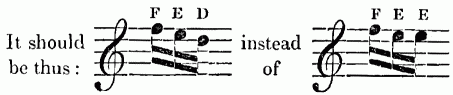
I have looked over the whole of the parts, with the exception of the
brass band—that only in part—and I trust they must be tolerably
correct. I would willingly have sent you the score,[193] but I have a
concert before me, and the only score I possess is my manuscript. The
concert, however, depends upon my health; for I must soon set off to the
country, where alone I can prosper at this time.
You will soon receive the Opferlied, copied a second time; and I beg
you will mark it as corrected by myself, that it might not be used
together with the one you have already by you. This song gives you an
idea of the miserable copyist I have had ever since Schlemmer's death.
There is scarcely a note in which I can trust him. As you have already
had all the written parts of the finale of the Symphony, I have now sent
you the second choral parts. You can easily have these scored from
before the beginning of the chorus; and at the commencement of the
vocal, it will be quite easy to have the instrumental parts prefixed to
the second vocal ones: it will require a little reflection. It was
impossible to write all this at once; and, had we hurried such a
copyist, there would have been errors upon errors. I have sent you an
Overture in C, 6/8 time, not yet published: the printed parts, too, you
will receive by the next post. The Kyrie and Gloria (two of the
principal pieces of the Messe Solemnelle), in D major, are likewise on
their way to you, together with an Italian vocal Duet. You will receive,
besides these, a grand March with chorusses, well fitted for grand
musical performances.[194] Another grand, and as yet unknown, Overture
might come forth, but I fancy you have enough of these.
Farewell, in the land of the Rhine, ever dear to me.[195] Every
enjoyment of life attend you and your wife. The most friendly
remembrances to your father.
From your friend,
BEETHOVEN.
Account of a Concert given by Beethoven at the Kaernthnerthor Theatre,
Vienna.[196]
* * * * *
On the 7th of May, 1824, a grand musical performance took place at the
Kärnthnerthor Theatre. The leaders of the music were Kapellmeister
Umlauf and M. Shuppanzigh, and the great composer himself assisted on
the occasion. He took his place at the side of the principal leader,
and, with his original score before him, indicated the different
movements and determined the precise manner in which they were to be
given; for, unfortunately, the state of his hearing prevented him from
doing more. The theatre was crowded to excess, and the sensation caused
by the appearance of this great man was of a kind that is more easy to
imagine than to describe. The arrangement of the pieces performed was as
follows:—1st, Beethoven's Grand Overture in C major; 2nd, Three Grand
Hymns, with solo and chorus parts, from his New Mass, never before
performed; 3rd, a Grand New Symphony, with a finale, in which are
introduced a solo and chorus part from Schiller's Lied an die Freude
(Song of Joy). This also was performed for the first time, and is
Beethoven's last composition. We shall offer a few observations on each
of these in the order of their performance.
With respect to the Overture, it indisputably belongs to the most
finished of his compositions. The introductory Andante is throughout
of the most simple, noble, and masterly kind, and the rather lengthened
Allegro that follows is full of brilliant fancy: it is in the free
fugue style, in three parts, each of which is sustained with equal power
and effect. It is never monotonous, its form is constantly varying
without in any manner sacrificing unity of effect; without the smallest
rest point, the interest is constantly kept up; it flows along in a
stream of harmony always pure and limpid; but it certainly presents an
arduous task to the performer. It is thus that Handel would have
written, had he had at his disposal the rich orchestra of our times; and
it is only a spirit congenial with that of the immortal author of the
Messiah that could succeed in treading in the footsteps of this giant of
the art. The Three Hymns are principal portions of the New Mass which
Beethoven has lately composed. The first, which was the Kyrie Eleison,
is in D major, a movement full of fire and deep religious feeling. The
Christe that followed is in triple time, and full of happy effects of
counterpoint; the return to the first measure of the Kyrie is managed
in a masterly manner, and the whole terminates in harmonics of a very
singular and touching character. But altogether the effect is not so
much that of children supplicating a parent, which is the true intent of
the words, in the place in which they stand, as the deep and mournful
supplications of a people humbled in the dust.
The treatment of the Credo that follows is in the highest degree
original and uncommon. Both the principal key, B flat major, as well as
the time, change perhaps too often, so that the ear is scarcely able to
comprehend the suddenness of the effects intended to be produced. At the
consubstantialem patri, a short but very powerful figure commences;
the incarnatus est is a movement of very pathetic effect, and the
tender and touching passage, passus et sepultus est, with its well
placed dissonances in the violin accompaniment, is not to be described.
Well imagined and sustained, the strongly figured movement at the
entrance of the contra-theme is somewhat quickened, but the first
moderato again returns. The Amen opens with a broad and richly
ornamented passage; it swells into splendid effect, and terminates in a
long dying fall. If it were permitted in a church composition to speak
of effect in the same manner as in a secular production, it cannot be
denied that this retarding kind of conclusion tends to weaken the
powerful impression produced by the preceding bolder results; especially
when no reasonable cause can be assigned for such a mode of conclusion,
unless it be the determination of a composer to differ from all the rest
of the world. Who does not feel himself inspired by those brilliant
Fugues with which a Naumann, a Haydn, and a Mozart terminate their
compositions of this kind, which seem as if on the wings of seraphs to
waft the soul towards heaven? The character of the Agnus Dei, in B
minor, is solemn and tender, and the introduction of four French horns
tends to heighten the effect in an extraordinary degree. The Dona in D
major, 6/8 time, passes into an Allegretto movement of feeling, and
advances in beautiful imitations, till suddenly the passage changes, and
the kettle-drums, like distant thunder, intone the deep pacem.[197] A
soprano solo introduces the second Agnus Dei in a kind of recitative,
and a chorus, strengthened by trumpets, precedes the tremendous
Miserere Nobis. The effect of the latter is singular in the extreme,
and when we reflect upon the sentiments intended to be expressed, we
scarcely know whether to praise or blame.
With respect to the new Symphony it may, without fear, stand a
competition with its eight sister works, by none of which is the fame of
its beauty likely to be eclipsed; it is evidently of the same family,
though its characteristic features are different—
facies non omnibus una
Non diversa tamen, qualem debet esse sororum.—OVID.
The opening passage is a bold Allegro in D minor, full of rich
invention, and of athletic power; from the first chord till the gradual
unfolding of the colossal theme, expectation is constantly kept alive
and never disappointed. To give a skeleton of this composition would be
scarcely practicable, and, after all, would convey but a very faint idea
of the body; we shall therefore only touch upon some of the more
prominent features, among which is a Scherzo movement (D minor) full
of playful gaiety, and in which all the instruments seem to contend with
each other in the whim and sportiveness of the passage; and a brilliant
March in the vivid major mode, forms a delightful contrast with the
passages by which it is introduced. Whoever has imagined in hearing the
Andante of the 7th Symphony, that nothing could ever equal, not to
say surpass it, has but to hear the movement of the same kind in the
present composition in order to change his sentiments. In truth, the
movement is altogether divine, the interchanges and combinations of the
motives are surprising, the tasteful conduct of the whole is easy and
natural, and in the midst of the rich exuberance of the subject, the
simplicity that prevails throughout is truly admirable. But it is in the
Finale that the genius of this great master shines forth most
conspicuously. We are here, in an ingenious manner, presented with a
return of all the subjects in short and brilliant passages, and which,
as in a mirror, reflect the features of the whole. After this a singular
kind of recitative by the contra-basses introduces a crescendo passage
of overwhelming effect, which is answered by a chorus of voices that
bursts unexpectedly in, and produces an entirely new and extraordinary
result. The passages from Schiller's "Song of Joy" are made admirably
expressive of the sentiments which the poet intended to convey, and are
in perfect keeping with the tone and character of the whole of this
wonderful composition. Critics have remarked of the Finale, that it
requires to be heard frequently in order to be duly appreciated.
At the conclusion of the concert Beethoven was unanimously called
forward. He modestly saluted the audience, and retired amidst the
loudest expressions of enthusiasm. Yet the feeling of joy was tempered
by a universal regret, to see so gifted an individual labouring under an
infliction the most cruel that could befal an artist in that profession
for which Nature had destined him. We have no doubt but the master will
consider this as one of the proudest days in his existence; and it is to
be hoped that the testimony of general feeling which he has witnessed
will tend to soothe his spirit, to soften down some of its asperities,
and to convince him that he stands upon a pinnacle far above the reach
of envy and every malignant passion.
Both singers and instrumental performers acquitted themselves on this
interesting occasion in a manner that is deserving of the highest
praise. Of the worthy Kapellmeister Umlauf, who undertook the conduct of
this great work, and M. Shuppanzigh, a master of known abilities, who
led the band, it is but justice to say that their zeal, knowledge, and
talents deservedly obtained them the most conspicuous place and the
merited thanks of their brother artists. The impracticability of
devoting sufficient time for the number of rehearsals that were
necessary, in order to do justice to music which is at once new and of
so lofty a character, made it impossible to give it with that
precision, and those delicate shades of forte and piano, which are
required to do them justice.
The deep and general feeling which this concert, in honour of the great
master of the modern art in Germany, excited, together with the
disappointment experienced by many who were unable to obtain admission,
induced the Director of the Theatre to make an offer to the composer of
a certain consideration if he would condescend once more to appear in
public, and assist at a repetition of the same music. With this request
he complied; and in addition to the pieces before performed, he offered
them a manuscript Terzetto, with Italian words, which was accordingly
performed, and considered by the numerous Italian amateurs in Vienna as
a kind of compliment paid by the composer to themselves. The performance
went off with still greater éclat than on the former occasion, and
this new composition was hailed by all with no less enthusiasm than the
other works.
Characteristics of Beethoven, from Wegeler and Ries's "Notizen."
WHEN Beethoven's reputation had attained the highest point at Vienna,
his dislike to playing in society was so ungovernable that he used
completely to lose his temper in consequence; and would often come to
see me in the most melancholy mood, complaining that play he must,
although he felt the blood tingling in his fingers. By degrees I used to
draw him into a conversation of a more cheerful tendency, and always
succeeded in ultimately pacifying him. This object attained I used to
drop all discourse, sit down to my writing-desk, and thus oblige
Beethoven to take the chair next to me, for the purpose of further
conversation—that chair being the one used at the piano. The vicinity
of the instrument soon led him to strike some chords at random, whence
sprung the most beautiful melodies. Oh! why did I not more fully
understand him! Wishing to possess a manuscript of his, I more than once
put before him on the desk some music-paper, seemingly without
intention; it was always filled, but when he had done this, he folded
it and put it into his pocket, leaving me to laugh at my own
miscalculation. He never permitted me to say much, if anything, about
his playing on these occasions, and always went away an altered being,
ready to come back to me. His antipathy to playing in company, however,
remained unshaken, and was frequently the cause of the greatest quarrels
between him and his friends and patrons.
Haydn had been anxious that Beethoven should write on the titles of his
early works "pupil of Haydn;" to this Beethoven objected, saying, that
although he had received some instructions from Haydn, yet he had never
learnt anything of him. Beethoven during his first stay at Vienna had
been Mozart's pupil for a short time, but used to complain of this great
master never having played to him. Albrechtsberger gave him instructions
in counterpoint, and Salieri in dramatic music. I was well acquainted
with these three men; they all agreed in their regard for Beethoven, as
well as in their opinion of his mode of learning. Each said Beethoven
had always been so obstinate and self-willed, that his own hard earned
experience often had to teach him those things the study of which he
would not hear of; this was more especially affirmed by Albrechtsberger
and Salieri. The dry rules of the former, and the less important ones of
the latter on dramatic composition (in the old Italian school), would
not excite any interest in Beethoven; we may therefore be allowed to
doubt Seyfried's "incontrovertible evidence" as given in his Studies,
that "Beethoven devoted his two years' apprenticeship with
Albrechtsberger with unremitting perseverance to his theoretical
studies."
Ries says, in his Notizen, page 87, Beethoven had promised the three
Sonatas for piano-forte solo (Op. 31), to Nägeli of Zurich, whilst his
brother Carl (Caspar), who alas! always would interfere in his affairs,
wanted to sell them to a Leipsic publisher. The brothers used to have
frequent disputes on this subject, Beethoven being determined to keep
his promise. At the time of sending off these Sonatas, Beethoven lived
in Heiligenstadt. He was one day walking with his brother when a new
quarrel arose between them on this subject, which actually ended in
blows. The next day he gave me the Sonatas to be sent off to Zürich
without delay; he had at the same time written to his brother, and sent
the letter under cover to Stephen Breuning for perusal. I never heard a
lecture given more forcibly and more good-naturedly than that which
Beethoven here preached to his brother, on his conduct of the preceding
day. He began by showing it to him in its true and most despicable
light—then forgave him everything—but warned him that if he valued his
own future happiness, he must alter his life and conduct altogether. His
letter to Breuning on this occasion was no less beautiful than the
above-mentioned.
As a proof of Beethoven's extraordinary faculties it may here be quoted,
that, at the first rehearsal of his piano-forte Concerto in C major,
which took place at his house, his piano proved to be half a tone lower
than the wind instruments. He immediately desired these to tune in B
instead of A, whilst he himself played his part in C sharp.
Ries gives us a curious instance of the manner in which the great master
showed his originality. He says it is in the first movement of the
Sinfonia eroica that Beethoven has vented his spleen upon the horn.
Previous to the motivo returning in the second part, he has indicated it
through the horn whilst the two violins hold on the chord of the second.
Those who are not initiated into this secret of the score, must ever
think the horn-player had miscounted, and made a wrong entry. At the
first rehearsal of this Symphony, which was a stormy one, and where the
horn-player came in correctly, I stood next to Beethoven, and, taking it
for granted that the horn-player was wrong, I said "Listen to that
stupid fellow—can he not count—it sounds wretchedly!" I think my ears
narrowly escaped being boxed, and Beethoven did not for some time
forgive me.[198] He played the same evening his piano-forte Quintett
with wind instruments. Ram, the celebrated oboe-player of Munich, played
also, and accompanied the Quintett. At one of the pauses in the last
Allegro, previously to the subject coming on again, Beethoven of a
sudden began to extemporize, taking the Rondo for his subject, thus
amusing himself and his audience for some time. Not so his wind
instruments; these lost their temper, particularly Mr. Ram, who was much
incensed. It was indeed ludicrous to see these gentlemen, who were
constantly expecting to recommence, putting up their instruments, and as
quickly taking them down again. At length Beethoven was satisfied, and
returned to the Rondo, the whole company being in raptures.
The Funeral March of the grand Sonata, Op. 26, in a flat minor,
dedicated to Prince Lichnowsky, owes its existence to the high encomiums
which were bestowed by Beethoven's friends on Paer's Funeral March in
his Opera of "Achilles."[199]
On Steibelt coming from Paris to Vienna, several of Beethoven's friends
were afraid lest the great reputation of the former should be injurious
to Beethoven. Steibelt did not call upon him, and they first met at
Count Fries's where Beethoven performed his new Trio in B major for
piano, clarionet, and violin (Op. 11) for the first time; the player not
having here an opportunity for display. Steibelt listened with a kind of
condescension, and paid Beethoven some every-day compliment, thinking
himself secure in his triumph. He played a Quintett of his own, and an
extempore Fantasia, and produced much effect by the novelty of his
tremulandos. Beethoven was not to be persuaded into a second
performance. At a concert, which took place a week later at Count
Fries's, Steibelt again played a Quintett with much success, and had,
moreover, got up for the occasion (as was palpably felt) a brilliant
Fantasia, upon the very subject of the variations in Beethoven's Trio:
this so incensed his admirers and himself that he was made to
extemporize; he went up to the instrument in his usual, I may say
uncouth manner, being half pushed towards it, took en passant the
violoncello part of Steibelt's Quintett, laid it (intentionally?) upside
down on the desk, and drummed a subject, beginning at the first bars
with one finger; but having been excited and offended at the same time,
he gave us such a performance as to make Steibelt quit the room ere he
had done, declaring he would never meet Beethoven again, and indeed
making Beethoven's non-appearance a condition to those who desired to
have him.
Beethoven usually put off to the very last moment such compositions as
were to be ready at a stated period; thus he had promised the celebrated
horn-player, Ponto, to write a Sonata for piano-forte and French horn
(Op. 17), and play it with him at Ponto's concert; this had been
publicly announced, never having been commenced till the day before the
concert, and was terminated for the performance.
The celebrated Sonata in A minor, Op. 47, with violin-concertante,
dedicated to Kreuzer, had originally been written for Bridgetower, an
English performer, and much in the same manner, although the first
Allegro was finished in good time. Bridgetower urged him on to set about
it, his concert being announced, and he anxious to study his part. I was
suddenly called to Beethoven one morning at half-past four, and he
said—"Write out this violin part of the first Allegro with all haste"
(his usual copyist was already employed): he had but slightly sketched
the piano-forte part, and Bridgetower played that lovely subject with
variations in F major, from Beethoven's own manuscript, at eight in the
morning at his concert in the 'Augarten'—there being no time to copy
it. The last Allegro 6/8 A major, had, on the contrary, been beautifully
copied both in the violin and piano-forte part, having originally
belonged to the first Sonata, Op. 30, in A major, dedicated to the
Emperor Alexander; he deemed it too brilliant for this work, and
substituted those variations which we still find in it.
Beethoven esteemed Mozart and Handel most of all composers, and next to
them S. Bach. If ever I found him with music in his hand, or on his
desk, it was sure to be that of one of these mighty men. Haydn rarely
escaped without a side cut, partly perhaps from a former grudge he bore
him, and of which the following may be a cause:—Beethoven's three
Trios, Op. 1, were to be first ushered into the world of cognoscenti at
one of Prince Lichnowsky's soirées. All those distinguished in the art
had been invited, and Haydn amongst the number; his judgment being
anxiously looked up to. The Trios were played and at once created a
great sensation. Haydn, too, expressed himself with much satisfaction to
Beethoven, advising him, however, not to publish the third in C
minor, whilst he, considering this the best,[200] was much struck by
Haydn's advice, leaving him under the impression of being envied and
looked upon rather in jealousy than as a friend.
If, in playing to him, I made a mistake in passages, or if I happened to
strike a wrong note where he required a particularly accentuated one,
he seldom said anything; but if I showed any want of expression, if I
omitted a crescendo, &c., or if I did not succeed in rendering the
character of the piece, he became incensed: the former, he said, was
chance; but the latter, want of knowledge, of feeling, or of attention.
Indeed, he himself might often be reproached with the former defect,
even when playing in public.
In the second Symphony in D major, the manuscript score of which
Beethoven gave me, something very striking occurs, in the Larghetto
quasi Andante. This Larghetto is so beautiful, so clear and bright, and
the harmony so pure, that the hearer could not imagine it had ever been
altered. The plan had indeed been the same from the beginning, but, in
the second violin, as well as in many parts of the tenor, there are
considerable alterations in the accompaniments, the original thoughts
having been so carefully effaced as to render it impossible for me to
trace them in spite of all the pains I took to that effect. On
questioning Beethoven about it, he drily retorted, "It is better
thus."
During a walk which I took with Beethoven, I was talking to him of two
consecutive fifths which occur in one of his earliest violin-Quartetts
in C minor, and which, to my surprise, sound most harmoniously.
Beethoven did not know what I meant, and would not believe they could
be fifths. He soon produced the piece of music-paper which he was in the
habit of carrying about with him, and I wrote down the passage with its
four parts. When I had thus proved myself to be right, he said, "Well,
and who forbids them?" Not knowing what to make of this question, I was
silent, and he repeated it several times, until I at length replied, in
great amazement, "Why, it is one of the very first rules." He, however,
still repeated his question, and I answered, "Marpurg, Kirnberger,
Fuchs, &c. &c.—in fact, all theorists." "Well, then, I permit them,"
was his final answer.
While Beethoven was playing with me at Count Brown's his three Marches
for two performers, Op. 45, P—— was carrying on a loud and merry
conversation with a beautiful young lady seated in the doorway near the
ante-room. Beethoven made several attempts to silence them, and when
these proved fruitless, suddenly and in the midst of playing lifted my
hands off the keys, jumped up and said, loud enough to be heard by
everybody, "I do not play for such swine." All attempts to make him
return to the piano proved fruitless, nor did he permit me to play any
more. The music ceased accordingly, to the vexation of every person
present.
The following was the cause of his breaking with Himmel. They had met
one day, and Beethoven sat down to extemporise at Himmel's request,
afterwards desiring him to do the same; Himmel was weak enough to
consent, and, after having played for a considerable time, Beethoven
exclaimed, "Well, when are you going to begin in good earnest?" Himmel,
who had thought wonders of his own performance, started up at these
words, and both became rude to each other. Beethoven said to me, "I
thought Himmel had just been preluding." They made it up afterwards, and
Himmel could forgive but not forget; they even carried on a
correspondence for some little time, but at last Himmel played Beethoven
a sad trick. The latter always wanted to have the last news from
Berlin, which somewhat annoyed Himmel, who at length wrote to him—"The
latest piece of news is the invention of a lantern for the blind."
Beethoven carried this piece of intelligence abroad, and all the world
wished to know how this might possibly be. He immediately wrote to
Himmel, and reproached him with not having sent a full explanation.
The answer received, but which I cannot here impart, was such as finally
closed their correspondence; all that was ludicrous in the letter fell
to Beethoven's share, and yet he was so imprudent as to show it to
several persons.
One of our country excursions led us on so far that we did not return to
Döbling (Beethoven's residence) till eight o'clock. He had been humming
to himself the whole way, and keeping up a kind of howling, up and down,
without articulating any distinct sounds. Upon asking him what he meant,
by this, he said "I have just thought of a subject for the last movement
of the Sonata (in F minor, Op. 57). On entering the room, he ran up to
the piano without taking off his hat. I sat down in a corner, where he
soon forgot me, and for the next hour he went on storming over the keys
until the Finale, such as we now admire it, was struck out. At length he
got up, and, surprised at still finding me there, said, "I cannot give
you a lesson to-day, I must work."
Beethoven once laid down a serious plan for a joint and very extensive
tour, where I was to have arranged the concerts and played all his
Concertos and other works. He himself would have conducted and
extemporised only. The latter was in fact the most extraordinary
performance that could be witnessed, especially when he was in good
spirits, or otherwise excited. I never heard any one come near the
height which Beethoven had attained in this branch of execution. The
stores of thought which crowded upon him, the caprice by which he was
led on, the variety of treatment, and the difficulties, whether
accidental or called forth by himself, were inexhaustible.
As we were one day talking of subjects for Fugues at the conclusion of a
lesson, I sitting at the piano and he next to me, I began to play the
subject of the first Fugue of Graun's "Death of Jesus." Beethoven soon
played it after me, first with the left hand, and then bringing in the
right, he worked it up for more than half an hour without the slightest
interruption. I am still at a loss to think how he could bear his
uncomfortable position; but his inspiration made him insensible to
external impressions.
On Clementi's coming to Vienna, Beethoven was going to call upon him;
but his brother persuaded him that Clementi ought to pay him the first
visit; this he would probably have done, although much the older of the
two, had there been no gossip about it. As it was, Clementi had been at
Vienna for some time, before he knew Beethoven even by sight. At one
time we used often to dine at the "Swan," at one and the same
table—Clementi with his pupil Klengel, Beethoven with me: we knew each
other, but did not speak or even bow, as by so doing we might either of
us have forfeited our lessons; for my own part, I know this must have
been the case, as Beethoven never held a middle course.
The Sonata in C major (Op. 53), dedicated to his first patron, Count
Waldstein, had originally a long Andante. A friend of Beethoven's
pronounced this Sonata to be too long, which brought him a volley of
abuse in return; upon quietly weighing the matter, however, my master
convinced himself of the truth of his assertion. He then published the
grand Andante in F major, 3/8 time, separately, and afterwards composed
the highly interesting introduction to the Rondo, such as it now stands.
This Andante will ever bring a sad recollection to my mind. When
Beethoven played it for the first time to his friend Krumpholz and me,
we were so delighted with it, that, by dint of begging, we got him to
play it over again. On my return home, as I passed Prince Lichnowsky's
door, I went in, to tell him of Beethoven's beautiful new composition,
and was now compelled to play the piece as far as I could remember it.
As I went on, I remembered more and more of it, so that the Prince made
me try the whole over again: by this means he too learnt part of it,
and, thinking to afford Beethoven a surprise, he walked into his room
the next day, saying, "I too have composed something which is not bad."
Beethoven firmly declared he would not hear it; but in spite of this the
Prince sat down and played the greater part of the Andante, to the
amazement of the composer. He was so incensed at this that he vowed he
never would play to me again; no, nor even in my presence, and often
required of me to leave the room on that account. One day, as a small
party were breakfasting with the Prince after the concert at the
"Augarten" (at eight in the morning), Beethoven and I being present, it
was proposed that we should drive to Beethoven's house to hear his new
opera "Leonora," which had never been performed. Upon our arrival,
Beethoven desired me to leave, and as the earnest solicitations of all
present were of no avail, I did go, but with tears in my eyes. The whole
party noticed it, and, Prince Lichnowsky following my steps, desired I
would remain in the ante-room, and he would make up the matter, of which
he considered himself to have been the cause. Of this, however, my
wounded pride would not hear. I learnt afterwards that Lichnowsky had
reproached Beethoven with great violence, as after all it was only the
Prince's love for the great composer's works which brought about the
whole occurrence, and consequently Beethoven's wrath too; but all this
tended only to make matters worse, as he now declined playing to the
company assembled.
The third of his Violin-Quartetts in D major (Op. 18) was first
composed, and the one in F, now the first, had originally been the
third.
Beethoven had scarcely travelled at all; he had in his younger years,
towards the close of the century, been to Presburgh, Pesth, and once to
Berlin. Although his manner was alike to men, whether of the highest or
the lowest conditions, yet he was by no means insensible to the
civilities of the former. Whilst at Berlin he played several times at
court (in the reign of King Frederick William II.), and there composed
the two Sonatas with violoncello obligato (Op. 5) for himself and
Duport, first violoncello to the king. Beethoven was presented, on his
departure, with a gold snuff-box filled with louis-d'ors, and he used to
relate with much complacency, that it was no common box, but such as is
usually given to ambassadors.
He used to see a good deal of Himmel, whom he set down as having a
pleasing talent, but nothing more; his piano-forte playing he called
elegant and agreeable, but said he must not be compared to Prince Louis
Ferdinand. He paid the latter, as he thought, a great compliment, by
telling him he did not consider him anything like a royal or princely
performer, but a famous piano-forte player.
During Prince Ferdinand's stay at Vienna, the old Countess —— gave a
musical soirée to a few friends,—Beethoven amongst the number; but at
supper there was a table laid for the Prince and the highest nobility
alone, and no cover for Beethoven. He took fire, uttered some coarse
expressions, and took his hat and left the house. A few days later
Prince Louis gave a dinner-party, to which the old Countess had been
invited. On sitting down, places were assigned to the Countess on one,
to Beethoven on the other side of the Prince, a distinction which he
always talked of with great pleasure.
My father's letter of introduction to Beethoven contained at the same
time a credit to a small amount, should I stand in need of it. I never
made use of it, but whenever he found my cash running low he sent me
money unsolicited, and never would allow me to refund it to him; he
really loved me, and in one of his absent fits gave me a singular proof
of it. On my return to Silesia, where I had been as pianist to Prince
Lichnowsky, upon Beethoven's recommendation, he was in the act of
shaving just as I entered his room, soaped up to his very eyes, to which
his excessively strong beard extended. On perceiving me, he started up
and embraced me with so much cordiality, that he effectually transferred
every particle of the soapy substance from his left cheek to my right.
How we did laugh at this!
One evening, on coming to Baden to continue my lessons, I found
Beethoven sitting on the sofa, a young and handsome lady beside him.
Afraid of intruding my presence, which I judged might be unwelcome, I
was going to withdraw, but Beethoven prevented me, saying, "You can play
in the mean time." He and the lady remained seated behind me. I had been
playing for some time, when Beethoven suddenly exclaimed, "Ries, play us
an Amoroso;" shortly after "a Malinconico;" then an
"Appassionato," &c. From what I heard I could guess that he had in
some way given offence to the lady, and was now trying to make up for it
by such whimsical conduct. At last he started up, crying, "Why that is
my own, every bit!" I had all along been playing extracts from his own
works, linked together by short transitions, and thus seemed to have
pleased him. The lady soon left, and I found to my utter astonishment
that Beethoven did not know who she was. I learnt that she had come in
shortly before me to make his acquaintance. We followed her steps to
discover her residence, and thence her rank; we saw her at a distance,
the moon shining brightly, but found that she suddenly disappeared. We
extended our walk through the lovely valley for the next hour and a
half; on leaving him that night, he said, "I must find out who she is,
and you must help." I met her a long time afterwards at Vienna, when I
discovered her to be the mistress of some foreign prince. I communicated
the news to Beethoven, but never heard anything more concerning her,
either from him or any one else.
I never saw more of Beethoven than whilst I lodged at a tailor's, who
had three most beautiful daughters, of irreproachable conduct. It is to
this he alludes when he thus concludes his letter of July 24, 1804: "Do
not tailor too much, make my respects to the fairest of the fair, and
send me half-a-dozen needles."
Beethoven took lessons of Krumpholz, on the violin, at Vienna; and when
first I knew him,[201] we used to play his Sonatas with violin together.
This was, however, wretched music, for in his zealous ecstasy he did not
perceive that he had missed the right fingering of the passages.
Beethoven was most awkward and helpless, and his every movement
completely void of grace. He seldom laid his hand upon anything without
breaking it: thus he several times emptied the contents of the inkstand
into the neighbouring piano. No one piece of furniture was safe with
him, and least of all a costly one: he used either to upset, stain, or
destroy it. How he ever managed to learn the art of shaving himself
still remains a riddle, leaving the frequent cuts visible in his face
quite out of the question. He never could learn to dance in time.
Beethoven's Violin Quintett (Op. 29), in C major, had been sold to a
publisher at Leipzig, but was stolen at Vienna, and suddenly appeared at
Artaria & Co.'s. Having been copied in one night, it had innumerable
mistakes, and whole bars had been left out. Beethoven behaved on this
occasion with a degree of policy of which we in vain look for a second
example in his life. He required Artaria to send me fifty printed copies
for correction, but desired me at the same time to be so lavish of the
ink upon the coarse paper, and to draw my pen so thickly through some of
the lines, as to render it impossible for Artaria to sell or use any one
of these copies. The corrections applied chiefly to the Scherzo. I
kept strictly to Beethoven's request; and Artaria, to avoid a law-suit,
was compelled to melt down the plates.
Beethoven was very forgetful in most things. Count Browne having
presented him with a beautiful horse, in return for the dedication of
the Variations in A major (No. 5, on a Russian air), he rode it a few
times, but soon forgot it, and, what is worse, its food also. His
servant, who became aware of this, began to hire out the horse for his
own profit; and, to avoid Beethoven's noticing this, he purposely kept
back the bills for provender until at last a tremendously long one
reached him. This at once recalled to his memory both his horse and his
forgetfulness.
Beethoven was at times exceedingly passionate. One day when I dined with
him at the "Swan," the waiter brought him a wrong dish. Beethoven had no
sooner uttered a few words of reproof (to which the other retorted in no
very polite manner), than he took the dish, amply filled with the gravy
of the stewed beef it contained, and threw it at the waiter's head.
Those who know the dexterity of Viennese waiters in carrying at one and
the same time numberless plates full of different viands, will conceive
the distress of the poor man, who could not move his arms, while the
gravy trickled down his face. Both he and Beethoven swore and shouted,
whilst all the parties assembled roared with laughter. At last Beethoven
himself joined the chorus, on looking at the waiter, who was licking in
with his tongue the stream of gravy which, much as he fought against it,
hindered him from uttering any more invectives; the evolutions of his
tongue causing the most absurd grimaces. The picture was worthy a
Hogarth.
Beethoven scarcely knew what money was, which frequently caused
unpleasant scenes; for, being suspicious by nature, he would fancy
himself deceived without a cause. Irritable as he was, he used to call
the people cheats, an appellation which had often to be atoned for by a
douceur to the waiters. At those hotels which he mostly frequented
they became at last so well acquainted with his fits of absence or
eccentricity, that they would let him do anything, and even allow him to
leave without having paid his reckoning.
As to Beethoven's posthumous manuscripts, I have my doubts about, them.
The "Œuvres Posthumes" will not be acknowledged as such by me, unless
I see them attested in his own hand-writing. My reasons are the
following:—
Firstly. Because, during the time of my stay with him, from the year
1800 until November, 1805, and on my return to Vienna in 1809, there was
no one manuscript in his possession. Beethoven was in arrears with works
up to his death.
Secondly. All such trifles and things which he never meant to publish,
as not considering them worthy of his name, were secretly brought into
the world by his brothers. Such were the Songs, published when he had
attained the highest degree of fame, composed years before at Bonn,
previous to his departure for Vienna; and in like manner other trifles,
written for albums, &c., were secretly taken from him and brought out.
Thirdly. As most of his letters addressed to me whilst in England speak
of pecuniary distress, why should he not have sent me manuscripts, if
possessed of any?
Again. After having succeeded—and that not without trouble—to get the
Philharmonic Society of London to order three Overtures of him, as their
exclusive property, he sent me three, not one of which we could use. The
public was naturally led to anticipate great things from such a name as
Beethoven's: he was expected to produce works of no common order for
these concerts, and such alone could the Society bring forward. He
published the three Overtures three years later, and the Society did not
think this worth a prosecution. The Overture to the "Ruins of Athens"
was one of the three. I think it unworthy of him.
Had Beethoven possessed better productions amongst his manuscripts, he
would doubtless have sent them to this Society: this his letters clearly
prove. His frequent assertion too, that he could live by his pen, makes
me doubt the genuineness of the three posthumous piano-forte Quartetts
published by Artaria. I never could convince myself that they were his.
Beethoven could not possibly have cobbled together from old themes his
gigantic work, the Three Sonatas, Op. 2, which he dedicated to Haydn,
and which at once excited so great a sensation in the musical world, any
more than he could in later years have misapplied those themes for
flimsy, ill-written Quartetts; for, till his death, his genius was
incessantly productive of originality.
Additional Characteristics, Traits and Anecdotes of Beethoven.
(Extracted from Seyfried's Work, "Beethoven Studien," &c.)
BEETHOVEN should by no means be offered as a model for directors of
orchestras. The performers under him were obliged cautiously to avoid
being led astray by their conductor, who thought only of his
composition, and constantly laboured to depict the exact expression
required by the most varied gesticulations. Thus, when the passage was
loud, he often beat time downwards, when his hand should have been up. A
diminuendo he was in the habit of making by contracting his person,
making himself smaller and smaller; and when a pianissimo occurred, he
seemed to slink, if the word is allowable, beneath the conductor's desk.
As the sounds increased in loudness, so did he gradually rise up, as if
out of an abyss; and when the full force of the united instruments broke
upon the ear, raising himself on tiptoe, he looked of gigantic stature,
and, with both his arms floating about in undulating motion, seemed as
if he would soar to the clouds. He was all motion, no part of him
remained inactive, and the entire man could only be compared to a
perpetuum mobile. When his deafness increased, it was productive of
frequent mischief, for the maestro's hand went up when it ought to have
descended. He contrived to set himself right again most easily in the
piano passages, but of the most powerful fortes he could make nothing.
In many cases, however, his eye afforded him assistance, for he watched
the movements of the bows, and, thus discovering what was going on, soon
corrected himself.
Among his favourite dishes was bread soup, made in the manner of pap, in
which he indulged every Thursday. To compose this, ten eggs were set
before him, which he tried before mixing them with the other
ingredients; and if it unfortunately happened that any of them were
musty, a grand scene ensued; the offending cook was summoned to the
presence by a tremendous ejaculation. She, however, well knowing what
might occur, took care cautiously to stand on the threshold of the door,
prepared to make a precipitate retreat; but the moment she made her
appearance the attack commenced, and the broken eggs, like bombs from
well directed batteries, flew about her ears, their yellow and white
contents covering her with viscous streams.
He never walked in the streets without a notebook, in which he entered
whatever occurred to him at the moment. If the conversation accidentally
turned upon this habit, he parodied the words of Joan of Arc,—"Without
my colours I must not come," and with undeviating firmness observed the
self-imposed law. But his regularity was confined to this: the most
exquisite confusion reigned in his house; books and music were scattered
in all directions; here the residue of a cold luncheon—there some full,
some half-emptied bottles; on the desk the hasty sketch of a new
quartett; in another corner the remains of breakfast; on the piano-forte
the scribbled hints for a noble Symphony, yet little more than in
embryo; hard by, a proof-sheet, waiting to be returned; letters from
friends, and on business, spread all over the floor; between the windows
a goodly Stracchino cheese, and on one side of it ample vestiges of a
genuine Verona salami; and, notwithstanding all this confusion, he
constantly eulogised, with Ciceronian eloquence, his own neatness and
love of order! When, however, for whole hours, days, and often weeks,
something mislaid was looked for, and all search had proved fruitless,
then he changed his tone, and bitterly complained that everything was
done to annoy him. But the servants knew the natural goodness of their
master; they suffered him to rave, and in a few moments it was all
forgotten, till a similar occasion renewed the scene.
He himself often joked about his almost illegible characters, and used
to add, by way of excuse, "Life is too short to paint letters or notes,
and fairer notes would hardly rescue me from poverty" (punning upon the
words Noten and Nöthen). The whole of the morning, from the earliest
dawn till dinner-time, was employed in the mechanical work of writing;
the rest of the day was devoted to thought, and the arrangement of his
ideas. Scarcely had the last morsel been swallowed, when, if he had no
more distant excursion in view, he took his usual walk; that is to say,
he ran in double-quick time, as if hunted by bailiffs, twice round the
town. Whether it rained, or snowed, or hailed, or the thermometer stood
an inch or two below the freezing point—whether Boreas blew a chilling
blast from the Bohemian mountains, or whether the thunder roared and
forked lightnings played,—what signified it to the enthusiastic lover
of his art, in whose genial mind, perhaps, were budding, at the very
moment when the elements were in fiercest conflict, the harmonious
feelings of a balmy spring!
Beethoven permitted himself but rarely, even among his intimate
friends, to express his opinions of contemporary artists. His own words,
however will attest what he thought of the four following masters:—
"Cherubini is, in my opinion, of all the living composers, the most
admirable. Moreover, as regards his conception of the Requiem, my ideas
are in perfect accordance with his, and some time or other, if I can but
once set about it, I mean to profit by the hints to be found in that
work.
"C. M. Weber began to learn too late; the art had not time to develop
itself, and his only and very perceptible effort was, to attain the
reputation of geniality.
"Mozart's Zauberflöte will ever remain his greatest work, for in this he
showed himself the true German composer. In Don Giovanni he still
retained the complete Italian cut and style, and moreover the sacred art
should never suffer itself to be degraded to the foolery of so
scandalous a subject.
"Handel is the unequalled master of all masters! Go, turn to him, and
learn, with few means, how to produce such effects."
"What is Rossini?" he was once asked. He immediately wrote in answer, as
after he became deaf, he spoke but little,—"A good scene-painter."
During his last illness it was found necessary to draw off the water,
and during the operation he observed, "Rather water from my body than
from my pen."
He received a flattering invitation from a musical society to compose a
Cantata, the request being accompanied by a portion of the sum to be
paid for the work. Beethoven accepted it. For a very long time, however,
nothing more was heard of him. Then came, couched in the most delicate
terms, a letter to remind him of his engagement, signed, in consequence
of the absence of the president of the society, by his locum tenens
(Stellvertreter). The reply was—"I have not forgotten; such things
must not be hurried; I shall keep my word.—Beethoven, MP.[202]
(Selbstvertreter) se ipsum tenens!"
Alas! he could not keep his word.
If he happened not to be in the humour, it required pressing and
reiterated entreaties to get him to the piano-forte. Before he began in
earnest, he used sportively to strike the keys with the palm of his
hand, draw his finger along the key-board from one end to the other, and
play all manner of gambols, at which he laughed heartily.
During his summer residence at the seat of a Mecænas, he was on one
occasion so rudely pressed to exhibit before the stranger guests, that
he became quite enraged, and obstinately refused a compliance which he
considered would be an act of servility. A threat that he should be
confined a prisoner to the house—uttered, no doubt, without the
slightest idea of its being carried into execution—so provoked
Beethoven, that, night-time as it was, he ran off, upwards of three
miles, to the next town, and thence travelling post, hurried to Vienna.
As some satisfaction for the indignity offered him, the bust of his
patron became an expiatory sacrifice. It fell, shattered into fragments,
from the book-case to the floor.
During one of my visits to Vienna, my brother, who is a resident of
Prague, made a journey expressly to see me; and one morning, finding I
had an appointment with Beethoven, was exceedingly anxious to get a
sight of a man of such celebrity, whom he had never yet had an
opportunity of seeing. It was very natural that I should wish to gratify
his curiosity, but I told him, that although he was my own brother, yet
I knew the peculiarities of the man so well, that nothing could induce
me to commit the indiscretion of an introduction. He was, however, too
intent upon his wish to let the opportunity escape without a further
endeavour, and said that, surely, I might allow him to call, as if in
furtherance of another appointment which we had mutually made. To this I
consented, and off we went to Beethoven's, where I left my brother in
the passage below to wait the issue of our arrangement. I remained with
Beethoven about half an hour, when taking out my watch and looking at
it, I hastily wrote in his conversation-book that I had a particular
appointment at that hour, and that I apprehended my brother was still
waiting below to accompany me. Beethoven, who was sitting at the table
in his shirt-sleeves, instantly started from his seat, and quitting the
room with precipitation, left me in no little embarrassment, wondering
what was to follow. In a minute afterwards back he came, dragging in my
brother by the arm, and in a hurried manner forced him into a seat. "And
is it possible," said he, "that you, too, could think me such a bear as
not to receive your brother with kindness?" My brother, who had before
received some vague insinuations that the renowned composer was not at
all times in his sober senses, looked as pale as ashes, and only began
to regain his self-possession on hearing the question which Beethoven so
kindly, yet so reproachfully, asked me; for it appeared that the latter
had rushed precipitately down the stairs, and, without saying a word,
seized my brother by the arm and dragged him up stairs as if he had
caught hold of a criminal. No sooner was my brother fairly seated than
he behaved in the most kind and obliging manner towards him, pressing
him to take wine and other refreshments. This simple but abrupt act
clearly shows, that however strange his manners were, he had at heart
that kindly and good feeling which ever accompanies genius. If we were
to take the external manner for the internal man, what egregious
mistakes should we often make!—ED.
BEETHOVEN'S LAST MOMENTS.
The Property found after his Death. CORRESPONDENCE relative to the
gift made to Beethoven by the Philharmonic Society of London.
Mr. Schindler to Mr. Moscheles.
Vienna, March 24, 1827.
My dear good Moscheles,
You must not be surprised at the difference of date between these two
letters. I wished to retain Beethoven's for a few days, because, on the
day after that letter was written, i. e. the 19th of March, we had
every reason to fear that our great master was about to breathe his
last. This event, however, has not yet happened, but by the time you
read these lines, my good Moscheles, our friend will be no longer among
the living. His dissolution approaches with rapid steps, and indeed it
is the unanimous wish of us all to see him released from his dreadful
sufferings. Nothing else remains to be hoped for. One may indeed say
that, for the last eight days, he has been more like a dead than living
man, being able only now and then to muster sufficient strength to ask a
question, or to inquire for what he wanted. His condition appears, to
all accounts, to be very similar to that which was lately endured by the
Duke of York. He is in an almost constant state of insensibility, or
rather of stupor; his head hanging down on his chest, and his eyes
staringly fixed for hours upon the same spot. He seldom recognises his
most intimate acquaintances, and requires to be told who stands before
him. This is dreadful to behold, but only for a few days longer can such
a state of things last: since yesterday all the natural functions of the
body have ceased; he will, therefore, please God, soon be released, and
we shall no longer have to behold his sufferings.
Crowds of people flock to his abode, to see him for the last time,
though none are admitted, except those who are bold and audacious enough
to molest the dying man in his last hours.
We have been so fortunate as to arrange everything respecting his last
will, though there is hardly anything left but a few pieces of old
furniture and some manuscripts. He had in hand a Quintett for stringed
instruments, and the tenth Symphony, of which he makes mention in his
letter to you. Of the Quintett there are two movements entirely
finished, and it was intended for Diabelli.[203]
The day immediately succeeding the receipt of your letter he was in
extremely good spirits, and talked much of the plan of the Symphony,
which was to have proved so much the more grand, as it was intended for
the Philharmonic Society. He has frequently spoken of a journey to
England as soon as he should recover, and had calculated how he and
myself could live most economically on the tour. But, good God! his
journey will probably lead him much further than to England. When he
found himself a little relieved, he amused himself with reading the
ancient Greek authors; also several of Walter Scott's novels. As soon as
your consolatory letter had reached him, all his melancholy thoughts,
and all his dread of future misery at once vanished. He cheerfully said,
"Now we may again occasionally treat ourselves with a merry day." His
funds had been already nearly exhausted, and he had consequently been
obliged for some time past to retrench his table, which grieved him more
than anything else. He immediately desired to have his favourite dish of
fish, even if it were only that he might taste of it. The exaltation of
his mind is indeed so great, that he at times borders upon the childish.
We were also obliged to procure for him a great arm-chair, which cost
fifty florins, on which he rests daily at least for half an hour, whilst
his room and bed are arranging. His caprice, or rather obstinacy, are,
however, excessive; just as ever: and this falls particularly hard upon
me, since he wishes to have absolutely nobody about him but myself. And
what remained for me to do in this, but to give up my teaching and my
whole business, in order to devote all my time to him? Everything he
eats or drinks I must taste first, to ascertain whether it might not be
injurious for him. However willingly I do all this, yet this state of
things lasts too long for a poor devil like myself. Whatever there
remains of the thousand florins, we intend to apply in defraying the
expenses of a respectable interment, which shall be performed without
parade in the churchyard near Döbling,[204] where he ever delighted to
roam.
As early as during your last visit to this city,[205] I stated to you
the condition of Beethoven's finances, but did not at that time
apprehend that we were to see this excellent man so soon arrive, and
thus miserably too, at his last moment.
[Interval of some hours.]
I have just left Beethoven. He is certainly dying; before this letter is
beyond the walls of the city, the great light will have become extinct
for ever. He is still in full possession of his senses. The enclosed
lock I have just cut from his head. I hasten to despatch the letter, in
order to run to him. God bless you!
Your most sincere friend,
A. Schindler.
Mr. Rau to Mr. Moscheles.
Vienna, March 28th, 1827.
Dear Friend,
Beethoven is no more; he departed this life, in a most painful struggle
and with dreadful sufferings, on the 26th instant, between five and six
o'clock P.M., after having been insensible for the last twenty-four
hours.
And now as to the state of his affairs. My last letter to you spoke of
nothing but the extreme want and poverty in which he was, according to
his own statements, and yet, when an inventory of his effects was taken,
in my presence, we found, in an old, half-mouldy box, no less than
seven bank-shares. Whether Beethoven had hidden these intentionally (for
he was naturally mistrustful, and hoped for a speedy recovery), or
whether their possession had escaped his own memory, is a problem which
I do not venture to solve.
The sum of one thousand florins, as sent by the Philharmonic Society,
was found untouched. I laid claim to it in conformity with your
instructions, but was obliged to deposit it with the magistrates until
further notice from the Society as to its final disposal. I would not
consent to their defraying the burial expenses out of this money without
the Society's authorization to that effect. Should you have it in your
power to dispose of any part of the money, pray let it be done in favour
of the two old servants who have attended the patient with the utmost
care and devotedness, and who—poor faithful creatures!—have been
entirely forgotten in the will, Beethoven's nephew being named his sole
heir.[206] As to the present which Beethoven intended sending to the
Philharmonic Society, you will hear of it in due time from Mr.
Schindler. Let me know soon and circumstantially what steps I am to
take, and you may rely upon my conscientiousness in fulfilling your
wishes. Beethoven will be buried on the 29th, and an invitation to
attend the funeral has been sent to all professors of the different
chapels and theatres. The body will be borne by twenty composers, and as
many more will be torch-bearers; Grillparzer has written a most
affecting address to be spoken by Anschütz at the grave; indeed,
everything which could be done to render the solemnity worthy of the
deceased seems to be in preparation.
* * * * *
* * * * *
* * *
Your friend,
RAU.
Extract of a Letter from
Mr. Schindler to Mr. Moscheles.
Vienna, September 14th, 1827.
My dear Friend,
I avail myself of the departure for London of Mr. Levisey, the English
courier, to write, and also intrust to his care a memorial of our friend
Beethoven, since in your last you wished for a manuscript of some
well-known composition of the great master: well, here is the end of the
Scherzo of the last Symphony, and along with it one of those memorable
sketch-books which Beethoven used mostly to fill in the open air, and
afterwards to write his scores from them at home; I was so fortunate as
to rescue several of them, and to me they are of the deepest interest,
since they are scarcely intelligible to the uninitiated. I must tell you
that the one I send contains sketches of one of his last Quartetts; and
should you ever hear that work, you will no doubt recognise some of the
passages, written down at full length. I believe I cannot better prove
you my friendship than by sending you this relic, the first and only one
I shall ever part with. Mr. L——r informs me he has already sent you
Beethoven's portrait; I trust it is that lithograph in which he is
represented sitting and writing, as all others are bad; on the sheet of
paper before him stands Missa solemnis. I meant to send you all this
together through Mr. Clementi, whose acquaintance I made at Baden, but
he left before I was aware of it.
* * * * * * *
Most sincerely, your friend,
A. Schindler.
Mr. Rau to Mr. Moscheles.
Vienna, February 15, 1828.
Dear Friend,
I send you enclosed a letter from the guardian of Beethoven's nephew,
who is named his sole heir, by which you will see that matters are
drawing to a close. I was requested, officially, to make a deposition
respecting the thousand florins which the Philharmonic Society of London
had given to Beethoven, but not having heard from you to that effect,
and not wishing to take any responsibility upon myself, I requested a
delay sufficient to allow of my writing and receiving your answer. The
guardian's letter will at once show you how matters stand.[207] And now
between ourselves. If you could induce the directors to give up the
thousand florins it would save much trouble, and perhaps a lawsuit.
Even Dr. Eltz and Baron Eskeles think it would be most difficult to
identify the thousand florins found in Beethoven's possession at his
death with those sent by the Society, the more so as Hofrath Breuning,
who had been appointed to take the inventory, has died since. Should the
money, however, contrary to all expectations, be required back again, it
will be necessary for the Philharmonic Society to send Dr. Eltz a legal
writ, empowering him to proceed for them, and at their expense: this
might indeed eat up the whole sum. Pray write soon and most
explicitly. * * * * * *
Your friend,
RAU.
Funeral Honours To Beethoven.
THE 29th of March, 1827, was fixed upon for the funeral of the lamented
Beethoven. The following fac-simile of the card (on the opposite page)
relative to the funeral may not be uninteresting to the reader.
Translation of the Card.
"INVITATION
TO
LUDWIG VAN BEETHOVEN'S
FUNERAL,
Which will take place on the 29th of March, at three o'clock in
the afternoon.
———
The company will assemble at the lodgings of the deceased, in the
Schwarz-spanier House, No. 200, on the Glacis, before the
Scotch Gate.
The procession will thence go to Trinity Church, at the
Fathers' Minorites in Alser Street.
———
The musical world sustained the irreparable loss of this celebrated
composer about six o'clock in the evening of the
26th of March, 1827.
BEETHOVEN died of dropsy, in the 56th year of his age, after
receiving the Holy Sacraments.
The day of the exequies will be made known hereafter by
L. VAN BEETHOVEN'S
Admirers and Friends."
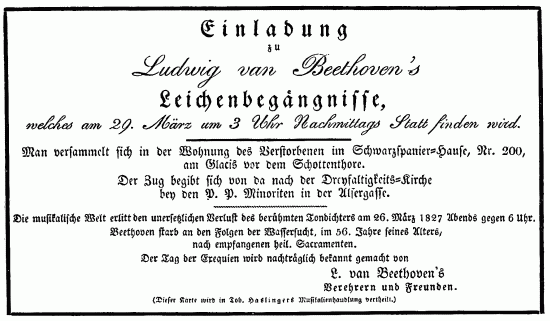
This card having been largely distributed, all the necessary
arrangements for the funeral were made with the utmost zeal and
promptitude by Mr. Haslinger, the music publisher, and Messrs. Schindler
and Hart, friends of the deceased. The morning was fine; and at an early
hour crowds of people began to assemble on the Glacis of Alservorstadt,
the quarter of the town in which Beethoven resided. Towards the middle
of the day, the numbers had increased to upwards of twenty thousand
persons of all classes; and so great was the pressure round the
residence of the deceased, that it was found necessary to close the
gates of the court-yard, where, under an awning, stood the coffin raised
upon a bier, and surrounded by mourners. At half-past four the
procession began to move, the way having been cleared by a body of the
military. Eight principal singers of the Opera-house—Eichberger,
Schuster, Cramolini, A. Müller, Hoffmann, Rupprecht, Borschitzky, and A.
Wranitzky—had offered to carry the coffin on their shoulders. After the
priest had pronounced some prayers, the singers performed a highly
impressive Funeral Chant by B. A. Weber, and the whole procession moved
forward in the following order:—
1. The cross-bearer; 2. Four trombone-players—the brothers Böck, Waidl,
and Tuschky; 3. The master of the choir, M. Assmayer; and, under his
direction, 4. A choir of singers—M. Tietze, Schnitzer, Gross, Sikora,
Frühwald, Geissler, Rathmeyer, Kokrement, Fuchs, Nejebse, Ziegler,
Perschl, Leidl, Weinkopf, Pfeiffer, and Seipelt, which, alternately with
the trombone quartett, performed the Miserere. This walking orchestra
was immediately followed by, 5. The high priest; 6. The coffin, borne by
the above-mentioned opera-singers, and attended by the chapel-masters—-
Eybler, Hummel, Seyfried, and Kreutzer, on the right, and Weigl,
Gyrowetz, Gänsbacher, and Würfel, upon the left, as pall-bearers. On
both sides, from the beginning of the procession to the coffin, were the
torch-bearers, thirty-six in number, consisting of poets, authors,
composers, and musicians, among whom were M. Grillparzer, Anschütz,
Bernard, Castelli, Mayseder, C. Czerny, J. Böhm, Linke, Hildebrand,
Schuppanzigh, Holz, Katter, Krall, Baron Lannoy, J. Merk, F. Schubert,
Riotte, Schoberlechner, Steiner, Haslinger, Sig. Lablache, David,
Radichi, Mechetti, Meric, Pacini, Meier, Schick, Schmidl, Streicher,
Weidman, Wolfmeyer, C. Graf, Raimund, Piringer, Grünbaum, &c.; the whole
in full mourning, with white roses and bunches of lilies fastened to the
crape on their arms. Next followed Beethoven's brother, and M. von
Breuning, (one of the earliest friends of the deceased, and the executor
of his last will,) the pupils of the Conservatorio, and the scholars of
Kapellmeister Drechsler, (the thorough-bass teacher of St. Ann's,) all
deeply lamenting the loss which the musical world had sustained.
As the procession approached the church, the Miserere[208] was entoned
to an original melody of the deceased, with an accompaniment of four
trombones. The history of this striking composition is as follows:—When
Beethoven was, in the autumn of 1812, visiting his brother, at the time
an apothecary in Linz, he was requested by M. Glögll; Kapellmeister of
the cathedral, to compose some movement of a solemn kind for the
approaching festival of All Souls. Beethoven willingly undertook the
task, and wrote a piece, entitled Equale a quatro Tromboni, remarkable
for the originality of the harmonies, and its faithful imitation of the
genuine antique style.[209]
On the morning of the 26th of March, 1827, when all hope of Beethoven's
recovery had been given over, Mr. Haslinger repaired with it to
Kapellmeister Seyfried, with a request that he would adapt the words of
the Miserere to this Equale, that, the body of the prince of musicians
might be accompanied to its everlasting rest by his own creations. M.
Seyfried, in pursuance of this idea, undertook the work, which was
finished the night following Beethoven's death, with infinite judgment
and good taste. The movements were arranged for four voices (two tenors
and two basses) and four trombones.
On reaching the church, the body was placed on a bier at the foot of the
high altar, when, after the usual prayers, was sung the solemn anthem
Libera me Domine, de morte eterná, composed by Kapellmeister von
Seyfried, in the genuine ecclesiastical style. On quitting the church,
the coffin was placed in a hearse drawn by four horses, which proceeded
towards the burial-ground at Währing, followed by a line of more than
two hundred carriages. On reaching the gates of the cemetery, the
following poem, from the pen of Grillparzer, was recited by Anschütz,
the tragedian, in a very feeling manner:—
| 'Tis done! A master-spirit of the age |
| Has pass'd away to his eternal rest: |
| Henceforth his name belongs to history's page, |
| Enroll'd with men the noblest and the best. |
| Yet, though his name does to all time belong, |
| Ye lately heard and saw the wond'rous man, |
| Ye heard his living voice, his living song, |
| And to receive his dying accents ran. |
| Then deep in mem'ry treasure up his form: |
| That brow, though stern, with sweetest fancies fraught, |
| That eye with inspiration kindling warm, |
| That bosom labouring with the force of thought. |
| And ye, to whom it was not given to view |
| His living lineaments with wond'ring eye, |
| May in his tones behold him pictured true, |
| In breathing colours that can never die. |
| Yes: he could paint, in tones of magic force, |
| The moody passions of the varying soul— |
| Now winding round the heart with playful course, |
| Now storming all the breast with wild control. |
| Forthdrawing from his unexhausted store, |
| 'Twas his to bid the burden'd heart o'erflow: |
| Infusing joys it never knew before, |
| And melting it with soft luxurious woe! |
| We came his funeral rite to celebrate, |
| Obedient to fond love and duty's call; |
| But on this moment such proud feelings wait, |
| It seems a joyous birthday festival. |
| He liveth! It is wrong to say he's dead:— |
| The sun, though sinking in the fading west, |
| Again shall issue from his morning bed, |
| Like a young giant vigorous from his rest. |
| He lives! for that is truly living, when |
| Our fame is a bequest from mind to mind: |
| His life is in the breathing hearts of men, |
| Transmitted to the latest of his kind. |
Baron von Schlechta and M. Castelli read short but eloquent poems to the
sorrowing multitude, and, before the grave was closed, M. Haslinger put
into the hands of M. Hummel three wreaths of laurel, which were dropped
upon the coffin. The mourners waited till the earth was smoothed over
the grave. All the visitants in turn took a last farewell of the mortal
remains of a great genius, and returned home in silence, the shades of
evening having by this time gathered around.
On the 3rd of April, 1827, a solemn tribute was paid to the memory of
Beethoven at the imperial church of St. Augustin by the performance of
Mozart's Requiem, in which the great singer Lablache sung the bass
part, in a manner that produced a deep impression and shows him to be a
profound artist: the whole terminated with the solemn Miserere and
Libera of Kapellmeister von Seyfried. On the 5th of April, 1827, was
performed, in the church of St. Charles, the whole of Cherubini's
celebrated Requiem, admirably executed under the direction of
Kapellmeister Hummel. A musical performance also took place, by way of
opening a subscription for a monument to Beethoven. It commenced with
the celebrated Pastoral Symphony of the lamented master, which was
followed by a Kyrie from his second Mass in D. From the Abbé Vogler's
celebrated Missa pro defunctis, were given the Dies iræ, the
Sanctus, and Benedictus. The whole closed with Catel's Overture to
Semiramis. The selection was admirably performed, and the object
proposed adequately fulfilled.
LATIN EPITAPHS
ON
BEETHOVEN'S TOMB.
——————
1.
LUDOVICO . VAN . BEETHOVEN.
Cujus.
Ad . Triste . Mortis . Nuncium.
Omnes . Flevere . Gentes.
Plaudente.
Coelitum . Choro.
———
2.
IN TUMULUM LUDOVICI VAN BEETHOVEN.
FATO mortalis; VITA bonus; ARTE perennis,
MORTE suum MORIENS eximit ipse decus.
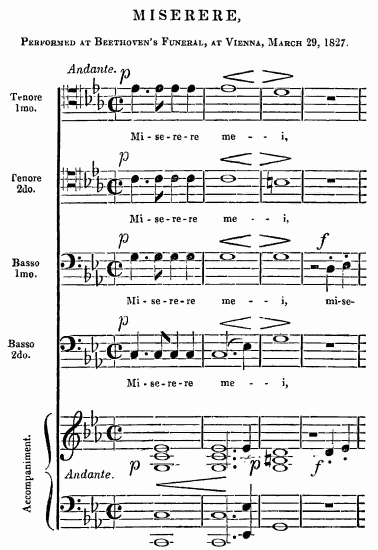
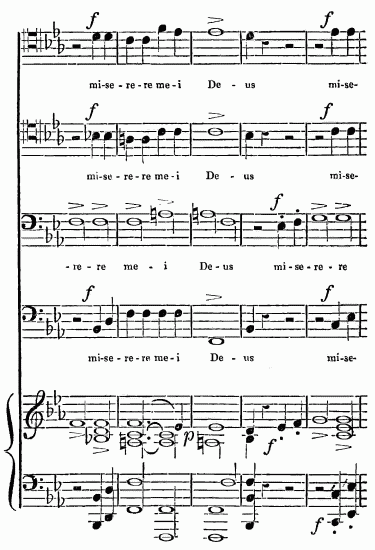
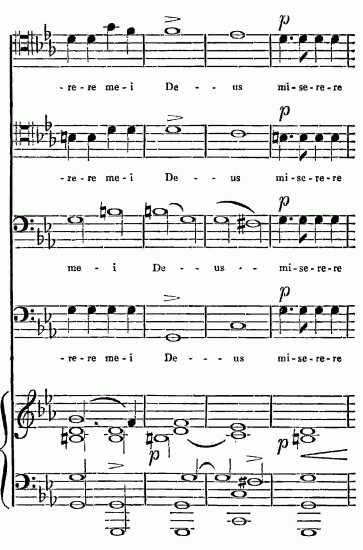
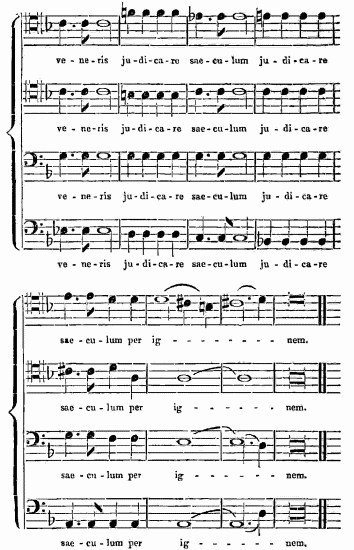
Concert in aid of Beethoven's Monument at Drury Lane Theatre, July 19th,
1837.
IT was in the summer of the year 1837 that the citizens of Bonn, who had
for the last two years been actively engaged in raising funds for the
erection of a monument to Beethoven in his native city, addressed Lord
Burghersh, through the Baron von Schlegel, president of their managing
committee, in the following letter:—
My Lord,
Monsieur le Baron de Bulow has encouraged me to address your
Lordship on behalf of the proposed monument to Ludwig van
Beethoven, in his native town of Bonn. This project has been most
favourably entertained in Germany: we have received the profits of
many concerts given for this purpose in the small as well as large
towns, besides private subscriptions; nevertheless, our means are
still insufficient for the execution of a monument in all respects
worthy of this great genius. Besides, his glory would remain
imperfect if we did not obtain for it some conspicuous support
from abroad, and especially from London, which has become one of
the principal places in Europe in which music is cultivated in the
greatest perfection. A public concert, given in that capital, in
aid of the monument to Beethoven, would complete our wishes.
If a connoisseur and patron of talent like your Lordship would
deign to encourage such an undertaking, distinguished artists will
zealously assist, and the numerous admirers of Beethoven will not
refuse their aid to do honour to his memory.
Having had the honour, in former times, of being received by your
Lordship, and of being present at your brilliant musical
entertainments in Florence and in London, I gladly avail myself of
this occasion to recal myself to your kind recollection; and I beg
you to accept the expression of my devotion and of the great
respect with which
I have the honour to be,
My Lord,
Your most obedient and humble servant,
(Signed) A. W. DE SCHLEGEL.
Bonn, May 21st, 1837.
Lord Burghersh, taking up the matter with the utmost zeal, addressed an
appeal to the principal musical institutions of London, which in their
turn showed their readiness to promote the object in view.
At a meeting of the professors belonging to the Ancient Concert, the
co-operation of the members of that body was unanimously granted, Mr.
Knyvett and Mr. Cramer being deputed to act as its representatives. A
like course was adopted by the Philharmonic Society, which nominated Sir
George Smart and Mr. Moscheles in a similar capacity; Mr. Mori and Sig.
Costa were appointed by the orchestra of the Italian Opera to express
the adherence of that body; and Messrs. Potter and C. Lucas, at the
suggestion of Lord Burghersh, on the part of the disposable forces of
the Royal Academy. Several of the principal English and foreign
vocalists then in London offered their co-operation with the utmost
willingness and liberality. Mr. Bunn granted the use of Drury Lane
Theatre, and on the 19th of July, 1837, under the management of a
committee presided over by Lord Burghersh, assisted by the Right Hon.
the Earl of Cawdor and the Right Hon. Sir Gore Ouseley, Bart., and
formed of the members of the musical bodies above specified, a grand
concert was given, the following account of which is extracted from the
musical journals of the day.
The performance which took place at Drury Lane Theatre on Wednesday
evening was but thinly attended, owing to a variety of causes, among
which may be noticed the dissolution of Parliament and the approaching
elections, the lateness of the season, and, we fear, the high terms
demanded for admission, namely, half-a-guinea the boxes, seven shillings
the pit, and five shillings the gallery. In a musical point of view it
realised the highest expectations that could have been formed of it; for
assuredly it was the noblest entertainment of this description that ever
was given in England. But considered with respect to its object, it has
unfortunately been a failure, the attendance having been too small to
produce any substantial contribution to the fund. This circumstance must
have, in some measure, diminished the enjoyment which the admirers of
Beethoven derived from the performance of some of his greatest
masterpieces. But it did not damp the ardour of the performers. They
evidently exerted themselves con amore; and we have never heard music
performed with greater care, energy, or effect.
Nothing could have surpassed the splendour of the orchestra on this
occasion, which was erected upon the stage, and the back of it was as
high as the second tier of boxes. The principal singers were arranged in
front; the chorus, consisting of 112 voices, on each side; the
conductor in the centre. The band consisted of fifty violins, twelve
violas, twelve violoncellos, eleven double basses, twenty-five wind
instruments, &c., making a total of 110 instruments, and a grand total
of about 230 performers. The soli performers were Mesdames Schrœder
Devrient, Bishop, Knyvett, Birch, Wyndham; Messrs. Braham, Bennett,
Balfe, Seguin, and H. Phillips. The conductors, Sir George Smart, Mr.
Moscheles, and Mr. Knyvett; the leaders, Messrs. F. Cramer, Loder, and
T. Cooke.
The selection combined: Part I. The Mount of Olives. Part II. The Choral
Symphony. Part III. Overture Egmont.—Canon from Fidelio.—Concerto in E
flat (pianoforte, Mr. Moscheles).—Grand scena in E.—And Finale from
Fidelio.
The Mount of Olives, which formed the first act, was given entire for
the first time in England. The solo parts were sung by Mrs. Knyvett,
Mrs. Bishop, Miss Birch, Mr. Braham, Mr. Phillips, and Mr. Bennett.
Braham was in perfect voice, and had his voice perfectly under his
command. He sang, indeed, so well, that the principal performers in the
orchestra could not refrain from offering him their friendly and hearty
congratulations. The band was led by F. Cramer, and conducted by Sir
George Smart.
Beethoven's great Choral Symphony formed the second act. It was
admirably performed, and received with immense applause. Schrœder
sang with a power and truth which only the music and a kindred genius
could have supported. Mr. Moscheles' performance of the noble Concerto,
and his conducting the Choral Symphony, have been already mentioned in
these pages. Both were beyond commendation. The choralists in "Here
seize him," and the "Hallelujah," were very effective; the former (which
is a similar movement to the pistol scene in the "Fidelio") was
unanimously encored.
So far the journals. That the pecuniary result of this concert should
have fallen short of what might be anticipated from such a cause and
such assistance, must have had its cause in the lateness of the season
and the recent death of King William the Fourth. The clear profits of
this concert, together with some donations, amounted to only 100l.! No
doubt that many of Beethoven's admirers in England, who were prevented
from attending this solemnity, would have taken a pride in honouring the
memory of the great master under more favourable auspices.
As to the proceedings of the Committee for the Beethoven Monument at
Bonn, the following particulars may not be uninteresting. The President
of the Committee, Baron A. W. von Schlegel, having relinquished his
office, owing to an accumulation of private business, Dr.
Breidenstein[210] was elected in his stead. The Committee have been most
successful in their appeal to the musical world throughout Europe, so
that the expenses of the proposed Monument are now nearly covered. The
sums received are the produce of concerts in more than fifty different
towns, the receipts of a concert given by those eminent artists Thalberg
and De Beriot, at Bonn, for the same purpose, and the generous donation
of 10,000 francs from Liszt, who joined the Committee as an active
member. Promises of concerts for the same purpose have been received
from Vienna, Paris, Brussels, and other places.
The Committee has already issued an address to artists, inviting them to
send designs for the Monument before the 1st of March, 1841. From among
the designs or sketches that shall be received, the three best will be
selected by competent judges, and for each of them a premium of twenty
frederics d'or will be paid, upon condition that the authors of them,
if required, will have models made of them, upon a reduced scale, and
send them to the Committee.
In order to insure perfect impartiality in the selection of the designs,
the authors are requested to attach a motto to each, and to inclose the
same motto in an envelop, together with the name and the address of the
artist. The competition is open to artists of all countries. It is
necessary to add the following remarks, as they may have an influence
upon the work itself:—
1. It is decided that the Monument, or rather the statue, which is to
form the most essential part of it, shall be executed, not in marble,
but in bronze.
2. The sum which, at the commencement of next year, we shall have at our
disposal amounts to about 13,000 dollars, Prussian currency; in addition
to which contributions are announced, and confidently expected, from
several of the most important German and European capitals.—ED.
Sale of Beethoven's MSS. and Musical Library.[211]
Vienna, March 16, 1828.
The sale of the lamented Beethoven's MSS. and musical library, which
lately took place here, excited uncommon interest among the lovers of
music, amateurs as well as professional men. The following are the heads
under which the articles were arranged in the catalogue:—
1. Fragments from Beethoven's musical portfolio, consisting of noted
paper, scraps of various themes, &c. 2. Fragments and sketches in a more
complete form. 3. Autographs of scores already published. 4. Autographs
of unpublished music. 5. Copies of various Symphonies, Choruses,
Overtures, Masses, &c., corrected by the composer's own hand. 6. Printed
music and theoretical works. 7. A small collection of works of general
literature. 8. A small collection of musical instruments. The contest
for several of the articles was warm and spirited, particularly between
the well-known music-sellers Artaria, Haslinger, and Steiner. More than
forty works, unknown to the public, were brought to the hammer, the
greater part of which are productions of Beethoven's earlier years. No
doubt the present possessors will, ere long, afford the world an
opportunity of enjoying these works of the lamented master. We observed
that the greater proportion of them became the property of Artaria,
after a severe contest with his brother publishers; several fetched
extraordinarily high prices. Besides a great many other articles,
Beethoven's last work, an unfinished Quintett, begun in November, 1826,
fell to the lot of Diabelli, who triumphantly bore it away, at a very
high price, from a host of competitors. The same gentleman also became
possessor of a Solo-Capriccio, of a Rondo for pianoforte and orchestra,
and of the English pianoforte which Beethoven had received as a present
from the Messrs. Broadwood. The gold medal which the composer had the
honour to receive from Louis XVIII. on receiving the copy of one of his
grand masses was bought by some anonymous collector. But by far the most
interesting article of the whole sale fell to the lot of M.
Haslinger—the collection of contrapuntic exercises, essays, and
finished pieces, which Beethoven wrote while under the tuition of his
master, the celebrated Albrechtsberger, all in his own handwriting, with
the interlineal corrections of that master, and his remarks on the
margin. It is in five thick volumes, which were evidently preserved with
great care. The struggle for the possession of this invaluable
relic—the fruit of Beethoven's first studies—was long and spirited;
but the stamina of M. Haslinger brought him through: after many a
fiercely-contested round, he was at length declared the victor, none of
his antagonists coming to time. We are happy to be able to state that
this collection of studies,[212] so interesting to the whole musical
world, is immediately to be placed in the hands of Kapellmeister
Seyfried, who is to prepare it for the press. M. Haslinger also became
the fortunate possessor of a pianoforte Trio, consisting of an Allegro,
Adagio, Finale, and Variations, composed while Beethoven filled the
place of organist in Cologne; of a short Sonata for four hands; of
several songs and other vocal pieces; of a small collection, entitled
Zapfenstreiche für Türkische Musik; of two violins, with the
possessor's seal on each; and lastly, of Beethoven's copy of the works
of Handel, Dr. Arnold's edition, in forty volumes folio. The latter, as
is well known, was presented to the lamented composer by his friend M.
Stumpff, of London, the possession of which tended so much to soothe
Beethoven during his last protracted illness. The mind and talents of
Handel were kindred to his own, and he was seen for hours hanging over
these volumes in rapture and forgetting his sufferings. Two other
competitors contended warmly for this prize—M. Gläser of Gotha, and Mr.
Schenk, the well-known composer of Der Dorfbarbier; but M. Haslinger
still retained his honours as champion of the field.[213] We must,
however, observe, that, warm as the opposition was between these
different opponents, the contest was still conducted with becoming
respect—not to say with a certain solemnity due to the relics of the
mighty dead. Some of the prices given astonished even the most
enthusiastic admirers of the composer, and are the most satisfactory
proofs of the deep zeal and love for the art predominant among us.
Nº 2.
First Sketches of the Vocal Subjects of Beethoven's 9th Symphony.
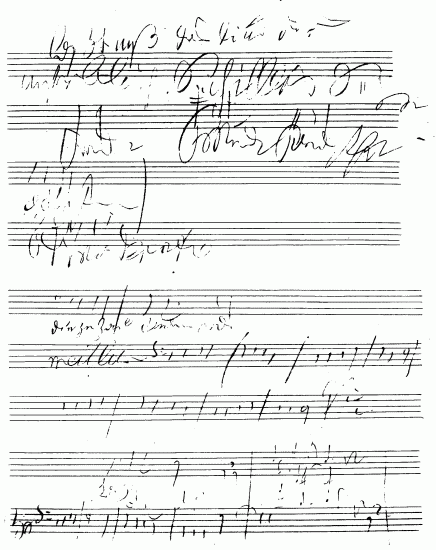
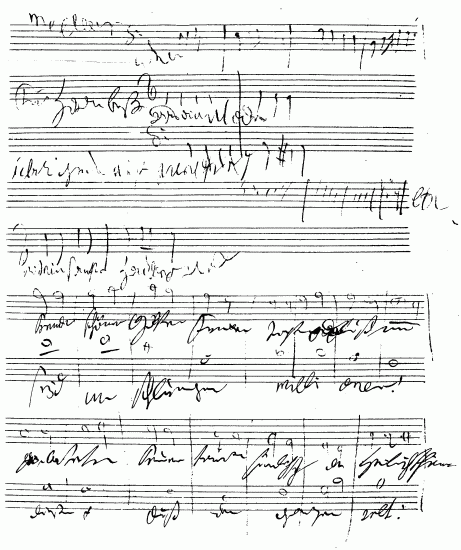


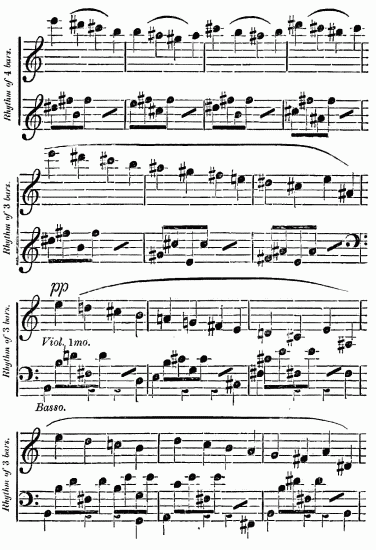
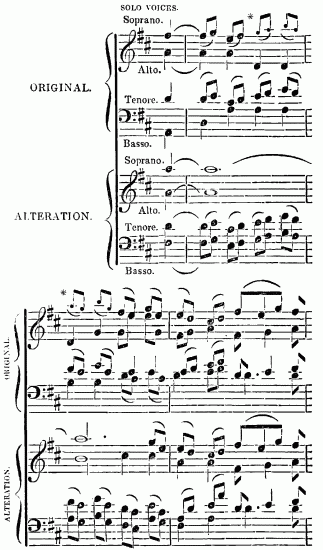
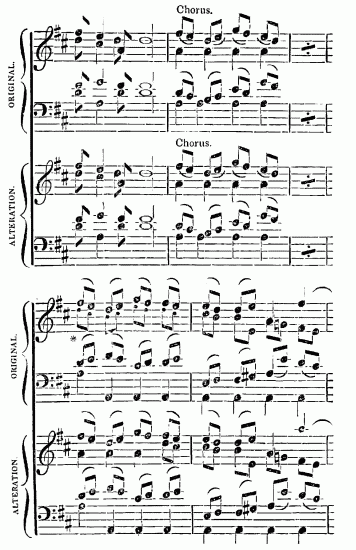
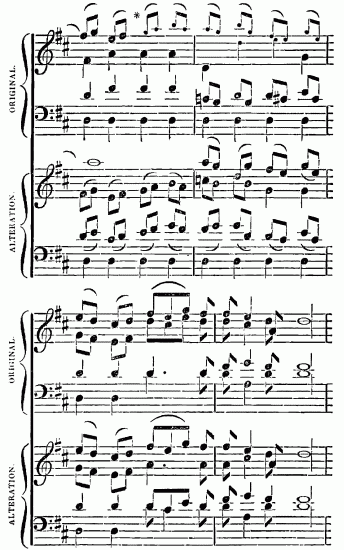


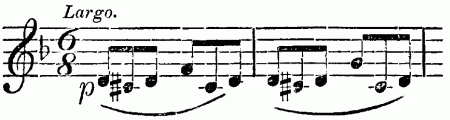
 = 60.
= 60. = 76.
= 76.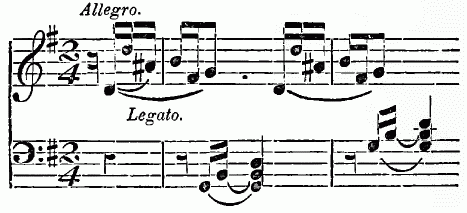
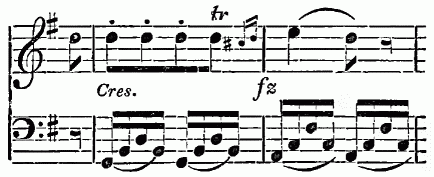
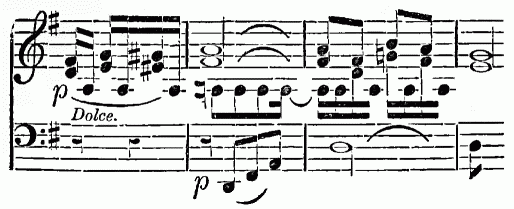
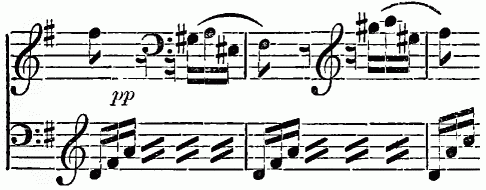
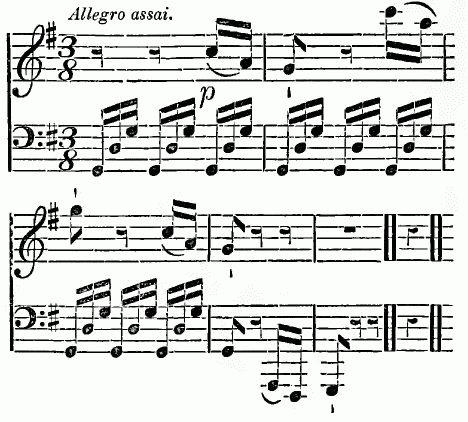

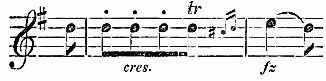
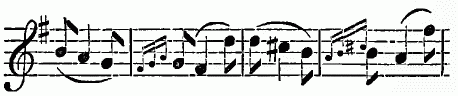
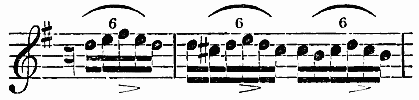
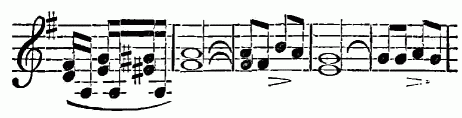
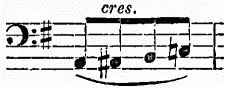
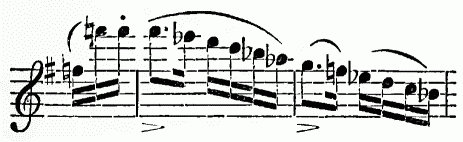
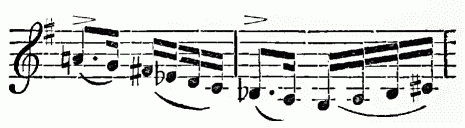
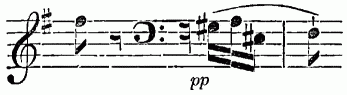
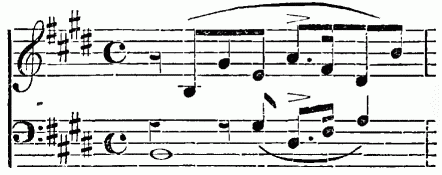
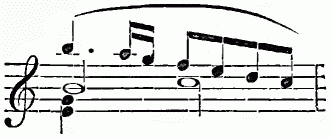
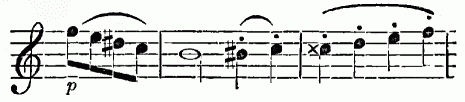
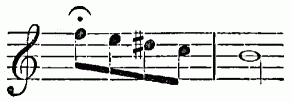
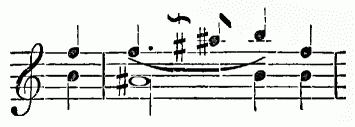
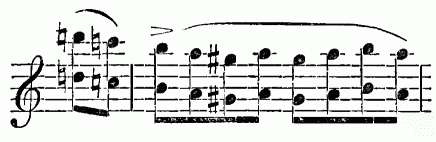
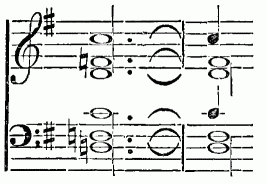
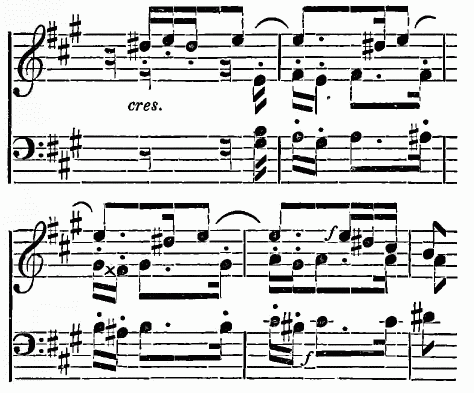
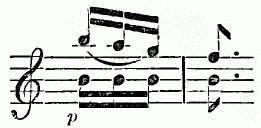
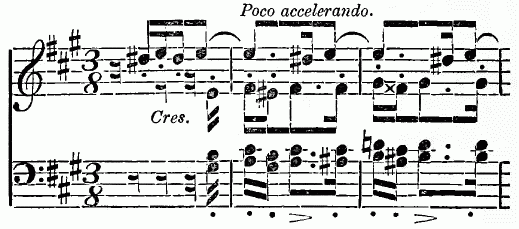
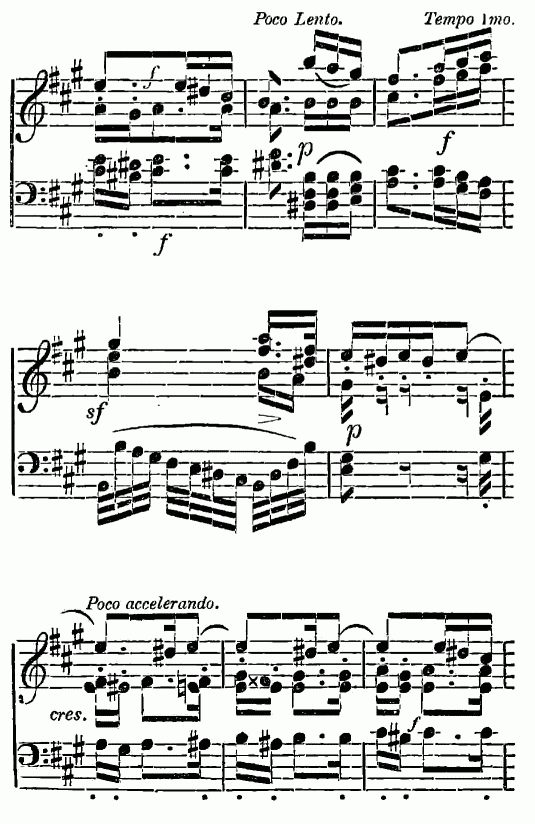
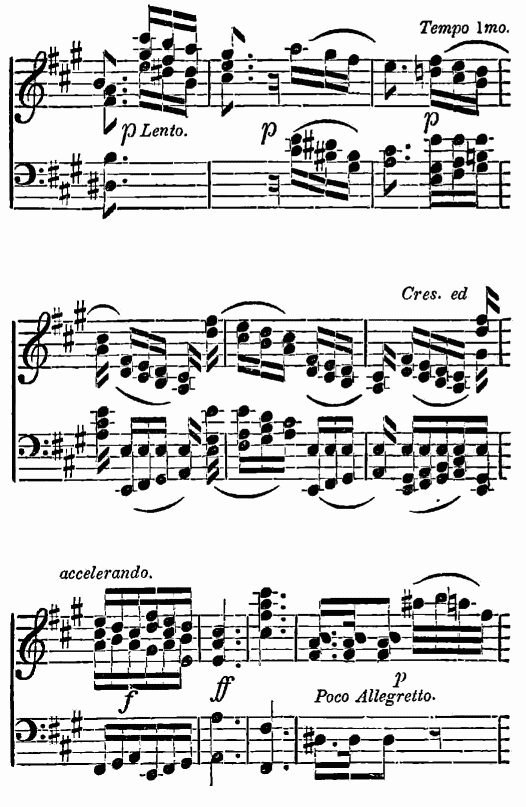
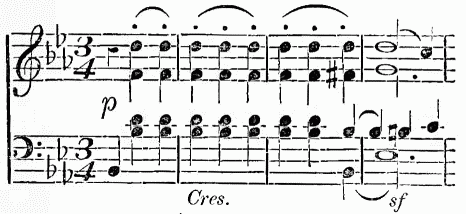

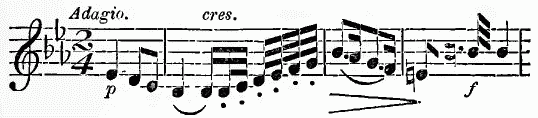
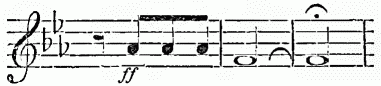
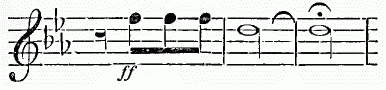
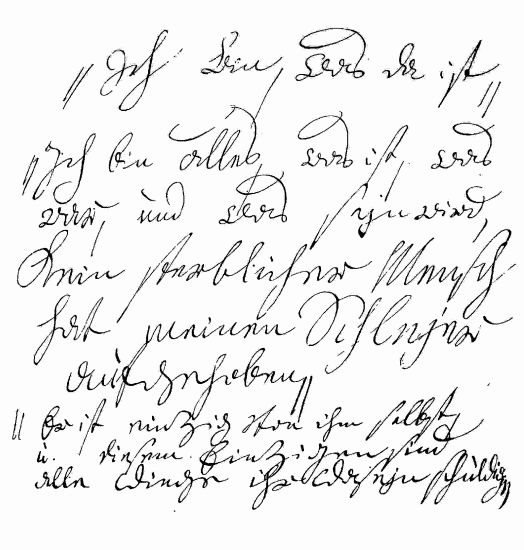
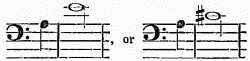 . He would certainly have given similar licences in several
other parts of this recitative, if it had not been against his plan of
unity in this musical poem, as the same notes of the recitative are
performed by the double-bass in the foregoing instrumental movement.
When I prepared, for the first time, to conduct this Symphony, on the
occasion of its revival by the Philharmonic Society (April 17th, 1837),
I found similar difficulties in other parts of the vocal movement. An
imperfect execution of these was to be apprehended, derogatory to the
general effect. I considered it a bold undertaking to attempt any
alteration, since every work which comes from such a master-genius
should be reverentially handled: I nevertheless ventured to facilitate
the execution of the passages in question. The full amount of changes
made by me is acknowledged in the following illustration:—in so doing I
hope to prove the truth of the saying, "that he who accuses himself has
the best chance of finding mercy at the hands of critical judges."—ED.
. He would certainly have given similar licences in several
other parts of this recitative, if it had not been against his plan of
unity in this musical poem, as the same notes of the recitative are
performed by the double-bass in the foregoing instrumental movement.
When I prepared, for the first time, to conduct this Symphony, on the
occasion of its revival by the Philharmonic Society (April 17th, 1837),
I found similar difficulties in other parts of the vocal movement. An
imperfect execution of these was to be apprehended, derogatory to the
general effect. I considered it a bold undertaking to attempt any
alteration, since every work which comes from such a master-genius
should be reverentially handled: I nevertheless ventured to facilitate
the execution of the passages in question. The full amount of changes
made by me is acknowledged in the following illustration:—in so doing I
hope to prove the truth of the saying, "that he who accuses himself has
the best chance of finding mercy at the hands of critical judges."—ED.