Obvious typographical errors have been silently corrected. All other spelling and
punctuation remains unchanged, except inconsistencies in hyphenation.
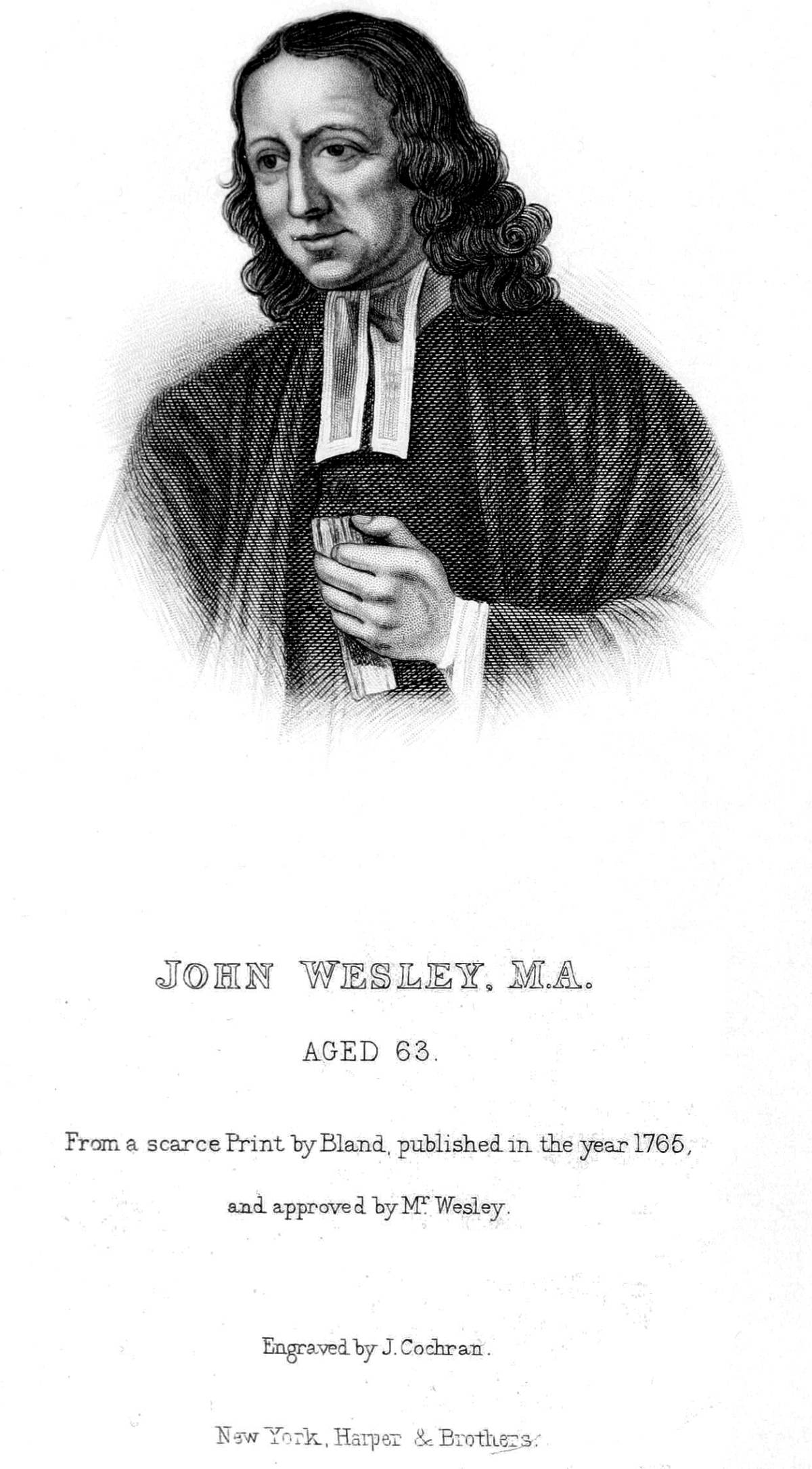
JOHN WESLEY, M.A. AGED 63.
From a scarce Print by Bland, published in the year 1765,
and approved by Mr. Wesley.
Engraved by J. Cochran.
New York, Harper & Brothers.
THE LIFE AND TIMES OF THE Rev. JOHN WESLEY, M.A.,
Founder of the Methodists.
BY THE
Rev. L. TYERMAN,
AUTHOR OF “THE LIFE AND TIMES OF REV. S. WESLEY, M.A.,”
(Father of the Revds. J. and C. Wesley).
IN THREE VOLUMES.
VOL. II.
NEW YORK:
HARPER & BROTHERS, PUBLISHERS,
FRANKLIN SQUARE.
1872.
Narrow Escapes—Bristol Chapel—Murderous Persecutions in Ireland—Dublin
Society—A Carmelite Friar—First Methodist Chapel in
Dublin—London Conference—“Thoughts on Marriage”—Kingswood
School—Journey to the North—William Grimshaw—Thomas
Colbeck—Horrible Outrages at Roughlee and Barrowford—A
Popish Renegado—Grimshaw’s Answer to White—Stoning at Bolton—Wesley
among Unitarians—“Drummer Jack”—Whitefield and
Wesley—Countess of Huntingdon—Whitefield in Trouble—Bishop
Lavington in a Rage—An Unknown Friend—“Christian Library”—Ebenezer
Blackwell—Converted Convicts—Sarah Peters—Publications—Wesley
on Quakerism
Horace Walpole on Methodism—Whitefield and the Wesleys, a
Threefold Cord—Wesley gives Lectures to Seventeen Preachers—Charles
Wesley Married—Wesley in Ireland—Slanderous Falsehoods—Terrible
Persecutions in Cork—Butler, the Ballad Singer—Letter
in Bath Journal—John Bennet—Whitefield’s Letter to
Bennet—The First Methodist Agitator—Grace Murray—Wesley’s
Courtship with Grace Murray—Coquetry—Rival Lovers—Wesley’s
Reasons for Marrying—A Wedding—Painful Scenes—Who was
Blamable?—A Fire Put Out—Rough Usage in Lancashire—Wesley
again in Trouble with Moravians—Original Letter by Wesley—Moravian
Balderdash—Wesley’s Publications—Elocution—Dr.
Conyers Middleton—Wesley on the Clergy and Learning—“The
Christian Library”
Fraternization—Whitefield—“The Impostor Detected”—Rev. Charles
Manning—Earthquakes—London in Sackcloth—Bishop Sherlock’s
Warning—Hymns on Earthquakes—Death of (Mehetabel Wesley)
Mrs. Wright—John Jane—Jonah on Board—An Overgrown
Brute leading a Drunken Rabble—Roger Ball—Lætitia Pilkington—Wesley
in Ireland—Rev. Richard Lloyd—Renewed Outrages in
Cork—Drunken Parson at Bandon—Long Rides—Two Termagants—Letters
on Irish Methodism—On Preaching—Complaints
against Preachers—The “Gifted Itinerants” in Bristol Weekly
Intelligencer—Wesley in the West of England—Zinzendorf—Spitalfields
Chapels—Publications—Logic—Rev. Mr. Bailey, of Cork,
Castigated—Bishop Lavington’s Vulgar Outpourings—Wesley’s
Reply to Lavington
Moravianism—Abominations at Leeds and Bedford—“The Contents
of a Folio History of the Moravians”—Zinzendorf and the British
Parliament—Letter by John Cennick—Wesley’s Marriage—Mrs.
Vazeille—A curious Episode—Wesley’s Marriage a great Blunder—Wesley
Resigns his Fellowship—Wesley’s Wife and Brother—Connubial
Sorrows—Foolish Correspondence with Sarah Ryan—Jealousy
and Cruelty—A manly Letter—Original Letter by Wesley’s
Wife—Wesley on the Wing—A Bolton Barber—Rev. J. Milner—Benjamin
Ingham—Wesley’s First Visit to Scotland—Scottish
Methodism—Conference at Leeds—Kingswood Troubles—James
Wheatley Tried and Expelled—Strange Proceedings at Norwich—Wheatley
condemned to do Public Penance—Number of Itinerant
Preachers—A Serious Sifting—Wesley’s Complaints—An Agreement—Mischievous
“Gospel Preachers”—Whitefield becomes a
Slaveowner—Wesley at Tiverton—John Downes—Wesley on Languages—Calvinistic
Fallacies
Written Covenants—Journey to the North—Richard Ellison—Rough
Reception at Hull—Pocklington—Cursed at York—Maniac at Osmotherley—Mrs.
Armstrong at Wickham—Fire Engine at Barnard castle—Extracts
from Todmorden Circuit Book—Bedroom at
Mellar Barn—Horses—Persecution at Chester—Printing—Letters
from Ireland—Charles Wesley charged with being a Calvinist—The
first Irish Conference—Philip Guier—A Note of Discord—Publications—Predestination—Rev.
John Gill, D.D.—Lavington, the Lampooning Bishop—A marvellous Epitaph
Letter from Howel Harris—Whitefield’s Tabernacle—Moravian
Debts—Peter Bohler—Zinzendorf charged with Falsehood—Fanatical
Fopperies—Letters of Defence—Moravianism at Bedford—Marshalsea
Prison—Scenes of Suffering—Benjamin Franklin—Electricity—Wesley’s
Electrifying Machines—Advice to Preachers—Incidents—Rev.
John Gillies—Alnwick—First Methodist Quarterly
Meeting at Newcastle—Conference at Leeds—Original Letter
to Whitefield—Minutes of Conference—Methodism at Leicester—Methodism
in Isle of Wight—Rioting at Bristol—Wesley Ill—Stephen
Plummer—Wesley and his Friends—Dr. John Fothergill—Wesley’s
Epitaph—Dangerous Illness—Whitefield’s loving
Letter—Circular of Wesley’s Book Stewards—Thomas Butts—William
Briggs—Publications—Dr. John Parkhurst—“Principles
and Preaching of the Methodists considered”—“Hymns and
Spiritual Songs”—“The Complete English Dictionary”—Wesley
a Lover of Plainness
Wesley’s “Notes on the New Testament”—Wesley an Invalid—Rev.
Henry Venn—Rev. Samuel Furley—Annual Conference—Conference
Preaching Plan—Society Ticket—Wesley’s First Visit to Norwich—Chapel
at Trowbridge—“The Mechanic Inspired”—Publications—Satirical
Poem
“Theron and Aspasio”—Journey to the North—A Dance at Hayfield—Methodism
in Liverpool—“A Gentleman’s Reasons for his Dissent
from the Church of England”—Conference at Leeds—Faithful
Dealing—Separation from the Church—Unpublished Letters—Extracts
from C. Wesley’s shorthand Diary—Original Letter by C.
Wesley—A Poetical Epistle—Letter to Rev. Mr. Baddiley—Other
Letters—Rev. Samuel Walker—Rev. Thomas Adam—Whiston
Cliff Phenomenon—Rev. John Langhorne, D.D.—Wesley’s Review
of the Work of God in England and America—Richard
Tompson—“An Apology for the Clergy”—“A Dissertation on
Enthusiasm”—Wesley in London, and in Cornwall—A Sunday’s
Work—Rev. John Fletcher—Wesley catechizes Zinzendorf—Earthquake
at Lisbon—“Catholic Spirit”; “Notes on the New Testament”
Whitefield in Long Acre—“History of Modern Enthusiasm”—Another
hostile Publication—Letter to Joseph Cownley—Methodist
Soldiers at Canterbury—Dr. Dodd—Christian Perfection—Threatened
Invasion of the French—Methodist Volunteers—Wesley,
and Bristol Election—Visit to Howel Harris—Wesley in
Ireland—The Palatines—Methodism at Lisburn—Conference at
Bristol—Methodists becoming Dissenters—“The Mitre”—Letters
on Separation from the Church—C. Wesley, and his Northern
Mission—Original Letter—Proposal to Ordain Preachers—Further
Correspondence on Separation from the Church—Debt Incurred—Forbidden
Marriages—Wesley on the French Language—Hutchinsonianism—Wesley
criticises “Theron and Aspasio”—Fletcher
Ordained—Fletcher on Methodist Sacraments—Publications—Baptismal
Regeneration—Jacob Behmen—William Law, a
Behmenite—Controversy—“Address to the Clergy”—Hostile
Pamphlets
C. Wesley ceases to Itinerate—Whitefield Mobbed in Dublin—Sabbath
Work in London—The first Methodist Mayor—Wesley
in Liverpool, and in Huddersfield—David Lacy—A Woman at
Padiham threatens Wesley’s Life—Grand Service at Haworth—Wesley
in Scotland—Three Weeks at Newcastle—Return Southwards—Death
of Persecutors—Conference in London—Rev. Mr.
Vowler—Correspondence on Separation from the Church—Wesley
on Methodist Worship—Rev. Martin Madan—Sarah Ryan—Rules
for Kingswood School—Wesley’s Wife leaves him—Miss Bosanquet’s
Home, at Leytonstone—Wesley in Cornwall—Fire at Kingswood
School—Fine Chapels—Hostile Pamphlets—London Magazine—Wesley’s
Publications—John Glass and Robert Sandeman—“Doctrine
of Original Sin”—Letter to Dr. Taylor
African Converts—Nathaniel Gilbert—Sermon at Bedford Assizes—Rough
Journey—“Dame Cross”—Rev. Francis Okeley—Wesley in
Ireland—Conference at Bristol—Christian Perfection—Methodism
at Warminster—Rev. John Berridge—Remarkable Scenes at
Everton—Rev. John Newton—Rev. Augustus Montague Toplady—Leeds
Society—Wesley’s Publications—Separation from the
Church—“Preservative against Unsettled Notions in Religion”—Rev.
Dr. Free
Great National Excitement—Prayer-Meetings at Lady Huntingdon’s—Methodist
Clergymen—Rev. Thomas Jones—Norwich Methodism—Journey
to the North—Methodism at Stockport—Methodism
in Sunderland—A Fisherwoman at Newcastle—Trances at Everton—Letter
from Berridge—Conference in London—Norwich
Methodists—Rev. Thomas Goodday—Rev. Richard Conyers,
LL.D.—Rev. Walter Shirley—Ecclesiastical Dress—French
Prisoners—Methodism at Bedford—Wesley, on the Work at
Everton—First Lovefeast for the whole Society—Savage Onslaught
by Rev. John Downes—Wesley’s Publications—Suicides—“Advices
with respect to Health”—Christian Perfection
Letter to Lloyd’s Evening Post—Wesley on the Wing—Wesley
and John Newton—Strange Incident in Ireland—General Cavignac—Methodism
in Ireland—Wesley mobbed at Carrick upon Shannon—A
Tour of thirteen Weeks—Racing against Time—Letters—A
Lawsuit—Original Letter by Walter Sellon—A noble Scheme—Wesley
in Cornwall—Catechumen Classes at Bristol—Death of
George II.—John Newton declines to become a Methodist Preacher—Execution
of Earl Ferrars—Dastardly Attack on Methodism by
Samuel Foote—Hostile Publications—Separation from the Church—C.
Wesley in a Frenzy—Queries in Lloyd’s Evening Post—Wesley’s
Publications—Dress—Results
Distinguished Men—England from 1760 to 1791—Newgate Prison—Westminster
Journal—London Methodists—Methodism’s first
Female Preacher—Journey to the North—Real Antinomian
Methodists—James Relly—Rev. Henry Venn’s Irregularities—Separation
from the Church—Methodism in Aberdeen—Letter to
Mrs. Hall—John MacGowan—Methodism in Darlington, Yarm,
Scarborough, Otley, Bingley, Rotherham, etc.—Wesley admonishing
an Itinerant—Alexander Coates—A Compromise—Conference
in London—Original Letter by J. Manners—Christian Perfection—London
Magazine—Lloyd’s Evening Post—St. James’s
Chronicle—Two Sermons before University of Oxford—Wesley’s
Publications—Methodist Tunes and Singing
Rev. Benjamin Colley—Christian Perfection—Thomas Maxfield—George
Bell—Wesley admonishing Fanatics—Sad Confusion—A
false Prophecy—“Philodemas”—Good educed from Evil—Cautions
to greatest Professors—Maxfield’s Whinings—End of Bell—Wesley
and his Brother on Christian Perfection—Wesley at Everton—Wesley
in Ireland—A starving Player—Methodist Professors of
Sanctification—Conference at Leeds—A Cornish Magistrate—Letters
on Christian Perfection—Hostile Publications—Wesley’s
Publications
Wesley the only Clerical Itinerant—Letters in London Chronicle—Fanatical
Methodists—Wesley’s Friends desert him—Rev. J.
Fletcher—Rev. W. Romaine—“Farther Thoughts on Christian
Perfection”—Advice to the Sanctified—Distress in London—“Society
for the Reformation of Manners”—A “Pious Fraud”—Scottish
Ladies—Methodism in Edinburgh, Dunbar, Barnard castle,
etc.—Letter from Dr. Conyers—“A kind of Gentleman”—Matthew
Mayer—Conference Minutes, between 1753 and 1763—Howel
Harris at Conference of 1763—Welsh Jumpers—Danger of
rich Methodists—Methodism in Norwich and London—Rev. Jacob
Chapman—Dr. Byrom—Increase of Methodism creates a Difficulty—Erasmus
and his Ordination—Wesley and Dr. Rutherforth—Wesley
and Bishop Warburton—Jane Cooper—Wesley’s Publications
Whitefield in Ill Health—The half insane Watchmaker—Blandford
Park—Oratorios—Wesley on his northern Journey—Unpublished
Letter by Wesley to Lady Maxwell—An adventurous Ride—Riding
in Carriages—Difficulty—Unpublished Letter by Wesley to
Countess of Huntingdon—Proposed Clerical Union—On Consecrating
Churches—Defraying Debts on London Chapels—Proposed
new Theatre at Bristol—A Pastoral Address—A Methodist
Orphanage—Rev. Thomas Hartley—The Mystics—Millenarianism—Attacks
on Methodism—Wesley’s last letter to Hervey—Hervey’s
“Eleven Letters to Wesley”—Old Friends divided—Quarrelling
and its Results—Letters to Thomas Rankin—Methodist Manifesto
Methodism at High Wycombe—A Long Tour—Alexander Knox, Esq.—Opinions
and essential Doctrines—Conference of 1765—Methodism
at Huddersfield—Important Letter to Rev. H. Venn—Disgraceful
Scene in Devonshire—Faults of Cornish Methodism—Professors
of Sanctification—Captain Webb—Methodism in Kent—A
serious Accident—“Mumbo Chumbo”—“The Scripture Way
of Salvation”—Imputed Righteousness—Celibacy—Wesley’s
“Notes on the Old Testament”
Methodism at Yarmouth—A quadruple Alliance—Horace Walpole
on Wesley—Methodism in Bath, Cheltenham, Burton on Trent,
Nottingham, and Sheffield—Christian Perfection—Unpublished
Letters by Fletcher and Wesley—Methodism at Warrington—Trust
Deed of Pitt Street Chapel, Liverpool—Chapel Architects—Wesley
in Scotland—An Adventure—A mad Woman in Weardale—Letter
to the Dean of Ripon—A vindictive Parson—An odd
Mistake—Methodism at Pateley Bridge, Bradford, Halifax, and
Haworth—Coolness between Wesley and his Brother—Are
Methodists Dissenters?—Methodist public Worship—Wesley’s
autocratic Power—An unflattering Picture of the Methodists—Pastoral
Visitation—The Way to make Useless Preachers Useful—Conference
of 1766—A Mob Defeated—Methodism at Helstone—Methodist
Soldiers at Northampton—Miss Lewen—Attacks on
Methodism—“Plain Account of Christian Perfection”
Whitefield—Letter to C. Wesley—Wesley and Dr. Dodd—Irish
Superstition—Wesley in Ireland—Methodist Success—Letter to
Lady Maxwell—Wesley defending the Methodists—First Methodist
Missionary Collection—First Methodist Chapel in America—Methodist
Statistics in 1767—Yorkshire Methodism—“Primitive
Methodism”—Conference of 1767—Chapel Debts—Wesley on
the Wing—Methodism in Sheerness—“Methodism Triumphant”—“The
Troublers of Israel”—Smuggling—Wesley’s
Publications
595-618
1748.
THE LIFE AND TIMES
OF
THE REV. JOHN WESLEY, M.A.
1748 Age 45
WESLEY writes: “January 1, 1748.—We began the
year at four in the morning, with joy and thanksgiving.
The same spirit was in the midst of us, both at noon
and in the evening.”
On January 25, he set out for Bristol, and at Longbridge-Deverill,
three miles from Warminster, by being thrown
from his horse, had a narrow escape from an untimely death.
These dangers and escapes were numerous and remarkable.
Near Shepton-Mallet, while descending a steep bank, he had
another accident of a similar kind to the former, his horse and
himself tumbling one over the other, and imperilling the lives
of both. And, a few weeks later, when in Ireland, his horse
became restive and “fell head over heels.” With almost
literal exactness might Wesley have made the apostle’s
language his own: “In journeyings often, in perils of waters,
in perils of robbers, in perils by countrymen, in perils by the
heathen, in perils in the city, in perils in the wilderness, in
perils in the sea, in perils among false brethren; in weariness
and painfulness, in watchings often, in hunger and thirst, in
fastings often, in cold and nakedness; besides those things
that are without, that which cometh upon us daily, the care of
all the churches.”
The chapel at Bristol, though built only nine years ago, was
in great danger of falling upon the people’s heads; and, moreover,
it was now too small to accommodate the congregation
attending. Accordingly, Wesley took instant steps to repair
and to enlarge the building, and obtained a subscription of
£230, towards defraying the expense.
While here, he also made a visit to Shepton-Mallet, where
a hired and drunken mob pelted him and his companion,
Robert Swindells, with “dirt, stones, and clods in abundance”;
broke the windows of the house in which they were staying,
took it by storm, and threatened to make it a heap of burning
ruins.
Still, the Methodist revival spread. Writing to his friend
Blackwell, under the date of February 2, Wesley says:—“Both
in Ireland, and in many parts of England, the work of our
Lord increases daily. At Leeds only, the society, from a
hundred and eighty, is increased to above five hundred
persons.”[1]
Charles Wesley and Charles Perronet had been in Ireland
for the last six months, and, on the Moravians being ejected
from the chapel in Skinner’s Alley, had become the tenants of
that building. They had made an excursion to Tyrrell’s Pass,
and, from among proverbial swearers, drunkards, thieves, and
sabbath breakers, had formed a society of nearly one hundred
persons. At Athlone, a gang of ruffians knocked Jonathan
Healey off his horse, beat him with a club, and were about to
murder him with a knife, when a poor woman, from her hut,
came to his assistance, and, for her interference, was half killed
with a blow from a heavy whip. The hedges were all lined
with papists; the dragoons came out, the mob fled, Healey
was rescued, and was taken into the woman’s cabin, where
Charles Wesley found him in his blood, and attended to his
wounds. A congregation of above two thousand assembled
in the market; Charles Wesley preached to them from the
window of a ruined house; and then the knot of brave-hearted
Methodists marched to the field of battle, stained with Healey’s
blood, and sang a song of triumph and of praise to God.
Having completed his business at Bristol, Wesley, on the
15th of February, started for Ireland, but the weather was
such, that three weeks elapsed before he was able to set sail
from Holyhead. Winds were boisterous, and snow lay thick
upon the ground; but, on the way, besides preaching in
churches, chapels, and roadside inns, Wesley, at Builth and
other places, took his stand in the open air, immense congregations
making surrounding woods and mountains echo, as
they sung:—
“Ye mountains and vales, In praises abound;
Ye hills and ye dales, Continue the sound;
Break forth into singing, Ye trees of the wood,
For Jesus is bringing Lost sinners to God.”
Attending a service in the Welsh language, he wrote:
“What a curse was the confusion of tongues! and how grievous
are the effects of it! All the birds of the air, all the
beasts of the field, understand the language of their own
species. Man only is a barbarian to man, unintelligible to his
own brethren!”
At length, Wesley, accompanied by Robert Swindells and
the Rev. Mr. Meriton, set sail, and, on March 8, arrived
in Dublin, where they found Charles Wesley meeting the
society, the members of which made so much noise in shouting,
and in praising God, that, for a time, Wesley was unable
to obtain a hearing.
Charles returned to England. Wesley spent the next ten
weeks in Ireland. These were long absences, to which the
leaders in London objected; but Wesley’s almost prophetic
answer was, “Have patience, and Ireland will repay you.”[2]
Wesley’s first business was to begin preaching at five
o’clock in the morning, “an unheard of thing in Ireland”;
his next, to inquire into the state of the Dublin society. He
writes: “Most pompous accounts had been sent me, from
time to time, of the great numbers added; so that I confidently
expected to find six or seven hundred members. And how
is the real fact? I left three hundred and ninety-four members;
and I doubt if there are now three hundred and ninety-six.”
This seems to be a reflection on his brother; but was
there not a cause? Ten days later, he remarks: “I finished
the classes, and found them just as I expected. I left three
hundred and ninety-four persons united together in August;
I had now admitted between twenty and thirty, who had
offered themselves since my return to Dublin; and the whole
number is neither more nor less than three hundred and
ninety-six.” He adds: “Let this be a warning to us all, how
we give in to that hateful custom of painting things beyond
the life. Let us make a conscience of magnifying or exaggerating
anything. Let us rather speak under, than
above, the truth. We, of all men, should be punctual in all
we say, that none of our words may fall to the ground.”
At Philip’s Town, “a poor, dry, barren place,” he found a
society, of whom forty were troopers.[3] At Tullamore, he
preached to most of the inhabitants of the town; and at
Clara, to “a vast number of well behaved people, some of
whom came in their coaches, and were of the best quality
in the country.” At Athlone, he writes: “Almost all the
town appeared to be moved, full of good will and desires
of salvation; but I found not one under any strong conviction,
much less had any one attained the knowledge of salvation,
in hearing above thirty sermons.”
At Birr, he preached “in the street, to a dull, rude, senseless
multitude.” A Carmelite friar cried out, “You lie! you
lie!” but the protestants present cried, “Knock the friar
down”; and Wesley adds, “it was no sooner said than done.”
At Aughrim, he heard “a warm sermon against enthusiasts”;
and, to the same congregation, preached another as an
antidote. Mr. Simpson, a magistrate, invited him to dinner;
and he, and his wife and daughter, were the first at Aughrim
to join the Methodists.[4]
These and other places were soon formed into a circuit,
extending on the Leinster side as far as Tyrrell’s Pass and
Mountmellick, and on the Connaught side as far as Ballinrobe,
Castlebar, and Sligo, the quarterly meetings being held at
Coolylough, the residence of Mr. Handy, where hospitable
entertainment was abundantly provided, and many a season
of spiritual refreshing was religiously enjoyed.[5]
In Dublin, the Methodists had two meeting-houses, one in
Dolphin Barn Lane, and the other in Skinner’s Alley; but
they were both rented, and therefore of uncertain tenure.
Wesley was not satisfied with this, and used his utmost
endeavours to obtain a freehold site, for the erection of a
chapel of his own. On the 15th of March, he wrote to
Ebenezer Blackwell as follows: “We have not found a place
yet that will suit us for building. Several we have heard of,
and seen some; but they are all leasehold land, and I am
determined to have freehold, if it is to be had in Dublin;
otherwise we must lie at the mercy of our landlord whenever
the lease is to be renewed.”[6]
Some time after, the freehold site was obtained, and, with
Mr. Lunell’s munificent assistance, the first Methodist meeting-house
in Dublin was erected in Whitefriar Street, and was
opened for public worship in 1752.
Wesley returned to England at the end of the month of
May, and on the 2nd of June, and three or four, following
days, held, in London, his annual conference. The number
present was twenty-three, including about half-a-dozen
clergymen, three stewards, some local preachers, and Howel
Harris.
At the opening of the conference, it was agreed that there
would be no time to consider points of doctrine, and therefore
that the attention of those present should be wholly confined
to discipline.
The principle was reiterated, that, wherever they preached,
they should form societies. They were to visit the poor
members of society as much as the rich. Every alternate
society-meeting in London, Bristol, Kingswood, and Newcastle,
was to be kept inviolably private. At the other
meetings strangers might be admitted with caution. It was
thought, that they were in danger of making too long prayers,
and it was agreed that, though exceptional cases must arise,
yet, in general, they would do well not to pray in public above
eight or ten minutes at a time. Directions were given to the
assistants to guard against jealousy and envy, and against
despising each other’s gifts. They were to try to avoid popularity,
that is, “the gaining a greater degree of esteem or
love from the people than is for the glory of God.” They
were to examine the leaders of classes, and were to send to
the Wesleys a circumstantial account of every remarkable
conversion, and of every triumphant death. Assisted by the
stewards, they were, every Easter, to make exact lists of all
the members in each of the nine circuits into which the
societies were divided, and to send the lists to the ensuing
conference.[7]
In addition to these matters, there was another debated, of
great interest and importance. Five years before, Wesley
had published his “Thoughts on Marriage and Celibacy,” in
which, to say the least, he strongly commended a single life.
His brother Charles was now courting Miss Sarah Gwynne,
and wished to marry her. Charles writes:—“How know I,
whether it be best for me to marry, or no? Certainly better
now than later; and, if not now, what security that I shall
not then? It should be now, or not at all.” This was sound
sense. Charles was now forty years old, and, like a wise
man, he concluded, that he must either marry now, or never.
Before he left Ireland, he communicated his intentions to his
brother; and, in the month of April, he rode to Shoreham,
and “told all his heart” to Vincent Perronet.[8] Difficulties
existed. Among others, there was his brother’s tract. The
Conference of 1747 had agreed to read all the tracts which
had been published, and to make a note of everything that
was thought objectionable. The Conference of 1748 was
about to meet, and, of course, had a perfect right to review
and to revise the “Thoughts on Marriage.” The question was
introduced, and the result of the discussion upon Wesley’s
mind may be found in the following sentence from a manuscript
in the British Museum, which, though not written by
Wesley, was corrected by him. “In June, 1748, we had a
conference in London. Several of our brethren then objected
to the ‘Thoughts on Marriage’; and, in a full and friendly
debate, convinced me, that a believer might marry without
suffering loss in his soul.” This was a great point gained.
Charles’s courtship proceeded; and, in April, 1749, John
writes: “Saturday, April 8.—I married my brother and
Sarah Gwynne. It was a solemn day, such as became the
dignity of a Christian marriage.” A stranger said, it looked
more like a funeral than a wedding; but Charles remarks,
“We were cheerful without mirth, serious without sadness;
and my brother seemed the happiest person among us.”[9]
A few days after the conference was closed, Wesley and
his brother proceeded to Bristol for the purpose of opening
Kingswood school.
Kingswood school! a sacred spot, surrounded with unequalled
Methodistic memories; once one of the homes of the
Wesleys and their friends; the place of not a few remarkable
revivals of religion; an academic grove, whose scenery was at
first beautiful and inviting, and from which have issued many
of the most distinguished ministers that Methodism has
ever had, and not a few highly accomplished scholars,
whose names stand honourably associated with the legal and
other high professions, and with England’s chief seats of
learning; an upretending edifice, with associations to which
no other Methodist building (except the Broadmead meeting-house
in Bristol) can make pretensions; for above half a
century Methodism’s only college; to the end of life one of
Wesley’s favourite haunts; the alma mater of scores still
living, who will always love its memory; a homestead in
which Methodism lingered perhaps as long as was expedient;
and which, when Methodism left it, in 1852, became a
place of discipline for young thieves and vagabonds, a reformatory
for youthful criminals, whose presence in public
society was a nuisance and a curse, and yet whose minds and
morals were most likely to be improved, not in a prison,
but in a school.
We have already seen, that Wesley built a school at Kingswood
in 1740. Myles, in his Chronological History, says,
that the school opened in 1748 was the old school
“enlarged;”[10] and that, though the school commenced in
1740 was intended for the children of colliers, yet, for some
years, several of the Methodists in other places had sent their
children to be educated here.[11]
This was an encroachment upon Wesley’s original design,
but one which he had no disposition to resist. Besides
this, he found it necessary to make some provision for the
education of the children of his preachers. Their fathers
were almost constantly from home. Their mothers, in many
cases, were unequal to their management. Funds did not
exist to send them to a boarding school. And hence Wesley
found it imperative to provide a school himself.
To meet this necessity, he “enlarged” the existing school
at Kingswood, an unknown lady giving him £800 towards
defraying the expenses.[12] The school for the children of
the colliers was not closed. It continued to exist for more
than sixty years subsequent to the period of which we are
writing, and was supported by the subscriptions of the
Kingswood society.[13] But now, in 1748, another school, for
another class of children, was attached to this, and really became
the Kingswood school, so famed in Methodistic annals,
and whose memory will last as long as Methodism lasts.
Wesley selected Kingswood for his school because “it was
private, remote from all high roads, on a small hill sloping to
the west, sheltered from the east and north, and affording
room for large gardens.” He made it capable of accommodating
fifty children, besides masters and servants; reserving
one room and a small study for himself.[14] On the front of the
building was placed a tablet, with the inscription, “In
Gloriam Dei Optimi Maximi, in Usum Ecclesiæ et Reipublicæ”;
and under this, “Jehovah Jireh,” in Hebrew characters.[15]
The great defect of the situation was the want of
water. Vincent Perronet, in a letter to Walter Sellon, in
1752, writes: “My dear brother John Wesley wonders at the
bad taste of those, who seem not to be in raptures with
Kingswood school. If there was no other objection, but the
want of good water upon the spot, this would be insuperable
to all wise men, except himself and his brother Charles.”[16]
For more than a hundred years, this was a radical defect, and
was one of the chief reasons which induced the Conference to
remove the school to another place in 1852.
It has been already stated, that the school was designed
not only for the sons of preachers, but for the children of
those Methodists who were able and wishful to give their
offspring an education, superior to that imparted in the
villages or towns in which they respectively resided. If it be
asked, why Wesley did not advise such Methodists to send
their children to the boarding schools then existing? the
answer is—1. Because most of these schools were in large
towns, to which he greatly objected. 2. Because all sorts of
children, religious and irreligious, were admitted. 3. Because,
in many instances, the masters were regardless of the principles
and practice of Christianity, and were utterly indifferent
whether their scholars were papists or protestants,
Turks or Christians. 4. Because, in most of the great
schools, the education given was exceedingly defective, and
the class books were imperfect in style and sense, and, in
some cases, absolutely profane and polluting.[17]
For such reasons, Wesley opened his new school in Kingswood,
on the 24th of June, 1748, by preaching on the text,
“Train up a child,” etc.; after which he and his brother administered
the sacrament to the crowd who had come from
distant places; and then drew up the scholastic rules, which
were published soon after.
The object of the school was “to train up children in every
branch of useful learning.” None but boarders were to be
admitted, and “these were to be taken in, between the years
of six and twelve, in order to be taught reading, writing,
arithmetic, English, French, Latin, Greek, Hebrew, history,
geography, chronology, rhetoric, logic, ethics, geometry,
algebra, physics, and music.” They were all to “be
brought up in the fear of God; and at the utmost distance,
as from vice in general, so in particular from idleness
and effeminacy.” Wesley adds: “The children of tender
parents, so called (who are indeed offering up their sons and
their daughters unto devils), have no business here; for the
rules will not be broken, in favour of any person whatsoever.
Nor is any child received unless his parents agree that he
shall observe all the rules of the house; and that they
will not take him from school, no, not a day, till they take
him for good and all.”
Wesley’s design, in founding the school, was, in the highest
degree, benevolent and pure; but some of his rules were as
absurd as inexperienced philosophy could make them. The
diet, consisting of bacon, beef, and mutton, bread and butter,
greens, water gruel, and apple dumplings, was unexceptionable.
Going to bed at eight, and sleeping on mattresses,
were also commendable arrangements. But what can be
said of the rule, that every child was to rise, the year round,
at four o’clock, and spend the time till five in private, reading,
singing, meditating, and praying? Who will defend the rule,
that no play days were to be permitted, and no time allowed,
on any day, for play, on the ground that he who plays when
he is a child will play when he becomes a man? What again
about the rule, that every child, if healthy, should fast every
Friday till three o’clock in the afternoon? No wonder that
Wesley complains of his rules being habitually broken. With
such a programme, the school became to him a source of inexpressible
annoyance. Children were removed by their
parents, and some were dismissed as incorrigible. Enforced
religion created a disgust for it, and this imperious way of
making saints, in some instances, made the children
hypocrites.
At five every morning, they attended public religious
service, and again at seven every night. At six, they breakfasted;
at seven, school began; at eleven, they walked or
worked; at twelve, they dined, and then worked in the
garden or sang till one; from one till five, they were again in
school; from five to six, was their hour for private prayer; and
from six to seven, they again walked or worked; when they
all had supper on bread and butter, and milk by turns; and at
eight, marched off to bed. On Sundays, they dressed and
breakfasted at six; at seven, learnt hymns or poems; at eight,
attended public service; at nine, went to the parish church; at
one, dined and sang; at two, attended public service; and at
four, were privately instructed. Six masters were employed;
one for teaching French, two for reading and writing, and
three for the ancient languages. The charge for each boy’s
board and education, including books, pens, ink, and paper,
was £14 a year.[18] Walter Sellon, John Jones, and James
Roquet, all of whom obtained ordination in the Established
Church, together with Richard Moss, Monsieur Grou, and
William Spencer were the first batch of masters.[19]
Does history record a school parallel to Wesley’s school at
Kingswood? We doubt it. It will often require notice in
succeeding chapters; but suffice it to add here, that, for a few
months at least, the school was worked to Wesley’s satisfaction.
In August, several of the boys were converted;[20] and
in October, the housekeeper, in a letter to Wesley, wrote:—“The
spirit of this family is a resemblance of the household
above. They are given up to God, and pursue but the one
great end. If any is afraid this school will eclipse others, or
that it will train up soldiers to proclaim open war against the
god of this world, I believe it is not a groundless fear. If
God continue to bless us, one of these little ones shall chase a
thousand. I doubt not but, from this obscure spot, there will
arise ambassadors for the King of kings.”[21]
On June 27, three days after the opening of Kingswood
school, Wesley set out for the north of England. On his
way, he preached at Wallbridge “to a lively congregation”;
and at Stanley, “in farmer Finch’s orchard.” He spent two
days at dear old Epworth; preached four times; heard Mr.
Romley, whose “smooth, tuneful voice,” so often used in
blaspheming the work of God, was now nearly lost; and received
the sacrament from Mr. Hay, the rector. The
Methodist society, though not large, had been useful, and
sabbath breaking and drunkenness, cursing and swearing,
were hardly known. At Hainton, “chiefly owing to the
miserable diligence of the poor rector,” the congregation was
small. At Coningsby, he preached to one of the largest congregations
he had seen in Lincolnshire, and disputed, for an
hour and a half, with a Baptist minister upon baptism. At
Grimsby, the congregation not only filled the room, but the
stairs and adjoining rooms, and many stood in the street
below, notwithstanding Mr. Prince had bitterly cursed the
poor Methodists in the name of the Lord. At Laseby, he
had “a small, earnest congregation”; and, at Crowle, a wilder
one than he had lately seen. Thus preaching at almost every
place where he halted, he reached Newcastle on Saturday,
July 9.
Here, and in all the country societies round about, he found
an increase of members, and more of the life and power of
religion among them, than he had ever found before. The
boundaries of the Newcastle circuit were,—Allandale on the
west, Sunderland on the east, Berwick on the north, and
Osmotherley on the south,[22]—an immense tract of country,
situated in, at least, four different counties. This Wesley
traversed, preaching, visiting classes, and founding societies.
Having spent more than five weeks among these northern
Methodists, Wesley, on the 16th of August, started southwards,
taking Grace Murray with him, to whom he had
proposed marriage. During the first day’s journey, he
preached at Stockton, near the market place, “to a very
large and very rude congregation;” again in the market
place at Yarm; and again, in the midst of a continuous rain,
in the street at Osmotherley.
Proceeding to Wakefield, he became the guest of Francis
Scott, a local preacher, part of whose joiner’s shop was
used as a preaching room.[23] Thence he went to Halifax,
where he attempted to preach at the market cross to “an
immense number of people, roaring like the waves of the
sea.” A man threw money among the crowd, creating great
disturbance. Wesley was besmeared with dirt, and had
his cheek laid open by a stone. Finding it impossible
to make himself heard, he adjourned to a meadow near
Salterhebble, and spent an hour with those that followed
him “in rejoicing and praising God.”[24] He then went to
Bradford, where the only person who misbehaved was the
parish curate.
At Haworth, even at five o’clock in the morning, the church
was nearly filled. Grimshaw read prayers, and Wesley
preached. A Methodist society was already formed, as
appears from the following item in the Haworth society
book:—“1748, Jan. 10: A pair of boots for William Darney,
14s. 0d.”[25] Grimshaw was now as much a Methodist as
Wesley was, with this difference, the former had a church, the
latter not.
For six years, Grimshaw had been incumbent of Haworth.
His church was crowded, and no wonder. In the surrounding
hamlets, he was accustomed to preach from twelve to thirty
sermons weekly. His congregations were rude and rough;
but they caught the fervour of his spirit, and hundreds of his
hearers were converted. He loved labour, and, for his
Master’s sake, cheerfully encountered hard living. One day
he would be the guest of Lady Huntingdon; at another
time, he would be found sleeping in his own hayloft, simply
to find room for strangers in his parsonage. In all sorts of
weather, upon the bleak mountains, often drenched by rain,
or benumbed by frost, with no regular meals, and frequently
nothing better than a crust, he never wearied in his evangelistic
wanderings, but pursued his onward course with a
blithesome spirit, singing praises to his Divine Redeemer. His
dress was plain, and sometimes shabby. Often he had
literally only one coat and one pair of shoes, not from
affectation, or eccentricity, but from a benevolent desire to
benefit the poor. Possessed of strong mental power, and
with a Cambridge education, he was capable of rising above
the rank of ordinary preachers; but, to accommodate himself
to his rustic hearers, there was a homeliness in his forms of
speech, which was sometimes scarcely dignified. He preached
in the same style as that in which Albert Durer painted.
His power in prayer was marvellous. “He was like a man
with his feet on earth and his soul in heaven.” As one of
Wesley’s “assistants,” he visited classes, gave tickets, held
lovefeasts, attended quarterly meetings, entertained the
“itinerants,” and let them preach in the kitchen of his
parsonage. He was oft eccentric, but always honest, earnest,
and devout. Strong of frame, and robust in health, his study
was under the wide canopy of heaven, among hills and dales;
and the weariness of his wanderings was relieved by Divinely
imparted thoughts, and communings with his God. He died
April 7, 1763; some of his last words being, “I am as happy
as I can be on earth, and as sure of heaven as if I was in it.”
He was a rare man; and in him was fully exemplified his
favourite motto, which was inscribed upon his coffin, “For
me to live is Christ, and to die is gain.”
In the same neighbourhood was another man, who, though
not so eminent, deserves honourable mention,—Thomas
Colbeck, of Keighley, now twenty-five years of age, long a
faithful and laborious local preacher, and whose memory is
still precious among the west Yorkshire mountains. He was
one of Grimshaw’s faithful travelling companions; and, by
his instrumentality, Methodism was introduced into not a few
of the villages in the neighbourhood where he lived. His
house was Wesley’s home, and the resting place of Wesley’s
itinerants. While praying with a person afflicted with a fever
he caught the infection, and died on November 5, 1779.[26]
On leaving Haworth, Wesley proceeded to Roughlee, a
village in the vicinity of Colne, Grimshaw and Colbeck going
with him. While Wesley was preaching, a drunken rabble
came, with clubs and staves, led on by a deputy constable,
who said he was come for the purpose of taking Wesley to a
justice of the peace at Barrowford. Wesley went with him.
On the way a miscreant struck him in the face; another
threw a stick at his head; and a third cursed and swore, and
flourished his club about Wesley’s person as if he meant to
murder him. On reaching the public house, where his
worship was waiting, he was required to promise not to come
to Roughlee again. He answered, he would sooner cut off
his head than make such a promise. For above two hours,
he was detained in the magisterial presence; but, at length,
he was allowed to leave. The deputy constable went with him.
The mob followed with oaths, curses, and stones. Wesley
was beaten to the ground, and was forced back into the
house. Grimshaw and Colbeck were used with the utmost
violence, and covered with all kinds of sludge. Mr. Mackford,
who had come with Wesley from Newcastle, was dragged by
the hair of his head, and sustained injuries from which he
never fully recovered. Some of the Methodists, who were
present, were beaten with clubs; others were trampled in the
mire; one was forced to leap from a rock ten or twelve feet
high, into the river; and others had to run for their lives,
amidst all sorts of missiles thrown after them. The magistrate
saw all this; and, so far from attempting to hinder it,
seemed well pleased with the murderous proceedings. Next
day Wesley wrote him as follows:—“All this time you were
talking of justice and law! Alas, sir, suppose we were
Dissenters (which I deny), suppose we were Jews or Turks,
are we not to have the benefit of the laws of our country!
Proceed against us by the law, if you can or dare; but not
by lawless violence; not by making a drunken, cursing,
swearing, riotous mob, both judge, jury, and executioner.
This is flat rebellion against God and the king, as you may
possibly find to your cost.”
This horrible outrage was chiefly fomented by a popish
renegado, who was now the curate of Colne. The following
proclamation for raising mobs against the Methodists was
issued:—
“Notice is hereby given, that if any men be mindful to enlist into his
majesty’s service, under the command of the Rev. George White, commander-in-chief,
and John Bannister, lieutenant-general of his majesty’s
forces, for the defence of the Church of England, and the support of the
manufactory in and about Colne, both of which are now in danger, etc.,
etc., let them now repair to the drumhead at the cross, where each man
shall have a pint of ale for advance, and other proper encouragements.”[27]
Besides this, White, within the last month, had preached an
inflammatory sermon which, at the end of the year, was
published, with a dedicatory epistle to the Archbishop of
Canterbury. The title is, “A Sermon against the Methodists,
preached at Colne and Marsden, to a very numerous audience;
by George White, M.A., minister of Colne and Marsden;
and author of ‘Mercurius Latinus.’ Published at the request
of the audience.” Octavo, 24 pages.
This clerical railer tells the archbishop that, by means of
Methodism, there was, in this remote part of the country,
“a schismatical rebellion against the best of churches; a
defiance of all laws, civil and ecclesiastical; a professed
disrespect to learning and education; a visible ruin of trade
and manufacture; a shameful progress of enthusiasm; and a
confusion not to be paralleled in any other Christian dominion.”
He adds, that he has taken pains to “inquire into
the characters of these new sectaries, and has found their
teachers shamefully ignorant, and criminally arrogant, while
many of them have been prevented arriving at the order of
priesthood by early immoralities.”
The text he professes to expound is 1 Corinthians xiv. 33,
and the following are a specimen of his spicy sentences concerning
the Methodists and their system:—“A weak illiterate
crowd,”—“a labyrinth of wild enthusiasm,”—preachers are
“bold, visionary rustics, setting up to be guides in matters of
the highest importance, without any other plea but uncontrollable
ignorance,”—these officious haranguers cozen a handsome
subsistence out of their irregular expeditions. Mr. Wesley
has in reality a better income than most of our bishops. The
under lay praters, by means of a certain allowance from their
schismatic general, a contribution from their very wise hearers,
and the constant maintenance of themselves and horses, are
in a better way of living than the generality of our vicars and
curates; and doubtless find it much more agreeable to their
constitution, to travel abroad at the expense of a sanctified
face and a good assurance, than to sweat ignominiously at the
loom, anvil, and various other mechanic employments, which
nature had so manifestly designed them for.”
But enough of the oracular utterances of Mr. White. Who
was he? First of all, he was educated at Douay, for orders in
the Church of Rome. Renouncing popery, he was noticed by
Archbishop Potter, and made a priest of the Church of England.
An itch for scribbling made him the author of about
half-a-dozen worthless ungrammatical publications, including
“a burlesque poem on a miraculous sheep’s eye at Paris.” A
devoted son of “the best of churches,” he frequently abandoned
his church for weeks together; and, on one occasion, read the
funeral service more than twenty times in a single night over
the dead bodies which had been interred, without ceremony,
during his absence from home. He married an Italian
governess in 1745; was imprisoned for debt in Chester castle;
and there died on April 29, 1751.[28]
If White’s sermon had not given birth to the murderous
outrage at Roughlee and Barrowford, it would have been
too worthless to be noticed. As it was, a brainless and ungrammatical
production became of such importance, that
Grimshaw thought it his duty, in 1749, to publish an answer
to it. Grimshaw was not the man to be mealy mouthed.
On his title page he put the following: “Why boastest thou
thyself in mischief, O mighty man? The goodness of God
endureth continually. Thy tongue deviseth mischief; like a
sharp razor, working deceitfully. Thou lovest evil more than
good; and lying words rather than to speak righteousness.
Thou lovest all devouring words, O thou deceitful tongue;
God shall likewise destroy thee for ever. He shall take thee
away, and pluck thee out of thy dwelling place, and root thee
out of the land of the living. The righteous also shall see and
fear, and laugh at him.” (Psalm lii. 1-6.) This was strong
language for the incumbent of Haworth to use respecting the
perpetual curate of Colne. Grimshaw tells him, that his sermon
is “full of palpable contradictions, absurdities, falsities, groundless
suggestions, and malicious surmises, and, in some sort,
vindicates the people it was intended to asperse.” Grimshaw’s
“Answer” extends to eighty-six pages, 12mo, closely printed,
and is an able and well written defence of the poor, persecuted
Methodists. White was no match for Grimshaw, at least, in
literary conflict. The one was a braggadocio, the other was
a giant; and, with a giant’s knotted club, he belabours the
pompous priest with anything but the gentleness of a carpet
knight. White, however, deserved all he got. The man was
a popish cheat. Besides his disgraceful imprisonment in
Chester castle, he had, as Grimshaw reminds him, been acting
the rake, in London and elsewhere, for the last three years;
and now forsooth! all at once, the cheat and rake becomes
the virtuous and indignant champion of mother church.
No wonder that Grimshaw wrote: “Bombalio! Clangor!
Stridor! Taratantara! Murmur!” The terrible text on
Grimshaw’s title page was a graphic description of the
miserable priest who raised the Roughlee mob, and its prophetic
utterances were soon fearfully fulfilled. Within three
years White was dead. “For some years,” says Wesley,
“he was a popish priest. Then he called himself a protestant.
He drank himself first into a jail, and then into his grave.”[29]
Leaving Barrowford, Wesley and his friends went to
Heptonstall, where he preached, with unexampled power, in an
oval surrounded with spreading trees, and scooped out of a
hill, which rose round him and his congregation like a rural
theatre. He then made his way, through Todmorden and
Rossendale, to Bolton, where with the cross for his pulpit, and
a vast number of “utterly wild” people for his audience, he
began to preach. Once or twice they thrust him down from
the steps on which he was standing, but he still continued his
discourse. Then stones were thrown, which seem to have
done more injury to the mob themselves than they did to
Wesley. One man was bawling in his ear, when his bawling
was silenced by a missile striking him on the cheek. A second
was forcing his way to the preacher, when another stone hit
him on his forehead, and disfigured him with blood. A third
stretched out his hand to lay hold on Wesley, when a sharp
flint struck him on the knuckles, and made him quiet till
Wesley concluded his discourse and went away. It was either
on this, or some subsequent occasion, that six papists, from
Standish, near Wigan, rode right through the midst of
Wesley’s congregation; and tradition states, that two of the
horsemen, brothers of the name of Lyon, were afterwards
hanged for burglary.[30]
Wesley and his friends proceeded from Bolton to Shackerley,
six miles farther, where he preached to a large congregation,
including not a few Unitarians, the disciples of
Dr. Taylor, the divinity tutor of the Unitarian academy
founded at Warrington. Wesley, always hopeful, remarks:
“O what a providence is it, which has brought us here also,
among these silver tongued antichrists!” Wesley visited
Shackerley three times after this, and wrote, in 1751: “Being
now in the very midst of Mr. Taylor’s disciples, I enlarged
much more than I am accustomed to do, on the doctrine of
original sin; and determined, if God should give me a few
years’ life, publicly to answer his new gospel.” This was done
six years afterwards; and Shackerley must always have a
place in Methodistic annals, inasmuch as to Wesley’s visits
here Methodism is indebted for the most elaborated work
he ever wrote.
In his onward progress, Wesley came to Astbury, where a
lawless mob, headed by “Drummer Jack,” surrounded the
preaching house, and endeavoured, by discordant noises, to
drown his voice. Some years after, the same Drummer Jack
was escorting a wedding party to Astbury church, and, on
reaching the spot where he had attempted to disturb Wesley’s
congregation, suddenly expired.[31]
Thus preaching on his way, Wesley, on September 4, got
back to London.
Meanwhile, on July 5, Whitefield, after nearly a four years’
absence, returned to England from America. On the day he
landed, he wrote to his friends, the two Wesleys; but an immediate
interview was impracticable, for Wesley himself was
on his northern journey, and his brother Charles, besides
attending to his ministerial duties, was paying loving attentions
to Sarah Gwynne. Three days before Wesley got back
to London, Whitefield wrote to him as follows:—
“London, September 1, 1748.
“Reverend and dear Sir,—My not meeting you in London has been
a disappointment to me. What have you thought about an union? I am
afraid an external one is impracticable. I find, by your sermons, that we
differ in principles more than I thought; and I believe we are upon two
different plans. My attachment to America will not permit me to abide
very long in England; consequently, I should but weave a Penelope’s
web, if I formed societies; and if I should form them, I have not proper
assistants to take care of them. I intend therefore to go about preaching
the gospel to every creature. You, I suppose, are for settling societies
everywhere; but more of this when we meet. I hope you don’t forget to
pray for me. You are always remembered by, reverend and dear sir,
yours most affectionately in Christ Jesus,
Whitefield left London for Scotland before Wesley’s arrival,
and the two evangelists had no opportunity of meeting until
the end of November, when, it is possible, they might, in
their hurried ramblings, have a brief interview in town.
They were still the warmest friends; but their courses of
action were separate. Whitefield was a Calvinist; Wesley
was not. Whitefield thought an external union, of the Tabernacle
and other congregations with the congregations raised
by Wesley, was impracticable; Wesley, so far as there is
evidence to show, did not desire it. Whitefield had no
societies, for the societies in Wales really belonged not to
him but to Howel Harris; Wesley had already societies
from one end of the kingdom to the other. Whitefield
intended to spend his time chiefly in America; Wesley
meant to stay in England. Whitefield, for the reasons he
assigns, resolved to form no societies, but to be a mere evangelist;
Wesley was resolved, for reasons stated at more than
one of his annual conferences, to form societies wherever he
and his preachers preached. Here the two friends parted,
one in one direction, the other in another, both of them with
hearts as warm as ever, and both equally animated with zeal
for God and benevolence for man; but each, henceforth,
cheerily pursuing his own chosen path, until both, laden with
the spoils of a victorious war, were welcomed to the tranquillities
and joys of their Father’s house in heaven.
Hitherto Whitefield’s preaching had chiefly been in fields
and lanes, squares and streets, woods and wildernesses; but
now, oddly enough, he was admitted into the drawing rooms
of the rich and great.
The Right Honourable Selina, Countess of Huntingdon, wife
of the Earl of Huntingdon, and sister of the Earl of Ferrars,
was now in the forty-second year of her age. Her noble
husband was a man of extensive learning, was most exemplary
in his character, and treated his wife with great
affection. At his death, in 1746, ninety-eight elegies were
written concerning him, and were published under the title of
“Lacrymæ Musarum.”
For two years past, the countess had been a widow.
Hitherto, she had admirably fulfilled her duties in the higher
circles of society. At Donnington Park, she had been the
“Lady Bountiful” among her neighbours and dependants;
she had evinced great interest in their temporal and eternal
welfare; and, besides encouraging the clergy in her own immediate
neighbourhood, she had, more than once, dared to
give a hearty welcome to the outcast Wesleys and their
friends. Her heart was now pierced with the deepest sorrow,
and was highly susceptible of religious impressions. Just at
this juncture, Whitefield came back to England; his fervid
eloquence attracted her attention; she made him her chaplain;
and what Whitefield had resolved not to do, she did herself,—she
founded societies, built chapels, appointed ministers, and
formed a Methodist connexion apart from that which was
formed by Wesley. She never renounced the Church of
England; but she embraced views hardly compatible with its
practices and well being. She was a child of emotion, carried
onwards by an impulse not easily resisted or described. She
had her annual conferences; the preachers whom she stationed
were called “Lady Huntingdon’s preachers”; and the connexion
over which she presided was known by the name of
“Lady Huntingdon’s connexion.” Perhaps her people were
less efficiently organised; but she held to them the same relation
that Wesley did to his. Her authority was parental
and decisive. No one doubted the purity of her motives, and
all trusted the general soundness of her judgment. Chapels
were erected in London, Brighton, Tunbridge Wells, Bath,
Bristol, Birmingham, and other places. Again and again,
revivalists were sent from one end of the land to the other,
preaching everywhere, and almost everywhere winning souls
for Christ. A college, the first that Methodism had, was
opened at Trevecca, for the training of young ministers. The
countess was the empress of the new connexion, and Whitefield
was her prime minister. Wesley’s connexion was
Arminian; hers was Calvinist. His continues, and is more
extended and powerful than ever; hers has long been broken
up into Independent churches. Wesley died March 2, 1791;
she on the 17th of June next ensuing.
The Countess of Huntingdon was, in many respects, the
most remarkable woman of her age and country. She was
far from faultless; but she was neither the gloomy fanatic, the
weak visionary, nor the abstracted devotee, which different
parties have painted her. Her endowments were above the
ordinary standard, and were much improved by reading, conversation,
study, and observation. Though not a beauty, she
was not without the charms of the female sex. Her devotion
to the work of God was almost unexampled. Her house was
used for Methodist meetings, which were attended by large
numbers of the nobility and higher classes, including the
Duchesses of Argyll, Bedford, Grafton, Hamilton, Montagu,
Queensberry, Richmond, and Manchester, and Lords Burlington,
Townshend, North, March, Trentham, Weymouth,
Tavistock, Hertford, Trafford, Northampton, Lyttelton, and
others,—even William Pitt. During the last forty years of
her life, she gave, at least, £100,000 for the support and
extension of her system; and actually sold her jewels to find
means for the building of Brighton chapel. Her life was a
beautiful course of hallowed labour. Her death was the
serene setting of a brilliant sun. Almost her last words
were: “My work is done; I have nothing to do but to
go to my Father.” She was a mother in Israel, whose
decease left a vacancy not filled up. Her person, endowments,
energy, and spirit were all uncommon. Accustomed
to assume great responsibilities and to be deferred to in
matters of great importance, she necessarily cultivated self
reliance to such an extent as sometimes made her seem
obstinate, haughty, and dogmatical. Still, dignity and ease
met in her; and in manners she was refined, elegant, and
engaging. Honour, heroism, and magnanimity were always
conspicuous in her remarkable career; and, for intrepidity
in the cause of God, and success in winning souls to
Christ, Selina, Countess of Huntingdon, stands unequalled
among women.
Six weeks after his return from America, Whitefield commenced
preaching in her ladyship’s mansion. Among his
earliest hearers was the celebrated Lord Chesterfield, “a wit
among lords, and a lord among wits.” Twice a week,
Whitefield preached to these conclaves of nobility and
rank, his congregations usually consisting of about thirty
persons.[33]
In London, he preached at St. Bartholomew’s, and helped
to administer the sacrament to a thousand communicants;[34]
but, in other instances, his congregations were thin. He found
that antinomianism had made sad havoc; but the scattered
troops began to unite again.[35] He writes November 19:
“Matters were in great confusion by reason of Mr. Cennick’s
going over to the Moravians”; and again on December 21:
“I suppose not less than four hundred, through the practices
of the Moravians, have left the Tabernacle. I have also been
forsaken in other ways. I have not had above a hundred to
hear me, where I had twenty thousand; and hundreds now
assemble within a quarter of a mile of me, who never come
to see or speak to me; though they must own, at the great
day, that I was their spiritual father. All this I find but
little enough to teach me to cease from man, and to wean me
from that too great fondness which spiritual fathers are apt
to have for their spiritual children.”[36]
No doubt, this was exceedingly distressing. But there was
more than this to annoy the once popular preacher. Just at
the time when Wesley got back to London, Whitefield set
out for Scotland, where, on former occasions, he had won some
of his greatest triumphs; but now a synod of his old friends,
the Seceders, met in Edinburgh, on November 16, to adopt
the “new modelled scheme and covenant.” Hundreds took
the oath, and solemnly engaged to use all lawful means to
extirpate, not only “popery, prelacy, Arminianism, Arianism,
tritheism, and Sabellianism,” but also “George Whitefieldism”;
and similar decisions were adopted at the synods
of Lothian, Ayr, and Glasgow.[37]
And added to all this, there was another trouble of a different
kind, in which Wesley was involved as well as Whitefield.
Dr. Lavington was bishop of Exeter, and was a fervent hater
of the Methodists. He had recently delivered a charge to
the clergy of his diocese, and some mischievous person had
published a piece, which falsely pretended to be the same as
that which the bishop had addressed to his assembled
ministers. This fictitious charge contained such a declaration
of doctrines as exposed Lavington to the stigma of a
Methodist, and produced several pamphlets in reply and congratulation.
His lordship was enraged; and advertised, in the
public papers, that the pamphlet which had been affiliated
upon himself was false; that the Methodist leaders were the
authors of the fraud; and that, though there might be among
the Methodists a few well meaning, ignorant people, yet the
sect, as a whole, were deluded enthusiasts, and their teachers
something worse than that.[38] Whitefield was accused as the
principal, and the Wesleys were suspected as being his accomplices,
in the spurious production. This was utterly untrue,
but it occasioned Whitefield considerable annoyance.
It so happened that the pamphlet had been sent to him in
manuscript; but he denied its genuineness, and strongly condemned
the injustice of its publication.[39] Still, the bishop
persisted in his accusation. Lady Huntingdon wrote to him,
assuring him that Whitefield and the Wesleys were innocent,
and demanded a candid and honourable retraction of the
charges against them. Her letter was accompanied by an
acknowledgment, on the part of the printer, that no one was
to blame for the publication except himself; and, that he received
the manuscript from one who had no connection with
the Methodists. His lordship maintained a sullen silence.
The countess wrote again, declaring that, unless Lavington
complied with her request, she would make the transaction
public. This extorted a recantation, and an apology “to her
ladyship, and to Messrs. Whitefield and Wesley for the harsh
and unjust censures which he had passed upon them, and a
wish that they would accept his unfeigned regret for having
unjustly wounded their feelings, and exposed them to the
odium of the world.”[40]
The prelate recanted and apologized; but, henceforth, he
became the most bitter and implacable reviler that the
Methodist leaders had; and, within two years, began to
publish his ribald and infamous attack, entitled “The
Enthusiasm of Methodists and Papists compared.”
Some good, however, arose out of this disreputable fracas.
Among other pamphlets published, the following was one:
“A Letter to the Right Rev. Father in God, George, Lord
Bishop of Exeter. By a Clergyman of the Church of
England.” The writer states, that he has no acquaintance
whatever with either Wesley or Whitefield; but he had read
their books, and rejoiced in their revival of the grand old
doctrine of justification by faith alone. He then proceeds to
defend them against three accusations—1. That they had
left the Church. 2. That they refused to be under political
government. 3. That, though their preaching was right in the
main, they were immethodical in their practice.
The pamphlet is chiefly remarkable for its being a defence
of the Methodists by a clergyman, who had no connection
with the Wesleys. It breathes piety, but lacks power.
Having spent a week in London, Wesley set out, on September
12, for Cornwall. He preached to a “multitude”
near St. Stephen’s Down, who were as silent as death, while
he was speaking; but the moment he concluded, “the chain
fell off their tongues. Never,” says he, “was such a cackling
made on the banks of Cayster, or the common of Sedgmoor.”
The St. Just society consisted “of one hundred and fifty
persons of whom more than a hundred were walking in the
light of God’s countenance.” At Newlyn, his congregation
were “a rude, gaping, staring rabble rout; some or other of
whom were throwing dirt or stones continually.”
On his return, he examined the Bristol society, and “left
out every careless person, and every one who wilfully and
obstinately refused to meet his brethren weekly. By this
means the number of members was reduced from nine
hundred to about seven hundred and thirty.” He got back to
London on the 15th of October, and remained in town and its
immediate neighbourhood till the year expired. A short excursion
was made to Windsor and Wycombe, and also to
Leigh. He likewise preached at Wandsworth, where a little
company had begun to seek and to serve God, though the
rabble had pelted them with dirt and stones, and abused both
men and women in the grossest manner.
His time, however, was partly occupied in writing. He had
already formed the project of publishing “The Christian
Library.” Hence the following letter to Mr. Ebenezer
Blackwell.
“Newcastle, August 14, 1748.
“Dear Sir,—I have had some thoughts of printing, on a finer paper,
and with a larger letter, not only all that we have published already, but
it may be, all that is most valuable in the English tongue, in threescore
or fourscore volumes, in order to provide a complete library for those that
fear God. I should print only a hundred copies of each. Brother
Downes would give himself up to the work; so that whenever I can
procure a printing press, types, and some quantity of paper, I can begin
immediately. I am inclined to think several would be glad to forward
such a design; and if so, the sooner the better; because my life is far
spent, and I know not how soon the night cometh wherein no man can
work.
This was a bold design, which he began to execute in the
ensuing year, and for which he was already preparing
materials. Mr. Blackwell was a partner in a banking house
in Lombard Street, London; and though, for his plain honesty,
he was often called the “rough diamond,”[42] he was one of
Wesley’s kindest and most valuable friends. To his country
house, at Lewisham, Wesley was accustomed to retire, when
writing for the press. Here he found an asylum during his
serious illness in 1754. To him, Blackwell was wont to
entrust considerable sums of money, for distribution among
the poor.[43] Under such circumstances, no wonder that
Wesley, with his small purse and large project, should submit
his scheme to the London banker, for the purpose of ascertaining
his willingness to help in its execution.
Happy deaths among the Methodists were now not unfrequent.
Wesley mentions several; and the sanctified muse
of his brother Charles never attained to loftier poetic heights
than when celebrating such events. There were, however, at
the end of 1748, a number of deaths painful as well as pleasing.
John Lancaster had been a regular attendant at the Foundery’s
five o’clock morning service, and had been converted; but,
by degrees, had left off coming; and had rejoined his old
companions, and, fallen into sin. One day, when playing at
skittles, he became the accomplice of a thief, and soon after
broke into the Foundery, and stole two of the chandeliers.
In this instance, he escaped detection; but, emboldened by
success, he proceeded to steal nineteen yards of velvet, the
property of Mr. Powell; and, for this, was tried at the Old
Bailey sessions, in the month of August, and was sentenced to
be hanged.[44] The poor wretch sent for Sarah Peters and some
other of his old Methodist companions, to visit him in his cell.
At the time, there were nine others in the same prison awaiting
execution. Six or seven of them joined Lancaster and the
Methodists in prayer, reading the Scriptures, and singing
hymns. A pestilential fever was raging in the prison; but the
visits were oft repeated. Lancaster professed to find peace
with God. Thomas Atkins, a youth, nineteen years of age,
condemned for highway robbery, said: “I bless God, I have
laid my soul at the feet of Jesus, and am not afraid to die.”
Thomas Thompson, a horse stealer, exceedingly ignorant, was
brought into the same state of mind. John Roberts, a burglar,
at first utterly careless and sullen, became penitent and
believing. William Gardiner, convicted of rape, said on his
way to execution, “I have nothing to trust to but the blood
of Christ! If that won’t do, I am undone for ever.” Sarah
Cunningham, who had stolen a purse of twenty-seven guineas,
at first went raving mad, but, in her lucid intervals, earnestly
implored Christ to pity her. Samuel Chapman, a smuggler,
seemed to fear neither God nor devil, but, after Sarah Peters
had talked to him, he began to cry aloud for mercy, was seized
with the jail distemper, and was confined to his bed till carried
to the gallows. Ten poor wretches, the above included, were
executed at Tyburn, on October 28.[45] Six of them spent their
last night together, in continuous prayer; and, on Sarah Peters
visiting them early in the morning, several of them exclaimed,
with a transport not to be expressed, “O what a happy night
we have had! What a blessed morning is this!” The turnkey
said he had never seen such people before; and, when the
bellman came at noon, to tell them, as usual, “Remember, you
are to die to-day!” they cried out, “Welcome news! welcome
news!” When brought out for execution, Lancaster
exclaimed, “O that I could tell a thousandth part of the joys
I feel!” Atkins said, “Blessed be God, I am ready”;
Gardiner cried, “I am happy, and think the moments long;
for I want to die, to be with Christ”; Thompson witnessed
the same confession. Spectators wept; and the officers looked
like men affrighted. On their way to Tyburn, the convicts
sang several hymns, and especially—
“Lamb of God, whose bleeding love
We still recal to mind,
Send the answer from above,
And let us mercy find:
Think on us, who think on Thee,
And every struggling soul release;
O remember Calvary,
And let us go in peace!”
Thus died Lancaster, a condemned felon, a quondam
Methodist, one of his last prayers being, that the Foundery
congregation might abound more and more in the knowledge
and love of God, and that God would bless and keep the
Wesleys, and that neither men nor devils might ever hurt
them.
And what became of Sarah Peters? Six days after the
execution, she was seized with malignant fever; and, ten days
after that, she died. She was, says Wesley, “a lover of souls,
a mother in Israel. During a close observation of several
years, I never saw her, upon the most trying occasions, in any
degree ruffled or discomposed; she was always loving, always
happy. It was her peculiar gift, and her continual care, to
seek and to save that which was lost; and, in doing this, God
endued her, above her fellows, with the love that believeth,
hopeth, and endureth all things.”
Before closing the present chapter, all that remains is to
note Wesley’s publications during the year 1748. They were
the following:—
1. “Thomæ à Kempis de Christo Imitando Libri Tres.
Interprete Sebast. Castellione. In Usum Juventutis Christianæ.
Edidit Ecclesiæ Anglicanæ Presbyter.” 12mo, 143 pages.
2. “Historiæ et Precepta selecta. In Usum Juventutis
Christianæ. Edidit Ecclesiæ Anglicanæ Presbyter.” 12mo,
79 pages.
3. “Marthurini Corderii Colloquia selecta. In Usum
Juventutis Christianæ. Edidit Ecclesiæ Anglicanæ Presbyter.”
12mo, 51 pages.
4. “Instructiones Prælectiones Pueriles. In Usum Juventutis
Christianæ. Edidit Ecclesiæ Presbyter.” 12mo, 39 pages.
5. “A Short English Grammar.” 12mo, 12 pages.
6. “Lessons for Children.” Part III., 12mo, 124 pages.
The lessons are fifty-seven in number, and are taken from
the books of Ezra, Nehemiah, Job, the Psalms, and Proverbs.
The whole of the above were class books in Kingswood
school.
7. “Sermons on several Occasions.” Vol. II., 12mo,
312 pages.
8. “A Word to a Methodist.” 12mo, 8 pages. This was
written in Wales, and was published in the Welsh language.
The following is Wesley’s account of it. “1748, March 27:
Holyhead. Mr. Swindells informed me, that Mr. E——, the
minister, would take it a favour, if I would write some little
thing, to advise the Methodists not to leave the Church, and
not to rail at their ministers. I sat down immediately and
wrote, ‘A Word to a Methodist,’ which Mr. E—— translated
into Welsh, and printed.” In a letter to Howel Harris, dated
“Holyhead, February 28, 1748,” he says:—“I presume you
know how bitter Mr. Ellis, the minister here, used to be against
the Methodists. On Friday, he came to hear me preach, I
believe with no friendly intention. Brother Swindells spoke
a few words to him, whereupon he invited him to his house.
Since then, they have spent several hours together; and, I
believe, his views of things are greatly changed. He commends
you much for bringing the Methodists back to the
Church; and, at his request, I have wrote a little thing to
the same effect. He will translate it into Welsh, and then
I design to print it, both in Welsh and English.”[46]
9. “A Letter to a Friend concerning Tea.” 12mo, 24 pages.
This tract is a strongly worded condemnation of the use of
tea; but, as the substance of it has been already given, a
further description is unneeded.
10. “A Letter to a Clergyman.” Dublin: Printed by
S. Powell, Crane Lane. 12mo, 8 pages. This was written at
Tullamore, in Ireland, on the 4th of May, 1748; and was
occasioned by a conversation with the clergyman to whom it is
addressed. Its object is to show, that the preacher whose
preaching saves souls is a true minister of Christ, though he
has not had a university education, is without learning, has
never been ordained, and receives no temporal reward.
11. “A Letter to a Person lately joined with the People
called Quakers. In answer to a Letter wrote by him.” 12mo,
20 pages. Wesley takes his account of Quakerism from
the writings of Robert Barclay, and shows wherein the system
differs from Christianity; namely—1. Because it teaches that
the revelations of the Spirit of God, to a Christian believer,
“are not to be subjected to the examination of the Scriptures
as to a touchstone.” 2. Because it teaches justification by
works. 3. Because it sets aside ordination to the ministry by
laying on of hands. 4. Because it allows women to be
preachers. 5. Because it affirms that we ought not to pray
or preach except when we are moved thereto by the Spirit;
and that all other worship, both praises, prayers, and preachings,
are superstitious, will worship, and abominable idolatries.
6. Because it alleges that “silence is a principal part of God’s
worship.” 7. Because it ignores the sacraments of baptism
and the Lord’s supper. 8. Because it denies that it is lawful
for Christians to give or receive titles of honour. 9. Because
it makes it a part of religion to say thee or thou,—a piece of
egregious trifling, which naturally tends to make all religion
stink in the nostrils of infidels and heathens. 10. Because it
teaches that it is not lawful for Christians to kneel, or bow the
body, or uncover the head to any man; nor to take an oath
before a magistrate.
In his wide wanderings, Wesley met with numbers of
friendly Quakers, of whom he speaks in terms of commendation;
but their system was one which he abhorred, and, in
his “Appeal to Men of Reason and Religion,” he speaks of
the inconsistencies of their community in the most withering
terms. “A silent meeting,” said he in a letter to a young
lady, “was never heard of in the church of Christ for sixteen
hundred years.”[47] And, in one of his letters to Archbishop
Seeker, he remarks: “Between me and the Quakers there
is a great gulf fixed. The sacraments of baptism and the
Lord’s supper keep us at a wide distance from each other;
insomuch that, according to the view of things I have now, I
should as soon commence deist as Quaker.”[48]
1749.
1749 Age 46
IN 1749, Wesley spent four months in London and its
vicinity, nearly four in Ireland, ten weeks in Bristol,
Wales, and the surrounding neighbourhood, and two months
in his tour to the north of England.
His brother employed the year principally in Bristol, Wales,
and London, and in visiting intermediate towns and villages.
Whitefield was five months in London, more than five in
Bristol and the west of England, and about two were occupied
in a visit to Newcastle and the north. In London,
besides preaching in the Tabernacle and other places, he
acted as the chaplain of the Countess of Huntingdon, and,
in her mansion, continued to publish the gospel’s glad tidings
to the noble and the rich. Of his seventy-eight published
letters, written during 1749, nearly half are addressed to titled
ladies. Horace Walpole, in a letter, dated March 23, 1749,
remarks: “Methodism in the metropolis is more fashionable
than anything but brag; the women play very deep at
both; as deep, it is much suspected, as the matrons of
Rome did at the mysteries of the Bona Dea. If gracious
Anne were alive, she would make an admirable defendress
of the new faith, and would build fifty more churches for
female proselytes.”[49]
In another letter, dated the 3rd of May, he writes:—“If
you ever think of returning to England, you must prepare
yourself with Methodism. This sect increases as fast as
almost any religious nonsense ever did. Lady Frances
Shirley has chosen this way of bestowing the dregs of her
beauty; and Mr. Lyttelton is very near making the same
sacrifice of the dregs of all those various characters he has
worn. The Methodists love your big sinners, as proper
subjects to work upon; and, indeed, they have a plentiful
harvest. Flagrancy was never more in fashion; drinking is
at the highest wine mark; and gaming is joined with it so
violently, that, at the last Newmarket meeting, a bank bill
was thrown down, and nobody immediately claiming it, they
agreed to give it to a man standing by.”[50]
Whitefield wrote: “I am a debtor to all, and intend to be
at the head of no party. I believe my particular province is,
to go about and preach the gospel to all. My being obliged
to keep up a large correspondence in America, and the
necessity I am under of going thither myself, entirely prevent
my taking care of any societies. I profess to be of a catholic
spirit. I have no party to be at the head of, and, through
God’s grace, will have none; but, as much as in me lies,
strengthen the hands of all, of every denomination, that
preach Jesus Christ in sincerity.”[51]
His wife arrived from America at the end of June; and, a
few weeks afterwards, he set out for the north of England.
In Grimshaw’s church, at Haworth, he had a thousand communicants;
and, in the churchyard, about six thousand
hearers. In Leeds, his congregation consisted of above ten
thousand. On his way to Newcastle, Charles Wesley met
him, and, returning with him, introduced him to the Orphan
House pulpit. Under the date of October 8, Charles writes
“The Lord is reviving His work as at the beginning.
Multitudes are daily added to His church. George Whitefield,
my brother, and I, are one; a threefold cord, which
shall no more be broken. The week before last, I waited on
our friend George at our house in Newcastle, and gave him
full possession of our pulpit and people’s hearts, as full as was
in my power to give. The Lord united all our hearts. I
attended his successful ministry for some days. He was
never more blessed, or better satisfied. Whole troops of the
Dissenters he mowed down. They also are so reconciled
to us, as you cannot conceive. The world is confounded.
The hearts of those who seek the Lord rejoice. At
Leeds, we met my brother, who gave honest George the
right hand of fellowship, and attended him everywhere
to our societies. Some at London will be alarmed at
the news; but it is the Lord’s doing, as they will by-and-by
acknowledge.”[52]
Rightly or wrongly, we thus find Whitefield disassociated
from all churches and all societies,—the friend of all, the
enemy of none,—an evangelist, not a pastor, making it the
one business of his life to spread gospel truth, and to convert
sinners from sin to holiness, and from the power of Satan
unto God.
Wesley intended to visit Rotterdam at the beginning of
1749; but was prevented by a request that he would write
an answer to Dr. Middleton’s book against the fathers. He
says: “I spent almost twenty days in that unpleasing
employment.”
In the middle of the month of February, he and his brother,
and Charles Perronet, set out from London for Mr. Gwynne’s,
in Wales, for the purpose of making final arrangements for
Charles’s marriage. John’s proposal was to give his brother
security for the payment of £100 per annum out of the
profits of their publications. This was accepted as satisfactory,
and Mr. Gwynne and Mr. Perronet were to act as the
trustees. Miss Sally Gwynne promised to let Charles continue
his vegetable diet and his travelling; and, though Mrs.
Gwynne wished to stipulate that he should not go again to
Ireland, this, at her daughter’s request, was not enforced. It
is a fact, however, that, for some reason, Charles Wesley never
visited Ireland after he became the son-in-law of Mrs.
Gwynne.
Having completed the negotiations for his brother’s marriage,
Wesley hurried off to Bristol; and, at Kingswood, collected
together seventeen of his preachers, whom he divided into
two classes, for the purpose of reading lectures to them every
day, during Lent, as he had formerly done to his pupils at
Oxford. To one class, he read Bishop Pearson on the Creed;
to the other, Aldrich’s Logic; and to both, “Rules for Action
and Utterance.” About a month seems to have been spent
in this ministerial training. Who were Wesley’s favoured
pupils? This is a question we cannot answer; but, from the
books selected, we learn that Wesley’s object was—(1) To
teach theology; (2) the science of reasoning; (3) the art
of elocution. Leisure hours were occupied in making preparations
for the “Christian Library,” and in preaching in the
surrounding neighbourhood. Once a week, also, he spent an
hour with the assembled children of the four Kingswood
schools; namely, the boys boarded in the new house, the girls
boarded in the old, the boys in the day-school taught by
James Harding, and the girls taught in the day-school by
Sarah Dimmock.[53]
Lent terminated on the 26th of March, and, a week afterwards,
he returned to Wales for the purpose of performing his
brother’s marriage. This took place on the 8th of April, and
was, in all respects, a happy one, though there was a considerable
disparity in age, Charles being forty, and his bride
only twenty-three. Her father was a respected magistrate;
her mother an heiress of £30,000. The change from her
father’s mansion to a small house in Bristol was great; but
she loved her husband, and was never known to regret the
comforts she had left behind her. She became the mother of
eight children: five died in infancy; three survived their
parents, and, by their distinguished talent, added lustre even
to the name of Wesley. She died on December 28, 1822, at
the age of ninety-six. Her long life was an unbroken scene
of devoted piety in its loveliest forms; and her death equally
calm and beautiful.
Two days after his brother’s marriage, Wesley set out for
Ireland, where he landed at three o’clock on Sunday morning,
April 16, and, on the same day, preached thrice to the
Dublin Methodists. Having spent a fortnight in the city,
where the members had increased from four hundred to four
hundred and forty-nine, he started off on a visit to the provincial
societies. At Edinberry, he had “an exceedingly
well behaved congregation,” including “many Quakers,” and
took the appropriate text, “They shall be all taught of God.”
At Athlone, his audience comprised seven or eight of the
officers, and many of the soldiers of the regiment to which
John Nelson had been attached. Great numbers of papists
also attended, maugre the labour of their priests. Several
sinners were converted, including a man, who, for many years,
had been “eminent for cursing, swearing, drinking, and all kinds
of fashionable wickedness.” At Limerick, Wesley preached
to about two thousand people, not one of whom either laughed,
or looked about, or minded anything except the sermon.
Here the society had taken a lease of an old abbey, and
had turned it into a Methodist meeting-house. He met a
class of soldiers, eight of whom were Scotch Highlanders;
and was introduced to a gentlewoman of unspotted character,
who, for two years, had fancied herself forsaken of God, and
possessed with devils; and who blasphemed and cursed, and
vehemently desired and yet was afraid to die. Of the
Limerick society, he writes: “The more I converse with this
people, the more I am amazed. That God hath wrought a
great work among them, is manifest; and yet the main of
them, believers and unbelievers, are not able to give a rational
account of the plainest principles of religion. It is plain, God
begins His work at the heart; then ‘the inspiration of the
Highest giveth understanding.’”
Having employed seventeen days in Limerick, Wesley, on the
29th of May, set out for Cork; but, on the way, Charles Skelton
met him, with the tidings that, in consequence of the late
riots (which will be noticed presently), it was now impossible
to preach in that city. Wesley was not to be deterred; but
he had no sooner entered than “the streets, and doors, and
windows were full of people.” Prudently enough, instead of
staying, he rode on to Bandon, a town entirely inhabited by
Protestants, where he had, by far, the largest congregations he
had seen in Ireland. Here he met a clergyman, who had
come twelve miles purposely to talk with him. All, however,
was not smooth sailing even at Bandon. Dr. B—— averred
(1) That both John and Charles Wesley had been expelled from the
university of Oxford. (2) That there was not a Methodist
left in Ireland, except in Cork and Bandon, all the rest having
been rooted out, by order of the government. (3) That
neither were there any Methodists left in England. And (4)
that Methodism was all Jesuitism at the bottom. Wesley
took the opportunity of replying to these slanderous falsehoods;
and then proceeded to Blarney, where he found
another rumour, that the Methodists placed all religion in
wearing long whiskers. At Brough, he preached to “some
stocks and stones”; and then got back to Limerick, whose
society he pronounced the liveliest people he had found in
Ireland.
Here he “spent four, comfortable days,” when, having
appointed himself to preach at Nenagh, he was obliged to
leave; and, for want of better accommodation, was glad to
ride on horseback behind “an honest man,” who overtook
him as he trudged on foot. At Gloster, he preached “in the
stately saloon” of a beautiful mansion, built by an English
gentleman. At Ferbane, where he meant to dine, he stopped
at two different inns, but found that “they cared not to entertain
heretics.” Again reaching Athlone, he preached in the
new built chapel, and, towards the close of his discourse, cried
out, “Which of you will give yourself, soul and body, to
God?” Mrs. Glass responded, with a cry that almost shook
the house, “I will, I will.” Two others followed, and the
scene became most exciting. Numbers began to cry aloud
for mercy, and, in four days, more found peace with God than
had done in sixteen months before. At Portarlington, a town
chiefly inhabited by French, he met a clergyman, who was
a defender of the Methodists, and formed a society of above
a hundred persons.
More than nine weeks were occupied in this excursion.
On the 5th of July, Wesley got back to Dublin, and, a fortnight
afterwards, returned to England; but, before leaving
Ireland, we must recur to Cork.
For some time, Methodism, in Cork, met with no serious
opposition; but, at length, by the secret plottings of the
clergy, the town corporation was moved, and a ballad singer
of the name of Butler was engaged to be the leader of a mob.
This despicable fellow, dressed in a parson’s gown and bands,
with a Bible in one hand and a bundle of ballads in the other,
sang and vended, in the streets, doggerel rhymes, stuffed with
the vilest lies respecting the Methodists; and, by this means,
inflamed the populace against them. On the 3rd of May,
Butler and his ragged retinue assembled at the Methodist
meeting-house, and pelted the congregation with dirt. On
the day following, stones, as well as mire, were thrown; and
both men and women were attacked with clubs and swords,
and many were most seriously wounded. On the 5th of May,
the mob was greater than ever; the mayor, who saw numbers
of the people covered with sludge and blood, refused to
interfere; and the two sheriffs of the city, entering the chapel,
drove the congregation among the rioters, and nailed up the
doors. John Stockdale was beaten, bruised, and gashed;
and his wife thrown to the ground, and almost murderously
abused. For ten days ensuing, Butler and his rabble
assembled before the house of Daniel Sullivan,[54] a baker;
beat and abused his customers; then broke his windows and
spoiled his goods, the mayor of the city being an indifferent
spectator. Not content with this, for another fortnight, the
rioters daily gathered at the front of Sullivan’s shattered
dwelling, and threatened to pull it down. He applied to the
mayor for protection. His worship answered, “It is your
own fault for entertaining those preachers.” Upon this, the
mob set up a loud huzza, and threw stones faster than ever.
Sullivan said, “This is fine usage under a protestant government;
if I had a priest saying mass in my house, it would
not be touched.” The mayor replied, “The priests are
tolerated, but you are not;” and the crowd, thus encouraged,
continued throwing stones till midnight. On May 31, the
day that Wesley passed through Cork, Butler and his friends
assembled at the chapel, and beat, and bruised, and cut the
congregation most fearfully. The rioters burst open the
chapel doors; tore up the pews, the benches, and the floor,
and burnt them in the open street. Other outrages were
perpetrated almost daily during the month of June. Butler
and his gang of ruffians went from street to street, and from
house to house, abusing, threatening, and maltreating the
Methodists at their pleasure. Some of the women narrowly
escaped with life. Butler, addressing Thomas Burnet, said,
“You are a heretic dog; your soul will burn in hell.” Burnet
meekly asked, “Why do you use me thus?” Upon which
Butler struck him with a stone, and rendered him incapable
of working for upwards of a week; and, at the same time,
without the least provocation, hit his wife, and so hurt her that
she was obliged to take to her bed. Ann Cooshea and her
family were called heretic bitches; and then a huge stone was
thrown at her head with such force as to render her insensible.
Ann Wright was told, by the same inhuman wretches, that
they would make her house hotter than hell; her goods were
dashed to pieces; while she herself was pelted with all kinds
of missiles, and had to quit her shop, and flee for her very
life. Margaret Griffin had her clothes torn to tatters; was cut
in the mouth; and beaten and abused to such a degree, that
she was covered with gore, and spat blood for several days.
Jacob Connor was fearfully wounded, and, had not a gentleman
interposed, would probably have been killed. Ann
Hughes, besides being called most abusive names, was
dragged by Butler along the ground; had her clothing rent in
pieces; and was stabbed and slashed in both her arms by
the sword of the ferocious brute. Butler and his troop came
to Mary Fuller’s shop, brandishing a dagger, and swearing he
would cleave her skull. He then made a stroke at her head,
which must have killed her, had not Henry Dunkle diverted
the felon’s aim. Dunkle was seized; had his shirt and clothes
torn to tatters; and narrowly escaped an untimely death, by
the interference of neighbours. Mary Fuller fled for life, and
had her goods hacked to pieces. Margaret Tremnell was
violently struck with a club on her arm and back; stones
were hurled into her shop; and her property was partly
destroyed by the swords of Butler’s mob, and partly thrown
into the street.
For two months, these horrible outrages were continued;
and, at the end of that period, Wesley writes:—“It was not
for those who had any regard, either to their persons or goods,
to oppose Mr. Butler after this. So the poor people patiently
suffered, till long after this, whatever he and his mob were
pleased to inflict upon them.”
Of these subsequent sufferings details are wanting. We
only know that, on the 19th of August, twenty-eight depositions
respecting Nicholas Butler and his crew were laid before
the grand jury of the Cork assizes, and were all thrown out.
At the same time, the same jurists made a memorable presentment,
“which,” says Wesley, “is worthy to be preserved
in the annals of Ireland, to all succeeding generations,”
to wit, that Charles Wesley, and seven other Methodist
preachers therein named, together with Daniel Sullivan, the
honest baker, were all persons of ill fame, vagabonds, and
common disturbers of his majesty’s peace, and ought to be
transported.
This, of course, gave Butler greater licence than ever. His
fiendish persecutions had received a sort of semi-official sanction,
and were carried on with the greatest gusto. Even as
late as February, 1750, ten months after the outrages first
commenced, we find him and his friends entering the house
of William Jewell, breaking his windows, beating his wife, and
swearing that they would blow out his brains if he offered the
least resistance. Mary Philips was abused in the grossest
terms, was struck on the head, and narrowly escaped an
untimely death. Elizabeth Gardelet, a soldier’s wife, was
met by Butler and his rabble; and, without any provocation,
the brute struck her with both his fists, and beat her head
against a wall. On escaping from him, he pursued her and
struck her in the face. Running into a school-yard for
shelter, he vociferated, “You whore, you stand on consecrated
ground;” threw her across the lane; knocked her
down backwards; and otherwise so ill treated her as to
occasion her miscarriage.
Several depositions, to this effect, were laid before the grand
jury of the Lent assizes; but, like those at the assizes preceding,
were all rejected. A true bill, however, was found
against Daniel Sullivan for discharging a pistol, without a ball,
over the heads of Butler and his mob, while they were pelting
him with stones. Several of the preachers, presented as vagabonds
in autumn, appeared at these assizes, and were ordered
into the dock of common criminals. Butler was the first
witness against them. The judge, looking at him with a
suspicious eye, asked what his calling was. The worthless
fellow hung down his head, and sheepishly replied, “I sing
ballads, my lord.” The judge lifted up his hands in surprise,
and said, “Here are six gentlemen,” (so he was pleased to
style them,) “indicted as vagabonds, and the first accuser is
a vagabond by profession.” A second witness, being called,
was asked the same question. He impudently answered, “I
am an anti-swaddler, my lord.” The judge resented the
insolence, and ordered the buffoon out of court. Then turning
to the jury, he reprimanded the corporation and others, for
suffering such a vagrant as Butler to be the ringleader of a
rabble, who had committed such atrocious outrages upon so
many of the peaceable and respectable inhabitants of the
city; and declared that it was an insult to the court to
bring such a case before him. The abettors of this infamous
persecution were put to shame, and Butler was
discarded; but the riots, as we shall see in the next chapter,
were still continued.
One of the rabble was, shortly afterwards, buried in a
coffin made of two of the benches which he had stolen from
the Methodist meeting-house; while the notorious Butler, in
the first instance, went to Waterford, where, in another riot, he
lost an arm;[55] and then fled to Dublin, where he dragged out
the remainder of his life in well deserved misery, and was
actually saved from starving by the charity of the Dublin
Methodists.[56]
To these abominable outrages we are indebted for several
of Wesley’s tracts, published at this period; as his “Short
Address to the Inhabitants of Ireland”; his “Letter to a
Roman Catholic”; his “Roman Catechism”; and others,
which will be noticed more fully hereafter.
We now return to England. In the month of April, a
letter was published in the Bath Journal, alleging that many
Methodists of eminence had been publicly charged with the
crimes of fornication and adultery, and that one of their
preachers had preached the lawfulness of polygamy. Wesley
replied to this infamous accusation while in Ireland, and, of
course, denied the reported slander.[57]
On August 28, he set out on a two months’ journey to
the north of England, during which occurred one of the most
painful episodes in his eventful life. But before proceeding
further, some account must be given of two of the chief actors
in this humiliating scene.
John Bennet was born at Chinley, in Derbyshire; received
a good education; was fond of books; and, at the age of
seventeen, was placed under the care of Dr. Latham, near
Derby, with a view of his studying for the office of the
Christian ministry. Before long, however, he engaged himself
as clerk to a magistrate; and, at twenty-two, embarked
in the business of carrier between Sheffield and Macclesfield,
employing a number of horses for conveying goods across
mountains, over which carts and wagons had never passed.[58]
In 1739, he went to Sheffield races; heard David Taylor
preach; sold his racehorse; brought Taylor into Derbyshire;
and was converted. He soon relinquished all secular pursuits,
and began to preach himself; his “round,” as it was
called, extending to Macclesfield, Burslem, Chester, Whitehaven,
Bolton, and Manchester.[59] In 1742, he first met with
Wesley; and, a year later, became one of his itinerants, and
attended the first Methodist conference in 1744.[60] On October
3, 1749, he was married to Grace Murray. Meanwhile, he
had introduced Methodism into Stockport and the city of
Chester; had been mobbed in Manchester; and had formed
a society in Rochdale.[61] At the conference following his marriage,
he was appointed to the Cheshire circuit, and was
desired to furnish a plan for conducting quarterly meetings;
and to pay a special visit to Wednesbury and Newcastle, for
the purpose of teaching the Methodists of these circuits “the
nature and method” of such meetings.[62] Soon after, he began
to grumble, and wrote to Whitefield complaining of Wesley’s
discipline and doctrine. Whitefield replied, on June 29, 1750,
as follows:—
“I am utterly unconcerned in the discipline of Mr. Wesley’s societies.
I can be no competent judge of their affairs. If you and the rest of the
preachers were to meet together more frequently, and tell each other your
grievances and opinions, it might be of service. This may be done in a
very friendly way; and, thereby, many uneasinesses might be prevented.
After all, those that will live in peace must agree to disagree in many
things with their fellow labourers, and not let little things part or disunite
them. I know not well what you mean about gospel privileges. If you
mean lovefeasts, bands, etc., these I think are prudential means, and,
therefore, prudence should be exercised in the use of them. I am of your
opinion, that too much familiarity in these things is hurtful. But it is
hard to keep a medium, where a multitude is concerned. As ill effects
are discovered, they should be corrected and avoided. The question and
answer you refer to, I do not like. I know nothing of Christ’s righteousness
being imputed to all mankind. It is enough to say with the Scriptures,
‘that it is imputed to all believers.’ Another seven years’ experience
will teach some to handle the word of life in a better manner.
You would do well to read more; but whether it would be best for you to
pursue, or re-assume, your old studies, unless you are determined to settle,
I cannot tell. Reading a Latin author, a little every day, could do you no
hurt. It has been my judgment, that it would be best for many of the
present preachers to have a tutor, and retire for a while, and be content
with preaching now and then, till they were a little more improved.
Otherwise, I fear many who now make a temporary figure, for want of a
proper foundation, will run themselves out of breath, will grow weary of
the work, and leave it. This is the plan I purpose to pursue abroad.
Look to Jesus, and let not little things disappoint and move you. If this
be your foible, beware, and pray that Satan may not get an advantage
over you. He will be always striving to vex and unhinge you. The Lord
be with you and yours, and give Mrs. Bennet faith and courage in her
approaching hour!”[63]
Besides being in other respects of some importance, Whitefield’s
letter will help the reader to understand Bennet’s subsequent
career. It was not nine months since his marriage
with Grace Murray; and, eighteen months after this, he stood
up in the Bolton chapel, and said, “I have no longer any
connection with Mr. Wesley. He denies the perseverance of
the saints, and asserts sinless perfection. All of you, who are
of my mind, follow me.” The society did so; for, out of a
hundred and twenty-seven members, only nineteen remained
faithful. He then went to Stockport, where, after preaching,
he met the society, told them what he had done at Bolton,
and added, “You must take either me or Mr. Wesley.”
They all joined him, but one, Molly Williamson. He promised
to preach to them every fortnight; but, within a year,
utterly forsook them.[64]
Here we have the first Methodist agitator. Bennet pursued
his divisive career. On December 30, 1751, Thomas
Mitchell preached at Bolton, after which Bennet met the
shattered society, spoke bitterly of Wesley, and said he was
a pope, and preached nothing but popery. Spreading out his
hands, he cried, “Popery! popery! popery! I have not
been in connection with him these three years, neither will I
be any more.” Thomas Mitchell said, “The spirit in which
you now speak is not of God; neither are you fit for the
pulpit, while you are of such a spirit”; upon which a woman
struck Mitchell in the face. The congregation was now in
uproar, and Mitchell quietly retired. The day following,
however, Bennet went to the quarterly meeting, and repeated
to all the stewards of the circuit what he had said, on the
previous evening, to the Bolton society. “His mind,” says
Thomas Mitchell, “was wholly set against Mr. Wesley, and
against the whole Methodist doctrine and discipline; and he
had so infused his own spirit into the people in many places,
that I had hard work among them. But the Lord kept my
soul in peace and love. Glory be unto His holy name!”[65]
Such was John Bennet, the first Methodist reformer,—a
man of respectable social position, and a classical scholar;
but a man not overstocked with honesty and honour, a man
of energy, but somewhat conceited, a hard worker, and, we
hope, devout, but also suspicious, testy, and vindictive,—a
man whose early labours were greatly blessed, but who, in
1754, settled at Warburton, a small village of four or five
hundred inhabitants, situated about six miles eastward of
the town of Warrington; where, in a chapel erected for his
use, he continued to preach Calvinistic doctrines for the next
five years, when he was seized with jaundice, and, after an
illness of thirty-six weeks, finished his course on May 24,
1759, aged forty-five.[66] His wife, who had no little experience,
says she never saw any saint’s death to equal his.
Addressing him, she said, “Thou art not afraid of dying?”
“No,” he answered, “I am assured, beyond a doubt, that I
shall be with Christ. I long to be dissolved. Come, Lord
Jesus! Loose me from the prison of this clay!” She asked
again, “Canst thou now stake thy soul on the doctrines thou
hast preached?” “Yes,” said he, “ten thousand souls. It
is the everlasting truth. Stick by it.” He then prayed for
his wife, his children, and the church, after which he said,
“I long to be gone. I am full. My cup runneth over. Sing,
sing, yea, shout for joy”; and with the words, “Sing, sing,
sing,” upon his lips, he died.
Grace Murray, his wife and widow, was the daughter of
Robert and Grace Norman, of Newcastle upon Tyne, and
was born January 28, 1716. In early childhood, she was
religiously disposed, read the Bible, and gave all her pence
to relieve the poor. Between eight and nine she was sent to
a dancing school, lost her religious impressions, and became
an admired companion of the gay and frivolous. At sixteen,
she commenced sweethearting, and, at eighteen, was pressed
by her attentive swain to marry; but, being averse to this,
she removed to London to her sister. Here she became
a servant, and, as far as her circumstances permitted, was
swallowed up in worldly pleasures and diversions. At the
age of twenty, she married a sailor of the name of Alexander
Murray, who, three or four days after the marriage ceremony,
went to sea, and was absent for ten or eleven months. Her
husband, however, though a sailor, was related to a Scottish
family of some importance, who, being concerned in the rebellion
of 1715, had forfeited their estate, and suffered other
loss and inconvenience. Her first affliction was the death of
an infant child, fourteen months of age. This made her
serious, and she began to attend the ministry of Whitefield
and the Wesleys. She became a penitent; and, while reading
Romans v., found peace with God, through faith in Christ.
Her husband, returning from a voyage, and finding she had
become a Methodist, swore that she should not hear the
Methodists again. Grace told him, that if she yielded to him
in this, she should lose her soul. He stamped and raved and
swore: “You shall leave them or me.” She answered: “I
love you above any one else on earth; but I will leave you
and all that I have, sooner than I will leave Christ.” He
threatened to send her to the mad house in West Gardens.
She replied: “I am ready to go not only to prison, but to
death. I know in whom I have believed, and am confident
He would give me strength to confess Him in the flames.”
Her husband said: “If you are resolved to go on thus, I will
leave you; I will go as far as ships can sail.” She answered:
“I cannot help it; I could lay down my life for you; but I
cannot destroy my soul. If you are resolved to go, you must
go; I give you up to God.”
In process of time, Murray softened, and he himself became
a penitent, desiring nothing so much as to know Jesus
Christ and Him crucified. In August, 1741, he sailed for
Virginia, and, in the same month of the year following, the
ship returned with the tidings that he had been drowned
at sea.
In October, Grace Murray returned to her mother’s, at
Newcastle, a young, fascinating widow of twenty-six. She
was no sooner settled, than John Brydon fell in love with her,
and, though there was no engagement, it was commonly supposed
they were about to marry. Meanwhile, she was appointed
leader of several classes, and made excursions to
Horsley, Tanfield, and neighbouring villages, speaking to the
people, and praying with the societies. Thomas Meyrick, one
of the preachers, being ill, she, at Wesley’s desire, removed to
the Orphan House to take care of him; but a feminine
squabble between her and sister Jackson soon led to her returning
to her mother’s.
In the spring of 1743, she came back to London; and then
returned to Newcastle in the autumn following, where she
devoted herself altogether to the service of the church. Her
home was the Orphan House. Part of every week she spent
with her classes and the sick; the rest in visiting the country
societies. She and sister Jackson had renewed quarrels,
which, at the end of a year, led to her again retiring from
what ought to have been a holy and happy family. In the
meantime, John Brydon married another woman, and soon
became careless about religious matters. “This,” says Grace
Murray, “shocked me exceedingly. I was afraid his blood
would be upon my head, because I did not marry him.” She
fell into deep despondency; saw nothing but hell before her;
wished she had been a beast or creeping thing; was tempted
to dash out her brains. “I was got to such a pass,” she says,
“that no preaching did me any good; so wise, that I thought
I knew all before the preacher spoke. The Holy Spirit was
grieved. My state daily grew worse and worse; and I was
even ready to disbelieve in the Bible itself.” For about two
years, she continued in this mournful and distressed condition,
when she was again enabled to rejoice in God her Saviour, and
again became an inmate of the Orphan House. Here, during
the autumn of 1745 and the spring of 1746, besides her
usual employment in town and country, she had to nurse John
Haughton, William Sheppard, and Thomas Westall, all of
whom were seriously attacked by fever. In 1747, she had to
render the same service to John Wheatley, Edward Dunstan,
and Eleazer Webster, who were all ill in the house together.
John Bennet, also, was seized with fever, and for twenty-six
weeks was tended by her with the greatest care. Such
was the life she lived until the autumn of 1748, when she and
the other Orphan House sisters again had quarrels, and, for
this and another reason to be mentioned shortly, she left the
family for ever.
In October, 1749, she became the wife of John Bennet,
and, of course, was with him in all his disreputable railings
against Wesley. To some extent, she sympathised with the
action that her husband took, and also embraced his
Calvinistic creed. She was left a widow with five sons, the
eldest not eight years old; and, ever after, lived a life of religious
retirement. She rose early, prayed much, watched
the education of her children, observed great order in her
domestic matters, read largely, entertained gospel ministers,
visited the sick, and had weekly meetings for prayer and
Christian fellowship, chiefly conducted by herself. Having
seen those of her children, who were spared, settled in life,
she removed to Chapel-en-le-frith, where she again joined the
Methodists, and had a class-meeting in her house. Her
diary, begun in 1792 and continued for eight years afterwards,
when her eyesight failed her, is rich and beautiful.
She died on February 23, 1803, aged eighty-seven, after a
widowhood of nearly four and forty years. Her last words
were: “Glory be to Thee, my God; peace Thou givest.” Dr.
Bunting, at that time one of the circuit preachers, preached
her funeral sermon, from a text of her own choosing: “I had
fainted, unless I had believed to see the goodness of the
Lord in the land of the living.”[67]
We now reluctantly proceed to dwell on matters of extreme
delicacy, and which, under ordinary circumstances,
ought not to be introduced; but the case before us is exceptional.
John Wesley’s courtship with Grace Murray has
been noticed by all his biographers; but, as Mr. Jackson
observes:—“all the circumstances of the case have never been
disclosed, and the affair is still involved in considerable
mystery.”[68] In its ultimate effects, it was one of the great
events in Wesley’s history. Curiosity has been excited, but
never satisfied. What is the truth respecting it? Who was
the faithless one? What were the tricks employed? Who
were the censurable parties? Did Wesley act discreetly, or
did he act dishonourably? Does the transaction stain the
character of the great reformer, or is he innocent and injured?
These are questions of some importance, and must
serve as an apology for the introduction of details usually
omitted in the biographical memoirs of illustrious men.
It has been already stated, that Charles Wesley contemplated
marriage early in the year 1748. In the month of
August following, his brother was seized, at Newcastle, with
what seems to have been a bilious attack, and which, to some
extent, disabled him, though, during its six days’ continuance,
he managed to preach at Biddick, at Pelton, at Spen, at
Horsley, and at Newcastle. Grace Murray attended him
during his sickness. When he was somewhat recovered, he
proposed to marry her. She seemed amazed, and said, “This
is too great a blessing for me; I can’t tell how to believe it.
This is all I could have wished for under heaven!” From that
time, Wesley regarded her as his affianced bride.
In a week or ten days after making his proposal of marriage,
Wesley was obliged to leave Newcastle for the south. The
night before he started, he told Grace Murray that he was
fully convinced God intended her to be his wife; and that,
though they must part at present, he hoped when they again
met, they would part no more. The young widow begged
they might not separate so soon, saying it was more than she
could bear. Upon this, Wesley took her with him through
Yorkshire and Derbyshire, where, he says, “she was unspeakably
useful both to him and to the societies.” Here they
parted, Grace Murray being left with Bennet, and Wesley
making his way to London.
Is it unfair to suspect some dishonourable collusion here?
Let us see. A year before, John Bennet, for twenty-six
weeks, was an invalid in the Orphan House, at Newcastle, and
was nursed by widow Murray. From that time, they carried
on an epistolary correspondence. Meanwhile, Wesley had
proposed marriage, and his proposal had been ardently
accepted. Grace Murray was so deeply smitten, that she was
unable to bear the thought of Wesley leaving her. To satisfy
and give her pleasure, he, perhaps indiscreetly, took her with
him; but, on reaching John Bennet’s circuit, he was permitted
to proceed alone, and she contentedly remained with a man
whom she had nursed in sickness for half a year, and with whom
she had corresponded ever since. Added to all this, no sooner
had Wesley left the loving couple, than they both wrote to
him; Bennet desiring his consent to marry her; and she
declaring that she believed it was the will of God she should.
Wesley was “utterly amazed, but wrote a mild answer to both,
supposing they were married already.” Further correspondence
followed. For six months, immediately succeeding, she
coquetted between the two. When she heard from Wesley,
she resolved to live and to die with him. When Bennet wrote,
she replied to him in the tenderest terms. In February, 1749,
she sent to Bennet the intelligence, that Wesley had requested
her to accompany him to Ireland; that, if he loved her, he must
meet her at Sheffield; and that, if he failed in this, she could
not answer for results. Bennet determined to go to Sheffield;
but, at the last moment, was prevented by the death of a
relative. The widow, therefore, went on to Bristol without
seeing him. Here there were mutual explanations. She
related to Wesley what had passed between Bennet and
herself, and seemed to think, that the contract was binding.
Wesley, on the other hand, reminded her of what had passed
between himself and her; and she professed herself quite
convinced, that her engagement with Bennet was not binding;
and, accordingly, she and Wesley went off to Ireland.
Here they passed several months together. “She examined
all the women in the smaller societies, and the believers in
every place. She settled all the women bands, visited the
sick, prayed with the mourners, more and more of whom
received remission of sins, during her conversation or prayer.”
To Wesley himself “she was both a servant and a friend, as
well as a fellow labourer in the gospel. She provided everything
he wanted; and told him, with all faithfulness and
freedom, if she thought anything amiss in his behaviour. The
more they conversed together, the more he loved her; and, at
Dublin, they contracted by a contract de præsenti. All this
while she neither wrote to Bennet, nor he to her.”
At the end of July, they returned to Bristol. Here she
heard some idle tales concerning Wesley and Molly Francis.
Jealousy took possession of her, and she addressed a loving
letter to forsaken Bennet, and received an answer, that he
would meet her in her journey to the north.
In August, she came with Wesley to London. Here a
friend advised her to abandon the thought of marrying Wesley,
on the ground, that the London Methodists would never treat
her with the respect which Wesley’s wife ought to have; and,
that she had not sufficient humility and meekness to bear the
slights that would be cast upon her.
On August 28, they started for Newcastle; and, at Epworth,
John Bennet met them. Wesley began to “speak to him freely.”
Bennet told him, that Grace Murray had sent to him all the
letters which Wesley had sent to her. This decided Wesley.
He judged it right, that she and Bennet should marry without
delay, and wrote her a line accordingly. On receiving it, she
ran to Wesley “in an agony of tears, and begged him not to
talk so, unless he designed to kill her.” Immediately after,
Bennet came to Wesley, and “claimed her as his right”; and
Wesley again “determined to give her up.” Four or five days
were spent at Epworth. Wesley had fully made up his mind
to let John Bennet have her, though he felt the deepest anguish
from what he calls “a piercing conviction of his irreparable
loss.” While thus suffering, a message was brought him, that
“sister Murray was exceeding ill.” He went to her. She
cried, “How can you think I love any one better than I love
you! I love you a thousand times better than I ever loved
John Bennet in my life. But I am afraid, if I don’t marry
him, he’ll run mad.” At night, Bennet came to visit her,
and, at his urgent request, she again promised to be his wife.
Next morning she told Wesley what had passed; and he
was more perplexed than ever.
On September 4, they proceeded to Newcastle, resting on
the way at Sykehouse, and at Osmotherley. For several
days, Wesley was unable to decide how to act; but on September
6, he asked her, “Which will you choose?” Again
and again she declared, “I am determined, by conscience as
well as by inclination, to live and die with you.” Accordingly,
the day following, he wrote a long letter to Bennet, remonstrating
with him on his unjust, unkind, and treacherous
behaviour. This was sent by the hand of William Shent, but
was not delivered. She also wrote to Bennet to the same
effect.
She now urged Wesley to marry her immediately. To this
he objected, because he wished—(1) To satisfy John Bennet;
(2) to procure his brother’s consent; (3) to send an account
of his reasons for marrying to all his preachers and societies,
and to desire their prayers. She said she would not be willing
to wait longer than a year. He answered, “Perhaps less time
will suffice.” She seemed satisfied, and every day and
almost every hour assured him of the most intense and inviolable
affection; and declared God had now united them for
ever.
She was not without enemies, and Wesley took the opportunity
of inquiring their reasons for disliking her. Sister
Lyddell’s reason was, because Grace had had the impudence
to ride into Newcastle with him. Mr. Williams accused her
of not lending his wife her saddle; and Mrs. Williams of
buying a holland shift. Nancy and Peggy Watson were
angry, because she had bought a joseph before she wanted it.
Ann Matteson complained of her being proud and insolent;
and Betty Graham of her spending ten shillings upon an
apron. Wesley regarded all this as the fruit of vexatious
jealousy.
On September 20 they went, with Christopher Hopper, to
Hineley Hill. Hopper was made their confidant. In his
presence, they renewed the contract they had made in Dublin;
after which he was despatched to Chinley, in Derbyshire, to
try to satisfy John Bennet. Wesley himself went forward to
Whitehaven; his betrothed being left behind to examine the
women bands in Allandale.
Meanwhile, Wesley had written to his brother Charles at
Bristol. Charles was shocked at the thought of his brother
marrying at all, and especially of his marrying a woman who
had been a domestic servant; and believed, that it would break
up all their societies, and put a stop to the work of God.
Instead of replying to his brother’s letter, Charles hurried
down to Leeds, and thence posted to Newcastle, where
Jeannie Keith informed him that, in consequence of his
brother’s contemplated marriage, the town was in an uproar,
and all the societies ready to fall in pieces. He hastened to
Whitehaven, and told his brother, that all their preachers
would leave them, and all their societies disperse, if he married
so mean a woman. Wesley weighed the reasons alleged
against his marrying. He acknowledges that, at the age of
seven and twenty, he was persuaded that “it was unlawful
for a priest to marry”; and that, soon after, he was brought
to think that there was some degree of taint upon the mind,
necessarily attending the marriage bed. Further inquiry,
however, had led him to alter his opinions. The meanness
of Grace Murray’s origin was no objection, for he had regarded
her, not for her birth, but for her qualifications. She
was remarkably neat; nicely frugal, yet not sordid; gifted
with a large amount of common sense; indefatigably patient,
and inexpressibly tender; quick, cleanly, and skilful; of an
engaging behaviour, and of a mild, sprightly, cheerful, and
yet serious temper; while, lastly, her gifts for usefulness were
such as he had not seen equalled. His conclusions were:
(1) “have scriptural reason to marry. (2) I know no person
so proper as this.”
Next morning his brother left him, and proceeded to
Hineley Hill. Meeting the intended bride, he kissed her, and
said, “Grace Murray, you have broken my heart.” By some
means, he persuaded her to ride behind him to Newcastle,
where John Bennet was awaiting their arrival. She fell at
her lover’s feet, acknowledged she had used him ill, and
begged he would forgive her. Within a week, the two were
made man and wife in St. Andrew’s church.
Whitefield was at Leeds, and, by Joseph Cownley, wrote to
Wesley, desiring him to come to him. Wesley went, and was
told by Whitefield, that his brother refused to leave Newcastle
till John Bennet and Grace Murray had been united in
marriage bonds. Perceiving Wesley’s trouble, Whitefield
wept and prayed over him, and did all he could to comfort
him. The day after, Charles and the newly married couple
came. Charles, with characteristic impetuosity, accosted his
brother, saying, “I renounce all intercourse with you, but
what I would have with a heathen man or a publican.”
Whitefield and John Nelson burst into tears; prayed, cried,
and entreated, till the storm passed over. The brothers, unable
to speak, fell on each other’s neck. John Bennet was introduced;
but, instead of upbraiding, Wesley kissed him.
Wesley and his brother had a private interview, and, on
hearing explanations, Charles was utterly amazed, exonerated
him from blame, and declared that all the culpability was
hers.
Thus the matter ended. Wesley patiently submitted; but
this was, unquestionably, one of the greatest trials of his life.
In a long hymn of thirty-one six lined stanzas, he poured
forth the sorrows of his heart.[69] Four days after the marriage,
he wrote as follows, to Mr. Thomas Bigg, of Newcastle:—
“Leeds, October 7, 1749.
“My dear Brother,—Since I was six years old, I never met with
such a severe trial as for some days past. For ten years, God has been
preparing a fellow labourer for me, by a wonderful train of providences.
Last year I was convinced of it; therefore I delayed not, but, as I
thought, made all sure beyond a danger of disappointment. But we
were soon after torn asunder by a whirlwind. In a few months, the storm
was over; I then used more precaution than before, and fondly told
myself that the day of evil would return no more. But it too soon returned.
The waves rose again since I came out of London. I fasted and prayed,
and strove all I could; but the sons of Zeruiah were too hard for me.
The whole world fought against me; but above all, my own familiar
friend. Then was the word fulfilled, ‘Son of man, behold! I take from
thee the desire of thine eyes at a stroke; yet shalt thou not lament,
neither shall thy tears run down.’
“The fatal, irrecoverable stroke was struck on Tuesday last. Yesterday
I saw my friend (that was), and him to whom she is sacrificed. I believe
you never saw such a scene. But ‘why should a living man complain?
a man for the punishment of his sins?’
Wesley was not without friends to sympathise with him.
Vincent Perronet, in a letter to Charles Wesley, wrote:—
“Yours came to hand to-day. I leave you to guess how such news
must affect a person whose very soul is one with yours and our friend.
Let me conjure you to soothe his sorrows. Pour nothing but oil and wine
into his wounds. Indulge no views, no designs, but what tend to the
honour of God, the promoting the kingdom of His dear Son, and the
healing of our wounded friend. How would the Philistines rejoice,
could they hear that Saul and Jonathan were in danger from their own
swords!”[71]
Wesley had an interview with Grace Bennet three days
after her dishonourable marriage; but, for thirty-nine years
afterwards, they never met again. In 1788, when her son
was officiating at a chapel in Moorfields, she came to visit him,
and expressed a wish to see her distinguished and too faithful
lover. Wesley went; the meeting was affecting, but soon
over; and he was never heard to mention even her name
afterwards.[72]
This has been a painful exposure. Perhaps the writer will
be blamed for giving details usually too delicate to be put in
print; but it must be borne in mind, that the whole of what
is here related has been already published. Besides, up to a
recent period, this episode in Wesley’s history has been a
puzzle to all his biographers. It has never been explained.
Mystery has enwrapped it. Readers have been left in doubt
who were the parties to be blamed. Now there can be no
great difficulty in pronouncing judgment. John Wesley was
a dupe. Grace Murray was a flirt. John Bennet was a cheat.
Charles Wesley was a sincere, but irritated, impetuous, and
officious friend. Fancy wonders what would have been the
result, if Grace Murray had become John Wesley’s wife; and
probability suggests that one result would have been, that
Mrs. Vazeille would not have had the opportunity of
tormenting him as her second husband. But would he have
been happy? We doubt it. Joseph Cownley was not far
wrong, when, being interrogated by John Bennet, he replied,
“If Grace Murray consult her ambition, she will marry Mr.
Wesley; if she consult her love, she will marry you.”[73]
Ambition properly controlled is not an evil; but ambition in
a wife, unmixed with love, inevitably engenders discontent and
misery. Besides, it is fair to ask the question, would Wesley’s
marrying Grace Murray have been satisfactory to his friends?
Wesley was a scholar, an author, and a minister of high
repute; his friends included not only thousands of the
labouring classes, but a fair sprinkling of brother clergymen,
and a few who were men of wealth and position. Was it
likely that such friends would look with approbation upon a
marriage which was a mesalliance? Was not such a marriage
calculated to injure Wesley’s influence with the general public?
Was it not likely to give an advantage to his enemies? Was
it not probable, that it would create disaffection among his
preachers, and among his societies? Does not lowliness like
to see leadership maintain its dignity? Charles Wesley was
culpable for the impetuosity of his interference, and for some
of the means he used to effect his purpose; but his alarm was
reasonable, and his interposition needed. The fact is, though
his brother doubtless loved Grace Murray, she was not
worthy of his love. It was a huge imprudence to make her
his travelling companion, first in the northern counties, and
then, for months, in the sister island. All must admit this.
His conduct throughout was honest and honourable, though,
at the same time, foolish, and unworthy of his character and
position. Without doubt, she was talented, talkative, and
bewitching; her services also, as a female itinerant, were
popular, and, in a certain sense, successful; but Wesley’s
opinion of her character and piety was far higher than our
own. The woman who, after a few years of high religious
profession, could, for so long a period, sink into almost
sceptical depression, and yet, all the while, meet her bands
and go through all the other Methodistic duties prescribed for
her, as though nought had happened,—the woman who was
almost constantly in hot water with her neighbours, and with
the other Orphan House sisters; and who so infamously
coquetted with the greatest reformer of the age, and with
one of his most educated and able helpers,—was not the
perfect saint that Wesley pictured her. She was a woman
of energy, of dauntless resolution, and of a certain sort of
religious zeal; and, late in life, she seems to have been a
loving, lovely Christian; but, at the period of her dualistic
courtship, she was uneducated, vain, fickle, selfish, and presuming.
Her husband wanted her, and got her; and we
hope, and doubt not, that their married life was happy; but
even Bennet was deserving of a more worthy wife; for, though
his treatment of Wesley was, in the first instance, treacherous,
and afterwards abusive, he was almost the only one of Wesley’s
itinerants who was a man of education and of property; and,
both before his marriage and after it, was an earnest, zealous,
brave, and useful preacher. But now we bid adieu to Wesley’s
flirting sweetheart, and his rival lover; and, with deep regret,
begrudge the space we have felt it right to give them.
Wesley’s fortitude was one of his greatest virtues. Terrible
had been his disappointment and his trial; and yet, on Friday,
October 6, the day after the stormy salutation of his brother,
and his painful interview with Bennet and his bride, we find
him preaching once at Birstal, and twice at Leeds. He then
made a brief eight days’ visit to Newcastle, where, he writes,
“at a meeting of the select society such a flame broke out
as was never there before. We felt such a love to each other
as we could not express; such a spirit of supplication, and
such a glad acquiescence in all the providences of God, and
confidence that He would withhold from us no good thing.”
This was the more remarkable, as, only ten days before, his
irritated brother had so severely censured him among the
Newcastle Methodists, that the Orphan House was full of
anger and confusion. Sister Proctor said, she would leave the
house immediately. John Whitford, in the fourth year of his
itinerancy, declared that he would no longer be a helper.
Matthew Errington dreamed that the Orphan House was all
in flames; another dreamer saw Wesley himself in hell; while
Jeannie Keith oracularly pronounced him one of the children
of Satanas.[74] The fire was fierce, but, for want of fuel, was
soon extinguished.
Strangely enough, on leaving Newcastle, Wesley went, at
the request of John Bennet, to Rochdale. His home was at
Bankhouse, the residence of Mr. Healey, the grandfather of
the Messrs. Healey, of Liverpool.[75] On entering the town,
he found the streets lined with a vast multitude of people,
shouting, cursing, blaspheming, and gnashing on him with
their teeth; but, notwithstanding this, he preached, taking
as his text, “Let the wicked forsake his way, and the unrighteous
man his thoughts.”
From Rochdale, he went to Bolton, and soon found that
the Rochdale lions were lambs, in comparison with those at
Bolton. Edward Perronet was thrown down and rolled in
mud and mire. Stones were hurled, and windows broken.
John Bennet was made a captive, and was hemmed in on every
side; but “laid hold of the opportunity to tell them the
terrors of the Lord.” Wesley preached thrice, and with such
effect, that, before he left, he and his party “could walk
through every street of the town; and none molested or
opened his mouth, unless to thank or bless them.”
Leaving Bolton, Wesley proceeded to Bristol, and thence
to London, which he reached on November 10. Here he
received a letter from Johannes de Koker, of Rotterdam, telling
him, that he was about to translate and publish his “Plain
Account,” and his “Character of a Methodist”; and advising
him to “avoid, more than he would a mad dog or a venomous
serpent, the multiplying of dogmas, and disputations about
things unnecessary”; for these had “been the two stratagems
of Satan, by which he had caused the church, insensibly and
by degrees, to err from evangelical simplicity and purity.”
Wesley was again involved in trouble with the Moravians.
In a collection of tracts, they printed all the passages they
could glean from his various writings, that were calculated to
prejudice the Lutherans against the Methodists. In the
London Daily Post, they ostentatiously announced to the
English public, that the Methodists and Moravians were not
the same; and sent to the editor of that journal, “the
declaration of Louis, late bishop and trustee of the Brethren’s
church.” Wesley writes: “the Methodists, so called, heartily
thank brother Louis for his declaration; as they count it no
honour to be in any connection either with him or his brethren.”
He then adds: “but why is he ashamed of his name? The
Count’s name is Ludwig, not Louis; no more than mine is
Jean or Giovanni.”
It was probably this scrimmage which led to the publication,
in 1749, either by Wesley or his friends, of a small 12mo
pamphlet of twelve pages, with the title, “Hymns composed for
the use of the Brethren. By the Right Reverend and Most
Illustrious C. Z. Published for the benefit of all mankind. In
the year 1749.”[76] Neither printer nor compiler’s name is
given; but there is an address “to the reader,” as follows:
“The following hymns are copied from a collection printed,
some months since, for James Hutton, in Fetter Lane, London.
You will easily observe, that they have no affinity at all to
that old book called the Bible: the illustrious author soaring
as far above this, as above the beggarly elements of reason
and common sense.”[77]
Zinzendorf’s worst wisher could have published nothing
more calculated to create disgust against him, as the Moravian
hymnist, than this. The sufferings of the Lord Jesus are
represented as “shining from the Moravian handmaid.” The
believer is “a little bee, resting from the hurry and flurry of
earth on the breast of Jesus.” The wounded side of the
blessed Saviour is “God’s side-hole, sparkling with an everlasting
blaze,” and to which prayer is offered; the poet licks
it, like rock salt, and finds no relish to equal it; and, as a snail
creeps into its house, so he creeps into it. To multiply such
ideas would be criminal. We content ourselves with giving
a single verse, intended to be a description of the Moravian
church:
Is it surprising, that Wesley “counted it no honour” to be
connected with a man who could write such profane balderdash
as this? or with a church, which was insane enough, in
the service of sacred song, to sing it?
The conference of 1749 was held in London, on the 16th
of November and following days. The chief subject discussed
seems to have been, the possibility of joining all the societies
in the kingdom in a general union; and the desirability of
investing the stewards of the London society with power to
consult together for the good of all.
The conference being ended, Wesley retired to his friend
Perronet’s, at Shoreham, that he might be at leisure to employ
his pen. Here he spent about a fortnight; then a week
at Lewisham; and about another week at Newington.
We conclude, as before, with a list of Wesley’s publications
during 1749.
1. “Excerpta ex Ovidio, Virgilio, Horatio, Juvenali, Persio,
et Martiali. In Usum Juventutis Christianæ. Edidit
Ecclesiæ Anglicanæ Presbyter.” 12mo, 242 pages.
2. “Caii Sallustii Crispi Bellum Catilinarium et Jugurthinum.
In Usum Juventutis Christianæ. Edidit Ecclesiæ
Anglicanæ Presbyter.” 12mo, 110 pages.
3. “Cornelii Nepotis excellentium Imperatorum Vitæ. In
Usum Juventutis Christianæ. Edidit Ecclesiæ Anglicanæ
Presbyter.” 12mo, 100 pages.
4. “A Short Latin Grammar.” 12mo, 48 pages.
5. “A Short Account of the School in Kingswood, near
Bristol.” 12mo, 8 pages.
6. “Directions concerning Pronunciation and Gesture.”
12mo, 12 pages.
This last publication was intended, “in usum juventutis
Christianæ”; but it was also meant for his helpers, and may
still be profitably studied by numbers of Wesley’s ministerial
successors. “A good pronunciation is nothing but a
natural, easy, and graceful variation of the voice, suitable to
the nature and importance of the sentiments we deliver.”
“The first business of a speaker is so to speak, that he may
be heard and understood with ease.” Persons with weak
voices are recommended to strengthen them, by “reading or
speaking something aloud, for at least half an hour every
morning.” “The chief faults of speaking are—1. The speaking
too loud. 2. The speaking too low, which is more disagreeable
than the former. 3. The speaking in a thick cluttering
manner, mumbling and swallowing words and syllables,
to cure which defect, Demosthenes repeated orations every
day with pebbles in his mouth. 4. The speaking too fast, a
common fault, but not a little one. 5. The speaking too
slow. 6. The speaking with an irregular, desultory and
uneven voice. But, 7. The greatest and most common fault
of all, is, the speaking with a tone—in some instances
womanish and squeaking; in others singing or canting; in
others high, swelling, and theatrical; in others awful and
solemn; and in others, odd, whimsical, and whining.” In
reference to gesture, Wesley remarks, that it is more difficult
for a man to find out the faults of his own gesture than those
of his pronunciation; because he may hear his own voice, but
cannot see his own face. He recommends the use of a large
looking glass, after the example of Demosthenes; or, what is
better still, to have some excellent pattern constantly in view.
Directions are given concerning the motions of the body, of
the head, the face, the eyes, the mouth, the hands. The
mouth must never be turned awry; neither must a speaker
bite or lick his lips, shrug his shoulders, or lean upon his
elbow. He must never clap his hands, nor thump the pulpit.
The hands should seldom be lifted higher than the eyes; and
should not be in perpetual motion, for this the ancients called
“the babbling of the hands.”
Wesley’s tract is small and unpretending; but it would not
be a waste of time if the students at Didsbury, Richmond, and
Headingley would occasionally give it their serious attention.
7. “An Extract of the Rev. Mr. John Wesley’s Journal,
from September 3, 1741, to October 27, 1743.” 12mo, 123
pages.
8. “A Letter to the Rev. Dr. Conyers Middleton, occasioned
by his late ‘Free Inquiry.’” 12mo, 102 pages. Middleton
was born at Richmond, in Yorkshire, in 1683, and died
the year after Wesley wrote his letter. He was a favourite
of George I.; was hated by Dr. Bentley, the master of his
college; had three wives; was Woodwardian professor, and
the university librarian; a writer of great powers, but more
an oneht of whose productions are debased by the leaven of
infidelity. Of an irritable temper, he was always creating
antagonists instead of friends. But for his doubtful
opinions and his quarrelsome disposition, he might have
adorned as well as acquired a mitre, instead of which he held,
at the time of his decease, no preferment but a small living
given to him by Sir John Frederick. The work which gave
birth to Wesley’s letter had recently been published, and was
entitled, “A Free Inquiry into the Miraculous Powers, which
are supposed to have subsisted in the Christian Church, from
the earliest ages, through several successive centuries.” Middleton’s
professed object was to denounce the practice of
taking the primitive fathers as exponents of the Christian
faith, because this gave to papists an unassailable advantage
in the defence of their superstitions and errors. He rightly
contends, that “the Bible only is the religion of protestants”;
but, in pushing his principle, he was, perhaps wrongly, suspected
of wishing to undermine the authority of the Bible
itself. The substance of Wesley’s pungent answer may be
guessed from the opening paragraph:—
“In your late ‘Inquiry,’ you endeavour to prove, first, that there were
no miracles wrought in the primitive church; secondly, that all the
primitive fathers were fools or knaves, and most of them both one and the
other. And it is easy to observe, the whole tenor of your argument tends
to prove, thirdly, that no miracles were wrought by Christ or His apostles;
and, fourthly, that these too were fools or knaves, or both. I am not
agreed with you on any of these heads. My reasons I shall lay before
you, in as free a manner, though not in so smooth or laboured language,
as you have laid yours before the world.”
Bishop Warburton, who was no friend to Wesley, pronounced
the answer to Middleton “a scholar-like thing”;
though, he adds, “perhaps more temper might have been
expected from this modern apostle.”[79]
It may be added, that the conclusion of Wesley’s letter was
afterwards published, in a separate form, under the title of “A
Plain Account of Genuine Christianity.” 12mo, 12 pages.[80]
9. “A Plain Account of the People called Methodists. In
a letter to the Rev. Mr. Perronet, vicar of Shoreham.” 12mo,
34 pages. The substance of this pamphlet has been already
given in previous chapters; but it may be added here, that
Wesley’s “Plain Account” immediately evoked the following:
“An Answer to a late pamphlet, entitled, ‘A Plain Account
of the People called Methodists.’ Addressed to the Rev. Mr.
Wesley. By a Clergyman of the Church of England. London:
1749.” 12mo, 31 pages. The reverend pamphleteer tells
Wesley, that he has read his letter to Perronet, and considers
“it to be as weak a performance as ever he met with”; and
therefore, that he cannot allow “it to pass uncensured”;
especially as by this “weak performance” Wesley was “sapping
many of the truths and principles of Christianity, like
other sectarists, under the specious pretence of greater sanctity
and holiness.” If Wesley’s “performance” was “weak,”
this of his opponent was feebleness itself.
10. “A Serious Answer to Dr. Trapp’s Four Sermons on
the Sin, Folly, and Danger of being Righteous Overmuch.
Extracted from Mr. Law.” 12mo, 48 pages. This production
of the genius, piety, and pen of William Law was as grand a
piece of writing as can be found in the English language. It
is somewhat remarkable, however, that Wesley, in republishing
that part of it which contains Law’s account of the ground
of the Christian religion, should have put into the hands of his
Methodist readers the author’s mystical views concerning the
primeval kingdom of Lucifer and his angels, and the results
of their rebellion and ruin. It is true, that Wesley, in a foot
note, observes: “This is the theory of Jacob Behmen, but
quite incapable of proof;” but then, in the same note, he
says that, though the theory “is not supported by Scripture,
it is, notwithstanding, probable.”
Of course, by republishing the writings of other men,
Wesley made their sentiments his own, except in cases to
which he himself makes objection. On this ground, we give
the two extracts following. The first will help to exhibit one
of the guiding principles of Wesley’s life; the other will show
his estimate of the office and the use of human learning.
Addressing the younger clergy, he remarks: “Lay this
down as an infallible principle, that an entire, absolute
renunciation of all worldly interest, is the only possible
foundation of that virtue which your station requires. Without
this, all attempts after an exemplary piety are vain. Detest
therefore, with the utmost abhorrence, all desires of making
your fortunes, either by preferments or rich marriages, and let
it be your only ambition to stand at the top of every virtue,
as visible guides and patterns, to all that aspire after the
perfection of holiness.”
The other extract is not of trifling importance. “Human
learning is by no means to be rejected from religion; but if
it is considered as a key, or the key, to the mysteries of our
redemption, instead of opening to us the kingdom of God, it
locks us up in our own darkness. God is an all-speaking,
all-working, all-illuminating essence, possessing the depths of
every creature according to its nature; and when we turn
from all impediments, this Divine essence becomes as certainly
the true light of our minds here, as it will be hereafter. This
is not enthusiasm, but the words of truth and soberness; and
it is the running away from this enthusiasm, that has made so
many great scholars as useless to the church as tinkling
cymbals, and Christendom a mere Babel of learned confusion.”
11. “The Manners of the Ancient Christians, extracted
from a French Author.” 12mo, 24 pages. The French
author, from whose works this was taken, was the renowned
Claude Fleury, the associate of Bossuet and Fenelon; the
preceptor of the Dukes of Burgundy, Anjou, and Berry; the
friend of Louis XIV.; the author of an Ecclesiastical History,
the fruit of thirty years of devoted study; a man of great
learning and simplicity, of high integrity, and ardent piety;
who died in 1723, at the age of 83.
12. “A Roman Catechism, faithfully drawn out of the
allowed writings of the Church of Rome. With a Reply
thereto.” 12mo, 79 pages. This was a republication of a
work bearing the following title: “A Catechism truly representing
the Doctrines and Practices of the Church of Rome,
with an Answer thereunto. By a Protestant of the Church of
England. London: 1686.” 12mo, 104 pages. On one page is
the catechism, and on the opposite page the answer, throughout.
Wesley neglects to acknowledge that the pamphlet was
not an original production; and it has improperly been placed
in the last edition of his collected works.
13. “A Letter to a Roman Catholic.” 12mo, 12 pages. Its
object is to mollify the papist, by showing, that he and the
protestant equally hold most of the great truths of the
Christian religion; and that they therefore ought to live in
peace and love. Wesley writes: “O brethren, let us not still
fall out by the way! I hope to see you in heaven. And if I
practise the religion above described, you dare not say I shall
go to hell. You cannot think so. None can persuade you
to it. Your own conscience tells you the contrary. Then, if
we cannot as yet think alike in all things, at least, we may
love alike. Herein we cannot possibly do amiss.”
14. “Minutes of Several Conversations between the Rev.
Messrs. John and Charles Wesley and others.” Dublin: 1749.
15. It was also in this, or in a former year, that Wesley
published his threepenny tract, entitled, “An Extract of the
Life and Death of Mr. John Janeway,” a young man of
remarkable piety, who died at the age of twenty-three, in the
year 1657.
16. “A Christian Library. Consisting of Extracts and
Abridgments of the Choicest Pieces of Practical Divinity
which have been published in the English Tongue. In Fifty
Volumes. By John Wesley, M.A., Fellow of Lincoln College,
Oxford. Bristol: printed by Felix Farley.”
This work was begun in 1749, and completed in 1755. A
prodigious number of books were read. Folios and quartos
had to be reduced to 12mo volumes. Some were abridged on
horseback, and others at wayside inns and houses where
Wesley tarried for a night. During the six years spent in
finishing his task, he suffered a long and serious illness; had
to provide his school at Kingswood with necessary books;
wrote his “Explanatory Notes on the New Testament”; and
was laboriously engaged in preaching Christ, and governing
his societies. The work was Herculean. Such an enterprise
had never before been attempted. It was a noble
effort to make the masses—his own societies in particular—acquainted
with a galaxy of the noblest men the Christian
church has ever had. His design was to leave out whatever
might be deemed objectionable or unimportant in
sentiment, and superfluous in language; to divest practical
theology from logical technicalities and unnecessary digressions;
and to separate the rich ore of evangelical truth from
the base alloy of Pelagian and Calvinian error. In some
instances he failed in doing this. He writes:—“I was
obliged to prepare most of these tracts for the press just as
I could snatch time for it; not transcribing them; none
expected it of me; but only marking the lines with my pen,
and altering or adding a few words here or there, as I had
mentioned in the preface. Besides, as it was not in my power
to attend the press, that care necessarily devolved on others;
through whose inattention a hundred passages were left in,
which I had scratched out. It is probable too, I myself might
overlook some sentences which were not suitable with my
own principles. It is certain, the correctors of the press did
this in not a few instances.”[81] This was written in 1772, as a
reply to the charge, that, in his writings, he had contradicted
himself. “If,” says he, “there are a hundred passages in the
‘Christian Library’ which contradict any or all of my doctrines,
these are no proofs that I contradict myself. Be it
observed once for all, citations from the ‘Christian Library’
prove nothing but the carelessness of the correctors.”[82]
This is an important fact to be borne in mind by those
who are possessors of the first edition only. After the attack
just mentioned, Wesley read the whole of the ‘Christian
Library’ with careful attention, and marked with his pen
the passages which he deemed objectionable in sentiment;
and, from this corrected copy, the new edition, in thirty vols.,
octavo, issued in 1819-26, was printed.[83]
Wesley wrote not for pecuniary gain, but for the profit of
his people. Three years before the work was finished, he had
already been a loser to the amount of £200, no inconsiderable
sum for a man like him. Still the publication went on,
and, in due time, one of the grandest projects of his life was
finished.
The first volume was published in 1749. Two years
elapsed before the second was given to the public. In the
preface, he affirms his belief, “that there is not in the world a
more complete body of divinity, than is now extant in the
English tongue, in the writings of the last and present
century; and that, were a man to spend fourscore years, with
the most indefatigable application, he could go but a little
way, toward reading what had been published within the last
hundred and fifty years.” His endeavour was “to extract
such a collection of divinity as was all true; all agreeable to
the oracles of God; all practical, unmixed with controversy;
and all intelligible to plain men.”
The opening volume contains—1. The Epistles of the
apostolical fathers, Clement, Ignatius, and Polycarp, whom he
believed to be “endued with the extraordinary assistance of
the Holy Spirit,” and whose writings, “though not of equal
authority with the holy Scriptures,” he considered to be
“worthy of a much greater respect than any composures that
have been made since.” 2. The Martyrdoms of Ignatius
and Polycarp. 3. An Extract from the Homilies of Macarius,
born about the year 301. 4. An Extract of John Arndt’s
“True Christianity”; Arndt was an eminent protestant
divine, who died in 1621.
1750
1750 Age 47
WHITEFIELD was now an evangelist at large,—the
minister of no church in particular, but a preacher
labouring for all. Early in January, he wrote: “I have offered
Mr. Wesley to assist occasionally at his chapel. Oh that I
may be a freedman, and ready to help all that preach and
love the Lord Jesus in sincerity! I am a debtor to the greek
and to the barbarian, to the wise and to the unwise; and
think it my highest privilege to preach Christ and Him
crucified to all.”[84] Accordingly, on Friday, January 19,
Wesley read prayers at West Street chapel, and Whitefield
delivered “a plain, affectionate discourse.” On the Sunday
following, the order was reversed; Whitefield read the prayers,
and Wesley preached; after which, they unitedly administered
the sacrament to about twelve hundred people.[85] On Sunday,
the 28th, the liturgy was read by Wesley, and Whitefield
preached the sermon. The two friends were now visibly as
well as really united. Wesley remarks: “By the blessing of
God, one more stumbling block is removed. How wise is
God in giving different talents to different preachers! Even
Mr. Whitefield’s little improprieties, both of language and
manner, were a means of profiting many, who would not
have been touched by a more correct discourse, or a more
calm and regular manner of speaking.”
The fraternization was not confined to Whitefield. In the
same week, Howel Harris preached in the old Foundery,
Wesley observing concerning him—“a powerful orator, both
by nature and grace; but owing nothing to art or education.”
“Thanks be to God,” writes the Countess of Huntingdon,
“for the unanimity and love which have been displayed on
this happy occasion. May the God of peace and harmony
unite us all in a bond of affection! In forbearance toward
each other, and mutual kindness, may we imitate His blessed
disciples, so that all those who take knowledge of us may
say, ‘See how these Christians love one another!’”[86]
We purposely refrain from following Whitefield in his
wondrous wanderings; but it may be interjected here, that,
during the year, when at Rotherham, the town crier was
employed to give notice of a bear baiting, it being understood
that Whitefield was the bear; and, accordingly, when he
began to preach a mob surrounded him, and a row ensued.
In Cumberland, his enemies injured his chaise, and cut off
the tail of one of his horses. At Ulverstone, a clergyman,
looking more like a butcher than a minister, charged a constable
to arrest him. But none of these things checked his
triumphal march. People, by thousands, flocked to hear
him. At a single sacramental service, Grimshaw’s church,
at Haworth, was thrice filled with communicants. From
his leaving London to his reaching Edinburgh, he preached
ninety times, to about a hundred and forty thousand people.
At Lady Huntingdon’s, he seemed to think himself at the
gates of paradise. He writes: “October 11.—For a day or
two, her ladyship has had five clergymen under her roof.
Her house is indeed a Bethel. To us in the ministry, it
looks like a college. We have the sacrament every morning,
heavenly conversation all day, and preach at night. This is
to live at court, indeed.”[87]
Wesley began the year by preaching, in London, to a large
congregation at four o’clock in the morning. At the end of
the month, he paid a visit to Canterbury, where a society had
been already formed; and, during three days, preached in the
butter market,[88] and other places, including an antinomian
meeting-house, situated in Godly Alley.
The introduction of Methodism into the city of Canterbury
was opposed not only by mobs, but by parsons. Hence the
issue of the following furious effusion: “The Impostor
Detected: or, the Counterfeit Saint turned inside out. Containing
a full discovery of the horrid blasphemies and impieties,
taught by those diabolical seducers, called Methodists,
under colour of the only real Christianity. Particularly
intended for the use of the city of Canterbury, where that
mystery of iniquity has lately begun to work. By John
Kirkby, rector of Blackmanstone, in Kent.” London: 1750.
8vo, 55 pages.
Meek Mr. Kirkby tells his Canterbury friends, that the
Methodists, “spiritual Ephraimites, are the true successors
of the pharisees, in hypocrisy and spiritual pride, and
nauseously abuse sacred things.” Wesley is accused of
“matchless impudence and wickedness, and of impious cant.
He is a chameleon; uses blasphemous jargon; basely belies
Christianity; and nonsense is the smallest of his failings. In
him the angel of darkness has made his incarnate appearance;
and he and his brother are murderers of sense as well as souls,
and just about as fitly cut out for poets as a lame horse would
be for a rope dancer.” The polite author continues: “the
sacred names of God and Christ are dreadfully blasphemed by
the Methodists to serve their wicked purposes: Hypocrisy is
their trade, and seeming sanctity their disguise. Wesley and
his abettors are not only impious blasphemers of God, but
also the most wicked damners of their brethren. Among
them religion is impiously mocked; and the senseless effusions
of a dissembling hypocrite are interpreted to be the language
of the Holy Ghost.”
Quantum sufficit. It is time to bid adieu to the Christian
rector of Blackmanstone.
Returning to London, Wesley spent Sunday, February 4,
with the Rev. Charles Manning, vicar of Hayes, in whose
church he preached. He writes: “what a change is here
within a year or two! Instead of the parishioners going out
of church, the people come now from many miles round. The
church was filled in the afternoon likewise; and all behaved
well but the singers, whom I therefore reproved before the
congregation.”
Mr. Manning, for some years, was one of Wesley’s most
faithful friends. Wesley preached in his church at least
fifteen times; and through him also gained access to the
churches at Uxbridge and Hillingdon. Mr. Manning attended
the sittings of Wesley’s conference in 1747; he was the most
noted of the Methodist clergy in Middlesex, and was subjected
to a large amount of petty persecution. Clergymen would
turn their backs upon him while he was reading prayers or
preaching. The singers were most obstreporous. His churchyard
was used for fighting cocks. On one occasion, William
Blackall came into the church, while the psalm was being
sung, with a pipe in his mouth and a pot of beer in his hand,
and, seating himself in his pew; behaved with the greatest
indecency during the whole of Manning’s sermon. On the
5th of November, while he was preaching, a constable and
three other fellows took possession of the belfry, rung the bells,
and spat upon the heads of the people seated in their pews
beneath. Such was the heathenism, in the midst of which
Charles Manning laboured. No wonder that Wesley thought
even decent behaviour a fact worth mentioning.
On the 8th of February, London was startled, in the midst
of its noisy bustle, by the rockings and rumblings of an earthquake.
The inhabitants, struck with panic, rushed into the
streets, fearing to be buried beneath the ruins of their tottering
houses. Exactly a month afterwards, a second shock occurred,
more violent and of longer continuance. Ten days later,
Gosport, Portsmouth, and the Isle of Wight were shaken.
People became frantic with fear. Meanwhile, a crazy soldier
took upon himself to prophesy, that, on the 4th of April, there
would be another earthquake, which would destroy half of
London and Westminster.[89] The prophet was sent to Bedlam
for his foolhardiness; but thousands were credulous enough
to believe the silly prognostication of this mad enthusiast.
When the looked for night arrived, Tower Hill, Moorfields,
Hyde Park, and other open places, were filled with men,
women, and children, who had fled from houses which they
expected to become heaps of ruins; and there, filled with
direful apprehensions, they spent long hours of darkness, beneath
an inclement sky, in momentary expectation of seeing
the soldier’s oracular utterance fulfilled. Multitudes ran about
the streets in frantic consternation, quite certain that the final
judgment was about to open; and that, before the dawn of
another day, all would hear the blast of the archangel’s
trumpet. Places of worship were packed, especially the
chapels of the Methodists, where crowds came during the
whole of that dreary night, knocking and begging for
admittance. At midnight, amid dense darkness, and surrounded
by affrighted multitudes, Whitefield stood up in
Hyde Park, and, with his characteristic pathos, and in tones
majestically grand, took occasion to call the attention of
listening multitudes to the coming judgment, the wreck of
nature, and the sealing of all men’s destinies.
The scene was awful. London was in sackcloth. Women
made themselves what Horace Walpole calls “earthquake
gowns, that is, warm gowns in which to sit out of doors all
night.” Within three days, seven hundred and thirty coaches
had been counted passing Hyde Park Corner filled with
families removing to the country.[90] Sherlock, bishop of London,
a fortnight before the expected shock,[91] had published a
letter, addressed “to the clergy and people of London and
Westminster, on occasion of the late earthquakes”; and sixty
thousand copies had been already sold to eager purchasers.
This 12mo tract of twelve pages was ably written, and was
a faithful warning of the just judgments which the people
and the nation might expect unless they repented of the
enormous sins with which they were now disgraced. “The
gospel,” says Sherlock, “had been not only rejected, but
treated with malicious scorn. The press swarmed with
books, some to dispute, and some to ridicule the great
truths of religion, both natural and revealed. Blasphemy
and horrid imprecations might be heard on every hand.
Lewdness and debauchery so prevailed among the lowest
classes, as to keep them idle, poor, and miserable. By
lewd pictures, sold in the open day, the abominations of
the public stews were exposed to view. Histories or
romances of the vilest prostitutes were published. Friendly
visits for conversation had degenerated into meetings for
gambling; and men, who had lost all principles of religion,
and were lost to all sense of morality, in time of sickness,
when fears of futurity were revived, became an easy prey to
popish priests, and greedily swallowed their absolution
cordials, which, like other cordials, gave present ease, but
wrought no cures.”
Sherlock’s letter was timely, and faithful, and did him
honour; but it also helped to create the excitement which
gave credence to the mad soldier’s prophecy, and which led
to the strange scenes witnessed during the night of April 3,
and the early morn of April 4. There can be no question
that, at this period, the wickedness of London and of the
nation was enormous. The people were not only glutted
with all the inordinate gratifications and pleasures common
to the country; but they had grown delicate in vice, and had
adopted all the dainties of debauchery from abroad; and it is
a fact, that the very parties, who fled from London for fear
of another earthquake, on returning, seemed desirous of
apologizing for their cowardice by plunging into revels and
riotings more dissolute than ever. Conscious of their folly,
they imputed blame to Sherlock, for raising unnecessary
fears, by his pastoral, excellent, and truly seasonable charge.
Grub Street pamphlets, the harangues of coffee house libertines,
and the craven and calumnious whispers of drawing
rooms, once more filled with fugitives returned to forsaken
homes, soon made his lordship the public butt of abusive
ridicule.[92]
Where was Wesley in this unparalleled commotion? For
nearly three weeks after the first shock, on February 8, he
remained in London, and held a “solemn fast day,” and two
watchnight meetings, besides other services, at all of which
there were remarkable manifestations of the presence and
power of God. He then, on February 27, set out for Bristol;
but was succeeded by his brother, who preached, at least, on
four different occasions, respecting the fearful events which
were then exciting the public mind. One of these was
published, and is now included in Wesley’s collected sermons,
with the title “The Cause and Cure of Earthquakes.” He
also issued a pamphlet, entitled “Hymns occasioned by
the Earthquake, March 8, 1750. In two parts.” The hymns
were nineteen in number, some of which are published in the
Methodist Hymn-book. One of these is the hymn numbered
555; and another is that commencing with the line: “How
weak the thoughts and vain.” Two or three of the verses
may be quoted here:—
“How happy then are we,
Who build, O Lord, on Thee!
What can our foundation shock?
Though the shattered earth remove,
Stands our city on a rock,
On the rock of heavenly love.
A house we call our own,
Which cannot be o’erthrown;
In the general ruin sure,
Storms and earthquakes it defies;
Built immovably secure,
Built eternal in the skies.
High on Thy great white throne,
O King of saints, come down;
In the New Jerusalem
Now triumphantly descend;
Let the final trump proclaim
Joys begun which ne’er shall end.”
Such was Charles Wesley’s happy, hopeful, buoyant spirit,
when all around him were well-nigh paralysed with fear.
During this earthquake commotion, the once gay and
sprightly, but for long, long years, the cruelly treated and
broken hearted Mehetabel Wesley was taken to the peace
and purity of heaven. Of all the Wesley children, none were
gifted with finer poetic genius than she. An unhappy marriage
with an ignorant, drunken, brutal glazier, of the name of
Wright, clouded, with distressing darkness, a life which ought
to have been full of sunshine and of happiness. At the time
of her peaceful death, Wesley was in Wales; but his brother
had the mournful pleasure of repeatedly seeing her in her
last sickness, of following her to her quiet grave, and of improving
her blissful release from the sorrows of an afflicted
life, by preaching from the text: “Thy sun shall no more go
down, neither shall thy moon withdraw itself; for the Lord
shall be thine everlasting light, and the days of thy mourning
shall be ended.” She died on the 21st of March, in the fifty-third
year of her age.
On his way from London to Bristol, besides preaching at
Colnbrook, Reading, Blewbury, Oxford, and Cirencester,
Wesley read Dr. Bates’s “Elenchus Motuum nuperorum in
Anglia,” and pronounces his thoughts generally just, and his
Latin not much inferior to Cæsar’s, but says “he has no more
mercy on the Puritans, than upon Cromwell.”
Seventeen days were spent in Bristol and at Kingswood,
during which he began writing his French Grammar; met the
preachers every day at four in the afternoon; and expelled a
boy from Kingswood school, who had studiously laboured to
corrupt all the others. The Kingswood society was stationary;
that at Bristol a great deal worse. They complained
of the want of lively preachers, and had among them an
almost universal deadness. He writes: “What cause have
we to be humbled over this people! Last year more than a
hundred members were added; this year near a hundred are
lost. Such a decay has not been in this society, since it
began to meet together.”
On the 19th of March, Wesley and Christopher Hopper
set out for Ireland; but it was not until the 6th of April
that they were able to sail from Holyhead to Dublin. In
riding to Brecknock, Wesley’s horse fell twice; but without
hurt either to man or beast. While they were crossing the
Welsh mountains, rain was incessant; and the wind blew so
boisterously, that it was with the utmost difficulty they could
save themselves from being blown over their horses’ heads.
In a cottage on the road, Wesley “sat down for three or four
hours, and translated Aldrich’s Logic.” At Holyhead, he
overtook John Jane, a preacher, in the third year of his
itinerancy, who had set out from Bristol with three shillings
in his pocket. For six nights out of seven he had been
entertained by utter strangers; and, on his arrival, had just
a penny left. Five months afterwards, this brave-hearted
itinerant died, his last words being, “I have found the love
of God in Christ Jesus.” A friend, who was with him at
the time, observes:[93] “all his clothes, linen and woollen, his
stockings, hat, and wig, are not thought sufficient to pay his
funeral expenses, which amount to £1 17s. 3d. All the
money he had was one shilling and fourpence. But he had
enough. Food, raiment, and a good conscience were all he
wanted here.” “Enough,” adds Wesley, “for any unmarried
preacher of the gospel to leave to his executors.”
Wesley and Hopper embarked at Holyhead on the 29th of
March, and found on board Mr. Griffith, of Carnarvonshire,
“a clumsy, overgrown, hardfaced man, who poured out
such a volley of ribaldry, obscenity, and blasphemy, every
second or third word being an oath, as was scarce ever heard
at Billingsgate.” Wesley says: “His countenance I could
only compare to that which I saw in Drury Lane thirty years
ago, of one of the ruffians in ‘Macbeth.’ Finding there was
no room for me to speak, I retired into my cabin, and left
him to Mr. Hopper.” Hopper adds: “God stopped his
mouth, and he was confounded.”[94] Jonah was on board;
and, after being tossed by a tremendous storm for two and
twenty hours, the Methodist itinerants were thankful to get
back to the bay that they had left.
On landing, Wesley preached to “a room full of men,
daubed with gold and silver,” some of whom “rose up and
went away railing and blaspheming.” The next night, he
was about to preach again, when Griffith, at the head of
a drunken rabble, burst open both the outer and inner doors,
struck Wesley’s host, kicked the poor man’s wife, and, with
twenty full mouthed oaths and curses, demanded, “Where
is the parson?” Wesley was locked in another room, the
door of which Griffith broke. The man was far too big
to be a climber; but, notwithstanding this, impelled by his
bad passions, he mounted a chair to search for Wesley on
the top of the bed tester; but the burly detective fell down
backwards, and then with his troop departed. Wesley having
descended to a lower room, and spent half an hour in prayer
with a small company of poor people gathered for the purpose,
Griffith and his gang again assembled. Griffith burst
into the house; a young girl, standing in the passage with
a pail of water, drenched him from head to foot, and made
the bully cry “Murder! murder!” Another locked the
door, when, finding himself a prisoner, the poor wretch had
to beg most piteously to be released, and to give his word
of honour, that he and his companions would quietly
decamp.
At length, after a detention which had severely taxed
Wesley’s patience, he and Hopper again embarked, and
on April 6 arrived safe at Dublin.
To his great annoyance, he found that, during his absence,
the Dublin society had been beguiled by a man of the name
of Roger Ball, who had been employed to preach to the
Dublin congregations, and had been domiciled as a member
of Wesley’s family. The man was an antinomian of the
worst description, a crafty debauchee, full of deceit, and
holding the most abominable errors, by means of which he
had done a large amount of mischief. Some were disposed
to give up the sacrament; and all were inclined to drop the
Tuesday and Thursday preaching, on the ground that “the
dear Lamb is the only teacher.” For years, this infamous
man hung upon the skirts of the Methodist societies.
Six days after his arrival in Dublin, Wesley had an unexpected
interview with a woman of great, though unenviable
fame. Lætitia Pilkington was the daughter of a Dublin
physician, and was born in that city, in 1712. Her sprightliness
and charms attracted numerous admirers, and among
others, the Rev. Matthew Pilkington, author of a well known
volume of miscellanies. To this gentleman she was married.
Dissension soon sprung up, which ended in separation. She
then fell into a licentious life, and once was in the Marshalsea
for debt. Colley Cibber obtained her release from prison, and
procured her a subscription of fifteen guineas, with which she
opened a book shop in St. James’s Street. She was the
author of a comedy, called “The Turkish Court”; a tragedy,
entitled “The Roman Father”; and also another piece, “The
Trial of Constancy,” and other poems. Her most famous
production, however, was her own Life, in two volumes, written
with indecent freedom, but shrewd and entertaining, and displaying
extensive knowledge of the world. Dean Swift was
one of her intimate friends, and had a high opinion of her
intellectual faculties. Her memory was remarkable, if it be
true, as stated, that she was able to repeat almost the whole
of Shakspeare by heart.
These particulars will give increasing interest to the following
extract from Wesley’s Journal: “1750. April 12.—I
breakfasted with one of the society, and found she had a
lodger I little thought of. It was the famous Mrs. Pilkington,
who soon made an excuse for following me upstairs. I
talked with her seriously about an hour; we then sang,
‘Happy Magdalene.’ She appeared to be exceedingly
struck: how long the impression may last, God knows.”
Mrs. Pilkington was now thirty-eight years of age. Five
months afterwards she died.
Having spent thirteen days in Dublin, Wesley set out, on
the 19th of April, on a country excursion. At Portarlington,
he preached to almost all the gentry in the town. At Mountmellick,
he found the society much increased in grace, and yet
lessened in number; a case which he thought was without a
parallel. At Tullamore, many of his congregation were
drunk; but the bulk paid great attention. He rebuked the
society for their lukewarmness and covetousness; and had
the pleasure of seeing them evince signs of penitence. At
Tyrrell’s Pass, he found a great part of the society “walking in
the light, and praising God all the day long.” At Cooley-lough,
he preached to backsliders. In the midst of the
service at Athlone, a man passed by on a fine prancing horse,
which drew off a large part of the congregation. Wesley
paused, and then raising his voice, said, “If there are any
more of you who think it is of more concern to see a dancing
horse than to hear the gospel of Christ, pray go after them.”
The renegades heard the rebuke; and the majority at once
returned. At Aghrim, he preached “to a well meaning,
sleepy people,” and “strove to shake some of them out of
sleep by preaching as sharply as he could.” At Nenagh, he
preached in the assembly room. At Limerick, he “told the
society freely and plainly of their faults.” At Killdorrery, a
clergyman would talk with him whether he would or not;
and this made him too late for preaching at Rathcormuck in
the evening.
Here let us pause for a moment. The clergyman at
Rathcormuck was the Rev. Richard Lloyd, who, twelve
months before, had permitted Wesley to preach in his pulpit,
and had shown him great attention. On this occasion, likewise,
there was the same brotherly affection. It so happened,
that, at the time of Wesley’s visit, there was an Irish
funeral. An immense crowd of people had assembled, to
do honour to the dead; Mr. Lloyd read part of the burial
service in the church; after which Wesley preached; and, as
soon as his discourse was ended, the customary Irish howl
was given. Wesley writes: “It was not a song, but a
dismal, inarticulate yell, set up at the grave by four shrill
voiced women, who were hired for that purpose. But I saw
not one that shed a tear; for that, it seems, was not in their
bargain.”
Mr. Lloyd got into trouble by his allowing Wesley to
occupy his church. The neighbouring clergy complained to
the bishop. The bishop directed Mr. Davies, the archdeacon,
to deliver to Lloyd an episcopal order, that he must not
“suffer any person to preach in his church, who was not a
licensed preacher of that or the neighbouring diocese.” In a
long letter to the bishop, dated “July 4, 1750,” and sent as
an answer to his order, Mr. Lloyd remarks:—
“I confess that Mr. Wesley has preached (though seldomer than has
been wished) in my church. And I thought, that a fellow of Lincoln
College, Oxford, who is admitted to preach before the university there,
and has preached in many churches in London, and other parts of
England, as also in Dublin, might be permitted to preach here also.”
He adds: “The mobs at Cork, and some other places in this kingdom,
have obliged the Methodists to seek the protection of government, which
undoubtedly they will have. Several of them, of good fortunes, to escape
the persecution, are preparing to settle in England; and, because the
clergy are supposed to have encouraged it, numbers of others resolve to
quit our church. At this rate, we may, in a short time, have only the
refuse left. Religion, my lord, is now at a very low ebb in the world;
and we can scarce see the outward form of it remaining. But corrupt as
the world is, it is thought better that the devil should reign, than that
Mr. Wesley should preach, especially in a church.”
On the same day, the bishop answered as follows:—
“Cloyne, July 4, 1750.
“Reverend Sir,—I have that opinion of your prudence, that I doubt
not you will be cautious whom you admit into your pulpit; and that you
will avoid doing or countenancing anything that may offend your brethren
of the clergy, or give occasion to mobs and riots.
“I am, reverend sir, your faithful brother and humble servant,
Blarney seemed to succeed when peremptoriness had failed;
Wesley had preached for the last time in Rathcormuck
church.
Leaving Rathcormuck on May 19, Wesley rode on to
Cork; and, at eight o’clock the next morning (Sunday),
had a large and deeply attentive congregation in Hammond’s
Marsh. Wesley declares, that he had “seldom
seen a more quiet and orderly assembly at any church in
England or Ireland.” He designed to preach in the marsh
again at night; but, during the afternoon, received a message
from the mayor, Mr. Crone, that he would have no more
mobs and riots; and that, if Wesley attempted to carry out
his purpose, he would be prepared for him. Wesley, not
wishful to give offence, relinquished his purpose of preaching
out of doors, and conducted the evening service in the
chapel; but no sooner had he commenced doing so than
his mightiness, the mayor, came with the town drummers,
and an immense rabble, and continued drumming as long
as Wesley continued preaching. On leaving the chapel,
Wesley was hemmed in by the mayor’s mob. Observing
a serjeant standing by, Wesley desired him to keep the
king’s peace. The king’s officer replied, “Sir, I have no
orders to do that.” And so, amid all sorts of missiles, the
poor, harmless parson, had to make his way, through a
brutish crowd, over Dant’s Bridge, to the house of Mr.
Jenkins. Some of the congregation were more roughly
handled, particularly Mr. Jones, who was covered with filth,
and escaped with his life almost by miracle.
The next day Wesley rode to Bandon; but, for four hours
in the afternoon, the mob of Cork marched in grand procession,
and then burnt him in effigy.
The day after, May 22, the mob and drummers met at
the house of John Stockdale, the tallowchandler, whom they
had nearly murdered twelve months before, and whose wife
was then abused most brutally. The mayor was sent for,
and came with a company of soldiers. Addressing the mob,
he said: “Lads, once, twice, thrice, I bid you go home; now
I have done”; and away he went, taking the soldiers with
him. Of course the “lads” knew how to interpret his
worship’s sham loyalty, and, accordingly, at once proceeded
to smash all Stockdale’s windows.
On the following day, May 23, the infuriated crowd still
patrolled the streets, abused all that were called Methodists,
and threatened to murder them, and to pull down their
houses. On the 24th, they again assaulted Stockdale’s
dwelling; broke down the boards he had nailed up against
his windows; destroyed the window frames and shutters;
and damaged a considerable part of his stock in trade. On
the 25th Roger O’Ferrall put up an advertisement, at the
public Exchange, to the effect that he was ready to march
at the head of any rabble, and to pull down all the houses
that harboured “swaddlers.”
During this week of misrule and terror, in which not Mr.
Crone but king Mob was mayor of Cork, Wesley was peaceably
preaching in the town of Bandon; but, on the evening
of Saturday the 26th, with a congregation in the main street,
twice as large as usual, he was disgracefully interrupted.
When he had preached about a quarter of an hour, a
drunken clergyman, with a large stick in his hand, placed
himself by the side of Wesley, and began a preconcerted disturbance;
but, before he had uttered a dozen words, three
resolute women seized him, pulled him into a house, expostulated
with him, and then dismissed him through a garden,
where the poor maudlin priest, who had intended to stop
Wesley’s mouth, fell in love with one of Wesley’s admirers,
who, in order to extricate herself from his brutal embrace, had
to repel force by force and to cuff him most soundly. Thus
the parson was got rid of, leaving behind, however, three young
gents—his friends—all armed with pistols, more dangerous
than even his reverence’s shillalah; but the belligerent youths
were quietly arrested, by others of Wesley’s audience, and
were taken away with more civility than they merited. And,
then, to complete this fantastic display of Irish bravery, the
last hero in the plot came on with the utmost fury; but “a
butcher of the town, not a Methodist, used him as he would
an ox, bestowing one or two lusty blows upon his head, and
thus cooled his courage. So,” says Wesley, “I quietly finished
my discourse.”
The next day, Sunday, May 27, Wesley preached thrice in
Bandon, and wrote a letter to the mayor of Cork, the conclusion
of which is worth quoting:—
“I fear God, and honour the king. I earnestly desire to be
at peace with all men. I have not willingly given any offence,
either to the magistrates, the clergy, or any of the inhabitants
of the city of Cork; neither do I desire anything of them, but
to be treated (I will not say as a clergyman, a gentleman, or
a Christian, but) with such justice and humanity as are due to
a Jew, a Turk, or a pagan.”
Wesley now turned towards Dublin. One day, he was on
horseback, with but an hour or two’s intermission, from five
o’clock in the morning till nearly eleven o’clock at night;
and yet only five hours after this, he again set out, and
made the longest day’s journey that he ever rode—about
ninety miles. At midnight, he came to Aymo, where he
wished to sleep; but the woman who kept the inn refused
him admittance, and, moreover, let loose four dogs to
worry him.
He spent only two days in Dublin, when he began a second
visit to the provincial societies. He writes: “June 21.—I
returned to Closeland, and preached in the evening to a little,
earnest company. Oh who should drag me into a great city,
if I did not know there is another world! How gladly could
I spend the remainder of a busy life in solitude and retirement.”
At Portarlington, he had the unthankful task of reconciling
the differences of two termagant women, who talked for three
hours, and grew warmer and warmer, till they were almost
distracted. Wesley says: “I perceived there was no remedy
but prayer; so a few of us wrestled with God for above two
hours.” The result was, after three hours of cavilling and
two hours of prayer, anger gave place to love, and the quarrelsome
ladies fell upon each other’s neck. Here also, there
being no English service, he attended the French church
service, and writes: “I have sometimes thought Mr. Whitefield’s
action was violent; but he is a mere post to Mr.
Calliard.”
Wesley then proceeded to Mountmellick, Montrath, Roscrea,
Birr, Tullamore, Athlone, Aghrim, Ahaskra, Longford, Kenagh,
and Tyrrell’s Pass. On the 14th of July he got back to
Dublin, where he spent the next eight days, and then embarked
for England. The day before he sailed, he wrote as
follows to his friend, Mr. Ebenezer Blackwell:—
“Dublin, July 21, 1750.
“Dear Sir,—I have had so hurrying a time for two or three months,
as I scarce ever had before; such a mixture of storms and clear sunshine,
of huge applause and huge opposition. Indeed, the Irish, in general,
keep no bounds. I think there is not such another nation in Europe, so
‘Impetuous in their love and in their hate.’
“That any of the Methodist preachers are alive is a clear proof of an
overruling Providence; for we know not where we are safe. A week or
two ago, in a time of perfect peace, twenty people assaulted one of our
preachers, and a few that were riding with him, near Limerick. He asked
their captain what they intended to do, who calmly answered, ‘To murder
you!’ and accordingly presented a pistol, which snapped twice or thrice.
Mr. Fenwick then rode away. The other pursued, and fired after him,
but could not overtake him. Three of his companions they left for dead.
But some neighbouring justice of the peace did not take it well; so they
procured the cutthroats to be apprehended; and it is supposed they will
be in danger of transportation, though murder is a venial sin in Ireland.
Another letter, likewise written in Dublin, though a little
out of chronological order, is too important to be omitted. It
was addressed to Joseph Cownley, just after Wesley’s arrival
in the Irish metropolis, and contains an opinion on preaching,
which, in this smooth-tongued age, is well worth pondering.
“Dublin, April 12, 1750.
“My dear Brother,—I doubt you are in a great deal more danger
from honour than from dishonour. So it is with me. I always find there
is most hazard in sailing upon smooth water. When the winds blow, and
the seas rage, even the sleepers will rise and call upon God.
“From Newcastle to London, and from London to Bristol, God is
everywhere reviving His work. I find it so now in Dublin, although
there has been great imprudence in some, whereby grievous wolves have
lately crept in among us, not sparing the flock; by whom some souls have
been utterly destroyed, and others wounded, who are not yet recovered.[97]
Those who ought to have stood in the gap did not; but I trust they will
be wiser for the time to come. After a season, I think it will be highly
expedient for you to labour in Ireland again.
“I see a danger you are in, which perhaps you do not see yourself. Is
it not most pleasing to me, as well as to you, to be always preaching of
the love of God? Without doubt so it is. But yet it would be utterly
wrong and unscriptural to preach of nothing else. Let the law always
prepare for the gospel. I scarce ever spoke more earnestly here of the
love of God in Christ than I did last night; but it was after I had
been tearing the unawakened in pieces. Go thou and do likewise. It is
true, the love of God in Christ alone feeds His children; but even they are
to be guided as well as fed, yea, and often physicked too; and the bulk
of our hearers must be purged before they are fed, else we only feed the
disease. Beware of all honey. It is the best extreme; but it is an extreme.
Upon the whole, Wesley was well satisfied with the work in
Ireland. He writes: “I had the satisfaction of observing
how greatly God had blessed my fellow labourers, and how
many sinners were saved from the error of their ways. Many
of these had been eminent for all manner of sins. Many had
been Roman Catholics; and I suppose the number of these
would have been far greater, had not the good protestants, as
well as the popish priests, taken true pains to hinder them.”[99]
Wesley’s “fellow labourers,” however, gave him trouble as
well as joy. Dr. Whitehead has inserted, in his Life of
Wesley, the following extracts of letters, written to Edward
and Charles Perronet, during the present year. They seem
somewhat testy, and, we incline to think, were written in
a querulous frame of mind, to which all men are, more or
less, liable. We give them as we find them.
“I have abundance of complaints to make, as well as to hear. I have
scarce any one on whom I can depend, when I am a hundred miles off.
’Tis well if I do not run away soon, and leave them to cut and shuffle for
themselves. Here” [in Ireland] “is a glorious people; but oh! where are
the shepherds? The Society at Cork have fairly sent me word, that they
will take care of themselves, and erect themselves into a Dissenting
congregation. I am weary of these sons of Zeruiah: they are too hard for
me. Charles and you behave as I want you to do; but you cannot, or
will not, preach where I desire. Others can and will preach where I
desire; but they do not behave as I want them to do. I have a fine time
between the one and the other. I think both Charles and you have, in
the general, a right sense of what it is to serve as sons in the gospel; and
if all our helpers had had the same, the work of God would have prospered
better, both in England and Ireland. I have not one preacher
with me, and not six in England, whose wills are broken to serve me
thus.”[100]
This is a dark picture; but we still think, that, though
Wesley’s first helpers were far from perfect, his complaint
concerning them is too strongly worded. Biliousness makes
even the best men fretful, and it may be fairly supposed
that Wesley himself was not free from this.
Wesley’s passage from Dublin to Bristol was stormy and
dangerous. There was a combination of wind, thunder, rain,
and darkness. The sea ran mountains high. The ship had
no goods, and little ballast, and rolled most fearfully. He
and Christopher Hopper began to pray; the wind was
hushed; the sea fell; the clouds dispersed; and, on July 24,
they arrived in safety.
Ten days before his arrival, a long and most scandalous
letter, of nearly three folio columns, was published in The
Bristol Weekly Intelligencer; but was far too scurrilous to be
answered. Some parts of it are literally obscene, and must
not be quoted. The following are among the most mildly
expressed charges. The “gifted itinerants,” who “had been
bred up as tailors, masons, colliers, tinkers, and sow-gelders,”
made it their “business to talk about the other world, in
order to maintain themselves in this.” They were “of a
gloomy temper, and rueful countenance,” holding the doctrines,
that “the Deity is an arbitrary being; that positive
institutions are more obligatory than moral duties; and that
man is not a free agent, but a mere machine.” Their
followers were—(1) The most ignorant and credulous, who
were “apt to admire everything that was new, surprising, and
mysterious”; (2) the old, melancholy, and sick, who were
ready to trust any one, that could, with confidence, promise to
put them in a way of safety; (3) notorious bad livers, who
made a great noise about religion, hoping to be happy
hereafter without being good here; and (4) the female sex,
who received the preachers very kindly into their houses, and,
for their sakes, neglected and left their husbands and their
families. In their preaching, the itinerants “interlarded their
miscellaneous thoughts with a whole effusion of Scripture
texts, without regard to their just sense or proper application;
they roared, raved, thundered, and stunned their congregations,
using every variation of voice, and all manner of bodily
agitations, and attributed the whole to the powerful operations
of the Holy Ghost. Their proper friends were the
Jesuits, and they opposed peace and order, and a regular
government in church and state. They bred ill opinions
about the clergy, by insinuating that they had more regard
for their tithes than for their flocks, their pleasures than their
prayers; and that they strove more for good livings than for
eternal life.”
Such are meek specimens of the long letter published in
the midst of the Bristol Methodists.
Wesley spent six days at Bristol, during which he preached
at Point’s Pool, “in the midst of the butchers, and all the
rebel rout that neither fear God nor reverence man.” He
was greatly disheartened at finding the Kingswood family
considerably lessened. “I wonder,” he writes, “how I am
withheld from dropping the whole design; so many difficulties
have continually attended it.”
On July 30, he set out for Shepton-Mallet, and, for five
hours, rode through an incessant rain and a furious wind, till
he was “drenched to the very soles of his feet.” Next day,
he came to Shaftesbury, and preached to a crowded congregation,
including “the chief opposers of John Haime; but none
stirred, none spoke, none smiled; many were in tears; and
many others were filled with joy unspeakable.”
He then proceeded, by way of Collumpton, to Tiverton,
to him a sacred place as containing the ashes of his brother
Samuel. He preached in the market place. One of his
hearers was Miss Sampson, a young lady of five and twenty,
the daughter of a Baptist minister. She became one of the
first members of the Tiverton society; married James Cotty,
an itinerant preacher; and died in peace on New Year’s day,
1819.[101] Tiverton was a place which Wesley often visited, and
sometimes (as we shall see hereafter) a place which gave him
not the most courteous welcome.
Leaving Tiverton, he went to Cornwall, and found that,
throughout the entire county, the societies had “suffered
great loss for want of discipline.” The largest society was at
St. Just, and contained a “greater proportion of believers”
than he had found in any other society in the kingdom. It
was during this visit of three weeks’ continuance, that the first
watchnight was held in Cornwall. He preached at least
thirty times, held a quarterly meeting at St. Ives, at which
were present the stewards of all the Cornish societies; and,
besides other books, read what he calls an “odd one,”
entitled “The General Delusion of Christians with regard to
Prophecy”; and was convinced of what he had long suspected:
“(1) That the Montanists, in the second and third centuries
were real, scriptural Christians;[102] and (2) that the grand reason
why the miraculous gifts were so soon withdrawn, was, not
only that faith and holiness were well-nigh lost, but that dry,
formal, orthodox men began even to ridicule whatever gifts
they had not themselves; and to deny them all, as either
madness or imposture.”
In returning, he called again at Tiverton, where the
meadow in which he preached “was full from side to side,
and many stood in the gardens and orchards round.” At
Hillfarrance, “three or four boors would have been rude if
they durst; but the odds against them was too great.” At
Bridgewater, he had “a well behaved company.” At Shaftesbury,
a constable came, and said, “Sir, the mayor discharges
you from preaching in this borough any more.” Wesley
replied, “While King George gives me leave to preach, I
shall not ask leave of the mayor of Shaftesbury.” At Salisbury,
he preached in the chapel which formerly was Westley
Hall’s, a poor woman endeavouring to interrupt by uttering
an inarticulate and dismal yell. Behaviour like this was now,
at Salisbury, of common occurrence; the misconduct of
Hall afforded the children of darkness an occasion of triumph.
The poor Methodists were loaded with infamy and insults on
his account. One of them was Mrs. Barbara Hunt, who,
after a membership of sixty-three years, fell asleep in Jesus,
on July 22, 1813.[103] From Salisbury, Wesley proceeded to
Winterburn and to Reading, and, on September 8, after a six
months’ absence, got back to London.
A week later, he wrote: “September 15.—I read a short
‘Narrative of Count Zinzendorf’s Life, written by himself.’
Was there ever such a Proteus under the sun as this Lord
Freydeck, Domine de Thurstain, etc., etc.? For he has
almost as many names as he has faces or shapes. O when
will he learn (with all his learning) simplicity and godly
sincerity? When will he be an upright follower of the Lamb,
so that no guile may be found in his mouth?”
To some this language may seem somewhat harsh; but
was it so? Take the commencement of a letter which
Zinzendorf addressed to the Archbishop of Canterbury, in
1749. “We, Lewis, by Divine providence, bishop, Liturgus,
and Ordinary of the churches known by the name of the
Brethren; and, under the auspices of the same, Advocate
during life, with full power over the hierarchy of the Slavonic
Unity; Custos Rotulorum, and Prolocutor both of the general
Synod and of the Tropus of instruction; by these presents
declare,” etc. Or take the following from Spangenberg, who
says he thus enumerates all the titles of the count, because
he not unfrequently availed himself of them:—“The individual
whose character I have attempted to pourtray, was Nicolas
Lewis, Count and Lord of Zinzendorf and Pottendorf, lord
of the baronies of Freydeck, Schöneck, Thurnstein, and
the vale of Wachovia, lord of the manor of Upper, Middle,
and Lower Bertholdsdorf, Hereditary Warden of the Chace
to his imperial Roman majesty, in the Duchy of Austria,
below the Ens, and at one time Aulic and Justicial Counsellor
to the Elector of Saxony.” Compare this sickening bombast
with Wesley’s most flattering description of himself: “John
Wesley, M.A., Fellow of Lincoln College, Oxford.” Unfortunately
we shall have to return to this high-flown German
gentleman.
It seems to have been some time during the present year,
that the Methodists of London began to occupy the French
church, in Grey Eagle Street, Spitalfields. This chapel
had been built by the French protestant refugees, and is
said to have had for its minister, from 1700 to 1705, the
eminent French protestant preacher, James Saurin. It is
now a part of the brewery of Truman, Buxton, and Hanbury.[104]
Here, on September 21, Wesley held a watchnight, and
remarks: “I often wonder at the peculiar providence of
God on these occasions. I do not know that, in so many
years, one person has ever been hurt, either in London,
Bristol, or Dublin, in going so late in the night to and from
all parts of the town.”
Wesley’s stay in London was of short duration. On
September 24, he left for Kingswood, where he spent a month
in revising and preparing for the school the works following:
Parochial Antiquities, by White Kennet, bishop of Peterborough;
Grecian Antiquities, by Archbishop Potter; and
Hebrew Antiquities, by Mr. Lewis. He also wrote, at this
time, his “Short History of England,” and his “Short Roman
History”; and nearly finished his abridgment of Cave’s
Primitive Christianity, which he had begun about two years
before. On October 24, he returned to London, and here,
with the exception of short journeys to Windsor, Canterbury,
and Leigh, he remained till the year was ended.
His publications, during 1750, were as follows.—
1. “Desiderii Erasmi Colloquia Selecta. In Usum Juventutis
Christianæ. Edidit Ecclesiæ Anglicanæ Presbyter.”
12mo, 85 pages.
2. “Phædri Fabulæ Selectæ. In Usum Juventutis Christianæ.
Edidit Ecclesiæ Anglicanæ Presbyter.” 12mo, 35
pages.
3. “A Compendium of Logic.” 12mo, 33 pages. This was
a translation of Dr. Henry Aldrich’s “Artis Logicæ Compendium.
Oxon: 1691” [8vo]. “Logic,” says Wesley, “is the art
of apprehending things clearly, judging truly, and reasoning
conclusively. What is it, viewed in another light, but the
art of learning and teaching; whether by convincing or
persuading? What is there, then, in the whole compass
of science, to be desired in comparison of it? It is good for
this, at least (wherever it is understood), to make people
talk less; by showing them both what is, and what is not,
to the point; and how extremely hard it is to prove anything.”[105]
It is well known, that Wesley himself was an adept
in the art of logic. “For several years,” says he, “I was
moderator in the disputations which were held six times
a week at Lincoln College, in Oxford. I could not avoid
acquiring hereby some degree of expertness in arguing;
and especially in discerning and pointing out well covered
and plausible fallacies. I have since found abundant reason
to praise God for giving me this honest art. By this, when
men have hedged me in by what they called demonstrations,
I have been many times able to dash them in pieces; in
spite of all its covers, to touch the very point where the
fallacy lay; and it flew open in a moment.”[106]
All the works, already mentioned, were chiefly designed
for the use of Kingswood school. Those that follow were of
a different kind.
4. “Letter to the Rev. Mr. Bailey, of Cork, in answer to
a letter to the Rev. John Wesley.” 12mo, 36 pages. Wesley
handles Bailey with deserved severity, telling him, that many
of his accusations are no more likely to be credited than
that of a wise friend of his, who said “the Methodists were a
people who placed all their religion in wearing long whiskers.”
Bailey’s slanderous charges were of the coarsest kind. The
Methodist preachers were “a parcel of vagabond, illiterate
babblers, who amused the populace with nonsense, ribaldry,
and blasphemy, and were not capable of writing orthography
or good sense.” Wesley is called a “hairbrained enthusiast,”
and is accused “of frontless assurance, and a well dissembled
hypocrisy”; of “promoting the cause of arbitrary popish
power”; of “robbing and plundering the poor, so as to leave
them neither bread to eat, nor raiment to put on”; and of
“being the cause of all that Butler had done.” Such a
slanderer had no claim to mercy. “Never,” says Wesley,
“was anything so ill judged as for you to ask, ‘Does Christianity
encourage its professors to make use of lies, invectives,
or low, mean abuse, and scurrility, to carry on its interests?’
No, sir, it does not. I disclaim and abhor every weapon
of this kind. But with these have the Methodist preachers
been opposed in Cork above any other place. In England, in
all Ireland, have I neither heard nor read any like those gross,
palpable lies, those low Billingsgate invectives, and that
inexpressibly mean abuse, and base scurrility, which the
opposers of Methodism have continually made use of, and
which has been the strength of their cause from the
beginning.”
5. “A Short Address to the Inhabitants of Ireland. Occasioned
by some late occurrences. Dublin: 1750.” 12mo,
eight pages. Wesley, in this small tract, answers three
questions concerning the Methodists, or, as the Irish called
them, Swaddlers—1. What are the Methodists? 2. What
do they teach? 3. What are the effects of their teaching?
6. “A Letter to the Author of the ‘Enthusiasm of the
Methodists and Papists compared.’” 12mo, 44 pages.
Lavington, bishop of Exeter, was the author here addressed.
Early in 1749 he published the first part of his work, and it
is this only which Wesley answers. In his preface, the bishop
tells his readers, that the Methodists are “a set of pretended
reformers,—a dangerous and presumptuous sect, animated
with an enthusiastical and fanatical spirit;” and that his
object is “to draw a comparison between the wild and pernicious
enthusiasms of some of the most eminent saints of
the popish communion, and those of the Methodists in our
own country.” He further alleges, that the Methodists are
a people of “sanctified singularities, low fooleries, and high
pretensions; they are doing the papists’ work for them, and
agree with them in some of their principles; their heads are
filled with much the same grand projects, and they are driven
on in the same wild manner,—not perhaps from compact and
design, but from a similar configuration and texture of the
brain, or the fumes of imagination producing similar effects.”
The preachers were “strolling predicants, of affected phrases,
fantastical and unintelligible notions, whimsical strictnesses, and
loud exclamations. The windmill indeed was in all their heads.
Every flash of zeal and devotion,—every wild pretension,
scheme, tenet, and overbearing dictate,—impulses, impressions,
feelings, impetuous transports and raptures,—intoxicating
vapours and fumes of imagination,—phantoms of a crazy
brain, and uncouth effects of a distempered mind or body,—their
sleeping or waking dreams,—their actions and passions,—all
were ascribed, with an amazing presumption, to the extraordinary
interposition of heaven, setting its seal to their
mission.”
In illustration of all this, Whitefield and Wesley are treated
with the grossest ridicule.
Whitefield replied to Lavington at once, and published his
pamphlet in the month of May, with the title: “Some
Remarks on a Pamphlet, entitled, The Enthusiasm of
Methodists and Papists compared; wherein several mistakes in
some parts of his past writings and conduct are acknowledged,
and his present sentiments concerning the Methodists explained.”
8vo, 48 pages.
In September following, another reply was published,
namely, “Some Remarks on the Enthusiasm of Methodists
and Papists compared. By Vincent Perronet, A.M.” Price
threepence.[107]
Limited space prevents any further notice of these productions;
except to say, that both are ably written, and evince
a Christian spirit.
Wesley’s reply was finished at Canterbury on the 1st of
February, 1750, and was published soon afterwards. Like
most of his other writings, it is as brief as he could make it.
Wesley was too busy to compose elaborate answers to the
attacks of his opponents. Besides, had it been otherwise,
his passion for saying all he wished to say in as few words as
possible, would, under any circumstances, have prevented him
from using the verbosity of others. Lavington’s pamphlet
was anonymous; but there was little doubt respecting its
author. Though a bishop, his composition is loose and
faulty, and is characterized by the most glaring grammatical
mistakes. He might be a punster and buffoon; but his performance
does him no honour as a scholar. If the blunders
in his pamphlet had been found in his youthful essays, they
would have been more likely to have secured him a flagellation
in the Winchester school, where it was his privilege to
be, than to obtain the applause of his tutors and friends.
His gift was not genius, nor yet grace; but a sort of merry-andrewism,
more laughable than learned, and more suited
for a stage than for a bishop’s throne.
Wesley tells him, that it is well he hides his name; otherwise
he would be obliged to hide his face; for some of his
sentences are neither sense nor grammar. He writes: “I
must beg you, sir, in your third part, to inform your reader,
that whenever any solecism or mangled sentences appear in
the quotations from my writings, they are not chargeable
upon me; that if the sense be mine (which is not always),
yet I lay no claim to the manner of expression; the English
is all your own.”
Wesley’s letter was addressed to an anonymous author;
but that author was a bishop, and for a bishop to be lectured
about his bad English was a pill which Lavington must have
found difficult to swallow. The next quotation, however,
must have been bitterer still.
“You proceed to prove my enthusiasm from my notions of conversion.
And here great allowances are to be made, because you are talking
of things quite out of your sphere; you are got into an unknown world!
Do you know what conversion is? ‘Yes; it is to start up perfect men at
once’ (page 41). Indeed, sir, it is not. A man is usually converted long
before he is a perfect man. It is probable most of the Ephesians to
whom St. Paul directed his epistle were converted. Yet they were not
‘come’ (few if any), ‘to a perfect man, to the measure of the stature of
the fulness of Christ.’ I do not, sir, indeed I do not, undertake to make
you understand these things. I am not so vain as to think it is in my
power. It is the utmost of my hope to convince you, that you understand
just nothing about them.”
The following is Wesley’s concluding paragraph.
“Any scribbler, with a middling share of low wit, not encumbered with
good nature or modesty, may raise a laugh on those whom he cannot
confute, and run them down whom he dares not look in the face. By
this means, even a comparer of Methodists and papists may blaspheme
the great work of God, not only without blame, but with applause; at
least, from readers of his own stamp. But it is high time, sir, you should
leave your skulking place. Come out, and let us look each other in the
face. I have little leisure, and less inclination, for controversy. Yet I
promise, if you will set your name to your third part, I will answer all
that shall concern me, in that, as well as the preceding. Till then,
“I remain, sir,
“Your friend and well wisher,
“John Wesley.”
This was galling; the bishop felt it so; and, as we shall see
hereafter, allowed his indignation to boil over. Southey says,
that Wesley did not treat Bishop Lavington with the urbanity
which he usually displayed towards his opponents. This is
scarcely true; but if it were, his grace of Exeter deserved all
he got. We regret, that we shall be obliged to renew acquaintance
with him. Meanwhile, let us briefly say, that this
buffooning bishop was born at Mildenhall in 1683. On
leaving the school at Winchester, he was removed to New
College, Oxford, where he graduated for the civil law, and
obtained a fellowship. At the age of thirty-four, he was
made rector of Hayford Warren; then prebendary of
Worcester; then canon of St. Paul’s; and then bishop of
Exeter. He died on the 13th of September, 1762; exactly
fifteen days after the following entry in Wesley’s journal:—
“Sunday, August 29, 1762.—I preached, at eight, on Southernhay Green”
[Exeter] “to an extremely quiet congregation. At the cathedral, we had
an useful sermon, and the whole service was performed with great seriousness
and decency. Such an organ I never saw or heard before, so large,
beautiful, and so finely toned; and the music of ‘Glory be to God in the
highest,’ I think, exceeded the ‘Messiah’ itself. I was well pleased to
partake of the Lord’s supper with my old opponent, Bishop Lavington.
O may we sit down together in the kingdom of our Father!”
1751.
1751 Age 48
THE year upon which we are now entering was one of
vast anxiety and trouble, and, of course, like previous
years, was characterized by unceasing activity on the part of
the great chiefs of the Methodist movement. Charles Wesley
was from four to five months in London, about the same in
Bristol, and spent the rest in an important visit to the
numerous societies in the midland counties and the north of
England. Whitefield gave the first two months of the year
to the metropolis, the next three to the west of England and
to Wales, more than two to Ireland and Scotland, and then,
in August, set sail for America. Wesley himself spent eight
months in itinerancy, and the rest in London.
Moravianism was more than ever a vexata quæstio. Whitefield,
in a letter dated March 30, 1751, remarks:—“I doubt
not but there are many holy souls among the Moravians;
but their not preaching the law, either as a schoolmaster to
show us our need of Christ, or as a rule of life, after we have
closed with Him, is what I can in nowise concur with. These
their two grand mistakes, together with their unscriptural
expressions in their hymns, and several superstitious fopperies
lately intruded among them, make me think they are sadly
departed from the simplicity of the gospel.”[108]
A friend, writing to Wesley, at the commencement of the
year, observes:—
“No doubt God had wise ends in permitting the Unitas Fratrum to
appear, just as the people of God began to unite together; but we cannot
fathom His designs. Very probably we should have been now a very
different people from what we are, had we had only our own countrymen
to cope with. We should then have set the plain gospel of Christ against
what is palpably another gospel. But this subtle poison has more or less
infected almost all among us. We would put gospel heads on bodies
ready to indulge unholy tempers. Although as a society we stand as clear
of joining with the Beast as any other, yet we have not purged out all his
leaven; the antinomian leaven is not yet cast out. All our preaching at
first was pointed at the heart; and in almost all our private conversation,
‘Do you feel the love of God in your heart? Does His Spirit reign there?
Do you walk in the Spirit? Is that mind in you which was in Christ?’
were frequent questions among us. But while these preachers to the
heart were going on gloriously in the work of Christ, the false apostles
stepped in, laughed at all heart work, and laughed many of us out of our
spiritual senses; for, according to them, we were neither to see, hear, feel,
nor taste the powers of the world to come, but to rest contented with what
was done for us seventeen hundred years ago. ‘The dear Lamb,’ said
they, ‘has done all for us; we have nothing to do, but to believe.’ Here
was a stroke at the whole work of God in the heart! And ever since, this
German spirit has wrought among us, and caused many to rest in a barren,
notional faith, void of that inward power of God unto salvation.”
One of the Moravians themselves, who had been the
physician in one of their religious houses, and had also been a
preacher among them both at home and abroad, and who, with
his wife, still attended their services, informed Wesley of his own
knowledge of sensual abominations practised by the brethren
and sisters at Leeds and Bedford, which, though referred to
in Wesley’s Journal, we shall not pollute our pages by printing.
No wonder, after Wesley had committed the man’s statement
to writing, and had submitted it to him for his own correction,
he should exclaim in a burst of sorrowful indignation, “Was
there ever so melancholy an account? and what is human
nature! How low are they fallen, who were once burning and
shining lights, spreading blessings wherever they came!”
Wesley has oft been blamed for speaking far too harshly of
his old Moravian friends; but those who blame him are either
ignorant of facts like those alluded to above, or they wickedly
wink at their existence. Moravianism in England, in 1751,
had become, to a great extent, a luscious morsel of antinomian
poison; and it was a painful knowledge of this distressing
fact, which led Wesley to adopt the course he did.
One pamphlet, published at the close of 1750, has not been
mentioned, though there is little doubt that Wesley was its
author. His name does not appear; but that was not unusual,
for many of his tracts and pamphlets were printed
without his name, or with his initials only. The preface is
dated “London, October 2, 1750,” though Wesley then had
retired for a month to Kingswood, for the purpose of writing
books. The style is his to a nicety, and the most incredulous
will find it difficult to doubt that Wesley was the writer. The
pamphlet was not published in his own edition of his collected
works in 1771; but that is not conclusive evidence against its
authenticity, for other pamphlets were similarly omitted, as,
for instance, his “Extract of Zinzendorf’s Discourses,” seventy-eight
pages, and his Zinzendorf’s Hymns, twelve pages. Its
title is as follows: “The Contents of a Folio History of the
Moravians, or United Brethren, printed in 1749, and privately
printed and sold under the title of ‘Acta Fratrum Unitatis in
Anglia,’ with suitable remarks. Humbly addressed to the
Pious of every Protestant Denomination in Europe and
America. By a Lover of the Light. London: 1750.” 12mo,
60 pages. On the title page there is the following text:—
“While they promise them liberty, they themselves are the
servants of corruption.”
Rightly to understand the merits of this peculiar and now
extremely scarce publication, it is necessary to look back
upon the Moravian history of the previous five years.
As early as 1746, Zinzendorf was anxious to have the
Moravians legally acknowledged by the British parliament,
and to secure for them a legal standing. To accomplish this,
he, with effrontery worthy of a better cause, made friends with
Potter, the archbishop of Canterbury; with Sherlock, bishop
of London; with Thomas Penn, the proprietor of Pennsylvania;
and with General Oglethorpe, governor of Georgia.
He succeeded in bringing the cause of the Brethren before
the king’s privy council, and, in 1747, contrived to get an act
through parliament, exempting the Moravians, in British
North America, from taking oaths. But even this was not
enough to satisfy Zinzendorf’s ambition. In this act there
was only a tacit and indefinite acknowledgment of his church.
He wished for more, and, in order to get it, agreed with his
friends to petition that the Moravians in England might have
the same exemption, as those in the American colonies; and
that they should have the further privilege of not bearing
arms. The petition stated, that the Brethren were descended
from the ancient Bohemian and Moravian church; that, in
their doctrinal views, they followed the Augsburg Confession
of 1530, and the synod of Berne in 1532; that they consisted
of the threefold union of Moravians, Lutherans, and Reformed,
or, in other words, the three principal sections of the protestant
church; that their proper ecclesiastical title was “Unitas
Fratrum”; and that, in support of these pretensions, they
could adduce, before a parliamentary committee, not fewer
than one hundred and thirty-five different documents.
Strangely enough, a committee of the House of Commons
was appointed, with Oglethorpe for its chairman. The report
of the committee was read and ordered to be printed; and
Oglethorpe was commissioned to draw up a bill, founded
upon the report presented, and to bring it before the house.
The bill passed the House of Commons on the 18th of April,
1749. On being introduced into the House of Lords, the
lord chancellor objected to almost every line of it; and
especially against the power vested in Zinzendorf, as the
Advocatus Fratrum, in ecclesiastical matters,—a power authorising
him, though a foreigner, to enjoin upon the bishops and
ministers of the Church of England to give certificates, that
the parties holding them were members of the Unitas Fratrum,
which certificates the British authorities were to accept as
legal. Zinzendorf, in a conversation with Lord Halifax, had
said: “Against the will of the king, I would not like to press
the matter; but a limitation of the act I will not accept.
Everything or nothing! No modifications!” This was German
swagger. Finding the lord chancellor earnest in his
objection, he was fain, rather than lose his bill, to leave out
the words which put the bishops and clergy of the Church of
England beneath his power, and proposed the following as a
substitute: “that the verbal declaration of the individual,
together with the certificate of a bishop or minister of the
Brethren, shall be sufficient proof of membership.” With this
alteration, the bill became law, on the 12th of May, 1749.
By this act of parliament, Zinzendorf gained the following
points:—
1. The Unitas Fratrum were acknowledged as an ancient
protestant episcopal church.
2. Those of its members, who scrupled to take an oath,
were exempted from doing so on making a declaration in the
presence of Almighty God, as witness of the truth.
3. They were exempted from acting as jurymen.
4. They were exempted from military service, in the
American colonies, under reasonable conditions.[109]
This was a singular episode in Moravian history. Zinzendorf
was proud of it; and well he might. It was scarcely
fifteen years since the Moravians first set foot in England.
They had been torn by faction, and persecuted by furious
mobs. Their tenets, in many instances, were far from orthodox.
Many of their practices were silly and objectionable.
Their hymns and literature were loathsomely luscious, and
familiarly irreverent. Their leader, though a German noble,
and, upon the whole, benevolent and devout, was ambitious
and overbearing, if not insane; and yet, the British parliament
had already given them not only a legal standing, but
an ecclesiastical cognomen of their own selecting, and had
granted them exemptions, which they had no right to claim.
How was this? We can hardly tell; but a German sat on
the British throne, and his court, to a great extent, was a
German court.
A few months after the Moravian bill was passed by
parliament, Zinzendorf had put to the press, in his own
private printing office, a folio volume, entitled “Acta Fratrum
in Anglia,” containing (1) all the past public negotiations
in England; (2) an exposition of the doctrine, liturgy,
and constitutions of the Brethren’s congregations. This was
the “folio history,” of which the pamphlet, that we have attributed
to Wesley, professes to give the “contents.” The
following are a few of the writer’s running observations.
“The absurdities of this history are fairly confuted by only repeating
them.” Referring to the expression, “blood and wounds theology,” he
asks,—“Is this honouring the name and sacrifice of the glorious Son of
God? O count! art thou wiser, or more inspired, than Paul or Peter?
If thou art not, surely thou art lost in thine own greatness, and swallowed
up in the delusions of the devil.” (Page 38.)
“Here follows a dark apology for their enigmatical jargon, in which
they say, ‘The people who pick up and pervert our practical phrases
incur a terrible guilt thereby.’ 1. The much greater part of their phrases
are altogether unintelligible to any but themselves, and therefore none
but some of themselves can pervert them. 2. Those phrases that have
a little common sense in them are so encumbered with nonsense and
error, that it is hardly possible not to reprove them, which I suppose is
called perverting them.” (Page 43.)
“As to ordinances, the Unitas Fratrum have ‘baptism, with a covenant
water certainly impregnated with the blood of Christ’; and the Lord’s
supper, which they call ‘a partaking of the corpse of our Saviour, at
receiving which, they prostrate themselves in awe of His tremendous
majesty.’ I cannot once imagine, they have any design to promote
popery; but, O count! don’t you see, that these expressions might have
been used by Ignatius Loyola, in honour of holy water and his wafer
god?” (Page 44.)
“Their thoughts on marriage are dark and mysterious. They call it,
‘an holy mystery, a sacramentum magnum.’ And by their own account,
their hymns on this subject are not fit to be read by any that attach bad
ideas to bad expressions; but say they, ‘We hold forth chaste matter
under usual and express words.’ O ye dreamers! When will ye hold
forth nothing but what is taught by God and the holy Scriptures? Why
do you choose to express yourselves as if taught in the school of
Ignatius Loyola?” (Page 45.)
“Will you receive advice, ye Unitas Fratrum? Then, for the glory of
the gospel of Jesus Christ, appear to the world clothed in the robes of
innocency and truth. Lay aside your darkness, and bring all your words
to light. If you have any meaning, reveal it for the good of souls; if you
have no meaning, call yourselves anything but Christians.” (Page 50.)
Attached to the pamphlet is a postscript addressed to those
of the Unitas Fratrum, who once were Methodists. The
following is an extract:—
“Is not your doctrine dull, flat, and insipid? Does it not come from
a floating imagination? Is not its chief aim to fill the mind with ideas
of the Lamb’s heart? of soaking and melting in blood? of playing near,
and creeping into the side-hole? of pretty, happy sinnership? of beating
the little sinner on the bill when he has been naughty? and of a thousand
such strange, unheard of absurdities? Your doctors, by playing with
words, and jingling soft sounds, may delight the fancy; but whoever they
are that look for sense, must miss of edification.” (Page 57.)
Such are fair specimens of the short critiques of the curious
“contents” of Zinzendorf’s folio history of the “Acta
Fratrum in Anglia.” It is painful to have to record quarrels
among old friends and brethren; but facts are too serious to
be blinked for an author’s private pleasure. As a sort of
counterpoise to this unpleasantness, we subjoin an extract
from a letter, addressed to Wesley, by Cennick, at this time
the most laborious and successful Moravian preacher in the
sister island.
“Dublin, June 25, 1751.
“My dear Brother,—Yesterday I received yours, and assure you, I
am sincere in my desires and proposals of speaking and writing freely to
each other; and wish heartily, that Christians conferring together had hindered
the making that wide space between us and you. Perhaps He that
maketh men to be of one mind in a house, may nevertheless, in our days,
begin the gathering together in one the people of God that are scattered
abroad. I think, if I could see the dawn of that gracious day, I would
wish no more, but be content to labour myself to death, and finish my
pilgrimage with a cheerfulness inexpressible. Till then, as long as people
in many things think differently, all must be allowed their Christian
liberty; and though some may remove from you to us, or from us to you,
without becoming bitter, and with upright views to please our Saviour, I
can see no harm in it. I really love the servants and witnesses of Jesus
in all the world. I wish all to prosper. I salute Mrs. Wesley; and
assure you, I am your affectionate loving brother,
This is very beautiful, especially remembering the past and
present days. Wesley entitles the letter, “Sincere professions
of Christian love.” They do Cennick credit, and were
grateful to the heart and mind of Wesley.
Cennick’s letter concludes with a salutation to Mrs. Wesley;
and we must now refer to another painful subject—Wesley’s
marriage.[111] This took place in the month of February. The
exact day is doubtful. Wesley says it was a few days after
February 2. The Gentleman’s Magazine has the following
in its list of marriages: “February 18.—Rev. Mr. John
Wesley, Methodist preacher, to a merchant’s widow in
Threadneedle Street, with a jointure of £300 per annum”;
and the London Magazine: “February 19.—Rev. Mr. John
Wesley, to Mrs. Vazel, of Threadneedle Street, a widow lady
of large fortune.” The large fortune consisted of £10,000,
invested in three per cent. consols, and was wholly secured
to herself and her four children.[112]
Charles Wesley seems to have been introduced to her
in July, 1749, at Edward Perronet’s, and describes her then
as “a woman of sorrowful spirit.” Mr. Moore remarks, that
Mrs. Vazeille (her proper name), from all that he had heard
of her from Wesley, and from others, seemed at the time
to be well qualified for her new position. “She appeared
to be truly pious, and was very agreeable in her person
and manners. She conformed to every company, whether
of the rich or of the poor; and had a remarkable facility
and propriety in addressing them concerning their true
interests.”[113] Mr. Watson observes, that “she was a woman of
cultivated understanding, as her remaining letters testify;
and that she appeared to Mr. Wesley to possess every other
qualification, which promised to increase both his usefulness
and happiness, we may conclude from his having made choice
of her as his companion.” Mr. Jackson says: “Neither in
understanding nor in education was she worthy of the
eminent man to whom she was united; and her temper was
intolerably bad. During the lifetime of her first husband,
she appears to have enjoyed every indulgence; and, judging
from some of his letters to her, which have been preserved,
he paid an entire deference to her will. Her habits and
spirit were ill adapted to the privations and inconveniences
which were incident to her new mode of life, as the travelling
companion of Mr. John Wesley.”[114] Hampson remarks:
“The connection was unfortunate. There never was a more
preposterous union. It is pretty certain that no loves lighted
their torches on this occasion; and it is as much to be presumed,
that neither did Plutus preside at the solemnity.
Mrs. Wesley’s property was too inconsiderable, to warrant
the supposition that it was a match of interest. Besides,
had she been ever so rich, it was nothing to him; for every
shilling of her fortune remained at her own disposal; and
neither the years, nor the temper of the parties, could give
any reason to suppose them violently enamoured. That
this lady accepted his proposals, seems much less surprising
than that he should have made them. It is probable, his
situation at the head of a sect, and the authority it conferred,
was not without its charms in the eyes of an ambitious female.
But we much wonder, that Mr. Wesley should have appeared
so little acquainted with himself and with human nature.
He certainly did not possess the conjugal virtues. He had no
taste for the tranquillity of domestic retirement: while his
situation, as an itinerant, left him little leisure for those
attentions which are absolutely necessary, to the comfort
of married life.”[115] Dr. Whitehead writes: “Mr. Wesley’s
constant habit of travelling, the number of persons who came
to visit him wherever he was, and his extensive correspondence,
were circumstances unfavourable to that social
intercourse, mutual openness and confidence, which form
the basis of happiness in the married state. These circumstances,
indeed, would not have been so very unfavourable,
had he married a woman who could have entered into his
views, and have accommodated herself to his situation. But
this was not the case. Had he searched the whole kingdom,
he would hardly have found a woman more unsuitable in
these respects, than she whom he married.”[116]
From the first, Charles Wesley felt the strongest aversion
to his brother’s marriage. Why? Mr. Jackson suggests,
that this could not proceed from any feeling of personal or
family dislike to Mrs. Vazeille (which we somewhat doubt);
nor from any repugnance to the marriage state, for he himself
was eminently happy in that relation; but because he
believed that, by this means, Wesley’s labours would be
confined within the same comparatively narrow circle, as
his own, and, as a consequence, many of the Methodist
societies, for want of oversight, would become Independent
churches; a wide separation from the national establishment
would ensue, and the kingdom be deprived of that extensive
reformation which the brothers had hoped by God’s blessing
to effect.
Probably there is some truth in this; but we still incline to
the opinion, that Charles Wesley’s dislike to the marriage
was, at least, partly owing to a disapprobation of his brother’s
choice. In 1750, Charles took her on a fortnight’s visit
to his wife’s relations at Ludlow; and, on her return to
London, he and his Sally, for eight or nine days, were guests
of Mrs. Vazeille herself. Charles was a keen discerner of
personal character,—perhaps much more than his brother
was,—and must have seen some of the faults which afterwards
became more apparent, and to which, at subsequent periods,
he so frequently refers.
At all events, on February 2, a fortnight before the
marriage, he writes as follows: “My brother told me he
was resolved to marry. I was thunderstruck, and could
only answer, he had given me the first blow, and his marriage
would come like the coup de grace. Trusty Ned Perronet
followed, and told me, the person was Mrs. Vazeille! one
of whom I had never had the least suspicion. I refused
his company to the chapel, and retired to mourn with my
faithful Sally. I groaned all the day, and several following
ones, under my own and the people’s burdens. I could
eat no pleasant food, nor preach, nor rest, either by night
or by day.”
On the same day, Wesley himself wrote: “Having received
a full answer from Mr. Perronet, I was clearly convinced,
that I ought to marry. For many years, I remained
single, because I believed I could be more useful in a single
than in a married state. And I praise God, who enabled me
so to do. I now as fully believed that, in my present circumstances,
I might be more useful in a married state.”
This is a curious entry. Can it be true that, up to this day,
Wesley had not proposed marriage to Mrs. Vazeille? that
Vincent Perronet’s letter brought him to a decision? that
he acquainted his brother as soon as he had made up his
mind? and that all the courtship preceding his marriage was
really of not more than fifteen or sixteen days’ continuance?
If so, no wonder that this, like most hasty marriages, was
so unfortunate.
This brief period was a curious episode in Wesley’s history.
Four days after he told his brother that he “was resolved to
marry” he strangely enough “met the single men” of the
London society, “and showed them on how many accounts it
was good for those who had received that gift from God, to
remain ‘single for the kingdom of heaven’s sake;’ unless
where a particular case might be an exception to the general
rule.” His intention was to set out five days after this, on
his journey to the north; but, on the day before he purposed
starting, his feet slipped on the ice, in crossing London Bridge,
and he fell with great force, the bone of his ankle lighting on
a stone, and one of his legs being severely sprained. A
surgeon bound up the leg; and, with great difficulty, he
proceeded to Seven Dials, where he preached. He attempted
to preach again, at the Foundery, at night; but his sprain
became so painful, that he was obliged to relinquish his intention;
and, at once, removed to Threadneedle Street, where
Mrs. Vazeille resided; and here he spent the seven days next
ensuing, “partly,” he says, “in prayer, reading, and conversation,
and partly in writing a Hebrew grammar, and Lessons
for Children.” During this brief period of enforced retirement,
when he had purposed to be far on his way to the
north of England, the tete-a-tete unexpectedly issued in a
marriage. The accident occurred on Sunday, February 10;
on the Sunday following, he was “carried to the Foundery,
and preached kneeling,” not being yet able to stand; and, on
the next day, or, at most, the day after that, cripple though
he was, he succeeded in leading Mrs. Vazeille, a widow, seven
years younger than himself, to the hymeneal altar, and was
married. On the Monday (February 18) he was still unable
to set his foot to the ground. On the Tuesday evening, and
on the Wednesday morning, he preached kneeling. This was
an odd beginning,—the bridegroom crippled, and, instead of
making a wedding tour, preaching on his knees in London
chapels. A fortnight after his marriage, being, as he says,
“tolerably able to ride, though not to walk,” he set out for
Bristol, leaving his newly married wife behind him. Here he
held a five days’ conference with his preachers, who had
assembled from various parts, and says: “My spirit was
much bowed down among them, fearing some of them were
perverted from the simplicity of the gospel; but the more we
conversed, the more brotherly love increased. I expected to
have heard many objections to our first doctrines; but none
appeared to have any: we seemed to be all of one mind, as
well as one heart. I mentioned whatever I thought was
amiss, or wanting, in any of our brethren. It was received in
a right spirit, with much love, and serious earnest attention;
and, I trust, not one went from the conference discontented,
but rather, blessing God for the consolation.”
The conference being ended, he returned to London on
March the 21st, and, six days afterwards, set out for Scotland,
and inserted in his journal what, perhaps, was a sly hit at his
brother Charles: “I cannot understand how a Methodist
preacher can answer it to God, to preach one sermon, or
travel one day less, in a married than in a single state. In
this respect surely, ‘it remaineth, that they who have wives
be as though they had none.’”
Was there ever a marriage like John Wesley’s? It was
one of the greatest blunders he ever made. A man who
attains to the age of forty-eight, without marrying, ought to
remain a bachelor for life, inasmuch as he has, almost of
necessity, formed habits, and has acquired angularities and excrescences,
which will never harmonize with the relationships
and duties of the married state. Besides, if there ever was a
man whose mission was so great and so peculiar as to render
it inexpedient for him to become a benedict, Wesley was such
a man. His marriage was ill advised as well as ill assorted.
On both sides, it was, to a culpable extent, hasty, and was
contracted without proper and sufficient thought. Young
people entering into hurried marriages deserve and incur
censure; and if so, what shall be said of Wesley and his wife?
They married in haste, and had leisure to repent. Their act
was, in a high degree, an act of folly; and, properly enough,
to the end of life, both of them were made to suffer a serious
penalty. It is far from pleasant to pursue the subject; but
perhaps it is needful. In a world of danger like this, we must
look at beacons as well as beauties. Let us then, as far as is
possible, see the results of this hasty and ill judged marriage,
and then have done with it.
One necessary consequence was the resignation of Wesley’s
fellowship, which he sent, on the 1st of June, to the following
effect;—“I, John Wesley, fellow of Lincoln College, Oxford,
do hereby spontaneously and freely resign whatever rights I
possess in the aforesaid society, to the rector and fellows of
the same: wishing to all and each of them perpetual peace
and every species of felicity in Christ.”
Another result was a painful quarrel with his brother. It
is true, this was not of long continuance; for, on March 22,
they met together, and had free and full explanations, and
were reconciled to each other.[117] So they said, and yet it is a
fact, that, for years afterwards, there seemed to be a shyness
and a want of perfect confidence between them. Charles
pitied the misfortune of his brother; but never attempted to
excuse his folly. Towards his brother’s wife, he found it
difficult to maintain, at all times, the semblance of courteous
conduct. Nine days after the marriage, he kissed her, and
assured her he was reconciled to her and his brother. In the
month of May following he says: “I met my sister in
Bristol, and behaved to her as such. I showed her, both at
my own house, and the houses of my friends, all the civility
in my power.” A month later, he found her in tears, heard
her complaints against her husband, and professed love, pity,
and a desire to help her. Serious quarrels, however, ensued
after this, between her and Charles, and when Wesley thought
himself dying, in December 1753, he made it his request to
his wife and to his brother, to forget the past; which, says the
latter, “I readily agreed to, and once more offered her my
service in great sincerity.” A year or two later, the following
significant sentences occur in Charles’s letters to his wife: “I
called, two minutes before preaching, on Mrs. Wesley, at the
Foundery; and, in all that time, had not one quarrel.”[118]
Again: “I hope Mrs. Wesley keeps her distance. If malice
is stronger in her than pride, she will pay you a mischievous
visit. Poor Mr. Lefevre laments that he cannot love her.
Blessed be God, I can, and desire to love her more.”[119] In
1766, he describes her as “quite placid and tame,” and
desires his Sally to be courteous to her without trusting her.[120]
Charles’s friendship for his sister-in-law was down to freezing
point, and his wife’s seems to have been lower still.
What concerning Wesley himself? His wife’s money soon
became a trouble; and at no time was a benefit. Within two
months after his unhappy marriage, we find him writing to
his friend Blackwell, asking him to render his assistance in
settling her affairs; and adding: “She has many trials, but
not one more than God knows to be profitable to her. I
believe you have been, and will be, a means of removing
some. If these outward incumbrances were removed, it
might be a means of her spending more time with me; which
would probably be useful as well as agreeable to her.”[121]
Mrs. Wesley seems to have accompanied her husband in
his long northern journey, undertaken a few weeks after they
were married. She, also, went with him into Cornwall, in the
month of August following. Again, in March 1752, she, and
one of her daughters, shared all the adventures, privations,
and roughnesses of another three months’ journey to the
north of England.[122] On the way, while at Epworth, Wesley
wrote as follows to Mr. Blackwell: “April 16, 1752.—My
wife is, at least, as well as when we left London: the more
she travels, the better she bears it. It gives us yet another
proof, that, whatever God calls us to, He will fit us for. I
was, at first, a little afraid, she would not so well understand
the behaviour of a Yorkshire mob; but there has been no
trial; even the Methodists are now at peace throughout the
kingdom.”[123] Before the month was ended, Wesley and his
wife had mobbing to their hearts’ content.
Hitherto, their married life, if not ecstatic, had not been
absolutely miserable. Things, however, were soon altered.
On November 3, 1752, Vincent Perronet wrote as follows to
Charles Wesley: “I am truly concerned that matters are in so
melancholy a situation. I think the unhappy lady is most
to be pitied, though the gentleman’s case is mournful enough.
Their sufferings proceed from widely different causes. His
are the visible chastisements of a loving Father; hers, the
immediate effects of an angry, bitter spirit; and, indeed, it is
a sad consideration, that, after so many months have elapsed,
the same warmth and bitterness should remain.”[124]
This was within a year and three quarters of the time when
the marriage ceremony was performed. Four months later,
she again went with Wesley to the north and to Scotland.
Indeed, up to the year 1755, she seems, generally speaking, to
have been his travelling companion; but, in the autumn of
that year, there was a change. Wesley then went to Cornwall
without her, and, while there, sent a packet of letters to
Charles Perronet. The packet came into the hands of his
jealous wife; most unwarrantably she opened it, and, finding a
few lines addressed to Mrs. Lefevre, fell into a furious passion.[125]
Ever after, there was little else than a succession of connubial
storms. In February, 1756, Wesley wrote to Sarah Ryan:
“Your last letter was seasonable indeed. I was growing
faint in my mind. The being continually watched over for
evil; the having every word I spoke, every action I did,
small and great, watched with no friendly eye; the hearing
a thousand little, tart, unkind reflections, in return for the
kindest words I could devise—
‘Like drops of eating water on the marble,
At length have worn my sinking spirits down.’
Yet I could not say, ‘Take Thy plague away from me;’ but
only, ‘Let me be purified, not consumed.’[126]
We have here a painful discovery of the consuming sorrows
of Wesley’s domestic life. No doubt, there were faults on his
side as well as on the side of his twitting wife. No one, for
instance, will for a moment attempt to justify his writing, in
the terms just quoted, to Sarah Ryan, his Bristol housekeeper,
who, however pious after her conversion, lived a most disreputable
life before it. This was, to say the least, supremely
foolish; but still it was not sufficient to justify his wife’s subsequent
cruel and almost insane behaviour. In another letter
to Sarah Ryan he writes as follows:—
“January 27, 1758.
“My dear Sister,—Last Friday, after many severe words, my wife
left me, vowing she would see me no more. As I had wrote to you the
same morning, I began to reason with myself, till I almost doubted
whether I had done well in writing, or whether I ought to write to you at
all. After prayer, that doubt was taken away. Yet I was almost sorry I
had written that morning. In the evening, while I was preaching at the
chapel, she came into the chamber where I had left my clothes, searched
my pockets, and found the letter there, which I had finished, but had not
sealed. While she read it, God broke her heart; and I afterwards found
her in such a temper as I have not seen her in for several years. She has
continued in the same ever since. So I think God has given a sufficient
answer, with regard to our writing to each other.”[127]
We think nothing of the kind; and again regret his
writing such a letter, on such a subject, to such a woman.
His motives and his end were unquestionably pure; but
the act itself cannot be defended. His wife was jealous,
cruelly jealous, and he ought to have avoided what was
likely to feed and increase her passion.
Wesley and his wife, however, were again united, but were
far from being happy. So things proceeded till 1771. “On
one occasion, she seized his letters and other papers, and put
them into the hands of such as she knew to be his enemies,
that they might be printed, as presumptive proofs of illicit
connections.” She even interpolated letters which she had
intercepted, so as to make them bear a bad construction, and
then read them to different persons in private, for the purpose
of defaming him. In one or two instances, she published
interpolated or forged letters in the public prints.[128] She accused
Charles Wesley of idleness, and declared that, for years,
his dearest Sally had been John Wesley’s mistress. Charles
danced with rage at this imputation cast upon his wife;
but his Sally calmly smiled, and said, “Who will believe my
sister now?”[129] Frequently she would drive a hundred miles
to observe who was in the carriage with her husband on his
entering a town. Sometimes her passions hurried her into
outrage and indecency. More than once, she laid violent
hands upon his person, and tore his hair.[130] “Jack,” said John
Hampson, senior, to his son, “I was once on the point of committing
murder. Once, when I was in the north of Ireland, I
went into a room, and found Mrs. Wesley foaming with fury.
Her husband was on the floor, where she had been trailing him
by the hair of his head; and she herself was still holding in her
hand venerable locks which she had plucked up by the roots.
I felt,” continued the gigantic Hampson, who was not one of
Wesley’s warmest friends, “I felt as though I could have
knocked the soul out of her.”[131]
Other statements of the same character might be multiplied;
but we are aweary of this painful subject. “Fain,” writes
Southey, “would she have made him, like Marc Antony, give
up all for love; and, being disappointed in that hope, she
tormented him in such a manner, by her outrageous jealousy
and abominable temper, that she deserves to be classed in a
triad with Xantippe and the wife of Job, as one of the three
bad wives.”
In the midst of all this, Wesley, on one occasion, wrote her
as follows:—
“I cannot but add a few words: not by way of reproach, but of advice.
God has used many means to curb your stubborn will, and break the
impetuosity of your temper. He has given you a dutiful but sickly
daughter; He has taken away one of your sons; another has been a
grievous cross, as the third probably will be. He has suffered you to be
defrauded of much money; He has chastened you with strong pain. And
still He may say, ‘How long liftest thou up thyself against Me?’ Are you
more humble, more gentle, more patient, more placable than you were?
I fear, quite the reverse; I fear, your natural tempers are rather increased
than diminished. O beware, lest God give you up to your own heart’s
lusts, and let you follow your own imaginations!
“Under all these conflicts, it might be an unspeakable blessing, that you
have a husband who knows your temper and can bear with it; who, after
you have tried him numberless ways, laid to his charge things that he
knew not, robbed him, betrayed his confidence, revealed his secrets, given
him a thousand treacherous wounds, purposely aspersed and murdered
his character, and made it your business so to do, under the poor pretence
of vindicating your own character—who, I say, after all these provocations,
is still willing to forgive you all, to overlook what is past, as if it
had not been, and to receive you with open arms; only not while you
have a sword in your hand, with which you are continually striking at me,
though you cannot hurt me. If, notwithstanding, you continue striking,
what can I, what can all reasonable men think, but that either you are
utterly out of your senses, or your eye is not single; that you married me
only for my money; that, being disappointed, you were almost always out
of humour; and that this laid you open to a thousand suspicions, which,
once awakened, could sleep no more?
“My dear Molly, let the time past suffice. As yet, the breach may be
repaired. You have wronged me much, but not beyond forgiveness. I
love you still, and am as clear from all other women as the day I was
born. At length, know me, and know yourself. Your enemy I cannot be;
but let me be your friend. Suspect me no more, asperse me no more,
provoke me no more. Do not any longer contend for mastery, for power,
money, or praise. Be content to be a private insignificant person, known
and loved by God and me. Attempt no more to abridge me of my liberty,
which I claim by the laws of God and man. Leave me to be governed by
God and my own conscience. Then shall I govern you with gentle sway,
and show that I do indeed love you, even as Christ the church.”[132]
This is a manly, noble, loving letter, and ought to have
produced a good effect; but on January 23, 1771, he wrote:
“For what cause I know not, my wife set out for Newcastle,
purposing ‘never to return.’ Non eam reliqui: non dimisi:
non revocabo.”
Her reason for repairing to Newcastle may be found in the
fact that, two years previously, her daughter, Miss Vazeille,
had been united in marriage to Mr. William Smith, a distinguished
and highly influential member of the Orphan
House society.[133] Wesley’s next visit to the northern metropolis
did not take place till the month of May, 1772, when
differences were once again made up; and, on his return
to Bristol, his wife came back with him.[134] This, however,
was but a patched up peace. One of Wesley’s letters to his
wife has just been given; and now is added one from his
wife to him.
“London, May 31, 1774.
“My Dear,—Your laconic letter from Edinburgh, May 18, would
have seemed strange if I had not known you. Honest John Pawson
makes it his business to slander me wherever he goes, saying: ‘Mrs.
Wesley has several hundred pounds in her hands belonging to Mr.
Wesley, but how he will ever get it from her, I know not, except he
puts her to trouble for it, for I do not believe there is a more covetous
minded woman in the world than she is.’ In this way, he, and J. Allen,
and your old quondam friend, Mary Madan, did all they could to render
my life bitter while at Bristol. Mary Madan, the very day you set off
from Bristol, said, ‘I hope Mrs. Wesley is not to stay here till Mr.
Wesley returns, for, if she does, this society will be quite ruined.’ There
were many high words between her and some of the stewards, the night
I and Mr. Lewis came from setting you out of town. It was true, I had a
horse, but in this I soon was made to see and feel her power, for whenever
I wanted to ride, she would contrive to send the man out on some trifling
thing or other, so that I have been fourteen days together without riding
at all; and when I did, I was sure to be lectured by your man telling
me he had enough to do for Mr. Charles Wesley and Mrs. Madan. As I
could not use my horse there, and Mr. Lewis telling me Mr. Charles
Wesley wanted him to hire one for the man to ride by the side of
their carriage, and that it would save the society a guinea if I would lend
my horse instead of their hiring one, I said, ‘with all my heart.’ But
I was soon informed by your brother, that the London stewards would not
like my horse to go; that he must have three there himself; and that a
subscription was proposed to buy the third. It was no hard matter
to find how I was circumstanced. As I could get no one to ride with
me, I did not care to put you to the expense of keeping my horse; so
I sold it. So that evil is removed. The next must be myself. Then the
Methodists must be a pure people, when the troubler of their happiness
and peace is removed. My dear friend, let me beg of you for God’s sake,
for your own sake, put a stop to this torrent of evil that is poured out
against me. It is cruel to make me an offender for defending myself. If
you or any others have anything to lay to my charge, let it be proved. I
desire to be open to conviction; but, surely, I have a right to do justice
to myself, when I have it in my power. The trials and persecutions
I have met with lately, were they accompanied with any degree of guilt,
would make me of all creatures most miserable; but, bless God, He
has hitherto kept me from a prey to my enemies; though I am often
tempted to fear I shall not hold out any longer, as I am a poor, weak
woman, alone against a formidable body.
The letter, from which the above is copied, refutes Mr.
Watson’s assertion, that “Mrs. Vazeille was a woman of
cultivated understanding”; and confirms Mr. Jackson’s statement,
that “neither in understanding nor education was
she worthy of the eminent man to whom she was united.”
Without altering the sense, we have been obliged to revise
both the orthography and syntax of the letter, in order to
make it at all fit to appear in print. Mrs. Wesley was
evidently a woman of no education, beyond the ability to
read and write. Perhaps no better description of her character,
as a woman and a wife, can be furnished than what is patent
in the peevish, petulant, murmuring, miserable letter just
given. Here we leave her, simply adding that, after being
Wesley’s wife for a little more than thirty years, she died at
the age of seventy-one, on October 8, 1781.[136] Wesley, at the
time, was in the west of England; but writes, on October 12,
as follows: “I came to London, and was informed that
my wife died on Monday. This evening she was buried,
though I was not informed of it till a day or two after.”
Her fortune, which, by losses and by fraud, had been reduced
from ten to five thousand pounds, she bequeathed to her son;
and left her husband nothing but a ring.[137] The epitaph on
her tombstone describes her as “a woman of exemplary
piety, a tender parent, and a sincere friend”; but is wisely
silent concerning her conduct as a wife.
Perhaps more than enough has been already said. It must
be remembered, however, that John Wesley’s marriage affected
and tinged thirty years of his public life. It was one
of the gravest events in his chequered history; and, on
this ground, it deserves attention. Wesley was not faultless.
He married too hurriedly to know the character of the woman
whom he made his wife; and he would have acted more
wisely if he had refrained from writing religious letters to
female members of his society, of whom his wife was jealous.
This is all that can be fairly alleged against him. No one
will venture to affirm, that he was wanting in affection; and
no one can successfully accuse him of treating his wife with
coldness and reserve. Charles, a keen judge of character,
declared that nothing could surpass his brother’s patience
in bearing with his perverse and peevish spouse. Several
of his letters to her, written after their marriage, have been
preserved; and display the tenderest affection, and justify the
opinion that, had it been his happiness to be married to
a woman that was worthy of him, he would have been one of
the most loving husbands that ever lived. The truth is,
John Wesley’s wife was scarcely sane. Mr. Jackson writes:
“Scores of documents in her handwriting attest the violence
of her temper, and warrant the conclusion, that there was
in her a certain degree of mental unsoundness.” This is the
most merciful view that it is possible to take of her strange
behaviour. In no respect was she a helpmeet for him. As a
rule, she was a bitter, unmitigated curse. At home, she was
suspicious, jealous, fretful, taunting, twitting, and often
violent. Abroad, when itinerating with him, it too generally
happened, that nought could please her. “The weather
was either intolerably cold, or insufferably hot. The roads
were bad, and the means of conveyance, unbearable. The
people, by whom they were accommodated, were unpolite and
rude; the provisions were scanty, or ill prepared; and the
beds were hard, and the covering not sufficient.”[138] Such
were the whinings of a woman who began life as a domestic
servant. Her husband was a gentleman and a scholar, but
was almost an utter stranger to the comforts of wedded life.
In lieu of them, he had annoyances, which, to most men,
would have been intolerable; and it is no mean proof of
the genuine greatness of his character, that during this protracted
domestic wretchedness of thirty years’ continuance,
his public career never wavered, nor appeared to lose one
jot of its amazing energy. “He repeatedly told me,” writes
Henry Moore, “that he believed the Lord overruled this
painful business for his good; and that, if Mrs. Wesley
had been a better wife, he might have been unfaithful in
the great work to which God had called him, and might
have too much sought to please her according to her own
views.”[139]
We must now return to the year 1751. Five weeks after
his marriage, Wesley set out for the north of England. He
spent Sunday, March 31, at Birmingham, where he warned
the society against idle disputes and vain janglings; and was
“obliged to preach abroad, the room not being able to
contain half the congregation.” He writes: “O how is the
scene changed here! The last time I preached at Birmingham,
the stones flew on every side. If any disturbance
were made now, the disturber would be in more danger
than the preacher.”
At Dudley, Wesley was welcomed by a “dismal screaming.”
At Wednesbury, the work had been injured by “doubtful
disputations.” The predestinarians had not come near the
place while persecution lasted; but, “when all was calm, they
poured in on every side, and bereaved us of our children.”
The society was reduced from three hundred members to
seventy, all of whom were weak and lifeless.[140] Throughout
the whole neighbourhood, “the classes were miserably shattered
by the sowers of strange doctrines,”—baptists and
others included.
Arriving at Bolton on the 10th of April, Wesley went to a
barber to be shaved. “Sir,” said the man of lather, “I praise
God on your behalf. When you were at Bolton last, I was
one of the greatest drunkards in the town; but I came to
listen at the window, God struck me to the heart, and twelve
months ago I was converted.”
Here Wesley was also introduced to a clergyman, who
deserves a passing notice. The vicar of Chipping, a village
about ten miles north of Preston, was the Rev. J. Milner.
Up to the present, Wesley and Milner had never met, though
a warm friendship existed between them. Milner had written
to Wesley in the most loving terms, and had become a subscriber
to his “Christian Library.” He had embraced Wesley’s
doctrines; and, as a consequence, most of the neighbouring
clergy had cast him off; and all manner of evil was
spoken concerning him. Writing to Wesley, in 1750, Milner
says: “Twice I have had the pleasure of seeing Mr. Ingham.
There is a great deal of amiable sweetness in his whole
behaviour. I have often wished, that he was disentangled
from the Moravians, and cordially one with you in promoting
the interests of the gospel. The last time I saw him, he was
employed in reconciling two of the Brethren. He allows you
incomparably the preference for prudence; but says you have
not done Count Zinzendorf justice. At first, I looked upon
the difference as that betwixt Paul and Barnabas, which was
a furtherance to the gospel of Christ; but since I knew more
of the doctrine of the still Brethren, I have not had the same
favourable opinion of them. Yet, I cannot help thinking Mr.
Ingham happy; but may some good providence bring you
speedily together; for surely, such souls must glow at meeting,
and all unkindness fly at first sight.”[141]
Wesley accompanied Milner to his vicarage at Chipping,
which, henceforth, became one of his favourite haunts. In
1752, Milner allowed him to occupy his church; and, for this,
was brought before the bishop. Milner told his lordship the
story of the Bolton barber, and then descanted on the grand
society of Christian worshippers at Newcastle. The bishop
talked about order; but Milner replied he had nowhere seen
so little order as in the bishop’s own cathedral, where the
children took no notice of the preacher, and the choristers
rudely talked, and thrust one another with their elbows. He
added, that there certainly was need of some one to call them
back to the doctrines of the Reformation; for he knew not a
single clergyman, in the whole of Lancashire, “that would
give the Church’s definition of faith, and stand to it.”[142]
Having spent the night with Milner, Wesley and he proceeded,
“over more than Welsh mountains,” to Whitehaven,
which they reached on Saturday, April 13. At the pressing
request of Joseph Cownley, Wesley had preached here in
September, 1749, and had formed a society. He now found
two hundred and forty persons meeting in class; and, among
the whole, there was only one who ever missed the class
without absolute necessity. On Saturday, April 20, he and
his clerical friend Milner arrived at the Orphan House, at
Newcastle, where they found the society “loving, simple, and
zealous of good works.”
On Monday morning following, Wesley, for the first time,
set out for Scotland. This was in compliance with the wish
of Captain (afterwards Colonel) Gallatin, who was then quartered
at Musselburgh; and who, together with his Christian
lady, showed the Wesleys the sincerest friendship to the end
of life. Twenty-seven years after this, Wesley wrote: 1778,
December 18.—I called upon Colonel Gallatin. But what a
change is here! The fine gentleman, the soldier, is clean
gone; sunk into a feeble, decrepit old man; not able to rise
from his seat, and hardly able to speak.” He died soon after,
and Charles Wesley evinced his respect for his memory, by
composing a beautiful hymn on the occasion, in which he
speaks of him as his “bosom friend,” and as “gentle, generous,
and sincere.”
Wesley, accompanied by Christopher Hopper, arrived at
Musselburgh on April 24. He says, he had no intention to
preach in Scotland; nor did he imagine, that there were any
that desired he should. A crowd, however, collected in the
evening, and “remained as statues from the beginning of the
sermon to the end.” Next day, he rode to Edinburgh, which
he describes as “one of the dirtiest cities he had ever seen,”
Cologne itself not excepted. He returned to dinner, and
preached again at six; and “used great plainness of speech,”
which was “received in love.” After preaching, one of the
bailies of the town, with one of the elders of the kirk, begged
he would stay with them awhile, and promised they would
fit him up a preaching place. His other arrangements
prevented him complying with this courteous request; but,
in lieu of this, he offered them the services of Hopper.
For a fortnight, Hopper preached night and morning, to
large congregations, who heard with great attention; many
were cut to the heart; several were joined together in a
small society; and thus Methodism gained a footing across
the border.[143] Other preachers followed; but the results
were small. In the month of August next ensuing, Charles
Wesley, who was then at Newcastle, wrote: “I had much
discourse with a brother from Scotland, who has preached
there many weeks, and not converted one soul. ‘You may
just as well preach to the stones,’ he added, ‘as to the Scots.’
Yet, to keep my brother’s word, I sent William Shent to
Musselburgh.”
It is clear, that Charles Wesley was not flushed with hope
of Methodist success among the Scots. Whitefield, also, said
to Wesley himself: “You have no business in Scotland; for
your principles are so well known, that, if you spoke like an
angel, none would hear you; and, if they did, you would have
nothing to do but to dispute with one and another from morning
to night.” To this Wesley subsequently answered: “If
God sends me, people will hear. And I will give them no provocation
to dispute; for I will studiously avoid all controverted
points, and keep to the fundamental truths of Christianity.
And if any still begin to dispute, they may; but I will not
dispute with them.”[144] Whitefield, however, was not satisfied.
In a letter to the Countess of Huntingdon, dated Edinburgh,
July 30, 1751, he adds: “I have been to Musselburgh to
see Captain Gallatin and his lady. They hold on. Mr.
Wesley has been there, and intends setting up societies, which
I think imprudent.”[145]
From the first, men have doubted whether Methodism had
a mission to the Scots. Even as late as the year 1826, Dr.
Adam Clarke, not the least sanguine of men, wrote: “I consider
Methodism as having no hold of Scotland, but in Glasgow
and Edinburgh. If all the other chapels were disposed
of, it would be little loss to Methodism; and a great saving
of money, which might be much better employed.”[146] Wesley,
however, as we shall find hereafter, was successful; and, had his
preachers and successors adhered to the principle adopted by
himself, the results would probably have been far greater than
what they are. Perhaps he never had the popularity in Scotland
that Whitefield reached; but his work has proved to be
more lasting. The one formed a denomination of his own; the
other wrought with churches already in existence, and the fruit
of his labours was lost in theirs. Though Methodism across the
Tweed has never had the same success as it has had in England,
yet it would be untrue to say, that its efforts have been
a failure. Besides, there have been causes for the difference.
In England, Wesley and his assistants found the masses
ignorant; in Scotland they had to battle with, a partially
enlightened prejudice. In England, the great body of the
people were without a creed; in Scotland, the people were
creed-ridden. In England, the itinerant plan was not objected
to; in Scotland, it has always been a bugbear. Still, one cannot
but lament, that the success has not been greater; and we
strongly incline to think, that the reasons just assigned are
not sufficient to account for the sad defect. Wesley went, not
to oppose and to abuse Calvinism, but to preach fundamental
truths. If others would dispute, he would not. Truth, not
controversy, is the means of converting men. Besides, is it
not a fact, that Methodism has sometimes been tampered with,
in order to adapt it, forsooth, to Scotch taste and prejudice?
This was not Wesley’s way. “What can be done to increase
the work of God in Scotland?” he asked. “Answer:—1.
Preach abroad as much as possible. 2. Try every town and
village. 3. Visit every member of the society at home.”[147]
“The way to do them good in Scotland,” he wrote nine years
before his death, “is to observe all our rules at Inverness, just
as you would at Sheffield; yea, and to preach the whole
Methodist doctrine, as plainly and simply as you would in
Yorkshire.”[148]
On returning from Musselburgh to Newcastle, Wesley
preached at Berwick, to a large congregation, in the midst of
a piercing wind; also at Alnwick cross; and at Alemouth,
where he found the largest congregation he had seen in all
Northumberland.
Having spent a week at Newcastle and among the neighbouring
societies, he set out, on the 6th of May, for the south
of England. At Stockton, a few angry people “set up a
dismal scream” as he was entering the town; but he found
that, “by means of a plain, rough exhorter, the society had
been more than doubled since he was there before.”[149]
On May 7, he came to York, where was a small society
of about half-a-dozen members, with Thomas Staton as their
leader, and a room in Pump Yard for their meeting place.
From York, Wesley rode to Epworth, where he found “a
poor, dead, senseless people; at which,” says he, “I did not
wonder, when I was informed (1) That some of our preachers
there had diligently gleaned up and retailed all the evil they
could hear of me; (2) that some of them had quite laid aside
our hymns, as well as the doctrine they formerly preached;
(3) that one of them had frequently spoke against our rules,
and the others quite neglected them.”
From Epworth, Wesley rode back to Leeds, where he
preached “in the walls” of a new chapel; and then held a
conference with about thirty of his preachers, particularly
inquiring about “their grace, and gifts, and fruit; and found
reason to doubt of one only.” Two days after, on the 17th of
May he “preached in the new house at Birstal, already too
small for even a week day’s congregation.” And then, “after
a few days more spent among the neighbouring societies, he
returned, by easy journeys, to the metropolis.”
To add to his anxieties, Kingswood school was now in
trouble. Three years before, it had been begun with twenty-eight
scholars, six masters, and six servants. Wesley had
written grammars of the English, French, Hebrew, Greek,
and Latin languages, and had printed many other books for
the use of the pupils. Soon, however, the maid servants
began to quarrel. The masters, also, failed to answer Wesley’s
expectations. One of them was rough and disobliging;
another was honest and diligent, but his person and his
manner made him contemptible; a third was grave and
weighty in his behaviour, but the children were set against
him; and a fourth, instead of restraining the boys from play,
played with them. Four or five of the larger boys grew
wicked, and the others became “wilder and wilder, till all
their religious impressions were worn off.” The result of the
whole was,—the establishment on Kingswood Hill was now,
at the end of three years, reduced to two masters, two
servants, and eleven children; but Wesley writes: “I believe
all in the house are, at length, of one mind; and
trust God will bless us in the latter end, more than in the
beginning.”
Another trouble, awaiting Wesley, on his return from the
north of England, was the scandal occasioned by the sin of
James Wheatley. This unhappy man had been a Methodist
itinerant preacher since the year 1742. At the beginning of
his public labours, he was diligent and useful; but, while in
Ireland, he unfortunately became acquainted with certain
Moravians of the antinomian creed, and practically, at least,
embraced their principles. Wesley says, that Wheatley
was never “clear in the faith, and perhaps not sound. According
to his understanding was his preaching,—an unconnected
rhapsody of unmeaning words, like Sir John Suckling’s
‘Verses, smooth and soft as cream,
In which was neither depth nor stream.’”
Wesley asserts, that it was a reproach to the Methodist congregations,
that Wheatley became a most popular preacher.
Yet so he did; and, though several of the itinerants in Ireland
complained both of his doctrine and manner of preaching, it
is a fact that, in the space of a few months, he brought almost
all the preachers in that kingdom to think and to speak like
himself.[150] Robert Swindells and others were exalted above
measure, and imagined that they, and they only, preached
Christ, and Christ’s gospel. Their brethren, who differed
from them, were despised, and were ignominiously branded
with the cognomen of “legal preachers,” and “legal wretches.”
In this way, James Wheatley’s preaching had been disastrous.
Then again, as early as 1749, he had become headstrong
and troublesome. Charles Wesley writes: “1749, June
14.—I threw away some advice on an obstinate preacher,
James Wheatley; for I could make no impression on him, or
in any degree bow his stiff neck.” “He is gone to the north
expressly contrary to my advice. Whither will his wilfulness
lead him at last?” Two years after this, Wesley calls him
“that wonderful self-deceiver and hypocrite.” Why? In
June, 1751, Richard Pearce, and Mrs. Silby, of Bradford, in
Wiltshire, gave Charles Wesley to understand, that Wheatley
had been guilty of indecent behaviour. Charles at once went
to Bradford, and took down, from the lips of seven females,
their charges against Wheatley. This document was read
to Wheatley at Bristol; and, on June 25, the two Wesleys
brought him to Bearfield, face to face with two of his principal
accusers. He cavilled at a few circumstances, but allowed
that the substance of what was said was true. He was taken
to Farley, where five other women gave to Wesley’s wife the
same statements which they had made to Charles. Wesley
persuaded Wheatley to retire for a season from the itinerant
work; but it was labour lost. He professed to be penitent;
but he extenuated what he was not able to deny, and as constantly
accused others as excused himself; saying, many had
been guilty of “little imprudences” as well as he. He pleaded
guilty to the charges brought against him; but justified himself,
and basely tried to implicate his brethren. To screen
himself, he traduced all the preachers; and, in doing this, told
palpable untruths. Ten of the preachers in the west of
England were brought before him; and each, in succession,
demanded to know the sin with which Wheatley could charge
him. “The accuser,” says Charles Wesley, “was silent, which
convinced us of his wilful lying.” The result of the whole
was his suspension, which ended in expulsion,—the first act of
the kind since Methodism had been founded. The following
paper was put into his hands.
“June 25, 1751.
“Because you have wrought folly in Israel, grieved the Holy Spirit
of God, betrayed your own soul into temptation and sin, and the souls of
many others, whom you ought, even at the peril of your own life, to have
guarded against all sin; because you have given occasion to the enemies
of God, whenever they shall know these things, to blaspheme the ways
and truth of God:
“We can in nowise receive you as a fellow labourer, till we see clear
proofs of your real and deep repentance. Of this you have given us no
proof yet. You have not so much as named one single person, in all
England or Ireland, with whom you have behaved ill, except those we
knew before.
“The least and lowest proof of such repentance which we can receive is
this: that, till our next conference (which we hope will be in October),
you abstain both from preaching and from practising physic. If you do
not, we are clear; we cannot answer for the consequences.
“John Wesley,
Charles Wesley.”
This was the first judicial sentence pronounced upon a
culprit Methodist preacher. For some weeks, Wheatley went
from house to house, justifying himself, and condemning
Wesley and his brother for the action they had taken. He
then proceeded to Norwich, where he was unknown. Reaching
the gates, he gave the bridle to his horse, and was taken to
one of the public inns. Before the door he observed a soldier,
and, by the soldier, was introduced to a small company of
serious people, who were known in Norwich by the name of
puritans. He began to preach out of doors. Thousands, who
had been notorious for all kinds of profaneness and irreligion,
ran to hear him. Nearly two thousand of them were united
together in Christian fellowship. The change in the city was
most marvellous. A temporary building was erected on
Timber Hill, in imitation of the one erected for Whitefield in
Moorfields, and was called the Tabernacle. Meanwhile,
however, a Jacobite party, commonly called the “Hell Fire
Club,” a lawless fraternity who met at the Blue Bell on Orford
Hill,[151] in conjunction with the papists and protestants of the
city, began to oppose the growing reformation. The windows
of Wheatley’s Tabernacle were smashed in pieces, and the
chapel itself unroofed. Wheatley was stripped, and dragged
to one of the bridges for the purpose of being drowned, but
was mercifully rescued by the mayor. Horns were blown;
and fireworks, dirt and stones were hurled in all directions at
his followers. Some were scorched with fire; others wounded;
and others had arms and legs violently broken. A plan was
laid to convey the preacher to a mud pit, ten or twelve feet
deep, and there to suffocate him. One day, the mob went in
procession through most of the streets of Norwich, with a
mock burial of the preacher, having upon his coffin the inscription—“Antichrist,
Enthusiasm, Imposture, Blasphemy,
and Schismatic.” They paraded twice through the Bell Yard,
where the Hell Fire Club was kept; then walked three times
round a fire in the castle ditch; and then, with mock
solemnity, committed the coffin to the flames, and the
preacher to the devil. Mrs. Overton and her daughter were
beaten, had their eyes plastered up with clay, and their house
filled with filthy water. Mr. Standen was left speechless; and
numbers more had to be put under the surgeon’s care. On
one occasion, the mob stuck a lamb upon a pole, and carried it
through the streets, blasphemously crying, “Behold the Lamb
of God!” They crowned a man with thorns, and scourged him,
calling him by the holy name of Jesus. They carried about a
picture, alleging it was the Holy Ghost, and cursed it as they
went. Men, women, and children were maimed without
mercy. One poor creature, big with child, died of the kicks
and bruises she received; another young woman was dragged
into the street, and was treated by brute after brute in a
manner too shocking to relate, until she was carried home
insensible, and with little hopes of living.[152] Two letters, published
in the Gentleman’s Magazine for 1752, and dated
respectively, Norwich, February 19, and March 22, state that,
for several months, the city had been disturbed and alarmed
by the violent proceedings of an enraged populace, on account
of their taking offence “at some encouragement given by the
magistrates to Mr. Wheatley, a Welsh cobbler, lately turned
Methodist preacher.” “On the 12th of January he had three
constables to guard him; but the mob beat both him and
them, and so covered them with mud that they could hardly
be recognised. They went to his Tabernacle, broke the
pulpit and windows, pulled down the seats, and untiled and
destroyed a great part of the edifice. The mayor and
swordbearer read the proclamation, to which the rioters
responded, ‘Church and king! down with the meetings!’”
It was alleged that Wheatley, by the number of his religious
services, was the occasion of great numbers of both
men and women neglecting their occupations; and that,
as a consequence, the workhouse was filled, and the parishes
burdened with helpless children. Wheatley, it is
said, came to the town without a groat in his pocket, but
was now receiving from ten to twelve guineas every week.
He had been a noted bad liver; but now was well
dressed, in a grey coat and black under habit, like a
clergyman. His dear hearers, who regarded him as a holy
inspired preacher, were roughly treated; for the populace,
when meeting them, called out, “Bah! bah!” in reference
to their being his own dear lambs; and, at a recent election
of a coroner, had trundled some of them down the Castle
Hill, and afterwards pumped on one, and wounded several
others.
This was rough treatment; but Wheatley had been well
schooled, and, in the midst of all, continued firm. His courage
and his success ultimately turned the tide in his favour; and,
in April, 1752, steps were taken to erect for him one of the
largest chapels in the city. For a time, this was supplied by
him, and Cudworth, and Robinson, afterwards the noted
Socinian minister at Cambridge.
Space forbids our following the history of James Wheatley
further; except to say, that, in 1754, he again disgraced himself;
and the judge of the ecclesiastical court at Norwich, before
whom his case was tried, on February 4, 1756, declared
him to be “a lewd, debauched, incontinent, and adulterous
person; and stated, he had committed the crimes of adultery,
fornication, and incontinence, to the great scandal of good
men, and the pernicious example of others; and, that he
(the judge) decreed, that the said Wheatley be enjoined a
public penance, to be performed in a linen cloth, with a paper
pinned to his breast, denoting his crime; and, that he further
pay the costs of his prosecution.”[153]
For a time, poor Wheatley was obliged to leave the kingdom.
He then returned to Norwich, and preached to his
“dear lambs” for several years, after which he lost his
voice, and went to Bristol, where he was suddenly seized,
in a barber’s shop, with a violent fit of coughing, and
expired. John Pawson, who knew him, and from whose
manuscript letters this is taken, adds: “He was one of
the greatest mysteries that ever bore human shape. Such
a degree of hypocrisy hardly ever lodged in a human heart
before.”
The detected immorality of James Wheatley, and his
accusation of other preachers, led Wesley and his brother to
determine upon instituting a more strict inquiry into the
life, and behaviour of the preachers in connection with
them.
It was now twelve years since Methodism was fairly
founded. During that period, eighty-five itinerants had,
more or less, preached and acted under Wesley’s guidance.
Of these, one (Wheatley) had been expelled; six, Thomas
Beard, Enoch Williams, Samuel Hitchens, Thomas Hitchens,
John Jane, and Henry Millard, had died in their Master’s
work; ten, for various reasons, had retired; and sixty-eight
were still employed, namely:—
Cornlieus Bastable
William Biggs
John Bennet
Benjamin Beanland
William Crouch
Jonathan Catlow
Alexander Coates
Joseph Cownley
William Darney
John Downes
Edward Dunstan
John Edwards
John Fisher
William Fugill
Nicholas Gilbert
Paul Greenwood
John Haughton
Thomas Hardwick
William Holmes
John Haime
William Hitchens
Christopher Hopper
Herbert Jenkins
Joseph Jones
Samuel Jones
John Jones
Thomas Kead
Samuel Larwood
Henry Lloyd
Thomas Lee
Thomas Maxfield
John Maddern
Richard Moss
James Morris
Jonathan Maskew
John Morley
Samuel Megget
Thomas Mitchell
James Morgan
James Massiott
John Nelson
James Oddie
William Prior
John Pearce
Edward Perronet
Charles Perronet
Jacob Rowell
Thomas Richards
Jonathan Reeves
William Roberts
William Shent
Charles Skelton
Robert Swindells
Thomas Seacombe
John Trembath
David Tratham
Joseph Tucker
William Tucker
John Turner
Thomas Tobias
Thomas Westall
Thomas Walsh
Thomas Williams
Francis Walker
Eleazer Webster
John Whitford
Richd. Williamson
James Wild
Of this number, two were expelled, viz. Thomas Williams
in 1755, and William Fugill in 1768; and forty-one left
the itinerancy; thus leaving only twenty-five of the sixty-eight
preachers employed in 1751, who died in the itinerant
work. Several of those who left became clergymen of the
Church of England, some Dissenting ministers, and some,
on account of failing health or for domestic reasons, entered
into business, but lived and died as local preachers. There is,
however, another fact too notable to be omitted, namely, that,
of the forty-one preachers who relinquished the itinerancy, six
resigned in 1751, six in 1752, and twelve within four years
after that.[154] This was a serious sifting; but the searching
examinations of 1751, and the sacramental disturbances of the
next five years, account for it.
As already stated, the case of James Wheatley led the
Wesleys to resolve upon a thorough inquiry into the character
and creed of all their preachers. The office fell upon Charles;
and, for that purpose, he started for Leeds on June 28. He
preached and visited all the societies on the way. At
Worcester, the mob, with faces blacked, some without shirts,
and all in rags, began to curse and swear, and sing lewd songs,
and throw dust and dirt over both the preacher and his
congregation, till they were covered from head to foot, and
almost blinded.
The conference, for inquiry, was opened at Leeds, on
September 11. It consisted of about a dozen preachers and
three clergymen, and was begun by singing a hymn, which
Charles Wesley seems to have composed for the occasion,
and a few stanzas of which are here subjoined.
“Arise, Thou jealous God, arise,
Thy sifting power exert,
Look through us with Thy flaming eyes,
And search out every heart.
Our inmost souls Thy Spirit knows,
And let Him now display
Whom Thou hast for Thy glory chose,
And purge the rest away.
The apostles false far off remove,
Thy faithful labourers own,
And give us each himself to prove,
And know as he is known.
Do I presume to preach Thy word
By Thee uncalled, unsent?
Am I the servant of the Lord,
Or Satan’s instrument?
I once unfeignedly believed
Myself sent forth by Thee;
But have I kept the grace received,
In simple poverty?”
Twelve verses of this searching hymn were sung; its author,
the president, prayed; and then stated his views, freely and
fully, concerning the qualifications, work, and trials of Methodist
preachers. No immediate action was taken, except that
poor William Darney, who had just published his “Collection
of Hymns, in four parts,” was refused admittance, and was
told, that unless he abstained, in future, “from railing,
begging, and printing nonsense,” he should be expelled. The
conference lasted but a day, and seems to have passed but
one resolution. “We agreed,” writes Charles Wesley, “to
postpone opinions till the next general conference, and parted
friends.”[155]
Charles Wesley, however, accomplished the work assigned
him by his brother, more by private inquiry than by public
conference. Robert Swindells he found inclined to Calvinism,
but teachable; David Tratham was a confirmed predestinarian;[156]
and John Bennet’s theological principles were doubted.
Wesley’s suspicions and anxieties were, at this period,
quite equal to his brother’s. He had heard that Charles
Skelton, and J. C. (?Joseph Cownley) “frequently and
bitterly railed against the Church”; he declared, that “idleness
had eaten out the heart of half their preachers, particularly
those in Ireland”; and he requested his brother to give them
their choice, “Either follow your trade, or resolve, before
God, to spend the same hours in reading, etc., which you
used to spend in working.” He counselled, that the young
preachers should not be checked without strong necessity;
and said, that, in the process of sifting, he should prefer
grace before gifts. They must deal, not only with disorderly
walkers, but with triflers, the effeminate, and busybodies.
In a letter to a friend, dated August 21, he wrote: “I see
plainly the spirit of Ham, if not of Corah, has fully possessed
several of our preachers. So much the more freely
and firmly do I acquiesce in the determination of my
brother, ‘that it is far better for us to have ten, or six
preachers, who are alive to God, sound in the faith, and of
one heart with us and with one another, than fifty of whom
we have no such assurance.’”
Towards the end of the year, Wesley and his brother conferred
with their confidential adviser, the Rev. Vincent Perronet,
and then drew up and signed the following agreement.
“With regard to the preachers, we agree—
“1. That none shall be permitted to preach in any of our societies, till
he be examined, both as to grace and gifts; at least, by the assistant,
who, sending word to us, may, by our answer, admit him a local preacher.
“2. That such preacher be not immediately taken from his trade,
but be exhorted to follow it with all diligence.
“3. That no person shall be received as a travelling preacher, or be
taken from his trade, by either of us alone, but by both of us conjointly,
giving him a note under both our hands.
“4. That neither of us will re-admit a travelling preacher laid aside,
without the consent of the other.
“5. That, if we should ever disagree in our judgment, we will refer the
matter to Mr. Perronet.
“6. That we will entirely be patterns of all we expect from every
preacher; particularly of zeal, diligence, and punctuality in the work; by
constantly preaching and meeting the society; by visiting yearly Ireland,
Cornwall, and the north; and, in general, by superintending the whole
work, and every branch of it, with all the strength that God shall give us.
We agree to the above written, till this day next year, in the presence
of Mr. Perronet.
This was a momentous epoch in Methodist history. The
Wesleys were well aware, that pulpits mould pews. “Like
priest, like people,” is a proverb not older than it is true.
Perhaps, we cannot do better than conclude the matter with
an extract from a long letter, which Wesley wrote to a friend,
just before the year was ended.
“London, December 20, 1751.
“My dear Friend,—I think the right method of preaching is this.
At our first beginning to preach at any place, after a general declaration
of the love of God to sinners, and His willingness that they should be
saved, to preach the law, in the strongest, the closest, the most searching
manner possible.
“After more and more persons are convinced of sin, we may mix more
and more of the gospel, in order to beget faith, to raise into spiritual life
those whom the law hath slain. I would not advise to preach the law
without the gospel, any more than the gospel without the law. Undoubtedly,
both should be preached in their turns; yea, both at once,
or both in one. All the conditional promises are instances of this. They
are law and gospel mixed together.
“In this manner, not only my brother and I, but Mr. Maxfield, Nelson,
James Jones, Westall, and Reeves, all preached at the beginning. By
this preaching, it pleased God to work those mighty effects in London,
Bristol, Kingswood, Yorkshire, and Newcastle. By means of this,
twenty-nine persons received remission of sins, in one day, at Bristol
only; most of them, while I was opening and enforcing our Lord’s
sermon on the mount. In this manner, John Downes, John Bennet, John
Haughton, and all the other Methodists, preached, till James Wheatley
came among them. The change he has introduced has done great harm
to David Tratham, Thomas Webb, Robert Swindells, and John Maddern;
all of whom are but shadows of what they were. It has likewise done
great harm to hearers as well as preachers, diffusing among them a
prejudice against the scriptural, Methodist manner of preaching Christ,
so that they can no longer hear the plain old truth, with profit or
pleasure, nay hardly with patience. The ‘gospel preachers,’ so called,
corrupt their hearers, and they vitiate their taste. They feed them
with sweetmeats, till the genuine wine of the kingdom seems quite
insipid to them. They give them cordial upon cordial, which make
them all life and spirit for the present; but, meantime, their appetite
is destroyed, so that they can neither retain nor digest the pure milk
of the word.
“According to the constant observations I have made, in all parts
both of England and Ireland, preachers of this kind spread death,
not life, among their hearers. This was the case when I went last
into the north. For some time before my coming, John Downes had
scarce been able to preach at all; the three others, in the round, were
such as style themselves ‘gospel preachers.’ When I came to review
the societies, with great expectation of finding a vast increase, I found
most of them lessened by one third. One was entirely broken up.
That of Newcastle was less by a hundred members than when I
visited it before; and, of those that remained, the far greater number,
in every place, were cold, weary, heartless, and dead. Such were the
blessed effects of this gospel-preaching! of this new method of preaching
Christ.
“On the other hand, when, in my return, I took an account of
the societies in Yorkshire, chiefly under the care of John Nelson, one
of the old way, I found them all alive, strong, and vigorous of soul,
believing, loving, and praising God their Saviour; and increased in
number from eighteen or nineteen hundred, to upwards of three thousand.
These had been continually fed with wholesome food. From
the beginning they had been taught both the law and the gospel.
‘God loves you; therefore love and obey Him. Christ died for you;
therefore die to sin. Christ is risen; therefore rise in the image of
God. Christ liveth evermore; therefore live to God, till you live with
Him in glory.’
“So we preached; and so you believed. This is the scriptural way,
the Methodist way, the true way. God grant we may never turn therefrom,
to the right hand or to the left.
“I am, my dear friend, your ever affectionate brother,
It has been already stated, that Whitefield embarked for
America in the month of August. Before sailing, he penned
a letter, an extract from which will be read with some
surprise.
“Bristol, March 22, 1751.
“Reverend and very dear Sir,—Thanks be to God, that the
time for favouring the colony of Georgia seems to be come. Now is the
season for us to exert our utmost for the good of the poor Ethiopians.
We are told, that even they are soon to stretch out their hands to God;
and who knows but their being settled in Georgia may be overruled for
this great end? As for the lawfulness of keeping slaves, I have no
doubt, since I hear of some that were bought with Abraham’s money, and
some that were born in his house. I also cannot help thinking, that
some of those servants mentioned by the apostles in their epistles were,
or had been, slaves. It is plain, that the Gibeonites were doomed to
perpetual slavery; and, though liberty is a sweet thing to such as are born
free, yet to those who never knew the sweets of it, slavery perhaps may
not be so irksome. However this be, it is plain, to a demonstration, that
hot countries cannot be cultivated without negroes. What a flourishing
country might Georgia have been, had the use of them been permitted
years ago! How many white people have been destroyed for want of
them, and how many thousands of pounds spent to no purpose at all?
Though it is true, that they are brought in a wrong way, from their own
country, and it is a trade not to be approved of, yet as it will be carried
on whether we will or not, I should think myself highly favoured if I
could purchase a good number of them, in order to make their lives
comfortable, and lay a foundation for breeding up their posterity in the
nurture and admonition of the Lord. I had no hand in bringing them
into Georgia, though my judgment was for it, and I was strongly
importuned thereto; yet, I would not have a negro upon my plantation,
till the use of them was publicly allowed by the colony. Now this is
done, let us diligently improve the present opportunity for their instruction.
It rejoiced my soul, to hear that one of my poor negroes in
Carolina was made a brother in Christ. How know we but we may have
many such instances in Georgia? I trust many of them will be brought
to Jesus, and this consideration, as to us, swallows up all temporal
inconveniences whatsoever.
This is a strange production, especially when read in the
present day; but it was not unmeaning talk. Whitefield
acted upon the principle propounded, and, at the time of his
decease, twenty years afterwards, was the possessor of
seventy-five slaves, in connection with his Orphan House
plantations in the Georgian settlements.[160] His intention was
good; but his warmest admirer will find it difficult to defend
his action. We shall, hereafter, become acquainted with
Wesley’s views, when the time arrives for noticing his
“Thoughts upon Slavery”; suffice it to remark here, that
they were in perfect accordance with his well known designation
of the slave trade, in 1772,—“an execrable sum of all
villanies.”
On August 19, Wesley and his wife set out for Cornwall.
At Tiverton, he went to hear a sermon preached at the old
church, before the trustees of the school; but “such insufferable
noise and confusion he never saw before in a place of
worship; no, not even in a Jewish synagogue. The clergy set
the example, laughing and talking during great part both of
the prayers and sermon.” The next day, he himself preached,
when a mob, from Blundell’s school, came with horns, drums,
and fifes, and created all the disturbance in their power.
They seized a poor chimney sweeper (though no Maccabee,
as the Methodists in Tiverton were called), carried him away
in triumph, and half murdered him before he could escape
from their cruel clutches. A short time after this, the mayor
of Tiverton asked a gentleman whether it was not right, that
the Methodists should be banished from the town. The
gentleman recommended his worship to follow the counsel of
Gamaliel to the Jews; upon which the furious functionary
observed, that there was no need of any new religion in
Tiverton. “There is,” said he, “the old church and the new
church; that is one religion. Then there is parson K——’s
at the Pitt meeting, and parson W——’s in Peter Street, and
old parson T——’s at the meeting in Newport Street,—four
ways of going to heaven already; enough in conscience; and
if the people won’t go to heaven by one or other of these
ways, by —— they shan’t go to heaven at all herefrom, while
I am mayor of Tiverton.”[161]
Leaving the religious town of Tiverton, Wesley and his
wife went to Taunton, where a mob of “boys and gentlemen”
made so much noise, that he was obliged to desist from
preaching in the street, and to finish his discourse in the
meeting room; on issuing from which his congregation were
furiously pelted with all sorts of missiles.
After spending a happy month in Cornwall, and preaching
all the way to and fro, he got back to London on October
21, where, with the exception of a short excursion to Canterbury,
he continued until the year was ended.
During this brief breathing time, Wesley began his second
letter to Lavington, bishop of Exeter. “Heavy work,” says
he, “such as I should never choose; but sometimes it must be
done. Well might the ancient say, ‘God made practical
divinity necessary, the devil controversial.’ But it is necessary:
we must resist the devil, or he will not flee from us.”
He likewise entered into correspondence with his disabled
itinerant, John Downes, whose health was failing, and who
found it necessary to seek temporary retirement. He
writes:—
“Some of the preachers do not adorn the gospel; therefore, we have
been constrained to lay some of them aside; and some others have
departed of themselves. Let us that remain be doubly in earnest.
I entreat you, tell me without reserve, what you think of Charles
Skelton. Is his heart with us, or is it not? How are you employed?
from five in the morning till nine at night? For I suppose you want
eight hours’ sleep. What becomes of logic and Latin? Is your soul
alive and more athirst for God? You must carefully guard against any
irregularity, either as to food, sleep, or labour. Your water should be
neither quite warm, for fear of relaxing the tone of your stomach, nor
quite cold. Of all flesh, mutton is the best for you; of all vegetables,
turnips, potatoes, and apples, if you can bear them. I think it is ill
husbandry for you to work with your hands, in order to get money;
because you may be better employed. But, if you will work, come and
superintend my printing. I will give you £40 for the first year; afterwards,
if need be, I will increase your salary; and still you may preach
as often as you can preach. However, come, whether you print, or
preach, or not.”[162]
John Downes was a remarkable man. Wesley, in his
Journal, gives several instances of his mathematical and mechanical
talent, and considered him “by nature full as great a
genius as Sir Isaac Newton.” He accepted Wesley’s proposal,
and, at the age of fifty-two, after a long conflict with sickness,
pain, and poverty, died a triumphant death in 1774.
During the year 1751, Wesley was more than usually occupied.
First of all, there was his hasty and unhappy marriage.
This was followed by the case of Wheatley. Then, there was
the not unneeded sifting of his preachers, both itinerant and
local. And added to all this, there was the preparation for
his “Christian Library”; eleven volumes of which were published
in 1751. But, according to our wont, we conclude the
chapter with a complete list of the year’s publications.
1. “Thoughts upon Infant Baptism. Extracted from a late
writer.” 12mo, 21 pages. This is a summary of the arguments
commonly used to vindicate the practice of baptizing children.
Those who have doubts on the subject would do well to
read Wesley’s tract. We know of no publication, that, in so
small a compass, states the arguments so clearly and so conclusively.
2. “A Short Hebrew Grammar.” 12mo, 11 pages.
3. “A Short Greek Grammar.” 12mo, 80 pages.
4. “A Short French Grammar.” 12mo, 35 pages.
Of course these were designed for the use of Kingswood
school. On the subject of languages, Wesley writes: “The
Greek excels the Hebrew as much in beauty and strength as
it does in copiousness. I suppose no one from the beginning
of the world wrote better Hebrew than Moses. But does not
the language of St. Paul excel the language of Moses, as
much as the knowledge of St. Paul excelled his? I speak
this, even on supposition, that you read the Hebrew, as I
believe, Ezra, if not Moses, did, with points; for if we read
it in the modern way, without points, I appeal to every competent
judge, whether it be not the most equivocal.”[163] It is a
curious fact, that Wesley advised no one above twenty years
of age to think of learning Greek or Latin, on the ground
that he could then employ his time abundantly better.[164]
French he considered to be “the poorest, meanest language
in Europe,” and “no more comparable to the German or
Spanish, than a bagpipe is to an organ.”[165]
5. “Serious Thoughts upon the Perseverance of the Saints.”
12mo, 24 pages. This was a timely production, and, though
concise, is written with much calmness and ability. Wesley
admits, that both sides of the question are attended with great
difficulties,—difficulties such as unassisted reason is unable to
remove; and, therefore, says he, “let the living oracles decide.
If these speak for us, we neither seek nor want further
witness.” He clearly shows, that Calvinists constantly avail
themselves of two fallacies. “1. They perpetually beg the
question by applying, to particular persons, texts which relate
only to the church in general; and some of them only to the
Jewish church and nation, as distinguished from all other
people. 2. They take for granted, as an indisputable truth,
that whatever our Lord speaks to, or of His apostles, is to be
applied to all believers.”
6. Eleven volumes of the “Christian Library,” from Vol.
II. to Vol. XII. inclusive, and making altogether three
thousand two hundred and fifty 12mo printed pages.
Vol. II. contains a continuation of John Arndt’s “True
Christianity.” Vols. III. to VI., inclusive, are occupied with
an abridgment of Fox’s Book of Martyrs; and Vols. VII. to
XII. with extracts from the works of Bishop Hall, Robert
Bolton, Dr. Preston, Dr. Sibbes, Dr. Goodwin, William Dell,
and Dr. Manton.
1752.
1752 Age 49
THE year 1752 is skipped by the whole of Wesley’s
biographers; and yet it was not devoid of incident.
Charles Wesley was now on terms of intimate friendship
with the Countess of Huntingdon, and frequently preached
and administered the sacrament in her ladyship’s house, to
personages of great distinction.[166]
Whitefield arrived from America in the month of May; in
June set out on a tour to Wales and the west of England;
and in August to the north and to Scotland. The last six
weeks of the year he spent in London, and began to take
steps towards the erection of the Tabernacle in Moorfields.
He was considerably annoyed at the publication of
Wesley’s tract on final perseverance, and, on February 5,
wrote as follows: “Poor Mr. Wesley is striving against the
stream. Strong assertions will not go for proofs with those
who are sealed by the Holy Spirit even unto the day of
redemption.”[167]
Several of Wesley’s itinerants began to be disloyal to their
chiefs; and this led to the following document being signed
with the names appended.
“January 29, 1752. It is agreed by us whose names are underwritten,—
“1. That we will not listen, or willingly inquire after any ill concerning
each other.
“2. That, if we do hear any ill of each other, we will not be forward to
believe it.
“3. That, as soon as possible, we will communicate what we hear, by
speaking or writing to the person concerned.
“4. That, till we have done this, we will not write or speak a syllable of
it, to any other person whatever.
“5. That neither will we mention it, after we have done this, to any
other person.
“6. That we will not make any exception to any of these rules, unless
we think ourselves absolutely obliged in conscience so to do.
Seven weeks later, another document, dated March 16,
1752, was drawn up and signed, chiefly through the influence
of Charles Wesley.[169]
“We whose names are underwritten, being clearly and fully convinced,
(1) That the success of the present work of God does in great measure
depend on the entire union of all the labourers employed therein; (2)
that our present call is chiefly to the members of that Church wherein
we have been brought up;—are absolutely determined, by the grace of
God, (1) To abide in the closest union with each other, and never knowingly
or willingly to hear, speak, do, or suffer anything which tends to
weaken that union; (2) never to leave the communion of the Church of
England without the consent of all whose names are subjoined.
These are curious and important papers, showing that, to a
great extent, suspicion had taken the place of confidence, and
that Methodism was in danger from “false brethren.”
On Sunday, March 15, Wesley set out from London, on his
long northern journey, which, with his tour to Ireland, occupied
his time for seven months. All the way to Manchester,
which he reached on March 26, he encountered a
continued succession of storms of wind and snow, but was
not deterred from preaching, even in the open air.
At Manchester, he went, on Good Friday, to the cathedral,
where his old friend, Mr. Clayton, read the prayers “more
distinctly, solemnly, and gracefully” than he had ever heard
them read. He spent three days in a searching examination
of the members of the Manchester society, and found reason
to believe, “that there was not one disorderly walker therein.”
At Birstal, he preached out of doors, and was surprised to
find, that those of the congregation who were a hundred and
forty yards distant, distinctly heard him. At Leeds, he
preached in the new chapel. At Wakefield, in the church,
and writes: “Who would have expected to see me preaching
in Wakefield church, to so attentive a congregation, a few
years ago, when all the people were as roaring lions; and the
honest man did not dare to let me preach in his yard, lest the
mob should pull down his houses?”
At Sheffield, he preached “in the shell of the new house”;
and says, “All is peace here now, since the trial at York, at
which the magistrates were sentenced to rebuild the house
which the mob had pulled down.”
At Epworth, he found his coarse, ignorant, wicked brother-in-law,
Richard Ellison, who had farmed his own estate, reduced
to poverty. All his cows were dead, and all his horses,
excepting one. For two years past, all his meadow land
had been flooded; his money and means were gone; and
Wesley recommended him to Ebenezer Blackwell, as a fitting
object to be relieved out of the funds disposed of by Mr.
Butterfield.[171] Nine years afterwards, Charles Wesley buried
him.
On landing at Hull, the quay was covered with people, inquiring,
“Which is he? Which is he?” But, for the present,
they only stared, inquired, and laughed. At night he preached,
“a huge multitude, rich and poor, horse and foot, with several
coaches,” being gathered together at Mighton-Car. Thousands
gave serious attention; “but many behaved as if
possessed by Moloch. Clods and stones flew on every side.”
A gentlewoman invited Wesley and his wife into her carriage,
in which were six persons, besides herself, already. Wesley
writes: “There were nine of us in the coach, three on each
side, and three in the middle. The mob closely attended us,
throwing in at the windows whatever came next to hand; but
a large gentlewoman, who sat in my lap, screened me, so that
nothing came near me.” On arriving at his lodgings, the
windows were smashed, and, till midnight, he and his host
were, more or less, saluted with oaths, curses, stones, and
brickbats. This was a rough reception, and Wesley did not
repeat his visit for seven years.
From Hull, Wesley and his wife proceeded to Pocklington,
where he had been announced to preach, though there was
no society, and scarcely a converted person in the town. The
room, which had been provided for the preaching, was five
yards square, which Wesley reasonably enough thought too
small. A yard was looked at, but it was plentifully furnished
with stones, and Wesley’s experience taught him that these
might be dangerous artillery in the hands of the “devil’s
drunken companions.” At last, a gentleman offered a large
commodious barn, in which Wesley had the most blessed
season of refreshing that he had had since his leaving
London.
At York, a magistrate had stuck up in public places, and
distributed in private houses, part of Lavington’s Papists and
Methodists Compared; and hence, as soon as Wesley and his
spouse passed through the city gates, they were saluted with
bitter curses.
At Osmotherley, he visited a scoffer at all religion, who was
either raving mad, or possessed of the devil. The woman told
him, that the devil had appeared and talked to her for some
time, the day before, and had leaped upon, and grievously
tormented her ever since. Wesley says: “We prayed with her.
Her agonies ceased. She fell asleep, and awoke in the
morning calm and easy.” Osmotherley tradition says, that
the name of this maniac was Elizabeth Whitfield.
Wesley reached Newcastle, the centre of his northern
peregrinations, on April 30. At Sunderland, he “found one
of the liveliest societies in the north of England. This,”
says he, “is the effect of their being so much under the law,
as to scruple, one and all, the buying even milk on a Sunday.”
He preached at Alemouth, and made this remarkable entry
in his Journal: “How plain an evidence have we here, that
even our outward work, even the societies, are not of man’s
building! With all our labour and skill, we cannot, in nine
years’ time, form a society in this place; even though there is
none that opposes, poor or rich; nay, though the two richest
men in the town, and the only gentlemen there, have done all
which was in their power to further it.”
At Wickham, he met with a remarkable case. Mrs. Armstrong,
before whose house he preached, was an old lady of
more than fourscore years of age. From childhood, the
Bible had been her companion; but recently, on mounting
her spectacles, she was not able to see a word. She took
them off; looked again; and could read as well as her
daughter could. “From that hour, she could not only read
without spectacles, but sew, or thread the finest needle, with
the same ease as when she was thirty.”
At Barnard Castle, the mob was numerous and loud. The
rabble fetched out the fire engine to play upon the congregation;
but John Monkhouse, great grandfather of the late
Rev. Thomas Monkhouse, seized the pipe, and diverted the
stream from Wesley, so that, as he remarks, “not a drop fell
on him.”[172]
From Barnard Castle, Wesley made his way to Whitehaven,
intending to embark for Ireland; but the master of the ship
set sail without him. Upon this, he made an excursion into
Lancashire and the west of Yorkshire. He spent two days
with his clerical friend, the Rev. Mr. Milner, at Chipping, and
preached in the parish church to “such a congregation as was
never seen there before.”
At Heptonstall, “an attorney endeavoured to interrupt, by
relating low and threadbare stories; but the people cut him
short” in his harangue, “by carrying him quietly away.”
At Todmorden, Wesley found the clergyman “slowly
recovering from a violent fit of the palsy, with which he was
struck immediately after he had been preaching a violent
sermon against the Methodists.” The following items appear
in the Todmorden circuit book. “1752, June 9.—Received
of Mr. Grimshaw towards the maintenance of Mr. Wesley
and others, in all, six shillings.” As further curiosities of
Methodism we give other extracts from the same book for
1752. “April 20.—For William Darney, foreside of his
waistcoat, 7s.” “For trimming for his coat, 9s. 11-1/2d.” “To
him for his wife, 20s.” “May 5.—For friends at quarterly
meeting, 1s. 3d.” “June 9.—Paid to James Heanworth for
Mr. Wesley and others, in all, 12s. 2d.” “August 14.—Paid to
William Marshall when in a strait, 5s.” “December 14.—For
writing paper, 1/2d.”
At Mellar Barn, Wesley’s bedroom served “both for a
bedchamber and a cellar. The closeness was more troublesome
at first than the coolness; but he let in a little fresh air,
by breaking a pane of paper in the window; and then slept
sound till morning.”
As a specimen of Wesley’s itinerant troubles, we give the
following extract from his Journal.
“1752, June 15.—I had many little trials in this journey, of a kind I had
not known before. I had borrowed a young, strong mare when I set out
from Manchester; but she fell lame before I got to Grimsby. I procured
another, but was dismounted again between Newcastle and Berwick. At
my return to Manchester I took my own; but she had lamed herself in
the pasture. I thought, nevertheless, to ride her four of five miles to-day;
but she was gone out of the ground, and we could hear nothing of her.
However, I comforted myself that I had another at Manchester, which I
had lately bought; but when I came thither, I found one had borrowed
her, and rode her away to Chester.”
By some means, he rode to Chester on June 20, where “a
poor alehouse keeper seemed disgusted, spoke a harmless
word, and run away with speed.” While preaching “in the
square,” “a man screamed and hallooed as loud as he could,
but none regarded him. A few of the rabble, most of them
drunk, laboured much to make a disturbance; but the far
greater part of the congregation, the gentry in particular,
were seriously and deeply attentive.” A few days afterwards,
however, the mob made the Methodist meeting-house a heap
of ruins. On July 10, Wesley and his wife got back to
Whitehaven.
In the midst of these labours and journeyings, Wesley
wrote as follows, to his friend, Mr. Ebenezer Blackwell.
“Newcastle, May 23, 1752.
“Dear Sir,—I want your advice. T. Butts sends me word that, after
our printers’ bills are paid, the money remaining, received by the sale of
the books, does not amount to £100 a year. It seems, therefore,
absolutely necessary to determine one of these three things:—either to
lessen the expense of printing, which I see no way of doing, unless by
printing myself; or to increase the income from the books, and how this
can be done I know not; or to give up those eighty-six copies, which
are specified in my brother’s deed, to himself, to manage them as he
pleases.
“The people in all these parts are much alive to God, being generally
plain, and simple of heart. Here I should spend the greatest part of my
life, if I were to follow my own inclinations. But I am not to do my own
will, but the will of Him that sent me.
Wesley set sail, from Whitehaven, for Dublin, on July 13,
and, after a passage of four days, arrived in safety. The
new chapel was ready, and he describes it as “nearly of the
same size and form” as that at Newcastle, with the exception,
that on three sides it had deep galleries. The society consisted
of about four hundred and twenty members, many of
whom “were much shaken, chiefly by various opinions, which
some even of his own preachers had propagated.”
The following extract from a letter, written three days after
his arrival in Dublin, may be acceptable:—
“Dublin, July 20, 1752.
“Dear Sir,—Finding no ship ready to sail, either at Bristol or
Chester, we at length came back to Whitehaven, and embarked on
Monday last. It is generally a passage of four-and-twenty hours; but
the wind continuing contrary all the way, we did not reach this place till
Friday evening. My wife and Jenny were extremely sick, particularly
when we had a rolling sea. They are already much better than when
they landed.
“Last month, a large mob assaulted the new house here, and did considerable
damage. Several of the rioters were committed to Newgate.
The bills were found against them all, and they were tried ten days since;
but, in spite of the clearest evidence, a packed jury brought them in, Not
guilty. I believe, however, the very apprehension and trial of them has
struck a terror into their companions. We now enjoy great quietness, and
can even walk unmolested through the principal streets in Dublin.”[174]
Shortly after, he wrote as follows to his brother Charles.
“Athlone, August 8, 1752.
“Dear Brother,—Some of our preachers here have peremptorily
affirmed, that you are not so strict as me; that you neither practise, nor
enforce, nor approve of, the rules of the bands. I suppose, they mean
those which condemn needless self indulgence, and recommend the
means of grace, fasting in particular; which is well-nigh forgotten
throughout this nation. I think it would be of use, if you wrote without
delay, and explain yourself at large.
“They have, likewise, openly affirmed, that you agree with Mr. Whitefield
touching perseverance, at least, if not predestination too. Is it not
highly expedient, that you should write explicitly and strongly on this
head likewise?
“Perhaps the occasion of this latter affirmation was, that both you and
I have often granted an absolute, unconditional election of some, together
with a conditional election of all men. I did incline to this scheme for
many years; but of late I have doubted it more and more: First, because
all the texts which I used to think supported it, I now think, prove either
more or less; either absolute reprobation and election, or neither.
Secondly, because I find this opinion serves all the ill purposes of absolute
predestination; particularly that of supporting infallible perseverance.
Talk with any that holds it, and so you will find.
“On Friday and Saturday next is our little conference at Limerick.
We join in love.”[175]
No one reading Charles Wesley’s hymns will, for a moment,
entertain the accusation, that he sympathised with the Calvinian
tenets of his friend Whitefield; and yet, remembering,
that he and the Countess of Huntingdon were now living in
terms of the most intimate friendship; and, that he was frequently
preaching and administering the sacrament in her
ladyship’s house, it is not surprising, that such a report should
have become current. As to the other point, that Charles
Wesley did not approve of and enforce some of the rules of
the society, we incline to think, that this was true; and that
there was already an amount of shyness between the brothers,
which soon afterwards threatened to become something serious.
The Limerick conference (the first in Ireland) was held on
the 14th and 15th days of August. Oddly enough, there are
in existence two manuscripts, written by preachers present
at the conference, and containing its minutes and appointments.
One of them, in my own possession, was given by an
aunt of Philip Guier, to the Rev. Samuel Wood, who published
a copy of it in the Irish Methodist Magazine for 1807. The
other manuscript is in the handwriting of Jacob Rowell, and
is now possessed by Mr. John Steele, of Chester. It is from
Rowell’s manuscript that the editor of the new edition of the
minutes, published in 1862, printed the minutes of the Limerick
conference contained in that volume.
From these important documents we learn, that there was
a general decay of the societies in Ireland, partly occasioned
by the teaching of antinomian and Calvinian doctrines; partly
by the want of discipline; and partly by the misbehaviour of
preachers. All the itinerants present (ten in number) declared,
that they did not believe in the doctrine of absolute predestination;
but three of them added: “We believe there
are some persons absolutely elected; but we believe, likewise,
that Christ died for all; that God willeth not the death of
any man; and that thousands are saved that are not absolutely
elected. We believe, further, that those who are thus
elected cannot finally fall; but we believe other believers may
fall, and that those who were once justified may perish everlastingly.”
Let Wesley’s letter to his brother be read in the light of
this extract from the Limerick minutes, and the one will help
to explain the other. We have here an instance of Wesley
tolerating a difference in doctrine among his preachers, so long
as fundamental truths were not impugned. This might be
wise or it might not; but the fact itself is a fact worth
noticing.
It was resolved, however, that, in future, no man should be
received as a fellow labourer unless he thoroughly agreed to
both Methodist doctrine and discipline; and that, if any
preacher revolted from this agreement, letters should be sent
to all the societies, disowning him.
It was, also, decided, that if a man was not able to preach
twice a day, he should be only a local preacher; that, of the
two, it was better to give up the evening preaching in a place
than the morning; that the congregations must constantly
kneel in prayer, and stand both in singing and while the text
was read, and be serious and silent while the service lasted,
and when coming and going away. Persons not having band
tickets were not to be permitted to be present at the public
meeting of the bands, for this would make the tickets cheap,
and would discourage those who had them. Preachers were
to be allowed £8, at least, and if possible £10 a year for
clothing; and £10 a year were to be allowed for the support
of each preacher’s wife. The preachers were to preach frequently
and strongly on fasting; and were to practise it every
Friday, health permitting. Next to luxury, they were to
avoid idleness, and were to spend one hour every day in
private prayer.
Six preachers were admitted, one of whom was Philip Guier,
concerning whom we must say a word.
It is well known, that a number of Palatines, driven from
Germany, had settled in the neighbourhood of Ballingran;
and that, though they were in the first instance a sober,
well conducted, and moral people, they had, through having
no minister of their own, and no German worship, degenerated
into an irreligious, drunken, swearing community. Amidst
this general degeneracy, Philip Guier breasted the wave,
and, like Milton’s Abdiel, proved faithful among the faithless.
He was the master of the German school at Ballingran;
and it was in his school, that Philip Embury (subsequently the
founder of Methodism in the United States, now a young man
thirty-two years of age), had been taught to read and write.
By means of Guier, also, the devoted Thomas Walsh, of
the same age as Embury, had been enlightened, and prepared
to receive the truth as it is in Jesus. Philip Guier was made
the leader of the infant society at Limerick, and now, in
1752, was appointed to act as a local preacher among the
Palatines. He still kept his school, but devoted his spare
hours to preaching. The people loved the man, and sent
him, if not money, yet flour, oatmeal, bacon, and potatoes,
so that Philip, if not rich, was not in want. It is a remarkable
fact, that, after the lapse of a hundred years, the name of
Philip Guier is as fresh in Ballingran as it ever was; for
there, even papists as well as protestants are accustomed
to salute the Methodist minister as he jogs along on his
circuit horse, and to say, “There goes Philip Guier, who
drove the devil out of Ballingran!”[176] Under the date of May
7, 1778, Wesley writes: “Two months ago, good Philip
Guier fell asleep, one of the Palatines that came over and
settled in Ireland, between sixty and seventy years ago. He
was a father both to this” [Newmarket] “and the other German
societies, loving and cherishing them as his own children. He
retained all his faculties to the last, and after two days’ illness
went to God.”
After the conference at Limerick, Wesley proceeded to
Cork, where he examined the society, and found about three
hundred, who were striving to have a conscience void of
offence toward God and man. At Kinsale, he preached in a
large, deep hollow, capable of containing two or three thousand
people, the soldiers of the fort, with their swords, cutting
him a place to stand upon. At Waterford, Thomas Walsh
preached in Irish, and Wesley in English, the rabble cursing,
shouting, and hallooing most furiously.
At length, after spending twelve weeks in Ireland, during
which there were not two dry days together, Wesley set sail
for England; and, on October 14, arrived safe at Bristol.
Three weeks later, he came to London, and here he continued
the remainder of the year, preparing books for the “Christian
Library,” on which he had already lost more than £200.
During this interval, Whitefield wrote as follows to Charles
Wesley, showing that distrust was creeping in among them:—
“London, December 22, 1752.
“My dear Friend,—I have read and pondered your kind letter.
The connection between you and your brother has been so close and
continued, and your attachment to him so necessary to keep up his
interest, that I would not willingly, for the world, do or say anything that
may separate such friends. I cannot help thinking, that he is still jealous
of me and my proceedings; but, I thank God, I am quite easy about
it. I have seen an end of all perfection. God knows how I love and
honour you, and your brother, and how often I have preferred your
interest to my own. This I shall continue to do. More might be said,
were we face to face.
It is far from pleasant to end the year with a note of
discord; but we shall unfortunately have to hear more of this
in future years.
In concluding the chapter with the usual list of Wesley’s
publications during the current year, there must be noticed:—
1. The continuation of his “Christian Library.” Twelve
volumes had been given to the public already; seven more
were issued in 1752, containing extracts from the writings
of Thomas Manton, Isaac Ambrose, Jeremy Taylor, Ralph
Cudworth, Nathaniel Culverwell, John Owen, and others.
2. “Some Account of the Life and Death of Matthew Lee.”
12mo, 24 pages.
3. “Serious Thoughts concerning Godfathers and Godmothers.”
12mo, four pages. The tract was written at
Athlone in Ireland, but was hardly worth publishing. Of
course, Wesley approves of godfathers and godmothers; but
acknowledges that baptism is valid without them.
4. “Predestination calmly Considered.” 12mo, 83 pages.
We have already seen, that three of the preachers, present at
the Irish conference, expressed their belief, that some persons
are absolutely elected, but that thousands are saved who are
not elected. It was also rumoured, that Charles Wesley
inclined to Whitefield’s predestinarian views. Under such
circumstances, Wesley’s “Predestination calmly Considered”
was a needed and opportune production. He writes (page 6):
“There are some who assert the decree of election, and
not the decree of reprobation. They assert, that God hath,
by a positive, unconditional decree, chosen some to life and
salvation; but not that He hath, by any such decree, devoted
the rest of mankind to destruction. These are they to whom
I would address myself first.” This is one of Wesley’s most
cogent and exhaustive pamphlets, written in a most loving
spirit, and yet utterly demolishing the Calvinistic theory.
He shows conclusively, that no man can consistently hold the
doctrine of election without holding the cognate doctrine of
reprobation,—a doctrine wholly opposed to the plainest
teachings of holy Scripture, dishonouring to God, overthrowing
the scriptural doctrines of a future judgment, and of rewards
and punishments, and “naturally leading to the chambers
of death.” It is difficult to conceive how any one can read
Wesley’s treatise, and still remain a Calvinist. None of
his Methodistic friends tried to answer it; but Dr. John Gill,
the pastor of a Baptist church in Southwark, published, in the
same year, the two following pamphlets:—“The Doctrine of
the Saints’ Final Perseverance, asserted and vindicated. In
answer to a late pamphlet, called Serious Thoughts on that
subject.” 8vo, 59 pages. And, “The Doctrine of Predestination
stated and set in the Scripture light; in opposition to
Mr. Wesley’s Predestination Calmly Considered. With a
reply to the exceptions of the said writer to the Doctrine
of the Perseverance of the Saints.” 8vo, 52 pages. In the
latter production, Dr. Gill says, that Wesley, in noticing his
former one, had “contented himself with low, mean, and
impertinent exceptions, not attempting to answer one
argument, and yet having the assurance, in the public papers,
to call this miserable piece of his, chiefly written on another
subject, ‘A full answer to Dr. Gill’s pamphlet on Final
Perseverance.’” This, on the part of Dr. Gill, was the wincing
whine of a defeated man. It was not worthy of him. Dr.
Gill was now fifty-five years of age, and a man of vast learning
and research. Before his twentieth year, he had read all the
Greek and Latin authors that had fallen in his way, and
had so studied Hebrew as to be able to read the Old Testament
in the original with pleasure. Besides other works,
he was the author of “A Body of Divinity,” in three quarto
volumes; and of “An Exposition of the Old and New
Testament,” in nine volumes, folio. The university of
Aberdeen had conferred upon him the degree of a doctor of
divinity, “on account of his great knowledge of the Scriptures,
of the oriental languages, and of Jewish antiquities, of his
learned defence of the Scriptures against deists and infidels,
and the reputation gained by his other works”; but, in terse,
powerful, conclusive argument, John Gill was not a match
for John Wesley. He was a man of excellent moral character;
but he was an ultra Calvinist. He was a man of unwearied
diligence, of laborious research, of vast learning; but his
immense mass of valuable materials were comparatively
useless, for he had neither talent to digest, nor skill to
arrange them. We think it was Robert Hall who not inaptly
described his voluminous productions as “a continent of mud.”
He died in 1771.
5. Another of Wesley’s publications in 1752 was, “A
Second Letter to the Author of ‘The Enthusiasm of
Methodists and Papists compared.’” This was published in
the month of January; and, at the same time, was issued, “A
Third Letter to the Author of the Enthusiasm of
Methodists,” etc. By Vincent Perronet, A.M.; price sixpence.”[178]
Lavington published the second part of his lampooning
work in 1749;[179] and part third in 1751. Of Part II., Whitefield
wrote, in a letter to Lady Huntingdon, dated August 24,
1749:—“I have seen the bishop’s second pamphlet, in which
he serves the Methodists, as the Bishop of Constance served
John Huss, when he ordered painted devils to be put round
his head, before they burnt him. His preface to me is most
virulent. Everything I wrote, in my answer, is turned into the
vilest ridicule. I cannot see that it calls for any further
answer from me. Mr. Wesley, I think, had best attack him
now, as he is largely concerned in this second part.”[180]
Whitefield was not a match for an episcopal buffoon like
Lavington; and hence he hands him over to his trenchant
friend Wesley. The preface, of more than thirty pages, addressed
to Whitefield, was full of banter; and in Part II.,
following it, he is treated with the same coarse rudeness. He
and Wesley and the Methodist preachers in general are accused
of assuming “the ostentation of sanctified looks,”
“fantastical oddities,” “affectation of godly and Scripture
phrases,” “and high pretensions to inspiration.” “Their great
swelling words of vanity, and proud boastings, had been
carried to a most immoderate and insufferable degree.”
“They were either innocent madmen, or infamous cheats.”
As for Whitefield, “no man ever so bedaubed himself with
his own spittle. His first Account of God’s Dealings with him
was such a boyish, ludicrous, filthy, nasty, and shameless relation
of himself, as quite defiles paper, and is shocking to
decency and modesty. It is a perfect jakes of uncleanness.”
Wesley had “so fanaticised his own followers, and
given them so many strong doses of the enthusiastic tincture,
as to turn their brains and deprive them of their senses.”
“The mountebank’s infallible prescriptions must be swallowed,
whatever be the consequence, though they die for it.”
The Methodists are charged with “the black art of calumny,
with excessive pride and vanity, with scepticisms and disbeliefs
of God and Christ, with disorderly practices, and inveterate
broils among themselves, and with a coolness for
good works, and an uncommon warmth for some that are
very bad.” “In their several Answers and Defences, a strain
of jesuitical sophistry, artifice and craft, evasion, reserve,
equivocation, and prevarication, is of constant use.”
Lavington’s Part III., a volume in itself, is addressed “to
the Reverend Mr. Wesley”; who is made the almost exclusive
object of its virulent attack. He is told, that he is
“an arrant joker, a perfect droll.” “Go on,” says the ribald
bishop, “and build chapels. One may be dedicated to the
god Proteus, famous for being a juggling wonder-monger,
and turning himself into all shapes; another to the god
called Catius, because he made men sly and cunning as cats.
The people with whom you have to do, you know, will adore
you; for the same reason that the Egyptians did their bull
Apis; because renowned for miracles, and every hour changing
its colour.” He adds: “your Letter to the author of
Enthusiasm is a medley of chicanery, sophistry, prevarication,
evasion, pertness, conceitedness, scurrility, sauciness, and
effrontery. Paper and time should not be wasted on such
stuff.” And this was all the answer his lordship furnished.
We are afraid to make our pages, what Lavington has
made his book, “a perfect jakes of uncleanness,” by further
quotations. Suffice it to say, that the whole of this scurrility
was anonymous.
No wonder that Wesley, in his answer, speaks of his calumniator
as “one that turns the most serious, the most awful,
the most venerable things into mere farce, and matter of low
buffoonery”; one who treats sacred topics with the “spirit of
a merry-andrew.” He convicts him of the most flagrant
falsehood, and says, “I charge you with gross, wilful prevarication,
from the beginning of your book to the end”; and
firmly, but respectfully, sustains the charge. He writes:—
“I have now considered all the arguments you have brought to prove,
that the Methodists are carrying on the work of popery. And I am
persuaded, every candid man, who rightly weighs what has been said,
with any degree of attention, will clearly see, not only, that no one of
those arguments is of any real force at all, but that you do not believe
them yourself; you do not believe the conclusion which you pretend to
prove; only you keep close to your laudable resolution of throwing as
much dirt as possible.”
“These things being so, what must all unprejudiced men think of you
and your performance? You have advanced a charge, not against one or
two persons only, but indiscriminately against a whole body of people of
his majesty’s subjects, Englishmen, Protestants, members, I suppose, of
your own church; a charge containing abundance of articles, and most
of them of the highest and blackest nature. You have prosecuted this
with unparalleled bitterness of spirit, and acrimony of language; using
sometimes the most coarse, rude, scurrilous terms; sometimes the keenest
sarcasms you could devise. The point you have steadily pursued, in
thus prosecuting this charge, is, first, to expose the whole people to the
hatred and scorn of all mankind; and next, to stir up the civil powers
against them. And when this charge comes to be fairly weighed, there is
not a single article of it true! Most of the passages you have cited, you
have palpably maimed, corrupted, and strained to a sense never thought
of by the writer; they prove nothing less than the points in question;
and many of them are flat against you, and overthrow the very point
they are brought to support. Is not this the most shocking violation of
the Christian rule, ‘Thou shalt love thy neighbour as thyself’; the
most open affront to all justice, and even common humanity; the most
glaring insult upon the common sense and reason of mankind, which has
lately appeared in the world?”
“You regard neither mercy, justice, nor truth. To vilify and blacken
is your one point. I pray God it may not be laid to your charge! May
He show you mercy, though you show none!
“I am, sir,
“Your friend and well wisher,
“John Wesley.”
What was the result? In the month of March, or April,[181]
Lavington published a tract, with the title, “The Bishop of
Exeter’s Answer to Mr. Wesley’s late Letter to his Lordship.”
8vo, 15 pages; in which he feebly struggles to get out of a
flagrant falsehood, of which Wesley had convicted him;
and, true to his old vituperative style of writing, concludes
thus:—
“The remainder of your epistle, mere rant and declamation, shall give
me no trouble. Having cleared up a matter of fact, which may be
thought necessary for my own justification, I find myself under no obligation
or disposition, to enter into matters of dispute, wherein our
opinions would widely differ. I am too sensible of your way of answering,
your temper, and of what spirit you are of, to think of any further
correspondence: and if you expect, that I should let myself down to a
level with you, you will find yourself mistaken. I pray God to give you
a good will, and a right judgment in all things;
“And am, sir,
“Your obedient, humble servant,
“G. Exon.”
This was pitiful poltroonery, in perfect character with a
cowardly calumniator, who had poured forth the most unfounded
scandals, without daring to show his face or to sign
his name. Wesley briefly replied, in a letter dated “Newcastle
upon Tyne, May 8, 1752”; and so the matter ended.
Amid such hurricanes was Methodism cradled; and in
the face of such opponents Wesley had to pursue his great,
gospel mission. Who, after the specimens of Lavington’s
scandalizing pen, is prepared to expect that the tablet,
erected to his memory in Exeter cathedral, should represent
him as one who “never ceased to improve his talents, nor to
employ them to the noblest purposes”? The conclusion of
this marvellous epitaph is as follows:—
“Unaffected sanctity dignified his instructions,
And indulgent candour sweetened his government.
At length, having eminently discharged his duties,
AS usual, Wesley began the new year by preaching, in the
Foundery, at four o’clock in the morning, when a large
congregation met to praise the God of providence and grace
with “joyful hearts and lips.” On the same day, his old
friend Howel Harris wrote him a long letter, from which the
following is an extract:—
“January 1, 1753.
“Dear Brother John Wesley,— ... Shall I speak freely to you,
as I am going to that dear Man, who has indeed honoured you, and whom
I believe you wish to honour, for you live on His bloody sweat and
passion? I wish your ministry and that of the Moravians were united. It
would be for the public good. I have fought a good fight, and have,
through millions of infirmities, kept the faith. You and your brother
Charles have ever been dear to me; but I have often feared, that your
wisdom and popularity would be injurious to you, and turn you from the
true simplicity of the gospel. I send this, as my dying and loving request,
for the Lord’s sake, for your own sake, and for the sake of thousands
that attend your ministry, that you would direct their eye to the Saviour,
and suffer them not to idolize you. Let nothing fall from your lip or
pen, but what turns the soul from self to the Saviour. To deny ourselves
is a difficult lesson, and there are but few that learn it. I have written
some things, in the time of my confinement, which I have ordered the
bearer to show you, and which you will perhaps correct and publish, if
you have time, and think they would be of service to the cause of Christ.
Hearty salutation to your brother Charles, and all who love Jesus Christ
in sincerity. I have been laid aside from public service for some months.
I am weary of nothing here but the body of sin in my flesh. I rejoice in
you, and the large field that is before you. Though I know not how to
give over, I must conclude.
Whitefield spent the year in a glorious itinerancy throughout
the kingdom. On the 1st of March, the first brick of his new
Tabernacle was laid, on the site of his old wooden one, he
having collected £1100 towards defraying the expense of its
erection. He published several sermons, and also a small
collection of hymns for public worship. “I and the Messrs.
Wesley,” he writes, “are very friendly.” The Wesleys,
during the erection of his Tabernacle, allowed him the use of
their London chapels,—an act of courteous kindness which he
gratefully acknowledges. In a three months’ summer tour,
he travelled about twelve hundred miles, and preached a
hundred and eighty times. In Grimshaw’s church, at Haworth,
thirty-five bottles of wine were used at a single sacrament.
The year throughout was a year of triumph and of joy,—with
one exception, which we are bound in honesty to mention.
Moravianism was increasingly a bone of contention. Two
years before, Zinzendorf had purchased, of Sir Hans Sloane,
an old family mansion with adjoining grounds, situated on the
banks of the Thames at Chelsea. The mansion was turned
into a congregation house; a chapel was fitted up; a burial
ground was laid out; and gardens, and a terrace, facing the
Thames, were formed. The money expended was more than
£11,000. In April, 1753, the whole establishment of the
Unitas Fratrum removed into the newly acquired premises;
and Lindsey House, Chelsea, was henceforth “the disciple
house,”—the head quarters of the English Moravians. All
bishops and elders were subordinate to Zinzendorf, who,
under the name of “papa,” was exclusively the ruler of the
church.
Meantime, an enormous debt had been incurred. Parliamentary
negotiations, sending brethren and sisters to the
American colonies, maintaining the preachers of country
congregations, sustaining boarding schools, and meeting the
large expenses of Lindsey House,—created pecuniary
liabilities which the Unitas Fratrum found it difficult to meet.
During the year 1749, and the first half of the year 1750, the
managers of the “diaconies” had advanced £13,000, and
clamoured for repayment. Zinzendorf tried to raise a loan
of £30,000 for the English Moravians, from the nobility of
Upper Lusatia; but his effort failed. A few of the London
Brethren lent, from their own resources, nearly £15,000,
which merely met present wants. Zinzendorf and others
were in danger of arrest for debt. A crop of lawsuits sprung
up. Thomas Hankey was a creditor to the amount of nearly
£19,000; and the Moravian liabilities, ecclesiastical and
trading, were altogether more than £130,000. Affairs
appeared to be involved in inextricable confusion. Bankruptcy
was imminent; disgrace was great. Peter Bohler, at
the time, was the minister in London, and did his utmost to
calm the troubled waters. Scandals of all kinds were rife;
and even Bohler himself was not exempt from the general
censure,—a fact which led him, in March, 1753, to refuse to
join with the Brethren in the holy communion, and which
probably had something to do with his leaving London for
America in the month of June ensuing.[184]
In the midst of all this, a terrible onslaught was made
upon the Moravians, and upon Zinzendorf in particular, by
Henry Rimius, “Aulic Counsellor to his late majesty the King
of Prussia,” in an octavo pamphlet of 177 pages, dedicated
to the Archbishop of Canterbury, and entitled, “A Candid
Narrative of the Rise and Progress of the Herrnhuthers,
commonly called Moravians, or Unitas Fratrum.” In one
place, he charges Zinzendorf with flagrant falsehood. He
states, that in his book, “Natural Reflections,” the count
asserts that “he had been examined by the Theological
Faculty at Copenhagen.” Upon inquiry, this was found to
be an absolute untruth, and had been positively contradicted
by a public act of the said faculty, signed with their
corporate seal.
Wesley read Rimius’s narrative as soon as it was published,
and wrote: “It informed me of nothing new. I still think
several of the inconsiderable members of that community are
upright; but I fear their governors wax worse and worse,
having their conscience seared as with a hot iron.”
Whitefield, in a letter dated March 21, 1753, observed:—“What
is happening to the Moravians is no more than I have
long expected, and spoken of to many friends. Their scheme
is so antichristian in almost every respect, that I am amazed
the eyes of the English Brethren have not long since been
opened.”
Whitefield tried to open them. He published a pamphlet,
entitled, “An Expostulatory Letter, addressed to Nicholas
Lewis, Count Zinzendorf, and Lord Advocate of the Unitas
Fratrum.” The letter, dated April 24, 1753, in whole or in
part, was reprinted in the magazines and newspapers of that
period, and produced a great sensation.
Zinzendorf and his friends are charged with “misguiding
many honest hearted Christians; with distressing, if not
ruining, numerous families; and with introducing a whole
farrago of superstitions, not to say idolatrous fopperies, into
the English nation.” The Unitas Fratrum are accused of
“walking round the graves of their deceased friends on
Easter day, attended with hautboys, trumpets, french horns,
and violins.” Zinzendorf had suffered incense to be “burnt
for him, in order to perfume the room before he made his
entrance among the brethren”; and had allowed a picture to
be exhibited in a lovefeast, “representing him handing a gentleman
and lady up to the side of Jesus Christ.” It was
alleged, that the married women were “ordered to wear blue
knots; the single women, pink; those that were just marriageable,
pink and white; widows that were past childbearing,
white; and those that were not so, blue and white.” Hannah
Nitschmann, the general eldress of the Fetter Lane congregation,
wore “the episcopal knot,” and might be seen sitting at
the head of a table, surrounded with eldresses and deaconesses,
covered with artificial flowers, and bearing a small altar on
which stood a cross composed of glittering stones, and environed
with wax tapers. On Hannah’s birthday, the floor of one
of the rooms in the house of the single brethren was covered
with sand and moss, amid which a star was made of coloured
pebbles. Upon the star was placed a gilded dove, spouting
water from its mouth. The room was curiously decked with
moss and shells; and here Zinzendorf, Hannah Nitschmann,
Peter Bohler, and other labourers sat, in high dignity, beneath
an alcove made of pasteboard. Upon a table was an altar
covered with shells, and, on each side of the altar, a bloody
heart emitting flames. The place was illuminated with wax
candles; and musicians were fixed in an adjacent room, while
Zinzendorf and his company performed their devotions, and
regaled themselves with sweetmeats, coffee, tea, and wine.
Zinzendorf is said to be over head and ears in debt; and
many of the English Brethren, by signing bonds for more
than they had means to pay, had exposed themselves to
bankruptcy and prison. Peter Bohler, to comfort one of the
creditors, William Bell, had sent for him to his house in
Neville’s Alley, Fetter Lane; where an artificial mountain
had been erected in the hall, which, upon the singing of a
particular verse, was made to fall flat down, and then behind it
appeared a representation of Mr. Bell and the blessed Saviour
embracing each other, while the clouds above were raining
money most gloriously. Mr. Freeman and Mr. Grace had
found bills drawn in their names, unknown to them, to the
amount of £48,000; and Mr. Rhodes had been prevailed upon
to sell his estate, of above £400 per annum, to meet the necessities
of the Unitas Fratrum; and, to avoid further payments,
for which he had made himself responsible by signing bonds,
had fled to France, leaving behind him a destitute mother,
who since had died.[185]
Such is the substance of Whitefield’s letter. What were its
effects? Wesley writes:—
“July, 1753.—I found the town much alarmed with Mr. Rimius’s narrative,
and Mr. Whitefield’s letter to Count Zinzendorf. It seems, indeed,
that God is hastening to bring to light those hidden works of darkness.
Mr. Whitefield showed me the letters he had lately received from the
count, P. Bohler, and James Hutton. I was amazed. Either furious
anger or settled contempt breathed in every one of them. Were they
ashamed after all the abominations they had committed? No; they were
not ashamed: they turned the tables upon Mr. Whitefield. The count
blustered, like himself, and roundly averred, he could say something if he
would. James Hutton said flat, ‘You have more than diabolical impudence;
I believe the devil himself has not so much.’”
Wesley has not recorded the sentiments of his old friend
Peter Bohler; but Whitefield states, that Bohler availed himself
of the pulpit to declare, that his letter “was all a lie.”[186]
It so happens, however, that, since then, the letters of the count,
of Bohler, and of Hutton have been published. Zinzendorf
says: “As yet, I owe not a farthing of the £40,000 you are
pleased to tell me of;” and concludes thus: “As your heart
is not prepared to love me, nor your understanding to listen
to my reasons” (which he declines to give) “I wish you well,
sir, and am your loving friend, Louis.”
Peter Bohler, in his letter of May 4, begins: “Sir, I pity
you very much, that you suffer yourself to be so much imposed
upon, and to print your impositions so inconsiderately.
You have now attempted a second time to ruin my character.”
He then denies, that he was the inventor of the artificial
mount, but does not affirm that it was not employed. He
concludes as follows: “Dear Mr. Whitefield, when the secret
intentions of man, together with all his unjust deeds, will be
judged, how glad would you be then, not to have treated our
society in general, and, in particular, that venerable person
against whom your letter is chiefly levelled, and poor I, in so
injurious, yea, I may say, impudent and wicked a manner.
Peter Bohler.”
Hutton’s letter eulogizes the count in the highest terms.
“When he awakes in the morning, he is all sweetness, calmness,
tender harmoniousness with those about him; and, all
the day long, he is busied in doing and contriving the kindest
offices for mankind.” He is “usefully employed constantly
eighteen hours in twenty-four, and very frequently more; and
is a man of no expense at all upon his person, so that any
one receiving £50 a year to find him in all necessaries, to his
satisfaction, would certainly be no loser by the bargain.” And
yet, “many bulls of Bashan round about, as brute beasts
without understanding, roared madly against him; and, by
daubings and grotesque paintings, described him as a Mahommed,
a Cæsar, an impostor, a Don Quixote, a devil, the beast,
the man of sin, the whore, the antichrist.”
It is right to add, that Thomas Rhodes, whose case Whitefield
had quoted, says, in a letter dated October 21, 1733:
“what Mr. Whitefield has written concerning the United
Brethren and me, is, the greatest part, entire falsities, and the
remainder are truths set in a false light.” He admits, however,
the sale of his estate.
Far from pleasant is the task of raking into dunghills such
as this; but history cannot afford to forget unpleasant facts.
Whitefield’s letter, perhaps, was obtrusive, and officious, and,
to some extent, incorrect; but there can be no doubt, that its
leading allegations were founded upon truth.
Happily for himself, Wesley was not an actor in this humbling
fracas; and yet, before the year was ended, he was involved
within its meshes. In October, he spent four days at
Bedford, where a Moravian congregation had been founded in
1744, and where, in 1747, “the chief labourer” startled some
of the Brethren by announcing: “My brethren, we have
received new orders. In London, Yorkshire, and all other
places, no person is to go out of the town without the leave
of the chief labourer. So it must be here. Observe, no one
must go out of town, no not a mile, without leave from me.”
In 1750, they built a chapel; squabbles followed; and Wesley,
apparently by request, went, at the time above stated, to visit
them. He writes: “I met the little society, just escaped
with the skin of their teeth. From the account which each of
these gave, it appeared clear to a demonstration—(1) That
their elders usurped a more absolute authority over the conscience,
than the Bishop of Rome himself does. (2) That, to
gain and secure this, they used a continued train of guile,
fraud, and falsehood of every kind. (3) That they scrape
their votaries to the bone as to their worldly substance, leaving
little to any, to some nothing, or less than nothing. (4) That
still they are so infatuated as to believe, that theirs is the only
true church upon earth.”
But leaving the Moravians, let us track Wesley’s footsteps
during the year 1753.
The first two months were spent in London. He visited
“the Marshalsea prison, a nursery of all manner of wickedness.”
“O shame to man,” he writes, “that there should be
such a picture of hell upon earth! And shame to those who
bear the name of Christ, that there should need any prison
at all in Christendom.”
He visited many of the sick and poor, and writes: “Who
could see such scenes unmoved? There are none such in a
pagan country. If any of the Indians in Georgia were sick,
those that were near them gave them whatever they wanted.
Oh who will convert the English into honest heathen? I
found some in their cells underground; others in their garrets,
half starved both with cold and hunger; but I found not
one of them unemployed, who was able to crawl about the
room. So wickedly, devilishly false is that common objection,
‘They are poor, only because they are idle.’ If you saw
these things with your own eyes, could you lay out money in
ornaments and superfluities?”
Just at this juncture, Wesley began to turn his attention to
a subject, which afterwards became one of the greatest discoveries
of the age.
A year previous to this, Benjamin Franklin had established
the important fact of the identity of lightning and the
electric fluid. From time to time, he had sent accounts of
his experiments to the Royal Society of England; but the
communications were not admitted into the printed transactions
of that learned body. They were given, however, to
Mr. Cave, the editor of the Gentleman’s Magazine, who had
sense enough to see their superlative importance, and who
published them in a pamphlet, with a preface written by Dr.
Fothergill. By additions subsequently made, the pamphlet
grew into a quarto volume; was translated into French,
German, and Latin; and attracted the attention of all the
philosophers in Europe. The result was, that even the
Royal Society began to reconsider the very experiments
which they had treated with ridicule; and admitted Franklin,
in 1753, into their honourable corporation, bestowing upon
him the Copley medal, and all without solicitation, and
without the payment of the customary fees.
With his characteristic keenness, Wesley laid hold of
Franklin’s facts as soon as they were published. They were
new and startling; but he saw, that they were most momentous,
and evidently entertained the hope, that they would be
turned to practical account, in a way which would excite the
amazement and gratitude of the human race. Hear what he
says:—
“1753, February 17.—From Dr. Franklin’s letters, I learned,—1. That
electrical fire is a species of fire, infinitely finer than any other yet known.
2. That it is diffused, and in nearly equal proportions, through almost all
substances. 3. That, as long as it is thus diffused, it has no discernible
effect. 4. That, if any quantity of it be collected together, whether by art
or nature, it then becomes visible in the form of fire, and inexpressibly
powerful. 5. That it is essentially different from the light of the sun; for
it pervades a thousand bodies which light cannot penetrate, and yet cannot
penetrate glass, which light pervades so freely. 6. That lightning
is no other than electrical fire, collected by one or more clouds. 7. That
all the effects of lightning may be performed by the artificial electric
fire. 8. That anything pointed, as a spire or tree, attracts the lightning,
just as a needle does the electrical fire. 9. That the electrical fire, discharged
on a rat or fowl, will kill it instantly; but discharged on one
dipped in water, it will slide off, and do it no hurt at all. In like manner,
the lightning, which will kill a man in a moment, will not hurt him, if he
be thoroughly wet. What an amazing scene is here opened, for after ages
to improve upon!”
Wesley’s concluding sentence is remarkable; but even he
had no idea that, in little more than a hundred years, electric
fire would become the means of sending, almost instantaneously,
its wondrous messages from England to India, and
from shore to shore of the great Atlantic Ocean. Wesley,
however, was one of the first to take an interest in the
science of electricity. Six years before this, in 1747, he
wrote: “I went to see what are called the electrical experiments.
How must these also confound those poor half
thinkers, who will believe nothing but what they can comprehend!
Who can comprehend how fire lives in water, and
passes through it more freely than through the air? How
flame issues out of my finger,—real flame, such as sets fire to
spirits of wine? How these, and many more as strange
phenomena, arise from the turning round of a glass globe?
It is all mystery; if haply, by any means, God may hide
pride from man!” In 1756, he began to turn the discovery
to practical account. Having procured an apparatus, he commenced
electrifying persons for various disorders, and soon
found his patients so numerous, that an hour every day had
to be devoted to trying “the virtue of this surprising
medicine.” Moorfields, Southwark, St. Paul’s, and the Seven
Dials were the places of rendezvous; and here thousands resorted
to avail themselves of Wesley’s remedy. He writes:
“Hundreds, perhaps thousands, have received unspeakable
good; and I have not known one man, woman, or child, who
has received any hurt thereby; so that, when I hear any talk
of the danger of being electrified (especially if they are
medical men who talk so), I cannot but impute it to great
want either of sense or honesty.” “We know it is a thousand
medicines in one; in particular, that it is the most efficacious
medicine in nervous disorders of every kind, which has ever
yet been discovered.”
On February 26, Wesley left London for Bristol, reading
on the road Mr. Prince’s “Christian History,” concerning
which he makes the following remarks:—
“What an amazing difference is there in the manner wherein God has
carried on His work in England and in America! There, above a hundred
of the established clergy, men of age and experience, and of
the greatest note for sense and learning in those parts, are zealously
engaged in the work. Here, almost the whole body of the aged, experienced,
learned clergy, are zealously engaged against it; and few, but
a handful of raw young men, engaged in it, without name, learning, or
eminent sense. And yet, by that large number of honourable men, the
work seldom flourished above six months at a time, and then followed a
lamentable and general decay, before the next revival of it; whereas, that
which God hath wrought, by these despised instruments, has continually
increased for fifteen years together; and, at whatever time it has declined
in any one place, has more eminently flourished in others.”
In the same month, Wesley wrote concerning these “raw
young men,” as follows:—
“London, February 6, 1753.
“My dear Brother,—It is a constant rule with us, that no preacher
should preach above twice a day, unless on Sunday or some extraordinary
time; and then he may preach three times. We know nature cannot long
bear the preaching oftener than this, and, therefore, to do it is a degree
of self murder. Those of the preachers, who would not follow this advice,
have all repented when it was too late.
“I likewise advise all our preachers not to preach above an hour at a
time, prayer and all; and not to speak louder than the number of hearers
require.
“You will show this to all our preachers, and any that desire it may
take a copy of it.
Such was Wesley’s advice; his example, however, was often
widely different.
On March 19, Wesley and his wife set out from Bristol for
the north of England.
At Evesham, he preached in the town hall, where most of
the congregation were still and attentive, excepting some at
the lower end, who, he says, “were walking to and fro, laughing
and talking, as if they had been in Westminster Abbey.”
At Birmingham, he talked with Sarah B——, one of six
wild enthusiasts, who had disturbed the society, and, by their
antinomian blasphemy, shown themselves fit for Bedlam.
At Nantwich, he was “saluted with curses and hard names;”
and soon afterwards, the mob pulled down the chapel.[188]
At Davyhulme, he found, what he had never heard of in
England, a clan of infidel peasants. He writes: “a neighbouring
alehouse keeper drinks, and laughs, and argues into deism
all the ploughmen and dairymen he can light on. But no mob
rises against him; and reason good: Satan is not divided
against himself.”
In the Manchester society, he found seventeen dragoons,
who had been in the same regiment with John Haime in
Flanders; but they utterly despised both John and his Master
till they came to Manchester, where they were “now a pattern
of seriousness, zeal, and all holy conversation.”
At Chipping, when he was about to go into the pulpit of
his friend, the Rev. Mr. Milner, a man thrust himself before
him, and said, “You shall not go into the pulpit;” and by
main strength pushed him back. Eight or ten noisy men
joined the belligerent, and Wesley thought it best to desire
Mr. Milner to read the prayers himself.
At Kendal, he preached in the chapel used by Benjamin
Ingham’s society; but was disgusted at the people coming in
and sitting down, without any pretence to any previous prayer.
They let him sing the first hymn solely by himself; but
God spake to them in His word, and in the singing of the
hymn after the sermon most of them united; while the
greatest part of them followed him to his inn, and conversed
with him till he went to bed.
He now made his way to Scotland. Dumfries had two
of the most elegant churches he had ever seen. Glasgow
he took to be as large as Newcastle. The students of the
university wore scarlet gowns, reaching only to their knees,
very dirty, very ragged, and of very coarse materials. Here
he was the guest of the Rev. John Gillies, the minister of the
College kirk, at whose invitation he had come. Mr. Gillies
was now preparing his Historical Collections, which, in the
year following, he published, in two large octavo volumes.
Wesley spent nearly a week with this devout and distinguished
man. He assisted him in his “Collections,” preached in his
kirk, and seems to have been the means of introducing a
novelty in the public worship of the Scots—the singing of
hymns as well as doggerel versions of the Book of Psalms.
At all events, on the first day of his visit, he observes: “After
the sermon, Mr. Gillies concluded with the blessing. He then
gave out, one after another, four hymns, which about a dozen
young men sung. He had before desired those who were so
minded to go away; but scarce any stirred till all was ended.”
This, however, was a serious innovation, and soon after Wesley
left, Mr. Gillies wrote to him as follows: “The singing of
hymns here meets with greater opposition than I expected.
Serious people are much divided. Those of better understanding
and education are silent; but many others are so
prejudiced, that they speak openly against it, and look upon
me as doing a very sinful thing. I beg your advice, whether
to answer them only by continuing in the practice of the
thing, or whether I should also publish a sheet of arguments
from reason, and Scripture, and the example of the godly.
Your experience of dealing with people’s prejudice, makes
your advice of the greater importance. I bless the Lord for
the benefit and comfort of your acquaintance; for your
important assistance in my Historical Collections; and for
your edifying conversation and sermons in Glasgow.”[189]
The friendship thus commenced with Mr. Gillies was continued
for many years. Both Wesley and Grimshaw rendered
great assistance to Gillies in his valuable book on revivals,
and were consulted as to the time of its being published. Mr.
Gillies was an eminently devout and pious man and minister,
but was living without the evidence of his adoption into the
family of God. Hence the following to Wesley, under the
date of September 5, 1753.
“O when shall I get that Divine elenchos you mention, in my own soul!
The other day I fasted and prayed all day in the fields; but a body of
death still cleaves to me. I fear I have not yet the gift of the Holy Ghost.
I know not what to do. I sometimes think I should be happy to be in
some wilderness in America; to forget and be forgotten; to have none
but God to converse with; digging for my daily bread. But is not this
desire of solitude a vain thought, unless I could fly from my own vile and
wretched self? O that the Lord would show me what it is that separates
my soul from Him, that it might be destroyed, and, that I might know, He
is my God in Christ! This, this is all I want. Dear Mr. Wesley, continue
to pray for your most unworthy, but affectionate brother and
servant,
Such was the religious experience of the author of the
“Historical Collections of the Success of the Gospel,” at the
very time when that important book was being published.
On leaving Glasgow, Wesley proceeded direct to Newcastle,
preaching on the way at Berwick and at Alnwick. He reached
the latter town on April 25, the day on which those who had
finished their apprenticeship, during the previous year, were
made free of the corporation. This was done by the young
fellows having to walk through a bog, purposely preserved
for the occasion, and which took many of them up to the
breast, and even to the neck in passing. Sixteen or seventeen,
during Wesley’s visit, thus waded their way to Alnwick
dignity through Alnwick dirt. The Alnwick society
had been split asunder by presbyterians, of whom good
Jeannie Keith was one. Wesley writes: “a few violent
presbyterians had, at length, separated themselves from us.
It was well they saved me the trouble; for I can have no
connection with those who will be contentious. These I
reject, not for their opinion, but for their sin; for their unchristian
temper and unchristian practice; for being haters of
reproof, haters of peace, haters of their brethren, and consequently
of God.”
While at Newcastle, Wesley presided at the first general
quarterly meeting of Methodist stewards that was held in
the north of England. He also preached in a chapel recently
erected at Gateshead Fell, the second chapel built for the
Methodists in the neighbourhood of Newcastle.
Wesley left Newcastle on the 7th of May, and, after
preaching at Durham, Stockton, and Robin Hood’s Bay,
came, two days afterwards, to York, where he met with a
rough salute, and preached in a room “hot as an oven.”
On May 22, he met his conference at Leeds, there being
present, besides himself, two clergymen, Grimshaw and Milner;
twenty-five itinerant, and sixteen local preachers.
It was determined that, in future, the conferences should be
held at London, Bristol, and Leeds, by turns. As a testimony
against the corruptions of the Moravians, it was suggested,
that it might be proper to reprint Wesley’s “Letter to the
Church at Herrnhuth,” with some additions, and a dedication
to the count. It was resolved to behave towards Mr. Ingham
with all tenderness and love, and to unite with him when he
returned to the old Methodist doctrine. The predestinarian
preachers having done much hurt to the societies, it was
agreed—“(1) That none of them should preach any more in
our societies. (2) That a loving and respectful letter should
be written to Mr. Whitefield, desiring him to advise his
preachers, not to reflect (as they had done continually, and
that both with great bitterness and rudeness) either upon the
doctrines, discipline, or person of Mr. Wesley, among his own
societies; to abstain himself (at least when he was among
Mr. Wesley’s people) from speaking against either his doctrines,
rules, or preachers; and not to declare war anew, as
he had done by a needless digression in his late sermon.”
In accordance with this resolution, Wesley addressed to
Whitefield the following letter, which, up to the present, has
been unpublished:—
“May, 1753.
“My dear Brother,—Between forty and fifty of our preachers
lately met at Leeds, all of whom, I trust, esteem you in love for your
work’s sake. I was desired by them to mention a few particulars to you,
in order to a still firmer union between us.
“Several of them had been grieved at your mentioning, among our
people (in private conversation, if not in public preaching), some of those
opinions which we do not believe to be true;—such as ‘a man may be
justified and not know it;’ that, ‘there is no possibility of falling away
from grace;’ and that, ‘there is no perfection in this life.’ They conceived,
that this was not doing as you would be done to, and that it tended to
create not peace but confusion.
“They were likewise concerned at your sometimes speaking lightly of
the discipline received among us, of societies, classes, bands, and of our
rules in general, of some of them in particular. This they apprehended
to be neither kind nor just, nor consistent with the profession which you at
other times make.
“Above all, they had been troubled at the manner wherein your
preachers (so I call those who preach at the Tabernacle) had very
frequently spoken of my brother and me, partly in the most scoffing and
contemptuous manner, relating a hundred shocking stories as unquestionable
facts, and propagating them with diligence, and with an air of
triumph, wherever they came.
“These things I was desired by all our brethren to mention. Two or
three of them, afterwards, desired me, in private, to mention further, that
when you were in the north your conversation was not so useful as was
expected; that it generally turned not upon the things of God, but on
trifles and things indifferent,—that your whole carriage was not so serious
as they could have desired, being often mixed with needless laughter,—and
that those who scrupled any levity of behaviour, and endeavoured
always to speak and act as seeing God, you rather weakened than
strengthened, intimating that they were in bondage, or weak in faith.
“I am persuaded you will receive these short lines in the same love
wherein I write them. That you may prosper more and more, both in
your soul and in your labours, is the hearty desire of, my dear brother,
“Your affectionate fellow labourer,
“John Wesley.”
This is a fine specimen of brotherly fidelity. Whitefield
was misrepresented. Wesley has endorsed his copy of this
manuscript letter with the words, “He denies all;” and this
is partially confirmed by the following extract from a letter
written some time before, and addressed to Mr. M——.
“London, March 10, 1753.
“My dear Mr. M——,—I have preached at Spitalfields chapel twice.
Both the Mr. Wesleys are agreed. Let brotherly love continue! I do
not like writing against anybody, but I think that wisdom, which dwells
with prudence, should direct you not to fill Mr. Wesley’s people (who
expect you will serve them) with needless jealousies. I hope to see the
time, when you will talk less of persons and things, and more of Him who
is the common head of His whole mystical body. This, and this alone, can
make and keep you steady in yourself, and extensively useful to others. I
am glad you know when persons are justified. It is a lesson I have not
yet learnt. There are so many stony ground hearers, that receive the
word with joy, that I have determined to suspend my judgment till I
know the tree by its fruits.
At the same conference of 1753, it was asked, “Does every
one know the exact time when he was justified?” Answer:
“It is possible he may not know what to call it, when he
experiences this; especially if he has not been accustomed to
hear the scriptural doctrine concerning it. And the change
then wrought in some may not be so sudden, or so observable,
as it is in others. But, generally, wherever the gospel is
preached in a clear and scriptural manner, more than ninety-nine
in a hundred do know the exact time when they are
justified.”
It was agreed, that they had not preached concerning both
inward and outward holiness so strongly and closely as they
ought. Many of the Methodists having lately married with
unbelievers, it was resolved, that those who did this in future
should be expelled from the society; and, that it should be a
general rule, that no Methodist should marry without consulting
the most serious of his brethren. It was ascertained,
that sabbath breaking, dram drinking, evil speaking, unprofitable
conversation, lightness, and contracting debts without
sufficient care to discharge them, extensively prevailed; and it
was determined, that none, who hereafter were guilty of such
things, would be permitted to remain members of the society.
Some of the married preachers were suffering great hardships,
through no provision being made for the sustenance of their
wives; and it was agreed that, in future, preachers ought to
be careful in marrying “hand over head”; that they ought
first to consult their brethren; and that, if they neglected
this, they must not take it amiss if left to provide for themselves
and their wives in the best way they could; and that,
if they did consult with their brethren first, and still married
wives without anything, they must be content to return to
their temporal business, and again become local preachers.
The circuits were twelve in number, namely—London, Bristol,
Devonshire, Cornwall, Staffordshire, Cheshire, Leeds, Haworth,
Lincolnshire, Newcastle, Wales, and Ireland; and the
preachers appointed to supply them, including the two
Wesleys, were thirty-nine.[192]
The conference being ended, Wesley proceeded to Birstal,
Haworth, Keighley, Heptonstall, and Todmorden; preaching,
in three days, ten or eleven sermons, and meeting the societies,
till his voice began to fail, though at Birstal it had been
sufficiently powerful, and so exerted, that those who sat in
John Nelson’s windows, at a distance of a hundred yards,
heard every word he uttered. Writing to his friend, Mr.
Ebenezer Blackwell, on May 28, he says: “The harvest has
not been so plenteous for many years as it is now, in all the
north of England; but the labourers are few. I wish you
could persuade our friend” [probably his brother] “to share the
labour with me. One of us should, in anywise, visit both the
north and Ireland every year. But I cannot do both; the
time will not suffice, otherwise I would not spare myself. I
hope my life, rather than my tongue, says, I desire only to
spend and be spent in the work.”[193]
On his way to London, Wesley paid his first visit to the
town of Leicester. He writes: “June 10, Whit-Sunday:—After
dinner, a gentleman who came from Leicester, eight
miles off,” [Markfield] “invited me thither. About eight I
preached there, in a place near the walls, called the Butt-close.
The people came running together from all parts, high and
low, rich and poor; and their behaviour surprised me; they
were so serious and attentive, not one offering any interruption.”
Soon after this, a society was gathered, and was placed
under the care of John Brandon, a dragoon, who subsequently
became one of Wesley’s itinerant preachers; and an old
thatched building, in Milstone Lane, which had been successively
used as a tithe barn, a theatre, a riding school, and a
coal depot, was now turned into a Methodist chapel.
Wesley reached London, after a four months’ absence, on the
12th of June. A month later, he started for the Isle of
Wight, where one of his preachers had been already labouring.[194]
Calling at Portsmouth, he writes: “I was surprised to
find so little fruit here, after so much preaching. That
accursed itch of disputing had well-nigh destroyed all the
seed which had been sown. And this ‘vain jangling’ they
called ‘contending for the faith.’ I doubt the whole faith of
these poor wretches is but an opinion.”
The society here mentioned was not Wesley’s, but one
belonging to the preachers of the Countess of Huntingdon.
Immediately after this visit, however, a small class was
formed by Wesley’s itinerants, one of the members of which
was John Mason, an orphan child now approaching manhood,
and who, in 1764, became an itinerant preacher, and died in
peace in 1810.
Leaving Portsmouth, Wesley, after a three hours’ voyage,
landed at Cowes, in the Isle of Wight; which he says “as
far exceeds the Isle of Anglesey, both in pleasantness and
fruitfulness, as that exceeds the rocks of Scilly.” He rode
straight to Newport, where he “found a little society in
tolerable order.” He preached in the market-place to a
large but noisy congregation. He walked to Carisbrook
castle, and tells of the deep well, from which water was then
drawn by an ass sixty years old.
Newport was the only place in the island at which Wesley
preached. On July 12, he started thence for Cornwall.
On reaching Bristol, he performed a service worth mentioning.
At the end of May, hundreds of colliers, on account of the
dearness of corn, had risen in riot; had smashed the windows
of the council house; and forcibly boarded a vessel laden
with grain for exportation. They had pelted the constables
and city guards with stones, and committed other outrages,
when a troop of the Scots Greys arrived, who killed four of
the rioters, and took thirty prisoners.[195] At Wesley’s coming,
they were still in gaol; and he writes: “July 17.—At their
earnest desire, I preached to the poor colliers confined in
Newgate on account of the late riot. They would not hear
the gospel while they were at liberty. God grant they may
profit by it now!”
He spent three weeks in Cornwall; met the stewards;
examined the societies; and told the Methodists of St. Ives,
that they must cease smuggling, or he would not visit them
again. Here he was seized with illness,—a flux, a continual
headache, violent and frequent vomitings, and cramp in his
feet and legs. By this he was made a prisoner for a week,
when he recommenced preaching, and, on August 21, got
back to Bristol.
Kingswood school, as usual, required attention. He writes:
“Surely the importance of this design is apparent, even from
the difficulties that attend it. I have spent more money, and
time, and care, on this, than almost any design I ever had;
and still it exercises all the patience I have. But it is worth
all the labour.”
On September 3, he “began visiting the little societies
in Somersetshire and Wiltshire;” and, at Paulton, had an
encounter with Stephen Plummer, a quondam Methodist, but
now an insane Quaker. Wesley preached, and, as soon as he
had done, Stephen began an outpouring. Wesley listened
for half an hour; but, finding that his old acquaintance was
no nearer the end of his discourse, he rose up to leave. Stephen’s
“sister then begged him to suspend his oration; on
which he flew into a violent rage, and roared louder and
louder, till an honest man took him in his arms, and gently
removed him.” Wesley adds: “What a wise providence was
it, that this poor young man turned Quaker some years before
he ran mad! So the honour of turning his brain now rests
upon them, which otherwise must have fallen upon the Methodists.”
Taking the Isle of Wight on his way, Wesley arrived in
London, on October 9.
Almost for the first time, an estrangement now sprang up
between Wesley and his brother. Their friendship, hitherto,
had been of the most tender and confidential kind; but, for
some reason, Charles began to be reserved, and, to some
extent, restive. He was a married man, and had a happy
home; and children were being born, whose claims were
scarcely compatible with the domestic absences occasioned by
his itinerant life. Added to this, Wesley’s wife was perpetually
brewing mischief. Towards Charles and his “dear
Sally,” she entertained and cherished feelings of strong
aversion, which she was seldom backward to express. All
this may help to explain the following extracts from two
letters, from Wesley to his brother, and dated respectively
October 20, and October 31.
“I came back from Bedford last night. I know not whether it was
your will or no (I believe not), but I am sure it was God’s will for you,
to call there. How do you judge whether a thing be God’s will or no?
I hope not by inward impressions. Let us walk warily. I have much
constitutional enthusiasm; and you have much more. I give you a
dilemma. Take one side or the other. Either act readily in connection
with me, or never pretend it. Rather disclaim it; and openly avow you
do and will not. By acting in connection with me, I mean, take counsel
with me once or twice a year as to the places where you will labour.
Hear my advice before you fix whether you take it or no. At present
you are so far from this, that I do not even know when and where you
intend to go. So far are you from following any advice of mine; nay,
even from asking it. And yet I may say, without vanity, that I am a
better judge of this matter than either Lady Huntingdon, Sally, Jones, or
any other: nay than your own heart, that is, will. You told William
Briggs, that you never declined going to any place because my wife was
there. I am glad of it. If so, I have hope we may sometime spend a little
time together. Why do you omit giving the sacrament in Kingswood?
What is reading prayers at Bristol, in comparison of this? I am sure, in
making this vehement alteration, you never consulted me.
His brother was not the only one, among his friends, that
gave Wesley trouble. Hence the following extracts from two
other letters.
“You give five reasons why the Rev. Mr. P—— will come no more
among us:—1. ‘Because we despise the ministers of the Church of
England.’ This I flatly deny; I am answering letters this very post,
which bitterly blame me for just the contrary. 2. ‘Because so much
backbiting is suffered amongst our people.’ It is not suffered: all
possible means are used, both to prevent and remove it. 3. ‘Because I,
who have written so much against hoarding up money, have put out
£700 to interest.’ I never put sixpence out to interest since I was born;
nor had I ever £100 together, my own, since I came into the world. 4.
‘Because our lay preachers have told many stories of my brother and
me.’ If they did, I am sorry for them: when I hear the particulars, I
can answer, and perhaps make those ashamed who believed them. 5.
‘Because we did not help a friend in distress.’ We did help him as far
as we were able. You conclude with praying, that ‘God would remove
pride and malice from amongst us.’ Of pride I have too much; of
malice I have none: however, the prayer is good, and I thank you for it.”
In the other letter, Wesley writes:—
“Some time since, I was considering what you said, concerning the
want of a plan in our societies. There is a good deal of truth in this
remark. Though we have a plan, as to our spiritual economy, it is certain,
we have barely the first outlines of a plan with regard to our temporal
concerns. The reason is, I had no design for several years, to concern
myself with temporals at all; and when I began to do this, it was solely
with a view to relieve, not to employ, the poor; except now and then, with
respect to a small number; and even this I found was too great a burden
for me, as requiring more money, more time, and more thought, than I
could possibly spare. I say, than I could possibly spare; for the whole
weight lay on me. If I left it to others, it surely came to nothing. They
wanted either understanding, or industry, or love, or patience, to bring
anything to perfection.
“With regard to myself, you do well to warn me against ‘popularity, a
thirst of power, and of applause; against envy, producing a seeming
contempt for the conveniences or grandeur of this life; against an affected
humility; against sparing from myself to give to others, from no other
motive than ostentation.’ I am not conscious to myself, that this is my
case. However, the warning is always friendly; and it is always seasonable,
considering how deceitful my heart is, and how many the enemies
that surround me.”[197]
For months Wesley’s health had been feeble and failing. On
November 12, he preached at Leigh, in Essex, where he caught
cold. On his return to London, two days after, he “had a settled
pain in his left breast, a violent cough, and a slow fever.” At
this period, Dr. John Fothergill, a Quaker, and the son of
Yorkshire Quakers, was the most popular of all the metropolitan
physicians, and, soon afterwards, attained a practice
the profits of which amounted to £7000 a year. Like many
of his sect, he had a dash of extravagant eccentricity in his
mental constitution; but his heart was benevolent and good.
While at Edinburgh, he gave great offence by walking up the
High Street, naked to the waist, denouncing God’s vengeance
on the inhabitants of auld Reekie; but, excepting occasional
aberrations of this description, his habits were singularly
temperate and discreet; and to him Methodism owes an incalculable
debt, for, under God, he saved the life of Methodism’s
founder in 1753. Wesley writes: “Dr. Fothergill told
me plain, I must not stay in town a day longer; adding, ‘If
anything does thee good, it must be the country air, with
rest, asses’ milk, and riding daily.’”
Accordingly, Wesley was, at once, removed to the country
house of his friend, Mr. Ebenezer Blackwell, at Lewisham,
where he was kindly tended for the next five weeks. On the
evening of his arrival, he wrote his epitaph. “Not knowing,”
he remarks, “how it might please God to dispose of me, to
prevent vile panegyric, I wrote as follows.”
Here lieth the Body
of John Wesley,
A Brand plucked out of the burning;
Who died of a Consumption in the Fifty-first Year
of his Age,
not leaving, after his Debts are paid,
Ten Pounds behind him:
Praying,
God be merciful to me, an unprofitable Servant!
He ordered, that this, if any, inscription should be placed on his
tombstone.
The news of Wesley’s dangerous illness, caused deep and
wide spread sympathy. Charles Wesley hurried up from
Bristol, and though, he says, he found his brother considerably
better, he was “still in imminent danger, being far gone, and
very suddenly, in a consumption.” Charles fell on his neck
and wept. Wesley requested his wife and his brother to forget
their past differences, and to be reconciled to each other.
They readily agreed to this; and, for a time, confidence
seemed to be restored between Wesley and his brother, and
friendship, or something like it, appeared to be created
between Charles and Wesley’s wife. Charles preached at the
Foundery on the power of prayer, and declared it to be his
opinion, that, if the life of his brother was prolonged, it would
be in answer to the prayer of faith. Whitefield was penetrated
with the profoundest sorrow. He was in the west of England
at the time, and wrote as follows to his old and faithful
friend.
“Bristol, December 3, 1753.
“Rev. and very dear Sir,—If seeing you so weak when leaving
London distressed me, the news and prospect of your approaching dissolution
have quite weighed me down. I pity myself and the church, but
not you. A radiant throne awaits you, and ere long you will enter into
your Master’s joy. Yonder He stands with a massy crown, ready to put
it on your head amidst an admiring throng of saints and angels; but I,
poor I, that have been waiting for my dissolution these nineteen years,
must be left behind. Well! this is my comfort, it cannot be long ere the
chariots will be sent even for worthless me. If prayers can detain them,
even you, reverend and very dear sir, shall not leave us yet: but if the decree
is gone forth, that you must now fall asleep in Jesus, may He kiss your
soul away, and give you to die in the embraces of triumphant love! If in
the land of the dying, I hope to pay my last respects to you next week.
If not, reverend and very dear sir, F-a-r-e-w-e-l-l! Præ sequar, etsi non
passibus æquis. My heart is too big; tears trickle down too fast; and
you, I fear, are too weak for me to enlarge. Underneath you may there be
Christ’s everlasting arms! I commend you to His never failing mercy,
and am, reverend and very dear sir, your most affectionate, sympathising,
and afflicted younger brother, in the gospel of our common Lord,
This is beautiful. Differences of opinion had not been few
between Whitefield, and his now, as he thought, dying friend.
Only a few months previous to this, Wesley, at the request of
his conference, had written him a letter painfully faithful; but
the two friends knew and loved each other far too well for the
least leaven of unkindly feeling to find a lodgment in the heart
of either. Whitefield’s grief was on his own account and that
of the church apparently about to be bereaved; on Wesley’s
account, he was full of joy, and wished to exchange places
with him. On the same day as the above was written, he
addressed another friend as follows:—“The physicians think
Mr. John Wesley’s disease is a galloping consumption. I pity
the church, I pity myself, but not him. We must stay behind
in this cold climate, whilst he takes his flight to a radiant
throne. Lord, if it be Thy blessed will, let not Thy chariot
wheels be long in coming. Even so, come Lord Jesus, come
quickly! Poor Mr. Charles will now have double work.”[199]
Leaving Wesley and his friends in the midst of this deep
sorrow, we conclude the present chapter with the customary
review of Wesley’s publications, during the year 1753.
Before proceeding to do this, however, there is one affair,
which was arranged in 1753, in reference to Wesley’s book
concern, which must not be overlooked. In his Journal, on
February 8, 1753, Wesley wrote:—“A proposal was made
for devolving all temporal business, books and all, entirely on
the stewards; so that I might have no care upon me (in
London at least) but that of the souls committed to my
charge. O when shall it once be! From this day? In me
mora non erit ulla.”
Wesley, apparently, was incredulous, and yet this proposal,
to a great extent at least, was carried out. We have now
before us a printed folio circular, with the autograph signatures
of T. Butts and W. Briggs, which must have attention.
The first four paragraphs contain nothing but Christian sentiment,
and, for want of space, are here omitted. The rest of
the circular is as follows.
“Beloved Brethren in Christ,—Our minister, Mr. John Wesley,
for good cause, and upon mature consideration, has entrusted the management
of his books to the stewards of this society, and to us in particular
whose names are hereunto subscribed. He has, by a proper power
of attorney, invested in us the whole care of printing, publishing, and
dispersing them; and has likewise given us full authority to receive all
their produce, and settle all accounts with booksellers or others, who are
entrusted with the sale of them.
“Having undertaken this great concern, we are obliged, for our own
security, and in order to prevent, if possible, all further inconveniences
to our ministers, to use our utmost diligence, that, for the future, the book
accounts in the country societies be kept with great exactness, and returns
made with greater regularity than in times past. And, after seriously
weighing various methods, we have come to this agreement,—to beg the
stewards of each society, in the country, to take upon themselves the
care of the book accounts; and we do hereby beseech you, dear brethren,
for the love of Christ and His ministers, that you would be pleased to
take upon yourselves the care of this article, and to observe the following
regulations with the nicest punctuality:—
“1. Look upon yourselves, for the future, as the stewards of the books,
as well as of the other temporal affairs of the society.
“2. Appoint one among yourselves, or see that a proper person be
appointed, to take charge, and dispose, of the books under your
direction.
“3. Be very careful, that he keeps an exact account of all things
relating to the books; and that he keeps all the books in a clean, convenient
place, and in good order.
“4. Let exact accounts be kept with all the country societies round
about you, that have their books from your stock; and desire the
stewards of those societies to take the care of those books they receive
from you upon themselves, and to engage for punctual returns of money,
or an account of the books unsold being safe in their hands.
“5. We here beg leave to intreat you, that the produce of the books,
from the societies about you, may be brought into your hands, at least,
once a quarter, and also, that you would send that, and the produce of
your own stock, to us once a quarter, by a bill from some trader near you,
who can draw on his correspondent here, or by some other safe method;
and, with the money, we would beg of you to send up clear accounts of
the state of your stock, at the time of your sending, that is, what books
you have any call for, and what books you have not, or are wanting.
“6. Be pleased to note this well, that not one penny of the book money
is, for the future, to be laid out in anything but with our knowledge and
consent; and, that none of it, at any time or upon any occasion whatever,
is to be given to the preachers, or any one else, but to us only, who have
a power of attorney to receive it, and who are absolutely accountable for
all the books we let go out of our hands.
“7. And that the above article may be observed without any exception
or deviation, our ministers, the Mr. Wesleys, have agreed with us, that all
the produce of the books shall come into our hands, and be sent to us
quarterly; and that they themselves will, upon no account whatever,
take up any of the book money in any of the country societies throughout
England: and, accordingly, you are to observe, that we most earnestly
desire, that you would do your utmost, that this agreement be exactly
fulfilled.
“8. And we, moreover, seriously wish, that you would so take upon
yourselves the management of the books, as to look upon yourselves as
debtors to the book accounts; for, as we cannot carry on so large a concern
without good security for punctual returns every quarter, so having
your word for the security of such payments, we should cheerfully hope,
for the future, by the blessing of God, that no confusion or irregularities
would fall out in the progress of our undertaking.
“9. Having taken upon ourselves to manage this great concern, we
find it impossible to do it effectually, unless you act heartily and zealously
in connection with us; and, for this reason it is, that we have proposed
the foregoing regulations, and do seriously hope, that you will comply
with them in every point.
“10. We beg that you would, by one of your members, keep up a frequent
correspondence with us, and send your orders for books to us only
(directing for Mr. Briggs, in Hoxton Square, London); at the same time
giving us clear directions how, and to whom, we should direct, that letters
or parcels may the most speedily reach you.
“Thus, dear brethren, we have, with the utmost freedom, delivered our
sentiments to you on this important article, to which we desire, your
speedy answer, stating how far you can comply with the foregoing regulations,
and how far not. And we further beg of you to send us what
money you have in hand, with all speed, having printers and bookbinders
to pay to a considerable amount. We beg also, that you would send us
as exact an account as possible (from the time, of your last settling
accounts with Mr. Butts) of what cash you have received for books, how
much of it you have sent to London, or paid elsewhere; and also, a
general account of your stock, and an exact account of your wants to
Ladyday last.
“These things being undertaken by you, as the labour of love, and for
the benefit of our ministers (we ourselves having no profit from it, but
the profits that will meet us in eternity), we are persuaded great good will
follow; and, all things being done orderly and without confusion, our
societies, we trust, will continue the great blessings of God upon our
nation.
“Commending you and ourselves to the grace and influence of the
Spirit of Christ Jesus our Head, we subscribe ourselves, in truth, dear
brethren, your most affectionate brethren, and hearty well wishers in the
Lord,
T. Butts, W. Briggs.”
Such was the first circular of Wesley’s first book stewards.
Our information concerning Mr. Butts is scanty; but he was
as honest as honesty itself; and, in that respect, was admirably
fitted for his office. At an early period, he was the
travelling companion of the two Wesleys; and in 1744 was
employed by Charles Wesley to carry, to Wednesbury, the
sum of £60, which had been collected for the relief of the
persecuted Methodists in that town and neighbourhood.[201] Our
best glimpse of him, however, is in a letter which he addressed
to Wesley, in 1750, on “the duty of all to pay their debts.”
He writes:—
“One of the greatest evils, in the society, is the disregard of some persons
to pay their just debts. I would not take upon me to say, that
Christianity requires persons enthralled in debt to live upon bread and
water; but can honest persons indulge themselves in strong beer and tea,
when small beer and water gruel are much cheaper, and full as wholesome?
Or, can they justly deck themselves in any other than the very
coarsest apparel? Not long ago, I sent to a man for some money he
has owed these three or four years; he sent me for answer—‘that as
cambrics were now forbidden, he wanted his money to buy muslin for his
wife’s caps; and therefore could not pay me.’ I called upon a widow for
a debt that had been owing long; she sent me word, ‘she had nothing
to do with her husband’s debts’; and yet, some time after, I saw this
member of our society dressed in the attire of a lady, in her silk gown
and capuchin, her hair flowing down her neck, and her ruffles dangling
to her knees. You have justly discouraged the society from going to law
with each other; but, unless you, at the same time, take great care that
dishonest members be expelled thence, the society will be a sanctuary
for them.”[202]
No wonder that Wesley chose such a man for his book
steward.
William Briggs, for a time, was one of Wesley’s preachers,
or, at least, one whom he employed in visiting his societies,[203]
and was present at the conference of 1748. On January 28,
1749, he was married, by Charles Wesley,[204] to Miss Perronet,
daughter of the vicar of Shoreham.[205] Mr. Briggs, like Mr.
Butts, was a man of uncompromising integrity; and who, while
loving, honouring, and reverencing Wesley in a high degree,
had honesty enough to tell him of what he conceived to be
his faults. In a letter, written about the same time as Thomas
Butts’, after eulogizing Wesley for his many excellencies, he
continues—
“But I think your experience is buried in your extensive knowledge.
I think you feel not, abidingly, a deep sense of your own spiritual weakness,
the nearness of Christ to save, nor a sweet communion with God by
the Holy Ghost. You have the appearance of all Christian graces, but
they do not, I think, spring from a deep experience. A good nature, with
great abilities, will mimic grace; but grace is more than outward; it
brings the soul to a deep union with God, and its fellow Christians; but
there is a want of sympathy in your discourses and conversation;” etc.[206]
This was bold language to employ, and was unauthorised
by facts; but it was the language of an honest, though mistaken,
friend; and, three years afterwards, that friend was
one of Wesley’s book stewards.
The only tract of any consequence, published against
the Methodists, in 1753, was “A serious Address to the
Rev. Mr. John Wesley, in relation to the principal doctrine
advanced and maintained by him and his assistants. By John
Parkhurst, M.A.” 8vo, 31 pages. The doctrine referred to was
the witness of the Spirit. The writer was the celebrated
author of the well known Hebrew and Greek lexicons which
bear his name. Parkhurst was a Rugby scholar, a fellow of
Cambridge university, and the possessor of large estates.
His “serious address” to Wesley, written in the twenty-fifth
year of his age, was his first publication. He professes
to examine the texts adduced by Wesley in support of the
doctrine of the Spirit’s witness, and, in a friendly spirit, endeavours
to refute Wesley’s interpretation of them.
Perhaps we ought to mention another pamphlet, upon whose
friendliness, or hostility, it would be difficult to pronounce an
opinion. Its title was, “The Principles and Preaching of the
Methodists considered. In a letter to the Rev. Mr. ——”
8vo, 44 pages. In one page the author abuses the Methodists;
in another he praises them. He tells his readers, that the
masses, among whom the Methodists were labouring, were
“honest souls, happily destitute of a taste for those modern
embellishments, which enervate the word of God, and render
it of no effect. In the simplicity of their hearts, they wanted
no kickshaws to recommend a gospel entertainment; and
found nourishment from the sincere milk of the word without
its being converted into whipped syllabub.”
Wesley’s publications, in 1753, were the following.
1. Fourteen volumes of the “Christian Library,” namely,
Vol. XX. to Vol. XXXIII. inclusive, and making altogether
more than four thousand and three hundred printed 12mo
pages. This was no trifle to be undertaken and accomplished
by a clergyman without money, and who was always traveling;
but Wesley did more than this. Hence the additional
publications belonging to this period, one of which had an
enormous circulation, and was of great service to the Methodists,
in their public and private meetings.
2. “Hymns and Spiritual Songs, intended for the use of
real Christians of all Denominations.” 12mo, 124 pages. For
many years, this was the hymn-book of the Methodist meeting-houses.
In thirty-three years, twenty-four editions were
issued. The first edition, now before us, has no author’s
name, but that the work was Wesley’s there can be no
mistake. Besides the evidence arising from its being “printed
by William Strahan; and sold at the Foundery in Upper
Moorfields, and in the Horsefair, Bristol,” we have Wesley’s
own statement, made in 1779, that he himself made the
compilation “several years ago from a variety of hymn-books.”[207]
The hymns are eighty-four in number, but some
are divided into as many as half-a-dozen parts. The first is
the well known paraphrase on Isaiah lv., beginning with the
line—
“Ho! every one that thirsts, draw nigh.”
The last is a long hymn of twenty-six stanzas of eight lines
each, entitled “The Communion of Saints,” and beginning—
“Father, Son, and Spirit hear
Faith’s effectual fervent prayer;
Hear, and our petitions seal,
Let us now the answer feel.”
3. “An Extract of the Reverend Mr. John Wesley’s
Journal, from October 27, 1743, to November 17, 1746.”
12mo, 160 pages.
4. “The Complete English Dictionary, explaining most of
those hard words which are found in the best English writers.
By a Lover of Good English and Common Sense. N.B.—The
Author assures you he thinks this is the best English
dictionary in the world.” Such is Wesley’s title page. The
book is 12mo, and consists of 144 pages. The preface is in
perfect keeping with the title page.
“As incredible as it may appear, I must avow, that this dictionary is
not published to get money, but to assist persons of common sense and no
learning, to understand the best English authors; and that, with as little
expense of either time or money, as the nature of the thing would allow.
To this end, it contains, not a heap of Greek and Latin words, just tagged
with English terminations (for no good English writers, none but vain or
senseless pedants, give these any place in their writings); not a scroll of
barbarous law expressions, which are neither Greek, Latin, nor good
English; not a crowd of technical terms, the meaning whereof is to be
sought in books expressly wrote on the subjects to which they belong;
not such English words as and, of, but, which stand so gravely in Mr.
Bailey’s, Pardon’s, and Martin’s dictionaries; but ‘most of those hard
words which are found in the best English writers.’”
To rightly appreciate this curious publication, it must be
borne in mind, that Wesley was now putting into the hands
of thousands of the common people extracts from “the best
English writers,” in the numerous volumes of his “Christian
Library.” Hence the necessity he felt of giving to the same
readers a compendious dictionary explaining words in that
Library, which many, at least, were not likely to understand.
In reference to his egotistic title page, Wesley waggishly
continues—
“I have often observed, the only way, according to the modern taste,
for any author to procure commendation to his book, is vehemently to
commend it himself. For want of this deference to the public, several
excellent tracts, lately printed, but left to commend themselves by their
intrinsic worth, are utterly unknown or forgotten. Whereas, if a writer of
tolerable sense will but bestow a few violent encomiums on his own work,
especially if they are skilfully arranged in the title page, it will pass
through six editions in a trice; the world being too complaisant to give
the gentleman the lie, and taking it for granted, he understands his own
performance best. In compliance, therefore, with the taste of the age, I
add, that this little dictionary is not only the shortest and the cheapest,
but likewise, by many degrees, the most correct which is extant at this
day. Many are the mistakes in all the other English dictionaries which
I have yet seen. Whereas, I can truly say, I know of none in this; and
I conceive the reader will believe me; for if I had, I should not have left
it there. Use then this help, till you find a better.”
This is hardly egotism, so much as satire; or, perhaps, both
united. Be that as it may, there can be no question, that
Wesley’s little, though pretentious, dictionary was calculated
to be of great service in assisting the poor, unlettered Methodists
in understanding even the hardest words in his “Christian
Library.”
Wesley was a lover of plainness—plain food, plain clothing,
plain truth, and plain language. “What is it,” he wrote in
1764, “that constitutes a good style? Perspicuity, purity,
propriety, strength, and easiness joined together. When
any one of these is wanting, it is not a good style. As for
me, I never think of my style at all; but just set down
the words that come first. Only when I transcribe anything
for the press, then I think it my duty to see every
phrase be clear, pure, and proper. Conciseness, which is
now, as it were, natural to me, brings quantum sufficit
of strength. If, after all, I observe any stiff expression, I
throw it out, neck and shoulders. Clearness, in particular, is
necessary for you and me; because we are to instruct people
of the lowest understanding. We should constantly use the
most common, little, easy words (so they are pure and
proper) which our language affords. When I had been a
member of the university about ten years, I wrote and talked
much as you do now. But when I talked to plain people in
the castle, or the town, I observed they gaped and stared.
This quickly obliged me to alter my style, and adopt the
language of those I spoke to. And yet there is a dignity in
this simplicity, which is not disagreeable to those of the
highest rank.”[208]
Holding such views, no wonder that Wesley compiled a
dictionary to explain “the hard words in the English
writers.”
1754.
1754 Age 51
WESLEY began the year 1754, as an invalid, at the
Hotwells, Bristol. On the first Sunday of the year, he
commenced writing his “Notes on the New Testament,”—“a
work,” says he, “which I should scarce ever have
attempted, had I not been so ill as not to be able to travel or
preach, and yet so well as to be able to read and write.”
With the exception of the time prescribed for his taking
exercise on horseback, two hours for meals, and one for
private prayer, he spent sixteen hours a day on this,—the
greatest work which he had yet attempted. For a few days,
his brother assisted him in comparing the translation of the
evangelists with the original, and in reading Dr. Heylyn’s
Lectures, and Dr. Doddridge’s Expositor. In ten weeks, his
rough draft of the translation, and the notes on the four
gospels, was completed.
He now returned to London, and, retiring to the village of
Paddington, he spent nearly the whole of the next three
months in writing, with the exception of coming to town on
Saturday evenings for the purpose of taking part in Sunday
services.
Thus half of the year 1754 was spent in needed retirement,
and in comparative silence. After an intermission of four
months, Wesley preached, for the first time, at Bristol, on
March 26. On Easter Sunday, he preached a sermon in
West Street chapel, Seven Dials, which was the means of
the conversion of Alexander Mather, who then, for the first
time, saw and heard him, but afterwards became one of his
chief counsellors.[209] A month later, he preached to a densely
crowded congregation, in what had been Sadlers Wells
theatre; and, with less or more frequency, in other places in
the metropolis until Whit Sunday, when he once more took
the evening service at the Foundery; but writes, “I have not
recovered my whole voice or strength; perhaps I never may;
but let me use what I have.”
In this way were spent his convalescent months of enforced
retirement. Wesley found it impossible to live a life of
inactivity.
Whitefield was off to America, having embarked in the
month of March. Where Charles Wesley was employed we
have no means of knowing. Of Wesley himself a few
glimpses will be obtained in the following extracts from
letters written during his seclusion.
Three days after his arrival at Bristol Hotwells, he wrote
as follows to his friend Blackwell.
“Bristol, January 5, 1754.
“Dear Sir,—If I write to my best friends first, I must not delay
writing to you, who have been the greatest instruments, in God’s hands,
of my recovery thus far. The journey hither did not weary me at all;
but I now find the want of Lewisham air. We are (quite contrary to
my judgment, but our friends here would have it so) in a cold, bleak
place, and in a very cold house. If the Hotwell water make amends for
this, it is well. Nor have I any place to ride, but either by the river side,
or over the downs, where the wind is ready to carry me away. However,
one thing we know,—that whatsoever is, is best. My wife joins me in
tender love both to Mrs. Blackwell, Mrs. Dewall, and yourself.”[210]
A fortnight after this, Whitefield addressed his old friend
thus.
“London, January 19, 1754.
“Dear Mr. Wesley,—As my embarking for America seems to be
very near at hand, your question must necessarily be answered in the
negative. However, I thank you for your kind offer, and earnestly pray,
that, wherever you are called to labour, you may find the work of the
Lord prospering in your hands. I did not know, that there was any demur
between you and those with whom you have been for some time connected;
and I am sure, God is my witness, that I want to draw no man
from them. People, money, power, are not my objects. We have blessed
seasons here; the glory of the Lord fills our new Tabernacle. I hope
you find your present illness sanctified. That is a sign of special love.
Adieu, I am in great haste. But with greater love, I subscribe myself,
dear Mr. Wesley, yours most affectionately in our common Lord,
For four years past, Henry Venn had been curate of St.
Matthew’s church, in Friday Street, London. Twelve years
before, he had entered St. John’s College, Cambridge, where
he was reckoned one of the best cricket players in the university.
His last game was in 1747, in a match between
Surrey and All England, and was played a week before
his ordination. As soon as it was over, he announced his
intention not to play again. His friends asked him why.
He answered, “Because I am to be ordained on Sunday;
and I will never have it said of me, ‘Well struck, parson!’”
He now began to read Law’s “Serious Call”; kept frequent
fasts; and abandoned his gay companions.[212] In 1754, he
wrote the following to Wesley.
“London, March 21, 1754.
“Dear Sir,—I have often experienced your words to be as
thunder to my drowsy soul, I presume, though a stranger, to become a
petitioner, begging you would send me a personal charge, to take heed to
feed the flock committed unto me. If you consider the various snares to
which a curate is exposed—either to palliate the doctrines of the gospel,
or to make treacherous allowances to the rich and great, or, at least, to sit
down satisfied with doing the least, more than the best, among the idle
shepherds,—you will not, I hope, condemn this letter, as impertinently interrupting
you in your noble employment, or think one hour lost in complying
with its request. It is the request of one, who though he differs
from you, and possibly ever may in some points, yet must ever acknowledge
the benefit and light he has received from your works and preaching;
and, therefore, is bound to thank the Lord of the harvest, for sending a
labourer among us, so much endued with the spirit and power of Elias;
and to pray for your long continuance among us, to encourage me and
my brethren, by your example, while you edify us by your writings.
I am, sir, your feeble brother in Christ,
One of Venn’s acquaintance, at Cambridge, was Mr. Samuel
Furley. He it was who recommended Venn to read Law’s
“Serious Call,” which led to his adopting a new mode of
life. Furley was still at college, and was only twenty-two
years of age. Like Venn, he also wrote to Wesley for
advice, and received the following answer.
“Bristol, March 30, 1754.
“Dear Sir,—I received your letter, and rejoiced to find, that you are
still determined to save yourself, by the grace of God, from this perverse
generation. But this cannot possibly be done at Cambridge (I speak from
long experience), unless you can make and keep one resolution, to have no
acquaintance but such as fear God. I know it may be some time before
you will find any that truly bear this character. If so, it is best to be
alone till you do, and to converse only with your absent friends by letter.
But if you are carried away with the stream into frequent conversation
with harmless, good natured, honest triflers, they will soon steal away all
your strength, and stifle all the grace of God in your soul.
“With regard to your studies, I know no better method you could pursue,
than to take the printed rules of Kingswood school, and to read all
the authors therein mentioned, in the same order as they occur there.
The authors set down for those in the school, you would probably read in
about a twelvemonth; and those afterwards named, in a year or two
more: and it will not be lost labour. I suppose you to rise not later than
five; to allow an hour in the morning and another in the evening for
private exercises; an hour before dinner, and one in the afternoon for
walking; and to go to bed between nine and ten. I commend you to
Him who is able to carry you through all dangers, and am, dear sir, your
affectionate brother and servant,
In the fourth week of the month of May, Wesley held his
annual conference. He writes: “The spirit of peace and
love was in the midst of us. Before we parted, we all
willingly signed an agreement, not to act independently of
each other; so that the breach lately made has only united us
more closely together than ever.”
The breach, here referred to, was the withdrawal from the
itinerant work of Samuel Larwood (whom Wesley buried two
years afterwards), Charles Skelton, John Whitford, and one
or two others, who had become dissatisfied with the itinerant
plan, and with their position as mere evangelists. Wesley
hoped that the evil was ended; but it was spread more widely
than he imagined, as will be seen hereafter.
The appointments of the conference week will throw some
light on the state of Methodism in London, in 1754; and it
may gratify the curious reader to see a copy of the plan for
the week beginning May 20, and to learn how often, and in
what places, public services were held. The following is a
literatim copy from Wesley’s manuscript, with the exception
of the figures for the appended notes.
The F.1
Sp.2
Sn.3
Wap.4
Wells.5
Chap.6
Westmr.7
8M. M.
Jo. Fen.9
R. Swin.10
Jo. Jon.11
Ja. Deav.12
E.
Ja. Jo.13
Ja. De.12
C. Hor.14
Jo. Edw.15 Jo. Jon.11
Tu. M.
Jo. Ed.15
E.
C. W.16
Deptf. C. P.17
Jo. Jon.11
W.
R. Sw.10
C. W.16
E.
C. Hr.14
Jo. Ha.18
W. Rob.19
Th.
C. Hr.14
C. H. or W. Ro.20
E.
Jos. Co.21
Jo. Jo.11
Fr.
T. Mitc.22
C. W.16
E.
Jo. Jo.11
S.
Jo. Jones
E.
Deftf. T. Mi.23
J. W.24
Su. M.
Jo. Jo.11
T. Wa.25
J. Row.26
E.
C. W.16
T. Mi.22
W. Rob.19
R. Swin.10
Jo. Jon.11
Ja. Row.26
Notes:—1 Foundery. 2 Spitalfields. 3 Snowsfields. 4 Wapping. 5 Sadler’s
Wells. 6 The chapel in West Street, Seven Dials. 7 Westminster.
8 Days of week. 9 John Fenwick. 10 Robert Swindells. 11 Joseph or
John Jones. 12 James Deaves. 13 Perhaps James Jones. 14 Christopher
Hopper. 15 John Edwards. 16 Charles Wesley. 17 Deptford, Charles
Perronet. 18 John Haime, or John Haughton, or John Hampson.
19 William Roberts. 20 Christopher Hopper, or William Roberts. 21 Joseph
Cownley. 22 Thomas Mitchel. 23 Deptford, Thomas Mitchel. 24 John
Wesley. 25 Thomas Walsh. 26 Jacob Rowell. (See Methodist Magazine,
1855, p. 224.)
We thus find seven preaching places in London, of which
Sadler’s Wells theatre was one; sixteen preachers were
employed, and thirty-seven sermons preached during the week
the conference held its sittings.
The writer cannot refrain from giving another Methodist
curiosity belonging to 1754. In his nearly complete set of
society tickets, many are remarkable; but one, issued in the
present year, is without a fellow. The ticket was given, by
John Hampson, senior, to Otiwell Higginbotham, a man of
considerable property, who lived at Marple, near Stockport,
and, evidently, was intended to serve, not for one quarter
merely, but for four. With the exception of a single line
being substituted for a plainly ornamented border, the following
is a copy:—
“To him that overcometh will I grant
to sit down with Me on My throne, even
as I also overcame, and am set down
with My Father in His throne.”
March 25, 1754.Otw[l.][l.] Higginbottom. J. H.
June 25.
September 29.
December 25.
On the 8th of July, Wesley, though still in enfeebled health,
set out, for the first time, to Norwich, accompanied by his
brother, by Charles Perronet, and by Robert Windsor. The
whole city was in an uproar respecting the infamous conduct
of James Wheatley. The mayor was employed in taking the
affidavits of the women whom Wheatley had endeavoured to
corrupt. The people were so scandalized and exasperated,
that they were ready to rise, and tear the poor wretch to
pieces. For four days, the Wesley brothers remained, in
retirement, at the residence of Captain Gallatin, transcribing
the “Notes on the New Testament.” On the 14th, Charles
ventured to preach in the open street, and the congregation
was “tolerably quiet, all things considered.” Five days later,
his brother returned to London—being so seriously unwell
as to necessitate his again taking the advice of Dr. Fothergill.
Charles continued at Norwich some weeks longer. His congregations
became large; and, on one occasion, he had three
magistrates and nine clergymen among his auditors. He
received the sacrament from the hands of the bishop; and
took a lease for seven years, of a large old brewhouse, to
serve as a place for preaching. A little society of eighteen
members was instituted. Wheatley’s people were furious and
abusive. The city swarmed with papists, antinomians, and
Socinians. The opposition was fierce, and, in some instances,
brutal; but Charles Wesley was thoroughly aroused; became
as courageous as ever; and preached with amazing power, and
with great success. Methodism was now fairly started in the
city of Norwich.
On his return to London, Wesley was ordered, by Dr.
Fothergill, to repair to the Hotwells, at Bristol, without
delay. He did so; but such was his restless activity, that,
within three weeks, he started on a preaching tour to
Taunton, Tiverton, and other places. On September 5, he
held the quarterly meeting of the Cornish stewards at
Launceston. At Plymouth, he preached in the new chapel,
recently erected, but which, though three or four times the
size of the old one, was not large enough to contain the
congregation. On September 10, he got back to Bristol,
“at least as well as when” he left it. In eight days, he
had preached eight times, besides travelling, visiting, and
meeting his societies.
He now spent three weeks more at Bristol, during which he
opened the first Methodist chapel at Trowbridge, a chapel
built by Lawrence Oliphant, who, while a soldier, had been
converted under the preaching of John Haime, in Flanders.
Wesley writes: “September 17.—I rode to Trowbridge, where
one who found peace with God while he was a soldier in
Flanders, and has been much prospered in business since his
discharge, has built a preaching house at his own expense.
He had a great desire that I should be the first who preached
in it; but, before I had finished the hymn, it was so crowded,
and consequently so hot, that I was obliged to go out and
stand at the door; there was a multitude of hearers, rich and
poor.”
About the time that Wesley preached at the opening of
Trowbridge chapel, Samuel Bowden, M.D., bespattered the
Wiltshire Methodists by the publication of a satirical poem,
entitled “The Mechanic Inspired; or, the Methodist’s Welcome
to Frome,” dedicated to Lord Viscount Dungarvan. A
few of the first lines of this scurrilous production will suffice
as a specimen of all the rest:
“Ye vagabond Levites, who ramble about,
To gull with your priestcraft an ignorant rout,
Awhile your nonsensical canting suspend,
And now to my honester ballad attend.
The dupes of sly, Romish, itinerant liars,
The spawn of French Prophets, and mendicant friars;
Such were some of the choice epithets heaped upon Wesley
and his helpers by this refined and accomplished son of
Æsculapius.
On September 27, Wesley thought he “had strength enough
to keep a watchnight, which he had not done before for eleven
months;” but, at eleven o’clock, he almost lost his voice; and,
the next evening, at Weavers’ Hall, Bristol, it entirely failed.
He now set out for London, halting at Salisbury on the way.
While here, he walked to Old Sarum, “which,” says he, “in
spite of common sense, without house or inhabitants, still
sends two members to the parliament.”
On October 4, he arrived in London, where he seems to
have continued during the remainder of the year. It was a
year of great feebleness and affliction; but Wesley, though
an invalid, crowded into it as much work as would have been
done by any ordinary man in the best of health. What were
the works he published?
1. “An Extract of the Rev. John Wesley’s Journal, from
November 25, 1746, to July 20, 1749.” 12mo, 139 pages.
2. “An Answer to all which the Rev. Dr. Gill has
printed on the Final Perseverance of the Saints.” 12mo, 12
pages.
This is a poem of thirty-seven stanzas of eight lines each,
many of which are scorchingly sarcastic. The tract is now
extremely scarce, and hence we give the following lengthened
quotations. The devil, addressing the elect, is made to
say—
“God is unchangeable,
And therefore so are you,
And therefore they can never fail,
Who once His goodness knew.
In part perhaps you may,
You cannot wholly fall,
Cannot become a castaway,
Like non-elected Paul.
Though you continue not,
Yet God remains the same,
Out of His book he cannot blot
Your everlasting name.
God’s threatenings all are vain,
You fancy them sincere;
But spare yourself the needless pain,
And cast away your fear.
He speaks with this intent,
To frighten you from ill,
With sufferings which He only meant
The reprobate to feel.
He only cautions all
Who never came to God,
Not to depart from God, or fall
From grace, who never stood.
‘Gainst those that faithless prove,
He shuts His mercy’s door,
And whom He never once did love
Threatens to love no more.
For them He doth revoke
The grace they did not share,
And blot the names out of His book
That ne’er were written there.
Cast all your fears away,
My son, be of good cheer,
Nor mind what Paul and Peter say,
For you must persevere.
And did they fright the child,
And tell it it might fall?
Might be of its reward beguiled,
And sin and forfeit all?
What naughty men be they,
To take the children’s bread,
Their carnal confidence to slay,
And force them to take heed!
Ah, poor misguided soul!
And did they make it weep?
Come, let me in my bosom lull
Thy sorrows all to sleep.
They shall not vex it so,
By bidding it take heed;
You need not as a bulrush go,
Still bowing down your head
Your griefs and fears reject,
My other gospel own,
Only believe yourself Elect,
And all the work is done.”
The above will give the reader an idea of this rare and
curious tract.
3. During the year 1754, Wesley also published eight additional
volumes of his “Christian Library,” from Vol. XXXIV.
to Vol. XLI. inclusive, and containing invaluable extracts from
the works of Dr. Goodman, Archbishop Leighton, Dr. Isaac
Barrow, Dr. Samuel Annesley, Dr. Henry More, Dr. Stephen
Charnock, Dr. Edmund Calamy, Dr. Richard Lucas, Bishop
Reynolds, Richard Baxter, Madame Bourignon, and others.
1755.
1755 Age 52
AT the commencement of 1755, Wesley complied with the
wish of his old friend, the Rev. James Hervey, and
began a revision of Hervey’s greatest work, which, soon after,
was published, in three octavo volumes, with the title “Theron
and Aspasio; or, a Series of Dialogues and Letters upon the
most important and interesting subjects.” Wesley’s revision,
however, was not to Hervey’s taste. The manuscript of the
first three dialogues (which make 129 printed pages) was
sent, and was returned “with a few inconsiderable corrections.”
Hervey was not satisfied with this, and told Wesley,
that he was not acting the part of a friend unless he took
greater liberties in literary lopping. On Wesley promising
that he would, the manuscript was a second time submitted
for the purpose of being pruned. Wesley’s alterations were
now of a more important character; and Hervey was as
much dissatisfied with the excessive as he had been with the
insufficient parings. Wesley’s work was ended. He was not
again consulted. He had revised only 129 pages out of more
than 1300; but even that was more than he got thanks for
doing.[216] Hence the following, which Hervey addressed to
Lady Frances Shirley, to whom the book was dedicated.
“Weston, January 9, 1755.
“... Mr. John Wesley takes me very roundly to task, on the score of
predestination; at which I am much surprised. A reader, ten times less
penetrating than he is, may easily see that this doctrine (be it true or
false) makes no part of my scheme; never comes under consideration;
is purposely and carefully avoided. I cannot but fear, he has some
sinister design. Put the wolf’s skin on the sheep, and the flock will
shun him; the dogs will worry him. I do not charge such an artifice,
but sometimes I cannot help forming a suspicion. If I live to do
myself the honour of writing again to your ladyship, I hope you will
give me leave to relate the whole affair, as it stands between Mr.
Wesley and myself.”[217]
On the 1st of April, Wesley set out, from Bristol, on a
three months’ journey to the north of England. Birmingham
is described as “a barren, dry, uncomfortable place. Most of
the seed,” he writes, “which has been sown for so many years,
the ‘wild boars’ have rooted up; the fierce, unclean, brutish,
blasphemous antinomians have utterly destroyed it. And
the mystic foxes have taken true pains to spoil what remained,
with their new gospel.”
At Ashbourne, in Derbyshire, he formed a society of
eighteen persons, one of whom was “Miss Beresford,—a
sweet, but short lived flower,” who, two years afterwards,
exchanged earth for heaven.
At Hayfield, Wesley was the guest of the Rev. William
Baddiley,—a sort of second Grimshaw,—a clergyman, who
had formed a number of irregular societies, and who had
committed the audacious act of employing laymen to assist
him.[218] A few hours before Wesley’s arrival, Mr. Baddiley’s
favourite daughter died, and it was Wesley’s task to bury her,
and to preach to such a congregation as could scarcely have
been expected in the Peak of Derbyshire. In the course of
his sermon, Wesley had occasion to refer to the text in
Ecclesiastes, stating that there is “a time to dance,” and
observed, “I know of no such time, except it be a time
analogous to that in which David danced before the ark.”
“Be careful,” he added, “that you don’t dance yourselves into
hell.” This gave great offence to some of his auditors, who
had dancing proclivities; and, as if to defy the itinerant
parson, a dancing master was immediately engaged, and a
school opened for teaching Mr. Baddiley’s parishioners the
art of gracefully tripping, on light fantastic toe, the downward
path to the place of horrors with which Wesley had
dared to threaten them. The dancing was in an alehouse.
The alehousekeeper had an only child, whom the fiddling
and the dancing exceedingly distressed. The child cried, and
said, “I’ll not stay here: I’ll go home.” He ran into the
fields, and, being asked by some one whither he was going,
answered, “Home.” At the next dancing party, he was put
for safety into a back kitchen, but escaped, and, when discovered,
was found dead in a neighbouring river.[219]
From Hayfield, Wesley proceeded to Manchester, where
he wrote as follows to his friend Blackwell.
“Manchester, April 9, 1755.
“Dear Sir,—I have another favour to beg of you,—to procure Mr.
Belchier’s leave for me to enclose my proof sheets to him. Mr. Perronet
sends them down to me in franks; then I correct and send them back
to him. The next week I am to spend at Liverpool; toward the end of
the week following, I hope to be at Haworth. God has blessed me with
a prosperous journey hither, though the roads and the weather were
rough.”[220]
There can be no question, that the above relates to the
proof sheets of his “Notes on the New Testament,”—sheets
now in the possession of Mr. Bate, of Sittingbourne, and
which have been kindly lent to the present writer.
On the 15th of April, Wesley paid his first visit to the
town of Liverpool, where he spent the next five days. “It
is,” says he, “one of the neatest, best built towns I have seen
in England: I think it is full twice as large as Chester; most
of the streets are quite straight. Two thirds of the town, we
were informed, have been added within these forty years. If
it continue to increase, in the same proportion, in forty years
more, it will nearly equal Bristol. The people in general are
the most mild and courteous I ever saw in a seaport town;
as, indeed, appears by their friendly behaviour, not only to
the Jews and papists who live among them, but even to the
Methodists. The preaching house is a little larger than that
at Newcastle.” He adds: “every morning, as well as evening,
abundance of people gladly attended the preaching.
Many of them, I learned, were dear lovers of controversy;
but I had better work—I pressed upon them all ‘repentance
toward God, and faith in our Lord Jesus Christ.’”
Wesley’s description of a town, now, in point of size, the
second city in the kingdom, is not without interest. We have
before us a map of Liverpool, published in 1754, which
represents the town as merely skirting the Mersey; while
Everton and other places, now engulfed in the vast Liverpool
population, are represented as somewhat distant villages, surrounded
with fields and woods. At that period, there were only
three churches—St. Nicholas’s, St. Peter’s, and St. George’s;
and two of these had been built within the last half century.
The first Methodist preaching place in Liverpool was a
small, dingy, and inconvenient room in Cable Street. A
society being formed, a piece of ground was purchased for the
erection of a chapel,—the same as the site of the present
Pitt Street chapel, and here was built the meeting-house,
which Wesley describes as being a little larger than the
Orphan House at Newcastle. The neighbourhood was unoccupied
and dirty. At the front of the chapel was a large
pool of water, through which the Methodists had to pass by
the help of stepping stones.[221] Nearly forty years after the
time of Wesley’s first visit, the chapel was flanked by a large
brickfield; and Adam Clarke, who was then the resident
preacher, describes his house as being “neither in hell nor
purgatory, yet in a place of torment.” “But where is it?”
asked his friend. “You must go,” answered the warm-hearted
Hibernian, “down Dale Street, then along East
Street, and when you are up to the middle in clay and mud,
call out lustily for Adam Clarke.”[222]
One of the first worshippers in the first Pitt Street chapel
was a diminutive tailor, whose Christian name was Timothy,
and who had a spouse as great corporeally as he was little.
Timothy’s wife helped to maintain his family by washing, but
this was the only sense in which she was a helpmeet to him.
She hated the Methodists, and did her utmost to make the
life of poor Tim a scene of purgatorial misery. The little
tailor, however, continued faithful; and one night, when he
had gone to chapel, his persecuting queen engaged the
services of a number of ragged boys to assist her in driving
a herd of pigs into the Pitt Street meeting-house for the
purpose of disturbing its congregation. Again and again the
pigs were got to the chapel door, but as often they revolted,
to the termagant’s great vexation. Finding her toil fruitless,
and seeing a seat, at the entrance of the chapel, vacant, she
seated herself, and, for the first time, listened to the ministry
of truth. She was convinced of sin, and went home in deep
distress. On poor Tim’s arrival, he was much surprised to
see his wife in tears, and asked the reason of such a phenomenon.
She related what had happened; Tim found it
difficult to believe that the change was genuine; and yet so
it was, for, henceforth, she became a sincere penitent; she
soon found peace with God; and was as valiant a champion
in the service of her Saviour as she had ever been in that
of Satan. For sixteen years, she lived the life of a faithful
Methodist, and then died happy in God, and went triumphantly
to heaven.[223]
From Liverpool, Wesley went to Bolton, Todmorden,
Heptonstall, Haworth, Keighley, Bradford, and Birstal, at
which last mentioned place his brother met him. The next
few days were spent in reading together, “A Gentleman’s
Reasons for his Dissent from the Church of England,” the
author of which was a Dissenting minister at Exeter. Wesley
writes: “It is an elaborate and lively tract, and contains the
strength of the cause; but it did not yield us one proof, that
it is lawful for us (much less our duty) to separate from the
Church. In how different a spirit does this man write from
honest Richard Baxter! The one dipping, as it were, his pen
in tears, the other in vinegar and gall. Surely one page of
that loving, serious Christian, weighs more than volumes of
this bitter, sarcastic jester.”
The reading of this treatise was a preparation for the chief
business of the ensuing conference, which began at Leeds, on
the 6th of May. Wesley says: “The point on which we
desired all the preachers to speak their minds at large was,
‘Whether we ought to separate from the Church.’ Whatever
was advanced, on one side or the other, was seriously and
calmly considered; and, on the third day, we were all fully
agreed in that general conclusion,—that, whether it was lawful
or not, it was no ways expedient.”
This was by far the largest conference that had yet been
held, there being not fewer than sixty-three preachers present,
being seventeen more than the entire number of itinerants
then employed. Twelve are designated “half itinerants,”
namely, William Shent, William Roberts, Jonathan Jones,
Jonathan Maskew, James Rouquet, John Fisher, Matthew
Lowes, John Brown, Charles Perronet, Enoch Williams, John
Haime, and John Furz. Fifteen are named as “our chief
local preachers,” namely, John Jones, Thomas Maxfield,
Thomas Westall, J. Haughton, Francis Walker, Joseph
Tucker, William Tucker, Thomas Colbeck, Titus Knight,
John Slocomb, James Morris, Eleazer Webster, Michael
Calender, John Bakewell, and Alexander Mather.
“At the close of the conference,” says Wesley, “I spoke thus:—It
has been affirmed, that none of our itinerant preachers are so much alive
as they were seven years ago. I fear many are not. But if so, they are
unfit for the work, which requires much life. Otherwise your labour will
be tiresome to yourself, and of little use to others. Tiresome, because
you will no longer serve Christ and the people willingly and cheerfully.
Of little use, because you will no longer serve them diligently, doing it
with your might. I have several reasons to fear it is so with many of
you; but let your own conscience be the judge. Who of you is exemplarily
alive to God, so as to carry fire with him wherever he goes?
Who of you is a pattern of self denial even in little things? Who of you
drinks water? Why not? Who rises at four? Why not? Who fasts
on Friday? Why not? Who has not four meals a day? Who goes
through his work willingly and diligently? never on any account disappoints
a congregation? Who has every part of the plan at heart?
always meets society, bands, leaders? Who visits in Mr. Baxter’s method?
Who preaches the old thundering doctrine, no faith without light? Who
constantly and zealously enforces practical religion? relative duties?
recommends books? Kingswood school? Who is never idle? What
assistant enforces uniformly every branch of the Methodist plan on the
preachers and people? visits all the societies regularly? Do you see
every preacher observe the rules? Do you reprove, and, if need be, send
me word of the defaulters? Do you send me a regular account quarterly?
Is your whole heart in the work? Do not you give way to unconcern,
indolence, and fear of man? Who will join heart and hand, according
to the twelve rules? particularly the twelfth?”[224]
This was faithful dealing with a vengeance. Probably, it
was not unneeded; but none but a man of Wesley’s courage
would have dared to use it. Affairs, however, were becoming
desperate, and a strong hand was necessary to put them right.
Some of the preachers had lost their zeal, and others were
wishful to become Dissenters. The year 1755 was a crisis.
It was an infinite mercy that Methodism was not dashed to
pieces.
The great question was the necessity or propriety of the
Methodists separating from the Established Church, and of
the Methodist itinerant preachers administering the Christian
sacraments. For years, there had been dissatisfaction and
grumbling. The people, in many instances, had been repelled
from the sacramental table in the church, and had been driven
to the alternative, of either receiving the Lord’s supper in
Dissenting chapels (where such an irregularity might be permitted),
or of absolutely committing sin by neglecting one of
the most important ordinances of the Christian system. No
wonder, that the Methodists were uneasy, and dissatisfied.
No wonder, that not a few of Wesley’s preachers, embracing
nearly all the most pious and gifted, sighed for some arrangement
to meet the emergency created by their own success.
Among these were the two Perronets—Edward and Charles—men
of education, talent, and piety. Another was Thomas
Walsh, pronounced by Wesley the best biblical scholar he
ever knew. The leader of the dissentient band was Joseph
Cownley, whom Wesley considered one of the best preachers
in England. These were men of mark and influence among
their less cultured brethren. They were as capable of forming
correct opinions as the two Wesleys were. They had a right
to be heard; and it was hardly fair to denounce them because
they thought that the Methodists were entitled to the sacraments
of the Christian church; and that they, as divinely
called preachers of Christ’s religion, might be permitted to
administer ordinances which that religion solemnly enjoined.
Cownley, Walsh, and the Perronets were right; but the time
was scarcely come for this to be acknowledged. To a great
extent, the Church of England was corrupt; it was also persecuting
and repelling. What was there in such a church
to make Methodists and Methodist preachers long for continued
union with it?
Charles Wesley was irritated and fidgety to a most extraordinary
extent. With all the bigotry of the high churchmanship
of the present day, he seemed to think, and speak, and
act as though salvation, out of the Church of England, was
impossible. This may be forgiven, but it cannot be commended.
He was unquestionably sincere; but his action, in
this affair, was intolerant and absurd. His brother, with a
mind far more equable, would probably have acted very
differently from what he did, if he had been unfettered, and
uninfluenced by his friends. But Charles worried him, and
others puzzled him; and the result, as we have already seen,
was the agreement come to, after a three days’ discussion by
the conference of 1755, that, whether it was lawful or not, it
was not expedient for the Methodists to separate from the
Established Church.
This was a matter of high importance; and, as it will, ever
and anon, present itself throughout the whole of Wesley’s
subsequent career, we shall be excused for giving further
details respecting it at this period of its history. The following
are extracts from unpublished letters written by Charles
Wesley to the Rev. Walter Sellon, formerly a Methodist
preacher, and master of Kingswood school, but now an
ordained clergyman of the Church of England, and settled
at Smithsby, near Ashby-de-la-Zouch.
“My dear Brother,—I have seen your honest, friendly letter to
Charles Perronet, for which I thank you, both in behalf of myself, and
the Church of England. You see through him and his fellows. Pride,—cursed
pride has perverted him and them; and, unless the Lord interpose,
will destroy the work of God, and scatter us all as sheep upon the
mountains. In your fidelity to my old honoured mother, you are a man
after my own heart. I always loved you, but never so much as now.
How unlike the spirit of poor Perronet and his associates! What a
pity, that such spirits should have any influence over my brother! They
are continually urging him to a separation; that is, to pull down all
he has built, to put a sword in our enemies’ hands, to destroy the
work, scatter the flock, disgrace himself, and go out—like the snuff of a
candle.
“May I not desire it of you, as a debt you owe the Methodists and me,
and the Church, as well as him, to write him a full, close, plain transcript
of your heart on the occasion? Charles Perronet, you know, has
taken upon him to administer the sacrament, for a month together to the
preachers, and twice to some of the people. Walsh and three others
have followed his vile example.[225] The consequence you see with your
own eyes. O that my brother did so too! Our worthy friend [Lady
Huntingdon?] at Clifton could not but believe, my brother had laid on
hands, or they would not have dared to act thus. You have her thoughts
in mine. Write to my lady, that you may have her mind from herself.
You must make one of our conference in Leeds, which will be in May.
I give you timely notice. Pray for us. I stand alone, as the preachers
imagine. Nevertheless the Lord stands by me. Fain would they thrust
me out, that they may carry all before them. The Lord bless and keep
you!
“My dear Brother and Friend,—Write again and spare not.
My brother took no notice to me of your letter. Since the Melchisedechians
have been taken in, I have been excluded his cabinet council.
They know me too well to trust him with me. He is come so far as to
believe a separation quite lawful, only not yet expedient. They are indefatigable
in urging him to go so far, that he may not be able to retreat.
He may lay on hands, say they, without separating. I charge you, keep
it to yourself, that I stand in doubt of him; which I tell you, that you
may pray for him the more earnestly, and write to him the more plainly.
Our conference is in May. You must be there, if alive. The Methodist
preachers must quickly divide to the right or left, the church or meeting.
God be praised for this, that Satan is dragged out to do his worst, while we
are yet living to look him in the face. I know none fitter for training up
the young men in learning than yourself or J. Jones. We must, among
us, get the sound preachers qualified for orders.
“You are a poor writer of shorthand. Perhaps I may teach you better
when we meet.
“My partner salutes you in increasing love. Many thousands, besides
her, shall prosper, because they love our Jerusalem. Farewell in
Christ!
“My dear Brother,—There is no danger of my countenancing
them, but rather of my opposing them too fiercely. ‘Tis pity a good
cause should suffer by a warm advocate. If God gives me meekness, I
shall, at the conference, speak and not spare. Till then, it is best the
matter should sleep, or we should make the delinquents desperate, and
their associates, among the preachers, hypocrites. My brother purposely
holds his peace, that he may come to the bottom of them. Your letters,
and some others wrote with the same honesty, have had due effect upon
him; and made him forget he was ever inclined to their party. He has
spoken as strongly of late, in behalf of the Church of England, as I
could wish, and everywhere declares he never intends to leave her. This
has made the Melchisedechians draw in their horns, and drop their design.
Sed non ego credulus illis. We must know the heart of every
preacher, and give them their choice of church or meeting. The wound
can no longer be healed slightly. Those who are disposed to separate
had best do it while we are yet alive. Write to my brother again, and
urge it upon his conscience, whether he is not bound to prevent a separation
both before and after his death. Whether, in order to do this, he
should not take the utmost pains to settle the preachers, discharging
those who are irreclaimable, and never receiving another without this previous
condition, ‘that he will never leave the Church.’ He is writing an
excellent treatise on the question, whether it is expedient to separate from
the Church of England, which he talks of printing. Be very mild and
loving in your next, lest he should still say, ‘The separatists show a
better spirit than their opposers.’ You may honestly suppose him now of
our mind. I will answer for your admission to the conference at Leeds
in the beginning of May. My brother says, his book will be out next
summer. I will allow him till next winter. Is not Nicholas Norton
under the influence of Charles Perronet? Keep copies of yours to my
brother. J. Jones will thank you for a title. I suppose you know, W.
Prior is ordained, without learning, interest, or ought but Providence to
recommend him. The Lord of the harvest is thrusting out labourers in
divers places. Mr. Romaine, Venn, Dodd, Jones, and others here are
much blessed. Pray for them as well as us. The Lord be your strength.
Farewell in Christ!
These letters are not worthy of the man who wrote them.
The scruples of men like Cownley, Walsh, and the two
Perronets deserved respect, instead of being denounced as
“pride,—cursed pride.” “The men,” says Mr. Jackson, “were
not children, either in years, understanding, or piety. They
were rebuked, but not convinced; and were left to utter
their complaints in all directions. To treat them in this
manner was only to restrain the evil for a time. It was not
removed.”
As already stated, Charles Wesley met his brother at
Birstal previous to the opening of the conference. While
there, he wrote to his wife as follows.
“My time is chiefly spent with my brother in reading the Dissenter’s
book. He found and showed me many flaws in his arguments against
the Church, which he interweaves and answers in his excellent treatise
on that question. Mr. Grimshaw, whom the separatists claimed for their
own, designed coming to the conference, only to take his leave of us, if
we did of the Church. All the preachers in the north are unanimous for
it. Satan has done his worst, and confirmed us in our calling.”[229]
Early in the morning of the day after the debate in conference
was ended, Charles Wesley took his departure,
without even informing his brother of his intention; and, on
his way to London, composed a poetical “epistle to the Rev.
Mr. John Wesley,” which he read, to a “crowded audience,”
at the Foundery, and printed in a 12mo tract of 16 pages,
four thousand copies being immediately put into circulation.
He speaks of his brother as his “first and last, unalienable
friend”; and denounces in withering language the unfaithful
clergy,
“Who not for souls, but their own bodies care,
And leave to underlings the task of prayer.”
After describing the true members of the Church of England,
he proceeds:—
“Yet, while I warmly for her faith contend,
Shall I her blots and blemishes defend?
Inventions added in a fatal hour,
Human appendages of pomp and power
Whatever shines in outward grandeur great,
I give it up—a creature of the State!
Nor would I e’er disgrace the Church’s cause,
By penal edicts, and compulsive laws.
Let others for the shape and colour fight,
Of garments short or long, or black or white;
Or, fairly matched, in furious battle join
For and against the sponsors and the sign;
Copes, hoods, and surplices the Church miscall,
And fiercely run their heads against the wall;
Far different care is mine; o’er earth to see
Diffused her true essential piety.”
He then refers to the great revival of religion within the
Church, and adds:—
“For her, whom her apostate sons despise,
I offer up my life in sacrifice,
My life in cherishing a parent spend,
Fond of my charge, and faithful to the end.
Thrust out as from her pale, I gladly roam,
Banished myself, to bring her wanderers home.
Yet well content, so I my love may show,
My friendly love, to be esteemed her foe,
Foe to her order, governors, and rules:
The song of drunkards, and the sport of fools;
Or, what my soul doth as hell fire reject,
A pope—a count—and leader of a sect.“
The battle was not ended. A month subsequent to the
Leeds conference, the following letter was addressed to
Wesley, by his clerical friend, the Rev. Mr. Baddiley.
“Hayfield, June 7, 1755.
“Dear Sir,—I would speak with regard to the case debated in your
last conference at Leeds. Some of your lay itinerant preachers had a
desire, as such, to administer the sacraments of baptism and the Lord’s
supper. Now might it not be justly said unto them, ‘Seemeth it but a
small thing unto you, that God hath separated you from among the congregation,
to bring you near to Himself, that ye thus seek the priesthood
also? Alas! alas! ye take too much upon you, ye sons of Levi.’
“What can the event be, but settling in such places as seem most commodious
to them, and then settling upon their lees? Has not this been
the general bane of scriptural Christianity? Has it not eaten out the
life of religion, and caused the power of godliness to dwindle in Dissenters
of every denomination? For who—who can bear ease and
fulness of bread?
“Be not, dear sir, estranged in your affection, nor straitened in your
bowels of love to the mother that bare you, and still continues, notwithstanding
small irregularities in you, to dandle you on her knees. O!
labour, watch, and pray, with all your might, that no such breach be made.
Wherefore should the pickthank heathen have cause to say, ‘Where is
now their God?’ I query much, if, upon dissenting from the Established
Church, the divisions and subdivisions of the Methodists among themselves
would not exceed those of the anabaptists in Germany.”[230]
Before leaving the subject, a few more letters must be
added. The following were addressed by Wesley to his
brother.
“London, June 20, 1755.
“Dear Brother,—Did not you understand, that they all promised,
by Thomas Walsh, not to administer, even among themselves? I think
that a huge point given up; perhaps more than they could give up with
a clear conscience. They showed an excellent spirit. When I (not to
say you) spoke once and again—spoke satis pro imperio, when I reflected
on their answers, I admired their spirit, and was ashamed of my own.
The practical conclusion was, ‘Not to separate from the Church.’ Did
we not all agree in this? Surely either you or I must have been asleep,
or we could not differ so widely in a matter of fact! Here is Charles
Perronet raving ‘because his friends have given up all’; and Charles
Wesley, ‘because they have given up nothing’; and I, in the midst, staring
and wondering both at one and the other. I do not want to do anything
more, unless I could bring them over to my opinion; and I am not in
haste for that. Joseph Cownley says, ‘For such and such reasons, I dare
not hear a drunkard preach, or read prayers’; I answer, I dare—but I
cannot answer his reasons. Adieu!
“Dear Brother,—Go to Ireland, if you think so, and save Ireland.
Wherever I have been in England, the societies are far more firmly
and rationally attached to the Church than ever they were before. I
have no fear about this matter. I only fear the preachers’ or the people’s
leaving, not the Church, but the love of God, and inward or outward
holiness. To this I press them forward continually. I dare not, in conscience,
spend my time and strength on externals. If, as my lady says,
all outward establishments are Babel, so is this establishment. Let it
stand for me. I neither set it up nor pull it down. But let you and I
build up the city of God. I have often desired our preachers to bury a
corpse at Wapping; I mean, to give an exhortation closed with prayer.
I do not know, that this is any branch of the sacerdotal office. Thomas
Walsh (I will declare it on the housetop) has given me all the satisfaction
I desire, and all that an honest man could give. I love, admire, and
honour him; and wish we had six preachers in all England of his spirit.
But enough of this. Let us draw the saw no longer, but use all our talents
to promote the mind that was in Christ. We have not one preacher, who
either proposed, or desires, or designs (that I know) to separate from the
Church at all. Their principles, in this single point of ordination, I do
not approve; but I pray for more and more of their spirit (in general)
and practice. Driving me may make me fluctuate; though I do not yet.
‘When the preachers in Ireland set up for themselves, must you not disown
them?’ I answer, ‘When.’ Adieu.
At this period the Rev. Samuel Walker was a zealous and
useful clergyman in Cornwall. Born in Exeter, he had become
a graduate of Exeter College, Oxford, and, for fourteen
years, had been a minister of the Church of England. His
labours had been greatly blessed at Truro. At least, eight
hundred persons had repaired to him with the gaoler’s
question, “What must I do to be saved?” Within the last
twelve months, he had formed his converts into societies, and
had drawn up rules for their regulation. He was a deeply
devoted man, and finished a laborious and useful life within
six years after the time of which we are now writing. He was
one of the friends of Wesley, who wrote to him as follows.
“Bristol, September 24, 1755.
“Reverend dear Sir,—You greatly oblige me by speaking your
thoughts so freely. All that you say concerning the inexpediency of a separation
from the Church, I readily allow; as, likewise, that the first and main
question must be, is it lawful to separate? Accordingly, this was debated
first, and that at large, in seven or eight long conversations. And it was
then only, when we could not agree concerning this, that we proceeded to
weigh the expediency of it.”
Wesley then proceeds to state the reasons assigned by his
preachers, why they ought to separate from the Established
Church, namely:—1. Though the liturgy is, in general, possessed
of rare excellence, “it is both absurd and sinful, to
declare such an assent and consent, to any merely human
composition,” as is required to it. 2. Though they did not
“object to the use of forms,” they durst “not confine themselves
to them.” 3. Because they considered the decretals of
the Church as “the very dregs of popery,” and “many of
the canons as grossly wicked as absurd. The spirit which
they breathe is throughout popish and antichristian. Nothing
can be more diabolical than the ipso facto excommunications
so often denounced therein. While the whole method
of executing these canons, in our spiritual courts, is too bad to
be tolerated, not in a Christian, but in a Mahommedan or pagan
nation.” 4. Because they feared that many of the Church of
England ministers neither lived the gospel, taught it, nor
knew it; and because they doubted “whether it was lawful
to attend the ministrations of those whom God had not sent
to minister.” 5. Because the doctrines preached by these
clergymen were “not only wrong, but fundamentally so, and
subversive of the whole gospel.”
Having stated these as the reasons assigned for separation,
Wesley proceeds.
“I will freely acknowledge that I cannot answer these arguments to my
own satisfaction; so that my conclusion, which I cannot yet give up,
‘that it is lawful to continue in the Church,’ stands almost without any
premises that are able to bear its weight.
“My difficulty is very much increased by one of your observations. I
know the original doctrines of the Church are sound; and I know her
worship is, in the main, pure and scriptural; but, if ‘the essence of the
Church of England, considered as such, consists in her orders and laws;
(many of which I, myself can say nothing for) ‘and not in her worship
and doctrines,’ those who separate from her have a far stronger plea than
I was ever sensible of.
“At present, I apprehend those, and those only, to separate from the
Church, who either renounce her fundamental doctrines, or refuse to join
in her public worship. As yet, we have done neither; nor have we taken
one step further than we were convinced was our bounden duty. It is
from a full conviction of this, that we have—(1) preached abroad; (2)
prayed extempore; (3) formed societies; and (4) permitted preachers
who were not episcopally ordained. And were we pushed on this side,
were there no alternative allowed, we should judge it our bounden duty,
rather wholly to separate from the Church, than to give up any one of
these points. Therefore, if we cannot stop a separation without stopping
lay preachers, the case is clear: we cannot stop it at all.
“‘But if we permit them, should we not do more? Should we not
appoint them? Since the bare permission puts the matter out of our hands,
and deprives us of all our influence?’ In great measure it does; therefore,
to appoint them is far more expedient, if it be lawful. But is it lawful for
presbyters, circumstanced as we are, to appoint other ministers? This is
the very point wherein we desire advice, being afraid of leaning to our
own understanding.
“It is undoubtedly needful, as you observe, to come to some resolution
on this point, and the sooner the better. I, therefore, rejoice to hear that
you think, ‘this matter may be better, and more inoffensively ordered;
and that a method may be found, which, conducted with prudence and
patience, will reduce the constitution of Methodism to due order, and
render the Methodists, under God, more instrumental to the ends of
practical religion.’ This, sir, is the very thing I want. I must, therefore,
beg your sentiments on this head; and that as particularly as your other
engagements will allow. I remain, reverend dear sir,
“Your obliged and affectionate brother and servant,
All must admit, that this is a most important letter. It
proves three momentous facts. 1. That the conference of
1755 could not come to an agreement as to the lawfulness of
separating from the Church of England; and that the only
point settled was as to the present expediency of such a separation.
2. That the arguments used, in favour of a separation,
were arguments which Wesley was not able to answer to
his own satisfaction. And, 3. That rather than give up open
air preaching, extemporaneous prayer, forming societies, and
permitting men not episcopally ordained to preach, Wesley
would wholly separate himself from the Established Church.
Wesley’s position was peculiar. Of all the Methodist
clergymen then existing, he was the only one who evinced a
willingness to look the difficulties of the situation fairly in the
face. His brother was furious. Grimshaw threatened to leave
the Methodists if the Methodists left the Church. Baddiley
unworthily taunted the lay preachers with aspiring after
priestly honours. Walker evidently held strong opinions
against the contemplated movement. And Whitefield wrote
to Lady Huntingdon as follows.
“Newcastle, September 24, 1755.
“Oh, how hath my pleasure been alloyed at Leeds! I rejoiced there
with trembling; for, unknown to me, they had almost finished a large
house in order to form a separate congregation. If this scheme succeeds,
an awful separation, I fear, will take place among the societies. I have
written to Mr. Wesley, and have done all I could to prevent it. Oh this
self love, this self will! It is the devil of devils.”[234]
Another clergyman, who was consulted in this emergency,
was the Rev. Thomas Adam, rector of Wintringham, near
Malton, in Yorkshire, two years older than Wesley, born
and educated in Leeds, a graduate of Christ’s College,
Cambridge, who obtained the Wintringham living at the
age of twenty-three, and retained it for about sixty years, until
his death in 1784. Mr. Adam wrote to Wesley as follows.
“Wintringham, October 10, 1755.
“Reverend Sir,—As you are pleased to desire my opinion on ‘a
formal separation of the Methodists from the Church of England,’ I shall
make no apology for giving it to you in as explicit a manner as I can.
“As you are not satisfied, in your conscience, of the lawfulness of a
separation in form, but, on the contrary, have advanced many reasons
against it, methinks your way is plain before you. If any considerable
number of the Methodists should persist in carrying their design of separation
into execution, you and others, your present scruples subsisting, will
be obliged in conscience to disavow, and declare openly against it. Your
present embarrassments are very great, and should be a warning to all
how they venture upon a revolt from the authority and standing rules of
the church to which they belong. I fear, sir, that your saying, you do not
appoint, but only approve of the lay preachers, from a persuasion of
their call and fitness, savours of disingenuity. Where is the difference?
Under whose sanction do they act? Would they think their call a
sufficient warrant for commencing preachers without your approbation,
tacit or express? And what is their preaching upon this call, but a manifest
breach upon the order of the Church, and an inlet to confusion?
Upon the whole, therefore, I submit to your serious consideration, whether
the separation is not wide enough already, particularly in the instance of
unordained persons preaching, and gathering societies to themselves
wherever they can; and whether all the Methodists might not serve the
interests of Christ better, by returning to a closer union with the Church,
and repairing the breach they have made, than by making it still wider,
and separating, what they think, the gospel leaven from the lump?”[235]
The following is Wesley’s answer.
“London, October 31, 1755.
“Reverend Sir,—You have much obliged me by your clear and
friendly answer; with the main of which I fully agree: for I am still in
my former sentiment—‘We will not go out; if we are thrust out, well.’
And of the same judgment are, I believe, nineteen in twenty of our
preachers, and an equal majority of the people. We are fully convinced,
that, to separate from an established church is never lawful but when it
is absolutely necessary; and we do not see any such necessity yet.
Therefore, we have, at present, no thoughts of separation.
“With regard to the steps we have hitherto taken, we have used all
the caution which was possible. We have done nothing rashly, nothing
without deep and long consideration, and much prayer. Nor have we
taken one deliberate step, of which we, as yet, see reason to repent. It
is true, in some things, we vary from the rules of the Church; but no
further than we apprehend is our bounden duty. It is from a full conviction
of this, that we preach abroad, use extemporary prayer, form
those who appear to be awakened into societies, and permit laymen,
whom we believe God has called, to preach.
“I say permit, because we ourselves have hitherto viewed it in no other
light. This we are clearly satisfied we may do; that we may do more,
we are not satisfied. It is not clear to us, that presbyters, so circumstanced
as we are, may appoint or ordain others; but it is, that we may
direct, as well as suffer them to do, what we conceive they are moved to by
the Holy Ghost. It is true, that, in ordinary cases, both an inward and an
outward call are requisite. But we apprehend there is something far from
ordinary in the present case; and, upon the calmest view of things, we
think, they, who are only called of God, and not of man, have more right
to preach than they who are only called of man, and not of God. Now
that many of the clergy, though called of man, are not called of God to
preach His gospel is undeniable: 1. Because they themselves utterly disclaim,
nay, and ridicule the inward call. 2. Because they do not know
what the gospel is: of consequence, they do not and cannot preach it.
“This, at present, is my chief embarrassment. That I have not gone
too far yet, I know; but whether I have gone far enough, I am extremely
doubtful. I see those running whom God hath not sent; destroying
their own souls, and those that hear them. Unless I warn, in all ways I
can, these perishing souls of their danger, am I clear of the blood of
these men? Soul damning clergymen lay me under more difficulties than
soul saving laymen!
“Those among ourselves, who have been in doubt, whether they ought
so to beware of these false prophets, as not to hear them at all, are not
men of a ‘forward, uncharitable zeal;’ but of a calm, loving, temperate
spirit. They are perfectly easy as to their own call to preach; but they
are sometimes afraid, that the countenancing these blind guides is a dead
weight even on those clergymen who are really called of God. ‘Why else,’
say they, ‘does not God bless their labours?’ We know several regular
clergymen who preach the genuine gospel, but to no effect at all. There
is one exception in England: Mr. Walker, of Truro. We do not know
one more, who has converted one soul in his own parish. If it be said,
‘Has not Mr. Grimshaw and Mr. Baddiley?’ No, not one, till they were
irregular: till both the one and the other formed irregular societies, and
took in laymen to assist them. Can there be a stronger proof that God is
pleased with irregular, even more than with regular preaching?”[236]
No apology is needed for the insertion of these long extracts.
In these days,—when the reunion, amalgamation,
or absorption of the Methodists with the Church of England,
is exciting so much attention, they deserve to be read with
more than ordinary interest. A recurrence to the subject
will often be necessary; but, for the present, we must leave
it, and track the footsteps of Wesley during the remainder of
the year 1755.
The conference at Leeds being concluded, he left that
town, on the 12th of May, for Newcastle, where he found
some of the Methodists had left the Church already, and
others were on the point of doing so, and all, “as they supposed,
on his authority!” Three weeks were spent in the
Newcastle circuit. He then set out for London, and, at the
end of the first day’s journey, reached Osmotherley.[237]
Here he made strict inquiry concerning an event of recent
occurrence, and which at the time excited great attention.
Osmotherley lies nestled nearly at the foot of a long mountain
range, known by the name of Black Hambleton. A few
weeks before, a part of the mountain consisting of a vast
ridge of rock, called Whiston Cliff, was split asunder,
amid a sound as of rolling thunder. On March 25, there
was a loud noise issuing from the mountain, but nothing
more. Next day, a huge piece of the rocky precipice,
fifteen yards thick, ten high, and above twenty broad, was
torn from the mountain side and thrown into the valley.
The ground shook, and immense stones, of several tons
weight, rose like giants out of the ground below, and rolled
to and fro with marvellous velocity. On the three succeeding
days, the ground continued trembling; in many places
the earth clave asunder; and huge rocks turned upside down
and moved in all directions. Patches of ground, as much as
fifty yards in diameter, were lifted bodily, and, burdened with
rocks and even trees, were removed to a considerable distance,
without the least fissure being created by the transit.
In a space of about forty acres, the earth was cleft in a
thousand places, while the cliff, from which the rest was torn,
was white as snow, and, glittering in the sunlight, was visible
at a distance of many miles.
Wesley, at all times keenly alive to the supernatural,
took the deepest interest in this phenomenon. At Osmotherley,
he met with eye and ear witnesses of this strange
occurrence. He went with one of them, Edward Abbot, a
weaver, to the spot, and “walked, crept and climbed, round and
over great part of the ruins.” He wrote a description of what
he saw, which was published in the London Magazine, the
Gentleman’s Magazine, the Public Advertiser, and other
periodicals. He endeavoured to account for the phenomenon,
and came to the conclusion, that it was not produced by
any “merely natural cause,—fire, water, or air, but by God
Himself,” who arose to shake terribly the earth; and who
purposely chose such a place, where there was so great a
concourse of nobility and gentry every year.[238] This excited
the ire of an anonymous contributor to the Gentleman’s Magazine,
who declared that he had “caused an inquiry to be made
into the fact, at no small trouble and expense; and found the
whole to be a falsehood, without the least degree of truth for
its foundation.” A more audacious lie than this, it is difficult
to imagine; and yet it was published. A few months later,
Wesley wrote as follows to the editor of that periodical.
“Bristol, March 8, 1756.
“Mr. Urban,—I have met with many persons in my life, who did
not abound with modesty; but I never yet met with one who had less
of it than your anonymous correspondent. The whole account of
Whiston Cliff, inserted in one of your magazines, I aver to be punctually
true, having been an eye witness of every particular of it. And if F. D.
will set his name, and aver the contrary, I will make him ashamed, unless
shame and he have shook hands, and parted.
“Yours, etc.,
“John Wesley.”
The editor adds, that, if his anonymous correspondent
does not make good his assertion, he is treated in Wesley’s
letter with less severity than he deserves. This evoked a
communication from a man who afterwards rose to fame in
the literary world. John Langhorne, who, besides numerous
other works, became the well known translator of Plutarch’s
Lives, was now in his twentieth year, and a private tutor in
the neighbourhood of Thirsk. Having read the impudent
mendacity of F. D., he wrote to Mr. Urban, stating that he
himself had visited the scene of this strange upheaving, and
fully confirmed Wesley’s statement. Thus terminated this
earthquake episode in Wesley’s history.
From Whiston Cliff, Wesley went to Thirsk, and then
to York, the society at the latter place being, number for
number, the richest he had in England. “I hope,” says he,
“that York will not prove, as Cork has done, the Capua of
our preachers.” He reached London on the 16th of June,
and wrote:—
“From a deep sense of the amazing work which God has of late years
wrought in England, I preached, in the evening, on those words (Psalm
cxlvii. 20), ‘He hath not dealt so with any nation;’ no, not even with
Scotland or New England. In both these, God has indeed made bare His
arm; yet not in so astonishing a manner as among us. This must appear
to all who impartially consider—(1) The numbers of persons on whom
God has wrought. (2) The swiftness of His work in many, both convinced
and truly converted in a few days. (3) The depth of it in most of
these, changing the heart, as well as the whole conversation. (4) The
clearness of it, enabling them boldly to say, ‘Thou hast loved me, Thou
hast given Thyself for me.’ (5) The continuance of it. God has wrought
in Scotland and New England, at several times, for some weeks or
months together; but, among us, He has wrought for near eighteen years
together, without any observable intermission. Above all, let it be remarked,
that a considerable number of the clergy were engaged in that
great work in Scotland; and, in New England, above a hundred, perhaps
as eminent as any in the whole province, not only for piety, but also for
abilities, both natural and acquired; whereas, in England, there were only
two or three inconsiderable clergymen, with a few young, raw, unlettered
men; and those opposed by well-nigh all the clergy, as well as laity, in
the nation. He that remarks this must needs own, both that this is a
work of God, and that He hath not wrought so in any other nation.”
Immediately after his return to London, Wesley entered
into an important correspondence, which lasted for the next
nine months, and which, in 1760, was published in an octavo
pamphlet of 52 pages, with the title, “Original Letters between
the Reverend Mr. John Wesley, and Mr. Richard Tompson,
respecting the Doctrine of Assurance, as held by the former:
Wherein that Tenet is fully examined. With some Strictures
on Christian Perfection.” Richard Tompson was no ordinary
man. He makes no pretension to any knowledge of the
learned languages; but he was unquestionably well acquainted
with his own. Without the advantages of early
education, he had, by great assiduity in reading, mastered
the science of divinity, and was a respectable proficient in
the study of literature in general. He was evidently a man
of powerful mind, and there is the greatest fairness in his
reasoning. Wesley wrote: “Of all the disputants I have
known, you are the most likely to convince me of any mistakes
I may be in; because you have found out the great
secret of speaking the truth in love.” This was praise which
Tompson well merited. From first to last, there is nothing
in his letters but what is consonant with the highest respect
and sincerest love. And yet, he pins his opponent with consummate
skill, states his objections in the clearest light, and
deduces his conclusions with a power which Wesley found it
difficult to resist. In former years, he had been a Methodist;
at present he was not. Still, he was a man of enlightened
and earnest piety, and of a sober and exemplary life. All
his letters, except the last, were anonymous; not because he
was doubtful of his tenets, or ashamed of the doctrines he
was endeavouring to defend, but because he not unreasonably
apprehended, that, if his name was given, his letters might not
be read, nor receive the attention which, he knew their intrinsic
worth deserved. When he divulged his name, Wesley,
like a Christian gentleman, instead of being annoyed at being
betrayed into a correspondence with one of whom he had
spoken in his Journal somewhat disparagingly, addressed him
with brotherly affection, and concluded this remarkable and
able correspondence thus: “Your reasons for concealing your
name were good: we cannot too carefully guard against prejudice.
You have no need of any excuse at all. For you
have done no wrong, but rather a pleasure, to your affectionate
brother, John Wesley.”
Wesley’s letters are published in his collected works; but,
of course, unaccompanied by Tompson’s; and, without the
latter, no one can form a correct opinion concerning this
courteous and loving contest. Our own honest conviction is,
that Tompson is the master. It is true that, in the main
matter of dispute, the difference between the two was more
imaginary than real,—more in words than fact; but we feel
bound to say, that, in managing the argument, Wesley, either
for want of time or want of something else, is worsted.
The subject of Christian perfection is summarily dismissed.
Tompson quotes texts of Scripture, and appeals to history,
and concludes with an argument which has been elaborated
in modern days: “Suppose that two persons, absolutely free
from the corruption of human nature, should marry and have
children, it is very evident, that they could convey no corruption
of nature to their offspring, nor they to theirs, even
to the remotest generations: and, therefore, this new species of
mankind would stand in no need of a Saviour; that is, in no
need of Christ’s righteousness to justify them; in no need of
His Spirit to enable them to do their duty, they being
possessed of that rectitude of nature which will enable them
to act entirely for themselves.”
This is quoted, not for its soundness, but, merely to show
how feebly one of the ablest logicians of his age confronted
it. The following is the whole of Wesley’s answer:
“As to Christian perfection, I believe two, who were made
perfect in love, never did, or will, marry together.” This was
not argument, but assumption; and Tompson was not slow
to avail himself of his advantage. In his next communication
he asks, “Why is the marriage state proper for those
only who are tainted with sin and corruption?” He reminds
his opponent, that two persons, Adam and Eve, absolutely
free from sin, have been married, and that by the express
command of God Himself. Besides, he asks, “Suppose that
two persons, already married, should attain to such a state,—the
very same consequences would inevitably follow; and, I
suppose, you will hardly venture to affirm, that God will never
make any married couple (capable of having children) perfect.
If you did, I should ask you first, what ground you had for
such an arbitrary hypothesis? and secondly, how you came to
marry yourself, when you judged it would be an infallible means
of keeping either yourself, or your wife, from that state which
is of all others the most desirable?” Wesley, like a prudent
man, attempted no reply to this; and so the matter ended.
It will thus be seen, that the doctrine of Christian perfection
was not fairly and fully discussed by the two friendly
antagonists. Their main subject of dispute was this: “that
no person is a true believer in Christ, but he who either certainly
knows, or has known, by the immediate revelation of
the Holy Ghost, that his sins are forgiven.” Tompson argues,
that the definition of faith given by the Church of England,—“a
sure trust or confidence in God that my sins are forgiven,”
applies not to that faith “which is the immediate proximate
cause of justification,” but to that faith which follows after
justification. Wesley’s reply to this, in brief, was: “I agree
with you, that justifying faith cannot be a conviction that
I am justified; but still, I believe that it implies such a
conviction.” Further correspondence followed, and Wesley’s
opinion, just given, was modified to this extent: “I believe
there are some instances of a man who has not a clear
assurance that his sins are forgiven, being in a state of justification.”
This, in substance, was all that Tompson contended
for; and so terminated one of the most friendly controversies
in Wesley’s history. No man was more open to conviction
than Wesley was; no man was more sincerely in search of
truth; no man met a reasonable opponent in a more loving
spirit. “If,” said he, in his first reply to Tompson, “if you
have observed anything in any of the tracts I have published,
which you think is not agreeable to Scripture or reason, you
will oblige me by pointing out, and by communicating to me
any remarks you have occasionally made. I seek two things
in this world—truth and love; whoever assists me in this
search is a friend indeed.”
While on the subject of controversy, it may be added, that
during the year 1755 a furious attack was made upon the
Methodists, in an octavo pamphlet of 37 pages, entitled, “An
Apology for the Clergy; with a view to expose the groundless
assertions of a late Commentator on the 107th Psalm; and
to undeceive the admirers of certain popular declaimers, by
showing the dangerous consequences of their manner of
preaching.” In this precious morceau, the Wesleys and their
fellow Methodists are spoken of as “giving vent to the rankest
enthusiasm,”—as captivating the people “with unintelligible
jargon,” and “importing contraband doctrines into pulpits”
which they had no right to enter. These were hard words,
but hardly worth answering.
Another kindred publication was issued, with the title, “A
Dissertation on Enthusiasm, showing the danger of its late
increase. By Thomas Green, M.A., vicar of Wymeswould,
Leicestershire.” 8vo, 219 pages. In this, the Methodists
were likened, not only to papists, but to Mahommedans, and
fanatics of all descriptions. It was too late for scurrilous
publications like these to obtain, or to deserve an answer.
Like their authors, they soon sank into well merited oblivion.
On the 30th of June, Wesley set out for Norwich, where he
spent the next four days, and spoke personally to each
member of the society. On returning to London, at the
request of “a friendly gentlewoman,” he became a witness
to her will, wherein she bequeathed part of her estates to
charitable uses; and part, during his natural life, to her dog
Toby. “I suppose,” says he, “her legacy to Toby may stand
good; but that to the poor is null and void, by the statute of
mortmain!” He dined with one who, for many years, was
one of the most celebrated beauties in Europe; but who, suffering
from a painful and nauseous disease, was now literally
rotting. He called upon an old friend, after a separation of
sixteen years, found him a beggar, forsaken by all his old
acquaintance, and offered him all the assistance in his power.
He held the first Methodist covenant service, at the French
church in Spitalfields, above eighteen hundred persons standing
up in testimony of their assent to the tenor of the
covenant, still in use among the Methodist societies.
On the 18th of August, he started for Cornwall. On the
way, he preached to “sleepy congregations” at Reading and
at Salisbury. At Shaftesbury, he found a more lively people.
In Cornwall, his congregations were large and attentive.
Even at Helstone, all were quiet, except two drunken men,
one of whom soon walked away, and the other fell asleep on
his horse’s neck. At Breage, the lions were now changed
into lambs, though their wretched minister had told them,
from the pulpit, a few years before, that John Wesley was
expelled from the Oxford university for being the father of a
bastard child; and that all the Methodists, at their private
meetings, put out the lights. In the interval, this mendacious
priest had grown thoughtful and melancholy, and had hanged
himself. At St. Ives, Wesley visited a young attorney, who
had attended the Methodist preaching, but who now sung,
and swore, and screamed, and cursed, as if possessed by
legion; now, however, after prayer, he sunk down into a state
of quietude. At St. Just, Wesley preached on the foundation
stone of the new Methodist meeting-house; and, at Launceston,
in a gentleman’s dining room, capable of containing a
congregation of some hundreds.
Having spent three weeks in Cornwall, he returned to
Bristol to finish his “Notes on the New Testament.” During
this Cornish tour, he was accompanied by Michael Fenwick,
whom he pronounces to be “an excellent groom, valet de
chambre, nurse, and, upon occasion, a tolerable preacher.”[239]
He wrote to his friend Blackwell as follows.
“Redruth, August 31, 1755.
“Dear Sir,—In my last journey into the north, all my patience was
put to the proof again and again, and all my endeavours to please; yet
without success. In my present journey, I leap, as broke from chains. I
am content with whatever entertainment I meet with, and my companions
are always in good humour, ‘because they are with me,’ This must be
the spirit of all who take journeys with me. If a dinner ill dressed, a
hard bed, a poor room, a shower of rain, or a dirty road, will put them
out of humour, it lays a burden upon me, greater than all the rest put
together. By the grace of God, I never fret; I repine at nothing; I am
discontented with nothing. And to have persons at my ear, fretting and
murmuring at everything, is like tearing the flesh off my bones. I see
God sitting upon His throne, and ruling all things well. Peace be with
you all.
At the end of October, he returned to London, and, on the
first Sunday after his arrival, read prayers, preached, and
gave the sacrament, at Snow’s Fields, in the morning;
preached and gave the sacrament at noon in West Street
chapel; met the leaders at three; buried a corpse at four;
preached at five; and afterwards met the society, and concluded
the day with a general lovefeast.
Whitefield had returned from America in the month of
May, and wrote: “The poor despised Methodists are as
lively as ever; and, in several churches, the gospel is now
preached with power. Many, in Oxford, are awakened to a
knowledge of the truth, and I have heard almost every week
of some fresh minister or another that seems determined to
know nothing but Jesus Christ, and Him crucified. The
greatest venom is spit out against Mr. Romaine, who, having
been reputed a great scholar, is now looked upon and treated
as a great fool.”[241]
On November 5, after a long separation, Wesley and Whitefield
met in London. “Disputings,” writes the former, “are
now no more: we love one another, and join hand in hand to
promote the cause of our common Master.” The remainder
of the year was spent in the metropolis and its immediate
vicinity.
At this period, John Fletcher, afterwards vicar of Madeley,
was a young man, twenty-six years of age, and officiated as
private tutor to the two sons of Thomas Hill, Esq., at Tern
Hall, in Shropshire. He had recently been converted, principally
by the instrumentality of the Methodists, and had
already formed a warm attachment to Wesley, which continued
to increase until his death, in 1785. One of his first
letters to the great Methodistic leader, perhaps the very first,
was dated “London, November 29, 1755,” and is, in all
respects, a remarkable production. He expresses a conviction
that the end of the world is near at hand, and adduces
elaborated reasons for this opinion. He confesses his belief in
the second coming of our Saviour; in His making war among
His enemies; and in His personal reign on earth for a thousand
years. Fletcher’s millenarian letter is far too long to be
inserted here; it may be read in the Methodist Magazine
for 1793; and is of some importance, as showing, that the
millenarian theory, which is now attracting so much attention,
found considerable favour among some of the most distinguished
of the first Methodists. We shall have to recur to
this important subject at a future period.
Before leaving the year 1755, it only remains to review
Wesley’s publications.
At the commencement of the year, an anonymous octavo
pamphlet, of 32 pages, was published, entitled “Queries humbly
proposed to the Right Reverend and Right Honourable
Count Zinzendorf.” James Hutton, who was Zinzendorf’s
chief disciple, believed this to be the work of Wesley;[242]
and, after a careful examination, we are bound to say, that we
concur in this belief;[243] and as the pamphlet is extremely rare
and also curious, a brief analysis of its contents may not be
unacceptable. The Queries are arranged under ten divisions,
and the writer hopes the count will give “speedy, plain, positive,
categorical answers.” He also states, that, in these Queries,
he has “summed up, as briefly as possible, the most material
parts of the charges against the Moravians.” Viewed in such
a light, the pamphlet is of great importance. The following
are specimens.
“I. With regard to yourself and your community. 1. Do you permit
the Brethren to style you ‘The angel of the church of Philadelphia’?
2. Do not they almost implicitly believe your assertions, and obey your
directions? 3. Do not you think yourself, as a teacher, equal to any of
the apostles? 4. Do not you believe your doctrinal writings are of equal
authority with the Bible? 5. Do not you judge your church to be the
only true church under heaven; and the members of it the only true
Christians on earth? 6. Are the Brethren the 144,000 mentioned in the
Revelation? 7. Is it honest to term yourselves the Moravian church,
when you know you are not the Moravian church? 8. Do you yourself
expect to be judged at the last day? 9. Do you believe a thousand souls
of the wicked will be saved in that day at your intercession?
“II. With respect to your doctrines concerning the Trinity. Have you
spoken these words, or anything to the same effect, ‘Praying to God the
Father is not a whit better than praying to a wooden or stone God? The
preachers of God the Father are Satan’s professors? The Father and
the Holy Ghost minister to Christ in all things? The Holy Ghost is the
wife of God, the mother of Christ, and of the church?’
“III. With regard to the Son of God. Do you affirm, that He sometimes
gave answers to people that are not fit to be examined according to
logic; and, that He had nothing extraordinary in His turn of mind or
gifts?
“IV. With regard to the apostles and Scriptures. Do you affirm, that
the apostles, except St. Paul and John, did not know so much of the
blood theology as the Brethren? Were these your words, ‘I have ever,
and still do protest, that the first Christians cannot properly be called a
church, being no more than a troop of legalists’? Did you affirm, that
there are more than six hundred blunders in the four gospels? Have you
left out the whole epistle of St. James in your edition of the New Testament?
Are there any persons among you who boast that they never read
the Bible in their lives? Have you used it as a term of reproach, to have
‘heads full of Biblish lumber’? Did any of the Brethren say, ‘The Bible
is dung, fit only to be spit upon’?
“V. With regard to the moral law of God. Are these your own words,
‘There is but one duty, which is that of believing’? ‘Our method is to
preach no commandment but that of believing’? Is it true that, at some
of the merry meetings of the Brethren, there was an uproar as if a madhouse
had broken loose? that the Brethren threw one another on the floor,
and struggled, with many gross indecencies? Is it true, that your son
vindicated all this? And that you yourself said, it was blasphemy to
censure it?
“VI. With regard to idolatry and superstition. Have you not hymns
directed to angels, and the Virgin Mary? Has not a large image of our
Saviour been placed in the midst of the Brethren met together? Has not
incense been burnt for you?
“VII. With regard to your manner of conversation. Are not you of a
close, dark, reserved temper and behaviour? Is not the spirit of secrecy
the spirit of your community? Do not you, in many cases, use cunning,
guile, dissimulation? Was not Mr. Gambold guilty of a calm, deliberate
lie, in publicly affirming, you had not so much as seen those hymns, some
of which you had not only seen but composed?
“VIII. With regard to moral honesty. Have you not distressed, if not
totally ruined, numerous families?
“IX. With regard to your manner of answering for yourselves. Have
you ordered the Brethren to give no answer to any accusation, but the
general one, ‘It’s all a lie’? Do you still deem those who blame your
hymns worthy of having their tongues plucked out, or their hands chopped
off?”
The above are fair specimens of all the Queries proposed
by the writer of this curious pamphlet.[244] The conclusion is as
follows.
“But I have done. I have proposed the Queries which you desired,
and have endeavoured therein to come to the point. Permit me now to
remind your lordship of the assurance given to the public, ‘As soon as
these Queries are finished, the Moravians, who expect them with earnest
longing, will lose no time in answering them.’ If your lordship is inwardly
and deeply convinced, that the bulk of the preceding objections are just,
and if you are determined to amend whatsoever is capable of amendment,
then silence may be a sufficient answer. I am, my lord, your lordship’s
real well wisher, and humble servant.”
What gave birth to this publication? Was Wesley justified
in writing it? The following facts will help to answer these
questions.
The reader has already seen that the eccentricities of the
Moravian brotherhood had occasioned a large amount of public
scandal. This, unfortunately, increased, rather than diminished;
and, hence, on the last day of the year 1754, James Hutton
published an advertisement in the London Daily Advertiser,
calling for “Queries” to be proposed in reference to the
charges publicly circulated against the Brethren; and indicating
that answers to the Queries would be furnished.[245]
What was the result? Seven days after the appearance of
Hutton’s advertisement, Wesley’s Queries were published;[246]
but we can hardly say that they were answered. It is true,
that an octavo volume was issued soon after; but the jejuneness,
irrelevance, and confusion of the answers to the Queries
may be guessed from the cumbrous title of the book, which
was as follows: “An Exposition, or True State of the
Matters objected to in England to the people known by the
name of Unitas Fratrum: in which facts are related as they
are; the true readings and sense of books, said to be his,
(which have been laid to his charge sometimes without sufficient
proof that they were so, and been moreover perverted
and curtailed) are restored; principles are laid down as they
ought, fairly; the practice, as it has been, is at present, and
is intended for the future, is owned. By the Ordinary of the
Brethren. The notes and additions by the editor,”—that is,
by Count Zinzendorf and James Hutton.
Passing to other publications. It was in 1755, that Wesley
completed his “Christian Library,” by the issue of ten additional
12mo volumes, containing more than 3000 printed pages.
One of these was in the form of an index to the whole of the
fifty volumes published; the others consisted of extracts from
the writings of Reynolds, South, Flavel, Annesley, Nelson,
Beveridge, Howe, and other distinguished authors.
Another of Wesley’s publications, in 1755, arose out of one
of the most fearful events of modern times. On November 1,
occurred the great earthquake at Lisbon, a city containing
36,000 houses, 350,000 inhabitants, a cathedral, forty parish
churches, as many monasteries, and a royal palace. In six
minutes, the greatest part of the city was destroyed, and not
less than 60,000 persons met with an untimely death. The
same earthquake was severely felt in almost the whole of
Europe.
In 1754, Whitefield visited Lisbon, on his way to America,
and spent nearly a month in that ill fated city. Early in
1755, he published a 12mo pamphlet of 29 pages, giving an
account of what he witnessed, little thinking that the scene
of so much sin would soon become the graveyard of tens of
thousands of its inhabitants. He found crucifixes, and images
of the Virgin, and of other real or reputed saints, in almost
every street, lamps hanging before them, and the people rendering
them obeisance as they passed. Processions of priests
and friars, with lighted wax tapers, were almost of daily
occurrence. One of these was led by three popish dignitaries
in scarlet clothes, followed by two little boys with wings fixed
on their shoulders to make them resemble angels. Then came
several images of St. Francis; then an image of our Saviour,
with long black hair, and dressed in a purple gown; and
then the virgin mother, to whom St. Francis rendered homage.
After this, followed a mitred cardinal gaudily, attired; a gorgeous
friar under a splendid canopy; and then a long train of
fat Franciscans. Another procession consisted of nearly two
hundred penitents, all clothed in white, their faces veiled,
their feet bare, and chains fastened to their ankles; some
having on their backs great stones; others carrying in their
hands dead men’s bones and skulls; some bearing upon their
shoulders a heavy cross; and most lashing themselves with
cords, or beating themselves with iron rods. In one of the
churches, Whitefield found a solid silver altar of several yards
circumference, and about twelve steps high. In another, he
met with a golden altar, of nearly the same dimensions, its
base studded with precious stones, each step lit up with large
lighted silver candlesticks, and the top adorned with silver
images of angels. In a large church, belonging to the convent
of St. De Beato, he mingled with many thousands in witnessing
what was meant to be a representation of the crucifixion
of the Son of God. Upon a high scaffold were three full-sized
figures of the blessed Saviour and of the crucified
malefactors. At a little distance, was the holy Virgin, in long
ruffles and widow’s weeds, her face veiled with purple silk, and
her head encircled with a crown of glory. At the foot of the
Saviour’s cross, lay, in a mournful posture, a living man,
dressed in woman’s clothes, personating Mary Magdalene;
while near at hand was a younger man, arrayed in a bob-wig
and a green silk vesture, representing the apostle John. On
each side, stood two sentinels in buff, with formidable caps
and beards; and, directly in front, a personation of the Roman
centurion, with a large target in his hand. From behind the
purple hangings came twenty purple-vested boys, all wearing
golden caps, and adorned with wings, and each one bearing a
lighted taper in his hand. Opposite to the stage, a black
friar, mounted in a pulpit, preached a sort of fifteen minutes’
sermon. Then came four long-bearded men, two of them
carrying a ladder, and the other two, as the representatives of
Nicodemus and Joseph of Arimathæa, bearing large gilt dishes
filled with spices. Amid great ceremony, the body of the
Saviour was taken down; Mary Magdalene wrapped the feet
in her widespread handkerchief; the beloved disciple clasped
the corpse to his loving heart; shrouded in linen, it was
carried round the churchyard in grand procession; and then,
followed by the Virgin, Mary Magdalene, and St. John, and by
a whole troop of friars, bearing wax tapers in their hands, was
conducted to an open sepulchre, and buried. Thus ended the
Good Friday’s superstitious tragedy in the far famed Lisbon.
A year and a half afterwards, Lisbon was a heap of ruins.
Under the date of November 26, Wesley says: “Being
much importuned thereto, I wrote ‘Serious Thoughts on the
Earthquake at Lisbon;’ directed, not as I designed at first,
to the small vulgar, but the great; to the learned, rich, and
honourable heathens, commonly called Christians.”
This was published in an octavo pamphlet of 34 pages;
and, within a month, passed through two editions. Perhaps
none of Wesley’s publications contain so much fiery eloquence
as this. The reader must peruse it for himself.
Another of Wesley’s publications, in 1755, though small,
was important—“Catholic Spirit. A Sermon on 2 Kings
x. 15.” 12mo, 31 pages. It contains the principles of an
evangelical alliance, namely, belief in the Holy Trinity in
Unity, love to God and man, and the practice of good works.
Wherever he found a man answering to this description, he
was ready to recognise a Christian and a brother. He would
not urge him to entertain his opinions, or to embrace his
modes of worship. The presbyterian, the independent, the
baptist, and even the quaker, had as much right to their
opinions and preferences as he had to his. All he asked was
this, If thine heart be as my heart, in the three great points
already named, give me thine hand. In this respect, as in
many others, Wesley was far in advance of the age in which
he lived; and, more than a hundred years ago, was quite
prepared for the Evangelical Alliance that has since been
organised.
Wesley’s principal publication, in 1755, was his “Explanatory
Notes on the New Testament” (with a portrait), quarto,
762 pages.
Concerning the portrait, Wesley himself gives the following
information, in his account of the death of John Downes, one
of his untaught itinerants. “In 1744, while I was shaving,
John Downes was whittling the top of a stick; I asked, ‘What
are you doing?’ He answered, ‘I am taking your face, which
I intend to engrave on a copper plate.’ Accordingly, without
any instruction, he first made himself tools, and then engraved
the plate. The second picture which he engraved was that
which was prefixed to the ‘Notes on the New Testament.’
Such another instance, I suppose, not all England, or perhaps
Europe, can produce.”[247]
We believe this was the first instance in which Wesley’s
portrait was prefixed to any of his works. John Hampson
pronounced it one of the best that he had seen.[248]
In his preface, Wesley tells the reader that, for many years,
he had contemplated such a work as this; and that the Notes
are written “chiefly for plain, unlettered men, who understand
only their mother tongue, and yet reverence and love the
word of God, and have a desire to save their souls.”
In reference to his new translation of the text, he remarks
that he has never altered the authorised version for altering’s
sake; but only where, first, the sense was made better,
stronger, clearer, or more consistent with the context; and,
secondly, where, the sense being equally good, the phrase was
better or nearer the original.
He made the notes as short as possible, that the comment
might not obscure or swallow up the text. Many of them were
translations from Bengelius’s “Gnomon Novi Testamenti;”
many more were abridgments from the same learned and
invaluable work. He also acknowledges himself largely
indebted to the writings of Dr. Heylin, Dr. Guyse, and Dr.
Doddridge.
A second edition of Wesley’s Notes was published in 1757.
In 1759, he and his brother carefully compared the translation
with the original, and corrected and enlarged the Notes for a
new edition, which was issued in 1760.[249]
It is a fact worth mentioning, that, before Wesley’s Notes
were put to press, he sent the manuscript to his old friend, the
Rev. James Hervey, at that time one of the most popular
writers of the day, and received the following answer.
“Weston, June 29, 1754.
“Dear Sir,—I have read your Notes, and have returned them, with
such observations as occur to my mind. I think, in general, you are too
sparing of your remarks and improvements. Many expositions are too
corpulent, yours are rather too lean. May the good hand of the Lord be
with them and their author.”[250]
As a set off to this, Dr. Adam Clarke observes: “Though
short, the notes are always judicious, accurate, spiritual, terse,
and impressive; and possess the happy and rare property of
leading the reader immediately to God and his own heart.”[251]
1756.
1756 Age 53
WHITEFIELD began the year 1756 with quinsy. A
physician prescribed a perpetual blister; but Whitefield
says, he found that a better remedy was perpetual
preaching.[252] In February, he commenced preaching in a
Dissenting chapel, in Long Acre. The bishop of the diocese
sent him a prohibition.[253] Whitefield persisted. A mob, belonging
to the bishop’s vestry, assembled, with “bells, drums,
clappers, marrow bones, and cleavers,” and made the most
hideous noises, to hinder Whitefield being heard. The chapel
windows were smashed with stones, levelled at Whitefield in
the pulpit. Anonymous letters were sent to him, full of the
most fearful threats. One of these was forwarded to the
government; who, at once, offered a reward and his
majesty’s pardon to any one who would detect the writer.
This, together with steps taken to bring such an ecclesiastical
outrage into a court of law, stopped the evil.
The annoyances at Long Acre led Whitefield to commence
the erection of Tottenham Court chapel. The sabbath after
he took possession of the ground, he obtained nearly £600
towards the expense of building. It was begun in May, and
opened in November, 1756, and was called, by a neighbouring
doctor, “Whitefield’s Soul Trap.”[254]
During the present year, an octavo volume, of 229 pages,
was published, with the title, “The History of Modern
Enthusiasm, from the Reformation to the present Times.”
A long list of subscribers’ names is given, including dukes,
earls, lords, knights, members of parliament, bishops, deans,
prebends, fellows of colleges, and rectors, vicars, and curates
without number. In the preface, it is alleged that, “though
Methodism is now almost quite extinct, yet several of its
direful consequences still remain,—as, that sin is no sin in the
elect; that faith can never be finally lost; and that once a
saint, for ever a saint. The most zealous of the party now, in
a great measure, wallow in lust and sensuality, and never
stick at anything, be it ever so heinous.” The Moravians
are said to be, “in principle and practice, a scandal to
Christianity. Inward experiences, dispensations, manifestations,
discoveries, improvements, pledges, privileges, and prerogatives;
out-goings, in-goings, and returns,—all this glorious
apparatus had ended in fulfilling the lusts of the flesh!”
Whitefield is accused of reviving antinomianism, of vain
glory and boasting, of self conceit, self applause, and self
sufficiency, of Luciferian pride, and of intolerably profaning
Scripture. Wesley is equally abused. “The petty exhorters”
are said to “ramble from place to place, venting
crude, nonsensical, heretical, and blasphemous opinions, which
are swallowed by the gaping multitude.” “Most of their first
admirers and followers were perfectly bewildered, and, having
deserted both Wesley and Whitefield, had turned Moravians,
or libertines, or deists, or papists, or quakers.” The
itinerant preachers and exhorters were “mechanics and
illiterate vagrants, pretending to expound by inspiration, and
fathering all their crude conceptions on the dictates of the
Holy Spirit.”
These are mild specimens of the rabid production of the
Rev. Theophilus Evans, vicar of St. David’s, Brecon. Is it
necessary to apologise for the reproduction of such mendacious
scurrility? We think not; for, without this, the reader
cannot form an adequate conception of the gross abuse
poured upon Wesley and his friends, and of the terrific
difficulties which the first Methodists had to meet.
Another attack, of a different kind, must be mentioned:
“The Use and Extent of Reason in Matters of Religion. A
Sermon preached before the University of Oxford, at St.
Mary’s, June 8, 1756. By Thomas Griffith, M.A., Fellow
of Pembroke College. Published at the request of the Vice-Chancellor
and Heads of Houses. Oxford, 1756.” 8vo, 25
pages. Of course, Mr. Griffith eschews Mr. Evans’s vulgarities,
and it is fair to add, that the Methodists are hardly named;
but it is also undeniable, that it was against them that he was
chiefly preaching.
Wesley began the new year by writing his “Address to the
Clergy,” which will be noticed hereafter. He was, also, not
forgetful of his own itinerants. Joseph Cownley had had a
fever in 1755, which had left a permanent pain in his head,
and from which he suffered until his death, thirty-seven years
afterwards. After consulting the principal physicians in
Ireland, he consulted Wesley, who wrote thus.
“London, January 10, 1756.
“My dear Brother,—I have no objection to anything but the
blister. If it does good, well. But if I had been at Cork, all the
physicians in Ireland should not have put it upon your head. Remember
poor Bishop Pearson. An apothecary, to cure a pain in his head,
covered it with a large blister. In an hour, he cried out, ‘O my head,
my head!’ and was a fool ever after, to the day of his death. I believe
cooling things (if anything under heaven), would remove that violent
irritation of your nerves, which probably occasions the pain. Moderate
riding may be of use; I believe, of more than the blister. Only do not
take more labour upon you than you can bear. Do as much as you can,
and no more. Let us make use of the present time. Every day is of
importance. We know not how few days of peace remain.
“I am, dear Joseph, your affectionate friend and brother,
On January 26 and three following days, Wesley paid a
visit to Canterbury, where he had a congregation containing
“abundance of soldiers, and not a few of their officers.” Some
might think, that a city like Canterbury, with its magnificent
cathedral, its numerous parish churches, and giving its name
to the primate of all England, would have had no need of the
services of a man like Wesley; and, perhaps, if special
circumstances had not existed here, Wesley would not have
come. But it was here that Edward Perronet resided, in a
part of the old archbishop’s palace. In the suburbs, Vincent
Perronet, Wesley’s confidential friend, the archbishop of
Methodism as he was sometimes called, was the proprietor of
a farm. Above all, Canterbury was a great military depot,
and such was the interest which Wesley felt in the welfare of
soldiers, that this fact, in itself, was enough to bring him to
this far famed city. Love begets love: large numbers of these
brave defenders of the country’s rights and honour were converted,
and became deeply attached to the few Canterbury
Methodists who had shown them kindness. It is said, that on
one occasion, when certain regiments were on their way to
Holland, and had to pass through the city, such was their
grateful remembrance of bygone days, that the Methodists,
in the regiments, determined to avail themselves of the opportunity
of meeting in class with their former leader; and this
they did in such numbers, that the military class-meeting lasted
for nine successive hours.[256] No wonder that Wesley loved men
like these. He came in January, and again a month afterwards,
when he dined with one of the colonels, who said: “No
men fight like those who fear God; I had rather command
five hundred such, than any regiment in his majesty’s army.”
At this period, the unfortunate Dr. Dodd was struggling
into notoriety and fame. Such were his application and talents,
that, though only a sizar of Cambridge university, he had,
five years before, taken the degree of B.A. with distinguished
credit. Leaving Cambridge, he came to London, depending for
support solely upon his pen. Here he followed every species
of amusement with dangerous avidity. Though only a little
past twenty-one, he married the daughter of one of Sir John
Dolben’s domestics, and immediately took and furnished a
large house in Wardour Street, which, however, at his father’s
remonstrance, he soon relinquished. He then obtained ordination,
and had now the lectureship of St. Olave, Hart Street;
and was also the preacher of Lady Moyer’s lectures at St.
Paul’s. He quickly distinguished himself as one of the most
popular of the metropolitan preachers. Of his subsequent
career we shall have to speak hereafter.
Dodd was now a young man in the twenty-seventh year
of his age,—wild and extravagant, but sincere, earnest, and
greatly beloved by the crowds that flocked to hear him. In
the month of January, he wrote to Wesley on the subject of
Christian perfection. Wesley, twice as old as himself, and in
all respects his superior, had no personal acquaintance with
him, but replied as follows.
“February 5, 1756.
“Reverend Sir,—I am very willing to consider whatever you have to
advance on the head of Christian perfection. When I began to make the
Scriptures my study (about seven and twenty years ago), I began to see, that
Christians are called to love God with all their heart, and to serve Him
with all their strength; which is precisely what I apprehend to be meant
by the scriptural term, ‘perfection.’ After weighing this for some years, I
openly declared my sentiments before the university, in the sermon on
the Circumcision of the Heart. About six years after, in consequence of
an advice I received from Bishop Gibson, ‘Tell all the world what you mean
by perfection,’ I published my coolest and latest thoughts, in the sermon
on that subject. I therein build on no authority, ancient or modern, but
the Scripture. If this supports any doctrine, it will stand: if not, the
sooner it falls, the better. Neither the doctrine in question, nor any other,
is anything to me, unless it be the doctrine of Christ and His apostles. If,
therefore, you will please to point out to me any passages in that sermon,
which are either contrary to Scripture, or not supported by it, and to
show that they are not, I shall be full as willing to oppose, as ever I was
to defend them. I search for truth—plain Bible truth, without any regard
to the praise or dispraise of men. If you will assist me in this search,
more especially by showing me where I have mistaken my way, it will be
gratefully acknowledged by, reverend sir, your affectionate brother and
servant,
This noble letter was followed by further correspondence,
showing that, instead of being wedded to his own peculiar
doctrines, Wesley’s supreme anxiety was to know, what is
truth. The following is an extract from a letter which fills
nearly seven printed pages of the Arminian Magazine.
“Kingswood, March 12, 1756.
“Reverend Sir,—You and I the more easily bear with each other, because
we are both of us rapid writers, and, therefore, the more liable to mistake.
I will thank you for showing me any mistake I am in; being not so
tenacious of my opinions now, as I was twenty or thirty years ago. Indeed,
I am not fond of any opinion as such. I read the Bible with what attention
I can, and regulate all my opinions thereby, to the best of my understanding.
But I am always willing to receive more light: particularly with regard to
any less common opinions; because the explaining and defending them
takes up much time, which I can ill spare from other employments.
Whoever, therefore, will give me more light with regard to Christian perfection,
will do me a singular favour. The opinion I have concerning it,
at present, I espouse merely because I think it is scriptural; if, therefore,
I am convinced it is not scriptural, I shall willingly relinquish
it. I have no particular fondness for the term. It seldom occurs either
in my preaching or writings. It is my opponents who thrust it upon me
continually, and ask me what I mean by it.
“That the term ‘perfection’ is a scriptural term, is undeniable. Therefore,
none ought to object to the use of the term, whatever they may
do to this or that application of it. I still think, that perfection is
only another term for holiness, or the image of God in man. God
made man perfect, I think, is just the same as He made him holy, or in
His own image. You are the very first person I ever read of or spoke
with, who made any doubt of it. Now this perfection does certainly
admit of degrees. Therefore, I readily allow the propriety of that distinction,
perfection of kinds, and perfection of degrees. Nor do I remember
one writer, ancient or modern, who excepts against it.
“I never meant any more by perfection than the loving God with
all our heart, and serving Him with all our strength. But I dare not say
less than this. For it might be attended with worse consequences than
you seem to be aware of. If there be a mistake, it is far more dangerous
on the one side than on the other. If I set the mark too high,
I drive men into needless fears: if you set it too low, you drive them
into hell fire.
“With regard to fathers in Christ, you say, I ‘set aside the experience
of the best Christians.’ I did not tell you so: I say nothing about them.
In a sermon of a single sheet, I had no room for anything but plain
arguments from Scripture. I have somewhat to say, if need should be,
from the head of authority likewise: yea, and abundantly more than you
seem to apprehend. My father gave me, thirty years ago, to reverence the
ancient church and our own. But I try every church and every doctrine
by the Bible. This is the word by which we are to be judged in that day.
Whatever further thoughts you are pleased to communicate, will be
seriously considered by, reverend and dear sir, your affectionate
brother and fellow labourer,
Thus, for the present, ended his correspondence with
William Dodd.
The year 1756 opened under a cloud of gloom. “Men,”
says Wesley, “were divided in their expectations concerning
the ensuing year. Some believed it would bring a large harvest
of temporal calamities; others, that it would be unusually
fruitful of spiritual blessings.”[259]
Nine months before, the government had announced, that
war with France was inevitable. Fears were felt for Ireland,
which was dissatisfied and turbulent. A million of money
was voted for the defence of our American possessions. The
French ambassador at London, and the English ambassador
at Paris, were recalled, and a war commenced which cost
millions of human lives, devastated no inconsiderable part of
Europe, and carried carnage into all the four quarters of the
globe. Even before the end of 1755, three hundred French
merchant ships, many of them extremely rich, and about
eight thousand French seamen, were brought into English
ports. Still great alarm existed. There were hostile preparations
in the channel; and a descent of the French
upon England and Ireland was feared. On February 6, a
national fast was observed, throughout the kingdom, with
unusual seriousness. Such a fast in London had not been
seen since the Restoration. Business was suspended, and
churches and meeting houses were more than full.[260] Charles
Wesley reprinted the “Hymns for Times of Trouble.” George
Whitefield published an “Address to persons of all Denominations,”
in which he spoke of “an insulting, enraged, and
perfidious enemy advancing nearer and nearer to the British
borders,” “accompanied with a popish Pretender, and thousands
of Romish priests, to invade, subdue, and destroy the
bodies and substance, and to blind, deceive, and tyrannise
over the souls and consciences of the people belonging to this
happy isle.”[261]
All this was right, and deserves to be commended; but, as
usual, Wesley was more practical than either his friend
Whitefield, or than his brother Charles. On the 1st of March,
he addressed the following communication to the Hon. James
West, Esq.
“Sir,—A few days since, Mr. Whitefield and I desired a friend to ask
your advice,—to whom it would be proper to make an offer of raising a
company of volunteers for his majesty’s service. We apprehended the
number would be about five hundred. Finding Mr. Whitefield has since
been persuaded, that such an offer is premature, I am constrained to
make the following, independently of him: To raise, for his majesty’s
service, at least two hundred volunteers, to be supported by contributions
among themselves; and to be ready, in case of invasion, to act for a year,
if needed so long, at his majesty’s pleasure: only within —— miles of
London.
“If this be acceptable to his majesty, they beg to have arms out of
the Tower, giving the usual security for their return; and some of his
majesty’s sergeants, to instruct them in the military exercise.
“I am now hastening to Bristol, on account of the election; but if my
return to London would be of any service, you may command, sir,
Wesley arrived in Bristol on the 3rd of March, and found
“voters and non-voters ready to tear each other in pieces.”
The two candidates were Jarrit Smith, Esq., and John Spencer,
Esq. Wesley, having lost his voice, was not able to preach
or to speak to the whole society; but desired those members
who were freemen to meet him privately. The result is
given in the following letter to Mr. Blackwell, written the
day after.
“Bristol, March 4, 1756.
“Dear Sir,—If the election of Mr. Spencer be a thing of any consequence,
then it was extremely ill judged to prevent his coming down.
He ought to have been here at all hazards, if he were not very dangerously
ill. His absence will probably turn the scale; and, if the Jacobites
gain one member now, they will have two the next time. Whereas
there is reason to believe, had Mr. Spencer appeared, there would have
been no opposition.
“Last night, I desired all the freemen of our society to meet me after
preaching, and enlarged a little upon his majesty’s character, and the
reasons we had to spare no pains in his service, I believe all who had
been wavering were fully convinced. But some had absolutely promised
to vote for Mr. Smith; it having been confidently reported, that both the
candidates were equally acceptable to his majesty.
“The whole city is in confusion. Oh what a pity there could not be
some way of managing elections of every sort, without this embittering of
Englishmen against Englishmen, and kindling fires which cannot be
quenched in many years!
The poll at Bristol ended on the 16th of March, when the
numbers stood: for Mr. Smith, 2418; for Mr. Spencer, 2347;
majority for Mr. Smith, 71.[264]
Wesley spent nearly a month in Bristol and its neighbourhood,
and in the principality of Wales. While preaching at
Pill, a press-gang landed from a man-of-war, and came to the
place of meeting, but, after listening awhile, quietly departed.
At Coleford, the little society had been harassed by disputatious
baptists and quakers, but was now united and
loving. He visited Howel Harris, at Trevecca, and met with
a hearty welcome. “I wondered,” says he, “that Howel
Harris did not go out and preach as usual; but he now informed
me, he preached till he could preach no longer, his
constitution being entirely broken. While he was thus confined,
he was pressed in spirit to build a large house; though
he knew not why, or for whom. But as soon as it was built,
men, women, and children, without his seeking, came to it
from all parts of Wales; and, except in the case of the Orphan
House at Halle, I never heard of so many signal interpositions
of Divine providence.”
On the 29th of March, Wesley embarked at Holyhead for
Ireland. On landing, he was surprised to “find all Ireland in
perfect safety. None had any more apprehension of an
invasion, than of being swallowed up in the sea.”
Wesley employed a month in Dublin; during which he met
about a hundred children, whom the Methodist preachers catechized
publicly twice a week he conducted the first covenant
service in Ireland, in which nearly four hundred of the Dublin
society united; and he held a conference of the Irish
preachers. He writes: “I never before found such unanimity
among them. They appeared now to be not only of one
heart, but likewise of one mind and judgment.”
He wrote as follows to his friend Blackwell.
“Dublin, April 19, 1756.
“Dear Sir,—While you, in England, are under I know not what
apprehensions, all here are as safe as if they were already in paradise.
We have no fortifying of seaports; no military preparations; but all is
in absolute peace and safety. Both high and low seem fully persuaded,
that the whole talk of an invasion is only a trick to get money.
“I purpose going to Cork directly; and, after two or three weeks,
turning back toward the north of Ireland. If it please God that
troublous times come between the design and the execution, I shall
go as far as I can, and no farther. But I take no thought for the morrow.
To-day I am determined, by His grace, to do the work of Him that
sent me. I find encouragement so to do; for all the people here are athirst
for the word of life.
“Do you, at London, believe that the danger of an invasion is over?
Wesley set out for Cork on April 26. On his way, he
preached at Edinderry, where the little society had built a
commodious preaching house. At Tullamore, he preached in
the market-place, and spent an hour with certain military
officers in the barracks. At Kilkenny, he found a number of
soldiers meeting in class; and preached in one of the officers’
rooms. “Still,” he writes, “in Ireland, the first call is to the
soldiery.” At Waterford, he had to remove “misunderstandings
and offences.” The society was split asunder, and was
reduced to six-and-twenty members; but he succeeded in
winning one-and-thirty back. At Clonmel, which he pronounces
the pleasantest town he had seen in Ireland, he
preached once in a large loft, capable of containing five or six
hundred people; and once in the open street. At the latter
service, the mayor of the town, and a number of soldiers and
officers, were present, and gave great attention; but, in the
midst of the sermon, a drunken man came marching down
the street, attended by a popish mob, with a club in one hand,
and a large cleaver in the other, grievously cursing and blaspheming,
and swearing he would cut off the preacher’s head.
The soldiers were for punishing the man, and Wesley had
difficulty in hindering them. The brute began to strike the
congregation; and wounded a constable in the wrist. He
himself was then knocked down, and the mayor and constables
marched him away to gaol.
Wesley arrived at Cork on the 12th of May, and preached
in the new chapel, which he describes as being “very near as
large as that in Dublin; and far better finished in every
respect, though at £400 less expense.” This, like the chapel
at Dublin, had apartments for the preachers. It stood till
1826, when it was rebuilt, and again opened for Methodist
services in 1827.
Having spent three weeks in Cork and its immediate
neighbourhood, Wesley, on the 7th of June, turned his face
northwards.
He came to Ballygarrane, a town of Palatines, who “retain,”
says he, “much of the temper and manners of their
own country, having no resemblance of those among whom
they live. I found much life among this plain, artless, serious
people. The whole town came together in the evening, and
praised God for the consolation. Many of those, who are not
outwardly joined with us, walk in the light of God’s countenance;
yea, and have divided themselves into classes, in
imitation of our brethren, with whom they live in perfect
harmony. In examining the society, I was obliged to pause
several times. The words of the plain, honest people came
with so much weight, as frequently to stop me for a while, and
raise a general cry among the hearers.”
The Palatines, as previously intimated, were refugees from
the Palatinate of the Rhine, in Germany, and were driven
from their homes for having embraced the principles of
Luther and of the Reformation. Thousands fled to the camp of
the Duke of Marlborough; and seven thousand were brought
to England in 1709. Of these, three thousand were sent to
America; a few remained in England; and the rest were
removed to Ireland, and settled principally on the estate of
Lord Southwell, in the neighbourhood of Ballingran, where
each man was supplied with a musket, called “a Queen
Anne,” to protect himself and family; while for every man,
woman, and child, eight acres of ground were leased, at the
annual rental of five shillings per acre, which the government,
who wished to encourage the protestant interest, engaged to
pay for the first twenty years. Having no gospel minister,
these fugitive Germans soon became “eminent for drunkenness,
cursing, swearing, and an utter neglect of religion.” Now
they were again reformed; “an oath was rarely heard among
them, or a drunkard seen”; they had built a preaching
house; numbers were Methodists; and those that were not
imitated the Methodists, by forming themselves into classes,
and by holding meetings for Christian fellowship. They
continued to be a serious, thinking people. “By their diligence,”
says Wesley, “they turned all their land into a
garden.” Days of darkness, however, soon came. Rents
were so raised, that tenants were starved, and obliged to
emigrate. In 1760, a company of these, now oppressed, Irish
Palatines embarked at Limerick, as Christian emigrants, for
America. The crowd who saw them leave little thought
that two of that small band on board—Philip Embury, the
local preacher, and Barbara Heck, the honest Methodist—were
destined, in the mysterious providence of God, to
influence for good countless myriads of human beings, and
that their names would live as long as the sun and moon
endure. That little and unpretending ship contained the
germ of all the Methodist churches of the United States;
churches which have now more or less beneath their influence
about eight millions of the population of that prosperous
hemisphere.
Leaving the Palatines, Wesley and Thomas Walsh proceeded
to Limerick. At Ennis, he preached in the “courthouse,
to a huge, wild, unawakened multitude, protestants
and papists, many of whom would have been rude enough if
they durst.”
Riding through the counties of Galway and Connaught,
Wesley and Walsh came to Castlebar, in the county of Mayo.
For ten days, this was the centre of their operations. Wesley
preached repeatedly in the churches at Castlebar, Hollymount,
and Ballyheen, to large and attentive congregations.
On the 19th of July, he first set foot in the province of
Ulster, though his preachers had been labouring there, for
several years, with great success. Many had been converted,
and a considerable number united together in Christian
fellowship.[266] At Lisburn, he preached in the market-house.
The rector and his curate called upon him, and “spent two
hours in free, serious, friendly conversation.” The society
was small, and their preaching house, either now or soon
after, was the shop of a stocking weaver, named William
Black; his stocking frames filling a large portion of the
place.[267] He spoke “plain,” he says, “both to the great vulgar
and the small. But between Seceders, old, self conceited
presbyterians, new-light men, Moravians, Cameronians, and
formal churchmen, it is a miracle of miracles, if any here
bring forth fruit to perfection.”
He proceeded to Belfast, where the great proportion of the
population were presbyterians. There were four places of
worship belonging to the body, two of which were Socinian or
Arian. The parish church, in Donegall Street, was the only
one then belonging to the Establishment, with the Rev.
William Bristow for its vicar,—an able, orthodox, and liberal
Christian.
At Carrickfergus, he preached in the session house to most
of the inhabitants of the town. Here he was opposed by the
notorious James Relly, who “begun a dull, pointless harangue,
about hirelings and false prophets.” “He cawed, and cawed,”
says Wesley, “but could utter nothing, hardly three words
together.” Wesley preached, at the desire of the prisoners,
near the prison door, so that the inmates might hear him. He
went to church, and heard “a lively, useful sermon”; but,
naturally enough, shocked one of the Methodists who asked
him “to go to the meeting,” by saying, “I never go to a
meeting.” “He seemed,” says he, “as much astonished as
the old Scot, at Newcastle, who left us because we were
Church of England men. We are so; although we condemn
none who have been brought up in another way.” So Wesley
salved his conscience, and feebly tried to free himself from the
charge of bigotry.
On the 4th of August, he got back to Dublin, and, on the
10th, set sail, with three of his preachers, Walsh, Haughton,
and Morgan, for England, having spent nineteen weeks in the
sister island.
Preaching, on his way, at Chester, Bolton, Manchester,
Chelmerton, Wednesbury, and other places, he arrived in
Bristol on August 25, and held a conference with about fifty
of his preachers. The rules of the society were “read, and
carefully considered one by one; and all agreed to abide by
them all, and to recommend them with all their might.” The
rules of the bands were similarly considered, and, after making
some verbal alterations, all consented to observe and to
enforce them. The rules of Kingswood school were also
reviewed, and were pronounced “agreeable to Scripture and
reason.” It was also determined to begin a subscription for
the school in every place; and, if needful, to make a collection
every year.
The principal point discussed was the same as that which
occupied so much of the time and attention of the conference
of 1755. Wesley writes: “We largely considered the
necessity of keeping in the Church, and using the clergy with
tenderness; and there was no dissenting voice. God gave us
all to be of one mind and of one judgment. My brother and
I closed the conference by a solemn declaration of our purpose
never to separate from the Church; and all our brethren
concurred therein.”
This, among the Methodists, was the great question of the
day, and deserves the reader’s best attention. “The attempt
to force the Methodists to an attendance upon the services of
the Church, by refusing to them the sacraments from their
own preachers, and by closing their chapels during the
sabbath, except early in the morning, and in the evening,
drove many of them into a state of actual separation both
from the Church and their own societies, and placed them in
the hands of Dissenters. At Leeds, Mr. Edwards had assumed
the character of an independent minister, as Charles
Skelton had done in London, and had drawn away the
greater part of the society with him.”[268]
Besides this, Edward Perronet, a man of great wit, had
published a withering satire on the national Establishment,
entitled “The Mitre,” 12mo, 279 pages. As the book was
suppressed by Wesley,[269] and is now so extremely scarce,
that perhaps not more than a dozen copies can be found,[270] the
following selection, from the concluding verses of the first
canto, may be acceptable, and may serve to suggest an
idea of all the others. They are intended to describe the
Established Church.
“To what compare thy fertile womb?
A den, a cavern, or the tomb?
Why not compare to all?
Dark, hollow, teeming, large and deep;
Or wild, or dead, or fast asleep;
And stubborn as a wall.
Or like a mart, high vending place;
Open for every age and face,
Who loiter, steal, or range:
Or, like the common road or street,
Where knaves, as honest, walk or meet;
As Albion’s grand Exchange.
In short, thou’rt like a common shore,
Filling and emptying, never pure
From pride, or pomp, or sin:
That, (speak they truth who say they know,)
With all thy scavengers can do,
They cannot keep thee clean.”
The second canto, which consists of 363 stanzas, is devoted
to the Church’s “Divine right” to take tithes, and to enact,
and to enforce laws, in reference to Easter dues, leases, etc.;
to impose creeds; to preach; and to give sacraments. The
following are the second and third verses.
“This sprite unseen, whence does it spring?
Is it a beggar or a king?
Or vile hermaphrodite?
To me this seems to be its sex;
It sometimes asks, and sometimes takes,
Careless of wrong or right.
I think its source is easy traced,
As are its claims in order placed,
Its furniture and crests;
A blended spawn of Church and State,
Its father—Constantine the Great,
Its dam—the pride of priests.”
The third canto is principally devoted to preachers and
preaching; the fourth to christenings, confirmations, Church
emoluments, the Lisbon earthquake, and England’s danger.
No one will agree with all the author’s sentiments; but all
must admit the pungency and power of his withering wit.
Space forbids the insertion of lengthened extracts from
Edward Perronet’s suppressed production; but the following
are fair specimens of its style and spirit. To express the
indignation and disgust of a Churchman at the thought of
receiving the sacrament from a lay preacher, whose call to
preach is as much Divine as is that of the preacher episcopally
ordained, the poet writes,—
“What, take the ordinance from them!
O, what a frenzy of a dream!
Nor deacon nor a priest!
Sooner renounce our grace or friends,
Than take it from their fingers’ ends!
A lay, unhallowed beast!”
Perronet, in a note, denounces the doctrine of the Lord’s
supper being “a sacrifice”; and says, so long as this delusion
is maintained, the sacrament must be administered by priests,
and by priests only. He writes: “only reduce this simple
institution to its primitive and scriptural standard, and then, a
handful of private individuals, or a single family, may communicate,
as the Christians did of old, and the sacrament (so
called) become, once more, literally, a daily sacrifice of prayer
and thanksgiving.” (Page 128.)
In another note (page 235), after referring to a book entitled,
“The Dissenting Gentleman’s Answer to the Rev. Mr. White,”
he says: “I was born, and am like to die in the tottering communion
of the Church of England; but I despise her nonsense;
and thank God, that I have once read a book, that no fool can
answer, and that no honest man will.” He then proceeds
to pronounce the Church’s doom. The reader must be
satisfied with two stanzas only.
“Permit me to foretell thy doom,
(Which has in part been that of Rome,)
Thou wilt be clean abhorred:
The nation will expose thy shame,
Cast out as dung thy putrid name,
The vengeance of the Lord!
For while her orders, and her rules,
Are made the standard of thy schools,
And all beside of blame:
What other portion canst thou hope,
But that the wise should give thee up,
Her ape—without her name?”
The book throughout is written in the same severe,—almost
savage style. Remembering this; and also remembering,
that numbers of Methodists had already turned Dissenters;
and that separation from the Church of England
was still the great question agitating the Methodistic mind;
no wonder that the subject was re-discussed in the conference
of 1756, and that a most important correspondence followed.
While in Ireland, Wesley wrote to a clergyman, the Rev.
Mr. Clark, of Hollymount,[271] in the following terms.
“Castlebar, July 3, 1756.
“Reverend Sir,—I still believe the episcopal form of church government
to be scriptural and apostolical. I mean, well agreeing with the practice
and writings of the apostles. But, that it is prescribed in Scripture, I
do not believe. This opinion, which I once zealously espoused, I have been
heartily ashamed of, ever since I read Bishop Stillingfleet’s ‘Irenicon.’
I think he has unanswerably proved, that neither Christ nor His apostles
prescribe any particular form of church government; and, that the plea
of Divine right for diocesan episcopacy was never heard of in the
primitive church.
“As to heresy and schism, I cannot find one text in the Bible, where
they are taken in the modern sense. I remember no one scripture, wherein
heresy signifies ‘error in opinion,’ whether fundamental or not; nor any,
wherein schism signifies a ‘separation from the church,’ whether with
cause or without. I wish, sir, you would reconsider this point, and review
the scriptures wherein those terms occur.
“I would take some pains to recover any one from error, or to reconcile
him to our church, I mean, to the Church of England; from which I do
not separate yet, and probably never shall; but I would take much more
pains to recover any one from sin. One who lives and dies in error, or in
dissent from our church, may yet be saved: but one who lives and dies
in sin, must perish. I would to God, we could all agree both in opinions
and outward worship; but, if this cannot be, may we not agree in holiness?
This is the great desire of, reverend sir, your very humble servant,
Nineteen days before the Bristol conference was opened,
Charles Wesley addressed the following to the Rev. Samuel
Walker, of Truro.
“Bristol, August 7, 1756.
“Reverend and dear Sir,—My brother is coming hither to a conference
with his preachers. Another letter from you might, by the blessing
of God, confirm him in his calling. He seems resolved to temporize
with them no longer. Mr. Grimshaw is coming to strengthen his hands.
We shall have a private conference before the general one.
“I should have broken off from the Methodists and my brother, in
1752, but for the agreement.[273] I think every preacher should sign that
agreement, or leave us. What I desire of my brother is:—1. That the
unsound, unrecoverable preachers should be let depart just now. 2.
That the wavering should be confirmed, if possible, and established in
their calling. 3. That the sound ones should be received into the
strictest union and confidence, and, as soon as may be, prepared for
orders.
“To this end, my brother ought, in my judgment, to declare and avow,
in the strongest and most explicit manner, his resolution to live and die in
the communion of the Church of England. (1) To take all proper pains
to instruct and ground both his preachers and his flock, in the same: a
treatise is much wanting on this subject, which he might write and spread
through all his societies. (2) To wait with me on the archbishop, who has
desired to see him, and tell him our whole design. (3) To advise, as far
as they think proper, with such of our brethren the clergy as know the
truth, and do nothing without their approbation.
“I was advised long ago, by Lady Huntingdon, to write you on this
subject, but could not do it till now. Your concern for the cause of God
will, I doubt not, induce you to do all you can to promote it, and to hinder
the work from being destroyed; although it would not be destroyed (as I
often tell the Methodists) even if they all desert it, and turn aside to vain
sectarian janglings. Remember at the throne of grace, dear sir, your
meanest fellow servant,
The above was confidential. Mr. Walker treated it as such;
and, nine days afterwards, not only wrote a long letter to
Wesley himself, which will be noticed shortly, but also a long
reply to Charles. The following are extracts.
“August 16, 1756.
“Reverend and dear Sir,—I am greatly concerned about the issue
of the conference your brother is to have with his lay preachers. We had
a short correspondence on that head last winter, wherein I saw he was
greatly pushed by his preachers, unwilling to part with them, and yet not
caring to part from the Church of England.
“Lay preachers, being contrary to the constitution of the Church of
England, are, as far as that point goes, a separation from it. It is quite
another question, whether lay preachers be agreeable to the appointment
of the Spirit respecting the ministry. The matter is not, whether lay
preachers be needful, or what their calling may be. Be the one and the
other as it will, the thing is plainly inconsistent with the discipline of the
Church of England; and so, in one essential point, setting up a church
within her, which cannot be of her. When, therefore, it is asked, shall
we separate from the Church of England? it should rather be asked, shall
we make the separation, we have begun, a separation in all forms? And
if we do not think ourselves allowed to do this, shall we unite with her?
We do not, unless lay preaching is laid aside.
“Yourselves must judge of the call and necessity of lay preachers, and
whether that, or anything beside, may justify a separation. Meantime,
there is a continual bar kept up between you and any regular clergyman,
who cannot in conscience fall in with this measure. The most he can do
is not to forbid them; he cannot take them by the hand. And so there
must be two disunited ministrations of the word in the same place, by
people who yet do call themselves of the Church of England.
“After all these considerations, might not an expedient be found out
which might correspond with the word of God and the Church of
England; and, at the same time, both remove all objections, and render
the body of Methodists more useful? I have long and often thought of
such a thing. My scheme is this. 1. That as many of the lay preachers
as are fit for, and can be procured, ordination, be ordained. 2. That those
who remain be not allowed to preach, but be set as inspectors over
the societies, and assistants to them. 3. That they be not moved from
place to place, to the end they may be personally acquainted with all
the members of such societies. 4. That their business may be to purge
and edify the societies under their care, to the end that no person be
continued a member, whose conversation is not orderly and of good
report.
“If this should be made an objection, that hereby lay preachers would
be prevented from preaching abroad, and so much good be put a stop to,
I would suggest it to be inquired into, whether this lay preaching hath
been so much to the honour or interest of religion or Methodism as may
be supposed? I remember, when it first began, I said and thought
lay preaching would be the ruin of Methodism.
“The archbishop is greatly to be commended for his labours after peace;
and, without question, if the measures are obtained which you desire, it
will be very desirable he be waited on, and informed of them. But this
must be done with fear, lest the leaders among you, being taken notice of
by such great ones, do abate their zeal. Especially, it would be capable of
a very bad interpretation, should any of them be advanced to considerable
preferment.
“To my thinking, you will not gain much by getting the preachers to
subscribe the agreement of March 10, 1752. If things are left as they
are, they will break out at last, nor can anything less be expected at your
brothers death, which is an event at no great distance, in all human
appearance. Or should he live, still the evil is unremoved.
In his letter to Wesley himself, Mr. Walker urges him to do
something decisive in the way of putting Methodism on a
footing that will “render it more serviceable to the church
of Christ, and the Church of England.” He propounds the
plan detailed in his letter to Charles Wesley. He wishes him,
at the approaching conference: (1) To declare himself as satisfied
concerning the unlawfulness of separation from the Church
of England, and as fully determined to dispute that matter no
more with any who dissented from his opinion; (2) to act
with vigour, in requiring his preachers to declare themselves,
suffering such to depart as declined to concur with him, and
to make all his societies acquainted with the action he had
taken. He adds: “Delays will make matters worse. The
disaffected will grow upon you, corrupt others, and imagine
you are afraid of them; while also, in so unsettled a state of
things, nothing can go forward; the enemy has advantage;
and the interests of vital religion must suffer.” He concludes
by requesting that the business “be so conducted as to give
no offence to Dissenters of any denomination, lest unadvisedly
old disputes and party heats should be revived.”[276]
Before his brother’s arrival in Bristol, Charles Wesley replied
to Mr. Walker, as follows.
“Bristol, August 21, 1756.
“Dear Sir,—Your last brings a blessing with it. I hope to consider
it fully with my brother, who is expected every hour.
“Lay preaching, it is allowed, is a partial separation, and may, but need
not, end in a total one. The probability of it has made me tremble for
years past, and kept me from leaving the Methodists. I stay not so much
to do good, as to prevent evil. I stand in the way of my brother’s violent
counsellors, the object of both their fear and hate.
“The regulations you propose are the same in substance which I have
been long contending for in vain. I know my brother will not hear of
laying aside his lay preachers in so many words. All I can desire of him,
to begin, is: (1) To cut off all their hopes of his leaving the Church of
England; (2) to put a stop to any more new preachers, till he has entirely
regulated, disciplined, and secured the old ones. If he wavers still, and
trims between the Church and them, I know not what to do. As yet, it
is in his power, if he exert himself, to stop the evil. But I fear he will
never have another opportunity. The tide will be too strong for him, and
bear him away into the gulf of separation. Must I not, therefore, enter
my protest and give up the preachers formally to him? Hoc Ithacus
volit, and they impatiently wait for it. The restless pains of bad men, to
thrust me out from the Methodists, seem a plain argument for my continuing
with them. I want light, and would have no will of my own, but
prove what is that good and perfect will of God. Continue your prayers
for, dear sir, your sincere, though weak and despised brother,
Wesley arrived; the conference was held; and, a few days
afterwards, the following sensible and Christian letter was
sent to Mr. Walker.
“Kingswood, September 3, 1756.
“Reverend and dear Sir,—I have one point in view, to promote,
so far as I am able, vital, practical religion. On this single principle, I
have hitherto proceeded, and taken no step but in subservience to it.
With this view, when I found it to be absolutely necessary for the continuance
of the work which God had begun in many souls, and which
their regular pastors generally used all possible means to destroy, I permitted
several of their brethren, whom I believed God had called thereto,
and qualified for the work, to comfort, exhort, and instruct those who
were athirst for God, or who walked in the light of His countenance. But,
as the persons so qualified were few, and those who wanted their assistance
very many, it followed, that most of these were obliged to travel
continually from place to place; and this occasioned several regulations
from time to time, which were chiefly made in our conferences.
“So great a blessing has, from the beginning, attended the labour of
these itinerants, that we have been more and more convinced, every year,
of the more than lawfulness of this proceeding. And the inconveniences,
most of which we foresaw from the very first, have been both fewer and
smaller than were expected. Rarely two in one year, out of the whole
number of preachers, have either separated themselves or been rejected
by us. A great majority have all along behaved as becometh the gospel
of Christ; and, I am clearly persuaded, still desire nothing more than to
spend and be spent for their brethren.
“‘How these may be settled on such a footing, as one might wish they
might be after my death,’ is a weighty point, and has taken up many of
my thoughts for several years; but I know nothing yet. The steps I am
now to take are plain. I see broad light shining upon them; but the
other part of the prospect I cannot see; clouds and darkness rest upon
it. ‘To follow my own conscience, without any regard to consequences,
or prudence, so called,’ is a rule which I have closely followed for many
years, and hope to follow to my life’s end.
“The first of your particular advices is, ‘to keep in full view the
interest of Christ’s church in general, and of practical religion; not
considering the Church of England, or the cause of Methodism, but as
subordinate thereto.’ This advice I have punctually observed from the
beginning, as well as at our late conference. You advise, (2) ‘to keep in
view the unlawfulness of a separation from the Church of England.’ To
this likewise I agree. It cannot be lawful to separate from it, unless it be
unlawful to continue in it. You advise, (3) ‘fully to declare myself on this
head, and to suffer no dispute concerning it.’ The very same thing I
wrote to my brother from Ireland. And we have declared ourselves
without reserve. Nor was there any at the conference otherwise minded;
those who would have aimed at dispute had left us before. All our
preachers, as well as ourselves, purpose to continue in the Church of
England. Nor did they ever before so freely and explicitly declare themselves
on this subject.
“Your last advice is, ‘that as many of our preachers as are fit for it,
be ordained; and that the others be fixed to certain societies, not as
preachers, but as readers or inspectors.’
“You oblige me by speaking your sentiments so plainly: with the
same plainness I will answer. So far as I know myself, I have no more
concern for the reputation of Methodism, than for the reputation of
Prester John.
“Is that which you propose a better way? This should be coolly and
calmly considered.
“If I mistake not, there are now in Cornwall about four and thirty of
these societies, part of whom now experience the love of God; part
are more or less earnestly seeking it. Four preachers,—Peter Jaco,
Thomas Johnson, W. Crabb, and William Allwood,—design, for the ensuing
year, partly to call other sinners to repentance, but chiefly to guide
and feed those few feeble sheep.
“Now suppose, that we can effect, that Peter Jaco and Thomas
Johnson be ordained and settled in the curacies of Buryan and St. Just;
and suppose William Crabb and William Allwood fix at Launceston and
the Dock, as readers and exhorters; will this answer the end I have in
view, so well as travelling through the county?
“It will not answer it so well, even with regard to those societies with
whom Peter Jaco and Thomas Johnson have settled. Be their talents
ever so great, they will, ere long, grow dead themselves, and so will most
of those that hear them. I know, were I myself to preach one whole
year in one place, I should preach both myself and most of my congregation
asleep. Nor can I ever believe, it was ever the will of our Lord,
that any congregation should have one teacher only. We have found, by
long and constant experience, that a frequent change of teachers is best.
This preacher has one talent, that another. No one, whom I ever knew,
has all the talents which are needful for beginning, continuing, and perfecting
the work of grace in a whole congregation.
“But suppose this would better answer the end with regard to those
two societies, would it answer in those where William Allwood and
William Crabb were settled as inspectors or readers? First, who shall
feed them with the milk of the word? The ministers of their parishes?
Alas, they cannot: they themselves neither know, nor live, nor teach the
gospel. These readers? Can then either they, or I, or you, always find
something to read our congregation, which will be as exactly adapted to
their wants, and as much blessed to them, as our preaching? And here
is another difficulty still: what authority have I to forbid their doing what
I believe God has called them to do? I apprehend, indeed, that there
ought, if possible, to be both an outward and inward call to this work;
yet, if one of the two be supposed wanting, I had rather want the outward
than the inward call. I rejoice, that I am called to preach the gospel
both by God and man. Yet, I acknowledge, I had rather have the
Divine without the human, than the human without the Divine call.
“But waiving this, and supposing these four societies to be better provided
for than they were before, what becomes of the other thirty?
Will they prosper as well when they are left as sheep without a shepherd?
The experiment has been tried again and again, and always with the
same event; even the strong in faith grew weak and faint; many of the
weak made shipwreck of faith; the awakened fell asleep; and sinners,
changed for a while, returned as a dog to the vomit. And so, by our lack
of service, many of the souls perished for whom Christ died. Now, had
we willingly withdrawn our service from them, by voluntarily settling in
one place, what account of this could we have given to the great Shepherd
of all our souls?
“I cannot, therefore, see how any of those four preachers, or any
others in like circumstances, can ever, while they have health and
strength, ordained or unordained, fix in one place, without a grievous
wound to their own conscience, and damage to the general work of God.
Yet, I trust, I am open to conviction; and your further thoughts on this,
or any subject, will be always acceptable to, reverend and dear sir, your
very affectionate brother and fellow labourer,
Such a letter ought to have been conclusive. By its
practical common sense, it demolishes the fanciful theory
of Charles Wesley and his friend Walker. The matter, however,
was far from being settled. Walker accused Wesley of
timidity. “He is,” says he, in a letter to Charles Wesley,
“hindered by his own fears, which give the preachers an
advantage they could not otherwise possibly have. He sees
the necessity of either laying the preachers aside, or making
them a separate church; while also, on the one hand, his conscience
will not digest separation; and, on the other, he has
had too great a hand in setting them up, to think of pulling
them down. It has been a great fault all along, to have made
the low people of your council; and, if there be not power
enough left in your brother’s hands to do as he sees fit, they
will soon show him they will be their own masters.”[279]
Mr. Walker, on September 2, wrote to the Rev. Thomas
Adam, rector of Wintringham, telling him that the affair had
become exceedingly serious; and that, in his opinion, unless
the lay preachers were laid aside, it would end in separation.
He adds, that Charles Wesley might consent to their dismissal;
but Wesley himself would not.[280]
Three weeks later, Adam replied to Walker in the following,
not over charitable, terms.
“September 21, 1756.
“Dear Sir,—Methodism, as to its external form, is such a deviation
from the rule and constitution of the Church of England, that all attempts
to render it consistent must be in vain. Lay preaching is a manifest
irregularity, and would not be endured in any Christian society. To salve
this sore, you say, let some of their lay preachers be ordained. But suppose
they were, to what end would they be ordained? That they might
still go on to preach in fields, or private houses, and hold separate meetings?
This would be as great a breach upon the order of the Church as
ever, and perhaps attended with greater inconveniences than their present
practice. J. Wesley will not, cannot give up the point of lay preaching;
it will be giving up all; he must cry peccavi, and his heart will hold him
a tug before it comes to that. Upon the whole, my judgment is, that they
have embarrassed themselves past recovery; and must either go on in
their present form, or separate totally and openly. The latter, many
think, would be more ingenuous than an underhand separation. I think
you must e’en let the Methodists alone. I do not see what help you can
afford them, consistently with their principles and your own. ‘Every
plant,’ etc., should make us tremble on one side and the other.
Amid such difficulties, such friends, and such opponents,
poor perplexed Wesley had to grope his way as he best could.
For a time, the feverish anxiety of his brother somewhat
subsided. Within a week after the conference, he wrote to
Mr. Walker, his confidential, if not wise, adviser, as follows.
“Bristol, September 6, 1756.
“Dear Sir,—Between forty and fifty, or almost all, our itinerant
preachers were present at our conference. I have talked largely with
each, some of whom I had not known before so much as by name. Mr.
Venn, a clergyman, was with us the whole time. Since our last conference
at Leeds, two or three of our preachers, of a froward unhumbled
spirit, have left us. The rest, except two here and two in Ireland, are, I have
good reason to believe, men of a single eye, and humble, teachable spirit.
My brother seems farther from a separation than ever. This morning,
he set out for London, to print a new edition of his Notes. He has also
undertaken to write a treatise, to confirm the Methodists in the Church.
Next Monday, I expect to set out for the north on the same errand.
Continue your prayers for, dear sir, your weakest brother,
On September 17, Charles Wesley started upon his
northern mission. At Walbridge, he exhorted the forty-three
members of the Methodist society “to continue steadfast in
the communion of the Church of England.” At Cheltenham,
he writes: “I did not forget to confirm the brethren in their
calling; that is, to live and die in the Church of England.”
At Sheffield, he “spake plainly and lovingly to the society
of continuing in the Church; and, though many of them were
Dissenters and predestinarians, none were offended.” At
Rotherham, he says: “I plainly told the society, that ‘there
is no salvation out of the church,’ that is, out of the mystical
body of Christ, or the company of faithful people.” At
Leeds, he tells us, the society “were unanimous to stay in the
Church, because the Lord stays in it, and multiplies His witnesses
therein, more than in any other church in Christendom.”
At York, he writes: “I exhorted them to go to church, that
they might be found of Jesus in the temple.” At Seacroft,
where Grimshaw joined him, he “strongly exhorted the
society to continue stedfast in fellowship with each other, and
the whole Church of England.” At Heptonstall, he “warned
them of the wiles of the devil, whereby he would draw them
away from the church, and the other means of grace.” At
Manchester, he challenged them “to show him one Methodist
who had ever prospered by turning Dissenter.” While here,
he also addressed his brother as follows.
“One thing might prevent, in great measure, the mischiefs which will
probably ensue after our death; and that is, greater, much greater deliberation
and care in admitting preachers. Ought any new preacher to
be received before we know, that he is grounded, not only in the doctrines
we teach, but in the discipline also, and, particularly, in the communion
of the Church of England? Ought we not to try what he can answer a
baptist, a quaker, a papist, as well as a predestinarian or Moravian? If
we do not insist on that στοργη for our desolate mother as a pre-requisite,
yet should we not be well assured, that the candidate is no enemy to
the Church? Is it not our duty to stop J. C.” [Joseph Cownley?] “and
such like, from railing and laughing at the Church? Should we not now,
at least, shut the stable door? The short remainder of my life is devoted
to this very thing, to follow our sons with buckets of water, to quench the
flame of strife and division, which they have or may kindle.”
He also wrote, from the same place, to his friend Grimshaw,
under date of October 29: “I could not leave this poor shattered
society so soon as I proposed. They have not had fair
play from our treacherous sons in the gospel. I have once
more persuaded them to go to church and sacrament, and
stay to carry them thither the next Lord’s day. Nothing but
grace can keep our children, after our departure, from running
into a thousand sects, a thousand errors.”
He likewise wrote to his “beloved brethren at Leeds, etc.,”
as follows: “I knew beforehand, that the Sanballats and
Tobiahs would be grieved when they heard there was a man
come to seek the welfare of the Church of England. I expected
they would pervert my words, as if I should say, ‘The
Church could save you.’ But let not their slanders move you.
Continue in the old ship. Jesus hath a favour for our Church,
and is wonderfully visiting and reviving His work in her.”[283]
On November 6, he got back to Bristol, and, ten days later,
sent the following furious letter to his brother—a letter now
for the first time published.
“Bristol, November 16, 1756.
“Doubtless you guard in your ‘Preservative’ against that levelling,
devilish, root and branch, spirit, which breathes in every line of the
‘Mitre.’ I kept my own thoughts till you imparted yours, with which I entirely
agree. Only you do him too much honour by naming him with the
Independent Whig. The religion of both is equal, but Ted exceeds in
bitterness and malice beyond all comparison. Much wit I can see in the
Independent Whig; but in the ‘Mitre’ none at all. Such insufferable dulness
would surfeit every reader, but those whose hearts are as thoroughly
corrupted as the writer’s. I marvel how he can look you or me in the face,
after writing and propagating such a book; how he can pretend to be our
fellow labourer! Notwithstanding his promise to us, at J. Jones’, he continues
to spread his notions with his book. He does not sell, but gives it
to our preachers and friends. One he made me the bearer of to York.
I have heard none commend its wit, but Mrs. James, and Christopher
Hopper, which convinces me nothing is too stupid to do hurt. Is it right
or fair, that he should go on to poison our children, and wound us through
the influence which we lend him? I love both him and Charles and the
whole family. So you do, as we have abundantly shown. But must we,
therefore, suffer this madman to cast firebrands, and to tear our flock to
pieces? I know he is totally fallen from grace; and can I, ought I, ever
to trust him till he is sensible of his fall? In my private capacity, I show
him what love and civility I can, and intend to continue his friend, as far
as he is capable of receiving good from me; but, as ministers of Christ,
as guardians of this particular church, as fathers of the poor Methodists,
what ought we to do? Let us first agree betwixt ourselves, and cut off all
his hopes of ever coming between us. Then, whatever you say, or do, or
judge, I say, do, and judge the same. Only, what we do, we must do
quickly. You can better write than speak your mind. He stays here
another week. Suppose you wrote him a letter (for me also to subscribe
and deliver), and set before him some of the things which he hath done.
“1. He has set himself against us, almost from the beginning, counteracting
us with our preachers, spiriting them up, poisoning, proselyting
them to his own wretched notions.
“2. He has withstood the utmost efforts both you and I have used to
make him our friend.
“3. He has stirred up persecution against us, and given such a wound
to the cause as may never be healed. For of all the prejudices, bitterness,
disaffection of both preachers and people, he is et caput et frons. Unless
he says Joseph Cownley corrupted him, and he his brother Charles.
“4. To sum up all, and perpetuate his evil, he has sent forth his
‘Mitre,’ in open contradiction of all we have said, wrote, done from the
beginning. If we say, the Church of Christ and England are but one, he
says, the Church of Rome and England are but one. If we condemn lay
administering, he attempts to justify and prove it. What Charles told
Dr. Tucker, that he had not one sentiment in common with the Church
of England, Ted might say with equal truth.
“At Canterbury, I saw our Sacrament Hymns, which Ted has scratched
out and blotted, hardly leaving twenty entire lines. How can two walk
together except they be agreed? How can he pretend to labour with us?
He has no power over his own will or words. If, in a relenting fit, he
promises us to be quiet, his vanity soon betrays him again into his old
spirit and conversation.
“Let us try, with the help of God, whether we cannot hinder his doing
further mischief. Things are come to this, that we must conquer or be
conquered. My advice is: 1. That you write and insist upon his keeping
his promise to us, by calling in and destroying his book. If he will part
with that right eye, we may have some hope of him. 2. That he settle to
something. He is unwilling to break with us—(1) Because he still in
some sort loves us; (2) because he comes recommended by us to all our
friends. But his own soul can never recover while he wanders from house
to house in such a lounging way of life. Therefore, let him go home to
his wife, and do as much good and as little harm as he can at Canterbury.
Poor Mr. Lepine he had almost assimilated. I hope your late visit has
set him right. I will join you in your kindest treatment of him; but make
him not your companion or counsellor. Keep your absolute superiority,
by steady, serious love. The same behaviour might suit his brother also.
I have much more to say, but time and paper fail. When do you expect
that your Notes will be out? I am half choked with a cold, yet setting
out for the country. Farewell!
Charles Wesley.”
“To Mr. Windsor, in King Street,
Tower Hill, London, for J. W. with speed.”
Thus was Wesley badgered. It certainly was strange, that
one of the fiercest attacks upon the Church of England, ever
published, should be written by a Methodist itinerant preacher;
and that the preacher should be the son of a man, who, at
one time at least, was Wesley’s most confidential friend,
Vincent Perronet; and further, that the writer should have
lived on terms of the greatest intimacy with both Wesley and
his brother. The book contains not a little which cannot be
commended; but Charles Wesley’s opinion of its dulness and
want of wit is preposterously opposed to fact. Charles was
in a terrible fever of Church of England excitement; and all
that he said and did, at this momentous period of Methodistic
history, must be taken cum grano salis. Why Vincent
Perronet was not consulted in these grave affairs we are left
to guess.
Charles Wesley was most anxious to have the present
preachers ordained, or otherwise attached to settled societies;
and also to stop the employment of additional itinerants, or,
at all events, without subjecting them to a most searching
ordeal. On the other hand, his brother continued to employ
them as usual; and, during this very year of 1756, called to
the itinerant work five fresh labourers—William Allwood, John
Catermole, Robert Gillespy, Thomas Greaves, and Matthew
Lowes; while the only ones who left him were John Haughton,
John Maddern, and James Morris.[284] Many, indeed most, of
his preachers were without learning, but not without sense.
They were thoroughly converted; and, though destitute of
other knowledge, knew the Scriptures, and how to teach the
gospel plan of salvation. In a letter, written at the close of
the Bristol conference, Wesley says:—
“Bristol, August 31, 1756.
... “A careless reader of the Address may think I make it
necessary for a minister to have much learning; and, thence, imagine I
act inconsistently; seeing many of our preachers have no learning at all.
But the answer is easy. First, I do not make any learning necessary
even for a minister,—the minister of a parish, who, as such, undertakes
single to guide and feed, to instruct and govern, that whole flock,—but
the knowledge of the Scriptures; although many branches of learning
are highly expedient for him. Secondly, these preachers are not
ministers; none of them undertakes single the care of a whole flock; but
ten, twenty, or thirty, one following and helping another; and all, under
the direction of my brother and me, undertake jointly what (as I judge)
no man in England is equal to alone.”[285]
In another letter, to Mr. Norton, he writes thus.
“Kingswood, September 3, 1756.
“My dear Brother,—In your letters of July, and August 27, you
charge me first with self inconsistency, in tolerating lay preaching, and not
lay administering; and, secondly, with showing a spirit of persecution, in
denying my brethren the liberty of acting, as well as thinking, according
to their own conscience.
“As to the former charge, the fact alleged is true; but it is not true,
that I am self inconsistent in so doing. I tolerate lay preaching, because
I conceive there is an absolute necessity for it, inasmuch as, were it not,
thousands of souls would perish everlastingly; yet I do not tolerate lay
administering, because I do not conceive there is any such necessity for
it; seeing it does not appear, that, if this is not at all, one soul will
perish for want of it.
“As to the latter charge, I again allow the fact; but deny the consequence.
I mean, I allow the fact thus far; some of our preachers, who
are not ordained, think it quite right to administer the Lord’s supper, and
believe it would do much good. I think it quite wrong, and believe it
would do much hurt. Hereupon I say: ‘I have no right over your
conscience, nor you over mine; therefore, both you and I must follow
our own conscience. You believe it is a duty to administer do so;
and therein follow your own conscience. I verily believe it is a sin; which
consequently I dare not tolerate; and herein I follow mine,’ Yet, this is
no persecution, were I to separate from our society, (which I have not done
yet,) those who practise what I believe is contrary to the word, and
destructive of the work, of God.
“If John Jones, my brother, or any other preacher, has preached
sharply on this head, I certainly am a stranger to it, and therefore not
answerable for it. I persecute no man on this account, or any other; and
yet, I cannot consent, that any of our lay preachers should either preach
predestination, or administer the sacraments, to those who are under my
care.
“But after all this pother, What is this persecution, concerning which
you make so loud an outcry? Why, some of our lay preachers did what
we thought was both ill in itself, and likely to do much harm among the
people. Of this, complaint was made to me. And what did I do? Did
I expel those preachers out of the community? Not so. Did I forbid
them to preach any more? Not so neither. Did I degrade them from
itinerant to local preachers? Not so much as this. I told them, I thought
the thing was wrong, and would do hurt, and therefore advised them to do
it no more. Certainly this is a new species of persecution! You might
as well call it murder. I have used no arbitrary, no coercive power; nay,
no power at all in this matter, but that of love. I have given no man an
ill word or an ill look on that account. I have not withdrawn my confidence
or my conversation from any. I have dealt with every man as, if
the tables were turned, I should desire he would deal with me.
“Reverend Sir,—Concerning diocesan episcopacy, there are several
questions I should be glad to have answered. 1. Where is it prescribed
in Scripture? How does it appear, that the apostles settled it in all the
churches they planted? How does it appear, that they settled it in any,
as to make it of perpetual obligation? It is allowed, ‘Christ and His
apostles did put the churches under some form of government or other’;
but, (1) Did they put all churches under the same precise form? If
they did, (2) Can we prove this to have been the very same which now
remains in the Church of England?
“I am very far from being ‘quite indifferent to any man’s opinions in
religion’; neither do I ‘conceal my sentiments.’ Few men less. I have
written severally, and printed, against deists, papists, mystics, quakers,
anabaptists, presbyterians, Calvinists, and antinomians. An odd way of
ingratiating myself with them! Nevertheless, in all things indifferent,
but not at the expense of truth, I rejoice to please all men for their good
to edification.
“I have humoured you, so as to dispute with you a little; but with
what probability of success? What man of threescore (unless perchance
one in an age) was ever convinced of anything? Is not an old
man’s motto, Non persuadebis etiamsi persuaseris? When we are past
middle age, does not a kind of stiffness and inflexibility steal upon the
mind as well as the body? And how does this bar the gate against all
conviction! O sir, what an idle thing is it for you to dispute about lay
preachers! Is not a lay preacher preferable to a drunken preacher? to a
cursing, swearing preacher?
These are long extracts; perhaps, in the opinion of some,
too long; but it must be borne in mind, that the subject of
lay preaching, and of separation from the Established Church,
was one of the weightiest questions with which Wesley had to
deal. For nearly fifty years, it occasioned him the utmost
anxiety. Besides, there is no point upon which he has been
more misunderstood than this. It is one which excites more
interest now than it did even a century ago. It is high
time that the controversy was settled. To help in doing this,
we have collected all the facts with which we are acquainted.
They have been stated with the utmost honesty. Comment
would be easy; it is even tempting; but the reader can form
his own opinions on the facts presented, and can comment
for himself. All must agree, however, that Wesley was very
far from being as rigid a Churchman as was his brother
Charles, and as the clergy of the present day wish us to
believe. This is a subject which will, again and again,
demand attention.
On September 6, Wesley left Bristol for London, where he
continued reading, writing, publishing, and preaching till the
year was ended. Two days were spent in, what he calls,
“settling his temporal business,” the result of which was the
following entry in his journal: “It is now about eighteen
years since I begun writing and printing books; and how
much in that time have I gained by printing? Why, on
summing up my accounts, I found that, on March 1, 1756, I
had gained, by printing and preaching together, a debt of
£1236.”
On September 10, he writes: “I preached at a famous
place, commonly called ‘The Bull and Mouth meeting’;
which had belonged, I suppose, near a hundred years, to the
people called Quakers. As much of real religion as was ever
preached there, I trust will be preached there still; and perhaps
in a more rational, scriptural, and intelligible manner.”
A month later, he says: “I preached to a huge multitude
in Moorfields, on ‘Why will ye die, O house of Israel?’ It
is field preaching which does the execution still; for usefulness
there is none comparable to it.”
Among other books, he read the following: “The case of
Marriages between near Kindred particularly considered, with
respect to the Doctrine of Scripture, the Law of Nature, and
the Laws of England.” By John Fry. 8vo, 146 pages. “It
is,” says he, “the best tract I ever read upon the subject; I
suppose the best that is extant. And two points, I think,
he has fully proved: (1) That many marriages, commonly
supposed to be unlawful, are neither contrary to the law of
nature, nor the revealed law of God, nor the law of the land.
(2) That ecclesiastical courts have no right to meddle with
any case of this kind.” Twenty-nine years afterwards,
Wesley read the same work again, and wrote: “I wonder it
is not more known, as there is nothing on the head like it
in the English tongue. I still think, he has proved, to a demonstration,
that no marriages are forbidden, either by the
law of God or of England, but those of brothers and sisters,
and those in the ascending and descending line.” Wesley’s
opinion on this subject is not without interest, especially at
the present day, when discussion is rife respecting the propriety
of repealing the law of the land which renders null
and void the marriage of a man to his deceased wife’s sister.
Fry was strongly in favour of such marriages, and Wesley
endorsed the soundness of his arguments. In doing that,
Wesley showed that, rather than sacrifice what he considered
right and true, he was willing to be branded as a heterodox
son of that church, which, by “the most reverend father in
God, Matthew Parker, Archbishop of Canterbury,” had issued
an “Admonition,” prohibiting all matrimonial alliances of
this description.
Another book he read was Voltaire’s “Henriade.” He
remarks: “Voltaire is a very lively writer, of a fine imagination;
and allowed, I suppose, by all competent judges, to be
a perfect master of the French language; and, by him, I am
more than ever convinced, that the French is the poorest,
meanest language in Europe; that it is no more comparable
to the German or Spanish, than a bagpipe is to an organ;
and that, with regard to poetry in particular, considering the
incorrigible uncouthness of their measure, and their always
writing in rhyme, it is as impossible to write a fine poem in
French, as to make fine music upon a jew’s harp.”
Wesley also read a “Dissertation in Defence of the Hebrew
Points,” by Leusden, the eminent professor of Hebrew and
Jewish antiquities at Utrecht, and says: “I was fully convinced,
there is, at least, as much to be said on this as on
the other side of the question. But how is it, that men are so
positive on both sides, while demonstration is to be had on
neither?”
The reading of Leusden was, doubtless, intended as a preparation
for the reading of another author, whose works were
then attracting great attention. John Hutchinson was born at
Spennythorn, in Yorkshire, in 1674. He was a man of undoubted
genius; and, among other things, invented a chronometer,
for the discovery of the longitude at sea, an instrument
which obtained the approbation of Sir Isaac Newton. He is
chiefly known, however, as the founder of a system of theology
and philosophy, based on a fanciful etymology of Hebrew
words. He held, that the Old Testament Scriptures were
written in Hebrew without points; that this was the language
of paradise; and that every Hebrew root has some important
meaning, and is designed to signify spiritual and mental
things. In this way, Hutchinson turned history into prophecy,
and made Scripture sentences to mean what they were never
meant to mean, and what they were incapable of meaning.
He died in 1737; and, in 1748, his ingenious but fanciful productions
were published in twelve volumes octavo, and obtained
not a few admirers, including, among others, Dr. Samuel
Clarke and Bishop Horne.
For some reason, Wesley began to read Mr. Hutchinson’s
philosophy with all the itinerant preachers at that time
assembled in London; but says, he was not able to admire
either “his sense or his spirit. His hypothesis was unsupported
by Scripture; very ingenious, but quite precarious.
When Dr. Bentley published his Greek Testament, one remarked:
‘Pity but he would publish the Old; then we should
have two New Testaments!’ It is done. Those who receive
Mr. Hutchinson’s emendations certainly have two New Testaments!
In order to learn all I could from his works, I read
over the Glasgow abridgment with Mr. Thomas Walsh, the
best Hebrean I ever knew. I never asked him the meaning
of a Hebrew word but he would tell me how often it occurred
in the Bible, and what it meant in each place! We both
observed, that Mr. Hutchinson’s whole scheme is built upon
etymologies; the most uncertain foundation in the world.
We observed, secondly, that, if the points be allowed, all his
building sinks at once; and, thirdly, that, setting them
aside, many of his etymologies are forced and unnatural.
Mr. Hutchinson affirms, the points were invented by the
Masorites, only thirteen or fourteen hundred years ago, in
order to destroy the sense of Scripture. I doubt this: who
can prove it? Who can prove they were not as old as
Ezra, if not coeval with the language? Let any one give
a fair reading only to what Dr. Cornelius Bayley has offered
in the preface to his Hebrew Grammar, and he will be as
sick of reading without the points as I am.”[288]
During his autumnal sojourn in the metropolis, Wesley
took to task the editor of the Monthly Review, for “jumbling
together, and condemning by the lump, the whole body of
people called Methodists,” the Moravians being bound up in
the branded bundle. He also wrote a long letter, under the
date of October 15, to his old friend Mr. Hervey, pointing
out the excellencies and defects of his “Dialogues between
Theron and Aspasio.” “In the first dialogue, there are several
just and strong observations, which may be of use to every
serious reader.” “The description in the second is often too
laboured, and the language too stiff and affected; but the
reflections on the creation make abundant amends for this.”
“The third and fourth dialogues contain an admirable illustration
and confirmation of the great doctrine of Christ’s
satisfaction; yet there are a few passages liable to exception.”
In the fifth and sixth dialogues, the author unnecessarily contends
for the imputation of Christ’s righteousness. “The
seventh and eighth are full of important truths”; but contain
sentiments and expressions to which Wesley cannot yield
assent. “The ninth proves excellently well, that we cannot
be justified by our works.” The tenth contains several passages
to which he takes exception. The eleventh proves, by
irrefragable arguments, the doctrine of original sin, and has
not a single sentence liable to objection. “The twelfth, likewise,
is unexceptionable; and contains,” says he, “such an
illustration of the wisdom of God in the structure of the
human body, as, I believe, cannot be paralleled in either
ancient or modern writers.” “The former part of the thirteenth
dialogue is admirable;” to the latter he had some objection.
In the same style and spirit, he criticises the “Letters,” and
thus concludes his critique, which fills eighteen printed pages.
“Upon the whole, I cannot but wish, that the plan of these dialogues
had been executed in a different manner. Most of the grand truths of
Christianity are herein both explained and proved with great strength
and clearness. Why was anything intermixed which could prevent any
serious Christian’s recommending them to all mankind? anything which
must necessarily render them exceptionable to so many thousands of the
children of God? In practical writings, I studiously abstain from the
very shadow of controversy. Nay, even in controversial, I do not
willingly write one line, to which any but my opponent would object.
For opinions, shall I destroy the work of God? Then am I a bigot
indeed. Much more, if I would not drop any mode of expression rather
than offend either Jew, or Gentile, or the church of God.
Hervey did not reply to this, but, a few years later,
Wesley’s letter led to great unpleasantness, which will have
to be introduced hereafter. Hervey died in 1758. Wesley
lost one friend, but gained another, in some respects his
superior. John Fletcher wrote to him, on November 24,
1756, as his “spiritual guide,” asking his advice respecting
his entering into orders. He tells him that, seven years ago,
when first converted, he resolved to dedicate himself to the
service of the church, and prosecuted study with that design.
Feeling himself, however, unequal to the burden of ministerial
responsibilities, and “disgusted by the necessity he should be
under to subscribe to the doctrine of predestination, he yielded
to the desire of his friends, who wished him to go into the
army.” The disappointments with which he met occasioned
his leaving Switzerland, and coming to England. “Here he
was thrice called outwardly to enter into orders”; but had
hitherto been prevented. Six weeks ago, a gentleman had
offered him a living, and a clergyman a title. The living he
intended to decline, as, he thought, he “could preach with
more fruit in his own country and in his own tongue”; but he
wishes Wesley to decide for him, “whether he can and must
make use of the offered title to go into orders. I know,” says
he, “how precious is your time. I desire no long answer;
persist, or forbear, will satisfy and influence, sir, your unworthy
servant, John Fletcher.”[290]
Wesley said, “Persist,” and, within four months afterwards,
the young Swiss, in the twenty-eighth year of his age, was
ordained, at Whitehall, London; and, “on the same day,
being informed that Wesley had no one to help him at West
Street chapel, he left as soon as the ordination was over, and
assisted him in the administration of the Lord’s supper.”[291]
Wesley writes: “How wonderful are the ways of God! When
my bodily strength failed, and none in England were able
and willing to assist me, He sent me help from the mountains
of Switzerland; and a helpmeet for me in every respect:
where could I have found such another?”
Thus began the lifelong friendship of these distinguished
men; and thus commenced the renowned ministry of the
vicar of Madeley.
On the 13th of December, 1756, young Fletcher sent to
Wesley a most interesting letter, of which the following is an
extract.
“Sir,—Whenever I have received the sacrament in your chapels,
though I admired the order and decency observed, I thought there was
something wanting, which might make that awful part of the Divine
worship still more profitable and solemn.
“As the number of communicants is generally very great, the time
spent in receiving is long enough for many to feel their devotion languish
for want of outward fuel. In order to prevent this, you interrupt, from
time to time, the service of the table, to put up a short prayer, or to sing
a verse or two of a hymn; and I do not doubt but many have found the
benefit of that method. But as you can spare very little time, you
are obliged to be satisfied with scattering these few drops, instead of
a continual rain. Sir, would not this want be easily supplied, if you were
to appoint the preachers, who may be present, to do what you cannot
possibly do yourself, to pray and sing without interruption, as at a watch night?
“I take the liberty of giving you this hint, because you said lately in
the society, that you heard willingly the observations of your people, and
were ready to follow or improve them, if they were just or reasonable.
Nothing now remains but to briefly notice Wesley’s publications
in 1756. They were as follows.
1. “An Extract of the Rev. Mr. John Wesley’s Journal,
from July 20, 1749, to October 30, 1751.” 12mo, 107 pages.
2. “A Treatise on Baptism,” dated November 11, 1756.
This was his father’s “Short Discourse on Baptism,” published
in 1700. It is true, that Wesley has slightly abridged
and verbally altered his father’s work, but that is all; and
yet he makes not the least reference whatever to its original
author. In these days of sacramental controversy, it is only
fair to give an extract.
“By baptism, we, who were ‘by nature children of wrath,’ are made the
children of God. And this regeneration, which our Church, in so many
places, ascribes to baptism, is more than barely being admitted into the
church, though commonly connected therewith; being ‘grafted into the
body of Christ’s church, we are made the children of God by adoption and
grace.’ This is grounded on the plain words of our Lord: ‘Except a man
be born again of water and of the Spirit, he cannot enter into the kingdom
of God.’ By water then, as a means, the water of baptism, we are regenerated
or born again. Herein a principle of grace is infused, which
will not be wholly taken away, unless we quench the Holy Spirit of God
by long continued wickedness.”
This is strong, and somewhat startling language, and yet
not really stronger than Wesley uses in his sermon on the New
Birth: “It is certain our Church supposes, that all who are
baptized in their infancy are, at the same time, born again;
and it is allowed, that the whole Office for the Baptism of
Infants proceeds upon this supposition. Nor is it an objection
of any weight against this, that we cannot comprehend how
this work can be wrought in infants. For neither can we
comprehend how it is wrought in a person of riper years.”[293]
It is true, that, in the same sermon, Wesley lays it down, that
“baptism and the new birth are not one and the same thing,
the one being an external, and the other an internal work”;
and he also asserts, that “it is sure all of riper years who are
baptized are not at the same time born again”; but, in reference
to infants, he unquestionably held the high church
doctrine of his father. It is no part of our proposed task either
to justify or to condemn this opinion; our sole object is
honestly to relate facts.
3. “The Good Soldier, extracted from a Sermon preached
to a company of volunteers raised in Virginia, August 17,
1755.” 12mo, 16 pages. The publication was doubtless occasioned
by the threatened invasion of England, by the French,
at the beginning of the year, when Wesley himself proposed
to raise “for his majesty’s service a body of at least two
hundred volunteers.”
4. “A Letter to the Rev. Mr. Law, occasioned by some of
his late writings.” 8vo, 102 pages. This has never been
entirely reprinted, an extract only being given in Wesley’s
collected works.
Strangely enough, William Law,—a man of almost unequalled
power and eloquence,—had become a Behmenite.
Jacob Behmen, the “German theosophist,” was born of poor
parents, in 1575. At the age of ten, he was apprenticed to
a shoemaker; at nineteen, he became a master, and was
married. At twenty-five, he fell into a trance, which lasted
for seven days, and afforded him an intuitive vision of God.
This was followed by others, in which his spirit was carried
to the inmost world of nature, and was enabled to penetrate
through the outward forms of bodies into their inward
essences. At the age of thirty-seven, he began to publish
his mysteries. He died in 1624, aged forty-nine. It is
impossible, in a work like this, to give even the merest outline
of the enthusiastic conceptions, visions, and revelations
of this inventive German genius,—a motley mixture of mystical
jargon, a jumble of astrological, philosophical, chemical,
and theological extravagances, which he himself acknowledges
no one can understand except those who have obtained illumination
like his own. William Law was one of his warmest
admirers, and had already published an English edition of
his works in two vols., quarto.
This melancholy fact will account for the severity of
Wesley’s language in the letter he addressed to Law in
1756. Wesley begins by stating, that “there are few writers
in the present age, who stand in any comparison with
Mr. Law, as to beauty and strength of language; readiness,
liveliness, and copiousness of thought; and, in many points,
accuracy of sentiment.” He acknowledges, that Law had
“long employed his uncommon abilities, not to gain either
honour or preferment, but to promote the glory of God, and
peace and goodwill among men.” “Several of his treatises,
particularly his ‘Christian Perfection,’ and ‘Serious Call,’ must
remain, as long as England stands, almost unequalled standards
of the strength and purity of the English language, as
well as of sound, practical divinity”; and had been of
immense service “in reviving and establishing true, rational,
scriptural religion” among the people. Some of his late
writings, however, were not of this meritorious order; and
these Wesley proceeds to criticise. Law once said to
Wesley, “You would have a philosophical religion; but there
can be no such thing. Religion is the most plain, simple
thing in the world. It is only, ‘We love Him, because He
first loved us.’ So far as you add philosophy to religion, just
so far you spoil it.” Wesley now retorts, and tells him there is
no “writer in England, who so continually blends philosophy
with religion” as himself; and, to make things worse, his
philosophy is “uncertain, dangerous, irrational, and unscriptural.”
“Bad philosophy, by insensible degrees, paves the
way for bad divinity.” He had also done Jacob Behmen “an
irreparable injury by dragging him out of his awful obscurity,
and by pouring light upon his venerable darkness. Men,”
says he, “may admire the deepness of the well, and the
excellence of the water it contains; but, if some officious
person puts a light into it, it will appear to be both very
shallow and very dirty.” He concludes:—
“I have now delivered my own soul. And I have used great plainness
of speech; such as I could not have prevailed on myself to use to one
whom I so much respect, on any other occasion. Oh that your latter
works may be more and greater than your first! Surely they would, if
you could ever be persuaded to study, instead of the writings of Tauler
and Behmen, those of St. Paul, James, Peter, and John; to spew out of
your mouth and out of your heart that vain philosophy, and speak neither
higher nor lower things, neither more nor less, than the oracles of God;
to renounce, despise, abhor all the highflown bombast, all the unintelligible
jargon of the mystics, and come back to the plain religion of the
Bible, ‘We love Him, because He first loved us.’”
This was strong language to employ to a man like William
Law, who held Jacob Behmen, the Crispin theosophist, in
amazing admiration; but it was not unmerited. Whitefield
pronounced Wesley’s letter “a most ungentlemanlike, injudicious,
unchristian piece”;[294] but Whitefield was not so well
acquainted with the Behmenite fooleries as Wesley was.
Law himself was annoyed and angry, but declined to answer
Wesley’s critique, on the ground, that it did “not admit of a
serious answer, because there was nothing substantial or
properly argumentative in it; and to answer it, in the way of
ridicule,” was a thing to which he was unconquerably averse.
“Mr. Wesley,” says he, “is an ingenious man, and the reason
why his letter to me is such a juvenile composition of
emptiness and pertness, is because it was not ability, but
necessity, that put his pen into his hand. He had condemned
my books, preached much against them, and forbad his
people the use of them. And, for a cover to all this, he
promised, from time to time, to write against them. Therefore,
an answer was to be made at all adventures.[295] I was once a
kind of oracle with him; and I never suspected anything bad
of him, or ever discovered any kind or degree of falseness in
him; but, during all the time of his intimacy with me, I
judged him to be much under the power of his own spirit.
Still, whatever you hear of Mr. John Wesley concerning me,
or my books, let it die with you; and wish him God speed
in everything that is good.”[296]
Here the controversy between Wesley and this exceedingly
able and godly, though mistaken, man terminated. Five
years afterwards, Mr. Law exchanged this world, where the
wisest sees “through a glass, darkly,” for a higher world,
where all “see face to face.”
5. The last of Wesley’s publications, in 1756, which we
have to notice, was not the least important, though an octavo
tract of only thirty pages. The title was, “An Address to
the Clergy.” While addressed to the clergy of the Church
of England especially, it was also addressed to all of every
denomination, whom God had “called to watch over souls,
as they that must give account.” First of all, Wesley considers
what ministers ought to be, in gifts as well as in grace,
1. A minister ought to have a good understanding. 2. Some
liveliness and readiness of thought. 3. A good memory. 4.
Knowledge of his own office; of the Scriptures; of Hebrew
and Greek; of profane history; of the sciences, including
logic; of metaphysics; of natural philosophy; of geometry;
of the fathers. 5. Common sense. 6. Good breeding. 7.
A strong, clear, musical voice, and a good delivery. In
reference to grace, Wesley contends that a minister must
have: (1) A single intention to glorify God, and to save souls;
(2) an eminent measure of love to God, and to all his
brethren; (3) he must be an example to his flock, in his
private and public character.
The second part of the pamphlet is devoted to the inquiry,
Are ministers what they ought to be? Wesley strongly
denounces the old adage: “The boy, if he is fit for nothing
else, will do well enough for a parson.” Acting upon this had
introduced “dull, heavy, blockish ministers; the jest of every
pert fool, and of every airy coxcomb that they met.” Men
entering the ministry for honour, or for income, are pronounced
many degrees beneath Simon Magus, who instead of seeking
the gift of God to get money, offered money to obtain the
gift. “What a creature,” he writes, “is a covetous, an
ambitious, a luxurious, an indolent, a diversion loving clergyman!
Is it any wonder that infidelity should increase, where
any of these are found?”
In the publication of this pamphlet, Wesley probably aimed
at a twofold object:—1. To give a new impulse to the Church
of England, to awaken its dormant zeal, to infuse life into its
lifeless ministers; and thus prevent the necessity of a separation.
2. To curb the ambition of his own lay preachers, by
setting before them a ministerial standard, of which, in some
respects, most of them fell immeasurably short. Was this
object realised? This is a question which succeeding chapters
will help to answer. At present, it is only fair to add, that it
is somewhat difficult to reconcile Wesley’s pamphlet with
Wesley’s letter already given, bearing date, August 31,
1756.
Wesley’s “Address to the Clergy” was not left to pass unchallenged.
William Law, still smarting from Wesley’s castigation,
remarks in a letter, dated April 10, 1757: “Wesley’s Babylonish
‘Address to the Clergy’ is empty babble, fitter for an
old grammarian, who has grown blear eyed in mending
dictionaries, than for one who has tasted the powers of the
world to come, and has found the truth as it is in Jesus.”[297]
Alas! William Law!
An unknown clergyman also issued a sixpenny pamphlet,
entitled, “A Letter to the Rev. Mr. John Wesley, occasioned
by his Address to the Clergy. By one of the Clergy.” The
writer accuses Wesley of spiritual pride and presumption, and
adduces extracts to support his charge; but, in all other
respects, the production is unimportant. Another tract,
however, of the same size, was published a few months later,
and is more puzzling. “An Expostulatory Letter to the Rev.
Mr. John Wesley, occasioned by his Address to the Clergy,”
begins thus:—“We, W. B., G. C., J. M., etc., do, in behalf
of ourselves and many others, who, by your appointment,
instigation, or encouragement, have undertaken to preach the
gospel of Christ, beg leave, in the spirit of meekness and love,
to expostulate with you.” And then these pretending
disciples proceed very shrewdly to attack, not only the
“Address,” but likewise Wesley’s late translation of the New
Testament. Was this a genuine production? We cannot tell.
If not spurious, it was of great importance.
1757.
1757 Age 54
IN 1757, Charles Wesley seems to have ceased, to a great
extent, to itinerate as a Methodist preacher. His
journeys became less frequent and extensive, till his ministrations
were chiefly confined to Bristol and London, with occasional
visits to some intermediate and surrounding places.
Why was this? The answer must be conjectural. It is a
curious fact, that no document in his handwriting, bearing the
date of 1757, is known to be in existence; nor even the fragment
of a letter, of the same period, addressed to him by his
brother. Some have attributed the cessation of his itinerancy
to his marriage; and there is doubtless some truth in this. A
regard for the feelings and society of his noble wife, with the
care of his infant children, probably contributed to the change
which now took place;[298] but the principal cause of his settling
down was, unquestionably, the state of feeling which existed
in many of the societies and preachers with regard to the
Established Church. His brother thought, that separation
was inexpedient, but could not regard it in the heinous light in
which it appeared to Charles. Wesley was inclined to treat
the disaffected with gentleness and persuasiveness; Charles
was for the adoption of strong and compulsory measures.
Their policy was different, and this was an obvious difficulty.
Charles could not visit the societies as a mere friend, or as
one of the ordinary preachers. He must appear as possessing
a co-ordinate authority with his brother; and, their views
being so widely different, it became impossible for them to
regulate the societies in perfect concert. Hence, he doubtless
thought it best to exercise a more settled ministry, and to
leave the people and the preachers generally in the hands of
John. Still, to the end of life, he retained his union with the
Methodists, and rendered important service, though in a more
limited sphere than he had been wont to occupy. The effect
of his retirement, so far as he was personally concerned,
was the reverse of favourable. His mind was naturally of a
somewhat melancholy cast; but, amid the excitement of the
itinerancy, he had no time to indulge in morbid feeling.
When he ceased to travel, he was at leisure to cherish his
gloomy forebodings. Croakers and busybodies tormented him
with letters, complaining of the ambition of the preachers,
and of the alienation of the people from the Church. Often
was he in agonies of fear lest the Methodists should become
Dissenters; while his brother was as happy as an angel,
flying through the three kingdoms, sounding the trumpet of
the world’s jubilee, and joyfully witnessing, every successive
year, the steady advancement of the work of God.[299]
Whitefield spent about half of the year 1757 in the metropolis,
and the remainder in evangelistic tours in England,
Scotland, and Ireland. He preached fifty times, in twenty-five
days, in the city of Edinburgh; attended the sittings of
the General Assembly of the Church of Scotland; and, by
invitation, dined with the lord high commissioner. In Dublin
he was well-nigh murdered. Attended by a soldier and four
Methodist preachers, he repaired to Oxmanton Green, near
the barracks, and sang, prayed, and preached, with no further
molestation than the throwing of a few stones and clods. It
being a time of war, he exhorted the people “not only to fear
God, but to honour the best of kings, and then prayed for
success to the Prussian arms.” On leaving the ground,
“hundreds and hundreds of papists” surrounded him; volleys
of stones were thrown at him; and, at every step he took, a
fresh stone struck him, till he was red with blood. For
a while, his strong beaver hat served to protect his head; but
this, at last, was lost in the affray. Blows and wounds were
multiplied; and, every moment, he expected, like Stephen, “to
go off in this bloody triumph to the immediate presence of
his Master.” Providentially, the door of a minister’s house
was opened, and here he found a temporary refuge. On
entering, he was speechless, but gradually revived, when the
minister’s wife desired his absence, fearing that his presence
would lead to the destruction of her dwelling. What to do
he knew not, being nearly two miles from Wesley’s home for
preachers. At length, a carpenter offered him his wig and
coat to disguise himself; but, just at the same moment, a
Methodist preacher and two other friends, brought a coach.
“I leaped into it,” he writes, “and rode in gospel triumph,
through the oaths, curses, and imprecations of whole streets
of papists. The weeping, mourning, but now joyful Methodists
received me with inconceivable affection; a Christian
surgeon dressed my wounds; and then I went into the
preaching place, and joined in a hymn of praise and thanksgiving
to Him, who stills the noise of the waves, and the
madness of the most malignant people. Next morning, I set
out for Portarlington, and left my persecutors to His mercy,
who out of persecutors hath often made preachers.”[300]
This was barbarous treatment, and suggests a sad idea of
the political and religious bitterness of Irish papists a hundred
years ago. Poor Ireland! Whitefield declares, that, so far as
he could learn, there was not a single minister in the whole of
Ireland, either among Churchmen or Dissenters, who was
faithfully and boldly witnessing for God and Christ.[301]
Wesley spent the first two months of 1757 in London,
where, including the sacrament, one of his sabbath services
usually lasted for about five successive hours. In fact, he
considered his sabbath work, in London, equal to preaching
eight sermons.
At the end of February, he paid a brief visit to Norwich,
and made arrangements for the rebuilding of the Foundery,
which the Norwich Methodists were using as a meeting-house,
an unknown friend having given him money enough for that
purpose.
After returning to London, he and Thomas Walsh visited
the Methodist soldiers at Canterbury; and also made a
preaching excursion to Beaconsfield and to High Wycombe.
On Monday, the 11th of April, he held a covenant service at
Spitalfields, at which twelve hundred Methodists met him, and
which lasted for above five hours. Next morning, he set out
on a four months’ tour to the north of England.
His first halting place was Bedford; where the mayor of the
town, Mr. Parker, was his host. Mr. Parker, we believe, was
the first Methodist that ever filled the chair of a chief magistrate.
Wesley writes: “Mr. Parker hath not borne the sword
in vain. There is no cursing or swearing heard in the streets
of Bedford; no work done on the Lord’s day; indeed, no
open wickedness of any kind.” For about forty years this
mayor of Bedford was an “artless,” but useful local preacher.
He was a nursing father to the Bedford Methodists; a fine
example of good works to all who knew him; and triumphantly
went to heaven, in 1785, at the age of eighty.
From Bedford, Wesley proceeded to Leicester, Birmingham,
Dudley, Nantwich, Chester, and Liverpool. At the last
mentioned town, James Scholefield, an expelled itinerant, had
swept away half the society by telling “lies innumerable.”
It was probably this first Liverpool division which induced
Wesley to spend nearly a fortnight in the town and neighbourhood.
He was introduced to Mr. Peter Whitefield, a man of
strong understanding, whose “Dissertation in Defence of the
Hebrew Points” Wesley considered the best that he ever
read. He also had an interview with a novel kind of husband,
“who, by the advice of his pastor, had, very calmly and
deliberately, beaten his wife with a large stick, till she was
black and blue, almost from head to foot.” The man insisted,
that it was his duty to do this, because his wife “was surly
and ill natured; and, that he was full of faith all the time he
was doing it, and had been so ever since.”
From Liverpool, Wesley went to Warrington and to Manchester.
He then rode over the mountains to Huddersfield,
and says: “A wilder people I never saw in England. The
men, women, and children filled the street as we rode along,
and appeared just ready to devour us. They were, however,
tolerably quiet while I preached; only a few pieces of dirt
were thrown, and the bellman came in the middle of the
sermon. I had almost done when they began to ring the
bells.” The next few days were spent at Bradford, Birstal,
Halifax, Heptonstall, Ewood, and Gawksham.
Gawksham was “a lone house, on the side of an enormous
mountain, where the congregation stood and sat, row above
row, in the sylvan theatre.” “I believe,” says Wesley, “nothing
on the postdiluvian earth can be more pleasant than the road
from hence, between huge, steep mountains, clothed with
wood to the top, and washed at the bottom by a clear, winding
stream.” At the “lone house,” in this grandly picturesque
region, there was, in 1763, a society of forty-seven members,
one of whom was David Lacy, who, as a young man, had
been turned out of doors by his father, for becoming a Methodist,
and, who, in his leisure hours, made besoms in order to
save money to pay his pence at class. David became a
leader, retained his Christian simplicity to the end, and died,
possessed of considerable wealth, in 1803, at the advanced
age of eighty-three.[302]
Leaving Gawksham, Wesley went to Padiham, and preached
to “a large, wild congregation.” One of his wild auditors
was Robert Worsick, whose grandmother ran after Wesley,
brandishing an axe, and threatening she would kill him. A
chapel was built the year after, the trustees of which were
Grimshaw, the incumbent of Haworth, and James Hunter and
Jonas Moor, who were weavers.[303]
At Bingley, Wesley had the genteelest congregation he had
lately seen. At Haworth, he had to preach in the churchyard,
the congregation being three times larger than the
church would hold; while, at the sacramental service following,
he and Grimshaw had nearly a thousand communicants.
After this, he hurried off to Whitehaven, Cockermouth, and
Wigton. In a letter to his friend Blackwell, he writes:—
“Whitehaven, May 28, 1757.
“Dear Sir,—In every place, people flock about me for direction in
secular as well as spiritual affairs; and I dare not throw even this burden
off my shoulders, though I have employment enough without it. But it
is a burden, and no burden; it is no incumbrance, no weight upon my
mind. If we see God in all things, and do all for Him, then all things
are easy. I think it is fourteen or fifteen days since my wife wrote to me.
I am afraid she is not well.
Wesley now proceeded to Glasgow, where he was welcomed
by Mr. Gillies, and preached in the yard of the poorhouse.
He “met the members of the praying societies, and earnestly
advised them to meet Mr. Gillies every week; and, at their
other meetings, not to talk loosely and generally (as their
manner had been) on some head of religion, but to examine
each other’s hearts and lives.”
At Musselburgh, he was the guest of Bailiff Lindsey, and
preached in the poorhouse; two thirds of the society “knew
in whom they had believed”; and between forty and fifty
dragoons were present.
He found a small society at Dunbar, and went into the
street, “and began speaking to a congregation of two men
and two women,” which was “soon joined by about twenty
little children, and, not long after, by a large number of young
and old.”
At Kelso, he and William Coward, “a wise and good man,”
who died in 1770, and for whom Wesley preached a funeral
sermon, went to the market-house, but “neither man, woman,
nor child came near them.” At length, Wesley began singing a
Scotch psalm; in due time, a congregation gathered; Wesley
used “keen and cutting expressions,” and says: “I believe
many felt, for all their form, they were but heathens still.”
He now made his way towards Newcastle. He writes:
“About noon, I stood in the street at Wooler; and I might
stand; for no creature came near me, till I had sung part of
a psalm. Then a row of children stood before me; and, in
some time, about a hundred men and women. I spoke full as
plain as I did at Kelso; and pharisees themselves are not out
of God’s reach.”
At Alnwick, the courthouse was too small for his congregation,
and he was obliged to go into the market-place. “O
what a difference,” he remarks, “between these living stones,
and the dead, unfeeling multitudes in Scotland!”
Coming to Placey, he writes: “The society of colliers here
may be a pattern to all the societies in England. No person
ever misses his band or class; they have no jar of any kind
among them; but, with one heart and one mind, provoke one
another to love and to good works. After preaching, I met
the society in a room as warm as any in Georgia.”
At Sunderland, he told the society “none could stay with
us, unless he would part with all sin; particularly robbing the
king, selling or buying smuggled goods; which he could no
more suffer, than robbing on the highway.” “A few would
not promise to refrain”; these were expelled; “but about two
hundred and fifty were of a better mind.”
At Chester-le-street, observing “some very fine, but not
very modest, pictures, in the parlour” where he supped, he
desired his companion to put them where they could do no
hurt; and, accordingly, they were “piled on a heap in a corner
of the room.”
Having spent three weeks at Newcastle and in the neighbourhood,
he started on the 4th of July for London.
At Durham, he preached in a meadow, near the river, to a
congregation “large and wild.” At Hartlepool, he found,
that the Rev. William Romaine “had been the instrument of
awakening several; but, for want of help, they soon slept
again.” At Stockton, he preached in the street, and “none
but two or three gentlemen seemed unconcerned.” At Yarm,
he preached near the market-place. “Many gentry were
there, and all serious.” “I find,” says he, “in all these parts,
a solid, serious people, quite simple of heart, strangers to
various opinions, and seeking only the faith that worketh by
love.” On July 6, he preached at Osmotherley, where the
rustic society, according to their old account book, were put
to the enormous expense of half-a-crown “for Mr. John
Wesley, William Fugill, and Michael Fenwick.” From Osmotherley,
he “rode through one of the pleasantest parts of
England to Hawnby,” where the zealous landlord had turned
all the Methodists out of their houses. “This,” says he,
“proved a singular kindness; for they built some little houses
at the end of the town, in which forty or fifty of them live
together.” One of these was William Hewgill, the grandfather
of the eloquent and popular Rev. John Bumby; a most
worthy man, who with a few of the ostracised Methodists
walked sixty miles to Newcastle to hear Wesley preach, and
at whose invitation he now came to the moorland village in
which they dwelt.
Proceeding to Robinhood’s Bay, Wesley preached to “the
greatest part of the town; and all, except one or two, who
were very wise in their own eyes, seemed to receive the truth
in love.” The next three days were the hottest he ever knew
in England. At Slingsby, he met with a clergyman, an old
acquaintance of his father’s; the congregation was attentive,
none making disturbance, except one poor drunkard. At
York, he set a subscription on foot for building a more commodious
room in Peasholm Green, which he afterwards
opened, in April, 1759, Dr. Cockburn, an old schoolfellow,
residing in Aldwark, but not a Methodist, giving £100.[305] At
Pocklington, he preached in the street; a large mob assembled;
and, for “fear they should not make noise enough, the
good churchwarden hired men to ring the bells.” At
Epworth, he “preached in the market-place to a listening
multitude;” at Laceby, in a meadow; and, at Grimsby, in
the new meeting-house just finished. At Misterton, he
preached to the largest congregation he had seen since he left
Newcastle; and “all behaved with deep seriousness, except
a baptist preacher.” At Clayworth, “none were unmoved,
but Michael Fenwick; who fell fast asleep under an adjoining
hayrick.” At Rotherham, he addressed the largest congregation
that Rotherham had ever witnessed. At Sheffield, he
wrote: “How quiet is this country now, since the chief persecutors
are no more seen! How many of them have been
snatched away in an hour when they looked not for it! Some
time since, a woman of Thorpe often swore she would wash
her hands in the heart’s blood of the next preacher that came.
But, before the next preacher came, she was carried to her
long home. A little before John Johnson settled at Wentworth,
a stout, healthy man, who lived there, told his neighbours:
‘After May-day we shall have nothing but praying
and preaching; but I will make noise enough to stop it.’ But
before May-day he was silent in his grave. A servant of Lord
R—— was as bitter as he, and told many lies purposely to
make mischief: but, before this was done, his mouth was
stopped. He was drowned in one of the fishponds.”
On reaching London, Wesley at once held his annual conference,
which continued from the 4th to the 11th of August.
“From the first hour to the last,” says he, “there was no
jarring string, but all was harmony and love.” This is all
that is known of the conference of 1757, except that the
Church question was again discussed. Hence the following
letters, written soon after. The first was addressed to the
Rev. Mr. Walker, of Truro, “on his advising Wesley to give
up the Methodist societies to their several ministers.”
“Helstone, September 16, 1757.
“Reverend and dear Sir,—Nothing can be more kind than the
mentioning what you think is amiss in my conduct. The more freedom
you use in doing this, the more I am indebted to you.
“Two years since, eleven or twelve persons of Falmouth were members
of our society. Last year, I was informed, that a young man there had
begun to teach them new opinions, and that, soon after, offence and
prejudice crept in, and increased till they were all torn asunder. What
they have done since I know not; for they have no connection with us.
I do ‘exert myself’ so far, as to separate from us those that separate from
the Church. But, in a thousand other instances, I feel the want of more
resolution and firmness of spirit. I exercise as little authority as possible,
because I am afraid of the people depending upon me too much, and
paying me more reverence than they ought.
“You say, ‘If you believed Mr. V——[306] to be a gracious person and a
gospel minister, why did you not, in justice to your people, leave them to
him?’
“There are several reasons why I did not do this. 1. No one mentioned
or intimated any such thing, nor did it once enter into my
thoughts. But if it had,—2. I do not know, that every one who preaches
the truth has wisdom and experience to guide and govern a flock. 3. I
do not know, whether Mr. V—— would or could give that flock all the
advantages for holiness which they now enjoy; and to leave them to him,
before I was assured of this, would be neither justice nor mercy. 4.
Unless they also were assured of this, they could not in conscience give
up themselves to him; and I have neither right nor power to dispose
of them contrary to their conscience.
“‘But they are already his by legal establishment.’ If they receive the
sacrament from him thrice a year, and attend the ministrations on the
Lord’s day, I see no more which the law requires. But, to go a little
deeper into this matter of legal establishment—does Mr. Canon or you
think, that the king and parliament have a right to prescribe to me what
pastor I shall use? If they prescribe one which I know God never sent,
am I obliged to receive him? If he be sent of God, can I receive him,
with a clear conscience, till I know he is? And even when I do, if I believe
my former pastor is more profitable to my soul, can I leave him without
sin? Or has any man living a right to require this of me? Before I
could, with a clear conscience, leave the Methodist society even to such an
one, all these considerations must come in.
“And with regard to the people,—far from thinking, that ‘the withdrawing
our preachers’ from such a society, without their consent, would
prevent a separation from the Church, I think, it would be the direct way
to cause it. While we are with them, our advice has weight, and keeps
them to the Church. But were we totally to withdraw, it would be of
little or no weight. Nay, perhaps, resentment of our unkindness (as it
would appear to them) would prompt them to act in flat opposition to it.
“‘And will it not be the same at your death?’ I believe not: for I
believe there will be no resentment in this case. And the last advice of a
dying friend is not likely to be soon forgotten.
“At our late conference, I proposed the question, ‘What can be done,
in order to a close union with the clergy, who preach the truth?’ We all
agreed, that nothing could be more desirable. I, in particular, have long
desired it; not from any view to my own ease or honour, or temporal
convenience of any kind; but, because I was deeply convinced, it might
be a blessing to my own soul, and a means of increasing the general
work of God.
“But you say, ‘Really, before it can be effected, something must
be done on your part.’ Tell me what, and I will do it without delay;
however contrary it may be to my ease, or natural inclination: provided
only, that it consists with my keeping a good conscience toward God
and toward man.
“But you add, ‘Paying us visits can serve no other purpose, than to
bring us under needless difficulties.’ But what difficulties are those? All
that are the necessary consequence of sharing our reproach. And what
reproach is it which we bear? Is it the reproach of Christ, or not? It
arose first, while my brother and I were at Oxford, from our endeavouring
to be real Christians. It was increased abundantly when we began to
preach repentance and remission of sins; and insisting, that we are justified
by faith. For this cause, were we excluded from preaching in the
churches; and this exclusion occasioned our preaching elsewhere, with
the other irregularities that followed. Therefore, all the reproach consequent
thereon is no other than the reproach of Christ.
“And what are we the worse for this? It is not pleasing to flesh and
blood; but is it any hindrance to the work of God? Did He work more
by us when we were honourable men? By no means. God never used us
to any purpose, till we were a proverb of reproach. Nor have we now
jot more of dishonour, of evil report, than we know is necessary, both for
us and for the people, to balance that honour and good report, which
otherwise could not be borne. You need not, therefore, be so much afraid
of, or so careful to avoid this. It is a precious balm: it will not break
your head, neither lessen your usefulness. And, indeed, you cannot avoid
it, any otherwise than by departing from the work. You do not avoid it
by standing aloof from us; which you call Christian,—I worldly, prudence.
Perhaps when the time is slipped out of your hands, when I am no more
seen, you may wish that you had not rejected the assistance of even
Further correspondence followed; hence the ensuing extract
from another letter sent to Mr. Walker.
“October, 1757.
“Reverend and dear Sir,—I return you many thanks for the
welcome letter from Mr. Adam, as well as for your own. I have answered
his, and now proceed to consider yours.
“Two of our preachers are gone from us; but none of these remaining,
to my knowledge, have, at present, any desire or design of separating from
the Church.
“Yet I observe—1. Those ministers, who truly feared God near a hundred
years ago, had undoubtedly much the same objections to the liturgy
which some have now. And I myself so far allow the force of several of
those objections, that I should not declare my assent and consent to that
book in the terms prescribed. Indeed, they are so strong, that I think
they cannot safely be used, with regard to any book but the Bible. Neither
dare I confine myself wholly to forms of prayer, not even in the church.
I use indeed all the forms; but I frequently use extemporary prayer,
either before or after sermon.
“2. In behalf of many of the canons, I can say little; of the spiritual
courts, nothing at all. I dare not, therefore, allow the authority of the
former, or the jurisdiction of the latter.
“I am still desirous of knowing, in what particular manner you think
the present work of God could be carried on, without the assistance of
lay preachers. This I will fairly weigh, and give you my thoughts upon
it. Assist, both with your advice and prayers, dear sir, your very affectionate
brother and servant,
Walter Sellon, a Methodist clergyman, was addressed as
follows.
“London, December 1, 1757.
“My dear Brother,—Only prevail upon John Brandon to spend a
month or two in London, or any other part of England, and I will immediately
send another preacher to Leicester, Ashby, and the adjacent
places; but, during the present scarcity of labourers, we cannot spare a
second for that small circuit, till you spare us the first.
“It is surprising that, from one end of the land to the other, so little
good is done in a regular way. What have you to do, but to follow that
way which the providence of God points out? When they drive you
from Smithsby, you know where to have both employment and the things
needful for the body. I think, also, it will be highly profitable for your
soul, to be near those who have more experience in the ways of God.
The following letter was written, to a friend, on “public
worship”; but has an important bearing on the question of
the Methodists continuing to exist as a distinct society.
“September 20, 1757.
“Dear Sir,—The longer I am absent from London, and the more I
attend the service of the Church in other places, the more I am convinced
of the unspeakable advantage which the Methodists enjoy—I mean, even
with regard to public worship, particularly on the Lord’s day. The church
where they assemble is not gay or splendid; which might be a hindrance
on the one hand: nor sordid or dirty; which might give distaste on the
other: but plain as well as clean. The persons who assemble there, are
not a gay, giddy crowd, who come chiefly to see and be seen; nor a company
of goodly, formal, outside Christians, whose religion lies in a dull
round of duties; but a people most of whom know, and the rest earnestly
seek, to worship God in spirit and in truth. Accordingly, they do not
spend their time there in bowing and curtseying, or in staring about them;
but in looking upward and looking inward, in hearkening to the voice of
God, and pouring out their hearts before Him.
“It is also no small advantage, that the person who reads prayers,
though not always the same, yet is always one whose life is no reproach
to his profession; and one who performs that solemn part of Divine
service, not in a careless, hurrying, slovenly manner; but seriously and
slowly, as becomes him who is transacting so high an affair between God
and man.
“Nor are their solemn addresses to God interrupted either by the formal
drawl of a parish clerk, the screaming of boys, who bawl out what they
neither feel nor understand, or the unseasonable and unmeaning impertinence
of a voluntary on the organ. When it is seasonable to sing
praise to God, they do it with the spirit and with the understanding also:
not in the miserable, scandalous doggrel of Hopkins and Sternhold, but
in psalms and hymns which are both sense and poetry; such as would
sooner provoke a critic to turn Christian, than a Christian to turn critic.
What they sing is selected for that end, not by a poor humdrum wretch,
who can scarce read what he drones out with such an air of importance, but
by one who knows what he is about, and how to connect the preceding
with the following part of the service. Nor does he take just ‘two
staves’; but more or less as may best raise the soul to God; especially
when sung in well composed and well adapted tunes; not by a handful of
wild, unawakened striplings, but by a whole serious congregation; and
then not lolling at ease, or in the indecent posture of sitting, drawling out
one word after another; but all standing before God, and praising Him
lustily and with a good courage.
“Nor is it a little advantage, as to the next part of the service, to hear a
preacher, whom you know to live as he speaks, speaking the genuine gospel
of present salvation, through faith wrought in the heart by the Holy Ghost;
declaring present, free, and full justification, and enforcing every branch
of inward and outward holiness. And this you hear done in the most
clear, plain, simple, unaffected language; yet with an earnestness becoming
the importance of the subject, and with the demonstration of the Spirit.
“With regard to the last and most awful part of Divine service, the
celebration of the Lord’s supper, although we cannot say, that either the
unworthiness of the minister, or the unholiness of some of the communicants,
deprives the rest of a blessing from God, yet do they greatly
lessen the comfort of receiving. But these discouragements are removed
from you. You have proof, that he who administers fears God; and you
have no reason to believe, that any of your fellow communicants walk
unworthy of their profession. Add to that, the whole service is performed
in a decent and solemn manner, is enlivened by hymns suitable to the
occasion, and is concluded with prayer that comes not out of feigned lips.
“Surely then, of all the people of Great Britain, the Methodists would
be the most inexcusable, should they let any opportunity slip of attending
that worship which has so many advantages; should they prefer any
before it; or not continually improve by the advantages they enjoy!
What can be pleaded for them, if they do not worship God in spirit
and in truth; if they are still outward worshippers only; approaching
God with their lips while their hearts are far from Him? Yea, if having
known Him, they do not daily grow in grace, and in the knowledge of our
Lord Jesus Christ.
These are important letters, fully showing that Wesley had
not the least intention of giving up the Methodist societies,
and that he considered their religious services far superior to
the general services of the Church of England.
It was about this period, Wesley commenced a correspondence
with Martin Madan, who afterwards made himself
painfully notorious, and concerning whom we have to say
something at another time. This remarkable man, a cousin
to the poet Cowper, and possessed of a private fortune of
£1800 a year, had recently been converted under Wesley’s
ministry, had renounced his profession of a barrister, and was
now an ordained clergyman of the Church of England, and
fast becoming one of the most popular preachers in the
land. Extracts from two of his earliest letters to Wesley may
be welcome.
“Chancery Lane, May 18, 1756.
“Dear Sir,—My father’s death has indeed made a considerable
alteration in my worldly affairs, by adding, to what I had before, a plentiful
estate; but, blessed be God, I can still cry out, with more and more
earnestness, ‘Like as the hart panteth after the water brooks,’ etc. O
sir! I desire, notwithstanding all my worldly wealth, to be little and vile
in my own eyes, and that Christ may be all in all. The only true riches
are those of His grace; all things else, when compared to these, are dung
and dross.
“My dear mother was with me, when your kind letter came, and she
desired me to send her love and best wishes to you, when I answered it.
She longs much, as well as myself and the rest of your friends, to see you
once more in England.
“Adieu, dear sir. May the God of all peace and consolation be with
you always! Amen, amen.
“I remain,
“Your truly affectionate servant and son in the gospel,
“Dear Sir,—I received the favour of yours, and thank you much for
the kind advice it contained, and hope God will give me grace to follow it.
“I have been a month at Cheltenham, to drink the waters, and have
preached every Sunday. Some of the company are much offended;
others very thankful. The poor people of the place are desirous to hear,
and those of all persuasions flock to listen to the word of life. Last time,
the quakers and baptists made no inconsiderable part of the congregation;
and this confirms me in an opinion I have long had, that, if the
truth was preached in the Church, few, if any, would separate from it.
“I propose to be in Bristol about the 17th inst., and about a week after
that to be in London, where I hope to meet you in perfect health. My
love attends Mrs. Wesley; pray accept the same yourself, etc.
Alas! poor Martin Madan! He was now a young man of
thirty, full of vigour, and, for years afterwards, was of great
service to the church of Christ. His brother became successively
bishop of Bristol, and Peterborough; but he himself
died in 1790, beneath the dark cloud of his chimerical and
mischievous “Thelyphthora.”
In the same year, 1757, Wesley began a remarkable correspondence
with Sarah Ryan, the wisdom of which may be
fairly doubted.
Sarah Ryan, the offspring of poor parents, was born in
1724. From childhood she was, according to her own confession,
excessively vain, and fond of praise. “As she grew
in years, her ill tempers gathered strength; and she became
artful, subtle, cunning; often loved and made lies; and had
little regard either to justice, mercy, or truth.” To obtain
food and clothing, she went into domestic service. At the
age of nineteen, she was married to a corkcutter, who pretended
he had £150 a year; but who turned out to be a
profligate, impoverished scamp. He was already married to
another woman; he proposed to Sarah Ryan to stoop to
infamy to obtain him money; he ran away; and the bailiff
sold his goods to pay his debts. About a year subsequent
to this, Sarah Ryan engaged herself to Solomon Benreken,
an Italian; but, before she married him, Ryan, an Irish
sailor, feigned illness, got her to sit up with him, and
actually married her. Ryan’s life was most profligate; and
his treatment of his young wife abominably cruel. He went
to sea; during his absence, Benreken, the Italian, renewed
his proposals; and, for the third time, this worthless woman
went to the hymeneal altar, and was actually married to a
third husband, though the other two, to whom she had been
already married, were still alive. The Italian seemed to
be the best of the trio. For two months, he treated her
with great kindness; but, belonging to the navy, he was then
obliged to leave her. After his departure, Ryan returned,
and claimed her; and, though he treated her with great
barbarity, she considered herself his lawful spouse, lived with
him, and maintained herself by washing. Ryan again left
her, and set sail for America. Once more, she became a
domestic servant. While in service, the Italian, having returned
to England, wished her to live with him; but to this
she objected. She had now arrived at the age of thirty; she
was seized with illness in the family where she was a servant;
and was sent to the hospital. On her dismissal, she found
herself in the greatest straits; and had, by her own labour, to
maintain both herself and her mother. This was in 1754.
She went to Spitalfields church, and professed to find peace
with God, while Wesley was administering the sacrament.
Ryan wrote to her, wishing her to join him in America; but,
though she had three husbands living, she now preferred not
to live with any of them. Her early religious experience, as
published by Wesley in the Magazine for 1779, is wild and
whimsical, rather than intelligent and devout.
Sarah Ryan was now resident with Mary Clarke, in a small
house, in Christopher Alley, Moorfields. Here a select few
of the more lively London Methodists held their meetings.
Among others, Miss Bosanquet, afterwards Mrs. Fletcher, now
a young girl of about sixteen years of age, was accustomed
to make this her home. Here she met with Sarah Ryan and
Sarah Crosby, both of them boarders with Mary Clarke.
Such a conclave of Methodist females attracted Wesley’s
notice; and, about two years after her conversion, that is in
1757, he made Sarah Ryan, the wife of three living husbands,
at the age of thirty-three, his Bristol and Kingswood housekeeper.
With the utmost respect for Wesley, we cannot but consider
this an exceedingly hasty and imprudent act. Perhaps Sarah
Ryan was converted; but naturally, she was vain, flippant,
giddy, and far from being what a Methodist housekeeper
ought to be. In addition to this, though her sin of marrying
three men in succession, without any of them dying, might be
pardoned by the God whose commands she had so grossly
broken, yet, all will admit, that a foolish young servant
woman, who had so flagrantly transgressed the laws of her
country, and, for her crimes, could, at any moment, be sent to
prison, was not exactly the woman to be the matron of
Kingswood school, and the favourite correspondent of Wesley
in the years 1757 and 1758. No wonder that Wesley’s
naturally jealous wife was fired with indignation; and that,
at one of the Bristol conferences, when Sarah Ryan was
sitting at the head of a table, where sixty or seventy of the
preachers were dining, Wesley’s irritated spouse rushed into
the room, and pointing to the presiding matron, shrieked,
“The —— now serving you has three husbands living.”
For about four years, Sarah Ryan held her situation; and met
a hundred persons every week in class or band, and also
made excursions to the country societies around Bristol. In
1762, she returned to London, and became the guest of Miss
Bosanquet, at Leytonstone, having told the young lady, that
she needed a friend like herself. Here they held meetings,
read and expounded the Scriptures, formed a society, and
made their home into an orphanage. In June, 1768, they
removed their family of orphans to Yorkshire; and, on the
17th of August following, Sarah Ryan died, in the forty-fourth
year of her age, and was buried in Leeds old churchyard;
where to her name and age were added only these
words;—“who lived and died a Christian.”[313] Some of her
last utterances were: “I am dying. Glory be to God! Cut,
cut, cut the thread, sweet Jesus! cut the thread!”
Part of this account is taken from an unpublished manuscript
memoir, in the handwriting of Mrs. Fletcher, who
regarded Sarah Ryan as one of the holiest of saints, and as
her nearest and dearest friend. Judging from her own private
diaries and letters, the present writer cannot dispute her
piety; but, at the same time, he thinks that the eulogies by
Wesley and by Mrs. Fletcher are excessive. Her career was
a strangely chequered one, but her end was peace. We rejoice
over her as a converted magdalen; but we cannot commend
her being appointed as Wesley’s housekeeper, and her
being made Wesley’s confidant concerning his wife’s jealousy
and unkind behaviour.
In the Arminian Magazine, for 1782, Wesley published
eleven of her letters addressed to himself, and eight of his own
addressed to her, written at different dates, extending from
August 10, 1757, to March 20, 1758. Wesley tells her he had
been censured for making her his housekeeper; but he could
not repent of it. He gives her the rules of the family, which
he wishes to be strictly kept; namely—“1. The family rises,
part at four, part at half an hour after. 2. They breakfast at
seven, dine at twelve, and sup at six. 3. They spend the
hour from five to six in the evening, after a little joint prayer,
in private. 4. They pray together at nine, and then retire to
their chambers; so that all are in bed before ten. 5. They
observe all Fridays in the year as days of fasting, or abstinence.”
He adds:—
“You, in particular, I advise,—Suffer no impertinent visitant, no unprofitable
conversation in the house. It is a city set upon a hill; and all
that is in it should be ‘holiness to the Lord.’ On what a pinnacle do you
stand! You are placed in the eye of all the world, friends and enemies.
You have no experience of these things; no knowledge of the people; no
advantages of education; not large natural abilities; and are but a novice,
as it were, in the ways of God! It requires all the omnipotent love of God
to preserve you in your present station; but, if you continue teachable and
advisable, I know nothing that shall be able to hurt you.”[314]
At the end of 1757, Wesley, and it would seem his wife,
went to Bristol. While there, conjugal unpleasantness
occurred, of which Mrs. Wesley’s jealousy of Sarah Ryan
appears to have been the cause. The housekeeper says, she
“dealt faithfully with both of them,” and adds, “I will not
despair of Mrs. W——.”[315] Within a month, Wesley’s wife
left him, vowing she would not return. Wesley informed
Sarah Ryan of this distressing fact. She advised him, “not
to depend too much upon any creature; and to use much
private prayer;” and assured him, that “much good would
come out of this.”
Perhaps the reader will complain of so much being said
concerning Ryan. The writer’s apology is this,—though
Sarah Ryan was unquestionably a converted woman, and
though the correspondence between her and Wesley was, in
the highest degree, pure and pious, there can be little doubt,
it was the appointment of this converted magdalen to be
his housekeeper, that led Wesley’s jealous wife to the first
conjugal separation which has been recorded in Wesley’s
history. Sarah Ryan went to Bristol in October, 1757; and,
within three months afterwards, Wesley’s wife, though she
had often played the termagant, for the first time left
him. Wesley’s intention, in making the appointment, was
benevolent; but, considering the antecedents of the woman,
considering the importance of the office, considering the duty
of consulting the feelings and prejudices of the parents and
children committed to the housekeeper’s care, and considering
the morbid jealousy of his own uneducated and common
minded wife, we are persuaded the appointment was a great
mistake. From her conversion in 1754 to her death in 1768,
Sarah Ryan conducted herself as a Christian; but no one will
say that, because of this, she was a fit and proper person to be
the manager of Wesley’s house at Bristol. Her letters, wrote
Wesley in 1782, “breathe deep, strong sense and piety. I
know few like them in the English tongue.”[316] Quite correct.
And yet, was it not because her husband had chosen for his
housekeeper a woman who had been so thoughtless, that Mrs.
Wesley’s unfounded, jealous bitterness, which had long been
smouldering, now, not unnaturally, burst into a furious flame?
Before proceeding to trace Wesley’s steps during the subsequent
part of 1757, it may be added, that Miss Bosanquet’s
home, at Leytonstone, sheltered not only Sarah Ryan, but two
other Methodist females, of great repute. One of them was
Ann Tripp, who was born in 1745, and died at Leeds, in 1823,
after being a member of the Methodist society more than sixty
years. At the time of her decease, she was one of the oldest
leaders in the Leeds society.[317] The other was the celebrated
Sarah Crosby, who, in 1757, became a widow at the age of
twenty, and continued such until her triumphant death in
1804.[318] She will be frequently mentioned in succeeding pages.
Having concluded his conference in London, Wesley set
out, on August 22, 1757, for Cornwall, where he spent the
next six weeks. At Camelford, he cured his toothache, by
rubbing his cheek with treacle. At St. Agnes, he was the
welcome guest of Mrs. Donythorne, a widow lady, ninety
years old, of unimpaired understanding, almost without a
wrinkle, who read without spectacles, and walked without a
staff. At St. Just, he opened the new meeting-house, “the
largest and most commodious” in Cornwall. At Gwennap, it
rained all the time he preached; but he characteristically
observes, “a shower of rain will not frighten experienced
soldiers.” At Bezore, finding that he would have to sleep in
the same room as a man and his wife, he preferred to walk to
Truro. At Grampound, “a mean, inconsiderable, dirty
village,” the mayor sent two constables, saying: “Sir, the
mayor says you shall not preach within his borough.”
Wesley answered: “The mayor has no authority to hinder
me; but it is a point not worth contesting. So,” he adds, “I
went about a musketshot farther, and left the borough to Mr.
mayor’s disposal.” At St. Austle, where he attended church,
the whole service was performed by Mr. Hugo, who was
almost a centenarian, and had been vicar of St. Austle nearly
threescore years and ten. At Liskeard, which he pronounces
“one of the largest and pleasantest towns in Cornwall,” every
one in the society had found peace with God. He got back
to Bristol on October 8.
Here, and in the immediate neighbourhood, he spent the
next four weeks. Part of the time he was disabled by a
swelling in his face, which he cured by the application of
boiled nettles. The Kingswood society was standing still.
That at Bristol was reduced from nine hundred members to
little more than half the number. That at Coleford was the
most numerous and also the liveliest society in the county of
Somerset. He opened the new meeting-house at Pill, lately
an almost unparalleled “sink of sin”; but now a place where
many were rejoicing in God their Saviour.
The chief event, however, which happened, during his
Bristol sojourn, was an alarming fire at Kingswood school.
On October 24, while Wesley was absent at Bath, about eight
o’clock at night, a boy opened the staircase door, but was
driven back by smoke. The lad shouted, “Fire! murder!
fire!” Terrible alarm sprung up, and all in the house seemed
paralysed. At length, John How, a neighbour, mounted a
rotten ladder; and, with an axe, broke through the leaden
roof. The suffocating smoke found vent; water was brought,
and the fire quickly quenched. John How, under God, saved
Kingswood school. Let his name be honourably borne in
mind. Wesley first heard of the event the day after it
occurred, when a man met him, and told him “the school
was burned.” Wesley says: “I felt not a moment’s pain,
knowing that God does all things well.” This was a rough
beginning for Sarah Ryan.
On November 9, Wesley returned to London. A few days
later, he set out for Norwich, where he was shown the unitarian
chapel, occupied by Dr. Taylor—octagon in shape, built of the
finest brick, with thirty-two windows, and eight skylights in
the dome—the whole finished in the highest taste, and as
clean as a nobleman’s saloon—the communion table of fine
mahogany, and the pew door latches of polished brass.
“How can it be thought,” he asks, “that the old coarse-gospel
should find admission here?” Query, what would
Wesley have said concerning some of the highly ornamented
Methodist chapels of the present day?
Returning to London, he found much confusion occasioned
by certain imprudent words spoken by one who seemed to be
strong in faith. He heard all who were concerned, face to
face; but what one side flatly affirmed, the other flatly denied;
and he found himself utterly bewildered among the wilful
lies or human infirmities of high professors. “For the present,”
he writes, “I leave it to the Searcher of hearts, who
will bring all things to light in due season.”
Having baptized a Jew of more than sixty years of age, he
returned to Lewisham, to write his “Preservative against
unsettled Notions in Religion”; and here he remained till
Christmas, when he again returned to Bristol, where he witnessed
the close of the year 1757.
Compared with former years, this was a period of peace.
It is true, that persecution still dogged the steps of the poor
Methodists; but it was not so violent as in days gone past.
In Ireland, Whitefield was all but murdered by a mob of Irish
papists. At Norwood, near London, a gang of godless rioters
surrounded the house of Samuel Cole, and, because the
Methodists held their meetings in it, threatened to burn it to
the ground; for which threat Edward Frost, the leader of the
rioters, was sent to Newgate prison.[319] Pamphleteers, also, were
not idle; but almost all were ashamed to affix their names to
their paltry publications. One of these anonymous attacks was
entitled, “An Expostulatory Letter to the Rev. Mr. Wesley.”
Another was “A Short Examen of Mr. John Wesley’s System.”
A third, the most enigmatical, was: “Methodism Displayed
and Enthusiasm Detected; intended as an antidote
against, and a preservative from, the delusive principles and
unscriptural doctrines of a modern sett of seducing preachers,
and as a defence of our regular and orthodox clergy, from
their unjust reflections.” 8vo, 36 pages. The reader is told,
that the poor have become a prey to “ignorant, enthusiastic
preachers”; and, that it is because of this, that “novel
doctrines, extravagant follies, and destructive errors” are now
so prevalent. Virtue was reclining her fainting head; morality,
except in name, was almost banished; and vice, like a
torrent, was deluging the land. While the infidel, on the one
hand, was proud, presumptuous, and God-resisting; the enthusiast,
on the other, was credulous, unscriptural, and unmeaning,
deceiving himself and others by his mere pretences
to inspiration, and all for the sake of making gain by his
godliness. Methodist preachers sing “sweet syren songs”;
they are “new doctors and modern teachers tickling the ears,
pleasing the pride, and flattering the vanity of the human
mind”; they are “quacks in divinity,” using “unedifying
jargon, unscriptural harangues, and false encomiums on the
virtue and dignity of man”; they are “flatterers of human
nature, sleek divines, downy doctors, velvet mouthed preachers,
miserable daubers, and soul deceivers.”
It is a strange fact, that the author of this pamphlet avows
his firm belief in nearly all the doctrines that specially characterized
Wesley’s ministry; and yet, these are some of the
spicy appellatives applied to Methodist preachers. It is difficult
to divine the writer’s object. At the beginning, he seems
to belabour the poor Methodists; at the end, he defends and
praises them.
The most malignant onset, however, during the year 1757,
was published in the London Magazine, with the title, “A
Dozen Reasons why the Sect of Conjurors, called Fortune
Tellers, should have at least as much liberty to exercise their
admirable art, as is now granted to Methodists, Moravians,
and various other sorts of Conjurors.” Dr. Faustus, the
writer, accuses the Methodists of defrauding “both men and
women out of their lands, tenements, and money”; of “terrifying
many of their followers out of their little wits, as
Bedlam, and every private madhouse, about London, could
testify”; of “very lately inducing a poor woman to literally
fulfil the Scripture, by pulling out one of her eyes, because
she had looked upon a handsome young fellow with a longing
look”; and, finally, as being disturbers of public government.
These silly calumnies, falsehoods of the first magnitude,
were vigorously refuted, in three succeeding numbers of
the London Magazine, by one who signed himself “A
Methodist.”
Wesley’s publications in 1757 were few in number, but one
was of great importance.
1. “A Sufficient Answer to ‘Letters to the Author of
Theron and Aspasio,’ in a Letter to the Author.” 12mo, 12
pages. The supposed author, to whom Wesley addressed
his answer, was John Glass, an expelled minister of the
Church of Scotland, or Robert Sandeman, a Scotch elder,
the founder of a sect sometimes called Sandemanians, and
sometimes Glassites. Wesley’s tract was really a defence
of his friend, Hervey, on the subject of saving faith, in
opposition to the Glassite or Sandemanian notion, that faith
is a mere assent to the truthfulness of the gospel history.
Wesley’s answer was short, apposite, indignant, almost savage.
He told Glass, or Sandeman, that he had “a peculiar
pertness, insolence, and self sufficiency, with such an utter
contempt of mankind, as no other writer of the present age
had shown.” His letter to Hervey was “full of slander.”
His notions of justifying faith were “stark, staring nonsense”;
for, if true, “every devil in hell will be justified and saved.”
He evinced “such hatred, malevolence, rancour, and bitterness
to all” who dissented from his opinions, as was “scarce ever
seen in a Jew, a heathen, or a popish inquisitor”; and, were
it in his power, he “would make more bonfires in Smithfield
than Bonner and Gardiner put together.” This is pretty
strong; perhaps it was not undeserved. It was replied to in
a threepenny pamphlet, entitled, “Remarks on the Rev. Mr.
John Wesley’s Sufficient Answer to the author of the Letters
on Theron and Aspasio. By J. D.” The writer was as great
an adept in using strong expressions as Wesley was. Hence,
he told his readers, that Wesley had “crowded more scandal,
insolence, self sufficiency, hatred, malevolence, rancour, bitterness,
and uncharitableness” into his penny tract than Hervey
had into his five shillings book; with this difference, Hervey’s
was “sarcastical, lively, volatile, and pungent as the ether;”
Wesley’s “dense and dull as lead.”
2. “The Doctrine of Original Sin; according to Scripture,
Reason, and Experience.” 8vo, 522 pages.
Wesley’s work on original sin was one which he had purposed
publishing for the last six years, ever since his visit
to Shackerley in 1751. Dr. Taylor was, perhaps, the most
eminent Socinian minister of his age, and, in 1740, had published
his “Scripture Doctrine of Original Sin proposed to
free and candid examination. In three parts.” This was
the work which Wesley answered. It had done immense
mischief, not only in England, but even on the continent.
Taylor was no ordinary antagonist. Wesley says: “He
is a man of unusually strong understanding, joined with
no small liveliness of imagination, and a good degree of
various learning. He has an admirable command of temper,
and a smooth and pleasing, yet a manly and nervous style.”
Wesley believed Taylor’s system to be nothing but “old
deism in a new dress.” “The deadly poison,” he writes, “has
been diffusing itself for several years, through our nation, our
Church, and even our universities. One father of the Church
has declared, that he knows ‘no book more proper than this,
to settle the principles of a young clergyman.’”
It is utterly impossible, in space so limited, to convey an
adequate idea of Wesley’s vigorous and triumphant answer.
In the first part, he reviews, in most trenchant language, “the
past and present state of mankind.” Part second is “the
scriptural method of accounting for this defended.” Part
third is “an answer to Mr. Taylor’s supplement.” The remainder
of the work consists of extracts from the writings of
Dr. Watts, the Rev. Samuel Hebden, minister at Wrentham,
in Suffolk, and Boston, the author of the “Four-fold State of
Man.”
Is it too much to say, that Wesley’s book is the ablest
refutation of the Socinian errors respecting original sin, to be
found in the English language? Throughout, he treats Dr.
Taylor with the utmost respect, but, at the same time, utterly
demolishes his system. Two years afterwards he wrote to
him as follows.
“Hartlepool, July 3, 1759.
“Reverend Sir,—I esteem you as a person of uncommon sense and
learning; but your doctrine I cannot esteem. And some time since, I
believed it my duty to speak my sentiments at large, concerning your doctrine
of original sin. When Mr. Newton,[320] of Liverpool, mentioned this, and
asked, whether you designed to answer, you said, you thought not; for it
would only be a personal controversy between John Wesley and John
Taylor. How gladly, if I durst, would I accept of this discharge from
so unequal a contest! For I am thoroughly sensible, humanly speaking,
it is formica contra leonem. How gladly, were it indeed no other than a
personal controversy! But certainly it is not; it is a controversy de re,
if ever there was one in the world. Indeed, concerning a thing of the
highest importance; nay, all the things that concern our eternal peace.
It is, Christianity or heathenism. For take away the scriptural doctrine
of redemption, or justification, and that of the new birth; or, which
amounts to the same, explain them as you do, suitably to your doctrine of
original sin; and what is Christianity better than heathenism? Wherein,
except in rectifying some of our notions, has the religion of St. Paul any
preeminence over that of Socrates or Epictetus?
“This is, therefore, to my apprehension, the least a personal controversy
of any in the world. Your person and mine are out of the question. The
point is, are those things that have been believed for many ages throughout
the Christian world, real, solid truths; or monkish dreams, and vain
imaginations?
“But, farther, it is certain, between you and me there need be no personal
controversy at all. For we may agree to leave each other’s person
and character absolutely untouched, while we sum up and answer the
several arguments advanced, as plainly and closely as we can.
“Either I or you mistake the whole of Christianity from the beginning
to the end. Either my scheme or yours is as contrary to the scriptural
as the Koran is. Is it mine or yours? Yours has gone through all England,
and made numerous converts. I attack it from end to end; let all
England judge whether it can be defended or not.
“Earnestly praying, that God may give you and me a right understanding
in all things,
“I am, reverend sir, your servant for Christ’s sake,
This was a manly and respectful challenge; but it was not
accepted. Indeed, within two years after it was written, Dr.
Taylor died; having, as Wesley thinks, considerably modified
his opinions. Hence the following, from one of Wesley’s
letters to Sir Harry Trelawney: “For some years, that great
man, Dr. Taylor, of Norwich, was an earnest Calvinist; but
afterwards, judging he could not get far enough from that
melancholy system, he ran, not only into Arianism, but into
the very dregs of Socinianism. I have reason, however, to
believe he was convinced of his mistake some years before he
died; but to acknowledge this publicly was too hard a task
for him.”[322]
1758.
1758 Age 55
WHITEFIELD spent about seven months of the year
1758 in London, and the rest in two lengthened
journeys, one to Scotland, and the other to the west of
England. His health was feeble, on which account, he says,
“I have been reduced, for some time, to the short allowance
of preaching only once a day, except Sundays, when I
generally preach thrice.”[323] He adds: “Though Mr. Wesley
and I differ a little in some principles, yet brotherly love
continues. I generally, when itinerating, preach among his
people, as freely as among those who are called our own.”
On the 13th of January, Wesley returned from Bristol to
London, full of joy that, under Sarah Ryan’s management,
Kingswood school was, at length, what he had so long wished
it to be,—a blessing to all its inmates, and an honour to the
Methodists. Four days later he wrote as follows:—
“January 17.—I preached at Wandsworth. A gentleman,
come from America, has again opened a door in this desolate
place. In the morning, I preached in Mr. Gilbert’s house.
Two negro servants of his and a mulatto appear to be much
awakened. Shall not His saving health be made known to
all nations?”
On the 29th of November following, Wesley says: “I rode
to Wandsworth, and baptized two negroes belonging to Mr.
Gilbert, a gentleman lately come from Antigua. One of
these is deeply convinced of sin; the other rejoices in God her
Saviour, and is the first African Christian I have known. But
shall not our Lord, in due time, have these heathens also ‘for
His inheritance’?”
These seem simple entries; but, as the acorn contains the
oak, so they contain the germ of the marvellous Methodist
work and successes among the sable sons of benighted and
degraded Africa from that day to this. We think not only of
thousands of converted Africans in Namaqualand, Kaffraria,
Bechuana, Natal, Sierra Leone, on the Gambia and the Gold
Coast, in Dahomey and Guinea, but we also think of tens of
thousands in the West Indies, and literally of hundreds of
thousands in the southern states of America. This wonderful
work of God began in the house of Nathaniel Gilbert, a
temporary sojourner in the town of Wandsworth.
Who was Mr. Gilbert? A brief notice of himself and his
family will not be out of place.
Nathaniel Gilbert was the inheritor of an estate in Antigua,
which had been in the possession of his ancestors for several
generations. The Gilbert family were among the earliest
settlers in the island, and considered themselves descendants
of Sir Humphrey Gilbert, the enterprising English navigator,
and half brother of Sir Walter Raleigh.[324] Mr. Nathaniel
Gilbert was a man of sound understanding, sharpened by
a collegiate education, and the admirable training of an
English court of law. He was confessedly an able man;
and for some years, he had been the speaker of the
House of Assembly in Antigua.[325] What brought him to
England?
His brother, Francis Gilbert, gay and thoughtless, had
been engaged in mercantile pursuits; but was often found
in the ballroom when he ought to have been in his place
of business, and dancing when he ought to have been
balancing accounts. By the fraudulent conduct of his clerk,
and his own gay life, he had been reduced to beggary. He
sought concealment, first in Jamaica, and then in England.
Adversity brought him to repentance. He was introduced to
Vincent Perronet, and then to Wesley, of whose society he
became a member. He sent to his brother Nathaniel a
number of Wesley’s publications, including Wesley’s “Appeal
to Men of Reason and Religion.” Nathaniel had always
believed Wesley to be an enthusiast, and, for some time, refused
to read his books; but, at length, his sister read to him
the “Appeal.” This so altered his opinion, that he wished to
visit England for the purpose of making Wesley’s personal
acquaintance. His wish was realised. He remained two
years, and then returned in the autumn of 1759.[326]
Anxious for the conversion of the poor Africans in Antigua,
Nathaniel Gilbert proposed to John Fletcher, recently ordained,
to return with him; but Fletcher declined the
proposal, on the ground that, in his own estimation, he had
neither “sufficient zeal, grace, nor talents” for a missionary’s
life in the West Indies; and, moreover, he wished “to be
certain that he was converted himself before he left his
converted brethren, to convert heathens.”[327] Failing in this,
Mr. Gilbert turned evangelist himself. He fitted up a room,
placed a pulpit in it, and was soon branded as a madman
for preaching to his slaves. Meantime, his brother Francis
returned, and assisted him in his labours; a society, at
St. John’s, was formed; and Methodism, in the West Indian
islands, was fairly started. Nathaniel Gilbert died in 1774,
eleven years before the appointment of the first Methodist
missionaries to Antigua, leaving behind him a Methodist
society of about sixty members. “On what do you trust?”
asked a friend. “On Christ crucified,” was the quick response.
“Have you peace with God?” He answered, “Unspeakable.”
“Have you no fear, no doubt?” “None,” replied the dying
saint. “Can you part with your wife and children?” “Yes.
God will be their strength and portion.” Thus died the first
West Indian Methodist. His wife soon followed him. His
daughters, Alice and Mary, had victoriously preceded him.
His third daughter, Mrs. Yates, died an equally blessed death.
His son Nicholas, for years, was a faithful minister of Christ,
and, in his last moments, was a happy witness of the power,
and blessedness of gospel truth. And, finally, his brother
Francis, his faithful fellow labourer, returned to England, and
became a member of the Methodist class led by the immortal
vicar of Madeley; the first class-paper containing four names,
and four only,—John Fletcher, Mary Fletcher, Francis Gilbert,
and George Perks; while, as late as the year 1864, Fletcher’s
clerical successor, in the Madeley vicarage, was, the great
grandson of Nathaniel Gilbert, and testified that he had
reason to believe that no child or grandchild of the first West
Indian Methodist had passed away without being prepared for
the better world; and that almost all of them had been even
distinguished among Christians for their earnest devotion to
the Divine Redeemer. “Instead of thy fathers shall be thy
children, whom thou mayest make princes in all the earth”
(Psalm xlv. 16).
On February 20, Wesley preached, to a crowded congregation,
in the new meeting-house at Maldon, where, amid much
opposition, Methodism had been introduced by Mrs. Denny,
who died a few months after the place was opened.[328]
Returning to London, he retired to Lewisham, to write his
sermon for the Bedford assizes. This was preached, in St.
Paul’s church, on Friday, the 10th of March, from the text,
“We shall all stand before the judgment seat of Christ,” and
was published at the request of William Cole, Esq., high
sheriff of the county, and others. The sermon is a remarkable
production, full of bold thoughts, and fiery eloquence. The
judge, Sir Edward Clive, immediately after the service was
concluded, forwarded an invitation to Wesley to dine with
him; but, having to be at Epworth, a distance of a hundred
and twenty miles, the night following, he was obliged to send
an excuse; and, at once, set out, amid a piercing storm of
wind, snow, sleet, and hail; and, by almost continuous travelling,
sometimes on a lame horse, and sometimes in a post
chaise, reached Epworth on Saturday night at ten, having,
on that day only, travelled ninety miles of execrable roads,
in seventeen hours; and yet, he tells us, that he, a man fifty-five
years old, was nearly as fresh at the end of his journey as
he was at the beginning. The next day, he attended the
morning and afternoon services in his father’s church; after
which he took his stand in the market-place, and, in the midst
of wintry winds and wintry rain, preached to an unflinching
multitude, collected together from all the country round about.
The day following, March 13, he “preached in the shell of the
new meeting-house,” and then set out for York.
Wesley was now on one of the longest journeys that he ever
took, extending from the 6th of March to the 21st of October
following. Let us hastily endeavour to track his wide wanderings.
After, visiting York, Leeds, Manchester, and Bolton, he
preached, on Easter Sunday, at Liverpool, and never “saw
the house so crowded, especially with rich and genteel people,
whom he did not spare.”
From Manchester to Liverpool, he was accompanied by
Francis Okeley. Okeley writes: “during our stay in Liverpool,
which was ten days, Mr. Wesley preached morning and
evening, to crowded auditories, consisting of all sorts. There
is here a large, commodious room, built for the use of the
Methodists, but not quite finished.” He proceeds to tell how
they dined at the house “of one Mr. Newton,” little thinking,
that the same Mr. Newton would develop into the renowned
John Newton, curate of Olney.[329] One of the Liverpool Methodists,
at this period, was an old woman, who lived upon Wavertree
Green, and was known by the name of “Dame Cross.”
To obtain a livelihood, she kept a school, but was extremely
poor. She was a staunch churchwoman; and had a high
veneration for gowns and cassocks, and for those who wore
them; but was withal a happy and devoted Christian. One
day, John Newton called upon her, and finding her surrounded
by a flock of fowls, he asked, “Dame Cross, are these fowls
yours?” “Not one of them,” the octogenarian answered, “they
are all my neighbours’; but I save all my crumbs and scraps
for them; for I love to feed them, for the sake of Him who
made them.”[330]
On March 28, Wesley set sail for Dublin. When about
eight miles from Liverpool, a boat overtook them, bringing him
letters from London. Some of these earnestly pressed him to
return to the metropolis, but, while consulting his travelling
companions, the wind changed, and the boat left, and he had
no choice but to proceed to Ireland. He arrived in Dublin
on March 31.
Here he spent nearly a month. He found, to his great
annoyance, that the five o’clock morning preaching had been
discontinued; and that self denial, among the Dublin Methodists,
had been a thing almost utterly unknown since Thomas
Walsh had left the island. Rigorous discipline was indispensable,
for the Irish “people in general were so soft and
delicate, that the least slackness” was ruinous. He preached
to an unstable people on the character of Reuben. He held
a covenant service; and set apart a day for fasting and for
prayer. He “met all the married men and women of the
society, and brought strange things to their ears respecting
the duties of husbands, and wives, and parents.”
Francis Okeley, Wesley’s present travelling companion,
was fifteen years his junior, and, like himself, had been educated
in the Charterhouse school, London. In 1739, he
became B.A. of St. John’s college, Cambridge; and was the
intimate friend of the two Wesleys and their associates. His
intention had been to become a minister of the Church of
England; but, because the Moravians had ordained him
deacon, the bishop refused to ordain him priest; and, to the
end of life, he officiated in the Brethren’s congregations. He
was now Moravian minister at Bedford; but kept Wesley
company during the whole of his Irish tour, and even went
with him to his conference, at Bristol, in the month of August
following.[331] To some extent, he was infected with the
Moravian lusciousness then so common; but he was also a
man of much learning, of great piety, and of a catholic and
Christian spirit. He was well versed in the old German
divinity,—was an immense admirer of William Law,—the
translator of the life of Jacob Behmen, and the visions of
Hiel and Englebretet,—and a strong advocate of the doctrine
of universal restoration. He was a frequent and valued correspondent
of the Gentleman’s Magazine, and the author of
other works besides the above mentioned. He died, at Bedford,
in 1794.[332]
On April 24, Wesley and Okeley left Dublin, on an excursion
through the Irish provinces. At Edinderry, Wesley
preached, under the castle wall, to a large congregation, which
some of the quakers had used their utmost influence to
prevent assembling. At Portarlington, he “was much concerned
for his rich, gay hearers.” At Mountmellick, most of
the protestants of the town were present, and many papists
also skirted the congregation. Bitter contentions, however,
had well-nigh torn the society in pieces. At Tullamore, a
large number of protestants, many papists, and almost all the
troopers in the town attended. At Drumcree, he opened a
new chapel, “built in the taste of the country; the roof
thatch, and the walls mud.” At Terryhugan, he found a
room built purposely for him and his itinerants, “three yards
long, two and a quarter broad, and six feet high; the walls,
floor, and ceiling mud; and the furniture a clean chaff bed;”
but even in this mud-built hut, he found it true,—
“Licet sub paupere tecto
Reges et regum vitâ præcurrere amicos.”
All the inhabitants of the village, with many others, were
present at the morning five o’clock preaching, including a
poor woman, brought to bed ten days before, and who walked
seven miles, with her child in her arms, to have it baptized by
Wesley. At Newtown, he addressed the largest congregation
he had seen since he came to Ireland. At Belfast, he preached
in the market-house; and at Carrickfergus in the courthouse.
At Larn, his pulpit was a table, and his congregation nearly
all the inhabitants of the town, both rich and poor. At Lurgan,
he was taken to see the house which an eminent scholar
had recently erected for himself,—“part mud, part brick, part
stone, and part bones and wood; with four windows, but
without glass in any; of two storeys, but without a staircase;
on the floor three rooms,—one three square, the second with
five sides, and the third with more.” “I give,” says Wesley,
“a particular description of this wonderful edifice, to illustrate
the truth—There is no folly too great even for a man of
sense, if he resolves to follow his own imagination.”
At Coot Hill, he had “a tolerably serious congregation in
the open street.” At Granard, he preached in the barrack
yard. At Edgeworthtown, his congregation was genteel; but
at Longford, where he preached in the yard of the great inn,
“the rudest, surliest, wildest people” he had seen in Ireland.
At Newport, all the protestants of the town attended. At
Hollymount, the churchyard served him as a preaching place.
At Minulla, he found the papists unchanged,—retaining the
same bitterness and thirst for blood as ever, and as ready to
cut the throats of protestants as they were in the former
century. He left the place at four o’clock in the morning,
riding a horse without either bridle or saddle. At Ahaskra,
four fifths of his congregation were papists. At Athlone, a
few eggs and stones were thrown. At Coolylough, he held
the quarterly meeting. At Limerick, he met Thomas Walsh,
“alive, and but just alive,” three of the best physicians
attending him, and all agreeing that, “by violent straining
of his voice, added to frequent colds, he had contracted a
pulmonary consumption, which was now in the last stage,
and consequently beyond the reach of any human help.”
Here Wesley held his Irish conference, fourteen preachers
being present.
At Clare, his congregation in the street consisted of “many
poor papists and rich protestants.” At Ennis, “nine in ten”
of those who came to hear him were papists. In an island
near Limerick, he preached to thousands seated on the grass,
row above row. Here he overstrained himself, and next
morning began spitting blood, and, for a week, was laid aside.
Rest, however, and “a brimstone plaster, and a linctus of
roasted lemon and honey,” so far restored him, that, in a
week, he resumed his ministry at Cork, and interred James
Massiot.
Here, and in the neighbourhood, he remained a month,
making a short excursion to Kinsale, where he had a large
congregation of soldiers; and to Bandon, where he preached
in the shell of a new meeting-house, the foundation of
which had been laid only a fortnight previous. On August
8, he set sail, and three days afterwards arrived in Bristol.
A couple of letters, written during this Irish tour, and
addressed to Mr. Blackwell, may be interesting.
“Castlebar, June 5, 1758.
“Dear Sir,—I have learned, by the grace of God, in every state to be
content. What a peace do we find in all circumstances, when we can say,
‘Not as I will, but as Thou wilt!’
“I have now gone through the greatest part of this kingdom: Leinster,
Ulster, and the greater half of Connaught. Time only is wanting. If my
brother could take care of England, and give me but one year in Ireland,
I think every corner of this nation would receive the truth as it is in Jesus.
They want only to hear it; and they will hear me, high and low, rich and
poor. What a mystery of Providence is this! In England, they may
hear, but will not. In Ireland, they fain would hear, but cannot. So in
both, thousands perish for lack of knowledge.
“I hope you find public affairs changing for the better. In this corner
of the world, we know little about them; only we are told, that the great,
little king in Moravia is not swallowed up yet.
“Till near the middle of next month, I expect to be at Mr. Beauchamp’s
in Limerick. My best wishes attend you all.
“I am, dear sir, your affectionate servant,
“John Wesley.”
“Bandon, July 12, 1758.
“In a week or two, I shall be looking out for a ship. You people in
England are bad correspondents. Both Mr. Downing, Mr. Venn, and
Mr. Madan are a letter in my debt; and yet, I think they have not more
business than I have. How unequally are things distributed here! Some
want time, and some want work. But all will be set right hereafter. There
is no disorder on that shore. I remain, dear sir, yours most affectionately,
The assembling of Wesley’s conference of preachers made
his return to England a necessity.
The conference was opened, at Bristol, on August 12, and
continued its sittings until August 16. Besides the two
Wesleys, and Mr. Okeley, there were thirty-four preachers
present. Fourteen were proposed as candidates for the itinerant
work. Samuel Meggot was declined, until he had had
further trial; and also William Darney, until he ceased “to
rail, to print, and to sell wares without a licence.” Thomas
Briscoe, or Joseph Jones, was to be Wesley’s travelling companion
during the ensuing year; and Michael Fenwick was
recommended to return to business. It was agreed, that many
of the preachers were wanting in seriousness; and that, in
future, they must be watchful in not conforming to the world
in their manner of conversation; and also, that they must fast,
as far as health permitted, every Friday. “You must,” said
Wesley, “do one of three things; either spend time in chit-chat,
or learn Latin or Hebrew, or spend all your time and
strength in saving souls. Which will you do?” The response
was, “The last, by the grace of God.” Kingswood school
was again in difficulty, and the question was discussed, “Shall
we drop it?” Answer, “By no means, if a fit master can be
procured.” It was found that Wesley’s publications had not
been diligently recommended; and, to promote the sale of
them, it was agreed to allow one person in every circuit (if he
desired it) ten per cent commission upon all he sold. It was
asked, if Nicholas Manners had said, “I want no more grace
for a year and a day.” The reply was, “Ask himself. If he
has, and will not be convinced of his fault, let him be publicly
disowned.” Another question of some importance was,
“Ought any tickets to be given to children?” Answer, “Not
to the unawakened; it makes them too cheap.” To preach
most profitably in the morning, it was recommended frequently
to read and explain half a chapter in the Bible; and
sometimes to read and enlarge upon one of the tracts in the
“Christian Library.” Except once a year, none but members
of the bands were to be admitted into lovefeasts; and, in
order to purge the bands, and leave none in them but
those living in the enjoyment of conscious pardon, it was resolved,
that each assistant, at the next quarterly visitation,
should take two or three sensible men with him (either
preachers, stewards, or leaders), and should closely examine
every person in the band societies, and expel all, even if it
should be two thirds of the entire number, who were not
exercising the faith by which a man is justified and finds
peace with God. Such persons might be fit for penitential
classes, but were not for the private bands.
Besides discipline, the conference also discussed doctrine.
When in Dublin, four months before, Wesley had been drawn
into a controversy by Miss H——, on the doctrine of perfection.
The lady complained, that some of his preachers
placed the doctrine “in a dreadful light; one of them affirming,
that a believer, till perfect, is under the curse of God, and
in a state of damnation”; and another saying, “If you die
before you have attained it, you will surely perish.” Wesley
replied to this in a long letter, dated Dublin, April 5, 1758,
in which he repudiates such sentiments.[334] He admits, that
“young men” may have said these things, but their doctrines
were not his. To settle the matter, he brought it before the
Bristol conference as follows:—
Question.—“Do you affirm, that perfection excludes all infirmities,
ignorance, and mistake?
Answer.—“We continually affirm just the contrary.
Q.—“Do you say, ‘Every one who is not saved from all sin is in a state
of damnation?’
A.—“So far from it, that we will not say any one is in a state of
damnation, that fears God and really strives to please Him.
Q.—“In what manner would you advise those who think they have
attained, to speak of their own experience?
A.—“With great wariness, and with the deepest humility and self
abasement before God.
Q.—“How should young preachers, especially, speak of perfection in
public?
A.—“Not too minutely or circumstantially, but rather in general and
scriptural terms.
Q.—“What does Christian perfection imply?
A.—“The loving God with all the heart, so that every evil temper is
destroyed, and every thought, and word, and work springs from, and is
conducted to the end by the pure love of God and our neighbour.”
It is a curious fact, that, while Wesley and eight other
preachers were appointed to the London circuit, Charles
Wesley had Bristol wholly to himself; three preachers,
however, having charge of the adjoining country, under the
technical denomination of the “Wiltshire” circuit. This
shows, that Charles had now substantially relinquished the
itinerant ministry, and had made Bristol his principal place
of residence. The circuits into which the United Kingdom
was divided, were, including London and Bristol, thirteen
in number; one of these, however, being “Wales,” with two
itinerants, and another “Ireland,” with ten. “Cornwall”
had seven; “Staffordshire” two; “Cheshire” three; “Leeds,”
“Haworth,” and “York,” had eight; “Lincolnshire” three;
and “Newcastle” four.[335]
From the above condensed account of the proceedings of
the conference of 1758, it will be seen, that Wesley was
exceedingly anxious, and, in fact, resolved, at all hazards, to
maintain the purity of his preachers and societies. “Are our
societies,” he asked, “in general as godly, and as serious, as
the old Puritans? Why should they not? What means can
we use to effect it?” Then follows the answer, to “enforce
family discipline,” and to “closely examine the state of every
soul, not only at stated times, but in every conversation.”[336]
In accordance with this was a laconic letter, which, at the
beginning of the year, Wesley wrote to Mr. Merryweather, of
Yarm.
“London, January 16, 1758.
“My dear Brother,—No person must be allowed to preach or
exhort among our people, whose life is not holy and unblamable; nor
any who asserts anything contrary to the gospel which we have received.
And, if he does not own his fault and amend it, he cannot be a leader any
longer.
The day after the Bristol conference closed its sittings,
Wesley attended a performance of Handel’s “Messiah” in
Bristol cathedral; and, on August 21, set out on a tour in
Wales, from which he returned to Bristol on September 2.
Here he spent a considerable time, with the Rev. John
Fletcher and other preachers, in discussing the doctrine of
Christian perfection, and wrote down the general propositions
in which they were all agreed.
On October 2, he started for London. At Bradford he
met the stewards of the Wiltshire and Somersetshire societies.
At Warminster, he preached in a good man’s yard, his congregation
being numerous, and consisting of “saints and
sinners, rich and poor, churchmen, quakers, and presbyterians.”
“Some disturbance,” says he, “was expected, but there was
none. The whole assembly behaved well; and, instead of
curses or stones, we had many blessings as we rode through
the town for Salisbury.” Strangely enough, this was Wesley’s
first and last visit to the town of Warminster. Some time
afterwards, however, a class was formed; and, amid the
bitterest persecutions, held on its way. Men would often
enter the preaching house, and remain, during the whole
service, covered with their slouching hats, cursing the preacher
and his friends, and even smoking vile tobacco. Sometimes
they would challenge the Methodists to fight; and, at others,
sing profane songs while the Methodists sang sacred ones. In
one instance, they smashed the seats, and windows, and pulpit
of the meeting-house in Back Street; threw John Spicer into
a deep ditch; and so injured Caleb Daniel that he died soon
after.[338]
From Warminster, Wesley proceeded to Portsmouth, where
he preached in Whitefield’s Tabernacle. At Newport, in the
Isle of Wight, he found the town filled with soldiers, “the
most abandoned wretches he ever saw,” and used the corn-market
as his preaching place. At Gosport, he occupied the
Tabernacle; at Fareham, “a wild multitude” was his congregation;
at Rye, he had “a crowded audience”; at Rolvenden,
a “serious congregation,” skirted with “a few drunkards”; at
Northjam, “the house was stowed as full as possible,” and
many stood in the rain outside; at Canterbury, he had a
dangerous fall from his horse, but found “the little society
free from all divisions and offences.” On October 21, after
an absence of near eight months, he again reached London.
Four days later, he set out for Norwich. At Colchester, he
preached on St. John’s Green, and found that, in three months,
a society of one hundred and twenty persons had been
gathered. At Norwich, James Wheatley called upon him,
and offered him his Tabernacle. Here he spent a week
among “a settled and well united society.” In returning, he
visited, by request, the famous vicar of Everton.
John Berridge is too notable a man to be passed in silence.
He was the son of a wealthy farmer, and was now forty-two
years of age. Having taken degrees at the Cambridge university,
he, in 1749, accepted the curacy of Stapleford, which
he served for the next six years. In 1755, he removed to the
vicarage of Everton, where he continued to reside until his
death. The epitaph on his tomb, excepting the date of his
death, was written by himself, and is as follows:—
“Here lie the earthly remains of John Berridge, late vicar of Everton,
and an itinerant servant of Jesus Christ: who loved his Master and
His work; and, after running His errands many years, was called up
to wait on Him above. Reader, art thou born again? No salvation
without the new birth! I was born in sin, February, 1716. Remained
ignorant of my fallen state till 1730. Lived proudly on faith and works
for salvation till 1754. Admitted to Everton vicarage, 1755. Fled to
Jesus alone for refuge, 1756. Fell asleep in Christ, January 22, 1793.”
This is a truthful outline of the history of this remarkable
man. To fill it up would require a volume. His preaching,
up to the time of his conversion, had been useless; since then,
it had been full of power. Three months before Wesley’s
visit, his ministry had been blessed to the Rev. Mr. Hicks, a
clergyman at Wrestlingworth, about four miles from Everton,
who became his companion in his itinerant tours, and was
greatly useful. In learning, Berridge, it is said, was inferior
to very few of the most celebrated sons of science and literature
in the Cambridge university. From his entrance at
Clare Hall to his acceptance of the vicarage of Everton, a
period of twenty-one years, he regularly studied fifteen hours
a day. His understanding was strong; his wit almost without
parallel. In stature, he was tall, but not awkward; lusty,
but not corpulent. His voice was deep, but not hoarse;
strong, but not noisy; his pronunciation distinct, but not
broad. In his countenance there was gravity, without grimace:
his address was solemn, but not sour; easy, but not
careless; deliberate, but not drawling; pointed, but not personal;
affectionate, but not fawning. He would often weep,
but never whine. His sentences were short, but not ambiguous;
his ideas collected, but not crowded. His itinerant
circuit embraced the counties of Bedford, Cambridge, Essex,
Hertford, and Huntingdon. In this circuit, for more than
twenty years, he preached, upon an average, from ten to
twelve sermons every week, and frequently rode a hundred
miles. In some places, from ten to fifteen thousand persons
composed his congregations. People came to hear him from
a distance of twenty miles, and were at Everton by seven
o’clock in the morning, at which early hour he preached.
Four sermons on a Sunday were his regular work. His usefulness
was great. During the first year after his conversion,
he was visited by a thousand persons, under serious impressions;
and it was computed, that, during the same space of
time, about four thousand were awakened to a concern for the
welfare of their souls, under his own and the joint ministry
of Mr. Hicks. Magistrates, country squires, and others,
furiously opposed him. The old devil was the only name by
which he was distinguished among them for above twenty
years; but, in the midst of all, the brave hearted, eccentric
vicar steadily pursued his work. Houses and barns were
rented for preaching; lay preachers were employed and
maintained; his church income and the fortune inherited
from his father were appropriated to the support and extension
of his work; and even his family plate was converted
into clothing for his itinerant preachers. For nearly
thirty years, he spent about three months annually in London,
preaching in Whitefield’s Tabernacle, in Tottenham Court
chapel, and in other places. At his funeral, six neighbouring
clergymen attended to bear his pall, while an immense concourse,
from all parts of the country, by their undissembled
grief and falling tears, paid a just eulogium to his character
and worth. As he was never married, he left no widow to
deplore his death, nor children to perpetuate his memory;
but he long lived in the grateful remembrance of thousands,
who had been benefited by his ministry; and, by his
“Christian World Unmasked” and his “Sion’s Songs” (the
only books he ever published), he is known to myriads who
never saw him.[339] He was a high Calvinist, but a devoted
Christian. Requiescat in pace! Hundreds of racy anecdotes
might be told concerning him, and well-nigh thousands of his
pungent and witty sayings might be quoted; but it is time
to return to Wesley.
Berridge had told the mayor of Bedford, that he wished an
interview with Wesley, as soon as possible; and accordingly,
on November 9, Wesley went to Everton. The two clerical
itinerants started off to Wrestlingworth, to visit Hicks, a third.
The same night Wesley preached in Mr. Hicks’s well filled
church; lodged in the vicarage; and preached in the church
again next morning, of course having both Hicks and Berridge
as his hearers. In the midst of his sermon, a woman
dropped down as dead, “deeply sensible of her want of
Christ.” The clerical trio then rode to Everton, where Wesley
preached in Berridge’s church at six in the evening, and at
five next morning; and where some were struck just as the
woman at Wrestlingworth. One was brought into the vicarage,
with whom the three clergymen spent a considerable time
in prayer.
This was Wesley’s first interview with Berridge. “For
many years,” he writes, “Mr. Berridge was seeking to be justified
by his works; but, a few months ago, he was throughly
convinced, that ‘by grace’ we ‘are saved through faith.’ Immediately,
he began to proclaim aloud the redemption that is
in Jesus; and God confirmed His word exactly as He did at
Bristol, at the beginning, by working repentance and faith in
the hearers, and with the same violent outward symptoms.”
This is a remarkable fact. At the commencement of
Wesley’s itinerant ministry, stricken cases were frequent and
numerous; but, for the last fifteen years, they had been of
rare occurrence. In Wesley’s experience, they had principally
happened, not in churches, but in barns, fields, and private
meeting-rooms. Though the same puzzling phenomena had
been witnessed in the great revivals in America and in Scotland,
they had not been general in England, but had been
chiefly confined to Kingswood, Bristol, and Newcastle upon
Tyne. At the time, they created great commotion, but, for
years, they had disappeared. Now, however, in 1758, under
the ministry of Berridge and of Hicks, and even in parish
churches, they again occurred. On one occasion, while Berridge
was preaching, several persons fainted, and many in
agony cried out. A little girl was thrown into violent contortions,
and wept aloud incessantly. The church was crowded,
the windows filled within and without, and also the pulpit
steps up to the pulpit door. Three fourths of the congregation
were men. Thirty of them had come thirteen miles, and, in
order to be in time, had started at two o’clock in the morning.
Some shrieked, others roared, but the most general
sound was a loud breathing, like that of people half strangled.
Numbers fell down as dead; some sinking in silence,
and some in the utmost agitation.
On another occasion, when Mr. Hicks was preaching at
Wrestlingworth, fifteen persons fell prostrate on the ground,
a few, for hours, crying out with the greatest violence, and the
rest more silently struggling, as in the pangs of death.
These were novel scenes to be witnessed in a church; but
besides these, occurring in sacred buildings, there were others
in public roads, in the vicar’s garden, in fields, and in private
houses, where men, women, and children were found prostrate
on the ground; and great numbers were filled with peace and
joy, by believing in Christ Jesus. Faces, which had been almost
black with terror, now beamed with happiness. “Jesus,”
cried one, “has forgiven all my sins! I am in heaven! I am
in heaven! O how He loves me! And how I love Him!”
Another, bathed in perspiration, and with every muscle
quivering, clapped his hands, and with a smile exclaimed,
“Jesus is mine! He is my Saviour!” Some burst into
strange, involuntary laughter; others roared, as if possessed
by demons; most were, at length, made happy. In one
instance, two hundred persons, chiefly men, were, at the same
time, in Everton church, crying aloud for mercy. The groans,
lamentations, prayers, and roars, were indescribable; as, also,
were the shouts and the songs of praise after the penitents
found peace with God.
Wesley’s first visit to Mr. Berridge was on November 9.
Within six weeks, on December 18, he went again; and,
while preaching in the church at Everton, witnessed another
scene like those that have been described; for “many,”
says he, “not able to contain themselves, cried aloud for
mercy.”
Wesley was now on his way to Norwich, where he spent
the next six days, and where, besides preaching, he completed
the purchase of the chapel, which had been built by the
notorious James Wheatley.
On his return to London, he called at Colchester, and
makes the following important entry in his Journal: “1758,
December 29—I found the society had decreased since
Laurence Coughlan went away; and, yet, they had had full
as good preachers. But that is not sufficient; by repeated
experiments, we learn that, though a man preach like an
angel, he will neither collect, nor preserve a society which is
collected, without visiting them from house to house.“
We have reached the end of the year 1758; but some
other matters, belonging to this period, must have attention.
It was in 1758, that Wesley formed an acquaintance, not
only with Berridge, but with another distinguished man.
John Newton was the son of a shipmaster, and was born
in 1725. The chief part of his boyhood and youth was spent
at sea. His life, up to the age of five and twenty, was a
painfully chequered scene. Soon after the year 1750, he
obtained the post of tidewaiter at Liverpool; where, by dint
of severe application, he rapidly acquired a considerable knowledge
of Greek and Hebrew. He now made some unsuccessful
attempts to become the pastor of a Dissenting congregation.
He then applied to the Archbishop of York for
episcopal ordination; but was refused, on the ground that he
had been preaching, without authority, among Dissenters.
On his way to Ireland, in the spring of the present year,
Wesley paid him a visit, during his ten days’ stay in Liverpool.
Mr. Newton was now thirty-eight years old; and, a few
months later, wrote to Wesley as follows.
“Liverpool, August 29, 1758.
“Dear and reverend Sir,—I am informed of your arrival at Bristol,
which I much rejoice in, and desire to praise the Lord for. I hope He
has yet much service for you to do; and, till your work is done, I know
your life is secured. When it is fully accomplished, I think, I can give
my consent, that you should be released from hence, and removed to that
kingdom of love, and joy, and peace, where none of the evils of mortality
can find admittance.
“I wait your directions where to send you the paper you left with me,
and hope it will not be long, for it will give me double satisfaction to hear
of your welfare, propria manu. Mrs. Newton concurs with me in tendering
our sincerest respects, and requesting a remembrance in your prayers,
and a share in your correspondence. I am, with respect and affection,
reverend sir, your obliged friend and servant,
Six years after this, Mr. Newton, through the interest of
Lord Dartmouth, obtained ordination, and the curacy at
Olney, where, from 1764 to 1779, lived in the closest
friendship with the poet Cowper and the Olney circle. He
then removed to the rectory of St. Mary Woolnoth, Lombard
Street, London, where he continued until his death in 1807.
Like Berridge, he wrote his own epitaph, which was as
follows:—
“John Newton, clerk: once an infidel and a libertine, a servant of
slaves in Africa, was, by the rich mercy of our Lord and Saviour Jesus
Christ, preserved, restored, pardoned, and appointed to preach the faith
he had long laboured to destroy, near sixteen years at Olney, in Bucks,
and twenty-eight years in this church.”[341]
In the same year, 1758, Wesley entered into correspondence
with another man of distinguished talent, who afterwards
became the bitterest opponent he ever had.
Augustus Montague Toplady was the son of a major in the
army, and was born at Farnham, in Surrey, in the year 1740.
He received the rudiments of his education at Westminster
school; and thence went, with his widowed mother, to Ireland,
to pursue claims to an estate which belonged to her in that
island. Here, a little before he was sixteen years of age,
he heard James Morris, one of Wesley’s itinerants, preach in
a barn at Codymain, and was converted. Soon after, he
entered Trinity college, Dublin; and wrote to Wesley as
follows.
“Dublin, September 13, 1758.
“Reverend Sir,—I thank you for your satisfactory letter; particularly
for your kind caution against trifling company. I do not visit three persons
in the college, except one or two of the fellows. It is indeed Sodom epitomized;
for I do not believe there is one that fears God in it.
“Your remarks on Mr. Hervey’s style are too just; and I think a writer
would be much to blame for imitating it; or indeed the style of any other;
for if he has abilities of his own, he ought to use them; if he has not, he
would be inexcusable for writing at all. I believe Mr. Hervey’s mentioning
the active, exclusive from the passive, obedience of Christ, is rather a
casual than intentional omission; but an author cannot be too careful how
he expresses himself on a point of so much importance. I have long been
convinced, that self righteousness and antinomianism are equally pernicious;
and that to insist on the imputation of Christ’s righteousness, as
alone requisite to salvation, is only strewing the way to hell with flowers.
I have myself known some make shipwreck of faith, and love, and a good
conscience, on this specious quicksand.
“My heart’s desire, and prayer is, that Christ would grant to keep me
close to Him, with meek, simple, steady love. I think, of late, the studies
I am unavoidably engaged in have done me some harm; I mean have
abated that fervency with which I used to approach the throne of grace;
and this, by insensible degrees. My chariot wheels have drove heavily for
a month past; but I have reason to hope I am recovering my usual joy.
I can attribute its declension to nothing else but assiduous application to
my college business; which prevents my attending the preaching so often
as I would. I depend on your candour to excuse this trouble given you,
by, reverend sir, your most dutiful, humble servant,
This was an admirable letter, to be written by a youth not
yet eighteen years of age. A year later, Toplady published
a 12mo book of his poetic pieces; and, in 1762, was ordained,
and inducted into the living of Blagdon in Somersetshire. In
1768, he obtained the vicarage of Broadhembury, which he
held until his decease in 1778. Three years before he died,
he removed to London, and became the preacher of the
French church, in Orange Street, Leicester Fields. His death
was very beautiful. “The sky,” said he, “is clear; there is
no cloud: come, Lord Jesus, come quickly!” Thus died
Augustus Toplady, on the 11th of August, aged thirty-seven.
He was buried in a grave, which, by his own request, was
thirteen feet deep, beneath the gallery in Tottenham Court
chapel.
It is extremely difficult to form an estimate of Toplady’s
life and character. He was unquestionably a man of great
talent, of extensive knowledge, and of burning zeal. His
discourses were extemporary; his language eloquent; his
voice melodious; his delivery and action engaging, elegant,
and easy.[343] His private diary breathes with the richest piety;
and yet, in the Gospel Magazine, of which he was the chief
editor, and in his controversial works, his abuse of Wesley is
rancorous to a degree which is almost without parallel, and
is expressed in terms far more nearly allied to the slang
of Billingsgate than to the language of a Christian and a
gentleman.
Wesley, in 1758, was not without his troubles. Among
other matters, the leaders of the Leeds society began to
exercise prerogatives to which he had the strongest objection.
Hence the following characteristic letter.
“London, December 9, 1758.
“My dear Brother,—From time to time, I have had more trouble
with the town of Leeds than with all the societies in Yorkshire. And I
now hear, that the leaders insist, that such and such persons be put out
of the society! I desire the leaders may know their places, and not
stretch themselves beyond their line. Pray let me judge who should be
put out of the Methodist society, and who should not. I desire Faith
and Ann Hardwick may not be put out of the society, unless some matter
appear against them; and, if any new matter does appear, let it be laid
before me. He shall have judgment without mercy who hath shown no
mercy.
Another annoyance was the publication of a sermon,
preached against the Methodists, by the Rev. Mr. Potter, at
Reymerston, in Norfolk. This was answered by Cornelius
Cayley, jun., in an octavo pamphlet of 41 pages. In itself
it was hardly worth Wesley’s notice; but, having been
preached and circulated in the neighbourhood of Norwich,
where Methodism had to encounter difficulties of no ordinary
kind, Wesley deemed it his duty to dissect it, which he
did in a long “Letter to the Reverend Mr. Potter,” 12mo,
11 pages.
During the year 1758, he also published “A short Account
of the Life and Death of Nathaniel Othen, who was shot in
Dover Castle, October 26, 1757.” 12mo, 12 pages. This was
the romantic history of a common soldier, who was executed
for deserting the army.
Another of his publications was, “A Letter to a Gentleman
at Bristol,” dated January 8, 1758: 12mo, 24 pages. Wesley
says, that this was written at the request of several of his
friends, “in order to guard them from seeking salvation by
works on one hand, and from antinomianism on the other.”[345]
Another work of Wesley’s, published in 1758, was entitled,
“Reasons against a Separation from the Church of England.”
12mo, 22 pages. This was an abstract from a larger work,
which Wesley wrote, but never published, and which remains
in manuscript to the present day. Wesley meant it for publication;
but the Rev. Samuel Walker, of Truro, to whose
friendly inspection it was submitted, advised that it should
not be printed. The fact is, in this treatise against separation
from the Church, Wesley conceded points, which
Walker thought might be used as reasons for a separation
rather than against it. The objections of Dissenters to some
parts of the liturgy and canons, to the spiritual courts, and
to the character of too many of the clergy, were acknowledged
to be just; but Wesley argued, that these objections did not
form a sufficient ground for separation. Walker was afraid
that, if the premises were admitted, Wesley’s readers might
draw a conclusion opposite to what Wesley did; and hence
the treatise was withdrawn;[346] with the exception that, in
1758, Wesley published an extract from it, with the title
already given. The reasons are twelve in number. 1. Because,
it would be a contradiction to the solemn and repeated
statements of his brother and himself. 2. Because, it would
give huge occasion of offence. 3. Because, it would prejudice
many good Christians against being benefited by Wesley’s
preaching. 4. Because, it would hinder multitudes of the unconverted
from hearing him at all. 5. Because, it would cause
many hundreds, if not some thousands, to leave the Methodist
societies. 6. Because, it would produce inconceivable strife
and contention. 7. Because, it would engage him in a
thousand controversies, both in public and private, and so
divert him from useful labours. 8. Because, to form the plan
of a new church would require more time, care, thought, and
wisdom than any of them possessed. 9. Because, barely
entertaining a distant thought of it had already produced
evil fruits. 10. Because, though the experiment of separation
had been frequently tried by others, the success had never
answered the expectation. 11. Because, melancholy instances
of failure might now be witnessed. 12. Because, to separate
would be to act in direct contradiction to the very end for
which, he believed, the Methodists had been raised up by
Providence.
Such were Wesley’s reasons. He allows, that the lawfulness
of the Methodists to separate from the Church of England
is a point which may fairly be debated; but he has no doubt,
that for them to separate is not expedient. He replies to the
objections that, till they separate, they cannot be a compact,
united body; and that it is mere cowardice, fear of persecution,
that makes them desire to remain in union. He asserts, that
the Methodists are not a party, but living witnesses, raised up
by God, for the benefit of all. He suggests, that it should be
a sacred rule with all the preachers, to evince “no contempt,
no bitterness to the clergy,” and also, “to frequent no
Dissenting meeting”; for, if the preachers did this, the people
would imitate their example; and this, in point of fact, would
be separation. Many of the Dissenting ministers were
“new-light men, denying the Lord that bought them, and
overturning His gospel from the very foundations”; or they
were predestinarians, whose doctrines were not wholesome
food, but deadly poison. The singing at Dissenting meetings
was slow, and drawling; and the prayers were objectionable
in tone, language, and length. He concludes, by expressing
a wish, that all the Methodist preachers, except those who
have scruples concerning it, would attend the services of the
Church as often as they conveniently could; and that they
would prepare themselves to answer the arguments usually
employed in favour of separation.
To this notable pamphlet, Charles Wesley appended seven
“Hymns for the Use of the Methodist Preachers;” and says:
“I subscribe to the twelve reasons of my brother with all my
heart. I am quite clear, that it is neither expedient, nor
lawful, for me to separate. I never had the least inclination
or temptation so to do. My affection for the Church is as
strong as ever. Would to God, that all the Methodist
preachers were, in this respect, likeminded with—Charles
Wesley.”
In the year 1758, Wesley issued a remarkable 12mo
volume of 246 pages, entitled “A Preservative against unsettled
Notions in Religion.” In his Journal he says: “I designed
it for the use of all those who are under my care, but
chiefly of the young preachers.” In his brief preface he
observes: “My design, in publishing the following tracts, is
not to reclaim, but to preserve: not to convince those who
are already perverted, but to prevent the perversion of others.
I do not, therefore, enter deep into the controversy even with
deists, Socinians, Arians, or papists: much less with those who
are not so dangerously mistaken, mystics, quakers, anabaptists,
presbyterians, predestinarians, or antinomians. I
only recite, under each head, a few plain arguments, which, by
the grace of God, may farther confirm those who already
know the truth as it is in Jesus.”
The first piece in the volume is “An extract of A Short
and Easy Method with the Deists,” by the celebrated Charles
Leslie. The second, “A treatise concerning the Godhead of
Jesus Christ, translated from the French.” The third, Wesley’s
own production, is entitled, “The Advantage of the
members of the Church of England over those of the Church
of Rome.” The fourth is, “An extract of a letter to the
Rev. Mr. Law, occasioned by some of his late writings:”
the letter here, in part, republished, was the one which
Wesley addressed to Law in 1756. The fifth piece is “A
letter to a Person lately joined with the People called
Quakers,” which Wesley first wrote in 1748. The sixth is
“A treatise on Baptism,”—a treatise really written by his
father, though published as his own in 1756. The seventh is
“A letter to the Rev. Mr. Towgood, of Exeter; occasioned by
his ‘Dissent from the Church of England fully justified,’”—the
object of Wesley’s letter being “to show that a dissent
from the Church of England is not the genuine and just consequence
of the allegiance which is due to Christ as the only
lawgiver in the church.” The eighth, entitled “Serious
Thoughts concerning Godfathers and Godmothers,” was first
published in 1752. The ninth, “The Scripture Doctrine of
Predestination, Election, and Reprobation,” was extracted
from a late author, and published, in the first instance, by
Wesley in 1741. The tenth, “An extract from A Short
View of the Difference between the Moravian Brethren, and
the Rev. Mr. John and Charles Wesley:” the eleventh, “An
extract from A Dialogue between an Antinomian and his
Friend”: both issued in 1745. The twelfth, “A letter to the
Rev. Mr. Hervey,” written in 1756, and which Hervey said
was “palpably weak,” and dealt “only in positive assertions
and positive denials.”[347] The last, his “Reasons against a
Separation from the Church of England.”
This was an important work, comprising, as it did, in a
single volume, the opinions of Wesley on all the subjects
which, at that time, excited the attention of the Methodists.
Two more publications, belonging to the year 1758, remain
to be noticed.
1. “The Great Assize; a sermon preached at the assizes,
in St. Paul’s church, Bedford, on March 10, 1758.” 8vo, 36
pages.
2. Two separate letters to the Rev. Dr. Free,[348] an everlasting
pamphleteer, of the most scurrilous genus. Free
was a native of Oxford, and was now forty-seven years of
age, and vicar of East Coker, in the county of Somerset;
also Thursday lecturer of St. Mary-Hill, London, and lecturer
at Newington, Surrey. He lived long enough to be senior
doctor of the Oxford university, and died in distress and
poverty in 1791.[349] His publications against the Methodists
were: 1. “A Display of the Bad Principles of the Methodists,”
1758. 2. “Rules for the Discovery of False Prophets; or,
the dangerous impositions of the people called Methodists,
detected at the bar of Scripture and reason. A sermon
preached before the university at St. Mary’s, in Oxford,
on Whit Sunday, 1758.” 3. His “Edition of the Rev. Mr.
Wesley’s Penny Letter.” 4. His “Edition of Mr. Wesley’s
Second Letter.” 5. His “Speech to the London Clergy, at Sion
College.” All these were published during the years 1758
and 1759. The following are spicy specimens of the style
adopted by this clerical reviler. There is, says he, “in Mr.
Wesley’s second letter, such a strange mixture of sanctity
and prevarication, such praying, sneering, canting, and recanting,
expunging and forging, that I no longer feel bound
to give him a civil answer.” Again: “Wesley raves, and
rants, and domineers, and scolds.” He is, in the estimation
of this Oxford doctor, a perfect “weathercock.” He has
“the itch of fame and popularity; and the romantic project
of being the founder of a sect has prompted him to go a
madding himself wherever he could find people likeminded.”
For their benefit, he has “extracted near fourteen
volumes, all quintessences, from the fanaticism of the Germans,
the English, and other nations.” He “prints and distributes
gratis his lying, and blasphemous, and delusive
pamphlets, to the remotest corners of the land.” Free informs
his readers, that the name of Methodists was first given
to Wesley and his friends, at Oxford, because they affected to
be so “uncommonly methodical, as to keep a diary of the
most trivial actions of their lives,—such as, how many dishes
of tea they drank, and how many slices of bread and butter
they eat, how many country dances they called for at their
dancing club, and how many pounds of a leg of mutton they
might devour after practising a fast.”
No wonder that we find the following entries in Wesley’s
Journal for 1758. “May 2.—I wrote a short answer to Dr.
Free’s weak, bitter, scurrilous invective against the people
called Methodists. But I doubt whether I shall meddle with
him any more: he is too dirty a writer for me to touch.”
Again: “August 24.—I wrote a second letter to Dr. Free, the
warmest opponent I have had for many years. I leave him
now to laugh, and scold, and witticise, and call names, just as
he pleases; for I have done.”
1759.
1759 Age 56
WESLEY begun the year 1759 at Bristol. On January
10, he left for London, where he continued the next
six weeks. At this period, the nation was in great excitement,
arising from the threatened invasion of the French;
and the 16th of February was appointed to be observed as a
public fast. On that day, Wesley preached, at five in the
morning, at Wandsworth; at nine and at three, in the church
at Spitalfields; and at half-past eight, in the Foundery. At
the last mentioned service, Lady Huntingdon was present.
Her ladyship, feeling the peril of the country, instituted
a series of prayer-meeting in her own mansion, which were
conducted by Whitefield, by the two Wesleys, and by Messrs.
Venn, Romaine, Madan, Jones, Fletcher, Downing, and Maxfield;
and at which, among others, there were present the
Earl and Countess of Dartmouth, the Earl and Countess of
Chesterfield, Sir Charles and Lady Hotham, Mrs. Carteret,
Mrs. Cavendish, and other persons of distinction.[350] This, to
Wesley, was a new kind of congregation; but he writes: “O
what are the greatest men to the great God? As the
small dust of the balance.” Charles Wesley says of the
service, which was principally conducted by his brother: “All
the ministers prayed in turn. It was a most blessed time of
refreshment. My brother preached, and won all our hearts.
I never liked him better, and was never more united to him,
since his unhappy marriage.”[351]
On the 1st of March, Wesley set out for Norwich, taking
Everton and Colchester on his way. He wrote to Lady
Huntingdon as follows.
“The agreeable hour, which I spent with your ladyship, the last week,
recalled to my mind the former times, and gave me much matter of
thankfulness to the Giver of every good gift. I have found great satisfaction
in conversing with those instruments whom God has lately raised
up. But still, there is I know not what in them whom we have known
from the beginning, and who have borne the burden and heat of the day,
which we do not find in those who have risen up since, though they are
of upright heart. Perhaps too, those who have but lately come into the
harvest are led to think and speak more largely of justification, and the
other first principles of the doctrine of Christ. And it may be proper
for them so to do. Yet we find a thirst after something farther. We
want to sink deeper and rise higher in the knowledge of God our Saviour.
We want all helps for walking closely with Him whom we have received,
that we may the more speedily come to the measure of the stature of the
fulness of Christ.
“Mr. Berridge seems to be one of the most simple, as well as most
sensible, men of all whom it pleased God to employ in reviving primitive
Christianity. They come now twelve or fourteen miles to hear him.
His word is with power: he speaks as plain and home as John Nelson,
but with all the propriety of Mr. Romaine, and the tenderness of Mr.
Hervey.
“At Colchester, likewise, the word of God has free course—only no
house will contain the congregation. On Sunday, I was obliged to
preach on St. John’s Green; the people stood on a smooth sloping
ground, sheltered by the walls of an old castle, and behaved as men who
felt that God was there.
“I am persuaded your ladyship still remembers, in your prayers, your
willing servant, for Christ’s sake,
Such was Wesley’s critique upon the converted clergymen
with whom he had been recently associated. One of them, a
young man, died three years after this, and deserves a
passing notice.
The Rev. Thomas Jones, A.M., of St. Saviour’s, Southwark,
was now in the thirtieth year of his age. Eight years
before, he had been converted, and had begun to preach,
with great eloquence and power, the truth which he himself
had been brought to experience. His health was feeble; but
his ministry was mighty. His zeal was greater than his
strength, and frequently provoked the opposition of his
enemies. He began to read prayers and to expound the
Scriptures, in the chapel of an almshouse in his parish; but
the chapel was closed against him. He set up a weekly
lecture in his church; but, before long, the use of the pulpit,
for that purpose, was denied to him. He carried religious
tracts and books to all his parishioners; and catechized children
once a week, in his own private residence. In his thirty-third
year, a fever seized him; and, after seven days’ illness, he
died triumphantly on the 6th of June, 1762, leaving a young
widow to bewail her loss. As a preacher, he was too earnest
to be polished, and was far more wishful, that his hearers
should be benefited by the demonstration of the Spirit and
of power, than that they should be merely pleased with the
excellency of speech or wisdom. He writes: “I seldom
begin to compose my sermons till Saturday in the afternoon,
and often not till late in the evening. I have such a variety
of business on my hands, that I can never find time to smooth
my language, nor to embellish my discourses with pretty
conceits, but am obliged to send them abroad into the world
in puris naturalibus.”[353]
The following is an extract from a letter, written to
Wesley, by this young clergyman, three weeks after the
holding of the intercession meetings in the house of the
Countess of Huntingdon.
“Castle Street, Southwark, March 21, 1759.
“Dear and honoured Sir,—I wish I knew how to express the
sense I have of your kind and obliging notice of me. I can hardly expect
a greater blessing, as to this world, than the offer you make me of
your acquaintance. I hope the same gracious Father of all, who has
induced you to make the proposal, will also enable you to give me such
instructions as my youth and inexperience need. Let me beg all friendly
admonition, all brotherly, yea fatherly, freedoms from you. I crave your
fervent prayers, that I may be daily more humble, unaffectedly humble,
dead to the world and self, and alive unto our dear redeeming God.
“I am, with many thanks, and great respect, dear and honoured sir,
your affectionate and obliged brother in Christ Jesus,
On the 6th of March, Wesley came to Norwich, where he
continued until April 2. Norwich had become a Methodist
station of great importance. Already, Wesley had converted
an old foundery into a meeting-house, and now he occupied
James Wheatley’s chapel. Wheatley’s society, once consisting
of hundreds of members, had mouldered into nothing.
Of the fifteen or sixteen hundred persons who had been
paying seatholders, not one was left; but every one that
pleased went into the seats without any questions asked.
“Everything,” says Wesley, “was to be wrought out of the
ore, or rather out of the cinders.”
Difficulties never discouraged, but rather made Wesley
daring. He preached morning and evening in the Foundery;
and, in less than a week, gathered a society of one hundred;
and, in less than a month, by one means and another—by the
recovery of Wheatley’s lost sheep, and by fresh conversions—that
society was increased to nearly six hundred persons; and
Wesley believed that, if he could have remained a fortnight
longer, it would have become a thousand.[355] He instituted
classes, and did his best to discipline the members. At society
meetings, he required every one to show his ticket on entering.
He insisted, that the men and women should sit apart,
a regulation that appeared novel, if not harsh, among those
who had been the loving lambs of James Wheatley’s
flock. He also found that, from the first, it had been a
custom, in Wheatley’s chapel, to have the galleries full of
spectators while the Lord’s supper was administered. This
he judged to be highly improper; and, therefore, ordered that
none should be admitted, but those who desired to communicate.
The only concession which he made to existing
prejudices was this. He writes: “as a considerable part of
them were Dissenters, I desired every one to use what posture
he judged best. Had I required them to kneel, probably
half would have sat: now all but one kneeled down.” Such
was the beginning of Wesley’s society at Norwich. It will
often require notice in succeeding pages. Wesley wrote as
follows to his friend, Mr. Ebenezer Blackwell.
“Norwich, March 12, 1759.
“Dear Sir,—I know not, if, in all my life, I have had so critical a
work on my hands, as that wherein I am now engaged. I am endeavouring
to gather up those who were once gathered together, and afterwards
scattered, by James Wheatley. I have reunited about seventy of them,
and hope this evening to make up a hundred. But many of them have
wonderful spirits; having been always accustomed to teach their teachers;
so that how they will bear any kind of discipline, I cannot tell.
“At Colchester, the case is far otherwise. About a hundred and sixty
simple, upright people are there united together, who are as little children,
minding nothing but the salvation of their souls; only, they are greatly
distressed for a larger house. I desired them to look out for a piece of
ground. It is true, they are poor enough; but, if it be God’s work, He
will provide the means.
“I remain, dear sir, your very affectionate servant,
Colchester was evidently a favourite place; but it is only
fair to add, that many of the hundred and sixty Methodists
were either expelled, or seceding, Dissenters. Some of them
had never had the rite of baptism administered; and it is a
fact worth noticing, that, during this very visit, Wesley
baptized seven of them, all adults, and two of them by
dipping.
Having spent a month at Norwich, Wesley, on April 2,
set out on his long journey to the north.
At Boston, in Lincolnshire, he found a small society, and a
more unawakened and rude congregation than he had seen
for years. From Boston, he “rode over the fens, fifteen
miles broad, and near thirty miles long,” to Coningsby, where
he had “a numerous congregation, of a far different spirit.”
At Horncastle, he was roughly saluted by a mob. At
Grimsby, he preached in the old churchyard; at Epworth,
in the new chapel, and in the market-place; and at Selby,
in a garden. At York, he opened the new unfinished chapel
in Peasholm Green, and visited two prisoners in the castle,
“the most commodious prison in Europe.” At Tadcaster, he
had a well behaved congregation in a garden. At Stainland,
he preached in a handsome chapel, “near the top of a
mountain,” his friend Grimshaw reading prayers. At Manchester,
“wretched magistrates, by refusing to suppress, had
encouraged the rioters, and had long occasioned tumults:
but some were now of a better spirit.” At Maxfield,
“abundance of people ran together, but wild as colts
untamed. Before he had done, all but four or five lubberly
men seemed almost persuaded to be Christians.” At Stockport,
where Methodist meetings were held in a thatched shed
belonging to William Williamson, Wesley preached on Pettycar
Green, the shed being far too small to contain his congregation.
The society was small, and could send only half a
sovereign as its quarterage to the Manchester circuit meeting;
but, soon afterwards, Matthew Mayer and other persons of
respectability were converted; and old Hillgate chapel was
erected, the pulpit of which James Chadwick carried upon
his shoulders, a distance of nine miles, from a place near
Altrincham. This humble edifice, without gallery and without
pews, was opened by Grimshaw of Haworth; and
Methodism in Stockport was permanently founded.[357]
From Stockport, Wesley proceeded to Northwich, Chester,
and Mold in Wales. At Liverpool, the congregations were
exceeding large; but many of the people “seemed to be like
wild asses’ colts.” He made his way to Wigan, Bolton,
Lancaster, Whitehaven, Cockermouth, Wigton, Dumfries,
and Glasgow. At the last mentioned place, he found the
little society, which he had formed, two years ago, all split to
pieces. He tried to reorganise the members, and left about
forty, who agreed to meet Mr. Gillies weekly. “If this be
done,” says Wesley, “I shall try to see Glasgow again: if not,
I can employ my time better.”
Leaving Glasgow, he went to Edinburgh, Musselburgh,
and Dunbar. At Berwick, he preached to “a drowsy congregation”
in the town hall; at Alnwick, in the court house,
to a congregation “having the power as well as the form of
godliness.” On reaching Newcastle, June 5, he wrote:
“Certainly, if I did not believe there was another world, I
should spend all my summers here; as I know no place in
Great Britain comparable to it for pleasantness. But I seek
another country, and, therefore, am content to be a wanderer
upon earth.” Concerning Gateshead, he says: “In earnestness,
the colliers of Gateshead utterly shame the colliers of
Kingswood; scarce thirty of whom think it worth while to
hear the word of God on a weekday, not even when I preach:
and here the house will scarce contain the weekday congregation
of a local preacher.”
It was during this northern visit, that Wesley opened the
first Methodist chapel in Sunderland. He writes: “Saturday,
June 9—“I rode to Sunderland, and preached in the shell of
their house. The people are hungry for the word, and receive
it with all gladness.” Hitherto, the Sunderland Methodists
had worshipped in a small room at the top of Swine Alley;
and then in a house in Ettrick’s Garth, where, for the first
time, they had space enough to set up a lilliputian pulpit,
which, with the benches of the place, was threatened to be
sold by auction for an arrear of rent, amounting to about
£3, and was only saved by the prompt interference of
Charles Askell, one of the first leaders, who advanced the
sum out of his own pocket, though, by doing so, he deprived
himself of the means of setting up housekeeping with Ann
Lightfoot, whom he was about to marry, and who, with her
mother, resided in a small cottage (Wesley’s home in Sunderland),
in Playhouse Lane, maintaining themselves by sewing
and by knitting.[358]
Wesley spent a month at Newcastle and in the immediate
neighbourhood. At Chester-le-street, he “preached in Mr.
Tinker’s yard, to a crowded audience,” says Lloyd’s Evening
Post; “and after that made an oration at the meeting-house.”
At Morpeth, he had a congregation of “officers, gentlemen,
and common people, in the market-place, such as was never
seen there before.” At North and at South Shields, the lions
were become lambs. At Swalwell, he preached in a Dissenters’
chapel, with him a thing of rare occurrence. He held the
quarterly meeting of the stewards, and found that there were
in the Newcastle circuit about eighteen hundred members. In
Newcastle itself, he not only preached in the Orphan House,
but frequently out of doors, where his congregations were
twice as large as the Orphan House could hold. He writes:
“What marvel the devil does not love field preaching!
Neither do I. I love a commodious room, a soft cushion, and
a handsome pulpit. But where is my zeal, if I do not
trample all these under foot, in order to save one more soul!”
It was on one of these occasions, when preaching on the
Exchange steps, that some of his congregation began to pelt
him with mud and rotten eggs; but, at length, a fishwoman,
big, burly, and drunken, and the terror of the neighbourhood
in which she lived, ran up the steps, and threw one of her
arms round Wesley’s neck, and shook the fist of the other in
the face of Wesley’s cowardly assailants, and cried, “If ony
yen o’ ye lift up another hand to touch ma canny man, ayl
floor ye direckly.” The fishwife’s menace was quite enough,
and Wesley was allowed to conclude in peace.[359]
On the 2nd of July, Wesley left Newcastle for London. On
his way, he preached at Hartlepool, all the inhabitants of the
town being present, either in the street or the adjoining houses,
though “a queer, dirty, clumsy man, a country wit, took a
great deal of pains to disturb the congregation.” At Stockton,
in the midst of his service in the market-place, the press-gang
came and seized his travelling companions, Joseph Jones
and William Alwood, but afterwards released them, the mob,
however, having, in the meanwhile, broken the lieutenant’s
head and so stoned both him and his men, that, to save
themselves from further injury, they ignominiously decamped.
At Hutton-Rudby, he found that they had just built a
preaching house. At Stokesley, he preached on the green;
at Guisborough, in a meadow; at Robinhood’s Bay, on the
quay; and at Scarborough, in the street. Thence, he went
to York, Pocklington, and Hull. He writes: “I had a fine
congregation at Hull. For once, the rich have the gospel
preached.” On his way back to York, he preached in Mr.
Hilton’s yard, at Beverley. At Tadcaster, distant thunder
did not lessen the number of his congregation. At Otley, he
preached to an immense multitude at the foot of a high
mountain. At Guiseley, he was entertained at Mr. Marshal’s,
“the Capua of Yorkshire.” At Keighley, he found “a loving,
earnest, well established people.” He then proceeded to
Colne, Heptonstall, and Haworth. At the last mentioned
place, Mr. Milner read prayers, and Wesley preached, standing
on a scaffold close to the church, and the congregation
standing in the churchyard. After the service, “the communicants
alone filled the church.” At a place near Huddersfield,
he preached to “the wildest congregation he had seen
in Yorkshire;” at Halifax, “the preaching house was like
an oven”; at Bradford, he preached, not in the house, but
at its door, “as it could not contain one half of the congregation”;
at Morley, “a flame had suddenly broken out,
where it was least of all expected, and was spreading wider
and wider”; and at Birstal, the congregation nearly filled a
field. At Sheffield, he was “desired to visit Mr. Dodge,
curate of the new church, and found him on the brink of
eternity, rejoicing in God his Saviour.” At Rotherham, he
conversed with eleven persons who believed themselves to be
entirely sanctified. At Gainsborough, he preached to “a rude,
wild multitude, in Sir Nevil Hickman’s great hall,” and was
thanked by Sir Nevil for his sermon. At North Scarle, he
had a great multitude to hear him; but, though he “spoke as
plainly as he could, on the first principles of religion, many
seemed to understand him no more than if he was talking
Greek.”
On Sunday, August 5, he reached Everton, “faint and
weary”; attended the morning and afternoon services in Mr.
Berridge’s church, where several “cried out aloud, not from
sorrow or fear, but love and joy.” At night, he preached in Mr.
Hicks’s church, at Wrestlingworth, and “two or three fell to
the ground, and were extremely convulsed; while one or two
were filled with strong consolation.” He “talked with Ann
Thorn, and two others, who had been several times in trances”;
and Berridge took him to Alice Miller, a girl fifteen years of
age, whom he found “sitting on a stool, and leaning against
a wall, with her eyes open and fixed upward.” He made a
motion as if about to strike her, but her eyes remained unmoved.
Tears stole down her cheeks; her face was stamped
with reverence and love; her lips were open, but not a word
was uttered. In about half an hour, her countenance changed
into the form of fear, pity, and distress; she burst into a
flood of tears, and cried, “They will all be damned!” In
five minutes, her smiles returned; this was followed by an
exhibition of distress, when she again exclaimed, “They will
go to hell! Cry aloud! Spare not!” After remaining in
this state for some hours, “her senses returned.” Wesley
asked, “Where have you been?” She answered, “With my
Saviour.” “Why did you cry?” “Not for myself, but for
the world; for I saw they were on the brink of hell.” This is
a strange story, which Wesley leaves, as he leaves many more,
without comment. On August 7, he got back to London.
Before proceeding farther, the following extract from a
letter, which Berridge wrote to Wesley three weeks before his
visit, will not be out of place, and will furnish the reader with
“an idea of the wonderful work and scenes witnessed at
Everton, and in the surrounding country.”
“July 16, 1759.
“Dear Sir,—Mr. Hicks and myself have been preaching in the fields
for this month past, and the power of the Lord is wonderfully present
with the word. Near twenty towns have received the gospel in a greater
or less degree; and we continually receive fresh invitations, whenever we
go out. The word is everywhere like a hammer, breaking the rock in
pieces. People fall down, cry out most bitterly, and struggle so vehemently,
that five or six men can scarce hold them. It is wonderful to see
how the fear of the Lord falls even upon unawakened sinners. When we
enter a new village, the people stare, and laugh, and rail abundantly; but
when we have preached night and morning, and they have heard the outcries
of wounded sinners, they seem as much alarmed as if the French
were at their doors. As soon as three or four receive convictions in a
village, they are desired to meet together two or three nights in a week,
which they readily comply with. At first, they only sing; afterwards they
join reading and prayer to singing; and the presence of the Lord is greatly
with them. Let me mention two instances. At Orwell, ten people were
broken down in one night, only by hearing a few people sing hymns. At
Grandchester, a mile from Cambridge, seventeen people were seized with
strong convictions last week, only by hearing hymns sung. When societies
get a little strength and courage, they begin to read and pray, and
then the Lord magnifies His love as well as power amongst them by
releasing souls out of bondage.
“Of late, there has been a wonderful outpouring of the spirit of love
among believers; insomuch, that they have fainted under it, fallen down,
and lain upon the ground, as dead, for some hours; their bodies being so
weakened by these transports of joy, that they have not been able to
endure hard labour for days afterwards.
“I would not have you publish the account of A. T. It might only
prejudice people against the Lord’s work in this place. I find our friends
in town begin to be in great pain about the work. They are very slow of
heart to believe what they do not see with their own eyes. Give my love
to Mr. Grimshaw, and John Nelson; and believe me your affectionate
servant for Christ’s sake,
The work and its accompaniments at Everton created
anxiety in London. No wonder. Twenty years previously,
the same sort of scenes had been witnessed at Bristol, Kingswood,
and Newcastle. Thoughtful and even religious people
disliked them; but what then? Were they altogether fanatical,
the work of the devil, and intended to injure the work of God?
Many thought so; but Wesley did not. After narrating
what he saw at Everton, he writes: “I have generally
observed more or less of these outward symptoms to attend
the beginning of a general work of God; so it was in New
England, Scotland, Holland, Ireland, and many parts of
England; but, after a time, they gradually decrease, and the
work goes on more quietly and silently. Those whom it
pleases God to employ in His work ought to be quite passive
in this respect; they should choose nothing, but leave entirely
to Him all the circumstances of His own work.”
On the 8th of August, the day after his arrival in London,
Wesley opened the annual conference of his preachers, which
lasted the next three days. Almost the whole time was spent
“in examining whether the spirit and lives of the preachers
were suitable to their profession.” The conference throughout
was marked with great unanimity and love.
Three weeks were spent in London and its neighbourhood;
and then Wesley set out for Norwich, taking Everton on his
way. He again preached in the church of his friend Berridge.
He writes: “I went to the church unusually heavy, and
hardly expecting to do any good. I preached on these words
in the second lesson, ‘We know that we are of God.’ One
sunk down, and another, and another. Some cried aloud in
agony of prayer. I would willingly have spent some time in
prayer with them; but my voice failed, so that I was obliged
to conclude the service, leaving many in the church, crying
and praying, but unable either to walk or stand.”
Arriving at Norwich, Wesley found that, in taking Wheatley’s
chapel and congregation, he had not taken an unmixed
comfort. He says: “August 30—I preached to a large, rude,
noisy congregation. I took knowledge what manner of
teachers they had been accustomed to, and determined to
mend them or end them. Accordingly, the next evening,
after sermon, I reminded them of two things: the one, that it
was not decent to begin talking aloud as soon as service was
ended, and hurrying to and fro, as in a bear garden;
the other, that it was a bad custom to gather into knots
just after sermon, and turn a place of worship into a coffee
house. I, therefore, desired that none would talk under that
roof, but go quietly and silently away. And on Sunday,
September 2, I had the pleasure to observe, that all went as
quietly away, as if they had been accustomed to it for many
years.”
So far, so good. Having mended the bad manners of the
Norwich congregation, his next effort was to mend the
society. He found, that there were about five hundred members;
but a hundred and fifty of those did not even pretend
to meet in class at all; and the rest were very far from being
what they ought to be. “I told them,” says he, “in plain
terms, that they were the most ignorant, self conceited, self
willed, fickle, untractable, disorderly, disjointed society, that
I knew in the three kingdoms. And God applied it to their
hearts; so that many were profited; but I do not find that
one was offended.” Such was Wesley’s method of mending
or ending James Wheatley’s “lambs” at Norwich.
Having spent eleven days at Norwich, Wesley returned
to London, preaching at Colchester on his way, where,
for the first time, since he was six years old, he had a
sleepless night. “But,” he writes, “it is all one: God is able
to give strength, either with sleep or without it. I rose at
my usual time, and preached at five, without any faintness
or drowsiness.”
At the commencement of his ministry, Wesley and his
Oxford friends seemed ostracised. All the clergy shunned
them, and not a few railed against, and censured them. Now
it began to be otherwise: Venn, Romaine, Madan, Jones,
Walker, Milner, Grimshaw, Berridge, Hicks, and others were
zealously and successfully preaching their grand old doctrine
of justification by faith only; and every year added to the
number of their clerical adherents. During his northern
journey, in 1759, Wesley formed a friendship with two who
deserve a notice.
One of them was the Rev. Thomas Goodday, of Sunderland,
in whose church, at Monkwearmouth, Wesley preached
more than once in after years. The following extract from
one of Mr. Goodday’s letters to Wesley will afford a glimpse
of his religious character.[361]
“Monkwearmouth, July 13, 1759.
“Reverend and dear Sir,—Your kind letter reached me at a critical
hour; and another favour, of the same nature, would be as refreshing to
my soul as the dew of heaven to the parched glebe. Your seasonable
hints are judicious and pertinent, and I shall endeavour to make them the
rule of my future conduct. Your harmless, inoffensive, and good natured
men are a very dangerous set of creatures; and such were most of my
former associates. I have had enough to do also with the prudent children
of this generation. They are perpetually pestering my ears with the
rational scheme, and would fain persuade me, that it can in no way conduce
to the glory of God, nor my own interest, to deviate, in the least,
from the old beaten track I have been so long accustomed to, both in
thinking, preaching, and praying. They are often whispering, ‘The world
will call you a fool.’ O when will it once be, that, in the cause of God, I
can set my face as a flint against those two busy demons, false shame,
and the fear of man? I would be a Christian; but I know I am a fool, a
babe, a mere novice in the faith; and yet, if another should tell me so, I
have so much of the old tinder left in me, as to take fire immediately.
Whenever my wife and myself put up our petitions to the God of all
mercy, it is our bounden duty never to leave out this,—that He would be
pleased to preserve the life of Mr. John Wesley long, as a blessing to
the nation.
“I am, dear sir, your sincere and affectionate brother,
Another clergyman, between whom and Wesley a friendship
sprung up, was the Rev. Richard Conyers, LL.D., at this
time thirty-four years of age, and vicar of Helmsley, where he
diligently devoted himself to the work of improving the
morals of his extensive parish. He instituted female schools,
and began himself to instruct young men in arithmetic and
the lower branches of the mathematics. He habituated the
people to an attendance upon Divine service, in which they
had been exceedingly remiss; and, for this purpose, introduced
singing, which he encouraged by personal example.
He adopted the practice of catechizing children and young
people in the church; and, though his parish was ten miles
wide, he left no part of it neglected, but regularly visited the
most indigent and illiterate. He assembled, at his own house,
companies of young men for prayer and religious improvement;
and yet, all the while, he was not converted, and was
in the greatest danger of becoming a Socinian. All men
praised him, but he was not happy. To obtain peace of conscience,
he fasted more frequently than had been his wont,
and sometimes, at the altar in his church, signed, with his own
blood, solemn covenants to devote himself to the service of
his Maker, and to render himself acceptable to heaven by his
sanctity. Still he was unhappy; but, at length, by reading
the Scriptures, he was led to see the gospel plan of salvation,
and, on Christmas day, 1758, trusted in Christ, and found
peace. “I went up stairs and down again,” said he, “backwards
and forwards in my room, clapping my hands for joy,
and crying, ‘I have found Him; I have found Him, whom my
soul loveth’; and, for a little time, whether in the body or
out of it, I could hardly tell.” On the ensuing sabbath, Mr.
Conyers publicly related his conversion in his parish church;
and, at once, began to preach, “By grace are ye saved,
through faith, not of works, lest any man should boast.” His
preaching was now attended with marvellous success. The
converts in the hamlets, in his widely extended parish, he
formed into classes, men by themselves, women by themselves;
and these into married and unmarried classes. At
appointed times, he met them for spiritual communion; and,
every day, at eleven o’clock, preached in some part of his
parish. He erected a room, adjoining the parsonage,
which was open every morning and evening for all who
thought proper to attend his domestic worship; and the
greater part of his personal and parochial income was
devoted to the relief of poverty.
Such was good Dr. Conyers. Six months after his conversion,
he wrote to Wesley as follows.
“Helmsley, July 9, 1759.
“Reverend Sir,—I received your obliging letter yesterday, and
sincerely thank you for your affectionate prayers to God for me. He has
been pleased, I believe, to make you a noble instrument of promoting His
glory; and great, I doubt not, will be your reward in heaven. May He
still enable you to spread through all your societies the gospel of the blessed
Jesus! May they all, like their great Master, be meek and lowly, humble,
inoffensive; laying aside all warm disputations, which gender strife; all
railings, bitterness, and false accusations! O sir, these rank weeds grow
very fast, even in religious hearts. Let us watch and be sober. The
fruits of God’s blessed Spirit will grow apace in a heart thus guarded by
watchfulness and prayer. Humility and love, peace and joy, will be its
constant visitants; it will be preserved from the power of sin, from the
author of sin, from the consequences of sin; and will be carried on, under
the protection of an almighty arm, step by step, through all difficulties
and dangers, into the possession of an eternal life.
“I am, dear sir, your affectionate friend and fellow servant,
A third clergyman, with whom Wesley commenced a
correspondence in 1759, must be mentioned. The Hon. and
Rev. Walter Shirley was a first cousin of the Countess
of Huntingdon, in whose London mansion he became acquainted
with the Methodistic leaders of the day. He was
converted by the ministry of Venn, and held a Church living
in Ireland. He was now thirty-three years old; his preaching
was richly evangelical; and to convert sinners was the
one object of his life. Cope, bishop of Clonfert, warned him
to “lay aside his exceptionable doctrines,” and threatened
to “proceed in the most effectual manner to suppress them.”
“Menaces, my lord,” said Shirley, “between gentlemen, are
illiberal; but when they cannot be put into execution, they
are contemptible.” The Archbishop of Tuam knew how to
respect him, and, more than once, treated the charges
brought against him with well merited contempt. On one
occasion, the curate of Loughrea came with an air of great
importance, and with a certainty of ruining the intractable
Methodist. “Oh, your grace,” exclaimed this weak headed
curate, “I have such a circumstance to communicate to you,
one that will astonish you!” “Indeed,” replied the archbishop,
“what can it be?” “Why, my lord,” rejoined the
curate with a solemn air, “Mr. Shirley wears white stockings.”[364]
“Very anti-clerical, and very dreadful,” responded the
waggish prelate: “does Mr. Shirley wear them over
his boots?” “No, your grace.” “Well, sir,” added the
archbishop, “the first time you find him with his stockings
over his boots, pray inform me, and I shall deal with him
accordingly.”[365]
The following is an extract from Shirley’s letter to Wesley
in 1759.
“Loughrea, August 21, 1759.
“Reverend and dear Sir,—Your obliging and truly Christian letter
was welcome to my soul, ten thousand, thousand times; and brought a
satisfaction, which could only be exceeded by the pleasure of a personal
conversation with you. I am not without hope, that, when you shall think
fit to visit those blessed seminaries of vital religion in this kingdom, of
your own planting, you will take an opportunity of honouring this place,
and more particularly my house, with the presence of one, whose labours
in the gospel of my dear Master are so eminent. I highly honour and
love Mr. Berridge, and Mr. Grimshaw. May God bless them with increasing
success! And may He endue me with the same noble courage!
What will you say, dear sir? Will you not give up every favourable
opinion of so unworthy a minister as I am, when I inform you, that, though
there are many under my charge, who confess they have been awakened,
yet I dare not boast of any confirmed converts, through my preaching and
ministry. I am now about to leave them for two or three months; being
in a very bad state of health, and advised to go to Bath. Let me entreat
your earnest prayers.
We must now come back to Wesley. On his return to
London from Norwich, on September 14, he gave orders for
the immediate repairing of West Street chapel, the main
timbers of which were actually rotten. He rode to Canterbury,
where his congregation included “two hundred soldiers,
and a whole row of officers.” At Dover, he found a new
chapel just finished, and opened it.
Returning to London, he preached, on September 23, to a
vast congregation in Moorfields, and wrote: “Who can say the
time for field preaching is over, while—(1) greater numbers
than ever attend; (2) the converting, as well as convincing,
power of God is eminently present with them?”
He then set out for Bristol. At Basingstoke, he preached
“to a people slow of heart and dull of understanding.” He
opened a new chapel at Whitchurch; and pronounced another
at Salisbury “the most complete in England.” Here large
numbers of the Hampshire militia attended preaching; but,
he says, “it was as music to a horse; such brutish behaviour
have I seldom seen.” At Bristol, he employed his leisure
time in finishing the fourth volume of his sermons, “probably,”
says he, “the last which I shall publish.” He walked to
Knowle, a mile from Bristol, to see the French prisoners,
eleven hundred of whom were lying on beds of straw, covered
with thin rags, and in danger of dying. He went back, and
the same night preached on, “Thou shalt not oppress a
stranger; for ye know the heart of a stranger, seeing ye were
strangers in the land of Egypt”; he made a collection of £24;
and, out of this, bought some dozens of stockings, shirts,
waistcoats, and breeches for the poor captives. Wesley was
not content with this; but wrote the following letter, which
was published in Lloyd’s Evening Post, of October 26.
“Bristol, October 20, 1759.
“Sir,—Since I came to Bristol, I heard many terrible accounts concerning
the French prisoners at Knowle: as, ‘That they were so wedged
together, that they had no room to breathe; that the stench of the rooms
where they lodged was intolerable; that their food was only fit for dogs;
that their meat was carrion, their bread rotten and unwholesome; and
that, in consequence of this inhuman treatment, they died in shoals.’
“Desiring to know the truth, I went to Knowle, and was showed all the
apartments there. But how was I disappointed? 1. I found they had
large and convenient space to walk in, if they chose it, all the day. 2.
There was no stench in any apartment I was in, either below or above.
They were all sweeter and cleaner than any prison I have seen either in
England or elsewhere. 3. Being permitted to go into the larder, I observed
the meat hanging up, two large quarters of beef. It was fresh and fat, and
I verily think as good as ever I desire to eat. 4. A large quantity of
bread lay on one side. A gentleman took up and cut one of the loaves.
It was made of good flour, was well baked, and perfectly well tasted. 5.
Going thence to the hospital, I found that, even in this sickly season, there
are not thirty persons dangerously ill, out of twelve or thirteen hundred.
6. This hospital was sweeter and cleaner throughout, than any hospital I
ever saw in London. I think it my duty to declare these things, for
clearing the innocent, and the honour of the English nation.
“Yet one thing I observed with concern. A great part of these poor
men are almost naked: and winter is now coming upon them in a cold
prison, and a colder climate than most of them have been accustomed to.
But will not the humanity and generosity of the gentlemen of Bristol
prevent or relieve this distress? Did they not make a noble precedent
during the late war? And surely they are not weary of well doing.
Tuesday night, we did a little according to our power; but I shall rejoice,
if this be forgotten through the abundance administered by their liberality,
in a manner which they judge most proper. Will it not be, both for the
honour of the city and country, for the credit of our religion, and for the
glory of God, who knows how to return it sevenfold into their bosom?
“I am your humble servant,
“John Wesley.”
Wesley’s effort was not without results: “Presently after,
the corporation of Bristol sent a large quantity of mattresses
and blankets; and it was not long before contributions were
set on foot in London, and in various parts of the kingdom,”
for the selfsame object as that for which Wesley preached
his impromptu sermon, and wrote his letter.
On October 26, he returned to London, where he remained
until November 22, when he again set out for Everton, at
which place he had to officiate for Berridge, who had gone
to preach before the university at Cambridge.
On his way, Wesley stopped at Bedford, and writes: “We
had a pretty large congregation; but the stench from the
swine under the room was scarce supportable. Was ever a
preaching place over a hogstye before? Surely they love the
gospel, who come to hear it in such a place.” This garret to
a pigstye was an upper room, used for spinning, in a yard
leading from the High Street. The room was bad enough,
the stye was worse, and Alderman Parker’s nephew was worst
of all; for the young fellow always took care to arrange that
the feeding of the pigs and the din consequent thereon,
should be contemporaneous with his uncle’s preaching. At
length, however, the spinning room and the swinish residence
underneath were taken down; a small chapel was erected on
the site; and an adjoining workhouse was converted into the
home of itinerant Methodist preachers.[367]
At Everton, Wesley observed a remarkable difference, in
the manner of the work, since his previous visit. “None now
were in trances, none cried out, none fell down or were convulsed;
only some trembled exceedingly, a low murmur was
heard, and many were refreshed.” He continues: “the
danger was, to regard such extraordinary circumstances too
much, as if they were essential to the inward work. Perhaps
the danger is, to regard them too little; to condemn them
altogether; to imagine they had nothing of God in them, and
Were an hindrance to His work. Whereas the truth is: (1) God
suddenly and strongly convinced many, that they were lost
sinners; the natural consequences whereof were sudden outcries
and strong bodily convulsions. (2) To strengthen and
encourage them that believed, and to make His work more
apparent, He favoured several of them with Divine dreams,
others with trances and visions. (3) In some of these instances,
after a time, nature mixed with grace. (4) Satan
likewise mimicked this work of God, in order to discredit the
whole work; and yet, it is not wise to give up this part, any
more than to give up the whole. At first, it was, doubtless,
wholly from God. It is partly so at this day; and He will
enable us to discern how far, in every case, the work is pure,
and where it mixes or degenerates. The shadow is no disparagement
of the substance, nor the counterfeit of the real
diamond.”
Wesley returned to London on November 28; and on
December 9, “for the first time, held a lovefeast for the
whole society.” Hitherto, none had been admitted to
Methodist lovefeasts except the members of the bands, that
is, persons who were justified; now the members of the
classes, that is, persons who were penitent, were allowed to
join in the same privilege of Christian fellowship, and to
evince brotherly affection by taking together “a little plain
cake and water.”
December 12, he spent part of the afternoon in the British
Museum, recently instituted. On the 14th, he was at, what
he calls, “a Christian wedding, two or three relatives and five
clergymen” forming the company. On the 19th, he read over
a chancery bill, in a suit to recover £10, which filled a
hundred and ten sheets of paper. He desired the plaintiff
and defendant to meet him, and settled the matter by arbitration.
On the 23rd, he opened the new chapel at Colchester,
which he describes as “twelve square,” and as “the
best building, of the size, for the voice, that he knew in
England.” The end of the year he spent at Norwich, where
he found the society “fewer in number, but of a teachable
spirit, willing to be advised, and even reproved.”
We have tracked the steps of Wesley during the year 1759.
Before closing the chapter, two or three other matters must
be noticed.
One was a savage onslaught, made upon Methodism, by
the Rev. John Downes, rector of St. Michael, Wood Street,
and lecturer of St. Mary-le-bow, London. This was a large
pamphlet entitled, “Methodism Examined: being the substance
of four discourses from Acts xx. 28-30.” The reader
must be troubled with a few selections from this malignant
morceau, especially as Wesley condescended to notice it.
The founders of Methodism, in 1734, were “two bold, though beardless
divines, so young, that they might rather be called wolflings than wolves,
novices in divinity, and lifted up with spiritual pride. They were ambitious
of being accounted ministers of greater eminence and authority
than either bishops or archbishops; missionaries immediately delegated
by heaven, to correct the clergy in the true nature of Christianity, and to
caution the laity not to venture their souls in any such unhallowed hands
as refused to be initiated into all the mysteries of Methodism. Their
Journals were ostentatious trash, filled with jargon, that passed for inspiration.
Their followers seem to look upon every place upon which
they tread, as holy ground; they are comforted and refreshed with their
very shadows passing over them; and they follow in crowds, wherever it
is noised about, that they are to vociferate.”
“The Methodists deny the necessity of good works; they make their
boast, that they are the only persons who know the truth as it is in Jesus
Christ, and that all others are unenlightened, and uninformed, interpreting
the Scriptures according to the letter which killeth, but ignorant
of the Spirit which giveth life. They endeavour to support their weak
and wild notions by the abuse and perversion of Scripture, and talk as
proudly as the Donatists of their being the only true preachers of gospel
truth. They insult the Established Church, despise dominions, speak
evil of dignities, and trample all rule and authority beneath their feet.
Their doctrines or notions coincide with many of the oldest and rankest
heresies, that ever defiled the purity and disturbed the peace of the
Christian church; particularly those of the Simonians, the Gnostics, the
Valentinians, the Donatists, the predestinarians, the Montanists, and the
antinomians. They treat Christianity as a wild, enthusiastical scheme,
which will bear no examination; they will have it, that we may be saved
by faith in Christ, without any other requisite on our part; they consider
man as a mere machine, unable to do anything towards his own salvation;
they represent faith as a supernatural principle, altogether precluding the
judgment and understanding, and discerned by internal signs and operations;
and they build all their notions upon Scripture authority, putting
sacred texts to the torture, and racking them till they speak to their
purpose. The whole strength of their cause lies in the perversion of the
Scriptures, and the abuse of the clergy. By the most peevish and spiteful
invectives, the most rude and rancorous revilings, the most invidious
calumnies, they strive to poison the minds of the people against their true
and rightful pastors.”
Such are extracts from what Mr. Downes designates “the
full portrait of that frightful monster called Methodism.”
The following is a sort of summing up.
“These new gospel preachers are close friends to the Church of Rome,
by harmonizing or agreeing with her in almost everything except the doctrine
of merit; they are no less kind to the cause of infidelity, by making
the Christian religion a light and airy phantom, which one single breath
of the most illiterate freethinker can easily demolish; they cut up
Christianity by the roots, by insinuating that a good life is not necessary
to justification; they are enemies, not only to the Christian, but to every
religion whatsoever, in which reason or common sense hath any share, by
labouring to subvert the whole system of morality, and by erecting a
proud and enthusiastic faith upon the ruins of practical holiness and
virtue.”
Poor Mr. Downes—fiery, furious, and false, but not foolish—died
soon after this; and his widow published, by subscription,
in 1761, two volumes of his sermons, to illustrate and confirm
his anti-Methodistic principles, the list of subscribers including
the Archbishop of Canterbury, several bishops, and, marvellously
enough, two of Wesley’s old friends at Manchester,
the Rev. John Clayton, and Dr. Byrom. The sermons are
marked by the same bitterness as the pamphlet. Methodist
preachers are designated “canting zealots,” and Methodists
themselves are “crazy converts.” They are “dirty dabblers,”
“conveying to the world a foul torrent of falsehood and
infamy, through the pure channel of the holy Scriptures.”
“From every pulpit, into which the new style preachers can
by any means thrust their heads, they bellow vile and
clamorous reflections.” “Methodism is the greatest tax upon
ignorance and superstition, that this kingdom perhaps ever
knew.” Its preachers “choose rather to talk than to work
for their bread, to get their living rather by their lungs than
by their labour.” “They turn religion into riot, prayer into
strife, themselves into wolves, and the temple of the Lord
into a den of devils.”
But enough of the trenchant railings of the Rev. Mr.
Downes,—a man possessed of talents that ought to have
been devoted to a better cause. Let us see how Wesley dealt
with him, in his letter, dated November 17, 1759. He
correctly accuses him of uttering “many senseless, shameless
falsehoods,” but, as an excuse for him, adds: “I hope you
know nothing about the Methodists, no more than I do about
the Cham of Tartary; that you are ignorant of the whole
affair, and are so bold, only because you are blind. Bold
enough! Throughout your whole tract, you speak satis pro
imperio,—as authoritatively as if you were, not an archbishop
only, but apostolic vicar also; as if you had the full papal
power in your hands, and fire and fagot at your beck! And
blind enough; so that you blunder on, through thick and
thin, bespattering all that come in your way, according to the
old laudable maxim, ‘Throw dirt enough, and some will
stick.’” Wesley tells him that, if he can prove any one of
the charges he has advanced against him, he may call him
not only a wolfling or a wolf, but an otter, if he pleases.
He then, in pungent, pointed sentences, replies to his reviler’s
accusations, and concludes thus.
“If you fall upon people that meddle not with you, without either fear
or wit, you may possibly find, that they have a little more to say for
themselves than you were aware of. I ‘follow peace with all men’; but
if a man set upon me without either rhyme or reason, I think it my duty
to defend myself, so far as truth and justice permit. Yet still I am (if a
poor enthusiast may not be so bold as to style himself your brother),
Before proceeding to notice Wesley’s publications, in 1759,
it may be interjected that, in the month of November
in this year, “faithful Sam Francks,” as Charles Wesley
calls him,[369] became Wesley’s book steward,[370] an office which
he continued to hold till 1773, when, in a fit of despair, he
hung himself, in the old Foundery; and, strange to say, a
fortnight afterwards, Matthews, the Foundery schoolmaster,
copied his mad example.[371]
1. “An Extract of the Rev. Mr. John Wesley’s Journal,
from November 2, 1751, to October 28, 1754.” 12mo, 90
pages.
2. “A short Exposition of the Ten Commandments.
Extracted from Bishop Hopkins.” 12mo, 96 pages.
3. “Advices with respect to Health. Extracted from a
late Author.” 12mo, 218 pages.
The “late author” was Dr. Tissot. Wesley, in his preface
pronounces the opinion that Tissot’s work was “one of the
most useful books of the kind that had appeared in the
present century. His descriptions of diseases were admirable;
his medicines few, simple, cheap, and safe.” He deprecates,
however, “his violent fondness for bleeding, his love of
glysters, his uncleanly ointment for the itch, and his vehement
recommendation of the Peruvian bark, as the only infallible
remedy either for mortifications or intermittent fevers.” In
reference to the bark, he says, that he himself “took some
pounds of it when he was young, for a common tertian ague,”
but without any good effect, and that he “was cured unawares
by drinking largely of lemonade.”
Wesley appends to Tissot’s advices a number of his own
prescriptions, in the form of notes, some of which are curious
enough, as that “a poultice of boiled nettles” will cure the
pleurisy, and the quinsy; that erysipelas in the head or face
will be remedied by applying “warm treacle to the soles of
the feet”; and that “electrifying cures all sorts of sprains”;
but, being on such subjects profoundly ignorant, we forbear
from further extracts.
4. “Thoughts on Christian Perfection.” 12mo, 30 pages.
This, at the time, was an important publication. The doctrine
of Christian perfection was obtaining great attention,
and the sentiments of the Methodists respecting it were not
harmonious. At the conference of 1758, it had been earnestly
considered; and again at the conference of 1759. Wesley
saw that there was a danger of a diversity of opinions
insensibly stealing in among the Methodists and their
preachers; and hence the publication of his tract;—not to
prove the doctrine, nor to answer the objections against it;
but simply to declare his own views concerning it. He affirms
that, on this subject, his thoughts are just the same as he
had entertained for above twenty years. His sentiments had
been controverted, and lampooned, but they were not altered.
All sorts of constructions had been put upon his doctrine, but
very rarely the right one. “What,” he asks, “is Christian
perfection?” Answer—“The loving God with all our heart,
mind, soul, and strength. This implies that no wrong temper
remains in the soul; and that all the thoughts, words, and
actions are governed by pure love.”
The controversy, just at present, was chiefly on the point
whether a man, who had attained Christian perfection, was
still liable to ignorance and mistake, and needed Christ in
His priestly office. Wesley’s opinion was the affirmative of
this; but some of his followers were evidently disposed to
hold the negative, and thereby to set the doctrine of perfection
far too high. Some talked about their attainments too much;
some thought it best not to talk at all: Wesley, advised those
who had obtained the blessing to speak of it to their fellow
Christians, but not to the unconverted; and he requested his
preachers to prevent such from being unjustly or unkindly
treated by their religious associates who were less advanced
in grace. He specifies the proofs whereby it may be known
whether an entirely sanctified man’s profession is correct.
Taking pleasant in preference to unpleasant, though equally
wholesome, food; smelling a flower, eating a bunch of grapes,
marriage, attention to worldly business, were all of them
things perfectly compatible with Christian perfection.
The mentioning of such matters may seem somewhat
frivolous; but, in reality, it is not so. These were things
seriously discussed by earnest, if not well informed, Methodists
in 1759; and these and kindred questions agitated the
Methodist societies for some years afterwards.
Some were disposed to doubt the high profession of their
sanctified brethren, because they did nothing except what was
done by “common believers”; others because they felt “no
power in their words and prayers”; and others, because, notwithstanding
their profession, they failed to “come up to their
idea of a perfect Christian.” These were objections which
Wesley had to meet. His task was delicate and difficult;
but he lays it down, that no one ought to believe that he is
fully sanctified, till he has “the testimony of the Spirit, witnessing
his entire sanctification, as clearly as his justification”;
and that all ought to wait for this great change, “not in careless
indifference, or indolent inactivity; but in vigorous, universal
obedience, in a zealous keeping of all the commandments,
in watchfulness and painfulness, in denying ourselves,
and taking up our cross daily; as well as in earnest prayer
and fasting, and a close attendance on all the ordinances of
God.” He adds: “If any man dream of attaining it any other
way, yea, or of keeping it when it is attained, he deceiveth his
own soul. It is true, we receive it by simple faith; but God
does not, will not, give that faith, unless we seek it with all
diligence, in the way which He hath ordained.”[372]
From the above brief notices, the reader will form an idea
of the excitement created in the Methodist societies, in 1759,
by the doctrine of Christian perfection. The subject will have
to be repeatedly introduced in succeeding years.
1760.
1760 Age 57
WESLEY began the year 1760 at Norwich, by holding a
service at four o’clock in the morning. On January
7, he returned to London, and preached in West Street chapel,
now enlarged and thoroughly repaired.
Wesley was a philanthropist; hence the following letter,
published in Lloyd’s Evening Post, of February 22, 1760.
“Windmill Hill, February 18, 1760.
“Sir,—On Sunday, December 16 last, I received a £20 bank bill, from
an anonymous correspondent, who desired me to lay it out, in the manner
I judged best, for the use of poor prisoners. I immediately employed
some in whom I could confide, to inquire into the circumstances of those
confined in Whitechapel and New prison. I knew the former to have
very little allowance, even of bread, and the latter none at all. Upon inquiry,
they found one poor woman in Whitechapel prison, very big with
child, and destitute of all things. At the same time, I casually heard of a
poor man, who had been confined for nine months in the Poultry Compter,
while his wife and three children (whom he before maintained by his
labour) were almost perishing through want. Not long after, another
poor woman, who had been diligent in helping others, was herself
thrown into Whitechapel prison. The expense of discharging these
three, and giving them a few necessaries, amounted to £10 10s. One
pound and fourteen shillings I expended in stockings and other clothing,
which was given to those prisoners who were in the most pressing want.
The remainder, £7 16s. was laid out in bread, which was warily distributed
thrice a week. I am, therefore, assured that the whole of this sum
was laid out in real charity. And how much more noble a satisfaction
must result from this, to the generous benefactor, than he could receive
from an embroidered suit of clothes, or a piece of plate, made in the
newest fashion! Men of reason, judge!
“I am, sir, your humble servant,
“John Wesley.”
On the 3rd of March, Wesley left London, on a tour which
occupied the next six months.
At Towcester, he found one converted person; and at Birmingham,
a society of a little more than fifty. At Wednesbury,
he preached in the new chapel, whose congregation,
either in number or seriousness, had few superiors. In fact,
the five o’clock morning congregation exceeded that of the
Foundery in London. Here, also, he found two females professing
to have received the blessing of entire sanctification,
and prayed, “May God increase the number a thousand fold!”
At Burslem, “a scattered town, inhabited almost entirely by
potters,” he preached thrice. Some of his congregation “seemed
quite innocent of thought; five or six laughed and talked
nearly all the time; and one threw a clod of earth, which
struck his head, but which neither disturbed him nor his congregation.”
At Congleton, he preached from a scaffold, fixed
in the window of the chapel, to a crowd assembled in an adjoining
meadow. In making his way from Stockport to Leeds,
his horse was “embogged,” on the top of a high mountain;
he was thrown into the morass; and then had a walk which,
“for steepness, and bogs, and big stones intermixed,” was
such as even he had not before encountered.
From Leeds, Wesley proceeded to Liverpool, where he
had a lengthened interview with John Newton. “His case,”
says he, “is very peculiar. Our Church requires that clergymen
should be men of learning, and, to this end, have a
university education. But how many have a university
education, and yet no learning at all! Yet these men are
ordained! Meantime, one of eminent learning, as well as
unblamable behaviour, cannot be ordained, because he was
not at the university! What a mere farce is this! Who
would believe that any Christian bishop would stoop to so
poor an evasion!”
At this period, there existed between Newton and Wesley
the sincerest friendship. Hence the following letter, written a
few months after.
“September 9, 1760.
“Reverend and dear Sir,—I have taken a double journey since I saw
you, to London and to Yorkshire. I had a very agreeable progress, found
a happy revival in several places, and made many valuable acquaintance,
particularly among the clergy. It gave me much pleasure to see the same
work promoted by very different instruments; all contentions laid aside;
and the only point of dispute, amidst some variety of sentiments, seeming
to be this, who should labour most to recommend and to adorn the
gospel.
“It was with some regret, I heard you were so near as at Parkgate,
without coming over to us at Liverpool. Had I known it in time, I would
gladly have met you there, but you were gone. Our next pleasure will
be to hear from yourself of your welfare. I inquired several times after
Mr. Charles Wesley, when in London, but he was in the country, and out
of the reach of a stranger’s importunity; though, had he been in health,
I believe the distance would not have secured him from a visit. I should
be glad to hear the Lord has restored him to his former strength and usefulness.
“I hope, dear sir, you will still allow me a place in your friendship,
correspondence, and prayers; and believe me to be your obliged and
affectionate servant in our dear Lord,
On March 30, Wesley embarked for Ireland, and, on
April 6, Easter Sunday, introduced, at Dublin, the English
custom of beginning religious service at four o’clock in the
morning. The Dublin society was larger now than it had
been for several years, consisting of more than five hundred
members.
After three weeks’ labour in Dublin, he started for the
provinces. At Terryhugan, he “spent a comfortable night in
the prophet’s chamber, nine feet long, seven broad, and six
high, the ceiling, floor, and walls all made of clay.” At
Moira, his pulpit was a tombstone near the church. At Lisburn,
the people were “all ear.” Newtown had usually the
largest Methodist congregation in Ulster. At Belfast, he
preached in the market-place “to a people who cared for none
of those things.”
On the 5th of May, he came to Carrickfergus. Some
months before, John Smith, one of Wesley’s itinerants, was
preaching in an inland town, in the north of Ireland, when he
made a sudden pause, and then exclaimed, “Ah! the French
have just landed at Carrickfergus!” The mayor heard this,
and, sending for the preacher, reprimanded him for exciting a
needless alarm and disturbing the public tranquillity.
Strangely enough, however, Smith’s utterance was correct;
and, in a few hours, an express arrived with the intelligence,
that Thurot had landed a thousand soldiers, commanded by
General Cavignac, and that they had taken possession of the
town.[374] Thurot had been tossed about by storms, till he and
all his men were almost famished, having only an ounce of
bread per man daily. Their object in landing was chiefly to
obtain provisions; but fighting followed; the garrison was
conquered; and articles of capitulation were signed. Five
days afterwards, Thurot set sail again, and was met by three
English frigates. A battle ensued (February 28), and three
hundred of the enemy were killed and wounded, Thurot
himself being shot through the heart.[375]
General Cavignac was at Carrickfergus at the time of
Wesley’s visit, and was resident in the house of Mr. Cobham,
who also invited Wesley to be his guest. The following letter,
to Mr. Blackwell, refers to these events.
“Carrickfergus, May 7, 1760.
“Dear Sir,—I can now give you a clear and full account of the late
proceedings of the French here; as I now lodge at Mr. Cobham’s, under
the same roof with Monsieur Cavignac, the French lieutenant-general.
When the people here saw three large ships anchor near the town, they
took it for granted they were English; but, in an hour, the French began
landing their men. The first party came to the north gate. Twelve
soldiers, planted on the wall, fired on them as they advanced, wounded
the general, and killed several. But when they had fired four rounds,
having no more ammunition, they were obliged to retire. The French
then entered the town, keeping a steady fire up the street, till they came
near the castle. The English then fired hotly from the gates and walls,
and killed their second general, who had burst open the gate, and gone
in, sword in hand, with upwards of fourscore men. Having no more
cartridges, the English soldiers thought it best to capitulate. They
agreed to furnish, in six hours, a certain quantity of provisions, on condition
that the French should not plunder. But they began immediately
to serve themselves with meat and drink, and took all that they could find,
chiefly from the houses where the inhabitants had run away. However,
they neither hurt nor affronted man, woman, or child, nor did any mischief
for mischief’s sake; though many of the inhabitants affronted them,
cursed them to their face, and even took up pokers and other things to
strike them.
“I have had much conversation with Monsieur Cavignac, and have
found him not only a very sensible man, but thoroughly instructed
even in heart religion. After one general was killed, and the other
wounded, the command devolved on him. I asked him, if it was true
that they had a design to burn Carrick and Belfast. He cried out,
‘Jesu, Maria! we never had such a thought. To burn, to destroy, cannot
enter into the head or heart of a good man.’ One would think, the
French king sent these men on purpose to show what officers he has in
his army. I hope there are some such in the English army; but I never
found them yet.
“I am, dear sir, your affectionate servant,
“John Wesley.”
Wesley further tells us, that his host, Mr. Cobham, was sent
to Belfast, to obtain the provisions for the French that had
been promised, and had to leave his wife with General
Cavignac, as an hostage for his return. During his absence,
Thurot himself entered Mr. Cobham’s house, and stated
that he had neither ate nor slept for eight and forty hours.
The commodore was hospitably entertained; and, after six
hours of rest, he politely thanked his Irish hostess, and went
aboard his ship.
Wesley had lengthened conversations with Cavignac, not
only on affairs in general, but on religion. “He seemed,”
says he, “to startle at nothing; but said more than once, and
with emotion, ‘Why, this is my religion; there is no true
religion besides it!’”
The following is an extract from another letter to Mr.
Blackwell, and, though written some days previous to the
former one, refers to the same subject.
“Newry, April 26, 1760.
“Dear Sir,—Hitherto I have had an extremely prosperous journey;
and all the fields are white unto the harvest. But that the labourers are
few, is not the only hindrance to the gathering it in effectually. Of these
few, some are careless, some heavy and dull; scarce one of the spirit of
Thomas Walsh. The nearest to it is Mr. Morgan; but his body too sinks
under him, and probably will not last long.
“In a few days, I expect to be at Carrickfergus, and to hear from those on
whose word I can depend, a full account of that celebrated campaign. I
believe it will be of use to the whole kingdom. Probably, the government
will at last awake, and be a little better prepared against the next encounter.
Leaving Carrickfergus, Wesley proceeded to Larn, where
he had “a very large, as well as serious congregation.” At
Garvah, he preached in the house of Mr. Burrows to a
“well behaved audience of churchmen, papists, presbyterians,
and Cameronians.” At Ballymena, he had “a large concourse
of people.” At Coot Hill, he preached to “most of the
protestants in the town.” At Belturbet, there was neither
papist nor presbyterian in the place; but there were “abundance
of sabbath breakers, drunkards, and common swearers.”
At Sligo, “the congregation was a little disturbed, by two or
three giddy officers.” At Newport, “all the protestants of
the town were present, and many of the papists, notwithstanding
the prohibition and bitter curses of their priests.”
At Castlebar, all the gentlemen of the surrounding country
were assembled to hear a trial about the plunder of a Swedish
ship. “It was to be heard,” says Wesley, “in the court house,
where I preached; so they met an hour sooner, and heard the
sermon first.”
Having been to the extreme west of Ireland, Wesley was
now returning to the east, accompanied by William Ley and
James Glasbrook, two of his itinerants. On reaching Carrick
upon Shannon, he had no sooner begun to preach, than a
magistrate came with a mob and a drum to silence him.
While the magistrate harangued the mob in the street,
Wesley quietly removed his congregation into the garden
behind the house. William Ley was standing at the door.
The magistrate, armed with a halbert and a sword, ran at
him, and, striking him, broke his halbert upon William’s wrist.
The mobmaster pushed along the passage to the other door,
but found James Glasbrook holding it so firmly on the outer
side, that egress into the garden was impossible. Not to be
foiled, the magistrate and his minions ran round the house,
climbed over the garden wall, and, with a volley of oaths and
curses, rushed up to Wesley, bawling, “You shall not preach
here to-day.” “Sir,” said Wesley, with the most provoking
calmness, “I don’t intend it; for I have preached already.”
The man now foamed more furiously than ever. He belaboured
poor James Glasbrook with the truncheon of his
halbert till it snapped asunder; and then took vengeance on
Wesley’s hat, which, says Wesley, “he beat and kicked most
valiantly; but a gentleman rescued it out of his hands, and
we rode quietly out of the town.”
Wesley now made his way to Tyrrell’s Pass, where “a heap
of fine, gay people came on Sunday in their postchaises to
the preaching.” At Portarlington, he preached at five o’clock
in the morning; and again “at ten, for the sake of the
gentry: but,” he adds, “even that was too early, they could
not rise so soon.” At Coolylough, he “found a congregation
gathered from twenty miles round; and held the quarterly
meeting of the stewards, a company of settled, sensible men.
Nothing,” says he, “is wanting in this kingdom but zealous,
active preachers, tenacious of order and exact discipline.”
At Sligo, “a large, commodious” preaching room had been
procured since his previous visit, and here he spent five days,
preaching in the market, the barrack yard, and other places.
Preaching daily, and riding long journeys over the roughest
roads, and on all kinds of horses down to one “about the
size of a jackass,” Wesley came to Limerick on July 4,
where he held a three days’ conference with ten of his Irish
preachers. He then proceeded to the settlements of the
Palatines at Ballygarrane, Killeheen, and Court Mattrass, three
towns scarcely to be equalled; for there was “no cursing or
swearing, no sabbath breaking, no drunkenness, no alehouse,
in any of them.” At Clare, he preached in the new chapel;
and at Clonmel, near the barracks, “to a wild, staring
people,” whom the soldiers present kept quiet. At Bandon, he
found a new meeting-house, “very neat and lightsome.” At
Kinsale, his congregation consisted of “a multitude of soldiers,
and not a few of the dull careless townsfolk.” “Surely,” says
he, “good might be done here, would our preachers always
preach in the Exchange, as they might without any molestation,
instead of a little, ugly, dirty garret.”
After a tour of thirteen weeks, Wesley got back to Dublin
on the 20th of July. He had preached scores of sermons,
travelled many hundreds of miles, been subjected to great
hardships, and sometimes to serious danger; but, in the
midst of all, God was with him, and he was happy and prosperous
in his glorious work. In making up the numbers, he
found that there were, in Connaught, a little more than two
hundred members; in Ulster, about two hundred and fifty;
in Leinster, a thousand; and in Munster, about six hundred.
Wesley was now obliged to leave Ireland for the purpose of
attending the Bristol conference, which was to open on July
25. Five days only were left to make the journey,—ample
time as things are now, but not so in the days of Wesley.
Then there were no steamers crossing the channel daily;
and even sailing vessels then were remarkable for nothing
except their want of punctuality. Wesley had been advised,
that Captain Dansey would sail on the 19th or 20th; but, on
arriving at Dublin, he found he would not start, at the earliest,
before the 25th, on which day Wesley had arranged to begin
his conference in Bristol. He then inquired for a Chester
ship, and found one was expected to sail on the 22nd; but, in
the morning of that day, the captain sent him word he had
to wait for General Montague. Such delays were trying;
but Wesley calmly writes: “So we have one day more to
spend in Ireland. Let us live this day as if it were our
last.” At length, on July 24, he and forty or fifty other
passengers embarked for Chester, and, after a two days’
voyage, during which there were two dead calms, and Wesley
preached two good sermons, they landed at Parkgate, thirty-six
hours after Wesley ought to have been in Bristol. For
nothing was Wesley more famed than for his strictness in
fulfilling his appointments. The passengers were landed at
Parkgate, but, it being the time of low water, Wesley’s horses
could not be landed. To wait for high water and his horses
was out of question; hence, he bought one and hired another,
and set out for Bristol with the utmost speed. At Wolverhampton,
his new horses failed and were unable to proceed
farther. Fresh ones were hired, and the others left behind;
but no sooner had Wesley and his companion started on their
newly acquired nags, than one fell lame, and the other, which
Wesley rode, tumbled, and gave its rider a most serious shock.
At length, with great difficulty, they got to Newport; and
there, abandoning their horses, they took a chaise, and reached
Bristol a little before midnight on July 28. He writes: “I
spent the two following days with the preachers, who had been
waiting for me all the week; and their love and unanimity
were such as soon made me forget all my labour.”
This is all we know concerning the conference of 1760. It
began on July 29, and ended on July 30. Wesley had been
six months from London and his wife; and yet, on the very
next day but one after his conference concluded, he set out on
another month’s tour to Cornwall. But here we must make a
pause, to insert some of Wesley’s letters.
We have seen that a year and a half previous to this,
Wesley had become acquainted with Berridge, a devoted
Christian and an able and useful minister; but an eccentric
genius, and sometimes conceited and somewhat obstinate.
Wesley, in more respects than one, was a most faithful
friend. Hence the letter following.
“Dublin, April 18, 1760.
“Dear Sir,—Disce, docendus adhuc quo censet amiculus; and take it
in good part, my mentioning some particulars which have been long on
my mind: and yet, I knew not how to speak them. I was afraid it might
look like taking too much upon me, or assuming some superiority over
you. But love casts out, or, at least, overrules that fear. So I will speak
simply, and leave you to judge.
“It seems to me, that, of all persons I ever knew, save one, you are the
hardest to be convinced. I have occasionally spoken to you on many
heads; some of a speculative, others of a practical nature; but I do not
know that you were ever convinced of one, whether of great importance
or small. I believe you retained your own opinion in every one, and did
not vary a hair’s breadth.
“I have likewise doubted whether you were not full as hard to be persuaded,
as to be convinced: whether your will do not adhere to its first
basis, right or wrong, as strongly as your understanding. I mean with
regard to any impression, which another may make upon them. For,
perhaps, you readily—too readily change of your own mere motion;
so that it is not easy to please you long, but exceeding easy to offend
you. I have frequently observed great fickleness and great stubbornness
meet in the same mind.
“Does not this imply the thinking very highly of yourself? Does it
not imply something of self sufficiency? ‘You can stand alone; you care
for no man. You need no help from man.’ It was not so with my
brother and me, when we were first employed in this great work. We
were deeply conscious of our own insufficiency; and though, in one sense,
we trusted in God alone, yet we sought help from all His children, and
were glad to be taught by any man. And this, although we were really
alone in the work; for there were none that had gone before us therein.
There were none then in England, who had trod that path, wherein God
was leading us. Whereas you have the advantage which we had not;
you tread in a beaten path. Others have gone before you, and are going
now in the same way, to the same point. Yet it seems you choose to
stand alone; what was necessity with us, is choice with you. You like to
be unconnected with any, thereby tacitly condemning all. But possibly
you go farther yet. Do not you explicitly condemn all your fellow
labourers, blaming one in one instance, one in another, so as to be
thoroughly pleased with the conduct of none? Does not this argue a
very high degree of censoriousness? Do you not censure even peritos
in sua arte?
“Permit me to relate a little circumstance to illustrate this. After we
had been once singing a hymn at Everton, I was just going to say, ‘I wish
Mr. Whitefield would not try to mend my brother’s hymns. He cannot
do it. How vilely he has murdered that hymn! weakening the sense,
as well as marring the poetry!’ But how was I afterwards surprised
to hear it was not Mr. Whitefield but Mr. Berridge! In very deed, it is
not easy to mend his hymns, any more than to imitate them.
“Has not this aptness to find fault frequently shown itself in abundance
of other instances? Sometimes with regard to Mr. Parker, or
Mr. Hicks; sometimes with regard to me. And this may be one reason
why you take one step which was scarce ever before taken in Christendom:
I mean the discouraging of the new converts from reading, at
least, from reading anything but the Bible. Nay, but get off the consequence
who can: if they ought to read nothing but the Bible, they
ought to hear nothing but the Bible; so away with sermons, whether
spoken or written! I can hardly imagine, that you discourage reading
even our little tracts out of jealousy, lest we should undermine you, or
steal away the affections of the people. I think you cannot easily suspect
this. I myself did not desire to come among them; but you desired me
to come. I should not have obtruded myself either upon them or you;
for I have really work enough; full as much as either my body or mind is
able to go through; and I have (blessed be God!) friends enough, I
mean as many as I have time to converse with; nevertheless, I never
repented of that I spent at Everton: I trust it was not spent in vain.
“I have not time to throw these thoughts into a smoother form. May
the God, whom you serve, give you to form a right judgment concerning
them, and give a blessing to the rough sincerity of, dear sir, your affectionate
servant,
Seven months elapsed before Wesley received an answer,
which was as follows.
“Everton, November 22, 1760.
“Dear Sir,—I received your letter from Ireland, and purposely delayed
my answer till your return to England, that I might not write in a
spirit unbecoming the gospel. I wish all that love the Lord Jesus Christ
were perfectly agreed in their religious sentiments; but this, I find, is a
matter rather to be wished than expected. Perhaps a little disagreement,
in non-essentials, may be designed as one part of our trial, for the exercise
of our candour and patience.
“I discourage the reading of any books, except the Bible and the
Homilies, not because of the jealousy mentioned by you, but because
I find they, who read many books, usually neglect the Bible, and soon
become eager disputants, and in the end turn out predestinarians. At
least, this has so happened with me. If my sentiments do not yet altogether
harmonise with yours, they differ the least from yours of any
others. And as there is nothing catching or cankering in those sentiments
of yours which are contrary to mine, I am not only willing but
desirous you should preach at Everton, as often as you can favour us
with your company.
“Last week, I was at Bedford, and preached to your society; from whom
I heard you were returned from the west, and purposed to come amongst
us soon. Will you call at Everton, as you go to, or return from Bedford?
You will be welcome. My invitation is sincere and friendly: accept of it.
I send my love to your brother, and to all that labour among you. May
grace, mercy, and peace be multiplied on you, and your affectionate
servant,
Charles Wesley was an itinerant preacher no longer. He
preached at London and at Bristol, and wrote invaluable
hymns; but the whole of the rough work of the Methodist
movement now devolved upon his brother. This was not
fair. Both were married; and, on that ground, both had an
equal claim to remain at home. One, however, was happy in
his married life; the other not. The following letter to
Charles Wesley is characteristic.
“Coolylough, June 23, 1760.
“Dear Brother,—Where you are I know not; and how you are, I
know not; but I hope the best. Neither you nor John Jones has ever
sent me your remarks upon that tract in the late volume of sermons.
You are not kind. Why will you not do all you can to make me
wiser than I am? Samuel Furley told me his objections at once: so we
canvassed them without loss of time. Do you know what is done,
anything or nothing, with regard to the small edition of the Notes?
“Mr. I’anson writes me a long account of the Sussex affair. It is of
more consequence than our people seem to apprehend. If we do not
exert ourselves, it must drive us to that bad dilemma, leave preaching, or
leave the Church. We have reason to thank God, it is not come to this
yet. Perhaps it never may.
“In this kingdom, nothing is wanting but a few more zealous and
active labourers. James Morgan, John Johnson, and two or three more
do their best: the rest spare themselves.
“I hope Sally and your little ones are well. Where and how is my
wife? I wrote to her on Saturday last. Adieu!
“Where must the conference be? at Leeds or Bristol? If we could
but chain or gag the blatant beast, there would be no difficulty.
What Wesley calls “the Sussex affair” was probably[380] a
trial at the sessions held at Maidstone. On the 13th of
March, fifteen Methodists, including the family, met in the
house of Thomas Osborne, at Rolvenden, for religious worship.
Information of this being given to a neighbouring
magistrate, he thought proper to put into execution the law
made in the reign of Charles II., to prevent and suppress
conventicles; and, accordingly, summoned what was called
“the vagrant itinerant Methodist preacher,” who exhorted in
the meeting, to appear before him; and then convicted him
in the sum of £20. Besides this, Thomas Osborne, the master
of the house, was also fined £20; and fourteen hearers five
shillings each. All these penalties, amounting to £43 10s.,
were paid to the magistrate on March 29. The parties,
however, appealed to the next quarter sessions, which were
held on April 15, Charles Whitworth, Esq., M.P. for Minehead,
in the chair, and a whole bevy of magistrates on the
bench. These illustrious worthies confirmed the convictions.
Upon this the appellants applied to the court of King’s Bench
for writs of certiorari, to remove the convictions and appeals
to that court of justice, and to have the judgment of the
court thereupon. Accordingly, in Trinity term, 1760, the
writs were granted, and, on the 3rd of June, the case was
argued. After hearing counsel on both sides, the court
quashed the convictions of the magistrate and of the sessions,
and so the matter ended.[381]
Another letter, though not by Wesley, but addressed to
him, deserves insertion here. The necessity for a Methodist
training college for young evangelists, and for provision for
superannuated preachers and preachers’ widows, was felt long
before funds for such purposes were raised.
“Snisby, July 12, 1760.
“Reverend and dear Sir,—I would have done myself the pleasure
to have met you at your conference, but, having two churches to
supply, and none at that time to assist me, I must lay aside all thoughts
of it.
“I need not tell you what Mr. Tizzard has been doing in these parts,
as he is with you to give you an account himself. But as his labours
are a good deal intermixed with mine, I take the liberty to offer my
advice concerning carrying on the work hereabouts. W. Kendrick is
expelled from his societies for his adulteries; his people are in great
confusion; and it is generally thought, that the sincere part of them
will renounce their errors, and come over to us. Some have done so
already; and others say, ‘We have been deceived: we have been
mumbling the shell, while those whom we have despised have been eating
the kernel.’ R. Gillespy, for the same crime, is expelled from among
the baptists. Through the offence occasioned by these two poor wretches,
the minds of many of the people are rendered sore; and some are wavering.
Excepting Markfield, and two or three other places, all your societies
here are in their infancy; and, because of all this, I think it would
not be amiss if Mr. Tizzard were continued another quarter in this round,
as he seems to be pretty well received in most places. But if it be
thought proper to remove him, I must advise you to send a picked man,—a
man of gifts, of grace, of prudence, of seriousness, and of a tender,
healing spirit; for such an one is necessary for the people he will have to
deal with.
“What say you to an hospital for poor superannuated Methodist preachers,
and for travelling preachers’ wives; together with a college for a master and
four fellows, and a certain number of students, to be chosen from Kingswood
school, or elsewhere? To build and endow such a place would be
a very great expense; yet, I am persuaded, not too great for the Methodists
to bear, if they had only a willing mind. To make a beginning, I
will promise to subscribe £20 down, as soon as such an undertaking
shall be agreed upon. I will not say how much more at present. How
many have you in society that can afford to give £1 apiece? How many
that can and will give that and more? How many, that are much more
able than I, that will give but half as much? If the ends proposed be
thought worth obtaining, consider at your conference what can be done in
it. Make an estimate of what you think can be raised. I apprehend such
an undertaking would free the preachers from many fears and cares,
which must now almost necessarily attend them. Under God, it would
be a sure means of perpetuating the work for ever, which you have begun,
as there would be from hence a constant supply of travelling preachers to
spread abroad the doctrine you have revived. It would ease the societies
of considerable expense hereafter; and would be the means of causing
the gospel to keep a footing in some of our churches for ever, beside other
good ends that might be mentioned. May the Lord be with you, and
direct you in your consultations, and prosper all your undertakings, for
His glory and the good of mankind!
Such was the noble scheme of good Walter Sellon, more
than seventy years before the first Methodist theological
institution was opened. Wesley answered the letter on
September 4; but unfortunately his answer has not been
found.
After the Bristol conference, Wesley set out, on September 1,
for Cornwall. At Launceston, he found “the small remains
of a dead, scattered society”; and was not surprised, as they
“had scarce any discipline, and only one sermon in a fortnight.”
He found another such society at Camelford; “but
their deadness was owing to bitterness against each other.”
At Port Isaac, the society “diligently observed all the rules,
with or without a preacher. They constantly attended the
church and sacrament, and met together at the times appointed.”
Thirty out of the thirty-five members were walking in the
light of God’s countenance. At St. Agnes, he was “surprised
and grieved to find, that, out of ninety-eight members, all but
three or four had forsaken the Lord’s table.” At St. Ives, a
rock served him as “a very convenient pulpit; and nearly
all the town, high and low, rich and poor, assembled together.”
At St. Just, “abundance of backsliders were present, ten of
whom he rejoined to the society, and also added new members.”
Some idea of Wesley’s labours may be formed from the fact
that, during his Cornish visit, besides visiting the societies
and travelling, he preached thirty times in eleven days. This
is not an unfair specimen of his ministerial labours, all over
the United Kingdom.
On his return from Cornwall, he found the society at
Plymouth reduced from seventy members to thirty-four; and
even these were as “dead as stones.” He preached in the
church of Maryweek, also at Collumpton, Halberton, Tiverton,
and other places, and got back to Bristol on October 3.
During this interval, Wesley wrote as follows to his brother
Charles, who was out of health.
“Plymouth, September 28, 1760.
“Dear Brother,—I care not a rush for ordinary means; only that it
is our duty to try them. All our lives, and all God’s dealings with us,
have been extraordinary from the beginning. We have reason, therefore,
to expect, that what has been will be again. I have been preternaturally
restored more than ten times. I suppose you will thus be restored for the
journey; and that, by the journey, as a natural means, your health will be
re-established; provided you determine to spend all the strength which
God shall give you in this work.
“Cornwall has suffered miserably by my long absence, and the unfaithfulness
of the preachers. I left seventeen hundred in the societies, and I
find twelve hundred. If possible, you should see Mr. Walker. He has
been near a month at the Hot Wells. He is absolutely a Scot in his
opinions, but of an excellent spirit. My love to Sally. Adieu.
Wesley spent a month at Bristol, and in its vicinity. He
preached a charity sermon in Newgate for the use of poor
prisoners. He visited again the French captives at Knowle;
and, “in hope of provoking others to jealousy, made another
collection for them, and ordered the money to be expended in
linen and in waistcoats.” Three days were employed in speaking
“severally” to the members of the Bristol society, of whom
he writes: “As many of them increase in worldly goods, the
great danger I apprehend now is, their relapsing into the
spirit of the world; and then their religion is but a dream.”
He also took another step of vast importance. He requested
the children of the members of society to meet him. Eighty
came. Half of these he divided into two classes, two of boys,
and two of girls; and appointed proper leaders to meet them
separate; he himself meeting them all together twice a week.
Were not these Methodism’s first catechumen classes? We
think so.
It was during Wesley’s present visit to the city of Bristol,
that George II. suddenly expired, in his palace at Kensington,
in the seventy-seventh year of his age, and the thirty-fourth of
his reign. Wesley writes, perhaps with more loyalty than
discrimination: “October 25—King George was gathered to
his fathers. When will England have a better prince?” The
following Friday was set apart by Wesley and the Bristol
society, “as a day of fasting, and prayer for the blessing of
God upon the nation, and, in particular, on his present majesty.
They met at five, at nine, at one, and at half past eight.”
On November 8, after an eight months’ absence, Wesley
got back to London, where, with the exception of a visit to
Canterbury and Dover, he continued during the remainder of
the year. At the latter place, he found “a serious, earnest
people, and some of the best singers in England.” He visited
the sick in London, and met the penitents, “a congregation
which,” he says, “he wished always to meet himself.” He
preached, he prayed, and, as we shall see shortly, wrote
letters to the newspapers. The year, from first to last, was
full of labour.
Before proceeding to less pleasant topics, the introduction
of another letter to Wesley from the pious John Newton may
not be deemed an intrusion. Newton had preached for the
Dissenters, but was dissatisfied with their ecclesiastical
economy. He wished to become a clergyman, but the bishop
refused to ordain him. Wesley seems to have proposed to
him to join the ranks of the Methodist itinerant preachers.
The following is his answer.
“November 14, 1790.
“Reverend and dear Sir,—How shall I thank you for the obliging
notice you take of me? I wonder you can find time, in the midst of so
many more important concerns, to encourage so poor a correspondent. In
one sense only, I think myself not altogether unworthy your friendship;
that is, I am not ungrateful. I honour and esteem you; I pray for your
success, and sincerely rejoice in it. I know no one to whom my heart is
more united in affection, nor to whom I owe more, as an instrument of
Divine grace.
“I am at some seasons impatient enough to be employed; but I am
really afraid of setting myself to work. It appears, by the event, that, in
the attempts I have already made, I have mistaken, either the place, or
the manner, in which I am to appear.
“I forgot to tell you in my last, that I had the honour to appear as a
Methodist preacher. I was at Haworth; Mr. Grimshaw was pressing,
and prevailed. I spoke, in his house, to about one hundred and fifty
persons; a difficult auditory in my circumstances, about half Methodists,
and half Baptists. I was afraid of displeasing both sides; but my text,
John 1. 29, led me to dwell upon a point in which we were all agreed;
and, before I had leisure to meddle with doctrines (as they are called),
the hour was expired. In short, it was a comfortable opportunity.
“Methinks here again, you are ready to say, Why not go on in the same
way? what more encouragement can you ask, than to be assisted and
accepted? My answer is, I have not either strength of body or mind
sufficient for an itinerant preacher. My constitution has been broken for
some years. To ride an hour in the rain, or more than thirty miles in a
day, usually unfits me for everything. You must allow me to pay some
regard to flesh and blood, though I would not consult them. Besides, I
have a maintenance now in my hands,[384] the gift of a kind Providence; and
I do not see that I have a call to involve myself, and a person who has
entrusted all her concerns to me, in want and difficulties. I have likewise
an orphan sister, for whom it is my duty to provide; consequently, it cannot
be my duty to disable myself from fulfilling what I owe to her. The
weightiest difficulty remains; too many of the preachers are very different
from Mr. Grimshaw; and who would wish to live in the fire? So, though
I love the Methodists, and vindicate them from unjust aspersions upon all
occasions, and suffer the reproach of the world for being one myself, yet,
it seems not practicable for me to join them farther than I do. For the
present, I must remain as I am, and endeavour to be as useful as I can
in private life.
“Have there been any more prosecutions upon the Conventicle Act?
I have been informed, that a bill is in embryo to restrain the clergy
to their own parishes.
“Pray for me, dear sir. Mrs. Newton sends her love, and will
rejoice to see you. Will you permit me to subscribe myself, your unworthy
but affectionate and obliged brother in the gospel hope,
The year 1760 was full of varied, anxious, and painful
interest.
One matter must be mentioned, though Wesley himself
was not concerned in it, except as he deeply sympathised
with the noble and afflicted family. Earl Ferrars, cousin of
Lady Huntingdon, and brother of the Hon. and Rev.
Walter Shirley, at the commencement of the year, deliberately
shot Mr. Johnson, his steward, who had been a
servant in the family for thirty years. Horace Walpole’s
version of the matter is, that Earl Ferrars’ wife was the
fortuneless sister of Sir William Meredith; and that the earl
maintained, that she trepanned him into marriage while he
was in a state of drunkenness. Before his marriage, Mrs.
Clifford was his mistress, by whom he had several children;
and, from the first, his wife was hated. He always carried
pistols to bed with him, and often threatened to kill her
before morning. By an act of parliament, she obtained a
divorce, and an allowance out of his estates; one of the
receivers for that purpose being his steward, Mr. Johnson.
Finding that Johnson had paid Lady Ferrars £50 without his
knowledge, the earl resolved to murder him, and shot him
accordingly. He was arrested, and lodged in the Tower of
London. The trial, in Westminster Hall, in the month of
April, lasted for three days, the sentence being, that the earl
be hanged, and his body delivered to Surgeons’ Hall, to be
dissected and anatomized. Charles Wesley attended the
trial, and tells us “most of the royal family, the peeresses,
the chief gentry of the kingdom, and the foreign ambassadors
were present.” A plea of lunacy was set up. Walter
Shirley and Dr. Munro were the best witnesses; but their
testimony failed to prove his madness. One hundred and
six of the peers of England, including Lord Talbot, his
friend, and Lord Westmoreland, his father-in-law, pronounced
the prisoner guilty, and his doom was fixed. The execution
took place on the 5th of May; the unhappy culprit having
spent the night previous in playing at piquet with the
warders of the prison. He rode to Tyburn in his own
landau and six, wearing his wedding clothes, and chewing
pigtail tobacco; his mistress throwing a letter into his carriage,
telling him that the crowd was so enormous she was
unable to meet him at a certain place as she had promised.
A mourning coach and six, with some of his lordship’s
friends, and a hearse and six, to carry his corpse to Surgeons’
Hall, followed in a procession, which took two hours and
three quarters in making its way through the streets of
London, from the Tower to the place of execution. After
hanging an hour and five minutes, the body was dissected;
and then the mangled remains of the highborn murderer
were delivered to his friends, and interred in Leicestershire.
On the table in his room, just before he went to execution,
he wrote:
Such was the end of this godless noble, the near relative of
some of the best Christians then living. Their distress was
indescribable. His broken hearted brother (Walter Shirley),
his cousin (Lady Huntingdon), and others, all endeavoured to
effect his conversion, but without success. Prayer was made
for him in the closet, in the family, and in public congregations;
special meetings of intercession were held in his
behalf; Charles Wesley evinced the tenderest concern for the
wretched culprit; and the Methodists in London generally
followed his example; a day of fasting and prayer was kept
at the Foundery: but all to no effect.
Three weeks after the execution, the Hon. and Rev. Mr.
Shirley wrote to Wesley as follows.
“May 27, 1760.
“Reverend and very dear Brother,—I bear in mind, with all
thankfulness, the tender love and charitable prayers, with which God
was pleased to inspire your heart, and the hearts of His dear children in
Ireland, for my unhappy brother, myself, and our afflicted family. I have
reason to bless God for the humbling lessons He has taught me, through
these His awful visitations. O sir, is there much danger now, that I
should pride myself upon my family? I doubt not, but that your labours
in Ireland have been amply paid in their success. Earnest desires draw
me towards you, but I am detained here, very much against my will, by a
trust reposed in me by my late brother, to see his debts discharged, and
other matters properly settled, that no further dishonour may be reflected
on his memory. I would to God, I may meet you in Connaught, and
give you a poor but hearty welcome at Loughrea; but fear that I cannot
possibly be there before you leave. Let me entreat you, however, to pay
a visit to my poor flock, for whom I am sorely grieved in my absence from
them; and can only be comforted in the sweet hope, that you will not
neglect them in your travels. You are heartily welcome to my church, if
you please to make use of it; and I hope you will be truly welcome to
the ears and hearts of all the people.
“Your most unworthy, yet ever affectionate brother in the Lord,
Another unpleasantness, belonging to the year 1760, was a
most foul and dastardly attack on Whitefield, and, through
him, upon the Methodists in general.
At this period, Samuel Foote, the inimitable zany, was at
his zenith. He was born of highly respectable parents, at
Truro, about the year 1720, and was educated at Worcester
college, Oxford. He entered himself of the Temple, with a
view of being called to the bar; but, instead of studying law,
plunged into all the gaieties and dissipation of fashionable
life; losing at the gaming table what his extravagance in
living was not sufficient to consume. He married in 1741;
but his conduct, as a husband, was far from affectionate; and,
soon after his marriage, he was arrested for debt, and sent to
gaol. Having squandered his fortune, he turned to the stage
as a means of support, and made his theatrical debut, in the
Haymarket, at the age of twenty-four. His success was
great, but his prodigality was greater. In 1766, a fall from
his horse rendered it necessary to amputate his leg. He died
in 1777, and was buried by torchlight in Westminster Abbey.
His character, as delineated by his biographers, presents
scarcely one amiable or respectable feature; and, indeed, considered
apart from his peculiar and almost unequalled abilities
for mimicking the foibles and faults of others, he was in all
respects contemptible.
Such was the man who attacked Whitefield and Methodism
in 1760. For ninety years, the execrable comedies, acted in
English theatres, had been the bane and the reproach of the
English nation. Comic poets had been the unwearied ministers
of vice, and had done its work so thoroughly, that there
was hardly a single virtue which had not been sacrificed at its
polluted shrine. Innocence had been the sport of abandoned
villainy, and religion made the jest of the licentious. In 1760,
Samuel Foote crowned the whole, by “The Minor; a Comedy
acted in the Haymarket theatre:” 8vo, 91 pages. Its professed
object was to expose the absurdity, and to detect the
hypocrisy, of Methodism; the author holding the idea, that
ridicule was the only way of redressing an evil which was
beyond the reach of law, and which reason was not able to
correct. On the principle, that a man cannot touch pitch without
defiling his fingers, we refrain from giving even the barest
outline of Foote’s disgraceful comedy. Thousands applauded
the inimitable actor, and laughed at Mrs. Cole and Dr.
Squintum; all of them forgetting, that religion is too sacred
to become the butt of theatrical buffoonery and of public
mockery. The indignation of religious people was aroused;
letters were written to newspapers; articles were published
in magazines; and a whole swarm of pamphlets were given
to the excited public; the most able of which were two
by “A Minister of the Church of Christ,” one of them
being entitled—“Christian and Critical Remarks on ‘The
Minor’; in which the blasphemy, falsehood, and scurrility of
that piece, are properly considered, answered, and exposed:”
8vo, 41 pages. Foote himself replied to this, in his own
bantering and obscene style, telling the author that, from the
title he assumes, “it is impossible to determine whether he is
an authorised pastor, or a peruke maker; a real clergyman,
or a corncutter.” He also published, but durst not act,
another comedy, entitled “The Methodist; being a continuation
and completion of the plan of ‘The Minor.’” The
buffoon tells his readers, that Whitefield’s “countenance is
not only inexpressive, but ludicrous; his dialect is not only
provincial, but barbarous; his deportment not only awkward,
but savage.” His mother, during her pregnancy, “dreamt
that she was brought to bed of a tinder box, which, from a
collision of the flint and steel, made by the midwife, conveyed
sparks to Gloucester cathedral, and soon reduced it to ashes.”
Whitefield himself, in his boyhood, “was dull, stupid, and
heavy, totally incapable of attending to the business of his
mother’s public house, though he had the credit of inventing
the practice of soaping the tops of the pewter pots to
diminish the quantity of liquor, and to increase and sustain
the froth.”
This is too mild to be given as a fair specimen of Foote’s
disgusting ribaldry; but it is almost fouler than we like to
print. Suffice it to remark further, that, though “The Minor”
was performed before crowded London audiences for several
months, such was the outcry raised against its profanity, that
in November, 1760, Foote himself introduced several alterations,
which he thought were less objectionable than the
original terms and sentences.
But enough of the profligate Samuel Foote, who (according
to the testimony of a person who knew the particulars of
the case) was seized at Dover, with his mortal illness, while
mimicking religious characters in general, and the Methodists
in particular,[388] and almost immediately expired.
Other attacks were made upon Methodism, in 1760, though
none so vulgar as Foote’s. One of these was “A Friendly
and Compassionate Address to all serious and well disposed
Methodists; in which their principal Errors concerning
the doctrine of the new birth, their election, and the
security of their salvation, and their notion of the community
of Christian men’s goods, are largely displayed and
represented. By Alexander Jephson, A.B., rector of the
parish of Craike, in the county of Durham.” 8vo, 80 pages.
Mr. Jephson tells the Methodists, that they have “fallen
into fatal and dangerous errors, which may be of pernicious
consequence to them both in this life and the next.” He
affirms that, “when any persons are duly baptized into
the Church, there is no doubt but that all their sins are
immediately forgiven, and a new principle of piety and virtue
is directly instilled into their minds by the grace of God’s
Holy Spirit.” He exhorts the Methodists not to forsake the
pastors of the Church of England, by giving up themselves
“to the direction of guides who have nothing to recommend
them, but vain and idle pretences to inspiration, and intimate
conversations with God, and such immediate and powerful
effects of their preaching as have caused, in some of their
hearers, the most dreadful shriekings and groanings, convulsions
and agitations.” Methodist itinerants are described as
“an enthusiastical set of preachers, who are wandering up and
down, through the whole nation, to destroy and unsettle all
the reasonable notions of religion, and to throw men into
the utmost distraction and confusion.” These are fair cullings
from Mr. Jephson’s “friendly and compassionate address.”
Wesley says concerning it: “the tract is more considerable
for its bulk, than for its matter, being little more than a dull
repetition of what was published some years ago in ‘The
Enthusiasm of the Methodists and Papists Compared.’”[389]
Another hostile publication was, “A Genuine Letter from
a Methodist Preacher, in the country, to Laurence Sterne,
M.A., prebendary of York. 1760.” 8vo, 22 pages. The letter
pretends to rebuke Sterne for writing “Tristram Shandy,”
and says the prebend has “studied plays more than the
word of God, and takes his text generally from the writings
of Shakspeare” rather than from the writings of the apostles.
Altogether, it was a meaningless and profane performance,
whose only object seems to have been to create a laugh.
Another publication, belonging to the same year, was,
“A Vindication of the Seventeenth Article of the Church of
England, from the Aspersions cast on it in a Sermon lately
published by Mr. John Wesley. By John Oulton.” 8vo,
55 pages. This was intended to be a refutation of Wesley’s
sermon on free grace, preached from Romans viii. 32, and
deserves no further notice.
Another was entitled, “The Principles and Practices of the
Methodists considered, in some Letters to the Leaders of that
Sect.” 8vo, 78 pages. The writer, who signed himself “Academicus,”
was a man of mark, the Rev. John Green, D.D.,[390]
born at Beverley about 1706; a sizar in St. John’s college,
Cambridge; then an usher in a school at Lichfield; then
domestic chaplain of the Duke of Somerset; then rector of
Borough Green; then regius professor of divinity, and one of
his majesty’s chaplains; then, in 1756, dean of Lincoln; and,
in 1764, bishop of Lincoln; a liberal prelate,—the only one
who voted for the bill for the relief of protestant Dissenters;
and who died suddenly, at Bath, in 1779. The pamphlet of
Dr. Green is addressed to Mr. Berridge, of Everton. The
author speaks of Berridge’s “graceless fraternity”; and warns
him against being “led away by the vain presumption of
extraordinary illuminations,” and against “contracting one
of the most dangerous and deceitful of all religious maladies,
the tumour of spiritual pride.” He tells him, that “he makes
lofty pretensions, and assumes confident airs to amuse the
vulgar.” He speaks of “the mysteries of Methodism, its conceits
and inadvertencies, its foibles and failings, being cruelly
exposed to the laughter of the incredulous, and the scoff of the
profane.” He says, “elocution from a stool, or vociferation
from a hillock, will act with much more effect, upon the multitude,
than any kind of sober instruction given from that old
fashioned eminence, the pulpit”; and describes, as the result
of “Methodistical oratory, a number of groaners, sighers,
tumblers, and convulsionists, breaking out into a dreadful
concert of screams, howlings, and lamentations.” In succession,
Whitefield, Wesley, Hervey, Zinzendorf, and others come
under the writer’s lash. The “fraternity” are charged with
“dealing in all the little tricks of calumny and misrepresentation”;
with endeavouring “to raise their own reputation by
attempts to undermine that of others”; with “playing the
droll, and enlivening their popular harangues with occasional
diversions, and strokes of humour”; and with having “recourse
to obscure and mystical language, which none but the
elect can understand.”
Dr. Green was not content with this priestly onslaught.
Immediately after, he published a second pamphlet of seventy-four
pages, with the same title, but addressed, in this instance,
to Whitefield, who is, not too politely, reminded of his “blue
apron and snuffers at the Bell inn, in Gloucester”; and is
told, that his “pretensions are weakly supported, though set
off with so much pomp of expression,—like some aqueous
plants, which spread a broad and stately leaf on the surface
of the water, while the fibre, on which they depend for their
support, is slenderer than a thread.” His Journal is called,
“that curious repository of religious anecdotes,—that profound
repertory of private reflections, exhibiting a medley of
seeming pride and affected lowliness, of immoderate conceit
and excessive humility.” These must serve as samples. Dr.
Green, bishop of Lincoln, was an able man, and a vigorous
writer; but he might have employed his learning and his
talents to better purpose than in bantering the poor Methodists.
On receiving his pamphlet, Wesley wrote: “in many
things, I wholly agree with him; but there is a bitterness in
him, which I should not have expected in a gentleman and a
scholar.”[391]
Another unfriendly pamphlet, issued in 1760, was entitled,
“A Fragment of the true Religion. Being the substance of
two Letters from a Methodist Preacher in Cambridgeshire,
to a Clergyman in Nottinghamshire.” 8vo, 25 pages. The
“Methodist Preacher” was Berridge of Everton, and the
first letter was one in which Berridge gave an account of his
conversion and subsequent course of action; and was intended,
by its writer, to be strictly private and confidential.
The clergyman, however, to whom it was addressed, dishonourably
allowed copies to be taken and circulated; and,
moreover, commenced railing against the man who had
written to him as a friend. Upon this, Berridge wrote to him
a second letter, remonstrating with him on account of his
treacherous behaviour; and, this also being copied and circulated,
both the letters were surreptitiously published, with a
scurrilous introduction, dated, “Grantham, February 2, 1760,”
and signed “Faith Workless.”
In his second letter, Berridge, with righteous indignation,
remarks:
“You charge me with being a Moravian. Credulous mortal! Why do
you not charge me with being a murderer? You have just as much
reason to call me one as the other. If you had lived in this neighbourhood,
you would have known that I am utterly detested and continually
reviled by the Moravians. And no wonder; for I warn all my hearers
against them, both in public and private. Nay, I have been to Bedford,
where there is a nest of them, to bear a preaching testimony against their
corrupt principles and practices. However, since you are determined to
call me a Moravian, and Mr. Wheeler is pleased to call me a madman,
I think myself obliged to come down into the country, as soon as I can,
to convince my friends, and your neighbours, that I am neither the one
nor the other. I shall go round the neighbourhood, and preach twice a
day. If your brethren will allow me the use of their pulpits, they shall
have my thanks: if they will not, the fields are open, and I shall take a
mountain for my pulpit, and the heavens for my sounding board. My
blessed Master has set me the example; and, I trust, I shall neither be
ashamed nor afraid to tread in His steps.”
Brave old Berridge! and yet, in the introduction to this
very pamphlet, the Everton vicar is represented as “traveling
round the country, attended by several idle sluts, who
will neither mend his clothes nor wash his linen,” the result
being that he had “preached many a discourse when he was
sadly out at the elbows, and when his shirts were almost as
black as the chimney.”
Another infamous production of the year 1760 must be noticed,—an
octavo pamphlet of forty-eight pages, with the title,
“The Crooked Disciple’s Remarks upon the Blind Guide’s
Method of Preaching for some years; being a collection of
the principal words, sayings, phraseology, rhapsodies, hyperboles,
parables, and miscellaneous incongruities of the sacred
and profane, commonly, repeatedly, and peculiarly made use
of by the Reverend Dr. Squintum, delivered by him viva voce,
ex cathedra, at Tottenham Court, Moorfields, etc. A work
never before attempted; taken verbatim from a constant
attendance. By the learned Mr. John Harman, Regulator of
Enthusiasts.” John Harman was a whimsical watchmaker,
who was at the pains of taking down a number of Whitefield’s
peculiarities, in shorthand.[392] The pamphlet which bears his
name is one of the basest, coarsest, and most profane,
published in the early days of Methodism. It professes to
give a prayer and a sermon by Whitefield, with Whitefield’s
action and intonation, and the people’s responses; and
finishes with a postscript, informing the reader, that Whitefield’s
“hummers, sighers, and weepers are hireling hypocrites,
at two shillings and sixpence per week, and are the approbatives
to his doctrine.”
Besides the above pamphlets, all published in England,
there was another, larger than any yet mentioned, which
was published in Ireland, in 1760, with the title, “Montanus
Redivivus; or Montanism Revived, in the Principles and
Discipline of the Methodists (commonly called Swaddlers):
Being the substance of a sermon upon 1 John iv. 1, preached
in the parish church of Hollymount, in the Diocese of Tuam,
in the year 1756. To which are added several letters, which
passed between the Rev. John Wesley and the Author. Also
an Appendix. By the Rev. Mr. James Clark, a Presbyter of
the Diocese of Tuam.” 8vo, 100 pages.
In this Irish effusion, the Methodists are described as “a
set of enthusiastic pharisees in practice, but perfect latitudinarians
in principle; quite indifferent as to any form of church
government, whether presbyterian, independent, or episcopal,
and looking upon the latter in no other light than that of
some human law or constitution, subject to be changed at
pleasure.” In accordance with this, they had “acted in a
barefaced defiance to the authority and jurisdiction of the
bishops; and, without their consent, had formed societies or
conventicles, under certain rules of discipline and government,
of their own invention, appointing leaders, directors, and
superintendents over them. They had set up a new ministry
of their own, contrary to the ministry of the Church, committing
the preaching of the word of reconciliation, and the
exercise of the power of the keys, to mere laymen and
mechanics; and, though they occasionally came to church
and sacrament, yet they plainly enough insinuated to the
world, that they only waited for a seasonable opportunity,
and more able heads, to form a new church, and make a total
separation.” Mr. Clark proceeds to show, that, in their
principles, practices, and pretences, the Methodists are the
counterpart of the Montanists, “enthusiastic sectaries who
make the way to heaven much more narrow and difficult
than either Jesus Christ or His apostles have made it; and
requiring such degrees of perfection as are not in the power of
human nature, in its present state of infirmity, to attain to;
the natural consequence of which is, that such as find themselves
unable to arrive at such perfection grow desperate, and
give themselves over to all manner of licentiousness; and
such as, through a heated and enthusiastic imagination, fancy
that they either actually do or can attain to such perfection,
are filled with all manner of spiritual pride, blasphemy, and
arrogance.” Mr. Clark’s readers are exhorted “never to give
ear to the vain and fantastical flights of crazy pated enthusiasts,
schismatical, unauthorised, illegal lay preachers, whose
discourses are stuffed with praises and panegyrics of their own
righteousness and holiness.”
Wesley had recently published his sermon, entitled
“Catholic Spirit,” in which he stated, that he once zealously
maintained the opinion, that every one born in England
ought to be a member of the Church of England, and,
consequently, to worship God in the manner which that
Church prescribes. This opinion he could maintain no longer.
He believed his own mode of worship to be “truly primitive
and apostolical”; but acknowledges that his “belief is no
rule for another.” He believed the episcopal form of church
government to be scriptural and apostolical; but, he adds, “if
you think the presbyterian or independent is better, think so
still, and act accordingly.” Wesley sent this celebrated
sermon to Mr. Clark, and this led to the correspondence
between Clark and Wesley, published in “Montanus Redivivus.”[393]
Mr. Clark, in his first letter, informs Wesley
that, when he preached his sermon on 1 John iv. 1, Mr.
Langston, said to be one of Wesley’s lay preachers, was
present; and, taking offence, wrote him an epistle, in which
“the Spirit forgot to direct him to write common sense,
orthography, or English”; and that he suspects Langston’s
representations to Wesley had induced the latter to send him
the sermon on “Catholic Spirit,” as “a genteel and tacit
reproof, for making any inquiry into the religion and principles
of the Methodists.” He states that Langston had publicly
declared “himself to be as righteous and as free from sin as
Jesus Christ; and that it was impossible for him to sin,
because the Spirit of God dwelt bodily in him.” Mr. Clark
further states, that he has read Wesley’s sermon, and asserts
that Wesley’s “propositions and observations have no more
foundation in the text, than in the first chapter of Genesis.”
It is right to add, that Langston was not one of Wesley’s
preachers, and that Wesley thought the man an enthusiast.
Another publication, belonging to the year 1760, must have
a passing notice,—“Scriptural Remedies for Healing the
unhappy Divisions in the Church of England, particularly of
those People called the Methodists. By Edward Goldney,
sen., gent., widower.” 8vo, 64 pages. The intention of the
eccentric author was good; but that is the highest, indeed,
the only, praise we can render him. He finds fault with the
clergy, who only visit those of their parishioners who “give
them a jugg of good smooth ale, or a mugg of strong October,
a bottle of wine, or a bowl of punch”; and then, in his own
way and style, argues that, if the clergy would only become
what they ought to be, “both high and low, rich and poor
would soon be cured of itching ears. Then cobblers and
shoemakers, tinkers and braziers, blacksmiths and farriers,
tailors and staymakers, barbers and periwig makers, carpenters
and joiners, masons and bricklayers, bakers and
butchers, farmers and cowkeepers, maltsters and brewers,
combers and weavers, plumbers and glaziers, turners and
cabinet makers, hedgers and ditchers, threshers and thatchers,
colliers and carriers, carmen and scavengers, coopers and
basket makers, would have no hearers.” With this enumeration
of the trades and calling of the Methodist itinerants, we
make our congé to hairbrained Edward Goldney.
These were the principal anti-Methodistic pamphlets published
in 1760; but, besides these, there was scrimmaging in
newspapers and magazines, which deserves attention. An
anonymous writer, in the London Magazine, attacked the
Methodists, as “a restless, turbulent people, remarkable for
nothing, but their abusive language and uncharitable sentiments”;
and described Methodism as “a spurious mixture of
enthusiasm and blasphemy, popery and quakerism”; and the
teaching of its preachers as “gross, personal abuse; vague,
incoherent reasoning; and loose, empty declamation.”[394] A
writer, who signed his letter “Hermas,” replied to this stale
balderdash; and rejoinder after rejoinder followed. Grave
objection was raised to the name of Methodist, as a misnomer,
because the Methodists were utterly without method.[395] A classleader
was described as “an illiterate hog, a feeder of swine,
presiding at the holy rites of confession, as spiritual pastor
and father confessor.” “Old as I am,” wrote the nameless
soothsayer, “I make not the least doubt but, with these eyes,
I shall see, that this imaginary candle of the Lord, which the
Methodists have set up, will soon dwindle into a snuff, and
expire in a stink.”[396] In a base inuendo, he insinuated that
some of the mysterious meetings of the Methodists were
“in dark rooms, with naked figures, typical fires, and rattling
chains.”[397]
In the same periodical,[398] Stephen Church proposed to
Wesley twenty queries, in which he coarsely assailed him
as “the first protestant pope; a cunning quaker in disguise,
acting the second edition of Friend Barclay, and privately
betraying the Church, as Judas did his Master, with a kiss.”
Another correspondent, signing his letter “R.,” remarked:
“the present troublers of our Israel are that heterogeneous
mass, the Methodists; who, whatever they may pretend, are
avowed enemies to the doctrine and discipline of our Church,
and have faithfully copied the worst men in the worst times.
If such men’s enthusiastical notions be the true doctrine of
Jesus Christ, better it would be to be a Jew, a Turk, an infidel,
than to be a Christian; for it is much better not to believe in
Jesus Christ, than to believe such doctrines to be His, as are
against common reason and common sense, and are repugnant
to the first principles of truth and equity.”[399]
In Lloyd’s Evening Post the same paper war was waged.
“Philodemus” wished for “a court of judicature, to detect the
cunning cant and hypocrisy of all pretenders to sanctity and
devotion;” and depicted the Methodists in colours not the
brightest. Wesley replied to him as follows.
“November 17, 1760.
“Sir,—In your last paper, we had a letter, from a very angry gentleman,
who personates a clergyman, but is, I presume, a retainer to the
theatre. He is very warm against the people vulgarly termed Methodists,
‘ridiculous impostors,’ ‘religious buffoons,’ as he styles them; ‘saint
errants’ (a pretty and quaint phrase), full of ‘inconsiderateness, madness,
melancholy, enthusiasm’; teaching ‘a knotty and unintelligible system of
religion,’ yea ‘a contradictory or self contradicting,’ nay ‘a mere illusion,’
a ‘destructive scheme, and of pernicious consequence.’
“Methinks the gentleman has a little mistaken his character: he seems
to have exchanged the sock for the buskin. But, be this as it may,
general charges prove nothing; let us come to particulars. Here they
are.”
Wesley then proceeds to answer the remarks of “Philodemus”
concerning “the grace of assurance, good works,” etc.,
and continues:
“This is the sum of your correspondent’s charge, not one article of
which can be proved. But whether it can or no, ‘we have made them,’
says he, ‘a theatrical scoff, and the common jest and scorn of every
chorister in the street.’ It may be so; but whether you have done well
herein, may still admit of a question. However, you cannot but wish,
‘we had some formal court of judicature erected to take cognisance of
such matters.’ Nay, cur optas quod habes? Why do you wish for what
you have already? The court is erected; the holy, devout playhouse is
become the house of mercy; and does take cognisance ‘of all pretenders
to sanctity, and happily furnishes us with a discerning spirit to distinguish
between right and wrong.’ But I do not stand to their sentence; I appeal
to Scripture and reason; and, by these alone, consent to be judged.
“Philodemus” pretended to answer Wesley’s letter, under
another alias, “Somebody;” but was obliged to have recourse
to blustering abuse, telling Wesley that “every serious protestant
despises the enthusiastic madness of Methodism, and
rejects him and his followers as members of that community”;
and then politely adding, that “arguing with Methodists is
like pounding fools in a mortar.”
In the next issue of Lloyd’s Evening Post, November 24,
Wesley referred to this and other attacks as follows.
“November 22, 1760.
“Sir,—Just as I had finished the letter published in your last Friday’s
paper, four tracts came into my hands: one written, or procured to be
written, by Mrs. Downes;[401] one by a clergyman in the county of Durham;[402]
the third by a gentleman of Cambridge;[403] and the fourth by a member (I
suppose, dignitary) of the Church of Rome.[404] How gladly would I leave
all these to themselves, and let them say just what they please! as my
day is far spent, and my taste for controversy is utterly lost and gone.
But this would not be doing justice to the world, who might take silence
for a proof of guilt. I shall therefore say a word concerning each.”
After doing this, he concludes thus:
“Is it possible any protestants, nay, protestant clergyman, should buy
these tracts to give away? Is then the introducing popery the only way
to overthrow Methodism? If they know this, and choose popery as the
smaller evil of the two, they are consistent with themselves. But if they
do not intend this, I wish them to consider more seriously what they do.
“I am, sir, your humble servant,
“John Wesley.”
The correspondence between Wesley and “Philodemus,”
who changed his signature every time he wrote a new letter,
was continued until Christmas. The anonymous slanderer
accused Wesley of plundering the poor; and, in proof, referred
to the meeting-houses he had built. Wesley replied:
“Don’t you know, sir, those houses are none of mine? I made them
over to trustees long ago. I have food to eat, and raiment to put on;
and I will have no more, till I turn Turk or pagan.
“I am, sir, in very good humour, your well wisher,
Wesley suspected “Philodemus” to be a friend of Foote’s;
or, at all events, a patron of the theatre; but this the fighter
in ambush positively denied, and said he was a constant
attender at church, had read the Bible in four different languages,
and was personally known to some of the best theologians
in the nation. The man, however, lost his temper.
His letters evinced considerable ability; but Wesley’s answers
stung him to the quick. He was wounded, and could not
avoid wincing. In his last lucubration, published December 10,
he observed: “I shall not give myself the trouble to write to
you any more, as it is only wasting paper to cavil with
shuffling controvertists;” and then he finished by proposing
to hold a personal discussion with Wesley, at which “a dignified
clergyman of the Church of England should preside, and
be the umpire of the debate.” On December 24, Wesley
replied as follows.
“For the Editor of ‘Lloyd’s Evening Post.’
“To Mr. T. H., alias E. L., etc., etc.
“What my good friend again? only a little disguised with a new name,
and a few scraps of Latin? I hoped, indeed, you had been pretty well
satisfied before; but, since you desire to hear a little further from me, I
will add a few words, and endeavour to set our little controversy in a still
clearer light.
“Last month you publicly attacked the people called Methodists, without
either fear or wit. I considered each charge, and, I conceive, refuted
it, to the satisfaction of all indifferent persons. You renewed the attack,
not by proving anything, but by affirming the same things over and over.
I replied, and, without taking notice of the dull, low scurrility, either of
the first or second letter, confined myself to the merits of the case, and
cleared away the dirt you had thrown.
“You now heap together ten paragraphs more, most of which require
very little answer.”
After answering nine of them, Wesley continues:
“In the last, you give me a fair challenge to a ‘personal dispute.’ Not
so: you have fallen upon me in public; and to the public I appeal. Let
all men, not any single umpire, judge, whether I have not fully refuted
your charge, and cleared the people called Methodists from the foul
aspersions, which, without why or wherefore, you had thrown upon them.
Let all of my countrymen judge, which of us have spoken the words of
truth and soberness, and which has treated the other with a temper
suitable to the gospel.
“If the general voice of mankind gives it against you, I hope you will
be henceforth less flippant with your pen. I assure you, as little as you
think of it, the Methodists are not such fools as you suppose. But their
desire is to live peaceably with all men; and none desires this more than
Mob persecution was bad enough; but persecution like this
was worse. No wonder that Wesley felt, that his “taste for
controversy was utterly lost and gone.” His one object was
to preach Christ and to save souls; but, despite himself, large
portions of his time were most vexatiously occupied in
defending himself and his societies from the malignant and
unscrupulous attacks of his enemies. He was a match for the
most trenchant of his foes; but preaching, not fighting, was
the work to which he wished to devote his talents, his energies,
and his life.
Besides this annoyance from the public press, Wesley had
great anxiety from his own societies. The question of separation
from the Established Church was still, among the
Methodists, the great topic of the time. The agitation
existed not in England only; but had spread to Ireland also.
At Athlone, for instance, some of the Methodists went to
church and sacrament; but others absolutely refused to go,
because the minister was not a child of God, nor a preacher of
sound doctrine. The Hon. and Rev. Walter Shirley wrote to
Wesley, in great alarm, concerning this, and, in conclusion,
said: “I have hitherto learnt to consider the Methodists, not
as any sect, but as the purer part of the Church of England;
but, if any of them grow so wantonly fond of division as to
form a schism, I foresee they will lose much of the gospel
meekness, humility, and love; and a party zeal will take
place, instead of a zeal according to knowledge.”[407]
In London, the same subject created great excitement. A
week after Wesley left the metropolis for his tour to the north
and to Ireland, Thomas Maxfield wrote to him as follows:
“The affair of leaving the Church has hurt the minds of many,
on both sides. I hope it will be fully settled at conference.
I endeavour, as far as I can safely, to be on neither side.”[408]
The preachers at Norwich—Paul Greenwood, Thomas
Mitchell, and John Murlin, without Wesley’s permission, or
consulting any of their coadjutors, began to administer the
sacrament to the somewhat mongrel society in that city.
Charles Wesley was enraged, and, early in March, wrote to
his brother thus.
“Dear Brother,—We are come to the Rubicon. Shall we pass, or
shall we not? In the fear of God, and in the name of Jesus Christ, let us
ask, ‘Lord, what wouldest Thou have us to do?’ The case stands thus.
Three preachers, whom we thought we could have depended upon, have
taken upon them to administer the sacrament, without any ordination, and
without acquainting us, or even yourself, of it beforehand. Why may not
all the preachers do the same, if each is judge of his own right to do it?
And every one is left to act as he pleases, if we take no notice of them that
have so despised their brethren. That the rest will soon follow their
example I believe; because (1) They think they may do it with impunity.
(2) Because, a large majority imagine they have a right, as
preachers, to administer the sacraments. So long ago as the conference
at Leeds, I took down their names. (3) Because, they have betrayed an
impatience to separate. The preachers in Cornwall, and others, wondered
it had not been mentioned at our last conference. Jacob Rowell’s
honesty I commend. Christopher Hopper, Joseph Cownley, John Hampson,
and several more, are ripe for a separation. Even Mr. Crisp says,
he would give the sacrament if you bade him. The young preachers, you
know, are raw, unprincipled men, and entirely at the mercy of the old.
You could persuade them to anything; and not you only, but Charles
Perronet could do the same, or any of the preachers that have left us, or
any of the three at Norwich. Upon the whole, I am fully persuaded,
almost all our preachers are corrupted already. More and more will give
the sacrament, and set up for themselves, even before we die; and all,
except the few that get orders, will turn Dissenters before or after our
death. You must wink very hard not to see all this. You have connived
at it too, too long. But I now call upon you to consider with me
what is to be done; first, to prevent a separation; secondly, to save the
few uncorrupted preachers; thirdly, to make the best of those that are
corrupted.”[409]
Charles Wesley’s terms were far too strong. To say that
“almost all the preachers were corrupted,” because they
wished to separate from a corrupted church, and because
they were desirous that their societies and congregations
generally should have the same advantages which the
Methodists in London and Bristol had,—namely, the Lord’s
supper in their own chapels, and Divine service there on the
forenoon of the sabbath day,—was to employ language either
unmeaning, or unauthorised; either extravagantly foolish, or
something worse. Charles Wesley’s temper was warm; his
spirit was impetuous; and, had it not been for John’s more
calm and sober action, his impulsiveness would, more than
once, have shaken Methodism to its centre, if not absolutely
have shivered it into a thousand atoms. No wonder, that
while he speaks of the influence of his brother, and even of
Charles Perronet, he makes no mention of his own. The
truth is, by his extreme churchism, his influence among the
preachers was almost nil; and, to the day of his death, he
never recovered the position in which he stood when Methodism
was first begun.
The action taken by the itinerant triumvirate at Norwich
thoroughly alarmed him. On the 6th of March, he wrote to
Nicholas Gilbert, one of the oldest preachers, saying:—
“You have heard of Paul Greenwood, John Murlin, and Thomas
Mitchell’s presuming to give the sacrament at Norwich. They never
acquainted their fellow labourers, no, not even my brother, of their design.
They did it without any ordination, either by bishops or elders; upon the
sole authority of a sixpenny licence: nay, all had not that. Do you think
they acted right? If the other preachers follow their example, not only
separation, but general confusion, must follow. My soul abhors the
thought of separating from the Church of England. You and all the
preachers know, if my brother should ever leave it, I should leave him, or
rather he me. You would rather waive your right, if you had it (which I
absolutely deny), of ordaining yourselves priests, than occasion so great
an evil. You must become at last either Church ministers or Dissenting.
Such as addict themselves thereto, God will make a way for their regular
ordination in the Church. With these I desire to live and die. If you
are of the number, I look upon you as my brother, my son, and owe you
all I can do for you, as to soul, body, and estate. Now consider, and
speak your mind. Will you take me for your father, brother, friend? or
will you not?”[410]
What was this but an attempt to divide the Methodist
itinerants, and to place himself at the head of one party,
while his brother was left as the leader of the other?
A day later, he wrote to the same effect to John Johnson,
an itinerant of five years’ standing, and added:—
“Things are come to a crisis. Every preacher must consider now
what will become of him. My brother and I have almost finished our
course. After our departure, you must become either Dissenting or
Church ministers. To which have you addicted yourself? If to the
meeting, let us part friends. If your conscience suffers you to accept of
orders in the Church of England, I nothing doubt your admission. If
you love the Church, you are nearer and dearer to me than all my natural
relations. All I can do for you, as to soul, body, and estate, I ought and
will do, the Lord being my helper.”[411]
Three weeks after, he wrote as follows to John Nelson.
“London, March 27, 1760.
“My dear Brother,—I think you are no weathercock. What think
you then of licensing yourself as a protestant Dissenter, and baptizing
and administering the Lord’s supper, and all the while calling yourself a
Church of England man? Is this honest? consistent? just? Yet this is
the practice of several of our sons in the gospel, even of some whom I
most loved, and most depended on. My brother suffers them. Will not
all the rest follow their example? and will not general separation ensue?
John, I love thee from my heart; yet rather than see thee a Dissenting
minister, I wish to see thee smiling in thy coffin.”[412]
He had already written to Christopher Hopper, and Christopher
had answered him. The following was a rejoinder.
“London, March 27, 1760.
“My dear Brother,—You justly observe, it is not my way to hear
one side only. You have not been suffered to speak; your complaints
have been slighted; your reasons not attended to; your old worn out
brethren left, to the parish. What must be your end? This question
ought to be asked, considered, urged, insisted on, till it be answered to
your full satisfaction.
“Here is a poor Methodist preacher, who has given up his business for
the sake of preaching the gospel. Perhaps he has got a wife, and children,
and nothing to keep them. By labouring like a horse, and travelling like
a postboy, for ten or a dozen years, his strength is exhausted; yet he is
able, and quite willing, to do what he can still. But how shall he get
bread for his family? That Mr. Superintendent will look to.
“Well; be it so. But what will become of this old, faithful preacher,
when my brother and I are dead. ‘He must turn Dissenting or Church
minister.’ I grant it; there is no medium.
“‘But will you,’ you ask us, ‘now use all your interest to get him
ordained?’ I answer for myself, yes; and will begin to-morrow; or
never blame him for turning Dissenter. If any of you prefer the service
of the Dissenters, I would let you depart in peace. If your heart is as
my heart, and you dare venture in the same bottom, then am I your
faithful servant for the residue of my days, and bound to do all I can for
you, as to soul, body, and estate.”[413]
On the same day, he wrote the following to Grimshaw, of
Haworth.
“London, March 27, 1760.
“My dear Brother,—Our preaching houses are mostly licensed,
and so are proper meeting-houses. Our preachers are mostly licensed,
and so are Dissenting ministers. They took out their licences as
protestant Dissenters. Three of our steadiest preachers give the sacrament
at Norwich, with no other ordination or authority than a sixpenny
licence. My brother approves of it. All the rest will most probably
follow their example. What then must be the consequence? Not only
separation, but general confusion, and the destruction of the work, so far
as it depends upon the Methodists.
“My brother persuades himself, that none of the other preachers will do
like those at Norwich; that they may all license themselves, and give the
sacraments, yet continue true members of the Church of England; that no
confusion or inconvenience will follow from these things; that we should
let them do as they please till conference: where, I suppose, it must be
put to the vote, whether they have not a right to administer the sacraments;
and they themselves shall be the judges.
“I cannot get leave of my conscience, to do nothing in the meantime
towards guarding our children against the approaching evil. They shall
not be trepanned into a meeting-house, if I can hinder it. Every man
ought to choose for himself. I am convinced things are come to a crisis.
We must now resolve either to separate from the Church, or to continue
in it the rest of our days.”[414]
On March 31, Grimshaw replied, stating:-
“This licensing the preachers, and preaching houses, is a matter that I
never expected to have seen or heard of among the Methodists. If I
had, I dare say I had never entered into connection with them. I am in
connection, and desire to continue so: but how can I do it consistently
with my relation to the Church of England? What encouragement was
given to the preachers at the last conference to license themselves, God
and you best know; but, since then, many of the preachers in these parts
have got licensed at the quarter sessions. Several of the preaching
houses and other houses also are licensed. The Methodists are no
longer members of the Church of England. They are as real a body of
Dissenters from her as the presbyterians, baptists, quakers, or any body
of independents.
“I little thought, that your brother approved or connived at the
preachers’ doings at Norwich. If it be so, ‘to your tents, O Israel!’ it
is time for me to shift for myself; to disown all connection with the
Methodists; to stay at home, and take care of my parish; or to preach
abroad in such places as are unlicensed, and to such people as are in connection
with us. I hereby, therefore, assure you, that I disclaim all
further and future connection with the Methodists. I will quietly recede,
without noise or tumult.
“As to licensing of preachers and places, I know no expedient to prevent
it. The thing is gone too far. It is become inveterate. It has been
gradually growing to this ever since erecting preaching houses was first
encouraged in the land; and if you can stem the torrent, it will be only
during your lives. As soon as you are dead, all the preachers will then
do as many have already done. Dissenters the Methodists will all shortly
be: it cannot, I am fully satisfied, be prevented.
“Nor is this spirit merely in the preachers. It is in the people also.
There are so many inconveniences attend the people, that in most places
they all plead strenuously for a settled ministry. They cannot, they say,
in conscience, receive the sacraments as administered in our Church.
They cannot attend preaching at eight, twelve, and four o’clock, on the
Lord’s days, and go to church. They reason these things with the
preachers, and urge upon them ordination and residence. They can
object little against it; therefore they license. I believe the Methodists
(preachers and members) have so much to say for their separation
from our Church, as will not easily, in a conference or otherwise, be
obviated.”[415]
There can be no doubt, that Charles Wesley and Grimshaw
were technically right. The act of toleration, under which
Methodist preachers, and Methodist meeting-houses, were
licensed, was an act passed in the first year of the reign of
William and Mary, and was intended, not for churchmen,
but “for exempting their majesties’ protestant subjects dissenting
from the Church of England, from the penalties of
certain laws.” Before the licences could be granted, the oaths
must be taken, and the persons taking them must declare
themselves Dissenters.
What induced the Methodists and the Methodist preachers
to take such a step as this? Was it because the persecuting
spirit of magistrates and others began to put in force, at
Rolvenden and other places, the old “conventicle act,” and
the “five mile act,” passed in the reign of Charles II.?
Or, was it because the Methodists and their preachers began
to be impatient of their present anomalous position, and
wished to avow themselves to be what they really were,—Dissenters
from the Church of England? Or rather, was not
the step they took, and which so alarmed Charles Wesley and
his clerical friend Grimshaw, induced by both the reasons just
mentioned? We think it was; indeed, there can be little
doubt of it.
No wonder that Charles Wesley thought the crisis had arrived!
From the beginning, the Methodists, if members of
the Church of England at all, had been irregulars. Many of
them, for various reasons, had long refused to go to church
and sacrament; and now, by availing themselves of an act of
parliament, they openly, in courts of law, avowed themselves
to be Dissenters.
Charles, the high churchman, was wroth to the uttermost;
John, the zealous evangelist, was calmly pursuing his great
mission in Staffordshire, Yorkshire, and Lancashire. The one
was preaching, the other plotting: both equally sincere,
and well intentioned; but one acting much more wisely than
the other.
Charles Wesley’s private correspondence with the preachers
was scarcely fair to his absent brother, and cannot be commended
as honourable. John was the real, almost the only,
leader of the Methodists; and to tamper with his preachers,
by offering them episcopal ordination and family support,
was not brotherly behaviour; neither was the offer one which
was likely to be realised. True, he wrote as if he was
authorised to say, that those itinerants who wished might
certainly obtain orders in the Church of England. He was a
friend of Lady Huntingdon’s; and, perhaps, her ladyship’s
encouragement was his assumed authority; but who believes
that Charles Wesley could have obtained, for any considerable
number of the Methodist itinerants, ordination by bishops?
His scheme was visionary, and ended in nothing. Joseph
Cownley wrote to him as follows.
“There are several of my brethren, who have no thoughts of fleeing to
the gown or cloak for succour, unless they could do it, and be Methodist
preachers still. I can easily believe, that many, if not most, of those who
shall survive you, will separate from the Church, except, as my friend
Hopper says, you get them fastened where they are by prevailing on one
or more of the bishops to ordain them. But then what bishop, either in
England or Ireland, will ever do this? will ordain a Methodist preacher,
to be a Methodist preacher? For my part, as poor and worthless a
wretch as I am, I could not submit to it on the terms on which most of
my brethren have hitherto got it.”
Cownley then adds a significant paragraph, showing that
Charles Wesley’s influence among the Methodists was
waning. “Give me leave now to press you to do what I think
is your bounden duty: I mean, to visit the north this summer.
We have excused you to the poor people, till we can do it no
longer. If you refuse to come now, we can say neither more
nor less about it, than, that you cannot, because you will not.
If you could not preach at all, it would do them good only to
see your face.”[416]
An extract from another letter, by Charles Wesley to his
wife, may be added.
“Spitalfields Chapel, April 13, 1760.
“Poor Mr. I’anson is in great trouble for our people. A persecuting
justice has oppressed and spoiled them by the conventicle act. We
have appealed. I am fully persuaded God has suffered this evil, to reprove
our hypocrisy, and our mistrust of His protection.
“I met all the leaders, and read them my brother’s and Mr. Grimshaw’s
letters. The latter put them in a flame. All cried out against the
licensed preachers; many demanded, that they should be silenced
immediately; many, that they should give up their licences; some protested
against ever hearing them again. Silas Told and Isaac Waldron,
as often as they opened their mouths, were put to silence by the people’s
just complaints and unanswerable arguments. The lay preachers
pleaded my brother’s authority. I took occasion from thence to moderate
the others, to defend the preachers, and desired the leaders to have
patience till we had had our conference; promising them to let them know
all that should pass at it. They could trust me. I added, that I would
not betray the cause of the Church, or deceive them; that I was resolved
no one of them all should be ensnared into a meeting-house. If they
chose to turn Dissenters, they should do it with their eyes open. My
chief concern upon earth, I said, was the prosperity of the Church of
England; my next, that of the Methodists; my third, that of the
preachers: that, if their interests should ever come in competition, I
would give up the preachers for the good of the Methodists, and the
Methodists for the good of the whole body of the Church of England;
that nothing could ever force me to leave the Methodists, but their
leaving the Church. You cannot conceive what a spirit rose in all that
heard me. They all cried out, that they would answer for ninety-nine
out of a hundred in London, that they would live and die in the Church.
My business was to pacify and keep them within bounds. I appointed
another meeting on this day fortnight, and Friday seven-night as a fast
for the Church.”[417]
This wonderful leaders’ meeting, strangely enough, was
held on a Sunday. Unfortunately, no report of the discussions
of the ensuing conference now exists; but this is certain,
that the agitation of the Methodists was not smothered.
In the month of December, the following puzzling queries
were proposed to Charles Wesley, in Lloyd’s Evening Post.
“1. Are you not a sworn member and minister of the Church of
England?
“2. Are you not bound, as such, to discountenance and prevent, as far
as lies in you, every schism and division in the Church, or separation
from it?
“3. Do not you countenance and support this by administering the
sacrament at Kingswood, near Bristol, and other places in London, not
licensed by the bishop, in time of Divine service at the parish churches?
“4. Is not the attending such meetings at such time an actual separation
from the Church of England, according to the doctrine laid down in
a small tract lately published by you?
“5. Are not such assemblies contrary to the laws of the land, when
the places and the persons officiating are not licensed by the bishop of
the diocese where such meetings are held, or at the quarter sessions of the
peace?
“6. Is it honest to call yourself a member and minister of the
Church of England, when it appears from your own confession you are
not?
“7. Are you not bound to submit to every ordinance of man for the
Lord’s sake?
“8. Should you not, therefore, submit to the authority of the Church of
England, or qualify yourself as the law enjoins?
“9. Is not your late incapacity to preach, and the distractions among
you, a judicial stroke, for your gross disingenuity, and sin against God?
“I am yours, etc.,
“Love Truth.”
This was turning the tables upon the vehement churchman;
and with this we, for the present, leave the question, whether,
in 1760, the Methodists were Dissenters or were members
of the Church of England.
Wesley was at this period too much occupied with other
matters, to have time to devote to literary pursuits; and
yet the year 1760 was not, even in this respect, altogether
barren.
For instance, he published a 12mo pamphlet of 72 pages,
entitled, “The Desideratum: or Electricity made plain and
useful. By a Lover of Mankind, and of Common Sense.” In
his preface, he states, that he has endeavoured to “comprise
in his tract the sum of all that had hitherto been published
on this curious and important subject.” Electricity he considered
“the noblest medicine yet known.”
The only other publication which he issued, in 1760, was a
12mo volume of more than three hundred pages, with the
title, “Sermons on Several Occasions. By John Wesley,
M. A.” The title was imperfect, for in the same volume,
and continuously paged, there are the following additional
pieces: namely, “Advice to the Methodists, with regard to
Dress,” 20 pages; “The Duties of Husbands and Wives,”
70 pages; “Thoughts on Christian Perfection,” 30 pages;
and “Christian Instructions, Extracted from a late French
Author,” 54 pages.
The sermons are seven in number. The first, on Original
Sin; the second, on the New Birth; the third, on the
Wilderness State; the fourth, on Heaviness through
Temptations; the fifth, on Self Denial; the sixth, on the
Cure of Evil Speaking; and the seventh, on the Use of
Money.
The last mentioned sermon is pregnant with not a few of
Wesley’s most strongly expressed sentiments. Concerning
himself, he tells us that, from “a peculiar constitution of
soul,” he is “convinced, by many experiments, that he could
not study, to any degree of perfection, either mathematics,
arithmetic, or algebra, without being a deist, if not an atheist;
though others may study them all their lives without sustaining
any inconvenience.”
On the payment of taxes, he remarks: “It is, at least, as
sinful to defraud the king of his right, as to rob our fellow
subjects; the king has full as much right to his customs as we
have to our houses and apparel.”
“Drams, or spirituous liquors, are liquid fire,” and all who
manufacture or sell them, except as medicine, “are poisoners
general. They murder his majesty’s subjects by wholesale.
They drive them to hell like sheep. The curse of God is in
their gardens, their walks, their groves. Blood, blood is there:
the foundation, the floor, the walls, the roof of their dwellings,
are stained with blood.”
In the same sermon, he powerfully elaborates his three well
known rules,—Gain all you can; Save all you can; Give all
you can.
In his “Advice to the Methodists with regard to Dress,” he
says: “I would not advise you to imitate the quakers, in those
little particularities of dress, which can answer no possible
end, but to distinguish them from all other people. To be
singular, merely for singularity’s sake, is not the part of a
Christian. But I advise you to imitate them, first, in the
neatness, and secondly in the plainness, of their apparel.”
He continues: “Wear no gold, no pearls or precious stones;
use no curling of hair; buy no velvets, no silks, no fine linen;
no superfluities, no mere ornaments, though ever so much in
fashion. Wear nothing which is of a glaring colour, or which
is, in any kind, gay, glistering, showy; nothing made in the
very height of fashion; nothing apt to attract the eyes of
bystanders. I do not advise women to wear rings, earrings,
necklaces, lace, or ruffles. Neither do I advise men to wear
coloured waistcoats, shining stockings, glittering or costly
buckles or buttons, either on their coats or in their sleeves,
any more than gay, fashionable, or expensive perukes. It is
true these are little, very little things; therefore, they are not
worth defending; therefore, give them up, let them drop,
throw them away, without another word.” What will the
fashionable followers of Wesley say to this? And yet Wesley
enforces his advices, and answers objections, in a manner
which, we suspect, the devotees of fashion will find it difficult
to set aside.
“The Duties of Husbands and Wives” was a republication,
in an abridged form, of Whateley’s “Directions for Married
Persons,” published, in 1753, in Vol. XXII. of the “Christian
Library.”
The “Thoughts on Christian Perfection” have been already
noticed; and “Christian Instructions” contains nothing which
deserves further mention.
A quarter of a century had elapsed since Wesley set sail
for America. With what results? To say nothing of the
success of the labours of Whitefield and his coadjutors,
Methodism had been introduced into almost every county of
England and Ireland; ninety itinerant preachers were acting
under Wesley’s direction; also a much larger number of local
preachers, leaders, and stewards; chapels had been built in
London, Bristol, Kingswood, Newcastle on Tyne, Redruth,
St. Just, St. Ives, Whitehaven, Gateshead, Sunderland, Teesdale,
Colchester, Portsmouth, Whitchurch, Bacup, Bolton,
Flixton, Liverpool, Epworth, Louth, Norwich, Kinley, Misterton,
Coleford, Tipton, Wednesbury, Lakenheath, Salisbury,
Bradford, Halifax, Hutton Rudby, Haworth, Leeds, Osmotherley,
Stainland, Sheffield, York, Cardiff, Bandon, Cork,
Dublin, Edinderry, Tullamore, Court Mattrass, Pallas, Castlebar,
Waterford, and other places;[418] and to these sacred
edifices must be added scores, probably hundreds, of private
houses, schools, barns, and rooms, which were regularly used
as preaching places. In addition to all this, the Wesley
brothers, John and Charles, had published about a dozen
volumes and about thirty tracts and pamphlets of hymns and
poetry; while Wesley himself had issued nine numbers of
his Journal, about one hundred and thirty separate sermons,
tracts, and pamphlets, and nearly seventy volumes of books,
including his “Notes on the New Testament,” his Sermons,
and his “Christian Library.”
Can this be equalled, all things considered, in the same
space of time, in the life of any one, in this or in any other
age and nation of the world? We doubt it. Wesley began
his career as a penniless priest; he was without patrons and
without friends; magistrates threatened him; the clergy expelled
him from their churches, and wrote numberless and
furious pasquinades against him; newspapers and magazines
reviled him; ballad singers, in foulest language, derided him;
mobs assaulted, and, more than once, well-nigh murdered
him; and not a few of his companions in toil forsook him and
became his antagonists; and yet, despite all this, such were
some of the results of the first five-and-twenty years of his
unequalled public ministry.
PART III.
1761.
1761 Age 58
UPON the whole, the reign of the second George had been
a prosperous one. Money was plentiful; waste lands
were cultivated; mines were opened; and the exports of the
country doubled. But still, the population of England and
Wales was only about six millions, one half of whom were
living on barley and oaten cakes.
Lord Holland was now at the zenith of his fame, a man of
distinguished talent, but a gambler, and of no fixed principles,
either of religion or of morals. William Pitt, Earl of Chatham,
was premier, his eye armed with lightning, and his lips clothed
with thunder. Lord Bute was plotting to become his successor.
Secker, the son of a Dissenter, had recently been made primate.
Newton, soon afterwards bishop of Bristol, was publishing
his Dissertations on the Prophecies. Lowth had given to the
public his Lectures on Hebrew Poetry, and was rising into
literary reputation. Beilby Porteus was a young man, just
becoming popular. Kennicott was collecting sacred manuscripts.
William Dodd was already the idol of the London
populace. The learned and pious Horne was working his
way to the see of Norwich; and Horsley, afterwards bishop
of St. Asaph, had just been appointed to the rectory of
Newington. Robert Robinson had recently commenced his
ministry at Cambridge. Dr. Gill was publishing his ponderous
folios of Calvinistic divinity. Towgood was educating
young dissenting ministers; and Job Orton was writing his
Exposition of the Scriptures. Shenstone, Akenside, Gray,
Collins, and Goldsmith were among the chief poets of the
period. John Harrison was completing the chronometer,
which obtained him a parliamentary reward of £20,000.
John Dollond was constructing telescopes; Thomas Simpson
was lecturing on mathematics; and James Ferguson on stars.
James Brindley was executing the great Bridgewater canal;
and Hogarth, Reynolds, and Gainsborough were making pictures
almost breathe. Macklin, Foote, and Garrick were the
idols of the pleasure loving world. These are a few of the
distinguished men who lived and flourished at the commencement
of the reign of King George III.
Perhaps we are justified in saying that, from this period,
literature in England became more than ever a distinct
profession. Persons of all ranks, including ladies like Madame
D’Arblay, Mrs. Hannah More, Miss Seward, and Mrs. Barbauld,
turned authors. Johnson poured forth his sonorous
eloquence. Burke issued his brilliant pamphlets. Adam
Smith wrote his Inquiry into the Nature and Causes of the
Wealth of Nations; and Reid, his Essays on the Intellectual
Powers; Campbell, his Dissertations on Miracles; Robertson,
his Histories; and Gibbon, his Decline and Fall of the Roman
Empire.
Other distinguished names belonging to the last thirty
years of Wesley’s life might be mentioned,—as Blair the
rhetorician, Sir William Jones the linguist, Herschel the
astronomer, Hutton the geologist, Hunter the anatomist,
Banks the naturalist, Cook the navigator, Howard the philanthropist;
Crabbe, Rogers, and Burns the poets; Watt the
engineer, Arkwright the cotton spinner, Wedgwood the
potter, Wyatt the architect, and Bruce the traveller. England
was awaking into unwonted life.
It is impossible, in a work like this, to give even the barest
outline of the great political events of the first thirty years of
the reign of George III. War committed fearful havoc.
Politics were in bitterest confusion. The Earl of Bute, cold,
stiff, and unconciliating, was the subject of numberless caricatures,
lampoons, and squibs. The popularity of Pitt, the
patriot minister, was partially obscured with mists and clouds,
while his friends and partisans extolled him in the highest
terms of eulogy. The Duke of Newcastle, after occupying a
seat in the English cabinet for five-and-thirty years, had to
retire, in comparative poverty, to the dreary mansion of an
ex-minister. Terrible were the contentions in parliament,
respecting the American rebellion, the stamp act, and other
matters. The political horizon was alarmingly threatening,
and the period was almost a continuous thunderstorm.
In a moral point of view, the state of the nation was deplorable.
Wesley had, under God, begun a reformation; but
that was all. The upper and the middle classes were revelling
in luxury; the poor often were in a state of starvation. Wilkes,
Lord Sandwich, Sir Francis Dashwood, and other fashionable
rakes, were notoriously living in the worst private excesses,
and in Palace Yard were indulging in all the frowsy indecencies
of the Dilettante club, and at Medmenham Abbey
were practising the mysteries, obscenities, and mockeries of
the Hell Fire club of the Duke of Wharton’s days. Warburton,
bishop of Gloucester, declared that “the blackest fiend
in hell would not keep company with Wilkes on his arrival
there”; and yet, mournful to relate, Wilkes was the popular
hero of the London populace. The sabbath was the day for
routs among the nobility and gentry; and political ministers,
foreign and domestic, being too busy on other days, gave
their grand entertainments on this. Gambling, though not so
rampant as it had been, was still a prevailing vice. Rakes
were plentiful. Seeing life meant keeping all sorts of company;
drinking much, and appearing great; swearing in
fashionable language, and singing licentious songs; the being
impious in morals and wanton in debaucheries; learned in
obscenity and skilled in wickedness; spending the night at
Vauxhall or Ranelagh; and then reeling through the streets,
at early dawn, like a beau of the first magnitude, breaking
windows and wrenching knockers; and, at last, finishing a
drunken frolic in being carried, either home or to the lock up,
speechless, senseless, and motionless. Reckless extravagance
was general. The mansions, furniture, tables, equipages, gardens,
clothes, plate, and jewels of the nobility were as gorgeous
as wealth could make them. Young tradesmen had their
country houses, drove their carriages, and, to a ruinous extent,
left the management of their business to their servants. Dress
was ludicrously expensive. The upper classes indulged in
their brocades, laces, velvets, satins, and silver tassels; and
even the sons of mechanics sported their gold buttons, high
quartered shoes, scarlet waistcoats, and doeskin breeches.
But, perhaps, the most absurd of all was the ladies’ powdered
head-dress; curled, frizzled, and stuffed with wool; and pinned,
greased, and worked up into an immense protuberance, which,
for months, put it out of the lady’s power to comb her head,
and created an effluvia of not the most pleasant odour, and
gave birth to animalculæ which ladies could have done well
enough without.
The country, if not so flagrantly wicked as the town, was,
notwithstanding, steeped in ignorance and sin. There were
thousands of godly people, but the bulk of the population
were little better than baptized barbarians. The clergy, in
many instances, were lazy, or drunken, or non resident. Numbers
of them were most miserably paid, and had to practise
meannesses to eke out insufficient incomes. Others were more
fond of preaching over pewter pots, in dirty alehouses, than
of preaching in their pulpits, or of visiting their flocks.
Others revelled amid all the luxuries of a fat benefice, leaving
the duties of their parishes to young, half starved curates,
who had to live on the mere gleanings of their master’s
vintage; and others had a far greater penchant for persecuting
Methodists than for saving souls.
It may be said that these remarks are extravagant;
they are simply defective; that is all. Let the candid reader
peruse the histories of the period, and especially its broadsheets,
magazines, newspapers, essays, and other periodicals,
and he will readily acknowledge, that facts are not misstated,
nor pictures overdrawn.
Methodism had begun its mission; but who will say it was
no longer needed? It is time to return to its chief actors.
Charles Wesley and Whitefield were both in ill health
during the year 1761, and were, to a great extent, laid aside
from public labours; but Wesley himself was, if possible,
more active than ever.
He began the year in London, by writing letters to the
newspapers. He had been to Newgate prison, once one of
the darkest “seats of woe on this side hell”; but now he
found it “clean and sweet as any gentleman’s house.” There
was no fighting, no quarrelling, no cheating, no drunkenness,
and no whoredom, as there used to be; and all this he attributes
to the “keeper,” who “deserved to be remembered full
as well as the Man of Ross.”
In the Westminster Journal, Wesley replied to a correspondent,
who had represented Methodism as “an ungoverned
spirit of enthusiasm, propagated by knaves, and
embraced by fools.” By it, “the decency of religion had been
perverted, the peace of families had been ruined, and the
minds of the vulgar darkened to a total neglect of their civil
and social duties.” Wesley says: “I am almost ashamed to
spend time upon these threadbare objections, which have
been answered over and over. But if they are advanced
again, they must be answered again, lest silence should pass
for guilt.”
His first journey, in 1761, was an excursion to Norwich,
extending from January 9 to February 7. One Sunday he
spent at Everton, where he preached twice for his friend
Berridge. Ash Wednesday he divided between Berridge at
Everton and Hicks at Wrestlingworth. “Few,” says he,
“are now affected as at first, the greater part having found
peace with God. But there is a gradual increasing of the
work in the souls of many believers.”
At Norwich, Wesley found about three hundred and thirty
persons who professed to meet in class; but “many of them
were as bullocks unaccustomed to the yoke.” “All jealousies,”
however, “and misunderstandings were vanished; but how
long,” he asks, “will they continue so, considering the unparalleled
fickleness of the people in these parts?”
Returning to London, Wesley spent some days in visiting
the classes, and ascertained that, after leaving out one hundred
and sixty “to whom he could do no good at present,” there
were still in the London society 2375 members. His reason
for excluding the 160 is exceedingly indefinite. Were they
immoral? If so, why could not Wesley be of use to them?
Were they consistent Christians, but, by some means, beyond
Wesley’s reach? Perhaps they were; but if so, while such a
reason might be sufficient for removing them from membership
with a mere society, it was insufficient for removing them
from the church of Christ.
The life of Wesley was full of anxiety. It could hardly be
otherwise. A man cannot be the leader of a great movement
without incurring great responsibilities. Wesley had had to
settle many a hard question already. In 1760 and succeeding
years he had another. He had shocked the prejudices of his
clerical brethren by appointing unordained men to preach;
now he had to decide whether women should be allowed to
exercise the same sacred function. Sarah Crosby, a godly
female, left London for Derby, at the commencement of 1761,
and began to meet classes with great success. On February
8, when she expected a class of about thirty persons, she
found, to her surprise, a congregation of about two hundred.
She writes: “I found an awful, loving sense of the Lord’s
presence. I was not sure whether it was right for me to exhort
in so public a manner; and, yet, I saw it impracticable to
meet all these people by way of speaking particularly to each
individual. I therefore gave out a hymn, and prayed, and
told them part of what the Lord had done for myself, persuading
them to flee from sin.”[419] On the Friday following,
she did the same to another equally large congregation; and
says: “My soul was much comforted in speaking to the people,
as my Lord has removed all my scruples respecting the propriety
of my acting thus publicly.”
This was a startling step to take. The new preacheress
wrote to Wesley on the subject; and he answered her as
follows.
“London, February 14, 1761.
“My dear Sister,—Miss —— gave me yours on Wednesday night.
Hitherto, I think you have not gone too far. You could not well do less.
I apprehend all you can do more is, when you meet again, to tell them
simply, ‘You lay me under a great difficulty. The Methodists do not
allow of women preachers; neither do I take upon me any such character.
But I will just nakedly tell you what is in my heart.’ This will, in a great
measure, obviate the grand objection, and prepare for J. Hampson’s
coming. I do not see, that you have broken any law. Go on calmly and
steadily. If you have time, you may read to them the Notes on any
chapter before you speak a few words; or one of the most awakening
sermons, as other women have done long ago.
“The work of God goes on mightily here, both in conviction and conversion.
This morning, I have spoken with four or five who seem to have
been set at liberty within this month. I believe, within five weeks, six in
one class have received remission of sins, and five in one band received a
second blessing. Peace be with you all! I am your affectionate brother,
Such was the commencement of female preaching among
the Methodists; a thing never formally sanctioned by
Wesley’s conference, but which was practised to the end of
Wesley’s life. Sarah Crosby continued preaching till her
death, in 1804; and, in this, she was imitated by Hannah
Harrison, Miss Bosanquet, Miss Horral, Miss Newman, Mary
Barrett, and others. To say the least, Wesley connived at it,
as we shall have other opportunities of seeing.
On the 9th of March, Wesley set out on his long journey to
the north, which occupied nearly the next six months. Taking
High Wycombe and Oxford on his way, he came to Evesham,
where he “found the poor shattered society almost sunk into
nothing.” At Birmingham, the room was far too small for
the congregation. At Wednesbury, he preached to eight or
ten thousand people in a field. Arriving at Wolverhampton,
he writes: “None had yet preached abroad in this furious
town; but I was resolved, with God’s help, to make a trial,
and ordered a table to be set in the inn yard. Such a number
of wild men I have seldom seen; but they gave me no disturbance,
either while I preached, or when I afterwards
walked through the midst of them.”
Wesley proceeded to Dudley, Bilbrook, Burslem, Congleton,
Macclesfield, Manchester, and Leeds. At the last mentioned
town, he held a sort of conference. He writes: “I had
desired all the preachers in those parts to meet me; and a
happy meeting we had, both in the evening and morning. I
afterwards inquired into the state of the societies in Yorkshire
and Lincolnshire. I find the work of God increases on every
side; but particularly in Lincolnshire, where there has been
no work like this, since the time I preached at Epworth on my
father’s tomb. In the afternoon, I talked with several who
believe they are saved from sin; and, after a close examination,
I found reason to hope that fourteen of them are not
deceived. In the evening, I expounded 1 Corinthians xiii.,
and exhorted all to weigh themselves in that balance, and
see if they were not ‘found wanting.’”
Leaving Leeds, Wesley returned on March 25 to Manchester,
where, he says, “I met the believers, and strongly
exhorted them to go on unto perfection. To many it seemed
a new doctrine. However, they all received it in love; and a
flame was kindled, which, I trust, neither men nor devils shall
ever be able to quench.”
From Manchester, he went to Chester and other places, and
then to Liverpool, Bolton, Whitehaven, etc.; after which, he,
on April 27, crossed Solway Frith, and entered Scotland;
but here we must pause to insert extracts from his correspondence.
The first letter was addressed to the Rev. Mr. G——; and
is possessed of considerable interest as casting light on the
real antinomian Methodists; and as showing what Wesley
considered to be the most strongly marked feature of his
numerous writings.
“April 2, 1761.
“Reverend Sir,—I have no desire to dispute: least of all with one
whom I believe to fear God and work righteousness. And I have no time
to spare. Yet I think it my duty to write a few lines, with regard to those
you sent to Mr. Bennet.
“You therein say, ‘I know numbers, who call themselves Methodists,
and assert their assurance of salvation, at the very time they wallow in
sins of the deepest dye.’
“Permit me, sir, to speak freely. I do not doubt the fact. But (1)
those who are connected with me do not call themselves Methodists.
Others call them by that nickname, and they cannot help it; but I continually
warn them not to pin it upon themselves. (2) We rarely use
that ambiguous expression, ‘Christ’s righteousness imputed to us.’ (3)
We believe a man may be a real Christian, without being ‘assured of his
salvation.’ (4) We know no man can be ‘assured of his salvation’
while he lives in any sin whatever. (5) The wretches who talk in
that manner are neither Methodists nor Moravians, but followers
of William Cudworth, James Relly,[421] and their associates, who abhor us
as much as they do the pope, and ten times more than they do the devil.
If you oppose these, so do I, and have done, privately and publicly, for
these twenty years.
“Some of my writings, you say, ‘you have read.’ But allow me to ask,
did not you read them with much prejudice? or little attention? Otherwise
surely you would not have termed them perplexing. Very few lay
obscurity or intricacy to my charge. Those who do not allow them to be
true do not deny them to be plain. And if they believe me to have done
any good at all by writing, they suppose it is by this very thing, by speaking,
on practical and experimental religion, more plainly than others have
done.
“I quite agree, we ‘neither can be better men, nor better Christians,
by continuing members of the Church of England.’ Yet, not only her
doctrines, but many parts of her discipline I have adhered to, at the
hazard of my life. If, in any point, I have since varied therefrom, it was not
by choice but necessity. Judge, therefore, if they do well, who throw me
into the ditch and then beat me, because my clothes are dirty.
Another letter, written four days after the above, deserves
attention, as showing the position occupied by Wesley as a
minister of the Church of England. It also was addressed
to a clergyman.
“Liverpool, April 6, 1761.
“Dear Sir,—Let who will speak, if what is spoken be true, I am ready
to subscribe it. If it be not, I accept no man’s person. Magis amica
veritas. I had an agreeable conversation with Mr. Venn, who I suppose
is now near you. I think, he is exactly as regular as he ought to be.[423] I
would observe every punctilio of order, except where the salvation of
souls is at stake. Here I prefer the end before the means.
“I think it great pity, that the few clergymen in England, who preach
the three grand spiritual doctrines,—original sin, justification by faith,
and holiness consequent thereon,—should have any jealousies or misunderstandings
between them. What advantage must this give to the
common enemy! What a hindrance is it to the great work wherein they
are all engaged! How desirable is it, that there should be the most
open, avowed intercourse among them! Surely if they are ashamed to
own one another, in the face of all mankind, they are ashamed of Christ!
Excuses, indeed, will never be wanting; but will these avail before God?
For many years, I have been labouring after this: labouring to unite, not
scatter, the messengers of God. Not that I want anything from them.
As God has enabled me to stand, almost alone, for these twenty years, I
doubt not but He will enable me to stand, either with them or without them.
But I want all to be helpful to each other; and all the world to know we
are so. Let them know ‘who is on the Lord’s side.’ You, I trust, will
always be of that number. Oh let us preach and live the whole gospel!
This is a manly and Christian letter. He longed for union
and for help, not for his own sake so much as for the sake of
others. For twenty years, he had done his work without the
cooperation of his brethren, the clergy; and he could do so
still; but, like his great Master, he prayed for unity among
Christians, that there might be faith among sinners.
The Church question was still unsettled. Four days after
writing the above, Wesley addressed, to another correspondent,
an unusually long letter, from which we select the following.
“April 10, 1761.
“Dear Sir,—Some years since, two or three clergymen of the Church
of England, who were above measure zealous for all her rules and orders,
were convinced, that religion is not an external thing, but righteousness,
and peace, and joy in the Holy Ghost; and, that this righteousness,
peace, and joy are given only to those who are justified by faith. As soon
as they were convinced of these great truths, they preached them; and
multitudes flocked to hear. For these reasons, and no others, real or
pretended (for as yet they were strictly regular), they were forbid to preach
in the churches. Not daring to be silent, they preached elsewhere, in a
school, by a river side, or upon a mountain. And more and more sinners
forsook their sins, and were filled with peace and joy in believing.”
Wesley adds, that “huge offence was taken at their gathering
congregations in so irregular a manner”; and proceeds to
answer the objections that were raised. He affirms: “If a
dispensation of the gospel is committed to me, no church has
power to enjoin me silence. If there be a law, that a minister
of Christ, who is not suffered to preach the gospel in the
church, should not preach it elsewhere; or a law that forbids
Christian people to hear the gospel of Christ out of their
parish church, when they cannot hear it therein, I judge that
law to be absolutely sinful, and that it would be sinful to obey
it.” He maintains, that the “fundamental principles” of the
Methodist clergymen are “the fundamental principles of the
Established Church; and so is their practice too, save in a
few points, wherein they are constrained to deviate, or to
destroy their own souls, and let thousands of their brethren
perish for lack of knowledge.” He declares that, though
“they gather congregations everywhere, and exercise their
ministerial office therein, this is not contrary to any restraint
which was laid upon them at their ordination; for they were
not ordained to serve any particular parish; and it was remarkable,
that Lincoln college” (of which he was a fellow)
“was founded ‘ad propagandam Christianam fidem, et extirpandas
hœreses.’” He admits, that he and his friends “maintain
that, in some circumstances, it is lawful for men to
preach, who are not episcopally ordained; especially, where
thousands are rushing into destruction, and those who are
ordained and appointed to watch over them neither care for,
nor know how to help them.” He allows that, “hereby they
contradict the twenty-third article, to which they had subscribed”;
but he adds, “we subscribed it in the simplicity of
our hearts, when we firmly believed none but episcopal ordination
valid; and Bishop Stillingfleet has since fully convinced
us, that this was an entire mistake.” He continues:
“In every point of an indifferent nature, we obey the bishops,
for conscience sake; but we think episcopal authority cannot
reverse what is fixed by Divine authority.” In conclusion, he
says, though they (the Methodist clergymen) are irregular,
“that is not their choice. They must either preach irregularly
or not at all.” Besides, he reminds these sticklers for church
order, that “if none ought to speak or hear the truth of God,
unless in a regular manner,” Martin Luther could not have
preached as he did, and there could have been no reformation
from popery.[425]
On April 27, Wesley entered Scotland, where Christopher
Hopper was his travelling companion. He visited Edinburgh,
Dundee, and Aberdeen. At the last mentioned place, by the
consent of the principal and regent, he preached in the college
hall, and in the college close, and added forty to the small
society, which now numbered ninety members. The principal,
and the divinity professor, and Sir Archibald Grant, and
others, invited him to their houses, and showed him great
attention. Three years afterwards, Christopher Hopper was
appointed to Aberdeen, and a chapel was erected.[426]
The Scots’ Magazine, for 1763, page 421, inserts a long letter,
dated “Aberdeen, June 2, 1763,” proposing to give “an account
of the rise and progress of Methodism” in that city.
The writer was unfriendly towards Wesley, but his statements
will be read with interest.
He says, four or five persons, belonging to Aberdeen, being
in England, went to hear Wesley and some of his brethren
preach. On returning home, they formed a society, which met
every morning at five o’clock, when they sung a hymn, read a
portion of Scripture and Wesley’s commentary, then sung a
second time, and concluded with a prayer. Soon a considerable
number of people joined themselves to this infant congregation.
They then applied to Wesley, who sent two of his
preachers to visit them. These itinerants, for a few weeks,
preached twice a day, at the castle hill, at 5 a.m. and at 6 p.m.
The society so increased, that no room, in an ordinary dwelling
house, could hold them; and hence, after the preachers
had left them, they hired “a waste house,” in which they continued
to assemble twice every day. While they had no
preacher, three of their principal men acted as public speakers;
one singing a hymn and praying, the second reading the
Scriptures and a commentary thereon, and the third singing
another hymn and offering the concluding prayer. Thus were
the services of the Methodists, in Aberdeen, conducted until
Wesley’s visit in 1761. He remained nearly a week, preaching
twice daily, at five in the morning, in the common school
of the Marischal college, and at seven in the evening, in the
college close.
“All his discourses” [says the writer] “abounded with comical stories,
which generally concluded with something to his own praise. Before his
departure, he caused a paper to be written, containing words to this
purpose: ‘On such a day, at such a sermon, we, the following subscribers,
were converted from the evil of our ways to the true faith of Jesus Christ.’
Many persons ignorantly put their names to this paper, without knowing
what they signed. This document Mr. Wesley carried with him to show
the great success of his ministry in Aberdeen. He also purchased a
place for a tabernacle, which is now fitted up with seats, and to which he
sends a new preacher every six months. They preach in this tabernacle
every Sunday at 7 a.m. and at 6 p.m.; and also on Tuesdays, Thursdays,
and Saturdays, at 5 a.m. and at 7 p.m.; while, on Mondays, Wednesdays,
and Fridays they meet at 6 p.m. for private examination.
“The preachers frequently declare, in their public discourses, that they
come not for stipend, but to win souls to Christ. And yet, it is well known,
that every person who joins the society pays to a common collector, who
is accountable to Mr. Wesley, one penny per week, and also, for a
ticket of admission to their private examinations, sixteen pence every
quarter. This tax is paid by servant maids and the lower class of hearers;
but people in more opulent circumstances pay considerably more; and it
may justly be questioned whether the people of any religious sect in
Britain pay so much towards the maintenance of their ministers as the
Methodists; for the lowest of their hearers pay 9s. 8d. per annum, which,
considering the vast number of Methodists in Scotland, England, and
Ireland, amounts to a very great sum.
“Having thus established the church at Aberdeen, Mr. Wesley, at the
request of an honourable gentleman, accompanied him to his country seat.
The minister of the parish complimented him with his pulpit; where, at
the gentleman’s desire, he held forth against the pernicious practice of
stealing wood; which so irritated his hearers, that they would infallibly
have stoned him, had they not been restrained through fear of disobliging
their master landlord.
“Mr. Wesley came again to Aberdeen on the 24th ultimo; and, during
his stay, preached twice a day, as formerly, and had private conferences
with his congregation at night, and recommended the keeping of a lovefeast
at every full moon. Such a lovefeast was held before Mr. Wesley
left. In the morning of the day on which the full moon happens, all the
men meet in one place; in the afternoon, the women meet by themselves;
and at night both men and women meet together. Their employment
then is to eat bread and drink water with one another, to spend the
whole night in prayer and singing hymns, and then to part with a
brotherly kiss.”
This account is given, not because of belief in its accuracy,
but because of its general historic interest.
Having spent a fortnight across the Tweed, Wesley, on the
14th of May, came to Berwick; and, after preaching there,
and at Alnwick, Warksworth, Alemouth, Widdrington, Morpeth,
and Placey, reached Newcastle four days afterwards.
A month was occupied in itinerating the Newcastle circuit.
He preached in the new chapel at Sunderland; and also in
Monkwearmouth church. He visited Allandale, Weardale,
Teesdale, and Swaledale. In Weardale he came “just in
time to prevent all the society turning Dissenters, being quite
disgusted at the curate, whose life was no better than his
doctrine.” In Teesdale, most of the lead miners had been
turned out of their work for being Methodists; but had been
reinstated. In Swaledale, he “found an earnest, loving,
simple people, whom he likewise exhorted not to leave the
Church, though they had not the best of ministers.”
While in the north, Wesley wrote as follows to his sister,
Mrs. Hall.
“Near Newcastle upon Tyne, June 14, 1761.
“Dear Patty,—Why should any of us live in the world without
doing a little good in it? I am glad you have made a beginning. See
that you are not weary in well doing; for it will often be a cross. But
bear the cross; the best fruit grows under the cross.
“I have often thought it strange, that so few of my relations should be
of any use to me in the work of God. My sister Wright was, of whom I
should least have expected it; but it was only for a short season. My
sister Emily and you, of whom one might have expected more, have, I
know not how, kept at a distance, and sometimes cavilled a little, at other
times, as it were, approved, but never heartily joined in the work. Where
did it stick? Did you not thoroughly understand what my brother and I
were doing? Did you not see the truth? Or, did the cause lie in your
heart? You had no will to join hand in hand. You wanted resolution,
spirit, patience. Well: the day is far spent. What you do, do quickly.
“My work in the country cannot be finished before the latter end of
August, as the circuit is now larger by some hundred miles than when I
was in the north two years ago. Oh let the one thing be ever uppermost in
our thoughts!
“To promote either your temporal or eternal good will always be a
pleasure to,
Let us follow Wesley in his enlarged circuit. His labours
were prodigious. He writes: “Three days in a week I can
preach thrice a day without hurting myself; but I had now
far exceeded this, besides meeting classes and exhorting the
societies.”
On the 15th of June, he rode to Durham, and preached in
a field, by the river side, “the congregation,” says Christopher
Hopper, his companion, “behaving tolerably well, except
that one poor man was hit by a stone, and lost a little blood.”
In the evening, Wesley preached at Hartlepool, Hopper
remaining behind to preach in the field at Durham, where a
gentleman, so called, hired a base fellow to strip himself
naked, and swim the river so as to disturb the hearers.[428]
Shortly after this, Durham had its Methodist society, one of
the first members of which was Mrs. Elizabeth Ward, whose
house was the home of Wesley and his preachers,—a neat
but nervous Christian lady, who, at the age of eighty-three,
died in 1826, calling upon her friends to “magnify the
Lord!”[429].
From Hartlepool, Wesley proceeded to Stockton, where
Methodism had been fostered, if not introduced, by John
Unthank, a farmer and local preacher, at Billingham, who,
besides meeting a class at Stockton, and another at Billingham,
met a third at Darlington, at a distance of fifteen
miles. He died in 1822, aged ninety-three.[430] One of Unthank’s
first converts was John MacGowan, the son of a
prosperous baker at Edinburgh, and intended for a minister of
the Church of Scotland, but who, at nineteen years of age,
joined the rebel army of the Pretender, and fought at the
battle of Culloden. He then fled to Durham, and apprenticed
himself to a linen weaver, and was now tossing the
shuttle in the vicinity of Stockton. MacGowan became a
local preacher; but, being Calvinistic in his sentiments, he
left the Methodists, and, in 1766, became the minister of
Devonshire Square chapel, London, where he continued until
his death in 1780. His “Dialogues of Devils,” his “Shaver,”
and other works, making two octavo volumes, were once in
great repute. He was a man of good natural abilities, and of
lively imagination, a hard student, and a laborious preacher.
His death was triumphant, some of his last words being,
“Methinks I have as much of heaven as I can hold.”[431]
Before leaving Stockton, it may be added, that, in 1769, a
small chapel, twelve yards by nine, with a gallery at the end,
was built; and that, afterwards, Stockton society sent out
Christopher Smith, who removed to Cincinnati, in the United
States, about the year 1800, where his joiner’s shop was then
the only Methodist place of preaching, and he himself made
the twenty-second member of the Methodist society, in “the
queen city of the west,” now so beautifully built on the banks
of the Ohio.[432]
After preaching at Stockton, Wesley went to Darlington,
and preached his first sermon there. Here Methodism had
been introduced by Unthank and MacGowan, and its meeting-house
was a thatched cottage with a mudden floor. One of
its first converts was John Hosmer, who afterwards became an
itinerant preacher, was a son of thunder, and a man mighty
in prayer and in the Scriptures, but whose failing health
obliged him to relinquish the itinerancy, when he settled as a
surgeon at Sunderland, and, after enduring great affliction,
died in peace, at York, about the year 1780.[433]
Leaving Darlington, Wesley went to Yarm, where Mr.
George Merryweather had fitted up his hayloft for a preaching
room, in which, for three years past, the people had been
favoured with a sermon or sermons, from the itinerant preachers,
on at least every alternate Sunday. In 1763, the hayloft
cathedral was superseded by a chapel, and Yarm was the head
of a Methodist circuit, embracing Stockton, Hartlepool, Guisborough,
Stokesley, Whitby, Thirsk, Ripon, Northallerton,
and thirty other places.[434] For many years, Mr. Merryweather
was one of Wesley’s most faithful friends; and, of course, his
house, at Yarm, was Wesley’s home. Here he always met
with the most loving welcome, and sometimes with softer
kindness than he wished. An old Methodist, at Yarm, a few
years ago, related that she well remembered Wesley,—his
cassock, his black silk stockings, his large silver buckles, and
his old lumbering carriage, with a bookcase inside of it. In
fact, she herself and another little girl, while playing, ran the
pole of the carriage through Mr. Merryweather’s parlour
window, for which they deservedly received a scolding. She
further stated that, on one occasion, when Mr. Merryweather’s
servant entered Wesley’s room, she found Wesley’s coachman
rolling himself up and down the feather bed most vigorously,
because, as he affirmed, Wesley would not sleep in it until it
was made as hard as possible.
Wesley held the quarterly meeting of the stewards of the
Yarm circuit at Hutton Rudby, a small country village, with
a new chapel, and a society of about eighty members, of
whom nearly seventy were believers, and sixteen sanctified.
He also preached at Potto, where Mrs. Moon resided, one of
his valued correspondents and friends, whose conversion had
been brought about by an old woman, a Methodist from
Birstal, who came to the house of Mr. Moon to card his sheep
“doddings,” and to spin them into linsey woolsey yarn.[435] In
this way, Methodism was originated at Potto, Hutton Rudby,
Stokesley, and the neighbourhood round about.
Wesley visited his old friend Mr. Adams, the popish priest,
at Osmotherley, heard a useful sermon in the parish church,
and then preached in the churchyard himself. He proceeded
to Guisborough, where Thomas Corney, who, for about half a
century, entertained the preachers, and who died in the faith,
in 1807, was one of the members.[436] Here also resided John
Middleton, a miller, who, in 1766, removed to Hartlepool,
where, for many years, he was the best friend that Methodism
had, and where he peacefully expired in 1795.[437]
From Guisborough, Wesley went to Whitby, and preached
on the top of a hill which had to be ascended by a hundred
and ninety steps. At Robinhood’s Bay, in the midst of his
sermon, a large cat, frighted out of a chamber, leaped upon a
woman’s head, and ran over the shoulders of many more;
but so intent were they upon the truths to which they were
listening, “that none of them moved or cried out, any more
than if the cat had been a butterfly.”
On June 25, Wesley wended his way to Scarborough,
and preached from a balcony, to several hundreds of people
standing in the street. The first Methodist here was a pious
female of the name of Bozman, who regularly went to Robinhood’s
Bay to meet in class, a distance of fourteen miles,
which she frequently rode upon an ass. In 1756, Thomas
Brown, a local preacher, came from Sunderland, procured a
preaching room in Whitehead’s Lane, and formed a Methodist
society. In 1760, Mr. George Cussons joined them, the
society now numbering six-and-thirty members.[438] Persecution
followed; and, on one occasion, Brown, Cussons, and
others were seized by a press gang, and were only released
by the interference of General Lambton, then member of
parliament for the city of Durham. In 1768, the Scarborough
society sent, as its contribution to the York quarterly
meeting, the magnificent sum of half a guinea;[439] and, four
years afterwards, erected a chapel, which Wesley pronounced
a model, for its “beauty and neatness.”[440]
From Scarborough, Wesley proceeded to Hull, where he
found “some witnesses of the great salvation”; and to
Beverley, Pocklington, and York. At York, he had far the
genteelest audience he had seen since leaving Edinburgh, but
he found many of the members “utterly dead,” and the
society not at all increasing, which he attributed in part to
the neglect of outdoor preaching.[441]
On July 6, Wesley proceeded to Tadcaster, and then to
Otley. At the latter place he found ten or twelve professing
to be entirely sanctified. Here resided John Whitaker, who
had his first society ticket from the hands of Grimshaw, was
a Methodist sixty-eight years, a leader sixty-four, a circuit
steward more than fifty, and who finished his course in peace
in 1825, aged eighty-four.[442] Here, especially, were the Ritchie
family. John Ritchie, Esq., a sensible, amiable, well informed,
godly man, had served many years as a surgeon in the navy.
His wife was Beatrice Robinson, of Bramhope. His daughter
Elizabeth, afterwards Mrs. Mortimer, was, for many years,
Wesley’s friend and correspondent. Mr. Ritchie died in the
faith in 1780; and his wife in 1808; their house being
open to Wesley and his preachers for upward of half a
century.[443] Here, as in other places, Methodism was cradled
in persecution, the resident magistrate telling the mob, that
they might do what they liked with the Methodists, except
breaking their bones.
At Knaresborough, Wesley preached in the assembly
room, where “the people looked wild enough when they came
in; but were tame before they went out.”
He then made his way to Guiseley, Bingley, and Keighley.
At Bingley, the first preaching place was a blacksmith’s
shop; and among its first Methodists were, not only Jonathan
Maskew and Thomas Mitchell—honoured names, but,
Benjamin Wilkinson, a simple hearted, zealous, good old
pilgrim, who died in the parish workhouse, and found a
pauper’s grave, but at whose funeral the streets were crowded
by those who wished to do him honour, while the singers
of the chapel sang a solemn hymn of praise until they
entered the sacred precincts of the parish church, where, as
Methodists, they were allowed to sing no longer. Another
Bingley Methodist, belonging to about the same period, was
Joseph Pickles, who died at the age of ninety-five, in 1829,
after being a Methodist nearly sixty-five years, leaving
behind him seven children, seventy-three grandchildren, one
hundred and seventy-nine great grandchildren, and fifty
great great grandchildren, in all three hundred and nine
surviving descendants, exclusive of one hundred and one
others who died before him,—a total progeny of four hundred
and ten.[444]
On Sunday, July 12, the crowd at Haworth was so immense
that, after the liturgy had been read in the interior of
the church, Grimshaw caused a scaffold to be fixed outside
one of the windows, so that Wesley, at the same time, might
preach to the congregations within and without. Well might
the preacher exclaim, as he gazed on the vast multitude, in
the picturesque churchyard, “What has God wrought in the
midst of those rough mountains!”
During the ensuing week, Wesley preached at Colne,
Padiham, Bacup, Heptonstall, Ewood, Halifax, and other
places; and on Sunday, July 19, thrice at Leeds and Birstal,
where he also held a lovefeast, which, marvellously enough,
was the first that Birstal had. “Many,” says he, “were surprised
when I told them, ‘The very design of a lovefeast is a
free and familiar conversation, in which every man, yea, and
woman, has liberty to speak whatever may be to the glory of
God,’”
The next week was spent in preaching in the neighbourhood.
At Kippax, he was joined by the Rev. Henry Venn;
the Rev. William Romaine read prayers; and Wesley
preached on “Christ crucified, to the Jews a stumbling block,
and to the Greeks foolishness.” On the Sunday following, he
preached again at Birstal, where numbers were converted.
On July 27, he proceeded to Staincross; and thence to
Sheffield. He preached under the hollow of a rock at
Matlock Bath; and opened the new octagon chapel at
Rotherham, remarking, “Pity our houses, where the ground
will admit of it, should be built in any other form.” The cost
of the Octagon was £235 16s. 3-1/2d.; the subscriptions
amounted to £68 14s., of which sum £20 were given by
Valentine Radley, a currier.[445] It is said that, while Wesley
was preaching the opening sermon, the rabble drove in an
ass, which stood in the aisle, lifted up its eyes to the
preacher, remained quiet till the sermon was ended, then
turned round and leisurely walked away, without making
the disturbance that the mob expected.[446] Wesley pronounced
the ass the most attentive hearer that he had.
On leaving Rotherham, Wesley made his way to Lincolnshire.
At Misterton, he preached twice “to a lifeless, money
getting people,” in his sharpest manner. Epworth cross
again served him as a pulpit. At Gainsborough, he preached
in “the old hall to a mixed multitude, part civil, part rude as
bears.”
At Barrow, the mob was in readiness to receive him with
violence, but their hearts failed them, and they only gave a
few huzzas. At Horncastle, they “threatened terrible
things,” but contented themselves with “a feeble shout,” as
he was entering the town. At Sibsey “there were a few wild
colts.” At Boston, which, he says, was nearly as large as
Leeds, and far better built, the “congregation was much
astonished, not being used to field preaching.”
From Boston, he made his way to Norwich, and thence to
London, where he arrived on Saturday, August 22. He
writes: “I found the work of God swiftly increasing. The
congregations, in every place, were larger than they had been
for several years. Many were, from day to day, convinced of
sin. Many found peace with God. Many backsliders were
healed. And many believers entered into such a rest, as it
had not before entered into their hearts to conceive. Meantime,
the enemy was not wanting in his endeavours to sow
tares among the good seed. I saw this clearly, but durst not
use violence, lest, in plucking up the tares, I should root up
the wheat also.”
This brings us to an important epoch in Wesley’s history;
but, before adverting to it further, a few extracts from his
letters must be given.
The first was addressed to one of his oldest itinerants,
Alexander Coates, who died in 1765. Mr. Coates was puzzled
with the rumours concerning the doctrine of Christian perfection.
Wesley, after explaining what he meant by the
doctrine, proceeds in the following characteristic style.
“Otley, July 7, 1761.
“My dear Brother,— ... This way of talking is highly offensive.
I advise you—1. If you are willing to labour with us, preach no doctrine
contrary to ours. I have preached twenty years in some of Mr. Whitefield’s
societies; yet, to this day, I never contradicted him among his own
people. I did not think it honest, neither necessary at all I could preach
salvation by faith, and leave all controversy untouched. I advise you—2.
Avoid all those strong, rhetorical exclamations, ‘O horrid, O dreadful!’
and the like; unless when you are strongly exhorting sinners to renounce
the devil and all his works. 3. Acquaint yourself better with the doctrine
we preach, and you will find it not dreadful, but altogether lovely. 4.
Observe that, if forty persons think and speak wrong, either about justification
or sanctification (and perhaps fancy they have attained both), this
is no objection to the doctrines themselves. They must bear their own
burden; but this does not at all affect the point in question. 5. Remember,
as sure as you are that ‘believers cannot fall from grace,’ others
are equally sure they can; and you are as much obliged to bear with them
as they are to bear with you. 6. Abstain from all controversy in public.
Indeed, you have not a talent for it. You have an honest heart, but not
a clear head; practical religion is your point. Therefore—7. Keep to this:
repentance toward God, faith in Christ, holiness of heart and life, a
growing in grace and in the knowledge of Christ, the continual need of
His atoning blood, a constant confidence in Him, and all these every
moment to our life’s end. In none of these will any of our preachers
contradict you, or you them.
“When you leave this plain path, and get into controversy, then you
think you ‘invade the glories of our adorable King, and the unspeakable
rights, and privileges, and comforts of His children’; and can they then
‘tamely hold their peace?’ O Sander, know the value of peace and love!
The following was addressed to Mr. Ebenezer Blackwell,
and refers to his clerical friends, and his difficulties with respect
to them.
“Bradford, July 16, 1761.
“Dear Sir,—Mr. Venn was so kind as to come over hither yesterday,
and spend the evening with us. I am a little embarrassed on his account,
and hardly know how to act. Several years before he came to Huddersfield,
some of our preachers went thither, carrying their lives in their
hands, and, with great difficulty, established a little, earnest society. These
eagerly desire them to preach there still; not in opposition to Mr. Venn,
(whom they love, esteem, and constantly attend,) but to supply what they
do not find in his preaching. It is a tender point. Where there is a
gospel ministry already, we do not desire to preach; but whether we can
leave off preaching because such an one comes after, is another question;
especially, when those, who were awakened and convinced by us, beg and
require the continuance of our assistance. I love peace, and follow it;
but whether I am at liberty to purchase it at such a price, I really cannot
tell.
“I hear poor Mr. Walker is near death. It seems strange that, when
there is so great a want of faithful labourers, such as he should be removed:
but the will of God is always best; and what He does, we shall
know hereafter! I have been, for some days, with Mr. Grimshaw, an
Israelite indeed. A few such as he would make a nation tremble. He
carries fire wherever he goes. Mr. Venn informs me, that Mr. Whitefield
continues very weak. I was in hope, when he wrote to me lately, that he
was swiftly recovering strength. What need have we, while we do live, to
live in earnest!
In another letter, written a month later, Wesley refers again
to the Huddersfield difficulty as follows.
“Norwich, August 15, 1761.
“Dear Sir,—Mr. Venn and I have had some hours’ conversation together,
and have explained upon every article. I believe there is no bone
of contention remaining; no matter of offence, great or small. Indeed,
fresh matter will arise, if it be sought; but it shall not be sought by me.
We have amicably compromised the affair of preaching. He is well
pleased, that the preachers should come once a month.
This was an important precedent; and an additional indication
that, even under the most favourable circumstances, it
was impossible to absorb Methodism in the Established
Church. If such was Wesley’s difficulty, in the case of Mr.
Venn and Huddersfield Methodism in 1761, who can doubt
what would have been Wesley’s answer to the advocates of
absorption, or amalgamation, in 1870?
On September 1, Wesley met his conference, in London.
Three days after it ended, John Manners wrote as follows to
Mr. Merryweather, of Yarm.
“London, September 9, 1761.
“My dear Brother,—At present, there is the most glorious work in
London I have ever seen. Many scores praise God from Monday morning
till Saturday night. Their words and prayers are full of faith and fire.
We have had the most satisfactory and solemn conference that has been
held for several years. It was honoured with the presence of Mr. Whitefield
and other clergy several times. The minutes you may see with
Tommy Johnson, the assistant of your circuit.
Strangely enough Charles Wesley was not present. Hence
the following, addressed to him, two days after the conference
closed.
“London, September 8, 1761.
“Dear Brother,—Our conference ended, as it began, in peace and
love. All found it a blessed time:
‘Excepto, quod non simul esses, cætera læti.’
“The minutes John Jones can help you to, who sets out hence in two
or three days. The right hand of the Lord bringeth mighty things to pass.
“I do not at all think, (to tell you a secret,) that the work will ever
be destroyed, Church or no Church. What has been done to prevent the
Methodists leaving the Church, you will see in the minutes of the conference.
I told you before, with regard to Norwich, Dixi. I have done, at
the last conference, all I can or dare do. Allow me liberty of conscience,
as I allow you. My love to Sally. Adieu!
Unfortunately, the minutes of 1761 have not been found;
but it is evident, that separation from the Church was still a
debated question.
Another matter was also probably discussed. The doctrine
of entire sanctification, attainable in an instant, by the exercise
of faith, was now agitating Methodism throughout the country.
Twelve months before this, sixteen, out of the 2350 members
composing the London society, professed to have attained to
this state of grace; and these had now increased to thirty.
There were also not a few at Otley, in Yorkshire, who declared
themselves to the same effect. In fact, Otley was the
place where the perfection movement had its origin. “Here”,
says Wesley, “began that glorious work of sanctification,
which had been nearly at a stand for twenty years; but which
now, from time to time, spread first through various parts of
Yorkshire, afterwards in London, then through most parts of
England, next through Dublin, Limerick, and all the south
and west of Ireland. And wherever the work of sanctification
increased, the whole work of God increased, in all its
branches.”[452]
In this respect, Otley will always be famed in Methodistic
annals. Wesley heard of its sanctified Methodists; and, in
1760, he went to visit and to examine them, one by one.
The testimony of some of them he doubted; but concerning
a large majority, he writes: “Unless they told wilful and deliberate
lies, it was plain—(1) That they felt no inward sin;
and, to the best of their knowledge, committed no outward sin.
(2) That they saw and loved God every moment; and prayed,
rejoiced, and gave thanks evermore. (3) That they had constantly
as clear a witness from God of sanctification as they
had of justification.” Wesley adds: “In this, I do rejoice,
and will rejoice, call it what you please. I would to God,
thousands had experienced thus much; let them afterwards
experience as much more as God pleases.”
This was an important, and, in some respects, a novel
movement. Wesley had held the doctrine of Christian perfection
ever since the year 1733, when he preached his sermon
on the circumcision of the heart; but now, for the first time,
he found people professing to experience and practise it.
Yea more, they professed to have attained to this state of
purity in a moment, and by simple faith.[453] No wonder
Wesley was excited, and that, besides examining the Otley
Methodists, he now began to sift those in London. Once a
week, he met about thirty, who, to use his own expression,
“had experienced a deep work of God”; and says concerning
them: “Whether they are saved from sin or no, they are
certainly full of faith and love, and peculiarly helpful to my
soul.” On March 6, he writes: “I met again with those who
believe God has delivered them from the root of bitterness.
Their number increases daily. I know not if fifteen or sixteen
have not received the blessing this week.”
Wesley himself had not received it; and it is an important
fact that, so far as there is evidence to show, to the day of
his death, he never made the same profession as hundreds of
his people did. He preached the doctrine most explicitly
and strongly, especially after the period of which we are
writing; but where is the proof that he professed to experience
it? All the way, in his long northern journey, he was
evidently anxious to hear what those who were entirely
sanctified had to say. He also sought information by epistolary
correspondence. He conversed with Grimshaw and his
preachers. This, in some respects, was a new fact in
Methodism; and, by prayerfully sifting evidence, he was extremely
desirous to satisfy himself concerning it. At Newcastle
and in the neighbourhood, he inquired how it was
that there were “so few witnesses of full salvation;” and
says, “I constantly received one and the same answer: ‘We
see now, we sought it by our works; we thought it was
to come gradually; we never expected it to come in a
moment, by simple faith, in the very same manner as we
received justification.’”[454]
We have said, that Wesley himself did not profess to have
attained to this state of grace; and hence the following
extract from a letter addressed to him by Miss B——, one
of his favourite correspondents, and bearing date “April 17,
1761.”
“Do you seem to be a great way off? You are not out of God’s reach;
not farther from being healed than the man covered with leprosy was, the
moment before Christ said, ‘I will; be thou clean.’ Jesus heals all diseases
as well as one. He does not expect you to bring Him fruit in order
to fetch the root. All you want, He will give with a new heart; all He
asks of you is, to claim your right. Do you seek a sacrifice beside? Oh,
He is all-sufficient! He has paid the full debt for both actual and original
sin. By His stripes you are healed. Why should you be without the
blessing any longer? It is His will that, from the time you read this, you
should never sin against Him any more. Now believe, and His blood
shall so flow over your soul, that no spot shall be found there. He will
keep your heart, as with a garrison, that it shall never open to anything
but His love. There needs but one grain of faith, and the mountain shall
be removed. All you say of wanting desire and earnestness, I can still
say, with regard to a farther blessing,—that constant uninterrupted intercourse
with God, of which Lopez speaks, when he says that, for thirty-six
years, he had never discontinued one moment, making an act of love with
all his strength. For want of this, I do not keep quite clear of idle reasonings.
I never had a clear abiding witness, that I was saved from sin;
but I feel my soul hangs on Jesus, and I do believe He will keep me for
ever. My peace is more solid than it was at first, and my soul seems
more sunk into God. But what I judge more by, is the change I feel;
my one desire is to do His will: and I feel nothing but love to every
creature, let them use me well or ill. Oh pray for me, and stir up all you
can, to seek all my Saviour has to give.”[455]
This extract is given, not because it contains no unjustifiable
expressions, but because it establishes the fact already
mentioned, and because it is a fair specimen of the loose
language which came into use at this important juncture. It
was addressed to Wesley, and was published by him in one of
his earliest magazines, in which he also inserts a large number
of other letters, on the same subject, received by him at and
about the period of which we are now writing. The following
are extracts taken from the correspondence, dated 1761.
“M. W.” writes to him:
“The Lord has graciously given me a clean heart; and I hope to use
it in His service. I find I speak less than I did, and what I do speak I
know is according to the will of God. Mr. Edward Perronet questioned
me much yesterday. I simply answered him; and he, at last, prayed
that he might feel what we enjoyed. Before you left town, I was agonizing
with excess of desire to love God alone. I knew the power was ready,
whenever I asked for it in faith. I found it was like throwing myself into
a rapid stream, where I must swim or perish. The Lord gave me faith,
and a sweet serenity. Prayer is sweet. I would not accept the empire
of the world, to keep me from that food of immortal souls.”
“Mr. J. C. M.” writes:
“From the time Jesus cleansed my heart from sin, I was ever happy
in His love; though, at times, I was much tempted. Satan did, indeed,
sift me as wheat; but he gained no advantage over me. His chief temptation
was, to deny the work of God; not to believe I was sealed with
His Spirit. I cried earnestly to the Lord, that, if it was not done yet, He
would do it; and, on Easter Monday, at chapel, I found I had access
unto the Father through the Son; and He showed me, He had made
with me an everlasting covenant. I then knew, my soul was sealed in
heaven with the blood of Jesus. I could say, ‘I am the Lamb’s wife’;
and was answered, ‘the spotless bride.’ From this time, I never found
a doubt that God had taken away the root of sin; but yet, as the light
shined clearer, I saw many things lacking in my soul. I wanted to have
my whole mind, and to have all my thoughts fixed on God. Above all, I
wanted to live every moment in a spirit of sacrifice. My peace increased;
but I found Satan had power to inject wandering thoughts, and thereby
cloud my understanding, so that I could not clearly discern the state of
my soul. On April 30, for near two hours, my cry was, ‘Let my whole
mind be fixed on Thee!’ I trust to Thy faithfulness, to keep my mind,
as Thou hast kept my heart. I will believe, and according to my faith
it shall be unto me.’ At first indeed, this faith was weak; but it grew
stronger and stronger. The next day Satan assaulted me on every side,
to draw my mind from God; but I am enabled to stand on my watchtower,
and to keep the eye of my soul continually fixed on the Lamb of
God.”
Another correspondent, who professed entire sanctification,
was questioned by Wesley concerning wandering thoughts,
and answered:
“Useless, unedifying thoughts pass through, though they do not lodge
in, my mind. Therefore, I judge I have not received the blessing which
others have; but I have a clear witness, that my heart never departs from
God, and am enabled to discern, that I do offer unto the Lord an uninterrupted
act of love. Still, I live too much without, not enough within.
My life is not sufficiently a hidden life. I would find, in the whole creation,
nothing but God and my own soul.”
Another says:
“In the latter end of February, my wife wrote me concerning the work
God was doing in London; adding, that one of my acquaintance had
gotten a clean heart. I started when I read that word; but I hastened
home. My soul thirsted for God, and most of the day was spent in
prayer. I called God my Father; and knew He could save me now.
Meantime, Satan was ready to tear me in pieces, till I cried vehemently,
‘Lord! wouldst Thou have me believe Thee?’ As soon as I spoke, He
answered, ‘Believe on the Lord Jesus Christ, and thou shalt be saved.’
My soul fell upon Him; I did believe, and peace sprung up like a river in
my soul. I cannot tell you, what a glorious liberty I was now brought
into. I hung upon Him, and loved Him with all my heart. Since then,
my heart has been continually burning with love to God and all mankind.
I laid at His feet, and loathed myself. He talked with me all the day
long. I found Him building up the ruined places, and making my soul as
a watered garden. After a while, however, I found my mind wandering as
I walked in the street. I told brother Biggs of it. He said, ‘You want
to have your mind stayed upon God, as well as your affections.’ I saw
the thing clearly. It was not long before some of our brethren spoke of
having received this blessing. I clearly saw, that I did love God with all
my heart; but that this was wanting still, that every thought should be
brought into subjection to the obedience of Christ. This I expected to
receive at the Lord’s table, but did not. Then, I prayed the Lord to
show me the hindrance. And He did show me; I had been seeking it,
as it were, by the works of the law. I then pleaded the blood of Jesus
Christ, and cast myself upon Him, believing. And I felt His power
delivering me, I think, more clearly than when He took the root of bitterness
out of my heart. The deadness to all things, which I have found
since then, is more than I can express.”
Hannah Harrison gives an account of obtaining this entire
freedom from sin; but adds:
“For some time, all the evidence I could produce arose from the nature
of the change. I found the want of a clear and direct witness. This I
received about February 1759; and this I have never lost, but can acknowledge,
to the glory of God, that it is as clear now as at the first.
I know not how to describe the difference between the witness and the
work itself; but this I know; many, in whom we believe the work is
wrought, are often in doubt concerning it; whereas, the testimony of the
Spirit enables the soul to rise superior to those doubtful disputations,
which sometimes hinder the progress of those who are really saved from
sin. I neither have, nor desire to have a witness, that ‘sin will never enter
more;’ for my everlasting life depends upon patiently continuing in well
doing. I feel great love to Jesus Christ; but when I think of God the
Father, I can find nothing but boundless inconceivables. Many unnecessary
things are presented to my imagination; but, as soon as they appear
to be such, I can as easily dismiss them as I can move my hand. ‘Tis
long since I had the shadow of a doubt of my final acceptance with God;
but yet, I cannot say, that I am sealed to the day of redemption. Though
I am possessed of every natural passion, it is long since I felt a desire,
inordinate either in kind or degree.”
John Fox testified that he “knew he was saved from sin,
and loved God with all his heart; yet his mind was not
always stayed upon Him. But he saw, that this, as well as
the former blessing, was to be received by simple faith. From
this time, he continually prayed for an increase of faith; and
it was not long before his soul was brought as into the immediate
presence of God, who, from that hour, did every moment
keep his heart and his mind also.”
Daniel Carney said:
“Mr. M—— spoke some time since, concerning the necessity of watching
over the wandering of the eye and ear. This struck me exceedingly;
for I remembered how often, when I was happy in God, my eye was
nevertheless wandering, to look at my child, or something else that did
not profit. I cried mightily to be delivered from this; and one morning
pleaded that promise, ‘Thou wilt keep him in perfect peace, whose mind
is stayed on Thee,’ I said, ‘Why not now, Lord? Thou canst give it me
now!’ Immediately it was to me according to my faith. I have found
no wanderings since.”
Carney adds:
“Brother Biggs and Calvert received the same blessing about the same
time. This morning, Sarah Guildford, and another of our brethren, testified
the same thing. And they all declare, this is as different from what
they received before, as that is from justification.”
These testimonies might be multiplied; but enough has
been adduced, to show that great excitement existed. All
agreed that the second blessing, as it was often termed, was to
be obtained by simple faith; but, on other matters, there was
much confusion. Some speak of a direct witness of entire
sanctification; others speak of persons entirely sanctified who
were without such witness. Some speak not only of a second,
but a third blessing; not only of the sanctification of the
heart, but of the mind; and speak of them as distinct acts,
experienced at different times, though both obtained by faith.
Wesley was a student of the Bible. He drew his theology
from that; but he was always anxious to have his theology
confirmed by the experience of Christians. For this purpose,
when he, in 1738, embraced the doctrine of justification
by faith only, he went to Herrnhuth to make himself
acquainted with the views and feelings of the people in that
Moravian settlement; and now, in 1761, when the doctrine
of entire sanctification from sin, attainable in an instant, by
simple faith, was becoming popular among the Methodists,
he not only weighed the doctrine in the balances of holy
Scripture, but did his utmost to ascertain what those who
professed to experience it had to say concerning it. There
was much to be disapproved; but there was also much to be
encouraged. In the midst of the agitation, Wesley wrote,
“Otley, July 7, 1761:”
“The perfection I teach, is perfect love; loving God with all the
heart: receiving Christ as Prophet, Priest, and King, to reign alone over
all our thoughts, words, and actions. The papists neither teach nor
believe this; give even the devil his due. They teach there is no perfection
here, which is not consistent with venial sins; and among venial sins
they commonly reckon fornication. Now this is so far from the perfection
I teach, that it does not come up to any but Mr. Relly’s perfection. To
say, Christ will not reign alone in our hearts, in this life, will not enable
us to give Him all our hearts. This, in my judgment, is making Him
half a Saviour; He can be no more, if He does not quite save us from
our sins.”[456]
In another letter, dated “December 26, 1761,” he says:
“I know many who love God with all their heart, mind, soul, and
strength. He is their one desire, their one delight, and they are continually
happy in Him. They love their neighbour as themselves. They
feel as sincere, fervent, constant a desire for the happiness of every man,
good or bad, friend or enemy, as for their own. They rejoice evermore,
pray without ceasing, and in everything give thanks. Their souls are
continually streaming up to God in holy joy, prayer, and praise. This is
plain, sound, scriptural experience. And of this we have more and more
living witnesses.
“But these souls dwell in a shattered, corruptible body, and are so
pressed down thereby, that they cannot exert their love as they would, by
always thinking, speaking, and acting precisely right. For want of better
bodily organs, they sometimes inevitably think, speak, or act wrong.
Yet, I think, they need the advocacy of Christ, even for these involuntary
defects; although, they do not imply a defect of love, but of understanding.
However that be, I cannot doubt the fact. They are all love; yet they
cannot walk as they desire. ‘But are they all love while they grieve the
Holy Spirit?’ No surely: they are then fallen from their steadfastness;
and this they may do even after they are sealed. So that, even to
such, strong cautions are needful. After the heart is cleansed from pride,
anger, and desire, it may suffer them to re-enter. Therefore, I have long
thought, some expressions in the hymns are abundantly too strong; as I
cannot perceive any state mentioned in Scripture from which we may not,
in a measure at least, fall.”[457]
As already stated, much loose language on the subject of
entire sanctification was employed; though, for this, Wesley
can hardly be held responsible. Still it gave offence, and
created disquietude. Grimshaw wrote to Wesley a letter,
dated “July 23, 1761,” complaining, that even some of the
preachers had said: “He is a child of the devil, who disbelieves
the doctrine of sinless perfection; and he is no true
Christian, who has not attained to it.” Grimshaw adds:
“Brother Lee declared, (and I could not but believe him,) that you did,
and would utterly reject any such expressions. Sinless perfection is a
grating term to many of our dear brethren; even to those who are as
desirous to be holy in heart and life, as any perhaps of them who affect
to speak in this unscriptural way. Should we not discountenance the use
of it, and advise its votaries to exchange it for terms less offensive, but
sufficiently expressive of true Christian holiness? By this, I mean all that
holiness of heart and life, which is literally, plainly, abundantly taught us
all over the Bible; and without which no man, however justified through
faith in the righteousness of Christ, can ever expect to see the Lord.
This is that holiness, that Christian perfection, that sanctification, which
without affecting strange, fulsome, offensive, unscriptural expressions, I
ardently desire and strenuously labour to attain. This is attainable: for
this let us contend; to this let us diligently exhort and excite all our
brethren daily; and this the more as we see the day—the happy, the
glorious day—approaching.”[458]
Wesley acted upon Grimshaw’s hint; and, before the
conference in London broke up, preached from the text,
“In many things we offend all;” from which he took occasion
to observe—(1) That, as long as the soul is connected
with the body, it cannot think but by the help of bodily
organs. (2) As long as these organs are imperfect, we shall
be liable to mistakes, both speculative and practical. (3) For
all these we need the atoning blood, as indeed for every
defect or omission. Therefore, (4) All men have need to say
daily, forgive us our trespasses.[459]
About the same time, he preached and published his sermon
on “Wandering Thoughts,” in which he lays it down, that
every man, either in sleep, or from some other cause, is, more
or less, innocently delirious every four-and-twenty hours;
and that the only “wandering thoughts,” which are sinful, and
from which we should pray to be delivered, are—(1) All those
thoughts which wander from God, and leave Him no room in
the mind; (2) all which spring from sinful tempers; (3) all
which produce or feed sinful tempers. In summing up the
whole, he writes: “To expect deliverance from wandering
thoughts, occasioned by evil spirits, is to expect that the
devil should die or fall asleep. To expect deliverance from
those which are occasioned by other men, is to expect, either
that men should cease from the earth, or that we should be
absolutely secluded from them. And to pray for deliverance
from those which are occasioned by the body, is, in effect, to
pray that we may leave the body.”
The sermon is well worth reading; and, at the time, was of
the utmost importance, in checking the fanaticism of the
London Methodists respecting what they called the sanctification
of the mind.
Conference being ended, Wesley “spent a fortnight more
in London, guarding both the preachers and people against
running into extremes on the one hand or the other”; and
then, on Sunday, September 20, set off, by coach, to Bristol,
where he employed the next six weeks. “Here likewise,” he
writes, “I had the satisfaction to observe a considerable increase
in the work of God. The congregations were exceeding
large, and the people hungering and thirsting after
righteousness; and every day afforded us fresh instances of
persons convinced of sin, or converted to God. Indeed, God
was pleased to pour out His Spirit this year, on every part
both of England and Ireland; perhaps, in a manner we had
never seen before; certainly not for twenty years. Oh what
pity, that so many even of the children of God did not know
the day of their visitation!”
At Kingswood the society, which had been much diminished,
had now again nearly three hundred members, “many
of whom,” says he, “were now athirst for full redemption,
which for some years they had almost forgotten.” He desired
all in Bristol and its neighbourhood, who believed themselves
to be entirely sanctified, to meet him. About eighteen responded.
He says, “I examined them severally, as exactly
as I could; and I could not find anything in their tempers
(supposing they spoke true) any way contrary to their profession.”
On October 31, Wesley returned to London, and immediately
began a course of sermons on Christian perfection.
On November 23 he went to Canterbury, where he found
many with “a deeper work of God in their heart than they
ever had before.” On Sunday, November 29, he writes: “We
had a lovefeast in London, at which several declared the
blessings they had found lately. We need not be careful by
what name to call them, while the thing is beyond dispute.
Many have, and many do daily, experience an unspeakable
change. After being deeply convinced of inbred sin, particularly
of pride, self will, and unbelief, in a moment, they feel all
faith and love; no pride, no self will, or anger; and, from
that moment, they have continual fellowship with God, always
rejoicing, praying, and giving thanks. Whoever ascribes such
a change to the devil, I ascribe it to the Spirit of God.”
With the exception of a brief visit to Colchester, the remainder
of the year was spent in London, part of the time
being occupied in writing “Farther Thoughts on Christian
Perfection,” and part in removing misunderstandings fomented
by Thomas Maxfield and others, which will have to be more
fully noticed in ensuing pages.
The following letter to Charles Wesley, who was out of
health, is full of interest.
“London, December 26, 1761.
“Dear Brother,—Spend as many hours in the congregation as you
can; but exercise alone will strengthen your lungs; or electrifying, which
I wonder you did not try long ago. Never start at its being a quack
medicine. I desire no other; particularly since I was so nearly murdered
by being cured of my ague secundum artem. You should always write
standing and sloping.
“We are always in danger of enthusiasm; but I think no more now
than any time these twenty years. The word of God runs indeed, and
loving faith spreads on every side. Do not take my word, or any one
else’s; but come and see. It is good to be in London now.
“It is impossible for me to correct my own books. I sometimes think
it strange, that I have not one preacher that will and can. I think every
one of them owes me so much service.
“Pray tell R. Sheen, I am hugely displeased at his reprinting the
Nativity Hymns, and omitting the very best hymn in the collection,—‘All
glory to God in the sky,’ etc.
“I beg they may never more be printed without it. Omit one or two,
and I will thank you. They are namby-pambical. I wish you would
give us two or three invitatory hymns; we want such exceedingly. My
love to Sally. My wife gains ground. Adieu!
This was an eventful year. Charles Wesley was ill, and
out of town. Wesley was most of the time employed in
visiting country societies. London was left in the hands of
inexperienced and enthusiastic guides; and a great work of
God was injured by the fanaticism of well meaning but
weak minded people. But more of this anon.
The year began with an attack, in the London Magazine,
on the Methodist doctrine of assurance, the writer taking
upon himself to say, that “the Methodists insist, that they
themselves are sure of salvation; but that all others are outcasts
from God’s favour, and in a damnable state.”[461] In other
articles, in the same periodical, Wesley was branded as “an
enemy to religion, and a deceiver of the people;” “an enthusiast,
a very great enthusiast;” with no more “knowledge of
and esteem for the holy Scriptures than a Mahommedan.”[462]
It is affirmed, that one of Wesley’s preachers, “who instructed
the good people of England, at or near Rye, in
Sussex, was known to be a popish priest, by a gentleman,
who was no stranger to his person and functions in foreign
parts.” The writer continues: “the Methodists may with as
much reason be considered good sons of the Church, as an
unruly boy that runs away from his parents may be deemed
a dutiful, obedient child. I can consider them only as spies,
deserters, and incendiaries. Was I to form a judgment of
Christ’s disciples by your followers, very just would be the
sarcasm of Zosimus on Christianity, ‘That it was only a
sanctuary for villains,’”[463] In fact, “Methodism was a spurious
mixture of enthusiasm and blasphemy, popery and
quakerism.”[464]
Wesley replied to this anonymous scribbler, in a characteristic
letter, dated “February 17, 1761,” and addressed “to
Mr. G. R., alias R. A., alias M. K., alias R. W.” He writes:
“As you are stout, be merciful; or I shall never be able to
stand it. Four attacks in one month! and pushed so home!
Well, I must defend myself as I can.” And defend himself
he did, most trenchantly.[465]
Another writer described the Methodists as “a race of
men, which seemed to bear a near resemblance to the new
species of rats. They were amphibious creatures, between
the church and the conventicle, as those animals are between
land and water. They made settlements in every part
of the country, and devoured the fruits of the earth; they
drew the simple folk from that necessary business, which God
and nature designed them for, to the great loss, if not total
ruin, of their families; and they filled men’s heads with doubts
and fears, and emptied their pockets of their money.”[466]
Further attacks were made in Lloyd’s Evening Post, and
in other periodicals, but of a more moderate and courteous
character; with the exception of an infamous article in St.
James’s Chronicle, in which Whitefield is ridiculed, in a
long, lying piece, entitled “Similes, Metaphors, and Familiar
Allusions made use of by Dr. Squintum.” There was likewise
published a scandalous pamphlet of thirty-two pages,
bearing the title of “A Journal of the Travels of Nathaniel
Snip, a Methodist Teacher of the Word; containing an
account of the marvellous adventures which befel him on his
way from the town of Kingston upon Hull to the city of
York.” Another production was an octavo pamphlet, of forty-three
pages, entitled, “An Address to the Right Honourable
——; with several Letters to the D—— of —— from the
L——. In vindication of her conduct on being charged with
Methodism.” In this high sounding piece of preposterous
pretentiousness, Methodist preachers are described as men
who “think their assurance to be the gift, and their nonsense
to be the dictates, of the Holy Ghost.” They are like some
of the “designing men” mentioned by Tillotson, who “recommend
themselves to the ignorant, by talking against
reason, just as nurses endear themselves to children by noise
and nonsense.”
The most respectable onslaught, in 1761, was in two sermons,
preached before the university of Oxford, at St.
Mary’s, on Act Sunday, July 12, by Dr. Hitchcock, fellow
of St. John’s college, and one of the preachers at his
majesty’s chapel at Whitehall; and on July 19, by the Rev.
John Allen, M.A., vice principal of St. Mary Magdalene
hall.” Dr. Hitchcock’s sermon was entitled, “The mutual
Connection between Faith, Virtue, and Knowledge,” and
was published at the request of the vice chancellor, and the
heads of houses; Mr. Allen’s bore the title of “No Acceptance
with God by Faith only,” and was published at the
request of the vice chancellor alone. There can be little
doubt, that this was a concerted movement, and was intended
to be an unanswerable refutation of Wesley’s heresies. Of
course, such men were not likely to employ the coarse abuse
which newspapers and magazines were wont to cast upon
the Methodists; but even here, in St. Mary’s, before the
university of Oxford, where Methodism had its rise, and after
it had existed and triumphed for more than twenty years,
Dr. Hitchcock coolly told the vice chancellor, the heads of
houses, and his illustrious congregation, that the Methodists
were men of “no knowledge”; that they were building “up
a church upon enthusiasm, rhapsody, and nonsense”; and
Mr. Allen “willingly undertook” to refute “the leading tenet
of modern enthusiasm by proving the following proposition,
That faith, in its highest degree, when alone, or distinct from
other virtues, is so far from saving or justifying any person,
that it doth not necessarily produce good works.”
Wesley himself was too busy, in 1761, to write and publish
much. His productions were the following.
1. “A Plain Account of Genuine Christianity.” 12mo,
12 pages. This was simply a reprint of the conclusion of
Wesley’s letter to Dr. Middleton, published in 1749. Wesley’s
description of a Christian, and of Christian faith, in this little
tract, deserves the reader’s best attention.
2. “An Extract of the Rev. Mr. John Wesley’s Journal,
from February 16, 1755, to June 16, 1758.” 12mo,
146 pages.
3. “Select Hymns: with Tunes Annexed: designed chiefly
for the Use of the People called Methodists.” 12mo, 139
pages. Would that the Methodists of the present day would
sing the tunes furnished by their founder, instead of leaving
choirs to repeat, parrot like, the inane noises now too generally
attached to Charles Wesley’s glorious and glowing
hymns, and which, by a monstrous perversion of truth, taste,
and language, are considered sacred music of pure and classic
type. We are weary of such singing in Methodist chapels,
and most deeply deplore the day when, by some mistaken
theoriser, it was introduced. It is devouring the very
vitals of Methodistic worship, and no more harmonizes with
the Wesley hymns than an automatic scarecrow with a
breathing, living man.
Musicians, in Wesley’s day, were as self conceited and as
obstinate as musicians now. In the preface to his Tunes
Annexed, he tells us:
“I have been endeavouring, for more than twenty years, to procure
such a book as this; but in vain. Masters of music were above following
any direction but their own; and I was determined, whoever compiled
this should follow my direction: not mending our tunes, but setting them
down, neither better nor worse than they were. At length, I have prevailed.
The following collection contains all the tunes which are in
common use among us. They are pricked true, exactly as I desire all our
congregations may sing them; and here is prefixed to them a collection of
those hymns which are, I think, some of the best we have published. The
volume likewise is small, as well as the price. This, therefore, I recommend,
preferable to all others.”
Appended to the tunes are Wesley’s well known directions
concerning singing, which it would be well if all his societies
would follow. Wesley himself was full of music, and to this,
in great part, may be attributed the glorious singing of the
early Methodists. With such a leader, and with their hearts
full of the love of God, it is not surprising that their service
of praise has become proverbial. They sang with the spirit,
and with the understanding also.
It may be added here, once for all, that Wesley’s book
of music, with some variations and improvements, was republished
in several succeeding years, with the altered titles
of “Sacred Melody; or, a Choice Collection of Psalm and
Hymn Tunes”; and “Sacred Harmony: or, a Choice Collection
of Psalm and Hymn Tunes, in two or three Parts—for
the Voice, Harpsichord, and Organ.” These editions are
now before us; but further description is unnecessary.
1762
1762 Age 59
WHITEFIELD and Charles Wesley were still invalids,
and, though they preached with more or less frequency,
their evangelistic labours, in 1762, were limited when
compared with the labours of former years.
Wesley began the year with a grand service, in the chapel
at Spitalfields, at which nearly two thousand members of the
London society were present. Besides Berridge and Maxfield,
he was assisted by Benjamin Colley, a young man, born
at Tollerton, near Easingwold, who had recently received
episcopal ordination, and was now officiating, as a clergyman,
in Methodist chapels. His ministerial gifts were small;[467] but
his piety was sincere and earnest. Strangely enough, this
young Yorkshire Levite was carried away by the fanatical
enthusiasm of Bell and Maxfield (to be noticed shortly), and
though he did not live more than half-a-dozen years afterwards,
his life was clouded, and not what it might have been.[468]
The remarkable work of sanctification was rapidly spreading
throughout the whole of the United Kingdom. Wesley
wrote:
“Many have been convinced of sin, many justified, and many backsliders
healed. But the peculiar work of this season has been, what St.
Paul calls ‘the perfecting of the saints.’ Many persons in London, in
Bristol, in York, and in various parts, both of England and Ireland, have
experienced so deep and universal a change, as it had not entered into
their hearts to conceive. After a deep conviction of inbred sin, of their
total fall from God, they have been so filled with faith and love (and
generally in a moment), that sin vanished, and they found, from that
time, no pride, anger, desire, or unbelief. They could rejoice evermore,
pray without ceasing, and in everything give thanks. Now, whether
we call this the destruction or suspension of sin, it is a glorious work of
God; such a work as, considering both the depth and extent of it, we
never saw in these kingdoms before. It is possible some have been mistaken;
and it is certain some have lost what they then received. A few
(very few, compared to the whole number) first gave way to enthusiasm,
then to pride, next to prejudice and offence, and at last separated from
their brethren. But although this laid a huge stumbling block in the way,
still the work of God went on. Nor has it ceased to this day in any of
its branches. God still convinces, justifies, sanctifies. We have lost
only the dross, the enthusiasm, the prejudice, and offence. The pure gold
remains, faith working by love, and, we have ground to believe, increases
daily.”[469]
This was written at the end of 1763. On the last day of
1762, Wesley remarked in his Journal: “I looked back on
the past year; a year of uncommon trials and uncommon
blessings. Abundance have been convinced of sin; very
many have found peace with God; and, in London only, I
believe full two hundred have been brought into glorious
liberty. And, yet, I have had more care and trouble in six
months, than in several years preceding. What the end will
be, I know not; but it is enough that God knoweth.”
To understand Wesley’s allusions here, we must briefly
glance at the history of two of the principal men concerned.
Thomas Maxfield was one of Wesley’s first preachers.
For more than twenty years, he had acted under Wesley’s
direction. His origin in Bristol was humble, but he had
married a wife with considerable fortune. At Wesley’s instigation,
a friend had recommended him to Dr. Barnard, bishop
of Londonderry, for ordination. The bishop said, “Sir, I
ordain you, to assist that good man, that he may not work
himself to death.”[470] Maxfield thus became one of Wesley’s
most important preachers; and, perhaps, this was one of
the reasons why not a few regarded him with envy. At all
events, many censured him; and Wesley “continually and
strenuously defended him; thereby offending several of his
preachers, and a great number of his people.”
As early as 1760, Wesley had appointed Maxfield to meet,
every Friday, a sort of select band in London, consisting of
Messrs. Biggs, Latlets, Calvert, and Dixon,[471] all of whom professed
to be entirely sanctified. Some of these favoured ones
soon had dreams, visions, and impressions, as they thought,
from God; and Maxfield, instead of repressing their whimsies,
encouraged them. Presently, their visions created contempt
for those who had them not; and were regarded as
proofs of the highest grace. Some of the preachers opposed
these holy visionaries with a considerable amount of roughness.
This excited their resentment. They refused to hear their
rebukers preach, and followed after Maxfield. Their numbers
multiplied; and Maxfield told them, they were not to be taught
by man, especially by those who had less grace than themselves.
The result was, when Wesley returned to London in
October, 1762, he found the society in an uproar, and Maxfield’s
friends formed into a sort of detached connexion.
Enthusiasm, pride, and intense uncharitableness were now the
chief characteristics of these high professors. Wesley tenderly
reproved them. One of them resented, and cried out, “We
will not be browbeaten any longer; we will throw off the
mask;” and, accordingly, returned her own and her husband’s
tickets, saying, “Sir, we will have no more to do with you;
Mr. Maxfield is our teacher.”
At the conference of 1761, Maxfield had been arraigned,
for some misdemeanour not specified; but Wesley spoke in
his defence, and silenced his accusers.[472] Still Wesley was in
doubt concerning him, and wrote him a long letter, telling
him mildly all he heard or feared concerning him. Maxfield
resented, and said he had no thought of a separation,
and that Wesley was at liberty to call him John or Judas,
Moses or Korah, as he pleased. He alleged, that Wesley
and his brother contradicted the highest truths; and that
almost all who “called themselves ministers of Christ, or
preachers of Christ, contended for sin to remain in the heart
as long as we live, as though it was the only thing Christ
delighted to behold in His members.”
George Bell, a native of Barningham, near Barnard castle,
had been a corporal in the Life Guards. He was converted
in the year 1758, and pretended to be sanctified in the month
of March, 1761. A few days afterwards, he wrote an account
of this to Wesley, in a letter tinged with a frenzy, which
Wesley was too ready to regard as the breathings of a superior
piety.[473] Bell soon developed into a full blown enthusiast, and
helped to taint not a few of his Methodist associates. He
began to hold meetings of his own, declaring, that God had
done with all preachings and sacraments, and was to be found
nowhere but in the assemblies of himself and his London
friends.[474] He diligently propagated the principle, that “none
could teach those who are renewed in love, unless they were
in the state themselves.”[475] His admirers fancied themselves
more holy than our first parents, and incapable of falling.
They professed to have the gift of healing, and actually attempted
to give eyesight to the blind, and to raise the dead.[476]
From a misconstrued text in the Revelation, they inferred,
that they were to be exempt from death.[477] Wesley writes,
on November 24, 1762: “Being determined to hear for
myself, I stood where I could hear and see, without being
seen. George Bell prayed, in the whole, pretty near an hour.
His fervour of spirit I could not but admire. I afterwards
told him what I did not admire; namely, (1) his screaming,
every now and then, in so strange a manner, that one
could scarce tell what he said; (2) his thinking he had the
miraculous discernment of spirits; and, (3) his sharply condemning
his opposers.”
Meanwhile, Wesley and his brother had an interview
with Maxfield, and found that, in some things, he had been
blamed without a cause; other things he promised to alter.
On November 1, 1762, Wesley sent to Maxfield, Bell, and
others, a written statement of what he liked and disliked
in their doctrine, spirit, and behaviour. In reference to the
first, he says, he liked their “doctrine of perfection or love
excluding sin; their insisting that it is merely by faith;
that it is instantaneous, though preceded and followed by
a gradual work; and, that it may be now, at this instant.”
But he disliked their “supposing man may be as perfect as
an angel; that he can be absolutely perfect; that he can
be infallible, or above being tempted; or, that the moment
he is pure in heart, he cannot fall from it.” He disliked
their “depreciating justification, by saying a justified person
is not born of God, and that he cannot please God, nor
grow in grace.” He disliked their doctrine, that a sanctified
person needs no self examination, no private prayer; and
that he cannot be taught by any one who is not in the same
state as himself.
Then, in reference to their spirit, he told them, that he
liked their confidence in God, and their zeal for the salvation
of sinners; but he disliked (1) their appearance of pride, of
overvaluing themselves, and undervaluing others; (2) their
enthusiasm, namely, overvaluing feelings and impressions,
mistaking the mere work of the imagination for the voice of
the Spirit, expecting the end without the means, and undervaluing
reason, knowledge, and wisdom in general; (3) their
antinomianism, in not magnifying the law enough, in not
sufficiently valuing tenderness of conscience, and in using
faith rather as contradistinguished from holiness than as
productive of it; and (4), their littleness of love to their
brethren, their want of union with them, their want of
meekness, their impatience of contradiction, their counting
every man an enemy who reproved or admonished them in
love, their bigotry and narrowness of spirit, and their censoriousness
or proneness to think hardly of all who did not
agree with them.
As to their outward behaviour, he liked “the general tenour
of their life, devoted to God, and spent in doing good”; but
he disliked their slighting any of the rules of the society;
their appointing meetings which hindered people attending
the public preaching; their spending more time in their
meetings than many of them could spare from the duties of
their calling; the speaking or praying of several of them at
once; their praying to the Son of God only, or more than to
the Father; their using bold, pompous, magnificent, if not
irreverent, expressions in prayer; their extolling themselves
rather than God, and telling Him what they were, not what
they wanted; their using poor, flat, bald hymns; their never
kneeling at prayer, and using postures or gestures highly indecent;
their screaming so as to make what they said
unintelligible; their affirming people will be justified or
sanctified just now, and bidding them say, ‘I believe’; and
their bitterly condemning all who oppose them, calling them
wolves, and pronouncing them hypocrites, or not justified.”
This is a mournful picture, especially of people making
such high professions. The result was, the London society
was thrown into great confusion. Wesley writes: “1762,
November 8—I began visiting the classes; in many of which
we had hot spirits to deal with. Some were vehement for,
some against, the meetings for prayer, which were in several
parts of the town. I said little, being afraid of taking any
step which I might afterwards repent of.”
The delay in the exercise of discipline was too long. For
twelve months, Wesley had seen it necessary to deal with
these enthusiasts. At the beginning of 1762, he wrote to his
brother: “If Thomas Maxfield continue as he is, it is impossible
he should long continue with us. But I live in hope of
better things. This week, I have begun to speak my mind
concerning five or six honest enthusiasts. But I move only
a hair’s breadth at a time. No sharpness will profit. There
is need of a lady’s hand, as well as a lion’s heart.”
We incline to think Wesley used the lady’s hand too long,
and that the lion’s paw would have been far more useful. At
length, however, he began to preach on the subject. On
December 5, 1762, he endeavoured to show in what sense
sanctification is gradual, and in what sense it is instantaneous.
A fortnight later, he preached on Christian simplicity, showing
that it is not ignorance or folly, nor enthusiasm or credulity;
but faith, humility, willingness to be taught, and freedom from
evil reasonings. Despite all this, Bell waxed worse and worse;
and, on December 26, Wesley desired him to take no further
part in the services at West Street, or at the Foundery.
“The reproach of Christ,” he writes, “I am willing to bear;
but not the reproach of enthusiasm, if I can help it.” In a
manuscript letter, dated “London, January 28, 1763,” Sarah
Crosby writes:
“There has been much confusion here. The simple brethren keep
meeting at various places, brother Bell being their chief speaker. The
substance of what they say is, ‘Believe, and be simple. Believe all that
is in the word of God, and all that is not there,—that is, if anything is
revealed to you.’ They say they have a great gift in discerning spirits;
but others dispute it. Nevertheless, I think they are good folk, and
there has been a great outpouring of the Spirit in London these two or
three years past.”
About the same time, Fletcher of Madeley wrote to Charles
Wesley—
“I have a particular regard for Mr. Maxfield and Mr. Bell; both of
them are my correspondents. I am strongly prejudiced in favour of the
witnesses, and do not willingly receive what is said against them; but
allowing that what is reported is one half mere exaggeration, the tenth
part of the rest shows that spiritual pride, presumption, arrogance, stubbornness,
party spirit, uncharitableness, prophetic mistakes,—in short,
every sinew of enthusiasm, is now at work among them. I do not
credit any one’s bare word; but I ground my sentiments on Bell’s own
letters.”[478]
Bell consummated his fanaticism, by prophesying that the
world would be brought to an end on February 28, 1763;
and, strange to say, not a few believed him. The evil spread.
Wesley preached sermons on the sin of division, and on
judging; but what he said was “turned into poison” by
those who needed his admonitions; and one of the friends
of Bell remarked: “If the devil had been in the pulpit, he
would not have preached such a sermon.” Meanwhile, Maxfield
was privately promoting disunion, telling the people
that Wesley was not capable of teaching them, and insinuating
that no one was except himself. Mrs. Coventry came to
Wesley, and threw down the tickets of herself, her husband, her
daughters, and her servants, declaring that “they would hear
two doctrines no longer, and that Mr. Maxfield preached
perfection, but Mr. Wesley pulled it down.” About a dozen
others, including Bell, copied Mrs. Coventry’s example.
Maxfield, in a huff, removed his meeting of the sanctified
from the Foundery, because Wesley instructed his preachers
to be present at it, whenever he was not able to be there
himself. One of the seceders told Wesley to his face, that he
was a hypocrite, and, for that reason, they had resolved to
have no further fellowship with him. About thirty, who
thought themselves sanctified, had left the society; but there
were above four hundred others, who witnessed the same
confession, and seemed more united than ever.
Meanwhile, the 28th of February, 1763—George Bell’s day
of judgment—drew nigh. Wesley denounced the mad corporal’s
prognostication, in private, in the society meetings, in
the pulpit, and, at length, in the public papers. He says that
Maxfield was silent on the subject, and that he had reason to
think he was a believer in Bell’s prophecy; though Maxfield
himself afterwards denied that this was true.[479] Be that as it
might, a number of Maxfield’s followers spent the night at the
house of his most intimate friend, Mr. Biggs, every moment
in full expectation of hearing the blast of the archangel’s
trumpet.
On the day previous to the predicted final catastrophe,
Bell and his believers ascended a mound near the site of
St. Luke’s hospital, to have a last look at the city before its
conflagration;[480] but, unfortunately for the mad prophet, two
constables, with a warrant, arrested him, and carried him
first before a magistrate in Long Acre, and then before
another in Southwark, as it was there, “in an unlicensed
meeting-house, that he had often vented his blasphemies.”
The Borough magistrate committed him to the new prison,
there to await the fulfilment of his prediction.[481] “I am sorry,”
writes Whitefield, “to find that Mr. Bell is taken up. To take
no notice would be the best method. A prison or outward
punishment is but a poor cure for enthusiasm, or a disordered
understanding. It may increase but not extinguish such an
ignis fatuus.”[482]
On the evening of what was to be the world’s last day,
Wesley preached at Spitalfields, on “Prepare to meet thy God”;
and largely showed the utter absurdity of the supposition,
that the world was to end as Bell predicted; but, notwithstanding
all that he could say, many were afraid to go to bed,
and some wandered in the fields, being persuaded that, if the
world at large did not become a wreck, at all events an earthquake
would engulf London.
Of course, Bell’s insane ravings turned out to be a fantastic
falsehood; but the injury done to Methodism was serious.
A writer, signing himself “Philodemas,” sent an abusive
letter to Lloyd’s Evening Post, stating that, on going to a
friend’s house on the evening of February 28, he found the
family in the utmost consternation, because they were momentarily
expecting the world to be dissolved; and then he proceeds
to denounce Methodism as “the most destructive and
dangerous system to government and society that ever was
established. Neither good subjects, good servants, nor good
wives could reasonably be expected to be found amongst the
Methodists. Nursed up in enthusiasm and pretended miracles,
attended with the dangerous doctrine of assuring grace, they
had learned to look upon the rest of their fellow creatures as
a set of wretches reserved for vengeance hereafter. There
was scarce a street in the metropolis, where the common
people lived, but what was infected, more or less, with this
heretical system; some boasting their sins were forgiven;
some in despair; many raving mad; and others neglecting
their necessary occupations for the sake of it, and living in
beggary and misery.”[483]
Wesley replied to this as follows.
“March 18, 1763.
“Sir,—A pert, empty, self sufficient man, who calls himself ‘Philodemas,’
made use of your paper, a few days ago, to throw abundance of
dirt at the people called Methodists. He takes occasion from the idle
prophecy of Mr. Bell, with whom the Methodists have nothing to do,
as he is not, nor has been for some time, a member of their society.
Had he advanced anything new, or any particular charge, it would have
deserved a particular answer. But, as his letter contains nothing but
dull, stale, general slanders, which have been confuted ten times over, it
would be abusing the patience of your readers to say any more concerning
it.
After all, this deplorable outburst of fanaticism, in the
London society, was not without good results. It was now,
in 1763, that Wesley wrote his important sermon on “Sin in
Believers,” in which he says: “I cannot, by any means, receive
this assertion, that there is no sin in a believer from the moment
he is justified; first, because it is contrary to the whole tenour
of Scripture; secondly, because it is contrary to the experience
of the children of God; thirdly, because it is absolutely new,
never heard of in the world till yesterday, when those under
the direction of the late Count Zinzendorf preached it; and
lastly, because it is naturally attended with the most fatal
consequences; not only grieving those whom God hath not
grieved, but perhaps dragging them into everlasting perdition.”
It was now also, that Wesley published his “Cautions and
Directions given to the greatest Professors in the Methodist
societies;” which, in brief, were as follows: 1. Watch and
pray continually against pride. 2. Beware of enthusiasm.
3. Beware of antinomianism. 4. Beware of sins of omission.
5. Beware of desiring anything but God. 6. Beware of
schism. 7. Be exemplary in all things. The reader, who
wishes to have a full view of the extravagances of those who
professed sanctification in 1762, will do well to read Wesley’s
“Cautions and Directions,” at length, as elaborated by himself.
An enormous evil had sprung up, and it was one of the
greatest facts of his eventful life, that Wesley was able to
check the bad and to preserve the good.
On April 28, 1763, Maxfield fully and finally separated
himself from Wesley, the latter taking as his text on the
occasion, “If I am bereaved of my children, I am bereaved.”
In 1767, Maxfield, in his vindication of himself, gave his
views of sanctification,—views misty, mystical, and muddy,
and, to say the least, widely different from those of Wesley.
He became Wesley’s enemy. “He spake,” says Wesley,
“all manner of evil of me, his father, his friend, his greatest
earthly benefactor. To Mr. M——n he said, ‘Mr. Wesley
believed and countenanced all which Mr. Bell said; and the
reason of our parting was this: he said to me one day,—Tommy,
I will tell the people you are the greatest gospel
preacher in England; and you shall tell them I am the
greatest! For refusing to do this, Mr. Wesley put me
away!’”
That Maxfield should utter such calumnies is almost
incredible; and yet, it is certain that, in his “Vindication,” he
writes of his old friend in terms not the most respectful.
He talks of Wesley’s “penny history of Methodism”;
whines about Wesley injuring his character, and thereby his
usefulness; complains of Wesley keeping scores, if not hundreds,
of his spiritual children from him; declares that, while
he disapproved of Bell’s proceedings, Wesley encouraged
them; taunts him with having been guilty of the same
enthusiasm as Bell by his gloomy prophecies concerning Dr.
Halley’s comet; asserts, that the reasons Bell assigned for
leaving Wesley were his “double dealings and unfaithful
proceedings”; and says that, in a society meeting at the
Foundery, Wesley boastfully glorified himself, with the following
epitaph of Philip of Macedon:—
“Here Philip lies, on the Dalmatian shore,
Who did what mortal never did before.
Yet, if there’s one who boasts he more hath done,
To me he owes it, for he was my son.”
Maxfield lived twenty years after this separation. He took
with him about two hundred of Wesley’s London society,
and preached to a large congregation in a chapel in Ropemaker’s
Alley, Little Moorfields. Towards the close of life
he again became friendly with the Methodists; and Wesley
visited him in his last illness, and also preached in his chapel.[485]
In 1766, Maxfield published a hymn-book of more than four
hundred pages, many of his hymns being selections from those
published by his old friends, the Wesleys. In the preface, he
still complains of persecution, in being represented as “heading
a party of wild enthusiasts”; but says, “such a groundless
charge deserves no answer,” and appeals to his hymn-book
as a proof.
George Bell, for many years, was Maxfield’s survivor, but
made no pretension to religion. “He recovered his senses,”
says Southey, “to make a deplorable use of them; passing
from one extreme to another, the ignorant enthusiast became
an ignorant infidel; turned fanatic in politics, as he had done
in religion; and, having gone through all the degrees of disaffection
and disloyalty, died, at a great age, a radical
reformer.”
We only add that, in 1762, Charles Wesley, who had been
laid aside by ill health from preaching, published, in two
volumes, his “Short Hymns on Select Passages of the Holy
Scriptures,” in the preface to which he says: “Several of the
hymns are intended to prove, and several to guard, the doctrine
of Christian perfection. I durst not publish one
without the other. In the latter sort I use some severity; not
against particular persons, but against enthusiasts and antinomians,
who, by not living up to their profession, give
abundant occasion to them that seek it, and cause the truth
to be evil spoken of.”
Mr. Jackson writes:
“Until this time, it had been understood, that Mr. Charles Wesley
agreed with his brother on this as well as every other doctrine of Christian
verity; although he had repeatedly used unguarded expressions in his
hymns, which could not be justified. But now his views on this subject
appear to have undergone a change, in consequence of the extravagance
and pride of which he was a distressed witness. He did not, from this
time, contend, as do many, for the necessary continuance of indwelling sin
till death; but he spoke of Christian perfection as a much higher attainment
than either he or his brother had previously regarded it. In his
estimation, it is not to be obtained by a present act of faith in the mercy,
truth, and power of God; but is rather the result of severe discipline,
comprehending affliction, temptation, long continued labour, and the persevering
exercise of faith in seasons of spiritual darkness, when the heart
is wrung with bitter anguish. By this painful and lingering process, he
believed that the death of ‘the old man’ is effected, and a maturity is
given to all the graces of the Christian character. Hence, he condemned
‘the witnesses,’ as he called them; that is, the persons who testified of
the time and manner in which they were delivered from the root of sin,
and made perfect in love, regarding them as self deceived. In some of
his ‘Short Hymns,’ he has given considerable importance to these peculiarities
of opinion.
“This change in Mr. Charles Wesley’s manner of speaking on the
subject of Christian perfection, as might be expected, gave considerable
uneasiness to his brother, who felt it to be very undesirable that they
should even seem to contradict each other in their ministry and writings.
In a letter, therefore, to Miss Furley, he says, ‘Take care you are not
hurt by anything in the “Short Hymns,” contrary to the doctrines you
have long received.’ And, on the same subject, he also says, in a letter
to Charles,—‘That perfection which I believe, I can boldly preach; because
I think I see five hundred witnesses of it. Of that perfection which
you preach, you think you do not see any witness at all. Why, then,
you must have far more courage than me, or you could not persist in
preaching it. I wonder you do not, in this article, fall in plumb with Mr.
Whitefield. For do not you, as well as he, ask, “Where are the perfect
ones?” I verily believe there are none upon earth; none dwelling in the
body. I cordially assent to his opinion, that there is no such perfection
here as you describe; at least, I never met with an instance of it; and I
doubt I never shall. Therefore I still think, to set perfection so high
is effectually to renounce it.’
“At a subsequent period, he again addressed Charles on the same subject.
‘Some thoughts,’ says he, ‘occurred to my mind this morning,
which, I believe, it may be useful to set down; the rather, because it may
be a means of our understanding each other clearly; that we may agree
as far as ever we can, and then let all the world know it.
“‘I was thinking on Christian perfection, with regard to the thing, the
manner, and the time.
“‘1. By perfection I mean the humble, gentle, patient love of God and
man, ruling all the tempers, words, and actions; the whole heart, and the
whole life.
“‘I do not include a possibility of falling from it, either in part or in
whole. Therefore, I retract several expressions in our hymns, which
partly express, partly imply, such an impossibility. And I do not contend
for the term sinless, though I do not object against it. Do we agree or
differ here? If we differ, wherein?
“‘2. As to the manner, I believe this perfection is always wrought in
the soul by faith, by a simple act of faith; consequently, in an instant.
But I believe a gradual work, both preceding and following that instant.
Do we agree or differ here?
“‘3. As to the time, I believe this instant generally is the instant of
death, the moment before the soul leaves the body. But I believe it may
be ten, twenty, or forty years before death. Do we agree or differ here?
“‘I believe it is usually many years after justification; but that it may
be within five years, or five months after it. I know no conclusive argument
to the contrary. Do you?
“‘If it must be many years after justification, I would be glad to know
how many. Pretium quotus arrogat annus? And how many days, or
months, or even years, can you allow to be between perfection and death?
How far from justification must it be? and how near to death?
“‘If it be possible, let you and me come to a good understanding, both
for our own sakes, and for the sake of the people.’
“What answer Mr. Charles Wesley returned to this candid and sensible
letter, we have no means of ascertaining.”[486]
The reader must excuse this long digression, on the ground,
(1) That the enthusiasm of this period was one of the great
events in Wesley’s history, and issued not only in a disruption
of the London society, but in serious results which were more
than coeval with Wesley’s life. John Pawson, in a manuscript
letter, dated “London, January 13, 1796,” remarks: “We
have a very blessed work here; but the old people are so
afraid of George Bell’s work returning, that they can hardly
be persuaded it is the work of God, because of a little disorder
that attends it.” And a month later, he writes: “The good
work is not so lively as it was. This, I think, has been chiefly
caused by the old members being so exceedingly afraid of
George Bell’s days. An excess of prudence has hindered it.”
We have here, thirty-three years after Maxfield and Bell’s
secession, one of the effects of their fanatical behaviour. Then,
(2) it must be borne in mind, that it was not until now that
the doctrine of Christian perfection, attainable in an instant,
by a simple act of faith, was made prominent in Methodist
congregations; but that, ever after, it was one of the chief
topics of Wesley’s ministry, and that of his itinerant preachers.
Of this we shall have ample proof in succeeding pages.
We now return to Wesley’s Journal, and follow him in his
peregrinations, during the year 1762. “This year,” says he,
“from the beginning to the end, was a year never to be forgotten.
Such a season I never saw before. Such a multitude
of sinners were converted, in all parts both of England and
Ireland, and so many were filled with pure love.”[487]
On January 2, he set out for Everton, to supply for
Berridge, who was hard at work in London, and whose church
and pulpit he occupied on two successive Sundays, preaching
to large and lively congregations; but not now witnessing
there any of the extravagances which had been so manifest a
few years before. “Indeed,” says Wesley, “the people were
now in danger of running from east to west. Instead of
thinking, as many did then, that none can possibly have true
faith but those that have trances, they were now ready to
think, that whoever had anything of this kind had no faith.”
During his sojourn at Everton, Wesley visited many of the
surrounding villages, and everywhere testified the gospel of
the grace of God. Though it was the depth of winter, he
preached at Harston by moonlight. In every place, crowds
flocked to hear him. Some cried out in great distress, others
dropped down as dead; and several found peace with God.
On January 12 he came to Norwich, where he excluded
two hundred members, because they neglected to meet in
class; and left about four hundred remaining, “half of whom
appeared to be in earnest.”
Returning to London on January 23, he writes: “I had a
striking proof, that God can teach by whom He will teach. A
man full of words, but not of understanding, convinced me of
what I could never see before, that anima est ex traduce, that
all the souls of his posterity, as well as their bodies, were in
our first parent.”
On the 15th of March, Wesley left London for Ireland,
taking Bristol and Wales on his way. He arrived at Dublin
about three weeks afterwards. For the first time, he now saw
Dublin chapel “throughly filled.”
On April 19, he started on his tour through the Irish
provinces. At Newry, the society had been reduced from
nearly a hundred members to thirty-two. At Carrickfergus,
he had to delay the morning preaching, because “the delicate
and curious hearers could not possibly rise before ten o’clock.”
At Belfast, he preached in the market house. At Newtown,
“the poor shattered society was reduced from fifty to eighteen
members,” which were doubled, however, before he left. At
Lisburn he had “many rich and gentle hearers.” At Lurgan
he had, what he had long desired, an opportunity of conversing
with Mr. Miller, who had executed a piece of mechanism
“the like of which was not to be seen in Europe.” At Clanmain,
he opened the new chapel. At Enniskillen, “the
inhabitants gloried, that they had no papist in the town.” At
Sligo, he preached to “abundance of dragoons, and many of
their officers;” a company of strolling players acting in the
upper part of the market house, while the Methodists sang
hymns below.
It was either here, or somewhere else in Ireland, that
Wesley met with an adventure worth relating. The scene is
a public house, the spectators a number of Irish tipplers; the
performers in the drama, Wesley, a termagant landlady, and
a starving player. The last mentioned reclines on a wooden
couch in the chimney corner, arrayed in a motley dress that,
like its owner, seemed to have seen better days. The landlady,
addressing him in furious tones, bawls rather than
speaks: “Turn out, you pitiable ragamuffin; plenty of promises,
but no money; either pay your way, or you and your
doll of a wife turn out.” Just at this juncture, Wesley enters,
and the terrible tongued woman, in an instant, becomes one
of the mildest of Abigails. “Dear sir,” she says, “I am
glad you’re come; this man, sir, is a very bad man, sir; as
you said in your sermon yesterday, ‘He that oppresseth the
poor is a bad man,’ sir.” “What has he done?” asks Wesley.
“Why, sir, I have kept him and his wife for a fortnight, and
have never seen the colour of his money. Three crowns is
my due, and I’ll have it, if law can get it.” “Who is this
gentleman?” “Who is he? why he is one of those you
preach against, one of your player men. I wish you could
preach them out of the town. Why, sir, they are all starving.
I don’t think this man has got a good meal for a fortnight,
except what I have given him, and now you see his gratitude.”
Wesley approached the poor, starving, dejected actor, and
said: “You serve the stage, young man; would I could teach
you to serve your God; you would find Him a better Master.
Pardon me, I mean not to upbraid you, or to hurt your feelings.
My Master sent you this;” putting into his hand a
guinea; “retire, and thank Him.” “Who is your master?”
cried the actor; “where and how shall I thank him?”
“God is my Master; return Him thanks.” “How?” “On
your knees when in private; in public at all times, in your
principles and in your practice; farewell, go comfort your wife
and children.” The poor, astonished player, though a dealer in
words, was dumbfoundered, and sobbing a gratitude which he
was not able to articulate, he left the room. “Three crowns
is your demand on our afflicted brother?” said Wesley to the
termagant. “Yes, sir, fifteen shillings; and if he does not
pay me, I’ll seize his rags upstairs, sell them, and pay myself.”
“I will pay you,” said Wesley; “but what can you
think of yourself? How terrible will be your condition on
your death bed, calling for that mercy, which you refuse to a
fellow creature! I shudder whilst under your roof, and leave
it, as I would the pestilence. May the Lord pardon your
sins!” With this, he put fifteen shillings on the table, and
made his exit. “Pardon my sins?” quoth the irate
female tapster; “pardon my sins, indeed! and why not his
own? I’ll warrant he has as much to answer for as I
have; getting a parcel of people together, that ought to be
minding their work. Why it was only yesterday, he was
preaching everybody to the devil that encouraged the players,
and to-day he is the first to do it himself.” “This gentleman
is a clergyman, I suppose,” said one of the spectators. “A
clergyman!” replied the landlady; “not he, indeed; it’s only
John Wesley, the Methodist, that goes preaching up and
down, and draws all the idle vagabonds of the country after
him.”[488]
Space forbids our following Wesley to Longford, Athlone,
Hollymount, Newport, Galway (where all the society were
young women), Limerick, Cork, Youghal, Kinsale, Bandon,
Waterford, Kilkenny, Birr, Portarlington, and other places.
“Poor, dead Portarlington!” writes Wesley; “and no wonder
it should be so, while the preachers coop themselves up in a
room with twenty or thirty hearers. I went straight to the
market place, and cried aloud, ‘Hearken! behold a sower
went forth to sow.’ God made His word quick and powerful,
and sharp as a two-edged sword.”
Wesley got back to Dublin on July 26, and, a few days
afterwards, embarked for England.
On reviewing the work in Ireland, he says that, in Dublin,
he found forty persons who professed to have obtained the
blessing of entire sanctification within the last four months.
Contrasting the work there with that in London, he writes:
“1. It is far greater in Dublin than in London, in proportion to the
time and the number of the people. That society had above seven-and-twenty
hundred members; this not above a fifth part of the number. Six
months after the flame broke out in London, we had about thirty
witnesses of the great salvation. In Dublin, there were above forty in
less than four months.
“2. The work was more pure. In all this time, while they were mildly
and tenderly treated, there were none of them headstrong or unadvisable;
none that were wiser than their teachers; none who dreamed of being
immortal or infallible, or incapable of temptation; in short, no whimsical,
or enthusiastic persons; all were calm and sober minded. I know
several of these were, in process of time, moved from their stedfastness.
I am nothing surprised at this; it was no more than might be expected;
I rather wonder, that more were not moved. Nor does this, in any degree,
alter my judgment concerning the great work which God then
wrought.”
In Limerick, the society was stirred up by Wesley to seek
entire deliverance from sin; and, in a few weeks, ten women
and thirteen men professed to obtain the blessing. This
Wesley considered a greater work than even that at Dublin.
On reaching England, he found, at Chester, about a dozen
who believed themselves sanctified, and whose lives did not
contradict their profession. At Liverpool, where the work of
sanctification had begun in the previous month of March,
he spoke severally with those who said they had been fully
saved from sin. They were fifty-one in number; twenty-one
men, twenty-one women, and nine young people or children.
In one of these, the change was wrought three weeks after she
was justified; in three, one week; in one, five days; and in
Sus. Lutwich, aged fourteen, two days only. At Macclesfield,
he spoke to forty, one by one, who believed the blood of
Christ had cleansed them from all unrighteousness. He
writes: “Some of them said they received that blessing ten
days, some seven, some four, some three days, after they
found peace with God; and two of them the next day.
What marvel, since one day is with God as a thousand years!”
At Manchester, he spoke with sixty-three who “believed God
had cleansed their hearts; to about sixty of whom he could
find no reasonable objection.”
We give these facts as we find them. The reader will form
his own opinion concerning them.
On August 10, Wesley met his conference, at Leeds, at
which were present Lady Huntingdon, with the Revs.
Messrs. C. Wesley, Whitefield, Romaine, Madan, and Venn.[489]
Of the proceedings of this conference we know nothing.
Wesley simply says: “We had great reason to praise God for
His gracious presence from the beginning to the end.”
Wesley got back to London on the 19th of August, and,
four days afterwards, set out for Cornwall. When he began
service at Exeter, his congregation consisted of two women
and one man. “This,” says he, “comes of omitting field
preaching.” He himself went out of doors, and preached, on
Southernhay green, to “a multitude of people; but a lewd,
profane, drunken vagabond had so stirred up many of the
baser sort, that there was much noise, hurry, and confusion.”
At Polperro, he had abundance of people; but “an old,
grey-headed sinner bitterly cursed all the Methodists.”
At Truro, he expected some disturbance, as it was market
day; but all was quiet. “Indeed,” says he, “both persecution
and popular tumult seem to be forgotten in Cornwall.”
Here resided a clergyman, Mr. C——, who was also a magistrate,
but had not always been as peaceable as now. Some
years before, a Methodist preacher, at his instigation, was
arrested as a vagrant. To his astonishment, the vagrant
turned out to be Wesley, an old college acquaintance at
Oxford. His worship, however, proceeded, in severe language,
to censure Wesley’s irregular proceedings; when, all at once,
the floor of the room, which was filled with spectators, fell;
the magistrate was hurled from his judicial chair; his wig flew
off his head; the table, with its pens, ink, and paper, was
overturned; while screams from all sides increased the general
confusion. When order was restored, and the clerical functionary
was once more seated, Wesley, with his characteristic
coolness asked, “Well, sir, shall we proceed further in this
business?” “No, no,” replied the magistrate, “go your way,
go your way, Mr. Wesley; ‘sufficient unto the day is the
evil thereof.’” After this affair, Wesley had no farther trouble
from his reverend acquaintance, Mr. C——.[490]
Wesley spent a month in visiting the Cornish societies, and
held the quarterly meeting of the stewards of the two circuits
into which the county was divided. He writes concerning
the eastern circuit: “What a change is wrought in one
year’s time! That detestable practice of cheating the king is
no more found in our societies. And since that accursed
thing has been put away, the work of God has everywhere
increased.”
It is a remarkable fact, however, that he mentions no instances
of sanctification during his Cornish tour; but remarks:
“The more I converse with believers in Cornwall, the more I
am convinced, that they have sustained great loss for the
want of hearing the doctrine of Christian perfection clearly
and strongly enforced. I see, wherever this is not done, the
believers grow dead and cold. Nor can this be prevented,
out by keeping up in them an hourly expectation of being
perfected in love. I say an hourly expectation; for to expect
it at death, or some time hence, is much the same as not
expecting it at all.”
Wesley returned to London on November 6, reading on
the road “The Death of Abel,” concerning which he characteristically
observes: “That manner of writing, in prose run
mad, I cordially dislike; yet, with all that disadvantage, it is
excellent in its kind, as much above most modern poems
as it is below ‘Paradise Lost.’”
The rest of the year was spent in the metropolis, and its
immediate vicinity. He buried the remains of Jane Cooper,
“a pattern of all holiness, and of the wisdom which is from
above”; he transcribed his answer to Warburton; he corrected
his notes on the Apocalypse; at the desire of Maxfield,
he baptized two foreigners, who professed to have been
Turks; and he tried to control, though far too tenderly, the
insane ravings of George Bell and the high professors.
We have already mentioned the Rev. Mr. Furley, a clergyman
of the Church of England, as one of Wesley’s correspondents.
Mr. Furley was the brother of Miss Furley, who,
in 1763, became the wife of John Downes, one of Wesley’s
first preachers. The brother and sister were now resident at
Kippax, near Ferrybridge, in Yorkshire; and the following
letters, addressed to them during the year 1762, will be read
with interest.
“London, January 25, 1762.
“Dear Sammy,—If you entangled yourself with no kind of promise
to the archbishop, I doubt not but your ordination will prove a blessing.
The care of a parish is, indeed, a weighty thing, which calls for much and
earnest prayer. In managing it, you must needs follow your own conscience,
whoever is pleased or displeased. Then, whether your success
be less or more, you will, by-and-by, give up your account with joy.
“I myself hear frequently unscriptural, as well as irrational, expressions
from those at whose feet I shall rejoice to be found in the day of the Lord
Jesus; but blasphemy I never heard from one of them, either teacher or
hearer. What is wide of Scripture or reason, I mildly reprove; and they
usually receive it in love. Generally they are convinced; when I cannot
convince, I can bear with them, and, indeed, rejoice at the grace of God
which is in them.
“Sammy, beware of the impetuosity of your temper! It may easily
lead you awry. It may make you evil affected to the excellent ones of
the earth. Don’t expect propriety of speech from uneducated persons.
The longer I live, the larger allowances I make for human infirmities.
I exact more from myself, and less from others. Go thou and do likewise!
I am, with love to Nancy,
“Your ever affectionate friend and brother,
“John Wesley.
“Take nothing, absolutely nothing, at second hand.”[491]
The next contains an invitation to Mr. Furley to meet
Wesley at the conference about to be held in Leeds, and
treats on, what was then the great topic of the time, Christian
perfection.
“Dublin, July 30, 1762.
“Dear Sammy,—‘If I am unanswered, then I am unanswerable.’
Who can deny the consequence? By such an argument you carry all
before you, and gain a complete victory. You put me in mind of the
honest man, who cried out, while I was preaching, ‘Quid est tibi nomen?’
and, upon my giving no answer, called out vehemently, ‘I told you he
did not understand Latin.’
“I do sometimes understand, though I do not answer. This is often
the case between you and me. You love dispute, and I hate it. You
have much time, and I have much work. Non sumus ergo pares. But
if you will dispute the point with Nicholas Norton, he is your match.
He has both leisure and love for the work.
“For me, I shall only once more state the case. There are forty or
fifty people, who declare (and I can take their word, for I know them
well), each for himself, ‘God has enabled me to rejoice evermore, and to
pray and give thanks without ceasing. I feel no pride, no anger, no desire,
no unbelief, but pure love alone.’ I ask, ‘Do you then believe you have no
further need of Christ, or His atoning blood?’ Every one answers, ‘I
never felt my want of Christ so deeply as I do now.’ But you think:
‘They cannot want the merit of His death, if they are saved from sin.’
They think otherwise. They know and feel the contrary, whether they
can explain it, or no. There is not one, either in this city, or in this
kingdom, who does not agree in this.
“Here is a plain fact. You may dispute, reason, cavil about it, just
as long as you please. Meantime, I know, by all manner of proof, that
these are the happiest and holiest people in the kingdom. Their light
shines before men. They have the mind that was in Christ, and walk as
Christ also walked. And shall I cease to rejoice over these holy, happy
men, because they mistake in their judgment? If they do, I would to
God you and I and all mankind were under the same mistake; provided
we had the same faith, the same love, and the same inward and outward
holiness!
“I am, dear Sammy, yours affectionately,
“John Wesley.
“Will you not meet us at Leeds on the 10th of August?”[492]
The next two letters were both written on the same
day: the first being addressed to Mr. Furley, the second
to his sister.
“St. Ives, September 15, 1762.
“Dear Sir,—I have entirely lost my taste for controversy. I have
lost my readiness in disputing; and I take this to be a providential
discharge from it. All I can now do, with a clear conscience, is, not
to enter into a formal controversy about the new birth, or justification by
faith, any more than Christian perfection, but simply to declare my
judgment; and to explain myself as clearly as I can upon any difficulty
that may arise out of it.
“I still say, and without any self contradiction, I know no persons
living, who are so deeply conscious of their needing Christ, both as
prophet, priest, and king, as those who believe themselves, and whom
I believe, to be cleansed from all sin; I mean, from all pride, anger,
evil desire, idolatry, and unbelief. These very persons feel more than
ever their own ignorance, littleness of grace, coming short of the full
mind that was in Christ, and walking less accurately than they might
have done after their Divine Pattern; are more convinced of the insufficiency
of all they are, have, or do, to bear the eye of God without a
Mediator.
“If Mr. M—— or you say, ‘that coming short is sin’; be it so, I
contend not. But still I say, ‘These are they whom I believe to be
scripturally perfect.’ If in saying this, I have ‘fully given up the point,’
what would you have more? Is it not enough that I leave you to ‘boast
your superior power against the little, weak shifts of baffled error?’
‘Canst thou not be content,’ as the quaker said, ‘to lay J. W. on
his back, but thou must tread his guts out?’
“O let you and I go on to perfection! God grant we may so run
as to attain!
“My dear Sister,—Certainly sanctification, in the proper sense, is
‘an instantaneous deliverance from all sin’; and includes ‘an instantaneous
power, then given, always to cleave to God.’ Yet this sanctification (at
least in the lower degrees) does not include a power never to think a
useless thought, nor ever speak a useless word. I myself believe, that
such a perfection is inconsistent with living in a corruptible body; for
this makes it impossible ‘always to think right.’ While we breathe, we
shall, more or less, mistake. If, therefore, Christian perfection implies
this, we must not expect it till after death.
“I want you to be all love. This is the perfection I believe and teach.
And this perfection is consistent with a thousand nervous disorders, which
that high strained perfection is not. Indeed, my judgment is that, in this
case particularly, to overdo is to undo; and, that to set perfection too
high (so high as no man that we ever heard or read of attained)
is the most effectual, because unsuspected, way of driving it out of
the world. Take care you are not hurt by anything in the ‘Short
Hymns,’ contrary to the doctrines you have long received. Peace be
with your spirit!
We add one more letter, addressed to Mr. Furley, on this
momentous subject.
“Bristol, October 13, 1762.
“My dear Brother,—As to this particular question, I believe I am
able to answer every objection which can be made; but I am not able to
do it without expending much time, which may be better employed. For
this reason, I am persuaded it is so far from being my duty to enter into
a formal controversy about it, that it would be a wilful sin; it would be
employing my short residue of life in a less profitable way than it may
be employed.
“The proposition which I hold is this: A person may be cleansed from
all sinful tempers, and yet need the atoning blood. For what? For
negligences and ignorances; for both words and actions, as well as
omissions, which are, in a sense, transgressions of the perfect law. And
I believe no one is clear of these, till he lays down this corruptible body.
“Now, Sammy, dropping the point of contradiction, tell me simply
what you would have more. Do you believe, that evil tempers remain
till death? All, or some? If some only, which? I love truth wherever
I find it; so if you can help me to a little more of it, you will oblige,
Two other letters, belonging to this period, will be welcome.
Both refer to the excitement in London concerning Christian
perfection, and both were addressed to his brother Charles.
“London, December 11, 1762.
“Dear Brother,—For eighteen or twenty days, I have heard with
both ears, but rarely opened my mouth. I think I now understand the
affair, at least as well as any person in England.
“The sum is this: 1. The meeting in Beech Lane, before I came to
town, was like a bear garden; full of noise, brawling, cursing, swearing,
blasphemy, and confusion. 2. Those who prayed were partly the occasion
of this, by their horrid screaming, and unscriptural, enthusiastic
expressions. 3. Being determined either to mend them or end them, I
removed the meeting to the Foundery. 4. Immediately, the noise, brawling,
cursing, swearing, blasphemy, and confusion ceased. 5. There was
less and less screaming, and less unscriptural and enthusiastic language.
6. Examining the society, I found about threescore persons who had been
convinced of sin, and near fourscore who were justified, at those meetings.
So that, on the whole, they have done some hurt, and much good. I trust,
they will now do more good, and no hurt at all. Seven persons had left
the society on this account; but four of them are come back already.
“I bought the ground before Kingswood school of Margaret Ward,
and paid for it with my own money. Certainly, therefore, I have a right
to employ it as I please. What can any reasonable man say to the
contrary?
“I have answered the bishop, and had advice upon my answer. If the
devil owes him a shame, he will reply. He is a man of sense; but I
verily think he does not understand Greek! Adieu!
“Dear Brother,—This is too critical a time for me to be out of
London.
“I believe several in London have imagined themselves saved from sin
‘upon the word of others’; and these are easily known. For that work
does not stand; such imaginations soon vanish away. Some of these,
and two or three others, are still wild. But the matter does not stick
here. I could play with all these, if Thomas Maxfield were right. He is
mali caput et fons; so inimitably wrong headed, and so absolutely unconvincible;
and yet (what is exceeding strange) God continues to bless his
labours.
“My kind love to Sally. I shall soon try your patience with a long
letter. Adieu!
The bishop, referred to in one of the above letters, was
Warburton, bishop of Gloucester; but, as Wesley’s answer
was not published till the beginning of 1763, we defer any
further notice of this furious episcopal onslaught upon Wesley
and his friends.
Other publications, however, must be mentioned. The
following, was an octavo shilling pamphlet, which originated
in a dispute in the London Chronicle; “Presbyters and
Deacons not commissioned to preach without the Bishop’s
Allowance. A Discourse addressed to a certain Methodist
Clergyman.” The title suggests the substance of this bigoted
performance.
Another harmless missile, hurled at the poor Methodists,
was by the renowned translator of Plutarch’s Lives, now a
young curate in the county of Essex: “Letters on Religious
Retirement, Melancholy, and Enthusiasm. By John Langhorne.”
8vo, 87 pages. Dedicated to the Bishop of Gloucester.
The worst thing said of Methodism is, that, though
averse to popery, it holds one of its worst doctrines, namely;
a pretence to plenary inspiration; and, that all the difference
between the two systems is that, instead of one pope, the
Methodists “find a thousand in their ignorant teachers,
whom they consider as so many gods, and whose crude and
undigested preachments they regard as oracles.”
A third, and infinitely worse production, was a small half-crown
octavo, with the title, “A plain and easy Road to the
Land of Bliss; a Turnpike set up by Mr. Orator.” The
Monthly Review (no friend to Methodism) remarks concerning
this miserable book: “It is a dull and indecent satire on the
Methodists, in imitation, as its author imagines, of the
celebrated Tale of a Tub, which it resembles in no respect
whatever. It is not only contemptible for its stupidity; but
in itself: is a filthy, obscene thing, for which its writer ought to
be washed in a horsepond.”[498]
A fourth was the following: “A Specimen of Preaching,
as practised, among the People, called Methodists. By J.
Helme.” A number of phrases, said to be used by the
Methodists, are here strung together, in the shape of a sermon,
founded upon the text, “How shall we escape, if we neglect
so great salvation?” Helme expresses, the opinion, that the
jesuits and other emissaries of the Church of Rome are at the
bottom of the Methodist “schemes of nonsense and delusion”;
and that “the manner in which the fanatics take upon themselves
to treat the sublime truths of Christianity cannot fail
to shock both the ear and the understanding of all who make
any pretensions to religion or common sense.”[499]
Another hostile publication, issued in 1762, was a miscellaneous
octavo volume, of 380 pages, entitled, “Various Tracts
by the Rev. James Penn, A.B., under Grammar Master of
Christ’s Hospital, and Lecturer of the united parishes of St.
Ann and Agnes, and St. John Zachary, Aldersgate.” The
reverend pedagogue tells his readers, that “Methodism, which
arose from a slender beginning, is branched out into various
sects, and has met with such success as to become alarming.
It had its origin partly from the neglect of the superior clergy
of the duties of their function; and this neglect continued is
its great support. The clergy have talked, they have wrote,
they have preached against the Methodists and their tenets,
with justice indeed, but not without acrimony; and this has
rendered their design abortive, and not a little served the
cause of their adversaries. Unless some expedient is found
to check the progress of the enthusiasm, it will soon become
formidable, and have its spacious tabernacles in every city
and county, as well as in London and Middlesex. It has
encouraged a great number of laymen, many of whom are
the refuse of the people, or the meanest of mechanics, to
assume the ministerial office, and bellow out, in the lanes and
alleys of the city, their wild notions, in a language rude,
irrational, unintelligible. In their places of worship, here sits
melancholy, there despair. Sighs and groans are heard from
one corner; frightful and hideous looks are seen at another.
The words of some speak assurance of their salvation, and an
uncommon familiarity with their Maker; whilst others are
overwhelmed with a horrible dread of damnation.”
The reader has had enough of the Rev. James Penn; but
we add another extract, which will convey an idea of the
reverend author’s principles. “A man’s character is no more
to be suspected by his being at a playhouse, than at a church.
All are not saints, who frequent the latter; nor are all to be
accounted sinners, who go to the former. Players are no more
to be condemned, because some of the audience depart
unimproved, than the preacher censured, if some of his
congregation should go away unedified.” In the list of subscribers
to Mr. Penn’s octavo volume, the names of fifty clergymen
are given.
Wesley’s works, published in 1762, were as follows.
1. “Cautions and Directions given to the greatest Professors
in the Methodist Societies.” These were afterwards
embodied in the “Plain Account of Christian Perfection.”
2. “A Letter to the Rev. Mr. Horne: occasioned by his
late Sermon preached before the University of Oxford.” 8vo,
22 pages.
This was a pamphlet, principally on the subject of justification
by faith and works. Dr. Horne was now a young man
of thirty-two years of age; a thorough Hutchinsonian; and a
considerable author. He subsequently became chaplain to
George III.; vice chancellor of Oxford; dean of Canterbury;
and, in 1790, bishop of Norwich. He was learned, pious, and
benevolent; and will always be remembered for his “Commentary
on the Book of Psalms.” Wesley’s letter is exceedingly
respectful; as indeed it ought to be. He writes: “If I
have said anything offensive, anything that implies the least
degree of anger or disrespect, it was entirely foreign to my
intention. Nor indeed have I any provocation. I have no
room to be angry at your maintaining what you believe to be
the truth of the gospel: even though I might wish you had
omitted a few expressions.”
3. Another of Wesley’s publications was a small tract,
entitled: “A Blow at the Root; or Christ stabbed in the
House of his Friends.” 12mo, 11 pages. The title resembles
the title of another pamphlet published “By an impartial
Hand” some years previous,—“A Blow at the Root: or an
attempt to prove that no time ever was, or very probably ever
will be, so proper and convenient as the present, for introducing
a further Reformation into our National Church, Universities,
and Schools. Most humbly dedicated to his royal
highness, William Duke of Cumberland.” The object of
Wesley’s tract, however, was widely different from the object
of this. His intention was to refute a heresy recently sprung
up, “that Christ had done, as well as suffered, all: that His
righteousness being imputed to us, we need none of our own:
that, seeing there was so much righteousness and holiness in
Him, there needs no more in us; that, to think we have any,
or to desire to seek any, is to renounce Christ: that, from the
beginning to the end of salvation, all is in Christ, nothing in
man; and that those who teach otherwise are legal preachers,
and know nothing of the gospel.”
4. This was followed by another on the same subject, with
the title, “Thoughts on the Imputed Righteousness of Christ,”
12mo, 11 pages. The cause of this publication was the
issue of a tract, in the name of Wesley, not one word of which
was his, and which, as will be seen hereafter, he found it
necessary to repudiate in 1763.
This was not much for a man like Wesley to produce; but
it must be remembered, that, owing to his brother’s illness, he
was now single handed; and that, besides being “in journeyings
often, and in perils; in weariness and painfulness, in
watchings often, in hunger and thirst,” there came upon him
preeminently, and almost exclusively, “the care of all the
churches.”
1763.
1763 Age 60
IN almost every successive year, the Methodist movement
devolved more and more on Wesley. His brother was
in feeble health, had an increasing family, and employed himself
almost exclusively in writing hymns, and in preaching to
the Methodists of London and of Bristol. Whitefield’s asthma
had become chronic, and well-nigh disabled him. He spent
the first six months of 1763 chiefly in the north of England
and in Scotland; but, for six weeks of that period, he was
entirely silent; and during the remainder, his preaching was
often intermitted, and in no instance was more frequent
than once a day. Three months were occupied with his
voyage to America, where he landed about the beginning of
September, and speaks of himself as “wearied and almost
worn out”; and where he was not able to preach more than
twice or thrice a week. Comparatively speaking, his work
was already done; though still preaching, it was as an
invalid. For the last five and twenty years, it would be difficult
to say whether Whitefield or Wesley, simply considered
as evangelists, had been in labours more abundant. For
twenty-eight years after this, Wesley was almost the only
itinerant clergyman living. Grimshaw was dead; Whitefield,
to a great extent, was disabled, and, as early as the year
1770, was removed to the rest of heaven; Charles Wesley
had already become a settled minister; Berridge’s itinerancy
was confined to his own comparatively small circuit, and to
his visits to the metropolis; Romaine, Venn, Rowland Hill,
and others, had pastoral charges, which necessarily prevented
them leaving home, as often as they wished. Wesley, and
Wesley only, was unfettered. He was without a church, and
really without a home. His wife made him miserable, and
he had no children to demand his time. His health was as
vigorous as ever, and his heart as warm; and hence, while all
his old clerical friends either died, or were disabled, or otherwise
were obliged to relinquish the itinerant ministry, he and
he alone ended as he first began; and, from 1735 to 1791, a
period of five and fifty years, lived not the enviable life of a
settled pastor, but the homeless life of a wandering evangelist,
and devoted his health, energies, and talents to a work resembling
his who said, “I am a debtor both to the Greeks,
and to the barbarians”; “so that from Jerusalem, and round
about unto Illyricum, I have fully preached the gospel of
Christ.”
At the commencement of 1763, Wesley was in the midst
of the fanatical troubles, chiefly created by Bell and Maxfield.
The following letters refer to these affairs. They were all
published in the London Chronicle.
“Southwark, January 6, 1763.
“Sir,—One Bell, said to be a Lifeguardsman, holds forth to an assembly,
near Hanover Square. He is supposed to belong to the Methodists;
but he advances things which many Methodists abhor. Nevertheless,
his delusions spread. Many of his followers think themselves perfect, and
declare they shall never die, ‘because,’ as they say, ‘our dear Lord, who
certainly will come a second time, is at the door, and we shall see Him
come.’
“God only knows where this folly of Mr. Bell’s may end, if not soon
stopped. Soon after the Reformation in Germany, many sprung up who
held that they were perfect; they despised authority, and declared Christ
was at the door (as Mr. Bell does) to destroy the world. Many of them,
men and women, worshipped naked, and appeared so in the streets of
Amsterdam and elsewhere, declaring that, as clothes came in only in
consequence of sin, so they being free from sin were to wear none.
“Sir,—When I returned to London two or three months ago, I received
various accounts of some meetings for prayer, which had lately been held
by Mr. Bell and a few others. Some highly applauded them; others
utterly condemned; some affirmed they had done much good; others
that they had done much hurt. This convinced me, that it was requisite
to proceed with caution, and to do nothing rashly. The first point was to
form my own judgment, and that upon the fullest evidence. To this end
I first talked with Mr. Bell himself, whom I knew to be an honest, well
meaning man. Next, I told him they were at liberty, for a few times, to
meet under my roof. They did so, both in the society room at the
Foundery, and in the chapel at West Street. By this means, I had an
opportunity of hearing them myself, which I did at both places. I was
present also, at the next meeting after that, which is mentioned by Mr.
Dodd and Mr. Thompson, in the Public Ledger. The same things which
they blame I blame also; and so I told Mr. Bell the same evening. I was
in hopes they would be done away, which occasioned my waiting till this
time. But now, having lost that hope, I have given orders that they
shall meet under my roof no more.
“Sir,—I take this opportunity of informing all whom it may concern—1.
That Mr. Bell is not a member of our society; 2. That I do not
believe either the end of the world, or any signal calamity, will be on the
28th instant; and 3. That not one in fifty, perhaps not one in five hundred,
of the people called Methodists, believe any more than I do, either this
or any other of his prophecies.
Christian perfection, for a season, took the place of Church
separation. The Methodists, for years past, had been on the
point of declaring themselves Dissenters; now they were not
unlikely to become fanatics. From the first, Wesley had
taught the doctrine of Christian perfection; but now some
of Wesley’s followers were in danger of attaching to that
doctrine whims which Wesley never sanctioned. Besides,
is there not truth in the statement of Dr. Whitehead, a man
well qualified to judge: “The doctrine of perfection, or perfect
love, was undoubtedly taught among the Methodists from the
beginning; but the manner in which it was now preached,
pressing the people to expect what was called the destruction
of the root of sin, in one moment, was most certainly new;
I can find no trace of it before the period at which I have
fixed its introduction”?[503]
Wesley’s annoyance was great, and his forbearance with
the London fanatics exposed him to the censure of his friends.
John Downes, in a letter to Joseph Cownley, wrote: “I consider
the follies and extravagance of the witnesses as the
devices of Satan, to cast a blemish upon a real work of God.
The more I converse with the solid ones, the more I long to
experience what they do. It is a state worthy of a Christian.
As to the follies of the enthusiasts, Mr. Charles hears every
week less or more. Why his brother suffers them we cannot
tell. He threatens, but cannot find in his heart to put in
execution. The consequence is, the talk of all the town, and
entertainment for the newspapers.”[504]
Charles Wesley, in a letter dated February 1, 1763, remarks:
“Sad havoc Satan has made of the flock. What
they will do after my brother’s departure, I leave to the Lord;
for I dare not think of it. I gave warning four years ago of
the flood of enthusiasm which has now overflowed us; and of
the sect of ranters that should arise out of the witnesses.
My last hymns are a further standing testimony. Tell
Christopher Hopper, I reverence him for his stand against the
torrent.”[505]
This was well, so far as it went; but it would have been
considerably better, if Charles Wesley had joined with his
warnings and vaticinations his active cooperation to stem the
torrent of which he had prophesied. Wesley wrote to him
on February 8, saying: “The sooner you could be here the
better; for the mask is thrown off. George Bell, John Dixon,
Joseph Calvert, Benjamin Briggs, etc., etc., have quitted the
society, and renounced all fellowship with us. I wrote to
Thomas” (Maxfield), “but was not favoured with an answer.
This morning I wrote a second time, and received an answer
indeed! The substance is, ‘You take too much upon you.’”[506]
Charles evidently declined to come to his brother’s help;
hence the following extracts from two other letters, dated
respectively February 26 and March 6, 1763:
“I perceive, verba fiunt mortuo; so I say no more about your coming
to London. Here stand I; and I shall stand, with or without human
help, if God is with us. That story of Thomas Maxfield is not true.
But I doubt more is true than is good. He is a most incomprehensible
creature. I cannot convince him, that separation is any evil; or, that
speaking in the name of God, when God has not spoken, is any more
than an innocent mistake. I know not what to say to him, or do with
him. He is really mali caput et fons.”[507]
A fortnight after this, Wesley wrote as follows to the
Countess of Huntingdon.
“March 20, 1763.
“My Lady,—By the mercy of God, I am still alive, and following the
work to which He has called me, although without any help, even in the
most trying times, from those of whom I might have expected it. Their
voice seemed to be rather, ‘Down with him, down with him; even to the
ground.’ I mean (for I use no ceremony or circumlocution) Mr. Madan,
Mr. Haweis, Mr. Berridge, and (I am sorry to say it) Mr. Whitefield.
Only Mr. Romaine has shown a truly sympathising spirit, and acted the
part of a brother. As to the prophecies of these poor wild men, George
Bell and half-a-dozen more, I am not a jot more accountable for them
than Mr. Whitefield is, having never countenanced them in any degree,
but opposed them from the moment I heard them; neither have these
extravagances any foundation in any doctrine which I teach. The loving
God with all our heart, soul, and strength, and the loving all men as
Christ loved us, is, and ever was, for these thirty years, the sum of what
I deliver, as pure religion and undefiled. However, if I am bereaved of
my children, I am bereaved! The will of the Lord be done!
Wesley thought he had one friend left, though only one,
in Mr. Romaine; but in this he was mistaken. Hence the
following, written within a week after the above.
“Lambeth, March 26, 1763.
“Madam,—Thanks to your ladyship for your kind remembrance of me
in your last. Enclosed is poor Mr. John Wesley’s letter. The contents of
it, as far as I am concerned, surprised me; for no one has spoken more
freely of what is now passing among the people than myself. Indeed, I
have not preached so much as others whose names he mentions, nor could
I. My subject is one, and I dare not vary from it. A perfection out of
Christ is with me all rank pride and damnable sin. Man cannot be laid
too low; nor Christ set too high. I would therefore always aim, as good
brother Grimshaw expresses it, to get the old gentleman down, and keep
him down; and then Christ reigns like Himself, when He is all, and man
is nothing.
“I pity Mr. John from my heart. His societies are in great confusion;
and the point, which brought them into the wilderness of rant and madness,
is still insisted on as much as ever. I fear the end of this delusion.
As the late alarming providence has not had its proper effect, and perfection
is still the cry, God will certainly give them up to some more
dreadful thing. May their eyes be opened before it is too late!
“Things are not here as at Brighton. The Foundery, the Tabernacle,
the Lock, the Meeting, yea, St. Dunstan’s, has each its party, and
brotherly love is almost lost in our disputes. Thank God, I am out of
them.
“My wife joins me in duty and affection to your ladyship, and we are
your faithful servants in our most dear and eternally precious Jesus,
Such, in the midst of his London troubles, was Wesley’s
want of sympathy and help from those whom he had
been accustomed to regard as friends. Fletcher of Madeley
continued faithful, but the duties of his distant vicarage
were a bar to his rendering assistance in the metropolis.
As early as November 22, 1762, he wrote Charles Wesley:[510]
“Many of our brethren are overshooting sober Christianity
in London. Oh that I could stand in the gap! Oh
that I could, by sacrificing myself, shut this immense abyss
of enthusiasm, which opens its mouth among us! The corruption
of the best things is always the worst of corruptions.”
In another letter, dated September 9, 1763, Fletcher writes:
“If Mr. Maxfield returns, the Lord may correct his errors,
and give him so to insist on the fruits of faith as to prevent
antinomianism. I believe him sincere; and, though obstinate
and suspicious, I am persuaded he has a true desire to know
the will, and live the life of God. I reply in the same words
you quoted to me in one of your letters: ‘Don’t be afraid of
a wreck, for Jesus is in the ship.’ After the most violent
storm, the Lord will, perhaps all at once, bring our ship into
the desired haven.”[511]
Fletcher thoroughly understood Wesley’s doctrines; but it
is clear that Romaine did not. When and where did Wesley
preach “a perfection out of Christ”? What was Romaine’s
meaning when he employed that expression? Who can tell?
Could Romaine himself? We greatly doubt it. Wesley, in
the plainest language, had said all he had to say, both in the
former and in the Farther Thoughts on Christian Perfection.
Had Romaine read these tracts? If he had, he ought to
have known that they contained not a single syllable concerning
any “perfection out of Christ”; if he had not, he was
culpable in branding a doctrine, the meaning of which he had
yet to learn. In a letter to Mrs. Maitland, dated May 12,
1763, Wesley declares, that he can say nothing on the subject
of Christian perfection but what he has said already. Nevertheless,
at her request, he is willing to add a few words more.
He proceeds:—
“As to the word perfection, it is scriptural. Therefore, neither you nor
I can in conscience object to it, unless we would send the Holy Ghost to
school, and teach Him to speak, who made the tongue.
“By Christian perfection I mean, (as I have said again and again,) the
so loving God and our neighbour, as to ‘rejoice evermore, pray without
ceasing, and in everything give thanks.’ He that experiences this is
scripturally perfect. And if you do not, yet you may experience it; you
surely will, if you follow hard after it, for the Scripture cannot be broken.
“What then does their arguing prove, who object against Christian
perfection? Absolute or infallible perfection, I never contended for; sinless
perfection I do not contend for, seeing it is not scriptural. A perfection
such as enables a person to fulfil the whole law, and so need not
the merits of Christ, I do not acknowledge. I do now, and always did
protest against it.
“But is there no sin in those who are perfect in love? I believe not;
but, be that as it may, they feel none,—no temper contrary to pure love,
while they rejoice, pray, and give thanks continually. Whether sin is
suspended, or extinguished, I will not dispute. It is enough, that they
feel nothing but love. This you allow we should daily press after; and
this is all I contend for.”[512]
In 1759, Wesley published his “Thoughts on Christian
Perfection”; and now he issued another 12mo tract of thirty-nine
pages, entitled “Farther Thoughts upon Christian Perfection,”
in which he says: “In most particulars, I think now as
I did then; in some I do not. My present thoughts I now
offer to your consideration; being still open to further conviction;
and willing, I trust, to be taught of God, by whatever
instrument He shall choose.” He proceeds to show, that the
highest degree of sanctification attainable on earth will not
save a man from “unavoidable defect of understanding,” and
from “mistakes in many things”; and that “these mistakes
will frequently occasion something wrong, both in our tempers,
and words, and actions.” For this reason, “the holiest of
men still need Christ, as their prophet, king, and priest.” He
maintains, that the sanctified have a direct, as well as an indirect,
witness of their sanctification; and that “some, though
not all, may have a testimony from the Spirit” of their final
perseverance. He admits that, in most instances, those who
are “justified gradually die to sin and grow in grace, till at, or
perhaps a little before death, God perfects them in love”; but,
in some instances, “God cuts short His work. He does the
work of many years in a few weeks: perhaps in a week, a day,
an hour.” Concerning those in London, who professed to have
attained to Christian perfection, he says: “there is a wide
difference between some of them and others.” He adds: “I
think most of them, with whom I have spoken, have much
faith, love, joy, and peace. Some of these, I believe, are renewed
in love, and have the direct witness of it; and they
manifest the fruit of it in all their words and actions. But
some, who have much love, peace, and joy, have not the
direct witness; and others, who think they have, are manifestly
wanting in the fruit. How many I will not say: perhaps one
in ten, perhaps more or fewer. Some are undeniably wanting in
longsuffering; some in gentleness; some in goodness; some in
fidelity; some in meekness; and some in temperance.” To
these last mentioned he says: “Let us not fight about words;
in the thing we clearly agree. You have not what I call perfection.
If others will call it so, they may.”
After laying it down, that “those who are perfect may
grow in grace, not only while they are in the body, but to all
eternity,” he proceeds to say: “formerly, we thought, one
saved from sin could not fall. Now, we know the contrary.
We are surrounded with instances of those, who lately experienced
all that I mean by perfection. They had both the
fruit of the Spirit and the witness; but they have now lost
both. There is no such height of holiness as it is impossible
to fall from. If there be any that cannot fall, this wholly
depends on the promise and faithfulness of God.”
His advices to those who professed perfection are—
“1. Watch and pray continually against pride. Always remember,
much grace does not imply much light. These do not always go
together. Give not place to the dangerous mistake that none can
teach you, but those that are themselves saved from sin. 2. Beware
of that daughter of pride, enthusiasm. Do not hastily ascribe things
to God. Do not easily suppose dreams, voices, impressions, visions,
or revelations to be from God. They may be from Him. They may
be from nature. They may be from the devil. Try all things by
the written word, and let all bow down before it. 3. Beware of antinomianism,
making void the law, or any part of it, through faith. Do not
put your head on the hole of a cockatrice’s den. Beware of Moravianism,
the most refined antinomianism that ever was under the sun, producing
the grossest libertinism, and most flagrant breach of every moral precept,
such as could only have sprung from the abuse of true Christian experience.
Beware of Moravian bigotry, stillness, self indulgence, censoriousness,
and solifidianism. 4. Beware of sins of omission. Lose no
opportunity of doing good in any kind. Give no place to indolence.
Lose no shred of time. Do not talk much; neither long at a time: few
can converse profitably above an hour. Keep at the utmost distance
from pious chit-chat, from religious gossiping. 5. Beware of desiring
anything but God. Admit no desire of pleasing food, or of any pleasure
of sense; no desire of pleasing the eye, or the imagination, by anything
grand, or new, or beautiful; no desire of money, of praise, or esteem; of
happiness in any creature. 6. Beware of schism, of making a rent in
the church of Christ. Do not extol, or run down, any preacher. Never
omit meeting your class or band; never absent yourself from any public
meeting. These are the very sinews of our society. Beware of impatience
of contradiction, of touchiness, of testiness. Beware of tempting
others to separate from you. Be particularly careful in speaking of
yourself. Avoid all magnificent, pompous words. 7. Be exemplary
in all things; particularly in outward things, as in dress; in little
things; in laying out your money, avoiding every needless expense; in
deep, steady seriousness; and in the solidity and usefulness of all your
conversation.”
Such are some of the salient points in Wesley’s “Farther
Thoughts upon Christian Perfection.” Opinions respecting
them will vary; but all will admit the sincerity and intense
earnestness of the man who wrote them.
Let us now track his footsteps in 1763. With the exception
of a brief visit to Norwich, and another to Bristol, the first
four months were spent in London and its vicinity, during
which two or three incidents occurred, besides the perfectionist
agitation, that are worth mentioning.
One was the death of Mrs. Charity Perronet, the good vicar
of Shoreham’s wife, whom Wesley buried on February 11.
Another was an effort to relieve the sufferings of the London
poor. The year opened with one of the severest frosts
on record. The Thames was so covered with ice, that passengers
and carriages crossed from one shore to the other;
and booths were erected, and fairs held, on the river’s ice-glazed
surface. Navigation was entirely stopped, and many
thousands of watermen, with their families, were plunged into
extreme distress. In some places, the ice was measured, and
found to be six feet thick. Sea gulls came up as high as
London Bridge; and other birds, in great numbers, were
driven from their usual haunts, and were seen in the streets of
the metropolis. Many persons were frozen to death; and large
bodies of famished men wandered throughout the capital,
begging bread and clothes.[513] Wesley was not the man to
witness such suffering without endeavouring to relieve it.
“Great numbers,” says Lloyd’s Evening Post, “of poor people
had pease pottage and barley broth given them at the
Foundery, at the expense of Mr. Wesley; and a collection
was made, in the same place of worship, for further supplying
the necessities of the destitute, at which upwards of £100
was contributed.”[514] Considering the value of money at that
period, this was not amiss for the poor Foundery Methodists.
A third incident must be mentioned. We have just seen
Wesley trying to relieve misery; we shall now see him
endeavouring to put an end to vice. The Society for the
Reformation of Manners was first instituted about the year
1677.[515] From 1730 to 1757, the society was defunct. In the
last mentioned year, and perhaps as one of the results of
Methodism, it was revived. The approbation of the lord
mayor of London, and of the court of aldermen, was obtained.
Thousands of books of instruction were sent to parish officers
and parish constables, to remind them of their duty. The
laws against immorality were again enforced. Streets, and
fields, and public houses were swept of their notorious offenders.
In five years, about ten thousand persons were brought
to justice, chiefly for gambling, swearing, sabbath breaking,
lewdness, and selling obscene engravings.
There can be little doubt that Wesley was connected with
the revival of this useful association. At all events, in 1763,
when the society consisted of one hundred and sixty members,
nearly half of that number were Methodists.[516] On January
30, the society met at Wesley’s chapel, in West Street, Seven
Dials; where he preached, before its members, the annual
sermon, taking as his text the very scripture which had been
selected by his father, when performing the same service sixty-five
years before: “Who will rise up with me against the
wicked?” Wesley attached considerable importance to this
sermon, as is seen from the fact, that he retired to Lewisham
to compose and write it, and that it was immediately
published in an octavo pamphlet of thirty pages. Three
years afterwards, the society, a second time, ceased to be;
chiefly through an action instituted against it in the King’s
Bench, where an adverse verdict was obtained, by the false
swearing of a man whom the society subsequently convicted
of wilful perjury. Still the death blow to the society was
struck. Wesley writes: “They could never recover the expense
of that suit. Lord, how long shall the ungodly
triumph?”
In the early part of the year 1763, a shameful fraud was
attempted upon Wesley, and is referred to in the following
letter, published in the London Chronicle.
“April 5, 1763.
“Sir,—Some time since, I heard a man in the street bawling, ‘The
Scripture Doctrine of Imputed Righteousness, asserted and maintained
by the Rev. John Wesley.’ I was a little surprised, not having published
anything on the head; and more so when, upon reading it over, I found
not one line of it was mine, though I remembered to have read something
like it. Soon after, to show what I really do maintain, I published
‘Thoughts on the Imputed Righteousness of Christ’: mentioning therein
that ‘pious fraud,’ which constrained me so to do.
“The modest author of the former publication now prints a second
edition of it, and faces me down before all the world, yea, and proves,
that it is mine.
“Would you not wonder, by what argument? Oh, the plainest in the
world. ‘There is not,’ says he, ‘the least fraud in the publication, nor
imposition on Mr. Wesley; for the words are transcribed from the ninth
and tenth volumes of his Christian Library.’ But the Christian Library is
not Mr. Wesley’s writing; it is ‘Extracts from and Abridgments of’
other writers; the subject of which I highly approve, but I will not be
accountable for every expression. Much less will I father eight pages of
I know not what, which a shameless man has picked out of that work,
tacked together in the manner he thought good, and then published in
my name. He puts me in mind of what occurred some years since. A
man was stretching his throat near Moorfields, and screaming out: ‘A
full and true Account of the Death of the Rev. George Whitefield.’ One
took hold of him, and said: ‘Sirrah! what do you mean? Mr. Whitefield
is yonder before you.’ He shrugged up his shoulders, and said:
‘Why, sir, an honest man must do something to turn a penny.’
On the 16th of May, two months later than usual, Wesley
left London for the north.[518] By travelling in postchaises, he
reached Newcastle in three days, and in three more came to
Edinburgh, where he had an interview with his old friend
Whitefield. He writes: “Humanly speaking, he is worn out;
but we have to do with Him who hath all power in heaven
and earth.”
At Edinburgh, the General Assembly of the Church of
Scotland were holding their annual conference, and many
of the ministers, nobility, and gentry flocked together to
hear Wesley preach in the High School yard, at seven a.m.
He says: “I spake as plain as ever I did in my life. But
I never knew any in Scotland offended at plain dealing.
In this respect, the north Britons are a pattern to all mankind.”
One of Wesley’s hearers, on this occasion, was Lady
Frances Gardiner, the widow of the renowned Colonel
Gardiner, who fell at the battle of Preston Pans. A month
afterwards, this Christian lady wrote to him, congratulating
him on sending Mr. Hanby and Mr. Roberts to Edinburgh,
where their labours had been greatly blessed; and then
adding: “I have never, I own, been at the preaching house in
a morning yet, as they preach so early; but I ventured to the
High School yard the morning you left Edinburgh; and it
pleased God, even after I got home, to follow part of your
sermon with a blessing to me.”[519]
A year later, Wesley formed an acquaintance, at Edinburgh,
with Lady Maxwell, who about the year 1761 had been left
a widow, at nineteen years of age. She now became a
Methodist; and, in 1770, for the purpose of affording a
Christian education to poor children, she established a school
in Edinburgh, which she liberally sustained for forty years;
and, at her death, made provision for its existence to the
end of time.[520] In the same year, Wesley was introduced
to Lady Glenorchy, who also, a few months afterwards,
became a widow at the age of thirty-one, and opened a
chapel, which had been a popish church, for the supply of
which Wesley obtained the services of the Rev. Richard de
Courcy; the agreement being that, while this young minister
of the Church of England should take the principal duties of
the chapel, one night in the week should be set apart for the
preaching of Wesley’s itinerants; and that liberty should be
given to any presbyterian clergyman, who might be willing
occasionally to officiate.[521] The plan was utopian, and was
soon a failure.
Of the Methodist chapel which, during the year 1763, was
built in Edinburgh,[522] we know nothing; but, in 1788, a second
was erected, under the auspices of Zechariah Yewdall,[523] which
Valentine Ward described as “a dirty, damp, dark, dangerous
hole, seating six hundred people;[524] and which, twenty-seven
years afterwards, was bought by the Edinburgh commissioners,
for the sum of £1900, in order to build the bridge
from Shakespeare Square to Calton Hill.[525]
During his present stay in Scotland, Wesley also preached
at Dunbar, where, eleven years before, a company of English
dragoons held a prayer-meeting, at which Andrew Affleck
was converted; became a member of the Methodist society,
which was then formed; and, for fifty-nine years, lived the
life of an earnest Christian, and then expired, saying, “Dying
is hard work, but the grace of God is sufficient for me.”[526]
Wesley returned to Newcastle on the 1st of June, preaching
at Alnwick and Morpeth on his way. In a few days, he
proceeded to Barnard castle, where there was a remarkable
revival of religion. A few months before, the societies
throughout “the dales,” or Barnard castle circuit, had been
exceeding lifeless. Samuel Meggot recommended them to
observe every Friday with fasting and prayer. The result
has just been stated. Twenty in Barnard castle had found
peace with God, and twenty-eight had been sanctified.
For sixteen years, Methodism had existed in this small
country town, and here, as in other places, had been baptized
in suffering. Many a time had Catherine Graves, one of the
first members, been hunted by the rabble, and been pricked
with pins for the purpose of drawing blood, and thereby
depriving her of the power of sorcery; but now the Barnard castle
Methodists, comparatively speaking, were no longer a
feeble folk. They built themselves a chapel; and became
the head of perhaps the widest Methodist circuit then existing.
They were pious, but they were poor, and contributed,
upon an average, not more than a farthing per member per
week; and, of course, their circuit allowances were upon a
corresponding scale. The following is a verbatim et literatim
extract from their stewards’ book, for the quarter ending
Midsummer, 1768.
To Diner and Letters
£1
0
0
Mr. Rowell and Family
5
15
0
Mr. Bramer and Wife
5
15
0
Mr. Hunter and Wife
4
6
0
Mr. Fenwick
3
5
0
Mr. Rowell to the Conference
2
2
0
Intrist
0
6
0
Mr. Bramer for the dockter
1
1
0
Mr. Rowell balance for his horse
2
12
0
Mr. Bramah’s House Rent
1
5
0
Quarter’s Expenditure
£27
7
0
In other words, in 1768, three married Methodist ministers,
and an unmarried one, cost the Barnard castle circuit about
£109 8s. a year; or, including house rent, doctors’ bills,
circuit horse, allowances for wives, conference expenses, and
interest on borrowed money, about ten shillings and sixpence
per minister per week. O tempora! O mores!
In his journey southwards, Wesley omitted visiting several
of his preaching places in the north of Yorkshire. One of
these was Helmsley, to which the following letter, by Dr.
Conyers, refers.
“June 7, 1763.
“Reverend and dear Sir,—I have had information, from many
hands, of your design of calling upon me at Helmsley, in your return from
Scotland. I take this opportunity, frankly and freely, to declare to you,
that my house and my heart are, and ever shall be, open to you. I presume
our archdeacon will be with me, from Stokesley, on Wednesday
evening, as he always takes a bed, and spends a night or two with me,
when he is upon his visitation, which is at this place on Friday next. How
far you may alter your design of preaching here, on that account, I leave
to yourself. I speak this not out of fear; for I love you as I love my own
soul: my only apprehension is, that he, being upon the spot, may shut my
church doors against you. But if you only mean a friendly visit to me, I
shall be glad to see you, let who will be here; and it will be the comfort
of my heart, to have you preach to my flock in every room of my house,
at any time when you come this way. As far as the doctrine you teach
has come to my knowledge, I know not one part to which I could not subscribe,
both with hand and heart.
“I am, reverend and dear sir, your affectionate friend and servant in
Christ,
On the 13th of June, Wesley came to Epworth, where,
while he was preaching, “a kind of gentleman” hired a company
of boys and a drunken man to disturb the congregation.
The boys shouted; the drunkard, as well as he could articulate,
bawled ribaldry and nonsense; and the gentleman, with
a French horn, did his utmost in blowing blasts of discord;
but, despite the hubbub, the congregation quietly listened to
the preacher’s sermon.
From Epworth, Wesley proceeded to Doncaster, Leeds,
Dewsbury, and Manchester. While at Manchester, he paid
his first visit to Matthew Mayer, at Portwood Hall, near
Stockport, now a young man twenty-three years of age, a
Methodist of about four years’ standing, but who had found
peace with God only a few months before. In conjunction
with John Morris, he had established weekly prayer-meetings
at Davyhulme, Dukinfield, Ashton under Lyne,
and other places, in one of which John Whitehead, the
biographer of Wesley, was converted. Wesley invited young
Mayer to accompany him to Birmingham, which invitation was
accepted; and thus commenced a remarkable career of earnest
and successful preaching, which lasted fifty years. Matthew
Mayer never became, in the common sense of the designation,
an itinerant preacher; and yet he itinerated tens of thousands
of miles; and there are few towns, or even large villages, in
Cheshire, Staffordshire, Derbyshire, the south of Lancashire,
or the west of Yorkshire, in which there were not numerous
living witnesses of the Divine, converting power that attended
his preaching. Matthew Mayer was one of the most remarkable
local preachers that Methodism has ever had. He died
in 1814, and Joseph Benson went all the way from London to
Lancashire, in the depth of winter, purposely to preach his
funeral sermon.
Wesley left Stockport on the 20th of June, and reached the
metropolis four days afterwards. Finding that the ferment,
arising out of Thomas Maxfield’s separation, still continued,
he resolved to remain in London until after his conference
had met.
Unfortunately, no explicit record of the proceedings of this
conference exists. It is known that the first edition of what
are called “The Large Minutes” was published in 1753. A
second edition, containing the added legislation of the last
ten years, was issued in 1763. Comparing the two, we find
the following decisions arrived at during the interval between
the dates just mentioned.
1. “We believe the design of God, in raising up the preachers called
Methodists, is to reform the nation, and, in particular, the Church; to
spread scriptural holiness over the land.”[528]
2. “The greatest hindrance to field preaching is to be expected from
the rich, or cowardly, or lazy Methodists. But regard them not, neither
stewards, leaders, nor people. Whenever the weather will permit, go out
in God’s name into the most public places, and call all to repent and
believe the gospel. Every assistant, at least, in every circuit, should endeavour
to preach abroad every Sunday; especially in the old societies,
lest they settle upon their lees.”[529]
3. In order to prevent strangers being present more than twice or
thrice at society meetings, “See that all, in every place, show their
tickets before they come in. If the stewards and leaders are not exact
and impartial herein, employ others which have more resolution.”[530]
4. “Examining and instructing the people” [under our care] “at
their own houses, at times set apart for that purpose, has never been
effectually done yet; though Thomas Walsh took some steps therein.
Who will take up that cross? It will be of great use to others, and a
blessing to his own soul. Do all you can herein, if not all you would.
Inquire in each house, ‘Have you family prayer? Do you read the
Scripture in your family? Have you a fixed time for private prayer?’
Examine each as to his growth in grace, and discharge of relative
duties.”[531]
5. “Should we insist everywhere on the band rules? particularly that
relating to ruffles?
“Answer. By all means. This is no time to give any encouragement
to superfluity of apparel. Therefore, give no band tickets to any in England
or Ireland, till they have left them off. In order to this, (1) Read, in
every society, the ‘Thoughts concerning Dress.’ (2) In visiting the
classes, be very mild, but very strict. (3) Allow no exempt case, not even
of a married woman; better one suffer than many.
“To encourage meeting in band: (1) In every large society, have a
lovefeast quarterly for the bands only. (2) Never fail to meet them,
apart from the society, once a week. (3) Exhort all believers to embrace
the advantage. (4) Give a band ticket to none till they have met a
quarter on trial.”[532]
6. “At each meeting of children, in every place, we may first set them
a lesson in the ‘Instructions,’ or ‘Tokens for Children,’ (2) Hear them
repeat it. (3) Explain it to them in an easy, familiar manner. (4) Often
ask, ‘What have I been saying?’ and strive to fasten it on their hearts.”[533]
7. “Ought any woman to marry without the consent of her parents?
“Answer. In general she ought not. Yet there may be an exception.
For if (1) a woman be under necessity of marrying; if (2) her parents
absolutely refuse to let her marry any Christian: then she may, nay
ought, to marry without their consent. Yet even then a Methodist
preacher ought not to marry her.”[534]
8. “Read the sermon upon evil speaking, in every society. Extirpate
smuggling, buying or selling uncustomed goods, out of every society;
particularly in Cornwall, and in all seaport towns. Let no person remain
with us, who will not totally abstain from every kind and degree of it.
Extirpate bribery; receiving anything, directly or indirectly, for voting in
any election. Show no respect of persons herein, but expel all who touch
the accursed thing. Let this be particularly observed at Grimsby and St.
Ives.”[535]
9. Let every preacher in town “examine carefully what state the sick
is in; and instruct, reprove, or exhort accordingly.”[536]
10. “Rarely spend above an hour at a time in conversing with any one.
Earnestly recommend the five o’clock hour to all.”[537]
11. The preachers were requested to offer constantly and fervently, at
set times, private, family, and public prayer; consisting of deprecation,
petition, intercession, and thanksgiving. They were to forecast, wherever
they were, how to secure the hour at five in the evening, and the hour
before or after morning preaching, for private devotion. They were constantly
to read the Scriptures, Wesley’s tracts, and the Christian Library.
They were to devote their mornings to reading, writing, prayer, and
meditation. They were always to have a New Testament in their pockets;
and were to see that Wesley’s Notes thereon were in every society, and
were to explain them to the congregations. They were devoutly to use
the Lord’s supper at every opportunity. They were advised to fast every
Friday, Wesley avowing his purpose generally to eat only vegetables on
Friday, and to take only toast and water in the morning. They were to
meet every society weekly; also the leaders, and the bands, if any. They
were diligently to inquire into the state of the books, to do all they could
to propagate them. They were to keep watchnights once a month, and
lovefeasts twice a year for the whole society. They were to visit every
society once a quarter; to take a regular catalogue of the members, at
least, once a year; and to write Wesley an account of all the defects of
“the common preachers,” which they could not themselves cure. They
were steadily to watch against the world, the devil, themselves, and besetting
sins; and to deny themselves every useless pleasure of sense,
imagination, and honour. They were recommended to use only that kind
and that degree of food, which was best both for the body and the soul;
to eat no flesh and no late suppers; and to take only three meals a day.[538]
12. “What can be done to make the people sing true?
“Answer. (1) Learn to sing true yourselves. (2) Recommend the
tunes everywhere. (3) If a preacher cannot sing himself, let him choose
two or three persons in every place, to pitch the tune for him.”[539]
13. “What is it best to take after preaching?
“Answer. Lemonade; candied orange peel; or a little soft, warm ale.
But egg and wine is downright poison. And so are late suppers.”[540]
14. Preachers on probation were “not to ramble up and down, but to
go where the assistant directed, and there only.”[541]
15. No one was to exhort in any of the societies without a note of recommendation
from the assistant, which was to be renewed yearly.[542]
16. To make the Methodists sensible of the excellency of Kingswood
school, every assistant was to read an account of it yearly; to exhort
parents, who were able, to send their children thither; to answer all their
objections, and refute all the lies they had heard about it; and to make a
collection for it, at Midsummer, in every preaching house throughout
England.[543]
17. “Has the office of an assistant been thoroughly executed?
“Answer. No; not by one assistant out of three. For instance, every
assistant ought (1) To ‘see that the other preachers behave well.’ But
who has sent me word whether they did or no? (2) ‘To visit the classes,
regulate the bands, and deliver tickets quarterly.’ How few have done
this! (3) Lovefeasts for the bands have been neglected. (4) Nor
have persons been regularly taken in, and put out of, the bands. (5) I
fear many of the quarterly meetings are formal, not spiritual. (6) The
societies are not half supplied with books; not even with ‘Kempis,’
‘Instructions for Children,’ and ‘Primitive Physic,’ which ought to be
in every house. And why should not each of you do like William
Pennington—carry books with you through every round? Exert yourselves
in this. Be not ashamed. Be not weary. Leave no stone unturned.
And let none print anything of his own, till it has been approved
by the conference. (7) How few accounts have I had, either of remarkable
deaths or remarkable conversions! (8) How few exact lists have
we received of the societies! Take more time and more pains in preparing
them. (9) Who of you has met the married and single men and
women once a quarter, even in the largest societies? (10) You have not
provided a private room everywhere for the preacher; nor a bed to himself;
neither the ‘Library,’ for want of which some still read trash. Till
this can be done, let there be, immediately, in every place, at least the
‘Notes,’ and the tract on original sin.”[544]
18. “Is there any other advice which you would give assistants?
“Answer. Yes. In every place, exhort those who were brought up in
the Church, constantly to attend its service. And in visiting the classes,
ask every one, ‘Do you go to church as often as ever you did?’ Set
the example yourself. And immediately alter every plan that interferes
therewith. Is there not a cause for this? Are we not unawares, by little
and little, tending to a separation from the Church? Oh remove every
tendency thereto with all diligence. (1) Let all our preachers go to
church. (2) Let all our people go constantly. (3) Receive the sacrament
at every opportunity. (4) Warn all against niceness in hearing; a
great and prevailing evil. (5) Warn them likewise against despising the
prayers of the Church. (6) Against calling our society a church, or the
church. (7) Against calling our preachers ministers, our houses meeting-houses
(call them plain preaching houses). (9) Do not license them as
such. The proper form of a petition to the judge is, ‘A. B. desires to have
his house in C. licensed for public worship.’ (10) Do not license yourself,
till you are constrained; and then not as a Dissenter, but a Methodist
preacher. It is time enough when you are prosecuted, to take the oaths.
Thereby you are licensed.”[545]
19. “What do you advise with regard to public buildings?
“Answer. (1) Let none be undertaken without the consent of the assistant.
(2) Build, if possible, in the form of Rotherham house. (3) Settle
it in the following form.”
Here follows the trust deed for the chapel in Manchester,
to the effect that, during their lifetime, Wesley, his brother,
and Grimshaw of Haworth, and others, whom they might
appoint, should have the use of the said chapel; and that,
after their death, the trustees should permit such persons to
preach in it as were appointed by the yearly conference;
provided always, that such persons preach no other doctrine
than is contained in Wesley’s Notes upon the New Testament,
and his four volumes of sermons; and provided also, that they
preach —— evenings in every week, and at five o’clock on
each morning following.[546]
20. “How may we raise a general fund?
“Answer. By a yearly subscription, to be proposed by every assistant
when he visits the classes at Christmas, and to be received at the visitation
following.”
To this end, the assistant was to enlarge on the following
hints. (1) That the debts on the chapels of the Connexion
amounted to about £4000. (2) That God had raised up
preachers, and that they were greatly needed; but could not
be employed for want of money to find them food. (3)
That, in order to quell riotous mobs, it was necessary to have
recourse to the King’s Bench, and that a suit there usually
cost £50 or £60, which must be met by a general contribution.[547]
21. “How may provision be made for old or worn out preachers?
“Answer. As to their employ, they may be supernumerary preachers,
or assistants, in those circuits wherein there is most need. As to their
subsistence,—(1) Let every travelling preacher contribute ten shillings
yearly. (2) Let this be lodged in the hands of three stewards, approved
of by the majority of the preachers. (3) Out of this, let what is needful
be allowed yearly; first for the old or sickly preachers and their families;
then for the widows and children of those that are dead.”[548]
22. “If God should call you away, what would be the most probable
means of preventing the people from being scattered?
“Answer. Let all the assistants, for the time being, immediately go
up to London, and consult what steps are fittest to be taken. And God
will then make the way plain before them.”[549]
We have thus endeavoured, in as brief a form as possible, to
embody all the points, in the Minutes published in 1763, that
are not contained in the previous publication of 1753. Some
of these are curious, and others of the greatest consequence.
Three connexional funds are sanctioned and recommended.
A trust deed for chapels is supplied. Continued union with
the Church of England is strongly urged. To say nothing of
the discipline prescribed for the preachers, and for the people,
these were matters of the utmost moment, and deserve more
attention than we have space to give them. Facts are
furnished; the reader himself must ponder them.
Before leaving the conference of 1763, it may be added,
that its sessions were held in the chapel at Spitalfields; and
that Howel Harris was present, and exhorted the preachers
to have faith in God, and whenever they met a man, in any
of their journeyings, to speak to him about his soul. “If I
meet a poor man,” said he, “I give him a halfpenny, if I have
one; but I always remember that the man has a soul as well
as a body, and therefore I say something to him respecting
his salvation. And if I meet a rich man, why should I be
afraid of him? For aught I know, he may be worse than
the beast he rides upon. Perhaps the beast carries the devil
upon its back.”[550]
The conference being ended, Wesley set out, on the 15th of
August, perhaps in company with Howel Harris, to the
principality of Wales. At all events, four days afterwards,
he reached Trevecca, and wrote: “Howel Harris’s house is
one of the most elegant places which I have seen in Wales.
The little chapel, and all things round about it, are finished
in an uncommon taste; and the gardens, orchards, fishponds,
and mount adjoining, make the place a little paradise.
He thanks God for these things, and looks through them.
About sixscore persons are now in the family; all diligent,
all constantly employed; all fearing God and working
righteousness.”
Wesley continues: “August 20.—We took horse at four in
the morning, and rode through one of the pleasantest
countries in the world. I will be bold to say, all England
does not afford such a line of fifty miles’ length, for fields,
meadows, woods, brooks, and gently rising mountains, fruitful
to the very top.”
On completing his Welsh tour, Wesley wrote: “I was more
convinced than ever, that the preaching like an apostle, without
joining together those that are awakened, and training
them up in the ways of God, is only begetting children for
the murderer. How much preaching has there been for these
twenty years all over Pembrokeshire! But no regular
societies, no discipline, no order or connection; and the
consequence is, that nine in ten of the once awakened are now
faster asleep than ever.”
These are weighty words, and well worth pondering by
those, in modern days, who advocate a revision of the laws
respecting Methodists meeting together in weekly class.
Wesley spoke from experience; these are theorists, who, in
the absence of experience, will do well to hesitate before they
step.
During his journey in Wales, Wesley informed himself
respecting a Welsh extravagance, referred to in the following
letter, published in Lloyd’s Evening Post, for June 27, 1763.
“There is here” [at Lancroyes] “what some call a great reformation in
religion among the Methodists; but the case is really this. They have a sort
of rustic dance in their public worship, which they call religious dancing,
in imitation of David’s dancing before the ark. Some of them strip off
their clothes, crying out, Hosannah, etc., in imitation of those that
attended our Saviour when He rode into Jerusalem. They call this the
glory of the latter day; and when any person speaks to them of their extravagance,
the answer they give is, ‘You have the mark of the enemy
in your forehead.’ Such are the delusion and uncharitableness of this
people.”
These Welsh jumpers are called Methodists; but they were
Methodists over whom Wesley had no control. He writes:
“1763, August 27.—Mr. Evans gave me an account, from his own knowledge,
of what has made a great noise in Wales. ‘It is common, in the
congregations attended by Mr. W. W., and one or two other clergymen, after
the preaching is over, for any one that has a mind, to give out a verse of a
hymn. This they sing over and over with all their might, perhaps above
thirty, yea, forty times. Meanwhile the bodies of two or three, sometimes
ten or twelve, are violently agitated; and they leap up and down, in all
manner of postures, frequently for hours together.’ I think, there needs
no great penetration to understand this. They are honest, upright men,
who really feel the love of God in their hearts. But they have little
experience, either of the ways of God, or the devices of Satan. So he
serves himself in their simplicity, in order to wear them out, and to bring
a discredit on the work of God.”
Strangely enough this jumping in public worship found an
advocate in good William Williams, the Welsh hymnist, who
wrote a pamphlet in defence of it.[551] To the injury of religion
it was perpetuated for many years.
At the end of August, Wesley came to Bristol, in the
neighbourhood of which he remained a month, frequently
preaching out of doors, and expressing the opinion, that in
no other way could the outcasts of men be reached. He
cautioned the Bristol Methodists, not to “love the world,
neither the things of the world”; and writes, in language and
tone which ought to be a warning to the Methodists of the
present day: “This will be their grand danger; as they are
industrious and frugal, they must needs increase in goods.
This appears already; in London, Bristol, and most other
trading towns, those who are in business have increased in
substance sevenfold, some of them twenty, yea, an hundredfold.
What need, then, have these of the strongest warnings,
lest they be entangled therein, and perish!”
On October 1, he returned to London, and says: “I
found our house in ruins, great part of it being taken
down, in order to a thorough repair. But as much remained
as I wanted; six foot square suffices me by day or by
night.” He adds: “All this week, I endeavoured to confirm
those who had been shaken, as to the important doctrine
of Christian perfection, either by its wild defenders,
or wise opposers, who much availed themselves of that
wildness.”
He then made a three weeks’ tour to Norwich, where he
read the rules of the society, adding: “Those who are resolved
to keep these rules may continue with us, and those
only.” He told them he would immediately put a stop to
Methodist preaching in the time of Church service; and wound
up by saying: “For many years I have had more trouble with
this society, than with half the societies of England put
together. With God’s help, I will try you one year longer;
and I hope you will bring forth better fruit.”
On October 29, Wesley returned to London, where he continued
the remainder of the year. He visited the classes,
and found that, since February, one hundred and seventy-five
persons had left the society, one hundred and six of
whom were Thomas Maxfield’s friends. All his leisure
hours he employed in reading over, with the London
preachers, the publications of himself and his brother;
considering the objections that had been made against them;
and correcting whatever they judged wrong either in matter
or expression.
Hitherto Wesley had consorted but little with Dissenting
ministers. He had visited Doddridge, and had been in
friendly communication with Gillies and a few of the presbyterians
of North Britain; but that was well-nigh all. With a
heart big enough to embrace all men, without distinction of
nation, sect, or colour, he had, hitherto, intentionally or otherwise,
been as exemplary an observer of the etiquette of
episcopal caste as almost any high church ritualist could wish.
In December, 1763, he added to his friends the presbyterian
minister of Staplehurst, in Kent. A few months before, the
Rev. Jacob Chapman, the minister alluded to, wrote to
Wesley, saying: “I am a minister of the presbyterian denomination;
but my Master has enabled me to love real
Christians of all denominations. I have reason to bless God
for my acquaintance with the Methodists; they have been
great blessings to me and my dear wife. The Lord has inclined
us to receive the preachers most freely and joyfully.”[552]
Mr. Chapman was not an episcopalian; but he was a Christian,
and, on December 7, Wesley went to visit him. He writes:
“Mr. Chapman, who loves all that love Christ, received us
gladly. At six, the congregation, gathered from many miles
round, seemed just ripe for the gospel; so that, contrary to
my custom in a new place, I spoke merely of ‘the grace of
our Lord Jesus Christ.’”
Immediately after Wesley’s return to London, Mr. Chapman
wrote him as follows.
“Staplehurst, December 10, 1763.
“Reverend Sir,—You shall be always most heartily welcome to the
best part of my house, for the sake of the Lord Jesus Christ, whose you
are, and whom you serve. Whatever preachers you send, we shall joyfully
receive, be their opinions what they may. I would like those best,
who are most like Christ. I very greatly approve of the rules of the
society, and very fervently love you; and I trust never to let a day
pass without praying for you. I make no doubt, the lay preachers are
sent by our Lord as extraordinary messengers; and that His design is,
that they should go about calling poor sinners to repent and believe
the gospel, and consequently that they are not to settle anywhere. This
is a very difficult office. The Lord strengthen them for the arduous
undertaking.”[553]
The friendship, thus begun, was long continued. Mr. Chapman’s
house and chapel were open to the Methodist preachers.
He himself became a member of the Methodist society, and
was as docile and humble as though he had been one of the
most illiterate among the people. His stipend was £80 per
annum; he lived on £20, and gave away the rest in charity.
He almost, if not entirely, used a vegetarian diet, and
principally for the purpose of being able to relieve the necessities
of his poorer brethren. He survived Wesley; and
when visited by Robert Miller, about the year 1790, gave him
the heartiest welcome, saying: “I have entertained the
preachers for seven-and-twenty years, and hope they will
never forsake me while I live.” Mr. Miller adds: “Mr. Chapman
was one of the best men I ever knew”;[554] and good old
John Reynolds testified: “Of all the men of God, with
whom I have had the happiness to be acquainted, in a life of
more than threescore years, I have never known one who
appeared to possess so much of the mind of Christ as Mr.
Chapman.”[555]
The world is full of changes. Man’s circle of acquaintance
alters in character, though not materially in size. New
friends spring up on earth; but old friends are removed to
heaven. Thus it was with Wesley. In 1763, he became
acquainted with Mr. Chapman; in the same year, he was
bereaved of Dr. Byrom.
Byrom was the son of a linen draper, and born at Kersal,
near Manchester, in 1691. After being educated in his
native town, and at the Merchant Taylors’ school in London,
he was, at the age of sixteen, admitted a pensioner of Trinity
college, Cambridge. In 1714, he was elected fellow of his
college, and, in the same year, became a contributor to
Addison’s Spectator. Two years later, he resigned his college
preferment, and went to Montpelier, to study physic. On his
return to England, he assumed the office of teacher of shorthand
writing, of which he was preeminently a master. On
the death of his brother, he came into possession of the
family estate, at Kersal, and gave himself up to the enjoyment
of domestic and social felicity. He was a profound
admirer of the great English mystic, William Law; but was
also a man of unaffected piety. At a time when much
obloquy was attached to the name of Methodist, he was not
ashamed of being known as the particular friend of Wesley.
He died September 28, 1763.[556] His only son died ten years
afterwards.[557]
In many respects, Byrom was a remarkable man. In
stature, he was one of the tallest men in England; so that, in
the course of fifty years, he appears to have met only two
others taller than himself.[558] In stenography, he was the greatest
proficient then existing. The extent, variety, and accuracy
of his literary studies were amazing, as is shown by his manuscripts
still extant. There seems hardly to have been any
language, of which the literature was of any value, which
he did not master; and his writing of Hebrew, Arabic, etc.,
was such as the engraver might vainly attempt to imitate.[559]
His poetry, quaint but pungent, is too well known to need
description. As a specimen of it, and of his politics, the
following is far from being bad:
“God bless the King, and bless the Faiths Defender;
God bless—no harm in blessing—the Pretender;
But who Pretender is, and who is King,
Why, bless us all, that’s quite another thing.”[560]
Wesley inserted not a few of his poems in the old Arminian
magazines; and writes: “It cannot be denied, that he was a
man of uncommon genius, a man of the finest and strongest
understanding; and, yet, very few even of his countrymen and
contemporaries have so much as heard his name.”[561] “He has
all the wit and humour of Dr. Swift, together with much more
learning, and, above all, a serious vein of piety. A few things,
in the second volume of his poems, are taken from Jacob
Behmen; to whom I object, not only, that he is obscure, and
not only, that his whole hypothesis is wholly unsupported
either by Scripture or reason; but also, because the ingenious
madman over and over contradicts Christian experience,
reason, Scripture, and himself. But setting these things aside,
we have” [in Dr. Byrom’s poems,] “some of the finest sentiments
that ever appeared in the English tongue; some of the
noblest truths, expressed with the utmost energy, and the
strongest colours of poetry.”[562]
One or two other matters, belonging to this period of
Wesley’s history, must be mentioned.
The increase of Methodism was one of Wesley’s difficulties,
as well as his great encouragement. His societies, especially
the larger ones, naturally wished to receive the sacrament in
their own chapels: but as Wesley had no clerical helper,
entirely devoted to the work, except his brother; and as he
himself was almost always itinerating, it was physically impossible
to meet the demands of London, Bristol, and other
places. Neither of the Wesleys was prepared to allow the
unordained preachers to administer, and they themselves were
utterly unable to attend to the reasonable claims of all that
wanted them. Hence the difficulty. This was partly met,
when Thomas Maxfield received ordination from an Irish
bishop. For several years, Maxfield was stationed in London,
to read the liturgy and to administer the sacrament in
Wesley’s absence. But now Maxfield had left him, and his
embarrassment was greater than ever. One of his principal
helpers was John Jones, a man of considerable learning, of
good abilities, and of deep piety, and who, for seventeen
years, had faithfully acted the part of an itinerant preacher.
Just at this juncture, Erasmus, a bishop of the Greek church,
visited London; and, as it was impossible to obtain ordination,
for the Methodist preachers, from the bishops of the English
Church, it occurred to Wesley, that it might be expedient to
apply to Erasmus to ordain Mr. Jones. Previous, however,
to doing this, Wesley felt it necessary to satisfy himself, that
Erasmus really was a bishop. By his direction, Jones wrote
to the patriarch of Smyrna on the subject; and received an
answer, stating that Erasmus was bishop of Arcadia in Crete.
To this was added the testimony of several gentlemen who
had met the eastern prelate in Turkey. Wesley says, “he
had abundant unexceptionable credentials as to his episcopal
character.”[563] Being fully satisfied of this, Wesley requested
him to set apart Mr. Jones, to assist him in administering
the sacrament to his societies. Erasmus did so; and, if the
matter had ended here, the thing would hardly have deserved
further notice.
No sooner was it known, however, that one of the itinerants
had been ordained, than several others applied to the good
tempered bishop for the same episcopal favour. The following
appeared in Lloyd’s Evening Post, for December 7,
1764.
“To the article in the papers relating to three tradesmen being ordained
by a Greek bishop, another may be added, a master baker. And
two celebrated Methodist preachers made also an application to the same
bishop, to consecrate one or both of them bishops; but the Greek told
them, it was contrary to the rule of his church for one bishop to make
another: yet, notwithstanding all he said, they very unwillingly took a
denial.”
Whether this was strictly true, we can hardly tell;
but certain it is, that John Jones, Samson Staniforth,
Thomas Bryant, and others were ordained. The result was,
Charles Wesley took huge offence; and, shortly after, Mr.
Jones was obliged to leave the connexion; Samson Staniforth
had to refrain from exercising his priestly functions;
and Thomas Bryant put on a gown, and made a rent in
the Methodist society of Sheffield.[564]
The unpleasantness did not end even here. In 1771,
Augustus Toplady, one of Wesley’s bitterest opponents,
published “A Letter to the Rev. Mr. John Wesley,” in which
he revived the thing. With his unenviable scurrility, he called
Erasmus “a foreign mendicant”; and said: “to this day, the
Greek church in Amsterdam believes him to be an impostor.”
He also supplied a certificate, written in Greek, of which the
following is a translation.
“Our measure from the grace, gift, and power of the All-holy and Life-giving
Spirit, given by our Saviour Jesus Christ to His Divine and holy
apostles, to ordain subdeacons and deacons; and also, to advance to the
dignity of a priest; of this grace which hath descended to our humility,
I have ordained subdeacon and deacon, at Snowfields chapel, on the 19th
day of November, 1764, and at Wells Street chapel on the 24th of the
same month, priest the reverend: Mr. W. C.[565] according to the rules of
the holy apostles, and of our faith. Moreover, I have given to him power
to minister and teach, in all the world, the gospel of Jesus Christ, no one
forbidding him in the church of God. Wherefore, for that very purpose,
I have made this present letter of recommendation from our humility,
and have given it to the ordained Mr. W. C. for his certificate and
security.
“Given and written at London, in Britain, November 24, 1764.
“Erasmus, Bishop of Arcadia.”
Toplady proceeds to ask Wesley four insinuating questions.
“1. Did you get him to ordain several of your lay preachers according
to the Greek ritual? 2. Did not these preachers both dress and officiate
as clergymen of the Church of England, in consequence of that ordination;
and under your own sanction and approbation? Nay, did you not
repeatedly declare, that their ordination was, to all intents and purposes,
as valid as your own? 3. Did you not strongly press this supposed
Greek bishop to consecrate you a bishop, that you might be invested with
a power of ordaining what ministers you pleased, to officiate in your
societies as clergymen? And did he not refuse to consecrate you, alleging
this for his reason,—That, according to the canons of the Greek
church, more than one bishop must be present to assist at the consecration
of a new one? 4. In all this, did you not palpably violate the oath
of supremacy, which you have repeatedly taken? part of which runs thus:
‘I do declare, that no foreign prince, person, prelate, state, or potentate,
hath, or ought to have, any jurisdiction, power, superiority, preeminence,
or authority, ecclesiastical or spiritual, within this realm,’”
How much truth was there in all this? It will be seen,
that the pretended certificate was signed only a fortnight
before the statement, already quoted, appeared in Lloyd’s
Evening Post. Both the chapels mentioned were Wesley’s
chapels. Alexander Mather, who had been six years in the
itinerancy, was a baker before he entered it, and had a considerable
amount of innocent ambition. Wesley was in great
difficulty arising from the want of ordained preachers to administer
the sacraments; and, though he had long held the
theory of Lord King, that, according to New Testament
teaching, every presbyter was, in reality, a bishop; and
therefore, that he himself, being a presbyter, was also a bishop,
and as fully authorised to ordain others as any bishop in the
world; yet, for prudential reasons, this was an authority
which, at present, he was not prepared to exercise: and,
hence, it would not have been surprising if he had made the
application to Erasmus which it is surmised he did.
All this gives considerable plausibility to the half affirmative
queries of Augustus Toplady. On the other hand, however,
we have the absolute declaration of Wesley himself,
that Erasmus never rejected any overture that he made to
him;[566] and, if this were so, it follows that, either Erasmus
did actually ordain him a bishop (which no one ventures to
assert); or, that Toplady’s insinuation is calumniously untrue.
To this, also, must be added, the testimony of Thomas
Olivers, who with Wesley’s consent,[567] if not at his request,
replied to Toplady’s attack; namely, that though Wesley did
get Erasmus to ordain John Jones, and though John Jones
did dress as a clergyman of the Church of England, and did
assist Wesley in administering the Lord’s supper in the
Methodist societies, yet Wesley had authorised him
(Olivers) to give the most positive and unqualified denial
to the insinuation, that he had asked Erasmus to ordain
himself to the high office of a bishop. “But,” continues
Olivers, “suppose he had, where would have been the blame?
Mr. Wesley is connected with a number of persons who have
given every proof, which the nature of the thing allows, that
they have an inward call to preach the gospel. Both he and
they would be glad if they had an outward call too. But no
bishop in England will give it them. What wonder then, if
he was to endeavour to procure it by any other innocent
means?”[568]
This was written in 1771, only six or seven years after the
alleged events took place. Which is likeliest to be true—the
bitter insinuation of a malignant opponent like Toplady;
or the positive assertion of Wesley himself, and the authorised
declaration of Wesley’s friend Olivers? Here the matter
must be left. Though somewhat tedious, it is also important,
as tending to show, that the growth of Methodism was one
of Wesley’s greatest difficulties, and rendered it absolutely
imperative—either that he should make the Methodists Dissenters;
or, that he should procure episcopal ordination for
his preachers; or, that he should do something else, which
he tried to do in 1764, and which will have to be noticed in
the year following.
Wesley’s life was a continued warfare. In 1763, there was
published, “A Caution against Religious Delusion: a sermon
preached at the visitation of the Archdeacon of Ely, in the
church of St. Michael, Cambridge, on Thursday, May 19,
1763. By William Backhouse, M.A., fellow of Christ’s
college, and vicar of Meldreth.” 8vo, 20 pages. Of course,
this was another attack on Methodism. Methodist preachers
are “modern pretenders to supernatural informations”; they
are “hurried away with the exorbitancies of ungoverned
piety”; they are “enthusiastic preachers, who are mindful
enough of one part of St. Paul’s injunction to Timothy, ‘to
give attendance to exhortation, and to doctrine,’ but alas! if
they really would, they could not give heed to the first and
fundamental part of it—reading.”
Another onslaught was made by a greater Church dignitary
than Mr. Backhouse. Dr. Thomas Rutherforth was a fellow
of the Royal Society, archdeacon of Essex, regius professor
of divinity at Cambridge, and an author of repute; though
Warburton says of him: “If he knows no more of theology
than, he does of morals, he is the meanest pedant of the age.”
In 1763, Rutherforth published “Four Charges to the Clergy
of the Archdeaconry of Essex”; in which he took the liberty
to tell his readers, that though “the Methodists pretend to be
the genuine sons of the Church of England, they adopt the
language and opinions of the conventicle; for they maintain,
that every believer, provided he has the gift of utterance, is
qualified to preach, and that human learning is rather an
impediment than otherwise.” His pamphlet of ninety-five
pages, octavo, is dull and dreary, though upon the whole,
respectful. Five years afterwards, Wesley wrote an answer
to it, from which the following are extracts. Rutherforth
charges Wesley with maintaining contradictions. Wesley
replies:—
“If all my sentiments were compared together, from the year 1725 to
1768, there would be truth in the charge; for, during the latter part of this
period, I have relinquished several of my former sentiments. During
these last thirty years, I may also have varied in some of my sentiments
and expressions without observing it. I will not undertake to defend all
the expressions which I have occasionally used during this time, but
must desire men of candour to make allowance for those
‘Quas aut incuria fudit,
Aut humana parum cavit natura.’
It is not strange if, among these inaccurate expressions, there are some
seeming contradictions, especially considering, I was answering so many
different objectors, frequently attacking me at once. Nevertheless, I
believe there will be found few, if any, real contradictions in what I have
published for near thirty years.”
Again, Dr. Rutherforth had objected to the Methodists,
on the ground of their doctrine of assurance. Wesley’s reply
to this is well worth pondering.
“I believe a few, but very few, Christians have an assurance from God
of everlasting salvation; and that is the thing which the apostle terms
full assurance of hope.
“I believe more have such an assurance of being now in the favour of
God as excludes all doubt and fear; and this, if I do not mistake, the
apostle means by the full assurance of faith.
“I believe a consciousness of being in the favour of God, (which I do
not term full assurance, since it is frequently weakened, nay, perhaps
interrupted, by returns of doubt or fear,) is the common privilege of
Christians, fearing God and working righteousness. Yet I do not affirm
there are no exceptions to this general rule but, I believe, this is usually
owing either to disorder of body, or to ignorance of the gospel promises.
Therefore, I have not, for many years, thought a consciousness of acceptance
to be essential to justifying faith.
“After I have thus explained myself once for all, I hope all reasonable
men will be satisfied; and whoever will dispute with me on this head
must do it for disputing’s sake.”
Rutherforth’s main accusation, however, is that the
Methodists teach, that “Christianity rejects the aid of human
learning.” To this Wesley replies: “Mr. Berridge thinks it
does; but I am not accountable for him, from whom, in this,
I totally differ.” In proof of this he appeals to his “deliberate
thoughts on human learning” in his “Serious Address to the
Clergy”; to his establishment of Kingswood school; and to
the fact that, though his preachers did not profess to know
the languages and philosophy, yet some of them understood
both one and the other better than great part of his pupils at
the university did. He continues:
“What I believe concerning learning is this: that it is highly expedient
for a guide of souls, but not absolutely necessary. What I believe
to be absolutely necessary is, a faith unfeigned, the love of God and our
neighbour, a burning zeal for the advancement of Christ’s kingdom, with
a heart and life wholly devoted to God. These I judge to be necessary
in the highest degree; and next to these a competent knowledge of
Scripture, a sound understanding, a tolerable utterance, and a willingness
to be as the filth and offscouring of the world.”[569]
Noble words are these of Wesley. Let all Methodist
quarterly and district meetings and conferences act upon
them.
The most furious attack on Wesley, in 1763, was by Warburton,
bishop of Gloucester, in an octavo volume of 259 pages,
first published in 1762, and entitled, “The Doctrine of Grace:
or, The Office and Operations of the Holy Spirit vindicated
from the Insults of Infidelity, and the Abuses of Fanaticism.”
Warburton allows, that Wesley is “an extraordinary man”;
but finds fault with him for having “laid claim to almost every
apostolic gift and grace in as full a measure as they were possessed
of old.” In earnest raillery, and trenchant language,
the Gloucester prelate professes to establish this, by citations
from Wesley’s Journals. To attempt a summary of his
episcopal scoldings is impracticable; indeed, it would be of
little use. It is a curious fact, that Warburton sent the
manuscript to Wesley before the work was printed, with a
request to notice its errors. Wesley says: “the manuscript
abounded with quotations from poets, philosophers, etc., both
in Greek and Latin. After correcting the false readings,
improper glosses, and other errors, I returned it.”[570] This
incident helps to explain a sentence in one of Wesley’s letters
to his brother, dated “January 5, 1762”: “I was a little
surprised to find Bishop Warburton so entirely unacquainted
with the New Testament; and, notwithstanding all his parade
of learning, I believe he is no critic in Greek.”[571]
Wesley lost no time in replying to Warburton’s attack.
This he did, in “A Letter to the Right Reverend the Lord
Bishop of Gloucester. Occasioned by his tract on the office
and operations of the Holy Spirit. London: 1763.” 12mo,
144 pages. The character and substance of Wesley’s answer
may be inferred from its concluding paragraphs.
“I have now finished what I had to say, either concerning myself, or on
the operations of the Holy Spirit. In doing this, I have used great
plainness of speech, and yet, I hope, without rudeness. If anything of
that kind has slipped from me, I am ready to retract it. I desire, on the
one hand, to accept no man’s person; and yet, on the other, to give honour
to whom honour is due.
“If your lordship should think it worth your while to spend any more
words upon me, may I presume to request one thing of your lordship,—to
be more serious? It cannot injure your lordship’s character, or your
cause.”
Warburton’s book was principally an attack on Wesley and
Conyers Middleton; but as the title page, at least, referred to
the “office and operations of the Holy Spirit,” others, beside
Wesley, deemed it their duty to call the jaunty bishop to
account for his errors and omissions. Whitefield, though
scarcely alluded to by Warburton, sent forth a pamphlet of
twenty-four pages, in which he charges the bishop with
having, “in effect, robbed the church of its promised Comforter;
and, thereby, left us without any supernatural influence
or Divine operations whatsoever.” The Rev. John
Andrews, LL.B., of St. Mary hall, Oxford, published a book
of 224 pages to correct his lordship’s notions; and soon after
was dismissed from a small Church benefice the prelate had
previously bestowed upon him. John Payne also, once a
bookseller, but afterwards accountant of the Bank of England,
issued a volume of five hundred pages, accusing the bishop of
unfairness to Mr. Law. Dr. Thomas Leland, a fellow of
Trinity college, Dublin, the most admired preacher of that
city, and whose classical learning Dr. Johnson considered to
be unrivalled, gave to the world his “Dissertation on the
Principles of Human Eloquence,” in which he refuted the
arguments used by Warburton in reference to the style and
composition of the New Testament. Thus the irate bishop
got into a nest of hornets. Wesley considered, that he himself
had so “untwisted the bishops arguments,” that to put
them together again was a thing impossible.[572] Andrews so
stung his lordship, that he was soon dismissed from his
benefice. And Leland so vanquished his antagonist, that,
instead of the bishop defending his own, Dr. Hurd, in a tone
of sarcasm and contempt, thought proper to answer on behalf
of his episcopal master, and, three years afterwards, was made
archdeacon of his master’s diocese. Samuel Charndler, also,
of Newington, appeared as the bishop’s champion, in “An
Answer to the Rev. Mr. John Wesley’s Letter to William,
Lord Bishop of Gloucester.” 8vo, 22 pages. With no slight
degree of egotism, he tells his readers, that his “remarks are
not the fruits of idle conceit, or mere conjecture, not party
suggestions, or newfangled notions, but a plain series of well
considered thoughts.” He informs Wesley, that Methodist
“doctrine has filled Bedlam and the several madhouses in
England with shoals of patients”; that he had “occasioned
many and great violations of the peace”; and that he is “well
skilled in the rudiments of deceit.” Poor Samuel Charndler,
by the side of Bishop Warburton, was a Lilliputian playing
antics in the presence of a Patagonian giant.
The other publications of Wesley, in 1763, were as follows.
1. “Letters wrote by Jane Cooper, to which is prefixed
some account of her Life and Death.” 12mo, 41 pages.
Jane Cooper was born in Norfolk, in 1738; and, in the
twentieth year of her age, came to London as a domestic
servant; was converted; and joined the Methodists. Four
years afterwards she died of smallpox, and Wesley buried her.
She was evidently one of Wesley’s pattern saints, and professed
to live in the enjoyment of Christian holiness. Indeed,
her experience forms a part of Wesley’s “Plain Account of
Christian Perfection.” Considering her social position, her
letters are remarkable productions. “All here,” says Wesley,
“is strong, sterling sense, strictly agreeable to sound reason.
Here are no extravagant flights, no mystic reveries, no unscriptural
enthusiasm. The sentiments are all just and noble;
the result of a fine natural understanding, cultivated by conversation,
thinking, reading, and true Christian experience.”
The last words of this servant maid were: “My Jesus is all in
all to me; glory be to Him through time and eternity.”
Wesley calls her “a pattern of all holiness, and of the wisdom
which is from above.”
2. “Farther Thoughts upon Christian Perfection.” 12mo,
39 pages. This has been already noticed.
3. As also the following: “A Sermon preached before the
Society for the Reformation of Manners; on Sunday,
January 30, 1763. At the chapel in West Street, Seven
Dials.” 8vo, 31 pages. At the end of it, the names of five
gentlemen are given, who would receive subscriptions to the
funds of the society, on behalf of which it was delivered.
4. The substance also of another pamphlet has been
already given: “Minutes of several Conversations between
the Rev. Mr. John and Charles Wesley, and others.” 12mo,
30 pages.
5. The “Sermon on Sin in Believers” was written March
28, 1763. Its object is to refute the doctrine of Zinzendorf,
that all true believers are entirely sanctified. The sermon is
one of Wesley’s ablest homilies; and, doubtless, had its
origin in the excitement arising out of the subject of Christian
perfection. “I wrote it,” says he, “in order to remove a
mistake which some were labouring to propagate,—that there
is no sin in any that are justified.”
6. “An Extract from Milton’s ‘Paradise Lost,’ with Notes.”
18mo, 320 pages. Wesley’s object, in this publication, may
be gathered from his preface. “This inimitable work, amidst
all its beauties, is unintelligible to abundance of readers: the
immense learning, which Milton has everywhere crowded
together, making it quite obscure to persons of a common
education. This difficulty I have endeavoured to remove in
the following extract: first, by omitting those lines which I
despaired of explaining to the unlearned; and secondly, by
adding short and easy notes. To those passages, which I apprehend
to be peculiarly excellent, either with regard to sentiment
or expression, I have prefixed a star; and these, I
believe, it would be worth while to read over and over, or
even to commit to memory.”[573]
7. “A Survey of the Wisdom of God in Creation; or, a
Compendium of Natural Philosophy.” 2 vols., 12mo. This
work was begun as early as the year 1758;[574] and was published
by subscription. In a circular to his assistants, Wesley
said: “Spare no pains to procure subscriptions for the Philosophy.
It will be the most complete thing of its kind in the
English tongue.”[575] A second edition, in three volumes, was
issued in 1770; a third, in five volumes, in 1777. In the
London Magazine, for 1774, a long letter, signed “Philosophaster,”
was addressed to Wesley, criticising some of his
statements. In his reply,[576] Wesley, in some points, acknowledges
himself to be in error; but not in others; and then
concludes: “Permit me, sir, to give you one piece of advice.
Be not so positive; especially with regard to things which are
neither easy nor necessary to be determined. I ground this
advice on my own experience. When I was young, I was
sure of everything. In a few years, having been mistaken a
thousand times, I was not half so sure of most things as
before. At present, I am hardly sure of anything, but what
God has revealed to man.”
1764.
1764 Age 61
CHARLES Wesley, in feeble health, seems to have spent
the year 1764 in London and in Bristol. Whitefield was
in America, and so much an invalid, that he could only preach
about thrice a week. Though distant, he affectionately remembered
his old friend Wesley. Hence the following.
“Philadelphia, September 25, 1764.
“Reverend and dear Sir,—Your kind letter, dated in January last,
through the negligence of those that received the parcel, did not reach
me till within these few days. I have been mercifully carried through
the summer’s heat; and, had strength permitted, I might have preached
to thousands and thousands thrice a day. Zealous ministers are not so
rare in this new world as in other parts. Here is room for a hundred
itinerants. Fain would I end my life in rambling after those that have
rambled away from Jesus Christ. I am persuaded you are likeminded.
I wish you and all your dear fellow labourers much prosperity. I do not
repent being a poor, despised, cast out, and now almost worn out
itinerant. I would do it again, if I had my choice. If you and all yours
would join in praying over a poor, worthless, but willing pilgrim, it would
be a very great act of charity, he being, though less than the least of all,
Whitefield was away from England; but even that was not
enough to save him from the malignant attacks of his English
enemies. At the very commencement of the year, the half
insane watchmaker, mentioned in a previous chapter, published
another of his shilling pamphlets, with the fantastic title:
“Remarks upon the Life, Character, and Behaviour of the
Rev. George Whitefield, as written by himself, from the time
of his birth to the time he departed from his Tabernacle; demonstrating,
by astronomical calculation, that his ascension,
meridian, and declination were necessarily actuated by
planetary influence, and that his doctrine was not Divine
mission, but from a mere fatality evident, as daily seen in the
sad catastrophe of his unhappy, gloomy, and misguided followers.
The whole being a choice new year’s gift for
Methodists, and one of the most valuable prizes that ever
was drawn since Methodism has been in being. By John
Harman, astronomer.” Well might the Monthly Review
remark: “Harman styles himself ‘regulator of enthusiasts,’
and ‘astronomer’; we look upon him as a comical genius,
who has contrived to plague the Methodists and their great
leader, in the style of an almanack maker, and with all the
antiquated jargon of astrology.”[578]
During the month of January, Wesley, besides preaching
in London and its immediate vicinity, visited Dorking, High-Wycombe,
Oxford, and Witney.
Within three miles of the last mentioned town, at South
Leigh, Wesley preached his first sermon, in the year 1725;
but, oddly enough, this was the first time that he preached at
Witney itself.[579]
Wesley writes: “This is such a people as I have not seen;
so remarkably diligent in business, and, at the same time, of
so quiet a spirit, and so calm and civil in their behaviour.”
Near to Witney, at Blandford Park, resided Mr. Bolton and
his unmarried sister, whose house, for many years, was one
of Wesley’s much loved haunts. Miss Bolton was one of
Wesley’s favourite correspondents, and Mr. Bolton one of
his best local preachers. On one occasion, when the two
friends were snugly seated in Mr. Bolton’s parlour, and Wesley,
as usual, was employed with his book and pen, the Witney
host, wishful to draw his guest into conversation, began
remarking how much pleasanter it was to live in the country
than in town; “All is silent,” said he, “all retired, and no
distracting noises of the busy multitude intrude themselves.”
“True, Neddy,” replied Wesley with his usual quickness,
“but noisy thoughts may.” The hint sufficed, and Neddy
subsided into silence.
On February 2, Wesley reopened the old Foundery, in
London, which had been closed, for several weeks, in order to
be repaired and otherwise improved. “It is now,” says he,
“not only firm and safe, but clean and decent, and capable of
receiving several hundreds more.”
On February 6, he opened the new chapel at Wapping.
Ten days later, he writes: “I once more took a serious walk
through the tombs in Westminster Abbey. What heaps of
unmeaning stone and marble! But there was one tomb which
showed common sense; that beautiful figure of Mr. Nightingale,
endeavouring to screen his lovely wife from death.
Here, indeed, the marble seems to speak, and the statues
appear only not alive.”
It is well known, that the Rev. Martin Madan, minister at
the Lock hospital, and his curate, the Rev. Thomas Haweis,
were both most passionately fond of music, and themselves
composers.[580] Once a year, their chapel was turned into a
concert room for the performance of oratorios; and, on two
occasions at least, Wesley was a listener. He writes: “1764,
February 29.—I heard ‘Judith,’ an oratorio, performed at the
Lock. Some parts of it were exceeding fine; but there are
two things in all modern pieces of music, which I could never
reconcile to common sense. One is, singing the same words
ten times over; the other, singing different words by different
persons, at one and the same time. And this, in the most
solemn addresses to God, whether by way of prayer or
thanksgiving. This can never be defended by all the musicians
in Europe, till reason is quite out of date.”
He was present again the year following, when “Ruth” was
the oratorio performed, and observed: “The sense was
admirable throughout; and much of the poetry not contemptible.
This, joined with exquisite music, might possibly
make an impression even upon rich and honourable sinners.”
Some will wonder at Wesley attending the performance of
oratorios; but why so? Fault may properly be found with
Martin Madan for using a place of worship for such performances;
but Martin Madan was merely copying the example
of his superiors, who, even then, once a year, gave the use
of their cathedrals to the choirs of Gloucester, Hereford,
and Worcester, for the same musical purposes. Indeed, some
of the early Methodists adopted the same doubtful usage.
We have before us more than one of Handel’s oratorios,
specially printed, for performance in Oldham Street chapel,
Manchester, only two or three years after Wesley’s death. All
this was dubious; indeed, we venture to designate it desecration.
A Christian sanctuary is a place far too sacred to be
used as a place of intellectual entertainment, even though, as
in the case of Martin Madan, the pleasure be of the most
refined and exalted character; but, excepting the fact that a
place of worship was turned into a concert hall, who can
reasonably find fault with Wesley attending the performance
of the oratorios in question? Music was a passion in the
Wesley family; and no one felt it stronger than the subject
of this memoir. His brother’s sons, Charles and Samuel, were
young Mozarts; and his own taste was exquisitely beautiful
and pure. The music sung by the first Methodists was music
of his own selecting; and, in after years, even he himself
marvelled that, without studying the science, his selections
had been so classical, and so much in harmony with the
severest taste of the greatest masters. In 1768, he wrote: “I
was much surprised in reading an ‘Essay on Music,’ written
by one who is a thorough master of the subject, to find, that
the music of the ancients was as simple as that of the
Methodists; that their music wholly consisted of melody, or
the arrangement of single notes; that what is now called
harmony, singing in parts, the whole of counterpoints and
fugues, is quite novel, being never known in the world till the
popedom of Leo X.”
On the 12th of March, Wesley commenced his long northern
journey, which occupied nearly the next five months. At
Stroud, he writes: “How many years were we beating the air
in this place! one wrong headed man pulling down all we
could build up; but, since he is gone, the word of God takes
root, and the society increases both in number and strength.”
At Birmingham, Wesley preached in the chapel which had
formerly been a playhouse, and remarks: “Happy would it be,
if all the playhouses in the kingdom were converted to so
good an use. After service, the mob gathered, and threw dirt
and stones at people going out.”
At Dudley, “formerly a den of lions, but now quiet as
Bristol, they had just finished their preaching house, which
was thoroughly filled.” Mr. Southall and his family were a
part of the first society; in his house meetings for prayer were
held; and more than once were his window’s smashed, and
the congregation cursed with the most bitter oaths and
curses.[581]
At Wednesbury, Wesley had the largest congregation
he had seen since he left London. The riots here, when
Methodism was first introduced, have been already noticed.
Suffice it to add further, that a quaker was the means of
quelling them. This “Friend” happening to ride through the
town, the mob swore he was a preacher, pulled him from his
horse, dragged him to a coalpit, and threatened to throw him
in. The man of peace availed himself of law, and prosecuted
his assailants at the assizes; and, from that time, the tumults
of the town subsided.[582]
At Walsall, notwithstanding the inclemency of the season,
he had to preach out of doors, at seven o’clock in the morning,
the chapel not being able to contain the people. Remembering
past scenes, well might Wesley say, “How is
Walsall changed! Now has God either tamed the wild beasts,
or chained them up!”
On March 26, Wesley paid his first visit to Ashby-de-la-Zouch.
The chapel and the chapel yard both were filled;
“and I saw,” says Wesley, “but one trifler among them all,
which, I understood, was an attorney. Poor man! if men
live what I preach, the hope of his gain is lost.”
On leaving Ashby, Wesley went to Derby, and attempted
to preach in the market-place, but he no sooner announced
his text than the mob raised such a noise, that he found it
impossible to make himself heard; and, hence, he quietly retired
to the house of Mr. Dobinson, “an innumerable retinue”
following after and throwing stones.
At Sheffield, Wesley found about sixty who professed to be
entirely sanctified. He writes: “I could not learn, that any
among them walk unworthy of their profession. Many watch
over them for evil; but they ‘overcome evil with good.’ I
found nothing of self conceit, stubbornness, impatience of contradiction,
or London enthusiasm, among them.”
From Sheffield, he proceeded to Rotherham, Doncaster,
Epworth, and Grimsby. At Rotherham, he preached at the
opening of a new chapel, a donkey, who had walked up to the
door, being, as he relates, apparently one of his most attentive
auditors. At Doncaster, a society had recently been formed,
which met in the house of Betty Riley, and had Thomas
Naylor as its leader. The rabble were rude and often violent;
but truth was mighty, and its triumphs great. On one occasion,
in 1765, while Jeremiah Cocker of Sheffield was preaching,
a bull was driven up to him; but the preacher quietly
laid his hands upon its horns, and continued his discourse.
Still, for many years, Methodism in Doncaster was a feeble
thing, and even as late as 1793, when it had sixty members, it
raised only £1 5s. per quarter for the support of the work of
God, or about a farthing and a half per member weekly. In
reference to Grimsby, Wesley writes: “Grimsby, once the
most dead, is now the most lively place in all the country.
Here has been a large and swift increase both of the society
and hearers, so that the house, though galleries are added, is
still too small. The mayor and all the gentry of the town
were present; and so was our Lord, in an uncommon manner.
Some dropped down as dead; but, after a while, rejoiced with
joy unspeakable. One was carried away in violent fits. I
went to her after the service. She was strongly convulsed
from head to foot, and shrieked out in a dreadful manner.
The unclean spirit did tear her indeed: but his reign was not
long. In the morning both her soul and body were healed,
and she acknowledged both the justice and mercy of God.”
This is a curious entry, which the reader is left to ponder.
Proceeding to Gainsborough, Wesley no sooner began to
preach in Sir Nevil Hickman’s hall than a cock began crowing
above his head. The noisy rival, however, was speedily
dislodged, and the service was carried on in peace. Wesley
then went to Hull, and Beverley, at the latter of which places,
the original hive of the Methodist congregations was the
house of a shoemaker, where “the Culamite preachers,” as the
itinerants were called, were often literally besieged by furious
rabbles, and became “a hissing” to the people.
Wesley spent nearly a week at York; after which he proceeded
to Helmsley, where he found his friend, the Rev. Dr.
Conyers, greatly changed. The Calvinists had prejudiced him
against the Arminians, and, notwithstanding the warmth of his
friendship twelve months before, he was now suspicious, cold,
and distant. The itinerant then wended his way to Scarborough,
Robin Hood’s Bay, Whitby, Guisborough, Stokesley,
Hutton, Potto, Yarm, Stockton, Darlington, Barnard Castle, and
Newcastle on Tyne. He also paid a visit to Weardale, a
beautiful valley, above twenty miles long, with only five places
of religious worship, to which however was now added a
Methodist chapel, built at High House in 1760.[583]
After a three weeks’ stay at Newcastle and in its neighbourhood,
Wesley set out for Scotland, preaching at Morpeth,
Alnwick, and Berwick on his way. Nearly a month was
spent in North Britain. At Edinburgh, he attended the
sessions of the General Assembly; and, when he preached on
Calton Hill, many, of the ministers were there to hear him.
With some hesitation, he joined, at the West Kirk, in the
celebration of the Lord’s supper. He visited Dundee, Brechin,
Aberdeen, Old Meldrum, Banff, Inverness, Nairn, and other
places. In several instances, he preached in the parish kirks;
and remarks: “There is seldom fear of wanting a congregation
in Scotland. But the misfortune is, they know everything;
so they learn nothing.” Two months afterwards, he wrote the
following, hitherto unpublished, letter to Lady Maxwell,
then a young Scotch widow of twenty-two.
“London, August 17, 1764.
“My dear Lady,—Since I had the pleasure of yours, I have hardly
had an hour that I could call my own, otherwise I would not have delayed
writing so long, as I have a tender regard for you, and an earnest desire,
that you should be altogether a Christian. I cannot be content with your
being ever so harmless, or regular, in your behaviour, or even exemplary
in all externals. You have received the fear of God already; but shall
you stop here? God forbid! This is only the beginning of wisdom.
You are not to end there. Fear shall ripen into love. You shall know
(perhaps very soon) that love of God which passeth knowledge. You shall
witness the kingdom of God within you, even righteousness, peace, and
joy in the Holy Ghost. It is no small instance of the goodness of God
toward you, that you are conscious of your want of living faith. And this
goodness herein is more remarkable, because almost all your neighbours
would set you down for a right good believer. O beware of these flatteries.
Hold fast to the convictions which God has given you. Faith,—living,
conquering, loving faith, is undoubtedly the thing you want; and of this
you have frequently a taste, to encourage you in pressing forward. Such
is the tender mercy of Him that loves you! Such His desire, that you
should receive all His precious promises! Do not think they are afar off.
Do not imagine you must stay long months, or years, before you receive
them. Do not put them off a day, an hour. Why not now? Why should
you not look up this instant, and see, as it were, Jesus Christ evidently set
forth, crucified before your eyes? O hear His voice, ‘Daughter, be of good
cheer! thy sins are forgiven thee!’ ‘Say not, in thy heart, who shall go
up into heaven, or who shall go down into the deep?’ No! ‘The word is
nigh thee, even in thy mouth, and in thy heart.’ ‘Lord, I believe! Help
my unbelief!’ Joy in the Holy Ghost is a precious gift of God; but, yet,
tenderness of conscience is a still greater gift. And all this is for you—just
ready.
‘The speechless awe, that dares not move,
And all the silent heaven of love.’
“I am no great friend to solitary Christianity. Nevertheless, in so
peculiar a case as yours, I think an exception may be admitted. It does
seem most expedient for you, to retire from Edinburgh, at least for a
season, till God has increased your strength. For the company of those
who know not God, who are strangers to the religion of the heart,
especially if they are sensible, agreeable persons, might quite damp the
grace of God in your soul.
“You cannot oblige me more than by telling me all that is in your
heart. There is no danger of your tiring me. I do not often write so
long letters as this; but when I write to you, I am full of matter. I seem
to see you just before me,—a poor, feeble, helpless creature, but just upon
the point of salvation; upright of heart (in a measure), full of real desires
for God, and emerging into light. The Lord take you whole! So prays,
my dear lady, your affectionate servant,
“John Wesley.”
Such was Wesley’s encouraging advice to this noble penitent.
Soon afterwards, Lady Maxwell became a member of
the Methodist society, and continued such until her death in
1810.
Returning to Newcastle, Wesley started, on June 21, for
Whitehaven, of whose society he writes: “What has continually
hurt this poor people is offence. I found the society
now all in confusion, because a woman had scolded with her
neighbour, and another had stolen a twopenny loaf. The
want of field preaching, also, has been one cause of deadness
here. I do not find any great increase of the work of God
without it. If ever this is laid aside, I expect the whole work
will gradually die away.”
On June 25, he came to Kendal, where “the people had
been so harassed by seceders, and disputers of every kind,
that they were now dry and dead as stones.” The next day
he preached four times, and rode fifty miles, without weariness.
He then made his way to Otley, Guiseley, Keighley,
Bradford, Birstal, Leeds, Wakefield, Dewsbury, Halifax,
Huddersfield, and Manchester. For the last ten days, he had
preached three times every day, and many of the times, in
the open air. He then proceeded to Bolton, Wigan, Liverpool,
Warrington, Chester, Macclesfield, Congleton, Burslem,
Madeley, and Shrewsbury. The enumeration of these places
will furnish an idea, not only of Wesley’s labours, but of the
chief towns where Methodism had been introduced.
From Shrewsbury, he went through Wales to Bristol. On
the first day’s journey, he and his companion were in the
saddle from four o’clock in the morning till eight at night,
when they found they had missed their way. They were told
to ride in a certain direction; but their path soon ended in a
bog. Then an honest man mounted his horse, and galloped before
them, up hill and down, till he brought them into a road,
which, he said, led to Roesfair. They rode on, till another
met them, and said, “No; this is the way to Aberystwyth. If
you would go to Roesfair, you must turn back, and ride down
to yonder bridge.” At the bridge, the master of a little
public house directed them to the next village, where they
inquired again, and were again set exactly wrong. Having
wandered an hour upon the mountains, “through rocks, and
bogs, and precipices,” they got back to the bridge, whence
they had been directed. It was now past ten o’clock, and
they had been riding and preaching for the last eighteen
hours; but to obtain rest was impracticable; for the public
house was full of drunken, roaring miners; and, besides that,
there was but one bed in the roadside inn, and neither grass,
nor hay, nor corn for cattle. At length, they hired one of
the miners, who was “miserably drunk,” to walk with them
to Roesfair whither they were travelling. On his way, the
man fell all his length into a river, which partly restored
his senses. Between eleven and twelve they reached their
destination; but, even here, provender for their beasts of
burden there was none; and, to make bad things worse, the
ostler and the miner, after the travellers were gone to bed,
mounted the jaded animals for a ride; and, next morning,
the mule of Wesley’s friend was found cut in several places,
whilst Wesley’s horse was bleeding from a wound, two inches
deep, made, it seemed, by a stroke with a pitchfork. Wesley
got safe to Bristol on August 4.
Here we must pause, in his itinerancy, to notice other
matters, which occurred during his five months’ journey.
One is a letter referring to exercise on horseback, not inappropriate
to the adventure just related. The letter was
addressed to his friend, Mr. Ebenezer Blackwell, who had
begun to drive his carriage.
“Liverpool, July 14, 1764.
“Dear Sir,—My brother informs me, that you have been so extremely
ill, that your life was hardly expected. I really am under apprehensions
lest that chariot should cost you your life. If, after having been accustomed
to ride on horseback for many years, you should now exchange a
horse for a carriage, it cannot be that you should have good health. It is
a vain thing to expect it. I judge of your case by my own. I must be on
horseback for life, if I would be healthy. Now and then, indeed, if I
could afford it, I should rest myself for fifty miles in a chaise; but, without
riding near as much as I do now, I must never look for health.
Let the railway riding and carriage driving public of the
present day take a hint from this.
Another letter may be inserted here, which shows, that, in
the Methodist movement, Wesley was now without a counsellor.
His brother, to whom the letter was addressed, had
retired into comparative seclusion; and there was no one to
occupy his place. The letter also contains historical allusions
of considerable importance.
“Haddington, May 25, 1764.
“Dear Brother,—Is there any reason why you and I should have
no further intercourse with each other? I know none; although possibly
there are persons in the world, who would not be sorry for it. I hope you
find peace and unity in the south, as we do in the north; only the seceders
and Mr. Sandeman’s friends are ready to eat us up. And no wonder; for
these, as well as deists and Socinians, I oppose ex professo. But how do
Thomas Maxfield and his friends go on? quietly, or gladiatorio animo?
And how are John Jones, Downes, and Richardson? and my best friend,
and yours?
“The frightful stories, written from London, had made all our preachers
in the north afraid even to mutter about perfection; and, of course, the
people, on all sides, were grown good Calvinists in that point. It is what
I foresaw from the beginning; that the devil would strive, by Thomas
Maxfield and company, to drive perfection out of the kingdom.
“O let you and I hold fast whereunto we have attained; and let our
yea be yea, and our nay nay! I feel the want of some about me, that
are all faith and love. No man was more profitable to me than George
Bell, while he was simple of heart. O for heat and light united! My
love to Sally. Adieu!
The next matter to be mentioned was of paramount importance.
The desertion of Maxfield, the retirement of
Wesley’s brother, and the Greek ordination of John Jones
have been already noticed. Just at this juncture, Providence
raised up the Rev. John Richardson, a young Yorkshireman,
who was episcopally ordained, had a curacy in Sussex,
and, in 1762, was made a happy witness of the power of
Divine truth under a sermon preached by Thomas Rankin.
Within a year after this, Richardson relinquished his curacy,
joined the Methodists, and became Wesley’s assistant in
London. Still, Wesley, in the spring of 1764, was in the
greatest difficulty. He was bound to visit his country
societies; his brother declined to supply his place in London,
and also objected to John Jones taking any part in administering
the sacraments during Wesley’s absence. Things
were in this position when Wesley wrote to his brother as
follows.
“London, March 1, 1764.
“Dear Brother,—You ‘have no thoughts of venturing to London
before May!’ Then I must indeed ‘do the best I can.’ So I must comply
with the advice of the stewards, as well as my own judgment, and
insist upon John Jones’s assisting me on Sunday. I have delayed all this
time purely out of tenderness to you. Adieu!
This was bringing the matter to an issue; and Charles
Wesley must have felt that, if John Jones, ordained by the
dubious Erasmus, was really employed in giving the sacrament
to the London Methodists, he had no one to blame
except himself. Mr. Jones was so annoyed by Charles
Wesley’s opposition, that he left the Methodist connexion,
procured reordination from the Bishop of London, and was
presented to the living of Harwich.
A fortnight after writing thus to Charles, Wesley went to
Bristol, where his brother was residing. “Here,” he says, “I
met several serious clergymen. I have long desired, that
there might be an open, avowed union between all who
preach those fundamental truths—original sin, and justification
by faith, producing inward and outward holiness; but all
my endeavours have been hitherto ineffectual. God’s time is
not fully come.“
Some further explanation of this is necessary. In the spring
of the present year, Wesley had a correspondence with the
Countess of Huntingdon, and with the Rev. Mr. Hart, of
Bristol, respecting the desirability of promoting union among
gospel preachers. The following letter has not been previously
published; it was addressed to the countess.
“Newcastle, May 16, 1764.
“My dear Lady,—I am much obliged to your ladyship for your encouraging
answer, which plainly speaks a heart devoted to God, and
longing for the furtherance of His kingdom. I have likewise received an
exceeding friendly letter from Mr. Hart, testifying a great desire of union
among the preachers of the gospel; only he carries the point considerably
farther than I do, proposing a free debate concerning our several
opinions. Now this, I fear, we are not yet able to bear: I fear it might
occasion some sharpness of expression, if not of spirit too, which might
tear open the wounds before they are fully closed. I am far from being
assured, that I could bear it myself; and perhaps others might be as
weak as I. To me, therefore, it still seems most expedient to avoid disputing
of every kind: at least, for a season, till we have tasted each
other’s spirit, and confirmed our love to each other. I own freely, I am
sick of disputing: I am weary to bear it; my whole soul cries out,
‘Peace! Peace!’ at least with the children of God, that we may all unite
our strength, to carry on the war against the ‘rulers of the darkness of
this world.’ Still I ask but one thing, ‘Is thy heart right, as my heart is
with thine?’ If it be, give me thine hand. Let us take ‘sweet counsel
together, and strengthen each other in the Lord.’
“And the advantage in the proposal I make is this: if it should be (which
God forbid!) that I should find none to join me therein, I will, by God’s
help, comply with it myself. None can hinder this; and, I think, my
brother will be likeminded, yea, and all who act in connection with us.
“Probably it might contribute much to this end, if those of our brethren
who have opportunity would be at Bristol, on Thursday, the 9th of August.
We might then spend a few hours in free conversation, either apart from,
or in conjunction with, the other preachers. I apprehend, if your ladyship
could then be near, it might be of excellent service in confirming any
kind and friendly disposition, which our Lord might plant in the hearts
of His servants. Surely if this can be effectually done, we shall again
see Satan, as lightning, fall from heaven.
“I am, my dear lady, your ladyship’s most affectionate and obedient
servant,
“John Wesley.”
Previous to this, on April 19, while at Scarborough, Wesley
had drawn up a letter, which he subsequently sent to about
fifty clergymen, bearing on the subject of Christian union.
It is said[587] that this letter had been submitted to Lord Dartmouth
more than two years previous to this; be that as it
may, it was now forwarded to the clergymen who were preaching
the doctrines above mentioned. These included Messrs.
Perronet, Romaine, Newton, Shirley, Adam, Fletcher, Baddiley,
Roquet, Sellon, Venn, Richardson, Furley, Conyers,
Berridge, and Hicks, all of whom have been alluded to in
previous pages of the present history. Besides these, there
were Mr. Colley, occasionally one of Wesley’s assistants;
Mr. Jesse, perpetual curate of West Bromwich; Mr. Talbot,
vicar of St. Giles’s, Reading; Mr. Stillingfleet, of Shawbury;
Mr. Andrews, vicar of Stinchcombe; Mr. Jane, vicar of
Acton; Mr. Hart, vicar of St. George’s, Bristol; Mr. Browne,
vicar of Olney; Mr. Burnett, vicar of Elland, Yorkshire; Mr.
Bentley, curate of Dr. Conyers; and Messrs. Downing,
Riland, Johnson, Symes, and King, of whom we know nothing.
After mentioning the above clergymen as agreeing in the
three essentials—(1) original sin; (2) justification by faith;
and (3) holiness of life—Wesley proceeds to state:
“I do not desire a union of opinions among these. They might agree
or disagree, touching absolute decrees on the one hand, and perfection
on the other. Not a union in expressions. These may still speak of the
imputed righteousness, and those of the merits of Christ. Not a union
with regard to outward order. Some may remain still quite regular,
some quite irregular; and some partly regular, and partly irregular. But
these things being as they are, as each is persuaded in his own mind, is
it not a most desirable thing that we should—
“1. Remove hindrances out of the way? Not judge one another, not
despise one another, not envy one another? Not be displeased at one
another’s gifts or success, even though greater than our own? Not wait
for one another’s halting, much less wish for it, or rejoice therein?
“Never speak disrespectfully, slightly, coldly, or unkindly of each
other; never repeat each other’s faults, mistakes, or infirmities, much less
listen for and gather them up; never say or do anything to hinder each
other’s usefulness, either directly or indirectly? Is it not a most desirable
thing that we should—
“2. Love as brethren? Think well of and honour one another? Wish
all good, all grace, all gifts, all success, yea, greater than our own, to each
other? Expect God will answer our wish, rejoice in every appearance
thereof, and praise Him for it? Readily believe good of each other, as
readily as we once believed evil?
“Speak respectfully, honourably, kindly of each other; defend each
other’s character; speak all the good we can of each other; recommend
one another where we have influence; each help the other on in his work,
and enlarge his influence by all the honest means he can?
“This is the union which I have long sought after; and is it not the
duty of every one of us so to do? Would it not be far better for ourselves?
a means of promoting both our holiness and happiness? Would it not remove
much guilt from those who have been faulty in any of these instances?
and much pain from those who have kept themselves pure? Would it not be
far better for the people, who suffer severely from the clashings and contentions
of their leaders, which seldom fail to occasion many unprofitable,
yea hurtful, disputes among them? Would it not be better even for the
poor blind world, robbing them of their sport, ‘Oh, they cannot agree
among themselves!’ Would it not be better for the whole work of God,
which would then deepen and widen on every side?
“‘But it will never be; it is utterly impossible.’ Certainly it is with
men. Who imagines we can do this? that it can be effected by any
human power? All nature is against it; every infirmity, every wrong
temper and passion; love of honour and praise, of power, of preeminence,
anger, resentment, pride; long contracted habit and prejudice lurking in
ten thousand forms. The devil and all his angels are against it. For if
this takes place, how shall his kingdom stand? All the world, all that
know not God, are against it, though they may seem to favour it for a
season. Let us settle this in our hearts, that we may be utterly cut off
from all dependence on our own strength or wisdom.
“But surely ‘with God all things are possible’; therefore ‘all things
are possible to him that believeth’; and this union is proposed only to
them that believe, that show their faith by their works.
“When Mr. C.” [Conyers?] “was objecting the impossibility of ever
effecting such a union, I went upstairs, and, after a little prayer, opened
Kempis on these words:—‘Expecta Dominum: viriliter age: noli diffidere:
noli discedere: sed corpus et animam expose constanter pro gloria
Dei.’
“I am, dear sir, your affectionate servant,
“John Wesley.”
Will it be believed that, though this superlatively Christian
letter was sent to about fifty evangelical clergymen, only three
of them condescended to return an answer? This brotherly
union was the chief subject discussed at the conference,
which commenced in Bristol on the 6th of August. In describing
its proceedings Wesley writes: “The great point I
now laboured for was a good understanding with all our
brethren of the clergy, who are heartily engaged in propagating
vital religion.” A dozen of the clergymen, to whom
Wesley’s circular had been sent, attended the conference;
but for what purpose? John Pawson, who was present,
says:
“In the year 1764, twelve of those gentlemen attended our conference
in Bristol, in order to prevail with Mr. Wesley to withdraw the preachers
from every parish where there was an awakened minister; and Mr.
Charles Wesley honestly told us, that if he was a settled minister in any
particular place, we should not preach there. To whom Mr. Hampson
replied, ‘I would preach there, and never ask your leave, and should have
as good a right to do so as you would have.’ Mr. Charles Wesley’s
answer was in a strain of high church eloquence indeed! but I leave it.
His prediction was never accomplished, nor ever can be. However, these
gentlemen failed in their attempt that time; Mr. Wesley would not give
up his societies to them.”[588]
With this glimpse of the finale of Wesley’s Christian proposal,
we must now rest satisfied. He did his duty; but only
three, even of the best clergy in the land, were prepared to
cooperate with him.
It has been hinted, that Wesley’s circular was, in the first
instance, submitted to Lord Dartmouth, the great friend of
the Countess of Huntingdon, and the principal patron of the
evangelical clergy of that period. There can be little doubt
that it was so; and that another epistle on the same subject,
dated “July 26, 1764,” was addressed to the same nobleman.
Without quoting that part of the letter which gives the history
of Wesley’s proposal for union, we merely furnish the two
concluding paragraphs, and chiefly because they are strikingly
characteristic of the writer’s almost rough fidelity and
courage.
“If your lordship has heard any objections” [to the proposed union],
“I should be glad to know them. May I be permitted to ask, Have not
the objections you have heard made some impression upon your lordship?
Have they not occasioned, if I may speak freely, your lordship’s standing
aloof from me? Why do I ask? Indeed, not upon my own account.
‘Quid mea? Ego in portu navigo.’ I can truly say, I neither fear nor
desire anything from your lordship: to speak a rough truth, I do not
desire any intercourse with any persons of quality in England. I mean,
for my own sake; they do me no good, and I fear I can do none to
them. If it be desired, I will readily leave all those to the care of my
fellow labourers; I will article with them so to do, rather than this shall
be any bone of contention.
“Were I not afraid of giving your lordship pain, I would speak yet still
further. Methinks, you desire I should; that is, to tell you once for all,
every thought that rises in my heart. I will then. At present I do not
want you, but I really think you want me. For have you a person, in all
England, who speaks to your lordship so plain and downright as I do?
who considers not the peer, but the man? not the earl, but the immortal
spirit? who rarely commends, but often blames, and perhaps would
do it oftener if you desired it? who is jealous over you with a godly
jealousy, lest you should be less a Christian by being a nobleman, lest,
after having made a fair advance towards heaven, you should measure
back your steps to earth again? O my lord, is not such a person as this
needful for you in the highest degree? If you have any such, I have no
more to say, but that I pray God to bless him to your soul. If you have
not, despise not the assistance which it may please God to give you by,
my lord,
We must now hastily trace Wesley’s footsteps during the
remainder of the year 1764.
The conference in Bristol being ended, he came to London
on August 11. On the 18th he preached, for the first time,
in the new chapel at Snowsfields. On the 20th, he says: “I
went to Canterbury, and opened our new chapel there.[590] How
is it, that many protestants, even in England, do not know
that no other consecration of church or chapel is allowed,
much less required, in England, than the performance of
public worship therein? This is the only consecration of any
church in Great Britain which is necessary, or even lawful.
It is true, Archbishop Laud composed a form of consecration;
but it was never allowed, much less established, in England.
Let this be remembered by all who talk so idly of preaching
in unconsecrated places!”
On September 3, Wesley returned to Bristol, in the neighbourhood
of which he spent the next month, meeting classes
and preaching. On Saturday, October 6, he got back to
London; preached the next day thrice, and administered the
Lord’s supper; and then, a little before midnight, started, by
coach, for Norwich, whose society he pronounced the most
changeable in all England. In 1759, when James Wheatley’s
tabernacle and congregation were taken, there were 760
Norwich Methodists; in two years, the 760 were reduced to
412; a year afterwards they became 630; and now, two years
later, they were only 174.
It was during this Norfolk visitation, that Wesley preached,
for the first time, at Lowestoft. He writes: “a wilder congregation
I have not seen; but the bridle was in their teeth.
All attended, and a considerable part seemed to understand
something of what was spoken.”
On his return to London, Wesley called the leaders together,
and proposed a scheme for defraying the debts on the London
chapels, now about £900; and, in six days, by a personal
canvas, he raised nearly two thirds of that amount. “What
was done,” says he, “was done with the utmost cheerfulness.
I remember but one exception; only one gentleman squeezed
out ten shillings as so many drops of blood.” Wesley also
met the London preachers, every morning, to read with them
his “Compendium of Natural Philosophy.” He employed his
spare moments in writing; and made short tours to Kent,
Sussex, and Essex, for the purpose of visiting his societies
there. In this diversified employment, the year was ended.
The amount of labour through which Wesley passed was
almost incredible. His preaching, his travelling, his society
visitations, his writing and publishing, were enough to have
occupied half-a-dozen ordinary men; but to all these must be
added his correspondence, and his having to give counsel to
all sorts of people, and on all sorts of matters. Even this,
single and alone, was no trifle, as will be seen by what
follows, and which may be taken as fair specimens of things
constantly occurring.
For a quarter of a century, Wesley and his brother had
bestowed a large amount of ministerial labour on the inhabitants
of Bristol; and it was undeniable, that their services
had produced incalculable good. Under such circumstances,
there was no presumption in their occasionally taking part in
the public business of the city. This they did in 1764. At
that time, the Bristol Methodists were alarmed by a proposal
to build a new theatre. Charles Wesley and others thought
it desirable to send to the Bristol corporation a formal
petition against the proposal. Wesley himself thought, that
he and his brother were sufficiently well known in Bristol to
render a formal petition needless; and that a letter, written
on behalf of the Bristol Methodists, would do quite as well.
Hence the following, addressed “to the mayor and corporation
of Bristol.”
“London, December 20, 1764.
“Gentlemen,—Both my brother and I, and all who have any connection
with us, are extremely sensible of our obligations to you, for the
civility which you have shown us on all occasions; and we cannot but
feel ourselves deeply interested in whatever we apprehend, in any degree,
to concern your honour, or the general good and prosperity of the city of
Bristol. This occasions my giving you the present trouble, which,
whether it has any further effect or no, you will please to receive as a
testimony of the high regard which we shall ever retain for you.
“The endeavours lately used to procure subscriptions for building a
new playhouse, in Bristol, have given us not a little concern; and that on
various accounts: not barely as most of the present stage entertainments
sap the foundation of all religion, as they naturally tend to efface all
traces of piety and seriousness out of the minds of men; but as they are
peculiarly hurtful to a trading city; giving a wrong turn to youth especially,
gay, trifling, and directly opposite to the spirit of industry and
close application to business; and as drinking and debauchery of every
kind are constant attendants on these entertainments, with indolence,
effeminacy, and idleness, which affect trade in a high degree.
“It was on these very considerations, that the corporation of Nottingham
lately withstood all solicitations, and absolutely forbade the building
of a new theatre there; and I doubt not but thousands will reap the
benefit of their wise and generous resolution.
“It does not become me, gentlemen, to press anything upon you; but I
could not avoid saying thus much, both in behalf of myself and all my
friends. Wishing you the continuance and increase of every blessing,
“I remain, gentlemen, your obliged and obedient servant,
Before leaving Bristol, another of Wesley’s papers may be
inserted here, for, though without date, it seems to have been
written about the year 1764. It is, in point of fact, a pastoral
address, and one of the first that Methodism ever issued.
The reader will perceive, that it refers to bribery, smuggling,
sacraments, books, class-meetings, and connexional debts.
“To the Societies at Bristol.
“My dear Brethren,—I was much comforted among you when I
was with you last; finding my labour had not been in vain. Many of you
I found rejoicing in God your Saviour, walking in the light of His
countenance, and studying to have a conscience void of offence towards
God and man. In order to assist you therein, suffer me to remind you of
a few things, which, I think, are of no small concern, in order to your
retaining the life of faith, and the testimony of a good conscience towards
God.
“1. For God’s sake, for the honour of the gospel, for your country’s
sake, and for the sake of your own souls, beware of bribery. Before you
see me again, the trial will come at the general election for members of
parliament. On no account, take money, or money’s worth. Keep yourselves
pure. Give, not sell, your vote. Touch not the accursed thing,
lest it bring a blast upon you and your household.
“2. Have nothing to do with stolen goods. Neither sell nor buy anything
that has not paid the duty. No, not if you could have it at half
price. Defraud not the king, any more than your fellow subject. Never
think of being religious unless you are honest. What has a thief to do
with religion? Herein mind not men, but the word of God; and whatever
others do, keep yourselves pure.
“3. Lose no opportunity of receiving the sacrament. All who have
neglected this have suffered loss. Most of them are as dead as stones;
therefore be you constant herein, not only for example, but for the sake
of your own souls.
“4. To the public, constantly add the private means of grace, particularly
prayer and reading. Most of you have been greatly wanting in
this; and, without this, you can never grow in grace. You may as well
expect a child to grow without food, as a soul without private prayer; and
reading is an excellent help to this. I advise you to read, in particular,
constantly and carefully, the New Testament; ‘Lessons for Children,’
which are all the choicest parts of the Old Testament, with short notes;
‘Instructions for Children,’ which are a body of divinity for plain people;
and that golden treatise, ‘The Christian Pattern’; the ‘Plain Account of
the Methodists.’ No Methodist ought to be without these, nor the ‘Primitive
Physic,’ which (if you have any regard for your bodies, or your
children) ought to be in every house. To all that can understand it, I
recommend one book more, ‘The Preservative against unsettled Notions’;
a book which, by the blessing of God, may help you from being tossed
about with divers winds of doctrines. Permit me to give you one advice
more under this head: do not encourage young raw men to exhort among
you. It does little good either to you or them. Rather, in every society,
where you have not an experienced preacher, let one of the leaders read the
Notes, or the Christian Library. By this the wisest among you may profit
much; a thousand times more than by listening to forward youths, who
neither speak English nor common sense.
“5. Let all of you, who have faith, meet in band, without excuse and
without delay. There has been a shameful neglect of this. Remove this
scandal. As soon as the assistant has fixed your band, make it a point of
conscience never to miss without an absolute necessity; and the preacher’s
meeting you all together one night out of two will be an additional
blessing.
“6. If you constantly meet your band, I make no doubt that you will
constantly meet your class; indeed, otherwise you are not of our society.
Whoever misses his class thrice together thereby excludes himself; and
the preacher that comes next ought to put out his name. I wish you
would consider this. Halt not between two. Meet the brethren, or leave
them. It is not honest to profess yourself of a society, and not observe
the rules of it. Be therefore consistent with yourself. Never miss your
class till you miss it for good and all. And when you meet it, be merciful
after your power; give as God enables you. If you are not in pressing
want, give something, and you will be no poorer for it. Grudge not, fear
not; lend unto the Lord, and He will surely repay. If you earn but three
shillings a week, and give a penny out of it, you will never want. But I
do not say this to you who have ten or fifteen shillings a week, and give
only a penny! To see this has often grieved my spirit. I have been
ashamed for you, if you have not been ashamed for yourself. Why, by
the same rule that you give a penny, that poor man should give a peppercorn!
O be ashamed before God and man! Be not straitened in your
own bowels. Give in proportion to your substance. You can better afford
a shilling than he a penny. This is more to him than that to you. Open
your eyes, your heart, your hand. If this one rule was observed, throughout
England, we should need no other collection. It would soon form a
stock sufficient to relieve all that want, and to answer all occasions. Many
of these occasions are now exceeding pressing, and we are nowise able to
answer them; so that the cause of God suffers, and the children of God,
and that without remedy.
“7. This is, in great measure, owing to our not considering ourselves
(all the Methodists) as one body. Such undoubtedly they are throughout
Great Britain and Ireland; and, as such, they were considered at our
last conference. We then seriously considered the heavy burden which
now lies on our brethren in various parts. When we could hire no place
that could contain the congregation, they were constrained to build; but
hereby they were unavoidably involved in debt, some of them to the
amount of several hundred pounds. The assistants were desired to lay
this case before all our brethren in England, and to receive what each of
them were willing to give, either at that time, or at Easter, or Midsummer.
But the greater part of them thought no more about it. Four or five of
them did, and brought in all about £200 at our last conference. This was
divided among our societies who were most distressed; and all the assistants
were desired, when they visit the classes at Christmas, to ask
each particular person, poor or rich, ‘What will you give towards the
relief of the brethren? Give either now, or at Easter, or at Midsummer;
it is all one.’ If this be done in good earnest, I trust, in two or three
years, all our societies may be out of debt. And by this shall all men
know whose disciples we are, because we love one another.
“8. I mention but one thing more. Let all, who are able, constantly
attend the morning preaching. Whenever the Methodist preachers or
people leave off this, they will soon sink into nothing.
“I am, my dear brethren, your affectionate brother,
This was plain speaking,—a pastoral address which even the
Methodist conference of the present day would hardly have
courage to imitate.
Another matter must have attention. Under the date of
“December 1, 1764,” Wesley writes: “M. B—— gave me a
further account of their affairs at Leytonstone. It is exactly
Pietas Hallensis in miniature. What it will be, does not yet
appear.”
“M. B.” was Mary Bosanquet. Either she or Wesley published,
in 1764, a 12mo tract of twenty-three pages, with the
title, “A Letter to the Rev. Mr. John Wesley. By a Gentlewoman.
London. Sold at the Foundery, in Upper Moorfields.”
The letter is dated “Laton-Stone, November 8, 1764,” and
gives the reasons why Miss Bosanquet had fixed her home at
Leytonstone, and the nature of her employment there. She
and her friend Sarah Ryan had commenced meetings for reading
and prayer; then, they obtained the service of some of
Wesley’s preachers; and then two classes were formed. Then
she took into her house a number of destitute orphan children,
and engaged a person to teach them. The design was to fit
them for good servants, and her endeavour was, “to inure them
to labour, early rising, and cleanliness.” Three of them, who
were eleven years of age, rose at four in the morning, and
lighted the fires. At five, the others were called. When the
lesser children were dressed, and had said their prayers, they
went into the garden from six till half-past six o’clock, the
elder ones being employed in making beds and cleaning rooms.
At half-past six, they had household prayer; at seven, breakfast,
“two or three upon herb tea, the rest upon milk porridge.”
From eight to twelve, was spent in school; when, after a few
minutes devoted to the exercise of prayer, the pupils all came
to Miss Bosanquet, who read to them, and otherwise instructed
them. At one, they dined; at two, school duties were recommenced
and were continued until five. At six, they
supped; and at seven went to bed. No one was allowed to
give them toys; and their recreation was, either running in
the garden for a quarter of an hour, or in watering the plants
and flowers.
To feed, clothe, and educate such a number of children
involved a greater expense than Miss Bosanquet had means
to meet; and, hence, she put up a box in the hall with the
inscription,—“For the maintenance of a few poor orphans,
that they may be brought up in the fear of the Lord”; and, in
this way, she obtained assistance for her Methodist orphanage.
She was often in straits; sometimes her fund was reduced to
a single penny, and she had considerable bills to meet; but, as
in the case of the orphanage at Halle, and the present one at
Bristol, help always came when needed.
Such was Miss Bosanquet’s “Pietas Hallensis in miniature.”
Her tract is a rich, religious curiosity, strongly reminding the
reader of the marvellous publications of Mr. Muller, and of
August Herman Francke.
A list of the evangelical clergy of the country, to whom
Wesley addressed his circular on union, is given in a previous
page; but, remarkably enough, one name of considerable distinction
is omitted,—the name of the Rev. Thomas Hartley,
M.A., rector of Winwick, in Northamptonshire. Mr. Hartley
was a friend of the Countess of Huntingdon, and of the Shirley
family. He was a man of learning; and of strong, cultivated
mind. He was an earnest, devout, energetic Christian; an
able, liberal, unbigoted minister; and an author whose style
is clear and forcible, and sometimes eloquent; and whose
valuable works are still well worth reading. Mr. Hartley,
however, was a millenarian and a mystic. In 1764, he published
an octavo volume of 476 pages, entitled, “Paradise
Restored: or, A Testimony to the Doctrine of the blessed
Millennium: with some Considerations on its approaching
Advent from the Signs of the Times. To which is added, A
Short Defence of the Mystical Writers, against a late Work,
entitled, ‘The Doctrine of Grace,’ etc.”
To begin with the last work first. There can be no question,
that Mr. Hartley was a most ardent admirer of Jacob
Behmen, Dr. Henry More, Madame Bourignon, and Mr. Law.
In the last paragraph of his Defence, he tells us that “Divine
charity is the great compass by which the mystics steer; it is
their very polestar; nay, their latitude, and longitude, and
centre too: their employment and delight is love; their hearts
and every pulse beat love; it is the element of their life, their
summum bonum, and their summum totum. Perhaps the
very angels stretch not farther into the vast expanse of love
than some of these have done.” And then he proceeds to
state that, in the exercise of this charity, some of them “hope
that Jesus Christ will, in some remote age of eternity, by an
omnipotent act of His love, reverse the sentence, which strict
justice has passed on fallen men and fallen angels; and will
give to them repentance, add to their repentance faith, and to
their faith charity; that so, blessed again with the renewal of
the Divine image, they may rise from their beds of penal, long
enduring fire, to join the heavenly host, in praises to the eternal
King; no longer peccable as before; but standing firm on the
sure basis of never ceasing, ever grateful love. Amen.”
The Defence was professedly a reply to Bishop Warburton;
and hence, though he says there are “many instances
in Wesley’s numerous writings of injudicious and
wrong applications of Scripture,” yet they are all used
“seriously and in the fear of God.”
“Whatever be the errors and the faults of Wesley, he is an able
minister, has been abundant in labours, and has turned many to righteousness;
and therefore deserves honourable mention instead of scurrilous
treatment. Had Mr. Whitefield and Mr. Wesley gone on to build
up, as they laid the foundation, their adversaries would not have
been able to stand before them; but here they failed, and fell into
divisions, fierce disputings, and errors in doctrine; and their uncharitable
censurings of others have brought more than double upon themselves;
and yet I lay not this to the charge of all the Methodists. What cause
had Mr. Wesley, among others, for that obloquy he pours on these
excellent men, the mystics, who teach the way to Christian perfection on
surer principles than he has yet done, and, I believe, attained to higher
degrees of it? What is most excellent among the Methodists comes the
nearest to what is laid down in their spiritual writings; and had Mr.
Wesley studied them more himself, and brought his hearers acquainted
with them, they might not have stopped so short as, in general, they have
done, but have grown up into a higher stature of Christian life and
Divine knowledge.”
Wesley read Mr. Hartley’s strictures. What was his
reply?
“March 27, 1764.
“Dear Sir,—I thank you for your remarks on that bad performance
of the Bishop of Gloucester, which undoubtedly tears up, by the roots, all
real, internal religion. Yet, at the same time, I cannot but bewail your
vehement attachment to the mystic writers: with whom I conversed
much for several years, and whom I then admired, perhaps, more than
you do now. But I found, at length, an absolute necessity of giving up
either them or the Bible. So, after some time, I fixed my choice, to
which I hope to adhere to my life’s end. It is only the extreme attachment
to these, which can account for the following words (in your
Defence): ‘Mr. Wesley does, in several parts of his Journals, lay down
some marks of the new birth, not only doubtful, but exceptionable; as
particularly where persons appear agitated or convulsed, under the
ministry; which might be owing to other causes rather than any regenerating
work of God’s Spirit.’
“Is this true? In what one part of my Journals do I lay down any
doubtful, much less exceptionable, marks of the new birth? In no part
do I lay down those agitations or convulsions as any mark of it at all;
nay, I expressly declare the contrary, in those very words which the
bishop himself cites from my Journal. I declare, ‘these are of a
disputable nature; they may be from God; they may be from nature;
they may be from the devil.’ How is it, then, that you tell all the
world, ‘Mr. Wesley lays them down in his Journals, as marks of the
new birth’?
“Is it kind? Would it not have been far more kind, suppose I had
spoken wrong, to tell me of it in a private manner? How much more
unkind was it, to accuse me, to all the world, of a fault which I never
committed!
“Is it wise thus to put a sword into the hand of our common enemy?
Are we not both fighting the battle of our Lord, against the world, as
well as the flesh and the devil? And shall I furnish them with weapons
against you, or you against me? Fine diversion for the children of the
devil! And how much more would they be diverted, if I would furnish
my quota of the entertainment, by falling upon you in return! But I
bewail the change in your spirit. You have not gained more lowliness
or meekness since I knew you! Oh beware! You did not use to despise
any one. This you have gained from the authors you admire. They
do not express anger towards their opponents, but contempt, in the
highest degree. And this, I am afraid, is far more antichristian, more
diabolical, than the other. The God of love deliver you and me from
this spirit, and fill us with the mind that was in Christ! So prays, dear
sir, your still affectionate brother,
Five years after this, Wesley published the thirteenth
number of his Journal, in which the following entry occurs.
“1764, February 5.—I began Mr. Hartley’s ingenious ‘Defence of the
Mystic Writers.’ But it does not satisfy me. I must still object—1. To
their sentiments. The chief of them do not appear to me to have any
conception of church communion. Again: they slight not only works of
piety, the ordinances of God, but even works of mercy; and yet most
of them, yea, all that I have seen, hold justification by works. In
general, they are ‘wise above what is written,’ indulging themselves in
many unscriptural speculations. I object—2. To their spirit. Most of
them are of a dark, shy, reserved, unsociable temper; and are apt to
despise all who differ from them, as carnal, unenlightened men. I object—3.
To their whole phraseology. It is both unscriptural, and affectedly
mysterious. I say, affectedly; for this does not necessarily result from
the nature of the thing spoken of. St. John speaks as high and as
deep things as Jacob Behmen. Why then does not Jacob speak as plain
as he?”
It has been already stated, that Mr. Hartley was, not only
a mystic, but a millenarian; and we feel it right to add, that
his “Paradise Restored,” making 356 pages, octavo, is, by far,
the most sober, sensible, scriptural, and learned work on the
millennium that it has been our lot to read. He professes to
show “the great importance of the doctrine of Christ’s
glorious reign on earth with His saints”; and maintains that
“it was typified in many of the Levitical institutes; was foretold
and described in numberless places by the inspired
prophets; was made the subject of many precious promises in
the gospel; was delineated in the Revelation of St. John; and
was received as an apostolical doctrine by the primitive
Christians, according to the testimony of several of the ancient
fathers,” as St. Barnabas, St. Hermas, Justin Martyr, Irenæus,
Tertullian, Origen, and Lactantius. He further argues, that
the doctrine received the sanction of the Council of Nice,
called by Constantine the Great, and composed of bishops
from all parts of the Christian world; and that it is embodied
in the Catechism of King Edward VI., which was revised by
English bishops, and published, by royal authority, in the last
year of King Edward’s reign.
His arguments, to illustrate the importance of the doctrine,
are, to say the least, exceedingly ingenious and able, but far
too elaborated to be condensed in a work like this. His
theory is substantially the same as that of the millenarians of
the present day; without, however, many of the minute
whimsies which foolish and fanatical people attach to it.
Having, as he thinks, established his doctrine, Mr. Hartley
proceeds to answer objections; and concludes with a chapter
on “the signs of the times.”
It is difficult, and almost impossible, in our limited space, to
give the chief points of Mr. Hartley’s millenarian creed; but
the following are some of them:—1. That Christ will come a
second time, and will set up a kingdom, and visibly reign on
the earth for a thousand years. 2. That, during this reign, His
saints will be raised and be restored to the perfection of the
first man, Adam; and earth all over will be made a copy of
the primeval paradise. 3. That, during this millenarian
theocracy, saints will flourish, and sinners be in absolute subjection:
hostility and discord will cease, and all things harmonize
in unity and peace. 4. That some of the saints will
be crowned and sit on thrones; some be set over ten cities, and
some over five; some will sit at table with Christ, and others
serve; some follow Him whithersoever He goes, and others
come periodically to worship in His presence. There are other
topics on which Mr. Hartley claims the right to hold a private
opinion; but which he does not attempt decisively to prove:
such as—1. The duration of this holy empire. 2. Whether
the administration of it will be under the constant abiding
presence of our Lord’s visible humanity, or only occasional
manifestations of it; whilst the government for the most part
may devolve upon apostles and patriarchs, as His viceregents,
under the immediate influences of His Holy Spirit. 3.
Whether the universal conflagration will be before or after the
millennial reign. 4. Whether the subjects of this kingdom
will consist only of the saints who are living at the time of
Christ’s second advent, and of some others, as martyrs, who
will then be raised from the dead; or whether there will not be
a continued succession of the redeemed ones raised, according
to their order and time. 5. Whether the account of Gog and
Magog, spoken of in Revelation xx., may not be understood
to mean that, “as a great part of the world never heard of
Christ, and yet the gospel was to be preached in all the world,
for a witness to all nations,—so those, who have died in ignorance
of the Christian dispensation, will be raised to spend, in
the uttermost parts of the earth, another period of probation;
they will have the gospel preached to them by emissaries
from the millenarian kingdom; many will believe, be converted,
and have their portion with the saved; but many
will be seduced by Satan, on his enlargement at the end
of the thousand years; will invade Christ’s glorious kingdom;
and will be destroyed by fire, as mentioned in the
Revelation.”
These are a few of the salient points of Mr. Hartley’s
learned and able book. Why are they enumerated here?
Because, in substance, they were held by Wesley. Wesley
read the book, and read it with approbation. He writes to
the author: “Your book on the millennium was lately put
into my hands. I cannot but thank you for your strong and
seasonable confirmation of that comfortable doctrine: of
which I cannot entertain the least doubt, as long as I believe
the Bible.”[594]
With such a statement, in reference to such a book, there
can be no doubt, that Wesley, like his father before him,
was a millenarian, a believer in the second advent of Christ,
to reign on earth, visibly and gloriously, for a thousand
years.
This is a matter which none of Wesley’s biographers have
noticed; and, yet, the above is not the only evidence in support
of it. In his letter to Dr. Middleton, published in 1749,
he refers to the millenarian creed of Justin Martyr, namely,
that, at Christ’s second coming, the martyrs will be raised,
and, for a thousand years, will reign, with Christ, in Jerusalem,
which will be then rebuilt, enlarged, and richly adorned, according
to the prophets (Isaiah lxv.); and that, at the end of
the thousand years, there will be a universal resurrection, in
order to the final judgment. These were the views of Justin
Martyr;[595] views which, Wesley says, Justin deduced from the
prophets and the apostles, and which were also adopted by
the fathers of the second and third centuries. In fact, “to
say, that they believed this, was neither more nor less than
to say, they believed the Bible.”[596] There is also a remarkable
article in Wesley’s Arminian Magazine, for 1784 (page 154),
on “The Renovation of all Things,”—in which it is argued,
that, according to prophetic promises, there will be a middle
period “between the present pollution, corruption, and degradation”
of the earth, “and that of a total, universal restoration
of all things, in a purely angelical, celestial, ethereal
state;” and that, in this middle period, “between these two
extremes,” the earth will be restored to its “paradisaical state,”
and be “renewed in its primitive lustre and beauty.”
These are facts in Wesley’s history with which the reader
must deal as he thinks proper. It is no part of our present
plan, either to defend or condemn Wesley’s doctrines; but
simply and honestly to supply the incidents of his wondrous
history. There is no evidence to prove, that Wesley held
many of the wild whimsies of the millenarians of the present
age, or that he ever pretended to fix the date of Christ’s
second coming. “I have no opinion at all,” said he, “upon
when the millennial reign of Christ will begin; I can determine
nothing at all about it; these calculations are far above,
out of my sight.”[597] Still, Wesley was a believer in the certainty
of such a reign; and so was Fletcher, as we have
already seen; and so was Wesley’s friend, the vicar of Bexley,
Mr. Piers;[598] and so seem to have been the writers of some of
the hymns in the Methodist hymn-book. The following are
quotations from the book, published by Wesley himself, in 1787.
“Lo! He comes with clouds descending,
Once for favoured sinners slain!
Thousand, thousand saints attending,
Swell the triumph of His train.
Hallelujah!
God appears on earth to reign.”
“O might we quickly find
The place for us designed!
See the long expected day
Of our full redemption here!
Let the shadows flee away;
Let the new-made world appear!
High on Thy great white throne,
O King of saints, come down!
In the New Jerusalem
Now triumphantly descend;
Let the final trump proclaim
Joys begun, which ne’er shall end.”
Was Wesley right in this, or was he wrong? This is a
point which those who are learned in theological disputes must
be left to determine. References may be made to his notes
on Revelation xx.; and to his sermons on “The Great Assize,”
“The General Deliverance,” “The General Spread of the
Gospel,” and “The New Creation”; and, in some of them,
statements may be found scarcely harmonizing with the millenarian
theory; but these are matters which we leave to
those who take a deeper interest in the millenarian theory
than ourselves. We have tried to furnish facts, and must now
pass to something else.
In 1764, as in former years, the press was not idle in its attacks
on Methodism. The following pamphlets belong to this
period. 1. “A Sovereign Remedy for the Cure of Hypocrisy,
and Blind Zeal. By an Enemy to Pious Fraud,”—a shilling
production, which assailed the Methodists with more fury than
force. 2. “The Methodist Instructed: or the absurdity and
inconsistency of their principles demonstrated. In a letter to
the Brethren at Gravesend. By Philagathus Cantabrigiensis.”
3. “Enthusiasm Delineated: or, the absurd conduct of the
Methodists displayed. In a letter to the Rev. Messrs. Whitefield
and Wesley. By a Blacksmith.”
Besides these, there was also issued a small 12mo volume
of 103 pages, with the title, “A Conference, between a
Mystic, an Hutchinsonian, a Calvinist, a Methodist, and Others.
Wherein the tenets of each are examined and confuted. By
William Dodd, M.A., prebend of Brecon, and chaplain in
ordinary to his majesty.” So far as Wesley is concerned,
the object of Dr. Dodd is to prove, that Wesley and the
Methodists are real separatists from the Church of England.
“They have broken loose from all obedience to their ordinary;
they have entirely leaped over all parochial unity and communion;
they have built and continually preach in conventicles,
under a licence, as Dissenters; they disuse the liturgy
of the Church of England; they preach in all places without
reserve; and, what is worst of all, and a source of innumerable
evils, they employ and send forth laymen, of the most unlettered
sort, to preach the gospel, without any authority
from God or man. After all this, to hear such men disclaiming
separation has something in it so double and offensive,
as to raise the indignation of every serious and reasonable
Christian.” It is further alleged, by his majesty’s
chaplain, at that time one of the most popular preachers in
London, that “Wesley fights against everybody. Indeed,
not only is his hand against every man, and every man’s hand
against him, but his own hand is also against himself. His
writings abundantly contradict themselves; and it would be
no hard matter to set John against Wesley, and Wesley
against John.”
Others, besides Dr. Dodd, took the liberty of accusing
Wesley of self contradiction. The reader will remember
that, in 1755, the Rev. James Hervey published his “Theron
and Aspasio,” having previously sent the first three dialogues
to Wesley for his revision. In the year following, after
reading the entire work, Wesley wrote a long letter to Hervey,
giving, with his accustomed brevity, his criticisms on the
whole.[599] In 1758, he published this critique, in his “Preservative
against unsettled Notions in Religion.” Hervey was
greatly mortified and offended; and, at once, set to work, to
reply to Wesley, and to defend his “Theron and Aspasio.”
In this instance, he submitted his manuscript to Wesley’s old
antagonist, the Rev. William Cudworth. Hervey died on
Christmas day, 1758,[600] almost before his work was finished, and
certainly before it had received its final revision. Cudworth
was extremely anxious to have it published, and wrote to the
dying man to that effect. Hervey’s answer, ten days before
his death, was the following.
“December 15, 1758.
“Dear Mr. Cudworth,—I am so weak, I am scarcely able to write
my name,
On the evening before he died, his brother asked him,
“Whether he would have the letters to Mr. Wesley published
after his death?” He answered, “By no means, because he
had only transcribed about half of them fair for the press; and
because the corrections and alterations of the latter part were
mostly in a shorthand, entirely his own, and which others
would not be able to decipher. Therefore, as it is not a
finished piece, I desire you will think no more about it.”[602]
Notwithstanding this request, however, the work was published,
it is said surreptitiously, in 1764, and again, by Hervey’s
brother, in 1765, in a 12mo volume of 297 pages, with the
title, “Eleven Letters from the late Rev. Mr. Hervey, to the
Rev. Mr. John Wesley; containing an Answer to that Gentleman’s
Remarks on ‘Theron and Aspasio.’ Published from
the author’s manuscript, left in the possession of his brother,
W. Hervey. With a preface, showing the reason of their
being now printed.”
What was the result of this? Of course, Hervey’s letters
are highly Calvinistic; but they are not abusive. He hits
hard; but he does it fairly and respectfully. He contends,
that many of the sentiments which Wesley condemned in
his critique on “Theron and Aspasio” are sentiments which
Wesley himself had openly avowed; and that others had been
greatly misunderstood by him. The most personal and offensive
remarks are the following.
“Your objections have rather the air of a caveat, than a confutation.
You seem to have forgotten, that propositions are not to be established,
with the same ease, as doubts are started; and therefore have contented
yourself with a brevity, which produces but little conviction, and more
than a little obscurity.”[603] “When you add ‘pleasing sound to James
Wheatley! Thomas Williams! James Relly’! I am quite ashamed of
your meanness, and grieved at your uncharitable rashness. How unworthy
is such a procedure, either of the gentleman, the Christian, or
the man of sense!”[604] “Mr. Wesley, cased in his own self sufficiency,
esteemeth all the aforementioned evidences as mere nothings. He
totally disregards them. Reason, grammar, precedents, are eclipsed by
his bare negative; and vanish into an insignificancy not worthy of
notice.”[605]
These are the worst specimens we can find, and would
probably have been expunged, if Hervey had lived to send
his letters to the press himself.
It was impossible for Wesley to allow the publication of
Hervey’s eleven letters to pass in silence. Accordingly, at
the beginning of 1765, he printed “A Treatise on Justification,
extracted from Mr. John Goodwin; with a preface,
wherein all that is material, in letters just published under the
name of the Rev. Mr. Hervey, is answered.” 12mo, 215 pages.
In his preface, Wesley states, that the reason why he printed
his letter to Hervey, in his “Preservative,” was, because he
had “frequently and strongly recommended” “Theron and
Aspasio,” and deemed it his duty to point out what he disapproved.
When he heard, that Hervey was about to answer
him, he wrote requesting to see the manuscript before it was
published, remarking, that if he did not return him privately
a satisfactory answer within a year, he should have his free
consent “to publish it to all the world.” Wesley continues:
“In this prefatory discourse, I do not intend to answer Mr. Hervey’s
book. Shall my hand be upon that saint of God? No; let him rest in
Abraham’s bosom. When my warfare is accomplished, may I rest with
him till the resurrection of the just! I purpose only to speak a little on
the personal accusations which are brought against me. The chief of
those are twelve:—1. That I assert things without proof. 2. That I am
self sufficient, positive, magisterial. 3. That I reason loosely and wildly.
4. That I contradict myself. 5. That I do not understand criticism and
divinity. 6. That I have acted in a manner unworthy a gentleman, a
Christian, or a man of sense. 7. That I am impudent. 8. That I deny
justification by faith, and am an enemy to the righteousness of Christ.
9. That I am an heretic, and my doctrine is poisonous. 10. That I am an
antinomian. 11. That I teach popish doctrine. 12. That I am a knave,
a dishonest man, one of no truth, justice, or integrity.”
We are bound to say, that Wesley puts the accusations too
broadly. For instance, it is not fair to say that Hervey calls
him impudent, a knave and a dishonest man. Hervey was too
gentle to be capable of using such appellatives; and it was not
just for Wesley to put them into Hervey’s mouth. Hervey
had a high respect for Wesley, and Wesley loved Hervey
as a father loves a son. It was a mournful, miserable occurrence
when the two friends misunderstood each other. It was
a mistake for Wesley to write his critique on Hervey’s
“Theron and Aspasio,” in terms so laconic and apparently
dogmatical; but, of course, his time was too much occupied to
write at greater length. On the other hand, it was an equal
mistake for Hervey to permit his extreme sensitiveness to take
such offence as to sink into a sort of sulky silence, without
seeking a friendly explanation. It was a blunder for Wesley
to publish his critique, in his “Preservative,” for it was really
no adequate reply to Hervey, but mere hints of what a reply
ought to be, the hints being couched in language which friends
might easily understand, but which enemies might easily
misinterpret. And then, finally, though Hervey’s eleven
letters are ably written, it was a great misfortune, that he
himself did not live long enough to give them a finishing
revision; and it was an almost unpardonable breach of trust,
as well as a grave impertinence, for either his brother, or
William Cudworth, or both united, to revise what Hervey
had left unrevised, and then, contrary to his dying injunction,
to commit it to the public press.
The truth is, there can be little doubt, that William Cudworth
was far more anxious for the letters to be published
than Hervey was; and it is more than possible, that some
of the most offensive expressions used were not Hervey’s, but
were interjected by Hervey’s too zealous friend. Be that as
it may, it is only fair to add, that Cudworth died in 1763,[606] and
therefore about the time when the surreptitious edition of
the letters was published, if not actually before it. These
facts will help to explain Wesley’s closing paragraph.
“‘And is this thy voice, my son David?’ Is this thy tender, loving,
grateful spirit? No, ‘the hand of Joab is in all this!’ I acknowledge the
hand, the heart, of William Cudworth. I perceive it was not an empty
boast, which he uttered to Mr. Pearse at Bury, before my friend went to
paradise,—‘Mr. Hervey has given me full power to put out and put in what
I please.’ But he too is gone hence; and he knows now whether I am an
honest man or no. It cannot be long, even in the course of nature, before
I shall follow them. I could wish till then to be at peace with all men;
but the will of the Lord be done! Peace or war, ease or pain, life or
death, is good, so I may but finish my course with joy, and the
ministry which I have received of the Lord Jesus, to testify the gospel of
the grace of God.”
This was dated November 16, 1764; and well would it have
been if the matter had ended here; but, after this, Dr.
Erskine rushed to the rescue; and, to enlighten the darkness
of the Scotch Methodists, republished Hervey’s letters, with
a venomous preface of his own. Then, good old James
Kershaw, one of Wesley’s itinerants, a man of no mean mind,
printed, also at Edinburgh, “An Earnest Appeal to the
Public, in an honest, amicable, and affectionate Reply” to
Erskine’s preface. Erskine again took up the cudgel, and
published a “Defence” of his preface,—a defence in which
Wesley was more violently attacked than ever. And then,
to consummate the whole, in 1767, Walter Sellon let off
his anger in a shilling pamphlet, entitled “An Answer to
‘Aspasio Vindicated, in Eleven Letters’: said to be wrote by
the late Rev. Mr. James Hervey.” To say nothing about the
answer itself, which however might have been more polite
without being less powerful, Sellon’s preface is a perfect
tempest of wrathful indignation. Who can justify the following
furious effusion respecting Hervey? “Mr. Hervey was
deeply sunk into antinomianism; and had he lived much
longer would, in all probability, have done much mischief.
Managed by W. Cudworth, that weak man drew his pen, dipped
in antinomian venom, and wrote with the utmost bitterness
against his friend, to whom he lay under various and great
obligations.”[607] Or the following, in reference to Hervey’s
brother, and the surreptitious edition of the letters? “That
edition was planned in the bottomless pit, inspired by the prince
thereof, and published by a knave. And you think it your
duty to patronise all the railing, scurrility, antinomianism,
blasphemy, lies, and lewdness, contained in that book, and to
make your brother’s name stink to the latest posterity! A
worthy brother, truly!”
Mr. Sellon meant to serve Wesley; but he mistook the
right way of doing it. The above is slang slander, not sober
statement. Mr. Sellon was a good man, and possessed of
considerable mental power; but it would have fulfilled his
purpose better, if, before writing his preface to the “Answer
to Aspasio Vindicated,” he had gone back to Kingswood
school, and taken lessons in Christian courtesy.
The results of this wretched fracas were: 1. In Scotland,
Wesley’s doctrines were stigmatized and rejected as foul and
dangerous heresies; and the progress of Wesley’s Methodism
was effectually retarded for the next twenty years. And,
2. In England, the squabble culminated in the memorable
Calvinian controversy, which ostensibly sprung out of the
conference minutes of 1770, but which really originated in the
facts above recited. Fortunately, Wesley then had Fletcher,
instead of Sellon, for his champion; and, unfortunately for the
Calvinistic party, the only man at all competent to enter the
lists with John Fletcher was James Hervey, who, twelve years
before, had been removed to that better world where controversial
strife does not exist.
Wesley had great faith in the power of books; and made it
one of the duties of his itinerants to promote the sale of his
own publications. Hence the following, addressed to Thomas
Rankin.
“Bristol, September 21, 1764.
“Dear Tommy,—I sometimes wonder, that all our preachers are not
convinced of this: that it is of unspeakable use to spread our practical
tracts in every society. Billy Pennington, in one year, sold more of these
in Cornwall, than had been sold for seven years before. So may you, if
you take the same method. Carry one sort of books with you the first
time you go the round; another sort the second time; and so on. Preach
on the subject at each place; and after preaching, encourage the congregation
to buy and read the tract. Peace be with your spirit!
Hence again the following, in reference to the work already
mentioned.
“London, November 2, 1764.
“My dear Brother,—At the request of several of our preachers, I
have at length abridged Goodwin’s ‘Treatise on Justification.’ I trust it
will stop the mouths of gainsayers concerning imputed righteousness; and
teach them to speak as the oracles of God.
“I desire you to read the proposal and preface in every society within
your circuit; then enforce it, as you see best, both in public and private
conversation. Spare no pains. Exert yourself. See what you can do.
Give this proof of your love for the truth, for the people, and for your
affectionate friend and brother,
Wesley’s publications, in 1764, were fewer than usual.
1. “An Extract of the Rev. Mr. Wesley’s Journal, from
June 17, 1758, to May 5, 1760.” 12mo, 106 pages.
2. “A Short History of Methodism.” 12mo, 11 pages. He
begins by stating, that many of the accounts given of the
Methodists were as remote from truth as that given by a
gentleman in Ireland, namely, that “the Methodists are the
people who place all religion in wearing long beards.” He
then proceeds to notice the rise of Methodism in the Oxford
university; the mission to Georgia; the separation of Whitefield;
then the separation from Whitefield of William Cudworth
and James Relly, both of them “properly antinomians,
absolute, avowed enemies to the law of God;” then
the springing up of Venn, Romaine, Madan, Berridge, and
others; and then the schism of Bell and Maxfield. He
concludes:
“Those who remain with Mr. Wesley are mostly Church of England
men. They love her articles, her homilies, her liturgy, her discipline,
and unwillingly vary from it in any instance. All who preach among
them declare, ‘We are all by nature children of wrath. But by grace
we are saved through faith; saved both from the guilt and from the
power of sin.’ They endeavour to live according to what they preach,
to be plain Bible Christians. And they meet together, at convenient
times, to encourage one another therein. They tenderly love many that
are Calvinists, though they do not love their opinions. Yea, they love
the antinomians themselves; but it is with a love of compassion only.
For they hate their doctrines with a perfect hatred; they abhor them as
they do hell fire: being convinced nothing can so effectually destroy all
faith, all holiness, and all good works.”
Such was Wesley’s manifesto concerning the Methodists in
1764.
1765.
1765 Age 62
WESLEY began the year 1765 with a visit to High
Wycombe and Witney. At the former place resided
Hannah Ball, now in the twenty-second year of her age, and
earnestly seeking salvation. For many years, Wycombe had
been occasionally visited by Methodist preachers. The first
to entertain them was Thomas Humphreys, who, on one occasion,
manfully stood by the side of Thomas Walsh, amid a
shower of stones. At present, Miss Ball was one of the
chief members,—the young lady, who, in 1769, commenced
a Methodist Sunday-school, fourteen years before Raikes
begun his at Gloucester. Miss Ball became one of Wesley’s
favourite correspondents, and, in 1770, wrote: “The children
meet twice a week, every Sunday and Monday. They are a
wild little company, but seem willing to be instructed. I
labour among them, earnestly desiring to promote the interest
of the church of Christ.”[610]
Returning to London, Wesley started off to Essex, and
preached in the churches at Ovington and Titbury. Coming
back to the metropolis, he read Mr. Romaine’s “Life of
Faith,” and observes: “I thought nothing could exceed Mr.
Ingham’s book; but really this does; although they differ
not a hair’s breadth from each other, any more than from Mr.
Sandeman.” He employed his leisure hours in revising his
letters and papers, abundance of which he burnt.
On February 18, he made a hurried visit to Norwich, and
says, he “spent a few days there with more comfort than he
had ever done before.”
On March 10, at nine in the morning, he preached in the
old French church, Grey Eagle Street, Spitalfields, and
made a collection, in his poor Methodist congregation, of
£40, for the benefit of the weavers out of work;[611] and, in the
evening of the same day, the society contributed £14 more
for a few of its own distressed members.
The day after, he began a tour, which occupied the next
two-and-thirty weeks.
On his way to Bristol, his horse dropped down dead. At
Stroud, he preached in the new chapel. Towards the close
of the sermon, a young man fell to the ground, and vehemently
prayed for mercy. After supper, a young gentleman
cried, “I am damned,” and sunk prostrate on the floor. A
second did so quickly after, and was much convulsed, and
yet quite sensible. Leaving Stroud, Wesley proceeded to
Worcester, Birmingham, Derby, and Sheffield.
At Manchester, Bolton, and Liverpool, he had overflowing
congregations. He wished to embark for Ireland; but, after
a fortnight’s waiting, on account of unfavourable winds, he
set out, on April 11, for Kendal, where Francis Gilbert
resided, brother of Nathaniel Gilbert, Esq., of Antigua.
Here also was Miss Mary Gilbert, a girl fourteen years of
age, who had been sent by her father from Antigua to be
educated, but who, three years afterwards, triumphantly expired,
leaving behind her the beautiful journal which Wesley
immediately published.
From Kendal, Wesley proceeded across the mountains, in
the midst of a rainy hurricane, to Barnard castle, where he
examined those who, two or three years before, had professed
to be entirely sanctified. The result was far from satisfactory.
In London, about two thirds of the high professors had
lost their confidence; and he found the same proportion in
Barnard castle.
On April 22, Wesley set out for Scotland, where he says:
“my coming was quite seasonable, as those bad letters, published
in the name of Mr. Hervey, and reprinted here by Mr.
John Erskine, had made a great deal of noise.” After preaching
at Dunbar, Edinburgh, Musselburgh, and Glasgow, he
made his way, in company with his itinerant, James Kershaw,
along the west coast of Scotland, till he reached Portpatrick,
where he and his horse got into an open boat, and crossed the
Channel to Donaghadee, in Ireland.
From May 2 to August 2, he was incessantly travelling,
writing, and preaching in the sister island. Coming to
Londonderry, he knew no one, nor where the preacher
lodged; but while he stood musing how to act, a gentleman,
on horseback, asked his name, and took him home with him.
This was Alexander Knox, Esq., a member of the corporation
and a Christian, whose son for thirty years carried on a
correspondence with Bishop Jebb.
After Thomas Williams, the first Methodist itinerant in
Ireland, was discarded by Wesley, he visited Londonderry,
became popular as a preacher, formed a society, fell into sin,
married, and then went off, leaving his wife behind him.
This was in 1764. Two of Williams’s members wrote to
Dublin for a preacher, and James Clough was sent.[612] This
was the preacher whom Wesley wanted, when he was met by
Mr. Knox. Wesley’s host took him to the church, and led
him to a pew, where he was placed next the mayor. He
gave him hospitable entertainment for a fortnight, and he and
his wife became members of Wesley’s society; and, though he
ultimately left the Methodists, yet, as will be seen hereafter,
to the end of life, he retained the profoundest respect for his
friend.
During his stay with Mr. Knox, Wesley wrote as follows:—
“Londonderry, May 14, 1765.
“Dear Sir,—You have admirably expressed what I mean by an
opinion, contradistinguished from an essential doctrine. Whatever is
‘compatible with love to Christ, and a work of grace,’ I term an opinion.
And certainly the holding particular election and final perseverance is
compatible with these.
“‘Yet what fundamental errors,’ you ask, ‘have you opposed with half
that fervency as you have opposed these opinions?’ I have printed near
fifty sermons, and only one of these opposes them at all. I preach about
eight hundred sermons a year; and, taking one year with another, for
twenty years past, I have not preached eight sermons in a year upon the
subject. But ‘how many of your best preachers have been thrust out,
because they dissented from you in these particulars?’ Not one, best or
worst, good or bad, was ever thrust out on this account. Two or three
voluntarily left us, after they had embraced those opinions; and two I
should have expelled for immoral behaviour; but they withdrew, and pretended
not to hold our doctrine. Set a mark, therefore, on him that told
you that tale, and let his word for the future go for nothing.
“‘Is a man a believer in Jesus Christ, and is his life suitable to his profession?’
are not only the main, but the sole, inquiries, I make, in order
to his admission into our society. If he is a Dissenter, he may be a
Dissenter still: but if he is a Churchman, I advise him to continue so.
“I think on justification, just as I have done any time these seven-and-twenty
years; and just as Mr. Calvin does. In this respect, I do not
differ from him an hair’sbreadth.
“I am, dear sir, your affectionate brother and servant,
“John Wesley.”
Wesley did not get to Dublin till the 18th of July, in the
evening of which day, he says, “I began expounding the
deepest part of the holy Scripture, namely, the first epistle of
St. John, by which above all other, even inspired, writings,
I advise every young preacher to form his style. Here are
sublimity and simplicity together, the strongest sense and the
plainest language. How can any one, that would speak as
the oracles of God, use harder words than are found here?”
During Wesley’s tour in Ireland, Whitefield arrived in
England from America. His health was shattered; and, no
sooner was he at home again, than he became the butt
of malignant wit. Lloyd’s Evening Post published a long
“Lecture on Heads,” in which Whitefield was caricatured
as “the bell-wether of the flock, who had broken down
orthodoxy’s bounds, and was now rioting on the common of
hypocrisy”; and then followed a ribald harangue put into his
mouth, and far too foul for quotation.
Wesley, also, in the same periodical, had his share of personal
abuse; and was calumniated as the patron of a practice
then in vogue, namely that of parties of religious people using
cards, with Scripture texts, to ascertain their spiritual condition,
and eternal hopes.[613] Both, however, were too accustomed
to such scurrility, to suffer it to disturb their peace.
On August 2, Wesley embarked for England, and landed,
at Whitehaven, on the 6th. He hurried to Newcastle; and,
on Sunday, the 11th, preached thrice, held a covenant service,
spoke for an hour at a society meeting, and rode nearly thirty
miles. Pretty well, for a man more than threescore years of
age.
On his way southwards, he preached at Sunderland, Durham,
Yarm, Leeds, and Huddersfield. He then rode to
Chester to preach in the octagon chapel, just erected, and said
to be capable of containing from six to eight hundred people.
At this period, Chester was included in the Manchester circuit,
the society raising, by their united efforts, about a shilling per
week for the support of their preachers.[614]
On August 20, Wesley opened his conference, in Manchester.
The circuits in England at this period were twenty-five
in number: namely—London, Sussex, Canterbury,
Colchester, Norwich, Bedford, Oxfordshire, Wilts, Bristol,
Devon, Cornwall (East), Cornwall (West), Staffordshire, Salop,
Lancashire, Derbyshire, Sheffield, Epworth, Grimsby, Leeds,
Birstal, Haworth, York, Yarm, The Dales, and Newcastle. It
is a fact worth noting, that six of these circuit towns, nearly a
fourth of the entire number, were in Yorkshire. In addition,
there were four circuits in Scotland: namely—Edinburgh,
Dundee, Aberdeen, and Glasgow; two in Wales—Glamorganshire
and Pembroke; and eight in Ireland—Dublin, Cork,
Limerick, Waterford, Athlone, Castlebar, Newry, and Londonderry.
To these thirty-nine circuits ninety-two itinerant
preachers were appointed, twelve of whom were admitted, on
trial, at the present conference.
This will give the reader an idea of the growth of Methodism,
during the first twenty-five years of its eventful history;
and it may be added that, while at the Manchester conference,
of 1765, there were only ninety-two preachers for the
whole of the circuits in England, Ireland, Scotland, and
Wales, there were, a hundred years later, in 1865, not fewer
than one hundred and seventeen, for the circuits in the
Manchester district only; in other words, the Manchester
district, only, had, in 1865, nearly one third more ministers
than the whole of the Methodist connexion had in 1765.
The proceedings of the conference may be gathered from
the following synopsis of its minutes.
The connexional collection for the support of Kingswood
school was ascertained to be £100 9s. 7d. The yearly subscription
in the classes was £707 18s.; of which £578
was devoted to the payment of chapel debts; £38 17s. was
spent in defraying law expenses, and the remaining £91 1s.
was divided among the preachers who were in want. Rules
were adopted for the management of the fund for the support
of superannuated preachers, their widows, and their children.
Many of the chapels being still deeply involved in debt, it
was determined, that no new chapel should be begun, but by
the advice of one of the assistants; and that no assistant
should consent to a new erection without an absolute necessity.
Some of the chapels already built were not vested in
trustees, and several trustees of other chapels were already
dead. To remedy these defects, a person was to be sent
through England, to examine the deeds, and to appoint
trustees where needed. In all future buildings, there were to
be sash windows, opening downwards; but no “tub pulpits,”
and no backs to the seats. Men and women were to sit apart
everywhere; outdoor preaching had often been omitted to
please societies or their stewards, but this was not to be done
again; weeknight preaching, except in harvest time, was never
to commence later than seven o’clock, and a lovefeast should
never continue longer than an hour and a half, for every one
ought to be at home by nine. Breaking bread to each other
at lovefeasts, “a silly custom invented by James Wheatley,”
was to be discountenanced, on the ground that it created
much confusion. Some of the preachers were not “merciful
to their beasts,” and it was directed, that hard riding should
be abandoned, and that every one should “see with his own
eyes his horse rubbed, fed, and bedded.” It was resolved,
that members, removing from one society to another, should
not be received, unless they brought a certificate from the
assistant officiating where they left.
Other regulations were adopted by the conference of 1765.
No preacher was to print anything without Wesley’s approbation.
Societies and congregations were to be taught singing.
The preachers were to meet the societies, bands, and children;
to use intercession on Fridays; and to recommend fasting,
both by precept and example. The people were to be urged
to use family prayer twice a day; to be good economists; to
guard against “little oaths, as upon my life, my faith, my
honour;” and against little compliments, or unmeaning words.
The members might “tenderly and prudently call each other
brother and sister; but, as a rule, they talked too much and
read too little, and ought to amend in this.” Many of them
were “absolutely enslaved to snuff”; some drank drams; and
the religion of most was usually too superficial. To remedy
such evils, the preachers were enjoined, on no account, to take
snuff or to drink drams themselves; and were to speak to any
one they saw snuffing in sermon time, to answer the pretences
that drams cured the colic and helped digestion, and to
preach on the most spiritual subjects, and earnestly recommend
private prayer, reading the Scriptures, and universal
self denial.
These are tempting topics for discussion; but it can only
be added, that Wesley was far from thinking, that the
Methodists were perfect. Besides the hints above given, he
remarks, at this very conference:—“God thrust me and my
brother out, utterly against our will, to raise a holy people.
Holiness was our point,—inward and outward holiness.
When Satan could no otherwise prevent this, he threw
Calvinism in our way; and then antinomianism. Then many
Methodists grew rich, and thereby lovers of the present world.
Next, they married unawakened or half awakened wives, and
conversed with their relations. Thence, worldly prudence,
maxims, customs, crept back upon us, producing more and
more conformity to the world. Then there followed gross
neglect of relative duties, especially education of children.”
This is a faithful but not bright picture of the Methodists of a
hundred years ago. Wesley adds: “This is not cured by the
preachers. Either they have not light, or not weight enough.
But the want of these may be in some measure supplied, by
publicly reading the sermons” (Wesley’s own sermons) “everywhere;
especially the fourth volume, which supplies them
with remedies suited to the disease.”
The Manchester conference lasted four days. Sammy
Bardsley, then a youthful Methodist, and employed as a
bottle cleaner, and an errand boy in the vaults of a Manchester
wine and spirit merchant, writes: “There were present
a deal of preachers. Everything was carried on with decency
and order. The Rev. Mr. Wesley preached every evening.
On Sunday morning, he preached in Marsden’s Square to a
numerous congregation. Something remarkable to me was
his humility, in taking me by the arm, and walking through
the town with me. The Lord grant, that I may be as serviceable
for the good of souls, according to my abilities, as he has
been!”[615] Three years afterwards, the wine merchant’s bottle
cleaner became one of Wesley’s itinerants.
We have already seen that, in 1761, the Rev. Henry Venn
wished Wesley to withdraw his preachers from Huddersfield,
on the ground that he, the minister of the Huddersfield parishioners,
preached the same truths that Wesley did. The
Huddersfield Methodists demurred to this absorption in the
Established Church; and the matter was compromised by
Wesley and Venn agreeing that the Methodist preachers
should not invade the parish of Huddersfield oftener than once
a month. After this, Wesley went a step farther, and, to
please his clerical friend, agreed that, for the space of one
year, the preaching of the itinerants should be suspended
altogether. This was carrying the thing too far. Wesley
seemed to forget, for the moment, that other men had consciences
as well as he. As a sop to Venn, the concession
failed; and, besides this, that which was meant to be a peace
offering to the Huddersfield vicar became a bone of contention
to the Huddersfield Methodists. Both they and their
preachers were vexed; and, 1765, the latter took the affair
into their own hands, and, despite the clerical compact, again
began preaching within Mr. Venn’s ecclesiastical preserves.
The curate took the pains to go from house to house entreating
the people not to hear them; but all to no purpose.[616] The
following letter, to Mr. Venn, refers to these and other facts.
“June 22, 1765.
“Reverend and dear Sir,—Having, at length, a few hours to spare,
I sit down to answer your last, which was particularly acceptable to me,
because it was written with so great openness. I shall write with the same.
Herein you and I are just fit to converse together, because we both like to
speak blunt and plain, without going a great way round about. I shall
likewise take this opportunity of explaining myself on some other heads.
I want you to understand me inside and out. Then I say, ‘Sic sum: si
placeo, utere.’
“Were I allowed to boast myself a little, I would say, I want no man
living, I mean, none but those who are now connected with me, and who
bless God for that connection. With these I am able to go through every
part of the work to which I am called. Yet, I have laboured after union
with all whom I believe to be united with Christ. I have sought it again
and again; but in vain. They were resolved to stand aloof. And, when
one and another sincere minister of Christ has been inclined to come
nearer to me, others have diligently kept them off, as though thereby
they did God service.
“To this poor end, the doctrine of perfection has been brought in head
and shoulders. And when such concessions were made as would abundantly
satisfy any fair and candid man, they were no nearer; rather farther off:
for they had no desire to be satisfied. To make this dear breach wider
and wider, stories were carefully gleaned up, improved, yea, invented and
retailed, both concerning me and ‘the perfect ones.’ And, when anything
very bad has come to hand, some have rejoiced as though they had found
great spoils.
“By this means chiefly, the distance between you and me has increased
ever since you came to Huddersfield; and, perhaps, it has not been
lessened by that honest, well meaning man, Mr. Burnet, and by others,
who have talked largely of my dogmaticalness, love of power, errors,
and irregularities. My dogmaticalness is neither more nor less than
a ‘custom of coming to the point at once,’ and telling my mind flat
and plain, without any preface or ceremony. I could indeed premise
something of my own imbecility, littleness of judgment, and the like: but,
first, I have no time to lose; I must despatch the matter as soon as
possible; secondly, I do not think it frank or ingenuous. I think these
prefaces are mere artifice.
“The power I have never sought. It was the undesired, unexpected
result of the work. God was pleased to work by me. I have a thousand
times sought to devolve it on others; but, as yet, I cannot. I therefore
suffer it till I can find any to ease me of my burden.
“If any one will convince me of my errors, I will heartily thank him. I
believe all the Bible, as far as I understand it, and am ready to be convinced.
If I am a heretic, I became such by reading the Bible. All my
notions I drew from thence; and with little help from men, unless in the
single point of justification by faith. But I impose my notions upon none;
I will be bold to say, there is no man living further from it. I make no
opinion the term of union with any man; I think and let think. What I
want is, holiness of heart and life. They who have this, are my brother,
sister, and mother.
“‘But you hold perfection’: true; that is, loving God with all our
heart, and serving Him with all our strength. I teach nothing more,
nothing less than this. And whatever infirmity, defect, ανομια, is consistent
with this, any man may teach, and I shall not contradict him.
“As to irregularity, I hope none of those, who cause it, do then complain
of it. Will they throw a man into the dirt, and beat him because he
is dirty? Of all men living, those clergymen ought not to complain, who
believe I preach the gospel, as to the substance of it. If they do not ask
me to preach in their churches, they are accountable for my preaching in
the fields.
“I come now directly to your letter, in hopes of establishing a good
understanding between us. I agreed to suspend, for a twelvemonth, our
stated preaching at Huddersfield, which had been there these many years.
If this answered your end, I am glad; my end it did not answer at all.
Instead of coming nearer to me, you got farther off. I heard of it from
every quarter, though few knew that I did; for I saw no cause to speak
against you, because you did against me. I wanted you to do more, not
less good; and, therefore, durst not do or say anything to hinder it. And,
lest I should hinder it, I will make a farther trial, and suspend the preaching
at Huddersfield for another year.
“1. To clear the case between us a little farther, I must now adopt your
words: ‘I, no less than you, preach justification by faith only, the absolute
necessity of holiness, the increasing mortification of sin, and rejection
of all past experiences and attainments. I abhor, as you do, all antinomian
abuse of the doctrine of Christ, and desire to see my people walking
even as He walked. Is it then worth while, in order to gratify a few
bigoted persons, or for the sake of the minute differences between us,’ to
encourage ‘all the train of evils which follow contention for opinions, in
little matters as much as in great?’
“2. If I was as strenuous with regard to perfection on one side, as you
have been on the other, I should deny you to be a sufficient preacher; but
this I never did. And yet, I can assure you, I can advance such reasons
for all I teach, as would puzzle you, and all that condemn me, to answer;
but I am sick of disputing. Let them beat the air, and triumph without
an opponent.
“3. ‘None,’ you say, ‘preach in your houses, who do not hold the very
same doctrine with you.’ This is not exactly the case. You are welcome
to preach in any of those houses; as I know we agree in the main points;
and wherein soever we differ, you would not preach there contrary to me.
‘But would it not give you pain to have any other teacher come among
those committed to your charge, so as to have your plan disconcerted,
your labours depreciated, and the affections of your flock alienated?’ It
has given me pain, when I had reason to fear this was done, both at
Leeds, Birstal, and elsewhere; and I was ‘under a temptation of speaking
against you’: but I refrained even among my intimate friends. So far
was I from publicly warning my people against one I firmly believed to be
much better than myself.
“4. Indeed, I trust ‘the bad blood is now taken away.’ Let it return
no more. Let us begin such a correspondence as has never been yet, and
let us avow it before all mankind. Not content with not weakening each
other’s hands, or speaking against each other, directly or indirectly, let us
defend each other’s character to the utmost, against either ill or well
meaning evil speakers. I am not satisfied with ‘Be very civil to the
Methodists, but have nothing to do with them.’ No; I desire to have a
league, offensive and defensive, with every soldier of Christ. We have
not only one faith, one hope, one Lord, but are directly engaged in one
warfare. We are carrying the war into the devil’s own quarters, who,
therefore, summonses all his hosts to war. Come then, ye that love Him,
to the help of the Lord, to the help of the Lord against the mighty! I am
now well-nigh ‘miles emeritus, senex, sexagenarius.’ Yet I trust to
fight a little longer. Come and strengthen the hands, till you supply the
place, of your weak, but affectionate brother,
This is a long letter, but far too important to be abridged.
Wesley had been more than five months from London;
but, instead of returning thither, he proceeded, from the
Manchester conference, direct to Cornwall.
On his way, he attempted to preach at Northtawton, in
Devonshire; but, for once in his life, was hindered. He
writes: “I went to the door of our inn; but I had hardly
ended the psalm, when a clergyman came, with two or three
(by the courtesy of England called) gentlemen. After I had
named my text, I said, ‘There may be some truths which
concern some men only; but this concerns all mankind.’
The minister cried out, ‘That is false doctrine, that is predestination.’
Then the roar began, to second which they had
brought a huntsman with his hounds; but the dogs were
wiser than the men; for they could not bring them to make
any noise at all. One of the gentlemen supplied their place.
He assured us he was such, or none would have suspected it;
for his language was as base, foul, and porterly as ever was
heard at Billingsgate. Dog, rascal, puppy, and the like terms,
adorned almost every sentence. Finding there was no probability
of a quiet hearing, I left him the field, and withdrew
to my lodging.”
At Gwennap, Wesley had as large a congregation as he
had ever seen assembled in Moorfields. At Redruth, he met
with Grace Paddy, “a well bred, sensible young woman,” who
professed to be “convinced of sin, converted to God, and renewed
in love, within twelve hours.” Almost everywhere, he
was received with the warmest welcome, and rejoiced to find
the work of God in general prosperity. Still, as in the case
of the Asiatic churches, the Cornish ones were not perfect;
and hence the following characteristic letter, addressed to
Thomas Rankin.
“St. John’s, September 11, 1765.
“Dear Tommy,—There is a good work in Cornwall. But where the
great work goes on well, we should take care to be exact in little things.
I will tell you several of these, just as they occur to my mind.
“Grace Paddy, at Redruth, met in the select society, though she wore
a large glittering necklace, and met no band.
“They sing all over Cornwall a tune so full of repetitions and flourishes,
that it can scarce be sung with devotion. It is to these words, ‘Praise
the Lord, ye blessed ones.’ Away with it: let it be heard no more.
“They cannot sing our old common tunes. Teach these everywhere.
Take pains herein.
“The societies are not half supplied with books; not even with Jane
Cooper’s Letters, or the two or three sermons which I printed last year;
no, not with the shilling hymn-book, or ‘Primitive Physic.’
“They almost universally neglect fasting.
“The preaching houses are miserable, even the new ones. They have
neither light nor air sufficient; and they are far, far too low, and too
small. Look at Yarm house.
“Recommend the ‘Notes on the Old Testament,’ in good earnest. Every
society, as a society, should subscribe. Remind them, everywhere, that
two, four, or six might join together for a copy, and bring the money to
their leader weekly.
“We have need to use all the common sense God has given us, as well
as all the grace.
“I am, dear Tommy, your affectionate friend and brother,
Tommy Rankin was a faithful man, and if things in Cornwall
were not all right it was not Tommy’s fault. Hence
another of Wesley’s own peculiar letters, written two months
afterwards.[619]
“London, November 18, 1765.
“Dear Tommy,—You have satisfied me with regard to the particulars
which I mentioned in my letter from Cornwall. Only, one thing I desire
you to remember. Never sit up later than ten o’clock; no, not for any
reason (except a watchnight), not on any pretence whatever. In general,
I desire you would go to bed about a quarter after nine.
“Likewise be temperate in speaking; never too loud; never too long:
else Satan will befool you; and, on pretence of being more useful, quite
disable you from being useful at all.
“Richard Henderson desired, that he might be the bookkeeper this
year in Wiltshire, and save me two shillings in the pound. But whoever
you approve of, so do I. Write to Mr. Franks accordingly.
“I am, dear Tommy, your affectionate friend and brother,
“John Wesley.”
On September 21, Wesley returned to Bristol, where he
found fifty members fewer than he had left twelve months
before. He writes: “One reason is, Christian perfection has
been little insisted on; and wherever this is not done, be the
preachers ever so eloquent, there is little increase, either in the
number or the grace of the hearers.” “There are now about
twenty persons here, who believe they are saved from sin;
but, if these lose what they have received, nothing will be
more easy than to think they never had it. There were four
hundred in London, who, unless they told me lies, had the
same experience. If near half of these have lost what they
had, I do not wonder if they think they never had it; it is so
ready a way of excusing themselves for throwing away the
blessed gift of God.”[620]
It was about this period that Captain Webb and Wesley
became acquainted.[621] Thomas Webb was now in the thirty-first
year of his age. Seven years before, he had been with
General Wolfe, in Canada, where he lost his right eye, and
was wounded in his right arm. He found peace with God on
March 23, 1765, while conversing in Bristol with Mr. Cary, a
Moravian minister; and, soon after, was introduced among
the Bristol Methodists by the Rev. James Roquet.[622] Immediately
after his conversion, he began to preach at Bath; and,
in 1769, was one of the principal agents employed in planting
Methodism in America. About the year 1783, he settled in
England, and spent the remainder of his life, till 1796, in
preaching Christ. He was twice married, and had two sons
and a daughter. The sons became resident in America;[623] the
daughter died at Stourport, three years after her father.[624]
Wesley had a high respect for the brave captain, and, by
applying to Lord North, obtained him a pension of a
hundred pounds a year.[625] “The captain,” says he, “is all life
and fire; and many are convinced under his preaching,
some are justified, and a few built up in love.”[626] Charles
Wesley’s opinion, as might be expected, was more qualified.
“He is,” he writes, “an inexperienced, honest, zealous, loving
enthusiast.”[627]
We shall meet with Captain Webb again; suffice it to
add here, that, to the end of life, he furnished a bright
example of Christian diligence and zeal. For several years,
he annually made a summer’s visit to the French prisoners at
Winchester, addressing them in their own language, which he
had studied while in Canada. Portsmouth, also, was often
favoured with his services. Here crowds of soldiers and
sailors listened, with all possible veneration, to the Christian
warrior, and, under the spontaneous effusions of his holy
eloquence, trembled, as they would not have trembled in the
midst of battle, and wept on account of sin, when they
would have scorned to weep on account of pain. In Bristol
and its vicinity, his labours were greatly blessed; and to him,
in an eminent degree, Bristol is indebted for the erection of
Portland chapel, where he lies interred.[628] The good old
captain was carried to his grave by six local preachers, and
his pall was borne by six itinerants.[629] His funeral sermon
was preached and published by John Pritchard. “Webb,”
says Dr. Dixon, “seems to have been a perfect embodiment
of the true genius and spirit of primitive Methodism.”[630] He
was not perfect, and John Pawson found great fault with
Pritchard’s funeral sermon, for being far too eulogistic of the
captain’s virtues;[631] but, maugre Pawson’s criticism, there
cannot be a doubt, that the brave and generous wounded
old warrior was as courageous and as zealous, in the cause of
Christ, as he ever was in the service of his country. His
native talent was respectable; he had seen much of life; his
education enabled him to read his Greek Testament, which is
still a much prized relic in America;[632] his enthusiasm was
almost unbounded; and his impassioned eloquence sometimes
overwhelming. His name must be for ever illustrious in the
history of Methodism in the United States; and he well
deserved the eulogium on his monument in Portland chapel,
Bristol: “Brave, active, courageous, faithful, zealous, and
successful.”
Wesley left Bristol on October 21, and reached London
three days afterwards. On October 28, he writes: “I breakfasted
with Mr. Whitefield, who seemed to be an old, old man,
being fairly worn out in his Master’s service, though he has
hardly seen fifty years; and yet it pleases God, that I, who
am now in my sixty-third year, find no disorder, no weakness,
no decay, no difference from what I was at five-and-twenty;
only that I have fewer teeth, and more grey hairs.”
During the first week in December, Wesley paid a visit to
the societies at Canterbury, Dover, Margate, and Faversham.
At Canterbury, he found all the members, without exception,
“upright and blameless in their behaviour.” At Dover,
where the Methodists met in a cooper’s shop, some had
formerly indulged in smuggling, but they had ceased to “rob
the king,” and were now in prosperity.
At Margate, the society were “earnestly opposed” by the
parson of the parish, who thought he was “doing God
service.” At Faversham, says Wesley, “the mob and the
magistrates had agreed together to drive Methodism out of
the town. After preaching, I told them what we had been
constrained to do by the magistrate at Rolvenden; who,
perhaps, would have been richer, by some hundred pounds,
had he never meddled with the Methodists; concluding,
‘Since we have both God and the law on our side, if we
can have peace by fair means, we had much rather; but if
not, we will have peace.’”
From a manuscript, written by Miss Perronet, we learn
that, five months before Wesley’s visit to Faversham, Mrs.
Pizing had gone to Canterbury, to consult with Charles
Perronet, respecting her husband, who had been threatened
with expulsion from the situation he held, if he continued to
attend the Methodist services at Faversham, or entertained
the preachers at his house. The mob, also, were determined
to assault the congregation, and to punish them with vengeance.
Charles Perronet exhorted Mrs. Pizing and her
husband to continue faithful; and Miss Perronet went to visit
them. During her stay, many of the female members, as
sisters Butler, Godfrey, Pizing, Clark, Whitehead, and
Rigden, found peace with God; and there was, what Miss
Perronet designates, “a blessed work of God among them.”
These were some of the poor Methodists threatened by the
mob and magistrates of Faversham.
Wesley’s friendship with the Perronet family was of long
standing, and was unabated. On December 15, he buried
the remains of Henry, one of the vicar’s sons, who “had been
a child of sorrow from his infancy,” but who died in hope and
happiness. Wesley spent some days at the Shoreham parsonage,
endeavouring to comfort his old and faithful friend;
he himself suffering at the time from a serious accident, which
occurred to him while he was on his way to the house of
mourning. In riding through Southwark, his horse fell, with
Wesley’s leg under it. A gentleman picked him up, and
took him into an adjoining shop, where he was exceeding
sick, but was relieved by hartshorn and water. After a brief
rest, he called a coach, and proceeded on his journey, but
soon found himself severely bruised in his right arm, his
breast, his knee, his leg, and ankle, all of which were greatly
swollen. Arriving at Shoreham, he applied treacle plasters
twice a day; and, within a week, was able to return to
London in a carriage, where, to the treacle applications, he
added electrifying every morning and every night. He
gradually improved; but, for many months afterwards, he
was a serious sufferer, though he refused to permit his pain to
interrupt his work. “I am not quite free,” he wrote, on
May 6, 1766, “from the effects of my fall at Christmas, and
perhaps never shall be in this world. Sometimes my ankle,
sometimes my knee, and frequently my shoulder, complains.
But, blessed be God, I have strength sufficient for the work
to which I am called. When I cannot walk any farther, I
can take a horse, and now and then a chaise; so that,
hitherto, I have not been hindered from visiting any place
which I purposed to see before I left London.”[633]
Comparatively speaking, there was, in 1765, a cessation of
the printed attacks on Methodism. There was one, however,
which must be mentioned: “Mumbo Chumbo: a Tale
written in antient manner. Recommended to modern Devotees.”
4to, 19 pages. The title page of this precious morsel
is adorned with Mumbo Chumbo’s picture—a sort of humanised
monster, with hair on end, hands and fingers long and
bony, eyes glaring, and mouth belching fire on a crowd of
women and little children; while, just behind, stand two
persons in parsonic costume, and also a drawing of
Whitefield’s tabernacle, in Tabernacle Row. Of course
Mumbo Chumbo means Methodism. The following is the
last verse but two in this disgraceful production, and may be
taken as a fair sample of all the rest. Addressing women, in
reference to Methodist preachers, the Mumbo Chumbo poet
sings:
“Still let them rave, and their loud throats uprear,
As if the walls they’d crack, and split the doors;
Be not dismayed, nor aught give way to fear,
Only think this—that Mumbo Chumbo roars.”
Wesley’s publications, during the year 1765, were as
follows.
1. “The Scripture Way of Salvation. A Sermon on
Ephesians ii. 8.” 12mo, 22 pages. Wesley’s text, in this
instance, was the same as the one he took when he preached,
twenty-seven years before, his famous sermon before the
Oxford university. The divisions also are substantially
the same; but the discourses are different. There are no
contradictions; but there are further elucidations. The
sermon published in 1738 was exactly adapted to the times;
and so was the sermon published in 1765. During that
interval, controversies had sprung up respecting faith, repentance,
and Christian perfection. Sandemanianism had become
rampant, and it was become necessary to define, with great
exactness, the nature of saving faith, and also the nature of
repentance, and in what sense it is essential to salvation.
The fanatical theories of Thomas Maxfield and George Bell
had thrown all the Methodist ideas of entire sanctification
into confusion; and it was of the highest importance, that
Wesley should state most distinctly, not only what he meant
by being entirely sanctified, but, how such a state was to be
attained. These are questions which the second sermon
discusses; and, in that respect, it is a most important
appendix to the first. Thoroughly to understand Wesley’s
doctrine, the two must be read together.
2. “The Lord our Righteousness. A Sermon preached at
the chapel in West Street, Seven Dials, on Sunday, November
24, 1765.” 8vo, 36 pages. This, also, was a sermon for the
times. The controversy respecting Hervey’s notions of imputed
righteousness had attracted great attention. Wesley was misrepresented,
and misunderstood; and the object of his sermon
is to correct the errors in circulation concerning him. His
two divisions are: 1. What is the righteousness of Christ?
2. When, and in what sense, is it imputed to us? Wesley
most conclusively shows, that the accusations respecting his
having changed his opinions are unfounded; and that, really,
the difference between him and men like Hervey is merely
verbal. He wrote in his journal, on the day he preached the
sermon: “I said not one thing which I have not said, at least,
fifty times within this twelvemonth; yet it appeared to many
entirely new, who much importuned me to print my sermon,
supposing it would stop the mouths of all gainsayers. Alas!
for their simplicity! In spite of all I can print, say, or do,
will not those who seek occasion of offence find occasion?”
Well might Wesley write thus; for, though his sermon is
written in language the most explicit and unmistakable, no
sooner was it published than a sixpenny octavo pamphlet was
issued with the title,—“A Letter to the Rev. Mr. John Wesley,
concerning his inconsistency with himself. Occasioned by the
publication of his sermon, entitled ‘The Lord our Righteousness.’”
The spirit of the letter maybe surmised from the
motto on the title page: “Rebuke them sharply, that they
may be sound in the faith.”
3. “Thoughts on a Single Life.” 12mo, 11 pages. This is
a queer tract; and the less Said about it the better. A man
holding such sentiments had no right to have a wife; and yet
Wesley declares: “My present thoughts upon a single life
are just the same they have been these thirty years, and the
same they must be, unless I give up my Bible.”
About the same time, another tract, of the same size, was
written with the title, “Jesus altogether lovely; or, a letter
to some of the single women of the Methodist society”; but,
though it was sold at Wesley’s “preaching houses, in town and
country,” it is far from certain that Wesley was its author.
Still, it is not unlikely that one was connected with the other.
At all events, both substantially aim at the same thing, namely,
to show that, though marriage is not sinful, it is a high state
of perfection, and the result of a great gift of God, to be able
to live a single life.
In 1765, also was published, “The Christian’s Pocket
Companion: consisting of select Texts of the New Testament,
with suitable observations in prose and verse. By John
Barnes, Carmarthen.” 372 pages. The preface to this Welsh
production was written by Wesley, and is as follows:
“To the Reader. Perhaps few books, lately published, have been more
useful, to serious and pious readers, than that entitled ‘The Golden
Treasury,’ It will be easily observed, that this is wrote on the same plan,
containing a short exercise of devotion for every day of the year. The
chief difference, between the one and the other, I apprehend, is this,—they
do not only contain the first principles of religion, repentance towards
God, and faith in Christ, the doctrine of justification, and the new birth;
but likewise the whole work of God in the soul of man, till being rooted
and grounded in love he is able to comprehend, with all saints, what is
the breadth, and length, and depth, and height, and to know the love of
Christ which passeth knowledge, and to be filled with all the fulness of
God.
“Pembroke, July 30, 1764.
“John Wesley.”
4. In Lloyd’s Evening Post, for June 5, 1765, appeared the
following advertisement.
“On Thursday the 1st of August will be published, price 6d., Number I.
of Explanatory Notes upon the Old Testament. By John Wesley, M.A.,
late fellow of Lincoln college, Oxford. Conditions. 1. That this work
will be printed in quarto, on a superfine paper. 2. That it will be comprised
in about 60 numbers (as near as can be computed) making two
handsome volumes.[634] 3. That each number will contain three sheets of
letterpress, printed on a new type. 4. That the first number will be
considered as a specimen, and, if not approved of, the money paid for it
shall be returned. 5. That the work will be delivered weekly to the subscribers,
without interruption, after the publication of the first number.
6. That the whole will be printed in an elegant manner, no way inferior
to the very best work of the kind ever offered to the public. Bristol:
Printed by William Pine. Sold by J. Fletcher & Co., in St. Paul’s
Churchyard, London; and by the Booksellers of Great Britain and
Ireland.”
Such was the advertisement. The work was really published
in three quarto volumes, making 2622 printed pages,
the preface being dated “April 25, 1765,” and the last page
of the work, “December 24, 1766.” Wesley writes:
“About ten years ago, I was prevailed upon to publish Explanatory
Notes upon the New Testament. When that work was begun, and, indeed,
when it was finished, I had no design to attempt anything further of the
kind. Nay, I had a full determination not to do it, being thoroughly
fatigued with the immense labour of writing twice over a quarto book
containing seven or eight hundred pages.
“But this was scarce published, before I was importuned to write Explanatory
Notes upon the Old Testament. This importunity I have withstood
for many years. Over and above the deep conviction I had of my
insufficiency for such a work, of my want of learning, of understanding,
of spiritual experience, for an undertaking more difficult by many degrees
than even writing on the New Testament, I objected, that there were
many passages in the Old which I did not understand myself, and consequently
could not explain to others, either to their satisfaction or my own.
Above all, I objected the want of time: not only as I have a thousand
other employments, but as my day is near spent, as I am declined into
the vale of years.”
He then proceeds to state, that he cannot entertain the
thought of “composing a body of notes on the whole of the
Old Testament”; but that he will give the pith of Matthew
Henry’s Exposition; leaving out the whole of what Henry
wrote in favour of particular redemption; also all his Latin
sentences, abundance of his quaint sayings, and the far greater
part of his inferences from and improvements of the chapters.
His notes however would not be “a bare abridgment of Mr.
Henry’s Exposition”; for he would make as many additions
from Mr. Pool’s Annotations as he made extracts from Mr.
Henry’s Exposition; and would add to the whole such
further observations, either of his own or of other authors, as
might occur to him. Here and there he had made a verbal
alteration in the text; but, he says, “I have done this very
sparingly, being conscious of my very imperfect acquaintance
with the Hebrew tongue.” He concludes: “my design is not
to write sermons, not to draw inferences from the text, or to
show what doctrines may be proved thereby, but to give the
direct literal meaning of every verse, of every sentence, and,
as far as I am able, of every word, in the oracles of God.”
1766.
1766 Age 63
THE following is Wesley’s first entry in his Journal for
1766. “January 1.—A large congregation met in the
Foundery at four o’clock, and ushered in the new year with
the voice of praise and thanksgiving. In the evening we met
as usual in Spitalfields to renew our covenant with God. This
is always a refreshing season, at which some prisoners are
set at liberty.”
Wesley was still suffering from the fall of his horse, and,
to some extent, was crippled; but, on January 13, he set
out on his accustomed Norfolk visit.
On reaching Yarmouth, he wrote: “The word of God was
increasing here, when poor Benjamin Worship was converted
to Calvinism. Immediately, he declared open war, tore the
society in pieces, took all he could to himself, wholly quitted
the Church, and raised such a scandal as will not soon be removed.”
This was an early rupture. It was hardly six years
ago since Howel Harris had come to Yarmouth, with his
regiment of volunteers, and, in martial costume, begun to
preach the gospel of the Prince of Peace. Among others
then converted was this selfsame Benjamin Worship, a young
solicitor, who became classleader and local preacher; and
now tore the infant society in pieces, organised a society of
his own, obtained a small chapel in one of the rows, preached
for about two years, and then had the mortification to see the
whole collapse. John Simpson, a draper, succeeded Worship
among the few forsaken Methodists; but, strangely enough,
he also turned Calvinist, took possession of the meeting-house,
and so divided the small society that only eight poor members
were left remaining; and, before the year 1780, Methodism in
Yarmouth was utterly defunct. Shortly after, a new society
was formed; and, in 1783, a chapel was built, and was opened
by Wesley, who says: “Often this poor society has been well-nigh
shattered in pieces: first by Benjamin Worship, then a
furious Calvinist, tearing away near half of them; next by
John Simpson, turning antinomian, and scattering most that
were left. It has pleased God, contrary to all human probability,
to raise a new society out of the rest; nay, and to give
them courage to build a new preaching house, which is well
finished, and contains about five hundred persons.”
Wesley returned to London on January 24, and, finding the
London society £610 in debt, three meetings were held, at
which more than the whole was readily subscribed. The
number of members had been reduced from 2800 to 2200.
“Such,” says Wesley, “is the fruit of George Bell’s enthusiasm,
and Thomas Maxfield’s gratitude.”
Whitefield was now in London, his health greatly enfeebled,
often well-nigh breathless, but still struggling to preach three
or four times a week.[635] Wesley writes: “January 31—Mr.
Whitefield called upon me. He breathes nothing but peace
and love. Bigotry cannot stand before him, but hides its
head wherever he comes.”
From this period, there was a closer union between Whitefield
and Wesley than there had been for the last quarter of
a century. They had occasionally exchanged letters; and,
sometimes, preached in each other’s pulpits; but there had
been no hearty cooperation. Wesley’s plan of union among
the evangelical clergymen of the Church of England had
failed; he now entered into an alliance with Whitefield and
the Countess of Huntingdon. In the month of October,
1765, her ladyship’s chapel at Bath had been opened by
Whitefield, who had been succeeded by Messrs. Madan, Romaine,
and Fletcher. About the same time, Charles Wesley
named his third daughter Selina, as a mark of respect to the
countess;[636] and, on August 21, 1766, wrote: “This morning
I and my brother spent two blessed hours with George
Whitefield. The threefold cord, we trust, will never more be
broken. On Tuesday next, my brother is to preach in Lady
Huntingdon’s chapel at Bath. That and all her chapels are
now put into the hands of us three.”[637]
This was an important meeting. Wesley had just held his
conference at Leeds, and had started on his usual autumnal
tour, when he received, from Lady Huntingdon, a letter
requesting him to come at once to London. Accordingly, he
writes: “August 18—I turned off from the road I had designed
to take, and on the 20th reached London. It was at
the earnest request of ——, whose heart God has turned
again, without any expectation of mine, that I came hither
so suddenly; and if no other good result from it but our firm
union with Mr. Whitefield, it is an abundant recompense for
my labour. My brother and I conferred with him every
day; and let the honourable men do what they please, we
resolved, by the grace of God, to go on, hand in hand,
through honour and dishonour.”
Wesley went direct, from this conference in London, to
preach in her ladyship’s chapel in Bath. This was a remarkable
event. Up to the present, the chapels of the Countess
of Huntingdon had been almost as hermetically closed
against him as the churches of the Church of England.
Now, for a little season, it began to be otherwise. Wesley
says: “1766, August 26—Many were not a little surprised at
seeing me in the Countess of Huntingdon’s chapel, at Bath.
The congregation was not only large, but serious; and I fully
delivered my own soul. So I am in no concern, whether I
preach there again, or no. I have no choice concerning it.“
Notwithstanding his avowed indifference, Wesley wrote to
her ladyship, offering to preach in her chapel weekly during
his intended stay in Bristol; and, in answer, she addressed
to him the following important letter.
“September 14, 1766.
“My dear Sir,—I am most highly obliged by your kind offer of
serving the chapel at Bath during your stay at Bristol: I mean on Sundays.
It is an important time, being the height of the season, when the
great of this world are only within reach of the sound of the gospel from
that quarter. The mornings are their time; the evenings, the inhabitants’
chiefly.”
Her ladyship then proceeds to speak of the new alliance
with Whitefield and herself.
“I do trust, that this union, which is commenced, will be for the furtherance
of our faith, and mutual love to each other. It is for the interest
of the best of causes, that we should all be found, first faithful to the Lord,
and then to each other. I find something wanting, and that is, a meeting
now and then agreed upon, that you, your brother, Mr. Whitefield, and I
should, at regular times, be glad to communicate our observations upon
the general state of the work. Light might follow, and would be a kind
of guide to me, as I am connected with many.
“Pray, when you have leisure, let me hear from you, and believe me
most faithfully your affectionate friend,
Such was the proposed quadruple alliance, between the
three great evangelists of the age and a noble Christian lady,
who, had she been a man, would have aspired to be a bishop.
The alliance, as will be seen hereafter, was not of long duration;
but that probably was owing, not to the unfaithfulness
of any of the four, but rather to Whitefield’s death; and the
envious cabals of the Calvinistic clergy, by whom the
countess was surrounded, and some of whom, as Southey
says, “abounded as much with bigotry and intolerance as
with zeal.”
Wesley fulfilled his promise, and, during the month of
October, preached several times in the chapel of the countess
at Bath; and, on one occasion, administered the sacrament
of the Lord’s supper. At this period, the chapel was attended
by not a few of the nobility: as Lord Camden, then
lord chancellor of England, Lord Northington, Earl Chatham
and family, Lord Rockingham, Lady Malpas, Lord and
Lady Powys, Lord and Lady Buchan, the Duke of Bedford
and family, Dr. Barnard, bishop of Londonderry, and last,
but not least, Horace Walpole, who, in a letter to John
Chute, Esq., dated “Bath, October 10, 1766,” gives the
following lively, if not strictly accurate, description of what
he saw and heard.
“I have been at one opera—Mr. Wesley’s. They have boys and girls,
with charming voices, that sing hymns in parts to Scotch ballad tunes;
but, indeed, so long, that one would think they were already in eternity,
and knew not how much time they had before them. The chapel is very
neat, with true gothic windows. I was glad to see that luxury is creeping
in upon them before persecution.” [Here follows a description of the
chapel.] “Wesley is a clean, elderly man, fresh coloured, his hair
smoothly combed, but with a little soupcon of curl at the ends. Wondrous
clever, but as evidently an actor as Garrick. He spoke his sermon,
but so fast, and with so little accent, that I am sure he has often uttered
it, for it was like a lesson. There were parts and eloquence in it;
but, towards the end, he exalted his voice, and acted very ugly enthusiasm,
decried learning, and told stories, like Latimer, of the fool of his
college, who said, ‘I thanks God for everything.’ Except a few from
curiosity, and some honourable women, the congregation was very
mean.”[639]
Considering the many years during which Wesley had been
accustomed to preach at Bath, it may seem strange to some,
that he should now be preaching, not in his own chapel, but
in another’s. The truth is, though so much time and labour
had been bestowed on Bath, by himself, his brother, and their
preachers, the results were exceeding small. They had a
preaching place in Avon Street; but it was mean, and surrounded
by a population not the most respectable. They
had a society; but it was dwindling instead of growing. In
1757, the members were fifty-five in number; in 1762, they
were thirty-one; in 1767, they were twelve. In a letter to
Miss Bishop, in the last mentioned year, Wesley says:
“We have had a society in Bath for about thirty years;
sometimes larger and sometimes smaller. It was very small
this autumn, consisting of only eleven or twelve persons, of
whom Michael Hemmings was leader. I spoke to these one
by one, added nine or ten more, divided them into two
classes, and appointed half of them to meet with Joseph
Harris.”[640]
But leaving the quadruple alliance already mentioned, we
must return to Wesley’s gospel wanderings.
On the 10th of March, he set out, from London, on his long
journey to the north. Coming, as usual, to Bristol, he wrote:
“I rode to Kingswood, and having told my whole mind to
the masters and servants, spoke to the children in a far
stronger manner than ever I did before. I will kill or cure.
I will have one or the other: a Christian school, or none
at all.”
From Bristol, Wesley made his way to Stroud and Cheltenham.
The latter town, like Bath, was a place of fashion
and of pleasure, and, therefore, not a friendly soil for Methodism.
Wesley had preached here twenty-two years before,
“to a company,” he says, “who seemed to understand just
as much of the matter as if he had been talking Greek.”
He now tried again, out of doors, in the midst of a piercing
wind, and none, rich or poor, went away till his sermon was
concluded. Three years afterwards, the Methodist itinerants
began to visit Cheltenham; and, among others converted,
was Miss Penelope Newman,[641] who soon became the leader
of two classes, and a select band,[642] and who, for years, was
one of Wesley’s correspondents. Before her conversion, she
kept a bookshop; afterwards, she devoted herself wholly to
the work of God, making visits to adjacent towns and villages,
and, like Sarah Crosby and others, occasionally giving
public exhortations.[643] For long years, the meeting place of
the Methodists at Cheltenham was a small house in Pitville
Street, which was alternately occupied by them and by the
baptists;[644] and such was the slow progress of Methodism in
this place of fashionable resort, that it was not until the year
1813 that the Methodists obtained a chapel of their own,
and even then there were only twenty in society.[645]
Leaving Cheltenham, Wesley proceeded to Evesham,
where the mob, encouraged by the magistrate, made noise
enough; but as they used neither stones nor dirt, Wesley
says, “We were well contented.”
After preaching at Birmingham, Wesley, on March 20,
paid his first visit to Burton on Trent, where Thomas Hanby
had introduced Methodism by preaching in the house of a
shoemaker, the mob smashing poor Crispin’s windows, and
the preacher having to hide himself from his murderous enemies
beneath the cutting board.[646]
Proceeding to Nottingham, Wesley preached in the octagon
chapel, which had just been built at the cost of £128 2s. 7d.
No wonder that he says, “it was filled with serious hearers.”
Up to the present, the Nottingham Methodists had held their
meetings in the house of Matthew Bagshaw, who, to accommodate
the people, fixed, in the floor of his chamber, a
large trap door, which, when lifted up, converted Matthew’s
dormitory into a sort of gallery; and the preacher, standing
in the aperture, with his head just through the floor, was
thus enabled to preach to the female part of his congregation
in the room below, and, at the same time, to the men
occupying the room above.
From Nottingham, Wesley made his way to Sheffield.
Here two Methodist meeting-houses had been demolished
by Sheffield mobs; but a third was now erected in Mulberry
Street, fifty-four feet long, and six-and-thirty wide, and in
this Wesley preached on March 26. He writes: “We had
a numerous congregation. There has been much disturbance
here this winter; but to-night all was peace.” The disturbance
mentioned was occasioned by a buffoon general leading
on a mob of empty headed young fellows from sixteen to
twenty years of age. Often were the cloaks and gowns of
females cut into tatters with knives or scissors. Sometimes
the chief, dressed as a harlequin, would enter the chapel,
concealing, beneath his clothing, cats, or cocks and hens, whose
mewings, cacklings, and crowings, were not calculated to
improve the devotion of the people. When expelled from the
interior of the building, he would contrive to climb the roof,
where, in front of a large skylight nearly over the pulpit, he
was wont to mimic the action of the preacher down below.
The chapel windows were smashed, and when shutters were
put up, these were pelted with bricks, stones, and sticks. For
some reason, the captain and his gang were quiet at the
time Wesley preached; but their annoyances and persecutions
were continued for three months longer; at the end of
which the poor wretch was bathing in the Don, and, after
besporting himself in the dingy river for a considerable time,
exclaimed, with an air of mockery and mirth, “Another dip,
and then for a bit more sport with the Methodists!” In he
plunged; down he sunk; and, sticking in the mud, was
drowned, before his associates could get him out.[647]
From Sheffield, Wesley proceeded to Eyam, Stockport,
and Manchester. Here, as in London and Bristol and other
places, there was a large decrease in the number professing
Christian perfection. The fifty at Manchester had dwindled
down to one third of that number.
Why was this? The reader must imagine an answer for
himself; we profess only to furnish facts. Whitefield, of
course, was an opponent of Wesley’s doctrine; perhaps because
he scarcely understood it. In a letter dated “June 2,
1766,” he writes: “That monstrous doctrine of sinless perfection,
for a while, turns some of its deluded votaries into temporary
monsters.”[648] Charles Wesley was almost equally incredulous.
Wesley addressing him on July 9, 1766, remarks: “That
perfection which I believe, I can boldly preach; because, I
think, I see five hundred witnesses of it. Of that perfection
which you preach, you think you do not see any witness at
all. I wonder you do not, in this article, fall in plumb with
Mr. Whitefield. For do not you, as well as he, ask, ‘Where
are the perfect ones?’ I verily believe there are none. I
cordially assent to his opinion, that there is no perfection
here such as you describe; at least, I never met with an
instance of it, and I doubt I never shall. Therefore, I still
think, to set perfection so high is effectually to renounce
it.”[649]
Thus was Wesley between two fires; Whitefield setting the
doctrine too low, and Charles Wesley setting it too high; and
both of them ready to ridicule what Wesley called its witnesses.
There can be no question, that some of those witnesses
injured the doctrine instead of helping it. Wesley
himself, on June 28 of this very year, writes to “Mrs. R.,”
probably Sarah Ryan, finding fault with her in reference to
this matter. “You appear,” says he, “to be above instruction
from man. You appear to think that none understands the
doctrine of sanctification like you. Nay, you sometimes speak
as if none understood it beside you. You appear to undervalue
the experience of almost every one, in comparison of
your own. I am afraid, also, you are in danger of enthusiasm.
We know there are Divine dreams and impressions; but how
easily may you be deceived herein! It has also been frequently
said, with some appearance of truth, that you endeavour
to monopolize the affections of all that fall into your hands;
that you destroy the nearest and dearest connection they had
before, and make them quite cool and indifferent to their most
intimate friends.”[650]
If such superciliousness, fanaticism, and selfishness appeared
to be budding in a witness like Sarah Ryan, is it surprising
that men like Whitefield should stand in doubt? Wesley, in
this matter, almost stood alone, with the exception of his
friend Fletcher, who wrote to him the following hitherto unpublished
letter.
“Madeley, February 17, 1766.
“Reverend and dear Sir,—As this is the time that you generally plan
your journeys, and you did not make Shropshire in your way last year, I
beg leave to put you in mind, that Christ and you have some friends here,
who would be glad to hear the word from your mouth, and treasure it up
in honest and simple hearts. Could not you so order matters as to let us
have you at Madeley one Sunday? If this should be impracticable, call
some week day; this would be better than to pass us by altogether. The
Lord, in mercy, gives me more love to these few sheep, and to the brethren
in general, than I ever had, which makes my waiting upon them to be
freedom; I hope it will be soon perfect freedom.
“I think we must define exactly what we mean by the perfection which
is attainable here. In so doing we may, through mercy, obviate the scoffs
of the carnal, and the misapprehension of the spiritual world, at least, in
part. The light, that I now see the thing in, is this: as the body is not
capable of perfection on this side the grave, all those powers of the soul
whose exertion depends, in part, on the frame and well being of the body,
or the happy flow of the animal spirits, will not, cannot be perfected here.
Of this sort are, I apprehend: (1) the understanding; (2) the memory;
(3) the passionate affections, or the affections as they work, by means of
the animal spirits, on the animal frame. These are no doubt susceptible
of admirable impressions, and very high improvements; but still, ‘corpus
affiget humi Divinæ particulam auræ,’ more or less.
“The one power, then, that I see can be perfected here, because it is
altogether independent from the body, is the will, and, of course, the
affections so far as they work on the will.
“I have had, for some time, a desire to execute the plan of a work,
which appears to me likely to be useful, if God gives me wisdom to go
through with it, and my friend’s help and direction. It should be by way
of dialogues, not between fine gentlemen, like Theron and Aspasio; but,
between a minister and one of his parishioners. Six dialogues upon these
subjects: the doctrine of the fall; salvation by faith alone; the new birth;
the inspiration of the Spirit; the necessity of feeling His operations;
the assurance of salvation: each point proved by Scripture, reason, experience,
and the authority of the church, with the most common objections
answered. The second part would contain another set of dialogues,
between the minister and other parishioners of different characters—(1)
an infidel; (2) a formalist; (3) a moralist; (4) a worldling; (5) a
railer at godly ministers and people; with proper answers to their respective
objections. I bespeak your direction and corrections if I should execute
this plan; and, that you may be better able to judge whether I am to set
about it in earnest, or lay it aside, I shall prepare a dialogue for your
perusal, by way of specimen.
“The gentleman from West Bromwich, which was at my house when
you were here, has a hopeful son, seriously inclined, between fourteen and
fifteen, who waits to be bound apprentice to some chemist or druggist, if
one is to be found wanting an apprentice. Do you know of none in the
circle of your acquaintance?
“Brother Mather is so kind as to strengthen my hands in the neighbourhood.
I trust he will be an instrument of much good.
“I recommend myself to your prayers and direction; and, wishing that
the Lord may renew and increase your bodily and spiritual strength daily,
“I remain, dear sir, your unworthy servant,
“John Fletcher.“
To this, Wesley replied as follows.
“Lewisham, February 28, 1766.
“What I mean by perfection, I have defined both in the first, and in the
farther thoughts upon that subject. ‘Pure love, rejoicing evermore, praying
always, in everything giving thanks.’ And I incline to think, the
account you give will amount to the very same thing. But we may observe,
that, naturally speaking, the animal frame will affect more or less every
power of the soul; seeing, at present, the soul can no more love than it
can think any otherwise than by the help of bodily organs. If, therefore,
we either think, speak, or love aright, it must be by power from on high.
And if our affections or will continue right, it must be by a continued
miracle. Have we reason to believe, or have we not, that God will continually
sustain the stone in the air?
“Allow yourself compass enough, and I do not doubt the work you speak
of will be of use. But, I think, you will want to close the whole with a
dialogue on Christian perfection. Unity and holiness are the two things
I want among the Methodists. Who will rise up with me against all open
or secret opposers of one or the other? Such are, in truth, all prudent,
all delicate, all fashionable, all half hearted Methodists. My soul is weary
because of these murderers of the work of God. O let us go through with
our work. Why should we not give totum pro toto? I hope you will
always love and pray for, dear sir, your affectionate brother and servant,
This was strong language; but Wesley was a firm believer
in the doctrine that he preached, and hence he was in
earnest. There was a serious reaction in reference to Christian
perfection, and he was exceedingly distressed. In May, 1766,
he writes to Sarah Crosby: “A general faintness, in this
respect, is fallen upon the whole kingdom. Sometimes, I
seem almost weary of striving against the stream both of
preachers and people.”[652] Wesley, however, continued striving,
for, rightly or wrongly, he regarded the doctrine of Christian
perfection as indispensable to a continuance of the work of
God. Hence, the following, addressed to Mr. Merryweather,
of Yarm.
“February 8, 1766.
“My dear Brother,—Where Christian perfection is not strongly and
explicitly preached, there is seldom any remarkable blessing from God;
and consequently little addition to the society, and little life in the members
of it. Therefore, if Jacob Rowell is grown faint, and says but little
about it, do you supply his lack of service. Speak and spare not. Let
not regard for any man induce you to betray the truth of God. Till you
press the believers to expect full salvation now, you must not look for
any revival.
“It is certain, God does, at some times, without any cause known to us,
shower down His grace in an extraordinary manner; and He does, in
some instances, delay to give either justifying or sanctifying grace, for
reasons which are not discovered to us. These are some of those secrets of
His government, which it hath pleased Him to reserve in His own breast.
I hope you and your wife keep all you have, and gasp for more.
Leaving Manchester, he came, on April 2, to Chester,
whither the Gilbert family had removed from Kendal, and
where he remained five days, preaching from the texts following:
Romans viii. 32-34; John v. 8, 9; John xvii. 3; Matthew
ix. 5; and Isaiah xxxv. 8.[654]
On April 7, he reached Warrington, where a society was
already formed, and where he had “a large congregation,” at
noonday, “of rich and poor, learned and unlearned.” He
says: “I never spoke more plain; nor have I ever seen a
congregation listen with more attention.” One of the
members at this period was William Young, who, for about
twenty years together, preached at Warrington every Monday
night, extended his labours to many parts of Lancashire
and Cheshire, and who died in 1823, uttering, as his
last words on earth: “Come Lord Jesus; glory! glory!
angels, angels, coming, coming to take me to Abraham’s
bosom.”[655]
At Liverpool, Wesley examined the new trust deed of
Pitt Street chapel, to which he objected, as follows: “1. It
takes up three large skins of parchment, and so could
not cost less than six guineas; whereas our own deed,
transcribed by a friend, would not have cost six shillings.
2. It is verbose beyond all sense and reason; and withal so
ambiguously worded, that one passage only might find matter
for a suit of ten or twelve years in chancery. 3. It everywhere
calls the house a meeting-house, a name which I
particularly object to. 4. It leaves no power either to the
assistant or me, so much as to place or displace a steward.
5. Neither I, nor all the conference, have power to send the
same preacher two years together. To crown all,—6. If a
preacher is not appointed at the conference, the trustees and
the congregation are to choose one by most votes! Can
any one wonder I dislike this deed, which tears the Methodist
discipline up by the roots?”
On April 11, Wesley preached at Wigan, “to a large
number of serious, well behaved people, mixed with a few as
stupidly insolent creatures as he ever saw.” He then made
his way to Brinsley, Bolton, Middleton, Chapel-en-le-Frith,
Rotherham, Doncaster, Awkborough, Barrow, Grimsby,
Louth, Horncastle, and other Lincolnshire towns and villages.
He writes: “John Hill has done more mischief at Horncastle
than a man of far greater talents can do good. By that
unhappy division of the society, he has opened the mouths of
all the gainsayers; and, to complete the scandal, he and six-and-twenty
more have been dipped!” He adds: “I do not
choose to preach above twice or thrice in a day; but when I
am called to do more, it is all one: I find strength according
to my need.”
On April 28, he got to York; and, the day after, preached
in the new chapel at Thirsk; “almost equal,” he says, “to
that at Yarm; and why not quite, seeing they had the model
before their eyes, and had nothing to do but to copy after it?
Is it not an amazing weakness, that, when they have the most
beautiful pattern before them, all builders will affect to mend
something?” This was a hard rap at good old Mr. Wells,
who built the chapel;[656] but architects and builders who spoil
chapels to gratify their own vain ambition have no right to
wish or to expect tender treatment from those who suffer by
their preposterous folly.
On reaching Newcastle, he spent nearly three weeks, partly
in comparative rest, and partly in preaching, and in visiting
neighbouring societies. He writes: “I know not to what it
is owing, that I have felt more weariness this spring than I
had done before for many years; unless to my fall at Christmas,
which perhaps weakened the springs of my whole
machine more than I was sensible of.”
On the 19th of May, he set out, with his wife and
daughter,[657] for Scotland, preaching at Placey, Morpeth,
Felton, Alnwick, Belford, and Berwick on the way. The
next five weeks were employed in the towns and villages
across the Tweed. The following are extracts from his
Journal.
“Saturday, May 24.—I went to the room at Preston Pans; and I had it
all to myself; neither man, woman, nor child offered to look me in the
face; so I ordered a chair to be placed in the street. Then forty or fifty
crept together; but they were mere stocks and stones; no more concerned
than if I had talked Greek.”
“Monday, May 26: Edinburgh.—I spent some hours at the meeting
of the National Assembly. I am very far from being of Mr. Whitefield’s
mind, who greatly commends the solemnity of this meeting. I have seen
few less solemn. I was extremely shocked at the behaviour of many of
the members. Had any preacher behaved so at our conference, he
would have had no more place among us.”
“Thursday, June 5: Dundee.—I took occasion to repeat most of the
plausible objections which had been made to us in Scotland. I then
showed our reasons for the things which had been objected to us; and
all seemed to be thoroughly satisfied. The sum of what I spoke was
this: I love plain dealing. Do not you? I will use it now. Bear with
me. I hang out no false colours; but show you all I am, all I intend, all
I do. I am a member of the Church of England; but I love good men
of every church. My ground is the Bible; yea, I am a Bible bigot. I
follow it in all things, both great and small. Therefore—1. I always use
a short private prayer, when I attend the public service of God. Do not
you? Why do you not? Is not this according to the Bible? 2. I
stand, whenever I sing the praise of God in public. Does not the Bible
give you plain precedents for this? 3. I always kneel before the Lord
my Maker, when I pray in public. 4. I generally in public use the
Lord’s prayer, because Christ has taught me, when I pray, to say, ——.
I advise every preacher connected with me, whether in England or
Scotland, herein to tread in my steps.”
“Sunday, June 8.—Knowing no reason why we should make God’s
day the shortest of the seven, I desired Joseph Thompson to preach, at
Aberdeen, at five. At eight, I preached myself. In the afternoon, I
heard a strong, close sermon, at Old Aberdeen; and afterwards preached
in the college kirk, to a very genteel, and yet serious congregation. I then
opened and enforced the way of holiness, at New Aberdeen.”
“Sunday, June 15: Edinburgh.—Our room was very warm in the
afternoon, through the multitude of people; a great number of whom
were people of fashion, with many ministers. I spoke to them with the
utmost plainness, and, I believe, not in vain. It is scarce possible to
speak too plain in England; but it is scarce possible to speak plain
enough in Scotland. If you do not, you lose all your labour, you
plough upon the sand.”
“Wednesday, June 18: Glasgow.—What a difference there is between
the society here, and that at Dundee. There are about sixty members
there, and scarce more than six scriptural believers. Here are seventy-four
members, and near thirty among them lively, zealous believers; one
of whom was justified thirty years ago, and another of them two-and-forty;
and several of them have been for many years rejoicing in God
their Saviour.”
“Monday, June 23.—At Thorny Hill, I met with Mr. Knox’s ‘History
of the Church of Scotland.’ And could any man wonder, if the members
of it were more fierce, sour, and bitter of spirit, than some of them were?
For what a pattern have they before them! I know it is commonly
said, ‘The work to be done needed such a spirit.’ Not so! the work of
God does not, cannot, need the work of the devil to forward it. A calm,
even spirit goes through rough work far better than a furious one. Although,
therefore, God did use, at the time of the Reformation, some
sour, overbearing, passionate men, yet He did not use them because
they were such, but notwithstanding they were so. And there is no
doubt, He would have used them much more, had they been of an
humbler and milder spirit.”
Wesley terminated his Scottish tour at Dumfries, and, in
reaching Solway Frith, had a somewhat dangerous adventure.
He writes: “June 24.—Designing to call at an inn by the
frith side, we were directed to leave the main road, and
go straight to the house which we saw before us. In ten
minutes, Duncan Wright was embogged: however, the horse
plunged on, and got through. I was inclined to turn back;
but Duncan telling me I need only go a little to the left, I
did so, and sunk at once to my horse’s shoulders. He sprung
up twice, and twice sank again, each time deeper than before.
At the third plunge, he threw me on one side, and we
both made shift to scramble out. I was covered with fine,
soft mud, from my feet to the crown of my head; yet, blessed
be God, not hurt at all.”
Wesley was again in England; and, after visiting Whitehaven,
rode, on June 30, more than seventy miles, through a
rough, mountainous region, on his way to Barnard castle,
where he says: “At six, I preached in an open space, adjoining
to the preaching house. As the militia were in town, the
far greater part of them attended, with a large congregation
from town and country. It rained most of the time I was
speaking; but, I believe, hardly six persons went away.”
On July 2, he preached in Weardale, and says: “Here a
poor woman was brought to us, who had been disordered
several years, and was now raving mad. She cursed and
blasphemed in a terrible manner, and could not stand or sit
still for a moment. However, her husband held her by main
strength, although she shrieked in the most dreadful manner;
but, in a quarter of an hour, she left off shrieking, and sat
motionless and silent, till she began crying to God, which
she continued to do, almost without intermission, till we left
her.”
After spending three days at Newcastle, and in its neighbourhood,
Wesley started for the south. At Yarm, on July
9, he held the quarterly meeting, and remarks: “The societies
in this circuit increase; that is, among the poor; for
the rich, generally speaking, ‘care for none of these things.’”
The Yarm circuit, at this period, extended as far south as
Ripon, a distance of thirty miles, where some of the Methodists
had been subjected to harsh and unlawful usage. This
led Wesley to address the following characteristic letter to
the Rev. Mr. Wanley, dean of Ripon; who, though a magistrate,
had for many years refused to administer justice in the
case of persecuted Methodists.[658]
“Yarm, July 9, 1766.
“Reverend Sir,—The regard which I owe to a fellow Christian, and
much more to a clergyman and a magistrate, constrains me to trouble you
with a few lines, though I have no personal acquaintance with you. Ralph
Bell has just been giving me an account of the late affair at Ripon.
What he desires is—(1) to have the loss he has sustained repaired; and
(2) liberty of conscience; that liberty which every man may claim as
his right, by the law of God and nature, and to which every Englishman,
in particular, has a right by the laws of his country. I well know
the advantage these laws give us in the present case: I say us, because I
make the case my own, as I think it my bounden duty to do. I have
had many suits in the King’s Bench, and, blessed be God, I never lost
one yet. But I would far rather put an amicable end to any dispute,
where it can be done. Not that I am afraid of being overborne by the
expense: if I am not, I know them that are able to bear it. But I love
peace. I love my neighbour as myself, and would not willingly bring
loss or trouble upon any man. Be so good as to impute to this motive
my interfering in this matter.
“I am, reverend sir, your servant for Christ’s sake,
Wesley was a man of peace; but he was not a man to
relinquish lightly the lawful rights of himself and his people.
With all the generosity of a great leader, he was as ready to
fight for the poorest of his followers as for himself. A man
unknown to fame, like Ralph Bell, of Ripon, was as sure to
secure his sympathy as the most illustrious disciple that he
had.
From Yarm, Wesley proceeded to the small village of
Hutton Rudby, where there was the largest society in the
Yarm circuit, and where only two out of the sixteen, who
professed to be entirely sanctified two or three years before,
had “lost the direct witness of that salvation.” At Stokesley,
he preached in the new chapel; and went from there to Guisborough,
Whitby, Robinhood’s Bay, Scarborough, Pickering,
and Malton. In the two last mentioned towns, societies had
been formed by John Manners, three years before; the members
at Pickering numbering fifteen, and at Malton nineteen.
Mr. Hebdon, a clergyman, commanded the churchwardens
and constables to pull Mr. Manners down, and threatened
that he would, in the week following, banish all the Methodists
from the town and neighbourhood. It so happened,
however, that, in going from an entertainment a few nights
after, the vindictive parson fell from his horse, and broke his
neck.[660]
From Malton, Wesley proceeded to Beverley, Hull, Pocklington,
and York. Here an odd incident occurred. Wesley
simply writes: “York, Sunday, July 20, 1766.—After preaching
at eight, I went to St. Saviour-gate church. Towards the
close of the prayers, the rector sent the sexton to tell me the
pulpit was at my service. I preached on the conclusion of
the gospel for the day, ‘Not every one that saith unto Me,
Lord, Lord,’ etc. I did not see one person laugh or smile,
though we had an elegant congregation.”
Wesley says no one laughed or smiled, a fact worth noting,
for there was enough in the event to make men smile against
their wish. The truth is, the rector, the Rev. Mr. Cordeux, in
his simplicity, made a great mistake. On previous occasions,
he had felt it to be his duty to warn his congregation against
hearing “that vagabond Wesley preach”; and now he himself
invited Wesley to preach to the very congregation who had
been warned against him. The explanation of the affair is
this: Wesley, after preaching in his own chapel at Peasholm
Green, went in his canonicals to Mr. Cordeux’s church. Mr.
Cordeux saw that he was a clergyman, and, without knowing
who he was, offered him his pulpit. After service, he asked
his clerk if he knew who the stranger was. The clerk replied,
“Sir, he is the vagabond Wesley, against whom you warned
us.” “Aye, indeed!” said the astonished rector, “we are
trapped; but never mind, we have had a good sermon.” The
Dean of York heard of the affair, and threatened to lay a
complaint before the archbishop; but Mr. Cordeux outstripped
the dean, and told the story to the archbishop
before the dean could reach him. “You did right,” replied
his grace; and so the matter ended, with the exception, that
when Wesley came again, Mr. Cordeux made him a second
offer of his pulpit, and Wesley preached upon the eight
beatitudes.[661]
From York, Wesley went to Tadcaster and Pateley Bridge.
At the latter place he had the largest congregation he had
seen since he left Newcastle. “As it rained,” says he, “I
desired the men to put on their hats; but, in two or three
minutes, they pulled them off again, and seemed to mind
nothing but how they might ‘know the grace of our Lord
Jesus Christ.’” This devout behaviour was widely different
to the rough treatment of Thomas Lee, fourteen years before,
when his head was broken with a stone, and he himself rolled
in the common sewer, and then thrown into the river.
On leaving Pateley, Wesley wended his way to Skipton,
Addingham, Baildon, and Bradford. “At Bradford,” he
writes, “there was so huge a multitude, and the rain so
damped my voice, that many, in the skirts of the congregation,
could not hear distinctly. They have just built a preaching
house, fifty-four feet square, the largest octagon we have in
England; and it is the first of the kind where the roof is
built with common sense, rising only a third of its breadth;
yet, it is as firm as any in England; nor does it at all hurt the
walls. Why then does any roof rise higher? Only through
want of skill, or want of honesty, in the builder.”
The first Methodist meeting-house in Bradford was the
second floor of a large building near the cockpit, and which
subsequently became the meeting place of the followers of
Joanna Southcote, and then of the Swedenborgians, and then,
in succession, was used as a barrack room, a paint shop, a
school, a vagrants’ refuge, a warehouse, a printing office, and
a joiner’s shop. Here the Methodists worshipped till about
the year 1760, when the floor gave way, and they removed to
Mr. Garnett’s barn. Then they erected the octagon chapel,
so eulogised by Wesley, the first subscription to which, obtained
by Richard Fawcett, amounted to the munificent sum
of twopence,[662] and the entire cost of which was £997 8s. 9d.[663]
From Bradford, Wesley made a tour to Colne, Padiham,
Bacup, Heptonstall, Ewood, and Halifax. John Nelson had
preached the first Methodist sermon in the last mentioned
town, his pulpit being a washing tub turned upside down; and,
among others who had been converted, was the celebrated
Titus Knight, originally a poor collier, but ultimately one
of Wesley’s itinerants, then an able Dissenting minister, and
the father of a son who became vicar of this important town
in Yorkshire. Another, who equally deserves notice, was a
female, who suffered total blindness for nearly fourscore years,
and who, when she joined the Methodists, had only three
halfpence a day to live upon; and yet, out of that poor
pittance, insisted upon giving a weekly contribution in her
class, and assisted in paying the debts of Titus Knight.[664]
Grimshaw of Haworth was dead, and so was his son at
Ewood; but Haworth church was still open; and, besides
this, there was the small Methodist chapel, which had been
built by Grimshaw, and which served the Methodists till
1828.[665] Grimshaw’s successor was the Rev. John Richardson,
a native of Crosby, in Westmoreland, a man of polished
manners, of unaffected piety, and of a mild and amiable
disposition, and who died at Haworth a few weeks after
Wesley died in London.[666]
Wesley had witnessed many a glorious scene in Grimshaw’s
old churchyard; but never a more glorious one than awaited
him on Sunday, August 3, 1766. He writes: “When the
prayers at Haworth were ended, I preached from a little
scaffold on the south side of the church. The communicants
alone (a sight which has not been seen since Mr. Grimshaw’s
death) filled the church. In the afternoon, the congregation
was supposed to be the largest which had ever been there;
but strength was given me in proportion; so that I believe all
could hear.” He continues:
“Monday, August 4.—At one, I preached at Bingley, but
with a heavy heart, finding so many of the Methodists here,
as well as at Haworth, perverted by the anabaptists. I see
clearer and clearer, none will keep to us, unless they keep
to the Church. Whoever separate from the Church will
separate from the Methodists.“
It will thus be seen that separation from the Church was
still one of the ghosts that haunted Wesley’s path; and,
hence, it will be found that this was one of the great topics
discussed at his approaching conference, which was commenced
in Leeds eight days after.
But before reviewing the proceedings of the conference, it
is of some importance to understand the relation in which
Wesley, at this time, stood towards his brother Charles.
For many years, his brother had ceased to itinerate, and
had confined his labours almost exclusively to London and
Bristol; so that the gigantic toil of visiting all the Methodist
societies in the United Kingdom fell upon Wesley himself.
But, added to this, Charles Wesley was no longer his brother’s
warm hearted, confidential counsellor. Charles disliked his
brother’s marriage; and he was almost horrified at his brother’s
concessions to the preachers who advocated separation
from the Church; and, hence, without the thing being openly
confessed, there was undoubtedly a sort of silent estrangement
between them, very different from the close, genial,
trustful, fraternal friendship which existed at the commencement
of their Methodist career. The following extracts
from Wesley’s letters refer to this.
“Lewisham, February 28, 1766.
“Dear Brother,—We must, we must, you and I at least, be all devoted
to God! Then wives, and sons, and daughters, and everything
else, will be real, invaluable blessings. Eia age, rumpe moras! Let us
this day use all the power we have! If we have enough, well; if not, let
us this day expect a fresh supply. How long shall we drag on thus
heavily, though God has called us to be the chief conductors of such a
work? Alas! what conductors! If I am, in some sense, the head, and
you the heart, of the work, may it not be said, ‘The whole head is sick,
and the whole heart is faint’? Come, in the name of God, let us arise,
and shake ourselves from the dust! Let us strengthen each other’s
hands in God, and that without delay. Have senes sexagenarii time to
lose? Let you and I, and our house, serve the Lord in good earnest.
May His peace rest on you and yours! Adieu!
“Dear Brother,—I think you and I have abundantly too little intercourse
with each other. Are we not old acquaintance? Have we not
known each other for half a century? and are we not jointly engaged in
such a work as probably no two other men upon earth are? Why then
do we keep at such a distance? It is a mere device of Satan. But
surely, we ought not, at this time of day, to be ignorant of his devices.
Let us, therefore, make full use of the little time that remains. We, at
least, should think aloud, and use to the uttermost the light and grace on
each bestowed, and insist everywhere on full redemption, receivable now
by faith alone! consequently to be looked for now. You are made, as it
were, for this very thing. Just here you are in your element. In connection
I beat you; but in strong, short, pointed sentences, you beat me.
Go on, in what God has peculiarly called you to. Press the instantaneous
blessings; then I shall have more time for my peculiar calling, enforcing
the gradual work.
“We must have a thorough reform of the preachers. I wish you
would come to Leeds, with John Jones, in the machine. It comes in
two days; and, after staying two days, you might return. I would
willingly bear your expenses up and down. I believe it would help, not
hurt, your health. My love to Sally.
Did Charles Wesley go to the conference at Leeds? It is
probable he did; indeed, almost certain. Hence, in a letter
to his wife at Bristol, written just about the date when the
conference closed, he says: “My brother, I presume, will
look upon you on Wednesday sennight, in his flight to the
Land’s End. He is an astonishing youth! and may be
saluted, like the eastern monarchs, ‘O king, live for ever!’”[669]
It would thus seem, that Charles Wesley had seen his brother;
and if so, it must have been at Leeds. The settling
of this point is of considerable importance, inasmuch as at
no conference did Wesley enter so elaborately into the three
great questions of the day,—separation from the Church,
his own administrative power, and what he calls, in the foregoing
letter, “a thorough reform of the preachers.”
On the first of these points, the question is asked,—
“Are we not Dissenters? Answer.—We are irregular: 1. By calling
sinners to repentance, in all places of God’s dominion. 2. By frequently
using extemporary prayer. Yet we are not Dissenters in the only sense
which our law acknowledges; namely, persons who believe it is sinful
to attend the service of the Church; for we do attend it at all opportunities.
We will not, dare not, separate from the Church, for the reasons
given several years ago. We are not seceders, nor do we bear any resemblance
to them. We set out upon quite opposite principles. The seceders
laid the very foundation of their work, in judging and condemning others;
we laid the foundation of our work, in judging and condemning ourselves.
They begin everywhere, with showing their hearers, how fallen the Church
and ministers are; we begin everywhere, with showing our hearers, how
fallen they are themselves.
“And as we are not Dissenters from the Church now, so we will do
nothing willingly, which tends to a separation from it. Therefore, let
every assistant so order his circuit, that no preacher may be hindered
from attending the church more than two Sundays in a month. Never
make light of going to church, either by word or deed.
“But some may say, ‘Our own service is public worship.’ Yes, in a
sense; but not such as supersedes the church service. We never designed
it should. We have a hundred times professed the contrary. It
presupposes public prayer, like the sermons at the university. Therefore,
I have over and over advised, use no long prayer, either before or after
the sermon. Therefore, I myself frequently use only a collect, and never
enlarge in prayer, unless at intercession, or on a watchnight, or on some
extraordinary occasion.
“If it were designed to be instead of church service, it would be essentially
defective; for it seldom has the four grand parts of public prayer;
deprecation, petition, intercession, and thanksgiving. Neither is it, even
on the Lord’s day, concluded with the Lord’s supper.
“The hour for it on that day, unless where there is some peculiar reason
for a variation, should be five in the morning, as well as five in the evening.
Why should we make God’s day the shortest of the seven?
“But if the people put ours in the place of the church service, we hurt
them that stay with us, and ruin them that leave us: for then they will go
nowhere, but lounge the sabbath away without any public worship at all.
I advise therefore all the Methodists in England and Ireland, who have
been brought up in the Church, constantly to attend the service of the
Church, at least every Lord’s day.”
This is a remarkable utterance—Wesley’s own. Methodists
are urged to attend the service of the Church of England.
Why? Because Methodist service was defective. But why
was it defective? Not by accident, but of set purpose. It
was meant to be a mere supplement to the more perfect devotional
service of the church. Was this right? We doubt
it. Wesley was no advocate for short prayers, resembling
collects, except upon the ground that they were understood
to be a sort of supplementary prayers following the more
elaborated prayers of the Church of England. Those who
quote Wesley, as recommending short prayers in all public
worship, mistake his meaning. Wesley might be wrong,—we
think he was,—in advising and sanctioning such abbreviated
and imperfect devotion as was evidently practised in the
public worship of the early Methodists; but he adduced a
reason,—an inadequate reason,—for it; and, under the altered
circumstances of the present age, would have been the last to
approve of many of the short prayers which some ill instructed
Methodists are now so fond of praising.
The second point on which Wesley expressed himself was
one of vast importance. He was the autocrat of Methodists.
As was natural, some of his preachers, and probably not a few
of the people, reasonably or unreasonably, objected to this,
and wished to share in Methodist legislation and politics.
Hence it was, that Wesley found it desirable to defend his
authority, as he did, at the conference in Leeds. He writes:
“But what power is this, which you exercise over all the Methodists in
Great Britain and Ireland? Answer. 1. In November, 1738, several
persons came to me in London, and desired me to advise and pray with
them. I said, ‘If you will meet on Thursday night, I will help you as well
as I can.’ More and more then desired to meet with them, till they were
increased to many hundreds. The case was afterwards the same at
Bristol, Kingswood, Newcastle, and many other parts of England,
Scotland, and Ireland. It may be observed, the desire was on their part,
not mine. My desire was to live and die in retirement. But I did not
see that I could refuse them my help, and be guiltless before God.
“Here commenced my power; namely, a power to appoint when, and
where, and how they should meet; and to remove those, whose life showed
they had no desire to flee from the wrath to come. And this power
remained the same, whether the people meeting together were twelve,
twelve hundred, or twelve thousand.
“In a few days, some of them said, ‘Sir, we will not sit under you for
nothing. We will subscribe quarterly.’ I said, ‘I will have nothing, for
I want nothing. My fellowship supplies me with all, and more than I
want.’ One replied, ‘Nay, but you want £115 to pay for the lease of the
Foundery; and likewise a large sum of money will be wanting, to put it
into repair.‘ On this consideration, I suffered them to subscribe; and,
when the society met, I asked, ‘Who will take the trouble of receiving
this money, and paying it where it is needful?’ One said, ‘I will do it,
and keep the account for you.’ So here was the first steward. Afterwards
I desired one or two more to help me as stewards, and, in process of time,
a greater number. Let it be remarked, it was I myself, not the people,
who chose these stewards, and appointed to each the distinct work wherein
he was to help me, as long as I desired. And, herein, I began to exercise
another sort of power; namely, that of appointing and removing
stewards.
“After a time, T. Maxfield, T. Richards, and T. Westall severally
desired to serve me as sons, and to labour when and where I should
direct. Observe, these likewise desired me, not I them. But I durst not
refuse their assistance. And here commenced my power, to appoint each
of these, when, where, and how to labour; that is, while he chose to continue
with me; for each had a power to go away when he pleased; as I
had, also, to go away from them, or any of them, if I saw sufficient cause.
The case continued the same when the number of preachers increased.
I had just the same power still, to appoint when, and where, and how each
should help me, and to tell any, if I saw cause, ‘I do not desire your help
any longer.’ On these terms, and no other, we joined at first; and on
these we continue joined. But they do me no favour, in being directed by
me. I have nothing from it but trouble and care, and often a burden I
scarce know how to bear.
“In 1744, I wrote to several clergymen, and to all who then served me
as sons in the gospel, desiring them to meet me in London, to give me
their advice, concerning the best method of carrying on the work of God.
They did not desire this meeting, but I did. And when their number
increased, so that it was neither needful nor convenient to invite them all,
for several years, I wrote to those with whom I desired to confer, and
these only met me at the place appointed; till, at length, I gave a general
permission, that all who desired it might come. Observe, I myself sent
for these, of my own free choice; and I sent for them to advise, not
govern me. Neither did I, at any of those times, divest myself of any
part of that power above described, which the providence of God had
cast upon me, without any design or choice of mine.
“What is that power? It is a power of admitting into, and excluding
from, the societies under my care; of choosing and removing stewards;
of receiving or not receiving helpers; of appointing them when, where,
and how to help me; and of desiring any of them to meet me, when I see
good. And as it was merely in obedience to the providence of God, and
for the good of the people, that I at first accepted this power, so it is on
the same considerations, not for profit, honour, or pleasure, that I use it at
this day.
“But several gentlemen are much offended at my having so much
power. My answer to them is this: I did not seek any part of this
power. It came upon me unawares. But when it was come, not daring
to bury that talent, I used it to the best of my judgment. Yet, I never
was fond of it. I always did, and do now, bear it as my burden; the
burden which God lays upon me; but if you can tell me any one, or any
five men, to whom I may transfer this burden, who can and will do just
what I do now, I will heartily thank both them and you.
“But some of your helpers say, ‘This is shackling free born Englishmen,’
and demand a free conference; that is, a meeting of all the preachers,
wherein all things shall be determined by most votes. I answer, it is
possible, after my death, something of this kind may take place; but not
while I live. To me the preachers have engaged themselves to submit,
to serve me as sons in the gospel. But they are not thus engaged to
any man, or number of men, besides. To me the people in general will
submit; but they will not yet submit to any other. It is nonsense then
to call my using this power, ‘shackling free born Englishmen.’ None
needs to submit to it, unless he will; so there is no shackling in the case.
Every preacher and every member may leave me when he pleases; but,
while he chooses to stay, it is on the same terms that he joined me at first.
“‘But this is arbitrary power: this is no less than making yourself a
pope.’ If by arbitrary power you mean a power which I exercise singly,
without any colleagues therein, this is certainly true; but I see no hurt
in it. Arbitrary, in this sense, is a very harmless word. If you mean
unjust, unreasonable, or tyrannical, then it is not true.
“As to the other branch of the charge, it carries no face of truth. The
pope affirms, that every Christian must do all he bids, and believe all he
says, under pain of damnation. I never affirmed anything that bears the
most distant resemblance to this. Therefore, all talk of this kind is highly
injurious to me, who bear this burden merely for your sakes. And it is
exceedingly mischievous to the people, tending to confound their understandings,
and to fill their hearts with evil surmisings, and unkind tempers
towards me; to whom they really owe more, for exercising this very
power, than for all my preaching put together. Because, preaching twice
or thrice a day is no burden to me at all; but the care of all the preachers,
and all the people, is a burden indeed!”
This was bold speaking. Hampson and others have accused
Wesley of being “fond of power.” They say, “his temper
was despotic, and that, during the last ten or fifteen years of
his supremacy, he was the most absolute of monarchs. His
will was the law. He never thought his authority secure, but
when exerted to the utmost. The love of power was the
chief misery of his life; the source of infinite disgusts; and
the most frequent cause of the defections of his friends.”[670]
Perhaps John Hampson was scarcely an impartial witness, inasmuch
as Wesley’s power had checked his own ambition; but,
at all events, the reader has, in the above lengthened extract,
Wesley’s vindication of himself. No doubt his power was
great,—almost unexampled among protestants; but he assigns
reasons for it, and, unless he is suspected of insincerity,—a
thing of which he was almost incapable,—all must give him
credit for being actuated by high and conscientious motives.
The wisdom of acting as he did is a fair subject for discussion;
but the purity of his intentions can hardly be disputed.
Before passing to the third matter, “a thorough reform of
the preachers,” it is desirable to know Wesley’s opinion of the
people. He adds:
“I cannot but know more of the state of the Methodist preachers and
people than any other person. The world says, ‘The Methodists are
no better than other people.’ This is not true. Yet it is nearer the
truth than we are willing to imagine. Personal religion is amazingly
superficial amongst us. How little faith there is amongst us, how little
communion with God! How little living in heaven, walking in eternity,
deadness to every creature! How much love of the world! desire of
pleasure, of ease, of praise, of getting money! How little brotherly
love! What continual judging one another! What gossiping, evil
speaking, talebearing! What want of moral honesty! What servants,
journeymen, labourers, carpenters, bricklayers do as they would be done
by? Which of them does as much work as he can? Set him down for a
knave that does not. Who does as he would be done by, in buying and
selling, particularly in selling horses? Write him knave that does not;
and the Methodist knave is the worst of all knaves. Family religion is
shamefully wanting, and almost in every branch. And the Methodists
in general will be little better, till we take quite another course with them;
for what avails preaching alone, though we could preach like angels!”
This is not a flattering picture of the first Methodists; but
it is drawn by the man who knew them, and who, as he himself
says, “was not prejudiced against them.” In such facts,
Wesley found a reason for the castigation which he now
administered to the preachers. The preachers preached; but
he tells them plainly, they must do something more than this,
otherwise “the Methodists will be little better than other
people.” He continues: “We must instruct them from house
to house”; and then follows an extract, from Baxter’s “Reformed
Pastor,” on private instruction.
“Great as this labour is,” says Wesley, “it is absolutely necessary; for,
after all our preaching, many of our people are almost as ignorant as if
they had never heard the gospel. I study to speak as plainly as I can;
yet, I frequently meet with those who have been my hearers for many
years, who know not whether Christ be God or man; or that infants have
any original sin. And how few are there, that know the nature of repentance,
faith, and holiness! Most of them have a sort of confidence, that
Christ will justify and save them, while the world has their hearts, and
they live to themselves. And I have found, by experience, that one of
these has learned more from an hour’s close discourse, than from ten
years’ public preaching. O brethren, if we would generally set this work
on foot in all our societies, and prosecute it skilfully and zealously, what
glory would redound to God thereby! If the common ignorance were
thus banished, and our vanity and idleness turned into the study of the
way of life, and every shop and every house busied in speaking of
the word and works of God, surely God would dwell in our habitations,
and make them His delight. And this is necessary to the welfare of our
people; many of whom neither believe nor repent to this day. Look
round about, and see how many of them are still in apparent danger
of damnation! And how can you walk, and talk, and be merry with
such people, when you know their case? What cause have we to bleed
before the Lord this day, that have so long neglected this great and good
work! that have been preachers so many years, and have done so little,
by personal instructions, for the saving of men’s souls! If we had but
set on this work sooner, how many more might have been brought to
Christ! And how much holier and happier might we have made our
societies before now! And why might we not have done it sooner?
There were many hindrances in the way; and so there are still, and
always will be. But the greatest hindrance was in ourselves, in our
dulness, and littleness of faith and love.
“But it is objected, ‘This course will take up so much time, that we
shall have no time to follow our studies.’ I answer: (1) Gaining knowledge
is a good thing; but saving souls is a better. (2) By this very thing, you
will gain the most excellent knowledge of God and eternity. (3) You
will have abundant time for gaining other knowledge too, if you spend
all your mornings therein. Only sleep not more than you need; talk not
more than you need; and never be idle, nor triflingly employed. (4) If
you can do but one, either follow your studies, or instruct the ignorant,
let your studies alone. I would throw by all the libraries in the world,
rather than be guilty of the perdition of one soul.
“1. Let every preacher take an exact catalogue of those in society,
from one end of each town to the other. 2. Go to each house, and give,
with suitable exhortation and direction, the ‘Instructions for Children.’
3. Be sure to deal gently with them, and take off all discouragements as
effectually as you can. 4. Let your dealing with those you begin with
be so gentle, winning, and convincing, that the report of it may move
others to desire your coming.
“Perhaps in doing this it may be well, (1) After a few loving words
spoken to all in the house, to take each person single into another room,
where you may deal closely with them, about their sin, and misery, and
duty. (2) Hear what the children have learned by heart. (3) Choose
some of the weightiest points, and try, by further questions, how far they
understand them. (4) Often, with the question, suggest the answer. (5) Before
you leave them, engage the head of each family to call all his family
every Sunday, before they go to bed, and hear what they can rehearse, and
so continue until they have learned all ‘The Instructions’ perfectly.
“Let us, in every town, and wherever it is practicable, set upon this
method in good earnest, and we shall soon find why the people are not
better, namely, because we are not more knowing and more holy.”
Such was Wesley’s great remedy for removing evil from
among the Methodists,—not only visiting, but privately, and
personally instructing, the people, and especially their children;
and such, in his estimation, were the two great causes of the
evil existing. The people were far from perfect; because
preachers were defective in knowledge and in holiness. He
proceeds to ask:
“Why are we not more knowing? Because we are idle. We forget
the very first rule, ‘Be diligent; never be unemployed a moment. Never
be triflingly employed. Never while away time, neither spend any more
time at any place than is strictly necessary.’ I fear there is altogether a
fault in this matter; and, that few of us are clear. Which of you spends
as many hours a day in God’s work, as you did formerly in man’s work?
We talk, talk,—or read history, or what comes next to hand. We must,
absolutely must, cure this evil, or give up the whole work. But how? (1)
Spend all the morning, or at least five hours in twenty-four, in reading the
most useful books, and that regularly and constantly. ‘But I read only
the Bible.’ Then you ought to teach others to read only the Bible, and,
by parity of reason, to hear only the Bible. But if so, you need preach
no more. Just so said George Bell; and what is the fruit? Why now
he neither reads the Bible, nor anything else. This is rank enthusiasm.
If you need no book but the Bible, you are got above St. Paul. He
wanted others too. ‘But I have no taste for reading.’ Contract a taste
for it by use, or return to your trade. ‘But different men have different
tastes.’ Therefore some may read less than others; but none should
read less than this. ‘But I have no books.’ I will give each of you, as
fast as you will read them, books to the value of £5; and I desire the
assistants will take care, that all the large societies provide the Christian
Library for the use of the preachers. (2) In the afternoon, follow Mr.
Baxter’s plan. Then you will have no time to spare; none for learning
Latin, or Greek, or Hebrew: you will have work enough for all your time.
Then, likewise, no preacher will stay with us, who is as salt that has lost
its savour; for, to such, this employment would be mere drudgery. The
sum is, go into every house, in course, and teach every one therein, young
and old, if they belong to us, to be Christians inwardly and outwardly.
Make every particular plain to their understanding. Fix it in their
memory. Write it on their heart. Read, explain, and enforce the rules
of the society; the ‘Instructions for Children’; the fourth volume of
sermons; and Philip Henry’s method of family prayer. Over and above,
where there are ten children in a society, spend, at least, an hour with
them twice a week; and do this, not in a dull, dry, formal manner, but in
earnest, with your might. ‘But I have no gift for this.’ Gift or no gift,
you are to do it, else you are not called to be a Methodist preacher. Do
it as you can, till you can do it as you would. Pray earnestly for the gift;
particularly studying the children’s tracts.”
Such was Wesley’s plan to increase the preachers’ knowledge:
at least five hours a day spent in reading the most
useful books; and every afternoon devoted to private intercourse
with the people and their children.
His next aim was to increase their holiness; hence the
question,—
“Why are not we more holy? breathing the whole spirit of missionaries?
Answer.—Because we are enthusiasts; looking for the end, without using
the means. In order to be thoroughly convinced of this, we need only
consider the first minutes, and each examine himself upon each article.
To touch only upon two or three instances. Do you rise at four? or even
at five, when you do not preach? Do you fast once a week? once a month?
Do you know the obligation or benefit of it? Do you recommend the five
o’clock hour for private prayer? Do you observe it? Do not you find
that any time is no time?”
None but a man like Wesley would have dared to use
faithful dealing like this; and none but men like Wesley’s
itinerants would have quietly submitted to such a castigation.
He was evidently determined to kill or to cure; or, to employ
his own expression, to “have a thorough reform of the
preachers.” For the first time, we have a list of the questions
proposed to every preacher on probation before his being
received into full connexion.
“Have you faith in Christ? Are you going on to perfection? Do you
expect to be perfected in love, in this life? Are you groaning after it?
Are you resolved to devote yourself wholly to God and His work? Do
you know the Methodist doctrine? Have you read the sermons, and the
Notes on the New Testament? Do you know the Methodist plan? Have
you read the Plain Account, and the Appeals? Do you know the rules
of the society, and of the bands? and do you keep them? Do you take
no snuff? Tobacco? Drams? Do you constantly attend the church and
sacrament? Have you read the Minutes, and are you willing to conform
to them? Have you considered the twelve rules of a helper; especially
the first, tenth, and twelfth; and will you keep them for conscience sake?
Are you determined to employ all your time in the work of God? Will
you preach every morning and evening; endeavouring not to speak too
loud, or too long; not lolling with your elbows? Have you read the
‘Rules of Action and Utterance’? Will you meet the society, the bands,
the select society, and the leaders of bands and classes in every place?
Will you diligently and earnestly instruct the children, and visit from house
to house? Will you recommend fasting, both by precept and example?”
These questions,—with the exception of those concerning
attendance at church and sacrament, the reading of the “Rules
of Action and Utterance,” the meeting of the societies, etc., and
an important modification of that concerning preaching every
morning and every night,—are still put to all candidates for the
Methodist ministry, and are expected to be answered affirmatively
before such candidates are admitted to ordination. If
answered sincerely and truly, the Methodist ministry, in diligence,
in piety, and in success, would have no superiors.
Much space has been occupied with the proceedings of the
conference of 1766, but they were far too important to be
omitted, or materially abridged. Other matters claimed attention
at that conference, though inferior to the foregoing. For
instance, it was ascertained, that the debts on the Methodist
chapels, throughout the kingdom, amounted to £11,383. “We
shall be ruined,” writes Wesley, “if we go on thus.” It was resolved,
that the obnoxious trust deed at Liverpool, which has
been already mentioned, should be substituted by another;
that no classes should meet in chapels; that the rules of the
society should be given to every one when taken on trial; that
the rules relating to ruffles, lace, snuff, and tobacco, should be
calmly but vigorously enforced; and, that the sermons on
wandering thoughts, indwelling sin, the Lord our Righteousness,
and the Scripture way of salvation, should be carefully
distributed.[671] This was one of the most important conferences
that Wesley ever held. Considering the plain dealing that
had been employed, it is as gratifying as it is a matter of
surprise, to find Wesley saying: “Tuesday, August 12—Our
conference began, and ended on Friday evening. A happier
conference we never had, nor a more profitable one. It was
both begun and ended in love, and with a solemn sense of the
presence of God.”
On the day that Wesley opened his conference at Leeds,
his house at Windmill Hill, London, was entered by burglars,
and a quantity of linen and wearing apparel stolen.[672] On the
20th of August, he reached London himself; and, on the 25th,
set out for Bath, Bristol, and Cornwall.
On his way to the west of England, Wesley opened the new
chapel at Shaftesbury. He says: “August 29, 1766—I
preached in the new house, filled within and without, to the
no small astonishment, it seemed, of most of the hearers.”[673]
The next day, August 30, he writes: “We rode to Stallbridge,
long the seat of war, by a senseless, insolent mob,
encouraged by their betters, so called, to outrage their quiet
neighbours. For what? Why, they were mad; they were
Methodists. So, to bring them to their senses, they would
beat their brains out. They broke their windows, leaving not
one whole pane of glass, spoiled their goods, and assaulted
their persons with dirt, and rotten eggs, and stones, whenever
they appeared in the street. But no magistrate, though they
applied to several, would show them either mercy or justice.
At length they wrote to me. I ordered a lawyer to write to
the rioters. He did so; but they set him at nought. We then
moved the court of King’s Bench. By various artifices they
got the trial put off, from one assizes to another, for eighteen
months. But it fell so much the heavier on themselves, when
they were found guilty; and, from that time, finding there is
law for Methodists, they have suffered them to be at peace.
I preached near the main street without the least disturbance,
to a large and attentive congregation.”
At Ashburton, many of Wesley’s congregation “behaved
with decency; but the rest with such stupid rudeness as he
had not seen, for a long time, in any part of England.”
At Plymouth, “at the close of his sermon, a large stone
was thrown in at one of the windows, and fell at his feet.”
At Truro, he says: “I was in hopes, when Mr. Walker died,
the enmity in those who were called his people would have
died also; but it is not so; they still look upon us as rank
heretics, and will have no fellowship with us.”
At Helstone, he “preached to an exceeding large and
serious congregation.” He writes: “What a surprising
change is wrought here, within a few years, where a Methodist
preacher could hardly go through the street without a shower
of stones!”
Methodism was introduced into Helstone by Mr. Hitchens,
one of Wesley’s first preachers; and the first class was led
by Mrs. Triggs, the daughter of a clergyman, and a woman
of superior mind and character.[674] Once, while the Helstone
Methodists were assembled in their preaching room, one of
them unaccountably observed, “We will not hold our meeting
here to-night, but at the house of ——.” For a time, the others
objected; but, at last, yielded, and went to the house which
had been mentioned. Strangely enough, before the adjourned
meeting was concluded, a fire broke out, and, in its progress,
seized on a large quantity of gunpowder, by the explosion of
which the old Methodist meeting room was blown to atoms.[675]
Another anecdote, relating to Helstone, deserves notice.
“I was born,” said old Peter Martin, “at Helstone in
1742. My wife is ninety-four years old, and our united
ages amount to one hundred and ninety-one years. I have
been sexton of Helstone parish sixty-five years. I first
heard Mr. Wesley preach in the street, near our market
house, seventy-four years ago. I had an adventure with him
while I was ostler at the London Inn. One day, he came,
and obtained my master’s leave for me to drive him to St.
Ives. On arriving at Hayle, we found the sands, between
that place and St. Ives, overflown by the rising tide. Mr.
Wesley was resolved to go on; for he said he had to preach
at St. Ives at a certain hour, and must be there. Looking
out of the carriage window, he called, ‘Take the sea! take
the sea!’ In a moment, I dashed into the waves, and was
quickly involved in a world of waters. The horses were
swimming, and the wheels of the carriage not unfrequently
sunk into deep hollows in the sands. I expected every
moment to be drowned, but heard Mr. Wesley’s voice, and
saw his long white hair dripping with salt water. ‘What is
your name, driver?’ he calmly asked. I answered, ‘Peter.’
‘Peter,’ said he, ‘Peter, fear not; thou shalt not sink.’ With
vigorous whipping I again urged on the flagging horses,
and at last got safely over. Mr. Wesley’s first care was to
see me comfortably lodged at the tavern; and then, totally
unmindful of himself, and drenched as he was with the dashing
waves, he proceeded to the chapel, and preached according
to his appointment.”[676]
Having spent a fortnight among the Cornish Methodists,
everywhere preaching to large and attentive congregations,
Wesley returned, on September 23, to Bristol. Here, and
at Bath, and in the surrounding country, he employed the
next four weeks; and, on October 25, came to London, and
wrote: “How pleasing would it be to play between London
and Bristol, and preach always to such congregations as
these! But what account then should I give of my stewardship
when I can ‘be no longer steward’?”
In the autumn of this year, he received two letters from
Captain Scott, who was stationed with his regiment at
Northampton.[677] Here Mr. Blackwell and Mr. Glasbrook had
been preaching, the regimental riding house serving as the
place of meeting. Large crowds flocked to hear, and numbers
were converted. Captain Scott urged Wesley to send an
additional preacher to the Bedford circuit, who might take
Northampton and the surrounding villages. “The Lord,”
says he, “has opened you a door in Northampton at last, and
will perhaps condescend to make us, unworthy creatures,
instruments of assisting you. I therefore wish you were well
established there before we leave. As persons of all ranks
go to hear, I hope you will send a preacher that will be
acceptable to them; for the work, being in its infancy, might
be injured, if one was sent they did not like.” Wesley was
not the man to neglect an opening like this; and, accordingly,
on November 10, set out. On his way, however, he found
that James Glasbrook had made arrangements for his preaching
every day in Bedfordshire, and, hence, he was obliged to
send Richard Blackwell to Northampton to supply his place.
In this way, principally by means of soldiers, Methodism was
planted in this important town, and here, as elsewhere, began
to fulfil its mission.
With the exception of his usual Kentish tour, the rest of
the year was spent in London. Here he preached on family
religion, which he calls “the grand desideratum among the
Methodists.” He also delivered one or more discourses, as
he had previously done in Bristol, on the education of children,
“wherein,” says he, “we are shamefully wanting.” Some
of the Bristol people answered, by saying, “Oh, he has no
children of his own!” But the London Methodists were
convinced of their defects. He also commenced a course of
sermons on Christian perfection, “if haply,” says he, “that
thirst after it might return, which was so general a few
years ago. Since that time, how deeply have we grieved
the Holy Spirit of God! Yet two or three have lately received
His pure love: and a few more are brought to the
birth.”
Every one must be struck with Wesley’s almost unequalled
labours,—labours prosecuted, not for honour, inasmuch as, for
the present, at all events, they only brought him contempt
and ridicule; nor for fortune, inasmuch as he took nothing
from the people among whom he laboured, except, occasionally
when his purse was empty, a few pence or shillings to
pay his turnpike gates or his ostler’s bill. Indeed, money,
like all his other talents, he devoted entirely to the work of
God. He sometimes had it; but he never kept it. “Hundreds
and thousands,” says Thomas Olivers, “are for ever
draining Mr. Wesley’s pocket to the last shilling, as those
about him are eye witnesses.”[678]
A remarkable instance of this occurred in the year 1766.
Two years before, when at Durham, he met with Miss Lewen,
a young lady of about two-and-twenty, with a yearly income
of £600, at her own disposal. Some months previously, she
had found peace with God, and had joined the Methodists.
A friendship sprung up. Her father treated Wesley with the
utmost civility, and said, he had done his daughter more
good than all the physicians had; and wished her to go to
London, where she might have the benefit of his advice, and
also communion with his people. She went, and made her
abode with Miss Bosanquet, Sarah Crosby, and Sarah Ryan,
at their orphanage at Leytonstone. Her health was exceedingly
infirm, suffering as she did from a heart disease. In
October, 1766, after a few days’ illness, she expired; some of
her last words being, “Oh now I know I shall be with Christ
for ever! Yes, I shall be with Thee, O Lord, for ever! Oh for
ever! for ever! for ever! Yes! I shall be with Thee for
ever!”[679] Wesley went to visit her, but found her dead; and,
after describing her last moments, writes: “So died Margaret
Lewen! a pattern to all young women of fortune in England:
a real Bible Christian.”
Wesley’s serious accident, by the falling of his horse in
Southwark, at the end of 1765, has been already mentioned.
A few months after, Miss Lewen gave him a chaise and a
pair of horses,[680] which, as occasion required, he began to use.
She also left him a legacy of £1000, and “a sum of money,”
says Lloyd’s Evening Post, “to build a chapel, under his
direction.” The latter statement is a doubtful one; but it
is a fact that, in a codicil, she bequeathed to Miss Bosanquet’s
orphanage £2000, and wished to make it ten or twelve;
but Miss Bosanquet prevailed upon her to let her take the
codicil and burn it.[681] Considerable unpleasantness ensued;
but, on August 11, 1767, Wesley writes: “I came to a
friendly conclusion with Mr. Lewen. He agreed to pay the
legacies on the 2nd of November, and we relinquished the
residue of the estate. So the harpy lawyers are happily disappointed,
and the design of the dying saint, in some
measure, answered.”
By Miss Lewen’s will Wesley became the owner of £1000,
probably the largest sum that he ever had in his possession.
The money, however, was soon gone. In reference to it,
Wesley says: “I am God’s steward for the poor;”[682] and among
the poor it was speedily distributed. His own sister, Mrs.
Hall, deserted by her worthless husband, applied for a
portion, but applied too late. Hence the following characteristic
letter, written within two years after Miss Lewen’s
death.
“Kingswood, October 6, 1768.
“Dear Patty,—You do not consider, money never stays with me:
it would burn me if it did. I throw it out of my hands as soon as
possible, lest it should find a way into my heart. Therefore, you should
have spoken to me while I was in London, and before Miss Lewen’s
money flew away. However, I know not, but I may still spare you £5,
provided you will not say, ‘I will never ask you again,’ because this is
more than you can tell; and you must not promise more than you can
perform.
“Oh how busy are mankind! and about what trifles! Things that
pass away as a dream! Vanity of vanities, all is vanity, but to love
and serve God.
It is pleasant to be loved; it is painful to be hated and
despised. Wesley had as great a share of both hatred and
affection as most who have ever lived. For more than thirty
years, he had been the butt of malice, as well as the object
of Christian sympathy and love. He was the cynosure
towards which both loving and malignant eyes were turned.
This state of things still continued. Much has been already
said concerning Methodist persecution; much yet remains
unsaid.
In 1766, a translation of Formey’s Ecclesiastical History,
in two volumes, was given to the public, and had attached to
it an appendix, containing “an account of Mr. Wesley and
his sect.” The translator tries to write fairly, but still speaks
of Wesley’s doctrines as issuing “in spiritual pride,” and as
having a dangerous influence on “virtuous practice.”
The Gospel Magazine, also, deemed it its pious duty to
publish “A Dialogue between the Foundery and the Tabernacle,
occasioned by the late publication of the Rev. Mr.
John Wesley’s sermon upon ‘Imputed Righteousness.’”
The Tabernacle, of course, bombards the Foundery, and
thinks that it wins a glorious victory. Wesley “writes neither
with the wisdom of the scholar, the judgment of the divine,
the ability of the critic, nor with a becoming mildness and
moderation. His principles also are very erroneous.”
Laurence Sterne, clever but self conceited, pretentiously
generous, but sensually selfish, published his “Yorick’s Sermons
and Meditations,” and adorned them by describing
Methodist preachers as “illiterate mechanics, much fitter to
make a pulpit than to get into one.”
The Rev. John Tottie, D.D., archdeacon of Worcester, and
chaplain in ordinary to his majesty, at the request of the
clergy, issued “Two Charges, delivered in the diocese of
Worcester, in the years 1763 and 1766: one against the
Papists, and the other against the Methodists”; the reverend
archdeacon advancing the postulatum, that “the tenets and
practices of the Methodist teachers are conformable to those
of the papists, and have a direct tendency to lead men into
popery.”
Not only Churchmen, but Dissenters, mustered to the
battle. A shilling pamphlet was published, with the title,
“The Causes and Reasons of the present Declension among
the Congregational Churches in London and the Country;
interspersed with reflections on Methodism and Sandemanianism.”
Methodism was growing; congregationalism was
declining. Why? The writer attributes the declension to
“the encroachments of the Methodists and the Sandemanians”;
and strongly censures the congregationalists for
their “departure from the Bible, for the sake of following
the inventions of men, the cant of fanatics, and the nostrums
of systematic divines.”
Poetry likes to live among flowers, and in scenes of sublimity
and beauty; in 1766, it found a fresh well of inspiration,
and made the old Foundery its Helicon. The newspapers
were enriched with poetical effusions, like “A Modern
Summer’s Evening,” in which
Besides these, the public were amused by the publication
of “The Methodist and Mimic,” a tale in Hudibrastic
verse; by Peter Paragraph; inscribed to Samuel Foote, Esq.,
who doubtless nursed the bantling with natural affection.
There was also “The New Bath Guide; or, Memoirs of
the B—r—d Family, in a series of poetical Epistles;” the
whole of which are rakish, vile productions, and that on
Methodism so pollutingly obscene, that it would be criminal
to quote it.
And then, to crown the whole, there was “The Methodist.
A poem. By the author of the ‘Powers of the Pen,’ and the
‘Curate.’” Two extracts may be given as fair specimens of
the whole. After portraying Whitefield, the illustrious poet
describes Wesley thus.
“A second agent, like the first,
Who on demoniac milk was nursed,
Had Moorfields trusted to his care,
For Satan keeps an office there.
Lean is the saint, and lank, to show
That flesh and blood to heaven can’t go;
His hair, like candles, hangs—a sign
How bright his inward candles shine.”
Wesley’s itinerants afford the poetic author wondrous
amusement. A very few of his sketchy couplets must
suffice.
“Salvation now is all the cant;
Salvation is the only want:
Of the new birth they prate, and prate,
While midwifery is out of date.
Every mechanic will commence
Orator, without mood or tense.
The bricklayer throws his trowel by,
And now builds mansions in the sky.
The cobbler, touched with holy pride,
Flings his old shoes and lasts aside,
And now devoutly sets about
Cobbling of souls that ne’er wear out.
The baker, now a preacher grown,
Finds man lives not by bread alone,
And now his customers he feeds
With prayers, with sermons, groans, and creeds.
Weavers, inspired, their shuttles leave,
Sermons and flimsy hymns to weave.
Barbers unreaped will leave the chin,
To trim and shave the man within.
The gardener, weary of his trade,
Tired of the mattock and the spade,
Changed to Apollo in a trice,
Waters the plants of paradise.
The fishermen no longer set
For fish the meshes of their net;
But catch, like Peter, men of sin,
For catching is to take them in.”
All the rest is in keeping with this, except that some of the
lines are not only ribald, but obscene.
This was the sort of jeering which Wesley had to meet,—jeering
which he was often powerless to prosecute, and which
it was beneath his dignity to answer. Besides this, he was
too much occupied with his own great work to turn aside to
chastise all the curs that availed themselves of the liberty to
snarl and bark at him. His societies were now so numerous
and important, that it was a gigantic task to visit them, and
regulate their multifarious affairs once a year. In addition,
he was bringing out his Notes on the Old Testament, a
work, in itself, quite sufficient for the time and energies of
any ordinary man; and, further, he had to enforce and to
defend his doctrine of Christian perfection, a doctrine imperfectly
understood, and bitterly assailed. Hence the
publication of a small 12mo volume of 162 pages, entitled,
“A Plain Account of Christian Perfection, as believed and
taught by the Rev. Mr. John Wesley, from the year 1725, to
the year 1765.” “What I purpose,” says he, “is to give a
plain and distinct account of the steps by which I was led,
during a course of many years, to embrace the doctrine of
Christian perfection.” The book is really historical, rather than
doctrinal, and is intended to show, that Wesley’s present
views were substantially the views which he had held for the
last forty years. This was unquestionably true, with the one
exception of his now teaching, that Christian perfection is
attainable in an instant, and by faith only. When did
Wesley begin to teach this? He says, in 1741; but the only
evidence he adduces, in support of his affirmation, is the
hymn, then published, beginning with the line,
“Lord, I believe a rest remains;”
and containing the following stanzas.
“Oh that I now the rest might know,
Believe and enter in!
Now, Saviour, now, the power bestow,
And let me cease from sin!
Remove this hardness from my heart,
This unbelief remove;
To me the rest of faith impart,
The sabbath of Thy love!”
The question here raised is not whether Wesley’s doctrine
be true, or whether it be false; but simply when he began to
preach it. He says, from the beginning; Dr. Whitehead
says otherwise. He writes: “Though Mr. Wesley had so
long held the doctrine of Christian perfection, he had not
always held, that this state of mind might be attained in one
moment; much less, that a person might attain it in his
novitiate; nor do I know, that there were any professors of it
before 1760, except when death was approaching.”[685]
Who will decide this question? It is full of interest, and
is not without importance.
1767. — FOOTNOTES:
1767 Age 64
CHARLES Wesley was still preaching, alternately, in
London and in Bristol; and was writing and publishing
his magnificent “Hymns on the Trinity,” and his “Hymns
for the Use of Families.”[686]
Whitefield’s health was better, and he was able to spend
most of the year 1767 in itinerating throughout England and
Wales, and in preaching to assembled thousands. At Rodborough,
he writes: “I was regaled with the company of some
simple hearted, first rate old Methodists, of near thirty years’
standing.”[687] At Haverfordwest, he says: “I am just come
from my field throne. Thousands and thousands attended
by eight in the morning. Life and light seemed to fly all
around. Who knows but preaching may be our grand
catholicon again? This is the good methodistical, thirty
year old medicine.”[688] Again: “Who knows but I may be
strengthened to take a trip to Scotland? This itch after
itinerating I hope will never be cured till we come to
heaven.”[689] At Newcastle, he writes: “I have a blessed
Methodist field street preaching plan before me. You may
venture to direct for me at Mr. William Shent’s, peruke
maker, at Leeds; but send me no bad news, unless absolutely
necessary. Let me enjoy myself in my delightful itinerancy.
It is good, both for my body and soul.”[690] At Thirsk, in
another letter, and in the same strain, he remarks: “My body
feels much fatigue in travelling; comforts in my soul overbalance.
Every stage, more and more, convinces me that
old Methodism is the thing—Hallelujah!”[691] And, again, on
his return to London, in October, he observes: “I am just returned
from my northern circuit, which has been pleasant, and
I trust profitable. Everywhere the fields have been white unto
harvest. I am become a downright street and field preacher.
I wish the city, and want of riding, may not hurt me. No
nestling, no nestling on this side Jordan. Heaven is the believer’s
only resting place. There we shall not be disturbed.”[692]
Whitefield was again in his best beloved element. Alas!
not for long!
With the exception of a short visit to Colchester, Norwich,
and Yarmouth, Wesley spent the first two months of
1767 in London; and, on Ash Wednesday, March 4, “dined
at a friend’s with Mr. Whitefield, still breathing nothing but
love.” The two Wesleys and Whitefield, three old friends,
were now “a threefold cord not quickly broken.” Their
opinions differed, but their hearts were one. Ever and anon,
means were used to create division; but the efforts failed. In
some things, Wesley and his brother held conflicting sentiments
so strongly, that it was difficult to work in harmony;
but love not only ruled their hearts, but their speech and
lives. The following letter, addressed to Charles Wesley, is
illustrative of this.
“London, February 12, 1767.
“Dear Brother,—What I mean is, Bishop Lowth is sometimes
hypercritical, and finds fault where there is none. Yet, doubtless, his is
the best English grammar that is extant. I never saw ‘Hermes’; the
author of it is a rooted deist.
“Pray take care that brother Henderson wants nothing. Sickness is
an expensive thing.
“You are not yet (nor probably I) aware of pickthanks. Such were those
who told you I did not pray for you by name in public; and they are liars
into the bargain, unless they are deaf.
“The voice of one, who truly loves God, surely is,—
‘’Tis worse than death my God to love,
And not my God alone.’
“Such an one is certainly ‘as much athirst for sanctification as he was
once for justification.’ You remember, this used to be one of your constant
questions. It is not now; therefore, you are altered in your sentiments:
and, unless we come to an explanation, we shall inevitably contradict
each other. But this ought not to be in any wise, if it can possibly
be avoided.
“I still think, to disbelieve all the professors” [of sanctification]
“amounts to a denial of the thing. For if there be no living witness of
what we have preached for twenty years, I cannot, dare not, preach it any
longer. The whole comes to one point: is there, or is there not, any
instantaneous sanctification between justification and death? I say, yes.
You often seem to say, no. What arguments brought you to think so?
Perhaps they may convince me too.
“There is one question more, if you allow me there is such a thing;
can one who has attained it fall? Formerly I thought not; but you, with
Thomas Walsh and John Jones, convinced me of my mistake.
“On Monday I am to set out for Norwich. Divide the men and
women at once: so we do in London. I shall not be in town again till
this day fortnight.
‘Oh for a heart to praise my God!’
“What is there beside? Παντα γελως και παντα κονις. Adieu!
At this period the versatile Dr. Dodd was a large contributor
to the Christian Magazine, for which service he received
£100 per annum. Eleven years previous to this, Wesley had
condescended to enter into a long correspondence with him,
on the subject of Christian perfection.[694] Dodd, under a fictitious
name, now revived the subject; and Wesley says, “I at
length obliged Dr. Dodd by entering into the lists with him.”
Wesley’s letter was published in Lloyd’s Evening Post, of
April 3, 1767.
“March 26, 1767.
“Sir,—Many times, the publisher of the Christian Magazine has
attacked me without fear or wit; and, hereby, he has convinced his
impartial readers of one thing, at least, that (as the vulgar say), ‘his
fingers itch to be at me;’ that he has a passionate desire to measure
swords with me. But I have other work upon my hands: I can employ
the short remainder of my life to better purpose.
“The occasion of his late attack is this: five or six and thirty years ago,
I much admired the character of a perfect Christian drawn by Clemens
Alexandrinus. Five or six and twenty years ago, a thought came into my
mind, of drawing such a character myself, only in a more scriptural
manner, and mostly in the very words of Scripture. This I entitled the
‘Character of a Methodist,’ believing, that curiosity would incite more
people to read it, and, also, that some prejudice might thereby be removed
from candid men. But, that none might imagine I intended a panegyric
either upon myself or my friends, I guarded against this in the very title
page, saying, in the name of both myself and them, ‘Not as though I had
already attained, either were already perfect.’ To the same effect, I speak
in the conclusion: ‘These are the principles and practices of our sect;
these are the marks of a true Methodist’ (that is, a true Christian as I
immediately after explain myself). ‘By these alone, do those, who are in
derision so called, desire to be distinguished from other men. By these
marks, do we labour to distinguish ourselves from those whose minds or
lives are not according to the gospel of Christ.’
“Upon this, ‘Rusticulus,’ or Dr. Dodd, says: ‘A Methodist, according
to Mr. Wesley, is one who is perfect, and sinneth not in thought, word,
or deed.’
“Sir, have me excused. This is not according to Mr. Wesley. I have
told all the world, I am not perfect; and yet, you allow me to be a
Methodist. I tell you flat, I have not attained the character I draw. Will
you pin it upon me in spite of my teeth?
“‘But Mr. Wesley says, the other Methodists have.’ I say no such
thing. What I say, after having given a scriptural account of a perfect
Christian, is this: ‘By these marks the Methodists desire to be distinguished
from other men; by these we labour to distinguish ourselves.’
And do not you yourself desire and labour after the very same thing?
“But you insist: ‘Mr. Wesley affirms the Methodists, that is, all
Methodists, to be perfectly holy and righteous.’ Where do I affirm this?
Not in the tract before us. In the front of this, I affirm just the contrary;
and that I affirm it anywhere else is more than I know. Be pleased, sir,
to point out the place; till this is done, all you add, bitterly enough, is
brutum fulmen; and the Methodists, so called, may still ‘declare,’ without
any impeachment of their sincerity, that they ‘do not come to the holy
table trusting in their own righteousness, but in God’s manifold and great
mercies.’
“I am, sir, yours, etc.,
“John Wesley.”
The above is an important letter, were it for nothing else
than showing that Wesley preached a doctrine he himself did
not experience. For above thirty years, he had taught the
doctrine of Christian perfection; but he here flatly declares,
that, as yet, he had not attained to it: he taught it, not because
he felt it, but because he believed the Bible taught it.
Wesley was anxious to visit his societies in the sister island.
Ireland sorely needed his societies, and his societies needed
him. As an instance illustrative of Ireland’s ignorance and
superstition, at this period of Wesley’s history, it may be
stated, that there was then a lake, in the county of Donegal,
visited by about four thousand pilgrims, from all parts of Ireland,
every year, many of them being the proxies of wealthier
people, who, at a small expense of cash, discharged their sins,
by employing the feet and knees of their poorer neighbours.
The lake was about a mile and a half square, and had, in the
centre of it, a small island, on which were built two chapels,
and fifteen thatched dwellings for the accommodation of priests
and penitents. The stay of each pilgrim in the holy island
was from three to nine days, and his diet, during his visit,
oatmeal and water. His penance was, to walk, without shoes
and stockings, on a path of sharp and rough stones, not daring
to pick his steps, for this would prevent the remission of his
sins at the soles of his feet, the proper outlet; and would
also divert his attention from the ave marias and pater nosters
which he had to mumble in his piercing pilgrimage. Besides
this pedestrian penance, he had to make the same sort of
journey on his uncovered knees; and then to take his position
in a narrow vault, and there sit with his head bowed down, for
the space of four-and-twenty hours, without eating, drinking,
or sleeping, and all the while repeating the prayers prescribed
by his father confessor. To prevent the danger of a nap, each
pilgrim penitent was furnished with a pin, to be suddenly inserted
into his neighbour’s elbow, at the first approach of a
drowsy nod; and, to complete the whole, each one was taken
to a flat stone in the lake to undergo a scouring; after which,
the priest bored a hole through the top of the pilgrim’s staff,
in which he fastened a cross peg; and gave him as many
holy pebbles from the lake as the poor dupe cared to carry
for amulets among his friends. Thus scoured and fitted out,
the man, with priestly and pious pomp, was then dismissed;
and, with his shillalah converted into a pilgrim’s cross,
became an object of veneration to all who met him.[695]
A journey to Ireland now is thought a trifle; but in Wesley’s
days it was otherwise. Wesley’s purpose was to embark from
Bristol; but, on arriving there, he found that there was no
ship large enough to take his horses. Accordingly, he had to
hurry from Bristol to Liverpool, where the same disappointment
awaited him that he had met at Bristol. A third time
he started, and now hastened from Liverpool to Portpatrick
in Scotland; and here, on March 29, he was fortunate enough
to find a vessel of sufficient size to carry him and his equine
friends across the channel. Three weeks elapsed, however,
from the time he left London to the time he left Portpatrick.
Of course the interval was not spent without preaching. At
Wednesbury, where, six months before, he had left one of his
wearied nags to enjoy a rest, he found the poor beast, to the
disgrace of the Wednesbury Methodists, had been ridden “all
the winter, and was now galled, jaded, and worn to skin and
bones.” At Liverpool, where he spent a sabbath, he made a
public collection, which, to the honour of the Liverpool Methodists,
amounted to the munificent sum of £1 4s. 9d.[696] From
Kendal to Portpatrick, he had to struggle against wind, and
rain, and snow, and sleet, through the most miserable roads,
and, at one point, Solway frith, through water reaching to his
horse’s belly. What but the love of Christ could constrain a
man to brave difficulties and dangers such as these?
Wesley spent four months in Ireland, from March 30 to
July 29. A few jottings of his journeyings may be useful.
On March 31, he met the society at Belfast, where the
Methodist preaching place was a slaughterhouse, and the
circuit of which it formed a part consisted of the whole of the
territory now included in the Portadown and Belfast districts;
a circuit whose quarterly meeting a year afterwards passed
the magnanimous resolution, that every member should “pay
a penny every quarter towards defraying the expenses of the
round.”[697]
At Newry, when he began to preach in the market house,
his congregation consisted of four persons besides himself. He
writes, however: “A good number assembled before I had
done, only none of the gentry; they were hindered by a
business of more importance,—dressing for the assembly!”
It was about this period, that the following expensive item
was, with conscientious solemnity, entered in the Newry
circuit stewards’ book: “A lash for Mr. Wesley’s whip, 3d.”[698]
On April 10, he writes: “I preached at Portadown, a
place not troubled with any kind of religion. I stood in the
street; the people gathered from all sides; and, when I
prayed, kneeled down upon the stones, rich and poor, all
around me.”
“April 15.—I rode to Armagh. Half an hour before the
time of preaching, an officer came, and said, ‘Sir, the sovereign’
(or mayor) ‘orders me to inform you, you shall not
preach in this town.’ In order to make the trial, I walked to
the market house at six. I had just begun when the sovereign
came. He was talking very loud, and tolerably fast, when a
gentleman said: ‘Sir, if you are not allowed to preach here,
you are welcome to preach in Mr. M’Gough’s avenue.’ Mr.
M’Gough, one of the chief merchants in the town, himself
showed us the way. I suppose thrice as many people flocked
there, as would have heard me in the market house. So did
the wise providence of God draw good out of evil!”
Soon after this, the archiepiscopal city of Ireland had not
only a Methodist society, but a Methodist meeting-house,
measuring fourteen feet by twelve, unceiled, and with a
thatched roof,—a contrast to Armagh’s cathedral.[699]
At Swadlingbar, Wesley found a lively congregation of
plain country people, “as simple and artless as if they had
lived upon the Welsh mountains.” As soon as he begun
preaching, a papist commenced “blowing a horn”; but “a
gentleman,” says Wesley, “stepping up, snatched his horn
away, and, without ceremony, knocked him down.”
A similar fisticuff scene occurred at Kilfinnan. When
Wesley commenced preaching, a young man, “a kind of
gentleman, took great pains to make a disturbance. Mr.
Dancer,” Wesley’s travelling companion, “mildly desired him
to desist; but was answered with a volley of oaths and a blow:
one of the town then encountered him,” says Wesley, “and
beat him well.”
At Athlone, Wesley opened a new chapel, which had been
built by Mr. Simpson, a magistrate, in his own garden, and at
his own expense, with a chamber over the end of it, for the
accommodation of the preachers.[700] “Here,” he says, “I rested
for four days, only preaching morning and evening. I would
willingly have gone to church, but was informed, there had
been no service for near two years, and would be none for
a year or two longer, the inside of the church wanting to be
repaired!”
Upon the whole, Wesley was not satisfied with the state of
his societies in Ireland. “There is,” says he, “a considerable
increase of the work of God throughout the province of Ulster.
There is some increase in Connaught. In some parts of
Leinster there is an increase. But in Munster, a land flowing
with milk and honey, how amazing a change is there, for the
worse, within a year or two.”[701]
The following letter to his brother refers to the same
subject, and also to the societies in England.
“Athlone, June 21, 1767.
“Dear Brother,—For some time, I have had many thoughts concerning
the work of God in these kingdoms. I have been surprised, that
it has spread so far; and that it has spread no farther. And what hindered?
Surely the design of God was, to bow a nation to His sway; instead of
which, there is still only a Christian here and there; and the rest are
yet in the shadow of death; although those, who would profit by us, have
need to make haste, as we are not likely to serve them long.
“What, indeed, has hindered? I want to consider this. And must
we not first say, Nos consules? If we were more holy in heart and life,
thoroughly devoted to God, would not all the preachers catch our fire,
and carry it with them throughout the land?
“Is not the next hindrance the littleness of grace, rather than of gifts,
in a considerable part of our preachers? They have not the whole mind
that was in Christ; they do not steadily walk as He walked. And, therefore,
the hand of the Lord is stayed; though not altogether. Though He
does work still, it is not in such a degree as He surely would, were they
holy as He that hath sent them is holy.
“Is not the third hindrance the littleness of grace in the generality of
the people? Therefore, they pray little, and with little fervency, for a
general blessing; and, therefore, their prayer has little power with God.
It does not, as once, shut and open heaven. Add to this, that, as there is
much of the spirit of the world in their hearts, so there is much conformity
to the world in their lives. They ought to be both burning and
shining lights; but they neither burn nor shine. They are not true to
the rules they profess to observe; they are not holy in all manner of
conversation. Nay, many of them are salt that has lost its savour, the
little savour they once had. Wherewith then shall the rest of the land
be seasoned? What wonder, that their neighbours are as unholy as
ever?
“But what can we do to remedy this? I wish you would give an attentive
reading to the minutes of the last conference, and see if it will not be
worth our while to enforce them with all our might. We have weight
enough, and can enforce them. I know not who can and will when we
are gone. Let us now fix things on as firm a foundation as possible, and
not depend upon seeing another conference.
“Richard Bourke, John Dillon, and one or two more in this kingdom,
are truly devoted men; and so are a few of the preachers in England.
Si sic omnes! What would be able to stand before them?
“How go you on in London? How is Mr. Whitefield, and my lady,
and Mr. Madan, and Romaine, and Berridge? Do you converse with those
that are most alive, and sparingly and warily with them that are dead
while they live?
“I hope Sally and your young ones are well. Oh what a work it is to
train up children for heaven! Peace be with you and yours! Ερρωσο!
This is far from being a bright and cheering letter; but
there can be little doubt of its being true. Wesley was
always manly enough to look even the darkest facts fairly in
the face. He had no notion of crying “Peace, Peace!” when
it was salutary to sound the trumpet of alarm. Neither the
Methodists nor their preachers, in his judgment, were so pious
as they once had been, and as they ought to be; and to this,—not
to the want of talent, or of learning, or of chapels, or
of money, or of patronage,—but to this, he attributed the
want of such success as they ought to have.
Let modern Methodists learn a lesson here. Notwithstanding
all their financial and outward prosperity, without holiness
they will fail in converting sinners; and, without this success,
all the rest is frivolous.
An extract from another letter, written whilst in Ireland,
may be inserted here. It was addressed to Lady Maxwell,
who was out of health, and gives us a glimpse of Wesley’s
carriage, his wife, and some of his Newcastle friends.
“Cork, June 4, 1767.
“My dear Lady,—My belief is, that a journey to England might be of
great service to your health; and it is not improbable, you might receive
much benefit from the water of the Hotwells near Bristol. In August, I
hope to be at Bristol; and again in the latter end of September. My
chaise and horses are at Bristol, which, you would oblige me much, if you
would please to use as your own during your stay there; for you should,
if possible, ride out daily. My wife, who is at Newcastle, will be exceeding
glad to wait upon you there; and, if you choose to rest a few days, I should
be happy if you would make use of the Orphan House. You would be
pleased with the Miss Dales, and they with you. You and they have
drank into one Spirit. Miss Peggy is one of the holiest young women
that I have any knowledge of. You will be so kind as to let me know
when you expect to be at Newcastle, and, possibly, I may meet you there.
“I am, my dear lady, your most affectionate friend,
Another letter deserves attention; for, though it does not
contradict, yet, to some extent, it qualifies the letter to his
brother, which has just been given. It also concerns the
Edinburgh society, of which Lady Maxwell was a member,
and animadverts on the behaviour of one of the ministers of
her friend, Lady Glenorchy.
The Rev. Joseph Townsend, fellow of Clare hall, Cambridge,
and rector of Pewsey, in Wiltshire, had been sent,
by the Countess of Huntingdon, to Scotland, and, for a time,
had preached, alternately with Wesley’s preachers, in Lady
Glenorchy’s chapel, Edinburgh.[704] He had now removed to
Pewsey, where Wesley addressed to him the following.
“Edinburgh, August, 1767.
“Dear Sir,—When I saw you here some years since, I could not
but admire you; such was your simplicity and godly sincerity. You
knew the poor little flock, though a proverb of reproach, were a living
people of God. You knew their preachers were messengers of Christ; and
you espoused their cause in the face of the sun. You returned to London.
You conversed with Mr. Madan and others, most of whom owe the
Methodists their own souls also. You came to Edinburgh again. But
you did not know the Methodists, unless one or two honourable ones.
You had no fellowship with them; you neither joined with them in public,
nor strengthened their hands in private. You stood aloof from them, as
though they would have infected you. Nay, you preached just by them,
at the very hour of their preaching. You lessened their congregations;
you threw many of the society into vain reasonings; you opened many
mouths against them; you exceedingly grieved the spirit of the preachers,
and caused their hands to hang down. Was this well done? Was it of
a piece with your former conduct? Did it do any honour to the gospel?
Did it do any real good? Did it cherish any Christian temper in Mr.
Walker or Dr. Erskine? Was it a proof of love to me? Was it a means
of increasing the knowledge or love of God in your own soul? Alas,
my brother! I know you would do well; but, surely, herein you have
mistaken your way.
“Do you say, ‘Nay, but I have acted right; for the Methodist people
are a fallen people, and the preachers preach only dry morality. They
are in grievous error, denying election, perseverance, and the righteousness
of Christ. Therefore, their work is at an end, and the work of God,
which is now wrought, is wrought by the awakened clergy. If I had
preached in their chapels, I should thereby have abetted all their errors.’
“This is home to the point. Convince me of this, and I have done
with the Methodists, and with preaching. But is it the true state of the
case? Let us consider it, point by point.
“1. Are the Methodists a fallen people? Blessed be God, they are
not: there never were more, there never were so many of them, either in
England, Scotland, or Ireland, standing fast in loving, holy faith, as at
this day.
“2. ‘But the preachers preach only dry morality.’ With what ears
must they hear who think so? With the same as the honest predestinarian
at Witney, who, when I had been enforcing Galatians vi. 14 (and indeed
with uncommon freedom of spirit), said, ‘It was a pretty moral discourse.’
My brother, distrust yourself; you may possibly mistake. I think we
likewise have the Spirit of God. I think even I, to speak as a fool, can
judge a little of preaching the gospel, perhaps as well as either Mr.
Madan or Romaine.
“3. ‘But they deny election and perseverance, and the righteousness
of Christ.’ They are not Calvinists; but they no more deny the righteousness
of Christ than they do the Godhead of Christ. Let this never be
said more; it is a shameless slander. They deny only the vile abuse of
that precious truth.
“4. ‘But they teach perfection.’ They do exhort believers to go on
unto perfection; and so do you, if you speak as the oracles of God.
“5. ‘Their work is at an end.’ Far from it; sinners are still convinced
and converted throughout the land.
“6. ‘The work of God is now wrought by the clergy.’ The more the
better; but where, and by whom? How many has any one of them convinced
or converted since Whitsuntide? I fear, when we come to particulars,
there will be small room to boast. If you put things on this issue,
‘Whose word does God now bless?’ the matter will soon be determined.
“7. ‘My preaching in your chapel would have been in effect to tell the
people of Edinburgh, that the Methodists did not deny the Calvinist
doctrines.’ Amazing! Did Mr. Gillies tell them so, when he preached in
our house? Just the contrary. He told them: ‘In some opinions, I do
not agree with the Methodists; but I know they are a people of God:
therefore, I wish them good luck in the name of the Lord.’ Might not
you have done the very same? May you not still? Can you be clear before
God without doing it?
“I have now told you all that lay upon my mind. If you can receive
it, I shall rejoice, for your sake, and for the people’s. If not, I have delivered
my own soul. For many years, I have been labouring for peace,
though I have had little thanks for my pains. However, my record is
above, and my reward with the Most High. It is but a little while that I
have to endure the contradiction either of sinners or good men. May
God enable you, that stand up in my stead, to labour more successfully!
So prays, dear sir, your affectionate brother and servant,
We left Wesley in Ireland. On July 29, he embarked,
at Donaghadee, for Scotland; and, on August 6, reached
Newcastle, having preached at Glasgow, Edinburgh, and
Dunbar, as he proceeded. He spent nearly a week at Newcastle
and in its neighbourhood, preaching, among other
places, in Mr. Goodday’s church, in Sunderland, and making
arrangements with Mr. Lewen, of Durham, for the payment
of his daughter’s legacies. One entry in his Journal, while at
Newcastle, is memorable, and worth pondering by all the
Methodists and missionary societies of the present day.
“Saturday, August 8.—At the request of Mr. Whitaker, of New
England, I preached, and afterwards made a collection for the Indian
schools in America. A large sum of money is now collected; but will
money convert heathens? Find preachers of David Brainerd’s spirit, and
nothing can stand before them; but without this, what will gold or silver
do? No more than lead or iron. They have indeed sent thousands to
hell; but never yet brought a soul to heaven.”
Wesley was right. It is doubtless a cause of joyous thanksgiving,
that the incomes of missionary societies have grown
to so high a figure; but money without men is worthless.
Half-a-dozen men of the same stamp as Brainerd, Hunt, and
others who might be mentioned, would be of infinitely greater
value than all the money raised, in a single year, by all the
missionary associations of the present somewhat boastful generation.
Men like these, however, cannot be procured by money,
nor be made by professors; they are the gift of God; and, to
get them, the church must pray for them.
It has generally been stated, that the first Methodist missionary
collection was made at the conference in Leeds, in
1769; but this is obviously incorrect. The first collection of
the kind was made, by Wesley himself, at Newcastle, on
Saturday, the 8th of August, 1767; but was made with some
misgiving. Wesley evidently had more faith in the gospel
plan of missionaries going forth, at the hazard of their lives,
without purse and without scrip, than he had in making large
collections to furnish them with both. And, perhaps, he
was not so far from being right as some imagine. At all
events, it was thus the first Christian missionaries began their
work; and, though no one can exonerate the church from her
present missionary givings, all will admit, that missionaries’
going out as the first missionaries went, and as George
Piercy went to China in modern times, would place them
beyond the reach of mean, mercenary suspicion. Let the
young men of the Christian church become filled with zeal
for God, love for souls, and faith in the power of prayer, as
Wesley was, and they will refrain from hastily condemning an
idea which Wesley seemed to have. The best agents the
church has ever had have been profoundly religious volunteers,
rushing to the work, not because they wished or hoped for
riches and for rank, but because of an inward impulse which
they felt to be irresistible, and which made them willing to
endure not only hunger, cold, and privation, but even death
itself, for the sake of the Saviour whom they rejoiced to
serve.
It is a curious coincidence that, in the very year when
Wesley made the first Methodist missionary collection, the
first Methodist missionary place of worship was opened in
New York. “They write,” says Lloyd’s Evening Post, of
September 11, 1767,—“They write from New York, that a
large chapel has lately been built there for a congregation of
Methodists, who already exceed two thousand persons.”
The “large chapel,” somewhat erroneously said to have been
built for the Methodists, was “a rigging house,” sixty feet in
length, and eighteen in breadth, which was taken by Philip
Embury, Captain Webb, and their Methodist companions, for
Methodist services. Embury, Barbara Heck, and other Palatine
Methodists from Ireland, had begun to hold meetings;
Captain Webb became their regimental preacher; a large
congregation was gathered; a society was formed; and the
result was the opening of the sail loft, which the London
newspaper describes as “a large chapel.” But more about
this anon.
On the 12th of August, Wesley took coach at Newcastle,
and in two days arrived in London, for the purpose of holding
his annual conference. He writes: “Tuesday, August 18.—
I met in conference with our assistants and a select number
of preachers. To these were added, on Thursday and Friday,
Mr. Whitefield, Howel Harris, and many stewards and local
preachers. Love and harmony reigned from the beginning to
the end: but we have all need of more love and holiness; and,
in order thereto, of crying continually, ‘Lord, increase our
faith!’”
As this was the first year in which a complete list of the
numbers in society was given, we subjoin the statement as it
stands. By this means, the reader will learn the names of all
the Methodist circuits then in existence, except the Irish ones,
and will see the relative proportions of each.
London
2250
Grimsby
693
Sussex
176
Leeds
1120
Kent
147
Birstal
1491
Colchester
145
Haworth
1366
Norwich
293
York
1000
Bedford
208
Yarm
825
Oxfordshire
142
The Dales
833
Wilts
840
Newcastle
1837
Bristol
1064
Glasgow
64
Devon
413
Dunbar
40
Cornwall East
558
Edinburgh
150
Cornwall West
1602
Dundee
40
Staffordshire
906
Aberdeen
174
Cheshire
525
Wales
232
Lancashire
1875
Ireland
2801
Derbyshire
741
Total
25,911
Sheffield
591
Epworth
769
These are curious statistics. In nine instances, circuits are
counties. London has the largest number of members, and
Newcastle stands next to London. Bristol, one of the largest
towns in the kingdom, and the oldest of Methodist stations,
only ranks eighth in point of numbers. Six of the circuits
are in Yorkshire; and in these were found a fourth part of all
the Methodists in England, Ireland, Scotland, and Wales.
A good beginning is a good thing. In 1767 one seventh of
the Methodist circuits in the United Kingdom, and nearly
one fourth of the members, were in Yorkshire. In 1870, the
proportions are scarcely different, namely, circuits a fraction
over one eighth, and members nearly one fifth. The exact
figures are as follows.
1767.
187O.
Total number of Circuits
41
701
Yorkshire Circuits
6
88
Total number of Members
25,911
368,434
Yorkshire Members
6,393
71,443
These Yorkshire statistics, however, for 1870, are those of
the parent connexion only. The Methodist offshoots, in that
large county, are, relatively speaking, quite as numerous as
the original body; and, if their statistics be added to the
above, it will be found that, from the beginning, Yorkshire
has been the stronghold of English Methodism; and that, at
the present day, it is probably more so than it was even a
century ago.
There is another point which deserves attention. Methodism,
in 1767, had existed eight-and-twenty years, and the
result was the formation of forty-one circuits; the employment
of 104 itinerants; and the gathering of 25,911 members
of society. Considering the difficulties that had to be encountered,
these are gigantic facts; but, in modern times, they
have been surpassed. In 1810, what is miscalled “Primitive
Methodism” was begun, in Staffordshire, by a few poor, uneducated,
working men—William Clowes, James Crawfoot,
Hugh Bourne, and his brother James. They also had difficulties,
and persecutions neither few nor trivial; and yet, not
merely in twenty-eight years, but in less than half that time,
their labours, privations, and sufferings had resulted in greater
statistics than those which Wesley had to publish in 1767.
The following are the figures.
Circuits
Itinerant Preachers
Members
Wesley’s conference in 1767,
twenty-eight years after
Methodism was founded
41
104
25,911
Clowes’s conference in 1823,
only thirteen years after he
began his labours[706]
45
202
29,472
The conference of 1767, in several respects, deserves remark.
1. Besides the itinerant preachers, there were present “many
stewards and local preachers,” showing that Wesley was wise
enough to avail himself of the counsels of laymen, as well as
of those who were wholly devoted to the ministerial work. 2.
Whitefield and Howel Harris were also present, showing the
harmony that existed among the leaders of the three sections
into which Methodism had been divided,—the Wesleys at the
head of the largest body, Whitefield the chief of the Countess
of Huntingdon’s connexion, and Howel Harris the prince of
the Calvinistic Methodists in Wales. 3. It was at this conference,
that Francis Asbury, afterwards the renowned Methodist
bishop in the United States, was received on trial. 4. It was
decided that, in future, there should be a general fast in all
the societies once a quarter. 5. Steps were to be taken to
put an end to smuggling. 6. As many circuits had sustained
serious loss by the absence of preachers during the conference,
it was resolved that, henceforth, it should be a rule, that not
all the preachers in any circuit should come to conference;
that those who did come should set out as late, and return as
soon, as possible; and that none of those left in the circuits
should go out of them while the conference lasted.
It was Wesley’s intention to have it determined whether all
the preachers or none should continually insist upon Christian
perfection;[707] but, if this matter was discussed, the result is not
recorded. Still practical religion and relative duties were the
subject of conversation; and Wesley concludes his minutes
with a sentence which all Methodist preachers to the end of
time will do well to bear in mind: “Let us all be men of
one business. We live only for this, to save our own souls, and
them that hear us.”
It has been previously stated, that the debt upon the
Methodist meeting-houses throughout the kingdom was
£11,383. The sum sounds small in modern days, when, in
some instances, there has been more than that upon a single
chapel; but, to Wesley, it was a burden heavy to be borne.
He was no friend to chapel debts, and wished to be rid of
them entirely. He asks his conference,—“Can we make a
push toward paying the whole debt?” Answer. “I will
state the case in writing, to the most substantial men of our
society.” According to Myles, there were, at this period,
eighty-four chapels in England, one in Wales, two in Scotland,
and thirteen in Ireland,—a total of exactly one hundred, which,
when used as a divisor, gives an average of £113 debt upon
each chapel of the connexion.
Wesley was determined to be freed from this encumbrance.
For this purpose, he had instituted the yearly collection; but,
hitherto, it had not been adequate. He now adopted a scheme,
proposed to him, soon after the conference of 1767, by a friend
who wrote as follows:—
“I suppose the societies in Great Britain and Ireland contain 24,000
members: one fourth part of these, if they subscribe according to the
following scheme, will discharge the whole debt in two years.
1000
Subscribers
at two Guineas
in two years
£4,200
1000
”
at one and a half Guineas
”
3,150
1000
”
at one Guinea
”
2,100
1000
”
at three quarters
”
1,575
1000
”
at half
”
1,050
1000
”
at a quarter
”
525
In all
£12,600
“This may be paid either yearly, quarterly, or in any such manner as
the subscribers please. The grand objection is, there are not so many
persons in our societies who are able to contribute so much. Perhaps so.
But are there not some who are both able and willing to contribute more?
Are there none who clear several hundreds a year? or who are two or
three thousand beforehand? And will none of these give ten, twenty,
perhaps fifty guineas, in such a case as this? a case of so general concern,
and that can occur but once in their lives? By this method, the poor will
be quite excused, unless any of them choose to throw in their mite.”
The circular, from which the above is extracted, was widely
circulated, and was often accompanied by a short letter, in
Wesley’s own handwriting, like the following:—
“I think you love me, and the cause wherein I am engaged. You wish
to ease me of any burden you can. You sincerely desire the salvation of
souls and the prosperity of the work of God. Will you not then exert
yourself on such an occasion as this? Surely you will not be straitened
in your own bowels. Do according as God has prospered you; and do
it willingly, not of necessity, knowing God loveth a cheerful giver.”[708]
Again:—
“Go on, in the name of God! one year will suffice, if we have faith.
Richard Pearce, of Bradford, writes, he will give £20; Mr. Iles, of Stroud,
that he will give £50! Surely God’s time is come. Set all your shoulders
to the work, and it shall be done.”[709]
Again:—
“I have wrote to T. Colbeck, James Greenwood, Jo. Greenwood,
Sutcliffe, Southwell, Garforth, and Littledale. The rest, in your circuit, I
leave to you. Leave no stone unturned. When you receive the printed
letters, seal, superscribe, and deliver them in my name to whom you please.
Be active. Adieu!”[710]
Again:—
“I see no help for it. What must be, must be. You must go, point
blank, to York, Leeds, and Bradford. Our rich men subscribe twenty
shillings a year; and neither brother Boardman, Brisco, Bumstead, nor
Oliver can move them. They want a hard mouthed man. Get you gone
in a trice. Show them the difference. I beg you either mend them or
end them. Let this lumber be removed from among us.”[711]
Again, in a letter to Mr. Hopper:—
“I constitute you, Christopher Hopper by name, Lord President of the
north. Enter upon your province, Northumberland, Cumberland, Westmoreland,
Durham, Yorkshire, and Lincolnshire, without delay. Pray
despatch letters to Jacob Rowell, Jo. Heslop, Richard Boardman, and
your other deputies without loss of time; and quicken them to put forth
all their strength, and make one push for all. But hold! John Fenwick
writes to me, ‘I will give £25!’ Do not abate him the five! No drawing
back! I think the time is come for rolling away this reproach from us.
Your thought concerning the preachers is a noble one. If fifty of them
set such an example, giving a little out of their little, such an instance
would have an effect upon many. Let one stir up another. Spare no
pains. Write east, west, north, and south. You have a ready mind, and
a ready pen; and it cannot be used in a better cause.”[712]
Again, in a letter to Mr. Merryweather, of Yarm, dated
“London, December 28, 1767.”
“My dear Brother,—I thank Mr. Waldy and you for your ready and
generous assistance. It seems, the time is come; but John Fenwick
writes from Newcastle, ‘We are all here of opinion that what is done
should be done at once; and we think the debt may be paid off in one
year, only let us set about it in faith. I will give £25; Mr. Davison, £25;
Jo. Morrison, £25; Miss Dales, £50.’ Very well; this will not interfere.
Some may give at once, some quarterly, some yearly. You will
encourage your neighbours all you can.
Such were Wesley’s efforts to obtain subscriptions for the
first chapel relief fund that Methodism ever raised. This was
a great connexional effort to collect £12,000, to defray all the
connexional chapel debts. What was the result? This may
be gathered from another circular, which Wesley issued two
years afterwards.
“November 20, 1769.
“My dear Brother,—Two years ago, many of our brethren, who
considered the number of the people called Methodists, and the circumstances
which a great part of them were in, believed we should pay off
the debt at once. I myself was fully persuaded, that between twenty and
thirty thousand people were well able to do this; but I was not at all persuaded
they were willing. However, I said little upon that head; being
unwilling to weaken the hands of those who were of another mind.
“It was a good step which was made the first year. Upwards of £5000
were contributed; by which means the most pressing debts were paid;
and many of our brethren were firmly persuaded we should make an end
of the whole the second year. I well knew the Methodists could do this,
but I saw no reason to think they would. And when the collection was
brought in, amounting to above £2000, it was full as much as I expected.
“But what can be done this third year? £5000 remain unpaid. Are
the Methodists able to clear this in one year? Yes, as able as they are
to clear £50. But are they willing? That I cannot tell. I am sure a
few of them are, even of those who have a large measure of worldly goods;
yea, and those who are lately increased in substance, who have twice,
perhaps ten or twenty times, as much as when they saw me first. Are you
one of them? Whether you are or not, whether your substance is less or
more, are you willing to give what assistance you can? to do what you
can without hurting your family? ‘But if I do so, I cannot lay out so
much, in such and such things, as I intended.’ That is true; but will this
hurt you? What, if instead of enlarging, you should, for the present, contract,
your expenses? spend less, that you may be able to give more?
Would there be any harm in this? ‘But neither can I lay up so much.’
This, likewise, is most true; but is it ill husbandry to ‘lay up treasure in
heaven’? Is that lost which is given to God? ‘But I thought we should
have paid the debt in one year, and so need no further collections.’ I
never thought so; I knew it might be paid in one year, but never expected
it would. There is more likelihood of its being paid this year. It will, if
our brethren exert themselves: do you, for one; let nothing be wanting on
your part. Yet do not imagine, ‘We shall need no further collections.’
Indeed, we shall, though we owed not one shilling. Do not you remember
the original design of the yearly subscription? Paying our debts is but
one branch of the design. It answers several other valuable ends, equally
necessary. It enables us to carry the gospel through the three kingdoms;
and, as long as we pursue that glorious design, this subscription will be
necessary; though, it is true, when once this burden is removed, a far
smaller contribution will suffice. However, ‘let the morrow take thought
for the things of itself’; to-day do what you can, for the love of God, of
your brethren, of the cause of God, and of your affectionate brother,
This appeal was responded to, by a further reduction of
debt to the amount of £1700; but new debts were constantly
being created, and, for years afterwards, chapel debts
were one of Wesley’s sorrows.
The conference of 1767 being concluded, Wesley started,
on August 24, for the west of England, preaching at
Wycombe, Witney, and other places. He made a brief tour
in Wales, and visited most of the societies in the county of
Somerset. On September 26, hearing that his old friend, Mrs.
Blackwell, was dying, he hurried to London, and found her
better. Two days later, he went back to Bristol, where, he
says, “I permitted all of Mr. Whitefield’s society that pleased,
to be present at the lovefeast. I hope we shall ‘not know war
any more,’ unless with the world, the flesh, and the devil.”
Having again wended his way, viâ Southampton and Portsmouth,
to London, he set out, on October 20, to Colchester,
and “spent three days very agreeably, among a quiet and
loving people.”
Returning again to London, he started, on October 26, on
what he calls his “little tour through Northamptonshire and
Bedfordshire,” which occupied the next five days.
On November 1, he set out to visit the societies in Kent
and Sussex, and, at the end of the week, returned to London,
where he buried the remains of his clerical coadjutor, Benjamin
Colley. Here, he says, he received the following letter.
“Sir,—I was yesterday led to hear what God would say to me by your
mouth. You exhorted us ‘to strive to enter in at the strait gate.’ I am
willing so to do; but I find, one chief part of my striving must be to feed
the hungry, to clothe the naked, to instruct the ignorant, to visit the sick,
and such as are in prison, bound in misery and iron.
“But if you purge out all who scorn such practices, or at least are not
fond of them, how many will remain in your society? I fear, scarce
enough to carry your body to the grave. Alas, how many, even among
those who are called believers, have plenty of all the necessaries of life,
and yet complain of poverty! How many have houses and lands, or
bags of money, and yet cannot find in their hearts to spare now and then
to God’s poor a little piece of gold! How many have linen in plenty, with
three or four suits of clothes, and can see the poor go naked! Pray sir,
tell these, you cannot believe they are Christians, unless they imitate Christ
in doing good to all men, and hate covetousness, which is idolatry.”
Wesley adds: “I do tell them so, and I tell them it will be
more tolerable in the day of judgment for Sodom and
Gomorrah than for them. I tell them, the Methodists, that
do not fulfil all righteousness, will have the hottest place in
the lake of fire.”
On November 30, Wesley started for Norwich, where he
says: “Our friends, the mob, seem to have taken their leave;
and so have triflers; all that remain seem deeply serious.”
On December 7, he writes: “I went on to Yarmouth, and
found confusion worse confounded. Not only Benjamin
Worship’s society was come to nothing, but ours seemed to be
swiftly following. They had almost all left the Church again,
being full of prejudice against the clergy and against one
another.” On December 12, he came back to London,
where he continued the remainder of the year, with the
exception of a visit to Sheerness. He writes, December
16: “The governor of the fort having given me the
use of the chapel, I began reading prayers, and afterwards
preached to a large and serious congregation. The next
evening it was considerably increased, so that the chapel
was hot as an oven. In the afternoon of the day after, the
governor sent me word, I must preach in the chapel no more;
but, a room being offered, we had a comfortable hour. Examining
the society, consisting of four or five and thirty
members, I had the comfort to find many of them knew in
whom they had believed; and all of them seemed desirous to
adorn the doctrine of God their Saviour. Such a town as
many of these live in is scarce to be found again in England.
In the dock, adjoining to the fort, there are six old men-of-war.
These are divided into small tenements, forty, fifty, or
sixty in a ship, with little chimneys and windows; and each
of these contains a family.”
The Whitefield section of the Methodists seem to have had
a society in Sheerness previous to this. Cornelius Winter,
now a young man of about five-and-twenty, and acting as a
sort of itinerant local preacher, in the county of Kent, tells
us that, in 1766, Wesley’s “people made an innovation upon
the Calvinistic cause at Sheerness,” upon which he walked
over from Sittingbourne, on a severe winter’s night, and
preached from the words: “And Gideon said unto him, O
my Lord, if the Lord be with us, why then is all this befallen
us? and where be all His miracles which our fathers told us
of, saying, Did not the Lord bring us up from Egypt? but
now the Lord hath forsaken us, and delivered us into the
hands of the Midianites.” No doubt, the young preacher
intended his text to be a stunning one, and to put an end to
Wesley’s “Midianites” poaching on Calvinian preserves. He
states that his sermon “had an amazing effect”; that he
“became a frequent and acceptable visitor”; and that an
“eminent old saint, by the name of Wadsworth, was so
pleased with his services, that, when he died, he left him half-a-crown
and his Bible,” the first legacy that Cornelius ever
had.[715] Young Winter thought he had extinguished Wesley’s
Methodism in Sheerness; but, like most young men, he proved
himself to be liable to fall into mistakes.
It is a curious fact, that, in 1767, as in the year previous,
Methodism was attacked chiefly by the muses. One of the
principal poetic effusions was, “Methodism Triumphant; or,
the decisive Battle between the Old Serpent and the Modern
Saint,” 4to, 139 pages. In Nichols’ “Literary Anecdotes,” it
is stated, that this skittish, satirical production was written
by Dr. Nathaniel Lancaster, rector of Stanford Rivers,—“a
man of strong natural parts, great erudition, refined taste, and
master of a nervous and elegant style. He was a native of
Cheshire, lived a recluse, and died deeply in debt, June 20,
1775.”[716]
Of course, Wesley is Dr. Lancaster’s “modern saint”; and
the poem, which is not without literary merit, professes to
sketch “the state of religion previous to Wesley’s mission;
his transcendent character and miraculous powers,” and his
subsequent history, till he is brought into “single combat
with the old serpent. Satan accepts Wesley’s challenge;
leaves his dominions; and repairs to Moorfields, in Britannia.”
Then follows a description of the conflict; Wesley is blown
up with gunpowder; a seraph heals him; the battle is
renewed; with his “massive journals,” Wesley shatters the
devil’s horns, batters his skull, squashes his igneous brains,
and then, seizing a falchion sent from the armoury of heaven,
lops off his cloven feet, and finally pulls off his tail, and suspends
it over a fane,—
... “a trophy of victorious faith,
And surest proof, that Methodism springs,
With all her tenets, from a heavenly source.”
The whole poem is full of clever, but profane, banter of this
description.
Another quarto poetical publication, of forty-seven pages,
and, in style and spirit, bearing so strong a resemblance to
the former one as almost to affiliate itself, was entitled, “The
Troublers of Israel; in which the principles of those who
turn the world upside down are displayed. With a preface
to the Rev. Dr. D——; to which is prefixed, a short introductory
description of modern enthusiasts.
Besides the above, there was a shilling pamphlet published,
with the title, “A Dialogue between the Rev. Mr. John
Wesley and a member of the Church of England, concerning
Predestination.” The author is a most zealous Calvinist, and
attacks Wesley’s views with great violence; perhaps thinking
that, though man might have reason to complain, God would
commend and honour his heavy handed flagellation.
Wesley’s publications, in 1767, were the following.
1. “A Word to a Smuggler,” with this sentence printed on
the title page,—“This tract is not to be sold, but given away:”
8vo, eight pages.
Smuggling was, at this period, one of England’s crying
evils; and, from the first, Wesley resolutely set his face
against it. “A smuggler,” said he, “is a thief of the first
order, a highwayman or pickpocket of the worst sort. Let
not any of those prate about reason or religion. It is an
amazing instance of human folly, that every government in
Europe does not drive these vermin away into lands not
inhabited.”[717] “Every smuggler is a thief general, who picks
the pockets both of the king and all his fellow subjects. He
wrongs them all; and, above all, the honest traders, many of
whom he deprives of their maintenance.”
So general was the evil in Wesley’s day, that not a few,
even of the members of his own societies, were tainted with it.
At St. Ives, in 1753, he ascertained that nearly the whole
society “bought or sold uncustomed goods.” At Sunderland,
in 1757, he had to tell the Methodists that, unless they would
“part with all sin, particularly, robbing the king,” he should
be obliged to part with them. “Carefully disperse the ‘Word
to a Smuggler,’” said Wesley at the conference of 1767;
“expel all who will not leave off smuggling; and silence every
local preacher that defends it.”
2. “An Extract of the Rev. Mr. John Wesley’s Journal,
from May 6, 1760, to October 28, 1762.” 12mo, 141 pages.
3. “Christian Letters, by Joseph Alleine.” 12mo, 88 pages.
4. “Extracts from the Letters of Mr. Samuel Rutherford.”
12mo. “The same piety, zeal, and confidence in God,” says
Wesley, “shine through all the letters of Mr. Alleine that do
in Mr. Samuel Rutherford’s; so that, in this respect, he may
well be styled the English Rutherford. In piety and fervour
of spirit, they are the same; but the fervour of the one more
resembles that of St. Paul,—of the other, that of St. John.
They were both men of intrepid courage; but in love Mr.
Alleine has the preeminence.”
5. “The Repentance of Believers.” 12mo. This was a
sermon for the times, peculiarly adapted to settle the inquiries
of the Methodists respecting the subject of Christian
perfection, and other points connected with it.
[53] Charles Wesley, in a letter dated the 3rd of March, 1749, says: “I
spent half-an-hour with my brother at Kingswood, which is now very
much like a college. Twenty-one boarders are there, and a dozen
students, his sons and pupils in the gospel. I believe he is now laying
the foundations of many generations.”—Watchman, Feb. 18, 1835.
[54] Sullivan’s house was the preachers’ home, and was also sometimes
used for preaching. (Wesley’s Works, vol. ii., p. 148.)
[65] Wesley’s Works, vol. ii., p. 243; and Methodist Magazine, 1780,
p. 322.
[66] “Life and Times of Lady Huntingdon,” vol. i., p. 45; and Everett’s
“Methodism in Sheffield,” p. 41.
[67] The above facts are taken from private manuscripts; from “Memoirs
of Mrs. Grace Bennet, by William Bennet”; and from an authentic
manuscript, in the British Museum, which, though not in Wesley’s
handwriting, was read and revised by him, and has a few corrections
by his own well known pen. This manuscript was published, a few years
ago, by John Russel Smith, of Soho Square, London. The writer has
compared the printed pamphlet with the original document; and, with
a few unimportant exceptions, including one or two omissions, has found
it faithfully and correctly given. It is from the same source, that we
chiefly derive the following facts.
[69] Nineteen of these verses, with many erasures and corrections, in
Wesley’s own abbreviated long hand writing, are at the end of the manuscript
in the British Museum, from which the foregoing statements have
been taken.
[76] In a list of “Books published by John and Charles Wesley,” in 1749,
one, numbered 85, is “Moravian Hymns,” price a penny; and, in a
letter dated 1749, Zinzendorf remarks: “J. Wesley’s extract from our
hymn-book has done us no injury.” (“Memoirs of James Hutton,” p. 218.)
[77] What a change in eleven years! The following interesting and important
letter has not before been published. It was lent to the author
by Charles Reed, Esq., M.P.; but too late to be inserted in the proper
place. Let the reader compare it with Wesley’s Journal of the same date.
“Westphalia, Germany, July 7, 1738.
“Dear Brother,—I am now with the Count, at his uncle’s, the
Count of Solmes, five or six hours from Marienborn; and have stolen an
hour to let you know that God has been very merciful to us in all things.
The spirit of the Brethren is above our highest expectation. Young and
old, they breathe nothing but faith and love, at all times, and in all places.
I do not therefore concern myself with the smaller points that touch not
the essence of Christianity, but endeavour (God being my helper) to grow
up in these after the glorious example set before me. Having already
seen with my own eyes more than a hundred witnesses of the everlasting
truth,—‘Every one that believeth hath peace with God, and is freed from
sin, and is in Christ a new creature,’—see, my dear brother, that none of
you receive the grace of God in vain; but be ye also living witnesses of
the exceeding great and precious promises, which are made to every one
of us through the blood of Jesus. Adieu.—John Wesley.”
[78] The Moravian Hymn-Book, published in two volumes, in 1754, is
before us; and similar quotations to the above might be given, almost
ad infinitum, but no good end would be answered by doing so.
Zinzendorf’s heart was better than his head. His brain was fertile, but
brought forth weeds as well as flowers. His passions were strong, and
easily excited; and he was not unwont to assume a superiority, to which
he foolishly fancied that his German birth and rank entitled him. He
was an enormous worker; and his energy, disinterestedness, and devotion
are deserving of praise; but he was far from faultless. His policy was
often suspicious, and sometimes had the appearance of dissimulation.
He was too anxious to assert his authority, even when it was not called
in question; and, though his eccentricities were not surprising, considering
his temperament and activity, they were not to be commended.
[79] Nichols’ “Illustrations of Literature,” vol. ii., p. 162.
[102] Lavington, bishop of Exeter, begins his “Enthusiasm of the Methodists
and Papists compared,” with a sketch of what he calls “the madness
and presumption of the Montanists.”
[104] It is rather remarkable, that in a second instance the Methodists
took possession of a French protestant church, in Spitalfields, namely,
the chapel now occupied in Church Street, and at the erection of which
John Nelson worked, when he heard Wesley preach in 1739, and saw
him stroke back the hair of his head. (Private manuscript.) Apropos of
chapels, it may be added, that in Reed’s Weekly Journal of December 15,
1750, is the following item of intelligence: “We hear that the Rev. Mr.
John Wesley, senior fellow of Lincoln College, Oxford, has purchased
New Wells, near the London Spaw, Clerkenwell, and that he intends,
with all convenient speed, to fit up the same for a tabernacle.”
[122] In Osmotherley old society book, still in existence, we find the
following item of expenditure: “1752: April 27 and 28.—Laid out for
Mr. John Wesley’s wife’s daughter, William Shent, and John Haine,
5s. 2d.”
[205] The Gentleman’s Magazine, for 1749, p. 44, contains the following
announcement: “1749, January 28.—Marriage of William Briggs, Esq., of
the Custom House, Secretary to Messrs. Wesley, to Miss Perronet, of
Shoreham, Kent. £5,000.”
[206] Whitehead’s Life of Wesley, vol. ii., p. 261.
[222] Everett’s Life of Adam Clarke, vol. i., p. 336.
[223] Manuscript, by Alex. Bell. We have a list of all the Liverpool
Methodists in 1759, with their occupations, and places of residence, from
which it appears that there were, at that period, 121 members, meeting
in five classes, of which the respective leaders were Robert Jones, Enoch
Norris, James Edmunds, Thomas Hodgson, and Thomas Beck.
[225] In his shorthand diary, Charles Wesley writes as follows. “1754:
October 17.—Sister Macdonald first, and then sister Clay, informed me
that Charles Perronet gave the sacrament to the preachers, Walsh and
Deaves, and then to twelve at sister Garder’s, in the Minories.”
“October 18.—Sister Meredith told me that her husband had sent her
word that Walsh had administered the sacrament at Reading.”
“October 19.—I was with my brother, who said nothing of Perronet,
except, ‘We have in effect ordained already.’ He urged me to sign the
preachers’ certificates; was inclined to lay on hands; and to let the
preachers administer.”
“October 24.—Was with my brother. He is wavering; but willing to
wait before he ordains or separates.”
[237] Osmotherley old society book has the following entry: “1755, June 2.—Laid
out for Mr. John Wesley, wife and daughter, Mr. Shent, and
Mr. Downes, 5s.”
[238] It was noted as a place for training and running horses.
[243] It was advertised in a list of books published by Wesley and his
brother; and, to such an extent, was acknowledged by them.
[244] Except one class of Queries, here omitted, because referring to matters
obscene and blasphemous. It may be added that, in this same year,
1755, Warburton, bishop of Gloucester, published a furious pamphlet, of
180 pages, entitled, “The Moravians Compared and Detected.”
[253] The Archbishop of Canterbury, Dr. Herring, was quite as bitter as
the Bishop of London. In a letter dated “January 25, 1756,” he calls
Whitefield, “Daniel Burgess redivivus,” and speaks of his “joco-serious
addresses.” In the same letter, he says Wesley “is a man of good parts
and learning; but a most dark, and saturnine creature, whose pictures
may frighten weak people, but will make few converts, except for a day.”
(Gentleman’s Magazine, 1777.)
[254] “Life and Times of Countess of Huntingdon,” vol. i., p. 207.
[295] This was not true. Wesley writes: “I was under no necessity,
though I doubt not but Mr. Law heard I was, and very seriously believed
it. I very rarely mention his books in public; nor are they in the way of
one in a hundred of those whom he terms my people. I had therefore
no temptation, any more than power, to forbid the use of them to the
Methodists in general. Whosoever informed Mr. Law of this, wanted
either sense or honesty.” (Wesley’s Works, vol. iii., p. 18.) Still perhaps
Law had some reason to complain. When Wesley paid his last visit to
Dr. Byrom, in 1761, the doctor accused him of having expelled six men
from the Methodist society, “for reading Jacob Behmen and Mr. Law.”
Wesley’s reply was, that they were expelled, “not for reading the books,
which was as indifferent as the colour of their hair; but, if they would
thrust their hair into other people’s eyes, and trouble them with their
notions, that was his reason.” Byrom adds: “Wesley put the matter
very magisterially, upon his own authority; so that I used the expression
of Pope John to him, and Your Holiness.” (Methodist Magazine, 1863,
p. 1104.)
[296] “Collection of Letters by W. Law.” London: 1760.
[297] “Collection of Letters by W. Law.” London: 1760. P. 198.
[298] Berridge, in a letter to Lady Huntingdon, dated March 23, 1770,
writes: “No trap so mischievous to the field preacher as wedlock.
Matrimony has quite maimed poor Charles” [Wesley], “and might have
spoiled John” [Wesley] “and George” [Whitefield], “if a wise Master
had not graciously sent them a brace of ferrets.” (“Life and Times of
Lady Huntingdon,” vol. i., p. 389.)
[299] Jackson’s Life of C. Wesley, vol. ii., pp. 135-137.
[306] This was the Rev. Mr. Vowler, curate of St. Agnes. He died, within
a year afterwards, on July 30, 1758. He was a young man, in the prime
of life, who entered into all Mr. Walker’s projects, with great zeal and
piety. A weeping throng crowded to his burial, and Walker preached his
funeral sermon to the society at Truro. (Walker’s Life, p. 451.)
Wesley bears testimony, that “he rejoiced in the love of God; both
preached and lived the gospel; and was an upright, zealous, indefatigable
labourer” in the great Master’s vineyard. (Wesley’s Works, vol. ii., p. 402;
and vol. iii., p. 108.) He heard him preach in St. Agnes’ church “two
such thundering sermons as he had scarce heard these twenty years.”
[361] The letter was written about a month after Wesley had been at Sunderland.
[362]Methodist Magazine, 1780, p. 168. Mr. Goodday lived in Hallgarth
Square, next door to the Methodist meeting-house, into which he had a
private entrance. Here he constantly took his seat; nor was he ever
known to absent himself from hearing the plainest preacher, or the
feeblest exhorter. (Methodist Magazine, 1829, p. 795.)
[363]Methodist Magazine, 1797, p. 354. It may be added, that, in 1775,
Dr. Conyers became rector of Deptford, where he converted his coach-house
and stable into a domestic chapel, and established lectures four
nights every week. On April 23, 1786, after preaching to a crowded congregation
in Deptford church, and while pronouncing the benediction, his
speech faltered; he was taken home; and, within four hours afterwards,
he was in heaven.
[364] After all, this was an ecclesiastical peccadillo. The following is an
extract from the seventy-fourth canon of the Church of England, and
has never been repealed. “All deans, masters of colleges, archdeacons
and prebendaries, doctors in divinity, bachelors in divinity, and masters of
arts, having any ecclesiastical livings, shall usually wear, in their journeys,
cloaks with sleeves, without gards, welts, long buttons, or cuts. And no
ecclesiastical person shall wear any coif or wrought nightcap, but only plain
nightcaps of black silk, satin, or velvet. In private houses and in their
studies, the said persons ecclesiastical may use any comely and scholarlike
apparel, provided that it be not cut or pinckt, and that in public they go
not in their doublet and hose, without coats or cassocks; and that they
wear not any light coloured stockings.” How is it that the ritualists of
the present day disregard this canon of their church?
[365] Stevens’s “History of Methodism,” vol. ii., p. 19.
[367]Methodist Magazine, 1780, p. 104; and 1833, p. 52.
[368] Wesley’s Works, vol. ix., p. 104. In the year following, Mr. Downes’s
widow published a letter against Wesley, which, says he, “scarce deserves
any notice at all, as there is nothing extraordinary in it, but an extraordinary
degree of virulence and scurrility.” (Lloyd’s Evening Post,
Nov. 24, 1760.)
[384] Mr. Newton now filled the office of tide surveyor at Liverpool, and
was in possession of a comfortable salary. In this same year, 1760, he
published a volume of his sermons, though he was not ordained for four
years afterwards. The emoluments of his Olney curacy were only £60
per annum. (“Life of Rev. John Newton.”)
[421] This wretched man, in 1761, published a silly octavo two-shilling pamphlet,
entitled, “Union: or, a Treatise of the Consanguinity and Affinity
between Christ and His Church.” The Monthly Review of that period,
p. 87, observes:—“The author says he is quite above uncertainty, in
respect of the matter and scope of his treatise; but freely owns his defects
as a writer,—which are, indeed, so many and so great, that he does not
even ‘pretend to the abilities of falliable authors.’ However, if some
‘busy critic, whose genius leads him ever in search of offal, or the pidling
pedant, who feeds on garbage,’ should pretend to detect in his book, not
only bad grammar (of which there is plenty), but inaccuracies in phrase
and errors in judgment, yet, he says, he has ‘an infalliable remedy in
silence.’” Other particulars of this mischievous antinomian could easily
be given; but suffice it to add that, in 1764, a case came before the lord
chancellor, in Lincoln’s Inn, in which a Yorkshire lady was plaintiff, and
James Relly and others were defendants. The allegations of the plaintiff
were—(1) that Relly had fraudulently obtained from her, while she was
labouring under a fit of enthusiastic frenzy, a deed securing to him an
annuity of £5 per annum for his life, without giving to her any valuable
consideration; and (2) that, in addition to this deed, Relly had received
from her a considerable sum of money, under the like circumstance. The
hall, at the hearing of the case, was crowded; and the decision of the
court, which gave great satisfaction, was that the deed be cancelled, and
the money be refunded. (London Magazine, 1764, p. 654.)
[423] At this period, the Rev. Henry Venn had recently removed from
Clapham to Huddersfield, where his church became crowded to such an
extent, that many were not able to procure admission. His irregularities
were such as the following. He would often address the congregation
from the desk, briefly explaining and enforcing the psalms and the
lessons. He would frequently begin the service with a solemn, extemporised
exhortation. Instead of reading his sermons, he only used short
notes. He statedly visited, on the week days, the different hamlets in
his extensive parish, and held service in private houses. (Venn’s Life,
p. 26.)
[434] Jacob Rowell’s manuscripts. The following are some of the entries in
Yarm society book, for 1761:—“Mr. Fugill’s and Mr. Wesley’s charges,
13s. 8d. Paid the lad for dressing the horses, 1s. 6d. Half a pound of
lickrish for Mr. Megget’s horse, 6d. A pound and a half of candles, 9d.
Preacher’s watch mending, 2s. 3d.Lousing a letter, 4d.”
[441] An idea of the low state of Methodism at York may be formed from
a fact, stated in the old society book, namely, that the seat rents of the
chapel amounted to only £8 per year; that the monthly collections
averaged not more than about 5s. 8d. each; and the class moneys hardly
6s. 6d. weekly.
[447] Wesley’s Works, vol. xii., p. 224. We have before us two unpublished
letters, written by Alexander Coates to Wesley, and dated respectively
“July 14, 1761,” and “September 29, 1761.” Both refer to the points
which Wesley here mentions; but the letters, though deeply interesting,
are too lengthy for insertion. Suffice it to say, that Sandy Coates believed
that he would be sanctified just before he had to die; and that,
meanwhile, it was his “duty and his privilege to persevere in grace.”
He confesses, that Wesley’s “perfect folk” gave him but little satisfaction,
and that he had received tempting offers, both at London and Leeds,
to leave the Methodists; but he had no intention of doing so. Coates,
as his letters show, was a good man, with great courage and independency
of thought; but though he read several languages, he was without
any mental discipline. No doubt, he was serviceable in saving souls;
but he was utterly unfit for the professor’s chair; and to think of him
solving the vexed questions which were now agitating the Methodists was
simply ridiculous.
[453] At the first Methodist conference, in 1744, it was asked, “Is faith
the condition, or the instrument, of sanctification?” And it was answered,
“It is both the condition and instrument of it. When we begin to believe,
then sanctification begins; and as faith increases, holiness increases, till
we are created anew.”
[518] The reason of this was the excited state of the London Methodists.
Hence, the following extract from an unpublished letter, kindly lent by
Charles Reed, Esq., M.P.
“London, March 21, 1763.
“My dear Sister,—My coming into the country is quite uncertain,
till I see what turn things here will take. I am glad to hear the work of
God prospers among you; etc.
[573] The following are the first lines of the paragraphs, in Book I., which
Wesley distinguishes as “peculiarly excellent.” They will serve as specimens
of all the others.
“Say first, for heaven hides nothing from thy view.”
“Nine times the space that measures day and night.”
[590] The new chapel was built of the old materials of St. Andrew’s church,
which stood in the middle of St. Andrew’s Street, and was pulled down in
1763, because it was an annoyance to travellers. (Methodist Magazine,
1837, p. 423.)
[600] The following is an extract from the last letter Wesley wrote to Hervey.
“London, November 29, 1758. Dear Sir,—Every one is welcome to
write what he pleases concerning me. But would it not be well for you to
remember, that, before I published anything concerning you, I sent it to
you in a private letter: that I waited for an answer for several months,
but was not favoured with one line; that, when at length I published part
of what I had sent to you, I did it in the most inoffensive manner
possible, in the latter end of a larger work, purely designed to preserve
those in connection with me from being tossed to and fro by various
doctrines. What therefore I may fairly expect from my friend, is to mete
to me with the same measure: to send to me first, in a private manner,
any complaint he has against me: to wait as many months as I did;
and if I give you none, or no satisfactory answer, then to lay the
matter before the world, if you judge it will be to the glory of God.
But whatever you do in this respect, one thing I request of you,—Give
no countenance to that insolent, scurrilous, virulent libel, which bears the
name of William Cudworth. Indeed, how you can converse with a man
of his spirit, I cannot comprehend. O leave not your old well tried
friends! The new is not comparable with them. I speak not this
because I am afraid of what any one can say or do to me; but I am
really concerned for you. An evil man has gained the ascendant over
you, and has persuaded a dying man, who had shunned it all his life, to
enter into controversy as he is stepping into eternity! Put off your
armour, my brother! You and I have no moments to spare. Let us
employ them all in promoting peace and goodwill among men. And
may the peace of God keep your heart and mind in Christ Jesus! So
prays your affectionate brother and servant, John Wesley.” (Methodist
Magazine, 1778, p. 136.)
[601] Works of Hervey, folio edition, 1789, p. 444.
[634] Dr. Adam Clarke, in the general preface to his commentary, says
that Wesley’s notes on the Old Testament are “meagre and unsatisfactory”;
and, that Wesley himself told him, that this was owing to “Mr. Pine, the
printer, who having set up and printed off several sheets in a type much
larger than was intended, it was found impossible to get the work within the
prescribed limits of four volumes, without retrenching the notes, or cancelling
what was already printed. The former measure was unfortunately
adopted.” It is difficult to reconcile Clarke’s statement with Wesley’s
advertisement.
[635] Whitefield’s Works, vol. iii., pp. 335, 336.
[673] As a specimen of Methodist learning and expenditure in early times,
the following items are taken from the Shaftesbury society book, extending
from September 3, 1762, to July 11, 1821.
“1766. Nov. 2.—Paid for shouling dirt £0 0 6 1767. Dec. 24.—Paid Mr. Mather’s Quarteridge 1 4 0”