The Life and Times of George Villiers, Duke of Buckingham, Vol. 1
Whole book · 11 sections
THE LIFE AND TIMES OF GEORGE VILLIERS DUKE OF BUCKINGHAM.
Transcriber’s Note:
The footnotes have been collected at the end of the text, and are
linked for ease of reference.
Minor errors, attributable to the printer, have been corrected. Please
see the transcriber’s note at the end of this text
for details regarding the handling of any textual issues encountered
during its preparation.
Corrections appear in the text as corrected.
The original text will be displayed in-line when the cursor is placed
on the corrected text.
Corrections appear in the text as corrected.
The highlighted words serve as a link to an explanatory note.
The cover image has been created, based on title page information, and
is added to the public domain.
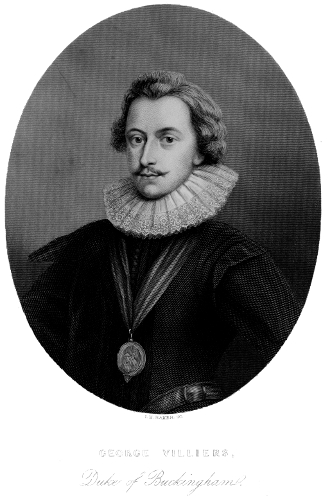
I. H. BAKER, SC. GEORGE VILLIERS, Duke of Buckingham. London: Hurst and Blackett.
I
FROM ORIGINAL AND AUTHENTIC SOURCES.
BY MRS. THOMSON,
AUTHOR OF
“MEMOIRS OF THE COURT OF HENRY THE EIGHTH,”
“LIFE OF SIR WALTER RALEGH,”
“MEMOIRS OF SARAH, DUCHESS OF MARLBOROUGH,”
&c., &c.
IN THREE VOLUMES.
VOL. I.
LONDON:
HURST AND BLACKETT, PUBLISHERS,
SUCCESSORS TO HENRY COLBURN,
13, GREAT MARLBOROUGH STREET.
1860.
The right of Translation is reserved.
PREFACE.
v
No complete life of this favourite of James I. and
Charles I. has hitherto appeared, except the
biographical sketch by Sir Henry Wotton.
That interesting account deserves all credit,
from the character of its author; yet coming
from one who owed Buckingham great obligations,
it is more of a eulogy than a memoir;
and is evidently written with a view to silence
those slanderous attacks which not only pursued
the Duke during his life, but continued after
his death.
The “Disparity between the Earl of Essex
and the Duke of Buckingham,” by Clarendon,
printed, as well as Sir Henry Wotton’s Memoir
in the “Reliquiæ Wottonianæ,” bears, likewise,
the impress of enthusiastic admiration.
It is the tribute of a partisan rather than the
memorial of an historian.
viThe opinions expressed, nevertheless, in both
these works, have been confirmed, in many points,
by the letters in the State Paper Office, to which
historical writers have not only now free access,
but which have lately been arranged, whilst valuable
Calendars have been published, so as to facilitate
investigations which were formerly most laborious.
In all that relates personally to George
Villiers, the State Papers are especially important.
The great Rebellion, amongst mightier devastations,
swept away most of that domestic correspondence
which might otherwise have been found
in the three noble families who are collaterally
descended from Buckingham; those of the Earls
of Jersey and Clarendon, and of his Grace
the Duke of Rutland, none of whom possess
any letters of their unfortunate ancestor.
Nor is this fact to be wondered at, when we
consider not only the stormy period that succeeded
Buckingham’s death, but the extreme
youth of his children at the time of his assassination,
the second marriage of his widow, and the
long years of exile which his heir, George,
the second Duke of Buckingham of the house
of Villiers, passed in wandering and indigence.
The documents in the State Paper Office
become, therefore, doubly valuable, and every
possible advantage has been taken of a mine so
viirich in the present Memoir. It was, indeed,
in 1849, some time before the Calendars by Mrs.
Everett Green, and Mr. Bruce, were published,
that this work was begun. The letters in the
State Paper Office were then merely arranged in
chronological order, and divided into foreign and
domestic. But the valuable advice, the very great
courtesy, and kind assistance of Mr. Lechmere
and Mr. Lemon, enabled the authoress still to
derive great benefit from her researches even at
that time. Her work having been laid aside,
though nearly completed, during a residence of
several years on the Continent, the publication
of the Calendars of State Papers had, meantime,
taken place, and they enabled her, in resuming her
task, to revise such parts of the memoir as had
been written, and to finish the whole with greater
accuracy and fulness of information than could
otherwise have been done, and although the revision
has caused considerable delay and labour,
it has been of incalculable advantage to the
work.
Of the Calendar for 1628-1629, which recently
appeared, edited by Mr. Bruce, the authoress
has not been able to avail herself to the
same extent as of the four former volumes,
since her work was nearly printed before it was
published. She has, therefore, been obliged to
viiiinsert in her Appendix the examination of Ben
Jonson, and one or two other papers which could
not be interwoven with the narrative, although
of great interest. It is satisfactory to her to find
that the contents of this, the latest volume of the
State Paper Calendars, confirm, in some important
points, the views which she has taken of Buckingham’s
motives and intentions. They also exhibit
distinctly the great difficulties of his course; and
more especially in regard to the fatal expedition
to La Rochelle.
The authoress believes that she has discharged
her task as a biographer with impartiality: she confesses,
nevertheless, to a strong interest in the faulty
but attractive character which she has attempted
to delineate. When stating, in her summary of
the Duke’s qualities, that time and trouble were
rendering him a wiser and a better man, she was
ignorant of the following tribute to Buckingham,
written, when all patronage was closed by his
death, by Dudley, Viscount Dorchester, to the
Queen of Bohemia, and printed in the last
volume of the Calendar.
“The Duke declared a purpose to Dorchester
on his (the Viscount’s) last return from the
Queen of Bohemia, which he has since often reiterated,
of making him, by his favour with the
King his master, an instrument of better days
ixthan they have seen of late, he having a firm
resolution (which he manifested to some other
persons) to walk new ways, but upon old
grounds and maxims, both of religion and policy,
finding his own judgment to have been misled
by errors of truth and persuasions of persons
he began better to know; so as knowing
otherwise the nobleness of his nature, and
great parts and vigour, Dorchester had full
satisfaction in him himself, and made no doubt
but the world would have, notwithstanding the
public hatred to which he was exposed. This
testimony Dorchester owes him after his death.”[1]
Of the restoration of the Navy by the strenuous
efforts of the Duke the State Papers present
almost a chronicle. The authoress regrets that she
is not competent to do the subject justice; and
hopes that some abler hand may employ with
more effect the copious materials which will be
found in those documents, of which she has
touched merely on the leading points. Her aim
has been chiefly to shew the energy, the sometime
lofty purposes, of one who has been portrayed
as a merely rapacious, vain, remorseless
oppressor.
The state of the times, the Impeachment, the
xRemonstrance, the Petition of Right, all bear so
strongly on the circumstances of the Duke’s life,
that it would be impossible, in a Memoir of him,
to escape the difficult office of explaining to some
extent the intricate politics of the day. In this
attempt she also has derived her chief materials
from the State Papers. Personal incidents,
trusts, manners, character, literature, the arts, are
subjects in regard to which the annals of this
period are calculated to afford a great amount
of instruction and interest.
The authoress has already expressed her obligations
to Mr. Lechmere and Mr. Lemon; to Mr.
Bruce she also begs to offer her thanks for a suggestion
by which she is enabled to insert an interesting
account of the murder of Buckingham, in a
letter from Lord Dorchester. (See page 112,
vol. iii.)
She begs also to express her sense of the
valuable aid afforded her by her friend, Mr.
Amos, Professor of Law, Downing College, Cambridge,
to whose kindness and great historical
knowledge she is indebted for much that has
facilitated her efforts.
March 1, 1860.
CONTENTS OF VOL. I.
xi
CHAPTER I.
xiiState of England on the Accession of James I. compared with that when Elizabeth began to Reign—The Great Rebellion Attributable to the Misrule of James—Allusion of Lord Clarendon to this Subject—The Luxury of a Favourite Essential to James since the Age of Fourteen—Birth and Origin of George Villiers—His Family little known to Fame until his Elevation—The Sneers thrown upon it by Sir Symonds D’Ewes; and its Claims to Honourable Descent Considered—Sir Henry Wotton’s Testimony—The Family of Villiers long known in the County of Leicester—The Different Spellings of the Name—The Fortunes of the Family in France—Remark of Lord Clarendon upon the Condition of the Villiers Family in England—Also of the Historian Sanderson—Brookesby, the Native Place of George Villiers—His Mother, Mary Beaumont—Her Menial Condition in the Family of Sir George Villiers—His Marriage—The Family by a Former Union—Sir William Villiers—John, Viscount Purbeck—The Children of the Second Marriage: Mary, Countess of Denbigh—Christopher, George—Lady Villiers retires to Goadby—Her Efforts for her Son’s Benefit—His Education, Disposition, and Acquirements—The Slender Means of his Mother—Her Second Marriage to Sir Thomas Compton—George Villiers sent to Paris to complete his Education—State of that Capital in the 17th Century—Villiers returns from Paris, improved, and repairs to his Mother’s House at Goadby
James I., his Disapproval of the Gentry crowding into London—Disgust Entertained by the Old Families to him and his Court—The Clintons, Blounts, Veres, and Willoughby D’Eresbys show it—Character of Sir Thomas Lake—William, Earl of Pembroke, the Early Patron of Villiers—Account of the First Introduction of Villiers to James—Ambitious Views which it Suggested—His Attachment to the Daughter of Sir Roger Ashton—Their Engagement Broken off—Account of the King’s Visit to Cambridge in 1614-15—Some Description of the Courtly Ladies who were present there—The Queen’s Absence—Countess of Arundel—Countess of Somerset—Countess of Salisbury—Lady Howard of Walden—Performance of the Play of “Ignoramus” in Clare Hall—The Design of this Comedy to Ridicule the Common Law—Admiration expressed by the King, during the Performance, of the Personal Appearance of Villiers, who was Present—The Subsequent Representations referred to
xiiiThe Fascination of Villiers’s Character as opposed to the Venality of Somerset—Lord Clarendon’s Opinion—The Friendship of Archbishop Abbot—Character of the Primate—His Affection for Villiers—Anecdote of Villiers when Cup-Bearer. He is befriended by Anne of Denmark—By her means Knighted—Singular Scene in the Queen’s Chamber—Jealousy of Somerset—Ingratitude afterwards shewn by Villiers to Abbot—Abbot commits Manslaughter—Is pardoned by the King—The Incessant Pleasures of the Court—Horse-Racing—Ben Jonson’s “Golden Age Restored”—Allusion in it to Somerset, and to Overbury—An Angry Interview between Villiers and Somerset—Villiers supplants the Favourite—He uses no Unfair Means to do so—Discovery of Somerset’s Guilt by Winwood, who finds Proofs of it in an Old Trunk—Somerset’s Downfall—Bacon’s Letter to Villiers—Villiers continues to Profit by the Delinquencies and Disgrace of Somerset
The King’s Projects—A Journey to Scotland—Obstacles to that Intention—Want of Money—£100,000 raised in the City—Dislike of the People to this Journey, on Account of Expense—James sets out, March 13th, 1616-1617—His Attendant Courtiers, Sir John Zouch, Sir George Goring, Sir John Finett—Characteristics of Each—Surpassing Qualities of Buckingham—Objects of James’s Journey to Edinburgh—Anecdote of Lord Howard of Walden—Disputations at St. Andrews—The King knights many of the Young Courtiers—Offence given at Edinburgh by Laud—A Project to assassinate Buckingham Suspected—James’s Progress Concluded—His Visit to Warwick—Affairs relating to Sir Edward Coke and his Family—Base Conduct of all the Parties Concerned—Meanness of Bacon—His Letters—Frances Hatton—Contrast between her and the Earl of Oxford brought forward by Lady Hatton—Coke restored to Favour—Marriage of Frances Hatton to Lord Purbeck
Buckingham’s Favour Paramount—Change in the King’s Temper—His Poetic Flights—His Reign a Course of Dissipation—The Masques of Ben Jonson—Their Great Beauty—Patronized by the Queen—How Performed—The Vision of Delight—Composed to Celebrate Buckingham’s being made a Marquis—His Appearance at this Era—The Banquet given for this Occasion—Great Extravagance of the Entertainment—Rivals to Buckingham in James’s Favour—Sir Henry Mildmay—Brooke—Young Morrison—The Diversions of the Court—The Meteor that appeared—Foot-Racing—Buckingham’s Profusion—Jealousies between Prince Charles and him
Review of the State of Political Affairs—Dissolution of Parliament—Protest—James tears it out of the Journals of the House of Commons—Acts of Oppression—Case of the Earl of Oxford—of Lord Southampton—Persecution of Sir Edward Coke—The Conduct and Impeachment of Lord Bacon—The Part taken by Buckingham in this Affair—The Abuses of Monopolies—Case of Sir Giles Mompesson—Of Sir Francis Michell—Bacon’s Letters to Parliament—His Illness—The Great Seal taken from Him—James’s Reluctance to act with Vigour—Sheds Tears upon the Occasion—Bacon still protected by Buckingham—Williams, Bishop of Lincoln, is made Chancellor—His Character, by Bishop Goodman
xvThe Spanish Treaty—Negotiations between the Duke of Lerma and Lord Digby—The Infanta described by Lord Digby—Her Great Beauty, Piety, and Sweetness—The Description of her by Toby Matthew—She is disposed to receive Charles’s Addresses—Gondomar—Attentions shown to him in England—Ely House allotted for his Reception—Jealousy of the Protestants at the Favour shown him—First Notion of Charles’s Journey to Spain suggested by Buckingham—His Arguments in Favour of it—Obstacles to the Prince’s Marriage with the Infanta—Buckingham’s Debts and Difficulties—Interview between Gondomar and the Duke of Lennox—Journey of Charles and Buckingham into Spain—They stop in Paris—Louis XIII.—Anne of Austria—Henrietta Maria—They proceed to Madrid—Reception there—Entrance in State into that City—Countess of Philip IV.—Festivities in Honour of the Prince—The King’s Letters to him
STATE OF ENGLAND ON THE ACCESSION OF JAMES I.
COMPARED WITH THAT WHEN ELIZABETH BEGAN TO
REIGN—THE GREAT REBELLION ATTRIBUTABLE TO
THE MISRULE OF JAMES—ALLUSION OF LORD CLARENDON
TO THIS SUBJECT—THE LUXURY OF A
FAVOURITE ESSENTIAL TO JAMES SINCE THE AGE OF
FOURTEEN—BIRTH AND ORIGIN OF GEORGE VILLIERS—HIS
FAMILY LITTLE KNOWN TO FAME UNTIL HIS
ELEVATION—THE SNEERS THROWN UPON IT BY SIR
SYMONDS D’EWES; AND ITS CLAIMS TO HONOURABLE
DESCENT CONSIDERED—SIR HENRY WOTTON’S
TESTIMONY—THE FAMILY OF VILLIERS LONG KNOWN
IN THE COUNTY OF LEICESTER—THE DIFFERENT
SPELLINGS OF THE NAME—THE FORTUNES OF THE
FAMILY IN FRANCE—REMARK OF LORD CLARENDON
UPON THE CONDITION OF THE VILLIERS FAMILY IN
ENGLAND—ALSO OF THE HISTORIAN SANDERSON—BROOKESBYBROOKESBY,
THE NATIVE PLACE OF GEORGE VILLIERS—HIS
MOTHER, MARY BEAUMONT—HER MENIAL
CONDITION IN THE FAMILY OF SIR GEORGE VILLIERS—HIS
MARRIAGE—THE FAMILY BY A FORMER UNION—SIR
WILLIAM VILLIERS—JOHN, VISCOUNT PURBECK—THE
CHILDREN OF THE SECOND MARRIAGE: MARY,
COUNTESS OF DENBIGH, CHRISTOPHER, GEORGE—LADY
VILLIERS RETIRES TO GOADBY—HER EFFORTS
FOR HER SON’S BENEFIT—HIS EDUCATION, DISPOSITION,
AND ACQUIREMENTS—THE SLENDER MEANS OF
HIS MOTHER—HER SECOND MARRIAGE, TO SIR
THOMAS COMPTON—GEORGE VILLIERS SENT TO PARIS
TO COMPLETE HIS EDUCATION—STATE OF THAT CAPITAL
IN THE 17th CENTURY—VILLIERS RETURNS
FROM PARIS, IMPROVED, AND REPAIRS TO HIS
MOTHER’S HOUSE AT GOADBY.
3LIFE AND TIMES OF
GEORGE VILLIERS.
CHAPTER I.
The historians who attribute the calamities of the
Great Rebellion to the misrule of James the First,
under the pernicious influence of his favourites,
draw a lively parallel between the condition of
England at the accession of that monarch and
the state of peril and embarrassment with which
his great predecessor had to contend. Elizabeth,
whose inauguration, long celebrated, after her
death, as a day of jubilee, was regarded as the
commencement of national prosperity, came to
the throne under very adverse circumstances.
The functions of Government were clogged with
debt. The miserable state of the navy required
4a constant vigilance to repel the chance of invasion,
and to drive away pirates by whom the
narrow seas were infested. The revenues of the
Crown were insufficient to maintain its power and
dignity; the country, moreover, was embroiled in
religious dissensions; whilst the authority of the
Queen was lessened by a disputed succession, and
her mind harassed and embittered by the pretensions
of the Dauphin of France to the Crown of
England, in right of his wife, Mary Stuart.
James, on the contrary, began his reign with
every exterior advantage. His claim to the
sovereignty was undoubted; and various causes
had concurred to give great influence to the
Crown. The subservient tributes of respect paid
to its dignity were such as even to astonish the
envoys of despotic France. Elizabeth had been
served and addressed by her subjects on the knee;
James, at all events for a time, continued that
abject custom, which was a type of the prevailing
national sentiment towards royalty. Commerce,
in spite of monopolies, and of the injudicious
interference of the Legislature with wages, was
advancing; leases granted of large tracts of land
had increased the opulence of the country; the
improved prospects of the landholders acted on
the prosperity of the manufacturing classes:
whilst the general welfare was increased by
5emigration; the religious persecutions on the
Continent, driving from foreign towns ingenious
workmen, sent them into England, where they
introduced arts hitherto unknown in this country.
The Constitution, too, had been maintained; and,
with the exception of the court of the Star Chamber,
over which James presided in person, the principles
of liberty had not been materially invaded.
There was no standing army; the tenets of Protestantism
were established; and the Presbyterian
education of the King afforded a hope that certain
traces of the faith which had been renounced
would die away, and that ceremonials which were
objectionable to many would be speedily discontinued.
Thus, the first of the Stuart Kings
enjoyed blessings not possessed by any of his
predecessors; and, ascending the throne, opened
a new era in the history of the country.[2]
James, nevertheless, was not long in showing
how fallacious were all expectations founded on
his good sense, and on the supposed liberal views
which a people, now intelligent and prosperous,
fondly anticipated in their ruler. Educated by
Buchanan as if he had been destined for the
Tutor of a College rather than for a King; his
memory crammed; his capacity clogged with ill-digested
learning; prejudiced as a Scotchman, yet
6prejudiced against the established church of his
native country, James well merited the sneering
appellation of Henry IV. of France, who called
him “Captain of Wits and Clerk of Arms,”[3]
and proved, too lamentably, how easy it is
by wrong-headedness to embroil and debase a
country.
The blunders which James committed in his
civil government began before the subject of this
memoir was introduced to royal notice; yet,
since George Villiers, first Duke of Buckingham,
figured prominently in that period which is supposed
to have been the commencement of decay,
the origin of the Great Rebellion has been
attributed to his maladministration, nor has the
grave responsibility been absolutely disavowed,
even by Lord Clarendon, the apologist and admirer
of the Duke of Buckingham.
“I am not,” writes Lord Clarendon, “so sharp-sighted
as those who have discerned the Rebellion
contriving from (if not before) the death of
Queen Elizabeth, and fomented by several Princes
and great Ministers of State in Christendom to
the time it broke out; neither do I look back so
far, because I believe the design to have been so
long since formed, but that, by viewing the tempers,
dispositions, and habits at that time of the
7Court and country, we may discern the minds of
men prepared, of some to act, and of others to
suffer all that has since happened.”[4]
Whatsoever may have been the faults of James
the First, it is probable that they would not
essentially have affected the well-being of his son,
had not the system of favouritism, which was one
of James’s greatest weaknesses, acted upon the
character of the young Prince, whose earliest
associations were stamped with devotion to Buckingham.
At once minister, minion, and master,
the power behind the throne, to whose dictation,
during the years of his brief and bright career,
even the High Court of Parliament submitted—the
distinction of being the last royal favourite
in England is due to this ill-fated man. By him
the “sluice of honour,” as an old writer expresses
it, “was opened and closed at pleasure.” He was
to King James a sort of “Parhelion,”[5] at whose
course foreign Courts wondered, whilst the sagacious
and prophetic at home trembled as they
beheld at once its eccentricity and its splendour.
At his death the experiment, which had been
tried once too often, was abandoned, never to
be renewed; and no acknowledged successor
in the meteoric career of Buckingham ever
8appeared before the dazzled gaze of our countrymen.
The minutest circumstances relative to
his origin are interesting, not only as they
concern one whose noble bearing and powers of
fascination almost effaced, during his life, the
remembrance of his errors, but as they unfold the
foundation of a great family which still influences
our national councils.
Until the elevation of George Villiers from low
estate to an unparalleled career of success, the
race from which he sprang, though ancient and
honourable, was but partially known to fame, and
his ancestors, how valiant and loyal soever they
had proved, had held the tenor of their way with
little variation, and with only an occasional gleam
of celebrity on one or other of its lineage; a
course of moderate prosperity maintaining, without
altering, its condition—rather, as Sir Henry
Wotton has well expressed it, “without obscurity
than with any great lustre.”[6] “I will, however,”
adds the same quaint writer, after referring to the
difficulty of making a proper estimate of all public
characters, “show, therefore, as evenly as I can,
and deduce him from his cradle through the deep
and lubrick waves of State and Court till he be
swallowed in the Gulf of Fatality.”[7]
9It was the fashion of those who were opposed
to the Duke of Buckingham in his political career
to speak with contempt of his origin, and thus
attack one who was endowed with every possible
advantage of natural gifts—and upon whom
honours were lavished—on what was erroneously
supposed to be his vulnerable point. Sir Symonds
D’Ewes, as might be expected, was not backward
in his strictures against a courtier so favoured
and envied. He compares Villiers, indeed, to a
man of the highest rank, but draws the parallel
in these offensive terms:—“He was likest to Henry
Loraine, Duke of Guise, in the most of the later
passages of his life and death, that possible could
be, onelie in this they differed, that Guise was
a prince born, but Buckingham was but a younger
son of an ordinarie familie of gentrie, of which the
coat armoure was so meane as either in this age
or of late years, without any ground, right, or
authoritie, that I could see, they deferred their
owne coate armoure, and bare the arms of Weyland,
a Suffolke family, being argent on a cross
gules, five escalops, &c.”[8] And again, when
speaking of Felton, the assassin of the Duke, Sir
Simond cannot forbear remarking:—“His familie
was, doubtless, more noble and ancient than the
10Duke of Buckingham’s, and his ende much
blesseder.”[9] To similar strictures does Wotton
probably refer, when he remarks that, in “a
wilde pamphlet” published about the Duke of
Buckingham, the writers, “beside other pityfule
malignities, would scant allow him to be a gentleman.”
It is far easier to make a charge of this nature
than to maintain it, for the family of Villiers had
long been known in the County of Leicester,
where it removed from Kinalton, in Nottinghamshire,
the first place of migration from Normandy;
where, writes Sir Henry Wotton, “it had been
long seated.” It does not appear that Leicestershire
was the only place of residence which the
ancestors of George Villiers possessed; as the
same authority expresses it, they “chiefly continued”
in that county for the space of four hundred
years before the birth of the first Duke of
Buckingham;[10] a time long enough, one might
suppose, to satisfy a reasonable genealogist.
The name of Villiers, conformably to the arbitrary
spelling of ancient times, was written differently,
sometimes Villiers, at others Villers,
Villeres, and Vyleres; nor did those who bore
this famous surname finally adopt the spelling
“Villiers” until the reign of James I.
11The founder of the family, Philip de Villers, of
Lisle Adam, was a Norman Seigneur; he was
also Grand Master of the Island of Rhodes, and
signalized himself in the defence of that island
against the Turks. After the conquest, certain
lands in Leicestershire were granted by William
the Conqueror to a Norman Knight hearing
the appellation De Villers; but another branch
of the same race remained in France, and its
various members have been distinguished in
courts, in arms, and as legislators. Argiver
de Villers was sewer[11] to Philip the First;
Pierre de Villers held the office of Grand Master
in his native country, under Charles the Sixth.[12]
Invention was therefore not requisite to dignify
the long unbroken line of respectable progenitors
to whom George Villiers owed his origin.
“Heraldry,” remarks a certain writer, when
referring to this celebrated man, “might blazon
as large fields of his pedigree as might concern
any subject to prove.”[13] Without bringing that
assertion to the test, it is sufficient to add that
successive generations flourished and passed away,
sometimes emerging from their seclusion to follow
12the reigning monarch to the wars, as in the
instances of Sir Alexander de Villers, and Sir
Nicholas his son, the former assisting Edward the
First in the Crusades, and adding to his name the
designation of “BrookesbyBrookesby;” and the latter, after
sundry exploits in the Holy Land, augmenting
his armorial bearings by the Cross of St. George
and five escalop shells, ancient badges of the
Crusaders; so that the “coat armour,” esteemed
so mean by Sir Symonds D’Ewes, and said to
have been borrowed, was not without its distinctions,
even at an early period.
But it is singular that from a personage of
lowly fortunes, if not of humble family, sprang
the generation which was so noted in its time.
At BrookesbyBrookesby, the manorial residence of the
race, there had dwelt, for several centuries, successive
proprietors, little remarkable, since the time
of the valiant Crusaders, either for their career in
arms, or for their ambition to rise in the State. A
stream, dignified by the name of the River Wreke,
flows near the house, which is said to have been
the residence of the Villiers family; a gentleman’s
seat, a plain and somewhat insignificant building,
having a central division, and two projecting
wings, now owns the name of BrookesbyBrookesby.[14]
13The town of BrookesbyBrookesby has, of late years, been
returned as a decayed town; but its church is
worthy of note in a county which, as Fuller
remarks, “affordeth no cathedrals, and as for the
parish churches, they may take the eye, but not
ravish the admiration of the beholder.” This
structure, dedicated to St. Michael, boasts a handsome
tower, above which rises a small spire, well
crocheted; the battlements of the tower are remarkably
beautiful, being open worked, and embellished
with a row of shields, of which the
most conspicuous is that of George Villiers, first
Duke of Buckingham, and of his Duchess, and on
it there is an honorary augmentation, showing
the descent which he claimed from the blood
royal of Edward the Fourth.[15] It seems as if,
amid the decay which surrounds it, this church
has remained as a witness of the former greatness of
that now extinct branch of the Villiers family,
whose glories emblazon its battlements and windows.
The direct line of the favourite of James
the First ceased in two generations after his proud
and brief career.
From the retirement of BrookesbyBrookesby, one of its
owners was summoned, during a royal progress,
to the presence of Queen Elizabeth. This was
Sir George Villiers, the father of the Duke of
14Buckingham, who was consequently knighted,
when High Sheriff for Leicestershire,[16] by the
Queen. Sir George married the daughter of
William Sanders, of Harrington, in the County of
Northampton, and had by that marriage two sons,
William, who inherited Brokesby and became a
baronet; and Edward, afterwards President of
Munster, and the ancestor of the present Earl of
Jersey.
Three daughters were also the issue of this
marriage; Elizabeth, who married Lord Butler,
of Bramfield; Anne, who married William Washington,
of Pakington, County of Leicester; and
Frances, unmarried.[17] Their mother died, and
Sir George, perhaps imprudently, for his estate
was not considerable, formed a second union.
Some circumstances rendered this step, indeed,
peculiarly indiscreet; and nothing could account
for so rash an act in a man of grave years, but an
infatuation produced by extraordinary personal
gifts, and probably by some ability and management
on the part of his second wife.
It is evident that the Knight had never contemplated
the probability of such an event, for
he settled the greater portion of his estates
15upon his first wife and her children; and a mere
pittance remained for the issue of any second
marriage. Yet, in spite of these considerations,
Sir George Villiers was captivated by a handsome
person, the attractions of which appear not to
have been wholly lost upon him even during the
lifetime of the first Lady Villiers.
It happened that among the inferior servants
of his household, there lived a young woman,
named Mary Beaumont, the indigent member of
an ancient family,[18] by some asserted to have
been that of the Beaumonts of Cole-Orton, in
Leicestershire, by others, to have been settled at
Glenfield, in the same county.
The occupation of Mary Beaumont is stated to
have been that of a “kitchen-maid” in the house
of Sir George Villiers, but this assertion may
possibly be traced to the desire of a certain
class of writers to debase as much as possible
the family of Villiers.
That she was, however, in a menial capacity of
some kind, appears from common report to have
been understood.[19] “Her ragged habit,” observes
16a contemporary historian, “could not shade the
beautiful and excellent frame of her person, which
Sir George, taking notice of, prevailed with his
lady to remove her out of the kitchen into her
chamber, which, with much importunity on Sir
George’s part, and unwillingness of my lady, at
last was done.”
After the death of his wife, the sentiments of
the widower were expressed without reserve. He
was observed “to look very sweet upon my lady’s
woman;” he was known to bestow upon her twenty
pounds, to purchase as good a dress as that sum
would procure; and when he saw her attired in
a manner suitable to her age and loveliness, he
was transported with admiration. The result
may easily be conceived; the knight married the
serving-maid, and as ambitious a spirit as ever
stimulated the energies of woman thus received
its first gratification. Endowed by nature with
such profuse outward gifts, Mary Beaumont possessed,
no less, the advantages of a shrewd sense;
she was fond, as her subsequent career showed, of
state and profusion; she became, from her influence
17and her attractions, the leader of the highest
circles; whilst she retained over the mind of her
son that sway which she deservedly acquired by
her care of his infancy and childhood.
In after times, it is curious to find Mary Beaumont,
then Lady Villiers Compton, inviting her
country kindred to Court, and providing a place
for them to learn to carry themselves in a “Court-like
manner.” It was the lowly serving-maid who
first introduced what were called Country Dances
instead of French dances, which her provincial
relations could not learn soon enough for their
deportment to assimilate with the costly garments
with which their prodigal kinswoman supplied
them, in order that they might do her credit in
the gay spheres to which they were introduced.[20]
Three sons and a daughter were the offspring
of this marriage; the eldest, John,
afterwards created Baron Villiers, of Stoke, and
Viscount Purbeek, was singularly infelicitous
in his domestic life, but is said, by an historian
adverse to the family, to have “exceeded them all
in wit and honesty, and, by his influence, to have
kept his brother George in some bounds of modesty,
whilst he lived with him, by speaking
plain English to him.”[21]
18The next child of the second marriage was
George Villiers, who was born at Brookesby, on
the 20th of August in the year 1592.[22] Another
son, Christopher, became eventually Baron Daventry,
and Earl of Anglesea; a daughter, Mary, afterwards
Countess of Denbigh, was also born, to encumber,
as it seemed, the limited means with which
the parents of this younger race were scarcely able
to endow them.
On the fourth of January, 1605-61605-6, Sir George
Villiers died. His landed property consisted at
that time of the Manors of Brookesby, Howby,
Godby Marward, and the Grange of Goadby.
These were all settled on the children of his first
marriage. He was also lay improprietor of the
tithes of herbage and hay, in the parishes of
Cadewell and Wikeham, and these, he settled on the
three sons of Mary Beaumont, John, George and
Christopher;[23] his daughter appears to have been
left wholly portionless. When it is remembered
that this family were all raised to rank and opulence,
and that they were, in various instances, the
sources from which the ancestry of several great
houses is derived, the early privation and difficulties
19of their career form a strong contrast to their
subsequent elevation.
It was not alone poverty that seemed likely to
keep the younger children of Sir George Villiers
in obscurity; there were wanting in his father’s
heir those qualities which bring the humble
forward, and enrich more than even prudence and
frugality. Sir William, who now took possession
of Brookesby, was contented with his country
lot; and so much did he despise honours and
titles, that when he was created a Baronet in
1619,[24] the dignity was almost forced upon him.
“He was,” says a contemporary author, “so careless
of honour in courting that compliment, as that
the King (James First) said, ‘Sir William would
scarce give him thanks for it, and doubted whether
he would accept of it.’” Thus, little assistance in
the career of life could be expected from one who
would scarcely deem the prizes most sought for
by men, worth the trouble of a little personal
exertion.
Upon the death of her husband, Lady Villiers
retired to Godby Marward, which was appropriated
to her as a dower house. Her son,
20George, was then ten years old; the loss which
he had sustained in the death of his father, great
as it seemed, was fully compensated by the care
of her whom Sir Henry Wotton entitles “his
beautiful and provident mother.” The promising
boy had already received some education at
Billesdon, in Leicestershire, where he was sent
to school, and instructed in music and in some
“slight literature;” but to no common hands
would Lady Villiers, as the dawning personal
charms of her son unfolded, entrust the culture of
this, her favourite child; she had him, henceforth,
as his biographer expresses it, “in her especial
care.”[25] Possibly, in her widowed seclusion, when
she looked upon the face which afterwards captivated
all beholders, she anticipated the day
when her son should appear at Court, and
attract some marks of that royal favour which
had been shewn to Leicester, to Raleigh, and to
Essex for no better reason than that they were
handsomer and more graceful than their compeers,
and that their manly beauty was set off by the
gallant bearing of well-trained “carpet knights.”
Queen Elizabeth had taught her subjects to value
those attributes which had sunk so low in fashion
and estimation in the troublous reign of Mary,
21or during the short and saintly career of
Edward.
Lady Villiers had the discernment to perceive
the deficiencies of her son’s mind and character,
and resolved to avail herself of those advantages
with which he was endowed, without forcing his
attention to pursuits that were ungenial to him.
She soon discovered that he was neither inclined
to reflection, nor disposed to study; nor did he
ever alter in those respects, but continued, through
life, illiterate, a defect which his readiness in
some measure supplied, but which prevented
his becoming a great statesman, in spite of the fairest
opportunities that ever man enjoyed. In after life
he learned, when at Court, “to sift and question
well,”[26] and to supply his own shallow stock of information
by “drawing or flowing unto him” the
best sources of experience and knowledge in others.
His manner, says Sir Henry Wotton, was so
sweet and attractive, “in seeking what might be
for the public or his own proper use, that if
the Muses favoured him not, the Graces were
his friends;” and Lord Clarendon remarks of
Villiers, that “concerning the traits and endowments
of his mind, if the consideration of
learning extend itself not further than drudgery
22in books, the Duke’s employment forbids us to
suspect him of being any great scholar; but if a
nimble and fluent expression and delivery of his
mind (and his discourse was of all subjects) in a
natural and proper dialect be considered, he was
well lettered.”[27]
Lady Villiers seems both to have foreseen all these
defects, and to have prognosticated the atoning
graces in her son. She acted as a needy and
ambitious woman was likely to act. Instead of
supplying the deficiencies of her son’s character
and intellect by a sound education, she directed
his attention to dancing, fencing, and the other
exercises, styled by Lord Clarendon “the conservative
qualities and ornaments of youth.”youth.”[28]
And in these pursuits so rapid a progress was
made, that the tutors of all the three brothers
were obliged to restrain the progress of George
Villiers in order that their other pupils should not
be disheartened by his proficiency. Meantime,
his expanding beauty of form and face seemed to his
proud mother to render her son worthy of a higher
culture than that which she could bestow upon him
at Godby. Her jointure was very small, and although
23Godby, where she resided, was a suitable
abode for the widow of Sir George Villiers, the
Manor House being large enough to receive James
the First and his retinue during a royal progress, yet
her poverty obliged her to live in great retirement.
A rigid economy must have been necessary to
regulate its household. Lady Villiers had only
two hundred a-year, both for herself and her family,
and that income was to cease at her death, when
her orphan children would have but a pittance
besides their beauty and their talents.[29] Impelled,
as it is hinted by several historians, by a desire to
benefit her children, the widowed lady, still young
and fair, resolved to marry again. Sir Thomas
Marquin was first the object of her choice, and
after his death, she bestowed her hand upon Sir
Thomas Compton, Knight of the Bath, and
brother of Lord Compton, First Earl of Northampton,
whose marriage with the daughter of Sir
John Spencer, Lord Mayor of London, and commonly
called “rich Spencer,” had brought an
increase of honour and influence to his family.
This union was the more important to Lady
Villiers and her children, because their half-brothers
and sisters looked upon them with no
good will, and were little disposed to further their
interests.
24It was at that time the custom to send our
young nobility, and even their inferiors, to France
to complete their education. Lady Villiers
resolved to afford her son George this advantage.
She selected him from her other children partly
from partiality, for it is expressly stated that “he
who was debarred from his father’s estate was
happy in his mother’s love;”[30] and partly on
account of his singular beauty of person. He is
said, indeed, to have had, when he reached man’s
estate, “no blemish from head to foot,” save that his
eyebrows are stated to have been somewhat over pendulous,
a defect which some of his admirers thought
to be redeemed by the uncommon brilliancy of the
eyes which flashed beneath them.[31] The Earl of
Essex, to whom Villiers is compared, was taller,
and of an “abler body” than the favourite of
James I. But Villiers had the “neater limbs and
freer delivery, he carried his well-proportioned body
well, and every movement was graceful.” Nor does
Lord Clarendon, who thus describes him, think it
beneath the dignity of his subject to remark that
Villiers “exceeded in the daintiness of his leg and
foot,” whilst Essex was celebrated for his hands,
which, says his panegyrist, though it be but feminine
25praise, “he took from his father.”[32] The complexion
of George Villiers was singularly clear and beautiful,
his forehead high and smooth, his eyes dark and
full of intelligence and sweetness, whilst the perfect
oval of his face, and delicate turn of features, fine,
yet noble, and the air of refinement which characterised
both his countenance and his bearing,
rendered him one of the most attractive of human
beings. As he attained to maturity, a peculiar
courtesy of manner, a frankness and merriment
which diverged at times into a total forgetfulness
of forms, a power of throwing off the appearance
of all oppressing business and secret cares, although
of these he had his share, and of assuming “a very
pleasant and vacant face,” a love of social life, and
certain traits of character, half folly, half romance,
won upon everyone that approached him before
prosperity had changed courtesy into arrogance, or
political intrigues marred the open expression of a
physiognomy on which none could look without
admiration.
The youth, whose promise, even at a very early
age, augured the results which I have anticipated,
reached Paris after the death of Henry IV.[33]
It was probably in the autumn that Villiers repaired
26to the Continent, since it is expressly stated
that he was eighteen when he undertook that
journey, and he had not attained that age until
August, 1610. It seems, therefore, likely that
Villiers beheld France under a strange aspect, that
of a universal state of despair. Protestants and
Catholics were alike overwhelmed by the recent
calamity; the former might well dread a fresh massacre,
but the grief of their Roman Catholic fellow-countrymen
dispelled that apprehension. The excess
of lamentation, expressed somewhat theatrically—the
cries of widows and orphans in the streets—the
sight of women rushing through the mourners at
the funeral, screaming—the orations, interrupted by
sobs, in which the virtues of the deceased monarch
were panegyrized—these must have ceased before
Villiers visited Paris; but the Huguenots still
sheltered themselves in the Arsenal, where the
great Sully mourned his royal master and friend.[34]
In Paris, Villiers remained three years, prosecuting
27his studies, which consisted of French,
and the practice of polite and martial exercises.
His education tended, indeed, to increase his failings,
to heighten his taste for display and love of
pleasure, and to weaken his reasoning faculties. He
had, according to the acknowledgment of his great
partisan, Sir Henry Wotton, “little grammatical
foundation;” and French appears to have
been the only foreign language that he ever acquired;
nevertheless, it is remarkable what application
to business he evinced during the last few years of
his life; his punctuality in correspondence, and the
clear and simple style of his letters, prove how easily
his mind might have been trained to higher pursuits
than those on which his mother, worldly, but not
wise, based her expectations of his future fortunes.
Paris, which Villiers was destined twice to revisit
under circumstances very dissimilar to those
of his first residence there, was then the resort of
foreigners. The youth, who had emerged from
the quiet haunts of Goadby Grange, took his
first lessons in life in the city which Howell, in
his familiar letters, styles, the “huge magazine of
men.” “Its buildings,” says that writer, “were
indifferently fair; its streets as foul during all the
four seasons of the year; a perpetual current of
coaches, carts, and horses encumbering them,
narrow and dirty as they were, and were sometimes
28so entangled that it was an hour or more
before they could proceed. In such a stop,” as
Howell terms it, “was Ravaillac‘sRavaillac‘s fatal opportunity
afforded, and the great Henry slain.”[35]
The plague[36] settled perpetually in one corner or
another of Paris, but Villiers escaped that risk;
he returned, apparently exempt from foreign vices,
unscathed by a more fearful contagion than the
plague; at least, thus may we infer from the assertion
of Sir Henry Wotton. “He came home,”
says that writer, “in his natural plight, without
affected forms, the ordinary disease of travellers.”[37]
It may reasonably be presumed that the young
man who retains his simplicity of deportment, still
possesses a corresponding integrity of character.
Villiers was now twenty-one years old; his
accomplishments may shortly be summed up: he
was an excellent fencer, an incomparable dancer,
29he understood the arrangement of costume and
the art of dressing well, but those valuable acquirements
lay dormant in one who possessed no wardrobe,
for he went to France poor, and his family
had not been enriched during his absence. Villiers
was, in addition to these graces, a perfectly well-bred
man. Lord Clarendon describes him to
have been “a fair-spoken gentleman, of a sweet
and accostable nature.” At present, his constitution,
which afterwards gave way beneath the
pressure of business, or in consequence of the
excitements of his dazzling career, was in full
vigour. Such was the youth who now returned
to gratify his mother’s ambitious hopes, by that
career to which the efforts of the young aristocracy
of England were then chiefly directed. It may be
here remarked as singular, that Villiers was trained
to no specific profession; he had not been initiated
into those elements of learning necessary to
qualify him for the church or the bar; he had not
served in the army; but was, in fact, literally
brought up to follow his fortunes at the Court of
James the First. It appears to those in modern
times a bold speculation, but the character of the
monarch upon whose peculiarities it was based accounts
for the scheme, apparently so chimerical, of
qualifying a son for nothing better than to depend
merely upon the chances of an hour, for, had
30opportunity been wanting, the graces and accomplishments
of George Villiers might have been
for ever concealed, or disregarded.
But it is not improbable that Lady Villiers, especially
after her second marriage, had certain dependence
upon the exertions of personal friends,
through whose agency she trusted to advance her
son’s interests at Court. From them, too, she
probably learned that the disgrace of Somerset
was at hand.
When Villiers returned to England, he found no
better prospect before him than to pass some time
at Goadby, under the “wing and counsel of his
mother.”[38] In this retreat, he had leisure to study
the temper of the times, and to view from afar the
characteristics of that sphere for which he was
destined.
It appears to have been the fashion of the day
to rush to London, and to desert those country
seats to which James the First and his son
Charles endeavoured by proclamations and harangues
to restrain the gentry. The innovation
was severely reproved by James in the summer
of 1616, when he made that memorable speech in
the Star Chamber, in which he censured the custom,
attributing it, of course, to the wives and
daughters of the offenders. “Thus,” remarked
31James, “do they neglect the country hospitality,
and cumber the city.” He next complained of the
new and sumptuous buildings in the metropolis,
of the coaches, lacqueys, and fine clothes in which
the higher classes indulged, comparing them to
“Frenchmen,” or, as if that were not harsh
enough, declaring that they “lived miserably in
their houses, like Italians, becoming apes to other
nations.” Finally, he proposed to remedy these
evils by an edict of the Star Chamber.
CHAPTER II.
33
JAMES I., HIS DISAPPROVAL OF THE GENTRY CROWDING
INTO LONDON—DISGUST ENTERTAINED BY THE OLD
FAMILIES TO HIM AND HIS COURT—THE CLINTONS,
BLOUNTS, VERES, AND WILLOUGHBY D’ERESBYS
SHOW IT—CHARACTER OF SIR THOMAS LAKE—WILLIAM,
EARL OF PEMBROKE, THE EARLY PATRON
OF VILLIERS—ACCOUNT OF THE FIRST INTRODUCTION
OF VILLIERS TO JAMES—AMBITIOUS VIEWS WHICH
IT SUGGESTED—HIS ATTACHMENT TO THE DAUGHTER
OF SIR ROGER ASHTON—THEIR ENGAGEMENT BROKEN
OFF—ACCOUNT OF THE KING’S VISIT TO CAMBRIDGE
IN 1614-15—SOME DESCRIPTION OF THE COURTLY
LADIES WHO WERE PRESENT THERE—THE QUEEN’S
ABSENCE—COUNTESS OF ARUNDEL—COUNTESS OF
SOMERSET—COUNTESS OF SALISBURY—LADY HOWARD
OF WALDEN—PERFORMANCE OF THE PLAY OF “IGNORAMUS”
IN CLARE HALL—THE DESIGN OF THIS
COMEDY TO RIDICULE THE COMMON LAW—ADMIRATION
EXPRESSED BY THE KING, DURING THE PERFORMANCE,
OF THE PERSONAL APPEARANCE OF
VILLIERS, WHO WAS PRESENT—THE SUBSEQUENT
REPRESENTATIONS REFERRED TO.
35CHAPTER II.
It might be presumed, from this harangue,
that never had the Court of James been so
magnificent, nor such a throng of the high-born
and the opulent clustered in the metropolis as
at that time. But the fact was that whilst
obscure country gentlemen brought thither their
families, the old nobility fled from a court
which cherished Somerset and proscribed
Raleigh, and where all the real business of
the King’s life consisted in expedients to raise
money in order to support an expenditure from
which he derived no dignity. The great and
gallant representatives of the Houses of Clinton,
Blount, and Willoughby D’Eresby sought in continental
countries the meed of honour which was
36denied them in the service of their own country
by the pacific temper of the King.[39] The Tower
entombed some of the noblest spirits. There still
languished the Earl of Northumberland and the
Earl of Wilton; the one beloved, nevertheless,
by Henry Prince of Wales, though suspected of
being concerned with his kinsman Percy in the
Gunpowder Plot; the other a “very hopeful gentleman
blasted in the bud,” who had been imprisoned
since the Raleigh plot. Others prosecuted schemes
of discovery; West, Earl of Delawarr, in Virginia,
attempted to second Raleigh, and contenting
himself with that return and inward
satisfaction which a good mind feels in its own
consciousness of virtue, died in the undertaking.
Others, such as the Earl of Arundel, could not
tolerate the vulgar revels, the tasteless prodigality
of the Court of James; that nobleman confined
himself, therefore, to the splendours of his stately
home, for his soul was not that of a patriot, nor
had he, says Lord Clarendon, “any other affection
for the nation or kingdom than as he has
a home in it, in which, like the great Leviathan,
he might disport himself.”[40]
Room and opportunity there were, therefore,
37for fresh aspirants to compete for royal favour;
nevertheless the Earl of Somerset still reigned
pre-eminent, and had then been recently promoted
to the highest office about the King’s
person, that of Lord Chamberlain. The reason
assigned for this new display of partiality was
also such as to prove that Somerset was firmly
planted in his sovereign’s favour. He succeeded
in the high office the Earl of Salisbury, who, as
James expressed it, was wont to entertain his royal
master with “epigrams, discourses, and learned
epistles, and other such nicks and devices.”
These, the King observed, would pay no debts,
and he therefore selected in Somerset, he said,
a “plain and honest gentleman, who, if he committed
a fault, had not rhetoric enough to excuse
it.”[41] It seemed therefore very improbable that
Villiers should ever hope to rival one who was so
rooted in the King’s regard as the Earl of Somerset,
but events which no human foresight could
have anticipated worked for him in the dark secrecy
of a woman’s guilty career.
Mature years, precipitated into old age by
disease and infirmities, had brought no increase to
James of that practical wisdom which regulates a
Court as well as a family. His imputed wisdom,
38which was so over panegyrized in his own time,
and which has been too much depreciated in ours,
consisted in shrewd and sensible general notions,
which he never seems to have applied to his
private benefit.
So that, though the favour of Somerset, when
George Villiers returned from France, was in its
decline, the King could not be deterred from
seeking a new object for his partiality. He might
indeed have learned a lesson which should have
taught him that he had disgusted the nation and
lowered himself by his system of favouritism, yet,
after recovering from the perils and vexations
of the infamous business which ruined Carr, he
had not a notion that it would be wise to profit
by experience, and was ready to commence a new
career of folly, and to sacrifice all the slender portion
of dignity that remained to him—a dignity
which consisted chiefly in the general confidence
of his subjects towards him—by adopting any new
object that might chance to cross his path.
It was during the year of inaction which Villiers
passed at Goadby, that he became acquainted
with the family of Sir Roger Aston. This knight
was the father of four daughters, for one of whom
Villiers, in the quiet hours of his country life,
conceived an attachment. One might, on a first
view of this incident, wonder at the want of caution
39in Lady Villiers, in detaining her son at
Goadby, there to shackle his future course by an
early, and, apparently, unprofitable engagement;
but she was not acting, it appears, inconsistently
with her schemes of future advancement, when
she permitted the intimacy which produced this
result. Sir Roger Aston was, it is true, only the
base-born son of John Aston, of Aston, in
Cheshire;[42] he could, therefore, derive no lustre
from that ancient family; he had held formerly
the office of barber to King James when in Scotland,
where Sir Roger was chiefly educated.[43] He
was, in time, made a groom of the royal
chamber, and further promoted to be master of
the wardrobe, and, however humble his birth and
education may have been, became a person of no
inconsiderable influence at Court. During the
last twenty years of Elizabeth’s reign, he was the
continual correspondent of Cecil, whom he supplied
with details of all that transpired in Scotland.
The powerful minister was not, it appears,
ashamed to owe much important information to
the former barber, and, fortunately for those who
rested upon the good offices of Aston, he is reported
to have been a “very honest, plain-dealing
40man, no dissembler, neither did he do any ill office
to any man.”[44]
In addition to these acquired advantages, Sir
Roger was enabled to provide his daughters with
portions. It may, therefore, be inferred that Lady
Villiers—who could never have foreseen that her
son would have claimed the hand of an heiress of
ducal line, nor have anticipated that those attractions,
of which she could but partially calculate the
value, should captivate in after times even a royal
mistress—approved of the growing affection which
sprang up amid the rural scenes of Goadby. It
was permitted, indeed, at first, by both the
parents, whose interests were concerned in it, and
it seems, on the part of the lady, to have been a
fervent and disinterested sentiment. But the
question of a settlement intervened: Villiers,
in consideration of a handsome dower, to which
the young damsel was entitled, was required to
settle upon her the moderate sum of eighty pounds
a-year. The arrangement was impracticable, for
all his fortune at that time, and even after he had
appeared for some time at Court, amounted to
only fifty or sixty pounds annually.[45]
Some opposition to the engagement originated,
therefore, with the friends of the young lady,
41though she, passionately enamoured, was at first
fixed in her choice, and firm to her professions of
affection. “The gentlewoman,” says Sir Anthony
Weldon, “loved him so well as, could all his
friends have made for her great fortune but a
hundred marks jointure, she had married him
presently, in despite of all her friends, and, no
question, would have had him without any fortune
at all.” But whilst the affair was under consideration,
or probably when it was partially
concluded, but was still cherished in the minds of the
parties most concerned in it, a circumstance
occurred which diverted the hopes of Villiers into
another direction; a new stimulus was given to the
energies of his nature, and ambition, as it is
known to have done before, proved mightier than
love.
It was at a horse-race in Cambridgeshire that
Villiers first attracted the attention of the King.
The poverty of the young man was then such that
even on this notable occasion, when the sovereign,
on his annual progress, was expected, and at a
time when the costliness, or, as it was well styled,
the “bravery” of dress was at its height, he could
not afford any new attire. An “old black suit,
broken out in divers places,” was, as Sir Symonds
D’Ewes asserts,[46] the garment in which his narrow
42means constrained him to appear amid the gay
courtiers who composed the royal train.
As if this were not a sufficient mortification,
other inconveniences arose. The race had taken
place near Linton, and most of the company slept
at that town. There was no room in the lodgings
of the inn for the ill-dressed youth in the old
black suit, “and he was obliged,” adds the same
writer, “and even glad, to lie on a truckle bed in
a gentleman’s chamber, of mean quality, also, at
that time, from whose own mouth I heard this
relation, who was himself an eye-witness of it.”[47]
According to another account, it was at Apthorpe,
whither King James, in the month of
August, 1614, had sent his dogs, that the monarch
was so struck by the appearance and deportment
of Villiers, that he resolved to mould him, as it
were “platonically, to his own idea.”[48] The impression
produced upon the King was publicly
observed by attendants and courtiers, and the
success of Villiers was decided. About this time,
indeed, Villiers formed an acquaintance upon
whose counsels he acted, so as to take the tide
of fortune at its height.
43Villiers into the English Court,[49] and there was,
perhaps, not one of the subordinate personages
better calculated to guide, in that sphere, the first
steps of an inexperienced youth than Lake. Patronized
originally by Sir Francis Walsingham,
and by him recommended to the service of Queen
Elizabeth, he had acted as Secretary for the
French and Latin tongue to his Royal mistress,
and acquired, from his accurate and rapid writing,
the name of “Swiftsure.” In the Court of
Elizabeth, where none but men of ability flourished,
he had received his political education. He had
enjoyed the Queen’s confidence, and was reading
to her in French and Latin at the very moment
when the Countess of Warwick told him that the
Queen had expired. James made him a Privy
Counsellor, and afterwards appointed him one of
his Secretaries of State.[50] Lake eventually fell
into disgrace, not from his own fault, but owing
to the unfortunate marriage of his eldest daughter
to the Lord de RoosRoos, son of the Earl of Exeter,
and to the subsequent enmity of the Cecils. But
at the time when Villiers owed his first introduction
to him, Lake was in the height of his influence,
and James, even after his downfall,
accorded to him the praise that “he was a Minister
44of State fit to serve any greater prince in
Europe.”[51]
Under such auspices, Villiers secured the best
introduction to the world that can be obtained—that
afforded by individuals whose high rank was
upheld in public estimation by their personal influence;
and it augurs well of the views which
were at that time entertained of his character, and
of the terms on which it was desired to place him
with the King, that those who were real lovers of
their country, and patrons of its best interests,
should have presented him to their sovereign.
Lucy Harrington, Countess of Bedford, “led
him,” says Fuller, “by the one hand, and William,
Earl of Pembroke, by the other.”
Few women shone in the giddy revels of the
Court with a purer lustre than the Countess of
Bedford; her virtues and accomplishments may
have been exaggerated by grateful poets and
dependants, but they were such as to confer
a certain dignity on all whom she countenanced.
Hence we must admire the discrimination
45of Lake in obtaining for the youthful
Villiers the friendship of one whom society
estimated so highly. The sister of Sir John Harrington,
the Countess of Bedford, resembled
her brother in his love of letters, and fortune
favoured the full indulgence of her inclinations.
By the death of that accomplished
brother, she succeeded to two-thirds of his possessions.
She had then been married six months
to Edward, Earl of Bedford; and, at his decease,
which happened in 1627, she was left in the uncontrolled
possession of all that nobleman’s
estates. This proof of her husband’s confidence
and attachment was not misapplied. The widowed
Countess, resembling somewhat the Mrs. Montagu
of later times, aimed to be the patroness of
poets. Of course her motives have been satirised,
and her mode of dispensing her patronage
impugned, for there seems to be, in most biographers,
a love of decrying lettered women of
rank. Grainger, for instance, declares that the
Countess of Bedford bought the praise of poets
by money, and that they, in return, were lavish
of incense.[52] Her taste for gardening has, however,
met with more indulgence. Sir William Temple, in
his “Gardens of Epicurus,” praises her “most
perfect picture of a garden” at Moor Park, in
46Surrey, for she was, in truth, the first improver of
the English flower-garden—an honourable distinction.
Her education was in conformity with
the practice of the day; she was well read in
classics, and had a knowledge of ancient medals.
Such was the lady-patroness of Villiers. To her
Ben Jonson inscribed three of his epigrams:[53]
to her Dr. Donne addressed several poems, whilst
Daniel celebrated her in verse.
It is singular that no relics have been discovered
of this far-famed lady’s writings, though numerous
allusions are made to them in the works of others.
A marvellous degree of uncertainty even attends
many points of her career; the place of her death is
unknown; and she left behind her no will; the
abode on which she spent large sums is long since
levelled to the ground; this was Burleigh-on-the-HillBurleigh-on-the-Hill,
which she sold, eventually, to Villiers, when
in the height of his fortunes; he erected a noble
mansion upon it, but it was destroyed in the time
of the Rebellion. Thus, as Mr. Lodge observes,
“she has left, by a singular fatality, as it should
seem, a splendid reputation, which can neither be
47supported nor depreciated by the evidence of historical
facts.”[54]
Less exclusive, more patriotic, and far more
popular even than the great Earl of Arundel,
William, Earl of Pembroke, stood, on that day,
on the same vantage ground with that lofty nobleman,
the pre-eminence of character. Pembroke,
however, was beloved as well as respected; he was
pious, liberal, honourable; a lover of literature
and the arts: he encouraged the ingenious and the
learned, not only because he delighted in their
society, but from a higher motive, a sense of duty
to the community. He inherited, indeed, that
generous spirit which ennobles the noble, for he
was the nephew of Sir Philip Sydney, and the son
of that Countess of Pembroke whom Ben Jonson
has termed “the subject of all verse.” He was
brave and honourable; his abilities were excellent;
his character above all suspicion of the ordinary
insincerity of courtiers. His immense fortune was
employed worthily, not lavished, for his expenses
were limited only by his “great mind,” and occasions,
to use it nobly. His personal qualities
were such as to make even the Court itself respectable,
and “better esteemed in the country,”
and he had the happiness, in spite of envy, to have
more friends than any public character of his time
48No man dared to avow himself the enemy of one
who was beloved equally at the Court of James
and in the retirement of a home circle at Wilton;
who sought for neither office nor honours, and yet
was lenient to the faults from which his noble
nature was exempt.
Such was the nobleman who took by the hand
a poor youth, whose present integrity and innocence
might, he perhaps believed, vanquish the
degrading influence of Somerset and his wife, to
whose fame report already attached the darkest
rumours. In the patron who was moved to second
by his well-earned influence the fortunes of an
obscure country youth, Villiers was thus no less
fortunate than in the favour of Lucy Harrington.
Happy had it been for him had he modelled
his own conduct and rectified his notions
by the standards now placed before his view;
for there was nothing in the bearing of Pembroke
to lower the dignity of virtue. That nobleman
had been termed “the very picture and viva
effigies of nobility.”[55] In person, majestic, in his
manners, full of stately gravity, which characterised
him, whether in repose or when animated,
his easy wit, free from every taint of malice, his
habitual, unconscious good-breeding, might have
assisted that young and unformed mind in the
49formation of good taste, a property which rarely
flourishes without the aid of refined associates.
Some defects there were, and those of a vital
nature, which, in looking closely into any character
of that time, cannot but be discovered.
These were materially owing to the bartering
marriages of the middle and early modern times—the
selling one’s dearest hopes and interests in
this life for an estate, or an honour, or a reversion.
The standard of morality was, of course,
lowered, as it still is in France, by the excuse that
fidelity to a wife could hardly be expected under
the circumstances of enforced unions, sometimes
contracted while the parties were children.
William, Earl of Pembroke, was one of the
many who exhibited this doctrine in his practice.
United to an heiress, for whose fortune even the
grave Lord Clarendon observes, he paid “too
dear by taking her person into the bargain,”[56] he
devoted himself publicly to Christian, the daughter
of Lord Bruce, afterwards Countess of Devonshire.
To her he addressed those beautiful lines
which were, with other poems, edited by Dr.
Donne, prefixed with a fulsome dedication to the
Countess.[57]
50To Pembroke, Buckingham was, perhaps, indebted
for that love of the arts and taste for
building and embellishments which afterwards
distinguished the lordly proprietor of York
House and Burleigh. It is, however, painful to
reflect that not three years after the good offices
performed by Lord Pembroke to Villiers, a
coolness took place upon some matters of little
moment compared with the debt of gratitude due
to the Earl by the favourite.[58]
Notwithstanding the countenance of the Countess
of Bedford, and of the Earl of Pembroke,
those who detailed the smallest incidents of
the Court observed that the favour of Villiers appeared
to be stationary; even his appointment as
a Groom of the Bedchamber was deferred in
51favour of one Carr, a baseborn kinsman of the
Earl of Somerset; and it began to be thought that
the King’s preference for Villiers was declining.[59]
But the game was begun—the hopes of future
power, of wealth, perhaps of rank, cherished by
maternal counsels, were now working upon the
mind of the young adventurer, and he resolved
upon one sacrifice to obtain the objects at which
he grasped—the sacrifice was, his youthful attachment
to old Sir Roger Aston’s daughter.[60]
As it often happens, the relinquishment of
fondly-cherished hopes was owing, in part, to the
advice of a friend: the disposition of Villiers was
naturally so generous, that, to abandon all his
pretensions to one who was willing to forego the
gifts of fortune for his sake, would, probably,
not otherwise have occurred to his mind. It happened,
however, that whilst he was lingering
about the Court, a young companion, Sir Robert
Graham, one of the Gentlemen of the Bedchamber,
professed himself to be greatly interested in
his advancement. Villiers soon constituted Graham
his “familiar friend,” and, being brought into what
Sir Henry Wotton terms “intrinsical society”
52with him, was naturally led to speak of his
hopes and fears, and to unfold to the young
courtier, who could boast more experience than
he might pretend to possess, his projected
marriage. That bond was disapproved of by
Graham. “I know not,” remarks Wotton, “what
luminaries he spied in his face;” but they
were, at all events, sufficient to indicate success at
Court. Impressed with this conviction, Graham
dissuaded Villiers from his love-match, and encouraged
him rather to “woo fortune,” by still
further improving the King’s favourable sentiments
towards him. It is not improbable that
Graham was the tool of that party who earnestly
desired Somerset’s downfall, and who gladly availed
themselves of the attractions of young Villiers
to accomplish their desires. The advice given
by Graham “sank,” it is said, into the young
man’s “fancy.” He may have remembered the
auspicious meeting at Abthorpe, when, in his old
black suit, he had charmed even the regard
of a Monarch who rarely dispensed with the
display of costly garments in others, how slovenly
soever he might, in his royal pleasure, be in his
own attire. A love-suit to a country damsel,
richly endowed, even if fond and faithful,
seemed but a poor exchange for a courtly
career. Villiers, therefore, wavered; and perhaps
53the obstacles thrown in his way by the Aston family
added to his irresolution. It is probable, too,
that the prospect of aiding hereafter his many
relations and connections may have had an
influence over his decision. How great the
struggle may have been, must be left to the
imagination, for no documents are at hand to
reveal it. The step was momentous; for it
threw upon the world, to buffet with all the
turmoils of a conspicuous station, a man who,
otherwise, would probably have lived and died in
respectable obscurity, existing upon his wife’s
fortune.
Villiers, however, in time, adopted the advice
of Sir Robert Graham. He abjured the thoughts
of an early marriage, and devoted himself to
ambition.[61]
An opportunity was soon found of bringing him
again before the King, under a more advantageous
aspect than in his black suit, and those who sought
his advancement henceforth supplied him with the
means of appearing conformably to the fashion of
the day, by affording him a present income far above
his poor patrimonial inheritance.[62] Thus assisted,
the young man prepared to meet the King at
Cambridge, where, in the month of March,
541614-15, the honour of a royal visit was conferred
upon that University.
The influence of the Somerset family had, in a
great measure, procured this distinction to Cambridge,
in preference to Oxford; for the Earl of
Suffolk, the father of the Countess of Somerset,
had been chosen Chancellor of Cambridge during
the preceding year;[63] and to honour this nobleman,—who
had also been recently constituted Lord
Treasurer, an office from which he was eventually
degraded—James announced that he purposed to
fulfil an intention which he had held for some
years, but had deferred, as the good fortune
of Villiers decreed, until this critical period. For
a powerful cabal was now concentrated against
the hateful sway of this branch of the Howard
family, and Villiers was the anchor on which the
hopes of the adverse party rested.
On the seventh day of the month, King James
made his entry into Cambridge with as much
solemnity and as great a concourse of “gallants
and great men as the hard weather and extremely
foul ways would permit.” He was accompanied
by Prince Charles, who had previously visited the
55University; and these royal personages were met
at the boundaries of the town by the Corporation,
and welcomed by the Recorder with an address
setting forth the loyalty of the Mayor and Burgesses
of Cambridge, and insisting upon the antiquity
of the town, which “was builded ‘as
historians testifie, and as these worthy personages
now certified,’ before Christ’s Incarnation, with
a castle, tower, and walls of defence, by Duke
Cantaber.” “The Muses,” pursued the Recorder,
“did branch from Athens to Cambridge, and were
lovinglie lodged in the houses of citizens until
ostles and halls were erected for them without
endowments.” Two cups were then presented,
one to the King, the other to Prince Charles, who
was addressed as “a peerless and most noble
Prince, our morning starre,” and the procession
moved onwards.[64] Among the gallants who
followed through the “foul ways” of the outskirts
of the town was George Villiers, no longer in his
black and worn suit, but decked out with all the
advantages which the pride and ambition of his
mother could command. It is worthy of remark
that at that time a plan for forming a public library
at Cambridge, similar to that at Oxford, was entertained
by the Heads of the College. The scheme
was abandoned until many years afterwards, when
56it was adopted by the very youth who passed along
amid a throng of others far more wealthy and
important than himself, when he was himself
Chancellor of the University.[65]
The whole body of the collegians was drawn
out in their appropriate costume, in order to receive
the King. From some of the regulations
for this occasion, it appears that the habits
of the University were not at that time the
most refined, nor their taste in attire the most
modest. It was found necessary not only to forbid
the graduates, scholars, and students of the
University to frequent ale-houses and taverns during
His Majesty’s sojourn, but also not to presume
to take tobacco in St. Marie’s Church, or in Trinity
College Hall “upon pain of expulsion.” These
young gentlemen, too, were prone to indulge
themselves in strange “pekadivelas, vast bands,
huge cuffs, shoe-roses, tufts, locks, and topps of
hair,” unbecoming that modesty and carriage
suitable to the students of so renowned a University,
and it was therefore determined to enforce
the dress fixed by Statute, upon a penalty
of 6s. 8d. for every default; and in case of contempt
57of this warning, of a month’s imprisonment.[66]
Thus restricted, the undergraduates and
their superiors appeared in all the advantage of
academic attire, and the King and his youthful
son, passing through their well-disciplined ranks,
proceeded to Trinity College, where they were
domiciled.
One or two circumstances were wanting, nevertheless,
to complete the magnificence of this reception:—the
first was the presence of the Queen,
who was not invited—an omission for which the
Chancellor, and not the University, was blamed—another,
the scarcity of ladies, there being only
seven present, and those entirely of the Howard
family. Such was the pride or policy of that
haughty and rapacious faction.
The Countess of Arundel, wife of Philip, Earl of
Arundel, the half-brother of the Chancellor, was
one of the seven present on that occasion. She was
scarcely less exalted as the wife of the great
Earl of Arundel, than as the daughter of Gilbert,
Earl of Shrewsbury, Earl Marshal of England,
whose co-heiress she was. Not only were her possessions
large, but her virtues great; she was beloved
for her excellence of character and conjugal
virtues. Upon this lady’s brow, as she passed
along, a cloud of sadness may perhaps have been
58traced for the loss of her son, James, Lord
Maltravers, a young nobleman of great promise,
whose death, happening a few years previously,
she had incessantly deplored. By her side came
the Lady Elizabeth Grey, her sister.
The Countess of Suffolk was, of course, an
object of considerable attention. This lady was
the second wife of the Chancellor, and was equally
celebrated for her beauty and her rapacity. At
the time of her marriage with the Earl of Suffolk
she was a widow, having been united to the eldest
son of Lord Rich. Her birth was not noble, but
she had inherited a portion of the estate of her
father, Sir Henry Knevit, a Wiltshire Knight.
The Countess acquired a great ascendancy over
her husband, and there is too much reason to
suppose that he succumbed to the influence of her
talents and her beauty, and, although he did not
share in the fruits of her peculation, permitted her
to indulge her avarice. So notorious were the
bribes of which this lady accepted, that Lord
Bacon compared her to an exchange woman who
kept a shop, in which Sir John Bingley exclaimed
“What do ye lack?” At length the small-pox
destroyed the beauty which had been so fatal to
the Countess’s peace and honour, and which
had wrought much misery and disgrace to all who
yielded to its influence.
59But if the career of this busy female courtier
were reprehensible, that of her young and beautiful
daughter, the Countess of Somerset, who
accompanied her mother that day, was tinged
with guilt of a far deeper dye. It is difficult, in
modern times, to realise to one’s mind two such
women—the one availing herself of her high
station and her personal attractions to enrich her
family at the expense of every delicate sentiment
and lofty principle; the other infuriated by a
mad passion, until every womanly attribute departed,
and the vengeance of a fiend alone characterised
her dark career. The Countess of
Somerset was, at this time, still in the bloom of
her youth, being about twenty-four years of age,
and the crimes which afterwards brought infamy
and retribution on her, were then known only to
her corrupt and remorseless heart. The Court,
to use the expression of a contemporary historian,
“was her nest, and she was hatched up by her
mother, whom the sour breath of the age had
already tainted, from whom the young lady might
take such a tincture, that ease, greatness, and
Court glories would more disdain and impress on
her, than any way wear out and diminish.” Such
was the loveliness of this guilty woman, that
those who saw her face might, it has been said,
“challenge nature for harbouring so wicked a
60heart under so sweet and bewitching a countenance:”[67]
nor were the arts fashionable at the
time forgotten; they heightened the attractions
of the Countess of Somerset. “All outward
adornments,” we are told, “to present beauty in
her full glory, were not wanting;” among the
rest, yellow starch, “the invention and foyl of
jaundiced complexions, with great cut-work
bands and piccadillies,” were adopted by the
unhappy Lady Somerset, and were, doubtless,
produced on this, as upon other festive occasions.
The Countess of Suffolk and her retinue proceeded
to Magdalen College, which had been
founded by Lord Chancellor Audley, the grandfather
of the Earl of Suffolk.[68]
The youngest daughter of the Earl of Suffolk
accompanied her sister and mother. This was
Catherine, married to William Cecil, second Earl
of Salisbury. By this union long enmities
between the two families of Howard and of
Percy were partially reconciled; a daughter of
the house of Cecil marrying eventually Algernon
61Percy, Earl of Northumberland, “whose blood,”
it had been said by the Earl of Salisbury, “would
not mingle in a basin,” so inborn was the
hereditary hatred between the two races. This
union had been one of policy alone; for the
Earl of Salisbury inherited no traits of his ancestry
but their titles; and his weak and abject
nature revived the remembrance of only the
worst parts of his father’s character; “a man,”
adds Clarendon, who sums up the whole, “of no
words, except in hunting and hawking.”
Lady Howard of Walden, the daughter of
George Hume, Earl of Dunbar, and wife of the
eldest son of the Earl of Suffolk, and Lady
Howard, the wife of Thomas, Lord Howard of
Charlton, his second son, completed the family
array. The latter of these two ladies was a Cecil,
but her claims to celebrity rest chiefly upon her
being the mother of Lady Elisabeth Howard,
who married the great Dryden; her two sons,
Sir Robert and Edward Howard, enjoyed
some portion of literary fame in their day.[69]
The first night’s entertainment at Cambridge
was a comedy, acted by the gownsmen of St.
John’s College. This was a sort of burlesque,
ridiculing Sir Edward Radcliffe, the King’s physician;
it proved, according to public opinion, but
62“a lean argument, and though it was larded with
pretty shows at the beginning and end, and with
somewhat too broad speech for such a presence,
still it was dry.”
On the following evening there was performed
in Clare Hall the famous play of “Ignoramus”
a burlesque. This production was attributed to
George Buggle, a Fellow of Clare Hall. It was
written and spoken in Latin, nor was it even
printed at the time when it agitated the polite
and learned society by which its points and satire
were so keenly enjoyed. The manuscript was, it
appears, destroyed; and it was not until ten years
after the death of its reputed author that it was
thought prudent to print it, having been taken down
from the mouth of the author. The design of this
popular comedy was to ridicule the Common Law,
and no one enjoyed the satire more than the
august individual whose office it was to uphold
the laws. Never, it has been said, did anything
fascinate the King’s attention or suit his taste so
much as this representation, and he commanded
several repetitions by the same performers. “Ignoramus”
was not, however, readily forgiven or forgotten
by that body whom it attacked; and, whilst
the King and his Court derived the most lively
pleasure from its mingled invective and burlesque,
the lawyers were greatly offended by its pungent
63satire. Successive publications afterwards appeared,
taxing the justice of this attack upon
the legal profession, and written with much bitterness.
During the performance of this play, the King’s
attention was not, however, wholly riveted upon
“Ignoramus” and his associates; among the audience
in Clare Hall, George Villiers, decorated
with all the care that his mother’s pride and affection
could suggest, appeared, resplendent in
beauty. “The King,” to use the expression of a
contemporary writer, “fell into admiration of
him,” so that he became confounded between his
delight at the appearance of Villiers and the
pleasure of the play. To both of these contending
emotions, James, with his usual absence of
dignity, gave a free expression. “This,” says
Roger Coke, “set the heads of the courtiers at
work how to get Somerset out of favour, and to
bring Villiers in.”in.”[70]
Ample time was permitted during the tedious
performance for the King to observe the young
adventurer who sought his favour, and for busy
politicians to build upon the absurd partiality
of the weak old King. The representation of
“Ignoramus,” with its dull pedantic jests, and its
personalities, long since passed away and forgotten,
64lasted eight hours; the second time it commenced
at eight in the evening, and was not
concluded until one in the morning.
The performers were chiefly Fellows of Clare
Hall and of Queen’s College, and their efforts
met with the greatest applause. Thus, in Bishop
Corbet’s “Grave Poem,” written in 1614, to
celebrate the occasion, it is said:—
Nothing did win more praise of mine,
Than did these actors, most divine.
And, alluding to the clerical character of these
much-approved individuals, he adds:—
Several of the younger men who figured on the
stage of Clare Hall were associated in their subsequent
career with some of the most important
events of the period in which they lived. At the
last hour, a boy of thirteen was called upon to act
the part of Surda, in which it was necessary to
assume female attire. This youth was, even at
that early age, an undergraduate; and he was
thus summoned hastily to learn a new part in addition
65to that of Venica, which had been allotted
to him, from the scruples of his tutor, the Rev.
Mr. Fairclough, who had been selected to undertake
the character of Surda on account of his
low stature; but Mr. Fairclough was a Puritan,
and, deeming it a species of deception to wear
women’s clothes, abjured the degrading task.
The boy who now supplied his place was Spencer
Compton, afterwards Lord Compton, an early
favourite and attendant of Charles I., whom he accompanied
into Spain. His loyal exertions in the
cause of his unfortunate master shed, in after
life, honour upon his name. Mr. Fairclough was
not the only person who objected to lower the
dignity of man’s estate by the assumption of a
woman’s gown. The Head of Emmanuel College,
then esteemed a Puritanical house, objected also
to one of its undergraduates accepting the part of
a girl; but these scruples were overruled by the
guardian of the youth.[72]
66In the “Grave Poem” of Bishop Corbet, Emmanuel
College is thus satirised:—
The plot of “Ignoramus” was borrowed from
the Trappolaria of Giamballista Porta, an Italian
dramatist, but the characters were taken from
life. “Ignoramus” was designed to personify
Mr. Francis Brakyn, the Recorder of Cambridge,
who had rendered himself obnoxious to the University
in a dispute about precedence between
the Mayor of the town and the Vice-Chancellor.
Mr. Brakyn was a barrister, and the ridicule cast
upon him was as much enjoyed by the dignified
heads of houses as by noisy undergraduates.[74]
Amongst the performers was John Cole,
afterwards Earl of Clare, distinguished for his
67moderation in the Civil Wars. The youth who
was nearly being precluded from acting by the
tutors of Emmanuel College, was the Rev. John
Towers, afterwards Bishop of Peterborough, one
of the twelve loyal Prelates imprisoned by Parliament.
Fuller says of him, “He was a great
actor when young, and a great sufferer when old,
dying rich only in children and patience.” “Ignoramus”
was translated into English in the year
1678, and a mutilated version of it was produced
at the Royal Theatre in the same year, called the
“English Lawyer.” This was written by Edward
Ravenscroft.[75]
Another play, entitled “Albumazar,” followed
the successful representation of “Ignoramus;”
this, and a Latin pastoral, were the “action or invention
of Trinity College, and met with a gracious
approval from the King, who, even at his
repasts, was now heard loudly to extol Cambridge
above Oxford; and yet an awkward incident
occurred during the royal visit. During the acts
and disputations, in which James delighted, the
University orator addressed Prince Charles, who
stood beside his father, as Prince Jacobissime
Carole;” it was also said that he called him
Jacobule, too, which, observed an eye-witness,
“neither pleased the King nor anybody else.”[76]68Buckingham, who possibly understood no Latin,
must have found the dramas, the pastoral, the
acts and disputations insufferably tedious; but he
was now the tool of a party, and therefore, doubtless,
remained to witness all these various exhibitions,
little dreaming that one day he was to be
installed Chancellor of that very University.
Dark and contemptuous looks were discerned on
the faces of sundry jealous Oxonians, who had
gone to see and to ridicule their rivals, the Cambridge
men, who were continually, as a contemporary
relates, “applauding themselves, and the
Oxford men as fast condemning and detracting all
that was done.”[77] The best comment upon the
exploits of the boastful collegians was that returned
by Mr. Corbet, afterwards Bishop Corbet,
who, “being seriously dealt withal by some friends
to say what he thought, answered that he had
left his malice and judgment at home, and came
thither only to commend.”[78]
King James, however, expressed such unqualified
admiration of what he saw, that fears were
entertained by those who had had to entertain
him that he would have repeated his visit privately;
apprehensions were felt also lest he
69should order the performers of the “Ignoramus,”
a band chiefly composed of ghostly preachers and
learned bachelors of divinity, to repair to London;
but the panic was groundless, and neither of
these dreaded events took place. Great, indeed, was
the expense of the reception and provision considered
suitable to the grandeur of the occasion.
Nor was it long before events still more ruinous to
the Earl of Suffolk and his family than their enormous
expenditure to grace the King’s visit at
Cambridge scandalized the public mind. The
jealousy of the Earl of Somerset was now aroused
by the favour shown at Court to his young rival.
Slight occurrences warned the sinking favourite
of his own unpopularity. An entertainment was
given at Baynard’s Castle by three great families—those
of Herbert, Hertford, and Bedford; as the
company were repairing to the appointed place,
they discerned Somerset’s portrait hanging out of a
limner’s shop. Sanderson, the historian, who
happened to be a bystander, took occasion to
inquire “on what score that was done?” The reply
was, “that this meeting at Baynard’s Castle was
to discover;” for there it appears the scheme to
elevate Villiers was concocted by those who
viewed with disgust the ascendancy of Somerset.
CHAPTER III.
71
THE FASCINATION OF VILLIER’S CHARACTER AS OPPOSED
TO THE VENALITY OF SOMERSET—LORD CLARENDON’S
OPINION—THE FRIENDSHIP OF ARCHBISHOP ABBOT—CHARACTER
OF THE PRIMATE—HIS AFFECTION FOR
VILLIERS—ANECDOTE OF VILLIERS WHEN CUP-BEARER—HE
IS BEFRIENDED BY ANNE OF DENMARK—BY
HER MEANS KNIGHTED—SINGULAR SCENE IN
THE QUEEN’S CHAMBER—JEALOUSY OF SOMERSET—INGRATITUDE
AFTERWARDS SHEWN BY VILLIERS TO
ABBOT—ABBOT COMMITS MANSLAUGHTER—IS PARDONED
BY THE KING—THE INCESSANT PLEASURES OF
THE COURT—HORSE-RACING—BEN JONSON’S “GOLDEN
AGE RESTORED”—ALLUSION IN IT TO SOMERSET, AND
TO OVERBURY—AN ANGRY INTERVIEW BETWEEN
VILLIERS AND SOMERSET—VILLIERS SUPPLANTS THE
FAVOURITE—HE USES NO UNFAIR MEANS TO DO SO—DISCOVERY
OF SOMERSET’S GUILT BY WINWOOD, WHO
FINDS PROOFS OF IT IN AN OLD TRUNK—SOMERSET’S
DOWNFALL—BACON’S LETTER TO VILLIERS—VILLIERS
CONTINUES TO PROFIT BY THE DELINQUENCIES AND
DISGRACE OF SOMERSET.
73CHAPTER III.
Introduced, as he now found himself, into the
atmosphere of a Court, Buckingham retained the
free and joyous spirit, the boyish impetuosity, the
incapability of dissimulation which characterised
him during the whole of his life. The combination
of “English familiarity and French vivacity”
have in his deportment been happily expressed by
Hume. The carelessness of consequences, which
was a part of his variable and fascinating
character, was soon perceived by his friends, soon
made the theme of comment on the part of his
enemies.
To those who had long deplored the rapacity of
Somerset, and who viewed, in the depravity of
the Court, the degradation of the nation, the
very imprudence of Villiers, coupled, as it was,
with great courage, quick perceptions, energy, and
74a capability of being aroused to high designs and
“lofty aspirations,”[79] must have been refreshing.
“As yet,” says Lord Clarendon, “he was the most
rarely accomplished the Court had ever beheld;
while some that found inconvenience in his
nearness, intending by some affront to discountenance
him, perceived he had masked under the
gentleness of a terrible courage as could safely
protect all his sweetness.” The rise of this gifted
and fascinating adventurer, rapid as it undoubtedly
was, was obstructed by various obstacles,
the details of which are not to be found
in the ordinary narratives of his career.
Abbot, Archbishop of Canterbury, held at this
time a supreme influence both in Church and in
State affairs. His great learning, his eloquence,
his moderation, and his indefatigable exertions
for the public welfare procured him at once the
confidence of the country and the goodwill of his
sovereign. By his conciliatory deportment,
Abbot, when he held the appointment of chaplain
to the Earl of Dunbar, Treasurer of Scotland,
effected such an understanding, as to ensure the
establishment of the Episcopal order in that
country. He was also one of the eight divines at
Oxford to whom the charge of translating the New
75Testament, with the exception of the Epistles,
was entrusted.[80] Thus qualified for the highest
station in his sacred profession, Abbot had attained
the rare art of satisfying all parties. His zeal for the
Protestant faith secured the esteem of the Calvinist,
and his devotion to the order to which he
belonged satisfied even the disciples of Laud.
This prelate now became the patron of George
Villiers. Perhaps the fearless, open disposition
of the youth interested the Archbishop, who was
by no means an austere churchman, but who
mingled to a great extent in secular affairs, and
united a love of popular diversions with his
saintly zeal and real piety of character;—enjoyed a
day’s hunting, and regulated alternately the
concerns of foreign nations and the disputes of
controversialists. Archbishop Abbot appears to
have fostered Villiers as a son. A circumstance
shortly occurred which showed how necessary to
the well-being of the rash youth such a protector
and counsellor must have proved.
Villiers now held the office of cup-bearer, and,
since it was purchased, as most offices in that reign
were, it is probable that those who promoted his
rise, from a hatred of the Earl of Somerset, supplied
him with the means of thus drawing near to
his sovereign at the social board; nor was the
76office in those days, when James was frequently
in a state of inebriation, a sinecure.
One day, Villiers happened to take by mistake
the upper end of the board instead of another
attendant. The person whom he had thus superseded
was a creature of Somerset’s; Villiers was
told of his error in an offensive manner, and removed
from his post. Incensed afterwards by a second
instance of incivility, he lost his self-control, and
gave his brother cup-bearer a blow. By the custom
of the Court, Villiers thus made himself liable
to have his hand cut off; and Somerset, who was
Lord Chamberlain, was bound by his office to see
that penalty inflicted. It may readily be conceived
with what alacrity Somerset would have
fulfilled this part of his duty, but the King interposed,
and pardoned Villiers, “who henceforth,”
remarks an historian, “was regarded as a budding
favourite, and appeared like a proper palm
beside the discerning spirit of the King, who
first cherished him, through his innate virtue, that
surprised all men.”[81]
It was however necessary that the merits
of Villiers should be unfolded to the Queen.
Anne of Denmark, although apparently
slighted by her royal husband, exercised so
considerable a control over his actions that he
77never, according to the testimony of Archbishop
Abbot, “would admit anyone to nearness about
himself but such a one as the Queen should commend
unto him, and had made some suit on his
behalf.” Nor did this wholly proceed from a
reverence for Her Majesty’s judgment. It was
the result of the mingled weakness of conduct and
duplicity which characterised James, forming a
strong contrast with his real ability and acquirements;
the absence of good sense and good taste
were equally conspicuous in all he did in private
life; but he was cunning enough to desire that if he
made a false step the blame should rest upon his
Queen. His motive in desiring her approval was
that, if she were ill treated by the favourite, he
might have the power of saying to her, “You
were the party that commended him to me.”
“Our old master,” remarks Archbishop Abbot,
“took delight in things of this nature.”[82]
Queen Anne had previously been solicited in
behalf of Villiers, but in vain; Abbot was, however,
successful in his application. For some
time, indeed, the Queen answered him in these
terms: “My lord, you and your friends know not
what you ask, for if this young man be brought
in, the first persons that he will plague will be you
that labour for him. Yea, I shall have my part
78also; the King,” added the wary Queen, “will
teach him to despise and hardly entreat us, that he
may seem to be beholden to no one but himself.”
“Noble Queen,” exclaimed Abbot, when, after
experiencing the hollowness of Court favour and
the ingratitude of Buckingham, he wrote the narrative
of these incidents, “how like a prophetess
did you speak!” Upon the compliance of the
Queen, it was resolved to introduce Villiers to
the King, for the double honour of being appointed
one of His Majesty’s Gentlemen of the
Bedchamber, and of receiving knighthood. The
day was approaching, when Villiers fell ill, not
without suspicion of having taken the small-pox.
This happened when all his friends were “casting
about” how to make him a great man. On the
twenty-third of April[83] he was, however, sufficiently
recovered for the good offices of his party to take
effect.
The event was accomplished in the following
manner:—The Queen and Prince being in the
King’s bedchamber, it was contrived that
Villiers,[84] who was near, should be summoned on
some pretext, and when the “Queen saw her own
time, he was asked in.” “Then,” says an historian,
79“did the Queen speak to the Prince to draw
out the sword and to give it her; and immediately,
with the sword drawn, she kneeled to the King,
and humbly beseeched His Majesty to do her that
especial favour as to knight this noble gentleman,
whose name was George, for the honour of St.
George, whose feast was now kept. The King
at first seemed to be afraid that the Queen
should come too near him with a naked sword,
but then he did it very joyfully, and it might
very well be that it was his own contriving, for
he did much please himself with such inventions.”[85]
It must have been a strange scene, for Somerset,
who was at hand, entreated of the King that
his rival might only be made a Groom of the
Chamber; but Abbot, and others whom the Archbishop
does not name, stood at the door and plied
the Queen with messages that she would “perfect
her work, and cause him to be made a gentleman,”
and Her Majesty, as we have seen, prevailed.
Nor were these honours, in the case of
Villiers, attended with the expense which usually
lessened their value; on the contrary, a pension of
80a thousand pounds was added to maintain the
dignity of knighthood.[86]
The termination of this incident, so important
in the life of Villiers, is related by Archbishop
Abbot; Villiers at this time called him “father.”
The professions which he made to his reverend
patron were then doubtless sincere; but gratitude
was not the only good seed which political feuds
and evil counsels stifled in the breast of Villiers.
“George,” relates the prelate, “went in with
the King, but no sooner he got loose but he came
forth unto me into the Privy Gallery, and there
embraced me. He professed that he was so
infinitely bound unto me, that all his life long he
must honour me as his father; and now he did
beseech me, that I would give him some lessons
how he should carry himself.” These lessons were
three in number:—first, to pray daily to God
to bless the King his master, and to give him
grace studiously to serve and please him. The
second was, that he should do all good offices
between the King and the Queen, the King and
the Prince. The third, that he should fill his
master’s ears with nothing but the truth. These
excellent instructions were afterwards repeated to
James, who observed that they were “instructions
worthy of an archbishop to give to a young
man.”
81For some time, an affection, on the one hand
expressed in parental terms, and gratitude on the
other, continued. “And now, my George,”
wrote the Archbishop, “because, out of your
kind affection to me, you style me your
father, I will from this day forward repute and
esteem you for my son, and so hereafter
you know yourself to be; and in token thereof
I do now give you my blessing again, and
charge you, as my son, daily to serve God, to be
diligent and pleasing to your master, and to be
wary that at no man’s instance you press him
with many suits, because they are not your friends
who urge those things upon you, but have private
ends of their own, which are not fit for you. So
praying God to bless you,
The conduct of Villiers on a subsequent occasion
made a deep impression on the mind of the
excellent prelate who thus befriended the youth.
“The Roman historian, Tacitus,” he bitterly
remarks, “hath somewhere a note, that benefits
while they may be requited, seem courtesies, but
82when they are so high that they cannot be repaid,
they prove matters of hatred.”[88] This was a
severe reflection on one who ought never to have
forgotten the greatest of all obligations, those
bestowed on the unfriended by one in the height
of favour. Villiers may henceforth be regarded
as fairly launched in his career; it was perhaps his
misfortune that so few important obstacles occurred
in his progress, and that it was achieved by an
apparent concurrence of lucky events, and not
by patient merit, nor by any of the legitimate
sources of success. “The genius of the man,”
observes a modern writer, “was daring and magnificent,
and his elocution was graceful as his
manners; but these were natural talents; he
possessed no acquired ones.”[89]
A true, free-spoken, conscientious friend might
have guarded his youth from peril, and given to
his aspiring mind a laudable bias. Abbot would
have been that friend, but Abbot was soon discarded,
and an incident occurred some years
afterwards which clouded this excellent prelate’s
days, and produced a temporary, though unmerited,
disgrace.
The archbishop, like many churchmen of his
83time, was an ardent lover of the chace. In this
respect he resembled Cranmer, who was so great
a horseman as to be called the “rough rider,” since
no steed came amiss to his fearless and practised
guidance.
Abbot was hunting, in the summer of 1621, in
Lord Zouch’s park of Bramsell, in Hampshire.
He aimed at a deer, which, leaping up, evaded
the shot, but a gamekeeper who had hidden himself
behind the herd, was killed by the discharge
from the lively primate’s gun. An inquest was
held, and a verdict of death by “misfortune and
the keeper’s own fault” was returned. It appeared
that the man had been that very morning warned
not to go in that direction. King James, on
first hearing of this occurrence, declared that
none “but a fool or knave would think the worse
of Abbot for that accident, the like of which had
once nearly happened to himself.”
Abbot, it seemed, had gone into Hampshire with
the intention of consecrating a chapel as Lord
Zouch’s, and not merely for the purposes of amusement.[90]
On considering the matter, nevertheless,
his legal advisers did not consider the verdict to have
been legally drawn up. Abbot therefore wrote to
Lord Zouch, requesting him to have the coroner
and jury re-summoned, and the verdict re-considered,
84the credit of his profession being involved,
and his enemies ready to slander him.[91] In a subsequent
letter he recalled this request, declaring
that it was unnecessary; that he had a clear
conscience, and was anxious to do everything to
give his enemies no advantages over him. In a
few days, nevertheless, he went again to Lord Zouch,
declaring that his unhappy accident had been a bitter
potion to him, on account of the conflict with his
conscience, complaining that he was the talk of
men, the cause of rejoicing to the Papist and insult
to the Puritan.[92] The King was still gracious
to him, but the primate remained in seclusion, and
misfortune seemed at hand.[93] These letters were
written in August. In the October of the same
year, the King appointed an inquiry into the accidental
killing of the keeper in Bramsell Park, and
desired three bishops and others to examine
whether there had been scandal brought upon
the Church or not.[94] The commissioners were
divided, strange to say, upon the question of the
archbishop’s guilt or innocence, but their decision,
influenced by the strong advocacy of the
Bishop of Winchester, was ultimately in his
85favour. The King, as the head of the Church, then
absolved him, but all the new bishops were so unwilling
to receive consecration at his hand, that
Abbot was obliged to appoint three prelates to
consecrate for him. All forfeitures and penalties
for this offence were remitted, and the archbishop
restored to the King’s presence. There is, however,
no proof of what one looks for with solicitude,
the mediation of Buckingham in favour of his
friend and patron, although there is no reason,
from the result, to suppose that it may not have
been exerted.
This attempt to make the archbishop’s mishap
a “culpable homicide,” originated in the Lord
Keeper Williams, who had formed a plot for depriving
Abbot. The accusation was based upon
the ground that the primate had been employed
in an unlawful act when the accident occurred,
but Coke decreed that “by the laws of the
realm, a bishop may lawfully hunt in a park;
hunt he may, because a bishop, when dying, is to
leave his pack of hounds to the King’s free will
and disposal.”[95]
Such were the incidents which deprived Villiers,
for a time, of the valuable counsels of Abbot.
It must, however, be also remembered, when
the real ignorance of Villiers is considered, and
86when his deficiencies and his errors are lamented
as constituting in his case a national misfortune,
that in his career as a courtier he wanted
the needful element in all improvement, leisure.
The daily existence of James was made up of
toilsome pleasures,—the chase, the drama, the
mask,—at which Villiers, weary, doubtless, at times,
of the incessant pageant, sometimes assisted. He
soon imbibed a still greater taste for display than
even his crafty mother had implanted in him for
ambitious purposes, and became, like most persons
suddenly raised from poverty and obscurity,
inordinately ostentatious and prodigal.
It is amusing, however, to find him, in the
early days of his greatness, learning horsemanship.
James was passionately fond of seeing
others exhibit on horseback. One of his
favourite places of resort was Newmarket.
The King generally joined in all country
amusements, drawn in a litter, a mortal inward
disease even then making that gentle movement
necessary; whilst the young and noble
thronged around him on their steeds, set off in
all the bravery of costly caparisons. Prince
Henry had, during his brief career, set the
fashion of a fondness for horse-racing, and James,
who suffered so many of his accomplished son’s
higher objects to become extinct in his grave,
87maintained in all its prosperity that diversion.
Newmarket, henceforth, was a favourite place of
resort. Amongst the late Prince’s equerries was
a Frenchman named St. Antoine, whose feats are
frequently the subject of comment in the newsletters
of the day.
It was in the depth of the winter when James,
attended by twenty earls and barons, repaired to
Newmarket. There was little accommodation for
them in that place, and the gay company were
obliged to bestow themselves in the poor villages
around. Every morning, whilst at this resort,
Villiers was mounted on horseback, and taught to
ride;[96] and his progress in the King’s
favour seemed to be commensurate with his
prowess. This was in the December of the year
1615. On the fourth of January, 1615-16,
Villiers was appointed Master of the Horse,
instead of the Earl of Worcester, who resigned
all his posts into the King’s hands, and was made
Lord Privy Seal.[97]
This mark of royal preference gave a fresh
impetus to the decline of Somerset’s fortunes. In
a masque written by Ben Johnson, and performed
88at court, a bold allusion was made to the
sinking prosperity of the Earl, and a hint thrown
out of his suspected crime. The play was entitled,
“The Golden Age Restored,” and these
lines excited considerable attention and speculation—
“Jove can endure no longer
Your great ones should your less invade:
Or that your weak, though bad, be made,
A prey unto the stronger.”
The “weak” was conjectured to be Overbury,
and the delicacy of the allusion has been pronounced
by a modern critic[98] “to be above all
praise.” The masque was followed by a banquet,
at which the new Master of the Horse doubtless
assisted, attired in all the splendours which his
now adequate means enabled him to assume.
Those who viewed, merely as spectators, these
various incidents, were curious to know on what
terms Somerset and his young rival stood together.
It was impossible, they knew, for James,
always involved, as he was, in the labyrinths of
some crooked policy, not to temporise with one
whose influence over him was fast waning away,
not to unite, if possible, amity to Somerset with
partiality to Villiers. Accordingly, whilst honours
were thus showered upon the new favourite, “like
89main showers, then sprinkling drops on dews,”[99] it
was still thought necessary to conciliate Somerset,
and to make it appear, at all events to the public,
that Villiers owed his elevation to the goodwill of
that offended and resentful nobleman.
It was deemed, therefore, expedient to take the
very first opportunity that could be available for
propitiating Somerset, and, accordingly, after
the completion of the ceremonial of knighting,
Sir Humphrey May was despatched to inform
Somerset that “Sir George Villiers, newly
knighted, would desire his protection.” Half
an hour afterwards, Sir George visited the Lord
Chamberlain, and paid him this compliment:—
“My lord, I desire to be your servant and
creature, and to take my court preferment under
your favour, assuring your lordship that you
shall find me as faithful a servant as ever did
serve you.”
He spoke, however, to the inflamed mind of a
jealous foe. The Earl is said to have turned
fiercely upon him, and answered impetuously in
these words:—[100]
“I will have none of your service, and you
shall have none of my favour. I will, if
I can, break your neck, and of that be confident.”
90This rash conduct is declared to have
hastened the fall of Somerset, by proving to the
friends of Villiers that one of the two rivals in
the royal favour must retire, and that Somerset
would brook no equal in the court.
But there were other circumstances palpably
concurring to close the shameless career of
Somerset, and abundantly accounting for his
fall, without attributing much importance to the
adventitious appearance of George Villiers at
Court. The discovery of his guilt by Secretary
Winwood[101] was preceded by such a long course of
public and private profligacy, that it is no wonder
that Somerset should see, in the prosperity of a
young man whose reputation was unstained by a
single crime, an earnest of his own downfall, and
that he should employ the greater precaution to
avert the coming storm. His efforts were, however,
91unavailing. His sending away the apothecary
who administered the poison to Overbury to
France; his disgracing all who spoke of the
death of that unfortunate man, hoping by such
arbitrary acts to smother the remembrance of
that crime; his tyrannical investigation, by his
warrant as a privy counsellor, of all trunks, chests,
and libraries in which he suspected that any
letters relative to that dark business might be
concealed; all were proofs confirmatory of that
dark and foul plot the recollection of which permitted
to the terror-stricken Somerset not one
moment of comfort. He now began to act as a
friendless and desperate man, who, feeling that
the ground is slipping from beneath his feet, tries
to hoard up wealth as a resource. He undertook
no intercession with the King without large
bribes; and every new occurrence brought him
what is termed by the authors of the tract
entitled “The First Fourteen Years of King
James’s Reign,” a fleece of money.[102] Offices about
the Court were all for the highest bidder, and
even the King’s letters were bought and sold; no
plunder was obtained without purchase, so that
Somerset was soon known to be as notorious a
bribe-taker as his mother-in-law, the Countess of
92Suffolk. The high-born and the highly-principled
saw with disgust, now ill-concealed, the
minion leaning on the King’s cushion even in
public, and treating their haughty and influential
class with rash scorn, disdaining even that respect
which was imperatively due to the Primate, AbbotAbbot,
whose popularity was at that time in its zenith.
Many suspected that beneath this arrogant
bearing, stimulating an impolitic cupidity of
gain, there lurked secret fears and a stricken
heart, a horror of the past and a dread of the
future; and conjectured, as well they might, that
Somerset was never more to know repose of mind—nor,
perhaps, long to enjoy personal security.[103]
By all these circumstances Villiers wisely
profited during his early days of favour; and
happy had it been for him had he never forgotten
the lesson thus afforded him in the awful tragedy
of Somerset’s career; more awful, perhaps, than if
the secret sins of the wretched Earl had been visited
with a signal retribution from the hand of power.
There is something in this miscreant’s forlorn and
protracted existence, after all that in life is
93valuable—honour, peace of mind, influence—were
gone, that is more desolate and appalling to the
fancy than if the Tower had for ever enclosed
him, or the executioner claimed his life as a
penalty for his sins. The unpunished murderer
walking abroad, shunned by all, is a sort of moral
leper; desolate in his freedom, and chastised
even by the silence and avoidance of his fellow
men.
That Villiers took any active part in the
measures which ensued, his bitterest foes have
not ventured to allege. Young, devoted to pleasure,
indifferent, at this time, to gain, ambitious,
but not grasping, he enjoyed at this period that
general esteem, the absence of which he bitterly
felt in after life. Those who hated Somerset
turned to Villiers, and found him full of courtesy
and of generous impulses. Those who were on
the point of offering bribes to Somerset discovering
that Villiers had the ear of the King, applied
to him, and obtained gratuitously what they
sought. The country, as well as the Court, was
ringing with complaints of the Lord Chamberlain’s
extortions, when the accidental illness and remorse
of an apothecary’s boy decided his fate. That
individual, employed by his master to administer
the dose to Overbury, fell ill at Flushing, and the
whole mystery, with all its concomitants, was
94revealed. “A small breach thus being made,
Somerset’s enemies, like the rush of many waters,
rise up against him, following the stream.” Thus
does Arthur Wilson well express the ruin of one
who, for two years, had succeeded in defying
curiosity and keeping the secret of his crime
unrevealed.
With the inconsistent conduct of the King
during the proceedings against his rival, Villiers
appears to have had no concern, except such
as his situation of private secretary to King
James, an office which appears to have devolved
upon him upon the disgrace of Somerset, necessarily
entailed. The alienation of James’s regard
from Somerset, and the rising influence of Villiers,
are nevertheless, according to a high authority,
“very necessary to be borne in mind” through
the legal proceedings against the fallen favourite.[104]
That Villiers desired the entire exclusion of
Somerset from royal favour is more than probable;
that he took any undue or direct means to ensure
it is doubtful, unless we take as evidence of an
under-current of intrigue, the secret negociations
which went on between him and Sir Francis Bacon,
to whom the conduct of the prosecution was consigned
before the 15th of February, 1615. Whilst
95Somerset was awaiting his trial, Bacon addressed
to Villiers the following letter. It is commonly
remarked that a postscript is the most important
portion of a letter; but, in this case, the endorsement
gives the greatest insight into the motives
of the writer. On the back of the epistle are
these words: “A letter to Sir G. Villiers, touching
a message brought to me by Mr. Shute, of a
promise of the chancellor’s place.” To this the
following letter is the reply:—
“In the message I received from you by Mr.
Shute, hath bred in me such belief and confidence,
as I will now wholly rely on your excellent and
happy self. When persons of greatness and
quality begin speech with me of the matter, and
offer me their good offices, I can but answer them
civilly. But these things are but toys. I am
yours, surer to you than my own life. For, as
they speak of a torquoise-stone in a ring, I will
break into twenty pieces before you fall. God
keep you for ever.
“Your truest servant,
“Francis Bacon.”
“P. S.—My Lord Chancellor is prettily
amended. I was with him yesterday for half an
hour; we both wept, which I do not do very
often.”[105]
96That the fortunes of Villiers were ensured
by the awful disclosures of guilt which ensued,
there can be no doubt. It is worthy of
remark, how vitiated must have been the state
of that society, the highest in rank, the foremost
in fashion, in which crimes so fearful,
compassed and aided by associates of the
lowest and most infamous description, could
be ascribed to individuals, and yet those
individuals continue to hold their position
in society. It is true that, during that
interval which must have been to the guilty
Earl and Countess of Somerset a season of incessant
fear and anguish, reports had been
“buzzing about Somerset’s ears, like a rising
storm upon a well-spread oak;” but he had considered
himself to be too firmly planted in the
King’s regard ever to be up-rooted. And perhaps,
had Villiers not come forward opportunely
to redeem the national credit, and to save a
remnant of the King’s character from utter
reprobation and contempt, England might have
been still enslaved, until the close of James’s
reign, by the extortionate Earl and his haughty
and murderous Countess.
Meantime, Villiers continued to profit by the
delinquencies of his rival. He profited in the
way most gratifying to an honourable mind.way most gratifying to an honourable mind.97No intrigues to supplant, no efforts to hasten the
ruin of the Earl, are recorded to his discredit. He
set, at this period of his career, a bright, though unhappily
a transient, example of what a royal favorite
might prove. He repudiated, not only the
avarice, but the over-bearing of Somerset.
He was courteous and affable to all, and
seemed to “court men as they courted him.”
Free from all assumption, he still delighted to
associate with the gentlemen in waiting, and
to join in their amusements, which consisted,
after supper, in leaping and exercises, in which
none was so active as the young favorite.[106]
He thus preserved in health and agility that
noble form which excited the admiration of his
country. Such was his popularity, even with
the old and haughty nobility, that they were
proud if they might aid in decking the “handsomest
bodied man of England.”[107] His taste for
98gorgeous apparel now displaying itself, he was
complimented by the nobles of James’s Court
in the following manner:—one of them would
send to “his tailor and his mercer to put good
clothes upon the newly-made knight; another
to his sempstress for curious linen; others took
upon them to be his bravos, and all hands helped
to piece up the new minion.”[108] So winning was
the deportment of Villiers, that even his enemies
were propitiated to acknowledge “that he was
as inwardly beautiful, as he was outwardly, and
that the world had not a more ingenious gentleman.”[109]
He incurred, however, some risk in
his ardour for amusement; and on one occasion
over-strained himself in running, which greatly
distressed the King.[110] So rapid was the rise of
Villiers, that Lord Clarendon describes it by the
term “germination.” “Surely had he been a
plant,” says that great historian, “he would
have been reckoned among the stoute nascentes,
for he sprang without any help, by a sort of
ingenious composure (as we may term it) to the
likeness of our late sovereign and master, of
blessed memory, who, taking him into his regard,
99taught him more and more to please himself,
and moulded him, as it were, platonically, to his
own idea, delighting first in the choice of his
materials, because he found him susceptible of
good form, and afterwards by degrees, as great
architects used to do, in the workmanship of his
regal hand.”[111] This flattering tribute to King
James might have been spared, for the monarch,
whose blind and almost wicked partiality emboldened,
and perhaps corrupted, Somerset, can
hardly be conceived to have formed the character
of Villiers.
The testimony of Lord Clarendon that Villiers,
like his supposed prototype, the Earl of
Essex, was a “fair-spoken gentleman,” not prone
and eager to detract openly from any man, “is a
greater eulogy,” and to this, the noble historian
adds another, which, he affirms, “the malignant
eye could not refuse to Villiers;” “that certainly
never man in his place or power did entertain
greatness more familiarly,” an expression
singularly felicitous, as conveying a sense of
that innate greatness which exalts its possessor
above conventional distinctions. His looks were
“untainted by his felicity.”[112] No conscious importance,
100no haughty contempt, none of the
littleness of pride, disgusted his equals or depressed
his inferiors. “This, in my judgment,”
remarks Clarendon, “was one of his greatest
virtues and victories of himself.”
The elevation of Villiers appears, however,
not to have been so spontaneous as Lord
Clarendon supposes. “Once commenced, it
ran,” says Sir Henry Wotton, “as smoothly
as numerous verses, till it met with certain
rubs in Parliament.”
Thus, to borrow still from the same author,
“the course of royal favour being uninterrupted,
the Duke’s thoughts were free.”[113]
Meanwhile, the most fearful disclosures were
shocking the public ear, and rendering more
secure than ever the prosperity of Villiers.
In the month of March, 1616, Lady Somerset
was committed to the Tower. So promptly were
the measures now resolved upon executed, that
she had “scant leisure,” as a contemporary relates,
“to shed a few tears over her little daughter
at the parting.”[114] This was the single touch of natural
affection which is latent in every heart, and
101was not wholly extinguished even in the heart of
the unhappy woman. Having given way to that
burst of emotion, she bore herself, as the same report
states, “constantly enough,” until she was
carried into the enclosure of the Tower. Then,
affrighted and conscience-stricken, she did, according
to the same account, “passionately deprecate,
and entreat the Lieutenant, that she
might not be lodged in Sir Thomas Overbury’s
lodging, so that he was fain to remove
himself out of his own chamber for
two or three nights, till Sir Walter Raleigh’s
lodging might be furnished and made fit for
her.”
To this gloomy apartment, the wretched countess
was consigned; her trial was fixed for the
fifteenth of May. But when that day drew near,
when the stage in the middle of Westminster
Hall was completed, the scaffolding around it
finished, and when seats had been purchased at
the rate of four or five pieces each—that being
an ordinary price—and when even a lawyer and
his wife, as Mr. Chamberlain, the writer of the
letter from whom these details are collected, states,
agreed to give two pounds for himself and his
wife for ten days, and fifty pounds was given for
a corner that “would scarcely contain a dozen,”
the eager public was disappointed. The trial was
102put off till the twenty-second of the same
month.[115]
Lady Somerset’s sudden illness was assigned
as the cause of this delay. Upon warning being
given her that her trial was to come on on Wednesday,
“she fell to casting and scouring, and so
continued the next day very sick,” her illness
being ascribed partly to trepidation, partly to the
suspicion of her having taken poison. But she
recovered to make, as the same eye-witness remarks,
shorter work of it, by confessing the indictment;
and “to win pity by her sober demeanour,”
“more curious and confident than was
fit for a lady in such distress; and yet she shed,
or made shew of, some tears divers times.” Contrary
to the usual practice in criminal trials, no invectives
were urged against her, it being the King’s
pleasure that no “odious nor uncivil speeches”
should be given. The general opinion was, that
in spite of her manifest guilt, this miserable culprit
would not suffer the penalty of the law. It
must have been a singular sight to have beheld
the Earl of Essex, her former husband, a spectator
among the titled crowd at the arraignment; the
first day, privately—the second “full in Somerset’s
face.”
103Lady Somerset was sentenced “to be hanged
by the neck till she was stark dead.” When the
fatal cap was assumed, and the decree uttered, she
bore herself with more calmness than her husband;
who, upon sentence of death being passed upon
him, was so appalled that, when asked what he
should say to avert that decree, he would “stand
still upon his own innocence,” and could hardly be
brought to refer himself to the King’s mercy.
He was afterwards induced to rest upon that
point; to write to the King, entreating that
the judgment of “hanging should be changed
to that of heading;” “and that his daughter
might have such lands as the King did not
resume.”[116]
Villiers, no doubt, witnessed this memorable
trial, and beheld the utter degradation of his
rival. The contrast which his own brilliant fortunes
presented to the disgrace and ruin of others,
is shewn by the rapid succession of honours
which were conferred upon him.
The spectacle, which must have harrowed a
mind not corrupted by the ambition of a court,
was diversified by a grand ceremonial, and a new
honour. This was the election of Villiers into the
order of the Garter, which took place on the 24th of
104April, on St. George’s day, whilst Somerset and
his wife lay trembling in the Tower.
Francis, Earl of Rutland, was admitted to a
similar honour on the same day. The world
cavilled at this nobleman’s good fortune; for his
wife was an open and known recusant, and the
Earl himself was thought to have many disaffected
persons about him. It was soon, however, discovered
that there was a design to improve the
fortunes of Villiers by marrying him to the young
heiress of the house of Rutland. Meantime, to
enable his favourite to maintain the honours thus
lavished upon him, and more especially to support
the dignities required by the express articles
of the Order in which he was installed, James
bestowed upon Villiers “lands and means;” and
it was reported that estates, then belonging to
the Earl of Somerset, were to be added to those
gifts, should that delinquent “sink under his
present trial.”[117]
Hitherto, Sir George Villiers appears to have
figured alone amid the gay and envying crowds
of Whitehall, or among the equestrians at Newmarket.
But one of the greater proofs of his extending
influence was the favour shewn at this
time to his mother.
The condition of Lady Villiers was wholly
105changed since her son had left her a widow in
the seclusion of Goadby. Having allied herself,
by a second marriage, to a rich and potent family—the
Comptons—she had shared in their prosperity.
Compton had married Elizabeth, the daughter of
Sir John Spencer, Mayor of London, who had died
some years previously,[118] first leaving a fortune
of three hundred thousand pounds, according to
some authors; to others, of eight hundred thousand
pounds. The bequest of this money to his
wife completely upset Lord Compton’s reason;
and it seems to have benefited his family more
than himself. For though he appears to have
recovered his intellect, he did not live long to
enjoy his great wealth, which went to enrich his
brother.
Lady Villiers, or as she was henceforth called,
Lady Villiers Compton, was now admitted into
the circles of the exclusive and lordly inmates
of one of the King’s favourite resorts, Hatfield,
and in June, 1616, she met His Majesty
there.
Some awkwardness attended this visit to the
Earl and Countess of Salisbury. The Countess of
Suffolk, the mother of Lady Somerset, was there;
106and fears might be entertained in what manner
King James would meet the mother of so great
a culprit; but the imperturbable insensibility
of the monarch, or perhaps his lingering regard
for Somerset, obviated all difficulties. He kissed
the Countess of Suffolk twice; and performed
the office of sponsor conjointly with her husband,
with whom, relates an eye witness, “the
King is grown as great and as far in grace
as ever he was, which sudden invitations,
without any intermedience, made the Spanish
Ambassador cry out, ‘Volo a dios que la
Corte d’Inglatiérra es com uno libró di Cavalleros
andantes.’“ Upon this stately occasion,
the Countess of Suffolk “kept a table alone,
save that the Lady Villiers Compton only was
admitted, and all the entertainment was chiefly
intended and directed to her and her children
and followers.” Nor was it only empty civility
that marked the royal favour: shortly afterwards
the elder brother of George Villiers,
John, was knighted at Oatlands, in Surrey,
that ceremonial being a prelude to the titles
of Baron Villiers of Stoke and Viscount Purbeck,
which were conferred upon him three
years afterwards. On the sixth of July, the
instalment of the new Knights of the Garter,
the Earl of Rutland and Sir George Villiers,
107and of Robert Sydney, Viscount Lisle, took place;
the ceremonial was performed on a Sunday, and
on the same afternoon, a chapter was held to
consider the point whether the Earl of Somerset’s
arms were to be taken away or left as
they were. So closely did the elevation of
Villiers follow on the downfall of his rival.[119]
Somerset, however, still displayed, even in his
prison in the Tower, his Garter and his George;
whilst the public were scandalized by repeated
messages carried by Lord Hay, between the King
and the condemned Earl; and the result of these was
soon perceived. Somerset had the liberty of the
Tower granted to him; he was seen walking
about, and talking to the Earl of Northumberland,
who was still in prison on account of
the Gunpowder Plot; and at other times saluting
his lady at the window. “It is much
spoken of,” writes Mr. Chamberlain to Sir
Dudley Carleton, “how Princes of that Order,
to let our own pass, can digest to be coupled
with a man civilly dead, and corrupt in blood,
108and so no gentleman, should continue a Knight
of the Garter.” Lady Somerset’s pardon had
been signed the foregoing week, and, as matters
now stood, Villiers might still tremble lest
his advancement should be delayed, and the
noble miscreants be restored to favourfavour.
His success, nevertheless, continued, for
Anne of Denmark was in the interests of the
young favourite. During the month of August
the Queen addressed a letter to Villiers, who
was then attending on the King, couched in
these familiar terms:—
“My kind dog,
“Your letter hath been acceptable
to me. I rest allreadie assured of your carefulnesse.
You may tell your maister that the
King of Dennemark hath sent me twelf faire
mares, and, as the drivers of them assures,
all great with foles, which I intend to put
into Byefield[120] Parke, where being the other
day a-hunting, I could finde but vere few
deare, but great store of other cattle, as I
shall tell your maister myself when I see him.
I hope to meet you all at Woodstock at the
time appointed, till when I wish you all happiness
and contentment,
“Anna R.
109“I thank you for your paines taken In remembering
the King for the pailing of me parke.
I will doe you any service I can.”
This characteristic letter was the prelude to
the elevation of Villiers to the peerage. At
first, it was determined that he should be
created Viscount Beaumont, in compliment to
his mother’s family; and the coronet and
robes were sent down to Woodstock; but that
decision was changed for an obvious reason,
and the title of Baron Whaddon was conferred
upon Villiers, Whaddon being the estate of the
unfortunate Lord Grey, who had expired in the
Tower in 1614, being implicated in the supposed
attempt to place Arabella Stuart on the
throne.
On the twenty-seventh of August, 1616, the
ceremony of this double creation took place.
On this occasion, the preface to the patent
was composed by Lord Bacon, who, on sending
it to the King, observed that he had not used
in it “glaring terms,” but drawn it according
to His Majesty’s instructions. It was determined
that the two creations, those of Baron
Whaddon and Viscount Villiers, should take
place at the same time, the former being intended
to secure the estates of Whaddon, the
latter, to preserve the name of Villiers in the
110appellation of the favourite. This appears to
have been the especial will of James. “For
the name,” writes Bacon to Villiers, on sending
him his patent for the title of Viscount,
“His Majesty’s will is law in these things;
and to speak truth, it is a well-sounding name
both here and abroad, and being even a proper
name, I will take it for a good sign that you
shall give honour to your dignity, and not
your dignity to you. Therefore, I have made
it ‘Viscount Villiers;’ and as for your Barony,
I will keep it for an Earldom, for though
the latter had been more orderly, yet that
is as usual, and both alike good in law.”
The patent, however, was again altered. It
is possible that Bacon may have imagined that
the associations connected with Whaddon, and
relating to a nobleman generally compassionated,[121]
might have rendered Villiers unpopular: at
all events he changed it to Blechly; and
Villiers received the patent of Lord Blechly,
of Blechly.[122]
“I have sent you,” Bacon thus wrote, “now,
111your patent of creation of Lord Blechly of
Blechly, and of Viscount Villiers. Blechly is
your own, and I like the sound of the name
better than Whaddon; but the name will be laid
aside, for you wish to be called Viscount Villiers.
I have put them both in a patent, after the
manner of the patent of arms where baronies
are joined; but the chief reason was, because
I would avoid double prefaces, which had not
been fit; nevertheless, the ceremony of robing,
and otherwise, must be double.”[123]
Sir George Villiers was introduced to the
royal presence, on this occasion, by his relative,
Lord Compton, and by Lord Norris, the
Lord Carew carrying the robe of state
before him, when his new honour of Baron
Blechly of Blechly was conferred. He was
afterwards created Viscount Villiers, when he
appeared in a surcoat of scarlet velvet, and was
brought in by the Earl of Suffolk and Viscount
Lisle, Lord Norris carrying the robe of state of
the same coloured velvet, and Lord Compton
the crown. The King was seated on his throne,
and the Queen, and Charles, Prince of Wales,
were present, and all the company “seemed
jolly, and well afraid.”
The advice which Bacon proffered to Villiers,
upon his elevation to the peerage, is couched
112in noble terms, and wants nothing but the
indefinable charm of supposed sincerity to perfect
it:—
“And after that the King shall have watered
your new dignities with his bounty of the
lands which he intends you, and that some
other things concerning your means, which are
now likewise in intention, shall be settled upon
you, I do not see but you may think your
private fortunes established; and, therefore, it
is now time that you should refer your actions
chiefly to the good of your sovereign and your
country. It is the life of an ox or a beast, always
to eat and never to exercise; but men are
born, especially Christian men, not to cram in
their fortunes, but to exercise their virtues; and
yet the others have been the unworthy, and sometimes
the humour of great persons in our time;
neither will your further fortune be the farther off;
for assure yourself that fortune is of a woman’s
nature, that will sooner follow you by slighting
than by too much moving.”[124]
He recommends the young peer, in this “dedication
of himself to the public, to countenance,
encourage, and advance able and virtuous men,
in all degrees, kinds, and professions.” And
in places of moment, “rather,” he says, “make
113able and honest men yours, than advance those
that are otherwise because they are yours.”
“The time is,” he adds, in conclusion, “that
you think goodness the best part of greatness:
and that you remember whence your rising
comes, and make return accordingly, God ever
keep you.”
Some time afterwards, another characteristic
epistle from the Queen denoted the secret
terms upon which Anne of Denmark stood with
the young favourite:—
“My kind dog,
“I have received your letter,
which is verie welcom to me; you doe verie
well in lugging the sowes (the King’s) ears,
and I thank you for it, and whould have you
do so still, upon condition that you continue
a watchful dog to him, and be alwayes true
to him. So wishing you all happines.
It is not a matter of surprise that, thus
caressed by both the King and Queen,
marks of favour should have followed in
continual succession. According to Lord Clarendon,
the rapid rise of Villiers might be
imputed to a certain innate “wisdom and virtue
that was in him, with which he surprised,
114and even fascinated, all the faculties of his incomparable
master.”
And this was no matter of surprise, if we may believe
in the truth of the following remarks:—“That
Villiers was no sooner admitted to stand there in
his own right, but the eyes of all such as look’d
out of judgement, or gazed out of curiosity,
were quickly directed towards him; as a man,
in the delicacy and beauty of his colour, decency
and grace of his motion, the most rarely accomplished
they had ever beheld.”
The emotions experienced by Villiers, as he
gradually ascended higher and higher towards the
eminence of worldly grandeur, are well described
by Lord Clarendon, in the following words:—
“His swiftness and nimbleness in rising, may
be with less injury ascribed to a vivacity than any
ambition in his nature; since, it is certain the
King’s eagerness to advance him, so surprised his
youth, that he seemed only to be held up by the
violent inclinations of the King, than to climb up
by any art or industry of his own.”[126] It is not to
be marvelled at, that the character of Villiers
should suffer in this ordeal, fiercer than that of the
most depressing vicissitude and adversity; and
soon, therefore, indications are to be found,
in the annals of the day, of a dawning
115selfishness and imperiousness, foreign to the
simple and courteous nature of Villiers.[127] Still
there were noble traits of a lingering greatness
of spirit, which justify the partiality
which every one who analyses his character
must necessarily entertain for it; sometimes at
variance with his better judgment. Whilst by
watchful bystanders it was remarked that Villiers,
the new made Viscount, “will hardly suffer any
one to leap over his head,” nor would he allow
the Lord Chancellor Ellesmere to be made an
Earl; by others, a sacrifice of interest, proceeding
from a generous scruple, is recorded.
It will be remembered by historical readers,
that Sherborne Castle, the forfeited estate of Sir
Walter Ralegh, had been bestowed by James
upon the Earl of Somerset. When supplicated
by Lady Ralegh to restore that property to her
children, the monarch’s answer was, “I mean to
have it for Carr;” a reply, which, as Mr. Amos
justly observes, “cannot be read in the present
day without indignation;” “what impressions,”
he adds, “must it have produced on the contemporaries
of Ralegh and Carr?”[128] At the trial of
Somerset, this luckless possession, upon which
a curse has been supposed to rest, was highly
prejudicial to him; and many there were, who
116regarded his calamities as a judgment for this
detested acquisition.
When the Earl of Somerset’s lands were given
away, after his forfeiture, the estate of Sherborne
was offered to Villiers; he might, perhaps, have
accepted it without odium, for upon Prince
Charles had been bestowed all Somerset’s estates
in the north. But he refused the offer of Sherborne,
according to a passage in Birch’s MSS.,
“in a most noble fashion; praying the King that
the building of his fortunes might not be founded
on the ruin of another.”[129] Sherborne, the value
of which was at this time about eight hundred
pounds yearly, but was expected to be shortly
double that sum, was given to Sir John Digby,
upon the payment of ten thousand pounds, and
has remained ever since in the same family. The
respect of Villiers towards the memory of an unfortunate
man was much appreciated; already had
public opinion visited with its bitterest curse, the
traitor, Sir Lewis Stukeley, who was afterwards
117a prisoner in that very “chamber in the Tower,
in which Ralegh, whom he had betrayed, had
spent twelve years of misery.”[130]
Sir Henry Wotton compares the repetition of
benefits conferred upon Villiers, to a kind of
embroidering, or listing of one favour upon
another. But all these preferments were, he adds,
but the “faceings or fringeings of his greatness,”
compared with that trust which the King shortly
reposed in his favourite, when he made him “the
chief concomitant of his heir apparent.”[131]
This important mark of respect and confidence
had never been extended to the ill-fated predecessor
in James’s favour, the Earl of Somerset.
If Villiers were at that period of his life unworthy
of the trust, James, endowed as he was with all
the experience which his own vicious Court could
bestow, was criminal beyond measure to place his
only son, on whom the hopes of the nation rested,
in contaminated society. James must, in that
case, have been either grossly deceived, or immeasurably
culpable. The friendship, thus commenced
between the prince and the favourite, in
118youth, was fraught with consequences so important
to this country, that few points of historical
biography can offer greater domestic interest than
the early intimacy between Charles and Villiers.
Charles, Prince of Wales, was eight years
younger than the man whom he afterwards admitted
to an intimacy such as has been rarely permitted
between a monarch and a subject, and
which ceased only when Villiers expired. The
superstitious, when they remembered, in aftertimes,
the perils of the young prince’s infancy, saw in them
a type of his fate. “He was born,” says the historian
Kennet, “and baptized, in somewhat of
surprise and confusion, as it were beginning the
world in a sort of presage how he was to end it.”[132]
So feeble was he, that even afterwards, although
in process of time there were many great ladies
suitors for the keeping of the infant Prince, yet
when they saw how sickly and fragile he was,
their hearts failed, and none of them consented
to undertake so important a charge.[133] Little, indeed,
could it have been anticipated that the
delicate boy was fated, not only to outlive his
energetic and robust brother, Henry, but even to
become, in times of danger, one of the hardiest
and healthiest of those who fought on Edgehill,
and at Naseby. The constitution of Charles was
119invigorated in his vicissitudes, and perfected by
the toils of a soldier’s life.
That he should reign over this country was
foretold by second sight. When James the First
was preparing to remove from Scotland, there
came to the Court an aged Highland chief, to
take a solemn leave of his sovereign. The Queen
and her children were present. The old man,
after addressing a great deal of affectionate and
sage advice to the King, turned to the children,
and passing by Henry, he kissed with great ardour
and deep respect the hands of his younger brother,
the Duke Charles, as then he was called.
The King strove to correct what he fancied
was a mistake on the part of the chief, and to
direct his attention to the heir apparent, the fit
object of such homage. But the Highlander
heeded not those hints; he continued to gaze
upon and to address the infant Charles; saying
that he knew to whom he addressed himself.
“This child,” he exclaimed, “will be greater than
his elder brother, and will convey his father’s name
and title to succeeding generations.” “This,” said
Dr. Pernichief, Charles’s tutor, “was conceived to
be dotage; but the event gave it the credit of a prophecy,
and confirmed that some long experienced
souls in the world, before their dislodging, arrive
to the height of prophetical spirits.”[134] A long
120period of fragility seemed to throw doubt upon
the gratuitous prophecy of the aged chief. Fortunately,
Sir Robert Carey, to whom the charge
of the drooping child was entrusted, was an estimable
person, incapable of anything deceitful, or
unjust—a “plain, honest gentleman.”[135] Those
who wished ill to him and to his wife rejoiced
at this selection, for they were certain that the
prince would never be reared.
The weakly Charles was four years of age
when consigned to the care of Sir Robert
Carey. He could not, at this age even,
stand alone; his ancles appeared to be out
of joint. The King, with his characteristic
conceit and want of gentle feeling, was disposed
to use the most violent remedies and
measures to cure the defects at which his
pride was offended. The nostrums which he
recommended were worthy of Martinus Scriblerus.
But he found a champion of the
helpless child in Lady Carey. “Many a battle
my wife had with the King, but she still
prevailed,” writes Sir Robert Carey.[136] The King,
nevertheless, wished that the string under the
young prince’s tongue might be cut; for the child,
it was thought, would never speak. Then he
proposed wire boots for his sinews and feet,
121but Lady Carey stood firm, and the Monarch
was obliged to yield to a woman’s arguments.
The boy grew daily stronger, and repaying
Lady Carey’s good care, gained health under her
mild auspices, “both in body and mind.”[137]
Still the impediment in his voice continued; his
countenance exhibited that mournful expression
which was doubtless the natural consequence
of a weakly childhood, and of the consciousness
of bodily defects, which is the most
likely of any circumstances to depress the buoyancy
of the young.
To the inevitable solitude of ill-health, Charles
probably owed his prudence, his early piety, and
his taste for elegant pursuits. Villiers, in after
life, found his love of pictures and medals
one road to Charles’s affections, by producing
a sympathy between himself and the young
prince. Charles was also, for his age, an accomplished
theologian, and notwithstanding the
impediment in his utterance, he could discourse
to the admiration of all who heard
him, on topics of general interest. With the
traveller, the mechanic, and the scholar, he
was equally fluent, meeting them on their own
subjects, and imparting knowledge to the learned.
He improved, too, in those diversions, and
exercises which were then considered indispensable
122to the character of a gentleman. “He rid,”
says his tutor, Dr. Pernichief, “the great horse very
well; and on the little saddle he was not only
adroit, but a laborious hunter or fieldman.”[138]
The temper of Charles is said to have been
tinctured with obstinacy; and his old Scottish
nurse reported him to have been of a very
evil nature, even in his infancy; whilst another
attendant taxes him with being, “beyond
measure, wilful and unthankful.”[139] How
far, in these uncured qualities, “springing like
rank weeds in the heart,” we may trace some
of the fatal errors in Charles’s career—his
pertinacious adherence, especially when King, to
Villiers, whether his favourite was right or
wrong, is a matter of curious speculation.
But Dr. Pernichief, who knew Charles well,
only allows that his “childhood was blemished
with supposed obstinacy, for the weakness
of his body inclining him to retirement,
and the imperfections of his speech rendering discourse
tedious and unpleasant, he was suspected
to be somewhat perverse,” a construction often
put upon the deportment of a bashful, sad
child. Such were his defects; and, as far as
123his royal father was concerned, they were
more offensive to the pride of the king, than
painful to the tenderness of a parent. All,
however, acknowledged that the youth of the
accomplished Charles had hitherto been irreproachable,
and that, if he manifested not the
powerful intellect and extended views of his
late brother, he resembled him in his love of
virtue, his sense of honour, and in the difficult
task of being dutiful and respectful to parents
who were frequently at variance.
He now came, at the age of sixteen, before
his future subjects, with this singular disadvantage,
that the death of his elder brother was
still a subject of lamentation. The clergy, especially,
could not forget one whose staunch Protestantism
gave them the assurance of a steady friend.
“Henry, Prince of Wales, was still,” says
a contemporary writer, “so much in men’s
minds, that Andrews, Bishop of Ely, preaching
at court, prayed solemnly for him, without
recalling himself.”[140] The Queen, too,
refused to be comforted, and upon the first
public occasion on which Charles appeared,
declined being present, lest the ceremonial
should revive her grief.
124Many could remember that at his installation
into the Order of the Bath, at four
years of age, Charles, unable to walk, was
carried in the arms of the Lord High Admiral
to the rites which, referring to chivalric observances
and martial deeds, seemed a sort
of mockery to the infant Prince. Those who
recalled that hour, now beheld in the royal
youth, who at his creation as Prince of Wales appeared
before them, a graceful and manly figure set
off to advantage by dress, and other circumstances.
In an old print, engraved by Renold Estraake,
he is represented, as Prince of Wales, in a
slouched hat with a long falling feather; his
juvenile, and very slender form clad in a tight
vest; a sash over the right shoulder is tied
with a large bow under the left arm, and the
ends are fringed with jewels. Around his waist
is a scarf, also edged with a fringe of pearls
and jewels. A stuffed skirt, richly embroidered
and adorned, descends almost to the
knee. His boots are apparently of some soft
material, being creased; the tops richly decorated
with jewels. Thus attired, and mounted
on a superb horse, the head of which was
adorned with a Phœnix in flames, emblematically
complimentary, Charles presented himself
to the people. Such was his costume before
125he visited Spain, and imbibed a love of the graceful
cloak, the Spanish hat, and Vandyke collar.
His manners, serious though courteous, were
highly acceptable to the majority of those
who gazed upon him, when, on the eve of
All Saints’ day, October 31st, 1616, Charles
was created Prince of Wales. His very
stammering began to be approved as a mark
of wisdom; and “obloquy, it was said, never
played the fool so much as in imputing folly
to the heir apparent.”
Buckingham, although twenty-four years of
age, seems by the earliest portrait that there
is of him—the engraving by Simon Pass, in
1617—to have had a most youthful appearance.
In that picture, taken when he was
made an Earl, and therefore during the ensuing
year, he is depicted in a tight doublet,
with a small white collar edged with Vandyke
lace, and closed with one row of rich
pearls down the centre. A cloak hangs over
one shoulder, but the other displays a short
sleeve, or epaulet, opening above the elbow,
and having underneath a richly-worked sleeve,
confined at the wrist by a deep cuff, fringed,
and turned back; his doublet is richly guarded with
lace. At this period, a very slight moustache
is seen upon his upper lip, and the pointed
126beard, which is afterwards to be found in all
his portraits, is not observable.
The ceremonials performed on this occasion
were such as the people of this country have ever
dearly loved; and, without considering that they
emptied the royal coffers, and compelled James
to resort to expedients for raising money which
rendered him a continual debtor to the bounty
and loyalty of his subjects, eventually taxing too
far their liberality, they loudly extolled them
on this occasion. It must, however, have
been a cheering sight when the young Prince
came in state from Barn Elms to Whitehall,
accompanied by a retinue of lords and gentlemen
of honourable rank. At Chelsea he was met by
the Lord Mayor and citizens, in separate barges;
and the sounds of martial music, or, as the
chronicler of the day terms it, “the royal sound
of drum and trumpet,” the sight of a crowd
of people on the shore and in boats, the
rich banners and streamers,streamers, with many trophies
and ingenious devices which met him on the
water, must have presented as festive a scene as
ever was enacted on the bosom of the river
Thames.
The speeches addressed were, of course, in
verse. They were proffered by a female figure,
representing London, seated upon a sea unicorn,
127with six Tritons supporting her, accompanied by
Neptune and the two rivers, Thames and Dee.
This personage addressed the young prince in
the following terms:—
Treasures of hope and jewel of mankind,
Richer no kingdome’s head did ever see;
Adorn’d in titles, but much more in mind,
The love of many thousands speake in thee;
The ode went on to enumerate the blessings to
be anticipated from the promising virtues of
Charles, and concluded:—
Welcome, oh, welcome—all faire joyes attend thee,
Glorie of life, to safety we commend thee.
After this address, the young Prince was
wafted down to Whitehall Stairs, where he
landed. Passing on to the palace, he saluted the
King, who stood on the palace stairs. The ceremony
of creation, which took place on the following
Monday, was performed in the hall of
Whitehall Palace; and at night, “to crown it with
more heroical honour, fortie worthy gentlemen
of the ten noble societies of Innes of Court,
and every way qualified by birth to break
three staves, three swords, and exchange ten
blows a-piece,” encountered each other. The
delicate health of the Prince, and the late season
of the year, prevented any great procession at
the creation, but it was commemorated by tilting
128at the ring, to give great lustre and honour to
the occasion, and among fourteen names of high
degree, is found, among the challengers, that of
Viscount Villiers, his first appearance in the
tilt yard. Among the gallants who flaunted it
out with the greatest bravery, are to be found
many famous in successive times.[141]
Notwithstanding the sanction which James
gave to a growing intimacy between the heir
apparent and his favourite, there had been
various early disagreements between them, which
delayed the reciprocal affection which the King
strove to promote between Charles and Buckingham.
Their confidence was, in truth, the growth
of years, and was impeded by several incidents,
which those who were adverse to Villiers were
eager to notice and to record. It was generally
expected that a jealousy between them would
defeat the King’s wishes, and divide the court
into two parties; and the following letter
imparts one of those incidents upon which such
anticipations were founded:—
129Letter of Edward Sherburn to Lord Holland.
“March 14, 1615.
“There is a speech in court of the distaste Sir
George Villiers hath given the Prince about a
ring. The manner, as I have heard it, is thus:
The Prince coming one afternoon into the
Presence at Newmarket, with Sir George
Villiers, and discoursing with him, fixed his eyes
upon a ring which Sir George Villiers had upon
his finger, which, taking from him, put it upon
one of his own; and having occasion to pull out
his pocket-handkerchief, the ring, being too large
for the Prince’s finger, fell into his pocket. The
Prince parting from him, not thinking of the
ring, the next morning, Sir George Villiers,
meeting the Prince in His Majesty’s presence
again, and finding the Prince to take no notice of
his ring, asked His Highness for it; to which he
answered, that in good faith he knew not what
he had done with it; whereat Sir George
Villiers flew into such a passion, whether it was
in regard of the value, or of the piece, as he left
the Prince, and went immediately to the King,
exceedingly disconcerted. The King, observing
some distemper in him, demanded the occasion.
Expressing the same with some earnestness, Sir
George told the King that the Prince had lost a
ring of his, which did much trouble him. The
130King, moved thereat, sent for the Prince, and
used such bitter language to him, as forced
His Highness to shed tears, telling him also not to
return to His Majesty until he had found it, and
restored the ring to Sir George Villiers. The
Prince, after he came from the King, gave commandment
to Sir Robert Carey to search in the
pockets of his breeches which he wore that day,
when by good fortune the ring was found, and by
Sir Robert Carey delivered to Sir George
Villiers. By this a man may see the force of the
King’s affection, which is boundless, and so
likewise may be seen how far beyond reason presumption
may transport a man. What the consequence
of this and the like will be, time
must produce. Only this much is conceived, that
the favour of the King on this particular cannot
continue, because there wants a sound foundation
to uphold so great a building. Thus much I
adventure to write unto your lordship, whom I
beseech to keep this in your own custody, or else
to commit it to the fire.”[142]
Another occurrence, trivial under other circumstances,
seemed to indicate that no harmony
was likely to exist between Charles and Villiers.
One day, as they were walking in the gardens of
Greenwich Palace, they approached a fountain,
131near which was a statue of Bacchus: this figure
was so constructed, after the fashion of ancient
waterworks, that, by touching a spring, the water
was emitted. The Prince, grave as he usually
appeared, was that day in high spirits. He
touched the spring, the water spouted forth, and
suffused the face of the favourite. Villiers
was greatly offended. The King took his part,
not only reproving severely his son, but adding
the father’s correction of two boxes on the
ears. Those who stood by were certain that this
boyish frolic and its termination would ruin
Villiers with the Prince. That it did not, is a
proof of the good disposition of Charles, who,
perhaps, did not the less admire Villiers because
he had resented an act of impertinence even
from an heir apparent.[143]
The partiality which James now openly manifested
for Villiers drew down upon him the
animadversions of the world; and when he
trusted him as the associate of his son, invectives
were loud and frequent. Although it was
the fashion of the day to impute to the sovereign
the wisdom of Solomon, lamentations were
poured forth upon the unworthiness of those in
whom he confided. “Is it not prodigious,” writes
132one historian, “that a Prince, who was as wise as
the beloved son of David, should commit the
reins of government to a callow youth, of no more
capacity than is enough to qualify a modern beau?”[144]
“For an old king,” observes Roger Coke, “he
having reigned in England and Scotland fifty-one
years, to doat upon a young favourite scarce
of age, yet younger in understanding, though old
in vice as any of his time, and to commit the
whole ship of the commonwealth by sea and land
to such a Phaeton, is a precedent without any
example.”[145] Not only Villiers, it is added, but
even his mother, began now to influence all
matters of public concern; no places were disposed
of without her consent, and as much court
was paid to her as to her son.[146]
Many of the animadversions thus thrown upon
Villiers proceeded from the laxity of his moral
code. On this point, the accusations brought
forward are vague, and therefore difficult to be
repelled. They were, in some instances, the
effect of a general impression that Villiers was a
friend of Laud and a favourer of Armenianism;
and originated with the Puritans.
No instance of great dereliction from propriety
133being recorded, it may be safely inferred that at
this time public decorum was, at all events,
not outraged by Villiers, whatever the private
course of his existence may have been; and however
humiliating it is to reflect that a character
so noble, so incapable of baseness, of such fair
promise, may yet have been tinged with vices
that infallibly brush away much of the finest attributes
of virtuous youth, it must, at the same time,
be allowed, that to remain incorrupt in the reign of
James, would have argued almost super-human
strength of character.
“Nothing,” relates Arthur Wilson, “but bravery
and feasting, the parents of debauchery and rioting,
flourished among us. There is no theme for
history where men spill more drink than blood.”
And he justly remarks that the boasted Halcyon
days of peace cease to be a blessing when they
“bring a curse” with them; the curse of licentious
pleasures and disgraceful idleness; and that thus
war is more happy in its effects than peace, “if it
takes the distemper that grows by long surfeit
without destroying the body.”[147]
In spite, however, of the animadversions of foes,
and the still more injurious temptations proffered
by unworthy friends, the public character of Buckingham
maintained for some time its integrity.
134His errors, real or imputed, were not at first such
as to lower him in the eyes of society. He appeared,
as Lord Clarendon observes, “the most glorious
star that ever shined in any court; insomuch that
all nations persecuted him with love and wonder,
as fast as the King with fancy; and to his last
he never lost any of his lustre.”[148]
His mother assisted in the aggrandizement of
her favourite son. It was her office to teach his
kindred, as fast as they came up to the metropolis,
“to put on a court dress and air.” The King,
who had hitherto hated women, soon began to
have his palace crowded with the female relations
of Villiers; “little children did run up and down
the royal apartments like rabbit-starters about
their burrows.” And the monarch, who could
never endure his queen or his own family near him,
made no remonstrance at this inconvenience, whilst
the censorious, who decided that the favourite
had no merit except that “he looked well, dressed
well, and danced well,” were outrageous in their
wrath. So well, indeed, did he “look,” that
James, more and more enchanted with that open
and beaming countenance, gave him the name of
“Steenie,” in allusion to one of the pictures in
Whitehall, by an Italian master, representing the
first martyr, Stephen.
135Villiers now enjoyed the different dignities and
offices of Viscount Villiers, Baron of Whaddon,
Justice in Oire of all the forests and parks beyond
Trent, Master of the Horse, and Knight of the
Garter. But these were not sufficient in the sight
of James. On the seventh of January, the favourite
was created Earl of Buckingham, upon such
short notice, that the drums and trumpets which
should have been in the Chamber of Presence, at
Whitehall (but not have sounded), were not in attendance.
Villiers, in his surcote and hood, in an
ordinary hat, and with his rapier, passed from
the Council Chamber, over the terrace, through
the great gateway, into the Chamber of Presence.
He was assisted by the Earl of Suffolk, Lord
Treasurer, and the Earl of Worcester, afterwards
the gallant defender of Raglan Castle, all in robes
and coronets. The Lord Chamberlain met them at
the door of the Presence Chamber, where Villiers
was duly presented to the King and Queen. The
ceremonial, at which he figured alone, no other
peer being created, was not followed by a supper,
and therefore, adds Camden, “no style with
largess proclaimed.”[149]
This new honour enabled its object to appear
136with still greater splendour and importance, at the
performance of the new masque of Christmas, by
Ben Jonson; it was represented on Twelfth night,
and amongst the performers were Richard Barbadge,
an original performer in several of Shakespeare’s
plays, and John Heminge, who signed the
“address to the reader” of Shakespeare’s folio works.
In the course of the masque, the Earl of Buckingham
danced with the Queen; and soon afterwards
the society of the Middle Temple strove to
conciliate him by entertaining him with a supper
and a masque.[150] At the end of the month
Buckingham was made a Privy Councillor,
the youngest man that had ever received that
honour. He also contrived to get his brother
Christopher made either one of the Grooms or
one of the Gentlemen of the Bedchamber,
upon which creation the following rhyme was
circulated:—
It was about this time, probably, that Buckingham
was first beheld drawn about in that coach
with six horses, which was not only wondered
at as a novelty, but “imputed to him as a mastering
pride.” He had already excited the indignation
of the English public by his appearance
in a sedan chair; and when seen carried upon
men’s shoulders, the populace raised an outcry
against him in the streets, “loathing,” says
Arthur Wilson, “that men should be brought to
as servile a condition as horses.” The chair was,
however, forgiven, and soon sedans came into
general use. But the coach was the theme
of every tongue; it was not that the vehicle
was strange to the people, for it had been introduced
in the late reign, but then only two horses
were used; and when Buckingham, in all his
bravery of attire, was beheld drawn by six prancing
steeds, acclamations were general. The old
Earl of Northumberland heard those murmurs
in his prison in the Tower, and resolved that,
should he ever recover his liberty, he would outvie
the favourite. Accordingly, when in 1621 he was set
138at liberty, he appeared in the city of London, and
at Bath, with eight horses; as much to the amusement,
probably, of him whom he strove to outvie,
as to the amazement of the admiring public.[152] It
required, indeed, no ordinary fortune to keep up this
state; and the King so much disapproved of expensive
equipages in any but the great, that he subsequently
entertained a notion of imposing a tax of
40l. per annum, on all who, below a certain degree,
kept a coach, and of bestowing the proceeds of
the tax on decayed captains.[153]
No clamours affected Buckingham long during
this period of his life; for, although there were
occasionally some boisterous demonstrations of disapproval,
the affections of the majority of the people
returned to him shortly after a temporary unpopularity.
And here, observes Lord Clarendon, in his
parallel between the Earl of Essex and Buckingham,
“the fortunes of our great personages met
when they were both the favourites of the princes,
and of the people. But their affections to the
Duke of Buckingham were very short lived.”[154]
CHAPTER IV.
139
THE KING’S PROJECTS—A JOURNEY TO SCOTLAND—OBSTACLES
TO THAT INTENTION—WANT OF MONEY—£100,000
RAISED IN THE CITY—DISLIKE OF THE
PEOPLE TO THIS JOURNEY, ON ACCOUNT OF EXPENSE—JAMES
SETS OUT, MARCH 13TH, 1616-1617—HIS
ATTENDANT COURTIERS, SIR JOHN ZOUCH, SIR GEORGE
GORING, SIR JOHN FINETT—CHARACTERISTICS OF
EACH—SURPASSING QUALITIES OF BUCKINGHAM—OBJECTS
OF JAMES’S JOURNEY TO EDINBURGH—ANECDOTE
OF LORD HOWARD OF WALDEN—DISPUTATIONS
AT ST. ANDREWS—THE KING KNIGHTS MANY
OF THE YOUNG COURTIERS—OFFENCE GIVEN AT
EDINBURGH BY LAUD—A PROJECT TO ASSASSINATE
BUCKINGHAM SUSPECTED—JAMES’S PROGRESS CONCLUDED—HIS
VISIT TO WARWICK—AFFAIRS RELATING
TO SIR EDWARD COKE AND HIS FAMILY—BASE CONDUCT
OF ALL THE PARTIES CONCERNED—MEANNESS
OF BACON—HIS LETTERS—FRANCES HATTON—CONTRAST
BETWEEN HER AND THE EARL OF OXFORD
BROUGHT FORWARD BY LADY HATTON—COKE RESTORED
TO FAVOUR—MARRIAGE OF FRANCES HATTON
TO LORD PURBECK.
141CHAPTER IV.
Early in the year 1616-17, James determined
to visit Scotland—a resolution which was opposed,
somewhat to the displeasure of the King, by
Buckingham. But the King was soon pacified,
and the journey was decided upon. Some obstacles
existed; for instance, the want of money, which
was to be borrowed from rich citizens before the
monarch’s project could take place; then it was
expected to prove a “hard journey,” for it was
thought the Court would reach the North before
there would be grass for their horses; and even
the Scots expressed a wish that the visitation
might be deferred.[155]
The entertainment given to Monsieur de la
142Tour, the Ambassador Extraordinary from the
French King, delayed somewhat this freezing
expedition. At length, it was decided that James
should set out on the twenty-second of February;
though money came in slowly; and it was found
extremely difficult to raise the sum of 100,000l. in
the metropolis. “Yet,” observes a contemporary,
“there is much urging, and in the end it
must be done, though men be never so much discouraged.”
To propitiate the presiding Lord
Mayor, he was knighted, and received, with his
companions, the King’s thanks for the 100,000l.
in prospect, which was, however, to be raised,
nolens volens, whilst men of low condition were
called in to bear the burden.
It was not until the thirteenth of March that
the King and Queen, with Prince Charles, removed
to Theobalds, preparatory to the progress
of James northwards. Never was undertaking so
much disliked by the generality of the people,
chiefly on account of the immense expense which
it involved. It was now fourteen years since his
Majesty had visited his Scottish dominions. “He
began the journey,” says Wilson, “with the
spring, warming the country, as he went, with the
glories of the Court;” and carrying with him
those boon companions who best could shorten the
way, and consume the nights by their pranks and
143buffoonery. These were Sir George Goring,
Sir Edward Zouch, and Sir John Finett—men
“who could fit and obtemperate the King’s
humour;” and it may, therefore, be readily supposed
what description of gentlemen they were.
Sir George Goring was a native of Hurst-per-point,
in Sussex, in which county his descendants
still flourish. He had been brought up in the
Court of Queen Elizabeth, his father being one of
the gentlemen pensioners; and had been gentleman
in ordinary to Prince Henry. He now went
as lieutenant of the gentlemen pensioners, and
accordingly was despatched with others of that
hand by sea.[156] Goring had attracted the regard
of James by his sound sense and vein of jocular
humour; like Sir Edward Zouch and Sir John
Finett, he was the “chief and master fool” of the
Court—sometimes “presenting David Dromore
and Archie Armstrong, the King’s fools, on the back
of other fools, till they fell together by the ears,
and fell one over another.” Goring, like his colleagues
in his respectable employment, is said to
have got more by his fooling than other people
did by their wisdom; he was, indeed, regarded as
a sort of minor favourite, yet Buckingham
evinced no jealousy of him, and procured him,
in 1629, the title of Baron Goring, of Hurst-pierre-point.[157]144Finett and Zouch were equally
expert with Goring in “antick” dances, disguises
in masqueradoes, and extemporary foolery;
but in this last accomplishment Sir John Millicent,
whose name is not among the King’s retinue in
Scotland, excelled them all; and was the “most
commended for notable fooling.”fooling.”[158] It was found,
however, impossible to surpass Buckingham in
the accomplishment of dancing. His grace, and
the fondness he showed for the pastime, brought
it into fashion. “No man,” writes an historian,
“dances better; no man runs or jumps
better; and, indeed, he jumps higher than ever
Englishman did in so short a time—from a
private gentleman to a dukedom.”[159] He now
reigned sole monarch in the King’s favour; and
everything he did was admired “for the doer’s
sake.” The king was never contented, except
when near him; nor could the Court grandees be
well out of his presence; all petitions, therefore,
“whether for place or office, for Court or Commonwealth,
were addressed to him.”
145The King proceeded by easy journeys of ten,
twelve, and seventeen miles a day northwards.
It is curious to find him resting a day and a night
at the home of Sir Oliver Cromwell of Hinchinbrook,
near Huntingdon.[160] At Lincoln, he healed
fifty persons of the Evil, a gracious act which was
succeeded by an attendance upon a cock-fighting,
at which His Majesty was very merry. This
diversion was varied by horse-racing.
On his arrival near Edinburgh, the King took
up his arrival at Seton House, the seat of the Earl
of Wintoun, whose family continued to be faithful
to the descendants of James during the calamitous
contest between the modern Stuarts and the
Hanoverians. James remained in Scotland until
the fifth of July, when he returned by the west
coast of Scotland to Carlisle.
The three great objects of his Majesty’s
journey to Scotland, were the extension of episcopal
authority; the establishment of some ceremonials
in religion; and the elevation of the civil
above the ecclesiastic authority.[161] It does not,
however, appear that Buckingham took any
active part in these designs, or that he was at this
period regarded in any other light than as one of
the ministering agents to the amusement of
146James’s vacant hours. It is possible that he may
have viewed Scotland with that prejudice with
which the English at that time regarded that
nation. The revenues of that country being then
insufficient to maintain the Government, Buckingham
probably deemed it, as others did,
nothing but a drain upon the resources of England—a
barren ground from which “a beggarly
rabble (like a fluent spring),” to use the words of
Osborne, “was for ever to be found crossing the
River Tweed.”[162] The national prejudice was likewise
considerably strengthened by the King’s favourite,
but abortive scheme of union between the two
crowns; thus dividing the kingdom into halves, so
that he, “a Christian king under the gospel, should
no longer be a polygamist to two wives, under which
discreditable imputation he conceived that the
partition of the kingdom placed him.”him.”[163] Whether
Buckingham may have been propitiated by the hospitality
of the Scots or not, or whether he thought
with Sir Anthony Weldon that “the country was
too good for them that possess it, and too bad for
others to be at the charge to conquer it,” does not
appear. In some passages of the Royal Progress
it is most likely that the young courtier found but
little delight. At St. Andrews, disputations in
147divinity, and at Stirling in philosophy, were
honoured by the King’s presence. They
were delivered by some members of the University
of Edinburgh, and were to have been
held in the college there, had not public business
interfered.”interfered.”[164]
For a time the presence of James in Scotland
produced all the good effects which the aspect of
royalty generally ensures. The English became
extremely popular in the northern capital, then
rarely visited by the great and fashionable.
“We hear little out of Scotland,” writes Mr. Chamberlain
to Sir Dudley Carleton, “but that the Parliament
is now beginning, and that our English
are extraordinarily respected, and friendly to the
nobles, to whom the King makes much caresses,
and receives them as his guests. The Earl of
Buckingham is made one of the council there, and
takes his place above the rest as Master of the
Horse. They speak that he shall be made Marquis
148of Scotland, and the Lord Compton an
Earl, to counterpoise the Scotch that have been
ennobled here.”[165] James was indeed profuse beyond
measure in his titles during this progress.
“All our peers’ sons that went with the King,”
adds the same writer, “were knighted there that
were undubbed before, and all the gentlemen of
Yorkshire, so that there is scarce left an esquire
to uphold the race, and the order is descended
somewhat lower, even to Adam Hill, that was the
Earl of Montgomery’s barber, and to one Jeane,
husband to the Queen’s laundress, our host of
Doncaster; and to another that lately kept an inn
at Rumford; and a youth, one Conir, is come into
consideration as to become a prince of favourites,
brought in by the Earl of Buckingham, and the
wags talk as if he were in possibility to become
Viscount Conir. All the mean officers of the
household are also said to be knighted, so that
ladies are like to be in little request.”[166]
But it was not in the nature of things that
affairs should go on without some inconveniences
and apprehensions, and great offence was given
in Scotland, when, at the funeral of one of the guard,
who was buried after the English ritual, Laud,
149then Dean of St. Paul’s, desired those assembled to
join him in recommending the soul of his deceased
brother to Almighty God. He was afterwards
obliged to retract, and to say that he had
done this in a sort of civility rather than according
to rule. Another exception was taken at
his putting on a white surplice just at that
part of the funeral service when the body was
going to be put into the ground. The Dean of the
royal chapel in Edinburgh also refused to receive
the communion whilst Dr. Laud was kneeling.[167]
During his residence in Edinburgh, the life of
Buckingham was said to be endangered by a plot
to assassinate him, a prelude, as it seemed, to the
tragic doom which he afterwards encountered.
In a letter from Sir Thomas Lake to Sir Ralph
Winwood, dated from Brougham Castle, and written
on the seventh of August, 1617, he thus refers
to the peril which threatened the favourite:—
“All the news which is here, is that many lords
have been busied about a fellow who, in his
drink, spake some words as though he had an
intention to kill my Lord of Buckingham. He
is one of the guard of Scotland, his name is
Carre, and said his intention was for that his
lordship was the cause of Somerset’s dismission.
150He has, since his being sober, confessed his words
to my Lord of Lennox. I came out from the
last house before some of the old lords of Scotland
had done with him, and therefore can yet say no
more to you. The words were spoken in Scotland.
Some of my Lord of Buckingham’s friends
do doubt Carre was but set on.”
On the twenty-seventh of the same month, the
culprit had, it appears, proceeded far on his journey
southward, as a prisoner, to take his trial in
London for his meditated crime. “On Saturday
last,” writes Mr. Chamberlain to Sir Dudley
Carleton, “here past, by Ware, one Carre, a
Scottish gentleman, being suspected and charged
(together with four others of that family and
name) to have conspired the death of the Earl of
Buckingham, at his coming out of Scotland, and
so was apprehended near Carlisle.”Carlisle.”[168]
No further notice of this affair occurs in the
correspondence from which it is derived; and it
is possible that the plot was inferred from the
hasty expressions of offended clansmen, and was
found, on investigation, to be without sufficient
proof to bring it into a court of law.
151Among the English peers who visited Scotland,
the least popular was Lord Howard of Walden,
eldest son of the Earl of Suffolk. This nobleman
enjoyed the especial favour of King James; his
name occurs in most of the courtly festivities of
the day, as one appointed to appear foremost in
all stately revels, and he received a more substantial
proof of royal preference in being called
to the House of Lords in the lifetime of his
father. In the north, however, he was detested,
chiefly on account of his ill usage of his wife,
Elizabeth, daughter of George, Lord Harris, Earl
of Dunbar, and likewise from his accustomed
boasting of his influence with Buckingham, for
it was a favourite saying of Lord Howard’s,
“that he, and none other, had an especial
interest in the favourite.”
Lord Howard seems to have been a mark at
which the courtiers aimed their shafts of wit and
ridicule; it was during the journey into Scotland
that he came into collision with a nobleman of a
very different character, James, second Marquis
of Hamilton. This nobleman enjoyed, in a very
uncommon degree, the confidence and esteem of
his royal master, who was accustomed to call him
familiarly by his Christian name. He held the
office of Lord Steward of the Household, and
Privy Councillor; and, in that capacity, was
152doubtless often surprised, if not irritated, by the
precedence and latitude given to Buckingham.
By his countrymen, the Marquis was considered
“to be the gallantest gentleman in all Scotland.”
The following account is characteristic of the
mingled idleness and dissension of a courtier’s
life:—[169]
“Riding one day with the king, a-hunting, he,
Lord Howard of Walden, asked the Marquis of
Hamilton whether he were ever in love. He
answered, Yes. What effects wrought it? saith
he. His answer was, It made him fat, saucy, and
ignorant. Other speeches passed just like this,
but I proceed to the quarrels he had with him.
The Marquis of Hamilton hath a page, whom my
Lord Hay did liken, for his fairness of face, to
the second daughter of the Lord Burghley,
Mrs. Diana Cecil, admired so much by the Lord
Walden, except he were unmarried. After my
Lord Hay’s departure thence, the Marquis, the
Favourite, and Lord Walden being at dinner
together, and the boy waiting at the table, the
Marquis and my Lord Buckingham whispered
and laughed, to which my Lord Walden said he
knew what they laughed at, and that he, that said
153that, was but a fool. To which the Marquis replied
that, ‘were he a roaring boy, he would have
flung a glass of wine in his face.’ It was my
Lord Hay had said it. He was his friend, and a
noble gentleman, whom, in his absence, he would
not have wronged, and, therefore, bid him, before
he should answer it, draw his sword. But my
Lord of Buckingham so talked with these lords
that after dinner he did reconcile this business,
the Lord Walden acknowledging him now, upon
better consideration, to be a noble gentleman, and
that he knew no other of my Lord Hay. This
business fell out nigh a month before the king’s
coming from Scotland, though it came not to my
knowledge since a week before the king’s departure
there, at what time the Marquis Hamilton
was on the point to be sworn a councillor.
The Lord Walden, remembering some of these
former passages, and thinking to stop the conferring
of this honour upon him, as is said, did
acquaint Sir Edward Villiers, that the Marquis
should say that if my Lord of Buckingham did
not dispatch that business for him, of conferring
the councillorship, that he would cut his throat,
wishing him to tell it his brother, which he did;
so that, when he met the Marquis, the Lord of
Buckingham questioned him of that, who presently
demanded the author, which he told him.
154Then the Marquis departed, and presently sent
the Lord Buckhurst to seek out the Lord Walden,
with a challenge as was thought, but he could not
be found. In the end he came to my Lord of
Buckingham’s chamber, where, it is said, he
lamented by ill fortune to have these words
spoken again, and from thence did not depart
until by acknowledgments the quarrel was reconciled.”
Buckingham appears, on this occasion, to have
acted a kind and sensible part. His utmost discretion
was soon called upon in an affair upon
which the annals of the time ring changes, and
the details of which present the most curious
combat of worldlyworldly passions, and the most fatal
results of misdirected influence, that can be conceived.
In spite of a “fearful dream” of Queen Anne’s,
reported to James as a warning, his progress was
not shortened. He spent several days at Brougham
Castle, the residence of Francis Clifford, fourth
Earl of Cumberland, whose daughter, the celebrated
Anne Clifford, afterwards repaired the
castle, which suffered during the civil wars; but
which, so vain were her exertions, has since been
permitted to fall into ruins. The expenses entailed
by the king’s visit, including the music performed
in his presence, were considerable, and helped to
155ruin the lord of the castle, an easy, improvident
man, whose allusion to the tax imposed by this
royal visitation is almost touching. “I fynde
plainly,” he thus wrote to his son, “upon better
consideration, that the charge for that entertainment
will grow very great, besyde the musick,
and that instead of lessening, my charge in general
encreaseth, and new paiments come on which
without better providence hereafter cannot be
performed.”[170] In his progress from one mansion or
manor-house to another, James visited several
of those families whose names became afterwards
distinguished among the adherents of his unfortunate
son. At Hoghton Tower, in Lancashire,
at that time the principal seat of the Hoghton
family, but now unhappily a ruin, still containing
an apartment called King James’s room; wherewhere the
monarch is said to have conferred the honour of
knighthood, which he had dispensed very freely
during his progress upon his subjects, on the
loin of beef, that act being also one of the last
achievements of his journey. He visited also
Lathom House, the seat of the Stanleys; and was
received with great demonstrations of respect and
joy at Stafford, where the Earl of Essex, who lived
in an honoured retirement at Chartley Castle,
156rode before him into the town. At Warwick,
he was entertained by Sir Fulke Grevill, who
was then the master of Warwick Castle, which
he had found, on taking possession of it, in a
ruinous state, and used as a county jail.[171] In the
hall of Leicester Hospital, that charitable foundation,
endowed by Robert Dudley, Earl of Leicester,
for twelve Brethren, James was entertained
with a supper; an event of which a tradition still
remains attached to the half-monastic institution
in which it occurred. Sir Fulke Grevill had his
own private motives to induce him to extend his
marks of respect to Buckingham, as well as to
the king; for, shortly afterwards, we find him
a suitor to the niece of Buckingham, Lady Anderson,
157for her hand.[172] There can be no doubt,
but that James and Buckingham visited Warwick
Castle, but were not entertained there on
account of its ruinous condition.
Whilst Buckingham was in Scotland, overtures
were made to reconcile certain differences between
him and Sir Edward Coke, then Lord Chief Justice
in England. In order to comprehend the
conduct which the favourite pursued in relation
to that celebrated man, it becomes necessary to
review a series of occurrences which had happened
previously to the Scottish journey; to
enter, likewise, into the topics of the day;
and, above all, to refer to the prejudices of
the king, and the resistance made to them by
an honest, though a harsh, individual. These
considerations are mixed up with matters of apparently
private interest; yet are necessary
to be unfolded, when the conduct of Villiers,
and the history of his family, are the subject of
narrative.
It will be remembered that the chief interest
which James derived from the representation of
the play of “Ignoramus” had arisen from the
ridicule cast upon the practice of the common
law. In several passages of that drama, Sir
Edward Coke was supposed to be particularly
158alluded to.[173] This great lawyer had, in various
ways, given offence; he had termed the royal
prerogative, in one of his speeches in Parliament,
“a great overgrown monster;” and he had displayed
a courage which redeemed his character
from many of its demerits, by insinuating that the
common law of England was in charge of being
perverted. On two other notable points Coke
had also offended the king; the one being the
famous dispute respecting the Court of Chancery;
the other, the still more celebrated case of the
Commendams.[174] In the former matter, the conduct
of Coke is allowed to have been highly discreditable
to him and his associates; in the latter,
to have merited the warmest admiration.
Whatever view the public may have taken of
these transactions, they formed the first plea for
that ruin of Coke to which Buckingham is said
to have given an impetus, by the intrusion of his
159own interests upon the royal ear,[175] at this crisis
of Coke’s destiny. The King, summoning the
Lord Chief Justice and the twelve judges to the
council at Whitehall, delivered his opinions concerning
their conduct in an harangue, in which he
declared “that ever since his coming to the
crown, the popular sort of lawyers had been the
men that most effrontedly had trodden upon his
prerogative;”[176] and, having expatiated upon their
offences with his usual pedantry and prolixity,
he dismissed them, declaring “that in his protection
of them, and expediting of justice, he would
walk in the steps of the ancient and best of
kings.” The firmness with which Coke conducted
himself during the whole of this affair,
whilst it won him a popularity which he would
never otherwise have acquired, prepared the way
for those who, from interested motives, sought
his ruin, and, combined with his zeal and acuteness
160in the trial of Lord and Lady Somerset—an
acuteness which the King, it is rumoured, had
secret reasons to dread—completely undermined
his credit at court.
In the intrigues which tended to ruin Coke,
Buckingham certainly participated.[177] The first
instance of rapacity in the young favourite is
discernible at this period. Sir Henry Roper had
for many years enjoyed the place of Chief Clerk
for enrolling the pleas of the King’s Bench; it
was supposed to be worth 4000l. per annum.
Being advanced in age, Sir Henry was disposed
to relinquish the appointment, on condition of
being made Lord Teynham, receiving the salary
during his life. Buckingham seized this opportunity
of improving his fortunes. He applied for
the reversion of this office to be granted to two
of his trustees during their lives—an application
which had been successfully made by the Earl of
Somerset formerly.[178] But the Lord Chief Justice
stood in the way of this surrender on the part
of Roper, and also of the proposed arrangement.
He answered, upon first being solicited, “that he
was old, and could not struggle”—a reply which
161was regarded as a compliance.[179] But when Sir
Henry Roper actually surrendered the situation,
and was created Lord Teynham, Coke changed his
tone, and stated that, since the salaries of the
judges in his court were very low, it would be
desirable to increase them by the revenues of this
office, which was at his disposal. Upon this, it
was resolved by the King and his favourite to
remove him, and to substitute on the Bench a
more compliant judge. The avowed plea of this
iniquitous proceeding was the conduct of Coke
in the affair of the Commendams; but its real
cause was his non-compliance with the views of
Buckingham. Bacon, with his usual subserviency,
augmented by his hatred of Coke, wrote to Villiers:
“For Roper’s place, I would have it by all
means despatched, and therefore I marvel it lingereth.”
The “thing,” he declared, was so reasonable,
“that it ought to be done as soon as
said.” Unhappily for Coke, he thought otherwise.
It is hardly possible to conceive a line of conduct
more degrading than that which Buckingham
pursued in the whole of this affair. He forfeited
by it all the credit due to him for the rejection of
Sherborne, and the principle of which he had boasted,
that he would not rise upon the ruins of others, was
162already effaced from his memory. Upon the third
of October, 1616, Coke was desired to desist from
the service of his place.[180] This intimation of a disgraceful
act had come suddenly, for, on the week before,
the King had been at a great entertainment,
given by Lord Exeter at Wimbledon, and the
Lady Hatton, the wife of the Lord Chief Justice,
was there, and “well-graced, for the King had
kissed her twice:” but this, it seems, was “but a
lightening.” On the following Sunday, Sir Edward
Coke was sequestered from the council table, and
prohibited from riding his circuit, his place being
supplied by Sir Randolph Crew. “Some that
wish him well,” adds a contemporary, “fear the
matter will not end here, for he is wilful and will
take no counsel, and not seeking to make good his
first errors, runs in worse, and entangles himself
more and more, and gives his enemies such advantage
to work upon the King’s indignation towards
him, that he is in great danger.” Others scrupled
not to say that he had been too busy in the late
business (of Somerset), and had dived into secrets
further than there was need. “It happens, also,
that he had not carried himself advisedly and
dutifully to His Majesty.”[181] All these assigned
163causes are points which tend somewhat to mitigate
the censures which must be cast on Buckingham
in this affair. Lady Hatton, too, a Cecil, but
not endowed with the prudence of that sagacious
family, and one of the fiercest of her sex, contributed
to the downfall of her husband, by carrying
herself very indiscreetly to the Queen, who forbade
her the court. “The story,” adds the same
chronicler, “were long to tell; but it was about
braving and uncivil words to the Lady Compton,
George Villiers’ mother, and vouching the Queen
for her author.” As usual,[182] to women was
attributed all the far-spreading evil which comescomes
out of contention.
A letter addressed by Coke to Buckingham,
before his final removal from his pre-eminent
station, must, one would imagine, have touched a
harder heart than that of Villiers. Coke’s words
are described as “now being humble enough.”
His letter, though supplicatory, was not abject.
He thanked Buckingham for having, by his
honourable means, obtained a hearing for him.
He entered manfully into the defence of his book
of reports, to which objections had been made,
which were the plea of his suspension from his
usual judicial duties, “assuring his Lordship that
164never any book was written of any human learning
that was not in some part or other subject to
exception.”[183]
This remonstrance was dispatched to Buckingham
at a time when the heart of the favourite
might have been softened by his own elevation,
and by the general joy. It reached him just
before the creation of Charles, Prince of Wales,
and contained a request that the deeply-humbled
Coke might be permitted to attend that ceremonial.[184]
There is no record that the entreaty was
acceded to.
Until the end of November (1616) the fate
of the Lord Chief Justice was undecided.
The Queen, to her credit, and the Prince
Charles, were urgent in his behalf. And a rumour
now first began to prevail that the younger
brother of the favourite, Sir John Villiers, who
had an appointment in the Prince’s household,
was to marry Sir Edward Coke’s daughter, with a
dowry of 900l. in land from her father, and 2,100l.
in land from Lady Hatton, together with Lord
Teynham’s office; but, in the meantime, the
Lord Chief Justice was, in his fortunes, affected
as it were with an “ague,” which has an alternate
165bad and good day.[185] The next report was that
Coke was “quite off the hooks,” and that
orders had been sent to give him a supersedeas.
The jest of the day was that four P’s
had lost him his place—Pride, Prohibitions,
Præmunire, and Prerogative.[186] Shortly afterwards
he was superseded, and had the mortification of
knowing that Sir Henry Montagu, who was
appointed in his stead, went with great pomp
to Westminster Hall, accompanied by many
noblemen, to the number of “fifty horse, the
whole fry of the Middle Temple, and swarms
of lawyers and officers.”[187] That was a day of
triumph for Buckingham.
The character of the most famous of English
lawyers rose under this unmerited injury.[188] He
bore his misfortune with calm dignity. It
is related of him that when the new Chief
Justice sent to buy from him his collar of
S.S., he answered that he would not part
with it, but would leave it to his descendants,
that they might know that one day they had
a Chief Justice to their ancestor. A remarkable
popularity followed his degradation. Sir
166Edward Coke was the first judge that had set
the example of independence on the bench;
and his refusing to be tampered with in the
disposal of a lucrative office caused him to be
regarded as a martyr. Even the King, when he
intimated at the Privy Council his intention
to supersede Coke, did it with a sort of half
shame, declaring that he thought him “in no
way corrupt, but a good justice,” and adding “as
many compliments as if he had meant to hang
him with a silken halter.”halter.”[189] Such was the corruption
of the times, such the utter want of all
honourable principle, that it was well known that,
had Coke been wise enough to take advantage
of the proposed match between his daughter and
Sir John Villiers, “he would have been that
day Lord Chancellor.” His avarice had been
the impediment to that marriage. A dowry of
10,000l. had been asked with his daughter—he
had offered 10,000 marks, and “he had stuck at
1,000l. a year during his life,” letting fall certain
idle words, that he would not buy the King’s
favour too dear, “being so uncertain and variable.”[190]
The public were at no loss, as Lord Campbell
remarks, to account for the disgrace of Coke,
167when they knew that his successor, before accepting
his office, was obliged to bind himself
to dispose of the chief clerkship for the
benefit of Buckingham, and when they saw two
trustees for Buckingham admitted to the place
as soon as the new Chief Justice was sworn
in.
Such had been the state of affairs before
James and Villiers set out for Scotland; during
their absence, the world was alternately amused
and disgusted by the proceedings of Sir Edward
Coke and his lady, regarding the match proposed
between Sir John Villiers and their daughter.
This celebrated judge was peculiarly unhappy
in his domestic life. Lady Elizabeth
Hatton, his second wife, the sister of Thomas
Burleigh, Earl of Exeter, and the widow of
Sir Thomas Hatton, had brought him, along
with a large fortune, the unpleasant acquisition
of a partner violent, litigious, and unscrupulousunscrupulous.
The very commencement of the inauspicious
nuptials had been attended with
trouble, the parties subjecting themselves to
many inconveniencies from the irregularity of
their marriage, which took place in a private
house, without bansbans or licence. From the
moment that the knot was tied, Coke found in
168this new connection nothing but misery. Neither
in private nor in public could his wife and he
abstain from the sharpest contentions.
Their daughter—that object which should most
surely have cemented a union—soon proved a
new source of the bitterest feuds.
When Buckingham was in Scotland, an overture
was made to him on the part of Sir Edward
Coke, relating to the marriage of his youngest
daughter to Sir John Villiers, the elder brother
of the favourite. The proposal was made through
Secretary Winwood, the friend of Coke, and
was, at first, eagerly accepted by Buckingham;
but, although it had these good auspices, there
were obstacles which prevented its favourable
course.
One of these was the dislike of the young
lady to her appointed suitor, who was diseased,
and troubled with a humour in his legs, and accounted
not a long-lived man; so that, as was
observed by Mr. Chamberlain, “there needed
so much ado to get him a wife.” Another was
the jealousy of Lady Hatton. Incensed that
her husband should dare to dispose of her
daughter without her consent, she carried her
off, and secreted her in the house of Sir
Edmund Withipole, near Oatlands, in Surrey.
From that retreat, the young lady was removed
169to the residence of Archibald, seventh
Earl of Argyle, near Hampton Court.
Lady Hatton immediately hired a lodging in
the town of Kingston; whence she was permitted
to visit her daughter, but not to sleep under the
same roof with her. “She kept her, however,” observes
a contemporary writer, “such company, that
none else could have access to her.”[191] This access
was moderated, and her creatures, whom she had
employed to take her daughter away, were questioned
and committed. Finding herself forsaken
by her friends, “who dared not show themselves
too far in the business, and seeing,” adds the
same authority, “that she struggled in vain, Lady
Hatton began to come about.” At this juncture,
Buckingham interfered. He wrote a letter
which calmed the fury: she returned him an
answer, “that if this way had been taken
with her at first, they might have proceeded
better.”[192] Her husband was, however,
now incensed beyond control. He procured a warrant
from Secretary Winwood, and fetched away
his daughter from Hampton Court, exceeding,
indeed, the terms of his warrant, for he is
said to have broken open the doors of the house
170to obtain her. Lady Hatton was quickly engaged
in pursuit of him; and “had not her coach
tired,” as it is related, “there would soon have
been strange tragedies.”[193]
Coke then conveyed his daughter to the care
of Lady Compton Villiers, but the next day
the clerk of the council was sent to take
the custody of her, in his own house. The affair
was heard before the Privy Council, when a violent
contention amused the indifferent spectators,
and aggravated the hatred of the parties concerned.
Lady Hatton, in her vehemence, is
said to have declaimed with a force worthy
of Burbage, then the most popular actor of
the day. At last, after much wrangling, a
reconciliation was effected. Lady Hatton was
induced, upon some conditions, to double
the portion which her husband had offered,
“and to make up the match and give it her
blessing.” Lady Compton Villiers and her sons
repaired to Kingston, where they remained
two or three days, “which,” adds the writer,
“makes the world think they grow to conclusion.”
The fact was, that finding she had
no power to resist, Lady Hatton thought proper
to give in with a good grace; thus
commanding better terms with Coke than a
171further resistance would have procured, “and
so,” adds Mr. Chamberlain, “defeat her husband’s
purposes, towards whom, of late, she had
carried herself very strangely, neither like a
wife nor a wise woman.”[194]
Thus, Coke’s “curst heart,” as his wife termed
it, was forced to yield to terms which he had never
contemplated. The matter ended with the young
lady’s being sent to Hatton House, with orders that
“Lady Compton and her son should have access
to win and wear her.” Meanwhile, all the world
expected that King James, whose minute interference
in the affairs of his courtiers
equalled that of Henry the Eighth, would have
mediated a peace between Sir Edward Coke
and his wife; but James forbore, declaring that it
“was a thing of more time and more care than
he could afford to give the matter.”
In this transaction, there is not a single
individual who does not appear to have harboured
some unworthy motive. Coke, notwithstanding
the failure of his own matrimonial
schemes, was ready to wed his daughter to Sir
John Villiers, without the slightest regard to
her wishes and affections.[195] Buckingham, his
172mother, and his brother were actuated by the
most mercenary considerations. Lady Hatton
and her daughter were aiming at a younger son
of the Earl of Suffolk, Sir Robert Howard, who
was subsequently prosecuted for a criminal intrigue
with Frances Hatton, after she had become the
wife of Sir John Villiers.
During the height of her opposition, the
friends of Lady Hatton published a contract,
said to have been signed, in the presence of
her mother, by Frances Coke; and whether real,
or merely contrived for the purpose of preventing
the marriage with Sir John Villiers
(a precontract being in those days as great
an obstacle as a previous marriage), it is highly
characteristic of the parties concerned in it.
This curious document, from a young lady of the
seventeenth centuryseventeenth century, is as follows:—
“I vow before God, and take the Almighty
to witness, that I, Frances Coke, younger
daughter of Sir Edward Coke, late Lord
Cheife Justice of England, doe give myselfe absolutely
to wife, to Henry Vere, Viscount Balboke,
Earl of Oxenford, to whom I plight
my fayth, and inviolate vows, to keepe myselfe
till death us do part; and if ever I break off
the least of these, I pray God damme me
body and soule in hell fyre in the world to
173come. And in thys worlde, I humbly beseech
God the earth may open and swallowe me up
quicke to the terror of all fayth breakers that
remayne alive. In witness thereof, I have written
all thys with my owne hand, and sealed yt with
my own seale (a hart crowned), which I will
ware till you returne to make it good that I
have sent you; and for further assurance, I here
underneath sett to my name,
But the meanest actor in this whole affair
was Francis Bacon. His jealousy and hatred of
Coke impelled him to oppose the marriage; but
he made the greatest profession of forwarding
it. He wrote on the subject to Buckingham,
in these terms:—
“My very good lord,
Since my last to your lordship
I did first send to Mr. Attorney General,
and made him know that since I heard from
174court, I was resolved to further the match and
conditions thereof, for your Lordship’s brother’s
advancement, the best I could.”
He then details his further exertions in
the matter; his apprising Lady Hatton and
some other special friends that he would in
anything declare for the match; his sending
Sir John Bulter[197] to Lady Compton Villiers
to tender his good offices; but even
whilst he made these overtures and promises
his courage flinched from abetting an event
which would give such influence to his old
enemy, Coke.
“I did ever foresee,” he writes, “that this
alliance would go near to lose me your lordship,
that I hold so dear, and that was the only respect
particular to myself that moved me to be as I
was, till I heard from you. But I will rely on
your constancy and nature, and my own deserving,
and the firm tie we have in respect of the
King’s service.”[198]
Well might the writer of this letter complain
that Lady Compton Villiers and her son, Sir
John, who saw through all his professions, spoke
of him with some bitterness and neglect. They
175were, it appeared, under the influence of Sir Edward
Coke, and of Secretary Winwood, the latter of
whom Bacon “took to be the worst of his enemies.”enemies.”
But he resolved “to bear both with Lady Compton
Villiers and her son—with her, as a lady; with her
son, as a lover”—and ended by the exclamation:—“God
keep us from these long journeys and
absences, which make misunderstanding, and give
advantage to untruth; and ever prosper and preserve
your lordship!”
Nevertheless, Bacon is supposed to have been
the instigator of certain proceedings in the Star
Chamber, which were commenced against Sir
Edward Coke, for what was called an outrage;
although the carrying his daughter away were an
action justifiable by law; and he quickly showed
how earnest was his determination to prevent the
match, by another letter to Buckingham. In this
he complained of the officious busying himself of
Secretary Winwood, and asserted that it was done
rather to make a faction than out of any great
affection for Buckingham. “It is true,” he adds,
“he hath the consent of Sir Edward Coke (as we
hear) upon reasonable conditions for your brother,
and yet not better than, without question, may be
found in some other matches.” He next states
the objections to the match.
“First, that Sir John Villiers would marry into
176a disgraced house, which in reason of state is
never held good.
“Next, he shall marry into a troubled home
of man and wife, which in religion and Christian
discretion is disliked.
“Thirdly, that he should incur the almost certain
loss of friends, myself only excepted, who, out of a
pure love and thankfulness, shall be ever firm to
you.
“And lastly and chiefly, the danger that would
be incurred of lessening Buckingham’s influence
with the King.” He therefore recommended Buckingham
to signify unto his mother, who seems to
have been the main-spring in the affair, that his
desire was that the marriage should not be proceeded
in without the consent of both parties,
thus making use of a plea in order to sound a
retreat from the alliance; but all was in vain.
Bacon next addressed himself to the King.
He touched him in his weak part. “Your Majesty’s
prerogative and authority have risen in
some just degrees above the horizon more than
heretofore, which has distilled vapours; your
judges are in good temper; your justices of
peace (which is the great body of the gentlemen
of England) grow to be loving and obsequious,
and to be weary of this humour of ruffling; all
mutinous spirits grow to be a little poor, and to
177draw in their horns, and not the less for your
Majesty’s disauthorising the man I speak of;[199]
now, then, I reasonably doubt that if there be but
an opinion of his coming in with the strength of
such an alliance, it will give a downward relapse
in men’s minds unto the former state of things,
hardly to be helped, to the great weakening of
your Majesty’s service. He is by nature unsociable,
and by habit unpopular, and too old
to take a new place. And men begin already to
collect, yea, and to conclude that he that raiseth
such a smoke to get in, will set all on fire when he
is in.”in.”[200]
Not content with these remonstrances, Bacon
threatened Winwood with a Præmunire for granting
the warrant; but he was speedily checked by
the indignation of Buckingham, and consequently
by that of the King. Coke was reinstated in
the favour of the Monarch, and restored to his
place in the Privy Council, September 15, 1617.
He joined the Court on its journey from Scotland
at Woodstock, and “as if he were already on his
wings,” to use the expression of Sir Henry Yelverton,
in his letter to Bacon, “triumphed exceedingly.”
178The poor puppet, Frances Hatton, whose inclinations,
as Lord Campbell remarks, were as
little considered “as if she had been a Queen of
Spain under the influence of a Louis Philippe,”
was now commanded by her mother to write a
second letter, consenting to marry one who, in
thus espousing her, proved to be most unhappy.
“Madam,
“I must now humbly desire your
patience in giving me leave to declare myself
to you, which is, that without your allowance and
liking, all the world shall never make me entangle
or tie myself. But now, by my father’s
especial commandment, I obey him in presenting
to you my humble duty, in a tedious letter which
is to know your ladyship’s pleasure, not as a thing
I desire, but I resolve to be wholly ruled by my
father and yourself, knowing your judgment to be
such that I may well rely upon, and hoping that
conscience and the natural affection parents bear
to children, will let you do nothing but for my
good, and that you may receive comfort, I being
a mere child, and not understanding the world,
nor what is good for myself. That which makes
me a little give way to it, is that I hope it will be
a means to procure a reconciliation between my
179father and your ladyship. Also, I think it will be
a means of the King’s favour to my father.
Himself[201] is not to be misliked, his fortune is very
good, a gentleman well born * * * * So I
humbly take my leave, praying that all things
may be to every one’s contentment,
“Your ladyship’s most obedient,
“and humble daughter, for ever,
”Frances Coke.
“Dear Mother,—Believe, there has no
violent means been used to me by words or
deeds.”[202]
There now remained nothing but to unite the
two young persons whose affairs had become a
matter of public interest. Accordingly, they
were married on Michaelmas day in the royal
chapel at Hampton Court, by the Bishop of Winchester,
having been thrice publicly asked in
church, the King giving away “Mrs. Frances Coke
the bride:” the Queen was present, and Sir Edward
Coke brought the bride and bridegroom from his
son’s house at Kingston, with eight or nine coaches.
The consent of Lady Hatton was gained; her
daughter protesting that, “although she liked Sir
180John Villiers better than any one else, she was resolved
to keep a solemn promise made by her to
her mother, not to marry without her consent.”[203]
This marriage, however, did not pacify
Lady Hatton’s haughty and vindictive spirit.
On the wedding-day, she honoured the event, it is
true, by a magnificent entertainment; her husband
was not, however, invited, but was seen
dining at the public table in the Temple. Their
enmity endured for four years without mitigation;
at the end of that time, it was subdued
by the interference of the King; but was never
wholly subdued.
By the alliance with Frances Coke, the Villiers
family received considerable accession of wealth;
for besides the sum of 10,000l. paid in money, Sir
Edward and his son, Robert, did, upon the
second of November, pursuant to directions of the
Lords of Council, assure to Sir John Villiers an
annuity of 2,000 marks per annum during Sir
Edward Coke’s life, and of 900l. a year during
that of Lady Hatton; besides the manor of
Stoke Pogis, in Buckinghamshire, after their
deaths: being the moiety of those lands which
Sir Edward Coke intended to bequeath to his
two daughters. These sums and this estate were
181settled by good conveyances, which were certified
to his Majesty by Sir Randolph Crewe, Sir
Robert Hitcham, and Sir Henry Yelverton, the
King’s sergeants and attorney; and eventually
other possessions, and certain worldly honours, were
added to these acquisitions. But the marriage,
notwithstanding the success of these arrangements,
was attended by misery. The young bride,
in spite of her profession at the time of her
nuptials, had always secretly hated the husband
thus forced upon her choice. She had long given
a preference to Sir Robert Howard; and the
result was such as to embitter her own existence,
and to degrade her into the lowest condition
to which a woman can descend; her husband
incurring a heavy penalty for his own compliance
with the ambitious and mercenary views of
Buckingham—that of being wedded to a loathing
and, eventually, a faithless wife.
For some years, indeed, a hollow prosperity
deceived superficial judges of the affairs of life
as to the happiness of this ill-fated pair. A
series of magnificent entertainments exalted
the favour of Lady Hatton, one of the most
odious female characters of that period, and
humiliated her husband, who partook not of
these festivities. All the great, the gay, the
courtly, attended the banquets of this imperious
182woman: but her husband was never invited.
Hatton House was graced repeatedly by the
King, who knighted there several among the
guests who were favoured by the lady of the
mansion. In the words of an eye-witness, he
made “four of her creatures knights,”[204] so resolved
was he to mollify this virago. This shower of
favours was the result entirely of the new connection
with the Villiers family; and a marked
condescension was shown on that day to the Lady
Compton Villiers and her children, whom the
King “praised and kissed, and blessed all those
that wished them well.”[205]
Amid all this carousing, some mistakes—intentional
ones, it may be suspected—were committed.
The Earl of Pembroke, lord chamberlain,
was not invited to the dinner; but, as
well as the Earl of Arundel, went home to
dine, and returned to wait upon the King—a
trait of Lady Hatton’s meanness and haughtiness
which must have contributed to the
disgust felt for her conduct to her husband, “who
was neither invited nor spoken of, but dined that
day in the Temple as usual.”
183It is but justice to James to state that he now
began to entertain a serious intention of endeavouring
to reconcile Sir Edward Coke to his
lady; but he truly observed that it was a matter
of time and difficulty. A cordial reconciliation
had, however, taken place between Lady Hatton
and her daughter.
Beneath all these forced reconciliations and
specious protestations, a deep-seated disease—unsoundness
of principle—was latent, only
waiting for time and occasion to give it effect.
All, indeed, seemed prosperous; in June, 1619,
two years afterwards, Sir John Villiers was
raised to the dignity of Baron Stoke, in the
county of Buckingham, and created Viscount
Purbeck,[206] in the county of Dorset, in spite
of much reluctance on the part of Lady
Hatton to give him up Purbeck; in case of her
refusal, he was to have been styled Viscount
Beaumont. It was long, also, before Lady
Hatton consented to put Lord Purbeck in possession
of Purbeck.[207] And the honour of being
Viscountess of Westmorland was at the same
time offered to Lady Hatton, but was refused,
“because she would not come up to the price.”[208]184This bait was held out in order to induce her
to assure to her son-in-law 7,000l., in land,
a year, so completely were the King’s interests
those of the Villiers family. Had she been
obstinate, it was determined to make her husband
a baron to “spite her.”
The termination, however, of this ill-assorted union,
thus formed, proves how impossible it is for the most
successful match-makers to negotiate for happiness.
The affection of Lady Purbeck for Sir Robert
Howard had never died away, and it soon showed
itself in acts of indiscretion, which gave occasion to
much animadversion. In May, 1620, Lord Purbeck
went abroad, upon pretext of drinking the waters
at Spa, but, according to the account of Camden,
to conceal his having “run mad with pride.” By
another writer, his loss of reason is imputed to
the improper support given to his wife in her outrage
of public decorum, and consequent insult to
his honour. Whatever may have been the cause
of his infirmity, it is evident that the manœuvres
of his family to increase their wealth and dignity,
were by no means conducive to his felicity.[209]
During the whole of this discreditable transaction,
and for a considerable time after it had
ceased to amuse the court circles, the extraordinary
influence of an imperious woman shows at once
185the weakness of James and the incipient degradation
of Buckingham. Whether Lady Hatton’s influence
proceeded from the expectations of further
prosperity to the Villiers family, she having 3000l.
a year in her own power to bequeath, or whether
there existed in her any peculiar power to charm,
is uncertain. In the inedited State Papers, there
are to be found many scattered notices of the
great court paid to this arrogant lady.
On the first of November, 1617, writes Mr.
Chamberlain to Sir D. Carleton, “the streets being
full of people, on account of the Lord Mayor’s
passage to St. Paul’s,” the Earl of Buckingham,
accompanied by the Marquis of Hamilton, Lord
Compton, and the Lord Hay, “Sir Edward Cecil,
and I know not whom, many more, to the number
of twelve coaches, went to fetch the Lady Hatton
from Sir William Craven’s, and brought her to
her father’s, at Cecil House.” Here she remained
some time, and went in “like state to the
Court, and there was much graced by the King,
who likewise reconciled her to the Queen, and
made, at the same time, an atonement ’twixt her
and the Lady Compton, and a perfect peace
’twixt her and her daughter, who would not be
persuaded that she could forgive and forget, till,
at parting, the King made her swear that she
loved her as dearly as ever.”
186During the course of the same month, another
mark of favour was exhibited.[210]
“On Saturday last, Lady Hatton entertained the
King at dinner. Sir Edward Coke gave it out it was
for the reconciliation of him and his wife; but it
seems he mistook the case, for she gave orders
that neither he nor any of his sons or servants
should enter her doors.” Then follows the contrast,
and the poor insulted husband appears on
the scene. “His ordinary residence is at the
Temple, where very few come unto him, and
he sendeth for his diet to Goodman Gibbes, a
slovenly cook, in Ram Alley. I believe not that
which some confidently report, that he sendeth his
shoes to be cobbled, and that on fasting night,
when he meant not to feast his men, he sent to
his neighbour Gibbes for a breast of mutton.”
Upon the death of Secretary Winwood, Lady
Hatton, it was supposed, would have had the
nomination of his successorsuccessor, but the King seized
this opportunity of again marking his regard
for the favourite.
“They do all apprehend,” writes Mr. Chamberlain,
“how much the Lady Hatton might prevail
if she would set her whole mind and strength to
it; and I think they have and will find means to
187put her in remembrance; but the voice goes that
the place is not like to be disposed of in haste, for
the King says he was never so well served as
when he was his own secretary, and to that end
hath delivered the seals, that were belonging to
Sir Ralph Winwood, to the custody of the Earl
of Buckingham, and there, perhaps, they shall remain
till they both grow weary of them.”[211]
Sir Thomas Lake, according to the same correspondent,
got possession of the lodging at Court
usually assigned to the secretary; and it was said
that he had the seals also, and a warrant for
an allowance of 4,100l. a year for “intelligence;”
but, adds Mr. Chamberlain, it falls not out so.
Lady Hatton was, it appears, extremely
anxious to advance the interests of Sir Thomas
Edmondes,[212] a desire which was doubtless favoured
by Buckingham, to whose interests Edmondes
was, at this time, devoted. It is satisfactory to
find, in a subsequent letter, that Lady Hatton’s
ascendancy did not last long. “That first heat
being over,” writes a contemporary, “she may
blow her nails twice before it kindle again.” Her
aim, as was acknowledged on all hands, “was rather
to pull down her husband” than to use her power
188and favour either for her own good, or her
friends.friends.[213] A singular combination of everything
that was violent, and yet intriguing, rapacious, and
yet lavish, seems to have been exhibited in the
character of this leader of fashion in the Court
of James the First.
CHAPTER V.
189
BUCKINGHAM’S FAVOUR PARAMOUNT—CHANGE IN THE
KING’S TEMPER—HIS POETIC FLIGHTS—HIS REIGN A
COURSE OF DISSIPATION—THE MASQUES OF BEN
JONSON—THEIR GREAT BEAUTY—PATRONIZED BY
THE QUEEN—HOW PERFORMED—THE VISION OF
DELIGHT—COMPOSED TO CELEBRATE BUCKINGHAM’S
BEING MADE A MARQUIS—HIS APPEARANCE AT THIS
ERA—THE BANQUET GIVEN FOR THIS OCCASION—GREAT
EXTRAVAGANCE OF THE ENTERTAINMENT—RIVALS
TO BUCKINGHAM IN JAMES’S FAVOUR—SIR
HENRY MILDMAY—BROOKE—YOUNG MORISON—THE
DIVERSIONS OF THE COURT—THE METEOR THAT
APPEARED—FOOT-RACING—BUCKINGHAM’S PROFUSION—JEALOUSIES
BETWEEN PRINCE CHARLES AND
HIM, 1617-1618-1619.
191CHAPTER V.
1617–1618–1619.
Buckingham may now be said, in the words of
Lord Clarendon, “to sleep in the arms of fortune.”
The King, notwithstanding his failing health, continued
his patient sittings in the Star-Chamber,
where, groaning under his mortal disease,
he found fault with “lawyers’ repetitions,” and
sometimes indulged in petulant eloquence, comparing,
when he presided at the trial of Sir Thomas
Lake, that disgraced courtier to Adam, Lady
Lake to Eve, and their daughter, Lady Roos, to
the serpent. Whilst encouraging, on the one hand,
a treaty of marriage for his son with a daughter of
Spain, and ordering, on the other, musters of troops
to be ready to keep down the Papists, who might
otherwise be emboldened by that project; he still,
throughout the whole of these troublesome and often
192urgent affairs, had one object in view—the gratification
and aggrandizement of George Villiers.
Sometimes we find the King indulging in poetic
flights. After a week or two of hard work in the
Star-Chamber, James, in a serious mood, wrote
a meditation on the Lord’s Prayer, and dedicated
it to Buckingham.[214] On a festive occasion, in which
the favourite entertained him to his heart’s content,
the Monarch thought it not beneath him to
write a poem and address it also to his young host.[215]
The latter part of King James’s reign was one
perpetual course of what may safely be termed
dissipation, but which was then styled “good
cheer and jollity.” Amongst the most refined of
his pleasures were the Masques of Ben Jonson;[216]
and the monarch showed his appreciation of the
merits of those beautiful productions by a pension of
a hundred marks to their author. Hitherto, Daniel
had been the Laureate of the Court, having been
an especial favourite with Queen Elizabeth and her
ladies. Though the appointment had hitherto been
unpaid, the slight thus passed on Daniel embittered
his declining years, and drove him from the Court,
where his talents and virtues were, as he fancied,
no longer appreciated.
193Shakespeare was now in the tomb; and Jonson,
who “had hated and feared him through life,” was
left without a rival to interfere with his triumph, or
to commemorate the actions of the great. The
death of Prince Henry had saddened the nation
and obscured the gaiety of the Court for a season;
but now, especially before the marriage of Villiers,
whose settling in life was an event cordially desired
by James, no revels were carried on without that
most popular feature, a Masque; and no masque
could gain applause unless Ben Jonson were the
writer. A frequent visitor at Belvoir, at Burleigh
on the Hill, and at Windsor, when the Court was
at either of these places, Jonson never wrote a
masque without exhibiting, in strong colours,
qualities that astonished his acquaintance. He
delighted in the composition of those productions,
which, it has been truly said, were unrivalled
except by Comus; of the masque, he was, as he himself
remarked, “an artificer;” it began with him,
and with him it ended. Pageants and masquerades
had long been familiar to the English;
and masques, improperly so called, had been carried
to a great degree of splendour in the reign
of Henry VIII., but neither then, as Gifford
observes, nor in that of Elizabeth, did the masque
acquire “that unity of design, that exclusive character,
which it assumed on the reign of James.”
194That monarch had, in the opinion of the same
admirable critic, more literature than taste or elegance.
What was deficient in him was, however,
apparent in the character of his Queen, Anne of
Denmark, who delighted in show and gaiety, loved
pomp, and understood it; as Sully expresses it,
she “aspired to convert Whitehall into a temple
of delight.” She assembled around her the most
brilliant leaders of fashion among the nobility;
and, not well comprehending our language, she
delighted in masques and shows which addressed
themselves to the senses. She had, however, sufficient
discrimination to applaud the poetical
talents of Ben Jonson, whose compositions had
delighted her at Althorpe; and she called him to
her Court, and engaged him “to embody her
conceptions,” soon after her arrival in London.[217]
The masque of Ben Jonson consisted of dialogue,
singing, and dancing; worked up into one harmonious
whole by the introduction of some striking
fable, generally borrowed from the Greek or
Roman Mythology. The sister arts were employed
to bestow the splendours of moveable scenery,
hitherto unknown to the stage; for pomp and expense
were essential to the masque; “it could only
breathe,” as Gifford observes, “in the atmosphere
of a Court;” it was composed for princes, and by
195princes was it performed. The flower of all that was
gay and gallant was collected to constitute a band of
royal and noble performers; and perhaps there was
never such a display of elegance and beauty as that
which graced the masques of Ben Jonson. The
songs devolved probably on professional performers,
but the dialogues required great care and study
to learn them, and skill and practice in their delivery
before a courtly and critical audience. The
dances were also executed by the Court; so admirably,
that Jonson paid to the exquisite performance
of the Measures, as he beheld them, in these lines:—
“In curious knots and mazes, so
The Spring at first was taught to go;
And Zephyr, when he came to woo
His Flora, had these notions too;
And thus did Venus learn to head
Th’ Indian brawls, and so to tread,
As if the wind, not she, did walk,
Nor pressed a flower, nor bow’d a stalk.”
The dialogue in the masques of Ben Jonson is
marked by strength and boldness, and the songs
are replete with all the luxuriance of the richest
fancy. In his dramatic works, and also in his
longer poems, there is a compression which produces
hardness and severity, but, as Gifford beautifully
expresses it, “no sooner has he taken down
his lyre, no sooner touched his lighter pieces, than
all is changed, as if by magic, and he becomes a
196new person. His genius awakes at once, his imagination
becomes fertile, ardent, versatile, and excursive;
his taste pure and elegant; and all his faculties
attuned to liveliness and pleasure.”[218]
The masque was therefore one of the highest
intellectual delights of an intellectual age. Whilst
Jonson composed the dialogues, in which “the
soundest moral lessons came recommended by the
charm of numbers,” the chief artists of the realm
were employed in decorative scenery, the construction
of which was at its climax in the time
of James. Lawes, and other noted composers, set
the songs to music; the masque was the courtly recreation
of gallant gentlemen, and ladies of honour,
striving to exceed one another in their measures
and changes, and in their repasts of wit. Notwithstanding
the efforts of Inigo Jones, under
whose guidance many of the accompaniments
were framed to preserve it, and those of Aurelius
Townshend, the masque fell again into the pageant
and masquerade after the death of James, and, in
spite of an effort made by Charles II. to revive
it, ceased to exist.
The “Vision of Delight,” one of the most
fanciful and beautiful of Jonson’s masques, was
performed on Twelfth Night, and the expenses of
the representation were defrayed by Buckingham.
197It was to celebrate his new dignity as a Marquis,
to which James had resolved to elevate him, that
the following lines, spoken by Delight, seen afar
off, with his attendants, Grace, Love, Harmony,
Revel, Sport, Laughter, and followed by Wonder,
were composed, and sung in a recitative solo:—
“Let us play, and dance, and sing,
Let us now turn every sort
Of the pleasures of the Spring
To the graces of a court.
From air, from cloud, from dreams, from toys,
To sounds, to sense, to love, to joys;
Let your shows be new, as strange,
Let them oft and sweetly vary,
Let them haste to their change,
As the seers may not tarry;
Too long to expect the pleasing’st sight,
Doth take away from the delight.”
The “Vision” concluded with a dance of ladies,
in which Aurora appeared, and this epilogue
followed:—
At this masque Buckingham acted, and assumed
his place as a Marquis, taking, it appears,
198a precedence to which he was not entitled. “It
is thought strange,” Levingston wrote to Carleton,
“amongst the old lords that he should take
precedence of them.”[220]
James had never, since his accession, conferred
the dignity of Marquis on any of his subjects.
He now very hastily gave it to his favourite,
ascribing as the reason for this act that he bestowed
that “title for the affection he bore him,
more than he did to any man,” and “for the affection,
faith, and modesty that he had found in
Buckingham.”
A few of the nobility about the Court were
hastily summoned to witness the creation, which
was by patent, and in private. In the evening
great festivities followed, Buckingham presiding
as the master of the feast which preceded the
masque. His appearance at this era has been
delineated by Simon Pass, whose portrait is to
be found among the historical collection of prints
in the British Museum. He now assumed a deep
falling ruff; his doublet was closed with a row of
rich pearls, and over it he wore the ribbon of the
Garter and the George. A large cloak of rich
satin was suspended over one shoulder;—his hands
are adorned by a cuff of Vandyck lace. His
portrait after this time exhibits two long, very
199thin wavy curls, suspended from the left ear; his
hair, otherwise, is almost always worn rather short,
and turned back from the forehead. The slight
moustache of his earlier portraits becomes augmented
into one of greater consequence, carefully
turned up at each corner; and a peaked beard
environs the chin, which had before a youthful
smoothness. He was now matured in form and
perfect in deportment.
In unwonted magnificence Buckingham received
his royal guest at a banquet long celebrated in the
annals of the Court for its exuberance. As yet, the
Marquis owned no house sufficiently spacious for this
entertainment, and it appears to have been held in
Whitehall. How attractive must have been his
deportment at this era, before care sat upon his brow,
and ill health, vexation of spirit, a consciousness
of deserved unpopularity, and a heart sated with
unsatisfactory pleasures, had changed into anxiety
the eager enjoyment of his dazzling fortunes!
“Carrying his loves and his hatreds in his open
forehead,” he presided, careless of the future, full
of health and hope, at that noisy and festive board.
The repast on this occasion was served up in the
French fashion, under the auspices of Sir Thomas
Edmondes, who had recently returned from France.
“You may judge,” writes an eye-witness, “of the
feast, by this scantling, that there were said to be
200seventeen dozens of pheasants and twelve partridges
in a dish, throughout which, methinks, were more
spoil than largesse.”[221] The entertainment, “in
spite of many presents,” cost six hundred pounds.
There were some obstacles, even on this day, to
Buckingham’s perfect enjoyment. One of these
was the uncertain temper of the King. He had
now, in the words of those who watched his varying
humour, “become so forward and morose, that
few things seemed to please him.” The sight of
Buckingham alone appeared to appease him; he
was, however, greatly delighted with the banquet,
and praised “both the meat and the master.”
Yet, in spite of this marked preference, and of
these abundant honours, there were rumours that
Buckingham’s place in the King’s regard was not
secure; Sir Henry Mildmay, young Brooke, the
son of Lord Cobham, and a son of Sir William
Monson’s, began, it was thought, to come into
consideration with the King.
The “Vision of Delight” became the chief theme
of public discourse. In this masque, Prince
Charles was a principal performer; and the other
parts were filled up by Buckingham, the Marquis
of Hamilton, the Earl of Montgomery, and some
other lords. Among the dancers, Isabel,[222] the
201eldest daughter of Sir Thomas Edmondes, “bore
away the bell.” She was, as it were, “hanged all
over with jewels;” but, notwithstanding the
beauty of the piece, and the rank of the actors,
the plot of the “Vision of Delight” is said “to
have proved dull.” The representation was attended
by the Spanish and Venetian ambassadors,
to the great affront of the French ambassador; for
Buckingham had now planned a deep game, and the
apparent frivolity of his pleasures was becoming
merely the surface of those political schemes
which he had at heart. Soon after these festivities,
the King took occasion to affront young
Monson, who had been set up by the envious to
be an idol in place of Buckingham, by intimating
that he did not like his forwardness in presenting
himself continually before him. The young
man not only took the hint himself, but imparted
it to others; so “that all the young Court gallants
vanished like mushrooms;” and those who
had taken great pains “to set out young Monson to
the best advantage, pricking and pranking him
up, besides washing his face every day with
posset curd, in order that he might rival the handsome
Buckingham, received a severe rebuff.”[223]
Among the favourite diversions of King James
was horse-racing. Early in the spring, the Court
202was aroused by the racing of two footmen from
St. Albans to Clerkenwell; “and many came to
pass the time,” writes Mr. Chamberlain, merrily,
“at“at Newmarket, and the running match ranges all
over the country, where they be fit subjects to
entertain it, as lately they have been at Sir
John Croft’s, near Bury, and in requital, those
ladies have invited them to a mask of their own
invention (all those fair sisters being summoned
for the purpose), so that on Thursday the King,
Prince, and Court go thither a shroving.”[224]
The following extract from one of Mr. Chamberlain’s
letters represents another kind of diversion:—“The
King came hither the Saturday
before Shrovetide, and the two days following
there was much feasting and jollity; and the
Christmas mask repeated on Shrove Tuesday
night. On Saturday last, the Prince made a ball
and a banquet at Denmark House, which he
had lost at Tennis to the Marquis of Buckingham,[225]
who invited thither a number of ladies,
mistresses, and valentines, a ceremony come
lately in request, and grown so costly that it is
said he hath cast away this year 2000l. that way,
among whom a daughter of Sir John Croft’s
203that is unmarried, had a carcanet of 800l. for
her share; and the King is so pleased with the
whole society of those sisters,[226] that he extols
them before all others, and hath bespoken them
for the Court against next Christmas. The
banquet at Denmark House was so plentiful
that it cost 400l., and all the women came
away, as it were, laden with sweetmeats; but
supper there was none, save what the Lord
of Purbeck made to his private friends.”[227]
Another of those aspirants to royal favour, to
whom we have referred, and whom the career of
Buckingham drew forth from obscurity, was Sir
Henry Mildmay, and a son of George Brooke’s, who
had been executed at Winchester, on the supposed
Raleigh plot. But James soon discovered that both
these young courtiers were the tools of factions
directed against Buckingham; and they
were banished the Court. Some time afterwards,
it was thought that the return of young
Monson might be effected through the influence
of his friends; but, observes a bystander of
this game, these Court resolutions do strangely
alter, and for the most part, “the day following
gives the lie to that which preceded.”
204The King, meantime, continued to amuse himself
vastly at Newmarket. The following description
of one of his days of pleasure presents
a singular picture of the homely diversions of the
first of the Stuart monarchs that reigned in this
country:—
“We hear nothing from Newmarket, but that
they devise all the means they can to make themselves
merry, as of late there was a feast appointed
at a farm-house not far off, where every man
should bring his dish. The King brought a great
chine of beef; the Marquis of Hamilton four pigs,
garnished with sausages; the Earl of Southampton
two turkies; another, some partridges; and
one, a whole tray full of buttered eggs: and so all
passed very pleasantly.”[228]
During these diversions, James’s good humour,
often interrupted by disease and self-indulgence,
was maintained by his partiality for Buckingham.
“The King,” writes Mr. Chamberlain, “is never
out of tune, but that the sight of the Earl of
Buckingham doth settle and quiet all.”
Meantime, one of those meteoric appearances
to which the superstition of the day attached some
portentous meaning, excited popular alarm, and
suspended even the course of public business.
205“On Wednesday,” writes one of the functionaries
of government, “we had no Star Chamber, by
reason of the Lord Chancellor’s indisposition;
that was the first day we took notice here of the
great blazing star, though it was observed at
Oxford a full week before. It is now the only
subject of discourse, and not so much as little
children, but as they go to school, talk in the
streets that it foreshows the death of a king or a
queen, or some great war towards.”[229]
At another time a race of two footmen from St.
Albans to Clerkenwell diverted the Court. Many
money bets were laid upon the result, and Buckingham
won three thousand pounds upon that
day. “The story,” as the narrator of it well
observes, “were not worth telling, but that you
may see we have little to do when we are so far
affected with these trifles, that all the Court in a
manner, lords and ladies, and some further off,
and some nearer, went to see this race, and the
King himself almost as far as Barnet; and though
the weather was sour and foul, yet he was scant
fils de bonne mère that went not out to see, insomuch
that it is verily thought there was as
many people as at the King’s first coming to
London; and for the courtiers on horseback,
206they were so pitifully bewrayed and bedaubed
all over, that they could scant be known one from
another, besides divers of them came to have falls
and other mishaps, by reason of the multitude of
horses.”
On some of these occasions, the lavish disposition
of Buckingham was exhibited. On St.
George’s Day, a festival observed with much
solemnity, he presented forty of his gentlemen
with fifty pounds a piece “to provide themselves,”
and twenty to ten of his yeomen, besides
a hundred pounds to treat them with a supper
and a play on the following night at the Mitre in
Fleet Street. A retinue of fifty persons appears,
in modern days, a tolerable attendance for a
nobleman even of high rank; but it had recently
been found necessary to limit them to that number,
owing to the unbounded ostentation and extravagance
of many of the nobility.[230]
Whilst this continued round of pleasures was
carried on, some adverse events checked the
merriment of those who played a part in the
revels. Prince Charles, who was his mother’s
favourite, was sometimes the object of his father’s
jealousy, although, by the gentleness and prudence
of his deportment, he had avoided the almost open
state of variance with the King, which, in his brother’s
207days, had divided the Court into two parties.
Still there were occasions on which the
conduct of the young Prince was misrepresented.
The difference was soon reconciled; and “my
Lord of Buckingham,” as he was called by
several annalists of the day, gave a dinner to the
King and Queen for the express purpose of
reconciling his Highness to his royal father. The
King and Queen dined at a separate table, but
in the same room as that in which the lords and
ladies were feasted: among these, Lady Hatton,
Lady Villiers Compton, and Lady Fielding, and
several others of the same family, were placed;
the King drank to all these separately, and
sent them secret messages. At the close of
the banquet, he rose, and drank a common
health to all the noble family, and declared
that he desired them to advance them before
all others. “And because,” adds the writer of
the letter in which this account is given of
himself, “there was no doubt—for, said he, ‘I
live to that end;’ be assured we live in their posterity’s
name, that they would so far regard their
father’s commandments and instructions as to
advance that house above all others whatsoever.”[231]
The King shortly afterwards verified his assertion
208by creating Lady Villiers Compton, by
patent, Countess of Buckingham in her own
right for life. The Heralds, it is said, were
“posed” to explain how Sir Thomas Compton,
himself of a noble and loyal family, should have
no part in this patent; but the public could
easily comprehend that it was the aim and intention
of James to elevate the Villiers family
by every mark of especial favour. The newly-made
Countess of Buckingham, thus raised by
fortune from a low estate, did not escape calumny;
rumours, both scandalous and unjust,
being set afloat regarding her imputed intimacy
with Lord Keeper Williams, who succeeded
Bacon on the woolsack.[232]
Another melancholy event saddened all hearts,
and excited a deep and generous resentment.
This was the death of Sir Walter Ralegh. In
this event, “the sacrifice,” as Hume expresses
it, “of the only man in the nation who had a
high reputation for valour and military experience,”
Buckingham had no doubt some indirect
participation. He promoted it, because he
promoted the projected alliance with Spain,
which had now, for some years, lain the closest at
the King’s heart. He was responsible for it,
because no intercession that he might have
chosen to make for the “gallantest worthie that
209England ever bred,” would have been proffered
in vain. During the early part of his career,
Buckingham had, indeed, befriended Ralegh; but
little credit is to be assigned for the mediation
which, in 1615, had procured the release of the
illustrious prisoner, after twelve years of durance,
since it was purchased, through the agency of
Lady Villiers, for fifteen hundred pounds. On
that occasion, Ralegh had addressed a letter of
thanks to the all-powerful favourite; but now
affairs had undergone a marvellous change. Even
money could not avail, and Buckingham, in all
the sunshine of his fortunes, stood at all events
indifferent, if not accessory, to the infamous sentence,
by the revival of which Ralegh was doomed
to death.
The fashion of the day, as well as the wishes of
the King, all tended at this time to increase the
ascendancy of Spanish counsels in England.
James entertained an opinion, peculiar to
himself, that any marriage, except with a
daughter of France or Spain, would be unworthy
of the Prince of Wales, and he would never suffer a
princess of any other royal house to be mentioned
in his presence as a suitable consort for the
heir apparent.[233] Upon the death of Prince Henry,
a negotiation for a marriage between the Prince
210Charles and the second daughter of France, the
Princess Christine, was set on foot, but failed,
owing to the death of the Count de Soissons,
its chief promoter.[234] The efforts of the Spanish
ambassador, the famous Gondomar, and the long
course of intrigues which attended his visitation
to England, afterwards effectually set aside for a
time all thoughts of prosecuting the scheme of
a marriage treaty with either of the French
princesses, on the one hand; whilst, on the
other, the affairs of Germany were such as to discourage,
to all appearance, the exertions which
were made by the Spanish party in England to
produce a union between the royal families of
Great Britain and Spain. Frederic, the Elector,
and son-in-law of James, had accepted the tender
of the crown of Bohemia, and become, consequently,
involved in hostilities with Austria, and
these were regarded as a religious war; for Austria,
which, throughout her dominions, had always made
religion a pretext for her usurpations, now upheld
the Catholic faith as her object, whilst the
Elector Palatine, a Protestant, ranged himself on
the side of liberty. The whole of the English
nation were eager to espouse the cause, and to aid
the brave exertions of that prince. Sincerely
211attached to the Princess Palatine, the ill-fated
Elizabeth of Bohemia, they considered her interests,
and those of her husband, as constituting a
sort of crusade, and they were ready to risk
plunging the country into all “the chaos of
German politics,” considering the contest as
between Protestantism and liberty—and Popery
and despotism.
On the first introduction of Gondomar to the
King, an accident had occurred which was regarded
by many as a presage.[235] As the ambassador
was passing from the Council Chamber, along the
terrace towards the Great Chamber in Whitehall,
a piece of the floor sank, and several persons fell
down. The Earl of Arundel hurt his face; the
Lord Gerrard and Lord Gray also received some
injury from the fall; the ambassador alone
escaped, being held up by two of the household
guards. This accident seemed ominous of the
ultimate rupture between England and Spain;
James regarded it in that light, and could never
bear to hear it mentioned!
Unwonted honours were indeed shown to
Gondomar. He was received with marks of
great distinction, and lodged at Ely House,
which had been prepared for his use with considerable
expense. But the most important deviation
212from established custom was the appropriation
of a cloth of state to this ambassador, an
appendage never permitted to any such personage
before. That mark of favour, however, which
gave the greatest offence to the Puritan party,
was the order that the chapel should be renewed
and embellished, and an altar placed in it.
All the ambassador’s expenses of living were
defrayed by the King; although, on being
offered some of the royal attendants, Gondomar
declined their services. Whilst these things
were going on at Court, the populace, cherishing
the cause of the distant and deserted daughter of
James, Elizabeth of Bohemia, were parading the
streets with drums beating, to muster recruits for
the Palatinate.[236]
But James was under the influence of Gondomar,
and Spain was connected by the closest
ties of blood, and by the still dearer bonds of
political interest, with the Emperor of Austria.
Gondomar well understood the King, and divined
his wishes. He offered, at this juncture, the
second daughter of the King of Spain to Prince
Charles, and backed his proposal by the promise
of an immense sum of money, which he well
knew would be acceptable in the present needy
circumstances of the British King. The proposal,
213though entertained by James, was distrusted by
the public, and deemed wholly insincere, for it
was thought that Spain had no intention of forming
any union with a princess of heretical principles.
The fate of Sir Walter Ralegh was therefore
sealed. Twenty-three years before, he had acquired
for the crown of England a claim to the
continent of Guiana; and, in his second expedition,
had planned, and executed through his son
Walter, the sacking of St. Thomas, a small town
which the Spaniards, not acknowledging the
British claim to the territory of Guiana, had
built on the river Oronooko. The young Walter
Ralegh was killed in that attempt. He was a
young man more desirous of honour than safety;
“with whom,” said the agonized father, on hearing
of his loss, “to say truth, all the respects of
this world have taken end in me.”[237]
Ralegh was now to suffer for the results of an enterprise
which he had undertaken with the express
consent of the King.[238] Whilst proceedings were
carried on against him, Gondomar was entertained,
as it will be remembered, with a marked distinction
by Buckingham. The extreme youth of the favourite
had indeed attracted the witticisms of the artful
214Spaniard, who had converted that circumstance
into a compliment to the King’s penetration,
telling his Majesty “that he was the wisest and
happiest prince in Christendom, to make privy-counsellors
sage at the age of twenty-one, when
his master, the King of Spain, could not do it
when they were sixty.”[239] The wily Spaniard
dealt out his phrases in points and conceits, a sort
of discourse then well received in society, and
peculiarly agreeable to the King. He affected,
also, to speak false Latin. The King laughed
at him, on which the Ambassador rejoined, “Your
Majesty speaks like a pedant, but I speak like a
gentleman,” and James gloried in his acknowledged
superiority in the classics. By these small contrivances
had Gondomar insinuated himself into royal
favour, so that no boon that he could ask—not
even the life of the venerated Ralegh—could be
refused.
There was another wheel within this closely-contrived
political machine. The Countess of
Buckingham was inclined to Popery; and became,
eventually, a convert to that faith. This circumstance
naturally influenced greatly the son, over
whose counsels the Countess continued to hold a
sway, and to dispose them to the marriage of the
heir apparent to a Catholic.
215Some time previously, when the affair of the
marriage was first broached, the sentiments of
the Marquis and his mother were, therefore,
generally understood to be favourable, and the
Lord Treasurer Cranfield, at that time, under
their influence, was zealous in a cause so acceptable
to the favourite.
In February, 1617, Nathaniel Brent wrote to
Sir Dudley Carleton: “By the Marquis of Buckingham
and his mother the Spanish match is
much apprehended, though methinks there needs
no such haste, the lady being yet scant eleven years
old. In the meantime every man hopes or fears
as he is affected, and they say the Lord Treasurer
is so far possessed, that, like another Cato, that
began to learn Greek at threescore years old, he
hath got him a Spanish reader, and applies it hard.”
The influence of the Countess of Buckingham
doubtless, therefore, turned the scale against
Ralegh, to the vexation of her son’s best friends.
“She was,” writes Bishop Hacket, who knew her
well, “mother to the great favourite, but, in
religion, became a step-mother. She doated upon
him extremely, as the glory of her womb, yet, by
turning her coat so wantonly when the eyes of all
the kingdom were upon her, she could not have
wrought him a worse turn if she had studied a
mischief against him.” “Many,” adds the same
216writer, “marvelled what rumbled in her conscience
all that time; for, from a maid to a maiden,
she had not every one’s good words for practice
of piety.”[240] “Arthur Wilson complains also that
the Countess of Buckingham was the cynosure that
all the Papists steered by; but that it was above
her ability to bear the weight of that metaphor.”
“The Countess was,” he adds, “a protectress of
the Jesuits and Jesuitesses, the females of that
order, of whom there were no fewer in England than
two hundred English ladies of good families.” Her
opinions were well known to affect her son, who now
began to be accused by the Puritans of Armenianism,
and became the friend and patron of Archbishop
Laud. Gondomar saw well to what point
to direct his insidious game. The Countess had
a share in the management of State affairs; she,
with her son, guided the helm, and as much court
was paid to her as to Buckingham, whilst both
received far more adulation than was thought
necessary to bestow on the King himself. Wittily,
though somewhat impiously, Gondomar wrote to
the Spanish Court that “there never was more
hope of the conversion of England than now; for
there are more prayers and oblations offered here
to the mother than to the son.”[241]
217Under this complication of interests, Ralegh,
on the 24th of October, 1618, was given to understand
that it was the King’s intent that he
should be put to death, and that he should therefore
prepare himself for the same.[242] Between
that intimation and the fulfilment of his doom, the
courage of the broken-spirited and diseased prisoner,
prematurely old with sorrow and disappointment,
gave way. He sought to anticipate
his fate, and attempted suicide, but the wound
which he gave himself by stabbing—a cut, rather
than a stab—was not fatal, and he recovered to
address to his disconsolate wife one of the most
eloquent and heart-rending letters that ever emanated
from that tomb of the living in which he
passed the close of his days.[243] How Buckingham
218could hear of this last act of a mind almost frenzied
with misery, of a being, to use Ralegh’s own
words, “not tempted with Satan,” but only
“tempted with sorrow, whose sharp teeth devour
my heart,” and not plead for this ornament of his
age, it is scarcely possible to conceive. He would
have culled golden opinions for such an interference;
he would have established a source of
proud and consolatory recollections for his own
heart; but he lost that glorious opportunity, and
left the illustrious prisoner, to use his own words,
to be a “wonder and a spectacle,” and went on in
his own perilous career, until the hour of retribution,
even to him, arrived.
Ralegh’s execution was fixed to take place—so
conscious was Government of the odium which
it would incur—on the Lord Mayor’s Day, “that
the pageants and fine shows might,” as Aubrey
expresses it, “avocate and draw away the people
from beholding the tragedie of the gallantest
worthie that England ever bred.”[244]
On the twenty-third of October, a discussion took
219place in the Privy Council as to the mode in which
prisoners who had been condemned for treason,
and set at liberty, could be executed. The subject
was one of much perplexity, but everything that
was subservient and expedient could be accomplished
in those days. It was, however, determined
to send a Privy Seal to the judges on the
King’s Bench, desiring them to try Sir Walter
Ralegh “according to law.” The death to which
he was doomed, by the hand of the executioner,
was already impending over the illustrious prisoner
in the form of disease. He had sent to the
merciless Cecil his mournful manifesto of privation
and sickness; his left side was numbed, his fingers
on the same side were beginning to be contracted,
his tongue and speech affected; he spoke feebly,
and feared he might altogether lose the power of
utterance. An application had therefore been
made for his removal from his damp, cold
lodging in the Tower, to a little room in the garden,
which he had himself built, close to his
laboratory, or, as it was styled, his stilhouse.[245]
But the time was at hand when his spirit
should breathe in a freer atmosphere; and all
that man could do to him should cease to be of a
source of dread. “The world,” he calmly observed,
220“was but a large prison, out of which
some were daily selected for execution.”
On the twenty-eighth of October, he was tried,
and of course, condemned, in the King’s Bench.
Henry Yelverton, then attorney-general, could not
help again, in his address for the Crown, describing
the prisoner as one who, for his parts and quality,
was to be pitied; “one who had been a star,
yea, and of such nature, that shineth far; but
out of the necessity of state, like stars when
they trouble the sphere, must indeed fall.” It is
remarkable that Yelverton, who had been patronised
by Somerset, did himself, in after days,
fall, having incurred the enmity of Villiers.
The King, and of course Buckingham, were
at this time in Hertfordshire, on the Royal progress,
which was always a scene of festivity and
amusement. The warrant for Ralegh’s execution
was, however, produced directly after the
sentence had been passed, dated the same day,
signed, and addressed to Lord Bacon. The sentence
was commuted from hanging to beheading: but no
other favour was granted. James and his courtiers
feared the effect of public indignation; no time,
therefore, was allowed; on the day after his
sentence, Ralegh met his death with simple,
decorous tranquillity; as one who was going to take
a long journey, for which he was well prepared.
221The streets were then thronged with the gay
followers of the annual pageantry; and, amid the
din of trumpets, and shouts of the people, the noble
spirit of Ralegh passed to a better world. Perhaps,
had he sued for life to Gondomar, as his
friend Lord Clare recommended, the boon might
have been granted. But those who loved his
memory had not this act of humiliation to recall,
as casting one shadow over the brightness of his
departure from among them. “I am neither so
old, nor so infirm,” was his reply, when urged
to make this appeal to the Spaniard, “but that I
should be content to live; and, therefore, this
would I do, were I sure it would do my business;
but if it fail, then I shall lose both my
life and my honour; and both those I will not
part with.”[246]
Since it was understood that Ralegh’s death
was a sacrifice to Spanish councils, owing to a
disputed territory, there can be no doubt but
that this event embittered the minds of the
public against the cherished schemes which James
and Villiers had for some time conceived with regard
to the Spanish alliance. Whilst all bore a
smiling aspect, various sources of discontent were
ready to break forth; and it was generally reported
that James had, to his infinite disgrace, somewhat
222insisted on the sentence of hanging being put
into execution, and that he could with difficulty
be brought to consent to its being commuted.[247]
One circumstance which somewhat disturbed
the minds of the Court revellers, yet seemed
not to lessen the number of the revels, was
the fatal illness of the Queen. At the Christmas
of 1618-19, the physicians began to speak doubtfully,
and the courtiers to plot for leases for her
lands, for the keeping of Somerset House, and for a
division of the spoil of her furniture and personalities,
whenever her death should take place, so
confidantly was it expected. Meantime, the
festivities of the season went on as usual,
Hatton House being the centre of all that was gay
and great, and the lady of the mansion the deepest
of domestic politicians. During the Christmas she
gave a grand supper, with a play, and invited
all the gallants and great ladies about the Court to
grace it; but the Howards, especially, were solicited
and caressed, for it was Lady Hatton’s aim to “solder
and link them fast again” with the Marquis of
Buckingham; and to see if he would cast an eye
towards Diana Cecil,[248] the second daughter
of William, second Earl of Salisbury. This
young lady was made, in order to attract the
223greater notice, Mistress of the Feast; but the bait
proved unsuccessful. Many, doubtless, were
the parents who were not unwilling to match
even the fairest of their daughters with the
young Marquis, “for it is like,” writes Mr. Chamberlain,
“there will be much angling after it, now
it is decided the King wishes him to take a wife,
which of divers is diversely constructed.”[249]
Twelfth Night was celebrated with a masque,
in which Prince Charles, Buckingham, and several
young noblemen and gentlemen, to the number
of twelve—amongst whom young Maynard “bore
away the bell” for dancing—enacted. This
masque was one of Ben Jonson’s compositions;
but whether it was the “Vision of Delight”
repeated, or “Pleasure Reconciled to Virtue,”
is not determined.[250] Six days afterwards, the
Banqueting House at Whitehall, in which these
revels had taken place, was burned down, owing,
it was supposed, to the neglect of women who
were appointed to sweep the room, and who
held their candles too near to some of the oiled
cloths and devices for the masque, which had
been left by the King’s orders to be ready for
Shrove Tuesday.[251]
224The Queen had been some time ill, but hopes
were entertained of her recovery until within a
very short period of her death. When the danger
increased, Dr. Mayerne, according to a promise
he had given her, told her, twenty-four hours
before her decease, that she could not recover. It
was then too late for the Queen to make a will;
but she wished to leave all that she possessed,
with the exception of a jewel to the King of
Denmark, and a casket to the Princess Elizabeth,
to her son Charles, adding an assurance that
her faith was free from Popery. Although,
when asked if she wished to leave all she had
to her son, she answered, and had again, “Yes,”
her possessions were so valuable, that the people
about the Court did not expect that her wishes
would be followed out without the usual formalities.
Meantime, whilst her body lay at Denmark
House, her funeral was delayed, because
the Master of the Wardrobe would not pay
double prices, usually then charged when ready
money could not be produced. Crowds thronged
225round Denmark House; and far more curiosity
was expressed to see her after her death than had
ever been testified during her life. The ladies
were weary of waiting till the money could be
raised to carry to the grave one who had left
400,000l. in jewels, 90,000l. in plate, 80,000
Jacobuses in ready money, besides a costly wardrobe.[252]
“The will,” says the precise Mr. Chamberlain,
in a letter to Sir Dudley Carleton, “proves
to be nothing.”[253] The King, meantime, was dangerously
ill, of an agonising disease, and obliged
to be carried part of the way to Theobalds in
a Neapolitan portative chair, given him by Lady
Hatton; weak as he was, and even whilst the
Queen was unburied, he would have his deer
brought before him, that he might enjoy his
wonted pleasures. The lady mourners were, meantime,
quarrelling by the funeral bier for precedency
at the approaching ceremonial; and, amongst the
foremost of the combatants was the Countess of
Nottingham, who claimed, as one of the two conditions
of Nottingham’s giving up the post of
Lord High Admiral, that he should be the first
Earl of England, and that she, as first Countess,
should step out before all others on this occasion.
The expenses of the funeral were to exceed those
226of Queen Elizabeth’s, although money was so
scarce, that some of Queen Anne’s plate would have
to be coined three times to pay them. There was
not even money to put the King’s and Prince’s
servants in mourning; and, though Anne died
on the twenty-first of March, the twenty-seventh
of March found her still in ghastly state at Denmark
House.[254] At length, on the fourteenth of
May, the corpse, with Prince Charles riding before
it, was carried to its resting place. The
chariot and six horses, on which the Queen’s
effigy was placed, and the hearse itself, were very
stately, yet the funeral was pronounced to be a
“poor, drawling sight.” Two hundred and fifty
indigent women followed the hearse. The Countess
of Arundel claimed and obtained her privilege
to follow as first Countess; whilst Buckingham’s
place, as pall-bearer, was supplied by
the Earl of Rutland.
The Queen’s death took away all chance of
that counter-influence which it is possible that
Anne might have sought to exercise when the
conduct of Buckingham became, as it eventually
did, oppressive and overbearing. It left, also,
her son, whose affectionate nature had found a
return in his mother’s partiality for him, dependent
wholly upon Buckingham as a mediator
227with his father. Shortly afterwards, one of
the effects of this state of affairs was exhibited.
The King, upon the Prince’s suit, granted
the Marquis of Buckingham an estate of twelve
hundred a year, that had belonged to the Queen;
and to requite this service, Buckingham sued the
King for an addition of 5,000l. a year to the
Prince’s former allowance, which was also granted.
It appears, however, that the estate assigned
to Buckingham was given, ostensibly, for the care
which the favourite had bestowed on His Majesty
during a severe illness which had followed closely
upon the death of Queen Anne.[255]
Hitherto, the young favourite had proved himself
possessed of no higher qualities than those
which a courtier’s life requires. He was now
placed in a situation which drew forth abilities of
which his enemies and his friends were alike ignorant.
On the thirtieth day of January, 1618-19,
Buckingham was created Lord High Admiral; a
post which he at first refused to accept on account
of his youth and inexperience. James would, however,
admit of no excuse, and the aged Earl of Nottingham
resigned that pre-eminent place, alleging
as a reason, his advanced years, but, actually,
for a “consideration.” According to one authority,
the compensation was a pension of six hundred a
228year to his lady, of five hundred to his son, Charles
Howard, and of two hundred and fifty to his
daughter, to commence from the death of the
Earl; or, as another statement gives it, the compact
was made for certain benefits; namely, “a good
round sum of ready money, and 3,000l. yearly pension
during the Earl’s life; and after his decease,
1,000l. pension to his lady, and 500l. a year to
his eldest son by her, which was to be doubled to
him at his mother’s death.”[256]
The office of High Admiral was enjoyed by
Buckingham to the close of his short life; and
was maintained by energy such as had not been
witnessed in the administration of naval affairs
since the days of Queen Elizabeth. Little
credit has been assigned to him hitherto by
historians for his unwearied endeavours, not only
to restore, but actually to create a navy; but the
recent discoveries in the State Paper Office place
his merits in this important sphere beyond dispute,
as will hereafter be shown.[257]
He served, indeed, a master, whose confidence
in him, based, perhaps, on more solid grounds than
have been allowed, it was no easy task to disturb.
229Buckingham would have acted wisely, had he,
at this most critical period of his life, remembered
the counsels given by Bacon in his famous
“Letter to Sir George Villiers.” “You are as a
new risen star, and the eyes of all men are upon
you; let not your own negligence make you fall
like a meteor.” But his youth, his sudden rise to
fortune, his mother’s influence, and his own
desire to elevate his family—an aim which militated
against disinterested conduct—all contributed
to smother the naturally generous impulses
of his heart.
The King’s partiality was manifested both
publicly and privately. Buckingham had been
his attendant in illness; he was now his consoler
in affliction; for the King was not insensible
to the loss of a wife to whom, in spite of “some
matrimonial wrangling,”[258] he had been an indulgent
husband. Accordingly, when the funeral
made for the Queen took place, Buckingham
remained at Theobalds with his royal master.[259]
His great object appears, at this period of his
career, to have been the aggrandisement of
his family. He had secured the prosperity of
his elder brother, Sir John Villiers, by his marriage
with the daughter of Sir Edward Coke;
230he now determined to effect that of his youngest
brother, Sir Christopher Villiers, not by marrying
him to the niece of a rich alderman, but
by other methods. Already had he availed
himself of his empire over the actions of
Bacon,[260] to procure for his relatives one of those
profitable sinecures which abounded in that
reign. This was a monopoly for the licensing of
ale houses, which Buckingham desired to engross,
conjointly with Mr. Patrick Maule, for his
brother. But there was an impediment—the
monopoly had been deemed a grievance, and in
1617, Bacon had replied to Buckingham’s application
for it in the following terms:—
“I have conferred with my Lord Chief
Justice and Mr. Solicitor thereupon, and there is
a scruple in it that it should be one of the
grievances put down in Parliament; which, if it
be, I may not, in my duty and love to you,
advise you to deal in it; if it be not, I will mould
in the best manner and help it forward.”[261] In a
subsequent letter, three years afterwards, Bacon
again discourages the continued solicitude expressed
by Buckingham for the patent; for, in
alluding to the patents “as like to be stirred in
the lower house of parliament,” he mentions
231among them that of the ale houses; and recommending,
through the “singular love and affection
he bore to Buckingham,” that his Lordship,
“whom God hath made in all things so fit to be
beloved, would put off the envy of these things,”
which, according to Bacon’s judgment, “would
bear no great fruit, and rather take the means
for ceasing them, than the note for maintaining
them.”[262]
It was probably, on finding his first application,
though assisted by his mother, useless, that Buckingham
contrived a match between Sir Sebastian
Harvey’s[263] only daughter and Sir Christopher
Villiers. “The match,” writes Mr. Chamberlain,
“being not to the joy of the poor father, so much
against the old man’s stomach, as the conceit
thereof hath brought him near his grave already,
if at least the world mistake not the true cause
of his sickness.”[264]
The marriage was urged on, nevertheless, by
the Countess of Buckingham, who found, however,
that Sir Sebastian, then the Lord Mayor, a
wilful and dogged man, could not by any means,
either foul or fair, be brought to yield; in the agony
of his spirit, the old man wished himself and his
232daughter dead, rather than be compelled to comply.
The truth is, the young lady was only in her fourteenth
year, and very small in stature, and her father
did not wish her to be married until four or five
years afterwards. He was, nevertheless, incessantly
annoyed with messages from the King;
and these he took so much to heart that he was
brought to death’s door, although Buckingham
and others were sent to comfort him. The Lord
Mayor and aldermen had not been present at the
Queen’s funeral; and the King, wishing to please
Harvey, and to atone for this apparent insult,
ordered that St. Paul’s Cross should mourn on
Trinity Sunday, and that the Mayor and Corporation
should go there as mourners; but Harvey,
“sick and surfeited”surfeited”, declined attendance; nor, when
his Majesty, on the fifth of June, made his triumphant
entry into London, was he well enough to
receive him. In truth, the honest pride of Englishmen
began to revolt against having the relatives of
the favourite forced upon them as sons-in-law.
The King, however, entered in state, attended by
Prince Charles and all the nobility—Buckingham,
of course, a conspicuous object amid the throng.
James, on this melancholy occasion, looked
“more like a wooer than a mourner.” He
had already laid aside his weeds for Queen Anne.
A fresh suit of “watchet satin, laid with a blue
233and white feather,” rejoiced the eyes of the company,
who were glad to see him so gallant; and
ill accorded with the expected appearance of an
embassy of condolence from the Duc de Lorraine,
with two or three thousand persons all in deep
mourning.[265] And when it was remembered that
the King had, not long ago, formally recommended,
as on his death-bed, his son, his favourite,
and Lord Digby—who had suffered, he said, in
popularity, for the Spanish match—to his council,
and had expected his decease shortly, there was
something almost ludicrous in the contrast.
The desired match did not, however, prosper, not
withstanding a visit from James to the Lord Mayor’s
own residence, soon afterwards, to expostulate
with the old man. He also sent for Sir Sebastian, his
wife, and daughter, from their dinner, in Merchant
Taylor’s Hall, in order to recommend Sir Christopher
as a suitor; but all was in vain, Buckingham
was defeated, and the young lady was eventually
united to the eldest son of Sir Francis Popham.[266]
Disappointed in this matter, Buckingham now
manifested his intentions of improving his own
fortunes by a successful marriage; various objects
of attraction had been offered to his gaze, but
they wanted, probably, that which his extravagance
234rendered essential—fortune. On
one occasion, we find him, with the King, visiting
a house in order to admire the beauty of
one of his god-daughters, but no result followed.
The world, too, now talked loudly of the marriage of
Lady Diana Cecil with the Earl of Oxford, whilst
a richer bride was given, by common report, to
Buckingham. This was the Lady Katherine
Manners, the only daughter of Francis, sixth
Earl of Rutland, a nobleman of great wealth; the
lady was also endowed with other attractions
besides fortune, proving a woman of many attainments
and great spirit.
This marriage was, in every respect, desirable.
It produced, amongst one of its advantages, an
alliance in blood with the illustrious Sydneys.
Roger, fifth Earl of Rutland, the brother of Earl
Francis, having married Sir Philip Sydney’s
daughter and heiress.[267] It cemented a union with
a house already favoured by King James, who visited
Belvoir Castle repeatedly, and who had constituted
its two last lords successively Chief Justices
in Eyre of all his forests and chases north of the
Trent, beside conferring other distinctions; lastly,
it offered to Buckingham a prospect of domestic
happiness with a lady of considerable wit and
spirit, and one whose affectionate attachment to
235her husband was amply testified by her letters and
conduct during their union.
One drawback, however, existed. The Lady
Katherine was a Roman Catholic; and, although
passionately attached to Buckingham, she, for
some time, refused to go to church. Through the
exertions, however, of the celebrated Williams,
then Dean of Salisbury, and afterwards Lord
Chancellor, she was ultimately converted. It
was for her benefit that he composed his work,
entitled, “A Manual of the Elements of the Orthodox
Religion, by an old Prebend;” only twenty
copies of which were printed, and these were all
presented to the Marquis of Buckingham.[268] Such
was the success of Williams’s arguments, or the
influence of the young lady’s affection for her
suitor, that, shortly before her marriage, a public
profession of the reformed faith was made by Lady
Katherine, on her partaking of the Holy Communion
at the altar of a Protestant church.[269]
Various were the rumours at Court concerning
the progress of the engagement, which went on “untowardly;”
amongst others, that the Countess of
Buckingham, having taken the young lady away
from her home, the Countess of Rutland, Lady
Katherine’s step-mother, had refused to receive
236her back: the King was said to be in the
plot.[270]
The future Duchess of Buckingham was the only
child of the Earl of Rutland, by his first wife, Frances,
the widow of Sir William Bevile, of Kilkhampton,
Cornwall;[271] and, during the lifetime of her
mother, she was regarded as the sole heiress of all
the wealth of her father. Upon the death of the
first Countess of Rutland, the Earl married again,
his second lady being the daughter of the Earl of
Thanet, and the widow of Sir Henry Hungerford.
Two sons were the offspring of this union, but
before the courtship of Buckingham, death removed
them from being obstacles to Lady
Katherine’s prosperity. They died in their
infancy, from the effects, as it was believed in those
credulous days, of wicked practices and sorcery.[272]
It was this celebrated case which is said to have
convinced King James, before sceptical on the
subject, of the existence of witchcraft, of the real
agency of the power of darkness.[273] The instruments
of the foul fiend were three women in the
237service of the Earl of Rutland, Joan Flower, and
her two daughters, who were stated to have
entered into a formal contract with the devil, and
to have become “devils incarnate themselves.”
Being dismissed from Belvoir Castle, on account
of bad conduct, they made use of all the enchantments,
spells, and charms that the black art
comprised.
Henry Lord Roos, the eldest born of the house
of Rutland, sank under the effects of these demoniacal
influences, or rather, probably, from childish
terrors, in 1613.[274]
The Lady Katherine did not escape their
machinations, having, with her brother Francis,
been tortured by Flower and her accomplices.[275]
Five years after the supposed exercise of their
witchcraft, these wretched women were apprehended,
and upon being rigidly examined by Lord
Willoughby d’Eresby, Sir George Manners, and
others, were committed to Lincoln gaol. Joan
died on her way to prison, whilst wishing the
bread and butter which she was eating, might
238choke her if she were guilty. The two daughters
were tried, confessed their guilt, and were executed
at Lincoln.
By the death of her brother, Lady Katherine,
whose more advanced years, and probably, whose
courage and sense enabled her to master the dark
terrors of the wicked Joan and her daughters,
became a personage of no little importance in
those venal times, when even a show of affection
was scarcely thought necessary for the preliminary
arrangements of the nuptial tie. Belvoir, her
father’s proud possession, stands upon the eminence,
the fine prospect from which gave it the
name it bears, in all its stately antiquity.[276] It
was built in the time of the Conqueror, by Robert
de Belvedeir, standard-bearer to the monarch.
The edifice is seated on the confines of the
counties of Lincoln and Leicester, Nottingham
and Rutland, and it commanded, in the time
of Francis Manners, until the present day, fourteen
lordships.[277] Of this domain, Lady Katherine
was now sole heiress. Repeated visits had
been made by King James to it, and, indeed, a
sojourn at Belvoir was always a principal feature
239in a royal progress. A singular custom was
formerly observed on the occasion of a royal
visit to this castle. A family in Nottinghamshire,
who held the Manor of Staunton, by the office of
castle guard of the strong hold of Belvoir Castle,
called the Staunton Tower, were required to
present the keys of that tower to the monarch,
in the same manner as the keys of a town are
offered. The tenure required, in feudal times,
that—
The office of castle guard has long become a
sinecure, but the importance of maintaining all
those forms was such, that in 1618 a writ of
inquiry was issued to show why the Castle of
Belvoir should not fall into the king’s hands, on
account of some alienation. “This,” says a
modern writer, “might appear an ungrateful
return to the earl for his hospitality; but it was
240the customary process when property held under
the crown became, on any occasion, alienated.”[279]
At Belvoir, James made, on one occasion, a
considerable number of knights, and, notwithstanding
his writ of inquiry, he visited the hospitable
palace every second or third year, from
1612 to 1621. In 1612, Henry, Prince of Wales,
met his father at Belvoir Castle, riding thither
from Richmond in two days, and received “very
honourable entertainment” from Francis, Earl of
Rutland, who, but a fortnight before, had attended
the funeral of his brother at Bottesford.[280]
In August, 1619, the king again visited
Belvoir, but it does not appear certain that
Buckingham accompanied his royal master.
Probably, the preliminaries to the union which
subsequently took place, may have been entered
into on that occasion. Early in the following
year, the marriage contract was signed, a ceremonial
which generally preceded the completed
marriage by a period of forty days. In this
instance, that event did not take place until the
sixteenth of May.
In the interim, Buckingham, either through the
impatience of a lover, or, what is more likely,
fearful of losing, from objections, the heiress of
241Belvoir, took a step which cannot be condemned
without a full knowledge of every circumstance
connected with it; but which seemed, on the first
view, alike discreditable to the lover and to his
mistress. He induced the Lady Katherine to
leave her father’s house, and conveyed her to his
own apartments at Whitehall. Of this transaction,
an account is given by Arthur Wilson,
whose puritanical principles caused him to regard
Buckingham with dislike, and perhaps to misrepresent
his conduct, and Buckingham is stated to
have kept the lady there for several days, and
then to have returned her to her father. “The
stout old earl,” pursues the same writer, “sent
him this threatening message, ’That he was too
much of a gentleman to suffer such an indignity,
and if he did not marry his daughter, to repair
her honour, no greatness should protect him from
his justice.’” It is conjectured that this elopement
may have been contrived by Buckingham, in
order to extort from the Earl of Rutland an unwilling
consent. He quickly, therefore, says
Wilson, “salved the wound before it grew to a
quarrel; and if this marriage stopped the current
of his sins, he had the less to answer for.”[281]
Such is one account of the obstacles which impeded
that good understanding which afterwards
242existed between the Earl of Rutland and his son-in-law.
It appears, however, from an unpublished
document in the State Paper Office, that Buckingham’s
exorbitant demands had disgusted the Earl;
these were, 20,000l. in ready money, 4,000l. in land
a year, and, in case of Lord Roos’s death, 8,000l. in
land. On this account, at first, had the match been
broken off, but renewed upon the death of the son
and heir, an event which some ascribed to witchcraft,
others to the falling sickness, to which the poor youth
was subject. Rumour also attributed the interruption
of the marriage-treaty to the religious
scruples of Buckingham.[282]
After his daughter had left his house, the Earl
wrote a letter, half indignant, half relenting, to
Buckingham. In this epistle, the feelings of a
father’s struggle with the offended honour of the
man. “I confess,” he writes to Buckingham,
“I took no great council in this business, for
nature taught me that I was to advise my daughter
to avoid the occasion of ill, as confidently as I
assure myself she is of ill.” The aggrieved and
unhappy parent had perhaps, afterwards, reason
to retract that bitter expression. “I confess,”
he adds, “I had noble offers from you, but I expect
real performance, which I hope in the end
243will bring comfort to us both.” “His daughter,”
he touchingly remarks, “deserves no so great a
care from a father whom she little esteems,” as
he had shown her; “yet,” adds the Earl, “I must
preserve her honour, if it were with the hazard of
my life. And for calling our honours in question,”
he proceeds, “pardon me, my lord, that cannot be
any fault of mine; for you would have me think
that a contract, which, if you will make it so, be
it as secret as you will, this matter is only at an
end; therefore, the fault is only your lordship’s if
the world talk of us both.”
All that the father demanded was, to use his own
words, addressing Buckingham, as follows, “proof
that she is yours, and then you shall find me tractable,
like a loving father; although she is not worthy
in respect of her neglect to me; yet, it being once
done, her love and due respects to your lordship
shall make me forget that which I confess I now am
too sensible of.” “To conclude, my lord, this is
my resolution, if my conscience may not be fully
satisfied she is yours, take your own courses; I
must take mine, and I hope I may arm myself
with patience, and not with rage. Your lordship
shall even find I will be as careful of your honour
as I shall be tender of mine own; and this is my
resolution.”[283]
244To this searching letter, wrung from a father,
uncertain how far his daughter had for ever
exposed herself to shame, hoping, yet fearing, lest
it might not prove so, and that she had fallen into
honourable hands, Buckingham thus replied:—
“My Lord,
“Your mistaking in your fashion of dealing
with a free and honest heart, together with
your froward carriage towards your own daughter,
enforced me the other day to post to Hampton
Court, and there cast myself at His Majesty’s feet,
confessing freely unto him all that hath ever passed
in privacy between your lordship and me concerning
your daughter’s marriage, lest otherwise, by
this, your public miscarriage of the business, it
might by other means, to my disadvantage, have
come to his knowledge. And now that I have
obtained my master’s pardon for this, my first
fault, for concealing, and going further in anything
than His Majesty was acquainted with, I can
delay no longer of declaring unto you how unkindly
I take your harsh usage of me and your
own daughter, which hath wrought this effect in
me; that, since you esteem so little of my friendship
and her honour, I must now, contrary to my
former resolution, leave off the pursuit of that
alliance any more, putting it in your free choice
245to bestow her elsewhere, to your best comfort;
for, whose fortune it shall ever be to have her, I
will constantly profess that she never received any
blemish in her honour but which came by your
own tongue. It is true I never thought before to
have seen the time that I should need to come
within the compass of the law, by stealing of a
wife against the consent of the parents, considering
of the favours that it pleaseth His Majesty,
though undeservedly, to bestow upon me. So
leaving this to you and your wife’s censure,
These protestations on the part of Buckingham,
that the honour of Lady Katharine was untouched,
are confirmed by the following extracts from certain
letters relative to the affair, by which it is evident,
first, that James himself promoted the abduction
of the young heiress, and, secondly, that the
Countess of Buckingham, whilst she favoured her
son’s schemes, never suffered the reputation of her
daughter-in-law to be injured, since she did not,
for an instant, permit her to leave her presence
during the temporary absence from her father’s
house.
246“There is an accident happened which breeds
great stir in town, which is concerning the taking
away of the Earl of Rutland’s daughter, by my
Lady Buckingham. Nobody knows what to
think of it, but, in my opinion, the King is in the
plot, for, with all his arts, he could not persuade
her to go to church, to which it may be, they think,
she refuses to come by reason of her mother and
father. Now, you may remember what my lord
said to your lordship, that he would not marry
one who did not come to church. She loveth
him, and I think now he makes trial of her,
whether she will forsake all the world for his
sake.”[285]
“But the Lady Buckingham sayeth her father
desired her to take her abroad with her, which she
did, having his fatherly love imposed on her that
she should not go out of her sight. She fell ill
towards night, and rather than send her home
with waiting gentlewomen, kept her that night
to lie with herself, and brought her home the
next day; her mother refusing to take her, so
she went back, and there abided.”[286]
247Another account states that the “Lady of Buckingham”
fetched the young lady away one Sunday,
without her father’s either leave or liking, “so that
the next day he refused to receive her back, and
Lady Katherine was obliged to take refuge with
her uncle, being her nearest relation.” Neither
party, it was observed, gained by this mode
of dealing, which was “subject to much construction.”[287]
It is touching to find the Earl of Rutland, some
years afterwards, excusing himself from visiting
the Court, that he might bear his daughter company
in her solitude at Burleigh, during the long
interval in which Buckingham, attending on the
King at Windsor, left her in that then remote
country seat, in retirement.[288]
A coolness, however, continued for some time
between these two noblemen; for on St. George’s
day, which was observed with much solemnity at
Greenwich, the now haughty Buckingham showed
his resentment against the Earl of Rutland by refusing
to be consorted with him in one mess;
and, coupling himself with the Earl of Leicester,
left his future father-in-law alone, “and yet,” as
248a contemporary relates, “the opinion is, the match
must go on with his daughter, or else do her great
wrong as well in other respects; so, for his sake and
his mother’s, she is to be converted and receive the
communion this Easter.”[289]
The marriage took place eventually, at Lumley
House, a mansion built in the time of Henry the
Eighth, by Sir Thomas Wyatt, on the site of the
ancient MonasteryMonastery of Crutched Friars, near Tower
Hill.[290] The ceremonial was conducted with great
privacy, probably on account of the vexatious
and awkward circumstances which had previously
occurred.[291]
It does not appear to which of his magnificent
mansions the Marquis of Buckingham took his
bride, after he had at last obtained possession of
her hand. The man who only four years previously
had appeared before a host of scoffing
courtiers, in a thread-bare black suit, and whose
slender allowance scarcely kept him from absolute
penury, was now the owner of several stately
residences. His apartments at Whitehall were held
249by virtue of his various offices near the King’s person.
That palace was the constant residence of James
the First when in London. It was, at this time,
in a very ruinous state, and the Banqueting House
had been recently burned down. Inigo Jones[292] was,
indeed, employed in rebuilding it upon an extensive
plan, only a portion of which was completed.
It is, therefore, very unlikely that the honeymoon
would be passed in the midst of noise and
dust, although Whitehall, partially surrounded, as
it was, by beautiful gardens, was not, by any
means, devoid of that rural beauty for which the
denizens of a royal metropolitan palace may now
look in vain. Wanstead House, in Essex, which
had escheated to the crown in 1606, upon the death
of Charles Blount, Earl of Devonshire, was the first
residence that Buckingham could properly call his
own. He obtained it by a royal grant, and the
King seems to have been well repaid for that act
of generosity, by the pleasure which he took in
visiting his favourite there. Burleigh-on-the-Hill,
or Burleigh Harrington, so called to distinguish
it from Burleigh Stamford, had been bought by
Buckingham from the heir-general of the Harrington
family, into whose possession it had come by
250purchase in the time of Queen Elizabeth. It was
seated upon a hill, rising abruptly from the vale
of Catmore, commanding a view of the country
around, and protecting the village of Burleigh.
At Burleigh-on-the-Hill, King James was entertained
during his first journey into England;
there he was received by Sir John Harrington,
who was then its owner.
After Burleigh had become the possession of the
Marquis of Buckingham, he made it one of the most
splendid seats in the island, until it not only rivalled,
but, in some respects, excelled, Belvoir.[293] Both
the Marchioness of Buckingham and the Countess
took a great interest in the place. In one of her
letters to her husband, the Marchioness writes thus:
“For Burly Shaw the wall is not very forward yett,
and my lady” (her mother-in-law, the Countess of
Buckingham) “bid me send you word that shee is
gon done to look how things ar ther. Shee ses
shee is about making a litell river to rune through
the parke. It will be about xvi. foote broode.
But shee ses shee wants money.”[294]
This magnificent structure, in which many a
revel took place, and beneath whose roof many a
masque was enacted, was not destined to remain a
monument of Buckingham’s splendour. Its very
251strength proved its destruction; for it was, on
that account, selected, during the Rebellion, as a
garrison for the Parliamentarian troops, in order
that they might, from that commanding station, at
once harass the surrounding country, and protect
their county committee. But they were unable
to maintain the long line of defence which the
extensive buildings presented, and therefore set
them on fire, and thus, destroying the house and
furniture, they deserted Burleigh.
The stables alone remained; and these alone
perpetuated the magnificence of their first
owner, being the finest in England. The ruins of
Burleigh long served as a memento of the devastations
of civil war, for the son and successor of
George Villiers was unable to restore them. The
estate was sold eventually to Daniel, Earl of
Nottingham, who rebuilt the house, but of the
structure which the princely taste of Buckingham
planned, and which his lady mother embellished
with her taste, little or no trace remains.[295]
Newhall, in Essex, was another residence of the
Marquis of Buckingham’s. This property was purchased
after Burleigh, in 1622, and was considered
a great bargain, the money paid for it being
twenty thousand pounds, for which there was a
252return of 1,200l.a year in land, whilst the wood was
valued at about 4,000l. or 5,000l. The house, which
cost originally 14,000l. in building, was immediately
put under the hands of Inigo Jones, the King’s surveyor,
“to alter and translate” according to the
modern fashion.[296] It is described by Evelyn,
who visited it in 1656, in the following terms:—“I
saw New Hall, built in a park, by Henry VII.
and VIII., and given by Queen Elizabeth to the
Earl of Sussex, who sold it to the late great Duke
of Buckingham; and since seiz’d on by O. Cromwell
(pretended Protector). It is a faire old house,
built with brick, low, being only of two stories, as
the manner then was; ye gatehouse better; the
court large and pretty, the staircase of extraordinary
wideness, with a piece representing Sir F.
Drake’s action in the year 1580, an excellent sea-piece;
ye galleries are trifling; the hall is noble;
the garden a faire plot, and the whole seate well
accommodated with water; but, above all, I
admir’d the fine avenue, planted with stately lime
trees, in foure rowes, for neere a mile in length. It
has three descents, which is the only fault, and
may be reform’d. There is another faire walk of
ye same at the mall and wildernesse, with a
tennis-court, and a pleasant terrace towards the
253park, which was well stor’d with deere and
ponds.”[297]
Our ancestors understood well the adaptation of
what may be called landscape gardening, to the
style of their stately edifices; and Buckingham
appears to have displayed in his improvements the
magnificent and refined taste of a man whose
nature was noble, and who was intended for a
holier career than that of a royal favourite.
Buckingham’s delight in improving his estates
soon found scope here. “I have not beene yet att
New Hall,” wrote his lady to him, in 1623, when he
was in Spain, “but I do intend to go shortly to see
how things ar ther. The walk to the house is done,
and the tenis-court is all most done, but the garden is
not done, nor nothing to the bouling greene, and
yett I told Totherby, and he tould me he would
sett men a worke presently; but I warant you
they will all be redey before you come.” In a
letter from the Countess of Denbigh, she informs
her brother that there is one of the finest approaches
to the house made that she ever saw.
Buckingham, on his return from Spain, seems to
have enjoyed thoroughly the sight of Newhall, in
all its freshness, and to have gloried in its sylvan
beauties. “I have found this morning,” he writes
254to the King, “another fine wood that must go in
with the rest, and two hundred acres of meadows,
broomes, closes, and plentiful springs running
through them, so that I hope Newhall shall be
nothing inferior to Burleigh. My stags are all
lusty, my calf bold, and others are so too. My
Spanish colts are fat, and so is my jovial filley.”[298]
How gladly must he have returned to those more
innocent pursuits of a country life, that formed so
strong a contrast to the harassing existence of a
courtier.[299]
Another place much coveted by Buckingham
was stoutly refused, even to the all-powerful
favourite. This was Beddington Hall, in Surrey,
then possessed, and still inhabited, by the ancient
family of Carew, on whom it was bestowed,
having been before a royal manor, by Queen
Elizabeth. It was, probably, its vicinity to
London which increased Buckingham’s desire to
possess this fine old house, with its stately
precincts.
“The Marquis,” as we learn from a private
letter of the day, from London, “would settle himself
hereabout, and is much in love with Beddington,
near Croydon, having won over the King,
255Prince, and others, to move Sir Nicholas Carew
about it; but it seems he will not be removed, by
reason his uncle bestowed it so frankly on him,
with purpose to continue his memory there, and
to that end caused him to change his name. If
his lordship would have patience, he would soon
find out many places convenient enough, or, at
farthest, stay for Gorhambury, whereof (they say)
he hath the reversion after my Lord Chancellor’s
life, but upon what terms and conditions is only
between themselves.”[300]
Wanstead House was another seat of Buckingham’s.
The village which bears that name
is situated on the borders of Waltham Forest;
it commands a view of London and of Kent;
the prospect stretching over a fertile and beautiful
country. The manor of Wanstead had
passed through various possessors to Sir John
Heron, whose son, Sir Giles, being attainted, it
was seized by the Crown. It was then granted
to Robert, Lord Rich, who built the Manor House,
then called Naked Hall House. The son of Lord
Rich sold it to Robert Dudley, Earl of Leicester;
and it thus became eventually the residence of
two royal favourites. The unscrupulous Dudley
owned it for some years. He enlarged and improved
256the house; and here his marriage with the Countess
of Essex was solemnised in 1578.
At his death, Wanstead passed into the
hands of his widow, Lady Essex; and the Earl
being much involved in debt, an inventory was
made of his property, real and personal. The
furniture at Wanstead was valued at one hundred
and nineteen pounds, six shillings, and sixpence;
the pictures at eleven pounds, thirteen shillings,
and fourpence. Such is the small amount of that
which was reckoned costly in those days; yet
there were in this collection original portraits of
Henry the Eighth, of his daughters, and Lady
Cartmills, Lady Rich, and thirty-six others not
particularized. The library, consisting of an old
Bible, of the Acts and Monuments, old and torn,
of seven Psalters and a Service book, was valued
at thirteen shillings and eightpence. The horses,
however, were rated at three hundred and sixteen
pounds and threepence.
The Countess of Essex married Sir Christopher
Blount, and by some family arrangements the
house was conveyed to his son, Charles Blount,
Earl of Devonshire. At his death it was escheated
to the Crown, and became the property of Buckingham.
In 1619, he sold it to Sir William
Mildmay;[301] and in our days this once noble
257possession, which has fallen, like its possessors,
to ruin and destruction, came into the family of
the present Earl of Mornington.[302]
A mineral spring was about this time discovered
at Wanstead, and there was such
“running there” by lords and ladies, that the
spring was almost “drawn dry,” “and if it
should hold on,” writes Mr. Chamberlain, “it
would put down the waters at Tunbridge, which,
for these three or four years, have been much
frequented, specially in summer, by many great
persons, insomuch that they who have seen
both, say it is not inferior to the Spa for good
company, numbers of people, and other appearances.”[303]
To one or other of these stately abodes Buckingham
258perhaps conveyed his bride; although the
custom of travelling immediately after marriage
is one of more recent, date. Such, however, were
the future homes of the young Marchioness.
The year succeeding the nuptials of the Marquis
was passed by him and his bride in a constant
round of courtly revels. During these festivities,
various incidents, of little import in themselves,
marked the determination of James to accomplish
the marriage which he now had at heart
between his son and the Infanta of Spain. The
slightest objection to that desired event was dangerous
to the meanest of his subjects. A man named
Almed, who held a subordinate situation, having
presented the Marquis of Buckingham with a
treatise against the match, was cast into prison
by the King’s express commands.[304] Secretary
Naunton was suspended from his situation for
treating with the French ambassador concerning
a union between the Prince and Henrietta
Maria, and was obliged to write an humble
acknowledgment of his errors to Buckingham,
and to address to James an epistle penned, as he
expressed it, “in grief and anguish of spirit.”[305]
Buckingham interposed in his behalf, and prevented
the secretary’s being turned out of his
259lodgings at Whitehall, by which many, looking
upon Naunton as a ruined man, for having lent an
ear to the proposal of France, were already
intriguing.[306] The infatuation of James, promoted,
it was believed, by the counsels of Buckingham,
brought infinite disgrace upon the English
court, and was repaid by the haughty Spaniards,
acting through the crafty Gondomar, with contempt.
Even the pulpits were tuned, as Queen Elizabeth
would have said, to one key. “The King,” Mr.
Chamberlain wrote to Sr Dudley Carleton,
“ordered the Bishop of London to warn his
clergy not to preach against the Spanish match,
but they do not obey.”[307]
The resolution taken by James to withhold
assistance to the Bohemians in their revolt against
the power of Austria, and his determined refusal
to give to his son-in-law, who had been made
King of Bohemia, any higher title than that of
Prince Palatine, were resented by the jealous
people whom James was so incapable even of
comprehending, and his English subjects regarded
his neutrality with disgust. “The happiness and
tranquillity of their own country,” remarks
Hume, “became distasteful to the English when
260they reflected on the grievances and distresses of
their Protestant brethren in Germany.” Prince
Charles besought his father on his knees, and
with tears, to take pity upon his sister Elizabeth
and her family, and to suffer himself no longer to
be abused with treaties. The young and generous
Prince entreated the King, since His Majesty was
himself old, to allow him to raise a royal army, and to
permit him to be the leader of it, being assured
that his subjects would be ready to follow him.
To this James replied, “that he would hear once
more from Spain, and that if he had not satisfaction,
he would give his son and the state leave to
do what they would.”[308]
Still James was deaf alike to arguments and
to parental affection, and defended his pacific
measures upon the notion that Austria, swayed
by his justice and moderation, would restore the
Palatinate, which had been wrested from Frederic,
his son-in-law, by Spinola, especially if his son’s
marriage with the Infanta were effected. He
was blind to the fact that his powers of negotiation
would be wholly unable to achieve this end,
nor when it was achieved, would the result be
such as his hopes anticipated. His reluctance to
engage in war, his want of courage in avowing to
261his subjects the measures which he meant to
pursue, were alike indicative of that pusillanimous
spirit which exposed him to the contempt of
foreign courts, and rendered him unpopular at
home.
Not having called a parliament for seven years,
he now sent forth a writ of summons in the beginning
of the year 1621; an event from
which all men “who had any religion,” as Sir
Symonds D’Ewes expressed it, “hoped much good,
and daily prayed for a happy issue; for both
France and Germany needed support and help
from England, or the true professions of the
Gospel were likely to perish in each nation under
the power and tyranny of the anti-Christian
tyranny.”
The opening of Parliament was graced by a
splendid procession from Whitehall to Westminster;
but although the progress was short, it
was varied by several significant circumstances.
Prince Charles appeared, on this occasion, riding
on horseback between the Sergeants-at-arms and
the Gentlemen Pensioners, with a rich coronet on
his head. Next before his Majesty rode Henry
Vere, Earl of Oxford, Lord Great Chamberlain of
England, with Thomas Howard, Earl of Arundel,
Earl Marshal. These noblemen were bare-headed.
Then appeared James, with a crown on his head,
262“and most royally caparisoned.” But the personage
who excited the most general interest was
Edward Seymour, Earl of Hertford, a man only
sixty-three years of age, but accounted in those
days—such is the increased value of life in ours—“decrepit
with age.” This nobleman, the son of
the Protector Somerset, was dear to the people as
the relative of Lady Jane Grey, whose sister, the
Lady Catherine, he had married; an act for
which he had incurred a long and unmerited
imprisonment in the time of Elizabeth. He died
shortly after the opening of parliament.
The King was now manifestly broken and infirm;
the disease, then deemed incurable, which
caused him intense agony, softened his petulance,
and produced a courtesy that touched the bystanders
with pity. As he rode along, he spoke
often and lovingly to the crowd three-fold thick;
calling out, with more good-will than kingly
dignity, “God bless ye, God bless ye”—a striking
contrast to his usual practice, or, to use the
words of D’Ewes, to his “hasty and passionate
custom, which often, in his sudden distemper,”
would bid a plague upon those who flocked to
see him.
Such was one of the remarks made on this day.
Another was, that whilst the windows of Whitehall
were crowded by the great and fair, James
263saluted none of them as he passed along, except
the Marchioness of Buckingham and her mother-in-law.
He was observed to speak often and particularly
to Gondomar, and his whole demeanour was,
for some time, kindly and cheerful.
On a sudden, however, his gracious countenance
became overcast. On gazing up at one
window, he observed it to be full of gentlewomen
and ladies, all in yellow bands: this fashion had
been discountenanced at Court ever since the
trial of the Countess of Somerset; her accomplice,
Mrs. Turner, having been hanged, by sentence,
“in her yellow tiffany ruffs and cuffs,” she
being the first inventor of the yellow starch.[309]
But certain “high-handed women,” as King
James termed them, chose, it seems, perhaps out
of despite to Buckingham, to retain what was
conceived to be a memento of the Somerset faction.
No sooner did the King perceive them than
he cried out “a plague take ye—are ye there?”
and immediately the ladies, in alarm, vanished from
the window. James was so much exhausted by
his exertions this day, and by a speech of an hour
long, in which nevertheless he commended brevity,
that he was obliged to be carried in a chair from the
264Abbey, where he attended service, to the Parliament
House.
By these and other symptoms, the people saw
too plainly that the interests of Spain were adopted
by the Favourite. Parliament, opened with so
much state and promise, was opposed to the
King’s wishes, and deprecated the Spanish alliance.
Declamations against the growth of
Popery were continually heard in that assembly,
and formed a constant feature in its discussions
during the reign of the Stuarts; these invectives
were now exasperated by the treaty with Spain,
and the indifference of James to the sufferings of
the Protestant cause on the Continent. In the
House of Lords, the presence of Prince Charles,
around whom all the bishops, and most of the
courtiers, flocked, was supposed to overawe the
debates. All this time, James had “engaged
his crown, blood, and soul,” such were his
expressions, for the recovery of the Palatinate.
Nevertheless, he dissolved Parliament
early in the ensuing year; and the fruitless
treaties and debasing intrigues went on as
usual.[310]
An embassy extraordinary from the French
King, who had visited Calais, proved the touchstone
265of much latent jealousy. An attendance of
fifty or sixty persons of rank, and a retinue of
three hundred, gave to the Marquis de Cadenat,
brother to the Duc de Luisues, the favourite of the
King of France, all the dignity that so numerous a
company of the flower of their country could ensure.
The ambassador and his suite were met at
Gravesend by the Earl of Arundel, and conducted
to Denmark House, where the Earl,
merely accompanying the Marquis to the foot of
the first stair which led to his lodgings, took his
leave, saying that there were gentlemen there who
would show him to his apartments. This was a
decided slight. Shortly afterwards, an affront
was given by the Countess of Buckingham,
owing to her having placed the Marquise de
Cadenat and her niece, Mademoiselle de Luc,
at a ball at Whitehall, beneath her own
daughter-in-law, the Marchioness of Buckingham.
On the eighth of January, a tilting match was
performed, to entertain the French Marquis,
wherein Prince Charles broke a lance with great
success. Amongst the tilters was the “beloved
Marquis of Buckingham,” so called by Sir Symonds
D’Ewes, who thus describes the appearance of the
Favourite on the occasion:—
“Seeing the Marquis of Buckingham discoursing
266with two or three French monsieurs, I joined
to them, and most earnestly viewed him for about
half-an-hour’s space at the least, which I had the
opportunitie the more easilie to accomplish, because
he stood all that time he talked, bareheaded.
I saw everything in him full of delicacie and handsome
features; yea, his hands and face seemed
to me especiallie effeminate and curious.” The
contrast with the homely-featured foreigners who
surrounded him seems to have struck this not
very good-natured observer. “It is possible,” he
adds, “he seemed more accomplist, because the
French monsieurs that invested him weere verie
swarthie, hard-featured men.”
All irritation seems to have subsided by this
time, and the natural hospitality of well-bred
Englishmen to have reappeared. In the midst
of the business and pleasure which occupied
the English Court, the unpopularity of the
Spanish match was, however, so apparent that
Gondomar begged to retire to Nonsuch Palace,
to avoid the “fear and fury” of Shrove Tuesday.
In the summer of this year,[311] James visited his
Favourite at Burleigh, when he was so much
pleased with his entertainment, that he could not
forbear expressing his contentment in certain
267verses, in which he said “that the air, the weather,
and everything else, even the stags and bucks in
their fall, did seem to smile.” The chief diversion
prepared for His Majesty was a masque by Ben
Jonson, entitled “The Metamorphosed Gipsies;”
it was acted first at Burleigh, then at Belvoir, and
lastly at Windsor, within the course of a few
months.
Buckingham employed the poet’s pen at his
own expense, and himself enacted the Captain of
the gipsies; and, in his disguise, marching up to
the King, he thus addressed him, with the freedom
of his lawless tribe:—
With you, lucky bird, I begin:
I aim at the best, and I trow you are he,
Here’s some luck already, if I understand
The grounds of mine art; here’s a gentleman’s hand,
I’ll kiss it for luck sake; you should, by this line,[312]
Love a horse and a hound, but no part of a swine;[313]
To hunt the brave stag, not so much for the food
As the weal of your body and wealth of your blood.
In this fashion did Buckingham flatter the
tastes of James, who, priding himself on his
prowess in the chase, which he followed in a
268ruff and trowsers,[314] was charmed with any allusion
to his favourite diversion.
As the Captain of the Gipsies further pursued
the telling of the King’s fortune, his verse
changed its metre, and touched on more serious
themes:—
Could any doubt that saw this hand,
Or who you are, or what command
You have upon the state of things?
Or would not say you were let down
From Heaven, on Earth, to be the Crown
And top of all your neighbour Kings?
In another verse, he gracefully referred to the
royal bounty to himself:—
Myself a gipsy here do shine,
Yet are you maker, sir, of mine.
Oh! that confession should content
So high a bounty, that doth know
No part of motion but to flow,
And giving, never to repent.
These poetical addresses were interspersed with
dances and songs. After the second dance, a
gipsy, supposed to be Viscount Purbeck, the
brother of the Marquis, paid a tribute to Prince
Charles:—
As my Captain hath begun
With the sire, I take the son!
Your hand, sir!
269Of your fortune be secure,
Love and she are both at your
Command, sir!
See what states are here at strife,
Who shall tender you a wife,
A brave one?
And a fitter for a man
Than is offered here, you can
Not have one.
She is sister of a Star,
One, the noblest that now are,
Bright Hesper;
Whom the Indians in the East,
Phosphor call, and in West,
Hight Vesper.
Courses even with the sun
Doth her mighty brother run
For splendour.
—alluding to the boast of the Spaniards that
the sun never sets on their King’s dominions.
The Marchioness of Buckingham was next
addressed, in these terms:—
But, lady, either I am tipsy,
Or you are in love with a gipsy;
Blush not, Dame Kate,
For early or late,
I do assure you it will be your fate,
Nor need you once be ashamed of it, madam,
He’s as handsome a man as e’er was Adam.
270The fortunes of Cecily, Countess of Rutland,
the stepmother of the Marchioness, of the Countess
of Exeter, and of the Countess of Buckingham,
were then told. In the verses addressed
to the last mentioned, the beauty and attractions
of the lady were thus alluded to:—
Your pardon, lady, here you stand,
If some should judge you by your hand,
The greatest felon in the land,
Detected.
I cannot tell you by what arts,
But you have stol’n so many hearts,
As they would make you at all parts
Suspected.
The Lady Purbeck was the next theme:—
Help me, woman, here’s a book,
Where I would for ever look;
Never yet did Gipsy trace
Such true lines in hands or face.
Venus here doth Saturn move,
That you should be Queen of Love,
Only Cupid’s not content;
For, though you do the theft disguise,
You have robb’d him of his eyes.
The fair, frail being, whose loveliness was thus
panegyrized, fled from her husband’s house three
years afterwards, never to return. “She was,”
says the historian Wilson, “a lady of transcending
beauty.” Ben Jonson’s lines on her
face:—
271Though your either cheek discloses
Mingled baths of milk and roses;
Though your lips be banks of blisses,
Where he plants and gathers kisses—
were not, therefore, greatly exaggerated.
Her mother—the mother who had bartered her
at the altar—was next flattered:—
Mistress of a fairer table,
Hath no history or fable;
Others’ fortunes may be shewn,
You are builder of your own,
And whatever Heaven hath gi’n you,
You preserve the state still in you.
Here ended the fortune-telling. And now, a
dance of clowns, “Cockrel, Clod, Town’head, and
Puffy,” each personated by knights, delighted the
company with a colloquy in prose, and in their
hands the conduct of the piece remained until the
Gipsies, metamorphosed, “appeared in rich habits,
to close the whole with a eulogy upon King
James.”
A song was introduced just before the conclusion:—
Oh, that we understood
Our good!
There’s happiness indeed in blood,
And store—
But how much more When virtue’s flood
In the same stream doth hit!
As that grows high with years, so happiness
With it!
272Thus ended this masque, which furnishes, in the
estimation of a great critic, “specimens of poetic
excellence, injurious flattery, and adroit satire.”
James was delighted with his cheer at Burleigh.[315]
Before departing for Belvoir, he noticed, with
much satisfaction, that there was a prospect of
there soon being an heir to the house of Villiers;
and, after uttering a fervent wish that all might
prosper, he called upon the Bishop of London, by
way of amen, to give the young couple a blessing
in his presence on the interesting expectation.[316]
This gay scene was followed by some mischances.
James, riding out after dinner, from
Theobalds, early in the next year,[317] was thrown
into the New River;[318] the ice broke, and he fell in,
nothing appearing above the water except his
boots. Buckingham, who was not with him, was
sent for from Hertfordshire, and posted away to
attend his royal master. The King recovered
from this accident, but his infirmities increased
daily; he was confined for some time at Theobalds,
“by reason of a defluxion,” which, setting
in his leg, assumed the form of gout; and he
273was obliged to be carried out in a litter when he
went to see the deer.
Preparations were now made for that event to
which James had referred when he had called the
Bishop of London to bless the parents of the babe
yet unborn. Yet, contrary to His Majesty’s expectations,
it did not prove to be a “fine boy.”
Early in the year 1622, a daughter, afterwards
christened Mary, gladdened the hearts of the
young and happy parents. On the twenty-seventh
of March, the Marchioness was sufficiently
recovered to be churched in the King’s chamber,
where she dined, notwithstanding that the King
was in bed. The Duchess of Lennox accompanied
her on this occasion. This lady, was
recently married, for the third time, to the
Duke of Lennox, her first husband having
been Henry Purnell, Esq.; her second, Edward
Seymour, first Earl of Hertford. Ludowick,
Duke of Richmond and Lennox, her husband,
was a cousin of the King’s,[319] being grandson
to John D’Aubignie, who was brother to
Mathew, Earl of Lennox, grandfather of His
Majesty. The Duke of Lennox deservedly enjoyed
a great share of the King’s confidence; and
it was a proof of the highest consideration for the
274young Marchioness of Buckingham, that his duchess
should be her companion at the ceremony of
churching. The Duchess attended her also in
her sickness, and was rewarded for “her great
pains and care in making broths and caudles”
for the invalid, by a present from the King of a
fair chain of diamonds, with his picture suspended
to it, Prince Charles and the Marquis of Buckingham
being charged to convey it to the Duchess,
who, henceforth, came to be “in great request,
and to be much courted and respected by the
Prince.”[320]
CHAPTER VI.
275
REVIEW OF THE STATE OF POLITICAL AFFAIRS—DISSOLUTION
OF PARLIAMENT—PROTEST—JAMES TEARS IT OUT
OF THE JOURNALS OF THE HOUSE OF COMMONS—ACTS
OF OPPRESSION—CASE OF THE EARL OF OXFORD—OF
LORD SOUTHAMPTON—PERSECUTION OF SIR EDWARD
COKE—THE CONDUCT AND IMPEACHMENT OF LORD
BACON—THE PART TAKEN BY BUCKINGHAM IN THIS
AFFAIR—THE ABUSES OF MONOPOLIES—CASE OF SIR
GILES MOMPESSON—OF SIR FRANCIS MICHELL—BACON’S
LETTERS TO PARLIAMENT—HIS ILLNESS—THE
GREAT SEAL TAKEN FROM HIM—JAMES’S RELUCTANCE
TO ACT WITH VIGOUR—SHEDS TEARS UPON THE
OCCASION—BACON STILL PROTECTED BY BUCKINGHAM—WILLIAMS,
BISHOP OF LINCOLN, IS MADE CHANCELLOR—HIS
CHARACTER, BY BISHOP GOODMAN.
277CHAPTER VI.
It is now necessary to make a short review of
the state of political affairs coëval with these
successive manifestations of a blind partiality
shown by James to Buckingham.
The autumn of 1621 had witnessed the dissolution
of the Parliament. This step, which was
imputed to the advice of Buckingham, was hastened
by a protest from the two houses of commons,
declaring “that the liberties, franchises,
and jurisdictions of Parliament are the ancient
and undoubted birthright of the subjects of
England;” asserting the point that the arduous
affairs of state, the making of laws and redress
of grievances, are the proper subjects of debate
in Parliament; and maintaining the privilege of
each member to enjoy entire freedom of speech.
278This protest, which James and his son would
have done well to have for ever remembered,
was drawn forth by the King’s resentment at
the interference in the Spanish marriage.[321]
“He considered it,” he said, “presumptuous in
the Parliament humbly to beseech him to permit
his son to marry a Protestant Princess;
and he intimated that if they had fixed upon any
person or place, he should have thought it high
treason.”
The proclamation which announced the dissolution
was ascribed to the pen of Archbishop
Laud, who now exercised an ascendancy over
Buckingham; and the King, hastening to London,
called a Privy Council, and, sending for
the journal of the House of Commons, declared
the protest void, and tore it from the
book with his own hands.[322]
These rash and blamable measures were resented
by the whole kingdom. They were followed
by acts of oppression and injustice. The first
object of the King’s wrath was Henry Vere, Earl
of Oxford. This young nobleman, who was endowed
with great ability, courage, and high reputation,
was one of those young and daring aspirants
whose honours were not only inherited from a long
279series of noble progenitors, but by merit made
their own.[323] He had already distinguished himself
in the cause that was dearest to the hearts
of the English—that of the Palatinate, and had
extorted from the King one regiment to employ
in the service of his son-in-law, Frederic. The
body of men whom he led to the unequal contest,
was, says a contemporary, “the gallantest
for the persons and outward presence of men,”
that, “in many ages, ever appeared at home or
abroad.” It consisted almost entirely of gentlemen,
the flower of the commoners of England,
who went to improve themselves in the art of
war, to which the English had for years been
strangers. Oxford, with his noble associates
and brave soldiers, did all that was possible for
man to do; and then, finding that there was
no support from England, returned, hopeless, but
not disgraced.
Here was one of those “gallant spirits who
aimed at the public liberty more than at their
own interest;interest; and who yet, when the Government
which they served, or the prerogative which
they held sacred, was attacked, were fierce
in defence of the King and his authority;
supporting,” says Arthur Wilson, “the old English
280honour, they would not let it fall to the
ground.”[324]
In spite of this acknowledged loyalty, the
Earl of Oxford was accused by a man named
White, henceforth called Oxford-White, of having
spoken against the King; and was committed
to the Tower, where he was long imprisoned,
until, on account of his known bravery, he was
made one of Buckingham’s Vice-Admirals on
the English coast. A letter, addressed to Buckingham,
whilst the Earl was under this disgrace,
appealing to the King, to the favourite’s own
conscience, whether he had ever harboured any
treasonable thoughts, obtained for him, perhaps,
this tardy justice:—“If it shall please the
King,” wrote the gallant Vere, “to line me out
my path to death (the period we must all travel
to) by imprisonment, I shall be far from repining
at the sentence, but with all humbleness will
undergo it, and employ my heartiest prayers for
the long continuance of his health and happiness.”[325]
The persecution of Vere reflects infinite dishonour
upon Buckingham—but that bright star
was fast losing the purity of its lustre. Buckingham
was an altered man. Unbounded prosperity
281was changing the once generous foe into an
avenger.
Henry Wriothesley, the Earl of Southampton,
was the next subject of the Marquis’s wrath.
Upon this brave peer the King’s favours had hitherto
been showered down, and he had been endeared
to the people by his friendship for the unfortunate
Earl of Essex, on whose account he had suffered
confinement in the reign of Elizabeth. On the
accession of James, Lord Southampton was
brought from “the prison to the palace.”[326] His
lands had been forfeited to the crown: they were
immediately restored. On the meeting of the
first Parliament called by James, the Earl was
restored by a bill, read after the recognition of the
King, to his titles.[327] The rest of this nobleman’s life
was spent in promoting worthy objects, to some of
which even the lettered attached ridicule. For
instance, his patronage of colonization, his sending
ships to America for the purpose of discovery
and traffic, excited the ridicule of some of the
caustic geniuses of the day. Yet Lord Southampton
received many tributes from the learned;
and such was his protection of letters, that he
was called “learning’s best favourite.”[328] It was,
282however, his highest praise that he was the
patron and friend of Shakspeare.
It was upon this popular nobleman that the
ire of Buckingham next fell. It must, however,
be acknowledged, that Lord Southampton’s credit
at Court had been on the decline previous to the
altercation which took place between him and
Buckingham in the House of Lords; the
Earl having incurred the royal displeasure on
several occasions, especially in opposing illegal
patents, a tender subject which had lately been
under the consideration of Parliament. Under
these circumstances, when he called the Favourite
to order in a debate of the House of Lords, he
only rekindled the embers of former animosities.
Prince Charles attempted, indeed, successfully, to
check the dispute; nevertheless, Southampton
sustained an imprisonment of twelve days upon
the adjournment of Parliament. He was allowed,
on the eighteenth of July, to go to his own house
at Titchfield, where he was, however, a prisoner.[329]
The famous Selden, Pym, and Sir Robert
Philips, were imprisoned in the Tower of
London for freedom of speech;[330] in short, during
283this Parliament, were the seeds of that arbitrary
disposition, which afterwards manifested itself so
calamitously, first ripened. It was not among the
least sources of public regret, that the heir-apparent
should have witnessed, and in some measure
participated in, these flagrant oppressions.
Buckingham either perceived that these infringements
upon the liberty of the subject had been permitted
to go far enough, or his native good nature
prevailed over the virulence of party and the love
of power; for on the nineteenth of July he came
to London, visited the Earl of Northumberland
in the Tower, passed two hours with the Earl
of Southampton at Westminster, and with the
Earl of Oxford at Sir Thomas Cockaine’s. “This
was taken,” writes Mr. Chamberlain, “for a good
presage, like the coming of St. Elmo after a tempest.”[331]
Two days afterwards, the Lord Keeper
Williams took the Earl of Southampton to Theobald’s
where the king was. A long conference ensued;
the Lord Keeper, the Marquis of Buckingham,
and Southampton being the only persons
admitted to the royal presence. On the following
day, Southampton, was set at liberty.[332]
Sir Edward Coke was likewise among those who
284incurred the displeasure of James for freedom of
speech. Imprisonment in the Tower followed
his offence. The locks and doors of his chambers
in the Temple were sealed up, and several securities
for money taken away. Immured in prison,
his family not being suffered to approach him, he
had yet another trial to encounter. James, whose
meanness equalled his improvidence, took this base
occasion to sue Coke for an old pretended debt due
from Sir Christopher Hatton to Queen Elizabeth.
The reply of the Solicitor-general, Sir John
Walter, when the brief of this iniquitous case was
sent to him, is worthy of a nobler character of
mind than that usually imputed to the English
lawyer of that period. “Let my tongue,” he
answered, “cleave to the roof of my mouth
whenever I ope it against Sir Edward Coke;” yet
the suit was rigorously prosecuted. “That spirit
of fiery exhalation”[333] was not daunted even by
this petty and malignant persecution. It was
observed of him that he lost his advancement in
the same way that he got it[334]—by his tongue. To
the last, he steadily resisted the oppressions of the
crown, and his character, odious as it was to his
contemporaries, odious when we reflect upon him
as the vituperative judge of Ralegh, and too
285justly censured by Bacon “for insulting misery,”[335]
has received the respect and gratitude of posterity
for its general political independence.
The fate of Bacon himself excited a still more
mournful interest in good minds, than the injuries
inflicted upon Coke.
It becomes necessary for the biographer of Villiers,
to examine into the circumstances of an affair
with which, as with every public event of the day,
he was intimately connected. Bacon, in afterwards
addressing James, alludes to Buckingham
when he imputes his degradation to the personal
views of some secret foe. “I wish that, as I am
the first, so I may be the last of sacrifices in your
times; and when, from private appetite, it is resolved
that a creature shall be sacrificed, it is
easy to pick up sticks enough from any thicket,
whither he has strayed, to make a fire to offer it
with.”[336]
In the early period of his career, Buckingham
had owed much to the countenance, and more to
the advice, of Bacon. The author of the Novum
286Organum seems to have been among the first to
discern that remarkable association of personal
and mental qualities in Villiers, which
promised to secure him an ascendancy over James.
Bacon lent the lustre of his name to shine upon the
young courtier, and expected in return that aid
which Buckingham, he soon perceived, would
have it in his power to bestow. A mutual dependence
was established; Buckingham existed on
the capital of Bacon’s intellect; Bacon throve on
the inferiority of the youth, conscious of his defects,
and wise enough to remedy his own weakness
by the strength of another.
No greater proof of confidence in a friend can
be given than to seek his advice, and Villiers paid
Bacon that tribute. He requested him “to instruct
him how to fulfil his high station, how to
serve the King, how to conciliate the people.”
In consequence of this, Bacon had addressed to
the Favourite a letter of advice,[337] “such,” observes
287the biographer of Bacon, “as is not usually
given in courts, but of a strain equally free and
friendly, calculated to make the person to whom
it was addressed good and great, and equally
honourable to the giver and the receiver; advice
which contributed not a little to his prosperity
in after life.”[338]
This manual of a courtier’s duty, it must be
owned, was sadly at variance with the practice
that followed these nobly conceived instructions
on the part of him who gave them.
“You are,”—Bacon thus addressed Villiers—“as
a new risen star, and the eyes of all are upon
you; let not your own negligence make you fall
like a meteor.” “Next to religion,” he adds
elsewhere, “let your care be to promote justice.
By justice and mercy is the King’s throne established.”
“And as far as it may rest in you,
let no arbitrary power be intended. The people
of this kingdom love the laws thereof, and
nothing will oblige them more than a confidence
of the free enjoying of them.” “Your greatest
care must be,” he adds, towards the conclusion,
“that the great men of the court—for you must
give me leave to be plain with you, for so is your
injunction laid upon me—yourself in the first
place, who are first in the eye of all men, give no
288just cause of scandal either by light, vain, or by
oppressive carriage.”[339]
Notwithstanding these admirable precepts, the
years during which Lord Bacon held the Great
Seal, and during which Villiers ruled predominant,
were, as it has been justly observed,
“the darkest and most shameful in English
history.”[340] The domestic government of James
and his favourite, in weakness and want of high
principle, corresponded but too mournfully with
their foreign policy; with their indifference to the
great struggle for the interests of liberty and
of Protestantism in Germany; with their vacillating
and cowardly counsels. Whilst the
continental nations were venting their surprise
and indignation in sallies of ridicule directed
against England, the King, who had nothing to
bestow in the aid of a loyal cause in which the
welfare of his own child was bound up, resorted
at home to the most disgraceful expedients in
order to exalt his favourite. During this period,
Buckingham held an absolute empire over the
actions of Bacon. A system of persecution
against Coke had followed the disgraceful affair
of Sir John Villiers’ marriage. In an unlucky
hour, Bacon interfered between Lady Hatton and
her injured husband; he even descended to lend
289himself to the low affairs of these vulgar great,
and to take part against his enemy, Coke, and with
his arrogant wife. This was during the King’s
absence in Scotland: as matters then stood, this
proceeding on the part of the Lord Keeper militated
against the marriage which Buckingham had
at heart. Bacon was soon taught, therefore, to see
his error. The Favourite resented his interference,
and refused to be pacified. In vain did the Lord
Keeper stay certain proceedings against Coke
which had been instituted in the Star Chamber;
in vain did he hasten to testify his submission to
Buckingham. Two successive days he went to
the stately apartments of the Favourite; waited
meekly in an ante-chamber, seated on an old box,
with the Great Seal of England at his side. At
length, when he was admitted, he threw himself
at the feet of Buckingham, and swore never to
rise thence till he had received the pardon of the
lofty personage whom he had once instructed in
the art of conducting himself with dignity.[341]
This was not such conduct as would entitle a
man to respect even from him on whom he cringed.
Yet Bacon, in one of his letters addressed to
Buckingham, declares him to have been the
“truest and perfectest mirror of friendship that ever
290was in a court;” and protests that “he should count
every day lost in which he should not study his
well-doing in thought, or do his name honour in
speech, or perform service for him indeed.”[342]
Nor is the statement given by Weldon, of the
manner in which the seals were offered to Bacon
by Buckingham, credible. According to that
writer, the Favourite, when he sent to proffer
them to Bacon, accompanied them with an insulting
message, saying, that whilst he knew him to
be a man of excellent parts, he was also aware
“that he was an errant knave, apt, in his prosperity,
to ruin any that had raised him in his
adversity;” yet from regard to his master’s
service, he had obtained the seals for him; but
with this assurance, that if he ever should act to
him as he had done to others, he would be cast
down as much below as he was now above any
honour that he had expected,[343] alluding to the
flagrant ingratitude and perfidy of Bacon to
Essex. But this story, supported by no evidence,
is at variance with probability; and since it rests
upon the authority of one who is always inveterate
against Buckingham, it may be discarded
as wholly unworthy of belief.
That Buckingham knew well the character of
291the Lord Keeper before he promoted him to the
Chancellorship—that he calculated on his subservience
to himself, expressed in his letters, so that
posterity may judge of Bacon’s professions—that
he had discovered that the doctrine of expediency
influenced the practice of Bacon, is almost
certain; for he did not hesitate to sway him to the
most disgraceful countenance of abuses for which
the whole country was crying out for redress.
Amongst the grievances most disliked were
those of monopolies; and amongst the most detested
of detestable patents was that for the exclusive
manufacture of gold and silver lace. It had
been conjointly granted to Sir Giles Mompesson,
who is supposed to have been the original of
Sir Giles Overreach, and to Sir Frances Michell,
who is said to have suggested the character of
Justice Greedy. Sir Giles was a Wiltshire
knight, patronised by Buckingham; or, as it
was the fashion of the day to speak, “a creature
of the Favourite’s;” and was concerned,
not only in the patent of gold and silver lace,
but in forming the monopolies styled the patents
of “Inns and Osteries.” In this affair Michell
assisted him.[344]
To render Bacon justice, he had formerly,
when applied to with regard to these patents
292on behalf of Sir Christopher Villiers, advised
Buckingham not to have anything to do with
them.[345] He declared them to be one of the grievances
which Parliament ought to put down;
but avowed his readiness, should it not be done
away with, “to mould it in the best manner,
and help it forward.”[346]
The latter course was preferred by Buckingham,
and was therefore adopted. The result was
not only that the manufacture of gold and silver
thread was adulterated, for that would have
been a matter of comparatively little consequence,
but that an inquisitorial jurisdiction was exercised
by the patentees of the Inns and Osteries,
who were armed with as great powers
as had ever been granted to the farmers of the
revenue. The abuses which resulted cried for redress;
and, during the session of 1620, Parliament
took the matter up. It became the province of
the Lord Keeper to interpose, and he decided
that it should be settled with all convenient
speed. “The meaning of this was,” writes Lord
Macaulay, “that certain of the house of Villiers
were to go halves with certain of the house of
Overreach and Greedy in the plunder of the
public.”
293Petitions were sent up to Parliament by persons
who had suffered under these exactions, and
the whole affair was thoroughly “ripped up.”[347]
The odium of these abuses fell upon Buckingham;
the blame upon the Lord Keeper, who
had not restrained these patents. Sir Edward
Villiers, who was thought to be as “deep in the
mire” as Mompesson and Michell, was sent on an
embassy for safety. Mompesson was, on the
third of March, 1621, summoned to appear before
Parliament: he had fled, assisted, according
to common report, by Buckingham, who
dreaded further exposure, for Mompesson’s neck
was in danger. On the twenty-seventh of the
same month, the King went to Parliament, and
pronounced sentence on Sir Giles, the dignity
of his wife remaining untainted.[348] Michell, a
newly-made knight, was brought to his trial on
the third of May, and suffered the singular sentence
of degradation, with all “the ceremonies of
abasement,” “but that,” observes Arthur Wilson,
“being most proper to his nature, he was but
eased of a burthen, his mind suffered not.”[349] He
was made incapable of holding office, fined 1,000l.,
and ordered to be imprisoned in Finsbury Prison
294during the King’s pleasure. The ceremonial
was rendered sufficiently effective, and Buckingham,
with the highest persons of the realm, witnessed
the process. The “old justice,” as Michell
was called, was brought by the Sheriffs of London
to Westminster Hall, on the last day of
Term, when the sentence of Parliament was read
before him by a pursuivant, in an audible voice.
His spurs were then broken in pieces by the
servants of the Earl Marshal, and thrown away;
the silver sword was taken from his side, broken
over his head, and thrown away. Last of all, he
was pronounced no longer a knight, but a knave;
Garter, Clarencieux, Norroy sitting at the feet
of the Commissioners.[350]
Sir Giles Mompesson, meantime, having contrived
to elude the sergeants who had him in
charge, was safe abroad; but a proclamation
was out against him. The Prince and Lords
promised to do all they could to ensure his
being apprehended: the ports were guarded.
Buckingham, meantime, declared in the House
that he had no hand in the matter, but that
the blame rested with the referees who had
tested the lawfulness of these patents.[351] Sir Giles
was heavily fined; an annuity of 200l. on the
295new waterworks being all that was reserved for
Lady Mompesson and her child.
Two years afterwards he was, however, allowed
to return to England for three months, though
under some risk; for the people did not forget
that the two words, “no Empsons,” formed his
anagram, and he was only permitted to land in
England on the petition of his wife.[352]
With what sensations Buckingham, who had
certainly regarded the peculation permitted by
these patents as a family perquisite, must have
witnessed these proceedings, it is not easy to
say. His once generous character was gaining
in hardness, and losing the traces of its delicacy
and scrupulousness every day.
But evils of a more stupendous character were
soon to be detected and avenged by a people
who, Bacon truly said, “loved the law of their
land.” The Lord Keeper had reckoned for a long
time that the protecting hand of the Favourite
could cover his venial proceedings. On
the twenty-seventh of January, 1620, he was
created Viscount St. Albans, with plenary investiture.
The Lord Carew carried his robe before
him; the Marquis of Buckingham held it up. The
prosperous Lord Keeper gave the King most hearty
thanks for each successive step of his preferment.
2961st, for making him his solicitor; 2nd, his attorney;
3rd, a privy councillor; 4th, Keeper of the Great
Seal; 5th, chancellor; 6th, Baron Verulam; 7th,
Viscount St. Albans;—honours and emoluments
which had been procured for him entirely through
the influence of Buckingham. The envious world
wondered, according to Sir Symonds D’Ewes, at
the gratification of Bacon’s pride and ambition. His
estates in land were thought, at that time, not to
be more in value than four or five hundred
pounds yearly; his debts were supposed to
amount to 30,000l. He was then known to
receive bribes in all cases of moment that came
before him.[353] The hour of reckoning, however,
eventually arrived.
The disgraceful transactions which brought
this tardy justice on the man so pre-eminent in
letters, so debased in honourable principle, had
been a frequent source of complaint in parliament.
Thus, as a modern writer observes, “was signally
brought to the test the value of those objects for
which Bacon had sullied his integrity, had
resigned his independence, had violated the most
sacred objects of friendship and gratitude, had
flattered the worthless, had persecuted the innocent,
had tampered with judges, had tortured
prisoners, had plundered suitors, had wasted on
297paltry intrigues the power of the most exquisitely
constructed intellect that had ever been bestowed
on any of the children of men.”[354] It is of no avail
to say that the custom of the day authorized the
receiving of bribes and presents; or to justify the
mean subservience of the Lord Chancellor by
blaming the interference of Buckingham. That
interference may be justly censured; but it forms
no ground of acquittal to Bacon.
In the letter of advice addressed by this most
inconsistent man to Buckingham, when Sir George
Villiers, he counsels him by no means ever to
be persuaded to interpose himself, “either by
word or letter, in any cause depending, or likely
to be depending, in any court of justice, nor
suffer any other great man to do it where he
could hinder it, and by all means to dissuade the
King from it.” “If it prevail,” he adds, “it
prevents justice; but if the judge be so just, and
of such courage, as he ought to be, as not to be
inclined thereby, yet it always leaves a taint of
suspicion behind it. Judges must be chaste as
Cæsar’s wife—neither to be, nor to be suspected
to be, unjust; and, sir, the honour of the judges
in their judicature is the King’s honour, whose
person they represent.”[355]
298Shortly after Bacon had become Lord Keeper,
a series of letters was, nevertheless, commenced
on the part of Buckingham in favour of persons
who were likely to come into chancery.[356] And
it is related in Hacket’s Life of the Lord Keeper
Williams, the successor of Bacon, that there was
not a cause of moment, but that, as soon as it
came to publication, one of the parties concerned
in it brought letters from this mighty
peer and the Lord Keeper’s patron.[357] A committee
was appointed by the House of Commons
to inquire into the proceedings of the
courts of justice. Two charges of corruption
were brought against the Lord Chancellor; the
one in the case of a man named Aubrey, who had
been advised to quicken a suit in chancery by
the bribe of a hundred pounds. The money
was presented, through the medium of Sir
George Hastings, directly to the Lord Chancellor
at his lodgings in Gray’s Inn, and when Sir
George came out from the chambers, he told
Aubrey that his “Lordship was thankful, and
assured him of good success in his business,
which, however, he had not.”[358] The other case
299was that of Mr. Egerton, who mortgaged his
estate for four hundred pounds; a sum which
Bacon at first refused, saying it was too much,
but accepted at last. These charges were eventually
preferred before the House of Lords, and when
the complaint was made in that assembly, it
devolved on Buckingham, in the absence of the
Chancellor, who was sick, to present a letter praying
for time for the privilege of cross-examining
witnesses; and requesting that if there came up any
more petitions of the same nature, their Lordships
would not take any prejudice at their
numbers, considering that they were against a
judge that made two hundred and forty decrees
in a year.[359] During this interval, Bacon was
assured of the sympathy of James and the intercession
of Buckingham. The King shed tears on
hearing of his dilemma, and procured a recess of
parliament, in order to give him time for defence.
It was, however, judged best by the Chancellor,
notwithstanding all this powerful patronage, not
to attempt a defence, but to throw himself upon
the mercy of the House. That, in spite of this
confession, Bacon still continued to enjoy the
protection of Buckingham, is evident, for the
heir to the crown presented Bacon’s memorable
letter, full of eloquence, and expressed with the
300inimitable address which he knew so well how
to employ. This submission was not deemed
enough; a full confession was required. It was
given by one sunk in character and broken in
spirit, and was received by the House. Prince
Charles was then requested to intercede with
His Majesty that he would sequester the Great
Seal, to which James assented, declaring it was
his resolution to fill up the place of Chancellor
forthwith. Bacon was summoned before the
House; he excused himself on the plea of sickness,
and sentence was passed upon him in his absence.
He was decreed to pay a fine of 40,000l., to be
imprisoned in the Tower during the King’s
pleasure, and declared incapable of ever either
sitting in Parliament again, or of holding any
office or employment; he was even forbidden to
come within “the verge”—that is, within twelve
miles of the Court.[360]
The condition of Bacon’s mind and body under
this severe disgrace seems to have been truly
melancholy. One moment he was merry, and
declared that he believed he should be able to ride
safely through the tempest. When passing through
the hall of his stately abode at York House, on his
servants rising at his presence, he said, “Sit down,
301my friends; your rise has been my fall.” Upon
one of his friends observing, “You must look
around you,” he answered, “I look above me.”
At other times his despair broke out in words
that, although somewhat abject, were touching in
the extreme. As he lay in his bed, his frame
swoln with disease, he bade none of his gentlemen
come near him, nor take any notice of him, but
altogether to forget him, not hereafter to speak of
him, nor remember that there was such a being in
the world.
In this extremity of sorrow, Buckingham
visited the fallen one. Already had Bacon
written to him in the following terms:—“Your
Lordship spoke of purgatory; I am now in it;
but my mind is in a calm, for my fortune is not
my felicity. I know I have clean hands, and a
clean heart, and I hope a clean house for friends
or servants. But Job himself, or whoever was the
justest judge, by such hunting for matters against
him as hath been used against me, may, for a
time, seem foul, especially in a time when greatness
is the mark, and accusation is the game.
And if this be to be a Chancellor, I think, if the
Great Seal lay upon Hounslow Heath, nobody
would stoop to take it up.” What marvellous
self-deception, or consummate duplicity! Owing to
Buckingham’s mediation, a letter was given to the
302King, from Bacon; in this he again asserted that
innocence to which he had solemnly renounced
all claim before, in his submission to Parliament.
“And now for the briberies and gifts wherewith
I am charged; when the book of hearts shall be
opened, I hope I shall not be found to have the
troubled fountain of a corrupt heart, in a depraved
habit of taking rewards to pervert justice,
however I may be frail, and partake of the abuses
of the times.”[361]
On the nineteenth of March, Bacon addressed a
letter to the House of Lords, contending, he said,
that charges of bribery were brought against him;
he prayed that they would not prejudge him for
absence, having been ill, and preparing for a
higher tribunal; that they would give him leisure
to make his defence, which would be plain and
ingenuous; also, that they would not be prejudiced
against him by the number of petitions brought
against a man who gives two hundred decrees and
orders a year, exclusive of causes. He did not, he
said, desire to make greatness a subterfuge for
guiltiness.[362]
Notwithstanding a message from James to
303Parliament, saying that he had refused the tender
of the Great Seal from the Lord Chancellor, and
hoped that they would give him a patient hearing,
“but to judge him as they thought fit, if matters
prove foul,”[363] Bacon was suspended. He wrote
a pitiful, specious letter to the House of Lords,
in which he “rejoiced that in the midst of his profound
afflictions the greatness of a magistrate was
no shelter for crime.” His only justification, he
said, was his non-concealment of his offences. He
did not mean to reply to particular questions, nor
cavil at witnesses, nor urge extenuations. He
submitted to their judgment and mercy, but hoped
that the loss of his soul might be sufficient expiation
for his faults. He pleaded for compassion,
by the example of the King’s clemency, and their
own fellow feeling for him.[364]
Until the first of May, 1621, Bacon remained
Lord Chancellor of England. On the afternoon
of that day, the Lord Treasurer, Viscount Mandeville,
the Duke of Lennox, Lord Steward of
the King’s Household, the Earl of Arundel,
Earl Marshal of England, the Earl of Pembroke,
and the Lord Chamberlain of the Household, repaired
to York House. They were introduced into
the presence of Bacon, and then told him “that
304they were sorry to visit him on such an occasion,
and wished it had been better.” “No, my lords,”
he replied, “the occasion is good.” He then
delivered to them the Great Seal, saying, as he
gave it up, “It was the King’s favour that gave
me this, and it is my fault that he hath taken it
away.” The seal was conveyed to Whitehall, and
restored to the King, who exclaimed, on receiving
it, “Now, by my soul, I am pained at my heart
where to bestow this; for, as for my lawyers, they
are all knaves.”[365] But Buckingham had provided
against this difficulty, and the high office which
Bacon had so greatly abused was bestowed upon
Williams, Bishop of Lincoln, who was now the chief
adviser of the Marquis, and to whose counsels much
that had been done was attributed.
The choice of Williams, for this high office,
reflected no discredit upon Buckingham. Bishop
Goodman terms this prelate “a man of as great
wit and understanding as ever I knew any man.”
“And truly,” he adds, endeavouring to rebut
Weldon’s charge of a mean birth, “he was as
well-descended and had as good kindred as any
man in North Wales, none beyond him. He
had a very quick apprehension, and for the discharge
of the Lord Keeper’s Office, he was
never taxed with any insufficiency. I have heard
305him make his reports in the Lord’s House of
Parliament, and answer such petitions, that in
truth we did wonderfully commend him.”[366] To
these essentials Williams added the popular
qualities of hospitality and liberality; in this respect
he resembled Laud. “There was not a man
in England,” says Bishop Goodman, “that kept a
more orderly house than Laud did, or bred up his
servants better. But I will join these two celebrities
together for the great hospitality which
they kept, inviting and entertaining strangers.”
With regard to liberality, the erection of St.
John’s College, Cambridge, the foundation there
of several scholarships and fellowships, the library
at Westminster, the library at Lincoln, the repairs
of Westminster Abbey, and the care which
Williams took, even when he was Lord Keeper,
of the young scholars at Westminster, sufficiently
attest his great and salutary views.
Whilst he was Proctor at Cambridge, he conducted
a magnificent entertainment, given to the
Lord Chancellor Egerton, and to the Spanish
ambassadors, on which occasion Egerton told
him that he “was fit to serve a king,” and afterwards
introduced him at court.[367]
The chief circumstance that brought Williams
306into notice was his figuring at Cambridge in
a disputation, before Prince Charles, in 1612-13,[368]
when he was made a Bachelor of Divinity by
special grace, in order that he might become a
disputant in the Theological Controversy.[369]
Still, great subserviency was expected even
from the Lord Keeper in those days of despotic
rule. The industrious letter writer, John Chamberlain,
who supplies us with all the gossip and
news which, in those days, had no outlet in the
public press, writes of this new appointment in
these terms:—
“The King has made the Dean of Westminster
Lord Keeper for a year and a half; if he
behave well, he is to retain office for a year and
a half longer, and then to surrender it: he is
to consult one of the Chief Justices in all cases
of importance.”[370]
He quietly adds, immediately afterwards, that
the Bishop of Bangor had been sent to the
Fleet for disputing “malapertly” with the King
on the Sabbath; and that Dr. Price had shared the
same punishment for his sermon at Oatlands.
The “Prevaricator” of Cambridge was expelled
307the University for saying, at a banquet that he
gave, that he would have all sorts of instruments
except Gondomar’s pipe.[371] The Lord
Keeper’s “good behaviour,” therefore, meant an
absolute subjection of reason and understanding;
and, more especially, an entire adherence to that
line of politics which might happen to be agreeable
at the time to the King.
The Great Seal, when it had been fetched
from the miserable Bacon, was delivered by the
King, in presence of the Prince and the Privy
Council, to Williams, and was received with a
short speech, “marvelling at His Majesty’s benignity,”
and promising to be pastor of the
sheep. In his first speech in the Court of Chancery,
the Lord Keeper vindicated the principle
on which the King had determined to fill up
the post with one who was not a lawyer.[372]
A few months before Buckingham, who, as
“Steward of the City and College of Westminster,”
was patron of the Deanery, had made the
young disputant Dean of Westminster. Williams,
nevertheless, abstained from paying any court to
the Favourite; his pride and honesty kept him
aloof. “For he had observed,” says Bishop
Hacket, “that the Marquis was very apt suddenly
308to look cloudy upon his creatures, as if he had
raised them up on purpose to cast them down.”
One day, however, whilst the Dean was attending
upon King James, in the absence of the Marquis,
the Monarch suddenly inquired, without any relation
to the previous discourse, “when he was at
Buckingham?” “Sir,” replied Williams, “I
have had no business to go to his lordship.”
“But,” rejoined the King, “you must go to him
about my business,” and Williams accordingly
sought an interview with the Marquis. The
Favourite and the Dean were thus brought into
contact, and the result was favourable to both.
To Buckingham it procured an able and, for the
time, a zealous friend, to whom he owed the great
service which Williams afterwards performed in
converting Lady Katherine Manners from Popery;
and Williams obtained, for his part, a munificent
and deserving patron. A different version of the
causes of Williams’s elevation was given by a
scandalous historian. According to Sir Anthony
Weldon, it was owing to the hopes which the
Countess of Buckingham entertained of becoming,
in her third nuptials, the wife of Williams, who is
said to have “thought otherwise of that marriage
when he was Lord Keeper Williams, than he had
done as Dean of Westminster,”Westminster,”[373] “which,” he adds,
309“was the cause of his downfall.” But this report
was wholly without foundation. “Williams was
generally beloved by his neighbours,” says Bishop
Goodman, “and for that report, that he should be
great with Buckingham’s mother, it is an idle,
foolish report, without any colour of truth.”[374] His
appointment as Lord Keeper gave, however, great
offence to the members of the bar. It was loudly
resented that the highest post in the law should be
bestowed upon a doctor of divinity; and this step
was, it was supposed, preparatory to filling all the
courts of judicature with churchmen. Williams,
nevertheless, proved himself to be admirably
adapted for the office. He had already gained general
confidence by persuading the King to suffer
Parliament to sit, and to go on, in opposition to
those who, being afraid of exposure, had endeavoured
to prejudice Buckingham and his royal
master against that assembly.[375] As a chancellor,
he was acknowledged, even by the most distrustful,
to be a faithful counsellor; and by the friendship
and instruction of the Lord Chancellor, Egerton, to
whom he had been domestic chaplain, he had been
prepared for the great duties of his legal office.
Egerton, on his death, had addressed to Williams
these words:—“If you want money, I will leave
310you such a legacy as shall furnish you to begin the
world like a gentleman. I know,” he added, “you
are an expert workmen. Take these tools to
broach with: they are the best I have.” He then
gave him some books and papers, which he had
written with his own hand, being directions concerning
the regulation of the High Court of Parliament,
the Court of Chancery, and the Star Chamber,
for the dying Chancellor foresaw that his
chaplain might, in the course of his career, require
such materials.[376]
The promotion of Williams involved very important
consequences to the English Church. It
was by his instrumentality that Bishop Laud was
first brought forward at the Court of James.
Williams foresaw the rise of that eminent and
unfortunate man, but few persons could have predicted
his fall.
An accidental circumstance drew upon Laud the
attention which his learning, his zeal, and his
ardent piety, tainted as it was by bigotry, might
not have procured him. Bishops, and even archbishops,
in those days, were, as we have seen, by
no means restricted from the diversions of the
hunting-field, nor even, if occasion occurred, from
martial exploits. Archbishop Abbot, among the
311rest, had been a jovial huntsman. The practice
was, it is true, forbidden by the canons of the
church, but those had not been admitted by the
law of the land. There was a high and violent
party in the church, who were eager that Abbot
should be deprived of his ecclesiastical dignities,
on account of the accident in which he shot a
keeper, a mishap which the worst construction
could only render into justifiable homicide. Laud
was amongst the most vehement of these, and his
views of the case were so rigid, that he did not consider
the orders which Archbishop Abbot conferred
afterwards to be valid. There were others who
judged differently, and amongst the rest, the justly
celebrated Lancelot Andrews, who maintained
that since Bishop Juxon was famous for breeding
the best dogs in England, and was yet worthy to
be promoted to a see, Abbot was excusable.
But the resistance of Laud was agreeable to
Buckingham, who already had constituted himself
his patron. By his influence, Williams was
induced to get Laud made Bishop of St. David’s,
and Laud afterwards acknowledged that and other
obligations by exclaiming, “My life will be too
short to repay his Lordship’s goodness.” Yet he
lived to change his opinion.
The rise of Laud at Court may be traced by
distinct, steps. In 1621-2, we find him preaching
312at Court, on the day of the King’s accession,[377]
and “commanded to print.”[378] Shortly afterwards
the King sent to Laud, to converse with him
about the Countess of Buckingham, who was
wavering on the subject of her faith. Several
interviews succeeded, and in consequence, it may
be presumed, of Laud’s exertions in that cause,
he became chaplain to the Marquis of Buckingham.
For a time, his efforts at conversion
appear to have been crowned with success.
The Countess consented to receive the sacrament
in the King’s chapel, and received a present,
according to common report, of 2,000l. for
her conformity.[379] Sometimes religious discussions
took place before His Majesty, and on one
occasion, the answer of Laud to the nine articles,
delivered in a book from Fisher, the Jesuit, was
read and argued upon at Windsor, in the presence
of James, his son, Buckingham, his mother, and
his lady. These endeavours proved futile; the
Countess became eventually confirmed in the
Church of Rome, and retreated to her house at
Goadby, to enjoy the exercise of her persuasion,
undisturbed by the observations of the world.
Hitherto, she had been one of the most brilliant
313leaders of fashion; her retirement from the Court
was therefore the theme of much remark. Her
compliance with the King’s wishes in receiving the
Holy Communion was said to have been prompted
by her dread of banishment from that sphere in
which she had figured.[380] It was during the following
year that she relapsed to Popery, and
after she was, as Mr. Chamberlain declared, sent
from Court, either on that account, or perhaps
on account of a quarrel with her daughter-in-law.[381]
Whatsoever may have been the reason for the
retirement of this ambitious woman, one may
easily imagine with what mingled emotions of
chagrin and triumph she returned to the scene of
her early married life; her sons, already great,
were ennobled, and influential; her title and fortune
formed a striking contrast between the all-powerful
mother of a royal favourite, and the
lowly serving maid in the household of an obscure
Leicestershire country gentleman; yet there were,
as it so appears, clouds overshadowing even the
brightness of her destiny, and darkening, eventually,
the close of her singularly prosperous career.
CHAPTER VII.
314
THE SPANISH TREATY—NEGOTIATIONS BETWEEN THE DUKE
OF LERMA AND LORD DIGBY—THE INFANTA DESCRIBED
BY LORD DIGBY—HER GREAT BEAUTY, PIETY,
AND SWEETNESS—THE DESCRIPTION OF HER BY TOBY
MATHEW—SHE IS DISPOSED TO RECEIVE CHARLES’S
ADDRESSES—GONDOMAR—ATTENTIONS SHOWN TO
HIM IN ENGLAND—ELY HOUSE ALLOTTED FOR HIS
RECEPTION—JEALOUSY OF THE PROTESTANTS AT THE
FAVOUR SHOWN HIM—FIRST NOTION OF CHARLES’S
JOURNEY TO SPAIN SUGGESTED BY BUCKINGHAM—HIS
ARGUMENTS IN FAVOUR OF IT—OBSTACLES TO
THE PRINCE’S MARRIAGE WITH THE INFANTA—BUCKINGHAM’S
DEBTS AND DIFFICULTIES—INTERVIEW BETWEEN
GONDOMAR AND THE DUKE OF LENNOX—JOURNEY
OF CHARLES AND BUCKINGHAM INTO
SPAIN—THEY STOP IN PARIS—LOUIS XIII.—ANNE OF
AUSTRIA—HENRIETTA MARIA—THEY PROCEED TO
MADRID—RECEPTION THERE—ENTRANCE IN STATE
INTO THAT CITY—COUNTESS OF PHILIP IV.—FESTIVITIES
IN HONOUR OF THE PRINCE—THE KING’S LETTERS
TO HIM.
315CHAPTER VII.
1622.
In the midst of all the difficulties and differences
of opinion which embarrassed the question of
assisting the Palatinate, or of leaving the darling
of her country, Elizabeth of Bohemia, to her fate,
that cherished project, known at the time as the
Spanish treaty, was brought under consideration.
Little more than two years had elapsed after
the death of James’s first-born, Prince Henry,[382]
when the Duke of Lerma, the minister of Philip the
Third of Spain, opened a negotiation with Digby,
then ambassador at Madrid, the object of which
was to arrange a marriage between Prince Charles
and Donna Maria. This princess was the sister
of Philip the Fourth of Spain, and her elder sister
being married, was styled the Infanta.
In June, 1622, Charles wrote to Lord Digby, desiring
316to hear speedily upon the subject which
the young prince had nearest his heart—whether
the King of Spain were really affected
to the marriage or not, and intended to proceed in
it; in which case, Digby’s instructions were to
perfect all the capitulations, and to agree that the
journey of the Infanta to England should take
place during the ensuing spring.[383]
Lord Digby, as he now informed Charles, had
first availed himself of all the secret means he
could devise, of discovering the wishes of his
Spanish Majesty; and on conversing with his ministers
afterwards, had received from them every
possible encouragement. In the long and interesting
letter in which he replied to the young
Prince’s inquiries, Digby described an interview
with the Infanta, to whom he begged to address
himself in the name of her young and royal suitor,
and to deliver to her a message. The King
gave him permission to see the Infanta, and with
his own lips to enter on the subject; Digby
having represented to that Monarch, that Charles,
being now twenty-one years of age, was desirous
of bringing matters to a conclusion, and that His
Majesty, King James, having but one son, was
anxious “not to delay longer the bestowing of him.”
317The King of Spain, in return, assured his
British Majesty that there was no less affection to
the match in him, than there had been in his
father. “I can frame,” writes Digby to the
Prince, “no opinion but upon these exterior
things, and men that do negotiate with great
princes must rely upon the honour and truth of
their words and propositions, especially in a case
of this nature.”[384] Much was expected from the
return of Count Gondomar from England to Spain;
his coming was, as Digby declared, to be of great
use, “for he holds,” adds that nobleman, “great
credit here, and will be able to clear away all difficulties,
being extremely affectionate to the business.”
Gondomar, it appears, had then already
landed at Bayonne.
Digby next expatiated at length upon the perfection
of the Infanta. This princess appears to
have presented a rare instance of great personal
attraction, combined with sweetness of disposition,
sensibility, and piety. That she was not
eventually united to Charles must, in spite of the
calculations of politicians, ever be a subject of regret.
Her good sense might have acted beneficially upon
the well-intentioned but mistaken Monarch, who was
fatally swayed by the counsels of Henrietta Maria.
318Lord Digby, experienced in courts, thus expressed
himself with regard to Donna Maria.
“For the person of the Infanta, this much:—I
will presume to say unto your highness, that I
have seen many ladies attending when I had my
audience with the Queen and Infanta, but she is
by much the handsomest young lady I saw since
I came into Spain; and for her goodness and
sweetness of her disposition, she is by the whole
Court generally commended.”
In subsequent letters, Lord Digby was still
more explicit, although he knew, he said, that expectations
generally exceed reality; yet should the
Prince, on seeing the Infanta, not “judge her to
be a beautiful and dainty lady, he shall be single
in his opinions and from all who have ever seen
her.[385]”
These praises of Lord Digby’s are borne out
by other testimonies; that, more especially, of
Toby Mathew, who followed the Prince into
Spain, and who calls the Infanta, then in her eighteenth
year, as “fair in all perfection;” her face
without one “ill feature,” presenting that contour
which “shews her to be highly born.” The expression
of her countenance peculiarly sweet;
and her figure, concealed as it was by the close
319ruffs and cuffs then worn by the Spanish ladies,
was declared to be perfect; her head was well
set upon her neck; “and“and so,” adds the minute
observer, “are her hands to her arms; and they
say that before she is dressed, she is incomparably
better than after.”[386]
Lord Digby protested also to Charles that
his future bride, as she was then esteemed, had
“the fairest hand that he had ever seen, that she
was very straight and well-bodied, and a likely
lady to make the Prince happy.”
This portraiture was calculated to increase
the ardour of the thoughtful and enthusiastic
Charles; whilst the character drawn of the Infanta
tended to raise the sentiment of admiration
into one of respect. Brought up, as Lord
Digby relates, with great care, and in retirement,
there might be more gravity and reserve
than were usual in English ladies, in her deportment;
but this was a “fault easy mended.”
Having asked every possible question of her
childhood and youth, the ambassador protested
that “never heard he so much good of any one as
of the Infanta.” To this testimony may be again
added that of Toby Mathew, who portrays her so
free from pride and worldliness, “that she seemed to
320shine from her soul through her body;” the beauty
of her mind very far exceeding that of her person.
Everyday this young Princess passed in prayer
three or four hours, and then occupied herself in
making something which might be sold for the
benefit of the sick and wounded in the hospitals,
or busied herself in drawing lint out of linen for
their use. She spent, in her charities, a hundred
pounds a month, appropriating what was allowed
her for recreation to these good deeds. Each
returning Wednesday and Saturday found her
in the confessional, or communicating, “for she
carrieth,” relates Toby Mathew, “in particular,
a most tender devotion to the Blessed Sacrament,
and the Immaculate Conception of our
Blessed Lady.” This deep sense of her responsibilities,
this earnest piety, alarmed the English
Puritans, who forgot that whilst no one was more
steadfast to her faith than Katharine of Arragon,
there existed not a more tolerant being, as far as
we have the means of judging, nor sat upon the
throne of the Queen’s-Consort of England, one
more beloved by all sects and classes of the
people than that ill-used and ill-fated foreigner.
They remembered, perhaps, that whilst the
Romish persuasion acted benignantly on her
mind, on that of her daughter it engendered
bigotry, and caused persecution.
321Professing this earnest piety, Donna Maria appears
also to have been free from the imprudence
of giddy coquetry, to which her sister, Anne of
Austria, was prone. “She was of few words,
but free and affable with her ladies,” and though
at first sight she gave no indications of quickness
of mind, those who knew her well respected
her judgment, while they admired that freedom
from personal vanity, so rare in the young and
flattered. “Of her person, and beauty, and dressing,”
writes Toby Mathew, “she is careless,
and takes what they bring her without much
ado.” Her courage and calmness under trying
circumstances were also commended—the annalist
thought it worth while to specify that “thunder
and lightning affrighted her not,” “and
when, at Aranjuez, the Queen had made a public
entertainment for the King, and the scaffolding fell,
and boughs fell in and caught fire, and all the
company fled, Donna Maria remained calm and
collected, only calling for the Condé di Olivarez
to keep her from the crushing of the people:
retiring at her usual pace, without any sign of
agitation.”agitation.” This happened when she was only
sixteen years of age.
Between the Infanta and her royal brother, Philip
IV., the greatest affection subsisted. Not a morning
passed that he did not visit her in her apartments,
322and wait whilst she prepared to go abroad.
Yet, in spite of this partiality, she made a point
of never interfering in public business. In one
respect she resembled Katharine of Arragon;
although deeply sensible of any unkindness, she was
one who would never expostulate with the unkind,
but grieved in secret. Here was true heroism: the
power to suffer, the wisdom to forbear: the greatness
of mind, not, in family disputes, to challenge
sympathy, is a quality of inestimable importance,
both in private and public life.
A portion only of the careful eulogium passed on
the Infanta reached Charles, whilst he was as yet
contemplating a journey to see the rare being upon
whom his hopes of felicity were placed: but a description
was sent by Digby of the interview which
took place between him and the Infanta.
“After I had secluded her from His Majesty,”
wrote the ambassador, “I told her that I had
likewise a message to deliver her, with her permission,
from another cavalier, the Prince of
Wales. She blushed, and told me, ‘I might;’
whereupon” Digby said, “that in regard to the desire
which King James had to unite these kingdoms
in nearer friendship, by way of marriage,
there was nothing the Prince had so much at
heart.” “So you hoped,” he added, addressing
Charles, “it was agreeable unto her, and that
323she likewise wished well, and would aid in the
effecting of it.”
At this interrogation the Infanta “blushed
extremely, and asked particularly of the Prince’s
health, and how,” adds Digby, “I had left you;
and told me she gave me great thanks for the
favour you did her. I will set down the very
words in Spanish, for I think your Highness
should be angry with me for the omission of
any word in this particular:—‘Agradesco mucho
al Principe de Inglatierra, la merced que me
hazo.’”
Lord Digby inclosed also letters in Spanish, addressed
to Charles. The Infanta having heard
that her suitor was studying her native language
spoke to Digby on the subject. “He doth it,”
was the reply, “whereby to use with you a
style of more familiarity.”[387]
These particulars are interesting, as proving that
it was not without some inquiry and deliberation
that Charles undertook to procure, in person,
a knowledge of the young Princess to whom
his hand was destined.
The Condé de Gondomar, one of the most
astute diplomatists of his time, had now been
accredited to England for the last three years.
His object in coming was to give satisfaction to the
324King and Court on the subject of the marriage,
but the feeling of the people was against him.
It was his arrival that had precipitated the fall of
Ralegh. It was from his influence that any toleration
to the oppressed Catholics would be dated.
Ely House, once the residence of the Bishop
of Ely, but given by Queen Elizabeth to her
favourite, Hatton, was the tenement destined
to receive the ambassadors of Spain; although
the envoys from the Palatinate were then in
England, and “no one knew,” as it was said,
“how two buckets could go down into the well
at once.”[388] But it was soon seen which “bucket
was to go down;” for, whilst he was waiting in
expectation of Gondomar’s arrival, James had
coldly dismissed Baron Dona, the Prince Palatine’s
envoy, saying that he disapproved of his son-in-law’s
election to the throne of Bohemia as factious;
and refusing to embark his subjects, “who were
as dear to him as his children,” in a war. This
indifference to his daughter’s condition, and the
outrage offered to public opinion in allowing
mass to be celebrated in what had once been
the private chapel of the Bishop of Ely, scandalized
all staunch Protestants, and Gondomar
was constrained to open a back door in Ely
House to let in Catholics to worship. Nevertheless,
325the virago, Lady Hatton, who lived almost
next door to the Spaniard, threw every hindrance
in her power in the way of that arrangement;
yet, in the very face of honest Protestant scruples,
the Ladies of the Court were invited to witness
the ceremonies at Ely House; and, doubtless,
found it not inconsistent with their conscience to
comply.[389]
It was at this juncture that Buckingham is said
first to have proposed to Charles to evade open
censure by making a journey, incognito, to
Spain. Nor were such expeditions unknown in
those times. Buckingham well knew, in this
instance, the tone of argument most appropriate
to address to a prince whose blameless career,
untainted by dissipation, had not seared one of the
best safeguards of youth—romance. The Prince
was accessible to the influence of that which Mackenzie
calls “a higher sense of virtue.” A lover
of the refined and beautiful, he shrank from the
notion of a mere political union; the suggestions
which were thrown out from motives of Statecraft
were received in a spirit of trust and hope,
and sank instantly into a mind of delicacy and
feeling.
Buckingham drew a picture, it is stated, of a
marriage contracted on public grounds alone. He
326pointed out the miseries of such an alliance; he
referred to the indifference, if not loathing, with
which a bride so selected would view the object,
not of her own choice, but of that of the State,
for reasons with which she had no sympathy.
He portrayed the misery of one who could deem
herself nothing but a victim, and who could not
fail to view with disgust a bond which brought
her from a beloved home to a foreign court, where
every early enjoyment of her youth must be forgotten,
every cherished association and remembrance
abandoned.
Buckingham found an attentive auditor. He
represented to Charles that by accomplishing a
journey to Madrid, and seeking an interview with
his promised bride, he might create an interest
in her affections, and, by the attentions of a
lover, gain even the coldest heart. The
delicacy of the compliment would be felt also
in the Court of Madrid; it would resemble the
fictions in which the Spaniards delighted; it
would present him to the young Princess under
the aspect of a devoted suitor; it would expedite
the conclusion of those negotiations concerning
the Palatinate which had languished
so long. These representations were heightened
by Murray, the Prince’s tutor, who, some insinuated,
was instigated by the cunning Gondomar.[390]327Murray reminded his royal pupil that
his father had gone to Denmark to fetch his
wife; that his grandfather, “living in the heart of
England,” went into Scotland to marry: especially
that his great grandfather, James V., went into
France several times—first, to woo the daughter
of the French King, the Lady Mary of Lorraine:
that interviews between kings and princes were
customary; and that no occasion could be so
suitable as a negotiation of marriage. “God,”
added Murray, “had blessed the Prince with
an able body, fit for any exercise and recreation:
with great intellectuals, fit to enter into any
treaty himself; God had blessed him with a
civil carriage, mild and temperate—no way
passionate, as some princes were;” and thus,
being fitted for the enterprise, the sagacious
Scot thought that a journey would improve
the Prince’s abilities, and exhibit them to the
world.[391]
The Court, watchful of what was passing, could
only guess by certain indications of the probability
of the projected journey into Spain taking effect.
About nine weeks previous to the commencement of
328the Spanish journey, Charles was observed to hold a
long conference in his royal father’s bedchamber.
The door was closed; but the Prince opened and
closed it at times; as if he were looking into the
adjoining ante-chamber to see if there was anybody
there who could listen to what was going
on. James, in the course of that interview, broke
into loud cries of passion. About a month
afterwards, a report ran through the Court that
Buckingham was to go to Spain on a solemn
embassy. This rumour, however, was set afloat
merely that it might be discovered how the
people stood affected to the Spanish marriage.
A dispensation from the Pope was necessary as a
preparatory step; and James was heard to
lament that he could not match his heir without
a dispensation from his enemy, which would be
acknowledging the Papal power. Yet he took
every means to compass the marriage treaty; and
even Dr. Hakluyt, one of Prince Charles’s
chaplains, who had circulated a pamphlet against
the Spanish marriage, was sent away from Court.
Still there were innumerable difficulties in the way
of negotiation. It appears, indeed, from various
petitions, that, though Popery was considered
to be on the increase in England, the recusants
founded their strongest hopes on the Spanish
match. In December, 1621, a petition had been
329presented to the King, complaining of the printing
of Papistical books, the “swarming in of
Jesuits,” and purposing to obviate the impending
evils—first, by helping the King of Bohemia, then
by marrying the Prince to one of his own
religion.[392] The King replied, saying that he had
heard that his detention from Parliament, from ill
health, “had led some fiery spirits to meddle with
matters far beyond their capacity, and intrenching
on the prerogative.” He forbade any further
meddling with state mysteries: such as the
Prince’s match, or attacks on the King of Spain;
he resolved to punish all insolence in Parliament;
and would not deign to hear or to answer the
proposed petition, if it touched on the points forbidden.
“He would,” he graciously added,
“make this a session, if good laws be devised.”
To this extraordinary answer, which was
not published in the journals,[393] the commons
returned a firm but respectful rejoinder; but were
shortly advised that the King was pledged to the
Spanish match, and blamed their interfering with
it at all.[394]
So great were the impediments to the Spanish
treaty, that, since it seemed difficult to brave
330opinion, a means was resorted to of evading any
outbreak of the growing national discontent.
Meantime, about this juncture, the first intimation
appears of the difficulties into which the extravagance
of Buckingham had plunged him. Facts
stated by the Court Chronicle speak for themselves.
Lord Mandeville, then Lord President, had,
it appears, lent him ten thousand pounds. In compliance
with the venal spirit of the day, the promise
of a payment was made contingent on Lord
Mandeville’s consent to the marriage of his eldest
son with Mistress Susan Hill, a relation of Buckingham’s,
and probably an humble relation, since
he gave the bride not only 10,000l., which was to
be considered as discharging his debt, but also
promised to promote the Lord President, and to
give him ten dishes at court. It was rumoured
that Buckingham even promised an additional sum
of 5,000l. to Mandeville. The marriage seems to
have been hastened, in order that it might take
place before the Prince’s secret journey into Spain,
for it was performed in the presence of the King,
who was ill, and in bed, but who showed his delight
at the nuptials by blessing the bride with one of his
shoes. The match was said to have been an indifferent
one for the bridegroom, who could have had
25,000l. with Lord Craven’s daughter.[395]
331The next affair which produced many days of
wonder was the Prince’s journey, a project which
had been broached, early in the course of his
diplomatic negotiations, by Gondomar.
He had already sought an interview with the
most esteemed personal friend of the King’s,
Ludowick, Duke of Richmond and Lennox, a
kinsman of the Monarch’s.[396]
On this occasion, after many compliments on both
sides had been exchanged, the Duke said very earnestly
to the ambassador, “My lord, I pray deal
plainly with me, shall we have a match or no?” To
this inquiry, Gondomar replied that the King did
his master great wrong if he doubted his intention,
since he had already gone so far in the business;
“and“and where,” adds the crafty Spaniard, “would
my master in all Christendom match his daughter
to greater advantage, either to a greater prince,
or one who may be more helpful or needful to
him, or with whom he should hold more correspondency
than with the heir to the English
crown?” He stated, nevertheless, certain objections:
the danger there would be to the Infanta of
incurring the penalties of recusancy, for it was then
death for a priest to say mass in England.[397] Toleration
332must, therefore, be one stipulation of the
treaty. A million of money was to be bestowed
upon the young princess for her dowry; but before
this was given, a certainty must be obtained
that the marriage would prove a source of amity,
instead of disunion. These points being decided,
the treaty would be concluded. The Duke of Lennox,
on hearing these proposals, decided in his own
mind that the marriage ought never to take place,
for that it could not stand with the laws and safety
of this kingdom to permit a toleration of religion.[398]
The journey of the young prince was, meantime,
retarded by the reluctance of the King. James
justly considered that continental nations might
impugn his natural affection, as well as his judgment,
in permitting the heir-apparent to quit the
kingdom, and to leave his royal father childless, for
Elizabeth of Bohemia had taken refuge in the
Dutch states, and had not then looked to England
as her exile. He considered the danger,
writes a contemporary historian, “himself being
now aged, if he should die, what then might
befall his children.”[399] How little could he foresee
the extremities to which his princely son, then
the idol of the nation, would be hereafter reduced,
owing partly to the false system and erroneous
333notions implanted within his mind at this all
important season of his youth. The greatest peril
that James feared, was the journey through
France, at that time full of straggling soldiers, several
armies having been recently disbanded. But it
was argued by the eager advocates of the Spanish
journey, that in France, although highway robberies
were frequent, banditti in multitudes were
rare. The Prince was to travel with a numerous
retinue, he was to keep to the main roads, and there
would be no fear of robbery or violence. Persuaded
at length by these arguments, the King
gave way upon a Monday, the seventeenth of
February, 1622-23. He went to Newmarket;
“there,” writes Sir Robert Carey, the Prince’s
chamberlain, “the Prince appointed myself
and the rest of his servants to meet him
two days after. But the first news we heard
was that the Prince and my Lord Duke were
gone to Spain. This made a great hubbub in our
Court, and in all England besides.”
It was at first hoped that the Prince had gone
anywhere but to Spain, “but those who so believed,”
had, it was said, no ground but desire.[400]
The truth was soon circulated.
334There had, it appears, been a formal leave-taking
between the Prince and his father, and
this scene was witnessed by the able shipwright,
Phineas Pette.
Phineas had been in the service of Prince
Henry, and had constructed a small vessel for
the amusement of that royal youth, and he was
now permitted to be present at the leave-taking
between Charles, or, as his father styled him,
“Babie,” and the King. “At their taking horse,”
he related, “I kissed both their hands, and they
only gave me an item to that I should shortly
go to sea in the Prince.”[401]
The King, after making some stipulations as
to the day of the return of his precious travellers,
parted from them composedly; “he did
then,” says Goodman, “express no passion at
all, for he was an excellent master of his own
affections, if you would give him a little respite,
and not take him suddenly. He carried
himself as though there were no such thing intended,
and so he took his journey through
Kingston and Newmarket.”
“For want of better matter,” writes Mr.
Chamberlain, “I send you here certain verses
made upon Jack and Tom’s journey (for the
Prince and Lord Marquis went through Kent
335under the names of Jack and Tom Smith).
They were fathered at first upon the Prince, but,
I hear, were only corrected and amended by
him.”[402]
“They wore fair riding coats,” he continues,
“and false beards, one of which fell off before
they arrived at Gravesend, and caused suspicion.”
Messengers were therefore sent after the
fugitives; and they were overtaken near Sittingbourne,
where one of their horses failed; they
were detained at Canterbury, but got away;
but were again stopped at Dover by order
of the Privy Council, where they gave some
“secret satisfaction” to the authorities of that
port.
This enterprise, so consistent with Charles’s
character, so agreeable to Buckingham’s high
spirits, had not been made known to the Privy
Council.
The King sent a message to them to say it
was the Prince’s doing, and not that of Buckingham;
and that the Council was not told of
the scheme because “secrecy was the soul of
the business.” The Council was ordered to
“stay,” by a proclamation, the “amazement of
the people,” who began to conclude that the
336Prince would be married “at a mass.” It
appears, however, without any doubt, that the
whole was a plot of James’s; for the Treasurer
of the Household, Lord Brooke, the Chancellor
of the Exchequer, Heriot the jeweller, and
others, had been commanded by His Majesty,
when he was at Newmarket, to go to the Tower
and select some fine jewels, suitable to wear in
hats, and “the best rope of pearls,” and some
fine jewels, fit for a woman, for His Majesty to
choose, which he will send abroad. They were
not all for presents, but some to be lent to
the Prince, and restored on his return home.home.[403]
Buckingham, we hear from the same authority,
took Sir Paul Pindar’s great diamonds, promising
“to talk with him about paying for
them.”
A more detailed account of the commencement
of this singular journey than the preceding
may, however, be collected from other services.
The travellers slept one night at Newhall; on
the following day[404] they were accompanied by
Sir Richard Graham, Master of the Marquis’s
Horse, and his own earliest friend, adviser, and
confidant.[405] They set off with a very small retinue,
337some of which they dismissed at various places,
upon some idle pretence or another, but only to get
rid of them. Thus they proceeded towards Gravesend;
but, on crossing the river, a difficulty occurred.
They had no small pieces of silver about
them; and for want of them, were obliged to
give the boatman, who rowed them across, a
piece of twenty-two shillings; which, as Sir Henry
Wotton relates, “struck the poor fellow into such
melting tenderness, that so good gentlemen should
be going (for so he suspected) about some quarrel
beyond seas,” that he thought it right to
acquaint the officers of the town with his suspicions.
A message was instantly despatched
to detain the travellers at Rochester; but they
had passed through the city before it arrived.
The peril of discovery had not yet passed.
As the Prince and his companion ascended the
hill above Rochester, they beheld, to their great
consternation, the equipage of the French ambassador,
attended by one of the royal carriages,
approaching them in state. “This,” says Wotton,
“made them baulk the beaten road, and teach
post hackneys to leap hedges.” “It“It seemed, however,”
says the same writer, “as if a voice had run
before them; for at Canterbury, as they were
preparing to take fresh horses, the Mayor of the
338town came up, and declared, with very little ceremony,
first, that he had an order from the Privy
Council to arrest them; next, on finding them incredulous,
from Sir Lewis Lewkners, Master of
the Ceremonies; and, thirdly, from Sir Richard
Mainwaring, then Lieutenant of Dover Castle.”Castle.”
Buckingham had no leisure “to laugh” at
this occurrence; but, taking off his disguise, he
told the Mayor that he was going “covertly
with such slight company,” to take a survey
of the fleet of the narrow seas, which was then
in preparation. Thus, this obstacle was with
some difficulty overcome; but the disguise still
puzzled the worthy man in office. The travellers
journeyed onwards, but met with a fresh recognition
from the boy who carried their baggage, and
who had been at Court, and had a suspicion who
the party were; but it was not difficult to ensure
his silence. Owing to bad horses, and these
hindrances, it was six in the evening before the
party reached Dover.
Here they met the two gentlemen who were
alone in their confidence. One of them was Sir
Francis Cottington, who was selected not only
for his intimate knowledge of Prince Charles’s
affairs, but from his acquaintance with the Spanish
Court, “where he had,” says Sir Henry Wotton,
“gotten“gotten singular credit, even with that cautious
339nation, by the temper of his carriage.” He was,
indeed, a prudent man, well acquainted with
business, and conversant with Spanish and French.
He had been created a baronet only two days
before this journey, his family holding a respectable
rank at Godmanstown, Somersetshire.
At his first entrance into the world, Cottington
had only fulfilled the post of Gentleman of
the Horse to Sir Philip Stafford, Vice-Chamberlain
to Queen Elizabeth; but he was afterwards
attached to the embassy in Spain, and
in 1621, was made secretary to Prince Charles.
He was considered to know the politics of the
Spanish Court “to a hair.” Charles, in spite
of the jealousy afterwards manifested by Buckingham
towards this gentleman, who had protested
strongly against the Spanish journey, never forgot
his early companionship in an undertaking of some
risk. He promoted him in various ways, and,
in 1631, created him Baron Cottington, of Hanworth,
and Lord Cottington enjoyed several high
offices, from which he was driven when the troubles
began in 1640. Charles, however, trusted him to
the last, and, when his failing cause detained him
at Oxford, made Cottington High Treasurer of his
diminished resources.
It was the fate of this loyal man to follow the
340fortunes of Charles the Second into exile: thus
performing, faithfully, two high, but different
functions—the one to attend a youth in the height
of power and prosperity on his chivalric enterprise;
the other to solace privation, and to console
the young and wandering exile under his
difficulties.[406]
The other chosen attendant was Endymion
Porter, who had been bred up in Spain from
a boy, and was familiar with the language.
From Spain he was taken into the service of
Edward Villiers, was brought to England, and
introduced before the time when Buckingham
or his family was acceptable at Whitehall.
These five persons composed, in the first instance,
the whole of the party, Porter fulfilling
the office of Bedchamber-man to the Prince.[407]
For some time after the departure of the
Prince, no precise news of his movement was
received at Court.
“We have little certainty of the Prince’s
journey since his going hence,” writes Mr. Chamberlain,
“but only that they landed at Boulogne
the Wednesday, and rode three posts that
341night. On Friday they came to Paris, very
weary, and, resting there on Saturday, went
away early on Sunday morning. Some gave
out that during their abode there, they saw the
King[408] at supper, and the Queen[409] practising a
ball, with divers other ladies. Which, though it
be somewhat confidentially affirmed, yet I think
it not probable, by reason it was their first
Saturday in Lent. We have had since many
rumours that they were stayed, but now they
say a post should come yesternight, with news
that they are past Bayonne, and that my Lords
Digby and Gondomar, with I know not how many
litters and coaches, were ready at the frontiers to
receive them, which sounds as unlikely as most of
the rest. Sir Edward Herbert, our ambassador,
knew nothing of their being at Paris till the Lord
of Carlisle’s coming. All in a manner agree
that either the French King had notice of it
before their arrival, or time enough to have detained
him, had he been so disposed. Divers
of their servants and followers are gone after
them by land, and more preparing to go by sea.”
It appeared afterwards that the passage to
Boulogne was stormy, nevertheless, the Prince
342and his followers landed there two hours after,
in the afternoon of the nineteenth of February.
They reached Montreuil on the same night,
“like men of dispatch,” and Paris on the second
day afterwards.
Up to this time they escaped detection;
although, three posts before they entered Paris,
they encountered some German gentlemen, whom
they had met at Newmarket, who suspected that
the disguised and hurried travellers were no less
important personages than the Prince and the
Favourite; but these Germans were “outfaced
by Sir Richard Graham, who would needs persuade
them that they were mistaken.”[410]
At Paris the travellers passed one day only;
but that day was the forerunner of signal events,
and pregnant with important consequence, both
to Buckingham and to his royal charge.
Meantime, King James, in spite of his fears at
home, was madly jealous of any surmise respecting
Spain, or the Catholic religion.
On the Sunday after the Prince’s departure, we
are told by Mr. Chamberlain, “that all the Council
about the town came to Paul’s Cross, when it
was expected somewhat would have been said;
but the preacher had his lesson in hæc verba, only
to pray for the Prince’s prosperous journey and
343safe return, and the next day the Bishop, convening
all his clergy, gave them the same charge; but
some of them had anticipated the commandment
and proceeded further, whereof one desired God
to be merciful unto him now that he was going
to the House of Rimmon.” But all were not so careful;
old Dr White, Prebend of St. Paul’s, was
dismissed for praying that the King and Prince
might be preserved from any that should “go
about to withdraw them from their first love,
and natural religion.” This was interpreted as a
sort of libel.[411]
And now Buckingham was, for the second time,
in the great centre of all civilization. Paris was probably
unchanged; but few persons who had known
the Court of France in the days of the great Henry
could have recognized it during the weak rule of his
successor. Henry IV., adding another instance
in corroboration of the remark, that during five
hundred years not one of the French monarchs
had attained the age of sixty, had now been dead
twelve years.[412] To that manly and powerful
monarch, bred up in the house of a peasant, his
344iron nerves braced by hazards almost incredible;
his courage proved in battles a hundred and
twenty-five in number; his hardihood so great
that for two years he was never seen unbooted;
being perpetually in the exercise of war and
hunting—to this hero, as prudent and sagacious
as he was brave, had succeeded a dull and heavy
boy, slow in speech, yet quick to avenge, on any of
his young companions, petty or imagined slights.
Timid and even dastardly by nature, the early
pusillanimity of Louis the Thirteenth had attracted
the notice of his father. “Faut-il donc
que je sois père d’un poltron!” was the involuntary
exclamation of Henry of Navarre. Such
was, however, his successor, who had, in truth, far
more of his mother’s disposition than of his father’s
frank and princely nature. He had the Medicean
fierceness and imperiousness of character, coupled
with an abject spirit, which was fostered, whilst
cramped, by the potent dominion of his mother
over his mind.[413]
Marie de Medici, the queen-mother, had obtained
the highest reputation for sanctity, charity,
and prudence. Of her beauty, those charms which
could rival the attractions of the famed Gabrielle
d’Estrées, the chroniclers of the day speak loudly.
In the affections of her royal husband she had, however,
345suffered, not so much from the influence of her
rival’s comeliness, as from the wit and vivacity of
Gabrielle’s conversation. Like her son, Marie de
Medici was slow in speech, and the French
accounted her dull and uninteresting; but, for
the “main grounds of attending to her profit or
her power,” she was, writes an eye-witness of her
career for four years,[414] “provident enough, and
her commanding and high spirit, caused her to
be obeyed in all in which she was permitted to
meddle.”[415] And the event justified this opinion.
Her daughter-in-law, Anne of Austria,
daughter of Philip the Third of Spain, had been
several years the wife of Louis the Thirteenth, when
Charles and Buckingham saw her in all the perfection
of her youthful loveliness at Paris. Born
in the year 1602, Anne must have been at this
time in her twenty-second year. She is described
as having been, at the age of fifteen,
when (having been married the year previously
by proxy) she was first introduced to her
royal consort, singularly attractive. An ancient
lady of the court drew a lively picture of her
appearance to Madame de Motteville. “The
first time that she saw the Queen,” said that
chronicler of other days, “she was seated upon
346cushions, after the Spanish fashion, surrounded by
a number of ladies; she was dressed in green
satin, embroidered with gold and silver; her
sleeves hanging, but caught up on the arm with
immense diamonds, serving as buttons. She had
on a close ruff; and on her head a small hat, of
the same colour as her gown, from which hung a
plume of Heron’s feathers, adding, by their dark
hue, to the beauty of her hair, which was extremely
light, and frizzed in large curls.”[416] Such,
in early youth, was the appearance of that
Princess whose attractions proved eventually a
source of peril and discredit to Buckingham.
Her portraits give us no idea of a beauty so
commanding as that which is implied by the
extraordinary influence of her attractions; but it
is probable that, like that of most Spanish
women, it faded prematurely, and that her great
charm consisted in the gaiety of her temper; in
her sweetness and generosity of character; and in
a certain sentimental turn of gallantry, which she
conceived not to be incompatible with female
virtue. At the period of Charles’s first visit to
Paris, Marie de Medici still ruled paramount over
the weak character of her son. It had been her
aim, even before the death of Henry the Fourth,
to win the cold affections of her only offspring, as
347well as those of the son of her rival, the Marquis
de Verneuil, to herself. At the time when Anne of
Austria, a child, gave her hand to Louis, a child
also—for their ages tallied—there was an evident
disposition on the part of the former to attach
herself to the partner to whom the decree of
state policy had joined her compulsorily. She
felt no disgust at his appearance, for, though
greatly inferior to the Duc de Vendome and the
Marquis de Verneuil in manly beauty, the young
King was tall and well-formed; and the darkness
of his countenance was no disparagement
in the eyes of a Princess who had been accustomed
to the rich tint of Moorish and Spanish
complexions.[417] Upon the death of the Duc de
Luisnes, the favourite of Louis, in 1621, Marie de
Medici was left with no other rival in her maternal
influence over her son, than his young wife. By a
fatality such as too often attends royal marriages,
it was henceforth decreed that the young couple
were not to love each other. Anne, it appears
plainly from her own confession, might have done
so, had she been left to herself;[418] and the young
King, it was also alleged, admired the beauty of his
wife and respected her amiable qualities; but it was
not the policy of Marie de Medici, nor afterwards
348that of Cardinal de Richelieu, that these natural
affections should have their course. The King
was known to avow to a confidant, that whilst he
was attracted to his wife, he dared not avow it
either to his mother or to Richelieu, whose
counsels and services, he added, were of far more
importance to him than the affection of his
wife.[419]
Such was the state of domestic affairs at the
court of Louis, when the Prince and Buckingham
beheld, for the first time, those who were destined
to awaken in the one an honourable and enduring
attachment, in the other a mad and criminal
passion.
They still maintained their disguise, nor was it
difficult, for, as Sir Henry Wotton observes, “the
impossibility to conceive so great a Prince and
favourite suddenly metamorphosed into travellers,
with no greater train, was enough to make any
man living unbelieve his five senses.” In order
to add to their disguise, Buckingham bought
periwigs, to overshadow their foreheads; and
thus provided, they spent a day in viewing the
city and the court, which Buckingham had
visited before, when in training for his courtier
destiny, but which to Charles was an object of
349novel and peculiar interest, France being “neighbour
to his future estates.”[420]
Fortune favoured their curiosity. From a gallery
in the royal palace, they were so favoured as
to see the King, solacing himself with familiar
pleasures; the queen-mother, at her own table;
nor were they discovered even by Monsieur
de Cadenat, who had so lately visited England
as ambassador, and who must well have known
their features. Towards the evening, by an apparent
chance, though, as Sir Henry Wotton observes,
“underlined with a Providence,” the
travellers had a full view of the young queen, and
of Henrietta Maria, the future queen of England.
These princesses were, with the ladies of the
Court, practising a dance and masque, but the
diversion appears to have been held in private.
The travellers, however, hearing two gentlemen
talk of going to witness it, pressed in after them,
and were admitted by the Duc de Montbazon, the
Queen’s Chamberlain, from courtesy to strangers,
when, at the same time, many of the French, who
wished to be spectators, were rejected. “Note
here,” observes Wotton, “even with the point of
a diamond, by what oblique steps and imaginable
preparatives the High Disposer of princes’ affections
doth sometimes conceive the secrets of
350his will.” It was afterwards found that the young
face which Vandyck has so often depicted on
his canvas, surrounded as it was by maturer
beauties, made an impression upon the imagination
of Charles which only required certain circumstances
to be heightened into love.[421]
Anne of Austria, nevertheless, bore away the
palm in the eyes of Buckingham, and even of his
princely charge. Whilst they remained at Paris,
the King wrote to them to the following effect:—
“Sweett boyes: the newes of youre going is
allreaddie so blowin abroade as I am forced for
youre safetie to poste this bearare after you
who will give you his best advyce and attendance
in youre journey. God blesse youe both,
my sweete babes, and sende you a safe and happye
returne.
“Since the closing of our last, we have
been at Court againe (and, that we might not
nowe hold you in paine, we assure you that we
have not been knowen), where we saw the young
351queene, littell Monsieure and Madame, at her
practising of a maske that is intended by the
Queene to be presented to the Kinge, and in it
there danced the Queene and Madame, with as
mannie as made up nineteen faire dancing ladies,
amongst which the Queene is the handsomest,
which hath wrought in me a great desire to see
her sister. So, in haste, going to bed, we humblie
take our leaves, and rest
“Your Majestie’s most humble and obedient
“sone and servant,
“Charles;
“and your humble slave and doge,
“Steenie.”
On the following day, February the twenty-third,
the Prince and Buckingham left Paris at
the early hour of three, and proceeded towards
Bayonne. Their journey, meantime, had become
the theme of conversation in England, and even
on the day on which the Prince set sail, it was
the theme of general discussion;[423] yet, abroad,
so slowly did tidings travel in those days,
they were still able to preserve their incognito.
At Bordeaux, however, they nearly revealed
their secret. Tired, probably, of their peasant
352suits, they bought fine riding coats, “all of one
colour and of a noble simplicity,” and the proud
demeanour of Buckingham, and the high-bred
grace of the Prince, could no longer be concealed.
They were invited by the Duc d’Epernon to be
his guests, and Cottington was employed to refuse
the invitation, so as to avoid exciting suspicion.
He was therefore obliged to tell the
Duke that he and his party were “gentlemen of
mean degree, and formed to little courtship,” and
the excuse was received; otherwise, the Duke,
being, as Sir Henry Wotton observes, “no superficial
man in the practices of the world, might
have pierced somewhat deeper than their outsides.”[424]
The season of Lent was now advanced, and the
travellers could obtain no meat in the inns. Sir
Henry Wotton relates an anecdote, which, as he
remarks, is characteristic of the Prince, who is
the chief hero of the little incident.
“There was, near Bayonne, a herd of goats
with their young ones, upon which sight, Sir
Robert Graham tells the Marquis he would snap
up one of the kids, and make some shift to carry
him close to their lodging; which, the Prince
overhearing, ‘Why, Richard,’ says he, ‘do you
353think you may practise here your old tricks again
upon the border?’ Upon which words, they first
give the goatherd good contentment, and then,
while the Marquis and his servant (being set on
foot) were chasing the kid about the stack, the
Prince, from horseback, killed him in the head
with a Scottish pistol.”[425]
The lofty bearing of Buckingham, and courteous
demeanour of Charles, were not unnoticed by the
Count de Grammont, the Governor of Bayonne,
that “jealous key,” as Sir Henry Wotton terms
it, of France. He perceived that they were
gentlemen of much more consequence and higher
station than their dress implied; nevertheless, he
permitted them, courteously, to pass forward.
Philip IV., at whose court they were soon to
present themselves, was now only in his nineteenth
year. Like his weak father, he had
thrown the reins of government, soon after his
accession,[426] into the hands of an unworthy
favourite. The Condé de Olivares, who had been
a gentleman of the bed-chamber to Philip, when
the Prince of Asturias was the haughty ruler over
the destinies of the Spanish nation. Corrupt, yet
able, he is stated to have increased the revenues of
the crown, and, so far, to have served his sovereign
354by several severe but salutary measures. Having,
however, acquired some credit for these reforms,
he gave loose to his own rapacity, whilst he
checked that of others. He even surpassed his
predecessors in acts of corruption; his heart was
depraved; his selfish ambition boundless; and
his private character was suspected, not without
just cause, to have been stained with the darkest
crimes.[427] Such was the minister to whom
Charles and Buckingham were now to bend, as
suppliants and suitors; for Philip,[428] imbecile and
indifferent, and plunged into degrading vices, was
wholly a cipher in the profuse and stately Court
over which he was the nominal ruler.
Throughout the rest of the journey, the travellers
did not pass entirely unknown; but were,
as a writer of the day informs us, “offered great
honour, would they have yielded to have been
publickly known,” or in case of their return by
the same route.
The Lords Andover and Kensington had gone
twelve days previously in the same direction;
and, in short, about two hundred nobles and
355gentlemen had set sail at Portsmouth, intending to
land at St. Sebastian’s, and to ride overland to
Madrid.[429] Meantime, the King desired his clergy
not to “prejudicate the Prince’s journey, either in
their sermons or prayers; but yet to pray to God
to preserve him in his journey, and grant him a
safe return to us”—not in more, he ordered,
“nor in any other words than those.”[430]
The appearance of these two adventurous travellers
at Madrid was far from agreeable to Lord
Digby, who would have prevented it if he had
had the power. One consideration in the mind
of that ambassador was a fear lest the arrival
of the lavish favourite should increase the pecuniary
difficultiesdifficulties in which he was himself involved.
Twenty thousand pounds had been allowed
for his embassage, but that sum was already
exceeded by some thousands.[431] James chose to
say that much expense would be saved by the
Lord Admiral’s dexterous management, but
Bristol answered, “Not one penny.” All, the
ambassador declared, should be done for his
royal master’s honour, but everything was to go
on privately until the Papal dispensation should
356arrive. Even at this early period, the journey
of the Infanta to England was discussed. By
land it would, it was thought, be “very chargeable,”
and extraordinary inconvenient. TheThe Spaniards,
too,” as the Earl stated, “thought the portion
demanded by the English very exorbitant, and
only to be expected had the Infanta been either
deformed or of mean birth.”[432]
In the midst of these negotiations, the ill-timed
arrival of the Prince and Buckingham came,
not to obviate obstacles, but to multiply them.
Digby, now Earl of Bristol, whose jealousy of
Buckingham may be detected throughout all his
correspondence, was greatly discomposed by their
appearance at Madrid. Nor was this a sentiment
confined to Digby. Howell, who perfectly
understood Spanish affairs, observes in his letters:—
“And others were of the same opinion as the
ambassador, namely, that the journey was ill-advised,
hazardous, undisguised, and unpopular.”
The King, however, was still delighted with
the momentous frolic. On the twenty-sixth of
February he wrote from Newmarket, telling the
Prince and Marquis what lords were to follow them
to Spain. “Their poor old dade,” he added, “was
357lamer than ever he was, both of his right hand and
foot and wryttes all this out of his naked bedde.”[433]
The King having, in fact, encountered a very serious
accident during the previous year, his health
was daily becoming more feeble. It is, therefore,
almost touching to find the kind-hearted, weak
Monarch, prematurely aged as he was, entering
most heartily into all that concerned his two absent
treasures, of whose enjoyment he thought, it is obvious,
far more than the welfare of his subjects.
The Prince had left instructions that sixteen of his
suite should follow him, with his jewels and other
articles. The King, however, complains in his
letter that the “imperfect note my babie had left”left”
put him into a great deal of pain, “for ye left,”
he says, “some necessary servants out, in the
opinion of all your principal officers, and ye ken,
as I was forced to add those, then everie man
ranne upon me for his freende, so I was torn
in peecis amongst thamme. I have no more
to saye,” he thus concludes, “but that I weare
Steenie’s picture in a blew ribben under my
wastcoate, next my hearte.”[434]
The following letter gives a characteristic
account of the Prince and Steenie:—
358
“Dear Dad and Gossope,
“On Friday last (March seventh)
wee arrived here at five o’clock at night, both in
perfect helth. The caus whie wee advertised you
of it no soner, was that wee knew you would be
glad to hear as well of the maner of oure reception
as of oure arrivall. First, wee resolved to discover
the woer,[435] becaus upon the speedie opening of the
ports we fond (found) posts making such hast
after us, that we knew it would be discovered
within twelve hours after, and better wee had
the thanke of it then a postillion. The next
morning wee sent for Gondamar, who went presentlie
to the Condé of Olivares, and as speedilie
gott me your (Doge Steenie) a private audience
of the Kinge.
“When I was to returne backe to my lodging,
the Condé of Olivares, himself alone, would needs
accompanie me backe againe to salute the Prince
in the King’s name.
“The next day (March 9, Sunday, O.S.) wee
had a private visit of the Kinge, the Queene, the
Infanta, Don Carolus, and the Cardinal, in sight
of all the world; and I may caule it a private obligation,
hidden from nobodie, for there was the
Pope’s Nuntio, the Emperor’s Imbassador, the
French, and alle the streets fild with gards and
359other people. Before the King’s coch went the
best of his nobilities; after followed all the Ladies
of the Court. Wee sate in an invisible coch, becaus
nobodie was suffered to take notice of it,
though seen by all the world. In this forme they
passed three times by us, but before wee could get
away, the Condé of Olivares came into our coch,
and convaied us home, where he tould us the King
longd and died for want of a nere sight of our woer.
First he took me in his coch to goe to the Kinge.
We found him walking in the streets with his
cloke throne over his face, and a sword and
buckler by his side. He leped into the coch, and
away he came to find the woer in another place
appoynted, where there past much kindnes and
compliment one to another. You may judge by
this how sensible the Kinge is of your sone’s
journie, and if wee can eyther judge by outward
shoes (shows) or generall speeches, we have reason
to condeme your Imbassadors for righting
tow (writing too) sparinglie then tow much.
“To conclude, we finde the Condé of Olivares
so overvaluing of our journie, that he is so full of
reall courtesie that we can doe no less than beseech
your Majestie to right the kindest letter of thanks
and acknowledgement you can unto him.
“He said no later unto us than this morning,
that if the Pope would not give a dispensation
360for a wife, they would give the Infanta to the
(thy) son’s Babie as his wench, and has this day
righten (written) to the Cardinall Ludovicio, then
Pope’s nephew, that the Kinge of England hath
put such an obligation upon this Kinge in sending
his Sone hether that he intreats him to make
hast of the dispensation, for he can denie him
nothing that is in his kingdome. We must hould
you thus much longer to tell you the Pope’s
Nuntio works as maliciouslie and as activelie as
he can against us, but reseves such rude answers
that we hoep he will soon werie on’t.
“Wee make this collection of it, that the Pope
will be verie loth to grant a dispensation, which
if he will not doe, then wee would gladlie have
your directions how fare wee may ingage you in
the acknowledgement of the Pope’s spirituall
power, for we allmost find, if you will be contented
to acknowledge the Pope’s cheefe Hed
under Christ, that the mach will be made without
him. So craving your blessing, wee rest
“Your Ma’ties humble, obedient sone and servant,
”Charles.
“Madrill, the 10th of March, 1623.
“Your humble slave and doge,
“Steenie.
“For the best of Fathers and Masters.”
361On another sheet, written at the same time, but
signed by “Steenie” alone, and perhaps written
without the Prince’s knowledge, he says:—“The
cheefest advertisment of all wee omitted in oure
other letter, which was to let you know how we
like your daughter, his wife, and my ladie mistris.
Without flatterie, I think there is not a sweeter
creature in the world. Babie Charles himself is
so touched at the hart, that he confesses all he
ever yett saw is nothinge to her.”
The King, in his answer to this letter, dated
March twenty-fifth, says:—“I have written a letre
to the Condé d’Olivares, as both of you desired me,
as full of thankes and kyndnes as can be desyred,
as indeed he well deserves.“
“I know not,” says the King, in reply, “quhat ye
meane by my acknowledging the Pope’s spirituall
supremacie. I am sure ye wolde not have me to
renounce my religion for all the world; but all I
can guess at your meaning is, that it may be ye
have an allusion to a passage in my booke against
Bellarmine, quhaire I offer, if the Pope wold guyte
his godheade, and usurping over Kings, to acknowledge
him for the Cheefe Bishoppe, to whom all
appeals of churchmen ought to lye en dernier
ressort; the verie wordes I sende you heere inclosed,
and that is the furthest my conscience will permit
me to goe upon this pointe, for I am not a Monsieur,
362quho can shifte his religion as easilie as he
can shifte his shirte quhen he commeth from
tennice.”
The passage in his hook, which the King fancied
Buckingham might allude to (though he more
probably had never read it), is thus written, in
the King’s own hand, on a separate slip of paper:
“And for myselfe, if that were yett the question,
I wolde with all my hairte give my consent
that the Bishoppe of Rome showlde have the first
seate. I, being a Western king, wolde go with
the Patriarche of the West. And for his temporall
principalities over the seignorie of Rome, I do not
quenell it nether, lett him in God’s name be
primus Episcopus inter omnes Episcopos et Princeps
Episcoporum, so it be no other wayes but as St.
Peter was Princeps Apostolorum.”[436]
To these letters, Endymion Porter added an
account in a letter to his wife, that the Prince and
Duke were “most handsomely received. The
King, Queen, and Infanta,” he adds, “drove out
yesterday[437] in a coach, when the Prince, in
another coach, saw his mistress, and was much
stricken with her beauty.”[438]
It was soon found necessary to retrench the
363numbers that were to go to Spain, that the ships
“might not be pestered;” no lord was to have
had more than four men, no gentleman more than
two. Even this seems to us rather a full complement
in the present day; but, when it is remembered
what an extraordinary number of jewels
were worn in the dresses of that day, it will not
appear too many to take care of the valuables
conveyed by each peer, or to maintain the dignity
and state so much insisted on at that period.
Amongst other personages who followed
Charles, or, as he was called in Spain, “the wooer
to the Spanish Court,” was Archy, King James’s
fool, who must needs also have his attendant,
which was at first refused, but afterwards allowed.
By April, the Prince’s household, jewels, apparel,
and the robes for St. George’s Day, were gone;
tilting armour, caparisons, and horses, asked for
by Charles and Buckingham, were also to follow.
“The dispensation,” Conway wrote, from
Spain, to Sir Thomas Wentworth, “will soon be
there, and nothing but either the desperately
envious, or vile almanack-makers, arguing from
conjunction of planets, now talk of delay.”
It is curious to remark how eager those about
the Court, and above all, those dependant on
Buckingham, were for the marriage, and how little
it was wished for by the majority of the people.
364Ten ships were to set out in April, to bring
back by the end of May their rich charge; such
were the expectations cherished in England.
Digby, a sceptical looker on, did not think that
the match would be advanced by the Prince’s
arrival; whilst at home, difficulties arose as to
the condition of the ten ships intended to be sent
with the horses; the Prince Royal, built for
Prince Henry, was found to be in so damaged a
state that she was not sea-worthy; this vessel was
repaired, in order to bring back Buckingham, who
was expected home before the Prince, and was
victualled for the voyage to Spain; but the King,
with characteristic calculation, expected that the
“King of Spain, who so magnificently feasted
the Prince, would surely give the ships fresh
victuals for their homeward journey,” which
action, however, seems never to have occurred to
his Spanish Majesty.[439] Lord Carey, chamberlain
to the Prince, received a commission to execute
martial law, during the voyage to Spain, over the
Prince’s household, but his powers were not to
extend to the captains or to the crew, nor to be
exercised till the vessel was out at sea. No sad
apprehensions were, however, to be allowed during
Charles’s absence; “where philosophy fails,”
365wrote Sir Thomas Edmondes,[440] “faith must begin.”
All things had been prepared for the Infanta’s
departure from her native country, and June was
the latest month stated for her arrival in this, but
still the Earl of Bristol, whilst protesting that
the Spaniards would be the most perfidious
wretches alive if they did not restore the Palatinate,
for “they say that they would rather throw
the Infanta into the sea, than marry her to our
Prince, when his sister and her children are deprived
of their patrimony,” still, he feared there
was “mischief brewing” about the Electorship.
Meantime, all was gay, all was gracious, at Madrid.
According to a more detailed account than
their own, the Prince and Buckingham rode into
that city about eight o’clock in the evening of the
seventh of March, attended by a postilion only,
having previously ridden post three days; they
alighted at the house of the Earl of Bristol, Buckingham
entering first, with a portmanteau under
his arm, announcing himself as “Mr. Thomas
Smith;” then “Mr. John Smith” (the Prince),
was sent for; he had remained standing on the
other side of the street. Lord Bristol, in amazement,
took the prince to his bedroom, where
Charles called for pen and ink, and despatched a
letter to England, to inform His Majesty how,
366after a journey of sixteen days, he had reached
Madrid in safety. The next day, Endymion Porter
and Sir Francis Cottington, who had been purposely
left half a day’s journey behind, came
also; and it was soon rumoured that some great
man was come from England, and reports
were even circulated that it was the King.[441]
The Condé de Gondomar was, however, soon
apprised of the truth. He hastened to present
himself to the Prince, and, falling flat on his face,
the artful Spaniard exclaimed “Nunc dimittis!”
as if the climax of human felicity had come to
pass. The next day was Sunday, and, since the
forms of the Spanish Court did not admit of an
immediate presentation, it was agreed that the
first meeting should take place by a kind of
premeditated chance, so to speak—the Prince
retaining his disguise. Charles, with the ardour
of a young and romantic man, had entreated
Gondomar to procure him an immediate “sight of
the Infanta,” which the Condé promised to do;
reminding the Prince that it was Lent, which
was, of course, an obstacle to a public reception.
The King afterwards promised Charles that
thoughthough it were Lent, it should not be “Lent to
him;” and that he should have all he would, and
367all that the country should afford.”[442] In the eveningevening
of Saturday, Buckingham went in a close
coach to Court, where he had a private audience
of King Philip, and also of the Condé Olivares,
who accompanied him back to the Prince, whose
hand he kissed, kneeling, clasping his arms also
round Charles’s legs. Endymion Porter was the
interpreter, on this occasion, between the Prince
and Olivares.[443]
On Sunday afternoon, Charles, for the first
time, saw the young Princess towards whom
he afterwards played so unworthy a part. It
was in the park of Madrid. The Infanta
was seated in the boot of the carriage, with
a blue ribbon round her arm, in order that
the Prince might distinguish her. A grand
cortége, composed of the chief nobility of that
proud Court, followed the royal carriages.
Charles, disguised, with Buckingham by his side,
Gondomar and Sir Walter Aston being in the
same carriage, went in the Duke de Cea’s coach.
It had been settled that no recognition should
take place. The Infanta, as her royal suitor
368passed her, could not conceal her agitation; the
colour came into her face; neither could her
brother and Charles help exchanging salutations,
as they drove repeatedly past each other, both
in the town and Prado. Evening drew on, and
the King and the royal party returned home by
torch-light, the effect of which was magnificent.
Still, it was thought due to the observance of
Lent, as well as agreeable to etiquette, that
private interviews only should take place, especially
before Charles had made his public
entrance. That same evening, therefore, the
King, after many punctilios, in which the soul of
Spanish honour and politeness was displayed, met
the Prince again in the park, taking him into his
own coach, and placing him at his right hand.
On parting, there was an embarrassing ceremonial—the
King insisting on conducting Charles back
to his carriage, Charles not suffering it. So they
parted midway on the road.
Charles’s days passed, indeed, in a manner
peculiarly agreeable to one of his disposition.
On one occasion, having first seen the King ride
through the streets on horseback to a monastery
called La Merced, where the King had rooms
furnished for occasional residence, he went afterwards
to take the air by the fields on the river’s
369side; another day, he repaired to the palace, and
was conducted by Olivares through the back
way. “Your babie,” Buckingham wrote to the
King, “desired to kiss his (the King’s) hands privatelie
in the pallace, which was granted him, and
thus performed. First, the King would not
suffer him to come to his chamber, but met him
at the stare-foote; then entered in the coch, and
walked into the parke. The greatest matter
that passed between us at that time was complements
and particular questions of all our
journaie; then, by force, he would needs convaie
him half way home; in doing which they were
almost overthrone in brick pits.”[444]
Many were the resources to which Charles
turned for relaxation during this interval of
expectation. His mornings were spent in his
private affairs, among which we may reckon the
cultivation of his taste for pictures; in the afternoon,
accompanied by his beloved Steenie, he
went forth into the fields, where Bristol attended
on him with his hawks; or he visited a country
house of the King’s, called Caso del Campo,
where, meeting Philip and his brothers, Don
Carlos and Don Fernando the Cardinal, they
diverted themselves by watching “men placed
there to shoot at such kinds of game as were
370found in the place;” hares were started, partridges
sprang up, and other fowl, all of which
were killed, after the custom of that day,
as they went running or flying by the
marksmen. Sometimes the King, with the old
Spanish courtesy, sent the Prince two horses,
desiring him to choose the best for himself, and to
leave him the worst to ride out on; then Charles
would order the steeds to be exercised in a
garden near the Earl of Bristol’s house, and, not
to be outdone in politeness, he would himself try
them both, and send the best back for the King’s
use.
At length the day arrived when Charles made
his solemn entry into Madrid, under circumstances
of interest which almost superseded even
the imposing magnificence of the ceremonial. On
the sixteenth of March, he received the Inquisitor
General, and all the different Councils of the
kingdom—the Corregidores and the Regidores of
Madrid—at the Monastery of San GeronimoGeronimo,
whence the Kings of Spain always make their
public entrance. These public functionaries endeavoured,
on being presented to the Prince, to
kiss his hand, but Charles resisted this demonstration,
considering that it was due only to the
lawful sovereign of the realm.
The magnificence of the procession that ensued
371owed much of its picturesque beauty to its
being on horseback. As they approached the immediate
precincts of Madrid—Charles riding on
the right of Philip—they were met by four and
twenty Legidores of the town—whose office it
was to carry over the King’s head a canopy of
tissue, lined with crimson cloth of gold. The
King then took the Prince under the canopy,
still keeping him on his right hand; before them
rode the Ministers of Justice, next the grandees,
sumptuously clad, for it is an old saying, that
no one dresses so plainly every day, nor so gorgeously
on occasions, as the Spaniards.[445] Their
picturesque costumes, their grave and stately
bearing, their gallant steeds—so famed throughout
Europe—must have made this band of
nobles one of the fairest spectacles of the time.
They were apparelled, as the chronicler expresses
it, “in colours and great bravery,” their
servants, in rich liveries, attending.
After the King and Prince came Buckingham
and Olivares, in their respective offices of Master
of the Horse, each of them with a horse of
state, as the ensign of the place he enjoyed. The
canopy held over these two favourites and ministers
was afterwards presented to Buckingham, as
well as all other fees belonging to the Master of
372the Horse—because he served that day the Prince
in whose honour the procession took place. Then
came Lord Bristol, Sir Walter Aston, and the
Council of State, with the gentlemen of the
King’s bedchamber; and a part of that “goodly
guard,” called “de los archeros, bravely clad and
arrayed.”
This unrivalled procession passed along through
streets hung here and there with rich draperies,
or adorned with curious pictures, and “sprinkled”
with scaffoldings, on which stood the
chief magistrates of Madrid; in some streets, also,
there were dancers, comedians, and musicians, to
amuse the royal pair as they rode gracefully onwards.
At length, the King and Charles reached
the palace, where some time was consumed by
ancient ceremonials, each contending for the hindmost
place; but, “in fine,” writes the chronicler,
“they went hand-in-hand, or rather, with
their arms round each other, until they came into
the presence of the Queen.”
Her Majesty was seated under a cloth of state,
at the extremity of a large room, where the chairs
were placed. This apartment was superbly furnished;
but the chief riches, it is said, consisted
in that “living tapestry of ladies, and of the
children of noblemen who stood near the walls.”
The Queen, not awaiting the approach of Charles,
373went forward to welcome him; he was then conducted
to the apartments destined for him, the
Queen herself, with the King, seeing him to the
very doors, where her royal brothers-in-law stood
to receive him. There was then a courteous dispute,
the Prince wishing to attend His Majesty
back to his own part of the palace; Philip insisting
that Charles should only make one step
in that direction. Scarcely an hour had elapsed,
before a great basin of massive gold, carried by
two men, and containing an embroidered nightgown,
laid double in it, was brought—a present
from the Queen to Charles; besides which, she
sent him two large trunks, bound in hands of
pure gold, and thickly stuck with gold nails—with
a gold lock and key; the coverings of the
trunks were of amber leather, whilst their contents
consisted of curious linens and perfumes.
In addition to these, there was also presented a
rich desk, every drawer of which was full of
rarities; Buckingham, at the same time, receiving
a “noble present” from the Condessa Olivares.
That night the old town was illuminated
both with torches and fireworks, which were kept
up for eight days.
Such was the commencement of Charles’s residence
in Spain. It was decreed that he should be
attended only by nobles, and served and addressed
374as a King; The Condé de Gondomar and the
Condé de Plueba were to act as Majordomos;
the Condé de Monterey, brother-in-law of Olivares,
was to be his chief Majordomo. The
most delicate attention of all was, however, the
King’s giving two gilt keys to the Prince, requesting
him to present one of them to those of
his attendants whom he most preferred, in order
that the whole of the palace might be open to
him or his retinue. The keys were, of course,
given to Buckingham and Bristol.
Whilst such delicate hospitality was being
manifested in Spain, James, at home, was collecting
all the jewels he could with any propriety
send, and some which he had no right to give
away, to add to the grandeur of Babie and Steenie.
His letter, on this occasion, is most characteristic
of his infatuation for the Spanish match, and of
his easy conscience on matters connected with
religion.[446]
He writes thus:—
“My Sweete Boyes,
“I wrytte nou this sevint (seventh)
letre unto you upon the sevinteent of March,[447] sent
in my ship called the Adventure, to my tuo boyes,
375adventurers, quhom God ever blesse! And now
to beguinne with Him:—A Jove principium—I
have sent you, my babie, two of youre Chaplains,
fitted for this purpose, Mawe and Wrenne, together
with all ornaments and stuffe fit for the service
of God. I have fullie instructed them in all theyre
behavioure, and theyre service shall, I hoape,
prove decent and agreeable to the puritie of the
Primitive Churche, and yett as near the Romane
forme as can lawfullie be done, for it hath ever
been my way to goe with the Church of Rome,
usque et aras. All the particulars hereof I remitte
to the relation of youre before-named chaplens.”
The King then mentions that he sent the robes
of the Order of the Garter. “Quhache,” he
says, “you must not forgette to wear on St.
George’s Day, and dine together in thaime,” if
they arrived in time, which he hoped to God
would be the case, for it would be “a goodlie
sight for the Spaniards to see my two boyes dine
in thaime.”
The King next enumerates the jewels he despatched:—
“For my babies’ presenting his mistresse, I
sende an olde double crosse of Lorraine, not so rich
as anciente, yet not contemtible for the valewe: a
goodly looking-glasse, with my picture in it, to be
hung at her girdle, quhiche ye must tell her ye
376have caused it so to be enchawnted by a vile
magike, as, quhensoever she shall be pleased to
look into it, she shall see the fairest ladie that
ather her brother’s or youre father’s dominions can
afforde.[448] Ye shall present her also,” James continues,
“two faire long dyamonts, sett lyke an
anker, and a faire pendant dyamont hanging at
thaime; a goodlie roape of pearles,” a collar, or
carcanet, of thirteen great ballas rubies, and thirteen
knots or cinques of pearls; together with a
“head-dressing, and two-and-twentie great pear
pearls;” also, three pear-shaped diamonds, the
largest of which was to be worn “at a needle,”
in the middle of her forehead, and one in each ear.
His “babie,” the King decreed, was to have his
own round brooch of diamonds, and he sent also
a famous jewel called the “Three Brethren,” consisting
of a great pointed diamond, with three
great pearls attached to it, and a large pendent
pearl; also, the “Mirror of France,” “the fellowe
of the Portugal Dyamont,” which, says the
King, “I would wishe you to weare alone in your
hatte, with a little blakke feather. Ye have also,”
he adds, “goode dyamont buttons, of your own,
377to be sett to a doublett or jerkin. As for your
T, it maye serve for a present to a Don.”[449]
Steenie was furnished with a fair table diamond,
which the King wanted to have given him
before, but Buckingham had refused it; to this
a “faire pewre pearl” was now suspended, “for
wearing,” said the thoughtful monarch, more
occupied with these details than with the good of
England, “in thy hatte, or quhaire thow plessis;
and if my babie will spaire thee the two long dyamonts
in form of an anker, with the pendant
dyamont, it were fitt for an admirall to weare, and
he hath enough better jewels for his mistresse.”
Then follows a trait of the gentle Marchioness,
quite in keeping with the whole of her character:
“Thow hes of thyne owne thy goode olde jewell,
thy three pindars dyamonts, the picture-cace I
gave Kate, and the greate dyamont chaine I
gave her, quho wolde have sent thee the best
paire she hadde, if I hadde not stayed her.”
Divers other jewels were to be sent with the
fleet for presents, “for saving of chairges quhair
have too much nede.” These were to be presents
to Spanish grandees.
The King then concludes:—
“Thus ye see how, as long as I want the sweete
comfort of my boyes’ conversation, I ame forced,
378yea, and delytes, to converse with thaime by long
letres. God bless you both, my sweete boyes;
and sende you, after a successful journey, a joyful
and happie returne in the armes of your dear
dad,
“James R.
“Dated from Newmarket, on Saint Patrick’s
Day, quho of olde was too well patronized in
the cuntrey ye are in.”
A few kind and amiable expressions from the
Marchioness of Buckingham to her husband
reached him too at this time.[450] “I thanke
you for sending me so good nuse of our
younge mistres. I am very glad she is so
delicat a creaturr, and of so sweett a disposicion.
Indeed, my Lady Bristol sent me word she was a
very fine lady, and as good as fine. I am very
glad of it, and that the Prince liks her so well, for
the King ses (says) he is wonderfully taken with
her. It is a wonderfull good hairing, for it were
great pettye but the Prince should have on (one)
he can love; because I thinke he’ll make a very
honest husband, which is the greatest comfort in
this world, to have man and wife love truly. I
tould the King of the private message the
Infanta sent to the Prince, to wear a great rouffe
379(ruff). He laft heartely, and seed (said) it was a
very good sign.”
The Prince and Buckingham adopted a practice
of writing joint letters; for which Charles,
in the next dispatch, apologized. “I hope in
writing jointly as we doe,” the Prince wrote,
“we plase you best, for I assure your Majesty
it is not for saving paines.”[451]ToTo which James
answers:—“I wonder quhy ye shoulde aske me
the question if ye should send me any more jointe
letters or not. Alace! sweet hairts, it is all my
comforte in your absence that ye wrytte jointe
unto me, besides the great ease it is both to me,
and ye neede not doubte but I will be wairie
enough in not acquainting my counsel with
any secrete in your letres. But I have been
troubled with Hamilton,[452] quho, being presente
by chawnce at my ressaving both of your firste
and seconde paquette out of Madrid, wold needs
peere over my shoulder quhen I was reading
them, ofring ever to help me to reade any harde
words, and, in good faith, he is in this busynesse,
380as in all things else, as variable and uncertaine as
the Moone.”
A hint from Charles showed that he both
feared his father’s indiscretion, and also apprehended
opposition from the Council. “I beseech
your Majesty,” he now wrote, “advyse as little
with your counsel in these busineses as you can.”
James, indeed, had the unthankful task of
extorting, from unwilling hands at home, money
for those abroad.[453]
“But, in earniste, my babie,” he afterwards
wrote, “ye must be as spairing as ye can in your
spending thaires, for youres.”
Amongst the jewels transmitted to Spain was a
collar of gold, weighing thirteen great ballaces,
and thirteen pieces of gold, with thirteen links
of pearl between them. This valuable was, in
1606, annexed to the crown of England, or, as it
was stated in the deed, “to the kingdoms of this
realm.” It is evident that James had incurred
some censure for sending what was not his
own property away, for he seems to have exercised
greater caution afterwards. The demands
from Spain were, indeed, insatiable. Charles
modestly wrote to his father thus:—[454]
“Sir,—I confess that ye have sent more jewels
381than at my departure I thought to have had use
of; but, since my coming, seeing manie jewels
worne heere, and that my braverie can consist of
nothing else besydes;—that sume of them which
ye have appointed me to give the Infanta, in
Steenie’s oppinion and myne, ar nott fitt to be
given to her; therefore I have taken this bouldness
to intreate your Majesty to send more for
my owen wearing and for giving to my mistress;
in which I thinke your Majestie shall not doe
amiss to take Carlile’s[455] advyce.”
This letter was in the Prince’s hand-writing.
Buckingham’s less humble spirit was shown in
the following postscript, which was in his own hand,
and forms a singular contrast with the respectful
tone of that of the Prince on the same topic:—
“I, doge; ye sayes you have manie jewels
neyther fit for your one (own), your sone’s, nor
your daughter’s[456] wearing; but verie fitt to bestow
of those here, who must necessarilie have presents,
and this way will be least chargeable to your
Majestie in my poore opinione.”[457]
Three days after, the Duke wrote again in a
still more insolent tone; and gave His Majesty
his “poore and sausie opinion of what would be
fittest to send.”
382Hitherto, the Marquis said, the King had been
so sparing, that when he thought to have sent the
Prince sufficient for his own use, and for presents
to the Infanta, and to lend to himself, he, on the
contrary, had been forced to lend jewels to the
Prince.[458]
“You neede not aske,” Buckingham continued,
“who made me able to do it. Sir, he hath neither
chaine nor hat-band, and I beseech you consider
how rich they are in jewells here. Then
what a poore equipage he came in, how he hath
no other meanes to appear as a King’s sonne,
how they are usefullest at such a tyme as this,
when they may doe yourselfe, your sonne, and
the nation’s honor: and lastlie, how it will neyther
caust nor hasard you anie thinge. These
resons, I hope, since you have ventured allreadie
your chiefest jewel, your sonne, will serve to persuade
you to let louse theese more after him:
first, your best hat-band; the Portingall diamond;
the rest of the pendant diamonds to make up a
necklace to give his mistress; and the best roape
of pearls, with a rich chaine or tow, for himselfe
to waire, or else your doge must want a
collar,[459] which is the readie way to put him into
it. There are manie other jewells which are
383of no mean qualitie, as they deserve not that
name, but will save much in your purs, and serve
very well for presents. They had never so good
and great an occasion to take the aire out of their
boxes as at this time. God knowes when they
shall have such another, and they had need sometimes
to get near the sonne, to continue them in
there perfection.
“Madrid, 25th of Aprill, 1623.”
In a postscript, Buckingham announced that
he had sent the King four asses, five camels,
and one elephant, “which,” he adds, “is worth
your seeing, and a Barbarie horse from Walter
Aston.” The animals Buckingham sent he had
“imprudentlie begged for:” and he promised
“to lay waitte for all the rare color birds” that
could be heard of. “But if you doe not send
your Babie jewells eneugh,” thus his letter concludes,
“ile stope all other presents; therefore,
looke to it.”
The King, taking this impertinence as a joke,
thanked his “sweet Steenie gossip” for his “kind,
drolling letter,” and suggested that should Babie
not think it fit to present all the jewels to the Infanta,
they should be brought home again; and
ventured to propose also that with regard to a
present to the Condé Olivares, horses, dogs and
hawks, and such like stuff sent out of England,
384“by the sweete boyes, would be a far more acceptable
present than a jewel.” He began, perhaps,
to feel some remorse at his lavish folly.
Prince Henry’s sword—which another father
would have valued, independently of the costly
diamonds with which the handle was set—had
been given to the King of Spain. It was considered
next in value to the Prince’s crown, and bestowed
on Prince Henry by his royal mother at his
creation as Prince of Wales; and had been sent
in a masque, in the fanciful fashion of the day, as
from Tethys to one of the Meliades.[460] All these
jewels were, however, honourably returned during
the year the Spanish match was broken off.[461]
After the important matter of the jewels had
been discussed, Charles received from his father a
few lines, protesting, on the word of a King, that
whatsoever his son should promise in his name
should be punctually performed. Charles had
asked for something explicit under His Majesty’s
own hand,[462] to show that he had full powers; the
request was presumptuous, but Charles, who wrote
it, and Buckingham, who advised it, knew to
whom they applied. “It were a strange trust,”
the King answered, “that I wold refuse to putte
385upon my owne son, and upon my best servante.”
This servant he was now resolved to honour
above all other great ones of the land, by creating
him a Duke. Buckingham had probably been
desirous of obtaining this honour ever since his
being created Marquis, and had been employing
every means of compassing his ends, by the aid of
his dependents and partisans at home. Through
the exertions of Secretary Conway, he had been
addressed as “your Excellency.” Since that distinction
is only applied to ambassadors, it is possible
that Bristol may have considered it an infringement
on his province to give it to Buckingham.
It was, however, one of Buckingham’s most
cherished objects of ambition to assert a pre-eminence
over Bristol at the Court of Spain.
There was, at this time, no English dukedom;
that of York having merged into the title of
Prince of Wales. The Duke of Lennox, the
King’s near relation, was the only Scottish nobleman
who bore the title; and he had, for forty
years, held this distinction. In order to avoid
placing the new duke above this nobleman,
Lennox was created Earl of Newcastle-upon-Tyne,
and Duke of Richmond, on the seventeenth of
May, and Buckingham was raised to the dukedom
on the eighteenth. It was at the same
386time in contemplation to create two more Dukes;
the Marquis of Hamilton was to be Duke of
Cambridge; the Earl of Arundel, Duke of Norfolk,
that nobleman refusing anything less than
the restitution of that title. These creations did
not take place, partly owing to the pride of
the Duchess of Lennox, who wished to stand
alone, and partly to that of Buckingham, whose
letter to the King, on this occasion, shows his
great ambition, and proves his audacity and influence.
It had been at first proposed to make him Duke
of Buckingham and Clarence, thus reviving in
his person a title used hitherto only by the
Princes of the blood.
“It cannot but have bine an infinite
trouble to have written so longe a letter,
and so sone, especiallie at this painfull time of
your armes; yet wish I not a word omitted,
though the reading forsed blouses (blushes), deserving
them no better; neyther is it fitt I
should dissemble with my master, wherefore I
confess I am not a gott (jot) sorie for the paines
you have taken. This might argue I love myselfe
387better than my master: but my disobedience
in all my future actions shall witnes the contrarie;
and I can trulie say it is not in the power of your
large bountiful hand and hart, ever hereafter,
eyther to increase my dutie and love to you, or to
overvalue myselfe as you doe by thinking it fitt I
should be set so farre above my fellows. There is
this difference betwixt that noble hand and hart:
one may surfitt by the one, but not by the other,
and soner by yours than his one (own). Therefore
give me leave to stope with mine that hand
which hath bine but too redie to execute the motions
and affections of that kind obliging hart
to me. As for that argument, that this can be
no leading case to others, give me leave to say
it’s trew onele in one (but that’s a greate and
the maine) poynt, for I grant that I am more
than confident you will never love moree of
your servants (I will pausie here) better than
Steenie.
“Thus it will be no leadeing, but you can
not denie but it may be a president of emulation
hereafter to those that shall succeed you,
to expres as much love as you have done to
me, and I am sure they may easelie find better
subjects. So, if it be unfit in respect of the
number (of Dukes that may be created), this way
it will be increased; but I mayntaine it’s unfitt
388in respect there is not here (in Spain), as in other
places, a distinction between Duckes’ and Kings’
children, and before I make a gape or a stepe to
that paritie between them, I’le disobey you—which
is the most I can say or doe. I have not so
much unthankfulness to denie what your Majesty
sayeth, that my former excus of the disproportion
of my estate is taken away, for you have
filled a consuming purse, given me faire howses,
more land than I am worthie, and to maintain
both me and them, filled my coffers as full with
patents of honer that my shoulders cannot bare
more. This, I say, is a still great argument for
me to refuse; but have not bine contented to
rest here, when I thought you had done more
than enough, and as much as you could; but hath
found out a way which, to my heart’s satisfaction,
is far above all, for with this letter you have
furnished and enriched my cabinett with so precious
a witnes of your valuation of me, as in
future tymes it cannot be sayde that I rise, as
most courtiers doe, through importunitie, for
which caracter of me, and incomparable favor
from, I will sine (sign) with as contented, nay, as
proud a hart, from your poare Steenie, as Duke of
Buckingham.”
Meantime, festivities were carried on in Spain
which rivalled the most brilliant spectacles witnessed
389in that age of pageantry, during which chivalric
manners and chivalric sports were for the
last time seen in England, since they were never
revived after the Rebellion.
On Easter Sunday a masque was performed in
honour of the strangers. The Queen, clad in
white, in remembrance of the Resurrection, and
decked in jewels, dined in public, first having
duly observed the solemn religious services of the
festival.
Prince Charles also dined in public; the gentlemen-tasters,
it is especially noted, attended,
and the Earl of Bristol gave them the towel.
After vespers, the Court assembled, and the palace
was thronged with strangers from the various
provinces, all eager to see the “wooer.” Charles was
then in the full vigour of his youth; he is depicted
by Velasquez, at or about this period, as
possessing that bloom which care so early destroys;
his face was ever rather interesting and
picturesque than handsome; but it may easily
be imagined how, set off by the charm of manner,
the graces of his person may have been
exaggerated by those who now welcomed him
as a suitor to the young princess. He had, on
this occasion, adopted, for the first time, the
Spanish national costume, and was in a black dress,
“richly garded,” after the Spanish fashion, with
390the George about his neck, hanging by a watchet
ribbon. “The enamelled garter,” so states the
Spanish chroniclers, “exceeded that colour” (the
watchet) “in brightness, and his Majesty might
as clearly be discerned as a sun amid the stars.
This being not the meanest action and demonstration
of his prudence, that being a travelling
guest, who came by the post, not being able to
shine with equal lustre, he came to participate of
the Spanish sun.”[464]
From this observation it appears that the jewels
promised by James had not then arrived. The
Prince must, therefore, have acted as a contrast,
though not a foil, to King Philip, who was resplendent
in a dress of ash colour, with an immense
Golden Fleece, and a huge chain, baudrick-wise,
around his neck, “robbing,” as the annalist declared,
in his girdle, and other jewels, the “glory of Phœbus’
beams;” in his hat he displayed a large waving
plume. Then came Buckingham, whom the chroniclers
of the day style the Admiral, and Olivares,
and they repaired to the Queen’s apartments,
where the Infanta, with her Majesty, came out to
receive them. At the interview which then took
391place, Sir Walter Aston acted as interpreter; in
that capacity he wished the Queen a happy
Easter; the young and blushing Infanta, standing
by, received these compliments, which were presumed
to come direct from Charles, with a modesty
and gravity far beyond her years. Then
their Majesties went to the window of the south
gallery to see the trial of arms in the Court of
the Palace.
The whole beauty, rank, and splendour of Spain
were assembled in this gallery, but none were
more remarkable for grace, and for the knowledge
of the Court, than the Condessa Olivares—whose
name was afterwards coupled with Buckingham’s
in scandalous terms. She is expressively said to
have given “a life to all actions of greatness and
courtship.”courtship.” She was only exceeded in address by
her husband, between whom and Buckingham a
coolness soon afterwards commenced. A trial of
arms, the champions and their attendants being
masked, then took place, beginning from the house
occupied by Buckingham, near the Royal Hospital
of Misericordia, and extending to the palace,
upon which were set the cartels of challenge,
to which the Marquis de Alcanizas, on the part
of the Spaniards, and Buckingham, on that of the
English, were respondents.
Buckinghams’s “livery,” on this occasion, was
392very costly. It consisted of hoods of orange,
tawny, and silver cloth, set with flowers and
Romaine devices of black cloth, edged with silver
in circles, with turbans in Moorish fashion, and
white plumes. Two courses were run in the palace-court,
the chief masker being the flattered favourite
of King James. Amid the gallant throng, four
maskers, in Turkish costume, attracted especial
notice. One of them was discovered, by the brightness
of his hair, and his stateliness in running at
the ring, to be the King, who thus testified the
honour he wished to pay to Buckingham by joining
in the same sport.[465]
The Bull-fight, or Panaderia, followed the trial
of arms, and took place during Pentecost. This
cruel diversion had been repeatedly prohibited
by Papal bulls, but to no purpose. So common
was it to have several men killed during a bull-fight,
that priests were always on the spot, ready
to confess the dying; and according to Howell,
who was present on this occasion, it was not
unusual to see a man dangling on each horn of
the bull, with his entrails hanging from him.[466]
The bull-fight at which Charles and Buckingham
were present, was held on the first of June;
and scarcely had the day dawned, when a concourse
393of nobility rushed to the Panaderia or
Bullangerie, as it is called in the old chronicle;
where, in the centre of a space encircled by
twelve arches of unpolished stone, a gilded scaffolding
was erected, the lower part of which was
covered with cloth of gold and silver, mingled
with crimson. On either side were smaller
scaffoldings, divided from the principal one by
partitions of crimson cloth, spotted with gold.
This erection had only been once used, when the
Duc de Maine had visited Madrid for the espousals,
by proxy, with Anne of Austria. On the
left hand there was a portal by which persons
seated on the scaffolding might go in and out of
the scaffolding; and on the summit of all were
two canopies of Florence cloth, of carnation-colour,
interspersed with gold rays, with chairs of
cloth of gold and silver underneath them, and
hung with rich tapestry. On these various
stages stood the nobility of Spain and the Council;
whilst, beneath the canopy, their Majesties were
seated, the Pope’s Nuncio standing on the right
hand, and the several ambassadors on the left.
The Corregidores of Madrid, with their eight
servants and four lacqueys, in “glorious liveries”
of plain black velvet, with embroidered skirts,
cloaks of black cloth, and doublets of black lace,
and feathers of a colour “which all the place admired
394and wondered at,” received the Council,—“that
high senate,” so writes the chronicler, entering
with a wonderful majesty, and so taking their places.
All the ladies of the Court, the nobility and
Council and Corregidores, being placed according
to degree, the Queen and the Infanta made their
appearance, driving to the Panaderia in their
coaches. These two Princesses were dressed in
dark grey, embroidered with lentils of gold, and
wore plumes and jewels in their hair. The
Queen’s carroche, as it was called in the old language
of the day, was followed by numerous other
coaches, in which sat the flower of the Court, all
ladies of the highest rank, who, how sombre
soever the fashion of their dresses, displayed in
their equipages the gayest colours, according well
with the rich hues which nature, at that season,
produced. This procession was escorted by the
Alcaldes on horseback, whose troop was augmented
by a number of English and Spanish
knights, officers, and grandees. As the Queen
and Infanta alighted, they were conducted by
the captain of the guard, clad “in a brave livery of
dark yellow,” and wearing a plume, to their seats.
Amid the escort who did honour to the Queen
that day, appeared most conspicuously the then
gay and sanguine Charles the First, in the brief
may-day of his life. He rode on a parti-coloured
395horse, curbed with no bit, which seemed, beneath
its royal burden, to have laid aside its high
spirit, and to submit to the skilful management
of the young equestrian. The Prince, it is
specified, looked “relucent in black and white
plumes;” he accompanied the King, mounted on a
dapple grey, also without the bit. Philip wore
the dark-coloured suit of his country. Then
came Buckingham, with the Condé Olivares, the
Master of the Horse, preceding the band of
English gentry, and riding with the Council of
State and Chamber of Spain.
Having taken their appointed seats, Charles
and his countrymen beheld, first, fifty lacqueys in
high-Dutch costume of cloth of silver, with caps
of wrought silver, follow the Duke de Cea, into
the enclosure. Behind the Duke rode the combatants,
distinguished by great tawny plumes,
and hose of tawny cloth, laced with silver.
They were scrupulously alike. Scarcely had this
gallant Spanish noble paid his homage to the
royal personages present than the Duke de
Maqueda, looking, says the enthusiastic chronicler,
“like one of the Roman Cæsars,” and followed
by many noblemen, attended by a hundred
lacqueys in dark-coloured serge, banded with
lace, and relieved with silver belts and white
garters, rode gallantly into the palace.
396Next appeared the Condé de Villamor, with
his fifty lacqueys in white printed satin, with
doublets of azure, silk, and gold, set out with
tufts of gold and silver lace, with white plumes
on their hats; and amid this gorgeous throng, on
a chestnut horse, rode the Condé, his horse’s mainmain
and tail being drawn out with silver twist, “surpassing
even the horses of Phœbus’ chariot.”
Such was the waving of feathers, that it was, says
the beholder, like “a moving garden, or an army
of Indians.”
And now came the two combatants—Gaviria
and Bonifaz; or, as they were called, Kill-bulls.
They, too, had their lacqueys—Bonifaz in white
plumes, whilst those of Gaviria were distinguished
by dark green suits. Lastly, appeared the
Cavalier de la Morzilla, who came to “try his
fortune with lance and target.”
Although by right the office of Marshal,
on this occasion, belonged to the Condé
Olivares, it was surrendered to Buckingham,
Charles giving precedence to his favourite; so
that it was the proud office of the once lowly
Villiers to appear chief in the court of Spain, as
he had often done in that of England. He stood,
therefore, behind the Infanta, Don Carlos, and by
the side of Olivares, who acted not only as an
adviser, but also as interpreter—the Duke, it
397seems, having never acquired Spanish. The
part thus allotted to Olivares, though a subordinate
one, was performed with due punctilio
and courtesy; and as one sensible of the honour
which James had done him in the “letters, full of
wisdom and gravity,” with which he had honoured
him.
Then the lacqueys drew back, and looking in
their blue and red colours like a harvest in
June blown about by the breeze, left their lords
to the perilous encounter. The bull-fight witnessed
by Charles and Buckingham differed little
from that still unhappily the chief delight of the
Spaniards in our own times, except that, to pay
the more refined tribute to the Prince and his
favourite, the combatants were of high rank. As
the Condé de Villamor, to whom the first encounter
was allotted, rode to the assault, his
retainers showered darts on the bull; whose hide
resembled, according to the flowery narrative of
Mendoza, a quiver, or recalled “the thorny hedges
of Helvetia;” but the bystanders, seeing the
poor animal’s agonies, took out the arrows with
great velocity, although, in so doing, they were in
imminent danger of their lives. De Magueda
signalised himself by many brave attempts; but
it was the glory of a combatant named Cantillana
that he killed a bull. Bonifaz and
398Gaviria made such desperate attacks on the
poor animals, that their assaults could not
be counted; but the greatest praise was due
to De Velada; who overthrew two or three
hulls by “dint of sword and gore of lance,” but
having wounded one of these infuriated creatures
between the eyes, ran so great a risk that the
King; would not suffer him to enter a second time
into the lists. Numerous, indeed, were the feats
that might incite to poetry, or to song, had not
the conflict been of so cruel and so debasing a
nature; so that the valour which was so largely
displayed might even be said to verge upon
brutality. Mendoza enumerates them with a
savage enthusiasm. Amid the most successful of
the bull-killers appeared the famous Montezuma,
who did credit to his royal blood and established
bravery by putting a bull to flight, the animal
having unaccountably showed signs of fear; he
was pursued by Montezuma, and, struck by a
cleaving blow of the sword, was left for dead.
As the fight drew near its close, Antonio Gamio,
the Duke de Cea’s second, made one of the
bravest assaults of the day upon a furious bull,
upon which he rushed, leaving half of his lance
within him, whilst cries of delight and shouts of
exultation rang through the air, and the bull fell
down dead by the side of the fearless combatant;
399the horse stood perfectly still, showing to what a
degree of perfection management had brought
the courser; so intrepid when urged onward, so
docile when occasion required.
The bull-fight being ended, the Queen and Infanta
returned, beneath a shower of rain, which
surprised them in that season, to the palace, where
they sought repose after the exciting scenes, in
which even the young and gentle Infanta took a
delight apparently inconsistent with her character.
Nothing, indeed, can exceed the raptures
of Andres de Mendoza, from whose animated
pages this narrative is drawn. “Since the
report is Festival,” he says, referring to his own
exaggerated descriptions, “it is but like to that
which was to be seen with the eye. You would
have said as much if you had but seen them
fight with those furious beasts, showing themselves
the more valiant, in that they were undaunted
and resolved Spaniards.”[467]
END OF VOL I.
R. BORN, PRINTER, GLOUCESTER STREET, REGENT’S PARK.
17. Collins’s Peerage. Edited by Sir Egerton Brydges.
Art., Jersey.
18. Roger Coke’s Detection of the Court of James I., vol.
i., p. 81. See, also, note in the Secret History of the
Court of King James I., vol. i., p. 444, edited by Sir
Walter Scott.
19. Sir Anthony Weldon, speaking of the Duke of Buckingham,
observes, that his “father was of an ancient family,
his mother of a mean, and a waiting gentlewoman, with
whom the old man (Sir George Villiers) fell in love.”
Secret History, vol. i., p. 442, edited by Sir Walter
Scott.
20. Secret History, vol. i., edited by Sir Walter Scott.
21. Nichols’s Progresses of James I., vol. iv., p. 688.
22. Fuller styles him the second son of his mother, and the
fourth of his father.—Fuller’s Worthies of Leicestershire.
24. This title, the 109th baronetcy, ceased in 1711, when
the elder branch of the Villiers family became extinct by
the death of the third Baronet, Sir William, without issue.
33. Henry IV. was stabbed by Ravaillac on the 14th of
May, 1610.
34. The women, in some instances, refused to take food, by
way of shewing their grief for the murder of Henry,
and even the men gave way to despondency. “Plusieurs
des meilleurs citoyens de la ville,” says Lacretelle;
“se sont sentis frappés du coup de la mort, en apprenant
cette nouvelle; d’autres, qui expirent plus lentement, se
plaignent de survivre trop long tempstemps a ce bon roi.”—Lacretelle
“Histoire de France,” pendant les Guerres de Religion,
tome iv., p. 385.
36. It is as well to remind the reader that before the year
1752, the civil or legal year began on the 25th of March
(Lady Day), while the historical year began on the 1st of
January, for civilians called each day within that period one
year earlier than historians. The alteration in the calendar
took place by Act of Parliament, on the 2nd day of September,
1752, when it was enacted that the day following
should be the 14th instead of the 3rd of September.—“Nicolas’s
Notitia Historica.”
51. Fuller’s Worthies of Hants. There is a curious account
of the mysterious affair of the Lakes, in Bishop
Goodman’s Court and Times of King James, vol. i.,
pp. 193-197; also some letters of Lady Lake’s, in the second
volume of that work. The State Paper Office contains
more upon the same subject, as yet, inedited.
55. Clarendon, vol. i., p. 85; also, Lodge’s Portraits.
56. Clarendon, vol. i., p. 85; also, Lodge’s Portraits.
57. Peck’s Desiderata Curiosa, xiv., p. 541; Grainger’s
Biographical History of England, Art. Pembroke.
58. The death of this nobleman was remarkable. It had
been foretold by his tutor and Lady Davis that he should
not outlive his fiftieth birthday. The fatal day arrived; it
found his Lordship very “pleasant and healthful,” and he
supped that evening at the Countess of Bedford’s; he was
then heard to remark that he should never trust a lady
prophetess again. He went to bed in the same good
spirits; but was carried off by a fit of apoplexy in the
night. Before his interment it was resolved to embalm his
body; when one of the surgeons plunged his knife into it,
the Earl is said by a tradition in the family to have lifted
up one of his hands. The Lady Davis, who had foretold the
death of this nobleman, was imprisoned for some time.
The Earl died in 1630.
59. Inedited letter in the State Paper Office, from Mr.
Chamberlain to Sir Dudley Carlton, September 22nd, 1619.
60. Letter from Mr. Chamberlain to Sir Dudley Carlton,
November, 1614, given in Nichols’s Progresses of James
I., vol. iii., p. 26.
63. 1613. To the sagacity of the Earl of Suffolk, and not
to that of James I., was the discovery of the Gunpowder
Plot ascribed. See Winwood’s Memorials, vol. ii., p.
186.
65. It was checked by the death of the Duke of Buckingham,
whose project had been to erect a Library between the
Regent’s Walk and Caius College. See Nichols’s Progresses,
p. 40, note.
68. Lord Audley is said to have given this College the name
of Magdalen, or rather Maudleyn, in allusion to his own
name, adding one letter at the beginning and at the end.
M AUDLEY N. See Nichols’s Progresses, p. 45, note.
71. Nichols’s Progress of James I., vol. iii., p. 70.
72. Sir Walter Mildmay, the founder of Emmanuel College,
being at the Court of Queen Elizabeth, she said to him:—“Sir
Walter, I hear you have erected a Puritan Foundation.”
“No, madam,” he replied; “far be it from me to
countenance anything contrary to your established laws;
but I have set an acorn, and when it becomes an oak, God
alone knows what will be the fruit thereof.”—Fuller’s
History of Cambridge, p. 147.
74. A list of the dramatis personæ in the play of “Ignoramus”
is preserved in Emmanuel College; it was once in
the possession of Archbishop Sancroft; and an elaborate
edition of the play, with valuable notes, has been printed
by T.S. Hawkins.
75. Nichols’s Progresses of James I., vol iii., p. 50.
84. State Paper, Domestic, 1616. Letter from Mr. Chamberlain
to Sir Dudley Carleton.
85. See Nichols’s Progresses, vol. iii., p. 80. By a page
in that work, it appears that Villiers’ appointment to the
Royal Chambers, and his being knighted, took place on
successive days, the ceremony of knighthood being performed
at Somerset House.
87. Extract from a letter quoted in Bishop Goodman’s
Life, vol ii., p. 160. This epistle is endorsed “To my
very loving son, Sir George Villiers, Knight,” and dated
Lambeth, December 10th, 1615.
96. Probably by Mons. St. Antoine, the equerry to M.
Henry. He was engaged as a riding-master, as we find by
EndymionEndymion Porter’s letters, (State Paper Office, Domestic)
to many persons of condition.
101. Of the mode of this discovery, differing accounts are
given. According to Carte, Winwood derived the information
of Somerset’s guilt, from Archbishop Abbot, who detected
it in some papers found in a trunk, which was brought
to the Archbishop by a servant of Overbury’s. See Carte’s
Hist. Eng. vol. ii. p. 43. Sir Symonds D’Ewes declares that
the foul deed was disclosed by Sir Thomas Elwis, Lieutenant
of the Tower, to Secretary Winwood, acknowledging
and excusing his own connivance in the affair, and
laying the instigation of it to the account of Somerset and
his wretched wife.—D’Ewes’sD’Ewes’s MS. Journal in Bishop Goodman’s
Life, vol. iv., p. 144.
103. Somerset was even accused of having poisoned Prince
Henry; but Coppinger, a former servant of his, who
accused him of that crime, was said to be “cracked
in his wits.” State Papers, vol. cxxxvii., p. 27.
104. Amos’s Great Oyer of Poisoning, vol i., pp. 31
and 33.
106. I have passed over the dreadful story of Overbury’s
murder, and its concomitant circumstances, because Villiers
had no participation in public affairs until shortly
before the arraignment of the two culprits. A letter
written by Lord Bacon immediately previous to that event
is evidently in reply to one addressed to his Lordship by
Villiers, by order of the King. This fixes the date of his
acting as private secretary to James. See Lord Bacon’s
Works, vol. ii., p. 173.
118. The celebrated letter written by Lady Compton on this
occasion, is inserted in the Life of Bishop Goodman, vol. ii.,
p. 127, and affords a fair specimen of the expectations of
ladies of rank and fortune in those days.
119. Nichols, iii., p. 175. His arms were, after a long dispute,
removed higher, in the same manner as when new
arms and banners were introduced. According to Camden,
“the King ordered that felony should not be reckoned
amongst the disgraces of those who were to be
excluded from the Order of St. George,”George,” “which, was without
precedent.” Nichols, iii., p. 177.
121. According to Carte, Villiers was obliged to pay
11,000l. to Sir Rowland Egerton, who had married Lord
Grey’s sister, and also to procure Sir Rowland the
patent of Baronetcy. But this is discredited by Sir
Egerton Brydges. See Men of Fame, vol. i., p. 79.
128. Great Oyer of Poisoning, p. 29, by Andrew Amos, Esq.
129. Birch’s MSS. 4176. This anecdote, so creditable to Buckingham,
is confirmed by a grant in the State Paper Office.
S. P. O. vol. cv., No. 20, see Calendar, 1616-17, March
12, the grant to the Earl of Buckingham, fee-simple of the
manors of Beaumont, Oldhall and Newhall de Beaumont,
Mose, Okeley Magna, Okeley Parva, Sligghawe, Okeley
Park, Mose Park, Essex, together with all timbers and advowsons
belonging to them, which the Lord Darcie of Chiche
holdeth for terme of his life. Manor of Fleete, marshes of
Trewdales, Fleetehouse Hall Hills, in Lincolne, in lieu of
the manor of Teynton Magna, Gloucester, part of value for
Sherborne, escheated to the Crown by Somerset’s attainder.
Inedited MSS. Domestic, 1616-17.
130. Hutchins’s History of Dorsetshire, vol. iv., p. 83.
138. Inedited MS. in the State Paper Office. Domestic,
Nov. 1616.
139. Miss Aikins’ Life of Charles I., vol. i., p. 55, 56.,
from Sir Philip Warwick’s; also Lilly’s Observations, p. 60.
140. Inedited MS. in the State Paper Office. Domestic,
Nov. 1616.
141. The Lord Seymour, who had married the Lady Arabella
Stuart, was among a set of newly-created Knights of
the Bath; and Tom Carew and Phil Lytton, third son of
Sir Rowland Lytton, of Knebworth, Herts., “were squires
of high degree, for cast and bravery;”bravery;”
the one being esquire to Lord Beauchamp, the other to his cousin,
Rowland St. John.—Letter from Mr. Chamberlain to Sir
Dudley Carleton. State Paper Office, November 4th.
149. From an autograph MS.—Camden, quoted by
Nichols, vol. iii., p. 233.
150. It was suggested that Villiers might have been entered
at the Middle Temple, but of that circumstance there is
no evidence. “Not knowing the sacred antiquitie of
anie of their houses, the chronicler set downe their names
in the same order as that in which they were presented to
his Majestie.” See Nichols, iii. 213, from Howe’s Chronicle.
It is well known that in former times only men of
gentle birth were entitled to be entered as students of law
in the Temple—a relic of the statutes maintained in
strict force by the Knights’ Templars.
157. In 1645, he was advanced to the Earldom of Norwich.
He died in 1662, leaving his title to George
Goring, the celebrated loyalist, of whom so masterly a
portrait has been drawn by Clarendon.
158. Nichols, ii. p. 38, note; apud Sir Anthony Weldon.
164. The subjects were these:—First, That sheriffs and other
inferior magistrates should not be hereditary. With this,
James was so well pleased that he turned to the Marquis
of Hamilton, Hereditary Sheriff of Clydesdale, and said,
“James, you see your cause is lost.” Secondly, On the rate of
locomotion. The respondent in this disputation quoting
Aristotle, the King remarked, “These men know the
mind of Aristotle as well as he did himself when alive.”
Thirdly, On the origin of fountains or springs.
167. Letter from Mr. Chamberlain to Sir Dudley Carleton.
Domestic, June 21, 1621. State Paper Office.
168. Letter from Mr. Chamberlain to Sir Dudley Carleton,
August 27, 1617, dated, Ware Park. No mention is
made of this attempt in any of the biographies of Buckingham.
State Paper Office, Domestic.
169. Letter from George Garrard to Sir Dudley Carleton,
London, August 18th, 1617, from inedited State Papers.
See also Brydges’s Peers of James I., p. 160.
170. Nichols, vol. iii., p. 392, from Whitaker’s Hist. of
Craven.
171. Nichols, iii., p. 434. In the harangue addressed to the king
on his entrance into Warwick, there is this passage:—“This
castle, alsoe moste desirous to receive you, the
greatest guest that ever she entertained, would speake in
noe lower key, but that her late disgrace abateth her courage.
After shee became the jaylor’s lodge, interchanging the
goulden chaines of her noble erle’s with the iron fetters
of wretched prisoners, given over to be inhabited by battes
and owles, she is ashamed to speake before you.” Nichols’s,
vol. iii., p. 431.
This speech was transcribed for Nichols’s Progresses, by
the late William Hamper, Esq., F.S.A., from the Black
Book of Warwick, a book preserved by the corporation.
Sir Fulke Grevill spent 20,000l. in restoring the Castle
with its pleasaunce and gardens. To his care the preservation
of that interesting structure is due.
174. “The Court of Chancery,” says the author of the Life
of Sir Edward Coke (published for the Society for the Diffusion
of Useful Knowledge), “had long exercised a jurisdiction,
which had formed one of the articles against Wolsey, of
revising and correcting judgments which had been obtained
in the courts of common law.” It was not until the reign
of James, that this privilege had been called into question.
Sir Edward Coke, who was tenacious of the authority of the
Common Law Courts, and the twelve judges, gave it as
their opinion, that Chancery had no such power; and that
an appeal from a judgment at law could not be made except
to Parliament. To this decision proceedings were instituted
against the judges in the Star Chamber. The conduct of
the judges and of the chief-justice in this matter, has been
generally condemned.
175. See an able Life of Sir Edward Coke, published by
the Society for the Diffusion of Knowledge, p. 8. Also,
Lord Campbell’s Lives of the Chief Justices, Art. Coke,
vol. i., p. 287.
204. Sir Peter Chapman, that belongs to the Earl of Exeter;
Sir Francis Nedham, an old solicitor betwixt her and Sir
Christopher Hatton; Sir Nathaniel Neil, a kinsman of Sir
Robert; and one Withipole, a kinsman of her own.
243. It begins thus:—“Receive from thy unfortunate husband
these, his last lines; these, the last words that ever
thou shalt receive from him. That I can live, and think never
to see you and my child more, I cannot. I have desired God,
and disputed with my reason, but nature and compassion
hath the victory. That I can live to think how you
are both left a spoil to my enemies, and that my name shall
be a dishonour to my child, I cannot—I cannot endure the
memory thereof. Unfortunate woman! unfortunate child!
comfort yourselves, trust God, and be contented with your
poor estate; I would have bettered it, if I had enjoyed it
a few years.”—Bishop Goodman, ii., p. 93. Mr. Brewer has,
by the discovery of this letter, in the College of All Souls,
Oxford, definitively settled the question whether Ralegh did
or did not attempt his life in the Tower. Ralegh’s list of
his debts, and his beseeching his wife “to take care of
them,” are not among the least affecting parts of his
letter.
251. The fire happened in the day time, at eleven, and
lasted only an hour. Lord Chancellor Bacon was among
those high personages who by his presence attempted to
ensure order; but there was much spoliation even in the
face of day. The hall was re-erected three years afterwards.
This ancient building might, it is thought, have been saved;
but two men, who saw the flames break out, went away
for fear of being blamed.
275. Even King James, it is said, was not exempt from the
designs of the wicked. In the State Paper Office is the following
entry:—“A man named Peacock, a schoolmaster, to
be committed to the Tower and tortured, ‘for practising
sorcery on the King, to infatuate him in Sir Thomas Lake’s
business.business.’”
276. The interior was destroyed by fire, in 1816; it has
been rebuilt in a style of great magnificence.
277. The present Duke of Rutland traces his descent in
direct line from the founder of the castle, Robert de Belvedeir.
278. In January, 1814, when George IV., then Prince Regent,
was received at Belvoir Castle, the key of Staunton Tower,
of gold, and beautifully wrought, was presented to him in
the drawing-room, on a gold cushion, by the Rev. Dr.
Staunton, with a suitable address. Nichols’s Progress, vol. ii.,
p. 458.
279. The whole of the castle stands in Leicestershire.
280. Note in Nichols’s Progresses, vol. i., p. 490.
286. Inedited State Papers. Letter from Sir Edward Zouch
to Lord Zouch, February 5th, 1619-20. Domestic. Sir
Edward Zouch was a much esteemed wit and courtier. His
family is now nearly, if not wholly extinct.—Brydges’s
Peers of King James, p. 71.
287. Inedited State Papers. Letter dated March. 20th,
1619-20.
288. State Papers. Letter from the Earl of Rutland.
Domestic. 1625.
290. This house was afterwards inhabited by the Lumley
family. The navy office was once here, until removed to
Somerset House. The immense warehouses belonging to
the East India Company, now cover the spot where Buckingham’s
nuptials took place.—See Pennant’s London, p. 237.
292. He was called by the Earl of Pembroke, “Iniquity Jones.”
It is said, in that nobleman’s MS., that he had 16,000l.
a year for keeping the King’s houses in repair.—Walpole’s
Anecdotes of Painting, vol. ii., p. 271.
303. Sir William Mildmay’s descendants conveyed it to Sir
Joseph Child, whose son Richard, afterwards created Earl of
Tilney, built Wanstead House, well known in modern days,
on the site of the mansion which had been the home of Leicester
and of Buckingham. The new house was erected in
1715. It descended, in due time, to Miss Tilney Long, who
married the Hon. Wellesley Pole, now Earl of Mornington.
In 1825 she died, and Wanstead House was sold in lots
under the hammer. The park is now let out for grazing
cattle. The ancient church of Wanstead has also been
pulled down, and a new one erected; so that those who
look for any traces of Leicester and Buckingham will not
find them at Wanstead.—Note in Wright’s “Essex,” p. 1150.
318. Or, as it was called, Middleton’s Water, from the great
contriver of that inestimable improvement, the introduction
of water into the metropolis, Sir Hugh Middleton.
319. Granger’s Biography, Reign of King James, vol. i.,
p. 237.
330. Lord Southampton died in a foreign service, that of the
States-general, in the defensive alliance at Bergen-op-Zoom
in 1624. His family fell into the deepest pecuniary distress,
and afterwards solicited the aid of Buckingham.—See “Cabala,”
p. 299.
334. Life of Sir Edward Coke, published by the Society for
the Diffusion of Knowledge, p. 22.
335. “Perhaps,” says Mr. Amos, “Sir Edward Coke never
descended lower in point of wit and insult of misery, than
when he told Cuffe, when under trial for high treason, ‘that
he would give him a cuff that should let him down by-and-by.’”—Grand
Oyer of Poisoning, p. 460.
336. Life of Bacon, by Basil Montague. Preface, p. 9.
337. The essay or letter treated of the following subjects:—1.
Matters that concern religion, and the Church, and Churchmen.
2. Matters concerning justice, and the laws, and the professions
thereof. 3. Councillors, and the council-table, and
the great offices and officers of the kingdom. 4. Foreign
negotiations and embassies. 5. Peace5. Peace and war, both
foreign and civil, and in that the navy and forts, and what
belongs to them. 6. Trade at home and abroad. 7. Colonies,
or foreign plantations. 8. The court and curialty.
338. Life of Lord Bacon, by Basil Montague, p. 181.
407. Porter, as it appears by a letter in the State Paper
Office, addressed by him to his wife, was at this time a
married man, and his wife, Olivia Porter, was a relation of the
Marchioness of Buckingham.
427. History of Spain and Portugal.—Cabinet Cyclopædia,
vol. i., pp. 91, 92.
428. Of his illegitimate children, the most famous was the
celebrated Don Juan, surnamed of Austria, believed to be
the son of an actress of Madrid. “On this son the
choicest favours of the crown were conferred.”—Ibid, 99.
429. Ellis’s Letters, vol. iii., p. 132, 1st series.
442. The account of the Prince’s reception in Spain is
chiefly taken from “A True Relation and Journal of the
Arrival and Entertainment given to the High and Mighty
Prince Charles, by the King of Spain.”Spain.”—Printed in
Nichols’s Progresses, vol. iii., p. 818.
448. Thus described in the list:—“A looking-glasse set in
goulde, the backside richly garnished with faire dyamondes,
and six peeces of chayne to hange it, garnished with dyamondes
on both sydes.”
452. James Hamilton, second Marquis of Hamilton, in Scotland,
upon whom James had conferred, in 1619, the Earldom
of Cambridge, a title formerly borne by King Edward
IV., before his accession to the Throne. The Marquis was
Steward of the Royal Household.—Burke’s Extinct Peerage.
463. Harl. MSS., 6987. In Buckingham’s own Autograph,
quoted by Nichols, note, p. 854.
464. Narrative of Andres of Mendoza. This tract was entered
at Stationer’s Hall, July 5, 1623. There is a copy
in the British Museum, and also in the Bodleian Library.
Only two others are known.—Nichols, 856.
467. Narrative of Andres de Mendoza, Nichols, p. 869.
Transcriber’s Note
There are several anomolies in the footnoting. In the original, there
is a single footnote 1 in the Preface, and the numbering begins again
at the opening of the first chapter. The sequence continues to 99,
and then restarts with 1. This is repeated several times. There
are also several notes which are denoted only with a traditional asterisk.
On occasion, footnotes appear out of order. There is no apparent
reason for the dual system, and it seems most likely that the non-numeric
references were added later, after the numbering had been completed,
and were used to avoid the need to re-sequence work already done.
For this text, all footnotes have been re-sequenced numerically across
the whole volume, to assure uniqueness. They will appear in the correct
order.
Footnote 112 (‘Ibid.’) had no anchor in the text, but, based on the passages in Reliquiæ Wottonianæ referred to in the prior note, the quoted text would seem to end near the bottom of the page, and has been added there.
There is a anchor to a footnote 119 at ‘benefited his family more than himself.[119]’ which does not appear on the page. The same anchor appears on p. 107 along with a footnote using the same number. The dubious anchor has been removed.
Footnote 169 had no anchor in the text, but refers to the
quoted passage. An anchor (169)has been added at that point.
The two spellings of the modern Hurstpierpoint, ‘Hurst-pierre-point’ and
‘Hurst-per-point’, are retained, though the second hyphen in the latter
occurs on a line break.
The text ends with a list of errata which covers many of the issues
listed at the end of this note. The intent of this list has been honored, and
the indicated changes made. Links are provided to the corresponding item in
that list.
The first items of the errata would seem to correct the spelling of
the home of the Villiers from ‘Brokesby’ to ‘Brookesby’. There are two more
instances that were not mentioned, which have been corrected as well.
Errors deemed most likely to be the printer’s have been corrected, and
are noted here. Given the frequent quotations, it was inevitable that opening
and closing quotation marks would sometimes be lost. They are placed here
where the context or voice makes their position obvious, or where an
inspection of the original sources was possible and allowed for the
proper punctuation.
The paragraph beginning on p. 147 ends with a closing quotation mark. There is
no obvious point at which that quotation might begin. The mark is retained, in
any case.
On p. 338, the sentence ending with a reference to note 403 includes
a closing quotation mark, which has no corresponding open. The note references
State Papers, vol. cxxxix, No. 16, which seems to be an error.
The topic can be found discussed in State Papers, vol. cxliv, No. 16,,
but only the phrases quoted earlier can be found there. The closing quotation
marks seems an error.
On p. 339, continuing on p. 340 there is an long paraphrased passage from Reliquiæ Wottonianæ.,
p. 213, which would seem to end at ‘Lieutenant of Dover Castle’. The closing
quotation mark has been added there.
The references are to the page and line in the original. Where three numbers
are referenced, the second refers to a note on that page, and the third to the
line therein.