Birth of Lewis Wetzel—His Father Killed by Indians, and Himself
and Brother carried off Prisoners—Their Remarkable
Escape—Murder of an Indian—Serves in Crawford's Expedition—Pursued
by Four Indians, and Kills Three—Escape
from the Custody of General Harmar—Wetzel's Hunts for
Indians—Assists a Relative to Recover his Betrothed from
Savages.
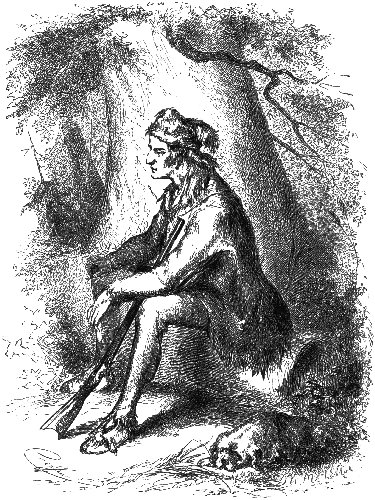
When one reads of the early days of the great
West and of the tornado-like encounters in which
the borderers engaged, he finds that there are few
more prominent figures than that of Lewis Wetzel,
who was born on the Big Wheeling, Virginia, about
the year 1764. He had four brothers, Martin,
Jacob, John and George, and two sisters, Susan and
Christina. Martin was the only brother who exceeded
Lewis in age.
The home of the Wetzels exposed them to perils
from the Indians, for it will be recognized by the
reader as a spot peculiarly open to assaults from the
red men.
This was proven by the terrible fate that overtook
the family. One day the Indians suddenly appeared
and made a fierce attack upon the house.
Several of the smaller children were absent, and
during the excitement the mother succeeded in
getting away; but the old man was killed and
scalped, and Lewis, then thirteen years old, and
his brother Jacob, two years younger, were taken
away prisoners.
In the fight, Lewis received a slight wound from
a bullet, but it did not incapacitate him from traveling,
and on the second night after the capture the
Indians encamped on the Big Lick, twenty miles
distant from the river, in what is now Ohio, and
upon the waters of McMahon's Creek.
The prisoners were so young that the captors
were justified in considering them of little account,
and they did not take the trouble to bind them
when they stopped for the night. Lewis, however,
was old enough to watch for a chance to get away,
and when sure all the Indians were asleep, he
touched his brother and whispered to him to make
ready to follow him.
They made their way out of the camp without
difficulty, but had not proceeded far when they
stopped.
"I don't like the idea of going home barefooted,"
said Lewis, "you stay here while I go back and get
a pair of moccasins for you and a pair for me."
The daring lad succeeded in obtaining the necessary
articles and soon rejoined his brother; but as
they were about to start on again he expressed his
dissatisfaction that they had no weapons.
"We can't get along without a gun; wait here a
little longer and I'll bring one back."
And young Lewis did as he said he would. Now
that each had a pair of moccasins, and the elder
carried a good rifle, they were prepared for travel,
and they plunged into the woods at once.
Lewis Wetzel displayed a knowledge of woodcraft
on this occasion which was wonderful in
one so young. He discovered the trail and followed
it back without difficulty, and knowing he
would be pursued, he kept such unremitting watch
that he detected the approach of the Indians,
and he and his brother hid in the bushes until they
passed.
When they were out of sight, the brothers came
back to the trail and followed after the Indians. It
did not take the latter very long to find they had
gone beyond the lads, and they turned about to
find them.
But, as before, Lewis was on the watch, and he
and his brother eluded them. Shortly after they
discovered that two of the warriors were mounted
and in hot chase after them; but Lewis gave them
the slip in the same skilful manner, and reaching
Wheeling the next day, they constructed a raft and
crossed the river.
When they came to the ruins of their home and
found that their father had been killed and scalped,
they were so infuriated that they took a vow to kill
every Indian that was in their power to kill, so long
as they should live.
Such is the account as generally given, though a
different version is entitled to equal credence. This
says that the elder Wetzel was shot, in 1787, while
paddling a canoe near Captina, on his return from
Middle Island Creek, and that young Lewis received
his first wound while standing in the door of
his own home. Be that as it may, there can be no
doubt that he and his brother took the barbarous
oath as stated, and it is equally a matter of history
that they carried it out in spirit and letter.
Martin Wetzel acted the part of a wild beast
and committed acts for which no law human or
divine can find justification. No red Indian ever
showed greater perfidy than did he. During
Colonel Brodhead's expedition in 1780, Martin
Wetzel was a volunteer. An Indian messenger,
under promise of protection, came into camp and
held an interview with Brodhead. While they
were talking in the most friendly manner, Martin
Wetzel stole up behind the unsuspecting red man,
and quickly drawing a tomahawk, which he had
hidden in his hunting-shirt, struck the Indian in the
back of the head a blow which stretched him lifeless
on the ground.
Colonel Brodhead was exasperated at the atrocious
act, yet he dared not punish Wetzel, for
three-fourths of the army would have rallied in his
defence.
In the life of Daniel Boone we gave an account
of the campaign of Colonel Crawford in 1782.
Lewis Wetzel served as a volunteer, being no more
than eighteen years of age. The campaign was one
of the most frightful disasters that ever occurred in
the West, Colonel Crawford being captured and
burned to death at the stake.
Among the disorganized soldiers who managed
to escape the terrible vengeance of the red men,
was one named Mills, who reached a spring some
nine miles from Wheeling, where he was forced to
leave his horse and go the rest of the way on foot.
From Wheeling he proceeded to Van Meter's fort,
where he fell in with Lewis Wetzel, whom he
persuaded to go back with him in quest of his
horse.
Wetzel cautioned him against the danger, but
Mills was determined, and the two made their
way back to the spring, where they saw the horse
standing tied to a sapling. The scout knew what
this meant, but the sight of his animal drew Mills
forward, and running up to the tree, he began untying
him. Before he could finish, there was a
discharge of rifles from the wood, and Mills fell
fatally wounded.
Knowing that the warriors were all around him,
the fleet-footed Wetzel bounded off like a deer,
with four of the swiftest runners speeding after
him. The chase was a terrific one, and after a half
mile, one of the Indians came so close that the
fugitive, believing he was on the point of throwing
his tomahawk, suddenly whirled about and shot
him dead, resuming his flight with the same desperate
exertion as before.
The art of reloading his gun while on a dead run
had been practised by Wetzel, until he could do
the difficult feat with ease. Never was there more
urgent need of that peculiar skill than on the
present occasion, for at the end of another half
mile, a second Indian was so close that Wetzel
turned to fire.
Before he could do so, the warrior grasped the
end of the barrel, and as he was immensely powerful
and active, he brought Wetzel to his knees, and
came within a hair's-breadth of wrenching the
weapon from his grasp. The white man, however,
during the fierce struggle, managed to get the
muzzle of the gun turned toward the savage, when
he pulled the trigger, killing him instantly.
The struggle was very brief, but during its continuance
the other two Indians had approached so
nigh, that Wetzel bounded away again at the
highest bent of his speed and soon had his rifle reloaded.
Then he slackened his pace, so as to allow
them to come up, but they were suspicious of
the white man who always seemed to have a
charged rifle at his service, and they held back.
Then Wetzel stopped and they did the same.
Several times he wheeled about and raised his gun,
when they immediately dodged behind trees. One
of them did not conceal his body perfectly, and
Wetzel fired, wounding him badly. The remaining
warrior ran for life, shouting: "Dat white man's
gun am always loaded!"
Actuated by that intense hate of the Indians
which marked the career of Lewis Wetzel and
several of his brothers, there was but the single
thought of revenge which inspired the muscular
arm to deeds as savage as the red man himself ever
engaged in. While General Harmar was doing his
utmost to establish peace with the Indians, Lewis
Wetzel and a companion hid themselves near the
fort, and, in pure wantonness, the former fired upon
a warrior who was riding by. He was so badly
wounded that he was barely able to reach the fort,
where he died that night.
General Harmar was so indignant over the murder,
which Wetzel unblushingly avowed, that he sent
Captain Kingsbury and a squad of men with orders
to take Wetzel dead or alive. All considerations
called for the prompt punishment of the murderer,
but his capture was an impossibility, inasmuch as
he possessed the fullest sympathy of the frontiersmen,
who would have rallied to a man in his defence.
When Captain Kingsbury reached the Mingo
Bottom, and his errand became known, Lewis
Wetzel and a large number of equally reckless
companions formed a plan for attacking the party
and massacring every one of them. Only by the
interference of Major M'Mahan, who persuaded the
Captain of his danger and induced him to withdraw,
was the crime averted.
Sometime later, however, Wetzel was seized
while asleep in a cabin, put in irons and carried to
the guard-house. He was greatly humiliated by
the shame of being handcuffed, and sent for General
Harmar, to whom he made the characteristic
proposal that he should release him among the
large party of Indians who were around the fort,
and allow him to fight it out with them. This of
course was declined by the officer, who, however,
consented to knock off his irons, but kept on
the handcuffs, allowing him to walk about the
fort.
After Wetzel had loosened his limbs by some
moderate exercise, he suddenly made a break for
the woods and was soon among them. He was
fired upon by the guards, and General Harmar instantly
sent a number of his fleetest runners, including
several Indians, in pursuit.
They almost captured him too, for a couple of
the warriors sat down on the log, under which he
was crouching, and Wetzel afterwards said that his
great fear was that his position would be betrayed
by the tumultuous throbbing of his heart. The
next day he came across a friend who released him
from his handcuffs, furnished him with a gun and
ammunition, and Wetzel paddled down the river
for Kentucky, where he could feel safe from General
Harmar.
The latter issued a proclamation offering a large
reward for the capture of Wetzel, but no frontiersman
ever made the dangerous attempt to take him,
and soon after he joined a party of scouts under
Major M'Mahan. They numbered twenty men,
and were organized to punish the Indians for murdering
a family in the Mingo Bottom. One of the
inducements for enlisting was the offer of a hundred
dollars to the man who should bring in the
first Indian scalp.
The scouts had not penetrated far into the hostile
country, when they suddenly found themselves in
the presence of a large war party. A hasty consultation
was held and it was deemed best to withdraw,
but Wetzel refused to return until he should
accomplish something. He announced that he
would never be seen at home until he lost his own
scalp or brought that of an Indian with him.
It was a dangerous task he had taken on himself,
but he persevered and spent several days in prowling
through the woods, hunting for the coveted opportunity.
At last he found a couple of warriors
encamped by themselves, and he watched by them
until the night was far advanced. Finally one of
them got up and moved away, taking a torch with
him, doubtless with the intention of watching a
deer lick. Wetzel was so anxious to kill both
savages that he waited until daylight for the return
of the other.
He did not show himself, however, and unwilling
to wait longer, the merciless white man
stole up to where the sleeping warrior lay and slew
him with one furious blow of his knife.
Wetzel reached his home without difficulty and
received the one hundred dollars reward for the
murder.
A singular occurrence took place shortly after
this. From the fort at Wheeling, there had been
heard on several occasions, cries such as would be
made by a wounded turkey, and more than once
some of the men had crossed over to ascertain
the cause. The fact that several soldiers were
never seen again, did not arouse a suspicion of the
real explanation in the minds of any one excepting
that of Lewis Wetzel.
He concluded to make an investigation for himself.
Cautiously stealing around in the direction of
the sound, he approached a deep cavern, the mouth
of which was some twenty yards above the river.
From this crept forth an Indian warrior, who uttered
the peculiar call that had lured so many to
their death. Wetzel waited until he gained a fair
sight of the savage, when he took careful aim
and the decoy never uttered his deceptive signal
again.
Wetzel supposed that his trouble with General
Harmar would gradually die out with the lapse of
time, but the commander had issued standing
orders to his officers to arrest him wherever and
whenever he could be found. On his way down
the river toward Kenawha, Wetzel landed at Point
Pleasant, where he roamed about the town with
perfect unconcern. While doing so he unexpectedly
came face to face with Lieutenant Kingsbury,
who had set out to capture him once before.
Wetzel expected a desperate encounter with
him, and braced himself for the attack; but Kingsbury,
who was personally brave, saluted him with
the order to get out of his sight, and passed on.
Wetzel thought it wise to leave the neighborhood,
and, taking to his canoe, he put off for Limestone,
which place, and the county town, Washington,
he made his headquarters for a considerable time
after.
His skill with the rifle, and his reckless bravery,
could not fail to render him a great favorite among
the rough men of the border. Could his capture
have been arranged with perfect safety to those
concerned, it is not probable that any one could
have been induced to undertake it.
One day Wetzel was sitting in a tavern in Maysville,
when Lieutenant Lawler of the regular army,
who was going down the Ohio to Fort Washington
with a number of soldiers, landed and discovered
him. Without a moment's unnecessary delay, he
ordered out a file of soldiers, took Wetzel aboard
the boat, and before the citizens had time to rally,
he was delivered to General Harmar at Cincinnati.
The General placed him in irons again, preparatory
to his trial for the killing of the Indian, and
then followed a scene of extraordinary excitement.
Petitions for the release of Wetzel poured in upon
General Harmar from every quarter, and the indignation
became so great that mutterings of a
general uprising were soon heard. Serious trouble
for a time threatened, for passions were roused to
a high pitch, and the intensity deepened as the
time for the trial approached.
Finally Judge Symmes issued a writ of habeas
corpus in the case, and abundant security being
furnished, Wetzel was released. He was escorted
in triumph to Columbia, where he was treated to
a grand supper, including the usual speeches and
congratulations, and where no doubt he concluded
his friends were right in looking upon him as a
model of heroism and chivalry to whom it was an
honor to do homage.
Lewis Wetzel hunted Indians as most men hunt
the deer and buffalo. He looked upon the red
man as legitimate game, and many a time has he
slung his rifle over his shoulder and plunged into
the woods for the express purpose of bringing
down one of the race against which he had vowed
eternal vengeance.
Numerous of his barbarous exploits must remain
unrecorded, and well would it be could the necessity
never arise for a history of any of them, for
they do not show the character of an undoubtedly
brave man in an attractive light.
Late one autumn he started out on one of his
sanguinary hunts and directed his steps toward the
Muskingum River. He had not tramped long
when he discovered a camp where four Indians
had established themselves for the winter. Not
dreaming of any danger, the red men, contrary to
their custom, had not taken their usual precautions,
and kept neither watch nor sentinels.
This was a tempting opportunity, but a single
white hunter, no matter how daring and skillful,
might well hesitate before attacking four athletic
and well-armed warriors; but the hesitation of
Lewis Wetzel was caused only by the necessity for
reflecting on the best course to be pursued.
He decided to make his attack on the four in
the dead of night when all were sound asleep. He
therefore waited patiently in the gloom until he
saw they were wrapped in profound slumber. Then
he stole forward, and with his dreadful knife, dispatched
three in quick succession, but the fourth
darted into the woods and escaped in the darkness.
It was near Wheeling, while he was engaged on
one of his numerous scouts, that he came upon a
deserted cabin. It was raining at the time, and he
was glad to use the place as a shelter. A few
pieces of boards were gathered together in the loft
and used as a bed, but before he fell asleep, six Indians
entered and started a fire, with a view of
preparing their evening meal.
Had the scout been asleep when they entered
they would have been certain to discover him by
his heavy breathing, and as it was, Wetzel scarcely
saw how he could escape detection. So he grasped
his knife and held himself ready for the desperate
encounter which was certain to follow such a discovery.
The Indians, however, did not dream of the
presence of the human tiger that was glaring down
upon them from the loft above, and soon the half
dozen were unconscious in sleep. Feeling that his
quarters were dangerous, Wetzel cautiously stole
out during the darkness and hid himself behind a
log which commanded the front of the cabin.
In the morning the first warrior who presented
himself at the door was shot dead. Before the
others could comprehend what had taken place the
murderer was fleeing like a deer through the woods,
and was soon safe from all danger of pursuit.
Such exploits as these increased the popularity
of Wetzel, while the attempts made by General
Harmar to punish him for his crimes deepened the
dislike felt toward him for what was regarded as
his unjust persecution of a worthy man.
Not long after the Indian-killer accepted the invitation
of a relative to visit him on Dunkard
Creek. It was some distance away, and the two
men pursued their walk through the woods at a
leisurely pace, talking of their hunting adventures,
chatting like a couple of school-boys, and with no
thought of impending trouble.
But when they emerged from the forest into the
clearing where the home of the relative stood, a
most startling sight met their eyes.
The house was a mass of smoking ruins. The
Indians had been there and left this proof of their
ferocity. Wetzel carefully examined the trail and
found that the party numbered three warriors and
one white man, and that they had taken off a single
prisoner.
The last was the betrothed of the relative of the
scout, and, as may well be supposed, he was wild
with excitement and fury and determined to pursue
them without an instant's delay. But Wetzel
argued him into something like calmness, and he
saw the necessity of placing himself under the control
of such a wonderfully skillful woodman as was
his companion.
The wish of Wetzel was to overtake the party
before they reached the Ohio, though there could
be no certainty as to how much start the red men
had gained. It was soon seen, however, that they
anticipated pursuit, for they had taken the greatest
pains to hide their trail. They might have succeeded
in the case of ordinary pursuers, but it was
impossible to conceal the faint but unerring signs
from the keen eye of Wetzel, who pushed forward
on their path like the bloodhound tracking its victim
through thicket and morass.
It soon became certain that the savages were
making for the river, and feeling quite sure of the
particular crossing they would seek, Wetzel left the
trail altogether, and with his friend hastened to the
same place.
It was a long distance, but the hunters for the
time were tireless, never throwing away a single
minute. As it was reasonable to believe that the
Indians would take a short route to the stream, it
can be understood that the pursuers could not
hope to gain much in the race after all.
When night settled over the great wilderness,
they were still a good distance from the Ohio.
They stopped for a brief while until they could
swallow a few mouthfuls of food. Then they
hastened on again guided by the stars overhead.
But even this help was soon taken from them by
the heavy clouds which overspread the sky, and
shut out the slightest twinkling orb in the firmament.
It was useless to seek to go any further, when,
with all their cunning, they could not prevent themselves
from losing their bearings and most likely
going directly back upon the true course.
So they halted where they were, until it began
to grow light in the East, when they resumed
their hurried journey. They had not gone far before
they struck the trail again, and one of the first
tracks recognized was the imprint of the small shoe
worn by the affianced of the young man.
The Indians, however, were still far ahead, and
though the two hunters pushed forward with all
the energy possible, they caught no sight of the
enemy, as hour after hour passed away.
But Wetzel was convinced they were gaining,
and both were in high hope, for as the afternoon
wore to its close, they recognized from the signs
around them that they were in the neighborhood
of the Ohio, and undoubtedly were close upon the
Indians and their captive.
The night had fairly set in when they reached
the river side, and they caught the glimmer of the
camp-fire of those on the other shore, just below
the mouth of the Captina. Cautiously the two
pursuers entered the river and swam across. A few
minutes spent in reconnoissance enabled them to locate
each member of the party, including the captive.
The sight of the young lady drove her betrothed
almost frantic, and he insisted on attacking the
marauders at once; but Wetzel, who was as cool
and collected as though no enemy was within a
dozen miles, would not permit it.
"The first hour of daybreak is the time," said
he, "and nothing shall be done until then." His
companion had no choice but to obey, though it
drove him to madness to remain so near his beloved,
without striking a blow in her behalf.
The long wearisome hours passed slowly, and at
last it began to grow light in the East. The young
man was quivering with excitement, but Wetzel
had been engaged in too many terrific encounters
to lose his self-possession at such a critical time.
The red men are early risers, when on the march,
and as soon as it began to grow light in the East,
they were astir. Wetzel directed his friend to take
sure aim at the renegade, pledging him that he
would attend to the Indians.
They fired simultaneously, and each brought
down his man. The lover dashed into camp to
his affianced, while the two warriors ran among the
trees until they could learn the strength of the
attacking party. The dauntless Wetzel followed
as impetuously as though he had an entire company
at his back.
As was his custom, he reloaded on the run, and
after a short pursuit, fired his gun at random, so
as to draw out the savages. It produced the effect,
for the warriors, supposing him to be defenceless,
came rushing forth, with uplifted tomahawks
and whooping in triumph; but Wetzel took but a
few seconds to reload his gun, when he shot the
nearest through the body.
As there could be no doubt that his rifle was now
unloaded, the single remaining Indian made for
him with the fury of a panther. Wetzel, who was
no less active and athletic, dodged from tree to tree
and ran here and there, baffling the fatal tomahawk
that was on the point of being hurled more than
once, until his terrible rifle was ready again, when
he wheeled and brought down the Indian, who
must have wondered in his last moments at the
wonderful gun carried by the white man.
While Lewis Wetzel was engaged in these extraordinary
forays, several of his brothers were scarcely
less active. As they were inspired by the same
intense hate which nerved the arms of the more
famous scout, it will be readily conceded that the
murder of the elder Wetzel years before by the
Indians was repaid with more than interest.
After Lewis had roamed through the wilderness
some time longer, he concluded to make a journey
to the extreme south, and for that purpose engaged
on a flat-boat bound for New Orleans.
While in that city he got into some serious difficulty,
the precise nature of which is unknown.
The result was he suffered imprisonment for two
years. It is not improbable that he discovered the
difference between breaking the law in the Western
wilderness and in the Crescent City.
He finally found his way back to Wheeling,
where he resumed his roaming through the woods,
and soon became involved in his characteristic
adventures with the red men.
He was returning one day from a hunt, when
happening to look up, he observed a warrior in the
very act of leveling his gun at him. Quick as a
flash Wetzel dodged behind a tree, the Indian
doing the same, and they stood facing each other
for a considerable time.
Growing impatient of waiting, the scout resorted
to the oft-described trick of placing his cap on the
end of his ramrod and projecting it a short distance
beyond the trunk. This brought the fire of the
savage, and before he could reload the white man
shot him.
Wetzel was known so generally as a daring and
skillful scout, that General Clarke, while organizing
his celebrated expedition to the country beyond the
Rocky Mountains, used his utmost effort to secure
him as a member of the company. Wetzel was
not inclined to go, but he was finally persuaded,
and when they started, he was one of the most
valuable members. He kept with them for three
months and then turned about and came home.
Some time later he left on a flat-boat, and went
to the house of a relative, near Natchez, where he
died in the summer of 1808.
PUBLISHED BY
Porter & Coates, Philadelphia, Pa.
WAVERLEY NOVELS. By Sir Walter Scott.
*Waverley.
*Guy Mannering.
The Antiquary.
Rob Roy.
Black Dwarf; and Old Mortality.
The Heart of Mid-Lothian.
The Bride of Lammermoor; and A Legend of Montrose.
*Ivanhoe.
The Monastery.
The Abbott.
Kenilworth.
The Pirate.
The Fortunes of Nigel.
Peveril of the Peak.
Quentin Durward.
St. Ronan's Well.
Redgauntlet.
The Betrothed; and The Talisman.
Woodstock.
The Fair Maid of Perth.
Anne of Geierstein.
Count Robert of Paris; and Castle Dangerous.
Chronicles of the Canongate.
Household Edition. 23 vols. Illustrated. 12mo. Cloth, extra,
black and gold, per vol., $1.00; sheep, marbled edges, per vol.,
$1.50; half calf, gilt, marbled edges, per vol., $3.00. Sold separately
in cloth binding only.
Universe Edition. 25 vols. Printed on thin paper, and containing
one illustration to the volume. 12mo. Cloth, extra, black
and gold, per vol., 75 cts.
World Edition. 12 vols. Thick 12mo. (Sold in sets only.)
Cloth, extra, black and gold, $18.00; half imt. Russia, marbled
edges, $24.00.
This is the best edition for the library or for general use published. Its
convenient size, the extreme legibility of the type, which is larger than
is used in any other 12mo edition, either English or American.
TALES OF A GRANDFATHER. By Sir Walter Scott, Bart.
4 vols. Uniform with the Waverley Novels.
Household Edition. Illustrated. 12mo. Cloth, extra, black
and gold, per vol., $1.00; sheep, marbled edges, per vol., $1.50;
half calf, gilt, marbled edges, per vol., $3.00.
This edition contains the Fourth Series—Tales from French history and
is the only complete edition published in this country.
CHARLES DICKENS' COMPLETE WORKS. Author's Edition.
14 vols., with a portrait of the author on steel, and eight
illustrations by F. O. C. Darley, Cruikshank, Fildes, Eytinge,
and others, in each volume. 12mo. Cloth, extra, black and
gold, per vol., $1.00; sheep, marbled edges, per vol., $1.50; half
imt. Russia, marbled edges, per vol., $1.50; half calf, gilt
marbled edges, per vol., $2.75.
*Pickwick Papers.
*Oliver Twist, Pictures of Italy, and American Notes.
*Nicholas Nickleby.
Old Curiosity Shop, and Reprinted Pieces.
Barnaby Rudge, and Hard Times.
*Martin Chuzzlewit.
Dombey and Son.
*David Copperfield.
Christmas Books, Uncommercial Traveller, and Additional Christmas Stories.
Bleak House.
Little Dorrit.
Tale of Two Cities, and Great Expectations.
Our Mutual Friend.
Edwin Drood, Sketches, Master Humphrey's Clock, etc., etc.
Sold separately in cloth binding only.
*Also in Alta Edition, one illustration, 75 cents.
The same. Universe Edition. Printed on thin paper and containing
one illustration to the volume. 14 vols., 12mo. Cloth,
extra, black and gold, per vol., 75 cents.
The same. World Edition. 7 vols., thick 12mo., $12.25. (Sold
in sets only.)
CHILD'S HISTORY OF ENGLAND. By Charles Dickens.
Popular 12mo. edition; from new electrotype plates. Large
clear type. Beautifully illustrated with 8 engravings on wood.
12mo. Cloth, extra, black and gold, $1.00.
Alta Edition. One illustration, 75 cents.
"Dickens as a novelist and prose poet is to be classed in the front rank of
the noble company to which he belongs. He has revived the novel of genuine
practical life, as it existed in the works of Fielding, Smollett, and Goldsmith;
but at the same time has given to his material an individual coloring
and expression peculiarly his own. His characters, like those of his great
exemplars, constitute a world of their own, whose truth to nature every
reader instinctively recognizes in connection with their truth to darkness."—E.
P. Whipple.
MACAULAY'S HISTORY OF ENGLAND. From the accession
of James II. By Thomas Babington Macaulay. With a
steel portrait of the author. Printed from new electrotype
plates from the last English Edition. Being by far the most
correct edition in the American market. 5 volumes, 12mo.
Cloth, extra, black and gold, per set, $5.00; sheep, marbled
edges, per set, $7.50; half imitation Russia, $7.50; half calf,
gilt, marbled edges, per set, $15.00.
Popular Edition. 5 vols., cloth, plain, $5.00.
8vo. Edition. 5 volumes in one, with portrait. Cloth, extra,
black and gold, $3.00; sheep, marbled edges, $3.50.
MARTINEAU'S HISTORY OF ENGLAND. From the beginning
of the 19th Century to the Crimean War. By Harriet Martineau.
Complete in 4 vols., with full Index. Cloth, extra,
black and gold, per set, $4.00; sheep, marbled edges, $6.00; half
calf, gilt, marbled edges, $12.00.
HUME'S HISTORY OF ENGLAND. From the invasion of
Julius Caesar to the abdication of James II, 1688. By David
Hume. Standard Edition. With the author's last corrections
and improvements; to which is prefixed a short account of
his life, written by himself. With a portrait on steel. A new
edition from entirely new stereotype plates. 5 vols., 12mo.
Cloth, extra, black and gold, per set, $5.00; sheep, marbled
edges, per set, $7.50; half imitation Russia, $7.50; half calf,
gilt, marbled edges, per set, $15.00.
Popular Edition. 5 vols. Cloth, plain, $5.00.
GIBBON'S DECLINE AND FALL OF THE ROMAN EMPIRE.
By Edward Gibbon. With Notes, by Rev. H. H. Milman.
Standard Edition. To which is added a complete Index of
the work. A new edition from entirely new stereotype plates.
With portrait on steel. 5 vols., 12mo. Cloth, extra, black and
gold, per set, $5.00; sheep, marbled edges, per set, $7.50; half
imitation Russia, $7.50; half calf, gilt, marbled edges, per set,
$15.00.
Popular Edition. 5 vols. Cloth, plain, $5.00.
ENGLAND, PICTURESQUE AND DESCRIPTIVE. By Joel
Cook, author of "A Holiday Tour in Europe," etc. With 487
finely engraved illustrations, descriptive of the most famous
and attractive places, as well as of the historic scenes and
rural life of England and Wales. With Mr. Cook's admirable
descriptions of the places and the country, and the splendid illustrations,
this is the most valuable and attractive book of the
season, and the sale will doubtless be very large. 4to. Cloth,
extra, gilt side and edges, $7.50; half calf, gilt, marbled edges,
$10.00; half morocco, full gilt edges, $10.00; full Turkey morocco,
gilt edges, $15.00; tree calf, gilt edges, $18.00.
This work, which is prepared in elegant style, and profusely illustrated,
is a comprehensive description of England and Wales, arranged in convenient
form for the tourist, and at the same time providing an illustrated
guide-book to a country which Americans always view with interest. There
are few satisfactory works about this land which is so generously gifted by
Nature and so full of memorials of the past. Such books as there are, either
cover a few counties or are devoted to special localities, or are merely guide-books.
The present work is believed to be the first attempt to give in attractive
form a description of the stately homes, renowned castles, ivy-clad ruins
of abbeys, churches, and ancient fortresses, delicious scenery, rock-bound
coasts, and celebrated places of England and Wales. It is written by an
author fully competent from travel and reading, and in position to properly
describe his very interesting subject; and the artist's pencil has been called
into requisition to graphically illustrate its well-written pages. There are
487 illustrations, prepared in the highest style of the engraver's art, while
the book itself is one of the most attractive ever presented to the American
public.
Its method of construction is systematic, following the most convenient
routes taken by tourists, and the letter-press includes enough of the history
and legend of each of the places described to make the story highly interesting.
Its pages fairly overflow with picture and description, telling of
everything attractive that is presented by England and Wales. Executed
in the highest style of the printer's and engraver's art, "England, Picturesque
and Descriptive," is one of the best American books of the year.
HISTORY OF THE CIVIL WAR IN AMERICA. By the Comte
De Paris. With Maps faithfully Engraved from the Originals,
and Printed in Three Colors. 8vo. Cloth, per volume,
$3.50; red cloth, extra, Roxburgh style, uncut edges, $3.50;
sheep, library style, $4.50; half Turkey morocco, $6.00. Vols.
I, II, and III now ready.
The third volume embraces, without abridgment, the fifth and sixth
volumes of the French edition, and covers one of the most interesting as
well as the most anxious periods of the war, describing the operations of the
Army of the Potomac in the East, and the Army of the Cumberland and
Tennessee in The West.
It contains full accounts of the battle of Chancellorsville, the attack of the
monitors on Fort Sumter, the sieges and fall of Vicksburg and Port Hudson;
the battles of Port Gibson and Champion's Hill, and the fullest and most
authentic account of the battle of Gettysburg ever written.
* * * * *
"The head of the Orleans family has put pen to paper with excellent
result.... Our present impression is that it will form by far the best
history of the American war."—Athenæum, London.
* * * * *
"We advise all Americans to read it carefully, and judge for themselves
if 'the future historian of our war,' of whom we have heard so much, be not
already arrived in the Comte de Paris."—Nation, New York.
* * * * *
"This is incomparably the best account of our great second revolution
that has yet been even attempted. It is so calm, so dispassionate, so accurate
in detail, and at the same time so philosophical in general, that its reader
counts confidently on finding the complete work thoroughly satisfactory."—Evening
Bulletin, Philadelphia.
* * * * *
"The work expresses the calm, deliberate judgment of an experienced
military observer and a highly intelligent man. Many of its statements
will excite discussion, but we much mistake if it does not take high and
permanent rank among the standard histories of the civil war. Indeed
that place has been assigned it by the most competent critics both of this
country and abroad."—Times, Cincinnati.
* * * * *
"Messrs. Porter & Coates, of Philadelphia, will publish in a few days the
authorized translation of the new volume of the Comte de Paris' History of
Our Civil War. The two volumes in French—the fifth and sixth—are bound
together in the translation in one volume. Our readers already know,
through a table of contents of these volumes, published in the cable columns
of the Herald, the period covered by this new installment of a work remarkable
in several ways. It includes the most important and decisive period of
the war, and the two great campaigns of Gettysburg and Vicksburg.
"The great civil war has had no better, no abler historian than the French
prince who, emulating the example of Lafayette, took part in this new
struggle for freedom, and who now writes of events, in many of which he
participated, as an accomplished officer, and one who, by his independent
position, his high character and eminent talents, was placed in circumstances
and relations which gave him almost unequalled opportunities to
gain correct information and form impartial judgments.
"The new installment of a work which has already become a classic will
be read with increased interest by Americans because of the importance of
the period it covers and the stirring events it describes. In advance of a
careful review we present to-day some extracts from the advance sheets sent
us by Messrs. Porter & Coates, which will give our readers a foretaste of
chapters which bring back to memory so many half-forgotten and not a few
hitherto unvalued details of a time which Americans of this generation at
least cannot read of without a fresh thrill of excitement."
HALF-HOURS WITH THE BEST AUTHORS. With short Biographical
and Critical Notes. By Charles Knight.
New Household Edition. With six portraits on steel. 3 vols.,
thick 12mo. Cloth, extra, black and gold, per set, $1.50; half imt.
Russia, marbled edges, $6.00; half calf, gilt, marbled edges, $12.00.
Library Edition. Printed on fine laid and tinted paper. With
twenty-four portraits on steel. 6 vols., 12mo. Cloth, extra, per
set, $7.50; half calf, gilt, marbled edges, per set, $18.00; half Russia,
gilt top, $21.00; full French morocco, limp, per set, $12.00;
full smooth Russia, limp, round corners, in Russia case, per set,
$25.00; full seal grained Russia, limp, round corners, in Russia
case to match, $25.00.
The excellent idea of the editor of these choice volumes has been most
admirably carried out, as will be seen by the list of authors upon all subjects.
Selecting some choice passages of the best standard authors, each of sufficient
length to occupy half an hour in its perusal, there is here food for
thought for every day in the year: so that if the purchaser will devote but
one-half hour each day to its appropriate selection he will read through
these six volumes in one year, and in such a leisurely manner that the
noblest thoughts of many of the greatest minds will be firmly in his mind
forever. For every Sunday there is a suitable selection from some of the
most eminent writers in sacred literature. We venture to say if the editor's
idea is carried out the reader will possess more and better knowledge of the
English classics at the end of the year than he would by five years of desultory
reading.
They can be commenced at any day in the year. The variety of reading
is so great that no one will ever tire of these volumes. It is a library in
itself.
THE POETRY OF OTHER LANDS. A Collection of Translations
into English Verse of the Poetry of Other Languages,
Ancient and Modern. Compiled by N. Clemmons Hunt.
Containing translations from the Greek, Latin, Persian, Arabian,
Japanese, Turkish, Servian, Russian, Bohemian, Polish,
Dutch, German, Italian, French, Spanish, and Portuguese
languages. 12mo. Cloth, extra, gilt edges, $2.50; half calf, gilt,
marbled edges, $4.00; Turkey morocco, gilt edges, $6.00.
"Another of the publications of Porter & Coates, called 'The Poetry of
Other Lands,' compiled by N. Clemmons Hunt, we most warmly commend.
It is one of the best collections we have seen, containing many exquisite
poems and fragments of verse which have not before been put into book
form in English words. We find many of the old favorites, which appear
in every well-selected collection of sonnets and songs, and we miss others,
which seem a necessity to complete the bouquet of grasses and flowers,
some of which, from time to time, we hope to republish in the 'Courier.'"—Cincinnati
Courier.
"A book of rare excellence, because it gives a collection of choice gems in
many languages not available to the general lover of poetry. It contains
translations from the Greek, Latin, Persian, Arabian, Japanese, Turkish,
Servian, Russian, Bohemian, Polish, Dutch, German, Italian, French,
Spanish, and Portuguese languages. The book will be an admirable companion
volume to any one of the collections of English poetry that are now
published. With the full index of authors immediately preceding the collection,
and the arrangement of the poems under headings, the reader will
find it convenient for reference. It is a gift that will be more valued by
very many than some of the transitory ones at these holiday times."—Philadelphia
Methodist.
THE FIRESIDE ENCYCLOPÆDIA OF POETRY. Edited by
Henry T. Coates. This is the latest, and beyond doubt the
best collection of poetry published. Printed on fine paper and
illustrated with thirteen steel engravings and fifteen title
pages, containing portraits of prominent American poets and
fac-similes of their handwriting, made expressly for this book,
8vo. Cloth, extra, black and gold, gilt edges, $5.00: half calf,
gilt, marbled edges, $7.50; half morocco, full gilt edges, $7.50;
full Turkey morocco, gilt edges, $10.00; tree calf, gilt edges
$12.00; plush, padded side, nickel lettering, $14.00.
"The editor shows a wide acquaintance with the most precious treasures
of English verse, and has gathered the most admirable specimens of their
ample wealth. Many pieces which have been passed by in previous collections
hold a place of honor in the present volume, and will be heartily welcomed
by the lovers of poetry as a delightful addition to their sources of
enjoyment. It is a volume rich in solace, in entertainment, in inspiration,
of which the possession may well be coveted by every lover of poetry. The
pictorial illustrations of the work are in keeping with its poetical contents,
and the beauty of the typographical execution entitles it to a place among
the choicest ornaments of the library."—New York Tribune.
"Lovers of good poetry will find this one of the richest collections ever
made. All the best singers in our language are represented, and the selections
are generally those which reveal their highest qualities.... The
lights and shades, the finer play of thought and imagination belonging to
individual authors, are brought out in this way (by the arrangement of
poems under subject-headings) as they would not be under any other system....
We are deeply impressed with the keen appreciation of poetical
worth, and also with the good taste manifested by the compiler."—Churchman.
"Cyclopædias of poetry are numerous, but for sterling value of its contents
for the library, or as a book of reference, no work of the kind will compare
with this admirable volume of Mr. Coates. It takes the gems from many
volumes, culling with rare skill and judgment."—Chicago Inter-Ocean.
THE CHILDREN'S BOOK OF POETRY. Compiled by Henry
T. Coates. Containing over 500 poems carefully selected
from the works of the best and most popular writers for children;
with nearly 200 illustrations. The most complete collection
of poetry for children ever published. 4to. Cloth,
extra, black and gold, gilt side and edges, $3.00; full Turkey
morocco, gilt edges, $7.50.
"This seems to us the best book of poetry for children in existence. We
have examined many other collections, but we cannot name another that
deserves to be compared with this admirable compilation."—Worcester Spy.
"The special value of the book lies in the fact that it nearly or quite
covers the entire field. There is not a great deal of good poetry which has
been written for children that cannot be found in this book. The collection
is particularly strong in ballads and tales, which are apt to interest children
more than poems of other kinds; and Mr. Coates has shown good judgment
in supplementing this department with some of the best poems of that class
that have been written for grown people. A surer method of forming the
taste of children for good and pure literature than by reading to them from
any portion of this book can hardly be imagined. The volume is richly
illustrated and beautifully bound."—Philadelphia Evening Bulletin.
"A more excellent volume cannot be found. We have found within the
covers of this handsome volume, and upon its fair pages, many of the most
exquisite poems which our language contains. It must become a standard
volume, and can never grow old or obsolete."—Episcopal Recorder.
THE COMPLETE WORKS OF THOS. HOOD. With engravings
on steel. 4 vols., 12mo., tinted paper. Poetical Works; Up
the Rhine; Miscellanies and Hood's Own; Whimsicalities,
Whims, and Oddities. Cloth, extra, black and gold, $6.00;
red cloth, paper label, gilt top, uncut edges, $6.00; half calf,
gilt, marbled edges, $14.00; half Russia, gilt top, $18.00.
Hood's verse, whether serious or comic—whether serene like a cloudless
autumn evening or sparkling with puns like a frosty January midnight
with stars—was ever pregnant with materials for the thought. Like every
author distinguished for true comic humor, there was a deep vein of melancholy
pathos running through his mirth, and even when his sun shone
brightly its light seemed often reflected as if only over the rim of a cloud.
Well may we say, in the words of Tennyson, "Would he could have
stayed with us." for never could it be more truly recorded of any one—in
the words of Hamlet characterizing Yorick—that "he was a fellow of infinite
jest, of most excellent fancy."—D. M. Moir.
THE ILIAD OF HOMER RENDERED INTO ENGLISH
BLANK VERSE. By Edward, Earl of Derby. From
the latest London edition, with all the author's last revisions
and corrections, and with a Biographical Sketch of Lord
Derby, by R. Shelton Mackenzie, D.C.L. With twelve
steel engravings from Flaxman's celebrated designs. 2 vols.,
12mo. Cloth, extra, bev. boards, gilt top, $3.50; half calf, gilt,
marbled edges, $7.00; half Turkey morocco, gilt top, $7.00.
The same. Popular edition. Two vols. in one. 12mo. Cloth,
extra, $1.50.
"It must equally be considered a splendid performance; and for the present
we have no hesitation in saying that it is by far the best representation
of Homer's Iliad in the English language."—London Times.
"The merits of Lord Derby's translation may be summed up in one word,
it is eminently attractive; it is instinct with life; it may be read with fervent
interest; it is immeasurably nearer than Pope to the text of the original.... Lord
Derby has given a version far more closely allied to the original,
and superior to any that has yet been attempted in the blank verse of our
language."—Edinburg Review.
THE WORKS OF FLAVIUS JOSEPHUS. Comprising the Antiquities
of the Jews; a History of the Jewish Wars, and a Life
of Flavius Josephus, written by himself. Translated from the
original Greek, by William Whiston, A.M. Together with
numerous explanatory Notes and seven Dissertations concerning
Jesus Christ, John the Baptist, James the Just, God's command
to Abraham, etc., with an Introductory Essay by Rev.
H. Stebbing, D.D. 8vo. Cloth, extra, black and gold, plain
edges, $3.00; cloth, red, black and gold, gilt edges, $4.50; sheep
marbled edges, $3.50; Turkey morocco, gilt edges, $8.00.
This is the largest type one volume edition published.
THE ANCIENT HISTORY OF THE EGYPTIANS, CARTHAGINIANS,
ASSYRIANS, BABYLONIANS, MEDES AND
PERSIANS, GRECIANS AND MACEDONIANS. Including
a History of the Arts and Sciences of the Ancients. By
Charles Rollin. With a Life of the Author, by James
Bell. 2 vols., royal 8vo. Sheep, marbled edges, per set, $6.00.
COOKERY FROM EXPERIENCE. A Practical Guide for Housekeepers
in the Preparation of Every-day Meals, containing
more than One Thousand Domestic Recipes, mostly tested by
Personal Experience, with Suggestions for Meals, Lists of
Meats and Vegetables in Season, etc. By Mrs. Sara T. Paul.
12mo. Cloth, extra, black and gold, $1.50.
Interleaved Edition. Cloth, extra, black and gold, $1.75.
THE COMPARATIVE EDITION OF THE NEW TESTAMENT.
Both Versions in One Book.
The proof readings of our Comparative Edition have been gone
over by so many competent proof readers, that we believe the text
is absolutely correct.
Large 12mo., 700 pp. Cloth, extra, plain edges, $1.50; cloth,
extra, bevelled boards and carmine edges, $1.75; imitation panelled
calf, yellow edges, $2.00; arabesque, gilt edges, $2.50; French morocco,
limp, gilt edges, $4.00; Turkey morocco, limp, gilt edges,
$6.00.
The Comparative New Testament has been published by Porter & Coates.
In parallel columns on each page are given the old and new versions of the
Testament, divided also as far as practicable into comparative verses, so that
it is almost impossible for the slightest new word to escape the notice of
either the ordinary reader or the analytical student. It is decidedly the
best edition yet published of the most interest-exciting literary production
of the day. No more convenient form for comparison could be devised
either for economizing time or labor. Another feature is the foot-notes,
and there is also given in an appendix the various words and expressions
preferred by the American members of the Revising Commission. The
work is handsomely printed on excellent paper with clear, legible type. It
contains nearly 700 pages.
THE COUNT OF MONTE CRISTO. By Alexandre Dumas.
Complete in one volume, with two illustrations by George G.
White. 12mo. Cloth, extra, black and gold, $1.25.
THE THREE GUARDSMEN. By Alexandre Dumas. Complete
in one volume, with two illustrations by George G.
White. 12mo. Cloth, extra, black and gold, $1.25.
There is a magic influence in his pen, a magnetic attraction in his descriptions,
a fertility in his literary resources which are characteristic of Dumas
alone, and the seal of the master of light literature is set upon all his works.
Even when not strictly historical, his romances give an insight into the
habits and modes of thought and action of the people of the time described,
which are not offered in any other author's productions.
THE LAST DAYS OF POMPEII. By Sir Edward Bulwer Lytton, Bart.
Illustrated. 12mo. Cloth, extra, black and
gold, $1.00. Alta edition, one illustration, 75 cts.
JANE EYRE. By Charlotte Bronté (Currer Bell). New Library
Edition. With five illustrations by E. M. Wimperis.
12mo. Cloth, extra, black and gold, $1.00.
SHIRLEY. By Charlotte Bronté (Currer Bell). New Library
Edition. With five illustrations by E. M. Wimperis. 12mo.
Cloth, extra, black and gold, $1.00.
VILLETTE. By Charlotte Bronté (Currer Bell). New Library
Edition. With five illustrations by E. M. Wimperis. 12mo.
Cloth, extra, black and gold, $1.00.
THE PROFESSOR, EMMA and POEMS. By Charlotte Bronté
(Currer Bell). New Library Edition. With five illustrations
by E. M. Wimperis. 12mo. Cloth, extra, black and gold, $1.00.
Cloth, extra, black and gold, per set, $4.00; red cloth, paper
label, gilt top, uncut edges, per set, $5.00; half calf, gilt, per set,
$12.00. The four volumes forming the complete works of Charlotte
Bronté (Currer Bell).
The wondrous power of Currer Bell's stories consists in their fiery insight
into the human heart, their merciless dissection of passion, and their stern
analysis of character and motive. The style of these productions possesses
incredible force, sometimes almost grim in its bare severity, then relapsing
into passages of melting pathos—always direct, natural, and effective in its
unpretending strength. They exhibit the identity which always belongs to
works of genius by the same author, though without the slightest approach
to monotony. The characters portrayed by Currer Bell all have a strongly
marked individuality. Once brought before the imagination, they haunt
the memory like a strange dream. The sinewy, muscular strength of her
writings guarantees their permanent duration, and thus far they have lost
nothing of their intensity of interest since the period of their composition.
CAPTAIN JACK THE SCOUT; or, The Indian Wars about Old
Fort Duquesne. An Historical Novel, with copious notes.
By Charles McKnight. Illustrated with eight engravings.
12mo. Cloth, extra, black and gold, $1.50.
A work of such rare merit and thrilling interest as to have been republished
both in England and Germany. This genuine American historical
work has been received with extraordinary popular favor, and has "won
golden opinions from all sorts of people" for its freshness, its forest life, and
its fidelity to truth. In many instances it even corrects History and uses
the drapery of fiction simply to enliven and illustrate the fact.
It is a universal favorite with both sexes, and with all ages and conditions,
and is not only proving a marked and notable success in this country,
but has been eagerly taken up abroad and republished in London, England,
and issued in two volumes in the far-famed "Tauchnetz Edition" of Leipsic,
Germany.
ORANGE BLOSSOMS, FRESH AND FADED. By T. S. Arthur.
Illustrated. 12mo. Cloth, extra, black and gold, $1.50.
"Orange Blossoms" contains a number of short stories of society. Like
all of Mr. Arthur's works, it has a special moral purpose, and is especially
addressed to the young who have just entered the marital experience, whom
it pleasantly warns against those social and moral pitfalls into which they
may almost innocently plunge.
THE BAR ROOMS AT BRANTLEY; or, The Great Hotel Speculation.
By T. S. Arthur. Illustrated. 12mo. Cloth, extra,
black and gold, $1.50.
"One of the best temperance stories recently issued."—N. Y. Commercial
Advertiser.
"Although it is in the form of a novel, its truthful delineation of characters
is such that in every village in the land you meet the broken manhood
it pictures upon the streets, and look upon sad, tear-dimmed eyes of women
and children. The characters are not overdrawn, but are as truthful as an
artist's pencil could make them."—Inter-Ocean, Chicago.
EMMA. By Jane Austen. Illustrated. 12mo. Cloth, extra,
$1.25.
MANSFIELD PARK. By Jane Austen. Illustrated. 12mo.
Cloth, extra, $1.25.
PRIDE AND PREJUDICE; and Northanger Abbey. By Jane
Austen. Illustrated. 12mo. Cloth, extra, $1.25.
SENSE AND SENSIBILITY; and Persuasion. By Jane Austen.
Illustrated. 12mo. Cloth, extra, $1.25.
The four volumes, forming the complete works of Jane Austen,
in a neat box: Cloth, extra, per set, $5.00; red cloth, paper label,
gilt top, uncut edges, $3.00; half calf, gilt, per set, $12.00.
"Jane Austen, a woman of whom England is justly proud. In her novels
she has given us a multitude of characters, all, in a certain sense, commonplace,
all such as we meet every day. Yet they are all as perfectly discriminated
from each other as if they were the most eccentric of human beings....
And almost all this is done by touches so delicate that they elude
analysis, that they defy the powers of description, and that we know them
to exist only by the general effect to which they have contributed."—Macaulay's
Essays.
ART AT HOME. Containing in one volume House Decoration,
by Rhoda and Agnes Garrett; Plea for Art in the House,
by W. J. Loftie; Music, by John Hullah; and Dress, by
Mrs. Oliphant. 12mo. Cloth, extra, black and gold, $1.50.
TOM BROWN'S SCHOOL DAYS AT RUGBY. By Thomas
Hughes. New Edition, large clear type. With 36 illustrations
after Caldecott and others. 12mo., 400 pp. Cloth, extra,
black and gold, $1.25; half calf, gilt, $2.75.
Alta Edition. One illustration, 75 cents.
"It is difficult to estimate the amount of good which may be done by
'Tom Brown's School Days.' It gives, in the main, a most faithful and
interesting picture of our public schools, the most English institutions of
England, and which educate the best and most powerful elements in our
upper classes. But it is more than this; it is an attempt, a very noble and
successful attempt, to Christianize the society of our youth, through the
only practicable channel—hearty and brotherly sympathy with their feelings;
a book, in short, which a father might well wish to see in the hands
of his son."—London Times.
TOM BROWN AT OXFORD. By Thomas Hughes. Illustrated.
12mo. Cloth, extra, black and gold, $1.50; half calf, gilt, $3.00.
"Fairly entitled to the rank and dignity of an English classic. Plot, style
and truthfulness are of the soundest British character. Racy, idiomatic,
mirror-like, always interesting, suggesting thought on the knottiest social
and religious questions, now deeply moving by its unconscious pathos, and
anon inspiring uproarious laughter, it is a work the world will not willingly
let die."—N. Y. Christian Advocate.
SENSIBLE ETIQUETTE OF THE BEST SOCIETY. By Mrs.
H. O. Ward. Customs, manners, morals, and home culture,
with suggestions how to word notes and letters of invitations,
acceptances, and regrets, and general instructions as to calls,
rules for watering places, lunches, kettle drums, dinners, receptions,
weddings, parties, dress, toilet and manners, salutations,
introductions, social reforms, etc., etc. Bound in cloth,
with gilt edge, and sent by mail, postage paid, on receipt of
$2.00.
LADIES' AND GENTLEMEN'S ETIQUETTE: A Complete
Manual of the Manners and Dress of American Society. Containing
forms of Letters, Invitations, Acceptances, and Regrets.
With a copious index. By E. B. Duffey. 12mo. Cloth,
extra, black and gold, $1.50.
"It is peculiarly an American book, especially adapted to our people, and
its greatest beauty is found in the fact that in every line and precept it inculcates
the principles of true politeness, instead of those formal rules that
serve only to gild the surface without affecting the substance. It is admirably
written, the style being clear, terse, and forcible."—St. Louis Times.
THE UNDERGROUND CITY; or, The Child of the Cavern.
By Jules Verne. Translated from the French by W. H.
Kingston. With 43 illustrations. Standard Edition. 12mo.
Cloth, extra, black and gold, $1.50.
AROUND THE WORLD IN EIGHTY DAYS. By Jules Verne.
Translated by Geo. M. Towle. With 12 full-page illustrations.
12mo. Cloth, extra, black and gold, $1.25.
AT THE NORTH POLE; or, The Voyages and Adventures of
Captain Hatteras. By Jules Verne. With 130 illustrations
by Riou. Standard Edition. 12mo. Cloth, extra, black and
gold, $1.25.
THE DESERT OF ICE; or, The Further Adventures of Captain
Hatteras. By Jules Verne. With 126 illustrations by Riou.
Standard Edition. 12mo. Cloth, extra, black and gold, $1.25.
TWENTY THOUSAND LEAGUES UNDER THE SEAS; or,
The Marvellous and Exciting Adventures of Pierre Aronnax,
Conseil his servant, and Ned Land, a Canadian Harpooner. By
Jules Verne. Standard Edition. Illustrated. 12mo. Cloth,
extra, black and gold, $1.25.
THE WRECK OF THE CHANCELLOR, Diary of J. R. Kazallon,
Passenger, and Martin Paz. By Jules Verne. Translated
from the French by Ellen Frewer. With 10 illustrations.
Standard Edition. 12mo. Cloth, extra, black and gold, $1.25.
Jules Verne is so well known that the mere announcement of anything
from his pen is sufficient to create a demand for it. One of his chief merits
is the wonderful art with which he lays under contribution every branch of
science and natural history, while he vividly describes with minute exactness
all parts of the world and its inhabitants.
THE INGOLDSBY LEGENDS; or, Mirth and Marvels. By
Richard Harris Barham (Thomas Ingoldsby, Esq.). New
edition, printed from entirely new stereotype plates. Illustrated.
12mo. Cloth, extra, black and gold, $1.50; half calf,
gilt, marbled edges, $3.00.
"Of his poetical powers it is not too much to say that, for originality of
design and diction, for grand illustration and musical verse, they are not
surpassed in the English language. The Witches' Frolic is second only to
Tam O'Shanter. But why recapitulate the titles of either prose or verse—since
they have been confessed by every judgment to be singularly rich in
classic allusion and modern illustration. From the days of Hudibras to our
time the drollery invested in rhymes has never been so amply or felicitously
exemplified."—Bentley's Miscellany.
TEN THOUSAND A YEAR. By Samuel C. Warren, author of
"The Diary of a London Physician." A new edition, carefully
revised, with three illustrations by George G. White.
12mo. Cloth, extra, black and gold, $1.50.
"Mr. Warren has taken a lasting place among the imaginative writers of
this period of English history. He possesses, in a remarkable manner, the
tenderness of heart and vividness of feeling, as well as powers of description,
which are essential to the delineation of the pathetic, and which, when
existing in the degree in which he enjoys them, fill his pages with scenes
which can never be forgotten."—Sir Archibald Alison.
THOMPSON'S POLITICAL ECONOMY; With Especial Reference
to the Industrial History of Nations. By Prof. R. E.
Thompson, of the University of Pennsylvania. 12mo. Cloth,
extra, $1.50.
This book possesses an especial interest at the present moment. The
questions of Free Trade and Protection are before the country more directly
than at any earlier period of our history. As a rule the works and textbooks
used in our American colleges are either of English origin or teach
Doctrines of a political economy which, as Walter Bagehot says, was made
for England. Prof. Thompson belongs to the Nationalist School of Economists,
to which Alexander Hamilton, Tench Coxe, Henry Clay, Matthew
Carey, and his greater son, Henry C. Carey, Stephen Colwell, and James
Abram Garfield were adherents. He believes in that policy of Protection
to American industry which has had the sanction of every great American
statesman, not excepting Thomas Jefferson and John C. Calhoun. He makes
his appeal to history in defence of that policy, showing that wherever a
weaker or less advanced country has practiced Free Trade with one more
powerful or richer, the former has lost its industries as well as its money,
and has become economically dependent on the latter. Those who wish
to learn what is the real source of Irish poverty and discontent will find it
here stated fully.
The method of the book is historical. It is therefore no series of dry and
abstract reasonings, such as repel readers from books of this class. The
writer does not ride the a priori nag, and say "this must be so," and "that
must be conceded." He shows what has been true, and seeks to elicit the
laws of the science from the experience of the world. The book overflows
with facts told in an interesting manner.
THE ENGLISH PEOPLE IN ITS THREE HOMES, and the
Practical Bearings of general European History. By Edward
A. Freeman, LL.D., Author of the "Norman Conquest of
England." 12mo. Cloth, extra, $1.75.
HANDY ANDY. A Tale of Irish Life. By Samuel Lover. New
Library Edition, with two original illustrations by George G.
White. 12mo. Cloth, extra, black and gold, $1.25.
"Decidedly the best story of the day, full of frolic, genuine fun, and exquisite
touches of Irish humor."—Dublin Monitor.
CHARLES O'MALLEY, The Irish Dragoon. By Charles Lever.
New Library Edition, with two original illustrations by F. O.
C. Darley. 12mo. Cloth, extra, black and gold, $1.25.
HARRY LORREQUER. By Charles Lever. New Library
Edition, with two original illustrations by Geo. G. White.
12mo. Cloth, extra, black and gold, $1.25.
"The intense spirit and frolic of the author's sketches have made him
one of the most successful writers of the day."—London Literary Gazette.
"The author is pre-eminent for his mirth-moving powers, for his acute
sense of the ridiculous, for the breadth of his humor, and his powers of
dramatic writing which render his boldest conceptions with the happiest
facility."—London Athenæum.
"We hardly know how to convey an adequate notion of the exuberant
whim and drollery by which this writer is characterized. His works are a
perpetual feast of gayety."—John Bull, London.
POPULAR NATURAL HISTORY. By the Rev. J. G. Wood,
M.A. From entirely new electrotype plates, with five hundred
illustrations by eminent artists. Crown 8vo. Cloth,
extra, black and gold, $1.75.
Mr. Wood is an amusing, instructive, and sensible writer—always doing
good work in a good way—and his work on Natural History is without
doubt his masterpiece.
THE ODES OF HORACE. Translated into English verse, with
Life and Notes, by Theodore Martin. With a fine portrait
of Horace. 16mo. Cloth, extra, $1.00.
Mr. Martin's translation has been commended as preserving—more than
any other—the spirit and grace of the original. It is the most successful
attempt ever made to render into English the inimitable odes of Horace.
The memoir prefixed to the volume is a most charming piece of biography.
GREEK MYTHOLOGY SYSTEMATIZED. With complete Tables
based on Hesiod's Theogony; Tables showing the relation of
Greek Mythology and History, arranged from Grote's History
of Greece; and Gladstone's Homeric Tables. With a full
Index. By S. A. Scull. Profusely illustrated. 12mo. Cloth,
black and gold, $1.50.
"A book which will prove very useful to the student and man of letters,
and of incalculable benefit as a hand-book."—Republic, Washington.
"A real want is supplied by this book, which is, in fact, a cyclopædia of
Greek Mythology, so far as that is possible in a single volume of reasonable
size and moderate cost."—Evening Mail, New York.
"This text-book on Mythology presents the subject in a more practical
and more attractive style than any other work on the subject with which
we are familiar, and we feel assured that it will at once take a leading position
among books of its class."—The Teacher, Philadelphia.
THE IMITATION OF CHRIST. By Thomas a Kempis. New
and best edition, from entirely new electrotype plates, single
column, large, clear type. 18mo.
Plain Edition, round corners. Cloth, extra, red edges, 50 cents;
French morocco, gilt cross, 75 cents; limp Russia, inlaid cross, red
under gold edges, $2.00.
Red Line Edition, round corners. Cloth, black and gold, red
edges, 75 cents; cloth, black and gold, gilt edges, $1.00; French
morocco, red under gold edges, $1.50; limp Russia, inlaid cross, red
under gold edges, $2.50; limp Russia, solid gilt edges, box circuit,
$3.00; limp calf, red under gold edges, $2.50; limp calf, solid gilt
edges, box circuit, $3.00.
THE WORDS AND MIND OF JESUS AND FAITHFUL PROMISER.
By Rev. J. R. Macduff, D.D., author of "Morning and
Night Watches." New and best edition, from entirely new
electrotype plates, single column, large, clear type. 18mo.
Plain Edition, round corners. Cloth, extra, red edges, 50 cents;
French morocco, gilt cross, 75 cents; limp Russia, inlaid cross, red
under gold edges, $2.00.
Red Line Edition, round corners. Cloth, black and gold, red
edges, 75 cents; cloth, black and gold, gilt edges, $1.00; limp calf
or Russia, red under gold edges, $2.50.
A DICTIONARY OF THE BIBLE. Comprising its Antiquities,
Biography, Geography, Natural History, and Literature.
Edited by William Smith, LL.D. Revised and adapted to
the present use of Sunday-school Teachers and Bible Students
by Rev. F. N. and M. A. Peloubet. With eight colored maps
and over 350 engravings on wood. 8vo. Cloth, extra, black
and gold, $2.00; sheep, marbled edges, $3.00; half morocco,
gilt top, $3.50.
"No similar work in our own or in any other language is for a moment to
be compared with Dr. Smith's Dictionary of the Bible. The Christian and
the scholar have a treasure-house on every subject connected with the
Bible, full to overflowing, and minute even to the telling of mint and cummin."—London
Quarterly Review.
COMPREHENSIVE BIOGRAPHICAL DICTIONARY. Embracing
accounts of the most eminent persons of all ages, nations,
and professions. By E. A. Thomas. Crown 8vo. Cloth, extra,
gilt top, $2.50; sheep, marbled edges, $3.00; half morocco, gilt
top, $3.50; half Russia, gilt top, $4.50.
The aim of the publishers in issuing this work is to present in convenient
size and at moderate price a comprehensive dictionary of biography, embracing
accounts of the most eminent personages in all ages, countries, and
professions.
During the last quarter of a century so many important events have been
enacted, such as the Civil War in America and the Franco-Prussian War of
1870, and such great advances have been made in the line of invention and
scientific investigation, that within that period many persons have risen by
superior merit to conspicuous positions; and as the plan of this work embraces
accounts of the living as well as of the dead, many names are included
that are not to be found in other dictionaries of biography.
THE HORSE IN THE STABLE AND THE FIELD. His Management
in Health and Disease. By J. H. Walsh, F.R.C.S.
(Stonehenge.) From the last London edition. Illustrated
with over 80 engravings, and full-page engravings from photographs.
12mo. Cloth, extra, bev. boards, black and gold, $2.00.
"It sustains its claim to be the only work which has brought together in
a single volume, and in clear, concise, and comprehensive language, adequate
information on the various subjects on which it treats."—Harper's Magazine.
"This is the best English book on the horse, revised and improved by
competent persons for publication in this country. It is the most complete
work on the subject, probably, in the English language, and that, of course,
means the most complete in existence. Everything relating to a horse that
history, science, observation, or practical knowledge can furnish, has a place
in it."—Worcester Daily Spy.
THE HORSE. By William Youatt, together with a General
History of the Horse; a dissertation on the American Trotting
Horse, and an essay on the Ass and the Mule. By J. S. Skinner.
With a beautiful engraving on steel of the famous
"West Australian," and 58 illustrations on wood. 8vo. Cloth,
extra, black and gold, $1.75.
BOOK OF THE FARM. The Handy-book of Husbandry. Containing
Practical Information in Regard to Buying or Leasing
a Farm; Fences and Farm Buildings, Farming Implements,
Drainage, Plowing, Subsoiling, Manuring, Rotation of Crops,
Care and Medical Treatment of the Cattle, Sheep, and Poultry;
Management of the Dairy; Useful Tables, etc. By
George E. Waring, Jr., of Ogden Farm, author of "Draining
for Profit and for Health," etc. New edition, thoroughly
revised by the author. With 100 illustrations. 12mo. Cloth,
extra, black and gold, $2.00.
AMERICAN ORNITHOLOGY; or, The Natural History of the
Birds of the United States. By Alexander Wilson and
Charles Lucien Bonaparte. Popular Edition, complete in
one volume imperial octavo. 1200 pages and nearly 400 illustrations
of birds. Formerly published at $100; now published
at the low price: Cloth, extra, black and gold, $7.50; half
morocco, marbled edges, $12.50.
This large and handsome volume, printed in a superior manner on good
paper from the original stereotype plates of the larger edition, contains the
Life of Wilson, occupying 132 pages; a full Catalogue of North American
Birds, furnished by Professor Spencer F. Baird, of the Smithsonian Institution;
Complete Index, with the names of over 900 birds described in the
text, and is illustrated with nearly 400 figures of birds engraved on wood.
It is exactly the same size as the larger edition, with the exception that the
engravings are reduced in size and are not colored, reproducing every line
of the original edition. It is one of the best books of permanent value
(strictly an American book) ever published, noted for its beauty of diction
and power of description, pre-eminent as the ablest work on Ornithology,
and now published at a moderate price, that places it within the reach of
all. Every lover of birds, every school, public or family library should
have this book. We know of no other way in which so much pleasure, so
much information, and so much usefulness can be had for the price.
AMERICAN CHESS PLAYER'S HAND-BOOK. Teaching the
Rudiments of the Game, and giving an Analysis of all the
recognized openings. Exemplified by appropriate Games actually
played by Paul Morphy, Harrwitz, Anderssen, Staunton,
Paulsen, Montgomery, Meek, and others. From the works of
Staunton and others. Illustrated. 16mo. Cloth, extra, $1.25.
AMERICAN GARDENER'S ASSISTANT. Containing complete
Practical Directions for the Cultivation of Vegetables, Flowers,
Fruit Trees, and Grape Vines. By Thomas Bridgman. New
edition, revised and enlarged, by S. Edwards Todd. With
70 illustrations. 12mo. Cloth, extra, black and gold, $2.00.
DISEASES OF THE HORSE, AND HOW TO TREAT THEM.
A concise Manual of Special Pathology, for the use of Horsemen,
Farmers, Stock Raisers, and Students in Agricultural
Colleges. By Robert Chawner. Illustrated. 12mo. Cloth,
extra, black and gold, $1.25.
JERSEY, ALDERNEY, AND GUERNSEY COWS. Their History,
Nature, and Management. Edited from the writings of
Edward P. Fowler, George E. Waring, Jr., Charles L. Sharpless,
Prof. John Gamgee, C. P. Le Cornu, Col. Le Couteur,
Prof. Magne, Fr. Guenon, Dr. Twaddell, and others, by
Willis P. Hazard. 8vo. Illustrated with about 30 engravings,
diagrams, etc. Cloth, extra, black and gold, $1.50.
THE TROTTING HORSE OF AMERICA. How to Train and
Drive him, with Reminiscences of the Trotting Turf. By
Hiram Woodruff. Edited by Charles J. Foster. Including
an Introductory Notice by George Wilkes, and a Biographical
Sketch by the Editor. 20th edition, revised and
brought down to 1878, and containing a full account of the
famous "Rarus." With a steel portrait of the author, and six
engravings on wood of celebrated trotters. 12mo. Cloth,
extra, black and gold, $2.50.
PORTER & COATES' INTEREST TABLES. Containing accurate
calculations of interest at ½, 1, 2, 3, 3½, 4, 4½, 5, 6, 7, 8 and 10 per
cent, per annum, on all sums from $1.00 to $10,000, and from
one day to six years. Also some very valuable tables, calculated
by John E. Coffin. 8vo. Cloth, extra, $1.00.
READY RECKONER (The Improved,) FORM AND LOGBOOK.
The Trader's, Farmer's and Merchant's useful assistant. Containing
Tables of Values, Wages, Interest, Scantling, Board,
Plank and Log Measurements, Business Forms, etc. 18mo.
Boards, cloth back, illustrated cover, 25 cents.