The story of the battle of Actium has troubled historians
of all periods, and no one has been able to offer a satisfactory
explanation of the startling incidents which
occurred in it or of the events which led up to them. I
am not able to accept the ingenious theory set forward by
Ferrero, nor is it easy to agree wholly with the explanations
given by classical authors. In the following chapter
I relate the events as I think they occurred, but of course
my interpretation is open to question. The reader,
however, may refer to the early authors to check my
statements; and there he will find, as no doubt he has
already observed in other parts of this volume, that while
the incidents and facts all have the authority of these
early writers, the theories which explain them, representing
my own opinion, are frankly open to discussion.
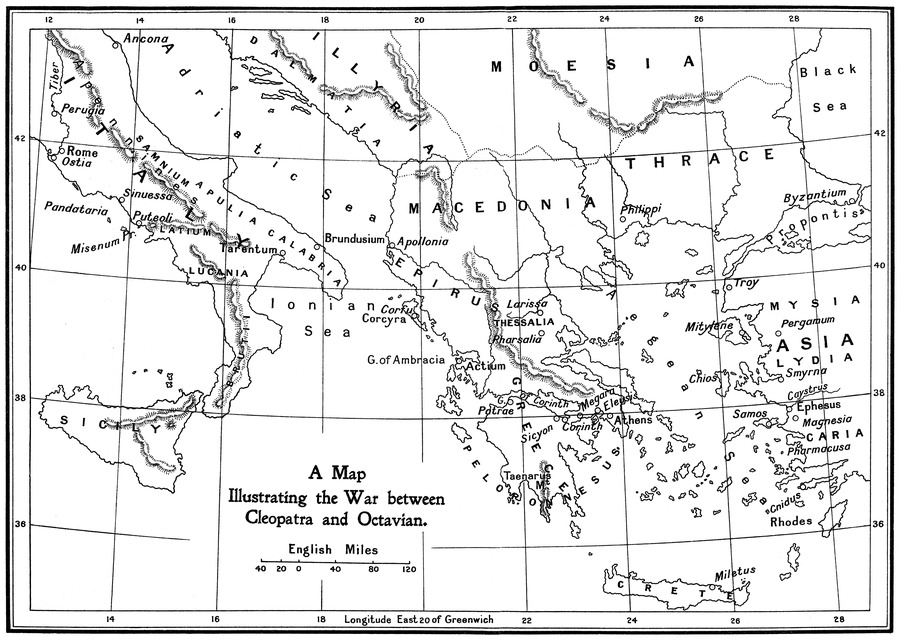
For the time being Octavian did not care to be at too
close quarters to Antony, and he therefore fortified himself
in a position a few miles back from the actual
entrance to the Gulf of Ambracia. Antony at once
shipped a part of his army across from Actium to the
north side of the great harbour’s mouth, and thus placed
himself in command of the passage into the inland water.
Octavian soon threw up impregnable earthworks around
his camp, and built a wall down to the shore of the
Ionian Sea, so that the enemy could not interfere with
the landing of his supplies, all of which had to come from
across the water. He stationed his ships in such a position
that they could command the entrance to the Gulf
of Ambracia; and, these vessels proving to be extremely
well manned and handled, Antony soon found that his
own fleet was actually bottled up in the Gulf, and could
not pass into the open sea without fighting every inch of
the passage out through the narrow fairway. Octavian
was thus in command of the Ionian Sea, and was free to
receive provisions or munitions of war day by day from
Italy. He could not, however, leave his fortified camp,
for Antony commanded all the country around him.
Thus, while Octavian blockaded Antony’s fleet in the
Gulf, Antony besieged Octavian’s army in their camp;
and while Octavian commanded the open sea and obtained
his supplies freely from Italy, Antony commanded the
land and received his provisions without interruption
from Greece. A deadlock therefore ensued, and neither
side was able to make a hostile move. It seems clear to
me that a decisive battle could only be brought on by
one of two manœuvres: either Antony must retire from
Actium and induce Octavian to come after him into
Greece, or else his fleet must fight its way out of the
Gulf and cut off Octavian’s supplies, thus starving him into
surrender. Many of Antony’s generals were of opinion
that the former movement should be undertaken, and
they pressed him to retire and thus draw Octavian from
his stronghold. Cleopatra, however, appears to have
been in favour of breaking the blockade and regaining
possession of the sea. She may have considered Antony’s
army to be composed of too many nationalities to make
success on land absolutely assured, and any retreat at
this moment might easily be misinterpreted and might
lead to desertions. On the other hand, she had confidence
in her Egyptian fleet and in Antony’s own ships, if, by
cutting down their number, their crews could be brought
up to the full complement; and she believed that with,
say, 300 vessels Octavian’s blockade could be forced, and
his own position subjected to the same treatment. I
gather that this plan, however, was hotly opposed by
Domitius Ahenobarbus and others; and, since a loss of
time was not likely to alter the situation to their disadvantage,
no movement was yet made.
Some time in June Antony sent a squadron of cavalry
round the shores of the Gulf to try to cut off Octavian’s
water-supply, but the move was not attended with much
success and was abandoned. Shortly after this the
deserter Titius defeated a small body of Antony’s cavalry,
and Agrippa captured a few of his ships which had been
cruising from stations outside the Gulf; whereupon
Octavian sent despatches to Rome announcing these
successes as important victories, and stating that he had
trapped Antony’s fleet within the Gulf. He also sent
agents into Greece to try to shake the confidence of the
inhabitants in his enemy, and these men appear to have
been partially successful in their endeavours.
These small victories of Octavian seem to have
unnerved Antony, and to have had a dispiriting effect
upon the army. Cleopatra, too, must have been particularly
depressed by them, for they seemed to be a
confirmation of the several ominous and inauspicious
occurrences which had recently taken place. An Egyptian
soothsayer had once told Antony that his genius would
go down before that of Octavian; and Cleopatra, having
watched her husband’s rapid deterioration in the last two
years, now feared that the man’s words were indeed
true. News had lately come from Athens that a violent
hurricane had torn down the statue of Bacchus, the god
whom Antony impersonated, from a group representing
the Battle of the Giants; and two colossal statues of
Fumenes and Attalus, each of which was inscribed with
Antony’s name, had also been knocked over during the
same cyclone. This news recalled the fact that a few
months previously at Patrae the temple of Hercules, the
ancestor of Antony, had been struck by lightning; and at
about the same time a small township founded by him
at Pisaurum, on the east coast of Italy, north of Ancona,
had been destroyed by an earthquake. These and other
ill-omened accidents had a very depressing effect on
Cleopatra’s spirits, and her constant quarrels with Antony
and his generals seem to have caused her to be in a state
of great nervous tension. Towards the end of July or
early in August, when the low-lying ground on which
their camp was pitched became infested with mosquitos,
and when the damp heat of summer had set the tempers
of everybody on edge, the quarrels in regard to the
conduct of the campaign broke out with renewed fury.
Domitius Ahenobarbus, Dellius, Amyntas, and others,
again urged Antony to retire inland and to fight a pitched
battle with Octavian as soon as he should come after
them. Cleopatra, however, still appears to have considered
that the forcing of the blockade was the most
important operation to be undertaken, and this she urged
upon her undecided husband. It was of course a risky
undertaking, but by reason of the very danger it made a
strong appeal to Cleopatra’s mind. If their fleet could
destroy that of Octavian, they would have him caught in
his stronghold as in a trap. They would not even have
to wait for the surrender; but, leaving eighty or a hundred
thousand men to prevent his escape, they might sail over
to Italy with twenty or thirty thousand legionaries and
take possession of empty Rome. There was not a senator
nor a military force in the capital, for Octavian had lately
made the entire senate in Rome come over to his camp, in
order to give tone to his proceedings; and, when once
Octavian’s sea-power had been destroyed, Antony and
Cleopatra would be free to ride unchecked into Rome
while the enemy was starved into surrender in Greece.
A single naval battle, and Rome would be theirs! This,
surely, was better than a slow and ponderous retreat into
the interior.
Antony, however, could not persuade his generals to
agree to this. The risk was great, they seem to have
argued; and even if they were victorious, was he going
to march into Rome with Cleopatra by his side? The
citizens would never stand it, after the stories they had
heard in regard to the Queen’s magical power over him.
Let her go back to Egypt, nor any longer remain to
undermine Antony’s popularity. How could he appear
to the world as a good republican with royal Cleopatra’s
arm linked in his? By abandoning the idea of a naval
battle the Egyptian fleet could be dispensed with, and
could be allowed to depart to Egypt if it succeeded in
running the blockade. Cleopatra had supplied ships but
hardly any soldiers, and a land battle could be fought
without her aid, and therefore without cause for criticism;
nor would Octavian any longer be able to say that he was
waging war against Cleopatra and not against Antony.
The money which she had supplied for the campaign was
almost exhausted, and thus she was of no further use to
the cause. Let Antony then give up the projected naval
battle, and order the Queen to go back quickly with her
ships to her own country: for thus, and thus only, could
the disaffected republican element in their army be brought
into line. Cleopatra, they said, had been the moving
spirit in the war; Cleopatra had supplied the money;
it was against Cleopatra that Octavian had declared
war; it was Cleopatra’s name, and the false stories
regarding her, which had aroused Rome to Octavian’s
support; it was Cleopatra who was now said on all
sides to be supreme in command of the whole army;
and it was of Cleopatra that every senator, every vassal
king, and every general, was furiously jealous. Unless
she were made to go, the whole cause was lost.
Antony seems to have realised the justice of these
arguments, and to have promised to try to persuade his
wife to retire to Egypt to await the outcome of the
war; and he was further strengthened in this resolve
when even Canidius, who had all along favoured the
keeping of Cleopatra with the army, now urged him
to ask her to leave them to fight their own battle. He
therefore told the Queen, it would seem, that he desired
her to go, pointing out that in this way alone could
victory be secured.
Cleopatra, I take it, was furious. She did not trust
Antony, and she appears to have been very doubtful
whether he would still champion her cause after victory.
She even doubted that he would be victorious. He was
now but the wreck of the man he had once been, for a
too lifelike impersonation of the god Bacchus had played
havoc with his nerves and with his character. He had
no longer the strength and the determination necessary
for the founding of an imperial throne in Rome; and
she felt that, even if he were successful in arms against
Octavian, he would make but a poor regent for her son
Cæsarion. Having used her money and her ships for
his war, he might abandon her cause; and the fact that
they were fighting for Cæsar’s son and heir, which had
already been placed in the background, might be for
ever banished. It must have seemed madness for her
to leave her husband at this critical juncture. In order
to prevent further desertions he would probably proclaim
his republican principles as soon as her back was turned;
and, in his drunken weakness, he might commit himself
so deeply that he would never be able to go back upon
his democratic promises. Since she was unpopular with
his generals, he would perhaps at once tell them that
she was nothing to him; and for the sake of assuring
victory he might even divorce her. Of course, it was
obvious that he was devoted to her, and relied on her
in all matters, seeming to be utterly lost without her;
but, for all she knew, his ambition might be stronger
than his love. She therefore refused absolutely to go;
and Antony was too kind-hearted, and perhaps too much
afraid of her anger, to press the matter.
His talk with her, however, seems to have decided him
to break the blockade as soon as possible, and at the
same time to invest Octavian’s lines so that he could
not escape from the stronghold which would become his
death-trap. Once master of the sea, he would, at any
rate, have opened a path for Cleopatra’s departure, and
she could retire unmolested with her fleet to her own
country. He therefore hurried on the manning of his
ships, and at the same time sent Dellius and Amyntas
into Thrace to recruit a force of cavalry to supplement
those at his disposal. Cleopatra pointed out to him that
the ground upon which their camp was pitched at Actium
was extremely unhealthy, and if they remained there
much longer the troops would be decimated by malaria;
and she seems perhaps to have urged him to move round
to the north of the Gulf of Ambracia, in order both to
obtain more healthy conditions for the army and to
invest more closely the camp of Octavian in preparation
for the naval fight. Domitius Ahenobarbus was still
hotly opposed to this fight; and now, finding that not
only was Cleopatra to be allowed to remain with the
army, but also that her plan of breaking the blockade
was to be adopted, instead of that of the retreat inland,
he was deeply incensed, and could no longer bear to
remain in the same camp with the Queen. Going on
board a vessel, therefore, as he said, for the sake of his
health, he slipped over to Octavian’s lines and offered
his services to the enemy. He did not live, however,
to enjoy the favourable consequences of his change, for,
having contracted a fever while at Actium, he died
before the battle of that name was fought.
This desertion, which occurred probably early in
August, came as a terrible shock to Antony, and he
seems to have accused his wife of being the cause of
it, which undoubtedly she was. This time he insisted
more vehemently on her leaving the army and retiring
to Egypt; and thereupon a violent quarrel ensued, which
lasted, I think, without cessation during the remainder
of their stay in Greece. At first, it seems to me, the
Queen positively refused to leave him, and she probably
accused him of wishing to abandon her cause. With
a sneer, she may have reminded him that his compact
with her, and his arrangements for an Egypto-Roman
monarchy, were made at a time when he had, to a great
extent, cut himself off from Rome and when he required
financial aid; but now he had four hundred respectable
republican senators to influence him, and, no doubt,
their support at this juncture was far more valuable to
him than her own. He had deserted her once
before, and she was quite prepared for him to do
so again.
Her anger, mistrust, and unhappiness must have
distressed Antony deeply, and he would, perhaps, have
given way once again had not three more desertions
from his camp taken place. The King of Paphlagonia,
jealous, apparently, of Cleopatra’s power, slipped across
to Octavian’s lines, carrying thither an account of the
dissensions in Antony’s camp. The two others, a Roman
senator named Quintus Postumius, and an Arab chieftain
from Emesa, named Iamblichus, were both caught; and,
to terrify those who might intend to go over to the
enemy, both were put to death, the one being torn to
pieces and the other tortured. Every day Octavian’s
cause was growing in popularity, and Antony was being
subjected to greater ridicule for his subserviency to the
little Queen of Egypt, who appeared to direct all his
councils and who now seemed to frighten him by her
anger. Octavian’s men were becoming self-confident and
even audacious. On one occasion while Antony, accompanied
by an officer, was walking at night down to the
harbour between the two ramparts which he had thrown
up to guard the road, some of the enemy’s men crept
over the wall and laid in wait for him. As they sprang
up from their ambush, however, they seized Antony’s
attendant officer in mistake for himself, and, by a rapid
flight down the road, he was able to escape.
Thoroughly unnerved by the course events were taking,
he again ordered the Queen to retire to Egypt; and at
last, stung by Antony’s reproaches, Cleopatra made up
her mind to go and to take her fleet with her. Having
formed this decision, she appears to have treated Antony
with the utmost hostility; and he, being in a highly
nervous condition, began to fear that she might kill
him. Her great eyes seemed to blaze with anger when
she looked upon him, and the contempt which she now
felt for him was shown in the expression of her face.
He appears to have cowered before her in the manner
of a naughty boy, and to have told his friends that he
believed she would murder him in her wrath. On hearing
this, Cleopatra decided to teach him a lesson which
he should not forget. One night at supper, she caused
her goblet to be filled from the same wine-jar from
which all had been drinking, and having herself drunk
some of the wine, she handed the cup to Antony as
though in token of reconciliation; and he, eagerly raising
it to his mouth, was about to place his lips where those
of the Queen had rested a moment before, when, as
though to add grace to her act, she took the wreath
of flowers from her hair and dipped it into the wine.
Antony again lifted the cup, but suddenly Cleopatra
dashed it from his hand, telling him that the wine was
poisoned. Antony appears to have protested that she
was mistaken, since she herself had just drunk from the
same cup; but Cleopatra calmly explained that the
wreath which she had dipped into the wine as she
handed it to him was poisoned, and that she had chosen
this means of showing him how baseless were his fears
for his life, for that, did she wish to rid herself of him,
she could do so at any moment by some such subtle
means. “I could have killed you at any time,” she
said, “if I could have done without you.”
The Queen, I imagine, now carried herself very proudly
and disdainfully, regarding Antony’s insistence on her
departure as a breach of faith. In her own mind she
must have feared lest he would actually abandon her,
and the anxiety in regard to the future of her country
and dynasty must have gnawed at her heart all day
and all night; but to him she seems only to have shown
coldness and contempt, thus driving him to a condition
of complete wretchedness. He did not dare, however,
to alter his decision in regard to her departure, for he
seems to have admitted some of his senators and generals
into the secret of this coming event, and it had much
quieted the volcanic atmosphere so long prevalent in the
camp. I am of opinion that the plan upon which he and
his wife had agreed was as follows: Having invested
Octavian’s lines more closely, and having taken all steps
to prevent him issuing from his stronghold, the pick of
Antony’s legionaries would be embarked upon as many of
the vessels in the Gulf of Ambracia as were seaworthy,
and these warships would force their way out and destroy
Octavian’s fleet. As soon as this was done an assault
would be made on the enemy’s position by sea and land;
and Cleopatra, taking with her the Egyptian fleet, could
then sail away to Alexandria, leaving Antony to enter
Rome alone.
This scheme, in my opinion, presented the only possible
means by which the Antonian army could rid itself
of Egyptian influence. If Cleopatra was made to retire
overland by way of Asia Minor and Syria, not only would
her passage through these countries be regarded by the
inhabitants as a flight, thus causing instant panic and
revolt, but also the Egyptian fleet would still remain
in the Gulf of Ambracia to show by its presence that
Cleopatra and her Kingdom of Egypt were yet the main
factors in the war. On the other hand, if the Queen
retired by sea with her ships, a naval battle designed to
force the blockade would have to be fought in order
to permit her to escape by that route. Thus, the republican
demand that the Queen should go to her own
country, and Cleopatra’s own reiterated proposal that
the war should be decided by a sea-fight, here concurred
in determining Antony to stake all upon a naval engagement.
This being settled, Antony announced to the army
that the fleet should break the blockade on August 29,
but the fact that the Egyptian ships were to depart immediately
after the battle was not made known, save to a
few. A great many of the vessels were ill furnished for
the fight, and were much under-manned; and Antony
now ordered these to be burnt, for, though they were
useless to him, they might be of value to the enemy,
and might be seized by them while the fleet was away
scouring the Ionian Sea. Sixty of the best Egyptian
vessels, and at least three hundred115 other ships, were
made ready for the contest; and during these preparations
it was no easy matter to keep the secret of the
Egyptian departure from leaking out. In order to cross
to Egypt Cleopatra’s sixty ships required their large sails,
but these sails would not under ordinary circumstances
be taken into battle; and in order that the Egyptian
vessels should not be made conspicuous by alone preparing
for a long voyage, thereby causing suspicions to
arise, all the fleet was ordered to ship its big sails;
Antony, therefore, having to explain that they would
be required in the pursuit of the enemy. Another difficulty
arose from the fact that Cleopatra had to ship
her baggage, including her plate and jewels; but this
was ultimately done under cover of darkness without
arousing suspicion.
Many of the generals, not realising that the naval
battle was largely forced upon Antony by those who
desired to rid his party of the Egyptians, were much
opposed to the scheme; and one infantry officer, pointing
to the many scars and marks of wounds which his body
bore, implored Antony to fight upon land. “O General,”
he said, “what have our wounds and our swords
done to displease you, that you should give your confidence
to rotten timbers? Let Egyptians and Phœnicians
fight on the sea; but give us the land, where we
well know how to die where we stand or else gain the
victory.” Antony, however, gave him no reply, but
made a motion with his hand as though to bid him
be of good courage.
On August 28 twenty thousand legionaries and two
thousand archers were embarked upon the ships of
war116 in preparation for the morrow’s battle. The vessels
were much larger than those of Octavian, some of them
having as many as ten banks of oars; and it seemed
likely that victory would be on their side. On the next
day, however, the sea was extremely rough, and the
battle had to be postponed. The storm proved to be
of great violence, and all question of breaking the blockade
had to be abandoned for the next four days. The
delay was found to be a very heavy strain upon the nerves
of all concerned, and so great was the anxiety of the two
important generals, Dellius117 and Amyntas, that they both
deserted to Octavian’s lines, the latter taking with him
two thousand Galatian cavalry. Dellius had probably
heard rumours about the proposed departure of Cleopatra,
and he was able to tell Octavian something of the
plans for the battle. In after years he stated that his
desertion was partly due to his fear of the Queen, for
he believed her to be angry with him for having once
remarked that Antony’s friends were served with sour
wine, whereas even Sarmentus, Octavian’s delicia, or
page, drank Falernian. One may understand Cleopatra’s
annoyance at this hint that money and supplies
were running short, more especially since this must
actually have been the fact.
On September 1st the storm abated, and in the
evening Antony went from ship to ship encouraging his
men. Octavian, informed by Dellius, also prepared
for battle, embarking eight legions and five pretorian
cohorts upon his ships of war, which seem to have been
more numerous, but much smaller, than those of Antony.
The morning of September 2nd was calm, and at an
early hour Octavian’s workmanlike ships stationed themselves
about three-quarters of a mile from the mouth
of the Gulf of Ambracia, where they were watched by
the eyes of both armies. They were formed into three
divisions, the left wing being commanded by Agrippa,
the centre by Lucius Arruntius, and the right wing by
Octavian. At about noon Antony’s huge men-o’-war
began to pass out from the harbour, under cover of the
troops and engines of war stationed upon the two promontories.
Octavian seems to have thought that it
would be difficult to attack them in the straits, and
therefore he retired out to sea, giving his enemies the
opportunity of forming up for battle. This was speedily
done, the fleet being divided, like Octavian’s, into three
squadrons, C. Sossius moving against Octavian, Marcus
Insteius opposing Arruntius, and Antony facing Agrippa.
The sixty Egyptian ships, under Cleopatra’s command,
were the last to leave the Gulf, and formed up behind
the central division.
Antony appears to have arranged with Cleopatra that
her ships should give him full assistance in the fight, and
should sail for Egypt as soon as the victory was won.
He intended, no doubt, to board her flagship at the
close of the battle and to bid her farewell. They had
separated that morning, it would seem from subsequent
events, with anger and bitterness. Cleopatra, I imagine,
had once more told him how distasteful was her coming
departure to her, and had shown him how little she
trusted him. She had bewailed the misery of her life
and the bitterness of her disillusionment. She had
accused him of wishing to abandon her cause, and she
had, no doubt, called him coward and traitor. Very
possibly in her anger she had told him that she was
leaving him with delight, having found him wholly
degenerate, and that she hoped never to see his face
again. Her accusations, I fancy, had stung Antony to
bitter retorts; and they had departed, each to their own
flagship, with cruel words upon their lips and fury in
their minds. Antony’s nature, however, always boyish,
impulsive, and quickly repentant, could not bear with
equanimity so painful a scene with the woman to whom
he was really devoted, and as he passed out to battle
he must have been consumed by the desire to ask her
forgiveness. The thought, if I understand him aright,
was awful to him that they should thus separate in
anger; and being probably a little intoxicated, the contemplation
of his coming loneliness reduced him almost
to tears. He was perhaps a little cheered by the thought
that when next he saw her the battle would probably
be won, and he would appear to her in the rôle of conqueror—a
theatrical situation which made an appeal
to his dramatic instincts; yet, in the meantime, I think
he was as miserable as any young lover who had
quarrelled with his sweetheart.
The battle was opened by the advance of Antony’s
left wing, and Agrippa’s attempt to outflank it with his
right. Antony’s other divisions then moved forward,
and the fight became general. “When they engaged,”
writes Plutarch, “there was no ramming or charging
of one ship into another, because Antony’s vessels, by
reason of their great bulk, were incapable of the speed
to make the stroke effectual, and, on the other side,
Octavian’s ships dared not charge, prow to prow, into
Antony’s, which were all armed with solid masses and
spikes of brass, nor did they care even to run in on their
sides, which were so strongly built with great squared
pieces of timber, fastened together with iron bolts, that
their own vessels’ bows would certainly have been
shattered upon them. Thus the engagement resembled
a land fight, or, to speak more properly, the assault and
defence of a fortified place; for there were always three
or four of Octavian’s vessels around each one of Antony’s,
pressing upon them with spears, javelins, poles, and
several inventions of fire which they flung into them,
Antony’s men using catapults also to hurl down missiles
from their wooden towers.”
The fight raged for three or four hours, but gradually
the awful truth was borne in upon Antony and Cleopatra,
that Octavian’s little ships were winning the day.
Antony’s flagship was so closely hemmed in on all sides
that he himself was kept busily occupied, and he had no
time to think clearly. But as, one by one, his ships
were fired, sunk, or captured, his desperation seems to
have become more acute. If his fleet were defeated and
destroyed, would his army stand firm? That was the
question which must have drummed in his head, as in
an agony of apprehension he watched the confused
battle and listened to the clash of arms and the cries
and shouts of the combatants. Cleopatra, meanwhile,
after being subjected to much battering by the enemy,
had perhaps freed her flagship for a moment from the
attentions of Octavian’s little warships, and, in manœuvring
for a better position, she was able to obtain a full
view of the situation. With growing horror she observed
the struggle around Antony’s flagship, and heard the
cheers of the enemy as some huge vessel struck or was
set on fire. Her Egyptian fleet had probably suffered
heavily, though her sailors would hardly have fought
with the same audacity as had those under Antony’s
command. As she surveyed the appalling scene no doubt
remained in her mind that Octavian had beaten them,
and she must even have feared that Antony would be
killed or captured. The anxieties which had harassed
her overwrought brain during the last few weeks as to
her husband’s intentions in regard to her position and
that of her son Cæsarion, were now displaced by the
more frightful thought that the opportunity would never
be given to him of proving his constancy; for, here and
now, he would meet his end. Her anger against him
for his vacillation, her contempt for the increasing
weakness of his character, and her misgivings in regard
to his ability to direct his forces in view of the growing
intemperance of his habits, were now combined in the
one staggering certainty that defeat and ruin awaited
him. He had told her to go back to Egypt, he had
ordered her to take herself off with her fleet at the end
of the battle. That end seemed to her already in sight.
It was not from a riotous scene of victory, however, that
she was to retire, nor was she to carry over to Alexandria
the tidings of her triumph with which to cover the shame
of her banishment from her husband’s side; but now she
would have to sail away from the spectacle of the wreck
of their cause, and free herself by flight from a man who,
no longer a champion of her rights, had become an
encumbrance to the movement of her ambitions.
In the late afternoon, while yet the victory was
actually undecided, although there could have been no
hope for the Antonian party left in Cleopatra’s weary
mind, a strong wind from the north sprang up, blowing
straight from unconquered Rome towards distant Egypt.
The sea grew rough, and the waves beat against the
sides of the Queen’s flagship, causing an increase of
confusion in the battle. As the wind blew in her face,
suddenly, it seems to me, the thought came to her that
the moment had arrived for her departure. Antony had
told her with furious words to go: why, then, should she
wait? In another hour, probably, he would be captured
or killed, and she, too, would be taken prisoner, to be
marched in degradation to the Capitol whereon she had
hoped to sit enthroned. She would pay her husband
back in his own coin: she would desert him as he had
deserted her. She would not stand by him to await an
immediate downfall. Though he was sodden with wine,
she herself was still full of life. She would rise above
her troubles, as she had always risen before. She would
cast him off, and begin her life once more. Her throne
should not be taken from her at one blow. She would, at
this moment, obey Antony’s command and go; and in
distant Egypt she would endeavour to start again in the
pursuit of that dynastic security which had proved so
intangible a vision.
Having arrived at this decision she ordered the signal
to be given to her scattered ships, and hoisting sail she
passed right through the combatants, and made off down
the wind, followed by her damaged fleet. At that
moment, it seems, Antony had freed his flagship from
the surrounding galleys, and thus obtained an uninterrupted
view of the Queen’s departure. His feelings
must have overwhelmed him,—anger, misery, remorse,
and despair flooding his confused mind. Cleopatra was
leaving him to his fate: she was obeying the order which
he ought never to have given her, and he would not see
her face again. All the grace, the charm, the beauty
which had so enslaved him, was being taken from him;
and alone he would have to face the horrors of probable
defeat. He had relied of late so entirely upon her that
her receding ships struck a kind of terror into his degenerate
mind. It was intolerable to him, moreover,
that she should leave him without one word of farewell,
and that the weight of his cruelty and anger should be
the last impression received by her. He could not let
her depart unreconciled and unforgiving; he must go
after her, if only to see her for a moment. Yet what did
it matter if he did not return to the battle? There was
little hope of victory. His fevered and exhausted mind
saw no favourable incident in the fight which raged
around him. Disgrace and ruin stared him in the face;
and the sooner he fled from the horror of defeat the
better would be his chance of retaining his reason.
“Here it was,” says Plutarch, “that Antony showed
to all the world that he was no longer actuated by the
thoughts and motives of a commander or a man, or
indeed by his own judgment at all; and what was once
said in jest, that the soul of a lover lives in the loved
one’s body, he proved to be a serious truth. For, as if
he had been born part of her, and must move with her
wheresoever she went, as soon as he saw her ships sailing
away he abandoned all that were fighting and laying
down their lives for him, and followed after her.” Hailing
one of his fastest galleys, he quickly boarded her and
told the captain to go after Cleopatra’s flagship with all
possible speed. He took with him only two persons,
Alexander the Syrian, and a certain Scellias. It was
not long before the galley, rowed by five banks of oars,
overhauled the retreating Egyptians, and Cleopatra then
learnt that Antony had followed her and had abandoned
the fight. Her feelings may be imagined. Her leaving
the battle had, then, terminated the struggle, and her
retreat had removed the last hope of victory from the
Antonians. Antony was a ruined and defeated man,
and a speedy death was the best thing he could hope
for; but not so easily was she to be rid of him. He
was going to cling to her to the end: she would never
be able to shake herself clear of him, but, drowning, he
would drag her down with him. Yet he was her husband,
and she could not abandon him in defeat as in victory he
had wished to abandon her. She therefore signalled to
him to come aboard; and having done this she retired
to her cabin, refusing to see him or speak to him.
Antony, having been helped on to the deck, was too
dazed to ask to be taken to her, and too miserable to
wish to be approached by her. He walked, as in a
dream, to the prow of the ship, and there seating himself,
buried his face in his hands, uttering not a word.
Thus some hours passed, but after it had grown dark
the beat of the oars of several galleys was heard behind
them, and presently the hull of the foremost vessel
loomed out of the darkness. The commotion on board
and the shouts across the water aroused Antony. For a
moment he seems to have thought that the pursuing
ships were bringing him some message from Actium—perhaps
that the tide of battle had turned in his favour.
He therefore ordered the captain to turn about to meet
them, and to be ready to give battle if they belonged to
the enemy; and, standing in the prow, he called across
the black waters: “Who is this that follows Antony?”
Through the darkness a voice responded: “I am
Eurycles, the son of Lachares, come to revenge my
father’s death.” Antony had caused Lachares to be
beheaded for robbery, although he came of the noblest
family in the Peloponnese; and his son had fitted out a
galley at his own expense and had sworn to avenge his
father. Eurycles could now be seen standing upon his
deck, and handling a lance as though about to hurl it;
but a moment later, by some mistake which must have
been due to the darkness, he had charged with terrific
force into another Egyptian vessel which was sailing
close to the flagship. The blow turned her round, and
in the darkness and confusion which followed, Cleopatra’s
captain was able to get away. The other vessel, however,
was captured, together with a great quantity of
gold plate and rich furniture which she was carrying
back to Egypt.
When the danger was passed Antony sat himself down
once more in the prow, nor did he move from that part
of the ship for three whole days. Hour after hour he sat
staring out to sea, his hands idly folded before him, his
mind dazed by his utter despair. By his own folly he
had lost everything, and he had carried down with him
in his fall all the hope, all the ambition, and all the
fortune of Cleopatra. It is surprising that he did not
at once put an end to his life, for his misery was pitiable;
yet, when at last the port of Tænarus was reached, at the
southern end of the Greek peninsula, he was still seated
at the prow, his eyes fixed before him. At length, however,
Iras, Charmion, and other of Cleopatra’s women
induced the Queen to invite him to her cabin; and after
much persuasion they consented to speak to one another,
and, later, to sup and sleep together. Cleopatra could
not but pity her wretched husband, now so sobered and
terribly conscious of the full meaning of his position;
and I imagine that she gave him what consolation she
could.118
As their ship lay at anchor several vessels came into
the harbour, bringing fugitives from Actium; and these
reported to him that his fleet was entirely destroyed or
captured, more than five thousand of his men having
been killed, but that the army stood firm and had not at
once surrendered. At this news Cleopatra, who had not
been wholly crushed under the weight of her misfortunes,
seems to have advised Antony to try to save some remnant
of his forces, and to send messengers to Canidius
to march his legions with all speed through Macedonia
into Asia Minor. This he did; and then, sending for
those of his friends who had come into the port, he
begged them to leave him and Cleopatra to their fate,
and to give their whole attention to their own safety.
He and the Queen handed to the fugitives a large sum
of money and numerous dishes and cups of gold and
silver wherewith to purchase their security; and he
wrote letters in their behalf to his steward at Corinth,
that he should provide for them until they had made
their peace with Octavian. In deep dejection these defeated
officers attempted to refuse the gifts, but Antony,
pressing them to accept, “cheered them,” as Plutarch
says, “with all the goodness and humanity imaginable,”
so that they could not refrain from tears. At length the
fleet put out to sea once more, and set sail for the coast
of Egypt, arriving many days later at Parætonium, a
desolate spot some 160 miles west of Alexandria, where
a small Roman garrison was stationed.119 Here Antony
decided to stay for a time in hiding, while the braver
Cleopatra went on to the capital to face her people;
and for the next few weeks he remained in the great
solitude of this desert station. A few mud huts, a palm-tree
or two, and a little fort constituted the dreary settlement,
which in the damp heat of September must have
presented a colourless scene of peculiarly depressing
aspect. This part of the coast is absolutely barren, and
only those who have visited these regions in the summer-time
can realise the strange melancholy, the complete
loneliness, of this sun-scorched outpost. The slow,
breaking waves beat upon the beach with the steady
insistence of a tolling bell which counts out a man’s
life; the desert rolls back from the bleak sea-shore, carrying
the eye to the leaden haze of the far horizon; and
overhead the sun beats down from a sky which is, as it
were, deadened by the heat. In surroundings such as
these heart-broken Antony remained for several weeks,
daily wandering along the beach accompanied only by
two friends, one, a certain Aristocrates, a Greek rhetorician,
and the other the Roman soldier Lucilius, who,
fighting on the side of the enemy at Philippi, as we have
read, had heroically prevented the capture of the defeated
Brutus, and had been pardoned by Antony as a reward
for his courage, remaining thereafter, and until the last,
his devoted friend.
At length one of his ships, putting into the little port,
seems to have brought him the news of events at Actium.
After his flight the battered remnant of his fleet, having
continued the fight until sunset, sailed back into the Gulf
of Ambracia; and next day Octavian invited them and
the army to surrender on easy terms. No one, however,
would believe that Antony had fled, and the offer was
refused. Next day, however, some of the vassal kings
laid down their arms, and, after a week of suspense,
Canidius fled. Part of the legions scattered into
Macedonia, and on September 9th the remainder surrendered
together with the fleet. Octavian then sailed
round to Athens, and there received the submission of
every city in Greece, with the exception of Corinth. He
at once began a general massacre of Antony’s adherents,
and, to save their skins, the townspeople in every district
heaped honours upon the conqueror, erecting statues to
him and decreeing him all manner of civic distinctions.
Shortly after this a messenger reached Antony from the
west stating that the legions left in North Africa had also
gone over to Octavian; and thereupon he attempted to
commit suicide. He was, however, restrained by his two
faithful friends; and in the deepest dejection he was at
last persuaded by them to sail for Alexandria, once more
to comfort himself with the presence of Cleopatra.