It has been seen that Queen Tiy presented
several children to the king; but it was not
until they had reigned some twenty-five or
twenty-six years that the future monarch was
born. As the years had passed the queen must
have grown more and more anxious for a son,
and many must have been the prayers she offered
up that a male child might be vouchsafed to
her. In Egypt at the present day the desire
to bear a son holds dominion in the heart of
every young woman; and those to whom this
privilege has not been granted forsake the laws
of the prophet and still lay their passionate
appeal before the old gods. The present writer
was asked recently by a young peasant to allow
his wife to walk round the outer wall of an
ancient temple, in order that she might perchance
bear a male child thereafter; and on another
occasion three young women were seen
sliding down the plinth of an overturned statue
of Rameses the Great for the same purpose.
With similar emotion, though with greater intelligence,
Queen Tiy must have turned in her grief
from one god to another, promising them all
manner of gifts if they would grant her desire.
To Ra-Horakhti Aton she appears to have
turned with the most confidence; and perhaps,
as will presently be seen, she vowed that if a
son were granted to her she would dedicate him
to the service of that god.
It is probable that the little prince first saw
the light in the royal palace at Thebes, which
was situated on the edge of the desert at the
foot of the western hills. It was, as has been
said, an extensive building, lightly constructed
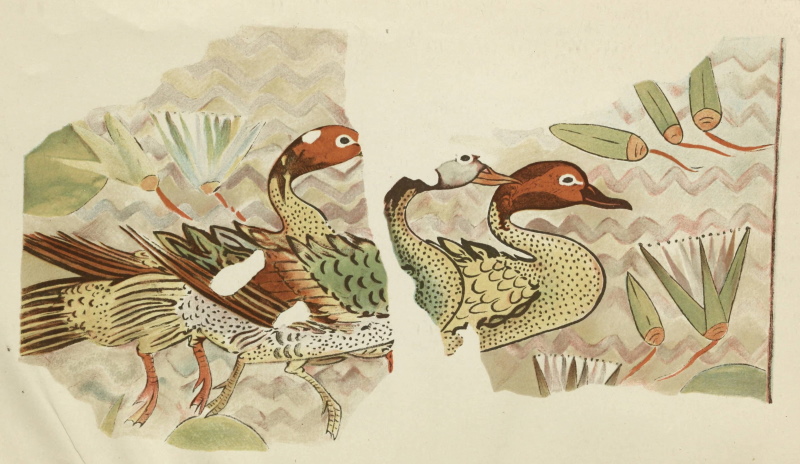
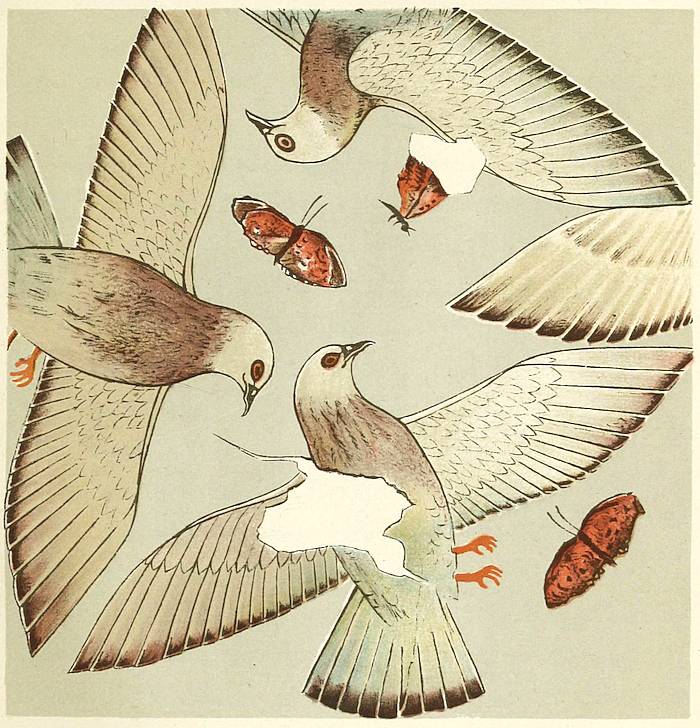
and gaily decorated. The ceilings and pavements
of its halls were fantastically painted
with scenes of animal life: wild cattle ran
through reedy swamps beneath the royal feet,
and there many-coloured fish swam in the water;
while overhead flights of pigeons, white against
a blue sky, passed across the hall, and wild
duck hastened towards the open casements.
Through curtained doorways one might obtain
glimpses of the garden planted with flowers
foreign to Egypt; and on the east of the palace
shone the great pleasure-lake, surrounded by the
trees of Asia.
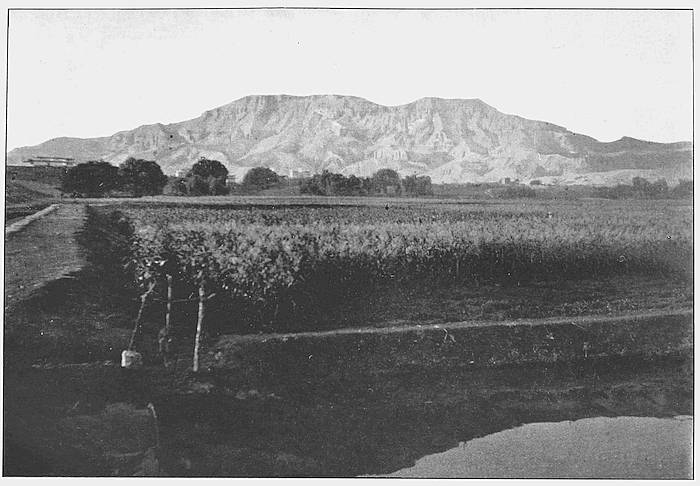
In all the world there are few places more
beautiful than the site of this palace. Here one
may sit for many an hour watching the changing
colours on the wonderful cliffs, the pink and
the yellow of the rocks standing out from the
blue and the purple of the deep shadows. In
the fields which now surround the ruined palace,
where the royal gardens were laid out, one obtains
an impression of colour, of beauty, and of gaiety—if
it can be so expressed—which is not easily
equalled. The continuous sunshine and the
bracing wind render one intensely awake to
natural joys; and here, indeed, was a fitting
birthplace, one feels, for a king who taught his
people to study the beauties of nature.
The little prince was named Amonhotep,[14] “the
Peace-of-Amon,” after his father; but though
the supremacy of Amon was thus acknowledged,
the Heliopolitan deity appears to have been considered
as the protector of the young boy. While
the luxurious court rejoiced at the birth of their
future king, one feels that the ancient priesthood
of Amon-Ra must have looked askance at the
baby who was destined one day to be their
master. This priesthood still demanded implicit
obedience to its stiff and ancient conventions,
and it refused to recognise the growing tendency
towards religious speculation.
Probably stronger measures would have been
taken by it to resist the growing power of Ra-Horakhti,
had it not been for the fact that Ra
was also a form of Amon, and had been identified
with him under the name of Amon-Ra. The
god Amon was originally but the local deity of
Thebes; and, when the Theban Pharaohs of the
Eighteenth Dynasty had elevated him to the position
of the state god of all Egypt, they made
him acceptable to the various provinces, as we have
seen, by pointing to his identification with Ra, the
sun-god, who, under one form or another, found
a place in every temple and held high rank in
every variety of mythology. As Amon-Ra he
was able to be appreciated by the sun-worshippers
of Syria and by those of Nubia, for there were
few races who would not do homage to the great
giver of warmth and light.
It is possible that those more thoughtful
members of the court who were quietly attempting
to undermine the influence of the priesthood
of Amon, and who were beginning to carry into
execution the schemes of emancipation which we
have already noticed, now endeavoured to strip
Amon of his association with the sun; for that
identity was really his simple claim to acceptance
by any but Thebans. The priesthood, on their
part, it may be supposed, drew as much attention
as possible to the connection of their deity with
Ra; for they knew that none but the Heliopolitan
god could be advanced with success as a
rival of Amon by those who desired to overthrow
the Theban god. Thus one finds that the High
Priest of Ra at Heliopolis was given, and was
obliged to accept, the honorary office of Second
Priest of Amon at Thebes,[15] which at once placed
him under the thumb of the Theban High Priest.
The propounders of the new thought, however,
met this move by bringing into greater prominence
the claims, not of Ra-Horakhti, but of
Aton, which was merely a more elusive form of
the sun-god. The priesthood of Amon had
always checked the individual growth of Ra-Horakhti
by regarding him simply as an aspect
of Ra, and hence of Amon-Ra. One of the
essential features of the new movement was the
regarding of Ra as an aspect of Ra-Horakhti,
and the calling of Ra-Horakhti by the uncontaminated
name of Aton. Aton, in fact, was
originally introduced into the matter largely for
the purpose of preventing any identification
between Amon-Ra and Ra-Horakhti. Soon the
name of Aton, entirely supplanting that of Atum,
was heard with some frequency at Thebes and
elsewhere, but always, it must be remembered,
as another word for Ra-Horakhti.
The desire of the court for a change of
religion is understandable. The cult of the
god Amon, as has been said, was so hedged
about with conventionalities that free thought
was impossible. We have seen, however, that
the upper classes were passing through a
phase of religious speculation, and they were
ready to revolt against the domination of a
priesthood which forbade criticism. The worship
of the intangible power of the sun, under the
name of Aton, offered endless possibilities for
the exercise of those tendencies towards the
abstract which were now beginning to be felt
all over the civilised world. This was man’s
first age of philosophical thought, and for the
first time in history the gods were being endued
with ideal qualities.
Apart from all questions of religion, the
priesthood of Amon had obtained such power
and wealth that it was a very serious menace
to the dignity of the throne. The great organisation
which had its headquarters at Karnak
had become an incubus which weighed heavily
upon the state. For political reasons alone,
therefore, it was desirable to push the priests
of Heliopolis into a more prominent position.
There was, moreover, a third consideration.
The god Aton, with whom Ra and Ra-Horakhti
were now being identified, was, we have seen,
originally the same as the Syrian and Greek
Adonis, the word “Adon” or “Aton” meaning
simply “lord.” Thus the propounders of the
new doctrines must have dreamt of an Egypto-Syrian
empire bound together by the ties of a
common religion. With one god understood and
worshipped from the cataracts of the Nile to
the distant Euphrates, what power could destroy
the empire?
In Amonhotep III. one may see the lazy,
speculative Oriental, too opinionated and too
vain to bear with the stiff routine of his
fathers, and yet too lacking in energy to
formulate a new religion. On the other hand,
there is every reason to suppose that Queen
Tiy possessed the ability to impress the claims
of the new thought upon her husband’s mind,
and gradually to turn his eyes, and those of
the court, away from the sombre worship of
Amon, “the unknown god,” into the direction
of the brilliant cult of the sun. Those who
have travelled in Egypt will realise how completely
the land is dominated by the sun.
The blue skies, the shining rocks, the golden
desert, the verdant fields, all seem to cry out
for joy of the sunshine. The extraordinary
energy which one may feel in Egypt at
sunrise, and the deep melancholy which sometimes
accompanies the red nightfall, must have
been felt by Tiy also in her palace at Thebes.
As the years passed the power and influence
of Queen Tiy increased; and now that she
had borne a son to the king there was added
to her great position as royal wife the equally
great rôle of royal mother. Never before
had a queen been so freely represented on
all the king’s monuments, nor had so fine a
series of titles been given before to the wife
of a Pharaoh. At Sedênga, far up in the
Sudan, her husband erected a temple for her;
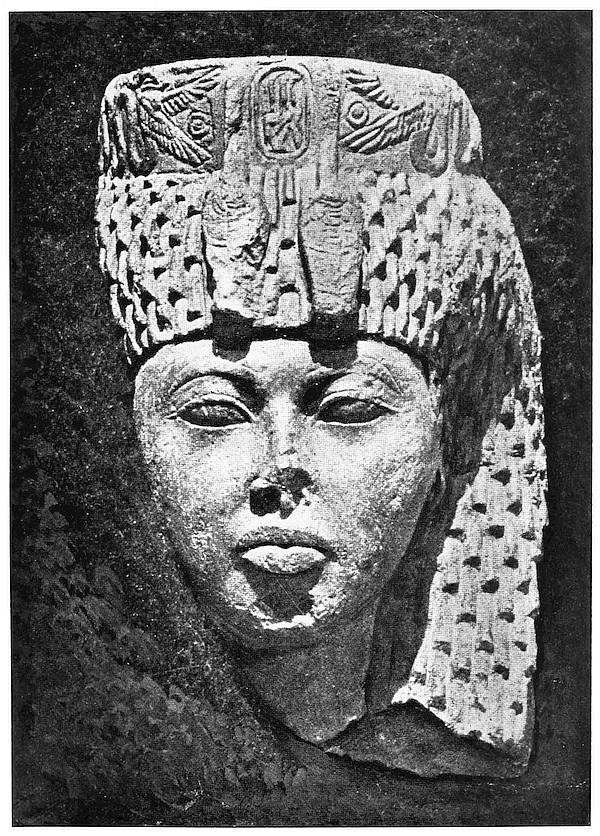
and in distant Sinai a beautiful portrait head
of her was recently found. All visitors to
Thebes have seen her figures by the side of
the legs of the two great colossi at the edge
of the Western Desert; and the huge statues
of herself and her husband, now in the Cairo
Museum, will have been seen by those who
have visited that collection. Of Grilukhipa,[16]
however, and the king’s other wives, one hears
nothing at all: Queen Tiy relegated them to
the background almost before their marriage
ceremonies were over.
By the time that Amonhotep III. had reigned
for thirty years or so, he had ceased to give
much attention to state affairs, and the power
had almost entirely passed into the capable
hands of Tiy. Already an influence, which we
may presume to have been to a large extent
hers, was being felt in many directions: Ra-Horakhti
and Aton were being brought into
the foreground, a tone of thought which can
hardly be regarded as purely Egyptian was
being developed, the art was undergoing modifications
and had risen to a pitch of excellence
never attained before or after. The exquisite
low-reliefs of the end of the reign of Amonhotep
III.—for example, those to be seen at Thebes
in the tombs of Khaemhat and Rames,[17] both
of which are definitely dated to the close of
the reign—stir one almost as do the works of
the early Florentine masters. There is an elusive
grace in the dainty figures there sculptured,
which, through another medium and under other
laws of convention, cause them to appeal with
the same force of indefinable sweetness as do
the figures in the works of Filipino Lippi and
Botticelli. In the mass of Egyptian painting
and sculpture of secondary importance such gems
as these have been overlooked and have not
been appreciated by the public; but the present
writer ventures to think that some day they will
set the heart of all art-lovers dancing as danced
those of Queen Tiy’s great masters.
The court in which the little prince passed
his earliest years was more brilliant than ever
it had been before, and Queen Tiy presided over
scenes of indescribable splendour. Amonhotep
III. has been truly called “the Magnificent”;
and at no period, save that of Thothmes III.,
were the royal treasuries so full or the nobles so
wealthy. Out of a pageant of festivities, from
amidst the noise of song and laughter, the little
sad-eyed prince first emerges on to the stage
of history, led by the hand of Queen Tiy; but
as he appears before us, above the clink of the
golden wine-bowls, above the sound of the
timbrels, one seems to hear the lilt of a more
simple song, and the peaceful singing of a lark.
During the last years of his reign the Pharaoh,
although well under fifty years of age,[18] seems to
have suffered from permanent ill-health. On
two occasions the King of Mitanni sent to
Egypt a miracle-working statuette of the goddess
Ishtar, apparently in the hope that Amonhotep
might be cured of his illness by it. It
is probable that the king had never been a very
strong man. Having been born when his father—himself
extremely delicate—was but a child,
he had had little chance of enjoying a robust
middle age, and he passed on to his children
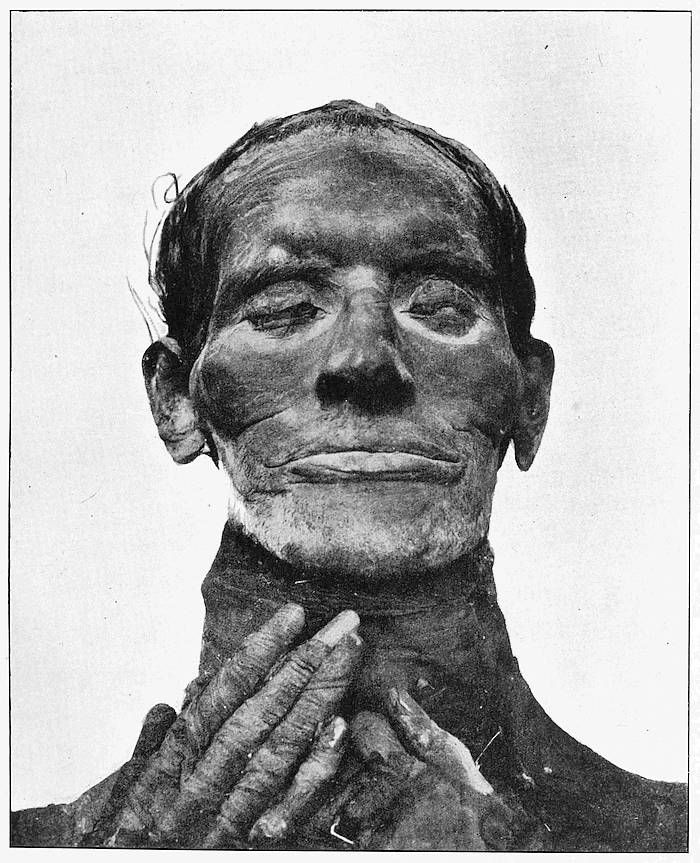
this inherent weakness. One hears no more of
his daughters,[19] whom we have seen mourning
for their grandparents Yuaa and Tuau, and
there is some likelihood that they died young.
The little Prince Amonhotep was already developing
constitutional weaknesses which rendered
his life very precarious. His skull was
misshapen, and he must have been subject to
occasional epileptic fits. And now Queen Tiy
gave birth to a daughter, who was named
Baketaton in honour of the new god, and who
seems to have lived less than a score of years,
since nothing more is heard of her after her
twelfth or thirteenth year.
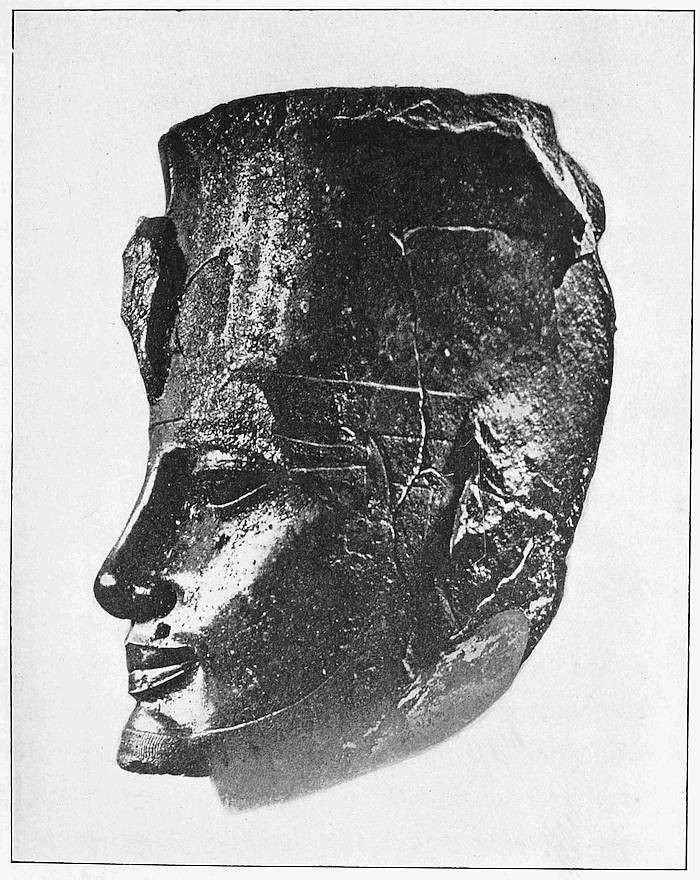
Amonhotep III.
As Amonhotep, at the age of forty-eight or
forty-nine, felt his end approaching, he seems
to have shown considerable anxiety in regard
to the succession. Here was his only son—now
a boy of ten or eleven years of age—in so sad
a state of health that he could not be expected
to live to manhood, and in the event of his
death the throne would be without an occupant
in the direct line. Obviously it was necessary
that he should be married as soon as possible, in
order that he might become a father as early
as that was naturally possible. Amonhotep III.
himself had been married to Tiy when he was
about twelve years of age, and his father Thothmes
IV. had likewise been married at that
early age.[20] The little Prince Amonhotep should,
therefore, also be given a wife at once; and the
Pharaoh now began to look around for a suitable
consort for him. He had heard that
Dushratta, King of Mitanni, had a small
daughter who was said to be a comely maiden;
but it appears that she was only eight or nine
years of age,[21] and therefore could not be expected
to provide an heir for at least another
four years. Nevertheless there were many political
reasons for proposing the union. Mitanni
was, as we have seen, the buffer state between
the Pharaoh’s Syrian possessions and the lands of
the Hittites and of the Mesopotamians. Thothmes
IV. had asked a bride from Mitanni, and Amonhotep
III. himself had obtained Gilukhipa from
thence, if not Queen Tiy also: both these being
probably political matches, designed for the welfare
of the Syrian empire. The Pharaoh therefore
decided upon this marriage for his sickly
son, and sent an embassy to Dushratta to
negotiate the union between these two children.
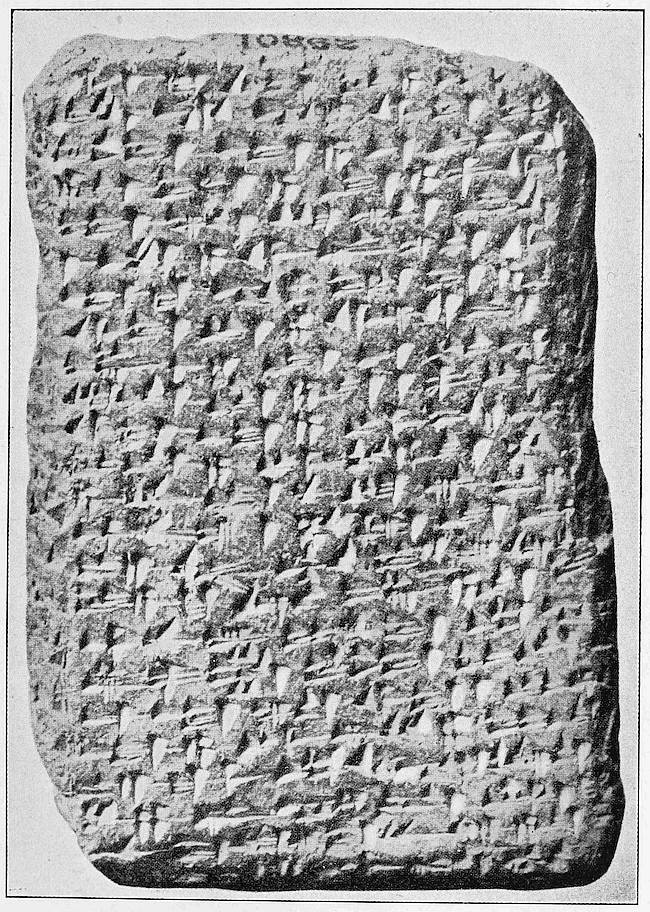
The reply of Dushratta has, fortunately, been
preserved to us. The Mitannian king acknowledges
the arrival of the envoy, and is much
rejoiced at this further binding together of the
two countries. In a subsequent letter it is evident
that the princess has already been sent to
Egypt, and we are led to suppose that Prince
Amonhotep has at once been married to her.
The little princess was named Tadukhipa, but
on her arrival in Egypt she was renamed
Nefertiti. Her age, as mentioned above, is apparent
from the fact that, although in after life
she gave birth to children at very regular
intervals, her first child was not born until nearly
five years after her marriage.[22] So young was
she that she did not at once cohabit with the
prince, but was put under the care of a certain
lady of the court named Ty, the wife of a noble
of the name of Ay, who afterwards usurped the
throne. This lady Ty called herself in later
years “great nurse and nourisher of the Queen,”
and Ay always called himself the king’s father-in-law
(neter at). It would thus seem that they
had become the actual foster-parents of the little
Syrian girl. It was not at all unusual in Egypt
for a child to be adopted thus; and it is a
curious fact that if a woman gave the breast to
a child of any age but for a moment, or if a man
placed his finger in the child’s mouth, a formal
adoption was considered to have been made.[23]
The court had hardly settled down after the
celebration of the marriage of Amonhotep and
Tadukhipa-Nefertiti, when it was thrown into
mourning by the death of Amonhotep “the
Magnificent,” which occurred in the thirty-sixth
year of his reign. Queen Tiy at once assumed
control of state affairs, on behalf of her barely
eleven-year-old son, who as Amonhotep IV. now
ascended the throne of the Pharaohs.
On coming to the throne the young king
fixed his titulary in the following manner:—
Mighty Bull, Lofty of Plumes; Favourite of the
Two Goddesses, Great in Kingship in Karnak;
Golden Hawk, Wearer of Diadems in the Southern
Heliopolis; King of Upper and Lower Egypt,
Beautiful-is-the-Being-of-Ra, the Only-One-of-Ra;
Son of the Sun, Peace-of-Amon (Amonhotep),
Divine Ruler of Thebes; Great in Duration, Living
for Ever and Ever, Beloved of Amon-Ra, Lord of
Heaven.
These titles were drawn up on more or less
prescribed lines, and conformed to the old custom
of the Pharaohs. Like his ancestors, he was
called “Beloved of Amon-Ra,” although, as we
have seen, the power of that god was already
much undermined. To counterbalance this reference
to the god of Thebes, however, one finds
the surprising title—
High Priest of Ra-Horakhti, rejoicing in the horizon
in his name, “Heat-which-is-in-Aton.”
Let the boy be said to be beloved of Amon-Ra
till the walls of Thebes reverberate with the cry;
let Amon-Ra be called Lord of Heaven till the
priestly heralds can shout no more: the doom of
the god of Thebes cannot now be averted, for the
reigning Pharaoh is dedicated to another god.
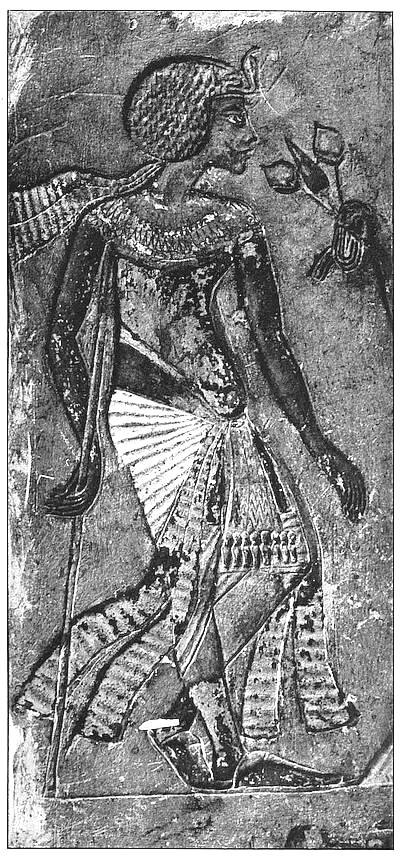
Akhnaton.
It is obvious that a boy of eleven years of age
could not himself have claimed the office of the
High Priest of Ra-Horakhti. Queen Tiy and
her advisers must have deliberately endowed the
youthful king with this office, largely in order
to set the seal upon the fate of Amon. There
were, perhaps, other reasons why this remarkable
step was decided upon. It may be, as has been
said, that the queen, before the birth of her
son, had vowed him to Ra-Horakhti. Again, the
boy was epileptic, was subject to hallucinations;
and it may be that while in this condition he
had seen visions or uttered words which led his
mother to believe him to be the chosen one of the
Heliopolitan god, whose name the prince must
have been constantly hearing. In a palace where
the mystical “Heat-which-is-in-Aton,” which was
the new elaboration of the god’s name, was
being daily invoked, and where the youthful
master of Egypt was constantly falling into
what appeared to be holy frenzy, it is not
unlikely that the rising deity would be connected
with the eccentricities of the young
Pharaoh. The High Priest of Ra-Horakhti was
always called “The Great of Visions,” and was
thus essentially a visionary prophet either by
nature or by circumstance; and the unfortunate
boy’s physical condition may have been turned,
thus, to account in the struggle against Amon-Ra.
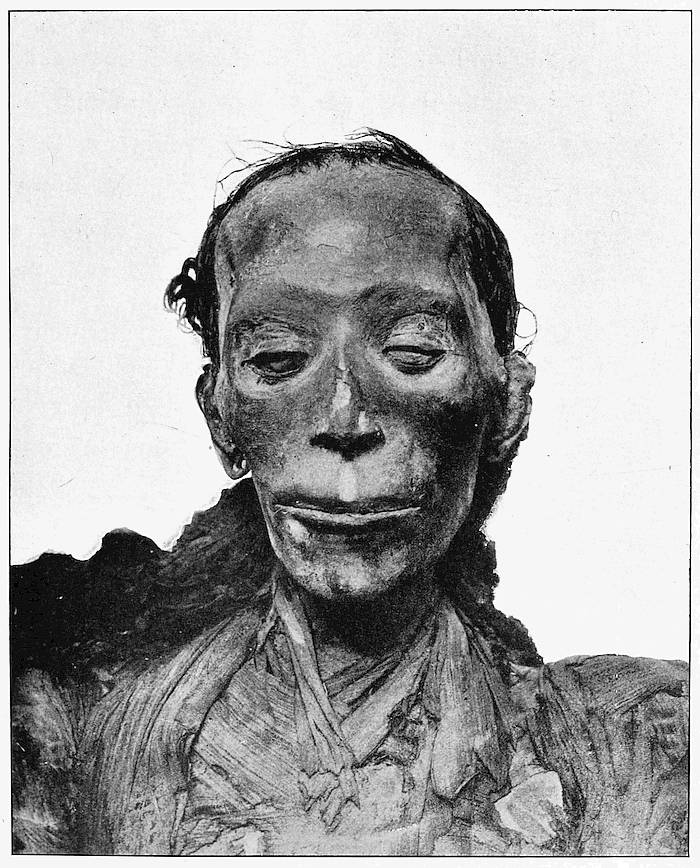
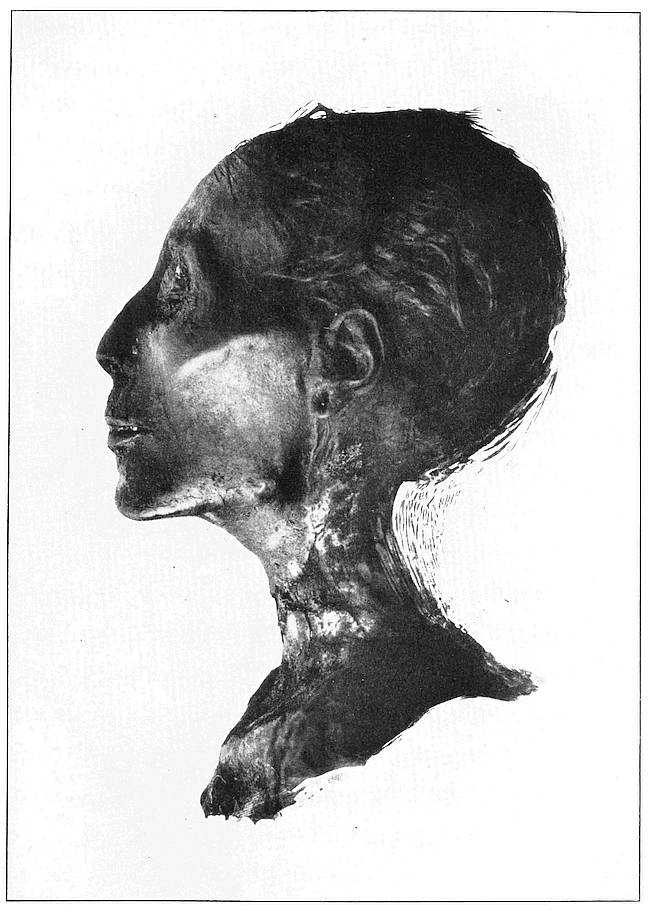
One may now imagine the Pharaoh as a pale,
sickly youth. His head seemed too large for
his body; his eyelids were heavy; his eyes as
one imagines them were wells of dream. His
features were delicately moulded, and his mouth,
in spite of a somewhat protruding lower jaw,
is reminiscent of the best of the art of Rossetti.
He seems to have been a quiet, studious boy,
whose thoughts wandered in fair places, searching
for that happiness which his physical condition
had denied to him. His nature was
gentle; his young heart overflowed with love.
He delighted, it would seem, to walk in the
gardens of the palace, to hear the birds singing,
to watch the fish in the lake, to smell the
flowers, to follow the butterflies, to warm his
small bones in the sunshine. There was a grave
dignity in his gait, or the artists have lied; and
his words were already fraught with wisdom.
The great crown of the Pharaohs sat easily
upon his head, for his every movement was
royal. He accepted as his due the homage of
the court; yet he does not seem to have acted
with arrogance, and was ever a tender-hearted,
impulsive child. Already he was sometimes
called “Lord of the Breath of Sweetness”;[24]
and already he was so much beloved by his
subjects that their adherence to him through
the rough places of his future life was assured.
For the first years of his reign he was, of
course, entirely under the regency of his mother.
Dushratta, the King of Mitanni, writing to congratulate
the boy on his accession, addressed
himself to Queen Tiy, as though he thought
the king would hardly yet be able to understand
a letter; and in a later communication he asks
the Pharaoh to inquire of his mother as to
certain matters of international policy. But
although so young, the king was wise beyond
his years, as the reader will presently see.
In a subsequent chapter it will be the writer’s
purpose to show to what heights of ideal thought,
and to what profundities of religious and moral
philosophy, this boy, in the years of his early
manhood, attained; and it will but enhance our
respect for his abilities when he reached maturity,
if we find in his early training all manner of
shortcomings. The beautiful doctrines of the religion
with which this Pharaoh’s name is identified
were productions of his later days; and until
he was at least seventeen years of age neither
his exalted monotheism nor any of his future
principles were really apparent. Some time after
the eighth year of his reign one finds that he
had evolved a religion so pure that one must
compare it with Christianity in order to discover
its faults; and the reader will presently see that
this superb theology was not derived from his
education.
One of the first acts of the king’s reign, undertaken
at the desire of Queen Tiy or of the royal
advisers, was the erection of a temple to Ra-Horakhti
Aton at Karnak.[25] This was in no
way an insult to Amon, for Thothmes III. and
other Pharaohs had dedicated temples at Karnak
to gods other than Amon. The priesthood
of Amon-Ra recognised the existence of the
many deities of Egypt, and gave them their
place in the constitution of heaven, reserving
for their own god the title of “King of the
Gods.” There was a temple of Ptah here; there
were shrines set apart for the worship of Min;
and other gods, unconnected with Amon, were
here accommodated. The priests of Amon-Ra
thus could not offer any serious objection to
the project. The building[26] was to be constructed
of sandstone, and therefore various officials were
dispatched to the great quarries of Gebel Silsileh,
which lie on the river between Edfu and Kom
Ombo, and to those near Esneh. Large tablets
were there carved upon the cliffs towards the
close of the work, and on them the figure of the
Pharaoh was represented worshipping Amon, who
was thus still the state god. Above the king’s
figure, however, the disk of the sun is seen, and
from it a number of lines, representing rays, project
downwards towards the royal figure. These rays
terminate in hands, which thus seem to be distributing
the “Heat-which-is-in-Aton” around
the Pharaoh. This is the first representation of
the afterwards famous symbol of the religion of
Aton, and it is significant that it should make its
début in a scene representing the worship of Amon.
The king is called the High Priest of Ra-Horakhti;
but the title “Living in truth,” which
he took to himself in later years, and which had
reference to the religion of Aton which he was
soon to evolve, does not yet appear.
A large number of fragments from this shrine
have been discovered, and on these one sees
references to the gods Horus, Set, Wepwat,
and others. The king is still called by the
name Amonhotep, which was later banned, and
the names of Aton, afterwards always written
within the royal ovals or cartouches, are still
lacking in that distinction. The temple was
called “Aton-is-found-in-the-House-of-Aton,” a
curious name of which the meaning is not clear.[27]
A certain official named Hataay was “Scribe
and Overseer of the Granary of the House of the
Aton,” by which this temple is probably meant;
and in the tomb of Rames a reference is made
to the building by its full name, and a picture
of it is given, but otherwise one knows little
about it. The rapidity with which it was desired
to be set up is shown by the fact that the great,
well-trimmed blocks of stone usually employed
in the construction of sacred buildings were
largely dispensed with, and only small easily-handled
blocks were used. The imperfections in
the building were then hidden by a judicious
use of plaster and cement, and thus the walls
were smoothed for the reception of the reliefs.
The quarter in which the temple stood was now
called “Brightness of Aton the Great,” and
Thebes received the new name of “City of the
Brightness of Aton.”
There are two other monuments which date
from these early years of the king’s reign: both
are tombs of great nobles. At this period one
of the greatest personages in the land was the
above-mentioned Rames, the Vizir of Upper
Egypt. This official was now engaged in constructing
and decorating a magnificent sepulchre
for himself in the Theban necropolis. In the
great hall of this tomb the artists were busy
preparing the beautiful sculptures and paintings
which were to cover the walls, and ere half
their work was finished they set themselves to
the making of a fine figure of Amonhotep IV.
seated upon his throne, with the goddess Maat
standing behind him. The scene was probably
executed a few months before the making of
the tablets at the quarries. The sun’s rays do
not appear, and the work was carried out strictly
according to the canons of art obtaining during
the last years of Amonhotep III. and the first
of his son. But hardly had the figures been
finished before the order came that the Aton
rays had to be included, and certain changes
in the art had to be recognised; and therefore
the artists set to work upon another figure of
the king standing under these many-handed
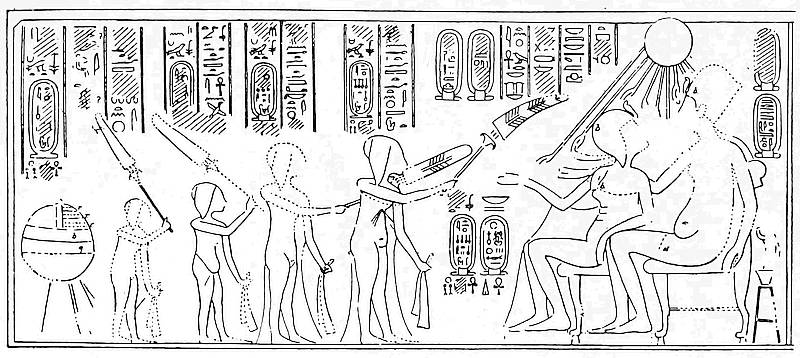
beams of “heat,” and now accompanied by his, as
yet, childless wife. The two scenes may be seen
by visitors to Thebes standing side by side, and
nowhere may the contrast between the old order
of things and the new be so clearly observed.
While Rames was providing a tomb for
himself at Thebes, another great noble named
Horemheb, who ultimately usurped the throne,
was constructing his sepulchre at Sakkârah,
the Memphite necropolis near Cairo. Horemheb
was commander-in-chief of the army, and
in his tomb some superb reliefs are carved
showing him receiving rewards in that capacity
from the king. Some of the scenes represent
the arrival of Asiatic refugees in Egypt, who
ask to be allowed to take up their abode on
the banks of the Nile, and the figures of these
foreigners rank amongst the finest specimens of
Egyptian art. In the inscriptions, Horemheb,
who is supposed to be addressing the king,
states that the Pharaoh owes his throne to
Amon,[28] but yet we see that the figure of the
king is drawn in that style of art which is
typical of the new religion.[29]
This sudden change in the style of the reliefs
which we have observed in these two tombs
and on the quarry tablets seems to be attributable
to about the fourth year of the king’s
reign. The reliefs which were now carved
upon the walls of the new temple of Ra-Horakhti
at Karnak show us a style of art
quite different from that of the king’s early years.
The figure of the Pharaoh, which the artists
in the tomb of Rames represented as standing
below the newly-invented sun’s rays, is as
different from the earlier figure there executed
as chalk is from cheese. The Pharaoh whom
we see in the tomb of Horemheb and on the
quarry tablets is represented, according to
canons of art, entirely different from those
existing at the king’s accession.
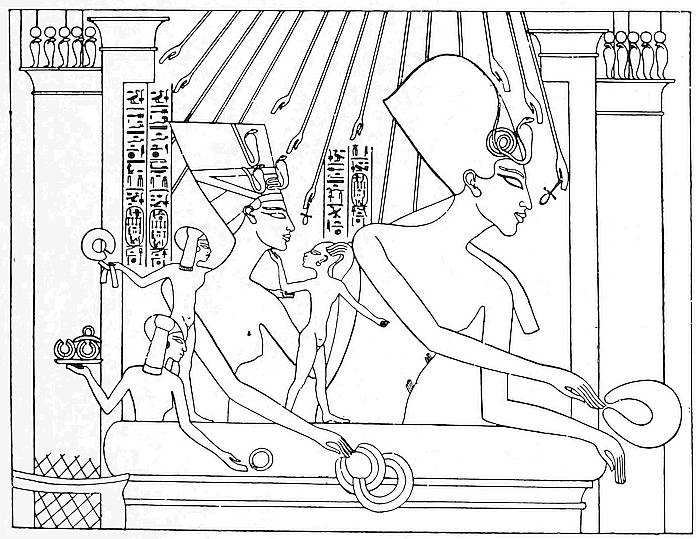
In the drawing of the human figure, and
especially that of the Pharaoh, there are three
very distinct characteristics in this new style
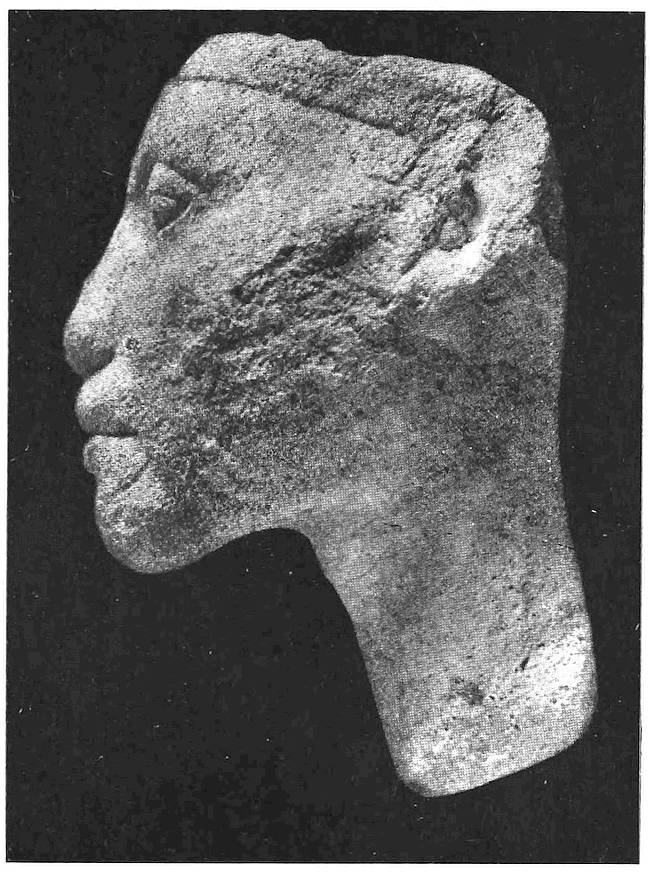
of art. Firstly, as to the head: the skull is
elongated; the chin, as seen in profile, is drawn
as though it were sharply pointed; the flesh
under the jaw is skimped, thus giving an
upward turn to the line; and the neck is
represented as being long and thin. Secondly,
the stomach is made to obtrude itself upon
the attention by being drawn as though from
a fat and ungainly model. And thirdly, the
hips and thighs are abnormally large, though
from the knee downwards the legs are of more
natural size. This distortion of human anatomy
is marked in a lesser degree in all
the lines of the body; and the whole figure
becomes a startling type of an art which seems
at first to have sprung fully developed from
the brain of the boy-Pharaoh or from one of
the eccentrics of the court.
The king was now fifteen years old, and
seems to have been extraordinarily mature for
his age. It may be that he had objected to
be represented in the conventional manner, and
had told his artists to draw him as he was.
The elongated skull, the pointed chin, and
even, perhaps, the protruding paunch, may
thus have originated. But the ungainly thighs
could only be accounted for by some radical
deformity in the royal model, and that he was
a well-made man in this respect his recently
discovered bones most clearly show.
Purely tentatively a suggestion may here be
offered to account for this peculiar treatment of
the human body. It is probable that the king
had now, in a boyish way, become deeply interested
in the religious contest which was beginning
to be waged between Amon-Ra and
Ra-Horakhti Aton. Having listened to the
arguments on both sides, it may have occurred
to him to study for himself the ancient documents
and inscriptions bearing on the matter. In so
doing, he would have found that Amon had
become the state god only some few hundred
years before his own time, and that previous to
his ascent to this important position, previous
even to the earliest mention of his name, Ra-Horakhti
had been supreme. Carrying his
inquiries back, past the days of the pyramid
kings to the archaic Pharaohs who reigned at
the dim beginning of things, he would still have
found the Heliopolitan god worshipped. One
of the Pharaohs’ most cherished titles was “Son
of the Sun,” which, as we have seen, had been
borne by each successive sovereign since the
days of the Fifth Dynasty, whose kings claimed
descent from Ra himself. Such studies would
inevitably bring two matters into prominence:
firstly, that Amon was, after all, but a usurper;
and, secondly, that as Pharaoh he was the
descendant of Ra-Horakhti, and was that god’s
representative on earth.
On these grounds, more than on any others,
all things connected with Amon would become
distasteful to him. He was too young to understand
fully which of the two religions was the
better morally or theologically; but he was
old enough to be moved by the romance of
history, and to feel that those great, shadowy
Pharaohs who lived when the world was young,
and who at the dawn of events worshipped the
sun, were the truest and best examples for him
to follow. They were his ancestors, and as they
were the sons of Ra, so he, too, was the proud
descendant of that great god. In his veins
there ran the blood of the sun, that “Heat-which-is-in-Aton”
pulsed through and through
him; and the more he read in those old documents
the more he was stirred by the glory
of that distant past when men worshipped the
god whose rights Amon had usurped. Now the
canons of art were regarded as a distinctly
religious institution, and the methods of treating
the human figure then in vogue had in the first
place the sanction of the priesthood of Amon;
and few things would be more upsetting to
their régime than the abandoning of these canons.
This was probably recognised by those who
were furthering the cause of Ra-Horakhti, and
the young king may have been assisted and
encouraged in his views. Presently it may
have been brought home to him that, since he
was thus the representative of those archaic
kings and the High Priest of their god, it was
fitting that the canons acknowledged by those
far-off ancestors should be recognised by him.
Here, then, he would both please his own
romantic fancy and deal a blow at the Amon
priesthood by banning the art which they upheld,
and by infusing into the sculptures and paintings
of his time something of the spirit of the
most ancient art of Egypt.
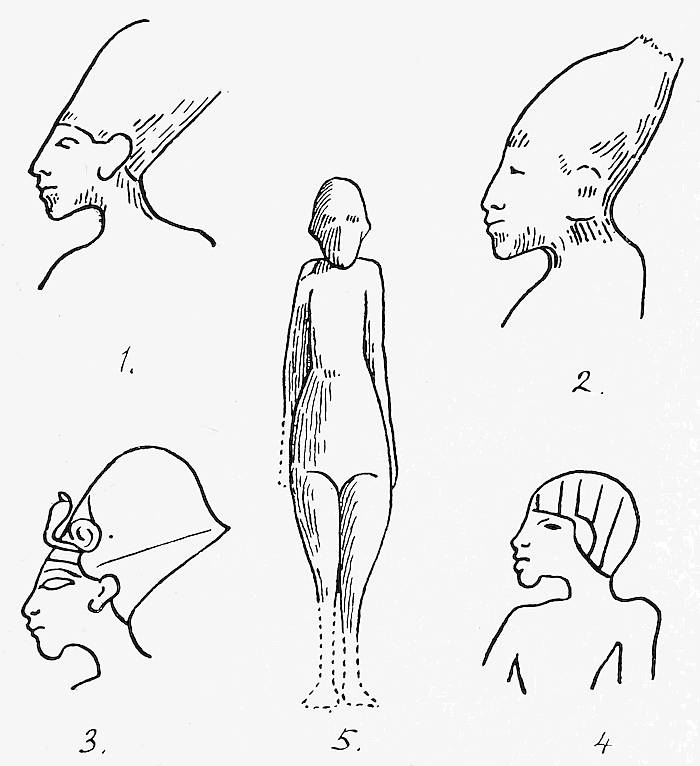
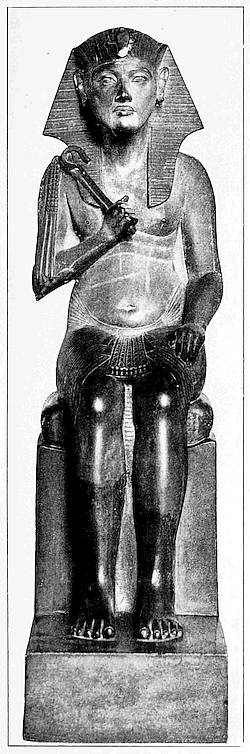
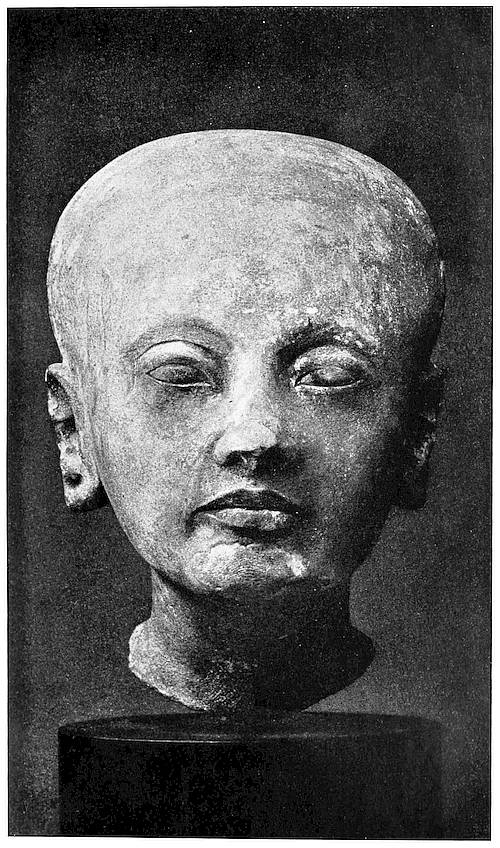
The Art of Akhnaton compared with Archaic Art.
1. The head of Akhnaton. From a contemporary drawing.
2. The head of a king. From an archaic statuette found by Professor Petrie at Abydos.
3. The head of Akhnaton. From a contemporary drawing.
4. The head of a prince. From an archaic tablet found by Professor Petrie at Abydos.
5. An archaic statuette found by Professor Petrie at Diospolis, showing the large thighs found in the art of Akhnaton.
In the old temples of Heliopolis and elsewhere
a few relics of that period, no doubt, were still
preserved; and the king was thus able to study
the wood and slate carvings and the ivory
figures of archaic times. We of the present
day can also study such figures, a few specimens
having been brought to light by modern excavators;
and the similarity between the treatment
of the human body in this archaic art and
the new art of Akhnaton at once becomes
apparent. In the accompanying illustrations
some archaic figures are shown, and one may
perhaps see in them the origin of the idiosyncrasies
of the new school. Here and in all
representations of archaic men one sees the
elongated skull so characteristic of the king’s
style; in the ivory figure of an archaic Pharaoh
one sees the well-known droop of Akhnaton’s
head and his pointed chin; in the clay and
ivory figures is the prominent stomach; and
here also, most apparent of all, are the unaccountably
large thighs and ponderous hips.
Akhnaton’s art might thus be said to be
a kind of renaissance—a return to the classical
period of archaic days; the underlying motive
of this return being the desire to lay
emphasis upon the king’s character as the
representative of that most ancient of all
gods, Ra-Horakhti.
Another feature of the new religion now
becomes apparent. In the worship of Ra-Horakhti
Aton there was an endeavour to
do honour to the Pharaoh as the son of the
sun, and to the god as the founder of the
royal line. Tradition stated that Ra or Ra-Horakhti
had once reigned upon earth, and
that his spirit had passed from Pharaoh to
Pharaoh. This god was thus the only true
King of Heaven, and Amon was but a usurper
of much more recent date. It was for this
reason that the names of the new god were
placed within royal cartouches; and for this
reason the king was so careful to call Ra-Horakhti
his “father,” and to name him “god
and king.” For this reason also Akhnaton often
wore the crown of Lower Egypt which was
used at Heliopolis, but never the crown of
Upper Egypt, which history told him did not
exist when Ra ruled on earth.[30]
Apart from the representation of the human
form, the new art is chiefly characterised by
its freedom of poses. An attempt is made to
break away from tradition, and a desire is
shown to have done with the conventions of
the age. Never before had the artists caught
the swing of a walk, the relaxation of a
seated figure, so well or so truthfully. Sculpture
in the round now reached a height of
perfection which places it above all but the
art of the Greeks in the old world; and
there is a grace and naturalness in the low-reliefs
which command one’s admiration.
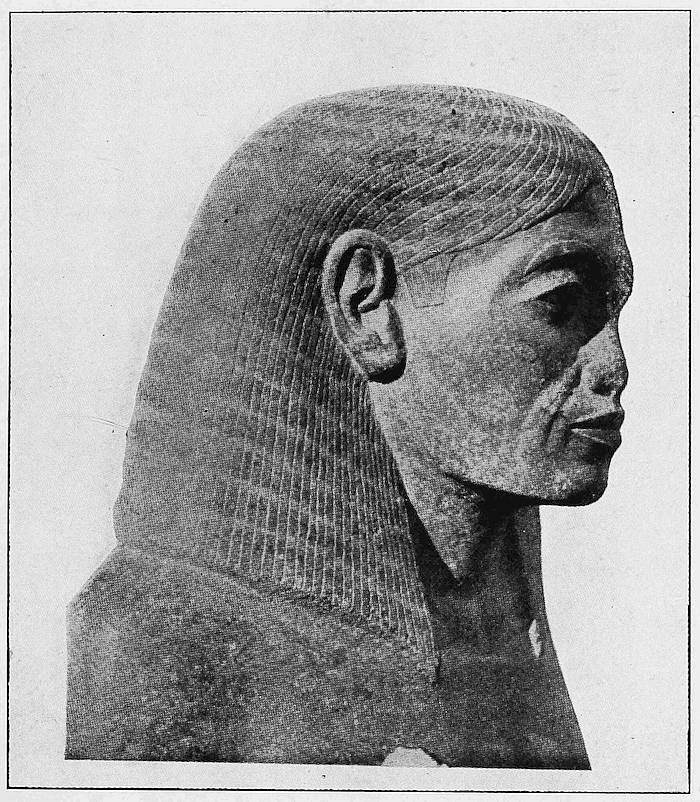
There are only two artists of the period
who are known by name. The one was a
certain Auta, who is represented in a relief
dating from some eight years after the change
in the art had taken place. It is a significant
fact that this personage held the post of master-artist
to Queen Tiy; and it is possible that in
him and his patron we have the originators
of the movement. The king, however, was
now old enough to take an active interest
in such matters; and the other artist who
is known by name, a certain Bek, definitely
states that the king himself taught him.
Thus there is reason to suppose that the
young Pharaoh’s own hand is to be traced
in the new canons, although they were instituted
when he was but fifteen years old.
There is an interesting record, apparently dating
from about this period, which is to be seen
upon the rocks near the breccia quarries of
Wady Hammamât. Here there are three cartouches
standing upon two neb signs, symbolic
of sovereignty, and above them is the disk and
rays of the new religion. One of these cartouches,
surmounted by the tall feathers worn
by the queens of this period, contains a very
short name, which can only be that of Queen
Tiy.[31] The other two cartouches contain the
names Amonhotep (IV.) and the Pharaoh’s second
designation. Thus we see that after the new
religious symbol had been introduced, and just
before the king took the name of “Akhnaton,”
Queen Tiy still held equal royal rank with him,
and was evidently Regent.
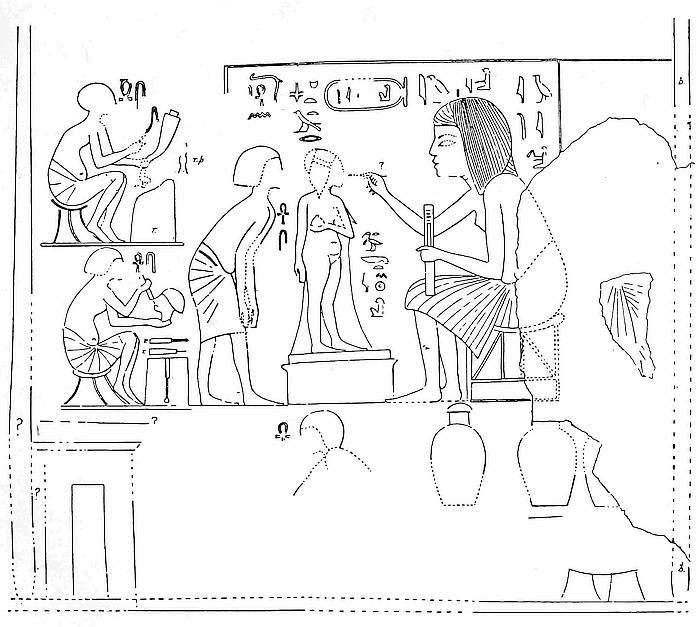
The Artist Auta.
During the fifteenth to the seventeenth years
of his age the king devoted a considerable
amount of time and thought to the changes
which were taking place. With the enthusiasm
of youth he threw himself into the new movement,
and one may suppose that it required
all Queen Tiy’s tact and diplomacy to keep him
from offending his country by some rash action
against the priesthood of Amon. Those priests
were by no means reconciled to the king’s devotion
to Ra-Horakhti; and although he still
nominally served the Theban god, they felt that
every day he was becoming more estranged from
that deity. No doubt there were many passages
of arms between the High Priest of Amon-Ra
and this royal High Priest of the sun,
young as he was. The new art, upsetting all
the old religious conventions, was distasteful
to the priests; the new religious thought did
not conform to their stereotyped doctrines; and
much that the king said was absolutely heretical
to their ears. The tide of new thought, directed
in so eager and boyishly unreserved a manner,
was sweeping them from their feet, and they
knew not whither they were being carried.
The court officials blindly followed their young
king, and to every word which he spoke they
listened attentively. Sometimes the thoughts
which he voiced came direct from the mazes of
his own mind; sometimes perhaps he repeated
the utterances of his deep-thinking mother;
and sometimes there passed from his lips the
pearls of wisdom which he had gleaned from
the wise men of his court. It had been the
boy’s desire to listen to the dreams of the
East, to receive into his brain those speculations
which ever meander so charmedly through
the lands more near the sunrise. At his behest
the dreamers of Asia related to him their visions;
the philosophers made pregnant his mind with
the mystery of knowledge; the poets sung to
him harp-songs in which echoed the cry of the
elder days; the priests of strange gods submitted
to him the creeds of strange people.
To him was made known the sweetness of the
legends of Greece. The laughter of the woods
rang in his ears, though never in narrow
Egypt had he felt the enchantment of great
forests. He had not seen the mountains, and
the wooded slopes which rise from the Mediterranean
were scenes but dreamed of; and yet
it was the flute of Pan and the song of the
nymphs in the mountain streams which set the
thoughts dancing within his misshapen skull.
He had not walked in the shadow of the cedars
of Lebanon, nor had he ascended the Syrian
hills; but nevertheless the hymns of Adonis and
the chants of Baal were as familiar to him as
were the solemn chants of Amon-Ra. The rose-gardens
of Persia, the incense-groves of Araby,
added their philosophies to his dreams, and the
haunting lips of Babylon whispered to him
tales of far-off days. From Sardinia, Sicily,
Crete, and Cyprus there came to him the
doctrines of those who had business in great
waters; and Libya and Ethiopia disclosed their
mysteries to his eager ears. The fertile brain
of the Pharaoh was thus sown at an early
age with the seed of all that was wonderful in
the world of thought.
It must always be remembered that the king
had much foreign blood in his veins. On the
other hand, those men to whom he spoke, though
highly educated, were but superstitious Egyptians
who could not relieve themselves of the belief
that a divine power rested upon the Pharaoh.
Thus his speculative young brain poured its
fantasies into attentive minds unbiassed by rival
speculations, though narrowed by conventions.
Egyptians, ever lacking in originality, have
always possessed the power to imitate and
adapt; and those nobles whose fortunes were
dependent upon the royal favour soon learnt to
attune their minds to the note of their king.
Daily they must have gone about their business,
ostentatiously attempting to hold to the difficult
path of truth; laboriously telling themselves
what wonders the new thought revealed to them;
loudly praising the wisdom of the boy-Pharaoh;
and nervously asking themselves whether and
when the wrath of Amon would smite them.
Thus encouraged, the king and his mother
developed their speculations, and drew into their
circle of followers some of the greatest nobles of
the land. A striking example of this proselytising
is to be found in the tomb of the Vizir
Rames. It has already been stated that that
official had constructed for himself a sepulchre
in the Theban necropolis, upon the walls of which
he had first caused a portrait of the young king
to be sculptured in the old conventional style,
and later had added another portrait of the
Pharaoh standing beneath the radiating beams
of the sun, executed in the new style. Rames
now added various other scenes and inscriptions,
and he records a certain speech made by the king
to him, and his own reply.
“The words of Ra,” the king had said, “are
before thee.... My august father[32] taught me
their essence and [revealed] them to me.... They
were known in my heart, opened to my face. I
understood....”
“Thou art the Only One of Aton; in possession
of his designs,” replied Rames. “Thou hast directed
the mountains. The fear of thee is in the midst of
their secret chambers, as it is in the hearts of the
people. The mountains hearken to thee as the
people hearken.”
Thus one sees how the king was already formulating
some kind of doctrine in his head, and that
the nobles were receiving it; but it is significant
that there are here representations of Rames
loaded with gifts by the Pharaoh, as though in
reward for his allegiance. The Pharaoh seems,
indeed, to have showered honours upon those
who appeared to grasp intelligently the thoughts
which were still immature in his own head; and
there must have been many an antagonist who
rallied to his standard from the sheer love of
gold. The king was in need of all the support
which he could muster, for an open break with
the priesthood of Amon-Ra grew more and more
probable as his doctrines shaped themselves in
his mind; and although the people of Egypt as
a whole would, without question, follow their
Pharaoh for the one reason that he was Pharaoh,
there was every probability that the Amon priesthood
and the Theban populace would make something
of a stand against any infringement of the
rights of their local god.
The young Pharaoh seems to have been very
popular, and one may presume that he inherited,
from his illustrious fathers, the charm of manner
which there is not a little evidence to show
they possessed. Throughout his life, and for
some years after his death, he retained the
affection of his people; and when one considers
how faithfully his nobles followed him so long
as he had strength and health to lead them,
and how completely lost they were at his death,
one realises how great an influence he must have
exerted over them. Even at this early age they
seem to have possessed a deep regard for the
grave, thoughtful boy; and behind all the pretence,
the hypocrisy, and the merely conventional
loyalty, one surely catches a glimpse of a
strong, personal affection for the king.
We must here record the birth of the king’s
first daughter, which occurred in about the fifth
year of his reign, when he was some sixteen years
of age, and when Nefertiti was about thirteen
years old. The child was named Merytaton,
“Beloved of Aton”; and though the advent of
a daughter instead of a son must have been a
grave disappointment to the royal couple, a remarkable
degree of affection was lavished upon
the little girl, as will be apparent in the sequel.
There was nothing strikingly exalted in the
religion which was now so filling the king’s mind.
Ra-Horakhti Aton was in no wise considered as
the only god: there were as yet no ideas of
monotheism in the doctrine. In the new temple
at Karnak, as we have seen, Horus, Set, Wepwat,
and other gods were named; and elsewhere
Amon was reluctantly recognised. The goddess
Maat, in the tomb of Rames, was not obliterated
from the walls, but still stood protecting the king;
and in the same tomb Horus of Edfu is invoked.
In the tomb of Horemheb, Horus, Osiris, Isis,
Nephthys, and Hathor are mentioned, and the
gods of the Necropolis still receive honour;
Horemheb himself still holds the honorary post
of High Priest of Horus, Lord of Alabastronpolis;
Thoth and Maat are referred to; and there is
a magical prayer to Ra, which is by no means
of lofty character. Scarabs of this period speak
of the Pharaoh as beloved of Thoth. And in
a letter to the king dated in the fifth year of
his reign, Ptah and “the gods and goddesses”
of Memphis are referred to.
This letter is of such interest that a fuller
account of it must here be given. It was
addressed to the king, who is still called Amonhotep,
by a royal steward named Apiy, who
lived at Memphis. Two copies of the letter
were found at Gurob,[33] both dated in the fifth
year of the king’s reign, the third month of
winter, and the nineteenth day. The letter
begins with the full titles of the Pharaoh, including
the phrase “living in truth,” which
from this time onwards was always added to
his name. Then follows the invocation: “May
Ptah of the beautiful countenance work for
thee, who created thy beauties, thy true father
who raised (?) thee from his house to rule the
orbit of the Aton.” Next comes the real business
of the letter: “A communication is this
to the Master, [to whom be] life, prosperity, and
health, to give information that the temple of
thy father Ptah ... is sound and prosperous;
the house of Pharaoh ... is flourishing; the
establishments of Pharaoh ... are flourishing;
the residence of Pharaoh ... is flourishing and
healthy; the offerings of all the gods and goddesses
who are upon the soil (?) of Memphis are
... complete; complete [are they] there is nothing
delayed from them.” Again the titles of the king
are given, and the letter ends with the date.
Thus in the fifth year of the king’s reign,
when he was about sixteen years of age, the
various gods of Egypt were still acknowledged;
and, though the art had been changed and the
worship of Ra-Horakhti under the name of Aton
had made great strides towards supremacy, there
is as yet no sign of the lofty monotheism which
the Pharaoh was soon to propound.
In the portions of the tomb of Horemheb which
date from this period, Ra-Horakhti is invoked
in the following words: “Ra-Horakhti, great
god, Lord of heaven, Lord of earth, who cometh
forth from his horizon and illuminateth the
Two Lands [of Egypt], the sun of darkness
as the great one, as Ra;” and again: “Ra,
Lord of Truth, great god, sovereign of Heliopolis,
... Horakhti, only god, king of the gods, who
rises in the west and sendeth forth his beauty.”
From other sources, which we have seen, the
god is called “Ra-Horakhti rejoicing in the
horizon in his name Heat-which-is-in-Aton.”
Here we have simply the old religion of
Heliopolis, to which has been grafted something
of the doctrines of the Syrian Adonis
or Aton. At Heliopolis there was a sacred
bull, known as Mnevis, which was regarded as the
living personification of Ra-Horakhti, and which
was treated with divine honours, like the more
famous Apis bull of Memphis. Even this superstition
was accepted by the king at this time,
and continued to be acknowledged by him for
yet another year or two.[34] The “Heat-which-is-in-Aton”
offered food for much speculation, and,
by directing the attention to an intangible quality
of the sun, opened up the widest fields for religious
thought. But, with this exception, there was
nothing as yet in the new religion to command
one’s admiration.