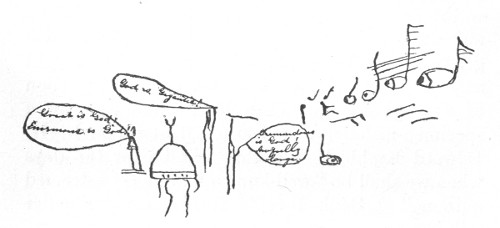
Dear Krehbiel,—I have just received your second pleasant letter,
enclosing a most interesting article on music. The illustrations
interested me greatly. You could write a far more entertaining series of
essays on the history of musical instruments than that centennial humbug
who, as you say, did little more than merely to describe what he saw.
I have been reading in “Curiosités des Arts”—curious book now out of
print—an article on the musical instruments of the Middle Ages, which
is of deep interest even to such an ignoramus as myself. I would have
translated it for your amusement, but, that my eyes have been so bad as
to cripple me. Let me just give you an extract, and as soon as I feel
better I will send the whole thing if you deem it worth while:—
“The Romans, at the termination of their conquests, had brought to this
country and adopted nearly all the musical instruments they had
discovered among the peoples they had conquered.
Thus Greece furnished Rome with nearly all the soft instruments of the
family of flutes and of lyres; Germany and the provinces of the North,
inhabited by warlike races, taught their conquerors to acquire a taste
for terrible instruments, of the family of trumpets and of drums; Asia,
and in particular Judæa, which had greatly multiplied the number of
metallic instruments for use in ceremonies of religion, naturalized
among the Romans clashing instruments of the family of bells and
tam-tams; Egypt introduced the sistrum into Italy together with the
worship of Isis; and no sooner had Byzantium invented the first wind
organs than the new religion of Christ adopted them, that she might
consecrate them exclusively to the solemnities of her worship, West and
East.
“All the varieties of instruments in the known world had thus, in some
sort, taken refuge in the capital of the Empire; first at Rome, then at
Byzantium; when the Roman decline marked the last hour of this vast
concert, then, at once ceased the orations of the Emperors in the
Capitol and the festivals of the pagan gods in the temples; then were
silenced and scattered those musical instruments which had taken part in
the pomps of triumphs or of religious celebrations; then disappeared and
became forgotten a vast number of those instruments which pagan
civilization had made use of, but which became useless amidst the ruins
of the antique social system.”
Following is the description of an organ,—a wonderful organ,—in a
letter from St. Jerome to Dardanas,—made of fifteen pipes of brass,
two air-reservoirs of elephant’s skin, and two forge bellows for the
imitation of the sound of thunder. The writer compiled his essay from
eighteen ancient Latin authors, eight early Italian, about ten early
French, and some Spanish authors—all antiquated and unfamiliar.
As you are kindly interested in what I am doing I shall talk about
Ego,—I shall talk about Me.
I am (this is not for public information) barely making a living here by
my letters to the paper. I think I can make about $40 per month. This
will keep me alive and comfortable. I am determined never to resume
local work on a newspaper. I could not stand the gaslight; and then you
know what a horrid life it is. While acting as correspondent I shall
have time to study, study, study; and to write something better than
police news. I have a lot of work mapped out for magazine essays; and
though I never expect to make much money, I think I shall be able to
make a living. So far I have had a real hard time; but I hope to do
better now, as they send me money more regularly.
I do not intend to leave New Orleans, except for farther South,—the
West Indies, or South America. I am studying Spanish hard and will get
along well with it soon.
I think I can redeem myself socially here. I have got into good society;
and as everybody is poor in the South, my poverty is no drawback.
Yours truly,
Λαρκαδιη.
My Dear Krehbiel,—I am charmed with your letter,—your paper, and your
exquisite little jocose programme. The “Fantaisie Chinoise” was to me
something that really smacked of a certain famous European art-cenacle
where delightful little parties of this kind were given. That cenacle
was established by the disciples of Victor Hugo,—les Hugolâtres, as
they were mockingly but perhaps also nobly named; and the records of its
performances are some of the most delicate things in French literature.
Hector Berlioz was one of the merry crowd,—and Berlioz, by the way, had
written some fine romances as well as fine musical compositions.
There is a touch, a brilliant touch, of real art in all these little
undertakings of yours, which gives me more enjoyment than I could tell
you. Remember I am speaking of the tout-ensemble. Were I to make any
musical observations you might rightly think I was talking about
something of which I am disgracefully ignorant. Do you know, however,
that I have never forgotten that pretty Chinese melody I heard at the
club that day; and I sometimes find myself whistling it involuntarily.
I am indeed delighted to know that you have got Char Lee’s instruments,
and are soon to receive others. Were there any Indian instruments in use
among the Choctaws here, I could get you some, but they are no longer a
musical people. The sadness that seems peculiar to dying races could not
be more evident than in them. Le Père Rouquette, their missionary,
tells me he has seen them laugh; but that might have been half a century
ago. He is going to take me out to one of their camps on Lake
Pontchartrain soon, and I shall try to pick you up something queer.
As yet I have not received the Chinese Play, etc., but will write when I
do, and return it as promptly as possible.
I am just recovering from a week’s sickness—fever and bloody flux—and
I don’t believe I weigh ninety pounds. You never saw such a sight as I
am. I have been turned nearly black; and my face is so thin that I can
see every bone as if it had only a piece of parchment drawn over it. And
then all my hair is cut close to the skin. I have had hard work to crawl
out of bed the last few days, but am getting better now. If I were to
get regular yellow fever now I would certainly go to the cemetery; for I
am only a skeleton as it is.
The newspaper generally gives only wages to its employees, and small
wages,—and literary reputation to its capitalists; although in France
the opposite condition exists. There are exceptions, of course, when a
man has exceedingly superior talent; and his employer, knowing its
value, allows its free exercise. That has been your case to a certain
degree; you have not only won a reputation for yourself, but have given
a tone and a standing to the paper which in my opinion has been of
immense value to it.
I have got everything here down to a fine point—three hours’ work a
day!
There is but one thing here to compensate for the abominable heat—Figs.
They are remarkably cool, sweet, juicy, and tender. Unfortunately they
are too delicate to bear shipment. The climate is so debilitating that
even energetic thought is out of the question; and unfortunately the
only inspiring hour, the cool night, I cannot utilize on account of
gaslight. When the night comes on here it is not the night of Northern
summers, but that night of which the divine Greek poet wrote,—“O holy
night, how well dost thou harmonize with me; for to me thou art all
eye,—thou art all ear,—thou art all fragrance!”
The infinite gulf of blue above seems a shoreless sea, whose foam is
stars, a myriad million lights are throbbing and flickering and
palpitating, a vast stillness filled with perfume prevails over the
land,—made only more impressive by the voices of the night-birds and
crickets; and all the busy voices of business are dead. The boats are
laid up, cotton presses closed, and the city is half empty. So that the
time is really inspiring. But I must wait to record the inspiration in
some more energetic climate.
Do you get Mélusine yet? You are missing a great deal if you are not.
Mélusine is preserving all those curious peasant songs with their
music,—some of which date back hundreds of years. They would be a
delightful relish to you.
Yours à jamais,
L. Hearn.
“O-me-taw-Boodh!”—Have I not indeed been much bewitched by thine exotic
comedy, which hath the mild perfume and yellow beauty of a Chinese rose?
Assuredly I have been enchanted by the Eastern fragrance of thy
many-coloured brochure; for mine head “is not as yellow as mud.” In thy
next epistle, however, please to enlighten my soul in regard to the
mystic title-phrase,—“Remodelled from the original English;“ for I have
been wearing out the iron shoes of patience in my vain endeavour to
comprehend it. What I most desired, while perusing the play, was that I
might have been able to hear the musical interludes,—the barbaric
beauty of the melodies,—and the plaintive sadness of thy
serpent-skinned instruments. I shall soon return the MSS. to thy hands.
By the bye, did you ever hear a real Chinese gong? I don’t mean a d—d
hotel gong, but one of those great moon-disks of yellow metal which have
so terrible a power of utterance. A gentleman in Bangor, North Wales,
who had a private museum of South Pacific and Chinese curiosities,
exhibited one to me. It was hanging amidst Fiji spears beautifully
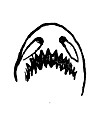
barbed with shark’s teeth, which, together with grotesque New Zealand
clubs of green stone and Sandwich Island paddles wrought with the
baroque visages of the Shark-God, were depending from the walls. Also
there were Indian elephants in ivory, carrying balls in their carven
bellies, each ball containing many other balls inside it. The gong
glimmered pale and huge and yellow, like the moon rising over a Southern
swamp. My friend tapped its ancient face with a muffled drumstick, and
it commenced to sob, like waves upon a low beach. He tapped it again,
and it moaned like the wind in a mighty forest of pines. Again, and it
commenced to roar, and with each tap the roar grew deeper and deeper,
till it seemed like thunder rolling over an abyss in the Cordilleras, or
the crashing of Thor’s chariot wheels. It was awful, and astonishing as
awful. I assure you I did not laugh at it at all. It impressed me as
something terrible and mysterious. I vainly sought to understand how
that thin, thin disk of trembling metal could produce so frightful a
vibration. He informed me that it was very expensive, being chiefly made
of the most precious metals,—silver and gold.
Let me give you a description of my new residence. I never knew what the
beauty of an old Creole home was until now. I do not believe one could
find anything more picturesque outside of Venice or Florence. For six
months I had been trying to get a room in one of these curious
buildings; but the rents seemed to me maliciously enormous. However, I
at last obtained one for $3 per week. Yet it is on the third floor, rear
building;—these old princes of the South built always double edifices,
covering an enormous space of ground, with broad wings, courtyards, and
slave quarters.
The building is on St. Louis Street, a street several hundred years old.
I enter by a huge archway about a hundred feet long,—full of rolling
echoes, and commencing to become verdant with a thin growth of bright
moss. At the end, the archway opens into a court. There are a few
graceful bananas here with their giant leaves splitting in ribbons in
the summer sun, so that they look like young palms. Lord! How the
carriages must have thundered under that archway and through the broad
paved court in the old days. The stables are here still; but the blooded
horses are gone, and the family carriage, with its French coat of arms,
has disappeared. There is only a huge wagon left to crumble to pieces. A
hoary dog sleeps like a stone sphinx at a corner of the broad stairway;
and I fancy that in his still slumbers he might be dreaming of a Creole
master who went out with Beauregard or Lee and never came back again.
Wonder if the great greyhound is waiting for him.
The dog never notices me. I am not of his generation, and I creep
quietly by lest I might disturb his dreams of the dead South. I go up
the huge stairway. At every landing a vista of broad archways reëchoes
my steps—archways that once led to rooms worthy of a prince. But the
rooms are now cold and cheerless and vast with emptiness. Tinted in pale
green or yellow, with a ceiling moulded with Renaissance figures in
plaster, the ghost of luxury and wealth seems trying to linger in them.
I pass them by, and taking my way through an archway on the right, find
myself on a broad piazza, at the end of which is my room.
It is vast enough for a Carnival ball. Five windows and glass doors
open flush with the floor and rise to the ceilings. They open on two
sides upon the piazza, whence I have a far view of tropical gardens and
masses of building, half-ruined but still magnificent. The walls are
tinted pale orange colour; green curtains drape the doors and windows;
and the mantelpiece, surmounted by a long oval mirror of Venetian
pattern, is of white marble veined like the bosom of a Naiad. In the
centre of the huge apartment rises a bed as massive as a fortress, with
tremendous columns of carved mahogany supporting a curtained canopy at
the height of sixteen feet. It seems to touch the ceiling, yet it does
not. There is no carpet on the floor, no pictures on the wall,—a sense
of something dead and lost fills the place with a gentle
melancholy;—the breezes play fantastically with the pallid curtains,
and the breath of flowers ascends into the chamber from the verdant
gardens below. Oh, the silence of this house, the perfume, and the
romance of it. A beautiful young Frenchwoman appears once a day in my
neighbourhood to arrange the room; but she comes like a ghost and
disappears too soon in the recesses of the awful house. I would like to
speak with her, for her lips drop honey, and her voice is richly sweet
like the cooing of a dove. “O my dove, that art in the clefts of the
rock, in the secret hiding-places of the stairs, let me see thy face,
let me hear thy voice, for thy voice is sweet and thy countenance is
comely!”
Let me tell thee, O Bard of the Harp of a Thousand Strings, concerning a
Romance of Georgia. I heard of it among the flickering shadow of
steamboat smoke and the flapping of sluggish sails. It has a hero
greater, I think, than Bludso; but his name is lost. At least it is lost
in Southern history; yet perhaps it may be recorded on the pages of a
great book whose leaves never turn yellow with Time, and whose letters
are eternal as the stars. But the reason his name is not known is
because he was a “d—d nigger.”
My dear Musician,—I wrote you such a shabby, disjointed letter last
week that I feel I ought to make up for it,—especially after your
newsy, fresh, pleasant letter to me, which came like a cool Northern
breeze speaking of life, energy, success, and strong hopes.
I am very much ashamed that I have not yet been able to keep all my
promises to you. There is that Creole music I had hoped to get copied by
Saturday, and could not succeed in obtaining. But it is only delayed, I
assure you; and New Orleans is going to produce a treat for you soon.
George Cable, a charming writer, some of whose dainty New Orleans
stories you may have read in Scribner’s Monthly, is writing a work
containing a study of Creole music, in which the songs are given, with
the musical text in footnotes. I have helped Cable a little in
collecting the songs; but he has the advantage of me in being able to
write music by ear. Scribner will publish the volume. This is not, of
course, for publicity.
My new journalistic life may interest you,—it is so different from
anything in the North. I have at last succeeded in getting right into
the fantastic heart of the French quarter, where I hear the antiquated
dialect all day long. Early in the morning I visit a restaurant, where I
devour a plate of figs, a cup of black coffee, a dish of
cream-cheese,—not the Northern stuff, but a delightful cake of pressed
milk floating in cream,—a couple of corn muffins, and an egg. This is a
heavy breakfast here, but costs only about twenty-five cents. Then I
slip down to the office, and rattle off a couple of leaders on literary
or European matters and a few paragraphs based on telegraphic news. This
occupies about an hour. Then the country papers,—half French, half
English,—altogether barbarous, come in from all the wild, untamed
parishes of Louisiana. Madly I seize the scissors and the paste-pot and
construct a column of crop-notes. This occupies about half an hour. Then
the New York dailies make their appearance. I devour their substance and
take notes for the ensuing day’s expression of opinion. And then the
work is over, and the long golden afternoon welcomes me forth to enjoy
its perfume and its laziness. It would be a delightful existence for one
without ambition or hope of better things. On Sunday the brackish Lake
Pontchartrain offers the attraction of a long swim, and I like to avail
myself of it. Swimming in the Mississippi is dangerous on account of
great fierce fish, the alligator-gars, which attack a swimmer with
ferocity. An English swimmer was bitten by one only the other day in the
river, and, losing his presence of mind, was swept under a barge and
drowned.
Folks here tell me now that I have been sick I have nothing more to
fear, and will soon be acclimatized. If acclimatization signifies
becoming a bundle of sharp bones and saddle-coloured parchment, I have
no doubt of it at all. It is considered dangerous here to drink much
water in summer. For five cents one can get half a bottle of strong
claret, and this you mix with your drinking water, squeezing a lemon
into it. Limes are better, but harder to get,—you can only buy them
when schooners come in from the Gulf islands. But no one knows how
delicious lemonade can be made until he has tasted lemonade made of
limes.
I saw a really pleasing study for an artist this morning. A friend
accompanied me to the French market, and we bought an enormous quantity
of figs for about fifteen cents. We could not half finish them; and we
sought rest under the cool, waving shadow of a eunuch banana-tree in the
Square. As I munched and munched a half-naked boy ran by,—a fellow that
would have charmed Murillo, with a skin like a new cent in colour, and
heavy masses of hair massed as tastefully as if sculptured in ebony. I
threw a fig at him and hit him in the back. He ate it, and coolly walked
toward us with his little bronze hands turned upward and opened to their
fullest capacity, and a pair of great black eyes flashed a request for
more. You never saw such a pair of eyes,—deep and dark,—a night
without a moon. Spoke to him in English,—no answer; in French,—no
response. My friend bounced him with Spak-ne Italiano, or something of
that kind, but it was no good. We asked him by signs where he came from,
and he pointed to a rakish lugger rocking at the Picayune pier. I filled
his little brown hands with figs, but he did not smile. He gravely
thanked us with a flash of the eye like a gleam of a black opal, and
murmured, “Ah, mille gratias, Señor.” Why, that boy was Murillo’s boy
after all, propria persona. He departed to the rakish lugger, and we
dreamed of Moors and gipsies under the emasculated banana.
L. Hearn.
My dear Krehbiel,—Your letter took a long week to reach me; perhaps by
reason of the quarantine regulations which interpose some extraordinary
barriers, little Chinese walls, across the country below Memphis. Thus
am I somewhat tardy in responding.
The same sentiment which caused me so much pleasure on reading your
ideas on the future of musical philosophy occasioned something of
sincere regret on reading your words,—“I am not a thoroughly educated
musician,” etc. I had hoped (and still hope, and believe with all my
heart, dear Krehbiel) that the Max Müller of Music would be none other
than yourself. Perhaps you will therefore pardon some little
observations from one who knows nothing about music.
I fancy that you have penetrated just so far into the Temple of your Art
that, like one of the initiates of Eleusis, you commence to experience
such awe and reverence for its solemn vastness and its whispers of
mystery as tempt you to forego further research. You suddenly forget how
much farther you have advanced into the holy precincts than most
mortals, who seldom cross the vestibule;—the more you advance the more
seemingly infinite becomes the vastness of the place, the more
interminable its vistas of arches, and the more mysterious its endless
successions of aisles. The Vatican with its sixty thousand rooms is but
a child’s toy house compared with but one of the countless wings of
Art’s infinite temples; and the outer world, viewing only the entrance,
narrow and low as that of a pyramid, can no more comprehend the
Illimitable that lies beyond it than they can measure the deeps of the
Eternities beyond the fixed stars. I cannot help believing that the
little shadow of despondency visible in your last letter is an evidence
of how thoroughly you have devoted yourself to Music, and a partial
contradiction of your own words. It would be irrational in you to expect
that you could achieve your purposes in the very blush of manhood, as it
were; but you ought not to forget altogether that you already stand in
knowledge on a footing with many grey-haired disciples and apostles of
the art, whose names are familiar in musical literature. I believe you
can become anything musical you desire to become; but in art-study one
must devote one’s whole life to self-culture, and can only hope at last
to have climbed a little higher and advanced a little farther than
anybody else. You should feel the determination of those neophytes of
Egypt who were led into subterranean vaults and suddenly abandoned in
darkness and rising water, whence there was no escape save by an iron
ladder. As the fugitive mounted through heights of darkness, each rung
of the quivering stairway gave way immediately he had quitted it, and
fell back into the abyss, echoing; but the least exhibition of fear or
weariness was fatal to the climber.
It seems to me that want of confidence in one’s self is not less a curse
than it appears to be a consequence of knowledge. You hesitate to accept
a position on the ground of your own feeling of inadequacy; and the one
who fills it is somebody who does not know the rudiments of his duty.
"Fools rush in,” etc., and were you to decline the situation proffered
by Mr. Thomas, merely because you don’t think yourself qualified to fill
it, I hope you do not imagine that any better scholar will fill the
bill. On the contrary, I believe that some d—d quack would take the
position, even at a starvation salary, and actually make himself a
reputation on the mere strength of cheek and ignorance. However, you
tell me of many other reasons. Of course, —— is a vast and varied
ass,—a piebald quack of the sort who makes respectability an apology
for lack of brains; but I fancy that you would be sure to find some
asses at the head of any institution of the sort in this country. The
demand for art of any kind is new, and so long as people cannot tell the
difference between a quack and a scholar, the former, having the cheek
of a mule and a pompous deportment, is bound to get his work in. I don’t
think I should care much about the plans and actions of such people, but
content myself, were I in your place, by showing myself superior to
them. There is one thing in regard to a position like that you speak
of,—it would afford you large opportunity for study, and in fact compel
study upon you as a public instructor. At least it seems so to me. Then,
again, remember that your connection with the Gazette leaves you in
the position of the Arabian prince who was marbleized from his loins
down. As an artist you are but half alive there; one half of your
existence is paralyzed; you waste your energies in the creation of works
which are coffined within twelve hours after their birth; your power of
usefulness is absorbed in a direction which can give you no adequate
reward hereafter; and the little time you can devote to your studies and
your really valuable work is too often borrowed from sleep. From the
daily press I think you have obtained about all you will get from it in
the regard of reputation, etc.; and there is no future really worth
seeking in it. Even the most successful editors live a sort of existence
which I certainly do not envy, and I am sure you would soon sicken of.
Do you not think, too, that any situation like that now offered you
might lead to a far better one under far better conditions? It would
certainly introduce you to many whose friendship and appreciation would
be invaluable. I do not believe that Cincinnati is your true field for
future work, and I cannot persuade myself that the city will ever become
a permanent artistic centre; but I am satisfied that you will drift
out of the newspaper drudgery before long, and if you have an
opportunity to obtain a good footing in the East, I would take it.
Thomas ought to be capable of making an Eastern pedestal for you to
light on; for, judging by the admiration expressed for him by the
Times, Tribune, World, Herald, Sun, etc., he must have some
influence with musical centres. Then Europe would be open to you in a
short time with its extraordinary opportunities of art-study, and its
treasures of musical literature, to be devoured free of cost. Your
researches into the archæology of music, I need hardly say, must be made
in Europe rather than here; and I hope you will before many twelvemonths
be devouring the Musical Department of the British Museum, and the
libraries of Paris and the Eternal City.
However, I do not pretend to be an adviser,—only a suggester. I think
your good little wife would be a good adviser; for women seem blessed
with a kind of divine intuition, and I sometimes believe they can see
much farther into the future than men. You must not get disgusted with
my long letter. I could not help telling you what interest your last
excited in me regarding your own prospects.
Let me tell you something that I have been thinking about the bagpipe.
Somewhere or other I have read that the bagpipe was a Roman military
instrument, and was introduced into Scotland by the Roman troops,
together with the “kilt.” It must have occurred to you that the Highland
dress bears a ghostly resemblance to that of the Roman private as
exhibited on the Column of Trajan. I cannot remember where I have read
this, but you can doubtless inform me.
I am still well, although I have even had the experience of nursing a
friend sick of yellow fever. The gods are sparing me for some fantastic
reason. I enclose some specimens of the death notices which sprinkle our
town, and send a copy of the last Item.
My eyes are eternally played out, and I shall have to abandon newspaper
work altogether before long. Perhaps I shall do better in some little
business. What is eternally rising up before me now like a spectre is
the ?—“Where shall I go?—what shall I do?” Sometimes I think of
Europe, sometimes of the West Indies,—of Florida, France, or the
wilderness of London. The time is not far off when I must go
somewhere,—if it is not to join the “Innumerable Caravan.” Whenever I
go down to the wharves, I look at the white-winged ships. O ye
messengers, swift Hermæ of Traffic, ghosts of the infinite ocean,
whither will ye bear me?—what destiny will ye bring me,—what hopes,
what despairs?
Your sincere friend and admirer,
L. Hearn.
My dear Krehbiel,—I received your admirable little sketch. It pleased
me more than the others,—perhaps because, having to deal with a simpler
subject, you were less hampered by mechanical details and could maintain
your light, gossipy, fresh method of instruction in all its simple
force.
I recognized several of the cuts. That of the uppermost figure at the
right-hand corner was of the god Terminus, a most ancient deity, and his
instrument is of corresponding antiquity perhaps, although in country
districts the Termina were generally characterized by a certain sylvan
rudeness. The earliest Termina were mere blocks of wood or stone. Among
the ancients a circle of ground, or square border—it was set by law in
Rome at two feet wide—surrounded every homestead. This was inviolate to
the gods, and the Termina were placed at intervals along its borders, or
at the corners. At certain days in the year the proprietor made the
circuit, pushing victims before him, and chanting hymns to the god of
boundaries. The same gods existed among the ancient Hindoos, with whom
the Greeks and Romans must have had a close relationship in remote
antiquity. The Greeks called these deities the θεοὶ ὁρίοι. I
do not know whence you got the figure; but I know it is a common one of
Terminus; and such eau-forte engravers as Gessner, who excelled in
antique subjects, delighted to introduce it in sylvan scenes. I have an
engraving by Leopold Flameng,—called La Satyresse,—a female satyr
playing on the double flute (charming figure) and old Terminus with his
single flute accompanies her in the background,—smiling from his
pedestal of stone.
The first flute-player on the left-hand side, at the lower corner, is
evidently from a vase, as the treatment of the hair denotes—I should
say a Greek vase; and the second one, with the mouth-bandage, in spite
of the half-Egyptian face, appears to be an Etruscan figure. The
treatment of the eyes and profile looks Etruscan. Some of the flutes in
the upper part of the drawing are much more complicated than I had
supposed any of the antique flutes were.
You will find a charming version of the Medusa story in Kingsley’s
"Heroes”—for little ones. Of course he does not tell why Medusa’s hair
was turned into snakes. There are several other versions of the legend.
I prefer that in which the sword is substituted for the sickle,—a most
unwarlike weapon, and a utensil, moreover, sacred to the Goddess of
Harvests. The sword given by Hermes to Perseus is said to have been that
wherewith he slew the monster Argus,—a diamond blade. Like the Runic
swords forged by the gnomes under the roots of the hills of Scandinavia,
this weapon slew whenever brandished.
Fever is bad still. I had another attack of dengue, but have got nearly
over it. I find lemon-juice the best remedy. All over town there are
little white notices pasted on the lamp-posts or the pillars of piazzas,
bearing the dismal words:—
Décédé
Ce matin, à 3½ heures
Julien
Natif de ——,
and so on. The death notices are usually surmounted by an atrocious cut
of a weeping widow sitting beneath a weeping willow—with a huge
mausoleum in the background. Yellow fever deaths occur every day close
by. Somebody is advocating firing off cannon as a preventive. This plan
of shooting Yellow Jack was tried in ’53 without success. It brings on
rain; but a rainy day always heralds an increase of the plague. You will
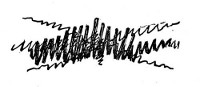
see by the Item’s tabulated record that there is a curious periodicity
in the increase. It might be described by a line like this—
You have doubtless seen the records of pulsations made by a certain
instrument, for detecting the rapidity of blood-circulation. The fever
actually appears to have a pulsation of graduated increase like that of
a feverish vein. I think this demonstrates a regularity in the periods
of germ incubation,—affected, of course, more or less by atmospheric
changes.
Hope you will have your musical talks republished in book form. Send us
Golden Hours once in a while. It will always have a warm notice in the
Item. Yours in much hurry, with promise of another epistle soon.
L. Hearn.
Regards to all the boys.
My dear Krehbiel,—I received yours, with the kind wishes of Mrs.
Krehbiel, which afforded me more pleasure than I can tell you,—also the
Golden Hours with your instructive article on the history of the
piano. It occurs to me that when completed your musical essays would
form a delightful little volume, and ought certainly to find a
first-class publisher. I hope you will entertain the suggestion, if it
has not already occurred to you. I do not know very much about musical
literature; but I fancy that no work in the English tongue has been
published of a character so admirably suited to give young people a
sound knowledge of the romantic history of music instruments as your
essays would constitute, if shaped into a volume. The closing
observations of your essay, markedly original and somewhat startling,
were very entertaining. I have not yet returned your manuscript, because
Robinson is devouring and digesting that Chinese play. He takes a great
interest in what you write.
I send you, not without some qualms of conscience, a copy of our little
journal containing a few personal remarks, written with the idea of
making you known here in musical circles. I have several apologies to
make in regard to the same. Firstly, the Item is only a poor little
sheet, in which I am not able to obtain space sufficient to do you or
your art labour justice; secondly, I beg of you to remember that if I
have spoken too extravagantly from a strictly newspaper standpoint, it
will not be taken malicious advantage of by anybody, as the modest
Item goes no farther north than St. Louis.
The Creole rhymes I sent you were unintelligible chiefly because they
were written phonetically after a fashion which I hold to be an
abomination. The author, Adrien Rouquette, is the last living Indian
missionary of the South,—the last of the Blackrobe Fathers, and is
known to the Choctaws by the name of Charitah-Ima. You may find him
mentioned in the American Encyclopædia published by the firm of
Lippincott & Co. There is nothing very remarkable about his poetry,
except its eccentricity. The “Chant d’un jeune Créole” was simply a
personal compliment,—the author gives something of a sketch of his own
life in it. It was published in Le Propagateur, a French Catholic
paper, for the purpose of attracting my attention, as the old man wanted
to see me, and thought the paper might fall under my observation. The
other, the “Moqueur-Chanteur,”—as it ought to have been spelled,—or
"Mocking Singer,” otherwise the mocking-bird, has some pretty bits of
onomatopœia. (This dreamy, sunny State, with its mighty forests of
cedar and pine, and its groves of giant cypress, is the natural home of
the mocking-bird.) These bits of Creole rhyming were adapted to the airs
of some old Creole songs, and the music will, perhaps, be the most
interesting part of them.
I am writing you a detailed account of the Creoles of Louisiana, and
their blending with Creole emigrants from the Canaries, Martinique, and
San Domingo; but it is a subject of great latitude, and I can only
outline it for you. Their characteristics offer an interesting topic,
and the bastard offspring of the miscegenated French and African, or
Spanish and African, dialects called Creole offer pretty peculiarities
worth a volume. I will try to give you an entertaining sketch of the
subject. I must tell you, however, that Creole music is mostly negro
music, although often remodelled by French composers. There could
neither have been Creole patois nor Creole melodies but for the French
and Spanish blooded slaves of Louisiana and the Antilles. The
melancholy, quavering beauty and weirdness of the negro chant are
lightened by the French influence, or subdued and deepened by the
Spanish.
Yes, I did send you that song as something queer. I had only hoped
that the music would own the charming naiveté of the words; but I have
been disappointed. But you must grant the song is pretty and has a queer
simplicity of sentiment. Save it for the words. (Alas!
Mélusine—according to information I have just received from Christern
of New York—is dead. Poor, dear, darling Mélusine! I sincerely mourn
for her with archæological and philological lament.) L’Orient is in
Brittany, and the chant is that of a Breton fisher village. That it
should be melancholy is not surprising; but that it should be melancholy
without weirdness or sweetness is lamentable. Mélusine for 1877 had a
large collection of Breton songs, with music; and I think I shall avail
myself of Christern’s offer to get it. I want it for the legends; you
will want, I am sure, to peep at the music. Your criticism about the
resemblance of the melody to the Irish keening wail does not surprise
me, although it disappointed me; for I believe the Breton peasantry are
of Celtic origin. Your last letter strengthened a strange fancy that has
come to me at intervals since my familiarity with the Chinese
physiognomy,—namely, that there are such strong similarities between
the Mongolian and certain types of the Irish face that one is inclined
to suspect a far-distant origin of the Celts in the East. The Erse and
the Gaelic tongues, you know, are very similar in construction, also the
modern Welsh. I have heard them all, and met Irish people able to
comprehend both Welsh and Gaelic from the resemblance to the Erse. I
suppose you have lots of Welsh music, the music of the Bards, some of
which is said to have had a Druidic origin. Tell me if you have ever
come across any Scandinavian music—the terrible melody of the Berserker
songs, and the Runic chants, so awfully potent to charm; the Raven song
of the Sweyn maidens to which they wove the magic banner; the death-song
of Ragnar Lodbrok, or the songs of the warlocks and Norse priests; the
many sword-songs sung by the Vikings, etc. I suppose you remember
Longfellow’s adaptation of the Heimskringla legend:—
“Then the Scald took his harp and sang,
And loud through the music rang
The sound of that shining word;
And the harp-strings a clangor made,
As if they were struck with the blade
Of a sword.”
I am delighted to hear that you have got some Finnish music. Nothing in
the world can compare in queerness and all manner of grotesqueness to
Finnish tradition and characteristic superstition. I see an
advertisement of “Le Chant de Roland,” price $100, splendidly
illustrated. Wonder if the original music of the Song of Roland has been
preserved. You know the giant Taillefer sang that mighty chant as he
hewed down the Saxons at the battle of Hastings.
With grateful regards to Mrs. Krehbiel, I remain
Yours à jamais,
L. H.
My dear Krehbiel,—That I should have been able even by a suggestion to
have been of any use to you is a great pleasure. Your information in
regard to Père Rouquette interested me. The father—the last of the
Blackrobe Fathers—is at present with his beloved Indians at
Ravine-les-Cannes; but I will see him on his return and read your letter
to the good old soul. If the columns of a good periodical were open to
me, I should write the romance of his life—such a wild strange
life—inspired by the magical writings of Châteaubriand in the
commencement; and latterly devoted to a strangely beautiful religion of
his own—not only the poetic religion of Atala and Les Natchez, but
that religion of the wilderness which flies to solitude, and hath no
other temple than the vault of Heaven itself, painted with the frescoes
of the clouds, and illuminated by the trembling tapers of God’s
everlasting altar, the stars of the firmament.
I have received circular and organ-talk. You are right, I am convinced,
in your quotation of St. Jerome. To-day I send you the book—an old copy
I had considerable difficulty in coaxing from the owner. It will be of
use to you chiefly by reason of the curious list of writers on mediæval
and antique music quoted at the end of the volume.
If you do not make a successful volume of your instructive “Talks,”
something dreadful ought to happen to you,—especially as Cincinnati
has now a musical school in which children will have to learn something
about music. You are the professor of musical history at that college.
Your work is a work of instruction for the young. As the professor of
that college, you should be able to make it a success. This is a
suggestion. I know you are not a wire-puller—couldn’t be if you tried;
but I want to see those talks put to good use, and made profitable to
the writer, and you have friends who should be able to do what I think.
Your friend is right, no doubt, about the
“Tig, tig, malaboin
La chelema che tango
Redjoum!”
I asked my black nurse what it meant. She only laughed and shook her
head,—“Mais c’est Voudoo, ça; je n’en sais rien!” “Well,” said I,
"don’t you know anything about Voudoo songs?” “Yes,” she answered, “I
know Voudoo songs; but I can’t tell you what they mean.” And she broke
out into the wildest, weirdest ditty I ever heard. I tried to write down
the words; but as I did not know what they meant I had to write by sound
alone, spelling the words according to the French pronunciation:—
“Yo so dan godo
Héru mandé
Yo so dan godo
Héru mandé
Héru mandé.
Tigà la papa,
No Tingodisé
Tigà la papa
Ha Tinguoaiée
Ha Tinguoaiée
Ha Tinguoaiée.”
I have undertaken a project which I hardly hope to succeed in, but which
I feel some zeal regarding, viz., to collect the Creole legends,
traditions, and songs of Louisiana. Unfortunately I shall never be able
to do this thoroughly without money,—plenty of money,—but I can do a
good deal, perhaps.
I must also tell you that I find Spanish remarkably easy to acquire; and
believe that at the end of another year I shall be able to master
it,—write it and speak it well. To do the latter, however, I shall be
obliged to spend some time in some part of the Spanish-American
colonies,—whither my thoughts have been turned for some time. With a
good knowledge of three languages, I can prosecute my wanderings over
the face of the earth without timidity,—without fear of starving to
death after each migration.
After all, it has been lucky for me that I was obliged to quit hard
newspaper work; for it has afforded me opportunities for
self-improvement which I could not otherwise have acquired. I should
like, indeed, to make more money; but one must sacrifice something in
order to study, and I must not grumble, as long as I can live while
learning.
I have really given up all hope of creating anything while I remain
here, or, indeed, until my condition shall have altered and my
occupation changed.
What material I can glean here, from this beautiful and legendary
land,—this land of perfume and of dreams,—must be chiselled into shape
elsewhere.
One cannot write of these beautiful things while surrounded by them; and
by an atmosphere, heavy and drowsy as that of a conservatory. It must be
afterward, in times to come, when I shall find myself in some cold,
bleak land where I shall dream regretfully of the graceful palms; the
swamp groves, weird in their ragged robes of moss; the golden ripples of
the cane-fields under the summer wind, and this divine sky—deep and
vast and cloudless as Eternity, with its far-off horizon tint of tender
green.
I do not wonder the South has produced nothing of literary art. Its
beautiful realities fill the imagination to repletion. It is regret and
desire and the Spirit of Unrest that provoketh poetry and romance. It is
the North, with its mists and fogs, and its gloomy sky haunted by a
fantastic and ever-changing panorama of clouds, which is the land of
imagination and poetry.
The fever is dying. A mighty wind, boisterous and cool, lifted the
poisonous air from the city at last.
I cannot describe to you the peculiar effect of the summer upon one
unacclimated. You feel as though you were breathing a drugged
atmosphere. You find the very whites of your eyes turning yellow with
biliousness. The least over-indulgence in eating or drinking prostrates
you. My feeling all through the time of the epidemic was about this: I
have the fever-principle in my blood,—it shows its presence in a
hundred ways,—if the machinery of the body gets the least out of order,
the fever will get me down. I was not afraid of serious consequences,
but I felt conscious that nothing but strict attention to the laws of
health would pull me through. The experience has been valuable. I
believe I could now live in Havana or Vera Cruz without fear of the
terrible fevers which prevail there. Do you know that even here we have
no less than eleven different kinds of fever,—most of which know the
power of killing?
I am very glad winter is coming, to lift the languors of the air and
restore some energy to us. The summer is not like that North. At the
North you have a clear, dry, burning air; here it is clear also, but
dense, heavy, and so moist that it is never so hot as you have it. But
no one dares expose himself to the vertical sun. I have noticed that
even the chickens and the domestic animals, dogs, cats, etc., always
seek shady places. They fear the sun. People with valuable horses will
not work them much in summer. They die very rapidly of sunstroke.
In winter, too, one feels content. There is no nostalgia. But the summer
always brings with it to me—always has, and I suppose always will—a
curious and vague species of homesickness, as if I had friends in some
country far off, where I had not been for so long that I have forgotten
even their names and the appellation of the place where they live. I
hope it will be so next summer that I can go whither the humour leads
me,—the propensity which the author of “The Howadji in Syria” calleth
the Spirit of the Camel.
But this is a land where one can really enjoy the Inner Life. Every one
has an inner life of his own,—which no other eye can see, and the great
secrets of which are never revealed, although occasionally when we
create something beautiful, we betray a faint glimpse of it—sudden and
brief, as of a door opening and shutting in the night. I suppose you
live such a life, too,—a double existence—a dual entity. Are we not
all doppelgängers?—and is not the invisible the only life we really
enjoy?
You may remember I described this house to you as haunted-looking. It is
delicious, therefore, to find out that it is actually a haunted house.
But the ghosts do not trouble me; I have become so much like one of
themselves in my habits. There is one room, however, where no one likes
to be alone; for phantom hands clap, and phantom feet stamp behind them.
"And what does that signify?” I asked a servant. “Ça veut dire,
Foulez-moi le camp”—a vulgar expression for “Git!”
There is to be a literary (God save the mark!) newspaper here. I have
been asked to help edit it. As I find that I can easily attend to both
papers I shall scribble and scrawl and sell ’em translations which I
could not otherwise dispose of. Thus I shall soon be making, instead of
$40, about $100 per month. This will enable me to accumulate the means
of flying from American civilization to other horrors which I know not
of—some place where one has to be a good Catholic (in outward
appearance) for fear of having a navaja stuck into you, and where the
whole population is so mixed up that no human being can tell what nation
anybody belongs to. So in the meantime I must study such phrases as:——
¿Tiene V. un leoncito? Have you a small lion?
No señor, pero tengo un fero perro. No: but I’ve an ugly dog.
¿Tiene V. un muchachona? Have you a big strapping girl?
No: pero tengo un hombrecillo. No: but I’ve a miserable little man.
May the Gods of the faiths, living and dead, watch over thee, and thy
dreams be made resonant with the sound of mystic and ancient music,
which on waking thou shalt vainly endeavour to recall, and forever
regret with a vague and yet pleasant sorrow; knowing that the gods
permit not mortals to learn their sacred hymns.
L. Hearn.
By the way, let me send you a short translation from Baudelaire. It is
so mystic and sad and beautiful.
Querido Amigo,—Your words in regard to my former letter flatter me
considerably, for I feel rather elated at being able to be of the
smallest service to you; and as to your unavoidable delays in writing,
never allow them to trouble you, or permit your correspondence to
encroach upon your study hours for my sake. Indeed, it is a matter of
surprise to me how you are able to spare any time at present in view of
your manifold work.
So your literary career—at least the brilliant portion of
it—commences in January; and mine ends at the same time, without a
single flash of brightness or a solitary result worthy of preservation.
My salary has been raised three times since I heard from
you,—encouraging, perhaps, but I do not suffer myself to indulge in any
literary speculations. Since the close of the sickly season my only
thought has been to free myself from the yoke of dependence on the whims
of employers,—from the harness of journalism. I hired myself a room in
the northern end of the French Quarter (near the Spanish), bought myself
a complete set of cooking utensils and kitchen-ware, and kept house for
myself. I got my expenses down to $2 per week, and kept them at that
(exclusive of rent, of course) although my salary rose to $20. Thus I
learned to cook pretty well; also to save money, and will start a little
business for myself next week. I have an excellent partner,—a Northern
man,—and we expect by spring to clear enough ready money to start
for South America. By that time I shall have finished my Spanish
studies,—all that are necessary and possible in an American city, and
shall—please (not God but) the good old gods—play gipsy for a while in
strange lands. Many unpleasant things may happen; but with good health I
have no fear of failure, and the new life will enable me to recruit my
eyes, fill my pockets, and improve my imagination by many strange
adventures and divers extraordinary archæological pursuits.
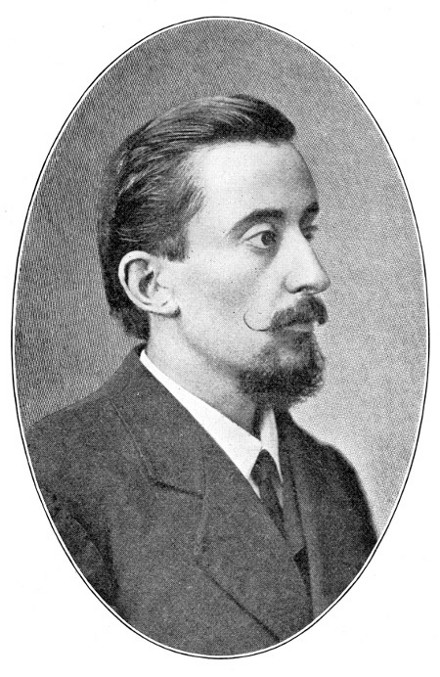
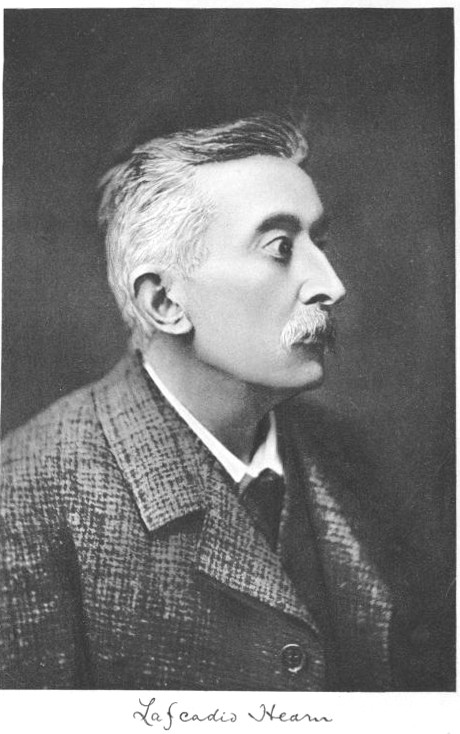
LAFCADIO HEARN
In the ’70’s
How is that for Bohemianism? But I wish I could spend a day with you in
order to recount the many wonderful and mystic adventures I have had in
this quaint and ruinous city. To recount them in a letter is impossible.
But I came here to enjoy romance, and I have had my fill.
Business,—ye Antiquities!—hard, practical, unideal, realistic
business! But what business? Ah, mi corazon, I would never dare to
tell you. Not that it is not honourable, respectable, etc., but that it
is so devoid of dreamful illusions. Yet hast thou not said,—“This is no
world for dreaming,”—and divers other horrible things which I shall not
repeat?
Tell me all about your exotic musical instruments, when you have
time,—you know they will interest me; and may not I, too, some day be
able to forward to you various barbaric symbols and sackfuls from
outlandish places?—from the pampas or the llanos,—from some
palm-fringed islands of the Eastern sea, where even Nature dreams
opiated dreams? How knowst thou but that I shall make the Guacho and
llanero, the Peruvian and the Chilian, to contribute right generously to
thy store of musical wealth?
I have not made much progress in the literature most dear to you;
inasmuch as my time has been rather curtailed, and the days have become
provokingly short. But I have been devouring Hoffmann (Emile de la
Bédollière’s translation in French—could not get a complete English
one); and I really believe he has no rival as a creator of musical
fantasticalities. “The Organ-Stop,” “The Sanatus,” “Lawyer Krespel” (a
story of a violin, replete with delightful German mysticism), “A Pupil
of the Great Tartini,” “Don Juan,”—and a dozen other stories evidence
an enthusiasm for music and an extraordinary sensitiveness to musical
impressions on the author’s part. You probably read these in German,—if
not, I am sure many of them would delight you. The romance of music
must, I fancy, be a vast aid to the study of the art,—it seems to me
like the setting of a jewel, or the frame of a painting. I also have
observed in the New York Times a warm notice of a lady who is an
enthusiast upon the subject of Finnish music, and who has collected a
valuable mass of the quaint music and weird ditties of the North. As you
speak of having a quantity of Finnish music, however, I have no doubt
that you know much more about the young lady than I could tell you.
Prosper Mérimée’s “Carmen” has fairly enthralled me,—I am in love with
it. The colour and passion and rapid tragedy of the story is
marvellous. I think I was pretty well prepared to enjoy it, however. I
had read Simpson’s “History of the Gipsies,” Borro’s[6] “Gypsies of
Spain,” a volume of Spanish gipsy ballads,—I forget the name of the
translator,—and everything in the way of gipsy romance I could get my
hands on,—by Sheridan Le Fanu, Victor Hugo, Reade, Longfellow, George
Eliot, Balzac, and a brilliant novelist also whose works generally
appear in the Cornhill Magazine. Balzac’s “Le Succube” gives a curious
picture of the persecution of the Bohemians in mediæval France, founded
upon authentic records. Le Fanu wrote a sweet little story called “The
Bird of Passage,” which contained a remarkable variety of information in
regard to gipsy secrets; but it is only within very recent years that a
really good novel on a gipsy theme has been written in English; and I am
sorry that I cannot remember the author’s name. I found more romance as
well as information in Borro and Simpson than in all the novels and
poems put together; and I obtained a fair idea of the artistic side of
Spanish gipsy life from Doré’s “Spain.” Doré is something of a musician
as well as a limner; and his knowledge of the violin enabled him to make
himself at home in the camps of that music-loving people. He played wild
airs to them, and studied their poses and gestures with such success
that his gipsies seem actually to dance in the engravings. I read that
Miss Minnie Hauck plays Carmen in gorgeous costume, which is certainly
out of place, except in one act of the opera. Otherwise from the first
scene of the novel in which she advances “poising herself on her hips,
like a filly from the Cordovan Stud,” to the ludicrous episode at
Gibraltar, her attire is described as more nearly resembling that
picturesque rag-blending of colour Doré describes and depicts. If you
see the opera,—please send me your criticism in the Gazette.
You may remember some observations I made—based especially on De
Coulanges—as to the derivation of the Roman and Greek tongues from the
Sanscrit. Talking of Borro reminds me that Borro traces the gipsy
dialects to the mother of languages; and Simpson naturally finds the
Romany akin to modern Hindostanee, which succeeded the Sanscrit. Now
here is a curious fact. Rommain is simply Sanscrit for The Husbands,—a
domestic appellation applicable to the gipsy races above all others,
when the ties of blood are stronger than even among the Jewish people;
and Borro asks timidly what is then the original meaning of those mighty
words, “Rome” and the “Romans,” of which no scholar (he claims) has yet
ventured to give the definition. Surely all mysteries seem to issue from
the womb of nations,—from the heart of Asia.
I see that the musical critic of the New York Times speaks of certain
airs in the opera of Carmen as Havanese airs,—Avaneras. If there be
a music peculiar to Havana, I expect that I shall hear some of it next
summer. If I could only write music, I could collect much interesting
matter for you.
There is a New Orleans story in the last issue of Scribner’s
Monthly,—“Ninon,”—which I must tell you is a fair exemplification of
how mean French Creoles can be. The great cruelties of the old slave
régime were perpetuated by French planters. Anglo-Saxon blood is not
cruel. If you want to find cruelty, either in ancient or modern history,
it must be sought for among the Latin races of Europe. The Scandinavian
and Teutonic blood was too virile and noble to be cruel; and the science
of torture was never developed among them.
Before I commenced to keep house for myself, I must tell you about a
Chinese restaurant which I used to patronize. No one in the American
part of the city—or at least very few—know even of its existence. The
owner will not advertise, will not hang out a sign, and seems to try to
keep his business a secret. The restaurant is situated in the rear part
of an old Creole house on Dumaine Street,—about the middle of the
French Quarter; and one must pass through a dark alley to get in. I had
heard so much of the filthiness of the Chinese, that I would have been
afraid to enter it, but for the strong recommendations of a Spanish
friend of mine,—now a journalist and a romantic fellow. (By the way, he
killed a stranger here in 1865 one night, and had to fly the country. A
few hot words in a saloon; and the Spanish blood was up. The stranger
fell so quickly and the stab was given so swiftly,—“according to the
rules,”—that my friend had left the house before anybody knew what
had happened. Then the killer was stowed away upon a Spanish schooner,
and shipped to Cuba, where he remained for four years. And when he came
back, there were no witnesses.)
But about the restaurant. I was surprised to find the bills printed half
in Spanish and half in English; and the room nearly full of Spaniards.
It turned out that my Chinaman was a Manilan,—handsome, swarthy, with a
great shock of black hair, wavy as that of a Malabaress. His movements
were supple, noiseless, leopardine; and the Mongolian blood was scarcely
visible. But his wife was positively attractive;—hair like his own, a
splendid figure, sharp, strongly marked features, and eyes whose very
obliqueness only rendered the face piquant,—as in those agreeable yet
half-sinister faces painted on Japanese lacquerware. The charge for a
meal was only twenty-five cents,—four dishes allowed, with dessert and
coffee, and only five cents for every extra dish one might choose to
order. I generally ordered a nice steak, stewed beef with potatoes,
stewed tongue, a couple of fried eggs, etc. Everything is cooked before
your eyes, the whole interior of the kitchen being visible from the
dining-table; and nothing could be cleaner or nicer. I asked him how
long he had kept the place; he answered, “Seven years;” and I am told he
has been making a fortune even at these prices of five cents per dish.
The cooking is perfection.
There is nothing here which would interest you particularly in the
newspaper line. We have a new French daily, Le Courrier de la
Louisiane; but the ablest French editor in Louisiana—Dumez of Le
Meschacébé—was killed by what our local poets are pleased to term “The
March of the Saffron Steed!” The Item, beginning on nothing, now
represents a capital, and I would have a fine prospect should I be able
to content my restless soul in this town. The Democrat is in a death
struggle with the gigantic lottery monopoly; and cannot live long.
Howard is king of New Orleans, and can crush every paper or clique that
opposes him. He was once blackballed by the Old Jockey Club, who had a
splendid race-course at Métairie. “By God,” said Howard, “I’ll make a
graveyard of their d——d race-course.” He did it. The Métairie cemetery
now occupies the site of the old race-course; and the new Jockey Club is
Howard’s own organization.
It just occurs to me that the name of the gypsy novel written by the
Cornhill writer is “Zelda’s Fortune,” and that I spelled the name Borrow
wrong. It has a “w.” Mérimée refers to Barrow, which is also wrong.
Longfellow borrowed (excuse the involuntary pun) nearly all the gypsy
songs in his “Spanish Student” from Borrow. I remember, for instance,
the songs commencing,——
“Upon a mountain’s tip I stand,
With a crown of red gold in my hand;”
also,
“"Loud sang the Spanish cavalier
And thus his ditty ran:
God send the gypsy lassie here,
And not the gipsy man."
(I have been spelling “gipsy” and “gypsy”—don’t know which I like best.)
I wonder why Longfellow did not borrow the forge-song, quoted by
Borrow,—Las Muchis, “The Sparks”:——
“More than a hundred lovely daughters I see produced at one time,
fiery as roses, in one moment they expire, gracefully circumvolving.”
Is it not beautiful, this gipsy poetry? The sparks are compared to
daughters, but they are gitanas “fiery as roses;” and in the words,
"I see them expire, gracefully circumvolving,” we have the figure of
the gypsy dance,—the Romalis, with its wild bounds and pirouettes.
My letter is too long. I fear it will try your patience; but I cannot
say half I should wish to say. You will soon hear from me again; for le
père Rouquette hath returned; I must see him, and show him your letter.
A villainous wind from your boreal region has overcast the sky with a
cope of lead, and filled the sunny city with gloom. From my dovecot
shaped windows I can see only wet roofs and dripping gable-ends. The
nights are now starless, and haunted by fogs. Sometimes, in the day
there is no more than a suggestion of daylight,—a gloaming. Sometimes
in the darkness I hear hideous cries of murder from beyond the boundary
of sharp gables and fantastic dormers. But murders are so common here
that nobody troubles himself about them. So I draw my chair closer to
the fire, light up my pipe de terre Gambièse, and in the flickering
glow weave fancies of palm-trees and ghostly reefs and tepid winds, and
a Voice from the far tropics calls to me across the darkness.
Adios, hermano mio,
Forever yours,
Lafcadio Hearn.
My dear Krehbiel,—I regret very much that I could not reply until now;
overstudy obliged me to quit reading and writing for several days; I am
just in that peculiar condition of convalescence when one cannot tell
how to regulate the strain upon his eyes.
It pleased me very much to hear from you just before you entered upon
your duties as a professor of the beautiful art you have devoted
yourself to;—that letter informed me of many things more than its
written words directly expressed,—especially that you felt I was really
and deeply interested in every step you were taking, and that I would on
receiving your letter experience that very thrill of indescribable
anxiety and hope, timidity and confidence, and a thousand intermingled
sensations,—which ever besets one standing on the verge of uncertainty
ere taking the first plunge into a new life.
I read your lecture with intense interest, and felt happy in observing
that your paper did you the justice to publish the essay entire. Still,
I fancy that you may have interpolated its delivery with a variety of
unpublished comments and verbal notes,—such as I have heard you often
deliver when reading from print or MSS. These I should much have wished
to hear,—if they were uttered.
Your lecture was in its entirety a vast mass of knowledge wonderfully
condensed into a very small compass. That condensation, which I would
regret if applied to certain phases of your whole plan, could not have
been avoided in its inception; and only gave to the whole an
encyclopædic character which must have astonished many of your hearers.
To present so infinite a subject in so small a frame was a gigantic task
of itself; and nevertheless it was accomplished symmetrically and
harmoniously,—the thread of one instructive idea never being broken. I
certainly think you need harbour no further fears as to success in the
lecture-room, and far beyond it.
The idea of religion as the conservator of Romanticism, as the promoter
of musical development, seemed to me very novel and peculiar. I cannot
doubt its correctness, although I believe some might take issue with you
in regard to the Romantic idea,—because the discussions in regard to
romantic truth are interminable and will never cease. Religion is beyond
any question the mother of all civilizations, arts, and laws; and no
archæologic research has given us any record of any social system, any
art, any law, antique or modern, which was not begotten and nurtured by
an ethical idea. You know that I have no faith in any “faiths” or
dogmas; I regard thought as a mechanical process, and individual life as
a particle of that eternal force of which we know so little: but the
true philosophers who hold these doctrines to-day (I cannot say
originated them, for they are old as Buddhism) are also those who best
comprehend the necessity of the religious idea for the maintenance of
the social system which it cemented together and developed. The name of
a religion has little to do with this truth; the law of progress has
been everywhere the same. The art of the Egyptian, the culture of the
Greeks, the successful policy of Rome, the fantastic beauty of Arabic
architecture, were the creations of various religious ideas; and passed
away only when the faiths which nourished them weakened or were
forgotten. So I believe with you that the musical art of antiquity was
born of the antique religions, and varied according to the character of
that religion. But I have also an inclination to believe that
Romanticism itself was engendered by religious conservation. The amorous
Provençal ditties which excited the horror of the mediæval church were
certainly engendered by the mental reactions against religious
conservatism in Provence; and I fancy that the same reaction everywhere
produced similar results, whether in ancient or modern history. This is
your idea, is it not; or is it your idea carried perhaps to the extreme
of attributing the birth of Romanticism to conservatism, Pallas-Athene
springing in white beauty from the head of Zeus?
There is one thing which I will venture to criticize in the
lecture,—not positively, however. I cannot help believing that the
deity whose name you spell Schiva (probably after a German writer) is
the same spelled Seeva, Siva, or Shiva, according to various English and
French authors. If I am right, then I fear you were wrong in calling
Schiva the goddess of fire and destruction. The god, yes; but although
many of these Hindoo deities, including Siva, are bi-sexual and
self-engendering, as the embodiment of any force, they are masculine.
Now Siva is the third person of the Hindoo trinity,—Brahma, the
Creator; Vishnu, the Preserver; Siva, the Destroyer. Siva signifies the
wrath of God. Fire is sacred to him, as it is an emblem of the Christian
Siva, the Holy Ghost. Siva is the Holy Ghost of the Hindoo trinity;
and as sins against the Holy Ghost are unforgiven, so are sins against
Siva unforgiven. There is an awful legend that Brahma and Vishnu were
once disputing as to greatness, when Siva suddenly towered between them
as a pillar of fire. Brahma flew upward for ten myriads of years vainly
striving to reach the flaming capital of that fiery column; Vishnu flew
downward for ten thousand years without being able to reach its base.
And the gods trembled. But this legend, symbolic and awful, signifies
only that the height and depth of the vengeance of God is immeasurable
even by himself. I think the wife of Siva is Parvati. See if I am
right. I have no works here to which I can refer on the subject.
There is to my mind a most fearful symbolism in the origin of five tones
from the head of Siva. I cannot explain the idea; but it is a terrible
one, and may symbolize a strange truth. All this Brahminism is half
true; it conflicts not with any doctrine of science; its symbolism is
only a monstrously-figured veil wrought to hide from the ignorant truths
they cannot understand; and those elephant-headed or hundred-armed gods
do but represent tremendous facts.
On the subject of Romanticism, I send you a translation from an article
by Baudelaire. The last part of the chapter, applying wholly to
romanticism in form and colour, hardly touches the subject in which you
are most interested. His criticism of Raphael is very severe; that of
Rembrandt enthusiastic. “The South,” he says, is “brutal and positive in
its conception of beauty, like a sculptor;” and he remarks that
sculpture in the North is always rather picturesque than realistic.
Winckelmann and Lessing long since pointed out, however, that antique
art was never realistic; it was only a dream of human beauty deified and
immortalized, and the ancients were true Romanticists in their day. I
wonder what Baudelaire would have thought of our modern
Pre-Raphaelites,—Rossetti, et als. Surely they are true Romanticists
also; but I must not tire you with Romanticism.
Do you not think that outside of the religio-musical system of Egyptian
worship, there may have been a considerable development of the art in
certain directions—judging from the wonderful variety of
instruments,—harps, flutes, tamborines, sistrums, drums, cymbals, etc.,
discovered in the tombs or pictured forth upon the walls? Your remarks
on the subject were exceedingly interesting.
I fear my letters will bore you,—however, they are long only because I
must write as I would talk to you were it possible. I am disappointed in
regard to several musical researches I have been undertaking; and can
tell you little of interest. The work of Cable is not yet in
press—yellow fever killed half his family. Rouquette has been doing
nothing but writing mad essays on the beauties of chastity, so that I
can get nothing from him in the way of music until his crazy fit is
over. Several persons to whom I applied for information became
suspicious and refused point-blank to do anything. I traced one source
of musical lore to its beginning, and discovered that the individual had
been subsidized by another collector to say nothing. Speaking of Pacific
Island music, you have probably seen Wilkins’ “Voyages,” 5 vols., with
strange music therein. I have many ditties in my head, but I cannot
write them down....
Thine, O Minnesinger,
L. Hearn.
New Orleans, 1880.
Dear Krehbiel,—I was so glad to hear from you.
Your letter gave me much amusement. I wish I could have been present at
that Chinese concert. It must have been the funniest thing of the kind
ever heard of in Cincinnati.
It gives me malicious pleasure to inform you that my vile and improper
book will probably be published in a few months. Also that the wickedest
story of the lot—“King Candaule”—is being published as a serial in one
of the New Orleans papers, with delightful results of shocking people. I
will send you copies of them when complete.
I am interested in your study of Assyrian archæology. It is a pity there
are so few good works on the subject. Layard’s unabridged works are
very extensive; but I do not remember seeing them in the Cincinnati
library. Rawlinson, I think, is more interesting in style and more
thorough in research. The French are making fine explorations in this
direction.
I find frequent reference made to Overbeck’s “Pompeii,” a German work,
as containing valuable information on antique music, drawn from
discoveries at Herculaneum and Pompeii, also to Mazois, a great French
writer upon the same subject. I have not seen them; but I fancy you
would find some valuable information in them regarding musical
instruments. I suppose you have read Sir William Gell’s “Pompeiana,”—at
least the abridged form of it. You know the double flutes, etc., of the
ancients are preserved in the museum of Naples. In the Cincinnati
library is a splendid copy of the work on Egyptian antiquities prepared
under Napoleon I, wherein you will find coloured prints—from
photographs—of the musical instruments found in the catacombs and
hypogæa. But I do not think there are many good books on the subject of
Assyrian antiquities there. Vickers could put you in the way of getting
better works on the subject than any one in the library, I believe.
You will master these things much more thoroughly than ever I
shall—although I love them. I have only attempted, however, to
photograph the rapports of the antiquities in my mind, like memories
of a panoramic procession; while to you, the procession will not be one
of shadows, but of splendid facts, with the sound of strangely ancient
music and the harmonious tread of sacrificial bands,—all preserved for
you through the night of ages. And the life of vanished cities and the
pageantry of dead faiths will have a far more charming reality for
you,—the Musician,—than ever for me,—the Dreamer.
I can’t see well enough yet to do much work. I have written an essay
upon luxury and art in the time of Elagabalus; but now that I read it
over again, I am not satisfied with it, and fear it will not be
published. And by the way—I request, and beg, and entreat, and
supplicate, and petition, and pray that you will not forget about
Mephistopheles. Here, in the sweet perfume-laden air, and summer of
undying flowers, I feel myself moved to write the musical romance
whereof I spake unto you in the days that were.
I can’t say that things look very bright here otherwise. The prospect is
dark as that of stormy summer night, with feverish pulses of lightning
in the far sky-border,—the lightning signifying hopes and fantasies.
But I shall stick to my pedestal of faith in literary possibilities like
an Egyptian colossus with a broken nose, seated solemnly in the gloom of
its own originality.
Times are not good here. The city is crumbling into ashes. It has been
buried under a lava-flood of taxes and frauds and maladministrations so
that it has become only a study for archæologists. Its condition is so
bad that when I write about it, as I intend to do soon, nobody will
believe I am telling the truth. But it is better to live here in
sackcloth and ashes, than to own the whole State of Ohio.
Once in a while I feel the spirit of restlessness upon me, when the
Spanish ships come in from Costa Rica and the islands of the West
Indies. I fancy that some day, I shall wander down to the levee, and
creep on board, and sail away to God knows where. I am so hungry to see
those quaint cities of the Conquistadores and to hear the sandalled
sentinels crying through the night—Sereño alerto!—sereño
alerto!—just as they did two hundred years ago.
I send you a little bit of prettiness I cut out of a paper. Ah!—that
is style, is it not?—and fancy and strength and height and depth. It is
just in the style of Richter’s “Titan.”
Major sends his compliments. I must go to see the Carnival nuisance.
Remember me to anybody who cares about it, and believe me always
Faithfully yours,
L. Hearn.
My dear Krehbiel,—Pray remember that your ancestors were the very Goths
and Vandals who destroyed the marvels of Greek art which even Roman
ignorance and ferocity had spared; and I perceive by your last letter
that you possess still traces of that Gothic spirit which detests all
beauty that is not beautiful with the fantastic and unearthly beauty
that is Gothic.
You cannot make a Goth out of a Greek, nor can you change the blood in
my veins by speaking to me of a something vague and gnostic and mystic
which you deem superior to all that any Latin mind could conceive.
I grant the existence and the weird charm of the beauty that Gothic
minds conceived; but I do not see less beauty in what was conceived by
the passion and poetry of other races of mankind. This is a cosmopolitan
art era: and you must not judge everything which claims art-merit by a
Gothic standard.
Let me also tell you that you do not as yet know anything of the Spirit
of Greek Art,—or the sources which inspired its miraculous
compositions; and that to do so you would have to study the climate, the
history, the ethnological record, the religion, the society of the
country which produced it. My own knowledge is, I regret to say, very
imperfect,—but it is sufficient to give me the right to tell you that
you were wrong to accuse me of abandoning Greek ideals, or to lecture
me upon what is and what is not art in matters of form and colour and
literature. I might say the same thing in regard to your judgment of
French writers: you confound Naturalism with Romanticism, and vice
versa.
Again, do not suppose that I am insensible to other forms of beauty. You
judge all art, I fear, by inductions from that in which you are a
master; but the process in your case is false;—nor will you be able to
judge the artistic soul of a people adequately by its musical
productions, until you have passed another quarter of a century in the
study of the music of different races and ages and civilizations. Then
it is possible that you may find that secret key; but you cannot
possibly do it now, learned as you are, nor do I believe there are a
dozen men in the world who could do it.
Now I am with the Latin; I live in a Latin city;—I seldom hear the
English tongue except when I enter the office for a few brief hours. I
eat and drink and converse with members of the races you detest like the
son of Odin that you are. I see beauty here all around me,—a strange,
tropical, intoxicating beauty. I consider it my artistic duty to let
myself be absorbed into this new life, and study its form and colour and
passion. And my impressions I occasionally put into the form of the
little fantastics which disgust you so much, because they are not of the
Æsir and Jötunheim. Were I able to live in Norway, I should try also to
intoxicate myself with the Spirit of the Land, and I might write of the
Saga singers—
“From whose lips in music rolled
The Hamavel of Odin old,
With sounds mysterious as the roar
Of ocean on a storm-beat shore.”
The law of true art, even according to the Greek idea, is to seek beauty
wherever it is to be found, and separate it from the dross of life as
gold from ore. You do not see beauty in animal passion;—yet passion was
the inspiring breath of Greek art and the mother of language; and its
gratification is the act of a creator, and the divinest rite of Nature’s
temple.
... And writing to you as a friend, I write of my thoughts and fancies,
of my wishes and disappointments, of my frailties and follies and
failures and successes,—even as I would write to a brother. So that
sometimes what might not seem strange in words, appears very strange
upon paper. And it may come to pass that I shall have stranger things to
tell you; for this is a land of magical moons and of witches and of
warlocks; and were I to tell you all that I have seen and heard in these
years in this enchanted City of Dreams you would verily deem me mad
rather than morbid.
Affectionately yours,
L. Hearn.
My dear Krehbiel,—Your letter delighted me. I always felt sure that you
would unshackle yourself—sooner or later; but I hardly expected it
would come so soon.
The great advantage of your new position, I think, will be the leisure
it will afford you to study, and that too while you are still in the
flush of youth and ambition, and before your energies are impaired by
excess of newspaper drudgery. I think your future is secure now beyond
any doubt;—for any man with such talent and knowledge, such real love
for art, and such a total absence of vices should find the road before
an easy one. It is true that you have a prodigious work to achieve; but
the path is well oiled, like those level highways along which the
Egyptians moved their colossi of granite. I congratulate you; I rejoice
with you; and I envy you with the purest envy possible. Still more,
however, I envy your youth, your strength, and that something which is
partly hope and partly force and love for the beautiful which I have
lost, and which, having passed away with the summer of life, can never
be recalled. When a man commences to feel what it is to be young, he is
beginning to grow old. You have not felt that yet. I hope you will not
for many years. But I do; and my hair is turning grey at thirty!
I liked your letter very much also in regard to our discussion. It is
just and pleasant to read. I thought your first reproaches much too
violent. But I am still sure you are not correct in speaking of the
Greeks as chaste. You will not learn what the Greeks were in the time of
the glory of their republics either from Homer or Plato or Gladstone or
Mahaffy. Perhaps the best English writer I could refer you to—without
mentioning historians proper—is John Addington Symonds, author of
"Studies of the Greek Poets,” and “Studies and Sketches in Southern
Europe.” His works would charm you. The Greeks were brave, intelligent,
men of genius, men who wrote miracles—un peuple des demi-dieux, as a
French poet terms them; but the character of their thought, as reflected
in their mythology, their literature, their art, and their history
certainly does not indicate the least conception of chastity in the
modern signification of the word. No: you will not go down to your grave
with the conception you have made of them,—unless you should be
determined not to investigate the contrary.
I would like to discuss the other affair, also; but I have so little
time that I must forego the pleasure.
As to the fantastics, you greatly overestimate me if you think me
capable of doing something much more “worthy of my talents,” as you
express it. I am conscious they are only trivial; but I am condemned to
move around in a sphere of triviality until the end. I am no longer able
to study as I wish to, and, being able to work only a few hours a day,
cannot do anything outside of my regular occupation. My hope is to
perfect myself in Spanish and French; and, if possible, to study Italian
next summer. With a knowledge of the Latin tongues, I may have a better
chance hereafter. But I fancy the idea of the fantastics is artistic.
They are my impressions of the strange life of New Orleans. They are
dreams of a tropical city. There is one twin-idea running through them
all—Love and Death. And these figures embody the story of life here, as
it impresses me. I hope to be able to take a trip to Mexico in the
summer just to obtain literary material, sun-paint, tropical colour,
etc. There are tropical lilies which are venomous, but they are more
beautiful than the frail and icy-white lilies of the North. Tell me if
you received a fantastic founded upon the story of Ponce de Leon. I
think I sent it since my last letter. I have not written any fantastics
since except one,—inspired by Tennyson’s fancy,——
“My heart would hear her and beat
Had it lain for a century dead——
Would start and tremble under her feet——
And blossom in purple and red."
Jerry, Krehbiel, Ed Miller, Feldwisch! All gone! It is a little strange.
But it will always be so. Looking around the table at home at which are
gathered wanderers from all nations and all skies, the certainty of
separation for all societies and coteries is very impressive. We are all
friends. In six months probably there will not be one left. Dissolution
of little societies in this city is more rapid than with you. In the
tropics all things decay more speedily, or mummify. And I think that in
such cities there is no real friendship. There is no time for it. Only
passion for women, a brief acquaintance for men. And it is only when I
meet some fair-haired Northern stranger here, rough and open like a wind
from the great lakes, that I begin to realize I once lived in a city
whose heart was not a cemetery two centuries old, and where people who
hated did not kiss each other, and where men did not mock at all that
youth and faith hold to be sacred.
Your sincere friend,
L. Hearn.
Read Bergerat’s article on Offenbach—the long one. I think you will
like it.
My dear Krehbiel,—A pleasant manner, indeed, of breaking thy silence,
vast and vague, illuminating my darkness of doubt!—the vision of a
sunny-haired baby-girl, inheriting, I hope, those great soft grey eyes
of yours, and the artist dream of her artist father. I should think you
would feel a sweet and terrible responsibility—like one of those
traditional guardian-angels entrusted for the first time with the care
of a new life....
I have not much to tell you about myself. I am living in a ruined Creole
house; damp brick walls green with age, zig-zag cracks running down the
façade, a great yard with plants and cacti in it; a quixotic horse, four
cats, two rabbits, three dogs, five geese, and a seraglio of hens,—all
living together in harmony. A fortune-teller occupies the lower floor.
She has a fantastic apartment kept dark all day, except for the light of
two little tapers burning before two human skulls in one corner of the
room. It is a very mysterious house indeed.... But I am growing very
weary of the Creole quarter, and think I shall pull up stakes and fly to
the garden district where the orange-trees are, but where Latin tongues
are not spoken. It is very hard to accustom one’s self to live with
Americans, however, after one has lived for three years among these
strange types. I am swindled all the time and I know it, and still I
find it hard to summon up resolution to forsake these antiquated streets
for the commonplace and practical American districts....
Very affectionately,
L. Hearn.
My dear Krehbiel,—Your letter rises before me as I write like a tablet
of white stone bearing a dead name. I see you standing beside me. I look
into your eyes and press your hand and say nothing....
Remember me kindly to Mrs. Krehbiel. I am sure you will soon have made a
cosy little home in the metropolis. In my last letter I forgot to
acknowledge receipt of the musical articles, which do you the greatest
credit, and which interested me much, although I know nothing about
music further than a narrow theatrical experience and a natural
sensibility to its simpler forms of beauty enable me to do. I see your
name also in the programme of The Studio, and hope to see the first
number of that periodical containing your opening article. I should like
one of these days to talk with you about the possibility of
contributing a romantic—not musical—series of little sketches upon the
Creole songs and coloured Creoles of New Orleans to some New York
periodical. Until the summer comes, however, it will be difficult for me
to undertake such a thing; the days here are much shorter than they are
in your northern latitudes, the weather has been gloomy as Tartarus, and
my poor imagination cannot rise on dampened wings in this heavy and
murky atmosphere. This has been a hideous winter,—incessant rain,
sickening weight of foul air, and a sky grey as the face of Melancholy.
The city is half under water. The lake and the bayous have burst their
bonds, and the streets are Venetian canals. Boats are moving over the
sidewalks, and moccasin snakes swarm in the old stonework of the
gutters. Several children have been bitten.
I am very weary of New Orleans. The first delightful impression it
produced has vanished. The city of my dreams, bathed in the gold of
eternal summer, and perfumed with the amorous odours of orange flowers,
has vanished like one of those phantom cities of Spanish America,
swallowed up centuries ago by earthquakes, but reappearing at long
intervals to deluded travellers. What remains is something horrible like
the tombs here,—material and moral rottenness which no pen can do
justice to. You must have read some of those mediæval legends in which
an amorous youth finds the beautiful witch he has embraced all through
the night crumble into a mass of calcined bones and ashes in the
morning. Well, I feel like such a one, and almost regret that, unlike
the victims of these diabolical illusions, I do not find my hair
whitened and my limbs withered by sudden age; for I enjoy exuberant
vitality and still seem to myself like one buried alive or left alone in
some city cursed with desolation like that described by Sinbad the
sailor. No literary circle here; no jovial coterie of journalists; no
associates save those vampire ones of which the less said the better.
And the thought—Where must all this end?—may be laughed off in the
daytime, but always returns to haunt me like a ghost in the night.
Your friend,
L. Hearn.
My dear Krehbiel,—To what could I now devote myself? To nothing! To
study art in any one of its branches with any hope of success requires
years of patient study, vast reading, and a very considerable outlay of
money. This I know. I also know that I could not write one little story
of antique life really worthy of the subject without such hard study as
I am no longer able to undertake, and a purchase of many costly works
above my means. The world of Imagination is alone left open to me. It
allows of a vagueness of expression which hides the absence of real
knowledge and dispenses with the necessity of technical precision of
detail. Again, let me tell you that to produce a really artistic work,
after all the years of study required for such a task, one cannot
possibly obtain any appreciation of the work for years after its
publication. Such works as Flaubert’s “Salammbô” or Gautier’s “Roman de
la Momie” were literary failures until recently. They were too learned
to be appreciated. Yet to write on a really noble subject, how learned
one must be! There is no purpose, as you justly observe, in my
fantastics,—beyond the gratification of expressing a Thought which
cries out within one’s heart for utterance, and the pleasant fancy that
a few kindred minds will dream over them, as upon pellets of green
hascheesch,—at least should they ever assume the shape I hope for. And
do not talk to me of work, dear fellow, in this voluptuous climate. It
is impossible! The people here are so languidly lazy that they do not
even dream of chasing away the bats which haunt these crumbling
buildings.
Is it possible you like Dr. Ebers? I hope not! He has no artistic
sentiment whatever,—no feeling, no colour. He is dry and dusty as a
mummy preserved with bitumen. He gropes in the hypogæa like some Yankee
speculator looking for antiquities to sell. You must be Egyptian to
write of Egypt;—you must feel all the weird solemnity and mighty
ponderosity of the antique life;—you must comprehend the whole force of
those ideas which expressed themselves in miracles of granite and
mysteries of black marble. Ebers knows nothing of this. Turning from the
French writers to his lifeless pages is like leaving the warm and
perfumed bed of a beloved mistress for the slimy coldness of a
sepulchre.
The Venus of Milo!—the Venus who is not a Venus! Perhaps you have read
Victor Rydberg’s beautiful essay about that glorious figure! If not,
read it; it is worth while. And let me say, my dear friend, no one dare
write the whole truth about Greek sculpture. None would publish it. Few
would understand it. Winckelmann, although impressed by it, hardly
realized it. Symonds, in his exquisite studies, acknowledges that the
spirit of the antique life remains, and will always remain to the
greater number, an inexplicable although enchanting mystery. But if one
dared!...
And you speak of the Song of Solomon. I love it more than ever. But
Michelet, the passionate freethinker, the divine prose-poet, the bravest
lover of the beautiful, has written a terrible chapter upon it. No
lesser mind dare touch the subject now with sacrilegious hand.
I doubt if you are quite just to Gautier. I had hoped his fancy might
please you. But Gautier did not write those lines I sent you. They are
found in the report of conversations held with him by Emile
Bergerat;—they are mere memories of a dead voice. Probably had he ever
known that these romantic opinions would one day be published to the
world, he would never have uttered them.
Your Hindoo legends charmed me, but I do not like them as I love the
Greek legends. The fantasies created in India are superhumanly vast,
wild, and terrible;—they are typhoons of the tropical
imagination;—they seem pictures printed by madness,—they terrify and
impress, but do not charm. I love better the sweet human story of
Orpheus. It is a dream of human love,—the love that is not only strong,
but stronger than death,—the love that breaks down the dim gates of the
world of Shadows and bursts open the marble heart of the tomb to return
at the outcry of passion. Yet I hold that the Greek mind was infantine
in comparison to the Indian thought of the same era; nor could any Greek
imagination have created the visions of the visionary East. The Greek
was a pure naturalist, a lover of “the bloom of young flesh;”—the
Hindoo had fathomed the deepest deeps of human thought before the Greek
was born.
Zola is capable of some beautiful things. His “Le Bain” is pure
Romanticism, delicate, sweet, coquettish. His contribution to “Les
Soirées de Médan” is magnificent. His “Faute de l’Abbé Mouret” does not
lack real touches of poetry. But as the copy of Nature is not true art
according to the Greek law of beauty, so I believe that the school of
Naturalism belongs to the low order of literary creation. It is a sharp
photograph, coloured by hand with the minute lines of vein and shading
of down. Zola’s pupils, however,—those who wrote the “Soirées de
Médan,”—have improved upon his style, and have mingled Naturalism with
Romanticism in a very charming way.
I was a little disappointed, although I was also much delighted, with
parts of Cable’s “Grandissimes.” He did not follow out his first
plan,—as he told me he was going to do,—viz., to scatter about fifty
Creole songs through the work, with the music in the shape of notes at
the end. There are only a few ditties published; and as the Creole music
deals in fractions of tones, Mr. Cable failed to write it properly. He
is not enough of a musician, I fancy, for that.
By the time you have read this I think you will also have read my
articles on Gottschalk and translations. I sent for his life to Havana;
and received it with a quaint Spanish letter from Enrique Barrera,
begging me to find an agent for him. I found him one here. His West
Indian volume is one of the most extraordinary books I have ever seen.
It is the wildest of possible romances.
L. H.
My dear Krehbiel,—How could you ever think you had offended me? I was
so sick—expecting to go blind and “lift the cover of my brains,” as the
Spaniards say, and also ill-treated—that I had no spirit left to write.
You will be glad to know that I have now got so fat that they call me
“The Fat Boy” at the office.
Your letter gave me great pleasure. I think your plan—vague as it
appears to be—will crystallize into a very happy reality. You have the
sacred fire,—le vrai feu sacré,—and with health and strength must
succeed. What you want, and what we all want, who possess devotion to
any noble idea, who hide any artistic idol in a niche of the heart, is
that independence which gives us at least the time to worship the
holiness of beauty,—be it in harmonies of sound, of form, or of colour.
You have strength, youth,—not in years only but in the vital resources
of your being,—the true parfum de la jeunesse is perceptible in your
thoughts and hopes and abilities to create; and you have other
advantages I will not mention lest my observations might be
“embarrassing.” I should be surprised indeed to hear in a few years from
now that you had not been able to emancipate yourself from the fetters
of that intensely vulgar and detestably commonplace thing, called
American journalism,—of which I, alas! must long remain a slave. A
prize in the Havana lottery might alone deliver me speedily; but I
mostly rely on the hope of being able next year to open a little French
bookstore in one of the tense quaint old streets. I had hoped to leave
New Orleans; but with my eyes in their present condition, it would be
folly to fight for life over again in some foreign country.
You say you hope to see some day a product of my pen more durable than a
newspaper article. But I very much doubt if you ever will. My visual
misfortune has reduced my hours of work to one third. I only work from
10 A.M. to 2 P.M. You will see, therefore, that my work must be rapid.
At 2 P.M. my eyes are usually worn out. But as you seem to have been
interested in some of my little fantasies, I take the liberty of sending
you several now. They are too flimsy, however, to be ever collected for
publication, unless in the course of a few years I could write a
hundred or so, and select one out of three afterward.
Your observations about Amphion and Orpheus prompted me to send you an
old issue of the Item, in which you will find some very extraordinary
observations on the subject of Greek music, translated from a charming
work in my possession. But you will be disgusted, perhaps, to know that
with all his erudition upon musical legends and musical history, Gautier
had no ear for music. I almost feel like asking you not to tell that to
anybody.
If you could pay a visit this winter I think you would have a pleasant
time. I would like to aid you to get some of the Creole music I vainly
promised you. I found it impossible so far to obtain any; yet had I the
ability to write music down I could have obtained you some. If you were
here I could introduce you to the President of the Athénée Louisianaise,
who would certainly put you in the way of doing so yourself.
What I do hope to obtain for you—if you care about it—is Mexican
music. Mexicans are common visitors here; and every educated Mexican can
sing and play some instrument. They have sung here for us,—guitar
accompaniment. Did you ever hear “El Aguardiente”? It is a very queer
air,—boisterous, merry with a merriment that seems all the time on the
point of breaking into a laugh—yet withal half-savage like some Spanish
ditties. When they sang it here, it was with a chorus accompaniment of
glasses held upside down and tapped with spoons.
Did you ever hear negroes play the piano by ear? There are several
curiosities here, Creole negroes. Sometimes we pay them a bottle of wine
to come here and play for us. They use the piano exactly like a banjo.
It is good banjo-playing, but no piano-playing.
One difficulty in the way of obtaining Creole music or ditties is the
fact that the French coloured population are ashamed to speak their
patois before whites. They will address you in French and sing French
songs; but there must be extraordinary inducements to make them sing or
talk in Creole. I have done it, but it is no easy work.
Nearly all the Creoles here—white—know English, French, and Spanish,
more or less well, in addition to the patois employed only in speaking
to children or servants. When a child becomes about ten years old, it is
usually forbidden to speak Creole under any other circumstances.
But I do not suppose this will much interest you. I shall
endeavour—this time I’m afraid to promise—to secure you some Mexican
or Havanese music; and will postpone further remarks to a future
occasion.
I am sorry Feldwisch is ill; and I doubt if the Colorado air will do him
good. When he was here I had a vague suspicion I should never see him
again.
Remember me to those whom you know I like, and don’t think me dilatory
if I don’t write immediately on receipt of a letter. I have explained
the condition of affairs as well as I could.
I remain, dear fellow, yours,
L. Hearn.
How are you on Russian music?
You could make a terrible and taking operatic tragedy on Sacher-Masoch’s
“Mother of God.” Get it, if you can, and read it. I send you specimen
translation. It was written, I believe, in German.
Have you read in the “Kalewala” of the “Bride of Gold,”—of the
"Betrothed of Silver"?
Have you read how the mother of Kullevo arose from her tomb, and cried
unto him from the deeps of the dust?
Dear K.,—It got dark yesterday before I could finish some extracts from
“Kalewala” I wanted to send. They are just suggestion. I must also tell
you I have only a very confused idea of the “Kalewala” myself, having
read it through simply as a romance, and never having had time to study
out all its mythological bearings and meanings. In fact my edition is
too incomplete and confusedly arranged in any case: notes are piled in a
heap at the end of each volume, causing terrible trouble in making
references. See if you can get Castrén.
I want also to tell you that the Pre-Islamic legends I spoke of to you
are admirably arranged for musical suggestion. The original narrator
breaks into verse here and there, as into song: Rabiah, for instance,
recites his own death-song, his mother answers him in verse. All Arabian
heroic stories are arranged in the same way; and even in so serious a
work as Ibn Khallikan’s great biographical dictionary, almost every
incident is emphasized by a poetical citation.
Your idea about your style being heavy is really incorrect. Your art has
trained you so thoroughly in choosing words that hit the exact meaning
desired with the full strength of technical or picturesque expression,
that the continual use of certain beauties has dulled your perception of
their native force, perhaps. You do not feel, I mean, the full strength
of what you write—in a style of immense compressed force. I would not
wish you to think you had done your best, though; better to feel
dissatisfied, but not good to underestimate yourself. I am now, you
see, claiming the privilege of criticizing what I could not begin to do
myself; but I believe I can see beauty where it exists in style, and I
don’t want you to be underestimating your own worth.
Are your letters of a character suitable for book-form? Hoppin,—I
think, is the name,—the author of “Old England,” a Yale professor, who
made an English tour, formed one of the most charming volumes in such a
way. Think it over.
Affectionately,
Lafcadio.
Please never even suspect that my suggestions to you are made in any
spirit of false conceit: a friend of the most limited artistic ability
can often suggest things to a real artist, and even give him
confidence.
KALEWALA
Dear K.,—The Society of Finnish Literature celebrated, in 1885, I
think, the first centennial of the publication of the “Kalewala.”
There are two epics of Finland—just as most peoples have two
epics—most people at least of Aryan origin; and the existence of such
tremendous poems as the “Kalewala” and “Kanteletar” affords, in the
opinion of M. Quatrefages, a strong proof that the Finns are of Aryan
origin.
Loennrot was the Homer of Finland, the one who collected and edited the
oral epic poetry now published under the head of the “Kalewala.”
But Léouzon Le Duc in 1845 published the first translation. (This I
have.) Loennrot followed him three years later. Le Duc’s version
contained only 12,100 verses. Loennrot’s contained 22,800. A second
French version was subsequently made (which I have sent for). In 1853
appeared Castrén’s magnificent work on Finnish mythology, without which
a thorough comprehension of the “Kalewala” is almost impossible.
You will be glad to know that the definitive edition of the
"Kalewala,” as well as the work of Castrén, have both been translated
into German by Herr Schiefner (1852-54, I believe is the date). Since
then a whole ocean of Finnish poetry and folk-lore and legends has been
collected, edited, published, and translated. (I get some of these
facts from Mélusine, some from the work of the anthropologist
Quatrefages.)
In order to get a correct idea of what you might do with the “Kalewala,”
you must get it and read it. Try to get it in the German! I can give
you some idea of its beauties; but to give you its movement, and plot,
or to show you precisely how much operatic value it possesses, would be
a task beyond my power. It would be like attempting to make one familiar
with Homer in a week.
Once you have digested it, I can then be of real service, perhaps. You
would need the work of Castrén also—which I cannot read. To determine
the precise mythological value, rank, power, aspect, etc., of gods and
demons, and their relation to natural forces, one must read up a little
on the Finns. I have Le Duc, but he is deficient.
I don’t think that any epic surpasses that weirdest and strangest of
runes. It is not so well known as it deserves. It gives you the
impression of a work written by wizards, who spoke little to men, and
much to nature—but the sinister and misty nature of the eternally
frozen North.
You have in the “Kalewala” all the elements of a magnificent operatic
episode,—weirdness, the passion of love, and the eternal struggle
between evil and good, between darkness and light. You have any possible
amount of melody,—a universe of inspiration for startling and totally
novel musical themes. The scenery of such a thing might be made wilder
and grander than anything imagined even by the Talmudically vast
conceptions of Wagner.
An opera founded on the “Kalewala” might be made a work worthy of the
grandest musician who ever lived: think of the possibilities suggested
by the picture of Nature’s mightiest forces in contention,—wind and
sea, frost and sun, darkness and luminosity.
I don’t like the antique theme you suggest, because it has been worn so
threadbare that only a miracle could give it a fresh surface. Better
search the “Kathā-sarit-Sāgara,” or some other Indian
collection,—or borrow from the sublimely rough and rugged poetry of
Pre-Islamic Arabia. You will never regret an acquaintance with these
books—even at some cost. They epitomize all the thought, passion, and
poetry of a nation and of a period.
I prefer the “Kalewala” to any other theme you suggest. I might suggest
many others, but none so vast, so grand, so multiform. Nothing in the
Talmud like that. The Talmud is a Semitic work; but nothing Jewish
rises to the grandeur of Arabic poetry, which expresses the supreme
possibilities of the Semitic mind,—except, perhaps, the Book of Job,
which is thought by some to have had an Arabian creator.
What you say about the disinclination to work for years upon a theme for
pure love’s sake, without hope of reward, touches me,—because I have
felt that despair so long and so often. And yet I believe that all the
world’s art-work—all that which is eternal—was thus wrought. And I
also believe that no work made perfect for the pure love of art, can
perish, save by strange and rare accident. Despite the rage of religion
and of time, we know Sappho found no rival, no equal. Rivers changed
their courses and dried up,—seas became deserts, since some Egyptian
romanticist wrote the story of Latin-Khamois. Do you suppose he ever
received $00 for it?
Yet the hardest of all sacrifices for the artist is this sacrifice to
art,—this trampling of self under foot! It is the supreme test for
admittance into the ranks of the eternal priests. It is the bitter and
fruitless sacrifice which the artist’s soul is bound to make,—as in
certain antique cities maidens were compelled to give their virginity to
a god of stone! But without the sacrifice can we hope for the grace of
heaven?
What is the reward? The consciousness of inspiration only! I think art
gives a new faith. I think—all jesting aside—that could I create
something I felt to be sublime, I should feel also that the Unknowable
had selected me for a mouthpiece, for a medium of utterance, in the holy
cycling of its eternal purpose; and I should know the pride of the
prophet that had seen God face to face.
All this might seem absurd, perhaps, to a purely practical mind (yours
is not too practical); but there is a practical side also. In this age
of lightning, thought and recognition have become quadruple-winged, like
the angels of Isaiah. Do your very best,—your very, very best: the
century must recognize the artist if he is there. If he is not
recognized, it is because he is not great. Have you faith in yourself? I
know you are a great natural artist; I have absolute faith in you. You
must succeed if you make the sacrifice of working for art’s sake
alone.
Comparing yourself to me won’t do!—dear old fellow. I am in most things
a botch! You say you envy me certain qualities; but you forget how those
qualities are at variance with an art whose beauty is geometrical and
whose perfection is mathematical. You also say you envy me my power of
application!—If you only knew the pain and labour I have to create a
little good work. And there are months when I cannot write. It is not
hard to write when the thought is there; but the thought will not always
come—there are weeks when I cannot even think.
The only application I have is that of persistence in a small way. I
write a rough sketch and labour it over and over again for half a year,
at intervals of ten minutes’ leisure—sometimes I get a day or two. The
work done each time is small. But with the passing of the seasons the
mass becomes noticeable—perhaps creditable. This is merely the result
of system.
You may laugh at this letter if you please,—this friendly protest to
one whom I have always recognized as my superior,—but there is truth in
it. Think over the “Kalewala,” and write to
Your friend and admirer,
Lafcadio Hearn.
My dear Krehbiel,—When I got your letter I felt as if a great load was
lifted off me—the sky looked brighter and the world seemed a little
sweeter than usual. As for me, you could have paid me no higher
compliment. Glad you did not disapprove of the article.
Your clippings are superb. I think your style constantly gains in force
and terseness. It is admirably crystallized; and I have not yet been
able to form a permanent style of my own. I trust I will succeed in
time; but in purity and conciseness you will always be my master, for
your art has taught you style better than a thousand university
professors could do. I suppose, however, you will always be slightly
Gothic,—not harshly Gothic, but Middle Period,—making ornament always
subordinate to the general plan. I shall always be more or less
Arabesque,—covering my whole edifice with intricate designs, serrating
my arches, and engraving mysticisms above the portals. You will be grand
and lofty; I shall try to be at once voluptuous and elegant, like a
colonnade in the mosque of Cordova.
I send you something your article on the Jubilee Singers makes me think
of. It is from the pen of a marvellous writer, who long lived at
Senegal. If you do not find anything new in it, return it; but if it can
be of use to you, keep it. I hope to translate the whole work some day.
Your friend,
L. H.
Have heard Patti; but did not understand her power until you explained
it me.
My dear Krehbiel,—Much as it pleased me to hear from you, I assure you
that your letter is shocking. It is shocking to hear of anybody being
compelled to work for seventeen hours a day. You have neither time to
think, to study, to read, to do your best work, or to make any artistic
progress—not even to hint of pleasure—while working seventeen hours a
day. Nor is that all; I believe it injures a man’s health and capacity
for endurance, as well as his style and peace of mind. You have a fine
constitution; but if once broken down by over-straining the nervous
system you will never get fully over the shock. It is very hard for me
to believe that it is really necessary for you to do reportorial work
and to write correspondence, unless you have a special financial object
to accomplish within a very short space of time. The editorial work
touching upon art matters which you are capable of doing for the
Tribune might be done in the daytime; but what do you want to waste
your brain and time upon reportorial work for? D—n reportorial work and
correspondence, and the American disposition to work people to death,
and the American delight in getting worked to death! Well, I have
nothing more to say except to protest my hope that the
seventeen-hours-a-day business is going to stop before long; for the
longer it lasts the more difficult it will be for you to accomplish your
ultimate purpose. The devil of overworking one’s self is that it
renders it impossible to get fair and just remuneration for value
given,—impossible also to create those opportunities for
self-advancements which form the steps of the stairway to the artistic
heaven,—impossible to maintain that self-pride and confident sense of
worth without which no man, however gifted, can make others fully
conscious of it. When you voluntarily convert yourself into a part of
the machinery of a great daily newspaper, you must revolve and keep
revolving with the wheels; you play the man in the treadmill. The more
you involve yourself the more difficult it will be for you to escape. I
said I had nothing further to observe; but I find I must say something
more,—not that I imagine for a moment I am telling you anything new,
but because I wish to try to impress anew upon you some facts which do
not seem to have influenced you as I believe they ought to do.
Under all the levity of Henri Murger’s picturesque Bohemianism, there is
a serious philosophy apparent which elevates the characters of his
romance to heroism. They followed one principle faithfully,—so
faithfully that only the strong survived the ordeal,—never to abandon
the pursuit of an artistic vocation for any other occupation however
lucrative,—not even when she remained apparently deaf and blind to her
worshippers. The conditions pictured by Murger have passed away in Paris
as elsewhere: the old barriers to ambition have been greatly broken
down. But I think the moral remains. So long as one can live and pursue
his natural vocation in art, it is a duty with him never to abandon it
if he believes that he has within him the elements of final success.
Every time he labours at aught that is not of art, he robs the divinity
of what belongs to her.
Do you never reflect that within a few years you will no longer be the
YOUNG MAN,—and that, like Vesta’s fires, the enthusiasm of youth for an
art-idea must be well fed with the sacred branches to keep it from dying
out? I think you ought really to devote all your time and energies and
ability to the cultivation of one subject, so as to make that subject
alone repay you for all your pains. And I do not believe that Art is
altogether ungrateful in these days: she will repay fidelity to her, and
recompense sacrifices. I don’t think you have any more right to play
reporter than a great sculptor to model fifty-cent plaster figures of
idiotic saints for Catholic processions, or certain painters to letter
steamboats at so much a letter. In one sense, too, Art is exacting. To
acquire real eminence in any one branch of any art, one must study
nothing else for a lifetime. A very wide general knowledge may be
acquired only at the expense of depth. But you are certainly right in
thinking of the present for other reasons. Still, there is nothing so
important, not only to success but to confidence, hope, and happiness,
as good health and a strong constitution; and these you must lose if you
choose to keep working seventeen hours a day! It is well to be able to
do such a thing on a brief stretch, but it is suicide, moral and
physical, to keep it up regularly. The rolling-mill hand, or the
puddler, or the moulder, or the common brakeman on a railroad cannot
keep up at such hours for a great length of time; and you must know that
even hard labour is not so exhausting as brain-work. Don’t work yourself
sick, old friend,—you are in a fair way to do it now.
Your friend,
L. H.
Dear Sir,—Thanks for your kindly little article. I suppose it emanated
from the same source as the charming translation of Gautier’s “Spectre
de la Rose”—which we reproduced here, comparing it with the inferior
translation—or rather mutilation—of the same poem which appeared in
the ——.
Your translation of the epitaph seems to me superb as far as the first
two lines go; but I can hardly agree with you as to the last. “La plus
belle du monde” cannot be perfectly rendered by “the loveliest in the
land”—which is a far weaker expression, by reason of the circumscribed
idea it involves. “La plus belle du monde” is an expression of paramount
force, simple as it is; it conveys the idea of beauty without an equal,
not in any one country, but in the whole world. But I think your second
line is a masterpiece of faithfulness; and, as you justly remark, my
hobby is literalism.
Very sincerely yours,
Lafcadio Hearn.
Dear Sir,—I am very grateful for your kind letter and the pleasure of
making your acquaintance even through an epistolary medium.
We have the same terrible proverb in Spanish that you cite in Italian;
but it certainly can never apply to the Argonaut’s exquisite
translations—preserving metre, colour, and warmth so far as seems to be
possible. Still, I must say that I do not believe the poetry of one
country can be perfectly reproduced in corresponding metre in the poetry
of another: much that is even marvellous may be done,—yet a little of
the original perfume evaporates in the process. Therefore the French
gave prose translations of Heine and Byron: especially in regard to
the German poet they considered translation in metrical form impossible.
Nevertheless it is impossible also to refrain from attempting such
things at times,—when the beauty of exotic verse seems to take us by
the throat with the strangulation of pleasure. I have felt impelled
occasionally to make an essay in poetical translation; the result has
generally been a dismal failure, but I venture to send you a specimen
which appears to be less condemnable than most of my efforts. I cannot
presume to call it a translation,—it is only an adaptation.
As for the lines in “Clarimonde,” if the book ever reaches a second
edition, I think I will be able to remedy some of their imperfections.
Skaldic verse, I suppose, would be anachronistically vile; but
something corresponding to the metre of “La Chanson de Roland,”
unrhymed, what the French call vers assonances. This corresponds
exactly with your lines in breadth; also in tone, as the accent of the
assonance is thrown upon the last syllable of each line
Very gratefully yours,
L. H.
P. S. Just received another note from you. Have seen the reproduction; I
am exceedingly thankful for the compliment; and you know that so far as
the copyright business is concerned, the credit must do the book too
much good for Worthington to find any fault. I suppose you receive the
Times-Democrat of New Orleans. I forward last Sunday’s issue,
containing a little compliment to the Argonaut.
Very sincerely yours,
Lafcadio Hearn.
Dear Sir,—I venture to intrude upon you to ask a little advice, which
as a brother-student of foreign literature you could probably give me
better than any other person to whom I could apply. I am informed that
in San Francisco there are enterprising and liberal-minded publishers,
with whom unknown authors have a better chance than with the austere and
pious publishers of the East. It would be a very great favour indeed, if
you could give me some positive indication in this matter. I desire to
find a publisher for that excessively curious but somewhat audacious
book, “La Tentation de Saint Antoine,” of Flaubert, of which I have
completed and corrected the MS. translation. You who know the original
will probably agree with me that it would be little less than a literary
crime to emasculate such a masterpiece in the translation. I have
translated almost every word of the Heresiarch dispute, and the
soliloquy of the god Crepitus, etc.
Consequently I have very little hopes of obtaining a publisher in New
York or Boston. Do you think I could obtain one in San Francisco? I
would be willing to advance something toward the cost of publishing,—if
necessary.
Trust you will pardon my intrusion. I think the mutual interest we both
feel in one branch of foreign literature is a fair excuse for my letter.
With thanks for previous many kindnesses,
I remain, truly yours,
Lafcadio Hearn.
Dear Sir,—Writing to San Francisco seems, after a sort, like writing to
Japan or Malabar, so great is the lapse of time consumed in the transit
of mail-matter, especially when one is anxious. I was quite so, fearing
you might have considered my letter intrusive; but your exceedingly
pleasant reply has dispelled all apprehension.
I am not surprised at the information; for the difficulty of finding
publishers in the United States is something colossal, and my hopes
burned with a very dim flame. I do not know about Worthington,—as he is
absent in Europe, perhaps he will undertake the publication; but I fear,
inasmuch as he is a Methodist of the antique type, that he will not. Now
the holy Observer declared that the “Cleopatra” was a collection of
“stories of unbridled lust without the apology of natural passion;” that
"the translation reeked with the miasma of the brothel,” etc.,
etc.,—and Worthington was much exercised thereat. Otherwise I should
have suggested the publication in English of “Mademoiselle de Maupin.”
I regret that I cannot tell you anything about the fate of “Cleopatra’s
Nights,” but the publisher preserves a peculiar and sinister silence in
regard to it. Perhaps he is sitting upon the stool of orthodox
repentance. Perhaps he is preparing to be generous. But this I much
doubt; and as the translations were published partly at my own expense,
I am anxious only regarding the fate of my original capital.
Yes, I read the Critic—and considered that the observation on Gautier
stultified the paper. If the translator had been dissected by the same
hand, I should not have felt very unhappy. But I received some very nice
private letters from Eastern readers, which encouraged me very much, and
among them several requesting for other translations from Gautier.
“Salammbô" is the greatest, by far, of Flaubert’s creations, because
harmonious in all its plan and purpose, and because it introduces the
reader into an unfamiliar field of history, cultivated with astonishing
skill and verisimilitude. It was twice written, like “La Tentation.” I
translated the prayer to the Moon for the preface to “La Tentation.” I
sincerely trust you will translate it. As for time, it is astonishing
what system will accomplish. If a man cannot spare an hour a day, he can
certainly spare a half-hour. I translated “La Tentation” by this
method,—never allowing a day to pass without an attempt to translate a
page or two. The work is audacious in parts; but I think nothing ought
to be suppressed. That serpent-scene, the crucified lions, the breaking
of the chair of gold, the hideous battles about Carthage,—these pages
contain pictures that ought not to remain entombed in a foreign museum.
I pray you may translate “Salammbô,”—a most difficult task, I
fancy,—but one that you would certainly succeed admirably with. In my
preface I spoke of “Salammbô” as the most wonderful of Flaubert’s
productions.
“Herodias" is another story which ought to be translated. But I would
write too long a letter if I dilate upon the French masterpieces.
I will only say that, in regard to recent publications, I have noticed
some extraordinary novels which have not earned the attention they
deserve. “Le Roman d’un Spahi” seems to me a miracle of art,—and “Le
Mariage de Loti” contains passages of wonderful and weird beauty. These,
with “Aziyadé,” are the productions of a French naval officer who signs
himself Loti. Think I shall try to translate the first-named next year.
Verily the path of the translator is hard. The Petersons and Estes &
Lauriat are deluging the country with bogus translations or translations
so unfaithful to the original that they must be characterized as
fraudulent. And the great American public like the stuff. One who
translates for the love of the original will probably have no reward
save the satisfaction of creating something beautiful, and perhaps of
saving a masterpiece from desecration by less reverent bards. But this
is worth working for.
With grateful thanks, and sincere hopes that you will not be deterred
from translating “Salammbô” before some incompetent hand attempts it, I
remain,
Sincerely,
Lafcadio Hearn.
Dear Sir,—I am very grateful for the warm and kindly sympathy your
letter evidences; and as I have already received about a half-dozen
communications of similar tenor from unknown friends, I am beginning to
feel considerably encouraged. The “lovers of the antique loveliness” are
proving to me the future possibilities of a long cherished dream,—the
English realization of a Latin style, modelled upon foreign masters, and
rendered even more forcible by that element of strength which is the
characteristic of Northern tongues. This no man can hope to accomplish;
but even a translator may carry his stone to the master-masons of a new
architecture of language.
You ask me about translations. I am sorry that I am not able to answer
you hopefully. I have a curious work by Flaubert in the hands of R.
Worthington (under consideration); and I have various MSS. filed away in
the Cemetery of the Rejected. I tried for six years to obtain a
publisher for the little collection you so much like, and was obliged at
last to have them published partly at my own expense—a difficult matter
for one who is obliged to work upon a salary. As for “Mademoiselle de
Maupin,” much as I should desire the honour of translating it, I would
dread to work in vain, or at best to work for the profit of some
publisher who would have the translator at his mercy. If I could find a
publisher willing to publish the work precisely as I would render it, I
would be glad to surrender all profits to him; but I fancy that any
American publisher would wish to emasculate the manuscript.
I am told that an English translation was in existence in London some
years ago, but I could not learn the publisher’s name. Chatto & Windus,
the printers of the admirable English version of the “Contes
Drolatiques,” might be able to inform you further. But I am afraid that
the English version was scarcely worthy of the original, owing to the
profound silence of the press in regard to the matter. An American
translation was being offered to New York publishers a few years ago. It
was not accepted.
Although my own work is far from being perfect, I think I am capable of
judging other translations of Gautier. The American translations are
very poor (“Spirite,” “Captain Fracasse,” “Romance of the Mummy”), in
fact they are hardly deserving the name. The English translations of
Gautier’s works of travel are generally good. Henry Holt has reprinted
some of them, I think.
But out of perhaps sixty volumes, Gautier’s works include very few
romances or stories. I have never seen a translation of “Fortunio” or
"Militona,”—perhaps because the sexual idea—the Eternal
Feminine—prevails too much therein. “Avatar” has been translated in the
New York Evening Post, I cannot say how well; but I have the
manuscript translation of it myself, which I could never get a publisher
to accept. Then there are the “Contes Humoristiques” (1 vol.) and about
a dozen short tales not translated. Besides these, and the four
translated already (“Fracasse,” “Spirite,” “The Mummy,” and possibly
"Mademoiselle de Maupin”) Gautier’s works consist chiefly of critiques,
sketches of travel, dramas, comedies—including the charmingly wicked
piece, “A Devil’s Tear,”—and three volumes of poems.
My purpose now is to translate a series of works by the most striking
French authors, each embodying a style of a school. I tried in the first
collection to offer the best novelettes of Gautier in English, relying
upon my own judgement so far as I could. Hereafter with leisure and
health I shall attempt to do the same for about five others. I can
understand your desire to see more of Gautier, and I trust you will some
day; but when you have read “Mademoiselle de Maupin” and the two volumes
of short stories, you have read his masterpieces of prose, and will care
less for the remainder. His greatest art is of course in his magical
poems; except the exotic poetry of the Hindoos, and of Persia, there is
nothing in verse to equal them.
I must have fatigued your patience, however, by this time. With many
thanks for your kind letter, which I took the liberty to send to
Worthington, and hoping that you will soon be able to see another
curious attempt of mine in print, I remain,
Sincerely,
Lafcadio Hearn.
I forgot to say that in point of archæologic art the “Roman de la Momie”
is Gautier’s greatest work. It towers like an obelisk among the rest.
But the American translation would disappoint you very much; it is a
poor concern all the way through. It would not be a bad idea to drop a
line to Chatto & Windus, Pub., London, and enquire about English
versions of Gautier. You know that Austin Dobson translated some of his
poems very successfully indeed.
In haste,
L. H.
Dear Sir,—I translate hurriedly for you a few extracts from
"Mademoiselle de Maupin,” some of which have been used or translated by
Mallock, who has said many very clever things, but whose final
conclusions appear to me to smack of Jesuitic casuistry.
Gautier was not the founder of a philosophic school, but the founder of
a system of artistic thought and expression. His “Mademoiselle de
Maupin” is an idyl, nothing more, an idyl in which all the vague
longings of youth in the blossoming of puberty, the reveries of amorous
youth, the wild dreams of two passionate minds, male and female, both
highly cultivated, are depicted with a daring excused only by their
beauty. I think Mallock wrong in his taking Gautier for a type of
Antichrist. There are few who have beheld the witchery of an antique
statue, the supple interlacing of nude limbs in frieze or cameo, who
have not for the moment regretted the antique. Freethinkers as were
Gautier, Hugo, Baudelaire, De Musset, De Nerval, none of them were
insensible to the mighty religious art of mediævalism which created
those fantastic and enormous fabrics in which the visitor feels like an
ant crawling in the skeleton of a mastodon. With the growth of
æstheticism there is a tendency to return to antique ideas of beauty,
and the last few years has given evidence of a resurrection of Greek
influence in several departments of art. But when the first revolution
against prudery and prejudice had to be made in France, violent and
extreme opinions were necessary,—the Gautiers and De Mussets were the
Red Republicans of the Romantic Renaissance. Gautier’s poems utter the
same plaints as his prose; mourning for the death of Pan, crying that
the modern world is draped with funeral hangings of black, against which
the white skeleton appears in relief. But the dreams of an artist may
influence art and literature only; they cannot affect the
crystallization of social systems or the philosophy of the eye.
They were all pantheists, these characters of Romanticism, some vaguely
like old Greek dreamers, others deeply and studiously, like De Nerval, a
lover of German mysticism: nature, whom they loved, must have whispered
to them in wind-rustling and wave-lapping some word of the mighty truths
she had long before taught to Brahmins and to Bodhisatvas under a more
luxuriant sky. They saw the evil beneath their feet as a vast “paste”
for which the great Statuary eternally moulded new forms in his infinite
crucible, and into which old forms were remelted to reappear in varied
shapes;—the lips of loveliness might blossom again in pouting roses,
the light of eyes rekindle in amethyst and emerald, the white breast
with its delicate network of veins be re-created in fairest marble. The
worship within sombre churches, and chapels, seemed to them unworthy of
the spirit of Universal Love;—to adore him they deemed no temple worthy
save that from whose roof of eternal azure hang the everlasting lamps
of the stars; no music, save that never-ending ocean hymn, ancient as
the moon, whose words no human musician may learn.
I do not know whether Mallock translated Gautier himself, or made
extracts; but Gautier’s madrigal pantheistic alone contains the germ of
a faith sweeter and purer and nobler than the author of “Is Life Worth
Living?” ever dreamed of, or at least comprehended. The poem is a
microcosm of artistic pantheism; it contains the whole soul of Gautier,
like one of the legendary jewels in which spirits were imprisoned.
Speaking of the “Decameron,” Petronius, Angelinus, and so forth, I must
say that I think it the duty of every scholar to read them. It is only
thus that we can really obtain a correct idea of the thought and lives
of those who read them when first related or written. They are
historical paintings, they are shadows of the past and echoes of dead
voices. Brantôme or De Châteauneuf teach one more about the life of the
fifteenth or sixteenth centuries than a dozen ordinary historians could
do. The influence of sex and sexual ideas has moulded the history of
nations and formed national character; yet, except Michelet, there is
perhaps no historian who has read history fairly in this connection.
Without such influence there can be no real greatness; the mind remains
arid and desolate. Every noble mind is made fruitful by its virility; we
all have a secret museum in some corner of the brain, although our
Pompeian or Etruscan curiosities are only shown to appreciative
friends.
I have read your enclosed slip and am quite pleased with the creditable
notice given you by way of introduction, and quite astonished that you
should be so young. You have fine prospects before you, I fancy, if so
successful already. Of course Congregational is so vague a word that I
cannot tell how latitudinarian your present ideas are (for people in
general), nor how broadly you may extend your studies of philosophy.
Your correspondence with a freethinker of an extreme type would incline
me to believe you were very liberally inclined, but I have often noticed
that clergymen belonging even to the old cast-iron type may be classed
among warm admirers of the beautiful and the true for their own sakes
Very sincerely yours,
Lafcadio Hearn.
P. S. Have just been looking at Mallock, and am satisfied that he made
the translation himself because he translated the “virginity” by
“purity.” No one but a Catholic or Jesuit would do that; only Catholics,
I believe, consider the consummation of love intrinsically impure, or
attempt to identify purity with virginity. Gautier would never have used
the word—a word in itself impure and testifying to uncleanliness of
fancy. I have translated it properly by the English equivalent. I
suppose you know that Mallock’s aim is to prove that everybody not a
Catholic is a fool.
ENCLOSURE
“Mademoiselle de Maupin,” petite édition, Charpentier, 2 vols.; vol. ii,
page 12.
“I am a man of the Homeric ages;—the world in which I live is not mine,
and I comprehend nothing of the social system by which I am surrounded.
Never did Christ come into the world for me; I am as pagan as Alcibiades
or Phidias. Never have I been to Golgotha to gather passion-flowers; and
the deep river flowing from the side of the crucified, and making a
crimson girdle about the world, has never bathed me with its waves.”
Page 21: “Venus may be seen; she hides nothing; for modesty is created
for the ugly alone; and is a modern invention, daughter of the Christian
disdain of form and matter.”
“O ancient worlds! all thou didst revere is now despised; thine idols
are overthrown in dust; gaunt anchorites clad in tattered rags, gory
martyrs with shoulders lacerated by the tigers of the circuses, lie
heaped upon the pedestals of thy gods so comely and so charming;—the
Christ has enveloped the world in his winding sheet. Beauty must blush
for herself, must wear a shroud.”
Pages 22, 23: “Virginity, thou bitter plant, born upon a soil
blood-moistened, whose wan and sickly flower opes painfully within the
damp shadows of the cloister, under cold lustral rains;—rose without
perfume, and bristling with thorns,—thou hast replaced for us those
fair and joyous roses, besprinkled with nard and Falernian, worn by the
dancing girls of Sybaris.”
“The antique world knew thee not, O fruitless flower!—never wert thou
entwined within their garlands, replete with intoxicating perfume;—in
that vigorous and healthy life, thou wouldst have been disdainfully
trampled under foot! Virginity, mysticism, melancholy,—three unknown
words, three new maladies brought among us by the Christ. Pale spectres
who deluge the world with icy tears and who,” etc., etc.
SECRET AFFINITIES
(A Pantheistic Madrigal)
“Emaux et Camées—Enamels and Cameos”
For three thousand years two blocks of marble in the pediment of an
antique temple have juxtaposed their white dreams against the background
of the Attic heaven.
Congealed in the same nacre, tears of those waves which weep for
Venus,—two pearls deep-plunged in ocean’s gulf, have uttered secret
words unto each other;—
Blooming in the cool Generalife, beneath the spray of the ever-weeping
fountain, two roses in Boabdil’s time spake to each other with whisper
of leaves;—
Upon the cupolas of Venice, two white doves, rosy-footed, perched one
May-time evening on the nest where love makes itself eternal.
Marble, pearl, rose, and dove—all dissolve, all pass away;—the pearl
melts, the marble falls, the rose fades, the bird takes flight.
Leaving each other, all atoms seek the deep Crucible to thicken that
universal paste formed of the forms that are melted by God.
By slow metamorphoses, the white marble changes to white flesh, the rosy
flowers into rosy lips,—remoulding themselves into many fair bodies.
Again do the white doves coo within the hearts of young lovers; and the
rare pearls re-form into teeth for the jewel-casket of woman’s smile.
And hence those sympathies, imperiously sweet, whereby in all places
souls are gently warmed to know each other for sisters.
Thus, docile to the summons of an aroma, a sunbeam, a colour, the atom
flies to the atom as to the flower the bee.
Then dream-memories return of long reveries in white temple pediments,
of reveries in the deeps of the sea,—of blossom talk beside the
clear-watered fountain,—
Of kisses and quivering of wings upon the domes that are tipped with
balls of gold; and the faithful molecules seek one another and know the
clinging of love once more.
Again love awakens from its slumber of oblivion;—vaguely the Past is
re-born; the perfume of the flower inhales and knows itself again in the
sweetness of the pink mouth.
In that mother-of-pearl which glimmers in a laugh, the pearl recognizes
its own whiteness;—upon the smooth skin of a young girl the marble with
emotion recognizes its own coolness.
The dove finds in a sweet voice the echo of its own plaint,—resistance
becomes blunted, and the stranger becomes the lover.
And thou before whom I tremble and burn,—what ocean-billow, what
temple-font, what rose-tree, what dome of old knew us together? What
pearl or marble, what flower or dove?
L. Hearn.
Dear Ball,—Hope you will like the above rough prose version—of course
all the unison is gone, all the soul of it has exhaled like a
perfume;—this is a faded flower, pressed between the leaves of a
book,—not the exquisite blossom which grew from the heart of Théophile
Gautier.
L. H.
Dear Ball,—So far from your last being a “poor letter,” as you call it,
I derived uncommon pleasure therefrom; and you must not annoy yourself
by writing me long letters when you have much more important matters to
occupy yourself. To write a letter of twelve pages or more is the labour
equivalent to the production of a column article for a newspaper; and it
would be unreasonable to expect any correspondent to devote so much
time and labour to letter-writing more than once in several months. I
have always found the friends who write me short letters write me
regularly, and all who write long letters become finally weary and cease
corresponding altogether at last. Nevertheless a great deal may be said
in a few words, and much pleasure extracted from a letter one page long.
I should much like to hear of your being called to a strong church, but
I suppose, as you say, that your youth is for the time being a drawback.
But I certainly would not feel in the least annoyed upon that score. You
have all your future before you in a very bright glow, and I do not
believe that any one can expect to obtain real success before he is
thirty-five or forty. You cannot even forge yourself a good literary
style before thirty; and even then it will not be perfectly tempered for
some years. But from what I have seen of your ability, I should
anticipate a more than common success for you, and I believe you will
create yourself a very wide and strong weapon of speech. And your
position is very enviable. There is no calling which allows of so much
leisure for study and so many opportunities for self-cultivation. Just
fancy the vast amount of reading you will be able to accomplish within
five years, and the immense value of such literary absorption. I have
the misfortune to be a journalist, and it is hard work to study at all,
and attend to one’s diurnal duty. Another misfortune here is the want of
a good library. You have in Boston one of the finest in the world, and
I believe you will be apt to regret it if you leave. Speaking of
study,—you know that science has broadened and deepened so enormously
of late years, that no man can thoroughly master any one branch of any
one science, without devoting his whole life thereunto. The scholars of
the twentieth century will have to be specialists or nothing. In matters
of literary study, pure and simple, a fixed purpose and plan must be
adopted. I will tell you what mine is, for I am quite young too,
comparatively speaking, and have my “future” before me, so to speak. I
never read a book which does not powerfully impress the imagination; but
whatever contains novel, curious, potent imagery I always read, no
matter what the subject. When the soil of fancy is really well enriched
with innumerable fallen leaves, the flowers of language grow
spontaneously. There are four things especially which enrich
fancy,—mythology, history, romance, poetry,—the last being really the
crystallization of all human desire after the impossible, the diamonds
created by prodigious pressure of suffering. Now there is very little
really good poetry, so it is easy to choose. In history I think one
should only seek the extraordinary, the monstrous, the terrible; in
mythology the most fantastic and sensuous, just as in romance. But there
is one more absolutely essential study in the formation of a strong
style—science. No romance equals it. If one can store up in his brain
the most extraordinary facts of astronomy, geology, ethnology, etc.,
they furnish him with a wonderful and startling variety of images,
symbols, and illustrations. With these studies I should think one could
not help forging a good style at least—an impressive one certainly. I
give myself five years more study; then I think I may be able to do
something. But with your opportunities I could hope to do much better
than I am doing now. Opportunity to study is supreme happiness; for
colleges and universities only give us the keys with which to unlock
libraries of knowledge hereafter. Isn’t it horrible to hold the keys in
one’s hands and never have time to use them?
Very truly yours,
L. Hearn.
Don’t write again until you have plenty of time;—I know you must be
busy. But whenever you would like to hear anything about anything in my
special line of study, let me have a line from you, as I might be able
to be of some use in matters of reference.
My dear Ball,—I suppose you are quite disgusted with my silence; but
you would excuse it were you to see how busy I have been, especially
since our managing editor has gone on a vacation of some months.
I was amused at your ideal description of me. As you supposed, I am
swarthy—more than the picture indicates; but by no means interesting
to look at, and the profile view conceals the loss of an eye. I am also
very short, a small square-set fellow of about 140 pounds when in good
health.
I read with extreme pleasure your essay, and while I do not hold the
same views, I believe yours will do good. Furthermore, if you
familiarize the public with Buddhism, you are bound to aid in bringing
about the very state of things I hope for. Buddhism only needs to be
known to make its influence felt in America. I don’t think that works
like those of Sinnett, or Olcott’s curious “Buddhist Catechism,”
published by Estes & Lauriat, will do any good;—they are too
metaphysical, representing a sort of neo-gnosticism which repels by its
resemblance to Spiritualistic humbug. But the higher Buddhism,—that
suggested by men like Emerson, John Weiss, etc.,—will yet have an
apostle. We shall live, I think, to see some strange things.
I am sorry I cannot gratify you by my reply about your projected
literary sketches. The policy of the paper has been to give the
preference to lady writers on such subjects, with a few exceptions to
which some literary reputation has been attached. You would have a much
better chance with theosophic essays; but you would be greatly
restricted as to space. You did not write, it appears, to Page; and he
is now at Saratoga, where he will remain about two months. Anyhow, I
would personally advise you—if you think my advice worth anything—to
devote your literary impulse altogether to religious subjects. By a
certain class of sermons and addresses you can achieve in a few years
much more success than the slow uphill work of professional journalism
or literature would bring you in a whole decade. With leisure and
popularity you could then achieve such literary work as you could not
think of attempting now. As for me, if I succeed in becoming independent
of journalism in another ten years, I shall be luckier than men of much
greater talent,—such as Bayard Taylor
Believe me, as ever, yours,
L. Hearn.
My dear Friend,—You have been very kind indeed to give me so pleasant
an introduction to your personality;—I already feel as if we were more
intimate, as if I knew you better and liked you more. A photograph is
generally a surprise;—in your case it was not;—you are very much as I
fancied you were—only more so.
I read with pleasure your article. The introduction was especially
powerful. I must now, however, tell you frankly what I think would be
most to your interest. When I wrote before I had no definite idea as to
the scope or plan of your essay, nor did I know the Inter-Ocean
desired it. Now I think it your duty to give the next article to that
paper,—as the first is incomplete without it. It does not contain more
than the parallel. However, the publication of your writing in the
Inter-Ocean, even though unremunerative, will do you vastly more good
than would the publication in our paper at a small price. The
Inter-Ocean circulation is very large; and you must be advertised. It
is not necessary to seek it, but it would be unwise to refuse it. In the
mean time I shall call attention to you in our columns
occasionally,—briefly of course. I only proposed T.-D. with the idea
you might have need of a medium to publish your opinions and ideas. But
so long as the Inter-Ocean takes an interest in you,—even without
compensating you,—you have a right to congratulate yourself, as you are
only beginning to make your voice heard in the wilderness. I shall bring
your paper to Page Baker to-night,—who has just returned to town. Will
send photo when I write again.
I would scarcely advise you to quote from my book. I am still too small
a figure to attract any attention; and I think it would be best for you
only to cite generally recognized authorities. Needless to say that I
should feel greatly honoured and very grateful; but I think it would not
be strictly to your interest to notice me until such time as I am
recognized as a thinker, if such time shall ever arrive. With you it is
very different;—your cloth—as we say in England—gives every gamin
the right to review and praise you as a public teacher
Yours very affectionately,
Lafcadio Hearn.
Dear Sir,—Mr. Page M. Baker, managing editor of the Times-Democrat,
to whose staff I belong, handed me your letter relative to the article
on Gustave Doré—stating at the same time that it seemed to him the
handsomest compliment ever paid to my work. I hasten to confirm the
statement, and to thank you very sincerely for that delicate and
nevertheless magistral criticism; for no one could have uttered a more
forcible compliment in fewer words. As the author of a little volume of
translations from Théophile Gautier I received a number of very
encouraging and gratifying letters from Eastern literary men; but I must
say that your letter upon my editorial gave me more pleasure than all of
them, especially, perhaps, as manifesting an artistic sympathy with me
in my admiration for the man whom I believe to have been the mightiest
of modern artists.
Very gratefully and sincerely yours,
Lafcadio Hearn.
My dear Mr. O’Connor,—My delay in answering your charming letter was
unavoidable, as I have been a week absent from the city upon an
excursion to the swampy regions of southern Louisiana, in company with
Harpers’ artist, for whom I am writing a series of Southern sketches. As
I am already on good terms with the Harpers, your delicate letter to
them cannot have failed to do me far more good than would have been the
case had I been altogether unknown. I don’t know how to thank you, but
trust that I may yet have the pleasure of trying to do so verbally, if
you ever visit New Orleans.
Your books came to hand; and do great credit to your skill—I am myself
a compositor and have held the office of proof-reader in a large
publishing house, where I tried to establish an English system of
punctuation with indifferent success. Thus I can appreciate the work. As
yet I have not had time to read much of the report, but as the
Life-Saving Service has a peculiar intrinsic interest I will expect to
find much to enjoy in the report before long.
You are partly right about Gautier, and, I think, partly wrong. His idea
of work was to illustrate with a mosaic of rare and richly-coloured
words. But there is a wonderful tenderness, a nervous sensibility of
feeling, an Oriental sensuousness of warmth in his creations which I
like better than Victor Hugo’s marvellous style. Hugo, like the grand
Goth that he is, liked the horrible, the grotesqueness of tragic
mediævalism. Gautier followed the Greek ideal so potently presented in
Lessing’s “Laocoön,” and sought the beautiful only. His poetry is, I
believe, matchless in French literature—an engraved gem-work of words.
Well, you can judge for yourself a little, by reading his two remarkable
prose-fantasies—“Arria Marcella" and “Clarimonde”—in my translations
of him, which you will receive from New York in a few days. Something
evaporates in translation of course, and as the book was my first
effort, there will be found divers inaccuracies and errors therein; but
enough remains to give some idea of Gautier’s imaginative powers and
descriptive skill. Will also forward you paper you ask for.
I regret having to write very hurriedly, as I have a great press of work
upon my hands. You will hear from me again, however, more fully. A
letter to my address as above given will reach me sooner than if sent to
the Times-Democrat office
Very gratefully your friend,
L. Hearn.
My dear Mr. O’Connor,—I had feared that I had lost a rare literary
friend. Your charming letter undeceived me, and your equally charming
present revealed you to me in a totally new light. I had imagined you as
a delicate amateur only: I did not recognize in you a Master. And after
I had read your two articles,—articles written in a fashion realizing
my long-cherished dream of English in splendid Latin attire,—I felt
quite ashamed of my own work. You have a knowledge, too, of languages
unfamiliar to me, which I honestly envy, and which is becoming
indispensable in the higher spheres of literary criticism—I mean a
knowledge of Italian and German. As for your long silence, it only
remains for me to say that your letter filled me with that sympathy
which, in certain sad moments, expresses itself only by a silent and
earnest pressure of the hand,—because any utterance would sound
strangely hollow, like an echo in some vast dim emptiness.
Your beautiful little book came like a valued supplement to an edition
of “Leaves of Grass” in my library. I have always secretly admired
Whitman, and would have liked on more than one occasion to express my
opinion in public print. But in journalism this is not easy to do. There
is no possibility of praising Whitman unreservedly in the ordinary
newspaper, whose proprietors always tell you to remember that their
paper “goes into respectable families,” or accuse you of loving obscene
literature if you attempt controversy. Journalism is not really a
literary profession. The journalist of to-day is obliged to hold himself
ready to serve any cause,—like the condottieri of feudal Italy, or
the free captains of other countries. If he can enrich himself
sufficiently to acquire comparative independence in this really
nefarious profession, then, indeed, he is able freely to utter his
heart’s sentiments and indulge his tastes, like that æsthetic and wicked
Giovanni Malatesta whose life Yriarte has written.
I do not think that I could ever place so lofty an estimate upon the
poet’s work, however, as you give,—although no doubt rests in my mind
as to your critical superiority. I think that Genius must have greater
attributes than mere creative power to be called to the front rank,—the
thing created must be beautiful; it does not satisfy me if the material
be rich. I cannot content myself with ores and rough jewels. I want to
see the gold purified and wrought into marvellous fantastic shapes; I
want to see the jewels cut into roses of facets, or turned as by Greek
cunning into faultless witchery of nude loveliness. And Whitman’s gold
seems to me in the ore: his diamonds and emeralds in the rough. Would
Homer be Homer to us but for the billowy roar of his mighty verse,—the
perfect cadence of his song that has the regularity of ocean-diapason? I
think not. And did not all the Titans of antique literature polish their
lines, chisel their words, according to severest laws of art? Whitman’s
is indeed a Titanic voice; but it seems to me the voice of the giant
beneath the volcano,—half stifled, half uttered,—roaring betimes
because articulation is impossible.
Beauty there is, but it must be sought for; it does not flash out from
hastily turned leaves: it only comes to one after full and thoughtful
perusal, like a great mystery whose key-word may only be found after
long study. But the reward is worth the pain. That beauty is
cosmical—it is world-beauty;—there is something of the antique
pantheism in the book, and something larger too, expanding to the stars
and beyond. What most charms me, however, is that which is most earthy
and of the earth. I was amused at some of the criticisms—especially
that in the Critic—to the effect that Mr. Whitman might have some
taste for natural beauty, etc., as an animal has! Ah! that was a fine
touch! Now it is just the animalism of the work which constitutes its
great force to me—not a brutal animalism, but a human animalism, such
as the thoughts of antique poets reveal to us: the inexplicable delight
of being, the intoxication of perfect health, the unutterable pleasures
of breathing mountain-wind, of gazing at a blue sky, of leaping into
clear deep water and drifting with a swimmer’s dreamy confidence down
the current, with strange thoughts that drift faster. Communion with
Nature teaches philosophy to those who love that communion; and Nature
imposes silence sometimes, that we may be forced to think:—the men of
the plains say little. “You don’t feel like talking out there,” I heard
one say: “the silence makes you silent.” Such a man could not tell us
just what he thought under that vastness, in the heart of that silence:
but Whitman tells us for him. And he also tells us what we ought to
think, or to remember, about things which are not of the wilderness but
of the city. He is an animal, if the Critic pleases, but a human
animal—not a camel that weeps and sobs at the sight of the city’s
gates. He is rude, joyous, fearless, artless,—a singer who knows
nothing of musical law, but whose voice is as the voice of Pan. And in
the violent magnetism of the man, the great vital energy of his work,
the rugged and ingenuous kindliness of his speech, the vast joy of his
song, the discernment by him of the Universal Life,—I cannot help
imagining that I perceive something of the antique sylvan deity, the
faun or the satyr. Not the distorted satyr of modern cheap classics: but
the ancient and godly one, “inseparably connected with the worship of
Dionysus,” and sharing with that divinity the powers of healing, saving,
and foretelling, not less than the orgiastic pleasures over which the
androgynous god presided.
I see great beauty in Whitman, great force, great cosmical truths sung
of in mystical words; but the singer seems to me nevertheless
barbaric. You have called him a bard. He is! But his bard-songs are
like the improvisations of a savage skald, or a forest Druid: immense
the thought! mighty the words! but the music is wild, harsh, rude,
primæval. I cannot believe it will endure as a great work endures: I
cannot think the bard is a creator, but only a precursor—only the voice
of one crying in the wilderness—Make straight the path for the Great
Singer who is to come after me!... And therefore even though I may
differ from you in the nature of my appreciation of Whitman I love the
soul of his work, and I think it a duty to give all possible aid and
recognition to his literary priesthood. Whatsoever you do to defend, to
elevate, to glorify his work you do for the literature of the future,
for the cause of poetical liberty, for the cause of mental freedom. Your
book is doubly beautiful to me, therefore: and I believe it will endure
to be consulted in future times, when men shall write the “History of
the Literary Movement of 1900,” as men have already written the
"Histoire du Romantisme.”
I don’t think you missed very much of my work in the T.-D. I have not
been doing so well. The great heat makes one’s brain languid, barren,
dusty. Then I have been making desperate efforts to do some magazine
work. Thanks for your praise of “The Pipes of Hameline.” I wish, indeed,
that I could drag myself out of this newspaper routine,—even though
slowly, like a turtle struggling over uneven ground. Journalism dwarfs,
stifles, emasculates thought and style. As for my translation of
Gautier, it has many grave errors I am ashamed of, but it is not
castrated. My pet stories in it are “Clarimonde” and “Arria Marcella.”
Victor Hugo was indeed the Arthur of the Romantic Movement, and Gautier
was but one of his knights, though the best of them—a Lancelot. I think
his “Emaux et Camées” surpass Hugo’s work in word-chiselling, in
goldsmithery; but Hugo’s fancy overarches all, like the vault of the
sky. His prose is like the work of Angelo—the paintings in the Sistine
Chapel, the figures described by Emilio Castelar as painted by flashes
of lightning. He is one of those who appear but once in five hundred
years. Gautier is not upon Hugo’s level. But while Hugo wrought like a
Gothic sculptor, largely, weirdly, wondrously, Gautier could create
mosaics of word-jewelry without equals. The work is small, delicate,
elfish: it will endure as long as the French language, even though it
figure in the Hugo architecture only as arabesque-work or stained glass
or inlaid pavement.
Oh yes! you will catch it for those articles! you will have the fate of
every champion of an unpopular cause,—thorns at every turn, which may
turn into roses.
I hope to see you some day. Will always have time to write. Sometimes my
letter may be short; but not often. Believe me, sincerely,
Lafcadio Hearn.
Dear Sir,—Your very kind letter, forwarded to me by Mr. Worthington,
was more of an encouragement and comfort than you, perhaps, even
desired. One naturally launches his first literary effort with fear and
trembling; and at such a time kind or unkind words may have a lasting
effect upon his future hopes and aims.
The little stories were translated five years ago, in the intervals of
rest possible to snatch during reportorial duty on a Western paper. I
was then working fourteen hours a day. Subsequently I was four years
vainly seeking a publisher.
Naturally enough, the stories are not even now all that I could wish
them to be; but I trust that before long I may escape so far from the
treadmill of daily newspaper labour as to produce something better in
point of literary execution. It has long been my aim to create something
in English fiction analogous to that warmth of colour and richness of
imagery hitherto peculiar to Latin literature. Being of a meridional
race myself, a Greek, I feel rather with the Latin race than with the
Anglo-Saxon; and trust that with time and study I may be able to create
something different from the stone-grey and somewhat chilly style of
latter-day English or American romance.
This may seem only a foolish hope,—unsubstantial as a ghost; but with
youth, health and such kindly encouragement as you have given me, I
believe that it may yet be realized. Of course a little encouragement
from the publishers will also be necessary. Believe me very gratefully
yours,
Lafcadio Hearn.
Dear Krehbiel,—I trust you will be able to read the hideously written
music I sent you in batches,—according as I could find leisure to copy
it. The negro songs are taken from a most extraordinary book translated
into French from the Arabic, and published at Paris by a geographical
society. The author was one of those errant traders who travel yearly
through the desert to the Soudan, and beyond into Timbuctoo
occasionally, to purchase slaves and elephants’ teeth from those almost
unknown Arab sultans or negro kings who rule the black ant-hills of
Central Africa. I have only yet obtained the great volume relating to
Ouaday; the volume on Darfour is coming. Perron, the learned translator,
in his “Femmes Arabes” (published at Algiers), gives some curious
chapters on ancient Arab music which I must try to send you one of these
days. The Japanese book—a rather costly affair printed in gold and
colours—is rapidly becoming scarce. I expect soon to have some Hindoo
music; as I have a subscription for a library of folk-lore and folk-lore
music of all nations, of which only 17 volumes are published so
far—Elzevirians. These mostly relate to Europe, and contain much
Breton, Provençal, Norman, and other music. But there will be several
volumes of Oriental popular songs, etc. Some day, I was thinking, we
might together get up a little volume on the musical legends of all
nations, introducing each legend by appropriate music.
I have nearly finished a collection of Oriental stories from all sorts
of queer sources,—the Sanscrit, Buddhist, Talmudic, Persian,
Polynesian, Finnish literatures, etc.,—which I shall try to publish.
But their having been already in print will militate against them.
Couldn’t get a publisher for the fantastics, and I am, after all, glad
of it; for I feel somewhat ashamed of them now. I have saved a few of
the best pieces, which will be rewritten at some future time if I
succeed in other matters. Another failure was the translation of
Flaubert’s “Temptation of Saint Anthony,” which no good publisher seems
inclined to undertake. The original is certainly one of the most
exotically strange pieces of writing in any language, and weird beyond
description. Some day I may take a notion to print it myself. At present
I am also busy with a dictionary of Creole Proverbs (this is a secret),
four hundred or more of which I have arranged; and, by the way, I have
quite a Creole library, embracing the Creole dialects of both
hemispheres. I have likewise obtained favour with two firms, Harpers’,
and Scribners’—both of whom have recently promised to consider
favourably anything I choose to send in. You see I have my hands full;
and an enormous mass of undigested matter to assimilate and crystallize
into something.
So much about myself, in reply to your question.... Your Armenian legend
was very peculiar indeed. There is nothing exactly like it either in
Baring-Gould’s myths (“Mountain of Venus”) or Keightley’s “Fairy
Mythology,” or any of the Oriental folk-lore I have yet seen. The
ghostly sweetheart is a universal idea, and the phantom palace also; but
the biting of the finger is a delightful novelty. Many thanks for the
pretty little tale.
I don’t think you will see me in New York this winter. I shudder at the
bare idea of cold. Speak to me of blazing deserts, of plains smoking
with volcanic vapours, of suns ten times larger, and vast lemon-coloured
moons,—and venomous plants that writhe like vipers and strangle like
boas,—and clouds of steel-blue flies,—and skeletons polished by
ants,—and atmospheres heavy as those of planets nearer to the solar
centre!—but hint not to me of ice and slush and snow and black-frost
winds. Why can’t you come down to see me? I’ll show you nice music: I’ll
enable you to note down the musical cries of the Latin-faced venders of
herbs and gombo fève and calas and latanir and patates.
If you can’t come, I’ll try to see you next spring or summer; but I
would rather be whipped with scorpions than visit a Northern city in the
winter months. In fact few residents here would dare to do it,—unless
well used to travelling. Some day I must write something about the
physiological changes produced here by climate. In an article I wrote
for Harper’s six months ago, and which ought to appear soon (as I was
paid for it), you will observe some brief observations on the subject;
but the said subject is curious enough to write a book about. By the
way, I have become scientific—I write nearly all the scientific
editorials for our paper, which you sometimes see, no doubt. Farney
ought to spend a few months here: it would make him crazy with joy to
perceive those picturesquenesses which most visitors never see.
I thought I would go to Cincinnati next week or so; but I’m afraid it’s
too cold now. If I do go, I’ll write you.
As to your protest about correspondence, I think you’re downright wrong;
but I won’t renew the controversy. Anyhow I suppose we keep track of
each other, with affectionate curiosity. I am quite sorry you missed my
friend Page Baker: he is a splendid type,—you would have become fast
friends at once. Never mind, though! if you ever come down here, we’ll
make you enjoy yourself in earnest. Please excuse this rambling letter
Your Creolized friend,
Lafcadio Hearn.
P. S. By the bye, have you the original music of the Muezzin’s call,—as
called by the first of all Muezzins, Bìlâl the Abyssinian, to whom it
was taught by Our Lord Mohammed? Bìlâl the black Abyssinian, whose voice
was the mightiest and sweetest in Islam. In those first days, Bìlâl was
persecuted as the slave of the persecuted Prophet of God. And in the
"Gulistan,” it is told how he suffered. But after Our Lord had departed
into the chamber of Allah,—and the tawny horsemen of the desert had
ridden from Medina even to the gates of India, conquering and to
conquer,—and the young crescent of Islam, slender as a sword, had waxed
into a vast moon of glory that filled the world,—Bìlâl still lived with
that wonderful health of years given unto the people of his race. But he
only sang for the Kalif. And the Kalif was Omar. So, one day, it came to
pass, that the people of Damascus, whither Omar had travelled upon a
visit, begged the Caliph, saying: “O Commander of the Faithful, we pray
thee that thou ask Bìlâl to sing the call to prayer for us, even as it
was taught him by Our Lord Mohammed.” And Omar requested Bìlâl. Now
Bìlâl was nearly a century old; but his voice was deep and sweet as
ever. And they aided him to ascend the minaret. Then, into the midst of
the great silence burst once more the mighty African voice of
Bìlâl,—singing the Adzan, even as it has still been sung for more
than twelve hundred years from all the minarets of Islam:
“God is Great!
God is Great!
I bear witness there is no other God but God!
I bear witness that Mohammed is the Prophet of God!
Come to Prayer!
Come to Prayer!
Come unto Salvation!
God is Great!
God is Great!
There is no other God but God!”
And Omar wept and all the people with him.
This is an outline. I’d like to have the music of that. Sent to London
for it, and couldn’t get it.
L. H.
I’m so delighted with that music that I don’t know what to do.
First, I went to my friend Grueling, the organist, and got him to play
and sing it. “It is very queer,” he said; “but it seems to me like
chants I’ve heard some of these negroes sing.” Then I took it to a
piano-player, and he played it for me. Then I went to a cornet-player—I
think the cornet gives the best idea of the sound of a tenor voice—and
he played it exquisitely, beautifully. Those arabesques about the name
of Allah are simply divine! I noticed the difference clearly. The second
version seems suspended, as a song eternal,—something never to be
finished so long as waves sing and winds call, and worlds circle in
space. So I thought of Edwin Arnold’s lines:—
“Suns that burn till day has flown,
Stars that are by night restored,
Are thy dervishes, O Lord,
Wheeling round thy golden throne!”
I believe I’ll use both songs. The suspended character of the second has
a great and pathetic poetry in it. Please tell me in your next letter
what kind of voice Bìlâl ought to have—being a woolly-headed
Abyssinian. I suppose I’ll have to make him a tenor. I can’t imagine a
basso making those flourishes about the name of the Eternal.
Next week I’ll send you selections of Provençal and other music which I
believe are new. My library is very fine. I have a collection worth a
great deal of money which you would like to see.
If you ever come down here, you could stay with me nicely, and have a
pleasant artistic time.
Lafcadio Hearn.
My dear Krehbiel,—I have been too sick with a strangling cold to write
as I had wished, or to copy for you something for which I had already
obtained the music-paper. Nevertheless I am going to ask another favour.
I hope you can find time to copy separately for me the Arabic words of
the Adzan: I prefer Villoteau. As for Koran-reading, it would delight
me; but please give me the number of the sura, or chapter, from which
the words are taken.
My article on Bìlâl is progressing: the second part being complete. I am
dividing it into four Sections. But I do not feel quite so hopeful now
as I did before. Magazine-writing is awful labour. Six weeks at least
are required to prepare an article, and then the probability is that the
magazine editor will make beastly changes: my article on Cable suffered
at his hands. The Harpers change nothing; but they keep an article over
for twelve months and more. One of mine is not yet published. I have
been hoping that if my “Bìlâl” takes, you might follow it up with an
article on Arabic music generally: the open letter department of
Scribner’s pays well, and the Harpers pay even better. I would like to
see you with a series, which could afterward be united into a volume:
you could copyright each one. This is only a suggestion.
I will not make much use of the Koran-reading in “Bìlâl:” I want to
leave that wholly to you. I feel even guilty for borrowing your pithy
and forcible observation upon the cantillado.
If you have a chance to visit some of your public libraries, please see
whether they have Maisonneuve’s superb series: “Les Littératures
populaires de toutes les nations.” I have fourteen volumes of it, rich
in musical oddities. If they have it not, I will send you extracts from
time to time. Also see if they have Mélusine: my volume of it (1878)
contains the music of a Greek dance, older than the friezes of the
Parthenon. Of course, if you can see them, it will be better than the
imperfect copying of an ignoramus in music like me.
I grossly offended a Creole musician the other day. He denied in toto
the African sense of melody. “But,” said I, “did you not tell me that
you spent hours trying to imitate the notes of a roustabout-song on your
flute?” “I did,” he replied, “but not because it pleased me—only
because I was curious to learn why I could not imitate it: it still
baffles me, but it is nevertheless an abomination to my ear!” “Nay!”
said I, “it hath a most sweet sound to me; and to the ethnologist a most
fascinating interest. Verily, I would rather listen to it, than hear a
symphony of Beethoven!” ... Whereupon he walked away in high fury; and
now ... he speaketh to me no more!
Yours very thankfully,
L. Hearn.
My dear Krehbiel,—There is nothing in magazine-work in the way of
profit; for the cent-a-word pay does not really recompense the labour
required: but the magazines introduce one to publishers, and publishers
select men to write their books. Magazine-work is the introduction to
book-work; and book-work pays doubly—in money and reputation. I hope to
climb up slowly this way—it takes time, but offers a sure issue. You
could do so much more rapidly.
I find in my Oriental catalogues “Villoteau—Mémoire sur la Musique de
l’antique Egypte.—Paris: Maisonneuve & Cie, 1883 (15 fr.).” Wonder if
you have the work in any of your public libraries. If you have not, and
you would like to get it, I can obtain it from Paris duty-free next
time I write to Maisonneuve, from whom I am obtaining a great number of
curious books.
You must have noticed in the papers the real or pretended discovery of
an ancient Egyptian melody,—the notes being represented by owls
ascending and descending the musical scale. Hope you will get to see it.
I have been thinking that we might some day, together, work up a
charming collection of musical legends: each legend followed by a
specimen-melody, with learned dissertation by H. Edward Krehbiel. But
that will be for the days when we shall be “well-known and highly
esteemed authors.” I think I could furnish some singular folk-lore.
Meanwhile “Bìlâl” has been finished. I wrote to Harper’s
Magazine;—the article was returned with a very complimentary autograph
letter from Alden, praising it warmly, but recommending its being
offered to the Atlantic, as he did not know when he could “find room
for it.” Find room for it! Ah, bah!... I am sorry: because I had written
him about your share in it, and hoped, if successful, it would tempt him
to write you. It is now in the hands of another magazine. I used your
Koran-fragment in the form of a musical footnote.
I notice you called it a “brick.” Are you sure this is the correct word?
Each sura (or chapter) indeed signifies a “course of bricks in a
wall;” but also signifies “a rank of soldiers”—and the verses, which
were never numbered in the earlier MSS., are so irregular that the
poetry of the term “brick” could scarcely apply to them. However, I may
be wrong.
I was delighted with your delight, as expressed in your beautiful letter
upon the Hebrew ceremonial. Hebrew literature has been my hobby for some
time past: I have Hershon’s “Talmudic Miscellany;” Stauben’s “Scènes de
la Vie Juive” (full of delicious traditions); Kompert’s “Studies of
Jewish Life,” which you have no doubt read in the original German; and
Schwab’s French translation of the beginning of the Jerusalem Talmud
(together with the Babylonian Berachoth), 5 vols. I confess the latter
is, as a whole, unreadable; but the legends in it are without parallel
in weirdness and singularity. Such miscellaneous reading of this sort as
I have done has given new luminosity to my ideas of the antique Hebrew
life; and enabled me to review them without the gloom of Biblical
tradition,—especially the nightmarish darkness of the Pentateuch. I
like to associate Hebrew ceremonies rather with the wonderful Talmudic
days of the Babylonian rabbonim than with the savage primitiveness of
the years of Exodus and Deuteronomy. There are some queer things about
music in the Talmud; but they are sometimes extravagant as that story
about the conch-shell blown at the birth of Buddha—“where of the sound
rolled on unceasingly for four years!” The swarthy fishermen of our
swampy lakes do blow conch-shells by way of marine signalling; and
whenever I hear them I think of that monstrous conch-shell told of in
the Nidānakathā.
As I write it seemeth to me that I behold, overshadowing the paper, the
most Dantesque silhouette of one who walked with me the streets of the
far-off Western city by night, and with whom I exchanged ghostly fancies
and phantom hopes. Now in New York! How the old night-forces have been
scattered! But is it not pleasant to observe that the members of the
broken circle have been mounting higher and higher toward the supreme
hope? Perhaps we may all meet some day in the East; whence as legendary
word hath it—“lightning ever cometh.” Remember me very warmly to my old
comrade Tunison.
But I think it more probable I shall see you here than that you shall
see me there. New York has become something appalling to my
imagination—perhaps because I have been drawing my ideas of it from
caricatures: something cyclopean without solemnity, something
pandemoniac without grotesqueness,—preadamite
bridges,—superimpositions of iron roads higher than the aqueducts of
the Romans,—gloom, vapour, roarings and lightnings. When I think of it,
I feel more content with my sunlit marshes,—and the frogs,—and the
gnats,—and the invisible plagues lurking in visible vapours,—and the
ancientness,—and the vast languor of the land. Even our vegetation
here, funereally drooping in the great heat, seems to dream of dead
things—to mourn for the death of Pan. After a few years here the spirit
of the land has entered into you,—and the languor of the place embraces
you with an embrace that may not be broken;—thoughts come slowly, ideas
take form sluggishly as shapes of smoke in heavy air; and a great
horror of work and activity and noise and bustle roots itself within
your soul,—I mean brain. Soul = Cerebral Activity = Soul.
I am afraid you have read the poorest of Cable’s short stories. “Jean-ah
Poquelin,” “Belles-Demoiselles,” are much better than “Tite Poulette.”
There is something very singular to me in Cable’s power. It is not a
superior style; it is not a minutely finished description—for it will
often endure no close examination at all: nevertheless his stories have
a puissant charm which is hard to analyze. His serial novel—“The
Grandissimes”—is not equal to the others; but I think the latter
portion of “Dr. Sevier” will surprise many. He did me the honour to read
nearly the whole book to me. Cultivate him, if you get a chance.
Baker often talks with me about you. You would never have any difficulty
in obtaining a fine thing here. Perhaps you will be the reverse of
flattered by this bit of news; but the proprietors here think they can
make the T.-D. a bigger paper than it is, and rival the Eastern
dailies. For my part I hope they will do it; but they lack system,
experience, and good men, to some extent. Now good men are not easily
tempted to cast their fortunes here at present. It will be otherwise in
time; the city is really growing into a metropolis,—a world’s market
for merchants of all nations,—and will be made healthier and more
beautiful year by year.
Good-bye for the present
Your very sincere friend,
L. Hearn.
My dear O’Connor,—I felt the same regret on finishing your letter that
I have often experienced on completing a brief but delightful novelette:
I wanted more,—and yet I had come to the end!... Your letters are all
treasured up;—they are treats, and one atones for years of silence. My
dear friend, you must never trouble yourself to write when you feel
either tired or disinclined: when I think I have the power to interest
you, I will always take advantage of it, without expecting you to write.
I know what routine is, and what weariness is; and some day I think we
shall meet, and arrange for a still more pleasant intimacy.
Your preference for Boutimar pleases me: Boutimar was my pet. There is a
little Jewish legend in the collection—Esther—somewhat resembling it
in pathos.
Your observation about my knowledge is something I cannot accept; for in
positive acquirements I am even exceptionally ignorant. By purchasing
queer books and following odd subjects I have been able to give myself
the air of knowing more than I do; but none of my work would bear the
scrutiny of a specialist; I would like, however, to show you my library.
It cost me only about $2000; but every volume is queer. Knowing that I
have nothing resembling genius, and that any ordinary talent must be
supplemented with some sort of curious study in order to place it above
the mediocre line, I am striving to woo the Muse of the Odd, and hope
to succeed in thus attracting some little attention. This coming summer
I propose making my first serious effort at original work—a very tiny
volume of sketches in our Creole archipelago at the skirts of the Gulf.
I am seeking the Orient at home, among our Lascar and Chinese colonies,
and the Prehistoric in the characteristics of strange European settlers.
The trouble kindly taken by you in transcribing the little words of
praise by a lady was more than compensated by the success of its
purpose, I fancy. The only pleasure, indeed, that an author derives from
his labours is that of hearing such commendations from appreciative or
sympathetic readers. Your sending copies “hither and thither” was too
kind; I could scold you for it! Still, the consequences indicated that
the book may some day reach a new edition; and I receive nothing until
the publisher pockets $1000.
Have you seen the exquisite new edition of Arnold’s “Light of Asia”? It
has enchanted me,—perfumed my mind as with the incense of a strangely
new and beautiful worship. After all, Buddhism in some esoteric form may
prove the religion of the future. Is not the cycle of transmigration
actually proven in the vast evolution from nomad to man,—from worm to
King through innumerable myriads of brute form? Is not the tendency of
all modern philosophy toward the acceptance of the ancient Indian
teaching that the visible is but an emanation of the Invisible,—a
delusion,—a creature, or a shadow, of the Supreme Dream? What are the
heavens of all Christian fancies, after all, but Nirvana,—extinction of
individuality in the eternal interblending of man with divinity; for a
bodiless, immaterial, non-sensuous condition means nothingness, and no
more. And the life and agony and death of universes, are these not
pictured forth in the Oriental teachings that all things appear and
disappear alternately with the slumber or the awakening, the night or
the day, of the Self-Existent? Finally, he efforts of Romanes and Darwin
and Vignoli to convince us of the interrelation—the brotherhood of
animals and of men were anticipated by Gautama. I have an idea that the
Right Man could now revolutionize the whole Occidental religious world
by preaching the Oriental faith
Very affectionately,
Lafcadio Hearn.
If Symonds praises Whitman, I stand reproved for my least doubts; for he
is the very apostle of classicism and form.
Dear Krehbiel,—I greatly enjoyed that sharp, fresh, breezy letter from
Feldwisch, which I re-enclose with thanks for the pleasure given. While
I am greatly delighted with his success, I cannot say I have been
surprised: he possessed such rare and splendid qualities of integrity
and manliness—coupled with uncommon quickness of business
perception—that I would not have been astonished to hear of Congressman
Feldwisch,—always supposing it were possible to be a politician and an
upright member of modern American society,—which is doubtful. Please
let me have his exact address;—I would like to write him once in a
while.
After all, I believe you are right in regard to magazine-work. I fully
appreciated the effect upon a thoroughbred artist of being asked to
write something flimsy,—ask Liszt to play Yankee Doodle! Our
magazines—excepting the Atlantic—do not appear to be controlled by,
or in the interest of, scholars. Fancy how I felt when asked
(indirectly) by the Century to write something “SNAPPY”!—even I, who
am no specialist, and if anything of an artist, only a word-artist in
embryo!... I also suspect you are correct in your self-interest: your
forte will never be light work, because your knowledge is too
extensive, and your artistic feeling too deep, to be wasted upon
puerilities. It has always seemed to me that your style gains in solid
strength and beauty as the subject you treat is deeper. To any mind
which has grasped the general spirit and aspect of a science, isolated
facts are worthy of consideration only in their relation to universal
and, perhaps, eternal laws: anecdote for the mere sake of anecdote is
simply unendurable.
Five years of hard study here have resulted in altogether changing my
own literary inclinations,—yet, unfortunately, to no immediate purpose
that I can see; for I must always remain too ignorant to succeed as a
specialist in any one topic. But a romantic fact—the possession of
which would have driven me wild with joy a few years ago, or even one
year ago, perhaps—now affects me not at all unless I can perceive its
relation to some general principle to be elucidated. And the mere ideas
and melody of a poem seem to me of small moment unless the complex laws
of versification be strictly obeyed. Hence I feel no inclination to
attempt a story or sketch unless I can find some theme of which the
treatment might do more than gratify fancy. Unless a romance be
instructive,—or inaugurate a totally novel style,—I think it can have
no lasting value. The old enthusiasm has completely died out of me. But
meanwhile I am trying to fill my brain with unfamiliar facts on special
topics, believing that some day or other I shall be able to utilize them
in a new way. I have thought, for example, of trying to write
physiological novelettes or stories,—based upon scientific facts in
regard to races and characters, but nevertheless of the most romantic
aspect possible: natural but never naturalistic. Still, I am so fully
conscious that this idea has been suggested by popular foreign
novelists, that I fear it may prove merely a passing ambition.
Another great affliction is my inability to travel. I hate the life of
every day in connection with any idea of story-writing: I would give
anything to be a literary Columbus,—to discover a Romantic America in
some West Indian or North African or Oriental region,—to describe the
life that is only fully treated of in universal geographies or
ethnological researches. Won’t you sympathize with me?... If I could
only become a Consul at Bagdad, Algiers, Ispahan, Benares, Samarkand,
Nippo, Bangkok, Ninh-Binh,—or any part of the world where ordinary
Christians do not like to go! Here is the nook in which my romanticism
still hides. But I know I have not the physical qualifications to fit me
for such researches, nor the linguistic knowledge required to make such
researches valuable. I suppose I shall have to settle down at last to
something horribly prosaic, and even devoid of philosophic interest....
Alas! O that I were a travelling shoemaker, or a player upon the
sambuke!
I have two—nay three—projects sown: the seed has not yet sprouted. I
expressed to Harpers’ a little Dictionary of Creole Proverbs—a mere
compilation, of course, from many unfamiliar sources; “Bìlâl” is under
consideration at the Century (where, I fear, they will cut up every
sentence which clashes with Baptist ideas on the sinfulness of Islam);
and my compilation of Oriental stories is being “seriously examined” by
J. R. Osgood & Co....
This letter is getting wearisome; but I don’t know how soon I can again
snatch time to write.... Ah yes!—for God’s sake (I suppose you believe
just a small bit in God) don’t try to conceive how I could sympathize
with Cable! Because I never sympathized with him at all. His awful
faith—which to me represents an undeveloped mental structure—gives a
neutral tint to his whole life among us. There is a Sunday-school
atmosphere.... But Cable is more liberal-minded than his creed; he has
also rare analytical powers on a small scale.... Belief I do not think
is ridiculous altogether;—nothing is ridiculous in the general order of
the world: but at a certain point it prevents the mind from
expanding;—its horizon is solid stone and its sky a material vault. One
must cease to believe before being able to comprehend either the reason
or beauty of belief. The loss is surely well recompensed by the vast
enlargement of vision—the opening up of the Star-spaces,—the
recognition of the Eternal Life throbbing simultaneously in the vein of
an insect or the scintillations of a million suns,—the comprehension of
the relations of Infinity to human existence, or at least the
understanding that there are such relations,—and that the humblest atom
of substance can tell a story more wondrous than all the epics,
romances, legends, or myths devised by ancient or modern fancy.—Now I
am getting long-winded again. I conclude with a promise soon to forward
another little bit of queer music. Hope you like the last. Come down
here and I will turn you loose in my library. I need hardly specify that
if you come, your natural expenses will be represented by 0,—that is,
if you condescend to live in my neighbourhood. It is not romantic; but
it is comfortable. I’m sick of Creole Romance—it nearly cost me my
life.
Bye, my friend
Your old goblin,
Lafcadio Hearn.
Dear Krehbiel,—I hope you may prove right and I wrong in my judgement
of ——. As you say, I have a peculiar and unfortunate disposition;
nevertheless I had better reasons for my suggestions to you than it is
now necessary to specify.
Your syrinx discoveries seem to me of very uncommon importance. What is
now important to learn is this: Is the syrinx an original instrument in
those regions whence the American and West Indian slave-elements were
drawn?—an account of which slave-sources is to be found in Edwards’s
“History of the West Indies.” The Congo dances with their music are
certainly importations from the West Coast—the Ivory Coast. Have you
seen Livingstone’s account of the multiple pipe (chalumeau, Hartmann
calls it in French) among the Batokas? I would like to know if it is a
syrinx. We have no big public libraries here; but if you have time to
make some West African researches, one could perhaps trace out the whole
history of the syrinx’s musical migration. I send you the latest
information I have been able to pick up. Just so soon as I can get the
material ready, will send also information regarding the various West
Indian dances in brief—also the negro-Creole bottle-dance, danced over
an upright bottle to the chant—
“Ça ma coupé,—
Ça ma coupé,—
Ça ma coupé,—
Ça!
Ça ma coupé,—
Ça ma coupé,—
Ça ma coupé,—
Ça!”
I’ve reopened the envelope to tell you something I forgot—a suggestion.
I was quite pleased to hear you like my Chinese paragraph; and I have a
little proposition. Do you know that a most delightful book was recently
published in France, consisting wholly of odd impressions about strange
books and strange people exchanged between friends by mail. Each
impression should be very brief. Why couldn’t we do this: Once every
month I’ll write you the queerest and most outlandish fancy I can get
up—based upon fact, of course—not more than two hundred words; and you
write me the most awful thing that has struck you in relation to new
musical discoveries. In a year’s time we would have twenty-four little
pieces between us, which would certainly be original enough to elaborate
into more artistic form; and we could plot together how to outrage the
public by printing them. I would contribute $100 or so—if we couldn’t
find an enthusiastic printer. The book would be very small.
Everything should be perfectly monstrous, you know—ordinary facts, or
ideas that could by any chance occur to commonly-balanced minds, ought
to be rigidly excluded.
I don’t think I can go North till April. March would be too cold for me.
The temptation of hearing grand singers is not now strong,—I’m sorry to
say,—for I never go to the theatre on account of the artificial light,
never read or write after dark; and I anticipate no special pleasure
except that of seeing an old friend, and talking much monstrous talk
about matters which I but half understand.
Yours very affectionately,
L. Hearn.
Extra volume of the series: Price, $500. Large folio.
The Battle-Cries of All Nations. With accompaniment of Barbaric
instruments. Arranged for modern Orchestral reproduction.
I. Aryan Division.—Battle-Shouts of Gothic Races.—Teutoni and
Cimbri—Frank and Alleman—Merovingian—The Roar of
Pharamond. Iberian.—The Triumph of Herman.—Viking
War-Chants.—The Song of Roland as sung by
Taillefer.—Celtic and Early British War-Cries, etc., etc.
II. Semitic Division.—Hebrew War-Cries. “God is gone up with a
shout, the Lord with the sound of the Trumpet.”—Arabs and
Crusaders.—“Allah—hu-u-u Akbar!” etc. Berber Cries.—The
Numidian Cavalry.
(The work also contains Ancient Egyptian, Babylonian, and Scythian
war-cries; war-cries of the Parthians and Huns, of the Mongols and
Tartars. Sounds of the Battle of Chalons; Cries of the Carthaginian
mercenaries; Macedonian rallying-call, etc., etc. In the modern part are
included Polynesian, African, Aztec, Peruvian, Patagonian and American.
A magnificent musical version of the chant of Ragnar Lodbrok will be
found in the Appendix: “We smote with our swords.”)
(This is not intended as a part of our private extravaganzas: but is
written as a just punishment for your silence.)
Vol. I. Monograph upon the Popular Melodies Of Extinct Races.
XXIII and 700 pp.
Vol. II. Music of Nomad Races. Introduction. “Men of Prey; the
Falcon and Eagle Races of Mankind.” Part I. The Arabs.
Part II. The Touareg of the Greater Desert. Part III.
The Turkish and Tartar Tribes of Central Asia. With
1600 examples of melodies, engravings of musical
instruments, etc.
Vol. III. Manifestation of Climatic Influence In Popular Melody.
In Two Parts. Part I. Melodies of Mountain-dwellers.
Part II. Melodies of Valley dwellers and inhabitants
of low countries. (3379 Ex.)
Vol. IV. Race-Temper as Evidenced in the Popular Music of Various
Peoples. Part I. The Melancholy Tendency. Part II. The
Joyous Temperament. Part III. Ferocity. Part IV. etc.,
etc.,—2700 ex.
Vol. V. Peculiar Characteristics of Erotic Music in All
Countries. (This volume contains nearly 7000 examples
of curious music from India, Japan, China, Burmah,
Siam, Arabia, Polynesia, Africa, and many other parts
of the world.)
Vol. VI. Music of the Dance in the Orient. (3500 pp.)
Chap. I. The Mussulman Bayaderes of India (17 photolith).
Chap. II. The Bayaderes of Hinduism—especially of the Krishna
and Sivaite sects.
Chap. III. Examples of Burmese Dance—music (with 25 photographic
plates).
Chap. IV. The Tea-house dancers of Japan; and Courtesans of
Yokohama. (34 Photo-Engrav.)
Chap. V. Chinese dancing melodies. (23 Photo-Engrav.)
Chap. VI. Tartar dance-melodies: the nomad dancing girls. (50
beautiful coloured plates.)
Chap. VII. Circassian and Georgian Dances, with Music. Examples
of Daghestan melodies (49 plates).
Chap. VIII. Oriental War-Dances (480 melodies).
Vol. VII. The Weird in Savage Music (with 169 highly curious
examples).
Vol. VIII. History of Creole Music in The Occidental Indies.
Part I. Franco-African Melody, and its ultimate development. (298
ex.)
Part II. Spanish. Creole music and the history of its formation
(359 examples of Havanese and other West Indian airs
are given).
Vol. IX-X-XI. Melodies of African Races. (This highly important
work contains no less than 5000 different melodies,
and a complete description of all African musical
instruments known, illustrated with numerous
engravings.) Price per vol., $27.50.
Vol. XII. Reconstruction of Antique Melodies after the
Irrefutable Scientific System of the German School of
Musical Evolutionists. (By this new process of
anthropological research, it is now possible to
reconstruct a lost melody, precisely as it was
previously possible to affirm the existence of an
extinct species of mammal which left no fossil record
of which we know.)
Vol. XIII. Magical Melodies. The music of Apollo and
Orpheus.—The Melodies of Wäinamöinen.—The
Harp-playing of Merlin the Great.—Exhumation of the
extraordinary Wizard-music referred to in the
Kalewala.—Melodies that petrify.—Melodies that
kill.—Melodies which evoke storms and tempests.—The
Hávamál of Odin.—Scandinavian belief in chants which
seduce female virtue.—The Indian legend of
Amaron.—Polynesian magic song.—The thief’s song that
lulls to sleep: a musical “hand-of-glory.”—The
invocation of demons by song.—Examples of the
melodies which fiends obey.—Songs that bring down
fire from heaven.—Strange Hindoo legend of the singer
consumed by his own song.—The melodies of the greater
magic.—The chants that change the colour of the
Moon.—Deva-music: the conch-shells sounded at the
birth of Buddha.—Notes on the Kalewala legends of
singers who made the sun and moon to pause in heaven
and changed the courses of the stars.
Vol. XIV. The Melodies of Mighty Lamentation. Isis and
Osiris.—Demeter and Persephone.—“By the Rivers of
Babylon.”—Jeremiah’s knowledge of music.—Lamentation
of Thomyris.—The musicians of Shah Jehan, etc.
Apocalyptic music of the Bible.
Vol. XV. Mourning for the Dead. History of cries of mourning in
all nations.—Description of ancient writers.—Howling
of the women of the Teutoni and Cimbri.—Terror of the
Romans at the hideous sounds. (With 1300 examples of
musical wailing among ancient nations.)—Modern
wailing.—Survival of the Ancient Mourning Cry among
modern peoples.—The Corsican voceri.—African
funeral-chants.—Negro-Creole funeral-wail. (Tout
pití çabri—ça Zoé non yé).—Irish keening.—Gradual
development of funeral-music, etc., etc.
Vol. XVI. Songs of Triumph.—“Up to the everlasting Gates of
Capitolian Jove.”—Triumphal Chants of Rameses and
Thotmes.—Assyrian triumphal marches.—A Tartar
triumph.—Arabian melodies of war-joy, etc., etc.
Ancient dialect of Léon (Bretagne)
Goad, gwin, ha Korol.
D’id Heol!
Goad, gwin, ha Korol.
Tan! tan! dir! oh! dir! tan! tan! dir ha tan!
Tann! tann! tir! ha tonn! tonn! tir ha tir ha tann!
Ha Korol ha Kan,
Kan, ha Kann!
Ha Korol ha Kan.
Tan! tan!...
Korol ar c’hleze,
Enn eze;
Korol ar c’hleze.
Tan! tan!...
Kan ar c’hleze glaz
A gar laz;
Kan ar c’hleze glaz.
Tan! tan!...
Kann ar c’hleze gone
Ar Rone!
Kann ar c’hleze gone.
Tan! tan!...
Kleze! Rone braz
Ar stourmeaz!
Kleze! Rone braz!
Tan! tan!...
Kaneveden gen
War da benn!
Kaneveden gen!
Tan! tan! dir! oh! dir! tan! tan dir ha tan!
Tann! tann! tir! ha tonn! tonn! tann! tir ha tir ha tann!
LITERAL TRANSLATION
Blood, wine, and dance to thee, O Sun!—blood, wine and dance!
And dance and song, song and battle! dance and song!
The Dance of Swords, in circle!—the dance of swords.
Song of the Blue Sword that loves murder!—song of the blue sword!
Battle where the Savage Sword is King!—battle of the savage sword!
O Sword!—O great King of the fields of battle!—O Sword! O great King!
Let the Rainbow shine about thy brow!—let the rainbow shine!
(The chorus is literal in my own translation, or rather metrification!)
(Rude metrical translation by your most humble servant.)
Dance, battle-blood and wine,
O Sun, are thine!
Dance, battle-blood, and wine!
O Fire!—O Fire!
O Steel!—O Steel!
O Fire!—O Fire!
O Steel and Fire!
O Oak!—O Oak!
O Earth!—O Waves!
O Waves!—O Earth!
O Earth and Oak!
The dance-chant and the death-lock
In battle-shock!—
The dance-chant and the death-lock!
O Fire!—O Fire!
O Steel!—O Steel!...
The Sword-dance, circling
In a ring!—
The Sword-dance, circling!
O Fire! O Fire!
O Steel! O Steel!...
Sing the Slaughter-lover blue
Broad and true!
Sing the Slaughter-lover blue!
O Fire!—O Fire!
O Steel!—O Steel!...
Battle where the savage Sword
Is sole Lord,—
Battle of the savage Sword!
O Fire!—O Fire!
O Steel!—O Steel!...
O Sword! mighty King!
Battle-King!
O Sword! mighty King!...
O Fire!—O Fire!
O Steel!—O Steel!...
Let the Rainbow’s magic rays
Round thee blaze!—
Let the Rainbow round thee blaze!
O Fire!—O Fire!
O Steel!—O Steel!
O Fire!—O Fire!
O Steel and Fire!
O Oak!—O Oak!
O Earth!—O Waves!
O Waves!—O Earth!
O Earth and Oak!
Dear K.,—Charley Johnson’s coming down to spend a week with me. I shall
be soon enjoying his Rabelaisian mirth, and his Gargantuesque laughter.
He is going to Havana, and I shall ask him to get, if possible, the
music of the erotic mime-dance,—the Zamacueca of the Creoles.
I see they are offering prizes for a good opera. Why don’t you compose
an opera? I can suggest the most tremendous, colossal, Ragnarockian
subject imaginable—knocks Wagner endwise and all the trilogies: “The
Wooing of the Virgin of Poja,” from the “Kalewala.” The “Kalewala” is
the only essentially musical epopea I know of. Orpheus is a mere
clumsy charlatan to Wainamoinen and the wooers. The incidents are more
charmingly enormous than anything in the Talmud, Ramayana, or
Mahabharata. O! the old woman who talks to the Moon!—and the wicked
singer who turns all that hear him to stone!—and the phantoms created
by magical chant!—and the songs that make the stars totter in the
frosty sky!—and the melodies that melt the gates of iron! And then,
too, the episode of the Eternal Smith, by whose art the blue vault of
heaven was wrought into shape; and the weird sleigh-ride over the Frozen
Sea; and the words at whose utterance “the waters of the great deep
lifted a thousand heads to listen!” And the story of the Earth-giant,
aroused by magical force from his slumber of innumerable years, to teach
to the Magician the runes by which all things are created,—the
enchanted songs by which the Beginning was made to Begin. If you have
not read it, try to get a prose translation: no poetical version can
preserve the delightful goblinry and elfishness of the original, whereof
the metre rings even as the ringing of a mighty harp.
I have also a delightful Malay poem which would make a much finer
operatic subject or dramatic subject than the European féeries
modelled upon the Hindoo drama of Sakuntala, or, as my French translator
writes it, Sacountala. I have an inexhaustible quarry of monstrous and
diabolical inspiration.
Yours truly, etc.
I spend whole days in vocal efforts—vain ones—to imitate those
delicious arabesques about the Name of Allah in the Muezzin’s Song,—and
do suddenly awake by night with a Voice in my ears, as of a Summons to
Prayer. Bismillah!—enormous is God!
(Punishment No. 2)
Monograph upon the Music of the Witches’ Sabbath.
Dictionary of the Musical Instruments of all Nations.
With 50,000 wood engravings.
The Musical Legends of All Nations.
By H. Ed. Krehbiel and Lafcadio Hearn. Seven Vols. in 8vo, with 100
chromolithographs and 2000 eau-fortes. Price $300 per vol. 24th edition.
On the Howling Dervishes, and on the melodies of the six other orders
of Dervishes. With music.
The Song of the Muezzin in All Moslem Countries. From Western Morocco
to the Chinese Sea. Nine hundred different Notations of the Chant—with
an Appendix treating of the Chant in the Oases and in the Soudan, as
affected by African influence. Price $8000.
Dance-Music of the Ancient Occident, 1700 Ex.
Temple-Melodies of the Ancient and Modern World. Vol. I, China. Vol.
II, India. Vol III, Rome. Vol. IV, Greece. Vol. V, Egypt, etc.
(To be continued.)
Dear Krehbiel,—Please don’t let my importunacy urge you to write when
you have little time and leisure. I only want to hear from you when it
gives you pleasure and kills time. Never mind if I take a temporary
notion to write every day—you know I don’t mean to be unreasonable.
Now, as I have your postal card I’ll cease the publication of my
imaginary musical library, and will reserve that exquisite torture for
some future occasion when I shall think you have treated me horribly.
Just so soon as this beastly weather changes I’ll go to New York, and
hope you’ll be able—say in April—to give me a few days’ loafing-time.
I’m afraid, however, I shall have to leave my Ideas behind me. I know I
could never squeeze them under or over the Brooklyn Bridge. Furthermore,
I’m afraid the Elevated R. R. cars might run over my Ideas and hurt
them. In fact, ’t is only in the vast swamps of the South, where the
converse of the frogs is even as the roar of a thousand waters, that my
Ideas have room to expand.
Your banjo article delighted me,—of course, there is a great deal that
is completely new to me therein. By the way, have you noticed the very
curious looking harps of the Niam-Niams in Schweinfurth? They seem to me
rather nearly related to the banjo in some respects. I am glad my little
notes were of some use to you. I will take good care of the proof.
Every time I see anything you’d like, I’ll send it on. The etymology of
the banjo is a very interesting thing; perhaps I may find something
fresh on the subject some day
Yours enthusiastically,
L. Hearn.
I know you would not care to hear about “the thousand different
instruments to which the daughter of Pharaoh introduced King Solomon on
the day he married her,” because the names of the instruments and the
melodies which were performed upon them and the various chants to all
the idols of Egypt which the daughter of Pharaoh taught Solomon are
utterly forgotten. Yet, by the Kabbalistic rules of Gematria and Temurah
might they not be exhumed?
In treatise Shekalim of Seder Mo’ed of the Talmud of Jerusalem it is
related on the authority of Rabbi Aha, that Hogrus ben Levi, who
directed the singing in the temple, “knew a vast number of melodies, and
possessed a particular talent for modulating them in an agreeable voice.
By thrusting his thumb into his mouth he produced many and various
sorts of chants, so that his brethren, the Cohanim, were utterly amazed
thereat.”
Hast read in Chap. XII of the Treatise Shabbat (Seder Mo’ed) concerning
that lost Hebrew musical instrument, unlike any other instrument known
in the history of mankind?...
Dear Krehbiel,—I was quite glad to get your short letter, knowing how
busy you are. Johnson changed his mind about Havana, as the season there
has been very unhealthy; and for the time being I am disappointed in
regard to the Spanish-Creole music. But it is only a question of a
little while when I shall get it. I sent you the other day some
Madagascar music. You will observe it is arranged for men and women
alternately. By the way, speaking of the refrain, I think you ought to
find it scientifically treated in Herbert Spencer’s “Sociology;” for in
that giant summary of all human knowledge, everything relating to the
arts of life is considered comparatively and historically. I have not
got it: indeed I could not afford so immense a series as a mere work of
reference, and life is too short. But you can easily refer to it in your
public libraries. This reminds me of a curious fact I observed in
reading Tylor—the similarity of an Australian song to a Greek chorus at
Sparta,—at least, the construction thereof. You remember the lines,
sung alternately by old men, young men, and boys:—
(Old Men) “We once were stalwart youths.”
(Young Men) “We are: if thou likest, test our strength.”
(Boys) “We shall be, and far better too!”
Now Tylor quotes this Australian chant:—
(
Girls) “Kardang garro.”—Young-brother again.
(Old Women) “Manmal garro.”—Son again.
(Both together) “Mela nadjo Nunga broo.”—Hereafter I shall see never.
And it is also odd to find in Jeannest that in certain Congo tribes
there is a superstition precisely like the Scandinavian superstition
about the hell-shoon”—a strange coincidence in view of the fact that
these negroes do not allow any save the king and the dead to wear shoes.
I am happy to have discovered a new work on the blacks of
Senegambia—home of the Griots; and I expect it contains some Griot
music. I have sent for it. It is quite a large volume. I am beginning to
think it would be a pity to hurry our project. The subject is so vast,
and so many new discoveries are daily being made, that I think we can
afford to gain material by waiting. I believe we can pick up a great
deal of queer African music this summer; and I feel convinced we ought
to get specimens of West Indian Creole music.
I am afraid my imagination may have outstripped human knowledge in
regard to negro physiology. You remember my suggestion about the
possible differentia in the vocal chords of the two races. I feel more
than ever convinced there is a remarkable difference. I heard a negro
mother the other day calling her child’s name—a name of two
syllables—Ella;—the first syllable was a low but very loud note, the
second a very high sharp one, with a fractional note tied to its tail;
and I don’t believe any white throat could have uttered that
extraordinary sound with such rapidity and flexibility. The Australian
Coo-eee was nothing to it! Well, I have been since studying Flower’s
“Hunterian Lectures on the Comparative Anatomy of Man;” and I find that
the science of comparative anatomy is scarcely yet well defined—what,
then, can be said about the Comparative Physiology of Man? Nevertheless
Flower is astonishing. He indicates extraordinary race-differences in
the pelvic index—(the shape of the pelvis)—the length and proportion
of the limbs, etc. I have been thinking of writing to him on the
subject. Tell me,—do you approve of the idea?
I have also sent to Europe for some works on Oriental music
Your affectionate friend,
L.H.
Charley Johnson spent a week with me. He is the same old Charley. We had
lots of fun and talk about old times. He was quite delighted with my
library; nearly every volume of which is unfamiliar to ordinary readers.
I have now nearly five hundred volumes—Egyptian, Assyrian, Indian,
Chinese, Japanese, African, etc., etc. Johnson seems to have become a
rich man. The fact embarrassed me a little bit. Somehow or other, wealth
makes a sort of Chinese wall between friends. One is afraid to be one’s
self, or even to be as friendly as one would like toward somebody who is
much better off. You know what I mean. Of course, I only speak of my
private feelings; for Charley was just the same to me as in the old
days.
My dear O’Connor,—What a delicious writer you are!—you do not know
what pleasure your letter gave me, and how many novel combinations of
ideas it evoked. I like your judgement of the Musée Secret; and yet
... I do not find it possible to persuade myself that the “mad excess of
love” should not be indulged in by mankind. It is immemorial as you
say;—Love was the creator of all the great thoughts and great deeds of
men in all ages. I felt somewhat startled when I first read the earliest
Aryan literature to find how little the human heart had changed in so
many thousand years;—the women of the great Indian epics and lyrics are
not less lovable than the ideal beauties of modern romance. All the
great poems of the world are but so many necklaces of word-jewelry for
the throat of the Venus Urania; and all history is illuminated by the
Eternal Feminine, even as the world’s circle in Egyptian mythology is
irradiated by Neith, curving her luminous woman’s body from horizon to
horizon. And has not this “mad excess” sometimes served a good purpose?
I like that legend of magnificent prostitution in Perron’s “Femmes
Arabes,” according to which a battle was won and a vast nomad people
saved from extinction by the action of the beauties of the tribe, who
showed themselves unclad to the hesitating warriors and promised their
embraces to the survivors,—of whom not over-many were left. Neither do
I think that passion necessarily tends to enervate a people. There is
an intimate relation between Strength, Health, and Beauty; they are
ethnologically interlinked in one embrace,—like the Charities. I
fancy the stout soldiers who followed Xenophon were far better judges of
physical beauty than the voluptuaries of Corinth;—the greatest of the
exploits of Heracles was surely an amorous one. I don’t like Bacon’s
ideas about love: they should be adopted only by statesmen or others to
whom it is a duty to remain passionless, lest some woman entice them to
destruction. Has it not sometimes occurred to you that it is only in the
senescent epoch of a nation’s life that love disappears?—there were no
grand loves during the enormous debauch of which Rome died, nor in all
that Byzantine orgy interrupted by the lightning of Moslem swords....
Again, after all, what else do we live for—ephemeræ that we are? Who
was it that called life “a sudden light between two darknesses”? “Ye
know not,” saith Krishna, in the Bhagavad-Gita, “either the moment of
life’s beginning or the moment of its ending: only the middle may ye
perceive.” It is even so: we are ephemeræ, seeking only the pleasure of
a golden moment before passing out of the glow into the gloom. Would not
Love make a very good religion? I doubt if mankind will ever cease to
have faith—in the aggregate; but I fancy the era must come when the
superior intelligences will ask themselves of what avail are the noblest
heroisms and self-denials, since even the constellations are surely
burning out, and all forms are destined to melt back into that infinite
darkness of death and of life which is called by so many different
names. Perhaps, too, all those myriads of suns are only golden swarms of
ephemeræ of a larger growth and a larger day, whose movements of
attraction are due to some “mad excess of love.”
The account your friend gave you of De Nerval’s suicide is precisely
like the details of M. de Beaulieu’s picture exposed in 1859—and, I
think, destroyed by the police for some unaccountable reason. It is
described in Gautier’s “Histoire du Romantisme,” pp. 143-4 (note).... I
am glad you notice my hand once in a while, and that you liked my De
Nerval sketch and the “Women of the Sword.” You speak of magazine-work.
I think the magazines are simply inabordables. My experiences have
been disheartening. “Very good, very scholarly—but not the kind we
want;”—“Highly interesting—sorry we have no room for it;”—“I regret
to say we cannot use it, but would advise you to send it to X—;"
"Deserves to be published; but unfortunately our rules exclude”—etc. I
have an article now with the Atlantic—an essay upon the Adzan, or
chant of the muezzin; its romantic history, etc. This has already been
rejected by other leading magazines. Another horrible fact is that after
your article is accepted, the editor rewrites it in his own way,—and
then prints your name at the end of the so-created abomination. This is
the plan of ——. I would like to see the ideal newspaper started we
used to talk about: then we could write—eh?
So you think Doré’s Raven a failure! I hope you are not altogether
right. I thought so when I first looked at the plates; but the longer I
examined them, the more strongly they impressed me. There is ghostly
power in several. What do you think of “The Night’s Plutonian Shore;”
and the “Home by Horror haunted”? I must say that the terminal vignette
with its Sphinx-death is one of the most terrible ideas I have ever seen
drawn—although its force might be augmented by larger treatment. I
would like to see it taken up by that French artist who painted that
beautiful “Flight into Egypt,” where we see the Virgin and Child (in
likeness of an Arab wanderer with her baby), slumbering between the
awful granite limbs of the monster.
Your Gautier has just arrived. If you had sent me a little fortune you
could not have pleased me so much. I never saw the photo before: it not
only pleased, it excelled anticipation. You know our preconceived ideas
of places we should like to visit and people we should like to know,
usually excel the reality; but the head of Gautier seems to me grander
than I imagined. One can almost hear him speak with that mellow, golden,
organ-toned voice of his which Bergerat described; and I like that
barbaric luxury of his attire,—there is something at once rich and
strange about it, worthy some Khan of the Golden Horde.... I really feel
quite enthusiastic about my new possession.
I am glad to hear you dislike Matthew Arnold. He seems to me one of the
colossal humbugs of the century: a fifth-rate poet and unutterably
dreary essayist;—a sort of philosophical hermaphrodite, yet lacking
even the grace of the androgyne, because there is neither enough of
positivism nor of idealism in his mental make-up to give real character
to it. Don’t you think Edwin Arnold far the nobler man and writer? I
love that beautiful enthusiasm of his for the beauties of strange faiths
and exotic creeds. This is the spirit that, in some happier era, may
bless mankind with a universal religion in perfect harmony with the
truths of science and the better nature of humanity.
You ask about this climate. One who has lived by the sea and on the
mountain-tops, as I have, must spend several years here to understand
how this intertropical swamp-life affects the unacclimated. The first
year one becomes very sick—fevers of unfamiliar character attack him;
the appetite vanishes, the energies become enfeebled. The second summer
one feels even worse. The third summer one can just endure without
absolute sickness. The fourth, one begins to gain flesh and strength.
But the blood has completely changed, the least breath of really cool
air makes one shiver, and energy never becomes quite restored. After a
few years in Louisiana, hard work becomes impossible. We are all lazy,
enervated, compared with you Northerners. When my Northwestern friends
come down here, it seems to me like a coming of Vikings and Berserkers;
they are so full of life and blood and vital electricity! But when it is
cold to me, it seems frightfully warm to them; and yet we used once to
work together as reporters with the thermometer 20 below zero.
Sorry to say that Leloir died before completing the illustrations; and I
suppose the subscribers to the edition will be the losers. It was to be
issued in parts. Perhaps ten numbers were out. But I am not sure whether
any of the engravings were printed. I based my error upon the critique
of Leloir’s work in Le Livre. It is dangerous to anticipate!
I believe I have the very latest edition of W. W. [Walt Whitman]—1882
(Rees, Welsh & Co.), which I like very much. You did not quite
understand my allusion to the Bible. I wished to imply that it was when
W. W.’s verses approached that biblical metre in form, etc., that we
most admired him. I agree with all you say about slang,—especially
nautical slang; also about the grand irregularity of the wave-chant.
Still I’ll have to write some examples of what I refer to, and will do
so later.
Yours very warmly and gratefully,
L. Hearn.
Dear Krehbiel,—I am sorry to be in such a hurry that I have to write a
short letter; but I must signal my pleasure at seeing you coming out in
public, and I have a vision of future greatness for you. As for myself,
I trust I shall in a few years more obtain influence enough to be able
to return some of your many kindnesses in a literary way. Eventually we
may be able to pull together to a very bright goal, if I can keep my
health.
I think that Osgood will announce the book about the 1st of April, but I
am not sure. It would hardly do to anticipate. I send you his letter.
The terms are not grand; but a big improvement on Worthington’s. Next
time I hope I will be able to work to order. You can return letter
when you are done with it, as it forms a part of my enormous collection
of letters from publishers—(199 rejections to 1 acceptation).
I expect I shall have to postpone my visit until the book is out, as I
must wait here to receive and correct proofs. I have dedicated the book
to Page Baker, as it was entirely through his efforts that I got a
hearing from Osgood. The reader had already rejected the MS. when
Baker’s letter came.
From the Atlantic I have not yet heard. If I have good luck (which is
extremely improbable) I would make the Muezzin No. 1 in a brief series
of Arabesque studies, which would cost about two years’ labour—at
intervals. I have several subjects in mind: for example, the lives of
certain outrageous Moslem Saints, and a sketch of the mulatto and
quadroon slave-poets of Arabia before Mahomet; “The Ravens,” as they
were called from their color;—also the story of the Ye monnat, or
those who died of love.... But these are beautiful dreams in embryo!
Yours affectionately,
L. Hearn.
... It is related by Philostratus in his life of Apollonius of Tyana,
that when Apollonius visited India, and asked the Brahmins to give him
an example of (musical) magic, the Brahmins did strip themselves naked
and dance in a ring, each tapping the earth with a staff, and singing a
strange hymn. Then the earth within the ring rose up, quivering, even as
fermenting dough,—and rose higher,—and undulated and was lost in great
waves,—and elevated the singers unto the height of two cubits....
Dear Krehbiel,—I read your leader with no small interest; and “the
gruesome memories” were revived. The killing of the man in the Vine
Street saloon, however, interested me most as a memory-reviving
interest. That murderer was the most magnificent specimen of athletic
manhood that I ever saw,—I suspect he was a gipsy; for he had all the
characteristics of that race, and was not a regular
circus-employee,—only a professional rider, now with one company, now
with another. Did you see him when you were there? He was perhaps 6 feet
4; for his head nearly touched the top of the cell. He had a very
regular handsome face, with immense black eyes; and an Oriental sort of
profile:—then he seemed slender, in spite of his immense force,—such
was the proportion of his figure. A cynical devil, too. I went to see
him with the coroner, who showed him the piece of the dead man’s skull.
He took it between his fingers, held it up to the light, handed it back
to the coroner and observed; “Christ!—he must have had a d—d rotten
skull.” He was ordered to leave town within twenty-four hours as a
dangerous character. It is a pity such men should be vulgar murderers
and ruffians;—what superb troopers they would make! I shall never
forget that splendid stature and strength as long as I live....
I don’t know whether I shall ever be living in that terrible metropolis
of yours. It will be impossible for me ever again to write or read by
night; and hard work has become impossible. If I could ever acquire
reputation enough to secure a literary position on some monthly or
weekly periodical where I could take it easy, perhaps I might feel like
enduring the hideous winters. But I am just now greatly troubled by the
question, What shall I work for?—to what special purpose? Perhaps some
good fortune may come when least expected.
Now I want to talk about our trip. I think it better not to go now. Page
wants me to take a good big vacation this summer,—a long one. If I wait
till it gets warm, I will be able to escape the feverish month; and if
you should be in Cincinnati at the Festival, or elsewhere, I would meet
you anyhow or anywhere you say. Were I to leave now I could not do so
later; and I am waiting for some curious books and things which I want
to bring you so that we can analyze them together. A month or so won’t
make much difference.
Will write you soon. Had to quit work for a few days on account of
eye-trouble
Yours very truly,
L. Hearn.
Dear Krehbiel,—I have been so busy that I have not been able to answer
your last. They are sending me proofs at the rate of twenty pages a day;
and you can imagine this keeps me occupied in addition to my other work.
Alas! I find that nothing written for a newspaper—at least for an
American newspaper—can be perfect. My poor little book will show some
journalistic weaknesses—will contain some hasty phrases or redundancies
or something else which will mar it. I try my best to get it straight;
but the consequences of hasty labour are perpetually before me,
notwithstanding the fact that the collocation of the material occupied
nearly two years. I am thinking of Bayard Taylor’s terrible observation
about American newspaper-work. It seems to be generally true. Still
there are some who write with extraordinary precision and correctness.
I think you are one of them.
What troubles my style especially is ornamentation. An ornamental style
must be perfect or full of atrocious discords and incongruities; and
perfect ornamentation requires slow artistic work—except in the case of
men like Gautier, who never re-read a page, or worried himself about a
proof. But I think I’ll improve as I grow older.
I won’t be away till June. Then I’ll have some queer books in my
satchel, and we’ll talk the book over. I fear it is no use to discuss it
beforehand, as I shall be overwhelmed with work. Another volume of the
Talmud has come, and some books about music containing Chinese hymns. By
the way, in Spencer’s last volume there is an essay on musical
origination. I have had only time to glance at it. Your Creole music
lecture cannot fail to be extremely curious; wish I could hear and see
it. The melodies will certainly make a sensation if you have a good
assortment. Did you borrow anything from Gottschalk?—I hope you did:
the Bamboula used to drive the Parisians wild.
Thanks for the musical transcription. I’m afraid the project won’t pan
out, however. Trübner & Co. of London made an offer, but wanted me to
guarantee the American sale of 100 copies—that means pay in advance. I
would not perhaps have objected, if they had mentioned a low price; but
when I tried to get them to come down to about 5s. per copy they did not
write me any more.
Then I abandoned the pursuit of the Ignis Fatuus of Success, and
withdrew into the Immensities and the Eternities, even as the rhinoceros
withdraweth into the recesses of the jungle. And I gave myself up to the
meditation of the Vedas and of the Puranas and of the Upanishads, and of
the Egyptian Ritual of the Dead,—until the memory of magazines and of
publishers faded out of my mind, even as the vision of demons
Yours very truly,
L. Hearn.
My dear O’Connor,—I did not get time until to-day to drop you a line;
and just at present I am enthusiastically appreciating your observations
regarding The Foul Fiend Routine. I wish I could escape from his brazen
grip; and nevertheless he has done me service. He has stifled my younger
and more foolish aspirations, and clipped the foolish wings of my
earlier ambition with the sharp scissors of revision. It is true that I
now regret my inability to achieve literary independence; but had I
obtained a market for my wares in other years, I should certainly have
been so ashamed of them by this time, that I should fly to some desert
island. These meditations follow upon the incineration of several
hundred pages of absurdities written some years back, and just committed
to the holy purification of fire....
I am not, however, sorry for writing the fantastic ideas about love
which you so thoroughly exploded in your letter; they “drew you out,”
and I wanted to hear your views. I suppose, however, that the mad excess
is indulged in by every nation at a certain period of existence—perhaps
the Senescent Epoch, as Draper calls it. What a curious article might be
written upon “The Amorous Epochs of National Literatures,”—or something
of that sort; dwelling especially upon the extravagant passionateness of
Indian, Persian, and Arabic belles-lettres,—and their offshoots! Not to
bore you further with theories, however, I herewith submit another
specimen of excess from the posthumous poetry of Gautier. It has been
compared to those Florentine statuettes, which are kept in shagreen
cases, and only exhibited, whisperingly, by antiquaries to each
other....
There is real marmorean beauty in the lines,—their sculpturesqueness
saves them from lewdness. I think them more beautiful than Solomon’s
simile, or the extravagances of the Gita-Govinda.
June 29.
You see how busy I have been. And my brain seems so full of dust and hot
sun and feverish vapours that it is hard to write at all.... I am
thinking of what you said about Arnold’s translating the Koran. There
are two English translations besides Sale’s—one in Trübner’s Oriental
Series, and one in Max Müller’s “Sacred Books of the East” (Macmillan’s
beautiful edition). Sale’s is chiefly objectionable because the suras
are not versified: the chapters not having been so divided in early
times by figures. But it is horribly hard to find anything in it. The
French have two superb versions: Kazimirski and La Beaume. Kazimirski is
popular and cheap; the other is an analytical Koran of 800 4to pp. with
concordance, and designed for the use of the Government bureaux in
Algeria. I have it. It is unrivalled.
My book is out; and you will receive a copy soon. If you ever have time,
please tell me if there is anything in it you like. It is not a gorgeous
production,—only an experiment. I have a great plan in view: to
popularize the legends of Islam and other strange faiths in a series of
books. My next effort will be altogether Arabesque—treating of Moslem
saints, singers, and poets, and hagiographical curiosities—eschewing
such subjects as the pilgrimage to the ribath (monastery) of
Deir-el-Tiu in the Hedjaz, where fragments of the broken aidana of
Mahomet are kissed by the faithful....
I’m sorry to say I know little of Bacon except his Essays. Those
surprised and pleased me. I started to read them only as a study of Old
English; but soon found the ideas far beyond the century in which they
were penned. You will be shocked, I fear, to know that I am terribly
ignorant of classic English literature,—of the sixteenth, seventeenth,
and eighteenth centuries. Not having studied it much when at college, I
now find life too short to study it,—except for style. When I want to
clear mine,—as coffee is cleared by the white of an egg,—I pour a
little quaint English into my brain-cup, and the Oriental extravagances
are gradually precipitated. But I think a man must devote himself to one
thing in order to succeed: so I have pledged me to the worship of the
Odd, the Queer, the Strange, the Exotic, the Monstrous. It quite suits
my temperament. For example, my memories of early Roman history have
become cloudy, because the Republic did not greatly interest me; but
very vivid are my conceptions of the Augustan era, and great my delight
with those writers who tell us how Hadrian almost realized that
impossible dream of modern æsthetes, the resurrection of Greek art. The
history of modern Germany and Scandinavia I know nothing about; but I
know the Eddas and the Sagas, and the chronicles of the Heimskringla,
and the age of Vikings and Berserks,—because these were mighty and
awesomely grand. The history of Russia pleaseth me not at all, with the
exception of such extraordinary episodes as the Dimitris; but I could
never forget the story of Genghis Khan, and the nomad chiefs who led
1,500,000 horsemen to battle. Enormous and lurid facts are certainly
worthy of more artistic study than they generally receive. What De
Quincey told us in his “Flight of a Tartar Tribe” previous writers
thought fit to make mere mention of.... But I’m rambling again.
I don’t know whether I shall be able to go North as I hoped—I have so
much private study before me. But I do really hope to see you some day.
Couldn’t you get down to our Exposition?...
Did you ever read Symonds’s “Greek Poets”? The final chapters on the
genius of Greek art are simply divine. I mention them because of your
observation about our being or not being ephemeral. I feel fearful we
are. But Symonds says what I would have liked to say, so much better,
that I would like to let him speak for me with voice of gold.
Very truly your friend,
Lafcadio Hearn.
Dear Krehbiel,—I’m expecting every day to get some Griot music and some
queer things, and have discovered an essay upon just the subject of
subjects that interests Us:—the effect of physiological influences upon
the history of nations, and “the physiological character of races in
their relation to historical events.” Wouldn’t it be fine if we could
write a scientific essay on Polynesian music in its manifestations of
the physiological peculiarities of the island-races? Nothing would give
me so much pleasure as to be able some day to write a most startling and
stupefying preface to some treatise of yours upon exotic music—a
preface nevertheless strictly scientific and correct. By the way, have
you any information about Eskimo music? If you have, tell me when I see
you. I have some singular songs with a double-refrain,—but no
music,—which I found in Rink. Why the devil didn’t Rink give us some
melodies?
I am especially interested just now in Arabic subjects; but as I am
following the Arabs into India, I find myself studying the songs of the
bayaderes. They are very strange, and sometimes very pretty—sweetly
pretty. Maisonneuve promised to publish some of this Indian music; but
that was in ’81, and we haven’t got it yet. I have found curious titles
in Trübner’s collection; but I’m afraid the music isn’t
published—“Folk-Songs of Southern India,” etc.
I want you to tell me how long you will stay in New York, as I would
like to go there soon. The vacations are beginning. Don’t fail to keep
me posted as to your movements. How did you like the sonorous cry of the
bel-balancier man?
Am writing in haste; excuse everything excusable
Yours affectionately,
L. Hearn.
A man ignorant of music is likely to say silly things without knowing it
when writing to a professor; so you must excuse my faults on the ground
of good will to you. I have just destroyed two pages which I thought
might be waste of time to read.
Dear K.,—I want you to let me hear about old Bìlâl for the following
reasons:—
1. I have discovered that a biography of him—the only one in existence
probably—-may be found in Wüstenfeld’s “Nawawi,” for which I have
written. If the text is German I can utilize it with the aid of a
bouquiniste here.
2. I have been lucky enough to engage a copy of Ibn Khallikan in 24
volumes—the great Arabic biographer. It containeth legends. The book is
dear but invaluable to an Oriental student,—especially to me in the
creation of my new volume, which will be all Arabesques.
And here is another bit of news for you. My Senegal books have thrown
a torrent of light on the whole history of American slave-songs and
superstitions and folk-lore. I was utterly astounded at the revelation.
All that had previously seemed obscure is now lucid as day. Of course,
you know the slaves were chiefly drawn from the West Coast; and the
study of ethnography and ethnology of the West Coast races is absolutely
essential to a knowledge of Africanism in America. As yet, however, I
have but partly digested my new meal.
Siempre á V.,
Lafcadio Hearn.
New Orleans, June, 1884.
Dear K.,—Your letter has given me unspeakable pleasure. In making
the acquaintance of Howells, you have met the subtlest and noblest
literary mind in this country,—scarcely excepting that prince of
critics, Stedman; and you have found a friend who will aid you in
climbing Parnassus, not for selfish motives, but for pure art’s sake.
Cultivate him all you can....
I got a nice letter from Ticknor. He actually promises to open the
magazine-gates for me. And a curious coincidence is that the book is
published on my birthday, next Friday.
I will write you before I start for New York in a few weeks more....
I will bring my African books with me, and other things.
Yours sincerely,
Lafcadio Hearn.
Dear Krehbiel,—I sit down to write you the first time I have had
leisure to do justice to the subject for a month.
Now I must tell you what I am doing. I have been away a good deal, in
the Creole archipelagoes of the Gulf, and will soon be off again, to
make more studies for my little book of sketches. I sent you the No. 2,
as a sample. These I take as much pains with as with magazine work, and
the plan is philosophical and pantheistic. Did you see “Torn
Letters,”—(No. 1) about the Biscayena. The facts are not wholly true;
I was very nearly in love—not quite sure whether I am not a little in
love still,—but I never told her so. It is so strange to find one’s
self face to face with a beauty that existed in the Tertiary
epoch,—300,000 years ago,—the beauty of the most ancient branch of
humanity,—the oldest of the world’s races! But the coasts here are just
as I described them, without exaggeration,—and I am so enamoured of
those islands and tepid seas that I would like to live there forever,
and realize Tennyson’s wish:—
“I will wed some savage woman; she shall rear my dusky race:
Iron-jointed, supple-sinewed, they shall dive and they shall run,—
Catch the wild goat by the hair, and hurl their lances in the sun,
Whistle back the parrot’s call,—leap the rainbows of the brooks,—
Not with blinded eyesight poring over miserable books.”
The islanders found I had one claim to physical superiority anyhow,—I
could outswim the best of them with the greatest ease. And I have
disciplined myself physically so well of late years, that I am no longer
the puny little fellow you used to know.
All this is sufficiently egotistical. I just wanted, however, to tell
you of my wanderings and their purpose. It was largely inspired by the
new style of Pierre Loti—that young marine officer who is certainly the
most original of living French novelists.
All this summer Page could not get away; so you will not have the
pleasure of seeing my very noble and lovable friend,—a tall, fine,
eagle-faced fellow, primitive Aryan type. I only got away on the pledge
to give the results to the T.-D., which is giving me all possible
assistance in my literary undertakings.
I was glad to receive Creole books, as I am working on Creole subjects.
Several new volumes have appeared. I have some Oriental things to send
you—music, if you will agree to return in one month from reception. But
you need not have expressed those other things—made me feel sorry. I
expressed them to you for other reasons entirely.
I have a delightful Mexican friend living with me, and teaching me to
speak Spanish with that long, soft, languid South American Creole accent
that is so much more pleasant than the harsher accent of Spain. His name
is José de Jesus y Preciado, and he sends you his best wishes, because
he says all my friends must be his friends too.
Now, I hope you’ll write me a pretty, kind, forgiving letter,—not
condescendingly, but really nice,—you know what I mean.
Your supersensitive and highly suspicious friend,
Lafcadio Hearn.
Dear Friend Krehbiel,—Many, many happy New Years. Your letter came
luckily during an interval of rest,—so that I can answer it right away.
I have not been at all worried by your silence,—as your former kind
lines showed me you had fully forgiven my involuntary injustice and my
voluntary, but only momentary malice. (Please give this last the
French accent, which takes off the edge of the word.)
In a few days my Creole Dictionary will be published in New York; and I
will not forget to send you a copy, just as soon as I can get some
myself. I do not expect to make anything on the publication. It is a
give-away to a friend, who will not forget me if he makes money, but who
does not expect to make a fortune on it. This kind of thing is never
lucrative; and the publication of the book is justified only by
Exposition projects. As for the “Stray Leaves” I have never written to
the publishers yet about them,—so afraid of bad news I have been. But I
have dared to try and get a good word said for it in high places. I
succeeded in obtaining a personal letter from Protap Chunder Roy, of
Calcutta, and hope to get one from Edwin Arnold. This is cheeky; but
publishers think so much about a commendation from some acknowledged
authority in Oriental studies.
The prices are high; the markets are all “bulled;” and for the first
time I find my room rent here (twenty dollars per month) and my salary
scarcely enough for my extravagant way of life. Money is a subject I am
beginning to think of in connection with everything except—art. I still
think nobody should follow an art purpose with money in view; but if no
money comes in time, it is discouraging in this way,—that the lack of
public notice is generally somewhat of a bad sign. Happily, however, I
have joined a building association, which compels me to pay out $20 per
month. Outside of this way of saving, I save nothing,—except queer
books imported from all parts of the world.
Very affectionately yours,
Hearn.
My dear Krehbiel,—I fear I know nothing about Creole music or Creole
negroes. Yes, I have seen them dance; but they danced the Congo, and
sang a purely African song to the accompaniment of a dry-goods box
beaten with sticks or bones and a drum made by stretching a skin over a
flour-barrel. That sort of accompaniment and that sort of music, you
know all about: it is precisely similar to what a score of travellers
have described. There are no harmonies—only a furious contretemps. As
for the dance,—in which the women do not take their feet off the
ground,—it is as lascivious as is possible. The men dance very
differently, like savages, leaping in the air. I spoke of this spectacle
in my short article in the Century.
One must visit the Creole parishes to discover the characteristics of
the real Creole music, I suspect. I would refer the Century to
Harris’s book: he says the Southern darkies don’t use the banjo. I have
never seen any play it here but Virginians or “upper country” darkies.
The slave-songs you refer to are infinitely more interesting than
anything Cable’s got; but still, I fancy his material could be worked
over into something really pretty. Gottschalk found the theme for his
Bamboula in Louisiana—Quand patate est chinte, etc., and made a
miracle out of it.
Now if you want any further detailed account of the Congo dance, I can
send it; but I doubt whether you need it. The Creole songs, which I have
heard sung in the city, are Frenchy in construction, but possess a few
African characteristics of method. The darker the singer the more marked
the oddities of intonation. Unfortunately most of those I have heard
were quadroons or mulattoes. One black woman sang me a Voudoo song,
which I got Cable to write—but I could not sing it as she sang it, so
that the music is faulty. I suppose you have seen it already, as it
forms part of the collection. If the Century people have any sense
they would send you down here for some months next spring to study up
the old ballads; and I believe that if you manage to show Cable the
importance of the result, he can easily arrange it....
You answered some of my questions charmingly. Don’t be too sarcastic
about my capacity for study. My study is of an humble sort; and I never
knew anything, and never shall, about acoustics. But I have had to study
awful hard in order to get a vague general idea of those sciences which
can be studied without mathematics, or actual experimentation with
mechanical apparatus. I have half a mind to study medicine in practical
earnest some day. Wouldn’t I make an imposing Doctor in the Country of
Cowboys? A doctor might also do well in Japan. I’m thinking seriously
about it.
This is the best letter I can write for the present, and I know it’s not
a good one. I send a curiosity by Xp to you.
The Creole slaves sang usually with clapping of hands. But it would take
an old planter to give reliable information regarding the accompaniment.
Yours very truly,
L. Hearn.
Dear Krehbiel,—I regret having been so pressed for time that I was
obliged to return your MS. without a letter expressing the thanks which
you know I feel. I scribbled in pencil—which you can erase with a bit
of bread—some notes on the Cajan song, that may interest you.
The Harpers are giving me warm encouragement; but advise me to remain a
fixture where I am. They say they are looking now to the South for
literary work of a certain sort,—that immense fields for observation
remain here wholly untilled, and that they want active, living,
opportune work of a fresh kind. I shall try soon my hand at fiction;—my
great difficulty is my introspective disposition, which leaves me in
revery at moments when I ought to be using eyes, ears, and tongue in
studying others rather than my own thoughts.
I find the word Banja given as African in Bryan Edwards’s “West
Indies.” My studies of African survivals have tempted me to the purchase
of a great many queer books which will come in useful some day. Most are
unfortunately devoted to Senegal; for our English travellers are
generally poor ethnographers and anthropologists, so far as the Gold
Coast and Ivory Coast are concerned. You remember our correspondence
about the comparative anatomy of the vocal organs of negroes and whites.
A warm friend of several years’ standing—a young Spanish physician and
professor here—is greatly interested in this new science: indeed we
study comparative human anatomy and ethnology in common, with
goniometers and Broca’s instruments. He states that only microscopic
work can reveal the full details of differentiation in the vocal organs
of races; but calls my attention to several differences already noticed.
Gibb has proved, for instance, that the cartilages of Wrisberg are
larger in the negro;—this would not affect the voice especially; but
the fact promises revelations of a more important kind. We think of your
projects in connection with these studies.
I copied only your Acadian boat-song. What is the price of the
slave-song book? If you have time to send me during the next month the
music of “Michié Preval,” and of the boat-song, I can use them admirably
in xml:lang="fr">Mélusine....
Your friend,
L. H.
Big P. S. No. 1.
I forgot in my hurried letter yesterday, to tell you that if you ever
want a copy of “Stray Leaves,” don’t go and buy it, as you have been
naughty enough to do, but tell me, and I’ll send you what you wish. I
hope to dedicate a book to you some day, when I am sure it is worth
dedicating to you.
I am quite curious about you. Seems to me you must be like your
handwriting,—firmly knit, large, strong, and keen;—with delicate
perceptions, (of course I know that, anyhow!) well-developed ideas of
order and system, and great continuity of purpose and a disposition as
level and even as the hand you write. If my little scraggy hand tells
you anything, you ought to recognize in it a very small, erratic,
eccentric, irregular, impulsive, variable, nervous disposition,—almost
exactly your antitype in everything—except the love of the beautiful.
Very faithfully,
L. H.
Big P. S. No. 2.
I did not depend on Le Figaro for statements about Hugo; but picked
them up in all directions. What think you of his refusal to aid poor
blind Xavier Aubryet by writing a few lines of preface for his book?
What about his ignoring the services of his greatest champion, Théophile
Gautier? What about his studied silence in regard to the works of the
struggling poets and novelists of the movement which he himself
inaugurated? I really believe that the man has been a colossus of
selfishness. One who prejudiced me very strongly against him, however,
was that eccentric little Jew, Alexander Weill, whose reminiscences of
Heine made such a sensation. Perhaps after all literary generosity is
rare. Flaubert and Gautier possessed it; but twenty cases of the
opposite kind, quite as illustrious, may be cited. In any event I am
glad of your rebuke. Whether my ideas are right or wrong, I believe we
ought not to speak of the weaknesses of truly great men when it can be
avoided;—therefore I cry peccavi, and promise to do so no more.
Yours very sincerely,
Lafcadio Hearn.
MR. HEARN’S EARLIER HANDWRITING
Dear Krehbiel,—I have been away in Florida, in the track of old Ponce
de Leon,—bathing in the Fount of Youth,—talking to the
palm-trees,—swimming in the great Atlantic surf. Charley Johnson and I
took the trip together,—or to be strictly fair, it was he that induced
me to go along; and I am not sorry for the expense or the time spent, as
I enjoyed my reveries unspeakably. For bathing—sea-bathing—I prefer
our own Creole islands in the Gulf to any place in Florida; but for
scenery and sunlight and air,—air that is a liquid jewel,—Florida
seems to me the garden of Hesperus. I’ll send you what I have written
about it....
Charles Dudley Warner, whose acquaintance made here, strikes me as the
nicest literary personage I have yet met.... Gilder of the Century was
here—a handsome, kindly man.... A book which I recently got would
interest you—Symonds’s “Wine, Women, and Song.” I had no idea that the
Twelfth Century had its literary renascence, or that in the time of the
Crusades German students were writing worthy of Horace and Anacreon. The
Middle Ages no longer seem so Doresquely black
Your friend,
Lafcadio Hearn.
My dear Ball,—I regret my long silence, now broken with the sincere
pleasure of being able to congratulate you upon a grand success and
still grander opportunities. The salary you are promised is nearly
double that obtained by the best journalist in the country (excepting
one or two men in highly responsible positions of managers); it far
exceeds the average earnings of expert members of the higher
professions; and there are not many authors in the United States who can
rely upon such an income. So that you have a fine chance to accumulate a
nice capital, as well as ample means to indulge scholarly tastes and
large leisure to gratify them. I feared, sensitive as you are, to weigh
too heavily upon one point before, but I think I shall not hesitate to
do so now. I refer to the question of literary effort. Again I would
say: Leave all profane writing alone for at least five years more; and
devote all your talent, study, sense of beauty, force of utterance to
your ministerial work. You will make an impression, and be able to rise
higher and higher. In the meanwhile you will be able to mature your
style, your thought, your scholarship; and when the proper time comes be
able also to make a sterling, good, literary effort. What we imagine new
when we are young is apt really to be very old; and that which appears
to us very old suddenly grows youthful at a later day with the youth of
Truth’s immortality. None, except one of those genii, who appear at
intervals as broad as those elapsing in Indian myth between the
apparition of the Buddhas, can sit down before the age of thirty-five or
forty, and create anything really great. Again the maxim, “Money is
power,”—commonplace and vulgar though it be,—has a depth you will
scarcely appreciate until a later day. It is power for good, quite as
much as for evil; and “nothing succeeds like success,” you know. Once
you occupy a great place in the great religious world of wealth and
elegance and beauty, you will find yourself possessed of an influence
that will enable you to realize any ambition which inspires you. This is
the best answer I can now give to your last request for a little
friendly counsel, and it is uttered only because I feel that being older
than you, and having been knocked considerably about the world, I can
venture to offer the results of my little experience.
As you say, you are drawing nearer to me. I expect we shall meet, and be
glad of the meeting. I shall have little to show you except books, but
we will have a splendid time for all that. Meanwhile I regret having
nothing good to send you. The story appeared in Harper’s Bazar.
Sincerely your friend,
Lafcadio Hearn.
My dear Ball,—Your welcome letter came to me just at a happy moment
when I had time to reply. I would have written before, but for a
protracted illness. I am passionately fond of swimming; and the clear
waters of that Florida spring seduced me into a plunge while very hot.
The water was cold as death; and when I got back to New Orleans, I had
the novel experience of a Florida fever,—slow, torpid, and
unconquerable by quinine. Now I am all right.
The language of “Stray Leaves” is all my own, with the exception of the
Italic texts and a few pages translated from the “Kalewala.” The Florida
sketch I sent you, although published in a newspaper, is one of a number
I have prepared for the little volume of impressions I told you about. I
sent it as an illustration of the literary theory discussed in our
previous correspondence, which I am surprised you remember so well.
Apropos of your previous letter, I must observe that I do not like
James Freeman Clarke’s work,—immense labour whose results are nullified
by a purely sectarian purpose. Mr. Clarke sat down to study with the
preconceived purpose of belittling other beliefs by comparison with
Christianity,—a process quite as irrational and narrow as would be an
attempt in the opposite direction. My very humble studies in comparative
mythology led me to a totally different conclusion,—revealing to me a
universal aspiration of mankind toward the Infinite and Supreme, so
mighty, so deeply sincere, so touching, that I have ceased to perceive
the least absurdity in any general idea of worship, whether fetish or
monotheistic, whether the thought of the child man or the dream of hoary
Indian philosophy. Nor can I for the same reason necessarily feel more
reverence for the crucified deity than for that image of the Hindoo god
of light, holding in one of his many hands Phallus, and yet wearing a
necklace of skulls,—symbolizing at once creation and destruction,—the
Great Begetter and the Universal Putrifier.
A noble and excellently conceived address that of yours on Thos.
Paine,—bolder than I thought your congregation was prepared for. Yes, I
certainly think you are going to effect a great deal in a good cause,
the cause of mental generosity and intellectual freedom. I almost envy
you sometimes your opportunities as a great teacher, a social
emancipator, and I feel sure what you have already done is nothing to be
compared with what you will do, providing you retain health and
strength.
I don’t know just what to say about your literary articles; but I can
speak to the editor-in-chief, who is my warm personal friend. The only
difficulty would be the bigotry here. Even my editorials upon Sanscrit
literature called out abuse of the paper from various N. O. pulpits, as
"A Buddhist Newspaper,” an “Infidel sheet,” etc. If published first in
the Boston paper, I could get the lecture reproduced, I think, in ours.
If you expect remuneration you would have to send the MS. first to us
and take the chances. I think what you best do in the interim would be
to write on the subject to Page M. Baker, Editor T.-D., mentioning my
name, and await reply.
You asked me in a former letter a question I forgot to answer. I have no
photograph at present, but will have some taken soon and will send you
one.
Very sincerely yours,
Lafcadio Hearn.
Dear Ball,—I regret extremely my long delay in writing you—due partly
to travel, partly to work, for I have considerable extra work to do for
the Harpers, and for myself. You ask me about literary ventures. I
suppose you have seen the little book Osgood published for me last
summer—“Stray Leaves from Strange Literature,” a volume of Oriental
stories. Since then I have had nothing printed except a dictionary of
Creole proverbs which could scarcely interest you,—and some Oriental
essays, which appeared in newspapers only, but which I hope to collect
and edit in permanent form next year. Meantime I am working upon a
little book of personal impressions, which I expect to finish this
summer. Of course I will keep the story you want for you, and mail it;
and if you have not seen my other book I will send it you.
Your project about a correspondence is pleasant enough; but I am now
simply overwhelmed with work, which has been accumulating during a short
absence in Florida. In any event, however, I do not quite see how this
thing could prove profitable. I doubt very much if Christ is not a myth,
just as Buddha is. There may have been a teacher called Jesus, and there
may have been a teacher Siddartha; but the mythological and
philosophical systems attached to these names have a far older origin,
and represent only the evolution of human ideas from the simple and
primitive to the complex form. As the legend of Buddha is now known to
have been only the development of an ancient Aryan sun-myth, so probably
the legend of Jesus might be traced to the beliefs of primitive and
pastoral humanity. What matter creeds, myths, traditions, to you or me,
who perceive in all faiths one vast truth,—one phase of the Universal
Life? Why trouble ourselves about detailed comparisons while we know
there is an Infinite which all thinkers are striving vainly to reach by
different ways, and an Infinite invisible of which all things visible
are but emanations? Worlds are but dreams of God, and evanescent; the
galaxies of suns burn out, the heavens wither; even time and space are
only relative; and the civilization of a planet but an incident of its
growth. To those who feel these things religious questions are valueless
and void of meaning, except in their relation to the development of
ethical ideas in general. And their study in this light is too large for
the compass of a busy life
In haste, your friend,
Lafcadio Hearn.
I read your sermon with pleasure and gave a copy to our editor-in-chief.
My dear O’Connor,—Your kind little surprise came to me while I was very
ill, and, I believe, helped me to get better; for everything which
cheers one during an attack of swamp-fever aids convalescence. As you
know, I made a sojourn in East Florida; and I exposed myself a good
deal, in the pursuit of impressions. The wonderful water especially
tempted me. I am a good swimmer, and always crazy to enjoy a dive, so I
yielded to the seduction of Silver Spring. It was a very hot day; but
the flood was cold as the grip of old Death. I didn’t feel the effect
right away; but when I got back home found I had a fever that quinine
would take no effect upon. Now I am getting all right, and will be off
to the sea soon to recruit.
Well, I thought I would wait to write until I could introduce myself to
you, as you so delicately divined that I wanted you to do to me; but I
delayed much longer than I wished or intended. Photographs are usually
surprises;—your face was not exactly what I had imagined, but it
pleased me more—I had fancied you a little stern, very dark, with black
eyes,—partly, perhaps, because others of your name whom I knew had that
purplish black hair and eyes which seems a special
race-characteristic,—partly perhaps from some fantastic little idea
evolved by the effort to create a person from a chirography, as though
handwriting constituted a sort of track by which individuality could
be recognized. I know now that I should feel a little less timid in
meeting you; for I seem to know you already very well,—for a long
time,—intimately and without mystery.
I send a couple of little clippings which may interest you for the
moment,—one, a memory of Saint Augustine; the other, a translation
which, though clumsy, preserves something of a great poet’s weird fancy.
I am sorry that I have so little to tell you in a literary way. As you
seem to see the T.-D. very often, you watch me tolerably closely, I
suppose. I have been trying to complete a little volume of impressions,
but the work drags on very, very slowly: I fear I shan’t finish it
before winter. Then I have a little Chinese story accepted for Harper’s
Bazar, which I will send you, and which I think you will like.
Otherwise my plans have changed. With the expansion of my private study,
I feel convinced that I know too little to attempt anything like a
serious volume of Oriental essays; but my researches have given me a
larger fancy in some directions, and new colours, which I can use
hereafter. Fiction seems to be the only certain road to the publishers’
hearts, and I shall try it, not in a lengthy, but a brief
compass,—striving as much as possible after intense effects. I think
you would like my library if you could see it,—it is one agglomeration
of exotics and eccentricities.
And you do not now write much?—do you? I would like to have read the
paper you told me of; but I fear the Manhattan is dead beyond
resurrection—and, by the way, Richard Grant White has departed to that
land which is ruled by absolute silence, and in which a law of fair
play, unrecognized by our publishers, doth prevail. Do you never take a
vacation? If you could visit our Grande Isle in the healthy season, you
would enjoy it so much! An old-fashioned, drowsy, free-and-easy Creole
watering-place in the Gulf,—where there is an admirable beach, fishing
extraordinary, and subjects innumerable for artistic studies—a hybrid
population from all the ends of heaven, white, yellow, red, brown,
cinnamon-colour, and tints of bronze and gold. Basques, Andalusians,
Portuguese, Malays, Chinamen, etc. I hope to make some pen drawings
there.
Have you seen the revised Old Testament? How many of our favourite and
beautiful texts have been marred! I almost prefer the oddity of
Wickliffe.... And, by the way, I must tell you that Palmer’s Koran is a
fine book! (“Sacred Books of the East,” Macmillan.) Sale is now
practically obsolete.
Hoping I will be able, one of these days, to write something that I can
worthily dedicate to you,
Believe me
Very affectionately,
Lafcadio Hearn.
Dear Krehbiel,—I would suggest as a title for Tunison’s admirably
conceived book, “The Legends of Virgil,” or, better still, “The
Virgilian Legend” (in the singular), as it is the custom among
folklorists to assemble a class of interrelated myths or fables under
such a general head. Thus we have “The Legend of Mélusine, or Mère
Lusine;” “The Legend of Myrrdlium, or Merlin;” “The Legend of Don
Juan”—although each subject represents a large number of myths,
illustrating the evolutional history of one idea through centuries. This
title could be supplemented by an explanatory sub-title.
Of course you can rely on me to praise, sincerely and strongly, what I
cannot but admire and honourably envy the authorship of. I wish I could
even hope to do so fine a piece of serious work as this promises to be.
I am exceedingly grateful for your prompt sending of the Creole songs,
which I will return in a day or two. Some Creole music of an inedited
kind—just one or two fragments—I would like so as to introduce your
rôle well. I now fear, however, that I shall not be able to devote as
much time to the work as I hoped.
As for my “thinkings, doings, and ambitions,” I have nothing interesting
to tell. I have accumulated a library worth $2000; I have studied a
great deal in directions which have not yet led me to any definite goal;
I have made no money by my literary outside work worth talking about;
and I have become considerably disgusted with what I have already done.
But I have not yet abandoned the idea of evolutional fiction, and find
that my ethnographic and anthropologic reading has enabled me to find a
totally new charm in character-analysis, and suggested artistic effects
of a new and peculiar description. I dream of a novel, or a novelette,
to be constructed upon totally novel principles; but the outlook is not
encouraging. Years of very hard work with a problematical result! I feel
pretty much like a scholar trying hard to graduate and feeling tolerably
uneasy about the result.
Since you have more time now you might drop a line occasionally. I hope
to hear you succeed with the Scribners;—if not, I would strongly
recommend an effort with Houghton, Mifflin & Co., the most appreciative
publishers on this side of the Atlantic
Yours very affectionately,
Lafcadio Hearn.
Dear K.,—I was in hopes by this time to have been able to have sent you
for examination a little volume by La Selve, in which a curious account
is given of the various negro-creole dances and songs of the Antilles.
The book has been ordered for a very considerable time, but owing to
some cause or other, its arrival has been delayed.
I find references made to Duveyrier (Les Touaregs du Nord) in regard
to the music of those extraordinary desert nomads, who retain their blue
eyes and blonde hair under the sun of the Timbuctoo country; and to
Endemann (by Hartmann) as a preserver of the music of the Basutos (South
Africa). Hartmann himself considers African music—superficially,
perhaps, in the smaller volume—in his “Peuples d’Afrique;” and in his
“Nigritiens” (Berlin: in 2 vols.). I have the small work (“Peuples
d’Afrique”) which forms part of the French International Scientific
Series, but has not been translated for the American collection.
Hartmann speaks well of the musical “aptitudes” of the African races,
while declaring their art undeveloped; and he even says that the famous
Egyptian music of Dendera, Edfu, and Thebes never rose above the
orchestration at an Ashantee or Monbuttoo festival. He even remarks that
the instruments of the ancient Egyptian and modern Nigritian peoples are
almost similar. He also refers to the negro talents for improvisation,
and their peculiar love of animal-fables—the same, no doubt, which
found a new utterance in the negro myths of the South. The large work of
Hartmann I have never seen, and as it is partly chromolithographed I
fear it is very expensive. The names Hartmann and Endemann are very
German: I know of the former only through French sources,—perhaps you
have seen the original. He supports some of his views with quotations
you are familiar with perhaps—from Clapperton, Bowdich, and
Schweinfurth.
It is rather provoking that I have not been able to find any specimens
of Griot music referred to in French works on Senegal; and I fancy the
Griot music would strongly resemble (in its suitability to improvisation
especially) the early music of the negroes here. Every French writer on
Senegal has something to say about the Griots, but none seem to have
known enough music to preserve a chant. The last two works published
(Jeannest’s “Au Congo” and Marche’s “Afrique Occidentale”) were written
by men without music in their souls. The first publishes pictures of
musical instruments, but no music; and the second gives ten lines to the
subject in a volume of nearly 400 pp. Seems to me that a traveller who
was a musician might cultivate virgin soil in regard to the African
music of the interior. All I can find relating to it seems to deal with
the music of South Africa and the west and north coasts;—the interior
is unknown musically. I expect to receive La Selve soon, however,—and
if his announcement be truthful, we shall have something of interest
therein regarding the cis-Atlantic Africa.
L. H.
I saw a notice in the Tribune regarding the negro Pan’s pipe described
by Cable. I never saw it; but the fact is certainly very interesting.
The cane is well adapted to inspire such manufacture.
Dear K.,—Just got a letter from you. Hope my reply to your delightful
suggestion was received. I fear I write too often; but I can only write
in snatches. Were I to wait for time to write a long letter, the result
would be either 0 or something worse.
I have already in my mind a little plan. Let me suggest a long preface,
and occasional picturesque notes to your learning and facts. For
example, I would commence by treating the negro’s musical
patriotism—the strange history of the Griots, who furnish so singular
an example of musical prostitution, and who, although honoured and
petted in one way, are otherwise despised by their own people and
refused the rites of burial. Then I would relate something about the
curious wanderings of these Griots through the yellow desert northward
into the Moghreb country—often a solitary wandering; their performances
at Arab camps on the long journey, when the black slaves come out to
listen and weep;—then their hazardous voyaging to Constantinople, where
they play old Congo airs for the great black population of Stamboul,
whom no laws or force can keep within doors when the sound of Griot
music is heard in the street. Then I would speak of how the blacks carry
their music with them to Persia and even to mysterious Hadramaut, where
their voices are held in high esteem by Arab masters. Then I would touch
upon the transplantation of negro melody to the Antilles and the two
Americas, where its strangest black flowers are gathered by the
alchemists of musical science, and the perfume thereof extracted by
magicians like Gottschalk. (How is that for a beginning?)
I would divide my work into brief sections of about 1½ pages
each—every division separated by Roman numerals and containing one
particular group of facts.
I would also try to show a relation between negro physiology and negro
music. You know the blood of the African black has the highest human
temperature known—equal to that of the swallow—although it loses that
fire in America. I would like you to find out for me whether the negro’s
vocal cords are not differently formed, and capable of longer
vibration than ours. Some expert professor in physiology might tell you;
but I regret to say the latest London works do not touch upon the negro
vocal cords, although they do show other remarkable anatomical
distinctions.
Here is the only Creole song I know of with an African refrain that is
still sung:—don’t show it to C., it is one of our treasures.
(Pronounce “Wenday,” “makkiyah.”)
Ouendé, ouendé, macaya!
Ouendé, ouendé, macaya!
Mo bois bon divin, macaya!
Ouendé, ouendé, macaya!
Mo mangé bon poulet, macaya!
Ouendé, ouendé, macaya!
Mo pas barassé, macaya!
Ouendé, ouendé, macaya!—
Macaya!
I wrote from dictation of Louise Roche. She did not know the meaning of
the refrain—her mother had taught her, and the mother had learned it
from the grandmother. However, I found out the meaning, and asked her if
she now remembered. She leaped in the air for joy—apparently.
Ouendai or ouendé has a different meaning in the eastern Soudan; but
in the Congo or Fiot dialect it means “to go”—“to continue to,” “to go
on.” I found the word in Jeannest’s vocabulary. Then macaya I found in
Turiault’s “Etude sur la Langage Créole de la Martinique:” ça veut dire
"manger tout le temps”—“excessivement.” Therefore here is our
translation:—
Go on! go on! eat enormously!
I ain’t one bit ashamed—eat outrageously!
Go on! go on! eat prodigiously!
I drink good wine,—eat ferociously!—
Go on! go on!—eat unceasingly!—
I eat good chicken—gorging myself!—
Go on! go on! etc.
How is this for a linguistic discovery? The music is almost precisely
like the American river-music,—a chant, almost a recitative until the
end of the line is reached; then for your mocking-music!
And by the way, in Guyana, there is a mockingbird more wonderful than
ours—with a voice so sonorous and solemn and far-reaching that those
Creole negroes who dwell in the great aisles of the forest call it zozo
mon-pè (l’oiseau mon-père), the “My father-bird.” But the word father
here signifieth a spiritual father—a ghostly father—the
"Priest-bird"!
Now dream of the vast cathedral of the woods, whose sanctuary lights are
the stars of heaven!
L. H.
Dear Krehbiel,—You are a terribly neglectful correspondent: I have
asked you nearly one hundred questions, not a single one of which you
have ever deemed it worth while to answer. However, that makes no matter
now,—as none of the questions were very important, certainly not in
your estimation. I think you are right about the negro-American music,
and that a Southern trip will be absolutely essential,—because I have
never yet met a person here able to reproduce on paper those fractional
tones we used to talk about, which lend such weirdness to those songs.
The naked melody robbed of these has absolutely no national
characteristic. The other day a couple of darkeys from the country
passed my corner, singing—not a Creole song, but a plain negro
ditty—with a recurrent burthen consisting of the cry:—
Oh! Jee-roo-sa-le-e-em!
I can’t describe to you the manner in which the syllable lem was
broken up into four tiny notes, the utterance of which did not occupy
one second,—all in a very low but very powerful key. The rest of the
song was in a regular descending scale: the oh being very much
prolonged and the other notes very quick and sudden. Wish I could write
it; but I can’t. I think all the original negro-Creole songs were
characterized by similar eccentricities. If you could visit a Creole
plantation,—and I know Cable could arrange that for you,—you would be
able to make some excellent studies.
Cable told me he wanted you to treat these things musically. I am
sure, however, that his versions of them lack something—as regards
rhythm (musical), time, and that shivering of notes into musical
splinters which I can’t describe. I have never told him I thought so;
but I suggest the matter to you for consideration. I think it would be a
good idea to have a chat with him about a Southern trip in the interest
of these Creole studies. I am also sure that one must study the original
Creole-ditty among the full-blooded French-speaking blacks of the
country,—not among the city singers, who are too much civilized to
retain originality. When the bamboulas were danced there was some real
“Congo” music; but the musicians are gone God knows where. The results
of your Southern trip might be something very important. There is a rage
in Europe for musical folk-lore. Considering what Gottschalk did with
Creole musical themes, it is surprising more attention has not been paid
to the ditties of the Antilles, etc. I am told there are stunning
treasures of such curiosities in Cuba, Martinique,—all the Spanish and
French possessions, but especially the former. The outlook is
delightful; but I think with you that it were best to rely chiefly upon
personal study. It strikes me the thing ought to be scientifically
undertaken,—so as to leave as little as possible for others to improve
upon or even to glean. If you care for names of French writers on
African music, I can send.
Didst ever hear the music of the Zamacueca?
L. H.
Dear Krehbiel,—Your very brief note was received almost simultaneously
with my first perusal of your work in the Century. But the
Cala-woman’s song is, I really think, imaginary. I have the real
cry,—six notes and some fractions,—which I will send you when I get a
man to write it down. The patate-cry is less African, but very pleasing.
I have been somewhat surprised to discover that the word Voudoo is not
African, but the corruption of a South-American mythological term with a
singular history—too long to write now, but at your service whenever
you may need it.
Plympton has been here on his way to the W. Indies via Florida—a
white shadow, a ghost, a Voice,—utterly broken down. I fear his summers
are numbered. He will return to his desk only to die, I fancy. A good,
large-minded, frank, eccentric man—always a friend to me.
If you are interested in Provençal literature and song, and are not
acquainted with Hueffer’s “Troubadours” (Chatto & Windus), let me
recommend the volume as one of the most compact and scholarly I have yet
seen. It is not exactly new, but new in its popularity on this side.
His theories are original; his facts, of course, may be all old to you.
Houssaye is not a New Orleans favourite, like Albert Delpit, the
Creole,—or Pierre Loti,—or Guy de Maupassant,—or the leaders of the
later schools of erudite romance, such as Anatole France,—or the
psychologists of naturalism. Finally, I am sorry to say, the same
material saw light months ago in the Figaro, and is now quite ancient
history to French-speaking New Orleans. However, I have to leave the
matter entirely to Page, and the greatest obstacle will be price,—as we
usually only pay $5 for foreign correspondence. Picayunish, I know; but
Burke will pay $75 for a note from Loti, or a letter from Davitt, just
for the name.
Try Roberts Bros, for Tunison. Chatto & Windus, of London, might also
like the book;—the only trouble is that in England there is a lurking
suspicion (not without foundation) of the untrustworthiness of American
work of this kind,—so many things have been done hastily in this
country, without that precision of scholarship and leisurely finish
indispensable to solid endurance. If they can only be induced to read
the MS., perhaps it would be all right. Rivington of London is another
enterprising firm in the same line.
I expect to see you this summer—also to send you a volume of Chinese
stories. Material is developing well. Won’t write again until I can tear
and wrench and wring a big letter out of you
Affectionately,
L. Hearn.
My dear Musician,—Your letter delighted me. Strange as it may seem to
you, the books and papers you sent me, I never received!
I feel a somewhat malicious joy in telling you that the translations you
considered so abominable are printed without the least alteration, and
also in assuring you that if you can spare time to read them you will
like them. Still, I must say that the book is not free from errors, and
that were I to do it all over again to-day, I should be able to improve
upon it. It is my first effort, however, and I am therefore a little
anxious; for to commence one’s literary career with a collapse would be
very bad. I think I shall see you in New York this summer. I have a
project on foot—to issue a series of translations of archaeological and
artistic French romance—Flaubert’s “Tentation de Saint-Antoine;” De
Nerval’s “Voyage en Orient;” Gautier’s “Avatar;” Loti’s most
extraordinary African and Polynesian novels; and Baudelaire’s “Petits
Poëmes en Prose.” If I can get any encouragement, it is not impossible
that I might stay in New York awhile; but there is no knowing. I am
working steadily toward the realization of one desire—to get rid of
newspaper life.
No: I am not writing on music now—only book reviews, French and Spanish
translations, and an occasional editorial. The musical reviews of the
Times-Democrat are the work of Jean Augustin—one of the few talented
Creoles here, who is the author of a volume of French poems, and is
personally a fine fellow. We are now very busy writing up the Carnival.
I have charge of the historical and mythological themes,—copies of
which I will send you when the paper is printed. One of the themes will
interest you as belonging to a novel and generally little known subject;
but I have only been able to devote two days apiece to them (four in
all), so you will make allowance for rough-and-ready work.
I am very happy to hear you are cozy, and nicely established, and the
father of a little one, which I feel sure must inherit physical and
mental comeliness of no common sort.
I cannot write as I wish to-day, as Carnival duties are pressing. So I
will only thank you for your kindness, and conclude with a promise to do
better next time
Your friend and admirer,
L. Hearn.
By the way, would you like a copy of De l’Isere’s work on diseases of
the voice, and the rapports between sexual and vocal power? I have a
copy for you, but you must excuse its badly battered condition. I have
built up quite a nice library here; and the antiquarians bring me odd
things when they get them. This is one, but it has been abused.
L. H.
My dear O’Connor,—Your dainty little gift was deeply appreciated. By
this mail I send you a few papers containing an editorial on the
subject—rather hastily written, I much regret to say, owing to pressure
of other work,—but calculated, I trust, to excite interest in the
nobly-written defence of Mrs. Pott’s marvellous commentary.
I have not written you because I felt unable to interest you in the
condition I have been long in—struggling between the necessities of my
trade and the aspirations of what I hope to prove my art. I have a
little Chinese book on Ticknor & Co.’s stocks: if it appear you will
receive it, and perhaps enjoy some pages. The volume is an attempt in
the direction I hope to make triumph some day: poetical prose. I send
also some cuttings,—leaves for a future volume to appear, God knows
when, under the title “Notebook of an Impressionist.” Before completing
it I expect to publish a novelette, which will be dedicated to you,—if
I think it worthy of you. I will work at it all this summer.
I may also tell you that since I last wrote a very positive change has
been effected in my opinions by the study of Herbert Spencer. He has
completely converted me away from all ’isms, or sympathies with ’isms:
at the same time he has filled me with the vague but omnipotent
consolation of the Great Doubt. I can no longer give adhesion to the
belief in human automatism,—and that positive skepticism that imposes
itself upon an undisciplined mind has been eternally dissipated in my
case. I do not know if this philosophy interests you; but I am sure it
would, if you are not already, as I suspect, an adept in it. I have only
read, so far, the First Principles; but all the rest are corollaries
only.
Now I have been selfish enough with my Ego;—let me trust you are
well, not over-busy, and as happy as it is possible to be under ordinary
conditions. I may run away to the sea for a while; I may run up North,
and take the liberty of spending a few hours in Washington on my way
back from New York. But whether I see you or not, believe always in my
sincere affection
Your friend,
Lafcadio Hearn.
Dear O’Connor,—I had not received your letter when I wrote mine. It
pained me to hear of your having been ill, and especially ill in a way
which I am peculiarly well qualified to understand—having been almost
given up for dead some eight years ago. The same causes, the same
symptoms—in every particular. Luckily for me I found a warmer
climate, a city where literary competition was almost nothing, and men
of influence who took an interest in my work, and let me have things my
own way. Rest and cultivation of the animal part of me, and good care
by a dear good woman, got me nearly well again. I am stronger than I
ever was in some ways; but I have not the same recuperative vitality,—I
cannot trust myself to any severe mental strain. “Sickness is health,”
they say, for those who have received one of Nature’s severe
corrections.
I mention my own case only to show that I understand yours, and to give
you, if possible, the benefit of my experience. Long sleep is necessary,
for two or three years. Do not be afraid to take ten, eleven, or twelve
hours when you so feel inclined. I observe that the mind accomplishes
more, and in a shorter time, after these protracted rests. Never work
when you feel that little pain in the back of the head. Rare
beefsteaks,—eggs just warmed,—and claret and water to stimulate
appetite as often as possible, are important. Doctors can do little; you
yourself can do a great deal. I think a few months, or even weeks, at
the sea, would astonish you by the result. It did me. The abyss, out of
which all mundane life is said to have been evolved,—the vast salt gulf
of Creation,—seems still to retain its mysterious power: the Spirit
still hovers over the Face of the Deep,—and the very breath of the
ocean gives new soul to the blood.
You will already know what I think of your beautiful book, with all of
which I heartily concur. But do not attempt to overwork any more. You
ought not to trust yourself to do more than three or four hours’ work a
day,—and even this application ought to be interrupted at intervals. I
take a smoke every hour or so. The main thing—please do not doubt
it—is plenty of nourishment, cultivation of appetite, and much sleep.
Then Nature will right herself—slowly, though surely.
Do not write to me if it tires you. I know just how it is; I know also
that you feel well toward me even if you have to keep silence. I will
write whenever I think I can interest you,—and never fail to drop me a
line if I can do anything to please you—just a line. I would not have
been silent so long, had I even suspected you were ill. My own illness
of eight years back was caused by years of night-work—16 hours a day.
Several of my old comrades died at it. I quit—took courage to attempt a
different class of work, and, as the French say, I have been able to
re-make my constitution. I trust it won’t bore you, my writing all this:
I understand so exactly how you have been that I am anxious to give all
the suggestions I can.
I remain, dear O’Connor,
Very affectionately,
Lafcadio Hearn.
Dear Krehbiel,—I think I shall soon be able to send you a Hindoo. Yes,
a Hindoo,—with Orientally white teeth, the result of vegetal diet and
Brahmanic abstemiousness—rather prognathous, I am sorry to say, and not
therefore of purest Aryan breed. He may be a Thug, a Sepoy deserter, a
Sikh drummed out of the army, a Brahmin who has lost caste, a Pariah
thief, a member of the Left-hand or of the Right-hand caste (or other
sections too horrible to name), a Jain, a half-breed Mongol Islamite
from Delhi, a Ghoorkha, a professional fraud, a Jesuitic convert on
trial ... I know not;—I send him to you with my best regard. You are
large and strong; you can take care of yourself! I send him to the
Tribune,—fearing the awful results of his visit to 305 West
Fifty-fifth Street.
How did I find him? Well, he came one day to our office to protest about
some of my editorials on Indian questions. I found he talked English
well, wrote with sufficient accuracy to contribute to the T.-D., and
had been in the Indian civil service. I questioned him on Hindoo
literature: found him somewhat familiar with the Mahabharata and
Ramayana, the Bhagavad-Gita and the Vedantas,—heard him reiterate the
names of the great Sanscrit poets and playwrights—Kalidasa, Vyasa,
Jayadeva, Bhartrihari. He first taught me accurately to pronounce the
awful title Mricchakatikâ, which means “The Chariot of Baked Clay;”
and he translated for me, although with great effort and very badly, one
of the delicious love-lyrics of the divine Amaron. Therefore I perceived
that he knew something vaguely about the vast Mother of Languages.
And he sang for me the chants of the temples, in a shrill Indian tenor,
with marvellously fine splintering of notes—melancholy, dreamy, drowsy,
like the effect of monotonous echoes in a day of intense heat and
atmospheric oppression.
Why, then, did not my heart warm toward him? Was it because, in the
columns of the Times-Democrat, he had boldly advocated the burning of
widows and abused the Government of which I remain a loving subject? Was
it because he made his appearance simultaneously with that of that
colossal fraud, the “North, South and Central American Exposition”? Nay:
it was because of his prognathism, his exceedingly sinister eye, like
the eye of a creature of prey; his shaky suppleness of movement; and his
mysterious past. How might I trust myself alone with a man who looked
like one of the characters of the “Moonstone”? And yet I regret ... what
a ridiculous romance I might have made!
Never mind, I send him to you! He says he is a Brahman. He says he can
sing you the chants and dirges of his sun-devoured land. Let him
sing!—let him chant! If he merit interest in the shape of fifty cents,
give it to him, and watch him slip it into his swarthy bosom with the
stealthy gesture of one about to pull forth a moon-shaped knife. Or tell
him where to get, or to look for work. He worked here in a moss-factory
and in a sash-factory and other factories; living upon rice and beans
more cheaply than a Chinaman. Yet beware you do not smite him on the
nostrils without large and solid reason. I give him a letter to you.
Amen! (P.S. His alleged name is Sattee or Suttee—perhaps most probably
the latter, as he advocates it.)
I received your book—a charming volume in all that makes a volume
charming: including clear tinted paper, not too glossy; fascinating
type; broad margins; tasteful binding. Thanks for dear little phrase
written in it. I will send first criticism of contents in shape of a
review. Have something else to talk of later.
I hope you received photograph sent by Baker through me,—and paper. The
translation does not convey original force of style; but it may serve to
reveal something of the author’s intensity. His power of impressing
and communicating queer sensations makes him remarkable
Affectionately,
L. Hearn.
Dear Krehbiel,—I was waiting to write you in the hope of being able to
send you some literary news. I have my little Chinese book in Ticknor’s
hands; but the long silence is still unbroken. The omen is not a bad
one, yet I am disappointed in not being able now, when replying to your
delightful letter, to tell you everything is O. K.,—because the book is
dedicated to you. There are only six little stories; but each of them
cost months of hard work and study, and represent a much higher attempt
than anything in the “Stray Leaves.” The dedication will, I think, amuse
you if the book appears,—and will be more or less mysterious to the
rest of the world. I fear now it cannot be published in time to reach
you before you leave for Europe.
Well, dear old fellow, I think I must try to see you at New York anyhow.
At all events I must have a change. The prolonged humidity and
chilliness of our winter is telling on me; I have been considerably
pulled down in spite of an easy life, and must try the sea somewhere. I
fear the Eastern beaches are too expensive; but I could run North, and
spend the rest of the time allowed me after my visit at some obscure
fishing village. Europe, I fear, must be given up this summer. I could
visit Spain in company with a dear friend, Dr. Matas; but I feel it a
duty to myself to stick at literary work this summer in order to effect
a new departure.
Now, I must tell you about it. I am writing a novelette. It will require
at least twelve months to finish—though it will be a tiny book. It will
be all divided into microscopic chapters of a page or half-a-page each.
Every one of these is to be a little picture, with some novel features.
Some touches of evolutionary philosophy. I want to make something
altogether odd, novel, ideal in the best sense. The theme, I fear, you
will not like. The story of a somewhat improper love—a fascination
developed into a sincere but vain affection—an effort to re-create what
has been hopelessly lost,—a seeking after the impossible. I am not
quite sure yet how I shall arrange the main part;—there will be much
more of suggestion than of real plot.... I do, indeed, remember your
advice; but I am not sorry not to have followed it before. My style was
not formed; I did not really know how to work; I am only now beginning
to learn. Ticknor writes that if I should undertake a novelette, he is
certain it would succeed. So I shall try. In trying I must study from
real material; I must take models where I can find them. Still the work
will be ideal to the verge of fantasy.
So much for that. If I have been selfish enough to talk first about
myself, it is partly because I cannot answer your question without
giving some of my own experience. You ask about style; you deem yours
unsatisfactory, and say that I overestimated it. Perhaps I may have
overestimated particular things that with a somewhat riper judgement I
would consider less enthusiastically. But I always perceived an uncommon
excellence in the tendency of your style—a purity and strength that is
uncommon and which I could never successfully imitate. A man’s style,
when fully developed, is part of his personality. Mine is being shaped
for a particular end; yours, I think, is better adapted to an ultimately
higher purpose. The fact that you deem it unsatisfactory shows, I fancy,
that you are in a way to develop it still further. I have only observed
this, that it is capable of much more polish than you have cared to
bestow upon it. Mind! I do not mean ornament;—I do not think you
should attempt ornament, but rather force and sonority. Your tendency, I
think, is naturally toward classical purity and correctness—almost
severity. With great strength,—ornament becomes unnecessary; and the
general cultivation of strength involves the cultivation of grace. I
still consider yours a higher style than mine, but I do not think you
have cultivated it to one fourth of what it is capable. Now, let me say
why.
Chiefly, I fancy, for want of time. If you do not know it already, let
me dwell upon an art principle. Both you and I have a trade:
journalism. We have also an art: authorship. The same system of labour
cannot be applied to the one as to the other without unfortunate
results. Let the trade be performed as mechanically as is consistent
with preservation of one’s reputation as a good workman: any more
labour devoted to it is an unpaid waste of time. But when it comes to
writing a durable thing,—a book or a brochure,—every line ought to
be written at least twice, if possible three times. Three times, at
all events, to commence with. First—roughly, in pencil: after which
correct and reshape as much as you deem necessary. Then rewrite clean
in pencil. Read again; and you will be surprised to find how much
improvement is possible. Then copy in ink, and in the very act of
copying, new ideas of grace, force, and harmony will make themselves
manifest. Without this, I will venture to say, fine literary execution
is impossible. Some writers need the discipline less than others. You,
for example, less than I. My imagination and enthusiasm have to be kept
in control; my judgements to be reversed or amended; my adjectives
perpetually sifted and pruned. But my work is ornamental—my dream is
poetical prose: a style unsuited to literature of the solid and
instructive kind. Have you ever worked much with Roget’s
"Thesaurus"?—it is invaluable. Still more valuable are etymological
dictionaries like those of Skeat (best in the world), of Brachet
(French), of Dozy and Engelmann (Spanish-Arabic). Such books give one
that subtle sense of words to which much that startles in poetry and
prose is due. Time develops the secret merit of work thus done....
These, dear K., are simply my own experiences, ideas, and impressions. I
now think they are correct. In a few years I might modify them. They may
contain useful suggestions. Our humblest friends may suggest valuable
things sometimes.
Talking of change in opinions, I am really astonished at myself. You
know what my fantastic metaphysics were. A friend disciplined me to read
Herbert Spencer. I suddenly discovered what a waste of time all my
Oriental metaphysics had been. I also discovered, for the first time,
how to apply the little general knowledge I possessed. I also learned
what an absurd thing positive skepticism is. I also found unspeakable
comfort in the sudden and, for me, eternal reopening of the Great Doubt,
which renders pessimism ridiculous, and teaches a new reverence for all
forms of faith. In short, from the day when I finished the “First
Principles,”—a totally new intellectual life opened for me; and I hope
during the next two years to devour the rest of this oceanic philosophy.
But this is boring you too much for the nonce.
Believe me, dear friend, affectionately,
Lafcadio Hearn.
Dear Krehbiel,—I must drop you another line or two; for you must let me
hear from you again before you go to Europe.
I have completely recovered from the nervous shock which the sudden
return of my tiny volume produced in spite of myself; and all my
scattered plans are being re-crystallized. I know my work is good in
some respects; and if it bears reading over well, next winter I may take
a notion to publish a small edition at my own expense. In fact, I
believe I will have to publish several things at my own expense. Even if
my art-ideas are correct (and I sincerely believe they are)—in their
most mature form they would represent a heterodox novelty in American
style, and literary heterodoxies no publisher will touch. I am going to
give up the novelette idea,—it is too large an undertaking at
present,—and will try short stories. My notebooks will always be
useful. Whenever I receive a new and strong impression, even in a dream,
I write it down, and afterwards develop it at leisure. These efforts
repay me well in the end.
There are impressions of blue light and gold and green, correlated to
old Spanish legend, which can be found only south of this line. I
obtained a few in Florida;—I must complete the effect by future visits:
therefore I shall go to the most vast and luminous of all ports known to
the seamen of the South—the Bay of the Holy Ghost (Espiritu Santo),—in
plainer language, Tampa. So I shall vegetate a while longer in the
South. I have some $600 saved up; but, I fear, under present
circumstances, that I would be imprudent to expend it all in a foreign
trip, and will wait until I can make some sort of impression with some
new sort of work. The T.-D. will save expenses for me on Florida trip,
and instead of roar and rumble of traffic and shrieking of steam and
dust of microbes, I shall dream by the shores of phosphorescent seas,
and inhale the Spirit that moveth over the face of the Deep.
I forgot in my last to thank you for little notice in the playbill of my
Gautier stories; but you were mistaken as to their being paraphrases.
They were literal translations, so far as I was able to make them at the
time. I am sorry that they now appear full of faults: especially as I
cannot get any publisher to take them away from Worthington. If I
succeed some day, I may be able to get out a more perfect edition in
small neat shape. “Stray Leaves” also has several hideous errors in it.
I never dare now to look at them for fear of finding something else
worse than before.
By the way, last year I had to muster up courage to condemn a lot of
phantasmagoria to the flames
Very affectionately,
Lafcadio.
Dear K.,—Like a woman I must always add a P.S.
Something that has been worrying me demands utterance. A Paris
correspondent of the Tribune, grossly misinformed, has written an
error to that paper on “Lakme.” “Lakme” may have been drawn from “Le
Mariage de Loti,”—the weirdest and loveliest romance, to my notion,
ever written;—but that novel has nothing to do with India or English
officers. It is a novel of Polynesian life in Tahiti. It is unspeakably
beautiful and unspeakably odd. I translated its finest passages in a
so-and-so way when it first came out, and won the good will of its
clever author, Julien Viaud, who sent me his portrait and a very pretty
letter. I have collected every scrap “Loti” wrote, and translated many
things: will send you a rough-and-ready translation from his new novel
on Sunday. No writer ever had such an effect upon me; and time
strengthens my admiration. I hold him the greatest of living writers of
the Impressionist School; and still he is something more—he has a
spirituality peculiarly his own, that reminds you a little of Coleridge.
I cannot even think of him without enthusiasm. Therefore I feel sorry to
hear of him being misrepresented. He is a great musician in the
folk-lore way, too; and in one of my letters to him I mentioned your
name. Some day you might come together; and he could sing you all the
Polynesian and African songs you want. He has lived in the Soudan. I
sent you once a fragment by him upon those African improvisors, called
Griots. If the Tribune ever wants anything written about Loti, see if
you can’t persuade them to apply to me. I know all about his life and
manners, and I would not ask any remuneration for so delightful a
privilege as that of being able to do him justice in a great paper. His
address is 141 Rue St. Pierre, Rochefort-sur-Mer. You might see him in
Europe, perhaps.
Lafcadio H.
Dear Krehbiel,—While in hideous anxiety I await the decision of my
future by various damnably independent censors, I must seize the moment
of leisure—the first calm after a prolonged storm of work—to chat with
you awhile, and to thank you for your musical aid. Alden is, of course,
deliberating over the “Legend of l’Ile Dernière;” Roberts Bros. are
deliberating over “Chinese Ghosts;” I am also deliberating about a
voyage to Havana, the Mystical Rose of a West Indian dawn—with palms
shaking their plumes against the crimsoning. What are you deliberating
about? Something that I shall be crazy to read, no doubt, and will have
the delight of celebrating the appearance of in the editorial columns of
the provincial T.-D.! O that I were the directing spirit of some new
periodical—backed by twenty million dollar publishing interests,—and
devoted especially to the literary progression of the future,—the
realization of a dream of poetical prose,—the evolution of the
Gnosticism of the New Art! Then, wouldn’t I have lots to say about The
Musician,—my musician,—and the Song of Songs that is to be!
For my own purpose now lieth naked before me, without shame. I suppose
we all have a purpose, an involuntary goal, to which the Supreme Ghost,
unknowingly to us, directs our way; and when we find we have
accomplished what we wished for, we also invariably find that we have
travelled thither by a route very different from that which we laid out
for ourselves, and toward a consummation not precisely that which we
anticipated—although pleasing enough. Well, you remember my ancient
dream of a poetical prose,—compositions to satisfy an old Greek
ear,—like chants wrought in a huge measure, wider than the widest line
of a Sanscrit composition, and just a little irregular, like
Ocean-rhythm. I really think I will be able to realize it at last. And
then, what? I really don’t know. I fancy that I shall have produced a
pleasant effect on the reader’s mind, simply with pictures; and that the
secret work, the word-work, will not be noticed for its own sake. It
will be simply an eccentricity for critics; an originality for those
pleased by it—but I’m sure it will be grateful unto the musical ear
of H. E. K.!
Now I remember promising to write about going to New York.
Br-r-r-r-r-r-r-r-r-r-r-r!
’Tis winter. My lizard blood freezes at the thought. In my room it is
71°: that is cold for us. New York in winter signifieth for such as
me—Dissolution,—eternal darkness and worms. Transformation of physical
and vital forces of L. H. into the forces of innumerable myriads of
worms! “And though a man live many years, and rejoice in them all—yet
let him remember the Days of Darkness,—for they shall be many!” No:
March, April, or May! But you say,—“Then it will be the same old story,
and seasons will cycle, and generations pass away, and yet he will not
come.” Yet there are symptoms of my coming: little spider-threads of
literary weaving with New York are thickening. When the rope is strong,
I can make my bridge.—Think of the trouble I would have with my $1800
of books, and all my other truck. Alas! I have an anchor!
My friend Matas has returned. He tells me delightful things about
Spanish music, and plays for me. He also tells me much concerning Cuban
and Mexican music. He says these have been very strongly affected by
African influence—full of contretemps. He tried to explain about the
accompaniments of Havanen and Mexican airs having peculiar
interresemblances of a seemingly dark origin—the bass goes all the
time something like Si, Mi, Si,—si, mi, si. “See me?—see?” that’s
how I remembered it. But he has given me addresses, and I will be able
to procure specimens
Affectionately,
Lafcadio.
Dear O’Connor,—Please, if feeling free enough from other and more
important labours, write to me, let me have a few lines from
you—telling me how you are, and how the years pass.
With me they have been somewhat uneventful—except, indeed, that your
wish to see me succeed with the Harpers has been realized: I have become
a contributor to the Magazine, and am going to have the honour of a
short sketch of myself in it,—of course, in connection with the New
Southern Literary Movement. And I will also soon have the pleasure of
sending you a new production, just got, or getting out by a Boston
house,—my “Chinese Ghosts;” brief studies in poetical prose, if you
like. They may amuse you in a leisure moment.
I am soon going to run away to Florida, and perhaps the West Indies, for
a romantic trip—a small literary bee in search of inspiring honey.
There is a good market for books on Florida; and I may be able to get
one out this next winter. You will like my sketch in Harper’s when it
appears, as it deals with topics in which you are directly interested
professionally,—Gulf-coasts and shifting dunes, sands, winds and tides,
storms, and valiant saving of life. I think I am beginning to learn how
to do good work.
I trust you are feeling strong and hearty. Last time you wrote me you
were quite ill.
How delightful it would be if you could take a trip with me in March, to
the Floridian springs, to windy Key West, or to the palmier Antilles,
where we might watch together the rose-blossoming of extraordinary
sunrises, the conflagration of apocalyptic sunsets. Is it impossible? My
dreams now are full of fantastic light—a Biblical light: and the
World-Ghost, all blue, promises inspiration. Could we not celebrate the
Blue Ghost’s pentecost together?
Affectionately,
Lafcadio Hearn.
Dear O’Connor,—I was sincerely pained to hear of your illness; and
reading your long, kind, affectionate letter, felt that I had, without
intending it, strained your generosity by causing you to write so much
while ill. Not that your letter was wanting in any of those splendid and
unique qualities which, I think, make you unrivalled as a letter-writer;
but that, having been once severely shocked by overwork myself, I am
fully aware how much it costs to write a long letter when the nervous
system flags. In sending you this tiny book, I only desire to amuse you
in leisure moments when you might feel inclined to read it;—don’t think
I want you to write me about it; for if you were to write again before
you get quite strong you would pain me....
I find I will have to go to the West Indies by way of New York;—at
first I intended to go through lower Florida, and take a steamer at Key
West for Havana. But I would have to change vessels so many times, I
thought it best to get a New York steamer for Trinidad. In Trinidad I
can see South American flora in all their splendour; in Jamaica and,
especially, Martinique, I can get good chances to study those Creole
types which are so closely allied to our own. I want to finish a tiny
volume of notes of travel—Impressionist-work,—always keeping to my
dream of a poetical prose.
But I feel you will have to make some new departure in your own work at
Washington: so terrible a mill as they have there for grinding minds,
frightens me! I used to think Government positions were facile to fill,
and exacted less than ordinary professions in private life. I see such
is not the case; and I hope you will be prudent, and not return to the
same exacting duties again—enemigo reconciliado, enemigo doblado. My
own sad experience at journalistic work, which broke me down, did me
great good: it rendered it out of the question ever to put myself in a
similar situation, and instead of the old loss of liberty I found
leisure to study, to dream a little, to conceive an ambition which I now
hope to fulfil in the course of a few years, if I live. Out of the
misfortune, good came to me; and I notice that Nature is really very
kind when we obey her;—she gives back more than she takes away, she
lessens energies to increase mental powers of assimilation; she compels
recognition, like the God of Job “who maketh silence in the high
places,” and after having taught us what we cannot do, then returns to
us a hundredfold that which she first took away. This is just what she
will do for you; and I even hope the day will come when you will feel
quite glad that you did overwork yourself a little, because the result
turned the splendid stream of your mind into a broader channel of daily
action, not confined within boundaries of hewn stone, but shadowed by
odorous woods, and swept by free winds, and changing under the pressure
of the will-current.
I want you to feel full of cheer and faith in this dear Nature of ours,
who is certain to make you strong and lucky,—if you don’t go back to
that horrid brain-mill in the Capital.
I will write you a little while I am gone,—if I can find a little
strange bit of tropical colour to spread on the paper,—like the fine
jewel-dust of scintillant moth-wings.
Believe me, with sincerest wishes and regards,
Affectionately,
Lafcadio Hearn.
Dear Krehbiel,—Your letter contained a cutting truth,—“This is not a
country to dream in; but to get rich or go to the poorhouse.” Still, O
golden-haired musician, is it not a crime to stifle the aspirations
toward the beautiful which strive to burn upon the altar of every
generous heart? Why not aim to kindle the holy fire, in spite of harsh
realities and rains of Disappointment?
If you have written any pretty things recently let me see a copy soon as
possible.
Don’t forget me altogether. It will be best to address me at
post-office.
A gentleman lent me a bundle of Creole music yesterday. I could not copy
it; the writing was too funny; but he is going to have it copied in
order to send it to you
Very truly yours,
Lafcadio Hearn.
Afterthought!—It has just occurred to me to ask if you are familiar
with Lissajous’ experiments. I know nothing about them except what I
found in Flammarion’s great “Astronomie Populaire.” One extraordinary
chapter on numbers gives diagrams of the vibrations of
harmonics—showing their singular relation to the geometrical designs of
crystal-formation;—and the chapter is aptly closed by the Pythagorean
quotation: Ἀεὶ ὁ Θεὸς γεωμετρεί.—“God geometrizes
everywhere."... I should imagine that the geometry of a fine opera
would—were the vibrations outlined in similar fashion—offer a network
of designs which for intricate beauty would double discount the
arabesque of the Alhambra. I was reading in an article on Bizet not long
ago that music has ceased to be an art and has become a science—in
which event it must have a mathematical future!... Probably all this
is old to you; but it produced such an impression upon me when I first
saw it, that I believe its mention won’t tire you anyhow. And then,
between friends, it is a pleasure to exchange thoughts even of the most
hyperbolical, and, perhaps, useless description.
L. H.
I send specimen music choral dance of Greek women in Megara. It is
called La Trata, and was first published in Bourgault-Ducoudray’s
"Souvenirs d’une mission musicale en Grèce;”—I took mine from
Mélusine. The dance is very peculiar, and is supposed to have been
danced in antique times at the festival of Neptune or Poseidon. The
women form a chain, by so interlacing their hands that across each
woman’s breast the hands of those on either side of her are clasped. The
dancers move forward and retreat in file,—as if pulling nets. Ancient
tomb-paintings show it was known in early Roman times also;—might not
the music be as old as the dance,—as old as Phidias anyhow?... I
suppose this is absurd, but wish it wasn’t.
Dear Krehbiel,—Excuses for silence between us are, I fancy, recognized
as unnecessary, since they always have a good cause. I read with
admiration and pleasure the fine critiques you were kind enough to send
me; and I verily believe that you will be recognized sooner or later, if
you are not already, as the best musical critic in the United States. Of
course, I’m talking now on a subject I know little about; yet, if there
be any superior to you, I am sure it is only that, being much older than
you, they may have had a generation longer of opportunities for study.
My little book is advancing; and I am now face to face with what I
recognize as one of the most awful situations in life, the criticism of
the proofreader. I don’t mean the commonplace proof-reader, who is a
mere printer; but the terrible scholar who supervises proofs for a
leading class of publishers, such as the man of the University or
Riverside Press, who knows all rules of grammar, all laws of form, all
the weaknesses of writers,—and whose frightful suggestions are often
simply crushing! What you have spent a month in making a beauty-blossom
of style, may suddenly fade into worthless dust at one touch of his
terrific pencil, making the simple hook-mark “?”. I can imagine I hear a
voice asking: “Do you desire to make a fool of yourself by having this
line in print?” And then the after-thoughts, the premature hurrying away
of proofs, the frantic rush to the telegraph-office to have them
returned or corrected, the humble letters of apology for trouble given,
the yells of anguish in bed at night when I think to myself, “Oh! what a
d—d ass I have been!” I have been now three times in front of this
awful man, and like the angels he is without wrath and wholly without
pity.
Your query about an opera-subject which suggested my lines about Rabyah,
also inspired me to make the story a poetical sketch in my best style,
which I sent to Harper’s Bazar; and perhaps, when you read it, you
will think again more favourably about the theme. I am going one of
these days to make a study on the romance of Rabyah’s courtship and
marriage, which is very pretty in the rendering of the old Arabian
chronicles. I understand exactly what you want; but not having any
accurate idea of stage-necessities and theatrical exigencies, I fear
you must always remain the one to determine the worth of any operatic
suggestion possible to make. Now, for example, I can’t understand why
Rabyah’s death could not be mounted, etc. You will like the colour
of my sketch for the Bazar, to which I gave the title of “Rabyah’s
Last Ride.” I have adopted the Arabic names, in preference to Lyall’s or
Muir’s, unpronounceable at sight.—It seems to me that you can devise a
splendid piece of gloomy beauty from the “Kalewala.”
I am going to the West Indies as soon as my book is out. It will be a
tiny 16mo, with Chinese figures.
Believe me always your warmest friend,
Lafcadio.
I made a mistake in writing you about Hindola and Kabit; they represent
poetical measures, or styles of chant, not instruments. See how my
memory failed me.
Dear Miss Bisland,—More than two weeks before receiving your most
welcome letter, I wrote to Messrs. Roberts Bros. of Boston to send you,
as soon as published, a copy of “Chinese Ghosts,” which will appear in a
few weeks. It opens with the story of the Bell—the legend of the Great
Bell of Pekin, or Pe-King;—and you will also find in it the “Legend of
the Tea-Plant:” both in better form than that which you first saw....
If you watch the Harper’s Bazar, you will find in it a little
pre-Islamic story—“Rabyah’s Last Ride,”—which I expect will please
you.
I am under so many obligations to you that I can’t attempt to thank you
seriatim; but I am especially grateful to you for the pleasure of
knowing something of Mrs. Alice W. Rollins. All the nice little things
you have written about me and said about me, I can only hope to thank
you for as I should like, when I am better able to prove what I feel.
As for your criticism of my queer ways, I can only say in explanation
that I suspected a slightly sarcastic tendency where I was no doubt
mistaken, and simply beat retreat from an imaginary fire.
Anyhow, let me assure you no one has ever had a sincerer belief in, or a
higher opinion of your abilities, or a profounder recognition of many
uncommon qualities discerned in you,—than myself. I trust you will soon
receive the visit of the Ghosts: there are only six of them
Very truly and gratefully,
Lafcadio Hearn.
Dear Miss Bisland,—Your delightful letter ought, I imagine, to have
been answered before; but among literary brothers and sisters a little
delay can always be comprehended and forgiven, even without explanation.
The explanation, however, might be interesting to one who feels so
generous a sympathy with my work. I am trying to find the Orient at
home,—to apply the same methods of poetical-prose treatment to modern
local and living themes. The second attempt, in form of a novelette, is
nearly ready. The subject of the whole is one which you love as much as
I,—Louisiana Gulf-life.
Yes, indeed, I remember the Baboo!—with his prognathic profile, and his
Yakshasa smile. I remember him especially, perhaps, because I first
learned in his presence that your eyes were grey, instead of black.... I
sent the Baboo to Krehbiel with a letter last summer;—taking care,
however, to warn my friend against the ways of the Phansigars. Really
the Baboo was an uncanny fellow; and the mysterious fact of his
discharge from the British Civil Service impressed me as suspicious.
I think you are really lucky to be able to see and hear a Brahmin, and
to find the East at your right hand. Atmans and mantras, and the
skandhas, and the Days and Nights of Him with the unutterable name,
and the mystic syllable Aum! Enough to suggest all the rest,—light,
warmth, sounds, and the splendour of nights in which fountain-jets of
song do bubble up from the rich flood of flower-odours.... Perhaps I
shall be able to see the Brahmin;—I hope to be in New York early in
May. I do not know whether I shall behold you;—you will be there, as
here, a blossom dangerous to approach by reason of the unspeakable
multitude of bees!
I have always wondered at your pluck in going boldly into the mouth of
that most merciless of all monsters—a Metropolis of the first
dimension,—and at your success in the face of very serious difficulties
of the competitive sort. Let me hope you will feel always confident, as
I do, that you are going to do more. You have one very remarkable and
powerful faculty,—that of creating an impression, that remains, with a
very few words. It shows itself in little things—for example, your few
lines about the composite photos. Do you still write verse? A little
volume of poetry by you is something I hope to see one of these days.
The only thing I used to be afraid of regarding you was that you might
lack the rare yet terribly necessary gift of waiting. And yet, there is
something very unique in your literary temperament;—you are able to
reach an effect at once and directly which others would obtain only by
long effort. If you like anything I have done, it is because I have
taken horrible pains with it. Eight months’ work on one sketch;—then
eight months on another—not yet finished; but happily 120 pages are
done; and the first was only 75. The attempt at romantic work on modern
themes taught me lots of things. One is, that the purpose, as well as
the thought, must evolve itself, but the thought must come first;—then
the thing begins to develop—and always in a different way from that at
first intended. Also I found that the importance of noting down
impressions, introspective or otherwise,—and expanding them at
leisure, is simply enormous. Perhaps you know all this already;—if not,
try it and get a pretty surprise.
I have one thing more to chat about;—I am trying to get all my friends
to read Herbert Spencer—beginning with “First Principles.” Slow
reading, but invaluable; systematizes all one’s knowledge and plans and
ideas. I’ve made three converts. The only way to read him is by
paragraphs—all of which are numbered. I am now wrestling with the two
big volumes of “Biology,” and have digested one of the “Sociology.” The
“Psychology” I will touch last, though it is his mightiest work. Four
years’ study, at least, for me to complete the reading. But “First
Principles” contain the digest of all;—the other volumes are merely
corollaries. When one has read Spencer, one has digested the most
nutritious portion of all human knowledge. Also the style is worth the
labour,—puissant, compact, and melodious.
Believe me always with many thanks for kind letter,
Your friend and literary brother,
Lafcadio Hearn.
Twice commenced, it is time this rambling document should finish. But I
forgot to tell you C. D. Warner is here—stops at No. 13 Rampart. He
called once at my rooms, seated himself among the papers, dust, bad
pictures, and general desolation; and went away, leaving his card upon
the valise (long-extemporized into a desk). I did not see him! He never
called again.
Dear Sir,—However pleasant may have been the impulse prompting your
generous letter, I doubt whether you could fully comprehend the value of
it to myself,—the value of literary encouragement from an evidently
strong source. There is nothing an author or an artist needs so
much,—nothing that is more difficult to obtain.
After all, the reward for him who strives to express beauty or truth,
for its own sake, is just such a letter as yours; for his aim is only to
reach and touch that kindred something in another which the Christian
calls Soul,—the Pantheist, God,—the philosopher, the Unknowable.
Your wish as to the application to modern themes of the same literary
methods is about to be accomplished. I do not know how the work will be
received by the public, nor can I tell just when it will appear; but I
think soon, and in Harper’s Magazine (entre nous!). If it appears
subsequently (or immediately) in more enduring form, I shall show my
gratefulness by sending you a copy
Believe me, very sincerely,
Lafcadio Hearn.
Dear Mr. Gould,—You could not have done me more pleasure than by
sending me your pamphlet on the “Colour-Sense.” I am an Evolutionist,
and as thorough a disciple of Spencer as it is possible for one not a
practical scientist to be; and such studies, combined with art and
poetry, with which they serve in my case to stimulate and illustrate and
expand, are my delight. I like your criticism on Grant Allen, too. In
his “Physiological Æsthetics,” as well as in “Common-Sense in Science”
and various other volumes, he has occasionally made singularly wild
divergences from the perfectly smooth path he professes to
travel—tumbled into imaginative thickets, lost himself in romantic
groves. Still he is, as you observe, more than interesting sometimes;
delightful, suggestive, skilled in giving a charming homeliness and
familiarity to new truths vast as the sky.
The pamphlet on retinal insensibility I have not yet read through; and I
fear some parts of it will prove too technical for me. But its larger
conclusions and elucidations impress me already sufficiently to tell me
that a more complete grasp of it will more than please and surprise.
My novelette is complete and in a publisher’s hands. When you read the
first part, whether in the Magazine or in book form,—I think you will
find much of what you have said regarding the Æsthetic Symbolism of
Colour therein expressed, intuitively,—especially regarding the
holiness of the sky-colour,—the divinity of Blue. Blue is the
World-Soul
With grateful regards,
Lafcadio Hearn.
Dear Mr. Gould,—Reading your letter, I was strongly impressed by the
similarity in thought, inspiration, range, even chirography, with the
letters of a very dear friend, almost a brother, and also a
physician,—though probably less mature than you in many ways. A greater
psychological resemblance I have never observed. My friend is very
young, but already somewhat eminent here;—he has been demonstrator of
anatomy for some years at our University, and will ultimately, I am
sure, turn out a great name in American medicine. But he is a
Spaniard,—Rodolfo Matas. I first felt really curious about him after
having visited him to obtain some material for a fantastic anatomical
dream-sketch, and asked where I could find good information regarding
the lives and legends of the great Arabian physicians. When he ran off a
long string of names, giving the specialties of each man, and
criticizing his work, I was considerably surprised; and even felt a
little skeptical until I got hold of Leclerc and Sprengel and found the
facts there as given to me by word of mouth. I trust you will meet him
some day, and find in him an ideal confrère, which I am sure he would
find in you. It is a singular fact that most of my tried friends have
been physicians.
You asked me about Gautier. I have read and possess nearly all his
works; and before I was really mature enough for such an undertaking I
translated his six most remarkable short stories: (“Une Nuit de
Cléopâtre;” “La Morte Amoureuse;” “Arria Marcella;” “Le Pied de Momie;”
“Le Roi Candaule;” and “Omphale”), which were published by R.
Worthington under the title of the opening story,—“One of Cleopatra’s
Nights.” The work contains, I regret to say, several shocking errors;
and the publisher refused me the right to correct the plates. The book
remains one of the sins of my literary youth; but I am sure my judgement
of the value of the stories was correct, and if ever able I shall try to
get out a new and correct edition. Of Sainte-Beuve I have read very
little—found him silver-grey. Most of the Romantic school I have. If
you like Gautier, how much more would you like the work of Julien Viaud
(Pierre Loti). We know each other by letter. Read “Le Roman d’un Spahi”
first; I think it will astonish you. Then “Le Mariage de Loti;” then
"Fleurs d’Ennui.” All his work, which has already won, even for so young
a man, the highest encomium of the Academy, and the Vitel prize, is
extraordinary; but my dislike of grey skies, fogs and ice, causes me to
find less pleasure in “Mon Frère Yves,” and “Pêcheur d’Islande,” though
there are superb tropical pages scattered through the latter.
I send you a little Arabian story, which I wrote for Harper’s Bazar
last winter, and which I will reproduce some day in another shape, if I
live to complete my Arabian plan. Perhaps you are familiar with the
legend.
You will be glad to hear my novelette has been purchased by the
Magazine. So that I may ultimately hope to be able to leave
journalism alone. It is not arduous work for me; but I am a thorough
demophobe, and it compels me to meet many disagreeable
experiences,—experiences which often result in absolute nervous
prostration caused wholly by annoyance. You can imagine the difficulties
of creating artistic things only in the intervals of a long succession
of petty troubles. Such troubles would be absurd to most minds, but to
me they are horribly serious: I have a badly-balanced nervous make-up.
Next week I go away to hunt up some tropical or semi-tropical
impressions. The Atlantic has given me some attention, and I am going
to try to make a sketch for them.
Yours must be a very remarkable mind: I was greatly impressed by the
plan and purpose and admirable instructive excellence of that optic
model you sent me the circular of. In fact, I feel very small when I
compare the work of my fancy with the work of such knowledge as yours.
Still I have the power to give you pleasure, which is quite a
consolation.
Believe me very truly, your friend,
Lafcadio Hearn.
P.S. Are you inclined to believe in a further evolution of the
colour-sense? Spencer, in vol. II “Biology,” is rather conservative as
to the further prospects of physical evolution, although I suppose
further moral evolution must necessitate a further progress in the
nervous system.
In reply to nearly all the questions about my near-sightedness, I might
answer, “Yes.” Had the best advice in London. Observe all the rules you
suggest. Glasses strain the eye too much—part of retina is gone. Other
eye destroyed by a blow at college; or rather by inflammation consequent
upon blow. Can tell you more about myself when I see you, but the result
will be more curious than pleasing. Myopia is not aggravating.
I knew you were going to have thorough success;—you will do far better
than you think. Wish I had the opportunity to study medicine, or rather,
the ability to be a good physician. Ah! to have a profession is to be
rich, to have international current-money, a gold that is cosmopolitan,
passes everywhere. Then I think I would never settle down in any place;
would visit all, wander about as long as I could. There is such a
delightful pleasantness about the first relations with people in
strange places—before you have made any rival, excited any ill will,
incurred anybody’s displeasure. Stay long enough in any one place and
the illusion is over: you have to sift this society through the meshes
of your nerves, and find perhaps one good friendship too large to pass
through. To be a physician, an architect, an engineer,—anything that
makes one capable of supplying to a universal or cosmopolitan want, is a
great capital. Next to this, a good tradesman is worthy of envy: he may
feel as much at home in Valparaiso as in New York; in Bangkok as in
Paris.
Apropos of a medical novel, again,—have you had occasion to remark the
fact that among the French, every startling discovery in medicine or
those sciences akin to medicine, is almost immediately popularized by a
capital story? The best of those I have seen appeared in the Revue
Politique et Littéraire and in the Revue des Deux Mondes. The
evolution of electricity by the human body suggested a powerful but very
Frenchy sketch in the former some years ago, which appeared
concomitantly with those theatrical exhibitions of a famous “electrical
woman.” Then there was one dealing with the super-refinement of the five
senses, particularly vision and smell,—entitled “Un Fou.” The
researches of Charcot and others into hypnotism and its phenomena,
doubtless suggested “Une Tresse Blonde” in the Revue des Deux Mondes.
It is always a safe and encouraging thing to trace one’s ancestral
history, supposing one be very philosophical. In your case it is. A fine
physical and mental man can feel sure from the mere fact of his
comparative superiority that he has something to thank his ancestors
for. But suppose the man be small, puny, sickly, scrofulous,—the
question of ancestry becomes unpleasant. We are far ahead of Tristram
Shandy, nowadays; the inferiority of the homunculus is no mere matter of
accident or interruption. How depressing some knowledge is, and how
little philosophy betters the situation some discoveries bring about.
Take such an example as this: a nice, sweet girl, full of physical
attractiveness, grace, freshness, with a delicious disposition,
fascinates you, you think of marriage. Somebody tells you the mother and
grandmother both went mad. How much of a change in your admiration is
produced by this simple fact. I saw this feeling put into practice. A
Southern planter—splendid man!—was asked for his daughter’s hand by a
gentleman of the neighbourhood, whose grandfather had committed a
terrible crime. The young man was wealthy, accomplished, steady, brave,
had the best of reputations and was liked by the girl. The father
refused him frankly for the simple reason that he had in his veins some
of the blood of a great criminal.
It must have struck you, if you have studied Buddhism—(not “esoteric
Buddhism,” which is damnable charlatanism!)—how the tenets of that
great faith are convertible into scientific truths in the transforming
crucible of the new philosophy. The consequence of the crime or the
sacrifice in the forming of the future personality; the heights
attainable by discipline, of indifference to external things; the duty
and holiness of the extinction of the Self; the monstrous allegory of
the physical metempsychosis, which is the shadow of a tremendous truth;
the supreme Buddha-hood which is the melting into the infinite life,
light, knowledge, and the peace of the immensities: science gives an
harmonious commentary upon all these, which it refuses to the more
barbarous faith of the Occident. All that is noble in the Christianity,
too much boasted of, belongs also to the older and vaster dream of the
East—is perchance a dim reflection of it; the possibility of the
invasion of the Oriental philosophy into the Occident seems to me worthy
of consideration. In the meanwhile, it is unfortunate that such apes as
the —— should parade their detestable macaqueries as Buddhism and
obtain such hosts of hearers.
Speaking of the sexual sense being “such an infernal liar,” there are
reasons that lead me to doubt whether it is all a liar. I think it
never tells a physical lie. It only tells an ethical one. The physical
memory of the most worthless woman that ever ensnared a man vibrates
always afterward with a thrill of pleasure. But that is not really what
I intended to say: I want to know if there be any scientific explanation
of this fact. A woman wicked enough to tempt a man to cut his mother’s
throat may have a peculiar physical magnetism. The touch of her hand
in passing, the character of a look from her,—although she be
ugly,—may be irresistible, damning. A good woman, beautiful, graceful,
infinitely her physical superior, may have no such charm for the same
man. Here is a mystery I cannot explain. This phenomenon is especially
noticeable in the tropics, where differences of race and race mixture
produce astounding sexual variations. Never was there a huger stupidity
than the observation that “all women are in one respect alike.” On the
contrary, in that one respect they differ infinitely, inexplicably,
diabolically, fantastically.
L. H.
Dear Mr. Gould,—I posted a letter, thanking you for two treatises so
kindly sent, just before receiving your note. Be sure that I will find
it no small pleasure to have a chat with a brother-thinker, if I find
myself in Philadelphia this summer.
To the best of my recollection the book you speak of is a small, thin
volume which only pretends to be a synopsis of the most gigantic of
existing epics—the Mahabharata excepted. There are three complete
translations of the colossal Ramayana:—The Italian version of Gorresio,
I think in ten vols.; the French prose one by Hippolyte Fauche in nine,
which I have read; and the exceedingly tiresome English translation (now
O. P.) by Griffith, in Popish verse. It was, I think, on this last that
“The Iliad of the East” was based—a very poor effort, artistically.
These epics are simply inexhaustible mines of folk-lore and
legend,—like the Kathā-sarit-Sāgara. But one gets cloyed soon. It
requires the patience of a Talmudist to work in these huge masses to get
out a diamond or two. But diamonds there are. You know that mighty
pantheistic hymn, the “Bhagavad-Gita,” is but a little fragment of the
Mahabharata;—also the story of Nala, so beautifully translated by
Monier Williams, Arnold, and the wonderful dead Hindoo girl, Toru Dutt,
who wrote English and French as well as Hindustani and Sanscrit, made
also some exquisite renderings. All you could wish for in this
direction has not indeed been done; but it will take a hundred years to
do it.
I am only a dilettante, not a linguist; and I only try to familiarize
myself with the aspect of a national Idea as manifested in these epics.
Some day I shall try to offer the public a little volume dealing with
the Old Arabic spirit—pre-Islamic and post-Islamic. The poetry of the
desert is Homeric. And I don’t know but that for pure natural poetry,
the great Finnish Kalewala is not more wonderful than the Indian epics.
When I made my brief renderings from the French edition of 1845, I was
not familiar with the completion of the work by the labours of Loennrot.
Pardon long letter. You and I may have a good chance to talk these
things over later on
Very cordially yours,
Lafcadio Hearn.
Dear Miss Bisland,—At the time your letter reached me, the few proofs
sent had been given away;—I have not many friends, of course, but I did
not have many proofs either. The best I can therefore do is to send
original photo. This is taking a liberty, I suppose, to send what wasn’t
asked for; but it is the best I can do, and you can pitch it away if you
don’t want it.
My novelette is done, and I am waiting to hear of its fate before
starting. I am sure you will like it, and recognize a good deal of the
scenery. I do not know how long I shall stay in New York;—might only
stay a very short time, but quite long enough to see you once,—for a
little while. Then again I might take a notion to stay in the
North—don’t really know what I shall do.
What would be nice, if one could manage it, would be to live in the
country, or in some vast wilderness, and ship one’s work away. But I
fear that will only be possible when I have become Ancient as the
Moon,—if I should ever become ancient
Very truly,
Lafcadio Hearn.
P. S. I met no more Hindoos here, but I met some other singular beings.
My last pet was a Chinese doctor, whose name I cannot pronounce. He
tried to teach me Chinese; but I discovered nasal tones almost
impossible to imitate,—snarling sounds like the malevolent outcries of
contending cats.... “Gha!—ho-lha! Koum Yada! Gha! ghwang hwa!—yow
sum!” Under the placid naïveté of a baby, my Chinese tutor concealed a
marvellous comprehension of human motives and of human meannesses. He
observed like a judge, and smiled always—always, with the eternal,
half-compassionate, half-divine smile of the images of Fo.
Dear Krehbiel,—All that is now delaying me is news from the Harpers
which I am waiting for. I have sent on my completed novelette,—an
attempt at treatment of modern Southern life in the same spirit of
philosophic romance as the “Ghosts” attempted to exemplify,—an effort
to reach that something in the reader which they call Soul, God, or the
Unknowable, according as the thought harmonizes with Christian,
Pantheistic, or Spencerian ideas, without conflicting with any. Of
course, I am a little anxious over this parturition;—have no idea how
it is going to impress Alden. In a week from this date I expect to hear
from him. Then I will be able to go.
Of course, New York is a horrible nightmare to me. I have been a
demophobe for years,—dread crowds and hate unsympathetic characters
most unspeakably. I have only been once to a theatre in New Orleans; to
hear Patti sing, and I got out after she had sung one song. I can’t be
much of a pleasure to any one. Here I visit a few friends steadily for a
couple of months;—then disappear for six. Can’t help it;—just a
nervous condition that renders effort unpleasant. So I shall want to be
very well hidden away in New York,—to see no one except you and Joe.
There are one or two I shall have to visit; but I shall take care to
make those visits just before leaving town.
Your suggestion about the catalogue was so kind, that I don’t know how
to thank you. What bothers me about it are the following points:—
1. If the collection is a large one, seems to me that each department
should be entrusted to a specialist. Japanese armourers-work alone
demands that. You know what Damascus-steel means in literary and
scientific research; and the Japanese artisans surpassed the world in
such work. Then porcelains, lacquers, inlaid work, pictured books,
goldsmithery, etc. I know nothing about these things.
2. The Japanese expert may have simply confined himself to titles,
dates, names;—or have made explanatory text as fitting and dry as
possible. If he has, I don’t see how a unique catalogue could be made.
The only way it could be made, I imagine, would be to make explanatory
text picturesque and rich in anecdote; which would require immense
reading, and purchase of many expensive books on the subject of art and
history—De Rosny, Gonse, Metchnikoff, etc. Oriental art is one of the
things I can never afford to study. It costs too much—the luxury of a
rich dilettante.
3. Seems to me such a work would require at least six months to do at
all, a whole year to do well. Don’t think I could afford to do it. I
cannot write or read at night. If it were simply a question of
translation and arrangement, it would be done soon; and I would need
only a few technical and art treatises, some of which I already have....
I need rest and change a while,—not that I feel sick, but the continual
fight with malaria leaves a fellow’s nerves terribly slack, like the
over-strained chords of a—well, better leave the rest of the simile to
you.... I don’t know whether the “Ghosts” walk; but I have been told it
did me much good in Boston literary circles. The publishers voluntarily
made a 5-years’—10 per cent—contract with me; but I have not heard
from them. Notices were very contradictory outside of New York and
Boston. Some said the stories were literal translations; others said
they were fabrications, without any Chinese basis; others said the book
was obscene; others called it “exquisitely spiritual,”—in short, the
critics didn’t seem to know what to make of it. Three lines in the
Atlantic consoled me amply for naughty Western criticism.
You may expect to hear definitely from me very soon,—at latest, I
suppose, ten days
Affectionately,
L. Hearn.
Have you any idea how big a catalogue it ought to be?—if 100, 200, 300
pp. 16mo? Would it be indexed generally, or by departments,—duplex or
single? Five pp. a day on such a job would be work. Then rewriting at
rate of 10 pp. per day. All supposing that no research or elaborated
treatment of incident were required,—only description and explanation.
I’ve had to open envelope to ask another question: Does he want the
catalogue written in French? Because if he does, I wouldn’t attempt
it. No one but a Frenchman, or some rare men like Rossetti and
Swinburne can write artistic French. I can’t write French with delicacy
and correctness.
Or does he simply want bad French turned into good English?
My experience is this. Translation—except for an artistic motive, and
with ample leisure—never pays, either in self-satisfaction or anything
else. Cataloguing, pure and simple, is the most terrible and tiresome of
earthly labours;—first notebook and eyes; then arrangement of amplified
notes by “a’s” and “b’s;” then enveloping or boxing, and pasting, then
rewriting; then, O God!—the proofs!
I know how to do it, but it is so much life thrown away—so much
thought-time made sterile. In this case the chief compensation would be
opportunity to study the phases of Japanese art,—the esprit.
Dear Miss Bisland,—A small creature rang the bell at 136 Madison
Avenue. A large and determined concierge responded, and the following
converse ensued:—
S. C.—“Miss Bisland—?”
C.—“No, sir!”
S. C.—“Miss E-liz-a-beth Bisland—?”
C.—“No, sir!”
S. C.—“Isn’t this 136 Madison Avenue?”
C.—“Yes.—Used to live here.—Moved.”
S. C.—“Do you not know where—?”
C.—“No, sir.”
S. C.—“None of her friends or relatives here, who could tell me?”
C.—“No!”
The sudden closing of the door here made a Period and a Finis.
Then I wandered away down a double row of magnificent things that seemed
less buildings than petrifactions,—astonishments of loftiness and
silent power,—and wondered how Miss Elizabeth Bisland must have felt
when she first trod these enormous pavements and beheld these colossal
dreams of stone trying to touch the moon. And reaching my friend
Krehbiel’s house I made this brief record of my vain effort to meet the
grey eyes of E. B.
Lafcadio Hearn.
Dear Krehbiel,—I was delighted to get your letter, the first which
reached me from America during my trip. My own correspondence has been
irregular, though I have written a good many short letters; but the
amount of work on my hands has been something enormous,—and I have only
had five idle days, caused by a fever due to imprudence. I got into a
marshy town, got wet, and came home with a burning headache. The result
was not serious except that I had to stop all writing for a while.
You ask me to send you a hint about my work; but I think it were best to
say nothing about it. I have a very large mass of MS. prepared, and
don’t yet know what I am going to do with it: it is not polished as I
should wish, but I hope to work it into proper shape in a few days more.
It consists simply of a detailed account of impressions, sensations,
colours, etc. I have tried to put the whole feeling of the trip on
paper. Then I have about $60 worth of photos to illustrate it. My photo
set is very complete;—I have also a rich collection of Coolie and
half-breed types, including many nude studies.
Strange as you may think it, this trip knocks the poetry out of me! The
imagination is not stimulated, but paralyzed by the satiation of all its
aspirations and the realization of its wildest dreams. The artistic
sense is numbed by the display of colours which no artist could paint;
and the philosophical sense is lulled to inactivity by the perpetual
current of novel impressions, by the continual stream of unfamiliar
sensory experiences. Concentration of mind is impossible.
It pleases me, however, to have procured material for stories, which I
can write up at home; and for romantic material the West Indies offer an
unparalleled field of research. I shall return to them again at my
earliest opportunity;—the ground is absolutely untilled, and it is not
in the least likely that anybody in the shape of a Creole is ever going
to till it.
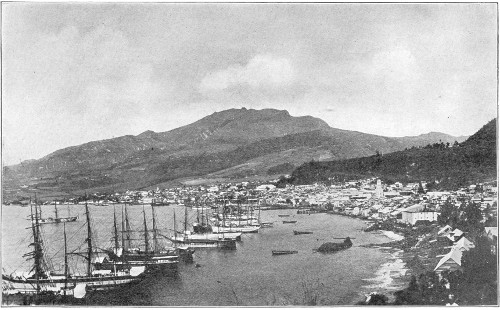
SAINT-PIERRE AND MT. PELÉE BEFORE THE ERUPTION
By this time you will have seen the doll. I want to remind you that this
is more than a doll; it is really an artistic model of the dress worn by
the women of Martinique,—big earrings and all. The real earrings and
necklaces are pure gold; the former worth 175 francs a pair; the latter
often running as high as 500, 600, even 900 francs.
In case this reaches you before leaving New York, I hope you will be
able to make some arrangement with Joe or somebody, so that I can put my
things in a place of safety for a day or two, until I can try to arrange
matters with the Harpers. I will be obliged to stay a short while in New
York,—and shall want a room badly, until my MS. and photos have been
disposed of, and my proof-reading has been done on “Chita.” With
affectionate regards to all,
Very truly yours,
Lafcadio Hearn.
P. S. I return with the Barracouta.
My inquiries about the Marimba and other instruments have produced no
result except the discovery that our negroes play the guitar, the flute,
the flageolet, the cornet-à-piston! Some play very well; all the
orchestras and bands are coloured. But the civilized instrument has
killed the native manufacture of aboriginalities. The only hope would be
in the small islands, or where slavery still exists, as in Cuba, There
are one or two African songs still current, but they are sung to the
tam-tam—
Welleli, welleli,
hm, hm!
Papa mon ce papa mon
hm, hm!
Welleli, welleli,
hm, hm!
Maman mon ce maman mon
hm, hm!
Welleli, etc.
Dear Miss Bisland,—I suppose you will have just a tiny little bit of
curiosity to know about my impressions here? They have been all
flavoured with that enchanting sensation which artists term surprise.
The effect upon me has been such that I think the North will always look
torpid to me,—as a benumbed and livid part of our planet. Nearly all
these isles are volcanic; and this largely accounts for the green and
purple symmetry of their shapes. The colours are of the kind called
"impossible;”—and the days have such an azure expansion, so enormous a
luminosity that it does not really seem to be our sky above, but the
heaven of some larger world.
That’s all I can attempt to say about it now (in a general way) without
wearying you.
Imagine old New Orleans, the dear quaint part of it, young and idealized
as a master-artist might idealize it,—made all tropical, with narrower
and brighter streets, all climbing up the side of a volcanic peak to a
tropical forest, or descending in terraces of steps to the sea;—fancy
our Creole courts filled with giant mangoes and columnar palms (a
hundred feet in height sometimes); and everything painted in bright
colours, and everybody in a costume of more than Oriental
picturesqueness;—and astonishments of half-breed beauty;—and a grand
tepid wind enveloping the city in one perpetual perfumed caress,—fancy
all this, and you may have a faint idea of the sweetest, queerest,
darlingest little city in the Antilles: Saint-Pierre, Martinique. I
hope it will be my residence for the next two months,—and for the
latter part of my wretched little existence. I love it as if it were a
human being.
Outside are queer little French islands, with queer names—Marie
Galante is rather an old appellation for an island,—full of Cytherean
suggestion.
We leave this very fantastic and unhealthy land—now smitten with
Gold-fever as well as other maladies—to-morrow. Then will come
Trinidad, with its Hindoo villages to see. Photos, bought at Demerara
and St. Kitts, predict visions of Indian grace worth daring the
perpendicular sun to see. I am now the only passenger. My last
companion—a fine Northwestern man—goes, I fear, to leave his bones in
the bush. From the interior men are being carried back to the coast to
die, yet the stream pours on to the gold-mines. My miner thinks he can
stand it: he has dug for African gold, under a fiercer sky. He was an
odd fellow. Saw no beauty in these islands. “No, partner—if you want to
see scenery see the Rockies: that’s something to look at! Even the sea’s
afraid of them mountains,—ran away from them: you can see four thousand
feet up where the sea tried to climb before it got scared!”
Sometimes the apes on board are taught the experiences of life, the
advantages of civilization. Torpedoes are tied to their tails;
fire-crackers surround them with circles of crepitation and flame. Also
they are occasionally paralyzed by unexpected sensations of
electricity;—they have made the acquaintance of a galvanic battery;
they have been induced to do foolish things which resulted in sharp and
unfamiliar pains and burnings. Their lives are astonishments, and
prolonged spasms of terror.
The sea at night is an awful and magnificent sight. It looks
infernal,—Acherontic;—black surges that break into star-spray;—an
abyss full of moving lights that come and go.
Well, I can’t write a good letter now;—wait till I get back to
Martinique. I wanted you to know I had not forgotten my promise to
write. You must make a trip down here some day. It is not hotter than
New York except in the sun.
You can do whatever you wish. You have force to do it. You have more
brains in your finger-tips than some who have managed to get a big
reputation. The little talk about Grande Isle that night was an absolute
poem,—gave me a sense of the charm of the place such as I felt the
first beautiful morning there. You don’t know what you can do, if you
want to.
I think I should do something with this novel material, it is so rich in
absurd colour! But I don’t feel enthusiastic now. Enthusiasm has been
numbed by a long series of violent sensations and unexpected
experiences. I have artistic indigestion;—going to try to dream it away
at divine, paradisaical Martinique. There I will write you again. My
address will be, care American Consul. But you mustn’t write unless you
have plenty of time;—I am only paying my debts, not trying to make you
waste paper answering me.
I believe I am beginning to write absurdities: it is so hot that
rain-clouds form in one’s head.
Good-bye, believe the best you can of me
Your friend,
Lafcadio Hearn.
Dear Miss Bisland,—I am settled here for at least a month:—wish I
could settle here forever. I love this quaint, whimsical,
wonderfully-coloured little town,—all its ups and downs, vistas of
azure harbour and overshadowing volcanic hills,—all the stones that
whisper under the myriad naked feet of this fantastic population. It
pleases me to find my affection for it is not merely inspiration: the
place has fascinated more than one practical American,—persuaded them
to abandon ambitions, contests, popular esteem, friends, society,—and
to settle here for the rest of their days, in delightful indolence and
dreamy content.
In my trunk I have something for you: a Coolie girl’s bracelet. It will
not look so well on your arm as on hers, because its effect depends on a
background of dark colour; and all this clumsy Indian jewelry is
inartistically wrought. It is indeed made chiefly for economical
reasons. Coolies so carry their wealth;—I saw one Hindoo wife with some
$900 worth of jewelry upon her.
In the little Coolie village near Port-of-Spain, Trinidad, I sat, and
looked at rudely painted Indian gods, while waiting for the silversmith
to sit down before his ridiculous little anvil. All the palm-shadows,
intensely black, crawled outside like tarantulas; it was a glowing
day,—blindingly blue: the light of a larger sun seemed to fill the
world,—a white sun,—Sirius!
“Ra!” called out the Coolie smith when I told him I wanted to look at
his jewelry;—and his wife came in. She wore the Hindoo garb without the
long veils: a white robe like a Greek chiton, or rather like a lady’s
chemise,—leaving the arms and ankles bare, and confined about the
waist. I thought her very lovely,—slender and delicate,—a perfect
bronze-colour: the gold-flower attached to the nostril did not impair
the symmetry of the face;—extraordinary eyes and teeth. She held out
her pretty round arms for examination: there were about ten silver rings
upon each: the two outer ones being round, the inner eight being flat.
The arm was infinitely prettier than the bracelets;—I selected one
ring, and the smith opened and removed it with an iron instrument and
gave it me. It had a faint musky odour: perhaps that was why the smith
insisted on putting it into an absurdly small furnace, and purifying it
after the Indian manner.
I wanted to buy a pair of baby bracelets;—so they brought in the
baby,—a girl, and therefore (?) having a dress on. The little babies of
the other sex wear nothing but circles of silver on arms and ankles.
Sometimes the custom is extended; for the little wife who carried her
girl baby to the post-office when I was at Demerara, carried it naked
at her hip in the most primitive manner.
This Trinidad baby had absurdly large eyes,—looked supernatural: the
mother’s eyes magnified. She held up her little arms and I chose two
rings. Then she talked to me in—Creole patois! It is the commercial
dialect of the poor; and the Hindoos learn it well
Always truly,
Lafcadio Hearn.
There are palms here over 200 feet high. There are fish here of all the
colours of marsh-sunset.
Dear Miss Bisland,—Imagine yourself turned into marble, all
white,—robed after the fashion of the Directory,—standing forever on a
marble pedestal, under an enormous azure day,—encircled by a ring of
tall palms, graceful as Creole women,—and gazing always, always, over
the summer sea, toward emerald Trois Islets.
That is Josephine! I think she looks just like you, “Mamzelle
Josephine,”—or Zefine, if you like.
I want to tell you a little story about her,—just a little anecdote
somebody told me on the street, which I want to develop into a sketch
next week.
It was after the fall of the Second Empire,—after France felt the iron
heel of Germany upon her throat.
Far off in this delicious little Martinique, the Republican rage made
itself felt;—the huge reaction passed over the ocean like a magnetic
current. So it happened, in a little while, that the Martinique
politicians resolved to do that which had already been done in
France,—to obliterate the memories of the Empire.
There was Mamzelle Zefine, par exemple!... They put a rope round her
beautiful white neck. They prepared to destroy the statue.
Then Somebody rang the Church-bell—(you ought to see the sleepy little
church: it makes you want to doze the moment you pass into its cool
shadow). A vast crowd gathered in the Savane.
It was a crowd of women,—mostly women who had been slaves,—quadroons,
mulattoesses; the house-servants, the bonnes, the nurses and
housekeepers of the old days. (You could form no possible idea of this
coloured Creole element without seeing it: it does not exist in New
Orleans.) They gathered to defend Mamzelle Zefine.
When the Republican officials came with their workmen at sunrise,
Mamzelle Zefine was still gazing toward Trois Islets; she was white as
ever; her pure cold passionate face just as lovely: she seemed totally
indifferent to what was about to happen,—she was dreaming her eternal
plaintive dream.
But she could well afford to feel indifferent! About her, under the
circle of the palms, surged a living sea,—a tide of angry yellow faces,
above which flashed the lightning of cane-knives, axes, couteaux de
boucher. “Ah! li vieu!—lâches! cafa’ds! pott’ons! Vos pas cabab
toucher li! Touché li—yon tête fois!—Osé toucher li. Capons
Républicains! Osé toucher li!“
Mamzelle Zefine still gazed plaintively toward Trois Islets. She must
have seemed to that yellow population to live;—for each one she
represented some young mistress, some petted child, some memory of the
old colonial days. And all the love of the slave for the master—all the
strange passionate senseless affection of the servant for the Creole
family—was stirred to storm by the mere idea of the proposed
desecration. The man who should have dared to lay an evil finger upon
Josephine that day would have been torn limb from limb in the public
square. The officials were frightened and foiled: they pledged their
faith that the statue should not be touched.
So they took the ropes away; and they piled flowers at Mamzelle Zefine’s
white feet; they garlanded her; they twined the crimson jessamines of
the tropics about her beautiful white throat.
And she is still here,—always in the circle of the palms, always
looking to Trois Islets, always beautiful and sweet as a young Creole
maiden,—dreamy, gracious, loving,—with a smile that is like some
faint, sweet memory of other days.
Always,
Lafcadio Hearn.
Dear Miss Bisland,—Thanks for the gracious little letter. I wish I
could see you, and see other friends; but fate forbids. Distances are
too enormous; engagements imperative; preparations for coming journey
made my head whirl. For I return to the tropics, dear Miss
Bisland,—probably forever: I imagine that civilization will behold me
no more, except as a visitor at very long intervals. I would like to
write you sometimes, praying only that my letters be not ever shown unto
newspaper people. You will hear from me soon again. I am off on Friday
afternoon, and have not even the necessary time to do what I ought to do
in the mere matter of exceedingly small purchases, outfits, etc.
Good-bye, with best regards and something a little more, too.
Lafcadio Hearn.
I have not seen Krehbiel at all,—was out of town when I returned, and
seems to have found no time afterwards.
Your letter reached me just at a time when everything that had seemed
solid was breaking up, and substance had become Shadow. It made me very
foolish,—made me cry. Your rebuke for the trivial phrase in my letter
was very beautiful as well as very richly deserved. But I don’t think it
is a question of volition. It is necessary to obey the impulses of the
Unknown for Art’s sake—or rather, you must obey them. The Spahi’s
fascination by the invisible Forces was purely physical. I think I am
right in going: perhaps I am wrong in thinking of making the tropics a
home. Probably it will be the same thing over again: impulse and chance
compelling another change.
The carriage—no, the New York hack and hackman (no romance or
sentimentality about these!)—is waiting to take me to Pier 49, East
River. So I must end. But I have written such a ridiculous letter that I
shan’t put anybody’s name to it.
Dear Gould,—One of your letters, I think a P. Cd., many months ago,
caught me in British Guiana, another to-day finds me here. I left N. O.
in June, 1887, and have been travelling since, or at least sojourning in
these tropics. I have been sick, too,—have had some trouble fighting
the influences of climate, trouble in trying to carry out large plans
with absurdly small resources; and have been unable to do my friends
justice. How could you think I could have been offended? It was only the
other day, in a letter to the editor of Harper’s, that I referred to
one of your delightful colour-theories.
Praise from you I value very highly. As to impress such a mind as yours
means to me a great pride and pleasure. I am delighted “Chita” pleased
you.
I have written a number of sketches on the West Indies,—some of which
may appear in a few months, others later on. It has been a hope of mine
to make a unique book on these strange Hesperides, with their singularly
mixed races; but I don’t know whether I shall be able to carry the
project out.
The climate is antagonistic to work. It is a benumbing power, rendering
concentrated thought almost out of the question. I can now understand
why the tropics have produced so little literature.
We are quarantined and isolated for the present by a long epidemic of
small-pox, which among these populations means something as fatal as an
Oriental plague. The whites are exempt. But the disease, although on the
decline, still prevails to an extent rendering it doubtful when I can
get away from here.
I would like much to hear from you when you have time. I am temporarily
settled here, and everything goes well enough now, so that I can write
regularly
With best affection,
Lafcadio Hearn.
Dear Dr. Gould,—I am writing you from an obscure, pretty West Indian
village, seldom visited by travellers. Tall palms, and a grand roaring
sea, blue as lapis lazuli in spite of its motion.
I was certainly even more pleased to hear from you than you could have
been at the receipt of my letter;—for in addition to the intellectual
and sympathetic pleasure of such a correspondence, the comparative
rarity of friendly missives, enhancing their value, lends them certain
magnetism difficult to describe,—the sensation, perhaps, of that North,
and that Northern vigour of mind which has made the world what it is,
and that pure keen air full of the Unknowable Something which has made
the Northern Thought.
I seldom have a chance now to read or speak English; and English phrases
that used to seem absolutely natural already begin to look somewhat odd
to me. Were I to continue to live here for some years more, I am almost
sure that I should find it difficult to write English. The resources of
the intellectual life are all lacking here,—no libraries, no books in
any language;—a mind accustomed to discipline becomes like a garden
long uncultivated, in which the rare flowers return to their primitive
savage forms, or are smothered by rank, tough growths which ought to be
pulled up and thrown away. Nature does not allow you to think here, or
to study seriously, or to work earnestly: revolt against her, and with
one subtle touch of fever she leaves you helpless and thoughtless for
months.
But she is so beautiful, nevertheless, that you love her more and more
daily,—that you gradually cease to wish to do aught contrary to her
local laws and customs. Slowly, you begin to lose all affection for the
great Northern nurse that taught you to think, to work, to aspire. Then,
after a while, this nude, warm, savage, amorous Southern Nature succeeds
in persuading you that labour and effort and purpose are foolish
things,—that life is very sweet without them;—and you actually find
yourself ready to confess that the aspirations and inspirations born of
the struggle for life in the North are all madness,—that they wasted
years which might have been delightfully dozed away in land where the
air is always warm, the sea always the colour of sapphire, the woods
perpetually green as the plumage of a green parrot.
I must confess I have had some such experiences. It appears to me
impossible to resign myself to living again in a great city and in a
cold climate. Of course I shall have to return to the States for a
while,—a short while, probably;—but I do not think I will ever settle
there. I am apt to become tired of places,—or at least of the
disagreeable facts attaching more or less to all places and becoming
more and more marked and unendurable the longer one stays. So that
ultimately I am sure to wander off somewhere else. You can comprehend
how one becomes tired of the very stones of a place,—the odours, the
colours, the shapes of Shadows, and tint of its sky;—and how small
irritations become colossal and crushing by years of repetition;—yet
perhaps you will not comprehend that one can actually become weary of a
whole system of life, of civilization, even with very limited
experience. Such is exactly my present feeling,—an unutterable
weariness of the aggressive characteristics of existence in a highly
organized society. The higher the social development, the sharper the
struggle. One feels this especially in America,—in the nervous centres
of the world’s activity. One feels at least, I imagine, in the tropics,
where it is such an effort just to live, that one has no force left for
the effort to expand one’s own individuality at the cost of another’s. I
clearly perceive that a man enamoured of the tropics has but two things
to do:—To abandon intellectual work, or to conquer the fascination of
Nature. Which I will do will depend upon necessity. I would remain in
this zone if I could maintain a certain position here;—to keep it
requires means. I can earn only by writing, and yet if I remain a few
years more, I will have become (perhaps?) unable to write. So if I am to
live in the tropics, as I would like to do, I must earn the means for it
in very short order.
I gave up journalism altogether after leaving N. O. I went to Demerara
and visited the lesser West Indies in July and August of last
year,—returned to New York after three months with some MS.,—sold
it,—felt very unhappy at the idea of staying in New York, where I had
good offers,—suddenly made up my mind to go back to the tropics by the
very same steamer that had brought me. I had no commission, resolved to
trust to magazine-work. So far I have just been able to scrape
along;—the climate numbs mental life, and the inspirations I hoped for
won’t come. The real—surpassing imagination—whelms the ideal out of
sight and hearing. The world is young here,—not old and wise and grey
as in the North; and one must not seek the Holy Ghost in it. I suspect
that the material furnished by the tropics can only be utilized in a
Northern atmosphere. We will talk about it together; for I will
certainly call on you in Philadelphia some day.
I would not hesitate, if I were you, to begin the magnum opus;—the
only time to hesitate would be when it is all complete, before giving to
the printer. Then one may perhaps commune with one’s self to advantage
upon the question of what might be gained or lost by waiting for more
knowledge through fresh expansions of science. But the true way to
attempt an enduring work is to begin it as a duty, without considering
one’s self in the matter at all, but the subject only,—which you love
more and more the longer you caress it, and find it taking form and
colour and beauty with the patient years.
I am horribly ignorant about scientific matters; but sometimes the
encouragement of a layman makes the success of the prelate.
Now, replying to your question about “Chita.” “Chita” was founded on the
fact of a child saved from the Lost Island disaster by some Louisiana
fisher-folk, and brought up by them. Years after a Creole hunter
recognized her, and reported her whereabouts to relatives. These, who
were rich, determined to bring her up as young ladies are brought up in
the South, and had her sent to a convent. But she had lived the free
healthy life of the coast, and could not bear the convent;—she ran away
from it, married a fisherman, and lives somewhere down there now,—the
mother of multitudinous children.
And about my work, I can only tell you this:—I will have two
illustrated articles on a West Indian trip in the Harper’s Monthly
soon,—within four or five months. These will be followed by brief West
Indian sketches. Other sketches, not suited for the magazine, will go to
form a volume to be published later on. I do not correspond or write for
any newspaper, and I would always let you know in advance where anything
would be published written by me.
You know what the nervous cost of certain imaginative work means; and
this sort of work I do not think I shall be able to do here. One has no
vital energy to spare in such a climate. I cannot read Spencer
here,—gave up the “Biology” (vol. II) in despair. But I did not miss
the wonderful page about the evolution of the
eye—hair—snail-horn—etc., etc.... I want to see anything you write
that I can understand, with my limited knowledge of scientific terms and
facts. And when you write again, tell me what you said of Loti in the
letter I never received. Did you read his “Roman d’un Spahi”? I thought
you would like it. If you do not, let me know why,—because Loti has had
much literary influence upon me, and I want to know his faults as well
as his merits. With love to you,
Lafcadio Hearn.
Dear Gould,—Many thanks for the quid!—the surprising quid. I have
been waiting to send you the quo, which I do not like so well as one
taken in New Orleans, of which I have no copy within reach. But before I
tell you anything about the quo, I ought to scold you for your
startling deception. I pictured you as a much younger man than
myself—although quite conscious of meeting an intelligence much more
virile and penetrating than my own, and with an experience of life
larger: this did not, however, astonish me; for whatever qualities I
have lie only in that one direction which pleased you and won your
friendship,—moreover, I had met several much younger men than myself,
my mental superiors in every respect. But, all of a sudden you come upon
me with such a revelation of your personality as makes me half afraid of
you. I perceive that your envergure is much larger than I imagined:—I
mean, of course, the mental spread-of-wing; and then your advice and
suggestions, while manifesting your ability to teach me much in my own
line, resemble only those proffered by old experienced masters in
literary guidance. It is exactly the advice of Alden, among one or two
others.
Now about the quo. I am about five feet three inches high, and weigh
about 137 pounds in good health;—fever has had me down to 126. Nothing
phthisical,—36¾ inches round the chest, stripped. Was born in June
(27th), 1850, in Santa Maura (the antique Leucadia), of a Greek mother.
My father, Dr. Charles Bush Hearn, who spent most of his life in India,
was surgeon-major of the 76th British regiment (now merged in West
Riding Battalion). Do not know anything about my mother, whether alive
or dead;—was last heard of (remarried) in Smyrna, about 1858-9. My
father died on his return from India. There was a queer romance in the
history of my father’s marriage. It is not, however, of the sort to
interest you in a letter. I am very near-sighted, have lost one eye,
which disfigures me considerably; and my near-sightedness always
prevented the gratification of a natural penchant for physical
exercise. I am a good swimmer; that is all.
Your advice about story-writing is capital; I am not so sure about your
suggestion of plot. I cannot believe—in view of the extraordinary
changes (changes involving even the whole osseous structure) wrought in
the offspring of Europeans or foreigners within a single generation by
the tropical climate—that anything of the parental moral character on
the father’s side would survive with force sufficient to produce the
psychical phenomena you speak of. In temperate climates these do survive
astonishingly, even through generations; in the tropics, Nature moulds
every new being at once into perfect accord with environment, or else
destroys it. The idea you speak of occurred to me also; it was abandoned
after a careful study of tropical conditions. It could only be used on
an inverse plot,—transporting the tropical child to the North. At
least, I think so, with my present knowledge on the subject,—which
might be vastly improved, no doubt....
About story-writing, dear friend, you ought to know I would like to be
able to do nothing else. But even in these countries, where life is so
cheap, I could not make the pot—or as they call it here, the
canari—boil by story-writing until I gain more literary success, and
can obtain high prices. A story takes at least ten or twelve months to
write, that is, a story of the length of “Chita.” Suppose it brings only
$500,—half as much as you will soon be able to obtain for a single
operation! It is pretty hard to live even in the tropics on that sum. I
must write sketches too. They do me other good also, involve research I
might otherwise neglect. I have prepared some twelve sketches in all,
which obligated investigation that will prove invaluable for a
forthcoming novelette.
I like your firm, strong, sonorous letter, better than anything of the
sort I ever received. The only thing I did not relish in it was the
suggestion that I should prepare a lecture, or make an appearance before
a private club. I would not do it for anything! I shrink from real life,
however, not at all because I am pessimistic. It is a very beautiful
world:—the ugliness of some humanity only exists as the shadowing that
outlines the view; the nobility of man and the goodness of woman can
only be felt by those who know the possibilities of degradation and
corruption. Philosophically I am simply a follower of Spencer, whose
mind gives me the greatest conception of Divinity I can yet expand to
receive. The faultiness is not with the world, but with myself. I
inherit certain susceptibilities, weaknesses, sensitivenesses, which
render it impossible to adapt myself to the ordinary milieu; I have to
make one of my own, wherever I go, and never mingle with that already
made. True, I lose much knowledge, but I escape pains which, in spite of
all your own knowledge, you could not wholly comprehend, for the simple
reason that you can mingle with men. By the way, it is no small
disadvantage in life to be 5 ft. 3 in. high. I remember observing, at a
great gathering of American merchant princes, that the small or
insignificant looking men present might have been counted on the fingers
of one hand. Success in life still largely depends upon the power to
impose respect, the reserve of mere physical force; since the expansion
of everybody’s individuality—at the expense of everybody else’s
individuality—is still the law of existence.
I am not yet sure what I am going to do. One thing certain is that I am
to go to South or to Central America—for monetary reasons. I may linger
here long enough to finish a novelette. If not able to do so, I will
perhaps be in New York before December. I left it October 2, 1887, after
a stay of only three weeks, to return to the tropics. It was then
impossible to visit Philadelphia. Should I go to the Continent from
here, you will know at least six weeks in advance.
Thanks for the superb paper on Loti. I cannot imagine anything much
finer in the way of literary analysis. But what does James
want?—evolution to leap a thousand years? What he classes as sensual
perceptions must be sensitized and refined supernally,—fully evolved
and built up before the moral ones, of which they are the
physiological foundations, pedestals. Granting the doubt as to the
ultimate nature of Mind, it is still tolerably positive that its
development—so far as man is concerned—follows the development of the
nervous system; and that very sensuousness which at once delights and
scandalizes James, rather seems to me a splendid augury of the higher
sensitiveness to come, in some future age of writers and poets,—the
finer “sensibility of soul,” whose creative work will caress the
nobler emotions more delicately than Loti’s genius ever caressed the
senses of colour and form and odour.
You ask about my idea of Whitman? I have not patience for him,—not as
for Emerson. Enormous suggestiveness in both, rather than clear
utterance. I used to like John Weiss better than Emerson. Then there is
a shagginess, an uncouthness, a Calibanishness about Whitman that
repels. He makes me think of some gigantic dumb being that sees things,
and wants to make others see them, and cannot for want of a finer means
of expression than Nature gives him. But there is manifest the rude
nobility of the man,—the primitive and patriarchal soul-feeling to men
and the world. Whitman lays a Cyclopean foundation on which, I fancy,
some wonderful architect will yet build up some marvellous thing....
Yes, there is nonsense in Swinburne, but he is merely a melodist and
colourist. He enlarges the English tongue,—shows its richness,
unsuspected flexibility, admirable sponge-power of beauty-absorption. He
is not to be despised by the student.
Let me pray you not to make mention of anything written to you thus,
even incidentally, to newspaper folk—or to any literary folk who would
not be intimate friends. There are reasons, more than personal, for
this suggestion, acceptance of which would remove any check on
frankness
Best love to you, from
Lafcadio Hearn.
Speaking of Whitman, I must add that my idea of him is not consciously
stable. It has changed within some years. What I like, however, was not
Whitman exactly,—rather the perception of something Whitman feels, and
disappoints by his attempted expression of.
After closing letter I remember you wanted to know about illustrations
in magazine. They are after photos. I am sorry to say incorrect use has
been made of several: the types published as Sacratra were not
Sacratra, but in two cases half-breed Coolie,—one seemingly of
Southern India, showing a touch of Malay. There were other errors. It is
horrible not to be able to correct one’s own work,—on account of
irregularities in mail involved by quarantine. In the December number
you will see a study of a peculiar class of young girls here. If you
want, yourself, to have some particular photo of some particular thing,
send word, and I will try to get it for you.
I can only work here of mornings. Nobody dreams of eating before noon:
all rise with the sun. After 2 P.M., the heat and weight of the air make
thinking impossible. Your head gets heavy, as if there was lead in it,
and you sleep.
Dear Friend Gould,—I have read your delightful letter,—also, the
delightful essays of James you so kindly sent me. I suspect James has
not his equal as a literary chemist: the analyses of his French
contemporary, Lemaître, are far less qualitative. You have made me know
him as a critic;—I had only known him as a novelist. My work has been
poor; it has been condensed and recondensed for the magazine till all
originality has been taken out of it; finally I never had a chance to
revise it in proof. I believe I have temporarily lost all creative
power: it will come back to me, perhaps, when I inhale some Northern
ozone.
I would like to call your attention to the article by Loti in
Fortnightly Review—“Un Rêve,” a delicious little psychological
phenomenon. Have you seen “Madame Chrysanthemum”—wonderfully
illustrated!
Are you perfectly, positively sure there is really a sharp distinction
between moral and physical sensibilities? I doubt it. I suspect what we
term the finer moral susceptibilities signify merely a more complex and
perfect evolution of purely physical sensitiveness. The established
distinction simply seems to me that “moral” feelings are those into
which the sexual instinct does not visibly enter, or those in which some
form of desire, some form of egotism, does not predominate at the cost
of justice to others. There is a queer vagueness about all definitions
of the moral sense. When one’s physical sensibilities are fully
developed and properly balanced, I do not think wickedness to others
possible. The cruel and the selfish are capable of doing what is called
wrong, because they are ignorant of the suffering inflicted. Thorough
consciousness of the result of acting forms morality, if morality is
self-restraint, self-sacrifice, incapacity to injure unnecessarily;—one
who understands pain does not give it. Of course, I am not a believer in
free will. I do not believe in the individual soul,—though in the
manifestations of a universal human, or divine, soul, I am inclined to
believe, or to have that doubt which almost admits of belief. What
offends in certain writings, I suppose, is the feeling that the writer’s
faculties are not perfectly balanced,—that certain senses are so much
more developed than others that one can suspect him of yielding to
cruelties of egotism. Perhaps I may say that I would call moral
feelings, as distinguished from those termed physical, the sensitiveness
of perception of suffering in others,—of the consequences of acts. But
can those be thoroughly developed before those which conduce to
self-preservation? I imagine the reverse to be the case. By the
super-refinement of the earlier sensations comes the capacity for the
“higher sentiments.” It is true that moral standards are very old, but
those existing are also very defective. Evolutionally, egotism must
precede altruism;—altruism itself being only a sort of double reflex
action of egotism.—All this is very badly written; but you can catch
the idea I am trying to express.
When you think of tropical Nature as cruel and splendid, like a leopard,
I fancy the Orient, which is tropical largely, dominates the idea.
Humanity has a great beauty in these tropics, a great charm,—that of
childishness, and the goodness of childishness. As for the mysterious
Nature, which is the soul of the land, it was understood by the ancient
Mexicans, whose goddess of flowers, Coatlicue, was robed in a robe of
serpents interwoven. She is rich in death as in life, this Nature, and
lavish of both. I would love her; but I fear she is an enemy of the
mind,—a hater of mental effort.
No, indeed, I did not laugh at your experiences. I have had nearly as
multiform; but mine were less successful,—I was less fitted for them. I
have not your advantages, nor capacities. I never learned German. It is
only in America such careers are possible. I wish I could have finished
like you, as a physician; for I hold, that with the modern development
of medicine as an enormous interbranching system of science and
philosophy, the physician is the only perfect man, mentally. Like those
old Arabian physicians who affected to treat the soul, the modern knows
the mind, the reason of actions, the source of impulses,—which must
make him the most generous of men to the faults of others.
I don’t like your plot for a medical novel at all. It involves ugliness.
I believe in Théophile Gautier’s idea of art, study only the
beautiful;—create only ideals, therefore. You are not a realist, I am
sure. Then your plot is too thin. It has not the beauty nor depth of
that simple narrative about a famous painter, or writer,—I forget
which,—whose imagination rendered it impossible for him to complete his
medical studies. Shapes impressed themselves upon his brain as on the
brain of an artist: vividly to painfulness. He was in love, engaged to
be married; under the peach flesh and behind the velvet gaze, he always
saw the outlined skull, the empty darkness of void orbits. He had to
abandon medicine for art. A very powerful short sketch might be made of
this fact.
I believe in a medical novel,—a wonderful medical novel. We must chat
about it. Why not use a fantastic element,—anticipate discoveries hoped
for,—anticipate them so powerfully as to make the reader believe you
are enunciating realities?
Your objection to my idea is quite correct. I have already abandoned it.
It would have to be sexual. Never could you find in the tropics that
magnificent type of womanhood, which, in the New England girl, makes one
afraid even to think about sex, while absolutely adoring the
personality. Perfect natures inspire the love that is a fear. I don’t
think any love is noble without it. The tropical woman inspires a love
that is half a compassion; this is always dangerous, untrustworthy,
delusive—pregnant with future pains innumerable.
I don’t know why you hold the work of Spencer, etc., more colourless
than those of the other philosophers and scientists whom you have
studied—all except beastly Hegel: there is an awful poetry to me in the
revelation of which these men are the mouthpieces, as much vaster than
the old thoughts as the foam of suns in the via lactea is vaster than
the spume of a wave on the sea-beach. Wallace I know only as a traveller
and naturalist; is it the same Wallace? I am very fond of him too: he is
very human, fraternal: he is not like God the Father as Spencer is. I
suppose what we need is God the Holy Ghost. He is not yet come.
Flower, who wrote that interesting little book “Fashion in Deformity”
and many other excellent things, could find some good texts here. I am
convinced now that most of our fashions are deformities; that grace is
savage, or must be savage in order to be perfect; that man was never
made to wear shoes; that in order to comprehend antiquity, the secret of
Greek art, one must know the tropics a little (so much has fashion
invaded the rest of the world), and that the question of more or less
liberty in the sex relation is like the tariff question—one of
localities and conditions, scarcely to be brought under a general rule.
Dear Gould,—A letter to you has been lying on my desk for months
unfinished,—I can only just gum the envelope and let it go as it is. I
am obliged at intervals—thank Goodness, only at very long ones—to let
all correspondence, even the most important, wait a little or risk the
results of interrupting a work which exacts all one’s thinking time
during waking hours. This has been partly my case,—having just
completed a novelette; but I have also had a good deal of trouble about
other matters that left me no chance to do anything until now. I am free
again,—I hope for a good long time.
Meanwhile I received your pamphlets, and read every one with more
pleasure than you could readily believe a non-scientific man could feel
in them. Of course, those which interested me most were:
1. That on the Homing Instinct (a much better word than the French
orientation). 2. That on the electric light. My first experience with
the light was painful; then I learned to like it (the white, not the
yellow) very much and found gaslight intensely disagreeable afterward.
By the way, do you correspond with Romanes, who solicits correspondence
on the subject of animals? You know him, of course, the author of
“Animal Intelligence” and “Mental Evolution in Animals.” A man like that
ought to be delighted with such a splendid and powerful suggestion as
that of your pamphlet. I hope you are not too patriotic to think you
cannot do better with a scientific suggestion abroad than at home. There
are certain things that seem to me too worthy to remain buried in the
archives of a medical society,—which ought to reach a larger scientific
circle through a more eclectic medium, such as that of the superb
foreign reviews, devoted to what used to be called natural history, but
for which the term has long ago become too small. Still I am sure you
must have heard from your paper on the homing instinct if the
publication in which it appeared reached the quarters it ought to have
reached.
I don’t know what to tell you about myself. Since October last I have
been buried in my room—facing, happily, a semi-circle of Mornes curving
away into a sea like lapis lazuli—and have neither heard nor seen
anything else. We had an epidemic of yellow fever which carried away
many Europeans and strangers; but it is over, and the weather is
delightful, if you can call weather delightful which keeps you drenched
in perspiration from morning to night, and forces you to lie down and
sleep in the afternoon if you dare attempt to write or read. The
difficulty of work in such a climate only those who have had the
experience can understand. I think my case is an experiment; almost a
phenomenon,—and I am very curious to know the result by the verdict
upon my work. I cannot judge it myself here. What at sundown seems good
in the morning appears damnably bad; and I was obliged to give every
page a test of three or four days’ waiting. My novelette made itself
out of an incident related to me about a case of heroism during a great
negro revolt.
There is no question but that I shall be in New York this summer, for a
while. It is imperative. I have to oversee work before it can be
published;—that which already appeared was in terribly bad shape on
account of my not having seen the proofs. Then I may be getting out a
little book.
Did you see the incident in regard to the admission of a remarkable
young lady doctor into the profession by the faculty of Paris,—the
remarks of Charcot and others? I thought of your medical novel. There
were some remarks very suggestive made. The thesis of the candidate was
the position and duty of woman as a physician. You know what those
French are, and what peculiar ways they have of looking at the question
of women as physicians;—the Paris papers made all kinds of
observations scabreuses; but the dignity of the girl carried her
splendidly through the ordeal—an ordeal to which Americans would never
put a female student.
I have a curious compilation,—“Etudes pathologiques et historiques sur
l’origine et la propagation de la Fièvre Jaune” (1886),—perhaps you
know it already,—by Dr. Cornilliac of Martinique. If you do not know it
I will send it you from New York. It contains a great deal of valuable
matter regarding the climate of the West Indies, and formative
influences of that climate on races and temperament. Martinique has had
several physicians of colonial celebrity,—how great I cannot estimate,
being ignorant of their comparative value; but some of them have a
decided charm as writers and historians. Such was Rufz de Lavison,
author of a delightful history of the colony, and a work upon the
trigonocephalus, which would not bear equal praise, I fancy. If you
want any information about medical matters in Martinique, I will hunt it
up for you.
I hope to see you and have a great chat with you. But the heat is great,
and there is an accumulation of letters to answer, and you will forgive
me for saying for the moment good-bye
Your sincere friend,
Lafcadio Hearn.
Dear Gould,—I read your pamphlets with intense pleasure: that on the
effect of reflex neurosis, of course, impressed me only as a curious
research; but your paper on dreams, full of truth and suggestive beauty,
had much more than a scientific interest for me. There is a world of
poetical ideas and romantic psychology evoked by its perusal. I wonder
only that you did not dwell more upon the softness, sweetness,
impalpable goodness of this dream-world in which everything—even what
we usually think wrong—seems to be right. Doubtless all man’s dreams of
paradise, of a golden past age, or a perfect future, were born of the
thin light vanishing sensations of dream. The work of Gautier cited by
you—“Avatar”—was my first translation from the French. I never could
find a publisher for it, however, and threw the MS. away at last in
disgust. It is certainly a wonderful story; but the self-styled
Anglo-Saxon has so much damnable prudery that even this innocent
phantasy seems to shock his sense of the “proper.”
You will be pleased to hear my novelette has been a success with the
publishers. It cost me terrible work in this continual heat, small as it
is; and I feel so mentally blank that I must get back to the States for
a while to seek some vitality, brighten whatever blood I have got left
after two years of tropical air.
If you could find me in Philadelphia a very quiet room where I could
write without noise for a few months, I would try my luck there. New
York is stupefying; I know too many people there; and I want to be very
quiet,—only to see a friend or two now and then, when I am in good trim
for a chat. I shall return to the West Indies in the winter.
Address me if you have time to write c/o H. M. Alden, Edr. Harper’s
Magazine;—for I shall have left Martinique, doubtless, by the time
this reaches you.
Faithfully,
Lafcadio Hearn.
Dear Joe,—By the time this reaches you I shall have disappeared.
The moment I get into all this beastly machinery called “New York,” I
get caught in some belt and whirled around madly in all directions until
I have no sense left. This city drives me crazy, or, if you prefer,
crazier; and I have no peace of mind or rest of body till I get out of
it. Nobody can find anybody, nothing seems to be anywhere, everything
seems to be mathematics and geometry and enigmatics and riddles and
confusion worse confounded: architecture and mechanics run mad. One has
to live by intuition and move by steam. I think an earthquake might
produce some improvement. The so-called improvements in civilization
have apparently resulted in making it impossible to see, hear, or find
anything out. You are improving yourselves out of the natural world. I
want to get back among the monkeys and the parrots, under a violet sky
among green peaks and an eternally lilac and lukewarm sea,—where
clothing is superfluous and reading too much of an exertion,—where
everybody sleeps 14 hours out of the 24. This is frightful, nightmarish,
devilish! Civilization is a hideous thing. Blessed is savagery! Surely a
palm 200 feet high is a finer thing in the natural order than seventy
times seven New Yorks. I came in by one door as you went out at the
other. Now there are cubic miles of cut granite and iron fury between
us. I shall at once find a hackman to take me away. I am sorry not to
see you—but since you live in hell what can I do? I will try to find
you again this summer.
Best affection,
L. H.
Dear Miss Bisland,—A week ago in New York I was asking a friend where
you were, but could then obtain no satisfactory information without
taking steps I had no time to attempt. I was really glad to get out of
the frightful whirl and roar of modern improvements as soon as possible,
but regretted not seeing you, even while assured of being able to do so
before long.
It is true I have been silent with my friends: I did not write seven
letters in seventeen months,—not even business letters. It was very
difficult to write anything in the continuous enervating heat; and I had
to struggle with difficulties of the most unlooked for sort,
incessantly,—until I found correspondence become almost impossible. But
I thought of you very often; and wondered if you were still in that
terrible metropolis. I saw in Max O’Rell’s book some lines about a
charming young lady and thought it must have been you.... I returned on
the 8th from Martinique.
Dr. Matas sent me your pretty eulogy of “Chita”—which I often re-read
afterward, and which gave me encouragement when I began to doubt whether
I could do anything else.... I don’t think I shall write another story
in the same manner,—feel I have changed very much in my way of looking
at things and of writing. “Chita” will soon be sent to you in book form
as a souvenir of Grande Isle: it is not as short a story as it looked in
the serried type of Harper’s—will make a volume of 225 pp. I will
have something else to send you, however, that will interest you more as
to novelty,—a volume of tropical sketches.
I wonder whether you could ever throw upon paper the thoughts you
uttered to me that evening I visited you nearly two years ago,—when you
said why you liked Grande Isle. In your few phrases you said much that
I had been trying to express and could not,—at least it so seemed to
me.... I have seen a great many strange beaches since; but nothing like
the morning charm of Grande Isle ever revealed itself. I wonder if I
were to see it now, whether I should feel the same pleasure....
Thanks for those verses!—there is a large, strong, strange beauty in
them. There seems, you know, to be just now a straining-up of eyes to
look for some singer able to prophesy,—to chant even one hymn of that
cosmic faith that is stealing upon the world
Affectionately your friend,
Lafcadio Hearn.
Dear Miss Bisland,—Oh! what a stiff epistle, with a little sharp
pointing of reproach twisting about in the tail of every letter! Really
you must never, never feel vexed at anything I write:—I wrote you just
as I wrote to Mr. Stedman about the same matter. I feel the man
sometimes is much less than the work: my work, however weak, is so much
better than myself, that the less said about me the better,—then there
are so many things you do not know. As for you not liking
personalities, that is a very different thing! Your own personality has
charm enough to render the truth very palatable. But I am sure, now,
from your letter anything you say will be nice,—though I think it would
have been better not to have said it. Does a portrait of an ugly man
make one desirous to read his book? I could not get out of the Harper
plan for an article on Southern writers, without hurting myself
otherwise; but the candid truth is that I felt like yelling when I saw
the thing—howling and screeching! Indeed I think that my belief in the
invisible personality of a man has been largely forced by my thorough
disgust with the visible personality. Schopenhauer says a beautiful
thing about the former,—that the “I” is the dark point in
consciousness,—just as the point of the retina where the sight-nerve
enters is blind, and as the brain itself is without sensation, and the
eye sees all but itself. I am not anxious to see my soul; but the fact
of inability to see it encourages me to believe it is better than the
thing called L. H.
I don’t know that I wrote anything clever enough to be worth your using,
but it is a pleasure you should think so. I can only suggest that the
adoption of my poor notions would tend to make me selfish about such as
I might think really good ones—I would keep them out of my letters,
until they could get into print!?!
Sub rosa, now!... My Martinique novelette comes out—the first
part—in January. I think you will like it better than “Chita:” it is
more mature and more exotic by far. It will run through two numbers.
They have made some illustrations which I have not seen, and am
therefore afraid of. Unless an illustration either reflects precisely or
surpasses the writer’s imagination, it hurts rather than helps. By the
way, have you ever met H.F. Farny? Farny is an Alsatian, a fine man, and
a superb sketcher—though lazy as a serpent. But if you ever want
imaginative drawing of a certain class, he is one to do it.
Please don’t ask me when I’m going to New York. I really can’t find out.
I wish I could. I ought to be there on the 15th. But I am peculiarly
situated, tied up by a business-muddle,—tangled by necessities of
waiting for information,—tormented, befuddled, anxious beyond
expression about an undecided plan,—shivering with cold, and longing
for the tropics. All my life I have suffered with cold—all kinds of
cold—psychical and physical;—I hate cold!!!!—I never can resign
myself to live in it!—I can’t even think in it, and I would not be
afraid of that Warm Place where sinners are supposed to go! Perhaps the
G.A. will sentence me to everlasting sojourn in an iceberg when I have
ceased to sin.
Very faithfully, and to some extent apologetically.
For you I do remain always as nice as I can be.
Lafcadio Hearn.
Dear Miss Bisland,—I can’t say definitely when I shall be in New York,
to have the delightful pleasure of a chat with you—something I have
been looking forward to for fully a year; but I will write to tell you a
few days in advance. I am drifting about with the forces of
circumstance—following directions of least resistance. Just now I have
a large mass (at least it looks very big to me) of MS. to amend and
emend and arrange into a tropical book: you will like some things in it.
When this job is finished, in a couple of weeks, it is probable I will
set to work on a short sketch or story, for which I have the material
partly arranged; and then I will go to New York. It is so quiet in this
beautiful great city, and my present environment is so pleasant, that I
am sure of doing better work here than I could in that frightful cyclone
of electricity and machinery called New York....
I am afraid you were right about the tropics, and the fascination of
climate. It is still upon me, and I shall find it very difficult to
conquer the temptation to return to the French colonies: the main fact
which helps me is the conviction that I cannot work there,—one’s memory
and will blurs and fails in the incessant heat and sleepy air; and for
three months before leaving I could not write a line.... My friends
advise me to try the Orient next time; and I think I shall.
I have a novelette in the Magazine pigeon-holes,—you will like it;
but I don’t know when it is going to come out.
It is not a little pleasure to know that my admiration of your verses
can be an encouragement;—you have quite forgiven my ancient effort to
amend a stanza by spoiling it!... I think your present position will
leave you time—after a while—for all you love to do, and can do so
uniquely. Magazine editing is so largely a question of method and
system—so far as I can learn—that I fancy you will eventually find it
possible to claim a few hours every day for yourself;—and such
systematic work as you must take hold of, will not, like journalistic
routine, deaden aspiration. I hope you will have a greater success with
the new monthly than you yourself expect, and I am sure you will if you
have fair chances at all.—But I must wait for the opportunity to see
you—because what one writes (at least what I myself write) on such
matters sounds so fictitious and flat,—though you know it comes from
your sincere friend,
Lafcadio Hearn.
Dear Miss Bisland,—It is true that I am only a small Voice;—but the
Voice has been uninterruptedly in the City of Doctors and Quakers, with
the exception of a much regretted interim passed in looking at that
monstrosity,—aptly described by C. D. Warner as “having been cut out
with a scroll-saw,”—Atlantic City.... (May I never, never behold
anything resembling it again!) I fear you must have written the address
wrong—so I send you the right one. It will always do: no matter where I
be. The Voice will call at 475 Fourth Avenue as soon as it can. It is
not its fault that it has not so done already. Everything to be written
must be finished, if possible, by the 15th prox.,—so that I can get
some place where the air is blue before cold weather. I will not be able
to run away from the country before Christmas anyhow.
I trust you are very, very well,—and as—everything—nice as anybody
could wish, and with best regards, remain always,
Your very true and positive friend,
Lafcadio Hearn.
P.S. Now I want to see those letters which came back from the Dead
Letter Office. Is it really so?
Dear Miss Bisland,—I know I am a horrid ignis fatuus; but the proofs
of “Chita” are only half-read, and I have no time to get away till it is
all done. Then I am working on a sketch,—then there will be more
proof-reading to do on the other book. But I will certainly get away in
a few weeks more, and will have ever so many things to tell you.
I have never seen the Cosmopolitan in its new dress, and I do not know
what has been going on anywhere....
Philadelphia is a city very peculiar—isolated by custom antique, but
having a good solid social morality, and much peace. It has its own dry
drab newspapers, which are not like any other newspapers in the world,
and contain nothing not immediately concerning Philadelphia.
Consequently no echo from New York enters here—nor any from anywhere
else: there are no New York papers sold to speak of. The Quaker City
does not want them—thinks them in bad taste, accepts only the magazines
and weeklies. But it’s the best old city in the whole world all the
same.
Faithfully,
L. Hearn.
My dear Miss Bisland,—I don’t know whether you saw a little gem of
Loti’s in the Fortnightly; I cut it out and send it,—also an attempt
at translation which proves the wisdom of the English magazine editor in
printing it in French,—and a comment of mine. I don’t think you are
likely to wish to print such a thing as the translation; but if you
should, don’t use it without sending me a proof, because it is full of
errors.
While in Saint-Pierre, Martinique, I found it—originally contributed,
in French, to the Fortnightly for August, 1888—copied into a French
paper. The impression made by reading it startled me for reasons
independent of the exquisite weirdness of the thought. There was the
great orange sunset of the tropics before me, over a lilac
sea,—bronzing the green of the mango, and tamarind-trees, and the
broad, satiny leaves of bananier and balisier. The interior
described in the vision was not of modern Saint-Pierre; but I knew an
old interior in Fort de France, whose present quaint condition repeated
precisely the background of the dream. A hundred years ago there were
but two places on the sunset-side of Martinique which could have
presented the spectacle of the little low streets described,—Fort de
France and Saint-Pierre. The high mountains cut off the sunset glow at
an early hour on the eastern side of the island. It seemed to me a
strange coincidence that in Les Colonies, a local paper, I had just
read also, that some old cemetery of Fort de France was about to be
turned into a playground for children.
Lafcadio Hearn.
Dear Miss Bisland,—Verily shirîn, shirîntar, and shirîntarin art
thou,—and Saadi in the Garden of the Taj likewise,—and also the letter
which I have just received.
Emotionally the book is surely Arnold’s strongest: it has that intensity
of sweetness which touches the sphere of pain. One need not seek in the
Bostan or Gulistan for the essence of that volume: the Oriental thought
has been transfigured in its reflection from a nineteenth century mind.
There has been in one of Edwin Arnold’s books some suggestion of a
future religion of human goodness and human brotherhood, through
recognition of soul-unity,—but in none, I think, so strangely as in
this. And then, what horror to read the very coarse interview published
recently in a daily paper: the brutal repetition of a man’s words
uttered under constraint, about the most sacred of sentiments!...
No; I won’t go to New York till you come back. I trust you will not
overwork yourself: when we see (I mean “hear”) each other, we can talk
over all known devices for lightening literary duties. I am acquainted
with some; and I would not have you fall sick for anything—unless you
were to do me something “awfully mean:” then I’m afraid I would not be
so sorry as I ought to be.
I will try to give you something for the Christmas number anyhow,—but
not very long. By the way, I have an idea which may be wrong, but seems
to me worth uttering. The prose fiction which lives through the
centuries in the short story: like the old Greek romances—narratives
like “Manon Lescaut;” “Paul et Virginie;” the “Candide” of Voltaire; the
“Vicar of Wakefield;” “Undine,” etc., outlive all the ampler labour of
their authors. It seems to me that with this century the great novel
will pass out of fashion: three-quarters of what is written is
unnecessary,—is involved simply by obedience to effete formulas and
standards. As a consequence we do not read as we used to. We read only
the essential, skipping all else. The book that compels perusal of every
line and word is the book of power. Create a story of which no reader
can skip a single paragraph, and one has the secret of force,—if not of
durability. My own hope is to do something in accordance with this idea:
no descriptions, no preliminaries, no explanations—nothing but the
feeling itself at highest intensity. I may fail utterly; but I think I
have divined a truth which will yet be recognized and pursued by
stronger minds than mine. The less material, the more force;—the
subtler the power the greater, as water than land, as wind than water,
as mind than wind. I would like to say something about light, heat,
electricity, rates of ether-vibration;—but the notion will work itself
out in your own beautiful mind without any clumsy attempts of mine to
illustrate.
—About the translation,—do as you please,—but don’t please put it in
a great big daily, next to the account of a prize-fight or a
murder,—and please, if you do anything with it, see, above all things
earthly, that I get proofs. But I would just as soon you would keep it.
I made it for you, and am glad you had not seen the original previously.
I thought the Cosmo. was a sort of literary weekly. It is a beautiful
little magazine,—full of surprises; and I trust it is going to win a
great success.
Good-bye;—your Voice wishes you a very happy pleasure-trip, in which
you will feel all sorts of new feelings, and dream all manner of new
dreams.
Lafcadio Hearn.
This morning I dropped you a little note; but this afternoon, reading
your book-chat in the Cosmo. I find I must write you something more
impersonal.
—You know, perhaps, that Spencer’s thought about education—the
paramount necessity of educating the Will through the Emotion—has
received, consciously or unconsciously, more attention in Italy than
elsewhere. The Emotions are not, as a rule, educated at all outside of
the home-circle. The great public schools of all countries have a system
which either ignores the emotions, or leaves them unprotected;—while
all sectarian teaching warps and withers them in the direction, at
least, of their natural growth. You know all this, I suppose, better
than I. But perhaps you do not know the “Cuore” of Edmondo de Amicis
(Thos. Y. Crowell & Co.), which has passed through 39 Italian editions.
And if you do not know it, I pray you to read it without skipping a
single phrase. It is as full of heart-sweetness as attar-of-roses is
full of flower-ghosts; and it seems a revelation of what emotional
education might accomplish.
I read Brownell’s book at your suggestion. It contains, I think, the
best teaching about how to study French character; but I could not
accept many of its inferences,—especially in regard to art and
morality,—without reluctance. There is a sense of something wanting in
the book—something lucid and spiritual (is it Conviction?) that makes
it heavy. How luminous and psychically electric is Lowell’s book
compared with it. And how much nobler a soul must be the dreamer of
Chosön!
—I shall never write “Miss Bisland” again, except upon an envelope. It
is a formality,—and you are you: you are not a formality,—but a
somewhat. And I am only
“I.”
Dear Gould,—Verily there is no strength nor power but from God,—the
High, the Great! I have thy letter, O thou of enormous working capacity,
and I admire and wonder, but am in no wise sorry for thee, seeing thou
doest that which thou art able to do, and findest pleasure therein and
excellence and dignity and power,—and that if thou wert doing it not
thou wouldst surely be doing something else;—for God (whose name be
exalted!) hath numbered thee among those who find felicity in exceeding
activity. Thou art indeed forty-one years old, by reckoning of time; but
as thou art of the Giants this reckoning hath no signification for thee.
Verily thou art but twenty-five years old, and thou shalt never know
age until a hundred winters shall have passed over thee. And all things
which thou dost desire shall be accorded unto thee by Him who, like
thyself, reposeth never, and whose blessed name be forever exalted! Also
unto thee shall the patients come, as an army for multitude, so that thy
bell shall make but one ringing through all thy days continuously, and
that thy neighbours shall be oppressed by reason of the concourse in the
street about thy dwelling.
But as for me, concerning whom thou makest inquiry, trouble not thyself
about thy servant, whose trust and power are in God—the High, the
Great! That which shall be shall be, and that which hath been shall not
be again:—for the moment, indeed, I am concerned only to know why the
flame of my lamp goeth upward, and all flame likewise,—unless it be
for the purpose of praising God (whose name be exalted by all living
creatures!). For thou saidst unto me, being a Kafeer, that Flame is a
vibration only; but thou hast not been able to tell me the mystery of
the pointing of fire and the upreaching of it to the feet of God, the
Compassionate, the Merciful.
Here it raineth always, and this Soul of me is slowly evaporating,
despite the perusal of Marcus Aurelius Antoninus, who spake of souls.
Meseems that each time I behold the eyes of her concerning whom I spake
to thee, something of that soul is drawn out unto her, and devoured
perhaps for sustenance of that Jinneyah—which is her own soul. So that
mine hath become thin as the inner shadow wrought by a strong double
light upon the ground; and I shall become even as a vegetable
presently—having knowledge of nothing save the witchery of God in the
eyes of women. The memory of Schopenhauer hath passed,—and with its
passing I find my only salvation in a return to the study of the Oceanic
Majesty and Power and Greatness and Holiness and Omniscience of the mind
of Herbert Spencer.
Be thou ever blessed and loved by the sons of men, even as by
Hearn.
Gould,—You must have skipped, bad boy!—for the girl is not “all face
and foot”! You missed the finely detailed account of her body in
William’s diary,—and the just observation of a trait characteristic of
the race in its purity; the great length of the lower limb,—fine
greyhounds, fine thoroughbred horses, and fine men and women have all
this characteristic, like the conventional figures of antique gem-work.
The gipsy-girl is possible: I have seen charming ones. You must read
Borrow’s “Gipsies” (the unabbreviated edition in two volumes),—also his
"Bible in Spain,” and “Lavengro,”—a Gipsy novel. Simpson’s “Gipsies” is
also worth looking at.... But if you won’t believe in the bird of
passage, take Carmen and believe in her—there, at least, you will not
doubt: all will prove in accordance with possible sin and sorrow. Why do
you want the Bird’s body to be better known—since nobody ever knew it
any better than you know it; (or would know if you had read all)—could
not have except by making to operate, like the Vicar of Azey-le-Rideau,
all its “hinges and mesial partitions,” even to disjuncture. What a
singular fact in the history of torture, that the inquisitor was trained
to believe the beautiful body he was breaking and rending and burning
was never beautiful—that its grace and symmetry were illusions, the
witchcraft of the dear old compassionate Devil striving to save his
victim by the mirage of fleshly attractiveness! Only through this belief
could certain monstrosities have been possible. It was always Saint
Anthony’s temptation!
I have a book for you—an astounding book,—a godlike book. But I want
you to promise to read every single word of it. Every word is dynamic.
It is the finest book on the East ever written; and though very small
contains more than all my library of Oriental books. And an American (?)
wrote it! It is called “The Soul of the Far East.” It will astound you
like Schopenhauer, the same profundity and lucidity. Love to you,
Hearn.
Dear Gould,—I blacked—that is, I had my boots blacked yesterday,—just
for the same reason that we do things after people are dead (which we
would not have done for them while they lived and asked), with a
ghostly idea of pleasing them. If you had been here I might not have had
them blacked, but as you were gone, I did it for the Shadow of you. And
I gave the boy 20 cents,—because of the feeling that he might never
have such a chance again. That boy runs after me now
everywhere,—but—he is mistaken! I am no longer the same! I have
satisfied my conscience, and enjoy Nirvana.
This morning when I got up I thought the streets looked queer. It seemed
as if they were lighted by the afternoon in some way or other, instead
of the morning. I went to the P. O. with “The Soul of the Far East.” How
silent the streets for a Friday morning! The population seemed all to
have ebbed away somewhere as if to look at something. The post-office
was silent as a pyramid inside. I went to the book-store, and found it
closed,—and for the first time realized that it was Sunday. Then I
understood why the streets looked like afternoon; and the sunshine had a
tinge as of evening in a cemetery. Confound Sunday!
Talking with Jakey last night about Nature, I heard him express the
opinion that his capacity of scientific realization of the causes of
things was enough to account for the absence in him of any feeling of
awe or reverence in the presence of mountain scenery. It occurred to me
therewith that the characteristic of indifference to poetry might be
almost common to mathematicians. The man who wrote “The Soul of the Far
East” and “Chosön” is nevertheless an accomplished mathematician. But
you will notice that his divine poetry touches only that which no
scientific knowledge can explain,—that which no mathematics can
solve,—that which must remain mysterious throughout all conceivable
span of time,—the fluttering of the Human Soul in its chrysalis, which
it at once hates and loves, and hates because it loves, and strives to
burst through, and still fears unspeakably to break,—though dimly
conscious of the infinite Ghostly Peace beyond.
Hearn.
Dear Gould,—I feel like a white granular mass of amorphous crystals—my
formula appears to be isomeric with Spasmotoxin. My aurochloride
precipitates into beautiful prismatic needles. My Platinochloride
develops octohedron crystals,—with a fine blue fluorescence. My
physiological action is not indifferent. One millionth of a grain
injected under the skin of a frog produced instantaneous death
accompanied by an orange blossom odour. The heart stopped in systole. A
base—L3 H9 NG4—offers analogous reaction to phosmotinigstic
acid. Yours with best regards,
Phosmolyodic Lafcadio Hearn.
Gould,—“Concerning zombis, tell me all about them.”
Hearn,—“In order to relate you that which you desire, it will be
necessary first to explain the difference in the idea of the
supernatural as existing in the savage and in the civilized mind. Now,
I remember a very strange thing....”
Gould,—“I’ll be back in a minute.” (Strides across the street.)
Violent agitation in the peripheral centres of Hearn, together with
considerable acute anguish, owing to disintegration of cerebral tissue
consequent upon the sudden arrest of nerve-force in discharge. (See
Grant Allen on cause of pain, “Physiological Æsthetics.”)
Gould, suddenly reappearing:—“Go on with that old story, now.”
(Resurrection of cerebral agitation in the ganglionic centres and
intercorrelate cerebral fibres of Hearn. After desperate and painful
research, the broken threads of memories and impulses are found again,
and peripherally conjointed, and the wounded narrative proceeds, limping
grievously.)
Hearn,—“As I was observing, I recollect one very curious instance of
emotional and fantastic—”
Gould,—“Yes, I’ll be out in a moment—“ (Disappears through a door.)
—Brutal confusion established in the visual, auditory, gustatory, and
olfactory ganglia of Hearn;—general quivering and strain of all the
mnemonic current lines, and then a sense of inquisitorial torture going
on in various brain-chambers, where the vital forces, suddenly arrested,
flow back in a deluge and set all ideas afloat in drowning agony. Slow
recovery as from concussion of the cerebellum.
Enter Gould,—“Now proceed with that story of yours.”
Hearn,—pacifying the fury of the ganglionic centres with the most
extreme possible difficulty, timidly observes,—
“But you don’t care to hear it?”
Gould,—moving with inconceivable rapidity, dynamically overcharged,—
“Of course, I do: I’m just dying to hear it.”
Hearn, running after him, skipping preliminaries in the anguish of “hope
deferred which maketh the heart sick,”—
“Well, it was in the Rue du Bois Morier,—one of the steepest and
strangest streets in the world, full of fantastic gables, and the
shadows of—”
Gould,—“Yes, I’ll be out in a minute.” (Vanishes through a shop
entrance.)
(Inexpressible chaos and bewilderment of impulses afferent and
efferent,—electrical collisions in the ganglia,—unspeakable combustion
of tissue in the intercorrelating fibres,—paralysis of conflicting
emotions,—unutterable anguish: coma followed by acute mania in the
person of Hearn.)
Gould,—emerging, “Well, go on with that old yarn....”
But Hearn is being already conveyed by two large Philadelphia Policemen
to the Penn. Lunatic Asylum for Uncurables.
Astonishment of Gould.
Gould,—Just after I wrote you last night, something began to whiffle
quite soundlessly round my head: I saw only a shadow, and I turned down
the gas,—remembering that he who extinguisheth his light so that
insects may not perish therein, shall, according to the book of Laotse,
obtain longer life and remission of sins. Then it struck me with its
wings so heavily that I knew it was a bat,—for no bird could fly so
silently; and I turned up the gas again,—full. There it was!—very
large,—circling round and round the ceiling so swiftly that I felt
dizzy trying to turn to keep it in sight,—and as noiselessly as its own
shadow above it. I could not tell which was the shadow and which the
life,—until both came together at last upon a ledge, and made a little
peak-shouldered devilish thing with strangely twisted ears.
All at once I remembered an experience in Martinique one summer evening.
We were at Grand Anse,—friend Arnoux and I,—supping in a little room
opening over a low garden full of banana-trees, to the black beach of
the sea; and the great Voice thundered so we could scarcely hear
ourselves speak; and the candle in the verrine fluttered like something
afraid. Then right over my head a bat began to circle, with never a
sound. Arnoux exclaimed: “Mais, mon cher, regarde cette sacrée
bête—ah—c’est drôle!” By the look of his face I knew drôle meant
“weird.” He struck it down with his napkin and it disappeared; but a
moment later came back again, and flew round as before. Again he hit it
and drove it away; but it always came flitting back. Then we all
laughed;—and Pierre, the host, tickling my ear with his beard, cried
out,—“C’est ta maîtresse à Saint-Pierre—elle est morte,—elle vient
te chercher.” And I looked so serious that Arnoux burst into a laugh as
loud as the surf outside.
Now when I saw that bat, I thought it was “weird,”—drôle as the
other. I even found myself wondering, Who it could be? I thought it
might be Clemence, about whose death I received news in my last letter.
I did not think for a moment it was Gould. Only some very poor simple
soul would avail itself of so humble a vehicle for apparition.... Then
it looked so much like something damned as it moved about, that I felt
ashamed of thinking it could be Clemence,—the best kind of old souls,
Clemence!—My blanchisseuse. It was not easy to catch the bat without
hurting it. I argued that if it was anybody I knew it could not be
afraid of me. It sat on the mirror. It went under the table. It
flattened under the trunk and feigned death. Then I caught it in my hat;
and it revealed its plain nature by burying its teeth in my finger; and
it would not let go,—and it squeaked and chippered like a ghost. I was
almost mad enough to hurt it; but I tried to caress its head, which felt
soft and nice. But it showed all its teeth and looked too ugly, and
there was a musky smell of hell about it—so that I knew, if it were
anybody, the place with a capital “P” where it came from. I put it in a
box. To-night I am going to let it go.
With love to you,
Lafcadio Hearn.
My most dear Gould,—I am really quite lonesome for you, and am
reflecting how much more lonesome I shall be in some outrageous
equatorial country where I shall not see you any more;—also it seems to
me perfectly and inexplainably atrocious to know that some day or other
there will be no Gould at 119 S. 17th St. That I should cease to make a
shadow some day seems quite natural, because Hearn is only a bubble
anyhow (“the earth hath bubbles”),—but you, hating mysteries and seeing
and feeling and knowing everything,—you have no right ever to die at
all. And I can’t help doubting whether you will. You have almost made me
believe what you do not believe yourself,—that there are souls. I
haven’t any, I know; but I think you have,—something electrical and
luminous inside you that will walk about and see things always. Are you
really—what I see of you—only an envelope of something subtler and
perpetual? Because if you are, I might want you to pass down some day
southward,—over the blue zone and the volcanic peaks like a little
wind,—and flutter through the palm-plumes under the all-purifying
sun,—and reach down through old roots to the bones of me, and try to
raise me up.
“Ruth" maketh progress; but I had to murder the “Mother of God.” Anyhow
the simile would have had a Catholic idolatrousness about it, so that I
don’t regret it.—I send a clipping I found in the trunk, to make you
laugh: the “Femmes Arabes” of Dr. Perron furnished me the facts.—Mrs.
Gould moveth or reposeth in serenity,—Jakey fulfilleth with becoming
dignity the duties devolved upon him. I have consumed one plug of
“Quaker City;” but as the smoke spires up, the spiritual-sensualism of
“Ruth” becometh manifest.
There has been some rain almost worthy of the tropics,—and much
darkness. And I can understand better why the ancients of Yucatan,
accustomed to the charm of real physical light (about which you
Northerners know nothing), put no fire into their hell, but darkness
only, as woe enough for tropical souls to bear!
I hope you are having a glorious, joyous journeying, and remain,
Lovingly yours,
Hearn.
I am very sorry your trip was a chilly and rainy one. As for me, I have
been shivering here, and have got to get South somewhere soon,—if only
till I can get back to the tropics. I am sorry to confess it; but the
tropical Circe bewitches me again—I must go back to her.
I had such a queer dream last night. A great, warm garden with high
clipped hedges,—much higher than a man,—and a sort of pleasant
country-house, with steps leading into the garden,—and everywhere, even
on the steps, hampers and baskets. Krehbiel was there,—he told me he
was going to Europe never to come back. And you were there, too, all in
black silk—sheathed in it; you were also going away somewhere; and I
was packing for you, getting things ready. Everybody was saying nice
things: one did not seem to hear,—really one never hears voices in
dreams,—but one feels the words, tones and all, as if they passed
unspoken—just the soul or will of them only—out of one brain into
another. I can’t remember what anybody said precisely: what I recollect
best is the sensation that everybody was going, and that I was to stay
all alone in the place, or anywhere I pleased; and it was getting dark.
Then I woke up, and said: “Well, I really must see her.” I suppose
dreams mean nothing: but interpreted by the contrary, as is a custom, it
would mean the reverse—that I am going away somewhere,—which I don’t
yet know
Always and in all things yours,
Lafcadio Hearn.
P. S. Oh!—you spoke about Philadelphia.... Is it possible you have
never seen it? Is it possible you have never seen Fairmount Park?
Believe me, then, that it is the most beautiful place of the whole
civilized world on any sunny, tepid summer day. Your Central Park is a
cabbage-garden by comparison: F. Pk. is fifteen miles long, by about
eight or ten broad. But the size is nothing. It is the beauty of the
woods and their vistas, the long drives by the river, the glimpse of
statuary and fountains from delightful terraces, the knolls commanding
the whole circle of the horizon, the vast garden and lawn spaces, the
shadowed alleys where 100,000 people make scarcely any more sound than a
swarm of bees,—and over it all such a soft, sweet dreamy light. (When
you go to see it, be sure to choose a sunny, warm day.) Thousands of
thousands of carriages file by, each with a pair of lovers in it.
Everybody in the park seems to be making love to somebody. Love is so
much the atmosphere of the place,—a part of the light and calm and
perfume—that you feel as if drenched with it, permeated by it,
mesmerized. And if you are all alone, you will look about you once in a
while, wondering that somebody else is not beside you.... But I forgot
that I am not writing to a stupid man, like myself.
L. H.
Oh! you splendid girl!—will it really give you some short pleasure to
see this old humbug’s writing again?... I was very sorry not to have
been able to see you: I should have wished to be able to give you a few
bits of advice about precautions to take during the tropical part of
your trip. But I have faith in your superb constitution and youth,—and
trust this will reach eyes undimmed by fever, and brightened more than
ever by the glow of all the strange suns that will have shone upon you.
So that is my dream that I wrote you about: it was you, not I, that were
to run away. But I did not help you to do your packing, as I imagined.
I wonder if you went away in black silk, or black cashmere: I dreamed of
you all in black that time. And when I saw the charming notice about you
in the Tribune, there suddenly came back to me the same vague sense of
unhappiness I had dreamed of feeling,—an absurd sense of absolute
loneliness.
For seldom as I saw you, I must tell you that I looked forward to such
visits as to something very delightful, that helped me to forget the
great iron-whirling world and everything in it but yourself. You made a
little circle of magnetic sunshine for me; and you know I liked to bask
in it so much that I used to be quite selfish about it. I feel now as
though, each night I sat up so late in your little parlour, I was taking
from you so much rest,—which means life and strength,—acted, in short,
the part of a psychical cannibal! And I am remorseful at not being able
to feel more remorseful than I do; it was so nice to be there that I
can’t be properly sorry, as I should.
I and my friends have been wagering upon you, hoping for you, praying
for you to win your race,—so that every one may admire you still more,
and your name be flashed round the world quicker than the sunshine, and
your portrait—in spite of you—appear in some French journal where they
know how to engrave portraits properly. I thought I might be able to
coax one from you; but as you never are the same person two minutes in
succession, I am partly consoled: it could only be one small phase of
you,—Proteus, Circe, Undine, Djineeyeh!
—And you found the loose bar at last, and shook it out, and flew! I
much doubt if they will ever get you well into the cage again,—that was
so irksome to you. But perhaps the world itself will seem a cage to you
hereafter:—it will have grown so much smaller in that blue-flashing
circuit of yours about it. Perhaps when human society shall have become
infinitely more fluid and electric than at present,—which it is sure to
do with the expansion and increasing complexity of intercommunication by
steam and wire,—this little half-dead planet will seem too small to
mankind. One will feel upon it, in the light of a larger knowledge,
constrained almost as much as Simon on the top of his pillar,—and long,
like him, for birth into a larger mode of being. Even now there is no
more fleeing into strange countries,—because there are no strange
countries: everything is being interbound and interspersed with steel
rails and lightning wires;—there are no more mysteries,—except what
are called hearts, those points at which individualities rarely touch
each other, only to feel as sudden a thrill of surprise as at meeting a
ghost, and then to wonder in vain, for the rest of life, what lies out
of soul-sight.
—Did you often wish to stop somewhere, and feel hearts beating about
you, and see the faces of gods and dancing-girls? Or were you petted
like the Lady of the Aroostook by officers and crew,—and British
dignitaries eager to win one Circe-smile,—and superb Indian Colonels of
princely houses returning home,—that you had no chance to regret
anything? I have been so afraid of never seeing you again, that I have
been hating splendid imaginary foreigners in dreams,—which would have
been quite wickedly selfish if I had been awake!...
With every true good wish and sincere affection,
Your friend,
Lafcadio Hearn.
I must write you a line or two, before I finish packing,—though it is
the hour of ghosts, when writing is a grave imprudence. Something makes
me write you nevertheless.
I could not go to see Mr. M——: there was too much ice and snow. But
you can forgive that.
I shall be very sorry not to see you again,—and this time, you are not
sorry to know I am going away as you were when I went South. Perhaps you
are quite right....
—But that is nothing. What I want to say is, that after looking at your
portrait, I must tell you how sweet and infinitely good you ... can be,
and how much I like you, and how I like you,—or at least some of
those many who are one in you.
I might say love you,—as we love those who are dead—(the dead who
still shape lives);—but which, or how many, of you I cannot say. One
looks at me from your picture; but I have seen others, equally pleasing
and less mysterious.
... Not when you were in evening dress, because you were then too
beautiful; and what is thus beautiful is not that which is most charming
in you. It only dazzles one, and constrains.... I like you best in the
simple dark dress, when I can forget everything except all the souls of
you. Turn by turn one or other floats up from the depth within and
rushes to your face and transfigures it;—and that one which made you
smile with pleasure like a child at something pretty we were both
admiring is simply divine.... I do not think you really know how sacred
you are; and yet you ought to know: it is because you do not know what
is in you, who are in you, that you say such strangely material
things. And you yourself, by being, utterly contradict them all.
It seems to me that all those mysterious lives within you—all the Me’s
that were—keep asking the Me that is, for something always
refused;—that you keep saying to them: “But you are dead and cannot
see—you can only feel; and I can see,—and I will not open to you,
because the world is all changed. You would not know it, and you would
be angry with me were I to grant your wish. Go to your places, and sleep
and wait and leave me in peace with myself.” But they continue to wake
up betimes, and quiver into momentary visibility to make you divine in
spite of yourself,—and as suddenly flit away again. I wish one would
come—and stay: the one I saw that night when we were looking at ...
what was it?
Really, I can’t remember what it was: the smile effaced the memory of
it,—just as a sun-ray blots the image from a dry-plate suddenly
exposed. There was such a child-beauty in that smile.... Will you ever
be like that always for any one being?
—I hope you will get my book before you go: it will be sent you Tuesday
at latest, I think. I don’t know whether you will like the paper; but
you will only look for the “gnat of a soul” that belongs to me between
the leaves.
—Forgive all my horrid ways, my dear, sweet, ghostly sister.
Good-bye,
Lafcadio Hearn.
END OF VOLUME I