Life had run very smoothly during these years from
1879 to 1890, only now and then fits of gout had
shaken the belief Mr. Romanes had hitherto felt in
his own strength, in his possession of perfect health.
But about the end of 1889 other signs of ill-health
appeared in the shape of severe headaches; he began
to weary of London and the distractions of London life.
By degrees his thoughts and inclinations turned
strongly in the direction of Oxford. Oxford seemed
to satisfy every wish. The beautiful city gratified his
poetic sense; there were old friends already there to
welcome him, and there seemed abundance of appliances
and of facilities for scientific work.
Also the ease with which he could get into the
country, the opportunities for constant exercise, the
freedom he would obtain from councils and committees,
were tempting. A beautiful old house opposite
Christ Church was to be had, and this finally determined
him. He fell absolutely in love with Oxford,
and brief as his connection with her was to be, the
University has had few more loyal sons, nor has she
ever exercised more complete influence over any who
have fallen under her sway.
It is surprising, as one looks back on the Oxford
years, to realise how short a time Mr. Romanes spent
there, and yet it is impossible not to realise also for
how much that time counted in his life.
Many influences were working in him, a ripening
judgment, a growth of character, a deepening sense
of the inadequacy of scientific research, philosophical
speculation, and artistic pleasures to fill 'the vacuum
in the soul of man which nothing can fill save faith in
God.'[68] And now Oxford, with all the beauty still left
to her, with all the associations which haunt her, with
all the extraordinary witching spell which she knows
so well how to exercise—Oxford, the home of 'lost
causes' and also of forward movements, Oxford came
to be for four brief years his home.
1890 opened with the death of Mr. Aubrey Moore.
Only a very few weeks before his too early death, Mr.
Moore had been present at the Aristotelian Society,[69]
and had heard the joint papers contributed by Professor
Alexander, the Rev. S. Gildea, and Mr. Romanes
on the 'Evidences of Design in Nature.'
Here, again, Mr. Romanes showed how far he had
receded from the materialistic point of view. In his
paper he quoted passages from Aubrey Moore's essay
in 'Lux Mundi' (just published), and says:
Yet once more, it may be argued, as it has been
argued by a member of this Society in a recently-published
essay—and this an essay of such high ability
that in my opinion it must be ranked among the very
few of the very greatest achievements in the department
of literature to which it belongs—it may, I say,
be argued, as it recently has been argued by the Rev.
Aubrey Moore, that 'the counterpart of the theological
belief in the unity and omnipresence of God is the
scientific belief in the unity of nature and the reign of
law'; that 'the evolution which was at first supposed to
have destroyed teleology is found to be more saturated
with teleology than the view which it superseded';
that 'it is a great gain to have eliminated chance, to
find science declaring that there must be a reason for
everything, even when we cannot hazard a conjecture
as to what the reason is'; that 'it seems as if in the
providence of God the mission of modern science was
to bring home to our unmetaphysical ways of thinking
the great truth of the Divine immanence in creation,
which is not less essential to the Christian idea of
God than to the philosophical view of nature.' But
on the opposite side it may be represented—as,
indeed, Mr. Aubrey Moore himself expressly allows—that
all these deductions are valid only on the preformed
supposition, or belief, 'that God is, and that
He is the rewarder of such as diligently seek Him.'
Granting, as Mr. Aubrey Moore insists, that a precisely
analogous supposition, or belief, is required for
the successful study of nature—viz. 'that it is, and
that it is a rational (? orderly) whole which reason
can interpret,' still, where the question is as to
the existence of God, or the fact of design, it
constitutes no final answer to show that all these
deductions would logically follow if such an answer
were yielded in the affirmative. All that these
deductions amount to is an argument that there is
nothing in the constitution of nature inimical to the
hypothesis of design: beyond this they do not yield
any independent verification of that hypothesis. Innumerable,
indeed, are the evidences of design in
nature if once a designer be supposed; but, apart
from any such antecedent supposition, we are without
any means of gauging the validity of such evidence
as is presented. And the reason of this is, that we
are without any means of ascertaining what it is that
lies behind, and is itself the cause of, the uniformity
of nature. In other words, we do not know, and cannot
discover, what is the nature of natural causation.
Nevertheless, I think it is a distinct gain, both to
the philosophy and the theology of our age, that
science has reduced the great and old-standing
question of Design in Nature to this comparatively
narrow issue. Therefore, I have directed the purpose
of this paper to showing that, in view of the issue to
which science has reduced this question, it cannot be
answered on the lower plane of argument which Mr.
Alexander has chosen. All that has been effected
by our recent discovery of a particular case of causality
in the selection principle is to throw back the
question of design, in all the still outstanding provinces
of Nature, to the question—What is the
nature of natural causation? Or, again, to quote
Mr. Aubrey Moore, 'Darwinism has conferred upon
philosophy and religion an inestimable benefit by
showing us that we must choose between two alternatives:
either God is everywhere present in Nature,
or He is nowhere.' This, I apprehend, puts the issue
into as small a number of words as it well can be put.
And whether God is everywhere or nowhere depends
on what is the nature of natural causation. Is this
intelligent or unintelligent? Is it the mode in which
a Divine Being is everywhere simultaneously and
eternally operating; or is it but the practical expression
of what we understand by a mechanical necessity?
In short, is it original or derived—final, and therefore
inexplicable, because self-existing; or is it the effect
of a higher cause in the existence of a disposing Mind?
Although I cannot wait to argue this, the ultimate
question which we have met to consider, I may
briefly state my own view with regard to it. This is
the same view that the originator of the doctrine of
natural selection himself used habitually to express
to me in conversation—viz. to use his own words, 'I
have long ago come to the conclusion that it is a
question far beyond the reach of the human mind.'
Such, of course, is the position of pure agnosticism.
At the end of this paper, Mr. Aubrey Moore remarked
that he agreed with all Mr. Alexander's arguments,
but disagreed with all his conclusions, and
that he disagreed with all Mr. Gildea's arguments
but agreed with his conclusions; and as for Mr.
Romanes, he could only leave him out, after the kind
and flattering terms in which he had spoken of the
essay in 'Lux Mundi.' At the end of his little
speech he said aside to a friend, 'What a fellow
Romanes is! "Lux Mundi" has been out about three
weeks, and he knows all about it.'
The friends are lying almost side by side in Holywell,[70]
and it is impossible not to feel that their deaths
have left places hard to fill. About Aubrey Moore, Mr.
Romanes wrote some touching words in the 'Guardian'
(he was never afraid to express his admiration, to
wear his heart upon his sleeve). The little notice has
now been reprinted with two others as a Preface to
the volume of Mr. Moore's Essays 'Science and the
Faith.'
To Professor Poulton.
18 Cornwall Terrace, Regent's Park, N.W.: January 27, 1890.
My dear Poulton,—Many thanks for your letter,
with its very clear and cogent reasoning. But I am
not sure that the latter does not hit Weismann
harder than it hits me. For the cases you have in
view are those where very recently acquired characters
are concerned; and where, therefore, according
to my views, 'the force of heredity' is weak and thus
quickly 'worn out.' In such cases (as I say in the
last passages of enclosed, which I return for you to
hand me on Friday) 'cessation will (quickly) ensure
the reduction of an unused organ below fifty per cent,
of its original size, and so on down to zero; but this
it does because it is now assisted by another and co-operating
principle—viz. the eventual failure of
heredity.'
Now it is just this co-operating principle that
Weismann is debarred from recognising by his dogma
about 'stability of germ-plasm.' And it is a principle
that must act the more energetically (i.e. 'quickly')
the shorter the time since the now degenerating organ
was originally acquired. In the 'Nature' articles I
was speaking of 'rudimentary organs' which in
Darwin's sense are very old heirlooms. All this to
make you reconsider whether there is any disagreement
between us upon this point.
It is, indeed, a terrible thing about Aubrey Moore,
and also a loss to Darwinism on its popular side.
G. J. R.
February 16, 1890.
After receiving your letter this day a month ago,
it occurred to me that I had better write an article in
'Nature' on Panmixia, pointing out the resemblances
and the differences between Weismann's statement
of the principle and mine. Shortly after sending it
in, Weismann's answer to Vines appeared, and from
this it seems that he has modified his views upon the
subject. For while in his essays he says that 'the
complete disappearance of a rudimentary organ can
only take place by the operation of natural selection'
(i.e. reversal of selection through economy, &c.), in
'Nature' he says, 'Organs no longer in use become
rudimentary, and must finally disappear, solely by
Panmixia.' Thus, the same facts are attributed at
one time 'only' to the presence of selection, and at
another time 'solely' to its absence.
Now, the latter view seems exactly the same as
mine, if it means (as I suppose it must) that the
cessation of selection ultimately leads to a failure of
heredity. (How about stability of germ-plasm here?)
The time during which the force of heredity will persist,
when thus merely left to itself, will vary with the
original strength of this force, which, in turn, will
presumably vary with the length of time that the
organ has previously been inherited. Thus, differences
of merely specific value (to which you allude in your
letter) will quickly disappear under cessation of
selection, while 'vestiges' of class value are long-enduring.
The point to be clear about is that the
cessation of selection (in my view) entails two consequences,
which are quite distinct. First, a comparatively
small amount of reduction due to promiscuous
variability round an average which, however, will be
a continuously sinking average if the cessation is
assisted by a reversal of selection; and second, later
on, a failure of the form of heredity itself.
Touching the first of the two consequences you
say that 'variations below or away from the standard
would not be balanced by those above, because the
standard was reached by the selection of such an
extremely minute fraction of all variations which
occurred.' But can variations in the matter of
increase or decrease take place in more than two
directions, up or down, smaller and larger, better or
worse? (Read Wallace, 'Darwinism,' pp. 143-4.)
I write this in view of the lecture you say you are
going to give, because I do not know when 'Nature'
will bring out my article.
March 20, 1890.
It might perhaps be well for you to read the type-written
reply which I have prepared to Wallace's
criticism on 'physiological selection.' But this is
for you to consider. He has fallen into some errors
of great carelessness, not only with regard to my
paper, but also to that of Mr. Gulick, whose theory of
'segregate fecundity' is the same as mine. On this
account I am able to upset the whole criticism, and,
bottom upwards, to show that it really supports the
theory.
I see 'Nature' of this week contains my letter on
Panmixia, and hope it will define in your and other
minds the outs and ins of the matter.
Please return the enclosed, which I send as a fact
that may interest you.
To Professor J. C. Ewart.
18 Cornwall Terrace, Regent's Park, N.W.: April 27, 1890.
As Ethel has already told you, I believe, we have
taken a three years' lease of a charming old house,
and let this one for a corresponding period. It is a
very old house in Oxford, having been built by
Cardinal Wolsey. It is immediately opposite Tom
Tower of Christ Church, and full of old oak—walls,
floors, and ceilings of the principal rooms being
nothing else.
I do wish you could come up before we begin
operations, to give us the benefit of your advice how
so splendid an opportunity in the way of decoration
should be utilised. We have to get out of this house,
with all our furniture, on or before May 20. The
children and servants will then go to Geanies, while my
wife and I will go to Oxford to begin the decorations.
I am preparing my lectures on Darwinism for the
press, so that they may be ready for publication on
the last day of my course at Edinburgh in November.
I suppose I have your permission to reproduce your
R.S. pictures of electric organs? Also, could you
send me for a day or two Haddon's book on Embryology?
I have just heard that Charles Lister (whom I
think you met at Geanies) has died of fever in
Brazil, where he was zoologising.
Yours ever sincerely,
Geo. J. Romanes.
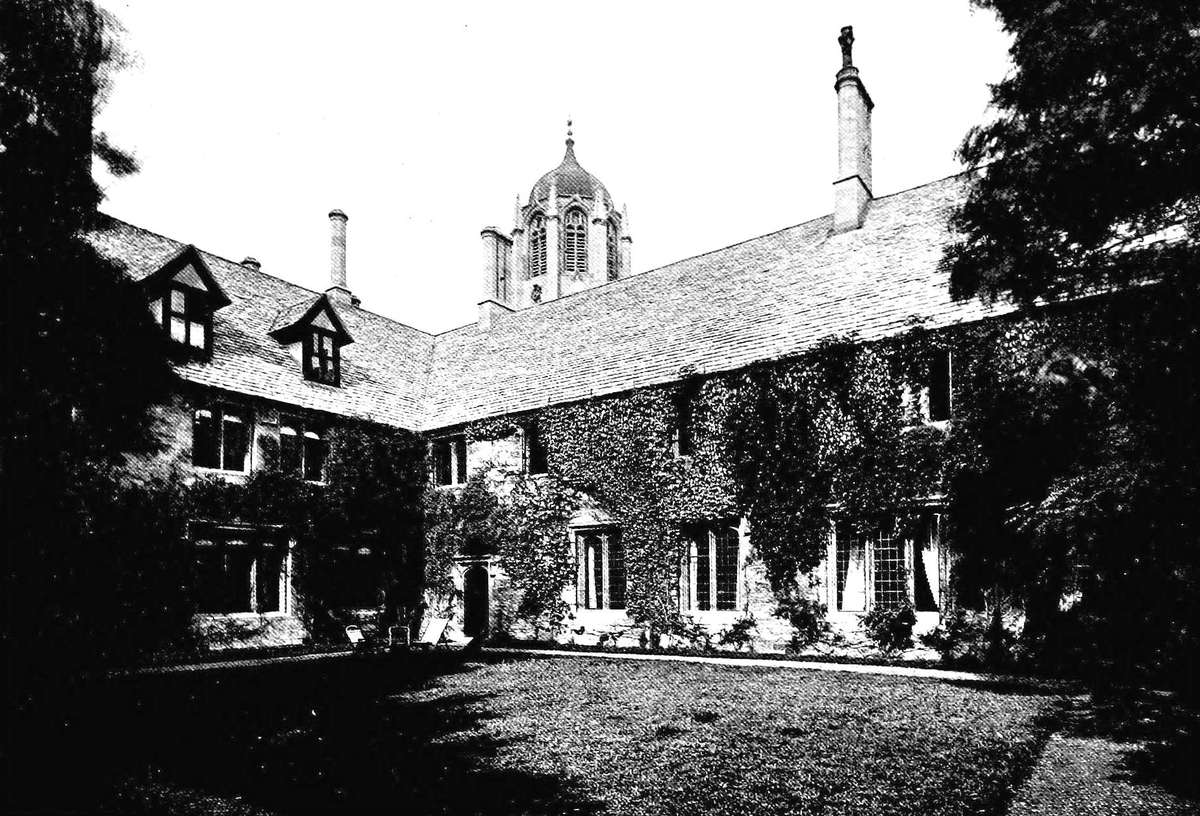
94 ST. ALDATE'S
The move was made from London to Oxford in
May 1890. Mr. Romanes incorporated with the University
and became a member of Christ Church. This
connection with 'the House' was a great pleasure to
him.
For a little while during the early summer of 1890
Mr. Romanes was alone in Oxford, and he writes:
To Mrs. Romanes.
I called to-day on Mr. Dodgson, to sign my name
in the Common Room, and signed my name in the
book where the signatures go back to the foundation
of the House. It is certainly the best thing I could
have done to join Christ Church, and I am enjoying
this return to my undergraduate days as something
quite novel. Yesterday Liddon[71] graced the high table
with his company. He was particularly gracious to
me, remembering all about our meeting years ago,
and hoping to be allowed to have the pleasure of calling
upon us when we were settled in the 'almshouse.'[72]
After dinner in the Common Room, seeing that the
party was both elderly and reverend, all the other six
being parsons, I started what seemed to me a suitable
game, viz. who could best 'card wool' in opposite
directions, or turn the right hand round and
round one way, while at the same time turning the
left hand round and round the other way. This innocent
occupation at once became very popular—the
Canon in particular being greatly interested in the
peculiar difficulty which it presents. For my own
part, I much enjoyed the spectacle of all these dons
winding their hands about, and this enjoyment
reached its climax when Dr. Liddon ended by tilting
his glass of claret off the table into his lap.
But there is a good deal of fun from behind his
serious exterior, and he enjoyed this little catastrophe
as much as the rest of us. So you see that the snares
and temptations of University life do not dangerously
assail your husband at the high table of Christ Church.
Yesterday we had our physiological picnic, starting
in five boats, and taking tea on the river-bank
near the old farmhouse. I took supper with the
Sandersons, who had a party. The Victor Horsleys
were at the picnic, and I have arranged that they
will pay us a visit in October.
It is very jolly living in this house, but it is well
we are both good sleepers, the noise of traffic is so
great, even the foot-passengers sound like burglars.
But this will not affect the children in the other
wing, and as for me, I could sleep if the carriages were
driving through the rooms, with the burglars to boot.
I have only time to write a very few lines, as I
am now momentarily expecting to be called on to
give my exposition before the Physiological Society,[73]
which has mustered in considerable force, and is now
being regaled by Horsley[74] and Gotch[75] while I am
watching my plants which are coming on next.
The dinner at Ch. Ch. yesterday was most enjoyable,
though there were only four others besides
myself at the high table. We had turtle soup and
very good wine; is that good for gout?
St. Aldate's: July 1, 1890.
I have just come back from dinner. My next
neighbour to-night was Liddon, and we had a long
talk on the ethics of suicide regarded from the pre-Christian
or purely 'secular' point of view.
I also improved the occasion in the interests of ——. It
was clearly a new light to Liddon that —— should
be so highly thought of by a man of
science, and he appeared to have determined there
and then to exert himself in getting a more suitable
berth for 'a man now so greatly needed in the Church.'
Oxford.
Two bits of news. Dunstan[76] has a son and
Liddon is seriously ill. Dr. John Ogle came yesterday
afternoon from town to see him, and dined with
us. There is great pain in the neck.
I lunched with the Sandersons, or rather with Mrs.
Sanderson, as the Professor did not leave his room,
but he is getting on very well.
Last night after dinner I looked in at the Poultons,
and found them entertaining two Natural
Science young ladies from Somerville Hall. A very
agreeable party. Huxley is expected here this week.
His article on 'Lux Mundi' is very characteristic.[77]
It would be very enjoyable to go with you to Ober
Ammergau, but I am sure I ought not. First, I should
not enjoy it half so much as you; second, it
would double the expense; third, it would run away
with all the time I want to give to the book. So in
this case what is sauce for the goose is not sauce for
the gander.
I wish I had some jokes to treasure up, but
Oxford is not a joke-yielding place at present;
Geanies must be jubilation itself compared with
Oxford now.
I am the sole occupant of the laboratory as of the
house. But I rather enjoy the exclusive privilege of
my own company, save so far as it is relieved by
guinea-pigs. I have written a letter to 'Nature'
which will furnish a little joke for you on Friday next.
I am sorry to hear poor old Parker[78] is dead.
You did not know him, but he was a real good fellow,
and hearty friend to me.
I enjoyed my three days in London very much.
Went twice to the theatre, and one of the plays
was 'Judah.' Mr. H. A. Jones gave me a box. Saw a
great deal of the Pollocks; met Scott,[79] who asked me
to let him put me up for Royal Society Club; played
chess with G. R. Turner.
I have now got to work on my plants and guinea-pigs.
To Professor Poulton.
Geanies, Ross-shire, N.B.: July 16, 1890.
My dear Poulton,—I went to the tennis ground
yesterday week, but, as I expected, on account of the
rain, found nobody there.
I now write to ask you if you would have any
objection to my borrowing with acknowledgment
figures from your book for mine, supposing the publishers
also consent. In particular figs. 1, 2, 6, 10,
40, and 41.
Having now read the book,[80] I may say how
greatly it has delighted me. The whole is a wonderful
story, and I congratulate you on the large share
which you have had in adding to this chapter of
Darwinism.
There is only one point I am not quite clear about,
viz. pp. 213-215. It is doubtless an advantage to
the parasites that the caterpillars should warn them
off as having been already 'occupied.' But would
not this be rather a disadvantage to the caterpillars—i.e.
to their species? For in this way, it seems to
me, a greater number of caterpillars would become
infested than would be the case in the absence of
such warning. Or is there any point about it which
I do not understand?
When is your next book coming out? I should
like you to read my reply to Wallace before it does.
Also my re-statement of physiological selection, with
discussion on the principles of Segregation and
Divergence. I hope the whole will be in type before
November. Can you wait till then, or shall I send
type-written MSS.?
Yours very sincerely,
George J. Romanes.
P.S.—Talking about hon. degrees the last time I
saw you reminded me—but something again put it
out of my head—that I had been wondering why
Oxford or Cambridge does not offer one to F. Galton.
Could you start a movement in that direction?...
I am getting so convinced about physiological
selection, that I do not care what is said at random,
or without understanding the theory.
Later in the autumn he writes:
To Mrs. Romanes.
I hope to find letters from Ober Ammergau when
I return to Geanies, with a dozen bottles of sulphur
water and several pounds of heather honey. Went
yesterday to see a waterfall, which was wonderfully
beautiful; on the way back met a pony with half a
trap, and afterwards came on the other half with its
previous occupants, Lord and Lady ——, cut about
the face, but not seriously hurt. There is an awful
row going on here in the Free Kirk, which bids fair to
end in bloodshed locally, if not disruption generally.
I am so glad you do not repent going, and am
longing to hear what you think of the play. I took
Ethel and Ernest partridge-shooting, and had tea outside.
The new hound, 'Dart,' has arrived. He is
beautiful, and as gentle as a lamb with the children.
This threw us off our guard, and at tea there was a
horrible scene, ending in the murder of Sharpe.[81]
The latter barked at him, and five minutes afterwards
was a mangled misery. Have returned Dart with a
civil note, for the sake of Norah and Jack,[82] the latter
having only been saved by heroic measures on the
part of Mytsie.
Later in the autumn he wrote:
To Mrs. Henry Pollock.
Geanies: October 9, 1890.
My dear Mentor,—The lyric is certainly very
pretty, but I am still—and much—more touched
by the unrhymed, and perhaps unconscious, poetry
that accompanies it. We have, indeed, many associations
with Geanies in common;[83] and as neither the
joys nor the sorrows of them can ever return into our
lives as they were when they arose, it is perhaps
better that they should be kept in our memories as
they now are, without being overlaid by future
experiences in the same moods and the same cliffs by
the same sea. 'The water that has passed' has been
beautiful, even in its sadness; and however long the
wheel of life may still have to go, I do not think it
could have done better work for any of us than
during the years that it has gone at Geanies.
With my philosophic love to both of you, ever
the same,
Geo. J. Romanes.
My very dear Mentor,—You are quite too kind to
me. The touching little present has just arrived,
and I am smoking it now. It is just the kind that I
like best. I wonder whether the vendor thought it
was for yourself? Very many thanks.
Ethel sends her love, and tells me to ask you
whether you want a copy of the photo group, where
you do not look like a Mentor.
I enclose payment for the pipe in the form of sonnets—although
I am sure they are not so sweet—and
remain, with love to Marion,
Ever yours most sincerely,
Geo. J. Romanes.
This autumn Mr. Romanes delivered the last of
his Edinburgh course of lectures. Giving the lectures
had been a real pleasure, and he liked his Scotch
students, who on their side were keenly appreciative
and intelligent.
He was alone at Geanies for a few days before
leaving for Edinburgh, and a letter written at this
time shows for the first time a foreboding of failing
health; but when the headaches left him the foreboding
vanished, and there was no real idea of serious
mischief.
To his Wife.
Geanies: November 1890.
I really have three of your dear letters to answer.
I did not write yesterday. I have had one continuous
headache; it is now nearly away, but the matter
is getting serious, and I have written to Edward,[84]
to send the 'home trainer' to Oxford, so that I
may lose no time in giving his cure (exercise) a
trial.
Don't get low about me; I begin to doubt if these
headaches are due to gout at all, and somehow or
other I shall find a means of preventing them.
I am sorry for myself, my work, and most of all
for you; but we must take illness as it comes, and be
glad it is no worse.
Geanies: October 31.
I will not disappoint you about the sonnet, which
you expect to be in the vein of 'Weltschmerz,' and
therefore send you the first of the series which I wrote
in the small hours, after reading your favourite Psalm.[85]
There was only one verse that remained appropriate
to me, so I took it as a text.
The principal thing that has happened to-day is
my having seen on the shore a sea otter. It was
lying on a rock, and I came upon it at such close
quarters I could have hit it with a stone. But it
was so quick that I had not even time to fire my
gun.
I may return the compliment as to letters. I
did not intend to send the sonnet even to you when
I wrote it, but afterwards thought I ought to have
no secrets.
Fritz[86] and Ernest came out shooting. I am all
right as to hitting;[87] and my head is perfectly well.
Jack[88] has been very Jackish. I told him we
were all going to leave Geanies. He said, 'Geanies
belongs to us.' I answered, 'No, it belongs to the
Murrays.' 'Part of it belongs to me,' he continued.
'How is that?' said I. 'Because I was born here.'
What would Victor Horsley say to this for early
appreciation of rights conferred by birth?
Ernest and Gerald are very happy. I allow them
to play with the fire when they are with me, and
this I find to be very popular.
To Mrs. Romanes.
Edinburgh: November 23, 1890.
My lectures are now concluded, and I took an
affectionate farewell of the class amid much enthusiasm
on their side.
There is no news to give. I play chess with Mrs.
Butcher and read MSS. which Professor Butcher
lends me of his own; pay many calls, have sundry
talks with professors that come to dine with Ewart,
and so on.
Yesterday we had here what at Cambridge used
to be called a 'Perpendicular,' twenty students to
supper. Mrs. Butcher and Miss Trench came in to
help to entertain them; the latter sang Irish songs.
I am going to give an additional lecture to the
class on the controversy in 'Nature.'[89]
I send you a report of my lecture, that you may
see how orthodox I was. Sellar[90] was at the lecture,
and told me that I reminded him of some professor
at St. Andrews, who had told him as a fact that he
(the St. Andrews professor) always made a point of
alluding to Providence in an introductory lecture, and
afterwards 'threw him aside!'
The sonnet alluded to in one of the letters (p. 265)
is so beautiful that it is inserted here. It shows better
than any words could do the attitude of George
Romanes' mind. Profoundly sincere, anxious, almost
unduly anxious, to give no indulgence to his own
longings, to state to himself and to others unsparingly,
unflinchingly, what appeared to him the as yet irrefutable
arguments against the Faith, when he was
alone he relaxed and poured out his inmost heart.
'I ask not for Thy love, O Lord: the days
Can never come when anguish shall atone.
Enough for me were but Thy pity shown,
To me as to the stricken sheep that strays,
With ceaseless cry for unforgotten ways—
O lead me back to pastures I have known,
Or find me in the wilderness alone,
And slay me, as the hand of mercy slays.
I ask not for Thy love; nor e'en so much
As for a hope on Thy dear breast to lie;
But be Thou still my shepherd—still with such
Compassion as may melt to such a cry;
That so I hear Thy feet, and feel Thy touch,
And dimly see Thy face ere yet I die.'
In November Mr. Romanes came formally into residence,
and at first nothing could have been happier
than his Oxford life.
He simply revelled in the facilities for work which
the splendidly equipped laboratories afforded, and he
once said, 'that the laboratory alone had made the
move from London to Oxford worth while!'
He set to work on his book, 'Darwin, and after
Darwin,' and on many experiments bearing on Professor
Weismann's theories and on some other points.
He much wished to see established in Oxford
what M. Giard has called an Institut transformiste,
and wrote to many leading men of science on the
subject. As yet the idea has come to nothing, but
possibly it may be revived.
January 22, 1891.
My dear Poulton,—I am very sorry that, being
already engaged for to-morrow, I cannot attend the
meeting. But I should like to join the Society.[91]
Only, please, postpone any suggestion about lecturing,
as this term I shall be dreadfully busy, between the
book and the experiments. H. has certainly been
very successful over a very difficult experiment. I
tried it in an elaborate way. But I lacked assistance
for the mechanical performance, and so intended to
do it here this term. Now I am saved the trouble,
but have gained experience. This prevents me from
regarding H.'s result as final, although, as you say,
valuable. My scepticism is founded on a queer freak
of heredity, which my own work showed me; but as
I think I spoke too much about the experiments I
was trying, in future I shall adopt Weismann's method
of silence before publication.
Yours ever,
Geo. J. Romanes.
About this time Mr. Romanes was much interested
in a scheme for promoting the establishment of a garden
or farm for the purpose of studying questions of
hereditary transmission, or heredity. His object was
to afford facilities which at present do not exist for
observing the modifications produced in animals and
plants by subjecting them during long periods and in
successive generations to suitable external conditions,
and for testing the transmissibility of the modifications
so produced. He was anxious that such an Institution
should be founded in connection with one of the Universities,
and with this view, circulated the following
memorandum.
'AN INSTITUT TRANSFORMISTE.'
In an English translation of a lecture which was
recently delivered by M. Giard, as Professor of Evolutionary
Biology in France, there occurs the following
passage:
'If evolutionists must content themselves in most
cases with experiments carried on in nature, or those
of breeders, instead of applying themselves to verifications
made with all the rigour of modern scientific
precision, is it not because of the deplorable insufficiency
of our laboratories? It is astonishing that
in no country, not even where science is held in
greatest honour, does there yet exist an Institut
transformiste devoted to the long and costly experiments
now indispensable for the progress of evolutionary
biology.'
That an institution of the kind in question would
tend to promote the solution of problems in 'evolutionary
biology,' it seems needless to argue. Many
of the most desirable experiments in heredity and
variation, for example, require such prolonged time
and such constant attention, that it is practically impossible
for individual workers to undertake them;
and, therefore, as M. Giard observes, they have never
been undertaken. But if there were an Institut
transformiste to which material might be sent from
any part of the world, with directions as to its treatment,
biologists of all countries would be furnished
with an opportunity of experimentally testing any
ideas which might occur to them in regard to these
or kindred matters.
Again, it seems needless to remark that England
ought to be regarded as the natural territory of an
establishment of this character; that the establishment
itself should be situated in the vicinity of others
which are already devoted to the study of morphology
and physiology; and that sufficient land should belong
to the Institut to admit of plots of ground being set
apart for researches on plants, as well as buildings
for the accommodation of animals.
In order to satisfy all these conditions, the Institut
ought to be established either in Oxford or Cambridge;
and at least, one skilled naturalist, one competent
gardener, and one trustworthy keeper ought to be
resident. This would involve an annual expenditure
of between 300l. and 400l. But the capital sum
which would have to be sunk in the purchase of land
and the erection of buildings would not be considerable;
because, in the first instance, at all events, two
or three acres of ground would probably be sufficient;
while the animal houses would be chiefly—if not exclusively—required
for the accommodation of small
mammalia, birds, insects, and aquatic organisms.
Nevertheless, seeing that an initial expenditure
of at least 1,000l. would be needed for the purposes
just mentioned, as well as an annual income of at
least 400l., and seeing that even this much money is
not likely to be forthcoming for objects of a purely
scientific nature, the scheme on behalf of which we
solicit your opinion is the following.
From inquiries which we have made here, we
think it is probable that the University would take
up the matter, or, at any rate, render important
assistance thereto, if the Hebdomadal Council were
satisfied as to the desirability of the project from a
scientific point of view. It is on this account that we
have ventured to address you upon the subject. The
appended memorial is being sent, together with this
circular letter, to all the other leading biologists in
this country; and if you could see your way to signing
the former, you would render additional weight to the
body of authoritative opinion which it will eventually
convey to the University.
One of the experiments Mr. Romanes tried in the
summers of 1891-93 was as to whether animals
completely isolated would reproduce the real sounds
natural to their kind. In other words, whether these
vocal sounds were due to imitation. Through the
kindness of Mr. Arthur Balfour, Mr. Romanes got the
permission of the Trinity Brethren to try these experiments
on lighthouses situated on lonely islands or
rocks; he selected puppies, chickens, &c., but the
results were not decisive. The puppies barked and
the young cocks crowed, but Mr. Romanes was not able
entirely to establish to his own satisfaction that the
isolation had been complete.
Experiments were also carried on bearing on
Heliotropism and on Seed Germination. Of these
mention will be made later.
In the spring of 1891, he paid a visit to Paris and
saw M. Pasteur and his laboratory, and also M. Brown-Séquard,
in whose work he was specially interested.
And, apart from his work, Oxford and Oxford life
were great sources of enjoyment. He made many
new friends, and keenly enjoyed the institution, so
characteristic of Oxford, of 'walks.'
Intimacies seemed to grow up quickly, and he
often spoke of the extreme kindliness, the 'pleasantness'
which marked Oxford society.
Of all the friends made in these four years,
Mr. Romanes undoubtedly was most drawn to the
Rev. Charles Gore.
It is very difficult, very often misleading and even
impertinent to speak of what one man owes to another
in the way of direct or indirect intellectual or spiritual
help. But those few persons who really watched and
could see the workings of George Romanes' mind, saw
that these Oxford years were, even before the first
beginnings of fatal illness, years of rapid growth in
what perhaps may be termed spiritual perception.
In 1891 Mr. Gore's famous Bampton Lectures were
preached. Mr. Romanes heard them all, and was
intensely interested by them; he wrote many notes
on them for his own private use, notes by no means
always in agreement with them, and in his 'Thoughts
on Religion' he refers to them.
Many of his older friends were clergymen, and
he was once much amused by hearing that a
scientific friend in London had said, 'How on earth
will Romanes stand the clerical atmosphere of
Oxford?' Another time, a very eminent scientific man
asked him his opinion of Liberal High Churchmen,
'Do you really think these people believe what they
say?' to which Mr. Romanes replied that he knew
several pretty intimately, and he was sure they would
all go to the stake on behalf of their Faith.
In the spring of 1891 Mr. Romanes was elected by
the committee a member of the Athenæum Club.
The Journal notes:
Pleasant dinners at Merton, Keble, &c. Visit
from the Gills,[92] which we much enjoyed. Lord
and Lady Compton, from the 6th to the 8th of June.
He delighted us with his magnificent singing.
This summer, for the first time, Scotland and
shooting were given up, and Mr. Romanes, accompanied
by his wife and daughter, tried what the
Engadine would do for his incessant headaches.
He enjoyed this tour, especially three weeks at
Tarasp, in the lower Engadine, where he met his old
friend Professor Joachim and also Professor Victor
Carus. On the way back the Romanes stayed with
Mr. H. Graham, M.P., at his lovely country home
near Heidelberg, enjoying themselves much, but
failing to see the famous ghost which is said to
haunt the place. In the autumn, in spite of often-recurring
headaches, he struggled on with his work
and lectured in one or two provincial towns.
He says in one of his letters at this time: 'There
is much excitement in Oxford to-day over the
announcement that Paget is to be the new Dean of
Christ Church. Of course we are greatly delighted.
As he said to me to-day, 'We may now look forward
to being close neighbours for not a few years to come.'
Journal, Nov., Birmingham Festival.—The 'Messiah'
and Dvorak's 'Requiem,' Parry's 'Blest Pair of
Sirens,' which one never hears too often. Went to
Compton Wynyates, a splendid old house of temp.
Henry VII. Only Lady Compton at home, but we
much enjoyed our little visit. Went up to town
and saw the Edmund Gosses and various other old
friends. Saw Miss Rehan and her company in their
last performance, 'A Last Word.' Poor play, but well
acted.
It was during this autumn that Mr. Romanes resolved
to found a lectureship at Oxford on the lines of
the Rede Lectures at Cambridge, and after consulting
various friends, chiefly the present Master of Pembroke,[93]
the idea was submitted to the University and
the offer was accepted. The preface, which is to be
prefixed to the first volume of Lectures, gives the
founder's ideas.
Founder's Preface.
The primary object of this Lectureship is to
secure a perpetual series of discourses in the University
of Oxford under the conditions laid down in the foregoing
Statute. But seeing that these conditions are
necessarily of a general character, I add the following
suggestions with regard to certain matters of detail,
in order that, as far as from time to time may seem
expedient, the proceedings may be conducted in
accordance with my wishes.
(1) I desire that the selection of lecturers be
irrespective of nationality, and determined with reference
either (a) to general eminence in art, literature,
or science, or (b) to special claims for discussing any
particular subject of high interest at the time.
(2) I deem it desirable that foreigners, otherwise
eligible, should not be disqualified from receiving invitations
to lecture merely because they may not be
able to do so in English. And, in order to meet such
cases, I suggest that the translated addresses should
be delivered before the University by some competent
reader (to be selected by the Vice-Chancellor) in the
presence of their authors.
(3) I further suggest that the same method of
delivery should be adopted in cases where age or
infirmity would render the voice of the lecturer
inaudible, or indistinct, to any portion of his audience.
And I hope that neither age nor infirmity, any more
than inability to speak the English language, will be
deemed a hindrance to the issuing of invitations to
the men of high distinction in their several departments.
For, on the one hand, in order to have
attained such distinction, it must often happen that
such men will have attained old age, while, on the
other hand, it is of more importance that they should
be represented in these decennial volumes than that
men of less eminence should be chosen in view of their
superiority as lecturers.
G. J. Romanes.
To the great satisfaction of the whole University,
Mr. Gladstone most generously consented to give the
first lecture, which consent he signified in the following
letter:
Grand Hotel. Biarritz: December 18, 1891.
Dear Mr. Romanes,—Until I received your kind
letter I reposed undoubtingly in the belief that the
Vice-Chancellor had accepted my answer as the
answer which best met the case.[94] I thought and
think it right, for no one knows my poverty except
myself. But Oxford is Oxford, and I think that if she
desired me to climb up the spire of Salisbury, I should
attempt it, or play the Græculus esuriens in any
manner she desired. Your letter opens to me unexpectedly
the fact that there is a desire, and that the
proposal was not simply a courtesy.
I therefore thankfully and respectfully accept;
secretly relying a good deal, as I own, on the fact that
there is (if I recollect the V.C.'s letter rightly) a good
deal of time before me, and that the chances of intermediate
reflection may bring up something to the
surface which is not now there, for I own my
perplexity continues as to the chance of making any
presentation not wholly worthless. But enough of
this: and let me thank you very much for the interest
you, who have so high a title, have personally taken
in bringing me to the front.
We are much delighted with this place; more
eminently, I think, a sea place than any other I happen
to know.
I am sure, let me add, that you will make my
apologies to the Vice-Chancellor; for I am sensible
that the altered reply may seem less than respectful
to the resident Head of the University.
Believe me, most faithfully yours,
W. E. Gladstone.
It had been arranged that the lectures (which the
University, rather against the Founder's wish, decided
should be called the 'Romanes Lectures') were to be
given in the Trinity Term, but owing to the General
Election of 1891, Mr. Gladstone postponed the
delivery of his inaugural lecture until October 1892.
Journal, March 1892.—The Comptons have been
here for Norman's baptism, which was a strikingly
pretty ceremony in cathedral at evening service with
the choir. Our Dean and the President of Magdalen,
as well as Lady Compton, stood sponsors, so the boy
is well provided. The students at St. Hugh's Hall
decorated the font, and as the boy's second name is
Hugh, he is a special protégé of the little Hall.
April 1.—We spent a week at Malvern, in company
with the Walter Hobhouses, and then went on
to Denton Manor,[95] where a company of the wise, including
Ray Lankester, Professors Poulton and Shadworth
Hodgson, and Mr. Sully, were. Also others, including
Lady Cecil Scott Montagu, who walked abroad with
a divining rod, a real act of courage considering who
were among the party.
At Malvern Mr. Romanes wrote a sonnet which,
in the light of after years, was a sad prophecy.
MALVERN 1892
'To doze upon a sunny hill in June,
And hear the lullaby that Nature lends;
To drink the cup that sweet contentment blends
With sweetlier love of those whose hearts shall soon
Reverberate with joy, as they attune
Their praise to praises that achievement sends:
This is to feel that bounteous Nature bends
A mother's smile on manhood in its noon.
But when the shadows of the twilight come,
And high Ambition needs must fold his wings,
While voices both of hearts and hills grow dumb,
Can she still bring the smile that now she brings?
Yea, by the memory of brighter things,
I'll trust her in the night that calls me home.'
Journal, May and June 1892.—Had a delightful
visit from the Butchers and Mr. H. Graham, later on
the Comptons, and Mr. Edmund Gosse, full of witty
and wise sayings. Lord Compton sang more divinely
than ever, and the Principal of Brasenose played the
piano. It was a real musical feast.
Professor Le Conte came to stay here, we had
Mr. Gore and one or two others to meet him.
To Miss C. E. Romanes.
94 St. Aldate's, Oxford: June 10, 1892.
My dearest Charlotte,—I received your letter of
the 6th inst., together with the pair of slippers; the
latter are the very thing that is required when occasion
again arises.
Ever since you left we have been having Italian
weather, the only objection to which being, that for
my taste the sunshine is too continuous.
We have had staying with us Professor Palgrave
and his daughter. I am going to take her to the
Conversazione of the Royal Society on Wednesday
next, as Ethel is going to stay behind for her political
work. We have also had Lord Justice Fry, with
his wife and daughter, staying with us for two or
three days.
I have got a promise from Professor Huxley to give
the second Romanes Lecture, provided he is able to
do so next year. It will be an interesting occasion if
he can, because he has not lectured for the last five or
six years.
I am glad you like my book, which is selling off
very well; but, as you know, the second volume will
be much more interesting.
We are all well, and, with united love to both, I
remain yours ever the same,
Geo. J. Romanes.
A new investigation is here described.
94 St. Aldate's, Oxford: March 27, 1892.
My dear Schäfer,—I think I have found a new
ordinal character peculiar to the Primates—viz. a nude
condition of the terminal phalanges. This does not
occur in any other order of mammals that I have
looked at, but in all species of primates from Lemurs
to Man, as far, at all events, as I have been able to
examine. Now I want to see whether hair-follicles,
or vestiges thereof, can be found in the terminal phalanges
of any species of the order. So I am making a
number of sections of the skin of the backs of the
terminal phalanges of fingers and toes, of man (adult
and fœtal) apes, monkeys, baboons, and lemurs. Hitherto
I cannot detect (nor can Kent) any signs or vestiges
of follicles. But I should much like you to look
over some of the specimens (a few would be enough),
in order to see whether your trained eyes would be
also unable to trace any rudiments of follicles. If you
would care to do this, of course I should acknowledge
my obligations in a paper which I am preparing on
the subject.
Yours very truly,
G. J. Romanes.
'Darwin, and after Darwin' appeared in the spring
of 1892.
It was a book which was written, so to speak, with
the writer's life-blood, it was a great burden on him
from the moment he commenced it, and one of his
greatest sorrows was his inability to finish it.
It is curious to those who know Mr. Romanes' mind
intimately to note the exceeding severity, the almost
harsh manner in which he treated the theological
questions involved in the doctrines called, for convenience
sake, 'Darwinism.' As more and more he
found himself yielding on the side of emotion, of
moral convictions, inducement, of spiritual need to
the relinquished faith, so much the more did he resolve
to be utterly true, to face every difficulty, to
push no objection aside, to leave nothing unsaid—to
be, in fact, absolutely and entirely honest. As a friend
after his death, speaking of this very book, said, 'It
was his righteousness which made him seem so hard.'
Yet there is a ring of hope of something which
will one day turn to faith in the words which end the
book:
'Upon the whole, then, it seems to me that such
evidence as we have is against rather than in favour
of the inference, that if design be operative in
animate nature it has reference to animal enjoyment
or well-being, as distinguished from animal improvement
or evolution. And if this result should be
found distasteful to the religious mind—if it be felt
that there is no desire to save the evidences of design
unless they serve at the same time to testify to the
nature of that design as beneficent—I must once
more observe that the difficulty thus presented to
theism is not a difficulty of modern creation. On
the contrary, it has always constituted the fundamental
difficulty with which natural theologians
have had to contend. The external world appears,
in this respect, to be at variance with our moral
sense; and when the antagonism is brought home to
the religious mind, it must ever be with a shock of
terrified surprise. It has been newly brought home
to us by the generalisations of Darwin, and therefore,
as I said at the beginning, the religious thought
of our generation has been more than ever staggered
by the question—Where is now thy God? But I
have endeavoured to show that the logical standing
of the case has not been materially changed; and when
this cry of reason pierces the heart of Faith it remains
for Faith to answer now, as she always answered
before—and answered with that trust which is at
once her beauty and her life—Verily thou art a God
that hidest Thyself.'
June 1892 brought the first warnings of serious
illness. One day Mr. Romanes announced at lunch
that he noticed a blind spot in one eye. He consulted
his friend Mr. Doyne, the well-known oculist,
who from the first thought seriously of the case.
He went up to town, and saw various doctors,
and had some thoughts of taking a voyage. He
was, however, well enough to attend the Conversazione
at the Royal Society, and showed some experiments
on rabbits and rats which bore on questions
of acquired characters. He writes:
To Mrs. Romanes.
I have been thinking of you a great deal, and,
with a somewhat literal application of a certain expletive
addressed by a fast man to his eyes, am
driven to address you through my goggles.
Nettleship has appointed to-morrow morning to
see me, so I shall not be able to get home sooner
than 6 train. Don't trouble to meet me, as I must
take a cab for the rabbits and rats. The latter are
now at the Royal Society, where ample space has
been provided for their exhibition. The Zoological
paper[96] went off very well, and Flower made a very
good remark on it, the substance of which I will tell
you when we meet, it had not previously occurred
to me. Your letter to the Pollocks never reached
them, so they had given me up. They were as
enthusiastically kind as usual, and very sympathetic
about my eyes.
He returned to Oxford, and was persuaded to rest,
and not to go to London again to pay a promised
visit to Professor Palgrave.
To Miss C. E. Romanes.
94 St. Aldate's, Oxford: June 18, 1892.
My dearest Charlotte,—Your little differences of
opinion with regard to the rats are very amusing to
me, and I quite see how the matter stands.
I am very glad to hear of your improvement in
general health, and also of James' continued vigour.
As regards myself I have no very satisfactory account
to give. The headaches indeed are not worse—if
anything they are better; but the gout is at
work on other parts of this vile body, and the latest
assault is a very serious one for a man of my pursuits.
About ten days ago I found myself partially blind in
the right eye—the upper half of the field of vision
being totally obliterated. I have seen an Oxford
and also a London oculist, who have both examined
the eye and pronounce the sudden seizure to be one of
serous effusion upon the retina. It seems probable
that the impairment of vision will be permanent, and
so prevent all operative work where any delicacy is
required. The blindness is so complete, that if I
look about an inch below the electric light placed at a
distance of a very few yards, I am not able to perceive
any luminosity. Meanwhile, I have to wear
the darkest of possible goggles, and generally to live
the life of a blind man. Per contra, this may prove
a blessing in disguise, as it compels me to abstain
from work for some considerable time to come, and
I had been advised to this course on account of the
headaches. How I am to spend the six months'
rest which is prescribed I have not yet determined.
Shooting will be probably out of the question, as I
cannot use the left eye in any form of recreation.
My idea is rather to go to Egypt and Palestine, to
take a voyage to the Cape, or in some other such
way to break my usual habits without altogether
wasting time.
All the rest of the household are flourishing, and
with love to both,
I remain yours ever the same,
George.
In a day or two a second blind spot appeared, and
now the doctors took a very serious view of his case.
Life and sight alike were threatened, and instant
rest and quiet were ordered. For about three weeks
he remained in bed, until the extreme pulse tension
was reduced, and then it seemed as if hope might
be entertained of years of life, if only care were
taken about diet, and work, and thought.
Now began the two years of quiet, steadfast, endurance;
no one could realise from his quiet manner
and cheerful talk how great was the inconvenience
caused by the affection of his eyes, no one ever found
him anything but unselfish and gentle. The one
difficulty was to persuade him not to work, and this
was almost impossible. He was almost feverishly
anxious to finish his book, to work out experiments
he had been planning; and as time went on, and he
thought and pondered as he had ever done on the
ultimate mysteries of life and being, other books
were planned, other courses of reading mapped out.
Just then a letter came from Canon Scott-Holland
which much touched the recipient.
Mr. Holland writes:
'I hear sad news of you through Philip Waggett.[97]
You have passed under the sorest trial perhaps that
could have been laid on your courage, your hopefulness,
your peace.
I trust, indeed, that there is much to look for
yet of recovered power and renewed work, but, for
the moment, there must be anxiety, and the bitter
strain of disappointment, and the rough curb of pain.
You are assured of the deep sympathy of many warmhearted
friends to whom you have always shown
most generous kindness, and I venture to rank myself
among them. We shall remember you often and
anxiously.
It is a tremendous moment when first one is
called upon to join the great army of those who suffer.
That vast world of love and pain opens suddenly
to admit us one by one within its fortress.
We are afraid to enter into the land, yet you
will, I know, feel how high is the call. It is as a
trumpet speaking to us, that cries aloud—'It is your
turn—endure.' Play your part. As they endured
before you, so now, close up the ranks—be patient
and strong as they were. Since Christ, this world of
pain is no accident untoward or sinister, but a lawful
department of life, with experiences, interests, adventures,
hopes, delights, secrets of its own. These are all
thrown open to us as we pass within the gates—things
that we could never learn or know or see, so
long as we were well.
God help you to walk through this world now
opened to you as through a kingdom, regal, royal, and
wide and glorious. My warmest sympathies to your
wife.'
The first weeks of illness passed away, the physicians
seemed more satisfied with his condition,
and he was sent to Carlsbad, and after five weeks
there, came the last bit of pleasant foreign travel.
He and his wife travelled in the Tyrol and in the
Bavarian Highlands, and Mr. Romanes was able to
enjoy the glorious scenery with what seemed keener
appreciation than ever; he especially took a fancy to
Parten Kirchen, in Bavaria, and planned a return to it
another year with his children.
He got as far as Meran, and much enjoyed meeting
Mr. and Mrs. Lecky (Mr. Lecky's works were
among the very few historical books he read with any
real pleasure). And on his return, Sir Andrew Clark
was encouraging, holding out hopes of a return to
health: 'You've made a bid for recovery,' he said in
his genial way. It was thought best that Mr. Romanes
should spend the winter in a warm climate, and Madeira
was chosen.
Then came the first Romanes lecture, which was
a great success in every way. Mr. Gladstone called
it 'An Academic Sketch,' and nothing could have
been a happier inauguration of the series. It was a
memorable scene. The Prime Minister in his doctor's
robes, the crowded Sheldonian theatre, the eloquent
lecture, the inspiring words of which came like a
trumpet call to Oxford's sons, ending with her motto,
'Dominus illuminatio mea.'
The few days of Mr. and Mrs. Gladstone's visit to
Oxford were days of real enjoyment to Mr. Romanes.
The Journal notes: 'We had a pleasant luncheon party
for the Gladstones and Lord Acton, who was also in
Oxford; also a breakfast party on the morning after the
lecture, to which, among others, came the Principal
of St. Edmund's Hall.[98] I put him next Mr. Gladstone,
and the consequence was a Dante talk, to Lady
Compton's great satisfaction. Mr. Gladstone's talk
was wonderful, and no one would have suspected that
he had any political cares whatsoever, or that the
Election of 1892 was only just over.'
On the day of the lecture we had a delightful time
before lunch. Mary Paget and Lord Compton sang
for an hour, and put us in good humour.
It was with real regret that good-bye was said to
the illustrious guests, with hopes of future meetings
never to be realised.
Mr. Huxley accepted the invitation which the
Vice-Chancellor permitted Mr. Romanes to give him
privately. The following delightful letter gives his
final decision:[99]
Hodeslea, Staveley Road, Eastbourne: November 1, 1892.
My dear Mrs. Romanes,—I have just written to
the Vice-Chancellor to say that I hope to meet his
disposition any time next May.
My wife is 'larking'—I am sorry to use such a
word, but what she is pleased to tell me of her
doings leaves me no alternative—in London, whither
I go on Monday to fetch her back—in chains, if
necessary. But I know, in the matter of being 'taken
in and done for' by your hospitable selves, I may, for
once, speak for her as much as myself.
Don't ask anybody above the rank of the younger
son of a peer, because I shall not be able to go into
dinner before him or her, and that part of my dignity
is naturally what I prize most.
Would you not like me to come in my P.C.[100] suit?
All ablaze with gold, and costing a sum with which
I could buy, oh! so many books.
Only if your late experiences should prompt you to
instruct your other guests not to contradict me—don't—I
rather like it.
Ever yours very truly,
T. H. Huxley.
Bon voyage! You can tell Mr. Jones[101] that I will
have him brought before the Privy Council, and fined
as in the good old days, if he does not treat you
properly.
Then came the departure for Madeira, which was
a real trial, for never before had Christmas been spent
away from home. But the change seemed to do him
much good. Save for occasional days of headache he
was very bright and well, and worked at his book and
wrote several articles for the 'Contemporary Review'
on Professor Weismann's theory. But poetry he
could not manage.
To Mrs. Henry Pollock.
Madeira: December 18, 1892.
My dear Mentor,—I fear you must have been
thinking that I am either very ill or very heartless not
to have written ere this. Yet neither is the case.
Ill I assuredly am, but not so much as to have prevented
me from sending you a letter for the marriage
day. The fact is I have been trying to write a sonnet
for that occasion ever since I came out here, and cannot.
Since my breakdown in June I have entirely
lost the power of poetising; I suppose it will come
back if my general health should ever return, but still
I did think that such an occasion ought to have inspired
me. Nothing further than rhymes, however,
would come, so the day passed over without my intended
contribution to its memorials.
So, dear Mentor, do not think hardly of me. For
indeed both you and Marion have been much in my
thoughts; and for you especially I know this time
must be one of many and varied feelings of the kind
that sink deepest into the heart.[102] So not only my
old affection, but a new sympathy, is with you—a
sympathy in the joy as in the grief of it.
Ethel will have told you what little has to be told
about our uneventful life here. As I have said to all
my correspondents, it is the island that Tennyson
must have had in view when he wrote his 'Lotus-eaters.'
The description is so exact, that I need not
write anything in the way of description, if you will
only read it.
My headaches are growing less intense, although
they still keep wonderfully persistent. I cannot foresee
what is likely to happen in the end, as no one
seems to know exactly what is the matter with me.
The last mail brought me a letter from the Master
of my College at Cambridge, telling me that I had
been unanimously elected to fill a vacancy in the list
of Honorary Fellows. This seems to me very generous,
seeing how I have played the prodigal and squandered
my living on endowing the enemy.
Please give my very heartiest love and good wishes
to the bride. Take also my Christmas greetings for
all three of you, coupled with the congratulations that
are so meet, and believe me to remain,
Yours ever affectionately,
Geo. J. Romanes.
To James Romanes, Esq.
Madeira: 1892.
I suppose you will have seen in the newspapers, or
have been told by Char.,[103] that Caius College has made
me an Honorary Fellow.[104] This is a great pleasure to
me, because I have always retained my first love for
Cambridge, and yet of late years I have so severed
my connection with it. These coals of fire have
therefore a heat about them which is all the more
gratifying.
To Professor Ewart.
This would be a wonderful place for natural history
if I were well enough to knock about.
I get fishermen, however, to bring any marine
animals which they know to be rare. There is one
fish which I never heard of before, and which seems
to me remarkable on account of its curious combinations
of character, for in all respects it seems to be
a large dog-fish, excepting its teeth, which are those
of a shark.
To Professor Poulton.
New Hotel, Madeira: December 2, 1892.
My dear Poulton,—I have now read the correspondence
in 'Nature.' It seems to me that —— is
quite absurdly 'aggressive,' even supposing that he
proves to be right. But I send this to ask you about
the grasshopper letter in last week's 'Nature,' just
received here. I have noticed the same thing in
grasshoppers, but do not remember to have seen any
account of the changes of colour, or mechanism
thereof, in them. Do you know if it has ever been
worked at? If not, I might do so here.
The same question applies to lizards. It seems to
me that those here vary their colours to suit those of
habitual stations. I remember Eimer read a paper
about the lizards in Capri, but forget details. He
often alludes to it in his book translated by Cunningham.
What are his main results?
G. J. R.
The Cambridge Fellowship was a great pleasure
to Mr. Romanes. In the last months of his life he
longed eagerly to visit his first University and his
own college, and planned visits to Cambridge which,
alas, were never paid.
Canon Isaac Taylor was in the same hotel at
Madeira, and this considerably relieved the weariness of
exile. Mr. Romanes was still full of fun and merriment;
the headaches diminished; he played chess interminably,
and even took part in a little play given one
afternoon by a few people who formed themselves
into an 'Oxford Brotherhood,' most of the members
having some connection with the University of
Oxford.
The members of the brotherhood were supposed
to deliver lectures in turn, but the burden chiefly
fell on Mr. Romanes. The lecturing, which in this
particular case was simply talking, was never any
trouble to him, and he used to deliver little impromptu
discourses which apparently pleased his
friendly audience. Canon Taylor kindly gave a discourse
on the Aryans, and displeased one of his
audience, a young lady, by remarking at the outset,
'My specimens (alluding to Romanes' scientific lectures)
are before me, and I suppose we are all Aryans.'
The young lady had imagined she was about to hear
a lecture on Church history, and was not pleased at
being dubbed an Arian.
Mr. Romanes' letters showed nearly always great
brightness and increased feelings of health, although
now and then he had 'bad days.'
To James Romanes, Esq.
Madeira: January 1, 1893.
This is the first letter which I write in 1893, and
am writing it early in the morning before breakfast.
New Year's Day is as glorious in sunshine and azure
as all—or nearly all—the others have been since we
came. I wish you many returns of them and happy,
whether in cloud or sunshine.
January 31, 1893.
Your letter on the 15th has been a great treat to
me; it rings true and deep, and the next best thing
to having dear ones near is to receive expressions of
their dearness.
Besides, I am all alone here, for but a few days,
it is true, still the place seems dreary under present
circumstances, therefore all you say is opportunely
said.
For my own part I have always felt that the two
most precious things in life are faith and love, and
more and more the older that I grow. Ambition
and achievement are a long way behind in my experience,
in fact out of the running altogether. The
disappointments are many and the prizes few, and by
the time they are attained seem small.
The whole thing is vanity and vexation of spirit
without faith and love.
Perhaps it is by way of compensation for having
lost the former that the latter has been dealt to me
in such full measure. I never knew anyone so well
off in this respect....
Although I have been very much in the world I
have not a single enemy, unless it be the ——, who
have entirely dropped out of my life.
On the other hand, I do not know anyone who
has so many friends, not merely acquaintances, but
men and women who are devoted with an ardent
affection....
Now, all this might sound very conceited to anyone
who would not understand me as I know you
will do. But I have been thinking the matter over
in my solitude, and candidly I am wholly unable to
account for it. Still, to be further candid, even love
is not capable of becoming to me any compensation
for the loss of faith....
But it is time for me to go to bed and shut up
this egotistic screed to post by to-morrow's mail.
I received a telegram yesterday announcing the
arrival in England of my brace of Ethels, and to-morrow
I expect the arrival here of Charlotte and
Mytsie.[105]...
I forgot about the mesmerism article. You will
have seen that the writer rather caved in at the end,
so that one cannot well understand how much he himself
supposes was genuine and how much imposture.
But quite apart from (this), there is no question
in my mind that the facts, even as far as hitherto
established, are very perplexing. But on this account
there is all the more need for caution. I myself
went over the Paris Salpétrière two years ago, and
saw the doctors' experiments on a number of girls,
who were trotted out for my benefit.
But there was such a lot of hocus pocus with
magnets that I was much disappointed. Even if
none of the girls were humbugging, I saw nothing
that could not be explained by suggestion.
For the doctors made suggestions while performing
the very experiments which were designed to
exclude suggestion.
To Mrs. Vernon Boys.
New Hotel, Madeira: February 1, 1893.
My dear Marion,—If I have your husband's
permission still to call you so—your kind letter has
been a great solace to me, after my ineffectual efforts
to supply a sonnet for the great occasion. For it
shows me that your Laureate is forgiven, and my
friend, what that friend has always been. Besides, I
am now lonely—as my brace of Ethels has flown
away—and therefore your affectionate words are all
the more welcome.
This, however, is the last day of my solitude, as
Charlotte and Mytsie ought to arrive in a few hours.
And now, having given you all my little news,
let me pile up my congratulations as high as words
can pile them. I heard all about the wedding from
many different sources, and there was but one opinion
as to the bride. I will not say what it was, but oh,
had I been there to see. It is so so good of you to
miss us in the middle of it all. But it may have
been telepathy, because I was hard at work on my
abortive sonnet all that day.
It is like northern breezes to read your account
of all the happy doings you have had on your wedding
trip, and it makes me happy to feel that you have
made so wise a choice in the greatest event of your
life. Long may you live together in the cultivation
of domestic bliss, although of course only in the
moments snatched from the cultivation of science!
February 2.
Charlotte and Mytsie arrived last night at ten
o'clock—twelve hours late. They had the roughest
voyage which the boat has ever experienced. Poor
Char.[106] is literally more dead than alive. But the
weather here is beautiful, and I hope she may soon
get to rights again.
With affectionate regards to my mentor, and to
yours, I remain, ever the same,
Philosopher.
To James Romanes, Esq.
Madeira: March 8.
Charlotte enjoys this place amazingly, she is
always saying, 'Just a very Paradise for James.' I
quite agree with her. You liked Nice very much,
but Nice is far from being up to this either in regard
to sun, flowers, rocks, or mountains. It has certainly
done me a lot of good. My headaches are virtually
gone, and I can work a little again, which makes all
the difference between Heaven and its antipodes.
March 13.
I am glad you are pleased about the lectureship
foundation. The principal feature of the scheme is
the perpetual publication of the lectures in volumes
of ten each through all time, or at least as long as
Oxford lasts.
I am better even since I last wrote to you. Even
my powers of work have, to a considerable extent,
returned. So I am answering H. Spencer's articles
on 'Weismannism.'
With warmest love, yours ever the same,
George.
To Mrs. G. J. Romanes.
Madeira.
I got your dear note soon after we went down
to the pier to see you start. Through the club
telescope I thought I saw you and Fritz. When you
got far out I came home. The Taylors joined our
table, which is very agreeable. The Canon told me
a good joke which came off to-day. Sir 'Gorgias'
told the Canon he had bought a second-hand book
which he thought Dr. Taylor might find interesting.
The Canon asked what the book was, and the
Knight replied it was by a man called Locke, and
was all about the Human Understanding.
February 2.
Char., Mytsie, and maid arrived; they had a perfectly
frightful passage. All passengers shut down
for two days, crockery broken, &c.
S—— presented a large wedding cake for the
Sunday tea of the Inner Brotherhood.
February 11.
This is the joyful day.[107] Your telegram was
handed to me at lunch, so all the Inner Brotherhood
had the benefit. The Canon said you ought to have
used the comparative degree, so as to leave me an
opportunity of returning the superlative.
What a journey you had, poor dears! It does
not seem so certain after all that we should be safe
for comfort on a long voyage. Mytsie and Char. had
a worse passage than you, the wind was dead against
them all the way.
It is indeed shocking about the Dean.[108] I heard
it before you did. I will write to him by this mail.
So glad you had such a good concert. If you only
knew how I was longing to enjoy it with you....
An adagio movement has now followed the
allegro, and I am looking forward to a presto home
as a finale.
My news is not much. My cold was very bad
from Saturday to Monday, but I slept most of the
time straight on. If it were not for my eyes I should
be almost as well as ever I was.
I read Walter Hobhouse's child story, and Mrs.
—— capped it with another. A little girl she knew
asked whether, when she got to heaven, she might
'have a little devil up to play with.' Mytsie's
nephew, when three years old, had a much prettier
idea. On M. telling him that something had happened
before he was born, he said, 'Then that was
when I was still in heaven.' 'Yes,' answered M.,
'but what was heaven like?' 'Oh, there I played
with angels, and there was nothing but Christmas
trees.'
Are not the debates first-rate? It seems to me
I never read so many good speeches as those of
Balfour, Bryce, and Chamberlain. But the measure
itself is absurd.
We had a party on board the 'Royal Sovereign'
on Tuesday last. It was a dance on deck, and was
very pretty. Enormous profusion of flags and flowers
all over the ship. I asked one of the midshipmen
to dine with us at the 'round table;' he had shown
us over one of the ships on a previous day, as I told
you, and proved an awfully nice little fellow, curiously
like P. N. W.[109] Suffers always horribly from
sea-sickness, and gave a dismal account of his life at
sea.
By the way, à propos of the B.A. I suppose you
have heard that Lord Salisbury is to be President
next year at Oxford. You had better be thinking
whom to invite as guests, leaving a margin in case
—— should redeem his promise. I shall meet
him between this and then somewhere and ascertain.
March 12.
There has been a most extraordinary change in
the weather. Up to yesterday we had three of the
calmest days that have been since I came. The sea
was without a ripple, and Char. and I were last night
hoping it would be like that when we start, as it
would be sure to last till we got home. When, lo
and behold, this morning there is by far the highest
wind and sea I have yet seen. The spray is flying
right over the rocks, once up to where Fritz got over
the wall by the bathing-place. Rain in sheets. The
'Drummond Castle' will have an awful time of it.
No hope of a letter to-day.
March 16.
Letters, such jolly good gossip that I feel disposed
to follow the example of the 'distinguished man'
who lived apart from his wife because he so much
enjoyed her letters. And yet I am like a hound
straining at his leash to get away.
I cannot read what it is that York Powell is going
to have designed for us, it looks like 'booky flash.'[110]
... By the time you get this, it will only be
another fortnight before you get me, and I believe
you will get me in a wonderfully restored state of
health.
March 17.
The weather is still the same. Tremendous wind
and perpetual squalls of rain, 'the sea and the waves
roaring,' also 'men's hearts failing them for fear,' for
the occupants of the rooms we used to have never
went to bed last night.
This morning an English man-of-war ran in for
refuge, but had to run out again before the return
salutes had been fired, as her anchors could not hold,
and an odd accident happened. At the 18-minute
gun from the fort, one of the gunners somehow got
in front of the cannon and was blown to atoms. I
suppose they were all confused with the wind and the
spray.
The waterproof coat you sent me is in great
requisition. Moreover it is a source of great amusement
to the Inner Brotherhood, as Miss Taylor has
discovered in it a close resemblance to a hassock—no,
I mean a cassock. She wants me to get a round
hat wherewith to 'cap' it when I return to Oxford.
All the same, it is the best thing in the way of a
waterproof that I have met as yet.
March 19.
I have got Weismann's new book, 'The Germ-Plasm.'
It is a much more finished performance
than the 'Essays.' In fact, he has evidently been
consulting botanists, reading up English literature on
the subject, so he has anticipated nearly all the
points of my long criticisms. This is a nuisance.
Per contra, since coming here I have heard of no
less than three additional cases of cats which have
lost their tails afterwards having tailless kittens. I
wish to goodness I had been more energetic in getting
on with my experiments about this, so I have
written to John to get me twelve kittens to meet me
on my return. It would be a grand thing to knock
down W.'s whole edifice with a cat's tail.
The monotony of life here is becoming intolerable.
There is nothing to write about.
You will have seen that Taine is dead. I was
just about to write to him, to ask if he would be the
Romanes lecturer.
March 21.
Here is an odd thing. I find that Weismann in
his new book has discussed all the points raised by
Spencer. So Spencer and I have been hammering
away at things which W. has already written upon.
Luckily, he says about what I anticipated he would
say (see my article), but how absurd a fiasco! I
have written a postscript to go by the mail, hoping it
may arrive in time to be bound up as a separate slip
before the issue of April number, explaining that
absence from England prevented me from getting
W.'s new book until now. But S. ought to have
known.
March 22.
I have written to Weismann telling him that
Bunting will send him a copy of the 'Cont. Review.'[111]
I have asked W. if he will give the Romanes
Lecture some year. Love to you and the chicks.
You will have to tell me which is which of the boys.
Unless he has already procured ordinary kittens,
tell John[112] to get them either Angora or Persian.
They will cost more, but will be much better.
I had a long innings with the doctor to-day; he
says I am perfectly sound; believes my headaches
are all gastric.
Your last letter just received is such a relief to
me. I was just Ernest's age when I nearly died of
whooping cough.
The home coming was very bright, and again
Mr. Romanes set to work with renewed and, alas, too
great vigour. Beyond absolutely refusing invitations
to dine out at Oxford, and living as quietly as possible
at home, there was no keeping him in order. The
following letters show how irrepressible his spirits were
whenever a day's health made him hopeful again.
To Mrs. G. J. Romanes.
Athenæum Club: May 10, 1893.
I was very sorry that I could not get home to-day,
and hope you will have received my telegram.
Everybody was at the Royal Society except Balfour,
and I became wearied with congratulations on my
improved appearance. I met Moulton,[113] who was
awfully nice, and wanted me to dine and sleep at his
house some day if I can, in order to talk over
'physiological selection.'
So I asked him to come and hear Huxley. He
said he would try.... Galton asked me to join in
an investigation of the French calculating boy at his
house to-day, so I did. Oliver Lodge was there.
The boy was most marvellous.
I am going to the Globe to-night and am very
well. After the R.S. last night I went to a party at
Lady Tenterden's. Very smart.
Yours ever lovingly,
George.
Journal: May.—Sir A. Clark is fairly encouraging.
Dinner at Mrs. Pollock's; met the R. Palgraves and
W. Flowers, who have blossomed out into K.C.B.'s
since we left.
20th.—The Huxleys' visit has been most delightful.
He was most genial and 'mellow,' and his lecture
has, of course, aroused great interest. Various people
to meet them. Mr. Gore and Professor Froude one
day to lunch. Somewhat heterogeneous elements.
When the former had gone, Mr. Huxley suddenly
awakened to the fact that it was the Principal of the
Pusey House whom he had met.
Count and Countess Balzani have been here, and
we had an 'historical' dinner for them.
This was the last bit of the old pleasant life which
Mr. Romanes had so much enjoyed. He was busy
arranging experiments on heliotropism and on the
power of germination in dry seeds after precautions
had been taken to prevent any ordinary processes
of respiration, which were worked up into a Royal
Society paper. He writes:
To F. Darwin, Esq.
St. Aldate's, Oxford: June 14.
My dear Darwin,—There has been no hurry
about answering my letter because I cannot publish
until I shall have ascertained what has already been
done upon the subject, and for this purpose I have
had to write to Germany. I am greatly obliged to
you for the substantial assistance which your letter
has given me.
My modus operandi was to give nine different
kinds of seeds to Crookes,[114] to place them in one of his
1/1000000 atmosphere vacuums for three months last
year (viz. February, March, and April). He then
left one set undisturbed, whilst the other eight sets
were transferred to their respective gases (nine in
number), where they remained sealed up for a year.
On being planted last month they have all germinated
even better than those from the control packets of
seeds, which have been in air all the time.
I should have thought beforehand that at any rate
the seeds which have been in so high a vacuum for
fifteen months would have had any residual air extracted.
But I will now try for next year, peeling
peas, beans, &c., as you suggest. Do you think it
would be well also to soak the seeds for a few hours
before sealing in Crookes' tubes?
Do not trouble to answer by letter, as I am going
to Cambridge on the 21st inst. for the day, and will
then see you if I can find you at home.
I am not exactly 'at work,' as I am not as yet
well enough to attempt it at anything like ordinary
pressure, but I am certainly better, and much obliged
to you for your kind inquiries upon the subject.
With our united kind regards to Mrs. Darwin and
yourself,
I remain, yours sincerely,
G. J. Romanes.
P.S. My illness has left me half blind, so I write
as much as possible by dictation. (What a bull!)
94 St. Aldate's, Oxford: June 15.
My dear Dyer,—Many thanks for your letter with
enclosures. The letter shows that ——'s opinion has
not altered since I last saw him. As I think I told
you at the Athenæum, he undertook some two or three
years ago on my behalf to raise discussions in the
papers, to which he alludes. Since that time he has
sent me, I believe, copies of all the numberless letters
which have been published in consequence. The
result of our inquiry has been to confirm the opinion
which he gave me at the first, and also to form my
own in the same direction. (See my article in
answer to Herbert Spencer in the 'Contemporary
Review' for April.[115])
As regards the isolation of species I do not
understand why you should suppose that the facts of
hybridisation to which you allude should in any way
modify my 'belief.' As fully set forth in 'Physiological
Selection,' what I maintain is that the origin
of species is in all cases due to isolation of some kind,
but that only in the case of differential fertility can
physo. sel. have been the kind of isolation at work.
Therefore, it would be fatal to my views if all species
were cross-sterile, because this would prove vastly
too much. What the theory of phy. sel. requires
is exactly what occurs, viz. cross-sterility between
allied species in nearly all cases where species have
been differentiated on common areas or identical
stations, and more or less complete cross-fertility
where they have been differentiated on different (discontinuous)
areas, or else prevented from intercrossing
by yet some other means of isolation.
I have collected a quantity of evidence in favour
of both these otherwise inexplicable correlations.
But I should like to know the species of wild fowl
which you have found to be hybridisable or cross-fertile,
so that I may ascertain whether their natural
breeding areas are, or are not, identical. Of course I
should expect them not to be.
I have been told to save my eyes as much as
possible, and therefore conduct most of my correspondence
by dictation. But not being used to this
process, I find it even more difficult than before to
express my meaning with clearness, so I will tackle
with my own hand what you say about Aquilegias.
I have looked up the group, and find that, with
the exception of vulgaris (common columbine), all
the European species seem to occupy restricted areas,
or else well-isolated stations. Also, that the same
seems to apply as a very general rule to other species
all over the world, for, wherever mountains are concerned,
stations are apt to be isolated by difference
of altitude, &c.
Now if such be the case with the group in question,
the fact of its constituent species being freely
hybridisable when artificially brought together is
exactly what my theory requires. For the specific
differentiation has presumably been effected by
geographical (or topographical) isolation, without
physiological having had anything to do with it.
In fact, as stated over and over again in my original
paper, this correlation between geographical isolation
and cross-fertility is one of my lines of verification,
the other line being the correlation between identical
stations and cross-sterility.
Now, as above stated, I have found both these
correlations to obtain in a surprisingly general
manner.
I wish that, instead of perpetually misunderstanding
the theory, you English botanists would help me
by pointing out exceptions to these two rules, so that
I might specially investigate them. It seems to me
that the group you name goes to corroborate the
first of them, while all Jordan's work, for instance,
uniformly bears out the second. And whatever may
be thought about him in other respects, I am not
aware that anyone has ever refuted his observations
and experiments so far as I am concerned with them.
Yours ever sincerely,
G. J. Romanes.
94 St. Aldate's, Oxford: June 22.
Dear Dyer,—I received a letter from —— by the
same post that brought yours of the 19th inst. From
it I gather that his opinion on the subject of telegony
has not changed in any material respect since our
inquiry began. His opinion has always been such as
you now quote ('atavism' on the one hand, with a
small minority of 'dormant fertilisation' cases on the
other). His has likewise always been my own view
(with the addition of coincidence), and has been corroborated
by the result of these inquiries. So I think
we are all three pretty well in agreement, because both
—— and myself share in your doubts as to the
minority of the cases being really due to dormant
fertilisation—i.e. not to be ascribed to coincidence or
mal-observation. Also, as I said before, I quite agree
with you that 'neither view is any help to Herbert
Spencer.' In fact, I have somewhat elaborately
sought to prove this in my 'Contemporary Review'
article for April, and have been in private correspondence
with him ever since, but without getting any
'forerder.'
But in this connection I should like to know
whether you have any opinion upon the apparently
analogous class of phenomena in plants which Darwin
gives in the eleventh chapter of his 'Variation,' &c.
Here, it seems to me, the evidence is much more
cogent and of far more importance to the issue,
Weismann v. Lamarck. Focke and Dr. Vris, however,
seem to doubt the facts or their interpretation,
although, as it seems to me, without presenting any
adequate reasons for doing so. You need not bother
with Dr. Vris, as he merely follows Focke, but I wish
you would read Focke ('Die Pflanzen-Mischlinge,'
p. 510, et sq.), and compare what he says with the
evidence which Darwin presents.
As I do not know in what respects you have
found one part of my previous letter not to 'tally'
with another, I cannot fully explain it; but I fancy
that you will find they do, if, in reading the letter,
you carry in your mind the simple proposition that,
from the nature of the case, there can be no physiological
selection except where differentiating varieties
('incipient species') occur upon common areas and
identical stations. I do not see any difficulty
about willows, roses, brambles, &c., since Naudin's
researches on Datura have shown how much variability,
due to the hybridisation of any two species,
may give rise to the appearance of there being many
species. This, you will remember, is the view that
Naudin himself takes with regard to willows &c.—although,
of course, without any reference to phy. sel.
If you will refer to p. 405 of the paper on phy. sel. you
will find that from the first I have been aware of the
difficulty about discontinuous areas to which you
allude. But I think the converse line of evidence
(viz. that of cross-sterility between incipient species
on identical stations) will alone prove sufficient to
verify the theory. At the same time I look for more
corroboration from the cross-fertility of well differentiated
species upon discontinuous areas where
these are, as you say, oceanic islands, or, still better,
mountainous districts where the allied species are
severally peculiar to mountain tops and isolated
valleys. For in these cases there must be much
doubt, as a general rule, touching the species having
been differentiated by topographical isolation upon
the particular areas where they are now found.
Moreover, and this I think quite as important,
the consideration which Darwin adduces in another
connection is obviated, viz. 'that if a species was
rendered sterile with some one compatriot, sterility
with other species would follow as a necessary contingency.'
Yours very sincerely,
G. J. Romanes.
P.S.—From your first letter it would almost seem
that you had supposed me to doubt the fact (or, at
any rate, the frequency) of cross-fertility in general.
And this after I had written the article on 'Hybridisation'
in the 'Ency. Brit.'!
In June Mr. Romanes took a small house for the
summer months outside Oxford at Boar's Hill, a
district well known to Oxford people, and it was hoped
country air and quiet might do him much good.
He was rather headachy, and liked to lie on the
grass in the garden and have novels read to him, but
he was able to go up to London one day, and even
planned to take a journey to Wiesbaden in order to
consult an eminent oculist.
But on July 11 he was stricken down by hemiplegia.
And now began the last year of patient
endurance, for from that time the Shadow of Death
was ever on him, and he knew it; from that July day
he regarded himself as doomed. Sometimes the
thought of leaving those whom he loved with such
intense devotion, such wonderful tenderness, overwhelmed
him; sometimes the longing to finish his
work was too great to be borne, but generally he was
calm, and always, even when he was most sad, he
was gentle and patient, and willing to be amused.
On July 13 Dr. Paget gave him the Holy Communion.
He slowly recovered from this attack, and there
were hopes—not of perfect health, but of life, and
of power to work. Now, more resolutely than ever,
he set himself to face the ultimate problems of Life
and Being, to face the question of the possibility of a
return to Faith.
It is impossible here to tell of the inner workings
of that pure and unselfish soul, of those longings and
searchings after God, of the gradual growth in steadfast
endurance, in faith.
To one or two these are known, and the example
of lofty patience and of single-heartedness is not one
they are likely to forget. Of this more later.
It was almost pathetic to see how keen and
vigorous his intellect was. In fact, the great
difficulty was to keep the busy brain from thinking.
Novels helped to some degree, and occasional visits
from friends as he grew better. Dr. and Mrs.
Burdon Sanderson, the President of Trinity and
Mrs. Woods, the Dean, Mr. Gore, the President of
Magdalen and Mrs. Warren, and Mr. Waggett, all
helped, coming and paying brief visits, which did
him good, for if he was not listening to reading or
conversation, he would be planning experiments or
pondering problems of theology, and ask by-and-by
that his thoughts should be taken down from dictation,
or that paper and pencil should be given him, or,
worse than all, devising arrangements for finishing
'Darwin, and after Darwin.' He dictated some
'Thoughts on Things' in the very first days of his
illness, and sent for Professor Lloyd Morgan, who came
and received instructions about the unfinished books,
instructions which he has carried out with unflagging
diligence and never-failing kindness.
But still he grew better, and early in August he
went back to Oxford, and by the first of September
he was able to be present in the cathedral at the
baptism by Dr. Talbot of his youngest son.
The fact that the Vicar of Leeds[116] and Mrs.
Talbot were in Oxford during that August was a
great pleasure to him, and he much enjoyed occasional
talks with Dr. Talbot.
To Professor Ewart.
I do not know what account E. gave you of my
illness, but it is much too serious an affair to admit
of our going to the British Association. Indeed, I
hardly anticipate being able to make any engagements
or do much work during the rest of my life,
which is not likely to be a long one. It is just
such an attack as I expected when walking with
you over Magdalen Bridge.[117]
Yours ever,
G. J. Romanes.
By September he was able to listen to, and discuss,
Dr. Sanderson's Presidential Address, which was
delivered in Nottingham at the British Association
of 1893.
It was one of the great disappointments of that
illness that he could not go to Nottingham. To be
at the Association when his dear friend and master
was president was a great wish of his, and early in
the summer a kind invitation from Lady Laura
Ridding, to stay with the Bishop of Southwell and
herself for it, had been accepted.
Nottingham and a visit to Denton, to which
Mr. Romanes had been looking forward, had to be
given up.
These things were real trials. It was not the
giving up particular bits of pleasure, but the realisation
that he was too much of an invalid to do anything
of the sort, which he found so hard to bear, and
which he did bear with ever-increasing patience.
His letters sometimes show how hard he felt his
trial.
To James Romanes, Esq.
Oxford: September 4.
My dearest James,—I have had two reasons for
not writing to Dunskaith since my letter about the
birth of Edmund.
I agree with all you say about Fritz and her
numerous brothers, the last two of whom you have
never seen. But, although I have been so signally
blest in my family ... I am not disposed to fall in with
your optimism in other respects. Rather am I disposed
to agree with the Scotch minister, that 'Man
is a mi-ser-able worrm, craaling upon the airth;'
for, both as regards the misery and the craaling I
am now a type.
And this brings me to my two reasons for not
writing before. The first is, that I am almost unable
to write; and the second is, that I did not want to
let you and Charlotte know all the facts sooner than
I could help.
The long and the short of it is that I believe I
am dying. I have been gradually getting worse and
worse, ... nor shall I be sorry when it comes.
Such being the case, I should like to consult you
about setting my house in order....
The photos which the children brought with them
of Dunskaith make me realise what splendid work
the buildings are, and even although it is now improbable
that I shall ever see them, I am glad to
think that they will be in the family.[118]
I cannot write more now. In fact I have not
written so much since my attack. But I send you
the best love of a life-time's growth and that of your
only brother,
George.
To W. T. Thiselton-Dyer, Esq.
94 St. Aldate's, Oxford: September 15, 1893.
Dear Dyer,—Many thanks for your letter with
enclosures. As you say, there does not seem to be
anything remarkable about the hybrid; but I am
glad to see that both its parent species are well
marked and presumably both of mountain origin.
The case thus well accords with my views, as explained
in my previous letters. I met with many
such (i.e. hybrids between originally isolated species)
in Madeira and the Canaries.
There are none so blind as those who will not see.
Where can your powers of 'observation' have been
when you can still remark that I ignore the facts of
hybridisation? I can only repeat that from the
first I have regarded them as evidence of the utmost
importance as establishing a highly general correlation
between separate origin of allied species and
absence of cross-sterility. In fact, for the last five
years I have had experiments going on in my Alpine
garden, which I helped in founding for the very purpose
of inquiring into this matter. And Focke, with
whom I have been in correspondence from the first,
and who does understand the theory, writes that in
his opinion it will 'solve the whole mystery' of
natural hybridisation in relation to artificial.
Since my last letter to you I have been at death's
door. On July 11, I was struck down by paralysis
of the left side, and am now a wreck. Not the least
of my sorrow is that I fear I shall have to leave the
verification of phys. sel. to other hands in larger measure
than I had hoped. I have little doubt that it will
eventually prevail; but more time will probably be
needed before it does.
Yours very sincerely,
G. J. Romanes.
Oxford: September 18, 1893.
Dear Dyer,—I am not a little touched by the
kind sympathy expressed in your letter of the 16th.
When one is descending into the dark valley, scientific
squabbles seem to fade away in those elementary
principles of good will which bind mankind together.
And I am glad to think that in all the large circle of
my friends and correspondents there is no vestige of
ill will in any quarter, unless it be with —— and
——, who both seem to me half-crazy in their
enmity, and therefore not of much count.
As for 'fortitude,' sooner or later the night must
come for all of us; and if my daylight is being suddenly
eclipsed, there is only the more need to work
while it lasts. But, to tell the truth, I do not on this
account feel less keenly the pity of it. With five
boys—the eldest not yet in his teens and the youngest
still in his weeks; with piles of note-books which
nobody else can utilise, and heaps of experimental
researches in project which nobody else is likely to
undertake, I do bitterly feel that my lot is a hard one.
Looking all the facts in the face, I do not expect
ever to see another birthday,[119] and therefore, like Job,
am disposed to curse my first one. For I know that
all my best work was to have been published in the
next ten or fifteen years; and it is wretched to think
of how much labour in the past will thus be wasted.
However, I do not write to constitute you my
confessor, but to thank you for your letter, and
also to say that I am sending you a copy of my
'Examination of Weismannism,' just published by
Longmans.
With our united kind regards to Mrs. Dyer and
yourself, I remain, yours very sincerely,
Geo. J. Romanes.
94 St. Aldate's, Oxford: September 26, 1893.
My dear Dyer,—This is one of my bad days, and
I have just exhausted my little store of energy by
answering a kind letter from Huxley. So please
excuse brevity, as I cannot leave your highly appreciated
benevolence without an immediate response.
I am much concerned to hear what you say about
yourself, and it makes me doubly desirous of seeing
you. On Monday next I am to try to go to town for
the purpose of consulting doctors. But any day
before that we should be truly glad if you could come
as you so kindly propose. Possibly I might be able
to drive out to Kew on Tuesday or Wednesday of
next week, should you find it impracticable to run
down here before then. But I fluctuate so much
from day to day that I cannot make any engagements.
Most fully do I agree with all that you say regarding
criticism. And, especially from yourself, I
have never met with any but the fairest. Even the
spice of it was never bitter, or such as could injure
the gustatory nerves of the most thin-skinned of
men. I have, indeed, often wondered how you and
—— and —— can have so persistently misunderstood
my ideas, seeing that neither on the Continent
nor in America has there been any difficulty in
making myself intelligible. But this, of course, is
quite another matter.
As regards Weismannism, I do not include under
this term the question of the inheritance of acquired
characters. That has been a question for me since
the publication of Galton's 'theory of heredity' in
1875. Indeed, even before that, everybody knew the
contrast between congenital and acquired characters
in respect of heritability; and you may remember,
the first time we met you gave me a lot of good
advice regarding my experiments on this subject.
Please remember both of us very kindly to your
wife when you write to her, and with our united best
wishes to yourself,
Believe me, ever yours sincerely,
G. J. Romanes.
To Francis Darwin, Esq.
St. Aldate's, Oxford: October 8, 1893.
My dear Darwin,—Your very kind letter has been
one ray of light to me in my gloom. Yet you must
not think it is the only one.
It is comparatively easy to set our teeth and face
the inevitable with 'a grin;' but the 'highest
bravery' is to hide our anguish with a smile. I do
think I make a decently good Stoic, but confess that
in times like this Christians have the pull. Nevertheless,
I have often thought of the words, 'I am not
in the least afraid to die,'[120] and wondered, when my
time should come, I would be able to say them.
But now I know that I can, and this even in the
bitterness of feeling that one's work is prematurely
cut short.... 'Somewhat too much of this,' however.
What I want to tell you is that I managed to
get to London on Friday for the purpose of consulting
my doctors as to my prospects. They take a
more hopeful view than I expected, i.e. notwithstanding
that I have had three attacks in one year
(in both eyes and now in the brain), it is not inevitable
that I should have another for years to come,
provided that I become a strict teetotaller, vegetarian,
hermit, and abstainer from work. In short,
'that my rule of life,' 'the exemplar' for my 'imitation,'
is to be that of a tortoise. Hence it does not
appear that there is any immediate necessity for
saying farewell to my friends, and hence also I will
not bother you by falling in with your kind proposal
to come over from Cambridge to see me, much as I
should like to see you in any case. But if you would
care to pay a visit to Oxford any time between this
and to-morrow week (16th), when I shall start for the
vicinity of Nice, we should both be awfully glad to
put you up. I think Dyer will probably be with us
from Saturday to Monday (14 to 16).
With our united very kind regards to all,
Yours ever sincerely,
G. J. Romanes.
Then came the journey to Costebelle, which he
describes as follows:
To James Romanes, Esq.
Hôtel l'Ermitage, Costebelle: November 4, 1893.
My dearest James,—I ought to have answered
long ago the kind letter which I received from you
just as I was driving to the Oxford station, and read
in the train. But I am still such a wretched invalid
that I shrink from the smallest exertion, whether of
body or mind. I caught a violent cold in crossing
the Channel, which kept me in bed for three days at
Amiens, and left me so weak that I had to further
break the journey at Paris, Lyons, and Marseilles—finally
arriving here with a still feverish temperature.
But this has now subsided.
We found not only Paris but quite as much Lyons
and Marseilles in a state of delirium over the Russian
fleet officers, with whom we were muddled up all the
way, greatly to our inconvenience. This was especially
the case on leaving Lyons, where the railway
officials, after having put our luggage (containing our
circular notes) in the railway station, locked the
doors of the latter in our faces, when the police and
military officials hurried us down the hill again in the
town (in the rudest of ways) till the arrival of the
Russians nearly an hour after our train was timed to
depart. We had no doubt that our hand baggage had
all been carried off in our railway carriage without us
and without labels; but on at last getting into the
station found that our train had not started.
This is one of the most charming places I have
ever seen. The hotel is situated on the top of a hill
which slopes for a mile to the sea, and which is thickly
clothed with pine and olive woods in all directions.
The climate admits of our sitting out of doors without
overcoats or shawls till sunset, amid the most wonderful
profusion of aromas I have ever met with.
To the Dean of Christ Church.
Costebelle: November 28, 1893.
My dear Dean,—In the firmament of my friendships
there is no such star as yourself, and I find it
belongs to them all that the darker and the colder
the night becomes, the more brightly do they shine.
It is quite certain that 'the South has not yet
rendered its full service,' inasmuch as it has not
rendered me any service at all. If anything I am
worse than when I left Oxford. My muscular power,
indeed, has somewhat improved, but my nervous
exhaustion seems to be growing upon me, week by
week; so that I am now able to walk but very
little—to hope, not much, to think, not at all.
The truth is that my ailment, whatever it is, is
not to be reached by climatic influences: it belongs
to those mysterious internal changes, which Darwin
ascribes to what he calls 'the nature of the organism'—'variations
which to our ignorance appear to arise
spontaneously.' Hence, I am out of harmony with
my environment, whatever the environment may be.
And, as this Spencerianism applies to my spiritual,
no less than to my bodily organisation, it would seem
that somehow or other I have been born into a wrong
world—like those poor Porto Santo rabbits, which
I took home with me last year, and the history of
which I think I told you. However, I do not intend
to grumble at the visible universe until I shall have
had an opportunity of looking round the edge and
seeing what is behind.
Most of our time is spent in sheer idleness, or
rather, I should say, all of my time, and that proportion
of my wife's which is spent in reading to me—chiefly
novels, poetry, and history. Yesterday, we
had Coppée's play 'Le Pater,' which I know you
have read. For the length of it, I think it is as powerful
a piece of dramatic writing as I have ever read.
Very few worries find their way to L'Ermitage.
The worst at present is the choice of the next
'Romanes Lecturer.' Owing to his accident, Helmholtz
has blocked the way for the last two months,
but now promises a final reply in the course of a few
days. If he does come, I hope the University will
give him the D.C.L.
With our united kindest regards to Mrs. Paget,
whose messages to me are of more benefit than all
my doctor's drugs (now that is a thing I 'would
rather have expressed otherwise'!) and yourself,
I remain, ever your affectionate friend,
G. J. Romanes.
For a while all went well, he liked the place, and
was able to work a little, and to have many books read
to him. He had taken out Dr. Martineau's 'Study
of Religion,' and other philosophical books, and he
also plunged into poetry, reading Wordsworth chiefly.
In December came what seemed to be a severe
gastric attack, with other alarming symptoms, and for
a few hours he seemed to be dying. But this passed
off, and although he was kept in bed for three weeks
he grew better, and in some ways there seemed
grounds for fresh hope.
For a few days in January he was under the care
of a cousin with two trained nurses, and his letters
home were surprisingly bright.
His wife's maid, of whom he was very fond, was
terribly ill in January, and he writes:
Give Jane my love, and tell her I never forget
how good she was to me when I thought I was dying
in her arms at Boar's Hill.
And again he wrote:
So glad to hear the operation has been successful.
Congratulate her from me. Tell her I heartily wish
I were in her place as to this, but that nevertheless
I have not 'lost heart.' I am now certainly
stronger, and if I could only submit my cranial cavity
to Tom's[121] hands for removal of anything disagreeable,
I should be comparatively joyful.
The weather is glorious. Marian is at mass,
having read me one of Church's sermons.
Please tell John to send me a couple of hundred
cigarettes (to prevent influenza!).
When you come out you will not find me a kill-joy;
the danger will rather be that of my scandalising
you all by riotous conduct on Sunday.
And certainly he was astonishingly bright when
his wife returned to him. It was on a Sunday afternoon,
and his first proposition was, 'The church bell is
tinkling, let's go to church.' It was the twenty-eighth
of January, and the brightness and gladness of two
of the Evening Psalms were oddly appropriate, and
chimed in with feelings of a greater gladness dawning
on him, for he was leaving the strange land in which
for years he had not been able to sing 'The Lord's
Song.'
And then began a time, often saddened by hours
of intense physical exhaustion and physical depression,
but also of what can only be called growth in
holiness, in all that comes from nearness to God.
In the early autumn and winter there had been
sad moments when still the clouds of darkness, of
inability to grasp the Hand of God stretched out to
meet him, hung over him, but in these months there
had been the same growth.
One to whom he often spoke of the deepest things
of life and of death will never forget his saying one
day just after the attack of illness in December: 'I
have come to see that cleverness, success, attainment,
count for little; that goodness, or, as F. (naming a
dear friend) would say, "character," is the important
factor in life.'
For in early days Mr. Romanes had attached, so it
seemed to some of those who knew him best, an undue
importance to intellect, to cleverness, to intelligence,
and the same person to whom he said the few words
just quoted had often discussed with him the relative
value of goodness and of intellect.
By goodness is meant perfect and complete goodness,
not such as that of which it has been said, 'It
is the business of the wise to rectify the mistakes of
the good.'
And as weeks passed on he would often plan a
country house and a life in which 'good works' were
to have a share.
He had always had a high ideal of what Love and
Faith should bring about, and in the last months of his
life he said to one whom he dearly loved, 'Darling,
if you believe what you say you believe, why should
you mind so much?' With absolute resignation
he gave up all his ambitions, the old longing for
distinction, for greater fame, and yet he did not
lose for one moment the old interest in his scientific
work.
Two papers of his were read at the Royal Society
in October 1892. The first described experiments
undertaken by Mr. Romanes, the primary object of
which was to ascertain whether seeds which had been
kept out of contact with air for a lengthy period of time
still possessed the power of germination. The method
adopted was as follows: a certain number of seeds
were taken from each packet, mustard, cress, beans,
peas, &c., being the kinds employed, and having been
weighed in a chemical balance were sealed up in
tubes which had previously been exhausted of air,
and kept exposed to the vacuum for a period of
fifteen months. At the end of that time they were
removed from the tubes and sown in flower-pots
buried in moist soil. In some cases, after the seeds
had been in the vacuum tubes for three months,
they were transferred to other tubes charged with
pure gases, such as oxygen, nitrogen, hydrogen, carbon
monoxide, or with aqueous or chloroform vapour,
and there kept for a further period of twelve months,
when they were sown as before.
In all cases the same number of seeds, of similar
weights to those sealed up in the tubes, were
taken from each packet, kept in ordinary air for
the fifteen months, and then sown as control experiments.
The results clearly showed that the germinating
power of the seeds was hardly, if at all, affected either
by being exposed to the vacuum or to the atmospheres
of the various gases and vapours. Further, in
no single case, in the hundreds of seeds so treated,
did the plants produced from them differ from the
standard types grown from the control seeds even in
the smallest degree.
The second paper described experiments in heliotropism,
which had been undertaken by Mr. Romanes
with the object of ascertaining whether plants would
bend towards a light that is not continuous, but
intermittent.
Mustard seedlings, grown in the dark until they
were about one or two inches high, were used in all
the experiments; they were either placed in a dark
room and exposed to flashes of light in the form of
electric sparks passed at regular intervals, or they
were put in a camera obscura, before which was
placed a Swan burner or arc lamp, the light from
which was rendered intermittent by the regular
opening and shutting of the photographic shutter.
The heliotropic effect on the seedlings was found in
all cases to be very marked, the most vigorous ones
beginning to bend towards the light ten minutes after
the flashing began, bending through 45° in as many
minutes, and often through another 45° in as many
minutes more. By protecting half of the seedlings
from the interrupted light, by means of a cardboard
cap, then after the experiment uncovering them and
exposing that half for the same duration of time to
constant sunlight, Mr. Romanes found that the bending
was less in this latter case, that is, when the light
was continuous. This result was confirmed by
placing two sets of plants under exactly similar conditions
before a Swan burner, the light from which
was constant for one set of seedlings, and rendered
intermittent for the other set by working the flash
shutter; in all cases the interrupted light caused the
plants to start bending more quickly, and through a
greater angle in a given time.
As regards the rate the flashes must succeed
one another to produce this heliotropic effect, Mr.
Romanes found that sparks passed at the rate of fifty
in an hour would cause considerable bending in half
an hour. It is of interest to note that in no single
case was there any green colouring matter produced,
the seedlings remaining colourless even when the
sparks were passed at the rate of 100 per second
continuously during forty-eight hours.
Dr. Sanderson writes:
Friday, November 17.
My dear Romanes,—There was a rather interesting
discussion at the R.S. on your paper about the
fresh experiments with seedlings. It was objected
that there was no evidence that the effects were
not due to one-sided drying of the stems of the
seedlings, and —— wanted to know whether sufficient
precautions were taken to guard against this.
I suppose that he meant heat effects. I said that,
under the conditions of this experiment, I could
not see how any 'drying effect' could possibly take
place.
My suggestion is that it would be worth while
to add a note, if you think of the impossibility of
any effect, excepting a light effect, being concerned.
I asked Foster just now, and he agreed with me
that it would be useful. I ought to add that it
was admitted that the observation was a new one
which promised to have very important bearings.
I am writing this in great haste. I trust that
you are enjoying Costebelle.
Very truly yours,
T. Burdon Sanderson.
At this time Mr. Romanes had a very interesting
correspondence with the Rev. G. Henslow, on the
subject of the direct action of the environment on
plant structures.
Ealing: October 19, 1893.
Dear Mr. Romanes,—If you are in town on
November 16, I should be very glad indeed if you
could come to the Linnean Society, and criticise my
paper which I am going to read: 'On the origin of
plant structures by self-adaptation to the environment,
exemplified by desert and xerophyllous plants.'
In this and in subsequent letters Mr. Henslow
explained the subject-matter of his paper, and as
it formed the basis of the correspondence, a brief
analysis, furnished by Mr. Henslow in a later letter,
is here inserted.
The object of the paper is to show that the origin
of varieties and species—as far as the vegetative
organs are concerned—is solely due to climatic
causes. For the acquired (somatic) characters become
more or less hereditary if the same environment
be maintained. But plants possess every degree
in their capacities either of reverting, changing,
or of stability.
The result is that I do not see any necessity for
natural selection at all in Nature, for the following
reasons.
Variations are often indefinite in cultivation,
especially after several years. Therefore to secure
a useful race artificial selection is necessary. On
the other hand, variation is definite in Nature, all
the seedlings varying in one and the same direction,
i.e. towards equilibrium with the environmental
forces. Darwin knew of this fact, and you have
abundantly described it. But Darwin failed to see
that this definite variation in Nature is the rule, and
not the exception. Hence, as he admits, natural
selection is not wanted at all [i.e. if all variations
are definite in Nature].
Moreover, it is contended that climatic variations
are of no great, even of any useful importance.
This may be so, for all I know, with animals; but it
is precisely the reverse with plants. I took my illustrations
from desert plants, and showed that their
remarkable characteristics, which give the facies to
desert plants, are on the one hand the direct results
of the excessive drought, heat, light, &c. On the
other, they are just those features which enable the
plants to live under their extremely inhospitable
environment. These characters are the minute
leaves, hardening of woody tissues, thick cuticle,
dense clothing of hair, wax, storage of water tissues,
&c.; so that the whole economy of the plant, including
its specific characters, is all climatically
acquired. Although some may vary when the plants
are grown in ordinary gardens, such is no more than
one would expect on a priori grounds to be the case.
I would limit natural selection, as far as plants
are concerned, to three things:
1. Mortality among seedlings with the survival of
the strongest.
I do not say 'fittest,' because it is ordinarily
understood to mean that the survivors have some
morphological features, by which they are benefited,
which lead on finally to specific characters.
I do not find this to be the case. Take an
instance of great contrast. Sow 100 seeds of the
water (submerged) Ranunculus fluitans in a garden.
They all grow up as aërial plants, i.e. they vary as
they grow precisely in the same way. It is only
the weakest (from badly nourished seeds) which get
crowded out of existence. Here, then, is definite
variation without the aid of natural selection. Ex uno
disce omnes.
2. Delimitation of varieties and species by the
non-reproduction of intermediate forms.
It is generally said that if 'good species' are
isolated, the intermediate forms have been killed off
by natural selection. I maintain that they were
never reproduced. Thus if A has passed by successive
generations, A′, A″, A‴, &c., to An; A and An being
now only in existence, then A′, A″, &c., represented a
single generation apiece, each offspring being one
degree nearer to An, but could never be reproduced,
as the environment was continually acting upon the
whole series, urging each generation forwards till it
became stable in An.
This is precisely what takes place in cultivating a
wild plant like the parsnip. Each year the grower
selects a slightly improved form, till the required
type is fixed. The 'Student' is now An, a more or
less permanently fixed form, each of the intermediate
forms, lasting one year, having ceased to be reproduced.
3. The geographical distribution of varieties and
species by self-adaptation.
That is, if a number of plants migrate to a new
locality with new environmental conditions, half of
them may die; because they cannot adapt themselves;
the other half may live—change, and become
fixed forms, by their power of adaptation. The final
conclusion of the whole is that plants require nothing
more than climatic influences, to which their protoplasm
may respond. The result is new varietal or
specific characters. Then, if the same environment
lasts, these become gradually more and more fixed
and hereditary, but one can never tell beforehand but
that the oldest plant in creation may not change
again as soon as it finds a new environment....
This is what a long study of plants and experiments
has led me to; and it is not a conclusion arrived at
solely by 'thinking out' or evolving from my own
consciousness—like the German camel!
Hoping you are progressing,
Believe me, yours sincerely,
George Henslow.
Hôtel l'Ermitage, Costebelle, Hyères, France: October 29, 1893.
Dear Mr. Henslow,—You will correctly infer from
this address that I shall not be able to attend the
Linnean Society meeting on the 16th prox. For two
or three years past my health has been breaking up,
and several months ago I had a stroke of paralysis.
So I have had to knock off all work, and have just
arrived here to spend the winter—finding your letter,
forwarded from Oxford, awaiting me.
It has interested me very much, and some time
I should like to see the paper to which it refers,
whether in MS. or print. As far as I can gather,
you are spontaneously following in the footsteps of
Asa Gray, Nägeli, and some other botanists. But, it
seems to me, this self-adaptation doctrine is equivalent
to an a priori abandoning of all hope to obtain
any naturalistic explanation of the phenomena in
question. It simply refers the facts of adaptation
immediately to some theory of design, and so brings
us back again to Paley, Bell, and Chalmers. As
when a child asks why a flower closes at night,
and we answer him: Because God has made it
so, my dear. C'est magnifique, mais ce n'est pas la
science.
But do not mistake me. My quarrel is with the
term self-adaptation, which seems to imply causes of
a non-naturalistic kind. Which, of course, is quite a
different thing from doubting whether the naturalistic
explanation given by Darwin is adequate to
meet all the facts. I am myself more and more
given to question 'the all-sufficiency of natural
selection,' and this, whether or not use-inheritance
is one of the supplementary factors. But that
there are some hitherto undiscovered factors of
this kind where many of the phenomena of adaptation
are concerned, I am more and more disposed
to suspect. Nevertheless I believe, in the light of
analogy, that they will all prove to be natural
causes, and therefore not correctly definable as
due to 'self-adaptation.'
My hemiplegia has given me a terrible shake, so
I cannot write much. Indeed, this is the longest of
the few letters which I have written since my attack.
So please excuse seeming bluntness, and believe me
to remain,
Ever yours, very truly and most interestedly,
Geo. J. Romanes.
P.S.—Of course you would not in any case expect
to find so much variability of the conspicuously indefinite
kind in nature as in cultivation. For, by
hypothesis, natural selection is present in the one
case (to destroy useless variations) while absent in
the other. But I allow this does not apply to the
examples you give me. Only remember the point in
publishing your paper.
Hôtel Costebelle, Hyères: February 10, 1894.
Dear Mr. Henslow,—I am much indebted to you
for all your most interesting letters, and also for
prospect of receiving your books. Although forbidden
to write letters myself, or to think about
anything as yet, I must send a few lines, pending
arrival of the books and papers, giving my general
impression of your views as set out in your correspondence.
Briefly, it seems to me that your argument is perfectly
clear up to a certain point, but then suddenly
becomes a petitio principii. In other words, so far as
your view is critical of natural selection considered
as a hypothetical cause of adaptive evolution, I can
well believe you have adduced a formidable array of
facts. But I fail to follow, when you pass on to the
constructive part of your case—or your suggested
substitute for natural selection in self-adaptation.
For self-adaptation, I understand, consists in results
of immediate response to stimuli supplied by environment.
But, if so, surely the statement that all the
adaptive machinery of plant-organisation is due to
self-adaptation is a mere begging of the question
against natural selection unless it can be shown how
self-adaptation works in each case. Now I do not find
any suggestion as to this. And yet this is obviously
the essential point; since, unless it can be shown how
self-adaptation works—i.e. that it is a vera causa,
and not a mere word serving to re-state the facts of
adaptive evolution. We have got no further in the
way of explanation than the physician, who said,
that the reason why morphia produces sleep is because
it possesses a soporific quality.
Observe, I purposely abstain from considering
your criticism of natural selection, which, although
perfectly lucid and possibly justifiable, yet certainly
does admit of the answer that incipient variations of
a fortuitous kind under nature may often be inconspicuous
(while Wallace shows that in animals they
are, as a matter of fact, usually considerable). But
we need not go into this. The interesting point to
all of us must be the constructive part of your work;
and I have tried to explain my difficulty with regard
to it. Why should protoplasm be able to adapt itself
into the millions of diverse mechanisms of nature by
converse with environment? The theory of natural
selection gives a logically possible, even if it be
a biologically inadequate answer. But I cannot see
that the theory of self-adaptation does, unless it can
be shown that there is some sufficient reason why, say
a direct-environment should produce self-adaptation
in the direction of hairs, a marine one in that of
fleshiness, &c. &c.
I have been very frank, because I know you, and
therefore that this is what you would prefer. But I
am too ill to make myself clear in a letter. I wish
you could stop here for a day on your way home, by
which time I shall probably have read your books,
and we might discuss the whole business before I
publish mine on the Post-Darwinian Theories.
With very many thanks,
I remain yours very truly,
G. J. Romanes.
Hôtel Costebelle, Hyères: February 24, 1894.
Dear Mr. Henslow,—Nothing can be more clear
than are all your letters, and the last one, I take it,
sets at rest the only question which I had to ask. For
it expressly answers that, in your own view, hypothesis
of 'self-adaptation' is a statement rather than an
explanation of the facts. Nevertheless, it is also to
some certain extent advanced as an explanation on
Lamarckian lines, for in your books (for which I
much thank you) you attribute adaptive mechanism
in flowers to thrusts, strains &c. caused by insects.
But here, if I may say so, it does not seem to me
that you sufficiently deal with an obvious criticism,
viz. How is it so much as conceivable that protoplasm
should always respond to insect irritation
adaptively, when we look to the endless variety and
often great elaboration of the mechanism? Similarly
as regards the inorganic environment, Lamarck's
hypothesis of use-inheritance (i.e. mere increase and
decrease of parts as due to inherited efforts of greater
or less development by altered flow of nutrition) was
at least theoretically valid. But how can you extend
this to structures which, though useful, are never
active, so as to modify flow of nutrition, e.g. hard
shells of nuts, soft pulp of fruits, &c.? Here it is
that natural selection theory has the pull. And so
of adaptive colours, odours, and secretions? I confess
that, even accepting inheritance of acquired
characters, I could conceive of 'self-adaptation'
alone producing all such innumerable and diversified
adjustments only by seeing with Newman (in his
'Apologia') an angel in every flower.
Besides, I do not see why you are shut up to
this, even on your own principles. For surely, be
there as much self-adaptation in Nature as ever you
please, it would still be those individuals (or incipient
types) which best respond to stimulation (i.e. most
adaptively do so) that, other things equal, would
survive in the struggle for existence, and so be
naturally selected. In other words, I do not see
why you should accept natural selection as regards
'vigour' of seedlings, and nowhere else.
I quite accept the validity of your criticism of my
physiological selection in your book, supposing your
'self-adaptation' true to the extent you suppose.
But otherwise what you say tells in favour of physiological
selection, at least, excepting the statement as
to new allied species originating as a rule on distant
areas from parent types. This, however, is certainly
an erroneous statement, though I should like to
know how you came to make it.
I much wish I could write more or meet you.
For, notwithstanding apparent bluntness (for brevity's
sake), I see you are one of the few evolutionists who
think for yourself.
With many thanks, yours very truly,
G. J. Romanes.
I am not against your criticism of natural
selection, for I have always thought there must
be some other additional principle of adaptation at
work.
Grand Hôtel, Costebelle, Hyères (Var): March 12.
Dear Mr. Henslow,—My husband has much
enjoyed your long and clear letter which I have
just read to him. He is too ill to reply himself,
but he will dictate a few notes to me to send to
you.
Yours very truly,
Ethel Romanes.
(A) I cry 'Peccavi' as regards natural selection
co-operating with self-adaptation. Since you show
that, even if it does, you are not concerned with
this fact—i.e. of the development of the adaptation,
but only with its origin.
(B) All the same, however, we must remember
that where high elaboration of mechanism is concerned,
the question as to the causes of its development
become of more importance than those of its
origin; e.g. even if self-adaptation be conceived
capable of making a first step towards producing
the exquisite mechanism of a bivalve shell, by
discriminate variation, how is it conceivable that it
should go on through the odd millions of successive
steps of improvement needed to produce the perfect
mechanism in which the great wonder of adaptation
really occurs?
I can conceive of no natural process to accomplish
this development even in one such case of mechanism
other than natural selection. Let alone the 'endless
variety' of elaborate mechanism elsewhere.
(C) Of course, if you could prove that indiscriminate
variations have not occurred in wild plants, but
only under cultivation, you would destroy Darwinism—in
toto. But is the proposition credible a priori;
or sustainable a posteriori, &c.?
I suppose you have read Wallace on the subject
as regards wild animals, and if you were to make
similar measurements with regard to wild plants, you
would obtain analogous results.
I remember as a boy having a game of who could
find most specimens of fern-leaved clover in a given
time, or even two leaves of clover which would be
exactly alike in all respects. But I have already
discussed the matter of definite and indefinite
variability in 'Darwin and after Darwin.'
(D) I will let the question of Use-Inheritance in
relation to seemingly Passive Organs, go by default
against me, as it is rather a side issue and would
need much writing to discuss. The same applies to
your remarks on Teleology. As regards both points
I agree with your observations.
(E) Touching varieties as found in different areas
from parent types, I suppose you heard how carefully
Nägeli has gone into the subject, with the result that
after making allowances for defects of isolation,
change of environment, &c., only about five per cent.
of species of plants seem to have originated on distant
areas, while Wallace has shown that some such proportion
applies to animals.
(F) As regards plants having been brought under
cultivation, and yielding variations that prove
heredity, I knew there were innumerable cases
where artificial selection had been brought into play.
But of course they are all out of court until the
question on which you are engaged has been decided
in your favour, i.e. until you have succeeded
in disproving natural selection as analogous or
parallel to artificial. It was for this reason I mentioned
the case of parsnips, where the hereditary
variations seem to have taken place in the first
generation after transplanting, and therefore without
leaving time for selection of any kind to have come
into play.
Hôtel Costebelle, Hyères: March 29.
Dear Mr. Henslow,—I am still terribly ill and
cannot write much. We must have a talk. Could
you come to Oxford any day you like and be our
guest? I think we might derive mutual benefit. I
shall be there from the middle of April till I do not
know when. Why not come on May 2, to hear
Weismann give his lecture in the afternoon?
I much wish you would save seed of any fixed
local varieties of plants you may find to be in seed,
while you are in Malta (or bulbs), in order to see
whether plants grown from them in England will or
will not prove fully fertile. This is in relation to my
own theory of physiological selection, according to
which isolation produces segregation of type; in the
same way as it does that of a language—viz. by
prevention of intercourse with the parent type and
consequently with an independent history of variation.
Where the isolation is due to physical barriers
(as at Malta) there is no need for any sexual differentiation
to originate a species. But on common areas,
sexual differentiation is the only means of securing
the isolation. Therefore (I say) we can see why
Jordan's French varieties all prove sterile with their
parent forms, and I should expect your Malta varieties
to prove fertile with theirs elsewhere.
G. J. R.
Costebelle: April 15, 1894.
Dear Mr. Henslow,—Yes, please write when you
get back, suggesting any time you may find convenient
for spending a day or two with us at
94 St. Aldate's, Oxford (immediately opposite Christ
Church). I cannot talk long at a time, but I think
the meeting will be of use to both.
Of course 'Isolation produces segregation of type,'
is only a short-hand expression, meaning—indiscriminate
variation being supposed—isolation supplies
a necessary condition to segregation of type by upsetting
the previous stability that was due to free
inter-crossing.
I quite agree that Darwin very greatly over-estimated
the benefit of inter-crossing, as I am
showing in my forthcoming book on 'Physiological
Selection.' But this is quite a different thing from
his having made too much of inter-crossing as a condition
to stability of type; I do not think that this
can be made too much of. Indeed, how is it conceivable
that there ever can be divergence of type
without isolation of some kind having first occurred
at the origin, and throughout the growth of every
branch? Moreover, I agree with you about self-fertilisation,
but see in it a form of physiological
selection; it is one kind of sexual isolation, or
prevention of inter-crossing with neighbouring individuals.
So that the more perfectly it obtains in
any given type, the better chance there is for that
type to become a new species by independent variability—and
this whether or not the independent
variability is likewise indiscriminate (or in your
terminology 'indefinite').
In my last letter I referred to the works of Jordan
and Nägeli for any number of 'facts in Nature of
varieties arising among the type forms.' I will show
you the passages when we meet. But even in cases
of 'local varieties,' where a variety has a habitat
of its own surrounded by the type-form, I should
expect experiment would often (though by no means
always) show some degree of cross-infertility between
the two, pointing to pre-potency (i.e. early stages of
physiological selection) being the origin of the divergence.
Before we meet I wish you would try to think of
any plants which can be propagated by cuttings (or
otherwise asexually) which are known to be modifiable
by changed conditions of life in the first generation.
I understand you that in some cases the seed
of such a plant will not revert—when sown in its
natural environment, though, of course, the rule is
that it does. Well, in either case, I should much
like to try whether a cutting &c. from the transplanted
(and therefore modified) tubers &c. would
revert to its ancestral character. When retransplanted
to its natural environment, much would
follow from result of such an experiment as regards
Weismannism.
Yours very and always truly,
G. J. Romanes.
P.S.—Of course in saying 'on common areas,
sexual differentiation is the only means of securing
the isolation,' I did not include self-fertilising plants—any
more, e.g. than insect fertilising where changes
in the instincts of insects may cause sexual isolation.
I leave for Oxford to-morrow.
These months were made very happy to him by
the fact that three friends, Mrs. and Miss Church
and the Rev. R. C. Moberly,[122] were staying in the
same hotel. He often alludes in his letters to the
intense pleasure these friends gave him, and speaks of
how much he owed to their tenderness and sympathy,
and to their perception when to come and when to
stay away.
Many books were heard and read by him. Mr.
Gore's Bampton Lectures were read aloud to him,
and he liked them even better than when he heard
them preached. Several other theological books were
read, and of all these the one which bears marks of
most careful study is Pascal's 'Pensées.' He used
Mr. C. Kegan Paul's translation. The copy he had
at Costebelle, which used to lie by his bedside, is
marked and annotated. It is the last book he
read to himself in his own careful and student-like
fashion. He also wrote some notes of advice
to his boys.
At this time he began to make notes for a work
which he intended to be a supplement or an answer
to the 'Candid Examination of Theism.' As he went
on, his notes grew—so it seemed to one who read
them—increasingly nearer Faith, but of them the
world can now judge.
He said one day, while scribbling down notes, 'If
anything happens to me before I can work them up
into a book, give them to Gore. He will understand.'
Nothing can be more erroneous than to suppose
that the change in point of view was sudden, or due
to any fear of death, or that it caused mental suffering
to the author of 'Thoughts on Religion,' or that
he was influenced by anyone, priest or layman.
There will always be unconscious influence, and it
probably was not altogether in vain that two or three
of Mr. Romanes' greatest and most intimate friends
were Christian as well as intellectual men. But of
influence and argument and persuasion, as most
people imagine them, there was nothing. Discussions
many, during the past years, but to these he
owed little.
It is written, that those who seek find, and to
no one do these words more fitly apply.
During these months Mr. Romanes read many
books of a religious nature; particularly and pre-eminently
he liked to have Dean Church read aloud,
and he also liked Mr. Holland's 'City of God' and
Mr. Illingworth's sermons, particularly one on 'Innocence,'
which he asked for more than once. He
also read much poetry, Miss Rossetti and Archbishop
Trench being especial favourites at this time.
To himself he read or had read to him the Bible
and Thomas à Kempis, and he liked Dr. Bright's
Ancient Collects, and in part Bishop Andrewes'
Devotions. He never would read or have anything
read to him which did not ring true to him and
which he could not appreciate; for instance, the
Pleadings of Our Lord's Physical Sufferings in
Andrewes' Devotions for Friday were very distasteful
to him.
He often went to the English Church for short
services, and on Easter Monday Dr. Moberly gave
him Holy Communion, for which he had asked and
for which he wished.
In the week before Easter he felt very ill, and
said, 'I wish Moberly (who had gone away for a few
days) were here, and we could have that Celebration;
I don't think I shall live till Easter.' But this
passed away, and on Easter Day he was peculiarly
bright, and in the evening said, 'I have written this
poem to-day.'
It is impossible to resist the wish to insert it
here:
HEBREWS xi. 10 (or ii. 10).
'Amen, now lettest Thou Thy servant, Lord,
Depart in peace, according to Thy Word:
Although mine eyes may not have fully seen
Thy great salvation, surely there have been
Enough of sorrow and enough of sight
To show the way from darkness into light;
And Thou hast brought me, through a wilderness of pain,
To love the sorest paths if soonest they attain.
'Enough of sorrow for the heart to cry—
"Not for myself, nor for my kind, am I:"
Enough of sight for Reason to disclose,
"The more I learn the less my knowledge grows."
Ah! not as citizens of this our sphere,
But aliens militant we sojourn here,
Invested by the hosts of Evil and of Wrong,
Till Thou shalt come again with all Thine angel throng.
'As Thou hast found me ready to Thy call,
Which stationed me to watch the outer wall,
And, quitting joys and hopes that once were mine,
To pace with patient steps this narrow line,
Oh! may it be that, coming soon or late,
Thou still shalt find Thy soldier at the gate,
Who then may follow Thee till sight needs not to prove,
And faith will be dissolved in knowledge of Thy love.'
From the manuscript it is difficult to determine
what was the motto of the poem, Hebrews xi. or
Hebrews ii.; the latter is more probable, at least so it
seems to the present writer.
On the 28th Mr. Romanes wrote a letter to the
Dean of Christ Church, which, besides some items of
personal interest, and of expressions of affection too
intimate to be given, contains the following:
Costebelle: March 28, 1894.
My dear Paget,—I have had to abandon letter
writing for several weeks past, as the least effort,
even in the way of conversation, produces exhaustion
in a painful degree. So, as usual, I had to ask my
wife to answer your kind letter yesterday. But this
morning I feel a little bit better, so I should like to
have a try. She has gone to church, and therefore,
as I could not even hear her read the letter which
she posted to you yesterday, there is likely to be
some repetition.
Oddly enough for my time of life, I have begun to
discover the truth of what you once wrote about
logical processes not being the only means of research
in regions transcendental. It is too large a matter
to deal with in a letter, but I hope to have a conversation
with you some day, and ascertain how far
you will agree with a certain 'new and short way
with the Agnostics.'
Yours ever sincerely and affectionately,
Geo. J. Romanes.
He had all his old interest in psychical research,
and a friend, Mrs. Crawfurd, of Auchinames, who
shared this interest, used to beguile many weary
hours with ghost stories, and he and she used to
'cap' each other's narratives.
There were pleasant people in the hotels around,
and the bright sunshine and balmy air were
great sources of enjoyment to him. Dr. Bidon, of
Hyères, was unfailing in constant kindness, and it
would be ungrateful not to say how much was owed
to the kind landlord, M. Peyron, and to Madame
Peyron.
The journey to England was apparently borne
without undue fatigue, and the home coming was
very bright, with joyous meeting with his children
and with various friends. The only difficulty was to
keep him quiet enough. It was said one day, 'When
you go home you must not see too many people.'
'Oh, no,' he replied, 'I only want to see Paget, and
Dr. Sanderson, and Gore, and Philip (Waggett), and
Mrs. Woods, and Ray Lankester, and ——' but he
stopped, laughing, the list was already so long and
would soon have been doubled. For a few days his
wife was away, and during this brief absence a very
dear friend, Miss Rose Price, the daughter of the
Master of Pembroke, died.
He writes:
To Mrs. Romanes.
How glad I am you are still mine! I have
just returned from Rose's funeral, which was all but
too much for me. As you know, I have seen other
such things on a grander scale, but never any
approach to this one in point of beauty and pathos.
The College Chapel was completely filled with
members of the University, with wives and daughters,
yet all personal friends of hers, including all members
of the family, the poor Master separated from the
rest in his official seat. All the undergraduates of
Pembroke were present, each provided with a lovely
wreath, carried in procession to the grave. The whole
of the east end was one mass of white flowers, the
coffin with its own flowers being placed in the middle
of the aisle. The procession walked first all round
the quad, and then through Christ Church Meadows,
being met at Holywell by the choir.[123]
This is the last letter I shall write. All well here,
and the Interlopers[124] know me now. Weismann
accepts invitation to lecture, and is on his way on
purpose. I have obtained an invitation from the
Royal Society for him to the 'soirée.'
Four weeks more, and the writer of this letter
was also borne through Christ Church Meadow, and
laid to rest near the young girl whom he had made
his friend, and whose death he deeply mourned.
It was thought at this time that a country home
would be possibly better for him. Many drives were
taken in search of houses or of possible sites for
building, and he was often positively boyish and
merry during these expeditions.
He began to devise experiments again, and also
set to work to arrange his papers and manuscripts
in the most methodical way. As has been said he
had already arranged that if he died before completing
'Darwin, and after Darwin,' Professor Lloyd Morgan
should finish it and publish it, and any other scientific
papers, an arrangement to which Mr. Lloyd Morgan
most kindly consented. To Mr. Gore were bequeathed
the fragmentary notes now published under
the title 'Thoughts on Religion.'
On May 3 came the third Romanes Lecture. It
was given by Professor Weismann, and was a worthy
successor to the two which had preceded it.
Mr. Romanes was glad to meet Professor
Weismann, and enjoyed the pleasant talk he and
his distinguished opponent had in his house after
the lecture.
On the seventh of May he went to London to
consult doctors, and for the last time he stayed with
his two dear friends, Sir James and Lady Paget.
He saw one or two people and was, as one friend
said, 'just his dear merry old self, chaffing and being
chaffed.'
He enjoyed music as much as ever, and on the
nineteenth of May he went to a concert given by the
Ladies' Orchestral Society.
He was often at the Museum, and he wrote frequently
of the experiments he was devising, all bearing
on Professor Weismann's theory; in these he was
assisted by Dr. Leonard Hill.
He wrote several times to Professor Schäfer, and
on May 19, four days before his death, in the midst of
a long letter too technical to be given, he says, 'All I
can do now for science is to pay.'
He still took much interest in Oxford life, and one
of the last things he did was to vote against the
introduction of the English Language and Literature
School.
Cathedral was more than ever a pleasure to him,
and he used often to slip in for bits of the service,
particularly if some particular service or anthem
was going to be given. Especially he loved a few
special anthems; Brahms' 'How lovely are Thy
dwellings fair' being a great favourite.
He used to go down to the 'Eights' when they
began, and on almost the very last day of his life he
was with difficulty dissuaded from writing a letter to
the 'Times,' strongly supporting the Christ Church
authorities whose proceedings in some disturbances
in the College had been criticised. On Whit Sunday,
for the last time, he went to the University Sermon,
which happened to be preached by the Bishop of
Lincoln, and which greatly impressed Mr. Romanes,
brought as he was for the first time under the spell of
one who has influenced more than one generation of
Oxford men.
And as the days went on, there was a curious
feeling of preparation for some change. He made all
his arrangements and was quite calm, quite gentle,
even merry at times; now and then the weary fits of
physical lassitude or of headache would prostrate
him, but when these were past he would placidly
begin some bit of work.
On Thursday in Whit week he went to the eight
o'clock Celebration of Holy Communion in the Latin
Chapel of Christ Church, and in the course of that
day he said, 'I have now come to see that faith is
intellectually justifiable.' By-and-by he added, 'It
is Christianity or nothing.'
Presently he added, 'I as yet have not that real
inward assurance; it is with me as that text says, "I
am not able to look up," but I feel the service of this
morning is a means of grace.'
This was almost the last time he ever spoke on
religious subjects.
With Mr. Philip Waggett there had been in these
last days some talks, and the two friends, united as
they had been in earlier years by their common
interest in science, and in those problems which
all who think at all must sooner or later face,
now found themselves in closer and fuller agreement
than either could at one time have believed
possible.
Sunday, the twentieth of May, was his birthday and
that of his eldest son, and had always been a family
festa. He was bright and merry, went to Magdalen to
see Mrs. Warren, saw for the last time Dr. Paget, and
had a little talk about his 'Thoughts on Religion'
with Mr. Gore, whom he went to hear preach in one of
the Oxford churches. And on Monday he keenly enjoyed
a small luncheon party, consisting of the Master
of Balliol, Mr. Gore, and Miss Wordsworth, saying that
Poetry, Science, Theology, Philosophy were all represented,
and that he would have such-like little parties
every now and then, they were so refreshing and did
not tire him.
One or two special friends came in to see him on
these last days, and he had planned to go and stay at
a country house belonging to the President of Trinity,
which had been with characteristic kindness put at
his disposal.
On Wednesday, May 23, he seemed particularly
well; he wrote a letter to the Editor of the 'Contemporary
Review' and did some bits of work. It was
Sir James and Lady Paget's Golden Wedding day,
and he despatched a telegram of congratulation to
them. (The very last bit of shopping he ever did was
to buy a present for that Golden Wedding, which
reached those for whom it was intended after he was
dead.)
He came into his study about twelve, and asked
that the book in which he was then interested, 'Some
Aspects of Theism,'[125] might be read aloud; but before
the reading began he changed his mind, and said he
would lie down in his bedroom and be read to there.
On lying down he complained of feeling very ill, said
a few loving words to one who was with him, and
became unconscious. His children and the Dean
came to him, but he did not recover enough to know
them, and passed away in less than an hour: Ex
umbris et imaginibus in veritatem.
Five days later he was laid to rest in Holywell
Cemetery, after an early Celebration in Christ Church,
the first part of the service being said in the cathedral
which he had loved so much, and which had
brought him so much comfort in the last weeks of life.
His favourite hymn, 'Lead, kindly Light,' was
sung, and the service was said in part by the friend
who had been with him on his wedding-day, given
him his first Communion after the illness began, and
who had been bound up with many joys and sorrows;[126]
and in part by Mr. Philip Waggett, who had been
to him as a young brother, more and more loved,
during the seven years in which they had walked and
talked as friends, the friend known as 'Carissime.'
(One other special friend, Mr. Gore, was prevented by
illness from coming.)
Looking back over these two years of illness, it is
impossible not to be struck by the calmness and fortitude
with which that illness was met. There were,
as has been said, moments of terrible depression and
of disappointment and of grief. It was not easy for
him to give up ambition, to leave so many projects
unfulfilled, so much work undone.
But to him this illness grew to be a mount of
purification,
Ove l'umano spirito si purga,
E di salire al ciel diventa degno.[127]
More and more there grew on him a deepening
sense of the goodness of God. No one had ever suffered
more from the Eclipse of Faith, no one had
ever been more honest in dealing with himself and
with his difficulties.
The change that came over his mental attitude
may seem almost incredible to those who knew him
only as a scientific man; it does not seem so to the
few who knew anything of his inner life. To them
the impression given is, not of an enemy changed
into a friend, antagonism altered into submission;
rather is it of one who for long has been bearing
a heavy burden on his shoulders bravely and
patiently, and who at last has had it lifted from
him, and lifted so gradually that he could not tell
the exact moment when he found it gone, and
himself standing, like the Pilgrim of never to be
forgotten story, at the foot of the Cross, and Three
Shining Ones coming to greet him.
It was recovery, to some extent discovery, which
befell him, but there was no change of purpose, no
sudden intellectual or moral conversion.
He had always cared more for Truth, for the
knowledge of God, than for anything else in the
world. In the years most outwardly happy he was
crying out in the darkness for light, with a soul
athirst for God, and, as was said before, he did most
truly re-echo St. Augustine's words, 'Fecisti nos ad
Te, et inquietum est cor nostrum, donec requiescat
in Te.'
It is difficult for anyone who has lived in closest
intimacy with him to speak of him in words which
will not to those who did not know him seem exaggerated,
nay, extravagant; to those who knew
and loved him, cold, inadequate, lifeless; for he bore
'the white flower of a blameless life' from boyhood
onwards, and in heart and life he was unstained, pure,
unselfish, unworldly in the truest sense.
When the Shadow of Death lay on him, and the
dread messenger was drawing near, and he looked
back on his short life, he could reproach himself
only for what he called sins of the intellect, mental
arrogance, undue regard for intellectual supremacy.
No one better understood him than the friend[128]
who wrote:
When a man has lived with broad and strong
interest in life, neither discarding nor slighting any
true part of it in home, or society, or work, the
various aspects of his character and career are likely
to be many and suggestive. And so there may be
some warrant for an attempt to disengage one line of
advance in the life, one trait in the example, and to
concentrate attention upon that, while the other and
perhaps more widely recognised elements are for the
moment left unnoticed. There was one such line of
advance in the life of George Romanes, of which it
may be hard to speak, but wrong, perhaps, to be
wholly silent. Few men have shown more finely
the simplicity and patience in sustained endeavour
which are the conditions of attainment in the quest
of truth. It is easy to see how the training and
habits of a mind devoted to natural science may
render faith more difficult, and cross or check the
venture of the soul towards the things eternal and
unseen. But there is one quality proper to such a
mind which should have a different effect, and act as
a safeguard against a fault that often checks or mars
the growth of faith. That quality is tenacity of uncorrelated
fragments; the endurance of incompleteness;
the patient refusal to attenuate or discard a
fact because it will not fit into a system; the determined
hope that whatsoever things are true have
further truth to teach, if only they are held fast
and fairly dealt with. The sincerely scientific mind
shows such tenacity as that under every trial of its
faith and patience, howsoever long and unpromising
and unrelieved; for it knows itself responsible not for
attainment, but for perseverance; not for conquest,
but for loyalty. It resists even the temptation to dislike
the untidy scraps of observation or experience
which will match nothing and go nowhere; for it
suspects and reveres in all the possibility of new light.
And surely there is a like excellence of thought,
rare, and high, and exemplary, in regard to the things
unseen, the things that are spiritually discerned.
Scattered up and down the world, coming one way or
another within the ken of all men, there are facts of
plain experience which will not really fit, unmutilated,
undisfigured, into any scheme or view of life
that leaves God out of sight. They are facts, it may
be, of which a full account can hardly, if at all, be
given. They are fragmentary, isolated, imponderable;
clearer at one time than at another; largely
dependent, for anything like due recognition, upon
the individual mind, and heart, and will. Yet there
they are, flashing out at times with an intensity
which makes all else seem pale and cold; disclosing,
or ready to disclose, to any quietness of thought,
great hints of worlds unrealised and possibilities of
overwhelming glory.
And it is on loyalty, on justice to such fragments
of truth, unaccounted for and unarranged, that for
many men the trial of faith may turn. All is not
lost, and everything is possible, so long as the mind
refuses to doubt the reality of the light that has
come, perhaps, as yet only in broken rays. Of such
justice and loyalty George Romanes set a very high
example. The strength and simplicity and patience
of his character appeared in nothing else more remarkably,
more happily, than in his undiscouraged
grasp of those unseen realities which invade this world
in the name and power of the world to come. The
love of precision and completeness never dulled his care
for the things that he could neither define, nor label,
nor arrange; in their fragmentariness he treasured
them, in their reserve he trusted them, waiting faithfully
to see what they might have to show him. And
they did not fail him. This is not the place in which
to try to speak of the graces and the gladness which
from such loyal sincerity passed into his life, nor of
the clearer light that grew and spread before his wistful,
hopeful gaze. But it hardly can be wrong to
have said thus much of so noble and so timely a
pattern of allegiance to all truth discerned; and of
this great lesson in a life which seemed even here to
have the earnest of that promise—'He that seeketh,
findeth'—a life which seemed to be moving steadily
towards the blessing of the pure in heart, the vision
of Almighty God.[129]
F. P.
A letter from Mr. Gladstone cannot be omitted,
and seems to come in fittingly at this place:
1 Carlton Gardens: June.
Dear Mrs. Romanes,—My present circumstances
are not very favourable to direct personal communication,
and my personal intercourse with Mr. Romanes
was so scanty in its quantity as hardly to warrant my
present intrusion, but I cannot help writing a few
words for the purpose of conveying my deep sympathy
on the heavy bereavement you have sustained, and
further of saying how deep an impression he left upon
my mind in the point of character not less than of
capacity. He was one of the men whom the age
specially requires for the investigation and solution
of its especial difficulties, and for the conciliation and
harmony of interests between which a factitious
rivalry has been created.
Your heavy private loss is then coupled in my
view with a public calamity; but while I can rejoice
in your retrospect of his labour, I also trust it may
please God in His wisdom to raise up others to fill up
his place and carry forward his work. May you
enjoy the abundance of the Divine consolations in
proportion to your great need.
Believe me, most truly yours,
W. E. Gladstone.
Not much remains to be said. The life here
described would seem to have been cut short, but, as
was said by a friend, 'in a short time he fulfilled a
long time,'[130] and few have won for themselves more
love in the home and beyond it. He left no enemy,
and those who loved him and to whom his loss has left
a blank and desolation of which it is not well to speak,
can only be thankful for what he was and for what he
is. Not indeed that one would forget those words of
Dean Church quoted in the beautiful preface to his
Life:[131]
'I often have a kind of waking dream: up one
road, the image of a man decked and adorned as if
for a triumph, carried up by rejoicing and exulting
friends, who praise his goodness and achievements;
and, on the other road, turned back to back to it,
there is the very man himself, in sordid and squalid
apparel, surrounded not by friends but by ministers of
justice, and going on, while his friends are exulting,
to his certain and perhaps awful judgment. That
vision rises when I hear, not just and conscientious
endeavours to make out a man's character, but when
I hear the loose things that are said—often in kindness
and love—of those beyond the grave.'
But there have been men and women who have
lifted the minds and the hearts of those who knew
and loved them to increasing love for goodness, to increasing
loftiness of ideal, and for these, whom now
no praise can hurt, no blame can wound, one can but
lift one's heart in ever growing thankfulness for
the gifts and graces which made them what they
were, and which will grow and increase in them until
the Perfect Day.
Beati mundo corde, quoniam ipsi Deum videbunt.
May 23, 1895.