The Moorish schools of Spain were famous, not
only for their researches in natural history, but
also for the interest they took in chemistry, then
called alchemy: a name which sufficiently indicates
the nation which chiefly pursued these studies,
and the language that recorded their progress.
The practical turn taken by alchemy, as the foundation
of a scientific materia medica in minerals, is
shown by the writings of Rases. This author,
who belonged to the ninth and tenth centuries
(860-940), produced a considerable work on medicine
in which he devoted special attention to the
diseases of children. Under his name appeared
several alchemical writings, either his own or the
productions of the school which followed his teaching
and borrowed his name.
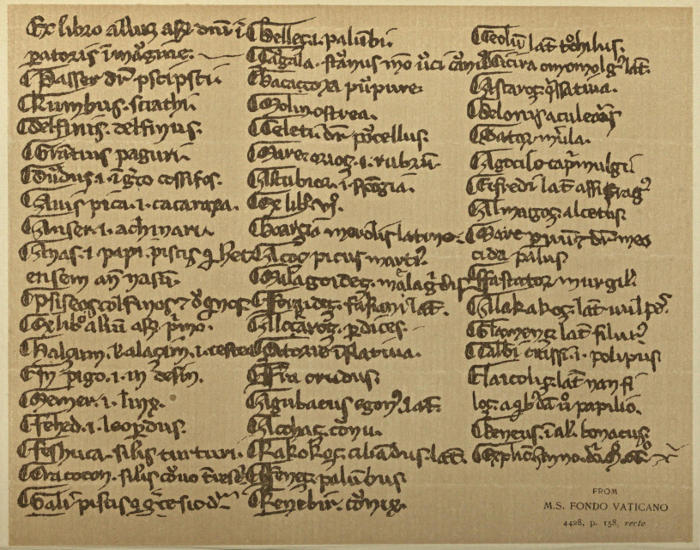
Michael Scot, as we know, had become familiar
with the works of Rases while still in Sicily, and
thought so highly of the De Medicina as to borrow
thence for his treatise on physiognomy no fewer
than thirty-one chapters relating to that subject.[106]
It is a natural conjecture then which leads us to
find in his acquaintance with this author’s writings
the starting-point of Scot’s interest both in
medicine and in alchemy. Leaving for the present
what may hereafter be said of his name and fame as
a physician, let us examine the origin and nature of
his work as a student of the Arabian chemistry.
We have reached what would seem to be the
proper moment for such an inquiry. The treatises
of Michael Scot on this subject are not dated
indeed, but their form shows them to belong to the
epoch of his work as a translator. They were
therefore probably produced during the period of
his residence at Toledo, and as there is a long
interval, otherwise unaccounted for, between 1210,
when the Abbreviatio Avicenna appeared, and the
date of his next publication some seven years
later, this blank cannot be better filled than
by supposing that it was during these years he
found time for the study of alchemy, and for the
translation or composition of the writings in that
branch of science which still bear his name.
In this, as in almost all his other studies,
Michael Scot sat at the feet of Eastern masters.
But the Arabians themselves had derived their
chemical science, at least in its first principles and
primitive processes, from still older peoples. If we
are to understand the progress of human thought in
this science we must trace it from the beginning,
following again that beaten track of tradition by
which not physiognomy and alchemy alone, but
almost all the secrets of early times, have reached
the modern world.
Primitive chemistry was closely connected with
the still older art of metallurgy, out of which it
arose by a natural process of development. Those
who worked with ores soon discovered the secret of
alloys, whereby a considerable quantity of baser
metal, such as copper, lead or tin, could be added
to gold or silver, so as greatly to increase the bulk
of the whole without injuring either its appearance
or usefulness. The problem of the crown set before
Archimedes, and happily solved by that philosopher
in the bath, shows how dexterously alloys were
used by the Greeks, and what subtle means were
necessary for their detection.
M. Berthelot has reminded us[107] that the transmission
of receipts for such processes from early
times to our own has been naturally and inevitably
secured by the unbroken continuity of practice in
the arts which gave them birth, and that they thus
passed safely from generation to generation, and
even spread from the tribes that originated them to
other and distant peoples. He cites in support of
this observation a papyrus of the third century,
preserved at Leyden, which, he says, contains what
are substantially the same directions as those of the
chief mediæval authorities in such matters: the
Mappae Clavicula and the Compositiones ad Tingenda.[108]
These receipts are not unnaturally entitled
‘How to make Gold,’ and it is curious to
find in them the veritable starting-point of the
dreams which made so many a furnace smoke, and
so many a crucible glow during the course of
centuries, in the vain hope of effecting an actual
transmutation of substance.
Thus it was that in the first ages, long before
authentic record, in the dimness of early Egyptian
history, or of that still more ancient Pelasgic civilisation
from which the pyramid-builders learned so
much, the germs of this science may already be
perceived. Only one source of genuine gold seems
then to have been known: the mines of Ophir. This
circumstance, by making the supplies of precious
metal small and uncertain, mightily encouraged the
art which taught men to counterfeit its appearance
in a colourable way. How this was done may be
judged of by the receipts themselves. The Mappae
Clavicula, for instance, has the following: ‘To
make gold. Silver, one pound; copper, half-a-pound;
gold, a pound; melt, etc.’ Here indeed a
considerable proportion of the precious metal itself
was required, but there are other receipts which
dispense with any such admixture. It is said, for
example, that one hundred parts of copper and
seventeen of zinc joined in a state of fusion with
divers small proportions of magnesia, sal ammoniac,
quicklime, and tartar, yield an alloy which is fine
in grain and malleable, which may be polished and
used in damascening just as if it were the pure
gold that it has all the appearance of being. Such
then were the receipts which formed the hereditary
riches of the mighty clan of the Smiths. It is easy
to see how the famous ‘powder of projection,’ so
much sought in later times, was, in fact, but the
transfiguration of one of these formulae.
When, during the early centuries of the
Christian era, the traditions of Greece found a new
home in lower Egypt, and especially in Alexandria,
they were profoundly influenced by the still more
ancient philosophy of the East. We have already
remarked this in the case of another science, that of
physiognomy, but the same influence may also be
traced in the modification it brought to the notions
of primitive chemistry. The Chaldæans and
Persians had long believed that the heavens influenced
the earth, and were capable of producing
strange effects in the lower spheres of being.[109] Their
wise men considered that an individual connection
could be established between the stars and the
elements, the planets and the metals. It was in
contact with this new doctrine and under its influence
that there arose the hope, soon hardening
into a settled belief, that the rules of art might be
sufficient to effect an actual transmutation of the
baser into the nobler metals, of copper into gold,
and of tin or lead into silver.
This opinion must have been immensely
heightened, and its authority reinforced, by the
secrecy with which the receipts for alloying
metals were guarded. These were handed down
orally from father to son; were not committed to
writing till a comparatively late period, and even
then remained for the most part the cherished
treasures of temple guilds. On the well-known
principle of the proverb, ‘Omne ignotum pro magnifico’
this secrecy tended to confirm the impression
that, however much had been communicated,
more remained untold, to await discovery by the
patient and undaunted chemist. The Therapeutæ
or Essenes were among the earliest representatives
of this new tendency, as appears from the
testimony of Josephus,[110] who describes them as not
only devoted to ancient writings, but eager to investigate
the properties of minerals. The chief
object of their inquiries, the maintenance of health
by medicines thus derived from the vegetable and
mineral kingdoms, is not only an early instance of the
connection between chemistry and pharmacy, but is
remarkable as the probable starting-point of the
search for the elixir of life: that other and nobler
dream which so much of the enthusiastic energy
of the mediæval alchemists was spent to realise.
The point of connection between these speculations
of Eastern philosophy and the practice of the
primitive chemistry may with probability be sought
in the fire which of necessity played so large a part
in the operations of the metal-worker. Fire bore a
highly sacred character in the philosophy and religion
of the East. This element, it soon came to be
thought by those whom Eastern speculation influenced,
might be trusted not only to melt, to
calcine and to sublime in the vulgar way, but to
form the long-sought link of sympathy between the
stars of heaven, themselves compact of fire, and the
elements of earth, as these were subjected to its
piercing and transforming power. In its due employment
the suspected connection between the
higher and lower worlds would become an accomplished
fact. Thus, under the power of the planets,
in some favourable hour and fortunate conjunction,
the mighty work would be done: the philosopher’s
stone discovered, the metals transmuted, and the
elixir of life produced.
It is highly curious to find this idea presented in
a novel and perhaps an exaggerated form by a writer
of the sixteenth century. This was Fra Evangelista
Quattrami of Gubbio, semplicista, or master of the
still-room, to the Cardinal d’Este. He wrote a
book entitled, The true declaration of all the
metaphors, similitudes, and riddles of the ancient
Alchemical Philosophers, as well among the Chaldeans
and Arabians as the Greeks and Latins.[111]
According to this work, the potable gold; the elixir
of life; the quintessence, and the philosopher’s
stone were nothing but fantastic names for the fire
itself which was used in distillation and other
chemical operations. In this the Frate may possibly
have touched the true sense of Al Kindi at least,
who, in his commentary on the Meteora,[112] speaks of
fire as if it were the all in all of the alchemist.
While the primitive chemical practice followed
the progress of the arts which it served, the new
theory of alchemy, with the ever-growing tradition
of fantastic experiments arising out of it, found
different and less direct channels in its descent from
ancient to modern times. It has been customary
to speak of the Arabs as if that nation had been the
chief means of transmitting the knowledge of Greek
doctrine to our mediæval scholars, but we now
know that there was a previous link in the chain of
intellectual succession. This was supplied by the
care and industry of the Syrian subjects of the early
Caliphs, nor did their learned men play a less important
part in the history of chemistry than in
that of the other sciences. Sergius of Resaina, a
scholar of the fifth century, was, it is said, the first
Syrian who attempted to translate the Greek
chemists, several of whom mention him by name.
The chief development of this work belongs, however,
to the ninth and tenth centuries, and its glory
must ever remain with the great school of Bagdad.
Chemical treatises composed by Democritus and
Zosimus[113] were there and then rendered into Syriac,
as may be seen by the manuscripts still preserved
in the British Museum and at Cambridge.
It was not long before the Arabs themselves
began to feel powerfully the intellectual impulse
thus communicated to them in the heart of a
country which they had made their own. Khaled
ben Yezid ibn Moauia, who died in the year 708, is
said by their historians to have been the first of that
nation who devoted his attention to chemistry. In
his case the filiation of doctrine would seem very
plain, as he was the pupil of a Syrian monk named
Mariannos. Djabar, the Geber of Western writers,
followed in the same line of study, and from the
ninth century there was a regular school of Arabian
chemists whose labours may be studied in the
manuscript collections of Paris and Leyden.
In the eleventh century appeared a curious phenomenon,
in the shape of a dispute among the
Arabians of that day regarding the truth of the
tradition which pronounced the transmutation of
metals possible. The unwearied but still unavailing
experiments which had now been carried on through
several ages, produced at last their inevitable effect
in the shape of philosophic doubt, eagerly urged on
the one part and as eagerly repelled on the other.
The chemical school was now divided according to
these opposite opinions, and each party in their
writings sought to give weight to what they taught
by borrowing in support of their arguments the
names of the mighty dead. In this conflict it was
left to the followers of Rases to sustain the affirmative
and to assert the possibility of transmutation.
These were the apologists for the past, and the
advocates, in the name of their great master, of
that hope which had inspired previous research and
borne fruit in so many important discoveries.
The defence of the new doubt belonged on the
other hand to the school of Al Kindi. This chemist
lived and died during the ninth century. He was
probably the earliest Arabian commentator on
Aristotle, and seems to have paid special attention
to the Meteora of that author. The treatise De
Mineralibus, so often appended to the Meteora as
a supplement, is ascribed to Al Kindi in the Paris
manuscript.[114] It represents the alchemy of the
time.
Between these two contending parties stood the
school of Avicenna, which now occupied an intermediate
position and doubted of the doubt. That
this had not always been the opinion of Avicenna
himself is plain, however, from a passage which
occurs in his Sermo de generatione lapidum, where
the author unhesitatingly pronounces against the
theory of transmutation. ‘Those of the chemical
craft,’ he says, ‘know well that no change can be
effected in the different species of things, though
they can produce the appearance of them: tinging
that which is ruddy with yellow till it looks like
gold, and that which is white with colour at their
pleasure till the same effect is in great measure produced.
Nay, they can also remove the impurity
from lead, so that it looks like silver, though it be
lead still, and can endue it with such strange
qualities as to deceive men’s senses, and this by the
use of salt and sal ammoniac.’[115] Avicenna was
evidently well acquainted with the secrets of art
and held them at their proper value. Had his
followers in the eleventh century done the same
they would have supported the school of Al Kindi
instead of taking a less definite position.
This view of the later Arabian schools and their
differences is forced upon us by the fact, that works
are extant under the names of Rases, Al Kindi, and
Avicenna, which evidently belong to the eleventh
century, the period when they first appeared, and
could not therefore have been written by authors
who lived at an earlier date. They are plainly the
production of later chemists who followed more or
less intelligently the doctrine of these great masters
in alchemy. The artifice involved in this ascription
of authorship is one which has always been common
in Eastern literature.
We have a direct interest in observing that
Spain was the country where these developments
of the later Arabian chemistry arose, contended and
flourished. Spain, therefore, during the eleventh
and twelfth centuries, became, by the attraction
she offered to European scholars, the country where
these theories first reached the Latin races, and
began to find an entrance among them. M.
Berthelot indeed, by a happy citation, has enabled
us to fix, almost with certainty, the very moment
of this important event. Robert Castrensis, the
author alluded to, remarks: ‘Your Latin world
has not as yet learned the doctrine of Alchemy.’
These words are taken from the preface to this
author’s version of the Liber de Compositione
Alchimiae, and a colophon informs us that the
translation was completed on the 11th of February
1182. We may add that the same year, corrected,
however, in one copy to 1183, was the date of
another of these versions of the Arabian chemistry:
that of the treatise called Interrogationes Regis
Kalid, et responsiones Morieni.[116] Here then we
stand on the threshold of a new age, and find ourselves
in presence of an intellectual movement
which was certainly of the greatest importance,
since in it we may trace the origin of our modern
chemistry. The knowledge of what had already
been gained by Greek and Arabian alchemists was
the first step to independent research among the
Latins. The closing years of the twelfth century
saw that knowledge at last beginning to unfold
itself in a form intelligible to the Western schools.
As in Bagdad during the ninth century, the
palmy period of Syrian studies, so in Spain three
hundred years later, the work was in its commencement
essentially one of interpretation, and the
first age of these labours was distinguished by the
number of versions which were then produced.
From 1182, through the whole of the following
century, students laboured in the translation of
Moorish books on chemistry. Only towards the
close of this period did a tendency become apparent
which led in the direction of improvement and
innovation. The seed already sown had begun to
bear fruit. The material thus derived from Eastern
sources was now treated with a new freedom, enriched
by the results of original experiment, and edited
in forms which betray the influence of scholastic
philosophy. The criticism, however, which would
determine the precise point when this change
began to be operative, and the extent to which
it proceeded, attempts what is perhaps an impossible
and certainly a difficult task. For it
is a remarkable fact that no Arabic texts
have been preserved to us which can be regarded
as the originals from which these earlier Latin
versions were made. This want is probably due
to the widespread destruction which overtook the
Moorish libraries of Spain.[117] That such originals
did at one time exist, however, is made certain
by the correspondence which the Latin translations
show with those which have come down to us in
another language, the Hebrew. The labours of
these Latin translators during a hundred years
may be found in the manifold collections of chemical
treatises, containing some forty or fifty articles
apiece, which were arranged and copied out at
the beginning of the fourteenth century. These
volumes became, after the invention of printing,
the chief quarry whence were composed the Ars
Aurifera; the Theatrum Chemicum of Zetzner, and
the Bibliotheca of Manget.
We are now in a position to understand, not
only the nature and progress of the work in which
Michael Scot took part, but the exact development
which alchemy had reached in his day, and therefore
the relation which his chemical publications
bore to the general direction of study in this
department of science. The time and care which
our survey of the field has demanded need not
be thought ill spent. It has prepared the way for
a more intelligent appreciation of Scot’s labours as
a chemist, and has furnished us with the means
of coming to a true judgment regarding their
authenticity and value.
To put the matter to the proof: we may begin
by dismissing altogether from consideration a
treatise which has long been attributed to Scot,
and still appears in the most recent list of his
works: the Quaestio curiosa de natura Solis et
Lunae. It has probably received more attention
than it deserves since it appeared under Scot’s
name in the Theatrum Chemicum.[118] The subject
of this treatise is indeed an alchemical one; for
the sun and moon of which it speaks are not these
heavenly bodies themselves, but, by an allegorical
use common in the Middle Ages, and derived from
the Eastern theories of sympathy already mentioned,
stand for the nobler metals of gold and silver.
A brief examination, however, shows that Scot
could not have been the author. The very style
suggests this conclusion; for it is distinctly scholastic,
and proper therefore to a later age than
that which aimed at the direct and simple reproduction
of Eastern texts. It is satisfactory to find
that this criticism, hardly convincing per se, is
fully borne out by what occurs in the substance
of the work itself. The author quotes from the
De Mineralibus of Albertus. Now Albertus Magnus,
by common testimony, produced this treatise after
the year 1240, and we may anticipate what is
afterwards to be told of Michael Scot’s death
so far as to say here that he had then been
long in his grave. The De Natura Solis et
Lunæ then must be ascribed to some other and
later alchemist, who lived in the end of the
thirteenth or the beginning of the fourteenth
century. A more careful examination of the
treatise than has been necessary for our purpose
might succeed in fixing its date with greater precision,
and might possibly throw some light upon
the person of its true author.
Another work ascribed to the pen of Michael
Scot, and one which seems likely to be authentic,
is that contained in the Speciale Manuscript. This
volume is one of those collections of alchemical
tracts made in the fourteenth century to which
we have already alluded. It belonged to the
library of the Speciale family in Palermo, and has
been made the subject of an interesting monograph
by Carini.[119] No. 44 of this manuscript is entitled
Liber Magistri Miccaelis Scotti in quo continetur
Magisterium. The term Magisterium, or supreme
secret of art, would seem to carry with it a certain
reference to Aristotle, ‘Il Maestro di color che
sanno,’ as Dante calls him.[120] Curious as the appearance
of such a name in connection with alchemy
may seem to us, it is certain that Aristotle held
a high place in the chemical traditions of the
Middle Ages. The Meteora afforded a text which
lent itself readily to large commentaries by the
Arabian chemists. The tract De Mineralibus,
which we noticed when speaking of Al Kindi, was
one of these commentaries, and it is easy to see how
it became confused with the text which it illustrated
so as in time to be considered the work of Aristotle
himself. This, we may believe, was the ground on
which so many alchemical works were afterwards
published under the same mighty name.[121] An interesting
example appears in the Speciale collection
itself which contains the following title: Liber
perfecti Magisterii Aristotelis qui incipit cum studii
solertis indigere.[122] The treatise Cum studii is also
found in the Paris manuscript,[123] where it is ascribed
to Rases. To the school of Rases then we are
inclined to attribute the works on the Magisterium,
and among the rest therefore, this treatise in the
Speciale Manuscript, which bears the name of
Michael Scot, seemingly because he translated it
from the Arabic. This conclusion is confirmed
when we notice the character of some of the chapter
headings as given by Carini; for example: ‘Qualiter
Venus mutatur in Solem’; and again, ‘Transformatio
Mercurii in Lunam.’ These show beyond all
doubt that the doctrine which Michael Scot published
by means of this version was that held by
the school of Rases.
A curious question here offers itself for our consideration.
In the times of Robert Castrensis
alchemy was as yet unknown to the Latins.
Michael Scot, as we shall presently see, described it
in one of his works as meeting with but a poor
reception at its first introduction among them.[124]
How then did it come to pass that in a few years
the theory of Rases became so popular in the West,
and continued for so many ages to direct the progress
of chemical study among the European nations
with enduring power? We find the explanation of
this sudden change in the fact that human thought
has always been subject to the tyranny of ruling
ideas. In our own day the place of direction is
filled by a doctrine of development which is eagerly
made use of in every department of knowledge. In
those earlier ages the same place seems to have
been held by a doctrine of transformation. This
idea ruled the thoughts of men like an obsession, in
whatever direction they turned their minds. We
see it in their superstitions, suggesting the wild
tales of were-wolves and of other animal forms
assumed at will by wizard and witch. We find it
in religion, infusing a new meaning into the hyperbolical
language of still earlier times, till, under this
direction, there came to be fastened upon the
Church a full-formed doctrine of Transubstantiation.[125]
It is the operation of the same idea then
that we are to remark also in the scientific sphere.
As soon as the first shock of their surprise was
over, the Latins greedily embraced a theory of
chemical change which related itself so naturally to
the prevailing habit of their minds, and which
promised to show as operative in the mineral
kingdom a law already conceived to hold good in
the world of organic life.
The Riccardian Library of Florence possesses
another of those volumes to which we have already
referred: a collection of alchemical treatises formed
in the end of the thirteenth or beginning of the
fourteenth century.[126] Among these appears one
called the Liber Luminis Luminum. It is said to
have been translated by Michael Scot, and, as there
is no reason to doubt this ascription, we have now
the means of determining with some fulness and
accuracy the lines on which the philosopher proceeded
in his chemical researches.
The book opens with a preface somewhat scholastic,[127]
and one which, on this ground as well as on
others, is probably to be ascribed to Scot himself.
In this part of the work he informs us that he took
as his basis in the following compilation a text called
the Secreta Naturae. To it he added material
derived from other sources, which seemed necessary
in order to complete the doctrine of chemistry contained
in the Secreta. In this way he endeavoured
to present his readers with a full and practical body
of Alchemy according to the teaching of the school
to which he belonged.
In the study of a composite work, such as the
Liber Luminis is thus declared to be, our first
problem is naturally to determine and separate the
original text from the additions which have been
made to it. Which then are those parts of the
Liber Luminis that represent the Secreta Naturae?
Very fortunately the volume where the Liber
Luminis is found contains another treatise that
throws considerable light on the matter. This is
the Liber Dedali Philosophi. The correspondences
between that book and the Liber Luminis are so
many, close, and verbal, that it is evident both have
borrowed from the same source. This source can
hardly have been other than the Secreta Naturae,
so that a comparison of these two books such as is
attempted in the Appendix[128] should go far to determine
what that hitherto unknown text was.
The question of the chemical doctrine contained
in the Secreta is an interesting one, and we shall
return to it, but meanwhile, let us observe that the
Liber Luminis contains hints which seem to carry
us further still, and throw some light upon the
source from which the Secreta was itself derived.
One of the authors quoted is a certain ‘Archelaus.’
Now there was a veritable chemist of this name who
lived during the fifth century. This author wrote a
treatise on his art in Greek verse. In later times
his name seems to have become common property,
as did so many others distinguished in alchemy, and
to have been freely used by some who wrote long
after his day. Thus the Riccardian manuscript
itself contains no less than three books ascribed to
this author: the Liber Archelai Philosophi de arte
alchimiae,[129] called also in the margin Practica
Galieni in Secretis secretorum;[130] the Summula, ‘quam
ego Archilaus transtuli de libro secretorum’;[131] and
finally the Mappa Archilei nobilis philosophi.[132]
The fact that these titles mention the Secreta is
enough to show us that in following up the alchemy
of the Pseudo-Archelaus, we are on the right track.
As we proceed the traces become still more interesting
and significant. The Summula offers the following
curious passage: ‘Et hoc feci amore Dei et
cuidam compatri meo, qui pauper sint [sic] et
infortunatus, et postea fortunatus fortuna bona et
amore Imperatoris Emanuelis et Frederici.’[133]
The name Emanuel is found in other alchemical
writings. The De Perfecto Magisterio, for example,
which has been reprinted by Zetzner, embodies
another work, the Liber duodecim aquarum which
is expressly said to be taken from the ‘Liber
Emanuelis.’ Pursuing the matter further still, we
come to the Liber Aristotelis which commences,
‘Cum de sublimiori atque precipuo.’ The author of
this treatise, we find, claims not only the Liber
duodecim aquarum (‘quae qualiter se habeant in
libro quem XII. aquarum vocabulo descripsimus,
prudens lector intelligere poterit’), but also, it
would seem, the very one of which we are in search
(‘in libro secretorum a nobis dictum est’). Everything
inclines us to the belief that we here touch
the source from which the main part of the Liber
Luminis was drawn, and this conclusion is not a
little strengthened when we observe that the
treatise ‘Cum de sublimiori’ is called the Lumen
Luminum in the Riccardian copy.[134]
The Secreta, however, was not the only source
from which the Liber Luminis and the Liber Dedali
were drawn, and the assertion of the preface that
the former was composed of extracts from many
different philosophers is fully borne out when we
examine the substance of the books themselves. A
strain of Greek influence is to be traced, for example,
in the names of Archelaus, Dedalus, Plato, and
Hermes, as well as in the use of ciatus as an equivalent
for the word ‘cup,’ and this reminds us
strongly of the Summula with its reference to the
Emperor Manuel. It is not impossible that Scot
may have borrowed much from the Byzantine
chemists of the twelfth century. With this notion
agrees the passage of the Liber Dedali where
Saracens are spoken of as foreigners. On the other
hand, much had evidently been taken from Arabic
sources, as is plain from the names given to several
of the vessels used in alchemy, such as the alembic
and aludel. Indeed, Unay and Melchia, who are
quoted in the Liber Luminis, must have been Moors,
for the corresponding passage of the Liber Dedali
describes them as from ‘Lamacha of the Saracens.’
Both these texts agree in showing such familiarity
with the process of refining sulphur that one is led
to suppose the Secreta, their common original, may
have been composed in Sicily. The Liber Luminis
says of one of the alums that it is ‘brought from
Spain:’ an expression agreeing well with the notion
of a Sicilian author, who would naturally speak of
Spain as a foreign land.
Leaving, however, these questions of origin and
derivation, let us come to that of the chemical
doctrine taught in the book which Michael Scot
compiled, or at least translated. The title of the
Liber Luminis Luminum is a significant one, and
has a real relation to the contents of the work
itself.[135] To discover the sense which it must be held
to bear we have only to turn to the passage in
which, speaking of alum, the author says: ‘sicut
illuminat pannos, ita illuminat martem ut recipiat
formam lunae. Ut enim lana illuminatur ita et
metalla illuminantur.’[136] A distinction is clearly
present in the writer’s mind between the substance
and the form of the metals. He probably held
that there existed but one common metallic substance,
which assumed the appearance of iron,
gold, or silver, according to the form which it had
received. His employment of the title Liber
Luminis Luminum was meant to indicate that
the purpose of his book was that of teaching the
student how metals might best be purified and
improved. Their inferiority, when of the baser
kind, he conceived as an impurity, manifesting itself
in the imperfect forms of lead, iron, tin, and copper.
He believed that this being removed or changed by
art, they might be made to shine with the lustre
and indeed possess the only distinctive quality of
gold and silver. That we have rightly read the
meaning of this title seems plain from a curious
spelling which may be noticed in the Liber Dedali.
‘Illuminantur’ there appears as ‘aluminantur.’
The chemistry taught in these books did in fact prescribe
the use of alum as a great means of purifying
and refining the metals.
The preface of the Liber Luminis closes with a
brief summary of the chapters which compose the
work itself. The first of these deals with the
different salts used in this chemistry: common salt;
rock salt; alkali; sal ammoniac; nitre and others.
The second treats in like manner of the various
kinds of alum, the third describes the vitriols, and
the fourth the powders or spirits, by which we are to
understand those minerals which are capable of
being sublimed or made volatile, such as sulphur,
arsenic, and mercury. Two supplementary chapters,
the one on the preparation of the salts, alums, and
vitriols, and the other on that of the remaining
class of chemicals, complete the whole book. This
supplement seems genuinely such, as it is not mentioned
in the general contents, as these appear in
the preface. Perhaps we do not err if we suppose
it to have embodied the result of Scot’s own
experiments in alchemy.
It is indeed the practical nature of the alchemical
doctrine taught in the Liber Luminis which strikes
us most strongly when we read this book. A large
part of it is taken up with exact descriptions of the
minerals, according to their various forms and the
countries from which they were derived. The rest
consists of receipts for their employment in refining
metals. Whatever we may think of the validity
and use of these processes, we cannot fail to notice
that they are described in a perfectly straightforward
and simple style. Here are none of the mysteries,
the riddles and ridiculous allegories so common in
chemical works written at a later time. The truth
of the matter may probably be that, in following
the doctrine here set forth, Michael Scot and the
alchemists of his time did obtain results which were
then so surprising, as to excuse a certain exaggeration
in those who described them. Tests that could
touch and reveal the real nature of the metals under
any change of outward appearance were not then so
well known as now. Copper that had been made to
shine like gold, or to assume the appearance of
silver, was practically gold or silver to those who had
no means of discovering that the real nature of the
metal itself remained unchanged. Thus then are to
be understood the assertions of the Liber Luminis
regarding transmutation. They are plainly made
in all good faith, and depend on the doctrine already
mentioned, which held that the differences between
the metals were an affair of the superficial form
rather than of the underlying substance. To
change the appearance of one metal to that of
another, was therefore to effect a real transmutation:
the only one conceivable by the philosophers
of that time. When the Liber Luminis speaks of
giving copper ‘a good colour,’ or preparing iron to
‘receive the appearance (formam) of silver,’ these
expressions reveal with frank sincerity the conceptions
of this alchemy and the results it endeavoured
to obtain.
One other alchemical work attributed to the pen
of Michael Scot remains to be noticed; the De
Alchimia, contained in a manuscript of Corpus
Christi College, Oxford.[137] Tanner in his Bibliotheca
has noticed this work in the following terms:
‘Chymica quaedam ex interpretatione Michaelis
Scoti dedicata Theophilo regi Scotorum. Corpus
Christi MS. 125. In eodem codice MS. fol. est haec
nota “Explicit tractatus magistri Michaelis Scoti
de aelchali,” huius vero tractatus, a priore diversi,
hoc tantum fol. extat.’ This account is erroneous
in several particulars. ‘Scotorum’ should be
‘Saracenorum,’ and ‘de aelchali’ is a misreading of
‘de alkimia,’ as a glance at the manuscript informs
us. Nor is it the case that we have here to deal
with two distinct works. The last leaf, to which
Tanner more particularly refers (fol. 119, old
numeration), shows a hand of the fourteenth century,
and forms the only remainder of the original. The
rest of the manuscript (fol. 116-118) has been
supplied by a scribe of the fifteenth century, but
the whole is perfectly continuous, as appears plainly
when we notice that the first words of the original
(fol. 119 recto), ‘et cum siccatus,’ have also been
written by the later scribe at the bottom of page
118 verso.
In spite of the highly suspicious dedication,
‘Theophilo Regi Saracenorum,’ several reasons
incline us to regard the De Alchimia as, in substance
at least, a genuine work of Michael Scot.
To begin with, it clearly belongs to a very early
period; for, in the opening words of his preface,
the author describes alchemy as a science, noble
indeed, but as yet neglected and contemned by the
Latins (‘apud Latinos penitus denegatam’). In
the same sentence we find him referring to the
secreta naturae, just as Scot does in the Liber
Luminis, and declaring his purpose to furnish the
world with a commentary on it in the work he now
attempts (‘secreta naturae intelligentibus revelare’).
In the opening paragraph of the book itself he
seems to refer plainly to the Liber Luminis as a
work written by him (‘notitia de salibus vel salium
prout in aliquo libro a me translato dixi’). Nor
should we overlook the distinctly ecclesiastical tone
which is to be observed in the De Alchimia. Part
of the preface is conceived almost in the form of a
prayer, commencing thus: ‘Creator omnium rerum
Deus qui cuncta ex nihilo condidit,’ and in at least
one passage, a well-known text of Scripture is reproduced
(‘et haec est res quae erigit de stercore
pauperem et ipsum regibus equiparat’). This style
is a noticeable characteristic of all the works of
Michael Scot.
On the other hand, the De Alchimia shows
several doubtful features which, on the supposition
that it came from Scot’s pen, can only have been
due to some interference with the text at a subsequent
time. Such is the dedication to Theophilus,
King of the Saracens, which we have already
noticed, and the latter part of the preface shows a
turgid passage (‘hic est puteus Salomonis et
fimi acervus, et hic est fons in quo latet anguis
cuius venenum omnia corpora interficit,’ etc.) that
strongly recalls the fancies of the later alchemy.
The body of the work, however, is no doubt
genuine, and offers matters of considerable interest.
The first of these is perhaps the distinction drawn
here between the greater and the lesser mystery
(magisterium) of alchemy. The former, it seems,
was the transmutation of Venus into the Sun;
that is, of copper into gold. The latter comprehended
the fixation of mercury and its transmutation
into the Moon, or silver.
We soon notice too that the author addresses
himself not, as one would at first expect, to ‘Theophilus,’
but to a certain Brother Elias (‘tibi Fratri
Helya’)—another proof, if any were needed, that
the dedication to the apocryphal King of the
Saracens was due to some other and later hand.
‘Brother Elias,’ however, was far from being a
merely imaginary personage. He was an Italian,
born (for accounts vary) either at Bivillo near
Assisi, Cellullae or Ursaria near Cortona, or in Piedmont.
In 1211 he joined the Order of St. Francis,
then just formed, thus becoming one of its earliest
members. His history as a Franciscan was rather
an eventful one. On the death of St. Francis
in 1226 he succeeded the Founder as General of
the Order, but was deposed by the Pope in 1230
on some suspicion that he favoured schism among
his brethren. The Order re-elected him in 1236,
but he was finally removed from office by Gregory
three years later, and profited by the occasion
to join himself openly to the party of the Emperor.
For this he suffered excommunication in 1244, and
was not restored to the privileges of the Church till
1253, when he lay on his death-bed at Cortona.
There is no doubt that he had the reputation of
possessing skill in alchemy, as a treatise is extant
called the Liber Fratris Eliae de Alchimia.[138] This
renown would not tend to his honour in religion.
It seems indeed to invest with a cruel and pointed
meaning the words used by the Pope on the
occasion of his first deposition.[139] He is said to have
been sent in early days on an embassy to the
Emperor of the East. Perhaps this may have been
the occasion when he first acquired a taste for those
chemical studies which that nation still pursued.
Michael Scot addresses him in the De Alchimia as a
pupil (‘Et ego, Magister Michael Scotus, sum operatus
super solem, et docui te, Fr. Elia, operari et tu
mihi saepius retulisti te instabiliter multis viabus
operasse’), while at the same confessing that he was
not above learning some of the secrets of art from
the well-known Franciscan. This relation between
two such distinguished men has not hitherto been
noticed, and is certainly a curious point in the
history of the times.
The De Alchimia presents several features which
distinguish it from the Liber Luminis. One of
these is an early passage which refers to the correspondence
between the metals and the planets, and
explains that when the latter are named we must
understand that the former are intended. Near
the end of the treatise a description of the materia
chemica occurs, but it would seem as if this had
been written to supplement that given in the Liber
Luminis, for it deals, not with salts, alums, vitriols,
or volatile substances, but with the different
varieties of what the author calls ‘gummae,’ which,
however, are mineral substances;[140] and with ‘tuchia’
in all its various kinds.
Many words and phrases, however, might be
cited to show how the strain of doctrine observable
in the Liber Luminis is continued with scarcely
any change in the De Alchimia. We have
hardly read a line in the first receipt before we meet
with the expression ‘sanguinem hominis rufi’ recalling
the ‘sanguinem hominis rubei’ of the Liber
Luminis. The ‘pulvis bufonis’ indeed is here replaced
by another ingredient derived from the
animal kingdom, the ‘sanguis bubonis’; but, reading
a little further, we find the familiar ‘urina taxi’
again recommended as an almost universal solvent
and detergent. Evidently both works proceeded
from one and the same alchemical school. The
number of Arabian chemists[141] cited in the De
Alchimia seems to show that if these books came
from a Greek source it was not that of ancient times,
but some Byzantine school that had borrowed much
from Eastern alchemists.
To give a substantial idea of the De Alchimia
let us translate one of the formulae which it
contains: ‘Medibibaz the Saracen of Africa used
to change lead into gold [in the following manner].
Take lead and melt it thrice with caustic (‘comburenti’),
red arsenic, sublimate of vitriol, sugar of
alum, and with that red tuchia of India which is
found on the shore of the Red Sea, and let the
whole be again and again quenched in the juice
of the Portulaca marina, the wild cucumber, a
solution of sal ammoniac, and the urine of a young
badger. Let all these ingredients then, when well
mixed, be set on the fire, with the addition of some
common salt, and well boiled until they be reduced
to one-third of their original bulk, when you must
proceed to distil them with care. Then take the
marchasite of gold, prepared talc, roots of coral,
some carcha-root, which is an herb very like the
Portulaca marina; alum of cumae something red
and saltish, Roman alum and vitriol, and let the
latter be made red; sugar of alum, Cyprus earth,
some of the red Barbary earth, for that gives a good
colour; Cumaean earth of the red sort, African
tuchia, which is a stone of variegated colours and
being melted with copper changeth it into gold;
Cumaean salt which is …; pure red arsenic, the
blood of a ruddy man, red tartar, gumma of Barbary,
which is red and worketh wonders in this art; salt
of Sardinia which is like …. Let all these be beaten
together in a brazen mortar, then sifted finely and
made into a paste with the above water. Dry this
paste, and again rub it fine on the marble slab.
Then take the lead you have prepared as directed
above, and melt it together with the powder, adding
some red alum and some more of the various salts.
This alum is found about Aleppo (‘Alapia’), and in
Armenia, and will give your metal a good colour.
When you have so done you shall see the lead
changed into the finest gold, as good as what comes
from Arabia. This have I, Michael Scot, often put
to the proof and ever found it to be true.’
If such a receipt is valuable as indicating the
chemical practice of those days, it is no less interesting
as it throws light upon the life and occupations
of Scot. He must have set up a complete
chemical laboratory at Toledo, with crucibles for
the melting of metals, and alembics for the distillation
of the substances which his art required
him to mix with them. His situation was one very
favourable to these pursuits, not only because Spain
was one of those countries where the doctrine of
alchemy made its greatest progress, and attracted
most powerfully the concourse of foreign adepts,
but also from the facility with which the necessary
materia chemica could there be procured. The
sierras of that country were full of mineral wealth
of all kinds, especially quicksilver, which was one
of the substances most frequently chosen to become
the subject of the transmuter’s art. In the Alpujarras,
a mountainous district lying under the soft
climate of Granada, grew plenty of these rare herbs
employed in alchemy, as they were also in the
medicine of the Arabians. Ibn Beithar of Malaga
describes them in his botanical thesaurus, and
it is said that after the Moors had lost that fair
kingdom their herbalists, even as late as our
own times, made yearly journeys from Africa to
gather in these hills the plants which ancient
science taught them to value highly. But the
days of the ‘ultimo sospiro del Moro’ were yet in
the far future, and meanwhile Michael Scot in his
laboratory at Toledo could easily command all these
treasures for the purposes of experiment. Nor was
it in vain that he fanned his fires, and watched the
metals melt and the menstruum distil in the process
of the lesser or greater mystery. If he never saw
Venus blush into the true substance of Sol, or
Mercury, the fickle and obstinate, congeal into
a veritable Luna, his chemical practice, and the records
in which he has embodied it, mark none the
less true and significant a moment in the history
of scientific progress.