Good out of Evil—Maria before the Police Court—The Works of a
Philanthropist—An Unfortunate Sickness—The Amorous
Physician—Return to her Native Home—Her Marriage and the Effects
of it—Despair and Desperation—Her Victims—Her Awful
Murder—Reflections on Fate and Death.
About four months after the occurrences which we have just narrated, in
mid-winter, a young woman sat in the garret of a wooden dwelling at the
corner of Harrison avenue and Kneeland street, in the southerly portion
of the city of Boston, industriously plying the needle by a small but
cheerful fire. It was Maria Bickford, certainly in a much better and
more encouraging situation than while sojourning at that abode of
iniquity in Lowell street. Her face was worn but not melancholy, and her
bosom heaved a sigh and her voice trembled, while she sung the song of
“Home, sweet home.” There had been a change in her condition—good had
come to her out of evil. The truth of the matter was, that the
authorities, being at length informed as to the character of the
establishment in Lowell street, made an onset upon it at midnight,
captured the inmates, male and female, in their beds, and carried them
to Leveret street jail. The next morning, while before the Police Court
awaiting sentence—the price of her degradation—she was accosted by a
celebrated philanthropist, who desired to speak with her. He told her
that it was probable she would be sent to the House of Correction, if no
intercession were made to the judge in her behalf; that if she would
from that day make a resolution to change her conduct, he would try to
procure her discharge, by the payment of a fine. She heard him
doubtingly, yet imploringly; for her confidence in any thing like
unselfishness in man was small indeed. Through a profusion of tears,
which a crowd of idling by-standers ridiculed as harlot’s crocodiles,
she thanked him, and gave a promise that if he helped her in that moment
of freezing horror, her life should be placed at his disposal. He did
effect her release by the payment of ten dollars; led her into the
street and told her that she was free; and then began to urge upon her
mind, in an earnest and affecting manner, the importance and the glory
of reformation. He pointed out the manner by which a respectable
livelihood might easily be obtained, if she would but adhere to a
resolution never again to fall into the arms of vice.[8] Maria’s heart
leaped with gratitude, and she could not give utterance to her feelings
in the lameness of language. She pressed his hand and watched his
benevolent countenance, and took courage from his unostentatious
demeanor. Although betrayed most piteously thus far in life, by every
man she had known as an acquaintance, still a conviction dwelt in her
nature that there were yet men on earth who were truthful and virtuous
in the sight of heaven. Sunlight to thy soul poor thing! you were right.
Following the suggestions of this humane individual, Maria applied for
work at the counter of an extensive tailoring establishment in
Washington street. It was readily obtained. By this she could earn, and
was earning, a livelihood. Solitude was now her society, and her voice
of song oozed through the shingles of the roof, and without was heard by
the passer by. In her hours of recreation, her mind was occupied by
literary pursuits. The epistle “to a friend,” as given below, was
written by her, and is one of the very best pieces of composition our
eyes ever met with. It was forwarded by her to the Editor of the Boston
“Olive Branch,” who published it with glowing commendations, and it
afterwards went the rounds of the newspaper press throughout this
country and Europe.
Life has its hours of sentiment and romance, which Time, with his
envious wing, can never darken or obliterate. Such bright and pleasant
hours we have had, never to be forgotten—such happy moments, in the
friendly intercourse of thought and feeling we have enjoyed. We have
wandered in the gardens of Fancy and Hope, and gathered the mayflowers
of the spirit—the fadeless roses of the heart. We have had seasons of
intimate converse of pure enjoyment, such as lend to life a halcyon wing
of rainbow hue, as it glides on, with swift pinion, to its infinite
home.
There is a celestial calm—an elevated joy, in the trance of mind; it is
a pure and quiet sense of nobler being. There is a sweet serenity—a
bliss divine, in the simple and noiseless expressions of virtuous esteem
and friendship. And have we not had such serenities and joys,
consecrated on the memory and the heart? Ah, who would lose the
remembrance of pleasures past—the light of by-gone days, when the
confidence of friendship, and the hope of its perpetuity—when the
festivals of intellect and the delights of sympathy were truly ours,
such as raise and illumine a strengthening attachment, with the fond
endearments and bright emotions of undeceitful and happy spirits?
The fair and gentle hand of nature has spread her beauties and her
wealth around our pathway, wherewith to make us rich and blest; and if
we welcome not her lavish kindness and constant care, some sordid
sentiment must blind our minds, or guilty stain defile our hearts. In
the dim, hushed hour of twilight, I have sat by my window, and looked,
in quiet thought, at the pensile boughs of the willow tree, waving
gently their leaves of sadness, and found more of rapture, undimmed by
earth, than earth’s brightest honors could bestow. I have wandered over
the silent graves of changed humanity, and, wrapped in lonely musings on
the sleeping dust of the departed, and on the distant home of immortal
being, I have felt more true and tranquil joy than the gathered wealth
of the world could ever afford.
To the eye of reason, raised and enlightened by truth, how little,
comparatively, is there of what is great and good in the restless
pursuit of unenjoyed opulence and honor, or in the transient
distinctions of rank and power. Is not the mind, with its electric
thought, and the heart, with its sublime emotions—the one darting
through the elevated regions of philosophy, the other meandering through
the beauteous paradise of poesy—the lasting and essential worth of
man—the lofty majesty of merit—the eternal divinity within him? Is not
his free and deathless spirit—from heaven descended—over earth
outspreading—extending through all time—collecting the treasures of
all realms—and, like a vestal fire that struggles to go up to its
smiling source, aspiring ever to ascend to that blest home of truth and
goodness, “the bosom of its Father and its God”—the pride of his
distinction—the grandeur of his glory?
The spirit, if pure, finds friends in all things above and around it. It
gazes upon the deep blue of heaven, and its calm; upon the high
careering sun, and exults; upon the light floating cloud, and smiles in
peace; upon the storm-rolling chariot, and trembles with awe. It looks
forth upon the high mountain-tops in their solitary grandeur, and upon
the stately forests in their dark sublimity, and forgets earth, with its
mutability, littleness and folly. It looks upon the rich waving fields
and green meadow lands—upon the quiet lake and the rushing stream—and
this world’s darkness, and noise, and strife, fade from its remembrance.
It beholds with a smile the circles of beauty and intelligence—the
connexions of dignity and grace—the dwellings of purity and love—and
the disappointments and sorrows of time vanish for awhile away. Yea,
more—it turns its full and eagle eye upon the boundless ocean—that
image of benignity and sovereignty, where Omnipotence rides alone on the
whirlwind’s wing and directs the dashing storm, or where he sits
enthroned in all the bright tranquility of peace and hope—and feels,
itself in nature far, far superior to the vanities and vexations of its
temporal existence, and yearns, with a quenchless energy, for the
revelations and felicities of an infinite hereafter.
But this contemplation of things material and inanimate still leaves a
void behind; the heart is unsatiated and unconsoled. We turn to higher
objects—to the kindred thoughts and feelings of cultivated men, and
study, with a gushing sympathy, the records of their intellectual being.
We behold them bursting the chains around them, bounding over the
impediments in their path, scorning back to earth its native
earthliness, and then unfold freely their golden wings and float away,
far above the humiliation, and cares, and murkiness of this transient
sphere, and move onward in imagination through the multiplying ages of
immortal activity.
But the written records of departed genius cannot enliven and cheer like
the eloquent lip and expressive eye of living friendship. Hence we turn
to beings of breathing interest, and sentiment, and emotion around us,
with the fond hope to find some kindred spirits that can commune with
our own; and if, indeed, we meet with such, our mind kindles and our
heart rebounds with all the warm and generous simplicity, eagerness and
delight of childhood’s years. And then we truly think life has not an
object nor a charm without their constant and congenial companionship.
We feel, without their society, converse and sympathy, the sky has no
beauty, the earth no loveliness, the flow of waters no melody, the words
of the mighty in intellect and the strong in passion no power to subdue
the soul to tenderness, or raise it to triumph. We long then anxiously
to lean on some friendly arm—to feel the beating of some friendly
heart. We deeply yearn to look upon some tone of love. We desire
intensely to associate with some being of a similar intellectual mould,
whose characteristic sentiments and tastes accord harmoniously with
those of our own breast.
A few brief months have passed away since two beings met, of thoughts
and feelings flowing in unison; one of lofty intellect, dignity and
sweetness combined—the other what nature, education, and experience
unitedly have formed her. They have conversed on themes of varied
interest, opened to each other the temple of the soul, and been mutually
happy. And must they yield to the high decree of fate, and part for
life? Must the silver chords be severed and the golden bowl be broken
that were binding each to other with the strength of affection and the
rich fullness of hope? If so, let Heaven’s best will be done. But let
this be a token, simple and valueless indeed, that thou hast been a
friend, most sincerely esteemed and generously accredited by her who has
addressed thee these hurried lines. Let this be a trifling memento of
the few happy hours that have shone out brightly upon the silent
obscurity of her path, and illumined the page of the past with the
hallowed light of thy own pure and radiant spirit. May Heaven’s kindest
love, and fairest smiles, and largest blessings, be the friend’s whose
name and image will ever be devotedly cherished and sacredly honored in
the blighted heart of
M. A. D.
Those who believe in a special providence will stagger to learn that
this pleasing picture was soon clouded; that these fair prospects were
soon blighted, by the visitation of a dreadful sickness, which brought
her to a state of helplessness even more forlorn than any condition she
had before undergone. Alone in a sick chamber, emaciated by a long
course of fever, with no parent or friend to give solace, or answer her
demands! Day succeeded day, and with them came wintry blast and gnawing
poverty. The only assistance she received was from the hands of her
physician, who, though a man of the world, possessed some kindness of
heart. He came each morning and evening, wrote prescriptions for
medicines, which she had scarcely the means to purchase from the
druggist—placed fuel in the grate, and went away. But she was not then
or there to die. Her disease at length made a favorable turn, and, after
a few weeks of steady recovery, the rosy flush of health came into her
face.
The doctor, however, did not discontinue his visits, and he was
welcomed, for Maria’s grateful heart could not but feel that her life
had been preserved by his skill and kindness. He was a bachelor, and his
deep-set eyes and piercing glance told that he was a man of lust. She
had observed this, and was not, therefore, at all surprised when he
began to manifest a sensual familiarity with her person, making promises
of munificence, and inquiring into the nature of her wants. During that
winter there was great depression in the monetary affairs of the
country, and consequently a diminished supply of labor for the poor.
Such as could be obtained was at prices so much reduced, that many
honest people were compelled to steal for a part of their livelihood!
Maria was destitute indeed. For her, no work was to be had at any rate,
before the coming of spring.[9] At this rate she could not subsist
through the winter. It was disgraceful to beg—inhumanity would spurn
her from every door! Go, ask the wolf for charity, but not a civilized
people!
But why prolong the truth? Maria again yielded to Necessity and to Fate.
That physician, with guile upon his lips, seduced her from Virtue’s
sanctuary, and there was revelry in the haunts of vice.[10] Their sinful
intercourse continued until both winter and spring had passed, when,
provided with an ample amount of money, she returned, gaily dressed and
accomplished in manners, to her native home.
We need not further minutely relate the remaining acts of her life. It
is known that, on the occasion of this visit to her grief-stricken
mother, chance made her acquainted with an honest and worthy man, who
became enamoured of her charms, and that this attachment soon resulted
in their marriage. This person was Mr. Bickford. He followed the trade
of a bootmaker, and was much respected by those who knew him. They lived
together upwards of two years, (though unhappily,) when she deserted her
husband and returned to Boston. The following paper, penned by her own
hand, will convey to the reader some idea of the state of her mind soon
after her marriage:
August 10th. I have been married just ten days. During that short
period, many circumstances have occurred, much tending to dispel the
illusive hopes so long and so lately cherished in my imagination and
fervent feelings. My husband is possessed of many rare qualities of mind
and heart, and he loves me with excessive earnestness. But I have now
discovered, what I could not, through infatuation, before marriage—that
those passions of his nature which won my admiration are barbed with
opposite extremes. At one time he loads me with caresses; at another
reviles with unbecoming satire. My petulant disposition impels a retort,
and hence frequent altercations. In moments of calmness I explain to him
how oppressive and deplorable are these recurrences. He relents with an
apology, and then calmly and sweetly do we reason together. Late
affectionate attachments are renewed, and a Divine Presence witnesseth
the communion of our hearts.
There are several considerations which render our marriage untimely and
unwise.
First. Our mutual acquaintance was too short. We did not at all canvass
each other’s faults; we rather strove to conceal and veil our eyes
before them,—too frequent and important mistakes of love-trapped young
people.
Secondly. Our religious predilections are much too dissimilar—he being
strictly Calvinistic, a religion to which I am sternly opposed. The mild
precepts of our beloved Saviour, and the sacred vows of the altar, are
thus desecrated by contention—a double curse.
Thirdly. We are much too poor.
This last consideration is most unfortunately omitted in the
anticipatory summing-up of the chances and consequences of married life,
by those whose misfortune it is to be poor like ourselves. Reflect upon
it as you may, and palliate as you please, poverty marriages are in
themselves an evil and a disgrace. In a favored land like this, no
industrious single man (unless peculiarly unfortunate) has a right to be
pennyless at the age of twenty-five; and such as are imprudent, as well
as those who wrap the golden hours of manhood in a napkin, should, by
special enactment of law, be not only debarred from the enjoyments of
matrimony, but also shamed from the presence of worthy people. As
love-fevers are managed in these days, the habiliments of the altar are
too often the sport of an illusion, as fatal in its effects as ill-timed
in concert. Marriage, under proper regulations, is indeed a boon and a
blessing; but when made to minister to the forlorn hopes of the
inconsiderate, the poverty-bound, or the helpless, it is a curse of the
deepest die. It has darkened the face of creation as a simoon from time
immemorial, encompassing the wretchedness of millions, who, had they
timely resolved, first to better their conditions, then to marry, might
have been independent and happy all their lives.
August 20th. Ten more days have passed—so many saw-teeth. It is
painful to trace the pale appearances which have assumed the place of
the rose-tint upon my husband’s cheek. Returning from his daily toils, I
find him stubborn in manner and bitter in words. All my efforts to
humble his towering will have failed. So, between poverty, contention,
and disappointment, our pathway to the future is unflowered.
When she had concluded to remove to Boston, there to reside permanently,
a new tide rushed in upon her destiny. She was lost. The fountain of her
tears was dry. Despair laid its iron fingers upon the strings of her
heart. And now began that career of madness and crime which rendered her
name a signal of terror to the licentious, who thronged the dens of
prostitution. She laughed and was happy in her revengeful
determination.—Revenge! at whose shrine of blood she did reverence!
“And where her frown of hatred darkly fell,
Hope withering fled, and mercy sighed farewell.”
For a period of over four years, she led the van in the battle of
Extermination to Man, the plunderer of her life’s joys, her
innocence—Man, the rock of her ruin! She saw but to conquer. The
devotees of pomatum swarmed about her, lavishing sickening adulations
upon her charms. She inwardly mocked at their hollowness, and Murder
whetted its beak upon their lies. Twice were her hands imbrued in the
blood of her paramours; and, had her existence been prolonged a few more
days, it is highly probable that a printer, of a name similar to that
borne by the object of her first love, would have fallen a victim to her
avenging steel.
But the hour came when the mighty King of Terrors summoned her soul into
the presence of that forgiving Jesus who wrote upon the sand, at the
harlot’s feet—“Let him among you that is without sin cast the first
stone!” By a murderer’s hand she fell, as had others by her own. And
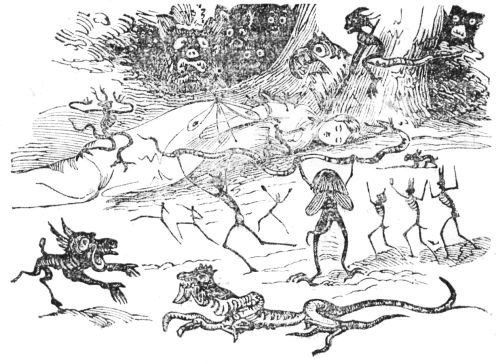
then there was heard a noise in the air without, such as had never
before greeted human ears. Whence it came, none could tell.
Dark and inexplicable Fate! weaver of wild contrasts, demon of this
hoary world, that movest through it as a spirit moveth over the waters,
filling the depths of things with a solemn mystery, and an everlasting
change! Thou sweepest over our graves, and Joy is born from the ashes:
thou sweepest over Joy, and lo, it is a grave! Engine and tool of the
Almighty, whose years cannot fade! thou changest the earth as a garment,
and as a vesture it is changed: thou makest it one vast sepulchre and
womb united, swallowing and creating life, and reproducing over and
over, from age to age—from creation to the creation’s doom—the same
dust and ashes which stalked under the names of the countless millions
who danced to the discordant music of life, and gave up the ghost!