It has now been many years since I quit the range, and as my mind
wanders back over those years as it often does, memories both pleasant
and sad pass in review and it is but fitting that I record a few of them
as a final to the history of my life which has been so full of action,
which is but natural as the men of those days were men of action. They
had to be, and probably their actions were not all good, that I freely
admit, but while that is so, it is equally so that their actions were
not all bad, far from it. And in the history of the frontier there is
recorded countless heroic deeds performed, deeds and actions that
required an iron nerve, self denial in all that these words imply, the
sacrificing of one life to save the life of a stranger or a friend.
Deeds that stamped the men of the western plains as men worthy to be
called men, and while not many of them would shine particularly in the
polite society of today or among the 400 of Gotham, yet they did shine
big and bright in the positions and at a time when men lived and died
for a principle, and in the line of duty. A man who went to the far west
or who claimed it as his home in the early days found there a life far
different from that led by the dude of Fifth Avenue. There a man's work
was to be done, and a man's life to be lived, and when death was to be
met, he met it like a man. It was among such men and surroundings that I
spent so many years of my life and there I met men some of whom are
famous now, while others never lived long enough to reach the pinnacle
of fame, but their memory is held no less sacred by the men who knew
them well.
Some men I met in the cattle country are now known to the world as the
baddest of bad men, yet I have seen these men perform deeds of valor,
self sacrifice and kindness that would cause the deeds recorded as
performed by gentlemen in "ye olden time when knighthood was in flower"
to look insignificant in comparison, and yet these men lay no claim to
the title of gentlemen. They were just plain men.
It was my pleasure to meet often during the early seventies the man who
is now famous in the old world and the new world, Buffalo Bill (William
F. Cody), cowboy, ranger, hunter, scout and showman, a man who carried
his life in his hands day and night in the wild country where duty
called, and has often bluffed the grim reaper Death to a standstill, and
is living now, hale, hearty and famous.
Others who are equally famous but in another way are the James brothers,
Jesse and Frank. I met them often in the old days on the range, and
became very well acquainted with them and many others of their band.
Their names are recorded in history as the most famous robbers of the
new world, but to us cowboys of the cattle country who knew them well,
they were true men, brave, kind, generous and considerate, and while
they were robbers and bandits, yet what they took from the rich they
gave to the poor. The James brothers band stole thousands of dollars;
yet Jesse was a poor man when he fell a victim to the bullet of a
cowardly, traitorous assassin, and Frank James is a poor man today. What
then did they do with the thousands they stole? The answer is simple,
they gave it away to those who were in need. That is why they had so
many friends and the officers of the law found it so hard to capture
them.
And if they were robbers, by what name are we to call some of the great
trusts, corporations and brokers, who have for years been robbing the
people of this country, some of them, I am glad to say, are now behind
prison bars, still others are even now piling up the dollars that they
have been and are still stealing from the American people, and who on
account of these same dollars are looked up to, respected and are
honored members of society, and the only difference between them and
the James brothers is that the James brothers stole from the rich and
gave to the poor, while these respected members of society steal from
the poor to make the rich richer, and which of them think you reader,
will get the benefit of the judgment when the final day arrives and all
men appear before the great white throne in final judgment?
Jessie James was a true man, a loving son and husband, true to his word,
true to his principles and true to his comrads and his friends. I had
the pleasure of meeting Frank James quite recently on the road while he
was en route to the coast with his theatrical company and enjoyed a
pleasant chat with him. He knew me and recalled many incidents of the
old days and happenings in "no man's land."
Quite a different sort of man was Yellowstone Kelley government scout,
hunter and trapper. He was one of the men who helped to make frontier
history and open up the pathless wilds to the march of civilization. He
was in the employ of the government as a scout and guide when I first
met him, and thereafter during our many wanderings over the country, I
with my cattle, he with Uncle Sam's soldiers or on a lone scout, we
often bumped up against each other, and these meetings are among my
treasured memories. He was a man who knew the country better than he
knew his own mother, absolutely fearless, kind and generous to a fault.
He was the sort of a man that once you meet, him you could never forget
him, and us boys who knew him well considered him the chief of all the
government scouts of that day. I also had the pleasure of meeting Kit
Carson in Arizona and nearly all the government scouts, hunters and
trappers of the western country, and they can all be described in one
sentence, they were men whom it was a pleasure and an honor to know.
"Billie the Kid" was another sort of a man and there has never been
another man like him and I don't think there ever will be again. Writers
claim that he was a man all bad. This I doubt as I knew him well and I
have known him to do deeds of kindness. He had many traits that go to
make a good man, but fate and circumstances were against the kid, yet I
know he always remembered a kindness done him and he never forgave an
enemy. I have rode by his side many a long mile, and it is hard to
believe he was as bad as he is pictured to be, but the facts are against
him, and when his career was ended by the bullet from Sheriff Garrett's
colt, the world was better off, likewise were some men who stood in
mortal fear of the kid, and I suppose they had good reason to be afraid
as the kid always kept his word.
During my employment with the Duval outfit and Pete Gallingan I often
made trips on the trail with herds of cattle and horses belonging to
other ranch owners, and on these trips many incidents occurred, amusing
and sad. The following incident happened in the fall of 1878, when I
went up the trail with the half circle box brand outfit, belonging to
Arthur Gorman and company.
We had a small herd of horses to take to Dodge City, where we arrived
after an uneventful trip, and after disposing of the horses we started
out to do the town as usual. But in this we met an unexpected snag. Our
bookkeeper, Jack Zimick, got into a poker game and lost all the money he
had to pay the cowboys off with, which amounted to about two thousand
dollars, and also about the same amount of the boss' money. The boys had
about one and a half years' wages coming to them, and consequently they
were in a rather bad humor when they heard this bit of news. They at
once got after Zimick so hard that he took me and went to Kinsely, Kas.,
where Mr. Gorman was. Arriving there he went to the Smith saloon to get
a room, as Smith ran a rooming house over his saloon, and it was the
custom for all the cattle men to make it their headquarters when in the
city. Here he met Mr. Gorman, and we were sitting around the room and
Zimick had only told Mr. Gorman a few things, when all of a sudden
Zimick drew his 45 colt revolver remarking as he did so, "Here is the
last of Jack Zimick." He placed the gun to his head and before we could
reach him he pulled the trigger, and his brains were scattered all over
the room.
They arrested Mr. Gorman and myself and held up for a short time until
things could be explained. Mr. Gorman was very much overcome by the act,
as Jack was one of his best men, and had been with him a long time. Mr.
Gorman had the body sent to Zimick's friends in Boston, and he
personally paid off all the boys, taking the money out of his own pocket
to do so, but when the boys heard of Jack's rash deed they said they
would rather have lost every dollar they had, rather than have had Jack
kill himself, as he was a favorite among all the cowboys, especially so
among those in Mr. Gorman's employ. Zimick had been in the employ of
Gorman and company for over ten years and he was Mr. Gorman's right hand
man, and this was the first time he ever went wrong. Jack did not have
the nerve to face his comrades again, and so I suppose he concluded that
his colt 45 was the only friend he had to help him out of it.
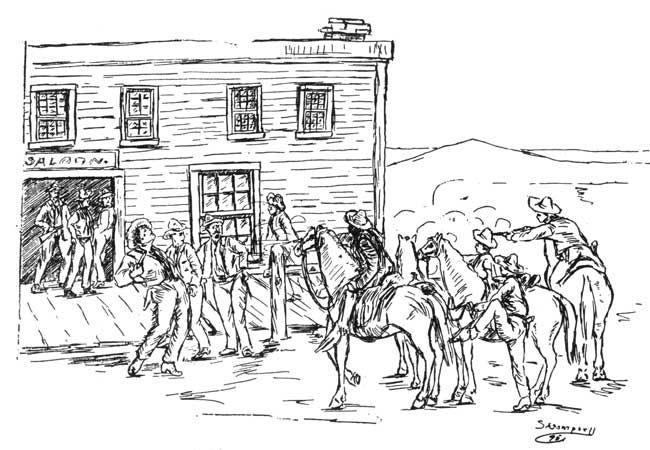
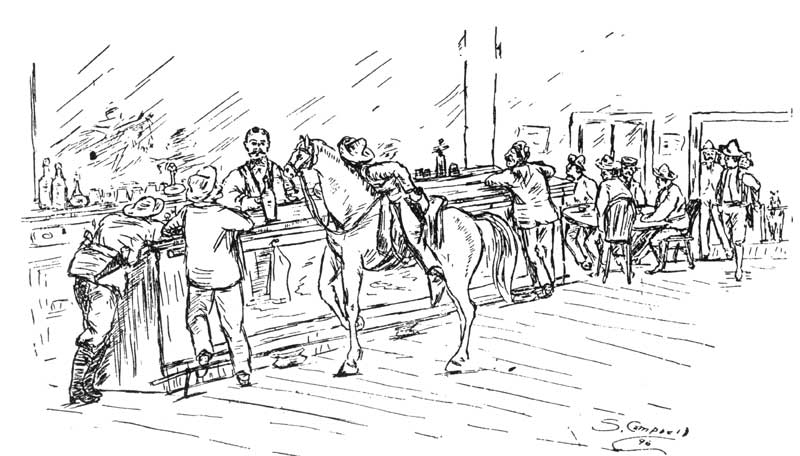
In May 1882, I was in Durango, Colorado, and chanced to be in a saloon
on Main street where a lot of us boys were together, among them being
Buck Cannon and Bill Woods. The drinks had been circulating around
pretty freely when Cannon and Woods got into a dispute over Cannon's
niece, to whom Woods had been paying attention, much against that young
lady's wish. After some hot words between the men, Woods drew his 45
colt revolver, remarking as he did so, "I will kill you," and in raising
it his finger must have slipped, as his gun went off and the bullet hit
a glass of beer in the hand of a man who was in the act of raising it to
his lips, scattering the broken glass all over the room, then passing
through the ceiling of the saloon. In an instant Woods threw three
bullets into Cannon, remarking as he did so, "I will kill you, for your
niece is my heart's delight and I will die for her." Buck Cannon's dying
words were, "Boys, don't let a good man die with his boots on."
Along in the spring of 1879 we sent to Dodge City, Kansas, with a herd
of cattle for the market and after they were disposed of, we boys turned
our attention to the search of amusement. Some of the boys made for the
nearest saloon and card table, but I heard there was to be a dance at
Bill Smith's dance hall and in company with some of the other boys
decided to attend. There was always quite a large number of cowboys in
Dodge City at this time of the year, so we were not surprised to find
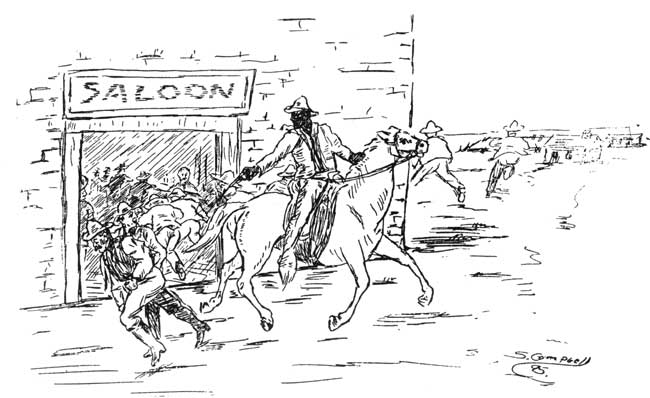
the dance hall crowded on our arrival there. Smith's place occupied a
large, low frame building down by the railroad tracks on the south. We
found many old acquaintances there, among them being Kiowa Bill, a
colored cattle man and ranch owner of Kansas, whose ranch was on Kiowa
creek. I had met him several times but this was the first time I had
seen him in a couple of years, but as he was dancing with a young lady I
could not get to speak with him at once. So I looked up a wall flower
and proceeded to enjoy myself. We had not been dancing long when I
became aware of a commotion over near the bar, and all eyes were turned
in that direction. I soon ascertained the cause of the commotion to be a
dispute between Kiowa Bill and Bill Smith, the proprietor of the place,
who was behind the bar. Kiowa Bill, after finishing the dance with his
fair partner, took her to the bar to treat her. Smith, who was tending
bar refused to serve her saying she had enough already. Kiowa Bill told
Smith he (Kiowa Bill) was paying for what she wanted to drink and that
he wanted her to get what she wanted. Smith said no, she could not have
anything more to drink as she had too much already. At this Kiowa Bill
reached over the bar and struck Smith over the head with a whiskey
bottle, partly stunning him, but he recovered in an instant and grabbed
his 45 Colt, Kiowa Bill doing the same and both guns spoke as one. Smith
fell dead behind the bar with a bullet through his heart. Kiowa Bill
rolled against the bar and slowly sank to the floor and was dead when we
reached him.
The next day they were hauled to the cemetery, laying side by side in
the same wagon, and were buried side by side in the same grave. Kiowa
Bill had made his will a short time before and it was found on his body
when he was killed.
I had known Kiowa Bill for several years and was present at a shooting
scrape he had two years before, down in Texas, near the Arizona line. At
one of the big round ups there, in 1877, myself and quite a crowd of the
other boys were in camp eating our dinner when Kiowa Bill rode up. He
had been looking after his own cattle as he owned over two thousand head
himself. One of the boys in our party who did not like Bill, there being
a feud between them for sometime, on noticing Bill approaching,
remarked, "If that fellow comes here I will rope him." True to his word
as Bill rode up, the cowboy threw his lariat. Kiowa Bill, seeing the
movement, threw the rope off at the same time springing down on the
opposite side of his horse.
 With the General Securities Company
The cowboy, enraged at his failure to rope Bill, shouted, "I will fight
you from the point of a jack knife, to the point of a 45," at the same
time reaching for his 45 which was in the holster on his saddle, which
was lying on the ground a short distance away. At that Kiowa Bill fired,
striking the cowboy in the neck, breaking it. Bill then sprang in the
saddle and put spurs to his horse in an effort to get away.
Several of the cowboys commenced shooting after Bill who returned the
fire. One of the cowboys, squatting down and holding his 45 with both
hands, in an effort to get a better aim on Bill, received a bullet in
the leg from Bill's revolver that knocked him over backwards, and caused
him to turn a couple of somersaults. Bill got away and went to New York.
He was later arrested in St. Louis and brought back. At his trial he
went free as it was shown that he killed the cowboy in self-defense. And
his appearance at the dance was the first time I had seen him since the
scrape in Texas.
Kiowa Bill was of a peaceful disposition and always refrained from
bothering with others, but if others bothered with him they were liable
to get killed as Kiowa Bill allowed no one to monkey with him. Such was
life on the western ranges when I rode them, and such were my comrades
and surroundings; humor and tragedy. In the midst of life we were in
death, but above all shown the universal manhood. The wild and free
life. The boundless plains. The countless thousands of long horn steers,
the wild fleet footed mustangs. The buffalo and other game, the Indians,
the delight of living, and the fights against death that caused every
nerve to tingle, and the every day communion with men, whose minds were
as broad as the plains they roamed, and whose creed was every man for
himself and every friend for each other, and with each other till the
end.
Another friend of the old times is Chas. R. Campbell, superintendent of
the Kelso mines. Chats with these good whole-souled people of the cattle
range bring back reminiscences of the past that would fill volumes but
space and time in these days of hustle and bustle are but dreams and the
world is full of them now.
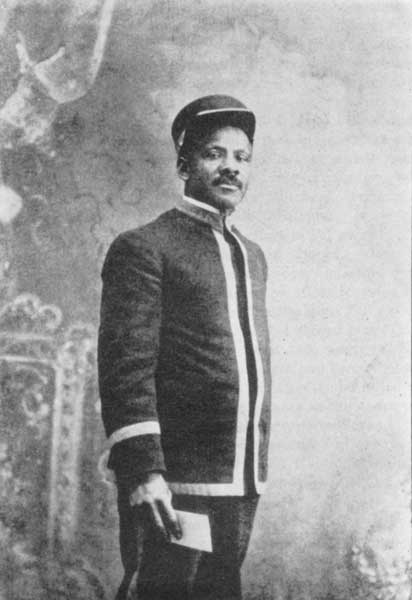
I am at the present time connected with the General Securities Company
in Los Angeles. Mr. A. A. C. Ames is president; Mr. James O. Butler,
vice-president; Mr. Jacob E. Meyer, secretary, and Mr. Geo. W. Bishop,
treasurer. These gentlemen are always extremely kind to me and the
appreciation I feel for the kindnesses shown me will be fully rewarded.
As I stop to ponder over the days of old so full of adventure and
excitement, health and happiness, love and sorrow, isn't it a wonder
that some of us are alive to tell the tale. One moment we are rejoicing
that we are alive; the next we are so near the jaws of death that it
seems it would be almost a miracle that our lives be saved.
Life today on the cattle range is almost another epoch. Laws have been
enacted in New Mexico and Arizona which forbid all the old-time sports
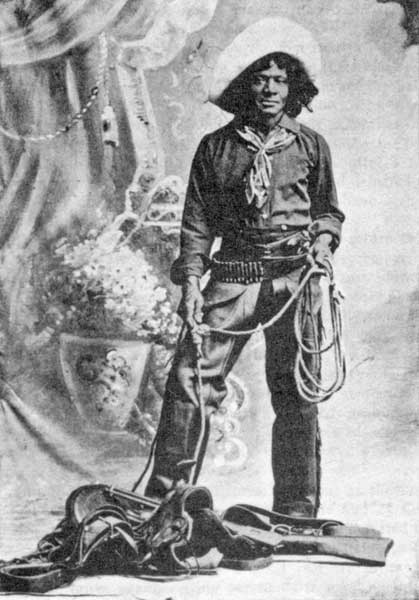
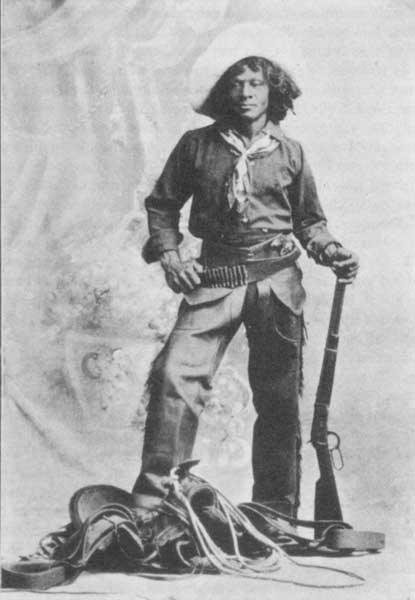
and the cowboy is almost a being of the past. But, I, Nat Love, now in
my 54th year, hale hearty and happy, will ever cherish a fond and loving
feeling for the old days on the range, its exciting adventures, good
horses, good and bad men, long venturesome rides, Indian fights and last
but foremost the friends I have made and friends I have gained.
Transcriber's note: The image source for this ebook was a modern facsimile
edition.