BY BEN HOGAN.
Flourens, the famous French physiologist, and member of the Paris Academy
of Science, asserts that the normal period of the life of man is ONE
HUNDRED YEARS. How comes it, then, that so few attain to this age, and
that the alarmingly small average of thirty-three years only is now the
measure of human existence? The question is a most momentous one, inasmuch
as it affects vitally every fireside and project in the world, and bears
strongly upon whatever measure of health, happiness and prosperity may be
permitted to us in this world.
Monsieur Flourens’ theory of the longevity of our race is founded upon
data the most conclusive. By the careful and lengthened observation, and
by numerous analytical experiments, he ascertained, beyond a shadow of
doubt, that it is a law of animal life, that all creatures that move upon
the face of the earth, and doubtless the tenants of the watery world also,
should exist for five times the number of years it took their physical
structure to come to a state of perfection. Man, it has been decided,
attains this condition of perfection at the age of twenty—that is, his
bones become united to the epiphyses and no longer grow. He has reached
the ultimatum of his stature. As long as the bones are not united to the
epiphyses he continues to grow; but once the epiphyses (which is a
portion of a bone separated from the body of the bone by a cartilage)
becomes converted fully into bone by age, then he has attained the climax
of his natural growth, so far as his osseous structure is concerned.
“For example,” says this distinguished Frenchman, “the union of the bones
with the epiphyses takes place in the camel at eight years of age, and he
lives forty years; in the horse at five years, and he lives twenty-five
years; in the ox at four years, and he lives from fifteen to twenty; in
the dog at two years, and he lives from ten to twelve years; and in the
lion at four years, and he lives twenty. This is strongly corroborative of
the correctness of the theory in relation to the longevity of man, which
cannot now, I think, fail to be accepted generally.” As a necessary
consequence of this feature of life, assured to us by Monsieur Flourens,
that able gentleman modifies seriously the different ages or stages of our
existence. “I prolong the duration of infancy,” he says, “up to ten years,
because it is from nine to ten that the second dentition is terminated. I
prolong adolescence up to twenty years, because it is at that age that the
development of the bones ceases, and consequently the increase of the body
in length. I prolong youth up to the age of forty, because it is only at
that age that the increase of the body in bulk terminates. After forty the
body does not grow, properly speaking; the augmentation of its volume
which then takes place is not a veritable organic development, but a
simple augmentation of fat. After the growth, or, more exactly speaking,
the development in length and bulk has terminated, man enters into what I
call the period of invigoration—that is, when all our parts become more
complete and firm, our functions more assured, and the whole organism
more perfect. This period lasts to sixty-five or seventy years, and then
begins old age, which lasts for thirty years.” To those who may be
desirous of inquiring why it is that man, who is obviously designed to
live to so great an age, so seldom attains it, Monsieur Flourens replies:
“With our manners, our passions, our torments, man does not die; he kills
himself!”
In view of these facts, then, and of the universally received opinion
that, in this day and generation, man does not live out even one-half of
the years apportioned to him by the Creator of all things, is it not
astonishing that physical culture and the best and surest modes of
attaining health and strength, as well as this maximum of human life, do
not command the first place, not only in every family, but in the councils
of the nations also? The generations come and go on half time only; and
that, too, under a pressure of weakness, disease, and discomfort which
renders the life of millions a burden to them.
Take the healthiest acorn that has ever fallen from the soundest and most
gigantic oak, and plant it in poor and uncongenial soil, or in any
locality shut out from the atmosphere or the sun, and it must die, or at
best present sent us with but a sickly sapling which can never attain the
strength or the dimensions of its progenitors; at least, not until it is
transplanted into the sunlight, and brought under the benign influence of
the nutriment proper to its healthy development and growth. Light and
heat, fresh air and pure water, are indispensable to its existence from
the moment of its first appearance above the soil; for without these it
must perish. Here, however, its requirements seem to cease; for, under the
influence, presuming the soil to be suitable, its mission may be
accomplished to the fullest extent. And so it is, measurably, with the
animal kingdom also. All these elements are part and parcel of its
existence, so to speak; for failing the proper and unrestricted enjoyment
of any one of them, it must suffer generally, and in many cases to a fatal
extent. As regards man, however, his true physical development requires
more care and caution than that of any of the lower animals. Nature, and
the instincts of the latter, are sufficient to meet all the necessities of
their case; but man being endowed with the higher attribute of reason for
his guidance to mental as well as physical perfection, he is called upon
to use that attribute in relation to building up his physical structure on
a broad and sure foundation, and in so doing establishing a true and
healthy basis for his metaphysical structure also. The brain sympathizes
with the whole system, and is, consequently, affected by the imperfections
or the disarrangements of any of the other organs. A vigorous mind is
incompatible with a diseased brain; and as a sound and healthy brain
cannot possibly be associated with a physical system suffering from the
feebleness and the countless ills that result from a neglect of those
means which are found to be indispensable to the creation as well as the
preservation of health and strength in the animal, we all can, at a single
glance, perceive where we stand, and what our duty is in the premises. The
case lies in a nutshell: are the men and women in whom the rising
generation shall culminate to be splendid types of strength and physical
beauty—to be possessed of that noble manliness of form that characterizes
some of the ancient sculptures on the one hand, and the beautifully
moulded and exquisitely developed bust and limbs which individualize the
Venus of Titian on the other? I ask again, shall they present those
exalted features, individually, or shall they, like so many of the men and
women of the present time, go shuffling along the streets hollow-eyed,
narrow-shouldered skeletons, with complexions that would do no discredit
to a charnel house, and bearing, even while yet young, all the impress of
declining years?
Of course I, in the first place, address myself to parents and to all
those who are interested with the care of youth; and here I would observe
that, for the most part, a long life of health and happiness is utterly
unattainable, save through the medium of a pleasant and systematic course
of physical culture or training, to be observed from early youth to
manhood, and from this latter to the utmost limits of our declining years.
It will, however, be readily perceived that this system of training must
be such as to adapt itself to the necessities of the various physiques and
natures which so widely characterize all communities; and that care must
be taken not to confound these different constitutions one with the other.
Plenty of pure, fresh air, and gentle exercise, a sufficiency of plain,
wholesome and suitable food; the proper quantity of sleep, and a judicious
use of the sponge and slightly tepid or not absolutely cold water, are the
starting points for the young on the way to health and strength, and the
possession of a physique capable of the greatest endurance, and of
ministering, in the highest degree, to the realization of those mental and
sensuous enjoyments which so crown the sum of our earthly happiness.
During the period of dentition, or for the first ten years, as Flourens
has it, great care must be taken not to overtax the brain or the physical
organs of the child to any extent whatever. While yet in the arms of the
nurse, the babe should have an abundance of open air sunlight in mild
weather, and, when practicable, be permitted to inhale the pure, fresh
country breezes. This, when supplemented by the nutritious element of a
mother’s milk only, will lay the first, sure stone in the foundations of
future health and strength, and soon enable the little prattler to move
about unsupported as best he can, until, at last, he takes to his feet
and, prompted and sustained by more solid, but yet simple food, begins to
shift for himself on a small scale. As he grows up, and his bones and
muscles begin to assume consistence, care must be taken that he is never
permitted to remain long standing on his feet at one time, as the
superincumbent weight of his, or her, body, as the case may be, tends to
bow the legs, and thereby destroy the symmetry of the whole form. It is
because of the neglect of nurses in this relation that we meet with so
many persons who are rendered physically incapable of stopping a cat in
even the narrowest passage, and that are neither more nor less than
deformed for life. The wooden walking-frame on wheels, to which the child
clings, must not be placed too near the cradle. No child should be
entrusted to his legs before he is a year old, and then only for a short
period at a time, as just observed.
The great secret of the success sometimes observable in the early
education of children, lies in the faculty of their preceptor to divest
their lessons of everything pertaining to the character of a task, by
surrounding them with the fascinations of a pastime. In this way, their
mental faculties will become gradually developed, and with their own
concurrence as it were—a result which is seldom or never realized by
keeping them staring into the dull features of the twenty-six letters of
the alphabet, framed in the monotonous page of monotonous primer. Familiar
objects and pleasant pictures should furnish the first mental food for
the young; nor should their faculties be taxed beyond these, until both
brain and muscle acquired something like true consistence. When it is time
to begin to educate the mind in a more serious and formal manner, it is
time, whether the subject be boy or girl, to begin the course of physical
training of which I have already spoken, and failing which both mind and
body must suffer alike.
Let me, then, while entering upon this part of my subject, direct
attention to the fact, in the first place, that every household in the
land, rich or poor, high or low, has within itself the elements of a
gymnasium; nay, more, that every individual who walks the streets or the
fields, can, in his or her own person, command those elements to a large
extent. For example, every movement of ours, no matter how simple or
complex, brings a certain muscle or set of muscles into play, and such
movement is represented by some fact in the gymnasium which takes
precisely the same muscle or set of muscles, and which tends to develop
and strengthen them. Now, from this one observation, it will be apparent
to even the most casual reader, that a gymnasium contains within itself
all the aids necessary to the true development of brawn and muscle; and
that it tends toward perfecting and assuring every physical motion made by
us in the pursuit of our daily avocations, or in the pursuit of any
project, no matter how trifling, laborious or trying. The truth is, the
gymnasium is the great builder up and educator of our mere physical
system, and the promoter of health and strength and manly or feminine
beauty. It is the deadly enemy of all disease and nervous debility; from
the fact that it enlarges the chest, invigorates the lungs, and gives them
fuller scope and power, and so strengthens, trains and indurates the
muscles, that the mechanism of the human frame, under its wondrous
influence, becomes almost invincible and capable of performing, with ease
and precision, feats of strength, agility and endurance, of which the mere
novice has no idea whatever. Whether we practice its usages in public or
in our own private apartments, the result is the same—health, strength
and manly or feminine beauty wait upon them. Our enjoyment of life is
keener, our presence more impressive, and our movements filled with easy
assurance and well-defined grace. Between the ladies and gentlemen given
to these healthy and invigorating exercises, and those who neglect them
and wear their flesh loosely upon their bones, there is as much
difference, and to the prejudice of the latter, as there is between day
and night. The one class moves with head erect and expanded chest, while
the pavement rings beneath its heel and the flush of health suffuses its
cheek; the other, with mincing step, sallow cheek, contracted chest and
lack-luster eye, picks its way along, as best it can; and, when fatigued
in any degree, throws itself into an easy chair to languish many a weary
hour away. This is no overdrawn picture, as a 3 o’clock saunter through
any of our fashionable squares or thoroughfares will verify. But sad as
the case is in this one relation, there is a remedy for it if it be taken
in time; and that is, a judicious course of physical training and
exercise, as much as possible in the open air; gentle and with but little
exertion at first, but gradually leading up to that glorious and matchless
point, where the patient, now a totally new being, revels in feats of
strength and agility that he or she formerly supposed to be unattainable
on the part of either.
In order to insure perfect health, the body ought to be sponged with cold
water daily, the various muscles should be exercised for a short period,
and submitted to the action or tension proper to them, whether in running,
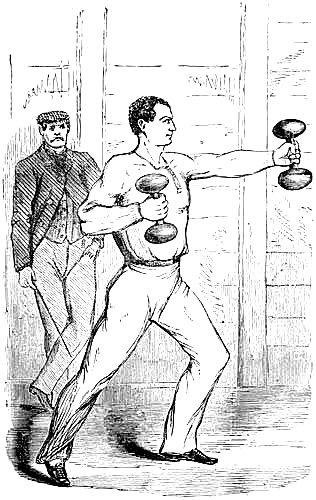
lifting, striking, stretching or posturing. The chest should be expanded
by the use of dumb-bells; and the muscles of the arms strengthened by the
use of clubs or the trapeze—which latter is of general utility, inasmuch
as it can be brought to bear upon nearly all the muscles. The lungs, also,
must be distended to their fullest capacity, by frequent gulps of pure,
fresh air; while the chest, during the time they remain inflated, must be
gently beaten with the palms of the open hand, so that the air may find
its way into the minutest of the cells. If this system of training were
observed with any degree of intelligence and regularity its beneficial
results would be felt almost instantly, and even in the case of the weak
or suffering, who would, at first, be obliged, of course, to indulge in
but homœopathic doses of this regime, until they became accustomed to
it, and began to delight in all its fascinating phases. Physical strength
or beauty without physical health being an impossibility, we can perceive
how necessary it is to establish, restore or preserve the latter, as the
case may be; and as this cannot be effected if the muscular system is not
adequate to all the reasonable demands upon it, we cannot fail to
apprehend the vital importance of keeping it in a state of the highest
efficiency. But while attempting to accomplish this latter we must
remember that to overtax either it or the nervous system would be to
frustrate the object had in view, and to almost make the cure as bad as
the disease. To avoid this, we must therefore study the peculiarities of
our physique, and the precise nature of our constitution, in relation to
the exercise and the food we take. There is an old saying, “One man’s meat
is another man’s poison,” and a true saying it is. And here it may be
said that the opinion and advice of the experienced athlete and
professional trainer may be of some value, who invariably makes himself
acquainted with the peculiarities of the physique and the constitution,
before he makes a single move, and who cleanses the system of all
impurities before he begins to build it up into a perfect and impregnable
whole. To adopt any other course than this would be but to mask or
paralyze the seeds of disease for the time being only; for, if the system
is not purged until it is as free from crudities, and as pure as that of a
child, the seeds of decay and death will lie at the foundations of any
superstructure into which it may be sought to build it.
Those who are conversant with the mysteries and mechanism of the human
frame, and who have studied its anatomy and its physiology, will tell you
that its four hundred muscles, that are the primary agents in all our
physical movements, are, in so far as the voluntary ones are concerned,
sure to suffer vitally if not properly trained and kept in constant use.
It is, indeed, to their exercise only that their efficiency is mainly due;
for to allow them to fall into disuse for any length of time, would tend,
not only to weaken them, but to paralyze them completely, which, of
course, means to paralyze the whole frame. If we would set wind and
weather, fatigue and hardships, at defiance, our muscles must be as hard
as iron and our lungs as tough as leather. This condition once attained,
the world is ours for the winning, for with these characteristics, an
industrious spirit, and the fear of God before our eyes, we may, with a
fair education, aspire to any eminence attainable in this free land. By
constant and judicious exercise our muscles become fully developed,
enlarged and strengthened. Look, for example, at the arm, or any of the
limbs, or the chest of a young man who has never had any physical
training, and what do you behold? Nothing in true shape; nothing full of
life or resistance; everything soft and flabby and girlish; in short, a
frame incapable of the slightest endurance, and a hot bed ready to receive
and force at any moment the seeds of disease. On the other hand, take in
at a glance the limbs and form of the man of trained muscles, and who is
accustomed to the exercise necessary to their perfection. Mark his well
assured and elastic step! His flesh, through the constant use of the
sponge and proper exercise, is at once as fine as silk and as firm as
steel. Were he to spring from a height of thirty feet, not a fibre of it
would shake on his bones when he had struck the ground. Look at his finely
developed chest, and his classic arm, glistening and corded like that of
the Farnese Hercules. In truth, he is every inch a man, and such a one as
a woman might well take to her bosom as her protector and the partner of
her life. In like manner, compare the limp and delicate young miss of
eighteen or nineteen who languishes her life away in drawing rooms, at
evening parties, or in her carriage, with the brusque beauty of the same
age who indulges in the training and exercises proper to her sex—whose
muscles, through judicious manipulation and use, have become firm and
strong, and who can walk two or three miles at a rapid rate, without
suffering the slightest fatigue. What a contrast we have here: The cheek
of the one is dull and colorless, and her eyes devoid of true fire and
brilliancy. Her whole frame is unstrung and limp, and her step uncertain
and feeble. On the part of the other, we perceive the roses of health
lighting up her face; we observe her arms beautifully rounded and firm,
and her bust splendidly developed, while her step is as elastic as that
of the fawn. All her muscles having been trained, her whole form becomes
a model of classic beauty, and she, in consequence of her constant use of
the sponge and cold water, and from her absolutely breathing fresh, pure
air only, renders her skin as fair as snow and as smooth and fine as
satin, while her health becomes so robust that she enjoys all the
blessings and comforts of life with tenfold zest.
But, as already observed, physical culture must never be characterized by
anything approaching overtraining; for to tax the muscles or the system
beyond their well-defined power of endurance, would be to injure both
materially and perhaps permanently. We must, in this relation, study our
own physique, and be guided by its premonitions. If we find that any of
our muscles are weak and not fully developed, we must bring them into
training gradually, never testing them to the fullest at first. If we are
capable of lifting but eighty or a hundred pounds when putting forth our
full strength, let us begin with fifty or sixty pounds, adding to that
weight, day by day, a single pound for example, until we reach the eighty
pounds, which we shall be able then to lift with the greatest ease. By
this system of judicious or gradual augmentation we shall find ourselves,
in a few weeks, able to lift a hundred pounds with greater ease than we
had lifted the sixty pounds when first testing our strength in this
direction. And this may be taken as an example of how we ought to proceed
in all our exercises for developing, strengthening and hardening the
muscles, expanding the chest and enlarging the lungs. We must perform the
work gradually and intelligently. We must not fatigue ourselves to an
uncomfortable extent when we first take up our dumb-bells, or clubs, but
accustom ourselves to them by degrees, until their use involves but
little exertion. In like manner, when we would inflate our lungs with
fresh air, should they be weak in any degree, we must commence by inhaling
smaller volumes, gradually augmenting them until we feel that our chest is
distended to its utmost capacity. By observing caution in all these
relations we shall, if we persevere intelligently, soon begin to feel and
enjoy the inestimable blessings that arise from true physical culture, and
be able to accomplish feats of strength and agility of which we were
before utterly incapable.
And when we come to consider that the brain shares essentially and largely
in the benefits arising from this culture, and that through its agency it
is capable of doing more and better work than if it should be unaided by
the physical training of our body generally, how important does this
subject become at once. No man can perform with ease any great amount of
mental labor where physical culture has been neglected, or who does not
use the sponge freely and indulge daily in the proper amount of physical
exercise. This, together with pure cold air as food for the lungs and
suitable diet, will accomplish miracles, and tend to secure health and
happiness, presuming always that our habits are temperate, and that we
eschew those excesses—such as the immoderate use of wine and tobacco—of
which we perceive so many victims of all ages and sexes, and which in even
the healthiest constitutions sometimes sow the seeds of disease and death.
It would, of course, be almost impossible to lay down rules for every
case, but as a general thing the system of physical culture, as explained
by me to the gentlemen referred to in my introductory notice, and of which
I have given some hints here, may be followed without the slightest
misgiving. Obviously, however, it must be modified to suit the years and
the constitution of those subjected to it; but how young or aged soever,
how delicate or robust, it can, under judicious guidance, be made to build
up into perfect health and strength those who are feeble, constitutionally
or otherwise, and assure and develop the muscular resources of those who
are already in possession of a sound and healthy constitution. The aged
also will find great benefit from it, and from a careful and gentle
exercise of their muscles and the constant use of the sponge and cold
water. To all of what I have hitherto observed on this subject, well
ventilated residences and bedrooms must be added, as a sine qua non, for
neither health nor strength, nor anything pertaining to true comfort, can
be found in connection with badly ventilated bedrooms. The air we breath
becomes impure and vitiated while being expelled from the lungs, and is
utterly unfit to be inhaled again. Consequently, if through some open
casement or door there is no mode of escape for it, once it has performed
its mission, or no mode of ingress for fresh, pure air from without, we
are, while slumbering during the silent watches of the night, not only
marring the completeness and refreshing character of our repose, but
actually poisoning ourselves by slow degrees. We must, therefore, never
submit to any conditions that will shut out the pure, fresh air of heaven
from us, awake or asleep; for it and the bright, warm sunlight falling
upon us whenever it may, are indispensable to our mental and physical well
being—the sun bath itself being a great promoter of health.
In my experience as a trainer and athlete, I have met with numerous
instances where ladies and gentlemen, of weak constitutions originally,
and frames the most feeble, became, through a judicious course of physical
culture, not only healthy in the first degree, but robust, powerful and
agile. In fact, I question very much whether any disease common to our
race may not be thoroughly eradicated by a system of physical training,
while it is equally obvious that the adoption of such a system under all
ordinary circumstances secures the body from the attacks to which it is
subject in this relation. In addition, should fate so decree it that a
frame developed and strengthened through a good system of physical
training, should fall within the power of any of the diseases incident to
us, it is quite plain that the chances of recovery are infinitely beyond
those shared by the patient whose body is all unstrung, and who is
incapable of presenting any physical resistance to the inroads of the
malady. Let this be engraven upon our memories, for rest assured that long
life and happiness wait on physical culture; and that no good work, mental
or otherwise, can ever be achieved where it is wholly neglected.
Our whole structure, with all its delicate and complex machinery, is
entrusted to our keeping; and when we come to glance at its numerous
nerves, its four hundred muscles, its two hundred and fifty-two bones, and
its various organs, we will be able to perceive that it behooves us to be
most careful and systematic in our treatment of it. Some persons may
possibly be inclined to say that our involuntary muscles are not under our
control; but, then, the objection can be disposed of summarily by
instancing the act of the suicide, that in a single moment stills them
forever. It is, therefore, incontrovertible that our physical organism is
placed in the charge of our mental, and that any neglect or mismanagement
of it must result in disease or discomfort, and the lowering of its
legitimate powers and mission to a grave extent.
Rock salt, dissolved in the tub, when we are about to use the sponge,
will be found to heighten the efficacy of our bath. When well sponged,
from head to foot, so that our flesh and pores are thoroughly cleansed of
the effects of perspiration, which so tend to clog the latter, crash
towels should be applied briskly until we feel a warm glow, when soft ones
may be used to dry the skin thoroughly. None save those who have tried it
can be aware of the pleasure derived from this invigorating process, and
the absolute comfort to ourselves, which invariably follows it and abides
with us until we again perform our ablutions. The clogging of the pores is
a fruitful source of disease, and should never be permitted to obtain for
a single hour. If perspiration be obstructed in any way, our internal
organs and whole system begin to suffer at once. All our secretions must
flow freely to make health possible; therefore, the constant use of the
sponge and the bath is necessary to our very existence. Any neglect in
this relation will register itself at once in a sallow complexion,
eruptions of the skin, and general debility, if not the active development
of some serious disease. Let this be borne well in mind, and acted upon,
and we shall have cause to be grateful. The bath and sponge form a primary
element of physical culture, for without them the proper training of our
muscles becomes utterly impossible. The pores must be kept comfortably and
uniformly open before we can realize the benefit of active physical
training, and this can be effected only by means of the sponge, which
should be applied every morning, and after any violent exercise, which had
caused us to perspire to any unusual extent. In this latter case, however,
care must be taken to use tepid or slightly warm water only; for cold
water, under the circumstances, might be accompanied with injurious
effects, and tend to close suddenly the pores that had been already so
much relaxed through over or active exertion.
There is another advantage connected with physical culture and athletic
exercises which is of all importance, and especially to the young; it is
that of a tendency toward temperance, and the utter rejection of all
excesses touching the use of spirituous liquors, and that of tobacco also.
There is nothing so prejudicial to the system and to manly beauty as the
immoderate use of the wine cup. No man who indulges in alcoholic drinks or
in the “weed” as it is called, can ever be all that he should be. The love
and the respect of a pure and good woman is lost to a man, or never
accorded to him if he will persist in the debasing use of the bowl; and
when he is deprived of this—when he is a pariah to the sex—there is not
much left for him to live for here below. Let me not be misunderstood in
this important point:—no man who is given to the immoderate use of whisky
and such abominations has ever secured happiness to himself or the partner
of his bosom. I need not dwell on this part of the subject. The newspaper
press and the experience of thousands bear evidence to the truth of what I
say, in the countless illustrations presented to us daily. We must, then,
if we would be men, eschew the bottle and take the way pointed out by
temperance and virtue, which simply means the way of happiness, prosperity
and peace.
The mind and body appear to go hand in hand. When virtue imbues the one,
health and strength appear to wait on the other. It is the order and the
way of heaven. Neither soul nor body is ever itself in abnormal
conditions. The way is clear before us; and we who would attain the
highest standards of perfect man or womanhood must obey natural laws, and
conform to them systematically.
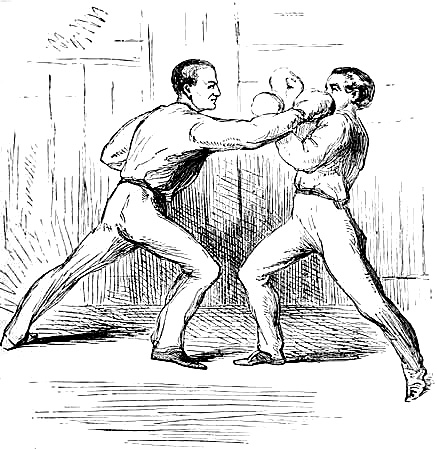
Against what is called the “manly art of self-defense,” or pugilism, there
is a popular prejudice, which is not founded, I think, in experience or
common-sense. There is not a gentleman of my acquaintance, or, I presume,
in the world, who does not recognize the utility of the art of
self-defense. Not very long ago the newspaper press published an incident
which may, I think, be regarded as a case in point. It occurred on a
railroad car, and in relation to a couple of ladies, evidently of delicacy
and refinement, whose ears had been assailed by some indecent language and
ribald jests on the part of two burly scoundrels, who were seated behind
them. Fortunately, there was a well-known athlete in one of the seats
directly opposite the ladies, and he interfered at once, begging the two
men to discontinue their objectionable language or to retire to the
smoking-car. This was the signal for a volley of abuse, and certain
threats, which had for their object the intimidation of the speaker, and
which were followed by a renewal of their objectionable sayings, intended
still further for the ears of the ladies. Upon this, the champion of
decency and good conduct arose from his seat, observing, at the same time,
if there was a repetition of the offense he would eject both the men from
the car, in which there were but two or three additional passengers. Upon
this, the two ruffians jumped up, and, bounding over to him, with most
opprobrious epithets, dared him to make good his threats. There was not
another word on the subject; for, with the speed of lightning, the athlete
sprang upon them, caught one in each hand, and, dashing their heads
together, whipped them off their feet and dragged them out of the car, and
into the smoking-car, upon the floor of which he threw them, simply
announcing his name, which was quite enough for the pair of vagabonds, as
they did not put in an appearance in the car from which they had been
ejected for the rest of the journey.
Now, it is quite obvious, that had not this gentleman undergone a course
of physical training, he could not have disposed of the ruffians as
summarily or have done such meritorious work in the service of the two
refined and delicate creatures whose ears had been thus outraged—nay
more, he could not have protected himself from an assault had it been made
upon him, had he not had trained muscles, which enabled him to illustrate
the utility of this art by not only avenging himself for an outrage
committed on all decency, but upon ladies into the bargain. Had he not
been in a position through a well trained physique, he would have been
constrained to submit to all he had seen and heard, and the axiom
“self-preservation, etc.,” would have been a dead letter to him; but as
the case stood, he not only vindicated his manhood, but won a handsome and
wealthy wife besides.
Strange as it may sound in some ears, I have not met a noted pugilist who
was not a gentleman. True, there are some men connected with the
profession who forget themselves from time to time, but, as a general
thing, all the stars of the ring have been good members of society.
Sayers, Heenan, Goss, Spring, Crib, Morrissey, Edwards, etc., have all
fine records; and yet I am very far from recommending the profession as a
desirable one. It has its disadvantages, and serious ones of course, but,
then, it has its redeeming side also. It repudiates the pistol, the
bowie-knife, and every implement of the assassin, and is, withal, an art
of peace, so to speak. I have never met a true son of the ring who was not
as peaceable as a child, however unflinching or dogged his courage when
once before the public.
Habit, they say is second nature. How necessary therefore, that our
habits should be pure and good and conducive to health and strength. Our
diet, our clothing, and the manner of our exercise should all tend to
building up a perfect manhood. Under proper training, the human frame is
capable of most wondrous feats of activity and endurance. I have been
informed, and quite recently, that not long since a gentleman who holds a
position in one of the gas companies of this city picked up in one hand a
weight of two hundred and twenty pounds, at an exhibition in Gilmore’s
Garden, and flourished it above his head. This was a wondrous feat of
strength, and could no more have been accomplished by a man with untrained
muscles, than could the removal of the Adirondacks by an infant. What
should be the question, then, with every young person of either sex in the
land? It is this, “Shall we enjoy the whole—the entirety of the life that
the Good Father has given us, or shall we drawl out an imperfect existence
from the cradle to the grave?”
Wealth has its mission, but what can it in any individual case accomplish
without health? No matter how soft the cushions, no matter how luxurious
the appointments, without health there is no enjoyment. When, therefore,
life and light and health are placed in our keeping, to neglect the great
boon is criminal. I tell you that you must cultivate life as you would an
apple tree. It is in your keeping. You must not slur it over, and pet it
one day and neglect it the next. Take it to your hearts all who read; keep
your frame, your body, free from all impurities through the medium of
temperance, healthy exercise, and the bath, and when the Angel of Death
calls you home to God, you will have already acquired the rudimentary
wings.
Now, to be more explicit, were such within my power, take an individual
case: Here we shall suppose a delicate lad, as nerveless as the chicken
that has just cracked its shell, and what shall we do with him? Say his
years are ten or twelve. We shall begin to develop his muscles, which
means strengthen his flesh until he feels himself that he can do
something. We must take him inch by inch, so to speak, and give, by
exercise and judicious manipulation, strength and consistence to his
frame. If we find him weak in any particular direction, we must see to it.
We must grasp the muscles that are known to be identified with that
particular feature, and develop their power and capacity. When we come
into contact with anything that is feeble, we must treat it with care; we
must manipulate it, knead it, so to speak, until it has got true
consistence and a name. We must call it into action gradually and
cautiously, until it grows, as it were, under our hands, and begins to
perform its mission with an efficacy and certainty of which we had no
previous conception. And what does it all mean? It means health, strength,
enjoyment of animal life, and enjoyment generally, so far as our mere
physique is concerned. We are all subject to disease and discomfort
bodily; but in ninety-nine cases out of a hundred we can avoid it or stave
it off; we can fortify ourselves against it if we only keep the citadel of
our body well manned by pure organs and good desires.
All the feats of strength of which we hear and read, are not the result of
merely accidental muscular action, but an effort of well-trained muscles
and of a desire to accomplish with ease and precision something out of the
ordinary course of our action. The man who lifted the two hundred and
twenty pounds with one hand in Gilmore’s Garden began, perhaps, with
lifting twenty-eight pounds. Nor was there so much of a difference
between the weights lifted this day and the next, so to speak. There was
a gradual augmentation of weight and of power; and here is where the
secret of all physical strength lies.
Now, much that I have said in relation to gentlemen applies to ladies
also. Both are subject to the same laws of health and development. No
matter how perfect and beautiful the form, it is still in a plastic
condition. God gives the exquisite outlines, but it is for us to fill them
up as it were. There is the arm, the bust and the limbs generally, but
without physical culture they cannot attain the contour of expression in
which their strength and loveliness should culminate. The spirit never
glories in its habitation to so great an extent as when the body is at its
best. The mysterious link between the one and the other is placed in our
hands, and if we would unite them perfectly we must do it through
temperance, true religion and physical culture. The means of the latter
are placed within the reach of every individual, and to neglect them is to
rebel against heaven and our own existence. Pope said more than he had
intended, when he wrote “the proper study of mankind is man.” No doubt he
had special reference to man’s metaphysical nature, for his was an age of
metaphysics to a very grave extent; but the truth is, the study of our
physical structure is of the first importance, for without a knowledge of
it, its peculiarities and necessities, we shall be unable to give fair
play to our other self.
A marked illustration of the benefits of physical training may be found in
the fact that the skeleton of the famous Tom Sayers—for, if it must be
confessed, the body of that noted pugilist was not permitted to remain
undisturbed beneath the sod—presented bones of a texture so hard and so
fine as to create surprise on the part of the medical men who inspected
them. They were almost like ivory, and this, it was admitted, was owing to
the continual hard rubbing of his limbs and the constant exercise of his
muscles. This hand rubbing is a wondrous advantage in more than one
relation. In my own experience I have found it to almost work miracles. In
one case, a youth of seventeen, who had been given up by the doctors as a
hopeless consumptive, happened to mention the circumstance to me. One of
his lungs was, as I could perceive, very much diseased; but I thought that
he might, notwithstanding, be saved yet. I took him in hands, and began by
sponging his body regularly with tepid salt and water, and then drying and
rubbing him gently with the palms of my hands, until his body was all
aglow. I now insisted that he should, when the weather permitted it, take
daily a short walk, during which he was to endeavor to inhale as much
fresh, pure air as his lungs would contain. I soon found that with
judicious diet, he was beginning to creep up a little, so I began to
lengthen his walks, and at times to give him a short drive over rough
roads in a common wagon. Although he came into my hands an absolute
skeleton, in three months he gained eight pounds in weight, and was
evidently determined to cheat the doctors. And yet, during that period he
did not take a single particle of physic. The fresh air, the gentle
exercise, and the constant hand rubbing of his limbs and his chest, which
I began to expand, first with wooden dumb-bells, did the work, for the man
is alive and well to-day.
It may not be generally known, but it is nevertheless true, that the hand
of a healthy man when brought to bear in rubbing the body of an invalid,
imparts a portion of his own strength and magnetism to the sufferer. And,
although there are certain instances in which the services of the
educated physician may not be dispensed with, yet, in the matter of weak
lungs, weak physique and spinal derangements, the professor of physical
culture has the advantage beyond all question. And this reminds me of
another incident in my experience. The daughter of a very dear friend of
mine, a child of about nine years of age, had a spine so weak that it
became curved and shapeless; indeed, so much so that the poor little thing
was quite deformed, to the despair of her parents, who loved her as they
did the apple of their eye. Every remedy had been applied by them, but
without avail; for there still sat the poor, pale, sickly thing, with the
prospect of an early grave staring her in the face, or at best a life of
suffering and misery. The first time I saw the sufferer and was informed
of her malady, I felt assured that the rock salt bath and hand-rubbing
would relieve her, if not result in a permanent cure. I gave directions,
to be followed in my absence, having first myself performed one operation,
during which I permitted the cold water from the sponge to drip from time
to time along the spine. About two months afterward I made another visit
to my friend, when I was well pleased to meet my little patient apparently
quite well, and playing briskly on the sidewalk with some children of her
own age. And so I found it in every case in which this treatment was
applied to a weak frame or deranged nerves. There is an efficacy and a
magnetism about it that is irresistible, as all who may have occasion to
try it can prove to their satisfaction.
It may be interesting to many to be informed of the mode adopted by
experienced trainers and gymnasts in building up the system of a man when
preparing him for great feats of endurance and strength. In the first
place, the system must be purified and the liver and all the organs
brought into the healthiest of conditions, which is now generally effected
by the free use of lemons and castor oil. Formerly calomel and the black
draught were resorted to for this purpose; but as the former was sometimes
inclined to remain in the system, lemons came into use as safer and more
efficacious. When the system, then, is purified of every impurity, the
building up and strengthening process begins. Early in the morning the
subject arises, and after a slight ablution, during which he carefully
scrapes what is called the fur from his tongue with a thin piece of
whalebone that he between his teeth bent, and then draws over his tongue
after the manner of a rake. By this means, and by gargling his mouth and
throat with cold water he is in a condition to enjoy a cup of tea without
milk or sugar and a single piece of dry toast. This disposed of, he takes
a short walk of say a quarter of a mile, and returns to breakfast, when he
sits down to a mutton chop and toast, etc., still taking tea without milk
or sugar. After breakfast he takes a rest of about half an hour, and then
starts forth on a walk of from four to ten miles. Returning about 10
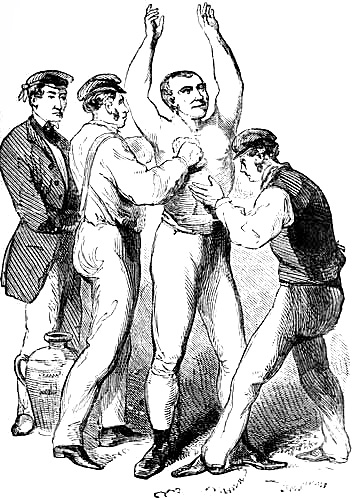
o’clock, after perspiring freely, he is rubbed dry and permitted to rest
on his bed until he becomes quite cool. Then comes the strong rock-salt
bath and sponge, after which, and on being rubbed dry once more, his
muscles and flesh are manipulated by the naked hands of the trainer for
two hours. His next meal is composed of a heavy beefsteak, some calf’s
foot jelly, toast, and perhaps a bottle of Bass’ ale. He drinks but little
or no water, as this liquid has a tendency to fatten and render the
muscles flabby when taken internally. An hour’s sleep may now be indulged
in with advantage, after which comes a regular course of exercise,
embracing pulleys, bars, clubs, dumb-bells, sand and bean bags—the sand
bags hanging from the ceiling, to be hit in the manner of a man, right and
left, with a view to strengthening the hands and packing and hardening the
muscles, and the bean bags to be thrown between him and the trainer, the
one and the other catching them in turn, so as to train the eye and the
hand to quickness. In these exercises every muscle is brought into play,
and all the limbs made to perform every movement of which the body is
capable, so that all the muscles are developed alike, and ready at any
moment to do, with the utmost efficacy and precision, the work proper to
them. After a good rest, and at about 5 o’clock P. M., there is a moderate
sponge bath and lots of rubbing. Indeed, so important is this latter, that
if one man is not able to accomplish it, more help is called in. Supper at
6 o’clock, of broiled chicken, without a particle of grease or butter, a
cup of beef tea, some dry toast, and, if found necessary, sometimes a
little genuine old port wine and beef tea mixed. Oat-meal and a few
raisins are now and then called into requisition—the former in the shape
of porridge and the latter mixed with gruel made of oat-meal also.
But this treatment must not be supposed to apply to all cases, as there
are constitutions which might require one totally different in so far as
diet is concerned. Indeed, the trainer’s judgment must be exercised here
with the greatest caution, for to be unable to discriminate between
constitutions, or to determine the quantity and quality of the food, as
well as the quantity of exercise necessary in every individual case, would
be to fail signally in his profession, and to be liable at any moment to
do almost irreparable damage to his man.
Although the implements of training proper to the muscular development of
ladies may be lighter than those suitable for gentlemen, yet they are all
modeled after the same fashion. Of course, it would be quite unnecessary
and indeed wrong to subject the gentler sex to the excessive exercises
necessary in the case of those who are supposed to be engaged in a
hand-to-hand struggle with the world, or any of those vocations which
require iron brawn and muscle in their successful pursuit. Still, the
principle running through both modes of training is the same, and the
treatment moderated only in the one case, to meet the necessities of sex
and organization. But, as already laid down, I hope impressively, no
matter how lovely or symmetrical the form, to secure strength and
consistence the muscles must be well trained and the bath constantly used,
if health and personal beauty are to be secured permanently. We are not to
suppose, however, a lady needs that degree of physical culture that would
enable her to lift two hundred weight in one hand and flourish it above
her head, but we are to expect that she will keep her frame in a condition
that will enable her to endure any moderate degree of fatigue without the
slightest inconvenience, and that a brisk walk of three or four miles will
only serve to sharpen her appetite rather than to prostrate her for a
whole afternoon.
There is no enjoyment of life without health; and there can be no health
where physical culture is neglected. To be sure, there is a certain class
of beings who believe they are possessed of health so long as they are
able to move about without any great trouble to themselves; but let these
once taste the sweets of well-trained muscles and steady nerves, and they
will soon begin to find that they had only been vegetating previously. How
culpable, then, would it not be on the part of any person of ordinary
understanding to neglect the means of health and strength and comfort
placed within the reach of even the poorest in the land? For it will be
remembered, I have stated plainly, that every man and woman in the world
is a gymnasium, so to speak, to himself or herself, and that there is not
in this or any other country a single household, gentle or simple, that
has not within itself more than one implement of physical culture. Any one
can improvise a club, a pair of dumb-bells, a bar, or something answering
to weights and pulleys. Every person can manipulate and exercise his own
muscles; can use the sponge bath, and, in most cases, obtain pure, fresh
air, posturing, throwing back his shoulders and thus expanding the chest;
stooping, swinging the arms and legs to and fro; hanging by the hands,
sustaining the whole weight of the body from time to time, and taking long
gulps of fresh air, and relaxing them as long as possible on the lungs,
are all modes of educating and strengthening the muscles. And although the
exercises thus accomplished may not be as effective as those under the
direction of the accomplished trainer, yet they are in the right
direction, and cannot fail, if persisted in, to culminate in the happiest
results.
I do not intend to be egotistical when I say that I have done something in
this my native land for gymnastics and physical culture generally. There
are in this city and elsewhere gentlemen of distinction, in and out of the
learned professions, who can bear witness to what I here state, and who
can speak of me from their own personal experience. Nay, more, I think I
may venture to say that I have been the means of building up into perfect
strength many a weak and shattered constitution on the part of more than
one lady and gentleman within the limits of this fair city to-day, not to
speak of others that are scattered through the length and breadth of the
land. In this direction, as well as in that of physical culture
generally, my experience has been very far from limited, and I freely give
the world the benefit of it, so far as what I have now said here is of any
value. I speak with the heart and the pride of a man who is wedded to his
profession, because of the benefits it is so eminently calculated to
bestow on every age and condition; because I have known it to alleviate
suffering and to eradicate disease, and to develop to the highest state of
perfection the human system, and to make it all that the good Father
intended it to be. As the case stands at present, men and women are
suicides who, by their own neglect, curtail not only their happiness but
their existence. If a hundred years is the natural length of the life of
man, how comes it that so few attain that age? Monsieur Flourens has only
answered the question in part, in so far as I am aware. He only pointed
out the case, but did not, I believe, enumerate the remedies applicable to
it. It is because that we have become accustomed to this shrivelled span
of our life that we do not shrink with horror from its contemplation. But
let us, while looking the matter full in the face, examine how far we are
ourselves a party to it, and we shall begin to discover that, in our
neglect of the means of securing health and strength, and of fortifying
ourselves through good habits and judicious physical culture against the
inroads of both time and disease, we are surely acting the part of
suicides.
Let me then, before bringing these brief and imperfect observations of
mine to a close, direct, once for all, the serious attention of both old
and young—parents and teachers—to this all important subject of physical
culture, or the art of preserving health and strength and happiness, till
called hence in the true natural order of things. Let me say to the
delicate young miss whose frame shrinks from every passing breeze, and
whose cheek is a stranger to the flush of the rose, that she may become a
very model of health and brilliant feminine beauty if she will follow
intelligently the advice already laid down. If she would have a figure and
step like that of Diana, she must see to her muscles and her bath, and go
into daily training proper to her sex. Her fate in this relation is in her
own hands. In relation to weak or sickly children, also, there is much to
be done on the part of parents, who sometimes permit the delicate little
sufferers to become almost confirmed invalids, although the sponge and the
hand rubbing process, with other judicious operations, would restore them
to perfect health and strength, and lay the foundation of a true man or
womanhood. And what shall I say to the delicate and robust youths, who
alike mismanage their case—the one in not endeavoring to build up his
constitution into a perfect whole; and the other in not giving proper
direction to the strength already pertaining to him naturally? I shall
warn him of the feeble constitution, that, unless he begins a course of
physical culture, he will never be able to fill the true mission of a man,
mentally or physically; while to him of the robust frame I shall say that
he is simply carrying a weight of flesh about him useless and flabby, and
will continue to do so until he enters on a course of physical training,
that will give consistence and proper tone to his brain and muscle.
There are, I am aware, certain parents and guardians who are opposed to
gymnastic or athletic exercises, as the process of training is something
like that adopted in the case of pugilists. And this brings to my
recollection an incident that occurred to me personally when engaged in
teaching the art in Michigan, not very long ago. I was engaged at the
period in directing a gymnasium connected with an educational
institution, and had besides opened my own rooms, where I gave private
instructions. I had not been engaged over a month or so, when a legal
friend of mine introduced me to a wealthy grocer, whose two sons, aged
respectively seventeen and nineteen, were going to school, but who were
tall, consumptive-looking creatures, with but little apparent life or
strength in them. On entering into conversation with the father of these
boys, I happened to introduce my profession as a great promoter of health,
and one that could be brought to bear with advantage upon his two sons. He
did not take my observation kindly, but, in a manner that was very far
from polite, intimated to me that he wanted to make scholars and gentlemen
of his sons, rather than entrust them to my tuition, which he plainly
hinted would tend to leading them off in a different direction. I felt a
little nettled at his rudeness, but was determined that I should not
imitate it, although he had insulted me to some extent.
“Well, sir,” I observed, in reply to his remark, “it is quite proper, and
is very creditable to you to give these young gentlemen a fine education,
for I know, to my cost, what a poor education means, although I am
satisfied that neither wealth nor learning are the only constituents of a
gentleman. I regret to say that my education is very defective, although,
in knocking about the world, I have learned some things, and among them,
that of being polite to strangers and of being considerate of the feelings
of others. And now let me ask you to give me, if you can, any intelligent
or good reason for your sneer at my profession, which has for its object
physical culture only. Had you made yourself thoroughly acquainted with
the subject, and with its mission and benefits, you would have been able
to perceive that in the present state of the health and the physique of
your two sons, neither of them can attain to anything like proficiency in
their studies. Their brain sympathizes with their feeble and undeveloped
frame and hence no good mental work can be performed by them. Again, if
they are permitted to continue their studies on the same plan upon which
they are now conducted, they will be old men before they reach the age of
thirty-five. You object to allowing them to attend my class for a couple
of hours in the evening, imagining that were they to attend it they would
become fighters and pugilists; but in this you are mistaken. I am no
friend or champion of pugilism, but simply a physical trainer who develops
the muscles, strengthens the system and the brain, and gives the whole
frame something like true consistence. And whether, I should like to ask
you, would your two sons, who are all but skeletons, be safer in my hands
for a couple of hours after school every evening, for a few weeks, than in
standing at the corners of the streets or in visiting drinking and
billiard saloons, where the foundation of drunkenness and gambling are so
often laid, and where the seeds of active disease are so often sown? In
the one case they would be subjected to a pleasant course of physical
training, resulting in health, strength and activity, and out of the
reach, for the time being, of bad examples and bad habits. In the other,
they would be breathing an atmosphere not always pure, and fragrant at
times with some of the worst vices of the age. Whether would you rather
see your boys men with finely developed forms, active and athletic, or
mere apologies for men, with no physique, and with no life or health in
them, not only from a neglect of their systems, but from the excesses and
indulgences to which your conduct so tends to expose them. With me
their health and morals are safe for that length of time, at least; and,
as they are taught nothing that does not tend toward their mental and
physical welfare, as they suffer in neither language or deportment, and
are rather led in the way of generous and manly sentiments, I think they
would not deteriorate from any contact with me, or with the true gentlemen
of the profession.”
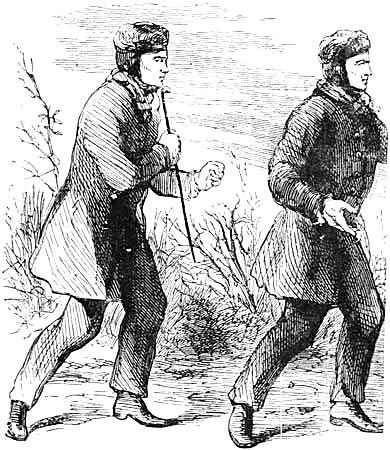
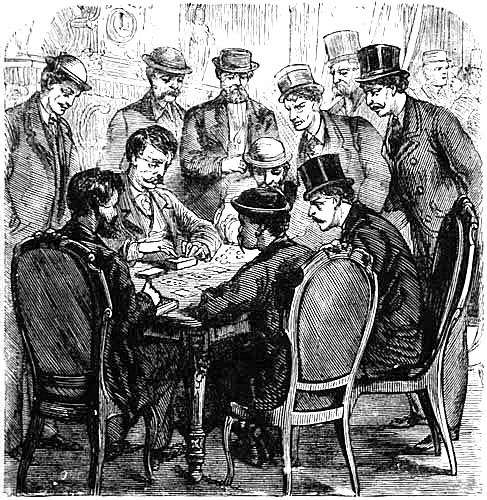
ADOC AND PAINE—PEDESTRIANS.
He was impressed and taken aback with what I had said, but did not at the
moment make any observation on the subject. On the next day, however,
happening to meet my friend the lawyer, I learned that he had informed him
that he feared he had acted wrongly toward me, and had, in addition, done
some injustice to my profession. The result was, that very shortly after
both he and his two sons visited my rooms during one of my exhibitions, or
rather lectures, that I was illustrating with gymnastic feats. He was
struck with my observations and with the performance of some of my pupils,
as well as with the marked difference between their physique and
activity and those of his own boys. For his edification and that of those
who had come to witness the exhibition, I referred to the well known fact
that the ancient Greeks and Romans were gymnasts, and that their nobles
frequently contested in public for the prize; and besides, that he who
performed the greatest feats of strength and agility was crowned with
laurels. At the close of my lecture he came forward with a frankness and a
manliness I was pleased to see, and made an ample apology for his
treatment of me on a former occasion, and at once placed his two sons
under my charge. In fact I had won, and when some months afterwards I
presented him his two boys as strong as young lions and as agile as
panthers, I noticed a tear of gratitude in his eye, and we have been warm
friends ever since.
It is all a mistaken idea that a true course of physical training tends
towards pugilism or to foster a spirit of aggression. The case is quite
the reverse, for it engenders a spirit of nobility and generous manliness
only. It is averse to treachery and meanness, and is indorsed by all the
educational institutions in the land. Show me a college without a
gymnasium or its physical culture and I shall be much astonished. It is
now an accepted fact, that a true course of mental culture is impossible
without a true course of physical training. For the student to succeed in
the former, he must undergo the latter. They must travel side by side,
irrespective of sex, and there must be teachers for both. One is the body
and the other is the soul of the man, so to speak; and as a healthy brain
and an unhealthy body are incompatible—are not to be found centered on
the same person—we must see that the latter is always kept in order and
at its best, and there is no fear for the success of the former.
One parting word, and I have done. All our physical organization has been
constructed with a view to ministering to the comforts and the necessities
of our body as a whole, as well as to our mind or soul. Of themselves, our
physical organs know nothing, and are completely under the control of our
immortal part. When, therefore, we find that the slightest feebleness or
derangement on the part of any one of them results in the greatest
discomfort to us, and when we find that, to support health and to pursue
with effect any vocation in life, active or sedentary, it requires the
fullest development of our muscles and all the parts of our frame, does it
not behoove all those who have not yet turned their attention to the
subject to take it up at once, and endeavor to achieve that state of
physical perfection which is so necessary to their success and happiness
in this world, if not in the next?