"The prime spur to all industry (effort) was and is to own and use the
finished product."—Hall.
One day the pedagogue, who was a learned
man and addicted to study, shut himself
up in his library, bent on devising a method
for training boys into men. This master was well
versed in the sciences so that he could follow the
stars in their courses, make the metals and substances
of the earth obey his will, and guide the
plants in their growth from seed to blossom. Nor
was this scholar lacking in sympathy for the arts,
if they were not too fine, for his desires all led to
systems and orderly arrangements of matter, and
those subjects which would not succumb to analysis
he looked upon coldly.
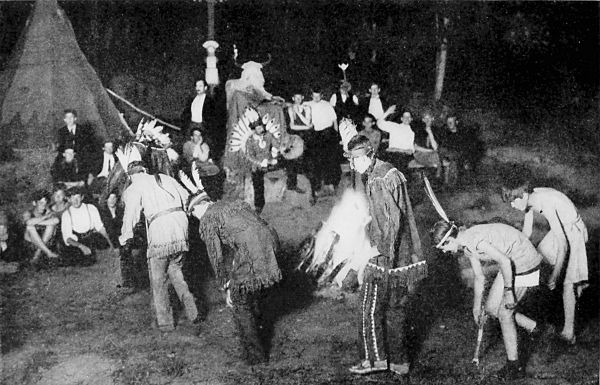
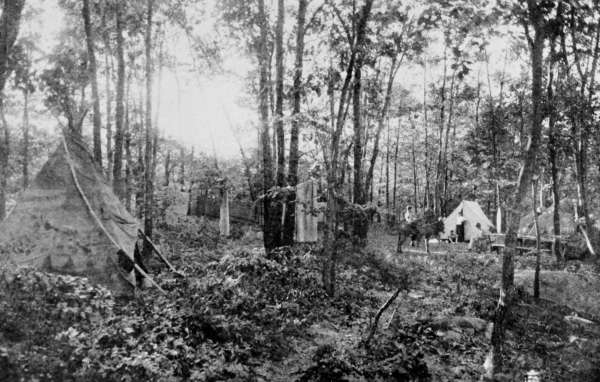
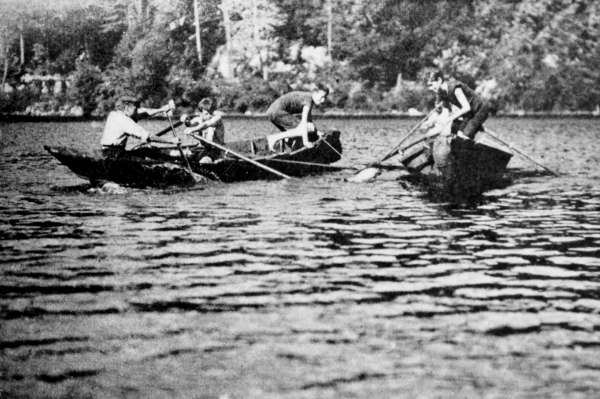
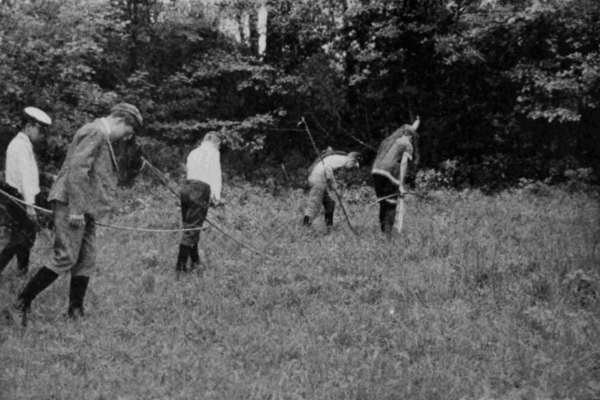
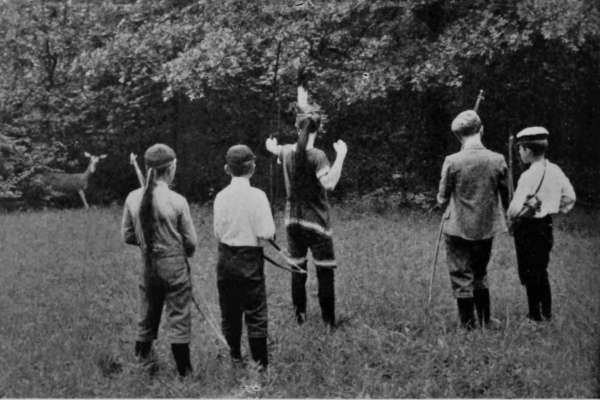
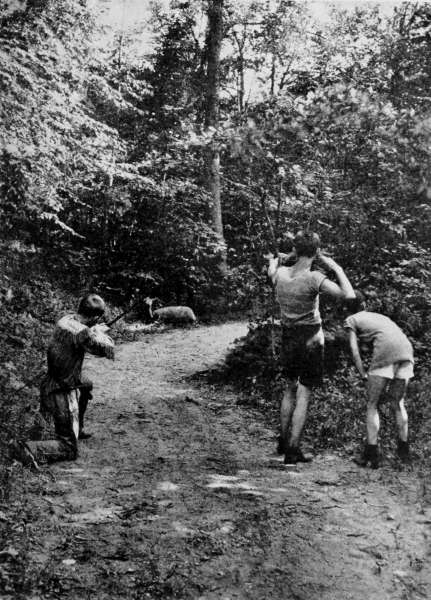
A Boy's Camp with Ernest Thompson Seton. There Was Never a Boy Who Did Not "Make-Believe,"
and Here the Play Spirit, under Stimulating Guidance, Becomes a Powerful Factor in Developing the
Appreciation of Community Effort
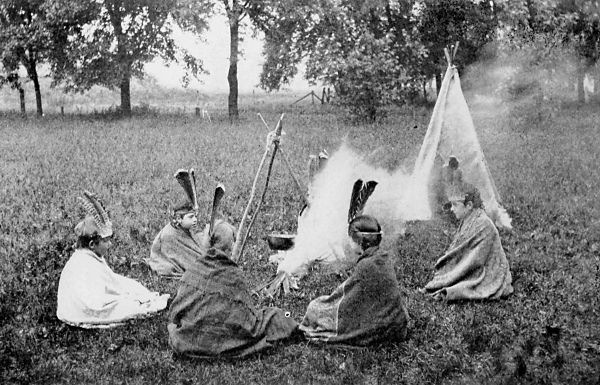
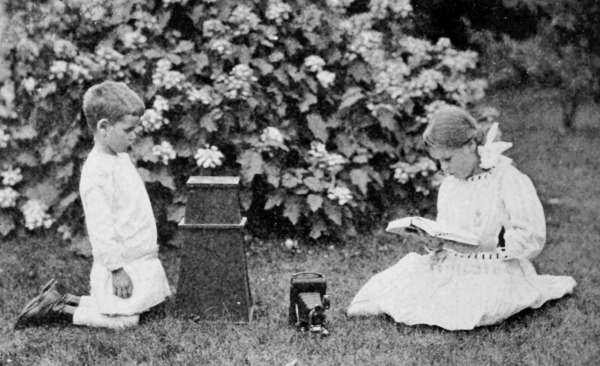
The Play Idea very soon Grows Toward the Representation of Primitive though Adult Customs and
Actions, in which Several Join a Common Body or Company. Hence City Gangs which Merely Seek
Romantic Expression
Hence in this problem of education he made a
careful survey of the history and development of
learning from the beginning—seeking those ideals
and standards of culture which had been approved
for the scholar, because scholars have always been
held in high esteem by those patrons who, being
ignorant themselves, wanted scholarship nearby.
It was found in the course of his delving that the
sciences had originated and developed in about
this order, mathematics, astronomy, geology, botany,
biology, etc. The arts of expression had of course
developed as a group, but chiefly through literature
from the beginning. There seemed to be a good deal
of recent interest in machines and engineering, and
of course certain classes had always tilled the soil,
because one must have food; but the study of these
activities could not lead to culture, because culture
had always had to do with thinking, not manual
labor. Therefore it became clear to the master
that up to the present time, since the end of all
scholarly ambition had been a profession (law,
medicine, theology, etc.), education must be a
very simple matter. All one had to do was to
prepare certain capsules of mathematics, grammar,
Greek and Latin, and a few, very few, odd pellets
of science, etc., and at stated intervals stimulate
the boy's mental organism with the various toxins in
rotation. Were these subjects not the very basis
of culture, and what would be more logical than
direct systematic presentation of the fundamental
principles? If the patient did not respond nothing
could be done but to use more medicine, more
lessons; there could be but one line of treatment.
With this question settled the good savant signified
his readiness to instruct youth in such branches as
were desirable for the educated man, and pupils
came in numbers to obtain the precious learning,
for the pedagogue was favorably known as a great
scholar. But these pupils who came, like the
master, happened to live in or about the year 1912,
when the chief interests of the people were business,
science, and engineering; when transportation and
communication had become highly developed and
systematized; when farming and agriculture were
almost arts, the whole welfare of the nation
rested on industry, and utility held high rank as
an element in culture among the people who worked.
Even when a boy of this period did not seek industrial
honors and follow in the footsteps of his father,
he must needs be interested as a citizen in so important
a source of prosperity. Hence the children
who set out to become pupils of the learned teacher
were alive to the business and activities of their time
and surroundings, and were more than willing to
learn when the learning led to a useful end. But
the scheme proposed by their mentor was such a
queer scheme. Of course it was better to go to
school than do nothing and one must study a few
things, but how much more fascinating and worth
while to talk about birds and animals, trolley cars,
the railway, electricity, machines, and doing things
with a purpose, than to discuss impossible stories
written by people who evidently knew very, very
little about young people, to learn unending pages
of numbers and definitions and facts, which, since
one had no use for them, were speedily forgotten
to make room for better material?
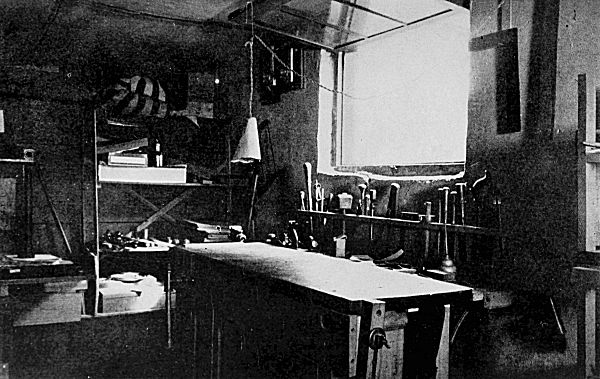
A Typical Boy's Workroom and Shop. Pride of Personal Possession Develops rather Early and the Boy
Should Have a Place of His Own
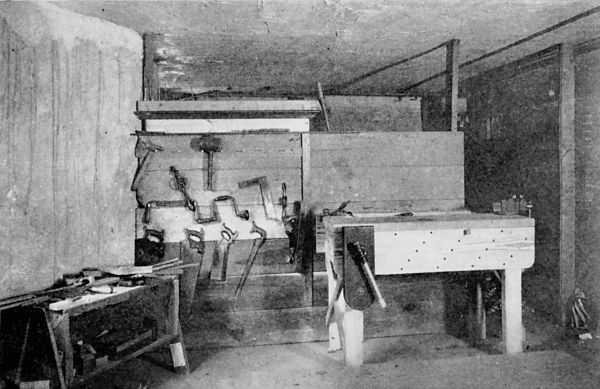
The Kind of Shop which One May Have at Home
Now these children were obedient and reverent
toward learning and did the tasks assigned them by
their master, but in their leisure hours they did a
good bit of experimenting along other lines, and
found several other studies which were not in the
master's scheme much more to their taste. Animals
and pets were not only nice, live, soft, downy, fuzzy
things to play with, but they had such queer ways
and were so useful that one could talk about them
forever. And then if one raised numbers of them,
often neighbors would desire to purchase, and behold,
a business began whereby it was just possible one
could make a profit now and then. Again, it was
fine if one had even a few tools so that one could put
together the toys and playthings necessary to every-day
amusement. Of course it was needful to measure
and calculate and scheme about materials and
costs, but all this scheming led to real purpose,
while the questions proposed by the teacher were
just questions after all and it couldn't make
much difference whether one found the answer or
not.
Now the usual thing happened. Because of their
reverence for traditional learning and respect for
its apostle the youths continued to attend upon the
master and go through the ceremonial form of
intellectual purification. But really their hearts
were outside, wrapped up in the work of the world,
where they had found just the tonics which were good
for them.
In just so far as the school and home open ways
which "enable the student to earn a livelihood and
to make life worth living" do we see the passing
of the old type school (suggested above) and ideal
of training. Not only are there comparatively
few in this world capable of receiving high polish
through the so-called culture studies, but the definition
of culture has changed; now any activity
is cultural which arouses one's best efforts. Moreover,
the boy of the present is on the lookout for a
new type of instructor, one born of the new era of
industrial success, a teacher who will unlock the
mysteries of modern nature, science, engineering
and business, and who will make it possible for the
student to find his special abilities or bent at an
early age. It is no argument at all to say that the
boy is too young to know what is best for him, that
the mature mind is the only safe guide. The adult
teacher and parent becomes a true guide only when
he uses as a basis for guidance those qualities and
instincts of childhood which cannot be smothered
or eradicated. The child, whether boy or girl,
knows instinctively some of the kinds of information
which do not agree with him, because they possess
no significance at the time and he cannot assimilate
and fatten on them. The child needs a new and
more nutritious mental diet. Father and mother
cannot be of great direct assistance because, strange
to say, they are not experts with children, they
merely know a child (their own) passably well,
but they can provide a most effective, indirect,
contributory stimulus through outside opportunities
for healthy play and experiment which will supplement
the formal instruction of the school. And
children of all ages up to the time they go to college
need some strong outside interest, or group of them,
which will serve as a finder to determine the trade,
profession, or business of the future man.
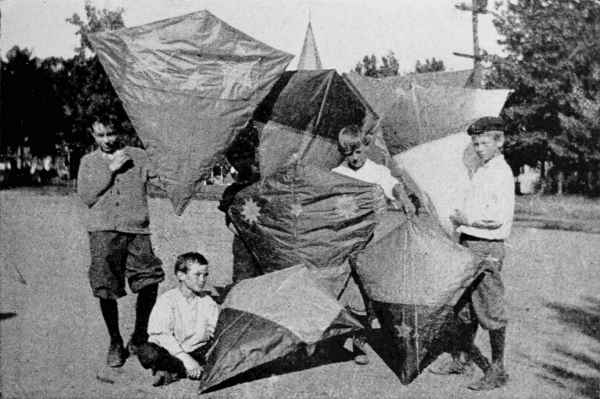
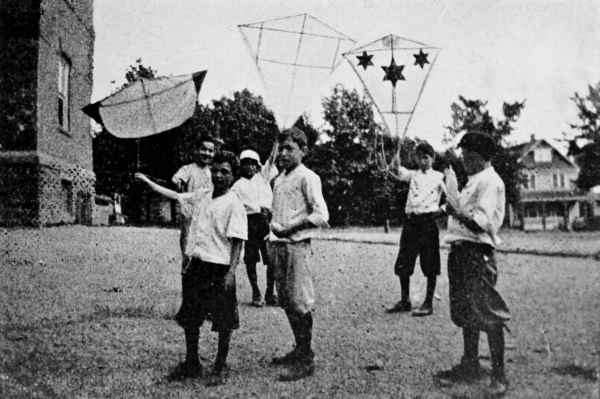
The Kite Fever is an Annual Disease. Common to practically the
Whole Country. But it is a Disease which Flourishes only among
Normal Children, chiefly Boys
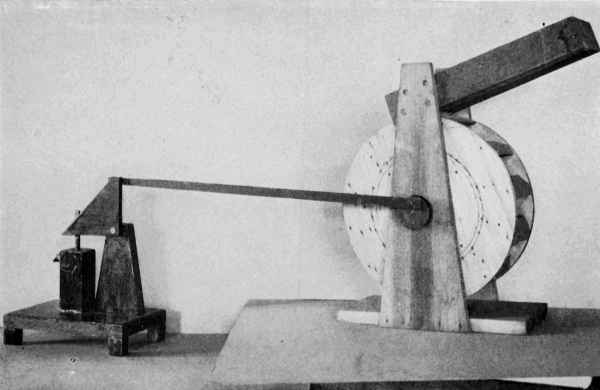
Pump and Waterwheel. A Type of Mechanical Problem which the Boy May Begin With, Both In and Out
of School, because It Touches His Keenest Interest
The children who enter the school, from whatever
grade of society or given race, are all much
alike—lively little animals that sleep, eat and
talk continuously, and play, though play and expression
are one and the same. They do what all
animals do—keep on the move, acquire muscular
skill and precision, and endeavor by every possible
means to express their ideas and convey them
to others. This expression takes on a constructive
phase when children play at store, keeping house,
fire engine, and make toys of paper and cardboard,
and such amusement is the forerunner of that
intense mechanical interest which overtakes boys
about the age of ten or eleven.[I] Girls have an
equally positive leaning which is characteristic and
will be noted elsewhere. Watch any group of boys
of average parentage and surroundings and make a
list of the things they construct for themselves, for
their own ends. In any such list extending over a
period of several months will be found, according
to locality, such things as wagons, sleds, whistles,
kites, dog houses, pigeon roosts, chicken coops,
boats, guns, etc., etc. The young artisan uses
whatever raw material he can; he is chiefly concerned
with the plan, and makes the best of conditions
and materials. The things he makes are
always for real use, a principle held in high esteem
in all the arts. In making these toys the boy acquires
some exceedingly valuable information and
a physical skill and perfection which can only be
secured at an early age. He learns about things,
about raw material, about tools and utensils common
to every household; he gets on speaking terms with
the fundamental laws of mechanics and, more than
one would imagine, develops a real ingenuity in
molding material to his immediate needs. The
construction of a bird house or kite is in itself simple
enough, but the boy has to spend considerable
effort in finding out how to do it, which is beneficial.
Moreover, this constant struggle to get into tune
with his physical environment and subdue it
results in a considerable independence, confidence,
and resourcefulness, which under moderately favorable
conditions will produce a boy alert to the
world in which he lives and full of the spirit of
investigation—the critical attitude. Such a boy
will not lean on others for either learning or pleasure.
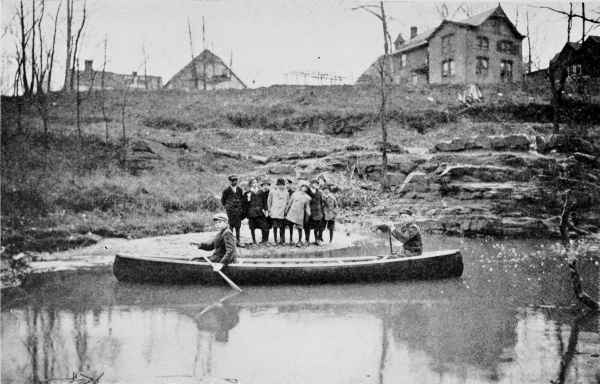
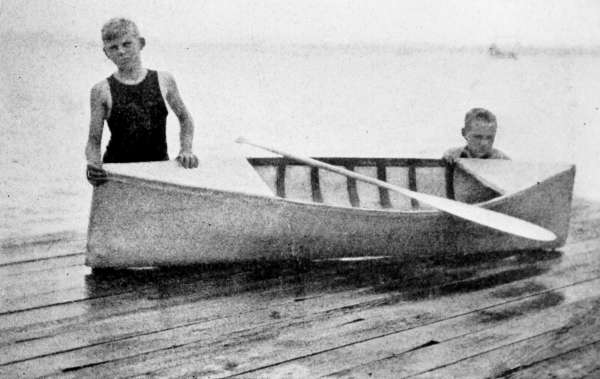
Boat Made by Percy Wilson and Donald Mather, Montclair, N. J., Independent of Adult Assistance. The
Method of Construction, which is Unique and Sound, was Devised by the Boys
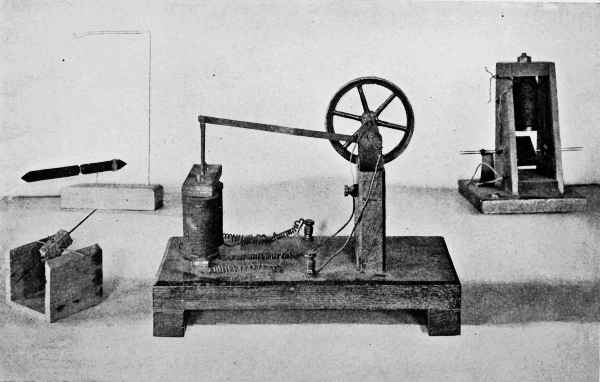
Copyright, 1910, by Cheshire L. Boone
These are the Forerunners of Numerous Other Electrical Constructions, Many of Which are Produced Out of
School, in the Home Workrooms and Shops
Actually, however, the modern boy has not been
encouraged along these lines, nor has he been taken
very seriously in those activities which affect him
most; hence his struggle toward any real efficiency.
A prominent man once said:
"When I was fifteen years of age I could break wild horses
to saddle or harness, and teach kicking cows to stand while
they were being milked. I could fell trees and drop the tree
in any direction desired. I knew the relative value of all
native woods, appreciated the differences in soil, grains, fruits,
and simple minerals. I could use the draw-shove, adze axe,
broad axe, cross-cut saw, sickle and cradle. I could make a
figure-four trap, an axe helve, a neck yoke, axe yoke, whiffletree,
clevis, and could braid an eight-strand cattle whip. We used
to mend our harness on rainy days and I could make a wax-end
and thread it with a bristle, and use a brad-awl. I knew
how to construct an ash-leach and to make soft-soap, apple
butter, and pumpkin pies. I knew the process of weaving
flax and wool, of making and burning brick. I knew on sight
and had names for a score or more of birds, and had a good
idea of the habits of squirrels, skunks, wolves, and the fishes
that swam in the creeks. I knew how to cure hams, shoulders,
and side-meat: to pickle beef and cover apples with straw and
earth so that they would keep in safety through the most
severe winter, and open up in the spring fresh and valuable.
Of course my knowledge was not of a scientific order, and I
could not have explained it to another, because I never knew
I had it."
How many boys or girls of the present time
possess anything like this sum of useful knowledge—useful
for the conditions in which they live? There
was a time when children had to learn in order to
survive, and now that the necessity is removed and
children are simply allowed to grow without purpose,
the boy and girl inevitably lose one of the best
elements in their training unless new opportunities
are opened.
It is not difficult to see how the boy's interest in
construction grows and expands; mere acquaintance
with boys will furnish the data. At a comparatively
early stage the youthful experiments are naturally
sifted to a few specialties, which assume prominence
either because of the boy's reading or the type of
locality in which he lives. From time to time his
interest may shift, investigating one subject after
another, always seeking the unknown avocation.
The process will probably lead in time to a more or
less fitting selection of trade or profession. How
else is the boy to find himself?
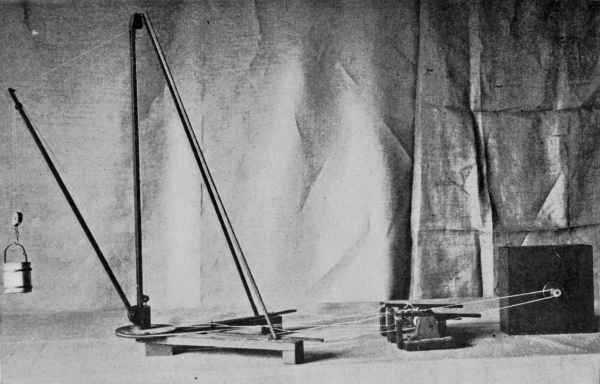
Copyright, 1909, by Cheshire L. Boone
A Real Derrick in Miniature, Operated by Means of a Waterwheel (at the right). The Lifting, Turning
and Handling of the Bucket are Controlled by Levers Attached to Spools (in the middle section). This Sort
of Thing is Part of Regular School Work
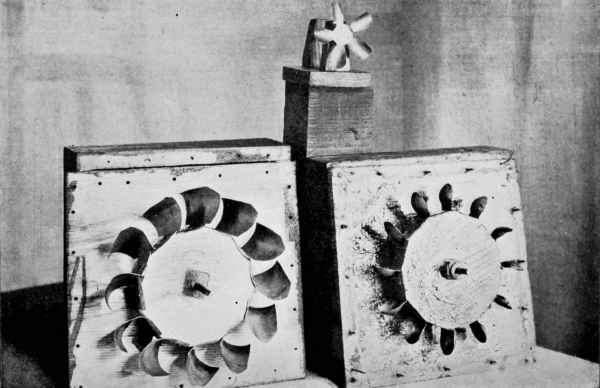
Waterwheels (lower illustrations) and Fan (upper illustration),
made by Public School Pupils
After he has passed through the preliminary
stages of mere play and haphazard amusement the
boy becomes conscious of the mysterious, unusual
forces of electricity; they hold even adult attention
and wonder, but the boy, being more impressionable
and confident, immediately forages for information,
reads enormously, and experiments. He takes in
the whole subject with a vim and sureness that is
de facto evidence of its intrinsic worth for study
purposes. And in a much shorter time than adults
would require, he has mastered the fundamental laws
and is eager to put this wonderful force to work,
to make things move. He has the same attitude
toward steam and gas engines, water motors, and
studies them with the same intensity of purpose.
Here are dynamic elements which appeal to the
human appreciation of power and which may be
harnessed, subdued. The idea is comparable to the
ancient reverence for fire, water and the storm.
Since modern science has organized engineering
and mechanical knowledge and simplified it, the
student can have at his disposal just the books and
periodicals needed to unlock this storeroom of
mystery; these publications were written for the
purpose. But there are several other openings for
creative effort which appeal no less strongly, and
among which both the boy and girl may choose,
with complete confidence that there will be ample
room for initiative, ingenuity, and utilitarian bias.
Every child loves to go camping, and in common
with his elders reveals the close connection with
primitive life in general through the pleasure derived
from the simplicity of camp life. There in the
woods, where conveniences are few, every device
and construction counts the utmost, and its purpose
is apparent. The whole spirit of such living is more
in harmony with child nature and longings than the
modern city home; it supplies the craving for physical
freedom and places the boy or girl almost
entirely on his own resources. What he obtains
in the way of pleasure comes from his own efforts
and is correspondingly precious. The boy especially
finds in camp just as much chance for mechanical
skill as elsewhere. Temporary furniture, utensils,
cooking conveniences, the shelter, traps, etc., are
suggestive. And lastly the unconventional, untrammeled
outdoor life stands in that same relation to
the boy as it did to the savage (because boyhood
is a primitive stage); he puts forth his strongest
endeavors to conquer the elements, the climate,
the earth, and growing things; to provide himself
with food and shelter—in other words, to survive
as the savage sought to survive. The idea is truly
epic. No wonder the child expands and develops
under the simple responsibilities imposed, and absorbs
woodcraft with such astonishing ease. The
recent extraordinary growth of the summer camp
among boys' schools, and the results suggested in the
writings of Ernest Thompson Seton, are, with the
unfolding of industrial education, two pointed examples
of the shifting view of education in the home
as well as school. Probably no outside agency will
in time become so effective for good as the Boy
Scouts, whose code is based on a very primitive
framework suited to boys. During a recent visit
to California, and while crossing the flat prairies of
Kansas, the writer saw a company of scouts at work.
It was borne in upon the observer that there was an
organization which fitted every locality, every
climate; it appealed to boy, not creed, social order,
time, or adult dogma.
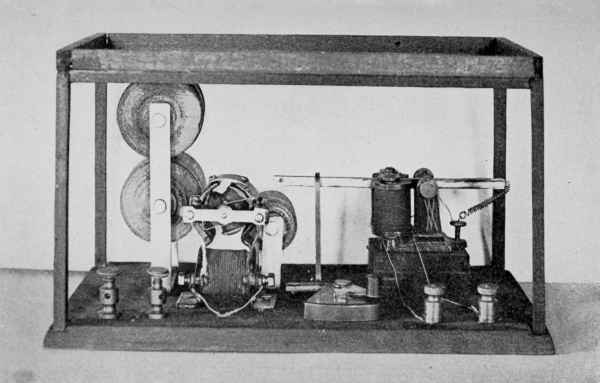
Copyright, 1910, by Cheshire L. Boone
A Self-recording Telegraph Receiver. An Excellent Example of what the Juvenile Mechanical Mind will
Attempt. The Number of Boys Interested in such Projects is Considerable
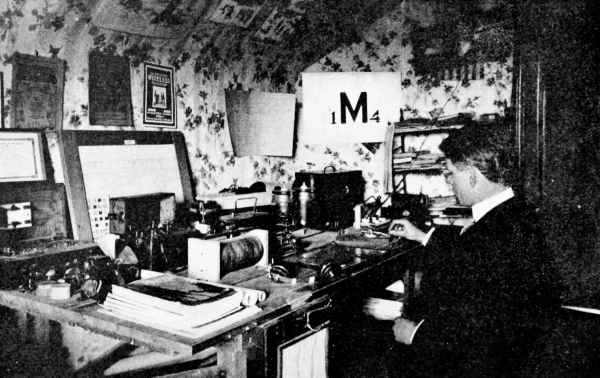
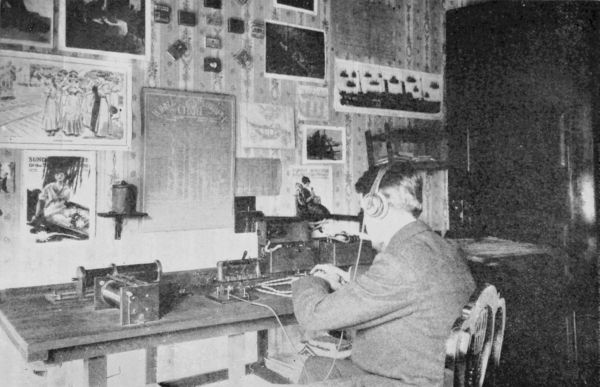
Wireless Station and Workroom of Donald Huxom, Montclair, N. J. This, too, Indicates how Boys Square
Themselves with Scientific Progress
One should at least mention athletics in this
connection, because of the excellent physical benefit
in both activities. Athletics, however, contains an
element which is all-important—team work. And
no restraint is so much needed, nor so cheerfully
heeded for that matter, by the restless boy and girl
as a community of effort. The elimination of a
purely selfish personal point of view is very difficult
to bring about with the best of children, because
they are wrapped up in their own affairs, and nothing
serves to introduce them to the rights of others
and the value of concerted action for a common
good so well as sport. The kind does not matter.
Any well-conducted, clean enjoyment of this kind
develops that mental pliability and willingness to
take a part which is a fundamental of citizenship.
Incidentally leaders arise, and the beginnings of
organization dawn. It is a great day when the
boy learns his first code of signals in the ball team!
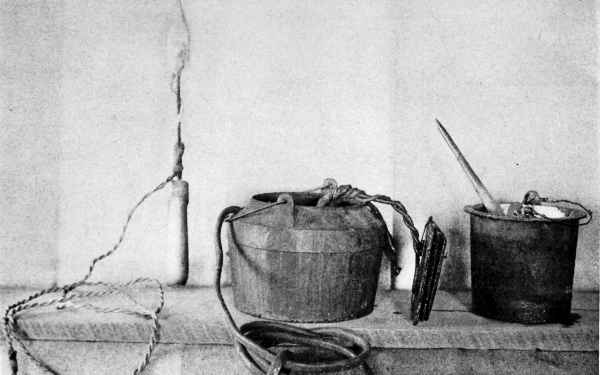
Copyright, 1910, by Cheshire L. Boone
An Electrical Soldering Iron and Glue-pot, made at Suggestion of Instructor for Use in School Shop
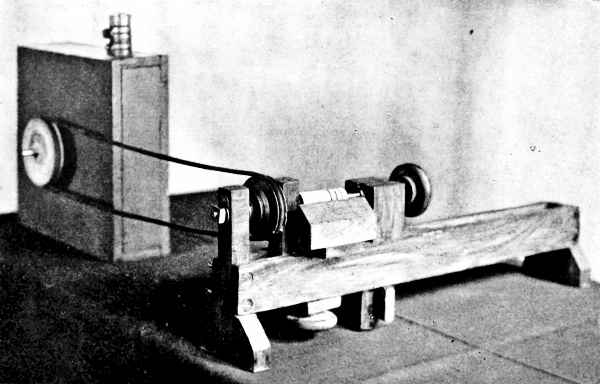
Copyright, 1909, by Cheshire L. Boone
Waterwheel Connected with Model Lathe
There is one more side (at least) to the boy and
girl business—earning money. It is nothing short
of marvelous that this desire for personal income,
however small, has not been taken seriously. Why
do children want to earn money? For the best
reason in the world, independence. Man's entire
existence from the earliest age down to the twentieth
century has been one long struggle toward it—toward
survival. First he had to combat the elements
and animals, then his fellows, for possession
of food, lands, water, raw materials, and wives.
When he found that possession of certain commodities
added to his importance and therefore comfort
and safety, and especially to his privilege, he
sought wealth and its freedom. Now the boy and
girl follow stages in development toward similar
independence, and among the privileges most desired
is that of money or possessions of value. If
they earn it, the amount represents so much work
and gives the coins a fixed worth which cannot be
established in other fashion. Moreover, this desire
for income (rather than money) is one characteristic
of the child between the ages of thirteen
and fifteen years. His power of reasoning and
organization are developing rapidly, and it is the
time when adult ideals and actions first look
attractive. The time is ever ripe for launching
the boy or girl into any avocation which holds their
fancy, that they may forget their own oblique
tendencies to laziness, stubbornness, wayward action,
and selfishness; these are all characteristic of the
stage. Sex changes too play no inconsiderable part,
because the boy's companions are for a time all
masculine. Business of some kind is just what
he needs, and if that business is profitable, a powerful
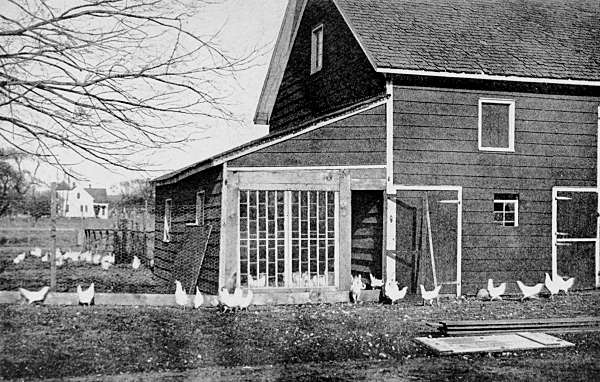
motive is supplied. Perhaps the keenest interest
is that in nature, and most children at some time
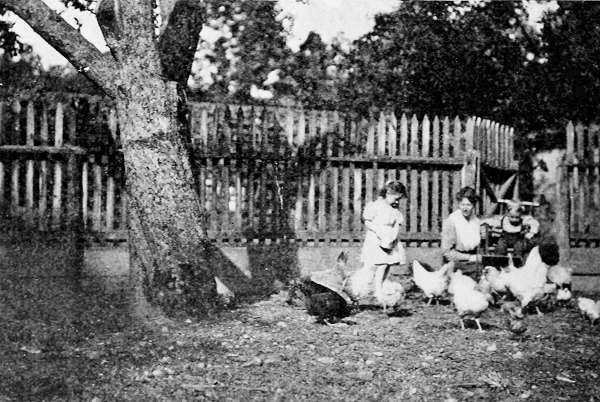
have desired pets—chickens, rabbits, pigeons, dogs,
song birds. There is scarcely a town or city condition
where some animal hobby cannot be pursued
without disturbing others' peace of mind. But it
should be looked into seriously as a business, a
miniature counterpart of other like enterprises.
The disposal of personal service and products to
others brings the child in close contact with numbers
of adults and adult standards and business connections.
It fosters responsibility and places upon the
child the burden of proof, to show that he is entitled
to a place as a valuable member of society. And
just here it may be well to say, even if the child does
not need the money he earns, it will be the most
precious he will ever own, because since it came
through effort, it will be spent with due caution.
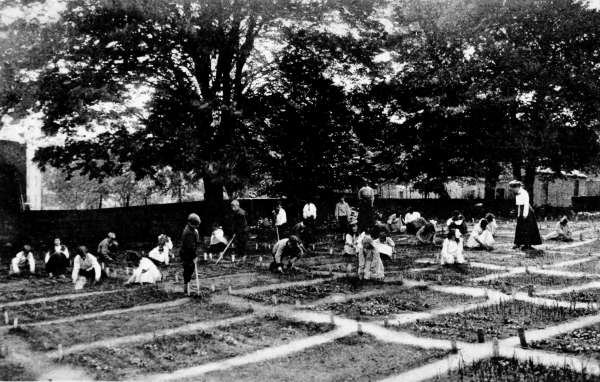
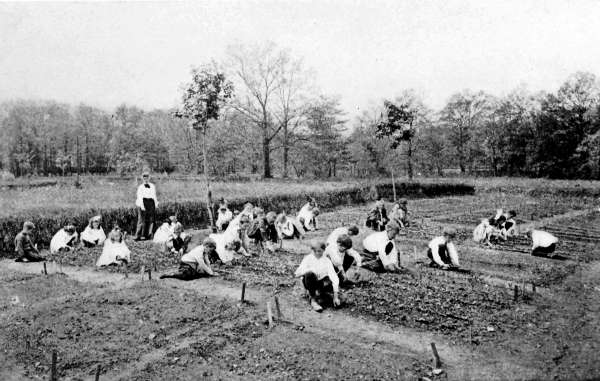
The vegetable and flower garden may be made to
yield similar returns and such products are always
salable. In addition, every house, every yard,
every farm is in constant need of repairs, changes
and care which the alert boy or girl can furnish.
The development of such odd tasks into a business
parallels the development of every large enterprise
which began in a modest way. It fosters the best
of personal and civic ideals, and tames the restless,
self-conscious energy of youth into smooth and
profitable channels through which to journey in
peace to a sane maturity.
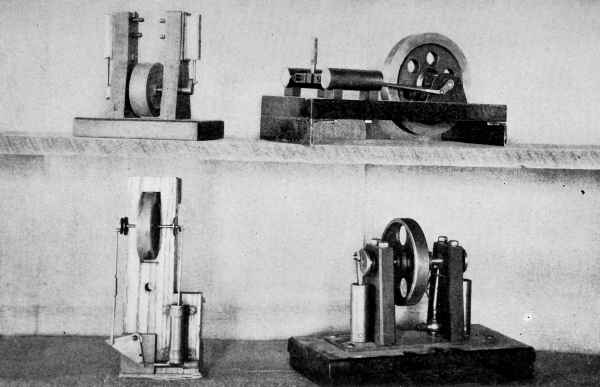
Excellent Examples of High School Work which is Really Profitable. These Machines will Work and
Develop Power which can be Measured
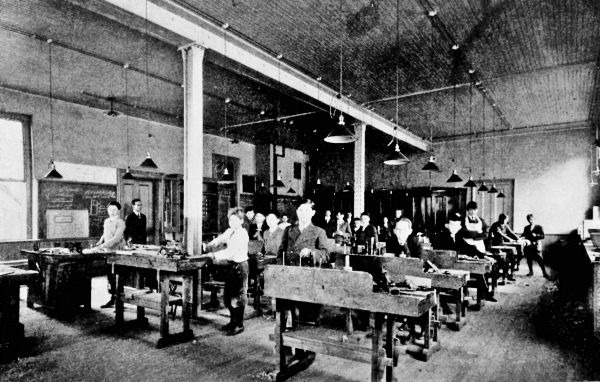
A Manual Training Shop
Is it any wonder that education is so ineffective
at times? In the light of present-day appreciation
of physiology and psychology it is increasingly clear
that education has furnished an impersonal, rather
stilted system of stuffing along restricted lines for
a warm-hearted, all-inquisitive, nature-loving human
animal which automatically refuses to be nourished
thereby, and forages elsewhere. Although
the child's judgment can by no means be followed
concerning what is best for him, his instincts and
possible future will serve as a most excellent guide.
His early training must take into account those
interests which are most keen and lasting and use
them as the framework for instruction, and all
subsequent stages of training involve a distinct
obligation to build upon this elementary foundation,
with a view to social worth. Most children will
have to earn a living (the girl usually helps by managing
the home), and this necessity is preëminent.
But whether rich or otherwise, the ideal of social
worth remains for all. And the least the home can
do is to nurse childhood's efforts and experiments
in play and occupation which lead finally to mature
judgment and conceptions.
Boys probably obtain more help from books than
girls do because they are more self-reliant, more
assertive and impatient. And as has been indicated,
more books have been written for boys, but the
same general method of use is common to both.
The boy too finds in the book of crafts, mechanics,
science, or sport a stimulant and incentive. He
reads it much as he would a story of adventure.
No matter what his greatest enjoyments may be,
the perusal of accounts of others' juvenile activities
widens the productive horizon in a way not to be
ignored, and for this reason "How to Do" books of
all kinds are a serious element in the boy's life, at a
time when he is less concerned with what to do
than with how to produce something. But there is
a danger in this catholicity of interest: it may become
dilettantism. The boy may merely potter or
fuss with one hobby after another, more because he
cannot supply the need for more and more information,
than because he does not care. Hence it is
worth while from time to time to add more fuel to the
flame of ambition in a given direction, to provide
books and tools, a working place or shop, and open
the way for progress in some stated direction.
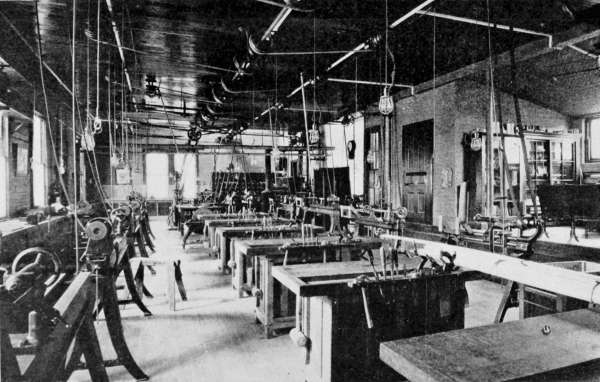
The Machine Shop. Public School, Montclair, N. J.
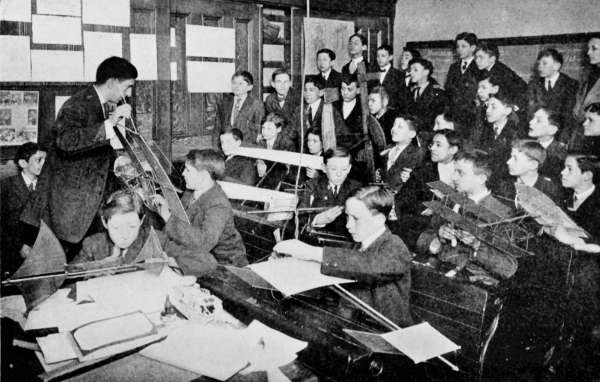
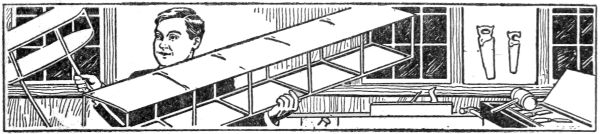
The Study of Aeroplane Construction, Public School 77, N. Y. City. This Toy is Full
of Possibilities for the Live Boy
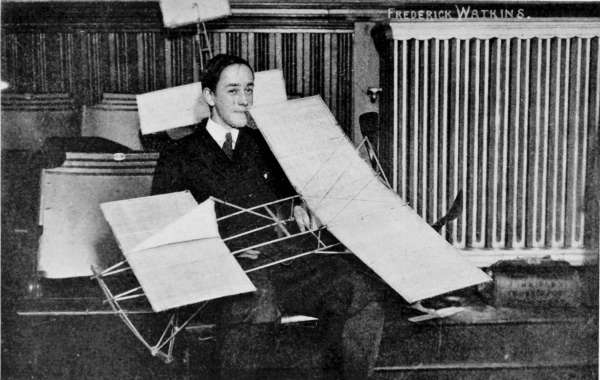
A Successful Machine
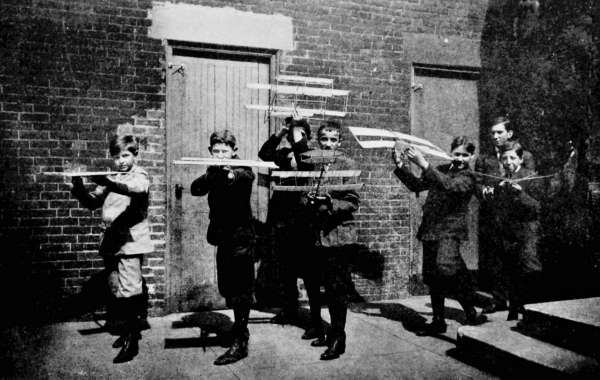
Finished Aeroplanes. Public School 77, N. Y. City
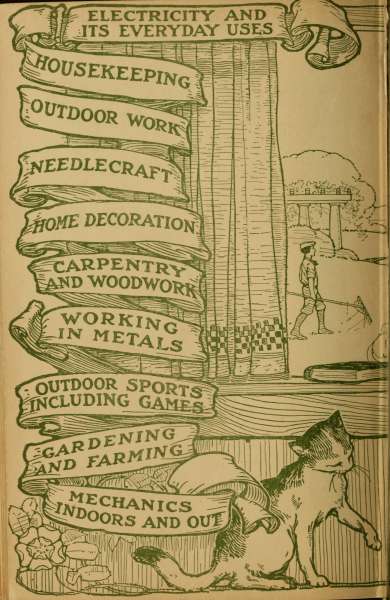
Specifically, books like those on "Mechanics,
Indoors and Out," "Electricity," and "Carpentry,"
and parts of "Outdoor Work" may be considered
as of one type. When he receives the books the
boy will spend days in absorbing their contents,
maybe dreaming a bit over the possibilities in view,
and finally, by a process which will always be unintelligible
to the adult, will light upon a problem
or group of them that meets his wishes, as the
kite for instance; all he needs from then on is human
sympathy with the, to him, important undertaking,
and he will gallop through all phases of the
kite construction and devices, aeroplanes, propellers,
forms of motive power, probably bringing up short
at the steam or gasoline engine, which opens another
chapter. The really important item connected with
the use of such books is to keep the young mechanic
on one thing at a time. A bit of judicious questioning
now and then, always aimed at a group of
related problems upon which he may be engaged,
will keep his mind working connectedly. His
efforts will then be cumulative in effect. Visits
to the aero park, the museums, to the shops and
technical schools, and to the local power plants are
other distinct aids which should be invoked to supplement
and emphasize reading and experiment. In
some of the cities model kite and aeroplane contests
are held at regular intervals, and these put boys on
their mettle to succeed. In fact the proper way
to use books of this kind is to let the boy use them; let
him begin in the middle of the book and work outward
or at the end and go backward, but see that
he has books which present the subject vividly,
simply. Provide him with the essential tools and
materials and a place to work. About the surest
way to make a success with boys is to let them have
a room or corner of their own where they can work
to their hearts' content, where they can store their
precious belongings, and where companions may come
and talk over things. Really the book is inadequate
alone. Unless one provide the opening for action,
books but aggravate and excite the mind, mockingly
spur the student on to "do." Hence with the book
goes a tacit obligation to provide means and place,
even the most modest, for putting the book to test.
There is yet another phase to this use of books,
and it is one which the boy will usually meet, if the
texts are adequate. It is this: whatever the young
student does best will be the result of real desire,
real personal enthusiasm. It is a fallacy to suppose
that the boy interested in tools should always put
up shelves, mend the door, or fix the fence. He will
execute these tasks cheerfully, but they are not the
subject of his dreams. On the other hand, if the
desire be to earn money, to have a small business
of his own, fences and shelves and plant stands may be
the most interesting things in the world to him, because
they are means, not ends. Hence the printed
book is no teacher or trainer of children, no direct guide
to future vocation, but is the very essence of inspiration,
the foundation from which the young secures
nourishment for day dreams and ambitions, out of
which he patiently weaves the rich fabric of experience.