Writing the "Principles of Psychology"—Psychical Research—The
Place at Chocorua—The Irving Street House—The Paris Psychological
Congress of 1889
JAMES had now found his feet, professionally, as well as in other ways.
He strode ahead on the next stage of his journey with a firmness of
which he would have been incapable in the seventies, and carried a heavy
burden of work forward, with never a long halt and without ever setting
it down, until he had finished the two large volumes of the "Principles
of Psychology" in 1890. The previous decade had counted steadily for
inward clarification, for health and for confidence. He was no longer
harassed by serious illnesses and pursued by the spectre of possible
invalidism. Marriage, parenthood—these immense events in a man's
spiritual journey—had happened for him within the last four years and
had brought him new loves and ambitions. He was no longer perplexed by
misgivings about his aims and abilities, but had arrived at the
conception of his treatise on psychology and had begun to formulate its
chapters. He had become a very successful teacher, and might fairly have
suspected himself of being an inspiring one. His work was beginning to
be well known outside the halls of his own University.
It is not the purpose of this book to trace the origin of his ideas or
their influence on contemporary discussion. But any reader who will
glance at Professor Perry's annotated "List" of his published work may
see that he had written important papers by 1883, and that most of what
was original in his psychology must by then have been present to his
mind. During the visit he had just made to Europe, he had got a personal
impression of the transatlantic colleagues whose writings had interested
him especially, and had spent many hours in the company of certain among
them with whom he found himself to be particularly in sympathy. Thus he
had gained a bracing sense of comradeship with the men who were
collaborating in his field. Last of all, he had brought home with him a
happy conviction that the most propitious place for him to teach and
write his book in was the philosophical department of his own
University.
So far as the "textbook on Psychology" was concerned, however, he still
underestimated the amount of original investigation and thought which
his instinct for "concrete" reality was to exact of him. Perhaps also he
made too little allowance for the inadequacies of current laboratory
methods and of the existing literature of the subject. Helmholtz and
Wundt had already published important reports from their laboratories in
Germany; but psychology was still generally considered to be an
inductive science, which achieved its purposes by introspection and
description, and which had no very broad connection with physiology nor
many laboratory methods of its own. James had still to help make a
modern science of it by his own immense effort. He may perhaps be said
to have set to work when he offered the course on "The Relation between
Physiology and Psychology" to graduate students in 1875, and made the
class take part in experiments which he arranged in a room in the
Lawrence Scientific School building.[68]
Thus with teaching, experimenting, and occasionally writing out his
conclusions as he went along, he ploughed his way through his subject.
The triple process is familiar enough today to most men of science. But
James and the majority of his contemporaries had been trained
differently or not at all; and their generation, following a few great
leaders like Pasteur, Darwin and Helmholtz, had to establish new
standards of criticism and new methods of inquiry in every department of
science. When the "Psychology" was drawing to its completion, James
wrote two sentences about his difficulties to his brother Henry. They
might equally well have been written at any other time during the
eighties. "I have," he said, "to forge every sentence in the teeth of
irreducible and stubborn facts. It is like walking through the densest
brush-wood."
There was one peculiarly stubborn and irreducible class of facts which
he took up and gave much thought to during this period.
As early as 1869 he had recognized the desirability of examining the
class of phenomena that are popularly called psychic[69] in a critical
and modern spirit. This was not because he was in the least impressed by
the lucubrations of the kind of mind which can be well described, in
Macaulay's phrase, as "utterly wanting in the faculty by which a
demonstrated truth is distinguished from a plausible supposition." But
an instinctive "love of sportsmanlike fair play" was stirred in him by
the indifference with which men who professed to be students of
nature,[70] and particularly scientists whose prime concern was with our
mental life, usually declined to examine phenomena which have occurred
in every known human race and generation. He was in cordial sympathy
with the announced intention of the Society for Psychical Research to
investigate the abnormal and "supernormal" occurrences. He referred
aptly to such occurrences as "wild facts," having as yet no scientific
"stall or pigeon-hole."[71] Above all, he was conscious, from the
beginning, of the proximity and possible relevance to his psychological
and philosophical problems of this large body of unanalyzed material.
Most people cannot approach such matters without emotional bias. The
atmosphere in which the public discussion of them goes on is still
poisoned by superstition and clouded by prejudice. No scientific man
involves himself in such inquiries, even now, without the certitude that
his statements will be misconstrued by some of his professional
brethren, and that his name will be taken in vain by newspapers and
charlatans. James recognized all this, but saw in it no excuse for
avoiding the subject; rather, a reason for examining it in an
unprejudiced spirit and for avowing his conclusions openly.
The English Society for Psychical Research had been founded in 1882. In
1884 James became a corresponding member and concerned himself actively
in organizing an American society of the same name in Boston. He made
contributions to the "Proceedings" of this society during the six years
of its existence; and, when it amalgamated with the English Society in
1890, he became a Vice-President of the latter. With the exception of a
term during which he served as its President (in 1894-95), he continued
to be a Vice-President of the S. P. R. until his death, and occasionally
published through its "Proceedings."
In the eighties he took up his share of the drudgery which was involved
in investigating alleged cases of apparition, thought-transference, and
mediumship. For one entire winter he and Professor G. H. Palmer attended
"cabinet séances" every Saturday without discovering anything that they
could report as other than fraudulent. But in the following year he got
upon the track of the now famous Mrs. Piper, and he made his first
report on her trance-state to the S. P. R. in 1886. After many tests and
trials he was unable to "resist the conviction that knowledge appeared
in her trances which she had never gained by the ordinary waking use of
her eyes, ears and wits." Withholding his acceptance from the
spirit-message hypothesis, he added: "What the source of this knowledge
may be I know not, and have not a glimmer of an explanatory suggestion
to make; but from admitting the fact of such knowledge I can see no
escape."[72] He continued to find time for the investigation of other
cases, and could sometimes console himself by laughing over expeditions
which were quite fruitless of interesting result. A few sentences from
letters addressed to Mrs. James in 1888, reporting an adventure with
Richard Hodgson in New York, will serve as illustration:—
"[Apr. 6.] Hodgson and I started after our baggage arrived, to find Mr.
B——, who, you may have seen by the papers, is making a scandal by
having given himself over (hand and foot) to a medium, 'Madam D——,'
who does most extraordinarily described physical performances. We found
the old girl herself, a type for Alexandre Dumas, obese, wicked, jolly,
intellectual, with no end of go and animal spirits, who entertained us
for an hour, gave us an appointment for a sitting on Monday, and asked
us to come and see Mr. B. tonight. What will come of it all I don't
know. It will be baffling, I suppose, like everything else of that
kind."
"[Apr. 7.] Mr. B. and Mrs. D. were 'too tired' to see us last night! I
suspect that will be the case next Monday. It is the knowing thing to do
under the circumstances. But that woman is one with whom one would fall
wildly in love, if in love at all—she is such a fat, fat old
villain...."
"[Apr. 24th.] In bed at 11.30, after the most hideously inept psychical
night, in Charleston, over a much-praised female medium who fraudulently
played on the guitar. A plague take all white-livered, anæmic, flaccid,
weak-voiced Yankee frauds! Give me a full blooded red-lipped villain
like dear old D.—when shall I look upon her like again?"
In 1889 James undertook the labor of conducting the "Census of
Hallucinations" in America. The census sought to discover, from lists of
people selected at random, how many of them, when in good health and
awake, had ever heard a voice, seen a form, or felt a touch which no
material presence could account for. James received about seven thousand
answers to the inquiries that were sent out in America; and after he had
digested and reported them, the results turned out to be in remarkable
conformity with the returns from other parts of the world. Some of
James's own deductions from the returns will be found in the essay,
"What Psychical Research has Accomplished."[73] Among other things, the
census showed apparitions corresponding with a distant event as
occurring more than four hundred times oftener than could be expected
from a calculation of chances.
After this task had been completed, he usually avoided spending time in
personal investigations.
KEENE VALLEY, Aug. 5, 1883
ADIRONDACKS.
My dear Monsieur Renouvier,—My silence has been so protracted that I
fear you must have wondered what its reasons could be. Only the old
ones!—much to do, and little power to do it, obliging procrastination.
You will doubtless have heard from the Pillons of my safe return home. I
have spent the interval in the house of my mother-in-law in Cambridge,
trying to do some work in the way of psychologic writing before the
fatal day should arrive when the College bell, summoning me as well
as my colleagues to the lecture-room, should make literary work almost
impossible. Although my bodily condition, thanks to my winter abroad,
has been better than in many years at a corresponding period, what I
succeeded in accomplishing was well-nigh zero. I floundered round in the
morasses of the theory of cognition,—the Object and the Ego,—tore up
almost each day what I had written the day before, and although I am
inwardly, of course, more aware than I was before of where the
difficulties of the subject lie, outwardly I have hardly any manuscript
to show for my pains. Your unparalleled literary fecundity is a perfect
wonder to me. You should return pious thanks to the one or many gods who
had a hand in your production, not only for endowing you with so clear a
head, but for giving you so admirable a working temperament. The most
rapid piece of literary work I ever did was completed ten days ago, and
sent to "Mind," where it will doubtless soon appear. I had promised to
give three lectures at a rather absurd little "Summer School of
Philosophy," which has flourished for four or five years past in the
little town of Concord near Boston, and which has an audience of from
twenty to fifty persons, including the lecturers themselves; and,
finding at the last moment that I could do nothing with my much
meditated subject of the Object and the Ego, I turned round and lectured
"On Some Omissions of Introspective Psychology,"[74] and wrote the
substance of the lectures out immediately after giving them—the whole
occupying six days. I hope you may read the paper some time and approve
it—though it is out of the current of your own favorite topics and
consequently hardly a proper candidate for the honours of translation in
the "Critique."
I understand now why no really good classic manual of psychology exists;
why all that do exist only treat of particular points and chapters with
any thoroughness. It is impossible to write one at present, so
infinitely more numerous are the difficulties of the task than the means
of their solution. Every chapter bristles with obstructions that refer
one to the next ten years of work for their mitigation.
With all this I have done very little consecutive reading. I have not
yet got at your historic survey in the "Critique Religieuse," for which
my brain nevertheless itches. But I have read your articles apropos of
Fouillée, and found them—the latest one especially—admirable for
clearness and completeness of statement. Surely nothing like them has
ever been written—no such stripping of the question down to its naked
essentials. Those who, like Fouillée, have the intuition of the Absolute
Unity, will of course not profit by them or anything else. Why can all
others view their own beliefs as possibly only hypotheses—they only
not? Why does the Absolute Unity make its votaries so much more
conceited at having attained it, than any other supposed truth does?
This inner sense of superiority to all antagonists gives Fouillée his
fougue and adds to his cleverness, and no doubt increases immensely
the effectiveness of his writing over the average reader's mind. But it
also makes him careless and liable to overshoot the mark.
I have just been interrupted by a visit from Noah Porter, D.D.,
President of Yale College, whose bulky work on "The Human Intellect" you
may have in your library, possibly. An American college president is a
very peculiar type of character, partly man of business, partly
diplomatist, partly clergyman, and partly professor of metaphysics,
armed with great authority and influence if his college is an important
one—which Yale is; and Porter is the paragon of the type—bonhomme et
rusé, learned and simple, kindhearted and sociable, yet possessed of
great decision and obstinacy. He is over seventy, but comes every summer
here to the woods to refresh himself by long mountain walks and life in
"camp," sleeping on a bed of green boughs before a great fire in the
open air. He looks like a farmer or a fisherman, and there is no sort of
human being who does not immediately feel himself entirely at home in
his company.
I have been here myself just a week. The virgin forest comes close to
our house, and the diversity of walks through it, the brooks and the
ascensions of hilltops are infinite. I doubt if there be anything like
it in Europe. Your mountains are grander, but you have nowhere this
carpet of absolutely primitive forest, with its indescribably sweet
exhalations, spreading in every direction unbroken. I shall stay here
doing hardly any work till late in September. I need to lead a purely
animal life for at least two months to carry me through the teaching
year. My wife and two children are here, all well. I would send you her
photograph and mine, save that hers—the only one I have—is too bad to
send to anyone, and my own are for the moment exhausted. I find myself
counting the years till my next visit to Europe becomes possible. Then
it shall occur under more cheerful circumstances, if possible; and I
shall stay the full fifteen months instead of only six. As I look back
now upon the winter, I find the strongest impression I received was that
of the singularly artificial, yet deeply vital and soundly healthy,
character of the English social and political system as it now exists.
It is one of the most bizarre outbirths of time, one of the most
abnormal, in certain ways, and yet one of the most successful. I know
nothing that so much confirms your philosophy as this spectacle of an
accumulation of individual initiatives all preserved. I hope both you
and the Pillons are well. I shall never forget their friendliness, nor
the spirit of human kindness that filled their household. I am ashamed
to ask for letters from you, when after so long a silence I can myself
give you so little that is of philosophic interest. But we must take
long views; and, if life be granted, I shall do something yet, both in
the way of reading and writing. Ever truly yours,
WM. JAMES.
At about this time Major Henry L. Higginson, then the junior partner in
the banking house of Lee, Higginson & Company and soon to be widely
known as the founder of the Boston Symphony Orchestra, undertook to look
after the small patrimony which James had inherited. He tactfully
assumed the initiative respecting whatever had to be done, and continued
to render this friendly service as long as James lived. On his side
James, who knew nothing about investments and was incapable of
considering them without involving himself in excessive and unprofitable
worry, was delighted to leave decisions to his friend's wiser judgment.
Occasional jocose communications like the following came to be almost
his only incursions into his own "affairs."
Oct. 14 [1883?].
My dear Henry,—I receive today from your office two documents, one
containing some unintelligible hieroglyphics, "C. B.& Q., 138" etc.,
etc.; the other winding up with a statement that I owe you $12,674.97!!
The latter explains your mysterious interest in my affairs. I feared as
much! Go on, Shylock, go on! you have me in your power. The peculiar
combination of ignorance and poverty which I present makes me an easy
victim. And I confess that as a psychologist I am curious to see how far
your instincts of cupidity will carry you. I await eagerly the ulterior
developments. Yours, etc.,
WM. JAMES.
[Enclosed with the foregoing]
Extract from a biographic sketch of W. J. soon to be published in the
"Harvard Register":—
"He now fancied himself possessed of immense wealth, and gave without
stint his imaginary riches. He has ever since been under gentle
restraint, and leads a life not merely of happiness, but of bliss;
converses rationally, reads the newspapers, where every talk of distress
attracts his notice, and being furnished with an abundant supply of
blank checks, he fills up one of them with a munificent sum, sends it
off to the sufferer, and sits down to his dinner with a happy conviction
that he has earned the right to a little indulgence in the pleasures of
the table; and yet, on a serious conversation with one of his old
friends, he is quite conscious of his real position; but the conviction
is so exquisitely painful that he will not let himself believe it."
[Post-card]
CAMBRIDGE, MASS., Jan. 31 [1884].
Heute den 31ten Januar wurde mir vor 2 Stunden in rascher
Aufeinander-folge ein (1) wunderschöner jüdischaussehender, kräftiger
und munterer Knabe geboren. Alles geht nach Wunsch, und bittet um
stiller Theilnahme der glückliche Vater.
W. J.
[Translation.]
Today the 31st of January, two hours since, there was born to me in
rapid succession one (I) wonderfully beautiful, Jewish-looking,
sturdy and lively boy. Everything is going as one would wish, and the
happy father craves your hushed sympathy.
W. J.
CAMBRIDGE, Mar. 30, 1884.
My dear Davidson,—I am in receipt of two letters from you since my
last, the latest one of them from Capri. I am very sorry to hear of your
continued bad physical condition. You have a queer constitution,—with
such an unusual amount of strength in most ways,—to be a constant prey
to ailment. I have long ago come to think that the right measure of a
man's health is not how much comfort or discomfort he feels in the year,
but how much work, through thick and thin, he manages to get through.
Judged by that standard, you doubtless score an unusually high number.
But when I hear you talking about Texas, I confess I really begin to
feel alarmed. From Rome to Austin! How can you think of such a thing?
Are you sure M—— is not playing the part of the tailless fox in the
fable? I know not a living soul in Texas, and if I did I should have
moral scruples about becoming an accomplice in any plot for transporting
you there. Why is it that everything in this world is offered us on no
medium terms between either having too much of it or too little? You
pine for a professorship. I pine for your leisure to write and study.
Teaching duties have really devoured the whole of my time this winter,
and with hardly any intellectual profit whatever. I have read nothing,
and written nothing save one lecture on the freedom of the will. How it
is going to end, I don't well see. The four months of non-lecturing
study I had at home last year, when I slept well and led a really
intellectual life, seem like a sort of lost paradise. However, vacations
make amends. This summer I am to edit my poor father's literary remains,
"with a sketch of his writings" which will largely consist of extracts
and no doubt help to the making him better known.
You ask why I don't write oftener. If you could see the arrears of work
under which my table groans, and the number of semi-business letters and
notes I now have to write with my infernal eyesight, you would ask no
longer. In fact I am beginning to ask whether it be not my bounden duty
to stop corresponding with my friends altogether. Only at that price
does there seem to be any prospect of doing any reading at all.
I had neither seen your article in the Unitarian Review[75] nor heard of
it, but ran for it as soon as I got your announcement of its existence.
I know not what to think of it practically; though I confess the idea of
engrafting the bloodless pallor of Boston Unitarianism on the Roman
temperament strikes one at first sight as rather queer. Unitarianism
seems to have a sort of moribund vitality here, because it is a branch
of protestantism and the tree keeps the branch sticking out. But whether
it could be grafted on a catholic trunk seems to me problematic. I
confess I rather despair of any popular religion of a philosophic
character; and I sometimes find myself wondering whether there can be
any popular religion raised on the ruins of the old Christianity without
the presence of that element which in the past has presided over the
origin of all religions, namely, a belief in new physical facts and
possibilities. Abstract considerations about the soul and the reality of
a moral order will not do in a year what the glimpse into a world of new
phenomenal possibilities enveloping those of the present life, afforded
by an extension of our insight into the order of nature, would do in an
instant. Are the much despised "Spiritualism" and the "Society for
Psychical Research" to be the chosen instruments for a new era of faith?
It would surely be strange if they were; but if they are not, I see no
other agency that can do the work.
I like your formula that in consciousness there must be two
irreducibles, "being and feeling," and nothing else. But I can't put
philosophy into letters. When is our long-postponed talk to take place?
Aufgeschoben for another summer, and I fear another winter too, from
what you write. It is too bad!
We have a week's recess in a couple of days and I start to look up
summer lodgings. Alice and the two-month-old baby are very well and send
you love. Always truly yours,
WM. JAMES.
CAMBRIDGE, Feb. 5, 1885.
My dear Howison,—I've just reread (for the fourth time, I believe) your
letter of the 30th November. I need not say how tickled I am at your too
generous words about my Divinity school address on Determinism.[76]
Sweet are the praises of an enemy. There is, thank Heaven! a plane below
all formulas and below enmities due to formulas, where men occasionally
meet each other moving, and recognize each other as brothers inhabiting
the same depths. Such is this depth of the problem of
determinism—howe'er we solve it, we are brothers if we know it to be a
problem. No man on either side awakens any sense of intellectual
respect in me who regards the solution as a cock-sure and immediately
given thing, and wonders that any one should hesitate to choose his
party. You find fault with my deterministic disjunction, "pessimism or
subjectivism," and ask why I forgot the third way of "objective moral
activity," etc. (You probably remember.) I didn't forget it. It entered
for me into pessimism, for, since such activity has failed to be
universally realized, it was (deterministically) impossible from
eternity, and the Universe in so far forth not an object of pure
worship, not an Absolute. My trouble, you see, lies with monism.
Determinism = monism; and a monism like this world can't be an object of
pure optimistic contemplation. By pessimism I simply mean ultimate
non-optimism. The Ideal is only a part of this world. Make the world a
Pluralism, and you forthwith have an object to worship. Make it a Unit,
on the other hand, and worship and abhorrence are equally one-sided and
equally legitimate reactions. Indifferentism is the true condition of
such a world, and turn the matter how you will, I don't see how any
philosophy of the Absolute can ever escape from that capricious
alternation of mysticism and satanism in the treatment of its great
Idol, which history has always shown. Reverence is an accidental
personal mood in such a philosophy, and has naught to do with the
essentials of the system. At least, so it seems to me; and in view of
that, I prefer to stick in the wooden finitude of an ultimate pluralism,
because that at least gives me something definite to worship and fight
for.
However, I know I haven't exhausted all wisdom, and am too well aware
that this position, like everything else, is a parti pris and a pis
aller,—faute de mieux,—to continue the Gallic idiom. Your
predecessor Royce thinks he's got the thing at last. It is too soon for
me to criticize his book; but I must say it seems to me one of the very
freshest, profoundest, solidest, most human bits of philosophical work
I've seen in a long time. In fact, it makes one think of Royce as a man
from whom nothing is too great to expect.
Your list of thirty lectures makes one bow down in reverence before you.
I should be afraid you were over-working. Your Hume-Kant circular shall
be diligently scanned when my Hume lectures come off, in about six
weeks. I am better as to the eyes, which gives me much hope. Am,
however, "maturing" building plans for a house, which is bad for sleep.
I do hope and trust there will be no "Enttäuschung" about Berkeley,[77]
and that not only the work, but the place and the climate, may prove
well adapted to both you and Mrs. Howison. Ever truly yours,
WM. JAMES.
The next letters relate to the "Literary Remains of Henry James," which
had just been published, and in which William James had collected a
number of his father's papers and edited them with an introductory essay
on their author's philosophy. Needless to say, the two letters to Godkin
have not been included among these with any thought of the unfortunate
review to which they refer. They furnish too good an illustration of
James's loyalty and magnanimity to be omitted. If more critics, and more
of the criticized, were to cultivate the manliness and generosity with
which James always entered discussion, there would be less reviewers
"never-quite-forgiven," and less feuds in the world of science.
CAMBRIDGE, [Feb.] 16, 1885.
My dear Godkin,—Doesn't the impartiality which I suppose is striven for
in the "Nation," sometimes overshoot the mark "and fall on t'other
side"? Poor Harry's books seem always given out to critics with
antipathy to his literary temperament; and now for this only and last
review of my father—a writer exclusively religious—a personage seems
to have been selected for whom the religious life is complete terra
incognita. A severe review by one interested in the subject is one
thing; a contemptuous review by one with the subject out of his sight is
another.
Make no reply to this! One must disgorge his bile.
I was taken ill in Philadelphia the day after seeing you, and had to
return home after some days without stopping in N.Y. I may get there
the week after next, and if so shall claim one dinner, over which I
trust no cloud will be cast by the beginning of this note! With best
respects to Mrs. Godkin, always truly yours
WM. JAMES.
CAMBRIDGE, Feb. 19, 1885.
My dear Godkin,—Your cry of remorse or regret is so "whole-souled" and
complete that I should not be human were I not melted almost to tears by
it, and sorry I "ever spoke to you as I did." I felt pretty sure that
you had no positive oversight of the thing in this case, but I addressed
you as the official head. And my emotion was less that of filial
injury than of irritation at what seemed to me editorial stupidity in
giving out the book to the wrong sort of person altogether—a Theist
of some sort being the only proper reviewer. I am heartily sorry that
the thing should have distressed you so much more than it did me. You
can take your consolation in the fact that it has now afforded you an
opportunity for the display of those admirable qualities of the heart
which your friends know, but which the ordinary readers of the "Nation"
probably do not suspect to slumber beneath the gory surface of that
savage sheet.
I hear that you are soon coming to give us some political economy. I am
very glad on every account, and suppose Mrs. Godkin will come mit.
Always truly yours
WM. JAMES.
CAMBRIDGE, 20 Feb., 1885.
My dear Hodgson,—Your letter of the 7th was most welcome. Anything
responsive about my poor old father's writing falls most gratefully upon
my heart. For I fear he found me pretty unresponsive during his
lifetime; and that through my means any post-mortem response should come
seems a sort of atonement. You would have enjoyed knowing him. I know of
no one except Carlyle who had such a smiting Ursprünglichkeit of
intuition, and such a deep sort of humor where human nature was
concerned. He bowled one over in such a careless way. He was like
Carlyle in being no reasoner at all, in the sense in which
philosophers are reasoners. Reasoning was only an unfortunate necessity
of exposition for them both. His ideas, however, were the exact
inversion of Carlyle's; and he had nothing to correspond to Carlyle's
insatiable learning of historic facts and memory. As you say, the world
of his thought had a few elements and no others ever troubled him.
Those elements were very deep ones, and had theological names. Under
"Man" he would willingly have included all flesh, even that resident in
Sirius or ethereal worlds. But he felt no need of positively looking so
far. He was the humanest and most genial being in his impulses whom I
have ever personally known, and had a bigness and power of nature that
everybody felt. I thank you heartily for your interest. I wish that
somebody could take up something from his system into a system more
articulately scientific. As it is, most people will feel the presence
of something real and true for the while they read, and go away and
presently, unable to dovetail [it] into their own framework, forget it
altogether.
I am hoping to write you a letter ere long, a letter philosophical. I am
going over Idealism again, and mean to review your utterances on the
subject. You know that, to quote what Gurney said one evening, to attain
to assimilating your thought is the chief purpose of one's life. But you
know also how hard it is for the likes of me to write, and how much that
is felt is unthought, and that as thought [it] goes and must go
unspoken. Brother Royce tells me he has sent you his "Religious Aspect
of Philosophy." He is a wonderfully powerful fellow, not yet thirty, and
this book seems to me to have a real fresh smell of the Earth about it.
You will enjoy it, I know. I am very curious to hear what you think of
his brand-new argument for Absolute Idealism.
I and mine are well. But the precious time as usual slips away with
little work done. Happy you, whose time is all your own!
WM. JAMES
CAMBRIDGE, Apr. 1, 1885.
...I am running along quite smoothly, and my eyes,—you never knew such
an improvement! It has continued gradually, so that practically I can
use them all I will. It saves my life. Why it should come now, when,
bully them as I would, it wouldn't come in the past few years, is one of
the secrets of the nervous system which the last trump, but nothing
earlier, may reveal. A week's recess begins today, and the day after
tomorrow I shall start for the South Shore to look up summer quarters. I
want to try how sailing suits me as a summer kill-time. The walking in
Keene Valley suits me not, and driving is too "cost-playful." I have
made a start with my psychology which I shall work at, temperately,
through the vacation and hope to get finished a year from next fall,
sans faute. Then shall the star of your romances be eclipst!...
NEWPORT, Dec. 30, 1885.
My dear Hodgson,—I have just read your "Philosophy and Experience"
address, and re-read with much care your "Dialogue on Free Will" in the
last "Mind." I thank you kindly for the address. But isn't philosophy a
sad mistress, estranging the more intimately those who in all other
respects are most intimately united,—although 'tis true she unites them
afresh by their very estrangement! I feel for the first time now, after
these readings, as if I might be catching sight of your foundations.
Always hitherto has there been something elusive, a sense that what I
caught could not be all. Now I feel as if it might be all, and yet for
me 'tis not enough.
Your "method" (which surely after this needs no additional expository
touch) I seem at last to understand, but it shrinks in the
understanding. For what is your famous "two aspects" principle more than
the postulate that the world is thoroughly intelligible in nature? And
what the practical outcome of the distinction between whatness and
thatness save the sending us to experience to ascertain the
connections among things, and the declaration that no amount of insight
into their intrinsic qualities will account for their existence? I can
now get no more than that out of the method, which seems in truth to me
an over-subtle way of getting at and expressing pretty simple truths,
which others share who know nothing of your formulations. In fact your
wondrously delicate retouchings and discriminations appear rather to
darken the matter from the point of view of teaching. One gains much by
the way, of course, that he would have lost by a shorter path, but one
risks losing the end altogether. (I reserve what you say at the end of
both articles about Conscience, etc.—which is original and beautiful
and which I feel I have not yet assimilated. I will only ask whether all
you say about the decisions of conscience implying a future verification
does not hold of scientific decisions as well, so that all reflective
cognitive judgments, as well as practical judgments, project
themselves ideally into eternity?)
As for the Free Will article, I have very little to say, for it leaves
entirely untouched what seems to me the only living issue involved. The
paper is an exquisite piece of literary goldsmith's work,—nothing like
it in that respect since Berkeley,—but it hangs in the air of
speculation and touches not the earth of life, and the beautiful
distinctions it keeps making gratify only the understanding which has no
end in view but to exercise its eyes by the way. The distinctions
between vis impressa and vis insita, and compulsion and "reaction"
mean nothing in a monistic world; and any world is a monism in which
the parts to come are, as they are in your world, absolutely involved
and presupposed in the parts that are already given. Were such a monism
a palpable optimism, no man would be so foolish as to care whether it
was predetermined or not, or to ask whether he was or was not what you
call a "real agent." He would acquiesce in the flow and drift of things,
of which he found himself a part, and rejoice that it was such a whole.
The question of free will owes its entire being to a difficulty you
disdain to notice, namely that we cannot rejoice in such a whole, for
it is not a palpable optimism, and yet, if it be predetermined, we
must treat it as a whole. Indeterminism is the only way to break the
world into good parts and into bad, and to stand by the former as
against the latter.
I can understand the determinism of the mere mechanical intellect which
will not hear of a moral dimension to existence. I can understand that
of mystical monism shutting its eyes on the concretes of life, for the
sake of its abstract rapture. I can understand that of mental defeat and
despair saying, "it's all a muddle, and here I go, along with it." I can
not understand a determinism like yours, which rejoices in clearness
and distinctions, and which is at the same time alive to moral
ones—unless it be that the latter are purely speculative for it, and
have little to do with its real feeling of the way life is made up.
For life is evil. Two souls are in my breast; I see the better, and in
the very act of seeing it I do the worse. To say that the molecules of
the nebula implied this and shall have implied it to all eternity, so
often as it recurs, is to condemn me to that "dilemma" of pessimism or
subjectivism of which I once wrote, and which seems to have so little
urgency to you, and to which all talk about abstractions erected into
entities; and compulsion vs. "freedom" are simply irrelevant. What
living man cares for such niceties, when the real problem stares him in
the face of how practically to meet a world foredone, with no
possibilities left in it?
What a mockery then seems your distinction between determination and
compulsion, between passivity and an "activity" every minutest feature
of which is preappointed, both as to its whatness and as to its
thatness, by what went before! What an insignificant difference then
the difference between "impediments from within" and "impediments from
without"!—between being fated to do the thing willingly or not! The
point is not as to how it is done, but as to its being done at all. It
seems a wrong complement to the rest of life, which rest of life
(according to your precious "free-will determinism," as to any other
fatalism), whilst shrieking aloud at its whatness, nevertheless exacts
rigorously its thatness then and there. Is that a reasonable world
from the moral point of view? And is it made more reasonable by the fact
that when I brought about the thatness of the evil whatness decreed
to come by the thatness of all else beside, I did so consentingly and
aware of no "impediments outside of my own nature"? With what can I
side in such a world as this? this monstrous indifferentism which
brings forth everything eodem jure? Our nature demands something
objective to take sides with. If the world is a Unit of this sort
there are no sides—there's the moral rub! And you don't see it!
Ah, Hodgson! Hodgson mio! from whom I hoped so much! Most spirited,
most clean, most thoroughbred of philosophers! Perchè di tanto inganni
i figli tuoi?[78] If you want to reconcile us rationally to
Determinism, write a Theodicy, reconcile us to Evil, but don't talk of
the distinction between impediments from within and without when the
within and the without of which you speak are both within that Whole
which is the only real agent in your philosophy. There is no such
superstition as the idolatry of the Whole.
I originally finished this letter on sheet number one—but it occurred
to me afterwards that the end was too short, so I scratched out the
first lines of the crossed writing, and refer you now to what follows
them.—[Lines from sheet number I.] It makes me sick at heart, this
discord among the only men who ought to agree. I am the more sick this
moment as I must write to your ancient foe (at least the stimulus to an
old "Mind" article of yours), one F. E. Abbot who recently gave me his
little book "Scientific Theism"—the burden of his life—which makes me
groan that I cannot digest a word of it. Farewell! Heaven bless you all
the same—and enable you to forgive me. We are well and I hope you are
the same. Ever faithfully yours,
W. J.
[From the final sheet.] Let me add a wish for a happy New Year and the
expression of my undying regard. You are tenfold more precious to me now
that I have braved you thus! Adieu!
CAMBRIDGE, Jan. 1, 1886.
My dear Stumpf,—...Let me tell you of my own fate since I wrote you
last. It has been an eventful and in some respects a sad year. We lost
our youngest child in the summer—the flower of the flock, 18 months
old—with a painful and lingering whooping-cough complicated with
pneumonia. My wife has borne it like an angel, however, which is
something to be thankful for. Her mother, close to whom we have always
lived, has had a severe pulmonary illness, which has obliged her to
repair to Italy for health. She is now on the Ocean, with her youngest
and only unmarried daughter, the second one having only a month ago
become the wife of that [W. M.] Salter whose essays on ethics have
lately been translated by von Gizycki in Berlin. So I have gained him as
a brother-in-law, and regard it as a real gain. I have also gained a
full Professorship with an increase of pay, and have moved into a larger
and more commodious house.[79] My eyes, too, are much better than they
were a year ago, and I am able to do more work, so there is plenty of
sweet as well as bitter in the cup.
I don't know whether you have heard of the London "Society for Psychical
Research," which is seriously and laboriously investigating all sorts of
"supernatural" matters, clairvoyance, apparitions, etc. I don't know
what you think of such work; but I think that the present condition of
opinion regarding it is scandalous, there being a mass of testimony, or
apparent testimony, about such things, at which the only men capable of
a critical judgment—men of scientific education—will not even look. We
have founded a similar society here within the year,—some of us thought
that the publications of the London society deserved at least to be
treated as if worthy of experimental disproof,—and although work
advances very slowly owing to the small amount of disposable time on the
part of the members, who are all very busy men, we have already stumbled
on some rather inexplicable facts out of which something may come. It is
a field in which the sources of deception are extremely numerous. But I
believe there is no source of deception in the investigation of nature
which can compare with a fixed belief that certain kinds of phenomenon
are impossible.
My teaching is much the same as it was—a little better in quality, I
hope. I enjoy very much a new philosophic colleague, Josiah Royce, from
California, who is just thirty years old and a perfect little Socrates
for wisdom and humor. I still try to write a little psychology, but it
is exceedingly slow work. No sooner do I get interested than bang! goes
my sleep, and I have to stop a week or ten days, during which my ideas
get all cold again. Nothing so fatiguing as the eternal hanging on of an
uncompleted task.... I try to spend two hours a day in a laboratory for
psycho-physics which I started last year, but of which I fear the
fruits will be slow in ripening, as my experimental aptitude is but
small. But I am convinced that one must guard in some such way as that
against the growing tendency to subjectivism in one's thinking, as
life goes on. I am hypnotizing, on a large scale, the students, and have
hit one or two rather pretty unpublished things of which some day I hope
I may send you an account.... Ever faithfully yours,
WM. JAMES.
When the American Society for Psychical Research was organized in Boston
in the autumn of 1884, Thomas Davidson wrote to comment on its apparent
anti-spiritual bias. In the following reply, dated February 1, 1885, but
more easily understood if inserted here out of its chronological place,
James defined the society's conception of its function. In so doing he
described his own attitude toward psychical research quite exactly:—
"As for any 'antispiritual bias' of our Society, no theoretic basis, or
bias of any sort whatever, so far as I can make out, exists in it. The
one thing that has struck me all along in the men who have had to do
with it is their complete colorlessness philosophically. They seem to
have no preferences for any general ism whatever. I doubt if this
could be matched in Europe. Anyhow, it would make no difference in the
important work to be done, what theoretic bias the members had. For I
take it the urgent thing, to rescue us from the present disgraceful
condition, is to ascertain in a manner so thorough as to constitute
evidence that will be accepted by outsiders, just what the phenomenal
conditions of certain concrete phenomenal occurrences are. Not till
that is done, can spiritualistic or anti-spiritualistic theories be even
mooted. I'm sure that the more we can steer clear of theories at first,
the better. The choice of officers was largely dictated by motives of
policy. Not that scientific men are necessarily better judges of all
truth than others, but that their adhesion would popularly seem better
evidence than the adhesion of others, in the matter. And what we want
is not only truth, but evidence. We shall be lucky if our scientific
names don't grow discredited the instant they subscribe to any
'spiritual' manifestations. But how much easier to discredit literary
men, philosophers or clergymen! I think Newcomb, for President, was an
uncommon hit—if he believes, he will probably carry others. You'd
better chip in, and not complicate matters by talking either of
spiritualism or anti-spiritualism. 'Facts' are what are wanted."
CAMBRIDGE, May 9, 1886.
My dear Harry,—I seize my pen the first leisure moment I have had for a
week to tell you that I have read "The Bostonians" in the full
flamingness of its bulk, and consider it an exquisite production. My
growling letter was written to you before the end of Book I had appeared
in the "Atlantic"; and the suspense of narrative in that region, to let
the relation of Olive and Verena grow, was enlarged by the vacant months
between the numbers of the magazine, so that it seemed to me so slow a
thing had ne'er been writ. Never again shall I attack one of your novels
in the magazine. I've only read one number of the "Princess
Casamassima"—though I hear all the people about me saying it is the
best thing you've done yet. To return to "The Bostonians"; the two last
books are simply sweet. There isn't a hair wrong in Verena, you've made
her neither too little nor too much—but absolutely liebenswürdig. It
would have been so easy to spoil her picture by some little excess or
false note. Her moral situation, between Woman's rights and Ransom, is
of course deep, and her discovery of the truth on the Central Park day,
etc., inimitably given. Ransom's character, which at first did not
become alive to me, does so, handsomely, at last. In Washington, Hay
told me that Secretary Lamar was delighted with it; Hay himself ditto,
but especially with "Casamassima." I enclose a sheet from a letter of
Gurney's but just received. You see how seriously he takes it. And I
suppose he's right from a profoundly serious point of view,—i.e., he
would be right if the characters were real,—but as the story stands, I
don't feel his objection. The fancy is more tickled by R.'s victory
being complete. I hear very little said of the book, and I imagine it is
being less read than its predecessors. The truth about it, combining
what I said in my previous letter with what I have just written, seems
to be this, that it is superlatively well done, provided one admits that
method of doing such a thing at all. Really the datum seems to me to
belong rather to the region of fancy, but the treatment to that of the
most elaborate realism. One can easily imagine the story cut out and
made into a bright, short, sparkling thing of a hundred pages, which
would have been an absolute success. But you have worked it up by dint
of descriptions and psychologic commentaries into near 500—charmingly
done for those who have the leisure and the peculiar mood to enjoy that
amount of miniature work—but perilously near to turning away the great
majority of readers who crave more matter and less art. I can truly say,
however, that as I have lain on my back after dinner each day for ten
days past reading it to myself, my enjoyment has been complete. I
imagine that inhabitants of other parts of the country have read it more
than natives of these parts. They have bought it for the sake of the
information. The way you have touched off the bits of American nature,
Central Park, the Cape, etc., is exquisitely true and calls up just the
feeling. Knowing you had done such a good thing makes the meekness of
your reply to me last summer all the more wonderful.
I cannot write more—being much overloaded and in bad condition. The
spring is opening deliciously—all the trees half out, and the white,
bright, afternoon east winds beginning. Our household is well....
Don't be alarmed about the labor troubles here. I am quite sure they are
a most healthy phase of evolution, a little costly, but normal, and sure
to do lots of good to all hands in the end. I don't speak of the
senseless "anarchist" riot in Chicago, which has nothing to do with
"Knights of Labor," but is the work of a lot of pathological Germans and
Poles. I'm amused at the anti-Gladstonian capital which the English
papers are telegraphed to be making of it. All the Irish names are among
the killed and wounded policemen. Almost every anarchist name is
Continental. Affectly.,
W. J.
James read "The Bostonians," and wrote to his brother about it, with
that special shade of detachment which is peculiar to fraternal
judgments. He was less careful to measure his praise when he wrote to
other authors about their novels.
Jaffrey, N.H., July 21, 1886.
My dear Howells,—I "snatch" a moment from the limitless vacation peace
and leisure in which I lie embedded and which doesn't leave me "time"
for anything, to tell you that I have been reading your "Indian Summer,"
and that it has given me about as exquisite a kind of delight as
anything I ever read in my life, in the line to which it belongs. How
you tread the narrow line of nature's truth so infallibly is more than I
can understand. Then the profanity, the humor, the humanity, the
morality—the everything! In short, 'tis cubical, and set it up any way
you please 'twill stand. That blessed young female made me squeal at
every page. How can you have got back to the conversations of your
prime?
But I won't discriminate or analyze. This is only meant for an
inarticulate cry of viva Howells. I repeat it: long live Howells! God
grant you may do as good things again! I don't believe you can do
better.
With warmest congratulations to Mrs. Howells that you and she were
born, I am ever yours,
WM. JAMES.
Mr. Howells called such letters "whoops of blessing." When a new book
pleased James particularly, he was apt to send a "whoop" to its author.
With respect to the next letter, it will be recalled that Croom
Robertson was the Editor of "Mind." Richard Hodgson was later for many
years the Secretary of the American Branch of the Society for Psychical
Research, in Boston. He became a warm friend. Other allusions to him
occur later.
Aug. 13, 1886.
My dear Robertson,—...I have just been reading the last number of
"Mind," and find it rather below par. R. Hodgson muddled, clotted, dusky
and ineffectual, save for a gleam or two of light in as many separate
points. How can an adult man spend his time in trying to torture an
accurate meaning into Spencer's incoherent accidentalities? It is so
much more easy to do the work over for oneself. I rubbed my eyes at the
Macdonald paper, as a dim sense came over me that it might be a Divinity
student who "sat under" me for a part of last year. I ween it is. Little
did I know the viper I was nourishing. Why don't you have a special
"Neo-Hegelian Department" in "Mind," like the "Children's Department" or
the "Agricultural Department" in our newspapers—which educated readers
skip? With Montgomery's paper I am for the most part in warm sympathy,
though he might make a discrimination or two more. I'm sorry I've not
yet read his first number. His non-empirical style, so different from
that of the British school, will stand in the way of his views'
deglutition by the ordinary reader. I've got the same stuff all neatly
down in black and white, in a very empirical style, which alas! must
wait perhaps years till the other chapters are finished. However, in
these matters, no matter how much different men strike the same vein,
they do it in such different ways, that no one of them absolutely
supersedes the need of the others.
Davidson I saw the other day in Cambridge. He was fresh from the Concord
School, where they had been belaboring Goethe as their pièce de
résistance and topping off with pantheism as dessert. He had read aloud
a paper of Montgomery's against pantheism, as well as one of his own on
Goethe's Titanism. Montgomery's is shortly to appear in a journal here.
I am rather curious to read it.
To go on with "Mind," Hull's paper (Donaldson's) is refreshing. X—— is
a little stub-and-twist fellow who also sat under me last year, and now
has a fellowship for next year. He is a silent, mannerless little cub,
but has first-rate stuff in him, I think, as an original worker;
theological training. Have you had time yet to look into Royce's book?
Royce seems to me to be a man of the greatest promise, performance too,
in that book. I wish you would have it worthily reviewed.
Here I have run on about the accidents of the hour, instead of the
eternal things of the soul. No matter; all is a symbol, and these words
will probably waft my presence somehow into yours....
Pray drop me even a short line soon, to let me know about you and Mrs.
Robertson. I've heard nothing of you, even, for many months. Haven't
you a brother, or something, to send over here, since there seems no
hope of having you yourself? Gurney wrote the other day that he was
about to send his brother.
Farewell! I think of you both often, and am with heartiest affection,
Yours always,
WM. JAMES.
Jaffrey, N.H., Sept. 12, 1886.
My dear Hodgson,—I ought long ere this to have written you a genuine
letter in reply to your two of Feb. 3, respective March 6. (The latter
by the way came to me many weeks too late, all blurred and
water-stained, with a notice gummed on it telling as how it had been
rescued from the Oregon sunken on the bottom of the Ocean. This makes it
ex-as well as in-trinsically interesting, and does honor to our
nineteenth-century post-office perfection.) I suppose one reason for my
procrastination has been the shrinking-back of the fleshly man from
another gnashing of the teeth over the free-will business. I have just
been reading your letters again, and beautiful letters they are—also
your pregnant little paper on Monism. But I'm blest if they make me
budge an inch from my inveterate way of looking at the question. I hate
to think that controversy should be useless, and arguments of no avail,
but the history of opinion on this problem is ominous; so I will be very
short, hardly more than "yea, yea! nay, nay!"
The subject of my concern seems entirely different from yours. I care
absolutely nothing whether there be "agents" or no agents, or whether
man's actions be really "his" or not.
What I care for is that my moral reactions should find a real outward
application. All those who, like you, hold that the world is a system of
"uniform law" which repels all variation as so much "chaos," oblige, it
seems to me, the world to be judged integrally. Now the only integral
emotional reaction which can be called forth by such a world as this of
our experience, is that of dramatic or melodramatic
interest—romanticism—which is the emotional reaction upon it of all
intellects who are neither religious nor moral. The moment you seek to
go deeper, you must break the world into parts, the parts that seem good
and those that seem bad. Whatever Indian mystics may say about
overcoming the bonds of good and evil, for us there is no higher
synthesis in which their contradiction merges, no one way of judging
that world which holds them both. Either close your eyes and adopt an
optimism or a pessimism equally daft; or exclude moral categories
altogether from a place in the world's definition, which leaves the
world unheimlich, reptilian, and foreign to man; or else, sticking to
it that the moral judgment is applicable, give up the hope of applying
it to the whole, and admit that, whilst some parts are good, others
are bad, and being bad, ought not to have been, "argal," possibly
might not have been. In short, be an indeterminist on moral grounds
with which the differences between compulsory or spontaneous uniformity
and perceptive and conceptive order have absolutely nothing to do.
But enough! I am far beyond the yea and nay I promised, and feel more
like gossiping with you as a friend than wrangling with you as a foe. I
hope things are going well with you in these months and that politics
have not exasperated you beyond the possibility of philosophizing.... I
got successfully through the academic year, in spite of the fact that I
wasted a great deal of time on "psychical research" and had other
interruptions from work which I would fain have done. I intend per fas
aut nefas to make more time for myself next year. The family is very
well; and with the exception of an attack of illness of a couple of
weeks, the vacation has been a delightful and beneficial one. I wish I
could live in the country all the year round, or rather nine months of
it. When I retire from the harness, if that ever happens, I probably
shall.
I have just been on a little trip to the White Mountains and may
possibly buy a small farm which I saw in a convenient and romantic
neighborhood. New England farms are now dirt cheap—the natives going
West, the Irish coming in and making a better living than the Yankees
could. Here were seventy-five acres of land, two thirds of it oak and
pine timber, one third hay, a splendid spring of water, fair little
house and large barn, close to a beautiful lake and under a mountain
3500 feet high, four and a half hours from Boston, for 900 dollars! A
rivulet of great beauty runs through it. I am only waiting to see if I
can get the strip between it and the lake shore to buy....
I have just read, with infinite zest and stimulation, Bradley's "Logic."
I suppose you have read it. It is surely "epoch-making" in English
philosophy. Both empiricists and pan-rationalists must settle their
accounts with it. It breaks up all the traditional lines. And what a
fighter the cuss is! Do you know him? What is he personally? Whether
churlish and sour, or simply redundantly ironical and irrepressible, I
can't make out from his polemic tone; but should apprehend the former.
It will be long ere I settle my accounts with his book.
Well! adieu and good luck to you, in spite of your viciousness in the
matter of determinism! Send me all you write and believe me as ever,
Always most affectionately yours,
WM. JAMES.
With respect to the next letter, and others to James's sister, which
follow, it should now be explained that Miss Alice James had gone abroad
in 1885. The illness which was the cause of her journey developed more
and more serious complications. Being near her brother Henry in England,
she stayed on there during the remaining six years of her life. In
spite of much suffering, she never let herself adopt an invalidish
tone,[80] but kept her attention turned toward things outside her
sick-room, and was apt to greet expressions of commiseration in a way to
discourage their repetition—as the following letter testifies. "K. P.
L." was a devoted friend, Miss Katharine P. Loring of Boston; "A. K."
was the Aunt Kate mentioned in early letters.
CAMBRIDGE, Feb. 5, 1887.
DEAREST ALICE,—Your card and, a day or two later, K. P. L.'s letter to
A. K., have made us acquainted with your sad tumble-down, for which I am
sorrier than I can express, and can only take refuge in the hope,
incessantly springing up again from its ashes, that you will
"recuperate" more promptly than of late has been the case. I'm glad, at
any rate, that it has got you into Harry's lodgings for a while, and
hope your next permanent arrangement will prove better than the last.
When, as occasionally happens, I have a day of headache, or of real
sickness like that of last summer at Mrs. Dorr's, I think of you whose
whole life is woven of that kind of experience, and my heart sinks at
the horizon that opens, and wells over with pity. But when all is over,
the longest life appears short; and we had better drink the cup,
whatever it contains, for it is life. But I will not moralize or
sympathize, for fear of awakening more "screams of laughter" similar to
those which you wrote of as greeting my former attempts.
We have had but one letter from Harry—soon after his arrival at
Florence. I hope he has continued to get pleasure and profit from his
outing. I haven't written to him since he left London, nor do I now
write him a special letter, but the rest of this is meant for him as
well as you, and if he is still to be away, you will forward it to him.
We are getting along very well, on the whole, I keeping very
continuously occupied, but not seeming to get ahead much, for the days
grow so short with each advancing year. A day is now about a
minute—hardly time to turn round in. Mrs. Gibbens arrived from Chicago
last night, and in ten days she and Margaret will start, with our little
Billy, for Aiken, S.C., to be gone till May. B. is asthmatic, she is
glad to go south for her own sake, and the open-air life all day long
will be much better for him than our arduous winter and spring. He is
the most utterly charming little piece of human nature you ever saw, so
packed with life, impatience, and feeling, that I think Father must have
been just like him at his age....
I have been paying ten or eleven visits to a mind-cure doctress, a
sterling creature, resembling the "Venus of Medicine," Mrs. Lydia E.
Pinkham,[81] made solid and veracious-looking. I sit down beside her and
presently drop asleep, whilst she disentangles the snarls out of my
mind. She says she never saw a mind with so many, so agitated, so
restless, etc. She said my eyes, mentally speaking, kept revolving
like wheels in front of each other and in front of my face, and it was
four or five sittings ere she could get them fixed. I am now,
unconsciously to myself, much better than when I first went, etc. I
thought it might please you to hear an opinion of my mind so similar to
your own. Meanwhile what boots it to be made unconsciously better, yet
all the while consciously to lie awake o' nights, as I still do?
Lectures are temporarily stopped and examinations begun. I seized the
opportunity to go to my Chocorua place and see just what was needed to
make it habitable for the summer. It is a goodly little spot, but we may
not, after all, fit up the buildings till we have spent a summer in the
place and "studied" the problem a little more closely. The snow was
between two and three feet deep on a level, in spite of the recent
thaws. The day after I arrived was one of the most crystalline purity,
and the mountain simply exquisite in gradations of tint. I have a tenant
in the house, one Sanborn, who owes me a dollar and a half a month, but
can't pay it, being of a poetic and contemplative rather than of an
active nature, and consequently excessively poor. He has a sign out
"Attorney and Pension Agent," and writes and talks like one of the
greatest of men. He was working the sewing machine when I was there, and
talking of his share in the war, and why he didn't go to live in
Boston, etc. (namely that he wasn't known), and my heart was heavy in my
breast that so rich a nature, fitted to inhabit a tropical dreamland,
should have nothing but that furnitureless cabin within and snow and sky
without, to live upon. For, however spotlessly pure and dazzlingly
lustrous snow may be, pure snow, always snow, and naught but snow, for
four months on end, is, it must be confessed, a rather lean diet for the
human soul—deficient in variety, chiaroscuro, and oleaginous and
medieval elements. I felt as I was returning home that some intellectual
inferiority ought to accrue to all populations whose environment for
many months in the year consisted of pure snow.—You are better off,
better off than you know, in that great black-earthed dunghill of an
England. I say naught of politics, war, strikes, railroad accidents or
public events, unless the departure of C. W. Eliot and his wife for a
year in Europe be a public event....
Well, dear old Alice, I hope and pray for you. Lots of love to Harry,
and if Katharine is with you, to her. Yours ever,
W. J.
CAMBRIDGE, 6 Feb., 1887.
My dear Stumpf,—Your two letters from Rügen of Sept. 8th, and from
Halle of Jan. 2 came duly, and I can assure you that their contents was
most heartily appreciated, and not by me alone. I fairly squealed with
pleasure over the first one and its rich combination of good counsel and
humorous commentary, and read the greater part of it to my friend Royce,
assistant professor of philosophy here, who enjoyed it almost as much as
I. There is a heartiness and solidity about your letters which is truly
German, and makes them as nutritious as they are refreshing to receive.
Your Kater-Gefühl,[82] however, in your second letter, about your
Auslassungen[83] on the subject of Wundt, amused me by its speedy
evolution into Auslassungen more animated still. I can well understand
why Wundt should make his compatriots impatient. Foreigners can afford
to be indifferent for he doesn't crowd them so much. He aims at being
a sort of Napoleon of the intellectual world. Unfortunately he will
never have a Waterloo, for he is a Napoleon without genius and with no
central idea which, if defeated, brings down the whole fabric in ruin.
You remember what Victor Hugo says of Napoleon in the Miserables—"Il
gênait Dieu"; Wundt only gêners his confrères; and whilst they make
mincemeat of some one of his views by their criticism, he is meanwhile
writing a book on an entirely different subject. Cut him up like a worm,
and each fragment crawls; there is no nœud vital in his mental
medulla oblongata, so that you can't kill him all at once.
But surely you must admit that, since there must be professors in the
world, Wundt is the most praiseworthy and never-too-much-to-be-respected
type of the species. He isn't a genius, he is a professor—a being
whose duty is to know everything, and have his own opinion about
everything, connected with his Fach. Wundt has the most prodigious
faculty of appropriating and preserving knowledge, and as for opinions,
he takes au grand sérieux his duties there. He says of each possible
subject, "Here I must have an opinion. Let's see! What shall it be? How
many possible opinions are there? three? four? Yes! just four! Shall I
take one of these? It will seem more original to take a higher position,
a sort of Vermittelungsansicht[84] between them all. That I will do,
etc., etc." So he acquires a complete assortment of opinions of his own;
and, as his memory is so good, he seldom forgets which they are! But
this is not reprehensible; it is admirable—from the professorial point
of view. To be sure, one gets tired of that point of view after a while.
But was there ever, since Christian Wolff's time, such a model of the
German Professor? He has utilized to the uttermost fibre every gift that
Heaven endowed him with at his birth, and made of it all that mortal
pertinacity could make. He is the finished example of how much mere
education can do for a man. Beside him, Spencer is an ignoramus as
well as a charlatan. I admit that Spencer is occasionally more amusing
than Wundt. His "Data of Ethics" seems to me incomparably his best book,
because it is a more or less frank expression of the man's personal
ideal of living—which has of course little to do with science, and
which, in Spencer's case, is full of definiteness and vigor. Wundt's
"Ethics" I have not yet seen, and probably shall not "tackle" it for a
good while to come.
I was much entertained by your account of F——, of whom you have seen
much more than I have. I am eager to see him, to hear about his visit to
Halle, and to get his account of you. But [F.'s place of abode] and
Boston are ten hours asunder by rail, and I never go there and he never
comes here. He seems a very promising fellow, with a good deal of
independence of character; and if you knew the conditions of education
in this country, and of the preparation to fill chairs of philosophy in
colleges, you would not express any surprise at his, or mine, or any
other American's small amount of "Information über die philosophische
Literatur." Times are mending, however, and within the past six or eight
years it has been possible, in three or four of our colleges, to get
really educated for philosophy as a profession. The most promising man
we have in this country is, in my opinion, the above-mentioned Royce, a
young Californian of thirty, who is really built for a metaphysician,
and who is, besides that, a very complete human being, alive at every
point. He wrote a novel last summer, which is now going through the
press, and which I am very curious to see. He has just been in here,
interrupting this letter, and I have told him he must send a copy of his
book, the "Religious Aspect of Philosophy," to you, promising to urge
you to read it when you had time. The first half is ethical, and very
readable and full of profound and witty details, but to my mind not of
vast importance philosophically. The second half is a new argument for
monistic idealism, an argument based on the possibility of truth and
error in knowledge, subtle in itself, and rather lengthily expounded,
but seeming to me to be one of the few big original suggestions of
recent philosophical writing. I have vainly tried to escape from it. I
still suspect it of inconclusiveness, but I frankly confess that I am
unable to overthrow it. Since you too are an anti-idealist, I wish
very much you would try your critical teeth upon it. I can assure you
that, if you come to close quarters with it, you will say its author
belongs to the genuine philosophic breed.
I am myself doing very well this year, rather light work, etc., but
still troubled with bad sleep so as to advance very slowly with private
study and writing. However, few days without a line at least. I found to
my surprise and pleasure that Robertson was willing to print my chapter
on Space in "Mind," even though it should run through all four numbers
of the year.[85] So I sent it to him. Most of it was written six or even
seven years ago. To tell the truth, I am off of Space now, and can
probably carry my little private ingenuity concerning it no farther than
I have already done in this essay; and fearing that some evil fiend
might put it into Helmholtz's mind to correct all his errors and tell
the full truth in the new edition of his "Optics," I felt it was high
time that what I had written should see the light and not be lost. It is
dry stuff to read, and I hardly dare to recommend it to you; but if you
do read it, there is no one whose favorable opinion I should more
rejoice to hear; for, as you know, you seem to me, of all writers on
Space, the one who, on the whole, has thought out the subject most
philosophically. Of course, the experimental patience, and skill and
freshness of observation of the Helmholtzes and Herings are altogether
admirable, and perhaps at bottom worth more than philosophic ability.
Space is really a direfully difficult subject! The third dimension
bothers me very much still.
I have this very day corrected the proofs of an essay on the Perception
of Time,[86] which I will send you when it shall appear in the "Journal
of Speculative Philosophy" for October last. (The number of "July, 1886"
is not yet out!) I rather enjoyed the writing of it. I have just begun a
chapter on "Discrimination and Comparison," subjects which have been
long stumbling-blocks in my path. Yesterday it seemed to me that I could
perhaps do nothing better than just translate 6 and 7 of the first
Abschnitt of your "Tonpsychologie," which is worth more than
everything else put together which has been written on the subject. But
I will stumble on and try to give it a more personal form. I shall,
however, borrow largely from you....
Have you seen [Edmund] Gurney's two bulky tomes, "Phantasms of the
Living," an amazingly patient and thorough piece of work? I should not
at all wonder if it were the beginning of a new department of natural
history. But even if not, it is an important chapter in the statistics
of Völkerpsychologie, and I think Gurney worthy of the highest praise
for his devotion to this unfashionable work. He is not the kind of stuff
which the ordinary pachydermatous fanatic and mystic is made of....
[Post-card]
CAMBRIDGE, Mar. 26 [1887].
My live-stock is increased by a Töchterchen, modest, tactful,
unselfish, quite different from a boy, and in fact a really
epochmachendes Erzeugniss.[87] I shall begin to save for her dowry and
perhaps your Harold will marry her. Their ages are suitable.
Grüsse an die gnädige Frau.
W. J.
CAMBRIDGE, Apr. 12, 1887.
My dear Harry,—...I got back yesterday from five days spent at my
sylvan home at Lake Chocorua, whither I had gone to see about getting
the buildings in order for the summer. The winter has been an
exceptionally snowy one back of the coast, and I found, when I arrived,
four feet of snow on a level and eight feet where it had drifted. The
day before yesterday the heat became summer-like, and I took a long walk
in my shirt-sleeves, going through the snow the whole length of my leg
when the crust broke. It was a queer combination—not exactly agreeable.
The snow-blanket keeps the ground from freezing deep; so that very few
days after the snow is gone the soil is dry, and spring begins in good
earnest. I tried snow-shoes but found them clumsy. They were making the
maple-sugar in the woods; I had excellent comfort at the hotel hard by;
with whose good landlord and still better landlady I am good friends; I
rested off the fumes of my lore-crammed brain, and altogether I smile at
the pride of Greece and Rome—from the height of my New Hampshire home.
I'm afraid it will cost nearer $2000 than $800 to finish all the work.
But we shall have ten large rooms (two of them 24 x 24), and three small
ones—not counting kitchen, pantries, etc., and if you want some real,
roomy, rustic happiness, you had better come over and spend all your
summers with us. I can see that the thought makes you sick, so I'll say
no more about it, but my permanent vision of your future is that your
pen will fail you as a means of support, and, having laid up no income,
you will return like the prodigal son to my roof. You will then find
that, with a wood-pile as large as an ordinary house, a hearth four feet
wide, and the American sun flooding the floor, even a New Hampshire
winter is not so bad a thing. With house provided, two or three hundred
dollars a year will support a man comfortably enough at Tamworth Iron
Works, which is the name of our township. But, enough! My vulgarity
makes you shudder....
College begins tomorrow, and there are seven weeks more of lectures. I
never did my work so easily as this year, and hope to write two more
chapters of psychology ere the vacation. That immortal work is now more
than two thirds done. To you, who throw off two volumes a year, I must
seem despicable for my slowness. But the truth is that (leaving other
impediments out of account) the "science" is in such a confused and
imperfect state that every paragraph presents some unforeseen snag, and
I often spend many weeks on a point that I didn't foresee as a
difficulty at all. American scholarship is looking up in that line.
Three first-class works, in point both of originality and of learning,
have appeared here within four months. Stanley Hall's and mine will make
five. Meanwhile in England they are doing little or nothing. The
"psychical researchers" seem to be the only active investigators....
Chocorua, N.H., July 2, 1887.
DEAREST SISTER,—It is an unconscionable time since I have written
either to you or to Harry. Too little eyesight, and too much use
thereof, is the reason. I thought I should go wild during the
examination period. I have now got some presbyopic spectacles and hope
for an improvement. I think I've been straining my eyes for three or
four months past by not having them on.
A short dictated letter from you came the other day, and has been sent
back to Alice in Cambridge, so I cannot give its date. I am grieved in
the extreme to hear of another breakdown in your health.... But I make
no sympathetic comment, as you would probably "roar" over it. There is
this to be said, that it is probably less tragic to be sick all the time
than to be sometimes well and incessantly tumbling down again.
I thought of the difference in our lots yesterday as I was driving home
in the evening with a wagon in tow, which I had started at six-thirty
to get at a place called Fryeburg, 19 miles away. All day in the open
air, talking with the country people, trying horses which they had to
swap, but concluding to stick to my own—a most blessed feeling of
freedom, and change from Cambridge life. I never knew before how much
freedom came with having a horse of one's own. I am becoming quite an
expert jockey, having examined and tried at least two dozen horses in
the last six weeks; and I don't know a more fascinating occupation. The
day before yesterday, I spent most of both forenoon and afternoon in the
field under the blazing sun, sprinkling my potato plants with Paris
green. The house comes on slowly, but in a fortnight we shall surely be
inside of the larger half of it, and the rest can then drag on. Three or
four men can't get ahead very fast. It has some delightful rooms, and, I
have no doubt, will make us all happy for several years to come. Not for
eternity, for everything fades, and I can see that some day we shall be
glad to sell out and move on, to something grander, perhaps. For simple
harmonious loveliness, however, this can't be beat....
What a grotesque sort of time you have been having with your Queen's
jubilee! What a chance for a woman to give some human shove to things,
by the smallest real word or act, and what incapacity to guess its
existence or to profit by it! One can see the ground for
Bonaparte-worship, when one contemplates the results of the orthodox and
conservative crowned-head education. He, at least, could have dropped an
unconventional word, done something to pierce the cuticle. But the
density of British unintellectuality is a spectacle for gods. One can't
imagine it or describe it. One can only see it....
W. J.
Such enterprises as the horse-swapping just alluded to were not always
conducted with that circumspection which marks your true horse-trader.
The companion of one search for a horse reported James as accosting a
man whom he met driving along the road and asking, "Do you know anyone
who wants to sell a horse?" At Chocorua everyone was willing to sell a
horse, and accordingly the man answered that he "didn't know as he did,"
but what might James be ready to pay? James replied that he was looking
for a horse "for about $150, but might pay $175." There was a pause
before the man spoke: "I've got a horse in my barn that would be just
what you want—for one hundred and seventy five."
The buyer was ready enough to laugh over such an incident; but he could
not mend his trustful ways. The great thing was to have the fun of
poking about the country-side and of talking business, or anything else,
with its people whenever occasion offered; and, after all, the horses
James bought usually turned out to be sound and serviceable enough.
Perhaps it was because he looked at every living creature with a
discriminating eye, and had not been a comparative anatomist for
nothing. In the end, too, he was suited by any horse that pulled
willingly and was safe for man, woman, and child to drive. There were no
motor-cars then, and few other summer residents or visitors at Chocorua.
James's two-seated "democrat" wagon, full of family and guests, and
often followed by a child on the pony and by one or two other riders,
used to travel quietly along the secluded and hilly roads for many hours
a day.
During this summer, and yearly during the next four, James found real
rest and refreshment on his Chocorua farm. The conditions were simple
and the place yielded him all the joys of proprietorship without
involving him in responsibilities to cattle and fields. Anyone who
knows central New Hampshire will realize how rudimentary "farming" in
one of the most barren parts of rocky New England necessarily was. The
glacial soil produced nothing naturally except woods and apple trees.
But the country was very beautiful, and on his own acres James was lord
of part of the Earth. Clearing away bushes and stones from one of the
little fields near the house; causing something to be planted which,
during those first years, always seemed as if it must be responsive
enough to grow; cutting out trees to improve the look of the woods or to
open an interesting view; dragging stones out of the bathing-hole in the
brook; buying a horse or two and a cow on some lonely roadside at the
beginning of each summer—these were fascinating adventures.
James was an insatiable lover of landscape, and particularly of wide
"views." His inclination was to "open" the view, to cut down obstructing
trees, even at the expense of the foreground. In drives and walks about
Chocorua he usually made for some high hill that commanded the Ossipee
Valley or the peaks of the Sandwich Range and White Mountains. Most
hills in the neighborhood were topped by granite ledges and deserted
pastures, and each commanded a different prospect. So the expedition
often took the form of a picnic on one of these ledges. Axes were taken
along; permission was sometimes obtained to cut down any worthless tree
that had sprung up to shut off the horizon.
Before the end of such an afternoon James was more than likely to have
fallen in love with the spot and to be talking of buying it. Indeed he
was forever playing with projects for buying this or that hill-top or
high farm and establishing a new dwelling-place of some sort on it. He
was usually restrained by the price or by remembering the housekeeping
cares with which his wife was already over-burdened. But he actually did
buy two—one near Chocorua and one on a shoulder of Mt. Hurricane in the
Adirondacks; and about the Chocorua region there is hardly a
high-perched pasture which he did not at some time nourish the hope of
possessing.
Another consideration that usually deterred him from buying was the
difficulty of combining hill-tops with brooks. He used often to bewail
this dispensation of nature; for a vacation without a brook or a pond to
bathe in was as unthinkable as a summer dwelling-place that did not
command a splendid view was "inferior." The little house at Chocorua
stood at no great elevation, but it was near the Lake, and the place
boasted its own brook, with a little pool, overhung by trees, into which
the cold water splashed noisily over a natural dam. Thither, rain or
shine, James used to walk across the meadow for an early morning dip;
and after a walk or a drive or a couple of hours of chopping, or a warm
half-day with a book in the woods, he used to plunge into it again.
A few lines, through which breathes the happiest Chocorua mood, may be
added here, although they were written during a later summer.
CHOCORUA, July 10.
...I have been up here for ten days reveling in the deliciousness of the
country, dressed in a single layer of flannel, shirt, breeches and long
stockings, exercising my arms as well as my legs several hours a day,
and already feeling that bodily and spiritual freshness that comes of
health, and of which no other good on earth is worthy to unlatch the
shoe....
The next letter also rejoices over Chocorua, although it turns first to
academic amenities. The correspondent addressed, now Sir Charles
Walston, and Henry Jackson, both of the English Cambridge, had sent
James two cases of audit ale.
CAMBRIDGE, July 20, 1887.
My dear Waldstein,—It never rains but it pours. The case of beer from
you also came duly. Day after day I wondered about its provenance,
but your letter dispels the mystery. I had begun to believe that all the
colleges of Cambridge and Oxford were going to vie with each other in
wooing my appreciation of their respective brews. The dream is shattered
but the reality remains. Five dozen is enough for me to fall back
upon—in the immediate present, at all events.
As for that unknown but thrice-blest Jackson, Henry Jackson of Trinity
(dulcissimum mundi nomen)—is that the way he always acts, or is he
only so towards me? I thank him from the bottom of my heart, and swear
an eternal friendship with him. If ever he is in need of meat, drink,
advice or defence, let him henceforth know to whom to apply—purse,
house, life, all shall be at his disposal. Such a magnanimous heart as
his was ne'er known before.
I wish I knew his Fach! But my ignorance is too encyclopedic. He must
be a very great philosopher. Goddard shall have some of the stuff.—Of
course you mean George Goddard—I know him well.
This has been written in the midst of interruptions. I am back in
Cambridge for only a couple of days, to send furniture up to my New
Hampshire farmlet. You may play the swell, but I play the yeoman. Which
is the better and more godly life? Surely the latter. The mother earth
is in my finger-nails and my back is aching and my skin sweating with
the ache and sweat of Father Adam and all his normal descendants. No
matter! Swells and artists have their place too. Farewell! I am called
off again by the furniture. Remember me! And as for the divine Henry
Jackson, thank him again and again. His ale is royal stuff. I will make
no comparisons between his and yours. Ever affectionately yours,
WM. JAMES.
In explanation of the next letters, it should be said that in 1888 it
seemed advisable to get the children into a warmer winter climate than
that of Cambridge. Accordingly Mrs. James carried the three ("Harry,"
"Billy," and "Margaret Mary," aged respectively eight, five, and two
years), and a German governess off to Aiken, South Carolina, for three
months. James was thus left in the Garden Street house with no other
member of the family except—for he counted as one—a small pug-dog
named Jap. Dr. Hildreth, who is referred to, was a next-door neighbor,
whose children were somewhat older than the James children.
CAMBRIDGE, Mar. 1, 1888.
BELOVED HEINRICH,—You lazy old scoundrel, why don't you write a letter
to your old Dad? Tell me how you enjoy your riding on horseback, what
Billy does for a living, and which things you like best of all the new
kinds of things you have to do with in Aiken. How do you like the
darkeys being so numerous? Everything goes on quietly here. The house so
still that you can hear a pin drop, and so clean that everything makes a
mark on it. All because there are no brats and kids around. Jap is my
only companion, and he sneezes all over me whenever I pick him up. Mrs.
Hildreth and the children are gone to Florida. The Emmets seem very
happy. I will close with a fable. A donkey felt badly because he was not
so great a favorite as a lap-dog. He said, I must act like the lap-dog,
and then my mistress will like me. So he came into the house and began
to lick his mistress, and put his paws on her, and tried to get into her
lap. Instead of kissing him for this, she screamed for the servants, who
beat him and put him out of the house. Moral: It's no use to try to be
anything but a donkey if you are one. But neither you nor Billy are one.
Good-night! you blessed boy. Stick to your three R's and your riding, so
as to get on fast. The ancient Persians only taught their boys to
ride, to shoot the bow and to tell the truth. Good-night!
Kiss your dear old Mammy and that belly-ache of a Billy, and little
Margaret Mary for her Dad. Good-night.
YOUR FATHER.
CAMBRIDGE, Mar. 27 [1888].
BELOVED HEINRICH,—Your long letter came yesterday P.M. Much the best
you ever writ, and the address on the envelope so well written that I
wondered whose hand it was, and never thought it might be yours. Your
tooth also was a precious memorial—I hope you'll get a better one in
its place. Send me the other as soon as it is tookin out. They ought to
go into the Peabody Museum. If any of George Washington's baby-teeth had
been kept till now, they would be put somewhere in a public museum for
the world to wonder at. I will keep this tooth, so that, if you grow up
to be a second Geo. Washington, I may sell it to a Museum. When
Washington was only eight years old his mother didn't know he was going
to be Washington. But he did be it, when the time came.
I will now tell you about what Dr. Hildreth is doing. The family is in
Florida, and he is building himself a new house. They are just starting
the foundation. The fence is taken down between our yard and his, by the
stable, and teams are driving through with lumber. Our back yard is
filled with lumber for the frame of the house. It is to be cut, squared,
mortised, etc., in our yard and then carried through to his.
I dined last night at the Dibblees'. The boys had been to
dancing-school. I like their looks. All the boys and girls together kept
up such a talking that I seemed to be in a boiler factory where they
bang the iron with the hammers so. It's just so with them every day. But
they're very good-natured, even if they don't let the old ones speak.
Say to Fräulein that "ich lasse Sie grüssen von Herzensgrund!"[88]
Thump Bill for me and ask him if he likes it so nicely.
Jap's nose is all dry and brown with holding it so everlastingly towards
the fire.
We are having ice-cream and the Rev. George A. Gordon to lunch today.
The ice-cream is left over from the Philosophical Club last night.
Now pray, old Harry, stick to your books and let me see you do sums and
read fast when you get back.
The best of all of us is your mother, though.
Good-bye!
Your loving Dad.
W. J.
18 GARDEN STREET, Apr. 29, 1888.
9:30 A.M.
BELOVED WILLIAMSON,—This is Sunday, the sabbath of the Lord, and it has
been very hot for two days. I think of you and Harry with such longing,
and of that infant whom I know so little, that I cannot help writing you
some words. Your Mammy writes me that she can't get you to work
much, though Harry works. You must work a little this summer in our
own place. How nice it will be! I have wished that both you and Harry
were by my side in some amusements which I have had lately. First, the
learned seals in a big tank of water in Boston. The loveliest beasts,
with big black eyes, poking their heads up and down in the water, and
then scrambling out on their bellies like boys tied up in bags. They
play the guitar and banjo and organ, and one of them saves the life of a
child who tumbles in the water, catching him by the collar with its
teeth, and swimming him ashore. They are both, child and seal, trained
to do it. When they have done well, their master gives them a lot of
fish. They eat an awful lot, scales, and fins, and bones and all,
without chewing. That is the worst thing about them. He says he never
beats them. They are full of curiosity—more so than a dog for far-off
things; for when a man went round the room with a pole pulling down the
windows at the top, all their heads bobbed out of the water and followed
him about with their eyes aus lauter[89] curiosity. Dogs would hardly
have noticed him, I think. Now, speaking of dogs, Jap was nauseated
two days ago. I thought, from his licking his nose, that he was going to
be sick, and got him out of doors just in time. He vomited most awfully
on the grass. He then acted as if he thought I was going to punish him,
poor thing. He can't discriminate between sickness and sin. He leads a
dull life, without you and Margaret Mary. I tell him if it lasts much
longer, he'll grow into a common beast; he hates to be a beast, but
unless he has human companionship, he will sink to the level of one. So
you must hasten back and make much of him.
I also went to the panorama of the battle of Bunker Hill, which is as
good as that of Gettysburg. I wished Harry had been there, because he
knows the story of it. You and he shall go soon after your return. It
makes you feel just as if you lived there.
Well, I will now stop. On Monday morning the 14th or Sunday night the
13th of May, I will take you into my arms; that is, I will meet you with
a carriage on the wharf, when the boat comes in. And I tell you I shall
be glad to see the whole lot of you come roaring home. Give my love to
your Mammy, to Aunt Margaret, to Fräulein, to Harry, to Margaret Mary,
and to yourself. Your loving Dad,
WM. JAMES.
Chochura, N.H., July 11, 1888.
My dear Harry,—Your note announcing Edmund Gurney's death came
yesterday, and was a most shocking surprise. It seems one of Death's
stupidest strokes, for I know of no one whose life-task was begun on a
more far-reaching scale, or from whom one expected with greater
certainty richer fruit in the ripeness of time. I pity his lovely wife,
to whom I wrote a note yesterday; and also a brief notice for the
"Nation."[90] To me it will be a cruel loss; for he recognized me more
than anyone, and in all my thoughts of returning to England he was the
Englishman from whom I awaited the most nourishing communion. We ran
along on very similar lines of interest. He was very profound, subtle,
and voluminous, and bound for an intellectual synthesis of things much
solider and completer than anyone I know, except perhaps Royce. Well!
such is life! all these deaths make what remains here seem strangely
insignificant and ephemeral, as if the weight of things, as well as the
numbers, was all on the other side.[91]
I have to thank you for a previous letter three or four weeks old,
which, having sent to Aunt Kate, I cannot now date. I must also thank
for "Partial Portraits" and "The Reverberator." The former, I of course
knew (except the peculiarly happy Woolson one), but have read several of
'em again with keen pleasure, especially the Turguenieff. "The
Reverberator" is masterly and exquisite. I quite squealed through it,
and all the household has amazingly enjoyed it. It shows the technical
ease you have attained, that you can handle so delicate and difficult a
fancy so lightly. It is simply delicious. I hope your other magazine
things, which I am following your advice and not reading [in magazine
form], are only half as good. How you can keep up such a productivity
and live, I don't see. All your time is your own, however, barring
dinner-parties, and that makes a great difference.
Most of my time seems to disappear in college duties, not to speak of
domestic interruptions. Our summer starts promisingly. How with my lazy
temperament I managed to start all the things we put through last
summer, now makes me wonder. The place has yet a good deal to be done
with it, but it can be taken slowly, and Alice is a most vaillante
partner. We have a trump of a hired man.... Some day I'll send you a
photograph of the little place. Please send this to Alice, for whose
letters I'm duly grateful. I only hope she'll keep decently well for a
little while. Yours ever,
W. J.
P.S. I have just been downstairs to get an envelope, and there on the
lawn saw a part of the family which I will describe, for you to insert
in one of your novels as a picture of domestic happiness. On the newly
made lawn in the angle of the house and kitchen ell, in the shadow of
the hot afternoon sun, lies a mattress taken out of our spare-room for
an airing against Richard Hodgson's arrival tomorrow. On it the madonna
and child—the former sewing in a nice blue point dress, and smiling at
the latter (named Peggy), immensely big and fat for her years, and who,
with quite a vocabulary of adjectives, proper names, and a mouthful of
teeth, shows as yet, although in her sixteenth month, no disposition to
walk. She is rolling and prattling to herself, now on mattress and now
on grass, and is an exceedingly good-natured, happy, and intelligent
child. It conduces to her happiness to have a hard cracker in her fist,
at which she mumbles more or less all day, and of which she is never
known to let go, even taking it into her bath with her and holding it
immersed till that ceremony is o'er. A man is papering and painting one
of our parlors, a carpenter putting up a mantelpiece in another.
Margaret and Harry's tutor are off on the backs of the two horses to the
village seven miles off, to have 'em shod. I, with naught on but gray
flannel shirt, breeches, belt, stockings and shoes, shall now proceed
across the Lake in the boat and up the hill, to get and carry the mail.
Harry will probably ride along the shore on the pony which Aunt Kate has
given him, and where Billy and Fräulein are, Heaven only knows.
Returning, I shall have a bath either in lake or brook—doesn't it sound
nice? On the whole it is nice, but very hot.
[Post-card]
[CHOCORUA,] Aug. 12, 1888.
It would take G[uy] de M[aupassant] himself to just fill a post-card
chock-full and yet leave naught to be desired, with an account of
"Pierre et Jean." It is a little cube of bronze; or like the body of the
Capitaine Beausire, "plein comme un oeuf, dur comme une balle"—dur
surtout! Fifteen years ago, I might have been enthused by such art;
but I'm growing weak-minded, and the charm of this admirable precision
and adequacy of art to subject leaves me too cold. It is like these
modern tools and instruments, so admirably compact, and strong, and
reduced to their fighting weight. One of those little metallic pumps,
e.g., so oily and powerful, with a handle about two feet long, which
will throw a column of water about four inches thick 100 feet.
Unfortunately, G. de M.'s pump only throws dirty water—and I am
beginning to be old fogy eno' to like even an old shackly wooden
pump-handle, if the water it fetches only carries all the sweetness of
the mountain-side. Yrs. ever,
W.J.
The dying fish on p[in]s stick most in my memory. Is that right in a
novel of human life?
Oct. 7, 1888.
...I am teaching ethics and the philosophy of religion for the first
time, with that dear old duffer Martineau's works as a text. It gives me
lots to do, as I only began my systematic reading in that line three
weeks ago, having wasted the summer in farming (if such it can be
called) and philosophizing. My "Psychology" will therefore have to be
postponed until another year; for with as much college work as I have
this year, I can't expect to write a line of it....
Oct. 14, 1888.
...The Cambridge year begins with much vehemence—I with a big class in
ethics, and seven graduates from other colleges in advanced psychology,
giving me a good deal of work. But I feel uncommonly hearty, and shall
no doubt come out of it all in good shape.... I am to have lots of
reading and no writing to speak of this year and expect to enjoy it
hugely. It does one good to read classic books. For a month past I've
done nothing else, in behalf of my ethics class—Plato, Aristotle, Adam
Smith, Butler, Paley, Spinoza, etc., etc. No book is celebrated without
deserving it for some quality, and recenter books, certain never to be
celebrated, have an awfully squashy texture....
CAMBRIDGE, Apr. 15, 1889.
My dear Godkin,—Harry's address is 34 De Vere Gardens, W. I imagine
that he will be there till midsummer.
I hope 'tis yourself that's going! You must need it awfully. I fully
meant to call on you when I was in N. Y. a fortnight ago. But I was so
dead tired that I slept on my hotel bed all the only afternoon I had,
went to Daly's theatre in the evening and then had to come away. You are
the noblest Roman of them all; and what a man shall do for a newspaper
with sanity, intellect and backbone in it, when your editorial pen has
ceased to trickle, I don't know. There must be plenty of morals in the
world, plenty of brains, plenty of education, plenty of literary skill,
but was there ever a time or country when they seemed less to coalesce,
in the field of journalism? In the earlier years I may say that my whole
political education was due to the "Nation"; later came a time when I
thought you looked on the doings of Terence Powderly and Co. too much
from without and too little from within; now I turn to you again as my
only solace in a world where nothing stands straight. You have the most
curious way of always being right, so I never dare to trust myself now
when you're agin me. I read my "Nation" rather quicker than I used, but
I depend on it perhaps more than ever, and cannot forbear seizing this
passing occasion to tell you so.
I hope, once more, that you're going abroad yourself. It will do you no
end of good to take in after your daily giving out for so long. Harry
will be delighted to see you. Poor Alice is stranded at Leamington,
unable to use her legs or brain to any account, but never complaining,
and living apparently on the Irish question, being a violent Parnellite.
I settle the affairs of the Universe in my College courses, and have got
so far ahead as to be building a big new house on that part of it known
as the Norton estate.[92] A new street passes before your old house, now
Grace Norton's. I am a little north of it, facing it, and squatting
right across the old Norton Avenue. Four other houses are going up
there immediately, two of 'em actually under way. No answer to this is
expected, from a man as busy as you. Please give my best respects to
Mrs. Godkin, and believe me ever affectionately yours,
WM. JAMES.
CAMBRIDGE, May 12, 1889.
My dear Harry,—I have been feeling so dead-tired all this spring that I
believe a long break from my usual scenes is necessary. It is like the
fagged state that drove me abroad the last two times. I have been pretty
steadily busy for six years and the result isn't wonderful, considering
what a miserable nervous system I have anyhow. The upshot of it is that
I have pretty much made up my mind to invest $1000 (if necessary) of
Aunt Kate's legacy in my constitution, and spend the summer abroad. This
will give me the long-wished opportunity of seeing you and Alice, and
enable me to go to an international congress of "physiological
psychologists" which I have had the honor of an invitation to attend in
the capacity of "honorary committee"-man for the U. S. It will be
instructive and inspiring, no doubt, and won't last long, and [will]
give me an opportunity to meet a number of eminent men. But for these
three reasons, I think I should start for the Pacific coast as being
more novel. I confess I find myself caring more for landscapes than for
men—strange to say, and doubtless shameful; so my stay in London will
probably be short.
I learn from Godkin that he is to be with you about the same time that I
shall be in London. I don't suppose you have room for both of us, but
pray don't let that trouble you. I can easily find a lodging somewhere
for a few days, which are all that I shall stay. I am heartily glad
Godkin is about to go abroad; I know of no one who so richly deserves a
vacation. My heart is warming up again to the "Nation," as it hasn't for
many years.
I long to have a good long talk with you about yourself, Alice, and
10,000 old things. Alice used to be so perturbed at expecting things
that in my ignorance of her present condition I don't venture to
announce to her my arrival. But do you use your discretion as to where
and how she shall be informed. Send her this, if it is the best way.
It's a bad summer for me to be gone, with the house-building here, the
Chocorua place unfinished, and the crowds set in motion by the Paris
exhibition; and perhaps, if I find myself unexpectedly hearty when
lectures end two weeks hence, I may not go after all. But I can't help
feeling in my bones that I ought to go, so I probably shall. It will
then be the Cephalonia, sailing June 22, and I shall get off at
Queenstown, as I am on the whole more curious to see the Emerald Isle
than any other part of Europe, except Scotland, which I probably shan't
see at all. The "Congress" in Paris begins Aug. 5.
How good it will be to see poor Alice again, and to hear you discourse!
Ever affectly, yours,
W.J.
In late June James did, in fact, sail on the Cephalonia and disembark at
Queenstown. Thence he proceeded via Cork to Killarney and on to
Dublin, where he spent a day at Trinity College before going to Glasgow
and Oban. Having, in the briefest time and at first sight, fallen "dead
in love wi' Scotland both land and people" he traveled on via
Edinburgh, and reached London by the 17th of July. There he stayed with
Henry James for ten days and saw his sister. A letter from London to
Mrs. James may be included in part.
34 De Vere Gardens, London,
July 29, 1889.
... [After seeing Mrs. Gurney I went] to Brighton, where I spent a night
at Myers's lodgings, and the evening with him and the Sidgwicks trying
thought-transference experiments which, however, on that occasion did
not succeed.... The best thing by far which I saw in Brighton, and a
thing the impression of which will perhaps outlast everything else on
this trip, was four cuttle-fish (octopus) in the Aquarium. I wish we had
one of them for a child—such flexible intensity of life in a form so
inaccessible to our sympathy. Next day to Haslemere to the Pearsall
Smiths, where I spent a really gemüthlich evening and morning.
Pearsall himself as engaging as of yore. The place and country
wonderfully rich and beautiful. Returning yesterday, went with H. to
National Gallery in the afternoon, and read Brownell on France in the
P.M. Yesterday, Sunday, Harry went to the country after breakfast,
whilst I wrote a lot of notes and read Zola's "Germinal," a story of
mines and miners, and a truly magnificent work, if successfully to
reproduce the horror and pity of certain human facts and make you see
them as if real can make a book magnificent.
Towards four o'clock (the weather fine) I mounted the top of a bus and
went (with thousands of others similarly enthroned) to Hampton Court,
through Kew, Richmond, Bushey Park, etc.; about 30 miles there and back,
all for 4s. 6d. I strolled for an hour or more in the Hampton Court
Gardens, and overlooked the Thames all bizarrée with row-boats and
male and female rowers, and got back, perdu dans la foule, at 10
P.M.—a most delightful and interesting six hours, with but the usual
drawback, that you were not along. How you would have enjoyed every
bit of it, especially the glimpses, between Richmond and Hampton, over
the high brick walls and between the bars of the iron gates, of these
extraordinary English gardens and larger grounds, all black with their
tufted vegetation. More different things can grow in a square foot here,
if they're taken care of, than I've ever seen elsewhere, and one of
these high ivy-walled gardens is something the like of which is
altogether unknown to us. Like all human things (except wives) they grow
banal enough, if one stays long in their company, but the first
acquaintance between Alice Gibbens and them is something which I would
fain see. The crowd was immense and the picturesqueness of everything
quite medieval, as were also the good manners and the tendency to a
certain hearty sociability, shown in the chaffing from vehicle to
vehicle along the road. I'm glad I had this sight of the greatness of
the English people, and glad I had no social duties to perform....
Harry is as nice and simple and amiable as he can be. He has covered
himself, like some marine crustacean, with all sorts of material
growths, rich sea-weeds and rigid barnacles and things, and lives hidden
in the midst of his strange heavy alien manners and customs; but these
are all but "protective resemblances," under which the same dear old,
good, innocent and at bottom very powerless-feeling Harry remains,
caring for little but his writing, and full of dutifulness and affection
for all gentle things....
From London James crossed to Paris, to attend the International Congress
of Physiological Psychology which had been arranged to coincide with the
International Exposition of that year. He found between 60 and 120
colleagues, most of them European, of course, in attendance at its
sessions. This incident in his life may be summarized in a few sentences
from his own report of the Congress, in "Mind": "The most striking
feature of the discussions was, perhaps, their tendency to slope off to
some one or other of those shady horizons with which the name of
"psychic-research" is now associated.... The open results were, however
(as always happens at such gatherings), secondary in real importance to
the latent ones—the friendships made, the intimacies deepened, and the
encouragement and inspiration which came to everyone from seeing before
them in flesh and blood so large a portion of that little army of fellow
students from whom and for whom all contemporary psychology exists. The
individual worker feels much less isolated in the world after such an
experience." To Stumpf he wrote similarly (Aug. 15): "The sight of 120
men all actively interested in psychology has made me feel much less
lonely in the world, and ready to finish my book this year with a great
deal more entrain. A book hanging so long on one's hands at last gets
outgrown, and even disgusting to one."
On his way home James went again to see his sister, and her account of
him is not to be omitted.
"William, instead of going to Switzerland, came suddenly back from Paris
and went home, having, as usual, exhausted Europe in a few weeks,
finding it stale, flat and unprofitable. The only necessity being to get
home, the first letter after his arrival, was, of course, full of plans
for his return plus wife and infants; he is just like a blob of
mercury—you can't put a mental finger upon him. H. and I were laughing
over him, and recalling Father, and William's resemblance (in his ways)
to him. Tho' the results are the same, they seem to come from such a
different nature in the two; in W., an entire inability or indifference
to 'stick to a thing for the sake of sticking,' as some one said of him
once; whilst Father, the delicious infant! couldn't submit even to the
thralldom of his own whim; and then the dear being was such a prey to
the demon homesickness.... But to return to our mutton, William: he came
with H. on August 14 on his way to Liverpool. He told all about his
Paris experience, where he was a delegate to the Psychological Congress,
which was a most brilliant success. The French most polite and
hospitable. They invited W. to open the Congress, and they always had a
foreigner in the Chair at the different meetings. I extracted with great
difficulty from him that 'Monsieur Willyam James' was frequently
referred to by the speakers. He liked the Henry Sidgwicks and Fred.
Myers. Mrs. Myers paid him the following enigmatic compliment: 'We are
so glad that you are as you are.'"
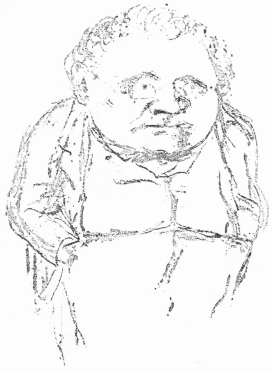
Francis James Child.
Caricature from a Pocket Note-Book.
On getting back to Cambridge in the autumn, James moved his family into
a house which he had just built in Irving Street—a street which had
been newly opened through what used to be called Norton's Woods. He had
planned this house with such eager interest in all its details that he
had even designed doors and windows and had practically been his own
architect with respect to everything except structural specifications.
The result was a detached wooden house of pleasantly square outer
appearance, covered with shingles which soon weathered brown, and having
dark green trimmings. Inside there was one room which deserves
particular mention. James loved to have "space" about him[93] and he
planned a library that was the largest and sunniest room the house
could provide. It was about 22½ feet wide and 27 feet long. The walls
were lined with book-shelves from floor to ceiling, except where James
hung a portrait of his father over the open fireplace. On the southern
side there was a triple window whose total width was nearly half the
length of the room, and which let in a flood of sunlight. Through it one
looked out upon a small lawn overhung by a large elm, and upon more
grass and trees beyond. This was his study and living-room for the rest
of his life. Here most of the Cambridge letters that follow may be
assumed to have been written.
After James moved to 95 Irving Street, several people referred to in the
letters became his very near neighbors. Josiah Royce, Francis J. Child,
C. E. Norton, Miss Theodora Sedgwick were all within three minutes walk
of his door. Miss Grace Norton lived across the way.
CAMBRIDGE, Dec. 25, 1889.
Dear Miss Norton,—Will you accept, as a Christmas offering, the
accompanying bottles of California Champagne, extremely salubrious in
its after-effects, quite as intoxicating, almost as good-tasting and
only half as "cost-playful" as French Champagne—in short, a beverage
which no household should be without.
I should gladly have sought out something more sentimental,—though
after a bottle or so, this seems rosy with sentiment,—but I have no
gifts of invention in the present line, and took something useful,
merely to testify to the affection and admiration with which I am ever
yours,
WM. JAMES.
Undated [1889].
MY DEAR MR. NORTON,—This introduces to you Mr. X——, from South
Abington, a workman in a tack factory since boyhood, who has
nevertheless gone quite deeply into studies philosophic, mathematical
and sociological. He will tell you more about himself, and I wish if
convenient that you would "draw him out"—I should like much to hear
your impression. I want, if possible, to help him to a start in life
here. Palmer has invited him to stay with him for a week. And we are
busy studying him and trying to cast his horoscope, to feel whether we
can conscientiously recommend him to some millionaire to support in
college for a year (as unmatriculated), and so give him a chance to make
himself known and find some better avocation for himself than the making
of tacks ten hours a day. He knows nothing of our plan, thinks this a
mere spree, so please don't let it out! Very truly yours,
WM. JAMES.
The workman from the tack factory, like more than one other lame duck
before and after him, had aroused what Professor Palmer once aptly
called James's "inclination toward the under-dog and his insistence on
keeping the door open for every species of human experiment." It made no
difference what X——'s doctrines were, or whether or not they were akin
to James's way of thinking. And if such a man was unfitted to arouse
other people's sympathies, James's own were the more readily challenged.
The erratics of the philosophical world were significant phenomena, and
sometimes interested him most just when they were most "queer"—when
they were perhaps aberrant to the point of being pathological specimens.
It mattered as little to James where such people sprang from, or by
what strange processes they had arrived at their ideas, as it matters to
a naturalist that beetles have to be hunted for in all sorts of places.
He filled the "Varieties of Religious Experience" with the records of
abnormal cases and with accounts of the mental and emotional adventures
of people whom the everyday world called cranks and fanatics. He was not
only curious about such men, but endlessly patient and helpful to them.
To some indeed his encouragement was more comforting than profitable,
and among them must be numbered the X—— of this letter—an uncouth and
helpless creature, who has since achieved his only immortality in
another sphere of being. The poor man never got over this "spree," but
withdrew from the tack factory forever, spent many years in a Mills
Hotel working over an unsalable magnum opus, and every now and then
appealing for funds. A letter on a later page recurs to this case.
In the spring of 1890 James finished the remaining chapters of the
"Psychology." The next letters were written during the final weeks of
work on the book.
CAMBRIDGE, May 9, 1890.
My dear Holt,—I was in hopes that you would propose to break away from
the famous "Series" and publish the book independently, in two volumes.
An abridgement could then be prepared for the Series. If there be
anything which I loathe it is a mean overgrown page in small type, and I
think the author's feelings ought to go for a good deal in the case of
the enormous rat which his ten years gestation has brought forth.
In any event, I dread the summer and next year, with two new courses to
teach, and, I fear, no vacation. What I wrote you, if you remember, was
to send you the "heft" of the MS. by May 1st, the rest to be done in the
intervals of proof-correcting. You however insisted on having the entire
MS. in your hands before anything should be done. It seems to me that
this delay is, now at any rate, absurd. There is certainly less than
two weeks' work on the MS. undone. And every day got behind us now means
a day of travel and vacation for me next September. I really think,
considering the sort of risk I am running by the delay, that I must
insist on getting to press now as soon as the page is decided on.
No one could be more disgusted than I at the sight of the book. No
subject is worth being treated of in 1000 pages! Had I ten years more, I
could rewrite it in 500; but as it stands it is this or nothing—a
loathsome, distended, tumefied, bloated, dropsical mass, testifying to
nothing but two facts: 1st, that there is no such thing as a science
of psychology, and 2nd, that W. J. is an incapable.
Yours provided you hurry up things,
WM. JAMES.
When Mrs. James took the children to Chocorua for the summer, James
remained in Cambridge to finish the book.
CAMBRIDGE, May 17, 7:50 P.M.
...Wrote hard pretty much all day, lectured on Ansel Bourne, etc., had
three students to lunch, Chubb being gone to Milton. Visit this A.M.
from Bishop Keane of the New Catholic University at Washington, to get
advice about psycho-physic laboratory. Feel very well, though I drink
coffee daily. "Psychology" will certainly be finished by Sunday noon!...
Sunday, May [18], 9:50 P.M.
...The job is done! All but some paging and half a dozen little
footnotes, the work is completed, and as I see it as a unit, I feel as
if it might be rather a vigorous and richly colored chunk—for that kind
of thing at least!...
May 22, 5:45 P.M.
...I sot up till two last night putting the finishing touches on the
MS., which now goes to Holt in irreproachable shape, woodcuts and all. I
insured it for $1000.00 in giving it to the express people this A.M.
That will make them extra careful at a cost of $1.50. This morning a
great feeling of weariness came over me at 10 o'clock, and I was taking
down a volume of Tennyson intending to doze off in my chair, when X——
arrived....
May 24.
...I came home very weary, and lit a fire, and had a delicious two hours
all by myself, thinking of the big étape of my life which now lay
behind me (I mean that infernal book done), and of the possibilities
that the future yielded of reading and living and loving out from the
shadow of that interminable black cloud.... At any rate, it does give me
some comfort to think that I don't live wholly in projects,
aspirations and phrases, but now and then have something done to show
for all the fuss. The joke of it is that I, who have always considered
myself a thing of glimpses, of discontinuity, of aperçus, with no
power of doing a big job, suddenly realize at the end of this task
that it is the biggest book on psychology in any language except
Wundt's, Rosmini's and Daniel Greenleaf Thompson's! Still, if it burns
up at the printing-office, I shan't much care, for I shan't ever write
it again!!
CHOCORUA, June 4, 1890.
My dear Harry, ...The great event for me is the completion at last of my
tedious book. I have been at my desk with it every day since I got back
from Europe, and up at four in the morning with it for many a day of the
last month. I have written every page four or five times over, and
carried it "on my mind" for nine years past, so you may imagine the
relief. Besides, I am glad to appear at last as a man who has done
something more than make phrases and projects. I will send you a copy,
in the fall, I trust, though [the printer] is so inert about starting
the proofs that we may not get through till midwinter or later. As
"Psychologies" go, it is a good one, but psychology is in such an
ante-scientific condition that the whole present generation of them is
predestined to become unreadable old medieval lumber, as soon as the
first genuine tracks of insight are made. The sooner the better, for
me!...
CAMBRIDGE, July 24, 1890.
My dear Mrs. Whitman,—How good a way to begin the day, with a letter
from you, and a composition of yours to correct!
To take the latter first, I trembled a little when, after looking over
the printed document, I found you beginning so sympathetically to stroke
down Mr. Jay; but you made it all right ere the end. Since the movement
is on foot, it is time that rational people like yourself should get an
influence in it. I doubt whether the earth supports a more genuine enemy
of all that the Catholic Church inwardly stands for than I
do—écrasez l'infâme is the only way I can feel about it. But the
concrete Catholics, including the common priests in this country, are an
entirely different matter. Their wish to educate their own, and to do
what proselytizing they can, is natural enough; so is their wish to get
state money. "Destroying American institutions" is a widely different
matter; and instead of this vague phrase, I should like to hear one
specification laid down of an "institution" which they are now
threatening. The only way to resist them is absolute firmness and
impartiality, and continuing in the line which you point out, bless your
'art! Down with demagogism!—this document is not quite free
therefrom....
As for the style, I see in it nothing but what is admirable. A pedant
might object (near the end) to a drop of (even Huguenot) blood
beating high; but how can I object to anything from your pen?
And now 10,000 thanks for your kind words about the proofs. The pages I
sent you are probably the most continuously amusing in the
book—though occasionally there is a passing gleam elsewhere. If there
is aught of good in the style, it is the result of ceaseless toil in
rewriting. Everything comes out wrong with me at first; but when once
objectified in a crude shape, I can torture and poke and scrape and pat
it till it offends me no more. I take you at your word and send you some
more sheets—only, to get something pithy and real, I go back to some
practical remarks at the end of a chapter on Habit, composed with a view
of benefiting the young. May they accordingly be an inspiration to
you!
Most of the book is altogether unreadable from any human point of view,
as I feel only too well in my deluge of proofs. My dear wife will come
down next week (I think) to help me through. Thank you once more, and
believe me, with warm regards to your husband, Yours always,
WM. JAMES.
CHOCORUA, Aug. 20, 1890.
My dear Howells,—You've done it this time and no mistake! I've had a
little leisure for reading this summer, and have just read, first your
"Shadow of a Dream," and next your "Hazard of New Fortunes," and can
hardly recollect a novel that has taken hold of me like the latter. Some
compensations go with being a mature man, do they not? You couldn't
possibly have done so solid a piece of work as that ten years ago, could
you? The steady unflagging flow of it is something wonderful. Never a
weak note, the number of characters, each intensely individual, the
observation of detail, the everlasting wit and humor, and beneath all
the bass accompaniment of the human problem, the entire Americanness of
it, all make it a very great book, and one which will last when we shall
have melted into the infinite azure. Ah! my dear Howells, it's worth
something to be able to write such a book, and it is so peculiarly
yours too, flavored with your idiosyncrasy. (The book is so d—d
humane!) Congratulate your wife on having brought up such a husband.
My wife had been raving about it ever since it came out, but I
couldn't read it till I got the larger printed copy, and naturally
couldn't credit all she said. But it makes one love as well as admire
you, and so o'er-shadows the equally exquisite, though slighter "Shadow
of a Dream," that I have no adjectives left for that. I hope the summer
is speeding well with all of you. I have been in Cambridge six weeks and
corrected 1400 pages of proof. The year which shall have witnessed the
apparition of your "Hazard of New Fortunes," of Harry's "Tragic Muse,"
and of my "Psychology" will indeed be a memorable one in American
Literature!! Believe me, with warm regards to Mrs. Howells, yours ever
affectionately,
WM. JAMES.
The "Principles of Psychology" appeared in the early autumn.