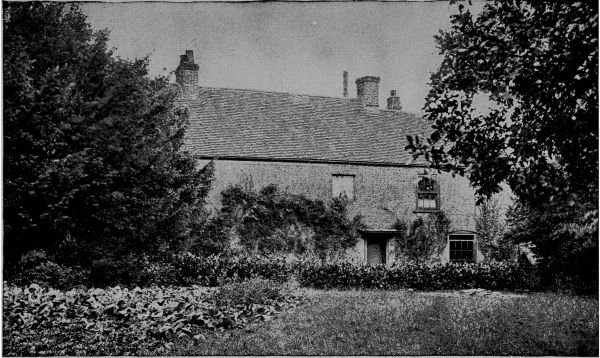
Godmersham Park, Thursday (Oct. 14).
My dearest Cassandra,—Now I will prepare
for Mr. Lushington, and as it will be wisest also
to prepare for his not coming, or my not getting a
frank, I shall write very close from the first, and
even leave room for the seal in the proper place.
When I have followed up my last with this I shall
feel somewhat less unworthy of you than the state
of our correspondence now requires.
I left off in a great hurry to prepare for our
morning visits. Of course was ready a good deal
the first, and need not have hurried so much.
Fanny wore her new gown and cap. I was surprised
to find Mystole so pretty.
The ladies were at home. I was in luck, and
saw Lady Fagg and all her five daughters, with an
old Mrs. Hamilton, from Canterbury, and Mrs.
and Miss Chapman, from Margate, into the bargain.
I never saw so plain a family,—five sisters
so very plain! They are as plain as the Foresters,
or the Franfraddops, or the Seagraves, or the
Rivers, excluding Sophy. Miss Sally Fagg has a
pretty figure, and that comprises all the good looks
of the family.
It was stupidish; Fanny did her part very well,
but there was a lack of talk altogether, and the
three friends in the house only sat by and looked
at us. However, Miss Chapman's name is Laura,
and she had a double flounce to her gown. You
really must get some flounces. Are not some of
your large stock of white morning gowns just in a
happy state for a flounce—too short? Nobody at
home at either house in Chilham.
Edward Bridges and his friend did not forget to
arrive. The friend is a Mr. Wigram, one of the
three-and-twenty children of a great rich mercantile,
Sir Robert Wigram, an old acquaintance of
the Footes, but very recently known to Edward B.
The history of his coming here is, that, intending
to go from Ramsgate to Brighton, Edw. B. persuaded
him to take Lenham on his way, which gave
him the convenience of Mr. W.'s gig, and the
comfort of not being alone there; but, probably
thinking a few days of Gm. would be the cheapest
and pleasantest way of entertaining his friend and
himself, offered a visit here, and here they stay
till to-morrow.
Mr. W. is about five or six-and-twenty, not ill-looking,
and not agreeable. He is certainly no
addition. A sort of cool, gentlemanlike manner,
but very silent. They say his name is Henry, a
proof how unequally the gifts of fortune are bestowed.
I have seen many a John and Thomas
much more agreeable.
We have got rid of Mr. R. Mascall, however. I
did not like him, either. He talks too much, and
is conceited, besides having a vulgarly shaped
mouth. He slept here on Tuesday, so that yesterday
Fanny and I sat down to breakfast with six
gentlemen to admire us.
We did not go to the ball. It was left to her to
decide, and at last she determined against it. She
knew that it would be a sacrifice on the part of her
father and brothers if they went, and I hope it
will prove that she has not sacrificed much. It is
not likely that there should have been anybody
there whom she would care for. I was very glad
to be spared the trouble of dressing and going, and
being weary before it was half over; so my gown
and my cap are still unworn. It will appear at
last, perhaps, that I might have done without
either. I produced my brown bombazine yesterday,
and it was very much admired indeed, and I
like it better than ever.
You have given many particulars of the state of
Chawton House, but still we want more. Edward
wants to be expressly told that all the round tower,
etc., is entirely down, and the door from the best
room stopped up; he does not know enough of the
appearance of things in that quarter.
He heard from Bath yesterday. Lady B. continues
very well, and Dr. Parry's opinion is, that
while the water agrees with her she ought to remain
there, which throws their coming away at a
greater uncertainty than we had supposed. It will
end, perhaps, in a fit of the gout, which may prevent
her coming away. Louisa thinks her mother's
being so well may be quite as much owing to her
being so much out of doors as to the water. Lady
B. is going to try the hot pump, the Cross bath
being about to be painted. Louisa is particularly
well herself, and thinks the water has been of use
to her. She mentioned our inquiries, etc., to Mr.
and Mrs. Alex. Evelyn, and had their best compliments
and thanks to give in return. Dr. Parry
does not expect Mr. E. to last much longer.
Only think of Mrs. Holder's being dead! Poor
woman, she has done the only thing in the world
she could possibly do to make one cease to abuse
her. Now, if you please, Hooper must have it in
his power to do more by his uncle. Lucky for the
little girl. An Anne Ekins can hardly be so unfit
for the care of a child as a Mrs. Holder.
A letter from Wrotham yesterday offering an
early visit here, and Mr. and Mrs. Moore and one
child are to come on Monday for ten days. I hope
Charles and Fanny may not fix the same time, but
if they come at all in October they must. What
is the use of hoping? The two parties of children
is the chief evil.
To be sure, here we are; the very thing has
happened, or rather worse,—a letter from Charles
this very morning, which gives us reason to suppose
they may come here to-day. It depends upon
the weather, and the weather now is very fine.
No difficulties are made, however, and, indeed,
there will be no want of room; but I wish there
were no Wigrams and Lushingtons in the way to
fill up the table and make us such a motley set. I
cannot spare Mr. Lushington either, because of his
frank, but Mr. Wigram does no good to anybody.
I cannot imagine how a man can have the impudence
to come into a family party for three days,
where he is quite a stranger, unless he knows himself
to be agreeable on undoubted authority. He
and Edw. B. are going to ride to Eastwell, and as
the boys are hunting, and my brother is gone to
Canty., Fanny and I have a quiet morning before
us.
Edward has driven off poor Mrs. Salkeld. It
was thought a good opportunity of doing something
towards clearing the house. By her own
desire Mrs. Fanny[26] is to be put in the room next
the nursery, her baby in a little bed by her; and
as Cassy is to have the closet within, and Betsey
William's little hole, they will be all very snug
together. I shall be most happy to see dear
Charles, and he will be as happy as he can with
a cross child, or some such care, pressing on him
at the time. I should be very happy in the idea
of seeing little Cassy again, too, did not I fear
she would disappoint me by some immediate
disagreeableness....
The comfort of the billiard-table here is very
great; it draws all the gentlemen to it whenever
they are within, especially after dinner, so that my
brother, Fanny, and I have the library to ourselves
in delightful quiet. There is no truth in the report
of G. Hatton being to marry Miss Wemyss.
He desires it may be contradicted.
Have you done anything about our present to
Miss Benn? I suppose she must have a bed at my
mother's whenever she dines there. How will they
manage as to inviting her when you are gone? and
if they invite, how will they continue to entertain
her?
Let me know as many of your parting arrangements
as you can, as to wine, etc. I wonder
whether the ink-bottle has been filled. Does
butcher's meat keep up at the same price, and
is not bread lower than 2s. 6d.? Mary's blue
gown! My mother must be in agonies. I have
a great mind to have my blue gown dyed some
time or other. I proposed it once to you, and
you made some objection, I forget what. It
is the fashion of flounces that gives it particular
expediency.
Mrs. and Miss Wildman have just been here.
Miss is very plain. I wish Lady B. may be returned
before we leave Gm., that Fanny may
spend the time of her father's absence at Goodnestone,
which is what she would prefer.
Friday.—They came last night at about seven.
We had given them up, but I still expected them
to come. Dessert was nearly over; a better time
for arriving than an hour and a half earlier. They
were late because they did not set out earlier, and
did not allow time enough. Charles did not aim
at more than reaching Sittingbourne by three,
which could not have brought them here by dinner-time.
They had a very rough passage; he would
not have ventured if he had known how bad it
would be.
However, here they are, safe and well, just like
their own nice selves, Fanny looking as neat and
white this morning as possible, and dear Charles
all affectionate, placid, quiet, cheerful good-humor.
They are both looking very well, but poor little
Cassy is grown extremely thin, and looks poorly.
I hope a week's country air and exercise may do
her good. I am sorry to say it can be but a week.
The baby does not appear so large in proportion as
she was, nor quite so pretty, but I have seen very
little of her. Cassy was too tired and bewildered
just at first to seem to know anybody. We met
them in the hall—the women and girl part of us—but
before we reached the library she kissed me
very affectionately, and has since seemed to recollect
me in the same way.
It was quite an evening of confusion, as you
may suppose. At first we were all walking about
from one part of the house to the other; then came
a fresh dinner in the breakfast-room for Charles
and his wife, which Fanny and I attended; then
we moved into the library, were joined by the
dining-room people, were introduced, and so forth;
and then we had tea and coffee, which was not over
till past ten. Billiards again drew all the odd
ones away; and Edward, Charles, the two Fannies,
and I sat snugly talking. I shall be glad to have
our numbers a little reduced, and by the time you
receive this we shall be only a family, though a
large family, party. Mr. Lushington goes to-morrow.
Now I must speak of him, and I like him very
much. I am sure he is clever, and a man of taste.
He got a volume of Milton last night, and spoke
of it with warmth. He is quite an M. P., very
smiling, with an exceeding good address and readiness
of language. I am rather in love with him.
I dare say he is ambitious and insincere. He puts
me in mind of Mr. Dundas. He has a wide smiling
mouth, and very good teeth, and something the
same complexion and nose. He is a much shorter
man, with Martha's leave. Does Martha never
hear from Mrs. Craven? Is Mrs. Craven never at
home?
We breakfasted in the dining-room to-day, and
are now all pretty well dispersed and quiet.
Charles and George are gone out shooting together,
to Winnigates and Seaton Wood. I asked on purpose
to tell Henry. Mr. Lushington and Edwd.
are gone some other way. I wish Charles may kill
something; but this high wind is against their
sport.
Lady Williams is living at the Rose at Sittingbourne;
they called upon her yesterday; she cannot
live at Sheerness, and as soon as she gets to
Sittingbourne is quite well. In return for all your
matches, I announce that her brother William is
going to marry a Miss Austen, of a Wiltshire
family, who say they are related to us.
I talk to Cassy about Chawton; she remembers
much, but does not volunteer on the subject.
Poor little love! I wish she were not so very
Palmery, but it seems stronger than ever. I never
knew a wife's family features have such undue
influence.
Papa and mamma have not yet made up their
mind as to parting with her or not; the chief, indeed
the only, difficulty with mamma is a very
reasonable one, the child's being very unwilling to
leave them. When it was mentioned to her she
did not like the idea of it at all. At the same
time she has been suffering so much lately from
sea-sickness that her mamma cannot bear to have
her much on board this winter. Charles is less
inclined to part with her. I do not know how it
will end, or what is to determine it. He desires
his best love to you, and has not written because
he has not been able to decide. They are both
very sensible of your kindness on the occasion.
I have made Charles furnish me with something
to say about young Kendall. He is going on very
well. When he first joined the "Namur," my
brother did not find him forward enough to be
what they call put in the office, and therefore
placed him under the schoolmaster; but he is
very much improved, and goes into the office
now every afternoon, still attending school in
the morning.
This cold weather comes very fortunately for
Edward's nerves, with such a house full; it suits
him exactly; he is all alive and cheerful. Poor
James, on the contrary, must be running his toes
into the fire. I find that Mary Jane Fowle was
very near returning with her brother and paying
them a visit on board. I forget exactly what hindered
her; I believe the Cheltenham scheme. I
am glad something did. They are to go to Cheltenham
on Monday se'nnight. I don't vouch for
their going, you know; it only comes from one of
the family.
Now I think I have written you a good-sized
letter, and may deserve whatever I can get in reply.
Infinities of love. I must distinguish that
of Fanny, senior, who particularly desires to be
remembered to you all.
Yours very affectionately,
J. Austen.
Faversham, Oct. 15, 1813.
Miss Austen, Chawton, Alton, Hants.
Per S. R. Lushington.
L.
Godmersham Park, Oct. 18.
My dear Aunt Cassandra,—I am very much
obliged to you for your long letter and for the nice
account of Chawton. We are all very glad to hear
that the Adams are gone, and hope Dame Libscombe
will be more happy now with her deaffy child, as
she calls it, but I am afraid there is not much
chance of her remaining long sole mistress of her
house.
I am sorry you had not any better news to send
us of our hare, poor little thing! I thought it
would not live long in that Pondy House; I don't
wonder that Mary Doe is very sorry it is dead,
because we promised her that if it was alive when
we came back to Chawton, we would reward her for
her trouble.
Papa is much obliged to you for ordering the
scrubby firs to be cut down; I think he was rather
frightened at first about the great oak. Fanny
quite believed it, for she exclaimed, "Dear me,
what a pity, how could they be so stupid!" I
hope by this time they have put up some hurdles
for the sheep, or turned out the cart-horses from
the lawn.
Pray tell grandmamma that we have begun getting
seeds for her; I hope we shall be able to get
her a nice collection, but I am afraid this wet
weather is very much against them. How glad I
am to hear she has had such good success with her
chickens, but I wish there had been more bantams
amongst them. I am very sorry to hear of poor
Lizzie's fate.
I must now tell you something about our poor
people. I believe you know old Mary Croucher;
she gets maderer and maderer every day. Aunt
Jane has been to see her, but it was on one of her
rational days. Poor Will Amos hopes your skewers
are doing well; he has left his house in the
poor Row, and lives in a barn at Builting. We
asked him why he went away, and he said the fleas
were so starved when he came back from Chawton
that they all flew upon him and eenermost eat
him up.
How unlucky it is that the weather is so wet!
Poor Uncle Charles has come home half drowned
every day.
I don't think little Fanny is quite so pretty as
she was; one reason is because she wears short
petticoats, I believe. I hope Cook is better; she
was very unwell the day we went away. Papa has
given me half-a-dozen new pencils, which are very
good ones indeed; I draw every other day. I hope
you go and whip Lucy Chalcraft every night.
Miss Clewes begs me to give her very best respects
to you; she is very much obliged to you for
your kind inquiries after her. Pray give my duty
to grandmamma and love to Miss Floyd. I remain,
my dear Aunt Cassandra, your very affectionate
niece,
Elizth. Knight.
Thursday.—I think Lizzy's letter will entertain
you. Thank you for yours just received. To-morrow
shall be fine if possible. You will be at
Guildford before our party set off. They only
go to Key Street, as Mr. Street the Purser lives
there, and they have promised to dine and sleep
with him.
Cassy's looks are much mended. She agrees
pretty well with her cousins, but is not quite
happy among them; they are too many and too
boisterous for her. I have given her your message,
but she said nothing, and did not look as if
the idea of going to Chawton again was a pleasant
one. They have Edward's carriage to Ospringe.
I think I have just done a good deed,—extracted
Charles from his wife and children upstairs, and
made him get ready to go out shooting, and not
keep Mr. Moore waiting any longer.
Mr. and Mrs. Sherer and Joseph dined here
yesterday very prettily. Edw. and Geo. were
absent,—gone for a night to Eastling. The two
Fannies went to Canty. in the morning, and took
Lou. and Cass. to try on new stays. Harriet and
I had a comfortable walk together. She desires
her best love to you and kind remembrance to
Henry. Fanny's best love also. I fancy there is
to be another party to Canty. to-morrow,—Mr. and
Mrs. Moore and me.
Edward thanks Henry for his letter. We are
most happy to hear he is so much better. I depend
upon you for letting me know what he wishes
as to my staying with him or not; you will be able
to find out, I dare say. I had intended to beg you
would bring one of my nightcaps with you, in case
of my staying, but forgot it when I wrote on
Tuesday. Edward is much concerned about his
pond; he cannot now doubt the fact of its running
out, which he was resolved to do as long
as possible.
I suppose my mother will like to have me write
to her. I shall try at least.
No; I have never seen the death of Mrs. Crabbe.
I have only just been making out from one of his
prefaces that he probably was married. It is almost
ridiculous. Poor woman! I will comfort
him as well as I can, but I do not undertake to be
good to her children. She had better not leave any.
Edw. and Geo. set off this day week for Oxford.
Our party will then be very small, as the Moores
will be going about the same time. To enliven
us, Fanny proposes spending a few days soon afterwards
at Fredville. It will really be a good opportunity,
as her father will have a companion. We
shall all three go to Wrotham, but Edwd. and I
stay only a night perhaps. Love to Mr. Tilson.
Yours very affectionately, J. A.
Miss Austen,
10 Henrietta St., Covent Garden, London.
LI. — FOOTNOTE:
Godmersham Park, Wednesday (Nov. 3).
My dearest Cassandra,—I will keep this
celebrated birthday by writing to you; and as my
pen seems inclined to write large, I will put my
lines very close together. I had but just time to
enjoy your letter yesterday before Edward and I
set off in the chair for Canty., and I allowed him
to hear the chief of it as we went along.
We rejoice sincerely in Henry's gaining ground
as he does, and hope there will be weather for him
to get out every day this week, as the likeliest way
of making him equal to what he plans for the next.
If he is tolerably well, the going into Oxfordshire
will make him better, by making him happier.
Can it be that I have not given you the minutiæ
of Edward's plans? See, here they are: To
go to Wrotham on Saturday the 13th, spend Sunday
there, and be in town on Monday to dinner,
and if agreeable to Henry, spend one whole day
with him, which day is likely to be Tuesday, and
so go down to Chawton on Wednesday.
But now I cannot be quite easy without staying
a little while with Henry, unless he wishes it
otherwise; his illness and the dull time of year
together make me feel that it would be horrible of
me not to offer to remain with him, and therefore
unless you know of any objection, I wish you
would tell him with my best love that I shall be
most happy to spend ten days or a fortnight in
Henrietta St., if he will accept me. I do not offer
more than a fortnight, because I shall then have
been some time from home; but it will be a great
pleasure to be with him, as it always is. I have
the less regret and scruple on your account, because
I shall see you for a day and a half, and because
you will have Edward for at least a week. My
scheme is to take Bookham in my way home for a
few days, and my hope that Henry will be so good
as to send me some part of the way thither. I
have a most kind repetition of Mrs. Cooke's two or
three dozen invitations, with the offer of meeting
me anywhere in one of her airings.
Fanny's cold is much better. By dosing and
keeping her room on Sunday, she got rid of the
worst of it, but I am rather afraid of what this
day may do for her; she is gone to Canty. with
Miss Clewes, Liz., and Marnne, and it is but roughish
weather for any one in a tender state. Miss
Clewes has been going to Canty. ever since her
return, and it is now just accomplishing.
Edward and I had a delightful morning for our
drive there, I enjoyed it thoroughly; but the day
turned off before we were ready, and we came home
in some rain and the apprehension of a great deal.
It has not done us any harm, however. He went
to inspect the gaol, as a visiting magistrate, and
took me with him. I was gratified, and went
through all the feelings which people must go
through, I think, in visiting such a building.
We paid no other visits, only walked about
snugly together, and shopped. I bought a concert
ticket and a sprig of flowers for my old age.
To vary the subject from gay to grave with
inimitable address, I shall now tell you something
of the Bath party—and still a Bath party they
are, for a fit of the gout came on last week. The
accounts of Lady B. are as good as can be under
such a circumstance; Dr. P. says it appears a
good sort of gout, and her spirits are better than
usual, but as to her coming away, it is of course
all uncertainty. I have very little doubt of Edward's
going down to Bath, if they have not left
it when he is in Hampshire; if he does, he will
go on from Steventon, and then return direct to
London, without coming back to Chawton. This
detention does not suit his feelings. It may be
rather a good thing, however, that Dr. P. should
see Lady B. with the gout on her. Harriot was
quite wishing for it.
The day seems to improve. I wish my pen
would too.
Sweet Mr. Ogle! I dare say he sees all the
panoramas for nothing, has free admittance everywhere;
he is so delightful! Now, you need not
see anybody else.
I am glad to hear of our being likely to have a
peep at Charles and Fanny at Christmas, but do
not force poor Cass. to stay if she hates it. You
have done very right as to Mrs. F. A. Your
tidings of S. and S. give me pleasure. I have
never seen it advertised.
Harriot, in a letter to Fanny to-day, inquires
whether they sell cloths for pelisses at Bedford
House, and, if they do, will be very much obliged
to you to desire them to send her down patterns,
with the width and prices; they may go from
Charing Cross almost any day in the week, but
if it is a ready-money house it will not do, for
the bru of feu the Archbishop says she cannot pay
for it immediately. Fanny and I suspect they do
not deal in the article.
The Sherers, I believe, are now really going to
go; Joseph has had a bed here the last two
nights, and I do not know whether this is not the
day of moving. Mrs. Sherer called yesterday to
take leave. The weather looks worse again.
We dine at Chilham Castle to-morrow, and I
expect to find some amusement, but more from the
concert the next day, as I am sure of seeing
several that I want to see. We are to meet a
party from Goodnestone, Lady B., Miss Hawley,
and Lucy Foote, and I am to meet Mrs. Harrison,
and we are to talk about Ben and Anna. "My
dear Mrs. Harrison," I shall say, "I am afraid
the young man has some of your family madness;
and though there often appears to be something of
madness in Anna too, I think she inherits more
of it from her mother's family than from ours."
That is what I shall say, and I think she will
find it difficult to answer me.
I took up your letter again to refresh me, being
somewhat tired, and was struck with the prettiness
of the hand: it is really a very pretty hand now
and then,—so small and so neat! I wish I could
get as much into a sheet of paper.[27] Another time
I will take two days to make a letter in: it is
fatiguing to write a whole long one at once. I
hope to hear from you again on Sunday and again
on Friday, the day before we move. On Monday,
I suppose, you will be going to Streatham, to see
quiet Mr. Hill and eat very bad baker's bread.
A fall in bread by the by. I hope my
mother's bill next week will show it. I have had
a very comfortable letter from her, one of her
foolscap sheets quite full of little home news.
Anna was there the first of the two days. An
Anna sent away and an Anna fetched are different
things. This will be an excellent time for Ben
to pay his visit, now that we, the formidables,
are absent.
I did not mean to eat, but Mr. Johncock has
brought in the tray, so I must. I am all alone.
Edward is gone into his woods. At this present
time I have five tables, eight-and-twenty chairs,
and two fires all to myself.
Miss Clewes is to be invited to go to the concert
with us; there will be my brother's place and
ticket for her, as he cannot go. He and the other
connections of the Cages are to meet at Milgate
that very day, to consult about a proposed alteration
of the Maidstone road, in which the Cages
are very much interested. Sir Brook comes here
in the morning, and they are to be joined by Mr.
Deedes at Ashford. The loss of the concert will
be no great evil to the Squire. We shall be a
party of three ladies therefore, and to meet three
ladies.
What a convenient carriage Henry's is, to his
friends in general! Who has it next? I am
glad William's going is voluntary, and on no
worse grounds. An inclination for the country
is a venial fault. He has more of Cowper than of
Johnson in him,—fonder of tame hares and blank
verse than of the full tide of human existence at
Charing Cross.
Oh! I have more of such sweet flattery from
Miss Sharp. She is an excellent kind friend. I
am read and admired in Ireland too. There is a
Mrs. Fletcher, the wife of a judge, an old lady,
and very good and very clever, who is all curiosity
to know about me,—what I am like, and so forth.
I am not known to her by name, however. This
comes through Mrs. Carrick, not through Mrs.
Gore. You are quite out there.
I do not despair of having my picture in the
Exhibition at last,—all white and red, with my
head on one side; or perhaps I may marry young
Mr. D'Arblay. I suppose in the mean time I
shall owe dear Henry a great deal of money for
printing, etc.
I hope Mrs. Fletcher will indulge herself with
S. and S. If I am to stay in H. S., and if
you should be writing home soon, I wish you
would be so good as to give a hint of it, for I am
not likely to write there again these ten days,
having written yesterday.
Fanny has set her heart upon its being a Mr.
Brett who is going to marry a Miss Dora Best, of
this country. I dare say Henry has no objection.
Pray, where did the boys sleep?
The Deedes come here on Monday to stay till
Friday, so that we shall end with a flourish the
last canto. They bring Isabella and one of the
grown-ups, and will come in for a Canty. ball on
Thursday. I shall be glad to see them. Mrs.
Deedes and I must talk rationally together, I
suppose.
Edward does not write to Henry, because of
my writing so often. God bless you. I shall be
so glad to see you again, and I wish you many
happy returns of this day. Poor Lord Howard!
How he does cry about it!
Yours very truly, J. A.
Miss Austen,
10 Henrietta Street, Covent Garden, London.
LII.
Godmersham Park, Saturday (Nov. 6).
My dearest Cassandra,—Having half an
hour before breakfast (very snug, in my own
room, lovely morning, excellent fire—fancy me!)
I will give you some account of the last two days.
And yet, what is there to be told? I shall get
foolishly minute unless I cut the matter short.
We met only the Bretons at Chilham Castle,
besides a Mr. and Mrs. Osborne and a Miss Lee
staying in the house, and were only fourteen altogether.
My brother and Fanny thought it the
pleasantest party they had ever known there, and
I was very well entertained by bits and scraps. I
had long wanted to see Dr. Breton, and his wife
amuses me very much with her affected refinement
and elegance. Miss Lee I found very conversable;
she admires Crabbe as she ought. She is at an
age of reason, ten years older than myself at least.
She was at the famous ball at Chilham Castle, so
of course you remember her.
By the by, as I must leave off being young, I
find many douceurs in being a sort of chaperon,
for I am put on the sofa near the fire, and can
drink as much wine as I like. We had music in
the evening: Fanny and Miss Wildman played,
and Mr. James Wildman sat close by and listened,
or pretended to listen.
Yesterday was a day of dissipation all through:
first came Sir Brook to dissipate us before breakfast;
then there was a call from Mr. Sherer, then
a regular morning visit from Lady Honeywood in
her way home from Eastwell; then Sir Brook
and Edward set off; then we dined (five in number)
at half-past four; then we had coffee; and at
six Miss Clewes, Fanny, and I drove away. We
had a beautiful night for our frisks. We were
earlier than we need have been, but after a time
Lady B. and her two companions appeared,—we
had kept places for them; and there we sat, all
six in a row, under a side wall, I between Lucy
Foote and Miss Clewes.
Lady B. was much what I expected; I could not
determine whether she was rather handsome or
very plain. I liked her for being in a hurry to
have the concert over and get away, and for getting
away at last with a great deal of decision and
promptness, not waiting to compliment and dawdle
and fuss about seeing dear Fanny, who was half
the evening in another part of the room with her
friends the Plumptres. I am growing too minute,
so I will go to breakfast.
When the concert was over, Mrs. Harrison and
I found each other out, and had a very comfortable
little complimentary friendly chat. She is a sweet
woman,—still quite a sweet woman in herself, and
so like her sister! I could almost have thought I
was speaking to Mrs. Lefroy. She introduced me
to her daughter, whom I think pretty, but most
dutifully inferior to la Mère Beauté. The Faggs
and the Hammonds were there,—Wm. Hammond
the only young man of renown. Miss looked very
handsome, but I prefer her little smiling flirting
sister Julia.
I was just introduced at last to Mary Plumptre,
but I should hardly know her again. She was delighted
with me, however, good enthusiastic soul!
And Lady B. found me handsomer than she expected,
so you see I am not so very bad as you
might think for.
It was twelve before we reached home. We were
all dog-tired, but pretty well to-day: Miss Clewes
says she has not caught cold, and Fanny's does not
seem worse. I was so tired that I began to wonder
how I should get through the ball next Thursday;
but there will be so much more variety then in
walking about, and probably so much less heat,
that perhaps I may not feel it more. My china
crape is still kept for the ball. Enough of the
concert.
I had a letter from Mary yesterday. They travelled
down to Cheltenham last Monday very safely,
and are certainly to be there a month. Bath is
still Bath. The H. Bridges must quit them early
next week, and Louisa seems not quite to despair
of their all moving together, but to those who
see at a distance there appears no chance of it.
Dr. Parry does not want to keep Lady B. at Bath
when she can once move. That is lucky. You
will see poor Mr. Evelyn's death.
Since I wrote last, my 2nd edit. has stared me
in the face. Mary tells me that Eliza means to
buy it. I wish she may. It can hardly depend
upon any more Fyfield Estates. I cannot help hoping
that many will feel themselves obliged to
buy it. I shall not mind imagining it a disagreeable
duty to them, so as they do it. Mary heard
before she left home that it was very much admired
at Cheltenham, and that it was given to
Miss Hamilton. It is pleasant to have such a respectable
writer named. I cannot tire you, I am
sure, on this subject, or I would apologize.
What weather, and what news! We have
enough to do to admire them both. I hope you
derive your full share of enjoyment from each.
I have extended my lights and increased my
acquaintance a good deal within these two days.
Lady Honeywood you know; I did not sit near
enough to be a perfect judge, but I thought her
extremely pretty, and her manners have all the
recommendations of ease and good-humor and
unaffectedness; and going about with four horses
and nicely dressed herself, she is altogether a
perfect sort of woman.
Oh, and I saw Mr. Gipps last night,—the useful
Mr. Gipps, whose attentions came in as acceptably
to us in handing us to the carriage, for want
of a better man, as they did to Emma Plumptre.
I thought him rather a good-looking little man.
I long for your letter to-morrow, particularly
that I may know my fate as to London. My first
wish is that Henry should really choose what he
likes best; I shall certainly not be sorry if he does
not want me. Morning church to-morrow; I
shall come back with impatient feelings.
The Sherers are gone, but the Pagets are not
come: we shall therefore have Mr. S. again. Mr.
Paget acts like an unsteady man. Dr. Hant,
however, gives him a very good character; what
is wrong is to be imputed to the lady. I dare say
the house likes female government.
I have a nice long black and red letter from
Charles, but not communicating much that I did
not know.
There is some chance of a good ball next week,
as far as females go. Lady Bridges may perhaps
be there with some Knatchbulls. Mrs. Harrison
perhaps, with Miss Oxenden and the Miss Papillons;
and if Mrs. Harrison, then Lady Fagg will come.
The shades of evening are descending, and I
resume my interesting narrative. Sir Brook and
my brother came back about four, and Sir Brook
almost immediately set forward again to Goodnestone.
We are to have Edwd. B. to-morrow, to
pay us another Sunday's visit,—the last, for more
reasons than one; they all come home on the same
day that we go. The Deedes do not come till
Tuesday; Sophia is to be the comer. She is a
disputable beauty that I want much to see. Lady
Eliz. Hatton and Annamaria called here this
morning. Yes, they called; but I do not think
I can say anything more about them. They came,
and they sat, and they went.
Sunday.—Dearest Henry! What a turn he
has for being ill, and what a thing bile is! This
attack has probably been brought on in part by
his previous confinement and anxiety; but, however
it came, I hope it is going fast, and that you
will be able to send a very good account of him on
Tuesday. As I hear on Wednesday, of course I
shall not expect to hear again on Friday. Perhaps
a letter to Wrotham would not have an ill effect.
We are to be off on Saturday before the post
comes in, as Edward takes his own horses all the
way. He talks of nine o'clock. We shall bait at
Lenham.
Excellent sweetness of you to send me such a
nice long letter; it made its appearance, with one
from my mother, soon after I and my impatient
feelings walked in. How glad I am that I did
what I did! I was only afraid that you might
think the offer superfluous, but you have set my
heart at ease. Tell Henry that I will stay with
him, let it be ever so disagreeable to him.
Oh, dear me! I have not time on paper for
half that I want to say. There have been two
letters from Oxford,—one from George yesterday.
They got there very safely,—Edwd. two hours
behind the coach, having lost his way in leaving
London. George writes cheerfully and quietly;
hopes to have Utterson's rooms soon; went to
lecture on Wednesday, states some of his expenses,
and concludes with saying, "I am afraid
I shall be poor." I am glad he thinks about it so
soon. I believe there is no private tutor yet
chosen, but my brother is to hear from Edwd. on
the subject shortly.
You, and Mrs. H., and Catherine, and Alethea
going about together in Henry's carriage seeing
sights—I am not used to the idea of it yet. All
that you are to see of Streatham, seen already!
Your Streatham and my Bookham may go hang.
The prospect of being taken down to Chawton by
Henry perfects the plan to me. I was in hopes of
your seeing some illuminations, and you have
seen them. "I thought you would come, and
you did come." I am sorry he is not to come
from the Baltic sooner. Poor Mary!
My brother has a letter from Louisa to-day of
an unwelcome nature; they are to spend the
winter at Bath. It was just decided on. Dr.
Parry wished it, not from thinking the water
necessary to Lady B., but that he might be better
able to judge how far his treatment of her, which
is totally different from anything she had been
used to, is right; and I suppose he will not mind
having a few more of her Ladyship's guineas.
His system is a lowering one. He took twelve
ounces of blood from her when the gout appeared,
and forbids wine, etc. Hitherto the plan agrees
with her. She is very well satisfied to stay, but
it is a sore disappointment to Louisa and Fanny.
The H. Bridges leave them on Tuesday, and
they mean to move into a smaller house; you may
guess how Edward feels. There can be no doubt
of his going to Bath now; I should not wonder if
he brought Fanny Cage back with him.
You shall hear from me once more, some day
or other.
Yours very affectionately, J. A.
We do not like Mr. Hampson's scheme.
Miss Austen,
10 Henrietta Street, Covent Garden, London.
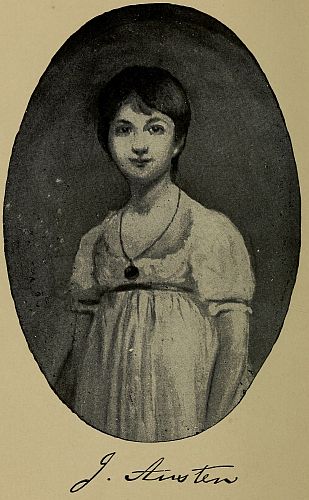 From a Painting in the possession of the Rev. Morland Rice,
of Bramber.
From a Painting in the possession of the Rev. Morland Rice,
of Bramber.