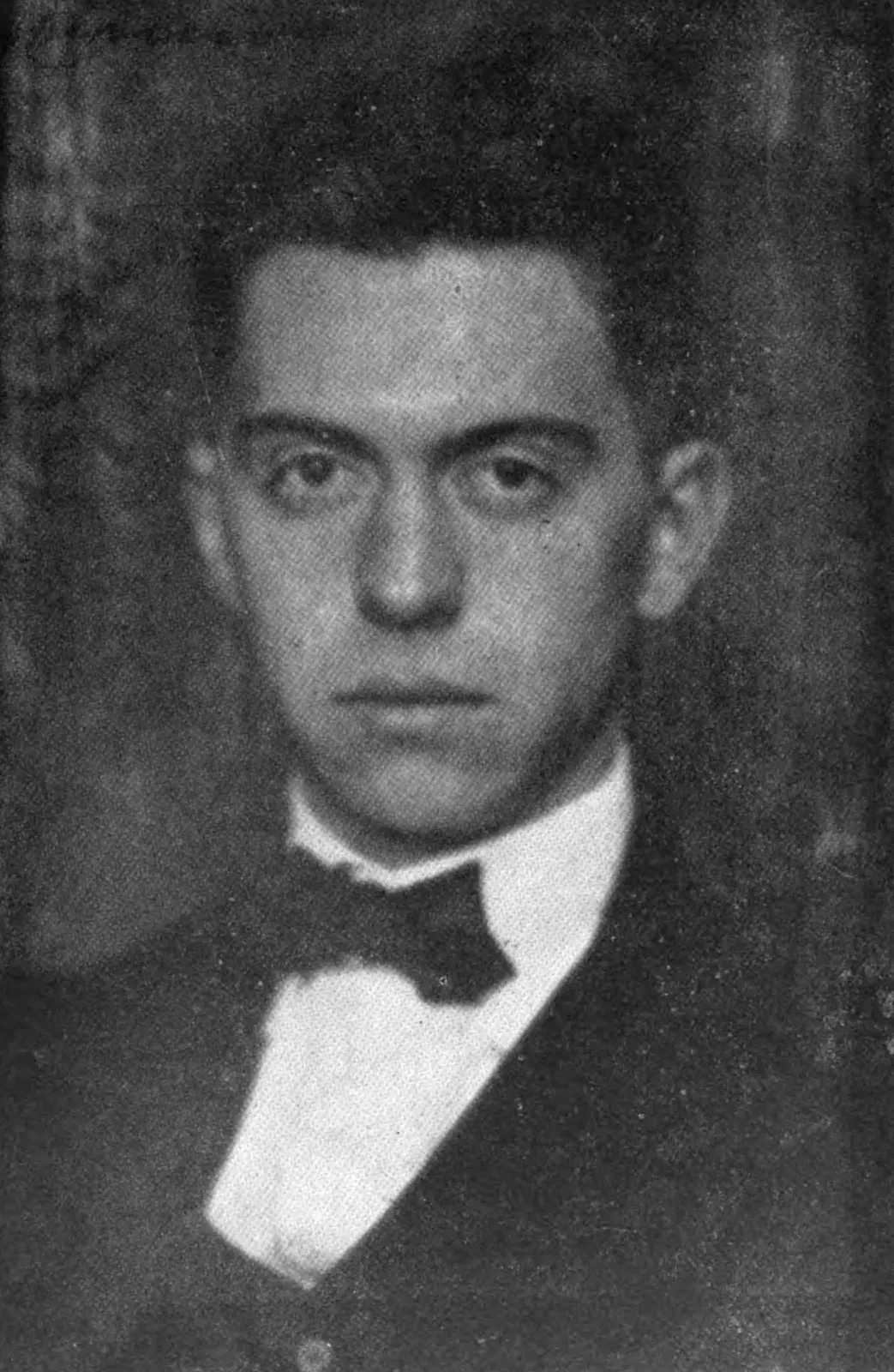
225: To Malcolm Cowley
[Patterson] Jan 3rd
Dear Malcolm: The poem[41] has been read with approval—is flatteringly
apocalyptic and has the proper nautical slant.... Seriously, though, it
seems to stand on its own feet as a poem and I appreciate a very great
deal the tonality and direction of it in its more intimate aspects. You
and Peggy [Baird] have been more than good in remembering me—thanks for
the photo, too. —/—/
Are you reviewing Doc. Transit anywhere? Schneider finally sent me out
a copy. It intrigued me more than any such tour de force since Poe,
though it has its obvious weaknesses. Some chapters, however, of great
imagination. I didn’t anticipate half so much from the earlier things
I’ve read by Schneider.
I’m coming in town probably about two weeks from now, and should like to
know what day or days about that period you’ll be there also. You know
what the Governor of North Carolina said to the Governor of S.
Carolina—! I’m such a rum-scallion that I never even planned to stay
put anywhere very long in the woods. Let me hear from you soon. —/—/
226: To His Grandmother
Patterson Jan. 5th ’26
Dear Grandma: I was sorry to hear from Grace yesterday that you have
been undergoing more pain and illness—and I only hope that this finds
you MUCH improved. I wish I could be near you—and have a long talk. We
certainly will manage that when I come out to Cleveland next spring.
Yesterday I finally got started into my Bridge poem—really the first
full day I have [had] for the work since arriving. And from now on I
hope to have the necessary inspiration to keep steadily at it. One
really has to keep one’s self in such a keyed-up mood for the thing
that no predictions can be made ahead as to whether one is going to have
the wit to work on it steadily or not.
It is fine to get somewhere where I can sleep soundly again. I’m
beginning to feel very much rested. I’m so glad that you both are
located in a place where there is nothing more to do than to care for
your personal comfort. —/—/
227: To His Mother
Patterson Jan. 7th
Dear Grace & Grandma: —/—/ There isn’t much news—only the good news
(to me!) that I’ve been at work in almost ecstatic mood for the last two
days on my Bridge. I never felt such range and symphonic power
before—and I’m so happy to have this first burst of substantiation
since I had the good luck to be set free to build this structure of my
dreams.
I sent New Year’s greetings to Kahn and in the mail today comes the most
cordial answer—wishing as he puts it, “that you will prove yourself a
master builder in constructing The Bridge of your dreams, thoughts and
emotions.” —/—/
228: To Waldo Frank
Patterson, N. York Jan. 18th ’26
Dear Waldo: I am not through working on it yet, but I thought you might
care to see this last part of The Bridge, oddly enough emergent
first.[42] It is symphonic in including the convergence of all the
strands separately detailed in antecedent sections of the
poem—Columbus, conquests of water, land, etc., Pokahantus, subways,
offices, etc., etc. I dare congratulate myself a little, I think, in
having found some liberation for my condensed metaphorical habit in a
form as symphonic (at least so attempted) as this.
The bridge in becoming a ship, a world, a woman, a tremendous harp (as
it does finally) seems to really have a career. I have attempted to
induce the same feelings of elation, etc.—like being carried forward
and upward simultaneously—both in imagery, rhythm and repetition, that
one experiences in walking across my beloved Brooklyn Bridge. I’m now
busy on the Niña, Santa Maria, Pinta episode—Cathay being an attitude
of spirit, rather than material conquest throughout, of course.
I know I can depend on you to mention the flaws and shortcomings. This
section seems a little transcendental in tendency at present,—but I
think that the pediments of the other sections will show it not to have
been. —/—/
229: To His Mother
Patterson Jan. 26
Dear Grace: It is a good thing I got your letter yesterday—or I
should have been sore. I was so tired last night I simply fell into
bed at 10. We had spent most of the day shopping in town and I later
built me some bookshelves which are very simple but extend to the
ceiling—the kind I have always wanted. My study now is a picture to
enjoy. When I was in New York I bought some beautiful and rare Congo
wood carvings—and added to my Sommer paintings and your photograph they
make a marvelous room.
My hands are so stiff from wood-cutting that my writing looks funny. It
is very, very cold today, was yesterday and promises to continue. We all
go about shivering most of the time and I’m sorry to say get too little
freedom for our writing. Certainly the spring warmth will be unusually
welcome to all of us.
—/—/ We do not correspond—except at considerable intervals as I
hesitate to presume much on his [Otto Kahn] attention. There are so many
others whom he is always helping that his time is largely taken up
anyway. What with two personal secretaries and a whole corps of personal
office help—besides his huge financial machine (his interests occupy
a building of about 22 stories) he must be a busy man. He wants to hear
from “time to time” as he puts it—about how my poem is progressing.
But, since writing him New Year’s I shan’t presume again until next
March or so. My second thousand is not payable until along in May. At
which time I shall probably personally talk to him again. Beyond this
money I have no expectations of more assistance, but if my poem when
completed seems good enough to him, it may be, of course, that he will
be further interested. I’m thankful enough for what I already have,
however!
Your news about Grandma is rather heartrending. I do hope she won’t have
to suffer much longer—and if she does that she will be given enough
sedatives to keep the pain dulled, no matter what the consequences. It
would be best if she really gives up more—for the remainder of her
existence—under any conditions—promises her only misery. —/—/
230: To His Grandmother
Patterson, New York January 27th
Dear Grandma: —/—/ I am hoping to hear from Grace tomorrow all about
how you are. Much better, I hope.
We had a brief flurry of snow again today, but not enough yet to permit
me to use my scrumptious snow shoes. I have been reading the Journal of
Christopher Columbus lately—of his first voyage to America, which is
concerned mostly with his cruisings around the West Indies. It has
reminded me many times of the few weeks I spent on the Island to hear
him expatiate on the gorgeous palms, unexpected pines, balmy breezes,
etc., which we associate with Cuba. — — — —
231: To Gaston Lachaise
Patterson, New York Feb. 10th, 26
Dear Lachaise: Constantly your seagull has floated in my mind—ever
since I saw it, and it will mean much to me to have it. I can’t thank
you enough. I am enclosing an amount which I hope will to some extent
defray the cost of materials, and you must let me know if more is
needed.
I envy you your occupation out here in the extreme cold of the last two
weeks—wiggling a pen or tapping a typewriter is hardly as conducive to
good circulation or warmth while every breath one takes comes out like a
steaming snort from a dragon! At present the snow is so deep that we are
obliged to use snow shoes or skis to get anywhere. Fortunately we are
well supplied with wood and oil and provisions.
When I get to New York—probably not for six weeks or so—I hope to find
you in. If the white bird is done before then you can express it out to
Patterson, or I’ll be glad to carry it back when I come in. — — — —
232: To Charlotte and Richard Rychtarik
Patterson, New York March 2nd
Dear Charlotte et Ricardo: —/—/ In spite of many inconveniences,
however, I am glad of coming out here. Temperate living, good sleep and
considerable outdoor exercise have had their usual effects. The cold has
kept us hopping, though, and I’ll be glad to greet the first warm days
that come. Then there will be both more time and more comfort for
reading and The Bridge. The finale of which is just about
completed—but the antecedent sections will take me at least a year yet.
At times the project seems hopeless, horribly so; and then suddenly
something happens inside one, and the theme and the substance of the
conception seem brilliantly real, more so than ever! At least, at
worst, the poem will be a huge failure! If you get what I mean. When
I am a little better satisfied with certain details of the part already
finished I’ll send it on to you, although I really shouldn’t—as
isolated from the rest of the poem it would probably not be interesting.
Mother wrote me that you called on her. She was extremely pleased, and
remarked how beautiful and youthfully radiant my Charlotte was! —/—/
233: To Gorham Munson
Patterson, N.Y. March 5th
Dear Gorham: The long siege of snow—the mail delivery has been
discontinued for six weeks, and isn’t resumed yet—despite occasional
sportiveness with snow shoes and skis, has been a burden. Especially as
I was swindled on a fifty-gal. drum of kerosene I bought for the stoves
in my study, and have had to risk chapping hands every time I came near
the typewriter to say nothing of tumbling through many a chilly night
with chilblains from cold floors, damp, etc. It really would have been
alright had I had pure kerosene, though. Nothing but the swindler is to
blame.
None-the-less, I’ve read considerably—Aeschylus (especially the
Oresteia) was a revelation of my ideal in the dynamics of
metaphor—even through the rather prosy translations[43] one gleans the
essential density of image, impact of substance matter so verbally
quickened and delivered with such soul-shivering economy that one
realizes there is none in the English language to compare him
with.—Then Prescott’s Ferdinand & Isabella, Journal of Columbus, a
book on Magellan by Hildebrand (this was rather inexcusable), Melville’s
delightful White Jacket as well as a marvelously illustrated book[44]
on whaling and whaling ships, published by the Marine Research Society,
Salem, Mass.... In the midst of my readings of Science & the Modern
World, Whitehead,—along comes Virgin Spain. I’m about half way
through this at present and feel like telegraphing Waldo my immediate
uncontrolled and unstinted enthusiasm. As prose it certainly is his
climax of excellence—and as a document of the epic one of the most
lively testaments ever written. I had been dwelling with a good deal of
surprise in a pleasant conviction that Lawrence’s Plumed Serpent was a
masterpiece of racial description. It certainly is vividly beautiful,
its landscapes, theatrical vistas, etc.—but Waldo’s work is a world of
true reality—his ritual is not a mere invention. Only my interest in
Maya and Toltec archaeology led me to order Lawrence’s book. It was poor
in this—at least regarding the details I had hoped for, but I was
rather astonished at the calibre of much of the prose.
As Waldo may have mentioned, the finale of The Bridge is written, the
other five or six parts are in feverish embryo. They will require at
least a year more for completion; however bad this work may be, it ought
to be hugely and unforgivably, distinguishedly bad. In a way it’s a test
of materials as much as a test of one’s imagination. Is the last
statement sentimentally made by Eliot,
“This is the way the world ends,
This is the way the world ends,—
Not with a bang but a whimper.”
is this acceptable or not as the poetic determinism of our age?! I, of
course, can say no, to myself, and believe it. But in the face of such a
stern conviction of death on the part of the only group of people whose
verbal sophistication is likely to take on interest in a style such as
mine—what can I expect? However, I know my way by now, regardless. I
shall at least continue to grip with the problem without relaxing into
the easy acceptance (in the name of “elegance, nostalgia, wit, splenetic
splendor”) of death which I see most of my friends doing. O the admired
beauty of a casuistical mentality! It is finally content with twelve
hours sleep a day and archaeology.
I am glad that you have switched over to the more profitable and
leisurely programme which you describe. And that you’ve gone back to
writing again with such vim. The social distractions of NY are so
terrific that I hope to never live there again beyond six months at a
period. I’m really just getting around to a working basis, the first
real platform of my life—here. In many ways it proves to be a
revelation of certain potentialities.
Do send me your comments on Crane. And may I be frank—without seeming
to reflect on any personal relationships of the past—in stating my
reactions? Not that I shall desire to exert any changes, but that there
may possibly arise (between ourselves) certain questions of direction,
aims, intentions, which I may feel are erroneously ascribed to me. At
least my agreements or objections may interest you. — — — —
234: To Gorham Munson
Patterson, New York March 17, ’26
Dear Gorham: My rummy conversation last Monday offered, I fear, but a
poor explanation of my several theoretical differences of opinion with
you on the function of poetry, its particular province of activity, etc.
Neither was I able to express to you my considerable appreciation of
many accurate distinctions made in your essay which certainly prompt my
gratitudes as well as applause. It would probably be uninteresting as
well as a bit excessive for me to enumerate and dwell on these
felicitations, however gratifying to myself I may feel them to be. Your
essay is roughly divided in two, the second half including our present
disagreement, and inasmuch as I have never really attempted to fulfill
the functions therein attributed to the poet, your theories on that
subject can be discussed from a relatively impersonal angle so far as I
am concerned. Furthermore, it is one aspect of a contemporary problem
which has already enlisted the most detailed and intense speculation
from a number of fields, science, philosophy, etc., as you, of course,
know. I’m not saying that my few hasty notes which follow are conclusive
evidence, but the logic of them (added to the organic convictions
incident to the memorized experience of the creative “act,” let us say)
is not yet sufficiently disproved for me by such arguments, at least, as
you have used in your essay.
Poetry, in so far as the metaphysics of any absolute knowledge extends,
is simply the concrete evidence of the experience of a recognition
(knowledge if you like). It can give you a ratio of fact and
experience, and in this sense it is both perception and thing perceived,
according as it approaches a significant articulation or not. This is
its reality, its fact, being. When you attempt to ask more of
poetry,—the fact of man’s relationship to a hypothetical god, be it
Osiris, Zeus or Indra, you will get as variant terms even from the
abstract terminology of philosophy as you will from poetry; whereas
poetry, without attempting to logically enunciate such a problem or its
solution, may well give you the real connective experience, the very
“sign manifest” on which rests the assumption of a godhead.
I’m perfectly aware of my wholesale lack of knowledge. But as Allen
said, what exactly do you mean by “knowledge”? When you ask for exact
factual data (a graphic map of eternity?), ethical morality or moral
classifications, etc., from poetry—you not only limit its goal, you ask
its subordination to science, philosophy. Is it not equally logical to
expect Stravinsky to bring his fiddles into dissent with the gravitation
theories of Sir Isaac Newton? They are in dissent with this scientist,
as a matter of fact, and organically so; for the group mind that
Stravinsky appeals to has already been freed from certain of the
limitations of experience and consciousness that dominated both the time
and the mind of Newton. Science (ergo all exact knowledge and its
instruments of operation) is in perfect antithesis to poetry. (Painting,
architecture, music, as well). It operates from an exactly opposite
polarity, and it may equate with poetry, but when it does so its
statement of such is in an entirely different terminology. I hope you
get this difference between inimical and antithetical, intended
here. It is not my interest to discredit science, it has been as
inspired as poetry,—and if you could but recognize it, much more
hypothetically motivated.
What you admire in Plato as “divine sanity” is the architecture of his
logic. Plato doesn’t live today because of the intrinsic “truth” of his
statements: their only living truth today consists in the “fact” of
their harmonious relationship to each other in the context of his
organization of them. This grace partakes of poetry. But Plato was
primarily a philosopher, and you must admit that grace is a secondary
motive in philosophical statement, at least until the hypothetical basis
of an initial “truth” has been accepted—not in the name of beauty, form
or experience, but in the name of rationality. No wonder Plato
considered the banishment of poets;—their reorganizations of chaos on
basis perhaps divergent from his own threatened the logic of his
system, itself founded on assumptions that demanded the very defense of
poetic construction which he was fortunately able to provide.
The tragic quandary (or agon) of the modern world derives from the
paradoxes that an inadequate system of rationality forces on the living
consciousness. I am not opposing any new synthesis of reasonable laws
which might provide a consistent philosophical and moral program for our
epoch. Neither, on the other hand, am I attempting through poetry to
delineate any such system. If this “knowledge,” as you call it, were so
sufficiently organized as to dominate the limitations of my personal
experience (consciousness) then I would probably find myself
automatically writing under its “classic” power of dictation, and under
that circumstance might be incidentally as philosophically “contained”
as you might wish me to be. That would mean “serenity” to you because
the abstract basis of my work would have been familiarized to you before
you read a word of the poetry. But my poetry, even then,—in so far as
it was truly poetic,—would avoid the employment of abstract tags,
formulations of experience in factual terms, etc.,—it would necessarily
express its concepts in the more direct terms of physical-psychic
experience. If not, it must by so much lose its impact and become simply
categorical.
I think it must be due to some such misapprehensions of my poetic
purpose in writing that leads you to several rather contradictory
judgments which in one sentence are laudatory and in other contexts
which you give them,—put me to blush for mental attitudes implied on my
part. For instance, after having granted me all the praise you do
earlier in your essay for “storming heaven” as it were, how can you
later refer to that same faculty of verbal synchronization as to picture
me as “waiting for another ecstasy”—and then “slumping”—rather as a
baker would refer to a loaf in his oven. Granted your admiration for the
“yeastiness” of some of my effusions, you should (in simple justice to
your reader and your argument) here also afford the physical evidence
(actual quotation or logical proof) of the “slump,” the unleavened
failure. There really are plenty of lines in this respect which could be
used for illustration. What I’m objecting to is contained in my
suspicion that you have allowed too many extra-literary impressions of
me to enter your essay, sometimes for better, sometimes for worse. The
same is true of your reference to the “psychological gaming”
(Verlaine) which puts the slur of superficiality and vulgarity on the
very aspects of my work which you have previously been at pains to
praise.—And all because you arbitrarily propose a goal for me which I
have no idea of nor interest in following. Either you find my work
poetic or not, but if you propose for it such ends as poetry organically
escapes, it seems to me, as Allen said, that you as a critic of
literature are working into a confusion of categories. Certainly this
charge of alternate “gutter sniping” and “angel kissing” is no longer
anything more than a meretricious substitute for psychological sincerity
in defining the range of an artist’s subject matter and psychic
explorations. Still less should it be brought forward unless there is
enough physical evidence in the artist’s work to warrant curiosity in
this respect on the part of the reader.
Your difficulties are extra, I realize, in writing about me at all. They
are bound to be thus extra because of the (so far as the reader goes)
“impurities” of our previous literary arguments, intimacies of
statement, semi-statements, etc., which are not always reflected in a
man’s work, after all. But your preoccupations on the one hand with a
terminology which I have not attempted and your praise on the other hand
of my actual (physical) representation of the incarnate evidence of
the very knowledge, the very wisdom which you feel me to be only
conjecturally sure of—makes me guilty of really wronging you, perhaps,
but drives me to the platitude that “truth has no name.” Her latest one,
of course, is “relativity.”
Apropos of all this the letter by Nichols in The New Criterion will
interest you when you read it; there are interesting quotations from
Goethe, Santayana, Russell, etc. And I am enclosing a hasty bundle of
notes written at O’Neill’s request for what angles they might suggest to
him in writing a foreword for my book. (This, I hope, may be returned.)
Allen tells me that he has just mailed his note on me—for possible use
in The New Masses. I told him to do this, not remembering definitely
what you had told me about it before. It can do no harm anyway. I’m
enclosing copies of the poems which Potamkin had intended using. It
certainly was very kind of you to have suggested these matters to the
Masses editor. Do let me hear from you soon.
PS—Needless to say, the notes for O’Neill contain repetitious matter
for you, and certain accents were especially made against biases and
critical deficiencies which I felt [might] lead to unwarranted
assumptions, misplaced praises, etc., on his part. But the definitions
of the “logic of metaphor,” “dynamics of inferential mention,” etc., I
think are quite exact.[45]
235: To Otto H. Kahn
Patterson, New York March 18, 1926
Dear Mr. Kahn: You were so kind as to express a desire to know from time
to time how The Bridge was progressing, so I’m flashing in a signal
from the foremast, as it were. Right now I’m supposed to be Don
Cristobal Colon returning from “Cathay,” first voyage. For mid-ocean is
where the poem begins.
It concludes at midnight—at the center of Brooklyn Bridge. Strangely
enough that final section of the poem has been the first to be
completed,—yet there’s a logic to it, after all; it is the mystic
consummation toward which all the other sections of the poem converge.
Their contents are implicit in its summary.
Naturally I am encountering many unexpected formal difficulties in
satisfying my conception, especially as one’s original idea has a way of
enlarging steadily under the spur of daily concentration on minute
details of execution. I don’t wish to express my confidence too
blatantly—but I am certain that, granted I’m able to find the suitable
form for all details as I presently conceive them, The Bridge will be
a dynamic and eloquent document.
As I said, I have thus far completed only the final section,—about one
hundred lines. I am now going straight through from the beginning. There
has been much incidental reading to do, and more study is necessary as I
go on. As I cannot think of my work in terms of time I cannot gauge when
it will be completed, probably by next December, however.
There are so many interlocking elements and symbols at work throughout
The Bridge that it is next to impossible to describe it without
resorting to the actual metaphors of the poem. Roughly, however, it is
based on the conquest of space and knowledge. The theme of “Cathay” (its
riches, etc.) ultimately is transmuted into a symbol of consciousness,
knowledge, spiritual unity. A rather religious motivation, albeit not
Presbyterian. The following notation is a very rough abbreviation of the
subject matter of the several sections:
| I | Columbus—Conquest of space, chaos |
| II | Pokahantus—The natural body of America-fertility, etc. |
| III | Whitman—The Spiritual body of America
(A dialogue between Whitman and a dying soldier in a
Washington hospital; the infraction of physical death,
disunity, on the concept of immortality) |
| IV | John Brown
(Negro porter on Calgary Express making up berths and
singing to himself (a jazz form for this) of his sweetheart
and the death of John Brown, alternately) |
| V | Subway—The encroachment of machinery on humanity; a kind
of purgatory in relation to the open sky of last section |
| VI | The Bridge—A sweeping dithyramb in which the Bridge becomes
the symbol of consciousness spanning time and space |
The first and last sections are composed of blank verse with occasional
rhyme for accentuation. The verbal dynamics used and the spacious
periodicity of the rhythm result in an unusually symphonic form. What
forms I shall use for the other sections will have to be determined when
I come to grips with their respective themes.
I would gladly send you the completed section for present reading, but
unless you especially wish to see it now I should prefer your judgment
on it later when a more synthetic reading will be possible.
I hope that this extended amount of particulars,—evidence, perhaps, of
an excessive enthusiasm on my part, has not been tedious reading. Your
interest and confidence have proved to be so great a spur to me that I
must mention my gratitude again.
236: To Waldo Frank
Mid-channel [Patterson] March 20th, ’26
Dear Waldo: Just a word to say I have finished my first reading of your
Spain. It is a book I shall go back to many times. Its magnificence
and integrity are so rare that they constitute an embarrassment to our
times in some ways. “The Port of Columbus” is truly something of a
prelude to my intentions for The Bridge—which I seem to have got back
to today after a hideous experience in New York and in spite of a very
bad cold I seem to have caught from overheated city buildings.
I can’t resist sending you the first verse[46] at this early time, along
with the revised version of the finale. Your discipline and your
confidence are so dear to me that in moods like this today (adrift a
music that is almost a burden) I have to be a little uncontained and
remind you of my love. Will send the Kahn article next week when a fresh
copy arrives.... Temporarily—Don Cristobal—
237: To Malcolm Cowley
[Patterson] March 28
Dear Malcolm: The news of your plans for the summer is good to hear!
We’re all anticipating the first of May—though you will be a little
distant. Five miles walking says Mrs. Turner, coming out of her aunt’s
part with the tea.
After a perfect spasm of sentiment and “inspection” I was released from
the fond embrace of my relatives in Cleveland—only to fare into rather
more than less spasmodic embraces in N.Y.—a one night spree—on my way
back. Since which I have been reading the philosophies of the East until
I actually dream in terms of the Vedanta scriptures. Also am finding
Marco Polo pleasant to incorporate in the subconscious.
I’ve often wondered how you got home that night. After you left I was
roused from my stupor by an amazing scandal at the next table. Benét,
Wylie and some others discussing —— who, it seems, doesn’t write at
all. Her father does the trick—works off “suppressed desires” that way,
etc., etc. I was very good after that and stormed over to the Albert,
lectured the clerk for not admitting my friends, and went to bed, tout
seul.
The next morning after the next I was discovering that my mother knows
how to mix the best cocktails I ever drank.
Are you going ahead with the Boyd proposal? I think you should—a fine
weapon against further attacks from that gent. again—and not, however,
implying any concession whatever on your part. —/—/
238: To His Mother
Patterson [March 29, 1926]
Dearest Grace: Your letter came yesterday. And I was immensely glad to
hear from you. Altogether, the news seemed good, too, and I’m so glad
you and Charles [Curtis] have made a definite decision! By all means
make The Little Church the scene. Then I can be there and we can all
take a bus ride afterward. Of course you’ll be acceptable—who ever
heard of such distinctions being made in any Protestant church against
widows and widowers, grass or otherwise! Then maybe you could make my
humble domicile one of the stops on your celebration.
I, too, think I made my visit at just the proper time. I’ll never forget
how really eloquently Grandma looked, how intelligent and fresh. And
you looked so good to me, too. Remember, that suffering does, if borne
without rancour, it does build something that only grows lovelier with
time—and it is a kind of kingdom among those initiated, a kingdom
that has the widest kind of communion. You and I can share our
understanding of things more and more as time goes on. I loved you so
much for many of the things you said when I was with you.
Yes, I hope you never will turn your back on me, as you say. And this is
not to say that there may come occasions for it—but there may, after
all, be times of temporary misunderstandings as there have been before.
I can be awfully proud of you, however less occasion I may [have] to
feel similarly about myself. I do some awfully silly things
sometimes—most of which you don’t know about, but which I sometimes
(not always) regret. Don’t let this stir your apprehensions, any,
however. I’m in no particular pickle at present.
We have had another snow and I’m just disgusted. I had counted on a
modified weather on my return and instead it’s been just one snow flurry
after another. Sore throat is some better, but I’m still threatened with
tonsilitis. No chance to start gardens yet. — — — —
239: To Gorham Munson
Patterson April 5
Dear Gorham: It seems evident that I somewhat too egoistically argued
what I intended as simply a defense of the position and province of
poetry, as an art form, rather than any claims my work might or might
not have to critical praise. This has been my attitude throughout our
discussion, and though certain contentions are still unresolved, it
doesn’t in the least conflict with what you say in your last letter.
Indeed, I should say that your essay rather over-estimates my
achievements in some particulars. Please don’t think me ungrateful or
disgruntled, anyway.
Rorty was so swift in returning Allen’s NOTE that I have been wondering
if he had actually taken some interest in the “Voyages” I sent you. I
should have sent them direct to him had I known that he was subsequently
to write me a request for something. Sheer inadvertency on my part not
to have mentioned my intentions in sending them to you. Allen gave
Untermeyer and Kreymborg such digs that it’s not surprising that Rorty
summarily returned the mss. I shall be surprised if he fancies my work.
The Cowleys move up here May first. I hope to have a few “animations”
with Malcolm before I, the climate, the solitude, or whatever it is,
drives him into the kind of shell that Brown and Tate seem to have
retired into lately. My mood being pre-eminently N. Labrador these
days—I should like a little good company immensely. A life of perfect
virtue, redundant health, etc., doesn’t seem in any way to encourage the
Muse, after all. I almost feel like coming to town and seeking a job, at
least that would make me part-time useful, meantime there wouldn’t be
the suspense of weeks going by without a written line. I’m afraid I’ve
so systematically objectivized my theme and its details that the
necessary “subjective lymph and sinew” is frozen. Meanwhile I drone
about, reading, eating and sleeping. It’s really quite agonizing. For in
so many ways I know what I WANT to do.... The actual fleshing of a
concept is so complex and difficult, however, as to be quite beyond the
immediate avail of will or intellect. A fusion with other factors not so
easily named is the condition of fulfilment. It is alright to call this
“possession,” if you will, only it should not be insisted that its
operation denies the simultaneous functioning of a strong critical
faculty. It is simply a stronger focus than can be arbitrarily willed
into operation by the ordinarily-employed perceptions. Do you find
anything in my rough notes that’s interesting?
240: To His Mother
Patterson, New York April 18th
Dear Grace: It would be a relief to be able to talk with you an hour or
so today. I’m in such an uncertain position in regard to a number of
things that I feel as though it would be a fitting end to settle it with
powder and bullet. The whole benefit of my patronage from Kahn, my year
of leisure, my long fight with the winter, etc., out here is about to be
sacrificed — — — —. I refer to Mrs. Tate, and Allen. But primarily it
has been Mrs. Tate who has influenced matters until they came to a head
the other day, since which time I have had a note from each of them,
respectively — — — —.
I am accused of having victimized their time and their quarters by
intruding without regard to their wishes, etc. This is in part
justified,—justified, I say because the contingency of such a matter
was bound to exist between two families which had agreed on sharing a
common water pump. I had to have access to it as much as they did, and
had to pass through their kitchen occasionally on my way. When Mrs.
Tate—this occurred last week—instead of simply telling me that she
wished I would avoid such passage in the future—when she began putting
bolts on her doors, and all that—I could take the hint without having
to be knocked down by a hammer, and so removed my shaving utensils,
etc., which had been beside the pump, into Mrs. Turner’s kitchen. Why
this should make them mad, I don’t know, and why it should make them mad
because I immediately began avoiding their parts of the house
completely (not being invited to do otherwise) I can’t see, either.
Of course when I encountered them outside, and saw how sulky they
behaved, etc., I began to lose all respect for such behavior—made up my
mind to ignore them as much as decency permitted, although I realized
that with such an atmosphere about the place it would be very difficult
to proceed with any creative work. Matters came to a climax day before
yesterday, shortly after breakfast. I had been talking to Mrs. Turner
around on “our” side of the house about some plans for cleaning up some
rubbish, etc., when suddenly a door opens from the Tates’ kitchen and
Allen shouts out, “If you’ve got a criticism of my work to make, I’d
appreciate it if you would speak to me about it first!” Then the door
savagely banged, and Mrs. Turner and I (who hadn’t mentioned him or
anything that concerned him) were left staring at each other in perfect
amazement. I can’t easily describe how angry I was. I felt myself losing
all control—but I managed to address the Tates without breaking
anything. Mrs. Turner came in with me and corroborated the facts of the
matter, and it turned out that the Tates hadn’t heard actually a thing I
was saying—their imaginations, they evidently felt, were perfectly
justified in building up a perfect tower of Babel out of nothing.
Nothing was touched on at that fiery moment, but the immediate
circumstances of what I had said and what I hadn’t, Tate finally
admitting that he was all wrong. My feelings remained little cooled,
however. The rest of the time since then has been simply hideous. The
next morning (I, not sleeping, had heard the Tates getting out of bed
during the night and pounding out something on the typewriter), I found
a couple of the nastiest notes under my bedroom door that I ever hope to
get from anyone. Mrs. Tate began by saying that they had arrived in the
house first; that they had invited me to share quarters with them in the
first place because I was penniless in New York at that time, and that
as soon as they found out that I had been fortunate in acquiring funds
they immediately had begun to doubt the advisability of inviting me out,
but of course hadn’t felt privileged to say anything about such
matters before this. I’m not quoting insinuations in any of this, I’m
using practically their own words. Then she went on to say that they had
allotted me one room only (this is an absolute lie; they assumed that I
was to have a bedroom and my study besides) and that I had from the
moment of arrival proceeded to spread myself and possessions all over
the house, invading every corner; and so on,—finally ending up with the
assertion that I had been busy ever since I arrived in trying to make
them menial servants of my personal wants! The contents of Mr. Tate’s
letter were about the same, a little more gracefully phrased, that’s
all.
As a matter of fact, I have never, so long as I’ve been here, requested
a single favor from either of them. You know the story about the cooking
arrangements already—how I changed over to Mrs. Turner —/—/. Since
then—even though I derived no benefit from the wood stove that the
Tates use in their kitchen—I’ve been careful to go out and help Allen
cut and saw, etc. And made it a point to mention—that while I couldn’t
constantly keep after him with questions as to when he wanted to saw
and when he didn’t—if he’d let me know about such occasions I’d be glad
to join him whenever possible.
It’s all simply disgusting. I don’t know how much money they owe me
exactly—but I have told them that I was always glad to advance them
funds whenever needed, and while they haven’t been extravagant—they
have nevertheless been momentarily relieved from sudden circumstances by
frequent access to my funds. On top of all this I have practically given
Allen the fare for two trips to New York (on one occasion I was so
anxious for him to have the chance to hear a certain opera that I gave
him ten dollars to get a good seat), I’ve had them in to dinner with
Mrs. Turner and myself frequently, I gave Carolyn my old typewriter to
work on her novel — — — —. She didn’t have one herself and would
otherwise have had to depend on such moments as her husband wasn’t using
his to write at all, while I on the other hand, should certainly have
been able to make a good discount on my new machine by turning in the
old had I not purposely wished to be amiable about the matter. There
have been lots of other amenities which I enjoyed extending. And you
know me not to obviously hold such things over people’s heads. Doesn’t
it all look as though, as Mr. Tate says, I valued their friendship
only for the purpose of exploiting their services to me.
Mrs. Turner has cried for two days and nights about the matter—she
hates to have me leave so. She says there is another room in the
upstairs which I can use and not be obliged to have anything to do with
the Tates’ part of the house, their rent or their arrangements. I must
say I’m stumped. How can I, on one hand, persist in staying here after
such an insulting statement from the Tates to the effect that I was
originally their guest and that I was invited on the grounds of charity
rather from any other motives? This is one of the hardest matters I have
ever had to decide. For I feel that I owe some sense of economy to Mr.
Kahn, who didn’t give me money to keep moving about — — — —. My money
is very low now. The first thousand is gone—it cost me more than I ever
would have guessed to have just got settled here with all my books and
materials at hand as they are. I wrote Kahn recently that I needed more
money, and he very speedily and kindly replied with a check for five
hundred. At the same time the Rychtariks wrote from Cleveland that they
needed the money they had loaned me for my land—that they required it
for the summer trip to Europe, etc. And so two hundred will have to be
taken out of the Kahn money at once.
It really is tragic. The whole fruit of the first opportunity of my
life to write an extended poem is apparently about to be blighted
— — — —. As I say I don’t at this moment know which way to turn. If I
remain here (spring is just coming on—and the best time for work, so
long waited for, has come!) if I remain here under such unpleasant
relations it is very doubtful whether or not I can overcome the hypnosis
of evil and jealousy in the air enough to get back into my poem, really
just started. But if I move away it means that so much of my slight
funds will be wasted in just the cost of travel, etc., that in less than
a month I’ll be back looking for a job again—and in the middle of the
summer, the most devilish and exhausting time to work in the city. I
don’t feel that I ought to let my indignation and pride affect me so far
as the hasty and ill-founded remarks of the Tates are concerned. I would
sacrifice all that to my work and remain here if I felt enough assurance
of being able to work under such circumstances.
If you feel at all sympathetic to this situation of mine I wish you
this time be generous enough to let me go to the Island and finish my
poem there. At least I should not have to fear being put off the little
land that is still ours in the world. I have ample money to get there
and to live economically for some time. It may reasonably be expected
that Mr. Kahn will come forward with the other five hundred which he
promised within a certain time, meanwhile I can’t ask him for more
before six months without risking the charge of extravagance. I think
that I can re-sell the land I bought to Miss Flynn from whom I purchased
it. Summer in the tropics isn’t of course the paradise of the winter
months, but it is a thousand times better than a hall bedroom in New
York without light or air, to say nothing of the fact that it might cost
me a hundred or so of what I have left just spent in looking for work.
You know how long it is sometimes.
If I can’t somehow succeed in taking advantage of this one opportunity
given me by Mr. Kahn, I don’t know how I’ll feel about life or any
future efforts to live—and if you can’t see how it is reasonable for me
to request under the circumstances some privileges from my family I
shall be amazed. You’ve already said that you didn’t think I’d like Mrs.
Simpson, etc. Well, do you think that is half so important to me or to
anyone else after all. I’m not able to reason why this issue should hang
on the whimsical temper of an old woman. If I went to the island I
should do my best to preserve the most pleasant relations with Mrs.
Simpson, and I haven’t much doubt but what I should succeed. I ought to
be able to live a few months in the house my grandfather built without
being put off by a hired keeper of the place—especially when I am much
better fitted naturally, by simply being a male, for keeping up the
place than she is.
I’m asking you for this refuge. I’ve always been refused before. If you
deny it now I’m not sure how much farther away I’ll go to accomplish my
purposes. Perhaps to the orient, even if I have just enough to get there
and no more.
I shall go into New York early in the week, perhaps tomorrow. Perhaps
several days later. I’ll let you know where I settle and what plans are
finally adopted. Meanwhile please write me here, as before; Mrs. Turner
will be sure to send my mail to whatever address I have at the time.
I’m sorry to have such melancholy news, especially after such lovely
letters as recently came from you and Grandma, but it can’t be helped.
It all may be very much for the best in the end. I do hope you’ll be
generous enough to give me your sanction on the Island matter—that’s
all I’m requesting. I can always get money enough to get back (from at
least 5 people) and go into an office again. But that isn’t the issue
now. I’m writing a poem that is bound to be a magnificent thing if I
can escape the — — — — long enough to build it. Won’t you help?
241: To Charlotte and Richard Rychtarik
Patterson, New York April 25th, 1926
Dear Charlotte and Richard: I hope you won’t think me insincere anywhere
in this letter. A complete picture of my feelings and present
circumstances would be hard to give, simply impossible. I’m relying on
you for more than friendship in asking such considerations. I’m asking
your love. And, of course I realize that I’m in immediate danger of
losing both. But the story has got to be sold somehow for you to
understand why I’m asking what I do. The thing is—in my state of mind
(and after three weeks of such torments) it is hard to know where to
begin. But let me say that the picture is somewhat different than it was
when I was so happy with you in Cleveland. And I must ask you to let me
off for the time being on paying you the full sum I borrowed. I can only
send you a hundred dollars now. I can send the rest within seven months.
Or at least I don’t think you would want me to give up the entire
Bridge and go into an office at once. You see, I’m assuming a great
deal of interest on your part which may not be there. I wanted to state
this request first, before telling you why and wherefore. Otherwise my
story would seem featured too theatrically. —/—/
Well, I got so morbid about the matter that I finally decided to go into
New York for a few days and think as clearly as possible. What to do! I
have finally decided to go to my grandmother’s place on the Isle of
Pines in the West Indies. Getting there will be almost as cheap as
moving my things anywhere else—and living will be very cheap for [me]
there. I must tell you that Mr. Kahn sent me only $500 instead of the
entire second $1,000. It is to be presumed that I’ll get the other half
later on. But I can’t ask for more at present, and you can see that
there is just about enough to keep me there (my transportation also has
to come out of this) until more comes. Out of this I can send you the
hundred I mentioned. Won’t it be just as easy for you to wait just a
little longer for the rest? I never hated to ask a question so much in
my life—but I am simply crushed if I can’t go on a little longer with
my effort on The Bridge.
It’s the one opportunity I may ever have, and I feel I owe something to
the faith that Mr. Kahn has put in me. I am not seeking any thrills or
pleasure by going to the West Indies in the middle of the summer—I’m
sure you can understand how it would be much pleasanter for me to go
to the seashore. But that would eat up my little remaining money in
two or three months. I need longer to work on The Bridge, and I’m
willing to go into a furnace for awhile if I can only feel sure about
the ground under my feet. On my parents’ property I won’t need to feel
that I’ll be insulted again, or forced away. I can at least be sure of
that. And that means a lot when you are trying to keep your imagination
free and creative. Also, I can live very cheaply there. I may not have
enough money to get back when I want to, but I’m not worrying about
that—or other hardships.
My mother has made a terrible fuss against my going, but is finally
reconciled. I realize it’s hard for her to think of me as so far
away—but I’ll be still farther away, I think, if my Bridge breaks
down entirely. I can’t allow it all to be the victim of malice, envy,
jealousy and petty-mindedness.
I won’t indulge in any more raving and fury now. But I do hope that you
believe me sincere. You very possibly have a right to be angry with me
(certainly I have never done anything half so kind to you) but I’ll
prove to you in the end that I am sincere in my regard for you. I don’t
think I’m a dishonest person.
I am sailing for Havana next Saturday. When I get back to New York on
Wednesday I’ll send you the hundred dollars. Will you write me a word or
so before I go? Send it care of Gorham Munson — — — —.
242: To —— and ——
Isle of Pines [Cuba] May 7
Dear —— and ——: It is still one day less than a week since we
sailed, our second on the Island. Frank got Ward Line accommodations,
which cut a day off the sea; and we were rather sorry. Still, passing
Pam Bitch, My ammy and other Coney islands at midnight wasn’t especially
thrilling: that part of the trip was too close shore. But Havana was
more and better than I had imagined. Architecture rather like
Chirico—some Spanish plateresque and physically metaphysically
suggestive. But mostly on the surface, there isn’t other evidence.
F.’s Spanish brought us off all beaten paths. We didn’t visit an
American haunt except the steamship office. The rest was mostly bars,
cafes and theatres—filled with blacks, reds, browns, greys and every
permutation and combinations of southern bloods that you can imagine.
Coronas-Coronas, of course, for 15¢, marvelous sherry, cognac, vermouth
and “Tropical” (the beer that I was talking about). Am. boats seem to be
easy, by the way: we had St. Julian and Sauterne all the way down at
table. Then we went to the Alhambra, a kind of Cuban National Winter
Garden Burlesque. Latin “broadness” was somewhat veiled from me as far
as the dialogue went, but actions went farther than apparently even the
East Side can stand.
Gratings and balconies and narrow streets with plenty of whores nodding.
The day of our departure a great fleet of American destroyers landed.
Streets immediately became torrents of uniforms—one sailor had exactly
the Chinese mustache effect that I aspire to. But no J—— F——: his
boat must have passed to Brooklyn—passed in the night. Taxis anywhere
in town for only 20¢, but that’s about the only cheap feature. Great
black-bushed buxom Jamaican senoritas roared laughter at us, old women
hobbled up offering lottery tickets (I finally got one on a hunch). The
whole town is hypersensual and mad—i.e. has no apparent direction,
destiny, or purpose: Cummings’ paradise. I shall have to go up for a
real spree sometime when cash is plentiful, meanwhile this isle is
enough Eden.
Poor Mrs. Simpson hadn’t expected us for at least three days more—and
F. of course, the extra party, almost bowled her over at first sight.
She had a violent coughing fit, at which I thought the fragile frame of
her would break and during which a parrot screamed from a corner
somewhere, “Damned poor dinner!” She has recovered, and is really
lovable and quite the contrary of all I had expected. I’ve had one
pleasant shock after another. The house is much more spacious than I had
remembered, the island much more beautiful.... The approach from the sea
is like the Azores, F. says. To me, the mountains, strange greens,
native thatched huts, perfume, etc. brought me straight to Melville. The
heat is different from northern summer heat and the parroty phrase
does hold—“it’s always cool in the shade.” It was cool enough for F. to
put a coat on at sundown today, “breezes prevail.” Oleanders and mimosas
in full bloom now make the air almost too heavy with perfume, it’s
another world—and a little like Rimbaud. I’m surprised that I didn’t
carry away more definite impressions from my first visit 11 years ago.
We discovered a beach yesterday, very near our house. We bathed late in
the day and the water was almost too warm. The rest of the time we’ve
wandered over the grove, bought fish, played with a baby owl that
suddenly appeared, drunk punch, picked coconuts (which are a meal by
themselves). You ought to see that owlet (Pythagoras) make away with a
chameleon! No bigger than a fat sparrow, it blinked and swallowed a
lizard whole. I’ve nearly died laughing at the creature. We brought it
to table and it turded in F.’s salad, it sits on your finger and squeaks
like P—— does when she gets tipsy. I’ll probably be taking it to bed
with me, like B——, when I first get tipsy (No I haven’t been tipsy
since I left NY).
I spose Bina [Flynn] has already told you the details of the parental
wedding in NY. Those last three days in town were mad ones for me.
— — — — sister, gnawed at my hand for quite a while at the dinner with
the Cowleys. I don’t remember what it was all about, but I think we fell
in love with each other. I finally brought the bridal pair [Crane’s
mother & her husband] to lunch with Lachaise and Mme. A good time was
had by all. I insisted on my bringing the famous bird with me. All my
fears about the trunks were wrong, they brought everything in fine
shape, even china unbroken.
I feel like a gastric museum at present, a cross cut of Tahitian stomach
coast—but not in especial distress—at least so far. Uric acid won’t
have a whispering chance in a few days what with all the strange fruits
and vegetables I’m trying. Casavas, guavas, bread fruit, limes,
cumquats, kashew apples, coconuts, wild oranges, bananas, God I can’t
remember any more of the damned names. O yes, mulberries and avacadas
and papayas! And mangos! Maybe I don’t get enough of it yet! Tamarinds
... pomegranates ... grabanas ... O sacre Nom de.... —/—/
243: To His Mother
[Isle of Pines] May 14th
Dear Grace and Grandma: We haven’t had altogether more than 3 hours of
rainfall since arriving. Rather less than usual, Mrs. Simpson says, for
the rainy season. Today the sky is overcast, making it much cooler than
usual, and the rain of last night promises repetition at any moment.
When there is a good wind, like today’s, it sweeps the bugs away
somewhat—but otherwise they are terrific,—especially around Casas
Villa [the Crane house], which so far as I have been able to judge by
contrast with other places is become the buggiest place on the island.
This is mostly due to the thick growth of trees and shrubbery
surrounding the house—which hardly lets a zephyr through and which
harbor and incubate millions of insects. It is, of course, a great
mistake to have planted so many fruit trees so close to the house. They
give practically no shade—and simply stifle every breeze that
approaches.
Yesterday we rented a car from Herrin and I drove Mrs. S. and Waldo over
to the Jones’s Jungle. Mrs. S. had prepared a wonderful picnic lunch
which we finally shared with the Jones’s in their bungalow. Both Waldo
and myself went quite wild about the beauties of the place, the
marvelous work they have accomplished there is equalled, I’m sure, by
nothing else in the West Indies or N. America. Waldo says he remembers
visiting a place in the Azores, owned by a wealthy Portuguese prince,
which was something like it, but I have never seen anything so amazing
before.
The Jones’s are by far the pleasantest and most cultured people I have
met on the island. The tragedy of their life here is pitiable to the
point of tears. After twenty-three years of unremitting toil on their
place, to have it all brought to naught—as it is now, since the treaty
matter, makes them the saddest kind of jests of fate. Jones says that
the Cuban bureaucrats may seize his place at any moment without offering
more than five dollars an acre, and he can have no recourse whatever.
Furthermore, they are both quite penniless, and live entirely on what he
can gather as a taxi-driver and the little fee they charge for visiting
the jungle. But Jones is no worse off than others—in many ways. He is
only too old to ever hope to take hold anywhere else again. —/—/
244: To Waldo Frank
[Isle of Pines] May 22nd
Camerado: In the middle of the terrible little performance we left you
to attend and below the crash of floods on the roof—I was astonished to
hear the whistle of your boat, whooping, I hope, a really final salute:
I had supposed the Cristobal Colon long since departed. After so long a
wait I hope you at least had a private and quiet rest in your stateroom,
or rather, cabin.
Today frequent downpours and your card from Havana. Also a letter from
O’Neill—more mysterious than ever. I’ll quote exactly and all the words
pertaining to the Liveright matter:
“There seems to be a misunderstanding about this Liveright matter
somewhere. He isn’t waiting for any foreword from me yet—at least not
according to what he said when I saw him last before I wrote you the
last time. He was waiting for more stuff from you apparently. And he
spoke of having talked about you with Otto Kahn and so forth.
“However, I expect to be back in New York within a month and I will see
him then and get this matter straightened out.”
You will remember my descriptions of the situation up to this point with
sufficient accuracy without further repetitions; I can only say with
regard to it all that Gene has either misinformed me in his previous
letters or else is suffering from a lapse of memory. At any event, I
hope that the conversation with Kahn alluded to, hasn’t twitched
Liveright into the decision to hold up my book until The Bridge shall
be completed. If he doesn’t really want the book of course nobody can
force him to take it,—in which case I hope it won’t be too much trouble
for you to return the mss. to the Boni Bros. There seem no end to the
complications with L. The mysterious “yet” in Gene’s statement (my
underlining) is simply inexplicable.
Mrs. Simpson is having some duplicates made for you of the beach
pictures and wishes to be remembered to you. Attaboy frequently calls
out “Waldo!” Mrs. Durham (whose name I remember always just in time by
thinking of the Bull) has come to stay at least for the week-end. And I
have just written a little unconscious calligramme on the mango tree
which I enclose.[47] —/—/
245: To ——
[Isle of Pines] May 22nd
Dear ——: The post-Crane period in Patterson seems to have been full of
excitements. Your letter, with its news about the incomparable J—— was
corroborated in the same mail by no less than a letter from the noble
tar himself. Poor J—— spent no little time and trouble, coming clear
up from Norfolk. Mrs. Turner had been forwarding warnings of the
impending disaster, first a letter from Norfolk on the date of landing,
then a letter on the Potomac boat bound for Washington; I began to feel
as though the wireless would be necessary to save my honor. His people
live at P—— and it was there, after his excursion north, that he
finally got a card I had mailed from Havana explaining things. He’s back
on the job now, but quits June 6th. I commend your control under the
penetrating gazes of Mrs. T. J——’s letter contained a closing greeting
from “me, J——’s sister, M——” written in a very elegant hand, so I
guess I’m well introduced when I come to P——. Anyway, he made good
company and I’m awfully sorry to have missed him.
Yesterday I got tight for the first time, on Bacardi. Cuban Independence
day. Falling in with a flock of goats on my way home (I was trembling at
what Mme. Sampsohn would say) I stubbed my toes and skinned my knee.
Arrived home in a somewhat obvious condition, there was nothing to be
done but have it out with Mme.... Waldo having left Tuesday night, we
had it fair and square. It is now established that I can drink as much
as I damned please. A couple of murdering desperadoes got loose from the
penitentiary here recently—and I think she’s glad to have my company.
But she’s been so damned pleasant and considerate that I haven’t any
reason to think she doesn’t like me on less fearful grounds. I’m rather
jealous of Mrs. T’s old love, the weather, however.
Yes, Marianne [Moore] took the little specialty I wrote for her, and
even proof has been corrected and sent back. This time she didn’t even
suggest running the last line backward. “Again” is in the May issue; I
spose you’ve seen the happy mixture. I enclose an accidental calligramme
committed this morning accidentally on my way to The Bridge. I’m
convinced that the Mango tree was the original Eden apple tree, being
the first fruit tree mentioned in history with any accuracy of
denomination. I’ve been having a great time reading Atlantis in
America, the last book out on the subject, and full of exciting
suggestions. Putting it back for 40 or 50 thousand years, it’s easy to
believe that a continent existed in mid-Atlantic waters and that the
Antilles and West Indies are but salient peaks of its surface.
Impossible forever to prove, however.
I’m glad that Malcolm [Cowley] has had such luck. It’s likely he’s made
for life—once he enters the Lorimer field; and the articles ought to be
interesting, certainly the material is. Because Poole’s book, The
Harbour, was said to have been written while looking from the windows
of 110 Col. Hts., I had the idea that it might contain something—and
have just finished reading it, a thin-chested little affair if there
ever was one! I wonder if McFee’s books are quite so ordinary. — — — —
246: To His Mother
[Isle of Pines] June 1, 1926
Dear Grace: —/—/ Mine own true self has been chewing its cud, mostly,
i.e., trying to imagine itself on the waters with Cristobal Colon and
trying to mend the sails so beautifully slit by the Patterson typhoon.
The Island grows more attractive to me as I get more acclimated and we
have had constant breezes and cool weather ever since Waldo left, just
two weeks ago today. There are many things that need to be done about
the place, but I am attacking them with some deliberation—one has to
respect the ferocity of the sun and the insects not a little. I have
succeeded in eradicating the carcasses of several dead and dying orange
trees in the front yard, putting young royal palms in their places. How
I wish you had thought of planting some of these perfect delights when
the place was being built; they are the one perfect sort of tree to have
round a house, their ornamentation, stateliness and open-airiness can’t
be surpassed.
Mrs. Simpson is going to help me put up some new gate posts of rocks and
cement. The entire fencing directly in front of the house is ready to
collapse and there are so many breaches in the line down by the grove
which we need repair at once (pigs can’t be kept out, but some of the
cattle can be) that something should be done about it as soon as
possible. Of course I’m constantly at a loss to know what attitude to
take about these and other highly necessary repairs,—not knowing what
you really intend doing about the place. Most important of all, of
course, is an entirely new roof for the house. I don’t think you’ll ever
get pin money for the sale of the place until this, at least, is done,
for it’s the first and outstanding fault to be noticed even from the
road.
Moreover, the inside of the house—its whole structure, in fact—will
soon begin to deteriorate so rapidly for the want of dry sheltering that
whatever value the place has now will be sacrificed. If I were you, and
relished the tropics during the winter as much as you do, I’d economize
in some way or other so as to afford a new roof as soon as possible. The
house is really so comfortable and so very well built that it’s a shame
to let it run down. A few shingles and patches here and there won’t meet
the situation at all. The whole roof is rotted, loosely assembled and
full of perforations. And, as I said, it looks it. Patches would only
make it look a little worse.
Mrs. S. and I think that tile roofing, while costing a little more than
the cheap shingles that we put on first, is the proper thing for the
climate, exigencies of grass fires, etc. Asbestos shingling would be
good, but not so permanent—and although I don’t know for certain as
yet, I think it would be about as expensive as tile. Tile would also
look better. Now we are going to ask Mr. Jones, whose honesty and
disinterestedness is unquestionable, to make an estimate on what tile
roofing would cost, also what he would charge for his services in
undertaking the job. As soon as possible I’ll write you about the
figures, or Mrs. S. will. It can do no harm to go this far, anyway. And
as the Island is so infinitely superior to Florida, California or any
other place you might go for the winters—and so much cheaper a place
to live when you get here—I think you will agree with me that
investments in repairs on the place here are ultimately cheaper than
hotel rooms at ten to fifteen dollars a day with nothing to keep when
you leave. A new roof, some new screening and a fresh coat of paint are
all this house needs for years to come if someone like Mrs. Simpson or
myself stays here. I don’t forget the water tank, but that isn’t so
crucial; water can, after all, be pumped by hand. Let me know a little
more of your present attitude about the property here, then I can better
judge whether or not you want my reports, advice, etc.
Thursday (June 3rd) I’m sailing on the schooner for Grand Cayman. There
are two days on the water each way, and I may spend a week on the island
if the boat stays that long. I’m looking forward with great glee to my
first real sail—and they tell me that Cayman is lovelier than anything
around. Bread, cheese and cookies are to be packed by Mrs. Simpson and
I’m hoping not to feed the fishes. If I do,—well then I’ll have at
least found out that I’m a good-for-nothing landlubber. The trip will be
worth while from any standpoint.
247: To Waldo Frank
[Isle of Pines] June 19th ’26
Dear Waldo: Late amends for your last three letters, the first of which
I got just as I was taking the schooner for Cayman! the last two
yesterday when I returned. The trip was strenuous, four days instead of
the expected two—each way, on account of head winds and calms. And let
me tell you that to be “as idle as a painted,” etc., under this tropical
sun with thirty-five cackling, puking, farting Negroes (women and
children first) for a whole day or so (the water like a blinding glassy
gridiron) is a novel experience. The first moral of the sea with the
white man is clean decks; it’s the last considered with the Indian
black. Vile water to drink, etc., etc., there’s no use recommending the
facts further. And the much bruited Grand Cayman was some torment, I can
survive to tell you. Flat and steaming under black clouds of mosquitoes,
and not a square inch of screening on the island. I had to keep smudge
fires burning incessantly in my room while I lunged back and forth,
smiting myself all over like one in rigor mortis and smoke gouging salt
penance from my eyes. The insects were enormous; Isle of Pines species
can’t compare in size or number. After nine days and nights of that I
staggered onto the schooner—and here I am—with a sunburn positively
Ethiopian.
I have pleasantly proved to myself, however, that under more sociably
agreeable circumstances there is nothing to compare with a sail boat.
The motion made me anything but sea-sick, with a good wind the rhythm is
incomparable. More gorgeous skies than even you saw, acres of man-sized
leaping porpoises (the “Huzza Porpoises” so aptly named in Moby Dick)
that greet you in tandems (much like M. & Mme. Lachaise if you have ever
seen them out walking together) and truly “arch and bend the horizons.”
One enormous shark, a White Fin, lounged alongside for awhile. Had there
been a place to sit or stand a few moments in the shade and fewer basins
and chamber pots under the nose the trips would have been far from
onerous.
In spite of all, I find myself rather toughened and well. The
exasperations and torments of such a siege make one grateful for modest
amenities. Mrs. Simpson yesterday for the first time appeared to me as
the Goddess of Liberty.
I am not writing to O’Neill about White Buildings—and do not expect
to write him until I hear directly from him. He is supposed to be back
in NY by this time, and in his last letter he said that he expected to
see Liveright on his return and talk things over. He knows that I have
prepared in mss. all the poems which are to be included in the book and
that all that can now hold it back is the lack of his foreword. It was
hard for me to ask him to write such a thing for my book, and it has
been harder and more embarrassing still for me to have kept trailing him
with letters of urgence.... It’s impossible for me [to] address him
again on the subject. I’m sorry that what-ever-it-was made him feel
constrained to promise the favor initially. It will be just as well for
me to forget publishers for awhile, I think, though I can’t forget how
steadfastly you have persevered in helping me—whatever the results have
amounted to. And don’t think too much about me; my judgments are too
unsettled these days to make me feel that I deserve much attention, much
less the faith that you assure me of. The situation is really unique
with me; it is absurd to say that one is battling indifference; but
neither does one build out of an emptied vision. Mere word-painting and
juggling, however fastidious,—a prospect of this doesn’t excite one
very much. At times it seems demonstrable that Spengler is quite right.
At present—I’m writing nothing—would that I were an efficient factory
of some kind! It was unfortunate in a way to have been helped by our
friend, the banker,—with my nose to the grindstone of the office I
could still fancy that freedom would yield me a more sustained vision;
now I know that much has been lacking all along. This is less personal
than it sounds. I think that the artist more and more licks his own
vomit, mistaking it for the common diet. He amuses himself that way in a
culture without faith and convictions—but he might as well be in elfin
land with a hop pipe in his mouth.... No, The Bridge isn’t very
flamboyant these days.
I’m glad that the Mango poem meant something to you. I’m cooking up a
couple of other short poems to go with it (“Kidd’s Cove,” & “The Tampa
Schooner”) under the common title of “Grand Cayman.” Maybe I can sell
them to Marianne M[oore]. Word was just forwarded from Patterson that
Edgell Rickword, who edits The Calendar (London), has taken three
poems I sent him about eight weeks ago, “At Melville’s Tomb,” “Passage”
and “Praise for an Urn.” The Calendar is a very decent quarterly, and
I’m glad to get the “Melville” in print—not one magazine in America
would take it. You ought to send them something of yours—(1
Featherstone Buildings, London, W.C.1.)
So far no zonite, but gratitude none the less. The only people who can
get records to me securely are the Victor headquarters, I’ll order
direct from them. There’s a duty of about 90% on all records! But I do
wish you would have The New Republic send me the Gide article.... As
much of your work as is printed there and elsewhere. I read Moby Dick
between gasps down in Cayman—my third time—and found it more superb
than ever. How much that man makes you love him! —/—/
248: To Waldo Frank
[Isle of Pines] June 20th
Dear Waldo: Recollection of certain statements made in yesterday’s
letter to you prompt me to a little better account of myself—not that I
committed any insincerities (though the letter might seem to solicit
sympathy or encouragement) but that I feel guilty of an injustice to you
in some sort of way. You certainly do not deserve to have such fare set
before you....
So I apologize for my crudity, with the foreknowledge of your
understanding that there are times when it is a torture to write anyone
sincerely—as I must always write to you. My statements may appear in a
less insane light after you have read what has principally spurred
them—the Spengler thesis. This man is certainly fallible in plenty of
ways but much of his evidence is convincing—and is there any good
evidence forthcoming from the world in general that the artist isn’t
completely out of a job? Well, I may not care about such considerations
2 hours from now, but at present and for the last two months I have been
confronted with a ghostliness that is new.
The validity of a work of art is situated in contemporary reality to the
extent that the artist must honestly anticipate the realization of his
vision in “action” (as an actively operating principle of communal works
and faith), and I don’t mean by this that his procedure requires any
bona fide evidences directly and personally signalled, nor even any
physical signs or portents. The darkness is part of his business. It has
always been taken for granted, however, that his intuitions were
salutary and that his vision either sowed or epitomized “experience” (in
the Blakeian sense). Even the rapturous and explosive destructivism of
Rimbaud presupposes this, even his lonely hauteur demands it for any
estimation or appreciation. (The romantic attitude must at least have
the background of an age of faith, whether approved or disproved no
matter).
All this is inconsecutive and indeterminate because I am trying to write
shorthand about an endless subject—and moreover am unresolved as to any
ultimate conviction. I am not fancying I am “enlightening” you about
anything,—nor, if I thought I were merely exposing personal sores,
would I continue to be so monotonous. Emotionally I should like to write
The Bridge; intellectually judged the whole theme and project seems
more and more absurd. A fear of personal impotence in this matter
wouldn’t affect me half so much as the convictions that arise from other
sources.... I had what I thought were authentic materials that would
have been a pleasurable-agony of wrestling, eventuating or not in
perfection—at least being worthy of the most supreme efforts I could
muster.
These “materials” were valid to me to the extent that I presumed them to
be (articulate or not) at least organic and active factors in the
experience and perceptions of our common race, time and belief. The very
idea of a bridge, of course, is a form peculiarly dependent on such
spiritual convictions. It is an act of faith besides being a
communication. The symbols of reality necessary to articulate the
span—may not exist where you expected them, however. By which I mean
that however great their subjective significance to me is
concerned—these forms, materials, dynamics are simply non-existent in
the world. I may amuse and delight and flatter myself as much as I
please—but I am only evading a recognition and playing Don Quixote in
an immorally conscious way.
The form of my poem rises out of a past that so overwhelms the present
with its worth and vision that I’m at a loss to explain my delusion that
there exist any real links between that past and a future destiny worthy
of it. The “destiny” is long since completed, perhaps the little last
section of my poem is a hangover echo of it—but it hangs suspended
somewhere in ether like an Absalom by his hair. The bridge as a symbol
today has no significance beyond an economical approach to shorter
hours, quicker lunches, behaviorism and toothpicks. And inasmuch as the
bridge is a symbol of all such poetry as I am interested in writing it
is my present fancy that a year from now I’ll be more contented working
in an office than before. Rimbaud was the last great poet that our
civilization will see—he let off all the great cannon crackers in
Valhalla’s parapets, the sun has set theatrically several times since
while Laforgue, Eliot and others of that kidney have whimpered
fastidiously. Everybody writes poetry now—and “poets” for the first
time are about to receive official social and economic recognition in
America. It’s really all the fashion, but a dead bore to anticipate. If
only America were half as worthy today to be spoken of as Whitman spoke
of it fifty years ago there might be something for me to say—not that
Whitman received or required any tangible proof of his intimations, but
that time has shown how increasingly lonely and ineffectual his
confidence stands.
There always remains the cult of “words,” elegancies, elaborations, to
exhibit with a certain amount of pride to an “inner circle” of literary
initiates. But this is, to me, rivalled by numerous other forms of
social accomplishment which might, if attained, provide as mild and
seductive recognitions. You probably think me completely insane, talking
as obvious hysterics as [a] drunken chorus-girl. Well, perhaps I need a
little more skepticism to put me right on The Bridge again.... I am
certainly in a totally undignified mind and undress—and I hope to
appear more solidly determined soon.
Please don’t think that the O’Neill foreword has precipitated anything,
nor that I [am] burning manuscripts or plotting oriental travels....
Desolately I confess that I may be writing stanzas again tomorrow.
That’s the worst of it. Mrs. S asks to be remembered to you.
—All this does not mean that I have resigned myself to inactivity.... A
bridge will be written in some kind of style and form, at worst it will
be something as good as advertising copy. After which I will have at
least done my best to discharge my debt to Kahn’s kindness.
249: To Waldo Frank
[Isle of Pines] July 3rd, ’26
Dear Waldo: I must thank you immediately for your wireless. The news is
most welcome—and your affectionate haste in notifying me is not without
results in piercing the miasmas of these tropics.
Also comes a letter from Sue [Jenkins]. It seems the news has reached
Patterson via Jimmy Light. I copy Sue’s account of the circumstances
given her by Jimmy, as having been so active an agent in the matter you
probably will be interested. “The way it came about is not without
interest. About a month ago Liveright, Jimmy and others were at Otto
Kahn’s for a week-end. L. had the mss. with him at that time and on the
boat coming back he said he had decided not to publish it—that he
didn’t care for the poems and so far as he could see, nobody understood
them. Then, a little over a week ago, Jimmy and O’Neill were in L.’s
office on business and your mss. was on the table. Jimmy asked him if he
had stuck to his decision and he said ‘Yes.’ Then Jimmy and Gene both
told him they thought he would eventually be ‘proud’ of having published
your first volume, so that even if he himself did not care for the
poems, as a publisher he was failing to take advantage of an
opportunity. So finally L. came around to his old position of saying
that he would publish them if Gene would write a preface. (Previously L.
had said that he did not want to publish the poems at all—preface or no
preface.) Gene protested some, saying that while he liked the poems he
wasn’t at all sure he could tell why he liked them, that he was by no
means a critic of poetry, and that L. was preparing a fine opportunity
for him (O’Neill) to make a fool of himself. But finally it was decided
that the preface would be written, L. phoned immediately to the printer
and dictated the announcement. And I understand that the preface is
already written and in L.’s hands.”
Probably I’ll hear something direct from Liveright within the next week;
nothing so far has reached me. If the book is really scheduled for fall
it will relieve me of numerous embarrassments, especially with the
family, who, I think have already ceased to believe any statements from
me about my work, publications, etc.
Last Sunday I was obliged to go to Havana to consult with a doctor. For
the last two weeks I have been suffering intensely from two abscesses,
one in each ear, added to which apparently alarming symptoms of fever,
and lung trouble had seemed to develop. Of these latter the doctor says
there is no need to worry, but the abscesses have not healed yet, and
are distracting to say the least. I shall be glad sometime to get a good
night’s sleep. Doctor says they were caused by sun-exposure on my boat
trip.
I have been reading Quixote and Swann’s Way. My money is practically
exhausted, but I think I can get a hundred by writing to Patterson and
having my property there sold. The final 500 from Kahn can’t be
solicited until August or later—if at all, for I shan’t ask for it
unless I am writing again by that time. Mrs. Simpson has been so kind
and altogether gracious that I couldn’t ask for better care.
When I’m feeling better I hope to write you a decent letter—the last
two have been so haphazard, violent and vulgar. I hope these days of sea
and sunshine and breezes are resting you and improving Tom.[48] In
Havana I bought a New Yorker and read your van Loon
snapshot—marvelling again at your flexibility and dash. Otherwise I was
sipping the glorious limonades most of the time! couldn’t get my mouth
open wide enough to receive much other nourishment! Took long walks
around the harbour and along the Malacon. A lovely city, albeit insipid;
full of white and gold and azure buildings. Even plaster has something
to say.
250: To ——
Isle of Pines, Cuba [July?]
Dear ——: —/—/ I have not been able to write one line since I came
here—the mind is completely befogged by the heat and besides there is a
strange challenge and combat in the air—offered by “Nature” so
monstrously alive in the tropics which drains the psychic energies.—And
my poem was progressing so beautifully until — — — — took it into her
head to be so destructive! How silly all this sounds! Howsoever—it’s a
cruel jest of Fate—and I doubt if I shall continue to write for another
year. For I’ve lost all faith in my material—“human nature” or what you
will—and any true expression must rest on some faith in something.
It has been so disgusting to note the sudden turns and antics of my
“friends” since I had the one little bit help I ever had toward my work
in the money from Kahn. Everytime I came into N.Y. from the country I’d
hear new monstrosities of fables going about town as to how I was
squandering money on pate de foi gras, etc. And worse whisperings. It’s
all been very tiresome—and I’d rather lose such elite for the old
society of vagabonds and sailors—who don’t enjoy chit-chat.
Two of the latter, by the way, are keeping up a regular flow of letters
and cards to me here. One, F——, came clear up to Patterson to see me
during May—but found me gone, of course.
I was very touched to hear that he had journeyed all the way from
Norfolk—in memory of two evenings in Brooklyn last January. Immortally
choice and funny and pathetic are some of my recollections in such
connection. I treasure them—I always can—against many disillusionments
made bitter by the fact that faith was given and expected—whereas, with
the sailor no faith or such is properly expected and how jolly and
cordial and warm the tonsiling is sometimes, after all. Let my lusts
be my ruin, then, since all else is a fake and mockery. —/—/
251: To His Mother
[Isle of Pines] July 8th, 1926
Dear Grace: Well,—after two months of absolute silence I’m glad to hear
from you—and sorry to know that you are so disturbed and worried as you
are, and sick in bed. —/—/
The trip to Cayman I’m still trying to get over. Everyone (I don’t know
why native Americans here should tell such stories) had been telling me
how charming the little island was. More than that, the sea-sailing to
and fro had interested me. Being in a very dull mood (the intense and
sudden heat here had made me torpid and inactive) I thought the trip
would spur me, stimulate me a little toward continuing my writing on the
Bridge poem, not a line of which I had been able to add since I came
down here.
Instead of a two days trip over, it took four. Headwinds all the way. It
was not until the island was cleared that I realized how many were on
that sixty-foot schooner. Thirty-five! and all of them niggers who
proved to have no idea of ordinary decent cleanliness, and the crowd
made it almost impossible to find a place to stand, lie or sit for ten
minutes at a time—not to mention the fact that there was no shade from
the intense blaze of the sun unless one could brave the stinks and fumes
of a dozen odd sick and wailing nigger females below decks. Most of
these never emerged from their hole there during the entire voyage, but
pots, bowls, basins, fruit peelings and a thousand shrieks and wails
were raised up every hour of the day and night to be emptied on the
deck, my nose and ears being kept busy, I can tell you!
When we at last were in sight of the island we were greeted (even three
miles out) with such droves of savage mosquitoes as I had never imagined
outside of Bon Echo, Canada. And when I was landed I found them to be
far, far worse. There was only one place on the island (no hotel) where
I could be accommodated. A sort of boarding house kept by a woman who
used to cook over at Santa Fe. Whether they were hers or not, I don’t
know, but the house was packed with infants and children who kept up a
constant racket and screaming. All the Negroes on the island were very
pious, and about the time the children would quiet down a whole band of
them in the house next door would raise their voices to God in hymns
that would scrape the varnish off the woodwork. Worst of all, there was
not an inch of screening on the house. I spent literally dollars buying
insect powders and keeping a constant smudge going in my room so that my
eyes were in a constant stream of tears from the smoke and my lungs
nearly burst with suffocation.
Even then, one side of my face and neck were so badly poisoned from the
constant bites that they were quite swollen. The beautiful beaches that
I had heard about on the island I never saw. To walk more than half a
mile from your doorstep was almost to court madness, St. Vitus dance, or
death. The very arm with which you were attempting to beat off the
regiments of insects would become so covered with them (even while in
violent action) that you gave up any hope of relieving yourself of their
company.
You can picture me, then, pacing back and forth in my room, very much in
the mood of old Mrs. Johnson, in our kitchen at 1709 [Cleveland home of
Crane family]—with a hand pressed on the top of my head, whispering to
myself that I would soon be quite insane and relieved of my torments.
Someday I’ll tell you more about this famous “vacation” and “holiday” in
the picturesque West Indies. I had ten days and long nights of it
before the boat captain finally pulled anchor and started back to Gerona
again. The load this time was as heavy as before and equally dirty. The
trip was equally long. We lay for two whole days in midocean and a dead
calm, the water so still that you could see yourself in it like a
mirror. The sun was terrific and the decks scorched your feet. Not a bit
of shade, and I couldn’t go below decks without nausea. Our island
seemed like Paradise and Mrs. Simpson like the goddess of Liberty when I
finally got home. Two days later I was taken with abscesses in both
ears, and I am still suffering night and day, though they seem to be on
the mend.
Added to this, during the first week home, I had such difficulty in
breathing, especially at night—with pains in the chest and terrific
sweats—that I became seriously alarmed. Mrs. S. and I both agreed that
I had better go at once to Havana and consult with an able physician.
Which I finally did. Doctor A. Agramonte, Velado—a grad. of Columbia
University, etc.
He pronounced me alright except [for] a slight infection of the throat,
which may have been contracted from the common water supply on the boat,
so musty and contaminated that at the time I almost parched my system by
attempting to avoid all drinking. The ear trouble he said was probably
due to sun exposure. I was given some prescriptions and returned on the
next boat. Mrs. Simpson has been goodness itself in douching my ears and
in giving me whatever other attentions I have needed. The last three
days it has almost disappeared and then come again, by turns. I am
hoping that nothing chronic ensues. The pain has been nerve wracking and
my whole system is at present functioning “below par”.... So much for
the Cayman trip. —/—/
252: To William Wright
Isle of Pines July 16, 1926
Dear Bill: —/—/ I liked the poem from The Bookman—even, if as you
say, you don’t attempt more than a play of words. Convictions of any
sort are hard to maintain these days—and maybe Spengler is right. Have
you read his Untergang des Abendlandes—now translated (Knopf)? I envy
people like Wheeler Lovell—who have intensive work to do without having
to wrestle with either angels or devils to continue with it. I get
awfully exhausted sometimes, trying to achieve some kind of consistent
vision of things. But I don’t seem to be able to relax—and knowing
quite well all the time that most of my energy is wasted in a kind of
inward combustion that is sheer nonsense. All else seems boresome,
however,—so I must continue to kill myself in my own way. —/—/
253: To Waldo Frank
[Isle of Pines] July 24, 1926
Hail Brother! I feel an absolute music in the air again, and some
tremendous rondure floating somewhere—perhaps my little dedication [“To
Brooklyn Bridge”] is going to swing me back to San Cristobal again....
That little prelude, by the way, I think to be almost the best thing
I’ve ever written, something steady and uncompromising about it. Do you
notice how its construction parallels the peculiar technique of space
and detail division used by El Greco in several canvasses—notably the
Christus am Olberg? I’ve just been struck by that while casually
returning to my little monograph as I often do.
And obscure as that heaven of the Jews
Thy guerdon ... Accolade thou dost bestow
Of anonymity time cannot raise;
Vibrant reprieve and pardon thou dost show.
Read the above between the 6th & 7th stanzas of the last I sent—and you
have the poem complete. It’s done, and I won’t bother you with any more
scraps....
The news of Allen Tate’s generosity refreshed me a great deal; truly
beautiful of him. You must know by now, how little I credited the Light
gossip; I simply thought you’d be interested in hearing the sort of
thing that goes around. I don’t mean to say I sensed the ultimate facts
as your enclosure establish them—but I have always known that your
efforts were the sine qua non in this situation ... your devotion and
courage the sustaining factor.
I shall not write Kahn for awhile, or if I do it will be in a different
mood than you need to fear of. I sent Spengler to you registered, two
weeks ago. Don’t know any exact date for the appearance of White B’s,
the contract specifies only in “the fall of 1926”; November, perhaps.
—/—/
254: To Waldo Frank
[Isle of Pines] July 26th, ’26
Dear Waldo: Dear repository of my faith, will you also serve as sanctum
of some [of] my “works”? By which I mean that, though I shouldn’t bother
you now while you are busy with inner work of your own, I still must ask
you to keep the enclosed somewhere.[49] One never knows what may happen,
fires burn the house here, etc., and mss. be burnt or otherwise
lost—and in the case of this Bridge I feel enough honor-bound to
desire preserved whatever evidence of my industry and effort is
forthcoming.
I don’t presume to ask you for comments. Read it if you like and fold it
away somewhere. You have the last section (“Atlantis,” as I have decided
to call it) haven’t you? I have discovered that it IS the real Atlantis,
even of geology!
My plans are soaring again, the conception swells. Furthermore, this
Columbus is REAL. In case you read it—(I can’t be serious)—observe
the water-swell rhythm that persists until the Palos reference. Then the
more absolute and marked intimation of the great Te Deum of the court,
later held,—here in the terms of C.’s own cosmography.
Mrs. S. is the god’s own gift. This were a perfect place for work but
for the prostrating heat. I think of next winter! Last night a wonderful
breeze came up—and you can walk singing through the grove with a great
moon simply bending down.
255: To Malcolm Cowley and Peggy Baird
Isle of Pines, Cuba July 29th
Dear Malcolm and Peggy: I’ve been wanting to tell you how glad I’ve been
to know about your good luck with the Post business, etc.—but you
probably know by this time what I’ve been going through with.... There’s
really no news except that I’m better and have begun to write—for a
period until prostrated by the heat—like mad. Columbus has been cleared
up—and a lot of other things started within ten days.
In the middle of The Bridge the old man of the sea (page Herr Freud)
suddenly comes up. I enclose this section,[50] hoping you’ll like it.
Please mention or display it to no one but Allen and les Browns for the
time: it makes me nervous to have parts of an unfinished drama going
about much before the curtain goes up.
It happens that all the clippers mentioned were real beings, had
extensive histories in the Tea trade—and the last two mentioned were
life-long rivals. Rather touching....
256: To His Mother
[Isle of Pines] July 30th
Dearest Grace: —/—/ Everything new sent down here now incurs terrific
customs duty, so don’t send me any luxuries—or necessities either until
I ask for them. Waldo sent me some ointment for bug bites after he went
north—and the duty came to over the original price in NY; I was so
angry I threw it back into the post office and refused to have anything
more to do with it (by which please understand I didn’t pay the duty).
You already have most of the news from Grandma’s letter, and Mrs.
Simpson’s letter also must have arrived explaining the cable matter. I
wasn’t worried about it because I was certain that you had received my
letter almost immediately afterward—couldn’t have before or else how
could my whereabouts have been questioned in the cable. I’m feeling
quite well now—all but sleep, and whether that’s due to the heat,
chronic insomnia or my present ferment of creative work, I don’t quite
know. Certainly the hayhennies and crowing roosters (at all times of
nights) and the breathlessness of the “air” don’t encourage one to
slumbers. In a number of ways, however, I’m better acclimated, and I
don’t need to memorize your advice to know enough to keep out of the sun
and physical work! My spasm of hay fever seems to have gone—at about
the same time it leaves in the north, that is, the spring session.
In all other ways this is the most ideal place and “situation” I’ve ever
had for work. Mrs. S—— lets me completely alone when I’m busy; let’s
me drum on the piano interminably if I want to—says she likes it—and
has assumed a tremendous interest in my poem.... She reads and sews a
great deal and just talks enough to keep on splendid and equable terms
with me. She’s a perfect peach, in other words. The result is—that now
that my health’s better I’m simply immersed in work to my neck, eating,
“sleeping,” and breathing it. In the last ten days I’ve written over ten
pages of The Bridge—highly concentrated stuff, as you know it is with
me—and more than I ever crammed into that period of time before. I can
foresee that everything will be brightly finished by next May when I
come north, and I can make a magnificent bow to that magnificent
structure, The Brooklyn Bridge, when I steam (almost under it) into
dock! For the poem will be magnificent.
Meanwhile my other book, White Buildings, will have been published. It
comes out sometime this fall. I have my contract and the $100. advance
royalties mentioned in Grandma’s letter. O’Neill finally backed out on
the foreword, as I thought he would. He’s enthusiastic about my work,
I’ve never doubted that, but he didn’t have the necessary nerve to write
what his honesty demanded—a thorough and accurate appraisal of my work.
He can’t write criticism, never has tried even, and I foresaw the panic
that this proposal on the part of our mutual publisher would precipitate
in his bosom.... None other than Allen Tate!, it seems, is to write the
foreword. I was informed by my publisher of all this—along with the
acceptance. Has written it, in fact.... And (mum’s the word on this!) I
was very much touched to hear from Waldo, who knows all the inner
workings on this, that Allen offered his foreword under O’Neill’s
signature when he heard that O’Neill had backed out. Of course I
wouldn’t think of anything like that—so the foreword goes back to its
own name. I’m very glad things have turned out this way. My umbrage
toward Allen is erased by the fidelity of his action, and I’m glad to
have so discriminating an estimate as he will write of me. —/—/
257: To Waldo Frank
[Isle of Pines] Aug 3
Dear Waldo: Enclosed is “Atlantis”;[51] there have been variances since
your copy whether you have it now or not.—So will you kindly humor my
present little neurosis, and take care of this. I feel as though I were
dancing on dynamite these days—so absolute and elaborated has become
the conception. All sections moving forward now at once! I didn’t
realize that a bridge is begun from the two ends at once.... Don’t
bother to read what I send you; ye Gods I hope to preserve at least the
credit of not presuming on you to the point of total vulgarity. It’s all
right to be elegant—if you are rebellious like Rimbaud; however, I have
to admit grosser preoccupations; so I’m sloppy.
Gorham sent me Allen’s Preface, which I also enclose (you’re quite sure
to want to read this, if you haven’t already). I think it clever,
valiant, concise and beautiful. I’m more fortunate than I might have
been had things gone as they were supposed to have gone. Gorham said
he’d been up to see you. I’m trying to let down completely for awhile
and “recuperate.” “Powhatan’s Daughter” must be that basic center and
antecedent of all motion—“power in repose.”
Mrs. S— has been following me in some of my recent reading, with the
result that she has named one of her roosters “Ferdinand, Count Fathom”!
It’s a good thing you aren’t near to hear our piano going it these days!
I’ve just sent Kahn the Dedication and “Ave Maria.” Please return me
A.’s preface. Don’t know whether I’ll use the enclosed “Notes” or not. A
reaction to Eliot’s Waste Land notes put them in my head. However, the
angle chart from The Scientific Am[erican] embodies a complete
symbolism of both Bridge and Star, even including the motif of the “holy
tooth.” And I should like to use it on the cover. If the notes amuse you
at the moment—as I wrote them—
Have you read how handy our Orizaba recently proved in the cyclone off
Florida—when Cutty Sark was bobbing up?
258: To Isabel and Gaston Lachaise
(Postcard)
[Isle of Pines] [ca. August]
This quarry is in the mountains, near our place. There’s plenty to work
on anytime you come! Your bird (the gull) is divine, produces sea music,
even winks at times!
259: To Waldo Frank
[Isle of Pines] August 12th
Dear Waldo: Your Menorah [Journal] scolding is good and proper....
When all America, not only the Jew, takes that to heart it will be well
for all of us. I know a number of prosperous Jew families in Cleveland,
among my best friends there, but they’re mostly alike, sadly similar to
your categorical disposals.... And, has the Gide essay appeared yet?
Remember your promise.
I want to meet Ornstein someday. But I never seem to hear or read of any
of these concert tours he is supposed to have to make for bread, etc.
Mrs. Simpson was enormously pleased at your postcard; and I with your
praise of the Dedication. You generally do pick the weakest link; that
verse has bothered me, and will undoubtedly be somewhat amended before
the book. I’ve sent it to The Dial and The Criterion (London); the
little money may help, IF they take it. Probably won’t let anything else
out of the bag on this side of the water, though, for sometime yet. It
keeps too many question marks in my head, albeit a little change in the
purse. I play the lottery, though, and like it. I’m going to win a
thousand before spring; you see. “I knew I’d see a WHALE!”
I’m reading [Sandburg’s] The Prairie Years now. More of “Powhatan’s
Daughter” later. It ends up with the prodigal son from the ‘49. There’s
to be a grand Indian pow-wow before that. Two of three songs have just
popped out (enclosed) which come after “Cutty Sark” and before “The
Mango Tree.” The last, “Virginia” (virgin in process of “being built”)
may come along any time. I skip from one section to another now like a
sky-gack or girder-jack. Even the subway and “Calgary Express” are
largely finished. Though novel experiments in form and metre here will
demand much ardor later on.
I’m happy, quite well, and living as never before. The accumulation of
impressions and concepts gathered the last several years and constantly
repressed by immediate circumstances are having a chance to function, I
believe. And nothing but this large form would hold them without the
violences that mar so much of my previous, more casual work. The
Bridge is already longer than The Wasteland,—and it’s only about
half done.
But enough of this shop talk. I’ll exhaust your patience with it
someday. You know I don’t expect comments of any sort, except when
they’re easy and spontaneous. —/—/
260: To Waldo Frank
[Isle of Pines] August 19th ’26
Dear Waldo: Here, too, is that bird with a note that Rimbaud speaks of
as “making you blush.” We are in the midst of the equatorial storm
season; everyday, often at night, torrents engulf us, and the thunder
rods jab and prospect in the caverns deep below that chain of mountains
across. You can hear the very snakes rejoice,—the long, shaken-out
convulsions of rock and roots.
It is very pleasant to lie awake—just half awake—and listen. I have
the most speechless and glorious dreams meanwhile. Sometimes words come
and go, presented like a rose that yields only its light, never its
composite form. Then the cocks begin to crow. I hear Mrs. S— begin to
stir. She is the very elf of music, little wrinkled burnous wisp that
can do anything and remembers so much! She reads Dante and falls to
sleep, her cough has become so admirably imitated by the parrot that I
often think her [in] two places at once.
I have made up a kind of friendship with that idiot boy, who is always
on the road when I come into town for mail. He has gone so far as to
answer my salutations. I was unexpected witness one day of the most
astonishing spectacle; not that I was surprised.—A group of screaming
children were shrieking about in a circle. I looked toward the house and
saw the boy standing mostly hid behind the wooden shutters behind the
grating; his huge limp phallus waved out at them from some opening; the
only other part visible was his head, in a most gleeful grin, swaying
above the lower division of the blinds.
When I saw him next he was talking to a blue little kite high in the
afternoon. He is rendingly beautiful at times: I have encountered him in
the road, talking again tout seul and examining pebbles and cinders and
marble chips through the telescope of a twice-opened tomato can. He is
very shy, hilarious,—and undoubtedly idiot. I have been surprised to
notice how much the other children like him. —/—/
I’m glad to know that The Bridge is fulfilling your utmost intuitions;
for an intuition it undoubtedly was. You didn’t need to tell me that
[you] had “seen” something that memorable evening, although I was never
so sure just what it was you saw, until now. But I have always carried
that peculiar look that was in your eyes for a moment there in your
room, it has often recurred in my thoughts. What I should have done
without your love and most distinguished understanding is hard to say,
but there is no earthly benefit for which I would exchange it. It is a
harmony always with the absolute direction [I] always seek, often miss,
but sometimes gain.
Your answer to G[orham Munson] on his essay was much more adept than any
of my critical armament. It was complete. My greatest complaint against
G— is (apparently) an incorrigible streak of vulgarity, arising no
doubt from some distrust in experience. Sometimes it makes him
personally dangerous when he doesn’t intend such. Not especially par
example, BUT: when I last dined with G— much happened to be said about
my “extravagances”—how I spent K[ahn]’s money, etc. Snowshoes, African
sculpture, etc. I happened to mention how useful the snowshoes had been
during the storms at Patterson, etc. G— recently visited the Tates and
went up to my room, accompanied by Mrs. Turner, who writes me, most
unwittingly of the circumstances, that the main thing G— quizzed her
about was whether I used my snow shoes or not! Really, it [is] all so
ridiculously small. You may think I’m wasting paper on such a silly
story. But in any kind of friendship I like to have my honesty sometimes
granted on my oath of it, and this is only one of many such little
evidences of a real lack of perspective and innate taste on G.’s part.
It does leak into his work, the vision of his world. He’d better
memorize the last stanza of Baudelaire’s famous Epilogue to the Petits
Poèmes en Prose; as, indeed, I may sometimes tell him to do. His
definition of “knowledge” in that essay incorporates the savour of just
such a mind as is preoccupied with such details as I’ve mentioned.
Yes, I read the whole of Spengler’s book. It is stupendous,—and it was
perhaps a very good experience for ripening some of The Bridge, after
all. I can laugh now; but you know, alas, how little I could at the
time. That book seems to have been just one more of many “things” and
circumstances that seem to have uniformly conspired in a strangely
symbolical way toward the present speed of my work. Isn’t it
true—hasn’t it been true in your experience, that beyond the acceptance
of fate as a tragic action—immediately every circumstance and incident
in one’s life flocks toward a positive center of action, control and
beauty? I need not ask this, since there is the metaphor of the “rotted
seed of personal will,” or some such phrase, in your Spain.
I have never been able to live completely in my work before. Now it is
to learn a great deal. To handle the beautiful skeins of this myth of
America—to realize suddenly, as I seem to, how much of the past is
living under only slightly altered forms, even in machinery and
such-like, is extremely exciting. So I’m having the time of my life,
just now, anyway.
261: To Waldo Frank
[Isle of Pines] Aug. 23
Dear Waldo: I feel rather apologetic about sending you so many
photographs—but the last seemed to be more what I wanted you to think
of me—than any others heretofore.
Work continues. “The Tunnel” now. I shall have it done very shortly.
It’s rather ghastly, almost surgery—and, oddly almost all from the
notes and stitches I have written while swinging on the strap at late
midnights going home.
Are you noticing how throughout the poem motives and situations
recur—under modifications of environment, etc? The organic substances
of the poem are holding a great many surprises for me.... Greatest joys
of creation.
Forgive me for telling that anecdote about G—. I don’t want to seem
stubborn or prejudiced, but you, on the other hand, are one who ought to
know more or less why it is hard for me to maintain a steady sort of
whole-hearted confidence and enthusiasm with such constantly recurring
“obscurations,” if you will. I’m not saying that these ultimately or
“aesthetically” matter, but they enter the moral picture of the
personality.
Did I tell you that M. Moore has taken the Dedication?—needless to say,
without alterations.
262: To Waldo Frank
[Havana, Cuba] Sept. 3 ’26
Dear Waldo: I’m having my last bottle of “Diamante” before leaving for
la Isla tonight. A pestulant[52] Abbe is gulping olives at the next
table, and my waiter is all out of patience with him. But I cannot
conceal my mirth—cheeks bulge and eyes strain at suppressions. “F——
la Cubana!” says the waiter who is Spanish. Well I never had such a
fiesta of perfect food and nectar in my life. Furthermore, if you were
St. Valentine—well, maybe you are! So here goes—even if you call my
little story stale.
Perhaps you have also experienced the singular charm of long
conversations with senoritas with only about 12 words in common
understanding between you. I allude to A——, a young Cuban sailor (most
of them are terrible but A—— is Spanish parentage, and maybe that
explains it) whom I met one evening after the Alhambra in Park Central.
Immaculate, ardent and delicately restrained—I have learned much about
love which I did not think existed. What delicate revelations may bloom
from the humble—it is hard to exaggerate.
So there have been three long and devoted evenings—long walks, drives
on the Malacon, dos copas mas—and a change from my original American
hotel to La Isle de Cuba, sine commotion, however.
I’m going back much relaxed. I got on a terrible tension—not a tennis
court on the island! Just day after day in the heat and the house. Now I
shall get a fresh view of what I have written and have still to
write—and with an internal glow which is hard to describe. Silly of me
to say so—but life can be gorgeously kindly at times. — — — —
263: To Waldo Frank
[Isle of Pines] Sept. 5th
Caro Hermano: Estoy en casa ayer de madrugada. No dormaba la noche a
bordo mar. Mucha calor, y pensaba en el carinoso A—— y los calles
blancas Habaneros, de consigniente dulces con Mi Bien. Encontreremos de
nuevo en Deciembre.... Busco en diccionario y gramatica, sudo, raspo
pelo de suerte que el tierno Cubano-Canario (Parentela los Canarios) mi
carta apprendera.
Tell me if any of it is sensible. I am now, more than ever anxious to
learn the most beautiful language in the world. And I suddenly conceive
it as a necessary preparation for my next piece of work just apprehended
in the form of a blank verse tragedy of Aztec mythology—for which I
shall have to study the obscure calendars of dead kings. If I have the
leisure for this study I shall certainly go to Spain sometime in the
next five years.... In fact I must manage this anyhow.
Your letter, awaiting my return, conveyed much goodness, the sense of
“wholiness”—of a complete return to yourself, from which I hope much;
in fact, I’m sure of much therefrom. I am so glad that my progress has
meant so much to you. —/—/
264: To Charlotte Rychtarik
New York Nov. 1
Dear Charlotte: —/—/ I have no idea of just what the situation is at
present with my mother, but I have been terribly worried about it for
many, many weeks. The result has been that there was only about four
weeks on the Isle of Pines that I managed to accomplish any work at all;
my mother’s unrestrained letters, the terrific heat and bugs, etc.,
nearly killed me.
But I’ve managed to come through, at least with my skin. What has been
done of The Bridge is superb, according to what those few who have
seen it say. The rest I hope to finish up here or in the country. I
haven’t decided exactly where I am going to stay as yet.
I don’t want to do anything to hurt anyone’s feelings, but I think
that unless I isolate myself somewhat (and pretty soon) from the
avalanche of bitterness and wailing that has flooded me ever since I was
seven years old, there won’t be enough left of me to even breathe, not
to mention writing. If I could really do anything to help the situation
it would be different. But it’s a personal problem, after all. I’m doing
my best—and I’m grateful to you for appreciating it. I’ll write you
more later.
I’ve wondered why I didn’t hear from you, but I discover that I’ve only
got about half my letters in Cuba; the Havana post office is in the
dirty habit of opening American mail to extract money, when it thinks
there is any currency inside. Maybe you didn’t get what I sent you.
White Buildings will be out in Dec. I’m having Laukhuff send you a
copy.
265: To Waldo Frank
Patterson Nov. 21st
Caro hermano: I am hoping that your country retreat is as pleasant to
you as mine is to me.... It seems marvelous to sleep again, buried under
the sound of an autumn wind—and to wake with the sense of the faculties
being on the mend. Now I can look back and enjoy “every moment” of the
summer Carib days,—so gracious is the memory in preserving most
carefully the record of our pleasures, their real savor, only.
When are you coming back to town? Will you for a moment consider coming
out here for a week-end (or longer) sometime before you leave for
Europe? It would be pleasant and quiet, and the country is still
interesting if one doesn’t demand too much tropical splendor. We could
have the good deliberate talk that we couldn’t get in NY, of course.
Haven’t got my book yet, but expect it next week. Nor am I at work yet
on The Bridge again.... But I’m not worried. I know too well what I
want to do now, even if it doesn’t spill over for months and months. It
must “spill,” you know. The little thing above I did yesterday.[53]
Write me when you have time. Aunt Sally sends you her best (sometimes
“love”!) in her every letter.
Williams’ American Grain is an achievement that I’d be proud of. A
most important and sincere book. I’m very enthusiastic—I put off
reading it, you know, until I felt my own way cleared beyond chance of
confusions incident to reading a book so intimate to my theme. I was so
interested to note that he puts Poe and his “character” in the same
position as I had symbolized for him in “The Tunnel” section.
266: To Mrs. T. W. Simpson
Patterson, N.Y. December 5th, 1926
Dear Aunt Sally: From hurricane to Blizzards—all in six weeks! The
fates sure do give me immoderate changes. It’s “two below naught”
outside, as they say in Hicksville; snowdrifts on the hills and windows,
and my room isn’t so warm but what tickling the typewriter keys is a
stiff proposition. My nose got so cold last night it kept me awake,
besides I could hear the congealing water click into ice in the pitcher
on the washstand, ticking, ticking—every few moments. But my kerosene
stoves are doing better than last winter—better oil, and I think with
considerable economy I’ll be able to finish the winter here, if I’m not
called back to Cleveland.
Utter silence, by the way, from that quarter. It will make it a month
since I heard from mother, who evidently is displeased. It certainly is
too bad that she doesn’t write you; I guess she is in a pretty
disorganized state of mind.
I should have known when they said that my book would be out “in two
weeks” that it meant a month; but it’s promised for certain late this
week. I’ll be glad when it’s over—for though it, or rather the prospect
of its appearance doesn’t give me such a thrill after all, yet it does
keep me a little distracted. I’m sure I shall be better able to work on
the new stuff once this first book is really launched and off my mind.
Work is going very slowly on The Bridge, but I’m not worried.
Eventually it’s going to be done, and in the style that my conception of
it demands. Winters continues to write me most stimulating criticism;
his wide scholarship not only in English literature but in Latin, Greek,
French and Spanish and Portugese—gives his statements a gratifying
weight. I have heard nothing whatever from Waldo since I reached
Patterson (a month now), but he was going away to some country retreat
himself for awhile. Is very busy writing a play of some kind.
Got a letter from A—— (you remember the Havanese sailor?) yesterday.
The second since I got back. I have a great time translating his
Spanish—without a dictionary of any size. Once he got his niece to
write me a letter in (broken) English. One of the statements ran,
“Maximo Gomez, my ship—him sink in ciclon. All my clothes drowned.”
When I was going through Havana I asked another “Gomez” mariner if he
knew anything about the fate of A—— in the storm. I gathered from his
signs and contortions that A—— was badly laid up with a broken arm and
a smashed shoulder. But later learn that he escaped at least as whole as
the Adonis Crane referred to in your last letter. I’m still bent on
learning Spanish as soon as my fortune or inheritance permits. With
enough Spanish and enough reputation as a poet,—someday I might be
appointed to sell tires or toothpaste in Rio de Janeiro!
I was amused to hear about the drunken outbreak of the very red,
butter-faced hurricane friend of “ours”—who was looking for an Isle of
Pines retreat for his mother—among the ruins. Certain of the actors in
the melodramatic episode of wind, rain, lightnin’, plaster, shingles,
curses, desperation and sailors—never will leave my mind. Especially
our little one-step together the morning after, to the tune of
“Valencia”! And pillows wobbling on our heads!
I’m glad you have got under a good roof again. You’re such a good brick,
you ought to get dried before some of the rest. I hope you got my
letters, especially the one containing the check. The other was
self-explanatory, of course, in case anything circumvented the
registered letter. I mailed it a day later on purpose. One has to be sly
with the Havana post office.
I’m eating like a horse, losing my becoming tan, and getting fat, I
fear. How I would like—at the present moment—to step into a grove of
royal palms, doff these woolens—and have a good glass of Cerveza with
you! The storm is increasing, howling loudly. It looks as though we were
to be snowed in for the rest of the winter. Really!—And I may be a good
time getting this letter to the PO if mail delivery is delayed, as usual
under such circumstances. Don’t work too hard! —/—/
267: To ——
Patterson, N.Y. Dec. 16 [1926]
Dear ——: I’m laid up with tonsilitis—but must somehow thank you for
your pleasant N.Y. letter and wish you as amusing a New Year as
possible. As for myself—I don’t expect much.
Nothing but illness and mental disorder in my family—and I am expected
by all the middle-class ethics and dogmas to rush myself to Cleveland
and devote myself interminably to nursing, sympathizing with woes which
I have no sympathy for because they are all unnecessary, and bolstering
up the faith in others toward concepts which I long ago discarded as
crass and cheap.
Whether I can do it or not is the question. It means tortures and
immolations which are hard to conceive, impossible to describe. There
seems to be no place left in the world for love or the innocence of a
single spontaneous act. Write me here.
P.S.—have you read Norman Douglas’ South Wind? It almost makes one
jolly—
268: To His Mother
Patterson, N.Y. Dec. 22 ’26
Dear Grace: — — — — Yes—it is a very melancholy Christmas for all of
us.... I am certainly anything but joyful.
Insomnia seems now to have settled on me permanently—and when I do
“sleep” my mind is plagued by an endless reel of pictures, startling and
unhappy—like some endless cinematograph.
Am making as much effort as possible to free my imagination and work the
little time that is now left me on my Bridge poem. So much is expected
of me via that poem—that if I fail on it I shall become a laughing
stock and my career closed.
I take it that you would not wish this to happen. Yet it may be too
late, already, for me to complete the conception. My mind is about as
clear as dirty dishwater—and such a state of things is scarcely
conducive to successful creative endeavor. If it were like adding up
columns of figures—or more usual labors—it would be different....
Well, I’m trying my best—both to feel the proper sentiments to your
situation and keep on with my task. The Bridge is an important
task—and nobody else can ever do it.
My White Buildings is out. A beautiful book. Laukhuff has been
instructed to send you out a copy as soon as he receives his order.
—/—/
I’m glad you have taken up C[hristian] S[cience] again. You never should
have dropped it. But it seems to me you will have to make a real effort
this time—with no half-way measures. It isn’t anything you can play
with. It’s either true—or totally false. And for heaven’s sake—don’t
go to it merely as a cure. If it isn’t a complete philosophy of life
for you it isn’t anything at all. It is sheer hypocrisy to take it up
when you get scared and then forsake it as soon as you feel angry about
something. Anger is a costly luxury to you—and resentment and constant
self-pity. I have to fight these demons myself. I know they are
demons—they never do me anything but harm. Why look at yourself as a
martyr all the time! It simply drives people away from you. The only
real martyrs the world ever worships are those devoted exclusively to
the worship of God, poverty and suffering—you have, as yet, never been
in exactly that position. Not that I want you to be a martyr. I see no
reason for it—and am out of sympathy with anyone who thinks he is—for
the real ones don’t think about themselves that way—they are too
happy in their faith to ever want to be otherwise. —/—/
269: To Allen Tate
Patterson Friday [ca. January 7]
Dear Allen: I’m tremendously obliged to you for all this British
business.... I really hope it will go through. I’ve written Rickword
today immediately on receipt of your letter. I also wrote Liveright
yesterday, where to write and who; he forgets things said in
conversations very quickly sometimes. Let me know the cost of the cable
and I’ll send you a check at once.
The company that R. is lined up with [is] called Wishart & Co., address
same as Calendar, which is continuing, by the way, as a quarterly. A
new publisher just starting business in the Spring. You ought to send
them something. Garman has gone to Russia for a period, but Wishart is
bringing out a book of his poems. As for the preface—your foreword is
entirely good enough both here and there. Besides, it would destroy
all the economic advantage in buying sheets from L. if they had much
extra printing to add over there. I therefore made no mention of the
idea in my letter. Hope to God, though, that Schneider had sent the copy
of W[hite] B[uildings] to them that I put on my review list. As I
understood from you all review copies were sent out some time ago. A
detention of the book much longer is going to ruin all chance of sales
from Waldo’s article. Lord! is there anything else that can happen to
that book! How long will it take them to put in those new title pages,
I wonder. All of my friends have got tired of asking for the book in
Cleveland and I expect there will be a record of less than the famous
Stevens-35 to my credit.
Your comments on Gorham’s shrine and gland-totemism convince me that
Orage talked as vaguely and arbitrarily in your presence as he did in
mine on a similar occasion. Some great boob ought to be hired as a kind
of heckler and suddenly burst out in one of those meetings held each
year to attract converts,—“Come on now, do your stuff—there’s millions
waiting!” Or some such democratic phrase.
As I seem to be going through an extremely distrustful mood in regard to
most of my own work lately, perhaps some of my present temper may unduly
limit my perspective in regard to your Ode.[54] I have a kind of
perpetual dull cold in the head, however, which may better account for
my reaction. But if you can bear to listen awhile to Aunt Harriet then
here goes....
The obscurities bother me. Stanza I, OK; and I get along very well until
I come to “ambitious” Novembers in II. Why this special epithet—this
particular designation for the whole season in relation to the
headstones, in fact? As it is stressed so much one chafes against the
stubborn dullness that blocks one’s apprehension of your precise
intention. The last 6 lines are particularly fine and The last—!
There is no doubt that you make the theme of the poem a living
continuity with the exception of the several places where, I admit, I
find it difficult to follow you. The theme of chivalry—a tradition of
excess (not literally excess, rather, active faith) which cannot be
perpetuated in the fragmentary cosmos of today—“those desires which
should be yours tomorrow” but which, you know, will not persist nor
find way into action.... Your statement of this is beautiful, and the
poem is a POEM with splendidly controlled rhythms and eloquence. But
when you come to such lines as “From the orient of the sublime
economy/Remember the setting sun” I suddenly feel the thread cut.
Sublime economy misses its aim with me, I suddenly seem to see a
little of Laforgue’s mannerism too wittily on the scene. What is meant
here?
I fancy that you could go much better directly from Bull Run to “You
hear the shout,” etc. The next verse is superb. The last 7 lines are the
climax of the poem. The intensity of this “meditation” gives the lie, of
course, to all previous factual statements regarding the impermanency of
your grief.... But you are, of course, speaking throughout less from a
personal angle than a social viewpoint. Or are you? Both, of course. It
was fatuous to have raised this point....
Then you go back to speculation in the next stanza. You go too far in
the succeeding, I think. And it, again, is rather obscure—exactly what
you mean. The capitalization of sentiment, I take it. A good dig at
certain people, but I think the sarcasm is over-bitter, marring the
beauty of the poem as a whole. The fierce resignation at the last is
beautiful, that irony will sell, if you get what I mean.
Carolyn [Gordon] said you sent it to The Nation. I hope they have
sense enough to reward you; on the other hand, though, how can they take
such a chance with their average reader? Hang crepe on your door and
wait.... The sonnet makes me merry, though it’s the lovely last four
lines that I like best. They’re almost too good for the rest. The rest
is too complicated. I’d chop it apart and put the lovely windows in
another room. —/—/
Further readings may reveal to me the folly of some of my objections....
Take issue with me meanwhile wherever you feel justified.
270: To Edgell Rickword
Patterson, New York January 7th, 1927
Dear Mr. Rickword: —/—/ I enclose three poems: “O Carib Isle,” “Cutty
Sark” and “The Harbor Dawn.” There is a general emphasis on the marine
in all of them, and if you should care to use them all I suggest that
the sequence in which I have named them above would chart an interesting
curve of the underlying element. I must risk a presumption on your
interest in the poems in order to emphasize the necessity of printing
“Cutty Sark” as closely as possible to the form as typed herewith,
especially in regard to the third page, which is a “cartogram,” if one
may so designate a special use of the calligramme. The “ships” should
meet and pass in line and type—as well as in wind and memory, if you
get my rather unique formal intentions in this phantom regatta seen from
Brooklyn Bridge.
Probably no one should be “thanked” for taking an interest in poetry,
but your kindness and interest in what little I’ve so far accomplished
are much appreciated. It is re-assuring to me—especially from the fact
that a couple of years ago I found so much in your Rimbaud volume which
was sympathetic and critically stimulating. — — — —
271: To His Mother
Patterson, NY Jan. 23, ’27
Dear Grace: —/—/ I had heard nothing about the death of Frances
[Crane] until Grandmother’s letter reached me, last Friday, I think. CA
[Crane] did not trouble to answer the letter I wrote him in November,
and though I shall probably not hear from him, even now, until God knows
when—I wrote him a short note of condolence as soon as I heard.
I liked the pictures, especially the one with the hat, and the frame is
beautiful. I shall take them with me into NY when I get the job
(whatever it shall turn out to be) that I’m at present fishing for. I am
trying to get a line on something before going in, as I have scarcely
any money left, and I would like to avoid any charities from my friends
on this occasion if possible.
Meanwhile I am doing what writing I can, and studying Spanish.
I’m very much amused at what you say about the interest in my book among
relatives and friends out there in Cleveland. Wait until they see it,
and try to read it! I may be wrong, but I think they will eventually
express considerable consternation; for the poetry I write, as you have
noticed already, is farther from their grasp than the farthest planets.
But I don’t care how mad they get—after they have bought the book!
—/—/
Yvor Winters, who is a professor of French and Spanish at the Moscow
University, Idaho, writes me the following: “Your book arrived this
evening, and I have read it through a couple of times. It will need many
more readings, but so far I am simply dumbfounded. Most of it is new to
me, and what I had seen is clarified by its setting. I withdraw all
minor objections I have ever made to your work—I have never read
anything greater and have read very little as great.” Etc. So you see
what kind of a review he is apt to write.
Waldo Frank ends his article in The New Republic by saying: “At
present Hart Crane is engaged in a long poem that provides him with a
subject adequate for his method: the subject indeed which Mr. Tate
prophesies in his introduction. Yet already White Buildings gives us
enough to justify the assertion, that not since Whitman has so original,
so profound and—above all, so important a poetic promise come to the
American scene.”
In a way it’s a pity that none of the Crane family are readers of
anything more important than such magazines as The Saturday Evening
Post and Success. —/—/
The delay in the divorce proceedings may mean that Charles [Curtis] is
reconsidering—and it might be just as well all around if he did. I have
the idea that you both care for each other more than you thought you
did. Such thoughts are neither here nor there, however, and I’m in no
position to form judgments or advise. I’ve never been able to figure out
what the quarrel was “all about”—i.e., the issue involved. I think you
had probably better keep your mind off the subject as much as possible,
assuming the issue as closed. But you must get something to do as soon
as you are physically able.... I mean—that without some kind of
activity you’ll remain in a morbid condition—and your viewpoint will
become more warped all the time. People just have to have some kind of
activity to remain healthy-minded.
But you seem to [be] already much better; and I’m enormously glad. Don’t
think I don’t care for you,—I can’t help it, no matter how I feel about
some things. —/—/
272: To Waldo Frank
Patterson, NY January 28th
Querido hermano Waldo: Just a little note to say hello. It’s sixteen
below and the sun brightly shining. I’m living in practically one
room—the kitchen—with the old lady these days—to keep warm. Writing a
little again on The Bridge and studying Spanish.
Thank you so much for having The Menorah [Journal] people send me
out your review of Spengler. It’s a magnificent rebuttal of the man’s
psychology. I don’t need to know your philosophical references well
enough to check up on them to feel that. I’ve sent the paper on to Tate
who was somewhat bowled over by Spengler—as wasn’t I?—thinking it will
prick him a bit.
WB’s is getting—or is going to get—wonderful reviews. Not to mention
yours, there’s a great explosion coming from Yvor Winters in The Dial;
another from Mark Van Doren (of all the unexpected!) in The Nation
this week. Seligmann has written a sincere and just estimate in the
Sun; Josephson in the Herald-Tribune; MacLeish in Poetry; etc. I
don’t know any further, but there may be other surprises. I certainly
feel myself very fortunate, considering the type of stuff in WB.
—/—/ But I’ll be glad when all reviews and arrangements are over—so I
can put the book definitely behind me. Present preoccupations tend to
“exteriorize” one entirely too much. Winters has a lovely book of poems
coming out this spring, by the way,—and Ford Madox Ford has recommended
Allen’s poems highly to Duckworth, his London publishers. I hope they
take it; Allen needs some encouragement very much.
Remember me in your mugs—though I guess you never get in far enough to
become as sentimental as I do. Mrs. Simpson isn’t very well, has
overworked since the hurricane. Will you drop her a postcard from some
hofbrau? It would tickle her to death. I’ve an amusing story to tell you
sometime about one instance of the “mysticism of money”—it refers to
Kahn and the “gift.” It seems I have to pay $60 odd the rest of my
mortal term on life insurance to the Kahn estate, which, of course I was
dumb bell enough not to understand when he proposed it. Not that I
especially mind nor that I’m at all embittered, but I think I have
discovered a new way to avoid income taxes and become heroic—both at
once, if you get what I mean. — — — —
273: To —— and ——
Patterson, Feb. 16th
Dear —— and ——: I left town last Sunday—so there was no time to see
you again—and (already) scarce enough cash left to tip the conductor.
The last two nights in town were mainly spent on the Hoboken waterfront,
where you want to go (though it’s for men only) if you want the good old
beer, the old free-lunch counter and everything thrown in—for 15¢ a
glass. Whiskey and gin are also much superior to the other side of the
River and cheaper. Take the Christopher St. ferry. Walk up past Front
St. There are three in a row. Begin with McKelly’s—or some such name.
The last night went flying back to Brooklyn with a wild Irish red-headed
sailor of the Coast Guard, who introduced me to a lot of coffee dens and
cousys on Sand Street, and then took me to some kind of opium den way
off, God knows where. Whereat I got angry and left him, or rather Mike
Drayton did. Returning here to the home roost I found six cards from
J—— the Incomparable with much more than the usual brief greetings, so
Caramba!
Mrs. Turner was laid up all day Monday from an excess of oatmeal eaten
at breakfast in celebration of my return. Went up to Tory Hill yesterday
and found everything just as I left it. Encountered Mrs. Powitzki at the
Jennings and think she is marvelous. Did you ever talk to her? I never
heard such locutions. I should love to tickle her. Since which I’ve been
reading the Cock also Rises (sent me by a Cleveland friend) and have
developed a perfect case of acidosis. No wonder the book sold; there
isn’t a sentence without a highball or a martini in it to satisfy all
the suppressed desires of the public. It’s a brilliant and a terrible
book. The fiesta and bullfight best. No warmth, no charm in it whatever,
but of course Hemingway doesn’t want such.
274: To Isidor Schneider
Patterson, NY Feb 19th, ’27
Dear Isidor: I like your Anthony very much. The theme is as basic as
the best of Anderson, by which I don’t mean that it’s derivative in any
sense whatever,—only that Anderson has thrusts toward a similar hygiene
of the local soul, though never with such control and comprehensiveness.
Forgive me too, for bringing in Jeffers, whom it seems to me you’ve got
beat on a number of counts. He has poignance, but little of the
sustained intensity and still less of the metrical ingenuity that I
marvel at—the way you interweave action and emotion with precepts and
generalities, and manage to make what is, after all, a simple plot,—a
glowing canvas alive with irony and illumination.
The rugged-smooth drive of your lines is quite novel. I venture to say
that your previous struggles with prose in Dr. Transit have helped you
here, for many of the best passages have all the weight and definition
of fine prose with the additional sharp, leaping movement of the
liveliest hexameters in Chapman’s Homer.
Here and there I think you are too didactic. Your “saint” is sometimes a
little too consistent—though this latter reaction is so personal
merely to me, probably, that it’s valueless as comment. The beautifully
measured opening lines create a fine abstraction of time and space: out
of the clouds the sudden and dramatic introduction of the theme, the
earthly conflict. Will you forgive me for echoing something you recently
wrote me? I think this beats any and all of what previous verse of yours
I’ve seen. I suppose that it’s a case—with all of us—of having to find
the right theme. Much of your earlier poetry (and please don’t
unconsciously include Doc Transit here) seemed diffuse to me, and
sometimes obscure. This long poem has the amplitude and self-contained
movement that I can’t seem to find in any recent narrative poetry. I
wish I had the facility for mingling fact and inference so neatly—into
so organic a rhythm. I’m so hugged and restricted by a single-track,
iambic metronometer these days!
Somebody sent me Hemingway’s Sun Also Rises to read. It certainly does
what he evidently intends it doing—I’ve had a case of acidosis just
reading the list of drinks that clutter every page. He certainly knows
what dry-throated Americans want; no wonder the book sells. To me it
seems brilliant enough (the fiesta and the bullfight are splendid) but
horribly cold. A novel to read if you want a slant at one aspect of the
age, but without any of the engraciating qualities that makes Ulysses,
even that bitter book, a thing to keep and enjoy many times.
I’m still on the watch for a job, so let me know if you hear of
anything. — — — —
275: To Allen Tate
Patterson Thursday Feb 24
Dear Allen: I wish I could keep up with Winters. I already owe him
several letters, besides comment on the ms. of his “Fire Sequence,”
which awaited me when I returned from town. All his work is so genuine
that it takes close attention, meditation and blood and bone to
answer.... At present it’s too much for me, so I’ve sent the manifesto
on with a brief note to the effect that I agree with most of your
marginalia, i.e., where I differ with him. Though I go further than you
do in qualification of the Loeb-physics-etc. recipe.... Pure hocus-pocus
for the poet. Just one out [of] a five-thousand other scientific
similes, equally good to go by (regardless of their veracity)—and I
venture to say that Winters’ work suffers already from such arbitrary
torturings—all for the sake of a neat little point of reference. What
good will it do him to go on repeating in the background of every poem,
that “life is some slight disturbance of the balance,” etc., etc?! But
we all must have some kind of incantation, I suppose. Though I’d rather
adopt some of Blake’s aphorisms. They’re abstract enough. And a lot
truer than the latest combination of scientific terms.
Glad you liked the Joyce lyrics. I make the following choice from my own
work. If they seem to fit your requirements let me know, and I’ll send
you copies:
“Passage”
“The Springs of Guilty Song” (F & H, II)
“Voyages (V)”
“Powhatan’s Daughter: The Dance”
“To Emily Dickinson”
“Repose of Rivers”
“The Dance” has been expanded to 104 lines, and is now the best thing
I’ve done. I shall send it soon to you—regardless of the Anthology, as
I want you to see and adjudge it. I’ve had to submit it to Marianne
Moore recently, as my only present hope of a little cash. But she
probably will object to the word “breasts,” or some other such detail.
It’s really ghastly. I wonder how much longer our market will be in the
grip of two such hysterical virgins as The Dial and Poetry!
We have been without mail service all week. They may get the roads
cleared out before Easter, I don’t know. To have the sun again and a
little warmth again! My present quandaries, that extend to every detail
of my life, personal and artistic, have brought me near lunacy. I
couldn’t go on much longer on such a strain as the last year. Can you
send me a few stamps? About a dozen—to last until Andy [the mail
carrier] gets back on the road.
276: To Allen Tate
Patterson March 10th
Dear Allen: I abducted a copy of your Sewanee Review essay from the
envelope before sending it on; I hope you don’t mind. As you had already
promised me one I thought it would save you the trouble of mailing it
back. Winters is sure to be interested, and I’m glad you’re sending him
one.
I’m too addled these days to have any ideas. And I may have a better
perspective later—on Ransom. Just now, though, he doesn’t impress me
very much, at least this last book. But I haven’t read nearly so much of
him as you have. He, oddly, partakes somewhat of both Hardy and Wallace
Stevens. Not that he imitates ... but that in my “reading” he seems to
share certain aspects of both. And though I grant him a distinct
personality I can’t feel that either his technique or his attitude come
half way up to the importance of either of them. He exploits his
“manners” a great deal. But his viewpoints don’t seem to me very
profound, nor does he possess any overwhelming graces. He never has
succeeded—and probably never will—in writing anything that compares
with your “Idiot” in respect to these qualities. He can satirize well at
times, very well.
Hardy is a marvel in skill. If it weren’t for my indifference to his
never-absent “message” I think I’d regard him as next to Shakespeare in
sheer dexterity. I’ve been reading him rather thoroughly lately,
instigated by Winters’ frequent mention of him, I suppose.
Hope Torrence treats us well.... I haven’t heard anything yet. Nor from
Marianne. What strange people these — — — —- are. Always in a flutter
for fear bowels will be mentioned, forever carrying on a tradition that
both Poe and Whitman spent half their lives railing against—and calling
themselves “liberals.” —/—/
277: To Allen Tate
Patterson 14th March ’27
Dear Allen: Miss — — — — won’t even take tea, you know, because she
finds it too “stimulating.” I’ve been to her house, so I know. AND so,
what can we expect! I got my verses [“Van Winkle” and “The Harbor Dawn”]
back also. They seemed to be too spacious for The New Republic....
Your letter was of course a piece of folly, but justified. It won’t do
Miss T. any good, but it’s an admirable relief to me, and probably to
you. I envy buckandwing dancers and the Al Jolsons of the world
sometimes. They don’t have to encounter all these milksops ... and they
do please. They’re able to do some “good” to somebody and when they
laugh people don’t think they are crying. Out here one reads the
paper—one sees evidence mounting all the time—that there is no place
left for our kinds of minds or emotions. Unless we can pursue our
futilities with some sort of constant pleasure there is little use in
going on—and we must apprehend some element of truth in our mock
ceremonies or even our follies aren’t amusing. I’m looking around for
some new sort of “avocation,” but having gone half-blind with
conjunctivitis (better known as “pink-eye”) I [am] waiting for the
cornea to clear before taking any leap.
Phallus-es have been known to slyly leap out of some of Mr. Gilmore’s
poems published in The Little Review, so — — — — had better watch
out. But she probably doesn’t know one when she does encounter it! His
poems, about as long as a cicada’s whir, might make an amusing booklet.
His plays are even briefer, I’m told.
Thanks for the NR copies. Miss T. had informed me of the matter,
saying “you must look out for it” (sic), so that I felt I might be
standing in the middle of Seventh Avenue with a huge truck bearing down
suddenly. Having bothered you so much lately I tho[ugh]t I’d worry Bill
[Brown] for awhile, so I asked him to send me copies. I’ll certainly
have plentEE now! I note that the one quotable paragraph (from the
publisher’s standpoint) has been lopped off: the last, with the allusion
to Whitman. The rest will be a sufficient warning to most readers not to
read the book, for it’s one long dissertation on the subject of
OBSCURITY.
The genial tactics of the editorial proofreader have even helped Frank
on a little by falsifying his ms.—at least the copy I hold. For
instance, “the obscure poet he is likely for long to remain” has been
changed to read “ever to remain.” This not only alters the time-limit
before my possible admission to the panting bosom of the generous
reader, but changes the emphasis of the context in such a way that the
reader infers the reviewer’s prophecy to be that I shall probably
never write anything that is comprehensible! With the world all flying
into trillions of tabloids I probably shall not!
Your review of Laura [Riding] was just according to my estimates. If I’m
as obscure to others as she is to me—then I won’t even rail any more at
Miss T——.
GOLDEN TEXT:
Wondrous the gods, more wondrous are the men,
More wondrous, wondrous still, the cock and hen!—BLAKE
278: To His Mother
Patterson, NY 19th March 1927
Dear Grace: My eyes are so much better today that I’m able to type a
little without straining. I had to order a pair of glasses—and that
seems to have done more good than medicine. I lost my old pair down on
the Island, but really have not worn them for more than a few days at a
time for years. Nervous crises always affect my eyes, however, and it
may be that this present case of conjunctivitis was caused as much by
that as by wind and sunglare on snow. At any rate there’s no snow left
around here now, and the air is as balmy as you could wish. I do hope
that the season has definitely arrived—and no more snow! My spirits
react entirely too much to the endless gloomy days we’ve had for so
long.
—/—/ I am so glad that you enjoyed the Columbus part. It is coming out
next September in The American Caravan, a yearbook of American
letters, just started by Paul Rosenfeld, Alfred Kreymborg and Van Wyck
Brooks, and published by the Macauley Co. When I was last in NY the
owners of the Macauley Co. gave a large party to all the contributors up
in a huge but unbelievably vulgarly furnished and expensive apartment on
West End Avenue. There seemed to be everybody there I’d ever heard of.
Enormous quantities of wine, cocktails and highballs were served. I had
just landed in town after three months with the bossy cows—and I had my
share. It would take me ages to tell all the amusing things that happen
at such parties. But to come back to the poem: Rosenfeld was so excited
about it that he called me up long distance and urged me to let them
have it. I had thought to have to deny it to them on account of some
complications on the copyright, conflicting possibly with my terms with
Liveright (he has first option on my next two books), but after some
concessions were made I was glad to have them take it.
The Dial has just informed me today that they have taken the main
section of Part II, “Powhatan’s Daughter.” This is an Indian
“Dance”—and will run about 4 Dial pages. I’ll be glad to have the
cash to pay my arrears with Mrs. Turner and the doctor.... I have for
some strange reason, heard nothing yet from London regarding the
projected British edition of White Buildings. What you say about the
reactions to it on Cornell Road are both amusing and touching. And when
I read about Mrs. Jackson taking a copy to read to the Garrettsville
Federated Women’s Clubs I rocked with laughter! The poor dears will
never, NEVER know what in hell to make of it all! —/—/
I took enough veronal powders on the Island during those mad last days
to convince me that there’s nothing worse. And they didn’t even give me
sound sleep! The feelings next day were weird in the extreme. I hope
that CA won’t keep them up very long. His attitude and emotions toward
life would probably make one gasp if one could get a cross section of
them. For a long time he has seemed to me as thorough a specimen of
abnormality as I have ever heard of. I’ve given up even trying to
imagine how he sees or thinks. I probably shall continue to not write
him until he answers some of my former letters—or gives me some sign
that he wants to hear from me. I sent him a copy of the recent New
Republic, but without any note or comment. He probably likes to build
up the picture that he’s creeping around in utter disgrace on account of
the public “disgrace” his son has made of himself. Well, the thirty
thousand people that read The New Republic probably wouldn’t give him
much sympathy—regardless of their estimate of my particular value.
That was a happy thought—sending me the picture of the Kinsman house.
It is particularly beautiful. — — — — Every once in awhile I have a
dream with Warren scenes in it. Hall Kirkham, Donald Clarke, Katherine
Miller, Leonard Bullus, Mrs. P—— with her great heart-shaped
bosom—and Mrs. G—— gasping with her goitre—what has become of them
all? I wonder. I once wrote a poem with Mrs. P—— as the subject—but
it didn’t turn out to be much of anything but a sentimentality, and I
guess I threw it away. You are right; I should write some prose. But to
date I’ve never been able to think of things with plots to them. Somehow
just can’t. When I do, there won’t be any particular difficulty in
expressing myself. We’ll see what happens when I get through with this
long Bridge poem. Right now I’m too occupied with it to think of
other themes. —/—/
The enclosed letter may interest you. I am also enclosing the poem
referred to—“O Carib Isle!”—which is one of three of mine which Jolas
has translated into French to appear in a French anthology of American
poems coming out this Fall. “O Carib Isle!” was written one hellish hot
day on the Island—but the scene of the poem and its inspiration was
Cayman! It is coming out soon in Poetry in this country. It’s not a
bad poem. I’m crazy about those Caribbean waters and skies—even if they
are hot! There’s a lot of the feeling they give you in the Columbus
poem—don’t you think? Please return the letter.
279: To Allen Tate
Patterson March 21, 1927
Dear Allen: —/—/ The B—— casques are 150 gallons full of successful
and highly combustible nectar.—I celebrated to the full—returning to
my boudoir late Saturday night—and knocking Senora Turner down besides
hurling my Corona from the window in a high dudgeon because it wouldn’t
write to President Calles automatically in Spanish and express my
“untold” admiration for his platform. Bill has taken it to the hospital
for long and I fear expensive treatment. —/—/
280: To Allen Tate
Patterson March 26
Dear Allen: I hope my letter of yesterday hasn’t involved you in any
great efforts so far! Written (and suddenly conceived) in the mood of
waiting for the post—it reflected a too sudden flare of enthusiasm.
There probably is no chance left to write Roebling’s life—but I would
like the initials of the right Furman to address at Macauley’s—and
sometime when you are up at the Library you might look in the file index
and see if any life of Roebling has yet been written. The man was a
genius—and his accomplishment stupendous at “that time.” There might be
only slight public interest in his work. Nevertheless, he was a true
Spenglerian hero—and his efforts brought tremendous wealth to his
family. They might be interested—anyway tho they’d probably want some
engineer friend of the family to do it. My “ideas” always have some
unlikely catch to them! —/—/
281: To Allen Tate
[Patterson] Sunday, March 27
Dear Allen: —/—/ As to the briefer,[55] I think that you give good
reasons for assuming that Aiken wrote it. It might be more satisfying to
ascertain this more definitely—but I do not feel that beyond that there
is any particular justification for attacking him. He has a perfect
right to claim that many of the poems are specious, and call them
intellectual fakes, etc. He may quite well believe that he is right on
the score. For years, remember, perfectly honest people have seen
nothing but insanity in such things as [Blake’s] “The Tiger”—The only
pity is what can be done about it. You have Aiken’s sentimentality
beautifully defined. Personally the man is rather likeable, but I think
he is full of poison. Let people like Hemingway have every convert they
want. When he writes something vulnerable and signs it—we can
backfire—and publicly—and that’s the only worthwhile way to spend—“we
have so little breath to lose.” Thanks for the Davidson review. I
certainly appreciate its tone of honesty and sincerity. A copy of
transition #1 has reached me—and I’m enthusiastic about it. By all
means send Jolas some poems—and why not your article on Marianne Moore?
It doesn’t spoil re-sale of ms. over here, you know. transition has
some weak contribs, of course, but the majority is respectable. Joyce,
Gertrude Stein, Williams, Winters, Laura [Riding], Larbaud, Gide,
MacLeish, Soupault, etc. It’s a wedge that ought to be used. Malcolm
[Cowley] also ought to send things—and it seems to have a proof-reader!
Aunt Harriet [Monroe] has taken “Cutty Sark”—of all things—and I feel
more cheerful. Have you sent her anything recently? Now seems to be the
time. —/—/
282: To Allen Tate
Patterson March 30,
Dear Allen: Thanks for the Times review. I am looking for Poetry
review today—and by the way, Carolyn [Gordon] forgot to enclose the
Fletcher letter to The New Rep. I’m anxious to know what it was about.
It’s damned interesting to notice how evident it is that your Foreword
set the key—at least to a large extent—for most of Gorman’s comments
on all six poets reviewed. I consider his comments on W.B. quite
unexpectedly favorable. What they would have been without your preface
is hard to imagine.... I see we have come to the same conclusions about
the Aiken debate—and shall leave him in his achin’ void! I enclose a
remarkable little surprise from the London Times [Feb. 24, 1927].
Altogether it’s the most satisfying newspaper mention we have had. One
wonders who wrote the notice. As for space—they seldom give more to
foreign editions. Please don’t lose this, as I may want it for
quotations—Liveright, I mean.
Altogether, I think this is the last time in our lives to be badly
discouraged. The ice is breaking—for both of us, as near as I can
see—in several different quarters—and I’m beginning to detect many
salutary signals. Apparently our ideas and idiom evokes some
response—however slow. And what we do win in the way of intellectual
territory is solid—it can’t be knocked over by every wave that comes
along—as could Masters, Bodenheim, Lindsay, etc. We wouldn’t believe
the developments of the next five years if they could be detailed now!
I’m so unhappy without a machine [typewriter]. Hope I get my new one
soon. Let us know as much beforehand as possible if (and when) you
intend coming. We’re down to the last crust in the pantry—and no
conveyance in sight to get any marketing done. —/—/
283: To His Father
Patterson, NY May 7th, 1927
Dear Father: Your good letter of the third came yesterday, and I have
been thinking over your kindness in offering me so pleasant a domicile
in the Ohio hills as the tavern plan would seem to present. There is one
big bugbear, in my case a permanent one, which you probably didn’t think
of; and this in addition to a rather temporary but nevertheless
important consideration makes me feel that it would be inadvisable to
adopt the role of Ohio innkeeper, especially now.
I am referring to such divers matters as hay fever and “bridges.” I’m
sure I’ve mentioned more than once that this particular valley out
here—for God knows what reason—does, however, as a proven fact
furnish me almost complete immunity from that nightmare affliction. It
has so happened that for a number of years you haven’t seen me under the
benign influence of Ohioan pollens during the months of June, July,
Sept. & October,—so you probably don’t so sharply recollect what a
miserable looking critter I become during those twelve or so weeks every
year. Cleveland is severe enough, but what those months would mean out
in the hayfields—I dread to contemplate. And, wouldn’t those be the
most active months of all the year for a hostelry? I’m sure you will see
my point and realize as well that I wouldn’t be much good to you,
either, at such periods. I used to be asked to remain away from the
office—often for several days—during my hayfever period with Corday &
Gross. The fact is that I’m unusually susceptible. The altitude and
extreme woodedness of these parts are probably what make the difference
here.
The other drawback is the urgency of getting my Bridge poem completed
by next fall. It will take all the concentration I can give it to
accomplish this. And if I came out behind-hand on it I would disappoint
Boni & Liveright, my publisher, very much: he wants it to appear by next
spring. So you see how things stand.... It would be folly for me to add
complications, however fine it would be to live in such a lovely place
as you describe and be with you. Get the farm though, I think it’s a
fine idea, and you will get a great deal of pleasure and relaxation out
of it. One doesn’t lose money often on that kind of real estate, and as
for someone good to run it—the range of your acquaintance will probably
suggest a number of capable people. —/—/
—/—/ I looked for the May check in today’s letter. Hope you won’t
forget it before plunging into the Canadian wilds as I have obligated
myself somewhat for oil and other supplies on the pleasant prospect of
being solvent. The Tates are definitely decided against coming out here
this summer, so that makes it possible for you to comfortably visit me
here whenever you feel like it. I wish you would consider it and come!
284: To His Mother
Patterson May 27th, 1927
Dear Grace: We’ve had four days of continued downpour with such
disastrous effects on my garden, newly planted, that I guess I’ll have
to put new seeds in. There are several brooks and lakes floating around
over the bean and corn rows, and I can almost swear there’s a geyser or
so! —/—/
I’m in a considerable stew about money myself. CA’s fine promises have
already shown their vacancy. The worst was—that on the strength of his
word (I certainly thought he wouldn’t fail the very first month!) I went
ahead and put in a wholesale supply of a number of commodities necessary
here, and have been worrying ever since how I was going to pay for them.
Meanwhile he has kept me so busy writing him successive excuses first
for not going with him here, or managing some new tavern of his there,
or what-not—ever since, that I’ve had no time to settle down to work or
anything! DAMN it all!
This next month must see something accomplished on The Bridge or I
shall be completely discouraged. I have done nothing but insignificant
parts since last July, no major work has been done since then. And I
must have it ready to hand over to my publisher this fall. I’ve got to
clear my head of a lot of things, pleasant and unpleasant, and dig.
I don’t know what to tell you about your leg or work or anything. For so
much depends on your alimony. If there were something you could work at
for awhile, like library work, where you would not have to remain
standing for long I should recommend it. But you said you didn’t care
for that. I want you to come here and visit me later on in the summer
when it gets hot and when there are some nice green things to be had
from the garden. Meanwhile, can’t you make ends meet? While you are here
your expenses won’t amount to more than ten dollars a week. Please
understand me right; you are certainly welcome here at any time. I have
the whole house to myself and shall continue to have it—there is a
bedroom for you, etc. And the country around here is simply gorgeous. I
never saw such profusion of wildflowers. And it is cool here at night
throughout the whole year. The best thing in the world for you would be
to spend long days of comparative solitude here—away from all the
hubbub of life in the city, and in a totally new environment. I think
that your nervous feelings are mainly responsible for your swelled
leg—disordered nerves generate all kinds of poisons—and you must plan
to come here awhile at least some time during the summer. —/—/
If this letter sounds kinda crabby please don’t mind. I’m feeling in
fine shape—all too well—but you can’t blame me for having a conscience
and getting a little upset at times at the slow progress my work seems
to be making! And if I don’t always answer as promptly as you like,
you’ll realize, I know, that a letter generally means losing a whole
day’s work—I don’t care how slight it is, or to whom, it demands a
completely different adjustment and takes one completely out of one’s
creative subject matter. —/—/
285: To Yvor Winters
Patterson, New York May 29th, 1927
Dear Winters: You need a good drubbing for all your recent easy talk
about “the complete man,” the poet and his ethical place in society,
etc. I’m afraid I lack the time right now to attempt what I might call a
relatively complete excuse for committing myself to the above
sentiments—and I am also encumbered by a good deal of sympathy with
your viewpoint in general. Wilson’s article was just half-baked enough
to make one warm around the collar. It is so damned easy for such as he,
born into easy means, graduated from a fashionable university into a
critical chair overlooking Washington Square, etc., to sit tight and
hatch little squibs of advice to poets not to be so “professional” as he
claims they are, as though all the names he has just mentioned had been
as suavely nourished as he—as though 4 out of 5 of them hadn’t been
damned well forced the major part of their lives to grub at any kind
of work they could manage by hook or crook and the fear of hell to
secure! Yes, why not step into the State Dept. and join the diplomatic
corps for a change! indeed, or some other courtly occupation which would
bring you into wide and active contact with world affairs! As a matter
of fact I’m all too ready to concede that there are several other
careers more engaging to follow than that of poetry. But the
circumstances of one’s birth, the conduct of one’s parents, the current
economic structure of society and a thousand other local factors have as
much or more to say about successions to such occupations, the naive
volitions of the poet to the contrary. I agree with you, of course, that
the poet should in as large a measure as possible adjust himself to
society. But the question always will remain as to how far the
conscience is justified in compromising with the age’s demands.
The image of “the complete man” is a good idealistic antidote for the
hysteria for specialization that inhabits the modern world. And I
strongly second your wish for some definite ethical order. Munson,
however, and a number of my other friends, not so long ago, being
stricken with the same urge, and feeling that something must be done
about it—rushed into the portals of the famous Gurdjieff Institute and
have since put themselves through all sorts of Hindu antics, songs,
dances, incantations, psychic sessions, etc., so that now, presumably
the left lobes of their brains and their right lobes respectively
function (M’s favorite word) in perfect unison. I spent hours at the
typewriter trying to explain to certain of these urgent people why I
could not enthuse about their methods; it was all to no avail, as I was
told that the “complete man” had a different logic than mine, and
further that there was no way of gaining or understanding this logic
without first submitting yourself to the necessary training. I was
finally left to roll in the gutter of my ancient predispositions, and
suffered to receive a good deal of unnecessary pity for my obstinacy.
Some of them, having found a good substitute for their former interest
in writing by means of more complete formulas of expression have ceased
writing altogether, which is probably just as well. At any rate they
have become hermetically sealed souls to my eyesight, and I am really
not able to offer judgment.
I am not identifying your advice in any particular way with theirs, for
you are certainly logical, so much so that I am inclined to doubt the
success of your program even with yourself. Neither do you propose such
paradoxical inducements as tea-dansants on Mt. Everest! I am only
begging the question, after all, and asking you not to judge me too
summarily by the shorthand statements that one has to use as the
makeshift for the necessary chapters required for more explicit and
final explanations. I am suspect, I fear, for equivocating. But I cannot
flatter myself into quite as definite recipes for efficiency as you seem
to, one reason being, I suppose, that I’m not so ardent an aspirant
toward the rather classical characteristics that you cite as desirable.
This is not to say that I don’t “envy” the man who attains them, but
rather that I have long since abandoned that field—and I doubt if I
was born to achieve (with the particular vision) those richer syntheses
of consciousness which we both agree in classing as supreme, at least
the attitude of a Shakespeare or a Chaucer is not mine by organic
rights, and why try to fool myself that I possess that type of vision
when I obviously do not!
I have a certain code of ethics. I have not as yet attempted to reduce
it to any exact formula, and if I did I should probably embark on an
endless tome with monthly additions and digressions every year. It seems
obvious that a certain decent carriage and action is a paramount
requirement in any poet, deacon or carpenter. And though I reserve
myself the pleasant right to define these standards in a somewhat
individual way, and to shout and complain when circumstances against me
seem to warrant it, on the other hand I believe myself to be speaking
honestly when I say that I have never been able to regret—for
long—whatever has happened to me, more especially those decisions which
at times have been permitted a free will. (Don’t blame me entirely for
bringing down all this simplicity on your head—your letter almost
solicits it!) And I am as completely out of sympathy with the familiar
whimpering caricature of the artist and his “divine rights” as you seem
to be. I am not a Stoic, though I think I could lean more in that
direction if I came to (as I may sometime) appreciate more highly the
imaginative profits of such a course.
You put me in altogether too good company, you compliment me much too
highly for me to offer the least resistance to your judgments on the
structure of my work. I think I am quite unworthy of such associates as
Marlowe or Valéry—except in some degree, perhaps, “by kind.” If I can
avoid the pearly gates long enough I may do better. Your fumigation of
the Leonardo legend is a healthy enough reaction, but I don’t think your
reasons for doubting his intelligence and scope very potent. I’ve never
closely studied the man’s attainments or biography, but your argument is
certainly weakly enough sustained on the sole prop of his sex—or lack
of such. One doesn’t have to turn to homosexuals to find instances of
missing sensibilities. Of course I’m sick of all this talk about b—s
and c—s in criticism. It’s obvious that b—s are needed, and that
Leonardo had ‘em—at least the records of the Florentine prisons, I’m
told, say so. You don’t seem to realize that the whole topic is
something of a myth anyway, and is consequently modified in the
characteristics of the image by each age in each civilization. Tom
Jones, a character for whom I have the utmost affection, represented the
model in 18th Century England, at least so far as the stated
requirements in your letter would suggest, and for an Anglo-Saxon model
he is still pretty good aside from calculus, the Darwinian theory, and a
few other mental additions. Incidentally I think Tom Jones (Fielding
himself, of course) represents a much more “balanced” attitude toward
society and life in general than our friend, Thomas Hardy. Hardy’s
profundity is real, but it is voiced in pretty much one monotonous key.
I think him perhaps the greatest technician in English verse since
Shakespeare. He’s a great poet and a mighty man. But you must be fanatic
to feel that he fulfills the necessary “balanced ration” for modern
consumption. Not one of his characters is for one moment allowed to
express a single joyous passion without a forenote of Hardian doom
entering the immediate description. Could Hardy create anything like
Falstaff? I think that Yeats would be just as likely—more so.
That’s what I’m getting at.... I don’t care to be credited with too
wholesale ambitions, for as I said, I realize my limitations, and have
already partially furled my flag. The structural weaknesses which you
find in my work are probably quite real, for I could not ask for a more
meticulous and sensitive reader. It is my hope, of course, not only to
improve my statement but to extend scope and viewpoint as much as
possible. But I cannot trust to so methodical and predetermined a method
of development, not by any means, as you recommend. Nor can I willingly
permit you to preserve the assumption that I am seeking any “shortcuts
across the circle,” nor wilfully excluding any experience that seems to
me significant. You seem to think that experience is some
commodity—that can be sought! One can respond only to certain
circumstances; just what the barriers are, and where the boundaries
cross can never be completely known. And the surest way to frustrate the
possibility of any free realization is, it seems to me, to wilfully
direct it. I can’t help it if you think me aimless and irresponsible.
But try and see if you get such logical answers always from Nature as
you seem to think you will! My “alert blindness” was a stupid ambiguity
to use in any definition—but it seems to me you go in for just about as
much “blind alertness” with some of your expectations.
If you knew how little of a metaphysician I am in the scholastic sense
of the term, you would scarcely attribute such a conscious method to my
poems (with regard to that element) as you do. I am an utter ignoramus
in that whole subject, have never read Kant, Descartes or other doctors.
It’s all an accident so far as my style goes. It happens that the first
poem I ever wrote was too dense to be understood, and I now find that I
can trust most critics to tell me that all my subsequent efforts have
been equally futile. Having heard that one writes in a metaphysical vein
the usual critic will immediately close his eyes or stare with utter
complacency at the page—assuming that black is black no more and that
the poet means anything but what he says. It’s as plain as day that I’m
talking about war and aeroplanes in the passage from “F & H”
(“corymbulous formations of mechanics,” etc.) quoted by Wilson in The
New Republic, yet by isolating these lines from the context and
combining them suddenly with lines from a totally different poem he has
the chance (and uses it) to make me sound like a perfect ninny. If I’d
said that they were Fokker planes then maybe the critic would have had
to notice the vitality of the metaphor and its pertinence. All this
ranting seems somehow necessary.... If I am metaphysical I’m content to
continue so. Since I have been “located” in this category by a number of
people, I may as well go on alluding to certain (what are also called)
metaphysical passages in Donne, Blake, Vaughan, etc., as being of
particular appeal to me on a basis of common characteristics with what I
like to do in my own poems, however little scientific knowledge of the
subject I may have.
I write damned little because I am interested in recording certain
sensations, very rigidly chosen, with an eye for what according to my
taste and sum of prejudices seems suitable to—or intense enough—for
verse. If I were writing in prose, as I sometime shall probably do, I
should probably include a much thicker slice of myself—and though it is
the height of conceit for me to suggest it, I venture to say that you
may have received a somewhat limited idea of my interests and responses
by judging me from my poems alone. I suppose that in regard to this
limitation of poetic focus one should consult the current position of
poetry in relation to other intellectual and political characteristics
of the time, including a host of psychological factors which may or may
not promote the fullest flowering of a particular medium such as verse.
I am not apologizing. Nor am I trying to penetrate beyond a certain
point into such labyrinths of conjecture and analysis. It seems
unprofitable. One should be somewhat satisfied if one’s work comes to
approximate a true record of such moments of “illumination” as are
occasionally possible. A sharpening of reality accessible to the poet,
to no such degree possible through other mediums. That is one reason
above all others—why I shall never expect (or indeed desire) complete
sympathy from any writer of such originality as yourself. I may have
neglected to say that I admire your general attitude, including your
distrust of metaphysical or other patent methods. Watch out, though,
that you don’t strangulate yourself with some countermethod of your own!
286: To His Father
Patterson, New York June 9th, 1927
Dear Father: Your good letter with check came yesterday. I’m certainly
relieved to know that I can now meet my obligations and continue The
Bridge with a free mind and imagination. You certainly have my
enthusiastic gratitude for your loyalty and the general attitude you
have toward my work. I venture to predict that you will not be
disappointed in the final results. —/—/
287: To Mrs. T. W. Simpson
Patterson, N.Y. July 4th, 1927
Dear Aunt Sally: Sunshine and a certain amount of heat seem to stimulate
me to writing, that is, judging by the intensive work I did on the
Island with you last summer, and by the returned activity I’ve been
having lately. We haven’t had any particularly hot weather, but it’s
been warm enough to sweat a little, and that seems to be good for me. As
a little evidence of my activities I’m enclosing a new section of The
Bridge called “The River.” It comes between “Van Winkle” which I sent
you in the last letter and the Indian “Dance” which you are familiar
with.
I’m trying in this part of the poem to chart the pioneer experience of
our forefathers—and to tell the story backwards, as it were, on the
“backs” of hobos. These hobos are simply “psychological ponies” to carry
the reader across the country and back to the Mississippi, which you
will notice is described as a great River of Time. I also unlatch the
door to the pure Indian world which opens out in “The Dance” section, so
the reader is gradually led back in time to the pure savage world, while
existing at the same time in the present. It has been a very complicated
thing to do, and I think I have worked harder and longer on this section
of The Bridge than any other.
You’ll find your name in it. I kind of wanted you in this section of the
book, and if you don’t have any objections, you’ll stay in the book. For
you are my idea of the salt of all pioneers, and our little talks about
New Orleans, etc., led me to think of you with the smile of Louisiana. I
continue in a kind of “heat”—and I may have another section or so
finished up before August. I sure want to get it all done by December.
Well, here it is the Fourth again. I keep thinking of last year at this
time. I guess my ears were about healed by that time, but I was still in
a blue funk, and I remember how I went to town and after four or five
Tropicals came home again and read. We aren’t having much of any
celebration up here this year. The Browns are rather broke, and so am
I—neither of us able to indulge in either firecrackers or firewater to
any extent. Eleanor Fitzgerald is going to give a little levee down at
her place, however, and maybe there will be some cider.
I got a card from NY the other day saying that my old jack tar friend,
J—— F——, was back from his long trip in European waters, so I just
piked in and saw him! He was standing up on the forward deck when I saw
him from the pier head, and after taking me all over the ship (a
destroyer) we had a very pleasant evening, taking in a movie on hunting
in a jungle, full of marvelous tiger close-ups and elephant stampedes.
—/—/
I get very little news from Cleveland. But from all I have heard mother
and grandma are both fairly well. They have moved into a new apartment,
but I guess I mentioned that change as well as the address in my last. I
have stopped writing anything whatever to mother about the Island and
the Island property, because I don’t get any more return comment from
her on that subject than you seem to get. She doesn’t seem to be able to
get her mind settled on any matters relating to that problem. I don’t
understand why, but I’m sure of this, and I hope you will believe
me—she hasn’t anything but gratitude to you for all you have done, and
certainly entertains the most friendly sort of sentiments toward you
constantly. —/—/
I can’t get over thinking how sweet it was of you to sell the four
copies of White Bldgs. Did they arrive alright from the publisher? If
they didn’t I will see to it that they do. I somehow think of you as
being out on the Golfo de Batabano today in a sailboat. Am I right? How
I should like to be on the water! The sea’s the only place for me, with
my nose. I’m just getting a little over my spring attack of hayfever
now. And the next session begins before September. —/—/
Wish I could read “The River” out loud to you as I used to do last
summer! Too damned bad the hurricane came—I liked my little study room
there so much, with the mango tree to look at through the back
window.... I achieved some triumphs in that little room.
288: To His Father
Patterson, N.Y. August 12th, 1927
Dear Father: —/—/ Life goes on here pretty evenly and monotonously. I
have managed to do a good deal of writing, but not as much of it is on
The Bridge as I would have liked to have finished by this time.
Difficult is no word to describe the sort of things I’m trying to “put
across” in that poem, and I’ve been rather too much on a tension of
worry lately about a number of things to give it the requisite
concentration. Grace and her present pathetic circumstances is one cause
and my own arrangements for the coming fall and winter is another. It’s
obvious that I must get a job in town, and I’m casting out lines now
even—for it generally takes ages to get anything definite worked up.
I’m not asking for reassurances, but I do hope that I can count on your
assistance to the extent of the monthly amount until I can get something
on my hook—for otherwise I may not have the necessary carfare to ride
in when the time comes for the preliminary interview! —/—/
289: To Otto H. Kahn
Patterson, New York September 12th, 1927
Dear Mr. Kahn: I am taking for granted your continued interest in the
progress of The Bridge, in which I am still absorbed, and which has
reached a stage where its general outline is clearly evident. The
Dedication (recently published in The Dial) and Part I (now in The
American Caravan) you have already seen, but as you may not have them
presently at hand I am including them in a ms. of the whole, to date,
which I am sending you under separate cover.
At the risk of complicating your appreciation of Part II (“Powhatan’s
Daughter”), I nevertheless feel impelled to mention a few of my
deliberate intentions in this part of the poem, and to give some
description of my general method of construction. Powhatan’s daughter,
or Pocahontas, is the mythological nature-symbol chosen to represent the
physical body of the continent, or the soil. She here takes on much the
same role as the traditional Hertha of ancient Teutonic mythology. The
five sub-sections of Part II are mainly concerned with a gradual
exploration of this “body” whose first possessor was the Indian. It
seemed altogether ineffective from the poetic standpoint to approach
this material from the purely chronological angle—beginning with, say,
the landing of “The Mayflower,” continuing with a résumé of the
Revolution through the conquest of the West, etc. One can get that
viewpoint in any history primer. What I am after is an assimilation of
this experience, a more organic panorama, showing the continuous and
living evidence of the past in the inmost vital substance of the
present.
Consequently I jump from the monologue of Columbus in “Ave Maria”—right
across the four intervening centuries—into the harbor of 20th-century
Manhattan. And from that point in time and place I begin to work
backward through the pioneer period, always in terms of the
present—finally to the very core of the nature-world of the Indian.
What I am really handling, you see, is the Myth of America. Thousands of
strands have had to be searched for, sorted and interwoven. In a sense I
have had to do a great deal of pioneering myself. It has taken a great
deal of energy—which has not been so difficult to summon as the
necessary patience to wait, simply wait much of the time—until my
instincts assured me that I had assembled my materials in proper order
for a final welding into their natural form. For each section of the
entire poem has presented its own unique problem of form, not alone in
relation to the materials embodied within its separate confines, but
also in relation to the other parts, in series, of the major design of
the entire poem. Each is a separate canvas, as it were, yet none yields
its entire significance when seen apart from the others. One might take
the Sistine Chapel as an analogy. It might be better to read the
following notes after rather than before your reading of the ms.
They are not necessary for an understanding of the poem, but I think
they may prove interesting to you as a commentary on my architectural
method.
1. “The Harbor Dawn”:
Here the movement of the verse is in considerable contrast to that of
the “Ave Maria,” with its sea-swell crescendo and the climacteric vision
of Columbus. This legato, in which images blur as objects only half
apprehended on the border of sleep and consciousness, makes an admirable
transition between the intervening centuries.
The love-motif (in italics) carries along a symbolism of the life and
ages of man (here the sowing of the seed) which is further developed in
each of the subsequent sections of “Powhatan’s Daughter,” though it is
never particularly stressed. In 2 (“Van Winkle”) it is Childhood; in 3
it is Youth; in 4, Manhood; in 5 it is Age. This motif is interwoven and
tends to be implicit in the imagery rather than anywhere stressed.
2. “Van Winkle”:
The protagonist has left the room with its harbor sounds, and is walking
to the subway. The rhythm is quickened; it is a transition between sleep
and the immanent tasks of the day. Space is filled with the music of a
hand organ and fresh sunlight, and one has the impression of the whole
continent—from Atlantic to Pacific—freshly arisen and moving. The walk
to the subway arouses reminiscences of childhood, also the “childhood”
of the continental conquest, viz., the conquistadores, Priscilla, Capt.
John Smith, etc. These parallelisms unite in the figure of Rip Van
Winkle who finally becomes identified with the protagonist, as you will
notice, and who really boards the subway with the reader. He becomes the
“guardian angel” of the journey into the past.
3. “The River”:
The subway is simply a figurative, psychological “vehicle” for
transporting the reader to the Middle West. He lands on the railroad
tracks in the company of several tramps in the twilight. The
extravagance of the first twenty-three lines of this section is an
intentional burlesque on the cultural confusion of the present—a great
conglomeration of noises analogous to the strident impression of a fast
express rushing by. The rhythm is jazz.
Thenceforward the rhythm settles down to a steady pedestrian gait, like
that of wanderers plodding along. My tramps are psychological vehicles,
also. Their wanderings as you will notice, carry the reader into
interior after interior, finally to the great River. They are the
left-overs of the pioneers in at least this respect—that their
wanderings carry the reader through an experience parallel to that of
Boone and others. I think [I] have caught some of the essential spirit
of the Great Valley here, and in the process have approached the primal
world of the Indian, which emerges with a full orchestra in the
succeeding dance.
5.[4] “The Dance”:
Here one is on the pure mythical and smoky soil at last! Not only do I
describe the conflict between the two races in this dance—I also become
identified with the Indian and his world before it is over, which is the
only method possible of every really possessing the Indian and his world
as a cultural factor. I think I really succeed in getting under the skin
of this glorious and dying animal, in terms of expression, in symbols,
which he himself would comprehend. Pocahontas (the continent) is the
common basis of our meeting, she survives the extinction of the Indian,
who finally, after being assumed into the elements of nature (as he
understood them), persists only as a kind of “eye” in the sky, or as a
star that hangs between day and night—“the twilight’s dim perpetual
throne.”
6.[5]> “Indiana”:
I regret that this section is not completed as yet. It will be the
monologue of an Indiana farmer; time, about 1860. He has failed in the
gold-rush and is returned to till the soil. His monologue is a farewell
to his son, who is leaving for a life on the sea. It is a lyrical
summary of the period of conquest, and his wife, the mother who died on
the way back from the gold-rush, is alluded to in a way which implies
her succession to the nature-symbolism of Pocahontas. I have this
section well-nigh done, but there is no use including [it] in the
present ms. without the final words.
The next section, “Cutty Sark,” is a phantasy on the period of the
whalers and clipper ships. It also starts in the present and “progresses
backwards.” The form of the poem may seem erratic, but it is meant to
present the hallucinations incident to rum-drinking in a South Street
dive, as well as the lurch of a boat in heavy seas, etc. So I allow
myself something of the same freedom which E. E. Cummings often uses.
“Cutty Sark” is built on the plan of a fugue. Two “voices”—that of
the world of Time, and that of the world of Eternity—are interwoven in
the action. The Atlantis theme (that of Eternity) is the transmuted
voice of the nickel-slot pianola, and this voice alternates with that of
the derelict sailor and the description of the action. The airy regatta
of phantom clipper ships seen from Brooklyn Bridge on the way home is
quite effective, I think. It was a pleasure to use historical names for
these lovely ghosts. Music still haunts their names long after the wind
has left their sails.
“Cape Hatteras,” which follows, is unfinished. It will be a kind of ode
to Whitman. I am working as much as possible on it now. It presents very
formidable problems, as, indeed, all the sections have. I am really
writing an epic of the modern consciousness, and indescribably
complicated factors have to be resolved and blended.... I don’t wish to
tire you [with] too extended an analysis of my work, and so shall leave
the other completed sections to explain themselves. In the ms., where
the remaining incompleted sections occur, I am including a rough
synopsis of their respective themes, however.
The range of The Bridge has been called colossal by more than one
critic who has seen the ms. And though I have found the subject to be
vaster than I had at first realized, I am still highly confident of its
final articulation into a continuous and eloquent span. Already there
are evident signs of recognition: the following magazines have taken
various sections:
| “Dedication: To Brooklyn Bridge” | The Dial |
| “Ave Maria” | The American Caravan |
| “The Harbor Dawn” | transition (Paris) |
| “Van Winkle” | “ |
| “The River” | The Virginia Quarterly |
| “The Dance” | The Dial |
| “Cutty Sark” | Poetry (Chicago) |
| “Three Songs” | The Calendar (London) |
| “The Tunnel” | The Criterion (London) |
(I have been especially gratified by the reception accorded me by The
Criterion, whose director, Mr. T. S. Eliot, is representative of the
most exacting literary standards of our times.)
For some time past I have been seeking employment in New York, but
without success so far. It’s the usual problem of mechanical prejudices
that I’ve already grown grey in trying to deal with. But all the more
difficult now, since the only references I can give for the last two
years are my own typewriter and a collection of poems. I am, as you will
probably recall, at least avowedly—a perfectly good advertising writer.
I am wondering if you would possibly give me some recommendation to the
publicity department of The Metropolitan Opera Company, where I am
certain of making myself useful. I was in New York two days last week,
trying to secure employment as a waiter on one of the American lines. I
found that I needed something like a diploma from Annapolis before
hoping for an interview. A few years ago I registered with the Munson
Line with reference to my qualifications for a particular position which
every ship includes—that of “ship’s writer,” or “deck yeoman”; but I
always found that such jobs were dispensed to acquaintances of the
captain or to office workers, and that my references were never taken
from the file. I am not particular what I do, however, so long as there
is reasonable chance of my doing it well, and any recommendation you
might care to offer in any practical direction whatever will be most
welcome. My present worried state of mind practically forbids any
progress on The Bridge, the chances for which are considerably better
under even greatly limited time conditions.
I am still assured of a definite inheritance, previously mentioned in my
first letter to you; and if you care to consider advancing me, say 800
or 1,000 dollars, on the same basis of insurance security as your
previous assistance I should be glad to come into New York and talk it
over. There is no monetary standard of evaluation for works of art, I
know, but I cannot help feeling that a great poem may well be worth at
least the expenditure necessary for merely the scenery and costumes of
many a flashy and ephemeral play, or for a motor car. The Aeneid was
not written in two years—nor in four, and in more than one sense I feel
justified in comparing the historic and cultural scope of The Bridge
to this great work. It is at least a symphony with an epic theme, and a
work of considerable profundity and inspiration. Even with the torturing
heat of my sojourn in Cuba I was able to work faster than before or
since then, in America. The “foreign-ness” of my surroundings stimulated
me to the realization of natively American materials and viewpoints in
myself not hitherto suspected, and in one month I was able to do more
work than I had done in the three previous years. If I could work in
Mexico or Mallorca this winter I could have The Bridge finished by
next spring. But that is a speculation which depends entirely on your
interest.
Please pardon the inordinate length of this letter. I shall, of course,
hope to hear from you regarding your impressions of the poem as it now
stands. Along with the ms., I am enclosing three critical articles which
may interest you somewhat.
290: To Samuel Loveman
Patterson, N.Y. Sept. 18th, ’27
Dear Sam: I was glad to hear from you. I had been totally at a loss to
explain the basis of your resentment, and still am not quite clear on
the subject—but as you say that it is now removed perhaps nothing is
gained by probing old wounds and asking you what exactly it was all
about. Certainly, if I borrowed some money from you and have forgotten
to return it I shall have deserved the full measure of disapproval.
Memory plays tricks with all of us at times, and mine is no more
faithful to me than it ought to be. —/—/
291: To His Father
Brooklyn, N.Y. October 11th, 1927
Dear Father: I have just had an interview with Otto Kahn, following his
reading of the manuscript of The Bridge. Kahn is very enthusiastic
about what I have accomplished and is most anxious that I keep on with
the composition without interruption until it is finished. I told him
about your willingness to extend me the assistance of the monthly
allowance of $50 and he has come forward with an additional $300 which
will provide me with necessary boat fare to Martinique for the winter.
That is a much pleasanter island than the Isle of Pines and I will also
be able to learn French and Spanish there, which will make it possible
for me to earn my living up here later by translation work.
I know enough about Martinique from people who have recently been there
to be sure that the allowance you have been giving me will cover my
living costs there. The winter season will insure me against any of the
excessive heat that I experienced on the Isle of Pines and I shall be
able to get much more accomplished.
I shall probably sail on the 20th (Furness-Bermuda Line) and arrive
about 8 days later. Am busy now seeing about my passport. Please let me
hear from you soon.
292: To —— and ——
[Brooklyn] Nov. 16, 27
Dear —— and ——: Traintime approaches, but I hope life does not
continue to grow accordingly more hectic, as has been the rule so far!
Several times I have all but lost my ticket, presented several days ago.
Notably Tues. night in jail....
After a riotous competition with Cummings and Anne [Cummings] in which
(I don’t know but I’m sure) I won the cocktail contest I found myself
in the Clark St. station along about 3 o’clock playing with somebody’s
lost airedale. The cop who rushed at me, asking me what I was doing is
reported to have been answered by “why the hell do you want to know?!!!”
in a loud tone of voice, whereat I was yanked into a taxi and was sped
to the station (slyly and en route tossing all evidence such as billets
doux, dangerous addresses, etc., out the window) and the next I knew the
door crashed shut and I found myself behind the bars. I imitated
Chaliapin fairly well until dawn leaked in, or rather such limited
evidences of same as six o’clock whistles and the postulated press of
dirty feet to early coffee stands.
I was good and mad. Made an impassioned speech to a crowded court room,
and was released at 10 o’clock without even a fine. Beer with Cummings
in the afternoon which was almost better than evening before, as C’s
hyperbole is even more amusing than one’s conduct, especially when he
undertakes a description of what you don’t remember. Anyhow, I never had
so much fun jounced into 24 hours before, and if I had my way would take
both C’gs and Anne along with me to heaven when I go. —/—/
293: To Charlotte and Richard Rychtarik
Altadena, Cal[ifornia] Nov. 29th, ’27
Dear Charlotte & Ricardo: —/—/ I have just been here a week and a day,
having left NY on the 17th in company with my new “boss,” his valet,
chauffeur and 3 dogs. I am more-or-less his secretary and companion, but
I’m treated more as a guest and have practically all of my time to
myself. Boss is a semi-invalid, a wealthy Wall Street broker who travels
most of the time, and who has been sent out here for six months rest by
his doctors. Lord! I never lived in this style before! It’s almost
oppressive! But maybe I’ll get used to it in time....
As I said, about all I have to do is to be agreeable, talk about
Aristotle, Einstein, T. S. Eliot, Gertrude Stein, etc., etc., (in other
words, my boss is really a very cultured man and didn’t want to take too
much of a chance on running into a vacuum as regards companionship out
here). He is also interested in my writing, and it is with some regard
to helping me with my work that he has taken me out here. We’re living
in an amazing house, rented for the season from the president of the
American Express Company. It is all bath rooms and bad furniture—but
such bath rooms! And there is a huge patio in the center, on which all
the rooms open—very much the Spanish style of course.
It all came about as a sudden surprise to me. I was in Patterson only
about two weeks after I left Cleveland. Came into New York and found a
job in a little book shop almost immediately. I thought I was lucky
until the bad lighting of the store (it was a black little hole!) got to
working on my eyes. But I’d been there less than two weeks when Miss
Fitzgerald of the Provincetown Theatre told me about this opportunity.
As she is a very good friend of my boss her recommendation was seriously
considered, and after a few preliminary “try-outs” dining, riding in the
park, etc., I was formally invited. So here I am! —/—/
My boss has a curiosity about meeting some of the movie people—and
later on, when he gets to feeling better, expects to do some
entertaining. I’m hoping that Charlie Chaplin will remember my evening
with him and Frank in NY and possibly be friendly. Then there’s an old
“flame” of mine from Cleveland, Alice Calhoun, who has since become a
movie queen who lives out here. My boss is only 34, a bachelor, and has
a furious love of excitement, so there may be some amusing developments.
But at present, it’s part of my “task” to keep him quiet on a
more-or-less intellectual and sedentary diet. Well, well—not at all!
Where will I be next? Tahiti? It’s not so far from here! — — — —
294: To Slater Brown
Santa Monica, California Monday—Dec. 19
Dear Bill: Yes, one can hear the sea seven flights below—and I’ve been
walking on the beach most of the day. The boss, finding that I didn’t
get along too well with some of his Hollywood week-end guests, advised
my taking a vacation, and with means happily provided here I am until
tomorrow night. Wall Street seems to carry a slight oppression and
madness with it wherever it “extends.” It has been good to come over
here where places are rather deserted of crowds and hear the gulls cry
overhead and watch the solemn pelicans eye you awhile—and then haul up
their legs and sprawl into the air.
Viennese cooking with caviar and port every night for dinner is playing
hell with my waistline—and I sleep as never before, excepting the
cradle. One can’t seem to wake up out here without the spur of scotch or
gin. There has been plenty of that—in fact last Saturday night I danced
the “Gotzottski” right on Main St. Los Angeles, while — — — —, an
aviator from Riverside and a Kentuckian—danced the Highland Fling—or
as good an imitation of it as he could manage. This after having invaded
the Biltmore ballroom and dancing with fair ladies of the haute
mondaine. Albeit—and having got our waiter drunk and having left in
high dudgeon—I don’t think I’ll dare attend that[?] supper club again.
After a good deal of fair “sailing” since arriving here—I am now
convinced that “flying” is even better. Right now however—and until
next weekend—I am “all fives” on the ground and life can run as high as
it wants to over in our villa without my batting an eye. -/-/
God! you never know who you’re meeting out here.... First there was a
snappy collegiate hanging around the studios, who turned out to know
Allen [Tate]—and then today on the beach a mile below here, at Venice,
I found myself talking literature, Spengler, Kant, Descartes and
Aquinas—to say nothing of Charles Maurras and Henri Massis—to a
Bostonian of French descent who knows Stewart Mitchell, and especially
his Aunt, very well! He turned out to be one of the best scholars I’ve
ever met—a great reactionary toward the same kind classicism that Eliot
and Lewis are fostering in England. I had him spotted as a Romanist in
less than five minutes—but he wouldn’t admit until we parted. The
dialectic we had was more rousing than the aforesaid tonic combustions
of alcohol, I admit....
Winters and wife will be here visiting relatives during Christmas
week—and I look forward to that as a real event. Really, it’s terribly
dulling having so many servants around, so much food, so much tiptoeing,
and ceremony. —/—/ The present “star” was once “Ariel” in The
Tempest—and though she still makes the welkin ring I fear her voice
will never do it again. She has adopted the pronoun “we” to signalize
her slightest thought, whim or act—and her conceit was so wounded on
spying my “Chaplinesque” during the course of her drunken and
exclamatory rampage through Edificios Blancos—that she nearly passed
out—and insisted on the spot that I make instant amends by composing a
sonnet to her superb P.A. (Hollywood shorthand for physical attraction)
as displayed in her erstwhile success in Peter Pan. Hence here I am by
the sea—and mightily pleased—until the storm subsides....
My Spanish quotation from Slater Brown reminds me that I now have
Joyce’s Arista Adoloscente—a translation sent me by Marichalar who
wrote a very interesting introduction.[56] He was greatly interested in
The [American] Caravan and is going to review it in the Revista de
Occidente. I must get started at my Spanish again. Richards’
Principles of Literary Criticism is a great book. One of the
few—perhaps the only one in English excepting stray remarks by
Coleridge—that get to bed rock. Weston’s book, From Ritual to
Romance, was quite fascinating—but Winters claims that scholars regard
half her data and deductions as imaginative bunk. Did I rave[?] to you
about Elizabeth Madox Roberts’ new book—My Heart and Flesh—before!
Anyway, I hope you’ll read it. I think it a great performance. —/—/
I’m glad you liked the Breughel book. Its humor really belonged to you,
if you get what I mean, and you therefore were more capable of “owning”
it than anyone I ever knew. If you were dead and gone I think it would
have been a better commemoration than flowers—so take good care of
it—and hand it on to your grandchildren—for you never can tell—you
may have them, you know!
295: To Peggy Baird and Malcolm Cowley
[California] Jan. 31, ’28
Dear Peggy & Mal: Writing is next to impossible—what with the purling
of fountains, the drawling of mockingbirds, the roaring of surf, the
blazing of movie stars, the barking of dogs, the midnight shakings of
geraniums, the cruising of warships, etc., etc., not to mention the
dictates of the Censor, whose absence will be welcome sometime, I hope,
when we get together again at the Dutchman’s or some rehabilitated Punch
Palace where I’ll at least be able to offer some new words to the
(albeit) ancient tunes! My philosophic moments are few, but when they do
occur it is almost always possible to turn on the radio and immediately
expose my soul to the rasping persuasions of Aimee McPherson, eternally
ranting and evangelizing to packed houses at the great palm-flanked
arena of Angelus Temple. She broadcasts the news that people are
frequently carried out in pieces, arms broken, heads smashed in the
stampede for salvation which she almost nightly stages, thereby
emphasizing the need of arriving early (so as to save one’s body as
well) and thereupon lifts her voice into a perfectly convulsing chant,
coaxing and cuddlingly coy about “Come, all ye—” (You can catch her in
it on the Victor) the chorus of which would make a deacon’s bishopric
leap crimson and triumphant from the grave.... I haven’t seen her, but
they say she has beautiful long, red, wavy tresses....
The peculiar mixtures of piety and utter abandon in this welter of
cults, ages, occupations, etc., out here make it a good deal like
Bedlam. Retired schoolmarms from Iowa, Kansas and all the corn-and-wheat
belt along with millions of hobbling Methuselahs, alfalfa-fringed and
querulous, side by side with crowds of ambitious but none-too-successful
strumpets of moviedom, quite good to look at, and then hordes of rather
nondescript people who seem just bound from nowhere into nothing—one
can’t explain either the motives nor means of their existence. One can
generally “place” people to some extent; but out here it’s mostly nix.
One begins to feel a little unreal as a consequence of this—and so much
more, like the perfect labyrinth of “villas”—some pseudo-Spanish, some
a la Maya (the colour of stale mayonnaise), others Egyptian with a
simply irresistible amphora perched on the terrace, and some vaguely
Chink. Our house, a large U with patio and fountain, rambles all over
the place, and is almost vertical to the observatory on Mt. Wilson.
Plenty of roses, camellias, oleanders, acacias, etc., as well as a good
wine-cellar. I’ve just been interrupted by the butler bringing in a
makeshift for champagne, composed of cardbonated apple-juice with a
sling of gin; so all attempts at epistolary consecutivety are hereby and
henceforth abandoned! No, I’d better give up—I was just about to say
something about the pool rooms down at San Pedro where the battle fleet
rides close at anchor. Gradually I’m becoming acquainted with all the
brands of bootleg that the Westcoast offers. I haven’t been blinded by
anything yet but beauty and sunshine, however; but I did have to get
glasses to shield me from the violet rays, which are terribly strong out
here. I’d better stop, I guess.
296: To Waldo Frank
Altadena, Cal. February 1, 1928
Dear Waldo: I thought the enclosed poems might interest you as souvenirs
of our tropical sojourn together. The quarry and the road leading to it,
the idiot boy, etc., and the “Overheard”[57] which mocks the manner of
the typical American settler’s comments on the natives.... There is
another poem, “The Air Plant,” properly belonging to this series, which
ought to be out soon in The Dial. And there was another,“O Carib
Isle!,” published earlier in transition, which also belongs. In “The
Hour”[58] I attempted to secure the ground-rhythm of the hurricane.
You have been silent for so long that I cannot but doubt your interest
in hearing from me. Yet I so often think of you that I have risked an
intrusion regardless. —/—/
297: To Samuel Loveman
Altadena, Cal. 5th Feb., 28
Dear Sam: —/—/ First of all: my “boss” has never once failed to play
the admirable host, and what is more, I continue to find him at all
times most agreeable and entertaining. —/—/
I see my mother on the average of twice a week. She is located so far
away that it takes a good two hours to reach her, so it nearly always
means devoting practically a whole day to the occasion. My grandmother
is better off than at any time for the last three years—the climate has
done wonders. They have a small cottage and would be quite comfortable
were they more satisfied with the general temper of the woman they
brought out here to live with them. I’m not capable of judging the
situation very accurately, but there’s been a good deal of fretting and
umbrage, very discouraging indeed to me at times. Wise has practically
asked me to accompany him to Europe in the Spring, but their situation
may deny me that opportunity. Mother asked immediately about you. She
would rejoice at any word from you whatever.
We have met some movie actors, attended some studio screenings, etc. And
I have had a fair amount of swimming and tennis. (The beaches—Long
Beach, Venice, Santa Monica—are really a delight, and I have spent
whole days watching the gulls, sandpipers, pelicans in their
manoeuvres). But I am especially enjoying the wealth of reading and
music around the house. Wise is buying all the albums of symphonies,
quintettes, concertos and what-not on the Victor list. So I’m living on
intimate terms for the first time with Brahms and Beethoven—the two
most exciting of all to me.
The Grandmothers, I agree with you, is damned fine, although I think
it weakens towards the last; Wescott seems to lose his grip. Then I’ve
immensely enjoyed the trans. of Proust’s Sodome et Gomorrhe, as well
as Gide’s The Counterfeiters. I also am now introduced to Heathcliff
(whom I have put beside Ahab) thanks to your mention of Wuthering
Hts. And by the way, I’m terribly excited about the poems of Gerard
Manley Hopkins. Winters loaned me his copy recently (I had never read
any of Hopkins before) and I have discovered that I am not as original
in some of my stylisms as I had thought I was. Winters tells me that the
book (Oxford edition, edited by Robert Bridges) is now out of print. I’m
simply wild to secure a copy—and am wondering if you could locate me
anything around New York. I’m willing to pay anything up to $10.00.
Failing this, I think I shall go to work and type out the whole volume,
for I’ve never been quite so enthusiastic about any modern before.
—/—/
298: To Slater Brown
[California] 2/22/28
Dear Bill: —/—/ A paean from Venusberg! Oy-oy-oy! I have just had my
ninth snifter of Scotch. O shades of Bert Savoy! They say he had a glass
eye as the result of some midnight with a mariner. But I have had no
such dire results as yet. Oh BOY! Try to imagine the streets constantly
as they were during that famous aggregation last May in Manhattan! And
more, for they are at home here, these western argosies, at roadstead
far and near—and such a throng of pulchritude and friendliness as would
make your “hair” stand on end. That’s been the way of all flesh with
me.... And wine and music and such nights—WHOOPS!!!!!!!
Besides which I have met the Circe of them all—a movie actor who has
them dancing naked, twenty at a time, around the banquet table. O André
Gide! no Paris ever yielded such as this—away with all your
counterfeiters! Just walk down Hollywood Boulevard some day—if you must
have something out of uniform. Here are little fairies who can quote
Rimbaud before they are 18—and here are women who must have the tiniest
fay to tickle them the one and only way! You ought to see B—— C——
shake her tits—and cry apples for a bite!
What can I write about? Yes, I am reading Wyndham Lewis’ Time and
Western Man, Fernandez’ insufferable Messages and all the other
stuff. But I would rather do as I did yesterday—after a night of
wine—wake up at dawn and dip into The Tempest, that crown of all the
Western World. What have I to say after that event. I wonder.??? —/—/
[Act V, scene I, lines 64-68] Maybe with me someday, as good Prospero
says. Perhaps—as Ceres says in the same play——/—/ [Act IV, scene I,
lines 114-17] But you will tear this up—and keep me true, Bill. And if
I come back to you and to the dear hills of Connecticut again, as I hope
to, I shall have a cargo for your ears. —/—/
299: To Waldo Frank
Hollywood, Calif. 4th March 1928
Dear Waldo: The date on your generous and welcome letter is an
accusation. It is true that I haven’t lacked time to answer it, long
since,—but the desire to give you something more than a muddled
confusion of cross purposes—and my confidence in your preference for
reason and order—have detained me, though I am still by no means
settled in my present environment nor do I seem any too happily
disposed. But at least I have decided on a few details, for better or
worse....
My association with Mr. Wise, who brought me out here as private
secretary, terminated about two weeks ago. Although it was
unsatisfactory (my duties were extremely vague and I was neither servant
nor guest) I might have stuck it out until May (when Wise returns to NY)
had I felt justified in leaving my mother and grandmother alone out here
in their present predicament. However, the experience of the last two
years has taught me the futility of any retreat from what I, after all,
must regard as my immediate responsibilities. The further I might go
from the actual “scene” of operations the more obsessed I tend to become
by the inert idea. So I am remaining here with the hope of securing some
“literary” connection with the movies which will net me enough to be of
some substantial help. When all this is over—someday—I may be able to
regain the indispensable detachment from immediate concerns that such a
work as my Bridge demands. Needless to say, I find Hollywood far from
tempting in any way—but my people had moved here before I arrived, and
as my grandmother is unable to move more than a few steps from her bed
she is hardly in the tourist class.
Your letter was as usual—bracing! You probably don’t realize it, but it
had been a year since I had heard anything from you excepting a
postcard. I was beginning to fear that something spurious had been
repeated to you as an emanation of mine, for NY is so full of
fabrications of all kinds—so, to know better was a welcome relief,
also! I can well appreciate the many preoccupations which beset and
hindered you. The marvel to me is the glamor and precision of your new
work; I refer to the installments of it in The N.R. Some of my copies
were lost when I was moving—and my readings were frequently
interrupted and only partially realized—but the luminous impulse and
essential direction I think I have apprehended. It is something more
than mere analysis. Like most of your work it postulates a “Way.” I have
tried reading Fernandez’ Messages and Lewis’ Time and Western Man
without being able to wholly approve a single page of either, though
Fernandez is more profound. But his style (or the translator’s) is
abominable as compared to L.’s direct though misdirected thrusts. But L.
just goes round in a desolate circle of elaborations—I can’t see
anything creative in his offering. Beginning with Spengler and Wells,
this age seems too typically encyclopaedic. This may assist the artist
in time—by erecting some kind of logos, or system of contact between
the insulated departments of highly specialized knowledge and enquiry
which characterize the times—God knows, some kind of substantial
synthesis of opinion is needed before I can feel confident in writing
about anything but my shoestrings.... These Godless days! I wonder if
you suffer as much as I do. At least you have the education and training
to hold the scalpel.
If I can’t send you a new poem of my own I can at least send you a
better new-old one [“Pied Beauty”] (for I don’t think you have yet read
him) by Gerard Manley Hopkins (Oxford) now out of print—a Victorian,
posthumously printed, whose work has been a revelation to me. —/—/
300: To —— and ——
Hollywood, Calif March 27th ’28
Dear —— and ——: As I don’t seem to get anything more out of you by
means of postcards, telegrams, and such-like shorthand signals I guess
it’s up to me to get busy on the typewriter and pay you your due
torture—though I’ll try and not inflict such piercing shrieks on you
again, such as my last epistle! When I get to feeling like that again
I’ll begin on Pres. Calles first—and that will probably save you a good
deal of amazement and conjecture.
This time the news is more diverse.... Life is nothing if not exciting
wherever —— happens to land, if only for a few hours. It took him (or
his presence) to arrange the most harrowing weekend yet, and I’m only
praying that he’s still alive, for when I left him in his berth in the
“glory-hole” of the “California” last Sat. night he looked as though he
were nearing the Pearly Gates. We were held up and beaten by a gang in
San Pedro.... The story is complicated and lengthy—and —— will
probably give you the full version or as much as he can remember when he
sees you.
I left Wise’s ménage a week ago today. However, as —— somehow failed
to get my ship letter announcing same and the hour at which I would meet
him—he flew right up to Altadena, leaving me to wait a full 8 hours
by the gangway before I saw my dear “Goldy-locks.” By that time I had
about finished a half pint of alcohol which I had brought for our mutual
edification, and he had completely emptied a quart of Bacardi, also
originally intended as a mutual benison.
Scene Two. Speakeasy joint with booths. Many bottles of dubious gin
and whiskey—with much “skoling”—and —— flashing a fat pay roll—and
treating three or four still more dubious “merry andrews” who had
invited themselves to our noisy nook. It being midnight, all ordered
out.
Scene Three. A street, or rather, several streets. Our “guests” very
insistent on taking a hotel room in which to finish the fire water. ——
& I both reeling but refractory. I finally noticed —— being spirited
away by three of them, while it was evident that I, who had been more
emphatic in my wishes, was being guarded by two others. I broke
away—and had just caught up to —— who was being put around a dark
corner—when all five started slugging us. I put up quite a fight, but
neither of us were in much condition. They all beat it as a car turned
on a nearby corner. Both of us robbed of everything, and ——
practically unconscious. After reporting at police headquarters I don’t
know how I would have got —— back to his ship without the help of a
sailor friend of mine whom I had run into earlier in the evening while
waiting for ——. We roused several of his shipmates—and I’m only
hoping that his bumps and bruises haven’t been any more fatal than mine.
I finally had to finish the night in a ward of the Salvation Army Hotel,
and it was five o’clock Sunday before I got enough money to get back to
Hollywood. On his way back from Frisco I’m hoping to see —— again—but
not in Pedro! Probably nothing of this had better be mentioned to the
----’s.... I don’t mind my losses, but I feel terribly about ——’s
luck. He always seems to get the hardest end of things.
As you can see, we didn’t get much time for any gossip. But he did say
that you had the most beautiful baby in the world! Wish I could see him!
Besides which I get terribly homesick out here, but might as well not
indulge myself in that emotion. My resignation from the Wise entourage
was encouraged by a number of dissatisfactions, but as much as anything
by the recognition of the fact that I must settle here for a while at
least, and do whatever I can to help my mother during her attendance on
grandmother. The two of them being completely alone out here, and none
too well provided for, I couldn’t get a good night’s sleep in Conn. So I
might as well relinquish my own wishes for awhile and try and earn some
cash. Maybe scenario writing eventually. Meanwhile there are mechanical
jobs such as title-writing, gag-writing, “continuity” writing, etc. I
just had an interview with “Papa” Kahn this morning who is out here for
a couple of weeks. He promises to help me connect with Lasky, Paramount,
Wm. Fox, etc. At least I have “broken in” the movies in one way, for
Pathe Newsreel or some such torture swooped down on us while we were
talking in the patio of The Ambassador, and for all I know we may be
thrown upon the screen together all the way from Danbury to Hong-Kong
and Mozambique! I’m wearing hornrims now—so don’t be shocked.
As for my late employer—the situation became too strained to be
continued. —/—/ Such circumstances don’t promote a very lively
morale—and it’s probably better for me to lose a little of the
attendant avoirdupois in favor of a more exhilarating outlook. But we
are still friends so far as I know.
Every week I scour the pages of The New Rep., Nation, and
Herald-Tribune for the names of our “rising generation.” Have seen
nothing by Malcolm for some time. Does this corroborate the news I got
from Mrs. T[urner] some weeks ago that Malcolm has been laid up? Much by
Robert Penn Warren, but little by his friend Tate, excepting a recent
review of Winters which I thought excellent. Slater Brown, I long since
neglected to mention, scored keenly in tussle with the milksop critic of
Estlin C’gs in the Canby Crap Can. “The point was well taken,” as my
grandmother would say. And how is C’gs? for I think you told me he was
pretty hard up. Mitchell seems to be bursting with new energy by the
evidence in recent numbers of The Dial. And last, but not least in
this litry column, how goes it with your translations—and how is ——?
No, you’re not the last, either! I must say that I haven’t yet been able
to decipher that defense of me by Laura [Riding], published in
Transition along with Kay Boyle’s explosive boil. I wrote her
promptly, thanking her for her sentiments, but questioning her style.
Her latest book announced by Jonathan Cape, is Anarchy Is Not
Enough—and so she seems to be maintaining her consistency. Judging by
the time she has already taken before answering me, I judge that I’m off
her correspondence list. I shouldn’t have been so rude had I thought her
tender-hearted. But I can’t believe that anarchy is enough—or Gertrude
Stein, either. —/—/
301: To Isidor Schneider
Hollywood, Calif March 28th, 1928
Dear Isidor: —/—/ I often wish I had the scientific and metaphysical
training to appreciate and judge all these Whiteheads, Bradleys,
Fernandez, Wyndham Lewis-es, etc., who keep drumming up new
encyclopedias of the Future, Fate, etc. And now Waldo has written
another, especially devoted to America. I read them, puzzle and ponder
as best I’m able, but Spengler was about the only one who flattered my
capacities to the least extent. They are all so formidable, bristling
with allusions, statistics, threats and tremors, trumpets and outcries
on the least splitting of a hair which I can’t locate through the
labyrinth of abstractions. I’m afraid I’d better give up trying to make
any headway in their directions—or else relinquish all attempts to do
any writing myself. For about all they really net me is a constant
paralysis and distraction. I think that this unmitigated concern with
the Future is one of the most discouraging symptoms of the chaos of our
age, however worthy the ethical concerns may be. It seems as though the
imagination had ceased all attempts at any creative activity—and had
become simply a great bulging eye ogling the foetus of the next
century.... I find nothing in Blake that seems outdated, and for him the
present was always eternity. This is putting it crudely; but when I get
some of these points a little more definitely arranged then maybe I’ll
have more nerve to continue my efforts on The Bridge. The struggle on
paper is hard enough, but certain recent antecedent deliberations are
proving even more stubborn.
I enjoyed your historical notes and orientalia. You ought to hear Aimee
[McPherson] carry on over the radio to get the full blast of her
personality. D. Parker’s review of her autobiography (N. Yorker) was
amusing I thought. She’s a great pious Dame Quickly—and they almost
caught her with her shoes off in that “kidnapping” episode. Coming from
the ridiculous to the sublime—let me thank you for the Isadora! That
book has a certain dignity, despite many lapses, which I expected from
her; a very sad but beautiful book. Her career would be impossible now
since the War. Other reading has included the cold glitter of Gide’s
Counterfeiters and the tremendous mosaic of Proust’s Cities of the
Plain. I never got one-third through all the books that Wise
continually ordered. But then, I’m always taking two steps backward to
Queen Bess’s alleys for every one step ahead. —/—/
302: To Gorham Munson
Hollywood, Calif. April 17th ’28
Dear Gorham: I certainly feel guilty—and the evidence of your
cordiality in sending me your Destinations has not made me feel any
more exemplary—for not having written you before. However you are
exacting in the level of response which you expect from your friends,
and in as much as I have been involved in a general state of doldrums so
far as any creative progress has been concerned for well nigh every
moment since I left NY, I haven’t felt like burdening you with the mere
minutiae of personal trifles in lieu of more “decisive developments” if
I could help it. But here goes—anyway—if only to signal to you my
pleasure in receiving your opus and to assure you that at any rate my
affections are not defunct.
With the general exhortation of your book (as a whole) towards more
definite spiritual knowledge and direction I find myself in close
sympathy. The spiritual disintegration of our period becomes more
painful to me every day, so much so that I now find myself baulked by
doubt at the validity of practically every metaphor I coin. In every
quarter (Lewis, Eliot, Fernandez, etc.) a thousand issues are raised for
one that is settled and where this method is reversed—as with the
neo-Thomists—one has nothing as substitute but an arbitrary dogmatism
which seems to be too artificial [to] have any permanence or hold on the
future. This “future” is, of course, the name for the entire disease,
but I doubt if any remedy will be forthcoming from so nostalgic an
attitude as the Thomists betray, and moreover a strictly European system
of values, at that. Waldo’s acute analyses now running in The NR
strike me as wonderfully promising. He hasn’t come to the constructive
part of his program yet—but his ideas are promising; in a way they come
to closer grips with American bogeys and vampires than any European is
probably capable of seeing.
I think that Destinations is a transitional book with you. It contains
a lot of splendid analysis, especially your discussions of technical
procedures and the historical positions and relationships of various
writers. Above and beyond (or enclosing) these considerations I think
your demand for more order, clearer direction, etc., well justified, but
on the other hand, too vaguely articulated to offer any definite system
in contrast to the distraction, indifference to major issues, mere
intuitiveness, etc., which you complain of in a number of writers whose
work you otherwise admire. This was almost inevitable, I am forced to
acknowledge, especially as I have already admitted my own quandaries in
the face of such problems—but the challenge still rings for all of us.
You have certainly done this much: if you have not definitely (or even
begun to) articulate the concrete values of the ideal 100 per cent you
have at least done some wiping on the slate and postulated 000, or the
position of the questionable ciphers. Skepticism may stop there and
still claim gratitude and respect, but I am not exactly satisfied by
that, and I doubt if you are. I still stake some claims on the
pertinence of the intuitions; indeed some of Blake’s poems and Emily
Dickinson’s seem more incontrovertible than ever since Relativity and a
host of other ideologies, since evolved, have come into recognition.
As close and accurate scrutinies I like the Moore and Williams studies
best. I don’t know Dreiser well enough to judge your opinions. As for
Hart Crane, I know him too well to disagree on as many points as I once
did, two years ago when I first read the essay. I am certainly grateful
for such expert attention, and especially on the technical side I think
you express my intentions with a very persuasive gusto that has recently
revived in me some conviction of “reality” here and there in my scrap
heap. —/—/
303: To Slater Brown
[California] April 27
Dear Bill: Your salute to the comments of the ny critics cracks at him
displayed more life than I have seen around here since I arrived.
Although I am still holding my sides, I’m a little sad; for I would like
to have been there. Especially with Anne [Cummings] drinking gin and
---- sporting his shiners and shirt front and all the tumult and
guzzling there must have been afterward! As for the critics—C’gs can be
envied, in the same manner that even I can be envied, whereby I refer to
the “clever” handling I recently got from Benét in the Canby crap can.
At least we both have managed to evade the proverbial faint praise! Your
clipping was the only one I’ve seen excepting a letter from Dos [Passos]
in the last Sunday Times, and a laudatory review in the Wall Street
Journal which Wise had noticed. I hope you and others will make as much
of a controversy about it as possible. That’s one thing good about
Frank—he never hesitates a moment and never tires.
Since the Fleet with its twenty-five thousand gobs has left for Hawaii I
have had a chance to face and recognize the full inconsequence of this
Pollyanna greasepaint pinkpoodle paradise with its everlasting
stereotyped sunlight and its millions of mechanical accessories and
sylphlike robots of the age of celluloid. Efforts for a foothold in this
sandstorm are still avid, but I have had little yet in encounter.
“Crashing the gate” is a familiar expression out here, and it seems to
be exclusively applied to the movie industry. To cap the climax I have
to endure my mother’s apparently quenchless desire that I become an
actor! But if I can hold on until the middle of May I’m due for an
interview with Jesse Lasky (HIMSELF) and maybe through that entree I can
creep into some modest dustpan in the reading dept. of Paramount. Your
friend Dietz, by the way, draws a cool $750.00 a week as their ad. mgr.
It’s good to think of you as back near Patterson. I had a good letter
from Malcolm. It all makes me homesick. Things like that croquet game in
the rain, the afternoon at the cider mill, the skeleton surry ride and
the tumble down the hill! I haven’t a thing to send for the transition
Am. issue. I can’t imagine ever having anything to say out here except
in vituperation of the scene itself. If I could “afford” to go to work
on some ranch it might be otherwise, but that, under present
circumstances, doesn’t seem advisable.
Have just discovered the presence here of Mrs. Alice Barney, the
world-famous grande dame and mother of Nathalie Clifford Barney of
Paris, friend of Valéry, translator, — — — —. As she is a great friend
of Underwood of Washington I have been invited to her next weekly
“evening.” She ought to be a little different than the typical Hollywood
hostess—perhaps mildly Proustian. God knows I need some sort of
diversion besides bus rides and the rigor mortis of the local hooch.
— — — —
304: To Waldo Frank
Patterson, June 12th ’28
Dear goodhearted Brother: Your loan has been a godsend and I am only
afraid I have appeared insensitive in not writing my thanks before. But
you’ve been very busy getting settled, I know, and probably haven’t had
any such extra thoughts. It’s nice, damned fine, of you to ask me
up—maybe I’ll be able to make it along in August. But it’s a slim
chance. I want above all things to get The Bridge completed this
summer, and aside from the necessity of taking any work which may come
along I’ll need to keep my head or rather my nose away from too tempting
horizons. But at least I trust we’ll have a reunion and a long visit
in the Fall.
I meant long ago to tell you my rather disappointing experience with
Charlie.[59] During my first month on the Coast I happened to meet him
sitting in his favorite restaurant one evening. I had a friend with me
and he was also engaged, but I stopped for a moment in passing to say
hello—identifying myself with you (whose address he wanted
immediately). I later sent him an inscribed copy of White Buildings
along with a letter, but never got any response further than a formal
letter from his secretary acknowledging receipt of same, etc. As I had
already urged him to dine with me (my boss, Mr. Wise, was simply wild to
meet him and entertain him) I couldn’t press matters much further. He
was simply too busy otherwheres to be interested—that was obviously
it—and all the stars have built walls of mystery about themselves as
impregnable as Carcassonne! Just try to get them on the phone sometime!
But Charlie surely was never so radiant and handsome as when I saw
him.... Hair snow-white, which means almost as white as the smiling
flash of his teeth, and those same eyes of genius.
I’m hardly qualified to give you any fair report on my reactions to your
NR series. I’ve missed several and those I did get a chance to read
(out west) were read under disturbing circumstances. I remember such
chapters as “Let’s be Comfortable,” “News as a Toy,” and the recent
chapter on “The Arts” as especially keen analysis. The first two or
three chapters seemed to hint at a little strain or rush; this more from
their almost painful condensation of material and opinion than from
other cause. But I ought to re-read them before barking. I can’t think
of any living American with greater integrity or courage, you prove it
on every page. The completed book will come out in the late fall, I take
it. — — — —
305: To Isidor & Helen Schneider
Patterson, N. Y. July 16th, 1928
Dear Isidor & Helen: Your good Parisian letter reached me here on about
the third week after my return from the Coast. Leaving about the middle
of May, I took the southern route across Texas to New Orleans, then down
the Mississippi and up to NY by boat. The old French quarter of New
Orleans with its absinthe speakeasies and wonderful cooking seemed
unspeakably mellow and gracious after all the crass mechanical
perfection of Hollywood, and the six hours on the great delta were even
more symphonic than I had expected.
New York harbor looked both stridently busy and enormously friendly in
the early morning light. I was mightily glad to get back among friends;
I could find no work in California and excessively hysterical conditions
arose between me and my family there. Altogether it was intolerable. I
feel more like myself again, back in my familiar room at Mrs. Turner’s.
Besides, we have located a marvellous bootlegger on a neighboring hill,
who makes better beer than I’ve had north of Cuba! —/—/
306: To His Father
New York City August 14th, 1928
Dear Father: Your letter, forwarded from Patterson, reached me
yesterday, I have been offered the use of the flat of a friend of mine
[Cowley] who is spending the summer in the country, and I’m fortunate
enough to have it for several weeks. I’ve been cooking my own meals and
doing my best without the help of a flatiron to keep myself looking
spruce, but my shoes are giving out as well as the several small loans
that friends have given me—and so far I haven’t been able to make any
connection with ad. work. I guess I’ll have to give that up.
I agree with you completely in what you say about learning a trade; in
fact I have wanted to learn some regular trade like typesetting,
linotyping, etc., for a long time back. However, connections that pay
anything whatever while learning these trades are hard to find out
about. And, of course, I need something more than air to live on in the
meantime. I’m going to do my best during the next few days to find a job
as a plumber’s or mechanic’s helper. The work is physically heavier than
I have been used to for a long time, but I fancy I can make the
adjustment in due time. The way things are now I’ll consider myself
lucky to get anything. —/—/
307: To His Father
New York City August 19, 1928
Dear Father: I hope you won’t blame me for utilizing the check enclosed
in your letter for some immediate necessities, without which my first
pay day would seem even longer away! I can refund the money to you
later. Meanwhile it will seem good to have something definite to do—as
well as something definite to eat.
As I wired you, I start in tomorrow. The job isn’t much, but it can tide
me over to something better. A former Cleveland acquaintance of mine
has opened a book store here. He needs to be out a good deal collecting
stock, rare editions, etc., and I’m coming in as clerk, besides which I
shall have some work to do on his catalogues, make-up, etc. The offer
wasn’t made until last Friday, else I should have let you know sooner.
This may strike you as a rather poor alternative to your invitation to
return to Cleveland, but as there are two or three real possibilities
hanging fire here—and of considerable ultimate importance,—I feel that
I am justified in staying on the ground. One in particular, the
editorship of a magazine, I should hate to risk missing. Thank you a lot
though, Father, for your interest and help. —/—/
308: To Charlotte and Richard Rychtarik
Brooklyn, New York Sept 16th, 1928
Dear Charlotte and Richard: It has hurt me to think that you thought me
indifferent about returning the remainder of the money that you so
kindly loaned me. I confess my guilt: it could have been done before.
But nevertheless at no time since you wrote me asking for it. Owing to
the recent death of my Grandmother Hart (in Hollywood) I shall, however,
be able to discharge the obligation fairly soon, as I come into a slight
inheritance which will take care of several debts. I have been
struggling without any money for weeks, but have finally secured a
decent job with an advertising agency here.
This is perhaps a futile letter to write, since our friendship seems to
have been already sacrificed. But I owe it to myself perhaps as much as
to you to give you rightful evidence of my continued intention of honest
behavior, no matter what you may have thought of me. You don’t know how
often I have thought of you and regretted the circumstances of your
recent loss of interest in me. You don’t know the extent to which I feel
gratefully indebted to you both for many things outside the realm of
money or anything that money could ever buy. But there is no use in
trying to make apologies. As long as I believe in myself I shall insist
on my good intentions and with the ultimate faith of putting them into
practice. I can never, of course, ask others as much as that.
If you will be friendly enough to answer this letter some time in the
next three months I shall be glad to know that at least I may be sure of
your present address. Otherwise, I’ll have to ask someone in Cleveland
to look you up in the directory or telephone book to ascertain your
present whereabouts at the time I’m able to write a check out.
309: To Charlotte Rychtarik
Brooklyn, NY Oct. 23rd, 1928
Dear Charlotte: —/—/ Your letter made me feel a lot better. It lifted
a load from my spirit that I had felt for many months. I really need to
see you, talk with you to explain what a hell the last two years
have been. Perhaps you’d then see how it has been almost impossible for
me to write anyone. For who wants to hear nothing but troubles? I’ve
waited, putting off writing again and again, hoping to have something
interesting to offer—for that is what such as you and Richard deserve.
I can realize how deeply you have felt the loss of your mother. You seem
to have been having your share of tribulations.... O, I know.... How I
wish I could have seen you on your way through New York when you came
back from Europe! Now it may be some time before we get together again.
There is much to say, but little to tell—if you get what I mean. I
haven’t had a creative thought for so long that I feel quite lost and
spurlos versenkt. My present job lasts another week, and then I must
tramp around again to find another. Moving around, grabbing onto this
and that, stupid landladies—never enough sense of security to relax and
have a fresh thought—that’s about all the years bring besides new and
worse manifestations of family hysteria. It’s a great big bore! I feel
like saying what the Englishman did: “Too many buttons to button and
unbutton. I’m through!” — — — —
310: To Malcolm Cowley
[Brooklyn] the 20th of the 28th at the A.M. 7-thirtieth
Dear Malcolm: After the passionate pulchritude of the usual recent
maritime houreths—before embarking for the 20th story of the Henry L
Doherty Co’s 60 on Wall Street story—I salute your mss which arrived
yesterday morning—as well as the really cordial apologies accompanying
them for the really unhappy hours inaugurated last week by the hysteria
of S. God damn the female temperament! I’ve had thirty years of
it—lacking six months—and know something myself.
It’s me for the navy or Mallorca damned quick. Meanwhile sorting
securities of cancelled legions ten years back—for filing—pax
vobiscum—With Wall Street at 30 per—and chewing gum for lunch—
But here I am—full of Renault Wine Tonics—after an evening with the
Danish millionaire on Riverside—and better, thank God, a night with a
bluejacket from the Arkansas—raving like a ‘mad. And it’s time to go to
work. So long.... I’ll be careful with the mss.[60] And your book’ll be
out within 7 months.... About time! God bless you and give my love to
Peggy! And as W. J. Turner says: “O hear the swan song’s traffic’s cry!”
311: To Malcolm Cowley
Brooklyn, NY Dec. 1, 1928
Dear Malcolm: It has been a pleasure for me to spend part of the last
two days in typing the mss. of your book. Certainly I have been on more
intimate terms with the poems than ever, and my enthusiasm has been
heightened thereby rather than in any way diminished.
I now have two copies, one to turn over to the “secret” arbiter[61] here
and one to take with me to England. Whatever may or may not happen over
there I’ll at least be sure of having you along with me—which is much.
By the way, if the mss. is returned to you, refused, be sure to send it
at once to Coward-McCann, who, I understand, are calling for new poets
and planning some kind of series of them. Hanna [Josephson] spoke to me
about this yesterday.
Although I hope to get off next Saturday (probably on the Tuscania)
I’m not at all certain. The bank behaves too strangely—now ignores my
letters not to mention telegram. The meddlesome old nanny that is
handling the matter there will soon hear from me through a lawyer if
things don’t take a new turn by Monday. That’s the only way to handle
it, I guess. I’m to see Art Hays Monday and talk it over. At any rate, I
think it would be foolish to bring my troubles over to London with me
and have them poison my first impressions of the place.
To get back to the poems: I omitted practically nothing but the
Decorations. The arrangement you made is ideal. As to the places for the
following, I think you’ll agree that they are ideal:
“Tumbling Mustard” just before “Memphis Johnny”
“Still Life” just before “Seaport” (it doesn’t fit in the Grand Manner
section particularly)
“Two Winter Sonnets” just after “St. Bartholomew” (they come in
eloquently there)
Really the book as we now have it has astonishing structural sequence.
Most of the more doubtfully important poems come in the central section.
There is the fine indigenous soil sense to begin with in the Juniata,
and the eloquent and more abstract matter mounting to a kind of climax
toward the end. Hope you don’t mind my enthusiasm!
See Show Boat when you come to town. Wise took me last night; the
beautiful new Ziegfield Theatre has them all beat—and the settings,
songs, costumes and glistening lithe girlies! Like greased
lightning—the suave mechanical perfection of the thing.
You may not hear from me again if I leave next Saturday, but Mrs. Turner
will be informed when I leave anyway. I’ll see that your mss. (the
original) is remailed to you registered, early next week. ——and I went
on the best bat ever last night—Sam’s [Loveman] old place—finally two
cops came in and joined the party at three o’clock—asked —— to marry
me and live with me in Spain—but she’s got to wait for her divorce from
the Danish gaucho now on the pampas.
312: To Samuel Loveman
[R.M.S.] Tuscania off Newfoundland Dec. 9 ’28
Ahoy Sam! The ship is rearing like a high-strung broncho—and I’m out
walking the quarter-deck much of the time—enjoying the rhythmical lift
and plunge of it. We’ve had high seas running and sleet and rain since
Sandy Hook but I’ve been down for every meal. O it’s great! The bad gin
pains are leaving my head and—taking only the bad memories with
them—not the pleasant thoughts of you and Mony [Grunberg] and others.
This is a pleasant boat—not at all crowded—and such nice people.
English servants know how to be pleasant as well as efficient. And of
course I would be given the one nearly handsome English waiter in the
salon! Rather tough food—but I’m getting used to it. The whiskey—which
is all I’ve tried thus far—is like balm of Gilead—or whatever Poe
said. A little goes a long ways—and really doesn’t sadden one.
P.S. Melville makes fine reading on this trip.
313: To Samuel Loveman
(Postcard)
Off Cornwall [England] [December 13]
Gorgeous weather all the way. Today is like the “Tristram” verse of
Swinburne. Millions of sea gulls following us and soaring overhead with
such a flood of golden light as seems tropical. The coast of Cornwall in
sight, and Plymouth by tea time.
314: To Charmion Wiegand
R.M.S. Rumrunia off the Coast of Ireland near Christmas ’28
Dear Charmion: My performance given at the Anderson party last summer
was but a slight forecast to the splendors of my behavior night before
last—when at a bal masque, dressed in a red coat of a sergeant-major,
sailor hat, shark swagger stick, etc.—I essayed a dervish whirl. But I
seem to have made no enemies and rum has become the favorite drink
throughout the cabin.
If anything, I’ve had almost too good a time! I have been the only
native American in the whole tourist cabin. The rest being Britishers,
Canadians, Australians visiting relatives abroad, etc.—and all of them
the pleasantest crowd I ever met. Think I’m going to like London
entirely too well for an early take-off to Spain. One old squire took me
for a Cambridge man—and I admit that after a day or two in conflab with
some of these natives one does tend to lose one’s “middle-western
accent.”
You must excuse my exuberance momentarily at least. I can’t stop being
tremendously pleased at the wonderful ale, the pleasant manners of
practically everybody (and one gets such graceful and attentive service
everywhere), the balmy spring air, and the prospect of meeting more of
such people soon on foreign shores. I feel really rested now, despite a
hectic round of pleasures.
It was so nice of you to come to the little beer party. When I think of
the mad rush of that last day I’m moved to wonder how I ever kept on my
feet. But I enjoyed the evening after all. Hope you met some people that
you liked. I’m always a little vain about my friends. —/—/
315: To Waldo Frank
[London, England] December 28 ’28
Dear Waldo: Landed here with incipient flu but have managed to stave it
off with good Jamaica rum and quinine. The city is soberly
impressive—full of courtesy and deep character. I feel now as though
I’d like to settle here—and even might—later on. But it’s too
expensive to linger long now—and I’m apt to be off to Paris next week.
Shall not stay there very long, either, as I want to get settled and at
work.
Am expecting to meet Edgell Rickword soon but not many others. Laura
Riding and Robert Graves (friend of Col. Lawrence and the one who
introduced Cummings here) have been delightfully hospitable. I had a
most luscious plum pudding with them Christmas — — — — on the Thames at
Hammersmith in front of Wm. Morris’ old headquarters.
No snow here at all—and the grass as green as summer in the parks. I’ve
already seen a great deal—tramping about by myself, drinking Australian
wine with old charwomen in Bedford Street—talking with ex-soldiers, and
then the National Gallery with the marvelous “Agony in the Garden” of El
Greco. The beautiful black and white streaked stone facades of the
buildings make me quite sentimental. London is negative (as Laura says)
but one gets a chance to breathe and deliberate. And there is something
genuine about nearly every Englishman one meets. I feel almost too much
at home.
Your pipe grows mellower every day. It’s a little like Paul Robeson’s
voice—and I’ve been enjoying him by the way. He and Essie have taken a
sumptuous home of an ex-ambassador to Turkey for the rest of his
engagement. But he’s anxious to get to Paris to earn some astonishing
laurels offered him there. —/—/
316: To Samuel Loveman
(Postcard)
[Paris, France] [January 23, 1929]
Dinners, soirées, poets, erratic millionaires, painters, translations,
lobsters, absinthe, music, promenades, oysters, sherry, aspirin,
pictures, Sapphic heiresses, editors, books, sailors. And How!
317: To Joseph Stella
Paris January 24th, 1929
Dear Mr. Stella: Sometime before leaving America Charmion Habicht
[Wiegand] showed me a copy of your privately issued monograph called
“New York,” containing your essay on Brooklyn Bridge and the marvelous
paintings you made not only of the Bridge but other New York subjects.
This has been the admiration of everyone to whom I have shown it. And
now I am writing you to ask if you will give permission to an editor
friend of mine to reproduce the three pictures—“The Bridge,” “The
Port,” and the one called “The Skyscrapers.” He would also like to
reprint your essay.
I am referring to Mr. Eugene Jolas who is an editor of transition—a
magazine which you have probably heard of. He would like to use this
material in the next number if you will be so kind as to give us
permission. transition is able to pay little or nothing now for
contributions, but, since our friend Varèse has told me that your essay
has never been printed in any journal, we feel that so splendid and
sincere a document should have wider circulation than private printing
has allowed it.
I have also a private favor of my own to ask of you. I should like
permission to use your painting of the Bridge as a frontispiece to a
long poem I have been busy on for the last three years—called The
Bridge. It is a remarkable coincidence that I should, years later, have
discovered that another person, by whom I mean you, should have had the
same sentiments regarding Brooklyn Bridge which inspired the main theme
and pattern of my poem. —/—/
318: To Gertrude Stein
[Paris] Jan. 31, ’29
Dear Miss Stein: May I introduce myself as a friend of your friend,
Laura Riding?
And on that presumption may I ask to see you some hour early next
week—whenever it may suit your convenience to have me call—?
I am going away for the weekend, but shall probably be back by Monday
evening. I hope I may hear from you.
319: To Malcolm Cowley
[Paris] Feb. 4 ’29
Dear Malcolm: Time here flies faster than I can count. And now along
comes the good news from you about the book of poems. Of course I’m all
the happier that you got better terms from Hal [Smith]—it’s all to the
good. But I do hope that you have seen Munson by this time, and at least
thanked him for his interest. For the very fact that you were able to
make such an announcement to Hal may well have influenced his interest
to a great extent. Such matters are rather officious for me to mention I
fear, but I do think Munson deserves some real credit. —/—/
I’m dizzy, also, with meeting people. “Teas” are cocktails here—and
then that’s just the start of the evening. And as lions come these days,
I’m known already, I fear, as the best “roarer” in Paris.
Have just returned from a weekend at Ermenonville (near Chantilly) on
the estate of the Duc du Rochefoucauld where an amazing millionaire by
the name of Harry Crosby has fixed up an old mill (with stables and a
stockade all about) and such a crowd as attended is remarkable. I’m
invited to return at any time for any period to finish The Bridge, but
I’ve an idea that I shall soon wear off my novelty. Anyway, Crosby, who
inherited the famous Walter Berry (London) library, has such things as
first editions of Hakklyt [Hakluyt] (I can’t spell today) and is going
to bring out a private edition of The Bridge with such details as a
reproduction of Stella’s picture in actual color as frontispiece.
He’s also doing Lawrence, Cummings and Kay Boyle. It takes a book to
describe the Crosbys—but it has (I mean the connection) already led me
to new atrocities—such as getting drunk yesterday and making violent
love to nobility. As — — — — was just about to marry, I couldn’t do
better, though all agree (including Kay Boyle and Lawrence Vail) that I
did my best. —/—/
320: To Waldo Frank
[Paris] February 7th, 1929
Dear Waldo: It would take volumes to tell you all that’s
happened—mainly the people I’ve met, I fear, and just that sort of
thing. For I haven’t got down to work yet, and probably won’t do so
until I get off to some quieter place in the country. This City, as you
know, is the most interesting madhouse in the world. But I intend
getting away as soon as possible. Not to Spain, though, for a while. I
want to learn French—and as you know, Mallorca won’t teach me Spanish
either. So the above bank address is good for some time. And please
don’t forget to send me your Re-discovery of America now, as soon as
possible. I need it as a balance against the seductions of Europe, for
I’m afraid I am being seduced by the astonishing ease of life
hereabouts. Paris really is a test for an American, I’m beginning to
feel. And I’m so far from certain that I’m equal to it in my present
mood that I’m quite uneasy. However, things don’t look so bad. —/—/ I
had thought of going to Villefranche, but after last weekend at
Ermenonville I changed my mind. The beautiful grounds of the Chateau,
donkeys and bikes to ride, a whole tower to myself and all the service
that millionaires are used to having—all that is very alluring, and I
would be quite alone except for the gatherings on weekends. But Harry is
highly erratic and nothing may come of it. I may go out to Jolas’s place
in Haute-Marne instead. At any rate I won’t be far from Paris.
I can’t tell you how deeply I appreciate your generous pains in sending
me the letters of introduction. Gide, I heard, left for Africa a few
days before your letter reached me. I haven’t looked up Larbaud yet, but
intend to. I trust that I can use those for Spain at any time in the
future, for I do intend going to Spain, you know, perhaps before the end
of this year. Jolas took me around to meet Soupault and his wife who
entertain a good deal and who have been very generous with me. I haven’t
had a good talk yet with Aragon but have met him several times along
with others. An amazingly handsome fellow, I think, who possesses an
elegance that is rare. I went to see Gertrude Stein despite my
indifference to most of her work. One is supposed to inevitably change
one’s mind about her work after meeting her. I haven’t, but must say
that I’ve seldom met so delightful a personality. And the woman is
beautiful! AND the Picassos!
Margy [Naumburg] has been here but I haven’t yet seen her. Everyone has
been having colds and flu and she didn’t escape. There is no point, I’m
sure, in listing more names, as it might well bore you. Certainly I’m a
bit tired with all the talking and chattering, however interesting it is
at times. I feel a great need to get into myself again, and into my
work. When I consider that it has been over a year since I have written
anything longer than scratch notes for The Bridge I’m almost
overwhelmed. What a year it has been, too! It has been the most decisive
year of my life in a number of ways. But I also find that I now need
more strength than ever. —/—/
321: To Charlotte and Richard Rychtarik
[Paris] Feb. 26th, 1929
Dear Charlotte & Richard: First of all—before you read another word of
this—you must swear to me not to repeat to anyone that you have even
heard from me, not even that you know where I am. I hate to begin my
letter so seriously, but in time you will know more about why I don’t
want my family to find my whereabouts right now. I am very serious about
this request, and I’m sure that you have enough interest in my work to
abstain from any action which would cripple me.
It was fine to hear from you—two good long letters—and to know that
all is going along so well in every way. I’m especially glad that you,
Richard, have received such good notice and representation in the
theatre literature which you mentioned. And from the other matters
mentioned, I judge that Cleveland has been far from a cemetery—part of
the credit for which is due to you both, I know. The Christmas card
was a beauty, but then, so are all of them that you have ever made!
I scarcely know how to begin to tell you all that’s been happening to me
during the last year. But here’s a brief summary, omitting thousands of
details, all of which, however, are really important.... During my
sojourn with the millionaire in California last winter my mother made
life so miserable for me with incessant hysterical fits and interminable
nagging that I had to steal off east again, like a thief in the night,
in order to save my sanity or health from a complete breakdown. I went
back to Patterson and tried to pull myself together, without money or
prospects of any kind. Then in September, after I had secured a good job
with an advertising agency, my Grandmother died, leaving me the
inheritance which my grandfather bequeathed me over fifteen years ago.
Of course there had been a coolness between my mother and me ever since
I left California. The net result of this was that (being co-executor of
the estate with the Guardian Trust Co.) she held back her signature to
the papers for weeks, pretending to be too ill to sign her name. And
finally she threatened to do all sorts of things if I did not come at
once to California and spend it with her—among which she said she would
write to my father and try to get him to intercede with the bank against
paying me! This could have no effect whatever, but you may gather a
little bit from what I have said about just how considerate and
honorable she was! I can’t begin to tell you about all the underground
and harrowing tactics she employed. Got people who were practically
strangers to write me threatening and scolding letters, so that I never
came home from work without wonder—and trembling about what next I
should find awaiting me. She had, through abuse, destroyed all the
affection I had for her before I left the west; but now she made me
actually hate her. I finally had to consult a lawyer, who directed his
guns on the bank. This finally brought results. In the meantime I had
given up all my plans about buying a little country place in
Connecticut, for her ultimate home as much as mine. There was literally
no other sensible plan but to take my money and get out of communication
as soon as possible.
After having received written promise from the bank (as well as an
advance) that the money would be in my hands by a certain day, I went
ahead and engaged steamer passage to London. But the bank did not even
keep its word, and I did not actually get the money until a few hours
before the boat sailed. You can imagine my state of mind. I got on the
boat more dead than alive. And I have not since had the least desire to
know what is going on in California, and doubt if I ever shall care.
Since my mother has made it impossible for me to live in my own country
I feel perfectly justified in my indifference. I have had no particular
quarrel with my father, and shall write him sometime after The Bridge
is done and I don’t fear mental complications. Meanwhile I’m so sure
that she has carried out her threat and written him certain things that
I’d rather keep out of it all. Twenty-five years of such exhausting
quibbling is enough, and I feel I owe myself a good long vacation from
it all. Neither one of them really cares a rap for me anyway. I have
much more to tell you sometime, but this is enough for now....
—/—/ Went to the famous dangerous and tough Limehouse section
expecting some exciting adventures, but found that most of the young
toughs drank only lemonade—and after I had had several swigs of Scotch
they all seemed to be afraid of me! O life is funny! I’d like to go back
to England sometime in the summer of the year. The damp, raw cold was
like a knife in my throat—and the hotels like cellars. I left there on
the 7th of January, and life has been like a carnival ever since—here
in Paris.
I’ve never been in such a social whirl—all sorts of amusing people,
scandalous scenes, cafe encounters, etc. Writers, painters, heiresses,
counts and countesses, Hispano-Suizas, exhibitions, concerts, fights,
and—well, you know Paris, probably better than I do. I had originally
intended to stop here only two or three weeks on the way to a permanent
location at Mallorca, one of the Balearic Islands (Spain). But I’ve
fallen so much in love with the French and French ways that I’ve decided
to stay here until summer anyway, and try to learn the language before
leaving.
All sorts of things have happened. Through Eugene Jolas, editor of
transition, I met Harry Crosby who is heir to all the Morgan-Harjes
millions and who is the owner of a marvelous de luxe publishing
establishment here. —/—/ He has renovated an old mill (16th century)
out on the ground of the chateau of the Comte du Rochefoucauld at
Ermenonville where I have spent several wild weekends. Polo with golf
sticks on donkeys! Old stagecoaches! Skating on the beautiful grounds of
the chateau! Oysters, absinthe, even opium, which I’ve tried, but don’t
enjoy. I had the pleasure, last week, of spending five days out there
working all by myself, with just the gardener and his wife bringing me
food and wine beside a jolly hearth-fire. And the beautiful forests all
around—like the setting for Pelléas et Mélisande! I’m going out again
soon. Meanwhile I dream of how fine they’ve promised to publish The
Bridge—on sheets as large as a piano score, so none of the lines will
be broken—and they have already sent to the Brooklyn Art Museum to have
the Stella picture of the Bridge copied in color for reproduction as a
frontispiece! —/—/
322: To Samuel Loveman
(Postcard)
[Collioure, France] April 23 ’29
Nightingales all night and the sound of surf all day! I don’t know what
could rival this spot for form and color. Hope you are alright—you
certainly haven’t wasted much ink telling me!
323: To Slater Brown
Collioure, Pyrénées-Orientales 25 Avril ’29
Bill: Why the hell don’t you write to me? You used to. And here I am,
sitting by the shore of the most shockingly beautiful fishing
village—with towers, baronial, on the peaks of the Pyrenees all about,
wishing more than anything else that you were on the other side of the
table.
This begins to look as good as the West Indies. Maybe—if I could talk
Catalan it would be better. I began to feel as you predicted about
Paris. Wish you were with me! I don’t know whether you want to hear from
me or not—since you have never written—but here’s my love anyway,
Bill—
324: To Gertrude Stein
(Postcard)
[Collioure] [ca. April 29]
There has been too much wind to notice odors. I like it so far, and
expect to stay awhile. Feel quite indigenous since spending last night
out on a sardine schooner. The dialect isn’t so easily assimilated.
325: To Isidor Schneider
Collioure, Pyr.-Orientales May 1st, 1929
Dear Isidor: —/—/ As regards creative writing—I can’t say that I’m
finding Europe extremely stimulating. I left home in a bad state of
nerves and spirit and haven’t exactly recovered yet, so perhaps my
reactions are not as fresh as they might be. Perhaps a few weeks of the
quiet of places like this ancient fishing port may change my mind—but
at any rate I haven’t so far completed so much as one additional section
to The Bridge. It’s coming out this fall in Paris, regardless.
— — — — If it eventuates that I have the wit or inspiration to add to
it later—such additions can be incorporated in some later edition. I’ve
alternated between embarrassment and indifference for so long that when
the Crosbys urged me to let them have it, declaring that it reads well
enough as it already is, I gave in. Malcolm advised as much before I
left America, so I feel there may be some justification. The poems,
arranged as you may remember, do have I think, a certain progression.
And maybe the gaps are more evident to me than to others ... indeed,
they must be. —/—/ I recently have been informed that the 1st edition
of White Bldgs. is sold out. There won’t be another for awhile, I
guess. There were only 500 printed, just half the number that I, until
recently, had supposed. But that’s the usual number, I’m told.
I do hope you prevail on L[iveright] to bring out Hopkins’ verse. But I
doubt it. I think he’s a bit thick-skinned to sympathize. Recently a
friend of Laura Riding and Graves, Geoffrey Phibbs, whom I’ve never met,
sent me a copy right out of a clear sky. I was dumb-foundered—for it
certainly is rare when such wealthy bibliophiles as Harry Crosby are
unable through all their London agents to locate a copy. So when I come
back, we’ll have at least one copy “in the family” as it were! whatever
Liveright decides.
London, I can still believe, might be delightful under proper
circumstances. I had incipient flu before I landed, then the raw cold of
the particular season, the bad hotel accommodations, the indigestible
food AND Laura’s [Riding] hysterical temper at the time—all combined to
send me off with no particular regrets. It’s certainly the most
expensive place I can imagine—more than even New York unless you’re
really settled down. I loved its solid, ponderous masonry—and the gaunt
black-and-white streakings and shadings. It’s a city for the etcher. I
must tell you about my excursion to Limehouse sometime—where, expecting
to be blackjacked, etc., I drank so many scotch-and-sodas during a game
of darts in one of the pubs, that I frightened people, actually scared
some of the toughs about—all of whom struck me as being very pleasant
people. I’d like to go there again and stay longer sometime—but not
during the winter!
As for Paris, I’ll have to wait until I see you to touch the subject.
Phillipe Soupault and his wife were about the most hospitable French
people I met, and Gertrude Stein about the most impressive personality
of all. The marvellous room of hers, the Picasso’s, Juan Gris and others
(including some very interesting youngsters) on the walls! Then there
were Ford Madox Ford, Wescott, Bernadine Szold (just back from the
Orient), Richard Aldington, Walter Lowenfels (who has an interesting
book of verse coming out in England—(Heinemann), Emma Goldman, Klaus
Mann, Eugene MacCown, Jolas (whom I like very much), Edgar Varèse, Rene
Crevel, Kay Boyle, (who has decided she likes me) and a hundred others
just as interesting, or more so, who aren’t particularly known. The
Tates are living in Ford’s apartment while he is away, and declare they
never want to leave Paris. I like it all too well, myself, but would
have to live there a long while before I could settle down to accomplish
any work, I fear. And lately—all cities get on my nerves after a few
weeks. I’d never want to settle down for good over here like many do,
however,—town or country. For even here by the blue inland sea, with
ancient citadels and fortifications crowning the heights of a lovely
white-walled, village—I can’t help thinking of my room out there in
Patterson. Silly, I know ... but what can one do about it?
My plans are vague. May stay here two months more or only two weeks.
Spain is very near, but also, I hear, very expensive. I’m crossing over
to a nearby town to see a bull fight in a couple of days. But I may not
explore it much further at the time, regardless of my intense interest.
There are other small ports between here and Marseille which are very
intriguing. I can’t regret not seeing everything this trip—or even
never. You see I like France pretty well! — — — —
326: To Allen Tate
Marseille, 11 June ’29
Dear Allen: —/—/ I didn’t stay more than three weeks at Collioure.
Since then I’ve been in and about Marseille, a city which has a great
deal of interest to me, although there’s nothing whatever here to
interest the usual type of tourist. Have just come back from two weeks
visiting Roy Campbell and family out at Martigues, a sort of Venice and
Gloucester combined, being built on three islands made by canals joining
the Etang de Berre with the sea.
I have come to love Provence, the wonderful Cezannesque light (you see
him everywhere here) and the latinity of the people. Arabs, Negros,
Greeks, and Italian and Spanish mixtures. The Campbells rent a house and
have a maid for almost nothing, but swimming isn’t good there and there
are other features which might not appeal to you as much as the country
east of here where you are planning to go. Marsden Hartley whom I
encountered here knows the whole coast, both sides of the Rhone, and
prefers it here. I’m coming back to Paris within a couple of weeks but
may take a swift excursion over to Nice and environs beforehand, just to
see what I’ve missed by hanging around here so long. Then maybe my
advice will be worth more than at present.
I’m planning on returning to N.Y. before very long. How soon depends
largely on what I hear from the Crosbys on my return to Paris regarding
their edition of The Bridge. I’m anticipating a good visit with you
and Carolyn [Gordon] before many days. Thanks a lot for the money order,
exactly correct in amount, and quite providential at the moment as the
bank has been slow in forwarding me funds. — — — —
327: To Waldo Frank
(Postcard)
[Marseille] June 17, 1929
Can’t get around to that long and grateful letter to you that you so
much deserve. Why?—don’t ask me yet! But it isn’t because I don’t often
long to see you. I have been in an undecided state since before we last
met. I pray for relief.
328: To Malcolm Cowley
[Paris] July 3rd, 1929
Dear Malcolm: Since reading the proofs I’m certain that the book is even
better than before. And the notes!—When you first mentioned them to me
I admit having trembled slightly at the idea. But since seeing them I
haven’t a doubt. The maturity of your viewpoint is evident in every
word. Humor and sincerity blend into some of the cleverest and adroit
writing I know of, leaving the book a much more solidified unit than it
was before. I haven’t had the original mss. with me for comparison, but
wherever I have noted changes they seem to be for the better. Nor do I
regret any of the additions. I like the added bulk of the book. Really,
Malcolm—if you will excuse me for the egoism—I’m just a little proud
at the outcome of my agitations last summer. Blue Juniata will have a
considerable sale for a long period to come, for the bulk of it has a
classical quality—both as regards material and treatment—that won’t
suffer rejection by anyone who cares or who will later care for American
letters.
I would particularize more copiously except that I’m expecting to see
you within relatively so short a time.... I’ll be back in NY by the
first of September at the latest, and I may be back a month before.
Perhaps it’s just as well that a good part of my money is tied up in a
savings account in New York and inaccessible to me here. As it is, I
haven’t any great regrets about coming back at this time. When I come to
France again I’ll sail direct for Marseille—and it’s certainly my
intention to come again! I’m looking forward to talking it all over with
you—so get a little cider ready for the occasion! —/—/
329: To Caresse Crosby
Patterson, New York August 8th, 1929
Dear Caresse: Herewith are the gloss notes that I showed you, now
corrected and ready to include with the composition of the first two
sections of The Bridge. You will see where each block of them falls by
the key lines typed at the left. I have kept them narrow as that seems
to be the custom—and we don’t want to crowd our margins. (See
MacLeish’s Hamlet and the version of “The Ancient Mariner” as printed
in the Oxford Anthology.) I can’t help thinking them a great help in
binding together the general theme of “Powhatan’s Daughter.” As for the
Columbus note, it simply silhouettes the scenery before the colors
arrive to inflame it....
I’m working on the other remaining sections indicated in the index of
the ms. as you have it, and hope to get a couple of them off to you
within ten days. I haven’t had a chance to see Mr. Fox, director of the
Brooklyn Museum, yet, as he has been away on his vacation, but have an
appointment made with his secretary for early next week. I’m hoping to
see Harry Marks as soon as he returns in order to ask his advice about
having a copy made of the picture, the amount to pay, etc. Meanwhile,
from what Harry [Crosby] said, I judge that you are going ahead with
setting certain sections. Don’t rush along too fast, though—please! If
we get it out by the last of November it will be soon enough. Meanwhile
I’m not negotiating with Liveright or anyone else. I don’t think there
will be any difficulty whatever in disposing of the 250 which you are
printing. I don’t know how many people have already bespoken copies, and
I’ll send you a list of names later on which will be pretty sure-fire.
New York seems better than ever to me. The beaches are wonderful—and
packed with pulchritude. Where are you these days? I somehow can’t
picture you as still in Paris.
P.S. Please ask Harry if he can think of any job for that nice Danish
boy I introduced him to the morning I sailed. He’s without work or
funds—and starving. He’s an expert trainer and keeper of horses (Danish
Royal Artillery) and speaks English fairly well. — — — — Honest,
industrious, and will do anything that’s honorable.
330: To Harry and Caresse Crosby
Brooklyn, N.Y. August 30th, 1929
Dear Harry and Caresse: I had my first visit with Harry Marks today and
am glad to hear that he has nothing as yet to report about any work of
yours on The Bridge. For, as you know, I am anxious to add more—the
“Cape Hatteras” section, at least—before you bring it out. This is now
being worked out rapidly, and the aeronautical sections which you so
much admired have been improved and augmented considerably. However, the
line-lengths are longer than in any other section—so long, in fact,
that to preserve them unbroken across the page I think we ought to
change our plan regarding page size and use, instead of the
previously-agreed-on Perse book for a model, your Mad Queen volume—even
better looking in other respects, too, I think. I hope I can ask you for
this change without appearing too presumptuous!
How did you like the “gloss” I sent you recently? I’m passionately
anxious to hear from you as soon as possible. —/—/
I’m settled at last in a comfortable furnished apartment—not far from
the navy yard. There have been great house-warmings, especially since I
can buy corn whiskey from my janitor for only $6. per gallon! No more
querulous, farty old landladies for me for awhile. Write me from now on
directly at the above address instead of Patterson. Liveright is issuing
a second edition of White Buildings—Vanity Fair bestows laurels in
the Sept. issue—Eliot urges me to contribute as well as old Mamby Canby
of The Sat[urday] Review, the old enemy camp. So I’m feeling
optimistic to a large extent.
331: To Caresse Crosby
Brooklyn, N.Y. 6th September 1929
Dear Caresse: Just received the first specimen proofs a little late,
unfortunately, as my old landlady out at Patterson had thought they were
“printed matter” and had failed to forward them as soon as certain other
mail. But you’ll be writing me direct to the above address in the future
anyway.
Please go ahead and set up what sections you already have in the large
sized type. I like it much better than the smaller sized Caslon.
Only—don’t you think that page (I’m using it as a model) would look
better balanced, and certainly not crowded, with about four more lines
of verse on it? I think that the extreme depth of the bottom margin
looks awkward rather than luxurious.
I have more to send—and it’s very important. I am working like mad
since I’ve found this apartment where I can keep my own hours, etc. I’m
too rushed to type you out a final copy of this finale to the “Cape
Hatteras” section yet, but you can get some idea of what I’m
accomplishing by the muddled copy I’m including herewith. You’ll have
the final version—including what you read in Paris—within a few days,
aeronautics and all. It looks pretty good to me, and at least according
to my ideas of The Bridge this edition wouldn’t be complete or even
representative without it.
Then the “Quaker Hill” section—and “Indiana,” the final subsection to
“Powhatan’s Daughter” (which won’t require any gloss, I think) will come
in quick succession. I know what to plan on fairly well when I get into
one of these fevers of work. So please be patient. The book must have
these sections and I can promise to have them in your hands by the
second week in October! Then clear steaming ahead! I’m very happy about
the paper, format and all which you have selected. I’ll try to get you
the fresh photo of Stella’s picture within a few days.
I hope you and Harry are still planning on a visit here next winter.
Then maybe I can make up for the kiss I missed when sailing! Do you
really like that little necklace that much?!! My gifts seldom have so
fortunate a reception!
332: To Caresse Crosby
[Brooklyn] Sept. 6th ’29
Dear Caresse: I forgot to include this new version of “Cutty Sark” in
the earlier letter sent today. I have changed very little—what little
has been only to promote clarity—which includes a more generous
sprinkling of punctuation. So please use this instead of the version
you’ve had.
The same quotation as before is used on the introductory sheet:
O, the navies old and oaken
O, the Temeraire no more!
—Melville
Hope this doesn’t put you out!
333: To Caresse Crosby
Patterson, N. Y. Sept. 17, 1929
Dear Caresse: I sent you, registered, the “Cape Hatteras” last version.
But retyping it for a magazine, I couldn’t help glimpsing some necessary
improvements. So please use this second version, as enclosed. I vow
that you’ll be troubled by no further emendations—excepting perhaps a
comma or so on the proofs.
Since I’m writing I can’t help saying that I’m highly pleased with the
way I’ve been able to marshal the notes and agonies of the last two
years’ effort into a rather arresting synthesis....
Gosh, how I’d like a bottle of Cutty Sark tonight to soothe my excited
nerves! The countryside is the dryest here in years—and nothing to hope
for next year, as frost and this later drowth have ruined the apple
crop! I had to flee the heat in the city for a week’s work up here in my
old farmhouse room. It’s lovely, too. Another week of it—by which time
I expect to have finished the two remaining sections,—and I’ll be back
in city quarters (130 Columbia Hts)....
334: To Lorna Dietz
Patterson Wednesday [ca. October 23, 1929]
Dearest Lorna: I’ve been weltschmerzing a little bit all by myself
here since last Saturday afternoon, when I suddenly picked up and left
town. I’ve never seen such color as this year’s autumnal shades, but the
storm that began this morning after three wonderful days of sunshine
probably won’t leave so much on the boughs to be gazed at....
Nevertheless I’m staying on at least until next Monday—and maybe
somewhat longer. I feel quite rested already, but I know that I need a
little “reserve” after the way I’ve been acting. I’m hoping also, to
complete the last two sections [The Bridge], God ‘elp me! And then to
come back to town and see you again in your sweet, new, cheerful, rosy
little nest! — — — —
335: To Caresse Crosby
Brooklyn, N.Y. December 26th, 1929
Dearest Caresse: I am hastily enclosing the final version of “Quaker
Hill,” which ends my writing on The Bridge. You can now go ahead and
finish it all. I’ve been slow, Heaven knows, but I know that you will
forgive me. I haven’t added as many verses to what you took with you as
I had expected. I had several more, roughly, in notes, but think that my
present condensation is preferable. “Quaker Hill” is not, after all, one
of the major sections of the poem; it is rather by way of an “accent
mark” that it is valuable at all.
By the way, will you see that the middle photograph (the one of the
barges and tug) goes between the “Cutty Sark” Section and the “Hatteras”
Section. That is the “center” of the book, both physically and
symbolically. Evans is very anxious, as am I, that no ruling or printing
appear on the pages devoted to the reproductions—which is probably your
intention anyway.
I have an idea for a change in one line of the dedication “To B.
Bridge.” If you don’t like it, don’t change it. But I feel that it is
more logical, even if no more suggestive. Instead of:
“—And elevators heave us to our day”
I suggest
“—Till elevators drop us from our day”
I’ll leave the choice to you.
I think of you a great deal. This letter doesn’t represent me really,
at all. But I must get it off for the Mauretania or else risk the
delays of one of the slower steamers, and I fear that you are already
impatient. I shall write you more very soon, meanwhile I hope that you
have recovered somewhat from the exhaustion that must have followed on
your brave and marvelous endurance at the time of your departure. —/—/
P.S. Please send a review copy to Yvor Winters—RFD1, Palo Alto,
California. — — — —
336: To Charlotte Rychtarik
Brooklyn, N.Y. February 11th, 1930
Dear Charlotte: I shoulda, kinda, gotta, really write you before ... but
how time does fly! No, I’m not in Africa chasing lions and monkeys, but
right here in Babylon hunting jobs. Sometimes I am sure, very sure
indeed, that my days of romance are thoroughly dead and passed. I happen
to be in that mood now—and if money has anything to do with the matter
perhaps I’m right. Friends make a big difference however, and I hope I
may always be expecting another letter from you and Richard.
I almost shed tears when I think of how little I saw of you during my
last visit. My melodramatic departure and the attending circumstances
sent me to bed with a backache for three weeks after I got home. Then,
as you guessed, the terrible shock of Harry Crosby’s suicide threw me
flat again for another week. I had just given a big party for him and
his wife a few days before that happened, and I was with his wife and
mother on the evening when the disaster occurred. In fact it was I who
had to bring the terrible news to those two lovely women. Mrs. Crosby
left for France a couple of days later, just as she had planned to do
anyway. I think she has been a very brave woman to go right ahead and
bring out the Paris edition of The Bridge on regular schedule. I heard
from her yesterday—and by now the edition is ready to be shipped to the
agent here, Harry F. Marks, ——. As I told you, it’s a beautiful job of
printing. The type used is a new French type, very much like the face
which Richard recommended, Garamond. The Liveright edition (ready April
1st) is in Garamond and will be quite handsome also. Great interest has
been aroused in advance and I am sure to get some very laudatory
reviews. I really don’t want to write any poetry for awhile now, but
just the same feel somehow depressed that I haven’t some ambitious
project on hand to take the place of The Bridge. I haven’t seen the
dancers that you spoke of, but hear that they are very good. If you ever
get a chance to see the pantomime of Angna Enters in Cleveland be sure
not to miss her. She is wonderful! Humor, pathos, tragedy—the whole
gamut of the emotions. And there have been some wonderful art shows here
this winter, better than any I saw in Europe. The Museum of Modern Art
right now has a marvelous collection of modern French painters, etc.
Georgia O’Keeffe, Marin shows—and I wish you could see the show of a
friend of mine, Peter Blume! —/—/
337: To Waldo Frank
[Brooklyn] March 16th
Dear Waldo: It was so kind of you to have replied so quickly and
generously! I feel quite guilty for not having thanked you sooner. I’ve
really never known so discouraging a time job-hunting. Insomnia has got
me on the rack—and I really can’t envisage just what is in store, but
perhaps after the reviews of The Bridge come out (Liveright’s edition
is due out next week) I’ll possibly be able to rally my confidence and
make a better impression in “the business world.”
Meanwhile the disintegrating forces of N.Y. strike me as pretty severe!
It was reassuring to know that you got your copy of The Bridge.
Cummings and one or two others didn’t—quite inexplicably. There’s much
in it new to your eyes, and I am quite tremulous of your opinion, though
perfectly content to wait for the time when you can afford to give it a
good reading.
I’ll try to find you a first edition of White Buildings—but I haven’t
much hope of locating one. Among your books somewhere you’ll find the
copy I gave you, inscribed too, for I’m awfully certain I didn’t fail in
that essential courtesy due long ago. Or you may have lost it. I’ll send
you a copy of the second edition anyhow, and if my memory has served me
wrong you’ll forgive me I’m sure. —/—/
338: To Paul Rosenfeld
Patterson, N.Y. April 21st,
Dear Paul: I’m sorry not to have the “Letter”[62] in your hands by this
time. I’m hoping that a week’s delay won’t afflict your schedule too
seriously.
As usual, when I attempt any sort of technical disquisitions I’m
struggling against the chronic habit I seem to have—of trying to cram
everything into one paragraph! I got clogged up, then paralyzed,—at
least momentarily thrown off. But my intentions are honest and good. And
I’m hoping to make my promise good by next Saturday.
There’s no liquor out here, at any rate.
339: To Herbert Weinstock
Patterson, New York April 22nd, 1930
Dear Herbert Weinstock: You have my sincerest gratitude for your
enthusiastic review of The Bridge. Van Vuren had already sent me a
copy, and I was just on the point of writing you my thanks when along
came your good letter.
I hope I am deserving of such lofty companions as you group me with. I
am almost tempted to believe your claims on the strength of your amazing
insight into my objectives in writing, my particular symbolism, the
intentional condensation and “density” of structure that I occasionally
achieve, and the essential religious motive throughout my work. This
last-mentioned feature commits me to self-consciousness on a score that
makes me belie myself a little. For I have never consciously approached
any subject in a religious mood; it is only afterward that I, or someone
else generally, have noticed a prevalent piety. God save me from a
Messianic predisposition!
It is pertinent to suggest, I think, that with more time and familiarity
with The Bridge you will come to envisage it more as one poem with a
clearer and more integrated unity and development than was at first
evident. At least if my own experience in reading and rereading Eliot’s
Wasteland has any relation to the circumstances this may be found to
be the case. It took me nearly five years, with innumerable readings to
convince myself of the essential unity of that poem. And The Bridge is
at least as complicated in its structure and inferences as The
Wasteland—perhaps more so.
I shall remember to write you my exact whereabouts in time to reach you
before you leave for the East and Europe, and we shall meet somewhere in
New York. At present the unemployment situation has me balked for any
definite location beyond the next day or so.
340: To Eda Lou Walton
Patterson, New York April 23rd, 1930
Dear Eda Lou: I am enclosing an extract from a letter written to Otto
Kahn some time ago explaining my intentions in certain sections of The
Bridge. I submit it to you more or less as I did to him, not as a
justification for the poem but as a fairly accurate chart of certain
purposes in the poem which I may or may not have succeeded in
accomplishing. It may interest you. And since you have been kind enough
to include the poem in your course at N.Y.U., it may prove even helpful
in elucidating certain aspects of the poem.
Please keep this paper to yourself, however. I am at present busy with
an elaboration of it into a more or less formalized essay for The New
American Caravan. I’d like to have it back within two weeks if it won’t
trouble you too much.
341: To Selden Rodman
Brooklyn, N.Y. May 22nd, 1930
Dear Mr. Rodman: Your criticism of The Bridge was very much to the
point, and I am grateful for your enthusiasm. I also share your
admiration for the poetry of Archibald MacLeish, though I feel that at
times he betrays too evidently a bias toward the fashionable pessimism
of the hour so well established by T. S. Eliot.
I tried to break loose from that particular strait-jacket, without
however committing myself to any oppositional form of didacticism. Your
diffidence in ascribing any absolute conclusions in the poem is
therefore correct, at least according to my intentions. The poem, as a
whole, is, I think, an affirmation of experience, and to that extent is
“positive” rather than “negative” in the sense that The Waste Land is
negative.
In a few days I am leaving town for the summer, but I should like to
meet you next autumn if you are in this vicinity then.
342: To Isidor Schneider
Patterson, N.Y. June 8, ’30
Dear Isidor: —/—/ That makes me all the more grateful for the evident
care which you took in your review of The Bridge. Certainly I don’t
see what more I could ask for—than your generous credit to and
recognition of practically all the aspirations implicit in the poem. I
hope the actual poem is deserving of it all. If you have read Winters’
attack in the June issue of Poetry you cannot have been more
astonished than I was to note the many reversals of opinion he has
undergone since reading my acknowledgment to Whitman in the later “Cape
Hatteras” section.
Had it not been for our previous extended correspondence I would not, of
course, have written him about it. But as things stood I could hardly
let silence infer an acceptance on my part of all the wilful distortions
of meaning, misappropriations of opinion, pedantry and pretentious
classification—besides illogic—which his review presents par
excellence. I must read what prejudices he defends, I understand,
against writing about subways, in the anti-humanist symposium. Poets
should defer alluding to the sea, also, I presume, until Mr. Winters has
got an invitation for a cruise!
I haven’t any work whatever in mind. I guess I can trust my father’s
promise of a small allowance to carry me along out here until fall, when
the gates of employment may prove a little better oiled than they have
for some time past. If you hear of anything, Isidor, please let me know.
I’m aching to get busy at almost anything. —/—/
343: To Allen Tate
Gaylordsville, Conn. July 13th, 1930
Dear Allen: Your last good letter and the admirable review of The
Bridge in The Hound & Horn deserved an earlier response, but time has
somehow just been drifting by without my being very conscious of it. For
one thing, I have been intending to get hold of a copy of The Hound &
Horn and give your review a better reading, before replying, than I
could achieve at the tables in Brentano’s when I was in town about two
weeks ago. I still haven’t a copy and consequently may wrong you in
making any comments whatever. But as I don’t want to delay longer I hope
you’ll pardon any discrepancies.
The fact that you posit The Bridge at the end of a tradition of
romanticism may prove to have been an accurate prophecy, but I don’t yet
feel that such a statement can be taken as a foregone conclusion. A
great deal of romanticism may persist—of the sort to deserve serious
consideration, I mean.
But granting your accuracy—I shall be humbly grateful if The Bridge
can fulfil simply the metaphorical inferences of its title.... You will
admit our age (at least our predicament) to be one of transition. If
The Bridge, embodying as many anomalies as you find in it, yet
contains as much authentic poetry here and there as even Winters
grants,—then perhaps it can serve as at least the function of a link
connecting certain chains of the past to certain chains and tendencies
of the future. In other words, a diagram or “process” in the sense that
Genevieve Taggard refers to all my work in estimating Kunitz’s
achievement in the enclosed review. This gives it no more interest than
as a point of chronological reference, but “nothing ventured, nothing
gained”—and I can’t help thinking that my mistakes may warn others who
may later be tempted to an interest in similar subject matter.
Personally I think that Taggard is a little too peremptory in dispensing
with Kunitz’s “predecessors.” We’re all unconscious evolutionists, I
suppose, but she apparently belongs to the more rabid ranks. I can’t
help wishing I had read more of Kunitz before seeing her review. He is
evidently an excellent poet. I should like to have approached him, not
as one bowing before Confucius, nor as one buying a new nostrum for lame
joints. Taggard, like Winters, isn’t looking for poetry any more. Like
Munson, they are both in pursuit of some cure-all. Poetry as poetry (and
I don’t mean merely decorative verse) isn’t worth a second reading any
more. Therefore—away with Kubla Khan, out with Marlowe, and to hell
with Keats! It’s a pity, I think. So many true things have a way of
coming out all the better without the strain to sum up the universe in
one impressive little pellet. I admit that I don’t answer the
requirements. My vision of poetry is too personal to “answer the
call.” And if I ever write any more verse it will probably be at least
as personal as the idiom of White Buildings whether anyone cares to
look at it or not.
This personal note is doubtless responsible for what you term as
sentimentality in my attitude toward Whitman.[63] It’s true that my
rhapsodic address to him in The Bridge exceeds any exact evaluation of
the man. I realized that in the midst of the composition. But since you
and I hold such divergent prejudices regarding the value of the
materials and events that W. responded to, and especially as you, like
so many others, never seem to have read his Democratic Vistas and
other of his statements sharply decrying the materialism, industrialism,
etc., of which you name him the guilty and hysterical spokesman, there
isn’t much use in my tabulating the qualified, yet persistent reasons I
have for my admiration of him, and my allegiance to the positive and
universal tendencies implicit in nearly all his best work. You’ve heard
me roar at too many of his lines to doubt that I can spot his worst, I’m
sure.
It amuses me to see how Taggard takes up some of Winters’ claims against
me (I expected this and look for more) in his article in the
Anti-Humanist volume, especially as that borrowing doesn’t seem to have
obviated his own eclipse according to her estimate of the new
constellation. I have the feeling that Miss Taggard is not only
conducting her own education in public (as someone once said of George
Moore) but also the education of her subjects.... At least she seems now
to have attained that acumen which is a confusion to all.
I’m leaving this week-end for a visit to Cummings in New Hampshire.
After a final row with Addie M. Turner (who is about to sell her place
anyway) I have moved my things down the road to Fitzi’s [Fitzgerald].
Occasionally I am appalled at my apparently chronic inability to
relinquish some hold or connection that has long since ceased to yield
me anything but annoyance—until some violence of fates forces my
release. That’s one of many ways I seem to keep of wasting time. —/—/
344: To Guggenheim Memorial Foundation[64]
[Gaylordsville] [August 29, 1930]
My application for a fellowship is prompted by a desire for European
study and creative leisure for the composition of poetry. I am
interested in characteristics of European culture, classical and
romantic, with especial reference to contrasting elements implicit in
the emergent features of a distinctive American poetic consciousness.
My one previous visit to Europe, though brief, proved creatively
stimulating in this regard, as certain aspects of my long poem, The
Bridge, may suggest. Modern and medieval French literature and
philosophy interest me particularly. I should like the opportunity for
a methodical pursuit of these studies in conjunction with my creative
projects.
My next volume of poetry will probably be issued by Horace Liveright,
Inc., who has already issued my two previous books, White Buildings
and The Bridge.
345: To Allen Tate
Gaylordsville, Conn. Sept. 7th, 1930
Dear Allen: Have you ever had boils? I got my first specimen during my
visit to the Cummingses six weeks ago, brought it home along with
several up-and-coming progeny, and “the loyal and royal succession of
the Plantagenets” (as E.E. referred to them) has not left me yet. Since
the throne room is in my right arm pit, not to mention the chamber and
royal nursery, I’ve scarcely been able to manipulate my right arm to the
meek extent of writing a letter much of the time. I think that I have
now established at least my better intentions!
The pictures of your homestead were much appreciated and widely
circulated hereabouts. It’s my opinion that you now have about all one
could ask for in the way of rural comfort not to mention dignity.
Certainly it surpasses anything owned and directed by any of our mutuals
in this valley. I should enjoy the visit you suggested (many thanks!)
but, boils or no boils, I’ve got to get located in some office as soon
now as possible—or at least be on the scene of interrogation, prison,
palace, and supplication. —/—/
I was glad to get your Three Poems. The distinguished diction
throughout reminds me of the little advance I have ever made in
essential flexibility and the finer intonations. These qualities seem
most evident to me in the “Message from Abroad,” which, though it is
largely inferential to me in its substance, is in a way, all the more
welcome as a poem to be re-read for a multiple suggestiveness that may
very well take on clearer perspective with time. “The Cross” keeps me
guessing a little too strenuously. I can’t help thinking it perhaps too
condensed, and, as Bill [Brown] suggested, a not entirely fused mélange
of ecclesiastical and highly-personalized imagery. In which case you sin
no more than Eliot in the recent “Ash-Wednesday.” The “Ode to the
Confederate Dead” is as excellent as ever, I don’t think essentially
improved except as regards rhythm: the wind-and-leaf interpolations
adding a certain subjective continuity.
My summer seems like a blank to me right now. Perhaps my study of
Dante—the Commedia which I had never touched before—will have been
seen to have given it some significance, but that isn’t much to boast
of. —/—/
346: To Solomon Grunberg
N.Y.C. Sept. 30th ’30
Dear Mony: —/—/ Now that I am back in town again, looking for the
needles in haystacks and jobs in limbo,—now that the most monotonous
and familiar situation of all engrosses, nay inundates me, I’m taking
“time off” to answer in the hope that you’ll write me more news and also
be sure to look me up on your next visit to these parts.
I’m most grateful for your continued interest in The Bridge. After so
much grandiose talk as I indulged myself in during its interrupted
progress it’s a wonder if most of my friends aren’t appalled at its
ultimate shortcomings. Some of them are. It’s gone into a second
printing, however, which means a sale exceeding the first thousand. If
last spring hadn’t ushered in such a calamitous slump in all books I
imagine I might have been more fortunate; at any rate I can’t complain
about most of the reviews.
My summer was a kind of steady doldrums, enlivened only by a sudden
insight into the values and beauty of Dante’s Commedia. Not that I’ve
learned Italian, but that I found a decent translation (Temple Classics
Edition) thanks to Eliot’s inspiring essay on Dante. My recent struggles
with a poem of large proportions and intricate framework, I think, gave
me a maturer appreciation of the Commedia than I could have mustered
ten years ago. Sometimes one feels that one’s neglect or “indifference”
to a great masterpiece is almost justified, pending the proper
development of one’s own powers of perception proportionate to the
opportunity postponed. (I didn’t realize that alliteration was so “on
the job” this morning!) Of course I now realize how much more than ever
I have to work to accomplish anything whatever.
Some conversations with you again would be very welcome interludes in my
present job-obsession. Aren’t you planning on New York before long?
— — — —
347: To Selden Rodman
[New York City] October 27th, 1930
Dear Mr. Rodman: Thank you for sending me a copy of The [Harkness]
Hoot. The copy that you had previously sent to The New Republic (via
the hands of Slater Brown) had already afforded me considerable
pleasure. Despite the unfortunate sentimentality of Hale’s oration the
issue is amply justified by your essay on MacLeish, if I may say
so,—the most penetrating estimate that he has so far received.
As for Hale, I recommend his perusal of the recent rape of The Woman of
Andros conducted by Mike Gold in the columns of The N. R.—if he
wants to see himself outdone on his own ground. Not that I care for
Wilder. Never having read a word he wrote I cannot be expected to nurse
sighs or curses. But I have read something of Spengler—and would just
as soon he showed an American visa, for once, before predicting any more
details of “our” future. —/—/
348: To William Wright
Brooklyn, New York November 21, 1930
Dear Bill: —/—/ The details of your summer program and the description
of your winter quarters reflect an enviable settled state of affairs.
New York is full of the unemployed, more every day, and the tension
evident in thousands of faces isn’t cheerful to contemplate. It is a
little strange to see the city so “grim about the mouth,” as Melville
might say. Yours truly has been having his grim moments, too; in fact
I’m pretty well convinced that unmitigated anxiety has a highly
corrosive effect on the resilience of the imagination. I am trying to
write a couple of articles for Fortune—that deluxe
business-industrial monthly published by Time, Inc.—and I am appalled
at the degree of paralysis that worry can impose on the functioning of
one’s natural faculties. One assignment is a “profile” of Walter Teagle,
president of Standard Oil (N.J.). I managed to keep the oil king talking
far beyond the time allotted, but when I come to write it up in typical
Fortune style the jams gather by the hundred.
I am so pleased that you continue to enjoy The Bridge. I admit having
felt considerably jolted at the charge of sentimentality continually
levelled at the “Indiana” fragment, particularly when such charges came
from people who acknowledged a violent admiration for Hardy’s poetry.
For many of his lyrics have seemed to me at least as “sentimental” as
this “mawkish” performance of my own. But I approve of a certain amount
of sentiment anyway. Right now it is more fashionable to speak
otherwise, but the subject (or emotion) of “race” has always had as much
of sentiment behind it—as it has had of prejudice, also. Since “race”
is the principal motivation of “Indiana,” I can’t help thinking that,
observed in the proper perspective, and judged in relation to the
argument or theme of the Pocahontas section as a whole, the pioneer
woman’s maternalism isn’t excessive.
Did I mention my pleasure in reading a very skillful poem of yours about
various types of fur. It came out in Poetry, I think. Certainly
Baudelaire would have been charmed by its adept blending of beautiful
names with a world of tactile sensations. The geographical evocations
implicit in the list of animals mentioned were delightful. I see a great
many reasons for you to continue writing, especially since it brings you
none of the pangs that accompany a more professional concern with the
muses. I haven’t written a line for over nine months, and nine months is
not so promising a period in the seven arts as it may be in the physical
sciences.
I’ll try not to be so remiss in writing again. Would I be deemed
insensitive in requesting a temporary loan to help carry me over till a
check from Fortune can be expected. Please be very frank. Money is
“hard” everywhere these days, and if you can’t spare 25 or 50 dollars,
or if you have any scruples against such transactions, I shall remain as
affectionate and as spontaneous a partner to our friendship as ever. In
fact I would prefer to shoulder double my present quandary before
exposing you to any stringencies.
I have applied for a Guggenheim Scholarship (which would give me a
year’s study and creative freedom abroad) and hope to God that I’ll gain
approval. Announcements are made early in March. Meanwhile I’m praying
that I can write well enough on industrial subjects to keep on with
Fortune. My room here is surprisingly cheap—a weekly rate that barely
exceeds rooming house costs—and with these articles I’ve had to be
located where messages could be taken in my absence. The requirement of
advance payment is none too comforting, however. —/—/
349: To William Wright
Brooklyn, N.Y. November 29th, 1930
Dear Bill: Your imagination is evidently as magnanimous as your hand
is.... By ascribing my almost chronic indigence to so Nietzschean a
program as the attitude of “living life dangerously” infers, you make me
blink a little. For my exposures to rawness and to risk have been far
too inadvertent, I fear, to deserve any such honorable
connotations;—and my disorderly adventures and peregrinations I regard
with anything but complacency. However, it isn’t everyone who can lend
help with such graceful tolerance of evident shortcomings; and your
euphemisms make me doubly grateful.
The Teagle article is now awaiting approval. I hope to know more about
my immediate fate early next week. If that doesn’t eventuate in a check
and another assignment, then my best bet lies in the direction of
book-selling in one of the many Doubleday-Doran shops in the
metropolitan area. I know someone who may succeed in insinuating me
there. In normal times, of course, I should have been located with an
advertising agency months since. No, teaching isn’t a solution for me,
Bill. I haven’t any academic education whatsoever. You may have
forgotten that I left East High without even a diploma—in my junior
year. Mirabile dictu!... Noblesse oblige!... Pax vobiscum!... Nunc
dimittis est ... so who am I, therefore, to rule a class!
I’m hoping that I won’t need to cash your second check, a contingency
which I’ll do my best to avoid. You’ll hear from me again very soon.
Meanwhile I can’t tell you how much I appreciate your kindness.
350: To Isidor Schneider
Brooklyn, N.Y. December 2nd, 1930
Dear Isidor: —/—/ As for the “Hymn Against Violence,” I’m all for it!
It is beautifully sustained, amazingly compact; its imagery is often as
startling as Rimbaud’s:
“—then overhear
reiteration’s tremor drum
upon your brain the changeless diaries of fear.”
and “Harder curds
the cloud. Waking in us no ease,
night comes of terror darkened infinite, of dying herds.”
A strange and sombre metre. Biblical as it is, and owing something
perhaps to Hopkins’ exclamatory use of violent internal stresses, it is
still highly original and by all odds the best poem of yours that I have
yet seen. It’s a poem that I imagine Eliot would be very glad to have
for The Criterion. But you probably got much better remuneration from
The Menorah; besides, Eliot is apt to deliberate a year or so before
informing one of his decision. —/—/
351: To Samuel Loveman
[Chagrin Falls, Ohio] December 29th, 1930
Dear Sam: To make partial amends for my neglect of you, I am, as you
see, giving you the full, blazing benefit of the official stationery!
Of course, had I been consulted, I should never have permitted so
harmless a slogan as “The place to bring your guest.” The fourth word
would still have begun with “b,” but there would have been more action
implied in the order of the other letters substituted, or I’m no
befriender of monks and monkery.
However, that might belie the nights hereabouts. As I have just written
to B—— A——, la vie sportif continues its reckless pace hereabouts
without any too great abundance of absinthe, gobs, apple-vendors or
breadlines. It’s too bad that all this drouth and quietude should have
produced, so far at least, nothing better than a maidenly complexion and
a bulging waist line. Gone is that glittering eye of Sands St.
midnights, erstwhile so compelling; and the ancient mariner is facing
the new year with all the approved trepidations of the middle west
business man, approved panic model of 1931. So much for resignation. It
brings me at least a little more sleep than I was getting in New York.
For about ten days I was busy at my father’s store on Euclid, near
Higbee’s [Cleveland]. Driving in from the Falls here, wrapping Xmas
parcelpost bundles, and driving back at night, I lived in a veritable
whirl of excitement. Now that the Xmas “rush” is a memory only, I am
casting about for some connection or other with what remains of the
direct mail advertising business here. So far it doesn’t look promising.
But unless I manage to turn a few honest pennies I mayn’t get back to
your skyline for many months. Of course I knew that when I came out
here, but I had borrowed all I felt justified in borrowing and the
situation in NY looked, and still looks, hopeless. As you had no doubt
observed, it had gotten considerably under my skin. —/—/