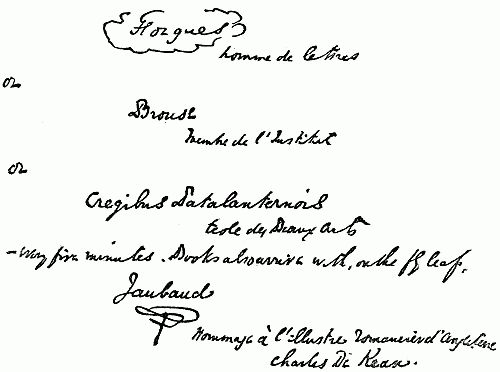
In this year, Charles Dickens was still writing "Bleak
House," and went to Brighton for a short time in the
spring. In May he had an attack of illness, a return
of an old trouble of an inflammatory pain in the side,
which was short but very severe while it lasted. Immediately
on his recovery, early in June, a departure from
London for the summer was resolved upon. He had
decided upon trying Boulogne this year for his holiday
sojourn, and as soon as he was strong enough to travel,
he, his wife, and sister-in-law went there in advance of
the family, taking up their quarters at the Hôtel des Bains,
to find a house, which was speedily done. The pretty little
Villa des Moulineaux, and its excellent landlord, at once
took his fancy, and in that house, and in another on the
same ground, also belonging to M. Beaucourt, he passed
three very happy summers. And he became as much
attached to "Our French Watering Place" as to "Our
English" one. Having written a sketch of Broadstairs
under that name in "Household Words," he did the same
of Boulogne under the former title.
During the summer, besides his other work, he was
employed in dictating "The Child's History of England,"
which he published in "Household Words," and which
was the only book he ever wrote by dictation. But, as at
Broadstairs and other seaside homes, he had always plenty
of relaxation and enjoyment in the visits of his friends.
In September he finished "Bleak House," and in October
he started with Mr. Wilkie Collins and Mr. Egg from
Boulogne, on an excursion through parts of Switzerland
and Italy; his wife and family going home at the same
time, and he himself returning to Tavistock House early in
December. His eldest son, Charles, had left Eton some
time before this, and had gone for the completion of his
education to Leipsic. He was to leave Germany at the end
of the year, therefore it was arranged that he should meet
the travellers in Paris on their homeward journey, and they
all returned together.
Just before Christmas he went to Birmingham in fulfilment
of an offer which he had made at the dinner given to
him at Birmingham on the 6th of January (of which he
writes to Mr. Macready in the first letter that follows here),
to give two readings from his own books for the benefit of
the New Midland Institute. They were his first public
readings. He read "The Christmas Carol" on one evening,
and "The Cricket on the Hearth" on the next, before
enormous audiences. The success was so great, and the
sum of money realised for the institute so large, that he
consented to give a second reading of "The Christmas
Carol," remaining another night in Birmingham for the
purpose, on the condition that seats were reserved, at
prices within their means, for the working men. And to
his great satisfaction they formed a large proportion, and
were among the most enthusiastic and appreciative of his
audience. He was accompanied by his wife and sister-in-law,
and on this occasion a breakfast was given to him
after his last reading, at which a silver flower-basket, duly
inscribed, was very gracefully presented to Mrs. Charles
Dickens.
The letters in this year require little explanation. Those
to his wife and sister-in-law and Mr. Wills give a little
history of his Italian journey. At Naples he found his
excellent friend Sir James Emerson Tennent, with his wife
and daughter, with whom he joined company in the ascent
of Vesuvius.
The two letters to M. Regnier, the distinguished actor
of the Théâtre Français—with whom Charles Dickens had
formed a sincere friendship during his first residence in
Paris—on the subject of a projected benefit to Miss Kelly,
need no further explanation.
Mr. John Delane, editor of The Times, and always a
highly-esteemed friend of Charles Dickens, had given him
an introduction to a school at Boulogne, kept by two English
gentlemen, one a clergyman and the other a former Eton
master, the Rev. W. Bewsher and Mr. Gibson. He had at
various times four boys at this school, and very frequently
afterwards he expressed his gratitude to Mr. Delane for
having given him the introduction, which turned out so
satisfactory in every respect.
The letter of grateful acknowledgment from Mr. Poole
and Charles Dickens to Lord Russell was for the pension
for which the old dramatic author was indebted to that
nobleman, and which enabled him to live comfortably until
the end of his life.
A note to Mr. Marcus Stone was sent with a copy of "The
Child's History of England." The sketch referred to was
one of "Jo'," in "Bleak House," which showed great feeling
and artistic promise, since fully fulfilled by the young
painter, but very remarkable in a boy so young as he was
at that time. The letter to Mr. Stanfield, in seafaring
language, is a specimen of a playful way in which he
frequently addressed that dear friend.
Mr. W. H.
Wills.
"A curiosity from him. No date. No signature."—W. H. H.
My dear Wills,
I have not a shadow of a doubt about Miss Martineau's
story. It is certain to tell. I think it very effectively,
admirably done; a fine plain purpose in it; quite
a singular novelty. For the last story in the Christmas
number it will be great. I couldn't wish for a better.
Mrs. Gaskell's ghost story I have got this morning;
have not yet read. It is long.
Mr.
Clarkson
Stanfield.
H.M.S. Tavistock, January 2nd, 1853.
Yoho, old salt! Neptun' ahoy! You don't forget,
messmet, as you was to meet Dick Sparkler and Mark
Porpuss on the fok'sle of the good ship Owssel Words,
Wednesday next, half-past four? Not you; for when did
Stanfell ever pass his word to go anywheers and not come!
Well. Belay, my heart of oak, belay! Come alongside the
Tavistock same day and hour, 'stead of Owssel Words.
Hail your shipmets, and they'll drop over the side and join
you, like two new shillings a-droppin' into the purser's
pocket. Damn all lubberly boys and swabs, and give me
the lad with the tarry trousers, which shines to me like
di'mings bright!
Mr. W. C.
Macready.
Tavistock House, Friday Night, Jan. 14th, 1853.
My dearest Macready,
I have been much affected by the receipt of your
kindest and best of letters; for I know out of the midst of
what anxieties it comes to me, and I appreciate such remembrance
from my heart. You and yours are always with us,
however. It is no new thing for you to have a part in any
scene of my life. It very rarely happens that a day passes
without our thoughts and conversation travelling to Sherborne.
We are so much there that I cannot tell you how
plainly I see you as I write.
I know you would have been full of sympathy and
approval if you had been present at Birmingham, and that
you would have concurred in the tone I tried to take about
the eternal duties of the arts to the people. I took the
liberty of putting the court and that kind of thing out of
the question, and recognising nothing but the arts and the
people. The more we see of life and its brevity, and the
world and its varieties, the more we know that no exercise
of our abilities in any art, but the addressing of it to the
great ocean of humanity in which we are drops, and not to
bye-ponds (very stagnant) here and there, ever can or ever
will lay the foundations of an endurable retrospect. Is it
not so? You should have as much practical information on
this subject, now, my dear friend, as any man.
My dearest Macready, I cannot forbear this closing word.
I still look forward to our meeting as we used to do in the
happy times we have known together, so far as your old
hopefulness and energy are concerned. And I think I
never in my life have been more glad to receive a sign,
than I have been to hail that which I find in your
handwriting.
Some of your old friends at Birmingham are full of
interest and enquiry. Kate and Georgina send their dearest
loves to you, and to Miss Macready, and to all the children.
I am ever, and no matter where I am—and quite as much in
a crowd as alone—my dearest Macready,
Your affectionate and most attached Friend.
Mrs.
Gaskell.
Tavistock House, May 3rd, 1853.
My dear Mrs. Gaskell,
The subject is certainly not too serious, so sensibly
treated. I have no doubt that you may do a great deal of
good by pursuing it in "Household Words." I thoroughly
agree in all you say in your note, have similar reasons for
giving it some anxious consideration, and shall be greatly
interested in it. Pray decide to do it. Send the papers, as
you write them, to me. Meanwhile I will think of a name
for them, and bring it to bear upon yours, if I think yours
improvable. I am sure you may rely on being widely understood
and sympathised with.
Forget that I called those two women my dear friends!
Why, if I told you a fiftieth part of what I have thought
about them, you would write me the most suspicious of notes,
refusing to receive the fiftieth part of that. So I don't write,
particularly as you laid your injunctions on me concerning
Ruth. In revenge, I will now mention one word that I wish
you would take out whenever you reprint that book. She
would never—I am ready to make affidavit before any
authority in the land—have called her seducer "Sir," when
they were living at that hotel in Wales. A girl pretending
to be what she really was would have done it, but she—never!
Ever most faithfully yours.
Monsieur
Regnier.
Tavistock House, Monday, May 9th, 1853.
My dear Regnier,
I meant to have spoken to you last night about a
matter in which I hope you can assist me, but I forgot it.
I think I must have been quite bouleversé by your supposing
(as you pretended to do, when you went away) that it was
not a great pleasure and delight to me to see you act!
There is a certain Miss Kelly, now sixty-two years old,
who was once one of the very best of English actresses, in
the greater and better days of the English theatre. She
has much need of a benefit, and I am exerting myself to
arrange one for her, on about the 9th of June, if possible,
at the St. James's Theatre. The first piece will be an
entertainment of her own, and she will act in the last.
Between these two (and at the best time of the night), it
would be a great attraction to the public, and a great proof
of friendship to me, if you would act. If we could manage,
through your influence and with your assistance, to present
a little French vaudeville, such as "Le bon Homme jadis,"
it would make the night a grand success.
Mitchell's permission, I suppose, would be required.
That I will undertake to apply for, if you will tell me that
you are willing to help us, and that you could answer for
the other necessary actors in the little French piece, whatever
the piece might be, that you would choose for the
purpose. Pray write me a short note in answer, on this
point.
I ought to tell you that the benefit will be "under distinguished
patronage." The Duke of Devonshire, the Duke
of Leinster, the Duke of Beaufort, etc. etc., are members of
the committee with me, and I have no doubt that the
audience will be of the élite.
I have asked Mr. Chapman to come to me to-morrow, to
arrange for the hiring of the theatre. Mr. Harley (a favourite
English comedian whom you may know) is our secretary.
And if I could assure the committee to-morrow afternoon of
your co-operation, I am sure they would be overjoyed.
Votre tout dévoué.
Monsieur
Regnier.
Tavistock House, May 20th, 1853.
My dear Regnier,
I am heartily obliged to you for your kind letter
respecting Miss Kelly's benefit. It is to take place on
Thursday, the 16th June; Thursday the 9th (the day originally
proposed) being the day of Ascot Races, and therefore
a bad one for the purpose.
Mitchell, like a brave garçon as he is, most willingly
consents to your acting for us. Will you think what little
French piece it will be best to do, in order that I may have
it ready for the bills?
Ever faithfully yours, my dear Regnier.
Mr. W. H.
Wills.
Boulogne, Monday, June 13th, 1853.
My dear Wills,
You will be glad, I know, to hear that we had a
delightful passage yesterday, and that I made a perfect
phenomenon of a dinner. It is raining hard to-day, and my
back feels the draught; but I am otherwise still mending.
I have signed, sealed, and delivered a contract for a
house (once occupied for two years by a man I knew in
Switzerland), which is not a large one, but stands in the
middle of a great garden, with what the landlord calls a
"forest" at the back, and is now surrounded by flowers,
vegetables, and all manner of growth. A queer, odd,
French place, but extremely well supplied with all table and
other conveniences, and strongly recommended.
The address is:
Château des Moulineaux,
Rue Beaurepaire, Boulogne.
There is a coach-house, stabling for half-a-dozen horses,
and I don't know what.
We take possession this afternoon, and I am now laying
in a good stock of creature comforts. So no more at
present from
Yours ever faithfully.
P.S.—Mrs. Dickens and her sister unite in kindest
regards.
Mr. W. H.
Wills.
Château des Moulineaux, Boulogne,
Saturday Night, June 18th, 1853.
My dear Wills,
"Bleak House."
Thank God, I have done half the number with great
care, and hope to finish on Thursday or Friday next. O
how thankful I feel to be able to have done it, and what a
relief to get the number out!
General Movements of Inimitable.
I don't think (I am not sure) I shall come to London
until after the completion of "Bleak House," No. 18—the
number after this now in hand—for it strikes me
that I am better here at present. I have picked up in
the most extraordinary manner, and I believe you would
never suppose to look at me that I had had that week or
barely an hour of it. If there should be any occasion for
our meeting in the meantime, a run over here would do you
no harm, and we should be delighted to see you at any
time. If you suppose this place to be in a street, you are
much mistaken. It is in the country, though not more
than ten minutes' walk from the post-office, and is the best
doll's-house of many rooms, in the prettiest French grounds,
in the most charming situation I have ever seen; the best
place I have ever lived in abroad, except at Genoa. You
can scarcely imagine the beauty of the air in this richly-wooded
hill-side. As to comforts in the house, there are
all sorts of things, beginning with no end of the coldest
water and running through the most beautiful flowers down
to English foot-baths and a Parisian liqueur-stand. Your
parcel (frantic enclosures and all) arrived quite safely last
night. This will leave by steamer to-morrow, Sunday
evening. There is a boat in the morning, but having no
one to send to-night I can't reach it, and to-morrow being
Sunday it will come to much the same thing.
I think that's all at present.
Ever, my dear Wills, faithfully yours.
Mr. Frank
Stone,
A.R.A.
Château des Moulineaux, Rue Beaurepaire, Boulogne,
Thursday, June 23rd, 1853.
My dear Pumpion,
I take the earliest opportunity, after finishing my
number—ahem!—to write you a line, and to report myself
(thank God) brown, well, robust, vigorous, open to fight
any man in England of my weight, and growing a moustache.
Any person of undoubted pluck, in want of a customer, may
hear of me at the bar of Bleak House, where my money is
down.
I think there is an abundance of places here that would
suit you well enough; and Georgina is ready to launch on
voyages of discovery and observation with you. But it is
necessary that you should consider for how long a time you
want it, as the folks here let much more advantageously
for the tenant when they know the term—don't like to let
without. It seems to me that the best thing you can do is
to get a paper of the South Eastern tidal trains, fix your
day for coming over here in five hours (when you will pay
through to Boulogne at London Bridge), let me know the
day, and come and see how you like the place. I like it
better than ever. We can give you a bed (two to spare, at
a pinch three), and show you a garden and a view or so.
The town is not so cheap as places farther off, but you get a
great deal for your money, and by far the best wine at tenpence
a bottle that I have ever drank anywhere. I really
desire no better.
I may mention for your guidance (for I count upon your
coming to overhaul the general aspect of things), that you
have nothing on earth to do with your luggage when it is
once in the boat, until after you have walked ashore. That
you will be filtered with the rest of the passengers through
a hideous, whitewashed, quarantine-looking custom-house,
where a stern man of a military aspect will demand your
passport. That you will have nothing of the sort, but will
produce your card with this addition: "Restant à Boulogne,
chez M. Charles Dickens, Château des Moulineaux." That
you will then be passed out at a little door, like one of the
ill-starred prisoners on the bloody September night, into a
yelling and shrieking crowd, cleaving the air with the
names of the different hotels, exactly seven thousand six
hundred and fifty-four in number. And that your heart
will be on the point of sinking with dread, then you will
find yourself in the arms of the Sparkler of Albion. All
unite in kindest regards.
Ever affectionately.
P.S.—I thought you might like to see the flourish again.
Mr. W. H.
Wills.
Boulogne, Wednesday, July 27th, 1853.
My dear Wills,
I have thought of another article to be called "Frauds
upon the Fairies," à propos of George Cruikshank's editing.
Half playfully and half seriously, I mean to protest most
strongly against alteration, for any purpose, of the beautiful
little stories which are so tenderly and humanly useful to
us in these times, when the world is too much with us, early
and late; and then to re-write "Cinderella" according to
Total Abstinence, Peace Society, and Bloomer principles,
and expressly for their propagation.
I shall want his book of "Hop o' my Thumb" (Forster
noticed it in the last Examiner), and the most simple and
popular version of "Cinderella" you can get me. I shall
not be able to do it until after finishing "Bleak House," but
I shall do it the more easily for having the books by me.
So send them, if convenient, in your next parcel.
Ever faithfully.
Mr. W. C.
Macready.
Château des Moulineaux, Boulogne,
Sunday, Aug. 24th, 1853.
My Dearest Macready,
Some unaccountable delay in the transmission here
of the parcel which contained your letter, caused me to come
into the receipt of it a whole week after its date. I immediately
wrote to Miss Coutts, who has written to you, and I
hope some good may come of it. I know it will not be her
fault if none does. I was very much concerned to read your
account of poor Mrs. Warner, and to read her own plain and
unaffected account of herself. Pray assure her of my cordial
sympathy and remembrance, and of my earnest desire to do
anything in my power to help to put her mind at ease.
We are living in a beautiful little country place here,
where I have been hard at work ever since I came, and am
now (after an interval of a week's rest) going to work again
to finish "Bleak House." Kate and Georgina send their
kindest loves to you, and Miss Macready, and all the rest.
They look forward, I assure you, to their Sherborne visit,
when I—a mere forlorn wanderer—shall be roaming over
the Alps into Italy. I saw "The Midsummer Night's Dream"
of the Opéra Comique, done here (very well) last night. The
way in which a poet named Willyim Shay Kes Peer gets
drunk in company with Sir John Foll Stayffe, fights with a
noble 'night, Lor Latimeer (who is in love with a maid-of-honour
you may have read of in history, called Mees Oleevia),
and promises not to do so any more on observing symptoms
of love for him in the Queen of England, is very remarkable.
Queen Elizabeth, too, in the profound and impenetrable disguise
of a black velvet mask, two inches deep by three broad,
following him into taverns and worse places, and enquiring
of persons of doubtful reputation for "the sublime Williams,"
was inexpressibly ridiculous. And yet the nonsense was
done with a sense quite admirable.
I have been very much struck by the book you sent me.
It is one of the wisest, the manliest, and most serviceable I
ever read. I am reading it again with the greatest pleasure
and admiration.
Ever most affectionately yours,
My dear Macready.
The Hon.
Mrs.
Watson.
Villa des Moulineaux, Boulogne,
Saturday, Aug. 27th, 1853.
My Dear Mrs. Watson,
I received your letter—most welcome and full of
interest to me—when I was hard at work finishing "Bleak
House." We are always talking of you; and I had said
but the day before, that one of the first things I would do
on my release would be to write to you. To finish the topic
of "Bleak House" at once, I will only add that I like the
conclusion very much and think it very pretty indeed. The
story has taken extraordinarily, especially during the last
five or six months, when its purpose has been gradually
working itself out. It has retained its immense circulation
from the first, beating dear old "Copperfield" by a round
ten thousand or more. I have never had so many readers.
We had a little reading of the final double number here the
night before last, and it made a great impression I assure
you.
We are all extremely well, and like Boulogne very much
indeed. I laid down the rule before we came, that we
would know nobody here, and we do know nobody here. We
evaded callers as politely as we could, and gradually came
to be understood and left to ourselves. It is a fine bracing
air, a beautiful open country, and an admirable mixture of
town and country. We live on a green hill-side out of the
town, but are in the town (on foot) in ten minutes. Things
are tolerably cheap, and exceedingly good; the people very
cheerful, good-looking, and obliging; the houses very
clean; the distance to London short, and easily traversed.
I think if you came to know the place (which I never did
myself until last October, often as I have been through it),
you could be but in one mind about it.
Charley is still at Leipzig. I shall take him up somewhere
on the Rhine, to bring him home for Christmas, as I
come back on my own little tour. He has been in the Hartz
Mountains on a walking tour, and has written a journal
thereof, which he has sent home in portions. It has cost
about as much in postage as would have bought a pair of
ponies.
I contemplate starting from here on Monday, the 10th of
October; Catherine, Georgina, and the rest of them will
then go home. I shall go first by Paris and Geneva to
Lausanne, for it has a separate place in my memory. If
the autumn should be very fine (just possible after such a
summer), I shall then go by Chamonix and Martigny, over
the Simplon to Milan, thence to Genoa, Leghorn, Pisa, and
Naples, thence, I hope, to Sicily. Back by Bologna,
Florence, Rome, Verona, Mantua, etc., to Venice, and home
by Germany, arriving in good time for Christmas Day.
Three nights in Christmas week, I have promised to read in
the Town Hall at Birmingham, for the benefit of a new and
admirable institution for working men projected there.
The Friday will be the last night, and I shall read the
"Carol" to two thousand working people, stipulating that
they shall have that night entirely to themselves.
It just occurs to me that I mean to engage, for the two
months odd, a travelling servant. I have not yet got one.
If you should happen to be interested in any good foreigner,
well acquainted with the countries and the languages, who
would like such a master, how delighted I should be to like
him!
Ever since I have been here, I have been very hard at
work, often getting up at daybreak to write through many
hours. I have never had the least return of illness, thank
God, though I was so altered (in a week) when I came here,
that I doubt if you would have known me. I am redder
and browner than ever at the present writing, with the
addition of a rather formidable and fierce moustache.
Lowestoft I know, by walking over there from Yarmouth,
when I went down on an exploring expedition, previous to
"Copperfield." It is a fine place. I saw the name "Blunderstone"
on a direction-post between it and Yarmouth, and
took it from the said direction-post for the book. We
imagined the Captain's ecstasies when we saw the birth of
his child in the papers. In some of the descriptions of
Chesney Wold, I have taken many bits, chiefly about trees
and shadows, from observations made at Rockingham. I
wonder whether you have ever thought so! I shall hope to
hear from you again soon, and shall not fail to write again
before I go away. There seems to be nothing but "I" in
this letter; but "I" know, my dear friend, that you will
be more interested in that letter in the present connection,
than in any other I could take from the alphabet.
Catherine and Georgina send their kindest loves, and
more messages than this little sheet would hold. If I were
to give you a hint of what we feel at the sight of your handwriting,
and at the receipt of a word from yourself about
yourself, and the dear boys, and the precious little girls, I
should begin to be sorrowful, which is rather the tendency
of my mind at the close of another long book. I heard from
Cerjat two or three days since. Goff, by-the-bye, lived in
this house two years.
Ever, my dear Mrs. Watson,
Yours, with true affection and regard.
Mr. Peter
Cunningham.
Château des Moulineaux, Rue Beaurepaire, Boulogne.
My dear Cunningham,
A note—Cerberus-like—of three heads.
First. I know you will be glad to hear that the manager
is himself again. Vigorous, brown, energetic, muscular;
the pride of Albion and the admiration of Gaul.
Secondly. I told Wills when I left home, that I was
quite pained to see the end of your excellent "Bowl of Punch"
altered. I was unaffectedly touched and gratified by the
heartiness of the original; and saw no earthly, celestial, or
subterranean objection to its remaining, as it did not so
unmistakably apply to me as to necessitate the observance
of my usual precaution in the case of such references, by
any means.
Thirdly. If you ever have a holiday that you don't know
what to do with, do come and pass a little time here. We
live in a charming garden in a very pleasant country, and
should be delighted to receive you. Excellent light wines
on the premises, French cookery, millions of roses, two
cows (for milk punch), vegetables cut for the pot, and handed
in at the kitchen window; five summer-houses, fifteen
fountains (with no water in 'em), and thirty-seven clocks
(keeping, as I conceive, Australian time; having no reference
whatever to the hours on this side of the globe).
I know, my dear Cunningham, that the British nation
can ill afford to lose you; and that when the Audit Office
mice are away, the cats of that great public establishment
will play. But pray consider that the bow may be sometimes
bent too long, and that ever-arduous application, even
in patriotic service, is to be avoided. No one can more
highly estimate your devotion to the best interests of Britain
than I. But I wish to see it tempered with a wise consideration
for your own amusement, recreation, and pastime.
All work and no play may make Peter a dull boy as well as
Jack. And (if I may claim the privilege of friendship to
remonstrate) I would say that you do not take enough time
for your meals. Dinner, for instance, you habitually neglect.
Believe me, this rustic repose will do you good. Winkles
also are to be obtained in these parts, and it is well remarked
by Poor Richard, that a bird in the handbook is worth two
in the bush.
Ever cordially yours.
Mr. Walter
Savage
Landor.
Tavistock House, London, Sept. 8th, 1853.
My dear Landor,
I am in town for a day or two, and Forster tells me
I may now write to thank you for the happiness you have
given me by honouring my name with such generous
mention, on such a noble place, in your great book. I
believe he has told you already that I wrote to him from
Boulogne, not knowing what to do, as I had not received
the precious volume, and feared you might have some plan
of sending it to me, with which my premature writing would
interfere.
You know how heartily and inexpressibly I prize what
you have written to me, or you never would have selected
me for such a distinction. I could never thank you enough,
my dear Landor, and I will not thank you in words any
more. Believe me, I receive the dedication like a great
dignity, the worth of which I hope I thoroughly know. The
Queen could give me none in exchange that I wouldn't
laughingly snap my fingers at.
We are staying at Boulogne until the 10th of October,
when I go into Italy until Christmas, and the rest come
home.
Kate and Georgina would send you their best loves if
they were here, and would never leave off talking about it
if I went back and told them I had written to you without
such mention of them. Walter is a very good boy, and
comes home from school with honourable commendation.
He passed last Sunday in solitary confinement (in a bath-room)
on bread and water, for terminating a dispute with
the nurse by throwing a chair in her direction. It is the
very first occasion of his ever having got into trouble, for
he is a great favourite with the whole house, and one of the
most amiable boys in the boy world. (He comes out on
birthdays in a blaze of shirt-pin).
If I go and look at your old house, as I shall if I go to
Florence, I shall bring you back another leaf from the same
tree as I plucked the last from.
Ever, my dear Landor,
Heartily and affectionately yours.
Mr. John
Delane.
Villa Des Moulineaux, Boulogne,
Monday, Sept. 12th, 1853.
My dear Delane,
I am very much obliged to you, I assure you, for
your frank and full reply to my note. Nothing could be
more satisfactory, and I have to-day seen Mr. Gibson and
placed my two small representatives under his charge. His
manner is exactly what you describe him. I was greatly
pleased with his genuineness altogether.
We remain here until the tenth of next month, when I
am going to desert my wife and family and run about Italy
until Christmas. If I can execute any little commission for
you or Mrs. Delane—in the Genoa street of silversmiths, or
anywhere else—I shall be delighted to do so. I have been
in the receipt of several letters from Macready lately, and
rejoice to find him quite himself again, though I have great
misgivings that he will lose his eldest boy before he can be
got to India.
Mrs. Dickens and her sister are proud of your message,
and beg their kind regards to be forwarded in return; my
other half being particularly comforted and encouraged by
your account of Mr. Gibson. In this charge I am to include
Mrs. Delane, who, I hope, will make an exchange of
remembrances, and give me hers for mine.
I never saw anything so ridiculous as this place at present.
They expected the Emperor ten or twelve days ago,
and put up all manner of triumphal arches made of evergreens,
which look like tea-leaves now, and will take a
withered and weird appearance hardly to be foreseen, long
before the twenty-fifth, when the visit is vaguely expected
to come off. In addition to these faded garlands all over
the leading streets, there are painted eagles hoisted over
gateways and sprawling across a hundred ways, which have
been washed out by the rain and are now being blistered by
the sun, until they look horribly ludicrous. And a number
of our benighted compatriots who came over to see a perfect
blaze of fêtes, go wandering among these shrivelled preparations
and staring at ten thousand flag-poles without any
flags upon them, with a kind of indignant curiosity and
personal injury quite irresistible. With many thanks,
Very faithfully yours.
Mr. W. H.
Wills.
Boulogne, Sunday, Sept. 18th, 1853.
My dear Wills,
Courier.
Edward Kaub will bring this. He turned up yesterday,
accounting for his delay by waiting for a written
recommendation, and having at the last moment (as a
foreigner, not being an Englishman) a passport to get. I
quite agree with you as to his appearance and manner, and
have engaged him. It strikes me that it would be an
excellent beginning if you would deliver him a neat and
appropriate address, telling him what in your conscience you
can find to tell of me favourably as a master, and particularly
impressing upon him readiness and punctuality on
his part as the great things to be observed. I think it
would have a much better effect than anything I could say
in this stage, if said from yourself. But I shall be much
obliged to you if you will act upon this hint forthwith.
W. H. Wills.
No letter having arrived from the popular author of
"The Larboard Fin,"[15] by this morning's post, I rather
think one must be on the way in the pocket of Gordon's
son. If Kaub calls for this before young Scotland arrives,
you will understand if I do not herein refer to an unreceived
letter. But I shall leave this open, until Kaub comes for it.
Ever faithfully.
The
Lord John
Russell.
Villa des Moulineaux, Boulogne,
Wednesday, Sept. 21st, 1853.
My dear Lord,
Your note having been forwarded to me here, I
cannot forbear thanking you with all my heart for your
great kindness. Mr. Forster had previously sent me a
copy of your letter to him, together with the expression of
the high and lasting gratification he had in your handsome
response. I know he feels it most sincerely.
I became the prey of a perfect spasm of sensitive twinges,
when I found that the close of "Bleak House" had not
penetrated to "the wilds of the North" when your letter
left those parts. I was so very much interested in it myself
when I wrote it here last month, that I have a fond sort of
faith in its interesting its readers. But for the hope that
you may have got it by this time, I should refuse comfort.
That supports me.
The book has been a wonderful success. Its audience
enormous.
I fear there is not much chance of my being able to
execute any little commission for Lady John anywhere in
Italy. But I am going across the Alps, leaving here on the
tenth of next month, and returning home to London for
Christmas Day, and should indeed be happy if I could do
her any dwarf service.
You will be interested, I think, to hear that Poole lives
happily on his pension, and lives within it. He is quite
incapable of any mental exertion, and what he would have
done without it I cannot imagine. I send it to him at Paris
every quarter. It is something, even amid the estimation
in which you are held, which is but a foreshadowing of what
shall be by-and-by as the people advance, to be so gratefully
remembered as he, with the best reason, remembers
you. Forgive my saying this. But the manner of that
transaction, no less than the matter, is always fresh in my
memory in association with your name, and I cannot help it.
My dear Lord,
Yours very faithfully and obliged.
The Hon.
Mrs.
Watson.
Boulogne, Wednesday, Sept. 21st, 1853.
My dear Mrs. Watson,
The courier was unfortunately engaged. He offered
to recommend another, but I had several applicants, and
begged Mr. Wills to hold a grand review at the "Household
Words" office, and select the man who is to bring me down
as his victim. I am extremely sorry the man you recommend
was not to be had. I should have been so delighted
to take him.
I am finishing "The Child's History," and clearing the
way through "Household Words," in general, before I go
on my trip. I forget whether I told you that Mr. Egg
the painter and Mr. Collins are going with me. The other
day I was in town. In case you should not have heard of
the condition of that deserted village, I think it worth
mentioning. All the streets of any note were unpaved,
mountains high, and all the omnibuses were sliding down
alleys, and looking into the upper windows of small houses.
At eleven o'clock one morning I was positively alone in
Bond Street. I went to one of my tailors, and he was at
Brighton. A smutty-faced woman among some gorgeous
regimentals, half finished, had not the least idea when he
would be back. I went to another of my tailors, and he
was in an upper room, with open windows and surrounded
by mignonette boxes, playing the piano in the bosom of
his family. I went to my hosier's, and two of the least
presentable of "the young men" of that elegant establishment
were playing at draughts in the back shop. (Likewise
I beheld a porter-pot hastily concealed under a Turkish
dressing-gown of a golden pattern.) I then went wandering
about to look for some ingenious portmanteau, and near the
corner of St. James's Street saw a solitary being sitting in
a trunk-shop, absorbed in a book which, on a close inspection,
I found to be "Bleak House." I thought this looked
well, and went in. And he really was more interested in
seeing me, when he knew who I was, than any face I had
seen in any house, every house I knew being occupied by
painters, including my own. I went to the Athenæum that
same night, to get my dinner, and it was shut up for repairs.
I went home late, and had forgotten the key and was
locked out.
Preparations were made here, about six weeks ago, to
receive the Emperor, who is not come yet. Meanwhile our
countrymen (deluded in the first excitement) go about
staring at these arrangements, with a personal injury upon
them which is most ridiculous. And they will persist in
speaking an unknown tongue to the French people, who will
speak English to them.
Kate and Georgina send their kindest loves. We are all
quite well. Going to drop two small boys here, at school
with a former Eton tutor highly recommended to me.
Charley was heard of a day or two ago. He says his
professor "is very short-sighted, always in green spectacles,
always drinking weak beer, always smoking a pipe, and
always at work." The last qualification seems to appear to
Charley the most astonishing one.
Ever, my dear Mrs. Watson,
Most affectionately yours.
Miss
Hogarth.
Hotel de la Villa, Milan, Tuesday, Oct. 25th, 1853.
My dear Georgy,
I have walked to that extent in Switzerland (walked
over the Simplon on Sunday, as an addition to the other
feats) that one pair of the new strong shoes has gone to be
mended this morning, and the other is in but a poor way;
the snow having played the mischief with them.
On the Swiss side of the Simplon, we slept at the
beastliest little town, in the wildest kind of house, where
some fifty cats tumbled into the corridor outside our bedrooms
all at once in the middle of the night—whether
through the roof or not, I don't know; for it was dark
when we got up—and made such a horrible and terrific
noise that we started out of our beds in a panic. I strongly
objected to opening the door lest they should get into the
room and tear at us; but Edward opened his, and laid about
him until he dispersed them. At Domo D'Ossola we had
three immense bedrooms (Egg's bed twelve feet wide!), and
a sala of imperceptible extent in the dim light of two
candles and a wood fire; but were very well and very
cheaply entertained. Here, we are, as you know, housed in
the greatest comfort.
We continue to get on very well together. We really do
admirably. I lose no opportunity of inculcating the lesson
that it is of no use to be out of temper in travelling, and it
is very seldom wanted for any of us. Egg is an excellent
fellow, and full of good qualities; I am sure a generous
and staunch man at heart, and a good and honourable
nature.
I shall send Catherine from Genoa a list of the places
where letters will find me. I shall hope to hear from you
too, and shall be very glad indeed to do so. No more at
present.
Ever most affectionately.
Miss
Hogarth.
Croce di Malta, Genoa, Saturday, Oct. 29th, 1853.
My dearest Georgy,
We had thirty-one hours consecutively on the road
between this and Milan, and arrived here in a rather
damaged condition. We live at the top of this immense
house, overlooking the port and sea, pleasantly and airily
enough, though it is no joke to get so high, and though the
apartment is rather vast and faded.
The old walks are pretty much the same as ever, except
that they have built behind the Peschiere on the San
Bartolomeo hill, and changed the whole town towards San
Pietro d'Arena, where we seldom went. The Bisagno looks
just the same, strong just now, and with very little water in
it. Vicoli stink exactly as they used to, and are fragrant with
the same old flavour of very rotten cheese kept in very hot
blankets. The Mezzaro pervades them as before. The
old Jesuit college in the Strada Nuova is under the present
government the Hôtel de Ville, and a very splendid caffé
with a terrace garden has arisen between it and Palavicini's
old palace. Another new and handsome caffé has been
built in the Piazza Carlo Felice, between the old caffé of the
Bei Arti (where Fletcher stopped for the bouquets in the
green times, when we went to the ——'s party), and the
Strada Carlo Felice. The old beastly gate and guardhouse
on the Albaro road are still in their dear old beastly
state, and the whole of that road is just as it was. The
man without legs is still in the Strada Nuova; but the
beggars in general are all cleared off, and our old one-armed
Belisario made a sudden evaporation a year or two
ago. I am going to the Peschiere to-day. The puppets
are here, and the opera is open, but only with a buffo
company, and without a buffet. We went to the Scala,
where they did an opera of Verdi's, called "Il Trovatore,"
and a poor enough ballet. The whole performance miserable
indeed. I wish you were here to take some of the old
walks. It is quite strange to walk about alone. Good-bye,
my dear Georgy. Pray tell me how Kate is. I rather
fancy from her letter, though I scarcely know why, that
she is not quite as well as she was at Boulogne. I was
charmed with your account of the Plornishghenter and
everything and everybody else. Kiss them all for me.
Ever most affectionately yours.
Miss
Hogarth.
Hôtel des Étrangers, Naples,
Friday Night, Nov. 4th, 1853.
My dearest Georgy,
Instead of embarking on Monday at Genoa, we were
delayed (in consequence of the boat's being a day later
when there are thirty-one days in the month) until Tuesday.
Going aboard that morning at half-past nine, we found the
steamer more than full of passengers from Marseilles, and
in a state of confusion not to be described. We could get
no places at the table, got our dinners how we could on
deck, had no berths or sleeping accommodation of any kind,
and had paid heavy first-class fares! To add to this, we
got to Leghorn too late to steam away again that night,
getting the ship's papers examined first—as the authorities
said so, not being favourable to the new express English
ship, English officered—and we lay off the lighthouse all
night long. The scene on board beggars description.
Ladies on the tables, gentlemen under the tables, and
ladies and gentlemen lying indiscriminately on the open
deck, arrayed like spoons on a sideboard. No mattresses,
no blankets, nothing. Towards midnight, attempts were
made by means of an awning and flags to make this latter
scene remotely approach an Australian encampment; and
we three lay together on the bare planks covered with overcoats.
We were all gradually dozing off when a perfectly
tropical rain fell, and in a moment drowned the whole ship.
The rest of the night was passed upon the stairs, with an
immense jumble of men and women. When anybody came
up for any purpose we all fell down; and when anybody
came down we all fell up again. Still, the good-humour in
the English part of the passengers was quite extraordinary.
There were excellent officers aboard, and the first mate lent
me his cabin to wash in in the morning, which I afterwards
lent to Egg and Collins. Then we and the Emerson
Tennents (who were aboard) and the captain, the doctor,
and the second officer went off on a jaunt together to Pisa,
as the ship was to lie at Leghorn all day.
The captain was a capital fellow, but I led him, facetiously,
such a life all day, that I got almost everything altered
at night. Emerson Tennent, with the greatest kindness,
turned his son out of his state room (who, indeed, volunteered
to go in the most amiable manner), and I got a good
bed there. The store-room down by the hold was opened
for Egg and Collins, and they slept with the moist sugar, the
cheese in cut, the spices, the cruets, the apples and pears—in
a perfect chandler's shop; in company with what the
——'s would call a "hold gent"—who had been so horribly
wet through overnight that his condition frightened the
authorities—a cat, and the steward—who dozed in an arm-chair,
and all night long fell headforemost, once in every five
minutes, on Egg, who slept on the counter or dresser. Last
night I had the steward's own cabin, opening on deck, all to
myself. It had been previously occupied by some desolate
lady, who went ashore at Civita Vecchia. There was little
or no sea, thank Heaven, all the trip; but the rain was
heavier than any I have ever seen, and the lightning very
constant and vivid. We were, with the crew, some two
hundred people; with boats, at the utmost stretch, for one
hundred, perhaps. I could not help thinking what would
happen if we met with any accident; the crew being chiefly
Maltese, and evidently fellows who would cut off alone in
the largest boat on the least alarm. The speed (it being the
crack express ship for the India mail) very high; also the
running through all the narrow rocky channels. Thank
God, however, here we are. Though the more sensible and
experienced part of the passengers agreed with me this
morning that it was not a thing to try often. We had an
excellent table after the first day, the best wines and so
forth, and the captain and I swore eternal friendship. Ditto
the first officer and the majority of the passengers. We got
into the bay about seven this morning, but could not land
until noon. We towed from Civita Vecchia the entire Greek
navy, I believe, consisting of a little brig-of-war, with great
guns, fitted as a steamer, but disabled by having burst the
bottom of her boiler in her first run. She was just big
enough to carry the captain and a crew of six or so, but the
captain was so covered with buttons and gold that there
never would have been room for him on board to put these
valuables away if he hadn't worn them, which he consequently
did, all night.
Whenever anything was wanted to be done, as slackening
the tow-rope or anything of that sort, our officers roared at
this miserable potentate, in violent English, through a
speaking-trumpet, of which he couldn't have understood a
word under the most favourable circumstances, so he did all
the wrong things first, and the right things always last.
The absence of any knowledge of anything not English on
the part of the officers and stewards was most ridiculous.
I met an Italian gentleman on the cabin steps, yesterday
morning, vainly endeavouring to explain that he wanted a
cup of tea for his sick wife. And when we were coming
out of the harbour at Genoa, and it was necessary to order
away that boat of music you remember, the chief officer
(called aft for the purpose, as "knowing something of
Italian,") delivered himself in this explicit and clear manner
to the principal performer: "Now, signora, if you don't
sheer off, you'll be run down; so you had better trice up
that guitar of yours, and put about."
We get on as well as possible, and it is extremely
pleasant and interesting, and I feel that the change is doing
me great and real service, after a long continuous strain
upon the mind; but I am pleased to think that we are at
our farthest point, and I look forward with joy to coming
home again, to my old room, and the old walks, and all the
old pleasant things.
I wish I had arranged, or could have done so—for it
would not have been easy—to find some letters here. It is
a blank to stay for five days in a place without any.
I don't think Edward knows fifty Italian words; but
much more French is spoken in Italy now than when we
were here, and he stumbles along somehow.
I am afraid this is a dull letter, for I am very tired.
You must take the will for the deed, my dear, and good
night.
Ever most affectionately.
Miss
Hogarth.
Rome, Sunday Night, Nov. 13th, 1853.
My dearest Georgy,
We arrived here yesterday afternoon, at between
three and four. On sending to the post-office this morning,
I received your pleasant little letter, and one from Miss
Coutts, who is still at Paris. But to my amazement there
was none from Catherine! You mention her writing, and
I cannot but suppose that your two letters must have been
posted together. However, I received none from her, and
I have all manner of doubts respecting the plainness of its
direction. They will not produce the letters here as at
Genoa, but persist in looking them out at the post-office for
you. I shall send again to-morrow, and every day until
Friday, when we leave here. If I find no letter from her
to-morrow, I shall write to her nevertheless by that post
which brings this, so that you may both hear from me
together.
One night, at Naples, Edward came in, open-mouthed,
to the table d'hôte where we were dining with the Tennents,
to announce "The Marchese Garofalo." I at first thought it
must be the little parrot-marquess who was once your escort
from Genoa; but I found him to be a man (married to an
Englishwoman) whom we used to meet at Ridgway's. He was
very glad to see me, and I afterwards met him at dinner at
Mr. Lowther's, our chargé d'affaires. Mr. Lowther was at the
Rockingham play, and is a very agreeable fellow. We had an
exceedingly pleasant dinner of eight, preparatory to which I
was near having the ridiculous adventure of not being able
to find the house and coming back dinnerless. I went in an
open carriage from the hotel in all state, and the coachman,
to my surprise, pulled up at the end of the Chiaja. "Behold
the house," says he, "of Il Signor Larthoor!"—at the same
time pointing with his whip into the seventh heaven, where
the early stars were shining. "But the Signor Larthoor,"
returns the Inimitable darling, "lives at Pausilippo." "It
is true," says the coachman (still pointing to the evening
star), "but he lives high up the Salita Sant' Antonio, where
no carriage ever yet ascended, and that is the house" (evening
star as aforesaid), "and one must go on foot. Behold the
Salita Sant' Antonio!" I went up it, a mile and a half I
should think. I got into the strangest places, among the
wildest Neapolitans—kitchens, washing-places, archways,
stables, vineyards—was baited by dogs, answered in profoundly
unintelligible Neapolitan, from behind lonely locked
doors, in cracked female voices, quaking with fear; could
hear of no such Englishman or any Englishman. By-and-by
I came upon a Polenta-shop in the clouds, where an old
Frenchman, with an umbrella like a faded tropical leaf (it
had not rained for six weeks) was staring at nothing at all,
with a snuff-box in his hand. To him I appealed concerning
the Signor Larthoor. "Sir," said he, with the sweetest
politeness, "can you speak French?" "Sir," said I, "a
little." "Sir," said he, "I presume the Signor Loothere"—you
will observe that he changed the name according to
the custom of his country—"is an Englishman." I admitted
that he was the victim of circumstances and had that misfortune.
"Sir," said he, "one word more. Has he a servant
with a wooden leg?" "Great Heaven, sir," said I, "how
do I know! I should think not, but it is possible." "It
is always," said the Frenchman, "possible. Almost all the
things of the world are always possible." "Sir," said I—you
may imagine my condition and dismal sense of my own
absurdity, by this time—"that is true." He then took an
immense pinch of snuff, wiped the dust off his umbrella,
led me to an arch commanding a wonderful view of the bay
of Naples, and pointed deep into the earth from which I
had mounted. "Below there, near the lamp, one finds an
Englishman, with a servant with a wooden leg. It is always
possible that he is the Signor Loothere." I had been asked
at six, and it was now getting on for seven. I went down
again in a state of perspiration and misery not to be
described, and without the faintest hope of finding the
place. But as I was going down to the lamp, I saw the
strangest staircase up a dark corner, with a man in a white-waistcoat
(evidently hired) standing on the top of it, fuming.
I dashed in at a venture, found it was the place, made the
most of the whole story, and was indescribably popular.
The best of it was, that as nobody ever did find the place,
he had put a servant at the bottom of the Salita, to "wait
for an English gentleman." The servant (as he presently
pleaded), deceived by the moustache, had allowed the
English gentleman to pass unchallenged.
The night before we left Naples we were at the San
Carlo, where, with the Verdi rage of our old Genoa time,
they were again doing the "Trovatore." It seemed rubbish
on the whole to me, but was very fairly done. I think
"La Tenco," the prima donna, will soon be a great hit in
London. She is a very remarkable singer and a fine actress,
to the best of my judgment on such premises. There seems
to be no opera here, at present. There was a Festa in
St. Peter's to-day, and the Pope passed to the Cathedral in
state. We were all there.
We leave here, please God, on Friday morning, and post
to Florence in three days and a half. We came here by
Vetturino. Upon the whole, the roadside inns are greatly
improved since our time. Half-past three and half-past
four have been, however, our usual times of rising on the
road.
I was in my old place at the Coliseum this morning,
and it was as grand as ever. With that exception the
ruined part of Rome—the real original Rome—looks smaller
than my remembrance made it. It is the only place on
which I have yet found that effect. We are in the old
hotel.
You are going to Bonchurch I suppose? will be there,
perhaps, when this letter reaches you? I shall be pleased
to think of you as at home again, and making the commodious
family mansion look natural and home-like. I
don't like to think of my room without anybody to peep
into it now and then. Here is a world of travelling
arrangements for me to settle, and here are Collins and Egg
looking sideways at me with an occasional imploring glance
as beseeching me to settle it. So I leave off. Good-night.
Ever, my dearest Georgy,
Most affectionately yours.
Sir James
Emerson
Tennent.
Hôtel des Îles Britanniques, Piazza del Popolo, Rome,
Monday, Nov. 14th, 1853.
My dear Tennent,
As I never made a good bargain in my life—except
once, when, on going abroad, I let my house on excellent
terms to an admirable tenant, who never paid anything—I
sent Edward into the Casa Dies yesterday morning, while
I invested the premises from the outside, and carefully
surveyed them. It is a very clean, large, bright-looking
house at the corner of the Via Gregoriana; not exactly in a
part of Rome I should pick out for living in, and on what I
should be disposed to call the wrong side of the street.
However, this is not to the purpose. Signor Dies has no
idea of letting an apartment for a short time—scouted the
idea of a month—signified that he could not be brought to
the contemplation of two months—was by no means clear
that he could come down to the consideration of three.
This of course settled the business speedily.
This hotel is no longer kept by the Melloni I spoke of,
but is even better kept than in his time, and is a very
admirable house. I have engaged a small apartment for
you to be ready on Thursday afternoon (at two piastres
and a half—two-and-a-half per day—sitting-room and three
bedrooms, one double-bedded and two not). If you would
like to change to ours, which is a very good one, on Friday
morning, you can of course do so. As our dining-room is
large, and there is no table d'hôte here, I will order dinner
in it for our united parties at six on Thursday. You
will be able to decide how to arrange for the remainder of
your stay, after being here and looking about you—two
really necessary considerations in Rome.
Pray make my kind regards to Lady Tennent, and Miss
Tennent, and your good son, who became homeless for
my sake. Mr. Egg and Mr. Collins desire to be also
remembered.
It has been beautiful weather since we left Naples,
until to-day, when it rains in a very dogged, sullen, downcast,
and determined manner. We have been speculating
at breakfast on the possibility of its raining in a similar
manner at Naples, and of your wandering about the hotel,
refusing consolation.
I grieve to report the Orvieto considerably damaged by
the general vine failure, but still far from despicable.
Montefiascone (the Est wine you know) is to be had here;
and we have had one bottle in the very finest condition, and
one in a second-rate state.
The Coliseum, in its magnificent old decay, is as grand
as ever; and with the electric telegraph darting through
one of its ruined arches like a sunbeam and piercing direct
through its cruel old heart, is even grander.
Believe me always, very faithfully yours.
Mrs.
Charles
Dickens.
Rome, Monday, Nov. 14th, 1853.
My dearest Catherine,
As I have mentioned in my letter to Georgy (written
last night but posted with this), I received her letter without
yours, to my unbounded astonishment. This morning,
on sending again to the post-office, I at last got yours, and
most welcome it is with all its contents.
I found Layard at Naples, who went up Vesuvius with
us, and was very merry and agreeable. He is travelling
with Lord and Lady Somers, and Lord Somers being laid
up with an attack of malaria fever, Layard had a day to
spare. Craven, who was Lord Normanby's Secretary of
Legation in Paris, now lives at Naples, and is married to a
French lady. He is very hospitable and hearty, and seemed
to have vague ideas that something might be done in a
pretty little private theatre he has in his house. He told
me of Fanny Kemble and the Sartoris's being here. I have
also heard of Thackeray's being here—I don't know how
truly. Lockhart is here, and, I fear, very ill. I mean to
go and see him.
We are living in the old hotel, which is not now kept by
Meloni, who has retired. I don't know whether you recollect
an apartment at the top of the house, to which we once ran
up with poor Roche to see the horses start in the race at
the Carnival time? That is ours, in which I at present
write. We have a large back dining-room, a handsome
front drawing-room, looking into the Piazza del Popolo,
and three front bedrooms, all on a floor. The whole costs us
about four shillings a day each. The hotel is better kept
than ever. There is a little kitchen to each apartment
where the dinner is kept hot. There is no house comparable
to it in Paris, and it is better than Mivart's. We
start for Florence, post, on Friday morning, and I am
bargaining for a carriage to take us on to Venice.
Edward is an excellent servant, and always cheerful and
ready for his work. He knows no Italian, except the names
of a few things, but French is far more widely known here
now than in our time. Neither is he an experienced courier
as to roads and so forth; but he picks up all that I want to
know, here and there, somehow or other. I am perfectly
pleased with him, and would rather have him than an older
hand. Poor dear Roche comes back to my mind though,
often.
I have written to engage the courier from Turin into
France, from Tuesday, the 6th December. This will bring us
home some two days after the tenth, probably. I wrote to
Charley from Naples, giving him his choice of meeting me
at Lyons, in Paris, or at Boulogne. I gave him full
instructions what to do if he arrived before me, and he will
write to me at Turin saying where I shall find him. I shall
be a day or so later than I supposed as the nearest calculation
I could make when I wrote to him; but his waiting for
me at an hotel will not matter.
We have had delightful weather, with one day's exception,
until to-day, when it rained very heavily and suddenly.
Egg and Collins have gone to the Vatican, and I am
"going" to try whether I can hit out anything for the
Christmas number. Give my love to Forster, and tell him
I won't write to him until I hear from him.
I have not come across any English whom I know except
Layard and the Emerson Tennents, who will be here on
Thursday from Civita Vecchia, and are to dine with us.
The losses up to this point have been two pairs of shoes
(one mine and one Egg's), Collins's snuff-box, and Egg's
dressing-gown.
We observe the managerial punctuality in all our arrangements,
and have not had any difference whatever.
I have been reserving this side all through my letter, in
the conviction that I had something else to tell you. If I
had, I cannot remember what it is. I introduced myself to
Salvatore at Vesuvius, and reminded him of the night when
poor Le Gros fell down the mountains. He was full of
interest directly, remembered the very hole, put on his gold-banded
cap, and went up with us himself. He did not
know that Le Gros was dead, and was very sorry to hear it.
He asked after the ladies, and hoped they were very happy,
to which I answered, "Very." The cone is completely
changed since our visit, is not at all recognisable as the
same place; and there is no fire from the mountain, though
there is a great deal of smoke. Its last demonstration was
in 1850.
I shall be glad to think of your all being at home again,
as I suppose you will be soon after the receipt of this.
Will you see to the invitations for Christmas Day, and write
to Lætitia? I shall be very happy to be at home again
myself, and to embrace you; for of course I miss you very
much, though I feel that I could not have done a better
thing to clear my mind and freshen it up again, than make
this expedition. If I find Charley much ahead of me, I
shall start on through a night or so to meet him, and leave
the others to catch us up. I look upon the journey as almost
closed at Turin. My best love to Mamey, and Katey, and
Sydney, and Harry, and the darling Plornishghenter. We
often talk about them, and both my companions do so with
interest. They always send all sorts of messages to you,
which I never deliver. God bless you! Take care of
yourself.
Ever most affectionately.
Mr. W. H.
Wills.
Rome, Thursday Afternoon, Nov. 17th, 1853.
My dear Wills,
Just as I wrote the last words of the enclosed little
story for the Christmas number just now, Edward brought
in your letter. Also one from Forster (tell him) which I
have not yet opened. I will write again—and write to him—from
Florence. I am delighted to have news of you.
The enclosed little paper for the Christmas number is in
a character that nobody else is likely to hit, and which is
pretty sure to be considered pleasant. Let Forster have
the MS. with the proof, and I know he will correct it to the
minutest point. I have a notion of another little story, also
for the Christmas number. If I can do it at Venice, I will,
and send it straight on. But it is not easy to work under
these circumstances. In travelling we generally get up
about three; and in resting we are perpetually roaming
about in all manner of places. Not to mention my being
laid hold of by all manner of people.
Keep "Household Words" Imaginative! is the solemn
and continual Conductorial Injunction. Delighted to hear
of Mrs. Gaskell's contributions.
Yes by all manner of means to Lady Holland. Will you
ask her whether she has Sydney Smith's letters to me,
which I placed (at Mrs. Smith's request) either in Mrs.
Smith's own hands or in Mrs. Austin's? I cannot remember
which, but I think the latter.
In making up the Christmas number, don't consider my
paper or papers, with any reference saving to where they
will fall best. I have no liking, in the case, for any
particular place.
All perfectly well. Companion moustaches (particularly
Egg's) dismal in the extreme. Kindest regards to Mrs.
Wills.
Ever faithfully.
Mr. W. H.
Wills.
Florence, Monday, Nov. 21st, 1853.
H. W.
My dear Wills,
I sent you by post from Rome, on Wednesday last, a
little story for the Christmas number, called "The Schoolboy's
Story." I have an idea of another short one, to be
called "Nobody's Story," which I hope to be able to
do at Venice, and to send you straight home before
this month is out. I trust you have received the first
safely.
Edward continues to do extremely well. He is always,
early and late, what you have seen him. He is a very steady
fellow, a little too bashful for a courier even; settles prices
of everything now, as soon as we come into an hotel; and
improves fast. His knowledge of Italian is painfully defective,
and, in the midst of a howling crowd at a post-house
or railway station, this deficiency perfectly stuns him. I
was obliged last night to get out of the carriage, and pluck
him from a crowd of porters who were putting our baggage
into wrong conveyances—by cursing and ordering about in
all directions. I should think about ten substantives, the
names of ten common objects, form his whole Italian stock.
It matters very little at the hotels, where a great deal of
French is spoken now; but, on the road, if none of his
party knew Italian, it would be a very serious inconvenience
indeed.
Will you write to Ryland if you have not heard from
him, and ask him what the Birmingham reading-nights
are really to be? For it is ridiculous enough that I
positively don't know. Can't a Saturday Night in a Truck
District, or a Sunday Morning among the Ironworkers (a
fine subject) be knocked out in the course of the same
visit?
If you should see any managing man you know in the
Oriental and Peninsular Company, I wish you would very
gravely mention to him from me that if they are not careful
what they are about with their steamship Valetta, between
Marseilles and Naples, they will suddenly find that they
will receive a blow one fine day in The Times, which it
will be a very hard matter for them ever to recover. When
I sailed in her from Genoa, there had been taken on board,
with no caution in most cases from the agent, or hint of
discomfort, at least forty people of both sexes for whom
there was no room whatever. I am a pretty old traveller
as you know, but I never saw anything like the manner in
which pretty women were compelled to lie among the men
in the great cabin and on the bare decks. The good humour
was beyond all praise, but the natural indignation very
great; and I was repeatedly urged to stand up for the
public in "Household Words," and to write a plain description
of the facts to The Times. If I had done either, and
merely mentioned that all these people paid heavy first-class
fares, I will answer for it that they would have been beaten
off the station in a couple of months. I did neither,
because I was the best of friends with the captain and all
the officers, and never saw such a fine set of men; so admirable
in the discharge of their duty, and so zealous to do
their best by everybody. It is impossible to praise them too
highly. But there is a strong desire at all the ports along
the coast to throw impediments in the way of the English
service, and to favour the French and Italian boats. In
those boats (which I know very well) great care is taken of
the passengers, and the accommodation is very good. If the
Peninsula and Oriental add to all this the risk of such an
exposure as they are certain to get (if they go on so) in The
Times, they are dead sure to get a blow from the public
which will make them stagger again. I say nothing of the
number of the passengers and the room in the ship's boats,
though the frightful consideration the contrast presented
must have been in more minds than mine. I speak only of
the taking people for whom there is no sort of accommodation
as the most decided swindle, and the coolest, I ever did with
my eyes behold.
Kindest regards from fellow-travellers.
Ever, my dear Wills, faithfully yours.
Miss
Hogarth.
Venice, Friday, November 25th, 1853.
My dearest Georgy,
We found an English carriage from Padua at Florence,
and hired it to bring it back again. We travelled post with
four horses all the way (from Padua to this place there is a
railroad) and travelled all night. We left Florence at half-past
six in the morning, and got to Padua at eleven next day—yesterday.
The cold at night was most intense. I don't
think I have ever felt it colder. But our carriage was very
comfortable, and we had some wine and some rum to keep
us warm. We came by Bologna (where we had tea) and
Ferrara. You may imagine the delays in the night when I
tell you that each of our passports, after receiving six visés
at Florence, received in the course of the one night, nine
more, every one of which was written and sealed; somebody
being slowly knocked out of bed to do it every time! It
really was excruciating.
Landor had sent me a letter to his son, and on the day
before we left Florence I thought I would go out to Fiesoli
and leave it. So I got a little one-horse open carriage and
drove off alone. We were within half a mile of the Villa
Landoro, and were driving down a very narrow lane like one
of those at Albaro, when I saw an elderly lady coming
towards us, very well dressed in silk of the Queen's blue,
and walking freshly and briskly against the wind at a good
round pace. It was a bright, cloudless, very cold day, and
I thought she walked with great spirit, as if she enjoyed it.
I also thought (perhaps that was having him in my mind)
that her ruddy face was shaped like Landor's. All of a
sudden the coachman pulls up, and looks enquiringly at
me. "What's the matter?" says I. "Ecco la Signora
Landoro?" says he. "For the love of Heaven, don't stop,"
says I. "I don't know her, I am only going to the house to
leave a letter—go on!" Meanwhile she (still coming on)
looked at me, and I looked at her, and we were both a good
deal confused, and so went our several ways. Altogether, I
think it was as disconcerting a meeting as I ever took part
in, and as odd a one. Under any other circumstances I
should have introduced myself, but the separation made the
circumstances so peculiar that "I didn't like."
The Plornishghenter is evidently the greatest, noblest,
finest, cleverest, brightest, and most brilliant of boys.
Your account of him is most delightful, and I hope to find
another letter from you somewhere on the road, making
me informed of his demeanour on your return. On which
occasion, as on every other, I have no doubt he will have
distinguished himself as an irresistibly attracting, captivating
May-Roon-Ti-Groon-Ter. Give him a good many kisses
for me. I quite agree with Syd as to his ideas of paying
attention to the old gentleman. It's not bad, but deficient in
originality. The usual deficiency of an inferior intellect
with so great a model before him. I am very curious to see
whether the Plorn remembers me on my reappearance.
I meant to have gone to work this morning, and to have
tried a second little story for the Christmas number of
"Household Words," but my letters have (most pleasantly)
put me out, and I defer all such wise efforts until to-morrow.
Egg and Collins are out in a gondola with a
servitore di piazza.
You will find this but a stupid letter, but I really have
no news. We go to the opera, whenever there is one, see
sights, eat and drink, sleep in a natural manner two or
three nights, and move on again. Edward was a little
crushed at Padua yesterday. He had been extraordinarily
cold all night in the rumble, and had got out our clothes to
dress, and I think must have been projecting a five or six
hours' sleep, when I announced that he was to come on here
in an hour and a half to get the rooms and order dinner.
He fell into a sudden despondency of the profoundest kind,
but was quite restored when we arrived here between eight
and nine. We found him waiting at the Custom House with
a gondola in his usual brisk condition.
It is extraordinary how few English we see. With the
exception of a gentlemanly young fellow (in a consumption
I am afraid), married to the tiniest little girl, in a brown
straw hat, and travelling with his sister and her sister, and
a consumptive single lady, travelling with a maid and a
Scotch terrier christened Trotty Veck, we have scarcely seen
any, and have certainly spoken to none, since we left
Switzerland. These were aboard the Valetta, where the
captain and I indulged in all manner of insane suppositions
concerning the straw hat—the "Little Matron" we called
her; by which name she soon became known all over the
ship. The day we entered Rome, and the moment we
entered it, there was the Little Matron, alone with antiquity—and
Murray—on the wall. The very first church I
entered, there was the Little Matron. On the last afternoon,
when I went alone to St. Peter's, there was the Little
Matron and her party. The best of it is, that I was
extremely intimate with them, invited them to Tavistock
House, when they come home in the spring, and have not
the faintest idea of their name.
There was no table d'hôte at Rome, or at Florence, but
there is one here, and we dine at it to-day, so perhaps we
may stumble upon somebody. I have heard from Charley
this morning, who appoints (wisely) Paris as our place of
meeting. I had a letter from Coote, at Florence, informing
me that his volume of "Household Songs" was ready, and
requesting permission to dedicate it to me. Which of course
I gave.
I am beginning to think of the Birmingham readings.
I suppose you won't object to be taken to hear them? This
is the last place at which we shall make a stay of more than
one day. We shall stay at Parma one, and at Turin one,
supposing De la Rue to have been successful in taking
places with the courier into France for the day on which we
want them (he was to write to bankers at Turin to do it),
and then we shall come hard and fast home. I feel almost
there already, and shall be delighted to close the pleasant
trip, and get back to my own Piccola Camera—if, being
English, you understand what that is. My best love and
kisses to Mamey, Katey, Sydney, Harry, and the noble
Plorn. Last, not least, to yourself, and many of them. I
will not wait over to-morrow, tell Kate, for her letter; but
will write then, whether or no.
Ever, my dearest Georgy,
Most affectionately yours.
Mr.
Marcus
Stone.
Tavistock House, December 19th, 1853.
My dear Marcus,
You made an excellent sketch from a book of mine
which I have received (and have preserved) with great
pleasure. Will you accept from me, in remembrance of it,
this little book? I believe it to be true, though it may be
sometimes not as genteel as history has a habit of being.
Faithfully yours.
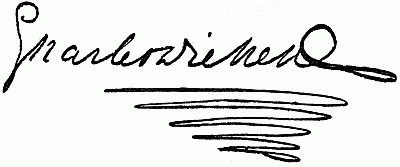
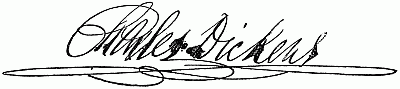

 , the fire was
pouring out, reddening the night with flames, blackening it
with smoke, and spotting it with red-hot stones and cinders
that fell down again in showers. At every step everybody
fell, now into a hot chink, now into a bed of ashes, now
over a mass of cindered iron; and the confusion in the darkness
(for the smoke obscured the moon in this part), and the
quarrelling and shouting and roaring of the guides, and the
waiting every now and then for somebody who was not to
be found, and was supposed to have stumbled into some pit
or other, made such a scene of it as I can give you no idea
of. My ladies were now on foot, of course; but we dragged
them on as well as we could (they were thorough game, and
didn't make the least complaint), until we got to the foot of
that topmost hill I have drawn so beautifully. Here we all
stopped; but the head guide, an English gentleman of the
name of Le Gros—who has been here many years, and has
been up the mountain a hundred times—and your humble
servant, resolved (like jackasses) to climb that hill to the
brink, and look down into the crater itself. You may form
some notion of what is going on inside it, when I tell you
that it is a hundred feet higher than it was six weeks ago.
The sensation of struggling up it, choked with the fire and
smoke, and feeling at every step as if the crust of ground
between one's feet and the gulf of fire would crumble in
and swallow one up (which is the real danger), I shall
remember for some little time, I think. But we did it. We
looked down into the flaming bowels of the mountain and
came back again, alight in half-a-dozen places, and burnt
from head to foot. You never saw such devils. And I
never saw anything so awful and terrible.
, the fire was
pouring out, reddening the night with flames, blackening it
with smoke, and spotting it with red-hot stones and cinders
that fell down again in showers. At every step everybody
fell, now into a hot chink, now into a bed of ashes, now
over a mass of cindered iron; and the confusion in the darkness
(for the smoke obscured the moon in this part), and the
quarrelling and shouting and roaring of the guides, and the
waiting every now and then for somebody who was not to
be found, and was supposed to have stumbled into some pit
or other, made such a scene of it as I can give you no idea
of. My ladies were now on foot, of course; but we dragged
them on as well as we could (they were thorough game, and
didn't make the least complaint), until we got to the foot of
that topmost hill I have drawn so beautifully. Here we all
stopped; but the head guide, an English gentleman of the
name of Le Gros—who has been here many years, and has
been up the mountain a hundred times—and your humble
servant, resolved (like jackasses) to climb that hill to the
brink, and look down into the crater itself. You may form
some notion of what is going on inside it, when I tell you
that it is a hundred feet higher than it was six weeks ago.
The sensation of struggling up it, choked with the fire and
smoke, and feeling at every step as if the crust of ground
between one's feet and the gulf of fire would crumble in
and swallow one up (which is the real danger), I shall
remember for some little time, I think. But we did it. We
looked down into the flaming bowels of the mountain and
came back again, alight in half-a-dozen places, and burnt
from head to foot. You never saw such devils. And I
never saw anything so awful and terrible.

 A foreign gentleman, with a beard, name unknown,
but signing himself "A Fellow Man," and dating from
nowhere, declined, twice yesterday, to leave this house for
any less consideration than the insignificant one of "twenty
pounds." I have had a policeman waiting for him all day.
A foreign gentleman, with a beard, name unknown,
but signing himself "A Fellow Man," and dating from
nowhere, declined, twice yesterday, to leave this house for
any less consideration than the insignificant one of "twenty
pounds." I have had a policeman waiting for him all day.