“Of genius in the Fine Arts,” wrote Wordsworth, “the only infallible sign
is the widening the sphere of human sensibility for the delight, honour,
and benefit of human nature. Genius is the introduction of a new element
into the intellectual universe, or, if that be not allowed, it is the
application of powers to objects on which they had not before been
exercised, or the employment of them in such a manner as to produce
effects hitherto unknown. What is all this but an advance or conquest made
by the soul of the poet? Is it to be supposed that the reader can make
progress of this kind like an Indian prince or general stretched on his
palanquin and borne by slaves? No; he is invigorated and inspirited by his
leader in order that he may exert himself, for he cannot proceed in
quiescence, he cannot be carried like a dead weight. Therefore to create
taste is to call forth and bestow power.”
A great poet, then, is “a challenge and summons”; and the question first
of all is not whether we like or dislike him, but whether we are capable
of meeting that challenge, of stepping out of our habitual selves to
answer that summons. He works on Nature’s plan: Nature, who teaches
nothing but supplies infinite material to learn from; who never preaches
but drives home her meanings by the resistless eloquence of effects.
Therefore the poet makes greater demands upon his reader than any other
man. For it is not a question of swallowing his ideas or admiring his
handiwork merely, but of seeing, feeling, enjoying, as he sees, feels,
enjoys. “The messages of great poems to each man and woman are,” says Walt
Whitman, “come to us on equal terms, only then can you understand us. We
are no better than you; what we enclose you enclose, what we enjoy you may
enjoy”—no better than you potentially, that is; but if you would
understand us the potential must become the actual, the dormant sympathies
must awaken and broaden, the dulled perceptions clear themselves and let
in undreamed of delights, the wonder-working imagination must respond, the
ear attune itself, the languid soul inhale large draughts of love and hope
and courage, those “empyreal airs” that vitalize the poet’s world. No
wonder the poet is long in finding his audience; no wonder he has to abide
the “inexorable tests of Time,” which, if indeed he be great, slowly turns
the handful into hundreds, the hundreds into thousands, and at last having
done its worst, grudgingly passes him on into the ranks of the Immortals.
Meanwhile let not the handful who believe that such a destiny awaits a man
of our time cease to give a reason for the faith that is in them.
So far as the suffrages of his own generation go Walt Whitman may, like
Wordsworth, tell of the “love, the admiration, the indifference, the
slight, the aversion, and even the contempt” with which his poems have
been received; but the love and admiration are from even a smaller
number, the aversion, the contempt more vehement, more universal and
persistent than Wordsworth ever encountered. For the American is a more
daring innovator; he cuts loose from precedent, is a very Columbus who has
sailed forth alone on perilous seas to seek new shores, to seek a new
world for the soul, a world that shall give scope and elevation and beauty
to the changed and changing events, aspirations, conditions of modern
life. To new aims, new methods; therefore let not the reader approach
these poems as a judge, comparing, testing, measuring by what has gone
before, but as a willing learner, an unprejudiced seeker for whatever may
delight and nourish and exalt the soul. Neither let him be abashed nor
daunted by the weight of adverse opinion, the contempt and denial which
have been heaped upon the great American even though it be the contempt
and denial of the capable, the cultivated, the recognized authorities; for
such is the usual lot of the pioneer in whatever field. In religion it is
above all to the earnest and conscientious believer that the Reformer has
appeared a blasphemer, and in the world of literature it is equally
natural that the most careful student, that the warmest lover of the
accepted masterpieces, should be the most hostile to one who forsakes the
methods by which, or at any rate, in company with which, those triumphs
have been achieved. “But,” said the wise Goethe, “I will listen to any
man’s convictions; you may keep your doubts, your negations to yourself, I
have plenty of my own.” For heartfelt convictions are rare things.
Therefore I make bold to indicate the scope and source of power in Walt
Whitman’s writings, starting from no wider ground than their effect upon
an individual mind. It is not criticism I have to offer; least of all any
discussion of the question of form or formlessness in these poems, deeply
convinced as I am that when great meanings and great emotions are
expressed with corresponding power, literature has done its best, call it
what you please. But my aim is rather to suggest such trains of thought,
such experience of life as having served to put me en rapport with this
poet may haply find here and there a reader who is thereby helped to the
same end. Hence I quote just as freely from the prose (especially from
“Democratic Vistas” and the preface to the first issue of “Leaves of
Grass,” 1855) as from his poems, and more freely, perhaps, from those
parts that have proved a stumbling-block than from those whose conspicuous
beauty assures them acceptance.
Fifteen years ago, with feelings partly of indifference, partly of
antagonism—for I had heard none but ill words of them—I first opened
Walt Whitman’s poems. But as I read I became conscious of receiving the
most powerful influence that had ever come to me from any source. What was
the spell? It was that in them humanity has, in a new sense, found itself;
for the first time has dared to accept itself without disparagement,
without reservation. For the first time an unrestricted faith in all that
is and in the issues of all that happens has burst forth triumphantly into
song.
“... The rapture of the hallelujah sent
From all that breathes and is ...”
rings through these poems. They carry up into the region of Imagination
and Passion those vaster and more profound conceptions of the universe and
of man reached by centuries of that indomitably patient organized search
for knowledge, that “skilful cross-questioning of things” called science.
“O truth of the earth I am determined to press my way toward you.
Sound your voice! I scale the mountains, I dive in the sea after you,”
cried science; and the earth and the sky have answered, and continue
inexhaustibly to answer her appeal. And now at last the day dawns which
Wordsworth prophesied of: “The man of science,” he wrote, “seeks truth as
a remote and unknown benefactor; he cherishes and loves it in his
solitude. The Poet, singing a song in which all human beings join with
him, rejoices in the presence of truth as our visible friend and hourly
companion. Poetry is the breath and finer spirit of all knowledge; it is
the impassioned expression which is in the countenance of all science, it
is the first and last of all knowledge; it is immortal as the heart of
man. If the labours of men of science should ever create any material
revolution, direct or indirect, in our condition, and in the impressions
which we habitually receive, the Poet will then sleep no more than at
present; he will be ready to follow the steps of the man of science not
only in those general indirect effects, but he will be at his side
carrying sensation into the midst of the objects of science itself. If the
time should ever come when what is now called science, thus familiarized
to man, shall be ready to put on, as it were, a form of flesh and blood,
the Poet will lend his divine spirit to aid the transfiguration, and will
welcome the being thus produced as a dear and genuine inmate of the
household of man.” That time approaches: a new heaven and a new earth
await us when the knowledge grasped by science is realized, conceived as a
whole, related to the world within us by the shaping spirit of
imagination. Not in vain, already, for this Poet have they pierced the
darkness of the past, and read here and there a word of the earth’s
history before human eyes beheld it; each word of infinite significance,
because involving in it secrets of the whole. A new anthem of the slow,
vast, mystic dawn of life he sings in the name of humanity.
“I am an acme of things accomplish’d, and I am an encloser of things to be.
“My feet strike an apex of the apices of the stairs;
On every step bunches of ages, and larger bunches between the steps;
All below duly travell’d and still I mount and mount.
“Rise after rise bow the phantoms behind me:
Afar down I see the huge first Nothing—I know
I was even there;
I waited unseen and always, and slept through the lethargic mist,
And took my time, and took no hurt from the fetid carbon.
“Long I was hugg’d close—long and long.
“Immense have been the preparations for me,
Faithful and friendly the arms that have help’d me.
Cycles ferried my cradle, rowing and rowing like cheerful boatmen;
For room to me stars kept aside in their own rings,
They sent influences to look after what was to hold me.
“Before I was born out of my mother, generations guided me;
My embryo has never been torpid—nothing could overlay it.
“For it the nebula cohered to an orb,
The long slow strata piled to rest it on,
Vast vegetables gave it sustenance,
Monstrous sauroids transported it in their mouths and deposited it with care.
“All forces have been steadily employ’d to complete and delight me;
Now on this spot I stand with my robust Soul.”
Not in vain have they pierced space as well as time and found “a vast
similitude interlocking all.”
“I open my scuttle at night and see the far-sprinkled systems,
And all I see, multiplied as high as I can cypher, edge but the rim of the farther systems.
“Wider and wider they spread, expanding, always expanding,
Outward, and outward, and for ever outward.
“My sun has his sun, and round him obediently wheels,
He joins with his partners a group of superior circuit,
And greater sets follow, making specks of the greatest inside them.
“There is no stoppage, and never can be stoppage;
If I, you, and the worlds, and all beneath or upon their surfaces, were this moment reduced back to a pallid float, it would not avail in the long run;
We should surely bring up again where we now stand,
And as surely go as much farther—and then farther and farther.”
Not in vain for him have they penetrated into the substances of things to
find that what we thought poor, dead, inert matter is (in Clerk Maxwell’s
words) “a very sanctuary of minuteness and power where molecules obey the
laws of their existence, and clash together in fierce collision, or
grapple in yet more fierce embrace, building up in secret the forms of
visible things”; each stock and stone a busy group of Ariels plying
obediently their hidden tasks.
“Why! who makes much of a miracle?
As to me, I know of nothing else but miracles,
········
“To me, every hour of the light and dark is a miracle,
Every cubic inch of space is a miracle,
Every square yard of the surface of the earth is spread with the same, ...
Every spear of grass—the frames, limbs, organs, of men and women, and all that concerns them,
All these to me are unspeakably perfect miracles.”
The natural is the supernatural, says Carlyle. It is the message that
comes to our time from all quarters alike; from poetry, from science, from
the deep brooding of the student of human history. Science materialistic?
Rather it is the current theology that is materialistic in comparison.
Science may truly be said to have annihilated our gross and brutish
conceptions of matter, and to have revealed it to us as subtle, spiritual,
energetic beyond our powers of realization. It is for the Poet to increase
these powers of realization. He it is who must awaken us to the perception
of a new heaven and a new earth here where we stand on this old earth. He
it is who must, in Walt Whitman’s words, indicate the path between reality
and the soul.
Above all is every thought and feeling in these poems touched by the light
of the great revolutionary truth that man, unfolded through vast stretches
of time out of lowly antecedents, is a rising, not a fallen creature;
emerging slowly from purely animal life; as slowly as the strata are piled
and the ocean beds hollowed; whole races still barely emerged, countless
individuals in the foremost races barely emerged: “the wolf, the snake,
the hog” yet lingering in the best; but new ideals achieved, and others
come in sight, so that what once seemed fit is fit no longer, is adhered
to uneasily and with shame; the conflicts and antagonisms between what we
call good and evil, at once the sign and the means of emergence, and
needing to account for them no supposed primeval disaster, no outside
power thwarting and marring the Divine handiwork, the perfect fitness to
its time and place of all that has proceeded from the Great Source. In a
word that Evil is relative; is that which the slowly developing reason and
conscience bid us leave behind. The prowess of the lion, the subtlety of
the fox, are cruelty and duplicity in man.
“Silent and amazed, when a little boy,
I remember I heard the preacher every Sunday put God in his statements,
As contending against some being or influence.”
says the poet. And elsewhere, “Faith, very old now, scared away by
science”—by the daylight science lets in upon our miserable, inadequate,
idolatrous conceptions of God and of His works, and on the
sophistications, subterfuges, moral impossibilities, by which we have
endeavoured to reconcile the irreconcilable—the coexistence of omnipotent
Goodness and an absolute Power of Evil—“Faith must be brought back by the
same power that caused her departure: restored with new sway, deeper,
wider, higher than ever.” And what else, indeed, at bottom, is science so
busy at? For what is Faith? “Faith,” to borrow venerable and unsurpassed
words, “is the substance of things hoped for, the evidence of things not
seen.” And how obtain evidence of things not seen but by a knowledge of
things seen? And how know what we may hope for, but by knowing the truth
of what is, here and now? For seen and unseen are parts of the Great
Whole: all the parts interdependent, closely related; all alike have
proceeded from and are manifestations of the Divine Source. Nature is not
the barrier between us and the unseen but the link, the communication;
she, too, has something behind appearances, has an unseen soul; she, too,
is made of “innumerable energies.” Knowledge is not faith, but it is
faith’s indispensable preliminary and starting ground. Faith runs ahead to
fetch glad tidings for us; but if she start from a basis of ignorance and
illusion, how can she but run in the wrong direction? “Suppose,” said that
impetuous lover and seeker of truth, Clifford, “Suppose all moving things
to be suddenly stopped at some instant, and that we could be brought
fresh, without any previous knowledge, to look at the petrified scene. The
spectacle would be immensely absurd. Crowds of people would be senselessly
standing on one leg in the street looking at one another’s backs; others
would be wasting their time by sitting in a train in a place difficult to
get at, nearly all with their mouths open, and their bodies in some
contorted, unrestful posture. Clocks would stand with their pendulums on
one side. Everything would be disorderly, conflicting, in its wrong place.
But once remember that the world is in motion, is going somewhere, and
everything will be accounted for and found just as it should be. Just so
great a change of view, just so complete an explanation is given to us
when we recognize that the nature of man and beast and of all the world is
going somewhere. The maladaptions in organic nature are seen to be steps
toward the improvement or discarding of imperfect organs. The baneful
strife which lurketh inborn in us, and goeth on the way with us to hurt
us, is found to be the relic of a time of savage or even lower
condition.” “Going somewhere!” That is the meaning then of all our
perplexities! That changes a mystery which stultified and contradicted the
best we knew into a mystery which teaches, allures, elevates; which
harmonizes what we know with what we hope. By it we begin to
“... see by the glad light,
And breathe the sweet air of futurity.”
The scornful laughter of Carlyle as he points with one hand to the
baseness, ignorance, folly, cruelty around us, and with the other to the
still unsurpassed poets, sages, heroes, saints of antiquity, whilst he
utters the words “progress of the species!” touches us no longer when we
have begun to realize “the amplitude of time”; when we know something of
the scale by which Nature measures out the years to accomplish her
smallest essential modification or development; know that to call a few
thousands or tens of thousands of years antiquity, is to speak as a child,
and that in her chronology the great days of Egypt and Syria, of Greece
and Rome are affairs of yesterday.
“Each of us inevitable;
Each of us limitless—each of us with his or her right upon the earth;
Each of us allow’d the eternal purports of the earth;
Each of us here as divinely as any are here.
“You Hottentot with clicking palate! You woolly hair’d hordes!
You own’d persons, dropping sweat-drops or blood-drops!
You human forms with the fathomless ever-impressive countenances of brutes!
I dare not refuse you—the scope of the world, and of time and space are upon me.
········
“I do not prefer others so very much before you either;
I do not say one word against you, away back there, where you stand;
(You will come forward in due time to my side.)
My spirit has pass’d in compassion and determination around the whole earth;
I have look’d for equals and lovers, and found them ready for me in all lands;
I think some divine rapport has equalized me with them.
“O vapours! I think I have risen with you, and moved away to distant continents and fallen down there, for reasons;
I think I have blown with you, O winds;
O waters, I have finger’d every shore with you.
“I have run through what any river or strait of the globe has run through;
I have taken my stand on the bases of peninsulas, and on the high embedded rocks, to cry thence.
“Salut au monde!
What cities the light or warmth penetrates, I penetrate those cities myself;
All islands to which birds wing their way I wing my way myself.
“Toward all,
I raise high the perpendicular hand—I make the signal,
To remain after me in sight forever,
For all the haunts and homes of men.”
But “Hold!” says the reader, especially if he be one who loves science,
who loves to feel the firm ground under his feet, “That the species has a
great future before it we may well believe; already we see the
indications. But that the individual has is quite another matter. We can
but balance probabilities here, and the probabilities are very heavy on
the wrong side; the poets must throw in weighty matter indeed to turn the
scale the other way!” Be it so: but ponder a moment what science herself
has to say bearing on this theme; what are the widest, deepest facts she
has reached down to. Indestructibility: Amidst ceaseless change and
seeming decay all the elements, all the forces (if indeed they be not one
and the same) which operate and substantiate those changes, imperishable;
neither matter nor force capable of annihilation. Endless transformations,
disappearances, new combinations, but diminution of the total amount
never; missing in one place or shape to be found in another, disguised
ever so long, ready always to re-emerge. “A particle of oxygen,” wrote
Faraday, “is ever a particle of oxygen; nothing can in the least wear it.
If it enters into combination and disappears as oxygen, if it pass through
a thousand combinations, animal, vegetable, mineral—if it lie hid for a
thousand years and then be evolved, it is oxygen with its first qualities
neither more nor less.” So then out of the universe is no door. Continuity
again is one of Nature’s irrevocable words; everything the result and
outcome of what went before; no gaps, no jumps; always a connecting
principle which carries forward the great scheme of things as a related
whole, which subtly links past and present, like and unlike. Nothing
breaks with its past. “It is not,” says Helmholtz, “the definite mass of
substance which now constitutes the body to which the continuance of the
individual is attached. Just as the flame remains the same in appearance
and continues to exist with the same form and structure although it draws
every moment fresh combustible vapour and fresh oxygen from the air into
the vortex of its ascending current; and just as the wave goes on in
unaltered form and is yet being reconstructed every moment from fresh
particles of water, so is it also in the living being. For the material of
the body like that of flame is subject to continuous and comparatively
rapid change—a change the more rapid the livelier the activity of the
organs in question. Some constituents are renewed from day to day, some
from month to month, and others only after years. That which continues to
exist as a particular individual is, like the wave and the flame, only the
form of motion which continually attracts fresh matter into its vortex
and expels the old. The observer with a deaf ear recognizes the vibration
of sound as long as it is visible and can be felt, bound up with other
heavy matter. Are our senses in reference to life like the deaf ear in
this respect?”
“You are not thrown to the winds—you gather certainly and safely around yourself;
········
It is not to diffuse you that you were born of your mother and father—it is to identify you;
It is not that you should be undecided, but that you should be decided;
Something long preparing and formless is arrived and form’d in you,
You are henceforth secure, whatever comes or goes.
“O Death! the voyage of Death!
The beautiful touch of Death, soothing and benumbing a few moments for reasons;
Myself discharging my excrementitious body to be burn’d or reduced to powder or buried.
My real body doubtless left me for other spheres,
My voided body, nothing more to me, returning to the purifications, farther offices, eternal uses of the earth.”
Yes, they go their way, those dismissed atoms with all their energies and
affinities unimpaired. But they are not all; the will, the affections, the
intellect are just as real as those affinities and energies, and there is
strict account of all; nothing slips through; there is no door out of the
universe. But they are qualities of a personality, of a self, not of an
atom but of what uses and dismisses those atoms. If the qualities are
indestructible so must the self be. The little heap of ashes, the puff of
gas, do you pretend that is all that was Shakespeare? The rest of him
lives in his works, you say? But he lived and was just the same man after
those works were produced. The world gained, but he lost nothing of
himself, rather grew and strengthened in the production of them.
Still farther, those faculties with which we seek for knowledge are only a
part of us, there is something behind which wields them, something that
those faculties cannot turn themselves in upon and comprehend; for the
part cannot compass the whole. Yet there it is with the irrefragable proof
of consciousness. Who should be the mouthpiece of this whole? Who but the
poet, the man most fully “possessed of his own soul,” the man of the
largest consciousness; fullest of love and sympathy which gather into his
own life the experiences of others, fullest of imagination; that quality
whereof Wordsworth says that it
“... in truth
Is but another name for absolute power,
And clearest insight, amplitude of mind
And reason in her most exalted mood.”
Let Walt Whitman speak for us:
“And I know I am solid and sound;
To me the converging objects of the universe perpetually flow:
All are written to me, and I must get what the writing means.
“I know I am deathless;
I know this orbit of mine cannot be swept by the carpenter’s compass;
I know I shall not pass like a child’s carlacue cut with a burnt stick at night.
“I know I am august;
I do not trouble my spirit to vindicate itself or be understood;
I see that the elementary laws never apologize;
(I reckon I behave no prouder than the level I plant my house by, after all.)
“I exist as I am—that is enough;
If no other in the world be aware I sit content;
And if each one and all be aware, I sit content.
“One world is aware, and by far the largest to me, and that is myself;
And whether I come to my own to-day, or in ten thousand or ten million years,
I can cheerfully take it now, or with equal cheerfulness I can wait.
“My foothold is tenon’d and mortis’d in granite;
I laugh at what you call dissolution;
And I know the amplitude of time.”
What lies through the portal of death is hidden from us; but the laws that
govern that unknown land are not all hidden from us, for they govern here
and now; they are immutable, eternal.
“Of and in all these things
I have dream’d that we are not to be changed so much, nor the law of us changed,
I have dream’d that heroes and good doers shall be under the present and past law,
And that murderers, drunkards, liars, shall be under the present and past law,
For I have dream’d that the law they are under now is enough.”
And the law not to be eluded is the law of consequences, the law of silent
teaching. That is the meaning of disease, pain, remorse. Slow to learn are
we; but success is assured with limitless Beneficence as our teacher, with
limitless time as our opportunity. Already we begin—
“To know the Universe itself as a road—as many roads
As roads for travelling souls.
For ever alive; for ever forward.
Stately, solemn, sad, withdrawn, baffled, mad, turbulent, feeble, dissatisfied;
Desperate, proud, fond, sick;
Accepted by men, rejected by men.
They go! they go! I know that they go, but I know not where they go.
But I know they go toward the best, toward something great;
The whole Universe indicates that it is good.”
Going somewhere! And if it is impossible for us to see whither, as in the
nature of things it must be, how can we be adequate judges of the way? how
can we but often grope and be full of perplexity? But we know that a
smooth path, a paradise of a world, could only nurture fools, cowards,
sluggards. “Joy is the great unfolder,” but pain is the great enlightener,
the great stimulus in certain directions, alike of man and beast. How else
could the self-preserving instincts, and all that grows out of them, have
been evoked? How else those wonders of the moral world, fortitude,
patience, sympathy? And if the lesson be too hard comes Death, come “the
sure-enwinding arms of Death” to end it, and speed us to the unknown land.
“... Man is only weak
Through his mistrust and want of hope,”
wrote Wordsworth. But man’s mistrust of himself is, at bottom, mistrust of
the central Fount of power and goodness whence he has issued. Here comes
one who plucks out of religion its heart of fear, and puts into it a heart
of boundless faith and joy; a faith that beggars previous faiths because
it sees that All is good, not part bad and part good; that there is no
flaw in the scheme of things, no primeval disaster, no counteracting
power; but orderly and sure growth and development, and that infinite
Goodness and Wisdom embrace and ever lead forward all that exists. Are you
troubled that He is an unknown God; that we cannot by searching find Him
out? Why, it would be a poor prospect for the Universe if otherwise; if,
embryos that we are, we could compass Him in our thoughts:
“I hear and behold God in every object, yet understand God not in the least.”
It is the double misfortune of the churches that they do not study God in
His works—man and Nature and their relations to each other; and that they
do profess to set Him forth; that they worship therefore a God of man’s
devising, an idol made by men’s minds it is true, not by their hands, but
none the less an idol. “Leaves are not more shed out of trees than Bibles
are shed out of you,” says the poet. They were the best of their time, but
not of all time; they need renewing as surely as there is such a thing as
growth, as surely as knowledge nourishes and sustains to further
development; as surely as time unrolls new pages of the mighty scheme of
existence. Nobly has George Sand, too, written: “Everything is divine,
even matter; everything is superhuman, even man. God is everywhere. He is
in me in a measure proportioned to the little that I am. My present life
separates me from Him just in the degree determined by the actual state of
childhood of our race. Let me content myself in all my seeking to feel
after Him, and to possess of Him as much as this imperfect soul can take
in with the intellectual sense I have. The day will come when we shall no
longer talk about God idly; nay, when we shall talk about Him as little
as possible. We shall cease to set Him forth dogmatically, to dispute
about His nature. We shall put compulsion on no one to pray to Him, we
shall leave the whole business of worship within the sanctuary of each
man’s conscience. And this will happen when we are really religious.”
In what sense may Walt Whitman be called the Poet of Democracy? It is as
giving utterance to this profoundly religious faith in man. He is rather
the prophet of what is to be than the celebrator of what is. “Democracy,”
he writes, “is a word the real gist of which still sleeps quite
unawakened, notwithstanding the resonance and the many angry tempests out
of which its syllables have come from pen or tongue. It is a great word,
whose history, I suppose, remains unwritten because that history has yet
to be enacted. It is in some sort younger brother of another great and
often used word, Nature, whose history also waits unwritten.” Political
democracy, now taking shape, is the house to live in, and whilst what we
demand of it is room for all, fair chances for all, none disregarded or
left out as of no account, the main question, the kind of life that is to
be led in that house is altogether beyond the ken of the statesmen as
such, and is involved in those deepest facts of the nature and destiny of
man which are the themes of Walt Whitman’s writings. The practical outcome
of that exalted and all-accepting faith in the scheme of things, and in
man, toward whom all has led up and in whom all concentrates as the
manifestation, the revelation of Divine Power is a changed estimate of
himself; a higher reverence for, a loftier belief in the heritage of
himself; a perception that pride, not humility, is the true homage to his
Maker; that “noblesse oblige” is for the Race, not for a handful; that it
is mankind and womankind and their high destiny which constrain to
greatness, which can no longer stoop to meanness and lies and base aims,
but must needs clothe themselves in “the majesty of honest dealing”
(majestic because demanding courage as good as the soldier’s, self-denial
as good as the saint’s for every-day affairs), and walk erect and
fearless, a law to themselves, sternest of all lawgivers. Looking back to
the palmy days of feudalism, especially as immortalized in Shakespeare’s
plays, what is it we find most admirable? what is it that fascinates? It
is the noble pride, the lofty self-respect; the dignity, the courage and
audacity of its great personages. But this pride, this dignity rested half
upon a true, half upon a hollow foundation; half upon intrinsic qualities,
half upon the ignorance and brutishness of the great masses of the people,
whose helpless submission and easily dazzled imaginations made
stepping-stones to the elevation of the few, and “hedged round kings,”
with a specious kind of “divinity.” But we have our faces turned toward a
new day, and toward heights on which there is room for all.
“By God, I will accept nothing which all cannot have their counterpart of on the same terms”
is the motto of the great personages, the great souls of to-day. On the
same terms, for that is Nature’s law and cannot be abrogated, the
reaping as you sow. But all shall have the chance to sow well. This is
pride indeed! Not a pride that isolates, but that can take no rest till
our common humanity is lifted out of the mire everywhere, “a pride that
cannot stretch too far because sympathy stretches with it”:
“Whoever you are! claim your own at any hazard!
These shows of the east and west are tame, compared to you;
These immense meadows—these interminable rivers—
You are immense and interminable as they;
These furies, elements, storms, motions of Nature, throes of apparent dissolution—you are he or she who is master or mistress over them,
Master or mistress in your own right over Nature, elements, pain, passion, dissolution.
“The hopples fall from your ankles—you find an unfailing sufficiency;
Old or young, male or female, rude, low, rejected by the rest, whatever you are promulges itself;
Through birth, life, death, burial, the means are provided, nothing is scanted;
Through angers, losses, ambition, ignorance and ennui, what you are picks its way.”
This is indeed a pride that is “calming and excellent to the soul”; that
“dissolves poverty from its need and riches from its conceit.”
And humility? Is there, then, no place for that virtue so much praised by
the haughty? Humility is the sweet spontaneous grace of an aspiring,
finely developed nature which sees always heights ahead still unclimbed,
which outstrips itself in eager longing for excellence still unattained.
Genuine humility takes good care of itself as men rise in the scale of
being; for every height climbed discloses still new heights beyond. Or it
is a wise caution in fortune’s favourites lest they themselves should
mistake, as the unthinking crowd around do, the glitter reflected back
upon them by their surroundings for some superiority inherent in
themselves. It befits them well if there be also due pride, pride of
humanity behind. But to say to a man, ‘Be humble’ is like saying to one
who has a battle to fight, a race to run, ‘You are a poor, feeble
creature; you are not likely to win and you do not deserve to.’ Say rather
to him, ‘Hold up your head! You were not made for failure, you were made
for victory: go forward with a joyful confidence in that result sooner or
later, and the sooner or the later depends mainly on yourself.’
“What Christ appeared for in the moral-spiritual field for humankind,
namely, that in respect to the absolute soul there is in the possession of
such by each single individual something so transcendent, so incapable of
gradations (like life) that to that extent it places all being on a common
level, utterly regardless of the distinctions of intellect, virtue,
station, or any height or lowliness whatever” is the secret source of that
deathless sentiment of Equality which how many able heads imagine
themselves to have slain with ridicule and contempt as Johnson, kicking a
stone, imagined he had demolished Idealism when he had simply attributed
to the word an impossible meaning. True, Inequality is one of Nature’s
words: she moves forward always by means of the exceptional. But the
moment the move is accomplished, then all her efforts are toward equality,
toward bringing up the rear to that standpoint. But social inequalities,
class distinctions, do not stand for or represent Nature’s inequalities.
Precisely the contrary in the long run. They are devices for holding up
many that would else gravitate down and keeping down many who would else
rise up; for providing that some should reap who have not sown, and many
sow without reaping. But literature tallies the ways of Nature; for though
itself the product of the exceptional, its aim is to draw all men up to
its own level. The great writer is “hungry for equals day and night,” for
so only can he be fully understood. “The meal is equally set”; all are
invited. Therefore is literature, whether consciously or not, the greatest
of all forces on the side of Democracy.
Carlyle has said there is no grand poem in the world but is at bottom a
biography—the life of a man. Walt Whitman’s poems are not the biography
of a man, but they are his actual presence. It is no vain boast when he
exclaims,
“Camerado! this is no book;
Who touches this touches a man.”
He has infused himself into words in a way that had not before seemed
possible; and he causes each reader to feel that he himself or herself has
an actual relationship to him, is a reality full of inexhaustible
significance and interest to the poet. The power of his book, beyond even
its great intellectual force, is the power with which he makes this felt;
his words lay more hold than the grasp of a hand, strike deeper than the
gaze or the flash of an eye; to those who comprehend him he stands “nigher
than the nighest.”
America has had the shaping of Walt Whitman, and he repays the filial debt
with a love that knows no stint. Her vast lands with their varied,
brilliant climes and rich products, her political scheme, her achievements
and her failures, all have contributed to make these poems what they are
both directly and indirectly. Above all has that great conflict, the
Secession War, found voice in him. And if the reader would understand the
true causes and nature of that war, ostensibly waged between North and
South, but underneath a tussle for supremacy between the good and the evil
genius of America (for there were just as many secret sympathizers with
the secession-slave-power in the North as in the South) he will find the
clue in the pages of Walt Whitman. Rarely has he risen to a loftier height
than in the poem which heralds that volcanic upheaval:—
“Rise, O days, from your fathomless deeps, till you loftier and fiercer sweep!
Long for my soul, hungering gymnastic, I devour’d what the earth gave me;
Long I roam’d the woods of the north—long I watch’d Niagara pouring;
I travel’d the prairies over, and slept on their breast—
I cross’d the Nevadas, I cross’d the plateaus;
I ascended the towering rocks along the Pacific, I sail’d out to sea;
I sail’d through the storm, I was refresh’d by the storm;
I watch’d with joy the threatening maws of the waves;
I mark’d the white combs where they career’d so high, curling over;
I heard the wind piping, I saw the black clouds;
Saw from below what arose and mounted (O superb! O wild as my heart, and powerful!)
Heard the continuous thunder, as it bellow’d after the lightning;
Noted the slender and jagged threads of lightning, as sudden and fast amid the din they chased each other across the sky;
—These, and such as these, I, elate, saw—saw with wonder, yet pensive and masterful;
All the menacing might of the globe uprisen around me;
Yet there with my soul I fed—I fed content, supercilious.
“’Twas well, O soul! ’twas a good preparation you gave me!
Now we advance our latent and ampler hunger to fill;
Now we go forth to receive what the earth and the sea never gave us;
Not through the mighty woods we go, but through the mightier cities;
Something for us is pouring now, more than Niagara pouring;
Torrents of men (sources and rills of the Northwest, are you indeed inexhaustible?)
What, to pavements and homesteads here—what were those storms of the mountains and sea?
What, to passions I witness around me to-day? Was the sea risen?
Was the wind piping the pipe of death under the black clouds?
Lo! from deeps more unfathomable, something more deadly and savage;
Manhattan, rising, advancing with menacing front—Cincinnati, Chicago, unchain’d;
—What was that swell I saw on the ocean? behold what comes here!
How it climbs with daring feet and hands! how it dashes!
How the true thunder bellows after the lightning! how bright the flashes of lightning!
How Democracy, with desperate, vengeful port strides on, shown through the dark by those flashes of lightning!
(Yet a mournful wail and low sob I fancied I heard through the dark,
In a lull of the deafening confusion.)
“Thunder on! stride on, Democracy! stride with vengeful stroke!
And do you rise higher than ever yet, O days, O cities!
Crash heavier, heavier yet, O storms! you have done me good;
My soul, prepared in the mountains, absorbs your immortal strong nutriment,
—Long had I walk’d my cities, my country roads, through farms, only half satisfied;
One doubt, nauseous, undulating like a snake, crawl’d on the ground before me,
Continually preceding my steps, turning upon me oft, ironically hissing low;
—The cities I loved so well, I abandon’d and left—I sped to the certainties suitable to me;
Hungering, hungering, hungering for primal energies, and nature’s dauntlessness;
I refresh’d myself with it only, I could relish it only;
I waited the bursting forth of the pent fire—on the water and air I waited long;
—But now I no longer wait—I am fully satisfied—I am glutted;
I have witness’d the true lightning—I have witness’d my cities electric;
I have lived to behold man burst forth, and warlike America rise;
Hence I will seek no more the food of the northern solitary wilds,
No more on the mountain roam, or sail the stormy sea.”
But not for the poet a soldier’s career. “To sit by the wounded and soothe
them, or silently watch the dead” was the part he chose. During the whole
war he remained with the army, but only to spend the days and nights,
saddest, happiest of his life, in the hospital tents. It was a beautiful
destiny for this lover of men, and a proud triumph for this believer in
the People; for it was the People that he beheld, tried by severest tests.
He saw them “of their own choice, fighting, dying for their own idea,
insolently attacked by the secession-slave-power.” From the workshop, the
farm, the store, the desk, they poured forth, officered by men who had to
blunder into knowledge at the cost of the wholesale slaughter of their
troops. He saw them “tried long and long by hopelessness, mismanagement,
defeat; advancing unhesitatingly through incredible slaughter; sinewy with
unconquerable resolution. He saw them by tens of thousands in the
hospitals tried by yet drearier, more fearful tests—the wound, the
amputation, the shattered face, the slow hot fever, the long impatient
anchorage in bed; he marked their fortitude, decorum, their religious
nature and sweet affection.” Finally, newest, most significant sight of
all, victory achieved, the cause, the Union safe, he saw them return back
to the workshop, the farm, the desk, the store, instantly reabsorbed into
the peaceful industries of the land:—
“A pause—the armies wait.
A million flush’d embattled conquerors wait.
The world, too, waits, then soft as breaking night and sure as dawn
They melt, they disappear.”
“Plentifully supplied, last-needed proof of Democracy in its
personalities!” ratifying on the broadest scale Wordsworth’s haughty claim
for average man—“Such is the inherent dignity of human nature that there
belong to it sublimities of virtue which all men may attain, and which no
man can transcend.”
But, aware that peace and prosperity may be even still severer tests of
national as of individual virtue and greatness of mind, Walt Whitman scans
with anxious, questioning eye the America of to-day. He is no
smooth-tongued prophet of easy greatness.
“I am he who walks the States with a barb’d tongue questioning every one I meet;
Who are you, that wanted only to be told what you knew before?
Who are you, that wanted only a book to join you in your nonsense?”
He sees clearly as any the incredible flippancy, the blind fury of
parties, the lack of great leaders, the plentiful meanness and vulgarity;
the labour question beginning to open like a yawning gulf.... “We sail a
dangerous sea of seething currents, all so dark and untried.... It seems
as if the Almighty had spread before this nation charts of imperial
destinies, dazzling as the sun, yet with many a deep intestine difficulty,
and human aggregate of cankerous imperfection saying lo! the roads! The
only plans of development, long and varied, with all terrible balks and
ebullitions! You said in your soul, I will be empire of empires, putting
the history of old-world dynasties, conquests, behind me as of no
account—making a new history, a history of democracy ... I alone
inaugurating largeness, culminating time. If these, O lands of America,
are indeed the prizes, the determinations of your soul, be it so. But
behold the cost, and already specimens of the cost. Thought you greatness
was to ripen for you like a pear? If you would have greatness, know that
you must conquer it through ages ... must pay for it with proportionate
price. For you, too, as for all lands, the struggle, the traitor, the wily
person in office, scrofulous wealth, the surfeit of prosperity, the
demonism of greed, the hell of passion, the decay of faith, the long
postponement, the fossil-like lethargy, the ceaseless need of revolutions,
prophets, thunderstorms, deaths, new projections and invigorations of
ideas and men.”
“Yet I have dreamed, merged in that hidden-tangled problem of our fate,
whose long unravelling stretches mysteriously through time—dreamed,
portrayed, hinted already—a little or a larger band, a band of brave and
true, unprecedented yet, arm’d and equipt at every point, the members
separated, it may be by different dates and states, or south or north, or
east or west, a year, a century here, and other centuries there, but
always one, compact in soul, conscience-conserving, God-inculcating,
inspired achievers not only in literature, the greatest art, but achievers
in all art—a new undying order, dynasty from age to age transmitted, a
band, a class at least as fit to cope with current years, our dangers,
needs, as those who, for their time, so long, so well, in armour or in
cowl, upheld and made illustrious that far-back-feudal, priestly world.”
Of that band, is not Walt Whitman the pioneer? Of that New World
literature, say, are not his poems the beginning? A rude beginning if you
will. He claims no more and no less. But whatever else they may lack they
do not lack vitality, initiative, sublimity. They do not lack that which
makes life great and death, with its “transfers and promotions, its superb
vistas,” exhilarating—a resplendent faith in God and man which will
kindle anew the faith of the world:—
“Poets to come! Orators, singers, musicians to come!
Not to-day is to justify me, and answer what I am for;
But you, a new brood, native, athletic, continental, greater than before known,
“Arouse! Arouse—for you must justify me—you must answer.
“I myself but write one or two indicative words for the future,
I but advance a moment, only to wheel and hurry back in the darkness.
“I am a man who, sauntering along, without fully stopping, turns a casual look upon you, and then averts his face,
Leaving it to you to prove and define it,
Expecting the main things from you.”
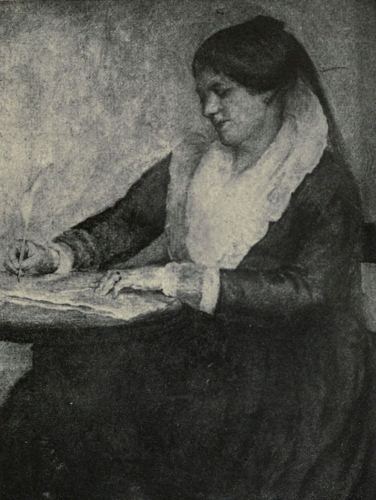
Anne Gilchrist.
ANNE GILCHRIST
Photogravure from a painting by her son, made in 1882