THE LETTER H PAST, PRESENT, AND FUTURE A Treatise: WITH RULES FOR THE SILENT H , BASED ON MODERN USAGE; AND NOTES ON WH .
Transcriber’s Note:
New original cover art included with this eBook is granted to the public domain.
THE LETTER H.
PAST, PRESENT, AND FUTURE.
HARRY HAWKINS’S H-BOOK; showing how he learned to
aspirate his H’s. Eighth Thousand. Sewed, 6d.
“We commend the little work to the notice of all masters and
mistresses.”—Teacher.
A WORD TO THE WISE, OR HINTS ON THE CURRENT
Improprieties of Expression in Writing and Speaking. By Parry
Gwynne. Fifteenth Thousand. 18mo, sewed 6d., or cloth, gilt
edges, 1s.
“All who wish to mind their p’s and q’s should consult this little
volume.”—Gentleman’s Magazine.
A COMPENDIOUS GRAMMAR, AND PHILOLOGICAL HANDbook
of the English Language, for the Use of Schools and
Candidates for the Army and Civil Service Examinations. By John
George Colquhoun, Esq., Barrister-at-Law. Fcap. 8vo, cloth,
2s. 6d.
“A real and very useful accession to the list of English manuals.”—Educational
Times.
“We are not acquainted with any single volume that in such a small
compass contains so much useful information.”—Scholastic Register.
“Just the book we should like to see in Training Colleges, and
placed in the hands of Pupil Teachers.”—National Schoolmaster.
GRIFFITH AND FARRAN,
WEST CORNER ST PAUL’S CHURCHYARD, LONDON.
E. P. DUTTON AND CO., NEW YORK.
By ALFRED LEACH.
A breath can make them....
Goldsmith.
GRIFFITH & FARRAN
SUCCESSORS TO NEWBERY AND HARRIS,
WEST CORNER ST PAUL’S CHURCHYARD, LONDON
E. P. DUTTON & CO., NEW YORK
MDCCCLXXX.
The rights of translation and of reproduction are reserved.
PREFACE.
5
The contradictory rules that are given for the
employment of H’s, and the confusion that
reigns in our best Pronouncing Dictionaries,
constitute an apology for the appearance of this
publication. To promote an uniform pronunciation
based on the sole authority of contemporary
usage, is one of its purposes. To
draw attention to the nature of the present
English Aspirate, is another. To seek redress
for the digraph WH, is a third. To render the
subjects as interesting to the general reader as
the matter would allow, has been the great
desire of the writer.
It is with gratitude that I beg to express
my thanks to the gentlemen whose kind courtesy
I have acknowledged on page 56; and to
Professor Bain, Professor Skeat, and His Eminence
Cardinal Archbishop Manning, to whose
kindness I am indebted for assistance in the
6form of valuable comments and advice. I beg
also to thank the Rev. W. H. Bleaden, curate
to the Bishop of Aberdeen and Orkney; and
John Davidson, Esq., Memb. Arts Club, London,
for the friendly help they have given me.
A writer in a high-class American periodical[1]
recently expressed his surprise that no English
orthoepist or phonologist had made the subject
of Aspirates and their misuse one of examination,
or of more than a mere passing remark.
True it is that in works where dissertations
on single vowels occupy pages, and paragraph
after paragraph teems with analyses of individual
consonants, “poor letter H” is often
summed up in a sentence. And yet it is no
exaggeration to say that, socially, H is of
English letters the most important, and that a
systematic trifling with half the vowels and
consonants of the alphabet would not be
visited with such severe social reprobation
as is the omission or misplacement of an H.
The fraternity of English Grammarians have,
it might seem, conspired to withhold from us
the means of propitiating this demon Aspirate,
which a study of its attributes would afford.
Mr Punch, that excellent censor of British
10manners and customs, has been the chief (not
to say only) constant attendant to the English
H-evil; but the fleam of his satire—an instrument
as powerful, and often more effective,
than the Thor-hammer of the Times—has
scarified the abusers of H, without removing
much of the abuse.
The American writer alluded to above enters,
with the characteristic daring of his countrymen,
upon the treacherous grounds of statistical definition,
and states that, in England, “of the forty
millions of people, there cannot be more than
two millions who are capable of a healthy, well-breathed
H.” He is treading in safer paths
when he says:
There is a gradation, too, in the misuse of this letter.
It is silent when it should be heard, but it is also added,
or rather prefixed, to words in which it has no place.
Now the latter fault is the sign and token of a much lower
condition in life than the former.
He appears, however, to write in ignorance of
the customs of many good speakers, and of the
opinions of several English orthoepists, when he
adds: “Only Englishmen of the very uppermost
class and finest breeding say home and hotel;
all others, ’ome and ’otel” Further on, he says:
H, in speech, is an unmistakable mark of class distinction
in England, as every observant person soon
11discovers. I remarked upon this to an English gentleman,
an officer, who replied—‘It’s the greatest blessing
in the world; a sure protection against cads. You meet
a fellow who is well-dressed, behaves himself decently
enough, and yet you don’t know exactly what to make of
him; but get him talking, and if he trips upon his H’s that
settles the question. He’s a chap you’d better be shy of.’
This writer’s friend, the “English gentleman,”
is spokesman to a large class. As the chemist
employs a compound of sulphur in order to
decide by the reaction whether a substance
belongs to the group of higher or of baser
metals, so does society apply the H-test to
unknown individuals, and group them according
to their comportment under the ordeal. There
can be no doubt that a tendency of the age is
to over-rate the value of H as a critical test for
refinement and culture.
Although instances of well-educated persons
who aspirate their vowels wrongly are extremely
rare, the partial or even complete omission of
Aspirates is far from being an absolute criterion
of ignorance or vulgarity. The writer has in his
mind’s eye a very excellent and scholarly gentleman,
one of the high dignitaries of an order of professional
speakers, who, by strange anomaly, is a
sad non-conformist in the matter of H’s. But—need
one add?—such deviations from rule are
as rare in their occurrence as the credentials of
12learning and social rank must be exceptional
that can obtain forgiveness for them in society;
and any man about to choose for himself an
eccentricity is not advised to select the uncommon
one of erudite H-dropping.
The prevalent disregard shewn for the rules
of aspiration by classes of moderately well-educated
persons, may be traced to several
causes. Young children do not manifest any
fine appreciation of the difference between
aspirated and unaspirated vowels, and readily
acquire a tendency to neglect or misuse the H,
so that, unless correctness of aspiration be made
a canon of the nursery, these infantile transgressions
are liable to develop into deeply rooted
habit. At a great many middle and lower class
schools H-dropping is fostered rather than destroyed;
the boys, with all that ingenuous
ruffianism that preceding generations so admired
in the youth of Britain, discountenance forcibly
anything like “affectation,” and, if H-droppers
be in the majority, render it expedient in the
youthful orthoepist to sink his singularity of
right in deference to the dominant powers of
wrong. A correct pronunciation, when once
discarded, is not easily regained—lost H’s have
a knack of turning up in wrong places, when
13they return at all. Schoolmasters are not always
models of correctness, and a staff of H-dropping
ushers is not likely to impress school-boys with
a regard for the Aspirate. Nor is it only in
educational institutes of an inferior order that
neglect, and even intolerance, is shewn respecting
the full and proper employment of H. The
writer could point out more than one of our very
best English schools where (within the last three
decades) school-boy tyranny forbade that WH
should be pronounced other than W; and “wip”
and “weel” were the only recognized renderings
of whip and wheel. The uncertainty attending
the words in which the H should be silent, is
doubtless also partly accountable for its indiscriminate
employment.
Before inquiring into the history and nature
of Aspirates and their symbols, it may not
be uninteresting to take a cursory glance at
the extraordinary misuse of H in the Metropolis.
The “Cockney Problem” has long
been a puzzle to all except superficial observers.
One may speculate reasonably as to
the probable cause of the Londoner dropping
his H’s when he ought to aspirate them; but
why he persists in placing H’s where they
should not be, seems beyond the powers of
14reason to explain. The problem is not solved
by saying that an H is prefixed in order to
emphasize certain words in a sentence, unless
at the same time it can be shown that the
speaker is consistent in his manner of using it,
and that he is not in the habit of putting H’s
before unemphatic words. This cannot be
shown; whereas the reverse can be demonstrated.
To take an extreme instance: the Cockney
will wrongly aspirate even the little words of
a metrical composition, which are neither important
nor emphatic; and this, moreover, when
they are out of accent. In his colloquial speech,
Horkney hoysters, ’amshire ’am, and ’am and
heggs, are expressions he employs with a provoking
impartiality for the proper and improper
use of the H. Stress may have something to
do with some of these anomalous uses of the
Aspirate, but to what extent is very far from
clear. Eggs are perhaps brought more to the
fore by becoming heggs, and an H may add
to the importance of oysters; but by what
occult method of ratiocination he vindicates his
invidious distinction between the rightful claims
of ham and the imaginary requirements of eggs
must be left for those to explain who can.
Various are the suggestions that have been
15made relative to this phenomenon of misplaced
H’s; and if assurance could constitute authority,
or the outcome of guess-work be accepted as
proof, many of the suggestions would be amply
supported in their demands for universal regard
and acceptance. Some have believed that
aspiration of the vowels is dictated solely by
a desire to improve their sounds; others, that a
tendency exists to aspirate every initial vowel (as
in Hindostanee), but that exceptions are made
wherever they favour fluency and adapt themselves
to ease of articulation. Some, again, say
that a pervert method of aspirating had an
early origin and has undergone a process of
gradual development until the acme of depravity
has been reached by the present generation.
Or, to add to the list, one might submit that the
employment of H’s is subjected merely to the
purposeless choice of individual speakers; but
that the habit of class-conformity, so inherent in
Londoners, is the cause of the prevalent misuse
of the Aspirate by certain portions of the community.
Each of these theories, however, is
found, when tested, to be of very restricted
application, or little other than hypothesis: the
Emphatic Theory must be acknowledged to be
weak; that of Euphony jars with fact; the
16Theory of Adaptation is observed to disagree
with practice; the Theory of Development has
no historical basis; and that of Elective Aspiration
is arbitrary, and would compel us to renounce
our speculations concerning a subject it
cannot satisfactorily explain.
One may ask and attempt to answer the question:
Why has H-dropping been made the butt
of ridicule in the present century only? Perhaps
one reason is that, formerly, the words in which
silent H’s were expected to occur were slightly
more numerous and even less clearly agreed upon
than they are to-day. But a better explanation
may be that the H of the past was too distinctly
audible to be omitted or inserted unconsciously;
whereas the modern dropper of H’s is ludicrous
in that he remains in blissful ignorance of his
errors. It is certain that had H-dropping struck
our forefathers as risible, or ridiculous, or had it
been regarded as the trade-mark of vulgarity, it
would have been made capital of by the satirists
of the period. During the latter half of the last,
and beginning of the present century, however,
the strong English H gave place to the delicate
vowel-aspirate, with all the anarchial confusion
of laws, use, license and abuse which accompanies
it to-day; and the H became appreciable
to refined ears only.
ORIGIN AND DESCENT.
17
Many attempts have been made to discover the
origin of Chirography—the art of writing. Looking
back, far back, over the populous plains of
Time, the eye of Research seems to have perceived
four or five germinal spots whence
sprang the primitive parents of all known
Alphabets.
The early “untutored savage,” who chanced
to be provided with an idea he deemed worth
recording for the benefit of his fellows, had
recourse to what artistic talent he possessed,
and roughly expressed his idea in the language
of permanent sign. Two circumstances will
have conspired to lighten his labours: the first,
that a habit of making known his ideas by
means of an outward code of signals, will perhaps,
have been even more familiar to him than
that of expressing them through the medium of
speech; the second, that the burden of his
thoughts will not have been heavy with deep or
intricate abstractions difficult to express. His
rude inscriptions gave rise, in course of time, to
the word-painting of China, the picture-writing
18of Mexico, and to the hieroglyphs of Egypt.
Our business is with the last.
The truncated sparrows and cavo rilievo
crocodiles, constituting the sculptured eloquence
of the ancient Egyptians, were found too
cumbersome for general purposes; so they ultimately
became converted into two varieties of
a running hand—the hieratic and the demotic
characters. These were Alphabets. One of
the characters—a figure suggestive of a circle,
of dissolute habits, with a stroke through it—seems
to have been the founder of the House
of H. The latest edition of the Encyclopædia
Britannica, however, gives as being the
earliest representative of the H’s. The character
first alluded to had this form, . The
Phœnicians, who derived their Alphabet from
Egypt, appear to have been desirous of “squaring
the circle,” for in their hands this became ,
or . The Greek letter was at first ; but
later on it changed its appearance, becoming H.
As such it figures in the Sigean inscription of
the sixth century, B.C. Had the Greeks imported
their letters directly from Egypt, one might
have supposed theta (Θ, or θ), and not eta (Η),
to have been the immediate descendant of the
Egyptian symbol given above. The Samaritan
19, the Chaldean and square Hebrew ח (cheth
or heth), bear marks of a common origin with the
Phœnician H, although their general appearance
has been brought into conformity with the
general appearance of the alphabets to which
they respectively belong.
The astonishing changes of shape seen in
early letters, are also accounted for by the nature
of the processes by which they were usually
formed, as when a scribe would endeavour to
write quickly with a metal style on a soft tablet;
or an explanation of them may be found in the
alterations that will, from time to time, have
suggested themselves to the fancy of the calligraphist.
Extreme credulity and extreme scepticism
are, as a rule, found blended in the natures
of those people who refuse to believe that a
chain can have existed if any of its links happen
to be lost; and lest any such persons find the
differences of form in the above H’s to be an
obstacle to a belief in their descent from a common
ancestor, some specimens of evolution quite
as wonderful are selected from more modern
typography, and given below—
Tradition asserts that the Greeks received
20their alphabet from the Phœnician Cadmus
(1493 B.C.). There is reason to believe that H
had its formal representative among their oldest
letters, although Pliny states it to have been
introduced after the Trojan War. Mr H. N.
Coleridge[2] says, with regard to the Greek:—“After
Η (or η) was appropriated to express the
long E, the rough breathing was not indicated
in writing at all till the time of Aristophanes of
Byzantium, who divided the H, and made one-half
of it () the mark of the aspirate, and the
other half of it () that of the lene. By degrees
these marks became and ; and hence,
in the cursive character ‛ and ’ marking the
vowels.” These last signs (‛ and ’), Professor
Geddes humorously styles, “the ghosts of a
vanished consonant.”
“This practice of spiritualizing, or of sending
letters aloft, that were supposed to have a turn
for climbing, has always existed in languages
(Encyclop. Brit., 1842).” As examples we have
the two dots ¨ and the line ¯ that hover over
some words, and may generally be recognised
as being the shades of a departed e.
The Romans derived their alphabet from the
21Greeks; and the Roman characters are those
now in general European use.
The claims of H to a high respectability are
conclusively established by a genealogical review
of its ancient lineage. It may be that
“Some storied urn, or animated bust”
may yet be the means of calling back the forms
and “fleeting breath” of many of the unknown
and rude forefathers of H, that are now lying
in the great mysterious Asiatic burial ground.
DISTRIBUTION.
22
Our attention may now advert to the phonetic
significance and distribution of the symbols of
which we have just considered the historical
aspect.
The sounds represented by the earliest alphabetical
characters can only be a subject for conjecture;
the sounds of those we have had under
consideration were probably very pronounced,
ranging from that of a strongly guttural kch, to
that of the jerked breath occurring in a short,
emphatic, English “bah!”
We have seen that the Greek character
was early mutilated; but the rough-breathing
powers of the Greek Η were transferred to the
sign ‛ and we may conclude that the Greeks were
at one time very partial to the asper, their
writers finding it necessary to prefix a special
sign, the lene (’), when vowels were not to be
aspirated.
In Latin also the H was at first harsh; but
later on indications occur of the decline and fall
of the Roman H in the fact of Quintilian complaining
of the h-dropping propensities of his
23contemporaries. In his time, Latin writers
already affected great freedom even in the
orthography of words containing an H; its
presence or absence in such words as honestus,
ahænus, &c., being apparently viewed with considerable
indifference. Cicero strongly censures
its gratuitous introduction into words. The
Romans are thus responsible for ancient (if not
venerable) precedents in eclectic H-dropping.
The Sclav and Latin languages have treated
the Aspirate with spare courtesy, having let it
become the mere “shadow of a sound,” or
allowed the letter to dwindle into an altogether
insignificant symbol. In Italian, “that soft
bastard Latin,” the H is practically a dead
letter, and has left no legitimate offspring. The
Tuscan dialect, however, has afforded a local
habitation to all the banished H’s of Italy; and
the saying, “Lingua toscana in bocca romana,”
may be held to be an indirect allusion to the
dislike that the Italians bear to the Aspirate.
In French, the H is never an Aspirate; it
merely hardens the vowels in certain words, e.g.,
haie, hameau, hieroglyphe, &c., and its office is a
sinecure in others. When it hardens a vowel,
it forbids a liaison with the last consonant of
the preceding word. But in Spain, letter H is
24treated with systematic barbarity. Not only is
its presence disregarded, but, since the days of
the Almoravids (eleventh century), or even from
an earlier date, its rightful office as an Aspirate
has been usurped by letter J. Besides this, its
literal identity has been allowed to get confusedly
mixed up with that of the letter F; so
that Latin words while undergoing the process
of acclimatization on Spanish soil have been
observed to exchange an H for an F, e.g., Lat.,
facere = Sp., hacer, which is nevertheless pronounced
“acer.” A reverse permutation occurred
in the Sabine fircus (a buck) and the
Latin hircus.
The Slavonic tongues are weak or deficient
in H’s. In Russian H has the value of N.
Turning to the Teutonic and Keltic stocks,
one notices a marked contrast in the fortunes
of H. In High German it has retained an
important and prominent position; although,
generally speaking, it is less conspicuous in Low
German tongues. The simple Aspirate, and the
other and harsher varieties of H, were universally
received into the Keltic languages; the
Cymric branch shewing a slight preference for
the former, and the Gaelic for the more guttural
variety. Prof. Geddes remarks: “The Gaelic
25alphabet contains a letter to which, apart from
a partial parallel in Greek, I am not aware of an
exact parallel in any tongue. It begins no words,
heads no vocabulary in the dictionary, and yet
is found everywhere diffused over a Gaelic page.”
Something partly similar appears to exist in
Sanscrit, a highly aspirated language with
seemingly no purely initial H. Max Müller[3]
and most other writers give as being the
Sanskrit H, whereas some affirm it more properly
to represent gh.
Arabic and other Shemitic languages abound
with Aspirates; in the former, at least, they do
stalwart service. Throughout that large group
of languages which resist systematic classification,
and are chiefly known through the works
of Tylor, Lubbock, and others, or still more
recently through the agency of the missionaries,—e.g.,
the languages of North America and of
Polynesia—Aspirates are copiously distributed.
The Maoris are wont to substitute an H for
several of the European speech-sounds, against
which their vocal organs rebel.
In English, the omission of H’s that ought to
be heard, is peculiar to England, and especially
26marked in London and the Southern counties.
The Lowland Scotch are free from the defect;
and the people of the Highland districts and the
North run to the opposite extreme, and give to
their H’s a strong guttural sound. The Irish
and Welsh are also free from it. Men of English
parentage and American birth, New Englanders,
Virginians, &c., are correct in their use
of the Aspirate (vide Atlantic Monthly, No.
269). That the Americans are without this
H-trait, may be accounted a result of the predominance
of North British and Irish immigrants.
His Eminence Cardinal Manning, when
favouring the writer with some valuable notes
on the subject of Aspirates, gave, as his opinion,
that the dropping of H’s in England cannot be
explained by foreign influences. The Aspirate
is put on and put off in certain counties—as in
Middlesex and Gloucestershire—with long local
traditions; and he believes that, like the Greek
digamma, it refuses all submission to criticism.
HISTORY OF THE ENGLISH H.
27
There is something startling in the announcement
that were William Shakespeare to hear
one of his plays read by a good speaker of our
own day, it would be less intelligible to him than
if spoken in the Somersetshire dialect. So great
is the change in English pronunciation. This
fact prepares us for the discovery that great
alterations have taken place in the significance
of individual letters; and that the phonetic
value of letter H has changed also.
Dr Johnson, in 1755, wrote: “Grammarians
of the last age directed that an should be used
before H, whence it appears that the English
anciently aspirated less.”
“The great Doctor uttered many hasty things.”—
Thackeray.
Dr Johnson’s suppressed premiss is negatived
by his own protégé, Goldsmith, in whose writings
an occurs before every variety of H; a fact
which shows that an and the Aspirate were not
generally considered to be incompatibles. That
their juxtaposition does not of itself offend the
28modern ear, may be proven by uttering the
words “than have” and “they have,” in which
the Aspirate is heard to follow the n and the
vowel-sound with equal grace and fluency.
There are, moreover, many reasons for entertaining
an opinion directly opposed to that expressed
by the great lexicographer; and for
believing the powers of the English H to have
been steadily on the decline since the days of
primitive English. In all Aryan languages, H
has a tendency to mollify and decay; and its
powers are always found to be most strongly
marked in Germanic tongues that are in nearest
historical relation with their common Teutonic
ancestor.
Inductively, one is led to believe that the
English Aspirate is less strong than formerly.
This belief will acquire support from the following
argument:—
It will be remembered that prior to the introduction
of terminal rhymes, the laws of
Prosody were based upon principles slightly
different from those of to-day; our ancestors,
preferring an identity of consonant-sounds to an
assonance of vowels, required that syllables to
rhyme should begin with the same letter—the
29system being known as ALLITERATION. If we
bear in mind how much must have depended on
the distinctness and strength of the alliterative
rhymes of early verse, where the metrical
management and rhythmical cadence were far
from being irreproachable, we shall readily concede
that the bard will have selected for his use
the strongest and most distinct rhymes that the
language could supply. “Rhymes to the eye,”
as they are called, would have been utterly
useless, from the fact of poetry being then composed
for oral rendering, and the hearers
generally ignorant of spelling. It is, therefore,
agreeable to reason to conclude that all sounds
employed in alliterative rhyming were distinctly
audible, strong, and emphatic. Now, on looking
over alliterative verses of the seventh to
thirteenth centuries, one cannot fail to be struck
by the frequent occurrence of rhymed H’s:
their proportion being, in many poems, in excess
of that of any other letter. Modern poets, it is
true, have not unfrequently pressed H into
service as an alliterative rhyme, but in so doing
they have afforded ample proof of the inefficiency
of the modern English Aspirate, when acting in
that capacity. One of the best specimens of
30modern alliterative H-rhymes is that in one of
Moore’s American poems:—
“And I said, ‘If there’s peace to be found in the world,
A heart that is humble might hope for it here.’”
But the alliteration is scarcely appreciable, unless
the rendering be accompanied by undue
aspiratory efforts. Whenever we hear a run of
words rhyming alliteratively in H, it is highly
probable that only half the pleasure we experience
is conveyed to us by ear, and that the other
half is of a subjective nature, and arises from
our knowing the letter H to enter into the formation
of the words, and the alliteration would be
almost lost to us were we ignorant of their
orthography. Hence, it is rather from an association
of ideas, than from an effect produced on
the organs of hearing, that we derive the
pleasure; and the modern H, indicating as it
does merely a like modification in the phonation
of the several vowels to which it is prefixed,
cannot be regarded as having a distinct sound
of its own, nor, consequently, as constituting a
perfect alliterative rhyme. Do not the mute
H’s of the following words give results nearly as
satisfactory as the H’s in the above quotation?—
The heir that is honest will honour the hour!
31Considering, then, the faintness and the
nature of the Aspirate of to-day, and its insufficiency
for purposes of alliteration, we seem
at liberty to conclude that the Anglo-Saxon
and Early English H, so much affected of the
early poets, was stronger than our own, and
had, in all probability, retained much of the
pristine power of its Teutonic harshness.
That the sound of the Anglo-Saxon H bore
a resemblance to that of an unvocalized y (see
page 37), is made manifest by the free interchange
of h and y in ancient MSS. The substitution
of surds for sonants, and vice versâ, is
common to the early stages of the development
of all orthographical codes.
Mr Ellis, whose researches have thrown great
light on these matters, gives as his opinion—
In Anglosaxon, a final h was equal to the ch of
loch, or German dach. In the thirteenth century the
sound of H seems to have been very uncertain, and in the
fourteenth it was lost in those words before which a vowel
was elided. In the sixteenth it was pronounced or not,
differently from the present custom.[4]
There exists a belief—perhaps on no very
firm foundation—that the Normans could not,
or would not, aspirate their H’s; and the idea
32gains some support in the period of decadence
of the strong English H having commenced
subsequently to the Norman invasion. It is,
however, not easy to understand how these
Norsemen should have learned to entirely abandon
the use of H in consequence of a century
and a half’s residence in Neustria. Salesbury,
a Welsh linguist, exhumed by Mr Ellis, implies
moreover that, as late as the sixteenth
century, the French still aspirated at least some
of their H’s, and Littré, in his admirable dictionary,
declares the Norman Aspirate to be in
a state of good preservation (“très-nettement conservé”)
in our own day. The old Norse H had
been, according to Rask, Grimm, and Ellis, a
vigorous and thriving aspirate; Rapp gives it as
having been equal to kh. But presuming that,
prior to the Invasion, the Normans had become
droppers of H’s, would enable one to account
for the unsettled state of the English H in the
thirteenth century, when English reappeared
as a national speech (1258). Also, according to
this latter view, a habit of not aspirating would
have been greatly in vogue for a time, and for a
Saxon to have dropped his H’s would have been
equivalent to an announcement of good breeding
and aristocratic acquaintances, or of his being
33in the habit of frequenting the court and other
haunts of the Norman nobility. But when the
language of the vanquished began to overcome
that of the conqueror, the Aspirate must have
entered upon a new era, and H’s again have
prevailed in the land. Still the new H had not
the vigour of the old one—the guttural of the
Anglo-Saxon. In the fourteenth century, as mentioned
by Mr Ellis, its employment was subject to
various rules; and this will have probably been
the period during which the first mute H’s received
public recognition, being tolerated as a sort of
compromise or concession made to an aristocracy
little partial to H’s. Throughout the remaining
centuries there have been rules of some sort
governing—though very laxly—the employment
of the Aspirate. But the powers of H were gradually,
surely, and steadily waning, until, at length,
its strong guttural sound finally and completely
evanesced towards the latter half of last century.
Presuming that the reader consents to recognise
the antique origin, the unbroken line of
descent, and the rough, sturdy ancestry of our
English H, it may be interesting to notice that
in 1847 appeared the second edition of a critical
work on the English Language,[5] written in
34German (by a fellow of Cambridge), purporting
among other things to prove to the omniscient
Teuton, that in England the aspiration of H’s
is altogether a modern invention, a fanciful
outcome of recent orthoepical dogmatism; and
that by good speakers it is practically ignored.
Concerning this writer, Mr Ellis says, “His
principal argument is the retention of an, mine,
thine, &c., before words beginning with H, in
the authorised version of 1611. The lists of
words with mute H given by Palgrave, Salesbury,
&c., were of course unknown to him. If,
however, he had been aware of the loose manner
in which H is inserted and omitted in Layamon,
the ‘Genesis and Exodus,’ Prisoner’s Prayer,
and other writings of the thirteenth century, he
would doubtless have considered his point established.
In practice, I understand from a
gentleman who conversed with him, he omitted
the H altogether.”
MODERN ASPIRATES.
35
The English H has been variously classified,
and still more variously and vaguely defined.
Some phonologists have discovered in it the
properties of a vowel; most have agreed to
regard it as a consonant. Webster declared it
to be “not strictly a vowel nor an articulation,
but a letter sui generis”—a negative classification
that may be accepted to-day. The letter has
been termed the symbol of a guttural breathing,
an evanescent breathing, a mere breathing, a
strong breathing, a whisper, and “a propulsed
aspiration” (B. H. Smart); and some affirm it
to be “no sound at all.”
The English H represents an action rather
than a sound. When the action indicated accompanies
the utterance of a vowel, a change is
produced in the vowel-sound; hence, Bishop
Wilkins (1668) called the H a “guttural vowel”—not,
however, a particularly happy definition.
In stating H to be “a letter sui generis,”
Webster enounced a truth that many have
seemed inclined to overlook. Consonants are
36distinct sounds that precede or follow other
consonants and vowels; but the Aspirate becomes
part of any vowel it accompanies. This
may be otherwise expressed by saying, that in
aspirating we emit a noiseless current of unvocalised
breath that gradually vocalises itself
into an aspirated vowel. The truth of the
assertion may be tested by pronouncing an
aspirated vowel, e.g., “ha,” and observing that
no change in position of the vocal organs occurs
during the act. In uttering a syllable consisting
of a consonant and a vowel, a change of
position is requisite to the formation of each
constituent element—for example, in the case
of “fa.” Thus then, the H in well-spoken
English does not represent a distinct and independent
sound; but prescribes a breathing that
modifies the vowel it accompanies. It is A
SIGNAL TO ASPIRATE THE SUCCEEDING VOWEL.
This oneness of the vowel and its H is productive
of a change in the natures of both.
The a in “hall” is as different from that in
“all,” as is the Aspirate of “hall” from that of
“heel.” It follows, therefore, that these Aspirates
are equal in number to the vowel-sounds
(said to be about seventeen), and that the letter
H represents them all. For convenience sake,
37one speaks of “the sound of an H,” “to pronounce,
or aspirate an H,” and “to drop an
H;” meaning respectively, the sound of an
aspirated vowel, to aspirate, and to omit to
aspirate a vowel with an H before it.
As already submitted, most H’s may, now-a-days,
be said to be soundless, although not “Silent
H’s;” the latter might with more propriety be
termed functionless letters. To soundless H’s
one exception distinctly occurs in English; to
wit, the H that precedes the long ū, as in hue,
huge, humor, &c. This H—a phonetic link
between the ancient English H’s and the modern
Aspirate—has a sound of its own, and may be
heard. Elevating the base of the tongue so as
to leave a narrow aperture between its centre
and the palate, we emit, with vocalized breath,
the sound y heard in yew; with breath that is
not vocalized we produce the subdued, palatal
grating sound constituting the H of hue. Hence,
HŪ represents a vowel preceded by an audible H,
and not a vowel-sound that is aspirated. The
Arabic ﺡ corresponds to the H of HŪ.
Other kinds and degrees of H are enumerated
by Mr Ellis, who gives a list of six. They vary
in power from that of the scarcely audible
aspiration that the Cockney introduces into
38“park” (paahk), to that of the jerked breath
that h‘ represents in bah‘. The breathings of the
different H’s vary also in degree of intensity
according to the nature and strength of their
vowels; being most pronounced in the case of
long and open vowels,—compare “hard” and
“hit.”
Some writers have described aspirated vowels
as being whispered vowels. The error of this
description is obvious to the most superficial
observer; it would mean that aspirated vowels
are unvocalized. A man, moreover, need not
drop his H’s though he holloa through a speaking
trumpet.
Vocalized breath is that which carries with it a sound
produced by vibrations of the vocal chords. These
are situate in the larynx, and may be felt vibrating, by
placing the hand on the throat while they are in action.
“Krantzenstein and Kempelen have pointed out that the
conditions necessary for changing one and the same sound
into different vowels, are difference in the size of two parts—the
oral canal and the oral opening,” (vide Kirkes’ Physiology).
Some consonants are produced by this kind of
breath, but with the concurrence also of certain movements
of the lips, tongue, &c., and they are called sonants
or voiced consonants: Ex.—l, n, r, &c.
Unvocalized breath is that employed in whispering.
With the assistance of certain movements of the speech-organs,
unvocalized breath produces in ordinary speech a
class of consonants that are called surds or breathed consonants:
Ex.—f, s, t, &c.
39Note.—T is of the class called momentary or explosive
consonants. They need the help of a vowel, or of a
voiced consonant, in order to express themselves fully.
This circumstance, together with the fact of vocalised
breath entering into the formation of many consonants,
will probably account for the common notion that no consonant
can be uttered without a vowel accompaniment.
The independence of the sibilant s, offers alone a sufficient
refutation of the assumption. It is in Polynesia that
savages are found who cannot put two consonants
together without a vowel between them.
Æsthetically considered, the modern English
H is an important embellishment, and adds immensely
to the strength and pleasing effect of
speech. The Aspirate can render certain discordant
sounds of our language half euphonious,
breathing gently on a hard vowel, deepening its
tone and swelling its volume. As an instance,
take the pronoun I and the adjective high; and
notice that the vowel-sound in the latter is by
far the more pleasing, approaching almost that
of the soft ai of the Italian. In oratory, a preponderance
of aitch’d words in a passage allows
of great energy of utterance without risk of it
degenerating into an affected or bombastic tirade
of “big-sounding” words.
H is an earnest letter. It is a noteworthy
coincidence that a large portion of those words
associated with strong and violent actions and
40emotions have the Aspirate: hew, heave, hate,
abhor, &c., together with the ejaculations, Ho!Ha!Hollo!Harrah!Hang it! (an exclamation
used by Geo. Wither, born A.D. 1588), &c., are
examples. In Elocution, the Aspirate lends
itself to the expressing of propinquity, bringing
the scene and the sound of the action within a
more proximate compass. The union of H
with most consonants results in the production
of smooth sounds. The euphonic “sweetnesses”
of Mr Swinburne’s richly mellifluent verse, will
be found, on analysis, to depend greatly on the
two powers of TH and those of other digraphs
of H. Writers on the subject of Natural
Significance, or Specific Import of Articulate
Sounds, who have mostly been adherents to the
Epicurean or Pooh-Pooh theory, have in some
instances limited the primary emotional significance
of an Aspirate H to the denoting of a
desire or craving. It may reasonably be asked,
whether they have not identified a part with
the whole, and whether every awakening of
intense feeling does not find its natural expression
in an aspirated vowel.
The manner in which the H is used by our
best writers, shows they appreciated its vigour
and stress-giving properties. In Shakespeare,
41the H is most frequent in salient passages and
epigrams. It plays a conspicuous part in the
grand, deep anthem-eloquence of Dryden’s full-toned
lines; and in the verses of Byron and
other strong writers its powers are judiciously
applied. A recognition of the honest vigour of
aspirated words is conspicuous in an aphæresis
perpetrated for histrionic purposes by Mr Henry
Irving, who has informed the writer that he
sometimes drops the H in “humbleness—”
where the idea is much better expressed by the omission
of the Aspirate.”
There are persons to whom the simple act of
aspirating, will never have suggested the idea
of difficulty; but there are many others (who
in their ordinary speech, put H before half the
vowels that do not require it) who are totally
at a loss when asked to aspirate a given vowel.
They either aspirate unconsciously or not at
all. If the reader has never attempted to
reform a persistent H-dropper, by teaching him
42the value and nature of the Aspirate, he can
form no adequate idea of the extreme difficulty
of the task. Some people can learn everything
but H’s. “Speak as though you were breathing
on glass,” is a practical precept often laid down
for the benefit of young children; and is one
deserving of the consideration of many of their
elders; for, as a matter of fact, in pronouncing
the words hay, he, high, hoe, before a mirror, one
will observe that four successive breath-marks
are thrown on the cold surface of the glass;
whereas none will be seen if one drop the H’s.
In pronouncing the H of HŪ, the markings are
scarcely discernable or altogether absent; the
breath-stream having become diverted and
attenuated by friction against the palate. In
Aspirating ha! the breath-marks are very distinct;
but still more so in the case of the jerked
terminal h‘ of a quick, contemptuous bah‘!
The above experiment is valuable as affording
an insight into the phonation of the modern
English Aspirate, and as a means by which the
new convert from the H-dropping heresy may
learn to avoid the opposite error of excessive
zeal in the production of his H’s. It is noticeable
that the early aspirative labours of a converted
H-dropper give birth to monstrosities.
43He pronounces hand, heart, &c., as though the
vowels were preceded by the ch of loch. This is
a reversion to a former type of H’s, but not the
developed modern Aspirate. The physiological
difference in the formation of aspirated and non-aspirated
vowel-sounds appears to be, that, in
aspirating, the oral passage is rendered more
cavernous, and a greater volume of breath is
emitted. This may be partly verified by uttering
the Italian ā before the mirror. When the
same vowel is aspirated (ha), the soft palate is
seen to be slightly raised, while the tongue is
depressed and slightly retracted, thereby causing
an enlargement of the cavity through which the
sound passes.
The H, in some positions, is not easily
managed. In colloquial speech it is frequently
left out of little words that are of minor importance
to the sense. In a homely rendering of,
“You saw how high (h)e held (h)is head,” the
occluded h’s would be nearly lost. Such a pronunciation,
though not one to be highly commended,
finds its excuse in convenience, and can
claim some degree of extenuation in a very
antique origin, and of justification in extensive
usage.
In the case of short, unaccented syllables of
44a metrical composition, as in the following
instance,
“But Marmion said that ever near,
A lady’s voice was in his ear,
And that the priest he could not hear.”...
and in this couplet—
He heeds it not; ’mid eddied heaving foam
He hears the echoes of his island home,
difficulties are presented in the way of a regard
for H’s and for metre. Under all circumstances,
to stop and stutter is inelegant, to repeat a word
for the sake of giving it its dropped H, has a
ludicrous effect; and to attempt by a powerful
effort to aspirate some particular vowel, will
often result in a promiscuous scattering of H’s.
The only advice to the novice is: select
difficult passages,[7] and practice them repeatedly—speak
slowly and carefully. One must
endeavour to aspirate with ease, letting the
result be light, not forced, though distinct to the
ear. Each person should use discretion, and
suit the degree of aspiration to the power of his
45voice. The degree suitable to some persons
would require an effort on the part of others
to imitate. The great thing necessary is once
thoroughly to understand the nature of the process,
and then to remember where to apply it.
The performance will gradually become a result
of reflex action and be gone through correctly
but unconsciously.
H-dropping must be overcome, and the
misuse of H avoided; the world is intolerant
of dissent from customs established; and
orthoepy, or correct pronunciation, is a cardinal
virtue, although, in common with most
other of the “orthos,” it is endowed with
chameleon-like faculties of change.
THE SILENT H. — DICTIONARY CONCORDANCES. — KEY TO REFERENCES.
46
It has been seen that the letter H is a signal to
aspirate. The term mute, otiose or SILENT H,
implies that the signal means nothing, is useless,
and is intended to be disregarded; that it
is a false beacon, an orthographical encumbrance,
and a trap for the unwary. Lumber of
this sort is to be found in certain words, but in
which ones, has always been a profound mystery
from the fact of it having been so often explained;
and information was unobtainable, by
reason of a multiplicity of informants. Where
the H is silent, has been difficult to determine;
why the H is silent, cannot be determined at
all. This much has long been divulged; it is
silent in hour, honour, honest, heir, and most
of their formatives; the rest is darkness—in
the dictionaries. On no point of English pronunciation
have authorities more notoriously
disagreed than on that of words beginning with
H; and if any one wishes to see the fathers
of English Orthoepy at loggerheads, or the
47Doctors of Modern English Pronunciation in a
muddle, let him glance at the H section of
their several dictionaries.
Be it, however, remembered that the work of
the writer of pronouncing dictionaries is one of
extreme difficulty, and that his short-comings
are often of the most excusable kind to be met
with in the whole field of literature. The etymologist
has scientific fact to deal with; the
lexicographer is by tacit consent, and in virtue
of that fiction of fictions “etymological conservation,”
allowed, to some extent, to jurisdict
or appeal to precedent in matters of orthography;
but the professional orthoepist is expected
to catch and register the passing sound
of a nation’s speech. There is no discretionary
power attached to his office; his duty is to discover
who are representative speakers among
his contemporaries, and—by a sort of arithmetical
process—to determine what pronunciation
is prevalent among them. Hence his
entire task is one of appalling magnitude. But
he has discovered a meretricious means of
lightening his labours, which consists in referring
to his predecessors in cases of extra uncertainty;
the result frequently being that he gives
as modern an obsolete pronunciation. It is evident
48that several words in which the silent H is
concerned have undergone this treatment.
In the very good old times, ere spelling-books
had created “bad spellers,” every writer
was, in a small way, a phonographer; that
is, he wrote words as he heard them pronounced.
The system did not favour uniformity
of spelling, but resulted in most words
being written in two or three different ways,
some in fifteen, or even twenty. Instead of
animadverting on the subject of these discrepancies,
or attributing them to the undetermined
value and inadequate supply of alphabetical
symbols, we may better serve our present
purpose by simply noticing that it was customary
for early scribes to insert the letter H in
some words wherein it is now generally supposed
to have been silent. We see at once that the
facts of the case militate against this modern
belief in ancient silent H’s. For, if the majority
of these early penmen, whose minds were
neither in an appreciable degree biassed by
precedent, nor haunted by the forms of orthographical
bogies, habitually inserted an H, it is
evident that the letter was intended to have a
phonetic significance, and had very probably a
strong phonetic value. The same conclusions
49have been arrived at by Mr Ellis, who sees no
reason for believing that H was not audible in
honor, honest, and hour in the time of Chaucer—say
1400. Collateral evidence in support of
Mr Ellis’s views is to be found in the fact of
the doubtful words occurring in alliterative
verses of an early date; and of their occurring
in such a manner as to allow of the supposition
of their H’s being implicated in the alliterations
as, what are termed by Professor Skeat,
“rime-letters.”
In the age of Chaucer (and, in diminishing
degrees, down to our own day), it was customary
to drop the H’s of short, unaccented syllables in
poetry, provided that these were not placed in a
position immediately succeeding a metrical
pause. But, as far as the writer is aware, the
sixteenth century is the earliest that has
furnished a record of any words having been
habitually written with H’s and pronounced
without them. Palsgrave, in 1530, gave honest,
honour, habundance, and habitation as having
each an otiose H. Salesbury (1547), in his
Welsh Dictionary, says that H is held silent in
“French and Englysh, in such wordes as be
derived out of Latyne, as these: honest, habitation,
humble, habit, honeste, honoure, exhibition,
50and prohibition;” whereas he aspirates it in
humour. Gill (1621) adds hour and hyssop as
having a mute H; and aspirates in herb, heir,
and humbleness. Jones (1701) makes it mute
in swine-herd, Heber, Hebrew, hecatomb, hedge,
Hellen, herb, hermit, and some others. Smart
(1836) reduced the whole list of words with a
silent H to heir, honest, honour, hostler, hour,
humble, and humour; and modern usage consents
to a still greater reduction.
The suppression of H’s has been observed to
have been chiefly exercised in words coming to
us from the Latin, through the French language.
It seems that Salesbury, quoted above, regarded
this, or something like it, as having been a rule.
But we find records of some words of neither
French nor Latin origin having also had silent
H’s assigned to them; and we have the still
more important fact that the Franco-latin
words in which the H is aspirated are greatly
in excess of those in which it ever was silent—the
latter really constituting a very insignificant
minority. In the third line of The Vision
of William,
In habite as an hermit unholy of workës,
we have convincing proof that Langland (1332–1400?)
had no regard for the etymology of his
51Aspirates. Certainly, French words of Latin
origin have constantly taken the aspirate when
their etymology was in the least obscure.
Thus, hearse (which most people do not know
is French, and still less do they think it represents
the Latin [acc.], hirpicem[8]) has always
retained its Aspirate. Moreover, it were one
thing to be able to prove that a certain pronunciation
would be etymologically correct,
and another to show that the pronunciation of
a language is corrected by etymology. We are,
in fact, at liberty to regard the English silent
H, as being practically devoid of active etymological
sponsors.
Taken collectively, these different data very
strongly suggest the idea of silent H’s having
been, if not born of, at least very assiduously
fostered, and promoted with almost paternal
solicitude, by the judgment or fancy of theoretically-inclined
orthoepists. If, on the other
hand, the early orthoepists were really honest
in their pretensions to chronicle the actual pronunciation
of their day, the result of their
endeavours still remains open to the objection of
inaccuracy, by reason of the special difficulty
they will have experienced in recognizing a
52standard to go by. Nothing can, now-a-days,
screen them from a suspicion of having exercised
their powers of imagination equally
with those of observation; nor can their
partial disagreements exonerate them from the
charge of a traditionary collusion in cases of
extra perplexity. If asked, with what weight
this same charge might be brought to bear on
our more recent compilers of “modern pronouncing
dictionaries,” the writer of the present
treatise would, under the plea of coram non judice,
take refuge from the onus of pronouncing an
invidious decision. But if asked why the comparatively
modern dictionaries quoted on the
opposite sheet, are, in some instances, so flagrantly
at variance with the best modern usage
with regard to pronunciation, he would unhesitatingly
reply that they are so chiefly out of
deference to the opinions of the gentleman who
wrote the first complete pronouncing dictionary
and lived over a hundred years ago.
53
“H” prescribes the Aspirate; “v” indicates that the vowel is not to be aspirated.
The pronunciation recommended in this work is shown in the first column.
Wk.
J.
O.
N.
Wor.
S.
R.
C.
D.
B.
HEIR HOUR HONEST HONOR and all their formatives
v
v
v
v
v
v
v
v
v
v
v
except
honorarium and
v
v
H
H
v
honorary
v
v
v
v
v
v
H or v
v
HERB
H
v
v
v
v
v
H
v
H
H or v
H
herbaceous
H
H
v
v
H
v
H
H
H
H
herbage
H
v
v
H or v
H or v
H
H
H
H or v
herbal
H
H
v
H
H
H
H
H
herbalist
H
H
v
H
H
H
herbivorous
H
v
H
H
H
herborisation
H
v
H
H
H
H
HOSPITAL
H
v
H
H
H
H
H
H
H or v
H
hospitalier
H
H
H
H
H
hospitable
H
H
H
H
H
H
H
H
HOSPICE
H
H
H
H or v
H
HOTEL
H
H
H
H
H
H
H
H
54HOSTEL
H
H
H
H
H
H
H
H
hostelry
H
H
H
H
H
H
H
Hostler
v
v
v
v
v
v
H
H or v
H or v
v
(ostler)
v
hosteler
H
H
HUMOR
H {Smart proposed that this word, meaning moisture, fluids, &c. should be aspirated.
humoral
H
v
H
v
H or v
H
H
v
v
HUMOUR
H or v
v
v
H
H or v
v
H
H or v
v
v
humourism
H or v
H
v
H or v
Humourist
H or v
v
H
v
v
H
H or v
v
humourous
H or v
v
H
v
v
H
v
humoursome
H or v
v
H
v
v
H
HUMBLE
H
v
v
v
H or v
H or v
H
H
H or v
H or v
H or v
HUMILITY
H
H
v
H
H
A blank generally indicates that no distinct opinion is expressed in the work
consulted.
Wk.—
Critical Pronouncing Dictionary. By John Walker. Glasgow: Blackie & Son. 1847.
J.—
Dictionary of the English Language. By Samuel Johnson. 4th Edition. 1786.
O.—
Comprehensive English Dictionary. By John Ogilvie, LL.D. London: Blackie & Son. 1874.
N.—
Pronouncing Dictionary of the English Language. By P. Austin Nuttall, LL.D. London: Geo.
Routledge & Sons. 1873.
Wor.—
Critical Pronouncing Dictionary. By Joseph E. Worcester. London: Geo. Routledge & Sons.
1875.
S.—
Etymological and Pronouncing Dictionary. By Rev. Jas. Stormonth. London: Wm. Blackwood &
Sons. 1879.
R.—
Webster’s Improved Pronouncing Dictionary. By Chas. Robson. London: Ward, Lock & Tyler.
No date—recent.
C.—
Dictionary of the English Language. By Arnold J. Cooley. London and Edbro’: W. & R.
Chambers. No date—recent edition.
D.—
Chambers’ Etymological Dictionary. By Jas. Donald, F.R.G.S. 1878.
B.—
Bell’s Standard Elocutionist. London: Wm. Mullan & Son. 1879.
55If it be granted that of yore, orthoepists based
their decisions with regard to the silent H on
no other authority than that of their own assertions,
or on dogmatic, or even spurious etymology,
it flows as a corollary that these ancient
law-givers can claim no allegiance from modern
speakers. And again, if modern compilers of
“pronouncing dictionaries,” being the direct
descendants of the ancient orthoepists, assume
the right of hereditary legislation, and persist in
their attempts to govern our modern pronunciation
by the worthless traditions of their predecessors,
the yoke of their archaical jurisdiction
must be thrown off altogether. We may therefore
approach the question of “What words now
have silent H’s?” entirely free from the bias of
traditionary lore, and from the pressure of antiquarian
and etymological considerations.
When preparing to obtain a firm basis upon
which to found and sustain a plea for the recognition
of a standard pronunciation founded on
contemporary usage, the writer solicited the
advice of Professor Bain, whose friendly assistance
was partly conveyed in the following:—
“Where usage conflicts, we must first decide
who are to be received as authorities. It seems
to me that the stage is better than any other,
and the habits of great actors might be referred
to. The cultivated society of the metropolis
ought to furnish a guide, but we can hardly fix
upon a person representing them.”
Acting according to the spirit of this advice,
the writer has consulted the USAGE OF CULTIVATED
SOCIETY as represented by a number of
gentlemen whose various qualifications eminently
56fit them to fulfil the conditions laid down
by Dr Bain.[9] The result of the inquiry, and of
personal and attentive observation, furnishes
the following rules:—
Rule I.H is silent in Heir, Honest, Honor, Hour,
and in their formatives, inclusive of honorarium (15)
and honorary (18).
The figures represent the number of persons (among
those consulted) who adhere to the particulars of these
rules.
Rule II.In Humour and its formatives (be they
verbs, substantives, or adjectives) the H may be
either silent (10), or not (9).
In Humor (meaning fluid, moisture, &c.) and its
formatives, the H is sounded.
Rule III.H is Aspirated in all other words in
which it occurs. These include the following
and all their formatives—Herb (17); Hotel
57(16); Hospital (17); Humble (18); Humility
(19), &c., &c.
Notes. It is difficult to find a reason why an exception
should be made in favour of honorarium and honorary;
and, unless the H of these words can offer a better
plea for entering into the pronunciation than can the H’s
of the other formatives of Honor, we may—after the
style of Lucian in his trial of the letter T—move for its
expulsion. The rejection of an anomaly is a valuable
improvement of which judgment approves, and which a
love of regularity will vindicate and maintain. Uniformity
presents so many advantages, that small concessions
of opinion will be willingly made in order to secure it.
With regard to Hostler, there is a balance of opinion—(8)
being in favour of the Aspirate, and (11) against
it. The pronunciation of the word should be made depend
on the spelling.
In 1775, Perry waged war with Kendrick concerning
the H of Humour, and threw down the gauntlet in favour
of a y-sound. Subsequently, Enfield entered the lists on
the side of Kendrick; while Walker, Sheridan, and a
host of others, ranged themselves on the side of Perry;
and Smart at length proposed that the respective claims
of H and Y should become matters for the optional decision
of a perplexed public. Hence the phonetic rendering
of the word in most modern dictionaries is indifferently
“yū’mur” or “hū’mur.” Webster’s verdict was curt
and concise: “The pronunciation “yumur” is odiously
vulgar!” His words lose their edge in our day, for the
“odious” practice prevails with a great number of good
speakers. The present writer, if permitted to advance
an opinion, would say that to his mind to drop the H
“is a custom more honour’d in the breach than the observance;”
and that they secede in very good company
who aspirate.
The H of Humble has of recent years been reinstated
58in public favour by the late Mr Charles Dickens, whose
“Uriah Heep” remains a warning to evil-doers and
h-droppers. It would be a boon to all speakers of
English if a series of “Uriahs” could contrive to eliminate
every otiose H from the language.
H’s that occur in the body of words, as in
forehead, exhibit, &c., are weaker than initial
H’s; but a regard for them marks a refined
speaker. The h of “exhibition” may be considered
lost, so also the h in the “ham” of
names—e.g., Bucking(h)am, Bal(h)am, &c. Long
words, especially of a classic origin, often pay
dearly for suddenly acquired popularity; and
when any extraordinary event with which they
are nominally connected puts them accidentally
into the mouths of the people, they generally,
in becoming household words, are clipped of
much of their early dignity.
In parenthesis, a word about the indefinite
article. One very excellent grammar says:—
Many of the best writers, as Macaulay, use an before
H (not silent) when the accent is on the second syllable:
“an historical parallel.”
Some words beginning with a vowel are pronounced
as if they began with a consonantal y: ewe, eunuch,
eulogy, European, useful, &c. Before such words some
writers use an.[10]
A journalistic acquaintance lately informed
59the writer that the use of an before u (when = y)
is a feature of English journalism, the Scotch
being more addicted to a. The former method
is more correct to the eye; the latter to the
ear: uniformity favours the former. The employment
of an before H-out-of-accent (e.g.,
hypothesis, harmonium, hiatus, horizon) is a
nicety, and arises from a fastidious application
of the law of Euphonic Adaptation.
Reverting for the last time to the history of
the silent H, it is almost necessary to mention
that an ingenious American writer (to whom
we have already referred) was recently engaged
disseminating opinions at variance with those
adduced in this work. In a cleverly-written
article, he says:—
I venture the conjecture, which, however, is somewhat
more than a conjecture, that the suppression of H was
once very widely diffused throughout England among all
speakers, including the best, during which time—a very
long one—the function of H was to throw a stress on the
syllable which it ushered in, as it is in the Spanish word
hijos.
He further suggests that vulgar h-dropping
of to-day may be a survival of a former accepted
method of pronunciation. Se non è vero, è ben
trovato, and this recognition of the emphasizing
power of H is highly commendable. But it
cannot be conceded that the old English H was
60normally passive, and only roused into phonic
activity on occasions of emphatic emergency;
nor can it be allowed that the Spanish comparison
is a felicitous one, it being rather that
which an opponent might have adduced could
he have deemed it to have had any bearing
whatever on the point in question. This writer
ought to have borne in mind that the h of hijos
happens to be mute, whereas the j is an Aspirate.
There is nevertheless much valuable matter in
his article. It is moreover of service as an
example of error; its author having fallen into
a conclusion that lies open to those who allow
their attention and judgment to become absorbed
in the frolics of H’s in some of the old
MSS. He points out, for instance, that in the
“Lay of Havelok the Dane” (1280), the words
eye, earl, ever, &c., have H’s; and he assumes
the spelling to have represented an allowable
pronunciation, neglecting, however, to take into
consideration that this Lay is among the worst
of examples, from the fact of its being essentially
a provincial production (Sir F. Madden believes
it to have hailed from Lincolnshire), and one in
which meaningless H’s are uncommonly prevalent
and letters are curiously placed. Although
ancient writers habitually endeavoured to write
a word as they spoke it, they did not resist the
61temptation of occasionally adding an idle letter,
or of employing one as an orthographical expedient.
In modern German, H is made to serve
in the latter capacity; its duty being to lengthen
the vowel that precedes it; e.g., in the word Bohn,
“give it an understanding but no tongue.” The
H prefixed to “eye” in Havelok, if not simply
a scrivener’s blunder, may be a result of metathesis
or of commutation, or of the two acting
simultaneously—Ormin (circa 1210) wrote the
word “eȝhe.” But, to refrain from speculative
meanderings, one may refer to Mr Ellis, who
mentions that in Havelok H is unnecessarily prefixed
in holde (line 30), hete (146), het (653), hof
(1976), &c., &c., and with no sort of uniformity;
and, in giving the intended pronunciation, he
affirms these H’s to be meaningless as signs of
aspiration.
The most that, with a due regard for fact and
authority, can be conceded to the writer of the
magazine article above referred to, is that H,
being formerly a harsh sound, was not unfrequently
omitted for the sake of fluency in
the same manner as whole syllables are occasionally
lopped off by careless speakers. This
concession, by-the-bye, is not specified in his
treatise.
DIGRAPHS. — WH.
62
When two vowels are blended, the result is
a diphthong; when two other letters unite, the
result is usually called a Digraph.
H may give trouble to some persons when
speaking their mother tongue; as to the Briton,
who should, and to the Frenchman, who must
not aspirate; but the digraphs of H are universally
admitted to be among the most serious
difficulties that beset a man who is trying to
acquire the pronunciation of a language not his
own. The German ich is liable to dwindle into
“ik” in the mouth of an Englishman, and into
“ish” in that of a Frenchman; with Italians
and some others it is unutterable. The modern
Greek delta, and more especially χθ, often
undergo cacophonic metamorphoses when entrusted
to the care of well-meaning philhellenists;
a digraph of H enters into the phonetic composition
of most of the shibboleths of Eastern
tongues; and, in the estimation of many
foreigners, the bugbear of our English pronunciation
63is spelt TH. In Britain, the ch of
loch and Auchtermuchty remains the Caledonian
pass-word.
The following are the more common digraphs
of H:—
CH, GH, PH, SH, TH,
BH, DH, KH, LH, NH, RH, ZH,
WH.
The first five are perfect digraphs, a phonic
union of parts is effected, and a new sound produced;
thus, neither “hat,” with the sound of
c before it, nor “cat,” with its vowel aspirated,
will give the sound heard in “chat” ∴ C + H is
not = CH.
CH has three sounds:—k, (chaos); sh, (bench);
and a third, compound, tsh (church).
GH is a digraph to perpetuate the memory of
English orthographical anomalies.[11] It is used
in writing seventy-five words, and in sixty-three
of them its presence is ignored entirely; in nine
it is equivalent to ff, and in three it represents a
64g. It signifies nothing in “high,” “Hugh,” &c.;
and in “flight,” “night,” &c., it retains the same
signification. In Old Saxon, and in Anglo-Saxon,
“high” was written hea, heag, hig, heah,
heh, hih, &c. A spirit of impartial justice instigated
later writers to take in both the g and
the h. Professor Meiklejohn (St. Andrews)
mentions the opinion held by some, that the
Normans would not pronounce gutturals, and
disregarded the Saxon terminal h’s, wherefore
the scribes attempted coercion by strengthening
their Aspirates with a g. The result must have
been a failure, since both the h’s and their
g-prefixes became lost to the pronunciation of
most words. The English words in which GH is
an initial digraph are ghastly, ghost, and gherkin;
in the two former the H is altogether adventitious.
There exists a proneness to transpose
the h and the t of height, (Saxon, heath, hihth,
&c.), in consequence of which, and with a superfluous
d, it becomes “heidth.” This mispronunciation
is recorded by Jones as early as
1701. The practice will arise from a natural
tendency of the mind to bring into conformity
the sounds of words that are associated in
their meanings—length, depth, breadth, widthergo: “heidth”!
65PH has the sound of f (sphere). In Stephen
and nephew it stands for v.
SH is the French j (joli), unvocalised. The
Anglo-Saxons had not this digraph, but it
appeared some centuries after the conquest,
which suggests the possibility of its having been
introduced by Norman influences. Some curious
philologist may perhaps undertake to substantiate
or demolish the theory that the Anglo-Saxons
learnt to pronounce SH by attempting
to utter the French j. Certain it is that the
words Je me jette à genoux would become
changed into “Sheh me shett ah sheenoo” by
the average German of to-day. The substitution
of SH for ss in the word assume produces
an odd-sounding archaism, yet one that is occasionally
met with in otherwise good speakers.
According to Jones, “ashume” was correct
speech in the seventeenth century.
TH of thin and TH of then are elementary
sounds represented now-a-days by two letters
each. The former is produced by passing unvocalized
breath through a narrow aperture left
between the fore-part of the tongue and the
edge of the upper teeth (the central incisors);
the second by the same position of the speech-organs,
66but with breath that is vocalized.[12]
Common errors are, to confound the TH of
bath, path, wreath, &c., with that of bathe, paths,
wreathe, &c. The former are unvocalized, as
in thin.
Of the digraphs of the second row little need
be said. With one exception they are rarely
used. BH, DH, KH, and ZH are English renderings
of the aspirated consonants of Asiatic
languages. LH is a legacy from the Anglo-Saxon.
NH is Portuguese. In RH the H is
excessively useless; it is disregarded, and the R
remains unchanged. That man deserved to have
his name recorded who first invented the h of
“rhyme.” He will have traced a technical connection
between rime and “rhythm;” and will
have followed the latter to its Greek source
(ῥυθμος). His next act, the insertion of rime’s
apparently lost h, will have seemed to him one
only of mere reparative justice. His excellent
motives and his perspicacity might have met the
admiration of posterity, had not his etymology
67been so egregiously faulty, and the word rime,
a direct descendant of the Saxon rim, and as
independent of a Greek as of a Cherokee origin.
But the h he inserted is there still, and cannot
be cast off by any daring iconoclast without an
outcry being raised in its behalf by alarmed
traditionists: for our orthographical creed is
derived from our forefathers, impressed with
the accumulated evidences of their quaint blunders,
their venerable ignorance, and admirable
errors of judgment, all to be assiduously copied
by each of us their descendants, as an alternative
to being scouted for bad spellers. Thus it
is that things originating in a weakness or perverse
use of the reasoning faculties of an ancestor,
may grow to be regarded as a virtue in a
descendant.
Our attention may now advert to the perfect
digraph WH.
Alexander Gill, a contemporary of Shakespeare,
and Head Master of St Paul’s Schools,
wrote, “W, aspiratum, consona est, quam scribunt
per wh, et tamen aspiratio præcedit.” (W,
aspirated, is a consonant which is written wh,
and yet the Aspirate precedes it.) Dr Lowth
(1710–1787), Bishop of London, is quoted by
68Mr Walker as having directed that WH should
be pronounced “HW,” this having been the
relative positions of the letters during the
Anglo-Saxon period. The erudite theory of
the great Hebrew and Saxon scholar had a
fascination for the theoretical orthoepist of
whom Mr Cull, F.S.A., the learned editor of
Ogilvie’s Dictionary, writes:—
Mr Walker did not profess to record the current pronunciation
of his day, but he sought to establish principles
and even rules to govern the pronunciation; and
would change the pronunciation of words to bring them
within his rules.
It is probable that Dr Lowth, who, practically,
is the responsible author of this theory of inversion,
was led to his conclusions as much by
his belief that W was a vowel as by the historical
considerations alluded to above. As regards
W being always a vowel, Dr Lowth’s argument
was successfully refuted by Walker himself,
whose statements in this respect, Posterity has
endorsed. W is a vowel only when forming
the latter half of a diphthong. And, moreover,
even if the W were a vowel, Dr Lowth could
have shewn no good reason for inverting the
order of letters in pronouncing the digraph
WH. The retrospective influence of a post-aspirate
has no power to produce a breathing
69on a vowel, or on a consonant; but generally to
cause a vowel to terminate in a jerked breath
(h‘) or a consonant to become unvocalised.
And again; that Anglo-Saxon writers had been
wont to twist H round to the fore, was an
irrelevant fact, and one that ought to have had
no weight with the worthy bishop or with Mr
John Walker when engaged in dictating laws of
pronunciation to the English lieges of King
George III. When Walker wrote the following
sentence concerning Dr Johnson, he was in
truth constructing a formula for his own
epitaph:—
His Dictionary has been deemed lawful plunder for
every subsequent lexicographer; and so servilely has he
been copied, that his mistakes re-appear in several other
dictionaries.
And so it is that Mr Walker’s second-hand
rule with regard to WH has retained the implicit
allegiance of all his successors who have
had pronouncing dictionaries to compile. In
the presence of such massive authority, to speak
is to be silenced, and to differ is to be crushed.
But still, as is seen in many things, the most
imposing and august array of venerable doctrine
cannot always stifle the “still small voice” of a
contrary conviction. Who shall say that Dr
70Primrose had not been looking over a collection
of pronouncing dictionaries, when he remarked
that, as ten millions of circles can never make a
square, so the united voice of myriads cannot
lend the smallest foundation to the untrue.
A purpose of this treatise is to respectfully
solicit of modern authorities a reconsideration
of the doctrine of transposition or dictum relative
to the WH; and at the same time to lay certain
data before the general reader.
Clear notions concerning the ordinary W are
necessary to a proper appreciation of that variety
occurring in WH.
The vowel-W is simply oo; thus, in pew, “ew” is a
diphthong and equal in sound to ēoo.
The consonant-W is a buzzed oo plus a rapid transition
into the sound that succeeds it. Let represent the
buzzed oo, and ❨ the rapid transition:
W = (❨).
If, while pronouncing oo, we narrow the labial aperture
by approximating the edges of the upper and lower
lips, the sound is produced. If, while producing the
sound , we enlarge the labial aperture with sudden
rapidity (❨), a perfect consonant-W results. Thus:
“we” = ❨ē; and, “woo” = ❨oo.
Let WH be represented by ʍ. The difference
between W and ʍ is that W is produced
by vocalised breath and certain lip-movements
71as described above; whereas ʍ is produced by
the same lip-movements, but with unvocalised
breath. Hence, in lieu of the buzzing sound, we
find in ʍ a whispered or “whistled breath.” It
is this breath-sound of ʍ which has been so
persistently mistaken for the Aspirate H. The
sole office of the H in this digraph is to prescribe
the unvocalization of the W. The nature of the
subject renders it difficult to parade proofs of
these facts on the pages of a book, in order to
convince persons who, having a veneration for
Mr Walker’s hoo hoo theory, might wish to uphold
in theory that which they probably depart
from in practice. By careful attention to most
thoroughly good speakers it will be noticed that
an unvocalised W (ʍ) is the phonic rendering
of the digraph WH; although the “whistled
breath” may be mistaken for an Aspirate by a
careless observer, or by one resolute in error.
It is not easy to understand why these facts
are not more widely recognised and insisted
upon by modern orthoepists and writers on
phonological science; and it is very difficult
to attribute a cause to the longevity of the
erroneous notions that Mr Walker was an early
means of disseminating. When we see in our
pronouncing dictionaries that whip is to be pronounced
72“hwip,” the only belief open to us is
that their writers intend two vowel-sounds to
be heard in a word containing only one vowel;
for they can scarcely mean that the h shall
aspirate a consonantal w, nor that a jerked h‘
shall precede the word (thus h‘ + wip), nor can
they desire that the h shall aspirate a whistle—Hʍip.
To say the least, the rendering of any
of these would require a vocal gymnast to make
it effective. But if two vowels are to be employed,
the first must needs be aspirated and the
second not; so that a phonetic spelling of whip
and why would be “hoo ip” and “hoo i”! And,
according to Mr Walker and his disciples, this
is the correct pronunciation. But the fact
remains that even those gentlemen, who in their
dictionaries have scrupulously reproduced Mr
Walker’s rule, have seldom been known to violate
the principles of a correct pronunciation by
adhering to it when speaking. The sore straits
to which the rule occasionally reduces them
might elicit pity. “Hw” is found to be unmanageable
before o; and therefore we find that
since the days of Mr Walker, a perfect unanimity
has prevailed among orthoepists with regard to
the extrusion of W from the pronunciation of
every word in which the digraph WH precedes
73an o; whence it comes that in all dictionaries in
common use, whole, whom, who, &c., are phonetically
expressed “hole,” “hoom,” “hoo,” &c.; for,
according to their method, to retain the W were
to give these words the sound of hoo ole, hoo
oom, and hoo oo! If, on the other hand, one
remembers that WH is an unvocalized W, no
more hesitation will be experienced in giving
it its due before an o than before any other vowel.
ʍole, ʍoom, and ʍoo, are quite as easy to
pronounce as ʍist ʍip, or ʍale. Who is,
however, very frequently made an exception by
the best speakers of English, and pronounced
“hoo.” The word lost its ʍ in the seventeenth
century, and does not seem in a fair way to recover
it.
Mr Ellis, so far as the writer is aware, is
the only authority who has entered a protest
against the modern conception of WH; and he
gives it as his opinion that, from the earliest
times, WH—whether mistaken for Hw or Hoo—has
always been and still is, if rightly pronounced,
WH.
This digraph is peculiar to the English language.
English-speaking people differ in their
manner of using it. In the south of England,
it is seldom more than W; and which and
74what are pronounced “wich” and “wot.” The
educated classes must, by courtesy, be supposed
without the pale of this accusation. In the
northern parts of England WH is decidedly
more correctly used; in Scotland the pronunciation
of it is perfect. In few cases would it
be other than absurd to seek, out of England,
for a criterion of English pronunciation; but
this is one of the exceptions wherein the norm
is best found north of the Tweed. Scotch
H’s are harsh and grating, or like the H of HU
(see page 37), or akin to the results of those
guttural spasms that attend the primiparous
aspirate-labours of a reformed H-dropper; and
the Scotch are known to wrongfully accuse
Englishmen of dropping H’s, that in reality
have been properly aspirated; but the Scotch
neither exaggerate nor neglect the proper rendering
of WH, and even their farm-labourers
are worthy to be taken as models.[13]Whale,
whelp, when, where, whole, are, in Scotland, distinctly
75and properly, ʍale, ʍelp, ʍen, ʍere,
and ʍole. Notwithstanding this indisputable
fact, the four varieties of Ogilvie’s excellent
dictionary (the northern Scotchman’s lexical
fetish) give “hwale,” “hwen,” &c., as being the
received pronunciation. In so doing they agree
with all contemporary productions of their
kind. The rationale of the inversion is a mystery;
but a clue to the cause of this and other
errors-upon-precedent, would very probably be
found to have Mr John Walker at one end of it
and the conservative spirit of subsequent orthoepists
at the other.
PERMUTATION.
76
The principles of reciprocal interchange of
sounds, which are actively at work whenever
new languages are coming into being, or old
ones are splitting, or falling into decay, can only
be adequately apprehended by obtaining a
general but clear view of the entire scheme of
philology. The annals of H would, however,
be glaringly in default if no mention were made
of its relations to foreign letters.
Philology is a modern science. Leibnitz
rescued it from the domain of pure fancy; Sir
William Jones supplied it with ground to work
upon; Bopp (a great authority on ancient
Aspirates), Pott, and a host of others, began
to build. The Greeks had been impressed with
the idea that their language came from their
gods; this made the study of alien tongues
appear unimportant; hence, Greek philological
research ended where it began. Analogous convictions
shut the gates of progress on the most
civilized of the Shemitic races. The Romans,
again, when seeking to discover the origin of
tongues, looked eastward for inspiration; but
77they did not look far enough. Long generations
of their successors burrowed, like moles, in
the Plains of Shinar. Grimm came, and there
was light. The name of this great German
philosopher has become so inseparably associated
with the sudden strides made by modern
linguistic science, as to have raised him from
the ranks of philological pioneers, and placed
him—in popular estimation—at the head and
front of the whole enterprise. Whatever be the
exact degree of his merit as a discoverer or
thinker, as a successful propagator of rational
views he stands a colossus and a marvel. Labeled
fragile by the sceptic, and dangerous by the
orthodox, his theories out-lived both grimaces
and frowns, and within a few years of their birth
aroused Europe to the fact that a “Babel” had
been, and still was, both within and around
her; and, seemingly by miracle, they even succeeded
in carrying conviction and recognition
of a truth that confuted tradition, to the very
centres of some of the ecclesiastical circles of
the day. Grimm’s discoveries, while pointing
out the slow but constant changes that languages
undergo, showed also that all the languages
of Europe and half those of Asia had
sprung from a common origin—and that, not
78the Hebrew one dogmatically assigned to them
by the Early Fathers. Fortunately for Grimm,
he published in the beginning of the nineteenth
century; had he been a contemporary of poor
Galileo he might have been subjected to some
inconvenience and censure.
Grimm—who, by-the-bye, was a bigoted
patriot—devoted himself chiefly to an investigation
of the Teutonic tongues, and to a study of
the German language; but the result of his
labours has shown the changes that sounds undergo
when a word is being distributed among
different peoples. The Law bearing his name
is tabulated below:—
Old Indo-European and Classic.
Introduced into Low German tongues (English, &c.)
In High German.
Aspirate sounds
become soft
hard
Soft „
„ hard
Aspirate
Hard „
„ Aspirate
soft
These rules are not without exceptions, but,
especially in the case of sounds that begin words,
the exceptions are not numerous enough to
nullify the rule.
The following are some examples of permutation
affecting the H:—
79Sanskrit, Greek, and Latin hard sounds become
Aspirate sounds in English; example:—
The true English Aspirate corresponds to the Sanskrit
K, and has nothing to do with the old Aryan H. The
Latin H in habere has no Aryan root, and remains unexplained.
English have is related to the Latin capere,
not habere.
Sanskrit, Greek, and Latin Aspirates, represented
by g:—
Some of the other changes that H undergoes in Indo-European
languages may be briefly summarized:—
H = ch,
example:
Lat.
humus,
Gr.
chama.
H = chth
„
„
hes, heri,
„
chthes.
H = s
„
„
septum,
„
hepta.
H = w
„
„
many Greek words discarded the digamma for the Aspirate.
That H = f, has been shown in a Sabine and a Spanish
example (page 24), and the same may be seen in a few
French words—e.g., Lat. foris, Fr. hors; and Lat. fabulari,
Fr. habler. But the descendants of the Gauls are
not chargeable with having reduced this last word to its
present stunted condition; the mutilation of fabulari was
another act of vandalism perpetrated at an early date in
Spain, the word having (according to Brachet[14]) crossed
the Pyrenees, disguised as “hablar” in the sixteenth
century.
80Disguises still more extraordinary happen in the
Gothic languages. H is exchangeable with c. This
substitution, together with the subsequent disappearance
of the H, are causes of confusion, and often effectually
conceal the relationship of cognate words. At first sight
the English word raw seems to be considerably less than
kin to the Italian crudo; but on collating the several synonymous
words—English, raw; (Dutch, raauw); Saxon,
hreaw; Latin, cruor and crudus; (French, cru), and
Italian crudo; their family likeness and community of
origin become a little more discernible.
The things of the Present are born of the Past,
and are moulding the things of the Future; the
deeds of to-day show events of to-morrow reflected
in shadowy outline. Conjectures concerning
the future of H may be built on data
afforded by its history. The Aspirate has grown
enfeebled in Low German tongues, and in Latin
ones is almost discarded. It would bode evil to
the continued existence of H, if either of these
classes were to furnish the “universal language.”
But, probably one of them will. The strong
breathing seems to be a remnant of that stage
of transition which, at one time, may have formed
a link between gesticulatory speech and the
language of articulate sound. Then it was that
every available accessory to the expression of
the emotions will have been brought into use.
And, per contra, in a highly developed state of
81civilization, with its accompanying highly developed
speech-code, the tones and modes of
expression that constituted nature’s primitive
eloquence must fall gradually into disuse. The
strong breathing and the guttural breathing,
having been the most expressive emotional interpreters
of the early savage, are repugnant to
the artificial sedateness and studied reserve of
the modern speaker. In the speech of the well-bred
Englishman, the hale old English H has
melted into a soft Aspirate, and even this is
likely to be soon altogether lost. The French
say, “We regard aspirated H’s with horror!”—Littré[15]
declares they hurt his chest. Whatever
be the language spoken by Macaulay’s New
Zealander, it is highly probable that he will drop
his H’s.
Another omen unfavourable to H is this.
Any letter doomed to die out of a word or a
language, generally attempts to depart gracefully
by first acquiring the nature of an aspirate-consonant,
and then turns into a perfect H;
under this form it relies upon h-dropping mortals
to give it quiet burial, and unobtrusively confide
it to Oblivion.
APPENDIX.
82
[To the kindness of Professor Skeat of Cambridge
I am indebted for the following compend, wherein
the scientific grounds upon which a theoretical rule
for the silent H might be constructed, are perspicuously
exposed, while a practical view of the case is also
taken. A list of words with doubtful H’s was submitted
to Professor Skeat, and the comments of this foremost
of British etymologists are a reply to the question:
What reasons can be found for the silencing of
the H’s?]
Of course the etymology has much to do
with it, so has accent, so has rapidity of speech,
so have individual notions.
(1.) Etymology.
There are four principal H’s—English,
French, Latin, and Greek.
As a rule, pronounce all but the French; and,
of these, all but some words of Latin origin.
Examples. English—HILL, HOG, (though
this is properly Welsh), HUNT. The h should
never be omitted, being an original aspirate
of great strength.
French—herb, hospital, hostler, &c. By rule,
83the h should be silent; but the word herb, in
particular, has become so completely Anglicised
that to hear an h in it is common. So also
habit, haughty, hearse, human; habit and human
being counted as Latin.
The H was sometimes omitted in the fourteenth
century.
“As wrtis [wortis] of erbis soone thei shul falle doun.”
Wycliffite version of Psalm xxxvii. 2, (earlier version).
“Thei schulen falle doun soone as the wortis of eerbis.”
Wycliffite version of Psalm xxxvii. 2, (later version).
But French words from Frankish, not Latin
sources, take h, as hamlet, halbert, harass, hatchet;
together with proper names, as Henry, Hubert.
So also harness, a French word, but not of Latin
origin.
Latin—The h is commonly sounded, as horrid.
But honorary and honorarium follow the French
word honour, and commonly omit h.
Greek—The h is important, as in history,
hexagon, and should be sounded.
(2.) Accent.
Accent often drowns the h. Thus history
takes h, but historical is usually istorical. To
find this out, do not go by what people say they
say (which is one thing), but by what you hear
them say, which is a very different matter. Compare
84hebdomadal, hallucination, hereditary, hiatus,
histrionical, hippopotamus, hexameter, hieroglyphic,
histology, horizon, hidalgo, homœopathy, horticulturist;
in all these, the h is very weak.
(3.) Rapidity.
Very common English words, as have, here, has,
him, her, his, are pronounced ’ave, ’ere, in rapid
speech. This will be denied stoutly by many
who do so every day of their lives, especially in
particular combinations. Much depends on the
position of the word or the accent.
Ex. Did you see ’im go?
Answer. I saw him, but not her.
It is always dropped, at the present day, in
the old word hem (Chaucer), meaning them.
Ex. I saw ’em go.
(4.) Individual Notions.
Particular people have particular opinions
(frequently wrong ones) as to how words should
be pronounced.
I think if you exercise your ear carefully,
you will find it a better guide than written statements.
1. English in England. By R. Grant White. In the
March number of the Atlantic Monthly Magazine, 1880.
7. Persons who consider themselves experts in the art of
aspirating might do well to procure “Harry Hawkins’ H
Book; showing how he learned to aspirate his H’s,” and put
their aspirative faculties to a crucial test, by reading aloud the
story of “The Hairy Ape.” The little book cannot be too
warmly recommended as a practical and amusing method of
learning to aspirate.
8. See Skeat’s Etymological Dictionary of the English
Language. Oxford University Press, 1880.
9. The following gentlemen kindly furnished the writer with
an account of their habitual pronunciation of words in which
the silent H is implicated:—Mr Matthew Arnold; Mr Samuel
Brandram; Mr Robert Browning; Rev. Derwent Coleridge;
The Very Rev. the Dean of Chichester; Right Hon. W. E.
Forster; His Grace the Duke of Richmond and Gordon; Professor
Huxley; Mr Henry Irving; Sir Wilfrid Lawson; His
Eminence Cardinal Manning; Sir James Paget; Mr F. E.
Sandys (Public Orator of Cambridge); Right Hon. Lord Selborne;
Right Hon. Lord Sherbrooke; Rev. C. H. Spurgeon;
Very Rev. Dean Stanley; Mr Edmond Yates; and a distinguished
member of the present Ministry (1880).
10. A Higher English Grammar. By Alex. Bain, LL.D.,
Professor of Logic in the University of Aberdeen.
11. Note (by Professor Skeat).—There is a ridiculous notion
that u, forsooth, must precede GH. Hence thogh, rightly pronounced
with o, is actually spelt though. Laghter, rightly pronounced
with a (as in Italian a), is spelt laughter. Through
is quite correct: ou as in soup. Spellings like caught, slaughter,
are not only mistakes for caght, slaghter, but the misspelling
has affected the pronunciation. Gh is a comic question
altogether.
12. According to Carpenter’s Physiology, to pronounce TH,
“the point of the tongue is applied to the back of the incisors,
or to the front of the palate.” Such injunctions as these are
doubtless strictly followed out by foreigners learning English,
the unavoidable result naturally being that thin and then become
approximately “sin” and “szen.”
13. This only applies to occasions on which they indulge in
English speech. The Anglo-Saxon WH (written Hw) had
formerly a more palatal sound, and while passing into ʍ had a
tendency to become f. In the Aberdeenshire dialect it has remained
f; e.g., fan, far = when, where. Many such eccentric
permutations are amusingly anaglyptographed in that monument
of the “Aberdeenshire Doric,” Johnny Gibb o’ Gushetneuk.
(Ed’bro’: D. Douglas.)
14. Grammaire Historique (1867). Par Auguste Brachet.
15. “Je n’aime pas les H aspirées: cela fait mal à la
poitrine; je suis pour l’euphonie.”—Voltaire.
TRANSCRIBER’S NOTES
Silently corrected obvious typographical errors and variations in spelling.
Retained archaic, non-standard, and uncertain spellings as printed.
Re-indexed footnotes using numbers and collected together at the end of the last
chapter.
 as being the
earliest representative of the H’s. The character
first alluded to had this form,
 . The
Phœnicians, who derived their Alphabet from
Egypt, appear to have been desirous of “squaring
the circle,” for in their hands this became
 ,
or
 . The Greek letter was at first
 ; but
later on it changed its appearance, becoming
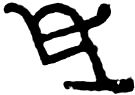 , the Chaldean and square Hebrew ח (cheth
or heth), bear marks of a common origin with the
Phœnician H, although their general appearance
has been brought into conformity with the
general appearance of the alphabets to which
they respectively belong.

 ) the mark of the aspirate, and the
other half of it (
 ) that of the lene. By degrees
these marks became
 and
 ; and hence,
in the cursive character ‛ and ’ marking the
vowels.” These last signs (‛ and ’), Professor
Geddes humorously styles, “the ghosts of a
vanished consonant.”
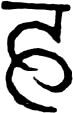 as being the
Sanskrit H, whereas some affirm it more properly
to represent gh.
 represent the
buzzed oo, and ❨ the rapid transition: