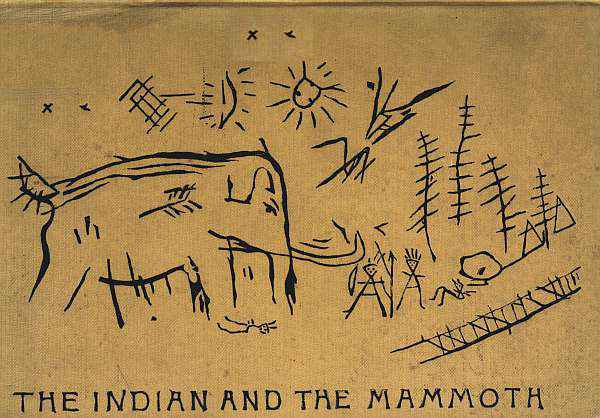
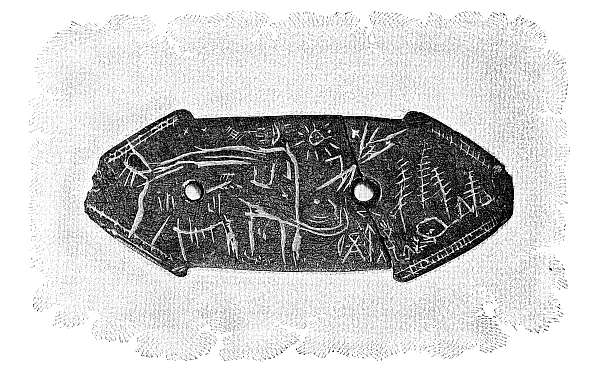
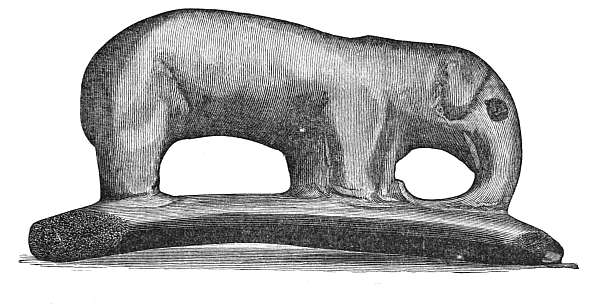
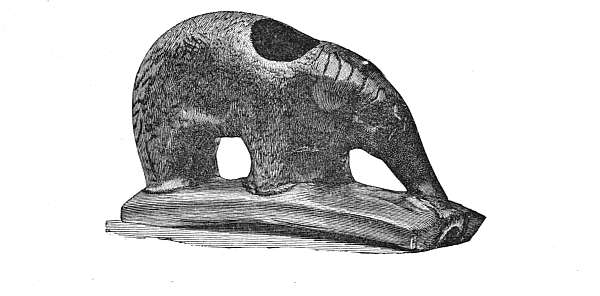
On the writer's second visit to Hansell, the
latter was at his father's farm. He stated that the photographs
shown him were representations of the stone, and said
that he considered that he had been cheated. He had
had no idea of the stone's value, and declared that it
was a "mean trick," the purchase of all his relics—the
stone included—for $2.50. When it was explained to
him that Mr. Paxon, the purchaser, had been as ignorant
as he in the matter at the time, he seemed satisfied.
On the third visit, February 10th, Hansell said:
I am sure that I found the large piece first, in
the spring of 1872 (the year after my father bought the place—1871),
and while "ploughing for oats" in the "corner" field, and
near the corner where the by-road joins the Durham road—the
roots of the last year's corn crop had shortly before been
harrowed out. It was in April. When I saw it, it was lying
on the top of the ground, a little to one side of the furrow. I
stopped and picked it up; it seemed like "something different"
from what I had ever found before. It was dirty—dirt
stuck to the stone; by rubbing, I could see lines—"queer
marks" over it. (When I afterward saw it at Mr. Paxon's, the
latter had "cleaned it.")
I am certain I saw an animal like an elephant on
it before Mr. Paxon saw the stone. I carried it around a day or two in
my pocket, and then put it in a box along with the other
things; and whatever arrow-heads and other relics I found, I
would put into the same box. The same day, I planted a corn-stalk
into the ground to mark the place—a shower might wash
out something else, I thought. I left the corn-stalk until the
oats harvest, and then threw a stone there, but I soon came to
know the place by heart. The box with the relics I kept
locked up in my trunk, and I took care to keep it locked,—there
were so many boys about. In the meantime, I was
married. I showed the relics and stone to my wife, but she
would not remember the elephant on the stone. I might
have showed it to father, or might not, I am not sure. He
would not remember. In the same field, I and others on the
place found arrow-heads, coins (English and American pennies),
and a part of a tomahawk or banner stone (sold to Mr.
Paxon). I did not find any thing else in that field, but "gorget
stones" without inscriptions, and round stone balls, with incisions
on sides, were found near by.
In the spring of 1881, Mr. Paxon asked me whether
I had any Indian relics. I said that I had. I told him I would be
at home on Sunday, and he came the next Sunday afternoon—about
May or June, as nearly as I can recollect,—1881. I
brought out the box of relics, and told him that I would sell
him the perfect arrow-heads for ten cents, and the broken ones
for five cents apiece. I had a broken tomahawk and a piece
of another, and I laid them and the stone aside, and said I
thought I would keep them. But he did not take much interest
in the rest, and said he wanted all the relics. He did not
look much at the arrow-heads, but he picked up the stone and
turned it around, and wet his thumb and rubbed it. He did
not say any thing about the stone. I did not much want to
sell him the stone, for I never saw any thing like it before.
But he said he would take all the relics or none for
$2.50. So I let him have them. At the same time he asked me whether
I had not the other piece; perhaps I had, he said, and did not
know it. I told him that I had not.
About a month after that time, he came by on foot
and asked me whether I had found any thing more? I said that I
had not. "If you do," he said, "keep it and give me the first chance."
I always had the other piece in my mind,
and when I went in the field I used to look for it. I would walk
around the spot in a circle, for I thought some one might
have picked it up and then thrown it away again.
After we had cut the corn in the field, and as I
went in to husk, I happened to pass near the place—I always remember
the place,—I was thinking of the other piece, and was hardly
in the field before I picked it up. I noticed the marks and the
shape, and saw at once that it was the missing piece. It had
notches around the edges. I put it in my pocket and laid it in
the drawer. My wife never saw it. It was the little piece. I
was married then and in my own house, and there was nobody
about the house, so I did not lock it up.
This was in the fall—after the exhibition
at Doylestown (October), in 1881. When I went down to Mr. Paxon's father's,
Squire Paxon's, to pay my tax, on the 9th of November, 1881,
I took this piece along. Young Mr. Paxon was not at home,
but I waited till he came back. I said I had something
"pretty nice" for him, and showed him the missing piece. He
thought when he saw it that I would make him pay pretty
dear for it, but I told him that I would give it to him. I had
not rubbed or cleaned it. He put the pieces together and
said "that is the missing piece." He took me up to his
room and gave me some minerals. I advised him to glue the
pieces together with "hickory cement." I had some of this
cement at home, and offered to give it to him.
The next spring I saw the stone again, all washed
and cleaned. It did not look altered—only clean and rubbed off.
I saw it again this February (1884), when you and Mr. Paxon
came to see me, and I saw no change in it.
I never sold a relic before I sold those to Harry
Paxon, and never knew any one from Philadelphia that took any interest
in Indian relics. I used to give things away to relatives of
mine, often boys—my cousins, when they came up from town.
They had never seen any thing like an arrow-head before. I
never gave a stone to any one but a relative. William Hansell,
my brother, a little boy, saw me pick up the small piece
of the Lenape Stone. I never heard of any one in this neighborhood
interested in Indian relics before Mr. Paxon.
The first things that I remember giving away were
a couple of black arrow-heads that I gave to James Aikens, in 1871.
He lives in Germantown. This was before I found the stone.
[Signed] BERNARD Z. HANSELL.
Sworn to before
Benjamin S. Rich, J. P., Nov. 6, 1884.
The writer questioned Hansell's wife.
She remembered his having shown her the relics before they were sold to
Mr. Paxon, but had paid no attention to "these little stones
he picks up," and did not remember whether "this stone
you are talking about" was among them or not. The
writer also questioned Hansell's father and mother.
Neither had seen the stone. The boy, William Hansell,
brother of Bernard, said that he had seen the little piece
when Bernard picked it up, but had never seen the large
piece of the stone. The piece he had seen was covered
with dirt and mud, and had "half a hole" in it. Bernard
had told him that he was going to give it to Mr. Paxon.
I remember Hansell telling me of his Indian relics
at my father's office. I went to see him on a Sunday, and he showed
me, in the wood-shed, a tobacco-box half full of relics, among
them the large piece of the Lenape Stone. At the time I never
realized what it was. It was covered with dirt, as were all the
relics. There must have been about two hundred arrow-heads,
broken and perfect, besides a broken axe and fragments of a
banner stone, and one or two large spears and so-called
"gigs." The stone struck me as an extraordinary Indian
relic. Buying the relics, I brought them home that Sunday
afternoon, and at once showed them to my father. He
saw the elephant. Whether I had noticed it before I cannot
remember. Mr. John S. Ash saw this first piece—the large
piece—before Capt. Bailey saw it. I showed it to any and
everybody that came to my father's office, but can only be sure
now of Mr. Ash. Capt. Bailey saw it and borrowed it while preparing
his article. I had it at the Bucks County Bi-Centennial
Exhibition, August 31, September 1 and 2, 1882. I did not
particularly value the stone until I read Capt. Bailey's article.
I cleaned out the soil which clung to the stone with a toothbrush,
and may also have used a stick—but I think not a nail.
[Signed]HENRY D. PAXON.
Sworn to before
Elias Eastburn, J. P., Nov. 8, 1884.
Young Hansell and his father were at my house on
business (I am Justice of the Peace). They had rented a house. I think
it was on a Saturday in '80 or '81, in the summer. The next
day my son went to Hansell's and brought back a large number
of Indian relics. He had invested two or three dollars in
them. In the lot was one of the pieces of the stone. I remember
saying that it was a pity he had not the other half. The lines
were not cleaned out. I recollect the elephant. He emptied
the relics on the floor of the piazza. It was early summer, and
warm weather—about May or June,—and I think on Sunday. I
am certain of having seen the elephant the first day he got the
stone. Bernard Hansell, I find in my book, paid his tax November
8, '81, but I am not positive in these dates to a day.
There is not, and never has been, to my knowledge, any strange
or suspicious person of an "archæological turn" in this neighborhood,
and there is no one here clever enough to have made the stone.
[Signed]ALBERT S. PAXON.
Affirmed before
James Gilkyson, J. P., Nov. 8, 1884.
NOVEMBER 8, 1884.
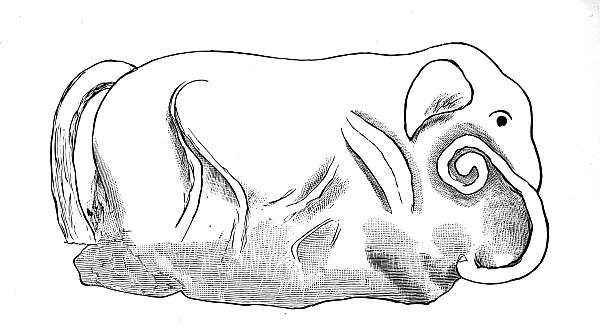
At the time of my first seeing the Lenape Stone,
I observed an elephant or mammoth carved upon the fragment. I cannot
now fix the date of my first seeing this piece. Probably it was
some three years since, though it may not be two and may be
four. I think it was before the Bucks County Bi-Centennial Exhibition.
[Signed]JOHN S. ASH.
Affirmed before
Elias Eastburn, J. P., Nov. 8, 1884.
I saw the stone first, I think, in November,
in the fall of 1881, and a few days after Mr. Paxon had obtained the
second piece. He had said to me that he had a curious stone which he
wished to show me. I remember his mentioning the figure of a
turtle, a snake, and an elephant carved on the stone, although
he did not first mention the elephant figure or show that he
appreciated the mammoth. It was not till he had read my
article in the county newspaper that he came to know the
value of the carving. He was only eighteen or nineteen then,
and I believe would have sold the stone for a comparatively
trifling sum. As soon as I took the stone home, after Mr.
Paxon had lent it to me, all my family saw it. Judge Paxon,
his uncle, did not realize its archæological importance, neither
did Mr. Paxon, the owner's father. I showed it to Judge
Paxon before I wrote the article. The first time Mr. Harry
Paxon showed me the stone I remember his saying that "he
could sell it for five dollars." He wanted me to glue or
cement the pieces together, but I discountenanced the plan.
I think he must have scraped out the original soil clinging to
it with a nail or some sharp instrument, and I told him that
he had cleaned the lines too much and that the stone
had lost the look of age. The next time I saw it he had
filled the lines with clay, and this I advised him to remove,
as it did not resemble the soil of the original field. So
the next time I saw it he had cleaned it again. I took the
stone to the January or April meeting of the Bucks County
Historical Society, 1882, and showed it to all the members present.
I showed it to Gen. Davis, who advised me in connection
with it to prepare an article on the Indian relics found
in Bucks County, to be read before the July meeting at Penn's
Manor. A few days after that I returned the stone to Mr.
Paxon. Somewhere in June or July (1882) I borrowed it
again, and kept it until two or three weeks after the meeting at
Pennsbury. This meeting was on the third Tuesday in July,
1882. Mr. Paxon did not go to the meeting, but after reading
my article in the paper he set a higher value on his relic and
wished me to return it. I do not recollect seeing either part
separately. The two pieces were together when I first saw it.
I think Hansell told me that the large part had been found
first. Very many people saw the stone at my lecture at Penn's
Manor. I had a large diagram of the inscription, several feet
long. Two hundred people must have seen it. There was
an article in the Bucks County Intelligencer about it, and it
was at the Bi-Centennial and there seen by everybody.
[Signed]JOHN S. BAILEY.
Affirmed before
Elias Eastburn, J. P., Nov. 8, 1884.
Letter from Dr. D. G. Brinton, Professor of Archæology
and Ethnology in the Academy of Natural Sciences, Philadelphia.
To the Editor of the Bucks County "Intelligencer":
The discussion in your paper about the
so-called "Lenape Stone," in which my name has incidentally been
introduced, leads me to address you a few lines on some archæological
points, especially on the methods of distinguishing genuine
from fabricated specimens. I shall only refer to the Lenape
Stone by way of illustration. It was first shown to me by
Professor Lewis, and after a careful inspection I pronounced
it a modern piece of work, which opinion has been substantiated
by later observers. My opinion was based, first, on the
design, and secondly, on the execution. It may be laid down
as a rule, holding good in all aboriginal designs of the Eastern
United States, that no lines indicating either shading or
rounding are found on figures of pure native origin. Every
line was significant, and nothing was done for affect. Grouping
was also unknown, and any such triple arrangement as the
brute, the human, and the divine groups, standing in immediate
relation to each other and forming parts of a picture, as
appears on the Lenape Stone, was as far above aboriginal
æsthetic conceptions as the Sistine Madonna would be above
the execution of a sign-painter. Certain artistic details, as the
lightnings shooting in various directions from a central point
(as from the hand of Jove), were also unknown to the art
notions of the red race. The treatment of the sun as a face,
with rays shooting from it, I also consider foreign to the
pictography of the Delaware Indians, nor have I yet seen any
specimens proved to be of their manufacture that present it.
It is found, indeed, in Chippeway pictography, but there only
in late examples.
The execution of such imitations also usually
betrays their origin. The lines on the Lenape Stone are obviously cut with
a metal instrument, making clean incisions, deepest in the
centre and tapering to points—quite different from the scratch
of a flint point. Shrewder fabricators than the unknown
author of this one make use of flint points. Some of the
Western "tablets" have been so inscribed. They may thus
conceal their tools, but there are other resources for the
archæologist. The surface of all stones undergoes a certain
chemical change on exposure to the air, which is called by the
French term patine. In many varieties, as flints, jasper, and
hard shales, this affords a decisive means of discriminating a
modern from an ancient inscription or arrow-head. It requires
the use of the microscope and some practice, but with these
most of such impostures can be detected. This does not
exhaust the resources at the command of the antiquary to circumvent
those who would practise on his love for relics of the
past. But I have said enough to show that opinions on relics
need neither be vague nor prejudiced. It is most desirable
that the citizens of our Commonwealth should take an earnest
interest in the collection of our aboriginal remains, and it is
gratifying to learn that Bucks County is not behindhand in
this direction.
Respectfully yours,
[Signed]D. G. BRINTON, M.D.
From the Bucks County Intelligencer
of Sept. 6, 1884.
Letter from Mr. H. Carvill Lewis, Professor of Mineralogy,
Academy of Natural Sciences, Philadelphia.
Philadelphia, Feb. 19, 1884.
Capt. J. S. Bailey:
Dear Sir:—Upon careful examination
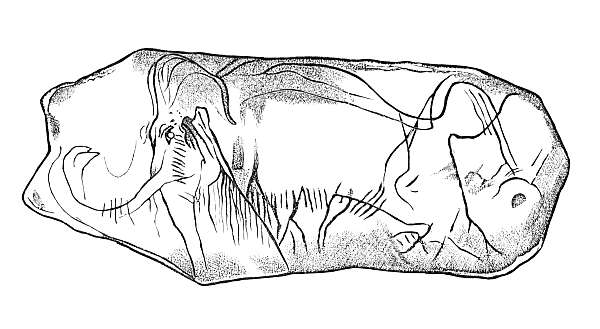
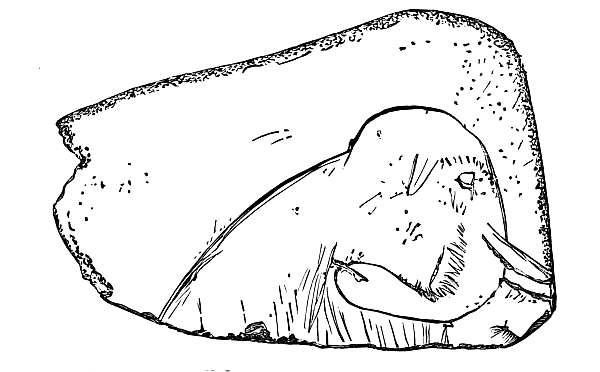
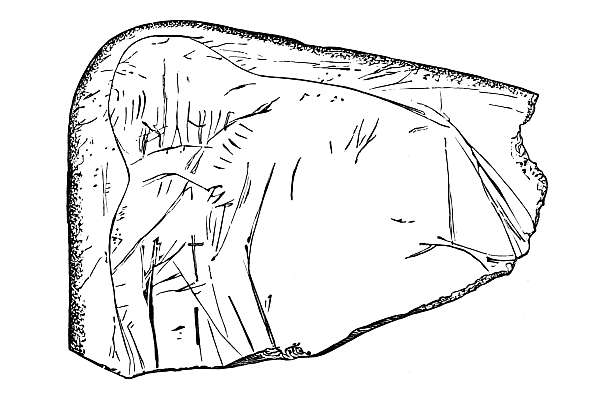
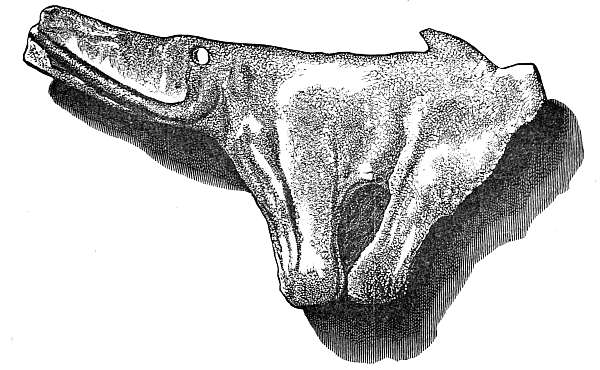
I am convinced that the mammoth on the Indian tablet is a forgery, being
copied directly from the drawing of a mammoth on a piece of ivory
found in the cave of La Madeleine, Perigord, France. The
tablet is genuine, but the drawing upon it is recent.
Who do you think perpetrated this fraud?
Yours, very truly,
[Signed]
H. CARVILL LEWIS.
Letter from Dr. F. W. Putnam, Curator of the Peabody
Museum of Archæology, Cambridge, Mass.
Cambridge, March 17, 1884.
Dear Mr. Mercer:
In answer to your request, I put on paper a few
thoughts in relation to the carved gorget of slate said to have been
found in Bucks Co., Penna. It is needless to say that I have examined
the stone with great care; for if it is a work of prehistoric
times in America, it is a specimen of very great archæological
interest. The first impression I received was that it
was probably a fraud. This was of course natural, after having
seen several gorgets with figures carved upon them which
were unquestionable frauds. I therefore first of all examined
the stone, and was sorry to find that it had been so much
cleaned, and rubbed, and scrubbed, and probably oiled, that
no evidence could be derived from the character of the lines
cut upon the surface of the stone, or from the stone itself, bearing
upon its antiquity. So far as the testimony of the stone itself
is concerned, the lines may have been cut within a few weeks
or many years ago. Throwing out of consideration all the
facts you have given me in relation to the history of the stone
as known to you, I am left with the character of the carvings
alone upon which to draw conclusions. From a study of these
I get the following results:
1st. The person who carved the stone must
have been familiar with the appearance of an elephant or mammoth,
either from having seen one or the other in life or represented
in pictures. There is too much expression given to the details
of outline of forehead, curve of back and belly, and position of
the legs, representing the animal as walking, to be the work of
one who only knew the animal from a general description
handed down by tradition.
2d. Most of the other figures on both sides of the
stone are of a character common to Indian picture-writing, but there are
a few which, like the "mammoth," show an appreciation of
details or ideas unlike any I can recall in Indian picture-writings.
Take, for example, the fish on the edge of the small
piece, and the long eel-like figure by the side of the bird—each
of these have a few hair-lines drawn from the back as if
to represent the rays of fins, in order to impress the character
of a fish, although the rays are out of natural position. The
figure of a man on his back under the foot of the "mammoth"
is not drawn in the usual conventional manner, like the figure
of the man with the bow.
3d. The idea of the heavens, conveyed by the figures
of stars, moon, and sun, is probably not an unusual way of representing
the sky or the heavens, but the mass of crossed lines
near the sun, which are supposed to represent lightning, seems
to me to be more the conventional symbol of the white man
than the Indian.
Considering all these points I draw these conclusions:
1st. The carvings were made in ancient times by an
Indian of superior artistic skill, who had seen a living mammoth, and
who wished to preserve some myth or tradition relating to the
animal, in picture-writing upon his gorget; or,
2d. The carvings were made by an Indian in comparatively
recent times, with the same idea of preserving a myth about
the "great beast," and he was aided in his work by some
white man; or,
3d. That the carving is the work of some white man
in very recent times, who may or may not have known of the myth
and tradition of the Indians relating to the "mammoth."
An attempt to read the stone as a pictograph illustrating
the myth of the "great beast" may be going too far, but if it can
be shown to be a piece of Indian work beyond reasonable
doubt, the interpretation of the figures in that connection is
certainly legitimate from the remarkable coincidence between
them and the myth.
I certainly hope you will bring every possible evidence
to bear in your work, and that by a study of many pictographs
you will be able to test the doubtful figures on the stone.
Yours, very truly,
[Signed]
F. W. PUTNAM,
Curator Peabody Museum.
Extracts from a report of an examination of the Lenape
Stone by Dr. M. E. Wadsworth, of Cambridge, Massachusetts.
The answers are Dr. Wadsworth's.
Q. Are the carvings made by steel or flint instruments?
A. The depth and regularity of the carvings indicate that
they were made by some dulled steel tool like an awl.
Q. Are the carvings later than the fracture of the ends and
the middle?
A. Later—for the tool-mark can be seen at
one end striking across the broken surface, and lines crossing the middle
fracture do not match on both sides. On one side they pass
down on the rounded and worn surface of the fracture, below
their position on the other side. This is seen in all the marks
(three only) crossing the line of fracture. One other line sinks
down on one side, and ends against the fractured portion
opposite. This appears to have been made after the fracture
by holding the pieces together. It is very remarkable that the
line of fracture should cross the specimen at the only place it
could and intersect the minimum number of the lines of carving.
Even in two of those cuts, the fracture breaks across the
point where they cross one another. * * *
[Signed]
M. E. WADSWORTH.
Cambridge, Massachusetts,
March 17, 1884.
Extracts from a report of an examination of the
Lenape Stone by Mr. J. P. Iddings, of the U. S. Coast Survey.
The answers are Mr. Iddings'.
Q. Can it be decided beyond reasonable doubt whether
the carvings were made with a steel or flint instrument—is there a
great probability either way?
A. I do not know.
Q. Are the carvings beyond a reasonable doubt
later than the fracture in the middle—(or other fractures)?
A. They appear to be later than the middle
fracture; they do not lie at the same depth on the edges of both pieces.
The small arrow's shaft does not appear to have been a continuous
line. It is interesting to note that the middle fracture only
crosses three lines on one side and none on the other side, and
that in no other position could one happen without cutting
half a dozen or more. The carvings appear to have been
arranged with reference to the break.
[Signed]
JOSEPH P. IDDINGS.
New York, March 24, 1884.
Letter from Dr. F. W. Putnam referring to the
two carved stones (figs. 19 and 20) found on the Hansell Farm
in the summer of 1884.
Cambridge, Mass., Oct. 30, 1884.
Dear Mr. Mercer:
I have examined the two specimens you have
placed in my hands from the Hansell Farm, Bucks Co., Penn., and see no
reason to doubt their authenticity. The lines cut upon them
seem to have been made a long time since, as exhibited by the
weatherings within the incisions. One stone seems first to have
been designed for a perforated ornament, but not completed,
and was afterwards used as a rubbing implement, as shown by
the notches on the edge. The other stone is of a natural form,
in which two holes have been drilled, and on one surface a
number of waves and zig-zag lines were cut, evidently for the
purpose of using the stone for an ornament.
Yours very truly,
[Signed]
F. W. PUTNAM.
The reader is referred to a series of articles mentioning
the Lenape Stone in the Bucks County Intelligencer of
August 9, 23, and 30, and September 20, 1884, and
headed, "Who Perpetrated the Forgery?" also to a personal
discussion which took place in the columns of that
newspaper between the owner of the Stone and Mr. H. C.
Lewis, of the Academy of Natural Sciences, Philadelphia,
in which arise various questions of veracity as to the facts
of an interview which had taken place between them—i. e.,
whether Mr. Lewis had or had not wished to buy the
Stone, and how long he had been allowed the loan of it;
whether he had or had not been permitted to take photographs;
and whether he or Mr. Paxon had scratched the
surface of the Stone "to see its inside structure."
After a fair consideration of every fact bearing
upon the case, and with ample knowledge to judge of the
particulars of this interview at the time it took place,
personal considerations prevent the writer from discussing
the merits of this controversy, purely personal in its nature
and irrelevant to the question before us.
The first evidence to be certain of in a case
of this kind is doubtless that deducible from the circumstances
attending the discovery itself, and upon it, in the present
instance, for the reason that the Stone has been cleaned,
and all vestiges of the soil which originally clung to it
unfortunately removed, we must chiefly depend.
The fact that several persons saw the first fragment
immediately after it left Hansell's hands, throws back the
period of possible doubt as to its authenticity to the nine
years of his ownership, while the remarkable skill and
archæological knowledge necessary to forge such a stone
place him as the possible maker of the carvings above the
slightest suspicion. The motive of gain must be eliminated
from the possibilities of the case, when we consider
the trifling sum received by Hansell for the relics, and
the fact that the small piece was presented by him to the
present owner, while the supposition that he could have
been in collusion with any person unknown for the purpose
of a practical joke is rendered impossible by his
own honest simplicity and the conduct of his family and
friends throughout. Again, no one clever enough to
have made the relic could have been a neighbor of
Hansell's and remained unknown or unsuspected, and it
is quite absurd to suppose that some one from a distance,
having entrusted the fortunes of so elaborate a practical
joke to the fragments of this small stone, would have
"planted" the results of his labor in Buckingham Township,
Bucks County, where the chances were very strongly
against its being brought to the notice of archæologists,
even if discovered.
From the a-posteriori point of view—i. e.,
from the character and appearance of the carving, there
are objections which have been considered important to the
Stone's authenticity; these the writer has carefully noted,
and will allow them to speak for themselves.
First, in the opinion of Messrs. M. E. Wadsworth,
of Cambridge, and Joseph P. Iddings, of the United States
Coast Survey, the carvings were made after the Stone was
broken. The fact is proved, they say, by the appearance
of certain lines crossing the fracture, as in the case of the
lightning above the hole on the right, which, when exposed
to the microscope, seem as they cross to descend into it.
Secondly, the fracture, they say, crosses the minimum
number of carvings as if they had been arranged with
reference to it.
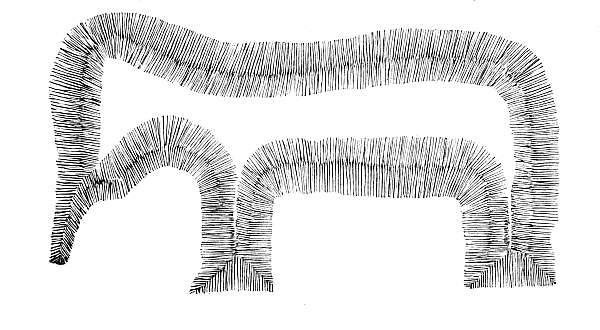
Thirdly, the mammoth on the Stone resembles the
La Madeleine carving.
As to the first point—the carving being later
than the fracture,—Dr. F. W. Putnam (of the Peabody Museum,
Cambridge, Mass.) observes, on the other hand: "It is
possible that an Indian might have made his carving on a
broken gorget, and there is no reason why he should have
discontinued his work if the gorget were broken during
the carving, a likely thing to happen,"—nor, we may add,
need it be difficult to suppose that the Indian would have
glued the pieces together or cleaned out the grooves
crossing the fracture. In such a case the instrument
would naturally have broken somewhat into the fracture—"sinking
down," as Dr. Wadsworth says, "and ending
against the fractured portion opposite," while the subsequent
weathering and brushing might account for the
slight difference in level of the lines on either side of the
break. Again, supposing the mammoth carving to have
been made before the fracture, the carvings on the reverse
of the Stone, and the apparently meaningless scratch
below the perforation, which, as it were, skips the fracture,
may have been made long after it. As Dr. Putnam says:
"The fact that a very large number of perforated stones
are broken when found is worthy of consideration, and
also that in most cases the fracture is through one of the
holes." As regards the resemblance of the mammoth on
the Stone to the La Madeleine carving, a point which after
a careful examination of all the facts struck Professor
Shaler, of Harvard, as suspicious, there is certainly in the
outline of the tail and the indicisive drawing of the back
a great similarity in the treatment of the two figures;
while, on the other hand, as Dr. Charles Rau, of the
Smithsonian Institute, supposes, the resemblance may
perhaps be ascribed to accident, the drawing of the head,
ear, trunk, and hair being, as he suggests, totally dissimilar.
The seeming repetition of the outline of the back in the
two figures may perhaps be looked upon as a suggestion
of the mane-like ridge of hair, which, as seen in some
of the reconstructions, extended along the back of the
animal from the neck to the tail; and it may be observed
that any two profile drawings of the same animal, as realistic
as the above, would naturally possess striking points
of resemblance. Dr. D. G. Brinton, of the Academy of
Natural Sciences, Philadelphia, objects, in a letter above
quoted to the Bucks County Intelligencer, that "no lines
indicating shading or rounding are found in the aboriginal
designs of pure native origin in the Eastern United
States," that in these designs grouping was unknown, and
that "any such triple arrangement as the brute, the human,
and the divine groups standing in immediate relation to
each other and forming parts of a picture, was far above
aboriginal æsthetic conceptions," that "lightnings shooting
from a central point (as from the hand of Jove) were
unknown to the art-notions of the red race," and that
"the treatment of the sun as a face with rays shooting
from it, I also consider foreign to the pictography of the
Delaware Indians; nor have I yet seen any specimens
proved to be of their manufacture that present it. It is
found, indeed, in Chippeway pictography, but there only
in late examples."
To this we can only say that nothing is more
common than "grouping" in the pictography of our modern
Western Indians, while the more ancient pictographs of
the pre-Columbian Indian, a study of which would be
necessary in forming definite opinions, as to their character,
have been almost entirely lost to us.
These were probably very rarely carved upon
stone or made upon any thing but the most perishable materials,
and few have survived the bigotry or indifference of the
early settlers and explorers. Their character is, we think,
not fully represented by the meagre data furnished us
from the allusions of the early writers, the Chippeway
bark records, the "wallum olum," or the rock inscriptions
now within the student's reach, and from which we are left
to draw our conclusions as to the evolution of "grouping"
or "shading," or the ability of the Indian to treat
the sun, moon, and stars, or lightning.
There could have been no great mental chasm,
we think, between the æsthetic conceptions of the modern Sioux
or Comanche, who pictures a buffalo hunt on his robe,
and those of his pre-Columbian red brother, who, as Loskiel
says, painted his "bedeutende figuren" on the trees
of a Pennsylvania forest.
Domenich says, in the "History of North America," p. 426:
"We have seen painted upon bark the
representation of a Chippeway emigration, passing through rivers,
forests, and mountains, on their way from the borders of
a lake to a more civilized country; above the river were
creeks and trees, symbols of forests, and tumuli indicating
mountains; finally, on top of the picture a dozen animals,
totems of the Chippeway chiefs, each with a heart in his breast."
The same author says, again: "One seldom sees
a garment on which there is not a drawing in black, yellow,
red, white, or blue, representing guns, lances, heads of
hair, arrows, shields, the sun, moon, men, horses, roads,
etc., and sometimes mythological objects."
Possessed as we elsewhere find of a considerable
power of delineation of which our present extremely insufficient
vestiges can give us no adequate idea, and having already
conceived the idea of a "brute, human, and divine group"
in his numerous traditions of a great monster, the enemy
of man, destroyed by divine wrath and lightnings, we can
by no means think that the ancient Delaware would have
found it more difficult than the Chippeway mentioned
above, to express his conception in a rude picture involving
such a triple grouping.
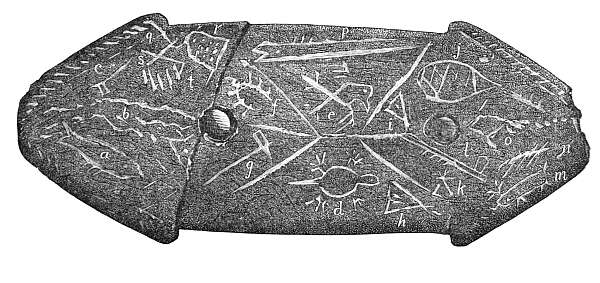
As to the "treatment of the sun," we find faces
with rays, or divergent curves, in Schoolcraft, vol. i., p. 362,
figs. 16 and 17, and p. 409, fig. 9; vol. iii., p. 493,—a circle
with rays in the rock inscription (Delaware perhaps) on
the Susquehanna near the Maryland line, a face without
rays in the rock inscription (also Delaware, possibly) at Safe
Harbor on the Susquehanna, and a face with rays, the
counterpart of the carving in question, on a small broken
tablet found near Akron, Ohio, in the collection of the
late Mr. Dupont, of Philadelphia, who had no doubt of
its authenticity.
The marks in the picture evidently representing
forked lightning, and directed as in the language of the tradition
at the forehead of the beast, are without parallel among
the Indian pictographs within the writer's reach. The
symbolic snake, or barbed zig-zag of the Moquis—the
only Indian lightning that the writer has been able to find—differs
greatly from this, yet there seems no good reason
why the Indian should not have sometimes represented
lightning as he saw it.
As to the steel-cut appearance of the lines,
Dr. Brinton says: "The lines on the Lenape Stone are obviously
cut with a steel instrument, making clean incisions, deepest in
the centre and tapering to points, quite different from the
scratch of a flint point"; and Dr. M. E. Wadsworth thinks
that "the depth and regularity of the carvings indicate
that they were made with some dulled steel tool like an
awl." On the other hand Mr. J. E. Iddings does not
know whether it is possible thus to distinguish the work
of steel and flint instruments, and a series of experiments
with the microscope and steel and flint points has induced
the writer to believe that lines cut on a similar stone by
"a dulled steel instrument" and a flint arrow-point cannot
be distinguished after both have been washed and scrubbed.
The appearance of such lines would of course
depend much upon the sharpness of the flint or steel point, the
kind of stone used, and whether the lines were cut by one
or by a series of strokes. The single scratch of a scissors
point on a shale tablet of similar hardness makes an incision
in shape like the letter V; that of either an awl or
flint arrow-head one like the letter U; while any line
made by either instrument and consisting of a series of
strokes will have its bottom furrowed by parallel grooves,
as in the case of the large lines on the Lenape Stone.
The fresh flint-cut grooves, however, when
separately examined with the microscope, exhibit many faint
scratches running along the furrow, not so conspicuous in
the steel incisions, yet a few applications of soap, water,
and a scrubbing-brush efface these scratches in both cases,
and render the surface of the grooves indistinguishably
alike and in appearance similar to the now polished
incisions upon the Lenape Stone. In other respects the
scratch of the arrow-head can be made of equal depth,
clearness, and regularity, the flint point, if held carefully,
not appearing to tear the edges of the incision more than
the awl. Moreover, we can cause the flint-cut line to
"taper to a point" or not, as we choose.
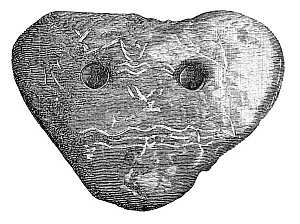
Fig. 19.—Carved "Gorget" from the Hansell Farm.
Strongly in support of the authenticity of the
Lenape Stone and its honest discovery, are the two carved stones,
figs. 19 and 20, recently discovered on the Hansell Farm,
while the present paper was preparing, and proving that,
however rare in other localities, small stones
were not infrequently carved in this neighborhood.
Dr. Putnam "sees no reason to doubt their authenticity,"
and Professor Shaler, of Harvard College, to whom the writer has
shown fig. 19, says: "If, upon comparing the incised lines with
those on the Lenape Stone, it appears that they have the
same character—i. e., the same shape of
furrow,—then you will undoubtedly add a good deal to the weight
of evidence in favor of the antiquity of the other ornament."
Considering, however, the variety of lines which
may be cut with a flint instrument, we would hesitate to assign
great importance to this comparison. An examination
with the microscope proves that the lines on the gorget,
fig. 19, are not so neatly and deeply cut as those on the
Lenape Stone, and that the bottoms of the grooves are
more rounded. While most of the lines on the banner stone,
fig. 20, "tapering into points," seem as deeply and clearly
cut as those of the mammoth outline, the microscope
shows few, if any, scratches on the surface of the grooves,
which bear all the traces of long exposure to the weather.
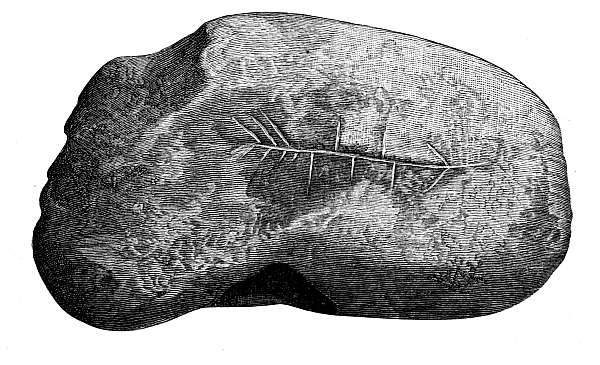
Fig. 20.—Carved Banner Stone from the Hansell Farm.
The writer has made several efforts to obtain
opinions upon the Lenape Stone from modern Indians, particularly
Delawares, in the West and in Canada. Mr. Horatio
Hale, of Toronto, who kindly showed photographs of the
carvings to several Indians in Canada, among whom were
some very intelligent Delawares, says that "they thought
that the Stone showed Indian workmanship, and would
have been inclined to consider it authentic but for the
mammoth, which perplexed them. They had never heard
of such a creature, and, fearing a hoax, were shy of saying
much about the symbols on the reverse side of the Stone;
the pipes would naturally, they said, indicate a treaty;
the snow-shoe, that some of the tribes concerned came
from the North; and the tortoise, hawk, deer, etc., would
be the marks or totems of the different tribes; with regard
to the doubtful figures, they could give no explanation."
Of course, the value of these opinions would
in each case depend upon the tribe to which the Indian belonged,
and how far his former knowledge of a pictographic art or
the traditions of his race may have been lost by many
years of contact with the whites.
The strong resemblance of the pipe figure (l)
to the modern Sioux calumets, made of catlinite or red pipe-stone
from the famous quarry in Southwestern Minnesota,
has been spoken of as another objection to the authenticity
of the Stone. The form does not occur, as far as
the writer can learn, in any of the ancient rock-writings of
the eastern Algonkins, and no pipes of exactly the Sioux
shape, which Mr. E. A. Barber, of Philadelphia, considers
the most modern of Indian pipe-forms, have as yet been
discovered in the ancient Delaware era, nor even in the mounds.
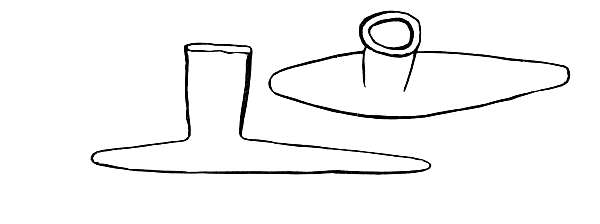
Fig. 21.
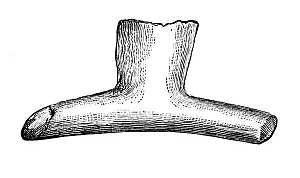
Fig. 22.
On the other hand, the profile of the Sioux form
itself could not more closely correspond with the minute outline,
which is too small, perhaps, to be taken very strictly,
than does the profile of fig. 21—a pipe now in the
Archæological Museum, at Salem, Mass., and found by
Dr. Putnam, in an ancient Indian grave near Beverly, Mass.
The other pipe figure on the stone might
easily have been suggested by the form from the
mounds, with a slightly curved base (fig. 22), now in
the Peabody Museum at Cambridge, Mass., and discovered
in a mound in Ohio.
Schoolcraft, who has been more explicit than other
writers respecting the picture-writings of the North American
Indians, speaks of two distinct pictographic systems
among the Algonkin tribes, called by them respectively
Kekeewin and Kekeenowin. The first appeared to be their
method of recording facts of every-day occurrence, and
embraced the heraldic devices used upon the grave posts—the
communications written upon birch bark, and the
caution marks, itinerary, hunting, and war records inscribed
upon the trunks of blazed trees by travelling
bands, to communicate intelligence to their comrades in
the forest. These writings, the signs of which were carefully
taught to the young, like the language of signs common
at present to a majority of the Western tribes, could
be understood by any Indian. Loskiel, the Moravian
missionary, who makes frequent mention of picture
records, states that "it gave the Indians great pleasure if
one halted on coming to such a tree, and listened to their
description of the great chief and his exploits thereon inscribed."
The Kekeenowin, on the other hand,—the pictographic
system of the prophets, jugglers, and medicine-men,—was
far less generally understood by the Indians themselves.
It was the method used in the historical records, sung before
the tribe at religious feasts and dances, and was likewise
invariably employed in the incantations of the priests,
prophets, and medicine-men, of which Schoolcraft gives
seven kinds relating to medicine, necromancy, revelry,
hunting, prophecy, war, and love.
The chief characteristic of the Kekeenowin is
the fact that in it each symbol recalled to the mind of the reader
learned in the art a song, previously committed to memory
by him in connection with the symbol, and the general
idea of which was more or less arbitrarily connected
with it. "The words of the song," says James, in his
appendix to Tanner's narrative, "were not variable, but
must be learned by heart, otherwise though from an inspection
of the figure the idea might be comprehended,
no one would know what to sing." The main object, however,
was the preservation of the songs, which the priests,
on consulting their birch-bark scrolls or painted wooden
tablets, were thus enabled to sing at the great feasts,
giving the many verses in their proper order. The connection
between the symbol and the idea expressed by
the song was often beyond the power of divination to the
uninitiated, and the key to these sacred incantations, a
knowledge of the songs, once lost, could never be recovered,
as it was doubtless far from the intention of the
priests that the uninitiated Indian should divine their
mysteries from an inspection of the symbols. It was only
upon the payment of many beaver skins, says Tanner in
his narrative, that he was permitted to learn the mystic
signification of the twenty-seven symbols of the Chippeway
song for medicine hunting, which it took him more than a
year to learn.
The historical records, however, were sometimes,
it appears, written in Kekeewin and sometimes in Kekeenowin;
some were related in songs, others were not.
Those inscribed upon painted wooden tablets, or the bark
scrolls, and pieces of slate alluded to by George Copway,
were doubtless generally sung at stated occasions before
the tribe, while the Muzzinabicks or rock-writings upon
the face of cliffs and boulders, as at "Bald Friars" and
"Miles Island" on the Susquehanna or West River, and
Bellows Falls, Vermont, at the Cunningham Islands, Lake
Erie, or upon the famous Dighton Rock at Fall River,
Mass., although including many of the characters seen in
the song records were probably not expressed in songs.
Another version of the big-buffalo tradition
is found in Rembrandt Peale's pamphlet on the mammoth, published
in Philadelphia in 1803. Notwithstanding the highly
colored style of the translation the ideas expressed seem
to be those of the Indian. It reads as follows: "Ten thousand
moons ago, when naught but gloomy forests covered
this land of the sleeping sun, and long before the pale
men, with thunder and fire at their command, rushed on
the wings of the wind to ruin this garden of nature, when
naught but the untamed wanderers of the woods, and men
as unrestrained as they, were lords of the soil, a race of
animals existed, huge as the frowning precipice, cruel as
the bloody panther, swift as the descending eagle, and
terrible as the angel of night. The pines crashed beneath
their feet, and the lake shrunk when they slaked their thirst;
the forceful javelin in vain was hurled, and the barbed arrow
fell harmless by their side. Forests were laid waste
at a meal, the groans of expiring animals were everywhere
heard, and whole villages, inhabited by men, were destroyed
in a moment. The cry of universal distress extended
even to the region of peace in the west, and the
Good Spirit interposed to save the unhappy. The forked
lightning gleamed aloud, and loudest thunder rocked the
globe. The bolts of heaven were hurled upon the cruel
destroyers alone, and the mountains echoed with the bellowings
of death. All were killed except one male, the
fiercest of the race, and him even the artillery of the
skies assailed in vain. He ascended the bluest summit
which shades the source of the Monongahela, and roaring,
aloud, bid defiance to every vengeance. The red lightning
scorched the lofty firs, and rived the knotty oaks,
but only glanced upon the enraged monster. At length,
maddened with fury, he leaped over the waves of the
west at a bound, and at this moment reigns the uncontrolled
monarch of the wilderness, even in despite of omnipotence itself."
If the account of Cusic and the Lenape traditions
concur in solving the mystery of the mound-builders, and
proving their identity with the Allegewi of the Lenape
tradition, the evidence is strengthened by the concurrent
testimony of language, which, as Mr. Hale and others
have shown, renders it probable that the conquered race,
fleeing down the Mississippi, were received and adopted
by the Choctaws and Cherokees, who thus became in part
their descendants. Both the language of the Cherokees
lying to the southeast of the mound-builders' dominions,
and who claim to have built the Grave Creek mound, and
that of the Choctaws lying to the southwest, have in their
vocabularies been largely recruited from a similar foreign
linguistic element. One remnant of the Allegewi mingling
with their conquerors, the Talamatan or Hurons, became
in part the ancestors of the Cherokees. Living to the
southeast of the mound-builders' dominions, the Cherokees
had their council lodge on the summit of a vast
mound, the construction of which they ascribed to a
people who had preceded them. In grammar their
language resembled the Huron-Iroquois, while in vocabulary
it has been largely recruited from some foreign source.
The other remnant of the vanquished Allegewi,
fleeing down the Mississippi "to the southward," would have
been received and protected by the warlike Choctaws,
themselves a mound-building people in comparatively recent
times, and the peculiar foreign element in whose
language, which differs considerably from that of the
sister Creek and Chicasaw nations, would thus be explained.
JANUARY 8, 1885.
While the foregoing pages were in course of
publication, the carved "gorget" (fig. 23) was found on the
Hansell farm, on Thursday, January 8, 1885.
The circumstances of the discovery were as follows:
Late in the autumn of last year—1884—the writer had
caused an excavation to be made at a spot in one of the
fields on the Hansell property, where the carved stone
(fig. 19) had been found. At this place the soil of the
field, a yellowish clay, was very noticeably discolored as if
by the fires and decayed refuse of aboriginal dwellings; the
discolored spot was of a dark brown color, and covered an
area of about twenty square yards.
The excavation measured about 25 feet in length
by 4½ feet in width, and about 3 feet in depth. The dark
brown stratum had a depth of 1½ to 2 feet, and beneath
it appeared the yellow clay of the surrounding field. The
place was at a distance of about a quarter of a mile from
the spot where the Lenape Stone had been found. In
digging the trench many small stones were thrown up, but
no human remains or implements were discovered. The
earth was not thrown through a sieve. As the excavation
was to have been continued in the spring, the trench and
pile of earth were left undisturbed.
Bernard Hansell, the discoverer of the Lenape
Stone, states that he found the carved gorget (fig. 23) in this
heap of earth on Thursday the 8th of last month; his
brother had previously found there several flint chips, and
Hansell had gone to the spot, on the day in question, expressly
to look for "Indian relics."
The day was warm and the trench full of water.
The field was very muddy. Hansell found the stone, the
perforation in which had attracted his attention, protruding
a little from the mud on the outside of the heap, and
in the yellow earth last thrown out. Without displacing it,
he returned to the house, and brought his brother, William
Hansell, to the spot, that the latter might witness his
discovery. Then removing the stone from the mud, he
washed it in the water of the trench, not rubbing it, but
holding it in the water for about five minutes. The mud
clinging to it, having melted and frozen several times
within a few days, was very soft and dissolved easily. On
the same day Hansell informed the writer of his discovery
in a letter.
The stone is a soft, red shale, similar in
appearance to the Lenape Stone. Unlike the specimens (figs. 19
and 20) found on the surface of the ground, its surface presents
a very polished and rubbed appearance, as if it had been
subjected to long wear after the carvings had been made.
The lines, the edges of which are much worn and rubbed,
do not seem sharply and deeply cut, as those of fig. 20
or the Lenape Stone, and the bottoms of the grooves, to
which the soil still clings, appear rounded, as if cut with a
dull point—as in the case of the shallow incisions upon fig. 19.
The discovery of this stone in the clayey soil,
beneath the black stratum above mentioned, and where it had lain
for an indefinite period beyond the reach of the ploughshare,
would account for its polished appearance and the
absence of weathering upon its surface—the conditions of
its discovery generally corresponding with those in the
case of highly polished implements found in the mounds.
Fig. 23.—(Natural size) Carved "Gorget"
Found on the Hansell Farm, January 8, 1885.
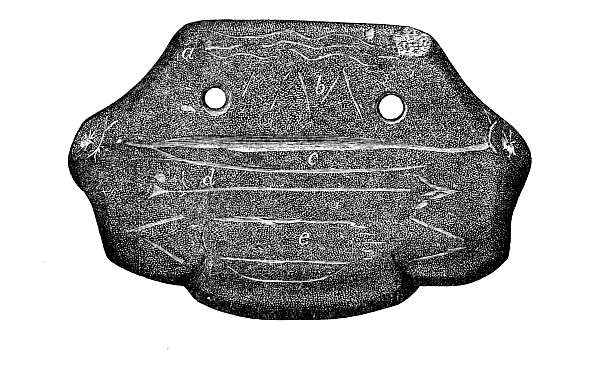
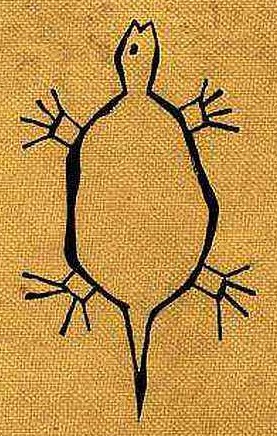
The design consists of: (a) three waving lines
representative of water; (b) three points between the perforations,
referring probably to wigwams—possibly an allusion to
the triple clanship of the Lenapes and their settlement by
the Lenape whittuck or Delaware River; (c) a bow;
(d) an arrow; and (e) a quiver.
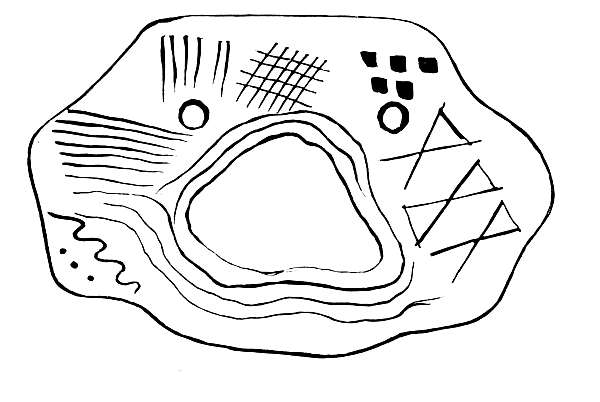
The design on the reverse side, of which we here give
a rough outline (fig. 24) consists mainly of a series of circular
waving lines, representative probably of water; numerical
dots and "tallies"; and three triangular outlines, common
Indian symbols for the human figure, and again suggestive
perhaps of the Wolf, Turtle, and Turkey brotherhood of the Lenapes.
Fig. 24.—Reverse of fig. 23.