AUTHOR OF
'MESOPOTAMIAN VERSES,' 'ENNERDALE BRIDGE'
'WALTHAM THICKETS,' ETC.
LONDON
THE EPWORTH PRESS
J. ALFRED SHARP
First Edition, December, 1919
To my brother, Frank D. Thompson, Second-Lieutenant Civil
Service Rifles, attached King's Royal Rifles; killed in action, near
Ypres, Jan. 13, 1917.
Our soldier youth thrice-loved, whose laughing face
In battle's front can danger meet with eyes
No fear could e'er surprise;
Nor stain of self in their gay love leave trace,
His nature like his name,
Frank, and his eager spirit pure as flame.
Waltham Thickets.
The Mesopotamian War was a side-show, so distant from Europe that even
the tragedy of Kut and the slaughter which failed to save our troops
and prestige were felt chiefly in retrospect, when the majority of the
men who suffered so vainly had gone into the silence of death or of
captivity. When Maude's offensive carried our arms again into Kut, and
beyond, to Baghdad, interest revived; but of the hard fighting which
followed, which made Baghdad secure, nothing has been made known, or
next to nothing. The men in Mesopotamia did not feel that this was
unnatural. We felt, none more so, that it was the European War which
mattered; indeed, our lot often seemed the harder by reason of its
little apparent importance. Yet, after all, Baghdad was the first
substantial victory which no subsequent reverse swept away; and it
came when the need of victory, for very prestige's sake, was very
great.
Mr. Candler has written, bitterly enough, of the way the Censorship
impeded him in his work as official 'Eye-witness.' His was a thankless
task; as he well knows, few of us, though we were all his friends,
have not groused at his reports of our operations. No unit groused
more on this head than my own division. We usually had a campaign and
a bank of the Tigris to ourselves. 'Eye-witness' rightly chose to be
with the other divisions across the river. Inevitably the 7th Meerut
Division got the meagrest show in such meagre dispatches as the
Censors allowed him to send home. The 2nd Leicestershires, an old and
proud battalion, with the greatest of reputations on the field of
action, remained unknown to the Press and public. Our other two
British battalions, the 1st Seaforths and the 2nd Black Watch, could
be referred to—even the Censors allowed this—as 'Highlanders'; and
those who were interested knew that the reference lay between these
two regiments and the Highland Light Infantry. But who was going to
connect the rare reference to 'Midlanders' with the Leicestershires?
In May, 1917, the 7th Division tried to put together, for the Press, a
connected account of their campaigning since Maude's offensive began.
After various people, well qualified to do the work, had refused, it
was devolved on me, on the simple grounds that a padre, as is well
known, has only one day of work a week. The notion fell through. The
authorities declined flatly to allow any reference to units by name,
and no one took any more interest in a task so useless and soulless.
But I had collected so much information from different units that I
determined some day to try to put the story together. I have now
selected two campaigns, those for railhead and for Tekrit, and made a
straightforward narrative. From a multitude of such narratives the
historian will build up his work hereafter.
An article by General Wauchope appeared in Blackwood's, 'The Battle
that won Samarrah.' This article not only stressed the fact that the
Black Watch were first in Baghdad and Samarra—an accident; they were
the freshest unit on each occasion, while other units were exhausted
from fighting just finished—but dismissed the second day of 'the
battle that won Samarra' with one long paragraph, from which the
reader could get no other meaning except the one that this day also
was won by the same units as did the fighting of the 21st. This was a
handling of fact which appealed neither to the Black Watch, whose
achievements need no aid of embellishment from imagination, nor to the
Leicestershires, who were made to appear spectators through the savage
fighting of two days. If the reader turns to the chapter in this book
entitled 'The Battle for Samarra,' he will learn what actually
happened on April 22, 1917. The only other reference in print, that I
know of, to the fighting for Samarra is the chapter in Mr. Candler's
book. This, he tells us, was largely taken over by him from a
journalist who visited our battlefields during the lull of summer. He
showed the account to officers of my division, myself among them, and
they added a few notes. But the chapter remained bare and
comparatively uninteresting beside the accounts of actions which Mr.
Candler had witnessed.
For this book, then, my materials have been: First, my own experience
of events quorum ego pars minima. Next, my own note-books, carefully
kept over a long period in Mesopotamia and Palestine, a period from
which these two campaigns of Samarra and Tekrit have been selected.
Thirdly, I saw regimental war-diaries and talked with brigade and
regimental officers. Most of all, from the Leicestershires I gained
information. It is rarely any use to question men about an action;
even if they speak freely, they say little which is of value on the
printed page. One may live with a regimental mess for months, running
into years, as I did with the Leicestershires' subalterns, and hear
little that is illuminating, till some electric spark may start a fire
of living reminiscence. But from many of my comrades, at one time and
another, I have picked up a fact. I am especially indebted to Captain
J.O.C. Hasted, D.S.O., for permission to use his lecture on the
Samarra battle. I could have used this lecture still more with great
gain; but I did not wish to impair its interest in itself, as it
should be published. From Captain F.J. Diggins, M.C., I gained a
first-hand account of the capture of the Turkish guns. And Major
Kenneth Mason, M.C., helped me with information in the Tekrit
fighting. My brother, Lieutenant A.R. Thompson, drew the maps.
In conclusion, though the Mesopotamian War was of minor importance
beside the fighting in Western Europe, for the chronicler it has its
own advantages. If our fighting was on a smaller scale, we saw it more
clearly. The 7th Division, as I have said, usually had a campaign,
with its battles, to themselves. We were not a fractional part of an
eruption along many hundreds of miles; we were our own little volcano.
And it was the opinion of many of us that on no front was there such
comradeship; yet many had come from France, and two divisions
afterwards saw service on the Palestine front. Nor can any front have
had so many grim jokes as those with which we kept ourselves sane
through the long-drawn failure before Kut and the dragging months
which followed.
On November 6, 1914, Brigadier-General Delamaine captured Fao forts,
and the Mesopotamian War began in the smallest possible way, the
proverbial 'corporal's guard' breaking into an empire.
The next twelve months saw a great deal of fighting, unorthodox in
every way, carried through in appalling weathers and with the most
inadequate forces.
In the three days' battle at Shaiba, in April, defeat was hardly
escaped.
In April and May General Gorringe conducted the Ahwaz operations, near
the Persian border, with varying success, and threatened Amara, on the
Tigris, midway between Busra and Baghdad.
In May Townshend began his advance up-country. By June 3 he had taken
Q'urna, where Tigris and Euphrates mingle; presently his miscellaneous
marine and a handful of men took Amara, in what was known as
'Townshend's Regatta.' Seventeen guns and nearly two thousand
prisoners were taken at Amara.
In the heats of July, incredible as it sounds, Gorringe was fighting
on the Euphrates, by Nasiriyeh, taking twenty-one guns and over a
thousand prisoners.
On September 28 Townshend won his last victory at Kut-el-Amara, taking
fourteen guns and eleven hundred prisoners. Every one knows what
followed: how Ctesiphon was fought in November, with four thousand
five hundred and sixty-seven casualties, and how his force raced back
to Kut. On December 7 Kut was invested by the Turks. Townshend's stand
here saved the lower country to us.
Relief forces disembarked at Ali Gharbi, between Amara and Kut, and
some of the bitterest fighting the world has seen began. Sheikh Saad
(January 6 to 8) was a costly victory. A gleam of hope came with the
Russian offensive in Northern Asia Minor. On January 13, at the Wadi,
six miles beyond Sheikh Saad and less than thirty miles from Kut, the
Turks held us up, but slipped away in the night.
All advancing was over flat ground devoid of even scrub-cover, through
a region the most desolate in the world. Above Amara there is a place
called 'Lone-Tree Village,' which has a small tree ten feet high.
Except for a handful of draggled palms at Sheikh Saad, this tree is
the only one till Kut is reached, on a river frontage of sixty miles.
On January 20 the British suffered a heavy repulse at Umm-el-Hanna,
five miles beyond the Wadi. For nearly seven weeks our troops sat down
in the swamps, and died of disease. The rains were abnormal.
On March 8 a long flank march up the right bank of the Tigris took the
enemy by surprise, and reached Dujaileh, less than ten miles from Kut.
Time was wasted in an orthodox but unnecessary bombardment. The Turks
swarmed back into the redoubt, and we were bloodily thrust back, and
returned to our lines before Hanna, with heavy losses in men and
transport. After that very few cherished any hope of saving Kut.
April was a month of terrible fighting, frontal attacks on a very
brave and exultant enemy. The 13th Division, from Gallipoli, took the
Hanna trenches, which were practically deserted, on April 5. The day
went well for us. In the afternoon Abu Roman lines on the right bank,
and in the evening those of Felahiyeh on the left bank, were carried
by storm. But next day the first of the five battles of Sannaiyat was
fought. We were repulsed.
The Turk's procedure was easy. He shot us down as we advanced over
flat country. We dug ourselves in four hundred yards away (say). Then
we sapped up to within storming distance, and attacked again, to find
that the lines were thinly held, with a machine-gun or two, but that
another position awaited us beyond, at the end of a long level sweep
of desert.
On April 9 came the second battle of Sannaiyat. The time has not come
to speak frankly of this day; but our men lay in heaps. So from the
16th to the 18th we tried frontal attacks on the other bank, the right
again. This was the battle of Beit Aiessa. We did so well that the
enemy had to counter-attack, which he did in the most determined
manner, forcing us back. It cost him at least three thousand dead; but
by this day's work he made sure of Kut and its garrison. Our one hope
now was in the Russians. But their offensive halted; and we fought, on
the 22nd, the third of the Sannaiyat battles. On the 29th, after a
siege of one hundred and forty-three days, Kut surrendered, and with
it the biggest British force ever taken by any enemy.
A summer inexpressibly harassing and depressed followed; but towards
the end of 1916 affairs were reorganized, and at last a general was
found. On the night of December 13 we crossed the Shat-el-Hai, and
Maude's attack on Kut began. Ten weeks of fighting, very little
interrupted by the weather, followed. It was stern work, hand-to-hand
and trench-to-trench, as in France. By the end of the third week in
February Kut was doomed. The Turk had made the mistake of leaving
small, unsupported groups of men in angles and corners of the Tigris.
Maude destroyed these, and between the 22nd and the 25th launched his
final attacks simultaneously on both banks. A badly managed attack on
Sannaiyat had failed on the 17th; but now, on the 22nd, the lines were
stormed. Fighting continued here, and the river was crossed and
bridged behind the Turks, above Kut, at Shumran. The Sannaiyat
garrison fled precipitately, and the 7th Indian Division occupied
successively the Nakhailat and Suwada lines with no opposition worth
mentioning. Kut fell automatically, the monitors steaming in and
taking possession. The infantry had no time to bother about it. Kut
had become a symbol only.
So the infantry swung by Kut and on to Baghdad. The cavalry and
gunboats hunted the enemy northward, till he made a stand on the
Diyaleh, a large stream entering the Tigris a few miles below Baghdad.
Very heavy fighting and losses had come to the 13th Division, and the
7th Division would be the first to acknowledge that the honour of
first entering Baghdad, for whatever it was worth, should have fallen
to them. But, in spite of desperate attempts to cross, they were held
on the Diyaleh. The 7th Division therefore bridged the river lower
down, and after two days of battle in a sandstorm, blind with
thirst—for the men had one water-bottle only for the two
days—captured Baghdad railway-station, and threw pickets across the
river into Baghdad town. This was on March 11. The 13th and 14th
Divisions then crossed the Diyaleh, and were in Baghdad almost as soon
as any one from the 7th Division. The 7th and 3rd Indian Divisions
passed by Baghdad on opposite sides, as they had passed by Kut, and
engaged the enemy's rearguards at Mushaidiyeh and in the Jebel Hamrin.
They then concentrated again towards Baghdad.
This book deals first with the April campaign as it affected the right
bank of the Tigris. Between Baghdad and Samarra was a stretch of
eighty miles of railroad, the only completed portion, south of Mosul,
of the Berlin-Baghdad Railway. If we could capture this the Turk would
have to supply his troops from Mosul by the treacherous and shallow
Tigris. The Samarra fighting, these railhead battles, was the last
organized campaign which the Turk fought. Our First Corps, consisting
of two Indian divisions, the 3rd and the 7th, operated against
railhead; while the Third Corps, consisting of the 13th Division, the
only all-British division in Mesopotamia, and the 14th Indian
Division, fought their way up the left bank.
After Samarra fell the Turk could do nothing but collect small bodies
of troops, which we attacked in detail, usually with success, and
throughout 1918, after Tekrit, always attacked with complete success
(as we did at Ramadie in September, 1917, destroying the whole force).
Ramadie, on the Euphrates, and Tekrit, on the Tigris, were the first
of the campaigns of this last phase of the Mesopotamian War, campaigns
that were glorified raids. At the time of Tekrit, General Allenby
settled for the Turk, once for all, the choice between Palestine and
Mesopotamia.
Our Tekrit campaign was a sympathetic attack, concurrent with
Allenby's great Gaza offensive. This campaign is the theme of the
second portion of this book.
Red of gladiolus glimmering through the wheat—
Red flower of Valour springing at our feet!
Dark-flowered hyacinth mingling with the red—
Dark flower of Patience on the way we tread!
Scarlet of poppy waving o'er the grass—
Honour's bright flags along the road we pass!
Thorns that torment, and grassy spikes that fret,
Thistles that all the fiery way beset!
These shall be theirs, when Duty's day is sped;
They shall lie down, the living and the dead.
Baghdad fell on March 11, 1917. The soldier's joy was deepened by the
belief that here his warfare was accomplished, his marching finished.
Even when we went by the city, and fought battles on either bank, the
7th Indian Division at Mushaidiyeh (March 14) and the 3rd Indian, most
disastrously, in the foothills of the Jebel Hamrin (March 25), this
comfort was not destroyed. These two hard actions were but the
sweeping away of ants' nests from before a house; our position now
secured, we should fall back, and rest in Baghdad. The Turk might try
to turn us out; but that was a very different affair, and it would be
months before he could even dream of an offensive.
So in April the 7th Division had withdrawn to Baghdad, all except the
28th Brigade, who were at Babi, a dozen miles up-stream. At Babi it
was not yet desert—there was grass and wheat; but the garden-belt and
trees had finished.
On the 3rd came official news that Tennant, of the R.F.C., had landed
among the Cossacks, and been tumultuously welcomed; presently we heard
that the Russians and ourselves had joined hands. This was towards the
Persian border, on the left bank of the Tigris, where the 13th and
14th Divisions were operating. That force and ours, the 7th, were now
to advance together on Samarra; a new campaign was beginning, in which
we took the right bank.
A Mobile Column was formed, under Brigadier-General Davies, as the
spearhead of the 7th Division's thrust. It consisted of the 28th
Infantry Brigade (2nd Leicestershires, 51st and 53rd Sikhs, 56th
Rifles, and 136th Machine-Gun Company), the 9th Brigade, R.F.A. (less
one battery), one section of the 524th Battery, R.F.A., a
Light-Armoured Motor-Battery, the 32nd Lancers (less two squadrons),
and a half-company of Sappers and Miners; an ammunition column and
ambulances.
Fritz—the enemy's airman—inspected us before we started. Then the
Leicestershires, by twelve and eight miles, marched in two days to a
point opposite Sindiyeh, on the Tigris. The Indian battalions cut
across country to Sumaikchah, which lies inland.
That day and night by Sindiyeh! 'Infandum jubes renovare dolorem.'
The day was one of burning discomfort, spent in cracks and nullas,
under blanket bivouacs. We had tramped, from dawn, through eight miles
of 'chivvy-dusters,' and our camp was now among them. These are a
grass which crams the clothes and feet with maddening needles; once in
they seemed there 'for duration.' The soldier out East knows them for
his worst foe on a march. Lest we should be obsessed with these, we
were infested with sandflies and mosquitoes. But large black ants were
the principal line in vermin. At dinner they swarmed over us. Man
after man dropped his plate and leapt into a dervish-dance, frenziedly
slapping his nose and ears. We tried to eat standing; even so, we were
festooned. Little Westlake, the 'Cherub,' abandoned all hope of
nourishment, and crept wretchedly into a clothes-pile. There was no
sleep that night.
The river ran beneath lofty bluffs; on the left bank was a
far-stretching view of low, rich country, with palms and canals. Fritz
visited us, and a monitor favoured us with some comically bad
shooting. And after sundown came a moon, benignant, calm, in a
cloudless heaven, looking down on men miserable with small vexations,
which haply saved them from facing too much the deeper griefs which
accompanied them.
Next morning, Good Friday, we joined the rest of the column at
Sumaikchah. The Cherub with his scouts went ahead to find a road. All
the field was jumping with grasshoppers, on which storks were feeding.
Scattered bushes looked in the mirage like enemy patrols. We were
escorted by Fritz, whose kindly interest in our movements never
flagged. We started late, at 6.50 a.m., and without breakfast, the
distance being under-estimated. A zigzagging course made the journey
into over ten miles, in dreadful heat; we were marching till past
noon. When Sumaikchah came in sight, men fell out, exhausted, in
bunches and groups.
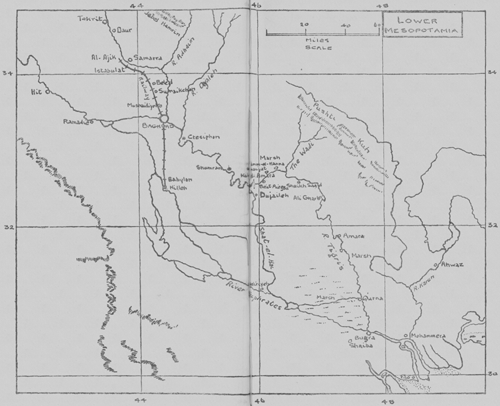
Lower Mesopotamia
Though we were unmolested, the countryside was full of eyes. Shortly
afterwards an artillery officer, bringing up remounts, sent a Scots
sergeant ahead to Sumaikchah, with a strong escort, to bring back
rations. The party was fired on by Buddus. The sergeant's report
attained some fame; deservedly, so I give it here:
'We were fired on, sirrr.'
'Did you fire back?'
'No, sirrr. I thocht it would have enrrraged them. But I'd have ye
know, sirrr, that it's hairrrdly safe to be aboot.'
We came, says Xenophon, to 'a large and thickly populated city named
Sittake.' His troops encamped 'near a large and beautiful park, which
was thick with all sorts of trees, at a distance of fifteen stades
from the river.'[1] This description still holds true of Sumaikchah.
The ancient irrigation channels are dry, and the town has shrunken;
but it remains a large garden-village. Here were melons and oranges,
fowls and turkeys, exorbitantly priced, of course; possibly Xenophon's
troops got their goods more cheaply in the year 399 B.C.
Sumaikchah is an oasis with eighty wells. The water was full of
salts. It was bad as water; it was execrable as tea. Many of the wells
on the Baghdad-Samarra Railway have these natural salts. Every one who
left Sumaikchah next morning was suffering from diarrhœa. Here
again one remembers the Anabasis and the troublesome experience
which the notes I read at school ascribed to poisonous honey gathered
from the flowers of rhododendron ponticum.
Our brief stay here was unlike anything we had known, except in our
racing glimpse of the flowery approaches to Kut. The village had palms
and rose bushes. A coarse hyacinth, found already at Mushaidiyeh, now
seeding, grew along the railway and in the wheat. We camped amid green
corn; round us were storksbills, very many, and a white orchis, slight
and easily hidden, the same orchis that I found afterwards in
Palestine and in the Hollow Vale of Syria. A small poppy and a bright
thistle set their flares of crimson and gold in the green; sowthistle
and myosote freaked it with blue; a tall gladiolus, also to be found
later by the Aujeh and on Carmel, made pink clusters. Thus did flowers
overlay the fretting spikes of our road, and adorn and hide 'the
coming bulk of Death.'
Through Saturday we rested. Fritz came, of course; and there was a
little harmless sniping.
The knowledge filtered in that fighting was again at hand. It was
accepted without comment, with the soldier's well-known fatalism, the
child of faith and despair. 'Every man thinks,' said one to me, 'I
don't care who he is. But we believe it's all right till our number's
up. Take M——, for instance. When he was left out at Sannaiyat we
all envied him; we thought we were for it. But we went through
Sannaiyat; and M—— was the first of us to be killed at Mushaidiyeh,
his very first action, where we had hardly any casualties.'
In the evening the rest of the division came up to take our place.
Sunday, by old prescription, was the 7th Division's battle-day; next
Sunday being Easter, it was not to be supposed that so fair an
occasion would be passed over. Accordingly, when I put in my services,
I was told that the brigade would march before dawn, and that some
scrapping was anticipated. The Turks were holding Beled Station, half
a dozen miles away in a straight line. Their main force was at Harbe,
four miles farther. The maps were no use, and distances had to be
guessed. 'The force against us,' observed the Brigade-Major, 'is
somewhere between a hundred Turks and two guns, and four thousand
Turks and thirty-two guns.' 'And if it's the four thousand and
thirty-two guns?' 'Then we shall sit tight, and scream for help,' he
answered delightedly.
Davies's Column were away before breakfast. In the dim light we moved
through wet fields of some kind of globe-seeded plant, abundantly
variegated with gladiolus and hyacinth. Every one was suffering from
our course of Sumaikchah waters, and progress was slow. Splashing
through the marshes, we came to undulating upland, long, steady
slopes, pebble-strewn and with pockets of grass and poppies. The
morning winds made these uplands exceedingly beautiful. Colonel
Knatchbull said, the week he died, that what he most remembered from
Beled were the flowers through which we marched to battle. As we
approached them, the ruffling wind laid its hand on the grasses, and
they became emerald waves, a green spray of blades tossing and
flashing in the full sunlight. As we passed, the same wind bowed them
before it, and they were a shining, silken cloth. The poppies were a
larger sort than those in the wheatfields, and of a very glorious
crimson. In among the grasses was yellow coltsfoot; among the pebbles
were sowthistle, mignonette, pink bindweed, and great patches of
storksbill. Many noted the beauty of these flowers, a scene so
un-Mesopotamian in its brightness. We were tasting of the joy and life
of springtide in happier latitudes, a wine long praetermitted to our
lips; and among us were those who would not drink of this wine again
till they drank it new in their Father's Kingdom. After Beled we saw
no more flowers.
With the first line was my friend Private W——. As we pushed forward
he looked up, as his custom was, for a 'message.' Perchance, with so
many fears and hopes stirring, there was some buzzing along the
heavenly wires; but the only word he could get was this one,
'Because.' He puzzled upon it, till the whole flashed on his
brain—'Because Thy lovingkindness is better than life, my lips shall
praise Thee.' Thenceforward he went his ways content; neither can any
man have gathered greater pleasure from the beauty of the morning and
those unwonted flowers than this Plymouth Brother, a gardener by
profession, and, as I found in later days, amid the rich deep meadows
of the Holy Land, a passionate lover of all wild plants.
The left flank was guarded by one section of machine-gunners and one
section of the 32nd Lancers. Next to them moved the Leicestershires.
Some time after 8 a.m. rifle-fire on our left told us that the
Cherub's scouts were in touch with enemy patrols. About 9.30 the first
shell came, our advanced guard being some five thousand yards from
Beled Station.
There were frequent halts, while our few cavalry reconnoitred. Then we
passed into a deep broad nulla between two ancient earth-walls. All
this terrain had been a network of canals and cultivation. Shrapnel
was bursting in our front. We filed out, at the left, on to a plain.
Half a mile ahead was the nearer curve of a hilly ground. The main
range ran in a Carpathian-like sweep across our front, from west to
east; turned, and went across our front again. Beyond this was Beled
Station, lying at the point of a wide fork of hills, the left prong a
good mile away, but the right bending almost up to it. From the
forking to the station was a broken plain of two thousand yards. This
plain had to be overcome, with such assistance as the hills gave. The
hills were pretty uniform in height, and nowhere above thirty feet.
The railway cut directly through the main range, giving the enemy a
field of fire for his machine-guns. The range, with its double fold
across our front, gave the artillery cover, and enabled us to conceal
the smallness of our force; and on both sides of the station it broke
into a wilderness of little knobs and hollows, by which we might creep
up.
The shrapnel was uncomfortably close as we crossed to the first sweep
of hilly ground. But it was bursting high, and no casualties occurred.
We halted behind the hills, and the artillery left their wagons,
taking their guns into position where the range curved north-westerly.
Here two four-gun batteries put up a slow and not heavy bombardment on
the station. We waited and watched the shrapnel bursting five hundred
yards to our right. About noon the Leicestershires were ordered to
support the 53rd and 51st Sikhs in an attack on the station. (The 56th
Rifles were in reserve throughout the action.) D Company was to move
on the left of the railway as a flank-guard, and went forward under
Captain Creagh.
I must now speak of Second-Lieutenant Fowke, our tallest subaltern. In
place of the orthodox shade of khaki he wore a reddish-brown
shooting-jacket, which shimmered like bright silk if there was any
sun. Nevertheless he was the only Leicestershire subaltern who went
through all our battles unwounded. Of his cheerfulness and courage,
his wit, and the love with which his colleagues and his men regarded
him, the reader will learn. Fowke was detached with his platoon to act
on our extreme left in co-operation with our handful of Indian
cavalry. The operation was an undesirable one, to advance into a maze
of tiny hills, held by an enemy of unknown strength; and as Fowke
moved off I remembered the Sieur de Joinville's Memoirs and a
passage mentioned between us the previous day. So, as I wished him
good luck, I said, 'Be of good cheer, seneschal, for we shall yet talk
over this day in the ladies' bowers.' Once upon a time Fowke had read
for Holy Orders, a fact which contributed not a little to the
astonishment and delight with which he was regarded. He smiled gravely
in answer to me, and moved on. But after the scrap he told me that he
wished just then that he had continued in his first vocation and
become a padre.
Behind D Company moved Charles Copeman, O.C. bombers, and a section of
machine-gunners under Lieutenant Service. The rest of the
machine-gunners followed up along the railway.
We who remained crossed the ridge and advanced in artillery formation
up the right side of the railway. The Sikhs slipped away into the
hills to our right.
Readers of Quentin Durward will remember the two hangmen of Louis
XI, the one tall, lean, and solemn; the other short, fat, and jolly.
Wilson, the Leicestershires' doctor, had two most excellent assistants
who occupied much the same positions. But Sergeant Whitehead, who was
short, went his sombre way with a gravity that never weakened into a
smile; while Dobson, an ex-miner, aged forty-seven, who had deceived
the recruiting people most shamelessly and enlisted as under thirty,
took life jovially and generally humorously. He was never without his
pipe. He enjoyed a large medical practice in the regiment, unofficial
and unpaid, and he held strong opinions, observing frequently that he
'didn't hold with' a thing. I remember well the annoyance of Wilson's
successor on hearing that Dobson 'didn't hold with' inoculation, which
just then was occupying most of the medical officer's time. Another
thing that Dobson 'didn't hold with' was the modern notion that some
diseases were infectious. Because of his years and medical knowledge,
this kindly, never-wearied old hero was always known by the regiment
as 'Mester Dobson.' I shall follow their example, and so call him
henceforth.
I also was of Wilson's entourage, and went with him accordingly.
Before we crossed the first ridge we picked up a man prostrate with
heat-stroke; we left him under a culvert, in charge of John, Wilson's
Indian orderly.
Meanwhile D Company found the hills on our left strongly held. Every
slope was sown with shallow trenches, earth-scars which held six or
seven Turks, and snipers caused us casualties. Lieutenant-Colonel
Knatchbull, learning this, on his own initiative swung round B and C
Companies across the railway to support D. Wilson now came upon his
first casualty, a signaller hit in the spine. We bandaged him, and
left him in a shallow nulla, sheltered from the bullets flying over.
He died next day.
B and C Companies, crossing the railway, pushed up a long narrow nulla
to the hills where D were engaged. Service's machine-guns put up a
covering fire.
The attack had now developed along two distinct lines, and on the
railway itself we had no troops. The enemy presently put down a
barrage of shrapnel all the right length of the line, where he had
seen our men cross, of which barrage every shell during two hours was
wasted. As Wilson dropped down the embankment on our left side of the
railway, we found machine-gunners sheltering in a quarry, awaiting
orders. 'It's unhealthy over there,' said their O.C., Lieutenant
Sanderson. 'The Turks have a machine-gun on it.' However, there was a
lull as we crossed to the nulla, and only a very few bullets went by.
In the nulla Wilson set up his aid-post, sticking a second flag above
the railway, for the solitary company that was supporting the Sikhs'
attack. Wounded began to come in, the first cases being not bad ones.
'Give you five rupees for that wound, sergeant,' said Mester Dobson.
'You can't have it for seventy-five,' said Sergeant Hayes, as he
limped off in search of the ambulances, smiling happily. Perhaps
nothing will stir the unborn generations to greater pity than this
knowledge, that for youth in our generation wounds and bodily hurt
were a luxury.
But cases soon came in of men badly hit, in much pain. With them was
borne a dead man, Sergeant Lawrence, D.C.M., a quiet and much-liked
man. My Plymouth Brother friend came also, and sat aside, saying he
could wait, as a stretcher-case was following him. As the doctor saw
to that broken body, my friend rested his wounded leg, and we had some
talk. The long marches, the nights of little sleep, and the
unsheltered days of heat and toil and wearied waiting for evening had
tired him out. 'I want rest,' he said, 'and I think the Lord knows it,
and has sent rest along.' All our men were brave and cheerful, but no
more cheerful hero limped off through the bullets than my calm and
gentle friend.
Wilson went out for a few minutes to see a man in the second line, hit
in the groin. When he returned we had some cruelly broken cases in,
and that nulla saw a deal of pain, and grew stale with the smell of
blood. A fair number of bullets flew over, and there was the
occasional swish of a machine-gun. Mules were killed far back in the
second line, and men hit. But the nulla was safe. The misguided Turk
shelled and machine-gunned the empty space beyond the railway.
Colonel Knatchbull came in and assured Wilson that the nulla was the
best and most central place for the aid-post. He searched the front
with his glasses. Then he said, 'Marner's dead.'
The Leicestershires' attack was held up in the hills. They asked for
support, but none was available. They were told to advance as far as
they could, and then hold their line till help could come. The hills
were thick with excellent positions. Every fold and dip was utilized
by a scattered and numerous foe, to whom the ragged ground was like a
cloak of invisibility. No artillery help could be given. We could only
seize the ground's advantage and make it serve as help to the attack
as well as to the defence. It was here that Marner fell. C Company was
sheltering in an ancient canal. Seeing a man fall, Captain Hasted
called out, 'Keep your heads down.' Almost at that moment Marner
looked over, having spotted a sniper who was vexing us, and fell dead
at Grant-Anderson's feet. Though in falling he brushed against Hasted,
the latter could not pause to see who it was; nor did he know till he
cried out, a minute later, that Marner was to move round the flank of
the position immediately before them. Some two hundred yards farther
on Second-Lieutenant Otter was struck by a bullet which went through
both left arm and body, a bad but not fatal wound. But a gracious
thought came to the Turkish gunners. Seeing us without artillery
support from our own guns, they put two rounds of shrapnel over, the
only shells on these ridges during the fight. These burst directly on
the Turkish snipers, who did not wait for the hint to be repeated, but
went. The Leicestershires topped the last ridge, and were on the plain
before the station. Fowke and Service remained to guard the left
flank, while Hasted went forward with the bayonet to clear the hills
to the left. Fowke, watching benevolently the evolutions of certain
horsemen on his left, received a message from our cavalry, 'Those are
Arabs on your left, and are hostile to you.'
And now it would have meant a bloody advance for A and B Companies
against those trenches in the open. But the Turks, held by the
Leicestershires' strong steady attack, had given insufficient
attention to the movement threatening their left. The two Sikh
regiments, though checked and held from time to time by rifle and
machine-gun fire, used the broken ground with extraordinary skill.
Their experience on the Afghan frontier had trained them for just such
work as this. Rising ground was used as positions for covering fire,
and every knoll and hummock became a shoulder to lift the force along.
Their supporting battery had located the enemy's gun-positions, and
kept down his fire. One gun-team bolted, and the crew were seen
getting the gun away by hand and losing in the effort. The Sikhs
rushed a low hill, which had long checked them, and its garrison of
one officer and twenty-five men surrendered. This attack was led by
the well-known 'Boomer' Barrett, colonel of the 51st. He slapped the
nearest prisoner on the back and bellowed 'Shabash.'[2] The enemy's
resistance crumbled rapidly. A breach had been made in his defence,
and the Sikhs poured through. They made two thousand yards, and did a
swift left-turn. The enemy on their right slipped off, but the Turks
in the trenches covering the station had left things too late. The
51st drove the foe before them to the north of the station, and the
53rd rushed the station itself, capturing eight officers and a hundred
and thirty-five men, with two machine-guns. This was about 3 p.m.
Wilson now left his aid-post, and we came up the line. All the way the
Turk was shelling the railway, but, by that fortunate defect of
observation conspicuous throughout, shelling our right exclusively,
for not a shell came on the left. We passed the enemy's trenches and
rifle-pits, which scarred some six or seven hundred yards of space
before the station; there were rifles leaning against the walls, with
bayonets fixed.
The station had excellent water, a great attraction after the filthy
wells of Sumaikchah. No one heeded that the Turk was dropping shells
two thousand yards our side of the station. 'He always does that. It's
a sort of rearguard business. It's the ammunition he can't get away.
He'll be moving his guns quickly enough when we get ours on to them.'
But, as the official report afterwards observed, with just annoyance
at the enemy's refusal to recognize that the action was finished:
'During the whole of the afternoon and till dusk the enemy continued
to shell the captured position with surprising intensity, considering
what had been heard of his shortage in gun-ammunition.' What happened,
in fuller detail, was this.
Beled Station was like the gate of Heaven. With the exception of the
Leicestershires, still in the field, all the great and good were
gathered there. The first I saw was that genial philosopher, Captain
Newitt, of the 53rd Sikhs, sitting imperturbable on a fallen wall and
smoking the pipe without which he has never been seen. Not Marius amid
Carthage ruins was more careless of the desolation around him. With
him was Culverwell, adjutant of the same battalion. They hailed me
with joyous affection, and we drank the waters and swapped the news.
General Davies came up and asked, 'Have the Leicesters taken any
prisoners?' I told him 'No.' He seemed disappointed; then added,
'We've taken over two hundred prisoners, including nine officers and
three machine-guns. What were your casualties?' 'About twenty, sir,' I
said. 'The 53rd have had thirteen men wounded,' said the
Brigade-Major. 'Fifty will cover the casualties for the whole brigade.
It's been a most successful action.'
Marner's loss was greatly felt. 'I hear you've lost a good officer,'
said the Brigadier; and the Brigade-Major added, 'He was the brigade's
great stand-by for maps and drawings. I don't know how we can replace
him.'
Then for a moment we fell to jape and jesting; foolishly, for the Gods
are always listening, and the Desert-Gods have long ears. 'You're last
from school,' said Brigade-Major McLeod. 'You know Napier's
message—"Peccavi, I have Sind." Give me a wire for Corps, "I have
B-led."' '"Sanguinevi,"' I said, 'if such a verb exists. Let's call
it very late Latin.'
As we spoke, the enemy shortened his range; a shell skimmed the roof,
and burst at the embankment bottom, directly under two Sikhs who were
cooking. It hurled one man into the air and the other to one side. A
great dust went up. Before most people realized what had happened,
Wilson and Stones were carrying the men up the bank. This was an
extremely brave deed, for a second shell was certain, and, as a matter
of fact, a second and a third came just as they had reached our wall.
Stones, like many medical officers, was a missionary; he had come from
West Africa. He had one of the noblest faces I ever saw; a very gentle
and courteous man, fearless and with eager eyes. He served with the
56th Rifles.
One of the stricken men was a mass of bleeding ribbons, the top of his
head blown off. A cloth was drawn over his face; he was dead. The
other had his left leg torn off below the knee, his right heel blown
away, and wounds in his head and stomach. He died that evening. Now he
lay with scarcely a moan, while Sikhs gathered round and gave such
consolation as was possible, an austere, brave group.
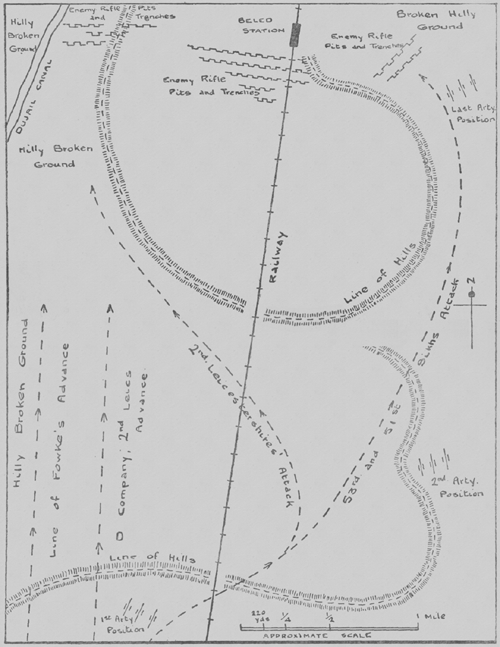
Sketch Map for Action for Beled Station.
The Turkish gunners now concentrated on the station and its
approaches. Our cavalry rode through the Leicestershires' lines as
those warriors moved up to an advanced line of defence. They brought a
wounded prisoner. The enemy instantly shrapnelled them, and they
scattered, the prisoner, for all his broken leg, keeping his seat
excellently and riding surprisingly fast. Luck had been with the
battalion this day, and it now remained with them. Many had rifles
hit. Fowke, who was a magnet for bullets, had his right shoulder's
star flattened. But there were no casualties. The enemy, growing
vindictive, chased small bodies of even three or four with shrapnel.
He continued to pelt the station, throwing at least two hundred rounds
on it in two hours. Mules and horses were hit, and many men. Isolated
men, holding horses in the open, had a bad time. Several shells landed
on the roof, and had there been against us the huge guns of other
fronts the station would have gone up in dust. When I saw it again, a
month later, I realized what a rough house that tiny spot had
experienced. Unexploded shells were still in the walls, and on the
inner wall of the side that had sheltered me I counted over twenty
direct hits. Fortunately the 5.9's were not in action this day, and
every station on the Baghdad-Samarra line has been built as a
fortress, massively. By incredible luck no shell came through the
doorless openings and rooms behind us; they struck the inner wall and
roof. But the water-station behind us gave very poor shelter to the
men there. Shells burst on the railway, and sent a sheet of smoke and
rubble before them. Two of our guns came up to the hills that had
covered the Sikhs' advance, but fired very few shells, failing to find
a target. The enemy saw their flashes, and fired back without effect.
Then Fritz came and hovered above our huddled crowd with low,
deliberate circles. We took it for granted he would bomb us, or, at
kindest, spot for his guns. But he just hung over us, and then went
to look for our batteries.
Before this McLeod offered me a cup of tea. We drank it in a tin shed
a few yards south of the station. I wanted the tea horribly, but felt
it was 'hairrdly safe to be aboot.' This feeling was shared, for when
the staff-captain and signalling-officer joined us, the latter asked,
'Isn't this spot a bit unhealthy, sir?' 'Oh, no,' said McLeod. 'It's
quite safe from splinters, and it's no use bothering about a direct
hit.' As I had seen high explosive burst pretty well all round, and
both windows were smashed of every inch of glass, I could not quite
share this confidence that the hut was splinter-proof. But I required
that tea. It was very good tea. Had it been shaving water, it would
have gone cold at once. But being tea which I wished to drink quickly,
it remained at boiling-point and declined to be mollified with milk.
However, no more H.E.[3] came our way, only shrapnel.
McLeod said we had had at least two thousand Turks against us and at
least twelve guns. During the action the enemy reinforced the position
from his main one at Harbe. He must have had other casualties in
addition to our prisoners. Our left wing, when they occupied the
hills, saw four or five hundred Turks 'skirr away' in one body, and
the machine-gunners found a target. Raiding-parties of Arabs hung on
our flanks throughout the day, and increased the force against us, at
any rate numerically.
The day had been cloudy and comparatively cool, and an exquisite
evening crowned it. With dusk I left the station, where wounded Turks
were groaning and shells bursting, and sought the hills. The shrapnel
was dying down, and, once off the plain, all was quiet. The scene here
was one of great loveliness. The Dujail, a narrow canal from the
Tigris, ran swiftly with water of delightful coldness and sweetness.
The canal was fringed with flowers, poppies, marguerites, and
campions; the innumerable folds and hollows were emerald-green. C
Company were holding the extreme left of our picket-line. Here I found
Hasted, Hall, Fisher, and Charles Copeman. We held a dry, very deep
irrigation-canal, running at right angles to the Dujail. There were no
shells, and we could listen composedly to the last of the shrapnel
away on the right. The full moon presently flooded the hills with
enchantment. But our night was broken by Arab raids. Twice these
robbers of the dead and wounded tried to rush us. The first party
probably escaped in the bushes, but the second suffered casualties. In
the evening Arabs had raided our aid-post, wounding the attendant, who
escaped with difficulty. Fortunately there was none but dead there;
these they stripped, cutting off one man's finger for the ring on it.
All night long they prowled the battlefield and dug up our buried
dead. For which, retribution came next day.
Fisher and I scraped a hole in our canal, and tried to sleep. But a
cold wind sneaked about the nulla, and the hours dragged past with
extreme discomfort. No one had blanket or overcoat, and most were in
shorts. At dawn we had ten minutes' notice to rejoin the rest of the
regiment behind the station. In that ten minutes I had opportunity to
admire the soldier-man's resourcefulness. One of the picket,
thrusting his hand deep into one of the countless holes in our
canal-wall, found two tiny eggs. Raising fat in some fashion—probably
a candle-end—he had fried eggs for breakfast before we moved. The
eggs were presumed to be grouse-eggs. More likely they were
bee-eater's, or may have been snake's or lizard's. These canals are
haunted by huge monitors, and there must be tortoises in the Dujail.
However, eggs were found, and eggs were eaten.
On picket the men's talk was interesting to hear. They were regardless
of the discomfort they had known so long; and when his turn came to
watch, every man was eager to lend his waterproof sheet to Fisher and
me, who had only our thin khaki. Marner's death had gone deep. 'I hear
Mr. Marner's dead,' said a voice. 'I'm sorry to hear that,' said
another; 'he was a nice feller.' 'He was a good feller an' a',' said a
third. 'He was more like a brother to me than an officer,' his
platoon-sergeant told me. These were brief tributes to an able and
conscientious man, but they sufficed. At Sumaikchah our bivvies had
been side by side, where the green was most glowing, and we had
rejoiced together in that light and colour.
Beled Station was a small action, scarcely bigger than those dignified
in the Boer War with the name of battles. Our casualties were little
over a hundred for the whole day, and more than half of these were
incurred in the station itself. The Leicestershires lost twenty, three
killed among them; several of the wounded died later. But the action
attained considerable fame locally as a model of a successful little
battle. Our losses were miraculously slight. But for the very great
skill with which the two separate attacks were organized, and the
constant alertness which exploited every one of the ground's endless
irregularities, our losses must have been many times heavier. The
advance was conducted with caution and the utmost economy of life; but
the moment a breach was effected or an opportunity offered, then there
was a lightning blow and a swift push forward. Thus the enemy in the
station were trapped before they realized that their retreat was
threatened. The careless trooping together at the station was the one
regrettable thing, and it cost us dear. The water of Beled Station was
like the water brought to David from Bethlehem.
For the action itself, a small force advanced steadily throughout the
day, with unreliable maps, over ten miles of broken country, which was
admirably furnished with posts of defence, which posts they seized and
turned into advantages for attack. They captured a strong position and
over two hundred prisoners, three machine-guns, and some hundreds of
rifles with less than half the casualties their numerically superior
foe sustained. Since a small battle is an epitome of a large one, and
far easier to see in detail, even this lengthy account may have
justification. The Army Commander's opinion was shown not alone by his
congratulatory message, but by the immediate honours awarded. To the
Leicestershires fell one Military Cross[4] and four Military Medals,
one of the latter going to Sergeant Batten, Marner's platoon-sergeant.
The water-tank leans against the station no longer, and they have
repaired the crumbled walls. But the cracks and fissures in the great
fort lift eloquent witness to the way both armies desired it, and the
quiet, beautiful hills carry their scars also.
The rushing brook, the silken grass and pride
Of poppies burning red where Marner died,
Unchanged! and in the station still, as then,
The water that was bought with blood of men.
Behold, as may unworthiness define,
A little touch of Harry in the night.
King Henry V.
If I thought Hell was worse than Mesopotamia, I'd be a good
man.—Sayings of Fowke.
Next morning was one of leisure. The 19th Brigade took up our line,
and we bivouacked before the station. We fed and washed and slept. The
enemy put a few shells on to the 19th Brigade, doing no damage, and
when that Brigade pushed on to Harbe he fell back on his strong lines
at Istabulat, another four miles. The 19th Brigade, with only one or
two men wounded, seized Harbe and twenty-four railway-trucks, which
were of great assistance presently, when the mules drew them along the
track with ammunition for the assault on Istabulat.
In the afternoon the 28th Brigade followed to Harbe. The heat was
considerable, but the journey was short. Beyond the river plunging
shells told us that our troops were pushing up both banks of the
Tigris simultaneously.
The 21st Brigade took over Beled. With them remained the Cherub,
wielding for one day the flaming sword of retribution. Arabs had
desecrated our graves as they always did, and had stripped our dead.
The Cherub put the bodies back and dug several dummy graves. In these
last he put Mills bombs; removing the pin, he held each bomb down as
the earth was delicately piled over. The deed called for great nerve;
he could feel the bomb quick to jump under his finger's pressure.
Arabs watched impudently, sniping his party from a few hundred yards
away. Neither did they let him get more than a quarter of a mile away,
when he had finished, before they flocked down. The Cherub made his
way to the station, and watched, as a boy watches a bird-trap. The
Arabs fell to scooping out the soil badger-fashion with their hands.
There was an explosion, and the earth shot up in a fountain of clods.
The robbers ran, but returned immediately and carried off two of their
number, casualties. Then they remained to dig. Colonel Leslie,
commanding the 21st Brigade, had watched from Beled Station with
enthusiasm, and he now turned a machine-gun on them. The Cherub,
returning to the scene of his labours, found that the Arabs had dug
two feet deeper than his original grave, breaking up the stiff ground
with their fingers. To these desperate people a piece of cloth seemed
cheap at the cost of two dead or wounded.
From first to last nothing moved deeper anger than their constant
exhumation of our dead, and murder, for robbery's sake, of the wounded
or isolated. Major Harley, A.P.M. of Baghdad in later days, learnt to
admire the ability of the Arabs, whose brief Golden Age, when Abbasids
ruled, so far outshone contemporary Europe. When he pressed them on
their ghoul-like ways, they replied, 'You British are so foolish. You
bury the dead with the clothes. The dead do not need clothes, and we
do.' The logic of this does not carry far. To them, as Mussulmans,
graves were sacrosanct to a unique degree; a suspicion of disrespect
on our part would rouse the whole of Islam to flaming wrath. They were
criminals, by their own ethos, when they desecrated our dead.
Moreover, they murdered whenever they could, in the cruellest and
beastliest fashion. The marvel is, our actions of reprisal were so
rare. Apart from this of the Cherub's, only two came within my
personal knowledge. Of these two cases, one I and nearly the whole
division considered savage and unjustifiable, which was also the
official view. It was the act of a very young subaltern, mistakenly
interpreting an order. In the other case an Arab was caught
red-handed, lurking in a ditch on our line of march, with one of their
loaded knobkerries for any straggler. I do not know what happened, but
have no doubt that he was shot.
It cannot be said that they acted for patriotic motives, as the
Spanish guerrillas against Napoleon's troops. I remember an article[5]
by Sir William Willcocks dealing with his experiences before the war,
in which he tells how he and a friend went ashore from a steamer on
the Tigris. An Arab calmly dropped on one knee and took aim at the
Englishmen, as if the latter were gazelles or partridges. He missed,
and they followed him into his village, where they asked him why he
had fired. The man answered that he did it in self-defence, for the
others had fired first. 'That,' said the Englishmen, 'is impossible,
for you see we are unarmed.' Hearing this, the village rushed on them
and robbed them of their valuables. Yet one of them was an official
high in Government service.
The other side of the shield, as it affected Brother Buddu, was shown
next day at Harbe. At dawn three men and four women were found in the
middle of the 19th Brigade's camp, outside General Peebles' tent,
wailing. The women said their husbands had been bayoneted and
mutilated by Turks a fortnight before, and buried here. This story
proved true. The women dug up and bore off the decomposing fragments
for decent burial.
The Buddu was an alien in his own land, loathed and oppressed by the
Turk. In his turn he robbed and slew as chance offered. He pursued the
chase for the pelt, and went after human life as our more civilized
race go after buck.
About this time the Bishop of Nagpur was on his second visit from
India. His see was usually mispronounced as Nankipoo. He was following
us up to consecrate the graves of our battlefields. Great delight was
given by the thought that Westlake's still unexploded bombs would
receive consecration also for any retributive work that awaited them.
And we brooded over the suggestion that the good Bishop might find,
even in Mesopotamia, Elijah's way to heaven, fiery-chariot-wise.
Our new camp was amid mounds and ruins. We found green coins, pottery
fragments, and shells with very lovely mother-of-pearl. The Dujail ran
near by, and made a green streak through an arid waste. The whole
landscape seemed one dust-heap, sand and rubbish. But by the brook
were poppies, marguerites, delicate pink campions, wheat and barley
growing as weeds of former cultivation, and thickets of blue-flowered
liquorice. There were many thorns, especially a squat shrub with white
papery globes. A large and particularly fleshy broom-rape, recently
flowering, festered unpleasantly everywhere.
April was well on, and the sun gained power daily. The camp had a
thousand discomforts. We lay under bivvies formed of a blanket,
supported on a rifle and held down uncertainly by stones. Blinding
dust-storms careered over the desert. These djinns, with their
whirling sand-robes, would swoop down and whisk the poor shelters
away. If the courts above take note of blasphemy under such
provocation, the Recording Angel's office was hard worked these days.
One would be reading a letter, already wretched enough with heat and
flies, and suddenly you would be fighting for breath and sight in a
maelstrom of dirt, indescribably filthy dirt, whilst your papers flew
up twenty feet and your rifle hit you cruelly over the head. As a
Marian martyr observed to an enthusiast who thrust a blazing
furze-bush into his face, 'Friend, have I not harm enough? What need
of that?' One storm at Harbe blew all night, having made day
intolerable and meals out of the question. As Fowke curled himself
miserably under his blanket for the night, I heard him deliver himself
of the opinion quoted at the head of this chapter.
Flies may be taken for granted. They swarm in these vile relics of old
habitation. Moreover, there had been a Turkish camp at hand. But
snakes and scorpions were found also almost hourly. The snakes were
small asps; the scorpions were small also, but sufficiently painful.
My batman was consumed with curiosity as to what a scorpion was like;
he had 'heard tell of them' in Gallipoli. The listening Gods took
account of his desire, and he was mildly stung the day we left.
We spent the best part of a fortnight at Harbe. Morning and evening
were enlivened by regular hates. So we had to dig trenches. But there
were more memorable happenings at Harbe than the discomforts. Hebden
returned with stores of sorts from Baghdad. Two new subalterns, Sowter
and Keely, came. On Tuesday Hall's M.C. for Sannaiyat was announced.
We celebrated this with grateful hymn far into night. Thursday brought
the Cherub's M.C., another very popular honour, and we sang again, and
the mules from their mess sang a chorus back, as before.
When as at dusk our Mess carouse,
With catches strong and brave,
The mules their tuneful hearts arouse,
And answer stave for stave.
'Dumb nature' breaks in festive noise,
Remembering in this East
The mystic bond which knits the joys
Of righteous man and beast.
Then pass the flowing bowl about—
Our stores have come to-day—
And let the youngest captain shout,
And let the asses bray.
The thorny trudge awhile forget,
And foeman's waiting host!
To-morrow bomb and bayonet—
To-night we keep the toast!
These light-hearted evenings seemed, even then, sacramental. We were
waiting while the Third Corps and the cavalry cleared the other bank
of the Tigris, level with us. On the 19th the river was bridged at
Sinijah, which made close touch between the two corps possible and
passage of men and guns. About the same time the cavalry captured
twelve hundred and fifty Turks on the Shat-el-Adhaim. Our wait was
necessary. But we knew the enemy was terribly entrenched less than six
miles away, and that our sternest fight since Sannaiyat was preparing.
'This will be a full-dress affair, with the corps artillery,' I was
told. Some of my comrades were under twenty; others, like Fowke and
Grant-Anderson, were men of ripe age and experience in many lands. But
all had aged in spirit. Hall, though his years were only nineteen, had
grown since Sannaiyat into a man, responsibility touching his old
gaiety with power. So we waited on this beach of conflict.
One evening stands out by its beauty and unconscious greatness. It
happened thus. Remember how young many were, and it is small wonder if
depression came at times. After the trying trench warfare before Kut
had come the rush to Baghdad, a period of strain and tremendous
effort. We had been fighting and marching continuously for many weeks,
with every discomfort and over a cursed monotonous plain, without even
the palliation of fairly regular mails. When men have been 'going over
the top' repeatedly, emerging always with comrades gone, the nerves
give way. We longed to be at that Istabulat position. Yet here we had
to wait while Cailley's Column fought level with us, and day by day
those sullen lines were strengthening. We had barely six thousand men
to throw at them. So one night talk became discontented, and some one
wished some reinforcement could be with us from the immense armies
which our papers bragged were being trained at home. Then
another—G.A. or Fowke—replied:
Oh that we now had here
But one ten thousand of those men in England
That do no work to-day!
Swiftly that immortal scene, of the English spirit facing great odds
invincibly, followed, passage racing after passage.
God's will! I pray thee, wish not one man more!
It was an electric spark. I never heard poetry, or literature at all,
mentioned save this once. But all were eager and speaking, for all had
read Henry V. When the lines were reached,
Rather proclaim it, Westmorland, through my host,
That he which hath no stomach to this fight,
Let him depart,
laughter cleansed every spirit present of fear, and the shadow of
fear, misgiving. Nothing less grimly humorous than the notion of such
an offer being made now, or of the alleged consequences of such an
offer, in the instant streaming away of all His Majesty's Forces in
Mesopotamia, could have made so complete a purgation. Comedy took upon
herself the office of Tragedy. When voices could rise above the
laughter, they went on:
His passport shall be made,
[56]
And crowns for convoy put into his purse.
'Movement-orders down the line and ration-indents,' was the
emendation.
We would not die in that man's company
That fears his fellowship to die with us.
And Fowke's voice towered to an ecstasy of sarcasm as he assured his
unbelieving hearers that
Gentlemen in England, now abed,
Shall think themselves accursed they were not here.
As a Turkish attack was considered possible, every morning we stood-to
for that 'witching hour,' immediately before dawn, which is usually
selected for 'hopping the parapet.' The brigades reconnoitred, and
exchanged shots with enemy pickets. Fritz came, of course. Then the
19th Brigade went on, and took up a position two miles in front behind
the Median Wall, of which more hereafter. The battle preparations went
busily forward.
Our camp was strewn with pebbles, an old shingle-beach, for we were on
the ancient edges of the sea, before the river had built up Iraq.[6]
The stones at Beled had been the first signs that we were off the
alluvial plain. South of Baghdad it was reported that a reward of £100
would be paid (by whom I never heard) to the finder of any sort of
stone. And now, after our long sojourn in stoneless lands, these
pebbles were a temptation, and there was a deal of surreptitious
chucking-about. One watched with secret glee while a smitten colleague
pretended to be otherwise occupied, but nevertheless kept cunning eyes
searching for the offender. I enjoyed myself best, for I lay and
watched the daily parade of the troops before breakfast, and could
inquire genially, 'Have you had a good stand-to?' Fowke asked the
wastes in a soaring falsetto, 'Why do the heathen rage?' And he was
returned question for question, with 'Why do you keep laughing at me
with those big, blue eyes?' Then the camp would rock with song as we
fell to shaving and, after, breakfast.
The superstitions which old experience had justified waxed strong as
the days went by. When McInerney marked out a quoits-court and Charles
Copeman dug a mess—these officers found their amusement in singular
ways, and would have been hurt had any one attempted to usurp their
self-appointed duties—and when I put in services for Sunday, the
22nd, it was recognized that we should march, and fight on the
Sabbath. Not more anxiously did the legionary listen for tales of
supernatural fires in the corn and of statues sweating blood than the
regiments asked each other, 'Have you dug a mess yet? Has the padre
put in services?' Two of us went down with colitis—possibly the
Sumaikchah waters were not even yet done with—and Fowke, as they left
us, profaned Royal Harry's words:
He which hath no stomach to this fight,
Let him depart.
For all this, Shakespeare had a share in the storming of Istabulat, as
will be seen; as the ghost of Bishop Adhemar, who had died at
Antioch, was said to have gone before Godfrey of Boulogne's
scaling-ladder when the Crusaders took Jerusalem. ('Thank God!' said
they. 'He was not frustrate of his vows.')
On Friday rain came, and Charles Copeman, who had, as already
indicated, a passion for digging—caught, perchance, in boyhood from
his father's sexton—dug a funk-hole from the enemy shell-fire.
McInerney helped him. Now this was not an ordinary funk-hole. It was a
very splendid and elaborate hole, and no one was allowed to come near,
lest he cause its perfection to crumble away. So, to dry ourselves
after the rain, we all dug, and the Desert-Gods laughed in their
bitter little minds as they saw. Among the rest, Sowter and I dug a
hole, dug deeply, widely, with much laughter and joyfulness. And to
us, as the afternoon wore towards evening, came the C.O., and, after
watching us for a few minutes, told us that we marched in an hour.
These men, the steadfast among spears, dying, won for themselves
a crown of glory that fadeth not away.—Greek Anthology.
In the quiet light we crossed the railway, and moved up to the Median
Wall, in all a march of perhaps a mile and a half. This wall was old
in Xenophon's time[7]; and along its northern side his army moved,
watching, and watched by, the troops of Tissaphernes, moving parallel
on the other side. He speaks of it as twenty feet in breadth and one
hundred feet in height. Once it was the border between Assyria and
Babylonia, and must have stretched to the Euphrates. Even now it runs
from the Tigris far into the desert. It has crumbled to one-third of
the height given by Xenophon. The semblance of a wall no longer, it is
a mighty flank of earth, covering tiers of bricks. It effectually hid
our movements as we crossed the plain before it. The Turk was
shrapnelling the wall and its approaches, endeavouring to reply to
some howitzers. These last we left on our right. As I happened to be
the nearest officer, the major came up and asked me that the
Leicestershires should move more to the left, in case any of his guns
had a premature.
We fell silently into our places behind the wall. The artillery
behind us were favoured with a certain amount of zizyph-scrub; but the
wall furnished no cover but itself. Fowke, who at all times indulged
in a great deal of gloomy prognostication, known as 'Fowke-lore,' and
received with delight, but not quite implicit belief, foretold that on
the morrow our cavalry—it was a point of principle with the infantry
to assume that the cavalry, as well as all Higher Commands, were
capable of every stupidity and of nothing but stupidity—would cut up
B Company, his own, who had a certain unattractive duty assigned to
them on the extreme left. He also told us that the Median Wall would
be shelled to blazes, which seemed pretty probable.
The clearest figure in my memory for this hurried, stealthy evening is
J.Y. Copeman, cousin of Charles. 'J.Y.'—for he never carried any
graver appellation than mere initials—once a rising lawyer in
Vancouver, was now our quartermaster. The gayest and most debonair
figure in the division, known and popular everywhere, he was also an
incredibly efficient quartermaster. Possibly the same qualities make
for success in law and quartermastering. His gaiety was the mask for a
most unsleeping energy and very great ability. He was once dubbed, by
a person more alliterative than observant, 'a frail, flitting figure
with a fly-flap.' Yet he had taken over Brodie's job, at Sannaiyat,
when that experienced 'quarter' had wakened suddenly to find that an
aeroplane bomb had wounded him. Within a year of this event I was
privileged to be present at an argument between our D.A.D.O.S. and our
D.A.D.S. & T.,[8] as to whether Copeman or Jock Reid, of the
Seaforths, was the greater quartermaster. Where two such authorities
failed to come to a decision, I must stand aside, especially as both
J.Y. and Reid are my friends. With his ability J.Y. had an indomitable
resolve, which made him refuse to go sick. He carried on through
months of constant ill-health; sometimes he was borne on one of his
own ration-carts, too unwell to walk or ride. He fed alone, but had a
familiar, in the shape of a ridiculously clever and most selfish cat.
And it is J.Y. whom I remember on this eve of Istabulat—J.Y.
marshalling his carts swiftly and silently up to the wall when
darkness had fallen, and J.Y. next morning scurrying them away before
dawn.
A Company went on picket, B and C patrolled before our lines, D lay
behind the wall. Fires were kept low. J.Y. got our blankets up to us,
and we had some sleep.
Next day, the 21st, all kit was packed and on the carts by 4 a.m.
Breakfast was at 3.30; hot tea and a slice of bacon. The second line
fell back. Then we clung to the wall, and waited; all but Fowke. That
warrior moved off to the left with part of B Company, all carrying
spades. Their task was to come out of the shelter of the wall as soon
as the action began, and to work their spades frantically, sending up
such dust-clouds that the bemused Turk might suppose a new Army Corps
advancing to attack his right, and take steps accordingly. The
brown-coated figure took a sombre farewell of me, reminding us that,
though his crowd were going to be cut up by our own cavalry, the rest
of us would be shelled into annihilation when Johnny opened on the
famous wall. 'He's bound to have the exact range, for it's such a
landmark. Besides, he's got German archaeologists with him, who've dug
here for years and years; they know every brick. And he's been
practising on it for weeks. You saw how he had it last night when we
came up.'
The two actions which it is customary to call the two Battles of
Istabulat were fought in positions some miles apart. The title of
Istabulat, or of Dujail River, may fitly be reserved for the first
action. The action of the 22nd may then be known as that of Istabulat
Mounds. The Istabulat fight was one in which my own Brigade were
spectators, except for isolated and piece-meal action. We were in
reserve; and the 8th Brigade, of the 3rd Division, were in support, in
line with us, and behind the Median Wall. The enemy were trying a new
bowler, Shefket Pasha being in command, vice Kazim Karabekir Bey, who
had resigned from command of their Eighteenth Corps just before
Baghdad fell. We should not have supposed that this made any
difference, even had we known.
The Istabulat battle has been described in print,[9] though
inadequately and, in one important respect, most unfairly. That
unfairness I shall correct in the next chapter. But for this first
action I do not propose to do more than give an outline of the work of
the two Brigades engaged, and an account of our own part in reserve.
The enemy's position was of immense strength. Old mounds made an
upraised plateau, through which the Dujail Canal ran swiftly between
steep and lofty banks. The 19th and 21st Brigades attacked in
converging columns, the first thrusting right in, the second coming
with an arm sweep round. Thus, both frontal and flank attacks were
provided. The enemy's position was so strong, his redoubts so lofty,
and the whole formidable terrain had been so entrenched and wired
round that I do not believe we hoped to do more than eat our way into
a part of his line. The operation was magnificent bluff. His morale
was calculated to be now so low that he was likely to evacuate the
position if we bit deeply into it. If this view is correct, General
Maude was taking a heavy risk. But he not only always made all
preparation possible before he struck, but on occasion did not
hesitate to strike where the odds should have been against success,
but the prize of success was great, and the morale of the troops
against him weakened by repeated blows. In the Jebel Hamrin his
calculation failed. But at Istabulat it succeeded. But, had the Turk
been as he was in Sannaiyat days, two months back, we should have had
a week of dreadful fighting instead of one bloody day. Holding
Istabulat heights was a force estimated at seven thousand four hundred
infantry and five hundred sabres, with thirty-two guns. This force, in
its perfect position, we attacked with two weak brigades.
The carts had scuttled away; J.Y. and his cat had stalked off through
the dimness. We were shivering behind the wall. At 5 a.m. the
bombardment opened. From five to seven we brought every gun to bear on
the enemy. Istabulat, like the last of Sannaiyat's five battles, was
an artillery battle, in the sense that the infantry, less strongly and
splendidly supported, would have been helpless. 'I'll never say a
word against the gunners again after to-day and Sannaiyat,' said a
wounded Seaforths' officer to me in the evening. The field-guns were
well up from the start, and the 'hows' soon advanced. When the action
began, the latter were half-a-mile behind us at the wall. It was an
impressive sight, the smoke rushing out with each discharge, and then
swaying back with the gun's recoil. But the guns were rarely
stationary long, and we soon had the unwonted experience of finding
ourselves well behind our own artillery. Finally, in places our
batteries were firing at almost point-blank range; the enemy was
simply blasted out of his trenches.
Fowke's dust-up drew a few shells; and the Turk strengthened his right
to meet this new threat. But presently Fritz came over, very low and
very impudent. He reported that it was only Fowke, and sheered off
with a contempt quite visible from the ground. He was so low that we
fired at him with rifles, vainly; then he went, and was swooping down
on the Seaforths' attack and machine-gunning it.
The 19th Brigade got their first objectives with very few casualties.
But then the enemy poured a murderous fire on to them from every sort
of weapon. The 21st Brigade all but accomplished their impossible
task. At a critical point a terrible misfortune occurred. The 9th
Bhopals—who were playfully and better known as the 9th
'Bo-Peeps'—crossed in front of a strong machine-gun position instead
of outflanking it. The Turks held their fire till the regiment was
close up. The latter lost two hundred men in three minutes; and a
large body of Turks, who were wavering on the edge of surrender, fell
back instead. The Bhopals never recovered from this disaster. The
skeleton of a battalion which survived the fight was sent down the
line, and its place taken by the 1st Guides from India.
Two other battalions of the 21st Brigade, the 2nd Black Watch and the
1/8th Gurkhas, crossed a plain bare of cover. They crossed at terrible
cost, and scaled the all but sheer walls of the Turkish left. But it
was too much; and a counter-attack swept the survivors off, and took
two officers and several men prisoners. Evening found our forces held,
though the whole enemy front line was ours and our teeth were fixed
deeply into the position. The Black Watch had lost all four company
commanders, killed.
It is not possible to convey to paper the heroism and agony of this
day. Mackenzie, of the Seaforths, who won the D.S.O. two months
previously at Sannaiyat for valour which in any previous war would
have won the V.C., was shot dead as he was offering his water-bottle
to a wounded Turk. Irvine, of the 9th Bhopals, was wounded, and lay
out all day; two wounded Turks looked after him, surrendering when we
ultimately came up. The Gurkhas and Bhopals took two hundred and
thirty prisoners. A Black Watch private captured nine Turks and
brought them in, himself supporting the last of the file, who was
wounded. A machine-gunner, isolated when his comrades were killed or
driven back, although wounded, worked his gun till we advanced again.
The artillery, as was inevitable from the rôle they filled, suffered.
Major the Earl of Suffolk, commanding B/56th Battery, was killed by
shrapnel through the heart. He was a popular, unassuming man.
Lieutenant Stewart, of the same battery, was wounded. Colonel Cotter,
commanding the 56th Brigade, R.F.A., was hit in the forehead.
Lieutenant Hart's wrist was shot through. The 14th Battery had two
hundred 5.9's burst round them; yet they brought up their team, one by
one, and got the guns away, losing men, but no animals.
Meanwhile from the Median Wall the 'Tigers'[10] watched the fight. One
could not help being reminded of the grand-stand at a football match.
Sitting on the further side and below the crest, the officers watched
the Indians pushing over the plain steadily through heavy shelling. We
saw dreadful pounding away on our left, where 5.9's plunged and burst
among the trenches the Seaforths were holding. Yet even a battle grows
monotonous; so in the afternoon we went down to the trenches before
the wall to rest, so far as heat and flies would permit. In that
period of slackness a number of men swarmed up the wall. Instead of
sitting where we had done, they sat on the crest, against the
sky-line. Hitherto the shrapnel had not come nearer than a ridge four
hundred yards away, which had been often and well peppered. But now
came the hateful whistle, and the ridge was swept from end to end with
both H.E. and shrapnel. In our trenches we were spattered with
pebbles. Thorpe, next to me, got a piece of H.E. in his coat. But we
escaped a direct hit. One shell passing overhead skimmed the ridge and
burst on the other side, scattering Colonel Knatchbull's kit and
smashing his fishing-rod. It killed a groom and wounded three other
men, and wounded three horses so badly that they all had to be killed.
It is always men on duty, holding horses or otherwise unable to
escape, who pay for the curiosity of the idle.
Firing continued very heavy till dusk. In the evening I buried the man
killed by the shell, and then went back to find the clearing-station.
Part of a padre's recognized function is to cull and purvey news. And
I had many friends engaged. A couple of miles back I found the 7th
British Field Ambulance, to which my own chief, A.E. Knott, was
attached. The sight here was far more nerve-racking than a
battlefield. It was an open human shambles, with miserable men lying
about, some waiting on tables to be operated on. Knott was about to
help in amputating a leg. In the few words I had with him I learnt
that Suffolk was killed. I think I am right when I say that he was the
only man killed among our 7th Division gunners. (We had other
artillery with us, and they lost heavily.) It seemed strangely
mediaeval, as from the days of Agincourt or Creçi, that Death,
scarring so many, but forbearing to exact their uttermost, should
strike down so great a name and one that is written on so many pages
of our history. I knew well how many would mourn the man. I asked
Knott the question of questions, 'What are our casualties?' These, one
knew, must be heavy; but I was appalled by his reply, 'Sixteen hundred
to one o'clock.'
I left the wretched scene and went back. Part of the way McLeod, of
the Seaforths, his right arm in a sling, wandered with me, talking
dazedly of the day and its fortunes. I found an officer with whom I
had travelled on a river-boat not long before, when his mind held the
presentiment of death in his first action. He, like McLeod, went out
from Istabulat with the card, 'G.S.[11] wound, right arm.' So much for
presentiment in some cases. A different case occurred next day.
I found my mess sitting down to dinner. 'Montag' Warren, our P.M.C.,
had excellently acquired dates and white mulberries, which last made a
stew, poorly tasting, but a change from long monotony. A clamour
greeted me. 'Where've you been, padre? What's the news?' I told them
we had got on well. Then some one asked, 'But what did you hear about
our casualties?' Minds were tense, for every one knew that next day
our brigade must take up the attack, and for a whole day we had seen
Hell in full eruption on our right. I told them other things I had
learnt—told them anything that might brush aside the awkward
question. But they demanded to know. Neither do I see how I could have
avoided telling. So at last I said, 'Well, what I was told was sixteen
hundred.'
Silence fell. To some, sixteen hundred may seem a butcher's bill so
trifling that brave men—and these were men superlatively brave,
officers of the 17th Foot, and some of them had seen more pitched
battles than years, had known Ypres and Loos and Neuve Chapelle,
Gallipoli and Sheikh Saad—would not concede it a momentary blanching
of the cheek. But these sixteen hundred casualties were out of barely
four thousand men engaged, including gunners. In that minute each man
communed with his own spirit,
Voyaging through strange fields of thought alone.
The reader will be weary of Henry V. Nevertheless Shakespeare came
to the aid of us, his countrymen, again as gallant old Fowke quoted
from the heart and brain of England:
He which hath no stomach to this fight,
Let him depart....
We would not die in that man's company,
That fears his fellowship to die with us.
So laughter ended a terrible day. Next day our tiny band was the
spearhead of a handful of fifteen hundred bayonets, who caught the
Turk in his fastnesses, wrested guns and prisoners from him, and slew
and broke his forces so that they recoiled for thirty miles.
There was no rest. Through the darkness J.Y. flitted to and fro, and
here and there a spectral blaze flickered furtively. We had neither
blankets nor greatcoats, for fear of shell-fire made it impossible to
bring the carts up. The night was infernal with cold; sand-flies rose
in myriads from the ground; we shivered and itched in our shorts. Old
aches and pains found me out, rheumatism and troubles of a tropical
climate. I lay between two men, both of whom had seen their last
sunset; one was Sergeant-Major Whatsize. Infinitely far off seemed
peace and the time, as Grant-Anderson expressed it,
When the Gurkhas cease from gurkhing, and the Sikhs are sick no
more.
At midnight came a roar, then a crashing. It was Johnny blowing up
Istabulat Station. At three o'clock we were aroused.
Salute the sacred dead,
Who went and who return not.
J.R. Lowell.
Day was welcome, for it brought movement, though movement harassed by
cold and then by heat and ever-increasing clouds of flies. We snatched
our mugs of tea, our bread and bacon. At 3.30 we moved off. We marched
behind the wall, then crossed the Dujail, and pushed towards the left
flank of the enemy's position. Vast clouds of white dust shut us close
from any knowledge as we climbed up a narrow pass. Fortunately the
light was hardly even dim yet.
We dropped into a plain, and saw the Hero's Way by which the others
had gone. Dead Gurkhas and Highlanders lay everywhere. I have always
felt that the sight of a dead Highlander touches even deeper springs
of pathos than the sight of any other corpse. Analysed, the feeling
comes to this, I think: in his kilt he seems so obviously a peasant,
lying murdered on the breast of the Universal Mother.
So we marvelled as we saw the way and the way's price—marvelled that
any could have survived to that stiff, towering redoubt, with its moat
of trenches and the trenches ringing its sides; and marvelled most of
all that any should have scaled its top, though for a moment only.
These trenches held abundant dead, Turks and our own. On the reverse
slope I came on rows of the enemy, huddled on their knees, their hands
lifted to shield their heads from the shrapnel which had killed them.
Below ran Dujail in its steep ditch; inland the plateau rose, against
which the 19th Brigade had surged.
For once the Turk's retreat had been precipitate. That master of
rearguard warfare had meant to stand here, to save railhead and all
its rolling-stock. His dead were more than ours; and all our way was
strewn with débris. Candles and cones of sugar were in plenty,
ammunition, blankets—for Johnny had not been cold, as we
had—bivvies, clothes, slippers. I carried an ammunition-box a few
miles, thinking it would make a good letter-case.
The enemy had gone. Before passing to tell of this new day's battle I
quote, from Hasted's[12] account, a description of Istabulat lines:
The Turks intended to spend the summer there; they did not
contemplate an attack before the hot weather set in. Three
well-concealed lines of trenches had been prepared, on small
hills and amongst deep nullas, with the water-supply of the
Dujail running through the centre. Advanced redoubts and strong
points made the defences formidable.
The brigade formed up about 6.30 a.m., the 53rd Sikhs coming in from
picket on the extreme right. We passed the 56th Brigade, R.F.A., whose
officers eagerly came with us a short distance, telling us of the
previous day. We halted for breakfast.
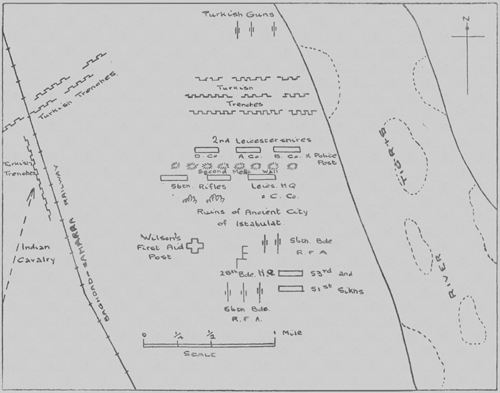
Battle of Istabulat Mounds the Position at Noon April 22nd
Verbal orders came from Division. They were just 'Push on vigorously.'
With it was coupled an assurance that there was nothing against us,
that the enemy was fleeing, thoroughly demoralized.
We moved on. From across the Tigris guns boomed steadily. Distant
glimpses of river showed shoals, islands, spaces green with
cultivation. An enemy plane, reconnoitring, was shot down, and pilot
and observer killed. This incident had an important influence on the
battle which followed. Even at this stage of the campaign, we fought
in Mesopotamia, both sides, with the most exiguous number of planes.
The Turks having lost their best machine and pilot, our old friend
Fritz, feared to risk another. Hence, when the mounds of the ancient
city of Istabulat lay across our front, the hostile observation was
from the ground in front and from our left flank only. And we were
enabled to pass through a depression, whilst his fire went overhead,
and so into the mounds.
We passed a 5.9 disabled by a direct hit and nearly buried. The bare
country was cracked with nullas, some of them deep. Then we opened
into artillery formation, and entered utter desert. In front were
innumerable mounds, a dead town of long ago. We went warily, with that
quiet expectation, almost the hardest of all experiences to endure, of
the first shell's coming. The official message was that the enemy was
incapable of serious opposition. But of this the rank and file knew
nothing; had they known, old experience would have made them
sceptical. Fowke's view, that all would prove to be for the worst in
the worst of all possible worlds and arrangements, was the reigning
philosophy. An adapted edition of Schopenhauer would have sold well
in the mess (or anywhere in Mesopotamia). Novelists speak of the hero
being conscious that eyes, in the forest or in his room at night (as
may be), are watching, watching. This knowledge governs the feeling of
'going in artillery formation,' with the added knowledge that, though
in broad sun, you cannot hope to see your foe, who is certain to
spring on you, and merely waits till you are well under fire.
The bolt fell. About 9 a.m. a double report was heard; then the Cherub
sent back word, 'Four enemy snipers retiring.' By 9.30 firing was
heavy. The Cherub was wounded, and his two scouts killed. The enemy
was invisible, and mirage made ranging impossible. The ground four
hundred yards away was a fairyland that danced and glimmered. When a
target was perceived, of Turks racing back, the orders for fire were
changed quickly, from 'Three hundred yards' to 'fourteen hundred
yards.' Very vainly. This mirage continued throughout the fight. Ahead
was what we called the 'Second Median Wall,' a crumbled wall some
twenty feet high, which ran across the front of the mounds. To its
extreme left, our right, and in front of this wall, was the Turkish
police-post of Istabulat, by which the battle was presently to be
raging.
In those mounds the enemy had excellent cover. Our leading company
followed the scouts, and took possession of the ruins. The 'Tigers'
were arranged in four lines, according to companies, with less than
three hundred yards between the lines. Dropping bullets fell fast,
especially in the rear lines. About 10 a.m. two shells burst about a
hundred yards in front of Wilson and myself. Then Hell opened all her
mouths and spat at us. The battalion lay down and waited.
Twelve-pounder 'pipsqueaks' came in abundance, with a sprinkling of
heavier stuff. Many soldiers prefer the latter. You can hear a 5.9
coming, and it gives you time to collect yourself, and thus perhaps
escape giving others the trouble to collect what is left of you. I
remember once hearing General Peebles say that in his long experience
of many wars he had known only three men absolutely devoid of fear,
'Smith and Brown and—Jones' (mentioning a notorious and most-admired
fire-eating brigadier, a little man in whom bursting shells produced
every symptom of intoxication except inability to get about). Then he
added, 'I'm not sure about Jones.'
It is interesting to notice the different ways in which nervousness
shows. I remember one man in whom was never observed the slightest
emotion amid the terriblest happenings, till one day some one noticed
that whenever he went forward he turned up his jacket-collar, as if to
shelter from that fiery rain. Myself, I hate the beginning of
conflict, and am eager to push well into it and under the
shell-barrage. As there is said to be a cool core in the heart of
flame, so there is a certain cool centre for the spirit where horror
is radiating out to a wide circumference. In the depths one must
surrender one's efforts and trust to elemental powers and agonies, but
in the shallows all the calls are on the 'transitory being' whose
flesh and blood are pitted against machinery. How can the nerves and
trembling thought bear up? Yet they have borne up, even in men quick
with sense and imagination. I felt restless as we lay on the flat
desert listening to the bullets singing by or to a nosecap's leisured
search for a victim, dipping and twisting to left and right till at
last it thudded down. If one must lie still, then company gives a
feeling of security. Fate may have, doubtless has, a special down on
you, but even Fate is unlikely to blow you to bits if the act involves
blowing to bits several of her more favoured sons. So I remember with
amusement my vague vexation with the curiosity that always made my
companion get up and stroll about when under fire, peering round.
Though he went scarcely five yards, it seemed like desertion.
We watched our guns run up to the 'Pimple,' a recently built-up mound
slightly ahead of us, lately used as a Turkish O. Pip, now accruing to
us for the same purpose. The infantry assumed that these wagons and
limbers moving a hundred yards to our right would draw all the enemy's
fire, in which case we, helpless on the flat, would be shelled out of
this existence. But this did not happen; why, I cannot guess, unless I
have correctly traced the reason for that bad observation so marked in
the Turkish gunning all through this day. We were in the slightest
possible depression, with a scarcely perceptible lift on our left and
a steady rise before. Shells plunged incessantly down our left, and
went whistling far beyond us. But comparatively few burst among us;
and the shrapnel burst far too high to do damage.
Our batteries were in position at the 'Pimple.' We rose, marched
through a tornado of noise, right-turned, and went across the muzzle
of our own guns, also in full blast. In front I saw lines of
Leicestershires scaling the slope and melting into the mounds.
My diary notes: 'Men's delight to see river.' We came suddenly upon
Brother Tigris, basking in beautiful sunlight, becalmed in bays
beneath lofty bluffs. In this dreadful land water meant everything; we
had had experiences of thirst, not to be effaced in a lifetime. Away
from the river men grew uneasy. The river meant abundance to drink,
and bathing; everywhere else water was bad, or the supply precarious.
We had been away from the river since that night opposite Sindiyeh. So
not the crashing shells, the 'pipsqueaks' ripping the air like dried
paper, nor the bullets pinging by, prevented men from greeting so dear
a sight. Standing on the beach of imminent strife, in act to plunge,
men cried, 'The Tigress, the Tigress!' Instantly a scene flashed back
to memory from the book so often near to thought in these days: how
Xenophon, weary and anxious with the restlessness and depression of
his much-tried troops, heard a clamour from those who had reached a
hill-crest, and, riding swiftly up to take measures against the
expected peril, found them shouting 'Thalatta, Thalatta.' Seafaring
folk, the most of them, they had caught, far below, their first
glimpse of the Euxine, truly a hospitable water to them, since it
could bear them home.
Wilson dressed his first wounded in sheltered, broken ground, high
above the river. The peaceful beauty of the place is with me still.
Above the blue, unruffled pools green flycatchers darted, and rollers
spread metallic wings. The left bank lay low and very lovely with
flowers and fields. 'I will answer you,' said Sir Walter Raleigh,
asked his opinion of a glass of wine, given as he went to execution,
'as the man did who was going to Tyburn. "This is a good drink, if a
man might but tarry by it."' Wilson left me here with Dobson; but
almost immediately he sent back asking us to rejoin him. Our few
cases, all walking ones, remained in this shelter till such time as
they could fall back, and Dobson and I crossed into the mounds.
It was nearly eleven o'clock. Our leading company had advanced by
rushes to a distance of a hundred and fifty yards beyond the Second
Median Wall. They were within three hundred yards of the main enemy
trenches. Battalion Head Quarters was at the wall, the 56th Rifles
were to the left, the two Sikh regiments a quarter of a mile to the
rear. Machine-gun sections were at the wall, supporting the forward
regiments. The 56th Brigade, R.F.A., had moved up, and were firing
close behind Wilson's new aid-post. Presently two more companies of
Leicestershires were sent beyond the wall, the third in response to a
message that the front line had suffered heavily and were short of
ammunition. Before the final assault, then, the Leicestershires' line,
from the east inland, was D, A, B, these three companies in this
order.
But I am anticipating.
Wilson's A.P. was in a dwarf amphitheatre, and was filling up fast.
Bullets were zipping over from left and front. The enemy position
rested on river and railway, a half-dug position which some six
thousand men were frantically completing when we caught them. Away
beyond Tigris glittered the golden dome of Samarra mosque; Samarra town
and Samarra station, like Baghdad town and station, are on opposite
banks of the river. The station was railhead for this finished lower
line of eighty miles, and in it were the engines and rolling-stock
which had been steadily withdrawn before our advance. Beyond the mounds
the ground dropped and stretched, level but broken, swept by
machine-gun and rifle, torn with shell and shrapnel, away to Al-Ajik,
against Samarra town. Here the Turk resisted savagely. He was ranging
on the wall, which was an extremely unhealthy spot, particularly in its
gaps, and he enfiladed the mounds from the railway. We flung our
fifteen hundred bayonets and our maniple of cavalry at the position.
The one British regiment, the Leicestershires, went in three hundred
and thirty strong, and lost a hundred and twenty-eight men.
Dropping bullets took toll even before we left the mounds. As I came
up to join Wilson a man was carried past. It was Major Adams, acting
second-in-command of the 53rd Sikhs. He had gone ahead of his
battalion to the wall, where a bullet struck him in the forehead. He
died within fifteen minutes, and was unconscious as he went past me.
No man in the brigade was more beloved. He was always first to offer
hospitality. It was he who met our mess when they first reached
Sumaikchah and invited them to come to his own for lunch. I never saw
him but with a smile of infinite kindliness on his face, and I saw him
very often.
Face swift to welcome, kindling eyes whose light
Saw all as friends, we shall not meet again!
Here in the aid-post sat the Cherub, struck at last, a flesh-wound in
his thigh; with many others. Next to him was Charles Copeman,
unwounded, waiting to go forward with his bombers. Presently came
Warren, bright and jaunty as a bird, and carrying his left arm. 'I'm
all right,' said Montag, 'got a cushy one here.' On his heels came
G.A.; his face was that of a man fresh from the Beatific Vision. Much
later, when I had managed to get transport to push him away, I asked
him, 'Got your stick, G.A.?' This was a stout stave on which he had
carved, patiently and skilfully, his name, 'H.T. Grant-Anderson,' and
a fierce and able-looking tiger at the top, then his regiment, then
curving round it the names of the actions in which it had supported
him: Sannaiyat, Iron Bridge, Mushaidie, Beled Station; while
down the line now he was to add Istabulat-Samarra. This famed work
of art he flaunted triumphantly as he climbed into the ambulance.
But with these, and before some of them, came very heavy news. By that
fatal wall and on the bullet-swept space before it died many of our
bravest. Hall, M.C., aged nineteen, who looked like Kipling's Afridi:
He trod the ling like a buck in spring, and he looked like a
lance in rest;
Hall fell, facing the finish of our journey and those bright domes of
Samarra, already gilded from the sloping sun. His death was merciful,
a bullet through the heart; 'and sorrow came, not to him, but to those
who loved him.'
The theory was strongly held in the Leicestershires that the only way
was to advance steadily. This weakened the enemy's morale, and,
further, he had no chance to pick out his ranges accurately. To this
theory and practice of theirs they put down the fact that, though in
the forefront of all their battles, their losses were often so much
slighter than those of units that had acted more cautiously. I quote
again from Hasted's brilliant lecture on the battle:
There was no hesitation about the advance. Rushes were never more
than twenty yards, more often ten to fifteen yards, as hard as
one could go, and as flat as one could lie, at the end of it. The
theory, 'the best way of supporting a neighbouring unit is to
advance,' was explained at once. The attention of the enemy's
rifles and machine-guns was naturally directed to the platoon or
section advancing, even when they had completed their rush.
Directly one saw a party getting slated, one took advantage of it
to advance oneself, in turn drawing fire, but taking care to
finish the rush before being properly ranged on. One seldom
halted long enough to open covering-fire, and besides, there was
nothing to fire at. Despite the very short halt, it is no
exaggeration to say that I have seen men go to sleep between the
rushes.
Shell-bursts provided excellent cover to advance behind.
Individuals, such as runners, adopted a zigzag course with
success; we lost very few. Platoons and companies got mixed, but
it was not difficult to retell off. Perhaps control was easier
owing to very little rifle-fire from our side and the majority of
enemy shells landing on the supports. There was no question of
men taking insufficient cover; they melted into the sand after
five minutes with an entrenching tool, and during the actual
advance they instinctively took advantage of every depression.
Officers had no wish to stand up and direct; signallers lay flat
with telephones. Stretcher-bearers did not attempt to work in
front of the wall. Lewis-gunners suffered; they carried gun and
ammunition on the march (there were no mules), and the men were
tired; their rushes were not so fast as the platoon advances.
To G.A., lying waiting, before he was hit, came up his sergeant and
said, 'That's Mr. Hall over there, sir. I can see him lying dead.' But
G.A. had thoughts which pressed out even grief for his dead friend. 'I
shall find time, Cassius, I shall find time.' Shakespeare might have
added these men to those Time stood still withal. For over four hours
they lay, within three hundred yards of their invisible foe, under the
sleet of bullets. McInerney told me afterwards that it was the
heaviest rifle-fire he had known, except the Wadi.[13] The Wadi was
the one which made the deepest impression of horror, of all those
dreadful and useless slaughters in Aylmer's and Gorringe's attempt to
relieve Kut—made this impression, that is, so far as (to paraphrase
Macaulay) there is a more or less in extreme horror. And McInerney
had seen the 1915 fighting in Flanders. Fortunately the enemy kept
most of his shells for farther back. We got plenty in the ruins. But
by far the greatest number went far back, where he supposed our
reinforcements were coming up. All afternoon we worked in the aid-post
under a roof of shells, screaming in both directions, from the enemy
and from our own guns. In front the enemy watched the ground so
closely that G.A. got his wound by the accident of raising his elbow.
But now, as it drew towards noon, there was a clatter as of old iron
behind him, and Service, the machine-gunner, rushed up and erected his
tripod and lethal toy. No man was more popular than Service in normal
times. But to-day he and all his tribe stirred the bitter enmity that
Ian Hay tells us the trench-mortar people aroused in France. 'Go away,
Service,' his friends entreated. But Service stayed, a fact which
precipitated G.A.'s next short rush forward.
On the left the three Indian battalions did a holding attack, pushing
out from the wall. They lost heavily. The 53rd Sikhs lost their
Colonel (Grattan), their second-in-command (Adams), their adjutant
(Blewitt), their quartermaster (Scarth), all killed or died of wounds.
The last-named, a very gallant and lovable boy, died in my own
aid-post, which he reached after nightfall. On the right Graham, of
the machine-gunners, won the V.C. For this battle he was attached to
the 56th Rifles. In the advance from the mounds and the heavy fighting
on the left all his men became casualties. His gun was knocked out,
and he was wounded. McKay, his second-in-command, was hit in the
throat, and died. Graham then went back for his other gun. This also
was knocked out. Meantime he had collected two more wounds. Compelled
to retire, he disabled his second gun completely; then he carried on
with the Lewis-gun, though very short of ammunition, till a fourth
wound put him out of action. Single-handed he held up a strong
counter-attack from the Turks massing on our left. Had these got
round, the Leicestershires would have been cut off. It is satisfactory
to be able to say that he survived, with no worse hurt than a scar
across his face.
Before noon Wilson asked me to take charge of the aid-post. Dobson
remained with me; Wilson and Whitehead went up to the wall and
established a new A.P. With me were left many stretcher-cases. In the
confused character of the ground my place quickly developed into an
independent aid-post, and, in addition to receiving a stream of
walking cases, methodically passed down by Wilson, had some hundred
and thirty wounded, including Turks, who had no other treatment than
such as Dobson and I knew how to give. I had never bandaged a man
before, but my hands grew red to the elbow. Dobson worked grandly. As
far as possible I left our own men to him, and dressed wounded Turks,
of whom seventy were sent in late in the afternoon. This was on the
fiat experimentum in corpore vili principle, as my fingers were
unskilled, and yet the work was very great.
About noon a gun was heard on the left bank of the river. Shrapnel
burst 'unpleasantly close,' says Hasted, 'to our front line. More
followed, and, after bracketing, seemed to centre about two hundred
and fifty yards in front of us. We then realized that General
Marshall's Column had joined in, supporting us with enfilade gunfire;
we were unable to see their target, and could see nothing of the enemy
trenches. We could make out single occasional shivering figures moving
laterally in the mirage. One Turk was seen throwing up earth, standing
up now and then to put up his hands to us. We tried him at ranges of
three hundred to twelve hundred yards, but did not even frighten him;
observation was absurdly difficult. Firing slackened down, but on the
left, out of sight in a depression, we could hear the 56th engaged.'
As Hasted remarks, it seems incredible that our men lay from 11 a.m.
till 3.30 p.m. within three hundred yards of the enemy's trenches. Yet
such is the fact.
At 4 p.m. we put down a concentrated bombardment of twenty minutes.
The Leicestershires, a forlorn and depleted hope, moved swiftly up to
within assaulting distance, C Company in reserve behind the right. The
51st Sikhs supported the attack. The 56th Rifles put down the heaviest
fire they could, of rifles and all the efficient machine-guns with the
Brigade. At 4.20 the guns lifted one hundred yards, and the
Leicestershires rushed in. Hasted, watchful behind with C Company,
pushed up rapidly to assist the front line. A long line of Turks rose
from the ground. All these, and the enemy's second line also, were
taken prisoners. Dug-outs were cleared, and many officers were taken,
where lofty cliffs overhang the Tigris. These prisoners were sent back
with ridiculously weak escorts. They were dazed, their spirits broken.
G.A., wounded and falling back in search of the aid-post, came on a
large body, wandering sheep without a shepherd. These he annexed, and
his orderly led them; he himself, using the famous stick as a crook,
coaxed them forward. Prisoners came, ten and twenty in charge of one
man. When night had fallen, they sat round us and curiously watched
us. Altogether the 'Tigers'—hardly two hundred strong by now—took
over eight hundred prisoners. Many of these escaped by reason of the
poverty of escort.
But I will not speak of prisoners now. Whilst our scanty stock of
ammunition was being fired at the Turks, retiring rapidly, the
Leicestershires were pushing far out of reach of telephone
communication. 'Limited objectives were not known in the open
fighting.'[14] To Captain Diggins fell an amazing success. Suddenly
there were flashes almost in his face. 'Guns,' he shouted, and rushed
forward. On and on he rushed, till he reached the enemy's guns, he and
three of the men of A Company, which he commanded. These guns were in
nullas by the river-bank. Their crews were sitting round them. Diggins
beckoned to them to surrender, which they did. He was so blown with
running that he felt sick and faint. Nevertheless he recovered, and
rose to the occasion. To us, away in the aid-posts, came epic stories
of 'Digguens,' with the ease and magnificence of Sir Francis Drake
receiving an admiral's sword, shaking hands with the battery
commander. He is a singularly great man in action, is Fred Diggins. In
all, from several positions, Diggins took seven fourteen-pounders and
two 5.9's. They were badly hit, some of them. The horses were in a
wretched condition, none of them unwounded. Several were shot by us
almost immediately. Diggins sent his prisoners back, battery
commanders and all, in charge of Corporal Williamson and one private.
On his way back, after delivering up his prisoners, Williamson was
killed.
Very soon on Diggins's arrival his subalterns, Thorpe and McInerney,
joined him. He sent them racing back across the perilous mile which
now lay between them and the wall. Thorpe went to Lieutenant-Colonel
Knatchbull, and McInerney to Creagh, the second-in-command this day.
All did their best to get reinforcements. The two other brigades,
however badly hit the previous day, were now close up. The 19th
Brigade, becoming aware of the situation, eagerly put their services
at our disposal. After the action the official explanation of the loss
of the guns was that the Leicestershires got out of hand and went too
far; so I was told in the colloquial language which I have set down. A
nearer explanation is that they went because of over-confidence
somewhere back. Night was falling, and the guns already gone, when
reinforcements from the 19th Brigade came past my aid-post and asked
me the direction. Had the guns been kept, I verily believe at least
one V.C. would have come our way, for Diggins, and M.C.'s for his
lieutenants. As it was, Diggins got an M.C. and Thorpe a 'mention.'
Nothing came to McInerney, who was one of the many soldiers who went
through years of battle, always doing their duty superbly, but
emerging ribbonless at the end. Six months later, at Tekrit, these
guns took a heavy toll from our infantry. Now, after all effort,
scarcely fifty men could be got up to them.
In these exalted moments of victory glorious almost beyond belief
Sergeant-Major Whatsize fell, twenty yards from the enemy's line. In
his last minutes he was happy, as a child is happy.
The handful at the guns waited. A large barrel of water had been put
there for the Turkish gunners. This was drained to the last drop. The
guns were curiously examined. 'Besides the intricate mechanism and
beautifully finished gear, there were some German sextants and
range-finders, compasses like those on a ship's binnacle, and other
instruments on a lavish scale,' says Hasted. But this inspection was
cut short, for now came the counter-attack. The Turks began to shell
the captured gun-position. Then, from the railway-embankment, nearly
a mile to the Leicestershires' left front, several lines of Turks
emerged, in extended formation, a distance of fifty yards between each
line. At least two thousand were heading for the fifty Leicestershires
holding the guns. 'It was like a crowd at a football-match,' a
spectator told me. Diggins sent word to Lowther, commanding B Company,
a little to his left rear, 'The Turks are counter-attacking.' Lowther
replied that he was falling back. Diggins and Hasted fell back in
conformity. Hasted was asking his men how many rounds of ammunition
they had left. None had more than five rounds, so perforce we ceased
fire. The 51st Sikhs, with the exception of Subahdar Aryan Singh and
two sepoys, had not appeared. The Leicestershires damaged the guns as
they might for half a dozen fevered, not to say crowded, minutes of
glorious life. Hasted, who was one of those who enjoyed this
destruction, complains that they did not know much about what to do;
they burred the breech-block threads and smashed the sights with
pickaxes. The Mills bombs put in the bores did not explode
satisfactorily. Then they fell back. One of the sergeants was hit in
the chest, Sergeant Tivey, a Canadian; he was put on one of the
Turkish garrons and led along. 'From the attention he received from
the enemy's guns, they must have thought him a Field-Marshal.'[15] The
Turks, for all their force, crept up timidly. After securing the guns,
they raced to Tekrit, thirty miles away. But they sent a large body in
pursuit of the retreating 'Tigers.'
The Leicestershires fell back rapidly, the enemy pressing hard. The
51st Sikhs were found, hidden by the hollows of the ground; they had
been a buttress to the left flank of that handful of adventurous
infantry in their forward sweep into the heart of the Turkish
position. It was now that Graham and the 56th Rifles checked the
counter-attack, which threatened to drive a wedge between the
Leicestershires and the river. The whole front was now connected up,
and, in face of an attacking army, British and Indians dug themselves
in. The 51st sent along some ammunition. The sun was setting, and in
the falling light the last scene of this hard-fought day took place.
Turkish officers could be seen beating their men with the flat of
their swords. The enemy came, rushing and halting. The sun, being
behind them, threw a clear field of observation before them; but over
them it flung a glamour and dimness, in which they moved, a
shadow-army, silhouettes that made a difficult mark. And our men were
down to their last rounds of ammunition. Our guns opened again, but
too late, and did not find their target. But the Leicestershires'
bombers, sixty men in all, were thrown forward, bringing ammunition
which saved the day. Thirty of the sixty fell in that rush. The Turks
were now within two hundred and fifty yards; but here they wavered.
For half an hour they kept up a heavy rifle-fire. Then, at six
o'clock, the 19th Brigade poured in, and the thin lines filled up with
Gurkhas, Punjabis, and Seaforths. Moreover, the new-comers had
abundance of ammunition. Darkness fell, and our line pushed forward.
For over two hours we could hear the Turks man-handling their guns
away. But there were strong covering-parties, and our patrols were
driven back with loss. Our guns put down a spasmodic and ineffectual
fire. Then all became quiet. All along the enemy's line of retreat and
far up the river were flares and bonfires. Away in Samarra buildings
were in flames, and down the Tigris floated two burning barges, of
which more hereafter.
I cannot speak as they deserve of the gallant work of the Indian
regiments. The severity of their losses is eloquent testimony.
'Boomer' Barrett came down the field, shot through the face,
cheerfully announcing his good luck: 'I've got a soft one, right
through the cheek.' I have spoken of the 53rd Sikhs. They lost their
four senior officers, killed. But every regiment had brave leaders to
mourn. One thinks with grief and admiration of that commander, a noble
and greatly beloved man, whom a bullet struck down, so that he died
without recovering consciousness several days later. Though the body's
tasks were finished, his mind worked on the fact that his men had been
temporarily checked, and he kept up the cry, 'What will they say in
England? The —— fell back; —— failed them.' Even so, when duty has
become life's ruling atmosphere,
One stern tyrannic thought which makes
All other thoughts its slave,
it matters little that the body should fail. The mind labours yet,
fulfilling its unconscious allegiance.
He went, unterrified,
Into the Gulf of Death.
In my aid-post we carried on, secure beneath our canopy of racing
shells. The slope gave cover against 'over' bullets, except when it
was necessary to walk about. Early in the afternoon, during a lull, a
doctor appeared and asked if it was safe to bring up his ambulances. I
told him 'Yes'; there were dropping bullets, but very little
shell-fire. He replied that he would come immediately. But the supply
of shells greatly quickened, and he did not appear again till near
darkness, when he brought two motor ambulances, taking five sitting
and four lying cases in each. He promised to return, but did not.
Apart from these eighteen, only the walking wounded got away, pushing
back into our noisy and perilous hinterland.
About four o'clock the Turks, in reply to our intense bombardment, put
a brief but terrific fire on the mounds, blowing up men on every side.
I decided to clear out to where, round the corner, an old wall gave
upright shelter. As our first exodus swung round, a huddled, hobbling
mass, two 'coal-boxes' burst in quick succession, each closer than the
last shell before it. I shouted 'Duck!' We ducked, then made a few
yards and ducked for the second time. A perfect sleet of wind and
steel seemed to pass overhead. But no one was hit, and we were round
the corner, where, I fear, I dropped the Cherub with considerable
emphasis on his gammy leg. But indeed we were very lucky. Shells burst
on every side of the aid-post—on right and left, but not on us. This
was one of the rare occasions when I have felt confidence. Dobson and
I were far too busied to worry. Also it seemed hard to believe that a
shell would be allowed to fall on that shattered, helpless suffering.
I saw, without seeing, things that are burnt into memory. We had no
morphia, nothing but bandages. There was a man hit in the head, who
just flopped up and down, seemingly invertebrate as an eel, calling
out terribly for an hour till he died. Another man, also hit in the
head—but he recovered, and I afterwards met him in Bombay—kept
muttering, 'Oh those guns! They go through my head!'
A large body of prisoners was massed in the hollow beside us. When
these marched off, some seventy wounded were sent to me, under the
impression that the place was a regular aid-post. They were horribly
smashed. General Thomson's Brigade (14th Division) had enfiladed them
with artillery fire from the other bank, with dreadful effect. He got
into their reserves, their retreat, their hospitals, and broke them
up. In one place his fire caught a body of Turks massing for a
counter-attack, beneath big bluffs by the water, and heaped the sand
with dead and maimed. These men came with their gaping wounds and
snapped limbs. Private Clifton, a friend of mine, brought bucket after
bucket of water from the river. They drank almost savagely. My
inexpert fingers hurt cruelly as I bandaged them, and they winced and
cried. But the next minute they would stroke my hand, to show they
understood good intentions. They had a great belief in the superiority
of our civilization—at any rate in its medical aspect. They insisted,
those who had been bandaged by the Turkish aid-posts, in tearing off
their bandages—perfectly good ones, but smaller than ours—and on
having new bandages from me. Just when the 5.9's blew us round the
corner, Waller, adjutant of the 56th Brigade, R.F.A., came up and
asked if I could send any one to look at some men just hit by the
tornado. Mester Dobson was as busied as a man could be, his inevitable
pipe in his mouth, so I went with Waller. One man was breathing, his
head broken behind; the others were dead. Beside one of the corpses
was a red mass. I saw, noting the fact automatically and without the
least squeamishness, that it was his brains. We carried the living man
in.
In the darkness Dobson came and said. 'There's a wounded officer just
come in. I've given him a drink and dressed him.' A minute later he
said, 'That officer's dead, sir.' I went across, and found it was
Scarth, of the 53rd. No braver spirit went out in this day of storm
and sorrow than this very gallant boy. He was aged nineteen.
Night fell, and slowly o'er the blood-bought mile
They brought a broken body, frail but brave;
A boy who carried into death the smile
With which he thanked for water that we gave.
Steadfast among the steadfast, those who kept
The narrow pass whereby the Leicesters swept,
Amid the mounded sands of ancient pride
He sleeps where Grattan fell and Adams died.
I know his father, and the Himalayan oaks and pines amid which he grew
to manhood. Men looking on Scarth loved him. The freshness of his
mountain home and his free, happy life clung to him to this end, amid
the tumults and terrors of our desert battle.
The son of Hyrtacus, whom Ide
Sent, with his quiver at his side,
From hunting beasts in forest-brake,
[95]
To follow in Æneas' wake.[16]
At dusk Wilson came. He had been toiling away, exposed and close up to
the fighters, as always—there never was a braver regimental medical
officer—and he now asked me to be responsible for getting his wounded
away, whilst he searched the battlefield. So all his cases were
evacuated into my place. At the same time many chits reached me,
addressed to the O.C. Clearing-Station. As there was no such person, I
opened these. The regimental aid-posts were pressing to be cleared. My
own place had men from seven different regiments, British and Indian,
as well as Turks, and Wilson was sending more along. So I found
McLeod, and we 'phoned down to the field ambulances. These were
congested from yesterday's battle and to-day's walking cases, and
replied that nothing could be done till dawn. But we were so insistent
that about midnight bullock-carts turned up, and I got fifty wounded
away. The 'cahars,'[17] in their zeal to remove all kit belonging to
the wounded, carried off my water-bottle, haversack, rations, and
communion-kit. But before this I had been down to the Tigris in the
darkness, and drunk like a wounded wolf.
To return to the battle as it died away. The Forward Observing Officer
with the Leicestershires sent word back that fourteen guns (instead of
nine) had been taken. The news was exultantly forwarded to Corps H.Q.
When the case proved to be nine only, and those nine lost again, the
message was allowed to stand, the authorities hoping against hope that
the guns would walk back into our possession. And Fortune was very
good to them. Those guns, indeed, came not back; but, as darkness
fell, two burning barges, as already mentioned, floated down the
river. One was exploding, like a magazine on fire. This contained
ammunition. The other barge, when pulled to shore, was found to
contain fourteen field-guns, the number specified to Corps—old guns,
but serviceable. Johnny, despairing of getting these away, had set
fire to the barge to sink them. So the original message stood, and our
loss could be glossed over. And the wastefulness of sinking quite good
guns was avoided.
The night was sleepless, bitterly cold. Dobson and I kept a watch for
Arabs. I sat beside a dead man, and shared his oil-sheet. A few more
wounded came in after midnight, among them Sergeant Tivey. All night
long wounded Turks crawled the battlefields and cried in the cold. But
I heard none of them, for there were groans much nearer. Our unwounded
prisoners were crowded into a nulla. Among them was the Turkish
Artillery Brigade Commander, who knew some English and kept insisting
on a hearing from time to time. But all he ever said was, 'Yes,
gentlemen, you have got my guns, but, what is far worse, you have got
me.' Had we cared, we might have cheered him with the information that
we had not got his guns, but only himself. Yet, considering the
relative value, in his eyes, of himself and these, such information
would hardly have consoled him.
In this battle occurred a case of a man being 'fey.' An officer gave
his kit and money to his batman, for distribution to his platoon, the
previous night. As he went into action a friend exchanged greetings.
He replied, 'Yes, but I'm afraid I'm not coming back to-day.' No one
saw him fall, but he was found dead in the mounds, with several
wounds.
The east was reddening when I saw Haughton, Staff-Captain of the 19th
Brigade, on the hillock above the aid-post. This Brigade H.Q. were my
best friends in the division. I begged a mug of tea from him, so we
went along together. I found General Peebles and Brigade-Major
Thornhill, and they gave me an excellent breakfast.
The 28th Brigade moved on, following the 21st Brigade, who occupied
Samarra. But the wounded remained. Shortly after dawn the medical
folk, in fulfilment of their promise, sent up an ordinary motor-car
and took away two sitting cases. Nothing else happened. Time passed,
and the heat was getting up. So I wandered back some miles, and found
hospital-tents. Here was Father Bernard Farrell, the Roman Catholic
padre, slaving, as he had done all night. I saw Westlake, and Sowter,
who was dying. 'It's been a great fight, padre,' said Sowter, 'a great
fight. I'm getting better.' No loss was felt more severely than that
of this quiet, able man. He had seen much fighting in France, and in
this, his first action with us, he impressed every one with his
coolness and efficiency. He had walked across to Lowther, his company
commander, to draw his attention to a new and threatening movement of
the enemy. Then, as he stopped to bandage a wounded sergeant, a
bullet pierced his stomach. The same bullet, leaving his body, went
through both legs of Sergeant Lang, the one bullet making six holes.
Sowter had been with us one week. I never knew any one whose influence
went so deep in so brief a time.
Our seven-days' guest, he came and went his ways,
Walking the darkness garlanded with praise!
Our seven-days' guest! Yet love that this man gained
Others have scarce in three-score years attained.
The hospital-tents were congested with wounded, and the responsible
officer declined to take any more. They had no more stretchers, all
being used as beds, and no more space. Fortunately an order came from
Division that they must immediately remove some wounded Turks. I said,
'I have some wounded Turks.' 'Yes, but I'm afraid those aren't the
Turks meant.' 'Well,' I replied, 'I've been up all night, and I'm very
footsore. You might at least give me a lift back.' This was conceded,
and I returned in the first of five motor-ambulances. The
corporal-in-charge had no idea where he was to find the wounded Turks,
so I swept him into my place. This I cleared of every one but a few
horribly wounded prisoners, and sent on a note to the M.O. of the 51st
Sikhs.
The previous day two wounded Turks, a machine-gun officer and a Red
Crescent orderly, had arrived in the aid-post. The latter helped nobly
with the wounded, so I had a note sent down with them, that they had
earned good treatment. The officer had a friend from the same military
college in Stamboul, which friend had a ghastly shell-wound in his
back. What happened, I think, was this. When his friend was knocked
out, the unwounded officer—they were both boys, well under
twenty—brought up a medical orderly. All three were then overwhelmed
by our rush, and in the confusion the unwounded men kept with the
other, to see that he got treatment when opportunity came. So they
slipped into my aid-post, where they stopped all night, making no
offer to escape. I sent a message to Brigade, but their reply, a
verbal one which did not reach me till next evening, was that they had
better stay where they were. The unwounded officer's silent anxiety
for his friend was most touching, and I pushed the latter away with
the midnight convoy. Next morning I sent both officer and orderly to
the nearest prisoners' camp; but the sergeant-in-charge returned them,
with word that he took only wounded prisoners. So I had to keep them.
Weir, the staff-captain, joined me, and we talked to the officer in
French while we waited for the divisional second line to come up. We
were puzzled as to why the Turks left a position so strong as
Istabulat before being actually driven out. The officer's reply was,
'Because of the tiar' (aeroplane). I cannot follow this, unless,
misunderstanding us, he was referring to this second day's fight and
the aeroplane brought down at the beginning. Perhaps, being afraid to
send up any other 'planes, they were deceived as to our number. He
insisted that we had had three divisions in action, and was mortified
when we told him the truth.
The sun was getting very hot, and, since no more ambulances came, we
were troubled for the few pitifully smashed Turks who still remained.
We got covers of sorts for them, though we could not prevent the flies
from festooning their wounds. 'It's up to us to do our best,' said
Weir. 'We shouldn't care for it if our wounded were left by them.' In
the afternoon ambulances began to arrive, and I evacuated these few
and saw the evacuation of the Indian regimental A.P.'s commence. My
dead were buried, and their graves effaced, so far as possible,
against prowling Buddus. The second line arrived, so my prisoners and
I set out on our tired trudge to Samarra. I told the Turks of our
Somme successes (as we then took them to be) and our more recent March
victories in Flanders, pointing out the big improvement. 'In the
beginning we had little artillery, but now we have much.'
'Beaucoup,' he repeated, with conviction. In every way one spared a
brave enemy's feelings. Last year they had won; now it was our turn.
'That is so,' said he. This thought comforted him, and the memory of
their great triumphs before Kut in early 1916. Did he not wear a medal
for those days? 'Pour le mérite,' the orderly proudly told me. I
begged scraps of biscuits from men on the march, and we shared them. I
expressed regret for this march on empty stomachs. 'C'est toujours la
marche,' said the officer, shrugging his shoulders. Truly, it must
have been; a nightmare of rapid movement and sleeplessness even for us
who pursued—hammer and chase ever since Maude broke up the Turkish
lines before Kut.
As we marched I found that the Indians took us for three prisoners and
not two, I being a German officer. But when J.Y. cantered up and
hailed me, a laugh ran down the column, with the words 'Padre Sahib.'
At Samarra the first person we ran into was General Peebles, to whom I
handed over my prisoners, with a request that they should be fed.
Haughton promised to see to this. Then a pleasant thing happened. The
Turkish officer stepped quickly up to me, saluted, and held out his
hand. I saluted back, and we shook hands. They were good fellows, both
officer and orderly, and carried themselves like free men.
It was now 5 p.m. I joined the 'Tigers.' Fowke and Lowther had each
killed a snake after laying their blankets down. They gave me good
greeting. I fed and washed, then slept abundantly.
For the two Istabulat battles the official return of captures was:
Twenty officers and six hundred and sixty-seven men, one 5.9, fourteen
Krupp field-guns, two machine-guns, twelve hundred and forty rifles, a
quantity of hand-grenades, two hundred rounds of gun-ammunition, five
hundred and forty thousand rounds of rifle-ammunition, four limbers,
sixteen engines, two hundred and forty trucks, one crane, spare wheels
and other stores, two munition barges. Samarra Station was dismantled,
but the engines and trucks were there. Up to the last the Turk had
meant to keep the railhead, so the engines were only partly disabled,
boilers having been removed from some and other parts from others. By
putting parts of engines together we got a sufficiency of usable
engines. Within a fortnight we had trains running.
For the battle of the 22nd both Diggins and Lowther got M.C.'s. If it
was the former's élan which carried our wave into the enemy's guns,
the latter's judgement played a great part in extricating us without
disaster. Hasted, the alert and watchful, had already been gazetted
after the fall of Baghdad as D.S.O. He left us shortly after,
returning to his own regiment, the Durham Light Infantry, in India. In
Rawal Pindi he delivered a lecture on the action in which he had
played so brilliant a part.
It would be interesting to know if Hasted has ever had an enemy. His
personal charm is almost greater than any man has a right to have,
especially when the Gods have already made that man an able soldier
and administrator. But it is an unfair world.
These awards were announced in a Gazette nearly a year later. To
Sowter, had he lived, would have fallen a third M.C. Fowke, as well as
Thorpe, got a 'mention,' of which he was utterly unaware, being away
sick, till I ran into him in Kantara[18] in 1918, about eleven o'clock
at night. I roused him from sleep for a chat. When I told him of his
'mention,' he considered that I was making a very successful attempt
to be humorous, and laughed himself to sleep again. At intervals till
dawn I heard him still laughing in his dreams at a notion so
ridiculous.
I hope that some other will tell of the deeds of the Indian regiments.
Even more I hope that some one will tell, as I cannot, of the gallant
and costly charge which our cavalry made on the Turkish trenches to
our left, a charge which staggered the enemy as he swung round to cut
off the Leicestershires. The 32nd Lancers lost, among others, their
Colonel (Griffiths) and their Adjutant (Captain Hunter), killed.
These two days' fighting at Istabulat and for Samarra cost us about
two thousand four hundred casualties. The 28th Brigade, on the 22nd,
lost four hundred and forty-six men. The enemy's losses, including
prisoners, must have been at least three thousand.
My one note for April 24 is 'Flies.' It was high summer, and in the
terrible and waxing heats we lay for over a month longer, with no
tents, and with no shelter save our blanket-bivvies. We were the more
wretched in that we occupied an old enemy camp, and were entered into
full possession of its legacy of filth and flies. On the first Sunday
my morning service was swathed in dust, one swirling misery, and I was
sore tempted to preach, foreseeing the days to come, on 'These are but
the beginning of sorrows.'
Samarra was entered on April 23, the 21st and 8th Brigades going
through the 19th and 28th Brigades. These brigades followed during the
course of the day, and the ridge of Al-Ajik fell into our hands. From
Samarra northwards high bluffs run with the river, pushing out to it
from plateaus stretching across the heart of Jezireh and climbing
again beyond the river to the Jebel Hamrin. Below the bluffs are wide
spaces of dead ground, beds which the Tigris has forsaken. On the
right bank, before the dead ground begins and directly opposite
Samarra town, is a plain some ten or dozen miles in length, between
the mounds of the battle of April 22 and the crest of Al-Ajik; this
plain may be three miles broad. Al-Ajik covers and commands all
approaches from the north, and, with the central plateau, shuts the
plain within a crescent. Here, behind Al-Ajik, lay our camp for the
next seven months.
North from Al-Ajik the plateau rolls away to Tekrit, and the same
rolling country lies to westward also, broken with nulla and
water-hole. To Tekrit, more than twenty miles beyond, the Turkish Army
fled.
Samarra is a dirty, sand-coloured town, with no touch of brightness
but what its famous dome gives it. This dome it was that shone over
against the sunset, the last earthly beauty for so many eyes, on that
evening of savage battle when the 7th Division flung out its leading
brigade and reached, all but held, the Turkish guns. The dome hides
the cavern into which the Twelfth Imam vanished, and from which he
will emerge, bringing righteousness to a faithless world. Just beyond
the dome rises the corkscrew tower, built in imitation of the
Babylonian ziggurats. To the north-east is 'Julian's Tomb,' a high
pyramid in the desert. It was near Samarra that he suffered defeat and
died of wounds. For twenty miles round, in Beit Khalifa, Eski Baghdad,
and elsewhere, is one confused huddle of ruins. It is hard to believe
that such tawdry magnificence as Harun's successors intermittently
brought to the town during the precarious times of Abbasid decay is
responsible for all these arches and caverns and tumbled bricks. Major
Kenneth Mason, already mentioned as having identified Xenophon's
Sittake, has collected good reasons for placing Opis, once the great
mart of the East, at Eski Baghdad, and not where the maps
conjecturally place it, twenty miles farther down Tigris. In summer,
green is none save in patches by the river; but a thin scurf of yellow
grass and coarse herbage overspread the ruins, in which were abundant
partridges and quails. Germans had been excavating before we came, and
we found in the town many cases of antiquities, ready packed for
transport to Europe. The 7th Division, digging their positions,
presently found pottery, glazed fragments, and tear-bottles.
The town is walled, and sits above steep bluffs. Tigris, swift and
clear like a mountain stream, races by, dividing round an island.
Below the town is another island, with an expanse of shingle towards
the right bank; to this island Divisional Head Quarters went, a most
unfair avoidance of the 'dust-devils' which plagued their brethren.
Here were tamarisk thickets, haunted with great metallic beetles, with
such wings as Eastern smiths know how to use. The green bushes were
good to the eyes, and a pleasant curtain from flying sand. But a
sudden rise in the river flushed its shallow right arm, and made the
place an island in reality and all inconvenience. The righteous,
seeing this, rejoiced.
The brigades scattered over the plain, the 8th Brigade going on, after
brief pause, to the ravines and jungles of the Adhaim, where the war
was dying. May's first week swept the Turk out of the Adhaim Valley,
and our troops settled down for the summer.
The brigades scattered; blankets came up, and we slept. For over a
month we had only bivvies, the usual rifle-supported blanket, tugging
and straining at the stones which held it whenever a 'dust-devil'
danced by or a sandstorm arose. But E.P.[19] tents dribbled in. Even
mails began to arrive, and parcels; and to me, on the first day of
ease, came a jubilant telegram from my old friends of the 19th
Brigade: 'Come and have tea with us. We have a cake!' I went, and
found them where the shingles led to Divisional Island. Blue rollers
swung themselves on the air below the cliffs; and on the pebbles an
owl skipped and danced, showing off in the beautiful evening
sunlight. This was a daily performance, Thornhill told me. It had been
General Peebles' birthday, and the brag about the cake was splendidly
justified. There were buns also.
Summer dragged by. In Baghdad pomegranates blossomed, mulberries
fruited, figs ripened. But in Samarra the desert throbbed and
shimmered in the growing and great heats. Worst of all, we missed the
dates. The fresh dates are the one solace of Mesopotamia. My
campaigning recollections are embittered by this memory, that both my
two date-seasons were spent up the line, at Sannaiyat and Samarra,
where dates never came. Till mid-May the nights remained cool.
Mesopotamia's extremes are amazing. After a day intolerable as I have
found very few days in India will come a night, not close and
sleepless as an Indian night, but cool, even cold. In the April
fighting we found the nights bitter. So May gave us a fortnight of
tolerable nights; but then fire settled on the land. The flies all
died. But the infantry had an elaborate trench-system to dig, so they
were not able to die. The ground was solid gypsum.
Changes happened. Generals Peebles and Davies went to India on leave.
The enemy's Intelligence Department, alert as ever, noted the fact,
and gave it out that our losses in the Istabulat battles were even
heavier than they had supposed at first, for two generals had left the
front, casualties. Such a statement was twice blessed: it cheered the
enemy, and cheered us also. In my own brigade Thorpe became
staff-captain, in place of Weir, who went home. To all the
Leicestershires, and to me especially, Thorpe's going was a heavy
loss. 'I could have better spared a better man.' I must henceforth
botanize alone. No longer could he teach young subalterns to 'practise
music'—in the Socratic sense, that the best music was philosophy—to
be repaid with their affectionate regard as 'Daddy.' He wrote to me, a
month after his going, that he was becoming as 'great a horseman as
John Wesley'; and he lost weight during that summer. He lost a good
deal his first week, and in this manner. The Bishop of Nagpur was due
to visit us, and all who had subscribed their religion officially as
'C. of E.' were commanded to brighten belts and buttons for a service
parade on Wednesday at 6 ak. emma. The parade was held, every one
arriving, of course, considerably before the hour. The Divisional
General was there, and many generals and colonels; in fact, every
Anglican of note, except Thorpe, who sent word, about 6.30, that he
had made a mistake, and the service was to be next day, Thursday, at
the same hour. At this announcement a wave of uncontrollable grief
swept over the vast assembly, and for some days Thorpe was a fugitive.
But he returned to normal courses, and in time even this witty
inauguration of his reign was forgiven. But I had many inquiries as to
the tenets of Wesleyanism.
For me, I went sick; recovered; and went sick again, drifting
down-stream, and to India. But first Thornhill, Bracken the
machine-gunner, and I explored Al-Ajik.
Once upon a time the river had washed the foot of Al-Ajik ridge. But
now a long stretch of dead ground intervenes before water is reached.
Local legend says a lady lived here who played Hero to a Leander on
the opposite bank. More obviously, Al-Ajik castle guarded Samarra from
the north. The castle is on steep crags, with vast nullas in front. In
the old days it should have been impregnable. Underneath are very
large vaults, filled with rubbish. As our exploring party came up a
pair of hawks left their eyrie, and circled round us, screaming their
indignation. When the division first reached Al-Ajik, Thornhill said,
a pair of Egyptian vultures (Pharaoh's Chickens) were nesting here.
These had gone. They are rare birds in Mesopotamia, and I never saw
them north of Sheikh Saad. Thornhill had seen Brahminy Duck in a
nulla, so we searched till we found a tunnel. Bracken leading, we got
in some hundred yards, stooping and striking matches, till we came on
a heap of bones. Thornhill surmised a hyena, so we returned, as no one
wished to fight even that, unarmed and in a diameter of less than five
feet. There must be many tunnels leading into the heart of Al-Ajik
fortress; and here, as everywhere on the plateau, were remains of the
most complicated irrigation system the ancient world knew. The castle,
as it stands, has been largely built out of the ruined portions on its
northern face.
Life was scant at Samarra, as poor as it had been abundant at
Sannaiyat. The crested larks were of a new species. Owls nested in the
old wells; and most units were presently owning their owlets or
kestrels or speckled kingfishers, miserable-looking birds. Sandgrouse
were few, but commoner towards the central plateau, where were
water-holes. Gazelles were often seen by pickets, and used to break
across the railway-line, to water at the river. One regiment took a
Lewis-gun after them, and other folk chased them in motor-cars. The
British army, as ever, busied itself, as opportunity came, in its
self-appointed task of simplifying the country's fauna that the
naturalist's work might be easier. Wherefore the gazelles left our
precincts, but still haunted the channels of the Dujail, by Beled and
Istabulat. For most of the year the water-holes sufficed them, the
green, velvet dips, with zizyph-bushes fringing each hollow, which
redeem the desert. Hedgehog quills and skins were common, as
everywhere in Mesopotamia. A vast hedgehog led C Company of the
Leicestershires nightly to their picket-stations. On its first
appearance a man ran to bayonet it, but the officer did not see the
necessity of this, and stopped him. So the urchin lived, and ever
after paced gravely before its friends. Then we had the usual birds.
Storks nested in the town; there were rollers and kingfishers, and a
hawk or two. But the desert, with its starved crop of dwarf thorns,
had no place for bird or animal. Men who saw Samarra after my time
raved of its winter glory, its irises, its grass knee-high, its
splendid anemones. But in summer the land lay desolate. Nothing
abounded but scorpions, mantidae, and grasshoppers.
And nothing happened but the heat. In July, in ghastly heat, men were
expected to take Ramadie. They failed, most of their heavy casualties
being from heat-stroke. But that was the Connaught Rangers and a
Euphrates affair. At Samarra we experienced nothing more dangerous
than Fritz's[20] visits. Once or twice he bombed the station. When
the railway began running, there were two accidental derailments, in
the second of which several men were killed and General Maude had a
narrow escape. By Sumaikchah a British officer and his Indian escort
were waylaid and murdered. The murderers were outlawed; but a year
later the first on our list of the whole gang walked back into
occupied territory and was taken and hanged, despite the wish of the
Politicals to spare him. Of all these events, such as they were, we
heard from Barron—'the bold, bad Barron,' who left the
Leicestershires to take up 'important railway duties' pending the
renewal of fighting.
These matters are dull enough; but no recital can be so dull as the
times were, and we had to live through them. At Samarra the division
worked unmolested through the awful heats, digging the hard ground,
cutting avenues for machine-gun fire, making strong points. Wilson had
gone, but he had an adequate successor in Haigh. Thanks to him, the
Leicestershires established the singular fact that Samarra is the
healthiest spot in the world. One man died, in place of the dreadful
sequence of deaths a year before at Sannaiyat. The division's daily
sick-rate was .9 a thousand! The Leicestershires and the Indian
battalions did even better. And yet we spent the summer in a place
where fresh vegetables were unprocurable, except a most inadequate
supply of melons and (rarely) beans. Djinns scoured the plain, and
at any hour of any day half a score of 'dust-devils' could be seen
racing or sweeping majestically along—each djinn seemed to make
his own wind and choose his own pace—now towering to a height of
several hundred feet, with vast, swirling base, and now trailing a
tenuous mist across a nulla. Our few hens ran panting into the tents,
ejected at one door, only to enter at another. And yet, as I have
said, only one man died—with the battalion, that is—and ridiculously
few went sick. But by Colonel Knatchbull's death in Baghdad the
battalion lost its commander, and the division a very fine soldier.
Wounded at Sheikh Saad in January, 1916, he had returned in time for
the three railhead battles. He struggled on with sickness, refusing to
contemplate a second leave to India, and died at midsummer.
The worst of the heats I escaped. After a spell in Beit Na'ama, the
delightful estuary-side officers' hospital, a tangle of citron and
fig-groves, with vines making cool roofs, and with the Shat-el-Arab
flowing by, I was discharged. Feeling more wretched than ever, I
lingered on at Busra in the poisonous billets, filthy Arab houses,
named by their present occupants 'Flea Villa,' 'Bug Cottage,' 'Muddy
View' (this would be for winter; the world nowhere else holds such mud
as Busra mud). Busra is hateful beyond words; any place up the line is
preferable, except perhaps Twin Canals[21] and Beled. I was to be
returned to duty 'in due course'; but the Transport authorities were
never in a hurry. It was like being slowly baked in a brick oven. I
had spent ten days so, with no prospect of being given a boat
up-stream, when some one told General Fane, the O.C. 7th Division,
that I had been very sick and was waiting to get back to duty. He
said, 'Nonsense,' and sent a wire direct to G.H.Q., insisting that I
be given a month's leave in India. I got it immediately. But for this
action, leave could not have come my way. No division ever had a
kinder O.C. than Fane. He knew every one, and was constantly doing
thoughtful acts such as this.
India, when it found time to give thought to Mesopotamia, chattered of
the tremendous Turco-German offensive which was to sweep down from
Mosul in the autumn. When I returned, at the end of August, all down
the line I found excitement. Only at Samarra itself was quiet and ease
of mind, where old comrades greeted me joyously and introduced
new-comers. There was Fergusson, reputed to have half a century of
ranching and horse-dealing in the Argentine; 'Forty-nine,' said Fowke,
in a delighted whisper, assessing his age. (As a matter of fact,
Fergusson's years were forty-one.) There was 'Ezra' ('Likewise
Beetle,' interpolated Fowke), who had arrived the day I went sick.
'Ezra,' who signed his name as Mason, and was brother of Kenneth
Mason, engineer and archaeologist, got his nickname from a supposed
modelling of his bald dome upon Ezra's Tomb, by Q'urna. Keely,
classical scholar and philosopher, was standing outside his tent,
pondering, as I came up to rejoin the battalion. He called me up, and
asked me earnestly what girl from Greek literature I should like to
have known, even to have had as companion on the Thames at Richmond.
'Nausicaa,' I said. 'Every time,' agreed Keely, brightening up as if
a heavy load had been lifted from his mind, and begged me to have a
drink in her honour. Bale and Charles Copeman were away, by Al-Ajik;
'in the nearest E.P. tent to Constantinople,' G.A. said. Of our
wounded, only G.A. was back. Warren came later; Westlake remained in
India.
Some surprise was expressed that I had returned at all. This was
Thorpe's doing. To explain, I must go back a little. I knew Thorpe
years before the war. We met again in Sannaiyat trenches. His
messmates, who desired to know more of Thorpe's old life, asked me how
we met first. 'I was chaplain of a jail at Peterborough,' I replied.
The statement was received at once; the only head on which further
light was sought was as to the number of years that were deducted from
his sentence for service in Mesopotamia. (Convicts from India who came
out in the Labour Corps to Mesopotamia were remitted ten years.) Now,
during my Indian leave, an old friend found me out and took me to
spend the last days of my Darjiling visit with him. He was, among
other things, superintendent of the prison. I carelessly wrote to
Thorpe on a sheet of paper with the printed heading 'Jail-house,
Darjiling.' Thorpe spent July and August in taking this sheet round
from mess to mess. He blackened my reputation, and opened up a field
of speculation as to the reason of my incarceration. 'No doubt this
man is a murderer, whom, though he hath escaped from the sea'—from
Mesopotamia, say—'yet Justice hath not suffered to live.' He
considered that he was level with me for my Peterborough jail-jape,
and was much cheered.
It took the best part of September to get up-stream and back to
Samarra. When the boat reached Busra, scores of men were prostrate on
the deck from heat-stroke and exhaustion. In the Gulf I had a funeral.
I tried to skip to the finish of the service, with the page shimmering
and jumping before me, but had to hand the book to the captain as I
reeled down. He threw the body over, and every one flew up-deck.
Later, on the up-stream trip, we realized the fact on which all
Mesopotamia agreed, that for sheer horror the deck of a P-boat[22] is
unrivalled. Possibly it is due to the glare from the water, but our
daily temperatures of between 115° and 125° in the shade seemed a
hundredfold higher than they were. Just below Kut we were held up for
several days in a camp; not even Sheikh Saad in the old, bad days was
more cursed with sandflies.
I had for companion on board Kenneth Mason, engineer and
archaeologist. We passed Sannaiyat and the winding reaches where every
earth-scar and mound had a history. Here the Turk had blown up the
ammunition barges, and for hundreds of yards inland the ground was
still strewn with twisted scrap-iron; here he had set his 5.9's on the
balloon, and the evening fishing had been interrupted; here used to be
the advanced dressing-station in the times of trench warfare; here was
Left Bank Group, where our guns had been, the tamarisk thickets and
wheeling harriers, and the old shell-holes on the beach. Those
crumbling sandbanks were Mason's Mounds, and those were Crofton's O.
Pip.[23] Here were Abu Roman Mounds, and here the lines of Nakhailat
or Suwada; here were the Beit Aiessa defences; here those of Abdul
Hassan and E Mounds. It was on that angle that the Julnar grounded
in that despairing, impossible attempt to run the blockade and bring
food to Townshend's men. It was in that scrub that the Turks and
H.L.I.[24] crashed when both sides launched a simultaneous attack.
We passed Kut. The river was low, and the people were growing lettuce,
while they might, on the dried sandbanks. The town front against the
palms showed its shell-holes and caverns, and we remembered how we
used to see the city, from Dujaileh Redoubt, rising up like a green
promontory. From Townshend's first battle there to the day when the
7th Division occupied the lines of Suwada, Kut cost us not less in
battle casualties than sixty thousand men. One makes no computation of
the dead in the old cholera camps by Abu Roman, or in a score of
cemeteries from Sannaiyat and Es-Sinn to Bombay, who perished in that
time when
the shark-tracked ships went down
To Bombay Town.
Kut will be a place of pilgrimage, and deserves to be, even among the
many shrines of this war. From Sheikh Saad to Shumran is one graveyard
and battlefield, a stretch of thirty miles, where over twenty pitched
battles took place, many being British defeats. At Kut itself
Townshend's old trenches can be traced; and in the town are broken
buildings, and, to eastward, the monument erected by the Turks. Across
the river is the Shat-el-Hai and its complicated and costly
battlefields, and the relics of the famous liquorice factory which
Townshend held, and which we took, in 1917, almost last of all. At
Shumran, above the town, is the place of the great crossing. And on
the ribs of sand, when water is low, are liquorice-stacks and
lettuce-beds.
The mud-strips green with lettuce, red with stacks
Of liquorice; shattered walls, and gaping caves:
Beyond, the shifting sands; the jackal's tracks;
The dirging wind; the wilderness of graves.
The evening of September 13, the lofty Arch of Ctesiphon showed for
hours as we toiled along the winding reaches; in the first gold and
chill winds of dawn on the 14th we watched it recede. On the 18th I
reached Beled, 'The Home of the Devil,' as the Arabs call it, where
the Manchesters dragged out a panting existence, battling with
dust-storms. In the station I was shocked to see what vandalism had
been at work. The broken glass had been cleared away; in the tin shed
where we had drunk tea amid the flying shrapnel on that Easter evening
new panes had been put in; the water-tower had been replaced. With
dusk I reached Samarra, and set Keely's mind at rest on the Greek girl
question.
Through October Fritz came daily, photographing. The sole rays in a
dreary protraction of existence were afforded by the Intelligence
Summaries, run by Captain Lang, a versatile and popular humorist.
Deserters reported that at a certain place the enemy's staff consisted
of only one lame Turk and one 'powerful Christian.' The 'powerful
Christian' had to do all the work, and was preparing for a hegira to
our lines. Then we had exchanged prisoners recently, sending back
eight wounded men, one having but one leg. On reaching the Turco
lines, when we offered to give these wounded a further lift of some
miles, the offer was accepted with cringing gratitude. 'Intelligence'
surmised that these wounded might have to walk to Mosul, another
hundred and forty miles, and went into reverie on the situation's
possibilities. 'If the one-legged man has any influential friends in
Constantinople, we may expect to hear shortly of a Turkish Commission
in Iraq.' That was the time when the Report of the Mesopotamian
Commission came out. Though a revelation in England, it did not excite
us, who knew its facts long before. Then letters from the enemy G.H.Q.
to General Maude had had his name and address printed on the envelope.
This, 'Intelligence' thought, was sheer, outstanding swank, to show us
that the Turks had at least one lithograph.
Late in September our second attempt on Ramadie met with complete
success, when General Brooking captured the nucleus of a projected
offensive against us. We by Tigris rejoiced, knowing, too, that our
task, when it came, would be the easier.
The 1st Guides joined the division in place of the 'Bo-Peeps.' The
brigades went out on reconnaissance frequently. September 25 saw one
of these shows, which included a sham fight. The day was very hot, and
Haigh's stretcher-bearers complained of the inconsiderate conduct of
the thirty-one 'casualties.' 'Unfortunately there were no dead among
them.' However, as one S.B. added, 'fortunately a good many died of
wounds.' The 'died of wounds' were formed into platoons, and marched
off the field of action.
The stretcher-bearer who made the remark about the 'died of wounds'
was a particular friend of mine, who had a great gift of happy
phrasing, illustrated in the words I have quoted. Once we had a long
talk about the old battles, and, speaking of a common friend who had
been killed, he observed, 'I do think it dreadful, his being killed
like that—killed outright.' I never got at his notion of what made a
cushy death; probably something Mexican or early mediaeval.
Through October my diary notes little but services and a terrible
lecture on Mesopotamian history, which, from first to last, I
delivered over fifty times. Latterly envious tongues alleged that I
had to ask units for a parade when I gave this lecture. But those who
said this lied saucily and shamelessly.
Night's blackness touched with red;
A cock's shrill clarion ringing;
Clamours for 'ruddy' buckets, Diamond's[25] bray;
Grousing of Johnson[26] tumbled out of bed;
And Fowke's falsetto, singing
'Is it nothing to you?'
So the battalion wakes, to march away
Heaven knows how far into the blue,
Heaven knows how many weary miles to do,
Till stars within some nulla watch us lie,
Worshipping sleep, while the icy hours drag by.
October 22 was the date when Johnny developed unheard-of cheek. His
patrols appeared by the river, one fellow riding along our wire and
slashing it with his sword. Then from 1 p.m. onwards he shelled both
banks of the river, having pushed down from his advanced post at Daur,
a dozen miles away, with a couple of hundred cavalry, several
machine-guns, and light field-guns. The Guides and our cavalry were
reported to have lost men and horses; and G.A., on picket, sent word
that the Turks were digging themselves in. A and C Companies of the
Leicestershires were out all day.
On the 23rd shelling continued, and that evening the division moved
out. At the officers' meeting we were told that a force, estimated at
four thousand Turks and several guns, was digging in. We were to do
twelve thousand two hundred yards north, and then seven thousand five
hundred yards half-right, to get behind them. This was the 28th
Brigade. The 8th and 19th Brigades, starting later, were to make a
frontal attack at 4 a.m.; our brigade were to enfilade the Turk when
bolted; and these united efforts were to drive him into the dead
ground by the river, and there, as the scheme wittily put it, our
artillery and machine-guns would 'deal with him.' Whoever drew up the
plan was not only bloody-minded but oblivious of long experience,
assuming thus that John was such a very simple person.
We moved off just before dark, raising a white dust. Through all our
wide detour there were strict injunctions against smoking, enforced
among the Leicestershires, ignored among machine-gunners and Indian
drivers. Never can night-march have been noisier. At every halt the
mules sang down the whole length of the line; signallers and gunners
clattered past. About midnight a stranger was seen talking to some
drabis.[27] A Leicestershire sergeant, coming up, said, 'Hullo, it's
a bloody Turk.' Hearing himself identified, Johnny turned round and
saluted. He was led to the proper authorities, and proved to be a
Turkish cadet. He was armed with a penknife and a pair of gloves.
The night was bitterly cold. At 3.30 a.m. we 'rested.' We had reached
what in Mesopotamia would be considered well-wooded country, an upland
studded with bushes. Just on dawn we rose, with teeth chattering and
limbs numbed with contact with the cold ground, and moved on. Our
planes appeared, scouring the sky; and a few odd bursts of rifle-fire
were heard about 7 a.m. We had now reached the edge of the dead ground
against the river, and looked down to Tigris, as in later days I have
looked down to the Jordan. The doctor and I were told to set up our
aid-post in a deep nulla there, and wait on events. A report came from
our air-folk that five thousand Turks were on Juber Island, opposite
Huweslet. We moved steadily forward to the attack, steadily but
unbelievingly. Unbelief rose to positive derision, for as we topped a
slight brow we gave a target no artillery could have resisted, yet
nothing happened. 'It's a trap,' said Fowke darkly; 'he's luring us
on.' Why should John lie doggo in this fashion? Nevertheless the
airmen insisted that the Turks were there. So we dug ourselves in, in
a semicircle facing the island, preliminary to attacking it. It was
noon, hot and maddening with flies. The Leicestershires sent scouts
out, who pushed up to Juber Island, and found that there were indeed
five thousand there—five thousand sheep and several Arab shepherds.
On the opposite bank John had a machine-gun, with which he sniped
those who approached the water. He killed mules, and wounded several
bhisties[28] and a sweeper. There were also people sniping with
rifles, and the Indian regiments had casualties. On our side, the
cavalry brought in a prisoner. We had the young gentleman caught at
night, and one other; the 19th Brigade took a fourth prisoner. So we
abandoned the battle, had breakfast at 2.30 p.m., and returned. The
day was wearying beyond conception, yet the men, British and Indian
alike, were singing as they passed Al-Ajik. Samarra camp was a swirl
of dust after the day's busyness; almost a faery place in the last
sunlight.
The next day was dedicated to sleep, and to humour at the expense of
the Royal Flying Corps, to whose mess a sheep's head was voted.
Johnny's leg-pull made him one up. This was recognized, and his action
drew our attention to the undesirability of allowing him to remain at
Daur. On October 31 the 28th Brigade went into the trenches at
Al-Ajik. November 1 was Thursday. Haigh had the misfortune to go very
sick on this day; he left us, and his successor arrived about 4 p.m.
The new doctor fell into my hands, as the battalion was unknown to
him, and he had never been in action.
As we went forward bad news came in, so bad and unexpected that it
seemed incredible, the news of the Italian reverses. This filled us
with profound depression. Our tiny side-show seemed more insignificant
than ever while the European battle was being lost. When word followed
of Allenby's success at Beersheba we did not guess that here was the
beginning of a tide of victory which would ultimately pull the whole
war our way. There was one splinter of light, an absurd joke in
London Opinion which set the Leicestershires chuckling, 'Overheard
at the Zoo.' It is the conversation of Cockney children before the
ostrich cage:
'Sneagle!'
'Snotaneagle. Snork.'
'Snotanork. Snowl.'
'Snotanowl. Snostrich.'
This lent itself to indefinite expansion: 'Snemeu,' 'Snalbatross,'
'Snoriole,' 'Snelephant.'
Report came of the exploit of Marshall at Corps Head Quarters. He had
gone out in a 'lamb'[29] on the other bank of Tigris, almost to
Tekrit, and had shot down thirty horses and a dozen men as he flew
past the enemy lines.
On the evening of November 1 the Al-Ajik trenches were crowded. Fritz
came over reconnoitring, and his surprise was amusing to see. He
checked, wheeled, abandoned all thought of a visit to our camp, and
beetled back, after very elaborate reconnaissance. Then our own planes
flew over, sounding their klaxons and dropping messages, in rehearsal
for the morrow.
At 9.10 the force met at the place of assembly. The 21st Brigade were
to move up the left bank; they are hardly in this picture. On the
right bank the 28th Brigade went first, followed by the 19th and 8th
Brigades. With the column were the 4th and 9th Brigades, R.F.A., two
batteries of the 56th Brigade, and some 4.5 and 6-inch howitzers.
Altogether, including those operating on the left bank, we had eighty
guns.
The night was even colder than the one before the Juber Island farce.
Part of the night I marched with my friends of the 53rd Sikhs, with
Newitt and with Heathcote. Every one anticipated a very hard fight. We
were up against a position which was reputed to be as strong as
Istabulat had been. Before dawn we found ourselves among
ghostly-looking bushes, and lay down for one shivering hour. We had
marched over seventeen miles, with the usual exhausting checks and
halts attendant on night-marching, and we were dead-beat to the wide.
Yet nothing could be finer than the way the men threw weariness away,
like a garment, with the first shells, and went into battle.
Sarcka, the excellent Yank who ran our Y.M.C.A., marched with us,
carrying a camel-load of cigarettes. He was usually called 'Carnegie'
by Dr. Haigh. That classical mind memorized Sarcka's name as meaning
'flesh'; then, since it moved with equal ease in Greek and Latin,
unconsciously transliterated. As we went forward, and a red sun rose
over Tigris, Sarcka remarked: 'The sensation I am about to go through
is one which I wouldn't miss for worlds.' Mester Dobson looked
surprised. I bided my time, knowing how unpleasant the first fifteen
minutes under shell-fire are for even the bravest.
Soon after 6 a.m. the enemy advanced pickets were driven in. We were
advancing in artillery formation over undulating and broken country,
sparsely set with jujube-bushes (zizyphus). A gazelle bounded away in
front of us. At 6.15, says my diary, the first shells came. Our planes
swept along, klaxons sounding, and the sky became torn with shrapnel.
Johnny felt for us who formed the doctor's retinue, felt with an H.E.
bracket, before and beyond us. The advance was extraordinarily rapid,
a race; consequently the doctor's party got the benefit of most of
this early shelling. Fortunately the enemy seemed to have got on to
his old dumps, for his stuff, which came over plentifully enough, was
detonating badly. A shell burst in Lyons's platoon, apparently under
Lyons; yet he walked out of the dust unhurt. The 56th Rifles went
first, advancing as if on parade; this day they rose high in the
Leicestershires' admiration. The 'Tigers' came next; then the 51st and
53rd Sikhs. The enemy was fairly caught by surprise. Fritz, the
previous day, had brought back the first hint that anything was doing;
and, despite that knowledge, it was not expected that march and fight
would come so swiftly and together. If the doctor stopped to bandage a
man, we had to run to keep touch with the regiment. I was worried with
visions of pockets of fifty or sixty wounded awaiting attention. Very
early in the fight we found two men hit with shrapnel, and left them
in the shell-hole. It was suggested to Sarcka that he stay with them,
and guide the ambulances along our track whenever they came. 'No,' he
said sturdily, 'I'm going on.' And go on he did, and was shortly
afterwards distributing cigarettes under heavy fire. Public opinion
had condemned his coming, for the soldier holds that no man should go
under fire unless he has a definite job there. But when he justified
his place by a score of deeds, from cigarette-distributing to
bandaging the wounded, public opinion rejoiced and accepted him, known
for a comrade and a brave man.
Along the plain the enemy had a number of large thorn-stacks, with
sand-bagged seats in their centres. Here had been snipers. These
stacks we avoided; as we did, as a rule, all such things as battalion
head quarters. The colonel of a regiment moves with a small army of
orderlies; his majestic appearance over a brow rarely fails to draw a
few salvoes. The doctor's meinie, therefore, took their way along the
open, avoiding all prominences of landscape and people. I turned aside
to what proved to be a 56th Rifles' aid-post, with a dead horse before
it. Here had been the first Turkish lines. Our guns pushed on very
rapidly, the gunners riding swiftly by and into a large, deep nulla.
We overpassed them again; there was one smart minute or so when half a
dozen 'pipsqueaks' burst in a narrow fault of the ground, scarcely a
nulla, beside us, the steep sides killing the spread of the H.E. The
enemy had been shrapnelling hard along the line occupied by the 56th
Rifles and the Leicestershires. Nevertheless we picked up very few
wounded.
Johnny's shrapnel now began to get wilder still. We found Colonel
Brock, the Leicestershires' colonel, where several wide, big nullas
met. The battalion was digging in, he said. About thirty prisoners
came over a hill behind us. We set up an aid-post, our first
stationary one; Sarcka produced a tin of Maconochie, and we had
tiffin. A few wounded Indians came, the first being a man from whose
pocket-book we extracted a shrapnel bullet. He had no other hurt.
The colonel was puzzled at our few casualties. There had been not only
a good deal of shrapnel, but heavy rifle and machine-gun fire, yet
hardly a man had been hit. The fight was nearly over, so I went back
for ambulances. John was throwing a certain amount of explosive stuff
about, uselessly and recklessly. On my way back I found Owen, of the
51st Sikhs, with a wounded arm. Owen, long ago, lost an eye in a
bombing accident at Sannaiyat. He pluckily returned from India, and
again took over the work of bombing instructor to his regiment.
It was now getting hot, being well past nine o'clock.
In the trenches by the 56th's aid-post there were two Turks, each with
a leg smashed to pulp by H.E. But the most distressing sight was an
enemy sniper on one of the O. Pips already mentioned. Round him were
many used cartridges and bandoliers. He sat among the thorns, eight
feet above ground, with the impassive mien of a Buddha. His face had
been broken by our shrapnel, and his brains were running down it; the
flies were busy on a clot of red brain by his temple. He was one mess
of blood, and very heavy as well as high up. My efforts to lift him
down simply stained my clothes.
About 4 p.m. I was with a doctor, looking at a dead Turk who was a
particularly gruesome sight, with blood still dripping from his nose.
Suddenly appeared a merchant with a camera, who took this Turk's
photo. Not satisfied with this, he proceeded to stage-manage the
place. The ambulance was coming up to remove a wounded Turk. He
ordered it back, then bade it run up smartly, while the man was to be
lifted in, equally smartly. Then he bade the doctor and myself stand
behind the dead Turk aforementioned. When he went, the doctor said,
'Thank God, he's gone.' I took the man, in my carelessness, for
another doctor with a taste for horrible pictures, and it was not till
some time after that I realized he was the official cinematograph
operator, and was merely doing his job. So, somewhere or other, a film
has been exhibited, 'Wounded being collected on Mesopotamian
battlefields.'
Going back to the Turkish sniper, who was still on his stack and had
been overlooked by the cinematograph operator, I found that, in his
agony, he had dug a hole in the thorns, and buried his head; I
suppose, to escape the flies. His legs were waving feebly. It was
right he should be left to the last, as he had no chance of life, and
nothing could be done for him in any way. But never did I feel more
the utter folly and silly cruelty of war than when I saw this brave
man's misery. Next morning he was found to have crawled some hundreds
of yards before dying. He had left his stack.
Our line was where the plateau rose and then dropped steeply into
deep, narrow fissures. The night was maddening with cold, and the rum
ration came as a sheer necessity. All through this brief Tekrit
campaign the British troops were without coats or blankets. The Indian
troops had transport for theirs. The arrangement was correct in
theory, since we came from a chill climate.
None of these later Mesopotamian pushes could be much more than raids.
The rivers in this latitude were too shallow and shifting for
transport, so we had to be fed and watered by means of Ford cars. It
taxed the whole of the army's resources in Fords for Tekrit, blankets
and coats having to give way to rations. Whilst the 7th Division
pushed, the other two fronts were practically immobilized. Maude could
strike on only one at a time of our three rivers. Ramadie was fought
in September; Tekrit in November; Kifri in December; and the same
round, of Euphrates, Tigris, and Diyaleh, was followed in 1918.
So we had ten days of what seemed arctic exposure. This night after
Daur, Diggins shared a Burberry with me; natheless the night was one
of insane wretchedness. We rejoiced, with more than Vedic joy, to
greet the dawn, though the flies swiftly made us long for night again.
On the 3rd we moved slightly forward. My brigade rested, while the
19th went on. The enemy's lines at Aujeh were taken easily. One
wounded Turk was captured. He was set on a horse, and paraded
restlessly back and forward, for some mystic reason, during the day.
Fowke's solution was that the authorities hoped the troops would count
him many times over, and been heartened by the thought that we had
destroyed the Turks' last force in Mesopotamia. When the Aujeh lines
had been taken, our cavalry, supported by the artillery, tried to rush
Tekrit and burn the stores. This proved impracticable, so we shelled
the dumps at long range. My brigade stood by, and watched from a high
plateau the bursts and the great smoke-curtains which went up, as once
from burning Sodom. The affair furnished Fowke with some excellent
fooling. He would stand on a knoll and gnash his teeth, in Old
Testament fashion declaiming, 'I will neither wash nor shave till
Tekrit has fallen.' It is unnecessary to say that the vow was kept,
and overkept; and not by Fowke alone. At other times he was plaintive
and reproachful. We were shelling Tekrit—Tekrit, the Turkish base,
where the Turkish hospitals were, and 'the pretty little Turkish
nurses.' 'You chaps don't think about these things. You're selfish,
and don't care. I do.'
The desultory fighting of this day was not without casualties. The
19th Brigade lost fifty-six men up to 2 p.m.; later I heard the
figures were fourteen killed and seventy-three wounded. These were not
in the 'taking' of the single line of Aujeh trenches, but came from
long-distance shell-fire. The cavalry, too, lost men. The enemy
slipped out on our coming, but their guns had the line beautifully
registered. In the evening the 28th Brigade covered the cavalry's
return. We had our own work as well. Fourteen shell-ammunition dumps
fell into our hands by the enemy's retreat from Daur. These we
collected, and quantities of shell-cases and wood. The Turkish gunners
had most elaborate and comfortably-made dugouts, finely timbered.
These were dismantled and fired. We marched in, with the hills ablaze
about us, and the darkness warm and bright.
The 4th was Sunday. Fritz appeared about 6.30 a.m., and bombed us,
coming very low indeed. Mesopotamia being a side-show for us, the
enemy usually had at least one machine better than any of ours. This
Sabbath Fritz spent in fetching bombs and distributing them. Twice he
bombed the Leicestershires in the Turks' old trenches, but hit no one.
So he paid no more attention to the infantry, but looked up the
artillery, and the wagon-lines, and the transport. Here he did a deal
of damage, and we soon had horses careering madly about the place.
Reports came that the Turks were advancing. So, though no one dreamed
that they would make a serious attack, we consolidated the last lines
of the Daur position against them.
My diary notes: 'Rum ration. Flies.' For such elemental things had
existence become memorable.
The day was cheered by news of the Gaza successes, as the previous day
had been by that of Beersheba.
Fritz occupied his afternoon and evening in the same disreputable
fashion. At nightfall our authorities were debating whether to go on
to Tekrit or fall back to Samarra. Diggins, the fire-eater, hoped
earnestly for the former course, and laid confident bets that it would
be. Our brigadier, when I ran across him, deplored that in April we
had stopped at Samarra, though he had urged our going on to Tekrit (or
anywhere else where there were Turks).
Orders came. We were to fall back two miles, then sweep westward, and
on to Tekrit. Fowke reiterated his engagement not to shave or wash
till Tekrit had fallen; and we burned, with reluctant glee, the
excellent wood that Johnny Turk had collected against our coming to
Daur. Now in Mesopotamia wood is far, far more precious than rubies.
But this wood had to be burned, since we were not coming back. So vast
and glorious fires sprang up. And each hero, in his turn lifting a
long beam, like a phalarica, hurled it at the blaze. The assembled
Trojans cheered, with admiration or derision, according as each shot
fell accurately or short. In this wise, then, did Sunday evening pass
with the 17th Foot.
We moved off, footsore. Mention of the cold must have become
monotonous. But this night's cold touched a sharper nerve of agony
than any before. Our 'rest' came, by a refinement of cruelty, not
immediately before dawn, but between 2.30 and 4.30 a.m. We were then
on bleak uplands, swept by arctic winds. In Baghdad winter is a time
of frost; and we were far north of Baghdad. No men lay down; very few
even stood still. The majority used the two hours of 'rest' in running
to and fro, and it was with immense thankfulness that we took up our
trudge once more.
This time there was no question of surprise. Morning found us on a
vast plain, set with yellow-berried jujube-bushes and low scrub.
Shortly after 6 a.m. the enemy began shelling our transport, which
accordingly moved out of range. My brigade fell slightly back, in
conformity. Captain McIntyre, in a gloomy mood perhaps due to the
freezing night just finished, prophesied that we should get the 'heavy
stuff' and the 'overs' when once the enemy gunners got their nefarious
game fairly going. Everything was bustle. Signallers set up their
posts, Head Quarters were established, caterpillars crawled up with
their heavy guns. Lieutenant-General Cobbe, the First Corps
commander, was controlling operations. Fritz also seemed interested.
He came over twice, very low and very hurriedly, but did no bombing.
His second visit was followed by half a dozen crumps, from the 5.9's,
for our 6-inch guns.
This whole campaign had come very suddenly. Corps, I was told, were
ignorant up to almost the day of our starting out from Samarra.
Staff-captains and quartermasters received orders at the eleventh hour
for transport arrangements. The campaign was a tour de force,
everything being sacrificed to rations and water. A stream of Fords
ran night and day between the troops and Samarra.
My brigade had a day of inaction, being moved up from time to time,
and momentarily expecting to be sent in. The 21st Brigade had moved up
the left bank, meeting with no opposition. Their part was enfilade
gunfire. Our old colleagues, the 8th Brigade (from the 3rd Lahore
Division), and the 19th Brigade attacked. The battle was largely one
of gunfire. For such an exhibition Guy Fawkes' Day had been fitly
chosen.
Tekrit was one of the Turk's best battles in the class of which he is
such a master, the rearguard action. Our airmen reported that, from
our arrival, his troops and transport were flowing away steadily. His
lines were held by artillery and machine-guns, fearlessly worked to
the last minute of safety. Our cavalry operated on the left. It was
here the action broke down. At this point there was only one line of
trenches against us, and many think the 28th Brigade should have been
sent in. Had this been done, the enemy right would have been forced
back, and his troops pinned to the river, with large captures of men
and guns as result. But the 28th Brigade were kept out, because of a
cavalry mistake. The latter's orders were to drop one brigade on the
flank, and then push through to the river, behind the enemy. Then the
28th Brigade were to go in, and, when they had cleared the Turks out
of their entrenchments, the cavalry were to collect the prisoners.
But, instead, the cavalry, after dropping a brigade to watch the
flank, waited, and finally did a very gallant but useless charge.
The terrain was extremely difficult. Almost the first thing the
assaulting forces had to do was to cross a nulla sixty feet deep and a
quarter of a mile wide, commanded by machine-guns, and searched with
shrapnel. Later, when my own brigade moved up in support, we crossed
this nulla. The toilsome going over slipping shingle was like Satan's
painful steps on the burning marl,
not like those steps
On Heaven's azure, and the torrid clime
Smote on him sore besides, vaulted with fire.
The story of this day belongs to the 8th and 19th Brigades. My own
were spectators only; deeply interested, and our own fate might at any
moment become involved, but harassed with heat and flies and the
unspeakable boredom born of long warfare, which even a battle can
disperse only in part. Stories filtered through of the heroic work of
the Seaforths and Manchesters and of the 47th and 59th Sikhs. Report
persisted that the Seaforths' head quarters had been knocked out by a
direct hit, with twelve casualties, and that their regimental
sergeant-major (Sutherland) was killed. This rumour was partly true,
but a little exaggerated. Their colonel (Reginald Schomberg) was
wounded, and their adjutant (McRae). This was the McRae who had fought
the Turks with his naked fists at Sheikh Saad in January, 1916, and
who rose from sergeant-major to Lieutenant-Colonel, with D.S.O. and
Bar. Sutherland was not killed, but wounded. Lee, the Seaforths'
padre, kept up the tradition set by Dr. Ewing, that 'unsubduable old
Roman' whose white locks had waved through so many battles, till he
was wounded at the forcing of Baghdad. Burn, the one Seaforths'
officer killed, out of twelve hit, was struck close behind Lee. Milne
and Baldry were killed among the Manchesters' officers.
From 10.30 to 11 a.m. was a time of artillery preparation. Fritz
drifted restlessly about; our own planes were busy; klaxons sounded;
messages were dropped. According to information, opposite us the
Turkish 51st and 52nd Divisions were unsupported. Both were old foes
of Sannaiyat days. By 11.30 the enemy's first two lines were taken by
direct assault. At 3 p.m. my own brigade moved two miles closer in, on
the left. It was a costly business, pushing the enemy back by frontal
attack just where he was strongest in every way. Long lines of our
wounded passed us, with a few Turkish prisoners. The day was as
intolerably hot as the night had been cold. By four o'clock the Turk
had got most of his heavier guns back. We were shelling a small
mosque, which he was using as an O.P. The 6-inches registered a hit,
which sent up a white cloud of dust and powder. Every one was hopeful.
The cavalry and 'lambs' were said to be right round the enemy's flank,
and some thousands of prisoners were regarded as certain. Captain
Henderson, the Diggins of the Manchesters, was rumoured to have taken
three guns. At 4.30 the 21st Brigade launched an effective enfilade on
the enemy's transport from across the river; the two attacking
brigades went in again; the cavalry charged across the Turks' right
trenches. We of the 28th could watch it all with the naked eye, the
one confusion being sometimes as to whether it was Turks scurrying
away or Seaforths going in. But we saw the Seaforths' magnificent
charge. Unfortunately most of the crumps which we took to be among a
Turkish counter-attack were among our own men, who at one time ran
into their own barrage. Their line swept forward, irresistible as
always. In later days, in Palestine, when a despatch praised various
miscellaneous troops who had been in their first actions and done not
too badly, some one was foolish enough to express surprise that the
Seaforths were not mentioned by name. 'I should consider it an
insult,' said their colonel, 'if any one thought it worth mentioning
that my regiment had done what they were told to do. We take some
things for granted.' At Tekrit Schomberg, though already wounded, led
his men in person. He was scholar and Christian; 'the bravest of the
brave,' yet a lover of all fair things.
As the Turks ran from their trenches our machine-guns cut them up.
Rumour now grew positive that we had the enemy hemmed against the
river. Evening closed with a deal of desultory gunfire, which
continued spasmodically all night. My brigade went to rest, in
anticipation of a renewal of battle next dawn, when our turn would be
due. The ambulances had worked nobly all day, cars sweeping up to well
within shell-range; and all night long stretcher-bearer parties were
busy. Their work was superintended by Captain Godson, whose M.C. was
well earned.
Tekrit cost us about two thousand casualties. Many of the wounded
collected in the 19 C.C.S.[30] at Samarra had been wounded by
aeroplane bombs.
Next morning our orders of the previous night were confirmed. The
enemy were supposed to be holding the 'kilns' (actually these were
tombs) behind Tekrit. The 28th Brigade were to go through the 8th and
19th Brigades, and drive them out. We were very doubtful of their
being there. However, we went forward in the usual artillery
formation. Every house in Tekrit had a white flag. This was the place
where Townshend's men were spat on as they limped through it,
prisoners. Nevertheless there was the same surprising display of
fairly clean linen to which the villages before Baghdad had treated us
eight months previously, and the Arabs were most anxious for us to
realize how extremely friendly their sentiments were.
We went forward, but found the Turks had gone. There were crump-holes
everywhere; the amount of our shrapnel lying about, wasted, would
have broken a Chancellor of the Exchequer's heart. Parts of the spaces
between the Turkish successive lines were just contiguous craters. But
there had been disappointingly few direct hits on trenches. The
cemetery, hard by, possessed one or two craters also. The enemy had
left abundant live shells, shell-cases, cartridge-cases. But there
were very few dead. I saw only two; and a few places where the parapet
had been pulled in for a hasty burial. The old question was raised,
Did the Turk dig graves beforehand, against an action, to hide his
losses? If he did, one can imagine few more effective ways of putting
heart into his troops than by detailing them for such a job. I heard
that the Seaforths buried sixty Turks. But their losses were certainly
far less than ours. We took a hundred and fifty-seven prisoners. Corps
claimed that evidence collected after the battle showed that the enemy
losses for the three actions of Daur, Aujeh, Tekrit, were at least
fifteen hundred. The Infantry, who had not access to Corps' means of
information, assessed them much lower. Myself, I think eight hundred
would be nearer the mark.
There were great heaps of cartridge-cases, at intervals of fifty
yards, along the trenches, where machine-gunners had clearly been. The
spaces between showed little sign of having been held. From the Turk's
point of view, Tekrit was as satisfactory a battle almost as, from our
point of view, it was unsatisfactory. His gunners and machine-gunners
fought with very great skill and coolness, withdrawing late and
rapidly; hence the great dumps of shell-ammunition which were our
only booty. We should have got the whole force. But no sufficient
barrage was kept up on the lines of retreat during the night; the
cavalry's service, though gallant, was ineffective; the 28th Brigade
were not used at the one point where they might have done the enemy
much harm; and Head Quarters were too far back. The Turks got every
gun and machine-gun away. We captured a hundred boxes of field-gun
ammunition, four hundred rifles, five thousand wooden beams,
gun-limbers, boats, bridging material, buoys, two aeroplanes (one
utterly broken up by the enemy, the other repairable), and a box of
propellers, all serviceable. The enemy blew up three ammunition dumps
before retreating.
Fowke had dragged through the campaign with a crocked knee. He now
went into hospital. There J.Y., who always anxiously haunted all
battle-purlieus, fearing for the regiment he loved so well, found him;
and, since he was not ill, obtained permission to feed him with some
of the battalion's Christmas pudding, just arrived. He refreshed him,
too, with Kirin beer. Thus J.Y.'s last glimpse of him—for Fowke did
not return to the battalion—was a happy one.
These days were very wretched. Turkish camps are unbelievably filthy;
and flies swarmed on the battlefield. We salvaged some miles up beyond
Tekrit, with the results already stated. One of the two captured
planes was a recovered one of our own, with the enemy black painted
over our sign. We had a lot of very enjoyable destruction, including
that of the musketry school and barracks, four miles away.
Tekrit's chief fame is that Saladin was born just outside it. But it
was also an early Christian centre; the town wall is said to be partly
the old monastery wall. The town is built on cliffs, which tower very
steeply above the Tigris. The inhabitants were keen on trade, taking
anything 'not too hot or too heavy'; but were unpleasant and
exorbitant beyond any Arabs, even of Mesopotamia.
We now held both the Tigris and the Euphrates ends of the caravan
route to Hit. G.A. opined that we should drive the enemy in from both
ends, till both British forces were shelling each other. However, the
Turk ran some seventy miles farther; and our planes did great bombing
raids on their camp in the Jebel Hamrin, having the joy of using some
of the enemy's own bombs.
On the 8th I got a lift back to Samarra on a Ford, for the purpose of
sending up food and comforts to the battalion. This kindly purpose was
never fulfilled. I went sick, but had more sense than to go to
hospital this time; and the troops returned from Tekrit. The
Leicestershires on route put up a large hyena, but failed to run him
down. My premature return became a famous taunt. 'He deserted,'
Diggins would say when foiled in fair argument; 'deserted from Tekrit,
deserted in face of the enemy.'
The troops were back at Samarra by the 13th. 'Ah!' Busra surmised,
'they've had a bad knock. "Withdrawn on account of difficulty of
communications." We know that story.' It was as after the April
fighting, when the wildest distortions were believed down the line,
and when I was asked in confidence by an officer formerly with the
Leicestershires if it was true that his old regiment had lost eighteen
of our own guns.
Nearly every one was seedy for a while, with chills on the stomach and
sore feet; and a great wave of depression passed over the division. We
would have made any effort to hold Tekrit after our toil and losses.
But the Fords were needed for another front. So Johnny, after a time,
was able to creep cautiously back, to the extent of cavalry patrols at
Daur and Tekrit.
Events moved rapidly for the division. The brigades scattered down the
line, and H.Q. went to Akab, near the supposed site of Opis. The 21st
Brigade went across the river. Only the Leicestershires remained at
Samarra, and even they sent one company to Istabulat. Our other three
companies went to the station. The 3rd Division took over Istabulat
and Samarra. The conviction took root that we were leaving the
country.
On the 19th General Maude's death was told. A pack of rumours came as
to how he had come to die, and as to how many others had died. His
funeral took place in Baghdad; Fritz attended and dropped a message of
sympathy. Mistaking his purpose when he flew so low, the archies fired
on him. Also, for once, they are said to have nearly hit him.
Knowledge of the magnitude of the Italian reverses filtered in. Our
Baghdad Anzac wireless heard 'one hundred thousand prisoners,' when
the German wireless broke in, 'Hallo, hallo, hallo, Baghdad! We can
tell you later news. It is three hundred thousand prisoners, two
thousand five hundred guns.' The enemy wireless possessed the
code-name of our own, and frequently broke in on our messages with
information, asking us to acknowledge; but this was forbidden.
In December's first week the Kifri push took place. This was not the
7th Division's affair. The Third Corps had it in charge. We rationed
them, which meant thirty-five miles of communications, up the left
bank of the Tigris, into the sub-hills of the Persian borderlands. The
20th Punjabis furnished dump-guards. These days I spent, exceedingly
pleasantly, with the Guides in the Adhaim Valley. Here was a scene of
exquisite loveliness. The Adhaim was dry; but, in its deep bed, green
lines showed where the water ran. The winter floods were even then
beginning to gather higher up, and had reached to within a dozen miles
of the brook's junction with Tigris. The valley was thick jungle.
There were no trees, but a most dense and luxuriant growth of
tamarisk, populus euphratica, zizyphs and other thorns, forming a
covert six to fourteen feet high. Liquorice grew freely. Wild pig
abounded, hares, black partridge, and sisi. In my very brief stay I
saw no pig; but their signs were everywhere, and their water-holes in
the river-bed bore marks of constant resort. The Adhaim was crossed by
Nebuchadnezzar's great Nahrwan Canal. This was now, in effect, a deep
nulla, and had silted in, so that its bottom was above the Adhaim
bank. Its cliffs were tenanted with blue rock-pigeon, with hedgehogs
and porcupines. Shoals of mackerel-like fish used to swim up the
Tigris, with fins skimming the surface. Erskine showed me how to shoot
these; as, in later days, when we were in the Palestine line at Arsuf,
I have seen Diggins stunning fish with rifle-shots in the old Roman
harbour.
In their Samarra digging the Guides had found a stone statue, which is
what they asked me up to see. The head and arms had been broken off,
obviously deliberately; but it was plainly the Goddess Ishtar, with
breasts remaining. She was sitting before the mess-tent, like Demeter
before the House of Triptolemus. This discovery was of interest beyond
itself. The books place Opis near Akab, apparently because the Adhaim
enters the Tigris opposite Akab. But, as I have said already, Kenneth
Mason has accumulated good reasons for placing Opis near Samarra. With
those reasons, this statue of Ishtar may take its place. The Samarra
of history was not much more than a standing camp for caliphs in
refuge from their true capital, Baghdad. But old Samarra covers nearly
twenty square miles of ruins upon ruins. Opis was a great mart; and
Samarra, in the relics of Eski Baghdad, to the north, reaches almost
to the Tigris end of the Tekrit-Hit caravan road.
The Kifri push resulted in another withdrawal of the fight-weary John.
He set Kifri coal-mine on fire, and it burned for some days. We took a
hundred and fifty prisoners and two field-guns. Though Russia was out
of the war, a local force of Russians helped us. They were told they
would find their rations in a certain place when they took it. They
took it all right.
I left the Guides, and went back to Beled, to my good friends of the
56th Brigade, R.F.A. On December 6 the 19th Infantry and the 56th
Artillery Brigades received orders to move down-stream immediately.
All came suddenly; I was awakened by the striking of tents. On the 8th
the Leicestershires left Samarra. In less than six days they were in
Baghdad. In those six days of marching they suffered terribly from
cold, rain, and footsoreness. But they swung through Baghdad singing.
The men of the Anzac wireless bought up oranges, and threw them to our
fellows as they passed out of Baghdad to their camp at Hinaidi, two
miles below. Baghdad streets were frozen every morning; a bucket of
water, put out overnight, would be almost solid next day. Nevertheless
there were enough flies to be an intolerable pest. When we passed the
variously spelt station of Mushaidiyeh, Keely noted the script
preferred by the railway, Mouchâhadie, and observed, 'Evidently it was
connected in their mind with flies; no doubt with good reason.'
Baghdad in winter is given up to immense flocks of crows and starlings
and to the 'Baghdad canary.'[31] No wild flowers were out, except a
white alisma. We purchased 'goodly Babylonish garments,' the abbas
for which the town is famous. Mine were sent home in an oil-sheet. The
oil-sheet arrived, the postal-service satisfying themselves with
looting the abbas. After all, men who have the monotony of service
at the Base are entitled to indemnify themselves for the trouble to
which men up the line put them.
We got our last glimpse of Fritz on the 15th. He was over Baghdad, and
was said to have dropped a message, 'Good-bye, 7th Division.' The
countryside was stiff with troops moving up and down.
Our destination was matter of constant speculation. When orders to
leave Beled reached the 19th Brigade, there came a wire from
Divisional Head Quarters, 'Tell the padre to preach from Matthew
twenty, verse eighteen.' But the 28th Brigade knew nothing of this
hint to Lee. Some thought we were going to Ahwaz, and thence up to
Persia; others held this Persian theory with a modification, that we
should arrive up-country from Bushire. The favourite notion was that
we were going to do another Gallipoli landing, behind Alexandretta.
Some one got hold of a map, and announced that there were mountains
there nine thousand feet high.
On the 18th we embarked, and began our slow drift down the flooded,
racing stream. We passed the old landmarks, so known and so
remembered. On the 20th we passed Kut, and knew that for most of us it
was our farewell glimpse of the town that through so many dreadful
months had seemed a place of faery, and inaccessible.
Red Autumn on the banks,
Where, through fields that bear no grain,
A desolate Mother treads,
By the brimming river, torn with rain!
A chill wind moves in the faded ranks
Of the rushes, rumpling their russet heads.
And out of the mist, on the racing stream
As I drift, I know that there gathers fast,
Over the lands I shall see no more,
Another mist, which with life shall last,
Till all that I watched and my comrades bore
Will be autumn mist, in an old man's dream.
Here an Empire's might had agonized; and many of us had buried more
hopes than we shall cherish again.
It rained, and kept on raining. Knowing what wretchedness this meant
on shore, we were glad of the crowded shelter of our P-boat, maugre
its noises and discomforts. Marshall, the semi-mythical person at
Corps, who had visited the Turks at Tekrit, scattering ruin from a
'lamb,' was everywhere said to be taking bets, ten to one, that the
war would be ended by Christmas. If rumour spoke truth, Marshall must
have lost a pile of money.
On the 22nd we entrained at Amara, reaching Busra late on the 23rd. We
spent Christmas encamped on a marsh. My mare developed unsuspected
gifts as a humorist. Every time she saw a tree, even a date-palm, she
shied, cavorted, and leapt, showing the utmost amazement and terror.
This was witty at first, but she kept it up too long. Busra backwaters
were lovelier than ever, with the willows in their winter dress,
gold-streaked, and the brooding blue kingfishers above the waveless
channels. Bablas[32] were in yellow button, scenting the ditches
where huge tortoises crawled and clustered. On the 30th I got a
glimpse of Shaiba, of the tall feathery tamarisks above the Norfolks'
graves and trenches. On January 2 we embarked on the Bandra. With
the cheering as we moved away, the words of a Mesopotamian 'gaff'[33]
recurred to memory:
And when we came to Ashar,[34] we only cheered once;
And I don't suppose we shall cheer again, for months, and months, and months.
We drifted down the beautiful waterway, past its forest of palms and
its abundant willows and waving reeds. We reached Koweit Bay on the
4th and waited for rations and our new boats. On the 7th we were on
our way to a new campaign. In nine months the Leicestershires were
swinging through Beirut in the old, immemorial fashion, though
foot-weary, and singing, whilst the people madly cheered and shouted.
But it was not the old crowd. Fowke, Warren, Burrows—these three were
gathered, two months after the battalion left Mesopotamia, at Kantara,
when the German last offensive burst. They were sent at once to
France. Fowke and Warren were badly wounded; a letter from Fowke
informed me that he was hit 'while running away,' a jesting statement
which one understands. Burrows, one of our keenest minds and a
delightful man, a valued friend, did extraordinarily well—he was
strangely fearless—but was killed as the French war was ending. From
the 19th Brigade Haughton, Thornhill, General Peebles, had all gone
long ago. Haughton was wounded in the Afghan War, and Thornhill died
of illness. And now, as I write, G.A. is off to South America again,
and J.Y. to Canada.
I and my friends have seen our friends no more.
- Adams, Captain, 80, 84
- Adhaim, Shat-el, 54, 106, 146, 147
- Ahwaz, 15
- Akab, 145, 147
- Al-Ajik, 80, 104, 108, 109, 124, 125
- Ali Gharbi, 16
- Amara, 15, 150
- Anzac Wireless, 145, 148
- Arabs, 26, 43 seq., 96, 100, 117, 122, 140, 143
- Aujeh, 131 seq.
- Aujeh, (Palestine), 27
- Babi, 22
- Baghdad, 7, 9, 18 seq., 54, 107, 148
- Baldry, Sec.-Lieut., 138
- Bale, Sec.-Lieut., 114
- Barrett, Major, 37, 91
- Barron, Sec.-Lieut., 111
- Batten, Sergeant, 46
- Beit Aiessa, 17, 116
- Beit Na'ama, 112
- Beled, 21 seq., 48, 49, 112, 117, 147
- Beirut, 151
- Bhopals (9th), 64, 65, 118
- Black Watch (2nd), 8, 9, 65, 70
- Blewitt, Captain, 84
- Bracken, Captain, 108
- British Field Ambulance (7), 67
- Brock, Lieut.-Col., 128
- Brodie, Lieut., 60
- Brooking, Maj.-Gen., 118
- Buddus. See Arabs
- Burn, Sec.-Lieut., 138
- Burrows, Sec.-Lieut., 151
- Busra, 112, 115, 143, 150
- Cailley's Column, 54
- Candler, Edmund, 7, 9
- Carmel, 27
- Casualty Clearing Station (19), 140
- Cavalry, 18, 22, 30, 36, 39, 60, 61, 102, 132, 133, 137, 142
- Clifton, Private, 93
- Cobbe, Lieut.-Gen., 136
- Connaught Rangers, 110
- Copeman, Sec.-Lieut. Charles, 32, 44, 57, 58, 60, 80, 114
- Copeman, Sec.-Lieut. J.Y., 60, 61, 63, 69, 101, 142, 151
- Cotter, Colonel, 66
- Creagh, Captain, 31, 87
- Ctesiphon, 16, 117
- Culverwell, Captain, 38
- Daur, 120, 124 seq., 133, 144
- Davies, Brig.-Gen., 22, 38, 107
- Delamaine, Brig.-Gen., 15
- Diggins, Captain, 10, 86 seq., 101, 131, 134, 139, 143, 146
- Dobson, Private, 32 seq., 79, 84, 85, 92, 94, 96, 126
- Dujail Canal, 44, 45, 51, 62, 70, 71, 110
- Dujaileh, 16, 116
- Erskine, Captain, 146
- Ewing, Rev. Dr., 138
- Ezra's Tomb, 113
- Fane, Maj.-Gen., 113
- Fao, 15
- Farrell, Father, 97
- Felahiyeh, 17
- Fergusson, Sec.-Lieut., 113
- Fisher, Sec.-Lieut., 44
- Fowke, Sec.-Lieut., 31 seq., 42, 48, 52, 54 seq., 60 seq., 69, 74, 101, 102, 113, 120 seq., 132, 142, 151
- Gurkhas (1/8th), 65, 69, 70, 90
- Godson, Captain, 140
- Graham, Captain, V.C., 84, 90
- Grant-Anderson, Sec.-Lieut., 35, 54, 55, 69, 81 seq., 86, 114, 120, 143, 151
- Grattan, Lieut.-Col., 84
- Griffiths, Lieut.-Col., 103
- Guides (1st), 65, 118, 146, 147
- Haigh, Captain, 111, 124, 126
- Hall, Sec.-Lieut., 44, 53, 54, 81, 83
- Harbe, 28, 43, 48 seq.
- Harley, Major, 49
- Hart, Sec.-Lieut., 66
- Hasted, Captain, 10, 35, 36, 44, 71, 82, 85 seq., 102
- Haughton, Captain, 97, 151
- Hayes, Sergeant, 34
- Heathcote, Captain, 125
- Hebden, Sec.-Lieut., 53
- Henderson, Captain, 139
- Highland Light Infantry, 116
- Hinaidi, 148
- Hunter, Captain, 103
- Huweslet, 120 seq.
- Intelligence Summaries, 117 seq.
- Irvine, Captain, 65
- Ishtar, 147
- Istabulat, 48, 54, 57 seq.
- Italian Reverses, 124, 145
- Jebel Hamrin, 19, 21, 63, 143
- Kazim Karabekir Bey, 62
- Keely, Sec.-Lieut., 53, 113, 117, 148
- Kifri, 131, 146, 147
- Knatchbull, Lieut.-Col., 29, 33, 35, 66, 87, 112
- Knott, Rev. A.E., 67
- Koweit, 150
- Kut-el-Amara, 15 seq., 54, 115 seq., 149
- Lancers (32nd). See Cavalry
- Lang, Captain, 117
- Lang, Sergeant, 98
- Lawrence, Sergeant, 34
- Lee, Rev. R.E., 138, 149
- Leslie, Lieut.-Col., 49
- Light Armoured Motor Batteries, 125, 139
- Lone-Tree Village, 16
- Lowther, Captain, 89, 97, 101
- Lyons, Sec.-Lieut., 127
- Machine-gunners, 22, 33, 65, 121
- Mackenzie, Captain, 65
- McInerney, Sec.-Lieut., 57 seq., 83, 87 seq.
- McIntyre, Captain, 135
- McKay, Lieut., 84
- McLeod, Major, 28, 38 seq., 95
- McLeod, Sec-Lieut., 67 seq.
- McRae, Major, 138
- Manchesters, 117, 137 seq.
- Marner, Lieut., 35, 38, 45 seq.
- Marshall's Column, 85
- Marshall, Captain, 125, 150
- Mason, Sec-Lieut., 113
- Mason, Captain Kenneth, 10, 26, 105, 115, 147
- Maude, General, 18, 46, 63, 111, 118, 145
- Median Wall, 56, 59 seq.
- Median Wall, Second, 75 seq.
- Milne, Sec.-Lieut., 138
- Mosul, 19, 113, 118
- Mushaidiyeh, 19, 21, 27, 28, 148
- Nagpur, Bishop of, 51, 108
- Nahrwan Canal, 146
- Nasiriyeh, 15
- Newitt, Captain, 38, 125
- Norfolks, 150
- Opis, 105, 145, 147
- Otter, Sec-Lieut., 35
- Owen, Sec-Lieut., 128, 129
- Peebles, Brig.-Gen., 51, 76, 97, 101, 107, 151
- Punjabis, 90, 146
- Q'urna, 15
- Ramadie, 20, 110, 118, 131
- Reid, Major, 61
- Rifles (56th), 22, 31, 39, 79, 84 seq.
- Royal Field Artillery, 22, 30, 63, 77, 85, 128, 139, 147
- Royal Flying Corps, 123
- Russians, 16, 17, 22, 147
- Samarra, 8, 9, 19, 22, 70 seq., 113, 117, 123, 143, 145, 147
- Saladin, 143
- Sanderson, Captain, 34
- Sannaiyat, 17, 18, 28, 63, 64, 65, 109, 111, 114 seq., 138
- Sarcka, 126 seq.
- Scarth, Lieut., 84, 94
- Schomberg, Lieut.-Col., 138, 139
- Seaforths (1st), 8, 61 seq., 90, 137 seq.
- Service, Lieut., 32, 33, 36, 83
- Shaiba, 15, 150
- Shefket Pasha, 62
- Sheikh Saad, 16, 116, 138
- Shumran, 18, 116 seq.
- Sikhs (51st and 53rd), 22, 31 seq., 71 seq., 125 seq.
- Sikhs (47th and 59th), 138
- Sindiyeh, 22, 78
- Singh, Subahdar Aryan, 89
- Sinijah, 54
- Sittake, 26
- Sowter, Lieut., 53, 58, 97, 102
- Stewart, Lieut., 66
- Stones, Captain, 39
- Suffolk, Major the Earl of, 65, 67
- Sumaikchah, 22 seq., 37, 45, 57, 80, 111
- Sutherland, Sergeant-Major, 138
- Tekrit, 10, 20, 132 seq.
- Tennant, Major, 22
- Thomson, Brig.-Gen., 93
- Thornhill, Captain, 97, 107 seq., 151
- Thorpe, Lieut., 66, 87 seq., 102, 107 seq., 114
- Tivey, Sergeant, 89, 96
- Townshend, Maj.-Gen., 15 seq., 140
- Townshend's Regatta, 15
- Twin Canals, 112
- Umm-el-Hanna, 16 seq.
- Wadi, 16, 83
- Waller, Lieut., 94
- Warren, Sec-Lieut., 68, 81, 114, 151
- Wauchope, Brig.-Gen., 8, 62
- Weir, Captain, 99 seq., 107
- Westlake, Sec-Lieut., 23, 30, 46, 48 seq., 53, 75, 80, 92, 97, 114
- Whatsize, Sergeant-Major, 69, 88
- Whitehead, Sergeant, 32, 84
- Willcocks, Sir William, 50
- Williamson, Corporal, 87
- Wilson, Captain, 32 seq., 78 seq., 111
- Xenophon, 26 seq., 59, 78
Printed by the Southampton Times Company, Ltd., 70 Above Bar.
Typographical errors corrected in text:
Page 60: argumeut replaced with argument
Page 97: If ound replaced with I found
Page 149: thorough replaced with through


