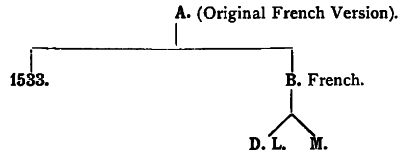
THE DUTCH LANCELOT[213]
(Opens with short introduction alluding to Meleagant, thus
pre-supposing the Charrette adventure.)
Line 20. Eight days after Whitsuntide A., his knights, and
twelve tributary kings are hunting in a forest. Guinevere and
her maidens ride to see hunt escorted by Kay, Segramore,
Dodinel, and Lancelot. Knight rides up and seizes queen's
bridle. Her knights resent this. K., S., and D. are overthrown.
L. is about to joust when maiden rides up and
demands his aid, he is pledged to her. L. asks permission to
fight first; overthrows and badly wounds knight, and follows
maiden. Wounded knight is tended by queen's people.
Line 245. Queen sends K. after L., whom he finds fighting
with two knights; K. gives him his horse; returns to queen.
Line 352. Queen is hungry. Dodinel and Segramore go to
find food. Come to a pavilion with knight, he and S. fight, D.
looks on. Maid on mule rides up, calls D. to go with her.
Knight flies and S. is left alone.
Line 444. Segramore meets one of A's horsemen pursued by
two (1533, three) knights, rescues him and overthrows knights.
Comes to a pavilion; dwarf stands at door, strikes S.'s horse
with stick. S. chastises him. Lady appears and reproaches
S., he is struck with her beauty. Enters pavilion and finds
Calogrenant prisoner. He had come there and blown horn at
maid's request, two armed knights appeared and overthrew
him. S. blows horn. Red Knight appears; they fight, well-matched.
A knight arrives, carries off maiden. R. K. begs
truce that he may pursue them. S. will do so too. Cal. is
released (1533, R. K. remains to guard C.). S. pursues ravisher,
comes to hill and fair meadow, ten pavilions by a fountain.
Knight with thirty companions appears and demands joust. S.
overthrows him and asks news of maiden. Knight will tell him
if S. will grant first request asked. Leads him to pavilion with
maid and four knights. Maid will return with S.; has been
brought against her will. A knight throws knife at S. who
cleaves his head with sword. Others attack S., who slays first,
and others fly. Rides off with maid to ten pavilions, ten knights
ride out, S. must go with them to their lord or joust; chooses
latter. They ask his name, he is Segramore die Wonderlike.
Another knight appears, S. must leave maiden or joust. He is
Brandalis, rejoiced to meet S., would entertain him. S. says
he must return to queen who waits by 'Elfin Spring.' B. will
escort maiden to her ami. S. rides off to house of Mathamas
(his original destination), finds him and knights in hall, and
demands provisions for queen. M. and his men treacherously
attack S., finally overpower and throw him into dungeon,
where he is wellnigh starved, but M.'s daughter takes pity
upon him, and brings him food.
Line 1050. Dodinel and maid meet knight and lady richly
dressed, with dwarf. D. greets dwarf, who makes no answer
but tries to kiss maiden, who throws him to the ground.
Knight tries to kill maiden, but is unhorsed by D. and sent
prisoner to queen. He is Maroc van den Ynsen Roken,
'twixt Ireland and Scotland. (1533, Marruc le roux, no island
named.[214])
Line 1267. Lancelot meets a black rider unarmed with
knight's head on saddle-bow, asks L.'s name, bids him give
him his armour, L. has pledged himself so to do (reference to
adv. in earlier part of prose L.). L. does so. Knight is
'Griffoen van den quaden passe.' He rides thus past the Elfin
Spring. Queen sees him in L.'s armour with head at saddle-bow
and thinks L. is slain. Kay and other knights pursue him,
and are overthrown, Kay taken prisoner. Queen and maidens
remain at spring weeping.
Line 1425. Lancelot meets maiden, who hails him as best
knight in the world, thinks he is Gawain[215] (1533, knows him for
L.), whose presence in land of Strangore is much desired.
Leaves him, and L. and attendant maiden come to house,
where they are well received.
Line 1480. Dodinel comes to a deep river crossed by
narrow plank. Maiden crosses safely, plank will not bear
weight of an armed man. D. falls into water and is nearly
drowned. When he reaches bank maid has disappeared.
Castle near at hand, knight comes out and challenges D., who
is too exhausted to answer and is taken prisoner.
Line 1565. Queen and maidens return to court in great
grief, tell A. what has chanced. (1533, Queen's account does not
agree with facts of story. She says 'prisoner has gone after
knight.' What prisoner? Probably Segramore's, but she says
they have heard nothing of S.) Ten knights will go in quest of
L. Gawain chooses his companions: Ywein, Garhies (Gariët
general spelling), Gurrehes, Mordrec, Hestor van Maris,
Acgloval ('twas he brought Perceval to court), etc. (Neither
D. L. nor 1533 give ten names, the latter adds to those mentioned
Les Hardi [le Laid Hardi?] and Brandalis.) They take an
oath to seek a year and a day. They ride to the 'Swerte cruce'
(here we have story of Joseph of Arimathea and King Agestes
[Agrestes] from G. S. Graal). Gawain harangues them, they
will separate, and search forest for a week. Hear loud cries,
maiden meets them, and says best knight on earth is being
slain. Leads them to a valley where one knight fights against
ten. Gawain and companions rescue him and put others to
flight. Knight has two swords. Gawain asks reason. Knight
explains. He is Eliezer (1533, Helye), son of the rich Fisher
who holds the Grail. One sword is that with which Joseph of
Arimathea was wounded (here adventures of Joseph as in
G. S. Graal); it is broken and can only be mended by him
who achieves adventures of the Grail. Ywein begs E. to
accompany them in their search for Lancelot, he would doubtless
fulfil the test. E. refuses, must return to his father. They
separate, agreeing if they find L. to send him to E. (which they
do not do).
Line 2335. Agloval rides five days without special adventure.
Meets wounded knight who prays his aid. A. jousts
with and overthrows pursuer. Makes him ask pardon of first.
Spends night in castle of second, who is Griffoen van den
quaden passe. A. tells him name and quest. G. conceals
share in adventure, tells A. he will find Kay at a hermitage.
When A. has ridden away sets K. free, and tells him to go to
hermitage, not saying whence he came. K. does this, meets
A., hears of quest and follows him.
Line 2565. Gawain rides three days without adventure.
Comes to castle of Mathamas where Segramore is imprisoned.
Being weary rides past without greeting. M. pursues him, they
joust, M. is overthrown. S. is released and M. sent prisoner
to court.
Line 2685. Hector[216] seeks in forest up and down for eight
days; ninth, comes to where Dodinel fell into water, crosses
safely and rides to castle. Knight attacks him and is overthrown,
makes feint to yield and tries treacherously to stab H.
H. smites off his head. Folk of castle receive him gladly, tell
him of D. who is freed. Maiden explains knight was her ami
and hated D. who had overthrown him at a tourney, she had
been forced to fetch him hither on pain of death. H. tells D.
of quest; he will join. Leave castle and ride to trysting-place.
All meet, have heard nothing of L. Part in great grief, knowing
it will be long before they meet again.
Line 2925. Gawain rides fifteen (1533, twelve) days without
adventures. Comes to an abbey where he leaves his arms and
takes others. Spends Sunday there. On Monday rides forth,
comes to a spring, unhelms to drink, maid rides up, knows him,
and takes him to castle. Lord of the castle arrives with
thirty knights. A great tourney to be held on the morrow two
miles hence. Mabonars (1533, Marbortas), the king of Galehout's
race (1533, Galehout's cousin), has summoned it at Castle
'van der Molen,' will give hawk to best knight and circlet to
his lady. Maiden prays G. to help her lover Taganas (1533,
Tanaguis le blanc). On the morrow go to tourney. Argument
between maiden and 'a king's niece' as to whose knight is the
best. At first G. overthrows all adversaries. Then Red Knight
appears, prolonged struggle, G. is unhorsed, R. K. rides away,
G. follows, overtakes him at forester's house. It is Hector, who
is much grieved at what he has done. G. forgives him, and
they continue quest together. Third day (1533, time not
mentioned), come to ruined chapel and churchyard wherein is
marble tomb with inscription to effect that only the 'keytive'
knight who has failed through 'luxurien' to achieve adventure
of the Grail can fulfil this. Enter churchyard, find burning
tomb with twelve others round it, upright sword on each. G.
will test adventure, enters enclosure, is attacked by swords,
beaten to the ground, when he recovers consciousness is
outside. Tries again, with even worse result. H. also tries,
fails; letters appear on the door that none shall dare adventure
till the 'son of the dolorous queen' come.[217] They leave
chapel and ride till they come to two roads by a cross on
which is written 'whoso takes left-hand road shall not escape
without much dishonour; of right-hand nothing shall be said
save that there is much danger.' H. insists on going to left
though G. would dissuade him. They separate.
Line 3535. Gawain comes to pavilion where six knights are
at meat, he greets them, they make no response. G. seats
himself and begins to eat, they order him to stop, and on his
refusing attack him with swords and axes. G. slays one, cuts
off arm of another, rest flee. Rides away, comes to a valley
where he sees castle surrounded by deep water, goes towards
it. Hears cries from a tower, enters and finds maiden in bath
of boiling water (1533, does not say water is boiling, and states
that she only expects aid from Lancelot), prays him to lift her
out; he fails, she tells him he will not go hence without shame,
and that only 'the best knight in the world' can help her. G.
goes to castle, is well received. As they sit in the hall out of
the chamber whence the king came (1533, he sees 'entrer parmi
une verriere') there comes a dove with censer in beak.[218] All
are silent and kneel till dove has passed through hall and
entered a chamber. Then tables are prepared and all sit down
in silence. G. wonders much. Out of chamber where dove
entered comes the fairest maiden G. has ever seen, holding
above her head a vessel in the shape of a cup. The vessel
'ne was van houte ne van stene, ne van metale negene.' All
kneel as she passes, save G., and the tables are filled with the
best food on earth. When she has passed all but G. have
been provided with food; he doubts if he has done amiss.
After the meal all leave the hall, doors are closed, and G. is
left alone. He lies down beneath a window. A man (dwarf?)
appears and tells G. to go into a chamber where none shall see
him, would strike him, but G. takes staff out of his hand, warns
him he shall not depart without dishonour. (1533, G. is only
told 'fuyez vous en d'icy, vous n'y devez m'y estre, car en vous
a trop villaine chose.' G. sees bed through open door, and enters
chamber of own accord.) G. goes into the chamber, sees a fair
bed and sits down upon it. Hears a voice warning him if he
sit unarmed on 't bedde van aventuren' he will surely die.
Arms himself; a sword (1533, lance) with fiery blade enters
room, smites him so sorely he cannot defend himself: becomes
unconscious, on recovery feels that blade is being drawn out
of his wound. Lies till daylight. (1533, Quant il fut ennuyte
si que l'en y veoit mauvaisement fors que de la lune qui luysoit
a plus de quarante fenestres qui tout estoient ouvertes; lors
regarde monseigneur G. en une chambre qui estoit pres de lui.)
Sees a great serpent enter the hall, making fearful noise, out of
its mouth come small serpents. Leopard attacks serpent,
fierce battle. When serpent finds it cannot slay leopard
returns to hall (chamber?), where the small serpents attack it.
They slay each other. A great wind rises, which sweeps hall
clean. G. hears women weeping, rises and sees twelve
maidens come weeping and kneel before door where dove
went in. They depart, and an armed knight comes and bids
G. go and rest on a bed in another chamber, he may no longer
stay here. G. refuses, they fight fiercely all day, at last fall
exhausted. It begins to thunder, the whole palace trembles,
G. is deafened by the sound, knows not if it be day or night
(1533, if he be living or dead). A great wind rises (1533, soft and
sweet), and he hears voices, two hundred at least, singing so
sweetly, nothing on earth can be like to it. He cannot understand
all the words, only 'Glorie ende lof moete hebben
ewelike die coninc van hemelrike.' The palace is filled with
a sweet smoke. Opens his eyes and sees the maiden of
evening before with vessel, preceded by two censers (1533, and
two cierges), places vessel on silver table, ten censers give
sweet smell around it. Voices sing 'Ere, bliscap, ende lof
moete hebben ewelike, Die soete here van hemelrike.' Maiden
carries vessel back to chamber. Hall grows dark and windows
fly open (1533, and close again). G. can see nothing, but feels
he is healed of his wounds, rises and looks for knight with
whom he had fought, but can find nothing. Hears people
enter and feels himself taken by hands and feet, bound, carried
out of hall, and laid on a cart. Daylight comes, he is still in
the cart, to which a wretched horse is harnessed; feels himself
shamed. A maiden (1533, une vieille) comes and drives the
horse out, as they pass the gateway the people mock at and
pelt G. When bridge is passed maiden looses his bonds and
tells him to leave the cart, he has been there long enough. G.
asks name of castle, it is Cambonoyc.[219] He curses the day he
was born and made knight to be thus shamed. Rides all day,
at evening comes to hermitage, where he is kindly received.
Hermit asks his name, and is rejoiced at hearing it. Where
has he spent the night? G. will not say at first. (1533, G.
shows shame at being praised. H. comforts him; no man
but knows misfortune. G. says no man has had such ill-luck
as he for fifteen days. H. asks how, and G. tells all.) When
he does tell, H. keeps silence for a long time, then tells him he
has seen the Holy Grail, his own sin prevented him from being
fed by it. (1533, quant vous ne luy feistes honeur bien vous
deistes mesadvenir.)[220] G. asks meaning of serpent; it is A. his
uncle. He shall leave his kingdom in charge of his kinsmen
and go to fight a knight whom he cannot overcome; on his
return his own kinsmen shall fight against, and slay him. It
shall come about through G. himself. He must swear not to
reveal what H. has told him to any one. G. spends night
there, and in morning rides forth to seek Hector.
Line 4260. Hector rides till eventide, meets a dwarf, who
warns him, but will give no explanation. H. rides on and
comes to a stone on which it is written, that no one enters
this land save to his shame. Then meets two maidens who
lament over him. Comes to a castle surrounded by water,
over which is a bridge. A maiden sitting under a tree greets
him kindly, and tells him there is a knight at the bridge who
jousts with all comers, and throws the vanquished into the
water. H. overthrows knight and crosses bridge. The gates
are closed, none may enter save by swearing to put an end to
the evil customs of the castle. H. swears and enters. Asks
what are the customs. There is an evil knight there who
fights with all who come; if victorious he drives them naked
through the streets; also he has dishonoured more than one
hundred (1533, forty) noble maidens. H. bids them lead him
to knight. They take him to a fair garden, well planted with
trees, in the midst of which is an open space. They show him
an ivory horn hanging on a tree, if he sound it the knight will
come.[221] He does so and a 'hunch-backed and ugly' (1533,
grant) knight, on a white horse, appears unarmed, and asks H.
his name. If he will swear to renounce evil customs H. will
tell him, not otherwise; knight prefers to fight. Folk tell
H. it was a ruse coming to him unarmed, had he made terms
and disarmed, he would have been overpowered at once.
Knight returns in red armour. After fierce fight H. slays him
and learns he must now deliver lady of the castle, who is in
a cave guarded by two leopards (1533, lyons). This he does;
slays leopards and releases lady, who is joyfully received by
the people. She is Argale van Grakenlant (1533, Grindelain),
and Lancelot's cousin. The knight was Margarij (1533,
Maugart le Roux); she is concerned to hear of L.'s
disappearance.
Line 4812. Ywein rides three (1533, four) days without
adventure. Fourth meets a maiden who laughs as she sees
him. Y. asks reason, she will tell him if he will promise her
a gift that will cost him little. Y. promises. A knight has
threatened to take her horse, because his amie reproached
him with having done little for her honour. Will Y. give her
the knight's horse? She knows Y. and his fame, and therefore
laughed for joy on meeting him. He consents and they ride
together. Knight comes out from his pavilion and demands
Y.'s horse. Y. will fight for it. They do so and the knight is
slain (1533, apparently not, the lady only thinks he is dead), and
his horse is given to maiden, who goes her way rejoicing. Y.
rides till evening, when he meets a maiden lamenting loudly;
a knight has taken from her the hawk her ami gave her, he
will think she gave it willingly and slay her for jealousy. Y.
bids her lead him to tent of knight who stole hawk; she does
so, and Y. bids her go in and take it. Knight objects, they
fight. Both are wounded, knight mortally; prays for hermit
that he may receive last sacraments. Y. sends maiden, and
himself finally returns with hermit, who tends him for fifteen
days till wounds are healed.
Line 5070. Mordret, Gawain's youngest brother, rode all
day with nothing to eat, weary, because he was young, only
twenty; fair-haired and good to look upon, but evil at heart.
Description of brothers: Gawain fairest, courteous to all,
especially the poor[222] (1533, fist voluntiers bien aux meseaulx plus
que a autres gens.) His strength doubles, at certain times, as
he fights (not specified, 1533 says, toutes heures du iour), so that
none can overcome him, he will either conquer or be slain. A
good knight in all things, and faithful to his lord. Courteous
to all women, and not given to boast of his deeds. Agravain,
handsome and valiant, but of bitter tongue; 'Lancelot slew
him as ye shall hear' (omitted in 1533), Garhiës (later on
Gariëtte) (Gaheriet, 1533) more courteous than any of the
others 'save Gawain' (omitted in 1533). His right arm was
longer than his left, so that he did great deeds of knighthood
(1533 adds, most gentle of all, and most relentless when
wrathful). Gurrehies (1533, Gueresches) very valiant, fond of
deeds of knighthood, never took any rest. Handsome in face
and more fastidious in dress than the others. Much loved of
ladies. Gawain's favourite, and youngest save Mordret.[223]
Mordret was valiant, but an evil knight, save for first two
years of his knighthood. 'He did more harm in his life than
all his brethren did good, for fifteen thousand[224] valiant knights
were slain in one day because of him, and he himself died
there too' (1533 omits this).
Line 5250. Mordret spends night at castle of a lady
(1533, widow), who treats him well. Next morning he rides
on his way, comes to two pavilions; at door of one is a horse
ready saddled, and armour. Dwarf comes out with bow and
arrow, and shoots M.'s horse dead. M. would chastise dwarf,
but owner arrives and challenges M. They fight, and knight
is slain. M. takes horse and goes on his way. Comes to a
tent where is a fair maiden; she will lodge M. if her lover
does not object; if he does, M. must go. They fall in love;
M. prays her favours and is not refused. Lover arrives; M.
may stay when he tells his name; would do anything for
Gariëtte's brother. Two knights come, with squire bearing
venison. M. is well treated. He prays maiden to come to
him when her lover is asleep. After some demur, she does so.
Lover awakes, finds M. and maiden together, reproaches him;
he cannot be G.'s brother, or he would not have acted thus.
They fight; M. being the younger and stronger, makes him
swear to pardon lady. Next morning he rides away.
Line 5530. Agravain comes to a fair tent, where there is
a dead knight on a bier, a maiden and wounded knight beside
him. A. asks explanation. Dead knight was brother to the
other. On their way to A.'s court they came to the 'Keytiven
berch.' A knight, Dryas (1533, Druas), attacked them, they
were unarmed; one was slain, the other fled. Dryas sent the
body after him. He slays all who come to this place. A. says
he will avenge him; is warned if he slay D. not to sound
ivory horn dwarf will proffer, or D.'s brother, twice as fierce
as he, will come from the other side of the mountain. A. goes
forth, comes to a fountain; is challenged by D., slays him and
gives head to knight, who is much rejoiced, even more when
he knows A.'s name. A. returns; finds dwarf and maiden
lamenting over D.'s body. Dwarf offers A. horn, which he
blows loudly, all know D. is slain. His brother Sornahan
(1533, Sornehault) arms and comes to avenge him. They
fight, both are thrown. A. is unconscious. S. is about to slay
him, when maid rides up, demands a boon, which S. grants:
it is A.'s life. S. will keep him in prison though maid warns
him Gawain is in the land, and will avenge his brother. S. has
a wall built all round the mount, with notice that whoever would
enter must first fight with him.
Line 6095. Gurrëes (1533, Gueresches) rides through thicket
forty miles long, ten (1533, forty) wide; finds knights ill-treating
old knight, rescues him. His son had accidentally slain his
cousin, his sister's son (1533, a maiden); in revenge the brothers
have slain son, and would have slain him, but for G. G. goes
with him to castle, most kindly received. Offers his love to
daughter; she asks who he is, when she hears, says he is too
rich and well-born for her. Asks him name of knight who bears
certain arms; it is Lancelot. G. would fain know what has
become of him. Peasant comes lamenting, he had fled from
armed knight and wolves had slain his ass in forest, has lost
means of living. G. was the knight; prays his host to give
peasant horse for his sake, which he does. During night
nephews attack castle, are repulsed; pray for peace. G.
advises host to make peace as they are such near kinsmen;
he consents. G. leaves castle, comes to fountain in plain,
where three ladies are seated, one sixty years old, one forty,
one less than twenty; youngest very poorly dressed. G. asks
cause of her grief; her husband is very jealous because she
had praised Lancelot unduly, has taken away her rich clothes,
and forced her to eat with the servants. Oldest lady is in
woe because she has been forced to promise her daughter to
knight of low birth, who has murdered one wife already. Asks
G.'s advice. He tells her to keep her word, and he will free
the daughter. They go to castle together; knight arrives and
claims maiden, mother gives her up. As they ride off G. says
he loves maiden, will fight for her, follows and slays knight.
Beseeches maiden's love, but she refuses; she loves another,
and G. restores her to her mother in safety. Will not stay,
but will at once seek castle of lady with jealous husband.
She receives him well; her husband is away, but returns
shortly, and though angry, allows G. to stay. Meanwhile
another knight arrives, Segramore. Husband, very wroth,
plots to slay them; but page overhears and tells lady, who
warns them. They prepare, and when host would pick quarrel
with S., slay him to joy of lady and her relatives. Next morning
G. and S. depart, come to thirteen pavilions, must joust
ere they go farther. Each unhorses his adversary; may depart
with honour. Owner of pavilions is Count Wigans (1533,
Gimas), hearing Gawain was in the land, has come out to seek
jousts. Ride on, meet sister of Agloval, seeking her brother;
S. will escort her. G. goes on alone.
Line 7840. Gurrëes comes to four tents, in first a meal
spread; second, four coffers, and a dwarf sleeping; third, two
maidens; fourth, maid and knight. G. eats, and goes to sleep
in last tent by maiden. Knight awakes, drags G. out of bed;
G. seizes sword and smites off knight's head (1533, cleaves him
in two); lady much grieved, it was her husband. G., smitten
with her, forces her to ride with him. Come to a forest; knight
challenges G. and is slain. Next day four brothers of lady
overtake them, but are overthrown by G. Come to Abbey of
White Nuns. Lady takes veil, she is of high birth; Lancelot,
Lionel, and Bohort are her kinsmen. G. rides on, comes to
Sornahan's Mount, is overthrown, and shares fate of Agravain.
S.'s niece treats the prisoners well.
Line 8540. Gariëtte meets a maiden seeking Lancelot, and
they ride together. Her brother-in-law has seized her lands,
and she seeks one of A.'s knights to fight with him. G. promises
to do so. Come to an abbey, see maid's uncle, who encourages
G. Reach pavilions of Count Glimas (cf. supra), joust, and G.
overthrows count himself, whom he sends prisoner to Gawain.
Count treats them well. Next morning they go on; meet six
knights, with knight and maiden, whom they are treating very
cruelly. Knight is Brandalis of the R. T.; by his oath of
fellowship G. must aid him first. Gosennes van Strangeloet
comes up and frees maiden, who is so much hurt she lives but
six days. G. returns to maid he is escorting. They ride on
and come to tent where is a dwarf (1533, three pavilions, dwarf
in first), he will lodge them if his master permits; G. promises
to leave if he objects. Knight comes with two maidens; ill-treats
dwarf. G. interferes, overcomes knight, and makes him
ask pardon of dwarf. G. has already slain his nephews (1533,
he was one of the knights who had taken Brandalis.)[225] Next
morning they ride on, and come to land of lady of Roestoc, where
fight is to be fought. Rejoiced to see G. for sake of Gawain,
who had fought for her against Segurades, 'alse hier voren
gescreven es,' l. 9366. (This evidently refers to the earlier part
of the Lancelot, and makes it probable that the Dutch compiler
had also translated the first part of the work.) Fierce
fight between G. and Gindan, the brother-in-law. Latter,
seeing he is over-matched, jumps into river and is drowned;
maiden regains her land. G. departs; meets a maid who
reproaches him with cowardice: he did not free captive
maiden, and has allowed his two brothers to be in prison. G.
explains conditions of his vow, and asks about brothers. She
tells him, and he rides to Sornahan's Mount, overthrows him,
and frees Agravain and Gurries. S. did not know who they
were. (This is a contradiction of previous statement, that
maiden tells him A.'s name and threatens him with Gawain's
anger.) Brothers stay three days till wounds are healed, then
ride forth. First night lodge with hermit; second, with rich
man, who warns them not to seek Lancelot in that land; there
is civil war, the duke's six sons have rebelled against him
because he made his daughter and her husband his heirs;
they have slain these two. The three agree to help duke,
ride to castle, overthrowing two knights on their way. Duke
accepts their aid, but does not know who they are. Great
battle, Agravain is taken prisoner, but exchanged for two of
the sons.
Line 10735. Arthur and court are much distressed; do not
know how adventure of the Grail is to be achieved if Lancelot
be dead. (It is not explained how they know of the Grail, nor
is it clear whether L. is to achieve it personally, or through
agency of Galahad.) Lionel returns, and is much distressed
at news. Questions wounded knight, who proves to be Bohort.
(The reason for B.'s attempt to lead away the queen is given
in the earlier section of the Lancelot, so far as D. L. is concerned
it is not explained.) Maiden comes from Lady van
Galvoye to beg aid, wants Lancelot or Gawain, if both absent,
will have B. B. and L. go with messenger. Queen gives B.
a ring for Lancelot; if any one find him it will be B.
Line 11167. Queen has dream L. is faithless to her. Very
ill. When better sends her niece to 'Moustier Royale' to find
Lady of the Lake, and bid her come to Guinevere.
Line 11520. Lancelot, six weeks before wounds are healed,
then sets forth, and finds maiden lamenting, her sister had
been carried off, and her lover slain in defending her. She
has been to A.'s court, but they are too sorrowful to give aid.
L. will help her if she will go errand for him. She leads him
to tower, knight too wounded to resist, frees damsel. Maiden
must now go to court, say she has seen a knight who had
eaten with L. 'and slept in same bed' (not in 1533). All
greatly rejoiced. A. gives maid a castle.
Line 11870. Lancelot rides with sister, comes to a fountain,
where two knights and two ladies are at a meal. They ask L.
to join them. One maiden falls in love with L. L. drinks
from spring, two vipers have poisoned it, is very ill, and is
nursed by maiden. While still ill, Bohort and Lionel find him,
and he sends his hair, which has fallen out, to queen, who is
much rejoiced. (Love complications between maiden and L.
Lionel again sent to queen, this time for advice. Maid swears
to remain virgin for L.'s sake; L. will be her knight.) When
cured L. and maiden ride on, come to castle of the six brothers,
who make up false tale as to their cause. L. believes them,
and fights for them. Duke is killed, and the three sons of
King Lot taken prisoners. L. is much distressed, bids them be
well treated, and rides off, hiding his name.
(Here follows his slumber in forest with Lionel, when latter
is carried off by Tarquin; L.'s being taken by the queens;
released by daughter of Duke of Rochedon, and attending
tourney. All this has been commented upon in chap. ix.)
Line 14580. Lancelot at the Grail Castle. This has also
been previously noticed.
Line 15353. Lancelot leaves castle, and comes to another
'surrounded by water' (detail omitted in 1533). Knight challenges
him; lost in thought, L. does not hear, but rides over
bridge, and is thrust from horse into water; gates closed, must
spend night in wood. Sits by spring, three (1533, four) knights
ride up, with maid who cured L. of poison; have carried her
off against her will. She says were L. there they would
not have dared. Knights say L.'s father was a coward, he
must be one too; would do violence to lady. L. appears and
rescues her, slaying one knight. They ride to castle of lady's
kinswoman, where they spend the night. Next day L. will go
to castle where he lost his horse. Host would dissuade him;
failing, rides with him. Asks does he know Hector. Tells
him H. is his brother (as H. is previously represented as one
of A.'s most valiant knights, it is difficult to understand how
L. comes to be ignorant on this point). The knight at castle
is H.'s uncle. Would not joust with L., but thinks this is not
he. Is overthrown. L. is welcomed by lady of the castle,
who tells him H. is her son and his brother. L. next comes
to forest, with hermit's cell and chapel at entrance, with notice
warning knights to go no further. Hermit begs L. not to
attempt the adventure; it is 'Der Verlorenen Forest'; has
seen a hundred knights (1533, two hundred within half-year)
enter, but none have ever returned. L. insists on going on
(1533, stays night with H.). Meets maiden, who warns him
he goes to his death. Comes to a clearing where is a company
of knights and maidens dancing and singing; feels compelled
to join them. Squire leaves him and returns.
Line 16260. Ywein stays at hermitage till wounds are
healed, then rides forth. Meets dwarf, maiden has stolen
his brachet; will Y. get it back for him? Promises to do so.
Maid and knight ride up. Y. bids dwarf take dog; does so.
Y. and knight fight fiercely; finally find it is Bohort, rejoiced
to meet each other. Dwarf tells them L. is well, was at
tourney lately (1533, also gives news of intended tourney at
Kamalot). They separate. Y. goes to an Abbey of White
Nuns, is healed of his wounds. Rides forth. Meets lady
thrashing a dwarf, bids her stop; she will, if Y. will do what
she wants; promises. He must kiss her; so ugly he hesitates.
She reproaches him; he is certainly not Y., she will go to
court and complain of him. Y. calls her back. She will let
him off if he will fetch sword, shield, and helmet from tent
near by. Dwarf warns Y. she is most treacherous lady in
land. Y. will go. Rides with her, takes arms, leaving his own
in their place. Maidens rush out of tent weeping and tearing
their hair. He has dishonoured all maidens in the land, will
come to shame. Y. asks explanation. They will not answer;
he waits till evening, and as no one comes rides on to a
hermitage, where he is well received. H. asks if custom still
maintains that no man may sit at R. T. unless he be wounded.
Custom given up since Lancelot, Galehaut, and Hector were
admitted unwounded. Now each knight must vanquish one at
least in week following, or forfeit seat (1533, must have done so
in preceding week), (ll. 16770-875). Y. asks of shield; belongs
to a giant who had wasted the land, but for love of a maiden
had promised to remain in castle unless one did him shame.
After a year (1533, longuement y avoit été), becoming weary,
had sought chance of release, so had hung up shield, setting
twelve maidens to watch it (1533, the people of the land had
set the watch). Now he will be free, land wasted and maids
dishonoured. Y. rides on, bearing shield; all flee from him
(1533, two maidens only). Finds two maids by spring; they
bid him eat with them, does so. Knight comes up, would fight
with Y. for having released giant. Is overcome. Y. sends him
to giant to tell him who it is who has taken the shield. Knight
goes, giant strikes off his hand for tidings (1533, giant gives
him his choice: he may lose his hand for the shield or his head
for the helmet),[226] and rides through land destroying and slaying
wherever he goes. Y. rides on, seeking shelter; no one will
have him. At one castle fights with father and son. Sleeps
under tree. Is wakened by sound of giant, who makes more
noise than twenty (1533, twelve) knights. Y. calls him, but he
is too angry to hear. Y. mounts and rides after him. Comes
to 'Castel van den Trepasse'; five (1533, fifteen) knights fall
upon him, kill his horse, and make him prisoner; will deliver
him to giant.
Line 17470. Bohort comes to lady of Galvoye. She has
been deprived of a castle by a knight, and needs champion;
fight to be fought at King Pelles's court. Come to Corbenic.
King and daughter rejoiced to see B.; tell him of L.'s great
deeds. Fights with and overcomes knight. Sees Grail. Does
not sleep in 'palace of adventures.' Next morning comes to a
hermit, who knew his father and King Ban. Tells him how
his father had built this chapel in memory of a victory gained
over King Cerces, and given it a golden (1533, silver) crown
won from king's steward. B. leaves, meets maiden, who
reproaches him for having left Grail castle without testing
adventures, should have slept in hall. (Here 1533 gives adventure
of a lady whose brother has been taken prisoner while
seeking a sparrow-hawk. B. frees him.) Returns to Kamalot.
Line 18070. Gawain meets the maid who cured L. of poison,
and was rescued by him. Assures him L. is well. They ride
together to court.
Line 18130. Lancelot at the 'caroles' sits on throne in
centre of ring, and has crown placed on head. Enchantment
ceases. Maid explains it has lasted ever since King Ban came
there on his way from A.'s wedding. With him was a youth,
his nephew, learned in necromancy. Fell in love with maiden
sitting on throne, and for her sake wove spell that dance
should continue till fairest and bravest knight on earth came.[227]
Also made chessboard of gold and silver, which plays of itself
against all men. At last clerk and maiden died, but spell was
not broken. L. plays with chessboard and wins; enchantment
ceases for ever. Chessboard is sent as present to Guinevere.
L. leaves castle, meets knight, who threatens him, but flies
when L. would fight. Comes to a high tower where party of
knights lie in wait for him. They attack him, overthrow and
bind him, and cast him into pit infested with serpents. Maid
releases him. Her father was nephew to Duke Karles whom
L. has slain. Squire warns his lord of L.'s escape; he arms
his knights and attacks L., who takes refuge in maiden's room.
L. slays nineteen (1533, more than twenty-four). Father jumps
out of the window, and breaks his neck. L. tells maiden all
are slain. She seeks father's body, cannot find it, so thinks he
has escaped. L. throws corpses out of windows. They go to
rest, and maiden has dream which terrifies her much. Next
morning they ride out together; hear cries for help, find
knight ill-treating lady, and bids him stop, when he strikes
off her head and throws it in L.'s face. (This is the adventure
in M., Book vi., and has been commented upon earlier.)
Line 19179. Lancelot rides back to maiden, finds her
gone. Meets knight, who asks if he has seen knight and
maiden (1533, two knights and maid), asks for his maiden.
She has been carried off by four knights. L. pursues. Finds
them about to burn her. L. slays twenty (?), rescues maid:
this was meaning of her dream. Knights were her brother
and three of his followers. Come to house of lady, where they
stay fourteen days, till L. is cured from bites of serpents in the
pit. Ride together. Come to 'Castle of the Charrette.' Lad
meets them; rejoiced at L.'s coming. Daughter of Duke of
Rochedon, who freed L. from prison of queen, is to be married
against her will to brother of Queen of Foreestan; it was he
who slew her betrothed, his own nephew. L. enters church,
challenges knight, who flies; lady receives her lands again.
Morgain le Fay is there, bids L. unhelm, 'in the name of her
whom he loves best.' They reproach each other, and M.
threatens L. with punishment. L. and maid depart as quickly
as possible, fearing M.'s spells.
Line 19525. How knight with dead maiden fulfils L.'s
commands, and body is buried.
Line 19595. Lancelot comes to Kamalot; lodges with
hermit for tourney. Sends maiden with letter to queen. She
receives heritage for the one lost. King Ider, jealous of L.
King and queen say he could overthrow all R. T. Knights
very angry at this, except Gawain (1533, and Bohort). Queen
sends message to L. to come secretly and discomfit knights.
L. is recognised by King Bagdemagus, who will aid him.
L. comes in red armour, does great deeds till he beholds
queen, when he nearly swoons, and is carried off the field by
K. B. R. T. knights get best of it. Queen sends message
by Bohort to tell L. to come secretly that evening (maid of
poison cure is there; queen is at first jealous, then satisfied).
Ider praises Red Knight, says L. would not have done so well.
Queen makes King B. challenge A. to another tourney in three
days. L. spends each night with queen. Third day she
arms him in white, Bohort in red. L. not to enter field till
after tierce. He overthrows and wounds Gawain and Gariëtte,
and scatters knights of R. T. A. bids him unhelm, is joyful at
recognising L. Sunday, great feast made in his honour.
Chessboard is brought, all play and are beaten save L. Clerk
writes down on oath all L.'s adventures in book, which was
found after king's death. All others tell their story. A. says
L. has done more for honour of R. T. than all the rest put
together; they are very jealous. Decide to go forth and seek
all who have not returned from quest. Gawain will seek his
three (1533, four) brothers. (Confusion here; when we last heard
of Agravain, Gurrëes, and Gariëtte they were prisoners. How did
latter return for tourney? D. L. probably saw this, and only mentions
three brothers, including Mordred, while 1533 says four,
which is certainly wrong.) Bohort will seek Hector and Lionel.
(1533, Will join quest; they shall not go without him. H. and
L. are not mentioned.) Queen and L. talk over adventure of
churchyard as told by Gawain. She is sure L. is knight
meant to achieve it, and is very sad; he will fail through
his sinful love for her. L. says he has more bliss from
her love than from any feats of arms, all he has done has
been inspired by her. King Bagdemagus is made knight
of R. T.
Line 21596. Lancelot, Bagdemagus, Gariëtte, and Bohort
set forth; Gawain will follow when wounds are healed. Come
to castle of 'Witten Dorne,' meet knight on horseback, naked,
beaten, and ill-used by one hundred men; it is Mordret. Lord
of the castle is Matheus die felle (1533, Marchant li felon).
G. releases M., attack castle, slay lord and scatter his people.
Ride fifteen days till they come to castle where Y. is in prison.
Host refuses lodging; hates A.; has one of his knights in
prison. They attack castle, and release Y. Are told of the
giant, he will come on the morrow, host had meant to give Y. up
to him. B. asks boon of L., that he may fight giant. L. unwilling,
but consents. Great fight, giant is slain. Next morning
all ride forth (seven). Y. suggests they should separate. All
ride different ways, meet again at castle on All Saints Day.[228]
Line 22120. Lancelot rides fifteen days, meets maiden,
asks her of Lionel. She tells him, and promises to lead him
to Tarquin's castle, if he will promise to go with her wherever
she pleases afterwards. He agrees. (Adventure with Tarquin
has been commented upon in chap. ix. p. 154.)
Line 22600. Lancelot. Maiden leads him to knight who
steals horses; maid rides first, L. after; knight attacks maid
and is slain by L. Rests eight days till wounds are healed.
Then would find Hector. (1533, Meets old man who tells him
H. had slain knight there previous day, shows him road.
Adventures at castle (cf. chap. ix. p. 155). Finds at castle
squire from A.'s court, bids him lead his horses into 'ten
Verlorene foreeste' and wait for him at cross. Comes with two
knights whom he dismisses, rides into forest, meets maiden who
says she is seeking him to achieve an adventure. Emissary
of Morgain's leads him to tower; drugs him. M. comes, blows
powder up his nostrils, which deprives him of his senses; when
he recovers he is in prison. Sees man in outer hall illuminating,
begs brush and colours, and paints on walls of prison history
of his love for queen. M. sees this, and resolves to show
it to A.
Line 23146. Gawain comes first to Tarquin's castle, now
owned by 'Grave van den Parke,' who tells him of L.'s feat.
Then to hermitage, finds King B. sick, has heard of L. slaying
owners of Castle Vaguel. Tells him of rendezvous for All
Saints. L. will surely be there. B. had helped Gurrëes
against four knights and been badly wounded. G. offers to
stay with him, but B. will not allow it.
Line 23260. Tryst at castle. All meet save L. and Bohort.
Gawain says 'twould be great shame to return to court without
them, will seek till S. Mary Magdalene's Day, then quest will
have lasted a year and a day. All separate, agreeing to meet
again at castle. 'Some ride all year, some are taken prisoners'
(omitted by 1533), finally only Mordret, Agloval (1533, Agravain)
and Bagdemagus return. Much perplexed. Decide to
send messenger secretly to court, to know if anything has been
heard of questers. Finding nothing is known, swear to ride till
they find their comrades.
Line 23388. Lancelot lies all winter a prisoner, when
summer comes (1533, two winters, one summer, second spring),
scent of flowers and sight of roses remind him of Guinevere.
Tears out bars of window and escapes, leaving insulting
message with porter for M. Meets maiden, who tells him
Lionel is prisoner in castle of King Vagor of Estrangeloet.
Challenged by king's son; unless he can find someone to take
his place will be overcome. L. will go. Meets wounded
knight on litter, if L. will lodge in his castle will meet one of
A.'s knights who lies sick there. He himself has been
wounded by shot from maiden's bow, and iron cannot be
pulled out till best knight in world comes. Has been to A's
court, but useless till L. returns. A. is much distressed at
absence of Gawain and L.[229] Go to castle, L. asks to be
allowed to try to pull out shaft. Knight says it is no use to
try unless he be L. Does not reveal name. Would see sick
knight, it is King B., wounded in a tourney. Rejoiced to see
L., tells him of quest. L. leaves next day, and B. tells knight
who he was. Knight follows in litter. L. comes to the castle
'dat fremde eylant,' meets squire, who tells him Lionel is there,
L. says he is one of A.'s knights. Will fight instead of Lionel.
King receives him well; Lionel is joyful. A lady had accused
him falsely to her husband, they fought, and husband was
slain, he was king's son. Brother challenged Lionel, who being
too badly wounded to fight at once had been imprisoned lest
he escape. L. fights and is victorious, peace is made, and the
two cousins ride off together. Knight in litter follows on their
tracks. They come to an abbey, 'Celice' or 'die cleine
aelmoesene' in die 'Mersce van Scollant.' (Here follows long
story as to origin of abbey.)
Line 24454. Lancelot hears at abbey of castle near by,[230]
'die verbodene berch,' a knight had built it for love of his lady,
only a narrow footpath leads to it. At abbey shields of knights
of R. T. overthrown by knight of castle; them he keeps in
prison, all others he slays. L. sees shields of Gawain, Ywein,
and others (1533, does not mention Ywein), and decides to
rescue them. At foot of hills finds hermit, who foretells his success.
Finds cross with inscription, for forty (1533, twenty) years
all who came have been vanquished, 'save one, and he doubtless
was of David's line' (omitted in 1533). Goes on, finds
pavilion with dwarf, who warns him not to fight, shows him a
horn he must blow. Prisoners in castle warn him; sees
Gawain, wounded in the head. Knight appears. Fierce fight,
finally L. gets the better of his foe, who is Bohort (1533, names
B. in middle of fight, apparently forgetting that no one knows
who he is), he had overcome knight of castle two years (1533,
one year) ago, and been forced to take his place (by whom?).
He may imprison his comrades but must slay all others; did
not know their names, would not ask them. (How, then, did
he know they were his comrades?) He is much ashamed and
apologises to knights; all are rejoiced to see L. Stay there
that night. L. has wonderful dream. Old man appears, and
bids him ride without delay to 'ten Vreschlichen woude,' where
he will find a wondrous adventure. He is his grandfather.
L. rises, arms, and rides away at once. 'Comrades depart
together' (omitted in 1533).
Line 25150. Lancelot meets dwarf, who warns him of great
adventures. Comes to hermitage by a fountain, where is a
bleeding tomb guarded by two leopards (1533, lyons), whom
L. slays. Sees head in fountain, water is boiling, but takes
head out and lays it in tomb; it is his grandfather's body,
treacherously slain by a kinsman on a Good Friday. Fountain
will not cease boiling till one comes who can bring adventure
to end, which he cannot, on account of his sin with Guinevere.[231]
L. rides on, comes to forest full of wild beasts. Rescues boy
from bear. Rides in search of lodging. Moon rises. Sees
white hart with gold chain round neck, guarded by six leopards
(1533, lyons), marvels much; swears not to leave forest till he
has learnt meaning. Comes to two pavilions, asks lodging.
Must joust with owner; does so, and slays him; twelve
maidens make great lamentations, carry off body on bier; he
was a great king. L. is much distressed. Knight comes and
asks lodging. Had kept Easter at A.'s court. All sorrowful
because of absence of L. and G.; but joyful news has come
that he who shall achieve adventure of Grail is born of Fisher
King's daughter.[232] He seeks fountain of Sycamores, where
a valiant knight has overthrown Gawain and Ywein; twelve
have made a vow to seek it. Boy knows road, will lead knight
to it. On the morrow they separate; knight, Sarras van
Logres, comes to fountain, fights with Belyas the Black, and
is overthrown. L., who has followed secretly, comes up, overthrows
B., gives S. his horse; tells him his name, and bids
him return to court, saying he and all questers are well, and
will be at court for Pentecost. S. rides off, meets wounded
knight seeking L.; directs him. Comes to court on a Sunday;
all are rejoiced at news. A. will hold great feast in their
honour.
Line 26045. Maid sent by queen to Lady of the Lake comes
to court of King Claudas; who asks tidings of L. and kinsmen.
Maid says they are best and bravest knights alive, and will
certainly come and slay him, and take back their lands.
Claudas imprisons maiden, and sends messengers to court to
see if her tale be true. One is so impressed that he becomes
A.'s man; other returns and tells C. what he has seen. First
tells queen fate of maiden; she writes to C. bidding him free
her. C. returns insulting answer. Queen, much distressed,
longs for L.'s return.
Line 26630. Lancelot. When Sarras has left him, another
knight appears, like Belyas. They fight; knight flies, pursued
by L. to castle near at hand. L.'s horse is slain; but he slays
all who attack him, and reaches garden, where in tent, guarded
by four knights, he finds Mordret chained. L. releases him,
and they escape together. Belyas and Bryadas had wished
to be knights of R. T. A. refused, not knowing them. They
had sworn to keep fountain against all comers; L. has mortally
wounded both. L. meets wounded knight, whom he heals at
last, sending message to King B. that questers are found; also
to those released at 'Verbodene berch,' bidding them meet
him at court. Gawain is ready, but Ywein demurs, all are not
found yet. G. says duration of quest should be year and day,
they have been away three years. All agree to go. (This
seems to indicate that 1533 was correct in not noting their
departure earlier, as D. L. does, thus contradicting itself. Probably
an earlier redaction did make them leave at once, while
a later introduced more of L.'s adventures. This points to
the later interpolation of 'tomb' adventures.) B. knights one
of the squires, 'Axille die blonde,' and gives him the castle.
Line 27236. Gawain and comrades come to a castle by a
deep water, where men are erecting lodges for a tourney.
It is the castle of Galehoudijn, 'neve' of Gawain (obvious
mistake for Gallehault), (1533, son of Gallehault and la belle
Géande, but she was Gallehault's mother). Conceal their names,
are well received and lodged outside castle. Hear a tumult,
and see Agloval pursued by forty armed men. Go to his aid,
and slay many. Their host is much distressed; they tell him
they are of A.'s court. Galehoudijn arrives; is angry at first,
but when Gawain reveals their names, is much rejoiced, does
them great honour, and knights their host. (1533 is very
confused here, persistently calling Galehoudijn, Gallehault;
correcting mistake, and then relapsing again.)
Line 27735. Lancelot[233] and Mordret ride till nightfall.
See white hart and leopards; decide to follow them. Two
knights ride suddenly out of side road, unhorse them and take
their steeds. Dwarf appears, will lead them to horses, if they
will give him a gift. Promise; he leads them to two pavilions
where they find their horses, and go off with them. Come to
a hermitage, where they spend the night. L. asks H. of white
hart; mystery may not be revealed till 'the good knight' come.
Asks of king whom he slew, and who was mourned by maidens
(cf. supra, p. 239), he was named Merlan, from 'die Marchen
van Scollant,' a wicked man; L. did well to slay him. Next
morning they ride away; are attacked by knights who stole
their horses. M. overthrows them, and gives knights' horses
to L. Spend this night with 'Vavasseur,' who tells them of
Galehoudijn's tourney. They will go, host with four sons (no
number in 1533) to attend them. Next morning they ride to hear
Mass. Meet an old man who prophesies M. shall be ruin of
kingdom and death of his father, 'who is a mightier king than
K. Lot.' M., angry, smites off his head. L. finds letter on dead
man saying who M. really is. Would slay him and avert
mischief, but for love of Gawain, whose brother he is. Come
to tourney. Kings of Norgales and of a hundred knights
there. L. discomfits all comers. Then rides out of press
followed by Bohort, who suspects his identity. Meet, and
agree to ride to court together.
Line 28835. Gawain and his companions are much annoyed
when they find they have missed L. again. Agree to return
to court, each going his own way.
Line 29018. Lancelot and Bohort see a fire, hear cries
for help. B. goes to see, and finds maiden and brother being
ill-treated by eight knights; slays three, rest fly. B. returns
to L. who has disappeared; spends night in forest. (1533,
goes with maid, who is daughter of king of a hundred knights,
to lodging, then with brother to find L.; not doing so, returns
and spends night with them. Departs next morning, and hears
L. has been seen chasing a knight.)
Line 29095. Bohort, second visit to Grail castle. Tempts
its adventures. Cf. supra, pp. 160, 233.
Line 29695. Lancelot comes to two tents, light, and a
maiden and dwarf in one, asks for lodging. Her lover will not
allow her to give it. Knight and brother ride up, throw L.'s
armour out of tent. Fight. L. slays one and wounds the
other. Rides to a hermitage where he passes night. Next
day meets two maidens sitting by spring, would eat with them.
Maiden pursued by black knight runs up asking for aid, before
L. can reach his sword she is slain. L. very angry smites off
knight's head. Fourth night comes to forester's house in
moon light.
Line 29952. Lancelot and Kay. Cf. supra, p. 156.
Line 30380. Lancelot after overthrowing knight of R. T.
comes to two pavilions, in one of which is maiden who cured
him of poison. Sees Bohort's son. Cf. supra, p. 157.
Line 30584. Gawain and his comrades return to court and
hang up shield L. has thrown down in middle of hall; telling
how they were overthrown. Queen much distressed that L.
has not come, gives them rich garments in order of valour.
Bohort is best, then Gawain, Hector, Gariëtte, Lionel, Bagdemagus
(1533 omits Hector but gives others in same order).
Kay arrives in L.'s armour. Other knights overthrown by L.
come and recognise shield. Next morning L. is seen coming,
go out to meet him, joust, and Gawain overthrows him, L.'s
horse being weary. Great Feast, A.D. 426 (1533, A.D. 225).
A knight in white armour comes weeping, he is probably going
to his death. Gives L. a letter—if he dies he is to read it
aloud, if he survives return it. Sits in Perilous Seat, fire
descends and consumes him. He was Brumal (1533, Brumant),
nephew of King Claudas, who had vowed to prove himself a
better knight than L. who dare not sit there. Queen and L.
talk apart, and she tells him of Claudas's insult; he vows to
avenge her, C. has taken Gannes, Benoyc and Aquitaine.
(1533, Gaule and Benoyc—[but Gaule was not yet L.'s].) L.
takes counsel with his friends and resolves on war. Brimol
van Pleiche comes, was conquered by B. at bridge of Corbenyc
(not recorded previously).
Line 31976. Claudas prepares to resist A., gives all his
nobles leave to go, richly rewards those who remain; is promised
help from Rome.
Line 32394. Recital of knights' adventures, recorded above.
Line 32755. War with Claudas told at great length. Valiant
deeds of Gawain, Hector, and Bohort. King and L. join
army later. A.'s fight with Frollo and winning of Gaul is
placed here. Claudas finally conquered, L. makes Hector
king of Benoyc, Bohort of Gannes, Lionel of Gaule (cf.
supra, p. 201).
Line 35465. Feast at Camalot. Arrival of Elaine, L.'s
madness. Cf. chap. ix. pp. 161-163.
Line 35830. Perceval. His arrival at court. Adventure
with Patrides; fight with Hector. Grail is vessel out of which
Our Lord ate Paschal lamb in house of Simon the Leper.
Line 36610. Perceval and Hector come to house of a
hermit who is priest to the fisher-folk, who provide him with
fish, etc. After riding some time they come to house of a man,
who had lodged L. six months before, knows H. for his brother
by likeness, L. was mad then.
(This is not in 1533, which says, Or dit le compte que grant
piece chevaucherent P. et H. ensemble per mainte terre estrange
pour scavoir se adventure les meneroit en lieu ou ilz peuſſent
trouver L. ains chevaucherent maint yver et maint este
ensemble.)
Line 36705. Lancelot. Adventure at pavilion, imprisonment,
and fight with boar (cf. p. 163). Breaks off short here, as if
MS. came to an end and returns to
Line 36947. Perceval returns to court. They do him
great honour.
Damsel arrives (Grail messenger, but Grail is not mentioned).
Castle Orguelous and Montesclaire ventures. (From
this point source is analogous to Chrétien.) Gawain will go
to Montesclaire, Ywein to Castle Orguelous, Kay and Griflet
to 'Tere Dolorous' (not previously mentioned), Perceval will
ride through land, jousting with all whom he may meet.
Ginganbresil arrives, challenges Gawain. All ride forth,
Gawain, Agravain, Gariëtte, Ywein, Perceval, Griflet, Kay
and Mordret ride together for four miles, then separate.
Line 37105. Gawain adventure against Melias de Lis, and
tournament as in Conte del Graal.
Line 37584. Kay and Agravain go to seek Dolorous
Castle. Meet maiden, she will guide them thither if they dare
to go there. Meet two knights who will joust, K. and A.
overthrow them, are attacked by eight and finally taken
prisoners, though A. defends himself stoutly. Will take them
to Castle D., before they have gone half a mile P. rides out
of side road. They attack him, but he puts them to flight,
rescues K. and A., the three take castle and sent lord prisoner
to A.'s court.
Line 37855. Ywein and Gariëtte meet a dwarf, who
leads them to the Castle Orguelous. There they must joust
against all comers. Ladies watch from battlements, and as
each knight is overthrown his lady sends wreath of roses to
victor. Thus they vanquish twenty. At last sixty at once
attack and overpower them, and they are led to castle, where
ladies insist on their being well treated.
Line 38000. Mordret and Griflet are warned by hermit
of danger they run in going to Montesclaire. Ride on and are
taken prisoners by tyrant who will wed the lady of the castle.
Line 38133. Perceval hears how Y. and G. have been
vanquished at Castle Orguelous. Rides thither with Kay and
Agravain. P. overthrows ten knights; K. and A. fifteen
between them; when all attack them slay twenty, wound
fifteen, and take castle, setting Y. and G. and the maidens free.
Line 38230. Gawain. Adventure with lady and chessmen in
tower as in Conte del Graal. G. is sent to find the bleeding
'white' spear. Comes to hermitage, hermit tells him how
Mordret and Griflet have been made prisoners at Montesclaire,
and are to be hanged in the morning. G. will rescue them.
Rises early, rides to hill where gallows already set up; frees
M. and G. Tyrant appears, fight fiercely, G.'s strength
increases at midday, overthrows tyrant, is fiercely attacked by
his men.
Line 38990. Perceval hears of M.'s danger; rides with Y.,
G., K., and A. to aid. Comes up in time to help Gawain against
four hundred men. Slay tyrant and free maiden. Gawain wins
sword 'metten vremden ringen,' which will break if an unworthy
knight handles it. Next morning separate; G. goes to seek
Grail (which had not been mentioned before), others return to
court.
Line 39140. Gawain. Adventure with wounded knight and
Château Merveil. (Here we are told that Merlin made the Lit
Merveil. Here too G. is warned he may not leave castle, but
queen permits him to do so on condition he returns in evening.)
Line 40060. Adventure with Guiromelant. Lady is Orgeloise.
The queens came into the land after the death of Uther
Pendragon, and King Lot (who in other romances is contemporary
with Arthur), when there was civil war in Logres. G.
is girded for the fight by Tristram (who has not previously
appeared in the story). At prayer of Clareant a truce is
declared, and A. says Guir. shall wed his niece. Kay bears
tidings to G., who is so angry he vows he will not return to
court. A. much distressed. Twenty-four knights vow to seek
G. for a year and a day.
Line 40785. Questers come third day into wood. Voice
from thicket bids them stand; they may go no further unless
they joust for it. Kay and Dodinel overthrown. Knight asks
Tristram's name; he will not tell it unless knight tells his.
He refuses; they fight fiercely till midday, when they rest.
Knight sees others coming and fears to be known; flies into
wood. Squire comes to seek T.; his wife is ill, must see him.
T., K., and D. return. On way K. says he was overthrown
unfairly. Knight is in wood, overhears, comes out and
challenges K. and D.; puts them to the worse. T. and he
fight again, lasts long, and T. is becoming exhausted, when
maiden appears seeking knight; it is Lancelot. They go off
together, and the three reach court safely.
Line 41013. Perceval, who has separated from the others,
comes to the Castle of Orgeloise, who is besieged by old lover
whom she left when she rode off with Gawain. P. fights with
and slays him. O. is hereafter known as 'die goede joncfrouwe.'
Line 41160. Agloval (who is seeking P.) meets knight, who
will not reply to his greeting, but enters castle, arms himself,
and attacks A. It is Gregorias, who stole Gawain's horse.
A. slays him. Comes to castle, where old man receives him
kindly. Greg. was his foe; his sons are out seeking him. All
rejoiced to hear of his death.
Line 41420. Gawain. Visit to Grail Castle as in Montpelier
MS. of Conte del Graal. Next day meets knight and maiden;
former, hearing G.'s name, challenges him—he has slain his
father. They fight, and desist, since it is no honour to fight
with none to behold. Will fight it out before court. He is
Dyandras. G. goes to Scavaleon to report ill-success of quest.
Line 41660. Gariëtte and Griflet come to a tower
where Hector is imprisoned; find two knights ill-treating
maiden for advising H.'s release. Free her. H. appears to
aid her (has escaped). Lord of castle pursues them with
twenty men. Perceval and Agloval arrive; slay eleven, rest
flee. All return to court.
Line 41845. Gawain goes to Scavaleon to fulfil compact
with Ginganbresil. Dyandras comes and claims his fight. King
consults counsellors; they judge that G. must fight with both
at once. Squire goes to warn King A., who comes with court to
witness fight. After a time would stop it, with king's consent,
but Ginganbresil refuses. Gawain's strength doubles, and he
conquers both. King and one hundred knights become A.'s
men. Next day, rides homeward, stopping at castle of Tibaut
of Tintavel, where G. is warmly welcomed. Then all go to
Carlion.
Line 42540. Then follows Morien. Cf. supra, p. 150.


 donez dont len note ·|· lai.