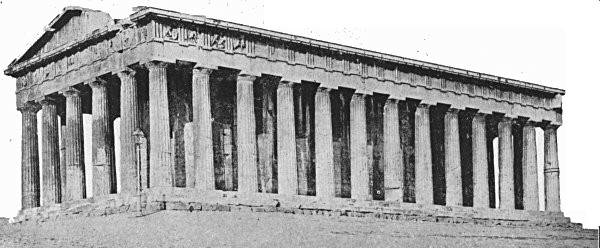
It has been well said that, if we would study any subject properly, we
must study it as something that is alive and growing and consider it
with reference to its growth in the past. As most of the vital forces
and movements in modern civilization had their origin in Greece, this
means that, to study them properly, we must get back to Greece. So it is
with the literature of modern countries, or their philosophy, or their
art; we cannot study them with the determination to get to the bottom
and understand them without the way pointing eventually back to Greece.
When we think of the debt which mankind owes to the Greeks, we are apt
to think too exclusively of the masterpieces in literature and art which
they have left us. But the Greek genius was many-sided; the Greek, with
his insatiable love of knowledge, his determination to see things as
they are and to see them whole, his burning desire to be able to give a
rational explanation of everything in heaven and earth, was just as
irresistibly driven to natural science, mathematics, and exact reasoning
in general, or logic.
To quote from a brilliant review of a well-known work: ‘To be a
Greek was to seek to know, to know the primordial substance of matter,
to know the meaning of number, to know the world as a rational whole. In
no spirit of paradox one may say that Euclid is the most typical Greek:
he would know to the bottom, and know as a rational system, the laws of
the measurement of the earth. Plato, too, loved geometry and the wonders
of numbers; he was essentially Greek because he was essentially
mathematical.... And if one thus finds the
Greek genius in Euclid and
the Posterior Analytics, one will understand the motto written over
the Academy, μηδεις αγεωμετρητος εισιτω. To know what the Greek
genius meant you must (if one may speak εν αινιγματι) begin
with geometry.’
Mathematics, indeed, plays an important part in Greek philosophy: there
are, for example, many passages in Plato and Aristotle for the
interpretation of which some knowledge of the technique of Greek
mathematics is the first essential. Hence it should be part of the
equipment of every classical student that he should have read
substantial portions of the works of the Greek mathematicians in the
original, say, some of the early books of Euclid in full and the
definitions (at least) of the other books, as well as selections from
other writers. Von Wilamowitz-Moellendorff has included in his
Griechisches Lesebuch extracts from Euclid, Archimedes and Heron of
Alexandria; and the example should be followed in this country.
Acquaintance with the original works of the Greek mathematicians is no
less necessary for any mathematician worthy of the name. Mathematics is
a Greek science. So far as pure geometry is concerned, the
mathematician’s technical equipment is almost wholly Greek. The
Greeks laid down the principles, fixed the terminology and invented the
methods ab initio; moreover, they did this with such certainty that in
the centuries which have since elapsed there has been no need to
reconstruct, still less to reject as unsound, any essential part of
their doctrine.
Consider first the terminology of mathematics. Almost all the standard
terms are Greek or Latin translations from the Greek, and, although the
mathematician may be taught their meaning without knowing Greek, he will
certainly grasp their significance better if he knows them as they arise
and as part of the living language of the men who invented them. Take
the word isosceles; a schoolboy can be shown what an isosceles
triangle is, but, if he knows nothing of the derivation, he will wonder
why such an apparently outlandish term should be necessary to express so
simple an idea. But if the mere appearance of the word shows him that it
means a thing with equal legs, being compounded of ισος,
equal, and σκελος, a leg, he will understand its
appropriateness and will have no difficulty in remembering it.
Equilateral, on the other hand, is borrowed from the Latin, but it is
merely the Latin translation of the Greek ισοπλευρος,
equal-sided. Parallelogram again can be explained to a Greekless
person, but it will be far better understood by one who sees in it the
two words παραλληλος and
γραμμη and realizes that it
is a short way of expressing that the figure in question is contained by
parallel lines; and we shall best understand the word parallel itself
if we see in it the statement of the fact that the two straight lines so
described go alongside one another, παρ’ αλληλας, all the
way. Similarly a mathematician should know that a rhombus is so called
from its resemblance to a form of spinning-top (ῥομβος from
ῥεμβω, to spin) and that, just as a parallelogram is a figure
formed by two pairs of parallel straight lines, so a parallelepiped is
a solid figure bounded by three pairs of parallel planes (παραλληλος,
parallel, and επιπεδος, plane); incidentally, in
the latter case, he will be saved from writing
‘parallelopiped’, a monstrosity which has disfigured not a
few textbooks of geometry. Another good example is the word
hypotenuse; it comes from the verb ὑποτεινειν
(c. ὑπο
and acc. or simple acc.), to stretch under, or, in its Latin
form, to subtend, which term is used quite generally for ‘to be
opposite to’; in our phraseology the word hypotenuse is
restricted to that side of a right-angled triangle which is opposite to
the right angle, being short for the expression used in Eucl. i. 47,
ἡ την ορθην γωνιαν ὑποτεινουσα πλευρα, ‘the side
subtending the right angle’, which accounts for the feminine
participial form ὑποτεινουσα, hypotenuse. If mathematicians
had had more Greek, perhaps the misspelt form
‘hypothenuse’ would not have survived so long.
To take an example outside the Elements, how can a mathematician
properly understand the term latus rectum used in conic sections
unless he has seen it in Apollonius as the erect side
(ορθια πλευρα)
of a certain rectangle in the case of each of the three
conics?[3] The word ordinate can hardly convey anything to one who
does not know that it is what Apollonius describes as ‘the
straight line drawn down (from a point on the curve) in the prescribed
or ordained manner (τεταγμενως κατηγμενη)’. Asymptote
again comes from ασυμπτωτος, non-meeting, non-secant, and
had with the Greeks a more general signification as well as the narrower
one which it has for us: it was sometimes used of parallel lines, which
also ‘do not meet’.
Again, if we take up a textbook of geometry written in accordance with
the most modern Education Board circular or University syllabus, we
shall find that the phraseology used (except where made more colloquial
and less scientific) is almost all pure Greek. The Greek tongue was
extraordinarily well adapted as a vehicle of scientific thought. One of
the characteristics of Euclid’s language which his commentator
Proclus is most fond of emphasizing is its marvellous exactness
(ακριβεια). The language of the Greek geometers is also
wonderfully concise, notwithstanding all appearances to the contrary.
One of the complaints often made against Euclid is that he is
‘diffuse’. Yet (apart from abbreviations in writing) it will
be found that the exposition of corresponding
matters in modern
elementary textbooks generally takes up, not less, but more space. And,
to say nothing of the perfect finish of Archimedes’s treatises, we
shall find in Heron, Ptolemy and Pappus veritable models of concise
statement. The purely geometrical proof by Heron of the formula for the
area of a triangle, Δ=√{s(s-a) (s-b) (s-c)}, and the
geometrical propositions in Book I of Ptolemy’s Syntaxis
(including ‘Ptolemy’s Theorem’) are cases in point.
The principles of geometry and arithmetic (in the sense of the theory of
numbers) are stated in the preliminary matter of Books I and VII of
Euclid. But Euclid was not their discoverer; they were gradually evolved
from the time of Pythagoras onwards. Aristotle is clear about the nature
of the principles and their classification. Every demonstrative science,
he says, has to do with three things, the subject-matter, the things
proved, and the things from which the proof starts (εξ ὡν). It
is not everything that can be proved, otherwise the chain of proof would
be endless; you must begin somewhere, and you must start with things
admitted but indemonstrable. These are, first, principles common to all
sciences which are called axioms or common opinions, as that
‘of two contradictories one must be true’, or ‘if
equals be subtracted from equals, the remainders are equal’;
secondly, principles peculiar to the subject-matter of the particular
science, say geometry. First among the latter principles are
definitions; there must be agreement as to what we mean by certain
terms. But a definition asserts nothing about the existence or
non-existence of the thing defined. The existence of the various things
defined has to be proved except in the case of a few primary things in
each science the existence of which is indemonstrable and must be
assumed among the first principles of the science; thus in geometry we
must assume the existence of points and lines, and in arithmetic of the
unit. Lastly, we must assume certain other things which are
less
obvious and cannot be proved but yet have to be accepted; these are
called postulates, because they make a demand on the faith of the
learner. Euclid’s Postulates are of this kind, especially that
known as the parallel-postulate.
The methods of solution of problems were no doubt first applied in
particular cases and then gradually systematized; the technical terms
for them were probably invented later, after the methods themselves had
become established.
One method of solution was the reduction of one problem to another.
This was called απαγωγη, a term which seems to occur first in
Aristotle. But instances of such reduction occurred long before.
Hippocrates of Chios reduced the problem of duplicating the cube to that
of finding two mean proportionals in continued proportion between two
straight lines, that is, he showed that, if the latter problem could be
solved, the former was thereby solved also; and it is probable that
there were still earlier cases in the Pythagorean geometry.
Next there is the method of mathematical analysis. This method is said
to have been ‘communicated’ or ‘explained’ by
Plato to Leodamas of Thasos; but, like reduction (to which it is closely
akin), analysis in the mathematical sense must have been in use much
earlier. Analysis and its correlative synthesis are defined by
Pappus: ‘in analysis we assume that which is sought as if it were
already done, and we inquire what it is from which this results, and
again what is the antecedent cause of the latter, and so on, until by so
retracing our steps we come upon something already known or belonging to
the class of principles. But in synthesis, reversing the process, we
take as already done that which was last arrived at in the analysis,
and, by arranging in their natural order as consequences what were
before antecedents and successively connecting them one with another, we
arrive finally at the construction of that which was sought.’
The method of reductio ad absurdum is a variety of analysis.
Starting
from a hypothesis, namely the contradictory of what we desire to prove,
we use the same process of analysis, carrying it back until we arrive at
something admittedly false or absurd. Aristotle describes this method in
various ways as reductio ad absurdum, proof per impossibile, or
proof leading to the impossible. But here again, though the term was
new, the method was not. The paradoxes of Zeno are classical instances.
Lastly, the Greeks established the form of exposition which still
governs geometrical work, simply because it is dictated by strict logic.
It is seen in Euclid’s propositions, with their separate formal
divisions, to which specific names were afterwards assigned, (1) the
enunciation (προτασις), (2) the setting-out
(εκθεσις), (3) the
διορισμος, being a re-statement of what we
are required to do or prove, not in general terms (as in the
enunciation), but with reference to the particular data contained in
the setting-out, (4) the construction
(κατασκευη), (5) the
proof (αποδειξις), (6) the conclusion
(συμπερασμα).
In the case of a problem it often happens that a solution
is not possible unless the particular data are such as to satisfy
certain conditions; in this case there is yet another constituent part
in the proposition, namely the statement of the conditions or limits of
possibility, which was called by the same name διορισμος,
definition or delimitation, as that applied to the third constituent
part of a theorem.
We have so far endeavoured to indicate generally the finality and the
abiding value of the work done by the creators of mathematical science.
It remains to summarize, as briefly as possible, the history of Greek
mathematics according to periods and subjects.
The Greeks of course took what they could in the shape of elementary
facts in geometry and astronomy from the Egyptians and Babylonians. But
some of the essential characteristics of the Greek genius assert
themselves even in
their borrowings from these or other sources. Here,
as everywhere else, we see their directness and concentration; they
always knew what they wanted, and they had an unerring instinct for
taking only what was worth having and rejecting the rest. This is
illustrated by the story of Pythagoras’s travels. He consorted
with priests and prophets and was initiated into the religious rites
practised in different places, not out of religious enthusiasm ‘as
you might think’ (says our informant), but in order that he might
not overlook any fragment of knowledge worth acquiring that might lie
hidden in the mysteries of divine worship.
This story also illustrates an important advantage which the Greeks had
over the Egyptians and Babylonians. In those countries science, such as
it was, was the monopoly of the priests; and, where this is the case,
the first steps in science are apt to prove the last also, because the
scientific results attained tend to become involved in religious
prescriptions and routine observances, and so to end in a collection of
lifeless formulae. Fortunately for the Greeks, they had no organized
priesthood; untrammelled by prescription, traditional dogmas or
superstition, they could give their reasoning faculties free play. Thus
they were able to create science as a living thing susceptible of
development without limit.
Greek geometry, as also Greek astronomy, begins with Thales (about
624-547 B. C.), who travelled in Egypt and is said to have brought
geometry from thence. Such geometry as there was in Egypt arose out of
practical needs. Revenue was raised by the taxation of landed property,
and its assessment depended on the accurate fixing of the boundaries of
the various holdings. When these were removed by the periodical flooding
due to the rising of the Nile, it was necessary to replace them, or to
determine the taxable area independently of them, by an art of
land-surveying. We conclude from the Papyrus Rhind (say 1700 B. C.) and
other documents that Egyptian geometry consisted mainly of practical
rules for measuring, with more or less accuracy, (1) such areas as
squares, triangles, trapezia, and circles, (2) the solid content of
measures of corn, &c., of different shapes. The Egyptians also
constructed pyramids of a certain slope by means of arithmetical
calculations based on a certain ratio, se-qeṭ, namely the ratio of
half the side of the base to the height, which is in fact equivalent to
the co-tangent of the angle of slope. The use of this ratio implies the
notion of similarity of figures, especially triangles. The Egyptians
knew, too, that a triangle with its sides in the ratio of the numbers 3,
4, 5 is right-angled, and used the fact as a means of drawing right
angles. But there is no sign that they knew the general property of a
right-angled triangle (= Eucl. I. 47), of which this is a particular
case, or that they proved any general theorem in geometry.
No doubt Thales, when he was in Egypt, would see diagrams drawn to
illustrate the rules for the measurement of circles and other plane
figures, and these diagrams would suggest to him certain similarities
and congruences which would set him thinking whether there were not some
elementary general principles underlying the construction and relations
of different figures and parts of figures. This would be in accord with
the Greek instinct for generalization and their wish to be able to
account for everything on rational principles.
The following theorems are attributed to Thales: (1) that a circle is
bisected by any diameter (Eucl. I, Def. 17), (2) that the angles at the
base of an isosceles triangle are equal (Eucl. I. 5), (3) that, if two
straight lines cut one another, the vertically opposite angles are equal
(Eucl. I. 15), (4) that, if two triangles have two angles and one side
respectively equal, the triangles are equal in all respects (Eucl. I.
26). He is said (5) to have been the first to inscribe a right-angled
triangle in a circle, which must mean that he was the first to discover
that the angle in a semicircle is a right angle (cf. Eucl. III. 31).
Elementary as these things are, they represent a new departure of a
momentous kind, being the first steps towards a theory of geometry. On
this point we cannot do better than quote some remarks from Kant’s
preface to the second edition of his Kritik der reinen Vernunft.
‘Mathematics has, from the earliest times to which the history of
human reason goes back, (that is to say) with that wonderful people the
Greeks, travelled the safe road of a science. But it must not be
supposed that it was as easy for mathematics as it was for logic, where
reason is concerned with itself alone, to find, or rather to build for
itself, that royal road. I believe on the contrary that with mathematics
it remained for long a case of groping about—the Egyptians in
particular were still at that stage—and that this transformation must
be ascribed to a revolution brought about by the happy inspiration of
one man in trying an experiment, from which point onward the road that
must be taken could no longer be missed, and the safe way of a science
was struck and traced out for all time and to distances illimitable....
A light broke on the first man who demonstrated the property of the
isosceles triangle (whether his name was Thales or what you
will)....’
Thales also solved two problems of a practical kind: (1) he showed how
to measure the distance of a ship at sea, and (2) he found the heights
of pyramids by means of the shadows thrown on the ground by the pyramid
and by a stick of known length at the same moment; one account says that
he chose the time when the lengths of the stick and of its shadow were
equal, but in either case he argued by similarity of triangles.
In astronomy Thales predicted a solar eclipse which was probably that of
the 28th May 585 B. C. Now the Babylonians, as the result of
observations continued through centuries, had discovered the period of
223 lunations after which eclipses
recur. It is most likely therefore that Thales had heard of this
period, and that his prediction was based upon it. He is further said to
have used the Little Bear for finding the pole, to have discovered the
inequality of the four astronomical seasons, and to have written works
On the Equinox and On the Solstice.
After Thales come the Pythagoreans. Of the Pythagoreans Aristotle says
that they applied themselves to the study of mathematics and were the
first to advance that science, going so far as to find in the principles
of mathematics the principles of all existing things. Of Pythagoras
himself we are told that he attached supreme importance to the study of
arithmetic, advancing it and taking it out of the region of practical
utility, and again that he transformed the study of geometry into a
liberal education, examining the principles of the science from the
beginning.
The very word μαθηματα, which originally meant ‘subjects
of instruction’ generally, is said to have been first appropriated
to mathematics by the Pythagoreans.
In saying that arithmetic began with Pythagoras we have to distinguish
between the uses of that word then and now. Αριθμητικη with
the Greeks was distinguished from λογιστικη, the science of
calculation. It is the latter word which would cover arithmetic in our
sense, or practical calculation; the term αριθμητικη was
restricted to the science of numbers considered in themselves, or, as we
should say, the Theory of Numbers. Another way of putting the
distinction was to say that αριθμητικη dealt with absolute
numbers or numbers in the abstract, and λογιστικη with numbered
things or concrete numbers; thus λογιστικη included simple
problems about numbers of apples, bowls, or objects generally, such as
are found in the Greek Anthology and sometimes involve simple
algebraical equations.
The Theory of Numbers then began with Pythagoras (about
572-497 B. C.).
It included definitions of the unit and of number, and the
classification and definitions of the various classes of numbers, odd,
even, prime, composite, and sub-divisions of these such as odd-even,
even-times-even, &c. Again there were figured numbers, namely,
triangular numbers, squares, oblong numbers, polygonal numbers
(pentagons, hexagons, &c.) corresponding respectively to plane figures,
and pyramidal numbers, cubes, parallelepipeds, &c., corresponding to
solid figures in geometry. The treatment was mostly geometrical, the
numbers being represented by dots filling up geometrical figures of the
various kinds. The laws of formation of the various figured numbers were
established. In this investigation the gnomon played an important
part. Originally meaning the upright needle of a sun-dial, the term was
next used for a figure like a carpenter’s square, and then was
applied to a figure of that shape put round two sides of a square and
making up a larger square. The arithmetical application of the term was
similar. If we represent a unit by one dot and put round it three dots
in such a way that the four form the corners of a square, three is the
first gnomon. Five dots put at equal distances round two sides of the
square containing four dots make up the next square (3²), and five is
the second gnomon. Generally, if we have n² dots so arranged as to
fill up a square with n for its side, the gnomon to be put round it to
make up the next square, (n+1)², has 2n+1 dots. In the formation of
squares, therefore, the successive gnomons are the series of odd numbers
following 1 (the first square), namely 3, 5, 7, ... In the formation of
oblong numbers (numbers of the form n(n+1)), the first of which is
1. 2, the successive gnomons are the terms after 2 in the series of
even numbers 2, 4, 6.... Triangular numbers are formed by adding to 1
(the first triangle) the terms after 1 in the series of natural numbers
1, 2, 3 ...; these are therefore the gnomons (by analogy) for triangles.
The gnomons for pentagonal numbers are the terms after 1 in the
arithmetical progression 1, 4, 7, 10 ... (with 3, or 5-2, as the common
difference) and so on; the common difference of the successive gnomons
for an a-gonal number is a-2.
From the series of gnomons for squares we easily deduce a formula for
finding square numbers which are the sum of two squares. For, the gnomon
2n+1 being the difference between the successive squares n² and
(n+1)², we have only to make 2n+1 a square. Suppose that 2n+1=m²;
therefore n=½(m²-1), and {½(m²-1)}²+m²={½(m²+1)}², where m is any
odd number. This is the formula actually attributed to Pythagoras.
Pythagoras is said to have discovered the theory of proportionals or
proportion. This was a numerical theory and therefore was applicable to
commensurable magnitudes only; it was no doubt somewhat on the lines of
Euclid, Book VII. Connected with the theory of proportion was that of
means, and Pythagoras was acquainted with three of these, the
arithmetic, geometric, and sub-contrary (afterwards called harmonic). In
particular Pythagoras is said to have introduced from Babylon into
Greece the ‘most perfect’ proportion, namely:
a:(a+b)/2=2ab/(a+b):b,
where the second and third terms are respectively the arithmetic and
harmonic mean between a and b. A particular case is 12:9=8:6.
This bears upon what was probably Pythagoras’s greatest discovery,
namely that the musical intervals correspond to certain arithmetical
ratios between lengths of string at the same tension, the octave
corresponding to the ratio 2:1, the fifth to 3:2 and the fourth to 4:3.
These ratios being the same as those of 12 to 6, 8, 9 respectively, we
can understand
how the third term, 8, in the above proportion came to
be called the ‘harmonic’ mean between 12 and 6.
The Pythagorean arithmetic as a whole, with the developments made after
the time of Pythagoras himself, is mainly known to us through
Nicomachus’s Introductio arithmetica, Iamblichus’s
commentary on the same, and Theon of Smyrna’s work Expositio
rerum mathematicarum ad legendum Platonem utilium. The things in these
books most deserving of notice are the following.
First, there is the description of a ‘perfect’ number (a
number which is equal to the sum of all its parts, i.e. all its integral
divisors including 1 but excluding the number itself), with a statement
of the property that all such numbers end in 6 or 8. Four such numbers,
namely 6, 28, 496, 8128, were known to Nicomachus. The law of formation
for such numbers is first found in Eucl. IX. 36 proving that, if the sum
(Sn) of n terms of the series 1, 2, 2², 2³ ... is prime, then
Sn.2n-1 is a perfect number.
Secondly, Theon of Smyrna gives the law of formation of the series of
‘side-’ and ‘diameter-’ numbers which satisfy
the equations 2x²-y²=±1. The law depends on the proposition proved in
Eucl. II. 10 to the effect that (2x+y)²-2(x+y)²=2x²-y², whence it
follows that, if x, y satisfy either of the above equations, then
2x+y, x+y is a solution in higher numbers of the other equation. The
successive solutions give values for y/x, namely 1/1, 3/2, 7/5, 17/12,
41/29, ..., which are successive approximations to the value of √2 (the
ratio of the diagonal of a square to its side). The occasion for this
method of approximation to √2 (which can be carried as far as we please)
was the discovery by the Pythagoreans of the incommensurable or
irrational in this particular case.
Thirdly, Iamblichus mentions a discovery by Thymaridas, a Pythagorean
not later than Plato’s time, called the επανθημα
(‘bloom’) of Thymaridas, and amounting to the solution of
any number of simultaneous equations of the following form:
x+x1 + x2 + ... + xn-1 = s,
x + x1 = a1,
x + x2 = a2,
....
x+xn-1 = an-1,
the solution being x=((a1+a2+...+an-1)-s)/(n-2).
The rule is stated in general terms, but the above representation of its
effect shows that it is a piece of pure algebra.
The Pythagorean contributions to geometry were even more remarkable. The
most famous proposition attributed to Pythagoras himself is of course
the theorem of Eucl. I. 47 that the square on the hypotenuse of any
right-angled triangle is equal to the sum of the squares on the other
two sides. But Proclus also attributes to him, besides the theory of
proportionals, the construction of the ‘cosmic figures’, the
five regular solids.
One of the said solids, the dodecahedron, has twelve regular pentagons
for faces, and the construction of a regular pentagon involves the
cutting of a straight line ‘in extreme and mean ratio’
(Eucl. II. 11 and VI. 30), which is a particular case of the method
known as the application of areas. This method was fully worked out by
the Pythagoreans and proved one of the most powerful in all Greek
geometry. The most elementary case appears in Eucl. I. 44, 45, where it
is shown how to apply to a given straight line as base a parallelogram
with one angle equal to a given angle and equal in area to any given
rectilineal figure; this construction is the geometrical equivalent of
arithmetical division. The general case is that in which the
parallelogram, though applied to the straight line, overlaps it or falls
short of it in such a way that the part of the parallelogram which
extends beyond or falls short of the parallelogram of the same angle and
breadth on the given straight line itself (exactly) as base is similar
to any given parallelogram (Eucl. VI. 28, 29). This is the geometrical
equivalent of the solution of the most general form of quadratic
equation ax±mx²=C, so far as it has real roots; the condition that the
roots may be real was also worked out (=Eucl. VI. 27). It is in the form
of ‘application of areas’ that Apollonius obtains the
fundamental property of each of the conic sections, and, as we shall
see, it is from the terminology of application of areas that Apollonius
took the three names parabola, hyperbola, and ellipse which he was
the first to give to the three curves.
Another problem solved by the Pythagoreans was that of drawing a
rectilineal figure which shall be equal in area to one given rectilineal
figure and similar to another. Plutarch mentions a doubt whether it was
this problem or the theorem of Eucl. I. 47 on the strength of which
Pythagoras was said to have sacrificed an ox.
The main particular applications of the theorem of the square on the
hypotenuse, e. g. those in Euclid, Book II, were also Pythagorean; the
construction of a square equal to a given rectangle (Eucl. II. 14) is
one of them, and corresponds to the solution of the pure quadratic
equation x²=ab.
The Pythagoreans knew the properties of parallels and proved the theorem
that the sum of the three angles of any triangle is equal to two right
angles.
As we have seen, the Pythagorean theory of proportion, being numerical,
was inadequate in that it did not apply to incommensurable magnitudes;
but, with this qualification, we may say that the Pythagorean geometry
covered the bulk of the subject-matter of Books I, II, IV and VI of
Euclid’s Elements. The case is less clear with regard to Book
III of the Elements; but, as the main propositions of that Book were
known to Hippocrates of Chios in the second half of the fifth
century
B. C., we conclude that they, too, were part of the Pythagorean
geometry.
Lastly, the Pythagoreans discovered the existence of the incommensurable
or irrational in the particular case of the diagonal of a square in
relation to its side. Aristotle mentions an ancient proof of the
incommensurability of the diagonal with the side by a reductio ad
absurdum showing that, if the diagonal were commensurable with the
side, it would follow that one and the same number is both odd and even.
This proof was doubtless Pythagorean.
A word should be added about the Pythagorean astronomy. Pythagoras was
the first to hold that the earth (and no doubt each of the other
heavenly bodies also) is spherical in shape, and he was aware that the
sun, moon and planets have independent movements of their own in a sense
opposite to that of the daily rotation; but he seems to have kept the
earth in the centre. His successors in the school (one Hicetas of
Syracuse and Philolaus are alternatively credited with this innovation)
actually abandoned the geocentric idea and made the earth, like the sun,
the moon, and the other planets, revolve in a circle round the
‘central fire’, in which resided the governing principle
ordering and directing the movement of the universe.
The geometry of which we have so far spoken belongs to the Elements.
But, before the body of the Elements was complete, the Greeks had
advanced beyond the Elements. By the second half of the fifth century B.
C. they had investigated three famous problems in higher geometry, (1)
the squaring of the circle, (2) the trisection of any angle, (3) the
duplication of the cube. The great names belonging to this period are
Hippias of Elis, Hippocrates of Chios, and Democritus.
Hippias of Elis invented a certain curve described by combining two
uniform movements (one angular and the other rectilinear) taking the
same time to complete. Hippias himself used his curve for the
trisection of any angle or the division of it in any ratio; but it was
afterwards employed by Dinostratus, a brother of Eudoxus’s pupil
Menaechmus, and by Nicomedes for squaring the circle, whence it got the
name τετραγωνιζουσα, quadratrix.
Hippocrates of Chios is mentioned by Aristotle as an instance to prove
that a man may be a distinguished geometer and, at the same time, a fool
in the ordinary affairs of life. He occupies an important place both in
elementary geometry and in relation to two of the higher problems above
mentioned. He was, so far as is known, the first compiler of a book of
Elements; and he was the first to prove the important theorem of Eucl.
XII. 2 that circles are to one another as the squares on their
diameters, from which he further deduced that similar segments of
circles are to one another as the squares on their bases. These
propositions were used by him in his tract on the squaring of lunes,
which was intended to lead up to the squaring of the circle. The
essential portions of the tract are preserved in a passage of
Simplicius’s commentary on Aristotle’s Physics, which
contains substantial extracts from Eudemus’s lost History of
Geometry. Hippocrates showed how to square three particular lunes of
different kinds and then, lastly, he squared the sum of a circle and a
certain lune. Unfortunately the last-mentioned lune was not one of those
which can be squared, so that the attempt to square the circle in this
way failed after all.
Hippocrates also attacked the problem of doubling the cube. There are
two versions of the origin of this famous problem. According to one
story an old tragic poet had represented Minos as having been
dissatisfied with the size of a cubical tomb erected for his son Glaucus
and having told the architect to make it double the size while retaining
the cubical form. The other story says that the Delians, suffering from
a pestilence, consulted the oracle and were told to
double a certain
altar as a means of staying the plague. Hippocrates did not indeed solve
the problem of duplication, but reduced it to another, namely that of
finding two mean proportionals in continued proportion between two given
straight lines; and the problem was ever afterwards attacked in this
form. If x, y be the two required mean proportionals between two
straight lines a, b, then a:x=x:y=y:b, whence b/a=(x/a)³, and,
as a particular case, if b=2a, x³=2a³, so that, when x is found,
the cube is doubled.
Democritus wrote a large number of mathematical treatises, the titles
only of which are preserved. We gather from one of these titles,
‘On irrational lines and solids’, that he wrote on
irrationals. Democritus realized as fully as Zeno, and expressed with no
less piquancy, the difficulty connected with the continuous and the
infinitesimal. This appears from his dilemma about the circular base of
a cone and a parallel section; the section which he means is a section
‘indefinitely near’ (as the phrase is) to the base, i. e.
the very next section, as we might say (if there were one). Is it,
said Democritus, equal or not equal to the base? If it is equal, so will
the very next section to it be, and so on, so that the cone will really
be, not a cone, but a cylinder. If it is unequal to the base and in fact
less, the surface of the cone will be jagged, like steps, which is very
absurd. We may be sure that Democritus’s work on ‘The
contact of a circle or a sphere’ discussed a like difficulty.
Lastly, Archimedes tells us that Democritus was the first to state,
though he could not give a rigorous proof, that the volume of a cone or
a pyramid is one-third of that of the cylinder or prism respectively on
the same base and having equal height, theorems first proved by Eudoxus.
We come now to the time of Plato, and here the great names are Archytas,
Theodoras of Cyrene, Theaetetus, and Eudoxus.
Archytas (about 430-360 B. C.) wrote on music and the numerical ratios
corresponding to the intervals of the tetrachord. He is said to have
been the first to write a treatise on mechanics based on mathematical
principles; on the practical side he invented a mechanical dove which
would fly. In geometry he gave the first solution of the problem of the
two mean proportionals, using a wonderful construction in three
dimensions which determined a certain point as the intersection of three
surfaces, (1) a certain cone, (2) a half-cylinder, (3) an anchor-ring or
tore with inner diameter nil.
Theodorus, Plato’s teacher in mathematics, extended the theory of
the irrational by proving incommensurability in certain particular cases
other than that of the diagonal of a square in relation to its side,
which was already known. He proved that the side of a square containing
3 square feet, or 5 square feet, or any non-square number of square feet
up to 17 is incommensurable with one foot, in other words that √3, √5
... √17 are all incommensurable with 1. Theodorus’s proof was
evidently not general; and it was reserved for Theaetetus to comprehend
all these irrationals in one definition, and to prove the property
generally as it is proved in Eucl. X. 9. Much of the content of the rest
of Euclid’s Book X (dealing with compound irrationals), as also of
Book XIII on the five regular solids, was due to Theaetetus, who is even
said to have discovered two of those solids (the octahedron and
icosahedron).
Plato (427-347 B. C.) was probably not an original mathematician, but he
‘caused mathematics in general and geometry in particular to make
a great advance by reason of his enthusiasm for them’. He
encouraged the members of his school to specialize in mathematics and
astronomy; e. g. we are told that in astronomy he set it as a problem to
all earnest students to find ‘what are the uniform and ordered
movements by the assumption of which the apparent motions of the
planets
may be accounted for’. In Plato’s own writings are
found certain definitions, e. g. that of a straight line as ‘that
of which the middle covers the ends’, and some interesting
mathematical illustrations, especially that in the second geometrical
passage in the Meno (86E-87C). To Plato himself are attributed (1) a
formula (n²-1)²+(2n)²=(n²+1)² for finding two square numbers the sum
of which is a square number, (2) the invention of the method of
analysis, which he is said to have explained to Leodamas of Thasos
(mathematical analysis was, however, certainly, in practice, employed
long before). The solution, attributed to Plato, of the problem of the
two mean proportionals by means of a frame resembling that which a
shoemaker uses to measure a foot, can hardly be his.
Eudoxus (408-355 B. C.), an original genius second to none (unless it be
Archimedes) in the history of our subject, made two discoveries of
supreme importance for the further development of Greek geometry.
(1) As we have seen, the discovery of the incommensurable rendered
inadequate the Pythagorean theory of proportion, which applied to
commensurable magnitudes only. It would no doubt be possible, in most
cases, to replace proofs depending on proportions by others; but this
involved great inconvenience, and a slur was cast on geometry generally.
The trouble was remedied once for all by Eudoxus’s discovery of
the great theory of proportion, applicable to commensurable and
incommensurable magnitudes alike, which is expounded in Euclid’s
Book V. Well might Barrow say of this theory that ‘there is
nothing in the whole body of the elements of a more subtile invention,
nothing more solidly established’. The keystone of the structure
is the definition of equal ratios (Eucl. V, Def. 5); and twenty-three
centuries have not abated a jot from its value, as is plain from the
facts that Weierstrass repeats it word for word as his definition of
equal
numbers, and it corresponds almost to the point of coincidence
with the modern treatment of irrationals due to Dedekind.
(2) Eudoxus discovered the method of exhaustion for measuring
curvilinear areas and solids, to which, with the extensions given to it
by Archimedes, Greek geometry owes its greatest triumphs. Antiphon the
Sophist, in connexion with attempts to square the circle, had asserted
that, if we inscribe successive regular polygons in a circle,
continually doubling the number of sides, we shall sometime arrive at a
polygon the sides of which will coincide with the circumference of the
circle. Warned by the unanswerable arguments of Zeno against
infinitesimals, mathematicians substituted for this the statement that,
by continuing the construction, we can inscribe a polygon approaching
equality with the circle as nearly as we please. The method of
exhaustion used, for the purpose of proof by reductio ad absurdum, the
lemma proved in Eucl. X. 1 (to the effect that, if from any magnitude we
subtract not less than half, and then from the remainder not less than
half, and so on continually, there will sometime be left a magnitude
less than any assigned magnitude of the same kind, however small): and
this again depends on an assumption which is practically contained in
Eucl. V, Def. 4, but is generally known as the Axiom of Archimedes,
stating that, if we have two unequal magnitudes, their difference
(however small) can, if continually added to itself, be made to exceed
any magnitude of the same kind (however great).
The method of exhaustion is seen in operation in Eucl. XII. 1-2, 3-7
Cor., 10, 16-18. Props. 3-7 Cor. and Prop. 10 prove that the volumes of
a pyramid and a cone are one-third of the prism and cylinder
respectively on the same base and of equal height; and Archimedes
expressly says that these facts were first proved by Eudoxus.
In astronomy Eudoxus is famous for the beautiful theory of concentric
spheres which he invented to explain the apparent
motions of the
planets and, particularly, their apparent stationary points and
retrogradations. The theory applied also to the sun and moon, for each
of which Eudoxus employed three spheres. He represented the motion of
each planet as produced by the rotations of four spheres concentric with
the earth, one within the other, and connected in the following way.
Each of the inner spheres revolves about a diameter the ends of which
(poles) are fixed on the next sphere enclosing it. The outermost sphere
represents the daily rotation, the second a motion along the zodiac
circle; the poles of the third sphere are fixed on the latter circle;
the poles of the fourth sphere (carrying the planet fixed on its
equator) are so fixed on the third sphere, and the speeds and directions
of rotation so arranged, that the planet describes on the second sphere
a curve called the hippopede (horse-fetter), or a figure of eight,
lying along and longitudinally bisected by the zodiac circle. The whole
arrangement is a marvel of geometrical ingenuity.
Heraclides of Pontus (about 388-315 B. C.), a pupil of Plato, made a
great step forward in astronomy by his declaration that the earth
rotates on its own axis once in 24 hours, and by his discovery that
Mercury and Venus revolve about the sun like satellites.
Menaechmus, a pupil of Eudoxus, was the discoverer of the conic
sections, two of which, the parabola and the hyperbola, he used for
solving the problem of the two mean proportionals. If a:x=x:y=y:b,
then x²=ay, y²=bx and xy=ab. These equations represent, in
Cartesian co-ordinates, and with rectangular axes, the conics by the
intersection of which two and two Menaechmus solved the problem; in the
case of the rectangular hyperbola it was the asymptote-property which he
used.
We pass to Euclid’s times. A little older than Euclid, Autolycus
of Pitane wrote two books, On the Moving Sphere, a work on Sphaeric
for use in astronomy, and On Risings and
Settings. The former work is
the earliest Greek textbook which has reached us intact. It was before
Euclid when he wrote his Phaenomena, and there are many points of
contact between the two books.
Euclid flourished about 300 B. C. or a little earlier. His great work,
the Elements in thirteen Books, is too well known to need description.
No work presumably, except the Bible, has had such a reign; and future
generations will come back to it again and again as they tire of the
variegated substitutes for it and the confusion resulting from their
bewildering multiplicity. After what has been said above of the growth
of the Elements, we can appreciate the remark of Proclus about Euclid,
‘who put together the Elements, collecting many of Eudoxus’s
theorems, perfecting many of Theaetetus’s and also bringing to
irrefragable demonstration the things which were only somewhat loosely
proved by his predecessors’. Though a large portion of the
subject-matter had been investigated by those predecessors, everything
goes to show that the whole arrangement was Euclid’s own; it is
certain that he made great changes in the order of propositions and in
the proofs, and that his innovations began at the very beginning of Book
I.
Euclid wrote other books on both elementary and higher geometry, and on
the other mathematical subjects known in his day. The elementary
geometrical works include the Data and On Divisions (of figures),
the first of which survives in Greek and the second in Arabic only; also
the Pseudaria, now lost, which was a sort of guide to fallacies in
geometrical reasoning. The treatises on higher geometry are all lost;
they include (1) the Conics in four Books, which covered almost the
same ground as the first three Books of Apollonius’s Conics,
although no doubt, for Euclid, the conics were still, as with his
predecessors, sections of a right-angled, an obtuse-angled, and an
acute-angled cone respectively made by a plane perpendiular
to a
generator in each case; (2) the Porisms in three Books, the importance
and difficulty of which can be inferred from Pappus’s account of
it and the lemmas which he gives for use with it; (3) the
Surface-Loci, to which again Pappus furnishes lemmas; one of these
implies that Euclid assumed as known the focus-directrix property of the
three conics, which is absent from Apollonius’s Conics.
In applied mathematics Euclid wrote (1) the Phaenomena, a work on
spherical astronomy in which ὁ ὁριζων (without
κυκλος or any qualifying words) appears for the first time in the sense
of horizon; (2) the Optics, a kind of elementary treatise on
perspective: these two treatises are extant in Greek; (3) a work on the
Elements of Music. The Sectio Canonis, which has come down under the
name of Euclid, can, however, hardly be his in its present form.
In the period between Euclid and Archimedes comes Aristarchus of Samos
(about 310-230 B. C.), famous for having anticipated Copernicus.
Accepting Heraclides’s view that the earth rotates about its own
axis, Aristarchus went further and put forward the hypothesis that the
sun itself is at rest, and that the earth, as well as Mercury, Venus,
and the other planets, revolve in circles about the sun. We have this on
the unquestionable authority of Archimedes, who was only some
twenty-five years later, and who must have seen the book containing the
hypothesis in question. We are told too that Cleanthes the Stoic thought
that Aristarchus ought to be indicted on the charge of impiety for
setting the Hearth of the Universe in motion.
One work of Aristarchus, On the sizes and distances of the Sun and
Moon, which is extant in Greek, is highly interesting in itself, though
it contains no word of the heliocentric hypothesis. Thoroughly classical
in form and style, it lays down certain hypotheses and then deduces
therefrom, by rigorous geometry, the sizes and distances of the sun and
moon. If the hypotheses had been exact, the results would have been
correct too; but Aristarchus in fact assumed a certain angle to be 87°
which is really 89° 50', and the angle subtended at the centre of the
earth by the diameter of either the sun or the moon to be 2°, whereas we
know from Archimedes that Aristarchus himself discovered that the latter
angle is only ½°. The effect of Aristarchus’s geometry is to find
arithmetical limits to the values of what are really trigonometrical
ratios of certain small angles, namely
1/18 > sin 3° > 1/20, 1/45 > sin 1° > 1/60, 1 > cos 1° > 89/90.
The main results obtained are (1) that the diameter of the sun is
between 18 and 20 times the diameter of the moon, (2) that the diameter
of the moon is between 2/45ths and 1/30th of the distance of the centre
of the moon from our eye, and (3) that the diameter of the sun is
between 19/3rds and 43/6ths of the diameter of the earth. The book
contains a good deal of arithmetical calculation.
Archimedes was born about 287 B. C. and was killed at the sack of
Syracuse by Marcellus’s army in 212 B. C. The stories about him
are well known, how he said ‘Give me a place to stand on, and I
will move the earth’ (πα βω και κινω ταν γαν; how,
having thought of the solution of the problem of the crown when in the
bath, he ran home naked shouting ἑυρηκα, ἑυρηκα; and how, the
capture of Syracuse having found him intent on a figure drawn on the
ground, he said to a Roman soldier who came up, ‘Stand away,
fellow, from my diagram.’ Of his work few people know more than
that he invented a tubular screw which is still used for pumping water,
and that for a long time he foiled the attacks of the Romans on Syracuse
by the mechanical devices and engines which he used against them. But he
thought meanly of these things, and his real interest was in pure
mathematical speculation; he caused to be engraved on his tomb a
representation of a cylinder circumscribing
a sphere, with the ratio
3/2 which the cylinder bears to the sphere: from which we infer that he
regarded this as his greatest discovery.
Archimedes’s works are all original, and are perfect models of
mathematical exposition; their wide range will be seen from the list of
those which survive: On the Sphere and Cylinder I, II, Measurement of
a Circle, On Conoids and Spheroids, On Spirals, On Plane
Equilibriums I, II, the Sandreckoner, Quadrature of the Parabola,
On Floating Bodies I, II, and lastly the Method (only discovered in
1906). The difficult Cattle-Problem is also attributed to him, and a
Liber Assumptorum which has reached us through the Arabic, but which
cannot be his in its present form, although some of the propositions in
it (notably that about the ‘Salinon’, salt-cellar, and
others about circles inscribed in the αρβηλος,
shoemaker’s knife) are quite likely to be of Archimedean origin.
Among lost works were the Catoptrica, On Sphere-making, and
investigations into polyhedra, including thirteen semi-regular solids,
the discovery of which is attributed by Pappus to Archimedes.
Speaking generally, the geometrical works are directed to the
measurement of curvilinear areas and volumes; and Archimedes employs a
method which is a development of Eudoxus’s method of exhaustion.
Eudoxus apparently approached the figure to be measured from below only,
i. e. by means of figures successively inscribed to it. Archimedes
approaches it from both sides by successively inscribing figures and
circumscribing others also, thereby compressing them, as it were, until
they coincide as nearly as we please with the figure to be measured. In
many cases his procedure is, when the analytical equivalents are set
down, seen to amount to real integration; this is so with his
investigation of the areas of a parabolic segment and a spiral, the
surface and volume of a sphere, and the volume of any segments of the
conoids and spheroids.
The newly-discovered Method is especially interesting as showing how
Archimedes originally obtained his results; this was by a clever
mechanical method of (theoretically) weighing infinitesimal elements
of the figure to be measured against elements of another figure the area
or content of which (as the case may be) is known; it amounts to an
avoidance of integration. Archimedes, however, would only admit that
the mechanical method is useful for finding results; he did not consider
them proved until they were established geometrically.
In the Measurement of a Circle, after proving by exhaustion that the
area of a circle is equal to a right-angled triangle with the
perpendicular sides equal respectively to the radius and the
circumference of the circle, Archimedes finds, by sheer calculation,
upper and lower limits to the ratio of the circumference of a circle to
its diameter (what we call π). This he does by inscribing and
circumscribing regular polygons of 96 sides and calculating
approximately their respective perimeters. He begins by assuming as
known certain approximate values for √3, namely 1351/780 > √3 > 265/153,
and his calculations involve approximating to the square roots of
several large numbers (up to seven digits). The text only gives the
results, but it is evident that the extraction of square roots presented
no difficulty, notwithstanding the comparative inconvenience of the
alphabetic system of numerals. The result obtained is well known, namely
3-1/7 > π > 3-10/71.
The Plane Equilibriums is the first scientific treatise on the first
principles of mechanics, which are established by pure geometry. The
most important result established in Book I is the principle of the
lever. This was known to Plato and Aristotle, but they had no real
proof. The Aristotelian Mechanics merely ‘refers’ the
lever ‘to the circle’, asserting that the force which acts
at the greater distance from the fulcrum moves the system more easily
because it describes a greater circle. Archimedes also finds the centre
of gravity
of a parallelogram, a triangle, a trapezium and finally (in
Book II) of a parabolic segment and of a portion of it cut off by a
straight line parallel to the base.
The Sandreckoner is remarkable for the development in it of a system
for expressing very large numbers by orders and periods based on
powers of myriad-myriads (10,000²). It also contains the important
reference to the heliocentric theory of the universe put forward by
Aristarchus of Samos in a book of ‘hypotheses’, as well as
historical details of previous attempts to measure the size of the earth
and to give the sizes and distances of the sun and moon.
Lastly, Archimedes invented the whole science of hydrostatics. Beginning
the treatise On Floating Bodies with an assumption about uniform
pressure in a fluid, he first proves that the surface of a fluid at rest
is a sphere with its centre at the centre of the earth. Other
propositions show that, if a solid floats in a fluid, the weight of the
solid is equal to that of the fluid displaced, and, if a solid heavier
than a fluid is weighed in it, it will be lighter than its true weight
by the weight of the fluid displaced. Then, after a second assumption
that bodies which are forced upwards in a fluid are forced upwards along
the perpendiculars to the surface which pass through their centres of
gravity, Archimedes deals with the position of rest and stability of a
segment of a sphere floating in a fluid with its base entirely above or
entirely below the surface. Book II is an extraordinary tour de force,
investigating fully all the positions of rest and stability of a right
segment of a paraboloid floating in a fluid according (1) to the
relation between the axis of the solid and the parameter of the
generating parabola, and (2) to the specific gravity of the solid in
relation to the fluid; the term ‘specific gravity’ is not
used, but the idea is fully expressed in other words.
Almost contemporary with Archimedes was Eratosthenes of Cyrene, to whom
Archimedes dedicated the Method; the
preface to this work shows that
Archimedes thought highly of his mathematical ability. He was indeed
recognized by his contemporaries as a man of great distinction in all
branches, though the names Beta and Pentathlos[4] applied to him
indicate that he just fell below the first rank in each subject. Ptolemy
Euergetes appointed him to be tutor to his son (Philopator), and he
became librarian at Alexandria; he recognized his obligation to Ptolemy
by erecting a column with a graceful epigram. In this epigram he
referred to the earlier solutions of the problem of duplicating the cube
or finding the two mean proportionals, and advocated his own in
preference, because it would give any number of means; on the column was
fixed a bronze representation of his appliance, a frame with
right-angled triangles (or rectangles) movable along two parallel
grooves and over one another, together with a condensed proof. The
Platonicus of Eratosthenes evidently dealt with the fundamental
notions of mathematics in connexion with Plato’s philosophy, and
seems to have begun with the story of the origin of the duplication
problem.
The most famous achievement of Eratosthenes was his measurement of the
earth. Archimedes quotes an earlier measurement which made the
circumference of the earth 300,000 stades. Eratosthenes improved upon
this. He observed that at the summer solstice at Syene, at noon, the sun
cast no shadow, while at the same moment the upright gnomon at
Alexandria cast a shadow corresponding to an angle between the gnomon
and the sun’s rays of 1/50th of four right angles. The distance
between Syene and Alexandria being known to be 5,000 stades, this gave
for the circumference of the earth 250,000 stades, which Eratosthenes
seems later, for some reason, to have changed to 252,000 stades. On the
most probable assumption as to the length of the stade used, the 252,000
stades give about 7,850 miles, only 50 miles less than the true polar
diameter.
In the work On the Measurement of the Earth Eratosthenes is said to
have discussed other astronomical matters, the distance of the tropic
and polar circles, the sizes and distances of the sun and moon, total
and partial eclipses, &c. Besides other works on astronomy and
chronology, Eratosthenes wrote a Geographica in three books, in which
he first gave a history of geography up to date and then passed on to
mathematical geography, the spherical shape of the earth, &c., &c.
Apollonius of Perga was with justice called by his contemporaries the
‘Great Geometer’, on the strength of his great treatise, the
Conics. He is mentioned as a famous astronomer of the reign of Ptolemy
Euergetes (247-222 B. C.); and he dedicated the fourth and later Books
of the Conics to King Attalus I of Pergamum (241-197 B. C.).
The Conics, a colossal work, originally in eight Books, survives as to
the first four Books in Greek and as to three more in Arabic, the eighth
being lost. From Apollonius’s prefaces we can judge of the
relation of his work to Euclid’s Conics, the content of which
answered to the first three Books of Apollonius. Although Euclid knew
that an ellipse could be otherwise produced, e. g. as an oblique section
of a right cylinder, there is no doubt that he produced all three conics
from right cones like his predecessors. Apollonius, however, obtains
them in the most general way by cutting any oblique cone, and his
original axes of reference, a diameter and the tangent at its extremity,
are in general oblique; the fundamental properties are found with
reference to these axes by ‘application of areas’, the three
varieties of which, application (παραβολη), application with
an excess (ὑπερβολη) and application with a deficiency
(ελλειψις), give the properties of the three curves
respectively and account for the names
parabola, hyperbola, and ellipse, by which Apollonius called them
for the first time. The principal axes only appear, as a particular
case, after it has been shown that the curves have a like property when
referred to any other diameter and the tangent at its extremity, instead
of those arising out of the original construction. The first four Books
constitute what Apollonius calls an elementary introduction; the
remaining Books are specialized investigations, the most important being
Book V (on normals) and Book VII (mainly on conjugate diameters).
Normals are treated, not in connexion with tangents, but as minimum or
maximum straight lines drawn to the curves from different points or
classes of points. Apollonius discusses such questions as the number of
normals that can be drawn from one point (according to its position) and
the construction of all such normals. Certain propositions of great
difficulty enable us to deduce quite easily the Cartesian equations to
the evolutes of the three conics.
Several other works of Apollonius are described by Pappus as forming
part of the ‘Treasury of Analysis’. All are lost except the
Sectio Rationis in two Books, which survives in Arabic and was
published in a Latin translation by Halley in 1706. It deals with all
possible cases of the general problem ‘given two straight lines
either parallel or intersecting, and a fixed point on each, to draw
through any given point a straight line which shall cut off intercepts
from the two lines (measured from the fixed points) bearing a given
ratio to one another’. The lost treatise Sectio Spatii dealt
similarly with the like problem in which the intercepts cut off have to
contain a given rectangle.
The other treatises included in Pappus’s account are (1) On
Determinate Section; (2) Contacts or Tangencies, Book II of which
is entirely devoted to the problem of drawing a circle to touch three
given circles (Apollonius’s solution can, with the aid of
Pappus’s auxiliary propositions, be satisfactorily
restored); (3)
Plane Loci, i. e. loci which are straight lines or circles; (4)
Νευσεις, Inclinationes (the general problem called a
νευσις being to insert between two lines, straight or curved, a
straight line of given length verging to a given point, i. e. so that,
if produced, it passes through the point, Apollonius restricted himself
to cases which could be solved by ‘plane’ methods, i. e. by
the straight line and circle only).
Apollonius is also said to have written (5) a Comparison of the
dodecahedron with the icosahedron (inscribed in the same sphere), in
which he proved that their surfaces are in the same ratio as their
volumes; (6) On the cochlias or cylindrical helix; (7) a
‘General Treatise’, which apparently dealt with the
fundamental assumptions, &c., of elementary geometry; (8) a work on
unordered irrationals, i. e. irrationals of more complicated form than
those of Eucl. Book X; (9) On the burning-mirror, dealing with
spherical mirrors and probably with mirrors of parabolic section also;
(10) ωκυτοκιον (‘quick delivery’). In the
last-named work Apollonius found an approximation to π closer
than that in Archimedes’s Measurement of a Circle; and possibly
the book also contained Apollonius’s exposition of his notation
for large numbers according to ‘tetrads’ (successive powers
of the myriad).
In astronomy Apollonius is said to have made special researches
regarding the moon, and to have been called ε (Epsilon) because
the form of that letter is associated with the moon. He was also a
master of the theory of epicycles and eccentrics.
With Archimedes and Apollonius Greek geometry reached its culminating
point; indeed, without some more elastic notation and machinery such as
algebra provides, geometry was practically at the end of its resources.
For some time, however, there were capable geometers who kept up the
tradition, filling in details, devising alternative solutions of
problems, or discovering new curves for use or investigation.
Nicomedes, probably intermediate in date between Eratosthenes and
Apollonius, was the inventor of the conchoid or cochloid, of which,
according to Pappus, there were three varieties. Diocles (about the end
of the second century B. C.) is known as the discoverer of the cissoid
which was used for duplicating the cube. He also wrote a book περι πυρειων,
On burning-mirrors, which probably discussed, among
other forms of mirror, surfaces of parabolic or elliptic section, and
used the focal properties of the two conics; it was in this work that
Diocles gave an independent and clever solution (by means of an ellipse
and a rectangular hyperbola) of Archimedes’s problem of cutting a
sphere into two segments in a given ratio. Dionysodorus gave a solution
by means of conics of the auxiliary cubic equation to which Archimedes
reduced this problem; he also found the solid content of a tore or
anchor-ring.
Perseus is known as the discoverer and investigator of the spiric
sections, i. e. certain sections of the σπειρα, one variety of
which is the tore. The spire is generated by the revolution of a
circle about a straight line in its plane, which straight line may
either be external to the circle (in which case the figure produced is
the tore), or may cut or touch the circle.
Zenodorus was the author of a treatise on Isometric figures, the
problem in which was to compare the content of different figures, plane
or solid, having equal contours or surfaces respectively.
Hypsicles (second half of second century B. C.) wrote what became known
as ‘Book XIV’ of the Elements containing supplementary
propositions on the regular solids (partly drawn from Aristaeus and
Apollonius); he seems also to have written on polygonal numbers. A
mediocre astronomical work (Αναφορικος) attributed to him is
the first Greek book in which we find the division of the zodiac circle
into 360 parts or degrees.
Posidonius the Stoic (about 135-51 B. C.) wrote on geography
and
astronomy under the titles On the Ocean and περι μετεωρων. He
made a new but faulty calculation of the circumference of the earth
(240,000 stades). Per contra, in a separate tract on the size of the
sun (in refutation of the Epicurean view that it is as big as it
looks), he made assumptions (partly guesswork) which give for the
diameter of the sun a figure of 3,000,000 stades (39-1/4 times the
diameter of the earth), a result much nearer the truth than those
obtained by Aristarchus, Hipparchus, and Ptolemy. In elementary geometry
Posidonius gave certain definitions (notably of parallels, based on the
idea of equidistance).
Geminus of Rhodes, a pupil of Posidonius, wrote (about 70 B. C.) an
encyclopaedic work on the classification and content of mathematics,
including the history of each subject, from which Proclus and others
have preserved notable extracts. An-Nairīzī (an Arabian commentator on
Euclid) reproduces an attempt by one ‘Aganis’, who appears
to be Geminus, to prove the parallel-postulate.
But from this time onwards the study of higher geometry (except
sphaeric) seems to have languished, until that admirable mathematician,
Pappus, arose (towards the end of the third century A. D.) to revive
interest in the subject. From the way in which, in his great
Collection, Pappus thinks it necessary to describe in detail the
contents of the classical works belonging to the ‘Treasury of
Analysis’ we gather that by his time many of them had been lost or
forgotten, and that he aimed at nothing less than re-establishing
geometry at its former level. No one could have been better qualified
for the task. Presumably such interest as Pappus was able to arouse soon
flickered out; but his Collection remains, after the original works of
the great mathematicians, the most comprehensive and valuable of all our
sources, being a handbook or guide to Greek geometry and covering
practically the whole field. Among the original things in Pappus’s
Collection is an enunciation
which amounts to an anticipation of what is known as Guldin’s
Theorem.
It remains to speak of three subjects, trigonometry (represented by
Hipparchus, Menelaus, and Ptolemy), mensuration (in Heron of
Alexandria), and algebra (Diophantus).
Although, in a sense, the beginnings of trigonometry go back to
Archimedes (Measurement of a Circle), Hipparchus was the first person
who can be proved to have used trigonometry systematically. Hipparchus,
the greatest astronomer of antiquity, whose observations were made
between 161 and 126 B. C., discovered the precession of the equinoxes,
calculated the mean lunar month at 29 days, 12 hours, 44 minutes, 2½
seconds (which differs by less than a second from the present accepted
figure!), made more correct estimates of the sizes and distances of the
sun and moon, introduced great improvements in the instruments used for
observations, and compiled a catalogue of some 850 stars; he seems to
have been the first to state the position of these stars in terms of
latitude and longitude (in relation to the ecliptic). He wrote a
treatise in twelve Books on Chords in a Circle, equivalent to a table of
trigonometrical sines. For calculating arcs in astronomy from other arcs
given by means of tables he used propositions in spherical trigonometry.
The Sphaerica of Theodosius of Bithynia (written, say, 20 B. C.)
contains no trigonometry. It is otherwise with the Sphaerica of
Menelaus (fl. A. D. 100) extant in Arabic; Book I of this work contains
propositions about spherical triangles corresponding to the main
propositions of Euclid about plane triangles (e.g. congruence theorems
and the proposition that in a spherical triangle the three angles are
together greater than two right angles), while Book III contains genuine
spherical trigonometry, consisting of ‘Menelaus’s
Theorem’ with reference to the sphere and deductions therefrom.
Ptolemy’s great work, the Syntaxis, written about
A. D. 150 and
originally called Μαθηματικη συνταξις, came to be known as
Μεγαλη συνταξις; the Arabs made up from the superlative
μεγιστος the word al-Majisti which became Almagest.
Book I, containing the necessary preliminaries to the study of the
Ptolemaic system, gives a Table of Chords in a circle subtended by
angles at the centre of ½° increasing by half-degrees to 180°. The
circle is divided into 360 μοιραι, parts or degrees, and the
diameter into 120 parts (τμηματα); the chords are given in
terms of the latter with sexagesimal fractions (e. g. the chord
subtended by an angle of 120° is 103p 53′ 23″). The Table of Chords
is equivalent to a table of the sines of the halves of the angles in
the table, for, if (crd. 2 α) represents the chord subtended by
an angle of 2 α (crd. 2 α)/120 = sin α.
Ptolemy first gives the minimum number of geometrical propositions
required for the calculation of the chords. The first of these finds
(crd. 36°) and (crd. 72°) from the geometry of the inscribed pentagon
and decagon; the second (‘Ptolemy’s Theorem’ about a
quadrilateral in a circle) is equivalent to the formula for
sin (θ-φ), the third to that for sin ½ θ. From (crd.
72°) and (crd. 60°) Ptolemy, by using these propositions successively,
deduces (crd. 1½°) and (crd. ¾°), from which he obtains (crd. 1°) by a
clever interpolation. To complete the table he only needs his fourth
proposition, which is equivalent to the formula for cos (θ+φ).
Ptolemy wrote other minor astronomical works, most of which survive in
Greek or Arabic, an Optics in five Books (four Books almost complete
were translated into Latin in the twelfth century), and an attempted
proof of the parallel-postulate which is reproduced by Proclus.
Heron of Alexandria (date uncertain; he may have lived as late as the
third century A. D.) was an almost encyclopaedic writer on mathematical
and physical subjects. He aimed at practical utility rather than
theoretical completeness; hence, apart from the interesting collection
of Definitions which has
come down under his name, and his commentary on Euclid which is
represented only by extracts in Proclus and an-Nairīzī, his geometry is
mostly mensuration in the shape of numerical examples worked out. As
these could be indefinitely multiplied, there was a temptation to add to
them and to use Heron’s name. However much of the separate works
edited by Hultsch (the Geometrica, Geodaesia, Stereometrica,
Mensurae, Liber geëponicus) is genuine, we must now regard as
more authoritative the genuine Metrica discovered at Constantinople in
1896 and edited by H. Schöne in 1903 (Teubner). Book I on the
measurement of areas is specially interesting for (1) its statement of
the formula used by Heron for finding approximations to surds, (2) the
elegant geometrical proof of the formula for the area of a triangle
Δ = √{s (s-a) (s-b) (s-c)},
a formula now known to be due to Archimedes, (3) an allusion to limits
to the value of π found by Archimedes and more exact than the 3-1/7 and
3-10/71 obtained in the Measurement of a Circle.
Book I of the Metrica calculates the areas of triangles,
quadrilaterals, the regular polygons up to the dodecagon (the areas even
of the heptagon, enneagon, and hendecagon are approximately evaluated),
the circle and a segment of it, the ellipse, a parabolic segment, and
the surfaces of a cylinder, a right cone, a sphere and a segment
thereof. Book II deals with the measurement of solids, the cylinder,
prisms, pyramids and cones and frusta thereof, the sphere and a segment
of it, the anchor-ring or tore, the five regular solids, and finally the
two special solids of Archimedes’s Method; full use is made of
all Archimedes’s results. Book III is on the division of figures.
The plane portion is much on the lines of Euclid’s Divisions (of
figures). The solids divided in given ratios are the sphere, the
pyramid, the cone and a frustum thereof. Incidentally Heron shows how he
obtained an approximation to the cube root of a non-cube number (100).
Quadratic equations are solved by Heron by a regular rule not unlike
our
method, and the Geometrica contains two interesting indeterminate
problems.
Heron also wrote Pneumatica (where the reader will find such things as
siphons, Heron’s Fountain, penny-in-the-slot machines, a
fire-engine, a water-organ, and many arrangements employing the force of
steam), Automaton-making, Belopoeïca (on engines of war),
Catoptrica, and Mechanics. The Mechanics has been edited from the
Arabic; it is (except for considerable fragments) lost in Greek. It
deals with the puzzle of ‘Aristotle’s Wheel’, the
parallelogram of velocities, definitions of, and problems on, the centre
of gravity, the distribution of weights between several supports, the
five mechanical powers, mechanics in daily life (queries and answers).
Pappus covers much the same ground in Book VIII of his Collection.
We come, lastly, to Algebra. Problems involving simple equations are
found in the Papyrus Rhind, in the Epanthema of Thymaridas already
referred to, and in the arithmetical epigrams in the Greek Anthology
(Plato alludes to this class of problem in the Laws, 819 B, C); the
Anthology even includes two cases of indeterminate equations of the
first degree. The Pythagoreans gave general solutions in rational
numbers of the equations x²+y²=z² and 2x²-y²=±1, which are
indeterminate equations of the second degree.
The first to make systematic use of symbols in algebraical work was
Diophantus of Alexandria (fl. about A. D. 250). He used (1) a sign for
the unknown quantity, which he calls αριθμος, and compendia
for its powers up to the sixth; (2) a sign ( )
with the effect of our minus. The latter sign
probably represents ΛΙ, an abbreviation for the root of the
word λειπειν (to be wanting); the sign for
αριθμος
(
)
with the effect of our minus. The latter sign
probably represents ΛΙ, an abbreviation for the root of the
word λειπειν (to be wanting); the sign for
αριθμος
( ) is most likely an abbreviation for
the letters αρ; the compendia for the powers of the unknown are
ΔΥ for
δυναμις, the square,
ΚΥ
for κυβος, the cube, and so on. Diophantus
shows that he solved quadratic equations by rule, like Heron. His
Arithmetica, of which six books only (out of thirteen) survive,
contains a certain number of problems leading to simple equations, but
is mostly devoted to indeterminate or semi-determinate analysis, mainly
of the second degree. The collection is extraordinarily varied, and the
devices resorted to are highly ingenious. The problems solved are such
as the following (fractional as well as integral solutions being
admitted): ‘Given a number, to find three others such that the sum
of the three, or of any pair of them, together with the given number is
a square’, ‘To find four numbers such that the square of the
sum plus or minus any one of the numbers is a square’,
‘To find three numbers such that the product of any two plus or
minus the sum of the three is a square’. Diophantus assumes as
known certain theorems about numbers which are the sums of two and three
squares respectively, and other propositions in the Theory of Numbers.
He also wrote a book On Polygonal Numbers of which only a fragment
survives.
) is most likely an abbreviation for
the letters αρ; the compendia for the powers of the unknown are
ΔΥ for
δυναμις, the square,
ΚΥ
for κυβος, the cube, and so on. Diophantus
shows that he solved quadratic equations by rule, like Heron. His
Arithmetica, of which six books only (out of thirteen) survive,
contains a certain number of problems leading to simple equations, but
is mostly devoted to indeterminate or semi-determinate analysis, mainly
of the second degree. The collection is extraordinarily varied, and the
devices resorted to are highly ingenious. The problems solved are such
as the following (fractional as well as integral solutions being
admitted): ‘Given a number, to find three others such that the sum
of the three, or of any pair of them, together with the given number is
a square’, ‘To find four numbers such that the square of the
sum plus or minus any one of the numbers is a square’,
‘To find three numbers such that the product of any two plus or
minus the sum of the three is a square’. Diophantus assumes as
known certain theorems about numbers which are the sums of two and three
squares respectively, and other propositions in the Theory of Numbers.
He also wrote a book On Polygonal Numbers of which only a fragment
survives.
With Pappus and Diophantus the list of original writers on mathematics
comes to an end. After them came the commentators whose names only can
be mentioned here. Theon of Alexandria, the editor of Euclid, lived
towards the end of the fourth century A. D. To the fifth and sixth
centuries belong Proclus, Simplicius, and Eutocius, to whom we can never
be grateful enough for the precious fragments which they have preserved
from works now lost, and particularly the History of Geometry and the
History of Astronomy by Aristotle’s pupil Eudemus.
Such is the story of Greek mathematical science. If anything could
enhance the marvel of it, it would be the consideration of the shortness
of the time (about 350 years) within which the Greeks, starting from the
very beginning, brought geometry to the point of performing operations
equivalent to the integral calculus and, in the realm of astronomy,
actually anticipated Copernicus.
T. L. Heath.