CONTENTS — ILLUSTRATIONS — CHAPTER I LEARNED LADIES IN ENGLAND BEFORE 1650 — 1. Prefatory Statement — 2. Period of Henry VIII and Elizabeth — 3. Period from 1603 to 1650 — 4. Schools for Girls before 1660 — CHAPTER II LEARNED LADIES IN ENGLAND FROM 1650 TO 1760 — 1. An Introductory Group in the Years 1650-1675 — 2. The Century following the Restoration — Actresses — Artists — Authors — General Learning and Literary Work — CHAPTER III EDUCATION — 1. Boarding-Schools for Girls — 2. Charity Schools — 3. Higher Education — CHAPTER IV MISCELLANEOUS BOOKS ON WOMEN IN SOCIAL AND INTELLECTUAL LIFE — CHAPTER V SATIRIC REPRESENTATIONS OF THE LEARNED LADY IN COMEDY — I. The Learned Lady as a Comic Type — II. The Novel-Reading Girl as a Comic Type — SUMMARY — BIBLIOGRAPHY — I. BOOKS BY WOMEN BEFORE 1760 — II. GENERAL BIBLIOGRAPHY — INDEX — FOOTNOTES:
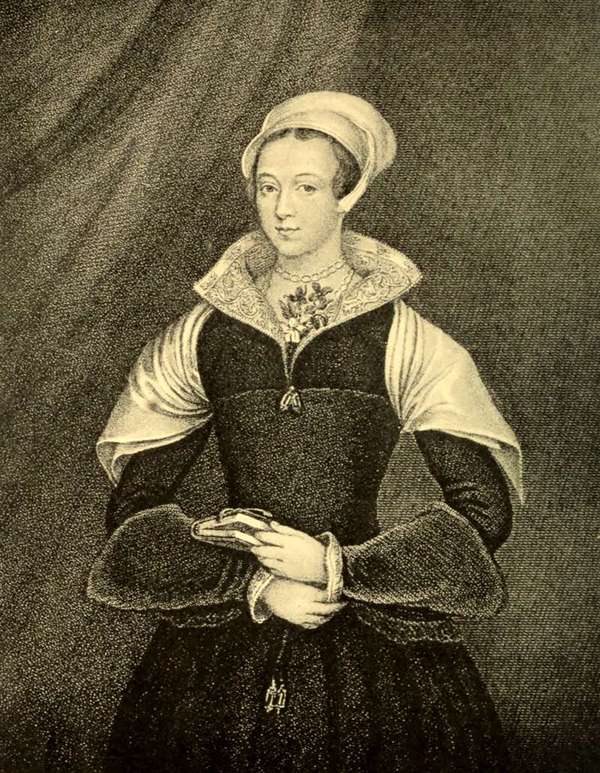
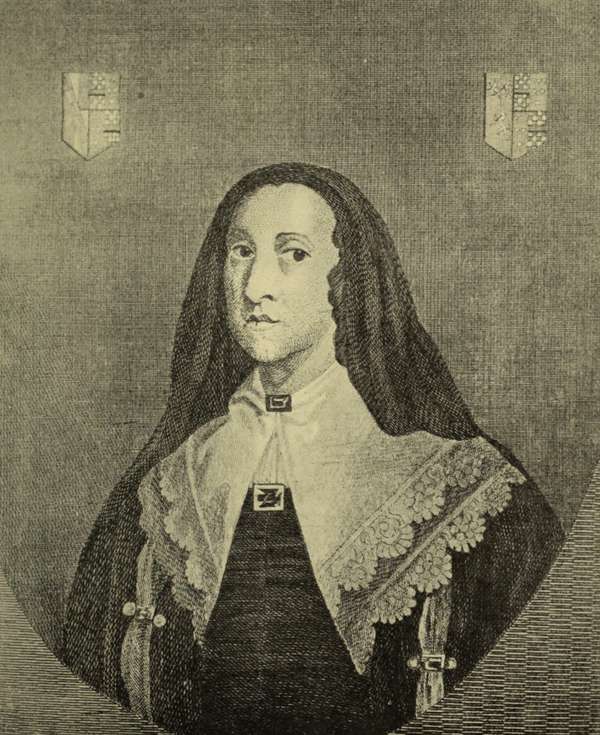
LADY JANE GREY
From an engraving in Edmund Lodge's Portraits of Illustrious Personages of Great Britain
London, 1823, Vol. II
Vassar Semi-Centennial Series
THE LEARNED LADY
IN ENGLAND
1650-1760
BY
MYRA REYNOLDS
Professor of English Literature in the University of Chicago
WITH PORTRAITS
BOSTON AND NEW YORK
HOUGHTON MIFFLIN COMPANY
The Riverside Press Cambridge
1920
COPYRIGHT, 1920, BY MYRA REYNOLDS
ALL RIGHTS RESERVED
PUBLISHED IN HONOR OF THE
FIFTIETH ANNIVERSARY
OF THE
FOUNDING OF VASSAR COLLEGE
1865-1915
TO
E. E. L.
| I. | Learned Ladies in England before 1650 | 1 |
| 1. Prefatory Statement | 1 |
| 2. Period of Henry VIII and Elizabeth | 4 |
| 3. Period from 1603 to 1650 | 23 |
| 4. Schools for Girls before 1660 | 37 |
| II. | Learned Ladies in England from 1650 to 1760 | 46 |
| 1. An Introductory Group in the Years 1650-1675 | 46 |
| 2. The Century following the Restoration | 81 |
| Actresses | 81 |
| Artists | 84 |
| Authors | 88 |
| Writers on Practical Subjects | 89 |
| Writers on Religion and Theology | 92 |
| Writers on Practical Beneficence | 118 |
| Dramatic Writers | 127 |
| General Learning and Literary Work | 137 |
| III. | Education | 258 |
| 1. Boarding-Schools for Girls | 258 |
| 2. Charity Schools | 268 |
| 3. Higher Education | 271 |
| IV. | Miscellaneous Books on Women in Social and Intellectual Life | 316 |
| V. | Satiric Representations of the Learned Lady in Comedy | 372 |
| Summary | 420 |
| Bibliography | 457 |
| Index | 477 |
| Lady Jane Grey | Frontispiece |
| The Family of Sir Thomas More | 10 |
| Mary Sidney, Countess of Pembroke | 22 |
| Anne Clifford, Countess of Dorset, Pembroke, and Montgomery | 32 |
| Mary Ward | 38 |
Margaret Cavendish, Duchess of Newcastle
From Horace Walpole's Royal and Noble Authors | 46 |
Margaret Cavendish, Duchess of Newcastle
From The Lives of William Cavendish, Duke of Newcastle, and of his Wife, Margaret, Duchess of Newcastle | 52 |
| Mrs. Katherine Philips | 56 |
| Mrs. Lucy Hutchinson and her Son | 70 |
| Lady Fanshawe | 74 |
| Mrs. Anne Killigrew | 86 |
| Mrs. Aphra Behn | 130 |
| Elizabeth Elstob | 170 |
| The Supposed Editors of The Female Spectator, by Mrs. Eliza Haywood | 216 |
| Miss Elizabeth Carter | 256 |
| Mrs. Bathsua Makin | 276 |
THE LEARNED LADY IN ENGLAND
The theme to which this volume is specifically limited is
the position and achievements of learned women in England
in the period between 1650 and 1760. But before entering upon
this detailed study it seems desirable to give a preliminary
sketch of the work of learned women in England before 1650.
In such a sketch it is, indeed, a temptation to go farther back
along the path of history than a single volume would allow.
It is difficult, for instance, to avoid some account of the women
of genius notable in the great days of Greece and Rome.[1] More
fascinating still would be a close study of the learned nuns of
the Middle Ages.[2] St. Radegunde, Abbess of Poitiers, a poet
of considerable distinction; St. Hilda, who governed her double
monastery at Whitby so successfully as to put it "in the forefront
of intellectual agencies in Great Britain"; the group of
learned nuns who corresponded with St. Boniface, chief among
them being St. Lioba, who made of her convent at Bischopsheim,
Germany, "the most important educational center in
that part of Europe"; Hroswitha of Gandersheim, whose
seven dramas "caused the tragic muse to emerge once more
from the midnight gloom of the Middle Ages";[3] St. Hildegard,
"the most voluminous woman writer of the Middle Ages";
St. Herrad, author of an encyclopædic work entitled Hortus
Deliciarum, or Garden of Delight—these are but a few of the
women whose lives and works offer a field for profitable and
interesting investigation.
Emily James Putnam, in her acute study, The Lady, says
of this convent life:
No institution of Europe has ever won for the lady the freedom and
development that she enjoyed in the convent in the early days. The
modern colleges for women only feebly reproduce it, since the college
for women has arisen when colleges in general are under a cloud.
The lady-abbess, on the other hand, was part of the two great social
forces of her time, feudalism and the Church. Great spiritual rewards
and great worldly prizes were alike within her grasp. She was
treated as an equal by men of her time as is witnessed by letters we
still have from popes and emperors to abbesses. She had the stimulus
of competition with men in executive capacity, in scholarship, and
in artistic production, since her work was freely set before the general
public: but she was relieved by the circumstances of her environment
from the ceaseless competition in common life of woman with woman
for the favor of the individual man. In the cloister of the great days,
as on a small scale in the college for women to-day, women were
judged by each other as men are everywhere judged by each other,
for sterling qualities of head and heart and character.[4]
From mediæval poems and romances also come glimpses,
tantalizingly brief and casual, to be sure, yet glimpses indicative
of a tendency to count learning as one of the possible
charms of a heroine.[5] The delightful lady in Cursor Mundi,
who was described as "learnyd, ware and wise," was also said
to be "of much price lovéd." A later maid, likewise of "grete
prys," could vie with a modern college girl in the variety and
extent of her knowledge:
Wyse sche was and curtes of mowthe,
All the vii arse sche cowthe.
She had maystures at hur honde,
The wysest men of that londe,
And taght hur astronomye,
Arsmetryck and gemetrye.
That mayde was of grete prys
For sche was bothe warre and wyse.[6]
In Floris and Blanchefleur, Floris refused to study unless
Blanchefleur was taught with him, and she prospered so at
her books that her lore was a wonder to all. When she and
Floris had been in school five years together, they knew Latin
and could write well on parchment. When Floris went to visit
his aunt she set him to learn many things, as other children
did, "bot maydons and grome."[7] The wife of Sir Bevis of
Hamtoun was taught "fysik and sirgerie" by great masters
from Bologna.[8] Melior, the fair mistress of Partonope of Blois,
since she was the only heir to the kingdom, was sent to school
that she might get great wisdom. She says, "A hundred mastres
I had and mo," and adds that God graciously inclined her
to learning so that she came to know "the seven sciences"
perfectly. She was also trained in herbs and "phisike," in
"Divinite and Nygromancy."[9] Thaise, in Apollonius of Tyre,
combined the "wisdom of a clerk" with
every lusti werk,
Which to a gentlewoman longeth.
She was wel kept, sche was wel loked
Sche was wel tawht, sche was wel boked
So wel sche spedde hir in hire yowthe
That sche of every wisdom cowthe.[10]
Medea, in Lydgate's Troy Book, had so passionate a desire for
knowledge that she became in all the "artis called liberal" as
expert and knowing as the best. She was powerful in logic,
astronomy, and necromancy.[11]
But the highly prized ladies of romance, the abbesses with
all their pomp and influence, the women poets, philosophers,
and orators of Greece and Rome, all lose interest when compared
with the story of the learned women in Italy during the
Renascence. When we come to the actual flowering time of
their genius the list is so long as to make selection difficult.
"Never in history," says Mozans, "had they greater freedom
of action in things of the mind; never were they, except probably
in the case of the English and German abbesses of the
Middle Ages, treated with more marked deference and consideration
or fairness; never were their efforts more highly appreciated
or more generously rewarded.... Everywhere the
intellectual arena was open to them on the same terms as to
men. Incapacity and not sex was the only bar to entrance."[12]
When the great Cardinal Bembo said, "Little girls should learn
Latin; it completes their charm," he was expressing the attitude
of the best Italian scholars towards learning for women.
Intellectual attainments were not only counted appropriate
for women, but they were recognized as a distinct added attraction.
Every city of importance had women whose renown
was a source of civic pride. Women not only studied under
tutors, but they apparently attended classes in the great universities,
and even occupied important chairs in the most distinguished
faculties.[13]
The outcome of a general investigation along the lines indicated
would doubtless go to prove that in all civilized nations,
in all ages of their progress, there have been individual
women who by force of native endowment and through some
favorable conjunction of circumstances, have risen into prominence
in realms not ordinarily open to the women of their
time, and that there have been various interesting epochs when
women have responded in fairly large numbers to some exceptional
intellectual stimulus.
The first woman author in the English language is probably
Juliana Barnes (or Berners), whose delight in hunting, hawking,
and fishing, along with a surprising amount of technical knowledge
on these subjects, led her to write, in 1481, a book for "the
gentill men and honest persones" whose tastes coincided with
hers. But this lady was prioress of Sopewell Nunnery and
comes under the list of learned nuns.[14] Genuine interest in books
on the part of women in secular life in England received one of
its earliest manifestations in the will of the Duchess of Buckingham
who left to her daughter-in-law, Margaret, the Countess
of Richmond,[15] "a book of English, being a legend of Saints;
a book of French, called Lucun; another book of French, of the
Epistles and Gospels; and a Primmer with clasps of silver gilt,
covered with purple velvet." This legacy was an important
recognition of the literary tastes of the Countess of Richmond
who had, says Ballard, "a fine library stored with Latin, French
and English books, not collected for ornament, or to make a
figure (as is frequently the case) but for use." The Countess
knew French and had some knowledge of Latin. She also entered
the field of authorship, publishing before 1509 The mirroure
of golde for the sinfull soule, "translated at Parice out
of Laten into Frenshe ... and now of late translated out of
Frenshe into Englishe by the right excellent Princess Margaret."
This right noble Margaret was likewise a patroness of
literature and a guardian of learning. She established lectureships
in divinity, maintained scholarships for poor students,
founded two colleges, and in other ways manifested her interest
in the progress of education.
The Countess of Richmond as a lover of books, as a translator
of religious works, and particularly as an intelligent and
ardent patron of learning, foreshadowed feminine activities of
a later day. But the learned lady as a recognized factor in
social life had no real place in England till the time of Henry
VIII. Renascence ideas concerning the education of women
came into England from Spain through Catherine, the first
wife of Henry VIII. She was in England from 1501 to 1531.
Under the influence of her mother, Queen Isabella,[16] she had
been given remarkable educational advantages. Queen Isabella
was interested in all that pertained to learning. She was
a collector of books and contributed important accessions to
Spanish libraries. She knew several modern languages and had a
"critically accurate" knowledge of Latin. Learning for women
was encouraged at her court. The queen had herself a lady
teacher, Beatrix Galindo, who was professor of rhetoric at the
University of Salamanca, and who was called, for her knowledge
of the Latin language, La Latina. Other learned ladies of
Spain were doubtless known at the court, as Francisca de
Lebrixa who often took the place of her father, professor of
history in the University of Alcala; or Doña Maria Pacheco
de Mendoza and her sister, who are mentioned by Mr. Foster
as the parallels of Sir Thomas More's daughters in England.[17]
In this eager, ambitious, intellectual atmosphere the daughters
of Isabella were brought up. She gave them personal instruction,
and secured for them foreign teachers of eminence. Erasmus
said that Catherine had been happily reared on letters
from her infancy, that she loved literature, and that she was
egregie docta. In the English court Queen Catherine's influence
was all on the side of learning. Mr. Watson says that all the
treatises on the education of women that appeared in England
between 1523 and 1538 were under the spell of Catherine.[18] In
the education of her own daughter, the Princess Mary, she kept
to the traditions of the Spanish court and secured the most
learned tutors for the young girl. Dr. Lynacre wrote for the
child Princess a Rudiments of Grammar. His successor was
Juan Luis Vives, who came to England in 1523 on the invitation
of Henry VIII. Whether Vives actually taught the Princess
or not, he wrote, in 1523, as director of her studies, two
Latin treatises, both dedicated to Queen Catherine. The first
of these, De Institutione Fæminæ Christiannæ, was translated
into English by Richard Hyrde before 1528 (though not
printed till 1540) under the title, The Instruction of a Christian
Woman. Hyrde dedicated his translation to Catherine because
of her gracious zeal "to the virtuous education of the womankind
of this realm." Vives's second treatise, De Ratione Studii,
an account of the studies appropriate for a young girl, appeared
in 1524, and many editions are listed. Still another treatise is
by subject-matter and chronology closely connected with the
two essays by Vives. In 1524 there appeared a translation by
Margaret Roper of Erasmus's Treatise on the Lord's Prayer.
The Introduction was by Mr. Hyrde, and its importance is
indicated by Mr. Watson when he calls it "the first reasoned
claim of the Renascence period, written in English, for the
higher education of women." These treatises by Vives and
Hyrde have much in common and they express the most advanced
contemporary ideas on woman's education. That the
place of woman is in the home is emphatically stated. Housewifery
is imperative. Vives has a charming passage on the handling
of wool and flax, "two crafts yet left of that old innocent
world," crafts of which no woman, be she princess or queen,
may be rightly ignorant.[19] Almost equal in quaint interest is
his defense of the kitchen: "Nor let nobody loathe the name
of the kitchen: namely, being a thing very necessary, without
the which neither sick folks can amend nor whole folks live."
The lady should also be mistress of a closet of medicaments
which she must be able to administer with skill. Occupations
that involve any sort of publicity are counted inappropriate for
women, hence Vives gives "no license to a woman to be a
teacher."[20] The essential feminine virtues are piety and modesty.
Obedience to parents and to husbands is enjoined. This
obedience, if born of inner concord, might be a voluntary and
ideal thing. The mother of Vives is given as an example of the
true wifely attitude: "My mother Blanche when she had been
fifteen years married unto my father, I could never see her
strive with my father. There were two sayings that she had
ever in her mouth as proverbs. When she would say she believed
well anything, then she used to say, even as though Luis Vives
had spoken it. When she would say that she would [wished]
anything, she used to say, even as though Luis Vives would
it."[21] In all these points Vives and Hyrde were quite in accord
with their age. The new element in their creed was that learning
could make women more attractive, companionable, and
efficient in these home relationships.[22] Hyrde considers the man
that "had leaver have his wife a fool than a wise woman" as
"worse than twice frantic." Maids must be good, says Vives,
but learning will fortify them and make them more truly
good. In fact, according to Vives and Hyrde, there are no
bounds to be set to the learning of women except those involved
in the one general prescription that all their studies
must tend to the development of character. Romances, for
instance, are forbidden because they give false ideals, while
ethical and religious books are strongly commended.[23]
The Princess Mary was too young to know the significance
of the essays in her behalf, but she profited by the training accorded
her. When she was but nine she was addressed by commissioners
from Holland in the Latin tongue and responded in
the same language "with as much assurance and facility as if
she had been twelve years of age."[24] Her parents were proud of
her achievements and planned to have her learn modern languages.
Later in life, at the solicitation of Queen Catherine
Parr, she translated Erasmus's Paraphrase on the Gospel of St.
John, and her work was highly praised.
The example set at court was followed in many noble families.
There is in the realm of education no single picture more
entertaining and attractive than that of Sir Thomas More and
his daughters. Our knowledge of this family comes from various
sources, the chief of which are a description written by Erasmus
in a letter to John Faber, and the letters written by Sir Thomas
to the tutors and to his daughters, especially to his daughter
Margaret.[25] Sir Thomas could not see why learning was not as
suitable for girls as for boys. In a letter to Gunnel he wrote:
Neither is there anie difference in harvest time, whether it was
man or woman, that sowed first the corne: for both of them beare
name of a reasonable creature equally, whose nature reason only
doth distinguish from bruite beastes, and therefore I do not see why
learning in like manner may not equally agree with both sexes; for
by it, reason is cultivated, and (as a fielde) sowed with wholesome precepts,
it bringeth excellent fruit. But if the soyle of woman's braine
be of its own nature bad, and apter to beare fearne then corne (by
which saying manie doe terrifye women from learning) I am of opinion
therefore that a woman's witt is the more diligently by good instructions
and learning to be manured, to the ende, the defect of nature
may be redressed by industrie.[26]
In describing the ideal wife he said: "May she be learned, if
possible, or at least capable of being made so,"[27] and he gave the
same training to Margaret and her sisters as to his son John.
The fame of these daughters went far. Symon Grinæus, in
dedicating his Plato to John, speaks of the young man's sisters
as those "whom a divine heat of the spirit, to the admiration
and a new example of this our age, hath driven into the sea
of learning so far, and so happily, that they see no learning to
be above their reach, no disputation of philosophy above their
capacity."[28] Margaret, the daughter "most like her father
both in favour and wit," and "a rare woman for learning, sanctity,
and secrecy,"[29] was especially the source of his pride. His
delight in her overflows in his charming response to a letter
from her asking for money: "You aske monye, deare Megg,
too shamefully and fearefully of your father, who is both desirous
to giue it you, and your letter hath deserued it, which I
could find in my heart to recompence, not as Alexander did by
Cherilus, giuing him for every verse a Philipine of golde; but if
my abilities were answerable to my will, I would bestowe two
Crownes of pure golde for euery sillable thereof."[30] He found her
Latin letters written in so pure a style that "Momus, his censure
though never so teastie," could find no fault in them. Sir
Thomas took occasion to show these letters and other compositions
by Margaret to the Bishop of Exeter and to Reginald
Pole, both good judges of any literary performance; and Margaret's
attainments seemed to both "as a miracle." Of Mr.
Pole's amazement Sir Thomas wrote:
I could scarce make him believe, but that you had some help from
your maister, until I told him seriously that you had not only never
a maister in your house, but also never another man, that needed
not your help rather in writing anie thing, than you needed his. In
the mean time I thought with myself how true I found that now, which
once I remember I spoke unto you in jeaste, when I pittied your hard
happe, that men that read your writings would suspect you to have
had help from some other man therein; which would derrogate somewhat
from the praises due to your workes; seeing that you of all
others deserve least to have such a suspition had of you, for that you
never could abide to be decked with the plumes of other birds.[31]
But sweet Meg is praised because she studies for love of learning,
not for fame, and contents herself with her husband and
father as a sufficient audience. When Margaret married the
best wish her father could make was that her children should
be most like to herself, "except only in sex," yet he adds that
a daughter who could imitate her mother's learning and virtues
would be of more worth than "three boys."[32]
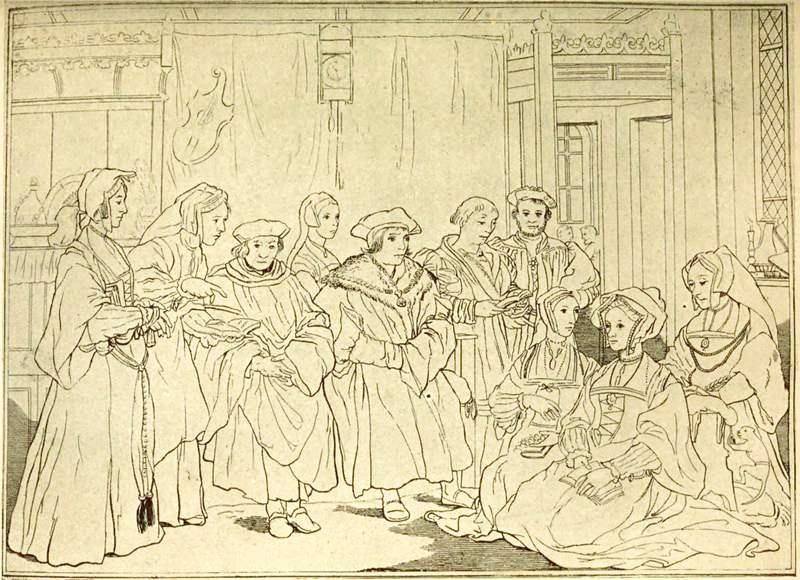
THE FAMILY OF SIR THOMAS MORE
Hans Holbein pinxit. W. Parsons sculp. 1815
From an engraving in Effigies Poeticae, London, 1824, Vol. II
Margaret had three sons and two daughters and she took the
same care of their education as had been taken of hers. Dr.
John Morwen, a noted Greek scholar, was preceptor in Greek
and Latin to her daughter Mary. Other tutors were Dr. Cole
and Dr. Christopherson, also famous for Greek. Mary seems to
have followed in her mother's footsteps so far as attention to
learned pursuits is concerned, but without her mother's ability
and charm. Her Latin orations were, however, so much admired
that her tutor, Dr. Morwen, translated them into English.
Sir Thomas More's other daughters, Elizabeth Dancy
(b. 1509) and Cecilia Heron (b. 1510), and Margaret, a talented
kinswoman who married her tutor, Dr. John Clement, in 1531,
were given the same educational advantages as Margaret. A
characteristic eulogy of the three sisters was by Mr. John
Leland, its Latin being thus Englished in Ballard's Memoirs:
Forbear too much t' extoll, great Rome, from hence,
Thy fam'd Hortensius' Daughter's Eloquence;
These boasted names are now eclips'd by Three
More learned Nymphs, Great More's fair Progeny;
Who over-pas'd the Spinster's mean Employ;
The purest Latin Authors were their Joy;
They loved in Rome's political Style to write,
And with the choicest Eloquence indite,
Nor were they conversant alone in these,
They turn'd o'er Homer and Demosthenes;
From Aristotle's Store of Learning too
The mystic Art of Reasoning well they drew.
Then blush you Men if you neglect to trace
These Heights of Learning which the Female grace.[33]
Erasmus and Sir Thomas More were close friends and it was
through this friendship that Erasmus was converted to the idea
of advanced studies for women. In his The Abbot and the
Learned Woman, Magdalia defends learning against the Abbot
Antronius. The monk uses the well-worn argument that woman's
place is in the home, that it is her business to conduct the
affairs of the family and to instruct the children. Magdalia does
not contest this position, but urges that so weighty a business
needs all possible wisdom and that through books she gains
wisdom. In a sharp attack on the ignorance of the monks she
says: "In Spain and Italy there are not a few women belonging
to the noblest families who are a match for any man. In England
there are the Mores; in Germany the Pirckheimers and
the Blaurers. And if you don't take care, it will soon come to
this, that we shall preside in the schools of divinity, preach
in the churches, and take possession of your mitres.... If you
go on as you are doing it is more likely that the geese will begin
to preach than that such dumb shepherds as you will be any
longer endured."[34] Antronius is reduced to the weak argument
that popular opinion does not favor Latin for women, and Magdalia
closes the discussion with the classic defense of new ideas:
"Why do you tell me of popular opinion, which is the worst
example in the world to be followed? What have I to do with
custom, that is the mistress of all evil practices? We ought to
accustom ourselves to the best things, and by that means that
which was uncustomary would become habitual, and that which
was unpleasant would become pleasant, and that which seemed
unbecoming would look graceful."[35]
The daughters of Sir Thomas More were not the only girls
trained in the best learning of the day. Another important
family where particular stress was laid on the education of the
daughters was that of Sir Anthony Coke, one of the tutors of
King Edward VI.[36] Mildred, the eldest daughter (1526-1589),
who married Lord Burleigh, was celebrated for her knowledge
of Latin and Greek. Two other daughters, Elizabeth, Lady
Russel (b. cir. 1529), and Katharine, Mrs. Killigrew (b. cir. 1530),
had fine natural abilities and a learned education, and were distinguished
both socially and intellectually. But the most noted
of the sisters was Anne (b. cir. 1527), who married Sir Nicholas
Bacon, and became the mother of two remarkable sons, Anthony
Bacon, and Francis Viscount St. Albans, the great Lord
Bacon. She was said to be "exquisitely skilled in the Greek,
Latin, and Italian tongues." In 1550 she translated twenty-five
sermons from the Italian. In later life she did a much
more important piece of translation. Bishop Jewel had written
in Latin An Apology for the Church of England. The book had
made so great a stir that an English translation seemed desirable
and Lady Bacon undertook the task. She sent her translation
to the Archbishop and to the author, with a letter
written in Greek, that they might correct any errors, but they
found it so accurate that they changed not the least word.
In 1564 the Archbishop had the book published without consulting
Lady Bacon because he said he knew her modesty
would be abashed by any such publicity. He praised her clear
translation saying that she "had done honour to her sex and
to the degree of ladies." Lady Bacon was associated with her
father in his duties as tutor to Edward VI. She also conducted
the early education of her sons and they owed much to her wise
care and great ability. Sir Anthony Coke believed that women
should be educated on the same lines as men, and that they
were quite as capable of acquiring knowledge, and his own
daughters brilliantly sustained this theory.
A third distinguished family in which the daughters were
liberally educated was that of Edward Seymour, Duke of
Somerset. Three of them, Anne, Margaret, and Jane, were joint
authors of A Century of Distichs upon the Death of Queen Margaret
of Navarre, printed in 1550 and later translated into Greek,
French, and Italian.[37] Henry Fitz Allan, Earl of Arundel, had
both his daughters well trained in the classics and they had the
advantage of the notable library he had collected. The eldest,
Lady Joanna Lumley[38] (d. 1576), translated four of the Orations
of Isocrates from Greek into Latin, and the Iphigenia
of Euripides from Greek into English. Most of her writings
were dedicated to her father. Her manuscripts were preserved
in his library and so passed into royal possession in the time of
James I. Another learned lady was Mary, Countess of Arundel.[39]
She translated from Greek and Latin and collected a book of
similes from Plato, Aristotle, Seneca, and other classic authors.
She, too, dedicated her works to her father, Sir Thomas Arundel.
Sir Thomas Parr, "following the example of Sir Thomas
More and other great men," bestowed on his daughter Catherine[40]
a learned education, as "the most valuable addition he
could make to her other charms." She was interested in all matters
pertaining to learning, and successfully used her influence
with the King in behalf of the universities. She wrote a letter
in Latin to the Princess Mary to induce her to translate Erasmus's
Paraphrase of St. John, and wrote many psalms, prayers,
and meditations, beside Queene Katherine Parre's lamentation
of a sinner, published in 1548. Jane, Countess of Westmoreland,
was placed by her father, the Earl of Surrey, under the tuition
of Mr. Fox, the Martyrologist, who reported her skill in Latin
and Greek as such "that she might well stand in competition
with the greatest men of that age."[41]
Most interesting and most pathetic of all the young women
known for learning in Tudor times was Lady Jane Grey.[42]
Ascham, in a well-known passage in The Scholemaster (1570),
describes an interview he had with her at Bradgate where she
was pursuing her studies under John Aylmer, her tutor. This
was in 1550 when Lady Jane was but thirteen.
Before I went into Germanie, I came to Brodegate in Le(i)cestershire,
to take my leaue of that noble Ladie Iane Grey, to whom I was
exeding moch beholdinge. Hir parentes, the Duke and Duches, with
all the houshold, Gentlemen and Gentlewomen, were huntinge in the
Parke; I founde her, in her Chamber, readinge Phædon Platonis in
Greeke, and that with as moch delite, as som ientlemen wold read a
merie tale in Bocase. After salutation, and dewtie done, with som other
taulke, I asked her, whie she wold leese soch pastime in the Parke!
smiling she answered me; I wisse, all their sporte in the Parke is but
a shoadoe to that pleasure, that I find in Plato: Alas good folke, they
neuer felt what trewe pleasure ment. And howe came you Madame,
quoth I, to this deepe knowledge of pleasure, and what did chieflie
allure you vnto it: seinge, not many women, but verie fewe men
haue attained thereunto. I will tell you, quoth she, and to tell you a
troth, which perchance ye will meruell at. One of the greatest benefites,
that euer God gaue me, is, that he sent me so sharpe and seuere
Parentes, and so ientle a scholemaster. For when I am in the presence
of either father or mother, whether I speake, kepe silence, sit,
stand, or go, eate, drinke, be merie, or sad, be sowyng, plaiyng,
dauncing, or doing anie thing els, I most do it, as it were, in soch
weight, mesure, and number, euen so perfitelie, as God made the world,
or else I am so sharplie taunted, so cruellie threatened, yea presentlie
some tymes with pinches, nippes, and bobbes, and other waies, which
I will not name, for the honor I bear them, so without measure mis-ordered,
that I think my selfe in hell, till tyme cum, that I must go
to M. Elmer, who teacheth me so ientlie, so pleasantlie, with soch
faire allurements to learning, that I thinke all the tyme nothing,
whiles I am with him. And when I am called from him, I fall on
weeping because, what soeuer I do els, but learning, is ful of grief,
trouble, feare, and whole misliking unto me: And thus my booke,
hath bene so moch my pleasure, and bringeth dayly to me more
pleasure and more, that in respect of it, all other pleasures, in vere
deede be but trifles and troubles vnto me. I remember this talke
gladly, bothe bicause it is so worthy of memorie, and bicause also,
it was the last talke that euer I had, and the last tyme, that euer I
saw that noble and worthie Ladie.
Mr. Elmer said she understood perfectly both kinds of philosophy,
and could express herself very properly at least in the
Latin and Greek tongues. Sir Thomas Chaloner said that she
was "well versed in Hebrew, Chaldee, Arabic, French and
Italian," that she "played well on instrumental music, writ
a curious hand, and was excellent at her Needle." Ballard
quotes a contemporaneous opinion that she was superior to
King Edward VI in learning and in the languages. "If her
fortunes [says he] had been as good as her bringing up, joyned
with fineness of wit: undoubtedly she might have seemed comparable
not only to the house of the Vespasians, Sempronians,
and mother of the Gracchies; yea, to any other women besides
that deserveth high praise for their singular learning; but also
to the university men, which have taken many degrees of the
Schools."
So far as accessible records go it was only in royal or noble
families that a learned education was counted suitable for
women. It is rare indeed to come upon an account like that
of Elizabeth Lucar (1510-1537), the daughter of a Mr. Paul
Withypoll, and the wife of a merchant-tailor, Mr. Lucar. In
her accomplishments she seems to have vied with the best ladies
in the land. She was excellent in music, being able to play on
the viol, the lute, and the virginal, and she could sing in various
tongues.
She wrought all Needle-works that Women exercise,
With Pen, Frame, or Stoole, all Pictures artificial,
Curious Knots, or Trailes, what fancy could devise,
Beasts, Birds, or Flowers, even as things natural.
She wrote "three manner hands," was especially cunning in accounts
and "Algorism" (Arithmetic), and she could speak,
write, and read Latin, Spanish, and Italian, and she "won the
garland" in English.[43] Our knowledge of Elizabeth Withypoll's
rare attainments comes by chance from the information on her
monument. Probably there were other highly educated women
in the wealthy middle classes but their learned tastes were not
counted worthy of any definite record.
In addition to the many instances of girls trained in the best
learning of their times during the first half of the sixteenth century,
we have striking contemporary testimony as to the prevalence
of the custom, and the high esteem in which such learning
was held. Richard Mulcaster (1530-1611), first head-master
of a school founded by the Merchant Taylors' Company in 1561,
in discussing principles of education, expressed advanced ideas
concerning the ability and training of girls.[44] He declared himself
"for them toothe and naile." He says that their "natural
towardnesse" is such that they should be well brought up, and
he summarizes the elements of this training. A young gentlewoman
is thoroughly educated, he says, if she can "reade plainly,
and distinctly, write faire and swiftly, sing cleare and sweetly,
play wel and finely, understand and speak the learned languages,
and the tongues also which the time most embraseth with some
logicall helpe to chop, and some rhetoricke to brave." And he
asks whether it is likely that the children of a woman so trained
will be "eare a whit the worse brought up" for this learning.
The places wherein girls may study may be at home with tutors
or they may go forth to the elementary school. And the
teacher may be either a man or a woman. Mulcaster was himself
in favor of sending girls to the public grammar schools,
and even to the universities, but he said it was "a thing not
used" in his country, there was no "president" therefor. But
he is enthusiastic about the attainments of women. In languages,
he says, "they compare favourably with our kinde in
the best degree." Some of them are so excellently trained and
so rarely qualified that they could be preferred to "the best
Romaine or Greekish paragones be they never so much
praised: to the Germaine or French gentlewymen by late writers
so wel liked: to the Italian ladies who dare write themselves
and deserve fame for so doing."
Nicholas Udall, in 1548, in a Preface to Princess Mary's
translation of the Paraphrase of the Gospel of St. John by Erasmus,
comments on the great number of noble women at that
time in England given not only to human sciences and strange
tongues, but
also so throughly expert in the Holy Scriptures that they were able
to compare with the best writers as well in enditeing and penning of
Godly and fruitful treatises to the instruction and edifying of realmes
in the knowledge of God, as also in translating good books out of Latin
or Greek into English.... It was now no news in England to see young
damsels in noble houses and in the courts of princes, instead of cards
and other instruments of idle trifling, to have continually in their
hands either psalms, homilies, or other devout meditations ... and as
familiarly both to read or reason thereof in Greek, Latin, French or
Italian, as in English. It was now a common thing to see young virgins
so trained in the study of good letters, that they willingly set all other
vain pastimes at naught for learning sake. It was now no news at all,
to see Queens and ladies of most high estate and progeny, instead of
courtly dalliance, to embrace virtuous exercises of reading and writing,
and with most earnest study both early and late, to apply themselves
to the acquiring of knowledge.[45]
Puttenham, in his Arte of English Poesie (1589), indicates
the prevalence of women poets in the sixteenth century when
he says:
Darke word or doubtfull speach are not so narrowly to be looked
vpon in a large poeme, nor specially in the pretie Poesies and deuises
of Ladies and Gentlewomen-makers, whom we would not haue too
precise Poets least with their shrewd wits, when they were maried
they might become a little too fantasticall wiues.[46]
One of the influential foreign books of the first half of the
sixteenth century was Baldasar Castiglione's Il Cortegiano,
written in 1514, published in 1528, and translated into English
in 1561 by Thomas Hoby. The book is a conversation supposed
to take place in the drawing-room of the Duchess of
Urbino, with the Duchess, her friend Emilia Pia, Pietro Bembo,
Bernardo Bibbiena, Giuliano de Medici, and others, among the
speakers. In the chapter on the attributes of the perfect Court
Lady, Count Gaspar Pallavicino says, "Since you have given
women letters and continence and magnanimity and temperance
I only marvel that you would not have them govern cities,
make laws, and lead armies, and let the men stay at home to
cook or spin."[47] Giuliano de Medici replies, laughing, "Perhaps
even that would not be amiss." There follows a discussion of
woman as essentially imperfect, an accident or mistake of nature,
and consequently of less dignity than men and not capable
of those virtues to which men attain. But the Magnifico held
the doctrine that physical weakness does not constitute inferiority,
and that mentally women are equal to men: "All the
things that men can understand the same can women understand
too; and where the intellect of the one penetrates there
also can that of the other penetrate."
It is but natural that the praise of learning for women should
extend through the reign of Elizabeth. The Queen herself was
an admirable linguist. She spoke and wrote Latin with ease;
she was a student of Plato, Aristotle, and Xenophon; and she
made translations into English from French and Italian, even
translating from Latin into Greek. According to Ascham she
read more Greek every day than some Prebendaries read Latin
in a week, and bestowed more regular hours on learning than
six of the best given gentlemen in the court. It was also in accordance
with the ideals of the age that the Queen should wish
to shine as a poetess. Dyce, in his Specimens of British Poetesses,
says that except for the speech of the Chorus in the Hercules
Acteus of Seneca (printed in Park's edition of Walpole's Royal
and Noble Authors) he gives, and for the first time in collected
form, all the poems by this "Flower of Troynovant." It is all
occasional verse, such as a sonnet on that lovely "daughter of
debate," Mary Queen of Scots, a Rebus, an Epitaph, and a few
other stanzas. One little poem beginning
I grieve but dare not show my discontent,
with much that is conventional in expression, seems yet to
have a genuine note of personal feeling. Taken as a whole the
brief sum of the Queen's verse indicates no poetic aptitude. It
merely goes to show that verse writing was counted an agreeable
accomplishment, and one to be cultivated by a queen.
Probably the most highly gifted woman during Elizabeth's
reign was Jane Weston (1582-1612).[48] And she was of high repute.
When Evelyn went to dine with Lord Cornbury at Clarendon
House (December 20, 1668) to see the new house "now
bravely furnished, especially with the pictures of most of our
ancient and modern wits, poets, philosophers, famous and
learned Englishmen," he greatly commended his lordship's
collection, but suggested additional names of the learned.
Among these new names were Lady Jane Grey and Elizabeth
Jane Weston. In Numismata Evelyn praised Jane Weston's
Latin poem on typography. Farnaby "ranked her with Sir
Thomas More and the best Latin poets of the day." She was
reputed to speak and write English, Greek, German, Latin,
Italian and Czech. John Philips praised her in his Theatrum
Poetarum. "Weston's fair daughter," "the tenth muse," "the
fourth grace," received, indeed, very high contemporary English
recognition, and even more extravagant praise came from
foreign critics. Her collected works were published in 1602 by
Georg Martin von Baldhoven at his own cost. At the end of
the book there was a list of learned women beginning with
Deborah and ending with Elizabeth Weston.
The only woman before 1603 in Aubrey's Lives, besides the
Countess of Pembroke, was Elizabeth Danvers. His notes on
her are: "A great politician; great witt and spirit, but revengefull.
Knew how to manage her estate as well as any man; understood
jewells as well as any jeweller." He calls her "an Italian,"
probably because she understood that language, and he says
"she had prodigious parts for a woman." Her learning was
certainly unusual, for "she had Chaucer at her fingers' ends."
The only date given for her is 1568, the year in which her son,
Sir Charles Danvers, was born.[49]
To show that Scotland was not unrepresented, mention may
be made of Elizabeth Melville, supposed to be identical with
Elizabeth Colville, Lady Colville of Culross. In 1599 Alexander
Hume dedicated to her his Hymns, or Sacred Songs, and he says
of her: "I know ye delite in poesie yourselfe; and as I vnfainedly
confes, excelles any of your sexe in that art, that ever I heard
within this nation. I have seene your compositions so copious,
so pregnant, so spirituall, that I doubt not but it is the gift of
God in you."[50] The one poem by which she is known, Ane
Godlie Dreame compylit in Scottish Meter by M. M. (Mistress
Melville) Gentlewoman in Culross, at the request of her freindes,
was published in 1603. It appeared again in a volume of Various
Poetry in 1644, and in David Laing's Early Metrical Tales
in 1826. Dyce gives a few stanzas in his Specimens. The poem
is a Bunyan-like narrative in which the horrors of hell are
painted with a vigorous brush. In fact hell is made so distinct
that even the mitigating and finally saving presence of Christ
as guide can hardly soften the pictures of "puir damnit saullis
... frying wonder fast in flaming fire."[51]
The one lady of Elizabethan days whose fame justly exceeds
that of any of her predecessors is Mary Sidney (1561-1621),[52]
sister of Sir Philip Sidney. At sixteen she married Henry
Herbert, Earl of Pembroke, and the twenty-four years of her
married life were passed at his estate, Wilton House, in Wiltshire.
Her brother Philip was often at Wilton and her more
important literary accomplishments are closely bound up with
his work. It was at Wilton that he wrote The Countess of Pembroke's
Arcadia which he dedicated to his "dear ladie and sister."
The brother and sister translated together the whole
book of Psalms into English verse. Psalms 44-150 are attributed
to Lady Pembroke. In 1592 she published two translations
from the French, Du Plessis Mournay's Le Excellent Discours
de la Vie et de la Mort; and Robert Garnier's Marc Antonie, a
tragedy. Before 1600 she had also translated The Triumph of
Death from the Italian. In 1593 she brought out her brother's
Arcadia on which she had done most careful editorial work.
She had also a taste for science. Aubrey, in his Brief Lives,
says of her: "She was a great chymist, and spent yearly a
great deale in that study.[53] She kept for her laborator in the
house Adrian Gilbert (vulgarly called Dr. Gilbert), half brother
to Sir Walter Ralegh, who was a great chymist in those dayes....
She also gave an honourable pension to Dr. Thomas Mouffett,
who hath writ a booke De insectis. Also one ... Boston,
a good chymist ... who did undoe himself by studying the
philosopher's stone."
But while Lady Pembroke takes undoubtedly a high rank
as translator and editor, her fame does not rest chiefly on this
work. When Nicholas Breton compared her to the Duchess of
Urbino he brought forward her essential claim to distinction,
which is that she understood, valued, and befriended the
literati of her day. Aubrey says: "In her time Wilton House
was like a College, there were so many learned and ingeniose
persons. She was the greatest patronesse of witt and learning
of any lady in her time." The most extravagant eulogies were
addressed to her from girlhood to old age. No such chorus of
praise had been accorded any other woman except the queen.
But it must be noted that this adulation is mainly for Lady
Pembroke as the patroness of letters. Only incidentally are
her own scholastic attainments commended. It was as a lover
of wit and learning, as a dispenser of favors, that Lady Pembroke,
the typical great lady of Elizabethan days, expressed
her interest in learning, rather than as herself a scholar; and
it was as an intelligent and open-handed patroness that she
received highest recognition.
Wotton, about a century later, gives the following summary
of the learning of this period: "It was so very modish, that the
fair Sex seemed to believe that Greek and Latin added to their
Charms: and Plato and Aristotle untranslated, were frequent
ornaments of their Closets. One would think by the Effects,
that it was a proper Way of Educating of them, since there are
no Accounts in History of so many truly great Women in any
one age, as are to be found between the years 15 and 1600."[54]
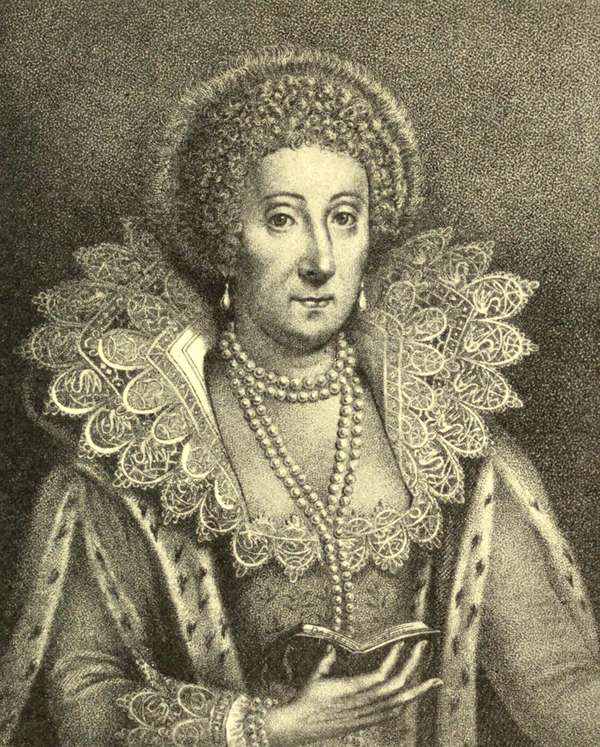
MARY SIDNEY, COUNTESS OF PEMBROKE
From an engraving in Horace Walpole's Royal and Noble Authors, London, 1806
Though Wotton counts the century as one period, a closer
study of dates shows that most of the learned women of the
century belong in the first half of it, or at least obtained their
education in the first half of it. The woman most noted for
classical attainments during Elizabeth's reign was Lady Bacon.
Her sisters also were of considerable importance intellectually,
and they lived well into the reign of Elizabeth. But their education
and their establishment as women of exceptional learning
belong before the coming of Elizabeth to the throne.
Miss Weston's learning is unquestioned, but it can hardly be
credited to England. She lived much abroad, her works were
published in Holland, and the praise accorded her in England
was but an echo of the eulogies uttered by foreign critics. In
spite of Queen Elizabeth and Lady Mary Sidney, and Lady
Bacon and Jane Weston, it becomes apparent by a study of
dates and names that there were in Elizabeth's reign fewer eulogies
of liberal education for girls and fewer records of women
distinguished by learning than in the preceding period. In
point of fact, when we speak of the sixteenth century as a century
of learned women, the emphasis should be on the first
sixty years of the century.
With the death of Elizabeth we come practically to the end
of the favor accorded learned women. The changed tone of
public opinion may be fairly indicated by a few scattered utterances
from contemporary poems and essays.
Sir Thomas Overbury, in his Characters (1614), describes "A
Good Woman" as one "whose husband's welfare is the business
of her actions." Her chief virtue is that "Shee is Hee."
In A Wife he says that "Books are a part of Man's Prerogative."
He praises a "passive understanding" in women and
deprecates learning since
What it finds malleable it maketh frail
And doth not add more ballast, but more sail.
Powell, in Tom of All Trades (1631), is emphatic in his plea for
the domestic as against the learned lady: "Let them learne
plaine workes of all kinds, so they take heed of too open seaming.
Instead of Song and Musicke, let them learn Cookerie
and Laundrie. And instead of reading in Sir Philip Sidney's
Arcadia, let them reade the grounds of good huswifery. I
like not a female Poetresse at any hand."[55] William Habington,
in Castara (1634), a series of poems in honor of Lucy Herbert,
his wife, gave a comprehensive description of the ideal
wife's attitude towards her husband: "Shee is inquisitive onely
of new wayes to please him, and her wit sayles by no other compass
then that of his direction. Shee lookes upon him as Conjurers
upon the Circle, beyond which there is nothing but
Death and Hell; and in him shee beleeves Paradice circumscrib'd.
His vertues are her wonder and imitation; and his
errors, her credulitie thinkes no more frailtie, then makes him
descend to the title of Man."[56] Richard Brathwait, in The
English Gentleman, comments with apparent approval on the
ancient seclusion of women. He says, "The Ægyptians, by an
especiall decree (as Plutarch reports) injoined their Women to
weare no shooes, because they should abide at home. The
Grecians accustomed to burne, before the doore of the new
married, the axletree of that coach, wherein she was brought to
her husbands house, letting her understand that she was ever
after to dwell there."[57]
Sir Ralph Verney said of his own daughter: "Pegg is very
backward.... I doubt not but she will be schollar enough for
a Woeman." With regard to little Nancy Denton he wrote:
"Let not your girl learn Latin nor short hand: The difficulty
of the first may keep her from that vice, for soe I must esteem
it in a woeman; but the easinesse of the other may be a prejudice
to her; for the pride of taking sermon noates hath made
multitudes of women unfortunate." Miss Nancy was quite
in advance of her godfather in her conception of the studies
appropriate for her. She wrote to him: "I know you and my
coussenes wil out rech me in french, but i am a goeng whaar
i hop i shal out rech you in ebri grek and laten." Sir Ralph
answered: "I did not think you had been guilty of soe much
learning as I see you are; and yet it seems you rest unsatisfied
or else you would not threaten Lattin, Greeke, and Hebrew
too. Good sweet harte bee not soe covitous; beleeve me a Bible
(with ye Common prayer) and a good plaine cattichisme in
your mother tongue being well read and practised, is well worth
all the rest and much more sutable to your sex; I know your
Father thinks thise false doctrine, but be confident your husband
will bee of my oppinion. In French you can not be too
cunning for that language affords many admirable books fit for
you as Romances, Plays, Poetry, Stories of illustrious (not
learned) Woemen, receipts for preserving, makinge creames
and all sorts of cookeryes, ordring your gardens and in Breif, all
manner of good housewifery."[58]
The general opinion was quite in accord with Luther when
he said: "Women should remain at home, sit still, keep house,
and bear and bring up children";[59] or, at the best, with Milton's
"He for God only, she for God in him."[60]
Mr. Baldwyn, it is true, in 1619, in his New Help to Discourse,
praises England as the place where women had the greatest
prerogatives. In England, he says, women "are not kept so
severely submiss" as in France, nor so jealously guarded as in
Italy. "England is termed by foreigners the Paradise of Women
as it is by some accounted the Hell of horses and the Purgatory
of Servants. And it is a common byword among the Italians
that if there were a bridge built over the narrow seas all women
in Europe would run into England."[61] But this favorable
opinion must be discounted as being a retrospective estimate
based mainly on the attitude towards women in the sixteenth
century; and further, as being an Englishman's attempt to
exalt English as against continental customs.
Of more curious interest is the ingenious attempt of the
Bishop of London to interpret the account of the creation of Eve
from Adam's rib as an intention on the part of the Creator to
teach the equality of woman with man. The Bishop says: "The
species of this bone is exprest to be costa, a rib, a bone of the
side, not of the head: a woman is not domina, the ruler; nor
of any anterior part; she is not prælata, preferred before the
man; nor a bone of the foote; she is not serva, a handmaid; nor
of any hinder part; she is not post-posita, set behind the man;
but a bone of the side, of a middle and indifferent part, to show
that she is socia, a companion to her husband. For qui jungunter
lateribus, socii sunt, they that walke side to side, cheeke
to cheeke, walke as companions."[62]
One book definitely in honor of the ladies came out rather
late in the period. This was Charles Gerbier's Elogium Heroinum.
The Ladies' Vindication: or, The Praise of Worthy Women.
The threefold dedication to the Princess of Bohemia, "whose
marvellous wisdom and profound knowledge in Arts, Sciences,
and Languages, is admired by all men," to the Countess Dowager
of Claire, "a Patroness of the Muses, a general Lover of
the Languages, and Knowledge"; and to the "Vertuous Accomplisht
Lady Anne Hudson," is justified by the three principles
in natural philosophy, the three theological virtues, and
the three graces. "Woman," says Mr. Gerbier, "is capable of
as high improvement as man," an assertion which he proceeds
to establish by the following arguments: "Does not Sophia
signify wisdom? Are not Faith, Hope and Charity represented
as Women? Are not the Seven Liberal Arts exprest in Women's
Shapes? Are not the Nine Muses Daughters of Jupiter? Is
not Wisdom called the Daughter of the Highest?" His list of
worthy women begins with the Queen of Sheba who disputed
with Solomon, goes enthusiastically through the famous dames
of Greece and Rome, including the Muses and the Sibyls, and
touches upon later learned women such as "Christine de Pisan,
Margaret of Vallois, Lady Jane Grey, the Countess of Pembroke,
the daughters of Sir Anthony Cooke," and a few other
outstanding personages of Tudor times. Praise so heterogeneous
and uncritical was perhaps of little value, but such as it is, it
stands alone in England in the period between Elizabeth and
Charles II as a defense of learned women. And no defense or
protest comes from the pen of a woman.
It should, however, be noted that in European countries
women were more vitally concerned in their own destinies. Between
1600 and 1641 there appeared at least three significant
books by women dealing with the intellectual emancipation
of their sex. The earliest of these came from Italy in 1608 with
a second edition in 1621. It was written by a young Venetian
widow, Lucrecia Marinelli (1571-1653), and was entitled
Della notabilità e della eccellenza delle donne e dei difetti degli
uomini. A second and better known book was by Marie de
Jars, the fille d'alliance of Montaigne, usually known as Mlle.
de Gournay.[63] Her book, entitled L'Egalité des Hommes et des
Femmes, appeared in 1604 when "the Pride of Gournay,"
"the French Siren," as she was called, had become well known
in the cultivated circles of Paris through her definitive edition
of Montaigne's works in 1595. Mlle. de Gournay's thesis as
to the dignity and capacity of women is established by divine
authority and by citations from the church fathers and ancient
philosophers. She follows up these expressions of opinion by
a thorough résumé from sacred and profane history of the
women who have worthily held high places. M. Feugère[64]
voices what must be the opinion of any modern reader when he
says that L'Egalité would be plus piquant without the pedantic
form in which it is cast, without les citations fréquentes et les
raisonnements scholastiques qui le surchargent. But however
cumbersome we may find her method, it apparently suited her
public, for the book was enthusiastically received.
The third and by far the most important book on the position
and desirable training of women was by Anna van Schurman
of Utrecht. The extremes to which Mlle. de Gournay
carried her doctrines were distasteful to Anna van Schurman,
yet many of her ideas were doubtless based on the work of her
French predecessor, la mère du féminisme moderne. Anna
van Schurman's book was translated into English and had
a direct influence on the progress of English educational
ideals for women. It is taken up in detail later in this discussion.
The low estimate of learning, in the first half of the seventeenth
century, as an appropriate pursuit for women, had as
its natural outcome a great decrease in the number of women
who devoted themselves to any form of scholarship. The names
that remain to us from this period as in any way connected
with literature or learning form a singularly inchoate list, interesting,
for the most part, because of the oddities it represents
rather than because of any solid achievements. Of considerable
importance are several ladies in the early years of
the Stuarts who followed in the footsteps of Lady Pembroke
as patronesses of learning. The first of these was Lady Bedford,
who held her "graceful and brilliant little court" at
Twickenham Park between 1608 and 1618. Daniel, Drayton,
Donne, and Jonson were among those who celebrated her munificence.
Though Lady Bedford wrote verses she had no pronounced
literary pursuits of her own. Her "considerable and
varied learning" went preferably along antiquarian and horticultural
lines. She collected medals and pictures, and she designed
a garden highly praised by Sir William Temple. She
is of importance chiefly because, in an age when learning lived
only as it found patrons, she was magnificent in her hospitality
to the poets.[65] Lady Mary Wroth was a niece of Lady Pembroke
and carried on the traditional family attitude towards poets.
Jonson's Alchemist (1610) was dedicated to her, and Chapman's
Iliad (1614) had a prefatory sonnet addressed to her. She
wrote The Countess of Montgomerie's Urania (1621), in four
books, a work modeled on her uncle's Arcadia. A third patroness
was Elizabeth Spencer, wife of Sir George Carey. She
was a kinswoman of Edmund Spenser and he commemorated
her for "the excellent favors" she had granted him.
One of the most notable young women of the time of
James I was Elizabeth Jocelyn (1596-1622). She was brought
up by her grandfather, William Chaderton, Bishop of Lincoln.
He was a friend of Sir Anthony Coke and Lord Burleigh and
naturally shared their ideas as to education. The quick wit and
remarkable memory of this little granddaughter greatly pleased
him and he took the utmost pains with her education, training
her carefully in "languages, history, and some arts," but principally
in "studies of piety." She died nine days after the birth
of her first child to whom she left The Mother's Legacie to her
Unborne Childe. The third edition came out in 1625, an incorrect
impression in 1684, and a reprint of the 1625 edition in
1852.[66] The little book contains a letter to her husband in which
she indicates her wishes in case the child should be a girl:
I desire her bringing up to bee learning the Bible, as my sisters doe,
good housewifery, writing and good workes: other learning a woman
needs not; though I admire it in those whom God hath blest with discretion,
yet I desired not so much in my owne, having seene that sometimes
women have greater portions of learning than wisdome, which is
of no better use to them than a main saile to a flye-boat, which runs
under water. But where learning and wisdom meet in a vertuous
disposed woman, she is the fittest closet of all goodnesse. She is,
indeed, I should but shame myself, if I should goe about to praise
her more. But, my dear, though she have all this in her, she will
hardly make a poore man's wife: Yet I leave it to thy will. If thou
desirest a learned daughter, I pray God give her a wise and religious
heart, that she may use it to his glory, thy comfort, and her owne
salvation.
Nearly all of the book is given up to cautions and plans for
a boy's education. And for boy or girl there is great emphasis
on religion, on attending services, reading the Bible, and keeping
up habits of daily devotion. Of the prayers definitely recommended,
one for morning is one hundred and eighty lines,
and one suitable for all times is three hundred and fifty-nine
lines. In the brief portion addressed directly to the girl,
"Devout Anna, Just Elizabeth, Religious Ester, and Chaste
Susanna" are held up as exemplars. Self-effacement seems the
chief duty enjoined on the girl: "If thou beest a Daughter,
remember thou art a Maid, and such ought thy modesty to bee,
that thou shouldst scarce speak, but when thou answerest."
The book was deservedly popular because it was so genuine
in its forecast of sorrow, so pathetically eager in plans and hopes
for her husband and child. No other work so personal and
human in its appeal comes to light in this period.
There are during the first half of the century a few books by
women on practical subjects. They could hardly take rank as
learned productions, but they are significant as early attempts
on the part of women to put into some sort of readable form,
and to print for the instruction of other women, the wisdom
garnered through years of experience. One of these books
appeared in 1628 and was entitled The Countess of Lincoln's
Nurserie.[67] The Countess was the mother of seven sons and
nine daughters and wrote this little treatise particularly for
the guidance of her daughter-in-law Bridget. It is described as
"a well-wrote piece full of fine arguments, and capable of convincing
anyone that is capable of conviction, of the necessity
and advantages of mothers nursing their children." A second
book transmitted information of another sort. Before 1651
Elizabeth Grey, Countess of Kent (1581-1651), the granddaughter
of Bess of Hardwick, wrote or compiled A Choice
Manuall, or Rare and Select Receipts in Physick and Chyrurgery.
A second part, entitled A True Gentlewoman's Delight Wherein
is contained all manner of Cookery, reached its nineteenth edition
in 1687. The Legacie, the Nurserie, the Choice Manuall,
were the direct outcome of interests considered appropriate
for women, and such publicity as they involved would not be
challenged.
Letter-writing is also a realm ascribed without question to
women, and when chance has rescued from oblivion any group
of their letters, social history has been thereby enriched. The
earliest Englishwoman, any large number of whose letters have
been preserved and published, is Lady Brilliana Harley (1600-43)
who wrote to her son Edward while he was at Oxford in
the years 1638-40. She was a woman of pronounced religious
and political opinions, observant, domestic, and with a ready
pen for picturesque detail, and her letters are of more interest
than most of the contemporary published work.[68]
A few women have more directly to do with learning than
those already mentioned. Occasionally in some great family
Tudor traditions were maintained. Margaret, Countess of
Cumberland (1560-1616), for instance, held to the idea that
maidens of noble houses must be nobly educated, and she
induced the poet Daniel to live at Skipton Castle as tutor to
Anne, her nine-year-old daughter. Bishop Rainbow, who knew
the family well, gives the following account of Anne:
She could discourse with virtuoso's, travellers, scholars, merchants,
divines, statesmen, and with good housewives in any kind: insomuch
that a prime and elegant wit, Dr. Donne, well seen in all human
learning ... is reported to have said of this lady, in her younger years
to this effect; that she knew well how to discourse of all things from
predestination to slea-silk. Meaning that although she was skilful
in her housewifery, and such things in which women are conversant,
yet her penetrating wit soared up to pry into the highest mysteries,
looking at the highest example of female wisdom. Although she knew
Wool and Flax, fine Linen and Silk, things appertaining to the spindle
and the distaff: yet she could open her mouth with wisdom.... If she
had sought fame rather than wisdom, possibly she might have been
ranked among those wise and learned of her sex, of whom Pythagoras
or Plutarch, or any of the ancients have made such honourable mention.[69]
A portrait of Anne at thirteen represents the books supposedly
read by her under her tutor, Mr. Daniel, and her governess,
Mrs. Ann Taylor, whose heads appear in the picture. The
books are "Eusebius, St. Augustine, Sir Philip Sidney's Arcadia,
Godfrey of Boulogne, The French Academy, Cambden,
Ortelius, and Agrippa on the Vanity of Occult Sciences."[70]
ANNE CLIFFORD, COUNTESS OF DORSET, PEMBROKE AND MONTGOMERY
From an engraving in Pennant's Tour in Scotland, 1790, Part II
At nineteen Anne married the Earl of Dorset. Her second
marriage, in middle life, was to Philip Herbert, Fourth Earl
of Pembroke and Montgomery. In alliance with these noble
houses she was extremely unhappy. In her Journal she says:
"The marble pillars of Knowle in Kent and Wilton in Wiltshire,
were to me often times but the gay arbor of anguish. A
wise man, that knew the insides of my fortune, would often
say, that I lived in both these my lords' great families as the
river Roan runs through the lake of Geneva, without mingling
its streams with the lake; for I gave myself up to retiredness as
much as I could and made good books and virtuous thoughts
my companions."[71] A portrait, belonging to this period of middle
life, indicates as the books then most favored, "the Bible,
Charron on Wisdom and pious treatises." Lady Pembroke's
pursuit of abstract and theological learning was, however,
largely the outcome of her repressed and unhappy life. On
her second widowhood, in 1650, she forsook learning and gave
free reign to her "master-passion for bricks and mortar." But
most of this energetic work, during which she rebuilt or restored
her six castles and several churches, belongs after the
Restoration. As a woman of affairs Lady Pembroke made a
remarkable impression on her age. Bishop Rainbow, who says
she had "a clear soul shining through a vivid body," emphasizes
also "her great understanding and judgment." Pennant,
in his Tour, said that she was regarded as "the most eminent
character of her times, for intellectual accomplishments, for
spirit, magnificence, and benevolence."
Another lady who carried over into this period the liberal
training of Tudor days was Elizabeth Tanfield (1585-1639),
who, at the age of fifteen, married Henry Carey, later Viscount
Falkland. Our knowledge of her very interesting life and character
is derived mainly from a Life written by one of her daughters.
She was a lover of books from her childhood and learned
languages—French, Latin, Greek, Hebrew, and Transylvanian—practically
without a teacher. Her daughter said
of her:
When she was but four or five years old they put her to learn
French, which she did about five weeks, and not profiting at all gave it
over; after, of herself, without a teacher, whilst she was a child she
learned French, Spanish and Italian; ... she learned Latin in the
same manner.... Hebrew she likewise, about the same time, learned
with very little teaching.... She then learned also of a Transylvanian
his language, but never finding any use of it forgot it entirely. She
read so incessantly at night that her mother forbade the servants to
give her candles. But she bought candles at half a crown apiece of
the servants and at twelve was £100 in their debt, a debt which she
paid on her wedding day.
Her work as an author began early, for her first play was written
about the time of her marriage. It was dedicated to her
husband. A second play, The Tragedy of Mariam the Faire
Queene of Jewry, was written when she was eighteen or nineteen,
though not printed till 1613.[72] She was early recognized as
one of the most intellectual women of her time. In 1612 she was
one of the three "Glories of Women" to whom John Davies
dedicated his Muses Sacrifice. Later, in 1633, the publisher of
Marston's Works dedicated them "To the Right Honourable
the Lady Elizabeth Carey, Viscountess Falkland," because
she was so "well acquainted with the Muses." That Lady Falkland's
appetite for learning never abated is apparent from her
daughter's testimony:
She had read very exceedingly much: poetry of all kinds ancient and
modern in several languages, all that ever she could meet; history
very universally, especially all ancient Greek and Roman histories;
all chronicles whatsoever of her own country, and the French histories
very thoroughly: of most other countries something, though not
so universally, of the ecclesiastical very much, most especially concerning
its chief pastors. Of books treating of moral virtue or wisdom
(such as Seneca, Plutarch's Morals, and natural knowledge, as Pliny,
and of late ones, such as French, Mountaine, and English, Bacon) she
had read very many when she was young. Of the fathers and controversial
writers on both sides a great deal even of Luther and Calvin.[73]
Lady Falkland was converted to Catholicism in 1605 and
she devoted all her learning to the service of the Church. She
translated Cardinal Perron's Works and wrote lives of the
saints in verse.
Lady Falkland's son Lucius married Letice Morrison, another
"undue lover of books," who abridged herself of sleep that the
hours of reading might be prolonged. This daughter-in-law
of Lady Falkland was not only eager for learning, but she had
independent views along social lines. One of her schemes was
the foundation of houses "for the education of young gentlewomen
and the retirement of widows with the belief that
through such houses learning and religion might flourish more
than heretofore in her own sex." Her early death in the time
of the Civil War frustrated her plans, but they have an especial
interest as forecasting the ideas set forth by Mary Astell later
in the century.[74]
Anna Hume, the daughter of David Hume, was carefully
educated by her father at Godscroft, a property to which he
retired that he might be unmolested in his devotion to literature.
Anna joined in his pursuits with eagerness and intelligence,
and after his death she did much to complete his work.
In 1644 she superintended the publication of his History of the
House and Race of Douglas and Angus. She translated Latin
poems, and in 1644 she also published The Triumph of Love,
Chastity and Death, translated from Petrarch. Drummond of
Hawthornden speaks highly of her learning and of her "rare
and pregnant wit."
Esther Kello (1571-1624) is often spoken of as one of the
notable women of the Stuart period. Her works were counted
worthy gifts for kings, and are preserved in royal libraries. Calligraphy
was one of the fine arts in the seventeenth century.
To write many different hands, to make flourishes, to decorate
margins, to illuminate titles and capital letters, to make
elaborate head or tail pieces to chapters, and to write the
alphabets of many languages, were the elements of this art.
No other accomplishment was so often advertised.[75] It was in
this art that Esther Kello excelled. Les Proverbes de Salomon
(1599), written in forty hands, and with all possible ornamental
detail, was one of her most famous books. It was preserved
in "Bodley's Library." In exactness, fineness, and beauty her
books are said to rival the old illuminated manuscripts.[76]
There was published in 1630 a twelve-page tract entitled
A Chain of Pearl, or a Memorial of the Peerless Graces and
heroic Virtues of Queen Elizabeth, of glorious memory, composed
by the noble lady, Diana Primrose. The Pearls of the Chain
are Religion, Chastity, Prudence, Temperance, Clemency,
Justice, Fortitude, Science, Patience, and Bounty. A preliminary
address to the author by one Dorothy Berry greets Diana
as "the Prime-rose of the Muses nine." The Pearls are in the
style of exaggerated compliment always associated with the
name of Queen Elizabeth, but they could not have been inspired
by any interested motives, for Elizabeth had been dead
nearly a generation when they came from the press. Save the
date of publication I have no facts about either Diana Primrose
or Dorothy Berry. Perhaps their youth was spent during
the "blest and happy years" when the Heroine they praised
was on the throne.
She, she it was that gave us golden days,
And did the English name to heaven raise.
If so, and if they wrote when trouble was brewing between the
King and the people, we can well understand the ardor of
Diana Primrose's eulogy of the days when the Prince and
People agreed "in sacred concord and sweet sympathy."
A very curious book is by Mary Fage. It is entitled Fame's
Roule and appeared in 1637.[77] It is a collection of the most ingenious
anagrams and acrostics on the names of four hundred
and twenty persons of the "hopeful posterity" of Charles I.
John Weymes, for instance, is anagrammed into "Show men
joy" and John Hollis into "Oh! on my hills." The amplification
of the anagram is mainly compliment with now and then
a trace of exhortation. This was an age when playing with
words gave undoubted pleasure, but four hundred and twenty
anagrams on royal names would seem an undue tax on even
the most agile manipulator of the alphabet.
Katherine Chidley wrote and spoke on questions of Church
and State. In 1641 she published a quarto volume entitled
The Justification of the Independent Churches of Christ, in
which she maintained that the congregations of the Saints
should receive "no direction in worship from any other than
Christ their head and lawgiver." She is described as "a most
violent independent who talked with so much bitterness and
with so clamorous a tongue as to vanquish opposing divines,
and who wrote as furiously in behalf of her cause as if she were
the Amazonian Queen in defence of the Trojans."
A literary oddity of the Cromwell period, a fertile writer
whose half-mad and often unintelligible prophetic writings
yet came true often enough to secure her a troublesome reputation
as a "Cunning Woman," was Lady Eleanor Davies, the
wife of Sir John Davies of Hereford. She was twice married
and both husbands had burned her manuscripts, but finally, in
1651, there was printed a pamphlet, The Restitution of Prophecy;
that Buried Talent to be revived. By the Lady Eleanor.[78]
The Lady Eleanor was as devoted to anagrams as was Mary
Fage. The change of Eleanor Davies into "Reveal O Daniel"
was her mystic authorization as a prophet, until some wit
shattered her anagram by producing "Never so mad a lady."
Of schools for girls during the period before 1660 we get but
vague hints. John Whitgift, who became Archbishop of Canterbury
in 1583, protested against having schools for "maiden
children" within the precincts of the church. And he added
in a note, "Especially seeing they may have instruction by
women in the town."[79] In the statutes of Harrow School, made
in 1590, there is a statement to the effect that "no girls shall
be received or taught," hence the subject had at least been
under discussion.[80] Love's Labour's Lost seems to indicate that
Holofernes taught girls as well as boys,[81] and Helena comments
on the "school-days' friendship" between her and Hermia.[82]
But these references belong to late Elizabethan times and are
too indefinite to serve as evidence.
The best-known schools for girls in the first half of the seventeenth
century were apparently religious in origin. One of
these is the "Institute" founded by Mary Ward (1585-1645).[83]
She was a brilliant and beautiful young Catholic who made it
the aim of her life to influence young women to an acceptance
of the Catholic faith. This she endeavored to accomplish
through educational agencies. It was her plan to have an organization
of uncloistered nuns who should not wear habits,
who should be free to come and go, and who should adapt
themselves in manner and dress to their surroundings in such
ways as might be most advisable in the pursuance of their
spiritual aims. Conditions in England made it useless to attempt
such a school or community there. So the first establishment
of the Institute was at St. Omer. This was in 1609.
Five gentlewomen crossed the sea at that time with Mary
Ward. The one she loved and trusted most was Winifred Wigmore,
a descendant of the Throgmortons of Warwickshire,
and so well educated that she spoke five languages fluently.
She had a keen intellect, was wise, sympathetic, courageous,
and very devout. Mary Poyntz, "gifted with all that can be
most highly esteemed in person, birth or fortune," the youngest
of the group, was scarcely sixteen when she cast her lot in
permanently with Mary Ward. Of Jane Browne, Catharine
Smith, and Susanna Rookwood fewer details are given. Later
on Miss Ward was joined by Barbara Babthorpe, "highly
educated and very well read ... with a striking gift of eloquence,"
and by her own sister Barbara Ward. Each of these
ladies had a companion, so it was quite a household that assembled
at St. Omer, and they entered at once upon the life
they had planned. They practiced rigid self-denial, living on
one meal a day and sleeping on straw beds, and submitting
themselves to other austerities. Their time was given over to
good works, especially to education. They established a school
for French and English girls, receiving the English girls as
boarders. In 1612 Miss Ward said that they had already received
two nieces of the Earl of Shrewsbury, and another young
lady from the family of the Earl of Southampton, and that
many Catholic nobles were planning to send their daughters
to be brought up in the Faith and good manners, by the
ladies of St. Omer.
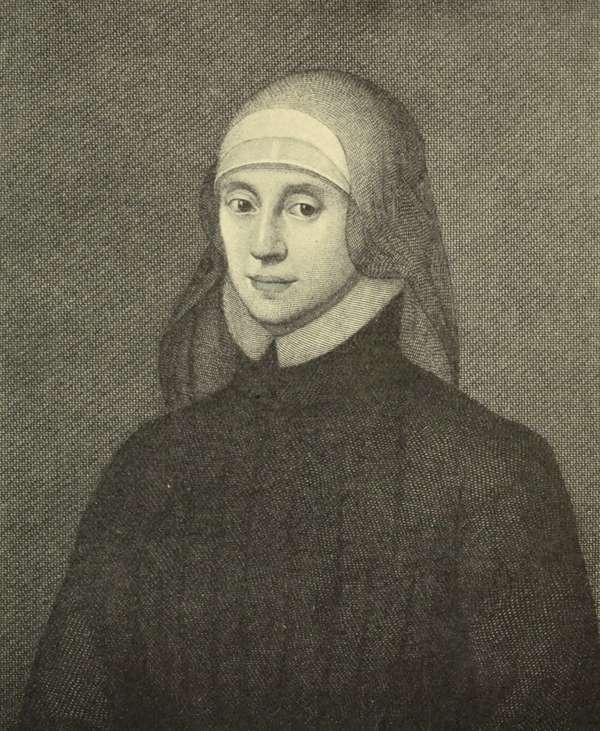
MARY WARD
From an engraving in The Life of Mary Ward, by Mary Elizabeth Chambers
of the Institute of the Blessed Virgin
The Institute finally received the sanction of the pope and
was successful in various countries. But Miss Ward's efforts to
establish it in England in 1638 met with so much hostility that
she was obliged to carry on her work secretly and by subterfuge,
changing the location of her little band of followers from
time to time as suspicion centered upon them. The Institute
was finally broken up by the Puritans in 1642. Little is known
of the actual work of the school. The members of the Institute
were always so anxious and harried that there could have
been no really systematic instruction except in the articles of
faith. There are in the Convent of the Institute at Augsburg
fifty large oil paintings dating from the seventeenth century,
and representing events in its history. In these pictures Mary
Ward's life is seen to be one of dramatic interest from her childhood
to her death. And her personality is one of compelling
charm. She was a heroine and a pioneer, an executive of first-rate
ability, an extremely acute woman of business, and yet
without loss of the graces and amenities of human intercourse.
The St. Omer school shows genius. Within the limits of her
church she was promulgating ideas the full fruition of which
would not come for many years. She believed that sound mental
training would establish women in their faith, and that
women, if given opportunity and education, would prove to
have powers not generally ascribed to them. To establish a
school on this basis was an enterprise bolder, more original,
and more hazardous than was the opening of the first colleges
for women in America.
Another religious school was that known as Little Gidding,[84]
founded by Nicholas Ferrar (1592-1637). The life of Ferrar
is one of great interest. He was a man of wide experience. He
had known academic life at Cambridge, he had traveled in
Holland, Germany, Italy, and Spain, he had conducted extensive
business enterprises in connection with the Virginia
Company, and had taken an important place in political life
as a member of Parliament. But while still under forty he
turned definitely to a life of religious sequestration. He and
his mother bought the Manor of Little Gidding in Huntingdonshire
in 1624 and there they set up the new establishment. He
was joined by his brother John with his wife and three children,
and by Mrs. Collet, his favorite sister, with her husband and
sixteen children. To the children of these two families were
added such children of the neighboring gentry as cared to come.
In this household the girls were carefully educated. They had
one master in Music, one in Arithmetic and Writing, one in
English and Latin. They formed themselves into a little society
called "The Academy" which had regular meetings for
discussion of topics set for them. They took fanciful names,
and had many quaint and elaborate little formalities. The
topics discussed by "Patient" and "Cheerful" and "Moderator"
and "Visitor," and even by little four-year-old "Humble,"
were nearly always religious or ethical, and the purpose of the
discussions was always moral improvement. So strong was the
religious element, so rigid were the forms of fasting, feasting,
and worshiping, that the school came under suspicion as a Protestant
nunnery. In 1641 it was attacked in a pamphlet entitled
The Armenian Nunnery, or a Brief Description and Relation
of the newly erected Monasticall Place called the Armenian
Nunnery at Little Gidding.
The school at Little Gidding has had its fame as a religious
organization perpetuated in Mr. Shorthouse's John Inglesant,
but it is even more famous in the annals of fine book-binding.
It was the belief of Nicholas Ferrar that every one should be
taught some hand-work, and he determined upon book-binding
as a part of the regular school work at Little Gidding. Dr.
Jebb says that "a Cambridge book-binder's daughter that
bound rarely" was procured as an instructor. She came, he says,
either from the University printers themselves or from some
Cambridge bindery which they patronized where she herself had
been trained. She brought some of her own stamps with her,
and some of her own ideas as to how they should be arranged.
Even this activity was the handmaid of religion, and was,
indeed, probably undertaken primarily in order to preserve the
concordances of the four gospels so carefully worked out by
Nicholas Ferrar. The girls learned to do all the mechanical
parts with extreme nicety, joining the many tiny slips and
putting in the illustrative engravings with great deftness. The
name of the binder is not usually given in the book, but there
is one exception. A book bound by the youngest of the workers
bears the inscription:
Thanks be to God.
Done at Little Gidding. Anno Domino 1640
by Virginia Ferrar, an. 12.[85]
The curious little "histories" composed by "The Academy"
were written out in three manuscript volumes and bound.
They have been lately acquired by the British Museum. "The
volumes measure 13½ x 9 inches and are bound in black morocco,
with a small double gold line running along the edge,
finished with a little ornamental spray at each corner." The
Concordances were more sumptuous. The Bibliographica gives
full-page colored illustrations of these fine bindings and says
of them:
The beautiful effect which Mary Collet, who seems to have done
much of the binding herself, was able to produce by different arrangements
of the stamps I have described shows that she was undoubtedly
a lady of much taste and originality ... and it may fairly be considered
that the velvet-bound volumes, of great size, gorgeous in color
and rich in decoration, which were eventually produced under her
supervision, must take the highest rank among amateur decorative
book-bindings.
Unequalled in size, original in design, and rich in execution, these
volumes must be seen to be appreciated; then indeed the expressions
which Charles I used concerning them, which sound extravagant, can
be well understood. Although much faded, and sometimes re-backed
and the sides relaid, with the silken ties all gone, enough of their old
magnificence still remains to make us feel that we should indeed be
proud that English binders could have produced such works.[86]
Aside from these religious schools, which were very small,
there were undoubtedly some fashionable boarding-schools,
such as Mrs. Salmon's school in Hackney where Katherine
Fowler went.[87] Another fully organized private school at Hackney
was that kept by Mrs. Perwick in 1643, where as many
as eight hundred girls had been educated.[88] The existence of a
school for girls in Richmond is shown by a curious document
found among a large number of miscellaneous papers in Warwickshire.
It is entitled "Account for Peggy's Disbursements
since her going to schoole at Richmond, being in Sept. 1646":
| s. | d. |
| Payd for a louehood | 2. | 6 |
| For carriing the truncke to Queenhive | 0. | 8 |
| For carriing it to Hammersmith | 1. | 0 |
| Payd for two pair of shoes | 4. | 0 |
| Payd for a singing booke | 1. | 0 |
| Given to Mrsis Jervoises mayd | 1. | 0 |
| Payed for a hairlace and a pair of showstrings | 1. | 0 |
| For an inckhorne | 0. | 4 |
| For faggots. 2s.8d.; and cleaving of wood, 12d. | 3. | 8 |
| For 9li of soape 2s. 4d.; and starch 4d. | 2. | 8 |
| For hooks and a bolte for the doore | 0. | 9 |
| For sugar and licorich | 1. | 4 |
| For silke and thread | 0. | 6 |
| For 3li of soape, 11d.; and starch 4d.; and carrying letters 6d. | 1. | 9 |
| For 3li of soape, 12d.; and starch 4d. | 1. | 4 |
| For sugar, licorich and coultsfoot | 1. | 6 |
| For a necklace, 12d.; for a m. of pins, 12d. | 2. | 0 |
| For a pair of cands (candles?) 6d.; for muckadine 4d.; for wormsend (worsted), 2d. | 1. | 0 |
| For shostrings, 6d.; for going on errands, 6d. | 1. | 0 |
| For 3li of soape, 12d.; for starch 4d.; thread and silk 4d. | 1. | 8 |
| For a bason, 4d.; for carrying letters, 6d.; for tape 4d. | 1. | 2 |
| For soape, 12d.; for starch, 4d.; for going on errands, 6d. | 1. | 10 |
| For a pair of pattins, 16d.; for three pair of shoes, 6s. | 7. | 4 |
| For callico to line her stockins, 2d.; for showstrings 4d. | 0. | 6 |
| For 3li of soape, 12d.; for a pint of white wine 4d. | 1. | 4 |
| For ale, 3d.; for 1/2li of sugar, 8d. | 0. | 11 |
| For a m. of pins, 12d.; for a corle and one pair of half-handed gloves, 8d. | 1. | 8 |
| Given to the writing mr. | 2. | 6 |
| For silke, 12d.; for silver for the tooth-pick case, 4d. | 1. | 4 |
| For a sampler, 12d.; for thread, needles, paper, pins, and parchment, 30d. | 3. | 6 |
| For a pair of shoes, 2s. 2d.; for ribbon, 3d. | 2. | 5 |
| For soape, 12d.; for starch, 4d.; for carriing a letter, 4d. | 1. | 8 |
| To the waterman bringing the (box?) to Richmond | 1. | 0 |
| For shoestrings, 6d.; for purge, 18d. | 2. | 0 |
| For bringing the box from Richmond | 1. | 0 |
| For a coach from Fleetestreete | 1. | 0 |
| For wood to this time | 15. | 10 |
| ——— |
| Totall of disbursements to this 15th day of Aprill, 1647 is | £3. 18. 5 | [89] |
Peggy's clothing and her board and tuition must have been
paid for by her father. The accurate little list represents only
her personal and incidental expenses. The writing-master's
fee, the purchase of an inkhorn, a singing-book, and materials
for a sampler are the only suggestions that Peggy was being
educated. But several of the items are indicative of general
school conditions. For instance, if a girl had a fire she evidently
had to pay extra for it, Peggy's largest single item being
for wood, "cleaving of wood," and "faggotts." The next
largest sum goes for "soape" and starch. Peggy apparently
did her own laundry, or at least bought the materials used; and
she bought them in amounts suggestive of disproportionate
emphasis on clean linen. In clothing the most surprising purchase
is of six pairs of shoes and one pair of "pattins" in six
months. It is a pity we have not the letters for the carrying of
which Peggy paid ten pence. They might serve to throw light
on her expense account.
In May, 1649, Evelyn records in his Diary, "Went to Putney
by water, in the barge with divers ladies, to see the schools,
or Colleges, of the young gentlewomen." These Putney schools
may have been under the charge of Mrs. Makin. In that case
they were the forerunners of the more advanced school she
established at Tottenham High Cross in 1673.
One interesting point occurs in the foundation of a school
for boys by Balthasar Gerbier in 1648. This school was an
academy wherein the sons of noble families could be taught
classics, mathematics, drawing, painting, carving, music,
behavior, etc. The novel element in the school is Gerbier's
advertisement December 21, 1649, in which he says that
ladies are to be admitted to his lectures.[90]
If girls were educated at all during the period from 1603 to
1660 it must have been, in the main, at home under parents
and tutors. But even of such education the records are meager.
Little Gidding was practically a home school, but it stands as
an isolated attempt. The few little pictures of more secular
home education that have been by chance preserved to us indicate
no very valuable training. Mrs. Alice Thornton (1626-1707),
Lady Anne, daughter of the Earl of Strafford, and Lady
Arabella Wentworth, were brought up in Ireland and were given
"the best education that Kingdome could afford." They were
taught to write and speak French; singing, dancing, playing
on the lute and theorboe, and such other accomplishments as
"working silkes, gummework, sweetmeats, and other sutable
huswifery" such as was necessary for girls of their social position.[91]
We get some further light from autobiographical sketches
by the Duchess of Newcastle,[92] Lady Fanshawe,[93] and Mrs.
Hutchinson,[94] women whose mature work belongs in the Restoration
period or not many years before it, but whose childhood
and early youth belong in the period under consideration,
and serve in a measure to illustrate its methods. The
educational advantages afforded these young daughters of the
best families were like those of an eighteenth-century finishing-school,
and were far removed from the stern mental discipline
in the school of Sir Thomas More.
The brief running summaries in the preceding chapter have
perhaps served to bring into prominence two sharply contrasted
periods. The first half of the sixteenth century and the
first half of the seventeenth seem even more than a hundred
years apart in tone and temper. We turn from the eager intellectual
life of many women in the Tudor period, from their full
and rich opportunities, and we find that in the time of the earlier
Stuarts there were very few women who took any pride in
learning, that there was little or no provision at home or in
schools for any but the most desultory sort of education for
girls, and that there were practically no formulated ideals or
theories of intellectual advancement for women. But at the
close of this barren half-century we come upon what may be
considered the real beginnings of the modern work of women.
This era of development may be appropriately introduced by
the presentation of several women who, while in no sense cohering
into a group, are yet alike in that their home education
belongs in the reign of Charles I, that later they had the stern
training incident on Civil War conditions, and that their published
work belongs before 1675.
Margaret Lucas,
the Duchess
of Newcastle
(1624-1674)
The most talked-of learned lady of the Restoration period
was the Duchess of Newcastle.[95] She was brought
up by her mother, who was left a widow with
a great fortune and a family of eight children
when Margaret was an infant. The Duchess
in her Autobiography describes a family life conducted
with splendor and luxury. She comments on the elaborate attendance,
the rich and costly garments, the many pleasures,
secured for the children by the industrious care and tender love
of their mother. It was a bright, gay, free, affectionate home
life. But we get only slight indications of any educational advantages.
"As for tutors, although we had for all sorts of vertues,
as singing, dancing, playing on musick, reading, writing,
working, and the like, yet we were not kept strictly thereto, they
were rather for formality than benefit, for my Mother cared not
so much for our dancing and fidling, singing and prating of
severall languages, as that we should be bred virtuously, modestly,
civilly, honourably and on honest principles." None of
these opportunities met Margaret's needs. She says she had
a natural stupidity in learning foreign tongues, cared little for
music, disliked needlework, found cards and games tiresome,
and dancing frivolous. Apparently the freedom of the family
life left her at liberty to follow her real interests which were in
the main intellectual. Here she had the sympathetic aid of her
brother, Lord Lucas. The precocious development of her mind
is shown by the fact that at twelve she had written a book on
a philosophical subject.
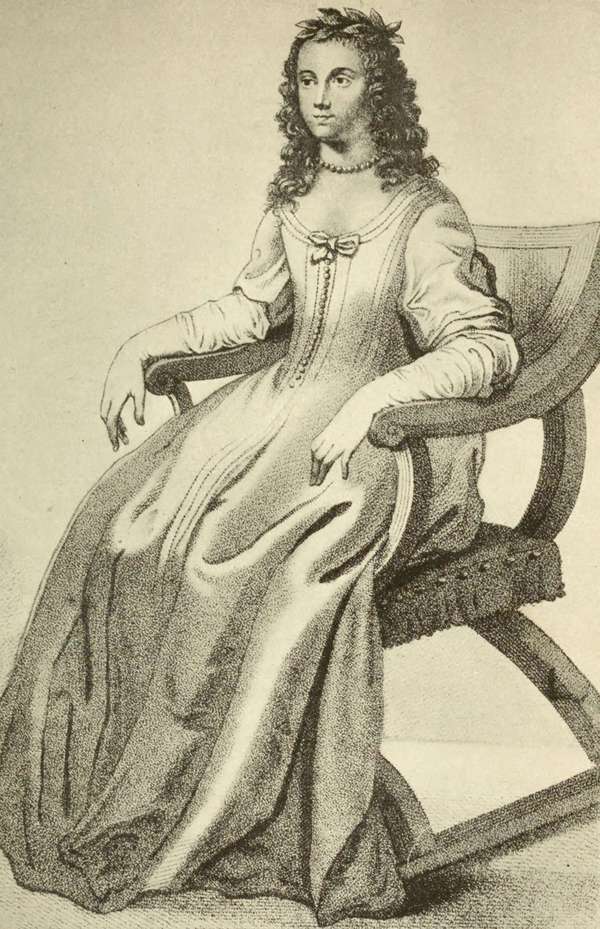
MARGARET CAVENDISH, DUCHESS OF NEWCASTLE
From an engraving in Horace Walpole's Royal and Noble Authors, London, 1806
At eighteen she was appointed maid of honor to Queen Henrietta
Maria and accompanied her to France. There, at twenty,
she became the second wife of the Duke of Newcastle, a nobleman
thirty-two years older than herself, but who was, she says,
"the onely Person I ever was in love with." She was with him
during the trying years of his absence from England and it was
during this difficult and tedious period that literature became
her resource. Her publications began with Philosophical Fancies
in 1653 and closed with Grounds of Natural Philosophy in 1668,
during which period she wrote nearly twelve folio volumes.
The portions of her work concerning which she felt the greatest
measure of self-congratulation were her studies in natural philosophy.
Her Philosophical Fancies of 1653 was expanded in
1655, and in 1663 received its final form as Philosophical and
Physical Opinions. Of all her books this was "her best beloved
and favourite." But the quality on which she chiefly prides herself
is the very one that nullifies her work. Originality is her
great boast, an originality so pronounced as to refuse to base
its deductions on the writings of previous thinkers. Her husband
substantiates her claim. He says that all her philosophical
fancies are spun out of her own brain, and that, if she does not
use the technical terms of philosophers, it is because her language
is her own too. She has scorned to talk with any "profest
scholar" to learn his phraseology. "She did never impe her high-flying
Phancies, with any old broken Fethers out of any university."[96]
She says herself that she could never "afford board-room
to other people's ideas lest the legitimate offspring of her
own brain should be crowded out."[97] In Part IV, "On the Motion
of the Bodie," we find that the Duchess has never studied
anatomy, but this apparent disqualification does not prove inhibitory.
In An Epistle to the Reader she explains the situation:
I am to be pardoned, if I have not the names and tearms that the
Anatomists have or use; or if I have mistaken some parts in the body,
or misplaced any: for truly I never read of Anatomie, nor never saw
any man opened, much less dissected, which for my better understanding
I would have done; but I found that neither the caurage of
nature, nor the modesty of my sex would permit me. Werefore it
would be a great chance, even to a wonder I should not erre in some;
but I have seen the intrals of beasts, but never as they are placed in
their bodies, but as they are cut out to be drest ... which intrals I
have heard are much like mans, especially a hogs, so that I know man
hath a brain, a heart, a stomach, liver, lights, spleen, and the like; yet
these I never viewed with a curious and searching eye, but as they
have laien in some vessels; and as for bones, nerves, muscels, veines
and the like, I know not how they are placed in the body, but as I
have gathered several times from several relations, or discourses: here
a bit and there a crum of knowledge, which my natural reason hath
put together.[98]
From any modern standpoint of scientific excellence the inaccuracy
and amazing self-confidence of these studies render
them worse than futile. But it was not ignorance that was
charged against the Duchess by her critics. The experimental
method was having its triumphs, but doubtless a good deal of
the scientific writing of the first half of the century was marked
by a dogmatic tone and an uncertainty as to facts, so the
Duchess was not attacked on that score. The common report
that irritated the Duke of Newcastle to a spirited defense of
his wife was that she could not have written these books, for
"no lady could understand so many hard words." The Duke
takes up various kinds of hard words such as terms of divinity,
philosophy, astronomy, and geometry, and shows that natural
wit, common sense, and some observation could compass most
of them. He gives the following account of the way he and the
Duchess acquired a medical vocabulary: "But would you know
the great Mystery of these Physical terms, I am almost
ashamed to tell you; not that we have been ever sickly, but
by melancholy often supposed ourselves to have such diseases
as we had not, and learned Physitians were too wise to put us
out of that humour, and so these terms cost us much more than
they are worth, and I hope there is nobody so malicious as to
envie us our bargain."[99] At the end of his Preface the Duke
comes to what he considers the real cause of the aspersions on
his Lady's books: "But here's the crime, a Lady writes them,
and to intrench so much on the male prerogative, is not to be
forgiven." The Duchess, in her Address to the Two Universities,
recurs to this idea. She hopes her book may be received
for the good incouragement of our sex, lest in time we should grow irrational
as idiots, by the dejectednesse of our spirits, through the carelesse
neglects, and despisements of the masculine sex to the effeminate,
thinking it impossible we should have either learning or understanding,
wit or judgement, as if we had not rational souls as well as men,
and we out of a custom of dejectedness think so too, which makes us
quit all industry towards profitable knowledge ... so as we are become
like worms that only live in the dull earth of ignorance, winding
ourselves sometimes out, by the help of some refreshing rain of good
educations which seldom is given us; for we are kept like birds in cages
to hop up and down in our houses ... we are shut out of all power,
and Authority by reason we are never imployed either in civil nor
marshall affaires, our counsels are despised, and laught at, the best
of our actions are troden down with scorn, by the over-weaning conceit
men have of themselves and through a despisement of us.[100]
But she presents her book with some confidence to the universities
as places where are to be found right judgment and respectful
civility. And at any rate she would rather "lie intombed
under the dust of an University" than be "worshipped
by the Vulgar as a Deity."
One of the Duchess's most curious books is Orations of
Divers Sorts accommodated to Divers Places. Among the "orations"
is a "collection of speeches for a convivial meeting of
country gentlemen in a market town, ending with 'a speech of
a quarter-drunk gentleman,' and 'a speech of a half-drunk
gentleman.' Another little collection headed 'Female Orations'
reports the speeches delivered at a meeting of women on
the great question of combining together to make themselves
'as free, happy, and famous as men.'"[101]
When the Duke and Duchess returned to England after
the Restoration they lived for the most part at one of their
country estates, but they made occasional visits to London.
It was then that the Duchess's beauty, wealth, eccentric dress
and manners, and literary and scientific pretensions made her
a conspicuous and, to some, a ridiculous figure. Sir Walter
Scott, in Peveril of the Peak,[102] makes Charles II say of the Duchess,
"Her Grace is an entire raree-show in her own person—a
universal masquerade—indeed a sort of private Bedlam
hospital"; and this sums up the attitude that found expression
in the phrase, "Mad Madge of Newcastle." In 1653 Dorothy
Osborne wrote to Sir William Temple: "Let me ask you if you
have seen a book of poems newly come out, made by my
Lady Newcastle? For God's sake if you meet with it send
it to me; they say 't is ten times more extravagant than
her dress. Sure, the poor woman is a little distracted, she
could never be so ridiculous as to venture at writing books,
and in verse too." A little later she wrote: "You need not
send me Lady Newcastle's book at all, for I have seen it,
and am satisfied that there are many soberer people in Bedlam."[103]
Mrs. Evelyn called on the Duchess in 1667 and wrote
to Mr. Bohun:
I was surprised to find so much extravagancy and vanity in any person
not confined within four walls. Her habit particular, fantastical,
not unbecoming a good shape, which truly she may boast of. Her face
discovers the facility of her sex, in being yet persuaded it deserves the
esteem years forbid, by the infinite care she takes to place her curls
and patches. Her mein surpasses the imagination of poets, or the
descriptions of a romance heroine's greatness: her gracious bows, seasonable
nods, courteous stretching out of her hands, twinkling of her
eyes, and various gestures of approbation, show what may be expected
from her discourse, which is as airy, empty, whimsical and
rambling as her books, aiming at science difficulties, high notions,
terminating commonly in nonsense, oaths, and obscenity.[104]
On May 30, 1667, the Duchess made a formal visit to the
Royal Society, and Pepys says she was all admiration at the fine
experiments they showed her, but he did not hear her say anything
that was worth hearing. There had been much objection
to admitting her to the rooms of the Society, some of the
members fearing that the town would be "full of ballads of it,"
but the visit seems to have passed off mildly and with the respectful
observance to which she was accustomed.
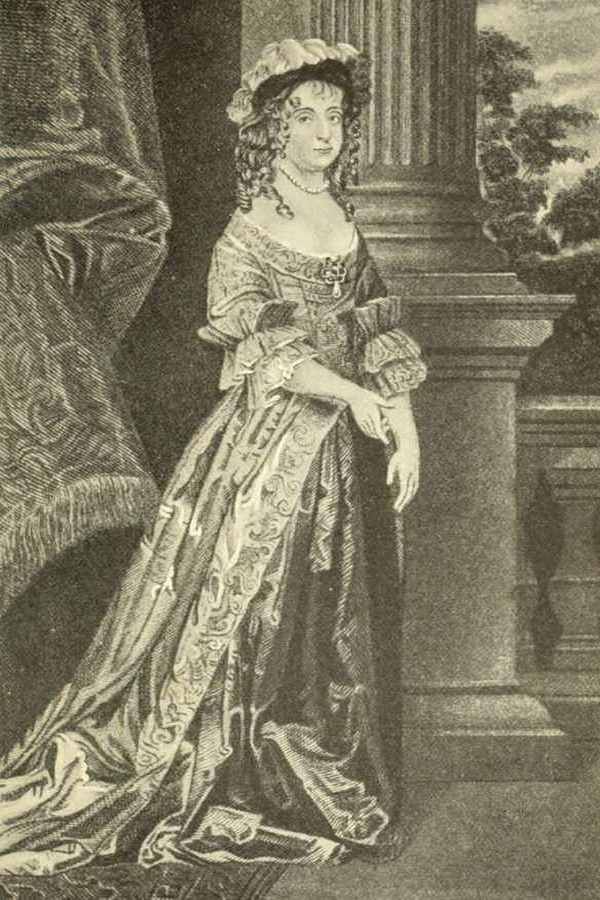
MARGARET CAVENDISH, DUCHESS OF NEWCASTLE
From an engraving in The Lives of William Cavendish, Duke of Newcastle, and of his wife
Margaret, Duchess of Newcastle, edited by Mark Antony Lower, London, 1872
In spite of the stream of private criticism already indicated,
the almost unmixed adulation of which the Duchess was the
subject is indicated by the Letters and Poems, in Honour of the
incomparable Princess Margaret, Dutchess of Newcastle, published
in 1676, two years after her death. In her lifetime, too,
the praise was equally extravagant. Resounding Latin titles,
such as Illustrissima Heroina, Excellentissima Dux, Eminentissima
Princeps, came to her from high sources. The Rector
Magnificus of the University of Leyden called her not only
Princeps fæminini sexus, but Princeps terrarum. And the Vice-Chancellor
of Cambridge in a complimentary address said that
the great women of old could not contend with her for the palm
of learning, but rather would they, with bent knee, adore
this solam Margaretam Consumatissimam Principem. Even
so sane a man as Evelyn wrote her a most flattering letter
when she sent him her works in 1674. Beginning with Zenobia
he assembled the great women of ancient times, the learned
ladies of more modern days in France, Spain, Italy, and Holland,
and concluded with
Mary de Gournay, & the famous Anna M. Schurman: and of our owne
country, Queene Elizabeth, Queene Jane, the Lady Weston, Mrs.
Philips our late Orinda, the daughters of Sr Tho: More; the Queene
Christina of Sweden, & Elizabeth, daughter of a queen also to whom
the renowned Des Cartes dedicated his learned worke, & the profound
researches of his extraordinary talent. But all these, I say,
sum'd together, possesse but that divided, which yr Grace retaines in
one; so as Lucretia Marinella, who writ a book (in 1601) dell' Excellenzia
delle Donne, con difetti è mancamenti de gli huomini, had no
neede to have assembled so many instances and arguments to adorne
the work, had she lived to be witnesse of Margarite, Dutchess of
Newcastle, to have read her writings, & to have heard her discourse of
the science she comprehended.[105]
Praise could hardly go further.
The best modern judgment discards the encomiums, but yet
gives the Duchess a fairly high place. Sir Egerton Brydges, the
editor of her Autobiography, says:
That the Duchess was deficient in a cultivated judgment; that her
knowledge was more multifarious than exact; and that her powers of
fancy and sentiment were more active than her powers of reasoning,
I will admit; but that her productions, mingled as they are with
great absurdities, are wanting either in talent or in virtue, or even
genius, I cannot concede.[106]
The Duchess was buried in Westminster Abbey with this
inscription on her monument:
Here lies the loyal Duke of Newcastle and his Duchess, his second
wife, by whom he had no issue. Her name was Margaret Lucas,
youngest sister to Lord Lucas of Colchester, a noble family, for all
the brothers were valliant, and all the sisters virtuous. This Duchess
was a wise, witty, and learned Lady, which her many books do well
testify; She was a most virtuous, and loving, and careful wife, and
was with her Lord all the time of his banishment and miseries; and
when they came home never parted with him in his solitary retirements.
The two books by the Duchess that one would not willingly
let die are her Life of her husband and her Autobiography.
These are of permanent value as pictures of the life of a great,
rich family like that of her girlhood home, and the straitened
life in exile, with the later affluent and splendid life of a noble
high in royal favor such as was the Duke of Newcastle. All the
personal portions of both books are told with an air of genuineness,
a naïveté, that make delightful reading. The Duchess
summed up her life as that of a woman "honourably born, carefully
bred, and nobly married to a wise man," and it was out
of these happy domestic relations that her best work came.
Mrs. Katherine
Philips
(1631-1664)
Contemporary with the Duchess of Newcastle was Katherine
Fowler, better known as Mrs. Katherine
Philips, and better still as the "Matchless
Orinda." She was the daughter of John Fowler,
"an eminent merchant in Bucklersbury," and Katherine Oxenbridge.
Aubrey gives a quaint account of her precocious childhood
as it was described to him by "her cosen Blacket who
lived with her from her swadling cloutes till eight, and taught
her to read." Aubrey says: "When a child she was mighty apt
to learn, and ... she had read the Bible through before she was
full four yeares old; she could have sayed I know not how
many places of Scripture and Chapters. She was a frequent
hearer of sermons; had an excellent memory and could have
brought away a sermon in her memory."[107]
Her further education was carried on at Hackney at the
school of "Mris Salmon, a famous schoolmistress, Presbyterian....
Loved poetrey at schoole, and made verses there.
She takes after her grandmother Oxenbridge ... who was an
acquaintance of Mr. Francis Quarles, being much inclined to
poetrie herself." As a child Katherine evidently was as ardent
a Presbyterian as her school-mistress and her Oxenbridge ancestors.
"She was very religiously devoted when she was
young; prayed by herself an hower together, and tooke sermons
verbatim when she was but ten yeares old.... She was
when a child much against the bishops, prayd to God to take
them to him, but afterwards was reconciled to them. Prayed
aloud, as the hypocritical fashion then was, and was overheared."
At sixteen she married Mr. James Philips, Esquire, of Cardigan
Priory, Wales. Her published work includes numerous
brief poems, most of them of a personal nature, two plays
translated from the French, and several letters to Sir Charles
Cotterell. This is rather scanty productivity to serve as a basis
for the great vogue Mrs. Philips certainly had, nor to the
modern reader does the quality of the work sufficiently account
for the enthusiasm it excited. Yet we have abundant
testimony that the last ten years of her life were made brilliant
by praise from the most authoritative sources. Sir Charles
Cotterell, her intimate friend and the editor of her Works,
said of her: "We might well have call'd her the English Sappho,
she of all the Poets of former Ages, being for her Verses and
her Virtues both, the most highly valued; but she has call'd
herself Orinda, a name that deserves to be added to the Muses,
and to live with honour as long as they. Were our language as
generally known to the world, as the Greek and Latin were
anciently, or as the French is now, her Verses could not be
confined within the limits of our Islands, but would spread
themselves as far as the Continent has Inhabitants, or as the
Seas have any Shore." Something must be allowed here for
the enthusiasm of a friend and an editor, but other estimates
were almost as extreme. The Earl of Orrery had thought that
the high praise of her poems at court must be exaggerated, but
when he came to know her and her writings the court eulogies
were to him but "Imperfect Trophies," and he exclaimed, "If
there be Helicon, in Wales it is." Henry Lawes and Dr. Coleman,
the best composers of the day, set some of her poems to
music. Cowley in two poems to her praised her for her spirit
"so rich, so noble, and so high," her "inward Virtue," her
"well-knit Sence," and for her poems in which were united all
the excellences of both sexes. When her translation of Pompey
appeared in the Smock-Alley Theater, Dublin, the Earl of
Roscommon wrote the Prologue and Sir Edward Dering the
Epilogue, and the success of the play was assured by the enthusiastic
support of the aristocracy of Dublin. In 1659 Jeremy
Taylor dedicated to her his Discourse of the nature, offices and
measures of friendship. Though she does not exactly fulfill the
prophecy of Mr. Thomas Rowe, that "Orinda should be an
ever-glorious name to ages yet to come," yet her fame was
by no means confined to her own brief day. We hear echoes of
it far down in the eighteenth century. The highest praise that
could be given to any woman poet was to bracket her with
Orinda.
By the nineteenth century her vogue was almost extinct, but
chance appreciation came from an unexpected quarter. Keats
wrote to Reynolds in September, 1817:[108]
The world, and especially our England, has, within the last thirty
years, been vexed and teased by a set of Devils, whom I Detest so
much that I almost hunger after an Acherontic promotion to a Torturer,
purposely for their accomodation. These devils are a set of
women, who having taken a snack or Luncheon of Literary scraps,
set themselves up for towers of Babel in languages, Sapphos in Poetry,
Euclids in Geometry, and everything in nothing. Among such the
name of Montague has been preëminent. The thing has made a very
uncomfortable impression on me. I had longed for some real feminine
Modesty in these things, and was therefore gladdened in the extreme
on opening the other day, one of Bailey's Books—a book of poetry
written by one beautiful Mrs. Philips, a friend of Jeremy Taylor's
and called "The Matchless Orinda"—you must have heard of her,
and most likely read her Poetry—I wish you have not, that I may
have the pleasure of treating you with a few stanzas.
Whereupon he quotes the ten stanzas written by Orinda on
parting with her friend "Rosania," a poem of genuine feeling
and quaintly charming in expression. "In other of her poems,"
says Keats, "there is a most delicate fancy of the Fletcher
kind—which we will con over together."
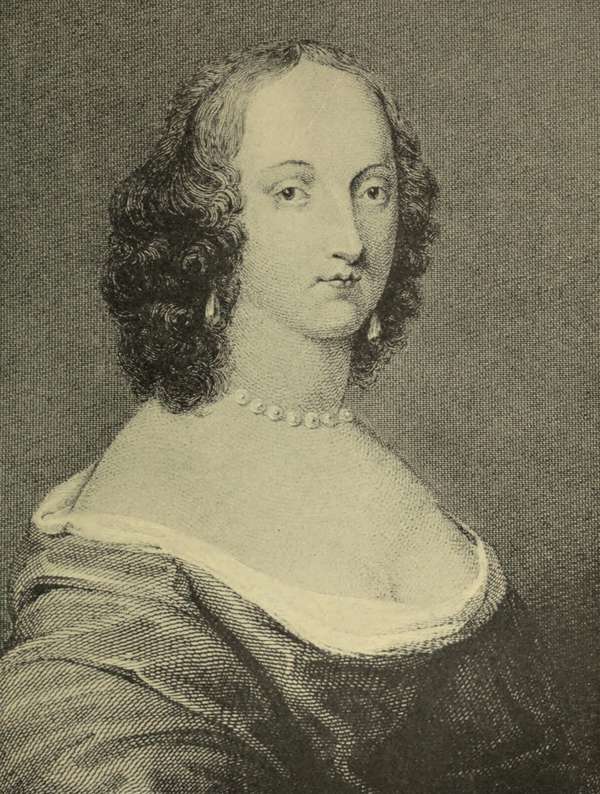
MRS. KATHERINE PHILIPS
"From an original Picture in the Collection of her Grace the Dutchess of Dorset."
Drawn by J. Thurston. Engraved by W. Finden. From an engraving in
Effigies Poeticae. London, 1824
Thus the magic of Orinda's name reasserts itself, and she is
again praised as a lady of "delicate fancy," "feminine modesty,"
and unmatched in friendship. A reintroduction to a general
public was given by Mr. Gosse's delightful essay in Seventeenth
Century Studies (1885). And in 1904 a selection from her
poems was published with an acute "Appreciation."
In her own day Orinda was not only prized as a poet, but she
was considered the highest example, the prophet and expounder,
of true friendship. Much of her verse was called forth by her
Society of Friendship. The chief members of this circle were
"Antenor" (Mr. Philips), "Lucasia" (Miss Anne Owen),
"Rosania" (Miss Mary Aubrey), "Regina" (Mrs. John
Collier), "Palæmon" (Jeremy Taylor), "Silvander" (Sir
Edward Dering), "Policrite" (Lady Margaret Cavendish),
"Celimena" (Miss E. Boyl), "Cassandra" (Mrs. C. P., her
dear sister), and "Critander" (Mr. J. B.). "Ardelia," "Phillis,"
and "Pastora" remain unidentified. There were doubtless
others in the circle, but these we know because they all received
poetical tributes from Orinda. There were over thirty-five private
individuals intimately addressed in her poems.
It is undoubtedly the personal character of her poems that
secured her so wide and favorable an audience while her writings
were still in manuscript and known only as they passed
from hand to hand. Each person addressed was the center
of a new circle of readers. But the intimacy of the poems is one
reason for the actual agony Orinda suffered when an unauthorized
edition of her poems appeared in 1662. "Their Names
expos'd in this Impression without their leave" was the burden
of her grief. And she was likewise injured in her modesty. The
publication seemed to put her in the position of a woman bold
and masculine enough to send her writings into the world. A
thousand pounds, she says, would not have bought her consent.
To Sir Charles Cotterell she wrote:
To me (Sir) who never writ any line in my life with any intention
to have it printed.... This is a most cruel accident, and hath made
so proportionate an impression upon me, that really it hath cost me
a sharp fit of sickness since I heard it.
If the garbled version makes a true version a necessary reparation
of the misfortune she will yield, "but with the same reluctancy
as I would cut off a Limb to save my Life."
I am so far from expecting applause for anything I scribble, that
I can hardly expect pardon; and sometimes I think that employment
so far above my reach, and unfit for my Sex, that I am going to resolve
against it for ever; and could I have recovered those fugitive
Papers that have escaped my hands, I had long since made a sacrifice
of them all. The truth is, I have an incorrigible inclination to that
folly of riming, and intending the effects of that humour, only for
my own amusement in a retir'd life; I did not so much resist it as a
wiser woman would have done.[109]
She had been planning a visit to London, but she wrote in
despair to Dorothy Osborne (then Mrs. Temple):
I must never show my face there or among any reasonable people
again, for some dishonest person hath got some collection of my
Poems as I heare, and hath deliver'd them to a Printer who I heare is
just upon putting them out and this hath soe extreamly disturbed
me, both to have my private folly so unhandsomely exposed and ye
belief that I believe the most part of ye world are apt enough to believe
yt I connived at this ugly accident that I have been on ye rack ever
since I heard it, though I have written to Col. Jeffries who first sent
me word of it to get ye Printer punished, the book called in, and me
someway publicly vindicated yet I shall need all my friends to be
my champions to ye criticall and mallicious that I am soe innocent
of this pittiful design of a knave to get a groat that I never was more
vexed at anything and yt I utterly disclaim whatever he hath so unhandsomely
expos'd. I know you have goodness and generosity
enough to doe me right in your company and to give me your opinion
too how I may best get this impression supressed and myself vindicated
and therefore I will not beg your pardon for troubling you with
this impertinent story.[110]
Her pride of authorship would, however, almost certainly have
triumphed over her modesty if she could have lived to see the
sumptuous volume with its bravery of eulogistic verse in which
Sir Charles Cotterell enshrined her work. Her letters to him,
under the title Letters from Orinda to Poliarchus, were published
in 1705 and add distinctly to her fame.
On the whole, Orinda becomes a personage to us and an
agreeable one. There is a note of sincerity through even her
most unrestrained poems; the ardor of her affections is unmistakable;
her loyalty to the King, to her friends, to her ideas,
is genuine. She does not labor compliments. Her praise pours
forth from the abundance of her feeling. Perhaps one reason
for her ready popularity was that she aroused no antagonisms.
Though a literary woman there was nothing about her that was
masculine, strident, or assertive. Her outlook on life was gracious
and tolerant. She loved simplicity and retirement and
was never dazzled by wealth or titles.
At any rate, there is one interesting and significant fact about
her and that is her success. It was a kind of success new in English
literary history. A woman without any commanding advantages
of birth or fortune, only moderately good-looking,
without any compelling fascination, unstimulated by parental
or tutorial ambitions, with but the scantiest schooling, married
to an ordinary, rather dull man; a virtuous, sane, orderly,
thrifty woman, excellent in business, housewifely, with no eccentricities,
simply follows her feelings in friendship and the
bent of her mind towards authorship, and attains in a few
years a position notably high.
Mary North
(d. 1662)
Two interesting young women who belong chronologically
to this group are not exactly learned ladies,
but they had intellectual piquancy and alertness.
One of them, Mary North, was the eldest of the fourteen
children of Dudley, the fourth Lord North. The mother
of this large family was evidently a remarkable woman. Her
son Roger says of her: "The Government of us was In generall
severe, but tender; our mother maintained her authority, and
yet condiscended to Entertain us. She was learned (for a lady)
and Eloquent. Had much Knoledg of History and readyness
of witt to express herself, in the part of Reproof, wherein she
was fluent and pungent.... But without occasion given to the
Contrary, she was debonair, familiar, and very liberall of hir
discourse to entertain all." This combination of the pungent
and the debonair made an effective family discipline, for it was
said that there was not a son or daughter whose abilities were
not of a very high order, and that the daughters were hardly
less cultured than their brothers. And of this group Mary was,
says Roger, "by far the most brilliant—a woman of real
genius." A charming picture is given of the ladies of the North
family, gathered together according to the custom of the time
for endless tasks of tapestry and embroidery, listening entranced
to Mary who recited romances for hours together, giving
not only the story, but the conversations, the substance of
letters, and the general reflections. She had "a superiour wit,
a prodigious memory, and was most agreeable." "She instituted
a sort of order of the wits of her time and acquaintance,
whereof the symbol was a sun with a circle touching the rays,
and upon that in blue ground were wrote αὐτάρκης in proper
Greek characters, which her father suggested. Divers of these
were made in silver and enamel, but in embroidery plenty,
which were dispersed to those wittified ladies who were willing
to come into their order; and for a while they were formally
worn, until the foundress fell under the government of another,
and then it was left off."[111] Mary North was married to Sir
William Spring of Pakenham and died in 1662 in her twenty-fourth
year. Her feminine "Order of Intellect," her quaint
badge, "the symbol of a community of taste and interest in
literature, science, and art,"[112] offer an attractive and hopeful
prospect. It was an inconspicuous little organization,
springing up gayly and spontaneously, and its scope of learning
may not have gone beyond the French romances the gifted
young leader knew by heart, but it was at any rate an association
of young women with some pronounced literary aspirations
and tastes, and as such it stands out alone, a charming
picture set in the framework of the anxious years before the
Restoration.
Dorothy Osborne,
Lady Temple
(1627-1694)
When Dorothy Osborne had been Lady Temple some years
her husband wrote from London a "sweet scrip
full of reproaches" at the businesslike tone and
brevity of her letters. She answered with a
touch of her old sauciness: "Pray what did you expect I
should have writ, tell me that I may know how to please you
next time. But now I remember me you would have such letters
as I used to write before we were marryed, there are a great
many such in your cabinet yt I can send you if you please,
but none in my head I can assure you."[113]
The love letters thus preserved in Sir William Temple's cabinet
have had a narrow escape from oblivion. They were found
among the Temple papers when Mr. Courtenay was preparing
his elaborate Life of Sir William Temple, and forty-two
extracts from the letters were put by Mr. Courtenay apologetically
in an appendix. He could not be sure that they would
not seem trivial in comparison to matters of state. This book
was published in 1836. Macaulay reviewed it in the Edinburgh
Review for October, 1838, and took occasion to give a vivid
sketch of Dorothy and her lover. Macaulay's article led Mr.
Edward Abbot Parry to read Courtenay's extracts from the
letters and to weave them together into a kind of story, which
was published in April, 1886, in The English Illustrated Magazine.
This magazine fell into the hands of Mrs. S. R. Longe
who had had access to the original letters and had copied them
with minute accuracy. These letters were offered to Mr. Parry
for publication and were accordingly brought out, though with
omissions, in 1888.[114] In 1903 the letters were published in full.
Thus, after escaping the vicissitudes of nearly two and a half
centuries, these letters became a delight accessible to all.[115]
When Dorothy was twenty-one she went with her brother to
France. At the Isle of Wight they were joined by young Mr.
William Temple who promptly fell in love with Dorothy because
of the spirited way she met a difficult situation. Her
brother had written on the window pane at the inn some
phrases objectionable to the Puritans, and the whole party was
arrested. Then Dorothy, relying upon the general chivalrous
attitude towards women, took the blame upon herself, and
they were set free. The courtship thus begun was destined to
last seven years. There were few meetings and the correspondence
was carried on with all possible secrecy, for both the Osbornes
and the Temples had other plans for the young people.
It was a difficult seven years for Dorothy. The Osbornes lived
at Chicksands Priory in Bedfordshire, a lonely and not very
interesting region. Dorothy's mother died in 1650. After a
long illness, during which she was his constant attendant, her
father died in 1654. During these years her brother was the
only one of the family with her in the strange old house. And
from him came her chief trial, for it was the effort of his life
to see her well married. Young men, middle-aged men, old
men, aspired to be Mistress Dorothy's "servants." The ancient
Priory saw a train of lovers sent away unsatisfied. Dorothy
gave all sorts of reasons for her fastidious and critical attitude
towards her suitors—all reasons but the real one. Mr.
Temple had no assured income, Dorothy but a small dowry,
and no families in their rank of life could be expected to sanction
so imprudent a choice. In the meantime silence and faithfulness
was the only resource of the impecunious lovers. It
was a hard fate, but not without compensations for later generations,
for if they had married happily on coming out of
France there would have been no bundle of letters in the old
cabinet at Sheen.
There are various indications that Dorothy had numerous
correspondents. That they did not save her letters is our great
loss, for we can imagine few more delightful ways of being inducted
into the life of the times than through the letters of
Mistress Dorothy. The "Matchless Orinda" was one of her
correspondents, but only one letter arising out of this friendship
has been preserved. It may justly be quoted entire because
it serves to unite the two most interesting women of the
time, and because it shows how Mrs. Philips, in the plentitude
of her fame, with Dublin dramatic triumphs fresh upon her,
with the aristocracy of London adding leaves to her laurel
crown, courted the quiet Mrs. Temple living the most retired
and domestic of lives at Sheen. This letter has the further
pathetic interest of being one of the last Orinda wrote, for
when she reached London on this visit she had so longed for
she fell a victim to that most dreaded scourge, the small-pox:
Deare Madam,—You treat me in your letters so much to my advantage
and above my merit that I am almost affray'd to tell you
how exceedingly I am pleased with them lesst you should attribute
yt contentment to ye delight I take in being praised whereas I am
extreamely deceived if that be ye ground of it, though I confess it is
not free from vanity. I can not choose but be proud of being owned
by soe valuable a person as you are, and one whom all my inclinations
carry me to honour and love at a very great rate, and you will find
by the trouble I last gave you of this kind how impossible it will be for
you to be rid of an importunity which you have much encourag'd and
how much your late silence alarm'd one yt is soe much concern'd for
ye honour you doe her in allowing her to hope you will frequently
let her know she hath some room in ye particular favour, I hope you
have pardon'd me that complaint and allow'd a little jealousy to
that great passion I have for you and that I shall with some more assurance
come to thank you for this last favour of 12th instant, and
must beg you to believe that if my convent were in Cataya and I a
recluse by vow to it, yet I should never attain mortification enough to
be able willingly to deny myself the great entertainment of your correspondance,
which seems to remove me out of a solitary religious
house on ye mountains and place me in the most advantageous prospect
upon both court and town and give me right to a better place
than of either, and that madam is your friendship, which is so great
a present, that there is but one way to make it more valuable and yt
is by making it less ceremonious and by using me with a freedom that
may give me more access into your heart and this beg from you with
a great earnestness, and will promise you that whatsoever liberties
of that kind you allow me, yt I will never so much abase that goodness
as to press mine own advantages further than you shall permit or
lessen any of the respect I ow you, by the less formal approaches I desire
to make to you who though I esteem above most of the world yet
I love yet more.[116]
Orinda was a letter-writer of no mean ability herself, but she
wrote with something of a professional tone, and possibly with
an eye to numerous readers. It was only Dorothy that could
make town and court live again. Macaulay's philippics against
"the dignity of history" and his eulogy of the social value of
such letters as Dorothy's must find approval from every one
who tries to revivify a forgotten era. Dorothy was an acute
observer. If the novel of domestic life had been in existence
in her day she would have found the natural place for her clever
and slightly caustic pen. The successive suitors and various
dull visitors at Chicksands could have had little suspicion of
the merry and facile wit that was serving up their oddities for
the amusement of her lover. Furthermore, Dorothy was an inveterate
reader, and a reader with mental reactions, an independent
judgment, and a skill in witty comment. The general
tone of the letters is a delightful mixture of humor, tenderness,
and coquetry. No writing of the time was more unaffectedly
human. And there were counsels of prudence and of good sense,
bits of worldly wisdom and penetrating knowledge of human
foibles. And with it all was the charm of style. When Mr.
Temple wishes to know how she spends her day she outlines
the slow-moving hours and closes with this delicate picture of
evening:
The heat of the day is spent in reading or working, and about six
or seven o'clock I walk out into a common that lies hard by the
house, where a great many young wenches keep sheep and cows, and
sit in the shade singing of ballads. I go to them and compare their
voices and beauties to some ancient shepherdesses that I have read
of, and find a vast difference there: but, trust me, I think these are as
innocent as those could be. I talk to them and find they want nothing
to make them the happiest people in the world but the knowledge
that they are so. Most commonly when we are in the midst of our
discourse, one looks about her, and spies her cows going into the corn,
and then away they all run as if they had wings to their heels. I, that
am not so nimble, stay behind; and when I see them driving home
their cattle, I think 't is time for me to return too. When I have supped,
I go into the garden, and so to the side of a small river that runs by
it, when I sit down and wish you were with me (you had best say this
is not kind neither). In earnest, 't is a pleasant place, and would be
much more so to me if I had your company. I sit there sometimes
till I am lost with thinking; and were it not for some cruel thoughts
of the crossness of our fortunes that will not let me sleep there, I should
forget that there were such a thing to be done as going to bed.[117]
Dorothy's easy, natural tone was quite in accord with her
theory of letter-writing. She writes to Mr. Temple:
All letters, methinks, should be free and easy as one's discourse,
not studied like an oration, nor made up of hard words like a charm.
'T is an admirable thing to see how some people will labour to find
terms that will obscure a plain sense, like a gentleman I knew who
would never say "the weather grew cold," but that "winter begins to
salute us." I have no patience for such coxcombs, and cannot blame
an old uncle of mine who threw the standish at his man's head because
he writ a letter for him, where instead of saying (as his master bid
him) that "he had the gout in his hand" he said "that the gout would
not permit him to put pen to paper." The fellow thought he had
mended it mightily, and that putting pen to paper was much better
than plain writing!
How in 1652-54 did Dorothy escape the grand style? She
was steeped in romances and she read Jeremy Taylor with delight.
But there are no preciosities, no attempted elaborateness
or ornamentation or splendor in her style. She might
have written after the moderns had won their victory so
direct and straightforward is her speech. But the infinite
charm of her letters belongs to no age. It is the expression
of a personality.
We cannot leave Dorothy Osborne's letters without feeling
defrauded that there are so few of them. After their marriage
in 1655 the Temples lived five years in Ireland. Sir William's
importance in state affairs led to a later residence in Brussels
and at The Hague. After 1681 they lived in retirement at
Moor Park and Swift and Stella were of their household.
What opportunities for letters if Dorothy had only been as
indefatigable as Lady Mary Wortley Montagu! But except
for a few personal notes from Sheen in 1665-67, Dorothy fades
from our sight. Did accumulated sorrows sap her energy and
dim her joyous courage? She had nine children. Seven of them
died in infancy. Her daughter died of small-pox. Her son
committed suicide because of fancied inability to perform a
diplomatic mission. It is said that at some time during the
years 1689-94 Queen Mary and Dorothy kept up a continuous
correspondence. If such letters were written there is now no
trace of them. The latest published letter from Dorothy is in
1689 in response to some expression of condolence for the death
of her son. It is difficult to recognize in this subdued and dignified,
almost cold and stately lady, the sparkling and mischievous
Dorothy of the earlier letters.
Lady Pakington
(d. 1679)
Just about contemporary with Mrs. Philips and the Duchess
of Newcastle was a remarkable woman of quite
another type. This was Lady Pakington, the
daughter of Lord Coventry. If, as was long supposed, she
wrote the series of books of which The Whole Duty of Man was
one, that fact would place her very high in the ranks of seventeenth-century
authors. With the consensus of expert opinion
now against the ascription of these books to her, she yet holds
an important place among learned women.[118] Dr. George Hickes,
whose deanery was near Westwood, the home of Sir John Pakington,
and who was intimate with the family, in the Preface
to his Thesaurus which was inscribed to Sir John, gives a "character"
of Lady Pakington in which he says she was trained in
her youth by "the excellently learned Sir Norton Knatchbull,"
and that later in life she was mistress of all the learning, good
judgment, sound thinking, and piety necessary to have been
the author of the famous Whole Duty of Man. He says that
noted divines declared her as learned in the history of pagan
and Christian systems of thought as were they themselves; and
that she knew concerning the antiquities of her own county
"almost as much as the greatest proficients in that kind of
knowledge." Especially did Dr. Hickes comment on her "talent
for speaking correctly, pertinently, clearly, and gracefully,"
and on "her evenness of style and consistent manner of writing."
No woman of the period came nearer being the tutelary
deity of a coterie than did Lady Pakington. Her loyalty to the
Church of England and to the Stuart cause made of her beautiful
home at Westwood during the Protectorate a natural resort
for royalist divines. Dr. Hammond, Bishop Fell, Bishop
Morley, Bishop Pearson, Bishop Henchman, Bishop Gunning,
were among those whose friendship and esteem she had acquired
by her "great virtues and eminent attainments in knowledge."
Before the Restoration she held a kind of Church of
England salon, and though most of the men who frequented
it were given benefices by Charles II and so scattered through
England, Lady Pakington, by letter and occasional personal
intercourse, kept up the friendships of the earlier days, through
the nineteen years that she lived after the Restoration. And
even if she did not write The Whole Duty of Man (1657) and the
series that followed it, these books arose from the discussions
held at Westwood.
Mary Boyle, the
Countess of Warwick
(1624-1678)
The Countess of Warwick is best known from her Diary,
her Autobiography, and the sermon preached
at her funeral by Dr. Anthony Walker, rector
of Fyfield in Essex. The Diary was kept from
July, 1666, till 1678. The part from 1666 to 1672 was published
in 1847 by the Religious Tract Society with a memoir.
The remainder is among the manuscripts in the British Museum.[119]
Her Autobiography, under the title, Some Specialties
in the Life of M. Warwicke, was published by the Percy Society
in 1848.[120] Dr. Walker's sermon, entitled The Virtuous
Woman found, her loss bewailed, and character exemplified, etc.,
was published in 1678 and 1687.[121]
Mary Boyle was married to Mr. Rich, afterwards Earl of
Warwick, when she was but fifteen. Her life before that time
she thus describes: "I was married into my husband's family,
as vain, as idle, and as inconsiderate a person as possible, minding
nothing but curious dressing and fond and rich clothes, and
spending my precious time in nothing else but reading romances,
and in reading and seeing plays, and in going to court, and Hide
Park and Spring Garden; and I was so fond of the court, that
I had taken a secret resolution that if my father died, and I
was mistress of myself, I would become a courtier."[122] But by
the time she was twenty-one a complete change was manifest.
She became exceedingly devout. There is no more romance
reading. The books on her chosen list are "St. Bernard, George
Herbert, Jeremy Taylor, Baxter, Samuel Rutherford Clarke,
the Confessions of St. Augustine, John Janeway's Dying,
Foxe's Book of Martyrs, Cayley's Glimpses of Eternity."[123] Her
writing was all religious in tone. Rules for a Holy Life, Occasional
Meditations, and Pious Reflections were among the
topics she found most congenial. The Specialties in the Life of
M. Warwicke shows the intensity of her struggle after spiritual
perfection and her genuine aloofness from the gay and splendid
scenes in which her rank compelled her to bear a part.
The most ordinary occurrences, such as "lighting many candles
at once," or "drawing the window-curtains to prevent the
sun's putting out the fire," suggested pious reflections. At a
glorious banquet at Whitehall "the trumpets sounding in the
midst of all that great show" put mortifying thoughts into her
mind and made her consider "what if the trump of God should
now sound?" In a meditation entitled "Upon looking out of
my window at Chelsea, upon the Thames," her delight in the
sweet river when it is calm and serene, and her dislike of it—so
that she shut her window and ceased to look—when it was
rough, is moralized into the charm of calm and patient people
as against those of turbulent passions.[124]
Lady Warwick's writings exhibit none of the joyous or fervent
aspects of religion. In the midst of domestic trials, surrounded
by an alien life, she was steadily tutoring her own
heart, subduing her sins, following a high ideal. Dr. Walker in
his sermon gives an example of seventeenth-century pulpit
oratory in his effort adequately to praise this great lady, as
conspicuous for goodness as for her rank and wealth: "An hundred
mouths, and a thousand tongues though they all flowed
with nectar, would be too few to praise her." "Oh," he exclaims,
"for a Chrysostom's mouth, for an angel's tongue, to
describe this terrestrial seraphine; or a ray of light condensed
into a pencil, and made tactile, to give you this glorious child
of light in viva effigie."
Lucy Apsley,
Mrs. Hutchinson
(1620-?)
That Lucy Hutchinson had written a life of her husband was
known by many people and there were frequent
requests in the eighteenth century that so valuable
a historical document should be made accessible
to the public. Mrs. Catherine Macaulay was one of
those urgent in this matter, but without avail.[125] It was not till
the manuscript came into the possession of the Reverend
Julius Hutchinson that it was published. After the first edition
in 1806 three editions appeared in four years. Some other
writings besides the Memoirs were found among the papers of
Mrs. Hutchinson. Of these the precious Autobiography was
but a fragment. It not only closed abruptly, but leaves had
been torn out. But from what remains we get one of the few
accounts of the home education of girls in the first half of the
seventeenth century. Her father and mother, extremely glad
to welcome a girl after three sons, "applied all their cares and
spared no cost" in her education. She describes this education
as follows:
By the time I was four years old I read English perfectly, and having
a great memory, I was carried to sermons; and while I was very
young could remember and repeat them exactly, and being caressed,
the love of praise tickled me, and made me attend more heedfully.
When I was about seven years of age, I remember I had at one time
eight tutors in several qualities, languages, music, dancing, writing and
needle-work; but my genius was quite averse from all but my book,
and that I was so eager of, that my mother, thinking it prejudiced my
health, would moderate me in it; yet this rather animated me than
kept me back, and every moment I could steal from my play I would
employ in any book I could find, when my own were locked up from
me. After dinner and supper I still had an hour allowed me to play,
and then I would steal into some hole or other to read. My father
would have me learn Latin, and I was so apt that I outstripped my
brothers who were at school, although my father's chaplain, that was
my tutor was a pitiful dull fellow. My brothers, who had a great deal
of wit, had some emulation at the progress I made in my learning,
which very well pleased my father; though my mother would have
been contented if I had not so wholly addicted myself to that as to
neglect my other qualities. As for music and dancing, I profited very
little in them, and would never practise my lute or harpsichords but
when my masters were with me; and for my needle I absolutely hated
it. Play among other children I despised, and when I was forced to
entertain such as came to visit me, I tired them with more grave instructions
than their mothers, and plucked all their babies to pieces,
and kept the children in such awe, that they were glad when I entertained
myself with elder company; to whom I was very acceptable,
and living in the house with many persons that had a great deal of
wit, and very profitable serious discourses being frequent at my father's
table and in my mother's drawing-room, I was very attentive to all,
and gathered up things that I would utter again, to great admiration
of many that took my memory and imitation for wit. It pleased God
that, through the good instructions of my mother, and the sermons she
carried me to, I was convinced that the knowledge of God was the
most excellent study, and accordingly applied myself to it, and to practise
as I was taught. I used to exhort my mother's maids much, and
to turn their idle discourses to good subjects: but I thought, when I
had done this on the Lord's day, and every day performed my due
tasks of reading and praying, that then I was free to anything that
was not sin.[126]
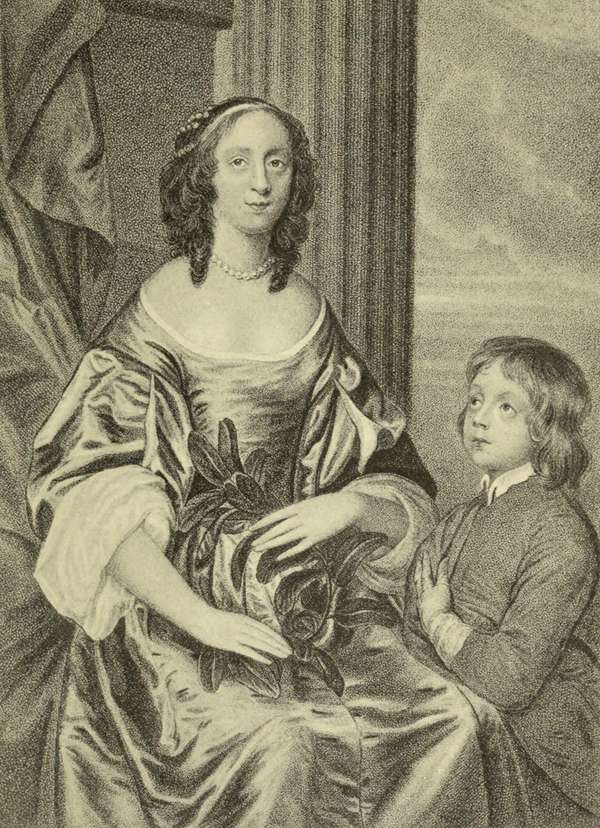
MRS. LUCY HUTCHINSON AND HER SON
From an engraving in Memoirs of the Life of Colonel Hutchinson, 1808
Elsewhere she notes other elements of her education. She
says that as soon as she was weaned, a Frenchwoman was taken
to be her dry-nurse and she was taught to speak French and
English together. At the siege of Nottingham Castle Mrs.
Hutchinson is represented as acting the part of a surgeon.
This knowledge may doubtless be referred to instructions by
her mother. Sir Allen Apsley, Lucy's father, was lieutenant
of the Tower of London during her youth, and Mrs. Apsley
was very generous and humane to the prisoners. Her daughter
says of her:
What my father allowed her she spent not in vanities, although she
had what was rich and requisite upon occasions, but she laid most of
it out in pious and charitable uses. Sir Walter Raleigh and Mr. Ruthin
being prisoners in the Tower, and addicting themselves to chemistry,
she suffered them to make rare experiments at her cost, partly to
comfort and divert the poor prisoners, and partly to gain the knowledge
of their experiments, and the medicines to help such poor people
as were not able to seek physicians. By these means she acquired a
great deal of skill, which was very profitable to many all her life.[127]
The love story of Lucy Apsley and Colonel Hutchinson is
curiously interwoven with her learning. When Lucy was sixteen
her mother took her into Wiltshire in pursuance of a contemplated
marriage contract and left a younger sister at a
house where she was "tabled for the practice of her lute."
Mr. Hutchinson, "tabled" at the same house, was attracted
by the vivacious child, and frequently accompanied her when
she went over to her mother's house. On one of these occasions
he saw some Latin books and was much interested to find that
they belonged to Lucy. Then he heard that this Lucy was
"reserved and studious," then that she composed songs above
"the ordinary reach of a she-wit," then that she had "sense
above the rest," but that she "shunned the converse of men
as a plague." Strangely enough, these accounts, or some magic,
or the hand of Providence, plunged Mr. Hutchinson into the
despairs and ardors of love even before he had seen the lady.
On her return, the proposed marriage contract not having been
completed, he daily frequented her mother's house, and for six
weeks "in the sweet season of the spring" they had opportunity
for converse with each other. During this period some
envious ladies endeavored to break the friendship by telling
him that Lucy neglected her dress and all womanish ornaments,
giving herself up wholly to study and writing. But since his
love had owed its inception to a sight of her Latin books, and
had been stimulated by hearing her poetry, these insinuations
did not interfere with what his wife calls "a more handsome
management of love than the best romances describe."[128]
Somewhat later Lucy Hutchinson's love of learning led her
to at least a slight knowledge of Greek and Hebrew. That she
kept up her Latin is shown by the fact that she translated
part of the Æneid. In her early married life she found scholastic
means to mitigate the monotony of the needlework she
loathed. Out of a "youthful curiosity to understand things she
had heard so much of at second-hand" she translated six
books of Lucretius into verse, accomplishing this task, she says,
"in a room where my children practised the several qualities
they were taught with their tutors, and I numbered the syllables
of my translation by the threads of the canvas I wrought
in, and set them down with a pen and ink that stood by me."
There was not, however, in Mrs. Hutchinson's life much opportunity
for scenes so domestic as this. She was married to
Mr. Hutchinson in 1638. By 1642 her husband was definitely
committed to the side of the Puritans, and the rest of their life
till his death in 1664 was one of anxiety, conflict, and baffled
high endeavor. But it was also a life of achievement and excitement,
and constantly sweetened and stimulated by extraordinary
affection between husband and wife. When at his
death she retired to the family home at Owthorpe the days
must have looked very blank and empty to the heroine of Nottingham
Castle. Not even the care of her eight children could
keep her mind from dwelling on the past. The message her
husband sent her from his death-bed in the prison, "Let her,
as she is above other women, show herself, on this occasion, a
good Christian, and above other women,"[129] helped her to
restrain extreme signs of grief, but her heart and mind were
with him. And the mechanic exercise that dulled her grief
was the writing of his Life. She had kept a rough sort of diary
and this was the basis for the longer work. The writing was
done between 1664 and 1671 when Mrs. Hutchinson herself
died. The work was addressed "To my Children" and its purpose
was to make them know the character and deeds of their
father. But the narrative goes much farther than that. It is
a minute account of the persons and events of that portion of
the Civil War especially connected with Nottingham. She
writes as an eye-witness and a participant. She wields a pen
vigorous, racy, and unafraid. She had a genius for picturesque
characterization, and her scornful descriptions of cowards and
traitors are veiled by no feminine softness of phrase. When
describing such treacherous members of the Parliament Party
as Charles White and Chadwick and his wife her vocabulary
of abuse is unstinted. But she is equally fluent in her account
of heroes such as Colonel Thornhagh. The intrigues, the factions,
the cross-currents, within the Puritan Party are as
minutely analyzed and laid open as is the general contest between
King and Parliament. Furthermore, the book is readable
from beginning to end. It moves with the rapidity of a
novel of adventure. Mr. A. H. Upham[130] has analyzed Mrs.
Hutchinson's work to show that it was probably suggested by
the Duchess of Newcastle's Life of her husband, and that,
further, the general plan and even the choice of detail were
guided by the Duchess's Memoir. The Life of the Duke of Newcastle,
though not published till 1667, was written in 1665, and
since the two families were neighbors, and knew each other
well, it might easily be that Mrs. Hutchinson was acquainted
with the work of the Duchess in manuscript. This ingenious
theory is maintained by citations of passages showing numerous
similarities. But the fact remains that Mrs. Hutchinson's
Memoir moves forward as from the force of an original impulse,
nobly religious, shrewd, caustic, affectionate, and naïve. It
was, in subject-matter and style, a notable achievement, and
while succeeding in the amplest measure in its purpose of
exalting Colonel Hutchinson's memory, quite as deservedly
gives to Mrs. Hutchinson her own unsought and higher pinnacle
of fame.
Ann Harrison,
Lady Fanshawe
(1625-1680)
A few years before her death Lady Fanshawe wrote for her
son a narrative of her life. Of her own education
she says: "Now it is necessary to say something
of my mother's education of me, which
was with all the advantages that time afforded, both for working
all sorts of fine works with my needle, and learning French,
singing, (the) lute, the virginals, and dancing; and, notwithstanding
I learned as well as most did, yet I was wild to that
degree that the hours of my beloved recreation took up too
much of my time; for I loved riding in the first place, and running,
and all active pastimes; and in fine I was what we graver
people call a hoyting girl. But to be just to myself I never
did mischief to myself or other people, nor one immodest
action or word in my life; but skipping and activity was my
delight. But upon my mother's death and as an offering to
her memory I flung away those little childishnesses that formerly
possessed me and by my father's command took upon
me the charge of his house and family, which I so ordered by
my excellent mother's example as found acceptance in his
sight."[131] At her mother's death Ann was "fifteen years and
three months" old, and the household she took charge of was
one "of plenty and hospitality," her father having a very
great estate. In 1644 she married Sir Richard Fanshawe to
whom she was passionately devoted during the twenty-six
troubled years of their life together. She says: "Glory be to
God, we never had but one mind throughout our lives, our
souls were wrapped up in each other, our aims and designs
one, and our resentments one. We so studied one the other
that we knew each other's mind by our looks; whatever was
real happiness God gave it me in him."[132]
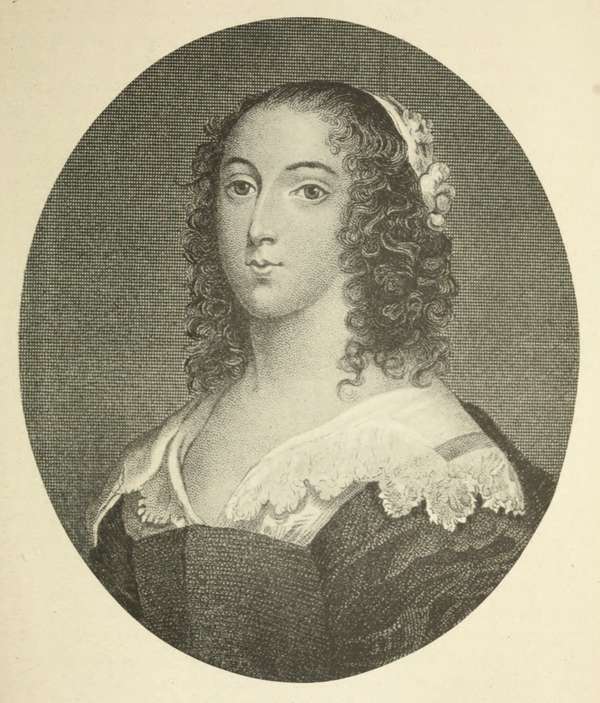
LADY FANSHAWE
From an engraving in Memoirs of Lady Fanshawe, London, 1830
When Lady Fanshawe wrote her Memoirs, her son Richard,
her youngest child, was about ten or twelve years old. Her
purpose apparently was to recount all the facts of the eventful
family career. The narrative, except for an occasional outburst,
was uncolored by emotion. One series of events recorded
is the births and deaths of children. In a period of
twenty years Lady Fanshawe had fourteen children and she
records the deaths of nine of them. This would seem to be
suffering and sorrow enough for one life. But we get an added
conception of the family vicissitudes when we discover that no
two of the fourteen children were born in the same house, and
no two of the nine who died were buried in the same churchyard.
Madrid, Lisbon, Paris, Yorkshire, Kent, Hertfordshire,
Oxford, were places of sad memory to the bereaved mother.
Yet, except in the cases of "little Nan" and the first Richard,
there is simply a recital of facts and dates. Lady Fanshawe
was but fifty-five when she died, but she had gone through so
much that a re-living of past emotions as well as a recalling of
facts would have made the writing of the Memoirs an impossibility.
As a narrative of the externals of life the story has singular
interest. It abounds in striking contrasts. Money stringency,
mishaps by land and sea, sicknesses, imprisonments,
deaths, mingle strangely with official splendors, royal gifts,
rich furnishings, gorgeous apparel. It is personal in tone, with
as little historical detail as was consistent with carrying the
narrative forward. And for that reason it is of importance to-day
as a closer record of life than historians of the Civil War
or of the reign of Charles II are likely to give.
Margaret
Blagge,
Mrs. Godolphin
(1652-1678)
The most interesting personality in this early group is the
beautiful Mrs.[133] Margaret Blagge. She is the
supreme example of a developed religious sense
in the court of Charles II. She was not driven
to a life of devotion through a grief-enshrouded heart. Religion
was to her joy and ecstasy. John Evelyn recorded in his
Diary a determination to consecrate the worthy life of Margaret
Blagge to posterity, and when he died in 1706 he left a
list of "things I would write out fair and reform if I had leisure,"
among them being the Life of Mrs. Godolphin. This
manuscript was first published in 1847. It records a life of singular
charm and interest. Yet the facts of Margaret Blagge's
life are meager enough. She was born in 1652; was early in
France with the Countess of Guildford; when scarcely twelve
became maid of honor to the Duchess of York; and then on the
death of the Duchess in 1671 entered into the same service with
Queen Catherine; in 1674, after a nine-year courtship, married
Sidney Godolphin; and in 1678 died in child-birth. It is her inner
life that counts, and that life would have left small record had
not the beautiful young maid of honor chosen the wise and
religious John Evelyn as her friendly counselor in her difficult
attempt to maintain a life of purity and piety in the most dissolute
court of Europe. Evelyn recounts the success of her devout
life in these words: "Arethusa pass'd through all those
turbulent waters without soe much as the least staine or tincture
in her Chrystall; with her Piety grew up her Witt, which
was soe sparkling, accompanyed with a Judgment and Eloquence
so exterordinary, a Beauty and Ayre soe charmeing
and lovely, in a word, an Address soe universally takeing, that,
after a few years, the Court never saw or had seen such a Constellation
of perfections amongst all their splendid Circles."[134]
But though she was regarded as "a little miracle" at court,
her heart was never there. To no young woman of the time
were the pomp and glory of the world more alluringly open,
but she turned instinctively from all such joys. She counted
her beauty a snare and would never "trick and dress herself
vpp ... to be fine and ador'd." Lovers crowded about her, but
she avoided the vain converse of gallants. Evelyn records her
particular gift for mimicry, recitation, acting, but such talents
she held in abeyance. At sixteen she acted in a court play,
probably Dryden's Indian Emperor, with great success, but her
growingly devout spirit came to abhor such recreations, so that
when she was summoned by royal request to act in Crowne's
Calisto, in 1674, even though the play was to be given all by
ladies, and those the most illustrious in the land, it was a matter
of almost tragic grief to her that her duty forbade a refusal.
"To be herselfe an Actoresse ... cost her not only great reluctancy
but many teares."[135] Though she was decked with
jewels worth £20,000, though she "trode the Stage with a
surprizeing and admirable Aire," and though the whole theater
was extolling her, she felt no transport, but, when an interval
came, "retired into a Corner, reading a book of devotion." Not
even the fact that she played the part of "Diana, the Goddess
of Chastity," consoled her.
She had one real calling and that was to a religious life. As
a child of seven, in France with the Countess of Guildford,
though often "tempted by that By-Gott proselitesse to goe to
Masse and be a papist,"[136] she yet could maintain her own faith.
Because of her spiritual precocity she was "admitted to the
holy Sacrament when she was hardly Eleaven years of age."
Though she disliked Catholicism, she praised nunneries, and
would have chosen a retired life of devotion and good works,
had not her love for Mr. Godolphin and the urgent advice of
Mr. Evelyn restrained her. Nearly all her writing and reading
were along religious lines. Mr. Evelyn says on this point:
She has houres alsoe for reading historye and diversions of that nature;
butt allwayes such as were choice, profitable and instructive,
and she had devoured an incredible deale of that solid knowledge, and
could accompt of it to admiration; soe as I have even beene astonished
to find such an heape of excellent things and material observations
collected and written with her owne hand, many of which
(since her being with God) came to myne; for, besides a world of admirable
prayers and pieces of flagrant devotion, meditations, and discourses
on various subjects (which she compos'd), there was hardly a
booke she read that she had not common placed, as it were, or taken
some remarkable note of; add this to the Diary of her owne life, actions,
resolutions, and other circumstances, of which I shall give some specimen.
She had contracted the intire historye of the Scriptures, and the
most illustrious examples, sentences, and precepts, digested under opposite
and proper heads; and collected togeather the result of every
Article of the Apostles' Creed, out of Bishop Pearson's excellent
Treatise. I have allready spoken of her Sermon Notes: butt to give
a just Account of her Letters, they are so many and in so excellent
naturall and easy a style, that, as for their number, one would believe
she did nothing else butt write, soe, for their weight and ingenuity,
that she ought to doe nothing else; and soe easyly did her Invention
flow, that I have seen her write a very long letter without once takeing
off her pen (butt to dip it), and that with exterordinary Judgment.[137]
Her Diary is a delightfully spontaneous document. Here is
one Resolution:
June the 2d.
I will nere play this halfe year butt att 3 penny omber, and then
with one att halves. I will not I doe not vow, but I will not doe it;—what,
loose mony att Cards, yet not give (to) the poore! 'T is robbing
God, misspending tyme, and missimploying my Talent: three great
Sinns. Three pounds would have kept three people from starveing
a month: well, I will not play.[138]
Equally genuine and charming, but in more decorous and
solemn fashion, is the letter in which she consecrated John
Evelyn her friend. Indeed, the whole quaint and formal episode
of the establishment of this remarkable friendship, seems incredibly
pure and lovely when thought of as occurring in the
court of which Grammont's Memoirs is a fair record. Evelyn
wrote "a little master-piece of biography," partly because of
his intimate knowledge of Mrs. Godolphin's spiritual experience
and his personal affection for her, but also, in part, because
his imagination was inevitably stimulated by the vision
of a life so crystal clear in an environment so murky.
The versatility and intellectual energy of the Duchess of
Newcastle, the quick wit and instinct for style in Dorothy Osborne's
letters, the grave and sincere religious feeling coupled
with considerable theological learning on the part of women in
influential positions like Margaret Blagge, Lady Pakington,
and Lady Warwick, the vivid social and political pictures in the
biographies by Mrs. Hutchinson and Lady Fanshawe, the gay
playing with belles lettres in Mary North's little society, and especially
the extraordinary vogue of Mrs. Philips, are sufficient
indications, as we look back over the period, that a new spirit
was awake. It reads now almost as if there were a general and
brilliant opening of literary pursuits to women. But it is also
significant to recall that Mrs. Philips and the Duchess of Newcastle
were the only two women whose ability or learned tastes
were known at the time beyond their own small private circle.
In reality the work was sporadic, secluded, uninfluential.
And the fame even of the Duchess of Newcastle and Mrs.
Philips is hardly established before 1660. It is with the Restoration
that the more varied and public activities begin.
The period to be here presented in detail is the century
following the Restoration. During this period the work of women
spreads out in new directions. Not only is there a greater
variety in the kinds of writing, but other forms of self-expression
are entered upon. In this more complicated era the strictly
chronological method becomes confusing. It seems more desirable
to take up the work under different species, keeping to
chronological development within each species.
Two kinds of new work by women, acting and painting,
demand brief preliminary notice. Though possibly not within
the category of learned occupations they must yet be recognized
as of great importance in the new life opening before
women.
Charles II had in France been familiar with the custom of
having women on the stage, and when he issued his two patents
to Davenant and Killigrew he inserted the famous clause,
"We do permit and give leave from this time to come that all
women's parts be acted by women." Mrs. Coleman had taken
the part of Ianthe in Davenant's Siege of Rhodes in 1656, but
this was not a regular play. It was more of the nature of an
opera or spectacle. The first woman to act on the public stage
in England was probably the actress who played Desdemona,
December 8, 1660. "J. Jordan" wrote a prologue to introduce
her as "the first woman that came to act on the stage," but he
did not give her name.[139]
The theatrical novelty initiated by this unknown actress was
far-reaching in its effects. Through the ensuing years a constantly
increasing number of women followed the lure of
the stage. No other opportunity open to the ambition of
women met with so eager a response, or could number so many
aspirants, or could register success so unqualified. Yet as we
read of these early English actresses we hardly think of acting
as a profession or of them as artists. They were in no sense
students of the parts they played. Beauty, youth, high spirits,
a certain native endowment of wit or boldness, ability to sing
a song or dance a jig, seemed to meet all the demands of audiences
too much delighted with the mere fact of seeing women
on the stage to be over-critical of their technique or interpretation.
Moreover, the runs of plays were short, three days
being about the average, so there was hardly time to work up
finished productions. The stage tenure of most of the actresses
was also brief, hardly more than a prelude to the social and
domestic irregularities of their later lives. Cunningham names
Mrs. Betterton as the only actress of Charles II's day who
was not mistress to some man at court. "Frailties," as they
were euphemistically called, became so normally associated
with actresses that Anne Bracegirdle excited incredulous surprise
by her reputed purity of life, and she was presented by
the noblemen of her day with a purse of eight hundred guineas
in recognition of her virtue.[140] The immorality of these early
actresses, girls of no rigorous professional training and no professional
standards, is quite intelligible. In appearing before
the public at all they broke so many conventions, defied the
feminine ideal so completely, that a few steps further in pursuit
of flattery and luxurious living hardly seemed to count.
As actresses they were at once under a moral stigma anyhow,
so far as the soberer part of the community was concerned, and
they naturally followed the path of least resistance and accepted
the morality of the court of the merry monarch, a court where
virtue with her "lean and scare-crow face" seldom intruded.
The unfortunate outcome of the turpitude of the Restoration
actresses is that they built up in the public mind a prejudice
against actresses as a class, a prejudice which affected later
even such women as Mrs. Betterton, Mrs. Bracegirdle, Mrs.
Cibber, or Mrs. Siddons. But it must not be forgotten that
they served the cause of women by opening the way to a new
and important profession, a profession in which women have
no handicaps. The stage has been represented by more women
of genius, and has given to women more unstinted recognition
in fame and money, than have any of the other forms of public
activity into which women have so far been admitted, except,
possibly, in late years, administrative work in social service.
It is unnecessary, in this study, to carry the account of the
actresses into further detail, or further down the century.
The history of the part women took on the seventeenth and
eighteenth century stage would make a volume of itself. And
since it was many years before acting was connected with any
critical or intellectual conception of the plays represented, it
may suffice here to leave this portion of the new work of women
with the mere announcement of its inception.
To acting we may add another new realm, that of painting.
The earliest woman portrait-painter on record in England is
Anne Carlisle, who died about 1680. In 1658 Sir William Sanderson,
in his Graphice, commenting on the artists then in
England, said, "And in Oyl Colours we have a vertuous example
in that worthy Artist, Mrs. Carlisle." In the notes left
by Vertue to Walpole was a statement that he had seen in about
1730 the portrait Mrs. Carlisle had painted of herself. Her chief
work was in copying the paintings of Italian masters, or, according
to a fashion of the times, reproducing them in miniature.
It is said that Charles I admired her work so warmly
that he presented to her and Van Dyck ultramarine to the value
of five hundred pounds.[141]
Of more distinguished ability was Mary Beale (1637-1697),[142]
who is said to have studied either with Sir Peter Lely or Robert
Walker. At least she watched Lely paint and thereby gained
some of his technique. She worked in oils, water-colors, and
crayons. Through Sir Peter Lely she was given access to some
of the best works of Van Dyck and in copying these gained a
training somewhat similar to that given most artists by sojourns
in Italy or Holland. There are in the English National
Portrait Gallery portraits by her of Charles II and Abraham
Cowley. At Knole is her portrait of John Milton; at Woburn
Abbey, one of the Duke of Monmouth; Archbishop Tillotson,
Henry, Duke of Norfolk, Dr. Sydenham, Dr. Croone, Bishop
Wilkins, are among those who sat to her. No other English
portrait-painter of the period had so distinguished a clientèle
or is represented by so many canvases in English galleries.
Her success may be measured, in part, by her financial returns.
In a pocket-book kept by her husband in 1672 is this entry:
"Received this year, for pictures done by my dearest heart,
202l. 5s." The receipts for 1674 were 216l. 5s.; and for 1677,
429l. She was still painting important portraits in 1691, for
we find in the Term Catalogue for Michaelmas of that year the
announcement of "The true Effigies of his Grace, John, Lord
Archbishop of Canterbury. Engraven by Rob. White on a
large sheet of Paper, from the Original lately painted by
Mrs. Mary Beale."
According to the manuscript of Mr. Oldys, Mrs. Beale was
also celebrated for her poetry. He styles her, "that masculine
poet, as well as Painter, the incomparable Mrs. Beale." Dr.
Woodford included in his translations of the Psalms several
versions by Mrs. Beale whom he eulogizes as "an absolutely
compleat Gentlewoman," and to whom he wrote several poems
under the name "Beliza."[143]
Anne Killigrew (1660-1685), a maid of honor to Mary of
Modena, died at twenty-five, but she had already attained considerable
repute as a portrait painter. There is a tradition
that she studied with Sir Peter Lely. If so she must have taken
these lessons before she was twenty, for Lely left England in
1680. Dryden says that her portrait of James II expressed "not
only his outward part, but drew forth the very image of his
heart," and that she was equally successful in depicting the
bright beauty and peerless majesty of Mary of Modena. Her
portrait of herself was engraved by Becket and prefaces the
volume of her poems issued the year after her death. Other
paintings were religious in subject, as in her portrayal of incidents
in the life of John the Baptist; or mythological, as in her
representation of Diana's nymphs. Of far more possible significance
is her landscape work. During 1660-1685 Robert
Streater is the only English landscape-painter of whom we
have record. Charles II brought over a number of Italian and
Flemish artists who painted English landscapes in the style of
Ruysdael, Poussin, or Salvator Rosa, and their work would be
the pictures chiefly known at court. It is not improbable that
Miss Killigrew's landscapes were copies or imitations of these
foreign artists. Dryden says she painted ruins of Greece and
Rome, and forest glades in which were nymphs and shaggy
satyrs. Such pictures must have been copies. But Dryden also
enumerates sylvan scenes of herds and flocks; clear, shallow
little brooks; deep rivers reflecting as in a mirror the trees on
their banks. Such pictures are truly English in tone and whatever
their intrinsic value such a choice of subjects would put
her with Robert Streater at the very inception of English landscape
art. And though the scanty records concerning her
painting do not substantiate Dryden's description of her landscapes,
it could hardly be supposed that he would have been
so explicit in a poem written for the family and immediately
after her death had there not been some pictures at least moderately
correspondent to his lines.[144]
Other seventeenth-century names of less importance show
an aspiration in art somewhat above that countenanced by the
boarding-schools. Mrs. Pepys and Miss Margaret Pen may
serve to indicate the sort of work being done in amateurish
fashion in various homes. Both ladies were "learning to limn"
with one Mr. Browne. Pepys was tremendously interested in his
wife's progress. In the midst of terrifying accounts of the
plague and the fire there come in 1665 and 1666 frequent notes
on her pictures. Once after a week's absence on exhausting
work he records, "To my wife, and having viewed her last
piece of drawing since I saw her which is seven or eight days,
which pleases me beyond anything in the world, to bed with
great content, but weary." The next day, on being importuned
to buy her a pearl necklace, he promises it, but only "if she
pleases me in her painting." On one occasion he called on Lady
Pen and says of the visit, "Talking with Mrs. Pegg Pen, and
looking at her pictures, and commended them; but, Lord! so
far short of my wife's as no comparison." A month later is the
note, "I took my Lady Pen home, and her daughter Pegg
and, after dinner I made my wife show them her pictures,
which did mad Pegg Pen, who learnes of the same man." In
September, 1665, Pepys had just seen his wife's picture of our
Saviour and thought it so pretty that he boasted of it to Evelyn,
at which Evelyn paid him in kind by telling him that "the
beautiful Mrs. Middleton is rare (in painting) and his own wife
do brave things."[145]
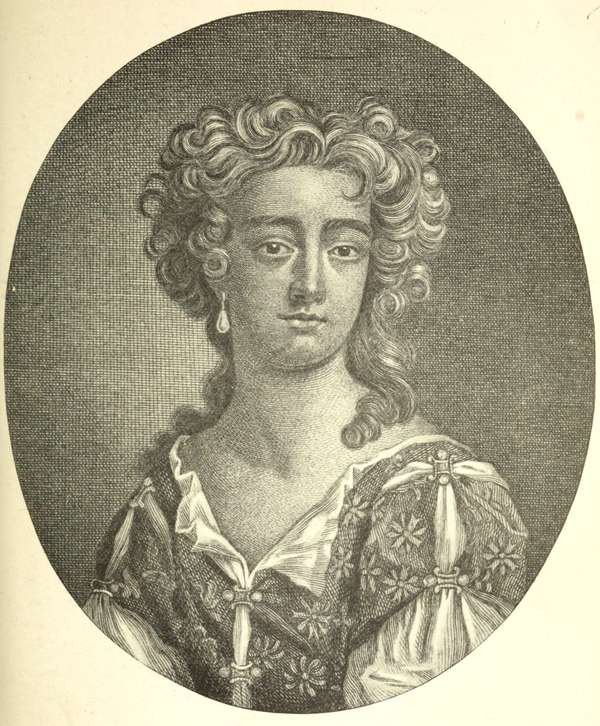
MRS. ANNE KILLIGREW
From a painting by herself engraved by T. Chambars
The Evelyn family seems to have been instinctively artistic.
In Mr. Thoresby's account of a visit to Evelyn, he said he was
shown "many drawings and paintings of his own and his lady's
doing; one especially of enamel was surprisingly fine, and this
ingenious lady told me how she wrought it." Both Mr. Evelyn
and his son Draper were proud of Mary's work in painting.
Sixteen years after her death Mr. Thoresby wrote: "He afterwards
carried me in his coach to his son Draper's at the Temple,
and showed me many curious pieces of his ingenious daughter's
performances, both very small in miniature, and as large as the
life in oil colours, equal it is thought to the greatest masters of
the age. He gave me a specimen of some prospects he took in
Italy, and etched upon the copper by his own hand."
At the end of the century is Sarah Curtis (d. 1743) who was
married in 1701 to Bishop Hoadly. Before her marriage she
had been a pupil of Mary Beale, and she is now represented in
the National Portrait Gallery by three canvases, portraits of
Burnet, Winston, and Hoadly. Mrs. Rowe's paintings were
likewise highly prized by discriminating friends. Of greater
interest is Mrs. Delany (1700-1788). She copied at least
seventy-two pictures by old masters and painted many portraits.
Her work is not represented in public galleries, but
many of her pictures are still preserved in private collections.
Susan Penelope Gibson was a successful miniature painter.
Elizabeth Creed was also an artist of at least local repute.
She did sacred subjects as altar-pieces for neighboring churches
and she painted numerous portraits. She also gave free lessons
to the girls living near her. Her daughter Elizabeth, who
inherited her artistic tastes, is said to have ornamented a hall
in a Tudor mansion near Oundle.
Short and insignificant as this list appears, it yet assumes
real importance when we realize not only that these were the
earliest English women to enter this field, but that the list
shows up surprisingly well when compared with a similar list
of the native English painters among the men of the period.
Charles I was a great lover of art and he summoned many artists,
some of the first rank, to England, and he bought pictures
with a far-sighted munificence, and Charles II was ambitious
of following along the same distinguished path. But a list of
the pictures painted in England before 1700 shows hardly an
English name. Hence the presence of any successful women
artists is doubly significant.
The amateurish quality of the painting may be in part explained
by the fact that in but one case, that of Mary Beale,
was there any impetus or training such as are necessarily associated
with work adopted as a profession. The painting was
an accomplishment, a pleasant occupation for leisure hours,
a resource, rather than a life purpose ardently pursued. The
only external reward for the many hours at the easel was the
praise of a small circle of friends. The real incentive was an
inner demand for some form of self-expression, and the mere
number of pictures painted, quite apart from the question of
their excellence, is indicative of the eagerness with which
women welcomed any sort of opportunity for the free play of
their own individuality.
It was not, however, acting or painting that occupied most
of the women whose natures craved something out of the ordinary
routine. Writing was a much more natural and feasible
resource. Acting implied a public, and even painting, especially
portrait-painting, was likely to be semi-public. But writing
could be carried on in retirement and the results submitted
only to the partial criticism of a home or social circle. It did
not bring women before a carping public or necessarily into competition
with men, for even if plays were produced and books
published, the name of the writer could be veiled, as it usually
was, under a decent anonymity. Hence women who respected
the obvious conventions could yet indulge themselves in authorship.
WRITERS ON PRACTICAL SUBJECTS
When women entered upon writing as a career, it might be
thought that they would at first take up subjects familiar to
them, but such was not the case. For instance, most of the
books for children, before the venture of the Newberys about
the middle of the eighteenth century, were by men.[146] It was
James Janeway whose maxim, "A child is never too little to
go to Hell," resulted in works so popular as A Looking Glass
for Children and A Token for Children (1676); John Bunyan's
A Book for Boys and Girls, or Country Rimes for Children;
being Divine Poems on the Creed, Commonwealth and Several
other Subjects (1690); Mr. Mason's A Little Catechism with
little Verses and little sayings, for little children (1693). The
Divine and Moral Songs for Children, by Isaac Watts in 1720,
carried on the religious instruction. There were also various
accounts of the "Life and Saintly Death" of children of tender
years, which were published with the avowed purpose of influencing
other children of like tender years, but none of these
are by women. The first women I have come upon who wrote
professedly for children are Sarah Fielding and Mrs. Collyer
in 1749.[147]
In a somewhat less degree the same condition exists in relation
to medicine, especially in the realms most definitely in the
hands of women. Mrs. Pilkington tells us that her father was
the first man midwife in England, but nearly all the books on
midwifery were written by men. Two women, however, appear
in print, in a discussion of their professional work. Mrs. Jane
Sharp's book is entitled The Midwives' Book, or the whole Art
of midwifery discovered, directing Child-bearing Women how
to behave themselves in their Conception, Breeding, Bearing, and
Nursing, of Children. In Six Books. By Mrs. Jane Sharp,
Practitioner in the Art of Midwifery above thirty years.[148]
Mrs. Elizabeth Cellier, a second writer on midwifery, is
known perhaps chiefly because she was supposed to have some
connection with the Meal Tub Plot. After her acquittal from
treason charges she wrote a pamphlet called Malice Defeated, in
which she courageously expressed her adherence to an unpopular
cause in the words, "I do not yet so much fear the smell of
Newgate as to be frighted for telling the truth; nor is death so
great a terror to me, but that I am still ready to seal the same
with my blood."[149] She must have been a woman of substance
as well as courage, for she was fined a thousand pounds because
of certain passages in this pamphlet. She was also condemned
to stand in the pillory three times, a punishment which,
according to Lady Russell, she bore with intrepidity and nonchalance,
protecting her head from missiles by means of a
battledore which she held up with one hand, while with the
other she gathered up and put into her pocket all the stones
that fell within her reach.
In her profession of midwifery Mrs. Cellier was of high repute,
but her interests were not circumscribed by her own practice.
One of her schemes was the establishment of a "Colledg
of Midwives" where the best possible training should be given.
Though her pamphlet, entitled A Scheme for the Foundation of
a Royal Hospital and raising a revenue of 5000 l or 6000 l a
year by and for the Maintenance of a Corporation of Skilful Midwives,
did not result in the establishment of her proposed college,
the idea and the formulation of the plan do credit to her
foresight and intelligence, and sound quite in line with modern
forms of woman's civic enterprise.
The seventeenth and eighteenth centuries could show a long
list of interesting and elaborately worked-out books on housewifery
in general and cooking in particular, but it seldom happens
that one of these books is by a woman. It is, to be sure,
not impossible that more of the material was furnished by women
than is apparent on the surface. Very many of the books
on housekeeping matters were anonymous and were probably
mere publishers' compilations from unacknowledged sources,
and in such cases the actual material may have come from various
housewives. But during the century I have come upon
but three women who published under their own names the results
of their experiences as cooks. The earliest of these was
Mrs. Hannah Woolley. She was born about 1623. Her mother
and elder sisters are said to have been "very well skilled in physick
and chirurgery" and they taught her in her youth. She was
twice married, the first time to a schoolmaster named Woolley,
and then to a Mr. Francis Challinor. She is known usually as
Mrs. Woolley. One of her books, The Queen-like Closet, or A
rich Cabinet stored with all manner of rare Receipts for preserving,
Candying, and Cookery. Very pleasant and beneficial to all ingenuous
persons of the Female Sex, reached its eleventh edition
by 1696. Mrs. Woolley had been governess in two noble families
and had acquired definite ideas as to polite behavior. This
knowledge also she committed to the printed page. On manners,
but especially on household management, she wrote as an authority
and received due recognition.
Another book, by a woman whose initials I have not been
able to expand into a name, is the following: The Cook's New
Years Gift, Cookery refined, or The Lady, Gentlewoman and Servant-maid's
Companion: containing the Art of dressing all sorts
of Flesh, Fish, and Fowl, various ways, after the newest Mode; with
their proper seasonings, sauces, Garnishes, serving up and carving,
etc. By Mrs. A. M. a long practiser of this curious Art.
(Term Catalogues, Mich. 1697. Mich. 1700.)
The work of Mrs. Woolley in the seventeenth century found
its most worthy counterpart in the eighteenth century in Hannah
Glasse's The Art of Cookery Made Plain and Easy, which far
exceeds any Thing of the kind ever yet Published.... By a Lady.
London. Printed for the Author; and sold at Mrs. Ashburn's, a
China-Shop, the Corner of Fleet Ditch, 1747. The book was issued
with about two hundred subscribers. A fourth edition in
octavo came out in 1751, a ninth edition in 1759, and many
later editions. In her Preface Mrs. Glasse said, "If I have not
wrote in the high polite Stile I hope I shall be forgiven, for my
Intention is to instruct the lower Sort, therefore treat them in
their own Way. For Example: when I bid them lard a Fowl,
if I should bid them lard with large Lardoons, they would
not know what I want: But when I say they must lard with
small Pieces of Bacon, they know what I mean." The new element
in her book was this attempt to write out receipts that
were simple enough to come into general use.
WRITERS ON RELIGION AND THEOLOGY
The Term Catalogues for 1670-1713 show how great was the
preponderance during those years of books on "Divinity." That
women should share in this prevailing interest is but natural,
for religion came within the accepted canon of the truly feminine.
And there are evidences of an even greater amount of devotional
writing by women than might be expected. The
period 1650 to 1750, and especially the first half of that period,
could show a long list of women noted for lives of piety and
good works.[150] The loose living characteristic of the court apparently
had its reaction towards exceptional spiritual rigor on
the part of many ladies of rank. And of these devout ladies no
small number found in the composition of religious verse or
prose the intellectual and emotional outlet denied them in
other ways. Almost none of this writing was meant for a public.
The reams of meditations, prayers, and reflections left in
manuscript were merely a private resource, and often kept secret
even from the author's family. Such writings were in their
nature fugitive, and it would only now and then happen that
some relative or friend would collect and order the papers and
see them through the press. We accordingly get scattered hints
through funeral sermons and casual notices of an amount of
devotional writing greatly in excess of that published. But to
tabulate even all the published material would be wearisome
and to no good end. A few illustrative examples showing the
chief characteristics may suffice.
Lady
Elizabeth Brooke
(1601-1683)
One of the best examples of the persistent and prodigious
industry shown by some of these ladies is the
work of Lady Elizabeth Brooke. She began at
thirty to make notes on sermons, to copy extracts
from commentaries, and occasionally to write out some
personal opinions, and she kept at this sedative occupation till
her death fifty-two years later. It is painful to reflect on such
a mass of undigested material, but the significant fact remains
that she preferred such reading and writing to the ordinary interests
of her sex. Some of her "Observations and Rules for
Practice" were published as an appendix to the sermon
preached at her funeral. Selections from her writings were
published as late as 1828 in The Lady's Monitor.
Anne Murray,
Lady Halkett
(1622-1699)
Anne Murray, Lady Halkett, was even more industrious.
Her father, who was tutor of Charles I and Provost of Eton,
died when she was a child, but her mother, who
was governess to the Princess Elizabeth, gave
her "a complete education." Of her early life
she says: "My mother spared no expense in educating all her
children in the most suitable way to improve them ... and
paid masters for teaching my sister and mee to write, speak
French, play on the lute and virginalls, and dance, and kept a
gentlewoman to teach us all kinds of needlework, which shows
I was not brought up in an idle life." After several complicated
and long drawn-out love affairs—fully described in her
Autobiography—Anne married Sir James Halkett in 1656.
As the years passed her interests finally centered on two subjects,
divinity and medicine. In "physick and surgery" she
gained great repute. She was consulted in difficult cases from
the remotest parts of the kingdom and her fame spread even
to Holland. It was quaintly said of her: "She was ever employed
either in doing or reaping good: in the summer season
she vyed with the bee or ant, in gathering herbs, flowers, worms,
snails, etc., for the still or limbeck, for the mortar or boyling
pan, etc., and was ordinarily then in a dress fitted for her still-house;
making preparations of extracted waters, spirits, ointments,
conserves, salves, powders, etc., which she ministered
every Wednesday to a multitude of poor infirm persons, besides
what she dayly sent abroad to persons of all ranks who
consulted her in their maladies."[151] But it was religious themes
only that employed her pen. The catalogue of her writings
includes twenty-one volumes, or a total of about eight thousand
pages of manuscript, some in quarto, some in folio size, and all
bound. Some of these books were printed at Edinburgh in
1701. The title of one book of three hundred and fifteen pages
will indicate the general character of her writing: Select Meditations
and Prayers upon the First Week, with Observations on each
Days Creation, and Considerations on the Seven Capital Vices to be
opposed, and their opposite Virtues to be studied and practised.
| Vices to be subdued | | Virtues to be learned |
| Pride | Sunday | Humility |
| Covetousness | Monday | Contentation |
| Lust | Tuesday | Chastity |
| Envy | Wednesday | Charity |
| Gluttony | Thursday | Temperance |
| Anger | Friday | Patience |
| Sloth | Saturday | Diligence |
All but nine of these books were written during Lady Halkett's
twenty-eight years of widowhood when she had much
leisure, but under any circumstances the task was a great one,
and becomes the more amazing when we reflect upon it as
really only a private recreation. To write so much with no urgency
of fame or money shows some very strong inner demand
for expression and a very facile pen.
"Legacies"
Another type of religious book goes back for its inspiration
to Elizabeth Jocelyn's famous Legacie. One of
Lady Halkett's books was The Mother's Will to
an Unborn Child, written in 1656 before the birth of her daughter
Elizabeth. Books of advice from parents to children to be
read after the death of the parents were not uncommon. Elizabeth
Sadler (1623-1690), the wife of the Reverend Anthony
Walker, was an exceedingly devout woman whose literary instinct
and a prevision of death led her to write a large book in
octavo for the instruction of her two daughters. Two other
books will sufficiently illustrate the type: The Experiences of
God's gracious dealing with Mrs. Elizabeth White, late wife of
Mr. Tho. White of Caldecot in the County of Bucks; as they
were written under her own hand, and found in her Closet after
her decease: she dying in child-bed, December 5th, 1669;[152] The
Legacie of a Dying Mother to her mourning children; being the
Experiences of Mistress Susanna Bell, who died March 13, 1672.
With an Epistle Dedicatory by Thomas Brookes, Minister of the
Gospel.
Rachel
Wriothesley,
Lady Russell
(1636-1723)
Lady Russell is an example of a woman who definitely set
out to be religious, and whose writings contain
an analysis of her methods. The circumstances
of her life give everything pertaining to her a
particular interest. The execution of Lord Russell for treason
in 1683 left her broken by the shock. She had, though without
avail, set in motion every possible agency to avert his fate, and
she had devoted herself absolutely to him till his tragic death.
Then, after a period of the deepest despondency, she entered
again upon the duties that lay before her. She conducted the
education and arranged the marriages of her three children.
She showed herself an excellent business woman in the management
of her estate. And she steadily interested herself in
securing benefices and other offices for persons of whom her
husband would have approved. Her Letters as published contain
a few during the first years of her happy married life;
many written concerning the "judicial murder" of Lord Russell;
and very many concerning family affairs and the candidates
for whom she was seeking favor. As letters they are
uninteresting. The subject-matter is generally too local and
temporary to hold the attention of the modern reader, and the
style is dry and hard. Even the records of her bitter grief and
of her struggle to attain a mood of Christian resignation are
less affecting than might be expected. A kind of apathy seemed
to settle down over her spirit. She was too deeply hurt to find
in words any balm for her sorrows. She answered condolences
when she must, but briefly, and with no lightening of the gloom
that encompassed her. Of all her letters the longest and most
valuable as a personal revelation is one written to her children
July 21, 1691, "a day of sad remembrances," for it was the
anniversary of her husband's execution eight years before. In
1691, Rachel, the oldest child, was twenty years old, and
Wriothesley, the youngest, was eleven. The five or six pages in
which Lady Russell recounts, probably especially for the benefit
of Rachel, her method of personal spiritual watch-care,
has great value as a religious document, for she was not alone
in her way of seeking salvation, in her heart-searchings, in her
dependence on the external means of grace, in her sedulous
striving after perfection. It was the devout habit of devout
people of the time, but perhaps carried to a meticulous excess
by Lady Russell. She says that she was always provided with
a little piece of paper on which she wrote her faults and temptations
as they occurred during the day. At night a careful
review of this record contributed to a better watch and ward.
And then [she continued], upon Friday morning when I have prayed
my usual daily prayers (which have bin most constantly for many
years those in taler's holy living) before I pray that of intercession
pa: 35. I stop ... and look upon my dayly notes for that weeke, I recollect
my fautes; consider what care I have taken to correct or forsake
them—but alas when we do best we shall find enof to be humbled for—therefore
I chuse some prayer of confesion most times that in
taler's holy living page 302. When I have done it, I make my resolutions
to do better for ye time to come, and especialy to watch myselfe
where i ame most apt to fal, naming in what I ame so—then I pray
some prayer for grace to keep these promises of better obedience—as
in pa: 31—for grace to spend our time wel, on page 271, for the
grace of faith, hope & charity. Then I pray the dayly prayer of intercession
that I left of at in pa:35—after this I praise God ... for all
the blessings vouchsafed to me both spiritual & temporal—as that
I was born of Christian parents, not suffered to be strangled in the
womb, that I was baptized, and sence, educated in Christian Religion.
I blesse thee for al checks of Conscience I have had especially those
I have profited by.... And then I goe on, I bless thee for our creation,
preservation &c.—close with ye lords prayer.
After this service she went over her faults of the week, making
a summary of them. A similar abridgment for the month was
entered in a book kept for that purpose, the incriminating little
pieces of paper were torn up, and a new record entered upon.
She found that a frequent re-reading of the book "saved much
time in looking back" and contributed to humility. Evidently
Lady Russell was as orderly in religion as she was in her business
affairs. She finds her definite tabulations "hugely more satisfying
to her mind, than a more carelesse loose way of living is,
and no settled method." The letter closes with the admonition,
"Be devout & reguler in your dutys to God—heaven wil
be secure, and pleasures innocent."[153] Lady Russell's letters
reveal a devout, difficult, over-burdened life, so much concerned
with the means of grace as never to have any happy
consciousness of grace itself.
Elizabeth Blake,
Mrs. Burnet
(1661-1712)
Elizabeth Burnet (1661-1712), daughter of Sir Richard
Blake, married at seventeen into a Catholic
family. Her husband, Robert Berkeley, was a
ward of Bishop Fell, through whom the marriage
was brought about. The firmness and tact necessary to
maintain her own views as a Protestant and hold her husband
to that faith, and yet not antagonize the family, could hardly
be expected of so young a girl. But Bishop Fell had judged her
character well and she met all the demands of so delicate a
situation. She took advantage of many leisure hours in the
country to investigate fully the questions at issue between the
Catholics and the Protestants. She did not know the learned
tongues, but she studied the Scriptures, read commentaries,
and conversed with clergymen. When she became a widow in
1693, at thirty-two, she employed her time in two characteristic
ways. In the administration of her husband's charitable
schemes she found congenial activity. And she gave way to her
natural instinct for writing. In 1700 she became the wife of
Bishop Burnet. His approval of her literary work and his request
that it be published led to the production of her Method of
Devotion. It was so popular that she revised and enlarged it
and brought out a second edition. And it was republished in
1713 after her death. The book contained "Rules for holy and
devout Living," "Prayers on Several Occasions," "Advices
and Devotions on the Holy Sacrament." Mrs. Trotter said
of her in 1701, "She has an extraordinary clear and solid judgment,
the truest goodness and prudence, and the most charming
affability in her behaviour; in short, I have met with no
such perfection in any of my sex."
Elizabeth Bury
(1644-1720)
Elizabeth Bury was another young woman whose bright, acquisitive
mind resented conventional inactivity
and put out tentacles in all directions for
knowledge. Philology, philosophy, history, heraldry, geography,
mathematics, were among her interests. She contended
that souls were of no sex and that women were often "disposed
to an accurate search into things curious and profitable,
as well as others." She studied anatomy and medicine until
she had gained "a surprizing knowledge of the human body,
and of the Materia Medica," so that she could state the symptoms
of the most difficult and intricate cases in the physician's
own terms. She learned French that she might talk with
French refugees to whom she was a benefactress. Her correspondence
and conversation were both highly prized. But
all these interests must be counted merely as diversions. "Her
constant favourite and darling study was divinity." The
Bible, Mr. Henry's Annotations, a few works on practical divinity,
and a competent number of Hebrew books made up her
working library. Hebrew because of its scriptural importance
was the subject on which she concentrated her attention and
she was reputed to have a critical knowledge of its idioms and
peculiarities. It was said that she could even quote the original
in common conversation if the elucidation of some text were
in question. As the years passed, books and writing, "morning
hours with God," and many arduous charitable duties so
fully occupied her that she found mere social life an unrewarded
tax. Of ordinary conversation she said that though one might
strike fire "it always fell on wet tinder." The mass of manuscripts
found after her death reflected the variety of her interests,
but the majority were on topics such as Meditations on the
Divinity of the Holy Scriptures, The unreasonableness of Fretting
against God, and similar subjects. She kept also a voluminous
Diary, an abridgment of which was published by her husband
in Bristol in 1721. Mr. Watts's Elegy indicates something of
the reverence with which Mrs. Bury was regarded by her contemporaries;
and a woman of her personal charm, executive
ability, alert responsiveness to the calls of charity, along with
her quick mind, and multifarious, if not always profound,
learning would take an even higher place in any organized
community to-day.
Susanna Hopton
(1627-1709)
Women also entered the less feminine fields of controversy.
Susanna Hopton is an interesting example. In
her youth she had become a Catholic, but under
the influence of her husband she entered upon a thorough
study of the points at issue between the Catholics and the
Protestants. Dr. Hickes says of her: "She made herself as perfect
in the controversie, as English writers could make her, who
managed the controversie on both sides. I have (says he) above
twenty popish authors, which she left me, and some of them
with marginal notes in her own hand. She was well versed in
Bishop Moreton's, Archbishop Laud's and Mr. Chillingworth's
works, and Ranchin's Review of the Council of Trent, etc."[154] As
a result of this reading she drew up a long and learned letter to
Father Tuberville, showing him why she had renounced the
Church of Rome. This letter was published by Dr. Hickes immediately
after her death in his volume of Controversial Letters
in 1710. Mr. William said that she was an excellent casuist
and divine, and could encounter and confute all enemies of the
church. "Her discourse and stile upon serious matters was
strong, eloquent and nervous; upon pleasant subjects, witty
and facetious: and when it required an edge was sharp as a
razor." Daily Devotions, Meditations on the Six Days Of Creation,
and Meditations on the Life of Christ were her other works.
As a wife, a neighbor, and a friend she seems to have been in
high esteem, but her life had the church as its center.
Damaris
Cudworth,
Lady Masham
(1658-1708)
Damaris Cudworth and Mary Astell, two of the most gifted
women of the period, became involved in the
theological discussion between John Norris and
John Locke. Miss Cudworth knew both disputants
well. As a young woman she had corresponded with
Norris on the subject of "Platonic Love," and in 1689 he had
dedicated to her his Reflections upon the Conduct of Human Life,
with reference to the study of learning and knowledge. But it was
Locke who had a permanent influence on her opinions. While
she was still in Cambridge with her father, Ralph Cudworth,
Locke taught her divinity and philosophy. After her marriage
to Sir Francis Masham in 1685, Locke was a frequent visitor at
their home, and from 1691 till his death in 1704 he lived permanently
with them. Her polemical articles were doubtless
written under his inspiration. In 1694 the correspondence
between Mary Astell and John Norris was published, under
the title, Letters concerning the Love of God. Two years later
Lady Masham answered their arguments in her Discourse
concerning the Love of God,[155] which was attributed to Locke and
answered by Norris. In 1700 Lady Masham published Occasional
Thoughts in reference to a virtuous Christian Life, which
is her closing word in the controversy.
Damaris Cudworth was a woman of remarkable intellect.
Her father was delighted with the early manifestations of her
power and he took pride in securing for her the best possible
education. The curious epitaph on her tomb praises her learning,
judgment, candor, penetration, and love of truth, and
credits her with being a devoted and intelligent mother. It
sums up her character in the statement, that "to the Softness
and Elegancy of her own Sex" she added "several of the noblest
Accomplishments and Qualities of the other," and that "she
possessed these advantages in a degree unusual to either." The
conventional eulogy on a tomb is always open to suspicion, but
in this case the vague generalities of the epitaph fall below the
truth. Locke, in a letter to Phillipp van Limborch, said of her:
"The Lady herself is so well versed in theological and philosophical
studies and of such an original mind that you will not
find many men to whom she is not superior in wealth of knowledge
and ability to profit by it. Her judgment is excellent, and
I know few who can bring such clearness of thought to bear
upon the most abstruse subjects, or such capacity for searching
through and solving the difficulties. I do not say of most
women, but even of most learned men."[156]
Lady Masham was also recognized as one of the early champions
for woman's education, for when Mary Astell's Serious
Proposal appeared anonymously in 1694 it was by some attributed
to Lady Masham. She took the subject up definitely
in her Occasional Thoughts. After commenting on the lack of
knowledge of science, law, history, politics, morals, and religion,
of most English gentlemen, Lady Masham continued:
Thus wretchedly destitute of all that Knowledge which they ought
to have, are, generally speaking, our English gentlemen, and being so,
what wonder can it be, if they like not that women should have knowledge;
for this is a quality that will give some sort of superiority even
to those who care not to have it?... But such men as these would
assuredly find their account much better therein, if tenderness of that
prerogative would teach them a more legitimate way of maintaining
it, than such a one as is a very great impediment or discouragement at
the least, to others in the doing what God requires of them. For it is
an undesirable truth that a lady who is able to give an account of her
faith, and to defend her religion against the attacks of the cavilling
wits of the age, or the abuses of the obtruders of vain opinions: that
is capable of instructing her children in the reasonableness of the
christian religion, and of laying in them the foundations of a solid
virtue: that a lady, I say, no more knowing than this does demand,
can hardly escape being called learned by the men of our days, and in
consequence thereof, becoming a subject of ridicule to one part of
them, and of aversion to the other; with but a few exceptions of some
virtuous and rational persons. And is not the incurring of general dislike
one of the strongest discouragements we can have to any thing?[157]
Grace Norton,
Lady Gethin
(1676-1696)
There was published soon after Lady Gethin's death, from
loose papers left by her, a work entitled Reliquiæ
Gethinianæ. Congreve's poem, entitled
Verses to the Memory of Lady Grace Gethin,
occasioned by reading her Book, speaks in high praise of her.
He says the book shows all that study or time could teach.
But to what height must his amazement rise,
When, having read the work, he turns his eyes
Again to view the foremost opening page,
And there the beauty, sex, and tender age,
Of her beholds, in whose pure mind arose
Th' ethereal source, from whence the current flows.
Lady Gethin was counted a marvel of wisdom, but when
we read her Apothegms and Essays and Witty Sayings we are
more impressed by her accurate memory of Bacon and other
earlier essayists than by any profound knowledge of life on
her own part.
Mrs. Eleanor
James
(fl. 1685-1715)
Mrs. Eleanor James[158] was a writer on religious and political
topics. No complete list of her works has ever
been compiled. She gained publicity for her religious
views by numerous single printed sheets
between 1685 and 1715. John Dunton described her husband
as being well known because he was an excellent printer, and
"something the better known for being the husband of that she-state-politician,
Mrs. Eleanor James." She is said to have constituted
herself a sort of "adviser to reigning sovereigns" from
Charles II to George I, whom she visited in turn for counsel
and admonition. Her chief published works are on religious
controversy. Her Vindication of the Church of England (1687)
created considerable antagonism. In answer to a satirical
Address of thanks to Mrs. James on behalf of the Church of England
she wrote Mrs. James's Defence. A lady also appeared in
the lists against her in a book entitled Elizabeth Rowe's Short
Answer to Eleanor James's Long Preamble or Vindication of the
new Test. Mrs. James's Apology (1694) and her Reasons humbly
presented to the Lords Spiritual and Temporal (1715) complete
the list of her more important publications.
Mrs. Newcome
(fl. 1728)
Mrs. Newcome's Enquiry into the Evidences of the Christian
Religion was published in 1728. Mr. Bowyer
says that she was by every one accounted a
most excellent and worthy woman, and that her learning was
attested by more than one volume. Mr. Grey mentioned her
in his Hudibras as "the very learned lady" who gave him the
note about Penguins in Book I. Nichols quotes a Mr. "T. F."
who says that she had great fame for learning, but adds cautiously:
"All that I know of that matter is, that as often as
I have been in company with her, and when things were
thrown out designedly to tempt her to speak, and discover herself,
as the armour produced to Achilles, it never took effect.
So that I can not speak of her learning from my own knowledge;
but if she was not that, she was something better, a very good
woman."[159]
Catherine Trotter,
Mrs. Cockburn
(1679-1749)
The most distinguished woman in the field of polemics in the
first half of the eighteenth century was Catherine
Trotter, better known as Mrs. Cockburn.
The contemporary recognition accorded Mrs.
Cockburn is to-day the most surprising fact about her. Her
father was a Scotchman, a commander in the royal navy, and
highly thought of by Charles II, but his death at sea in 1683,
and many ensuing disastrous business complications, left the
family in serious financial difficulties. Mrs. Trotter was, however,
nearly related to the Duke of Lauderdale and the Earl of
Perth, a fact which secured her social recognition no matter
how narrow her circumstances. Catherine, her youngest child,
began writing poetry at a very early age. She also early showed
unusual mental alertness, for "she both learned to write and
made herself mistress of the French language, by her own application
and diligence, without any instructor." In Latin and
Logic she had some guidance. Logic was so interesting to her
that while still young she drew up an abstract of its principles,
for her own use.
Catherine's first extant poem was a thanksgiving in heroic
verse for the recovery of Mr. Bevil Higgons from small-pox.
She was then fourteen, but the labored lines have a kind of
heavy maturity prophetic of her later verse. In her seventeenth
year she entered fully upon her literary career. For
thirteen years she devoted herself to study and writing, and if
applause from high authorities could justify her serious preoccupation
with things of the mind, such justification was
hers in full measure. Before she was seventeen her tragedy,
Agnes de Castro, was acted at Drury Lane. It was by the advice
of the Earl of Dorset and Middlesex that she had allowed "this
little off-spring of her early muse"[160] to try its fortune in the
world, and such success as it had must be attributed largely to
the protection of influential patrons. But with or without patrons,
whatever Miss Trotter did was sure to win praise. When
she wrote a eulogistic poem to Congreve on his Mourning Bride,
in 1697, he expressed himself as heartily vexed that her lines
came too late for publication with his play, and said of her
poetical commendation, "It is the first thing, that ever happened
to me, upon which I should make it my choice to be
vain."
In 1698 there appeared, at the new theater in Lincoln's Inn
Fields, Miss Trotter's second tragedy entitled The Fatal Friendship.
Mr. Betterton, Mr. Verbruggen, Mr. Thurmond, Mrs.
Barry, and Mrs. Bracegirdle, took the chief parts. The play
ran several nights and was seen occasionally on the stage until
far down in the eighteenth century. Its immediate success was
great and the praise that poured in upon the nineteen-year-old
author must have been bewilderingly sweet. Mr. Higgons
evened up the score for the small-pox poem by some verses
which declared her direct descent from Sappho. Mr. Harman
said that she maintained the true empire of the stage along
with Congreve, Granville, and a few others "well read in
honour's school." From "an unknown hand" came a poem
addressed to "my much esteemed Friend." This author writes
of his consuming anxiety at the beginning of the play, and of the
joy that gushed forth as he observed its success. The impression
from his poem is that he had known the play intimately
before its appearance. According to "the elegant pen of Mr.
John Hughes" Miss Trotter's "virgin voice offends no virgin
ear," her chaste thoughts and clean expressions set her nobly
apart as a reformer of the stage, and she is a successful champion
of her sex, since her genius has destroyed the "Salique law
of wit" established by men. So pleased was Mr. Farquhar
with The Fatal Friendship that he sent his first comedy Love
and a Bottle, which had "been scandalously aspersed for affronting
the ladies," "to stand its tryal before one of the fairest
of the sex, and the best judge." And he adds his thanks for
the "favour and honour" she showed him by appearing on his
third night. He concludes his letter with a double compliment:
"But humbly to confess the greatest motive, my passions were
wrought so high by representation of Fatal Friendship, and
since raised so high by a sight of the beautiful author, that I
gladly catched this opportunity of owning myself your most
faithful and humble servant." Mrs. Manly also gave a generous
tribute to her young fellow-aspirant for stage honors:
Orinda and the Fair Astrea gone
Not one was found to fill the Vacant Throne;
Aspiring Man had quite regain'd the Sway,
Again had Taught us humbly to Obey;
Till you (Nature's third start, in favour of our Kind)
With stronger Arms, their Empire have disjoyn'd, etc.
Dela Manley
After The Fatal Friendship Miss Trotter's work for the stage
need not be particularly dwelt upon. She had a comedy brought
out at Drury Lane in 1701. A new tragedy in the same year
at Drury Lane, and a tragedy at the Haymarket in 1706, complete
the list. Some occasional poems appeared during this
period. In 1700 she was one of the nine ladies who wrote
on the death of Dryden, under the title The Nine Muses; or
Poems written by as many ladies on the death of the late famous
John Dryden, Esq. In 1704 she entered the lists with Mr.
Addison and Mr. John Philips in celebrating the victory of
Blenheim, but she did not venture to publish her poem till
the manuscript had been submitted to the Duke of Marlborough.
When the duke and the duchess and the lord treasurer
Godolphin declared themselves "greatly pleased" she
sent her lines to the press.
Besides her dramatic and poetical work Miss Trotter wrote
in prose on critical and theological subjects. An interesting disquisition
on "the poets of the last age" appeared in the dedication
of her The Unhappy Penitent in 1701. Of Shakespeare,
Dryden, Lee, and Otway she speaks with independent judgment
and considerable discrimination. But none of the works
so far listed are those on which her fame rested. It was not in
poetry, drama, or literary criticism that she found satisfaction.
Religion and philosophy were her true field. Locke's Essay
concerning Human Understanding was published in 1690, and
among the antagonistic criticisms it called forth were three
series of Remarks published anonymously in 1697 and 1699.
Young as she was Miss Trotter pursued the controversy with
the keenest interest and in 1701 she drew up a Defence of
The Essay of Human Understanding. Mr. George Burnet of
Kemney, then in Holland, and Mrs. Burnet, the wife of Bishop
Burnet, were entrusted with the secret of her Defence, and both
advised anonymous publication, agreeing with her that her
youth and sex would, if known, count against a work of that
nature. Her Defence appeared in print in 1702. Mrs. Burnet
on finding that the Bishop, Mr. John Norris, and Mr. Locke
himself, were highly pleased with it, could keep the secret no
longer.[161] Mr. Locke sent Miss Trotter a present of books and a
letter in which he expressed his gratitude for "an opportunity
to own you for my protectress, which is the greatest honour
my Essay could have procured me. Give me leave therefore
to assure you, that as the rest of the world take notice of the
strength and clearness of your reasoning, so I can not but be
extremely sensible, that it was employed in my behalf."[162]
A second pamphlet was entitled A discourse concerning a
guide in Controversies and grew out of her own spiritual conflicts.
Although of a Protestant family she had become a
Catholic early in life, but had gradually found herself less and
less in harmony with that church till 1707 when, in this Discourse,
she announced her return to the Church of England.
The polemical years between 1701 and 1707 had been diversified
by several love affairs. Mr. George Burnet of Kemney,
Mr. Fenn who was an eloquent young clergyman,[163] Mr. Cockburn,
"and some others," are indicated in her letters. Miss
Trotter's letters to two of these lovers, Mr. Fenn and Mr.
Burnet, are nearly as polemical as her Defence and Discourse.
She uses all her old Art of Logic to reason her lovers into friends.
She had, in fact, no particular respect for the passion of love as a
factor in human life. She apologized for having given it so
important a place in her plays, for it was "not noble enough to
fill a whole tragedy."[164] When Mr. Burnet professed "the most
passionate ardour of mind and soul" for her,[165] she responded
with a eulogy of "just and beneficent friendship." "It is only
that niggard passion, which is distinguish'd by the name of
love, that excludes all but one object from having a part in it,
and is not satisfied without monopolizing the affections of the
heart."[166] She offered Mr. Burnet "due gratitude" and she
surely owed him some return for the pains he took to spread the
fame of her works. He wrote so highly of her to the Princess
Sophia that the royal lady wrote in answer: "Je suis charmée
du portrait avantageux, que vous me faites de la nouvelle Sappho
Ecossoise, qui semble meriter les eloges, que vous luy donnez."[167]
Miss Trotter's letters to Mr. Cockburn, whom she married
in 1708, are also full of argument and business. If she had a
deep affection for him she certainly never allowed herself to
speak out. She says that their chief aim in marriage was to
assist each other in performing those duties that flow from the
love of God.[168] Of the ensuing twenty years she wrote in 1738 as
follows: "Being married in 1708, I bid adieu to the muses, and
so wholly gave myself up to the cares of a family, and the education
of my children, that I scarce knew there was any such
thing as books, plays, or poems stirring in Great Britain."[169]
It was an attack on Mr. Locke that again drew her into public
controversy. Dr. Winch Holdsworth published in 1720 a sermon
on Mr. Locke's "false reasonings" against the resurrection
of the same body. The sermon came to her hands some years
later and she published in 1726-27 A Letter to Dr. Holdsworth.
In 1727 he published A Defence of the Doctrine of the Resurrection
of the same Body. Her answer, A Vindication of Mr. Locke's
Christian Principles, remained in manuscript till the publication
of her works in 1751. She also wrote in 1739 Remarks upon
some Writers in the Controversy concerning the Foundation of
Moral Duty and Moral Obligation which was published in 1743
in The History of the Works of the Learned. In 1747 she entered
upon a confutation of Dr. Rutherforth's Essay on the Nature
and Obligations of Virtue. Her Remarks on this Essay was
published by Mr. Warburton with a laudatory Preface in which
he spoke of her "fine genius," "clearness of expression, strength
of reason, precision of logic, and attachment to truth."
From 1731 to 1748 there is a series of letters between Mrs.
Cockburn and Anne Hepburn (afterwards Mrs. Arbuthnot),
her niece. It is almost entirely a literary and religious correspondence
and shows that Miss Hepburn's interests were
on almost as high a plane as her aunt's. A list of the books
they exchanged and commented on would include most of the
important new works in England during the first half of the
century. The most interesting literary taste revealed is Mrs.
Cockburn's partiality for Pope. In 1738 she wrote him a long
letter in which she said, "Your Epistle to Dr. Arbuthnot, and
Essay on Man, gave me some idea of your morals. But when I
read your private letters, where, as you express it, you throw
yourself out upon paper, I thought I saw your heart open and
undisguised. I was charmed with the sincere, ingenuous, unsuspecting
friend, the unwilling enemy, the benevolent mind,
extending to all parties, all religions, all mankind; the filial
piety, the tender concern for a mother's approaching death,
at an age, when most men would have considered theirs only
as a useless burden. In short, I saw so many amiable qualities
opening on every different occasion, that I began as much to
admire the valuable man as the great genius." She chides
him gently for thinking too lightly of his genius, for while he
is measuring syllables and coupling rhymes to such excellent
moral ends, she is ready to assure him of a final "Well done,
thou good and faithful servant." It is a pity this epistle was
never sent. It would doubtless have been almost as surprising
to the wicked wasp of Twickenham as to the crowd of
enemies for whose benefit he was preparing the New Dunciad.
Mr. Birch, who edited Mrs. Cockburn's Works in 1751, said
of her:
Posterity at least will be solicitious to know, to whom they will owe
the most demonstrative and perspicuous reasonings, upon subjects
of eternal importance; and her own sex is entitled to the fullest information
about one, who has done such honour to them, and raised
our ideas of their intellectual power, by an example of the greatest
extent of understanding and correctness of judgment. Antiquity,
indeed, boasted of its female philosophers, whose merits have been
drawn forth in an elaborate treatise of Menage. [Historia Mulierum
Philosophorum, 8vo. Lyons, 1690.] But our own age and country may
without injustice or vanity oppose to those illustrious ladies the defender
of Locke and Clarke; who, with a genius equal to the most eminent
of them, had the superior advantage of cultivating it in the only
effectual method of improvement, the study of a real philosophy, and
a theology worthy human nature, and its all perfect author.
Mrs. Cockburn had a strong, clear, acute mind. The impression
she made on the best thinkers in her generation is due
to this fact, and, further, to the fact that she used her mentality
on topics then counted vital. She was didactic, she was
morally irreproachable, she was unassuming. That her editor's
confident prediction of her fame has been discredited by time,
that she is in reality hardly so much as a name to-day, is due
partly to the oblivion that has overtaken her subjects, but also,
and even more justly, to the dead level of her excellence.
She has no wit, no fancy, no imagination, no sprightliness of
thought, no humor. Mary Astell and "Sophia" were occasionally
roused to picturesque indignation. But not so with
Mrs. Cockburn. She is as cold, as orderly, as unstimulating as
a formula.
Mrs. Margaret
Fell (1614-1702)
Among dissenters there is less literary record. We find more
among the Quakers than elsewhere, yet even
there not so much as might be expected from
the fact of their recognition of the equality of the sexes. It was
stated in their creed: "As we dare not encourage any ministry
but that which we believe to spring from the influence of the
Holy Spirit, so neither dare we attempt to restrain this ministry
to persons of any condition in life, or to the male sex alone;
but as male and female are one in Christ, we hold it proper that
such of the female sex as we believe to be endued with a right
qualification for the ministry should exercise their gifts for the
general edification of the Church."[170] As a rule, however, the
Quaker women were too busy on their preaching tours to have
much time for authorship. Margaret Fell is their chief representative
writer.[171] Her activities began before the Restoration.
As the wife of Judge Fell of Swarthmore Hall she was of distinct
social importance, and she showed unusual ability in the
conduct of the household affairs incident on her husband's
wealth and large landed properties. She was always exceedingly
devout and Swarthmore Hall was traditionally recognized
as the home of "lecturing ministers." Among these itinerant
speakers, in 1652, was George Fox. His brief sojourn at Swarthmore
was epoch-making, for when Judge Fell returned from a
distant visit he was met as he crossed Ulverston Sands by a
solemn conclave of gentlemen on horseback whose purpose it
was to announce that his wife and most of his household had
become Quakers. On investigation he became himself at least
sufficiently sympathetic with the new views not to interfere with
his wife's convictions. For half a century she was identified
with Quaker interests. The great dining-room at Swarthmore
was for many years the regular meeting-place of the Friends.
In 1669, eleven years after the death of Judge Fell, Margaret
married George Fox, and till his death in 1691 she gave her
time, her thought, her money, to a defense of persecuted Quakers.
Three of her daughters became preachers. She traveled
from jail to jail, from house to house, to comfort the imprisoned
and their families, and from meeting to meeting to preach the
word. As the "nursing mother" of the church she had an immense
correspondence. The petitions to the king and to powerful
noblemen were often composed and personally presented by
her. The importance attached to her advice and opinions is indicated
by the hundreds of letters still extant addressed to her
by the preachers who gathered about George Fox. During her
most active years the practical conduct of church affairs occupied
her to the exclusion of other work. But earlier, especially
during 1665-1668, she made use of the enforced leisure consequent
on various imprisonments to write in defense of Quaker
principles. Of the ten tracts thus produced one of the most
interesting was on the vexed question of the right of women to
preach and was entitled Women's Speaking Justified, Proved
and Allowed of by the Scriptures.
Anne Finch,
Lady Conway
(d. 1679)
Another important lady who, after long study in other religions
came finally into the Quaker faith, was
Anne Finch, a daughter of Sir Henry Finch. In
1651 she married Lord Conway and was established
as mistress of Ragley Castle in Warwickshire. As a
young woman she had been attracted by the teachings of
Henry More, the Cambridge Platonist. After she became Lady
Conway he spent much time at Ragley where he wrote several
of his books. During his various absences Mr. More and Lady
Conway corresponded regularly on theological subjects. The
questions in her letters sufficiently indicate the metaphysical
perplexities that absorbed her thoughts. She knew the learned
tongues and read eagerly the works of "Plato, Plotinus, Philo
Judæus, and the Kabbala Denudata." She was a theosophist
and a mystic. The esoteric, the mysterious, the miraculous,
captured her imagination. "Under her inspiration Ragley
became the home of religious marvels." One chapter of John
Inglesant, the novel in which Mr. Shorthouse so sympathetically
described Little Gidding, is said to be based on the life at
Ragley. Lady Conway suffered from headaches so severe and
persistent as to defy the best skill of London and Paris. Under
the influence of Mr. More, who said there might be "a sanative
and healing contagion as well as a morbid and venemous," she
summoned to Ragley the famous Valentine Greatrakes, "the
Stroker," but the magic of his hands failed in her case. Her
headaches made of her life one long disease, but never conquered
her intellectual eagerness and hardly abated her learned
pursuits.
When she finally joined the Quakers it was against the
advice of Mr. More, but she was one, he said, "who never
submitted all her judgment to any one." Her friendship with
Robert Barclay and William Penn followed her acceptance of
the new doctrines. While Lady Conway was undoubtedly one
of the most distinguished converts to the Quaker faith, her
invalidism and then her death in 1679 interfered with any such
active service as that of Margaret Fell. The two women were,
moreover, temperamentally unlike. Margaret Fell, a descendant
of Anne Askew, had the blood of the martyrs in her
veins. A "cause" could capture her mind and heart. She was
energetic, an organizer and administrator. Lady Conway, on
the other hand, beyond almost any woman of her time, lived
in things of the mind.
Of Lady Conway's numerous works only one has been
printed. In 1690 there appeared at Amsterdam a collection of
philosophical treatises written in Latin. The first one of the
series was a translation of "a work by a certain English countess,
learned beyond her sex." Leibnitz, on the authority of
Van Helmont, attributed this to Lady Conway. This treatise
was re-translated into English in 1692.[172]
Jane Ward,
Mrs. Lead
(1623-1704)
Mrs. Jane Lead[173] was a mystic and the founder of a sect.
She was the daughter of Schildknap Ward, of
a good Norfolk family, and it is said that there
were no external influences to account for her
unusual experiences. As a child in the midst of the Christmas
gayeties at her father's house, she heard a miraculous voice
that summoned her to a religious life. She became a widow
while still young and thereafter followed without hindrance,
in the completest seclusion, in London, her recognized vocation.
She studied mystical works and had nightly prophetic
visions which she recorded in her spiritual diary. Between
1681 and 1702 she published fifteen volumes and another one
appeared immediately after her death. In 1693 Mr. Francis
Lee, a young Oxford man and a medical student at Leyden,
visited her, gave allegiance to her doctrines, and devoted himself
to her service. Mr. Lee and Mrs. Lead became the center
of an important theosophical organization called The Philadelphian
Society, which existed till 1702. Mrs. Lead died in 1704
"in the 81st year of her age and the 65th of her vocation to the
inward life." Mr. Lee wrote to the Countess Kniphausen and
others in France and Germany a letter entitled The Last Hours
of Jane Lead by an Eye and Ear Witness. Five years before her
death Mrs. Lead's spiritual diary was published under the
title, A Fountain of Gardens, watered by the Rivers of Divine
pleasure, and springing up in all the variety of spiritual plants,
blown up by the pure Breath into Paradise. To which is prefixed,
A Poem, introductory to the Philadelphia Age, called
Solomon's Porch, or The Beautiful gate to Wisdom's Temple.
Susannah
Annesley,
Mrs. Wesley
(1670-1742)
One of the most notable women of the early eighteenth century
was Susannah Wesley, the mother of John
and Charles Wesley. She came of a fine old
Nottinghamshire family, and her father, Dr.
Annesley, a man of power and influence, "the St. Paul of the
Nonconformists," secured for his children an education suitable
to their birth. At twenty-one Susannah, a beautiful and
gifted young woman, married Samuel Wesley and entered upon
her career as wife of a rector of humble position and small
means.
It is said that large families either submerge the individual,
or result in characters of exceptionally fine discipline.
From this test Susannah emerged triumphant. She was the
twenty-fifth child of her father, and in the first twenty-one
years of her married life she had nineteen children. So, as child
and parent, she was always in close touch with many varied
personalities, an experience the conditions of which demanded
both firmness and flexibility.
Her married life seemed made up of difficulties. Most of
it was passed in a remote rectory, at Epworth, in the Lincolnshire
fens, among the crudest and most boorish people.[174]
Not even the strictest economy could hold the outgo within
the meager limits of the rector's stipend. There were fevers,
small-pox, and other diseases to combat, and five of the
children died young. There were also disasters through fire
and flood and through the hostility of malicious parishioners,
but Mrs. Wesley held herself steadfast to her ideals. Her
spirit was never daunted. In the most unpromising environment,
under the most adverse conditions, she created a family
life remarkable for its order, serenity, good breeding, and aspiration.
Even as a child the quality of her mind and character
had been apparent. It is reported that at thirteen, having heard
at home much discussion of the points at issue between the
Nonconformists and the Church of England, she had reviewed
the questions for herself and had decided in favor of
the Church. Throughout her married life she showed the same
independence and self-reliance. Mr. and Mrs. Wesley were
always very happy together, but she was in no sense the ideal
submissive wife of the eighteenth century. She wrote to her
son John when he was in Oxford, "'T is a misfortune almost
peculiar to our family that your father and I seldom think
alike."[175] She considered King William a usurper and consistently
refused to say Amen to the rector's prayers for the new
monarch. Mr. Wesley celebrated the victory of Blenheim in a
poem, but Mrs. Wesley disapproved of the war and she wrote:
"Since I am not satisfied of the lawfulness of the war, I cannot
beg a blessing on our arms till I can have the opinion of one
wiser and a more competent judge than myself in this point;
namely, whether a private person that had no hand in the beginning
of the war but did always disapprove of it may, notwithstanding,
implore God's blessing on it, and pray for the
good success of those arms which were taken up, I think unlawfully."
And she declined to join in the worship on the day appointed
for prayers for the success of English troops.[176]
Mrs. Wesley had a natural genius for teaching and she became
the school-mistress of her family. Her methods were uniform
and rigorous. At five each child was given in one day,
during two sessions of three hours each, such effective tutoring
in the alphabet that by night he knew it and could begin
reading the Book of Genesis the next day. The various studies
counted necessary followed in due order. Each child was kept
closely to the task in hand and the progress made was surprising.
Mrs. Wesley said, "It is almost incredible what a child
may be taught in a quarter of a year by a vigorous application
if it have but tolerable capacity and good health." The
virtues inculcated were prompt obedience, quiet manners,
correct speech, and courtesy. The religious training of the
children received especial emphasis. Mrs. Wesley wrote out
for them a clear series of explanatory comments on the Catechism
and the Creed, she trained them to take part in family
devotions, and once a week she met each child for an hour
of private religious conversation and instruction. So precious
were these hours to the children that when John was a Fellow
in Oxford, he wrote urging his mother to devote her thought
and prayer to him during the Thursday evening hour that had
been his.
Mrs. Wesley's devout ministrations to her own family, during
her husband's absence, became known to some of the
neighbors who desired to join her circle. The numbers increased
so rapidly that on the first Sunday of February, 1712,
more than two hundred were present and many went away for
want of room. The curate objected to these meetings and Mr.
Wesley wrote in deprecation of them. Mrs. Wesley, too,
was seriously in doubt whether one of her sex could find Scripture
authority for thus breaking the bread of life to the people.
But the manifest needs of the poor parishioners and their eagerness
for the gospel prevailed over all doubts and the meetings
continued.
The power of Mrs. Wesley in her own home and immediate
neighborhood was, through her son John, felt throughout England.
Mr. Winchester says truly:
John Wesley was the son of his mother. From her he inherited his
logical cast of mind, his executive capacity, his inflexibility of will,
his union of independence of judgment with respect for authority, his
deep religious temper. And all the characteristics were developed and
fixed by his early training. His precision and order, his gift of organization
and mastery of details, his notions of education, even some
specific rules and customs of his religious societies, can be traced to his
mother's discipline. It is often said that Methodism began in the University
of Oxford: with more truth it might be said that it began in
Susannah Wesley's nursery.[177]
The religious writers so far mentioned only partially represent
the great amount of similar literary activity. In many
homes where rank or wealth made social diversions an alluring
possibility there was carried on by wives and daughters not only
a life of austere piety and great practical benevolence, but a life
also of intellectual ambitions and instincts. The fact that many
of the questions which these ladies discussed are now dead
issues cannot obscure the more significant fact that on questions
then counted vital they wrote always with energy, often
with logical acumen, and sometimes with effectiveness. The
home and social life that emerges from scattered hints and
records in these religious writings is as remote from that portrayed
in contemporary court memoirs or diaries as is the general
tone of Paradise Lost or Pilgrim's Progress, and is worth
dwelling upon as illustrative of that body of almost unrecognized
solid morality that gave to Jeremy Collier a background of public
approval when he attacked the immorality of the stage, and
through the stage, the immorality of the stage-going people.
WRITERS ON PRACTICAL BENEFICENCE
The piety that finds genuine expression in the writings of the
seventeenth and eighteenth centuries had almost as frequent
expression in the practical necessities of daily life. On the great
ladies of the land was laid the responsibility for the physical
well-being, the education, and the happiness of those beneath
them in birth and wealth. Responsibilities now provided for
by multifarious overworked organizations then devolved upon
individuals. And many women in the distribution of their
money and leisure showed so much insight and practical ability
as to become ruling influences in their communities. The
fame of some of these women spread through the nation. The
combination which they showed of munificent giving, on the
one hand, and of rigid self-discipline, on the other, exalted them
almost into saints. The two ladies who most fully illustrate the
type are Mrs. Bovey and Lady Elizabeth Hastings. Their
learning was chiefly in the realm of theology.
Catherine Riches,
Mrs. Bovey
(1670-1726)
Mrs. Bovey,[178] the daughter of a London merchant, was a
great heiress and a great beauty and was consequently
much sought after. At fifteen she
married William Bovey, Esq., Lord of the
Manor of Flaxley, Gloucestershire. After seven years of unhappiness
she was left a childless widow with a large fortune at
her command. She refused to marry again, but entered into a
close friendship with Mrs. Mary Pope. The two ladies lived together
in retirement for thirty-two years, making it the purpose
of their lives to manage Mrs. Bovey's fortune and estate and to
dispose of most of the income in wisely regulated charities. Mrs.
Bovey was the subject of much praise from all kinds of people.
Mrs. Manley gives the following vivid picture of her:
She is one of those lofty, black and lasting beauties that strike with
Reverence, and yet Delight; there is no Feature in her Face, nor any
thing in her Person, her Air and Manner, that could be exchanged
for any others, and she not prove a Loser: Then as to her Mind and
Conduct, her Judgment, her Sense, her Stedfastness, her Reading,
her Wit and Conversation, they are admirable; so much above what
is most lovely in the sex, shut but your Eyes, (and allow for the Musick
of her Voice) your Mind would be charmed, as thinking yourself conversing
with the most knowing, most refined of ours; free from all
Levity and Superficialness, her Sense is sold [solid?] and perspicuous.
Lovely Porcia is so polite, so neat, so perfect an economist, that in
taking in all the greater Beauties of Life, she does not disdain to stoop
to the most inferiour; in short, she knows all that a Man can know, without
despising what, as a woman, she should not be ignorant of.
In 1714 Steele dedicated the second volume of his Ladies'
Library to her. With his genius for giving delightful compliments,
he says: "Thus with the charms of your own sex, and
knowledge not inferior to the more learned of ours, a closet,
a bower, or some scene of rural nature, has constantly robbed
the world of a ladies appearance, who never was beheld but
with gladness to her visitants, nor ever admired but with pain
to herself."
Dr. Hickes, in the Preface to his Linguarum Septentrionalium
Thesaurus (1702), eulogized this præstantissima & honestissima
matrona as the Angliæ nostræ Hypatia Christiana. She had
received no formal education, yet by frequent converse with
some of the most learned men of the day and by intense application
to study she gained a great share of knowledge. She
was interested in educational matters, and she gave with particular
pleasure to organizations for the training of poor children.
At her death Mrs. Pope, her executor, was instructed to
pay large sums to such charitable schemes as the gray-coat
school, the blue-coat school, the charity school of Christ's
Church Parish in Southwark, and a college to be founded in the
Island of Bermuda.
Mrs. Bovey's attractive personality may be further emphasized
by the persistence of the rumor identifying her with "the
perverse widow" whose charms and whose coldness destroyed
the peace of Sir Roger de Coverley's heart. Her beauty, her
wealth, her learning, her kindness of heart, her general beneficence,
and, finally, her inaccessibility, made her admired,
loved, and longed for, till she was idealized into something
quite above human nature's daily food.
Catherine Riches's father belonged to the wealthy merchant
class of London. It would be interesting if we could know the
kind of home life and training given to this young city heiress.
Was it the unhappy disciplinary years of her married life that
turned her so decisively from the pomps and pleasures apparently
awaiting one so young and beautiful and rich?
Lady
Elizabeth
Hastings
(1688-1739)
Lady Elizabeth Hastings was the daughter of Theophilus,
seventh earl of Huntingdon, by his first wife,
through whom, in 1704, she came into a fortune
and the possession of Ledstone Park, an
estate near Pontefract, Yorkshire. From twenty-two to her
death at fifty-seven Lady Elizabeth lived almost continuously
at Ledstone. Of these thirty-five years not a striking event is
recorded. Her days were "bound each to each by natural
piety" and her tranquil life developed along an uninterrupted
course of charity and devotion.
To live in Yorkshire, in the eighteenth century, was to be
buried. Social and intellectual life were alike without sustenance.
Yet from this remote home Lady Elizabeth's fame
traveled to London and she became the subject of remarkable
eulogies. Number 42 of The Tatler, written possibly by Congreve,
appeared in 1709 when the "divine Aspasia" had been
but five years at Ledstone. She must have gone there with
well-formed ideas of life, for with no vacillations, no period
of experimentation, she seems to have entered immediately on
that career of religious contemplation and good works which
had, in five years, given her the reputation of being a "female
philosopher" of the most exalted type. The Tatler paper says
that she put into practice the schemes and plans the ancient
sages had thought beautiful but inimitable. Steele, in The
Tatler, number 49, gave perfect expression to the reverent
admiration with which Lady Elizabeth had come to be regarded:
Aspasia must therefore be allowed to be the first of the beauteous
Order of Love, whose unaffected freedom, and conscious innocence,
give her the attendance of the graces in all her actions. The awful
distance which we bear towards her in all our thoughts of her, are certain
instances of her being the truest object of love of any of her sex.
In this accomplished lady, love is the constant effect, because it is never
the design. Yet, though her mien carries much more invitation than
command, to behold her is an immediate check to loose behaviour;
and to love her is a liberal education.
A somewhat closer view of the life of the Lady Elizabeth
comes from casual notes by Thoresby who, in his travels about
the northern counties between 1711 and 1724, frequently spent
a few days at Ledstone. From the unconnected details scattered
through his letters and diaries there emerges a fairly clear
picture of a great house exactly ordered on the basis of the
religious life. Private prayers, family devotions in which all the
servants were included, at several stated hours each day,
preparation for church festivals, frequent assemblages for the
reading of sermons and holy books, refreshing conferences on
mooted points of doctrine, friendly communion on the present
and future joys of the Christian, filled the days to the exclusion
of worldly interests. No mother superior could have felt a responsibility
more definite or have exerted a power more minutely
organized for the promotion of the spiritual welfare of
those under her charge.
Lady Hastings was also engaged in schemes of wider application.
She became as noted for her benefactions as for the
saintliness of her recluse life. "Human learning as the handmaid
of religion" was the basis on which her gifts were made.
She therefore became definitely associated with the new
schemes springing up in England for the education of poor boys
and girls. In one of Thoresby's visits they walked across the
fields to see the new school she was building and endowing for
the absolute maintenance and education of fourteen poor girls.
The Victoria History of the County of Yorkshire records "Lady
Hastings's Schools" at Thorp Arch, Ledsham, Collingham, and
Wick. The formal deeds conveying these schools to trustees
are dated in 1738, probably because at that time she knew she
could not recover from the cancerous affection of which she
died the following year. But some of these schools had been
established and supported by her much earlier. The account
given of the Ledsham school is typical of the others: "These
schools are part of the general charity founded by Lady Elizabeth
Hastings by deed 14 December, 1738. In a charity school
for boys 20 scholars were to be taught and one youth between
the ages of 17 and 23 as a charity school-master. The girls'
school was for 20 scholars, who were to be clothed partly out of
the proceeds of their spinning. The boys' school is now public
and elementary, while the girls' school gives a free education in
elementary subjects and household duties. The expenses of
this school amount to about £400 a year, and this is wholly
derived from the endowment." Lady Elizabeth also left a large
bequest to Queen's College, Oxford, for poor scholars from
schools in Yorkshire, Westmoreland, and Cumberland.[179] Berkeley's
missionary project found in her one of its most generous
supporters, and her name headed many a list of charities for
educational and religious purposes.
So well known did she become that in 1735 a remarkable
tribute to her was planned and partly executed. An anonymous
donor offered to The Gentleman's Magazine a series of prizes
for the four best poems entitled The Christian Hero. The chief
prize was to be a "Gold Medal (intrinsic value about Ten
Pounds) which shall have the Head of the Rt. Hon. the Lady
Elizabeth Hastings on one Side, and that of James Oglethorpe
Esq. on the other, with this Motto, England may Challenge
the World, 1736."[180] This announcement was in December,
1735. In the January number for 1736 the editor expressed
his great concern at having given offense to a Lady, whose
name even they did not venture to mention again, by the publication
of the proposed Gold Medal prize without her consent.[181]
In February the donor humbly asked her Ladyship's
pardon for the uneasiness he had so undesignedly caused her,
saying that he had not the honor to know her personally, but
had been animated solely by the feeling of respect and deference
due to the eminence of her character.[182]
When Lady Hastings died, in 1739, The Gentleman's Magazine
published a memorial notice said to be by Dr. Johnson.
In heavy, analytic fashion it sums up her reputation for sanctity
and benevolence, and closes with the statement that
"scarce any age has afforded a greater Blessing to many, or a
brighter Pattern to all."[183] The year after her death, Law, the
noted author of The Serious Call, cited Lady Hastings as a
sufficient refutation of the charge that saintliness was not a
natural product of the English Church. In 1741 Wilford's stately
folio contained a laudatory account of Lady Hastings, and in
1742 Mr. Barnard published An Historical Character, relating
to the holy and exemplary Life of the Right Honourable Lady
Elizabeth Hastings. To which are added, 1. One of the Codicils
of her last Will, setting forth her Devise of Lands to the Provost
and Scholars of Queen's College in Oxford, for the interest of 18
Northern Schools. 2. Some Observations therefrom. 3. A Schedule
of her other perpetual Charities, with the Principal Rules for
their Administration.
Few of the people who praised Lady Hastings knew her personally.
Even more strongly than in the case of Mrs. Bovey
there seems to have grown up in the public mind a kind of
idealized picture of her. She was a saint set apart from the
world, not only by a voluntary isolation, but by virtue of her
beauty, beneficence, and nobility. She was enshrined. The
reverence, affection, and praise accorded her have a definite
note of Platonism. She becomes an embodiment of the highest
charm and excellence, and the actual "Lady Betty" seems
lost in the process.
What were the diversions at Ledstone? Lady Elizabeth's four
younger half-sisters, Anne, Frances, Catherine, and Margaret,
usually lived with her. After the death of Lady Elizabeth,
Margaret, who had become a convert to Methodism, married
one of the leaders in that new communion and it was through
her influence that Selina, the wife of Theophilus, the brother
of these young ladies, was likewise converted to Methodism.
The five sisters were apparently a unit in their predisposition
to a religious life. But they were too young and too free not to
have had some other elements in their life. Had they any such
relief as the book-binding at Little Gidding? Our knowledge
of the life at Ledstone is tantalizingly incomplete because
every one who wrote about Lady Elizabeth took at once an
exalted tone, and generalized his picture into abstractions.
Lady Huntingdon
(1707-91)
Closely connected with Lady Hastings and the life at Ledstone
is another leader in the religious world,
the famous Lady Huntingdon, the wife of Lady
Hastings's brother Theophilus. Margaret Hastings had accepted
the doctrines of the Methodists and through her influence
Lady Huntingdon allied herself with the same obscure
body. Lady Huntingdon was from childhood introspective
and religious. As the daughter of Earl Ferrars and the wife
of the Earl of Huntingdon, a brilliant social career was almost
inevitable. But in the midst of the splendid scenes in which
she took a vivacious and apparently happy part she was
spiritually aloof. She was always resisting the encroachments
of the world, and striving by self-denial, a rigid course of devotional
exercises, and systematic beneficences, to secure inward
peace. But she never came into a free and joyous religious
consciousness till she accepted the new doctrines taught
by the group of Oxford men known as Methodists.[184] In 1739
she sent for John and Charles Wesley to visit her and she became
a fearless advocate of their views. After her husband's
death in 1746 she devoted her time, her great wealth, and her
influence to the cause of Methodism. With several clergymen,
her two daughters, her sisters, Anne and Frances, and a few
friends, she made a sort of home missionary tour from Bath
through Wales for the purpose of studying the needs of the poor
in the matter of religious education. In 1748-49 she opened her
fine mansion in Park Street, London, for Methodist preaching
services. The most distinguished men and women of the time
attended these services, but not always as reverent listeners.
The whole scheme was met with varying degrees of ridicule.
Coventry wrote a description of the meetings at Park Lane, it
is supposed, in his account of "Lady Harridan" and her assembly:
It was a sisterhood of the godly, met together to bewail the vanities
of human life, and congratulate one another on their breaking from
the enchantments of a sinful world.
The causes which had converted them to Methodism, were as various
as the characters of the converts. Some, the ill success of their
charms had driven to despair; others, a consciousness of too great
success had touched with repentance.... But the greater part, like
the noble president, were women fatigued and worn out in the vanities
of life, the superannuated jades of pleasure, who, being grown sick
of themselves, and weary of the world, were now fled to Methodism,
as the newest sort of folly that had lately been invented.[185]
One particularly offensive element in Methodism to people
who set store by birth and breeding was its leveling effect. Social
position counted for little in the face of the all-important
classification into saints and sinners. The Duchess of Buckingham
wrote in violent protest: "The doctrines of these preachers
are most repulsive, and strongly tinctured with impertinence
and disrespect towards their superiors, in perpetually endeavoring
to level all ranks and do away with all distinctions. It
is monstrous to be told that you have a heart as sinful as
the common wretches that crawl upon the earth. This is highly
offensive and insulting, and I cannot but wonder that your
ladyship should relish any sentiments so much at variance with
high rank and good breeding."[186]
The fruition of Lady Huntingdon's remarkable work belongs
later in the century, but its inception is between 1739 and
1760 and is of great importance.
DRAMATIC WRITERS
In July, 1867, there was dispersed at Sotheby's rooms the
library of the Reverend A. J. Stainforth. "The collection was
formed entirely of works of British and American poetesses and
female dramatic writers. The books were arranged in over
three thousand lots, and the catalogue extends to 166 pages."
That Mr. Stainforth spared neither money nor diligence in
securing the books for this collection is evident from a single
illustration, namely, his search for so obscure a book as
Eliza's Babes. "When Mr. Stainforth was forming his collection
of Female Poets without regard to cost, he failed to
procure a copy of Eliza's Babes, although the hue and cry was
circulated far and near."[187] I have not had access to this catalogue
and I do not know how many items the "three thousand
lots" contain, nor how many individual names are catalogued.
If the arrangement is chronological it would doubtless serve
to indicate the very rapid spread of female authors after about
1750. Yet even the century from 1650 to 1750 is not without its
large contribution. In the preceding sections of this study there
has been some indication of the mass of devotional and polemical
writing by women. Among poets, playwrights, essayists,
novelists, and letter-writers we shall find not only an even
greater volume of production, but work of higher intrinsic value.
The Duchess
of Newcastle
(cir. 1625-1673)
The Duchess of Newcastle wrote numerous plays. Twenty-one
were published in 1662, and in 1668 five more appeared.
They are described as hardly more than allegorical dialogues
arranged in successive scenes, but without plot,
and showing no power of dramatic portrayal.
The Duchess herself is evidently the original
of several of the characters. In her plays as in her scientific
studies the particular boast of the Duchess is that whatever
she writes is spun out of her own fancy:
But noble readers, do not think my plays
Are such as have been writ in former days;
As Johnson, Shakespear, Beaumont, Fletcher writ,
Mine want their learning, reading, language, wit.
The Latin phrases, I could never tell,
But Johnson could, which made him write so well.
Greek, Latin poets I could never read,
Not their historians, but our English Speed:
I could not steal their wit, nor plots out-take;
All my plays plots, my own poor brain did make.
From Plutarch's story, I ne'er took a plot,
Nor from romances, nor from Don Quixote.[188]
It goes without saying that these plays were not suited for
stage presentation, and, in point of fact, very few of them were
ever put into rehearsal. One of the plays that did appear drew
a great crowd, but the motive was curiosity to see the Duchess
rather than any interest in the play. Pepys, who went to hear
this play March 30, 1667, wrote concerning it, and its author:
The whole story of this lady is a romance and all she does is romantic.
Her footmen in velvet coats, and herself in antique dress, as
they say; and was the other day at her own play, "The Humorous
Lovers"; the most ridiculous thing that ever was wrote, but she and
her Lord mightily pleased with it: and she at the end, made her respects
to the players, and did give them thanks. There is as much
expectation of her coming to Court, that so people may come to see
her, as if it were the Queen of Sheba.
Aphra Amis,
Mrs. Behn
(1640-1689)
The only important dramatic work by a woman during the
second half of the seventeenth century was by Mrs. Behn.
She was born at Wye, in Kent.[189] While she was still very
young the Amis family went to Surinam, West
Indies, where Aphra's girlhood was spent. At
about twenty-three[190] she returned to England
and soon thereafter married Mr. Behn, a London merchant
of Dutch parentage. At his death, before 1666, she was left
nearly penniless. For a short time she was in Holland as a
secret political agent for the English court. But her services
received scant official recognition and the pay was so meager
and uncertain that she returned to England and began to look
about for other means of support. The new passion for the
theater was not yet exhausted and she turned instinctively to
play-writing as her most hopeful resource. During the years
1670-1689 her literary output extended into many other fields
and shows continuous work at high pressure. Not only was
she one of the chief assets of the Duke's Theater as a playwright,
but she also translated French verse and prose; she
wrote numerous occasional poems; she edited miscellanies;
and she wrote novels. Her comedies had a most flattering contemporary
vogue and some of them maintained their popularity
well into the next century. She satisfied the taste of the
day for rapid, bustling plots, with many and varied characters,
and her intrigues were cleverly manipulated, while she surpassed
most of her contemporaries in vivacious, easy, rapid
dialogue. She is never dull or insipid. Her plays show that
she had a vigorous mind, an overflow of spirits, a reckless
mental energy. There is apparent a sense of power conscious
of itself and careless of precedents or restrictions. In defiance
of Ben Jonson, Dryden, and Shadwell she spoke contemptuously
of "the musty unities." The material for her plays she
took wherever she found it, from preceding plays, from romances,
from real life, used it, made it over, and often so
improved it that she could justifiably laugh at charges of
plagiarism. One charge she could not evade and that had to
do with the immorality of her writings. Dryden, Shadwell,
Wycherley, and Etherege, and the audiences who applauded
their plays, seemed to find the vis comica in an open indecency
of character, situation, and conversation that is to-day almost
unbelievable. And of Mrs. Behn it must be admitted that she
vied with the most corrupt. She said, in extenuation, as Dryden
also said in answer to Jeremy Collier's strictures, that she
wrote to please. She did not consider comedy "a reforming or
converting agent," it was meant to be "an entertainment."
Her emphasis on the vicious elements of the life about her was
a clear case of supply and demand, but it had an unhappy
personal result. There early gathered about her name a hostile
tradition based on the fact that she was not only a woman
writer, but an eminently successful woman writer, and on the
further fact that, being a woman, she had not the modest reserve
for which the chaste Orinda was idolized, but presented
debaucheries in the bold and open manner characteristic of
contemporary male playwrights. This hostile tradition, crystallized
by Pope in a witty couplet,[191] became a commonplace
of adverse criticism, and Astræa's undeniable talents have sunk
into oblivion. A general revival of Mrs. Behn's comedies
would be impossible, undesirable, but by the student of social
and political history in the Restoration period they cannot
be ignored.
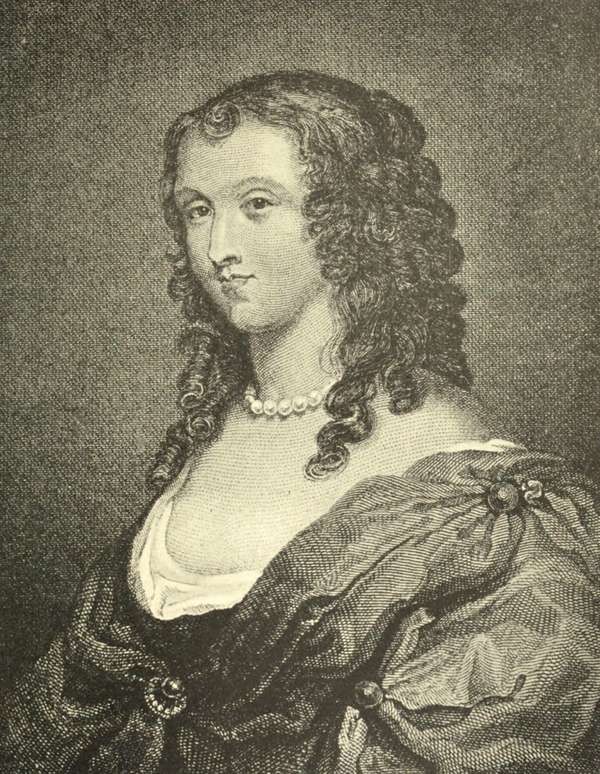
MRS. APHRA BEHN
From a picture by Mary Beale in the collection of his Grace the Duke of Buckingham.
Drawn by T. Uwins. Engraved by J. Fittler, A.R.A. From an engraving
in Effigies Poeticae, London, 1824, Vol. II
Mrs. Behn's novels are now as little known as her plays, but
in her own day were very popular. Oroonoko, the first and by
far the best, was based on her life in Surinam. At a time when
French heroic romances, with their high-flown adventures,
unreal characters, and stilted dialogue, were the only works
of fiction, Mrs. Behn's short, simple, vigorous, and affecting
story of real life comes with a startling sense of novelty.[192] The
vivid portrayal of the cruelties incident to the slave trade,
though probably written without didactic intent, gives the story
a modern humanitarian note not unprophetic of Uncle Tom's
Cabin. And the description of the Indian Prince as the ideal
natural man, his innate virtues in their pristine purity unvitiated
by civilization, foreshadows the theories of Rousseau.
The descriptions of nature, however exaggerated, are vivid
and attractive, and show a delight in scenic detail not found
again in fiction before Mrs. Collyer in 1730. Thus in four ways,
choice of real life as a theme, interest in scenery, emphasis on
the natural man, and on humanitarianism, Mrs. Behn's little
story links itself with the novel of the future rather than with
the romances of the past. In the plays Mrs. Behn showed
exceptional ability in a realm in which women have seldom
excelled. In her novels she marked out a path where women
have gained marked literary success.
In one other way she is an important, outstanding figure.
She was the first woman in England who made authorship a
profession, the first one who definitely set out to earn her
living by her pen. It is unfortunate that the first literary lady
to achieve "economic independence" should likewise be the
first whose writings were notably immoral. But it is a law of
human nature that an unaccustomed freedom seldom contents
itself in its early exercise of power with destroying merely the
unjust bonds by which it has been confined. Freedom is
likely to begin by being license. And when Aphra Behn so
far defied convention as to compete with men as a playwright
on the public stage, when she openly criticized her contemporaries
and boasted that her comedies did not fall below most
that she read, she had so set herself apart in an unfeminine
realm that prudishness and decency fell together. Psychologically
the actress and the writer of comedies seem to have
gone through similar experiences.
Plays between
1696 and 1706
Mrs. Behn had no feminine contemporary rivals, but later
in the century a number of women attempted
to write for the stage. In Genest's record for
Drury Lane and Lincoln's Inn Fields seven plays by six women
are listed in 1696. In the ensuing ten years at least eighteen
more plays by women appeared. This exceptional activity
did not pass without satiric comment. In 1697 "W. M.'s"
Female Wits,[193] with its attack on Miss Trotter, Mrs. Manley,
and Mrs. Pix, was acted six times without intermission, a run
showing exceptional popularity. In 1702 the hostility of the
wits towards women playwrights was again voiced in Gildon's
The Two Stages.[194] Genest says that about this time "prejudice
against females rose so high that Mrs. Centlivre in Stolen
Heiress and Mrs. Pix in Conquest of Spain spoke of their plays
as if by men."[195] The authors of these twenty-five plays were
Miss Trotter, Mrs. Pix, Mrs. Manley, Mrs. Centlivre, Mrs.
Wiseman, "A Lady," "A Young Lady," "A Lady of Quality,"
and "A Club of Ladies." Fourteen of the plays were tragedies,
the best one being, probably, Miss Trotter's Fatal Friendship,
almost the only one of the fourteen that survived on the stage
after its initial season. The writers of comedy were more
successful.
Few of these authors need particular notice. Miss Trotter's
work has already been discussed.[196] Mrs. Manley's three plays
appeared at ten-year intervals, 1696, 1706, 1717. They were
unsuccessful on the stage and they have no qualities that
would claim the reader's attention. It is in fiction, not in
drama, that Mrs. Manley gained her reputation.
Mrs. Pix
(1666-1720?)
Mrs. Pix, daughter of the Reverend Roger Griffith, Vicar of
Nettlested in Oxfordshire, and wife of George
Pix, a merchant tailor of London, was thirty
when she brought out her first play. During the ensuing ten
years she put on the stage five tragedies, one comedy, and possibly
other plays not under her name. Her tragedies, though
written in blank verse, yet belong to the heroic genre, and their
chief interest lies in the fact that they represent that genre in
its dying throes. In Mrs. Pix's tragedies the heroic play of
Dryden's day could look upon its enfeebled and distorted
image. We have the war background, the remoteness of time
and place, the historical source with free alterations of persons
and events, that mark the heroic drama. The type characters
are the same. The heroine is unapproachable in beauty,
unassailable in virtue. The hero, godlike in personal prowess,
the idol of the army, framed by nature to be the darling joy of
womankind, cares for glory only that he may lay it at the feet
of his beloved. Blest by her he will leave unenvied monarchs
to "fight for this Dunghil Earth." This noble pair,
joined by indissoluble vows or by a secret marriage, are subjected
by the plot to the machinations of the beautiful wicked
woman in whose heart has sprung into being a passion for the
hero, and to the arrogant demands of the tyrant who claims
the heroine as his prey. The result is disaster and the last act
is a holocaust. Fights, murders, and suicides carry off all the
important dramatis personæ. Disguises, mistaken identity, the
ravings of sudden madness, ghosts, and secret documents, determine
the events of the play. Passion is torn into exclamatory
tatters from the first scene to the last. We have rant and bluster
and tortured similes, until taste, good sense, and correct English
suffer the same fate as the chief characters. The description
of Mrs. Pix as "a fat female author," appropriately called
"Mrs. Wellfed," would prepare us for something more placid
than the chaos into which she leads us.
The one possible explanation of Mrs. Pix's acceptance
year after year by the audiences of Drury Lane and Lincoln's
Inn Fields is that the business of her plays never lags. They are
short, full of action and surprising turns. An event is never
delayed by a disquisition. They also gave excellent opportunity
for scenic effects of palaces, prisons, and camps.
Susanna
Freeman,
Mrs. Centlivre
(1680?-1723)
The only woman writer of plays of real importance in this
period is Susanna Centlivre.[197] She was the daughter of a Mr.
Freeman of Holbeach, Lincolnshire. He is said to have had
a considerable estate at the time of the Restoration,
but being a zealous dissenter, he was
persecuted, his estates were confiscated, and
he was obliged to seek refuge in Ireland, where Susanna was
born. Her early life is involved in obscurity, but there cling to
her name biographical details of a picturesque and romantic
sort, though of rather questionable authenticity. Left an
orphan at nine and subjected to the ill-usage of a stepmother,
the child, at twelve, finally escapes and makes her way to
London which she enters penniless, innocent, beautiful. She
is rescued by a Cambridge student, a Mr. Hammond, and
disguised as a boy she accompanies him to the University.
Later she marries the nephew of Stephen Fox, but is left a
widow before she is sixteen. A second marriage to a Mr. Carroll
results in a second widowhood before she is eighteen. At
twenty her first tragedy is played at Drury Lane. She appears
soon after this as an actress in country theaters. Mrs.
Behn and Mrs. Haywood could ask no richer material for an
adventure novel. Then suddenly the scene changes. The buffeted
Susanna marries Mr. Centlivre, Queen Anne's chief
pastry-cook, and settles down into a comfortable, orderly, and
apparently happy domestic life, of which, however, we know
in reality even less than of her early kaleidoscopic career.[198]
The events of her life are the presentation and publication of
her plays.
Before her marriage in 1706 she had begun the series of comedies
of which, between 1703 and 1722, she wrote seventeen.
They were all successful, and four of them, The Gamester
(1705), The Busy Body (1709), The Wonder: A Woman Keeps
a Secret (1714), and A Bold Stroke for a Wife (1718), held a
fairly prominent place on the stage through the century.
In 1761 there was published a fine edition of her works in
three volumes. There is a preliminary address "To the
World" in which an anonymous woman endeavors to do justice
to "The Manes of the never to be forgotten Mrs. Centlivre."
She thus recounts the difficulties Mrs. Centlivre encountered
as a female author:
She was even ashamed to proclaim her own great Genius, probably
because the Custom of the Times discountenanced poetical Excellence
in a Female. The Gentlemen of the Quill published it not, perhaps
envying her superior Talents; and her Bookseller, complying with national
Prejudices, put a fictitious Name to her Love's Contrivance,
thro' Fear that the Work shou'd be condemned if known to be Feminine.
With modest Diffidence she sent her Performances, like Orphans,
into the World, without so much as a Nobleman to protect them; but
they did not need to be supported by Interest, they were admired as
soon as known, their real Standard, Merit, brought crowding Spectators
to the playhouses, and the female Author, tho' unknown, heard
Applauses, such as have since been heaped on that great Author and
Actor Colley Cibber.
Her play of the Busy Body, when known to be the Work of a Woman
scarce defray'd the Expences of the First Night. The thin audience
were pleased, and caused a full House the Second; the Third was
crowded, and so on to the Thirteenth, when it was stopt, on account
of the advanced Season; but the following Winter it appear'd again
with Applause, and for Six Nights successively, was acted by rival
Players, both at Drury Lane and at the Hay-Market Houses. See here
the Effects of Prejudice, a Woman who did Honour to the Nation,
suffer'd because she was a Woman. Are these things fit and becoming
a free-born People, who call themselves polite and civilized! Hold!
let my Pen stop, and not reproach the present Age for the Sins of
their Fathers....
A Poet is born so, not made by Rules; and is there not an equal
Chance that the Poetical Birth should be female as well as male?...
I could wish that some young Ladies of my Acquaintance, now in
Boarding Schools, had classical Education, which would improve
their Minds, furnish them with a more general Knowledge, and of
course better fit them for Conversation, and the Management of
Business.
The author of "To the World" finds great satisfaction in
the union of Mrs. Lennox with "Lord Corke and Mr. Samuel
Johnson" in the translation of Brumoy's Greek Theatre.
This convinces me [she says] that not only that barbarous Custom
of denying Women to have Souls, begins to be rejected as foolish
and absurd, but also that foolish Assertion, that Female Minds are not
capable of producing literary Works, equal even to those of Pope, now
loses Ground, and probably the next Age may be taught by our pens
that our Geniuses have been hitherto cramped and smothered, but not
extinguished, and that the Sovereignty which the male Part of the
Creation have, until now usurped over us, is unreasonably arbitrary:
And, further, that our natural Abilities entitle us to a larger Share, not
only in Literary Decisions, but that, with the present Directors, we
are equally entitled to Power both in Church and State....
In 1764 Baker, in Biographia Dramatica, gave an account
of Mrs. Centlivre's work, and most eighteenth-century dramatic
collections included plays by her. In 1776 The New English
Theatre, which professed to assemble "the most Valuable
Plays which have been Acted on the London Stage," published
The Busy Body, A Bold Stroke for a Wife, and The Wonder.
Her plays were included by John Bell in various collections
from 1776 to 1792. Mrs. Inchbald, in her British Theatre
(1808), and Oxberry, in The New English Drama, 1818-1824,
carried the publication of her plays into the nineteenth century.
Such brief notices as occur are highly laudatory. Mr.
Baker says: "In a word we cannot help giving it as our
opinion, that if we do not allow her to be the very first of our
female writers for the stage, she has but one above her, and
may justly be placed next to her predecessor in dramatic
glory, the great Mrs. Behn." Nearly half a century later Mrs.
Inchbald gave even stronger praise when she said that Mrs.
Centlivre "ranks in the first class of our comic dramatists."
Of the Busy Body Mrs. Inchbald said: "This comedy is by far
her best work. In excellence of fable, strength of character, and
intricacy of occurrences, it forms one of the most entertaining
exhibitions the theatre can boast." Of The Wonder she
wrote: "Garrick thought Don Felix worthy his most powerful
exertions, in describing the passion of jealousy; and his character
was upon the lists with the favorite parts he performed....
Mrs. Centlivre has somewhere said 'the Muses, like
most females, are least liberal to their own sex.' She was ungrateful
if she did not acknowledge her obligation to them in
the composition of this work; for they presided with no niggardly
influence over the whole production."
Modern study of Mrs. Centlivre's work has taken a surprising
turn. It has to do entirely with Quellen and Verhältnisse.
In 1900-1905 there were seven German dissertations
dealing with the sources of her plays.[199]
The impulse to play-writing seems to have expended itself
with Mrs. Centlivre. Hannah Cowley's popular Belle's
Stratagem (1782) is the only other play of even moderate importance
through the rest of the century. The situation with
regard to play-writing is rather curious. Virtuous ladies were
at liberty to write tragedies because tragedies were supposed
to be moral and elevating. But unfortunately none of these
ladies succeeded in tragedy. On the other hand, ladies who
were not virtuous wrote comedies and were eminently successful.
The realm between tragedy and comedy, the sentimental
comedy, in its combination of didacticism and
morality with social studies from middle-class life and the opportunity
for rapid intrigue, might have seemed the very
medium in which women could most advantageously work.
But the successful sentimental comedies from The Conscious
Lovers to False Delicacy were written by men playwrights.
Besides the women whose work was sufficiently specialized
to be grouped under particular subjects or species there
were many women to whom learning was itself an avocation
with no thought of any literary outcome, and there were many
more whose interests were in the general field of belles-lettres
and who wrote either in verse or in prose, and on such varied
themes as the occasion might suggest. Since no effective principle
of classification suggests itself in connection with these
writers, it will probably be in the interests of clearness to discuss
them in an order as nearly chronological as may be.
Joan Philips
(fl. 1679)
An early, almost unknown, little volume of poems, published
in 1679 under the title, Female Poems on Several
Occasions. Written by Ephelia, is the work
of Joan Philips whose portrait accompanies the poems. Such of
Miss Philips's poems as can be dated belong but a year or two
before the publication of the book. She apparently had some
rather close connection with court circles. Her little volume is
dedicated to the "Most Excellent Princess Mary, Dutchess of
Richmond and Lennox"; she sends a congratulatory poem to
Charles II on the discovery of the Popish Plot; and she writes
an elegy on Archbishop Sheldon.
Her poems are not, however, usually concerned with court
and state. The "Several Occasions" calling forth her verse are
chiefly amatory or friendly. Her love-poems are highly personal.
From poem to poem the lady pursues the uneven and
finally disastrous course of her love for "Strephon," sometimes
less poetically addressed as "F. G." From "Love's First
Approach" to Strephon's final decisive nuptials with a wealthier
Fair One the hopes and despairs of Ephelia are spread before
us. She can find no surcease from sorrow. Books fail her as a
resource, and her pen proves as recalcitrant as that of the White
King in Looking Glass Land.
Sometimes with Books I would divert my mind,
But nothing there but F's and G's I find.
Sometimes to ease my Grief, my Pen I take
But it no letters but F. G. will make.
Miss Philips's friendship poems, in their addresses to "the
honoured Eugenia," "the beauteous Marinda," to "Damon,"
and to "Phylocles inviting him to friendship" show how definitely
Ephelia formed herself on the model of the great Orinda
whom she praises as having reached the summit of excellence.
Miss Philips also wrote in awe-struck admiration of "Madam
Behn" whose "strenuous polite lines" seemed to her a union of
"Strong and Sweet" such as might be envied by the wittiest
men. And she followed in the footsteps of Mrs. Behn to the
extent of writing one comedy, The Pair-Royal of Coxcombs
which had the humble success of being acted at a dancing-school.
The deprecatory Prologue and Epilogue were included
in her poems together with some of the love-songs in the play.
Ephelia seems to spread her life before us, but as a personage
in the real world she escapes us. She and Strephon have faded
into obscurity. She is contemporary in comedy with Mrs.
Behn. Had they some literary comradeship? But twelve years
separate the published work of Joan Philips from that of Mrs.
Katherine Philips. Were the two poetesses perhaps related?
Lady Winchilsea was eighteen when the volume by Ephelia
appeared. About fifteen years later we find Lady Winchilsea
as "Ardealia" writing on Friendship to one "Ephelia." Could
it possibly be this Ephelia? Did Ephelia publish the poems
herself with her own portrait as frontispiece? If so she was
strangely lacking in the reserve characteristic of Orinda and
Ardelia. But even with no biographical data whereby to substantiate
or correct the poems, the thin little volume holds its
place of interest because of its early date and because of the
literary ambitions it indicates.
Anne Killigrew
(1660-1685)
Anne Killigrew came of a family prominent in the court of
Charles II. Her uncle Thomas, the "court
wit," was given a patent for the Theater Royal;
her uncle Henry was admiral under James, Duke of York;
her father was chaplain to James and Master of the Savoy; and
Anne was maid of honor to Mary of Modena. She was born
in St. Martin's Lane and died at her father's lodgings within
the Cloisters of Westminster. London and the court were
her habitat. Ballard says she had "a polite education," but
no details are given. She apparently was taught the accomplishments
counted necessary for a girl in her social position.
That she went beyond mediocrity in painting we have already
seen.[200] In poetry, also, according to Dryden, she excelled.
The thin volume of her published verse (1686) scarcely
justifies his eulogy, but Wood, in Athenæ Oxoniensis, says that
Dryden in no way exceeds the truth. Her poems sent anonymously
from hand to hand received high praise and were even
at first attributed to the best poets of the age. They gradually
came to be known as hers, but she gives no evidence of having
suffered any contumely as a poetess. She has nowhere any
complaint of undue or irritating feminine limitations. She is
pessimistic, scornful, rather hard and drastic, in her judgments,
but it is greed for gold, ambition for place or power, unbridled
love, atheism, war, that are the subjects of her invective. There
is not a light or playful, or even a happy, touch in her poems.
They have a crude virility, what Dryden calls a "noble vigour,"
and a contemptuous outlook on "the truly wretched
Human Race."
Personally Miss Killigrew must have been attractive. Her
epitaph eulogizes her as a daughter and a sister:
In a numerous race
And vertuous, the highest place
None envy'd her: sisters, brothers,
Her admirers were and lovers:
She was to all s' obliging sweet,
All in one love to her did meet.
And she was an acknowledged favorite at court, especially
with her royal master and mistress. Dryden emphasizes her
beauty and charm. The portrait she painted of herself shows
her in no sense averse to pomps and vanities of attire.[201] In actual
life she must have moved along in fairly smooth accord with
the life about her, but there could have been few ladies within
the circle of the court more alien to it in spirit than Anne Killigrew.
It is difficult to place her mentally amid the gayeties of
London life. She presents an anomaly. To be young, beautiful,
gifted, high in social opportunities, praised and loved,
and yet to look out upon life with bitterness and distaste, to be
conscious at twenty-five that all this world has to offer will
turn to dust and ashes in the mouth—such is the curious combination
we find in her. While the few accessible details concerning
her indicate a considerable degree of lovableness, her
poems are those of an implacable moral censor.
Anne Killigrew was but four when Mrs. Philips died, but
the spell of the "Matchless Orinda" descended early upon
her, and she gives one of the earliest of the many eulogies written
by women concerning their distinguished ancestor among
British Muses.
Orinda (Albion, and her sex's grace)
Ow'd not her glory to a beauteous face:
It was her radiant soul that shone within,
Which struck a lustre thro' her outward skin;
That did her lips and cheeks with roses dye,
Advanc'd her height, and sparkled in her eye.
Nor did her sex at all obstruct her fame.
But high'r 'mongst the stars it fixt her name;
What she did write, not only all allow'd,
But ev'ry laurel, to her laurel bow'd!
Mrs. Evelyn
(1635-1709) and
Mary Evelyn
(1665-85)
John Evelyn's flattering letter to the Duchess of Newcastle,
already quoted, with its list of learned women,
his suggestion to Lord Cornbury that he add
two ladies to his gallery of notables, the trouble
he took to conduct a party of ladies to see the girls' "colleges"
at Hackney, and various references in Numismata
(1697) indicate a genuine interest in the intellectual achievements
of women. Mrs. Evelyn seems at first to have been of
a different temper. She wrote as follows to her son's tutor,
Mr. Bohun, in 1672:
Women were not borne to reade authors, and censure the learned, to
compare lives and judge of virtues, to give rules of morality, and
sacrifice to the Muses. We are willing to acknowledge all time borrowed
from family duties misspent; the care of children's education,
observing a husband's commands, assisting the sick, relieving the
poore, and being serviceable to our friends, are of sufficient weight to
employ the most improved capacities amongst us. If sometimes it
happens by accident that one of a thousand aspires a little higher, her
fate commonly exposes her to wonder, but adds little to esteeme. The
distaffe will defend our quarrels as well as the sword, and the needle
is as instructive as the penne. A heroine is a kind of prodigy: the influence
of a blazing starre is not more dangerous, or more avoyded.
Though I have lived under the roofe of the learned, and in the neighborhood
of science, it has had no other effect on a temper like mine,
but that of admiration.
But these very letters, in which Mrs. Evelyn disclaims
learning, would be a capital point in refutation of Macaulay's
charge of general feminine illiteracy. In subject-matter, in
style, and in the mechanics of writing they show a development
not unworthy of that "roofe of the learned" under which
she dwelt. At the time Mrs. Evelyn wrote the letter just
quoted her daughter Mary was but six years old, but her literary
and artistic tastes must have soon become manifest,
for when she died of small-pox at nineteen she was an accomplished
young woman, on the road, apparently, to be the
dangerous "blazing starre" her mother decried, and her
training must have been going on for ten or twelve years in
the home with the active connivance of her parents. Her father
was exceedingly proud, not only of her excellence in dancing
and music, but especially, it would seem, of her passion for
books. She had, he said, "read abundance of history, and all
the best poets, even Terence, Plautus, Homer, Virgil, Horace,
Ovid; all the best romances and modern poems." After her
death they found among her papers a commonplace book in
which she had entered "an incredible number of selections
from historians, poets, travellers." Her piety and her impulse
towards expression were both shown in the many "resolutions,
contemplations, prayers and devotions" she left in written
form. Of the extent to which both Mrs. Evelyn and her
daughter carried their work in painting and enamel I have
already spoken.[202]
The Evelyn household may stand doubtless as one of many
where, without any tinge of pedantry or any especial outward
manifestations of learning, there was yet a natural interest in
arts and letters, an interest shared, in quite a simple, normal
way by all the members of the family.
The Honorable
Miss Dudleya
North
(1675-1712)
The Honorable Miss Dudleya North was a niece of the Honorable
Roger North, and it is through the memorable
Lives of the Norths that we come upon an account
of her life. Dudleya and her two younger
brothers were brought up together. She learned the same lessons
and read the same books as her brothers, and joined in
their amusements. When they went to the University, she
carried on her studies at home and she became one of the
most highly cultured and learned women of her time. After
she had conquered Greek and Latin she advanced to Hebrew,
and finally, "by a long and severe course of study," she gained
"a competent knowledge in the whole circle of Oriental learning."
Her uncle Roger laconically described her life as follows:
"The eldest sister, Catharine, died ... and the youngest,
named Dudleya, having emaciated herself with study
whereby she had made familiar to her, not only Greek and
Latin, but the Oriental languages, under the infliction of a
sedentery distemper, died also."
The fine collection of Oriental books left by Miss North
was given by her brother, Lord North and Grey, to the parochial
library at Rougham in Norfolk. Her uncle wrote:
"I have had a design to build a parochial library at Rougham,
and now shall finish it this summer, and placing my niece's
books there, entitle the Catalogue Ex dono, etc., e libris eruditissimæ
virginis, etc., which will be a monument more lasting
than marble."[203]
Anne Lee,
Lady Wharton
(1632?-1685)
Anne Lee, the daughter and co-heiress of Sir Henry Lee,
married in 1673 Thomas Wharton, whose chief
interest in her was based on the large dowry she
brought him. The unhappiness of her married
life received some alleviation from the wise and steadfast friendship
of Dr. Gilbert Burnet. In 1680-81, she was in France for
her health and during this time she corresponded regularly with
Dr. Burnet. He addressed to her various poems with titles such
as The Secrets of Friendship, Friendship's Mysteries, Pure Love,
and Love's Magnetism. She wrote a tragedy in blank verse on
the love of Ovid for Julia, a number of Scripture paraphrases,
and some occasional poems.[204] Some of these poems drew approving
verses from Dryden in his Eleonora, a panegyrical
poem on the death of Mrs. Wharton's elder sister, Lady Abingdon,
in 1691, and from Waller, who, in his old age, was still
equal to flattering a new "Chloris," under which name he celebrated
her learning and her poetry.
Ann Baynard
(1672-1697)
Ann Baynard had a natural propensity to learning and her
father Dr. Edward Baynard, Fellow of the College
of Physicians, London, gave her a very
liberal education. Dr. Prude[205] says of her:
As for learning, whether it be to know and understand natural causes
and events, to know the courses of the sun, moon, and stars; the qualities
of herbs and plants; to be acquainted with the demonstrable verities
of the mathematicks; the study of philosophy; the writings of the
antients; and that in their own proper language, without the help of
an interpreter: These and the like are the most noble accomplishments
of the human mind, and accordingly do bring great delight and satisfaction
along with them, these things she was not only conversant in,
but mistress of, and that to such a degree, that very few of her sex
did ever arrive at. She had from her infancy been trained up in the
knowledge of these things, and had made a great progress therein;
and even in her green years, at the age of 23, was arrived to the knowledge
of a bearded philosopher.[206]
She was a "nervous and subtle disputant" in the "hard and
knotty arguments of metaphysical learning." She was always
coveting more knowledge, saying that it was a sin to be contented
with but a little. She was exceedingly religious and
learning was to her but a handmaid of piety. Her last words
were a recommendation to women to study philosophy and
the great book of nature which would give them a sound basis
for wisdom in practical life. Women, she said, are capable of
such study, and could accomplish much if they would "spend
of that time in study and thinking, which they do in visits,
vanity and folly." Mr. Collier, in the Great Historical Dictionary,
says of her that it is doubtful whether the first Ralph
Baynard, who for his conduct at the battle of Hastings was
rewarded with eighty-five lordships, did more honor to the
name of Baynard or the last Anne.
Mrs. Alicia
D'Anvers
(fl. 1691)
Academia: or the Humours of the University of Oxford in burlesque
verse is a thin quarto by Mrs. Alicia
D'Anvers. It was printed in May, 1691, and
again with a fuller descriptive title in June of
the same year. The poem is an account given to his fellow-servants
by John who has recently visited Oxford. Mrs.
D'Anvers puts herself in John's place. She uses his crude and
even rough language, she gives his point of view, and relishes
the misconceptions due to his ignorance. Heavy and clumsy
as the poem is there is something refreshing and original in its
tone. As an attempted realistic portrayal of a servant's experiences
it stands quite by itself, except in comedies, in the decades
before the novel widened human interests. Mrs. D'Anvers is
neither patronizing nor didactic. She simply finds genuine
humor and entertainment in the comic juxtaposition of John's
mind and the ancient customs and glories of Oxford.
Lady Chudleigh
(1656-1710)
Lady Chudleigh[207] was a lady of much repute in the eighteenth
century for her writings in both prose and
verse. Her Poems were published in 1703 and
her Essays in 1710, but her chief literary activities belong in
the late seventeenth century. Her Essays are disquisitions on
Pride, Humility, Self-love, Friendship, Death, Anger, Avarice,
Solitude, and kindred themes. Mr. Ballard says of them:
"They appear to be, not the excursions of a lively imagination
... so much as the deliberate results of a long exercise
in the world, improv'd with reading, regulated with judgment;
softened by good breeding, and heightened with sprightly
thoughts and elevated piety." Her prose style is fluent, energetic,
and, for the most part, correct. In her Preface to her
Song of Three Children Paraphrased she makes several points
that indicate mental independence. In the height of the
dominance of the heroic couplet she chooses Pindaric verse
because she does not wish to be tied up to the rules of the
couplet, and because she desires to give her fancy greater scope.
She begs pardon for introducing into her poem ideas "not
generally received," such as Dr. Burnet's conception of the
"Ante-diluvian Earth as Smooth, regular, and uniform; without
Mountains or Hills." Concerning her poetic use of the doctrine
of preëxistence she says, "To me 't is indifferent which
is true, as long as I know I am by the Laws of Poetry allow'd
the Liberty of chusing that which will sound most gracefully
in Verse." In regard to the stars she adopts "the Cartesian
Hypothesis" because it makes the universe "appear infinitely
larger, fuller, more magnificent." Her imagination
is as genuinely excited as was Tennyson's by her conception of
the "boundless Spaces" of the heavens and the splendor of the
"huge Globes which roll over our Heads." She believes also
in a millennial existence on "a new habitable earth." The
poem itself is an unbroken ecstasy ninety long stanzas in duration,
and becomes undeniably wearisome. But the woman
who could spend months in a lonely country place absorbed
in such religious and scientific reflections, who could maintain
for so long a time so rapt and energetic a mental attitude
towards abstract subjects, was far enough removed from the
traditional hausfrau.
Though Lady Chudleigh rejoices in these learned topics
she modestly disclaims any accurate knowledge. "But 't is
not reasonable to expect that a Woman should be nicely
skill'd in Physics: We are kept Strangers to all ingenious and
useful Studies, and can have but a slight and superficial Knowledge
of things." Two poems, Resolution and To Mr. Dryden
on his excellent Translation of Virgil, give evidence of Lady
Chudleigh's wide reading in poetry, history, drama, and
divinity. Her literary dicta are of little value, for they do
hardly more than echo the judgments of the day. According
to her it was the poet Waller who, coming after the "transient
Glimm'rings of Chaucer" and the "Lunar Beams of Spenser,"
announced the dawn of a new Morn, and with Dryden came
"The Triumphs of refulgent Day." Taken as a whole the
poems bitterly inveigh against life with its blighting sorrows,
its fleeting, unreal joys, its injustice, its black despairs. The
only break in the gloom comes in short periods of absorption
in books, or in occasional religious ecstasies.
The first poem by which Lady Chudleigh became known is
The Ladies' Defence: a sudden, angry outburst caused by a
sermon on Conjugal Duty by a Mr. Sprint, a nonconformist
in Sherbourn, Dorsetshire.[208] The personal animus in a little
poem To the Ladies warning them against marriage, apparently
grew out of her own matrimonial infelicities. And The Ladies'
Defence has the same ring of indignant sincerity. The poem is
in the form of a conversation between the parson who preached
the sermon; Sir William Loveall, who, out of the ignorance of his
unmarried state, endeavors to reconcile the warring parties;
Marissa, Lady Chudleigh herself; and Sir John Brute, who
thanks the parson for preaching against "those Terrors of our
Lives, those worst of Plagues, those Furies call'd our Wives."
The parson replies:
Not led by Passion, but by Zeal inspir'd,
I've told the Women what's of them requir'd:
Taught them their Husbands to Obey and Please,
And to their Humours sacrifice their Ease:
Give up their Reason, and their Wills resign,
And ev'ry look, and ev'ry thought confine.
Sure, this Detraction you can't justly call?
'T is kindly meant, and 't is address'd to All.
If you wou'd live as it becomes a Wife,
And raise the Honour of a marry'd Life,
You must the useful Art of wheedling try,
And with his various Humours still comply;
Whate'er he is, you still must think him best,
And boast to all that you are truly blest;
Also, to him you inward Reverence owe;
If he's a Fool, you must not think him so;
Nor yet indulge one mean contemptuous Thought,
Or fancy he can e'er commit a Fault.
Nor must your Deference be alone confin'd
Unto the hid Recesses of your Mind,
But must in all your Actions be display'd,
And visible to each Spectator made.[209]
After this sarcastic summary of Mr. Sprint's irritating sermon
Lady Chudleigh in the person of Marissa, depicts the general
condition of women and her own loftier ambitions:
'T is hard we should be by the Men despis'd
Yet kept from knowing what would make us priz'd.
Debarr'd from Knowledge, banish'd from the Schools,
And with the utmost Industry bred Fools.
Laugh'd out of Reason, jested out of Sense,
And nothing left but Native Innocence:
Or that my Sex would all such Toys despise;
And only study to be Good, and Wise:
Instead of Novels, Histories peruse,
And for their Guides the wise Ancients chuse,
Thro' all the Labyrinths of Learning go,
And grow more humble as they more do know.
Beauty's a Trifle merits not my Care.
I'd rather Æsop's ugly Visage wear,
Joyn'd with his Mind, than be a Fool, and Fair.
But spite of you, we'll to ourselves be kind:
Your censures slight, your little Tricks despise,
And make it our whole business to be wise.
The mean low trivial Cares of Life disdain,
And read and Think, and Think and read again,
And on our Minds bestow the utmost Pain.
Anne Kingsmill,
Lady Winchilsea
(1661-1720)
One of the important women of letters in the late seventeenth
century was Anne Kingsmill.[210] Of her early life
we have no definite details. That it was a gay
and happy life may be inferred from one of her
retrospective poems in which she says that in her youth
"Pleasure's tempting Air" blew soft about her, and that
she dedicated her "Prime" to "vain Amusements." Later
she coveted a place at court which to her ambitious eye
seemed "Paradice below." At what time this desire was realized
we have no record, but in 1683 we find her listed as one of
the maids of honor to Mary of Modena. Miss Strickland says
that Anne Killigrew and Anne Kingsmill were "ladies of irreproachable
virtue, members of the Church of England, and
alike distinguished for moral worth and literary achievements,"
and she adds that Anne Kingsmill was "well-known as
the beautiful and witty maid of honour." In 1684 Anne married
Mr. Finch, gentleman of the bedchamber to the Duke of
York. At the coming of William and Mary, Mr. and Mrs.
Finch went to the family place at Eastwell Park where they
spent the rest of their uneventful lives in a retirement, embittered
at first, doubtless, by their grief over Stuart disasters,
but, as the years passed, rendered more and more delightful by
the joys of country life, of books, and of friends. Mrs. Finch's
best poems are those inspired by Eastwell and its associations.
The Elizabethan house at Eastwell was set in a park of old yew
trees and majestic beeches, forming "the very ideal of an ancestral
park of the ancient noblesse," and it was by the extraordinary
dignity and beauty of this park that Mrs. Finch's most
imaginative work was inspired. Within doors the gathering of
antiquities, the illuminating of books, the formation of a great
library, and free literary productivity were the family interests.
There were also many and close ties of friendship founded
on natural causes of union such as loyalty to the Stuarts, devotion
to the Church of England, high and even austere ideals
of life. And family ties and ties of friendship received ardent
acknowledgment. No woman of this period was more happily
circumstanced in her home for the unhampered pursuit of
literary tastes than was Lady Winchilsea. She began to write
when she was a maid of honor, but it was with a nervous sense
of the ridicule that would probably follow any disclosure of that
fact. But at Eastwell the case was different. There are charming
pictures of evening sessions when the authoress presented
her work to an enthusiastic circle. A scribe entered her writings
in a fair and clerkly hand in a majestic folio. With such encouragement
the lady kept sedulously and joyfully to her task.
And when her husband's accession to the title gave her a new
position of dignity and authority she even ventured, in 1713,[211]
to publish a selection from her verse, first under the pseudonym
"Ardelia," and then, in a later impression, with her full name
and title.
Lady Winchilsea's poems were composed between 1683 and
1720, and during this period she tried nearly all poetic forms.
Songs, satires, fables, tragedies, translations, are fully represented.
She was the most voluminous of the minor poets of her
time, and in vigor and scope she outranks most of them. But
her literary importance to-day rests not so much on the amount
or variety of her work, as on the fact that in an age of didacticism
and satire she delicately foreshadowed tastes that ruled
in the romanticism of a century later. It was her Nocturnal
Reverie, with its minute accuracy of observation, its sense of the
mystery of nature and of the mystic union between man and
nature, that secured Wordsworth's praise, gave her an honorable
place in Ward's English Poets, and finally established her
in the heaven of literary fame as, in Mr. Gosse's phrase,
"a minor excelsitude."
In the present study quite other points are to be made concerning
Lady Winchilsea. She is particularly interesting when
considered as a heretic against certain prevailing social and
educational ideals. In the gay dissipations of court life under
Charles II she maintained a conception of life serious and even
austere. In close association with Mary of Modena and James
II she yet maintained her devotion to the Church of England.
With the world of fashion flocking to the comedies of the Restoration
dramatists she yet condemned the immoralities of the
stage with the bitterness of a Jeremy Collier. There was, then,
in Lady Winchilsea an independence of judgment, a stoutness
of fiber in forming and defending her own views, which would
lead one to expect some trenchant remarks on the contemporary
attitude towards women. It is much to be regretted that
the letters of Lady Winchilsea, if any are extant, have never
been published. Her interests were so varied, her friendships
so ardent, her hours of country leisure so numerous, her pen so
facile, that she must have found, in what Anne Seward called
"epistolary solicitudes," one of the most convenient outlets
for a spirit often kicking against the pricks of social conventions,
and her keenness of insight, her caustic phrasing, would
make her letters worth many pages of pindarics. But in default
of such letters we turn to the one prose essay and to the poems.
From scattered passages we can build up the elements of her
heresies. Though she loved her home and was the most devoted
of wives, she utterly rejected the hausfrau theory of life. She
declared that she, at least, was never meant for "the dull
manage of a servile house." She asked little of her table except
that it should be "set without her care." Rich food and elaborate
service could be dispensed with, but leisure and a free mind
she must have. The frivolous occupations of the town lady, the
endless discussions of laces and brocades, the rivalries as to
dishes and screens from China, the gossip and ill-natured jests
at fashionable tea-tables, she found unendurable. Feminine
accomplishments, such as embroidery, amateurish drawing and
painting, awakened her active hostility.
This definite rejection of all that ordinarily filled the feminine
mind, and a rejection, moreover, in the interests of books
and writing, of course made Ardelia the unhappy victim of
many a sneer. The attack on her by Pope and Gay, in Three
Hours after Marriage, in 1717, may be taken as an extreme
example of the indignities to which "a petticoat author" might
be subjected, but there must have been many lesser evidences
of social disapproval or the irritating theme would not so often
recur in her poems. In "The Introduction" she says:
Alas! a woman that attempts the pen,
Such an intruder on the rights of men,
Such a presumptuous Creature, is esteem'd,
The fault, can by no vertue be redeem'd.
They tell us, we mistake our sex and way;
Good breeding, fassion, dancing, dressing, play
Are the accomplishments we should desire;
To write, or read, or think, or to enquire
Would cloud our beauty, and exhaust our time,
And interrupt the Conquests of our prime.
She congratulates herself that she had at least had the good
sense to keep her rhymes a secret while at court, where a
"Versifying Maid of Honour" would have been looked upon
"with prejudice, if not with contempt." During a visit to
London she heard the young gossip Almeria describe a certain
lady as "A Poetess! a woman who writes! A common jest!"
Conscious of her growing folio at Eastwell, Ardelia resented
the implied censure. What law, she asks, forbids women to
think? Women, she protests, are "Education's and not Nature's
fools." Ardelia had high praise from noted contemporaries
and cordial appreciation at home. But these did not
avail to conquer her morbid sensitiveness to criticism. She
seemed to embody in herself two warring tendencies, a demand
for complete intellectual freedom and the author's inevitable
desire to spread his wares abroad, with the shrinking modesty
of the lady to whom any sort of publicity was hateful.
The "Matchless Orinda," Lady Winchilsea tells us, was the
model on whom, from her early girlhood she formed herself.
The first verses she wrote were in honor of Orinda. By Orinda's
example she justified the efforts and aims of her own muse, but
she is in no sense a copyist. It was Orinda's fame as a noted
and virtuous woman poet that inspired her rather than any
close study of Orinda's work. Lady Winchilsea, in that small
portion of her work on which her fame rests, is very delicately
and truly original. Her spirit reacted against court life as
definitely as did Anne Killigrew's, but she found no satisfaction
in satiric comment. She shrank from any sort of contest.
She argued and protested only when pushed to the wall. She
was shy and easily intimidated, and her best work does not
come from the heat of conflict or from bitterness of spirit. She
is essentially contemplative. The poems on which her fame
rests blossomed out quietly, exquisitely, under the gentle stimulus
of a happy home life in the midst of lovely natural
surroundings. She is typically a lady of letters because,
without the spur of necessity, urged on by no popular applause,
she yet, for more than thirty years, made the reading
of books and the writing of books the central occupation
of her life.
The Honorable
Mrs. Monck
(d. 1715)
The honorable Mrs. Monck[212] was the daughter of Lord
Molesworth, a nobleman of Ireland. Mr. Ballard
says of her learning: "She, purely by
force of her own natural genius, acquired a
perfect knowledge of the Latin, Italian and Spanish tongues:
and by a constant reading of the finest authors in those
languages, became so great a mistress of the art of poetry,
that she wrote many poems for her own diversion." In 1716,
after her death, Lord Molesworth published her poems under
the title Marinda. Poems and Translations on Several Occasions.
In his dedication to Caroline, the Princess of Wales, he says
that the book represents the works of the leisure hours of a
young gentlewoman in a remote country solitude, with no
assistance but that of a good library, and with the daily care of
a large family on her hands. In commending her character he
says, "I loved her more because she deserved it, than because she
was mine." Various slight poems show Marinda's knowledge
of Italian and Spanish. Better than all these are two cleverly
turned epigrams on "a lady of pleasure," and some affecting
farewell lines written in her last sickness to her husband. Mrs.
Monck's repute for learning comes largely by hearsay, her
printed memorials are slight and unimportant, but she nevertheless
gives an impression, elusive but real, of a most interesting
personality.
Martha,
Lady Giffard
(1639-1722)
Lady Giffard was Sir William Temple's sister. She was
twelve years younger than Dorothy. After her
marriage and almost immediate widowhood, in
1661, she made her home with the Temples.
Her Life and Correspondence has been published by Mrs. Longe
as a sequel to the Letters of Dorothy Osborne. The volume contains
letters from Lady Chesterfield, from Lady Sunderland
("Saccharissa"), and others, to Lady Giffard. The letters by
Lady Giffard are few in number and are all written to her niece
Lady Berkeley, later Lady Portland, and belong in the years
1697-1722. These letters have none of the sparkle and humor
and literary charm of Dorothy's. But we get indications that
Lady Giffard was a woman of intellectual interests. We find
her reading Turkish history daytimes with recourse to Virgil,
"as less exacting," for evenings. She knew Spanish and French,
and one of the specific items in her will is a bequest of the books
she had collected in these two languages.
Sarah Byng,
Mrs. Osborne
(1693-1775)
A third series of letters, published under the title Political
and Social Letters of a Lady of the Eighteenth
Century, though belonging later in the century,
may be brought in here because they carry on
the series of Osborne letters. Sarah Byng, the daughter of
Admiral Byng, Viscount Torrington, married, in 1710, John
Osborne of Chicksands Priory, the old home of Dorothy and
the place from which she wrote most of her letters. Mr. John
Osborne was Dorothy's grand-nephew. He died in 1719 and
his father in 1720, leaving to Sarah Osborne an infant son,
Danvers, the heir to the title and a heavily burdened estate.
Her letters fall in several series, the first set from 1721 to 1739
being to her brother George on business matters concerning the
property. Most interesting are the letters to Danvers from
1733 to 1751. When he came of age in 1736 she was able to
turn over to him an unincumbered estate, and on his marriage
in 1740 she superintended the establishment of the new household
at Chicksands. A third set of letters has to do with the
sentence and execution of her brother Admiral Byng, in 1757.
Through the death of the wife of Danvers in 1743 and the
death of Danvers in 1750 Mrs. Osborne was left with two
grandsons to bring up, and her last letters are to John, one
of these grandsons, who was traveling in Holland.
Through two generations Mrs. Osborne bore heavy administrative
and financial burdens. She was both father and mother
to her son, and then to her grandsons. And she was left single-handed
to conduct the defense of her brother Admiral Byng.
It is not strange that the letters are frequently hurried and
harassed in tone. She is constantly vexed and baffled because,
as a woman, she cannot conduct affairs directly. Some man
must be her intermediary. She lays plans, foresees difficulties,
writes explicit directions, and then she must urge and cajole
her representative to due interest and prompt action. The
especial interest in her letters is their abundant and exact
account of social life and especially of domestic economy.
Energetic, courageous, resourceful, keenly observant, and with
a clear head for business, Mrs. Osborne shows herself to be.
Perhaps if we had her letters before the burdens of life fell so
heavily upon her we might find some hint of the charm in
Dorothy's letters, for even Dorothy's letters after marriage
became "tame and flat to what was before." As it is, Mrs.
Osborne's letters are valuable for scattered social detail, not
for any permanent charm of expression.
Elizabeth Singer,
Mrs. Rowe
(1674-1737)
Mr. Walter Singer, a dissenting minister of Frome, was early
left a widower with three daughters. Two of
these daughters showed while still young exceptionally
good minds and a natural interest in
study. One daughter, who died at nineteen, was devoted to
medicine and collected books on that subject. Elizabeth
preferred drawing and poetry. She began drawing when her
fingers could hardly hold the pencil, and she squeezed out
the juices of plants to make colors. Her father furnished her
an excellent master, and she attained sufficient skill so that
throughout her life her work was highly prized by her friends.
She also loved music "to excess." But poetry was her chief
delight. She began writing at twelve, and by the time she was
twenty-two she had on hand a store of verse so pleasing to her
friends that they insisted on its publication, and there accordingly
appeared a thin little volume in 1696 under the
title Poems on Several Occasions. Written by Philomela. The
"Preface to the Reader," by one Elizabeth Johnson, is another
of many contemporary indications of feminine irritation at the
limitations imposed upon them. Miss Johnson allows "Mankind
the Brutal Advantages of Strength," but when they "wou'd
Monopolize Sence too, when neither that, nor Learning, nor so
much as Wit" is granted the women, they are forced to protest
against such "notorious Violations on the Liberties of Free-born
English Women." "This makes the Meekest Worm amongst us
all, ready to turn agen when we are thus trampled on; But alas!
What can we do to Right our selves? stingless and harmless as
we are, we can only Kiss the Foot that hurts us." But it sometimes
pleases Heaven to succor a distressed people by sending
them some bright genius, "an Epaminondas, a Timoleon, a
Nassaw." "Nor is our Defenceless Sex forgotten—we have not
only Banduca's and Zenobia's, but Sappho's, and Behn's, and
Schurman's, and Orinda's, who have humbled the most haughty
of our Antagonists, and made 'em do Homage to our Wit, as well
as our Beauty." Miss Singer's consent to the publication of this
volume was gained only by a promise of strict anonymity, and
the "Philomela," then chosen as a pen-name through a naïve
adaptation of "Singer," became her permanent appellation.
One interesting fact with regard to these early poems is
the indication we have of a kind of poetical commerce maintained
among the members of a group of persons similarly
inclined to verse. Philomela writes a Pindarick Poem on Habbakuk
which she sends to "The Athenians" and they respond
with a poem beginning,
We yield! we yield! the Palm, bright Maid! be thine!
She sends a Poetical Question to the Athenians and gets a long
answer. The Vanity of the World and The Wish are likewise
addressed to the Athenians and have similar responses. In a
Pindarick to the Athenian Society she brings as "Zealous Tribute,"
"The early products of a Female muse," praising especially
their piety and heroic sentiments and the courage with
which they have lashed the darling vices of the times.
A friendship so exalted and immense,
A female breast did ne'er before commence.
A little poem in humorous vein, To one that persuades me to
leave the Muses, gives some account of her school-days. "I
fairly bid the Boarding Schools farewell," "Old Governess
farewell with all my heart," are lines indicative of her attitude.
Spite of her heart, Old Puss shall damn no more
Great Sedley's Plays, and never look 'em o're;
Affront my Novels, no, nor in a Rage,
Force Dryden's lofty Products from the Stage,
Whilst all the rest of the melodious crew,
With the whole System of Athenians too,
For Study's sake out of the Window flew.
But I, to Church, shall fill her Train no more,
And walk as if I sojurn'd by the hour.
In like vein she bids adieu to "dancing days," singing lessons,
Japan work, and even her "esteemed Pencil," and vows to give
herself to poetry. And true it is that the rest of her life is mainly
of literary and pious significance. When young her beauty and
charm had resulted in "a train of lovers," but no one of them,
not even Mr. Prior, the poet, could lure her from her serene
solitude—possibly because she was "destined by heaven for
the possession of another gentleman." At any rate, she went
smoothly on with her chosen literary life till she was thirty-six,
when she married Mr. Thomas Rowe, thirteen years younger
than herself, but of like tastes and himself an author. Their
extraordinarily happy life together was brought to a close by
his death in 1715, and, after this five years of happiness, she
spent the twenty-seven years of her widowhood in a stricter
solitude, a more absorbed religious communion, a completer
devotion to literary pursuits, than before her marriage. Her
essays, her poems, her letters, were the events of her life. She
had early come to know the family of Lord Weymouth at Longleate.
Mr. Thynne had taught her French and Italian; various
members of the family and various family events were celebrated
in her verse. She was on most intimate terms with the
Countess of Hertford and corresponded with her for many
years. Over a hundred of her letters to the Countess were published
in The Works of Mrs. Elizabeth Rowe and Mr. Thomas
Rowe, and though they make dull and monotonous reading
now were highly esteemed at the time. In fact, the modest and
anonymous Philomela had great eighteenth-century vogue.
She had the friendship of many in the great world, she was
abundantly praised by poets and divines, and her works went
through numerous editions. Her husband said that she combined
the fire and passion of Aphra Behn with the chaste purity
of Mrs. Katherine Philips. But Astræa's passion underwent
some strange alchemy when it was transmuted into Philomela's
religious ecstasy. Orinda's purity was fatal to the combination.
Yet Mrs. Rowe's "divine transports" have—Mr. Watts
admits it—sometimes a soft and passionate sound, even an
amorous note, capable of misinterpretation, but evidently
reminiscent of the Songs of Solomon, beloved of her youth. It
was not an age for enthusiasms and ecstasies. That her
"flights" were so popular may possibly be explained by the fact
that through them all she was curiously prosaic and intellectually
commonplace.
Mrs. Bland
(1660?-1765?)
Mr. Ballard speaks of "Mrs. Bland,[213] a Yorkshire gentlewoman
so well skilled in Hebrew that she
taught it to her son and daughter." Mrs.
Bland was born about 1660 and married Mr.
Nathaniel Bland in 1681. Her instructor in Hebrew was Lord
Van Helmont from whom she learned to write the language
with great exactness. At the request of Mr. Thoresby she
wrote a Phylactery in Hebrew and presented it to the Royal
Society, where it was preserved among their curiosities. Mr.
Bland became Lord of the Manor at Beeston and Mr. Thoresby
visited him there. To the astonishment of the guest Martha
Bland, the young daughter of the house, was translating Hebrew
into English, having been taught by "that ingenious
gentlewoman," her mother. Four years later Mr. Thoresby
took his son Ralph to see "Mrs. Bland, the Hebrician." She
had also studied Anglo-Saxon, for she borrowed Elizabeth
Elstob's book from Mr. Thoresby and kept it long enough
to copy out the grammar part.
Miss Jane
Barker
(fl. 1688-1723)
Miss Jane Barker is a literary lady whose productions belong
in two epochs. Her collected poems appeared
in 1688 under the title Poetical Recreations:
Consisting of Original Poems, Songs, Odes, etc.
With Several New Translations. In Two Parts, Part I. Occasionally
Written by Mrs. Jane Barker. Part II. By Several
Gentlemen of the Universities, and Others. Twenty-seven years
after the publication of this verse Miss Barker again came before
the public, this time as a writer of romances which proved
very popular. They were collected under the title The Entertaining
Novels of Mrs. Jane Barker, and a second edition had
appeared by 1719. In 1723 she brought out A Patch-Work
Screen for the Ladies; or Love and Virtue Recommended: In a
Collection of Instructive Novels. Related after a Manner intirely
New, and interspersed with Rural Poems, describing the Innocence
of a Country Life. By Mrs. Jane Barker, of Wilsthorp,
near Stamford, in Lincolnshire.[214]
The long silence between the verse of 1688 and the romances
of 1715-26 is unbroken by any explanatory hint or reference.
Yet Miss Barker had but one story to tell and that was told in
her youth. In her novels she uses the characters, events, and
emotions recorded in her early verse. Under the form of a
sustained narration, with the addition of much in the way of
romantic adventure, they make more entertaining reading,
but offer no essentially new elements. The fifth novel, Clodius
and Scipiana, is perhaps but an enlargement of a romance
entitled Scipina, which had been published and concerning
which she had received several congratulatory poems, before
1688.[215]
One persistent element in Miss Barker's verse and prose is
autobiographic reference. Especially is this true of the poems,
The Amours of Bosvil and Galesia and A Patch-Work Screen.
From these sources various facts emerge concerning Miss
Barker's life and personality.
She says that she was sent at first to the "Putney School,"
but that she was taken home at about ten by her mother who
had come to consider such schools as "Academies of Vanity
and Expense, no Way instructive in the Rudiments of a Country
Gentlewoman's Life." At fifteen she was sent to London
under the care of an aunt to learn "Town Politeness."[216] Her
father lived near Cambridge,[217] and through her brother, a Cambridge
man, she was well known in the younger literary set
at the University. The praise accorded her verse was excessive.
"Philaster" of St. John's hails her as the true heiress of the
great Orinda. To "C. G." she is the Elijah for whose mantle
meaner poets wait. "Exilius," also of St. John's, celebrates
the miracles of her Almighty Pen. "S. C." wonders to see men
"tug at Classic Oars" and "sweat over Horace" when along
comes a lady who without effort utters "well-shapt Fancy and
true Digested Thought." "Fidelius" rejoices to see "Physick
and Anatomie done into purest Verse." And "J. N.," Fellow
of St. John's, praises her Scipina as writ in lines,
More than Astrea's soft, more than Orinda's Chaste.
Another gentleman from St. John's said that she surpassed
"the Scaroons and Scudderies of France" and showed that
England could originate as well as translate.[218] Miss Barker
was evidently in the stimulating and unusual position of being
the temporary literary idol of an academic coterie.
There was a false lover in Miss Barker's early life who, as
"Strephon" in verse[219] and as "Bosvil" in prose,[220] is copiously
written up along with her own emotional experiences as "Galesia."
The most interesting portion of the affair has to do with
Galesia's original ways of reëstablishing her happiness. She
found comfort in contemplating the wonderful works of Creation.[221]
She wandered along shady paths, by little streams, and
through the meadows. She loved the early morning, the evening
dews, the starry night sky. There is no felicitous phrasing
in the references to nature, but the fact remains that Galesia
found in nature a satisfaction and sometimes an exaltation
quite foreign to the heroines of her time.
Galesia's second resource is study. She says of this new
occupation:
Finding myself abandon'd by Bosvil and thinking it impossible ever
to love any Mortal more, resolv'd to espouse a Book, and spend my
Days in Study ... I imagin'd my self the Orinda or Sapho of my Time.
In order to this, I got my brother, who was not yet return'd to Oxford,[222]
to set me in the way to learn my Grammar, which he really did, thinking
it ... a Freak without Foundation to be overthrown by the first
Difficulty I shou'd meet with in the Syntax, knowing it to be less easy to
make Substantive and Adjective agree, than to place a Patch or Curl.[223]
Her indulgent brother, when he came back from his studies
abroad, also taught her medicine. With him she went on long
"simpling" excursions to gather flowers for the "large natural
Herbal" they were making. With him she read "Bartholine,
Walæus, Harvey, his Circulatio Sanguinis, and Lower's Motion
of the Heart."[224] She learned to write prescriptions, or
"bills" as she called them, in Latin, with the same "Cyphers
and Directions as Doctors do," so that even the apothecaries
were misled and filled her "bills" with those of the regular
physicians.[225] She also ventured on something in the way of
practice and gained some repute for curing cases of gout given
up by the doctors.[226] She began to abandon the Muses for Paracelsus.
Or if she wrote poems the processes of digestion and the
circulation of the blood were her themes.[227] If the shackles of
rhyme hindered scientific accuracy of statement, she squared
herself with facts by abundant footnotes in which the proper
Latin terminology was given full scope. Her interest in medicine
was a vital one. She even thanks Strephon, through whose
falsity she had been driven to study, and had so gained a joy
beyond "the sottish ease" that waits on love. In her new love
of learning she even took a vow of virginity:
In this happy life let me remain,
Fearless of twenty-five and all its train
Of slights or scorns, or being call'd Old Maid,
Those Goblings which so many have betray'd.[228]
Somewhat later Galesia gained a complete victory over her
lovelorn self by a most original and sensible method. She took
entire charge of her father's farm. She planned the work, hired
the laborers, superintended in person the occupations of each
day, paid the wages, and kept the accounts. The wholesome
interests of each day and equally wholesome fatigue at night
left no intervals in which to regret her lost lover.[229]
Galesia's recourse to hard study and responsible farm management
as a cure for a wounded heart sets her as a heroine in a
class by herself. She is so sensible and reasonable as to seem
out of place in a romance. It is therefore something of a surprise
to find her out-distancing the most sentimental in sighs
and sobs and tears. Her utterance in recounting the baseness
of Bosvil, "It is fitting that I should weep on all occasions,"
might serve as her permanent order of business. "My sighs
alternately blew up my Tears and my Tears allay'd my Sighs"
till "fresh Reflections rais'd new Gusts of Sorrow," describes
her stormy woes. Sometimes she is able to restrain "the briny
Ebullition," but usually "a new Flux of Tears" breaks down
all barriers.
With the death of her brother the joy of Galesia's life went
out. Books and medicine lost their charm. Without his inspiring
presence all her occupations became insipid. Her view
of learned women also changed. She says a learned woman is
as ridiculous as a spinning Hercules; that books are as unfit for
women as paint, washes, and patches are for a man; that a
studious woman and an effeminate man may be classed together
as out of their sphere. A learned woman is "like a
Forc'd Plant that never has its due or proper Relish but is
wither'd by the first Blast," or "like the Toad in the Fable, that
affected to swell itself as big as the Ox," and burst in the enterprise.[230]
This bitter view of learning comes only in the novels,
and probably indicates some unhappy experiences on Miss
Barker's part since the days when her muse was honored by the
University wits.
Celia Fiennes
(fl. 1691-1703)
Celia Fiennes was the daughter of Colonel Nathaniel Fiennes
and the sister of the third Viscount Saye and
Sele. The one book by which she is known is
Through England on a Side Saddle in the Time of William and
Mary, Being the Diary of Celia Fiennes, first published in 1888
by the Honorable Mrs. Griffith, to whom the original manuscript
was given by her father, the thirteenth Baron Saye
and Sele. In her interesting "To the Reader" Miss Fiennes
explains that these journeys were undertaken that she might
regain her health by "variety and change of aire and exercise";
that she picked up such information as came in her way because
her mind could not remain totally unoccupied; and that she
wrote down her observations merely for the pleasure of her near
relations, the manuscript not being designed for more public
use. She then proceeds to justify her travels:
Now thus much without vanity may be asserted of the subject, that
if all persons, both Ladies, much more Gentlemen, would spend some
of their tyme in Journeys to visit their native Land, and be curious
to Inform themselves and make observations of the pleasant prospects,
good buildings, different produces and manufactures of each place,
with the variety of sports and recreations they are adapt to, would be
a souveraign remedy to cure or preserve ffrom these Epidemick diseases
of vapours, should I add Laziness?—it would also fform such an
Idea of England, add much to its Glory and Esteem in our minds and
cure the evil Itch of over-valueing fforeign parts; at least ffurnish them
with an Equivalent to entertain strangers when amongst us, Or
jnform them when abroad of their native Country, which has been
often a Reproach to the English, ignorance and being strangers to
themselves. Nay the Ladies might have matter not unworthy their
observation, soe subject for conversation, within their own compass
in each country to which they relate, and thence studdy now to be
serviceable to their neighbours especially the poor among whome they
dwell, which would spare them the uneasye thoughts how to pass away
tedious dayes, and tyme would not be a burden when not at a card or
dice table, and the ffashions and manners of fforeign parts less minded
and desired.... But now I may be justly blamed to pretend to give
acc: of our Constitution, Customs, Laws, Lect, matters farre above
my Reach or capacity, but herein I have described what have come
within my knowledge either by view and reading, or relation from
others which according to my conception have faithfully Rehearsed,
but where I have mistaken in any form or subject matter I easily submitt
to a correction and will enter such Erratas in a supplement annext
to ye Book of some particulars since remark'd; and shall conclude
with a hearty wish and recommendation to all, but Especially my own
Sex, the studdy of those things which tends to Improve the mind and
makes our Lives pleasant and comfortable as well as proffitable in all the
Stages and Stations of our Lives, and render suffering and age supportable
and Death less fformidable and a future State more happy.[231]
Miss Fiennes's separate journeys are not dated, but we know
that they began before 1691 because the earlier trips from her
home at Newtontony in Wiltshire to Bath, to Oxfordshire, to
"Salsebury," were taken with her mother, and her mother died
in 1691. The description of the coronation of Queen Anne
would indicate that the travels extended beyond 1703. "My
Northern Journey in May 1697" was one of the most important
of her travels. She thus records its close: "Thence to Highgate
6 miles, thence to London 4 miles where I returned and all our
Company Blessed be God very well wthout any disaster or
trouble in 7 weeks tyme about 635 miles that we went together."[232]
Cambridge, Ely, Peterborough, Nottingham, Lincoln,
Hull, and Scarborough, indicate their general route north.
Encouraged by the success of this difficult trip, Miss Fiennes
determined upon a still more hazardous enterprise. "My great
Journey to Newcastle and to Cornwall"[233] records a remarkable
achievement. She went north to Peterborough; then west to
Chester; then north by way of Liverpool, Preston, Lancaster,
Kendall, Lake Windermere, Ambleside, Ulswater, Penrith,
Carlisle, and so over into the edge of Scotland; then east to
Newcastle; then southwest by Durham, Manchester, Worcester,
Exeter, Plymouth, Land's End; and finally home to
Newtontony.
Arthur Young is famous for his English tours, but his travels
are nearly three quarters of a century later than those of
Miss Fiennes.[234] Gray's notable visit to the Lakes was in 1769.
In 1756-1766 Amory, in his Life of John Buncle, described the
Lake Region, and as early as 1760 Dr. Brown wrote a letter
praising the Lakes. But Celia Fiennes's visit and description
belong at the very beginning of the century and confer
upon her the honors belonging to the pioneer. Her book has
also a distinctive interest of its own. I cannot forbear to
quote her account of her journey through the Westmoreland
Hills:
Thence I Rode almost all the waye in sight of this great water [Windermere],
some tymes I lost it by reason of ye great hills interposeing
and so a Continu'd up hill and down hill and that pretty steep, even
when I was in that they Called bottoms wch are very rich good ground,
and so I gained by degrees from Lower to higher hills wch I alwayes
went up and down before I came to another hill. At last I attained to
the side of one of these hills or ffells of Rocks, wch I passed on the side
much about the Middle, for Looking down to the bottom it was at
Least a Mile all full of those Lesser hills and jnclosures, so Looking
upward I was as farre from the Top which was all Rocks, and something
more barren tho there was some trees and wood growing in ye
Rocks and hanging over all down ye Brow of some of the hills. From
these great ffells there are severall springs out of ye Rock that trickle
down their sides, and as they meete with stones and Rocks in the way,
when something obstructs their passage and so they Come with more
violence, that gives a pleaseing sound and murmuring noise.... As
I walked down at this place I was walled on both sides by those inaccessible
high rocky barren hills wch hangs over ones head in some places
and appears very terrible, and from them springs many Little Currents
of water from the sides and Clefts, wch trickle down to some
Lower part where it runs swiftly over the stones and shelves in the
way, wch makes a pleasant Rush and murmuring noise.[235]
Wordsworth's "And all the air is filled with pleasant noise of
waters," has here an interesting early statement. Of Ulswater,
she says:
I rode the whole Length of this water by its side, sometyme a Little
higher upon the side of the hill and sometyme just by the shore....
I observed the boundaries of all these great waters (which are a sort of
deep Lakes or kind of standing waters) are these sort of Barren Rocky
hill wch are so vastly high. I Call this a standing water because its not
like other great Rivers as ye Trent, Severne, Hull or Thames, etc. to
appear to Run wth a streame or Current but only as it Rowles from
side to side Like waves as the wind moves it.[236]
As a rule scenery is but slightly touched upon. Miss Fiennes's
interest was in roads, bridges, markets, dwellings and
grounds, churches; in the quality and price of food, in dress, in
pictures and furniture, in manners and customs; in pageantry,
processions, and ceremonials. Her description of the customs at
Bath, of the funeral of Queen Mary, of the Lord Mayor's Day
in London, may be taken as illustrative of her method of writing.
Her manuscript was printed verbatim, and that was,
indeed, the only course to pursue. Any attempt to correct
or methodize, or modernize it, would result almost in rewriting
it. Lady Mary Wortley Montagu, a generation later, was a
keen observer of affairs in Turkey, but Miss Fiennes surpasses
her in fullness of detail. Nothing escapes her quick, accurate
eye, her sharply retentive memory, and her unwearied pen.
The facts crowd in upon each other with breathless haste.
There is no such thing as grace or melody or beauty of style.
There is hardly anything so tranquilizing as order and clearness.
There is no time for any personal reactions on the things
seen. There is only here and there a reflection, there are only
the scantiest notes on people. But there is an astounding
assemblage of external facts, undiscriminating, uninterpreted,
unenlivened by a spark of emotion or imagination, but, in their
total effect, genuinely impressive. What energy, what courage,
what endurance, it required for a woman to make these unusual
and very difficult journeys! And yet at first reading the dry,
rapid, confused narrative is as uninspiring as a guidebook.
It is only gradually that we become conscious of the burning
enthusiasm that kept Miss Fiennes at her self-imposed task.
She had the zeal of a devotee with the intellectual method of
a chronicler or maker of inventories. But whatever may be
the counts against her style, there can be no deductions from the
high estimate of her book as a contribution to social history.
And still more must it stand to her credit that not only no
other woman, but no man of her day knew so much about
England as did this earliest of the women travelers.
Elizabeth Elstob
(1683-1756)
A lady who can in the strictest interpretation of the word
be called learned is Elizabeth Elstob. For this
reason and because she is very little known, I
shall give as full an account as I have been able to obtain. In
Ballard's Collection of Original Letters, in the Bodleian Library
are several to him from Miss Elstob, and among them is the
following brief memoir of her life, in her own handwriting,
enclosed in a letter dated November 23, 1738:
Elizabeth Elstob, Daughter of Ralph and Jane Elstob,[237] was born in
the Parish of St. Nicholas, in New Castle upon Tyne, September the
twenty ninth, sixteen hundred and eighty-three. From her childhood
she was a great lover of books, which being observed by her
mother, who was also a great admirer of learning, especially in her own
sex, there was nothing wanting for her improvement, so long as her
mother lived. But being so unfortunate as to lose her when she was
about eight years old, and when she had but just gone thro' her
accidence and grammar, there was a stop put to her progress in learning
for some years. For her brother being under age when her mother
died, she was under the guardianship of a relation, who was no friend
to women's learning, so that she was not suffered to proceed, notwithstanding
her repeated requests that she might, being always put off
with that common and vulgar saying that one tongue is enough for a
woman. However, this discouragement did not prevent her earnest
endeavours to improve her mind, in the best manner she was able, not
only because she had a natural inclination to books herself, but in
obedience to her excellent mother's desire. She therefore employed
most of her time in reading such English and French books (which
last language she with much difficulty obtained leave to learn) as she
could meet with till she went to live with her brother, who very joyfully
and readily assisted and encouraged her, in her studies, with
whom she laboured very hard as long as she lived. In that time she
translated and published an Essay on Glory, written in French by the
celebrated Mademoiselle de Scudery, and published an English-Saxon
Homily on the Birthday of St. Gregory, with an English translation
and Notes, etc. Also the Rudiments of Grammar for the English-Saxon
Tongue. She designed, if ill fortune had not prevented her,
to have published all Ælfrick's Homilies, of which she made an entire
transcript, with the various readings from other manuscripts, and had
translated several of them into English. She likewise took an exact
copy of the Textus Roffensis upon vellum, now in the library of that
great and generous encourager of learning, the Right Honourable the
Earl of Oxford. And transcribed all the Hymns, from an ancient
Manuscript belonging to the Church of Sarum. She had several other
designs, but was unhappily hindered, by a necessity of getting her
bread, which with much difficulty, labour, and ill health, she has
endeavoured to do for many years, with very indifferent success. If
it had not been that Almighty God was graciously pleased to raise her
up lately some generous and good friends, she could not have subsisted,
to whom she always was, and will, by the grace of God, be
most faithful.[238]
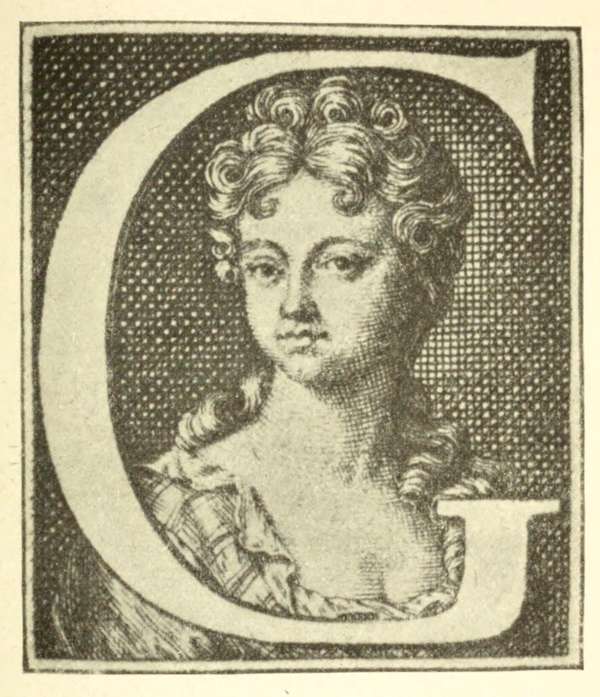
ELIZABETH ELSTOB
From a drawing by herself engraved in an initial for her
translation of The Pastoral of St. Gregory, 1709, and
used also in her Grammar in 1713
The brother of whom Miss Elstob speaks was William Elstob,
who was ten years older than she. At eleven he was sent to
Eton. At sixteen he went to Cambridge, and later to Oxford,
where he was finally, in 1696, elected fellow of University College.
In 1702 he became rector of the united parishes of St.
Swithin and St. Mary Bothaw, in London, where he died in
1715 at the age of forty-two. He was a highly trained linguist,
a great lover of antiquities, and one of the most promising
Anglo-Saxon scholars of his time. He apparently had liberal
sentiments concerning the education of women, so that as soon
as his sister came under his care all her desires for study were
gratified. Just when she went to Oxford is not certain, but it
was probably about the time he took his fellowship, when she
was thirteen. She gives the date of her entrance upon her
Anglo-Saxon studies as 1698, when she was fifteen. In that year
her brother had made a transcript of King Alfred's version of
the Latin historian Orosius which he designed to publish. She
wished to understand it and says, "Having gained the Alphabet,
I found it so easy, and in it so much the grounds of our
present Language, and of a more particular Agreement with
some Words which I had heard when very young in the North,
as drew me to be more inquisitive after Books written in that
Language." Her brother was well pleased and recommended
the Saxon Heptatuch. From this she went on to other treatises,
and finally began to divert herself with taking transcripts of
such ancient manuscripts as she could find.[239] She proved to be
particularly facile with her pen. The copies she made of the
old manuscripts were said to be marvels in the way of beauty
and accuracy of lettering. Her copy of the Textus Roffensis
is described by Nichols as "one of the most lovely specimens
of modern Saxon writing that can be imagined." She was well
received in the University, for Mr. Rowe Mores speaks of her
as "the indefessa comes of her brother's studies, a female
student in the University and a favourite of Dr. Hudson and
the Oxonians."[240] In 1702 she went with her brother to London
and they kept on in their work together with great eagerness
and satisfaction. There gradually grew up in Miss
Elstob's mind a desire to translate and publish some Anglo-Saxon
manuscript. She was encouraged in this not only by
her brother, but by Dr. Hickes, "the great patron of the
Septentrional Studies," who said that by publishing somewhat
in Saxon she might invite "the ladies to be acquainted with
the Language of their Predecessors, and the Original of their
Mother Tongue." The text finally determined upon was the
Homily on the Birthday of St. Gregory. Dr. Hudson, "a man
of so generous a mind as not to discourage learning, even in the
female sex," gave her access to the ancient parchment Book of
Homilies in the Bodleian. The book on St. Gregory appeared
in 1709 under the title, An English-Saxon Homily on the Birth-Day
of St. Gregory: Anciently used in the English-Saxon Church.
Giving an Account of the Conversion of the English from Paganism
to Christianity. Translated into Modern English, with Notes.
It was a stately and dignified volume with a full-page engraving
by Gribelin, and many engraved letters and head and tail
pieces. In the capital "G" of Gregory was a portrait of Miss
Elstob done by herself.[241] The Dedication to Queen Anne apologizes
for using a language so "out-dated and antiquated,"
a language which "few Men and none of the other Sex have
ventured to converse with" since the time when it was the
current speech. But she adroitly pays the necessary compliment
and at the same time recommends her theme, by pointing
out that Anglo-Saxon was the language in which the Pious
Progenitors of Queen Anne had received the Orthodox Faith
of which the Queen was the undoubted Defender. The Preface,
sixty pages long, is a learned account of the introduction of
Christianity into England. In the text the Saxon and English
are in parallel columns, and there is a brave apparatus of notes
and comments. Following the English-Saxon Homily is a
Latin version by William Elstob which he presents to his sister
with the following Latin letter:
Gulielmus Elistobius
ELIZABETHÆ
Sorori suæ carissimæ
S. D.
Dum tu, soror mea dilectissima, Homiliæ Saxonicæ, de gentis nostræ
Conversione paras versionem Anglicam fæminis liberalibus: nonnulli
forte ex amicis nostris, tum Academicis tum aliis, Latinam postulant hominibus
eruditis. Id te velle accomodare venis ad me dicens, bene autem posse
negâsti. Verecundius sane id quam verius. Sed favendum omnino verecundiæ,
præsertim muliebri: maximè autem tuæ, cum in te virtus illa sit
notissima. Quare, quod poscis, dulcis & indefessa studiorum meorum
comes, do tibi Latinè. Non Ciceronianè, ut tu velis, id est ornatè, at non
ineptè tamen: iisdem ferè verbis repositis quæ in Saxonica olim tansfusa,
vel ex Turonensi Gregorio, vel tuo, vel ex Beda nostrate, vel utroque Diacono,
& Johanne & Paulo. Eadem plane ratione, qua jam pridem Orosium
à nobis elucubratum scis, & qua Gregorii tui Curam Pastoralem,
Deo favente, & adjutrice te, Eruditis perlibenter darem. Vale.
Kal. Jun. MDCCIX.
The book was published by subscription and the list of subscribers
is an interesting one. We, of course, find the Anglo-Saxon
scholars, such as Mr. Thwaites[242] and Dr. Hickes, various
Oxonians, the Elstobs of Canterbury and Durham, and others
who were in the same religious or learned circles. Various letters
to Ralph Thoresby[243] show his interest. In March, 1708-09,
she sent him the frontispiece to the Homily saying there would
be other ornaments in the way of borders and letters "which
will make the book somewhat dear, but I would willingly have
it as beautiful as possible." In May, 1709, she thanks him for
procuring "so noble a number of encouragers" to her work.
Nearly half of the two hundred and sixty subscribers are
women. Lady Elizabeth Hastings and Lady Catharine Jones,
Mary Astell's friends, are there; and Lady Winchilsea's
friends, the Thynnes, the Worseleys, and the Thanets, but
not Mary Astell or Lady Winchilsea. The literary set—Pope,
Swift, Gay, Addison, Steele—is not represented.
Women of title, clergymen, and scholars make up the list.[244]
The Preface is of personal as well as learned interest. Miss
Elstob did not enter upon the career of authorship without an
uneasy recognition of the opprobrium she might bring upon
herself by aspirations so unfeminine. She was, in her own mind,
fortified by the elegant Latin treatise in which "Mrs. Anna
Maria à Schurman, that Glory of her Sex," had answered, with
due scholastic form and dignity, the usual objections made by
Gentlemen to Women's Learning, but in deference to the readers
of her Homily she felt the necessity of a few words of self
justification:
For first, I know it will be said, What has a Woman to do with
Learning? This I have known urged by some Men, with an Envy
unbecoming that greatness of Soul, which is said to dignify their Sex....
Where is the Fault in Womens seeking after Learning? why are
they not to be valu'd for acquiring to themselves the noblest Ornaments?
what hurt can this be to themselves? what Disadvantage to
others? But there are two things usually opposed against Womens
Learning. That it makes them impertinent, and neglect their household
Affairs. Where this happens it is a Fault. But it is not the Fault
of Learning, which rather polishes and refines our Nature, and teaches
us that Method and Regularity, which disposes us to greater Readiness
and Dexterity in all kinds of Business. I do not observe it so
frequently objected against Womens Diversions, that They take them
off from Household Affairs. Why therefore should those few among
us, who are Lovers of Learning, altho' no better account cou'd be given
of it than its being a Diversion, be deny'd the Benefit and Pleasure of
it, which is both so innocent and improving.... I shall not enter into
any more of the Reasons why some Gentlemen are so eager to deny us
this privilege: I am more surprised, and even ashamed, to find any of
the Ladies were more violent than they, in carrying on the same
charge. Who despairing to arrive at any eminent or laudable degree
of knowledge, seem totally to abandon themselves to Ignorance,
contenting themselves to sit down in Darkness, as if they either had
not Reason, or it were not capable by being rightly cultivated, of bringing
them into the Light.... Admit a Woman may have Learning, is
there no other kind of Learning to employ her time? What is this
Saxon? What has she to do with this barbarous antiquated Stuff?
so useless, so altogether out of the way?... I fear, if things were
rightly consider'd, that the charge of Barbarity would rather fall upon
those who, while they fancy themselves adorn'd with the Embellishments
of foreign Learning, are ignorant, even to barbarity, of the
Faith, Religion, the Laws and Customs, and Language of their
Ancestors.[245]
It was inevitable that the learning in Miss Elstob's work
should be thought of by many as in reality the work of her
brother. On this point, towards the close of the Preface, she
comments rather ambiguously as follows:
I have been askt the Question, more than once, whether this Performance
was all my own? How properly such a Question may be ask'd
by those who know with whom I live, I shall not dispute: But since
some there are who may have a Curiosity to know the same thing, who
yet suspect the Decency of such a Question: that they may be under
no Uneasiness on this account, they may be pleas'd to understand that
I have a kind Brother, who is always ready to assist and encourage me
in my Studies. I might say much of my Obligations on this account:
wou'd he permit me to express my self at large on that Subject. But
as I think it no shame to me to take any Advice where it may be so
easily obtain'd: so I should think it unpardonable to be guilty of such
a Silence, as might make me seem averse to all Acknowledgement.
After the publication of the Homily on the Birthday of St.
Gregory Miss Elstob made a visit to Canterbury where her
uncle was prebendary. The number of Canterbury names in
her list of subscribers shows that her fame for learning had
preceded her. She was very favorably received, especially by
some ladies of rank, one of whom expressed a desire to study
Anglo-Saxon under her direction. In pursuance of this project
Miss Elstob began at once on the preparation of an Anglo-Saxon
Grammar.[246] In 1715, when the Grammar finally appeared,
Miss Elstob wrote thus in a Preface addressed to Dr. Hickes:
I was more particularly gratified with the new Friendship and Conversation,
of a young Lady, whose Ingenuity and Love of Learning is
well known and esteem'd, not only in that Place, but by yourself: and
which so far indear'd itself to me, by her promise that she wou'd learn
the Saxon Tongue, and do me the Honour to be my Scholar, as to make
me think of composing an English Grammar of that Language for her
use. That Ladies Fortune hath so disposed of her since that time, and
hath placed her at so great distance, as that we have had no Opportunity,
of treating farther on this Matter, either by Discourse or Correspondence.
However, though a Work of a larger Extent, and which
hath amply experienced your Encouragement, did for some time make
me lay aside this Design, yet I did not wholly reject it.... But considering
the Pleasure I my self had reaped from the Knowledge I have
gained from this Original of our Mother Tongue, and that others of
my own Sex might be capable of the same Satisfaction: I resolv'd to
give them the Rudiments of that Language in an English Dress.
The long Preface to the Grammar is chiefly taken up with an
attack on John Brightland, author of the Whole System of English
Education, and other wise grammarians who had spoken
lightly of Anglo-Saxon and especially of the Thesaurus of Dr.
Hickes. One of the aspersions cast by the gentlemen on their
mother tongue was that the Northern Languages "consist of
nothing but Monosyllables," and Miss Elstob plunges into a
lengthy defense of monosyllables with so many quotations
from English verse as to show that being "mistress of eight
foreign languages" did not prevent her from being exceedingly
well read in the poetical literature of her own tongue. This
portion of the Preface is followed by a diatribe against those
who consider the study of antiquities and of the Saxon tongue
as belonging to a lower order of mind, and not contributing to
a "just stile" as do the classics.[247] This topic, also, is illustrated
by literary characterizations so numerous and apt as to show
wide and discriminating reading in English prose.[248]
Miss Elstob was a redoubtable champion in the cause of
Anglo-Saxon learning. At the beginning of her career, in 1709,
just as her Homily on the Birthday of St. Gregory was coming
from the press, Swift had spoken of her as one of the Professors
in the College of Madonella, ascribing to her the publication
of "two of the choicest Saxon novels, which are said to have
been in as much repute at Queen Emma's Court, as the 'Memoires
from the New Atalantis' are with those of ours."[249] This
disparaging allusion may have predisposed Miss Elstob to
answer Swift with exceptional energy when he ranged himself
with the scorners of Anglo-Saxon learning. In 1737 Mr. Ballard,
in expressing surprise at the appearance of some new opponent
of Saxon, wrote: "Indeed I thought that the bad success Dean
Swift had met with in this affair from the incomparably learned
and ingenious Mrs. Elstob, would have deterred all others from
once opening their mouths on this head."[250]
The Homily and the Grammar gave Miss Elstob, at thirty-two,
a distinguished place in the world of scholarship. She had
also shown unusual skill with her pencil. Not only were her
transcripts of manuscripts noted for their beauty, but she also
drew admirable portraits. In 1737 Mr. Ballard wrote Mr.
Joseph Ames:
I design, if possible, to make a tour to London this Winter, just to
peep upon a few choice friends, and will bring Miss Elstob's Life of
her Brother along with me, to pleasure you with. But you must be
silent in the affair, for some particular reasons not proper here to be
mentioned. Besides the above mentioned Life, I have a dozen pieces
of this fine accomplished gentlewoman's drawings, amongst which
are pictures of herself, Dr. Hickes, Mr. Dryden, and Johannes Ogilvius,
etc. very masterly done, and, as I am told, very extraordinary
true likenesses.[251]
We get no further completed work from Miss Elstob after the
Grammar of 1715, but the six years between the Homily and the
Grammar were rich in study and plans. In February, 1708-09,
Mr. Thoresby wrote to Dr. Richardson:
Amongst the Authors, I might have mentioned some of the female
sex; as the Bishop of Sarum's lady, and Miss Elstob; the former has
writ a Method of Devotion, the latter translated a piece of Mons.
Scudery from the French, and added some of her own: and is for giving
us a more correct Edition of Sir John Spelman's Saxon Psalms, in
which tongue she is a great proficient, and has writ that in my Album,
etc.[252]
The "work of larger extent" for which Miss Elstob temporarily
set aside her Grammar was the proposed publication of a
Saxon Homilarium with English translations and notes. That
this Homilarium, which was to have been her great work, was
well under way by 1712 is indicated by the following letter,
December 23, 1712, from Dr. Hickes to Dr. Charlett:
I suppose you may have seen Miss Elstob, sister to Mr. Elstob, formerly
fellow of your Coll. and the MSS. she hath brought to be printed
at your press. The University hath acquired much reputation and
honour at home and abroad, by the Saxon books printed there, as well
as by those printed in Latin and Greek, and the publication of the
MSS. she hath brought (the most correct I ever saw or read) will be of
great advantage to the Church of England against the Papists; for the
honour of our Predecessors the English Saxon Clergy, especially of
the Episcopal Order, and the credit of our country to which Miss Elstob
will be counted abroad as great an ornament in her way, as Madam
Dacier is to France. I do not desire you to give her all encouragement,
because I believe you will do it of your own accord from your natural
temper to promote good and great works. But I desire you to recommend
her, and her great undertaking to others, for she and it are both
very worthy to be encouraged, and were I at Oxford, I should be a
great solicitor for her. And had I acquaintance enough with Mr. Vice-Chancellor
I had troubled him with a letter in her behalf. I will add
no more but to tell you that the news of Miss Elstob's encouragement
at the University will be very acceptable to me, because it will give
her work credit here, where it shall be promoted to the utmost power
by your Philo-Sax. and Philo-Goth. and most faithful, humble Servt.[253]
In February, 1713, Bedford wrote to Mr. Hearne: "I am to
desire yo from him to give all ye assistance & encouragement yo
can to Mrs. Elstob's work, who is now going down to ye University
again abt it."[254] Mr. Hearne responded in March: "I
wish Mrs. Elstob good success. Tho' if she meet with no better
Encouragement here than I have done as yet 't will not be
great."[255]
In the same year Mr. Bowyer printed "Some Testimonies
of Learned Men in favour of the intended edition of the Saxon
Homilies, concerning the learning of the author of those
Homilies, and the advantages to be hoped from an edition of
them."[256] And three letters from Miss Elstob to the Lord
Treasurer show that he solicited and obtained the Queen's
Bounty towards printing the Homilies.[257]
In spite of all this encouragement the publication of the
Homilies hung fire for many months. It is possible that the
death of Mr. Elstob and of Dr. Hickes in 1715 delayed matters
by depriving Miss Elstob of able advocates and counselors.
In July, 1716, Sir P. Sydenham indicates his concern that the
book had not yet appeared.[258] In November of that year Mr.
T. Baker writes apologetically to Mr. Hearne that he is "deep
in Mrs. Elstob and Mr. Strype," and that the work does not
admit of haste.[259] Later in the same month Mr. Hearne gives
the cheering news that "Mrs. Elstob's book is going on at
last."[260] But only five of the Homilies were actually printed off
at Oxford.[261] The great scheme failed for want of money. Miss
Elstob's own fortune was apparently involved, for in 1718 Mr.
T. Baker wrote to Hearne that Miss Elstob was "lately gone
off for debt."[262]
Except these few facts concerning the Homilies very few
details are known concerning Miss Elstob's life after 1715.
Bishop Smalridge[263] aided her for a time, but she could not endure
the thought of being a burden on her friends, and she finally
went to Evesham, Worcestershire, where she started a little
school. Mr. Tindale, in his History of Evesham, says that he
was credibly informed that her weekly stipend in this school
was at first but a groat a week. She was in this very contracted
and difficult way of life for nearly twenty years. When relief
came it was as the result of the efforts of an obscure young
Anglo-Saxon scholar, Mr. George Ballard, a lady's-stay-maker,
who became acquainted with Miss Elstob and described
her situation so effectively to one of his customers, a Mrs.
Chapone, that this lady wrote a circular letter representing
Miss Elstob's extensive learning, her service to literature, her
multiplied distresses, her meekness and patience, and sent it to
the neighboring gentry. An annuity of twenty guineas was
raised, and Miss Elstob was enabled to keep an assistant so that
she could again "taste of that food of the mind from which she
had been so long oblig'd to fast."
Another result of Mrs. Chapone's letter was a possible appointment
for Miss Elstob as mistress of a charity school kept
up by Lady Elizabeth Hastings. With regard to this plan Miss
Elstob wrote the following very interesting letter to Mr.
George Ballard:
Since you desire to know if I have accepted Mrs. Capon's proposal, I
do, though I am very sensible it is not commendable to expose a private
correspondence, venture to communicate to so good a friend, a
copy of the worthy gentleman's letter, sent her in answer to her vastly
kind recommendation of me, and the charming letter she sent to me.
In answer to hers, after I had received your answer, I assured her of my
readiness to serve that excellent lady, as far as lyes in my power. But
there are some things to be taught in such a school, which I cannot pretend
to: I mean, the two accomplishments of a good housewife, spinning
and knitting. Not that I would be thought to be above doing any
commendable work proper for my sex; for I have continually in my
thoughts the glorious character of a virtuous woman, Proverbs
XXXI, 13; "She seeketh wool and flax, and worketh willingly with her
hands." And as an instance of the truth of this, the gown I had on
when you gave me the favour of a visit was part of it my own spinning,
and I wear no other stockings but what I knit myself: yet I do not
think myself proficient enough in these arts to become a teacher of
them. As to your objection on the meanness of the scholars, I assure
you, Sir, I should think it as glorious an employment to instruct those
poor children, as to teach the children of the greatest. But I must tell
you that mine may be termed a life of disappointments from my
cradle till now, nor do I expect any other while I live. This, and hearing
no more of that affair, makes me think her ladyship is provided with
a mistress before now, there being many more deserving than myself,
that are in want of such an employment. Nor do I repine; for I am
so inured to disappointments, that I expect nothing else, and I receive
them with as much easiness as others do their greatest prosperity....
I often compare myself to poor John Tucker, whose Life I read when a
girl in Winstanley's Lives of the Poets, which affected me so much
that I cannot forget it yet. He is there described to have been an
honest, industrious, poor man, but, notwithstanding his indefatigable
industry, as the author writes, "no butter would stick on his bread."[264]
The Mrs. Chapone who wrote the circular letter concerning
Miss Elstob was Sarah Kirkham, an intimate girlhood friend
of Mary Granville, afterward Mrs. Pendarves, but better
known as Mrs. Delany. Sally Kirkham is described by Mrs.
Delany as a girl of "extraordinary understanding, lively imagination,
and humane disposition," of "uncommon genius and
intrepid spirit." In 1725, at the age of twenty-four she married
the Reverend John Chapone, and they went to live in Stanton,
Gloucestershire, and little more is heard of her until the writing
of this letter before 1734. Mrs. Chapone meant the letter for
the neighboring gentry, but it finally reached a more distinguished
audience. Mrs. Pendarves writes:
I told you in my last I had left Sally's letter with Mrs. Pointz.
She gave it to her husband, who desired the Duke to read it to the
Queen. The Queen was so touched with the letter that she immediately
sent for Mrs. Pointz, to inquire into some more particulars about the
person mentioned in it, and the person who wrote it. Mrs. Pointz said
she knew no more than what the letter told, but that Mrs. Chapone
was a friend of ours. The Queen said she never in her life read a
better letter, that it had touched her heart, and ordered immediately
an hundred pounds for Mrs. Elstob, and said she "need never fear a
necessitous old age whilst she lived, and that when she wanted more
to ask for it, and she should have it." I think this was acting like a
queen, and ought to be known.... I hope this may be the means of
serving our friend Sally, the letter was the whole discourse of the drawing-room.
The Queen asked the Duke "When he should be able to
write such a letter." He answered, honestly, "Never." Mrs. Pointz has
asked many particulars about Mr. Chapone, and I did him justice.[265]
Queen Caroline's interest was so genuinely aroused that she
not only ordered the £100 to be at once sent to Miss Elstob,
but promised to repeat the same every five years. This was
evidently with the idea that she should be taken from the little
school at Evesham and put into her proper station as "mistress
of a boarding-school for young ladies of a higher rank." Such
might have been the outcome had not the money lapsed with
the death of the Queen in 1737.
All plans for Miss Elstob seemed to end in failure till "Sally's
historical epistle," as Mrs. Pendarves called it, was sent to the
Duchess of Portland at Bulstrode.[266] The result in this case
was of permanent value, for Miss Elstob was invited by the
Duchess to make her home at Bulstrode as instructor of the
children. Of this appointment Mrs. Pendarves wrote, December
12, 1738, to her mother:
The Duchess has now a thousand fears, lest my Lord and Lady Oxford
should have any objections against taking her, but I hope they
will all prove false.... Mrs. Elstob seems, out of modesty and diffidence
of herself, to decline coming, but it would be most imprudent
of her to decline such an offer, when no fatigue will be imposed upon
her, but all imaginable care will be taken of her. I own I long to have
you see her, that I may really know what sort of woman she is. My
Lord Oxford objects to her not speaking French, but the Duchess
answers she shall have a master for that, or a maid to talk, and all she
requires and hopes of Mrs. Elstob is to instruct her children in the
principles of religion and virtue, to teach them to speak, read, and
understand English well, to cultivate their minds as far as their
capacity will allow, and to keep them company in the house and when
her health and strength will permit to take the air with them. All this
she is surely well qualified to do, and it would be a sincere joy to me
to have our worthy Duchess possest of so valuable a person.[267]
Ten days later Mrs. Pendarves wrote again from Bulstrode:
The Elstobian matter is quite fixed, and she expressed the utmost
satisfaction at having secured such a worthy woman to educate her
children; I wrote last post to Mrs. Elstob to tell her that the Duchess
looked on her as engaged to her, and that her salary should begin on
Xmas Day next, though she could not conveniently take her into her
family till Midsummer. I hope she will write to the Duchess, and suppose
she will of course; I gave her a little hint but would not have it
mentioned that I did.... I think your advice to Mrs. Elstob quite right
about paying debts; a person of such principles as hers cannot enjoy any
advantages without doing that justice when it is in her power to do it.[268]
In August, 1739, Miss Elstob was in Evesham and several
times met her benefactor, Mrs. Chapone, of whom she gives
a lively picture showing that letter-writing was not Mrs. Chapone's
only title to fame. Miss Elstob writes:
The last time she was here, I had an exceeding pleasure, though not
without some concern, at hearing a long and warm dispute between
that charming woman, and Mr. Ben Seward, on some methodistical
notions, in which it was by better judges than myself agreed that the
female antagonist had much the advantage over him.[269]
Miss Elstob spent the remaining seventeen years of her life
with the Duchess of Portland. They were comfortable, leisurely,
studious years, a delightful haven after her twenty years
of hardship, penury, and intellectual starvation. But she was
fifty-six when she went to Bulstrode, and the ease and security
of her life there came too late to rouse into life the mental activity
so long dormant. Miss Elstob's real life was the twenty
years with her brother, years of plain living and high aspirations
while they worked together in the realms of pure scholarship.
It would be difficult to find a more satisfying example of literary
comradeship than that offered by the learned young curate and
the learned young sister, the "dulcis & indefessa comes" of his
studies.[270]
Elizabeth
Blackwell
(fl. 1739)
In 1739 Mrs. Elizabeth Blackwell published in two folio
volumes A Curious Herbal, containing Five Hundred
Cuts, of the most useful Plants, which are
now used in the Practice of Physick, engraved on
folio Copper Plates, after Drawings taken from the Life, by
Elizabeth Blackwell. To which is added, a short Description of
the Plants and their common Uses in Physick. Printed for John
Nourse at the Lamb without Temple Bar. The first of these
magnificent volumes is dedicated to the famous Dr. Richard
Mead, "Physician to Kings," as the one who first advised the
publication of the work. The dedication of the second volume is
to Isaac Rand, an apothecary and Fellow of the Royal Society,
and Curator of the Botanical Garden at Chelsea, as the one to
whom she went for assistance in all difficult botanical questions.
The short descriptions of the plants were taken mainly from
Mr. Joseph Miller's Botanicum Officinale with his consent. She
lived near the Botanical Garden and made all her drawings
from life. She also etched them on copper, and colored them
herself. The book received high recognition. Much of the
work must have been done by 1735, for on October 1 of that
year the following testimonial, now one of the title-pages, was
written:
We whose names are underwritten, having seen a considerable
Number of the Drawings from which the Plates are to be engraved,
and likewise some of the Coloured Plants, think it a Justice done the
Publick to declare our Satisfaction with them, and our good Opinion
of the Capacity of the Undertaker.
R. Mead, M.D.
G. L. Tessier, M.D.
Alexander Stuart, M.D.
Ia. Douglas, M.D.
James Sherard, M.D.
W. Cheseldon
Joseph Miller
Isaac Rand
Rob. Nicholls
This statement was repeated in French and the names again
signed.
A further endorsement on the completion of the book was
dated July 1, 1737. It is as follows:
Imagines hasce Plantarum Officinalium per Dominam Elizabetham
Blackwell delineatas ceri incisas & depictas, iis qui Medicinæ Operam
dant, perutiles fore judicamus.
| | Thomas Pellet, Præs. |
| Henricus Plumptre | } | Censores. |
| Richardus Tyson | } |
| Peircuis Dod | } |
| Gulienius Wasey | } |
In 1757-73 there was a fine republication of the work in
Nuremberg with an addition of a hundred plants, and a highly
laudatory Preface. The work was recognized at once as of
great practical value because of the accuracy of the drawings
and the large number of plants represented. The charm of the
plates is beyond question so far as delicacy of outline and
beauty of coloring are concerned. They are superior to the
plates in Darwin's Botanic Garden, nearly half a century later.
The Blackwellia race of plants was named after Mrs. Blackwell
in recognition of her admirable work.[271]
Mrs. Blackwell is herself an enigma. She emerges into public
notice for three years, but her life before and after sinks into
obscurity. She was said to be "a virtuous gentlewoman,
daughter of a worthy merchant," who gave her a handsome
portion. Her husband was Alexander Blackwell, a printer.
He was a well-educated and able man, but generally counted
an adventurer. He at one time entered upon a project of conducting
a printing establishment of his own. His failure in this
landed him in a debtor's prison where he was confined several
years. Mrs. Blackwell's Herbal was made by her for the purpose
of securing his release. He is said to have aided her in the foreign
terminology and in the abridgments from Miller. When he
was free her object was accomplished and we hear of no further
work. It would be interesting to know how she came to have
so much skill. It would be more interesting to know the psychology
of her prompt abandonment of work by which she won both
fame and money, and in which she took such evident delight.[272]
Mrs. Elizabeth
Cooper
(fl. 1735-40)
It is to be regretted that so few facts are accessible concerning
Mrs. Elizabeth Cooper. Her works seem to
offer interesting points of departure for investigation
into her life and education, but we know
little about her except that her literary ventures belong between
1735 and 1740. She was the wife of Thomas Cooper,[273]
who was either an auctioneer or a book-seller, or possibly both,
and she was married before 1735. Beyond these meager facts
our knowledge of her must be gleaned from her books. Apparently
her first literary venture was a comedy. It was entitled
The Rival Widows; or, the Fair Libertine, and was brought out
at the Covent Garden Theater in 1735. It had a successful run
of nine nights. Baker says that "allowing for the too common
freedom of female dramatists, this is far from a bad comedy."[274]
Genest, after briefly outlining the play and commenting on
various passages that seem to him borrowed from preceding
dramatists, says: "It is on the whole a tolerable play, but it
wants incident sadly." But he does not agree with Baker as to
the moral tone of the play, for he says of Lady Bellair, the heroine,
"Lady Bellair is gay and extravagant, but of good principles
at bottom ... it is with much impropriety that she is
called a Fair Libertine—she is only above vulgar prejudices."[275]
In her preface to the play Mrs. Cooper says that it was designed
"an Offering to the Sex" in that the chief character is
a woman "capable of thinking for herself, and acting on the
principles of Nature and Truth." Some indications of the
characteristics of Lady Bellair may be found in the fact that
Mrs. Horton was chosen to create the part. Millamant in
Congreve's Way of the World, Lady Dainty in Burnaby's The
Reform'd Wife, Lady Betty Modish in Cibber's Careless Husband,
and Lady Townly in his Provoked Husband, were the parts in
which Mrs. Horton's beauty and her elegance of dress and
manner found their fitting opportunity. Lady Bellair belongs
evidently to this class of fine lady coquettes, and a further
point of interest concerning Mrs. Cooper is that on her benefit
night she herself played the part of Lady Bellair. Either
Mrs. Cooper had already shown enough ability as an amateur
actress to warrant her appearance on the stage of one of the
leading theaters, or she was well enough known as a writer or
as a personality to make her presence in the cast a drawing
card. That she could venture on the inevitable comparison
with Mrs. Horton may indicate some possibilities in the way of
her own attractive qualities. And it is to be further noted that
she "unexpectedly and surprizingly" eclipsed Mrs. Horton.
The Prompter endeavors to explain Mrs. Cooper's success by
saying that she "looked" the character and represented with
great "naturalnes," the somewhat bold and libertine heroine.[276]
Mrs. Cooper's second dramatic attempt was a tragedy which
was not successful. It was acted but one night and was never
printed.
This theatrical work was, however, only on the fringe of
Mrs. Cooper's real interest. In 1737 she published a book entitled
The Muses Library; Or, a Series of English Poetry, from the
Saxons, to the Reign of King Charles II containing, The Lives and
Characters of all the known Writers in that Interval, the names of
their Patrons; Complete Episodes, by way of Specimen of the
larger Pieces, very near the intire works of some, and large Quotations
from others. Being a General Collection of almost all the old
valuable Poetry extant, now so industriously enquir'd after, tho'
rarely to be found, but in the Studies of the Curious, and affording
Entertainment on all Subjects, Philosophical, Historical, Moral,
Satyrical, Allegorical, Critical, Heroick, Pastoral, Gallant, Amorous,
Courtly and Sublime. But one volume of this projected work
was published. The early Georgian public was not trained to
an interest in the past. Mrs. Cooper suffered the not infrequent
fate of pioneers. There was even difficulty in working
off one edition of the first volume, as is evident from its appearance
in 1738 and 1741 with changed title-pages.[277] That Mrs.
Cooper expected to publish the second volume, including the
poets from Samuel Daniel to the time of Charles II, is shown
not only by the statement in her Preface, but by interesting
notes in the Diary of William Oldys (1696-1761), the famous
antiquary. In 1736 he was in London employed in seeing
through the press a new edition of Raleigh's History of the
World. His Chambers were in Gray's Inn and he was frequently
consulted there "on obscure and obsolete writers by
eminent men of letters." Two of the people in whom he was
particularly interested were Thomas Hayward, who was compiling
his British Muse, and Mrs. Cooper. In his Diary are the
following records:
1737, June 22. Mrs. Cooper came to my chambers: said she would
return Puttenham's Art of Poesy, Browne's Pastorals, and Sir Henry
Wotton, when she had finished her extracts for the second volume of
her Muses' Library to be published by Christmas.
July 4, Monday. Returned Sir T. More's works: some of his English
poetry therein might be for Mrs. Cooper's work, or Mr. Haywards,
on Fortune, etc.
Aug. 13. Rec'd letter from Mrs. Cooper to borrow old Marlowe's
poem of Hero and Leander for the continuation of her Muses' Library;
sent by the servant a very scarce collection of old poetry, called The
Paradise of Dainty Devices, in which are several pieces by the old
Lord Vaux in King Henry the Eighth's time, the Earl of Oxford, Sir
W. Raleigh, Mr. Edwards, Jasper Haywood, Hunis, Churchyard,
Kinwelmarsh, Lloyd, Whetstone, etc., printed 4o. 1578. To borrow
one of Caxton's books of Sir Hans Sloane and remember to apply the
story of Absyrtus in the preface for Mr. Hayward's Collection of select
thoughts from our old poets.[278]
Mrs. Cooper frequently comments on the difficulty and expense
of gathering material for her enterprise and gratefully
acknowledges "the generous Assistance of the Candid Mr.
Oldys." Biographical data were also obtained only through
most patient effort. The only Lives of the Poets to which she
could have access were Wood's Athenæ Oxoniensis and the
works of Phillips, Winstanley, and Jacob. Edward Phillips's
Theatrum Poetarum appeared in 1675. Its first volume gave
brief biographical and critical notes on sixty-four authors from
Robert of Gloucester to George Chapman, thus covering about
the same ground as Mrs. Cooper's first volume which closes
with Samuel Daniel. William Winstanley's Lives of the English
Poets was published in 1687. It includes notes on poets from
William the Conqueror to James II with occasional brief illustrative
extracts. The Poetical Register of Giles Jacob (1724) is,
in the first volume, confined to dramatists and is based on
Langbain. The second volume, The Lives and Characters of the
English Poets, extends about a century and a quarter later than
Mrs. Cooper's volume. In the period before 1600 about half
the names in her volume are included and briefly commented
on. Jacob also gives an occasional extract.
Mrs. Cooper was not, then, without predecessors in her undertaking.
The novelty in her book was her assumption that
people would not only like to know about the old poets, but
that there would be many lovers of literature who would rejoice
in reading the old poems, and very nearly in their original
antiquated form. She gives ten pages from Langland, eleven
from Barclay, twenty-eight from Sackville, twenty-four from
Churchyard, thirty-five from Fulke Greville, thirty-one from
Fairfax, and so on. Chaucer, Spenser, and Shakespeare are less
fully represented, as being already well known. The selections
are the result of wide reading and are made because they
pleased Mrs. Cooper's own taste. "What has given me Pleasure
in my Closet," she says, "I have undertaken to recommend
to the Publick; not presuming to inform the Judgment, but
only awaken the Attention." That she failed to "awaken
Attention" was the fault of the age. Her selections were representative
and interesting.
Mrs. Cooper's book shows not only wide research and a full
knowledge of extant criticism, but it also manifests a personal
zest in reading and an unusual independence of literary judgment.
This independence is shown in her choice of authors.
Phillips, Winstanley, and Jacob had omitted Langland, but she
says, "In my Judgment, no Writer, except Chaucer, and
Spenser, for many Ages, had more of real Inspiration." Or take
the case of Lydgate. Phillips mentions him, but not, apparently,
from any personal knowledge of his work. Winstanley
and Jacob praise him highly. Mrs. Cooper says of him: "Many
Authors are so profuse in his Praise as to rank him very little
below his Master, and, often, quote them together; which
rais'd my Curiosity so high, that I gave a considerable Price for
his Works, and waded thro' a large Folio, hoping still to have
my Expectation gratified.... But I must, either confess my
own want of Penetration, or beg leave to dissent from his
Admirers." She gives a long quotation from Lord Brook's
A Treatise of Humane Learning, because his name has "never
yet received the Honours it deserved." She is indignant at the
general indifference to the work and fame of Edward Fairfax
and writes a eulogy of several pages. Her comments on
Chaucer, Spenser, and Shakespeare are brief, since all agree on
their preëminence. Mr. Lounsbury, after noting one or two
errors in the book, says of it: "I know of no similar work produced
at that period in which the knowledge displayed is so
accurate and comprehensive, or the critical estimates so uniformly
good and just. There was exhibited in it not merely
freshness of judgment but the independence that springs from
the study of writers at first hand."[279] Mrs. Cooper had in her
the making of a scholar. She allowed herself no generalities.
Whatever she said was based on a thorough study of the material
under discussion. Furthermore, she acquainted herself
with all extant critical opinion without thereby losing the
power to form an opinion of her own.
Mrs. Cooper's Preface is an excellent, even an eloquent, piece
of writing, in justification of poets as a nation's glory. She
recognizes that "Merit is not its own Preservative" and wishes
in her book to set up if possible "a Bulwark which shall preserve
Merit from the attacks of Time." She considers her
"Series of Poetry (which has never been aim'd at anywhere
else) ... one of the most valuable collections that ever was
made publick." She has no apologies to make. In introducing
to the moderns this august company of ancient poets she is
saved from any possible self-consciousness by the dignity of
her enterprise. The same tone pervades her Dedication. No
single name is glorious enough to appear at the head of her list.
She chooses rather a dedication to "the truly Honourable Society
for the Encouragement of Learning."[280] That Society was
then in the hey-day of its brief glory. Mrs. Cooper had, apparently,
no thought of personally benefiting by her Dedications.
On the contrary she counted this an opportunity to express
what all authors and lovers of literature must feel towards a
design "so great, seasonable, and humane" as that of this new
organization, a design applauded by "all who have Generosity,
Benevolence or Politeness."
As dramatist and actress Mrs. Cooper would deserve at least
passing mention, but as a scholar, as an ardent advocate of
early English poetry, she must take high rank, not only among
the learned women, but also among the learned men of her day.
Lady Mary
Wortley Montagu
(1689-1762)
No woman of the first half of the eighteenth century had
a more active mind or facile pen than Lady
Mary Wortley Montagu. Although almost
none of her work appeared in print in her lifetime,
her personality made its own way, and she was early recognized
as of note for genius and learned acquirements. It is,
therefore, of especial interest to inquire into the particulars of
her education, and to find out her status as a woman of letters.
The materials for such an inquiry are fairly abundant, and
are mainly: her miscellaneous letters, first published in 1803;
a fragmentary autobiographical romance, of which she says
"not a sillable" except the names is feigned; and the Introductory
Anecdotes by her granddaughter, Lady Louisa Stuart,[281]
included in Lady Mary's Letters and Works brought out by
Lord Wharncliffe, her great-grandson, in 1887. The important
groups of letters containing personal details are those written
to Mr. Montagu from about 1709 till their marriage in 1712,
and the very large group to her family and friends, chiefly to
Lady Bute, her daughter, during Lady Mary's stay in Italy
from 1739 to 1761.
Lady Mary's mother died when she was eight, and her father,
too much a man of pleasure to trouble himself with the education
of girls, gave his three young daughters into the care of
"an old governess, who, though perfectly good and pious,
wanted a capacity for so great a trust."[282] In commenting on
the evil effects of an ignorant education, Lady Mary said:
"My own was the worst in the world, being exactly the same as
Clarissa Harlowe's; her pious Mrs. Norton so perfectly resembling
my governess, who had been nurse to my mother. I could
almost fancy the author was acquainted with her. She took so
much pains from my infancy, to fill my head with superstitious
tales and false notions, it was none of her fault I am not at this
day afraid of witches and hobgoblins, or turned methodist."[283]
But at least there were no hindering home influences, and Lady
Mary had what Charles Lamb would call the luck to be "tumbled
early into a closet of good old English books." Forsaking
the dolls of her sisters she took refuge in her father's fine library
and there she read with the absorption of a youthful Coleridge.
She "got by heart all the poetry that came in her way,"
and she "read every romance as yet invented." Lady Louisa
says she "possessed and left after her, the whole library of
Mrs. Lenox's Female Quixote—Cleopatra, Cassandra, Clelia,
Cyrus, Pharamond, Ibrahim, etc., etc.—all, like the lady
Arabella's collection, 'Englished,' mostly, 'by persons of honour.'
The chief favourite appeared to have been a translation of
Monsieur Honoré d'Urfé's Astrea, once the delight of Henri
Quatre and his court, and still admired and quoted by the
savans who flourished under Louis XIV. In a blank page of this
massive volume (which might have counterbalanced a pig of
lead of the same size) Lady Mary had written in her fairest
youthful hand the names and characteristic qualities of the
chief personages thus:—the beautiful Diana, the volatile
Climene, the melancholy Doris, Celedon the faithful, Adamas
the wise, and so on; forming two long columns."[284] Among
Lady Mary's earliest attempts at authorship were romantic
stories in imitation of these her favorite authors.
But along with her romances, and soon superseding them,
were sterner studies. She early began to teach herself Latin.
In her account of herself under the name Lætitia, she said:
Her appetite for knowledge increasing with her years, without considering
the toilsome task she undertook, she began to learn herself
the Latin grammar, and with the help of an uncommon memory and
indefatigable labour, made herself so far mistress of that language as
to be able to understand almost any author. This extraordinary
attachment to study became the theme of public discourse. Her
Father, though no scholar himself, was flattered with a pleasure in the
progress she made, and this reputation which she did not seek (having
no end in view but her own amusement) gave her enviers and consequently
enemies among the girls of her own age.
Lady Mary was but fourteen when her "just and knowing"
criticism of a play, her knowledge of Latin, and her relish for
the classics, excited the wonder and admiration of Mr. Wortley
Montagu. He was as amazed "as if he had heard a piece of
wax work talk."[285] But the envy of her girl companions and
the liberal praise of Mr. Wortley are not the only proofs that
Lady Mary's shining talents and learned tastes met early recognition.
Her uncle, Mr. William Fielding, "perceived her
capacity, corresponded with her, and encouraged her pursuit of
information." Bishop Burnet showed himself most friendly,
and condescended to direct her studies. Mr. Wortley also kept
up a kind of scholarly guidance. Lady Mary said to Spence in
Rome in 1741: "When I was young I was a great admirer of
Ovid's Metamorphoses, and that was one of the chief reasons
that set me upon the thoughts of stealing the Latin language.
Mr. Wortley was the only person to whom I communicated my
design, and he encouraged me in it. I used to study five or six
hours a day for two years in my father's library; and so got
that language, whilst everybody else thought I was reading
nothing but novels and romances."[286] By the time she was
twenty Italian had been added to her accomplishments. In
an early undated letter to Mrs. Hewet she wrote: "I have begun
to learn Italian, and am much mortified I cannot do it of
a signor of Monsieur Resingade's recommendation; but 'tis
always the fate of women to obey, and my papa has promised
me to a Mr. Cassotti. I am afraid I shall never understand it
as well as you do." By 1710 she was quoting Italian verse, and
in the following year she corresponded with Mr. Resingade in
Italian. That she was still working under Mr. Cassotti in
1712 is apparent from her request that Mr. Wortley should
send one of his letters to her under the care of Mr. Cassotti, her
"Italian master." At this period, or a little later, she also
learned French, so that she wrote letters and essays in that
language. Her continued devotion to study is shown by a letter
from Thoresby to Anne Wortley in 1709: "I am now so much
alone, I have leisure to pass whole days in reading.... My
study is nothing but dictionaries and grammars. I am trying
whether it be possible to learn without a master; I am not certain
(and dare hardly hope) I shall make any great progress;
but I find the study so diverting. I am not only easy, but
pleased with the solitude that indulges it."[287]
Lady Mary's diligence resulted in 1710 in a translation of the
Latin version of the Enchiridion of Epictetus which she sent to
Bishop Burnet with a notable letter. Of the translation she
says: "Here is the work of one week of my solitude—by the
many faults in it your lordship will easily believe I spent no
more time upon it; it was hardly finished when I was obliged to
begin my journey, and I had not leisure to write it over again.
You have it here without any corrections with all its blots and
errors." Bishop Burnet returned the document with emendations
which in the present printed form are given in italics.[288] In
spite of the numerous changes suggested as closer to the original,
the translation remains as a remarkable production for a self-educated
girl of twenty. Even more remarkable as evidencing
maturity of thought and command of an admirable English
style is the letter, which is of particular significance in connection
with the contemporary attitude towards the learned woman:
My sex is usually forbid studies of this nature, and folly reckoned
so much our proper sphere, we are sooner pardoned any excesses of
that, than the least pretensions to reading or good sense. We are permitted
no books but such as tend to the weakening and effeminating
of the mind. Our natural defects are every way indulged, and it is
looked upon as in a degree criminal to improve our reason, or fancy
we have any. We are taught to place all our art in adorning our outward
forms, and permitted, without reproach, to carry that custom
even to extravagancy, while our minds are entirely neglected, and,
by disuse of reflections, filled with nothing but the trifling objects our
eyes are daily entertained with. This custom, so long established and
industriously upheld, makes it even ridiculous to go out of the common
road, and forces one to find as many excuses as if it was a thing
altogether criminal not to play the fool in concert with other women
of quality, whose birth and leisure only serve to render them the most
useless and most worthless part of the creation. There is hardly a
character in the world more despicable, or more liable to universal
ridicule, than that of a learned woman: those words imply, according
to the received sense, a tattling, impertinent, vain, and conceited
creature. I believe nobody will deny that learning may have this
effect, but it must be a very superficial degree of it. Erasmus was
certainly a man of great learning and good sense, and he seems to have
my opinion of it when he says, Fæmina qui (sic) vere sapit, non videtur
sibi sapere; contra, quæ cum nihil sapiat sibi videtur sapere ea demum
bis stulta est. The Abbé Bellegarde gives a right reason for women's
talking overmuch: they know nothing, and every outward object
strikes their imagination, and produces a multitude of thoughts, which,
if they knew more, they would know not worth their thinking of. I am
not now arguing for an equality of the two sexes. I do not doubt God
and nature have thrown us into an inferior rank; we are a lower part
of the creation, we owe obedience and submission to the superior sex,
and any woman who suffers her vanity and folly to deny this, rebels
against the law of the Creator, and indisputable order of nature:
but there is a worse effect than this, which follows the careless education
given to women of quality, its being so easy for any man of sense,
that finds it either his interest or his pleasure, to corrupt them.[289]
In 1712 Lady Mary married Mr. Wortley Montagu, in 1713
her son was born, and in 1715 she started with her husband on
their journey to Turkey. The six years between the Enchiridion
and the Embassy present Lady Mary to us in an enviable position.
The reputation of her youth was augmented. "The
wittiest as well as one of the most beautiful women of her day,
she numbered among her admirers the most powerful of the
statesmen, and the most brilliant of the littérateurs; while, for
a time at least she was a favourite at the rival Courts of the
King and the Prince of Wales."[290] The only literary output of
this period is a long, rather stilted and perfunctory criticism of
Addison's Cato which she undertook at her husband's request,[291]
and some Court Poems which she wrote with great zest, in conjunction
with Pope and Gay, in pursuance of Gay's plan to
ridicule the pastoral by keeping the form, but making it the
vehicle of corrupt court and town life. Of the seven poems so
written four were by Lady Mary. In them we come for the
first time on her power of combining picturesque detail and
caustic comment. Not Gay himself was richer in local color;
and Pope and Swift were almost equaled in contemptuous social
portraiture.
During the six years before the Embassy Lady Mary's
activities were essentially those of a social leader and the mistress
of a household. But all her interests were focused to one
point when she found that she could go to Turkey with Mr.
Montagu. Travel "is the thing on earth I most wish," she had
written in 1710, and now that her husband was sent as Ambassador
to the Porte, her dreams could be realized. She must have
been a perfect traveling companion. She had great courage,
great endurance; no hardships or dangers daunted her. During
the fifteen months of their absence she had her three-year-old
son to care for, and her daughter was born while they were in
Constantinople, but nothing interfered with her zest for experiences.
Each day was a new adventure. Each day her insatiable
desire to learn and to know some new thing received
some new satisfaction. During the journey she kept a full diary
which, though not published till after her death, became known
in manuscript soon after her return. Certainly by 1725 she
had prepared a copy with an eye to publication. To this manuscript
Mary Astell wrote a Preface, signed "M. A.," and dated
1725. Mary Astell was twenty-two years older than Lady
Mary for whom she had a strong personal affection, as well as
a very sincere pride in her reputation as a learned woman.
The Preface would seem to indicate that Lady Mary's "enviers"
and "enemies" had not decreased since her girlhood
days:
In short [says Mary Astell] let her own sex, at least, do her justice;
lay aside diabolical Envy, and its brother Malice, with all their accursed
company, sly whispering, cruel backbiting, spiteful detraction,
and the rest of that hideous crew, which, I hope, are very falsely said
to attend the Tea-Table, being more apt to think they attend those
public places where virtuous women never come. Let the men malign
one another, if they think fit, and strive to pull down merit, when they
cannot equal it. Let us be better-natured, than to give way to any
unkind or disrespectful thought of so bright an ornament of our sex
merely because she has better sense; for I doubt not but our hearts
will tell us, that this is the real and unpardonable offense, whatever
may be pretended. Let us be better Christians, than to look upon her
with an evil eye, only because the Giver of all good gifts has entrusted
and adorned her with the most excellent talents. Rather let us freely
own the superiority of this sublime genius, as I do in the sincerity of
my soul, pleased that a woman triumphs, and proud to follow in her
train. Let us offer her the palm which is so justly her due; and if we
pretend to any laurels, lay them willingly at her feet.
After Lady Mary's return to England in 1718 we come upon
a long period of quiescence. Domestic affairs, events of social
and political life, her friendships and hatreds, her economies
and stock speculations, completely occupied her. During the
first part of this period she was extravagantly praised. Steele
said of her in his essay on Inoculation:
This ornament of her Sex and Country, who ennobles her own Nobility
by her Learning, Wit and Virtues, accompanying her consort into
Turkey, observed the Benefit of this Practice, with its frequency, even
among these obstinate Predestinarians, and brought it over for the
service and safety of her native England, where she consecrated its
first effects on the persons of her own fine children.
In 1720 Pope wrote
In beauty and wit
No Mortal as yet
To question your empire has dared:
But men of discerning
Have thought that in learning
To yield to a lady was hard.
Impertinent schools,
With musty dull rules,
Have reading to females denied;
So Papists refuse
The Bible to use,
Lest flocks should be wise as their guide.
But if the first Eve
Hard doom did receive
When only one apple had she,
What a punishment new
Shall be found out for you,
Who, tasting, have robbed the whole tree.
And in 1727 he wrote in Sandys' Ghost:
Ye ladies, too, draw forth your pen,
I pray where can the hurt lie?
Since you have brains as well as men,
As witness Lady Wortley.
Before 1724 Dr. Young had sent her his tragedy The Brothers,
requesting her criticism. In 1725 Richard Savage dedicated
his Miscellanies to her as one through whose elevated and immortal
wit England had been honored, and who had firmly
established the fact that women have "strength of mind in
proportion to their sweetness." And Henry Fielding, her second
cousin, sent her his comedies, "exceedingly anxious" for
her opinion of them.
But after 1724 or 1725 the years seem to slip on in an aimless
fashion, the only breaks in the monotony coming from the intermittently
virulent quarrels with Pope, the religious and
medical animosities roused by the inoculation process, family
sorrows and family discords, with no literary output to mark
any personal achievements. From thirty to fifty should have
been harvest years after so brilliant a beginning. But the
early promise faded into a middle age disillusioned, unambitious,
and rather commonplace. The only writing of any importance
was in the correspondence kept up in a desultory
fashion with various friends. Such of the letters of this period as
have been preserved are so vivid and picturesque, so witty, and
so pleasantly caustic in their comment, that we can only regret
their small number. Take for instance the following description
of a feminine riot in the House of Commons:
At the last warm debate in the House of Lords, it was unanimously
resolved there should be no crowd of unnecessary auditors; consequently
the fair sex were excluded, and the gallery destined to the sole
use of the House of Commons. Notwithstanding which determination,
a tribe of dames resolved to show on this occasion that neither men
nor laws could resist them. These heroines were Lady Huntington,
the Duchess of Queensberry, the Duchess of Ancaster, Lady Westmoreland,
Lady Cobham, Lady Charlotte Edwin, Lady Archibald
Hamilton, and her daughter, Mrs. Scott, and Mrs. Pendarves, and
Lady Frances Saunderson. I am thus particular in their names, since
I look upon them to be the boldest asserters, and most resigned sufferers
for liberty, I ever read of. They presented themselves at the door
at nine o'clock in the morning, where Sir William Saunderson respectfully
informed them the Chancellor had made an order against their
admittance. The Duchess of Queensberry, as head of the squadron,
pished at the ill-breeding of a mere lawyer, and desired him to let
them upstairs privately. After some modest refusals, he swore by
G—— he would not let them in. Her grace, with a noble warmth,
answered, by G—— they would come in in spite of the Chancellor
and the whole House. This being reported, the Peers resolved to
starve them out; an order was made that the doors should not be
opened till they had raised their siege. These Amazons now showed
themselves qualified for the duty even of foot soldiers; they stood
there till five in the afternoon, without either sustenance or evacuation,
every now and then playing volleys of thumps, kicks, and raps
against the door, with so much violence that the speakers in the
House were scarce heard. When the Lords were not to be conquered
by this, the two duchesses (very well apprised of the use of stratagems
in war) commanded a dead silence of half an hour; and the Chancellor,
who thought this a certain proof of their absence (the Commons also
being very impatient to enter), gave order for the opening of the door;
upon which they all rushed in, pushed aside their competitors, and
placed themselves in the front rows of the gallery. They stayed there
till after eleven, when the House rose; and during the debate gave
applause and showed marks of dislike, not only by smiles and winks
(which have always been allowed in these cases), but by noisy laughs
and apparent contempts; which is supposed the true reason why poor
Lord Hervey spoke miserably.[292]
In 1739 Lady Mary drifted, without settled plan, to Italy,
and there her self-elected exile lengthened itself insensibly
into a habit of absence, so that she did not return to England
till 1761, the year before her death. During this period she kept
a full journal, and projected other work, but brought nothing
to fruition.[293] Her chief occupation was reading. Her voracious
appetite for fiction passed over from her girlhood absorption
in French romances to the novels crowding the presses of the
mid-eighteenth century. The events of her placid life were
boxes of books from England, and the novels she read would
make an adequate list even for Polly Honeycomb. Lady Orford
said she wondered how any one could find pleasure in the
books Lady Mary chose. But Lady Mary confessed herself
"a rake in reading," and said, in 1750: "I thank God my taste
still continues for the gay part of reading. Wiser people may
think it trifling but it serves to sweeten life to me."[294] In 1752
her daughter sent her Peregrine Pickle (1751), Lady Vane's
Memoirs (1750), The Fortunate Parish Girl (1750), Pompey the
Little (1751), Eleanora's Adventures (1751) and the Life of Mrs.
Constantia Philips, as among the interesting new books. In
a letter to Lady Bute Lady Mary wrote:
I see in the newspapers the names of the following books: Fortunate
Mistress, Accomplished Rake, Mrs. Charke's Memoirs, Modern Lovers,
History of Two Orphans, Memoirs of David Ranger, Miss [Mos]tyn,
Dick Hazard, History of a Lady Platonist, Sophia Shakespear,
Jasper Banks, Frank Hammond, Sir Andrew Thompson, Van a Clergyman's
Son, Cleanthes and Celimena. I do not doubt at least the
greatest part of these are trash, lumber, etc.; however, they will serve
to pass away the idle time, if you will be so kind to send them to your
most affectionate mother.[295]
And she read English drama from Gammer Gurton's Needle to
Lillo's George Barnwell, her prime favorite.[296]
During the twenty-two years in Italy Lady Mary was practically
alone, but she says time never hung heavy on her hands.
She wrote letters constantly, and her interest never flagged in
the affairs of England in general and of Lady Bute's family in
particular. As the daughters grew up, Lady Mary wrote often
about their education, and we see that the ideas of the letter
to Bishop Burnet persist. In 1753 she wrote concerning Lady
Mary, the eldest granddaughter, who had shown herself excellent
in arithmetic:
Learning, if she has a real taste for it, will not only make her contented,
but happy in it. No entertainment is so cheap as reading, nor
any pleasure so lasting. She will not want new fashions, nor regret the
loss of expensive diversions, or variety of company, if she can be
amused with an author in her closet. To render this amusement extensive,
she should be permitted to learn the languages. I have heard
it lamented that boys lose so many years in mere learning of words:
this is no objection to a girl, whose time is not so precious: she cannot
advance herself in any profession, and has therefore more hours to
spare; and as you say her memory is good, she will be very agreeably
employed in this way. There are two cautions to be given on this subject:
first, not to think herself learned when she can read Latin, or even
Greek. Languages are more properly to be called vehicles of learning
than learning itself, as may be observed in many schoolmasters, who,
though perhaps critics in grammar, are the most ignorant fellows on
earth. True knowledge consists in knowing things, not words. I
would wish her no further a linguist than to enable her to read books
in their originals, that are often corrupted, and always injured by
translations. Two hours application every morning will bring this
about much sooner than you can imagine, and she will have leisure
enough besides to run over the English poetry, which is a more important
part of a woman's education than it is generally supposed....
If she has the same inclination (I should say passion) for learning that
I was born with, history, geography, and philosophy will furnish her
with materials to pass away cheerfully a longer life than is allotted to
mortals. I believe there are few heads capable of making Sir I. Newton's
calculations, but the result of them is not difficult to be understood
by a moderate capacity. Do not fear this should make her affect
the character of Lady ——, of Lady ——, or Mrs. ——: These women
are ridiculous, not because they have learning, but because they have
it not. One thinks herself a complete historian, after reading Echard's
Roman History; another a profound philosopher, having got by heart
some of Pope's unintelligible essays; and a third an able divine, on the
strength of Whitfield's sermons: thus you hear them screaming politics
and controversy.[297]
In the next letter Lady Mary shows some doubt as to the
wisdom of giving advice so outspoken on the subject of learning.
She says:
I cannot help writing a sort of apology for my last letter, foreseeing
that you will think it wrong, or at least Lord Bute will be extremely
shocked at the proposal of a learned education for daughters, which
the generality of men believe as great a profanation as the clergy would
do if the laity should presume to exercise the functions of the priesthood.
I desire you would take notice, I would not have learning enjoined
them as a task, but permitted as a pleasure, if their genius leads
them naturally to it.[298]
Later in the same letter she says:
There is nothing so like the education of a woman of quality as that
of a prince: they are taught to dance, and the exterior part of what is
called good breeding, which, if they attain, they are extraordinary
creatures in their kind, and have all the accomplishments required by
their directors. The same characters are formed by the same lessons,
which inclines me to think (if I dare say it) that nature has not placed
us in an inferior rank to men, no more than the females of other animals,
where we see no distinction of capacity; though, I am persuaded,
if there was a commonwealth of rational horses (as Doctor Swift has
supposed), it would be an established maxim among them, that a
mare could not be taught to pace.
In October of the same year she wrote further on the subject of
the learned woman:
I confess I have often been complimented, since I have been in Italy,
on the books I have given the public. I used at first to deny it with
some warmth; but, finding I persuaded nobody, I have of late contented
myself with laughing whenever I heard it mentioned, knowing
the character of a learned woman is far from being ridiculous in this
country, the greatest families being proud of having produced female
writers; and a Milanese lady being now professor of mathematics in
the University of Bologna, invited thither by a most obliging letter,
wrote by the present Pope, who desired her to accept of the chair, not
as a recompense for her merit, but to do honor to a town which is under
his protection. To say truth, there is no part of the world where our
sex is treated with so much contempt as in England. I do not complain
of men for having engrossed the government: in excluding us from all
degrees of power, they preserve us from many fatigues, many dangers,
and perhaps many crimes. The small proportion of authority that has
fallen to my share (only over a few children and servants) always has
been a burden and never a pleasure, and I believe every one finds it so
who acts from a maxim (I think an indispensable duty), that whoever
is under my power is under my protection. Those who find a joy in
inflicting hardships and seeing objects of misery, may have other sensations;
but I have always thought corrections, even when necessary,
as painful to the giver as to the sufferer, and am therefore very well
satisfied with the state of subjection we are placed in: but I think it
the highest injustice to be debarred the entertainment of my closet,
and that the same studies which raise the character of a man should
hurt that of a woman. We are educated in the grossest ignorance, and
no art omitted to stifle our natural reason; if some few get above their
nurse's instructions, our knowledge must rest concealed, and be as
useless to the world as gold in a mine. I am speaking now according
to our English notions, which may wear out, some ages hence, along
with others equally absurd.[299]
Lady Montagu died in London in 1762. Her Turkish Letters
were published the next year. Her miscellaneous correspondence
came out in 1807. Nor was her real significance apparent
until both publications were accessible. It was then at once
recognized that no English letter-writer had surpassed Lady
Mary in brilliancy and wit. Her eye was so quick and accurate
that no interesting details of dress or manner escaped her. As
a chronicler and critic of social faults and foibles she was cool,
keen, merciless. She was graphic in phrase, homely and direct
in figures of speech, racy and idiomatic. The whole tone of her
writing was free, lively, energetic, and she could make any
topic entertaining. As a person there seems to be ground for
two opposite opinions concerning Lady Mary. People admired
her and praised her, or they hated her and told scandalous
stories about her. But as a writer there could be but one
opinion. She was not the first woman of letters to be eulogized,
but she was the first woman, not in fiction or drama, whose
writings every one wished to read.
Mrs. De la Rivière
Manley
(1672-1724)
Mrs. Manley,[300] a gentlewoman of good family, the daughter
of Sir Roger Manley, was left an orphan while
still young. Her guardian, a cousin twenty
years older than herself, tricked her into a false
marriage, and then, on the birth of a child, announced the
cheat and disappeared. Most of the fortune left by her father
had also vanished. The details of her life after this until she
began her career of authorship are but vaguely known. In 1696
she made a threefold appeal to the public in Letters written by
Mrs. Manley;[301] The Lost Lover, a comedy written in seven days,
produced at Drury Lane, and not successful; and The Royal
Mischief, successfully brought out at Lincoln's Inn Fields. In
the Preface to her Letters (1696) Mrs. Manley spoke of the
eager contention between the theaters as to which should bring
her on the stage, but drama was not her natural medium.
When, after a silence of nine years, she again appeared as an
author, it was with The Secret History of Queen Zarah (1705),
a precursor of the scandalous personal and political memories
for which she became known. In 1709 she published Secret
Memoirs and Manners of several Persons of Quality of Both
Sexes. From the New Atalantis, an Island in the Mediterranean.
The popularity of this book brought a second volume the same
year. In 1710 appeared Memoirs of Europe towards the Close of
the Eighth Century. This and a second volume were afterwards
reprinted as the third and fourth volumes of The New Atalantis.
The sixth edition of The New Atalantis had a Key at the end of
the fourth volume.
This book purported to be by an Italian and put into English
by an anonymous translator. The plan of the romance
is that of a journey where Astræa (Mrs. Behn revisiting the
earth), Fame, and Virtue are conducted invisibly about while
their guide, "Intelligence," tells them the secret histories of
the persons they meet. Under this thin disguise the statesmen,
wits, and beauties of the reign of William and Mary and Queen
Anne were at once recognized. Mrs. Manley, the publisher, and
the printer, were arrested. On her own testimony, however, the
blame was counted hers and she was examined before the court,
but after about three months she was discharged. And the
later volumes followed with no public expression of disapproval.
In 1711 Mrs. Manley succeeded Swift as editor of The Examiner.
In 1714 appeared The Adventures of Rivella, or, the History
of the Author of Atalantis, by Sir Charles Lovemore. In
1724 Curll brought this out as Mrs. Manley's History of Her own
Life and Times, and it was probably written by her. In 1720
The Power of Love in Seven Volumes, and Verses, in Anthony
Hammond's New Miscellany, close her contributions to literature.
She died at the house of Alderman Barker whose mistress
she had been for several years.
A fact of central interest about Mrs. Manley's personal and
literary career is her quarrel with Steele which kept up with
long lulls and acrimonious crises from before 1709 to 1717.
In the first volume of The New Atalantis[302] she gave an account
of Steele as "Monsieur le Ingrate," narrating in detail her aid in
rescuing him from the impostors who were leading him into
ruinous expenses in search of the philosopher's stone, and bitterly
assailing him for his later ingratitude in the time of her
own distresses. In the same year The Tatler, No. 35, possibly
referred to Mrs. Manley under the description of the snuff-eating
lady. Certainly in September Swift represented her, under
the name of "Epicene," as one of the professors in Madonella's
college. Mrs. Manley, assuming that the paper was by
Steele, wrote a denunciatory letter, which he answered in mild
fashion, owning his former indebtedness to her and explaining
his inability to aid her when she appealed to him. In the third
and fourth volumes of The New Atalantis (1710) were further
attacks on Steele.[303] This third volume was dedicated to him
as "Isaac Bickerstaffe." She quoted his letter, but omitted
some of the mitigating sentences. Of the "mighty Tatlers"
leveled at her she says: "A weak, unlearn'd Woman's Writings,
to employ so great a Pen! Heavens? how valuable am I? How
fond of that Immortality, even of Infamy, that you have promised!
I am ravished at the Thoughts of living a Thousand Years
hence in your indelible lines, tho' to give Offence.... I shall be
proud of furnishing Matter towards your inexhaustible Tatler,
and of being a perpetual Monument of Mr. Bickerstaffe's Gallantry
and Morality."
In August, 1713, (The Guardian, No. 128), Steele entered
the controversy concerning the demolition of Dunkirk. Mrs.
Manley answered with a pamphlet in which the "honour and
Prerogative of the Queen's Majesty" were defended "against
the unexampled Insolence of the Author of the Guardian."
This closed the open hostilities, and by 1717 there were handsome
apologies and frank admissions of error on both sides,
and the reconciliation seems to have been complete. The chief
interest we find in Mrs. Manley's play is the fact that Steele
wrote the Prologue and that the play was dedicated to him.
In this Dedication she said, "I have not known a greater mortification
than when I have reflected upon the severities which
have flowed from a pen which is now, you see, disposed to
celebrate and commend you."[304]
Mrs. Elizabeth
Thomas
(1677-1731)
Dryden conferred upon Mrs. Thomas the title of "Corinna"
and says, "I would have called you Sapho, but
that I hear you are handsomer." The young
poetess had received no regular education, but
she improved her mind by reading the politest authors, and
finally, at twenty-two, she ventured forth as a poet herself.
She sent two poems to Mr. Dryden asking his critical judgment
of them. He responded with the following letter:
Fair Corinna,
I have sent your two poems back again, after having kept them
so long from you: They were I thought too good to be a woman's; some
of my friends to whom I read them, were of the same opinion. It is
not very gallant I must confess to say this of the fair sex; but, most
certain it is, they generally write with more softness than strength.
On the contrary, you want neither vigour in your thoughts, nor force
in your expression, nor harmony in your numbers; and methinks, I
find much of Orinda in your manner, (to whom I had the honour to
be related, and also to be known) but I am so taken up with my own
studies, that I have not leisure to descend to particulars, being in the
meantime, the fair Corinna's
Most humble, and
Most faithful servant
John Dryden.
Nov. 12, 1699.
The poetical career thus auspiciously begun with the praise
of the great poet ended in disaster. After the death of Mr.
Gwinnet, who had courted her for sixteen years, in 1717, and of
her mother in 1719, she was always in financial straits and used
almost any means to avoid her creditors. During the time
when she was living under the protection of Mr. Henry Cromwell,
she gained possession of twenty-five letters written to him
by Mr. Pope. These she sold to Curll, who published them
in 1726, and she thus gained a disgraceful place in The Dunciad.
Her Poems were published in 1722, 1726, 1727, but she does not
seem to have been rewarded with either fame or money. Besides
other unimportant literary work she wrote an autobiography
entitled Pylades and Corinna; or, Memoirs of the Lives,
Amours, and Writings of Richard Gwinnet, Esquire, and Mrs.
Elizabeth Thomas, junior.... To which is prefixed the Life of
Corinna, written by herself. This was published in 1731 in two
volumes. The autobiography in an abridged form appears in
Cibber's Lives of the Poets.[305]
Mrs. Eliza
Haywood
(1693-1756)
Miss Eliza Fowler, the daughter of a small shopkeeper in
London, was married before she was twenty to
the Reverend Valentine Haywood.[306] In 1721
she left her husband[307] and thereafter she had
her own way to make. A few unimportant attempts as an
actress[308] and some occasional unsuccessful attempts as a playwright
may be set aside as not belonging to her real career. It
was as a writer of romantic tales and novels that she achieved
success. This vein once tapped, the ore, such as it was,
seemed inexhaustible. From 1719 to 1756 Mrs. Haywood
published about seventy single works, nearly all of them
"fictitious tales."[309] If we should count various editions, the
numbers of times she was privileged to see some work by her
issue from the press during her thirty-seven years of authorship
would exceed one hundred and fifty. Her most prolific
years were 1724 to 1728, thirty-three new books appearing
during this short time.
This crowding of book after book through the press, the
numerous editions of the more popular novels, and the fact
that four "Collections" of her works had appeared by 1729,
sufficiently attest her extraordinary contemporary popularity.
Mrs. Haywood's fecundity is not a matter for great surprise.
It is easy to understand that if she could write one novel like
Love in Excess, she could write half a hundred more without
seriously taxing her creative spirit. But to the present-day
reader her popularity seems incredible. Of what sort was the
reading public that stimulated her and her publishers to such
activity? According to Mr. Gosse's conjecture in "What Ann
Lang Read," "Eliza was read by servants in the kitchen, by
seamstresses, by basket-women, by prentices of all sorts, male
and female, but chiefly the latter."[310] But Mr. Whicher points
out that Mrs. Haywood's novels were never issued in cheap
form, and that one to three shillings for a slender octavo would
put the books beyond the purses of the servant class.[311] In all
probability Ann Lang, the milliner's apprentice, is less truly
representative of Mrs. Haywood's readers than is Polly in Colman's
Polly Honeycomb (1760). Polly did not begin her career
as a novel-reader till more than a decade after the appearance
of Pamela, so that a fairly wide range of fiction was open to her,
and Mrs. Haywood could be but one element of her possible
literary joys. But we know that The History of Miss Betsy
Thoughtless was one of her favorites, and the extracts she
gives from Mrs. Haywood's previous novels and the names she
cherishes, read like satires on that lady's heroics. If Polly may
be counted as typical of Mrs. Haywood's public, we have readers
distinctly above the servant class. Mr. Honeycomb was a
well-to-do tradesman with clerks in the office and a fairly elaborate
domestic establishment. Polly may even have been to a
finishing school. There are also indications of a class of readers
higher still. The ladies of fashion who so attentively pursued
Mrs. Manley's New Atalantis could hardly be supposed indifferent
to the social scandal in Mrs. Haywood's Memoirs of a
Certain Island and The Court of Carimania. In Leonora's
library there was a Book of Novels which would doubtless appeal
to the same taste as Mrs. Haywood's tales. Furthermore, the
impassioned protests against novel-reading in all didactic addresses
to young ladies would indicate a widespread devotion
to fiction in the higher social ranks.
Mrs. Haywood's popularity was certainly contributed to by
a lack of important competitors. Before the advent of Pamela
the young girl eager for stories must read French romances,
Defoe's novels, or Mrs. Haywood's novels. Defoe was not
particularly attractive to the Pollys of the age, and the taste
for the many-volumed romances, beloved of ladies from Dorothy
Osborne and Mrs. Pepys to Biddy Tipkin and Arabella,[312]
was gradually dying out. So Mrs. Haywood had her chance.
Her "little Performances," as she called them, offered in brief
compass the love and adventure of the long romance without
its tax on the reader's patience.
Mrs. Haywood's short romances have but one theme. "Eliza
writes, but Love alone inspires," is a correct analysis by one of
her admirers. She is the self-appointed chronicler of Love and
all its attendant passions. She sets herself to trace "The Wild
Career of untamed Love in the proud Heart of Arbitrary
Man"; to note the thrilling ardors, the languishments, the
ecstasies and violent agitations on the part of the adored one;
to depict with extravagant emphasis the jealousy, rage, despair,
of disappointed affections. These experiences of the
heart take place in the midst of adventures of the most melodramatic
sort. Flights over land and sea are complicated by
storms and shipwreck, by bandits and pirates. The heroic play
itself is less prolific in elopements, seductions, duels, murders,
and suicides. The sword, the dagger, and the poison cup play
an active part in cutting Gordian knots too intricately tied.
There is small effort to make the story probable. The whole
effort is to make it exciting. The reader is plunged from adventure
to adventure with no breathing place in which to be
critical, and it is by this headlong speed that the attention is
held. But after reading several of the tales it becomes apparent
that to know one is to know all. The passions, the situations,
the obstacles, the dénouements recur. Nor are the
people differentiated. The ardent lovers, their yielding or temporarily
obdurate fair ones, the jealous lovers and mistresses,
hard-hearted fathers, faithless friends, and mercenary confidants,
make up the personnel of each story. Among the hundreds
of characters there is not one that remains in the memory
as a real person. They are but puppets through whose
convulsive starts and unnatural tones Mrs. Haywood vainly
endeavors to make genuine passion speak.
Nor have these novels any additional points of interest such
as might come from witty dialogue, pungent comment, or beautiful
description. Mrs. Haywood's English is fluent, intelligible,
and fairly correct, but it never attains distinction. The
total effect of these tales of passion is one of almost stupefying
dullness and monotony. It is painful to reflect on the blunted
moral, emotional, and æsthetic sensibilities of a generation of
readers who found their solace in The Excess of Love and its
congeners.
Mrs. Haywood's activities suffered something of a check after
1729, possibly owing to the savage attacks on her by Pope
in The Dunciad (1728).[313] At any rate, for some reason or combination
of reasons, no new original works of any importance
by her appeared between 1729 and 1751. Among various expedients
to earn a livelihood during this period the most notable
is her attempt to establish herself as a publisher in 1742, but
since only two books are recorded as published by her she probably
quickly found herself without the business training for
such an enterprise.[314] A more notable undertaking is The Female
Spectator edited and at least partly written by Mrs. Haywood
in April, 1744—May, 1746.
She entered again the field of authorship with her best novels,
The History of Miss Betsy Thoughtless, in four volumes (1751),
and The History of Jemmy and Jenny Jessamy, three volumes
(1752), which have the merit of faintly foreshadowing the
domestic novel of a later day.[315]
The paper is professedly modeled on the work of Addison
and Steele. The writing purports to be by an editorial group
of four ladies with Mrs. Haywood as editor-in-chief. A vivacious
widow in whom lovers confide; Euphrosine, so called because
of her brightness and charm; and Mira, a lady of hereditary
wit, complete the quadrumvirate. Their avowed purpose is
to give entertaining items of news, discuss dress, decorum, and
social foibles in friendly admonition, and analyze the human
heart. But there is no real emphasis except on the last of these
topics. The Tenderillas, Claribellas, Elismondas, Dorindas,
and the rest, pursue their amorous way from volume to volume,
unconscious that the world holds any interest but love, that
"noblest, softest, and the best" of all the passions.
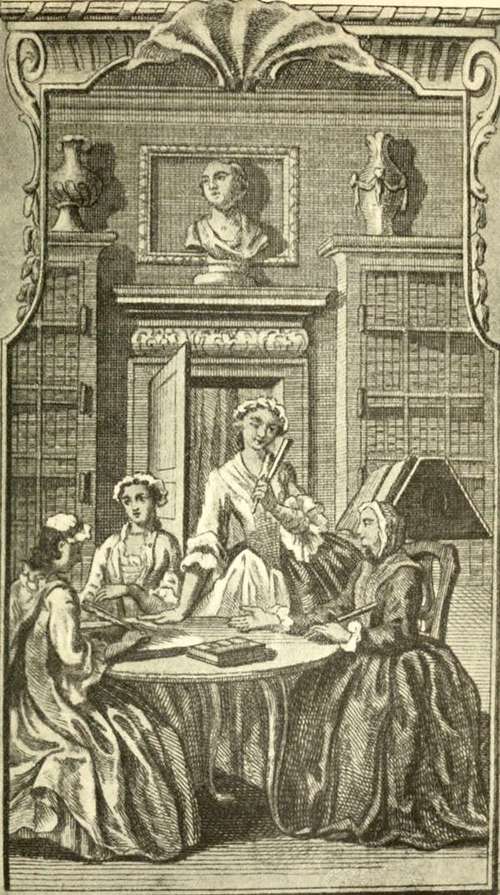
THE SUPPOSED EDITORS OF THE FEMALE SPECTATOR
BY MRS. ELIZA HAYWOOD
From Vol. I of the seventh edition, 1771
Mrs. Haywood is the scribe; the lady in black is the vivacious widow of quality;
the lady standing is "Euphrosine"; the other lady is "Mira"
But now and then the editors or some contributor break out
of the charmed circle, and we get a glimpse of women who,
along with their overworked hearts, have at least rudimentary
minds. A certain "Cleora" urges that women's best qualities
are often stifled by a wrong education, and that "the world
would infallibly be happier than it is if women were more
knowing than they generally are." The studies suggested are
history, geography, some of the more agreeable parts of mathematics,
and "Enchanting Philosophy, its path strewd with
Roses." Music, poetry, dancing, and novels are suggested by
way of relaxation. For solid reading the recommendation includes
translations of Latin historians and French books of
travel, and closes with Bailey's Dictionary, "a library of itself
since there was never person, place or action of any note, from
the creation down to the time of its being published, but what
it gives a general account of." In another essay "Philo-Naturæ"
spends impassioned pages urging ladies to study natural
history, but nullifies her eloquence by the narrow limit she
assigns to their work. "It is easy to see, that it is not my ambition
to render my sex what is called deeply-learned." Women
need only "a kind of general understanding" of science, such
as will enable them to take an agreeable part in conversation.
They are not called to abstruse and difficult researches, but
merely to those light and charming observations that catch the
watchful eye on little excursions such as ladies make in fields,
meadows, and gardens.
In The Wife (1755) Mrs. Haywood is less liberal than in The
Spectator. The married lady is particularly warned against
the dangers of an active mind or speculative disposition. She
may be so misguided as to "attempt to investigate those things
that Heaven has hidden from human understanding," in
which case her brain will be distracted by books of controversy.
Or she may strangely busy her mind about the planets, wondering
whether those vast and luminous orbs are habitable, and if
so, whether possessed by men or angels or the ghosts of the
departed. A lady so fantastically engaged is likely to waste
her time over such books as Fontanelle's Plurality of Worlds.
A woman who once gets either of these fancies into her head, is lost
to everything besides; her husband, children, family, friends, acquaintances,
with all the necessary avocations and duties of her station,
seem altogether unworthy her regard; she lives in the clouds, and it
is with difficulty she is dragg'd down to the performance of anything
requir'd of her below.
Methinks it is down-right madness to waste any part of time in
seeking after things impossible to be attain'd; or if attain'd could be
of no real service:—a married woman, above all others, should avoid
this error:—it best becomes her to center her whole studies within
the compass of her own walls,—to enquire no farther than into the
humours and inclinations of her husband and children, to the end she
may know how to oblige those she finds in him, and rectify whatever
is amiss in them, and not attempt to extend her speculations beyond
her family, and those things which are entrusted to her management.
Mrs. Haywood's programme reads like a combination from
Molière's Chrysal and Mrs. Barbauld.
In 1729 Swift wrote from Dublin to Pope:
Mrs. Mary
Barber (1690?-1757)
There are three citizens' wives in this town; one of them whose
name is Grierson, a Scotch book-seller's wife. She is a very good Latin
and Greek scholar, and has lately published a fine
edition of Tacitus, with a Latin dedication to the
Lord Lieutenant; and she writes Carmina Anglicana
non Contemnenda. The second is one Mrs. Barber, wife to
a woolen draper, who is our chief poetess, and, upon the whole, has no
ill genius. I fancy I have mentioned her to you formerly. The last is
the bearer hereof, and the wife of a surly rich husband, who checks her
vein; whereas Mrs. Grierson is only well to pass, and Mrs. Barber, as
it becomes the chief poetess, is but poor. The bearer's name is Sykins.
She has a very good taste of poetry, has read much, and, as I hear, has
writ one or two things with applause, which I never saw, except about
six lines she sent me unknown, with a piece of sturgeon, some years
ago, on my birthday. Can you show such a triumfeminate in London?[316]
Soon after Swift added Mrs. Pilkington to his list of Dublin
writers, but it still remains a triumfeminate, because we hear no
more of Mrs. Sykins, the surly rich husband having apparently
been successful in checking her vein. Her proposed visit to
Pope was also a failure. She went to Twickenham and delivered
Swift's letter, but, for some unknown reason, returned
to London two hours before the time Pope had appointed to
receive her. His irritation found expression in the reference to
"an Irish poetess" as among his troublesome visitors in one
version of The Epistle to Dr. Arbuthnot.[317]
Mrs. Mary Barber would hardly be so much as a name to-day
were it not for Swift. He first met her in about the year
1729, and from that time to 1736 letters to and from him have
much to say concerning her career. She was then nearly forty,
most of her poems existed in manuscript, she was already something
of a celebrity in Dublin, and her one desire was a subscription
publication of her work. In pursuance of this wish
she went to London late in 1730 and Swift sent kindly letters in
her behalf to several of his London friends. In the summer of
1731 a mysterious letter to the Queen, purporting to be from
Swift, contained this passage: "Mrs. Barber, the best female
poet of this or perhaps any age, is now in your majesty's capital;
known to Lady Hertford, Lady Torrington, Lady Walpole,
etc.; a woman whose genius is honoured by every man of genius
in this kingdom, and either honoured or envied by every man of
genius in England."[318] Pope sent a copy of this letter to Swift,
who immediately and indignantly, in letters to Pope and the
Countess of Suffolk, disavowed it. Such a letter, he said, would
be "a folly so transcendent, that no man could be guilty of,
who was not fit for Bedlam." In his letter to Pope Swift said of
Mrs. Barber:
Dr. Delany has been long her protector; and he, being many years
my acquaintance, desired my good office for her, and brought her
several times to the deanery. I knew she was poetically given, and,
for a woman, had a sort of genius that way. She appeared very modest
and pious, and I believe was sincere; and wholy turned to poetry.
I did conceive her journey to England was on the score of her trade,
being a woollen-draper, until Dr. Delany said, she had a design of
printing her poems by subscription, and desired I would befriend her:
which I did, chiefly by your means, the doctor still urging me on:
upon whose request I writ to her two or three times, because she
thought my countenancing her might be of use. Lord Carteret
very much befriended her, and she seems to have made her way not
ill.[319]
The perpetrator of the forged letter and the purpose in sending
it to the Queen have never been discovered, but the irritation
arising from it might well have destroyed Swift's interest
in Mrs. Barber's subscription list. He apparently recognized,
however, that she was innocent of offense and continued his
efforts in her behalf. Dr. Arbuthnot writes that he has shown
"as much civility as he could" to Mrs. Barber.[320] Gay has
"made a visit to Mrs. Barber."[321] Lady Betty Germain says
Mrs. Barber "goes on in her subscription very well."[322] But the
list was incomplete by the summer of 1732 and dragged slowly
on till 1734 in spite of the aid of Mr. Barber, Lord Mayor of
London, Mrs. Worsley, Mrs. Cæsar, Mrs. Conduitt, Miss
Kelly, Lord Carteret, Lord Orrery, and the Duchess of Queensberry,
all of whom in response to applications from Swift wrote
to him concerning the progress of Mrs. Barber's affairs. In
1733 Mrs. Conduitt wrote that "the town had already been so
long invited into the subscription that most people had already
refused or accepted."[323] It was not till 1734 that the list was
considered long enough to make publication safe.
Swift crowned his service by writing a dedicatory letter to
Lord Orrery. In this letter he spoke of Mrs. Barber as follows:
She desireth your protection on account of her wit and good sense,
as well as of her humility, her gratitude, and many other virtues. I
have read most of her poems; and believe your Lordship will observe,
that they generally contain something new and useful, tending to the
reproof of some vice or folly, or recommending some virtue. She never
writes on a subject with general unconnected topics, but always with
a scheme and method driving to some particular end: wherein many
writers in verse, and of some distinction, are so often known to fail.
In short, she seemeth to have a true poetical genius, better cultivated
than could be expected, either from her sex, or the scene she hath acted
in, as the wife of a citizen. Yet I am assured, that no woman was ever
more useful to her husband in the way of his business. Poetry hath
only been her favorite amusement; for which she hath one qualification
that I wish all good poets possess'd a share of; I mean, that she
is ready to take advice, and submit to have her verse corrected, by
those who are generally allow'd to be the best judges.[324]
But for the persistent efforts of Swift the subscription would
never have been completed. Yet Mrs. Barber had gained incidentally
such a retinue of supporting friends that her poems
were republished in 1735 and 1736. There was apparently a
touch of personal venom in the passage where Mrs. Pilkington
chronicles the generous aid given Mrs. Barber and emphasizes
the final small success of the poems:
Mrs. Barber ... was at this time writing a volume of Poems, some
of which I fancy might, at this Day, be seen in the Cheesemungers,
Chandlers, Pastry-cooks, and Second-hand Book-sellers' Shops:
However, dull as they were, they certainly would have been much
worse, but that Dr. Delany frequently held what he called a Senatus
Consultum, to correct these undigested materials; at which were present
sometimes the Dean, (in the Chair) but always Mrs. Grierson,
Mr. Pilkington, the Doctor, and myself.[325]
A poem in which they were summoned to one of these meetings
began:
Mighty Thomas a solemn Senatus I call,
To consult for Saphira, so come one and all.
In 1736 Mrs. Barber was again in financial straits. A scheme
for letting lodgings, and another scheme for selling Irish linens
at Bath having proved impracticable, she made a final appeal
to Swift. Dr. King of Oxford and Mrs. Cleland had spoken so
warmly of Swift's Treatise on Polite Conversation that many
people wished to see it, and Lady Worsley with many other of
Mrs. Barber's patronesses urged her to ask Swift to let her publish
it for her own benefit. After apologies for asking such a
favor she says:
I humbly beseech you, sir, if you do not think it proper not to be
offended with me for asking it; for it was others, that out of kindness
to me, put me upon it. They said you made no advantage for yourself,
by your writings; and that, since you honoured me with your protection,
I had all the reason in the world to think it would be a pleasure to
you, to see me in easy circumstances; that everybody would gladly
subscribe for anything Dr. Swift wrote; and indeed, I believe in my
conscience, it would be the making of me.[326]
Dean Swift presented her with the copy and the sale proved
advantageous.
The career of a mediocre writer like Mrs. Barber would hardly
justify chronicling were it not for the interesting exemplification
it offers of the system of patronage. Swift and his influential
friends manifest no particular interest in Mrs. Barber's
"moral and not inelegant verse," but responsibility for her
welfare seems to have been accepted by them without demur,
nor does she seem to have felt any hesitancy about accepting
any aid that might be forthcoming.
The most vivid introduction to Mrs. Grierson comes from
the pen of her early friend Mrs. Pilkington:
Mrs. Constantia
Grierson
(1706?-33)
About two years before this a young Woman of about eighteen
years of age, was brought to my Father, by a Stationer
to be by him instructed in Midwifery.[327] She
was Mistress of Hebrew, Greek, Latin, and French,
understood the mathematicks, as well as most men. And what made
these extraordinary Talents yet more surprizing was, that her Parents
were poor illiterate Country People; so that her learning appeared
like the Gift poured out on the Apostles, of speaking all languages,
without the Pains of Study; or, like the intuitive Knowledge of
Angels: Yet in as much as the Power of Miracles is ceased; we must
allow she used human Means for such great and excellent Acquirements:
And yet in a long Friendship and Familiarity with her, I could
never obtain a satisfactory Account from her on this Head; only she
said, "she had received some little Instruction from the Minister of
the Parish, when she could spare time from her Needlework, to which
she was closely kept by her Mother." She wrote elegantly both in
Verse and Prose; and some of the most delightful Hours I ever past,
were in the Conversation of this female Philosopher.
My Father readily consented to accept her as a Pupil; and gave
her a general Invitation to his Table, so that she and I were seldom
asunder. My Parents were well pleased with our Intimacy, as her
Piety was not inferior to her Learning. Whether it was owing to her
own Desire, or the Envy of those who survived her, I know not; but of
her various and beautiful Writings except one Poem of her's in Mrs.
Barber's Works, I have never seen any published; 't is true, as her
turn was chiefly to philosophical or divine Subjects, they might not
be agreeable to the present Taste.[328]
A eulogy of Mrs. Grierson was written by Henry Brooke
(1703?-1783) the author of a tragedy, Gustavus Vasa, and
various popular novels, in a poem on "The Art of Printing,"
and an account of her, derived from his notes, was published
in Brookiana in 1804.
Mr. Brooke has celebrated the learning, piety, and virtue, of Mrs.
Grierson, in a poem which he wrote on the Art of Printing. This lady
was born in the city of Kilkenny. Such is the vanity of man, that he
thinks he pays a sufficient compliment to woman, when he says, she
has a masculine mind, when, in truth, it is known that there are many
females on record, who have rivalled the lords of the creation in every
branch of science, and department of learning. In this constellation
the name of Mrs. Grierson will shine with increasing luster. Her
father observed, that his daughter, while yet a child, was very fond of
books, and not-withstanding his circumstances were narrow, he was
determined to furnish her with all those that he thought were suited
to her years; but he soon found, to his great joy, that her capacity was
not to be measured by her years, it flew before them; and that her
genius and inclination would triumph over every difficulty, even without
the aid of a master. In a time that is almost too short to be mentioned,
she was allowed by competent judges, to be a perfect mistress
of the Greek and Roman tongues; and whilst other young women were
proud of carrying the keys of closets, etc., she carried the keys of
science, which she unlocked and surveyed, not with a transient eye,
but with the warmth and constancy of one that fell in love with their
beauties, and could duly appreciate their charms, so that all her attainments
may be said to have been dictated by nature, aided by laudable
curiosity and industry. She was early married to George Grierson,
Esq., the king's printer. As he had a good library, she had an opportunity
of indulging her literary pursuits.[329]
After her marriage Mrs. Grierson carried on her studies with
such ardor that at twenty-one she brought out an edition of
Terence and at twenty-three an edition of Tacitus. When she
died at twenty-seven, she left a partially completed edition of
Sallust. Mrs. Barber says that she also wrote an unpublished
Abridgment of the History of England. Her Tacitus has received
high praise. Dr. Harwood, a learned bibliographer, commented
on it in the following terms:
This is one of the best edited books ever delivered to the world.
Mrs. Grierson was a lady possessed of singular erudition, and had an
elegance of taste and solidity of judgment, which justly rendered her
one of the most wonderful as well as amiable of her sex. Prefixed to
this edition of Tacitus, is a dedication to Lord Carteret, in most elegant
Latinity.[330]
Mrs. Grierson also wrote occasional verse a few specimens of
which appear in Mrs. Pilkington's Memoirs, in Poems by
Eminent Ladies, and in Mrs. Barber's edition of her own poems.
Mrs. Barber in her Preface praised Mrs. Grierson and gave
many of the facts used by later writers. Mr. Ballard was
anxious to give a full account of Mrs. Grierson, and he wrote in
1747 to Mrs. Barber for further information. "I likewise," says
Mr. Ballard, "got the same friend to apply to a learned and
eminent dignitary in the church in Ireland; one who is thoroughly
acquainted with all the various circumstances of her
life and is every way qualified for the performance." The
eminent churchman promised an account of her life, but it
never came to hand, so Mr. Ballard was obliged to content himself
with a general eulogy. He says, "If Heaven had spared her
life, and blessed her with health, which she wanted for some
years before her death, there is good reason to think she would
have made as great a figure in the learned world, as any of her
sex are recorded to have done." Mrs. Grierson, "the learned
Nymph Whom Curiosity engaged every Person to see,"[331] was
on intimate terms with Swift, Thomas Sheridan, and Dr.
Delany, and it is singular that a more exact account of her life
should not have been preserved.
Lætitia van
Lewen Pilkington
(1712-50)
Lætitia Pilkington, the daughter of Dr. Van Lewen, a physician
of Dublin, was about twenty-two years
younger than Mrs. Barber, but Mrs. Barber's
work came so late in her life and Mrs. Pilkington
was so precocious that they were in effect poetical contemporaries.
Lætitia's love for literature and her lively mind were
in evidence before she was five. She thus describes the beginning
of her education:
My mother strictly followed Solomon's Advice, in never sparing the
Rod; insomuch that I have frequently been whipt for looking blue of
a frosty Morning; and whether I deserved it or not, I was sure of Correction
every Day of my life.
From my earliest Infancy I had a Disposition to Letters; but my
Eyes being weak after the Small-pox, I was not permitted to look at a
Book; my Mother regarding more the Beauty of my Face, than the
Improvement of my Mind; neither was I allowed to learn to read:
This Restraint, as it generally happens, made me but more earnest in
the Pursuit of what I imagined must be so delightful. Twenty times
a Day have I been corrected, for asking what such and such Letters
spelt; my Mother used to tell me the Word, accompanying it with a
good Box on the Ear, which, I suppose, imprinted it on my Mind....
I do assure you, it had this Effect on me, that I never forgot what was
once told me; and quickly arrived at my desired Happiness, being
able to read before she thought I knew all my Letters; but this Pleasure
I was obliged to enjoy by Stealth with Fear and Trembling.
I was at this Time about five Years of Age; and my Mother being
one Day abroad, I had happily laid hold on Alexander's Feast and
found something in it so charming, that I read it aloud; but how like
a condemned Criminal did I look, when my Father, softly opening his
Study-door, took me in the very Fact; I dropt my Book and burst
into Tears, begging Pardon and promising never to do so again: But
my Sorrow was soon dispelled, when he bade me not to be frightened,
but read to him, which to his great Surprize, I did very distinctly, and
without hurting the Beauty of the Numbers. Instead of the whipping,
of which I stood in dread, he took me up in his Arms, and kissed me,
giving me a whole Shilling, as a Reward, and told me, "He would give
me another as soon as I got a Poem by Heart," which he put into my
Hand, and proved to be Mr. Pope's sacred Eclogue; which Task I
performed before my Mother returned Home. They were both astonished
at my Memory, and from that Day forward, I was permitted to
read as much as I pleased; only my Father took care to furnish me
with the best, and politest Authors; and took Delight in explaining
to me, whatever, by Reason of my tender Years, was above my Capacity
of Understanding.
But chiefly was I charmed and ravished with the Sweets of Poetry;
all my Hours were dedicated to the Muses; and, from a Reader, I
quickly became a Writer; I may truly say with Mr. Pope,
I lisp'd in Numbers, for the Numbers came.
My Performances had the good Fortune to be looked on as extraordinary
for my Years; and the greatest and wisest Men in the Kingdom
did not disdain to hear the Prattle of the little Muse, as they called me,
even in my Childish Days. But as I approached towards Womanhood
a new Scene opened to me; and by the Time I had looked on
thirteen Years, I had almost as many Lovers.
At seventeen Lætitia married a penniless Irish parson, Mr.
Matthew Pilkington. Soon after their marriage they became
well known in the Dublin literary set. Constantia Grierson
who was the first to congratulate Lætitia on her marriage, and
who witnessed the cruel treatment the couple received from
Mrs. Van Lewen, introduced them to Dr. Delany who befriended
them. Through Dr. Delany they met Swift, who was
much taken by the "little poetical parson and his littler poetical
wife." He called them "The Mighty Thomas Thumb and
her Serene Highness of Lilliput,"[332] and for a short time they
were evidently much at the deanery. The most famous portions
of her Memoirs have to do with Swift. His early biographers
were apparently unwilling to own how much of their vivid,
picturesque material came from a source so little esteemed,
but Mr. Craik credits Mrs. Pilkington with "a picture of the
Dean which is probably more true to the life than many that
are more pretentious."[333] The young lady's wit, vivacity, courage,
and independent mind brought a new and piquant element
into Swift's life. He scolded her till she fled in tears, but at his
imperious summons she always came back in new, adoring subjection.
On one occasion, after an exceptionally severe castigation,
he wrote sharply but with an underlying compliment:
"You must shake off the Leavings of your Sex. If you cannot
keep a Secret, and take a Chiding, you will quickly be out of
my Sphere. Corrigible People are to be chid; those who are
otherwise, may be very safe from any Lectures of mine: I
should rather choose to indulge them in their Follies, than
attempt to set them right."[334] Usually her wit could turn an
impending quarrel into some sort of gay banter. On one occasion
Swift began to reprimand her for having copied out one
of his manuscript poems. But she interrupted, saying she did
not copy it, but knew it by heart from one reading. Whereupon
there ensued a memory contest. The test given her was from
Shakespeare, all of whose works she said she could repeat.
"The Line he first gave me, he had purposely picked out for
its Singular Oddness: But [sic] rancours in the Vessel of my Peace.
Macbeth. I readily went on with the whole Speech, and did
so several times, that he tried me with the different Plays. The
Dean then took down Hudibras, and ordered me to examine
him in it, as he had done me in Shakespeare; and, to my great
surprize, I found he remembered every Line from Beginning
to End of it."[335]
When Swift first saw little Mrs. Pilkington as a bride he
exclaimed, "What, this poor little Child married! God help
her, she is early in Trouble."[336] The words were prophetic, for
the troubles began very soon. They were engendered by literary
jealousy, for Mr. Pilkington was a poet on his own account.
Compliments to the wife became as wormwood to the husband,
especially when such compliments were accompanied by frank
depreciation of his own talents. Swift once put a question to
Mrs. Pilkington and received her answer. Mr. Pilkington then
entered the room and was asked the same question and gave an
unsatisfactory answer. "P-x on you for a Dunce," said the
Dean. "Were your Wife and you to sit for a Fellowship, I
would give her one, sooner than admit you a Sizar." From that
time on Mr. Pilkington viewed his wife "with scornful yet with
jealous eyes."[337]
On another occasion the two wrote odes in imitation of
Horace. Angered at her success Mr. Pilkington told her that
a Needle was more becoming to a Woman's Hand than a Pen,
and was placated only when the lady consigned her own ode
to the flames and highly praised his. Her comment is: "And
here let me seriously advise every Lady, who has the Misfortune
to be poetically turned, never to marry a Poet.... If a
Man cannot bear his Friend should write, much less can he
endure it in his Wife; it seems to set them too much on a Level
with their Lords and Masters; and this I take to be the true
Reason why even Men of Sense discountenance Learning in
Women, and commonly choose for Mates the most illiterate
and stupid of the Sex; and bless their Stars their Wife is not a
Wit."[338] Jealousy was, however, the least of Mr. Pilkington's
faults. He soon proved himself "the arrantest rogue in England."
The action he brought against his wife for divorce was
not sustained by the courts, but the outcome of it was that he
abandoned her and her two children, and she was left penniless.
She went to London where she lived a life compounded of misfortunes
and misdemeanors.
In the Memoirs she gives in extenso the various expedients
whereby she tried to get a living. One of the most successful
was as a public letter-writer for which she issued the following
card:
Letters written here on any Subject, except on the Law, Price
Twelvepence; Petitions also Drawn at the same Rate. Mem.
Ready Money, no Trust.[339]
Under cover of getting subscriptions for the Memoirs, she really
lived on the charities of the charitable and what she euphemistically
termed "contributions from the great." Colley Cibber[340]
especially befriended her and urged her to push forward the
Memoirs. But spite of all aid her course was downward. At
one time she was even imprisoned for debt.[341] On her release
she tried to keep a print and pamphlet shop,[342] but failed. And
finally she wandered back to Dublin where she died at thirty-eight.
The one book by which Mrs. Pilkington is known is her
Memoirs, the three volumes of which appeared in 1748. In
1754 a third edition appeared with an additional volume by
her son. Shortly after her death there appeared a compilation
entitled The Celebrated Mrs. Pilkington's Jests; or, The Cabinet
of Wit and Humour. In the Memoirs the early happy life in
Dublin and the later tricks and shifts and intrigues of the
London life are described with equal frankness. The result was
a tarnished fame as a woman, but an undisputed reputation as
a clever writer. When the Earl of Chesterfield wondered that
she could write English so well, she sent word to his lordship
that Dr. Swift had been her tutor.
As a literary critic Mrs. Pilkington is especially severe on the
immorality of some contemporary women writers. Speaking
of a lady who had refused to subscribe to her book she said:
She would have purchased my Book sooner than the Bible, to indulge
her private Meditations, Especially if I had the wicked Art of
painting up Vice in attractive Colours, as too many of our Female
Writers have done, to the Destruction of Thousands, amongst whom
Mrs. Manly and Mrs. Haywood deserve the foremost Rank.
But what extraordinary Passions these Ladies may have experienced,
I know not; far be such Knowledge from a Modest Woman:
Indeed Mrs. Haywood seems to have dropped her former luscious
Stile, and, for Variety presents us with the insipid: Her Female Spectators
are a Collection of trite Stories, delivered to us in stale and worn-out
Phrases: Bless'd Revolution!
Yet of the two, less dang'rous is th' Offence
To tire the Patience, than mislead the Sense.
And here give me leave to observe, that amongst the Ladies that
have taken up the Pen, I never met with but two who deserved the
Name of a Writer; the first is Madam Dacier, whose Learning Mr.
Pope, while he is indebted to her for all the notes on Homer, endeavoured
to depreciate; the second is Mrs. Catherine Philips, the matchless
Orinda, celebrated by Mr. Cowley, Lord Orrery, and all the Men
of Genius who lived in her Time.
I think this incomparable Lady was one of the first Refiners of
the English Numbers. I cannot, except my own Country-woman
Mrs. Grierson, find out another female Writer, whose Works are worth
reading; she indeed had a happy and well-improved Genius!
The last glimpse we have of Mrs. Pilkington is most effective
in the dramatic contrast it presents. On Thursday, April
12, 1750, John Wesley wrote in his Dublin Diary: "I breakfasted
with one of the Society, and found she had a lodger I
little thought of. It was the famous Mrs. Pilkington, who soon
made an excuse for following me up stairs. I talked with her
seriously about an hour: we then sung, 'Happy Magdalene.'
She appeared to be exceedingly struck: how long the impression
may last, God knows."[343]
Mrs. Mary
Davys (fl. 1725)
Mrs. Mary Davys wrote a comedy produced at Lincoln's
Inn Fields in 1716, and a didactic novel, The
Reform'd Coquet, which appeared in 1724.
Her Works, in two volumes, appeared in 1725. Miss Morgan
says that the young lord who is the hero of The Reform'd Coquet,
is one of the earliest examples in fiction of "the perfect
prig of which Sir Charles Grandison is the consummate example."[344]
She was the wife of the Reverend Peter Davys, master
of the free school of St. Patrick's, Dublin, so she came into the
circle of Swift. Dr. Ewen of Cambridge formerly had thirty-six
letters from Swift to Mr. and Mrs. Davys. Mr. Davys died
in 1698 and Mrs. Davys was "left to her own endeavours."
In 1713 she wrote to Swift complaining that he had not written
to her for four years. "I have honestly told her," he said, "it
was my way never to write to those whom I am never likely to
see, unless I can serve them, which I cannot her, etc. Davis
the schoolmaster's widow."[345] She was not so fortunate as Mrs.
Grierson and Mrs. Pilkington.
Mrs. Mary
Mitchell Collyer
(1716?-1762?)
Mrs. Collyer's publications were anonymous and she has
been hardly more than a name in literary history.
Recent investigations have, however,
shown her to be of genuine importance, not
merely as a writer of considerable ability, but especially as an
author in whom romantic tendencies found early and well-defined
statement.[346] Mrs. Collyer was the wife of Joseph Collyer,
a compiler, translator, and publisher to whom her books
have sometimes been attributed. Her son was Joseph Collyer,
an engraver of merit. Mr. Collyer's income was apparently
small, for Mrs. Collyer wrote for the support of her family.
In the Dedication to her Death of Abel she said: "Placed by
the hand of Providence at an humble distance from the Great,
my cares and pleasures are concentrated within the narrow limits
of my little family, and it is in order to contribute to the support
and education of my children, I have taken up my pen."
The seven works attributed to Mrs. Collyer fall between
1743 and 1763. It is unnecessary to consider these works here
in detail except so far as may serve to indicate their historical
significance. For this purpose we may take up first the last of
her books, the translations from the German, for it is on these
that her modicum of fame has rested. When Mrs. Collyer translated
Gesner's Der Tod Abels in 1761 and began Klopstock's
Messiah the year after, she was a pioneer in a new kind of learning.
The professed linguists seldom included German in their
list, and German literature was practically unknown.[347] Mr.
Haney, in his study of "German Literature in England before
1790," gives William Taylor of Norwich as "the first literary
critic to attempt a systematic introduction of German literature
into England," and Mr. Taylor's period of literary activity
did not begin until 1790. Of the sporadic translations before
that period, aside from scientific and theological works and
a few hymns, Mr. Haney cites but two anterior to Mrs. Collyer's
Death of Abel. There were few more popular works in the
eighteenth century than this translation. There were eighteen
editions in twenty-one years, and many later editions. It satisfied
alike the pious reader and the lover of fiction. The Quarterly
Review for 1814[348] says: "No book of foreign growth has
ever become so popular in England as the Death of Abel. Those
publishers whose market lies among that portion of the people
who are below what is called the public, but form a far more
numerous class, include it regularly among their 'sacred classics':
it has been repeatedly printed at country presses with
worn types and on coarse paper; and it is found at country
fairs, and in the little shops of remote towns almost as certainly
as the Pilgrim's Progress and Robinson Crusoe." Miss Hughes
quotes numerous other testimonies to the same effect.
This remarkable popularity was due, of course, to the original
author rather than to the translator. Mrs. Collyer's version
received high contemporary praise, but according to modern
ideas it would be counted loose and inaccurate. Miss Reed
characterizes the style as unnatural and affected, and she
thinks that while the translation made Gesner widely known, it
in reality injured his fame. But the excellence of the work, or
its defects, are not so significant in a study of Mrs. Collyer as
are the facts that she was sufficiently well trained in German
to give even a fairly adequate version, and that she should be
the first to present a German poet of the new school to an
English public.
Mrs. Collyer died before completing her translation of Klopstock
and her husband carried it to a conclusion. He said in
his Preface that his wife's fatal illness was brought on by her
agitation of mind in connection with her work on the Death
of Abel.
Mrs. Collyer's Christmas Box is another instance of pioneer
work. Its full descriptive title is A Christmas Box, Consisting
of Moral Stories, adapted to the Capacities of Little Children and
calculated to give them early impressions of Piety and Virtue.
Two volumes. Adorned with cuts. The Christmas Box and Miss
Fielding's Little Female Academy appeared in 1749, five years
after Newbery's first child's book, The Little Pretty Pocket
Book, of 1744. In 1745 he brought out three volumes of The
Circles of the Sciences, and in 1751-52 The Lilliputian Magazine.
Thus a new class of literature was definitely started,
with Mrs. Collyer and Miss Fielding as important contributors
to the spread of the idea at its inception.[349]
Two of Mrs. Collyer's novels are translations from the
French, and are of slight importance in comparison with her
one original novel the full title of which is Felicia to Charlotte:
Being Letters from a Young Lady in the Country, to her Friend
in Town. Containing A Series of the most interesting Events,
interspersed with Moral Reflections; chiefly tending to prove that
the Seeds of Virtue are implanted in the Mind of Every Reasonable
Being. Volume one appeared in 1744 and a second volume
in 1749. Miss Hughes in her analysis of this novel[350] points out
various elements that forecast ideas not dominant till some
decades later. It was a novel of purpose, written for ethical and
religious ends, and as such antedates John Buncle by twelve
years. It is also a novel of feeling. Its hero, Lucius, must wait
for Sterne before he can find his true kin. The courtship of
Lucius is punctuated with sighs and tears, with the overwrought
emotions of a sensitive heart. Steele's Conscious
Lovers offers an early sentimental parallel, but the type was
not fully developed till in the seventies. The first volume ends
with the marriage of Felicia and Lucius. In the second volume
the happy pair, now quite sane and sensible, are able to
discuss with fluency and precision their ideas on the nurture
and education of children. This volume was thus a pedagogic
romance of the sort that became popular after Rousseau.
The most interesting of all the new ideas brought forward by
Felicia and Lucius is their love of nature and of country life.
They choose the country as a place of residence and justify
their choice on rational grounds. And Mrs. Collyer has a surprising
fullness and ardor of description, and a sincere joy in
nature not equaled in fiction before John Buncle (1756-66),
and she is a decade earlier.[351] It was only in poetry or in philosophical
theory that Mrs. Collyer could have found sources for
her literary use of nature. Spenser, Milton, and Thomson were
well known to her and they doubtless influenced her.
Connected with this love of nature are Mrs. Collyer's ideas
on gardening. When she and Lucius bought their estate it was
in the formal style, but they at once changed it to make it appear
as much like nature as possible. In this Mrs. Collyer was
not entirely original, for the Spectator and the Guardian, Pope,
Switzer, and Batty Langley had decried the stiff regularity
of the formal garden, and Kent's great gardens came between
1730 and 1748. But Mrs. Collyer promptly took up
the new ideas and she ranks among their early defenders.
Mrs. Collyer is very interesting because she showed herself
in these various ways so sensitive to new ideas. She seemed to
know what was in the air even before it had had any but the
most casual expression. She sat down very modestly and with
much trepidation to write anonymous translations and novels
for the support of her family, but she was, quite unconsciously
it may be, treading the path of the pioneer.
Sarah Fielding
(1710-1768)
Sarah Fielding's first and most important novel, The Adventures
of David Simple in search of a Faithful
Friend (1744), received extraordinary commendation
from the two contemporary authors whose judgments
might be counted authoritative, Henry Fielding and Samuel
Richardson. Fielding's satiric picture of Mrs. Western in Tom
Jones is more than offset by his utterances in connection with
his sister Sarah's books. When David Simple appeared, Joseph
Andrews had been two years before the public, and it was
natural that her popular little book should be attributed to
Fielding. But when the second edition came out (also 1744) he
took occasion to disavow his supposed authorship, and likewise
to commend the book.
A third, and indeed the strongest, reason which hath drawn me into
print, is to do justice to the real and sole author of this little book;
who, notwithstanding the many excellent observations dispersed
through it, and the deep knowledge of human nature it discovers, is a
young woman; one so nearly and dearly allied to me, in the highest
friendship as well as relation, that if she had wanted any assistance of
mine I would have been as ready to have given it to her as I would have
been just to my word in owning it; but, in reality, two or three hints
which arose on the reading it, and some little direction as to the conduct
of the second volume, much the greater part of which I never
saw till in print, were all the aid she received from me. Indeed, I believe
there are few books in the world so absolutely the author's own
as this....
And as the faults of this work want very little excuse, so its beauties
want as little recommendation; though I will not say but they
may sometimes stand in need of being pointed out to the generality of
readers. For as the merit of this work consists in a vast penetration
into human nature, a deep and profound discernment of all the mazes,
windings, and labyrinths, which perplex the heart of man to such a
degree that he is himself often incapable of seeing through them; and
as this is the greatest, noblest, and rarest of all the talents which constitute
a genius; so a much larger share of this talent is necessary even
to recognize these discoveries when they are laid before us than fall
to the share of a common reader....
As to the characters here described, I shall repeat the saying of one
of the greatest men in this age,—"That they were as wonderfully
drawn by the writer as they were by Nature herself." There are many
strokes in Orguiel, Spatter, Varnish, Levif, the Balancer, and some
others which would have shined in the pages of Theophrastus, Horace,
or La Bruyère. Nay, there are some touches which I will venture to
say might have done honour to the pencil of the immortal Shakespeare
himself.[352]
For a continuation of David Simple in 1747,[353] Fielding wrote
a dedication and five letters. In this Preface he gave his
opinion on learning for women:
The objection to the sex of the author hardly requires an answer;
it will be chiefly advanced by those who derive their opinion of women,
very unfairly, from the fine ladies of the age; whereas, if the behavior
of their counterparts, the beaux, was to denote the understanding of
men, I apprehend the conclusion would be in favour of the women,
without making a compliment to that sex. I can, of my own knowledge
and from my own acquaintance, bear testimony to the possibility
of those examples which history gives of women eminent for the highest
endowments and faculties of mind. I shall only add an answer to
the same objection, relating to David Simple, given by a lady of very
high rank, whose quality, is however, less an honour to her than her
understanding. "So far," said she, "from doubting David Simple
to be the performance of a woman, I am well convinced it could not
have been written by a man."[354]
Miss Fielding's own views on the woman question are slightly
indicated in this story. In the course of his peregrinations
David Simple meets the charming Miss Cynthia, who tells
him the story of her life and leads him to reflect upon the irritation
and unhappiness which result from the undue restrictions
imposed upon women. Miss Cynthia had always been
subject to repression. Whenever she asked questions she was
told, such things were not proper for girls of her age to know.
She was not allowed to read, for Miss Cynthia must not inquire
too far into things lest it should turn her brain. She was to
mind her needlework and such things as are useful to women.
Reading and poring over books would never get her a husband.
Cynthia's restlessness doubtless well represents the state of
mind of many a contemporary girl eager for learning, but not
able to escape from the feminine conventions.
In 1749 Miss Fielding published a work quite new in form
and intention. It was entitled The Governess; Or, The Little
Female Academy. Calculated for the Entertainment and Instruction
of Young Ladies in their Education. It was so popular that
a seventh edition appeared in 1760. This little book represents
the happenings of nine days in the school of Mrs. Teachum, a
gentlewoman who taught young ladies "in Reading, Writing,
Working, and in all proper Forms of Behavior." The oldest
of her nine young ladies was fourteen, the youngest was six,
and the others between six and twelve. The book was professedly
written, not for the Mrs. Teachums of the age, but for
little girls under twelve. And the instruction embodied was
thrown into story form to make it more acceptable to young
readers. I know of no earlier similar attempt. Such books as
had been written for children were serious and religious in tone.
But Miss Fielding's book was lively and entertaining. Each
little girl told the history of her life and analyzed her adventures
and emotions, particularly her faults and their outcome, in true
romance style. But all is kept pretty near to a child's understanding.
And there are some occurrences—as a fracas in
which the genteel young ladies "fought and scratched and tore
like young cats," for the possession of an apple redder and
bigger than its companions in the basket, a collation at a dairy
farm, sewing-parties in an arbor with Miss Jenny Peace, the
fourteen-year old girl, as story-teller and as umpire in all disputes,
that must have had extraordinary charm for young
misses who had never before seen even a semblance of their
own lives in print.
Miss Fielding's other works are of less significance except for
her translation of Xenophon's Memoirs of Socrates; with the
Defence of Socrates before his Judges (1762), which indicates
a knowledge of Greek more exact than was common in her day.
The most interesting fact in Miss Fielding's life is her close
friendship with Richardson. She was one of the most ardent
admirers of his work. She says of Clarissa: "When I read of her
I am all sensation; my heart glows; I am overwhelmed; my
only vent is tears.... Often have I reflected on my own vanity
in daring but to touch the hem of her garment." In 1756
Richardson wrote to her:
Why did you not tell Lady Bradshaigh ... that you were my much-esteemed
Sally Fielding, the author of David Simple? She knows my
opinion of you, and of your writing powers.... I have just gone
through your two vols. of Letters. Have re-perused them with great
pleasure, and found many new beauties in them. What a knowledge
of the human heart! Well might a critical judge of writing say, as he
did to me, that your late brother's knowledge of it was not (fine writer
as he was) comparable to yours. His was but as the knowledge of the
outside of a clock-work machine, while your's was that of all the finer
springs and movements of the inside.[355]
The most popular work by Miss Fielding was The Little
Female Academy. David Simple, to be sure, went through two
editions in 1744. But the indications of contemporary recognition
are not at all commensurate with the praise from her
brother and Richardson and other high authorities. Of foreign
appreciation of her work there are more proofs. David
Simple was translated into German[356] in 1746 and into French
in 1755,[357] and The Countess of Gräfin was translated into
German in 1761.[358] The French translator of David Simple commented
on the approbation générale which this romance had
found.[359]
Charlotte Lennox
(1720-1804)
Charlotte Rumsey was the daughter of Colonel James
Rumsey, Lieutenant-Governor of New York.
At fifteen she was sent to England as the protégé
and probable heiress of an aunt. But the aunt became
insane, and the girl was left penniless. The only facts that
emerge concerning the difficult years before her marriage to
Mr. Lennox in about 1748 have to do with her very mediocre
career as an actress.
Except for a volume of poems in 1747, it was not till after her
marriage that Mrs. Lennox came forward prominently as an
author. Her two-volume novel, The Life of Harriet Stuart,
Written by Herself, appeared in 1751. But in literary circles
she was evidently well known before this, for Johnson was her
especial friend. When her manuscript was ready for publication,
he arranged a celebration at his Club. The festivities were
to last all night. Mrs. Lennox was ceremoniously crowned with
laurel, and there was a magnificent hot apple-pie stuck with
bay leaves.[360] This first novel is probably in part autobiographical
inasmuch as the heroine, Harriet Stuart, is the daughter of
a man of high official rank in America, and goes to England at
fifteen to live with an aunt who becomes insane and leaves her
penniless. But this is merely a slight framework for a series
of love adventures. Miss Stuart's wit and beauty gather about
her lovers of all varieties, army officers, sea-captains, pirates,
merchants; and the alarming crises of her fate put her into close
competition with Clarissa Harlowe herself. America, France,
and England are the far-separated scenes of Miss Stuart's trials
and victories, the emphasis being on her life in America.
There would be a chance for some interesting local color in this
representation of mid-eighteenth-century life in New York if
the young lady could have spared a moment from her adventures
to observe her surroundings. An Indian encampment, a
visit to a fort, an escapade to a "farm," a midnight row on the
Hudson, are mentioned, but with no comment. Towns and
houses, roads, rivers, and seas, are but localities for love scenes,
means of transit from one episode to another. The story is told
with a deft manipulation of details and an easy fluency that
would seem to indicate something of a previous literary apprenticeship.
At any rate, in this novel she had found her medium,
and she was soon ready with a tale that gave her genuine distinction.
The Female Quixote appeared in 1752 with a Dedication
written by Johnson, and it was reviewed by him in The
Gentleman's Magazine for March. He said of it: "Mr. Fielding,
however emulous of Cervantes, and jealous of a rival,
acknowledges in his paper of the 24th, that in many instances,
this copy excels the original, and though he has no connection
with the author, he concludes his encomium on the work, by
earnestly recommending it as a most extraordinary, and most
excellent performance. 'It is,' says he, 'a work of true humour,
and cannot fail of giving a rational, as well as a very pleasing
amusement, to a sensible reader, who will at once be instructed,
and highly diverted.'"[361] Johnson's name is still more intimately
connected with the book, for he wrote the chapter which
has the heading, "Being in the author's opinion, the best chapter
in this history."[362] Harriet Stuart reads like an echo of
Richardson, but in The Female Quixote Mrs. Lennox strikes
an original note. Comedy had already, a generation earlier, in
Biddy Tipkin, made sport of the romance-reading girls of the
day. But the satire was new in fiction. And it was carried out
with a fullness and accuracy of details possible only to one who
had herself been a traveler in enchanted realms. Mrs. Lennox
must at some time have been as devoted to French fiction as
even Dorothy Osborne and Mrs. Pepys in the preceding century.
Her story is long-drawn-out and improbable, but the
cleverness with which Arabella and Lucy parody Don Quixote
and Sancho Panza gives the book a notable place among the
English followers of Cervantes. The Spiritual Quixote (1773),
a satire on the Methodists, and The Benevolent Quixote (1791),
a satire on mawkish ideas of charity, are inferior in vivacity and
interest to Mrs. Lennox's work.
In 1753-54 Mrs. Lennox brought out Shakespeare Illustrated;
or, Novels and Histories on which the Plays are ...
founded, collected and translated, an uncritical piece of work
according to present standards, but historically significant as
one of the earliest attempts to present Shakespeare's sources.[363]
A two-volume novel, Henrietta, in 1758, was dramatized as a
didactic comedy under the title The Sister,[364] and brought out at
Covent Garden in 1769. Though Miss Mattocks played the
chief part, and the Prologue and Epilogue were respectively
by Colman and Goldsmith, the play met with but moderate
success. In 1760-61 Mrs. Lennox edited The Ladies Museum,
in which were illustrated articles on natural history written
especially for ladies, philosophical discussions simplified for
ladies, and continued stories of the love-adventure type evidently
calculated for the same tastes. The most interesting
character drawing is that of an incipient Mrs. Malaprop in
the person of a Mrs. Gibbons.
If any annals were extant of Mrs. Lennox's life we should
doubtless find records of continuous study. At least we constantly
get new proofs of her learning. The Memoirs of M. de
Bethune, Duke of Sully, in three volumes in 1756,[365] The Memoirs
of the Countess Berci, in two volumes in the same year,
and Memoirs for the History of Madame de Maintenon, in
1757, show not only her mastery of French, but very steady
application to intellectual tasks. In 1759 she had what might
be considered her crowning honor as a learned lady. She was
chosen to edit a translation of Brumoy's Greek Theatre. In
collaboration with her were Dr. Johnson, Dr. Gregory Sharpe,
Dr. Grainger, and John Bourrya, men of recognized standing
as scholars.[366]
Mrs. Lennox lived forty-four years after the close of the
period under discussion. But she belongs properly in the first
half of the century because all her important work comes between
1750 and 1760. After a decade of exceptional literary
activity she sinks into obscurity. In 1775 Dr. Johnson assisted
in preparing proposals for the publication of her collected works,
in three quarto volumes, by subscription. Had this plan been
carried out there would doubtless have been preserved much
interesting information concerning the social and literary life
of an eminently successful mid-eighteenth-century bas bleu.
From the facts at hand it is easy to see that she was countenanced
by some of the best minds of her time. Her portrait
was painted by Reynolds and engraved by Bartolozzi.
Miss Catharine
Talbot
(1721-1770)
In 1770 Miss Elizabeth Carter gathered together and published
the Works of her friend Miss Catharine
Talbot. There had been considerable urgency
on the part of Miss Talbot's friends to secure
such a publication during her lifetime, but she was too timid,
and, though The Green Book in which she kept sketches and
fragments, and "the considering drawer," constantly received
accessions, her modest opinion of her own worth and an exaggerated
dread of general criticism held her back from the ordeal
of the printed page. But when the Works finally appeared they
achieved immediate popularity. The Reflections on the Seven
Days of the Week went through three editions the first year
and there was a tenth edition in 1784. Of the Works the eighth
edition appeared within forty years. The extravagant contemporary
estimate of Miss Talbot as a moral and religious writer,
as a supporter of Christian ethics, can awake only surprise in
the modern reader. Even a reader whose mind has been
subdued to second-class eighteenth-century didacticism finds
Miss Talbot's moralizings pale and anæmic. But when we
read her letters we come upon a much more attractive and
vital personality. A letter descriptive of Mr. Browne Willis
and his four daughters shows a gay spirit and a talent for
minute observation and social satire of the Jane Austen type.[367]
From the age of five Miss Talbot lived in the family of Mr.
Seeker, Bishop of Oxford and later Archbishop of Canterbury.
Her spiritual and mental training were constantly under the
supervision of the Archbishop, who loved her devotedly. And
her education is particularly interesting as an illustration of
the desultory and fragmentary character of the intellectual
discipline provided for a girl of active mind, even in one of the
best families. One advantage was hers from early life, and that
was her association with the learned guests at the deanery
where there was always an atmosphere of scholarly and serious
discussion. And her position as a member of the Archbishop's
family not only gave her entrance into the best social circles,
but made it incumbent on her, as hostess or guest, to cultivate
the amenities of life. But she did comparatively little in the
way of exact studies. She was proficient in French and Italian,
but she knew no Hebrew or Greek and but little Latin. She
had tutors in geography and astronomy and found satisfaction
in the conceptions opened up to her by these subjects. Of her
drawing and painting for which she had considerable repute she
wrote in 1745:
I learn of a good master but am much too impatient and too volatile
to give half the time and application that are necessary to make
anything tolerable, yet I undertake large pictures, like an inconsiderate
goose as I am, and then have the mortification to leave them unfinished.
This is actually the case with a fine holy family of Carlo
Maratti's, which I began last winter (and two or three other pictures
at the same time) in crayons, and which must now want the perfecting
touches till February or March. At the same time I had undertaken
to learn perspective of Mr. Wright. I hope from all these things I
shall in time learn discretion at least, and not to be thus perpetually
aiming de prendre la lune avec les dents.[368]
This letter was written when she was twenty-five. A Dialogue
written at eighteen gives an earlier glimpse of her chaotic
student life. This Dialogue is entitled "Enquiry how far
Practice has kept pace with Intention."
What have you done, this Summer?
Rode, and laughed, and fretted.
What did you intend to do?
To learn geography, mathematics; decimal fractions and good
humour: to work a screen, draw copies of two or three fine prints, and
read abundance of history: to improve my memory and restrain my
fancy: to lay out my time to the best advantage: to be happy myself,
and make everybody else so. To read Voltaire's Newton, Whiston's
Euclid, and Tillotson's Sermons.
Have you read nothing?
Yes: some of the Sermons; Mrs. Rowe's Works; The Tale of a Tub;
a book of Dr. Watt's; L'Histoire du Ciel; Milton, and abundance of
plays and idle books.
Archbishop Secker's household presents an agreeable picture
of lettered leisure. During the evenings there are long sessions
known as "the family readings." In 1751 they are reading
Pope's Works, evidently in the recent nine-volume edition by
Warburton. They are filled with mingled pride and shame as
they reflect on his genius and his failings. They have read Mrs.
Cockburn's defense of him and they love her for her zealous
championship. But Pope is not their idol. All their hero worship,
at least all of Miss Talbot's hero worship, goes to Richardson.
She cannot subscribe to any criticism of him. In a discussion
of one of his essays in The Rambler, Miss Carter's
strictures bring a spirited protest from Miss Talbot:
He does not pretend to give a scheme (not an entire scheme) of
female education, only to say how when well educated they should
behave, in opposition to the racketing life of the Ranelagh-education
misses of these our days. Do read it over again a little candidly. How
can you ever imagine that the author of Clarissa has not an idea of
what women may be, and ought to be.
Richardson and Miss Talbot were personal friends and he
thought so highly of her judgment that when he contemplated
creating the character of a perfect gentleman as the hero of Sir
Charles Grandison, he consulted her concerning the traits of
this superman. She in turn consulted Miss Carter, and when
the book appeared she wrote to Miss Carter in great glee:
Oh! Miss Carter, did you ever call Pigmalion a fool, for making an
image and falling in love with it ... and do you know that you and I
are two Pigmalionesses? Did not Mr. Richardson ask us for some
traits of his good man's character? And did we not give him some?
And has not he gone and put these and his own charming ideas into
a book and formed a Sir Charles Grandison?
Beside the evening readings there were leisurely literary picnics,
where by some riverside they drank tea and read Madame
de Sévigné's Letters and Miss Fielding. They read Mrs. Cockburn
and Mrs. Jones, and Mrs. Lennox, even the Memoirs of
Mrs. Constantia Phillips, and the early verse of Miss Mulso.
There is time for slow and meditative reading, and for interested
comment and question, back and forth, by letter. It was
a normal, unpretentious, and stimulating way to gain an
acquaintance with contemporary literature. And the great
classics were read, in translations, in the same manner. To
read with a learned man like Archbishop Secker was in itself
an education.
It is thus that Miss Talbot had all the environment of education
with none of its disciplinary work. By twenty she was
known as "the celebrated Miss Talbot" without any basis of
actual achievement. She seems to have embodied an eighteenth-century
ideal. Her religious beliefs were beyond cavil,
her conduct irreproachable. She had an alert mind, wide interests,
and considerable information on varied topics. She had a
high social rank, and she recognized social obligations. She was
affable, approachable, attentive. She had enough learning to
give her distinction, but not enough even to threaten pedantry.
And she exerted all her talents in home and church circles. She
was not a Lætitia Pilkington writing scandal for daily bread,
nor a Mary Astell protesting against the tyranny of man, nor
an Elizabeth Elstob delving in unfashionable research. She
awakened no antagonisms. She had the success and happiness
that come from being entirely in accord with one's environment.[369]
Mary Leapor
(1722-1746)
A few mediocre poetesses at the end of the period may
be cursorily noticed because in their own day
they attracted some attention. In Poems by
Eminent Ladies Mary Leapor (1722-1746)[370] is given more
space than any other author. And in these decorous pages she
stands out as a distinct individuality. She is the daughter of
a gardener, but no such elegant creature as Tennyson's Rose.
She has work to do indoors and out, and her life is eminently
prosaic. She has a plain face, an awkward figure, and non-descript
clothes. But she has no quarrel with fate or her mirror.
She seems to have been a shrewd, sensible young woman,
vivacious, quick-witted, with no illusions, no sentimentality,
no dreams. In her minor fashion she was a satirist of the Pope
school. Of the seventeen books in the little library she had
painfully gathered, the ones she valued most were by Pope
and Dryden. She manages the heroic couplet with considerable
correctness and ease and she follows Pope's method of illustrating
a topic with verse portraits. Her closely studied country
scenes suggest that Gay's Shepherd's Week must have
been among her books. Considering her youth and contracted
way of life, she had a remarkable insight into social foibles, but
she had none of Swift's scorn of the human race nor of Pope's
personal virulence. Her outlook on life was detached, tolerant,
and amused.
Miss Mary
Jones (fl. 1755)
In 1755, when Miss Mary Jones was included in Eminent
Ladies, she was still living, and therefore the
date of her birth was not given. But the editorial
comment says that Oxford was her home, and "hence
deservedly called the Seat of the Muses." Miss Jones corresponded
with a maid of honor, had many intimacies among
the nobility, and rejoiced in the friendship of Her Royal
Highness, the Princess of Orange. Her poems had, therefore,
especial opportunities to make their way. But the modest
author long resisted the suggested publication of her works.
She felt that these "accidental ramblings of her thoughts into
rhyme" were of too slight value to be preserved in print. But
she finally, in 1752, came forward with a volume which was
greeted with high praise. The Monthly Review for 1752 began
an Appreciation of her in the following flattering fashion: "To
the applauded names of the ingenious Molly Leapor, and the
truly admirable Mrs. Cockburn (see Review, the preceding
volumes) we have now the pleasure to add that of Mrs. Jones;
whose name will not be less an honour to her country, and to
the republic of letters, than her amiable life and manner are to
her own sex: to that sex whose natural charms alone are found
sufficient to attract our tenderest regards; but which, when
joined to those uncommon accomplishments and virtues this
lady is mistress of, so justly command our highest admiration,
and most ardent esteem." The Review considers her compositions
in verse as "superior to those of any other of our
female writers since Catherine Phillips" and her prose as
"superior to any pieces of the kind that our own country has
produced, from the pen of a woman." She was of a gay and
vivacious temperament, and social by nature. Her interest in
her friends' affairs brought forth many occasional poems. A
spider frightens Charlot, Mrs. East's canary bird dies, a hare
is sent to Mrs. Clayton, Lady Beauclerk desires an elegy in
memory of her husband,—each incident receives poetical
commemoration. Epistles on Patience, Desire, and Hope are
addressed to her friends among the nobility.
Like Miss Leapor she is a satellite of Pope. She has studied
him to such effect that phrases and whole lines from his poems
occur in her verse, and to the best of her ability she copies his
style. Her Epistle to Lady Bowyer is throughout curiously
reminiscent of his Epistle to Dr. Arbuthnot. Her verse essays
are loosely constructed amplifications of Pope's aphorism
which she transforms into "Whatever is, is Best."
Mrs. Madan
(fl. 1755)
Mrs. Madan ("formerly Miss Cowper") was living in 1755.
She was reputed to have fine talents for poetry,
an "extraordinary genius," in fact, but she
could never be brought to publish any of her poems. She is
therefore known now only by her translation of Abelard's
Letter to Eloisa, a kind of companion piece to Pope's Eloisa
to Abelard. It is smooth, well-expressed, and shows some
sympathetic understanding of Abelard's emotions.
Miss Mary
Masters (fl. 1755)
Miss Mary Masters, a native of Ottley near Leeds in
Yorkshire, had an early taste for poetry, but
she was "always brow-beat and discountenanced
by her parents."[371] The chief poems by her in Eminent
Ladies are trite paraphrases of the Psalms and need not
detain us.
In 1755 she brought out by subscription Familiar Letters and
Poems on Several Occasions. The letters between her as Maria
and various friends in 1755 are of considerable interest. The
young ladies discuss, in the main, questions of love and marriage,
but some letters at the end of the book concern themselves
with the relative powers of men and women. "Miss ——"
sustains the conventional view that they differ fundamentally,
men having more strength of judgment, and women quicker
apprehension. She says that no woman has been great as an
orator, that the best women poets are inferior to Milton, and
that men have always managed the government. Maria maintains
that the difference is not in the faculties themselves, but
in the training of the faculties and in opportunities for their use.
She cites a young lady of twenty-two in France who had been
admitted to the Academy of Science. And one entire letter is a
eulogy of Italian learned ladies. She gives the name of Clelia
Borromeo of Milan, counted by the Italians "the greatest
mathematician their country has produced, except Galileo and
Manfredi"; Gabriella Agnesi, also of Milan, skilled in algebraic
computations; Countess Tullia Francesca Bizetti Imbonati,
a "Lyrick Poetess," another Milanese lady; Laura
Catterina Bassi, Professor of Experimental Philosophy in the
University of Bologna, and many others. Maria is the earliest
apologist for the advancement of women to make such definite
and intelligent use of the learned Italian ladies as corroborative
illustrations.[372]
Miss Mary
Chandler
(1687-1745)
Miss Mary Chandler (1687-1745), the daughter of a minister,
was a popular poetess of Bath, where she
had at eighteen set up a little shop. She was
literary in her tastes and in spite of constant
ill-health and the hard work entailed by her shop she found
time for wide reading in poetry. She also wrote rhyming riddles
and poems to her friends. She became a favorite among
the gentry and the literary ladies in and about Bath, Lady
Russell, the Duchess of Somerset, Mrs. Barber, and Elizabeth
Rowe being among her friends. She often visited at great
houses and her poems were handed about with much praise.
She was finally advised to make a collection of these occasional
verses and publish them. They appeared under the title A
Description of Bath, and the book was so favorably received
that it went through six editions by 1744, and a seventh and
an eighth edition in 1755 and 1767. Our knowledge of Miss
Chandler comes mainly from Cibber's Lives of the Poets. The
account published by Cibber was written by Miss Chandler's
brother Samuel.[373]
Mary Granville
(Mrs. Delany)
(1700-1788)
Mary Granville was sent at six to the private school of
Mdlle. Puelle. From eight to seventeen she
was educated at home according to the established
programme for girls destined for marriage
and social position. "Music, reading, writing, French,
work, and whist" are the occupations she enumerates. At
seventeen she was married to Alexander Pendarves, a match
counted advantageous though the bridegroom was sixty and
detested by the bride. After the wedding—"conducted with
much pomp and misery"—there came seven years on an isolated
estate where all the skill and patience of the young wife
were called into action by the jealous fancies and the hypochondriac
whims of her invalid husband. At twenty-four, a
beautiful widow, she entered upon a gay period of London life.
Socially a success she had many offers of marriage, but her
affections were entirely centered upon Lord Baltimore. His
impassioned love was not, however, equal to the strain put upon
it by her small dowry, and he suddenly married a rich wife.
After the long illness that followed this destruction of her hopes
Mrs. Pendarves went to Ireland to recuperate. There she met
Patrick Delany whom, years later, when she was forty-three,
she married. The most satisfying years of her life came after
this marriage. Dr. Delany belonged to the best literary set of
Dublin, and he was in full accord with his wife's literary and
artistic interests. For a quarter of a century her life was one
of leisure, stimulating companionship, much reading and discussion,
much social variety, and long hours of entertaining
hand-work. After Dr. Delany's death in 1768 Mrs. Delany
lived in an honored, dignified, but not inactive retirement.
She was loved and visited by the King and Queen and by many
devoted friends. There had gathered about her name a tradition
of love and admiration. A sketch of her entitled "Maria,"
by Dr. Delany, does not exceed the general impression we get
of her charm. He wrote:
Maria was early initiated into every art, with elegance and condition,
that could form her into a fine lady, a good woman, and a good
Christian. She read and wrote two languages correctly and judiciously.
She soon became a mistress of her pen in every art to which
a pen could be applied. She wrote a fine hand in the most masterly
manner, she drew, and she designed with amazing correctness and
skill....
With a person finely proportioned, she had a lovely face of great
sweetness set off with a head of fair hair, shining and naturally curled,
with a complexion which nothing could equal, in which the lilies
and the roses contended for the mastery. Her eyes were bright ...
indeed, I could never tell the colour they were of, but to the best of
my belief they were what Solomon calls "Dove's eyes," and she is
almost the only woman I ever saw whose lips were scarlet and her
bloom beyond comparison.
Mr. Ballard dedicated the second part of the Memoirs of
Learned Ladies to her as "the truest judge, and the brightest
pattern of all the accomplishments which adorn her sex."
Burke called her "the highest bred woman of the world and the
woman of fashion of all ages."
These citations but faintly indicate the impression made by
Mrs. Delany on her contemporaries. It is not, however, an impression
sustained by any existing work of hers. The seventy-two
pictures she painted were copies of old masters with occasional
portraits of relatives and friends, and they were highly
prized at the time, but no one of them was of sufficient excellence
to secure permanent recognition. Her wide and diversified
reading is evidenced by her letters which are full of references
to the histories, novels, plays, criticism, and devotional
works occupying her eager attention. She carried books on
every journey. She read or was read to every spare moment.
But none of this miscellaneous devotion to books resulted in
anything like learning or even in a critically discriminating
taste.
Her two real achievements were letter-writing and hand-work.
Over a thousand of her letters have been published.
They are lively and entertaining and are valuable for the
study of mid-eighteenth-century social life. Especially vivid
are her accounts of festivities. The rooms and their furnishings,
the gowns and jewels of the ladies, the refreshments
served, the guests and their idiosyncrasies, are effectively
sketched in. There is humorous appreciation, but no
touch of malice, and almost no gossip. The refinement and
sweetness of tone in the letters never becomes vapid or
mawkish. There is always a counter-balancing gayety and
buoyancy of mood. Mrs. Delany must have made letter-writing
nearly as much a matter of business as did Miss
Seward, but the heavy "epistolary solicitudes" of the Swan of
Lichfield are at the other end of the scale from Mrs. Delany's
bright naturalness. Mrs. Delany's letters are but a clear
medium revealing "the fine lady, the good woman, and the
good Christian" of Dr. Delany's picture of "Maria."
The most surprising element of Mrs. Delany's life is her hand-work.
In October, 1750, she wrote: "I am going to make a very
comfortable closet, to have a dresser, and all manner of working
tools, to keep all my stores for painting, carving, and gilding,
etc., for my own room is now so clean and pretty that I cannot
suffer it to be strewed with litter, only books and work, and the
closet belonging to it to be given up to prints, drawings, and my
collections of fossils and minerals."
With almost any tool she had instinctive dexterity, and she
had taste and originality. She apparently enjoyed every kind
of hand-work that came to her notice. She never wasted a minute.
The knotting-shuttle and the embroidery needle were constant
attendants on her tea-table hours, and she accomplished
almost unbelievable amounts in designing and working fancy
gowns, coverings for chairs and sofas, bed-curtains, etc. She
made a carpet and other elaborate pieces in double cross-stitch;
she did "shell lustres" and chenille work; she designed and
executed a chapel ceiling in cards and shells. Most remarkable
of all is her herbal begun when she was seventy-two
and completed when she was eighty-five. The flowers were
made of colored papers and were so accurate as hardly to be
distinguished from the flowers themselves. This paper mosaic
was left to the Duchess of Portland with a selection of twenty
of the flowers to Queen Charlotte. The herbal is now in the
British Museum.
A review of the achievements of Mrs. Delany—her painting,
her hand-work, her letter-writing, her multifarious reading—shows
that these are but incidental to her personal charm.
Her beauty, and the loveliness of her nature, made a fine commendatory
background for whatever she did. A friend's portrait,
a design for a gown, a bit of turning in ivory, a letter—every
trifle gained in value when illumined by the "dove's
eyes" of so high-bred and elegant a lady. Her character was
marked by uprightness, dignity, and good judgment. She was
delicate in her feelings, gentle, courteous, and most sincerely
kind. All of her qualities made her a desirable member of any
family or social group. It is as a fine lady of the best type that
she is remembered, not as a learned woman.
Elizabeth Carter
(1717-1806)
Elizabeth Carter lived nearly half a century after the close
of the period now under consideration, and her
fame as a learned lady belongs chiefly in the
second half of the century, but the work on
which that fame was based belongs before 1760. Our knowledge
of her life comes mainly from two sources, her Memoirs
published in 1807 by her nephew and executor, Montagu
Pennington, and a series of letters between Miss Carter and
Miss Talbot written in the years 1741-1770 and published in
1809. There are also many allusions to Miss Carter in contemporary
writings.[374]
Miss Carter's linguistic tastes were early in evidence, but
she was discouragingly slow and dull in mastering language
details. It was by sheer force of industry that she developed
her remarkable aptitude for foreign tongues. Latin, Greek,
and Hebrew she learned from her father. Italian, Spanish, and
German she taught herself. French she had learned as a child
from a Huguenot refugee minister in Canterbury. She also
gained some knowledge of Portuguese, and she finally studied
Arabic. She began her career as an author at seventeen with
verses signed "Eliza" in The Gentleman's Magazine. At twenty-one
her slender little volume of poems appeared. It is all occasional
verse and nowhere rises to any particular excellence.
But its moralizing and reflective tone proved acceptable to
many readers and there were new editions in 1762, 1766, 1776,
1777, with a translation into French in 1706.
In 1739 Miss Carter's knowledge of French and Italian, her
wide reading, and her interest in philosophical questions were
shown by her translation from the French of an attack on
Pope's Essay on Man, by M. Crousaz,[375] and a translation from
the Italian of Algarotti's Newtonianismo per le dame.[376] At thirty-two
she began her translation of Epictetus at the request of Miss
Talbot and Archbishop Secker. She kept rather fitfully at this
task for three years, from time to time forwarding completed
sheets to the deanery. She had not made the translation with
any thought of publication and it was with much difficulty that
she could be brought to consider the thought of presenting her
work to a general public. But consensus of authoritative opinion
as to the ethical value of the original and the excellence of
the translation led her finally to consent to a subscription publication
at a guinea a volume in 1758. The success was unprecedented.
Her share of the profits was one thousand guineas
and her fame was established beyond cavil.
After Epictetus we hear of no more work by Miss Carter.
Her intellectual life was not, however, at a standstill. She kept
up her languages by daily assigned readings, she read much in
ancient and modern history, she shows thorough familiarity
with new books of science, poetry, and letters. She practiced
on the spinet and German flute. She was an admirable housekeeper,
being in especial repute for puddings, cakes, and pastries.
All odd minutes were given to work with the needle and
the shuttle. And she was guide and teacher to her young half-brothers
and sisters. But we get no more poems, no more
learned translations.
Her growing reputation as the most distinguished bas bleu
in England, her social success during London winters, the awe
with which her country neighbors regarded her as "the greatest
schollard in the world," her travels in England and on the Continent,
her literary and artistic friendships—all these given in
vivid detail in her letters—belong in the picture of the brilliant
life after the mid-century mark.
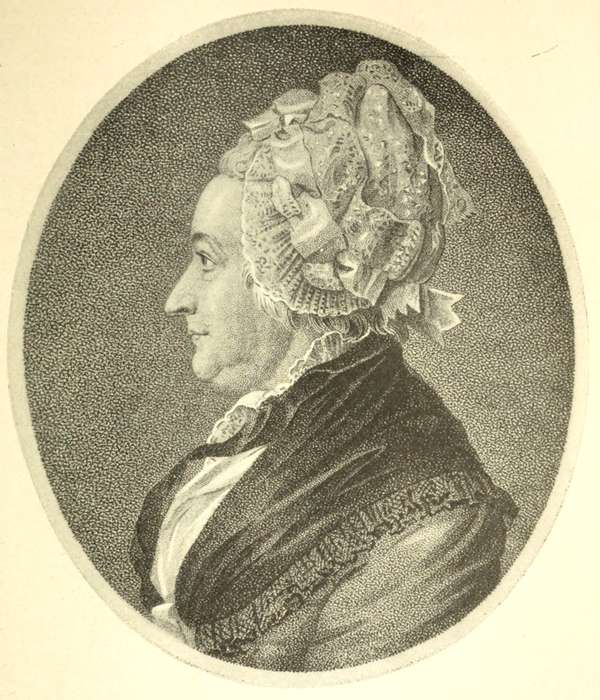
MISS ELIZABETH CARTER
From an engraving in The Works of Elizabeth Carter, 1806
But in whatever period, from whatever point of view, Miss
Carter presents us with a career almost unexampled in the annals
of learned ladies. She chose learning young and pursued
it undeviatingly, with no hesitancies and no retrospective regrets.
There were no disapproving friends or relatives to interpose
obstacles in her path. Few girls, even to-day, could have
greater freedom in the determination of their own hours, occupations,
and pleasures. Her father, though disheartened by her
slow progress, was her faithful teacher. Even her stepmother
aided and abetted her extravagant devotion to study. She was
allowed to determine the momentous question of marriage entirely
according to her own inclinations. Her published work
met with immediate praise. She was but twenty-two when
Johnson published epigrams in Greek and Latin in her honor,
and said she should be praised in as many languages as Lewis
the Grand. And by middle life she had achieved independence,
money, and fame.
Nor was her career merely an external success brilliantly
masking unsatisfied inner desires. On the contrary, to the end
her eighty-nine years seemed rich and gracious to her. She did
not covet other women's lovers or husbands or children or homes.
She set possible honors lightly aside. When her friends were
urging upon her a place at court, she dreamed that she had cut
off her head for the greater convenience of curling her hair, and
she declared this dream symbolic of the fatal cost at which
honors were often bought. Her joys were of an unambitious,
quiet, perennial sort. She loved nature in all its moods of
storm and shine. Her genius for friendship nearly equaled the
"Matchless Orinda's." She loved reading and had many books.
She enjoyed reflection and had many hours of happy solitude.
She was domestic in her tastes and found herself loved and
needed in her father's home. She had a sound, sweet, sensible,
modest nature that not only disarmed criticism, but preserved
her from any undue or arrogant emphasis on her position as the
most distinguished literary woman of her time. And she had
an unfailing sense of humor that sent an undercurrent of enjoyment
through even the prosaic and dreary parts of life.
Of schools for girls in the period from 1650 to 1750 we can
get only the most scattered bits of information. It is apparent
that there were boarding-schools for girls from five to sixteen,
and that these schools rapidly increased in number, but of the
scope and nature of the instruction we have only the most general
ideas. In 1677 there appeared the following advertisement:
In Oxford there is set up a boarding-school for young gentlewomen
(by John Waver, Master in the art of dancing) where they
may be educated and instructed in the art of dancing, singing, music,
writing, and all manner of works.
A more famous school was at Chelsea in Gorges House. Our
first knowledge of this boarding-school comes from a play given
by the pupils. It was dated 1676 and was entitled "Beauty's
Triumph, a masque presented by the scholars of Mr. Jeffrey
Banister and Mr. James Hart at their new Boarding-School for
young Ladies and Gentlewomen kept in that house which was
formerly Sir Arthur Gorges at Chelsey."[377] The "Epilogue—Spoken
by a young lady" recounts "the serious things" done in
the school, embroidery and modeling in wax being the chief items.
One in rich works with lively colours tells
Lucretia's rape or mourning Philomel's;
Each chaste beholder sighs and drops a tear.
Another's different mind more pleasure takes
In various forms to mould the painted wax;
Such shape, such beauty in each piece is shown,
Nature sits pale, or blushing on her own,
To see her pride by curious art out-done.
Between 1680 and 1690 Purcell's Dido and Æneas was given
at this school. D'Urfey's Love for Money; or, the Boarding
School (1691) has its scene "Chelsey by the River" and is supposed
to refer to this school. It was here that Molly Verney
learned to japan. The school maintained its repute under Mr.
Portman, and later under Josias Priests.
In 1680 the school was advertised:
Josias Priests, dancing master, that kept a boarding school for
gentlewomen in Leicester Field is removed to the great school-house
in Chelsea, which was Mr. Portman's, where he did teach, and will
continue the said master and others to the improvement of the said
school.
Gorges House was demolished in 1726.
Two other notices belong in the reign of Queen Anne. The
first one shows the continued popularity of the Hackney
schools:
Whereas it is reported that Mrs. Overing who keeps a Boarding
School at Bethnal Green near Hackney, is leaving off; this is to give
Notice that the said Report is false, if not Malicious. And that she
continues to take sober young Gentlewomen to board and teach whatever
is necessary to the Accomplishment of that sex.
The second one reads,
Mrs. Elizabeth Tutchin continues to keep her school at Highgate,
notwithstanding Reports to the contrary. Where young Gentlewomen
may be soberly Educated, and taught all sorts of Learning fit
for young Gentlewomen.[378]
In The Levellers a dialogue between two young ladies, we
have an account of the education given at most of these
schools. One of the young ladies says:
You know my father was a tradesman, and lived very well by his
traffick; and I, being beautiful, he thought nature had already given
me part of my portion, and therefore he would add a liberal education,
that I might be a complete gentlewoman; away he sent me to the
boarding school; there I learned to dance and sing; to play on the bass
viol, virginals, spinet, and guitar. I learned to make wax work, japan,
paint upon glass, to raise paste, make sweetmeats, sauces, and everything
that was genteel and fashionable.[379]
One element here indicated seems to have held a fairly permanent
place, and that is some trifling form of hand-work. A
book published in 1671 gives a hint as to the nature of this
work. It is entitled Four hundred new sorts of Birds, Beasts,
Flowers, Fruits, Fish, Flyes, Worms, Landskips, Ovals, and Histories,
etc. Lively coloured for all sorts of Gentlewomen and School-Mistresses
Works. Many of the kinds of work with which
women attempted to get rid of their leisure were apparently
taught in the schools. All sorts of needlework seem to have been
included in the necessary subjects. The interest in samplers is
shown by a reference in The Tatler, April 19, 1709, to an "excellent
discourse" by "Mrs. Arabella Manly, School-Mistress
at Hackney," entitled An Essay on the Invention of Samplers,
communicated by Mrs. Judith Bagford with an account of her
Collections for the same.[380]
In 1714 a "Venerable Correspondent" wrote to The Spectator
that in her day young women "Worked Beds, Chairs, and
Hangings," and urged The Spectator to recommend a renewal of
these activities. The humorous response is hardly an exaggerated
statement of the great pieces of work undertaken by the
women of the seventeenth century:
What a delightful Entertainment must it be to the Fair Sex, whom
their native Modesty, and the Tenderness of Men towards them,
exempts from Publick Business, to pass their hours in imitating Fruits
and Flowers, and transplanting all the Beauties of Nature into their
own Dress, or raising a new Creation in their Closets and Apartments.
How pleasing is the Amusement of walking among the Shades and
Groves planted by themselves, in surveying Heroes slain by their
Needle, or little Cupids which they have brought into the World
without Pain.
This is, methinks, the most proper way wherein a Lady can shew
a fine Genius, and I cannot forbear wishing, that several Writers of
that Sex had chosen to apply themselves rather to Tapestry than
Rhime. Your Pastoral Poetesses may vent their Fancy in Rural Landskips,
and place despairing Shepherds under silken Willows, or drown
them in a Stream of Mohair.... How memorable would that Matron
be, who should have it Inscribed upon her Monument, "That she
wrought out the whole Bible in Tapestry, and died in a good old Age,
after having covered three hundred Yards of Wall in the Mansion-House."[381]
In the eighteenth century embroidery and tapestry are still
an occupation, but other and less tedious works partially supplant
them. Pope's Grotto was not an isolated curiosity. The
Spectator suggests the part women were taking in the manufacture
of grottoes:
There is a very particular kind of Work, which of late several Ladies
here in our Kingdom seem very fond of, which seems very well adapted
to a Poetical Genius: It is the making of Grottos. I know a Lady
who has a very Beautiful one, composed by herself, nor is there one
Shell in it not stuck up by her own Hands.[382]
Pope wrote an inscription for a "Grotto of Shells at Crux
Easton, the Work of Nine young Ladies." These young ladies
were sisters and their grotto was also celebrated by "N. H."[383]
In 1735 "S. J." wrote a poem to a Lady to accompany a present
of shells and stones for her grotto.[384] In 1746 Mr. Graves congratulated
Lady Fane on her "grotto divine" where "miracles
are wrought by shells."[385]
Paper-cutting also remained something of an art. Waller
had praised a lady who skillfully cut a tree in paper.[386] Cutting
silhouettes was one of the diversions of the circle of Dr. Swift,
Dr. Delany, and Mr. Sheridan. There is a series of poems, concerning
"Dan Jackson's Picture Cut in Silk and Paper," by
Lady Betty.[387] The most important cut-paper work on record
is Mrs. Delany's herbarium or paper mosaics, but this did not
come till the last quarter of the century.[388]
Mrs. Barber's Patch-Work Screen gets its name from another
sort of device. Screens were adorned by pasting odds and ends
of pictures all over them. Mrs. Elizabeth Rowe wrote to the
Duchess of Somerset in 1734: "The screen your Ladyship sent
me is a Rareeshew for all the women and children about town
who have anything of a nice and elegant taste." The Duchess
was at this time doing tent-stitch concerning which Mrs. Rowe
wrote:
I am delighted with all your entertainments, except the Tent-stitch;
and that I own, I admire, but then 't is as some people admire virtue,
only in speculation. It seems to me an ante-diluvian invention, a
task for those long-breath'd people, who spent a sort of eternity on
earth, compar'd to the short duration of a modern period. However,
I am in no pain for your Ladyship: whether your attempt is a chair or
a stool, I suppose it will be an hereditary occupation; if you finish the
branch of a tree, and Lady ——, a shepherd's crook, the service of
your generation is done, and you may contentedly leave the rest to
be finished by your children's children.
In 1758 Lady Bute had just completed a carpet concerning
which she wrote to her mother, Lady Mary Wortley Montagu.
Lady Mary answered:
You need not excuse to me taking notice of your carpet. I think you
have great reason to value your-self on the performance, but will have
better than I have had if you can persuade anybody else to do so. I
could never get people to believe that I set a stitch, when I worked six
hours in a day.
Perhaps the most popular of all the arts was japanning.
Molly (b. 1675), the daughter of Edmund Verney, was sent at
eight to Mrs. Priest's school at Great Chelsey. Her father
wrote to her:
I find you have a desire to learn to Jappan, as you call it, and I
approve of it; and so I shall of anything that is Good & Virtuous,
therefore learn in God's name all Good Things, & I will willingly be
at the Charge so farr as I am able—tho' they come from Japan or
from never so farr & Looke of an Indian Hue & Odour, for I admire
all accomplishments that will render you considerable, and Lovely
in the sight of God and man.[389]
The continued favor accorded japanning is shown by a letter
from Mrs. Rowe to the Duchess of Somerset in 1734:
My great attainment at present is colouring prints: If Lady ——
wants any birds for her new Japan, I have some at her service. Mrs.
—— is so inchanted with this new japanning, that she has abandon'd
Mr. Baxter, and the Greek Fathers, and employes her time in sticking
bears and monkies on all the wooden furniture she can find about the
house.
Japanning was taught in most of the schools.
Mrs. Montagu, Queen of the Blue-Stockings, was indefatigable
in her devotion to hand-work. Not only was she familiar
with every kind of needlework, but she turned in wood and
ivory, made shell grottoes, and designed shell frames, and she
planned and executed feather hangings for a room. Mrs.
Delany is the only lady whose recorded work exceeds that of
Mrs. Montagu in amount and variety.
Domestic science was faintly foreshadowed in what were
known as "Pastry Schools." The following illustrates the
type:
To all young ladies at Edw. Kidder's Pastry School in little Lincoln's
Inn Fields are taught all sorts of Pastry and Cookery, Dutch
hollow works, and Butter works, on Thursdays, Fridays, and Saturday,
in the afternoon, and on the same days in the Morning, at his
school in Norris Street in St. James's Market, and at his School in St.
Martin's Le Grand, on Monday, Tuesday, and Wednesday in the
Afternoons. And at his School at St. Mary Overies Dock, Mondays,
Tuesdays and Wednesday Mornings from 9 to 12.[390]
An entertaining passage in Shadwell's The Scowrers (1690)
indicates something of the character of a girl's education in the
country:
Priscilla. Did she not bestow good breeding upon you there?
Eugenia. Breeding! what, to learn to feed Ducklings, and cram
Chickens?
Clara. To see cows milk'd, learn to Churn, and make cheese?
Eugen. To make Clouted cream, and whipt sillabubs?
Clara. To make a Caraway Cake, and raise Py Crust?
Eugen. And to learn the top of your skill in Syrrup, Sweetmeat,
Aqua Mirabilis, and Snayl water.
Clara. Or your great Cunning in Cheese cake, several Creams and
Almond butter.
Prisc. Ay, ay, and 't were better for all the Gentlemen in England
that Wives had no other breeding, but you had Musick and Dancing.
Eugen. Yes, an ignorant, illiterate, hopping Puppy, that rides his
Dancing Circuit thirty Miles about, lights off his tyred steed, draws
his Kit at a poor Country creature, and gives her a Hich in her Pace,
that she shall never recover.
Clara. And for Musick an old hoarse singing man riding ten miles
from his Cathedral to Quaver out the Glories of our Birth and State,
or it may be a Scotch Song more hideous and barbarous than an Irish
Cronan.
Eugen. And another Musick Master from the next town to Teach
one to twinkle out Lilly burlero upon an old pair of Virginals, that sound
worse than a Tinker's Kettle that cries for his work on.
We happen to have somewhat more definite knowledge of one
early eighteenth-century school for girls. Mrs. Hannah Wood,
the "Mistress of a College-Boarding School" in Bury, in 1723,
was the sister of Mr. D. Bellamy who wrote "Dramatic Entertainments"
for the "Annual Public Exercises of the School."
These "Entertainments" were published with a dedication to
Mrs. Wood, "A Prefatory Essay," and some "Familiar Letters."
Mr. Bellamy considers it the particular province of Mrs.
Wood "to polish Nature," since she has "a perfect Idea of
every Female Accomplishment" and if her young ladies can be
"One Virtue the better" through his labors it is ample reward.
Mr. Bellamy's plays were rather elaborately staged. There
were "pastoral figure dances" and considerable singing. One
character enters "drest like a Gentleman." There is a machine
for the descent of Apollo. The dramas performed are carefully
adapted to young ladies, "the porcelaine-clay of humankind."
Mr. Bellamy examines every word and weighs each thought to
see that "The sence is Chast and inoffensive to nicest tast."
The first of the plays given is Vanquish'd Love: or, The Jealous
Queen, an adaptation of the Rosamund of Addison. The emphasis
on warm passions, amorous prayers, guilty fires, rage,
jealousy, vengeance, and death, would but doubtfully contribute
to the delicate innocence of the young ladies. All is,
however, made right by the abrupt and unnatural repentance of
King Henry, and his eulogy of the sweets of "Virtuous Love."
The second play, Innocence Betray'd; or, The Royal Imposter,
was taken from Cowley's Love's Riddle. In the Epilogue a
young lady says the auditors may
Wish we had Rehears'd our Spelling Books:
And think our Time had been much better spent
In Cross-Stitch, Irish-Stitch, or at the Tent.
And Mr. Bellamy is quite conscious that some indulgent and
timorous parents may censure his designs of teaching young
ladies to speak before an audience:
There are too many, I know, are of Opinion, that the Art of Pronunciation
is no Female Accomplishment; that the Ladies were design'd
by Nature for the Objects of Sight only; and that to encourage
them in Dramatic Representations, is to offer Violence to their native
Modesty....
'T was an Observation of One of the most learned Prelates of his
Age, the late Archbishop of Cambray, That the general Mistake of
Parents in the Education of their Daughters, was this: "That they
were too solicitous about the Ornament of their Person, and too remiss,
if not entirely regardless, of the Endowments of their Mind."
'T is pity methinks that the favourite Works of Nature should be
nothing but moving Pictures, and, like Sir Godfrey Kneller's Canvas,
as Mr. Dryden expresses it, only Look a Voice; that the Study of the
Toilet should be recommended to them, as their most material Accomplishment,
whilst the Improvement of their Judgment is neglected
as a Trifle, and the early Exercise of their Rational Faculties esteem'd,
if not a Crime, an Act of Imprudence and ill Conduct.
In the presentation of the play the young ladies are urged to
enter into the characters they have taken, and to remember the
reverence and respect they owe their auditors. Under more
specific directions Mr. Bellamy says:
In the first place, Ladies, carefully avoid all unnatural Distortions
both of your Limbs and Features. Wry mouths, contracted Brows,
shrug'd up shoulders, and the like are Farce and Buffoonry, very disagreeable
and very ungenteel: Nay, Coughing and Spitting, unless
very accidental, are vicious Habits, and ought betimes to be corrected.
Among "Useful Observations" is the following on modulation
of the voice:
All Persons Names, viz., I, Thou, He, She, We, Ye, and They, etc.
and their following States, Me, Thee, Him, Her, Us, You, and Them,
etc. and their Possessives, My, Thy, Our, Yours, Theirs, Mine, Thine,
etc. and all Epithets, Adjectives, or Qualities, by which Substantives,
Beings, or Things are explain'd and distinguish'd as, Black, White,
Good, Bad, Round, Square, and the like, should always be read or
spoken with a clear, open, and distinct Voice, as they are for the most
part very emphatical, and the Beauty of Expression depends much
upon them.
In a letter on "Female Accomplishments" the Virtuous and
Fair Antiope in the twenty-second book of Fénelon's Telemachus
is set forth as an example of a lady of the first quality.
Her silence, modesty, reservedness, gentleness, her assiduous
industry in spinning and embroidering, her regularity and order
and poise, make her a treasure worthy to be sought in
far regions. In the letter on "Innocent Recreations" reading
is particularly commended. The "chaste and very useful"
collection of books suggested is based on the Postscript to Dr.
Hickes's Instructions for the Education of a Daughter, and is as
follows:
The whole Duty of Man, The Lady's Calling, The Government of
the Tongue, Mr. Nelson's Companion for the Feast and Fasts of the
Church of England, Meditations and Soliloquies of St. Augustine,
Comber and Bennet on the Liturgy, Mr. Boyle on the Style of
the Scriptures. Tillotson's Sermons, Paradise Lost with Addison's
judicious and entertaining Remarks, Blackmore's Paraphrase on Job,
Cowley's Davideis.
For the gayer part of poetry,
Mr. Waller, Mr. Cowley's Mistress, some pieces of Mr. Prior, particularly
his Henry and Emma. Mr. Norris's Miscellany, and Mr.
Watts's Horæ Lyricæ. For precepts of Morality I would lay before
her Sir Roger L'Estrange's Seneca and his Fables; Mr. Collier's Essays
and his Antoninus and some select pieces of the Letters and Spectators.
For history, Lord Clarendon on the Rebellion and Dr. Welwood's
Memoirs are suggested.
For novels, the Adventures of Telemachus, translated by Mr. Ozell;
and Don Quixot by Mr. Motteux, Mr. Congreve, and others, are
the only Pieces that I would offer to her. For Plays, tho' there are
too many unfit for a young Lady's Perusal: yet such as Cato, Love
and Empire, Tamerlane, the Mourning Bride, the Distress'd Mother,
Phædra and Hippolitus, and the Conscious Lovers, with many more,
can never be read without Pleasure and Improvement.
Schools for young ladies increased in number during the
eighteenth century, especially near London. Malcolm, in 1808,
said that even so early as 1759
two or three houses might be seen in almost every village, with the
inscription, "Young Ladies boarded and educated," where every
description of tradesmen sent their children to be instructed, not in
the useful attainments necessary for humble life, but the arts of coquetry
and self-consequence—in short, those of a young lady. The
person who received the children had then the sounding title of
Governess: and French and Dancing-masters prepared the girl for
the hour when contempt for her parents' deficiencies was to be substituted
for affection and respect. Instead of reading their native language
with propriety and just emphasis, it was totally neglected, and
in place of nervous sentences and flowing periods, the vulgarisms of
low life were continued; while the lady repeated familiar words of the
French language with a sound peculiar to Boarding-schools, and quite
unintelligible to a native of France: the pleasing labours of the needle
were thrown aside, and the young lady soon became an adept in imitating
laces and spoiling the beauty of coloured silks.[391]
The Idler in 1750 comments on female education as spoiling
girls for service:
Scarcely a wench was to be got for all work, since education had
made such numbers of fine ladies that nobody would now accept a
lower title than that of waiting-maid, or something that might qualify
her to wear laced shoes and long ruffles and to sit at work in the parlor
window.
In 1698 the Society for Promoting Christian Knowledge
started a movement for the establishment of charity schools.
An organized propaganda for getting subscriptions was undertaken
by the bishops and was so successful that between 1698
and 1715 more than one hundred of these schools were established
in London and Westminster. In this scheme poor girls
were considered as well as poor boys. They were, of course, in
separate schools.[392] Each school had a prescribed uniform and
the pupils marching in a body made a picturesque addition to
many a civic festival. In 1714 Thoresby went to hear "the
Bishop of London preach the charity sermon before an almost
innumerable company of poor children, decently clad in various
colours, which are Christianly educated and cared for in the
several wards of the city, both for soul and body."[393] In 1723
he again records seeing the Lord Mayor in all his pomp going
to St. Bride's Church with a great train of charity children, all
decently habited, some with blue coats with yellow vests, others
brown, most with blue caps, but some with white hats and
mathematical instruments in their hands.[394] By 1753 the number
of charity children that went to Christ Church to hear
the Anniversary Sermon was five thousand. William Blake, in
Songs of Innocence (1789) and in Songs of Experience (1799),
gives the impression of great numbers. In the first of these
commemorations Blake voices what was the general attitude,
and that is a eulogy of London's magnificent generosity.
The second one represents a much more modern tone,
that of question as to a city's social and civic standards
where the supply of helpless orphans was so large and so
constant.
The word education is too pretentious for most of these
schools. The purpose in the main was to train boys and girls
for service. In the pictures drawn by Hogarth in 1741 in honor
of Captain Coram's noble charity, The Foundling Hospital, the
three little girls in the foreground are holding a spinning-wheel,
a sampler, and a broom, indicating branches of industry to
which they were destined.
There were also many privately endowed schools in various
parts of England. In 1726 William Law, the author of The
Serious Call, brought out a treatise on Christian Perfection. It is
said that an anonymous stranger presented him with £1000 on
reading it. The next year Law founded a school for fourteen
girls at King's Cliffe, and the money is supposed to have come
from this gift. When Archibald Hutcheson died in 1740 he
expressed a wish that his widow should lead a retired and religious
life under Law's guidance. Miss Hester Gibbon joined
Mrs. Hutcheson. Their joint income was £2600 a year, most
of which they planned to spend in charity. In 1744 they settled
down in King's Cliffe in Law's house, formerly a royal manor
house and known as "King John's Palace," where they continued
the girls' school, and added to it a school for eighteen
boys. The important schools in Yorkshire founded by Lady
Elizabeth Hastings have already been mentioned.
Other more private and personal and less permanent educational
ventures are occasionally recorded. A religious family
school something after the fashion of Little Gidding was now
and then attempted. One "religious retirement" is mentioned
by Bishop Ken. Two dear friends whom he frequently visited
were Mary and Anne Kemys of Cefn Mably, Glamorganshire.
After the death of their mother in 1683 they went to reside
at Naish Court, about a mile from Porteshead. There they
established a kind of Anglican sisterhood where they lived a
devout life and did charitable works. Bishop Ken was their
spiritual adviser, and since he had known Nicholas Ferrar well,
it is not unlikely that the ideals at Naish Court were somewhat
like those at Little Gidding.[395] In 1698 Sir George Wheler
brought out a tractate entitled A Protestant Monastery, or Christian
Œconomics, containing Directions for the Religious Conduct
of a Family. He founded and endowed a school for girls at
Houghton-le-Springs, Durham, when he was rector there. Sir
George Wheler was an intimate friend and a disciple of Dr.
Hickes with whom he went abroad. It was evidently through
the influence of Dr. Hickes that he became an advocate of
higher education for women.
About the middle of the century Mrs. Montagu went to
Bath-Easton to visit her sister, Mrs. Scott, and Lady Bab
Montagu, who had chosen a life of retirement and good works.
On her return to Sandleford, Mrs. Montagu wrote as follows
to Mr. Gilbert West:
My sister rises early, and as soon as she has read prayers to their
small family, she sits down to cut out and prepare work for 12 poor
girls, whose schooling they pay for; to those whom she finds more than
ordinarily capable, she teaches writing and arithmetic herself. The
work these children are usually employed in is making child-bed linen
and clothes for poor people in the neighborhood, which Lady Bab
Montagu and she bestow as they see occasion. Very early on Sunday
morning these girls, with 12 little boys whom they also send to school,
come to my sisters and repeat their catechism, read some chapters,
have the principal articles of their religion explained to them, and
then are sent to the parish church. These good works are often performed
by the Methodist ladies in the best of enthusiasm, but thank
God, my sister's is a calm and rational piety. Her conversation is
lively and easy, and she enters into all the reasonable pleasures of
Society; goes frequently to the plays, and sometimes to balls, etc.
They have a very pretty house at Bath for the winter, and one at Bath
Easton for the summer; their houses are adorned by the ingenuity of
the owners, but as their income is small, they deny themselves unnecessary
expences. My sister seems very happy; it has pleased God
to lead her to truth, by the road of affliction; but what draws the sting
of death and triumphs over the grave, cannot fail to heal the wounds
of disappointment. Lady Bab Montagu concurs with her in all these
things, and their convent, for by its regularity it resembles one, is
really a cheerful place.[396]
The lesser boarding-schools and the charity schools give no
intimation of anything even approximating the higher education
of women. But that topic was not neglected. And it is
of interest to take up in chronological sequence the various
expressions of opinion as to the kind of education women should
have.
Anna van Schurman
(1607-1678)
The first influential writer advocating a large and liberal
curriculum for women was a foreigner,[397] the
famous Anna van Schurman of Utrecht. She
was, indeed, the most famous learned woman of
the seventeenth century, not only in Holland, but in the entire
world of letters. As a child she gave such indication of unusual
power that her father's interest and ambition were aroused, and
he gave her perfect freedom and sympathetic coöperation in the
development of her tastes. There was no regular plan or discipline
in her education. She merely followed out, in art, in
handicrafts, in letters, every new interest of her singularly alert
and responsive mind. Till she was twenty-eight, art in some
form was her chief occupation. She carved portraits in boxwood,
modeled them in wax, etched them on glass or copper,
and cut medallions in ivory. She did fine needlework and intricate
embroidery, and worked tapestry. Specimens of her scissors-work
are still preserved in the Schurman museum at
Franeker and show a dexterity that must have been remarkable
even in that day of exquisite cut-paper.[398] And she excelled in
the fashionable accomplishment of writing in foreign alphabets.
She sang delightfully, and played on the cymbal, the lute, and
the violin. Her interest in the technical side of music is evidenced
by her correspondence with noted musicians such as
Huyghens, Hooft, and Bannius.
But gradually during the amateurish delights of these occupations
and through the frivolities of a gay life there had been
growing in Anna's mind a desire for serious work. And from
twenty-eight to forty-eight she gave herself to the learned pursuits
on which her contemporary renown was based. She became
known throughout Europe and the most extravagant
recognition was accorded her. As the finest Latinist in Utrecht
she was chosen to write the ode on the founding of the University
in that city. She was named the "Star of Utrecht." Gisbert
Voët, the Rector of the University, taught her Hebrew,
Syriac, and Chaldee, and influenced her to devote years to a
textual study of the Bible. Beverwyck, who through admiration
for her had become a convinced feminist, dedicated his
treatise De Excellentia Fæmini Sexus to her as "the most wonderful
woman of her day." Cats wrote poems to her as the
Wonderstuk of the age. Her Ethiopian Grammar was greeted
as a marvel by the scholars of the Dutch universities. Jean
Louis Balzac congratulated himself on coming to know "cette
merveilleuse fille." Descartes was one of her close friends. She
corresponded on terms of equality with theologians like Jacob
Lydius and Fredereck Spanheim and M. de Saumaise of Leyden
University. Caspar van Baerle eulogized her as "a second
Sempronia, a better Sappho, a new Pallas." She became almost
an object of pilgrimage, royal personages being among those
attracted by her great fame. The Queen of Poland, the
Duchesse de Longueville, and Christina of Sweden with an
escort of Jesuit priests were among those who made visits of
state to "the incomparable Virgin."
The last twenty years of Anna van Schurman's life were
given entirely to mystical religion under the guidance of Jean
de Labadie of whose community she became the most influential
member. But in the preceding period many topics of contemporary
interest held her attention. Chief among these was
the right of women to free mental development. Dr. Rivet,
Professor of Theology at Leyden, and her intimate friend,
once wrote to her that ordinary women were debarred from
equality with men by "the sacred laws of Nature." Anna responded
in lively protest and said that he based his arguments
on custom and not on reason. In time she wrote a book embodying
her own views on the subject. It was published by Elzevir
at Leyden in 1641 under the title De ingenii muliebris ad
doctrinam et meliores litteras aptitudine. In 1659 the book was
translated into rather stiff and cumbersome English, by "C. B.,"
doubtless Clement Barksdale, an Oxford man, a prolific translator
from the Latin and much interested in education. He was
master of a free school at Hereford, and later had a successful
private school at Hawling in Cotswolds. He must have had
especial interest in the education of women, for in 1675 he wrote
a Letter touching a College of Maids or a Virgin Society. Mr.
Barksdale's translation appeared under the title, The Learned
Maid; or, Whether a Maid may be a Scholar. Logick Exercise
Written in Latine by that incomparable Virgin Anna Maria à
Schurman of Utrecht. With some Epistles to the famous Gassendus
and others. The book opens with a quotation from Fr.
Spanhemius in which he eulogizes Anna van Schurman as "the
utmost Essay of Nature in this Sex." The translation is dedicated
to the "Lady A. H.," probably the Lady Anne Hudson
to whom Gerbier dedicated his Elogium Heroinum. There had
evidently been an earlier translation than Barksdale's, for he
says, "This strange maid, being now the second time drest up in
her English Habit, cometh to kiss your hand." Two translations
into English within eighteen years indicate a considerable
interest in the arguments advanced. Yet the form of the book
was difficult and unattractive as is indicated by the phrase
"Logick Exercise." Every argument is thrown into stiff syllogistic
form. The portion of the book entitled "A Refutation
to the Adversaries" is somewhat more natural and lively.
Stripped of their pedantry the arguments against the education
of women and the answers to these arguments are as follows:
Objection: The wits of women are too weak for the study of letters.
Answer: Not all men have "heroical wits" yet they are not excluded
from studies. No claim is made that all women should study,
but only those of "at least indifferent good wits." Weakness of wit
may be aided by study.
Objection: Women have no opportunity to prosecute studies, no
academies or schools being open to them.
Answer: There are parents and tutors.
Objection: Knowledge is a useless acquirement since women are
shut out from "Politicall, Eclesiasticall, or Academicall" offices.
Answer: Though they gain not the Primary end of public usefulness
they yet gain an important secondary personal end.
Objection: Since a little knowledge will suffice for a woman in her
vocation an "Encyclopædy" of knowledge is superfluous.
Answer: There is ambiguity in the word "vocation." Does it mean
that woman belongs to private as against public life? Then many
gentlemen in private life should be shut out from studies. Does it
mean woman's special calling to Family Life? But all human beings
have a right to a personal development, a "Universal Calling" separate
from and above their special vocation.
Objection: Women do not care for studies, and nothing should "be
done invitâ Minervâ, as we say, Against the Hair."
Answer: The assumption that women do not care to apply themselves
to studies becomes logically important only when it is proved
of women after excitation and opportunity in studies. "No man can
rightly judge of our Inclination to studies, before he hath encouraged
us by the best reasons and means to set upon them: and withall hath
given us some taste of their sweetness."
The arguments given and the objections answered lead to the
statement:
Wherefore our Thesis stands firm: A Christian Maid, or Woman may
conveniently give herself to Learning: Whence we draw this Consectary,
that Maids may and ought to be excited and encouraged by the best
and strongest Reasons, by the Testimonies of wise men: and lastly by
the examples of illustrious Women, to the embracing of this kind of life,
especially those who are above others provided of leisure, and other
means and aides for their studies. And, because it is best, that the
mind being seasoned with Learning from the very Infancy: therefore
the Parents themselves are chiefly to be stirred up, as we suppose, and
to be admonished of their duty.
In a presentation of the appropriate range of the studies of
women Anna includes the entire circle of Liberal Arts and
Sciences as convenient for the Head of a Christian Maid.
But specially let regard be had unto those Arts which have neerest
alliance to Theology and the Moral Virtues, and are Principally subservient
to them. In which number we reckon Grammar, Logick,
Rhetoric: especially Logick, fitly called The Key of all Sciences: and
then, Physicks, Metaphysicks, History, etc. and also the knowledge
of Languages, chiefly of the Hebrew and Greek. All which may advance
to the more facile and full understanding of Holy Scriptures:
to say nothing now of other Books. The rest, i.e. Mathematicks, (to
which is also referred Musick) Poesie, Picture, and the like, not illiberal
Arts, may obtain the place of pretty Ornaments and ingenious
Recreations. Lastly, those studies which pertain to the practice of
the Law, Military Discipline, Oratory in the Church, Court, University,
as less proper and less necessary, we do not very much
urge. And yet we in no wise yield that our Maid should be excluded
from the Scholastick Knowledge or Theory of those; especially not
from understanding the most noble Doctrine of the Politicks or Civil
Government.
The whole book is a eulogy of learning as a specific for all the
ills of mind or heart. Anna quotes from the great Erasmus to
the effect that "nothing takes so full possession of the fair Temple
of a Virgin's breast, as learning and study, whither, on all
occasions she may fly for refuge," and hence nothing can so
effectually oppose vanity and light-mindedness. Studies will
make a woman sufficient unto herself in leisure hours. Studies
perfect and adorn the intellect; they conduce to reverence for
the most beautiful, the most excellent, and so to love of God;
they fortify the mind against heresies, they teach prudence,
they destroy fear, they put courage into the heart; they give a
delight that is like "Divine gladness"; and they mollify and
sweeten manners. In fine, the liberal pursuit of learning brings
the whole nature into conformity with "the Rule of right
reason." Who, then, would shut women out from delights so
laudable, virtues so desirable?
The whole book gives such an impression of high-minded
earnestness, it is so strenuous and sincere, affirmative arguments
are so elaborately established, and adversaries are so
elaborately crushed, that it becomes a distinct anti-climax to
realize what, after all, was the extent of her demand. She virtually
asks nothing more than that rich girls of good minds
shall be allowed and even encouraged to study at home under
tutors, with the proviso that they make no public use of their
learning, that they remember St. Paul's injunction to women
"to be οἰκουργός, keepers at home," and that they make
learning the handmaid of piety. Anna van Schurman was asking
for what she herself had had. And her conception seems
somewhat less modest when we realize that no scholastic dignities,
no authorship, no public offices, could put a woman of to-day
so distinctly in the lime-light of royal and learned favor as
was this retiring Anna in her quiet little home at Utrecht.
Bathsua Pell,
Mrs. Makin
(fl. 1641-1673)
The immediate follower of Anna van Schurman was Bathsua
Pell, better known as Mrs. Makin.[399] She is one
of the most significant personages connected
with the education of girls in the mid-seventeenth
century. Her father was a rector in Southwick, Sussex.
He died in 1616 and his wife in 1617, leaving three children.
Thomas became gentleman of the bedchamber to Charles I,
but went to America in 1635. The younger brother, John (1611-1685),
was early noted as a student. At thirteen he entered
Trinity at Cambridge, being even then "as good a scholar as
some masters of arts." At twenty he was reported to know
Hebrew, Greek, Latin, Arabic, Italian, French, High and Low
Dutch. By the time he was twenty-three he had specialized in
mathematics. He held important mathematical posts under
Cromwell; and, later, under Charles II, he was given a valuable
living. Bathsua Pell had her brother's talent for languages, and
like him had an early repute for learning. About 1641, when
she was perhaps about thirty, she was appointed tutoress to
Princess Elizabeth, the six-year-old daughter of Charles I. The
learned tutoress was apparently at liberty to follow her own
ideas of education, and for several years she led the sad little
Princess into such delights as might be found in the languages
and theology. She boasted of her pupil's proficiency, saying
that at nine she could "write, read, and in some measure understand,
Latin, Greek, Hebrew, French and Italian."[400] Mrs.
Makin had other distinguished pupils. Among them was Lucy
Davies, daughter to Sir John Davies, Attorney-General for
Ireland, and better known as author of Nosce Teipsum, and
Eleanor Truchett, fluent author of half-mad books of prophecy.[401]
Lucy married the sixth Earl of Huntington. After his
death in 1655, when their son was but six years old, as Countess
Dowager of Huntington, she evidently gave her time and
interest in her retirement to the studies begun under Mrs.
Makin (possibly in the Putney Schools before 1649), who says
of her in 1673: "I am forbidden to mention the Countess Dowager
of Huntington (instructed sometimes by Mrs. Makin) howe
well she understands Latin, Greek, Hebrew, French and Spanish;
or what a proficient she is in Arts, subservient to Divinity, in
which (if I durst I would tell you) she excells."
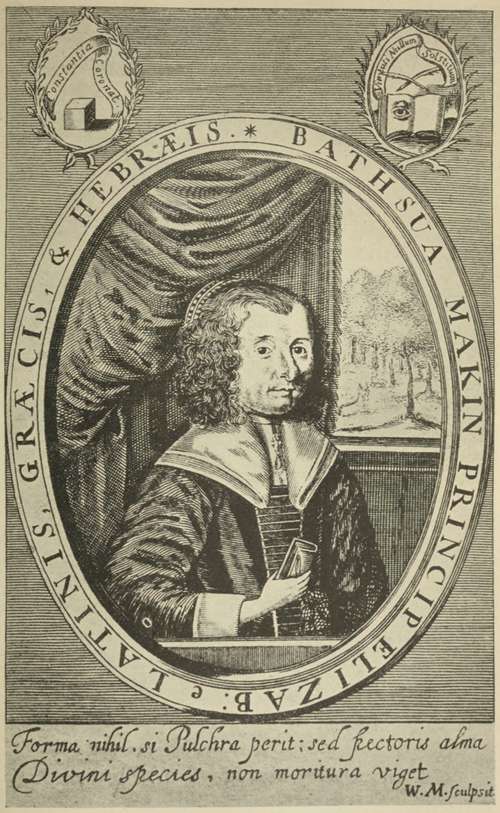
MRS. BATHSUA MAKIN
"Facsimile copy from an almost unique print by Marshall." From an engraving in
Woodburn's Gallery of Rare Portraits, 1816, Vol. II, page 39.
Mrs. Makin makes enthusiastic mention of other learned
ladies, but does not make it clear whether they had been under
her instruction. Lady Mildmay could not, she says, be justly
omitted. Then there was Mrs. Thorold, daughter of Lady Carr
in Lincolnshire, who was "excellent in Philosophy, and all
sorts of Learning." She cites also "Dr. Love's daughters,"[402] as
"still fresh in the memory of men" for their "Worth and Excellency
in Learning."
In April, 1649, John Evelyn and a party of ladies visited
"the schools or colleges for gentlewomen" at Putney. In all
probability Mrs. Makin had charge of this institution. Certainly
no other known Englishwoman would have been so
competent, or would have had such prestige as a school-mistress,
and her Essay of 1673 shows that she remained in the
educational field. Accompanying the Essay is a Prospectus for
a school she had recently opened. "If any enquire where this
education may be performed, such may be informed that a
school is lately erected for Gentlewomen, at Tottenham High
Cross, within four miles of London, on the road to Ware, where
Mrs. Makin is governess who was formerly tutoress to the
Princess Elizabeth, daughter to King Charles the First.
Where, by the blessing of God, Gentlewomen may be instructed
in the Principles of religion, and in all manner of
sober and virtuous Education: more particularly in all things
ordinarily taught in other schools." These things "ordinarily
taught in other schools" are listed as "Dancing, Musick, Singing,
Writing, Keeping accompts." Half the time in Mrs.
Makin's school was to be spent on this portion of the curriculum.
The other half was to be "employed in gaining the
Latin and French tongues." Greek, Hebrew, Italian, and
Spanish were optional subjects, but were offered by the
Governess who had a "competent knowledge" of all of them.
The language requirements could not have been extensive
since "Gentlewomen of eight or nine years old, that can read
well, may be instructed in a year or two (according to their
parts) in the Latin and French tongues." Something in the way
of natural history was attempted. Mrs. Makin announces,
"Repositories also for Visibles shall be prepared; by which,
from beholding the things, Gentlewomen may learn the Names,
Natures, Values, and Use of Herbs, Shrubs, Trees, Mineral-pieces,
Metals, and Stones," a sort of laboratory course in
botany and mineralogy. Astronomy, geography, and especially
arithmetic and history were also offered in a "general" way.
Domestic science was not omitted, though oddly bound up
with a course in art: "Those that please may learn Limning,
Preserving, Pastry, and Cookery." The principle of electives
was in full force. "Those that think one language enough for
a Woman, may forbear the Languages, and learn only Experimental
Philosophy." In fact, students were allowed to
take "more or fewer" of the courses offered as they might
incline. The regular rate was twenty pounds per annum, but
a "competent improvement in the Tongues, and the other
things aforementioned" was to command an additional fee.
Very astutely Mrs. Makin constituted the parents the judge
as to the excellency of their children's attainments. The notice
closes with this fair offer: "Those that think these Things
Improbable, or Impracticable may have further account
every Tuesday, at Mr. Mason's Coffee-house, in Cornhill,
near the Royal Exchange; and Thursdays, at the 'Bolt and
Tun,' in Fleet Street, between the hours of three and six in
the afternoon, by some person whom Mrs. Makin shall appoint."[403]
This course of study, desultory, inchoate, fragmentary, as
it is, is nevertheless of great historic interest. It is the first
known attempt to organize a scheme of definite and solid
study for girls. However superficial the work, it was based on
a novel and important conception of the value of genuine
knowledge in languages and science for girls as well as for
boys. It must have been as doubtful and epoch-making an
event in a community to have its girls sent to Tottenham
High Cross, as for the earliest students to go to Vassar. Unfortunately
the inception of this school is all we know about
it. A knowledge of its actual work, its success, a list of its
students, would serve as an illuminating commentary on the
general attitude towards learning for girls in the last quarter
of the seventeenth century.
That Mrs. Makin expected opposition is shown by the remarkable
Essay that was issued with her Prospectus. The full
title of the Essay is, An Essay to Revive the Antient Education
of Gentlewomen, in Religion, Manners, Arts, & Tongues, with
an Answer to the Objections against this Way of Education.
London, Printed by J. D. to be sold by Tho. Parkhurst, at the
Bible and Crown, at the lower end of Cheapside. 1673. In her
opening paragraphs Mrs. Makin recognizes that an age in
which "Learning and Virtue are counted Pedantick Things,
fit only for the Vulgar" is not a propitious time to undertake
an advanced scheme for the education of girls. She trenchantly
summarizes the prevalent attitude towards learned women;
and then bravely sets forth her own creed. She also emphasizes
the modesty of her demands:
Custom, when it is inveterate, hath a mighty influence: it hath the
force of Nature itself. The Barbarous custom to breed Women low, is
grown general amongst us, and hath prevailed so far, that it is verily
believed (especially amongst a cort of debauched Sots) that Women
are not endued with such reason, as Men; nor capable of improvement
by Education, as they are. It is lookt upon as a monstrous thing,
to pretend the contrary. A Learned Woman is thought to be a Comet,
that bodes Mischief, when ever it appears. To offer to the World the
liberal Education of Women is to deface the Image of God in Man, it
will make Women so high, and men so low, like Fire in the House-tops
it will set the whole world in a Flame. These things and worse than
these, are commonly talked of, and verily believed by many, who
think themselves wise Men: to contradict these is a bold attempt;
where the Attempter must expect to meet with much opposition....
I verily think, Women were formerly Educated in the knowledge of
Arts and Tongues, and by their Education, many did rise to a great
height in Learning. Were Women thus educated now, I am confident
the advantage would be very great: the Women would have Honour
and Pleasure, their Relations Profit, and the whole Nation Advantage....
Were a competent number of Schools erected to Educate Ladyes
ingenuously, methinks I see how ashamed Men would be of their
Ignorance, and how industrious the next Generation would be to wipe
off their Reproach. I expect to meet with many Scoffes and Taunts
from inconsiderate and illiterate Men, that prize their own Lusts and
Pleasure more than your Profit and Content. I shall be the less concern'd
at these, so long as I am in your favour; and this discourse may
be a Weapon in your hands to defend yourselves, whilst you endeavour
to polish your Souls, that you may glorify God, and answer the end
of your Creation, to be meet helps to your Husbands. Let not your
Ladiships be offended, that I do not (as some have wittily done) plead
for Female Preëminence. To ask too much is the way to be denied all.
God hath made Man the Head, if you be educated and instructed, as
I propose, I am sure you will acknowledge it, and be satisfied that you
are helps, that your Husbands do consult and advise with you (which
if you be wise they will be glad of) and that your Husbands have the
casting-Voice, in whose determinations you will acquiesce.
The main portion of the Essay is addressed to a "much-honoured
and worthy friend" who has expressed considerable
doubt as to the wisdom of her educational projects. The tone
of his letter is indicated by the following summary:
Your great question is, Whether to breed up Women in Arts and
Tongues, is not a mere new Device, never before practised in the
World. This you doubt the more: Because Women are of low Parts,
and not capable of Improvement by this Education. If they could be
improved you doubt, whether it would benefit them? If it would benefit
them, you enquire where such Education may be had? or, whether
they must go to School with Boys? to be made twice more impudent
than learned. At last you muster up a Legion of Objections.
These doubts and objections are then discussed seriatim. To
establish her contention that women have been educated in
arts and sciences in the past she gives an unchronological, uncritical
list of women who attained distinction in Greece and
Rome and in Bible times. Miriam, "a great poet and philosopher,"
the women who danced before David (singing songs
"compos'd it's like by themselves"), Huldah the Prophetess,
"who dwelt (we may suppose) in a college where women were
bred up in good literature"; Anna and Phebe; Triphena, Triphosa,
and Persis; Priscilla who instructed Apollos; Timothy's
mother Eunice and grandmother Lois; and Philip's four daughters,
make up from Sacred Writ a list intended to allay the
anxieties of a devout churchman as to the effect of learning
on female piety. Mrs. Makin was really forced to get as
many Biblical recruits as possible, since her opponents regularly
massed their forces in the Garden of Eden with the Sin
of Eve as their impregnable fort.
To the lay mind examples from classic lands might prove
authoritative, hence there follows a list of Greek and Roman
ladies of learning. If the heroes of ancient story are but idealized
representations of actual men, why, reasons Mrs. Makin,
may we not suppose some actual wise women as the begetters
of the legends of Minerva, the Muses, and the Sibyls? From
history she cites "Sempronia, Cornelia, Lelia, Mutia, Cleobulina,
Cassandra, Terentia, Hortensia, Sulpitia, Portia, Helvitia,
Enonia, Paula, Albina, Pella, Jenobia, Voleria, Proba,
Eudocia, Claudia," and many others; a list too undiscriminating
to be convincing, but certainly creditable to Mrs. Makin's
industrious learning. After this wide preliminary sweep, Mrs.
Makin takes up different realms of attainment. "Women have
been good Linguists"; "Women have been good Oratours";
"Women have understood Logic"; "Women have been profound
Philosophers"; "Some Women have understood the
Mathematics"; "Women have been good Poets"; "Women
have been good Divines"—such are the theses she is prepared
to defend. The mathematics are most thinly provided with
examples, Hypatia of Alexandria and "A Lady of late, her
name I have forgot," who printed divers tables, being the only
instances she can summon. The richest assemblage of names
comes under the linguists and the poets. The purpose of this
ardent and prolonged search of times past and present is to
show that women are not by act of creation always of "low
parts"; that some, indeed, have approached the standards set
by men. This being the case, women should have full educational
opportunities. Mrs. Makin is careful, however, to hedge
in even this proposition with qualifications. Education belongs
only to the Christian maid, to the maid of excellent mind, to
the maid of wealth and leisure. A woman's education is for her
own development and pleasure and for the service of her family.
Any social, public, utilitarian use of it is not for a moment
contemplated. A further qualification is that education is not
absolutely essential:
I do not mean that it is necessary to the esse, to the subsistence,
or to the salvation of women, to be thus educated. Those that are
mean in the world have not the opportunity for this education. Those
that are of low parts, though they have opportunity, cannot reach
this. Ex quovis ligno not fit Minerva. My meaning is, persons that
God hath blessed with the things of this world, that have competent
natural parts, ought to be educated in knowledge. That is, it is much
better they should spend the time of their youth to be competently
instructed in those things usually taught to gentlewomen at schools,
and the over-plus of their time to be spent in gaining arts and tongues
and useful knowledge, rather than to trifle away so many precious
minutes, merely to polish their hands and feet, to curl their locks, to
dress and trim their bodies.
With these limitations the proposition may be allowed to stand
that the virtuous, talented woman of leisure should be granted
educational advantages. But there are objections still to be
met. The more important of these may be summarized with
Mrs. Makin's answers:
1. "If we bring up our Daughters to Learning no Persons will adventure
to Marry them."
Answer: Learned men would surely choose learned wives, and it
will be long before there are learned women enough to overstock the
market.
2. "When Solomon praised the good housewife no mention was
made of her learning."
Answer: The daily tasks of Solomon's housewife required considerable
knowledge. "To buy wool and flax, to dye scarlet and purple,
requires skill in Natural Philosophy. To consider a field, the quantity
and quality, requires knowledge in Geometry. To plant a vineyard,
requires understanding in Husbandry. She could not merchandise
without Arithmetic. She could not govern so great a family well without
knowledge in Politics and Economics. She could not look well to
the ways of her household, except she understood Physic and Chirurgery.
She could not open her mouth with wisdom and have in her
tongue the law of kindness without Grammar, Rhetoric and Logic."
But at the best, Solomon's good housewife seems to Mrs. Makin
hardly more than "an honest, well-bred, ingenious, industrious Dutchwoman,"
not at all the sort of talented gentlewoman of the leisure
classes for whom the new liberal education is to be provided.
3. "Women are of ill Natures, and will abuse their Education."
Answer: Men also abuse their Education.
4. "They will be proud and not obey their Husbands; they will be
pragmatick and boast of their Parts and Improvements."
Answer: "To this I Answer; What is said of Philosophy, is true of
Knowledge; a little Philosophy carries a man from God, but a great
deal brings him back again; a little knowledge, like windy Bladders,
puffs up, but a good measure of true knowledge, like Ballast in a Ship,
settles down, and makes a person more even in his station; 't is not
knowing too much, but too little that causes the irregularity."
5. "The end of Learning is Publick Business" in which women have
no concern.
Answer: The private ends of learning are as important as the public
ends. Moreover, this objection would apply to all men in private life.
6. "Women do not desire Learning."
Answer: "Neither do many Boys."
7. "Women are of Low Parts."
Answer: "So are many Men."
8. Women are soft, tender, delicate, weak.
Answer: Then strengthen them by Education.
9. A learned gentlewoman is ridiculous because contrary to custom.
Answer: This custom has a bad ground. Men wish women to be
fools, that they may remain slaves. A bad custom should be broken
that good customs may prevail.
10. The final and crucial objection is elaborately stated: "How
shall time be found to teach children these things here proposed?
Boys go to school ordinarily from seven till sixteen or seventeen, and
not above one in four attain so much knowledge in the Tongues as
to be admitted into the University, where no great accuracy is required,
and they learn nothing else usually besides a little History.
Gentlewomen will not ordinarily be sent out so soon, nor is it convenient
they should continue so long. Further, half their time, it is
supposed, must be spent in learning those things that concern them
as Women. Twice as many things are proposed to be taught Girls in
half the time, as Boyes do learn, which is impossible."
The rest of the article is taken up with an analysis of Lilly's
Grammar, to show how slow and burdensome and distasteful
are its methods, and to an analysis of the short cuts to knowledge
devised by Mrs. Makin and Mr. Lewis. For instance,
Lilly's long rule for substantives is simplified into, "Any word
with a, an, or the in front of it is a substantive." If you wish to
distinguish between a noun and an adjective you have but to
note that nouns change when you make a plural, adjectives do
not. And so on with many shrewd little tricks of learning
whereby the parts of speech may be known at a glance, the nature
of said parts of speech not being in question. The whole of
Mrs. Makin's scope and plan of education seems superficial
and uncoördinated until seen in the light of the contemporary
training of boys as she describes it. Then her system seems
alive and energetic in its effort to slough off non-essentials.
In passing, Mrs. Makin frequently utters wise and far-seeing
opinions concerning the education of girls.
If any desire to know what they should be instructed in? I answer:
I cannot tell where to begin to admit Women, nor from what part of
Learning to exclude them, in regard of their Capacities. The whole
Encyclopoedia of Learning may be useful some way or other to them.
"Grammar, Rhetorick, Logick, Physick, the Tongues, Mathematics,
Geography, History, Musick, Painting, Poetry"—all of these should
be open to women, and all could be advantageously used by them.
With regard to the pleasures of the student she says, "Delight
and Pleasure are the attendants on Learning."
There is no pleasure greater than what is founded in Knowledge;
it is the First Fruits of Heaven, and a glimpse of that Glory we afterwards
expect. There is in all an innate desire of knowing, and the
satisfying this is the greatest pleasure. Men are very cruel, that give
them leave to look at a distance, only to know they do not know; to
make any thus to tantalize is a great torment.
She is especially scornful of the vain and frivolous women of
that frivolous age, those women whose time is spent in "making
Points for Bravery, in dressing and trimming themselves
like Bartholomew-Babies, in Painting and Dancing, in making
Flowers of Coloured Straw, and building Houses of stained
Paper, and such like vanities."
Poulain de la
Barre
A book nearly contemporaneous with Mrs. Makin's Prospectus
is entitled The Woman as Good as the
Man, or the Equality of Both Sexes. Written
originally in French and translated into English by A. L. The
French original was by Poulain de la Barre whose De l'Egalité
des deux Sexes was published in 1673. The translation by A. L.
came out in 1677. The Preface by the author and that by the
translator show that they enter upon their work with considerable
trepidation, knowing that they write against the general
view. The probable opponents are classified as "all the Ignorant
and most of the Learned," but the author proceeds valiantly
on his mission of enlightenment. "Men," he says,
"have always kept women in subjection," moved thereto by a
"secret Instinct," as if they had for their own dominance
"Letters-Patent from the Author of Nature." Women have
likewise accepted the doctrine of their own inferiority so that
dependence and subjection have come to seem their normal
condition. M. de la Barre states the prevalent idea and his
own radical departure from it in the following passage:
Let every Man (in particular) be asked his Thoughts of Women
(in general) and that he would surely confess his Mind; he will tell you
without doubt, That they were not made but for Man; That they
are fit for nothing, but to Nurse and Breed little Children in their Low
Ages; and to mind the House. It may be the more Ingenious will add,
That there are many Women that have indeed Parts, and Conduct;
but that even they who seem to have most, when they are nearly examined,
discover still some-what that speaks their Sex: That they
have neither Solidity, nor Constancy; nor that depth of Judgment
which they think to find in themselves: And that it hath been an
effect of Divine Providence, and Wisdom of Men, to have barred them
from Sciences, Government, and Offices: That it would be a pleasant
thing indeed, to see a Lady in the Chair (in quality of a Professor)
teaching Rhetorick, or Medicine; marching along the Streets, followed
by Officers, and Sergeants; putting in Execution Laws: Playing the
part of a Counsellour; pleading before Judges: Seated on a Bench, to
Administer Justice in Supream Courts: Leading of an Army; giving
Battel; and Speaking before States, and Princes, as the Head of an
Embassy.
I do confess, such Practices would surprize us; but for no other
reason, but that of Novelty. For, if in modelling of states and establishing
the different Offices that compose them, Women had been likewise
called to Functions; we should have been as much accustomed to
have seen them in Dignity, as they are to see us. And should have
found it no more strange to have seen a Lady on a Throne, than a
Woman in a Shop.[404]
M. de la Barre admits that many women may properly be
accused of "Idleness, Softness, and Ignorance," but gives the
astonishingly modern explanation that no fair estimate of the
ability of women can be made until they have been trained by
right education and stimulated by public responsibility and
opportunity. He believes that if women "made it their business
to study Law, they would succeed in it (at least) as well as
we." "Women seem born to practise Physick." They would
excel as "Pastour or Minister in the Church ... and there can
be nothing else but custome shewn, which remove Women
therefrom.... And if men were accustomed to see Women in a
Pulpit, they would be no more startled thereat, than the Women
are at the sight of men." Women if rightly educated would
show peculiar aptitude for teaching.
If Women had studyed in the Universities with men, or in others
appointed for them in particular, they might have entered into Degrees,
and taken the title of Master of Arts, Doctor of Divinity, Medicine,
Civil, and Cannon Law: And their genius so advantageously
fitting them to learn, would dispose them to teach with success. They
would find methods, and insinuating biasses, to instil their Doctrine;
they would discover the strength and weakness of their Schollars, to
proportion themseves to their reach, and the facility which they have
to express themselves; and, [this] which is one of the most excellent
talents of a good Master, would compleat and render them admirable
Mistresses.[405]
There is no reason "why a Woman of sound Judgment and
Understanding, might not take the chaire in a court of Justice,
and preside in all other companies." There are no positions of
public authority from the throne to the humblest office of state
that should not be open to women. Even "the military Art
hath nothing beyond others, whereof Women are not capable."
That women may become learned is beyond dispute, and
they are the more to be praised because of the difficulties
they have overcome:
How many Ladies have there been, and how many are there still,
who ought to be placed amongst the number of the Learned, if we
assigne them not a Higher Sphear? The Age wherein we live hath
produced more of these, than all the past. And as they have in all
things run parallel with Men, upon some Particular Reasons, they
ought more to be esteemed than they: For, it behoved them to surmount
the Softness wherein their Sex is bred, renounce the Pleasures
and Idleness, to which Custom had condemned them, overcome certain
public Impediments that removed them from Study, and to get
above those disadvantagious Notions, which the Vulgar conceive of
the Learned, besides, those of their own Sex in general: All this they
have performed. And whether it be, that these Difficulties have rendered
their Wit more quick and penetrating, or that these Qualities
are the peculiar of their Nature, they have [proportionably] made
Progress and Advancements beyond Men.[406]
These may be regarded as exceptional women, but "there
are infinite numbers of Women, which could have done no less,
had their Advantages been Equal." But the training given to
girls make them believe that beauty and fine clothes should be
their only interests. Their education seldom goes beyond
writing and reading, and their library consists of a few little
books of devotion.
In all that which is taught to Women, do we see anything that tends
to solid instruction? It seems, on the contrary, that men have agreed
on this sort of education, of purpose to abase their courage, darken
their mind, and to fill it only with vanity, and fopperies.
It may be said that "Learning would render Women more
Wicked and Proud." But only false knowledge can produce so
bad an effect. True knowledge makes a woman humble and
virtuous. It actually "choaks" some men to find women eager
after knowledge. These men have "forged to themselves that
Women ought not to Study," and they "stand upon their
Points, when Women demand to be informed of that which is
Learned by Books." But since "Ignorance is the most irksome
Slavery," and knowing the truth is a way out of it, all women
who seek that way should be praised, not blamed.
"We may [then] with Assurance, exhort Ladies to apply
themselves to Study; without having Respect to the little Reasons
of those who would undertake to divert them there-from.
Since they have a Mind (as well as We) capable of knowing of
Truth ... they ought to put themselves in condition of avoyding
the Reproach, of having stifled a Talent, which they might
put to use." Learning cannot be counted useless to women
even if they do not publicly use it. It is a personal right and
necessity like "Felicity and Vertue." "The Spring of reason is
not limited; it hath in all men an equal Jurisdiction.... Truth
and Knowledge are goods that admit of no prescription."
And, finally, the economy of the world demands that one half
its mentality should not be debarred from the search after
Truth.
The sincerity of M. Poulain de la Barre might be put in
question by the fact that he wrote in 1675 a book entitled De
l'Excellence des Hommes contre l'Egalité des Sexes, but the earlier
treatise maintained its popularity, for it was republished in
1676, 1690, 1692. Of the English translation but one edition
appeared, nor does it seem to have been well known in the seventeenth
century. Mary Astell makes no use of it, perhaps because
it was too radical and uncompromising in its demand.
Certainly no other defense of feminism even approached the
work of M. de la Barre in the relentless logic with which it carried
fundamental assumptions into the practical affairs of life.
Dr. George
Hickes (1642-1715)
From Marie de Jars to Anna van Schurman, and then to
Bathsua Makin is a regular and recognized progression
of influence. I am unable to trace any
direct influence from Mrs. Makin, though her
prestige and the number of her aristocratic pupils must have
made her school one of the important factors in establishing
new ideas. At any rate, by whatever influences brought about,
we have, after about 1680, several significant discussions of
liberal education for woman. One of the earliest and most surprising
of these comes in a sermon by Dr. George Hickes. Its
full title is, A Sermon Preached at the Church of St. Bridget, on
Easter, Tuesday, being the first of April, 1684. Before the Right
Honourable Sir Henry Tulse, Lord Mayor of London and Honourable
Court of Alderman, Together with the Governors of the
Hospital, upon the Subject of Alms-giving. By George Hickes,
D. D. Dean of Worcester, and Chaplain in Ordinary to his Majesty.
At the close of this sermon on the reasons for alms-giving
Dr. Hickes emphasizes the great obligation resting on those
"Who heap up Riches, and can not tell who shall gather them,
I mean those to whom God hath given great Estates, and no
Children." Such people seem to him set apart by Providence
for the endowing of works of public beneficence. In a comprehensive
analysis of the practical ways in which they could use
their wealth we come upon the following remarkable suggestion:
I will also put you in mind of establishing a Found for Endowing of
poor Maids, who have lived so many years in Service, and of building
Schools, or Colleges for the Education of young Women, much like
unto those in the Universities, for the Education of young Men, but
with some alteration in the Discipline, and Occonomy, as the nature
of such an Institution would require.
Such Colleges might be so ordered, as to become security to your
Daughters against all the hazard to which they are exposed at private
Schools, and likewise a security to the Government, that the Daughters
of the Land should be bred up according to the religion now established
in it, to the unconceivable advantage of the Publick, in rooting
out Enthusiasme, with her Daughter Schisme, both of which are upheld
by nothing among us as much, as by the Women, who are so silly
and deceiveable for want of Ingenious and Orthodox Education, and
not for want of Parts. Methinks the Rich and Honourable Ladies of
the Church of England, the Elect Ladies of her Apostolical Communion
should be zealous to begin, and carry on such a work, as this;
which upon more accounts than I have mentioned, would make the
Daughters of Israel be glad, and the Daughters of Judah and Jerusalem
rejoyce.
Had Dr. Hickes read Anna van Schurman's May the Christian
Maid be a Scholar? Or had he seen the Prospectus and Essay
of Mrs. Makin which had appeared eleven years before he
preached his Sermon to the Lord Mayor?
Among the clergy of the English Church the Reverend
George Hickes must take rank as the earliest and one of the
most important defenders of higher education for women. His
Easter sermon antedated Mary Astell, and his claim was more
generous and daring than hers. In 1710, when he published
Controversial Letters, he included letters from Susanna Hopton
and Lady Gratiana Carew, and he considered them valuable
aids in the presentation of religious truth. It was he who called
Mrs. Bovey "the Christian Hypatia," and he was the chief
encourager of Elizabeth Elstob.
Besides these individual manifestations of approval Dr.
Hickes contributed to the cause of the right education of girls
by a translation of Fénelon's Traité de l'éducation des filles
(1688), under the title Instructions for the Education of a
Daughter, by the Author of Telemachus. To which is Added, A
Small Tract of Instructions for the Conduct of Young Ladies of
the Highest Rank. With Suitable Devotions Annexed. Done into
English and Revised by George Hicks. In putting the French
treatise into an English dress Dr. Hickes has not hesitated to
make such changes as would bring the book closer to English
needs. This book was so widely read and so influential in England
that rather full extracts may profitably be given. But it
should be noted in advance that the general tone of this treatise
is much more conventional, much less liberal, in its ideas of
education and of opportunity for self-expression than was Dr.
Hickes in his Easter sermon, and in his encouragement of individual
learned women. But it must be remembered that
here he is not writing for mature women with superior minds,
but for young girls of high social rank to whom he wishes to
recommend the most exalted ideals of character, behavior, and
general culture. Modest indeed are the requirements in exact
learning:
Teach her to Read and Write correctly. It is shameful, but ordinary,
to see Gentlewomen, who have both Wit and Politeness, not able
yet to pronounce well what they read; they either hesitate, or else
chant, as it were, in reading; whereas they ought to pronounce their
Words with a plain and natural Tone, such as is also firm and uniform.
They are still more grossly deficient in Orthography, or in Spelling
right, and in the manner of forming or connecting Letters in Writing.
Accustom her then, from the first, to make her Lines strait, and to
have her Character neat and legible.
It would also be requisite for her to understand a little Grammar of
her Native Language; by which it is not meant, she should be taught
by Rule, as Boys are, Latin: Use her only without Affectation, not to
take one Tense for another; to express herself in proper Terms; to
explain clearly her Thoughts, with Order, and after a short and concise
manner. Thus will you put her into a Method, by which she may
teach her own Children afterwards to speak well and truly, without
any formal Study. It is well known, that in Old Rome, Sempronia the
Mother of the Gracchi, contributed very much to the forming of the
Eloquence of her Sons, who became afterwards so great Men.
She ought also to understand the Four first great Rules of Arithmetic;
you may make good use of them, in teaching her thereby to keep
your Accompts. This is indeed a troublesome Employment to a great
many; but an Habit from her Childhood, joyn'd with the Easiness of
keeping readily, by the Help of these Rules, all Sorts of Accompts, tho'
never so intricate, will very much diminish this Dislike. Now't is
sufficiently known how much Exactness of Accompts conduces to the
good Order in Families.
After these instructions, which are to hold the first Rank, I believe
it will not be quite useless, to allow young Ladies according to their
Leisure, and their Capacity, the reading of some select prophane
Authors, that have nothing Dangerous in them for the Passions. This
is the Means to give them a Distaste of most Plays and Romances;
Give them therefore into their Hands Greek and Roman Histories, in
the best Translations; they will see in them wonderful Instances of
Courage, of Faithfulness, of Generosity, and of the great Contempt of
their own private Advantage, whenever the Publick was in the Balance.
Let them not be ignorant of the History of Britain, which hath
also some very great Instances of Brave (no less than of Bad) Actions,
that hardly any thing in Antiquity will be found to exceed: Those
Illustrious Patterns which have been set by their own Nation and by
Persons too of their own Sex, will be apt more strongly to influence
them.
Though Natural Philosophy seems not to be adapted to the Understanding
of Women, or at least not to fall within the Bounds of what
concerns their Duty; yet Moral Philosophy is, upon both Accounts, to
be studied by them.[407] Languages are next to be considered. It is commonly
believ'd in France, that a Lady that would be well-bred, must
learn Italian and Spanish; as with us, French at least. I see nothing
of less Benefit than this Study, unless it be where the Lady is oblig'd
to it on account of Business.... Some, and those the farthest in the
World from all Pedantry, think it would not be unreasonable for this
End, to have them learn a little Latin. For which, there may be a
great deal more Reason in those Countries, where this is look'd on as
the Language of the Church; it being an inestimable Fruit and Consolation,
say they, to understand the Words of the Divine Service,
whereat one is oblig'd to attend so often. Yet doubtless, every where
the Advantages of it are not small, if but accompanied with Humility,
and season'd with Prudence.
To this restricted course of study is added most careful advice
as to general reading with a particular caution against
romances. If Dr. Hickes's advice had prevailed Steele's Biddy
Tipkin and Mrs. Lennox's Arabella would never have existed:
But, on the contrary, Young Persons, and Women especially, without
Instruction and Application, have always a roving Imagination.
For want of solid Nourishment, their Curiosity violently turns them
towards Vain and Dangerous Objects. Such as have a little Capacity,
are in Danger to set up for Wits; they read, for this, all the Books that
may feed their Vanity; they are extremely affected with Romances,
with Plays, with the Relations of Chimerical Adventures, in which
profane Love bears a mighty Share; they fill their Minds with empty
Notions; and, using themselves to the Magnificent Language of
Heroes, or Heroins, in Romances, they spoil themselves hereby for
Converse in the World: For all these fine airy Sentiments, these generous
Passions, these strange Adventures, which the Author of the Romance,
or Play, hath invented merely for Pleasure, bear no sort of
proportion, either to the True Motives, which are generally the Springs
of our Actions in the World, and upon which all our Affairs do turn;
or to the Mistakes, which are commonly met with in all that is here
undertaken.
A poor raw Girl, whose Head is fill'd with the moving and surprising
Strains, which have charmed her in her Reading, is astonished,
not to find in the World real Persons, who may answer to these Romantick
Heroes. Fain would she live like those imaginary Princesses,
who are in the Romances, that is, always charming, always adored,
always above all kind of Want: What a Disgust must it be then, for
her to descend from this Heroical State, down to the meanest Parts
and Offices of Housewifery.
A second limit is set in cases where the roving imagination
may carry young women to subjects too high for them:
Some carry their Curiosity yet much farther still, and set themselves
even to decide Matters of Religion, as much as if they had
studied in the Schools of Divinity twice Seven Years; and with a
Magisterial Air, are for determining some of the most Knotty Questions
that divide Men of the greatest Learning and Capacity; and for
settling the Bounds of Truth betwixt the several contending Parties,
as if they were capable of the Employment.
From "An Address to the Right Honourable the Lady ——, From
the Translator," we get a list of books considered by Dr.
Hickes as advisable reading for English girls:
It must be acknowledg'd, that there is not less difficulty in the
Chusing good Books to busy one's self withal in Solitude, than good
Friends to Entertain one in Conversation. Those which I would recommend
to a Young Lady, next to the Holy Scriptures, are, The
Whole Duty of Man; The Lady's Calling; and The Government
of the Tongue. After these let her read Dr. Cave's Primitive
Christianity, to give her an Idea of the Lives and Manners of the
Ancient Christians; with which she may join his Lives of the
Apostles, and, A Companion for the Festivals of the Church of
England, by Robert Nelson, Esq. She ought not likewise to be unacquainted
with A Serious Proposal to the Ladies, for the
Advancement of their Truest and Greatest Interest, in Two
Parts; nor with The Christian Religion as Profess'd by a Daughter
of the Church of England: These Two, being written by one
of her own Sex, may probably serve to make a deeper Impression upon
her, and will be both Instructive and Delightful. To these, if you
please, you may add, The Lady's New Years Gift; and, Just Measures
of the Pious Institution of Youth, by Mr. Monro. But,
chiefly, the Two Volumes of The Christian Pattern, may very
Profitably be recommended to her; the Christian Exercises and Entertainments,
in the Second, she will find of very peculiar Service and
Consolation to her, in all the several Stages of Life; and if she can be
brought to be in love with the Character herein of Philothea, the
Work is soon done. The Meditations and Soliloquies of St. Augustine,
deserve likewise to be of the Number of her more intimate Companions;
together with the Devotions in the Ancient Way of Offices,
with Psalms, and Hymns, and Prayers for every Day in the
Week, publish'd by Dr. Hickes: Nothing can be ever sweeter or finer
than some of the Meditations, and particularly the Hymns. To these
let her add a most excellent Book, called, The Old Religion; with
the Winter Evening Conferences; which, together with solid Instruction,
will be very divertive: Both by Dr. Goodman. That when
she approaches the Solemn Assemblies, she may do it with that Understanding
and Devotion which she ought, let her read Comber or
Bennet upon the Liturgy. That she may read the Scriptures in her
Closet with a greater Relish, let her peruse Mr. Boyle's Considerations
on their Stile. For the Psalms, wherein I must needs suppose her particularly
conversant, she may have Hatton's Psalter, or Patrick's
Paraphrase, which are very plain, and will be of excellent Use. The
rest of the Practical Works of this last Author, will not be unworthy
her Acquaintance, but especially The Parable of the Pilgrim, the
Pleasantness and Easiness of which will incite her to read forward,
and will much help to inspire a lovely Idea of Religion. For the same
Reason, that I recommend the last, I would likewise The Martyrdom
of Theodora, with some few Pieces of like Nature. And the
Telemachus of our Author will be better, sure, for her, than any
Romance or Novel besides: This, though written in Prose, is perhaps
the most compleat Poem that several Ages have produced, for the
Subject and Disposition of it. She may be directed likewise to the
Psyche of Dr. Beaumont; to Dr. Woodford's Poetical Paraphrases on
the Psalms and Canticles; Sir Richard Blackmore's Paraphrase on
Job; the Davideis and some of the Pindaricks of Mr. Cowley. If she be
Curious, her Time will not be lost in turning over the best Histories
and Memoirs. For Plays, there is great Danger in giving her but a
Taste of them, tho' there should be some few that may be read, not
only Innocently, but Usefully: And great Caution will be required,
not to be hurt by some that are the best Written, and not to fall by
them into sundry Inconveniences and Temptations, which may not
so presently, perhaps, appear; which the Principles laid down in this
Treatise of Education do sufficiently evince. For Sermons, at her
leisure Hours, when she is disposed to read them, there is abundant
Choice. Let her not affect to read such as are too Learned, or above
her Capacity; and especially, let her avoid all such as savour of a
Party, and that may tend to sowre her with Disputes either Civil or
Religious. For the Study of Morality, Seneca's Morals, Abstracted
by L'Estrange, is almost the only Piece, that I should offer to her,
besides the Incomparable Essays of Mr. Collier, and his Antoninus.
I mention but a few, among many others excellent in this kind, because
I would not have her distracted by too great Variety of Reading.
The final admonition implies the danger always in the background
of the most liberal eighteenth-century mind, and that
is that learning, even hedged-in and expurgated learning,
might make girls bold and unfeminine:
That which remains next, is to win young ladies to beware of the
Reputation of being Witty; such a Reputation being constantly
attended with very great Perils and Inconveniences to them. For if
you take not Care hereof, they that are of a brisk lively Spirit, will
continually be intriguing, will be forward to speak of everything, and
be criticising on Matters beyond their Capacity; while they affect to
shew their Wit, and study to be applauded when they are but troublesome
by their Niceness. If you can but give them a Relish for the
true Delicacy, they will presently be asham'd of this Affectation of
Wit and Humour; and so will avoid splitting upon those dangerous
Shelves, which such a Temper is ordinarily exposed to. Show them
sweetly that the Virgin Delicacy, the less it is touched, is the more
admired.... A Maid ought not to speak but for Necessity; nor then
but with an Air of Diffidence and Deference: she ought not likewise to
talk of things which are above the common reach of Young Women,
even though she, herself, may, perhaps, be instructed in them.
Mary Astell
(1666-1739)
It would be interesting to know whether the next and most
pronounced advocate of higher education,
Mary Astell, had read Dr. Hickes's sermon.
Miss Astell[408] was born in Newcastle in 1666. Her father died
when she was twelve; the uncle who is supposed to have educated
her died when she was thirteen; her mother died when
she was eighteen. Beyond these facts nothing is known of her
early life. A record of the education of Anne Killegrew, Anne
Kingsmill, and Mary Astell would be a social document of
great significance for the reign of Charles II. But it was a record
too slight to be kept. Of the books these young ladies read,
the studies they pursued, of the schools they may have attended,
of the tutors they had, we get no hint. Of the early influences
that led them to achievements unusual in their day
and circle we know nothing. When we first meet them their
formal education is complete and we can surmise its details
only by doubtful inferences based on later attainments.
At about twenty Mary Astell went to London and there she
lived till her death in 1731, Chelsea being the part of the city
with which she was most definitely associated. There is no
available record of the first seven years of her London life. But
during this time she must have been doing thorough and consecutive
reading in history, philosophy, theology, and politics.
And she must have read analytically, critically, with vigorous
independent judgment, for at twenty-seven she was well ready
for the era of controversy on which she then entered. Her style
was also so matured in her first published work as to indicate a
disciplined mind and pen.
In 1693-94 she was in correspondence with John Norris concerning
his theory that God should be the sole object of human
love. So acute, so devout, so ably expressed, were Miss Astell's
letters that Mr. Norris won her consent to an anonymous publication
of the correspondence in 1695 under the title, Letters
concerning the love of God. In his Preface Dr. Norris said that
he could not express the value he set upon Miss Astell's letters
either as to their ingenuity or their piety, "the former of which
might make them an entertainment for an angel, and the latter
sufficient (if possible) to make a saint of the blackest devil."
He said he had never met any discourses that had so enlightened
his mind and enlarged his heart, had so taken possession
of his spirit, and had exerted such "a general and commanding
influence over his whole soul."
While carrying on this discussion with Mr. Norris another
subject had been more definitely occupying Miss Astell's active
mind, and in 1694 she had published her most original and
important work, A Serious Proposal to the Ladies for the Advancement
of their true and greatest interest. This appeared in
July, 1694, and by 1697 the fourth edition came out. "By a
Lover of her Sex" was the only indication of authorship. In
1700 she published Some Reflections upon Marriage, a discussion
based on the unhappy experiences of her neighbor in Chelsea,
the Duchess of Mazarine. The years 1704-05 show her greatest
activity. In Moderation Truly Stated (1704) she answered
Owen's Moderation a Virtue, and in the Preface discussed
Davenant's recently published Essays on Peace and War. In
A Fair Way with Dissenters and their Patrons (1704) she attempted
to answer Defoe's Shortest Way with Dissenters, while
in a Postscript she carried on her analysis of Owen's views on
Moderation. In An Impartial Enquiry into the Causes of Rebellion
and Civil War in this Kingdom she took up another
phase of politics—religious controversy, showing herself a
believer in Stuart doctrines of Church and State. The Christian
Religion as Profess'd by a Daughter of the Church of England
(1705) showed the insidious dangers of latitudinarianism and
deism within the Church, and defended the Christian religion
as reasonable and resulting in moral excellence. In 1709 appeared
her last pamphlet, Bart'lemy Fair, or an Enquiry after
Wit, an attack on Shaftesbury's Letter Concerning Enthusiasm,
which she, however, wrongly attributed to Swift. The Preface
to Bart'lemy Fair is a bitter invective against the Kit-Kat Club.
The pamphlets thus briefly listed are sufficient to show with
what sustained energy Mary Astell entered into the discussions
most vital in her day. Education, religion, politics, and
social questions held her entire attention. She was never side-tracked
into anything light or gay. We find no indications
that she had any interest in art or general literature, that she
had any of the recognized accomplishments, that she put any
stress on scientific or linguistic attainments. She was temperamentally
a controversialist, a propagandist. She was too serious,
too much in earnest, to play with a subject. Her disapprovals
were never softened by any humorous recognition of
human foibles. For the graces and amenities of style she had
slight regard. But she was beyond any woman and most men
of her day in her command of the weapons of satire and irony.
She could pierce to the heart of a sham or a sophistry, and she
was merciless in her analysis of a trifling, corrupt, or irreligious
life. She stands as a new type of learned woman. No
other woman had ideas so rigorously thought-out or so firmly
expressed. She taught with authority, not with the timidity,
self-distrust, or reticence supposedly feminine in her time. She
did not, write for money or for fame. She wrote because she
had a message.
Many of the actual causes championed by Mary Astell are
now dead issues, but her ideas concerning women, their education,
their increased freedom of action, even in some measure
their economic independence, led her into a field of controversy
the problems of which are even yet but imperfectly
solved. In the cause of feminism she did pioneer work quite
amazing in its challenge of contemporary opinion and in its
tempered wisdom. Her fundamental assumption was that the
potentialities of women must be considered undetermined until
they have been given full opportunities for preparation,
and tested by real tasks. "Women are from their very Infancy,"
she says, "debarr'd those advantages with the want
of which they are afterwards reproached, and nursed up
in those vices which will hereafter be upbraided to them.
So partial are Men to Expect Bricks when they afford no
Straw."
Eleven years later in the Preface to Reflections on Marriage,
in the edition of 1706, she wrote with greater bitterness:
In the first place, Boys have much Time and Pains, Care and Cost
bestowed on their education, Girls have little or none. The former are
early initiated in the Sciences, are made acquainted with Antient and
Modern Discoveries, they Study Books and Men, have all imaginable
encouragement; not only Fame, a dry reward now-a-days, But also
Title, Authority, Power, and Riches themselves which purchase all
things, are the reward of their improvement. The latter are restricted,
frown'd upon, beat, not for but from the Muses; Laughter
and Ridicule that never-failing Scare-Crow is set up to drive them
from the Tree of Knowledge. But if in spite of all difficulties Nature
prevails, and they can't be kept so ignorant as their masters would
have them, they are stared upon as Monsters, Censur'd, Envyd and
every way discouraged, or at the best they have the Fate the Proverb
assigns them: Virtue is praised and starved.
Even more caustic is her outburst against the women who
accept the theory of their inferiority and hug their chains:
She's a Fool who would attempt their Deliverance or Improvements.
No, let them enjoy the great Honour and Felicity of their
tame, submissive and depending Temper! Let the Men applaud,
and let them glory in this wonderful Humility! Let them receive the
Flatteries and Grimaces of the other Sex, live unenvied by their own,
and be as much belov'd as one such Woman can afford to love another!
Let them enjoy the Glory of treading in the Footsteps of their Predecessors,
and of having the Prudence to avoid that audacious attempt
of soaring beyond their Sphere! Let them Houswife or Play, Dress and
be pretty entertaining Company! Or, which is better, relieve the Poor
to ease their own Compassions, read pious Books, say their Prayers,
and go to Church, because they have been taught and us'd to do so,
without being able to give a better Reason for their Faith and Practice!
Let them not by any means aspire to being Women of Understanding,
because no Man can endure a Woman of Superior Sense, or
would treat a reasonable Woman civilly, but that he thinks he stands
on higher Ground, and that she is so wise as to make Exceptions, in
his Favour, and to take her Measures by his Directions; they may
pretend to Sense, indeed, since meer Pretences only render one the
more ridiculous! Let them, in short, be what is call'd very Women, for
this is most acceptable to all sorts of Men; or let them aim at the Title
of good devout Women, since Men can bear with this; but let them
not judge of the Sex by their own Scantling: For the great Author of
Nature and Fountain of all Perfection, never design'd that the Mean
and Imperfect, but that the most Compleat and Excellent of his
Creatures in every Kind, should be the Standard to the rest.[409]
In spite of these very real elements of discouragement Mary
Astell proposed a remedy. The basic assumptions of her Serious
Proposal in 1694 are nearly identical with those of Bathsua
Makin's Prospectus, twenty-one years earlier. They agree
that girls have minds worth training, that education is their
natural right, their most reliable safeguard, and a permanent
source of strength and happiness. But here the likeness ends.
Mrs. Makin's inchoate plans contemplated little more than the
ordinary school for housewifery and accomplishments, with
the addition of solid learning for those who could be lured
into it. The total training did not extend beyond the years
a girl would ordinarily spend in a boarding-school, hence the
genuine learning she could gain would be almost negligible.
Mary Astell's plan was much more comprehensive. It was
for women as well as for girls. To her "Religious Retirement"
might go women tired of the world, young women
waiting the arrangement of a suitable marriage, heiresses desiring
to escape pursuit, spinsters anxious for some honorable
retreat from a derisive world. All would find a serene and
ordered life. But no vows were to be taken. In fact, one important
purpose of the college was to provide England with virtuous
and accomplished wives, through whom social regeneration
might be brought about.
In thus educating wives, however, Mary Astell had no iconoclastic
or alarming notions of female dominance. She is as
positive as the author of The Ladies Calling, or of Halifax himself,
in her conception of the husband as the head of the house.
She says:
She then who Marries, ought to lay it down for an indisputable
Maxim, that her Husband must govern absolutely and intirely, and
that she has nothing else to do but to Please and Obey. She must not
attempt to divide his Authority, or so much as dispute it; to struggle
with her Yoke will only make it gall the more, but must believe him
Wise and Good in all respects the best, at least he must be so to her.
She who can't do this is no way fit to be a Wife, she may set up for
that peculiar Coronet the antient Fathers talk'd of, but is not qualified
to receive the great Reward which attends the eminent Exercise
of Humility and Self-denial, Patience and Resignation, the duties that
a Wife is call'd to.[410]
Education can fortify and guide married women and can
give them unending private satisfaction, but can in no way
alter their status or secure them any freedom.
To the unmarried woman the college offered the only means
so far devised whereby they could not only escape from the
odium of a single life, but could have a chance for activity
along lines chosen in accordance with their tastes and capacities.
The aims of the college and the plans as outlined were so
reasonable and put forward with so much eloquence that they
attracted favorable attention. Part II of the Proposal was
dedicated to the Princess Anne, and it is to her that we must
give the credit for a subscription of £10,000 for the necessary
buildings.[411] And it is practically certain that Bishop Burnet, at
this time tutor to the young Duke of Gloucester and so of easy
access to Anne, is the one to whom we must ascribe the withdrawal
of that subscription and along with it the royal sanction
so essential an element in the success of the plan. Bishop
Burnet saw in this proposed "Lay Monastery" a source of
plots and cabals dangerous to the Church. And Anne was too
devout and narrow-minded a churchwoman to run any such
risks. So the plan came to no practical realization.
Though the time was probably not ripe for such a college, it
is significant that in the aristocratic circle where Mary Astell
moved there was apparently considerable favorable discussion
of the project. In 1697 Thomas Burnet wrote to the Electress
Sophia of Mary Astell as "a young Ladie of extraordinary
piety and knowledge as any of the age" and comments on her
"two little books of proposals to the Ladies" as showing "both
her zeal and judgment in thee advyces given to her sex, for the
reformation of manners, living, studies, and conversations of
the ladies."[412] In the same year Defoe, in his Essay on Projects,
referred with praise to Mary Astell, though not agreeing with
her plans in detail. In 1697, also, Evelyn commented favorably
on Mary Astell: He said that he could not omit some acknowledgment
of the satisfaction he had received from her "most
sublime" writings, and he adds concerning her college, "Besides
what lately she has proposed to the Virtuous of her Sex,
to shew by her own Example, what great Things, and Excellencies
it is Capable of, and which calls to mind the Lady
of that Protestant Monastery, Mrs. Farrer, not long since at
Geding in Huntington-shire."[413] George Wheler, in A Protestant
Nunnery, refers to "A Serious Proposal written by an ingenious
Lady" and gives it the further compliment of adopting
some of its ideas.[414] George Hickes, in his Instructions for the
Education of a Daughter (1708), gives A Serious Proposal and
The Christian Religion, by Mary Astell, in the list of books
which he commends to young women. Robert Nelson, in an
Address to Persons of Quality (1715), also praised the Proposal
to Ladies as made "by a very Ingenious Gentlewoman, which
was then well approved by several ladies and others."[415]
The wits of the time are usually accredited with derisive
laughter at the female college. But the chief attacks were from
Swift in The Tatler in 1709, fifteen years after the Proposal,
Part I, and twelve years after the second part. Swift's Tatler
articles followed immediately on Mary Astell's Bart'lemy Fair,
and were really not so much an attack on a college for women as
an attempt to answer Mary Astell's satiric commentary on the
Kit-Kat Club, and on Steele and Swift in particular. It was a
sort of quid pro quo in which Swift seized upon the weapons
most available. The coarseness of the description of the college
must have been very offensive to Mary Astell as a similar vulgarity
of attack in Three Hours after Marriage must have
offended Lady Winchilsea. Swift represents the professors
of the college to be Madonella (Mary Astell), Epicene (Mrs.
Manley), and Mrs. Elstob, a union that would probably have
been as irritating to Mrs. Manley as it was to her virtuous co-adjutors
in academic chairs. The break-up of the college is due
to a company of rakes to whom the ladies collegiate give joyous
welcome.
Steele's attacks on Mary Astell are much milder. He represents
her as "Mrs. Comma, the great Scholar," who defends
her desired seclusion by herself announcing to would-be callers
that she is "not at home." Again, she is put in as the foreman
of a jury in a Court of Honour, and is described as a "professed
Platonist that had spent much of her time in exhorting
the sex to set a just value upon their persons, and to make the
men know themselves."
That the attention attracted by Mary Astell's writings was
not all contemptuous has been already indicated. Her books
were, however, but one source of her influence. In her later life
not only was she of sufficient repute to make her home in Chelsea
a sort of minor learned salon, but she had considerable
personal influence among younger women of like aspirations.
Of three of her friendships with learned women we have some
knowledge. The most intimate of these was with Lady Elizabeth
Hastings, twenty-two years her junior. Lady Betty went
to Ledstone to live in about 1705 and was thereafter only occasionally
in London, so they could not have had much continuous
personal association, but they apparently found themselves
in immediate accord on vital subjects. Lady Betty and
her sisters on the remote Yorkshire estate almost realized in a
small way Mary Astell's ideal of a religious retirement. If the
correspondence between them were only extant it would be
invaluable. Elizabeth Elstob is also given as one of Mary Astell's
friends. Miss Elstob was in London from 1709 to 1715
and came to know Miss Astell during this period. It was to
Miss Elstob that Ballard wrote for information about Miss
Astell when he wished to write her biography, which might
seem to argue a known friendship between the two. But
against any theory of real intimacy is the fact that Miss Astell,
a woman of substance and wide influence, did not exert herself
in Miss Elstob's behalf when she was left penniless and driven
into obscurity. The most noted of Mary Astell's literary
friends was Lady Mary Wortley Montagu. The culmination
of that friendship in the indignant championship by Mary Astell
of Lady Mary's Turkish Letters appears in an essay dated
1724, but the friendship was of much earlier date. It was not
by wealth or position or beauty or social charm that Mary
Astell gained and held her friends. In person she was "ill-favoured
and forbidding," in manner she was abrupt and even
rough in repelling what displeased her. She defended her own
leisure and followed her own plans with defiance of all social
conventions. She had the instincts of a recluse. She was deeply
religious, austere to the point of asceticism, and her friendships
were no matter of mutual admiration and easy compliances.
She was a flaming advocate of Lady Mary against all
detractors, but she stoutly combated Lady Mary's religious
indifferentism. It was by sheer force of intellectual ability,
moral earnestness, and profound convictions that Mary Astell
gained her general repute and by sincerity and an unexpected
ardor of devotion that she held her friends.
An Essay in Defence
of the Female
Sex (1696)
Mary Astell's Serious Proposal appeared in 1694 with a second
edition in 1695. In 1696 there appeared
another feminist pamphlet the full title of
which was An Essay in Defence of the Female
Sex in which are inserted the characters of A Pedant, A Squire, A
Beau, A Vertuoso, A Poetaster, A City-critick. C. In a Letter to a
Lady by a Lady. A second edition in 1696, a third in 1697, a
fourth in 1791, and an undated but later edition, testify to its
popularity. This pamphlet was long attributed to Mary Astell,
but both internal and external evidence are against her
authorship. There seem to be reasons for ascribing it to Mrs.
Drake, the sister of the Mr. James Drake who wrote the commendatory
poem and essay published with the Defence of the
Female Sex.[416] Whoever the author was she certainly deserves
the credit of being the most brilliant woman writer of her
period. In her Preface she says:
There have been women in all Ages, whose Writings might vie with
those of the greatest Men, as the Present Age as well as past can
testifie.... Their names are already too well known, and celebrated
to receive any additional Lustre from so weak Encomiums as mine....
I pretend not to imitate, much less to Rival those Illustrious Ladies
who have done so much Honour to their Sex, and are unanswerable
Proofs of what I contend for. I only wish, that some Ladies now living
among us (whose names I forbear to mention in regard to their
Modesty) wou'd exert themselves, and give us more recent Instances,
who are both by Nature and Education sufficiently qualified to do it,
which I pretend not to.
The Essay opens with a statement that women must plead
their own cause, since men no longer enter the lists in their behalf.
The most recent woman's advocate, William Walsh, she
dismisses with scant praise:
Those Romantick days are over, and there is not so much as a Don
Quixote of the Quill left to succor the distressed Damsels. 'T is true a
Feint of something of this Nature was made three or four years since
by one; but how much soever his Eugenia may be oblig'd to him, I am
of Opinion the rest of her Sex are but little beholding to him. For as
you rightly observ'd, Madam, he has taken more care to give an Edge
to his Satyr, than force to his Apology; he has play'd a sham Prize,
and receives more thrusts than he makes.... He levels his Scandals
at the whole Sex, and thinks us sufficiently fortified, if out of the Story
of Two Thousand Years he has been able to pick up a few Examples of
Women illustrious for their Wit, Learning or Vertue.... I have neither
Learning nor Inclination to make a Precedent, or indeed any use of
Mr. W's labour'd Common Place Book; and shall leave Pedents and
School-Boys to rake and tumble the Rubbish of Antiquity, and muster
all the Heroes and Heroins they can find.
The Essay takes up no such serious and practical topics
as Mary Astell discusses. The curious question proposed is,
"Whether the time an ingenious Gentleman spends in the
Company of Women, may justly be said to be misemploy'd, or
not." The opinion to be combated is that of men who declare
the company of women to be irksome and unprofitable. The
author gives the old argument that in souls there is no male
and female, and brings Scripture proof that woman was expressly
created as a companion for man. If the divine plan has
been interfered with by the disqualification of women the cause
is to be found not in their minds or natures but in their lack of
education. Men should no more exult over being wiser than
women than they would congratulate themselves on conquering
a man whose hands were tied.
But women, even without regular education, know more
than they are supposed to know. At boarding-schools, to
be sure, they learn only needlework, dancing, singing, music,
drawing, painting, and other accomplishments; and of languages
they know only their mother tongue and French,
"now very fashionable and almost as familiar amongst Women
of Quality as Men." But after school days they have abundant
leisure and the world of classic literature is open to them in
translations. Ovid, Tibullus, Juvenal, Horace, Plutarch, Seneca,
and Cicero may be read by the woman who knows only
her mother tongue, and Dryden has already given "Divine
Samples" of the sweetness and majesty of Virgil. The graces
of France and Italy are equally at woman's command. Following
this account of foreign, especially classic literature, is an
energetic passage, very modern in tone, attacking the conception
dominant in the Augustan age that the term "learning"
applied only to a knowledge of the dead languages.
Nor can I imagine for what good Reason a Man skill'd in Latin and
Greek, and vers'd in the Authors of Ancient Times shall be call'd
Learned; yet another who perfectly understands Italian, French, High
Dutch, and the rest of the European Languages, is acquainted with
the Modern History of all those Countries ... shall after all this be
thought Unlearned for want of those two Languages. Nay, though he
be never so well vers'd in the Modern Philosophy, Astronomy, Geometry,
and Algebra, he shall notwithstanding never be allow'd that
honourable Title.... Thus you shall have 'em allow a Man to be a
wise Man, a good Naturalist, a good Mathematician, Politician, or
Poet, but not a Scholar, a learned Man, that is no Philologer. For my
part I think these Gentlemen have just inverted the use of the Term,
and given that to the knowledge of words, which belongs more properly
to Things. I take Nature to be the great Book of Universal
Learning, which he that reads best in all, or in any of its Parts, is the
greatest Scholar, the most learned Man.
Furthermore, ignorance of Latin is no such drawback
when one considers the English language and its riches. Who
is nobler than Mr. Shakespeare? Whose grief more awful than
Mr. Otway's? What tenderer Passion than in the Maid's
Tragedy? Whose thoughts more beautiful and gallant than
Mr. Dryden's? Her "Indignation, Compassion, Grief, are all
at the Beck of these dramatists." Who can rival Sir George
Etheredge, Sir Charles Sedley, for "neat Raillery and Gallantry"?
Who has such strong "Wit and pointed Satyr" as
Mr. Wicherley? Who can offer such "sprightly, gentile, easie
Wit" as Mr. Congreve? For critics, who can more justly point
out beauties and defects than Mr. Dennis and Mr. Rymer? If
for poetry we are inclined, what more ravishing than the fancy
of Cowley and the gallantry of Waller? For elevation of soul
and reverence are there not the Fairy Queen and Paradise
Lost? Then as for "satyrists," there are Mr. Butler and Mr.
Oldham. For morals there are sermons, pious, solid, eloquent.
For essays, Lord Bacon, Sir Walter Raleigh, Mr. Osborn, Sir
Wm. Temple, Sir George Mackenzie, Sir Roger L'Estrange.
The second portion of the Essay answers those who accuse
women of inconstancy, dissimulation, impertinence, and vanity.
These, the author maintains, are imperfections of human
nature, not especially of women; and her method of proof is to
show typical masculine exemplifications of these defects. Under
vanity are a "Bully," a "Scourer," a "Fop Poet," a
"Beau," a "Sloven"; these being men who disqualify themselves
for agreeable social intercourse by a too emphatic and
egregious desire to bring themselves into notice.
Of these the most voluminous Fool is the Fop Poet who ... has always
more Wit in his Pockets than any where else, yet seldom or never
any of his own there. Esop's Daw was a Type of him; for he makes
himself fine with the Plunder of all Parties. He is a Smuggler of Wit,
and steals French Fancies without paying the customary Duties.
Verse is his Manufacture; For it is more the labour of his Finger than
his brain.... He talks much of Jack Dryden and Will Wycherley, and
the rest of that Set, and protests he can't help having some respect
for 'em, because they have so much for him, and his Writings....
Once a Month he fits out a small Poetical Smack at the charge of his
Bookseller, which he lades with French Plunder new vampt in English,
small Ventures of Translated Odes, Elegies and Epigrams of Young
Traders, and ballasts with heavy Prose, of his own.... He is the
Oracle of those that want Wit and the Plague of those that have it....
Men avoid him for the same Reason they avoid the Pillory, the security
of their Ears.
The "Pedant" and the "Country Squire" are both blockheads,
and thus unfitted for rational society. "For my part, I
think the Learned and Unlearned Blockhead pretty equal; for
't is all one to me, whether a Man talk Nonsense, or unintelligible
Sense." These characters are especially effective. Not
Pope himself has a more trenchant and sharply antithetic picture
of the "Vertuoso." Contemporary public opinion as to
the uselessness of the students of grasses, flies, bugs, shells,
coins, etc., received concise and picturesque statement in the
Defence.
What improvements of Physick, or any useful Arts, what noble
Remedies, what serviceable Instruments have these Mushrome, and
Cockel-shell Hunters oblig'd the World with? For I am ready to recant
if they can shew so good a Med'cine as Stew'd Prunes, or so
necessary an Instrument as a Flye Flop of their own Invention and
Discovery.... I wou'd not have any Body mistake me so far, as to
think I wou'd in the least reflect upon any sincere, and intelligent
Enquirers into Nature, of which I as heartily wish a better knowledge,
as any Vertuoso of 'em all. You can be my Witness, Madam, that I
us'd to say, I thought Mr. Boyle more honourable for his learned Labours,
than for his Noble Birth; and that the Royal Society, by their
great and celebrated Performances, were an Illustrious Argument of
the Wisdom of the August Prince, their Founder of Happy Memory;
and that they highly merited the Esteem, Respect and Honour paid 'em
by the Lovers of Learning all Europe over. But though I have a very
great Veneration for the Society in general, I can't but put a vast difference
between the particular Members that compose it.
The character of a "Beau" is keen and minute in observation.
No coquette was more admirably dissected. The later
Tatler pictures are inferior in brightness and pointed detail.
The whole account is readable, laughable. Impertinence is defined
as the quality of busying one's self with the trivial, and
forcing these petty affairs on the attention of the uninterested.
The author responds in lively fashion to those who count this a
peculiarly feminine trait:
Thus, when they hear us talking to, and advising one another about
the Order, Distribution, and Contrivance of Household Affairs, about
the Regulation of the Family, the Government of Children and Servants,
the provident management of a Kitchin, and the decent ordering of a
Table, the suitable Matching and convenient disposition of Furniture,
and the like, they condemn us for impertinence. Yet they may be
pleased to consider, that as the affairs of the World are now divided
betwixt us, the Domestick are our share, and out of which we are rarely
suffer'd to interpose our Sense. They may be pleased to consider likewise,
that as light and inconsiderable as these things seem, they are
capable of no Pleasures of Sense higher, or more refin'd than those of
Brutes without our care of 'em. For were it not for that, their Houses
wou'd be meer Bedlums, their most luxurious Treats, but a rude confusion
of ill Digested, ill mixt Scents and Relishes, and the fine Furniture,
they bestow so much cost on, but an expensive Heap of glittering
Rubbish. Thus they are beholding to us for the comfortable
enjoyment of what their labour, or good Fortune hath acquir'd or
bestow'd, and think meanly of our care only, because they understand
not the value of it.
The Essay is, in reality, hardly more than a frame for the
"Characters." It defends the female sex, by the method of
denouncing the "Adversaries of the Sex." Its result as argument
is, therefore, on the whole, negative. But the positive
value of the book is great in its spirited exemplification of a
woman's power to form independent judgments and to write
vigorous English.
Daniel Defoe
(1661-1731)
In 1697, the year in which the fourth edition of Mary
Astell's A Serious Proposal to the Ladies appeared,
Defoe published his Essay on Projects.
Among plans for joint-stock banks, repairing and widening of
highways, assurance societies, sick clubs, pensions for widows,
etc., comes "An Academy for Women":
I have often thought of it as one of the most barbarous customs in
the world, considering us as a civilized and a Christian country, that
we deny the advantages of learning to our women. We reproach the
sex every day with folly and impertinence, while I am confident, had
they the advantages of education equal to us, they would be guilty of
less than ourselves. One would wonder indeed how it should happen
that women are conversible at all, since they are only beholden to
natural parts for all their knowledge. Their youth is spent to teach
them to stitch and sew, or make baubles; they are taught to read, indeed,
and perhaps to write their names, or so, and that is the height
of a woman's education; and I would but ask those who slight the sex
for their understanding, what is a man (a gentleman I mean) good
for, that is taught no more?... The soul is placed in the body like
a rough diamond, and must be polished, or the lustre of it will never
appear; and 't is manifest that, as the rational soul distinguishes us
from brutes, so education carries on the distinction, and makes some
less brutish than others. This is too evident to need any demonstration.
But why, then, should women be denied the benefit of instruction?...
I would ask any such, what they can see in ignorance that
they should think it a necessary ornament to a woman? Or how much
worse is a wise woman than a fool? Or what has the woman done to
forfeit the privilege of being taught?... Shall we upbraid women
with folly, when 't is only the error of this inhuman custom that hindered
them from being made wiser?
The capacities of women are supposed to be greater, and their
senses quicker, than those of the men; and what they might have
been capable of being bred to, is plain from instances of female wit,
which this age is not without; which upbraids us with injustice, and
looks as if we denied women the advantage of education for fear they
should vie with the men in their improvements. To remove this objection,
and that women might have at least a needful opportunity of
education in all sorts of useful learning, I propose the draught of an
academy for that purpose.... I doubt a method proposed by an ingenious
lady, in a little book called Advice to the Ladies, would be
found impracticable.... When I talk, therefore, of an academy for
women, I mean both the model, the teaching, and the government
different from what is proposed by that ingenious lady for whose
proposal I have a very great esteem, and also a great opinion of her
wit; different, too, from all sorts of religious confinement, and, above
all, from vows of celibacy.
Wherefore the academy I propose should differ but little from public
schools, wherein such ladies as were willing to study, should have
all the advantages of learning suitable to their genius....
The building should be of three plain fronts, without any jettings
or bearing work, that the eye might at a glance see from one coin to
the other; the gardens walled in the same triangular figure, with a
large moat, and but one entrance.
Having thus provided against intrigues and escapades he
would have no guards, no eyes, no spies, set over the ladies,
but would expect them to be tried by the principles of honor
and strict virtue.
Defoe's arguments in favor of the higher education of
women represent the most advanced thought of his age.
Methinks mankind, for their own sakes, since, say what we will of
the women, we all think fit one time or other to be concerned with
them, should take some care to breed them up to be suitable and
serviceable, if they expected no such thing as delight from them.
Bless us! what care do we take to breed up a good horse, and to break
him well! And why not a woman?...
But to come closer to the business. The great distinguishing difference
which is seen in the world between men and women, is in their
education; and this is manifested by comparing it with the difference
between one man or woman and another.
And herein is it I take upon me to make such a bold assertion, that
all the world are mistaken in their practice about women; for I can
not think that God Almighty ever made them so delicate, so glorious
creatures, and furnished them with such charms, so agreeable and delightful
to man, with souls capable of the same accomplishments with
men, and all only to be stewards of our houses, cooks, and slaves.
Not that I am for exalting the female government in the least; but,
in short, I would have men take women for companions, and educate
them to be fit for it....
I need not enlarge on the loss the defect of education is to the sex,
nor argue the benefit of the contrary practice: it is a thing will be
more easily granted than remedied. This chapter is but an essay at
the thing; and I refer the practice to these happy days, if ever they
shall be, when men shall be wise enough to mend it.
Defoe asserts that his ideas on this subject were not derived
from Mary Astell, and is even slightly irritated that she was
ahead of him in publication, since he had long before mentally
elaborated the scheme he suggests.
"Sophia
Pamphlets"
(1739-40)
The feminist argument was carried on in what are known
as the "Sophia Pamphlets." The first of these
appeared in 1739 and was entitled Woman not
inferior to Man: or a short and modest vindication
of the natural right of the fair sex to a perfect equality of
power, dignity and esteem with the men. By Sophia a person of
Quality. There was an immediate answer under the title, Man
superior to Woman; containing a plain confutation of the fallacious
arguments of Sophia in her late Treatise intitled Woman not
Inferior to Man. In 1740 Sophia responded with, Woman's
superior excellence over Man or a reply to the author of a late
treatise entitled Man superior to Woman. In which the excessive
weakness of that Gentleman's answer to Woman not inferior to
Man is exposed. The three pamphlets were published together
in 1757 under the collective title Beauty's Triumph. These
pamphlets give an interesting little passage at arms in the
feminist controversy. The subjects taken up in the first
pamphlet are closely modeled on The Woman as Good as the
Man. "In what esteem the women are held by the men and
how justly"; "Whether women are inferior to men in this intellectual
capacity, or not"; "Whether the men are better
qualified to govern than women, or not"; "Whether the women
are fit for public offices, or not"; "Whether the women are
naturally capable of teaching sciences, or not"; "Whether
women are naturally qualified for military offices, or not,"—these
are the topics discussed. With regard to the education of
women Sophia says:
Men, by thinking us incapable of improving our intellects, have entirely
thrown us out of the advantages of education, and thereby contributed
as much as possible to make us the senseless creatures they
imagine us. So that for want of education, we are rendered subject to
all the follies they dislike in us.... And as our sex, when it applies to
learning, may be said at least to keep pace with the men, so are they
more to be esteemed for their learning than the latter: Since they are
under a necessity of surmounting the softness they were educated in;
of renouncing the pleasure and indolence to which cruel custom
seem'd to condemn them to overcome the external impediments in
their way of study; and to conquer the disadvantageous notions,
which the vulgar of both sexes entertain of learning in women. And
whether it be these difficulties add any keenness to a female understanding,
or that nature has given women, a quicker more penetrating
genius than to men, it is self-evident that many of our sex have far
out-stript the men. Why then are we not as fit to learn and teach the
sciences, at least to our own sex, as they fancy themselves to be....
We may easily conclude then, that if our sex, as it hitherto appears,
have all the talents requisite to learn and teach these sciences, which
qualify men for power and dignity, they are equally capable of applying
their knowledge to practice in exercising that power and dignity.
And since, as we have said, this nation has seen many glorious instances
of Women, severally qualified to have all public authority
center'd in them, why may they not be as qualified at least for the
subordinate offices of ministers of state, vice-queens, governesses, etc.?
Sophia has, however, one reservation. Women may not
enter the ministry:
Thus far I insist there is no science or public office in a state which
women are not as much qualified for by Nature as the ablest of Men.
With regard to divinity, our natural capacity has been restrain'd by a
positive law of God: and therefore we know better than to lay claim
to what we could not practice without sacrilegious intrusion.
The Gentleman, in his answer to Sophia, takes up her claims
seriatim and disposes of them to his own satisfaction.
Neither Juvenal nor I [he says] deny that Women may acquire some
superficial Learning. All we contend for is that it is ever evil bestowed
upon them, inasmuch as it renders them useless to their own
sex, and a nuisance to ours.... I grant Greece has shewn its Sappho,
Rome her Cornelia, France has produced a Dacier; Holland has
brought forth a Schurman; Italy a Doctress; and England now
boasts an Eliza and a Sophia.
But the whole serio-comic tone of the Gentleman's Essay
makes it difficult of interpretation. Sophia writes as if she
were in genuine earnest in her protest and propaganda. But it
seems much less certain that the Gentleman is not merely
playing with the situation.[417] The identity of the writers has
not been discovered. Miss McIlquham[418] believes Lady Mary
Wortley Montagu to be Sophia. But this is hardly likely,
since 1739 is the year Lady Mary went to Italy. A writer signing
himself "Medley," in Notes and Queries, suggests that
"Sophia" was Lady Sophia Fermor, the second wife of Lord
Cararet, and thinks she may also have been the "Sophia" of
Letters of Portia to her Daughter Sophia, though these were not
published till years later.[419]
In addition to definite discussions as to the learning appropriate
for women, there were numerous books on general
topics pertaining to women, with incidental but often most
illuminating comments on the advantages or disadvantages of
a liberal education. These books also aid in building up a conception
of the prevailing ideas concerning women apart from
technical questions of education.
The Ladies'
Calling (1673,
2d ed.)
The Ladies' Calling, the second edition of which appeared in
1673, was the most important as well as the
most influential of all the seventeenth-century
books on the social and domestic aspects of the
life of women. The book is eminently well-bred, dignified, and
aristocratic in tone, and ardently religious. The authorship of
The Ladies' Calling has long been in dispute. Tradition has
persistently ascribed it to Lady Pakington who, said Lady
Winchilsea,
Of each Sex the two best Gifts enjoy'd,
The Skill to write, the Modesty to hide.
But if she were the author she has hidden the fact so successfully
as to lose the credit of her work. Modern investigation
ascribes the series of books, The Whole Duty of Man, The
Gentleman's Calling, and The Ladies' Calling, with some degree
of certainty to Richard Allestree,[420] one of the learned
and devout men who found in Lady Pakington intellectual
as well as religious sympathy. But it seems quite probable
that Lady Pakington assisted him in The Ladies' Calling. At
any rate, whoever the author, the book may fairly be considered
an expression of the ideals of the group surrounding
Lady Pakington, an outgrowth of their discussions. The
"Calling" described is purely religious in tone, and the republication
of the book in 1673 gains an added significance
when we think of it as a protest against the social customs of
the Restoration court and an appeal to ladies of high rank,
summoning them to a sober sense of their duties and responsibilities.
In an exaltation of Meekness, Modesty, Affability,
and Piety as the genuine and proper Ornaments of
Women, the author states the opposing faults as he has observed
them. The picture he gives of ladies in the best circles
is sufficiently appalling. Under "Modesty" is a protest against
"Female swearers." "An Oath sounds gratingly out of whatever
mouth, but out of a woman's it hath such an uncooth
harshness that there is no noise this side of Hell can be more
amazingly odious." Drinking is also reprobated as "a vice detestable
in all, but prodigious in women," "nothing human
being so much a beast as a drunken woman." Modesty also
forbids excessive talkativeness, "that indecency of loquacity"
generally charged to women. It forbids loudness of discourse,
"a blustering or ranting style," or even "unhandsome earnestness."
All mannishness in speech, manner, or dress must be
avoided. Public speaking, even on the part of gifted women, is
alien alike to St. Paul and true modesty. "Incontinence of mind,"
whereby secrets slip so easily from the female grasp, is likewise
opposed to the sobriety and self-restraint implied in modesty.
Attractive and important as modesty is, it is outranked in
value as a daily necessity by Meekness, meekness of the will,
of the affections, of the understanding. Women particularly
need this endearing quality of ready submission to authority,
for, "since God has thus determined subjection to be the women's
lot, there needs no other argument of its fitness, or for
their acquiescence"; and since they must always be under the
control of parents or husband, they will do well to cultivate
meekness, "the parent of peace."
Affability and compassion are considered natural to women.
They also have a predisposition to Piety, for it is based on Fear
and Love, the "two most pungent passions of the female sex,"
and is, besides, their greatest ornament. Devotion, since it
"requires a supple gentle soil," finds feminine softness and
pliability very apt and proper for it.
The second part of The Ladies' Calling comes from generals
to particulars. It takes up women as Virgins, Wives, and Widows.
Modesty and obedience being the recognized virtues of
Virgins, their case is passed over as having been already adequately
presented. "Superannuated Virgins" are less easy to
dispose of. "An old Maid is now thought such a Curse as
no Poetic fury can exceed, look'd on as the most calamitous
Creature in Nature." There was no possible complete evasion
of the contempt with which protracted maidenhood was regarded.
If, however, "these superannuated Virgins would behave
themselves with Gravity and Reservedness, addict themselves
to the strictest Virtu and Piety, they would give the
world some cause to believe 't was not their necessity, but
their choice, that kept them unmarried; that they were pre-engaged
to a better Amour, espoused to the Spiritual Bridegroom:
and this would give them among the soberer sort,
at least the reverence and esteem of Matrons.... But if, on
the other side, they endeavor to disguise their Age by all the
impostures and gayeties of a youthful dress and behavior, if
they still herd themselves amongst the youngest and vainest
company, and betray a young Mind in an aged Body, this
must certainly expose themselves to scorn and censure."
Under the heading "Antiquated Widows" are similar admonitions
to a life of "assiduous Devotion." "How preposterous
is it for an Old Woman to delight in Gauds and Trifles such
as were fitter to entertain her Grand-children: to read Romances
with spectacles, and be at Masks and Dancings, when
she is fit only to act the Antics? These are contradictions to
Nature, the tearing off her Marks, and where she has writ fifty
or sixty, to lessen ... and write sixteen."
This is a long, serious, and very sincere book, and its evident
purpose is to take up all important questions concerning
women. But in point of fact, decorum, morality, piety, are the
only subjects of discussion. Education is not mentioned except
in the Preface, where it is stated that the mental inferiority
of women should not be accepted as a foregone conclusion
until they have had the same opportunities as men.
Men have their parts cultivated and improved by Education, refined
and subtilized by Learning and Arts, are like an inclosed piece
of a Common, which by industry and husbandry becomes a different
thing from the rest, tho the natural turf owned no such inequality.
And truly had women the same advantage, I dare not say but that
they would make as good returns of it; som of those few that have bin
tried, have bin eminent in several parts of Learning.... And were we
sure they would have balast to their sails, have humility enough to
poize themselves against the vanity of Learning, I see not why they
might not more frequently be entrusted with it; for if they could be
secured against this weed, doubtless the soil is rich enough to bear a
good crop. But not to oppose a received opinion, let it be admitted,
that in respect of their intellects they are below men; yet sure in the
sublimest part of humanity, they are their equals; they have souls of
as divine an Original, as endless a Duration, and as capable of infinite
Beatitude.
Aside from this one passage the book is thoroughly conventional
in its conception of the domestic, educational, and social
duties and position of women. There is no hint of revolt, no
thought of enlarged advantages. Whatever is, is right, so
far as the position of women is concerned. The one appeal is
for high-mindedness, personal religion, close adherence to the
Church, as a woman's armor of defense. Within the realm of
the spirit God and her own nature have set her free for lofty
flights and great attainments.
The Lady's
New Year's
Gift (1688)
One of the most popular and entertaining of the many books
for the particular advantage of the female sex
was The Lady's New Year's Gift: or, Advice to a
Daughter, by George Savile, first Marquess of
Halifax. It was printed from a circulating manuscript without
authorization in 1688. The fifteenth edition appeared in 1765.
There was a new edition in 1791. It was translated into Italian
and several times into French.[421] There is no word about education
in the book. It concerns itself entirely with moral, social,
and domestic topics. Vanity, Pride, Censure, Religion, are
characteristic headings. Under "Behaviour" is a satiric description
of the women who refuse to grow old.
I will add one Advice to conclude this head, which is that you will
let every seven years make some alteration in you towards the Graver
side, and not be like the Girls of Fifty, who resolve to be always
Young, whatever Time with his Iron Teeth hath determined to the
contrary. Unnatural things carry a Deformity in them never to be
Disguised; the Liveliness of youth in a riper Age, looketh like a new
patch upon an old Gown; so that a Gay Matron, a cheerful old Fool,
may be reasonably put into the List of the Tamer kind of Monsters.
There is a certain Creature call'd a Grave Hobby Horse, a kind of a
she Numps, that pretendeth to be pulled to a play, and must needs go
to Bartholomew Fair, to look after the young Folks, whom she only
seemeth to make her care, in reality she taketh them for her excuse.
Such an old Butterfly is of all Creatures the most ridiculous, and the
soonest found out.
This passage is apparently reminiscent of The Ladies' Calling
and but emphasizes the early relegation of the lady to the cap
and the chimney-corner. There are other similar social dicta
but the stress of the advice is on Husbands, House, Family,
Children, the Husband bulking so large in the foreground as
almost to obscure other interests. "How to live with a husband"
is the central topic. The general laws on which particular
maxims are founded are thus stated:
You must first lay it down for a Foundation in general, That there
is Inequality in the Sexes, and that for the better Oeconomy of the
World, the Men, who were to be the Lawgivers, had the larger share of
Reason bestow'd upon them; by which means your Sex is the better
prepar'd for the Compliance that is necessary for the better performance
of those Duties which seem to be most properly assign'd to it. This
looks a little uncourtly at the first appearance; but upon Examination
it will be found that Nature is so far from being unjust to you,
that she is partial on your side. She hath made you such large
Amends by other Advantages, for the seeming Injustice of the first
Distribution, that the Right of Complaining is come over to our Sex.
You have it in your power not only to free yourselves, but to subdue
your Masters, and without violence throw both their Natural and
Legal Authority at your Feet. We are made of differing Tempers, that
our Defects may the better be Mutually Supplied: Your Sex wanteth
our Reason for your Conduct, and our Strength for your Protection;
Ours wanteth your Gentleness to soften, and to entertain us. The first
part of our Life is a good deal subjected to you in the Nursery, where
you Reign without Competition, and by that means have the advantage
of giving the first Impressions. Afterwards you have stronger
Influences, which, well manag'd, have more force in your behalf, than
all our Privileges and Jurisdictions can pretend to have against you.
You have more strength in your Looks, than we in our Laws, and more
power by your Tears, than we have by our Arguments.
The difficulties a wife may meet are fully recognized and the
best ways of surmounting them are suggested. Is her husband
unfaithful? The wife's proper task is Discretion, Silence, affected
Ignorance. Does he drink to excess? Let her reflect
that the fault is too common to be fatal to happiness. Is he ill-humored?
The wife has but to mark "how the Wheels of such
a Man's Head are used to move" and she can manage him at
her will. Is he sullen? Watch for "the first Appearances of
Cloudy Weather and be wary till the Fit shall pass." Possibly
he may be a "Close-handed Wretch." This calls forth all a
Wife's powers. She must use kindness, play on his ambition
and vanity, using now and then even "a Dose of Wine to open
up a narrow Mind." A weak and incompetent husband may
become, in the hands of "a dexterous woman," even an asset
of some value. She must, of course, pay deference to him in
public, but she can easily see to it that he is really under her
control. "Such a Fool is a dangerous Beast, if others have the
keeping of him; and you must be very undexterous if when
your Husband shall resolve to be an Ass, you do not take care
he may be your Ass." Marriage is but a prolonged fencing-bout
of wits. The woman works under unavoidable handicaps,
but if she is sufficiently adroit, if she is mistress of artifice, if
she knows the tricks of the game, she may emerge from the
conflict substantially victorious.
The book was written in all seriousness and with tender love
for the daughter Elizabeth for whose guidance it was intended.
She is said to have prized it highly and to have kept it always
on her table. Elizabeth was married early to the third Earl of
Chesterfield who evidently had a humorous appreciation of
the book, for he wrote on the fly-leaf "Labour in vain."
A Dialogue concerning
Women
(1691)
In 1691 there appeared A Dialogue concerning Women, Being
a Defence of the Sex. Written to Eugenia by
W. Walsh. The Preface by John Dryden says of
women: "For my own part, who have always
been their Servant, and have never drawn my Pen against
them, I had rather see some of them prais'd extraordinarily,
than any of them suffer by detraction: And that in this Age,
and at this time particularly, wherein I find more Heroines
than Heroes."
The dialogue is between Misogynes and Philogynes: Misogynes
brings up Solomon, Euripides, Simonides, Lucian, St.
Chrysostom, and Juvenal, the Epigrammatists, Comick Poets,
and Satyrists, as a dreadful array of the ancients against
women, showing at least that these ancients "had a very commendable
faculty of calling Names." Misogynes especially
dislikes "the Learned Woman, who runs mad for the love of
hard words, who talks a mixt Jargon, or Lingua Franca, and
has spent a great deal of time to make her capable of talking
Nonsense in four or five different languages."[422]
Do you not think Learning and Politics become a Woman as ill as
riding astride? [he asks]. Do you not, in answer to these, fetch me a
Sappho out of Greece; a Cornelia, the Mother of the Gracchi, out of
Rome; an Anna Maria Schurman out of Holland; and think that in
shewing me three Learned Women in three thousand years, you have
gain'd your point?
Philogynes answers that he shall continue in his opinion that
learning is suitable for women
'till you have answer'd Anna Maria Shurman's Arguments in their
behalf, and 'till you have taken away her self, who is one of the best
Arguments.[423] 'T is possible everybody does not know, that she was
very well skill'd in the Hebrew, Chaldee, Syriac, Arabick, Turkish,
Greek, Latin, French, English, Italian, Spanish, German, Dutch, and
Flemish Languages; that she had a very good faculty at Poetry and
Painting, that she was a perfect Mistress of all the Philosophies, that
the greatest Divines of her time were proud of her judgment in their
own profession, and that when we had this character of her she was
not above Thirty years of Age.[424]
Or shall I refer you to Mademoiselle Gournay among the French, or
Lucretia Marinella among the Italians, who have both writ in defence
of their Sex, and who are both Arguments themselves of the Excellency
of it?[425]
Consider what Time and Charge is spent to make Men fit for somewhat;
Eight or Nine Years at School; Six or Seven Years at the University;
Four or Five Years in Travel; and after all this, are they not
almost all Fops, Clowns, Dunces, or Pedants? I know not what you
think of the Women; but if they are Fools they are Fools with less
pains, and less expence than we are.[426]
Gildon's Letters
(1694)
Charles L. Gildon published in 1694 a volume of miscellaneous
letters and essays. Two of these letters were
entitled "Chloe to Urania, against Womens
being Learn'd," and "An Answer to the foregoing Letter in
Defence of Womens being Learn'd." Chloe but transmits the
arguments of her lover Lysander. "Learning will add fresh
Pride to the Sex," he asserts, and will kindle in them an ambition
of absolute Mastery. His second objection is the fundamental
one. "Women were by their Creator design'd for
Obedience not Rule; to be instructed by their Husbands, not
to instruct them; and to Study nothing but their Household
Affairs." If learning were added to the personal charms of
women, not deity itself, Lysander thinks, could maintain the
divinely ordained overlordship of man. A final argument is
that learning will tend to make women unfaithful to their husbands,
will give them "wandering desires." Lysander's antidote
for the new ideas that seem to be perverting women's
minds is Halifax's Advice to a Daughter, the authority of which
was so well established that Chloe dares utter no protest
against it. Urania, however, easily demolishes Lysander's objections,
asserting that learning makes women humble, that no
wise woman would ever think so wildly as to "attempt the inverting
so prevalent, and inveterate a Custom of the Sovereignty
of the Men." The Advice to a Daughter is a book Urania
has little esteem for. Especially is she indignant at Halifax's
advice to women to remain in the religious faith in which they
have been brought up, since, even if such faith be error, says
Halifax, women are not expected to do the voluminous reading
necessary to find out the truth. Women, Urania maintains,
should not govern their actions merely by what a corrupt age
"expects." They have souls to save and must learn the truth
and must have the learning that will guide them to the
truth.
Both Lysander and Urania make the curious assumption
that learning would render women more attractive. Lysander
thinks it would add unduly to their power. Urania explains
the tendency of the learned woman to conjugal infidelity by
the statement that her uncommon learning results in an uncommon
number of admirers. Let more ladies have learning
and the charm of novelty would vanish.
Urania is so easily superior to Chloe and her lover that we
must recognize in Gildon one of the champions of female learning.
The Ladies'
Dictionary (1694)
One of the most curious books of the late seventeenth century
is The Ladies' Dictionary; Being a General
Entertainment for the Fair-Sex: A Work Never
attempted in English. It was printed for "John Dunton at the
Raven in the Poultry, 1694," and is signed by "N. H." who
lays claim to the authorship in the following passage which
may be quoted at length, since from it we also get a characterization
of the book, its proposed scope and aim:
It is now near a Twelve-month since I first entered upon this Project, at
the desire of a worthy Friend, unto whom I owe more than I can do for
him: And when I considered the great need of such a Book, as might be a
Compleat Directory to the Female Sex in all Relations, Companies,
Conditions and States of Life; even from Childhood down to Old-age,
and from the Lady at the Court, to the Cook-maid in the Country: I was
at length prevailed upon to do it, and the rather because I know not of any
Book that hath done the like; indeed many learned Writters there be, who
have wrote excellent well of some Particular Subjects herein Treated of,
but as there is not one of them hath written upon all of them, so there are
some things Treated of in this Dictionary that I have not met with in any
Language. 'T is true, MY OWN EXPERIENCE IN LOVE AFFAIRS, might
have furnisht out Materials for such a Work; yet I do not pretend
thereby to lessen my Obligations, to those Ladies, who by their Generous
imparting to me their Manuscripts, have furnisht me with several hundred
Experiments and Secrets in DOMESTIC AFFAIRS, BEAUTIFYING,
PRESERVING, CANDYING, PHYSICK, CHIRURGERY, ETC. Proper for my
Work, and such as were not taken out of Printed Books, or on the Credit
of others, but such as are Re-commended to me from their own Practice, all
which shall be inserted in a Second Part, if this First meets with Encouragement,
that so both together may contain all Accomplishments
needful for Ladies, and be thereby rendered perfect.... So that you'll
find here at one view, the whole Series and Order of all the most Heroick
and Illustrious Women of all times, from the first dawning of the World to
this present Age, of all Regions and Climate, from the Spicy East, to the
Golden West, of all faiths, whether Jews, Ethnicks, or Christians, (and
particularly an Account of those Women Martyrs that suffer'd in
Queen Mary's days: And in the West in 85: And of all Eminent Ladies,
that have dy'd in England for these last fifty years) of all Arts and Sciences,
both the graver, and more polite; of all Estates, Virgins, wives
and Widows; of all Complexions and Humours, the Fair, the Foul, the
Grave, the Witty, the Reserv'd, the Familiar, the Chast, the Wanton.
Whatever Poets have fancied, or credible Histories have Recorded, of the
first you have the Misteries and Allegories clearly interpreted and explained;
of the latter the Genuine Relations Impartially delivered.
The general arrangement of the book is alphabetical, but
Mr. "N. H." is too temperamental to yield entirely to an arbitrary
alphabet, and so, if words are spiritually akin, he does
not hesitate to group them in defiance of their initial letters,
as when he puts "Pimp" under "Bawd," being unwilling to
separate the household of Satan. There is, also, to add to the
confusion, unnatural division of subjects. Under "D," "Diversions
for Ladies" begins, but it is continued under "R" as
"Recreations for Ladies." More than one third of the 522
pages of the book is given to such topics as "Beauty," "How
to preserve Beauty," "Gracefulness," "Behaviour," "Manners,"
"Love," "Melancholy Lovers," "Occasions of falling
in Love," "Passionate Lovers," "Opinions of the Learned on
Love," "Progress of Love," "Kissing," "Wooing," "Courtship,"
and "Wedding."
Mr. "N. H." says he has consulted the most valuable books
written for and against the "Fair-Sex" and has made free use
of "Dr. Blancards, Mr. Blounts, and other Dictionaries."
That he had read The Ladies Calling and Advice to a Daughter
is apparent from his treatment of such topics as, "Husband
Indifferent, or, how to make your Life easie with him," and
"Virgins, their state and Behaviour, particularly those in
years," where the outline of the thought and, in frequent instances,
the exact phrasing of these recognized authorities are
preserved.
"Religion, a lady's chief ornament," is disposed of in two
pages. Learning takes about four pages. The promise of the
author to give a catalogue of heroic and illustrious women is
fulfilled by hundreds of names from myth and legend, from
Roman, Greek, and Hebrew history, and from Italy and Holland.
When he begins his search for the eminent ladies in England
during the last half-century he summons quite a list, including
the Countess of Pembroke, Lady Mary Wroth, Ann
Askew, the daughters of Sir Anthony Cook, Lady Elizabeth
Carew, Elizabetha Joanna Westonia, Lady Jane Grey, the
Duchess of Newcastle, Mrs. Katherine Philips, Anne Broadstreet,
and "Astera Behen," but a page and a half is all he can
find to say of all of them together. Mrs. Behn he describes as
"a Dramatic Poetress, whose well-known Plays have been very
taking; she was a retained Poetress to one of the Theatresses,
and writ, besides, many curious Poems." The Duchess of Newcastle
is "a very Charitable and obliging Lady to the World"
in that she "copiously imparted to publick View, her Elaborate
Works ... not forgetting to make her own and her Lord's
Fame live, when Monuments shall crumble into Dust."
Taken as a whole, the book is a defense and eulogy of ladies
and in the very brief portion of it dedicated to learned women
it champions their ability and protests against undue limitations
of their activities.
The Ladies'
Diary (1703-1726)
Among the early efforts to meet the tastes of women and at
the same time coax them along the paths of
a more definite mentality, we must rank The
Ladies' Diary: or, The Woman's Almanack, Containing many
Delightful and Entertaining Particulars, peculiarly adapted for
the Use and Diversion of the Fair-Sex. One series of these little
books ranges continuously from 1703 to 1726. The Diaries
were brought out anonymously, but Mr. Thoresby records in
1720 that he was visited by "Mr. Beighton of Coventry, an
ingenious gentleman, author of the Ladies' Diary," so the authorship
seems to have been known though not printed.[427] The
announced purpose of the Diaries is "to promote some Parts
of Mathematical Learning amongst the Fair Sex." To this end
Enigmas, Paradoxes, and Arithmetical Questions, are proposed
one year, and prizes given for the answers the next year. The
Paradoxes included forty-five taken from a curious textbook
entitled Gorden's Geography. The Enigmas were usually stated
and answered in verse, and sometimes they were in French or
Latin. The arithmetical questions often involved in answer a
page or two of algebraic formulæ or even the processes of geometry
or trigonometry. As a rule the ladies were especially interested
in the Enigmas, leaving the mathematical portions to
the men of letters, clergymen, and schoolmasters who solaced
their winter evenings with the stimuli offered by the Woman's
Almanack. Yet the editor asserts that even in mathematics
the ladies often proved themselves very skillful. In the introduction
in 1718 he says:
And, that the rest of the Fair Sex may be encourag'd to attempt
Mathematics and Philosophical Knowledge, they here see that their
Sex have as clear Judgements, a sprightly quick Wit, a penetrating
Genius, and as discerning and sagacious Faculties as ours, and to my
Knowledge do, and can, carry them thro' the most difficult Problems.
I have seen them solve, and am fully convinc'd, their Works in the
Ladies Diary are their own Solutions and Compositions. This we
may glory in as the Amazons of our Nation; and Foreigners would be
amaz'd when I shew them no less than 4 or 5 Hundred several Letters
from so many several Women, with Solutions Geometrical, Arithmetical,
Algebraical, Astronomical and Philosophical.
The solemnity with which contributors devoted themselves
to the Diaries, the stately compliments interchanged over successful
work, provoke a smile, but yet it must be confessed that
no other agency between 1703 and 1726 offered to women so
genuine an intellectual opportunity. To some women it was
literally a perennial joy. Who were the Astræa and the Adrastea
whose names are so often in the prize list? Who, in particular,
was Anna Philomathes, who could write up whole numbers,
questions and answers, and who kept at the business steadily
for eleven years? From what homes did the "4 or 5 Hundred
several Letters" of the editor's note come? That the Tatlers,
the Spectators, and the Guardians should have their thousands
of readers is easily explicable. But do not the now obscure
Diaries indicate a more unusual mental energy, a more genuine
delight in personal mental activity? In many a home, geographies,
arithmetics, histories, classical dictionaries, would surround
the "Fair-Sex" as they devoted themselves with leisurely
assiduity to the demands of the Diary for the ensuing
year. And a prize or an honorable mention marked a gratifying
mental achievement.
The Guardian
(1713)
In The Guardian, No. 155, we have an account of how melancholy
a thing it is to see a coxcomb at the head
of a family. The paper proceeds:
This is one reason why I would the more recommend the improvements
of the mind to my female readers, that a family may have a
double chance for it; and if it meets with weakness in one of the heads,
may have it made up in the other. It is indeed an unhappy circumstance
in a family, where the wife has more knowledge than the husband;
but it is better it should be so, than that there should be no
knowledge in the whole house. It is highly expedient that at least one
of the persons, who sits at the helm of affairs, should give an example
of good sense to those who are under them.
I have often wondered that learning is not thought a proper ingredient
in the education of a woman of quality or fortune. Since
they have the same improveable minds as the male part of the species,
why should they not be cultivated by the same method? Why should
reason be left to itself in one of the sexes, and be disciplined with so
much care in the other?
There are some reasons why learning seems more adapted to the
female world, than to the male. As in the first place, because they have
more spare time upon their hands, and lead a more sedentary life.
Their employments are of a domestic nature, and not like those of the
other sex, which are often inconsistent with study and contemplation.
The excellent lady, the lady Lizard, in the space of one summer furnished
a gallery with chairs and couches of her own and her daughters'
working; and at the same time heard all doctor Tillotson's sermons
twice over. It is always the custom for one of the young ladies to
read, while the others are at work; so that the learning of the family
is not at all prejudicial to its manufactures. I was mightily pleased
the other day to find them all busy in preserving several fruits of the
season, with the Sparkler in the midst of them, reading over the Plurality
of Worlds. It was very entertaining to me to see them dividing
their speculations between jellies and stars, and making a sudden
transition from the sun to an apricot, or from the Copernican system
to the figure of a cheesecake.
There is another reason why those especially who are women of
quality, should apply themselves to letters, namely, because their
husbands are generally strangers to them.
It is a great pity there should be no knowledge in a family. For my
own part, I am concerned, when I go into a great house, when perhaps
there is not a single person that can spell, unless it be by chance the
butler, or one of the footmen. What a figure is their young heir likely
to make, who is a dunce both by father's and mother's side![428]
The Ladies'
Library (1714)
Addison and Steele had in mind some publication such as
The Ladies' Library at least three years before
it appeared. On April 12, 1711 (No. 37), Addison
described in The Spectator the library of a lady called Leonora.[429]
She had assembled her books partly in accordance with
her own taste, partly on the principle that there were some
books no library could do without. The list is an interesting
one:
Ogleby's Virgil.
Dryden's Juvenal.
Casandra.
Astræa.
Sir Isaac Newton's Works.
The Grand Cyrus: with a Pin stuck in one of the middle Leaves.
Pembroke's Arcadia.
Lock of Human Understanding: with a Paper of Patches in it.
A Spelling book.
A Dictionary for the Explanation of hard Words.
Sherlock upon Death.
The fifteen Comforts of Matrimony.
Sir William Temple's Essays.
Father Malebranche's Search after Truth, translated into English.
A Book of Novelles.
The Academy of Compliments.
Culpepper's Midwifery.
The Ladies' Calling.
Tales in Verse by Mr. Durfey: Bound in Red Leather, gilt on the
Back, and doubled down in several Places.
All the Classick Authors in Wood.
A Set of Elzivers by the same Hand.
Clelia: Which opened of itself in the Place that described two Lovers
in a Bower.
Baker's Chronicle.
Advice to a Daughter.
The New Atalantis, with a Key to it.
Mr. Steele's Christian Heroe.
A Prayer Book: With a Battle of Hungary Water by the side of it.
Dr. Sacheverell's Speech.
Fielding's Tryal.
Seneca's Morals.
Taylor's Holy Living and Dying.
Le Ferte's Instructions for Country Dances.
After some comment on this list as not in all respects desirable,
Addison stated that it was his purpose soon to suggest a catalogue
of books that would be proper for the improvement of
the sex. In May (No. 79) of the same year a lady named
"B. D." reminded The Spectator of this promise, and urged that
in his catalogue of a Female Library he would pay particular
attention to devotional works. In June (No. 92) The Spectator
gives an account of the letters received by the editor in answer
to his call for help in making up his "Catalogue of a Lady's
Library." Book-sellers recommend the authors they have
printed; husbands give the preference to Wingate's Arithmetic,
the Countess of Kent's Receipts, The Government of the Tongue.
Ladies send in all sorts of advice. "Coquetilla begs me not to
think of nailing Women upon their Knees with Manuals of
Devotion, nor of scorching their Faces with Books of Housewifry."
French romances and plays rank among the most
popular sorts of reading. The Spectator renews his promise to
search out in authors ancient and modern the passages most
suitable for women, a work of this nature being the more necessary
since most books are calculated for male readers.
In August (No. 140) "Parthenia" writes concerning her disappointment
on reading the description of Leonora's Library
which she finds no true guide at all, and she urges The Spectator
to more earnest efforts in behalf of the sex:
The great desire I have to Embellish my Mind with some of those
Graces which you say are so becoming, and which you assert Reading
helps us to, has made me uneasie 'till I am put in a capacity of attaining
them: This, Sir, I shall never think my self in, 'till you shall be
pleased to recommend some Author or Authors to my Perusal.... I
write to you not only my own Sentiments, but also those of several
other of my Acquaintance, who are as little pleased with the ordinary
manner of spending one's Time as myself: And if a fervent Desire
after Knowledge, and a great Sense of our present Ignorance, may be
thought a good presage and earnest of Improvement you may look
upon your Time you shall bestow in answering this Request not
thrown away to no purpose.
In spite of all this preliminary discussion the scheme was not
immediately carried out. In November, 1712 (No. 528), "Rachel
Welladay" wrote reproachfully: "You never have given
us the Catalogue of a Lady's Library as you promised." And
it was not till 1714 that The Ladies' Library was published by
Steele. Though in three volumes and quite expensive, it became
at once so popular that there was an eighth edition by
1772.[430] The book was said to be "Written by a Lady," but it is
in reality a compilation from seventeenth-century authors. In
the Athenæum (July 5, 1884) is an article by Mr. Aitkin in
which the chief passages are traced to Taylor's Holy Living
(168 pages), Fleetwood's Relative Duties of Parents and Children,
The Whole Duty of Man, The Government of the Tongue,
The Ladies' Calling (208 pages), Locke's Treatise on Education,
Lucas's Practical Christianity and Enquiry after Happiness,
Scott's Christian Life, Tillotson's Sermons, Mary Astell's Serious
Proposal (86 pages), Halifax's Advice to a Daughter (47
pages), Hickes's Education of a Daughter. Angry charges were
brought against Steele for his use of such copious extracts from
Jeremy Taylor, as "an infringement on the rights of the poor
orphans who have very little else to subsist on,"[431] and Mary
Astell commented satirically on the consistency of the author
who had shown his teeth against her Serious Proposal and then
had transcribed "above a hundred pages of it" into his Ladies'
Library. But no individual cavils interfered with the general
approval. The book was received as an extremely judicious
compilation of the best passages from authoritative sources.
The Ladies' Calling, Advice to a Daughter, A Serious Proposal,
and The Education of a Daughter, however unacceptable to
modern thought many of their fundamental assumptions and
practical rules may be, represented the highest and most dignified
contemporary views as to the rights and responsibilities
of women. Brought together thus in one survey these ideas
would make a cumulative impression. There was nothing in
the quotations to antagonize or terrify the most conservative
religious readers, yet the total effect of the book would be a
recognition of woman's ability to think on important and difficult
questions, and the outcome would be to give her insensibly
a more honorable place in home, social, and church life.
The Gentleman
Instructed (8th
ed., 1728)
In the Supplement to The Gentleman Instructed there is an
animated presentation of the faults of women.
Eusebius, the sage who is to instruct Neander
in the duties of a gentleman, becomes so caustic
in his attacks on women that Emilia presents the matter to
a "Juncto" of ladies assembled to discuss the fashions. Emilia
and Lucia are appointed to wait on Eusebius and explain to
him that a "Select Committee of Ladies" require satisfaction
at his hands. Neander proceeds in lively fashion to lay open
the faults of ladies, their idleness, frivolity, vanity, and ignorance.
During an arraignment so detailed and knowing it is
small wonder that the envoys "sate upon the Tenters," and received
the witty summary of their sins with floods of tears, or
with torrents of angry words. On the entrance of Neander the
colloquy takes a milder tone and Eusebius shows that he has
"Balms to heal, as well as Causticks to blister." By a panegyric
of noble and virtuous women he "dashes the aigre with
the doux," and shows that he can speak "like a Gentleman as
well as an Orator." He further modifies his harsh attitude by
attributing feminine faults to defects in education. In answer
to Neander's question as to the "Cause of our Ladies' Misfortune,"
Eusebius responds:
It's indeed a Misfortune, but almost Universal; it's spread over the
whole World, and affects the whole Species. Emilia has touched the
Cause, ill Education: This is the fatal Source of their Misery, the true
Origin of all their Failings. Young Ladies are brought up as if God
created 'em merely for Seraglio, and that their only Business was to
charm a brutish Sultan: One would think they had no Souls, there is
such a Care taken of their Bodies; that God had enacted a Salique
Law as well as the French, and excluded the Sex from the Inheritance
of Heaven.[432]
Later Eusebius has so far conquered the opposition of the
two ladies as to venture upon specific good advice:
Pretend not in Company to Wit; you will certainly betray your
Judgment. Women seldom appear more foolish, than when they
aspire to the Glory of being thought wise. Good God! How was I
plague'd t'other Day with the Impertinence of Madam H. She commented
upon Aristotle, and Lectur'd us upon the Summe of Thomas
Aquinas. She scorn'd the Female Topick of Modes and Dresses, and
was for dancing on the high Ropes of Physicks and Divinity. We were
first regaled with Materia Prima; then came up a Dish of Occult Qualities;
and at last a whole Plate of Theological Terms were flung among
the Company. It was as impossible to stop her in this learned Career,
as a Ship under full Sail, and you might have sooner silenc'd a Hurricane,
than have fetter'd her Ladyship's Tongue. The Sex admir'd her
Wisdom, and the Men smil'd at her Folly. She is [sic] made a Provision
of School Jargon, and laid it out with much Prodigality, and
more Assurance. But all her Knowledge stuck on the Superficies of
Words, she enter'd not into the Sense. So that the Fame of her Parts
shrunk under Experience, and this Phœnix of women prov'd only a
well-taught Parrot.[433]
To a eulogy of needlework he adds:
You may season Works with Reading, for though Women should
not pretend to commence Doctors, yet I would not have 'em forswear
Knowledge, nor make a Vow of Stupidity. Indeed it's not necessary
to Rival the Knowledge of the Sybils, nor the Science of the Muses,
she should not wade too deep into Controversy, nor soar so high as
Divinity. These Studies lie out of a Lady's Way: They fly up to the
Head, and not only intoxicate weak Brains, but turn them; They engender
Pride, and blow us up with Self-conceitedness, and when all
these meet, we shall be apt to measure Faith by our private Judgment,
and set up our ill-shap'd Notions against the receiv'd Tenets of
our Religion.[434]
Eusebius joins with nearly all contemporary moralists in a
condemnation of romances:
Let not Romances come within reach of a young Lady: They are
the Poison of Youth and murther Souls, as sure as Arsenick or Rats-bane
kills Bodies.... Alas, when a young Creature reads over flourish'd
Descriptions of conquering Beauties, and captive Knights; what
a fine Landskip will they draw in her Head? How powerfully will
they work upon her tender Heart? What a Tumult will they raise in
her Breast?... How often will they envy a Philoclea for having a
Pyrocles at her Feet, and how seriously will she wish herself in the
Place of Pamelia. Nay, it's odd, when the Fancy is warm'd, and the
Imagination charm'd with the advantageous Characters of those
Platonick Knights, she may fall in Love with the bare Product of
Sidney's Brain, and become a real Slave to Fable and Fiction.[435]
So convincing was Eusebius that Emilia said on leaving:
To complete the Favour, be pleas'd to oblige me with your Instruction
in Writing. Memory is Treacherous, and we often forget those
Things that should always be remembered: Besides the Benefit is too
important to be confined to a private Person. My Disease is Epidemical,
and you will find few Ladies in Court untainted: Pray let the
Remedy be publick. I will send it to the Press with your Leave, and
present it to our Sex with a Dedication.
Then the ladies took leave of Eusebius and drove home.
"They were as calm as a spring Morning, and of Enemies became
Eusebius's Admirers."[436]
In the Supplement to The Gentleman Instructed there is little
that is constructive so far as education is concerned. The faults
of women are wittily and picturesquely phrased, but no substitute
scheme of life is offered. Wherever learning is specifically
spoken of it is with derision.
Advice to a
Lady (1731)
Lord Lyttleton wrote in 1731, when he was but twenty-two,
a poem entitled "Advice to a Lady" in which
he reiterated the commonplaces of the day. He
counsels an "elegance of mind as well as dress," but strictly
limits the exercise of such mentality as the lady may possess:
Nor make to dangerous wit a vain pretence,
But wisely rest content with modest sense;
For wit, like wine, intoxicates the brain,
Too strong for feeble woman to sustain:
Of those who claim it more than half have none;
And half of those who have it are undone.
Seek to be good but aim not to be great:
A woman's noblest station is retreat:
Her fairest virtues fly from public sight,
Domestic worth, that shuns too strong a light.
The attitude of the prudent wife towards her husband is also
indicated:
From kind concern about his weal or woe,
Let each domestic duty seem to flow,
The household sceptre if he bids you bear,
Make it your pride his servant to appear;
Endearing thus the common acts of life.
The mistress still shall charm him in the wife.
Dr. Johnson thought this poem showed a mind attentive to
life, that it was vigorously and very elegantly expressed, and
that it was marked by much truth and much prudence. But
Lady Mary Wortley Montagu summarized Lord Lyttleton's
platitude in a contemptuous couplet:
Be plain in dress, and sober in your diet;
In short, my deary, kiss me! and be quiet.
In 1744 Edward Moore published his Fables for Ladies.[437] In
thirteen rather smoothly versified little tales he enforces the
ordinary maxims included in the accepted social creed for
women. Only the last one goes out of the realm of decorum
and domesticity. In "The Owl and the Nightingale" the Nightingale
represents the woman who "minds the duties of her
nest" and sings the song taught her by nature, and so gains
applause from man and bird. The opposite type is represented
by the Owl who, puffed up with self-conceit, spends her time in
pedantry and sloth. The owl-like lady vaunts her own wits,
twits her husband with his inferiority, and lets her children go
ragged and dirty.
With books her litter'd floor is spread,
Of nameless authors, never read;
Foul linen, petticoats, and lace
Fill up the intermediate space.
Abroad, at visitings, her tongue
Is never still, and always wrong;
All meanings she defines away,
And stands, with truth and sense, at bay.
Samuel
Richardson
Samuel Richardson was the first to make feminism an issue
in fiction. Pamela and Clarissa Harlowe have
the characteristics counted ideal by Richardson,
and both of these young ladies have not only exceptional
facility with the pen, but they have an education superior to
that of most girls of their day, and they have educational ideas
far ahead of their time. Though Clarissa was very young when
she died, she is represented as having accomplished much. In
fine needlework she excelled cloistered nuns, pieces of her work
being sent even to Italy to show the skill of English maidens.
She had a pretty hand at drawing, and, even when her execution
was faulty, she was nevertheless "absolute mistress in the
should-be of art." She knew French and Italian well, and had
read the chief poetry in those tongues as well as in English.
She had also begun Latin. She read aloud fluently and correctly,
with grace and dramatic effect. Her maxim was, "All
that a woman can learn above the useful knowledge proper to
her sex, let her learn." But she had no patience with a "learned
slattern," and deprecated any education that could turn a
woman away from domestic economy. Pamela was but sixteen
when she married and her education had been in the main that
gained through four years with Lady B. But after her marriage
she settles into a routine of life, one element of which is three
hours a day for study. Italian, French, geography, and arithmetic
receive particular attention. The chief pleasures in her
home are intellectual ones. Her first theatrical season in London
presents her in the rôle of dramatic critic. Ambrose Philips's
The Distressed Mother and Steele's Tender Husband had
awakened tears and laughter from a generation of play-goers,
before Pamela, self-appointed censor of the stage, revealed
their immoralities and improbabilities. It is also Pamela who
is chosen to lay bare the absurdities of the Italian opera. At
her husband's wish she writes an extended essay in which she
dissects Locke's Treatise on Education with explanatory and
critical comments. Furthermore, quite apart from these technicalities
of education, Richardson has given to Pamela, Clarissa,
and Miss Howe an independent personality. They are
not mere puppets of relatives or of circumstances. They strive
valiantly to direct the course of their lives according to the dictates
of their own reason and conscience. Parents and husbands
are not the arbiters of their destiny. They hold to their
own views in spite of adverse public opinion and private authority.
Nor do they cling to their theories with a mere meek
and silent obstinacy. They argue down all opponents. The
whys and the wherefores are at their tongues' end. Conscience,
mind, and will are in their own keeping.
These striking characteristics of Richardson's heroines present
in concrete form opinions frequently stated by him in his
letters. Those to Lady Bradshaigh are sufficient to indicate
the stand he took. This correspondence belongs in 1750 and
1751. The more important letters are the following:
Lady Bradshaigh to Richardson.
I own I do not approve of great learning in women. I believe it
rarely turns out to their advantage. No farther would I have them to
advance, than to what would enable them to write and converse with
propriety, and make themselves useful in every stage of life. I hate to
hear Latin out of a woman's mouth. There is something in it, to me,
masculine. I could fancy such a one weary of the petticoat, and talking
over the bottle. You say "the men are hastening apace into dictionary
learning." The less occasion still for the ladies to proceed in
their's. I should be ashamed of having more learning than my husband.
And could we, do you think, help shewing a little contempt,
finding ourselves superior in what the husband ought to excel in.
Very few women have strength of brain equal to such a trial: and
as few men would forego their lordly prerogative, and submit to a
woman of better understanding, either natural or acquired. A very
uncomfortable life do I see between an ignorant husband and a
learned wife. Not that I would have it thought unnecessary for a
woman to read, to spell, or speak English; which has been pretty
much the case hitherto. I often wonder we can converse at all; much
more, that we can write to be understood. Thanks to nature for what
we have!
Richardson to Lady Bradshaigh.
Dear Madam,
You do not approve of great learning in women. Learning in
women may be rightly or wrongly placed, according to the uses made
of them. And if the sex is to be brought up with a view to make the
individuals of it inferior in knowledge to the husbands they may happen
to have, not knowing who those husbands are, or what, or whether
sensible or foolish, learned or illiterate, it would be best to keep them
from writing or reading, and even from the knowledge of the common
idioms of speech. Would it not be very pretty for the parents on both
sides to make it the first subject of their inquiries, whether the girl as
a recommendation, were a greater fool, or more ignorant, than the
young fellow; and if not, that they should reject her, for the booby's
sake?—and would not your objection stand as strongly against a
preference in mother-wit in the girl, as against what is called learning;
since linguists, (I will not call all linguists, learned men,) do very seldom
make the figure in conversation that even girls, from sixteen to
twenty, make.
If a woman have genius, let it take its course, as well as in men:
provided she neglect not anything that is more peculiarly her province.
If she has good sense, she will not make the man she chuses,
who wants her knowledge, uneasy, nor despise him for that want.
Her good sense will teach her what is her duty; nor will she want reminding
of the tenor of her marriage vow to him. If she has not, she
will find a thousand ways to plague him, though she knew not one
word beyond her mother-tongue, nor how to write, read, or speak
properly in that. The English, Madam, and particularly what we call
the plain English, is a very copious and a very expressive language.
Lady Bradshaigh to Richardson.
I will not approve of learning in women. You, not even you, shall
persuade me to it; that is no farther than I have already allowed
which I think is pretty extensively; let them study that, domestic
duties, and other necessary acquirements, and they will have employment
enough to keep them out of mischief, if their inclinations are not
strong that way: and if they were as learned as the most learned you
can name, I have a notion these same whisperings must, in some degree,
be attended to; and whilst they have ears they will be open to
flattery and whilst men have tongues these ears will be filled with it.
Learning cannot change nature, but it can make a woman ridiculous,
a woman of sense I mean. Then, if it was once become customary, all
parents would think their children qualified, and say, "If, please God,
my girl shall be a scholar," as the men say of their boys, boobies or
not: and what figures would most of us make!—Everything moves
easiest in its own sphere. Indeed, Sir, great learning would make
strange work of us. You know we are to submit and obey; and it is
much as ever we can do, often more, in our inferior state of knowledge.
I speak of acquired learning. What we have from good sense
and natural genius, nobody can take from us. And the more a woman
has of those, the better she must appear if along with those, she has
good nature and humility.
Richardson to Lady Bradshaigh.
Your Ladyship will not "approve of learning in women." I cannot
help it. But do you not think, Madam, that the woman, who, additionally
to the advantages she has from nature, "has been taught to
read and converse with ease and propriety"; who can read, spell, and
speak English; may not be as justly feared by half the pretty fellows
of this age, as if she could read and understand Latin?
I do not allow, that because a man is superficial, a woman must be
so too, for fear she should meet with a husband to whom she may
have a superior understanding. Do you not remember whose these
words are? "What a pity it is that true genius and merit should
be veiled under the cloud of inactivity and modesty."—"Strange!
(adds this favourite of mine) that people will wrap up their talents
and hide them."
In your Ladyship's, of January 6, you say, "I hate to hear Latin
out of a woman's mouth: there is something in it to me masculine. I
could fancy such a one weary of the petticoat, and talking over a bottle."
But, in this case, will not vanity and conceit shew themselves,
where they are predominant, in a man's as much as in a woman's
mind? Are there not pedantic men? Miss C——[438] is an example that
woman may be trusted with Latin and even Greek, and yet not think
themselves above their domestic duties. But after all, I contend not
that women should be taught either of these languages; nor do I hold
languages to be great learning, as I hinted in my former. A linguist
and a learned man may very well be two persons. Meantime, all that
I contend for, is, that genius, whether in men or women, should take
its course: that, as the ray of divinity, it should not be suppressed.
But I acknowledge that the great and indispensable duties of women
are of the domestic kind; and that, if a woman neglect these, or despise
them, for the sake of science itself, which I call learning, she is
good for nothing.
But would you not, Madam, have called me by some hard name,
had I supposed the sex, in general, so conceited, so self-sufficient, so
naturally weak in judgment, as you do? and had I asserted, that the
more they knew, the worse they would be for it? I believe, I have observed
in a former, that neither of us will let anyone but ourselves
speak slightly of the sex.
Lady Bradshaigh to Richardson (March 29, 1751).
I think we pretty nearly agree, as to learning in women. And I was
glad to find our opinion corresponding with an author esteemed by
the judicious. In the letters of Balzac to Mr. Chapelain, are the following
words: "I could more willingly tolerate a woman with a beard,
than one that pretends to learning. In earnest, had I authority in the
civil government, I would condemn all those women to the distaff,
that undertook to write books, that transform their souls by masculine
disguise, and break the rank they hold in the world."
Few bits of correspondence could be more illuminating.
Lady Bradshaigh holds the conventional mid-century view
while Richardson represents the most advanced feminist ideas
of his day. Mrs. Makin, Mary Astell, Lady Mary Wortley
Montagu, and "Sophia" asked hardly more than Richardson
freely grants.
In his letters to Miss Margaret Collier, Richardson is most
earnest in his defense of literary women. In answer to her complaint
that Fielding's Voyage to Lisbon was counted an inferior
work and hence attributed to her, he "inveighed vehemently"
against women who published anonymously, and wished it in
his power to punish those geniuses of the female sex who studiously
"wrapped up their napkin'd talents," elaborately concealing
their "God-given talents." "What is it that they fear?...
Is it that the men will be afraid of them, and shun them as
wives? Unworthy fear! Let the wretches shun and be afraid
of them. Unworthy of such blessings, let such men not dare to
look up to merits so superior to their own; and let them enter
into contract with women, whose sense is as diminutive as their
own souls." Miss Collier answers (with a deep sigh) that a
preference for "little-minded creatures" and an aversion to
women of uncommon understanding is not confined to the
wretches he anathematizes, but is as characteristic of "men of
real good sense, great parts, and many fine qualities." Miss
Collier styles Richardson "the vindicator" of her sex, but he
holds his wrath and asks, "Who shall vindicate the honour of a
sex, the most excellent of which desert themselves?"[439]
Henry Fielding
Fielding has, in Tom Jones, an entertaining learned lady in
the person of Mrs. Western, the sister of Squire
Western. She was of a masculine form, near six
foot high, which, added to her manner and learning, possibly
prevented the other sex from regarding her, notwithstanding
her petticoats, in the light of a woman. "She had considerably
improved her mind by study; she had not only read all the
modern plays, operas, oratorios, poems, and romances—in all
which she was a critic—but had gone through Rapin's History
of England, Eachard's Roman History, and many French Mémoires
pour servir à l'Histoire: to these she had added most of
the political pamphlets and journals published within the last
twenty years. From which she had obtained a very competent
skill in politics, and could discourse very learnedly on the affairs
of Europe." Squire Western did not approve of his
sister's learned tastes. "You know," he says, "I do not love to
hear you talk about politics; they belong to us, and petticoats
should not meddle."
But in Fielding's attitude towards his sister's work, and in
the personal opinions he expressed in the prefaces to her novels,
we find quite a different tone.[440] Mrs. Western represented a
self-assertive, pretentious woman whose claim to learning was
without justification, and as such Fielding satirized her. For a
modest woman of real learning and ability Fielding had great
respect.
Pompey the
Little (1757)
In Coventry's Pompey the Little is a satirical sketch of a
"Lady Sophister" who had visited most of the
courts of Europe and who affected a character
of wisdom. We first meet her at the bedside of Lady Tempest
who is being attended by Dr. Kildarby and Dr. Rhubarb.
Lady Sophister had associated with the literati in France
"where the ladies affect a reputation of science, and are able to
discourse on the profoundest questions of theology and philosophy."
She had somehow caught up with the notion that the
soul is not immortal, and she never found herself in the company
of learned men without launching forth into a discussion
of this subject. "This extraordinary principle, to show that
she did not take up her notions lightly and wantonly, she was
able to demonstrate; and could appeal to the greatest authorities
in defence of it. She had read Hobbes, Malebranche,
Locke, Shaftesbury, Woolaston, and many more. But Locke
was her principal favourite, and consequently she rested chiefly
upon him to furnish her with quotations whenever her ladyship
pleased to engage in controversy." She attacks the two doctors
with, "Have you ever read Mr. Locke's controversy with the
Bishop of Worcester?" and hardly waiting to triumph over
their confused attempts to evade the question she proceeds:
"What do you esteem the soul to be? Is it air, or fire, or æther,
or a kind of quintessence, as Aristotle observed—a composition
of all the elements?... You know Mr. Locke observes
there are various kinds of matter. But first we should define
matter, which, you know, the logicians tell us is an extended
solid substance. Out of this matter some is made into rose and
peach-trees; the next form which matter takes is animal life;
from whence we have lions and elephants and all the race of
brutes: then the last, as Mr. Locke observes, is thought, and
reason, and volition, from whence are created men; and therefore,
you plainly see it is impossible for the soul to be immortal."
Dr. Rhubarb is dazed by this fluent reasoning, but
protests he can recall nothing in Locke about roses and peach-trees
and elephants and lions. "Nay, sir," cried she, "can
you deny me this? If the soul is fire, it must be extinguished;
if air, it must be dispersed; if it be only a modification of matter,
then of course it ceases when matter is no longer modified;
if it be anything else, it is exactly the same thing: and therefore
you must confess—indeed, doctor, you must confess—that
it is impossible for the soul to be immortal."[441] Before such
a rapid fire of phrases the doctors retire discomfited. It was
generally thought that Mr. Coventry meant this sketch for
Lady Orford, but even without this personal reference the
passage would stand as Coventry's estimate of many of the
women of his day who were devoting themselves to metaphysics
and knots of divinity.
Jonathan Swift
There is no more concise summing up of the arguments generally
advanced against the education of
women in the first half of the eighteenth century
than that given by Swift in the opening paragraphs of his
essay entitled On the Education of Ladies:
It is argued that the great end of marriage is propagation; that, consequently,
the principal business of a wife is to breed children, and to
take care of them in their infancy: That the wife is to look to her family,
watch over the servants, see that they do their work: That she be
absent from her house as little as possible: That she is answerable for
everything amiss in the family: That she is to obey all the lawful commands
of her husband, and visit or be visited by no persons whom he
disapproves: That her whole business, if well performed, will take up
most hours of the day: That the greater she is, and the more servants
she keeps, her inspection must increase accordingly: for, as a family
represents a kingdom, so the wife, who is her husband's first minister,
must, under him, direct all the officers of state, even to the lowest;
and report their behavior to her husband, as the first minister does to
his prince: That such a station requires much time, and thought, and
order; and, if well executed, leaves but little time for visits or diversions:
That a humor of reading books, except those of devotion or
housewifery, is apt to turn a woman's brain: That plays, romances,
novels, and love-poems, are only proper to instruct them how to carry
on an intrigue: That all affectation of knowledge, beyond what is
merely domestic, renders them vain, conceited, and pretending: That
the natural levity of woman wants ballast; and when she once begins
to think she knows more than others of her sex, she will begin to despise
her husband, and grow fond of every coxcomb who pretends to
any knowledge in books: That she will learn scholastic words; make
herself ridiculous by pronouncing them wrong, and applying them
absurdly in all companies: That in the meantime, her househould
affairs, and the care of her children, will be wholly laid aside; her toilet
will be crowded with all the under-wits, where the conversation will
pass in criticising on the last play or poem that comes out, and she will
be careful to remember all the remarks that were made, in order to
retail them in the next visit, especially in company who know nothing
of the matter: That she will have all the impertinence of a pedant,
without the knowledge; and for every new acquirement, will become
so much the worse.[442]
This essay breaks off abruptly so that we cannot tell in what
spirit Swift planned to carry on the discussion. But in "A Letter
to a Very Young Lady on her Marriage"[443] we get a somewhat
fuller statement showing his contempt for women in general,
but indicating possibilities in the way of improvement in
specific cases:
As divines say, That some people take more pains to be damned,
than it would cost them to be saved; so your sex employ more thought,
memory and application to be fools, than would serve to make them
wise and useful. When I reflect on this I cannot conceive you to be
human creatures, but a certain sort of species hardly a degree above a
monkey; who has more diverting tricks than any of you, is an animal
less mischievious and expensive, might in time be a tolerable critic in
velvet and brocade, and, for ought I know, would equally become
them.... It is a little hard that not one gentleman's daughter in a
thousand should be brought to read or understand her own natural
tongue, or to be judge of the easiest books that are written in it; as
any one may find, who can have the patience to hear them, when they
are disposed to mangle a play or novel, where the least word out of the
common road is sure to disconcert them; and it is no wonder when
they are not so much as taught to spell in their childhood, nor can
ever attain to it in their whole lives.... I know very well that those
who are commonly called learned women, have lost all manner of
credit by their impertinent talkativeness; but there is an easy remedy
for this, if you once consider, that after all the pains you may be at,
you never can arrive in point of learning to the perfection of a school
boy.[444]
In harmony with this low estimate of the attainments of
women is Swift's famous aphorism, "A very little wit is valued
in a woman as we are pleased with a few words spoken plain by
a parrot."[445] Too much emphasis could easily be given this utterance.
It should be remembered that it was not part of a well-considered
theory. It was merely one of the many unrelated
sayings written down when Swift and Pope resolved to commit
to paper all the maxims, epigrams, and short reflections on life
that they could think of in a day.[446] The philosophy expressed
counted for less than witty phrasing.
So, too, with Swift's brutal attacks on Mary Astell's college.
It is given undue significance if it is interpreted simply as an
attack on higher education for women. His derision of the college
was an angry outburst against a particular learned woman
who had used her wit to make fun of the Kit-Kat Club. It was
Mary Astell the satirist rather than Mary Astell the defender
of learned women who awakened his spleen.[447]
On the whole, Swift seems to have been favorably disposed
towards women of genuine and unpretentious learning. His
friendly services to the Irish poetesses, especially to Mrs. Barber
and Mrs. Pilkington, while rather condescending in tone,
nowhere indicates any condemnation of their aspirations in
the way of writing and publishing. In the "Letter to a Very
Young Lady" he comments unfavorably on the women who
spend their youth in exploiting their beauty, and their later
years in visits and cards, and says, "Whereas I have known
ladies at sixty, to whom all the polite part of court and town
paid their addresses, without any further view than that of enjoying
the pleasure of their conversation." And he advised the
young wife to seek out good books and elevating conversation
in order to raise herself above the general degrading level of her
sex:
You must improve your mind by closely pursuing such a method
of study as I shall direct or approve of. You must get a collection of
history and travels, which I will recommend to you, and spend some
hours every day in reading them, and making extracts from them
if your memory be weak. You must invite persons of knowledge and
understanding to an acquaintance with you, by whose conversation
you will learn to correct your taste and judgment.[448]
More convincing still is Swift's estimate of Stella. From her
childhood he had trained her mind and selected her reading,
and we must assume that he had formed her character and determined
her acquirements according to the feminine model he
most admired. When he praised her it was her intelligence on
which he put emphasis. He said of her:
Never was any of her sex born with better gifts of mind, or who
more improved them by reading and conversation.... She was well
versed in the Greek and Roman story, and was not unskilled in that
of France and England. She spoke French perfectly, but forgot
much of it by neglect and sickness. She had read carefully all the
best books of travel, which served to open and enlarge the mind. She
understood the Platonic and Epicurean philosophy, and judged very
well of the defects of the latter. She made very judicious abstracts of
the best books she had read. She understood the nature of government,
and could point out all the errors of Hobbes, both in that and in
religion. She had a good insight into physic, and knew somewhat of
anatomy; in both which she was instructed in her younger days by an
eminent physician, who had her long under his care, and bore the
highest esteem for her person and understanding. She had a true
taste of wit and good sense, both in poetry and prose, and was a perfect
good critic of style. Although her knowledge, from books and
company, was much more extensive than usually falls to the share of
her sex, yet she was so far from making a parade of it, that her female
visitants, on their first acquaintance, who expected to discover it by
what they call hard words and deep discourse, would be sometimes
disappointed, and say, "They found she was like other women." But
wise men, through all her modesty, whatever they discoursed on,
could easily observe that she understood them very well, by the judgment
shown in her observations, as well as in her questions.[449]
Swift did not consider a woman as a slave or a toy. An alert
mind, a fund of varied information, an intelligent interest in
books and general affairs, seemed to him necessary qualifications
in a woman who would be a suitable companion for a man
of sense.
Alexander Pope
Pope was interested in questions of education and general
learning. His own training had not come
through the regular channels of public schools
and university, so perhaps as an observer ab extra the defects
of the system were more apparent to him than to those brought
up in it. At any rate he protested against corporal punishment,
against the monotony of a narrow and fixed curriculum,
against vague metaphysics and dry-as-dust textual criticism.
But in this general discussion he did not touch upon the question
of woman's education. His attitude towards learned ladies
was a personal one. When he was in love with Lady Mary
Wortley Montagu, the luster of her "heavenly mind," her
learning, and her wisdom, were celebrated along with the grace
and beauty depicted by Kneller.[450] But when she was no longer
in favor she became "that dang'rous thing, a female wit."[451] In
The Rape of the Lock he addressed the wayward goddess of the
Cave of Spleen as:
Parent of vapors and of female wit,
Who give th' hysteric, or poetic fit,
On various tempers act by various ways,
Make some take physic, others scribble plays.[452]
The "women-wits" apparently protested against these lines,
or at least Lady Winchilsea did, and he responded with a conciliatory
Impromptu to Lady Winchilsea, six lines of which are
as follows:
In vain you boast Poetic Names of yore,
And cite those Sapphos we admire no more:
Fate doomed the Fall of every Female Wit;
But doomed it then, when first Ardelia writ.
Of all examples by the world confess'd,
I knew Ardelia could not quote the best.
But Pope is never as undisguisedly himself in eulogy as he is
in satire, and his real opinions probably came out when he and
Gay and Arbuthnot sat down to write a play which should adequately
represent their separate and combined hostilities. The
assignment to Pope of the character of Phœbe Clinket, the
authoress, shows not only his attitude towards Lady Winchilsea,
but probably towards the tribe of women wits as well.[453]
"Most women have no characters at all"[454] is Pope's general
summary; and the highest compliment he could pay to Martha
Blount, the woman for whom he cared most, was that she had
"Sense and Good Humour."[455] In any comparison with Stella,
Martha Blount seems a very commonplace personage to rank
as a poet's friend.
Bishop Burnet
Bishop Burnet opposed Mary Astell's plan for a college, and
he disliked any pushing into public affairs by
women. "I thought," he said, "there were two
sorts of persons that ought not to meddle in affairs, though
upon very different accounts. These were churchmen and
women. We ought to be above it, and women were below it."
And when he first heard of Lady Margaret Kennedy, he was
unwilling to meet her because of her unfeminine interest in
politics.
Yet Bishop Burnet was not absolutely opposed to the education
of women. When he gave instructions as to the choice of a
wife, "a good understanding" and "a liberal education" were
among the characteristics to be sought. His objection to Mary
Astell's plan was due to his fear that a lay monastery such as
she described might be hostile to the interests of the Church.
He even advocated academies devoted to "women's education
and religious retreat," and he thought that "monasteries without
vows" might be set on foot in such a fashion as to be "the
honor of a Queen on her throne."[456]
He also found especial pleasure in the society of educated
women. When he finally met Lady Margaret Kennedy, he fell
in love with her in spite of her politics. They were married in
1671, and when, after her death, he summed up her character,
he put particular stress on her intellectual attainments. "She
was a woman," he wrote, "of much knowledge, had read
vastly; she understood both French, Italian and Spanish; she
knew the old Roman and Greek authors well in the translations;
she was an excellent historian and knew all our late affairs
exactly well, and had many things in her to furnish out
much conversation."[457]
Bishop Burnet's second wife was Mrs. Mary Scott, whom
he married in Holland about 1687. In the Life of Burnet it is
said of her: "With these advantages of birth, she had those of a
fine person; was well skilled in drawing, music, and painting;
and spoke Dutch, English, and French equally well. Her
knowledge in matters of divinity was such as might rather be
expected from a student than from a lady. She had a fine understanding
and sweetness of temper, and excelled in all the
qualifications of a dutiful wife, a prudent mistress of a family,
and a tender mother of children."[458]
Bishop Burnet's third wife has already been noted as a religious
writer. Her work was brought to completion and publication
through his encouragement and coöperation.
He also chose intellectual women as friends. He corresponded
with Mrs. Wharton, and wrote frequent poems to her,
and said he "rejoiced in her life and friendship beyond all
things of this world." Nor did the fact that she was an authoress
disturb him. He even wrote verses in imitation of her
verses.[459]
It is evident that Dr. Burnet enjoyed the individual woman
of alert intelligence and trained mind, but that he deprecated
any but the most carefully guarded schemes for a general
extension of educational advantages to women.
John Wesley
John Wesley was always susceptible to the charms of women,
but his lack of discrimination and insight in
regard to them led to several disastrous affairs
of the heart, and finally, at forty-eight, to a more disastrous
marriage. These circumstances must be taken into consideration
in reading his various utterances on married life. In a
tract on Marriage he wrote that the duties of a wife may all be
reduced to two: 1. She must recognize herself as the inferior of
her husband. 2. She must behave as such. No such order of
precedence had prevailed in the Epworth rectory, and the
mother he almost worshiped would have scorned such rules.
They grew rather from his unhappy union with the domineering,
suspicious, obstinate Mrs. Vazeille. When he wrote to her,
"Be content to be a private, insignificant person, known and
loved by God and me. Leave me to be governed by God and
my own conscience. Then shall I govern you with gentle
sway, and show that I do indeed love you, even as Christ the
Church"; he was not so much expressing his idea of inevitable
masculine authority, as he was trying to calm one woman
whose jealous frenzies destroyed his private happiness and
threatened to injure his work.[460]
John Duncomb:
The Feminead
(1751)
John Duncomb's Feminead: or, Female Genius, was written
in 1751 when he was but twenty-two. It is a
tame and feeble production, but since it antedates
Mr. Ballard's Memoirs and the Eminent
Ladies, Mr. Duncomb's glorification of female genius should
have at least the credit of being an original idea. And however
halting the expression, his poem embodied a genuine enthusiasm
that puts it in line with the newer ideas of the mid-eighteenth
century. The list of learned ladies presented is not a
long one. Comedy writers and writers of personal memoirs are
sorrowfully and briefly dismissed as followers of a wanton muse.
The virtuous ladies celebrated are led, of course, by the chaste
Orinda. Those who succeed her are Lady Winchilsea, Mrs.
Cockburn, Mrs. Rowe, the Countess of Hertford, Viscountess
Irwin, Mrs. Wright, Mrs. Madan, Mrs. Leapor, Miss Carter,
Mrs. Brooks, Miss Ferrar, Miss Pennington, Miss Mulso, and
Miss Highmore. Several of these ladies find their only commemoration
here. The Viscountess Irwin is deserving of "a
grateful tribute from all female hands" because she rescued
her sex's cause from the aspersions cast upon it by Mr. Pope in
his On the Characters of Women. The poetical epistle of the Viscountess
in rebuttal of his charges proved to be a true Ithuriel's
spear, and disarmed the witlings. Miss Pennington (afterwards
Mrs. Peckard) wrote two odes on "Cynthia" and the
"Spring" that appeared in Dodsley's Collection, volume V.
Miss Pennington's The Copper Farthing, a burlesque imitation
of Philips's Splendid Shilling, was printed in Dilly's Repository,
volume I. She died in 1759, aged twenty-five. The others in
the list are spoken of elsewhere in these pages, so need no
further comment here.
The poems open with an invocation to Richardson as "The
sex's friend and constant patron." And there is a passage of
national congratulation over the freedom with which British
nymphs wander in the groves of Wisdom:
Ev'n now fond Fancy in our polish'd land
Assembled shews a blooming, studious band:
With various arts our reverence they engage,
Some turn the tuneful, some the moral page;
These led by Contemplation, soar on high,
And range the Heavens with philosophic eye;
While those surrounded by a vocal choir,
The canvas tinge, or touch the warbling lyre.
Young Mr. Duncomb of Corpus Christi College, Cambridge,
was looking up his illustrations of female genius at the same
time that Mr. Ballard of Magdalen, Oxford, was getting his
elaborate Memoirs ready for the press. And each writer was
apparently influenced in his views by some specific woman
scholar or writer whom he knew and admired, and through
whom he was led into a championship of the general cause. As
the learned Miss Elstob, and the pretty coin-loving sister,
stimulated Mr. Ballard, so Susanna Highmore apparently
gave direction to Mr. Duncomb's enthusiasm. He loved Miss
Highmore (1730?-1812) through a protracted courtship of
more than twelve years. She is the "Eugenia" of his poem and
is described as "The Muse's pupil from her tenderest years."
She was the daughter of Joseph Highmore, the artist. She belonged
to the Richardson coterie and was one of the group to
whom he read Sir Charles Grandison. Her sketch of the scene
forms the frontispiece to the second volume of Mrs. Barbauld's
Correspondence of Samuel Richardson. Her Fidelio and Honoria
is the best known of her writings.
George Ballard:
Memoirs of Several
Ladies of
Great Britain
In 1752 there was published at Oxford a significant book entitled
Memoirs of Several Ladies of Great Britain,
who have been Celebrated for their Writings
or Skill in the Learned Languages Arts and Sciences.
The author of this book was George
Ballard of whose obscure life but a few chance details have
reached our day. This is the more to be regretted since he was
evidently a person of marked individuality. He was born in
Campden, Gloucestershire, in 1706. His father was a poor man,
and it was necessary for the children to be put early to work.
Since George was sickly an easy trade was found for him and
he was apprenticed to a stay-maker, or woman's habit-maker.
His literary tastes were early apparent. At fourteen he read
Fox's Acts and Monuments of the Church, various books of polemical
divinity, and a number of books against dissenters.
He had antiquarian tastes, and while still young began a collection
of coins. Our most definite picture of him is as a young
man of twenty, still a stay-maker, but already well known
as an indefatigable collector. In the summer of 1726 Mr.
R. Graves wrote to Mr. Hearne as follows:
At Campden in Gloucestershire lives one Mr. Ballard, a Taylor,
who hath a Daughter, a very pretty Girl, of about fourteen Years of
Age, that hath an extraordinary Genius for Coins, & hath made an
odd Collection of them. Mr. Granger (who came from thence last
Night in his Return from London) saw her, and speaks much of her,
wch I took the more notice of because he is himself a good Judge of
Coins, & hath an admirable Collection of them, especially of English
ones. But, it seems, this young Girl is chiefly delighted with those
that are Roman.[461]
In February of the next year he wrote again:
The bearer is the young tailor of Campden who has collected so many
odd coins.... The young Man, whose name is George Ballard has
been all about the Country to pick up old money, and has got a great
Number.... When he has gott any new that I have not seen, he
brings 'em to me to tell him whose they are.... I suppose he will
bring some of them with him to shew you.[462]
In March Mr. Hearne recorded the visit of Mr. Ballard:
Yesterday, in the afternoon, called upon me Mr. George Ballard, a
young man (a Tayllour) of Campden in Gloucestershire, of whom I
have heard Mr. Graves speak more than once. This Ballard is an ingenious,
curious young man, & hath pickt up abundance of old Coins,
some of wch he shewed me. He hath been at many places about the
country for that End. He hath also pickt up many of our Historians,
& other English Books, & takes great delight in them, but he is no
scholar. He is a mighty admirer of John Fox & talks mightily against
the Roman Catholicks, tho' I told him, that there are fifteen thousand
Lyes in Fox, & brought him to some sense of the Abuses frequently
put upon the poor Catholicks.
He shewd me an old Ed. wch is the first of Historia Britannica. Mr.
Ballard told me, about a week ago he met with a curious old Paint
upon Board (an original, as he takes it) done excellently well, of
Queen Catharine, the divorced wife of Henry VIII.
Mr. Ballard hath a sister (which Mr. Graves used to talk also of)
equally curious in Coins and Books with himself. He told me, she is
twenty-three years of Age.[463]
There came with Mr. Ballard, one Mr. Ellys, who deals in Laces
etc. and is Brother in law to Mr. Ballard, having married another (one
elder) Sister of Mr. Ballard's, by whom he hath 2 children.[464]
In May of the same year Mr. Hearne wrote:
Yesterday Mr. Graves of Mickleton called upon us. He told me,
that young Ballard the Taylor of Campden is out of his time, & hath
very good business at his trade, but that he is now learning Latin,
going twice a day for that end to the School-master there, and that he
hath a great mind to come and enter of [sic] some College or Hall in
Oxford, but Mr. Graves gives him no encouragement, judging it better
(& so I think too) to keep to his Trade. This young Ballard's Great
Uncle was a Doctor of Physick. Mr. Graves hath promised to send
me some account of him.[465]
In spite of the contradictory statements as to the age of the
attractive, coin-loving sister, there emerges from these letters
a sufficiently definite picture of a household in which at least
two talented young people were carrying on researches in line
with the best antiquarian work of the day.
We are not told when Mr. Ballard took up Anglo-Saxon.
The letters to and by Mr. Hearne when Ballard was twenty-one
and twenty-two do not mention Anglo-Saxon as one of his
interests. Six years later we find him on intimate terms with
Elizabeth Elstob whose Evesham School was but a few miles
from Campden. It does not seem improbable that Miss Elstob
introduced this promising young scholar to her own chosen
field of work. He was, at any rate, so impressed by the disproportion
between her learning and her toil-bound life that he
became her knight-errant and finally set in motion influences
that resulted in her freedom. Whether Miss Elstob introduced
him to Anglo-Saxon, or merely joined her ripe scholarship to
his young enthusiasm, their common interest results in a warm
friendship that found in Anglo-Saxon its firmest bond.
We have one interesting bit of testimony to the ardor with
which Mr. Ballard pursued the new language. He needed
an Anglo-Saxon dictionary, but not being able to buy one he
borrowed, from Mr. Browne Willis, Somner's Dictionary, and
made a very beautiful transcript of it, with Thwaites's additions.
This transcript was one of the manuscripts bequeathed
by Mr. Ballard to the Bodleian. It was a tremendous piece of
work, and it is small wonder that Mr. Ballard celebrated its
completion by a "festival."[466]
The advice given by Mr. Graves, that the ambitious young
stay-maker should "keep to his trade," was perforce followed.
Most of his life was spent as a tailor at Campden, but in spite
of this his fame for scholarship grew apace. In 1750 Lord
Chedworth and the gentlemen of his hunt, who annually in the
hunting season spent about a month at Campden, heard of his
attainments, and they offered him an annuity of £100 for life
in order that he might prosecute his studies. He gratefully accepted
£60 and set out at once for Oxford. He was made one of
the eight clerks of Magdalen College, receiving his rooms and
commons free. His life at Oxford was but a continuation of his
activities at Campden. He had begun vast collections on various
subjects and these he pushed nearer to completion. At his
death, however, which occurred in 1755 and was occasioned, it
was thought, by too strenuous application to study, the only
work he had published was the Memoirs. He left to the Bodleian
forty-four volumes of manuscripts and original letters,
including copies of some of his own writing, and all carefully
indexed.[467]
The preparation of the Memoirs was well under way before
he went to Oxford, for Mr. G. Russell wrote to him, May 15,
1759: "The work you are now engaged in, will I hope rescue us
in a great measure from the too just accusation our neglect in
Biography has occasioned, and you have this additional satisfaction
in prospect, that as the Fair Sex are the subject, so they
will be the Protectresses and Guardians of your performance.
Their smiles, like a benign planet, will gradually ripen it to perfection,
and their breath embalm it to posterity."[468] The original
manuscript of the Memoirs was in the possession of Mr.
Gough and was sold with the rest of his books in 1811.[469] A copy
of the first edition, in the Bodleian, contains manuscript notes
in the handwriting of the author.[470] A second but inferior
edition came out in 1775.
When the Memoirs appeared in 1752, it attracted little
attention. The Monthly Review for February, 1753, is not laudatory.
The editor regrets that Mr. Ballard did not go farther
back than the fourteenth century, that he has vainly spent his
industry in rescuing from oblivion some ladies who might better
have been left there, and finally that "so extraordinary a
genius and so excellent a woman as Mrs. Cockburn, is wholly
unnoticed in this work." Other criticisms reached Mr. Ballard
from private sources. They were based almost entirely on religious
and party lines. Mr. Ballard's answer to a letter from
Dr. Lyttleton, Dean of Exeter, will sufficiently indicate the
tone of these criticisms. It was written May 22, 1753:
The day before I received your first epistle a Gent. of my acquaintance
brought me the Monthly Review for February, that I might see
what the candid and genteel authors of that work had said of mine.
They observe to the publick, that I have said C. Tishem was so skilled
in the Greek tongue, that she could read Galen in its original, which
very few Physicians are able to do. Whether this was done maliciously,
in order to bring the wrath of the Æsculapians upon me, or inadvertently,
I cannot say: but I may justly affirm, that they have used
me very ill in that affair; since if they had read with attention, which
they ought to have done before they attempted to give a character of
the Book, they must have known that the whole account of that Lady
(which is but one page) is not mine, but borrowed with due acknowledgement
from the General Dictionary. They are likewise pleased to
inform the world that I have been rather too industrious in the undertaking,
having introduced several women who hardly deserved a
place in the work. I did not do this for want of materials; neither did
I do it rashly, without advising with others of superior judgment in
those affairs, of which number Mr. Professor Ward was one. But
those pragmatical Censors seem to have but little acquaintance with
those studies, or otherwise they might have observed that all our general
Biographers, as Leland, Bale, Pits, Wood, and Tanner, have trod
the very same steps; and have given an account of all the authors
they could meet with, good and bad, just as they found them: and
yet, I have never heard of any one that had courage or ill-nature
enough, to endeavour to expose them for it. While I was ruminating
on these affairs, three or four letters came to my hands, and perceiving
one of them come from my worthy friend the Dean of Exeter, I
eagerly broke it open, and was perfectly astonished to find myself
accused of party zeal in my book; and that from thence the most candid
reader might conclude the author to be both a Church and State
Tory. But after having thoroughly considered all the passages objected
to, and not finding the least tincture of either Whig or Tory
principles contained in them, I began to chear up my drooping spirits,
in hopes that I might possibly outlive my supposed crime; but, alas!
to my still greater confusion! when I opened my next letter from a
Tory acquaintance, I was like one thunderstruck at the contents of it.
He discharges his passionate but ill-grounded resentment upon me
most furiously. He tells me, he did not imagine Magdalen College
could have produced such a rank Whig. He reproaches me with want
of due esteem for the Stuart Family, to whom he says I have shown a
deadly hatred, and he gives me, as he imagines, three flagrant instances
of it. 1. That I have unseasonably and maliciously printed a
letter of Queen Elizabeth's, in order to blacken the memory of Mary
Queen of Scots, and that, too, at a time when her character began to
shine as bright as the Sun. 2dly. That I have endeavoured to make
her memory odious, by representing her as wanting natural affection
to her only son, in my note at p. 162, where he says I have printed part
of a Will, etc. And 3dly, tho' she was cut off in such a barbarous and
unprecedented manner, yet she has fallen unlamented by me. I am
likewise charged with having an affection to Puritanism; the reasons
for which are, my giving the Life of a Puritan Bishop's Lady, which it
seems need not have been done by me, had I not had a particular regard
for her, since it had been done before by Goodwin who reprinted
her Devotions. And not content with this, I have blemished my book
with the memoirs of a Dissenting teacher's wife, and have been kind
enough to heighten even the character given her by her indulgent
husband; and that I am very fond of quoting Fox and Burnet upon
all occasions. These are thought strong indications of the above-mentioned
charge. It may be thought entirely unnecessary to answer any
of the objections from Exeter, after having given you this Summary
of my kind Friend's Candid Epistle; but to you, Sir, to whom I could
disclose the very secrets of my soul, I will endeavour to say a word or
two upon this subject, and make you my Confessor upon this Occasion;
and I will do it with as much sincerity as if I lay on my death-bed.
Before I was fourteen years old, I read over Fox's Acts and
Monuments of the Church, and several of the best books of Polemical
Divinity, which strongly fortified me in the Protestant Religion; and
gave me the greatest abhorrence to Popery. And soon after I perused
Mercurius Rusticus, The Eleventh Persecution, Lloyd, Walker's Sufferings
of the Clergy, and many others, which gave me almost as bad
an opinion of the Dissenters. But then I learned in my childhood to
live in Charity with all Men, and I have used my best endeavours to
put this doctrine in practice all my life long. I never thought ill, or
quarrelled with any man merely because he had been educated in
principles different to mine; and yet I have been acquainted with
many papists, dissenters, etc. and if I found any of them learned, ingenuous,
and modest, I always found my heart well-disposed for contracting
a firm friendship with them: and notwithstanding that, I
dare believe that all those people will, with joint consent, vouch for
me, that I have ever been steady in my own principles.
I can truly affirm that never any one engaged in such a work, with
an honester heart, or executed it with more unbiassed integrity, than
I have done. And indeed, I take the unkind censures passed upon me
by the furious uncharitable zealots of both parties, to be the strongest
proof of it. And after all, I dare challenge any man, whether Protestant,
Papist, or Dissenter, Whig or Tory, (and I have drawn up and
published memoirs of women who professed all those principles) to
prove me guilty of partiality, or to shew that I have made any uncharitable
reflections on any person, and whenever that is done, I
will faithfully promise to make a public recantation. I wish, Sir, you
would point out to me any one unbecoming word or expression which
has fell from me on Bishop Burnet. Had I had the least inclination to
have lessened his character, I did not want proper materials to have
done it. I have in my possession two original letters from Bishop Gibson
and Mr. Norris of Bemerton, to Dr. Charlett, which, if published,
would lessen your too great esteem for him. And what, I beseech you,
Sir, have I said in praise of Mrs. Hopton and her pious and useful labours,
which they do not well deserve, and which can possibly give
any just offence to any good man? I dare not censure or condemn a
good thing merely because it borders upon the Church of Rome. I
rather rejoice that she retains anything I can fairly approve. Should I
attempt to do this, might I not condemn the greater part of our Liturgy,
etc.? and should I not stand self-condemned for so doing? I cannot
for my life perceive that I have said anything of that excellent
woman, which she does not merit; and I must beg leave to say that I
think her letter to F. Turbeville deserves to be wrote in letters of gold,
and ought to be carefully read and preserved by all Protestants. Mary
Queen of Scots fell under my notice, no otherwise than as a learned
woman. The affairs you mention would by no means suit my peaceable
temper. I was too well acquainted with the warm disputes, and
fierce engagement both of domestic and foreign writers on that head,
once to touch upon the subject. And indeed, unless I had been the
happy discoverer of some secret springs of action which would have
given new information to the public, it would have been excessive folly
in me to intermeddle in an affair of so tender a nature, and of so great
importance.
I have often blamed my dear friend Mr. Brome for destroying his
valuable collections, but I now cease to wonder at it. He spent his
leisure hours pleasantly and inoffensively, and when old age came on,
which not only abates the thirst, but oftentimes gives a disrelish to
these and almost all other things, which do not help to make our passage
into eternity more easy, he then destroyed them (I dare believe)
in order to prevent the malicious reflections of an ill-natured world.
I have always been a passionate lover of History and Antiquity,
Biography, and Northern Literature: and as I have ever hated idleness,
so I have in my time filled many hundred sheets with my useless
scribble, the greater part of which I will commit to the flames
shortly to prevent their giving me any uneasiness in my last moments.[471]
The bitter feeling indicated by this letter, and the sense of
disappointment resulting from criticisms so unsympathetic,
must have been considerably mitigated by the noble list of
subscribers with which the book was ushered into the world.[472]
That would indicate at least a financial success, and doubtless
appreciation came from many unrecorded sources.
Mr. Ballard's book is of interest if it were only as a tour de
force in the way of collecting materials from scattered sources.
He sought far and wide for the facts he chronicles. All available
biographical dictionaries, general histories, county histories,
genealogical records, wills, funeral sermons, epitaphs, published
works, private manuscripts,—all became the subjects
of his indefatigable inquiries. He sought interviews, he wrote
letters, he cajoled information from the most unlikely recesses.
And he had an eye for picturesque and personal detail, so that
out of his rapid and often disordered assemblage of facts it is
possible to reconstruct, in many instances, a vivid impression
of real women in their form and habit as they lived. That closer
scholarship should now and then find inaccuracies in his statements
is no more than should be expected, and should in no degree
invalidate his claim to recognition as having done an invaluable
piece of research in a biographical realm entirely new.
The Memoirs is a handsome volume of 474 pages and contains
sixty more or less extended biographies. Except for
Queen Elizabeth the longest notice is in the twenty-four pages
devoted to Margaret Roper, and the accounts range from that
down to eight or ten lines. The order is approximately chronological.
The lives are divided into two portions with separate
dedications. The first one reads, "To Mrs. Talbot of Kineton
in Warwickshire the Following Memoirs of Learned Ladies in
the Fifteenth and Sixteenth Centuries are most humbly inscribed
as an acknowledgement of my sincere and high regard
for her and Mr. Talbot and as a small Testimony of Gratitude
for Extraordinary Favours conferred by Both of Them upon
their most obliged and most devoted humble servant George
Ballard." The second dedication was, "To Mrs. Delany the
Truest Judge and Brightest Pattern of all the Accomplishments
which adorn her Sex these Memoirs of Learned Ladies
in the Seventeenth and Eighteenth Centuries are most humbly
inscribed by her obedient servant George Ballard."
In the Preface Mr. Ballard comments on the value of biographical
records and then proceeds to a justification of his
own work:
The present age is so far from being defective in this respect, that
it hath produced a greater number of excellent biographers than any
preceding times: and yet, I know not how it hath happened, that very
many ingenious women of this nation, who were really possessed of a
great share of learning, and have, no doubt, in their time been famous
for it, are not only unknown to the public in general, but have been
passed by in silence by our greatest biographers.
When it is considered how much has been done on this subject by
many learned foreigners, we may justly be surprized at this neglect
among the writers of this nation; more especially, as it is pretty certain,
that England hath produced more women famous for literary
accomplishments, than any other nation in Europe.
Those, whose memoirs are here offered to the publick, I have placed
in the order of time in which they lived; omitting none, of whom
I could collect sufficient materials. For as there may yet be some
learned women of those times, whose characters I am an entire
stranger to; so there are others, whom I well know to have been persons
of distinguished parts and learning, but have been able to collect
very little else relating to them. Such as, Lady Mary Nevil, Lady
Anne Southwell, Lady Honor Hay, Lady Mary Wroath, Lady
Armyne, Lady Ranelagh, Lady Anne Boynton (famous for her skill
in ancient coins, and noble collection of them) Lady Levet, Lady
Warner, Gentlewomen; Mrs. Mabilla Vaughan, Mrs. Elizabeth Grimstone,
Mrs. Jane Owen, Mrs. M. Croft, Mrs. Aemillia Sawyer, Mrs.
Makins (who corresponded in the learned languages, with Mrs. Anna
Maria à Schurman), Mrs. Gertrude More, Mrs. Dorothy Leigh, together
with many other learned and ingenious women, since the year
1700; of those latter I have had the good fortune to make very considerable
collections: and among the former, I had drawn up an account
of Mrs. Carew, in the same manner with the other memoirs, but
omitted printing it by mere accident.
The motto on the title-page, "Et sane qui Sexum alterum ad
studia idoneum negant, iam olim rejecti, fuere ab omnibus philosophis,"
expresses the spirit of the book. Mr. Ballard was perfectly
genuine in his admiration of learned women. In his
impressionable youth he had found his sister as intelligent in
collecting old coins and books as he himself. Later the most
learned Anglo-Saxon scholar he knew was Miss Elstob. His
fervent recognition of his sister's genius, his high sense of Miss
Elstob's learning, are but a forecast of the direction of his
mature work. He had known two brilliant women, hence
he had a belief in the possible intellectual achievements of
women. He had seen one of these women, in spite of her constructive
and advanced scholarship, consigned to poverty and
oblivion, and a sense of injustice took possession of his mind.
The championship of Miss Elstob passed over into championship
of all learned women. His Memoirs, he hopes, will remove
"that vulgar prejudice of the supposed incapacity of the
female sex." To accomplish this end he relies in the main on
a cool and unemphasized recital of facts. But now and then he
allows himself to protest against some especial injustice. For
instance, under the "Memoirs of Mary Countess of Pembroke,"
he says of her translation of the Psalms:
But then we are informed by Sir John Harington, and afterwards
by Mr. Wood, and from him by the late learned Dr. Thomas, that she
was assisted by Dr. Babington then chaplain to the family, and afterwards
Bishop of Worcester; for, say they, 't was more than a woman's
skill to express the sense of the Hebrew so right, as she hath done in
her verse; or more than the English or Latin translation could give
her. This argument has likewise been made use of by a certain divine
to divest another worthy Lady of the honour of an excellent performance,
in the composition of which was shown some skill in that
primitive language. But why this should be thought a cogent argument
to prove it, I am very much at a loss to know; it being not so
much as pretended, so far as I can be informed, that there is more
skill required, or greater difficulties to be met with in acquiring that
language, than there is in attaining an exact knowledge in the Greek
and other tongues, which all the world knows numberless women
have been perfectly well versed in.
And that the female sex are as capable of learning this as any other
language, appears so plain from many undeniable instances of it, as to
render any farther disproof as to that assertion unnecessary. Let
those who doubt of it, read what St. Jerom has recorded of the noble
Lady Paula and her daughter Eustochium. The Lady Paula's character
he solemnly professes himself, and that upon a most solemn occasion,
to have drawn not in the way of a Panegyric, but to have related
everything with the strictest veracity; and therefore will not, I hope,
be suspected of flattery, when he tells us that she, in her old age,
did speedily learn it; and understood the language so well as to
speak it.
Or if this be referring them too far back to antiquity, let them reflect
on the extraordinary learning and abilities of Mrs. Anna Maria à
Schurman; who was not only well skilled in Greek and Latin, but in
the Hebrew, Syriac, Arabic, Chaldaic, etc. And we are told [in Evelyn's
Numismata] that Ludovisia Sarracennia, a Physician's daughter
of Lyons, understood and spoke Hebrew and Greek at the age of eight
years. To let pass many other foreign examples, I shall only observe
that our own Kingdom produced several women in the last century,
who were famous for their skill in Hebrew, etc. Particularly a young
lady of the North family, who was well versed in the Oriental languages.
Mrs. Bland a Yorkshire gentlewoman was so well skilled in
it, that she taught it to her son and daughter. Likewise the late Mrs.
Bury of Bristol, and others, of whom I need say no more here, since
they will be remembered in this catalogue.
Again, under "Lady Pakington," the question of Hebrew
comes up. One gentleman has told him that The Whole Duty of
Man and the other treatises by the same author could not be
by a woman because they were too deeply learned, and another
gentleman wrote that the "many quotations from Hebrew
writers" precluded female authorship. But Mr. Ballard answers:
And since skill in the Hebrew language is made use of as a convincing
argument (tho, for my part, I can not find one Hebrew quotation
in the whole book) he may please to understand, that besides the justly
celebrated Mrs. Anna Maria à Schurman, and many other foreign
ladies, we have had several domestic examples of Women who have
been famed for their skill in that primitive language, viz., Lady Jane
Gray, Lady Killigrew, a Lady of the Nottingham family, another
Lady of the North family, Lady Ranelagh, Mrs. Bury, and Mrs.
Elizabeth Bland of Beeston in Yorkshire.
Poems by
Eminent Ladies
(1755)
The success of Mr. Ballard's Memoirs in 1752 led to the production
in 1755 of Poems by Eminent Ladies,
"Printed for R. Baldwin, at the Rose, in Pater-Noster-Row."[473]
The brief Preface reads in
part as follows:
These volumes are perhaps the most solid compliment that can
possibly be paid to the Fair Sex. They are a standing proof that great
abilities are not confined to the men, and that genius often glows with
equal warmth, and perhaps with more delicacy, in the breast of a female.
The Ladies, whose pieces we have here collected, are not only
an honour to their sex, but to their native country; and there can be
no doubt of their appearing to advantage together, when they have
each severally been approved by the greatest writers of their times.
It is indeed a remarkable circumstance, that there is scarce one Lady,
who has contributed to fill these volumes, who was not celebrated by
her contemporary poets, and that most of them have been particularly
distinguished by the most lavish encomiums either from Cowley,
Dryden, Roscommon, Creech, Pope, or Swift.
There is indeed no good reason to be assigned why the poetical attempts
of females should not be well received, unless it can be demonstrated
that fancy and judgment are wholly confined to one half of
our species; a notion, to which the readers of these volumes will not
readily assent. It will not be thought partiality to say that the reader
will here meet with many pieces on a great variety of subjects excellent
in their way; and that this collection is not inferior to any miscellany
compiled from the works of men.
The short accounts of the several writers, prefixed to each of their
poems, were compiled from the best materials we could meet with.
The life of Mrs. Behn in particular, (which is very entertaining) is extracted
from The Lives of the Poets, by Mr. Theophilus Cibber and
others. For many of the rest we are obliged to Mr. Ballard's entertaining
Memoirs of Learned Ladies.
The two unimpressive volumes of this publication make
rather more interesting reading than most miscellanies, but
there is no hint of latent genius. The ladies are merely clever
versifiers. They manage the heroic couplet with the mechanical
skill of Pope's lesser imitators. Their verses jingle in the
close with sufficient accuracy. Pope's antitheses and balanced
structures, his oratorical figures, his use of pungent personal
portraiture, are characteristics that find many enfeebled
echoes. In subject-matter and general tone the books present
an impeccable front. The authors would be sure to prefer
Steele's Ladies' Library to Mrs. Pilkington's Love in Excess, yet
they are not conspicuously strait-laced. The poems are nearly
all occasional and gain thus a note of reality, and, though no
lady attains to genuine humor or actual lightness of touch, there
are evidences of a brightness of spirit, a vivacity, a quickness of
repartee, that remove the poems from the realm of the purely
imitative and conventional.
Memoirs of Several
Ladies of
Great Britain
(1755)
Among the literary curiosities of the eighteenth century are
two books by Thomas Amory. One of these,
Memoirs of Several Ladies of Great Britain, appeared
in 1755 in two volumes. The first volume
of the second work, The Life of John Buncle,
was published in 1756, and a second volume appeared in
1766. When he began the Memoirs he had planned to extend
the series to eight volumes, but he did not carry it beyond the
second volume of John Buncle. The full title of the Memoirs[474]
indicates its character as a medley of unrelated observations,
disquisitions, and opinions. John Buncle has a less erratic
plan, some order being given by the fact that the hero engages
in seven successive matrimonial ventures in the course of his
travels through Yorkshire and the Lake District. But the
books are alike in aim, both being an exposition of Christian
Deism. John Buncle's wives are all either able advocates of
Socinianism when he meets them, or they have minds so attempered
that on hearing the tenets of that faith they ardently
embrace it. The ladies in both books are introduced with a
Defoe-like apparatus of seemingly accurate details as to dates,
locations, and particular circumstances. Although these ladies
have had a great variety of romantic adventures and differ
somewhat as to wealth and social position, they are essentially
alike in character and function, the one purpose of the author
being through them to exemplify and explain his religious
beliefs. The interesting point is that Mr. Amory in creating
ideal and learned defenders of his views should have chosen
young ladies. And this was deliberately done. He states it as
his conviction "that the faculties and imagination of women's
minds properly cultivated may equal those of the greatest
men," and he advocates a higher education for young women
of sufficient fortune: "It would be so far from making them
those ridiculous mortals Molière has described under the character
of learned ladies; that it would render them more agreeable
and useful, and enable them by the acquisition of true
sense and knowledge, to be superior to gayety, dress and dissipation.
They would be glorious creatures then. Every family
would be happy."
In accordance with this view his young ladies in the Memoirs
and John Buncle have not only virtue, wealth, and beauty, but
learning of the most specialized and difficult sort. One girl of
twenty had been for five years studying under the tutelage of
a Scotchman and had attained great proficiency in "arithmetic,
Algebra, and fluxions." On her first interview with the author
she discoursed for ten uninterrupted pages on the method
of fluxions and so wrought upon her hearer's admiration that
"for a full quarter of an hour after she ceased he sat looking
at her in the greatest astonishment." But he recovered sufficiently
to secure the mathematical prodigy as his fourth wife.
Another "master in the fluxionary way" was a Mrs. Benslow,
and most of the ladies found a perennial source of joy in algebra
and arithmetic. But the realm in which their minds luxuriated
was that of speculative theology. They read books on
religious faiths, ancient and modern, they discussed the most
abstruse problems of metaphysics, and they carried ethical
problems into the most attenuated ramifications.
The lady who seems to be in all ways Mr. Amory's ideal is
Miss Harriot Eusebia Harcourt. She appears in both books,
and in definiteness of personality is superior to any of the other
characters. It is not impossible that Amory gives under her
name a highly idealized portrait of some one he knew. The
Biographium Femineum, published in 1766, was so impressed
by Miss Harcourt as to catalogue her among distinguished
Englishwomen, but the entire account seems to be based on
Amory's characterization. She is also admitted as a real person
in Female Biography, by Miss Mary Hays, in 1803, and in
Rose's New Biographical Dictionary, in 1839. But Miss Harcourt
is almost certainly a fictitious character. If any woman
had really accomplished what is described in Amory's books, it
is incredible that there should have been no contemporary
notice of so novel an experiment.[475]
According to Amory, Miss Harcourt was born in 1705. She
received a learned education supplemented by nine years of
travel in Europe with her father who secured for her the best
masters in the languages of the different countries, so that she
became an accomplished linguist. On the death of her father
in 1733 she inherited a large fortune which she was free to
spend according to her own ideas. Her acquaintanceship with
noble nuns in various parts of Europe had convinced her that a
life similar to theirs, but outside the Catholic Church, would
be ideal. She thereupon returned to England and with eleven
like-minded ladies she organized a society of "Reformed Recluses."
On her estate in Richmondshire she built a beautiful
cloister as a winter residence. In the summer the Society occupied
a charming villa on the Green Island, a part of her father's
property in the western islands of Scotland. Amory says that
he was shipwrecked on this island and that during his long
stay there he became intimately acquainted with the details of
Miss Harcourt's scheme of life. On so agreeable a theme he
allowed his imagination free rein. The magnificent situation of
the Green Island gave full scope for descriptions of wild and
romantic scenery.[476] For the things wrought by the hand of man
in the grounds about the villa, he had but to take hints from
some of the great English gardens, notably that at Stowe. The
Elysium, the marble busts, the Rotunda, at Stowe, were almost
certainly the original of his Elysian Fields, groups of
marble statues, and Orbicular Building. And as these external
details stimulated his fancy to the production of an Aladdin-like
garden, so such suggestions as those of Mary Ward's "Institute,"
or especially Mary Astell's "Protestant Nunnery,"
stimulated his active mind into working out the details of such a
plan. He described not only the constitution of such a society,
its financial status, and its general aims, but he went into all
the minutiæ of dress, meals, social customs, diversions, occupations.
The ladies paid £500 on entrance, they took no vows of
celibacy, they had no prioress, they lived well, they had abundant
service, they dressed richly. The badge of their order was
a large diamond cross. No one was admitted who had not a
taste for music. Musical composition, playing on different instruments,
singing, painting, and drawing were the elegant diversions.
There was a large and well-selected library, and the
ladies made researches according to their taste, with the proviso
that once a week they must read to the rest the result of their
labors—a sort of multifarious and inchoate seminar. The approved
papers were recorded in a club book called Didaskalia.
These ladies being Christian deists and having minds unclouded
by the mists of superstition, enthusiasm, and atheism,
spent much time in rational devotion. Mr. Amory becomes
ecstatic as the picture of this ideal society grows under his hand
and finally declares that if he were a woman of fortune he
would at once seek out this happy society of religious recluses
with a certainty that no other life on the globe could offer such
felicity. He approves of Miss Harcourt's last act which was to
will her large fortune as an endowment for this cloistral house.
A fanciful dream, but one that constantly brings to mind Tennyson's
Princess. Only to Amory's Green Island there came no
disrupting influences of love and childhood. He left his ladies
still enjoying their learned seclusion, and filling volume after
volume of the Didaskalia, painting great pictures, producing
original oratorios, making abstruse speculations, and serving
God with calm hearts.[477]
The artificial comedy of the seventeenth and eighteenth
centuries in England is of genuine significance as a social document.
Its purpose was to hold up to ridicule whatever in contemporary
life, especially the life of the every-day middle-class
world, could be counted foolish or absurd. In its pages nearly
every phase of ordinary human activity could look upon its
more or less distorted image, and the taste and temper of the
times are pretty fairly measured by the personages accepted
by dramatists, actors, and audiences as legitimate sources of
comic appeal.
Literature offered a surprisingly rich field to the writers of
comedy. Tragedies and comedies, the new Italian opera, farces,
pantomimes, harlequinades, pastoral dramas, were parodied,
burlesqued, and criticized on the stage. Individual authors,
theater-managers, actors, and actresses, were ever-recurring
figures in the popular comedy. Quite a little library might,
for instance, be gathered of the satiric representations of Colley
Cibber, Theophilus Cibber, and Susanna Maria Cibber.
Other popular comic types were heroes and heroines marked
by national characteristics. An illuminating social study might
be made of the Irishman in comedy, the many ancestors of
Sheridan's "Sir Lucius O'Trigger," as "Sir Teague O'Divelly,"
"Sir Calligan O'Bralligan," "Mr. O'Connor MacCormack,"
"Major O'Flaherty," and the rest of the truculent, honey-tongued,
generous, blundering tribe. There are stage Scotchmen
and Welshmen represented by "Sir Pertinax MacSycophant,"
"Mr. Apreece," and their congeners. The Frenchman
as valet, music-master, dancing-master, and villain-in-ordinary
to the heroes is ubiquitous.
Or we might study the professions. Physicians line up on
the stage as quacks, charlatans, conscious impostors. Lawyers
are pictured as men whose sole purpose is to hide ignorance and
knavery in a cloud of words, and to empty the pockets of their
clients in a trumped-up pursuit of justice.
The Church does not escape. The Puritan who in Restoration
drama was represented as a psalm-singing, whining, long-faced
hypocrite, concealing a vicious life under a pretense of
rigid sanctity, was replaced as a comic type in the early eighteenth
century by the non-juror, and when later Wesley's
tabernacle and Foote's play-house were competing for popular
favor, it was the Methodist who obtained the bright reversion,
there being ascribed to him all the cant and hypocrisy of his
forbears.
Society is likewise represented in all its follies and vices. Of
genuine social importance is a study of the long line of "fops,"
"coxcombs," "pretty fellows," "beaux," "macaronies,"
"dudes," as they were variously called, from "Sir Solomon,
the Cautious Coxcomb," in 1669, through "Sir Fopling Flutter,"
"Sir Courtly Nice," "Sir Novelty Fashion," "Lord Foppington,"
"Sir William Mode," "Mr. Apeall," "Sir Brilliant
Fashion," "Lord Trinket," "Brisk," "Flutter," "Sparkish,"
and the rest of the inane tribe, with their laces and frills, their
powdered wigs, their enameled snuff-boxes, their ivory combs
and pocket-mirrors, their muffs and canes, their inordinate
vanity, affectation, and empty-headedness.
Learning, too, found its place on the stage. From the establishment
of the Royal Society in 1662, the work of the Gresham
professors was the theme of unbridled ridicule. The virtuoso
who spent his whole time with a telescope investigating the
geography of the moon or with a microscope determining the
nature of the bloom on a plum; the anatomist, the geologist,
the antiquarian, were counted fair game for the satirist.
In this multifarious activity of the comic spirit it would be
strange if any pretense to learning on the part of women should
escape. And we are, in fact, presented with a motley procession
of mock Minervas. Even as early as Jonson there was some
recognition of the comic potentialities of the learned lady as a
type. In Epicœne (1609) Morose is warned against matrimony
by Truewit who recounts the ways in which a learned wife
could shatter his peace. Proud to show her Latin and Greek,
she might talk all day like a parrot; or, cunning in controversy,
she might attack the very knots of divinity; or, considering
herself a critic, she might "censure poets, and authors, and
stiles, and compare 'hem, Daniel with Spenser, Ionson with
tother youth, and so foorth."[478] But this summary seems to be
less a reflection of contemporary life than an echo from Juvenal's
Sixth Satire.[479] More bitterly satirical is Jonson's representation
of the "Collegiate Ladies," "an order between courtiers
and country madams, that live from their husbands." But
these ladies make no pretense to learning. Lady Haughty and
her coadjutors are frivolous, affected, profligate women whose
"college-grammar" and "college-honours"[480] have no significance
beyond the amorous intrigue for which their order was
founded. The play reads as if there had been some contemporary
organization at which Jonson's satire was directed, but no
record of such an organization is extant. At any rate, the satire
was against women who considered themselves emancipated
from conjugal life, rather than against learned women as such.
In The Devil is an Ass (1616) Jonson brings into some prominence
"a Lady Projectress" who is said to deserve the gratitude
of the commonwealth of ladies for her great undertakings
in their behalf. But her solid service is in the realm of Spanish
fashions and new cosmetics.
Jasper Mayne, in The City Match (1639), has a fling at the
"new foundation" and "the philosophical Madams" in a manner
even more contemptuous than that of Jonson. He also
presents a Mrs. Scruple, a Puritan school-mistress learned in
religious lore, who can expound the Scriptures, who "works
Hebrew samplers and teaches to knit in Chaldee." Her pupil
Dorcas makes "religious petticoats," substituting church
histories for flowers, and sanctifying cushionets and smock-sleeves
with holy embroideries. But it seems to be the religious
zeal that is here satirized, with only an incidental reflection
on the learning implied in a knowledge of Hebrew and
Chaldee.
These remote hints did not result in the establishment of a
stage type. It was through Molière that the learned lady took
her place in English comedy. The immediate object of Molière's
attack was the coterie of the Hôtel de Rambouillet, a
salon established about 1615. The avowed purposes of this
exclusive literary circle were to rid the French tongue of impurities,
to cultivate le beau and le vrai bel amour and bel conversation.
They had a vocabulary peculiar to themselves, and they
devulgarized French by calling common things by uncommon
names. They improvised stories and rhymes, played literary
games, called themselves by noms de Parnasse, and held exalted
views on friendship, love, and marriage, which they endlessly
discussed. In the time of its greatest power some of the
most noted men and women of France belonged to this salon,
but gradually pedantry and affectation had crept in, and the
extravagances of the later Précieux and Précieuses in thought,
speech, and manners awakened the ridicule of Molière. In his
Preface to Les Précieuses (1659) he protested that the true
Précieuses could not rightly be vexed at a satire meant only for
those absurd people who wretchedly imitated them. But it is
nevertheless apparent that his play was an attack on the whole
assembly of learned or pseudo-learned ladies and gentlemen
who made up the salon, with particular attention to the ladies.
In this play he satirized especially bel amour, poetic improvisation,
and fine language.
Thirteen years later he returned to the general subject in a
more elaborate play, Les Femmes Savantes (1672), where, in
the characters of Armande, Bélise, and Philaminte, he represented
the false delicacy of the learned ladies, the absurdities
of their struggle for pure diction, their puerile literary enthusiasms,
their affected interest in science and philosophy, their
neglect of all the ordinary duties of life, and the essential hypocrisy
of their professedly platonic attitude towards husbands
and lovers.
Molière's plays were well known to the earliest English playwrights
of the Restoration.[481] Etherege had seen Les Précieuses[482]
on the French stage, and the impression it had made upon him
was evidenced by his Sir Fopling Flutter, a brilliant English
version of Molière's Mascarille, but Etherege nowhere takes
up the ideas represented by Madelon and Cathos. Wycherley
had personally known the circle of the Hôtel de Rambouillet
during his stay in France from 1655 to 1660,[483] and he
could not have failed to know of the sensation created by Molière's
attack on the noted salon. And throughout his work
he was profoundly influenced by Molière in his general conception
of true comic material and methods. But apparently the
learned-lady theme did not appeal to him as especially suitable
for English treatment. Or possibly the very fact of his close
association with some of the most brilliant members of the salon
made him averse to a satiric representation even of their
absurdities.
The first comedy to show any direct influence of Madelon
and Cathos is Dryden's Mock Astrologer (1668).[484] Donna Aurelia
is like her ancestors in Les Précieuses in her attempts at
fine language. She is unable "to speak ten words without some
affected phrase that is in fashion." In direct imitation of the
French damsels she calls her looking-glass "the counsellor of
the graces," and urges upon her maid fashionable language and
pronunciation. In her effort to secure striking phraseology she
does not rise above the constant use of "furious." She has a
"furious inclination" for the occult sciences, a "furious tender"
for Don Melchor, and a ghost is a "furiously furious" appearance.
Her indigence of epithets puts her far behind Molière's
nimble-tongued young ladies, but she certainly strives
to be in the same class.
The influence of Molière became more apparent after the
presentation of Les Femmes Savantes in 1672. In Dryden's
Marriage à la Mode (1672) is a really vital and entertaining
picture of a lady with a literary fad. Melantha is one of the
sprightliest and most convincing of the comedy heroines before
Congreve's Millamant. Melantha is a Sicilian town lady,
young, fair, and rich; a finished coquette, an inveterate
news-monger, a hanger-on of the court. She would, she says,
rather be "mal traitée at court than deified in the town." She
accordingly overdoes what she considers to be court characteristics.
Especially does she ape the French. French dances and
clothes, French plays and ballets, French words, all that's
writ in France, fill her with rapture. Her lover does not win her
by his face or fortune, but by his rapid fire of French terms.
Melantha belongs to the cult of the précieuses in her joy over
fine language. An Indian gown, a gimp petticoat, a new point
gorget, are tossed to her maid Philatio as a reward for any new
words she may bring in. Melantha counts it an ignominy to
use vulgar, threadbare words that are fit for nothing but to
be thrown to peasants. She practices her vocabulary with her
glances at the mirror, and makes up effective sentences into
which she may run new acquisitions such as naïveté, sottises,
embarrass, and is most unhappy when they prove recalcitrant
and are lost in the rapid interplay of talk.
Melantha is an admirable example of social satire, a delightfully
audacious representation of a contemporary folly. France
was the recognized home of culture and good-breeding. No
courtier or fashionable lady could be counted as having the last
word in refinement who had not spent some time on French
soil, and the French language was one of the most important
studies of the higher classes in England. What was taken for
granted in court circles became, of course, the ne plus ultra of
the ambitious town lady. But her hastily acquired and imperfect
knowledge would lead to mistakes and over-emphasis, the
result being a character of genuinely comic import. For the
stage interpretation of Melantha actresses doubtless had many
a social model among the town ladies with violent court aspirations.
Cibber says that Melantha was "as finish'd an Impertinent
as ever flutter'd in a Drawing-Room," and that she contained
"the most compleat System of Female Foppery that
could possibly be crowded into the tortured Form of a Fine
Lady." And chief among her fopperies was her preciosity, a
characteristic marked in most of the learned ladies represented
in seventeenth and eighteenth century comedy.
Mrs. Behn's Sir Patient Fancy came out late in 1678 and was
based for its chief intrigue on Molière's Le Malade Imaginaire
which had appeared in 1673. But the character of Lady Knowell,
"an affected learned woman," reverted to Les Femmes
Savantes. She is the young stepmother of Lord Knowell's marriageable
son and daughter and is of considerable importance
in the general movement of the play, but her real function is to
present a caricature of a learned lady. She understands Greek,
Latin, and Italian. She cannot endure "divine Homer" in
a translation: "Ton d'apamibominous prosiphe podas ochus
Achilleus! Ah how it sounds! which English't dwindles into
the most grating stuff:—Then the swift-footed Achilles made
reply." As she looks upon the frivolous young girls of the play
she exclaims: "I'm for the substantial pleasure of an Author.
Philosophemur! is my Motto.... Oh the delight of Books!
When I was their age I always employed my looser Hours in
reading—if serious, 't was Tacitus, Seneca, Plutarch's Morals,
or some such useful Author; or in an Humour gay, I was for
Poetry, Virgil, Homer, or Tasso."
To this emphasis on the classics is added a preciosity which
consists of misdirected attempts to use impressive language.
Lady Knowell is an early and not very amusing Mrs. Malaprop.
Her "hard words" are sometimes legitimate words to
which she attaches a wrong meaning, as in the sentence,
"There is much Volubility in Human Affairs," when she means
"variability." But most of her words are compounded of portions
of others each one of which contains some shade of her
meaning; as, "Were I querimonious [querulous, acrimonious] I
should resent the affront"; "Notwithstanding your Exprobations
[expostulations, disapprobations]"; and "I saw your
Reclination [revolt, declination] from my Addresses." These
bungling attempts to play with language are too far-sought,
too puzzling, to bring instant laughter, but they suffice to establish
Lady Knowell as at least a would-be precursor of Mrs.
Malaprop a century later.
The young ladies make sport of Lady Knowell. Lucretia
does not approve of her learning. "Methinks," she says, "to
be read in the Arts, as they call 'em, is the peculiar Province of
the other Sex." Isabella is of much the same opinion, yet she
feels that women might easily surpass most University men:
"Indeed the Men ... boast their Learning and Languages; but if
they can find any one of our Sex fuller of Words, and to so little
Purpose as some of their Gownmen, I'll be content to change
my Petticoats for Pantaloons and go to a Grammar-school."
In Shadwell's Sullen Lovers (1669) is a Lady Vaine who calls
herself a "Virtuosa" and is learned in medicaments. She
boasts of her serviceableness with her "Flos Unguentorum,
Paracelsian, and Green-salve," and praises the Album Grecum
as a salve of her own concoction.
Of much more interest is Shadwell's Bury-Fair (1689). The
chief characters are Lady Fantast, Mrs. Fantast, and Lady
Fantast's stepdaughter, Gertrude Oldwit, and their attendant
cavaliers. The central action, the joke played on the Fantast
ladies in imposing on them a barber dressed up to impersonate
a French count, is taken from Les Précieuses. But Lady Fantast
and her daughter have their direct ancestry in Philaminte
and Armande in Les Femmes Savantes. Wildish who had at
first loved Mrs. Fantast, but, on finding her a précieuse, had
transferred his affections to Gertrude, is Molière's Clitandre,
while Gertrude herself and Mr. Oldwit are the Henriette and
Chrysale of the French play. The common sense of the play is
embodied in Wildish, Gertrude, and Mr. Oldwit. Lady Fantast
is not herself especially learned, but all her ambitions in
that line have been concentrated on her daughter. "I have
bred my daughter a linguist," she proudly exclaims when
the young lady quotes Latin. The two ladies converse as
follows:
Mrs. Fan. To all that, which the World calls Wit and Breeding, I
have always had a natural Tendency, a penchen, deriv'd, as the Learned
say, Ex traduce, from your Ladyship: Besides the great Prevalence of
your Ladyship's most shining Example has perpetually Stimulated
me, to the Sacrificing all my Endeavours towards the attaining of
those inestimable Jewels; than which, nothing in the Universe can be
so much a mon gre, as the French say. And for Beauty, Madam, the
Stock I am enrich'd with, comes by emanation from your Ladyship;
who has been long held a Paragon of Perfection; Most Charmant,
most Tuant.
L. Fan. Ah, my dear Child: I! Alas, Alas! Time has been, and yet
I am not quite gone; but thou hast those Attractions, which I bewail
the want of: Poetry, Latin, and the French tongue.
Mrs. Fan. I must confess, I have ever had a Tendress for the Muses,
and have a due Reverence for Helicon, and Parnassus, and the Graces:
But Heroick Numbers upon Love and Honour are most Ravissant,
most Suprenant; and a Tragedy is so Touchant! I dye at a Tragedy;
I'll swear, I do.
Lady Fantast has an adoration of French equal to that of
Melantha. "No Conversation," she says, "can be refin'd and
well-drest without French to lard it." The false count wins his
way with the ladies when he professes to believe them French:
Count. Me vil gage a hundred Pistol, dat dat fine Ladeè and her
ver pretty Sister, are de French Ladeè.
L. Fan. We have often bewailed the not having had the honour to
be born French.
Count. Pardon me, is impossible.
Mrs. Fan. Monfoy, je parle vray! we are meer English assurement.
Count. Mon foy, je parle vray! vat is dat Gibberish? Oh, lettè me
see; de Fader is de Lawyere, an she learne of him at de Temple: is de
Law French. I am amazè! French Lookè, French Ayre, French Mien,
French Movement of de Bodee! Morbleu. Monsieur, I vil gage 4,500
Pistol, dat dese two Sister vere bred in France, yes. Teste bleau, I can
no be deceive.
Mrs. Fan. Jee vous en prie, do not; we never had the blessing to
be in France; you do us too much Honour. Alas, we are forc'd to be
content with plain English Breeding: you will bring all my blood into
a blush. I had indeed a penchen always to French.
The barber-count makes fun of the French of the ladies Fantast,
but in one of the conversations the joke is turned the other
way, for Mrs. Fantast's learning very nearly proves fatal to the
count:
Mrs. Fan. You know very well what the Poet says:
Res est Solliciti plena timoris amor.
Count. Ver well, Madam, you be de most profound Ladee, and de
great Scholar.—[Aside.] Morbleu, she vill findé me out! Begar, I can
no read.
Mrs. Fan. No, no assurement, pretty well read in the Classic
Authors. Or so. Monsieur Scudery says very well:
L'amour est une grande chose.
Count. Hee bee ver pretty Poet too.—Begar she will puzzle me.
Mrs. Fan. Poet, Monsieur! he writ Romances.
Count. Ah, Madam, in France we callè de Romance, de Posie.
Mrs. Fan. And as Monsieur Balzac says, Songez un peu.
Count. Dat Balzac write de very good Romance.
Mrs. Fan. Indeed! I never heard that.
Count. Je vous assure.—A pox on her reading!
Gertrude is the foil to Mrs. Fantast and she sees no necessity
for the punctilious breeding of the ladies Fantast. "Breeding!
I know no Breeding necessary, but Discretion to distinguish
Company and Occasions; and Common Sense, to entertain
Persons according to their Ranks; besides making a Curt'sie
not awkwardly, and walking with one's Toes out."
To so low-bred a view of manners Mrs. Fantast can only exclaim,
"Ars non habet Inimicum præter Ignorantem"; but Gertrude
responds: "A Lady may look after the Affairs of a Family,
the Demeanor of her Servants, take care of her Nursery,
take all her Accounts every Week, obey her husband, and discharge
all the Offices of a good Wife, with her Native Tongue;
and this is all I desire to arrive at."
The two ladies are especially obnoxious to Mr. Oldwit, who
exhausts a Billingsgate vocabulary in his irritation at their
follies. He sums up his misery in the exclamation, "He that
would have the Devil more damn'd, let him get him to marry a
She-Wit!"
Mr. Thomas Wright's The Female Vertuosos (1693) is confessedly
drawn from "the great Original of French Comedy."
Ten of the characters and most of the situations are plainly
modeled on Les Femmes Savantes, but the name of the play
and the idea of ridiculing the new science may have been suggested
by Shadwell's The Vertuoso, a popular attack on the
Royal Society. Wright gains a trace of originality by transferring
his chief learned ladies from the realm of word-mongery
to that of pseudo-science. The tone of the play is indicated by
the prefixed quotation from Dryden's translation of Juvenal's
Sixth Satire:[485]
Oh what a Midnight Curse has he, whose Side
Is pester'd with a Mood and Figure Bride!
Let mine, ye Gods! if such must be my Fate,
No Logic learn, nor History translate,
But rather be a quiet, humble Fool:
I hate a Wife to whom I go to School.
The three "Vertuosos" are Lady Meanwell, Mrs. Lovewit,
and Catchat. Mrs. Lovewit has been making laboratory experiments
in behalf of the literati. She has collected all the
plays that ever came out and is planning to put them in a limbeck
and extract all the quintessence of wit that is in them to
sell by drops to the poets of the age. Mrs. Meanwell has just
made the great discovery that rain comes from clouds. With
a housewifely objection to the wet streets of London and a corresponding
sense of civic responsibility, she has invented a way
of keeping the streets as dry and clean as a drawing-room the
year round. She has just been to the Lord Mayor to propose
her scheme, which is to erect a series of posts similar to the
lamp-posts newly set up in London, equip them with great bellows,
and have city watchmen to blow the clouds away.
Catchat is interested in astronomy. Through a telescope she
has seen men in the moon and been almost embarrassed by
the loving looks cast upon her by the amorous sparks of that
shining world.
While science is the main interest in this play, the other accepted
traits of the learned woman are not neglected. Catchat,
for instance, has been nurtured on the Grand Cyrus and theoretically
accepts its cold guidance in matters of love. But her
platonic ideals fade before her desires, and she becomes the
most impassioned husband-hunter of the throng. Literary
criticism is not omitted. Mr. Maggot Jingle's poem "To the
Countess of Squeezingham upon her Ague" gains rapturous
praise from the ladies. The maid Lucy is about to be discharged
for having committed "the horrid, scandalous, and
exorbitant Offence" of saying that "Cowley, the wretched
Cowley, was as good a poet as the incomparable Sir Maggot
Jingle."
The domestic infelicity of Lord and Lady Meanwell is described
as a result of the lady's learning. Lord Meanwell says
of her, "My wife is a terrible Dragon when she is out of Humour;
she makes indeed a High Boast of her Philosophy but
she is not a bit the less Cholerick for it, and her Morals that
teach her to look upon all Things with an indifferent Eye have
not the least Influence on her Passions." Lady Meanwell is
a virago before whose hard words her husband shrinks into
cowed submission.
As an outcome of their combined wits these ladies are about
to open an "Academy of Beaux Esprits," where they may communicate
to each other such discoveries as they make, and
which shall serve as an "Apollo's Levee" to the Sapphos of the
Age, and as a Sovereign Tribunal for all new books.
Congreve's contribution to the learned lady in comedy
comes in The Double Dealer (1694), in the admirable figure of
Lady Froth, "a coquet pretender to poetry, wit, and learning."
Her pet affectation is that of an extravagant passion for
her husband, Lord Froth, the solemn coxcomb of the play,
and her affections have been bound up with her literary aspirations
even from the days of their courtship. She had known
love and sleepless nights and whimsies and vapors, but she had
also known how to give them vent.
Cynthia. How pray, Madam?
Lady Froth. O I writ, writ abundantly;—do you never write?
Cynthia. Write what?
Lady Froth. Songs, elegies, satires, encomiums, panegyrics, lampoons,
plays, or heroic poems.
By virtue of her learning and her lord's title Lady Froth assumes
superiority over Cynthia, the modest, sensible heroine.
Lady Froth. My Lord Froth is as fine a gentleman and as much a
man of quality! Ah, nothing at all of the common air!... I think I
may say he wants nothing but a blue ribbon and a star to make him
shine, the very phosphorus of our hemisphere. Do you understand
those two hard words?... Being derived from the Greek I thought
you might have escaped the etymology.
Her ladyship is also an author and has written an heroic
poem on her connubial bliss. She communicates this fact to
Brisk, the foolish critic.
Lady Froth. Did my lord tell you? yes, I vow, and the subject is my
lord's love to me. And what do you think I call it? I dare swear you
won't guess—'The Syllabub'; ha! ha! ha!
Brisk. Because my lord's title's Froth, egad; ha! ha! ha! deuce
take me, very à propos and surprising, ha! ha! ha!
Lady Froth. He! ay, is not it?—And then I call my lord Spumoso,
and myself—what d' ye think I call myself?
Brisk. Lactilla, maybe;—'gad I can not tell.
Lady Froth. Biddy, that's all, just my own name.
Lady Froth was certainly not without a competent critical
apparatus for writing poetry since she declares herself familiar
with Bossu, Rapin, Dacier upon Aristotle, and Horace. The
wittiest portion of the play is based on Molière's scene where
the lady critics praise the foolish poet. In Congreve the foolish
poet is a woman and the critic a man, but the comic situation
is essentially the same.
Lady Froth. Then you think that episode between Susan, the dairy-maid,
and our coachman, is not amiss; you know I may suppose the
dairy in town as well as in the country.
Brisk. Incomparable, let me perish!—But then being an heroic
poem, had not you better call him a charioteer? charioteer sounds
great; besides, your ladyship's coachman having a red face, and you
comparing him to the sun; and you know the sun is called Heaven's
charioteer.
Lady Froth. Oh, infinitely better! I am extremely beholden to you
for the hint; stay, we'll read over those half a score lines again. (Pulls
out a paper.) Let me see here, you know what goes before,—the comparison,
you know. (Reads.)
For as the sun shines every day.
So, of our coachman I may say—
Brisk. I'm afraid that simile won't do in wet weather; because you
say the sun shines every day.
Lady Froth. No, for the sun it won't, but it will do for the coachman;
for you know there's most occasion for a coach in wet weather.
Brisk. Right, right, that saves all.
Lady Froth. Then, I don't say the sun shines all the day, but that
he peeps now and then; yet he does shine all the day too, you know,
though we don't see him.
Brisk. Right, but the vulgar will never comprehend that.
Lady Froth. Well, you shall hear—Let me see. (Reads.)
For as the sun shines every day,
So, of our coachman I may say,
He shows his drunken fiery face,
Just as the sun does more or less.
Brisk. That's right, all's well, all's well—"More or less."
Lady Froth. (Reads.)
And when at night his labour's done,
Then too, like Heaven's charioteer the sun.
Ay, charioteer does better.
Into the dairy he descends,
And there his whipping and his driving ends;
There he's secure from danger of a bilk,
His fare is paid him, and he sets in milk.
For Susan, you know, is Thetis, and so—
Brisk. Incomparably well and proper, egad!—But I have one
exception to make;—don't you think bilk (I know it's good rhyme),
but don't you think "bilk" and "fare" too like a hackney-coachman?
Lady Froth. I swear and vow, I am afraid so—And yet our Jehu
was a hackney-coachman when my lord took him.
Brisk. Was he? I'm answered, if Jehu was a hackney-coachman.—You
may put that in the marginal notes though, to prevent criticism,
and say, "Jehu was formerly a hackney-coachman."
Lady Froth. I will; you'd oblige me extremely to write notes on the
whole poem.
In 1697 there appeared a play by "W. M." entitled Female
Wits. Up to this time the character of the learned lady had
been general in type and based pretty closely on Molière, but
with Female Wits the satire became personal. The point of the
play was that the three "wits" should be recognized as representing
specific ladies. Calista was Catherine Cockburn, a
beautiful young girl who at seventeen had had the misfortune
to have a tragedy brought out at the Theater Royal.[486] She was
treated rather gently, being merely bantered for pretending to
understand Latin and Greek. On being asked if she had read
Cicero's Oration she answered, "I know it so well as to have
turned it into Latin." Marsilia was Mrs. Manley, two of whose
tragedies, The Royal Mischief and The Lost Lover, had appeared
the preceding year.[487] She is represented as having a play in rehearsal.
In the meantime she has a new project on the stocks.
She is going to show the superiority of the moderns to the
ancients by a revision of "Catiline's Conspiracy." The first
speech is to remain as it is in the original, while the others, re-written
with all the ornaments of modern rhetoric, will show
up, by contrast, the poverty of the Latin style. The sample
she gives of her new version was undoubtedly a fling at heroic
tragedy. Her address to Rome begins: "Thy fated Stones, and
thy cemented Walls, this Arm shall scatter into Atoms. Then
on thy Ruins will I mount! Mount, my aspiring Spirit,
mount! Hit yon azure Roof and justle Gods!" Mrs. Wellfed,
"a fat female author," was at once known to stand for Mrs.
Pix,[488] a writer of intolerable tragedies and poor comedies, and
noted for her love of good living. Except for the personal reference
this play offers little that can be of interest.
Vanbrugh's Æsop (1699) is a play adapted from Boursault.
Æsop is the sage to whom successive people bring their problems.
To each one he gives a solution in a verse fable. Hortensia,
the heroine of one of these episodes, is described by her
maid as "the wise Lady, the great scholar, that nobody can
understand." She loves "Words of Erudition," and waxes eloquent
on philosophical abstractions. There is something in her
nature that soars too high for the vulgar, but she hopes to find
in Æsop a kindred soul because, as she says, "His Intellects
are categorical." But Æsop scorns her fine language. "Now
by my Faith, Lady," he answers, "I don't know what Intellect
is; and methinks categorical sounds as if you call'd me Names.
Pray speak that you may be understood; Language was designed
for it, indeed it was."
When Hortensia's lover asks Æsop's advice as to the best
way to manage a "Philosopheress," the wise man advises retreat
while there is yet time. The little apologue of "The
Linnet and the Nightingale" embodies his views and is the
most trenchant expression so far come upon of the supposed
permanent opposition between learning and the eternal feminine:
Once on a time, a Nightingale
To Changes prone;
Unconstant, fickle, whimsical,
(A Female one)
Who sung like others of her kind,
Hearing a well-taught Linnet's Airs,
Had other matters in her mind,
To imitate him she prepares.
Her Fancy strait was on the Wing:
I fly, quoth she,
As well as he;
I don't know why
I should not try
As well as he to sing.
From that day forth she chang'd her Throat:
She did, as learned Women do,
Till every thing
That heard her sing
Wou'd run away from her—as I from you.
In Charles Gildon's Comparison between the Two Stages
(1702) we have a discussion by two gentlemen, Rambler and
Sullen, and a critic, Chagrin, as to the comparative merits of
Drury Lane and Lincoln's Inn Fields. The most important
reference to women playwrights is in the following passage:
Rambler. Proceed to the next.
Sullen. "The Lost Lover, or, The Jealous Husband."
Rambler. I never heard of that.
Sullen. Oh this is a Lady's!
Crit. How's that?—Audetg; viris contendere virgo?
Rambler. See how Critick starts at the naming a lady.
Crit. What occasion had you to name a Lady in the confounded
work you're about?
Sullen. Here's a Play of hers.
Crit. The Devil there is. I wonder in my heart we are so lost to all
Sense and reason: What a Pox have the Women to do with the Muses?
I grant you the Poets call the Nine Muses by the names of Women,
but why so? not because the Sex had anything to do with Poetry, but
because in that Sex they're fitter for Prostitution.
Rambler. Abusive, now you're abusive Mr. Critick.
Crit. Sir I tell you we are abus'd: I hate these Petticoat-Authors;
't is false Grammar, there's no Feminine for the Latin word, 't is entirely
of the Masculine Gender, and the Language won't bear such a
thing as a she-Author.
Sullen. Come, come, you forget your self; you know 't was a Lady
carry'd the Prize of Poetry in France t'other day; and I assure you, if
the Account were fairly stated, there have been in England some of
that Sex who have done admirably.
Crit. I'le hear no more on 't: Come Sir, drink about.
Rambler. To the Fair Author of The Fatal Friendship.
Crit. Ay, come; away with it, anything that the Glass may go
round....
In Farquhar's The Inconstant (1703) one lady, named "Bisarre"
because of her odd, capricious ways, illustrates Pope's
"Most women have no character at all," so briskly does she
change from "a starch'd piece of Austerity" to a pert madcap.
As a prude she takes rank among the learned ladies. She has a
grave, reverend air, and is dubbed "a Plato in Petticoats."
She wins the affections of Captain Duretete—a man socially
hampered by a University education—when she talks to him
in his own language. "The Forms that Logicians introduce,"
she begins in pedantic tone, "and which proceed from simple
Enumeration, are dubitable." Duretete interrupts in an ecstasy,
"She's mine, Man; she's mine: My own Talent to a T.
I'll match her in Dialectics, faith. I was seven Years at the
University, Man, nurs'd up with Barbara, Celarunt, Darii,
Ferio, Baralipton. Did you know that 't was Metaphysics made
me an Ass?" Bisarre is the only heroine whose learning wins
her a husband.
In Mrs. Centlivre's The Basset Table (1705) the charming
young Valeria has a lover whom she intends to marry, but she
is too much occupied with scientific research to have any time
for darts and flames and lover's sighs. Fortunately Ensign
cares so much for Valeria and her ducats that he is able to endure
the tediousness of courtship in which laboratory experiments
supersede passion.
Ensign. 'T is true, that little She Philosopher has made me do Penance
more heartily than ever my Sins did; I deserve her by mere dint
of Patience. I have stood whole Hours to hear her assert, that Fire
cannot burn, nor Water drown, nor Pain afflict, and Forty ridiculous
Systems....
Sir Jam. And all her Experiments on Frogs, Fish, and Flies, ha, ha,
without the least contradiction.
Ensign. Contradiction, no, no, I allow'd all she said, with, undoubtedly,
Madam,—I am of your Mind, Madam, it must be so—Natural
Causes, &c.
Sir Jam. Ha, ha, ha, I think it is a supernatural Cause, which enables
thee to go thro' this Fatigue; if it were not to raise thy Fortune,
I should think thee mad to pursue her.
He cannot edge in a word of love so absorbed does she declare
herself to be in observing the circulation of blood in a fish's tail.
Valeria is quite ahead of her time in her passion for dissection.
She has devoted her pretty dove to the cause of research, and
offers her jewels in return for her cousin's fine Italian greyhound,
likewise to be used in her pursuit of anatomical secrets.
When accused of cruelty she exclaims in quite a modern tone,
"Can Animals, Insects, or Reptiles be put to a nobler use than
to increase our Knowledge?" She loses her sailor lover by
breaking in upon his sea lingo with a request that he should
speak, "properly, positively, laconically, and naturally" and
by deluging him with questions about mermaids and the inhabitants
of the stars. He quickly determines that he doesn't
regard a "Philosophical Gimcrack the value of a cockle-shell,"
and considers the lovely young Valeria as "fitter for Moorfields
than Matrimony." She turns away from him with a sigh
at the time wasted on a being so irrational as a suitor, and
devotes herself again to the "immense Pleasures of dear, dear
Philosophy."
Lady Reveller and her woman, Alphiew, sharply criticize
Valeria for her unfeminine occupations.
Lady. Will you ever be weary of these Whimsies?
Val. Whimsies! Natural Philosophy a Whimsy! Oh! the unlearned
World.
Lady. Ridiculous Learning!
Alp. Ridiculous, indeed, for Women; Philosophy suits our Sex as
Jack Boots would do.
Val. Custom would bring them as much in Fashion as Furbeloes,
and Practice would make us as valiant as e'er a Hero of them all; the
Resolution is in the Mind—Nothing can enslave that.
Lady. My Stars! this Girl will be mad, that's certain.
Val. Mad! so Nero banish'd Philosophers from Rome, and the first
Discoverer of the Antipodes was condemn'd for a Heretic.
Lady. In my Conscience, Alphiew, this pretty Creature's spoil'd.
Well, Cousin, might I advise, you should bestow your Fortune in
founding a College for the Study of philosophy, where none but
Women should be admitted; and to immortalize your Name, they
should be called Valerians, ha, ha, ha.
Val. What you make a jest of, I'd execute were Fortune in my
Power.
The heroine of Charles Johnson's The Generous Husband
(1711), Florida, is described as a "Pretender to Learning, a
Philosophress." She is young, beautiful and with a tolerable
dower. But she is invincibly opposed to marriage. She gives
caustic analyses of the lawyer, the courtier, the soldier, the
country squire, proposed by her father with matrimonial intent.
"I'll not be married," she says, "I'll not submit myself
to the uneven Temper of a Humourist; I'll neither be a Prop to
a Fool's Fortune, nor a Bar to a Libertine's Pleasure." "I hate
Men, I hate the Cumber of a Family, everything concurs to
discourage me, to make me fear it, to make it my Aversion.
Study has nothing in it but what is serene and calm." When her
father urges the loss of her inheritance if she does not marry,
her unmoved answer is, "I shall have still a good Book—which
I am persuaded I shall love much better than a bad Husband—I'll
tell you, Sir, for these three Years that I have
been acquainted with Aristotle, we have not had the least difference
together." Various lovers present themselves. One of
them says he trembles whenever he visits her because she puts
him so in mind of his schoolmaster, but he determines to stand
"a little Ear-bating before Marriage"—encouraged thereto
by the lady's money—with the hope of devising effective restraints
after marriage. Another bold lover ventures upon her
in her study where she sits surrounded by books and mathematical
instruments. He is disguised as a traveling Japanese
philosopher, and she enters upon the conversation with a learned
salutation—Vir Colendissime si tu illorum Eruditorum, but he
begs her in the name of Dr. Bentley not to repudiate her "vernacular
Idiom," and the interview proceeds in the English
tongue. All goes prosperously until the pseudo-philosopher
speaks of love. She dismisses him with "What a terrible Solecism
in good Manners has this Fellow committed—Nunquam
minus solus quam cum solus; excellent Scipio—I admire that
thought." She yields to love only when the learned Mr. Dypthong,
who has "corrected every Nod in Homer," appears as
a suitor. He has just escaped from the "Gothic Persecution of
a sort of Animalcula call'd Punsters" and comes to her as an
Oracle of Reason. This is the right approach and his victory is
assured when he praises her noble easy Odes that Horace would
not blush to own, her immortal Sonnet on Cato, her mastery of
"both the Ethos and the Pathos." She pays him in kind with
honeyed compliments from the Muses and the Graces. They
discuss the Cartesian system, and the Epicurean, the Peripatetic
and the Platonic Schools of Thought. The inhabitants
of the moon come in for passing notice. The soul and the
mind receive analysis. This sort of courtship suits her. 'T is
thus a "Philosophress" should be wooed. She balks a little at
the marriage articles, praying Mr. Grub to alter the savage
style of them into something more genteel, at least in so far as
to let the dates be "Calendar and Ides"; the pounds and pence,
"Sesterces and Talents." But she yields the point on making
the unhappy discovery that to be learned and polite in dower
articles would be illegal, that the law demands tautology, verbiage,
an impertinent jargon. It is only when Mr. Dypthong is
unmasked a villain that Florida becomes "sick of Letters," lays
aside the "Severity of Thought" along with her big folios, and
accepts the paternal choice in the way of a husband. Her father,
whose slightest remarks have received pitiless logical analysis
from his daughter, who is urged to maintain silence or to speak
"positively—laconically—naturally," whose arguments are
met with classic quotations that are but as gibberish to his uninstructed
ear, hands her over to a husband with a sigh of relief.
His conclusion is, "Wit in a Woman is like Mettle in a blind
Mare." The lover agrees that "a She-Understanding shou'd
always be passive." Learning, he says, may give a woman more
Sail, but she's sure to lack Ballast!
In January, 1717, there appeared a farce at Drury Lane
entitled Three Hours after Marriage. It was the joint work of
Gay, Pope, and Arbuthnot, but the character of the learned
lady, Phœbe Clinket,[489] was by Pope. Phœbe is not an important
person in the plot. She was evidently drawn merely to caricature
a learned lady, in this case an authoress. She comes upon
the stage in an ink-stained dress with pens stuck in her hair.
Her maid carries strapped to her back a desk on which Phœbe
writes:
Maid. I had as good carry a raree-show about the street. Oh! how
my back akes!
Clink. What are the labors of the back to those of the brain? Thou
scandal to the muses, I have now lost a thought worth a folio, by thy
impertinence.[490]
Maid. Have I not got a crick in my back already, that will make
me good for nothing, with lifting your great books?
Clink. Folio's, call them, and not great books, thou monster of impropriety.
But have patience, and I will remember the three gallery-tickets
I promis'd thee at my new Tragedy.
Maid. I shall never get my head-cloathes clear-starch'd at this
rate.
Clink. Thou destroyer of learning, thou worse than a book-worm!
Thou hast put me beyond all patience. Remember how my lyric ode
bound about a tallow-candle; thy wrapping up snuff in an epigram;
nay, the unworthy usage of my Hymn to Apollo, filthy creature! read
me the last lines I wrote upon the Deluge, and take care to pronounce
them as I taught you.
Maid. (Reads with an affected tone.)
Swell'd with a dropsy, sickly Nature lies,
And melting in a diabetes, dies.
Clink. Still without Cadence!
Maid.
Clink. Hold. I conceive ...
The roaring seas o'er the tall woods have broke,
And whales now perch upon the sturdy oak.
Roaring? Stay. Rumbling, roaring, rustling. No; raging seas. (Writing.)
The raging seas o'er the tall woods have broke,
Now perch, thou whale, upon the sturdy oak.
Sturdy oak? No; steady, strong, strapping, stiff. Stiff? No; stiff is too
short.
What feast for fish! Oh too luxurious treat!
When hungry dolphins feed on butchers meat.
Foss. Niece, why, niece, niece! Oh, Melpomene, thou goddess of
tragedy, suspend thy influence for a moment, and suffer my niece to
give me a rational answer.
The main portion of the first act is devoted to a development
of the satiric representation of an authoress, and the character
is given special point by the fact that it was intended for Lady
Winchilsea. Probably no woman of the time was more cruelly
pilloried. Exactly why Pope chose to give so disagreeable a
picture of her it would be difficult to say, but fortunately one
is not obliged to give a reasonable basis for Pope's satirical
sketches. For the occasion it is sufficient to say that her dramatic
attempts were not to his taste, and that some obscure
personal irritation led him to take the opportunity of this play
to speak his mind.
In minor points the character might be counted fairly applicable
to Lady Winchilsea. Her learning, her devotion to literary
pursuits, her fecundity in verse, her opposition to amatory
themes, her detestation of the modern stage, are all characteristics
that tally with the burlesque portrait. Lady Winchilsea
was also very religious, and though herself maid of honor to
Mary of Modena and so necessarily much in the corrupt Restoration
court, was even unnecessarily strict and severe on the
subject of morals and manners. This prudishness was satirized
by Phœbe Clinket's boast that she is "unwilling to stand even
on the brink of an indecorum," as a result of which delicacy she
has never allowed in her plays "the libertinism of lip-embraces,"
and this in spite of the fact that Aristotle never actually prohibited
kissing on the stage. But in the main points of Phœbe
Clinket's self-confidence and her determination to push her
play at all hazards to the point of public presentation, there is
no hint of a likeness to Lady Winchilsea, who was exceedingly
modest and deprecatory about her work. She never willingly
allowed her dramatic writings to pass beyond a small domestic
and literary circle, nor out of her voluminous verse did any but
a very small portion reach publication with her permission.
Furthermore, the tragedy of The Universal Deluge attributed to
Phœbe Clinket bears no resemblance to any extant work by
Lady Winchilsea.
Taken as a whole, quite apart from any personal application,
Phœbe Clinket is the most detestable picture of a learned lady
in any of the comedies. She is vain, boastful, and superficial;
she is a pedant, a prude, and a hypocrite; and there are no
mitigating traits.
Colley Cibber put on his play The Refusal at Covent Garden
in 1721 and published it the same year. It is a close version of
Les Femmes Savantes, the rich, middle-class family of Sir Gilbert
Wrangle in Cibber's play being the counterpart of the
wealthy bourgeois family of Chrysal in Molière. The action
follows that of Molière's play, and Molière gives the model for
many of the important situations and conversations. Curll
called The Refusal merely "a Sampler, whereon Monsieur
Molière's Stitching may easily be perceived from Mr. Cibber's
canvas."[491] But Cibber's play is a success in that it is a brilliant
English adaptation of the French original. The two characters
that represent learned ladies are Lady Wrangle and her daughter
Sophronia.
Sir Gilbert thus describes his wife to Mr. Frankly: "She's a
great plague to me. Not but my lord bishop, her uncle, was
a mighty good man; she lived all along with him; I took her
upon his word; 't was he made her a scholar; I thought her a
miracle; before I had her I used to go and hear her talk Latin
with him an hour together; and there I—I—I played the
fool." Throughout the play Sir Gilbert is very evidently a member
of "the hen-pecked fraternity." Lady Wrangle has an important
place in but two scenes and in both of these she endeavors
to domineer over her husband. In the scene with the
maid he is completely cowed, and in the scene of the wedding
contract he is triumphant only because of abundant friendly
backing. Lady Wrangle's quarrelsome, jealous disposition is
perhaps more in evidence than her learning, but she has learning
too. She quotes Latin whenever possible and is herself an
authoress.
The famous scene in Molière where the maid Martine is to be
dismissed for her indifference to Vaugelas and the laws of grammar,
becomes in Cibber a similar hurly-burly against the maid
and the cook for having used a sheet of one of Lady Wrangle's
productions in which to wrap the roast. The maid—"a brainless
ideat," "a dunce," "an illiterate monster," "an eleventh
plague of Egypt," according to the energetic vituperation of her
mistress—seeing the leaf to be blotted and blurred took it
for waste paper.
Blurred! you driveller! Was ever any piece perfect, that had not
corrections, erasures, interlineations, and improvements! Does not
the very original show, that when the mind is warmest, it is never
satisfied with its words:
Incipit et dubitat; scribit, damnatque tabellas,
Et notat, et delet; mutat, culpatque probatque.
The leaf in question is a part of Lady Wrangle's translation of
the passion of Byblis. Her husband calls it the passion of Bibble-Babble,
and says, "If a line on't happens to be mislaid,
she's as mad as a blind mare that has lost her foal; she'll run
her head against a stone-wall to recover it. All the use I find of
her learning is, that it furnishes her more words to scold with."
Lady Wrangle's creed as expressed to Charlotte is, "Refine
your soul; give your happier hours up to science, arts, and letters;
enjoy the raptures of philosophy, subdue your passions,
and renounce the sensual commerce of mankind." She, however,
claims Frankly as her lover, a virtuous and platonic one,
to be sure, but so irrevocably hers as to preclude significant
attentions to others. When she learns of his open love to Charlotte—she
exclaims, "I thought virtue, letters, and philosophy
had only charms for him: I have known his soul all rapture in
their praises." And her indignation that he should "contaminate
his intellects with such a chit of an animal" changes her
platonic love into the most jealous hate. Her philosophy as to
the proper conduct of the passions has no influence on her
actions.
Sophronia is unlike her prototype Armande, in that Cibber
converts her some time before the end of the play and she takes
a husband with a delight equal to that of Charlotte herself.
Sophronia was, on her father's second marriage, when he was
foolishly enamoured of Lady Wrangle's Latin, put into the hands
of the Bishop to be made by him into a second prodigy of learning.
She had also the advantage of being instructed by her
stepmother in the doctrines of platonic love. Her learning, her
doctrine of the union of souls, her enthusiasm for poetry, all
give an effect of genuineness. Her lover Granger understands
her well. He grants her "half mad with learning and philosophy,"
but still "a fool of parts and capable of thinking right."
Frankly had formerly made love to her in conventional fashion,
but to him she had shown herself a marble-hearted lady, a
proud and haughty prude. But Granger knows how to approach
her. He humors all her romantic notions, chimes in with
all her raptures in the air, scouts all love that is but an affair of
the veins and the arteries, exalts only the sexless union of harmonious
minds and souls, quotes Latin, declaims blank verse,
makes slow and delicate and utterly submissive and reluctant
approaches to so mundane a thought as marriage, and finally
she falls a victim to blandishments so adroitly mingled. Granger's
words, like Hybla drops, distil upon her sense; faint philosophy
deserts her; and "like a wounded dove" she "trembling
hovers to her mate for succour" in the most approved
romantic style. When her stepmother says accusingly, "What
then becomes of your Platonic system?" she answers, "Dissolved,
evaporated, impracticable, and fallacious all: you'll own
I have labour'd in the experiment, but found at last, that to try
gold in a crucible of virgin-wax was a mere female folly." And
she closes the play with
In vain, against the force of nature's law,
Would rigid morals keep our hearts in awe;
All our lost labours of the brain but prove,
In life there's no philosophy like love.
The characters of Lady Wrangle and Sophronia with their affectations
and useless learning are emphasized by the natural, sensible
Charlotte who serves as a foil. She is a gay, laughing,
wheedling, fascinating little rogue with a quick wit, and a
genius for common sense. She cannot believe that a soul was
crammed into a body just to spoil sport and she gives her whole
nature free play. She loves Mr. Frankly and says so, and she
avows her preference for marriage as against philosophical mysteries.
Her praises are recited by Mr. Frankly in the words,
"As she does not read Aristotle, Plato, Plutarch, or Seneca, she
is neither romantic nor vain of her pedantry; and as her learning
never went higher than Bickerstaff's Letters, her manners
are consequently natural, modest and agreeable."
In Bickerstaff's Lionel and Clarissa (1768), Sir John Flowerdew
seems quite in advance of his age in securing a tutor for his
daughter and in considering "a little knowledge" necessary
for a woman. "I am far," he says, "from considering ignorance
as a desirable characteristic; when intelligence is not attended
with impertinent affectation, it teaches them [women] to judge
with precision, and gives them a degree of solidity necessary
for the companion of a sensible man." This, however, is a cool
statement of theory. When his daughter outwits him and
marries the tutor, he has a violent reaction in favor of the
straitest training a maid can have:
Girls like squirrels oft appear,
In their cages, pleased with flav'ry,
But, in fact, 't is all but knav'ry;
Less thro' love than out of fear:
Only on their tricks relying,
Let them out, their hands untying,
And You'll see the matter plain.
Once there's naught their flight to hamper,
Presto—whisk-away they scamper;
Never to return again.
Wou'd you manage lasses rightly,
You must watch them daily, nightly,
Shut them close, and hold them tightly;
Never loose an inch of chain:
Freedom, run-aways will make 'em,
And the devil can't o'ertake 'em.
Except for Lionel and Clarissa there were after Cibber's Refusal
few representations of the learned lady as a comic type,
until after the revival of the comedy of manners under Sheridan
and Goldsmith. The sentimental comedy was occupied
in rescuing super-sensitive, over-refined, delicate, tearful, and
helpless heroines from the plots of abnormally dark villains,
and in bestowing the prizes thus captured on the high-minded,
self-conscious Sir Charles Grandisons who posed as heroes of
the play. Comic types fell by the way until Goldsmith succeeded
in his knight-errantry in behalf of the goddess of fun,
and routed sensibility, and sentimentality. And the learned
ladies in the comedy after 1770 represent a new kind of learning,
and the ladies themselves are in many respects unlike their
sisters of an earlier date.
The learned-lady theme had an interesting variant in the
novel-reading girl. This type, as it appeared in comedy and
fiction, is also of French origin. It finds its direct ancestry in
Molière's Les Précieuses (1659), a satiric representation of the
vogue of the French romances, most of which appeared in the
twenty-five years before Les Précieuses.[492]
Along with the vogue of the romances came the critical comment.
Scarron's Roman Comique (1651) burlesqued La Calprenède.
Boileau's Héros de Romans (1664) and L'Art Poétique
(1674) satirized especially the romances of Scudéry. The two
satires that showed the effect of the romances on the minds of
young girls were Molière's Les Précieuses and later Furetière's
Roman Bourgeois (1666).
These romances and satires were almost as well known in the
original to cultivated Englishmen as they were to Frenchmen.
There were also numerous translations. Between 1647 and 1660
Polexandre, Cassandre, Ibrahim, Artemène, Clélie, Almahide,
Cléopâtre, all appeared in English versions, and some of them
several times. And the satires were also promptly translated.
There is no better illustration of the general English familiarity
with those romances than that furnished by the letters Dorothy
Osborne wrote to Sir William Temple in 1652-54. The Hôtel de
Rambouillet coterie itself could hardly have been more nearly
letter perfect in the details than was this young English lady.
Her reading becomes so absorbing that her grave lover finds it
necessary to caution her against the "late hours" reported to
him. She is penitent, but her enthusiasm is unabated. Parts of
Cléopâtre, she says, pleased her more than anything she had
ever read in her life. She confesses that she cried an hour together
over the sad story of Almanzor, and was so angry with
Alcidiana that she could never love her after. But she is no uncritical
admirer of the heroes and heroines. Her sense of humor
does not forsake her. She laughs at L'Amant Jaloux, in Cyrus, as
one who seeks his own vexation, and L'Amant mon Aimé was
"an ass." Sir William's interest in the romances is hardly less
than Dorothy's. She sends him the separate volumes as she
completes them, and there is a lively interchange of impressions
and comments on various characters and situations.[493]
After the Restoration the fondness for romances may have
been somewhat lessened by the new passion for the theater. But
romance-readers were still numerous. Pepys tells us that his
wife sat up till twelve over the Grand Cyrus. Again he says, "I
find my wife troubled at my checking her last night in a coach
in her long stories out of the Grand Cyrus which she would tell,
though nothing to the purpose, nor in any good manner." However,
he must have repented of his rigor, for we find him later
calling at Martin's his book-seller's, where he bought Cassandre
and some other French books for his wife's closet. And Mr.
Pepys himself confesses to at least one Sunday devoted to
French romances.[494]
That Mr. and Mrs. Pepys were not alone in their tastes is
made evident by contemporary arraignment of the romances as
harmful influences. Mr. Pepys records a conversation with a
Mr. Wilson who protested passionately against them as perverters
of history. The Ladies' Calling (1673) brings the matter
home to daily life:
There is another thing to which some devote a very considerable
part of their time, and that is the reading Romances, which seems
now to be thought the peculiar and only becoming study of young
ladies. I confess their youth may a little adapt it to them when they
were Children, and I wish they were always in their event as harmless;
but I fear they often leave ill impressions behind them. Those
amorous passions which 't is their design to paint to the utmost life
are apt to insinuate themselves into their unwary Readers, and by an
unhappy inversion a Copy shall produce an Original. When a poor
young Creature shall read there of some triumphant Beauty, that has
I know not how many captiv'd Knights prostrate at her feet, she will
probably be tempted to think it a fine thing; and may reflect how
much she loses time, that has not yet subdued one heart; and then her
business will be to spread her nets, lay her toils to catch somebody
who will more fatally ensnare her. And when she has once worried
herself into an amour, those authors are subtil Casuists for all difficult
cases that may occur in it, will instruct in the necessary artifices of
deluding parents and friends, and put her ruin perfectly in her own
power. And truly this seems to be so natural a consequent of this sort
of study, that of all the divertisements that look so innocently, they
can scarce fall upon any more hazardous. Indeed 't is very difficult
to imagine what mischief is done to the world by the false notions and
images of things: particularly of Love and Honour, those noblest concerns
of human life, represented in these mirrors.[495]
The popularity of the French romances and the protests they
aroused would naturally make the romance-loving girl a type
of genuine social interest, and it is surprising that this element
of Molière's Les Précieuses was not sooner taken up in English
comedy. There were, to be sure, occasional references to romance-reading
something in the style of Molière. In Shadwell's
Bury-Fair (1689), for instance, Gertrude is apparently
familiar "with Romances and Love and Honour Plays," and
she complains that all the lovers talk so in the style of the romances
that a girl knows in advance just what compliments
she must listen to.[496] And in Wright's Female Vertuosos (1693)
Sir Maurice says, "O' my Conscience, Women's Heads, now-a-days,
are so stuff't up with their Trash of Romances and Poetry,
that there is no Room left in 'em for Reason, or Common
Sense." Later he bewails his fate more bitterly: "This Plague
of Wit has infected all my Servants, even my little Boy, forsooth,
can not turn the Spit now without a Pharamond or a Cassandra
in his hand." But it was not till Steele's Tender Husband
in 1705 that the romance-reading girl appeared in England as a
developed type. Steele's Biddy Tipkin[497] is nearly half a century
later than Molière's Madelon and Cathos, but they are
her unquestioned ancestors.
In Molière's play the two country girls endeavor to apply to
real life the ideas they have gained from the romances. Gorgibus,
the father of Madelon and uncle of Cathos, is a worthy
citizen whose common-sense views of life subject him to the
scornful raillery of the young ladies. He endeavors to provide
them with good husbands, but his straightforward methods
shock their romance-tutored minds. To be greeted at the first
interview with marriage proposals is a crude and coarse proceeding.
If Cyrus had married Mandane, and Clélie had married
Aronce at once, what would have become of Mademoiselle
de Scudéry's romances Artemène and Clélie? The dull Gorgibus,
and the lovers he has brought are hopelessly ignorant of le carte
de Tendre, ignorant of the regions known as Billets-doux, Petits-soins,
Billets-galants, Jolis-vers, and the other exactly marked
stages of a well-wrought courtship. The young ladies even
doubt the reality of their relationship to Gorgibus, and they reject
the names Cathos and Madelon in favor of Polixène and
Aminte. Gorgibus attributes all their vagaries to the reading of
romances, and in the climax of his irritation exclaims to the
stock of offending volumes, "Et vous, qui êtes cause de leur folie,
sottes billeveseés, pernicieux amusements des esprits oisifs, romans,
vers, chansons, sonnets et sonnettes, puissiez-vous être à tous les
diables!"
The fundamental idea and many of the satiric details in the
presentation of Biddy Tipkin in Steele's The Tender Husband
exactly follow the French model. Biddy's reading is identical
with that of Madelon and Cathos, but wider in scope. She refers
familiarly to passages or characters in Cléopâtre, Cassandre,
Pharamond, Ibrahim, Artemène, Clélie, and Almahide, showing
that she had practically covered the field of romance. She is an
heiress under the charge of her uncle, Hezekiah Tipkin, a banker
of Lombard Street, and his sister, "an antiquated virgin with a
mighty affectation for youth." Pounce, a lawyer on the lookout
for a rich match for his client, the impecunious Captain
Cleremont, describes Biddy thus: "Well then, since we may be
free, you must understand, the young lady, by being kept from
the world, has made a world of her own. She has spent all her
solitude in reading romances, her head is full of shepherds,
knights, flowery meads, groves, and streams, so that if you talk
like a man of this world to her, you do nothing." But Cleremont,
quite equal to the situation, responds, "Oh, let me
alone—I have been a great traveller in fairy-land myself, I
know Oroondates; Cassandra, Astræa, and Clelia are my intimate
acquaintance." Pounce predicts success for the fluent
Captain, but there are other plans for Biddy. Her guardians
wish her to marry her cousin, Humphry Gubbin, a country
lout, familiarly known as "Numps." Her attitude towards him
and towards her prosaic aunt appears in the following conversation:
Niece. Was it not my gallant that whistled so charmingly in the
parlour before he went out this morning? He's a most accomplished
cavalier.
Aunt. Come, niece, come; you don't do well to make sport with
your relations, especially with a young gentleman that has so much
kindness for you.
Niece. Kindness for me! What a phrase is there to express the darts
and flames, the sighs and languishings, of an expecting lover!
Aunt. Pray, niece, forbear this idle trash, and talk like other people.
Your cousin Humphry will be true and hearty in what he says,
and that's a great deal better than the talk and compliment of
romances.
Niece. Good madam, don't wound my ears with such expressions;
do you think I can ever love a man that's true and hearty? What a
peasant-like amour do these coarse words import! True and hearty!
Pray, aunt, endeavour a little at the embellishment of your style.
Aunt. Alack-a-day, cousin Biddy, these idle romances have quite
turned your head.
Niece. How often must I desire you, madam, to lay aside that familiar
name, cousin Biddy? I never hear it without blushing—Did
you ever meet with a heroine in those idle romances, as you call 'em,
that was termed Biddy?
Aunt. Ah! cousin, cousin, these are mere vapours, indeed; nothing
but vapours.
Niece. No, the heroine has always something soft and engaging in
her name; something that gives us a notion of the sweetness of her
beauty and behaviour; a name that glides through half-a-dozen tender
syllables, as Elismonda, Clidamira, Deidamia, that runs upon
vowels off the tongue; not hissing through one's teeth, or breaking
them with consonants. 'T is strange rudeness those familiar names
they give us, when there is Aurelia, Sacharissa, Gloriana, for people
of condition; and Celia, Chloris, Corinna, Mopsa, for their maids and
those of lower rank.
Aunt. Look ye, Biddy, this is not to be supported. I know not
where you learned this nicety; but I can tell you, forsooth, as much as
you despise it, your mother was a Bridget afore you, and an excellent
house-wife.
Niece. Good madam, don't upbraid me with my mother Bridget,
and an excellent house-wife.
Aunt. Yes, I say she was; and spent her time in better learning than
you ever did—not in reading of fights and battles of dwarfs and
giants, but in writing out receipts for broths, possets, caudles, and
surfeit-waters, as became a good country gentlewoman.
Niece. My mother, and a Bridget!
Aunt. Yes, niece, I say again, your mother, my sister, was a Bridget!
the daughter of her mother Margery, of her mother Sisly, of her
mother Alice.
Niece. Have you no mercy? Oh, the barbarous genealogy!
Aunt. Of her mother Winifred, of her mother Joan.
Niece. Since you will run on, then I must needs tell you I am not
satisfied in the point of my nativity. Many an infant has been placed
in a cottage with obscure parents, till by chance some ancient servant
of the family has known it by its marks.
Aunt. Ay, you had best be searched—That's like your calling the
winds the fanning gales, before I don't know how much company; and
the tree that was blown by it had, forsooth, a spirit imprisoned in the
trunk of it.
Niece. Ignorance!
Aunt. Then a cloud this morning had a flying dragon in it.
Niece. What eyes had you, that you could see nothing? For my part
I look upon it to be a prodigy, and expect something extraordinary
will happen to me before night.... But you have a gross relish of
things. What noble descriptions in romances had been lost, if the
writers had been persons of your gout?
Aunt. I wish the authors had been hanged, and their books burnt,
before you had seen 'em.
Niece. Simplicity!
Aunt. A parcel of improbable lies.
Niece. Indeed, madam, your raillery is coarse—
Aunt. Fit only to corrupt young girls, and fill their heads with a
thousand foolish dreams of I don't know what.
Niece. Nay, now, madam, you grow extravagant.
Aunt. What I say is not to vex, but advise you for your good.
Niece. What, to burn Philocles, Artaxeres, Oroondates, and the
rest of the heroic lovers, and take my country booby, cousin Humphry,
for a husband!
Aunt. Oh dear, oh dear, Biddy! Pray, good dear, learn to act and
speak like the rest of the world; come, come, you shall marry your
cousin and live comfortably.
Niece. Live comfortably! What kind of life is that? A great heiress
live comfortably! Pray, aunt, learn to raise your ideas—What is, I
wonder, to live comfortably?
Aunt. To live comfortably is to live with prudence and frugality,
as we do in Lombard Street.
By mere force of contrast the way is open for the smooth-tongued
Mr. Cleremont. He meets the ladies in the park with
such phrases as "the cool breath of the morning," "the season
of pearly dews and gentle zephyrs," and Biddy is enraptured.
After the adroit withdrawal of the aunt by Pounce, Cleremont
well maintains with Biddy his reputation as a traveler in fairy-land,
and assumes likewise the military prowess without which
no romance hero was complete. He soon cleverly turns the conversation
to a proposal of marriage, but Biddy understands the
laws of romance too well to yield immediately. They part in
the true spirit of Cassandre.
Cler. We enjoy here, madam, all the pretty landscapes of the country
without the pains of going thither.
Niece. Art and nature are in a rivalry, or rather a confederacy, to
adorn this beauteous park with all the agreeable variety of water,
shade, walks, and air. What can be more charming than these flowery
lawns?
Cler. Or these gloomy shades—
Niece. Or these embroidered valleys—
Cler. Or that transparent stream—
Niece. Or these bowing branches on the banks of it, that seem to
admire their own beauty in the crystal mirror?
Cler. I am surprised, madam, at the delicacy of your phrase. Can
such expressions come from Lombard Street?
Niece. Alas, sir! what can be expected from an innocent virgin that
has been immured almost one-and-twenty years from the conversation
of mankind, under the care of an Urganda[498] of an aunt?
Cler. Bless me, madam, how have you been abused! Many a lady
before your age has had an hundred lances broken in her service, and
as many dragons cut to pieces in honour of her.
Niece. Oh, the charming man! [Aside.]
Cler. Do you believe Pamela was one-and-twenty before she knew
Musidorus?[499]
Niece. I could hear him ever. [Aside.]
Cler. A lady of your wit and beauty might have given occasion for
a whole romance in folio before that age.
Niece. Oh, the powers! Who can he be?—Oh, youth unknown—But
let me, in the first place, know whom I talk to, for, sir, I am
wholly unacquainted both with your person and your history. You
seem, indeed, by your deportment, and the distinguishing mark of
your bravery which you bear, to have been in a conflict. May I not
know what cruel beauty obliged you to such adventures till she pitied
you?
Cler. Oh, the pretty coxcomb! [Aside.]—Oh, Blenheim, Blenheim!
Oh, Cordelia, Cordelia!
Niece. You mention the place of battle. I would fain hear an exact
description of it. Our public papers are so defective; they don't so
much as tell us how the sun rose on that glorious day—Were there
not a great many flights of vultures before the battle began?
Cler. Oh, madam, they have eaten up half my acquaintance.
Niece. Certainly never birds of prey were so feasted; by report,
they might have lived half-a-year on the very legs and arms our
troops left behind 'em.
Cler. Had we not fought near a wood we should never have got legs
enough to have come home upon. The joiner of the Foot Guards has
made his fortune by it.
Niece. I shall never forgive your General. He has put all my ancient
heroes out of countenance; he has pulled down Cyrus and Alexander,
as much as Louis-le-Grand—But your own part in that action?
Cler. Only that slight hurt, for the astrologer said at my nativity,
nor fire, nor sword, nor pike, nor musket shall destroy this child, let
him but avoid fair eyes—But, madam, mayn't I crave the name
of her that has so captivated my heart?
Niece. I can't guess whom you mean by that description; but if you
ask my name, I must confess you put me upon revealing what I always
keep as the greatest secret I have—for would you believe it,
they have called me—I don't know how to own it, but they have
called me—Bridget.
Cler. Bridget?
Niece. Bridget.
Cler. Bridget?
Niece. Spare my confusion, I beseech you, sir; and if you have occasion
to mention me, let it be by Parthenissa,[500] for that's the name I
have assumed ever since I came to years of discretion.
Cler. The insupportable tyranny of parents, to fix names on helpless
infants which they must blush at all their lives after! I don't
think there's a surname in the world to match it.
Niece. No! What do you think of Tipkin?
Cler. Tipkin! Why, I think if I was a young lady that had it I'd
part with it immediately.
Niece. Pray, how would you get rid of it?
Cler. I'd change it for another. I could recommend to you three
very pretty syllables—What do you think of Cleremont?
Niece. Cleremont! Cleremont! Very well—but what right have I
to it?
Cler. If you will give me leave, I'll put you in possession of it. By
a very few words I can make it over to you, and your children after
you.
Niece. O fie! Whither are you running? You know a lover should
sigh in private, and languish whole years before he reveals his passion;
he should retire into some solitary grove, and make the woods and
wild beasts his confidants. You should have told it to the echo half-a-year
before you had discovered it, even to my handmaid.
Cler. What can a lover do, madam, now the race of giants is extinct?
Had I lived in those days there had not been a mortal six foot
high, but should have owned Parthenissa for the paragon of beauty,
or measured his length on the ground—Parthenissa should have
been heard by the brooks and deserts at midnight, the echo's burden
and the river's murmur.
Niece. That had been a golden age, indeed! But see, my aunt has
left her grave companion and is coming toward us—I command you
to leave me.
Cler. Thus Oroondates, when Statira[501] dismissed him her presence,
threw himself at her feet, and implored permission but to live. [Offering to kneel.]
Niece. And thus Statira raised him from the earth, permitting him
to live and love.
But Biddy has not the cold constitution of the romance heroines
and she presently acknowledges that she finds in herself all
the symptoms of a raging amour. "I love solitude," she soliloquizes,
"I grow pale, I sigh frequently. I call upon the name of
Cleremont when I don't think of it—His person is ever in my
eyes, and his voice in my ears—Methinks I long to lose myself
in some pensive grove, or to hang over the head of some
warbling fountain, with a lute in my hand, softening the murmurs
of the waters." And in spite of her reluctance to abridge
courtship and so shut off "all further decoration of disguise,
serenade and adventure," she finally consents to an immediate
elopement, declaring that if Oroondates had been as pressing
as Cleremont Cassandra would have been but a pocket-book.
Biddy, her aunt, and her two suitors, form the most delightful
group of characters in the comedy of manners before Goldsmith
and Sheridan. And Biddy can hold her own against any
of the heroines except Congreve's Millamant. Nance Oldfield
created the character in 1705 and it continued to be a favorite
on the stage. The play was given several times nearly every
year to 1736 and occasionally afterwards, so that the character
of Biddy was one often before the public.
There are also other indications that the topic of romance-reading
was one of continued interest. In 1748 there appeared
the second edition of an anonymous work entitled The Lady's
Drawing-Room. Being a Faithful Picture of the Great World.
One chapter entitled "The Adventures of Marilla" presents a
character following in the wake of "Biddy Tipkin" and antedating
the Female Quixote by perhaps a decade:
Marilla was a young Lady, who, from her most early years, discover'd
an uncommon Capacity, and, as she grew up, made a wonderful
Progress, not only in those Accomplishments usually allowed to
her own Sex, but also in some of those which more properly appertain
to ours. While a Child herself, she despis'd all childish Diversions,
and, as she was not a Companion for those of riper Years, instead of
playing with those of her own, she amus'd herself with Reading, in
which she took such an infinite Delight, that, for a Book she had never
seen before, she would forego any other Satisfaction could be offer'd
her; and, tho' any one who had been present when she was thus employ'd,
and saw with what Swiftness her Eye pass'd from the Top of
every Page to the Bottom, would have thought it impossible for her to
receive much Advantage from the Contents, yet was her Apprehension
so acute, and her Memory so retentive, that whatever she look'd
over in this Manner was as much her own, as if she had been the author
of it.—What could be more amazing than to hear a Girl, of ten
or eleven Years of Age, quote Passages from Pliny, Livy, and Sallust,
talk of the Policies of Princes, compare their several Interests, and
the Motives on which War and Peace were made, and make such Observations
on them as could rarely be contradicted! What might not
have been expected from such a Genius when Time had ripen't it to
Perfection?—She had also strong Notions of Philosophy, Morality,
and Divinity, and had only such Books, as tended to the Improvement
of her Mind, been thrown in her Way, she had doubtless made
one of the most shining Characters that any Age or Nation has produced;
but unhappily, she was likewise too well acquainted with Cassandra,
Cleopatra, Grand Cyrus, Pharamond, and other fabulous
Treatises, which poison'd her Way of Thinking, and gave her a certain
Bent of Mind, to which she ow'd all the Misfortunes of her future
Life. Indeed, I think, there cannot be any Thing more pernicious to
Youth, than the suffering them to read those idle and voluminous
Adventures, which have no Foundation either in Truth, or good Sense,
and I heartily wish, for the Sake not only of the young Lady I am
speaking of, but of many others whose Reason has been perverted by
them, tho' perhaps not in an equal Degree, that the Government
would forbid all such Books from being sold or printed.... Marilla
was always obliging, and affable to every Body, but those who, as I
said before, declared themselves her Lovers; now was this owing to
either the Insensibility of her Heart, or to an Imagination, that all
who address'd her were unworthy to do so, but to those romantick
Notions she had imbib'd, by reading in what Manner the fictitious
Ladies of Antiquity had behav'd. She has often, since Time and a
melancholy Experience of the World, has mortify'd this Foible, confess'd,
That at that Time, she thought it the most audacious and presuming
Thing in the World for a Man, to make any publick Declaration
of his Passion, 'till he had suffer'd the Pangs of it, in secret, for
three or four Years.—That, even then, he ought not to do it, unless
Fortune had presented him with the Opportunity of ushering it in by
some extraordinary Service, and that, whenever he express'd himself
on that Head, it should be in such ambiguous Terms, and with so
much Timidity, that it should rather be from his alter'd Countenance,
and despairing Air The Object of his Affections should perceive he
lov'd her, than by any Words he could be able to speak.—Then, as
to her own Part in this Farce, it seem'd to her the utmost Indecency
in a Woman to listen to any amorous Proposals, 'till the Lover had
griev'd himself to a Skeleton, and was on the Point of falling on his
own Sword; nor, when he had arriv'd at that Pitch of Desperation,
was she to vouchsafe him any greater Favour than a Command to
live.—That, after seven Years, she might, tho' with an infinite Shew
of Reluctance, allow him to kiss her Hand, confess she pity'd him,
but no more;—And, if he persevered a second Apprenticeship in the
same Manner, perhaps, that is, if she found none more worthy, reward
his faithful Service, by giving herself to him.
These, she acknowledged, were the Ideas she had of Love and
Courtship; but, none of her Admirers acting in any Degree answerable
to them, she look'd on all the Professions of Love made to her, as
so many Affronts, and return'd them only with picquant Repartees,
or sullen Silence.
In 1752 Mrs. Charlotte Lennox, in The Female Quixote, gave
an even more detailed picture of a girl obsessed by romances.
Arabella was left motherless when very young, and her father
lived in retirement with her on a vast estate in a remote province.
She was very beautiful, and she was trained under the
best masters in dancing, French, and Italian. But this excellent
education had less influence on Arabella than the great
store of French romances left by her mother who had bought
them to relieve the tedium of life in the lonely castle. Supposing
these romances to be pictures of real life, Arabella founded
all her notions and expectations on them. She was on the alert
for love adventures, and she misinterpreted the most ordinary
actions or phrases into some romantic possibility. Arabella had
a good mind, lively wit, a sweet temper, a thousand amiable
qualities, but her romantic notions permeated her thoughts
and feelings till she became involved in constant absurdities.
Generosity, courage, virtue, love, were of value to her only as
interpreted by the romances. Her lover, a courteous, frank,
handsome man of the ordinary world, found all his attractions
clouded over when he unfortunately fell asleep over some chapters
in the romances especially selected for his admiration and
imitation.
Mrs. Lennox's story satirizes nearly all the salient characteristics
of the French romances. She burlesques their length and
the ever-recurring histories, adventures, episodes. The romance
conception of courtship and marriage, the lady's power of life
and death over her lover, the exaggerated military prowess of
the lover, the emphasis on unknown but illustrious birth, the
bombastic language, the use of disguises, abductions, banishments,
the long, argumentative conversations, the odd romance
letters with high-flown superscriptions and signatures, and
florid, stilted style, the romantic falsification of history, are
some of the many elements clearly portrayed by Mrs. Lennox.
But in spite of the minute accuracy of her work, Mrs. Lennox's
Arabella yields in definiteness of impression as well as in veracity
and charm to Biddy Tipkin.
Shortly after The Female Quixote came a little poem by Mrs.
Monk entitled "On a Romantick Lady" in which a lover says
to his mistress:
This poring over your Grand Cyrus
Must ruin you, and will quite tire us.
It makes you think, that an affront 't is,
Unless your lover 's an Orontes,
And courts you with a passion frantick,
In manner and in stile romantick.
Now tho' I count myself no Zero,
I don't pretend to be an hero.
Or a by-blow of him that thunders,
Nor are you one of the sev'n wonders.
But a young damser very pretty,
And your true name is Mistress Betty.
With Mrs. Lennox and Mrs. Monk we seem to come to the
end of the satire on the romance-reading girls. But in 1756
we find in Murphy's Apprentice a young man, a Mr. Gargle,
an apothecary's apprentice, whose wits have gone astray
through reading romances. "An absurd, ridiculous, a silly
empty-headed coxcomb," exclaims his exasperated father,
"with his Cassanders and his Cloppatras, and his trumpery;
with his Romances, and his damn'd plays and his Odyssey
Popes, and a parcel of fellows not worth a groat!" Charlotte,
Mr. Gargle's innamorata, was "as innocent as water-gruel"
before he taught her to read play-books; but she was not permanently
injured by them, for before she had read far her
father locked her books away and confined her in her room. In
the projected romantic escape Charlotte is all practicality and
good sense, but Mr. Gargle demands rope-ladders, moonlight,
emotions, attitudes, and poetical quotations, and so spoils all.
But Mr. Gargle lags behind his generation. Romances were
being rapidly replaced by the novel. Between 1740 and 1753
Pamela, Joseph Andrews, Jonathan Wild, Clarissa Harlowe,
Tom Jones, Amelia, and Sir Charles Grandison had established
the new species. And the romance-reading girl speedily
gives way to the novel-reading girl.
The first representative of this type comes in 1760 in George
Colman's Polly Honeycomb, at the very end of the period we
are considering. In the Prologue Colman shows a clear recognition
of the change of type. He says:
Hither in days of yore, from Spain or France,
Came a dread sorceress, her name Romance.
O'er Britain's isle her wayward spell she cast,
And common sense in magick chain bound fast.
In mad sublime did each fond lover wooe,
And in heroicks ran each billet-doux:
High deeds of chivalry their sole delight,
Each fair a maid distress'd, each swain a knight.
Then might Statira Oroondates see,
At tilts and tournaments, arm'd cap-a-pie.
She too, on milk-white palfrey, lance in hand,
A dwarf to guard her, pranc'd about the land.
But now, the dear delight of later years,
The younger sister of Romance appears:
Less solemn in her air, her drift the same,
And Novel her enchanting, charming, name.
Romance might strike our grave forfathers' pomp,
But Novel for our buck and lively romp!
Cassandra's folios now no longer read,
See, two neat pocket-volumes in their stead!
And then so sentimental is the stile.
So chaste, yet so bewitching all the while!
Plot, and elopement, passion, rape, and rapture,
The total sum of ev'ry dear—dear—Chapter.
'T is not alone the small-talk and the smart,
'T is Novel most beguiles the female heart.
Miss reads—she melts—she sighs—Love steals upon her—
And then—Alas, poor girl!—goodnight, poor honour!
When Colman published the play he prefixed a list of one
hundred and eighty-two novels which purports to be an "Extract
from the catalogue of one of our most popular circulating
libraries; from which extract the reader may, without any great
degree of shrewdness, strain the moral of this performance."[502]
Of these books over one hundred are in the form of "Lives,"
"Memoirs," or "Adventures." The list contains the principal
novels of Richardson, Fielding, and Smollett, but the majority
of the books have passed into the limbo of the forgotten, if, indeed,
they ever existed. Polly gets her books from a circulating
library in London, or purchases them from the bookseller, and
she keeps up with the new books as they come out, but she does
not mention any of the books in Colman's list. The History of
Sir George Truman and Emilia, The British Amazon, The Adventures
of Tom Ramble, The History of Dick Carless, History of
Amelia, are the only novels she speaks of by the title. Her
familiarity with novels in general is such that she merely refers
to the characters in an offhand fashion. Nurse indicates the
scope of Polly's reading in "Yes, yes, you are always reading
your simple story-books. The Ventures of Jack this, the history
of Betsey t'other, and Sir Humphreys, and women with hard
Christian names."[503] But Polly merely refers to Clarinda and to
Julia, to Betsey Thompson, to Sally Wilkins, as girls who eloped
because they had obstinate, ill-natured parents; to Bob Lovelace
as a writer of charming letters; to poor Clarissa and ugly
Mr. Soames; to Nancy Howe and Mr. Hickman; to poor Sophy
Western as one locked up by an irate father; to Tom Jones, a
foundling and yet a gentleman's son. She means to marry
Scribble, though they "go through as many distresses as Booth
and Amelia." She belabors Mr. Ledger with "I hate you; you
are as deceitful as Blifil, as rude as the Harlowes, and as ugly
as Dr. Slop." After she has assailed this unwelcome suitor
from Change-alley with "You are a vile book of Arithmetick,
a table of pounds, shillings, and pence; you are uglier than a
figure of eight, and more tiresome than the multiplication-table,"
she rejoices over her successful vituperation. "Ha, ha,
ha! there he goes! ha, ha, ha! I have out-topped them all;
Miss Howe, Narcissa, Clarinda, Polly Barnes, Sophy Willis, and
all of them. None of them ever treated an odious fellow with
so much spirit. This would make an excellent chapter in a new
Novel. But here comes papa; in a violent passion, no doubt.
No matter: It will only furnish materials for the next chapter."
Though it is apparent that Polly was reading Richardson
and Fielding, yet the book that held temporary ascendancy
over her imagination was Sir George Truman. By a clever device
she is introduced reading the book and giving lively comments
thereon:
Polly. Well said, Sir George! Oh, the dear man. But so—"With
these words the enraptur'd baronet [reading] concluded his declaration
of love."—So!—"But what heart can imagine, [reading] What
tongue describe, or what pen delineate, the amiable confusion of Emilia?"—Well,
now for it!—"Reader, if thou art a courtly reader,
thou hast seen, at polite tables, iced cream crimsoned with raspberries;
or, if thou art an uncourtly reader, thou hast seen the rosy-finger'd
morning dawning in the golden East;" Dawning in the golden
East! Very pretty.—"Thou hast seen, perhaps, [reading] the artificial
vermilion on the cheeks of Cleora, or the vermilion of nature on
those of Sylvia; thou hast seen—in a word, the lovely face of Emilia
was overspread with blushes." This is a most beautiful passage, I
protest! Well, a Novel for my money!—[reading] "Sir George touched
at her confusion, gently seized her hand, and softly pressing it to his
bosom [acting it as she reads] where the pulses of his heart beat quick,
throbbing with tumultuous passion, in a plaintive tone of voice,
breathed out, 'Will you not answer me, Emilia?'" Tender creature!—"She,
half raising [reading and acting] her downcast eyes, and half
inclining her averted head, said in faltering accents,—yes, Sir!" Well,
now!—"Then, gradually recovering, with ineffable sweetness she prepared
to address him: when Mrs. Jenkinson bounced into the room,
threw down a set of china in her hurry, and strewed the floor with porcelain
fragments: Then turning Emilia round and round, whirled her
out of the apartment in an instant, and struck Sir George dumb with
astonishment at her appearance. She raved; but the baronet resuming
his accustomed effrontery...." Novels, Nursee, novels! [exclaims
Polly.] A novel is the only thing to teach a girl life, and the way of the
world, and elegant fancies, and love, to the end of the chapter!... Do
you think, Nursee, I should have had such a good notion of love so
early, if I had not read novels?... Oh, Nursee, a Novel is the only
thing!... Lord, Nursee, if it was not for novels and love-letters a
girl would have no use for her writing and reading.
It is from her precious novels that the energetic young Polly
has a head so full of intrigues and contrivances. Rope-ladders
or tied sheets and a feather-bed under the window, disguises,
letters in lemon-juice, ink concealed in a pin-cushion, and paper
and pens in a fan, all the devices of a thwarted amour, are as the
alphabet of intrigue to Polly. No wonder the cautious Mr.
Ledger finally withdraws his suit. "She'd make a terrible wife
for a sober citizen. Who can answer for her behaviour? I would
not underwrite her for ninety per cent." Mr. Honeycomb attributes
all Polly's vagaries to "these damn'd story-books,"
and concludes, "A man might as well turn his daughter loose in
Covent-Garden, as trust the cultivation of her mind to A Circulating
Library."
Lydia Languish in Sheridan's Rivals (1775) carries us beyond
the limits of this study, but Lydia must be mentioned here because
she brings this topic to a natural chronological close and
because of her relationship to the characters already noted.
Judged from the point of view of the books selected, Biddy,
Marilla, and Arabella belong to the romance-readers, as opposed
to Polly Honeycomb and Lydia Languish, the novel-readers.
But the lists of Polly and Lydia are far from identical.
Lydia is, indeed, quite up to date in her novels. Nine of the fifteen
she mentions were first published between 1768 and 1773.[504]
And her reading is much less sensational and trashy than that
of Polly. The bustling, executive Polly cannot for a moment be
considered the real ancestor of Lydia. It is on Biddy Tipkin that
Lydia is more nearly modeled. The points of similarity between
The Tender Husband and The Rivals have often been noted, and
it is in the Biddy and Lydia portion that this kinship is closest.
Lydia with her two suitors and her aunt make up a group fundamentally
like the one of which Biddy is the center, though,
of course, Biddy's "Urganda of an aunt" is infinitely less amusing
than "the old weather-beaten she-dragon," Mrs. Malaprop,
and Numps and Captain Cleremont are but faint forerunners of
Bob Acres and Captain Absolute. But the original conception,
the general relationship of these characters, their function in the
play, are much the same. Biddy and Lydia are alike in occasional
details and almost identical as type characters. And
Lydia as a heroine given over to mischievous reading is like the
other heroines in arousing in the harassed guardian or parent
numerous protests against romances and novels. Mrs. Malaprop
and Sir Anthony Absolute sum up all that has been said
in the earlier plays. Mrs. Malaprop would not have young
women become "progenies" of learning, and her ideal maid
who goes to school at nine to learn a "little ingenuity and artifice,"
"a supercilious knowledge of accounts," with a little
geography and reading, pretty well represents the amount of
education the ordinary young girl was getting. And Sir Anthony
protests against the inevitable evils consequent on
teaching girls to read:
All this is the natural consequence of teaching girls to read. Had I a
thousand daughters, by Heavens! I'd as soon have them taught the
black art as their alphabet!... Madam, a circulating library in a town
is, as an evergreen tree, of diabolical knowledge ... it blossoms
through the year!
Material not
easily accessible
In any attempt to trace a single line of thought or a social
tendency through a long and remote period the
difficult accessibility of the material must be
premised. It is disheartening to note how many of the desired
facts lurk in corners and byways, and are come upon almost by
chance. A stray allusion followed up may lead to some rich
little pocket of information, while laboriously conducted explorations
prove futile. It is the discovery of these pockets of
ore that constitute the rewards of the adventure. But such
satisfaction is constantly clouded by a sense of the pockets that
have been missed. Whatever discoveries reward the investigator,
there is always a tantalizing sense of having hardly more
than passed the outlying boundaries of what might be found.
Along with sins of omission it is regrettably certain that there
must be sins of commission. In individual instances the discovery
of further material might result in a somewhat different
evaluation of the literary or historic significance of the person
concerned. And certain it is that fuller records would reveal
force and charm in many a woman presented now by but a
meager array of unsuggestive biographical facts.
A final difficulty results from a carelessness as to dates in
contemporary records of the period studied, especially with
regard to minor people, so that chronology is sometimes led into
a dim and confused region of conjecture and approximation.
Women in
literary biography
Omission of important persons, mistakes in emphasis, an
occasional dubious chronology, are due in part
to the general condition of literary biography
till long after the middle of the eighteenth century. The details
regarding men were often meager and inexact, but much more
so was this the case with regard to women. When Ballard began
the preliminary studies for his memoirs of learned ladies he
found the utmost difficulty in getting any reliable data. He
refers to Leland, Bale, Pits, and Tanner as men whose works he
had studied for general method. But from none of these could
he get direct aid in his own field of research. Various records of
Oxford and Cambridge could render but incidental service,
Edward Philips's Threatrum Poetarum (1675); John Aubrey's
Brief Lives (known as early as 1680); William Winstanley's
Lives of the most famous English Poets (1687); Gildon's edition of
Langbaine's Dramatic Poets, with a second volume on Poets in
1688, were somewhat more helpful. But in all these put together
there were only a few pages devoted to women. John
Shirley's Illustrious History of Women (1686) and Juncker's
Catalogue of Learned Women (1692) have practically nothing
to offer towards a history of learned English women. John
Evelyn's Numismata (1697) gives a list of renowned persons
"worthy the honour of Medal," in the course of which he mentions
some instances of the "Learned, Virtuous and Fair Sex,"
beginning with Boadicea. Thirteen Englishwomen are in the
list, but with only the briefest notice. Giles Jacob's Poetical
Register (1724) goes more into detail, but in his two volumes
there are only fifteen pages of female biography. Mrs. Cooper
includes no woman in her Muse's Library (1737) and Hayward
in his The British Muse (1738) makes but one quotation from a
woman. John Wilford's Memorials and Characters (1741) was
compiled with the idea of presenting examples of piety and
virtue. Of the eighty-one women noted only a few come within
the category of learned women. Thomas Birch in his Illustrious
Persons of Great Britain (1752) includes no women but Queens.
The meager gleanings from the best biographical records
before 1752 put stronger emphasis on the importance of George
Ballard's Memoirs of Several Ladies of Great Britain as a book
of original research, and as the first source of detailed and ordered,
and, in general, accurate information concerning the
learned women of England.[505]
Of later sources the first is Theophilus Cibber's Lives of the
Poets (1753). Rather full accounts of fourteen women are given
by Cibber, eight of them being names not included in Ballard's
book.[506] The Eminent Ladies (1755) was but a weak compilation
of poems with brief and perfunctory comment. In the New and
General Biographical Dictionary, published in 1761, the most
imposing biographical work of the period, out of more than
five thousand names less than twenty English women of letters
are listed.
The first book after Ballard to take up female biography exclusively
appeared in 1766 and is entitled: Biographium Femineum.
The Female Worthies: or, Memoirs of the Most Illustrious
Ladies of all Ages and Nations, who have been Eminently
distinguished for their Magnanimity, Learning, Genius, Virtue,
Piety, and other excellent Endowments, conspicuous in all the
various Stations and Relations of Life, public and private. Containing
(exclusive of Foreigners) The Lives of above Fourscore
British Ladies, who have shone with a peculiar Lustre, and
given the noblest proofs of the most exalted Genius, and Superior
Worth. Collected from History, and the most approved Biographers,
and brought down to the present Times (1766). This book
is based on Ballard, Cibber, and Eminent Ladies, but also, unfortunately,
accepts Amory as an authority.
In 1779 William Alexander published The History of Women,
in two volumes. Mr. Alexander has comparatively little to say
about learned women. He wrote, he said, to "amuse and instruct
the Fair Sex," hoping thus to lure them from poring over novels
and romances. He avoided technical and foreign terms and all
citation of authorities as being "perplexing to the sex," and
while his book professes to be a sort of propagandist tract for
female education, he so abhors female pendantry and so laments
fair eyes dimmed by severe and intense study that his book is a
distinct reaction from the dignified earlier ideals. Dr. Johnson
admits no women into the society of his fifty-two English Poets
(1779-81). The Biographia Britannica (1778-93) includes Mary
Beale and ten literary women. All of these except Mrs. Delany
had appeared in Ballard or Cibber. Mary Hays's Female Biography,
published in England in 1803 and in America in 1807, in
three volumes, includes celebrated women in "all Ages and
Countries." It is based on Ballard and the other authorities
already indicated. The uncritical character of the book is indicated
by the remark of Miss Hays, "My book is intended for
women and not for scholars." Robert Southey, in 1809, in his
Specimens of the Later English Poets, begins with the time of
James II. Out of two hundred and twenty-three poets represented,
seventeen are women. In the thirty-two volumes
of Chalmers's General Biographical Dictionary (1812) about
thirty English learned ladies are briefly noted. In Campbell's
British Poets (1819) there is but one woman, Katherine Philips,
among the one hundred and seventy names he gives. Alexander
Dyce, in Specimens of British Poetesses, in 1827, gives brief extracts
in chronological order from eighty-three authors, but with
only the slightest possible apparatus of notes and dates. The
purpose of Mr. Dyce was to exhibit the progress of English
women in poetry, and his book was planned and partly executed
before he happened upon the Eminent Ladies, a reprint of which
appeared about 1780. On a perusal of that book he found it so
unimportant a precursor as not to interfere with his plan. Over
half of Mr. Dyce's work is given to women after 1750. Of the
forty-nine before that period, beginning with Juliana Berners
and ending with Lady Mary Wortley Montagu, very few are
represented by more than two or three pages of quotation. Lady
Winchilsea, owing doubtless to Wordsworth's recent eulogy of
her, is given eleven pages. Mr. Dyce did considerable independent
research, for he quoted from a good many poems by women
not mentioned by previous authors. Wordsworth had planned
a similar work and had made extracts for it, "lucid crystals," he
says, "culled from a Parnassian Cave seldom trod."
About the middle of the nineteenth century various books,
such as Miss Costello's Memoirs of Eminent Englishwomen
(1844), Mrs. Hale's Woman's Record (1853), Jane Williams's
Literary Women of England (1861), Julia Kavanagh's English
Women of Letters (1863), with other compilations treating especially
of late eighteenth-century fiction but recognizing also
the works of Mrs. Behn, Mrs. Manley, and Mrs. Haywood,
seemed to indicate a recrudescence of interest in the work of
women. But in most of these books the treatment is so vague
and popular as to be of little use.
Of more value than formal condensed statements in biographical
compilations are autobiographies, letters, contemporary allusions,
works in prose and verse, prefaces, and early individual
biographies. Thanks to a steadily growing interest in the
period 1660 to 1800, there has been an accumulation during
recent years of special critical editions of early works, of manuscripts
published after long years of oblivion, and of reprints of
valuable productions. It is in particular to this class of material
that the student must go in an attempt to evolve personalities
from scattered facts.
The term
"learned"
The term "learned" as applied to women demands careful
chronological definition. It would be used to-day,
without any strong bias of approval or
disapproval, to describe a woman who in some reputable realm
of learning has a competent apparatus of the facts involved,
and a mind trained to order and interpret these facts. Such
intellectual activity would be differentiated from creative work
in poetry, fiction, and drama. But the phrase "learned women"
as used in the seventeenth and eighteenth centuries had no
such specialized application. The contemporary defenders of
"The Excellency of the Female Sex" give the widest and loosest
possible meaning to the term. It sometimes stood for the most
solid attainments, but it was also made to cover very rudimentary
intellectual strivings. An avowed taste for reading, the
faintest interest in physical phenomena, the composition of
slight little poems, the writing-out of prayers and meditations,
even the copying of extracts into a common-place book, could,
in applause or derision, be counted as learned occupations.
This wide inclusiveness results inevitably in the practical breaking-down
of any set of qualities as necessarily connoted by the
term "learned."
Equally undiscriminating was the use of examples whereby
to establish the possible mentality of women. History and tradition
were of equal authority, the Muses and Sibyls counting
as much as the great names of later days. The uncritical lists
of learned ladies record as of apparently equal importance the
"physical fancies" of the Duchess of Newcastle and the exact
botanical knowledge of Elizabeth Blackwell; the playful coquetting
with foreign tongues by some society ladies and the
close linguistic attainments of Miss Elstob or Mrs. Collyer; the
wide sweep of general information of Mrs. Delany and the minute
investigation into the field of early English by Mrs. Cooper.
A similar ill-defined use of the term "learned" is inevitable
in the present attempt to estimate the intellectual tendencies of
the seventeenth and eighteenth century women. In the evaluation
of the work of individual women as their names arise
critical standards can be given due weight. But in general it is
not the object of this study to test the scholastic, scientific, or
literary work of the women of the period by modern academic
ideas of excellence. The purpose here is rather to show the number
of women whose interests were intellectual, whose chosen
pursuits had to do with books and things of the mind, and who
were demanding a new freedom of self-expression, new training,
and new opportunities.
Still another preliminary statement seems necessary. The
period from 1650 to 1760 is a rich and crowded one. Even when
regarded from a single comparatively barren point of view such
as an account of learned women, it offers too much material for
a single volume. To keep at all within limits it is necessary to
hold the presentation of each learned woman merely to those
points in her life and work that have to do with her as an exponent
of new ideals for women, or as marking by her own
achievements new feminine possibilities in the arts, in learning,
or in letters. Complete presentation would involve almost a
separate volume for each important woman. Many of the
women here studied offer interesting subjects for further investigation.
A new insight into the religious, the social, and the
domestic life of the period would be given by full biographies
of such women as Anne Killigrew, Lady Winchilsea, Bathsua
Makin, Mrs. Cooper, and indeed of many others. Such studies
would be invaluable as a contribution to the history of the late
seventeenth and the early eighteenth century.
Periods in intellectual
progress
of women
A retrospect of the progress of the intellectual freedom and
the systematic education of women in England
does not reveal an orderly acceleration from
period to period. There are, instead, periods of
activity followed by periods of quiescence. Two such periods,
one of activity, one of quiescence, may be noted before the
Restoration.
The reigns of Henry VIII and Elizabeth have been called the
golden age for learned women,[507] and even a cursory glance over
these years serves to justify that reputation. Theoretical statements
by distinguished foreigners such as that by Castiglione;
the opinions of such men as Vives and Hyrde, of Mulcaster,
Ascham, Udall, and Erasmus; the example of the royal family
and many great nobles in securing the most learned instruction
for their daughters; the influence of at least two learned queens,
Catherine of Aragon and Elizabeth; the actual scholarship of
many distinguished women; the warm praise of this scholarship
by the most eminent men, made up a general atmosphere
strongly stimulating to learned attainment by women. Individual
opportunities of so high a character, and a reception so genial
and even eager towards the intellectual activity of women did
not again recur in England. But this golden age remains as
hardly more than a brilliant picture; it has practically no important
place in the progress of the education of women. The
advantages given to women were nullified, so far as initiating
more widespread activities is concerned, by two inherent defects.
The learning of women had no legitimate purpose or outcome
beyond the home. It was the object of adulation and flattery,
but it seldom came into competition with the work of men where
it could be judged on its merits. It had always a small audience
favorably disposed in advance. Learning was a kind of high-class
individual accomplishment purely for home consumption.
A second defect was that learning belonged only to the daughters
of the nobility or of the very rich. Even within these bounds
it was sporadic, depending entirely on the opinion of the head
of the family.
A gradual decline of interest in scholarship as an appropriate
pursuit for damsels of high lineage was apparent even in Elizabethan
days, and the change from Tudor ideals became marked
in the period from the death of Elizabeth to the Restoration.[508]
James looked upon women with contempt. Queen Anne's
mother, Sophia of Mecklenburg, was a highly gifted woman
who, after her retirement from public life, devoted her leisure to
astronomy, chemistry, and other sciences. But Anne had none
of her mother's intellectual interests. She cared only for fine
dresses and jewels, progresses and masks, and gay frivolous entertainments.[509]
So she brought no literary ideals or ambitions to
counteract the king's cold indifference to education in general.
Under Charles I and Henrietta Maria there might readily have
arisen in a new and lighter form some educational ideals or
schemes favorable to women, for the King loved music and
painting and had well-developed literary tastes, and the Queen
had great respect for the French salons of her day and was interested
in the general ideas of the précieuses. But the troubled
times of the Civil War turned the minds of both men and women
to sterner tasks. And it is perhaps not strange that this period
proves the most barren one in English history so far as the
education of girls is concerned.
At the Restoration we enter upon a new era of feminine activity.
The beginnings of this era do not, however, coincide
sharply with 1660, but belong at least a decade earlier. The
chief women writing and studying between 1650 and 1675,[510] the
Duchess of Newcastle, Mrs. Philips, Mary North, Dorothy
Osborne, Margaret Blagge, Lady Pakington, the Countess of
Warwick, Mrs. Hutchinson, and Lady Fanshawe, brilliantly
ushered in this new period. With the coming of peace and national
security women were apparently conscious not only of
a new freedom, but of a new power and a new demand for some
form of personal expression. After the unusual services rendered
by them in war-times they could not settle down at once into the
tame concerns of peace. This does not refer particularly to the
women counted the heroines of the Civil War. It refers rather
to the general emotional excitement and freeing of the spirit
consequent on war activities. There was on the part of women
a blind and unfocused but persistent and stimulating sense that
larger and more varied opportunities were awaiting them. Latent
powers had been stirred into self-consciousness and could
not again be lulled into the old quiescence.
It was not only the inevitable burdens and responsibilities of
war that had stirred women to new life. They could not fail to
share in the new sense of personal importance and power that
came to the people as a whole in their victorious struggle with
autocracy. But it must be observed that along with this consciousness
of national and political self-realization there was,
under the Puritans, stern repression in matters of social and
religious life. At the coming of Charles, however, all this was
changed. With disastrous suddenness people found themselves
free to follow with all gayety of spirit wherever their pleasure-loving
instincts led. That such breaking of bonds resulted in
an almost incredible outburst of immorality should not be
allowed to obscure the fact that there was also a remarkable
freeing of the mind from conventional standards. For good or
for evil the individual found himself free to give energetic expression
to his individual tendencies. By this freedom, by this
license, women as well as men were profoundly moved.
The new impulses thus brought into being did not, however,
give rise to anything like orderly and progressive activity on the
part of women. The century following 1660 is seen to be an inchoate
assemblage of beginnings. It is rich with a promise that
comes to no decisive result. The path, instead of leading to
some well-marked fortress or to some mount of vision, loses itself
in unmeaning meanders.
There is, indeed, after the middle of the eighteenth century,
even an appearance of retrogression in the attention devoted to
learned pursuits for women. It is not till the end of that century
that the movement acquires new momentum. Until we
come to Catharine Macaulay, the novelists in the last quarter
of the century, and Mary Wollstonecraft at its end, we have little
that is new in theory or striking in achievement. From 1760
to 1775 no new woman writer of distinction appears. On ideals
of education and conduct, Dr. James Fordyce, Mrs. Barbauld,
and Mrs. Chapone, the recognized arbiters, are tame compilers
of bromidic maxims with little of the dignity and spirit of the
best writers on feminism six or seven decades earlier. The actual
accomplishment of the period before 1760 was a destruction
of old placidities, a restlessness of discussion, rather than a
movement reaching definite achievement. But this discussion
and the many individual examples of literary or learned accomplishment
on the part of women were together slowly having
their collective effect. Finally salons came and gave social prestige
to the women who could think and talk brilliantly, and
gave a tremendous impetus, if not to actual learning, yet to the
idea that a woman should have sense, intelligence, a wide
knowledge of books, and an understanding of history and current
affairs.
From Catharine Macaulay to about the time of Tennyson's
Princess is a period possessing considerable unity and one that
would reward minute study. Such an investigation would bring
us close to the establishment of great schools for the higher
education of women and their consequent entrance upon a new
era, an era that should look back with astonishment and respect
to such ancestors as Anna van Schurman, Bathsua Makin, Dr.
Hickes, and Mary Astell.
The learned
woman and a
public
One of the most promising characteristics of the work of
women is the emergence of learning from the
aristocratic seclusion of the "golden age." In
Tudor times it was in courtly circles only that
learning was counted appropriate for women. Elizabeth Lucar
stands as a solitary record of a lady from the wealthy middle
class whose accomplishments were similar to those in the palaces
of the great. But a significant change is to be noted in the century
initiated about 1660. Duchesses and countesses are listed
with wives and daughters of the clergy, of rich merchants, of
needy tradesmen. From the Duchess of Newcastle to Mary
Leapor, the gardener's daughter, the roll shows that aristocratic
restrictions are no longer in full force in the realm of letters. In
intimate connection with this change is the fact that authorship
is no longer a private, home affair. The days when Margaret
Roper was praised because she found her father and husband
a sufficient audience had passed forever. The work of
women was no longer a carefully tended flower of the hot-house.
It must grow in the open. To be sure, women hesitated to publish.
The Orindas and Astræas and Philomelas and Ardelias,
whom Richardson derides as "the lovely dastards" of the sex,
show how women sought protecting pseudonyms. But publish
they did. They craved readers. The applauding males of their
households were no longer adequate. Under the spell of a thousand
traditional timidities and reluctancies they yet desired to
see their words on the printed page, and they secretly coveted
a public.
Furthermore, women were thinking of authorship as a tool
and as a weapon, not merely as a private resource. Mrs. Behn,
the first English woman to write definitely for money, was but
the precursor of various women in succeeding years who came
to regard the products of their minds as of pecuniary significance.
Especially is this true towards the end of the period.
When we find Mrs. Haywood and Mrs. Manley writing fiction
of a sort that will sell, Mrs. Blackwell doing superb botanical
work in order to pay the fine imposed on her husband, or Mrs.
Collyer writing that she may supplement a meager income and
educate her children, we may not have come upon great art or
literature, but we have come upon a new idea for women, the
possible economic value of their work. It was not an idea that
reached any but the most meager fruition, but at least the seed
of a new thought was sown.
A third change was a respect for literature as a weapon, sometimes
of offense, but mainly of defense and propaganda. The
women who had ideals to promulgate, causes to urge upon the
indifferent, or evils to be meliorated, found that talking at home
was weak and futile. They must secure a public, and so the
pamphlets poured forth. In fact, the fundamental difference
between the golden age of the Tudors and the much less agreeable
period for learned women after the Restoration was this
matter of a public. Learning for home consumption only and
as an elegant resource was sterile. However feeble intrinsically,
learning and letters used for a purpose and submitted to
a public had within it the seeds of vitality and the promise
of a future.
Large number
of intellectual
women
Of greater significance still is the large number of women who
gave themselves to intellectual pursuits. From
Mrs. Philips to Mrs. Collyer the roll is impressively
long. Macaulay's statement concerning
the illiteracy of the women of the period may have some justification,
but the exceptions are so numerous as almost to disprove
the rule. And all the way down the line there is the suggestion
that many other women of like tastes and attainments
have been lost in obscurity. Many extant productions have
been preserved only by chance. Dorothy Osborne's letters, the
biographies by Mrs. Hutchinson and Lady Fanshawe, Celia
Fiennes's travels, Lady Winchilsea's grand folio, to name but a
few, escaped destruction mainly through the undisturbed continuity
of the family life, and possibly the inertia, of their
possessors. And where a few manuscripts have been saved,
many more have doubtless been destroyed. The loss to learning
and letters is probably slight. But in estimating the strength of
a tendency the numbers who were affected by it count as important
testimony. Every woman whose mind was alert, demanding
intellectual sustenance, and struggling towards self-expression,
adds a further fraction of proof as to the vitality of
the new impulse. And, while not susceptible of absolute verification,
the general tantalizing consciousness of many shadowy
presences of women whose ideas and efforts never reached the
printed page is a not unimportant factor in one's personal conviction
as to the very large number of women who were affected
by the new unrest and the new aspiration hidden away under
the ordinary routine of thought and work. But even without
any such shadowy presences the list is long enough to be convincing.
Types of work
but scantily
represented
In an attempt to tabulate the variety of ways in which
women sought self-expression, we note first
those fields of endeavor in which their work was
but scantily represented. In some cases these
areas of restricted productivity are characteristic of the age in
general, in some cases, the outcome of limitations imposed on
women in particular.
One type of the woman interested in letters becomes practically
non-existent in the period under discussion, and that is the
patroness whose rank and wealth and intellectual tastes summoned
about her a brilliant coterie of poets and men of science
to whom she extended substantial aid. The patroness plays no
important part in English life after Elizabethan times. Lady
Bedford is the last noted representative. Mary North's little
circle of literary ladies, and the Matchless Orinda's "Circle of
Friendship" are coteries, but without a Lady Bountiful as the
center. Lady Pakington comes nearer the type in her assemblage
of Church of England divines. But on the whole the patroness
and salon are not revived till the time of the bas bleus in
the mid-eighteenth century, and then only in a modified form.
In the fine arts the attainments of women were slight and
amateurish. Mary Beale was the only portrait-painter of distinction,
and in landscape-painting no woman is represented by
valuable canvases. But the same state of affairs held true of
English men. With the solitary exception of Mr. Riley all of the
noted portrait-painters in England before 1760 were foreigners.
The landscape artists, too, were foreigners, or were mere copiers
of the Italian or Flemish masters. So the deficiency of women in
the fine arts may justly be counted but a part of the general
national deficiency. The immediate and permanent success of
women on the stage has been sufficiently emphasized. But it
should also be noted that acting was a career necessarily limited
to a comparatively small number of women.
Many kinds of work more or less professional in character
were but slightly represented. Except for governesses in great
families and the mistresses of boarding-schools for girls there
were no women teachers, hence teaching as an ultimate goal was
eliminated as a determining factor in the kind of intellectual
work pursued. Even the governesses were not chosen for scholarship,
but for character and good-breeding. They had to do
only with little children, and had no need for learning. And
the school-mistresses secured outside masters for the various
studies and accomplishments, confining their own work to morals
and general management.
Women had so long had home medicaments to make and administer,
the mistress of a great estate had so long been the sole
resort in matters concerning the health of her dependents, that
we might expect medicine to be one of the first important new
fields conquered by women, but such was not the case. The
Duchess of Newcastle, to be sure, gave her fancy free rein in
the wide fields of anatomy and physiology. But besides such
young women as Elizabeth Bury, renowned for her knowledge
of simples and her skill in diagnosis, and Jane Barker who followed
her brother's lead in reading medical works, there are no
English women on record before 1760 as having given themselves
with any serious interest to the study of medicine. The
only possible exception would be in midwifery. In this department
of medical or surgical practice women had the matter
almost in their own hands. Mrs. Pilkington says that her father,
Dr. Van Lewen, was the first man midwife in England. There
must, then, have been developed among women considerable
knowledge and practical skill. But their work was in no sense of
professional rank. There was no definite training required, there
was no way of applying standardized tests of excellence, and
there was no organization among the women themselves. And
almost no women attempted to put into book form the results
of their experience. Mrs. Jane Sharp's The Midwives' Book
(1671) is a solitary exception. Mrs. Cellier's book advocating
the maintenance of a "Corporation of Skilful Midwives" is
the only suggestion I have found looking towards professional
training and recognition such as nurses now receive.
In housekeeping matters women were also in the main content
to do the work without any formal statements of the mysteries
of their art. There was much passing about of receipts
for cookery, for toilet preparations, for curative drinks and
salves, but when these were collected and published, it was
usually the work of some enterprising book-seller. Mrs. Hannah
Woolley, Mrs. "A. M.," and Mrs. Hannah Glasse, are the only
women I have come upon who could even in the faintest way
foreshadow the great mass of present-day writing on questions
of domestic science.
Although the satire in some of the comedies would indicate
that women were manifesting some interest in the new discoveries
through the telescope and the microscope, and were sometimes
giving themselves to laboratory experiments in dissection,
there is no serious record of any real research in science
by women. Even Mrs. Blackwell's exquisite and accurate botanical
work is an artistic rather than a scientific achievement
so far as she herself is concerned. Her botanical facts were not
entirely the result of personal investigation.
To be "the breeders of children in their low age" had always
been so unquestionably the province of women that they would
supposedly be past-masters in that art, and it might be expected
that they would use the first freedom of their pen to
write such things as would suit the tastes and needs of children.
Again, such is not the case. But it must be recognized that there
was nowhere any catering to the literary needs of children.
Bunyan's Book for Boys and Girls (1680), Mason's Little Catechism
(1693), Watts's Divine and Moral Songs for Children (1720)
represent a few attempts to render religious truth more palatable
to the child's mind, but real literature for children did not
begin till 1744. Mr. Newberry's Little Pretty Pocket Book of that
year initiated a kind of literature the vast extent of which can
now hardly be estimated. And in the earliest period of literature
for children Mrs. Collyer's Christmas Box and Miss Fielding's
Little Female Academy, both in 1749, must take an honorable
place.
One more kind of work for which women have manifested
exceptional ability in modern times is in the conduct of humanitarian
enterprises. Traditionally they were the loaf-givers.
The new thing was to organize generosity into permanent efficiency
and to make it operative beyond the limits of the family
estate. Mrs. Bovey and Lady Elizabeth Hastings are early instances
of women devoting time, mentality, and money to the
development of systematic benevolence. But there were few
women whose economic independence and sense of civic responsibility
were so happily united.
Still another realm in which women to-day are finding large
opportunity was practically closed to the women of earlier
times, and that is public speaking. Except among the Quakers
no woman spoke, on any subject whatsoever, before an audience.
She might sing or she might act with applause. But talking
was outside her bounds. Acting was but repeating the words
of others; singing was a gift of the gods; but talking to an audience,
whether to delight or instruct, carried plain implications
of self-conscious superiority in knowledge or power. It was incredibly
unfeminine and not to be endured. On this topic the
authority of St. Paul was still unquestioned.
If from the women who are to-day preparing for some sort of
professional work, we should exclude all who expect to teach, all
who are planning to enter upon some sort of scientific research,
all who are training themselves for public speaking, all who
are preparing for the effective management of large enterprises,
all who are writing on domestic or medical matters, the scope
of feminine activity would be almost unbelievably narrowed.
These various kinds of work are now recognized channels
through which whatever ability a woman may have may find
expression. But in the seventeenth and eighteenth centuries if
a woman had a good mind and felt impelled to use it, none of
these avenues were normally open to her. It is difficult to imagine
what the withdrawal of all these opportunities would mean
in the reduction of adequate stimuli to good work. Hence the
few women who did pioneer work in these various departments
must have been moved by some strong urgency of the spirit.
They were adventurers lured by the fascination of the new and
the untried, and their effort is significant even when the region
they conquered proved to be but the barren edge of a great
continent.
It was in writing that women were least hampered, and, as
has been stated, it was in writing that we find their work most
varied and abundant.
Women
playwrights
As playwrights they were especially successful in comedy.
Mrs. Behn and Mrs. Centlivre take a very creditable
rank in the comedy of lively intrigue and
social satire. Tragedy appealed to more women writers than did
comedy, but they were less successful in that realm. Tragedy
was considered so inherently virtuous that the most high-minded
could find in it edification, and young girls who were forbidden
attendance on comedies were freely allowed to witness tragedies.
For this reason women writers with dramatic aspirations,
but to whom the license of the comedy was distasteful, applied
themselves to tragedy. That Catherine Cockburn's Fatal
Friendship should be counted the best of these tragedies is perhaps
a sufficient condemnation of the entire series. But it must
be again remembered that it was not an age in which any
writers excelled in tragedy. The heroic plays of Dryden, the
domestic tragedy of Otway, and here and there a play of
some contemporary vogue, such as Ambrose Philips's Distressed
Mother and Addison's Cato, practically make up the list. Of the
tragedies recorded by Genest between 1660 and 1760 very few of
those having any but the most ephemeral success are by contemporary
authors. Hence the failure of women in this realm
is in accordance with the trend of the times.
Fiction
Novels did not come into existence till so late in the period
under discussion that we have little chance to
test women in this field which later proved to be
peculiarly their own. Mrs. Behn's romances, with their realistic
detail, their high-wrought emotions, scenic setting, and didactic
intent, gave early examples of what might be done. But it is
not till after Richardson that women had conspicuous success
in works of fiction. After Mrs. Behn and before 1760 we have
only the scandalous annals of Mrs. Manley and Mrs. Haywood,
Miss Barker's inchoate autobiographic tales, Mrs. Lennox's
satiric novel, and the didactic stories of Mrs. Collyer and Miss
Fielding.
Poetry
In an age when facile versifying was counted a gentleman's
accomplishment, and when the heroic couplet
offered a form in which mechanical precision
could be tested by the rule of the thumb, it would be strange if
women with some literary knack did not write poetry. And it
is true that nearly every woman who wielded a pen trained it
sometimes into the conventional pindarics or heroics. But on
the whole, with most women writers poetry was but an occasional
resource. It was not their chosen métier. There were, in
fact, but two women, Mrs. Philips and Lady Winchilsea, who
took their stand on poetry as their life's achievement. Orinda
had grace, tenderness, and fine feeling. Ardelia had subtlety
of intuition, a delicate independence of taste, and an occasional
high excellence of form and phrase. By these qualities these
two women are marked off from the poetasters of their day and
have some permanent importance. But the mass of verse by
women was undistinguished. It offers, however, some interesting
general characteristics.
Compared to the total amount of verse by women, religious
verse takes an unexpectedly small place. In no case that I can
recall were a woman's religious poems her best work. The most
popular as well as the most turgid and commonplace sort of
religious writing was the Scripture paraphrase. Poems of pure
devotion, of prayer and of praise, are less often found. In such
as do occur we might expect the personal note, something
winged and lyrical. But they are disappointingly timid and
imitative. We have various proofs that there was no absolute
lack of poignant spiritual conflict and endeavor during this
period, but religious emotion was apparently so accustomed to
decorous forms that it could not be driven into the nakedness
of soul consequent upon religious abasement or ecstasy. The
best religious verse of the period avoids strong emotions. It consists
of gentle moralizing touched by personal feeling. There
is a note of genuineness in the emphasis on fortitude, on self-control
and self-abnegation, and on melancholy endurance.
But the most that can be said for the religious poetry by
women is that it was about on a par with contemporary religious
poetry by men. It was an age of strong church affiliations
and of theological discussion, but it was not an age that
invited the expression of fervent religious emotion.
There is also little genuine love poetry. There is much that
is friendly and affectionate, but almost nothing that is impassioned.
This, however, is a negation applicable to all verse of
the period. Few memorable love lyrics are to be found in
English verse between Waller's Go, lovely rose, and the songs of
Robert Burns. But women had been so long emancipated from
reason and traditionally given over to the feelings that love
poetry, at least of the sentimental variety, might have been
thought their natural output. As a matter of fact, the case was
quite otherwise. The poetry by women had not, in general,
what would be termed a feminine tone. Women do not seem to
have given their instincts free play when they took up the poetical
quill. Poetry was either a trifling temporary resource or it
was a serious, even solemn affair, and must concern itself with
weighty matters of vice and virtue. The style in poetry is consequently
much less effective than in prose. There is almost
nowhere through all the mass of this verse any brightness of
fancy, any playfulness of wit, any mollifying sense of humor.
There is little lightness of touch, there are few felicities and unforgettable
lines. And there is more of scorn, indignation, and
didacticism than of sweetness and light.
Autobiography
and letters
In various departments of prose women writers reached an
excellence considerably above the general prose
average of the time. This is especially true in
certain rather new branches of writing. The fragments of autobiography
that have come down to us are almost without exception
fresh, unpretentious, and delightful pieces of work. The
records given us by the Duchess of Newcastle, Mrs. Hutchinson,
Miss Barker, Lady Mary Wortley Montagu, Elizabeth
Elstob, and others, simply whet the appetite for more. If Anne
Killigrew and Anne Kingsmill and Bathsua Pell and Lady
Elizabeth Hastings, and very many other ladies, had left similar
records we should have a legacy of simple, straightforward,
and individual prose worth reams of pindarics or theological
discussions. The intimate personal appeal of the subject-matter
seemed to make for a picturesqueness and homely vigor of
style. The only women who wrote biography—the Duchess of
Newcastle, Lady Fanshawe, and Mrs. Hutchinson—wrote about
their husbands, so they were, in reality, carrying on the autobiographical
element. And their success is perhaps due to an
intimate knowledge of the facts, and a strong personal interest
such as had animated the sketches of their own childhood. At
any rate, these three Lives rank in interest with Evelyn's Mrs.
Godolphin and Roger North's Lives of the Norths. Letters belong
in the same general realm, and offer some of the most entertaining
writing of the period. There are many reasons for
thinking that letter-writing was a more general feminine resource
than existing records would indicate. Such letters as are
now extant have been preserved almost by accident. They
were not counted of contemporary importance and very few of
them reached publication before the nineteenth century. Yet the
list is fairly representative.
We have the letters of Margaret Blagge to Mr. Godolphin;
those of the Osborne ladies, Dorothy, Martha, and Sarah;
Orinda's epistles to Poliarchus; Mrs. Evelyn's letters to her
son's tutor; Mrs. Rowe's to the Duchess of Somerset; Mrs.
Delany's to numerous friends; Miss Talbot's to Miss Carter;
Miss Carter's to a host of correspondents; Mrs. Cockburn's to
her lovers and to her niece; and Lady Mary Wortley Montagu's
records from many lands as well as her early letters
to Mr. Montagu. As a body of documentary material these
letters are invaluable. And they are interesting reading. The
keen eye for dress and customs would have qualified some
of these ladies for the novel of manners. There are pungent
character sketches and witty comment on social foibles.
These letters show often a humor and gayety of spirit such as
find entrance into no other forms of feminine writing. And
the style is almost uniformly easy and natural. Dorothy Osborne's
objection to stilted and pedantic letters could have
been applicable to few women letter-writers. They had no
thought of a public and so escaped the snare of professionalism
in tone. The letters contain records of love and of grief, of
moments of vivid emotion, of deep spiritual experience, of
friendships and of hatreds, of hopes and despairs, and because
all these came from the mind and the heart of the writer they
are told in a convincing manner.
Travels
Another similar realm is that of travels. When women went
on tours they saw everything that was to be
seen. And they set down the details with infinite
patience. Celia Fiennes has no literary style at all, but no other
description of England between 1650 and 1760 contains so
much detail worth remembering. She was the most spirited and
indefatigable of travelers, and this intensity of interest found its
way into her book and communicates itself to the reader. Had
she kept her diary with any remotest thought of publication
she might have been more lucid, but she might also have been
less vigorous, individual, and picturesque. Lady Mary Wortley
Montagu's Turkish Letters created a sensation, as well they
might, for as a writer of travels she out-distanced all competitors.
The kinds of prose writing so far indicated were all animated
by personal experience and interest. That is certainly one secret
of their charm. And it is to be observed that they are
marked by qualities of observation and analysis later proved
natural to women by their success in fiction. But there is
another department of writing less naturally associated with
women in which they were nevertheless conspicuous for merit,
and that is some form of controversial writing.
Propaganda
When women espoused and defended a cause, it was with a
heat of personal conviction that robbed them of
self-consciousness and contributed to vigor and
animation of style. Even earlier women, such as Anna van
Schurman and Mrs. Makin, who felt that to be convincing
they must show their ability to argue with the most rigid scholastic
apparatus, now and then had passages of high-wrought
feeling or indignation that burst the trammels of their logical
form, and carry even to modern readers a sense of the intensity
of conviction that moved the writer. Bathsua Pell's Essay in
1673 is an admirable piece of propagandist writing. No defender
of higher education in the early days of women's colleges
was more pungent in attack, or tossed off the unmeaning arguments
of opponents with more contemptuous ease. In writing
on the higher education of women it is with the zeal of an
enthusiast that Mary Astell marshals the details of her new
scheme. She had thought her plan through to the end and she
describes it with clearness and precision. Its noble possibilities
give rise to seriousness and dignity of style. And when her
mind is overborne by a recognition of the many foolish women
and the scornful men who would render her ideals abortive, she
is roused to passages of energetic satire. She is even acrimonious
and vituperative. There is nothing soft or appealing or feminine
about her work. If she convinces it will not be by the arts
of her sex, but by argument and caustic attack. She does not
entreat, she commands and instructs. The anonymous author
of the Defence describes, with keen analysis, picturesque phrasing,
and gay raillery, the beaux, the clodpate squires, the pedants,
and the virtuosi of her day. Few contemporary satiric
portraits are of more penetrating wit. "Sophia" of pamphlet
fame carries on the successful propagandist writing. And Lady
Winchilsea's one prose essay is indicative of her vigorous possibilities
in speech when her ideas and feelings were involved.
One point concerning the generally dignified tone of these
essays in defense of women should be noted, and that is that
they were not the outcome of personally bitter experiences or
disappointments on the part of the authors. The writing was
informed rather by a sense of high civic idealism and responsibility.
Though the advancement of women is presented as a
matter of justice, and of importance to women as individuals,
the arguments always turn to a larger conception, and that is
the service rendered to Society and the Church by educated
women.
Religious
experience and
controversy
In religious controversy, also, women excelled. A practical
or personal cause was not imperative. They
wrote with equal vehemence, sincerity, and will
to convince, when they were defending an abstract
principle as when they were protesting against injustice,
or trying to further some specific reform. Lady Masham,
Susanna Hopton, Mary Astell, and Mrs. Cockburn sufficiently
illustrate the success of women as disputants. The fact that
nearly all the topics on which these religious controversialists
wrote are now dead issues, and that the writing has inevitably
passed into oblivion along with the ideas it championed, should
not be allowed to obscure the very evident contemporary respect
accorded women as redoubtable antagonists and able
advocates. There were also women who wrote little, such as
Lady Pakington and Lady Conway, to whom the best men of
the day gave high esteem for the soundness of their patristic
and philosophical learning, and for the acuteness of their
thinking.
Writers on personal religious experience or on hortatory subjects
do not reach so high a grade of work. The prodigious
industry of various compilers, annotators, and note-takers—the
true Church of England "sermon-tasters"—such as Lady
Brooke and Lady Halkett, is less indicative of learning than of a
pronounced religious bias. And in prose, as in verse, the free
and natural expression of spiritual experience was not characteristic
of the age.
That more of this controversial and religious writing was not
published can hardly be counted a loss to literature. Religious
meditations quicken the inner life, and the effort to put religious
emotions and beliefs into some literary form must contribute to
a more active mentality, but the resultant printed page is not
necessarily of permanent interest. The ardors and acrimonies,
the labyrinthine twisting of arguments, the niceties of interpretation,
the array of authorities, are all a leaden weight to the
modern reader. And most meditations on virtues and vices are
hardly more stimulating. But we cannot pass the great mass of
these religious writings without noting what a new impression
they give us of social England, especially in the second half of
the seventeenth century. A student of Restoration comedy
sees the court of England in its most frivolous and morally repellent
aspect. But these women whose minds were so set on
religion were all members of the aristocracy. Margaret Blagge,
Anne Killigrew, and Anne Kingsmill, women of the most sincere
and ardent piety, were in intimate association with the
courts of Charles II and James II. Lady Pakington, Lady
Brooke, Lady Halkett, Lady Masham, Lady Russell, Mary
Astell, Lady Elizabeth Hastings, and, later, Lady Huntington,
were all by rank or especial opportunity in the highest and most
exclusive social circles and so in contact with the profligacy of
the court. Their extreme assiduity in all matters of religion, in
church attendance, in private prayer, in meditation, in self-examination,
in their austere moral standards, were a violent
reaction from the evil life about them. In the homes and small
social circles where their influence could be felt was being prepared
a body of moral indignation, a desire for uprightness and
purity of life, that gave to Jeremy Collier's attack on the stage
in 1698 so overwhelming a response, and that was the sustaining
force back of the Societies for the Reformation of Manners
in the late seventeenth and early eighteenth century.
Work of women
compared with
contemporary
work by men
The writing done by women between 1660 and 1760 is more
impressive from its amount and variety than
from any high excellence of its component parts.
A mere calling of the great names of the period—Milton,
Bunyan, Dryden, Swift, Pope, Addison, and Steele—is
adequate to show that no woman of the time is comparable
to these men in mental stamina and energy, or in deft literary
manipulation. The dramatic work by women presents no such
brilliant social satire as we find in Etherege and Wycherley,
no wit so penetrating and sparkling as in Congreve's Way of
the World, no humor so innocent and likable as in Steele's Tender
Husband. In poetry Orinda and Ardelia make but a poor
showing beside the giants of the day. There are no women
writers on literary criticism even approaching the mastery of
Dryden. There are no essayists with the light touch and social
ease of Addison and Steele. There are no novelists to be ranked
with Defoe, Richardson, and Fielding.
These rather damaging negations amount, however, in the
final analysis, only to a statement that among the comparatively
small number of women writers no one reached the pre-eminence
of the eight or ten most distinguished literary men.
But the same statement could be made concerning the crowd of
men striving for success in authorship. Of most men it could be
said that their best endeavors left wide unconquered fields between
them and the elect. It is, indeed, much to say of women
that, untrained, with no stimulus of money or fame, a considerable
number of them yet attained to an honorable place in
writers of a class below the best, and that in some realms such
as autobiography, biography, travels, and letter-writing, and
in writing inspired by some social reform, some propaganda of
religion or ethics, they rank among the best of their time. The
same may be said of their work in pure scholarship. Miss Elstob,
Miss Carter, and Mrs. Collyer, in their respective fields of
Anglo-Saxon, Greek, and German, were exact and thorough beyond
the demands of contemporary standards.
But even if there were not many successes to record, the great
amount of work done by women would still carry its own sort
of proof. In establishing the existence of a tendency it is not
the single brilliant example, the genius, the persons of extraordinary
ability, that count. It is rather the aims, ambitions,
attempts, of many persons variously striving in the same general
direction.
Comedy an
embodiment of
current opinion
The general seventeenth and eighteenth century opinion
concerning learned women finds fairly complete
statement in contemporary comedy. The persistence
of the learned lady as a comic type
serves incidentally as corroborative proof of the increasing attention
given by women to learned pursuits, for no stage type
remains amusing from year to year unless personages at least
moderately correspondent to the type exist in sufficient numbers
to count as a factor in social life. A basis of reality is necessary
to give the type currency. But the comedy is more important
as voicing a general critical estimate of values. A character
does not hold its own as a comic type unless to the mass of
theater-goers it presents itself as out of focus with common
sense. A moral or social judgment is implied. The laugh that
followed Biddy Tipkin and Polly Honeycomb and Lydia Languish
was a recognition of the absurdity involved in regulating
real life by the rules of romance, and the underlying protest
against too free access to fiction was quite in line with the diatribes
of various grave moralists. So, too, with the learned lady.
The comic character gained its point from the assumption on
the part of the playwright and the audience that there was a
fundamental incongruity between the lady and her learning.
Learning did not belong to the lady, and when she assumed it
she was thereby justly betrayed into all sorts of humiliations
and absurdities. Back of every picture there was, consciously
or unconsciously, the critical judgment. Learning and ladies
do not coalesce. Either the lady abandons the learning or the
learning spoils the lady.
There are two kinds of learned ladies represented in the
comedy. In the case of young, lovely, and well-dowered girls,
learning was but a foible. When convinced of its absurdity,
these desirable maidens put aside their big folios and became
the properly humble, adoring, and ignorant wives of the heroes
whose sound good sense had shown them their folly. The unpleasanter
elements of the comic portraits belong to dissatisfied
wives whose souls were still bent on amorous adventure; to obsolescent
ladies unwilling to confess the decay of their charms;
to the old and the homely whom no bravery of attire and no
battery of glances and graces could restore to the marriage
market. To ladies of both classes Platonism is a name to conjure
with. All physical manifestations of love are abhorrent to
them. The mystic union of souls is as much as the truly refined
can tolerate. To the young learned ladies this doctrine of austerity
has at first a genuine appeal, but is quickly proved impracticable
and fallacious. To the other ladies virtue is but a
screen to mask their discredited charms.
The knowledge of the learned ladies is as spurious as their
virtue. They profess an intimate knowledge of Latin and Greek,
and French seems their native tongue. They are at ease in the
jargon of philosophical systems. They follow the telescope with
the ardor of the Royal Society itself. Their studies are full of
mathematical books and instruments. The scalpel and microscope
lead them along the path of anatomical research. But
in all this parade of learning there is no real scholarship. The
ladies are pretentious and conceited, flaunting their false Latin
and Greek before all comers, claiming to have explored the
depths of knowledge when their short swallow-flights have
scarcely brushed the surface.
The comedy may be said to embody the ordinary view as to
the unsuitableness of learning for women. This implied critical
negation is given a positive analogue in the actual training given
to girls. Their early education was not neglected as is shown
by the numbers of masters and tutors provided for the young
daughters of good families. And from six to fourteen many
girls were sent to the numerous boarding schools for young
misses. But whether at home or in school the teaching included
little more than deportment, accomplishments, and housewifery.
These were what, in the language of Mr. Verney, would render
a girl "considerable in the eyes of God and man." Hannah
Wood's school was the most advanced of these minor schools
for girls, and Sarah Fielding's Little Female Academy depicts
the best that was done for younger girls. In any case education
apparently ceased at fifteen or sixteen.
The schools provided for girls represent what it was in general
thought that they needed. The comedy represents the absurdity
of trying to pass these limits. Confirmatory of these views
would be many private expressions by both men and women.
There were, of course, hundreds of intelligent men to whom any
change in the status of women seemed hostile to the best interests
of society. And there were hundreds of women who
flouted all thoughts of learning as essentially, eternally unfeminine.
The Spectator records that at a certain period in the court
of France it was counted a mark of ill-breeding to pronounce
hard words right and that ladies not infrequently took occasion
to use such words "that they might show a Politeness in murdering
them." And the diatribes in the English feminist pamphlets
from Bathsua Makin to "Sophia" show how many
women in high circles boasted of ignorance as one of their
charms.
Advanced
opinions of a
minority
But we come to quite a different state of affairs when we consider
the opinions of the progressive minority.
The proposed schemes for higher education,
although without immediate practical result,
are notable indications of a new era of thought. Bathsua Makin's
was the first formulated plan. But her effort to graft new
fruit on the old stock resulted in a singular mixture. Her impassioned
desire to induct girls into the excellencies of higher
learning was hampered in various ways. She could not lessen
the attention paid to the accomplishments; she could not venture
to push the school age beyond sixteen; and she could not
make her beloved linguistics compulsory. What she did accomplish
was not in the establishment of an ordered system. It was
rather the impress of her tastes and advanced ideas on the
minds of individual pupils. The girls who went from the Tottenham
High Cross School to various distinguished homes in
England had no alarmingly fluent or exact knowledge of Latin,
Greek, or Hebrew. But they had all at least been invited to look
within the portals of the palace of learning and some had found
it rich and alluring. To all had come a new conception of the
learning possible to women. Mrs. Makin's court prestige, her
reputation for prodigious scholastic attainments, her courage,
originality, and independence, made her a dignified and an
authoritative figure. It is a matter of regret that full annals of
her school were not preserved.
The education proposed by Dr. Hickes in his remarkable
sermon in 1683, ten years after Mrs. Makin established her
school, was not analyzed into details. But when he suggested
for women seminaries of learning similar to Oxford and Cambridge
with only such changes in the instruction and the regimen
as might be found advisable to fit them for their lives as
women, and when he urged rich and childless women to make
their wealth serve humanity by founding such colleges for
girls, he was too far ahead of his time to meet any immediate
practical response, or even any opposition.
The next plan came from Mary Astell. This was a matured
scheme. Her college was to be a sort of conventual retreat without
vows and with an emphasis on the intellectual as well as
the religious life. Publicity, college honors, degrees, were not
thought of. There were to be no required studies, nor does she
suggest even an orderly progression of lectures. The heterogeneous
character of her proposed clientèle forbade any rigidity of
plan. Mary Astell seems to have looked about her and found
many women to whom the customary régime offered no satisfactory
place. There were widows who did not choose remarriage,
spinsters unwelcome in the homes allotted them by kinship,
girls with dowries too slender to make an advantageous
marriage probable, young heiresses subject to the too adventurous
pursuit of impecunious lovers and so in need of a haven
pending marriage. All these uncoördinated needs were to be
met by the new institution. The plan was to provide agreeable
surroundings wherein women could tranquilly and without hostile
criticism work out their own salvation. Practical beneficence,
teaching, study in various realms, religious meditation,
were the avenues open to individual choice. To the women who
remained permanently in the college a life of dignified achievement
was possible. Upon the young women who were destined
to be wives and mothers in important homes would be exerted
an influence tending to ennoble them in their domestic relations,
and the learning they had gained would prove a resource
amidst the distractions and trials of life. The plan included too
much, and the adjustments rendered necessary by its captivating
flexibility would have taxed any organizer to the utmost.
Perhaps it is as well that the scheme was not put to the test of
practice. Mary Astell's contribution was in the idea she set
forth and in her eloquent defense of that idea.
It is surprising that Defoe's plan for a woman's college
should have been coincident with Mary Astell's, yet independent
of it. Defoe's fertile imagination creates curious buildings
in which to house his Academy. He evidently considers Mary
Astell's plan as too loose in general structure and too religious
in tone to be practicable. He narrows his work down to such
studies as are given in public schools.
After Defoe we hear of no further plans for higher education.
But the idea lingered in the minds of many. Richardson in
Clarissa Harlowe suggests such an institution, and Lady Mary
Wortley Montagu says that it was her youthful ambition to
be foundress of a college. In Mrs. Centlivre's Basset Table the
learned young Valeria is advised to found a woman's college in
which the pupils shall be called "Valerians." The most curious
and interesting embodiment of the scheme was that by Thomas
Amory. The fullness and realistic precision of detail in his
account of the "Hertfordshire Religious Retirement" were
such as to make his heroine, the foundress, accepted as an historical
personage. The fictitious narrative is, however, of especial
significance as showing the persistence of Mary Astell's
abortive plan.
In complete harmony with these various schemes for giving
women greater intellectual freedom was the attitude in many
private homes. It is quite surprising to discover how many
studious girls had a favorable home environment. Elizabeth
Jocelyn's grandfather, a distinguished bishop, conducted her
studies. Mary North's father "fostered her little assemblage of
female literati." Lady Pakington was taught by the learned
Sir Norton Knatchbull. Lucy Apsley's father spurred her on to
outdo her brothers in Latin, and Mr. Hutchinson fell in love
with her for her poetry and learning. Dudleya North had the
same teachers and studies as her brothers until they went to the
University. Damaris Cudworth's mind was her father's joy
and pride and Locke was her tutor. Bishop Burnet provided
for his daughter Mary all possible opportunities in books and
art. John Evelyn cherished the intellectual tastes of his daughter
and showed her writings and paintings with pride. Anne
Baynard, Anna Hume, Elizabeth Singer, were girls whose early
literary tendencies found paternal approval and aid. William
Elstob gave fullest sympathy and guidance to his ambitious
young sister, the indefessa comes of his studies. And Elizabeth
Carter's intellectual needs ruled the household.
These protected home studies were not unlike the opportunities
offered girls in Tudor times and had the same disadvantages.
There were no ordered courses of study. The depths and
shallows of a girl's learning were largely dependent on the tastes
of her father or tutor. She entered upon such a line of work as
offered itself, prepared herself for it as she went along, and
achieved what she could. As compensations for a training so
desultory were the concentration and zest of the work, the undisciplined
ardor of the pioneer, contact with great books and
men of well-seasoned learning.
It is important to note that these scattered homes where the
daughter found herself free to develop learned tastes were
doubtless more numerous than is at first apparent. We know of
a few such homes because of chance published records. But
there must have been many homes where the lettered leisure
such as we find in the Evelyn family, in Lord Winchilsea's
at Eastwell, and in Archbishop Secker's at Canterbury, was
shared in to the fullest extent by the ladies of the household.
No daughter of the family might attain to notice as a writer,
but the result of such reading and thinking would be a high
level of general intelligence which might, in the mass, be of
more significance than authorship.
More important still as indicative of a new era is the favor
accorded learned women by many men of high standing. The
adulation given the Duchess of Newcastle may have been inspired
by her rank and wealth, but Jeremy Taylor, Cowley, and
the Earl of Roscommon had no such reason for their homage to
Orinda. The clergymen who gathered at Lady Pakington's rejoiced
in her great learning. Dryden gave to Anne Killigrew
such praise as awaits few poets and artists. The Norths gave
honorable public recognition of Dudleya North's remarkable
linguistic attainments. The family circle at Eastwell applauded
Lady Winchilsea's poems. Mrs. Blackwell's work received formal
recognition from the most learned doctors of the day. Of
the early novel-writers Richardson is so well recognized as the
sex's champion, and as the champion of learned ladies in particular,
that his services need no further emphasis. Fielding's
satirical picture of Mrs. Western ends with the conclusion that
"petticoats should not meddle," but he more than turns the
scale by the opinions he expresses in the Prefaces to his sister's
books. Most men of ability preferred as companions women of
good minds and a fair stock of ideas. Even Bishop Burnet,
while afraid of general education, praises the intellectual endowment
and learned attainments of each of his three wives.
And Swift, though contemptuous of the race of women, for
close comradeship chose Stella, a woman of wit, sense, and
learning, in preference to some one of the doll or clinging-vine
type. And his amiability, though rather too condescending,
towards various literary ladies, may in part offset his brutal
general statements. The fact is, nearly every woman of learned
or literary attainments was accorded praise—even an undue
meed of praise—from her immediate circle and from at least
a few of her distinguished contemporaries.
Furthermore, publication of worthy work was made a matter
of urgency. Dr. Hickes did all in his power to bring Elizabeth
Elstob's Anglo-Saxon work before the learned public of his
day, and it was he who insisted on the publication of Susanna
Hopton's letters. Lady Masham's Letters of the Love of God
were brought out only on the insistence of John Norris. Mrs.
Cockburn's early philosophical writings received immediate
praise from Bishop Burnet, John Norris, and John Locke. But
for Archbishop Secker Miss Carter's Epictetus would have remained
in manuscript. It was through Bishop Burnet's insistence
that his wife's Meditations were published.
And still one more debt must be recorded, for some of the
most important books in behalf of women were written by men.
From Gerbier to Ballard the list is an interesting one. No
woman ventured on statements so astounding as those which
Poulain de la Barre deduced from his fundamental assumption
of the equality of the sexes. His arguments may have been but
an academic pushing of a principle to its logical conclusion, or
his book may even have been satirical in intent, but the English
translation was evidently made in all seriousness and served as
a basis for "Sophia's" most audacious claims. Specific attempts
to bring female genius into knowledge and repute were by men.
John Duncomb's Feminead in 1751 leads the list, and before
1760 we have the Poems by Eminent Ladies of Bonnell and
Thornton, the Lives by Theophilus Cibber, the exaltation of
learned women in John Buncle, and, chief of all, the monumental
work by George Ballard.
In summary it seems fair to say that while there was a general
opinion adverse to the learning of women and suspicious of it,
there were yet many men who seriously held views that would
not sound antiquated in any modern defense of the higher education
of women.
Education in
relation to the
Church
In all the discussions of plans for the intellectual training of
women two suggestive limitations are to be
noted. One is that nearly all men and women
who favored the higher education did so because
of the advantage it would be to the Church. The Quakers recognized
the right of women to speak in public because they believed
such action authorized by the Scriptures, but the freedom
so granted did not go beyond religious topics. Susanna Wesley's
ministry to her husband's parishioners was excusable only because
her teaching was in the service of the Church. And the
clergymen of high rank who favored learned women did so because
the piety of these women would probably prove more
advantageous if it were trained. Even Ballard put extra emphasis
on the ladies who read the Scriptures in Hebrew and
Greek. And it was probably ethical rather than literary standards
that precluded any mention in his record of women such
as Mrs. Behn, Mrs. Manley, and Mrs. Haywood. In all Ballard's
many pages I do not recall even a hint that his learned
ladies could be accused of any irregularities of life or doctrine.
And it is because women are naturally devout that Amory
chooses learned young ladies to expound his new religion.
The basis of Bishop Burnet's objection to Mary Astell's
college was that a body of women thus set apart for learning
might conceivably prove inimical to the Church. The isolated
learned lady under the charge of some wise husband or father
could presumably be guided in right paths or suppressed. But
who could give bonds for a college of learned women? It was
the attitude towards the Church that turned the scale against
or in favor of higher education. In point of fact, no woman—not
even the most profligate—wrote against religion. On the
contrary, all women of letters—even the most profligate—wrote
in favor of religion. Genuinely, or as a matter of convention,
they all upheld virtue and the authority of the Church.
Outcome of
education not
foreseen
A second limitation is that the ultimate outcome of any
greatly increased intellectual freedom for women
was but dimly descried. If women were permitted
to pursue learning into remote fastnesses,
if they were allowed to thread their difficult way through
the entanglements of philosophical disputations, if they were
encouraged to look out upon the follies of life with satiric or
reformatory intent, further steps in independence would seem
an inevitable sequence. But such steps were not only not taken,
they were not even foreseen. Nor did the most advanced men
and women make any claims extending beyond the freedom to
read, write, and think according to their own desires. Home
duties and relationships remained unchanged. Bathsua Makin
said that higher education was not designed to make wives self-assertive,
but more reasonably and intelligently submissive.
Lady Mary Wortley Montagu and Mary Astell, the two most
advanced and independent women of their day, are at one with
the theory of the divinely ordained headship of man. Their
bitterness of tone contains no thought of change, no hint of
rebellion. Women were still under the dominion of fathers
and husbands. The difference was that these fathers and
husbands were in numerous instances willing to accord a very
much enlarged freedom. But the next step was not taken
by virtue of which the final right of decision as to her own
thought and action would have belonged to the woman herself.
There was, furthermore, no claim made by women for any
part in public life. Mary Wollstonecraft's suffrage programme
of 1791, mild as it was, would have seemed to Mary Astell an
incredible overturning of feminine ideals. Mary Astell and her
congeners could not see that the putting of educational weapons
into the hands of women was a concession carrying with it all
later demands of feminism. The advocates of higher education
for women were blind to the potentialities of the situation.
There was no immediate following-up of theory into action.
The idea of woman as a self-sufficing, self-directing individuality,
responsible for her own destiny, and capable of playing
an important part in civic and national affairs, did not come
into clear outline until two centuries after Mary Astell's pronunciamento.
In the period before 1760 we become aware of
a moving on the waters. We are conscious of a great stir of
preparation as for a crisis. Many paths converge towards one
goal, but no goal is reached. Plans and achievements and
favorable utterances seem to halt in mid-air.
A detailed study of the various ways in which women sought
for fuller and richer intellectual life shows in what isolation they
worked, with what lack of leadership, with what a depressing
sense of the futility of their uncoördinated efforts. The beginnings
of the new ideals for women were so modest and unassuming,
so casual, so without self-consciousness, that at the time
they could hardly be recognized as beginnings. Evidences of a
new vitality appear in the retrospect as numerous and promising,
but in reality each thinker of new thoughts stood out alone,
a solitary champion, scarcely realizing that in other parts of the
field other champions were fighting under the same banners.
We can now bring together many rather advanced statements
in favor of educating girls. But these were often mere passing
isolated utterances. There was nothing like an organized propaganda,
no body of public opinion growing steadily in mass and
power till it became dominant. There are hundreds of blades
pushing up through the dark earth, but the field is never quite
ripe for harvest. There is so much reasoning, so much able
thought, so much sincerity of feeling and aspiration, and there
are so many women reaching out into new mental realms, that
a decisive revolution of opinion seems often imminent. But
the world listens unconvinced, and in the actual affairs of life
apparently applies the old standards.
What was actually accomplished in the century before 1760
was a lavish sowing of seed, a steady infiltration of new ideas,
a breaking up of old certainties as to woman's place in domestic
and civic life, and an accumulation of examples proving
women capable of the most varied intellectual aptitudes and
energies.
THE END
"A. M." Mrs. The Cook's New Year's Gift, Cookery refined, or The
Lady, Gentlewoman and Servant-maid's Companion. London,
1697, 1700.
Astell, Mary. Letters concerning the Love of God. London, 1695.
—— A Serious Proposal to the Ladies for the Advancement of their
True and Greatest Interest. London, 1694. Fourth edition, 1697.
—— Some Reflections on Marriage. London, 1700.
—— Moderation Truly Stated. London, 1704.
—— A Fair Way with Dissenters. London, 1704.
—— An Impartial Enquiry into the Causes of Rebellion and Civil War
in this Kingdom. London, 1704.
—— The Christian Religion as Professed by a Daughter of the Church
of England. London, 1705.
—— Bart'lemy Fair or an Enquiry after Wit. London, 1709.
"A. W." A Continuation of Sir Philip Sidney's Arcadia. Written by
a young Gentlewoman, Mrs. A. W. [Anna Weamys]. London,
1690.
Bacon, Lady Anne. An Apology for the Church of England. [Translated
from the Latin treatise by Bishop Jewel.] London, 1564.
Barber, Mrs. Mary. Poems. London, 1734.
Barker, Jane. Poetical Recreations.... In Two Parts. Part I. Occasionally
written by Mrs. Jane Barker. Part II. By Several Gentlemen
of the Universities and Others. London, 1688.
—— The Entertaining Novels of Mrs. Jane Barker. London, 1715,
1719.
—— A Patch-Work Screen for the Ladies, or Love and Virtue Recommended....
By Mrs. Jane Barker, of Wilsthorp, near Stamford,
in Lincolnshire. London, 1723.
Behn, Mrs. Aphra. Works. Edited by Montague Summers. Six volumes.
London, 1915.
Bell, Mrs. Susanna. The Legacie of a Dying Mother to her mourning
Children. London, 1672.
Blackwell, Mrs. Elizabeth. A Curious Herbal containing Five
Hundred Cuts of the most useful Plants which are now used in
the Practice of Physic. Two volumes. London, 1739.
Brooke, Lady Elizabeth. Selections from the Writings of Lady
Elizabeth Brooke in The Lady's Monitor. London, 1828.
Burnet, Mrs. Elizabeth. A Method of Devotion. London, 1713.
(Third edition.)
Bury, Mrs. Elizabeth. Diary (Published in abridged form). Bristol,
1721.
Carter, Elizabeth. Poems on Particular Occasions. London, 1738.
—— An Examination of Pope's Essay on Man. [Translated from the
first treatise of Crousaz.] London, 1738.
—— Sir Isaac Newton's Philosophy Explained for the Use of the
Ladies. In Six Dialogues on Light and Colour. Two volumes.
London, 1739.
—— The Moral Discourses of Epictetus. Translated by Elizabeth
Carter. Two volumes. Dutton and Company, New York, 1899.
[First edition, 1758.]
—— Poems on Several Occasions. London, 1762.
—— Letters between Mrs. Elizabeth Carter and Miss Catherine Talbot.
From the Year 1741 to 1770. To which are added Letters
from Mrs. Carter to Mrs. Vesey between the Years 1763 and 1787.
Four volumes. London, 1809.
Cellier, Mrs. Elizabeth. Malice Defeated. London, 1680.
—— A Scheme for the Foundation of a Royal Hospital and raising a
revenue of 5000l or 6000l a year by and for the Maintenance of
a Corporation of Skilful Midwives. London, 1687. Printed in
Harleian Miscellany. (Park.) Vol. IV.
Centlivre, Mrs. Susanna. Works. Three volumes. London, 1761.
Chandler, Mary. A Description of Bath. London, 1744. (Sixth
edition.)
Chidley, Mrs. Katherine. The Justification of the Independent
Churches of Christ. London, 1641.
Chudleigh, Lady. The Ladies' Defence. London, 1699.
—— Poems. London, 1703.
—— Essays. London, 1710.
Cockburn, Mrs. Catherine. The Works of Mrs. Catherine Cockburn,
Theological, Moral, Dramatic, and Poetical. Edited by
Thomas Birch. Two volumes. London, 1751.
Collyer, Mrs. Mary. Felicia to Charlotte: Being Letters from a
Young Lady in the Country to her Friend in Town. Vol. I, 1744.
Vol. II. 1749.
—— A Christmas Box, Consisting of Moral Stories, adapted to
the Capacities of Little Children and calculated to give them
early impressions of Piety and Virtue. Two volumes. London,
1749.
Collyer, Mrs. Mary. The Death of Abel. (Translated from Gesner's
Abel's Tod.) London, 1761.
Cooper, Mrs. Elizabeth. The Rival Widows, or The Fair Libertine.
London, 1735.
—— The Muses Library; Or a Series of English Poetry from the Saxons
to the Reign of King Charles II. Vol. I (all published). London,
1737.
D'Anvers, Mrs. Alicia. The Humours of Oxford. London, 1691.
Davies, Lady Eleanor. The Restitution of Prophecy; that Buried
Talent to be revived. By the Lady Eleanor. London, 1651.
Davys, Mrs. Mary. The Reformed Coquet. London, 1724.
Delany, Mrs. Mary. The Autobiography and Correspondence of
Mrs. Delany. Edited by Lady Llanover. First series, three volumes,
1861. Second series, three volumes, 1862.
Elstob, Elizabeth. An English-Saxon Homily on the Birthday of
St. Gregory. Translated into Modem English with Notes.
London, 1709. William Pickering, Leicester, 1839.
—— Essay on Glory. (Translated from Mademoiselle de Scudery.)
—— Rudiments of Grammar for the English-Saxon Tongue. London,
1715.
—— A Saxon Homilarium. (Only five printed at Oxford about
1717.)
Fage, Mary. Fame's Roule. London, 1687.
Falkland, Lady Elizabeth. The Tragedy of Mariam the Faire
Queene of Jewry. London, 1613. Malone Society Reprint, Oxford,
1914.
Fanshawe, Lady Ann. The Memoirs of Ann, Lady Fanshaw,
1600-1672. London, 1907.
Fell, Mrs. Margaret. Women's Speaking Justified Proved and
Allowed of by the Scriptures. London, 1666. [One of ten tracts
written 1665-68.]
Fielding, Sarah. The Adventures of David Simple in Search of a
Faithful Friend. London, 1744.
—— Familiar Letters between the Characters of David Simple. London,
1747.
—— The Governess; Or the Little Female Academy. London, 1749.
Seventh edition, 1760.
Fiennes, Celia. Through England on a Side Saddle in the Time of
William and Mary. London, 1888.
Gethin, Lady Grace. Reliquiæ Gethinianæ. London, 1696 (?).
Giffard, Lady Martha. The Life and Correspondence (1664-1722)
of Martha, Lady Giffard. Edited by Julia G. Lange with Preface
by Judge Parry. Allen and Sons, London, 1911.
Glasse, Mrs. Hannah. The Art of Cookery made Plain and Easy.
London, 1747. Ninth edition, 1759.
Gournay, Marie de Jars de. L'Egalité des Hommes et des Femmes.
Paris, 1604.
Grierson, Mrs. Constantia. Terence. London, 1727.
—— Tacitus. London, 1730.
Halkett, Lady Jane. Works. Edinburgh, 1701.
—— Autobiography. Camden Society Publications. New Series.
Vol. 13. 1875-76.
Harley, Lady Brilliana. Letters 1638-1640. Camden Society Publications.
Vol. 58. 1853-54.
Hopton, Mrs. Susanna. Daily Devotions. London, 1673.
—— Letter to Father Tuberville. In Dr. Hickes's Controversial Letters,
1710.
—— Meditations on the Six Days of Creation. London, 1717.
—— Meditations on the Life of Christ. London, 1717.
Hume, Anna. The Triumph of Love, Chastity, and Death. (Translated
from Petrarch.) London, 1644.
Hutchinson, Mrs. Lucy. Memoirs of the Life of Colonel Hutchinson.
Bell and Sons, London, 1899.
James, Mrs. Eleanor. Vindication of the Church of England. London,
1687.
—— Mrs. James's Apology. London, 1694.
—— Reasons humbly presented to the Lords Spiritual and Temporal.
London, 1715.
Jocelyn, Elizabeth. The Mother's Legacy to her Unborn Childe.
Third edition, 1625. Reprinted, Blackwood's, 1852.
Jones, Mary. Poems. (In Eminent Ladies.)
Kello, Esther. Les Proverbes de Salomon (Written in forty hands).
1599.
Kent, Elizabeth Grey, the Countess of. A Choice Manuall, or
Rare and Select Receipts in Physick and Chyrurgery. Second
edition, 1653. A second part, The True Gentlewoman's Delight,
reached a nineteenth edition in 1687.
Killigrew, Anne. Poems. London, 1686.
"Lady, A." Essay in Defence of the Female Sex.... In a Letter to a
Lady by a Lady. London, 1696. Fourth edition, 1791.
Lead, Mrs. Jane. A Fountain of Gardens Watered by the Rivers of
divine pleasure. Four volumes. London, 1701.
Leapor, Mary. Poems on Several Occasions. London, 1748.
Lennox, Mrs. Charlotte. Poems. London, 1747.
—— The Life of Harriot Stuart. London, 1751.
—— The Female Quixote. London, 1752.
Lennox, Mrs. Charlotte. Shakespeare. Illustrated. London,
1753-54.
—— Memoirs of the Countess Berci. Two volumes. London, 1756.
—— Memoirs of M. de Bethune, Duke of Sully. Three volumes.
London, 1756.
—— Memoirs for the History of Madame de Maintenon. London,
1757.
—— Henrietta. London, 1758. [Dramatized as The Sister, 1769.]
—— Brumoy's Greek Theatre. London, 1759.
—— Sophia. Two volumes. London, 1762.
—— Euphemia. Four volumes. London, 1790.
Lincoln, The Countess of. The Countess of Lincoln's Nurserie.
London, 1628.
Major, Elizabeth. Eliza's Babes or The Virgin's Offerings. London,
1652.
—— Honey on the Rod. London, 1656.
Makin, Mrs. Bathsua. An Essay to Revive the Ancient Education
of Gentlewomen. London, 1673.
Manly, Mrs. Arabella. An Essay on the Invention of Samplers.
[Written before 1709. Published in the Works of Dr. W. King.
Vol. II, 1776.]
Manly, Mrs. de la Rivière. The Lost Lover. 1696.
—— The Royal Mischief. 1696.
—— Secret Memoirs and Manners of Several Persons of Quality of
Both Sexes from the New Atalantis, an Island in the Mediterranean.
Four volumes. 1709. Sixth edition, 1720.
—— The Adventures of Rivella. London, 1714.
—— Lucius. London, 1717.
—— The Power of Love. In seven volumes. London, 1720.
—— A Stage-Coach Journey to Exeter. London, 1725.
Marinelli, Lucrezia. Della Nobiltà ed Eccelenza della Donne e delli
Difetti e Maneamenti degli Uomini. Venice, 1608.
Masham, Lady Damaris. Discourse concerning the Love of God.
London, 1696.
—— Occasional Thoughts in Reference to a Virtuous Christian Life.
London, 1700.
Masters, Mary. Poems. [In Eminent Ladies.]
Melville, Elizabeth. Ane Godlie Dream. 1603. [David Laing's
Early Metrical Tales, 1826.]
Monck, The Hon. Mrs. Marinda. Poems and Translations on Several
Occasions. London, 1716.
Montagu, Lady Mary Wortley. The Letters and Works of Lady
Mary Wortley Montagu. Edited by Lord Wharncliffe. Two
volumes. Bell and Sons, 1887.
Newcastle, Margaret, Duchess of. Philosophical Fancies. London,
1653.
—— Philosophical Fancies. London, 1653.
—— Poems and Fancies. London, 1653.
—— The World's Olio. London, 1655.
—— Philosophical and Physical Opinions. London, 1655.
—— Nature's Pictures drawn by Fancie's Pencil to the Life [Including
an autobiography]. London, 1656.
—— Orations. London, 1662.
—— Plays. London, 1662, 1668.
—— Sociable Letters. London, 1664.
—— Observations upon Experimental Philosophy. London, 1666.
—— The Life of William Cavendish, Duke of Newcastle. 1667.
—— Letters and Poems. 1676.
—— A True Relation of the Birth, Breeding, and Life of Margaret
Cavendish, Duchess of Newcastle. Written by Herself. Edited
by Sir Egerton Brydges. Private Press of Lee Priory, 1814.
—— The Lives of William Cavendish, Duke of Newcastle, and of his
Wife Margaret, Duchess of Newcastle. Edited by Mark Antony
Lower. London, 1872.
—— The Life of William Cavendish, Duke of Newcastle, to which
is added, The True Relation of My Birth, Breeding and Life by
Margaret, Duchess of Newcastle. Edited by C. H. Firth. Scribner's,
1886.
Newcome, Mrs. Enquiry into the Evidences of the Christian Religion.
1728.
Nine Muses, The. The Nine Muses; or Poems written by as many
Ladies on the death of the late famous John Dryden, Esq. London,
1700.
Osborne, Dorothy. Letters from Dorothy Osborne to Sir William
Temple, 1652-1654. Edited by E. A. Parry. Dodd, Mead and
Co., 1888.
Osborne, Mrs. Sarah. Political and Social Letters of a Lady of the
Eighteenth Century. Dodd, Mead and Co., 1891.
Parr, Queen Catherine. Queen Katherine Parre's lamentations of
a sinner. London, 1548.
Philips, Joan. Female Poems on Several Occasions. London, 1679.
Philips, Mrs. Katherine. Poems by the most deservedly Admired
Mrs. Katherine Philips, the Matchless Orinda. London, 1678.
—— Letters from Orinda to Poliarchus. London, 1705.
—— Selections from the Poems of Katherine Philips, "The Matchless
Orinda." Only 250 copies printed. J. R. Tutin, at Cottingham
near Hull, 1904.
Pilkington, Mrs. Lætitia. Memoirs of Mrs. Lætitia Pilkington.
Two volumes. London, 1748. Third edition in 1754.
—— The Celebrated Mrs. Pilkington's Jests. London, 1751.
Primrose, Lady Diana. A Chain of Pearl. London, 1630.
Richmond, Margaret, Countess of. The mirrour of golde for the
sinfull soule. London, 1509.
Rowe, Mrs. Elizabeth. Poems on Several Occasions, written by
Philomela. London, 1696.
—— Miscellaneous Works in Prose and Verse. Two volumes. London,
1739.
Russell, Rachel, Lady. The Letters of Rachel, Lady Russell. Two
volumes. London, 1853. First edition, 1773.
Schurman, Anna van. De ingenii muliebris ad doctrinam et meliores
litteras aptitudine. Leyden, 1641. [Translated into English by
Clement Barksdale as The Learned Maid, or Whether a Maid
may be a Scholar. London, 1659.]
Scott, Mrs. Sarah. Millenium Hall. By a Gentleman on his Travels.
London, 1762, 1764.
Seymour, Anne, Margaret, and Jane. A Century of Distichs on
the Death of Queen Margaret of Navarre. London, 1550.
Sharp, Mrs. Jane. The Midwives' Book, Or The Whole Art of Midwifery
discovered. London, 1671, 1690.
Sidney, Mary. Translation of Du Plessis Mornay's Discours de la
Vie et de la Mort. London, 1593.
—— Translation of Garnier's Marc Antonie. London, 1592.
—— Metrical Version of the Psalms. (First printed by Robert Triphook
in 1823.)
"Sophia Pamphlets": Woman not Inferior to Man.... By Sophia,
a Person of Quality. 1739. Woman's superior Excellence over
Man, or a Reply to the author of a late treatise entitled Man
Superior to Woman. 1740. The three pamphlets published as
Beauty's Triumph, 1757.
Talbot, Catharine. The Works of Miss Catharine Talbot. Edited
by Miss Elizabeth Carter. London, 1770.
—— The Works of the late Miss Catharine Talbot. Edited by the
Rev. Montagu Pennington. London, 1812.
Thomas, Mrs. Elizabeth. Poems. London, 1722, 1726, 1727.
—— Pylades and Corinna. Two volumes. London, 1731.
Warwick, Mary Boyle, The Countess of. Diary. [The portion
from 1666 to 1672 published by Religious Tract Society.
1847.]
—— Some Specialities in the Life of M. Warwicke. Percy Society
Publications. Vol. XXII.
Weston, Elizabeth Jane (or Joan). Works. (Printed by Georg Martin
von Baldhoven at Frankfort-on-the-Oder. 1602.)
Wharton, Lady Anne. Verses by the Excellent Poetess, Mrs. Wharton.
London, 1688.
White, Mrs. Elizabeth. The Experiences of God's gracious dealing
with Mrs. Elizabeth White. London, 1671.
Winchilsea, Anne, Countess of. The Poems of Anne, Countess of
Winchilsea. Edited by Myra Reynolds. The University of Chicago
Press, 1903.
Woolley, Mrs. Hannah. The Queen-like Closet. 1696. (Eleventh
edition.)
Wroth, Lady Mary. The Countess of Montgomerie's Urania. London,
1621.
Acland, J. E. Little Gidding and its Inmates in the time of King
Charles I. Society for the Promotion of Christian Knowledge,
London, 1903.
Addison, Joseph. Sir Roger de Coverley Papers. Ed. W. H. Wills.
Harper and Brothers, 1878.
Aitkin, George. The Life of Richard Steele. Two volumes. London,
1889.
Alexander, William. The History of Women from the earliest antiquity;
giving some account of almost every interesting particular
concerning that Sex, among all nations ancient and
modern. Two volumes. London, 1779.
Amory, Thomas. Memoirs of Several Ladies of Great Britain. Two
volumes. London, 1755.
—— The Life of John Buncle. London. Vol. I, 1756; Vol. II, 1766.
Armenian Nunnery at Little Gidding. Anon. London, 1641.
Ascham, Roger. The Scholemaster. Ed. John B. Mayor. London,
1863.
Ashton, John. Social Life in the Reign of Queen Anne. Chatto and
Windus, 1899.
Aubrey, John. Brief Lives, chiefly of Contemporaries set down by
John Aubrey, between the Years 1669 & 1696. Edited from the
Author's MSS. by Andrew Clark. Two volumes. Clarendon
Press, 1898.
Baker, David Erskine. Biographia Dramatica. Three volumes.
London, 1812.
Baldwyn, Mr. The New Help to Discourse. London, 1619.
Ballard, George. Memoirs of Several Ladies of Great Britain who
have been Celebrated for their Writings or Skill in the Learned
Languages, Arts and Sciences. Oxford, 1752. Second edition,
1775.
Barksdale, Clement. Letter touching a College of Maids or a Virgin
Society. London, 1675.
Barnard, Mr. An Historical Character, relating to the holy and exemplary
Life of the Lady Elizabeth Hastings. London, 1742.
Barre, Poulain de le. De l'Egalité des deux Sexes, 1673. Translated
by "A. L." in 1677 as The Woman as Good as the Man.
Bedford, Jessie. Social Life under the Stuarts. Richards, London,
1900.
—— Home Life under the Stuarts, 1603-1640. Dutton and Co., New
York, 1903.
—— English Children of the Olden Time. Methuen, London, 1907.
Beighton, Mr. The Ladies Diary: or the Woman's Almanack, Containing
many Delightful and Entertaining Particulars peculiarly
adapted for the Diversion of the Fair Sex. 1603-23.
Bellamy, Daniel. The Young Lady's Miscellany; or, Youth's innocent
and rational amusement. To which is prefixed a short essay
on the art of pronunciation and the great advantage arising from
an early practice of it in publick. London, 1723.
Bibliographica. Three volumes. Kegan Paul, London, 1895-97.
Bickerstaffe, Isaac. Lionel and Clarissa. 1768.
Biographia Britannica. Ed. Andrew Kippis. London, 1778-93.
Biographium Femineum. The Female Worthies: or memoirs of the
most illustrious Ladies of all Ages and Nations. Two volumes.
London, 1766.
Birch, Thomas. The Heads of Illustrious Persons of Great Britain.
Two volumes. 1752.
Birch, Una. Anna van Schurman: Artist: Scholar: Saint. Longmans,
Green and Co., 1909.
Blackbourne, E. Owens. See Casey, Elizabeth.
Boulting, William. Woman in Italy. Brentano, 1910.
Bourne, Henry Richard Fox. Life of John Locke. Two volumes.
London, 1876.
Braithwait, Richard. The English Gentleman. 1633. (2d edition.)
Brooke, Henry. Brookiana. Two volumes. Ed. C. H. Wilson. London,
1804.
Bunyan, John. Book for Boys and Girls. 1690.
Campbell, Thomas. Specimens of the British Poets. Seven volumes.
1819.
Cannon, Mary Agnes. The Education of Women during the Renaissance.
Washington, D.C., 1916.
Carter, Thomas. Nicholas Ferrar, his Household and Friends. London,
1892.
Casey, Elizabeth. Illustrious Irishwomen. Two volumes. 1887.
Castiglione, Baldassare. The Book of the Courtier. Translated
from the Italian by L. E. Opdycke. C. Scribner's Sons, 1903.
Chalmers, Alexander. General Biographical Dictionary. Thirty-two
volumes. London, 1812-17.
Chambers, Mary C. E. The Life of Mary Ward. Ed. by H. J. Coleridge.
Two volumes. London, 1882.
Cibber, Colley. Dramatic Works. London, 1760.
Cibber, Theophilus. An Account of the Lives of the Poets of Great
Britain and Ireland. Four volumes. London, 1753.
Clark, Adam. A Bibliographical Dictionary ... including the Whole
of the Fourth Edition of Dr. Harwood's View of the Classics. Six
volumes. Liverpool, 1802.
Clark, Eliza. Susanna Wesley. Roberts Brothers, Boston, 1891.
Clark, T. E. S. and Foxcroft, H. C. The Life of Bishop Burnet.
University Press, Cambridge, 1907.
Clayton, Ellen. See Needham, Mrs. Eleanor.
Cocker, Edward. England's Penman. London, 1679.
Coleridge, Hartley. The Worthies of Yorkshire and Lancashire.
London, 1836.
Colman, George. Dramatic Works. Four volumes. London, 1777.
Congreve, William. Complete Plays of William Congreve. Ed.
A. C. Ewald. Mermaid Series, 1903.
Costello, Louisa Stuart. Memoirs of Eminent Englishwomen.
Four volumes. Bentley, London, 1844.
Courtenay, Thomas P. Memorials of the Life, Works, and Correspondence
of Sir William Temple. Two volumes. Longmans.
1836.
Coventry, Francis. History of Pompey the Little; or the Life and
Adventures of a Lap-Dog. London, 1751. (In Mrs. Barbauld's
British Novelists, 1820.)
Craik, Henry. The Life of Jonathan Swift. Two volumes. Macmillan,
1894.
Darrell, William. The Gentleman Instructed in the Conduct of a
Virtuous and Happy Life. London, 1723. (Eighth edition.)
Davenport, Cyril. "The Bindings at Little Gidding." In Bibliographica,
vol. II.
Defoe, Daniel. An Essay on Projects. 1698.
De Quincey, Thomas. Works. Ed. by David Masson. Fourteen
volumes. A. and C. Black, Edinburgh, 1890.
Dobson, Austin. Henry Fielding. Macmillan, 1883.
Dodsley, Robert. Collection of Poems in Six Volumes by Several
Hands. London, 1758. (Fifth edition.)
Doran, Dr. A Lady of the Last Century [Mrs. Elizabeth Montagu]
... with a Chapter on Blue Stockings. Bentley, London, 1873.
Drummond, Robert. Erasmus, his Life and Character. Two volumes.
London, 1873.
Dryden, John. Works. Ed. by Sir Walter Scott and George Saintsbury.
Eighteen volumes. Edinburgh, 1882-93.
Duncomb, John. Feminead; or Female Genius. London, 1751.
Duncon, John. The Character of the Rt Honble the Lady Letice, Viscountess
Falkland in a Letter to the Lady Morison. [In Wilford's
Memorials.]
Dunton, John. The Ladies Dictionary; Being a General Entertainment
for the Fair-Sex. London, 1694.
—— The Life and Errors of John Dunton. London, 1705.
Dyce, Alexander. Specimens of British Poetesses. London, 1827.
Eckenstein, Lina. Woman under Monasticism. Cambridge, 1896.
English Churchwomen of the Seventeenth Century. Derby, Mozely and
Sons, 1845.
Erasmus, Desiderius. Select Colloquies of Erasmus. Edited by Meyrick
Whitcomb. University of Pennsylvania, 1902.
Evelyn, John. Numismata: A Discourse of Medals. London,
1697.
—— The Life of Mrs. Godolphin. Edited by E. W. Harcourt of Nuneham
Park. Sampson Lord and Co., London, 1888.
—— Diary and Correspondence of John Evelyn. Edited by W. Bray.
Four volumes. G. Bell and Sons, 1902-07.
Farquhar, George. The Best Plays of George Farquhar. Edited by
William Archer. Mermaid Series, 1906.
Feugère, Leon. Les femmes poètes au XVIe siècle. Didier et Ce,
Paris, 1860.
Field, Mrs. Louise Frances. The Child and His Book: Some Account
of the History and Progress of Children's Literature in
England. Wells, Gardner, Darton and Co., 1892.
Fielding, Henry. Tom Jones. London, 1749.
Fitzgerald, Percy. A New History of the English Stage. Two volumes.
Tinsley Brothers, London, 1882.
Four Hundred New sorts of Birds ... for all sorts of Gentlewomen and
School-Mistresses Works. London, 1671.
Gaussen, Alice C. C. A Woman of Wit and Wisdom; A Memoir
of Elizabeth Carter. E. P. Dutton and Co., 1906.
Gay, John. The Works of Mr. John Gay. Five volumes. London,
1772.
Genest, John. Some Account of the English Stage from the Restoration
in 1660 to 1830. Ten volumes. Bath, 1832.
Gentleman's Magazine, The. London, Jan. 1731-Sept. 1907. [Three
hundred and two volumes.]
Gerbier, Charles. Elogium Heroinum. The Ladies Vindication; or,
The Praise of Worthy Women. London, 1651.
Gildon, Charles. Letters and Essays. London, 1694.
—— A Comparison between the Two Stages. 1702.
Godfrey, Elizabeth. See Bedford, Jessie.
Gosse, Edmund. Seventeenth Century Studies. K. Paul, Trench and
Co., London, 1885.
—— Gossip in a Library. Coryell and Co., New York, 1891.
Granger, James. Biographical History of England. Four volumes.
London, 1779. [Noble's Continuation, London, 1806.]
Guardian, The. London, 1713.
Guizot, F. P. Love in Marriage; a historical study: Lady Rachel
Russell. Translated by M. O. Stevens. New York, 1865.
Habington, William. Castara. The third edition of 1640; edited and
collated with the earlier ones of 1634, 1635. A. Constable and
Co., Westminster, 1895.
Haney, J. L. German Literature in England before 1790. [Americana
Germanica, Vol. IV, pp. 130-154.]
Hale, Mrs. Sarah Josepha. Woman's Record. New York, 1872.
(Third edition.)
Hawkins, Sir John. Life of Samuel Johnson. London, 1787.
Hawkins, R. L. French Learned Ladies. [Modern Language Notes,
vol. 22, p. 243.]
Hays, Mary. Female Biography; or Memoirs of Illustrious and Celebrated
Women of all Ages and Countries. Three volumes. London,
1803. Philadelphia, 1807.
Hayward, Thomas. The British Muse, or A Collection of Thoughts,
Moral, Natural and Sublime, of our English Poets: Who flourished
in the Sixteenth and Seventeenth Centuries. Three volumes.
London, 1738.
Hearne, Thomas. Remarks and Collections of Thomas Hearne. Ten
volumes. Printed for Oxford Historical Society. 1885-1915.
Hickes, George. A Sermon preached at the Church of St. Bridget on
Easter Sunday. London, 1684.
—— Instructions for the Education of a Daughter. Translated from
Fénelon's Traité de l'éducation des filles (1688). London, 1721.
—— Collection of Controversial Letters. London, 1710.
Hill, Georgiana. Women in English Life. Two volumes. Bentley
and Son, London, 1896.
Hughes, Helen Sard. An Early Romantic Novel. Journal of English
and Germanic Philology. Vol. XV, pp. 564-597.
—— Mary Mitchell Collyer: a Romanticist of the Mid-Century.
[Unpublished manuscript.]
Hume, Alexander. Hymns or Sacred Songs. 1599. [Scottish Text
Society, 1902.]
Inchbald, Mrs. Elizabeth. The British Theatre. Twenty-five volumes.
London, 1806-09.
Jacob, Giles. An Historical Account of the Lives and Writings of
our most considerable English Poets. Two volumes. London,
1724.
Janeway, James. A Token for Children. London, 1671. Part II,
1672. [Frequently reprinted.]
Johnson, Charles. The Generous Husband. London, 1711.
Johnstone, Grace. Leading Women of the Restoration. London,
1891.
Jonson, Ben. Epicœne, or The Silent Woman. Edited by Aurelia
Henry. Holt and Co., 1906.
Juncker, Christian. Centuria Foeminarum. Leipsic, 1692.
Kavanagh, Julia. English Women of Letters. Two volumes. London,
1863.
Keats, John. Letters to his Family and Friends. Edited by Sidney
Colvin. Macmillan, 1891.
Knight, Mrs. Helen C. Lady Huntington and Her Friends. American
Tract Society, 1853.
Ladies' Calling, The. By the Author of The Whole Duty of Man. London,
1673.
Ladies' Diary, The. London, 1703-26.
Ladies' Dictionary, The. London, 1694.
Lady's Drawing Room, The. London, 1748.
Lagno, Isadoro del. Women of Florence. Translated by Mary
Steegman. Chatto and Windus, 1907.
Lee, Francis. The Last Hours of Jane Lead by an Eye and Ear Witness.
London, 1704.
Lounsbury, Thomas R. Studies in Chaucer. Three volumes. Harper,
1892.
Lowndes, William Thomas. The Bibliographer's Manual of English
Literature. Six volumes. Bell and Daldy, London, 1863.
Luther, Martin. Table Talk. Translated and Edited by William
Hazlitt, London, 1857.
Lyttleton, Lord. Advice to a Lady, 1731.
Macaulay, T. B. Sir William Temple. Edinburgh Review, October,
1888.
Malcolm, James P. Anecdotes of the Manners and Customs of London
in the Eighteenth Century. Two volumes, London, 1810.
Manning, Anne. The Household of Sir Thomas More. Scribner,
1852.
Marshall, Emma. A Haunt of Ancient Peace. Memoirs of Mr.
Nicholas Ferrar's House at Little Gidding. A Story. Tauchnitz,
1897.
Mary Salome, Mother. Mary Ward, a Foundress of the Seventeenth
Century. London, 1901.
Mason, John. A Little Catechism with Little Verses for Little Children.
London, 1755. [Eighth edition.]
Mayne, Jasper. The City Match. London, 1639.
Mayor, J. E. B. Nicholas Ferrar. Two Lives. Cambridge, 1855.
Miles, Dudley. The Influence of Molière on Restoration Comedy.
Columbia University Press, 1910.
Modern Miracles, Visions and Revelations. [On Mrs. Jane Lead.] British
Quarterly Review, 1873.
Molière, J. B. P. Les Précieuses. Paris, 1659.
—— Les Femmes Savantes. Paris, 1672.
Monroe, Paul. Cyclopædia of Education. Five volumes. Macmillan,
1911-13.
Moore, Edward. Fables for the Female Sex. London, 1744. Third
edition, illustrated, 1766.
More, Cresacre. The Life of Sir Thomas More. London, 1726.
Morgan, Charlotte E. The Rise of the Novel of Manners. Columbia
University Press, 1910.
Mozans, H. J. See Zahm, J. A.
Mulcaster, Richard. Positions. Longmans, Green and Co., London,
1888.
Murphy, Arthur. The Apprentice. London, 1756.
Needham, Mrs. Eleanor. English Female Artists. London, 1876.
New and General Biographical Dictionary. London, 1761-62. New
edition in fifteen volumes, 1798.
Newbery, John. The Little Pretty Pocket Book. London, 1744.
Newcastle, Margaret, Duchess of. Letters and Poems in Honour
of the Incomparable Princess, Margaret, Dutchess of Newcastle.
In the Savoy. 1676.
New Tea Table Miscellany; or bagatelles for the amusement of the fair sex.
London, 1753.
Nichols, John. Anecdotes of William Bowyer, Printer. London,
1782.
—— Literary Anecdotes of the Eighteenth Century. Nine volumes.
London, 1812-15.
Nichols, John. Illustrations of the Literary History of the Eighteenth
Century. [Begun in 1817 and completed by John Bowyer
Nichols in 1858.]
North, Roger. The Lives of the Norths. Edited by A. Jessup. Three
volumes. Bohn Library, 1890.
Notes and Queries. Begun 1849. Bell and Daldy, London.
Oldys, William. The Diary of William Oldys. Notes and Queries.
Second Series, vol. 11, pp. 101, 121, 141.
Overbury, Sir Thomas. Characters. London, 1614.
Paston, George. See Symonds, Emily.
Peckard, G. P. Memoirs of the Life of Nicholas Ferrar. London,
1790.
Pennant, Thomas. Tour in Scotland. London, 1790.
Pepys, Samuel. Diary and Correspondence. Edited by Lord Braybrooke.
Six volumes. London, 1875-79.
Phillips, Edward. Theatrum Poetarum Anglicanorum. London, 1675.
Pilkington, Matthew. Dictionary of Painters. London, 1857.
Plügge, Georg. Miss Sarah Fielding als Romanschriftstellerin. Bautzen,
1898.
Plumtre, Dean. The Life of Bishop Kerr. Two volumes. London,
1888.
Pope, Alexander. Works. Edited by Elwin and Courthope. Ten
volumes. J. Murray. London, 1889.
Powell, Tomas. Tom of All Trades, 1631. New Shakspeare Society
Publications, Series VI, no. 2.
Putnam, Emily James. The Lady. Sturgis and Walton. New York,
1910.
Puttenham, George. The Arte of English Poesy. London, 1589.
Reed, Bertha. The Influence of Salomon Gesner upon English Literature.
German American Annals. Vol. VII, 1905.
Reynolds, Myra. External Nature in English Poetry between Pope
and Wordsworth. Second edition. University of Chicago Press,
1909.
Richardson, Samuel. Works. Edited by Leslie Stephen. Twelve
volumes. H. Sotheran and Co. London, 1883.
Rose, George Hugh. New General Biographical Dictionary. Twelve
volumes. 1857.
Savile, George [Marquis of Halifax]. The Lady's New Year's Gift:
or, Advice to a Daughter, 1688. In Complete Works of George
Savile, with Introduction by Walter Raleigh. Clarendon Press,
Oxford, 1912.
Schiff, Mario. La Fille d'alliance de Montaigne: Marie de Gournay.
Paris, 1910.
Shadwell, Thomas. The Sullen Lovers. London, 1669.
—— Bury-Fair. London, 1689.
—— The Scowrers. London, 1690.
Sheridan, Richard Brinsley. The Major Dramas of Richard
Brinsley Sheridan. Edited by G. H. Nettleton. Ginn and Company,
1906.
Shirley, J. The Illustrious History of Women. 1686, 1702.
Shorthouse, J. Henry. John Inglesant. New York, 1887.
Smith, Florence. Mary Astell. Columbia University Press, 1916.
Southey, Robert. Specimens of the Later English Poets. Three
volumes. London, 1807, 1811.
Spectator, The. Eight volumes. Scribner's Sons, 1897.
Spence, Joseph. Anecdotes, Observations, and Characters. London,
1820.
Sprint, John. The Bride-woman's Counsellor; containing the Whole
Duty of a Married Woman towards her Husband. London,
1699.
Stainforth, A. J. Catalogue of British and American Poetesses. London,
1867.
Stanglmaier, Karl. Mrs. Jane Barker. Berlin, 1906.
Steele, Richard. Complete Plays of Richard Steele. Edited by G. A.
Aitkin. Mermaid Series.
—— The Ladies Library. Three volumes. London, 1714.
Strickland, Agnes. Lives of the Queens of England. Twelve volumes.
London, 1840-49.
Strype, John. The Life and Acts of John Whitgift. Three volumes.
Oxford, 1822.
Swift, Jonathan. Works. Edited by Sir Walter Scott. Nineteen
volumes. Bickers and Son, London, 1883-84.
Symonds, Emily Morse. Little Memoirs of the Eighteenth Century.
Dutton and Co., New York, 1901.
—— Side Lights on the Georgian Period. Methuen and Co., 1902.
—— Lady Mary Wortley Montagu and her Times. Putnam's, 1907.
Tatler, The. Edited by George Aitkin. Four volumes. London, 1898.
Telford, John. The Life of John Wesley. Eaton and Mains, New
York, 1899.
Term Catalogues. 1668-1709 A.D. Edited by Professor Edward Arber.
Three volumes. Privately printed by Professor Arber. London,
1903-06.
Thomas, Edward. Feminine Influence on the Poets. John Lane Company,
New York, 1911.
Thoresby, Ralph. The Diary and Correspondence of Ralph
Thoresby. Two volumes. London, 1830.
Thoresby, Ralph. Letters of Eminent Men addressed to Ralph
Thoresby, F.R.S. Two volumes. London, 1832.
Upham, A. H. Mary Hutchinson and the Duchess of Newcastle.
Anglia, vol. 36.
—— Mary Astell as a Parallel for Richardson's Clarissa. Modern
Language Notes, vol. 28, 1913.
—— English Femmes Savantes at the End of the Seventeenth Century.
Journal of English and Germanic Philology, vol. 12, no. 2.
Vanbrugh, Sir John. Select Plays of Sir John Vanbrugh. Edited by
A. E. H. Swain. Mermaid Series.
Verney, Margaret M. Memoirs of the Verney Family. Four volumes.
Longmans Green and Co., 1899.
Verney Family, Letters and Papers of. Edited by John Bruce. Camden
Society Publications, nos. 5 and 6. London, 1853.
Vives, Juan Luis. De Institutione Foeminae Christianae. 1523. Translated
by Richard Hyrd as The Instruction of a Christian Woman.
—— De Ratione Studii. 1524.
Vetter, Theodor. Die göttliche Rowe. Zurich, 1894.
Walker, Dr. The Virtuous Woman found and her loss bewailed.
1678, 1687.
Walker, John. Letters of Eminent Persons. Two volumes. London,
1813.
Walpole, Horace. Royal and Noble Authors. London, 1759.
—— Anecdotes of Painting in England. Five volumes. London, 1782.
—— Letters of Horace Walpole. Nine volumes. R. Bentley and Son,
London, 1891.
Walsh, Marie Donegan. A City of Learned Women. The Catholic
World, 1902.
Walsh, William. Dialogue concerning Women, being a Defence of
the Sex. London, 1691.
Ward, Richard. Life and Letters of Henry More. London, 1710.
Watson, Foster. Mrs. Bathsua Makin and the Education of Gentlewomen.
In Atalanta, July, 1895.
—— Vives and the Renascence Education of Women. Longmans,
Green and Co., 1912.
Watts, Isaac. Divine and Moral Songs for Children. London, 1720.
Webb, Maria. The Fells of Swarthmore Hall. London, 1867.
—— The Penns and Penningtons of the Seventeenth Century. London,
1867.
Wesley, John. The Heart of John Wesley's Journal. Edited by P. L.
Parker. Fleming Revell, 1903.
Wheeler, Ethel Roat. Famous Blue Stockings. John Lane,
1910.
Wheler, Sir George. A Protestant Monastery or Christian Oeconomics.
London, 1698.
Whicher, G. F. The Life and Romances of Mrs. Eliza Haywood.
University of Columbia Press, 1915.
Wilford, John. Memorials and Characters. London, 1741.
Williams, Jane. The Literary Women of England. London, 1861.
Winchester, C. T. The Life of John Wesley. Macmillan, 1906.
Winstanley, William. Lives of the Most Famous English Poets.
London, 1687.
"W. M." Female Wits. 1697.
Walton, William. Ancient and Modern Learning. London, 1697.
Wright, Thomas. The Female Vertuosos. London, 1693.
Wright, Thomas. Womankind in Western Europe. London, 1869.
Yorkshire, Victoria History of the County of. Edited by William Page.
Three volumes. Constable, London, 1907.
Young, Frances Berkeley. Mary Sidney, Countess of Pembroke.
D. Nutt, London, 1912.
Zahm, John Augustine. Woman in Science. D. Appleton and Company,
New York, 1913.
Abbot and the Learned Woman, The, 12
Abel, The Death of, 232
Abels, Der Tod, 232
Academia: or the Humours of Oxford, 145
Actresses, 81-84, 433
Adams, Eleanor N., 176
Addison, Joseph, 174, 437, 444
Adventures of Rivella, 209
Advice to a Daughter, 324, 326
Æsop, 387-88
Agnes de Castro, 105
Aitkin, George, 232
Alexander, William, 423
Algarotti, 256
"A. M.," Mrs., 92
Amory, Thomas, 167, 367-71, 422, 450
Amours of Bosvil and Galesia, 162, 163, 164, 165
Ane Godlie Dreame, 21
Anecdotes of Painting, 84
Anglia, 74
Anglo-Saxon Grammar, 176-79
Anne, Countess of Dorset, Pembroke, and Montgomery, 32-33
Apology, Mrs. James's, 103
Apology for the Church of England, An, 103
"Arabella," 411-12
Arbuthnot, John, 393
"Ardelia," 139, 152, 444.
See Winchilsea, Lady
Armenian Nunnery, The, 41
Art of Cookery, The, 92
Arte of English Poesie, The, 18
Arundel, Daughters of the Earl of, 13
Arundel, Mary, Countess of, 14
Ascham, Roger, 14, 426
Ashton, John, 259, 260, 263
Askew, Ann, 113, 326
"Aspasia," 121
Astell, Mary, 35, 100, 101, 111, 200, 246, 291, 297-305, 311, 313, 341, 347, 350, 370, 442, 443, 444, 450, 454, 455
"Astræa," 106, 130, 160, 209
See Behn, Mrs.
Athenæ Oxoniensis, 140, 190
Aubrey, John, 20, 21, 22, 54, 421
Bacon, Lady, 13, 23
Bailey's Dictionary, 217
Ballard, George, 5, 9, 10, 11, 12, 13, 16, 18, 31, 35, 67, 77, 119, 140, 178, 179, 181, 185, 224, 252, 353, 354-65, 366, 421, 422, 452, 453
Barber, Mrs. Mary, 218-22, 224, 251
Barker, Miss Jane, 161-65, 262, 434, 437, 439
Barker, Mrs. Jane. Ein Beitrag zur Englischen Literaturgeschichte, 161
Barksdale, Clement, 273
Barnard, Mr., 123
Barnes (or Berners), Juliana, 4
Barre, Poulain de la, 286-90
Basset Table, The, 389-91
Bath, A Description of, 251
Baynard, Anne, 144-45, 451
Beale, Mary, 84-85, 88, 433
Bedford, Lady, 28, 29, 433
Behn, Mrs. Aphra, 129-31, 134, 136, 326, 366, 378-79, 424, 431, 436, 437, 453
Beighton, Mr., 327
Bell, Mrs. Susanna, 95
Bellamy, Daniel, 264-67
Betterton, Mrs., 82, 83
Bevis of Hamtoun, Sir, 3
Bibliographica, 42
Bickerstaff, 398-99
"Biddy Tipkin," 403-09, 418-19, 446
Biographia Britannica, 84, 423
Biographia Dramatica, 136, 188
Biographium Femineum, 32, 145, 368, 422
Birch, Thomas, 110, 421
Birch, Una, 271
Blackwell, Mrs. Elizabeth, 185-87, 425, 431, 435, 452
Blagge, Mrs. Margaret, 428, 440, 444
See Mrs. Godolphin
Blake, William, 268
Bland, Mrs., 160-61, 365
Blount, Martha, 350
Boarding-schools for Girls, 258-68
Bohemia, Princess of, 26
Bold Stroke for a Wife, A, 134
Book for Boys and Girls, 89, 435
Boulting, William, 4
Bourne, Henry, 102
Bovey, Mrs. Catherine, 118, 119-20, 124, 435
Bowyer, Anecdotes of, 103, 104, 180, 187, 193, 243
Bracegirdle, Anne, 82, 83
Bradshaigh, Lady, 338-41
Brathwait, Richard, 24
Breton, Nicholas, 22
Brief Lives, 20, 21, 54, 421
Brightland, John, 177
British Muse, The, 190
British Quarterly Review, 114
Broadstreet, Anne, 326
Brooke, Lady Elizabeth, 93, 443, 444
Brooke, Henry, 223
Brooke, Mrs., 352
Brookiana, 223
Bruce, James, 187
Brumoy's Greek Theatre, 135, 242
Brydges, Sir Egerton, 53
Buckingham, Duchess of, 126
Buncle, The Life of John, 167, 234, 367, 368, 453
Bunyan, John, 89, 435
Burleigh, Lady, 12
Burnet, Mrs. Elizabeth, 98
Burnet, George, 107, 108
Burnet, Gilbert, 144, 145, 196, 197, 350-51, 450, 452, 454
Burnet, Thomas, 303
Bury, Mrs., 99-100, 365
Bury-Fair, 380-82, 402
Busy Body, The, 134, 135-36
"Calista," 386 (Mrs. Cockburn)
Campbell, Thomas, 423
Cannon, Mary Agnes, 9
Carew, Lady Elizabeth, 326
Carey, Lady Elizabeth (Spencer), 29
Carey, Lady Elizabeth (Tanfield), 33, 34
Carey, Lady Letice, 34
Carlisle, Anne, 84
Caroline, Queen, 184
Carter, Elizabeth, 77, 243, 245, 255-57, 352, 440, 445, 451, 452
Carter, Thomas, 35, 41
Castara, 24
Castiglione, Baldasar, 18, 426
"Catchat," 383
Catherine, Queen, 6, 7, 426
Cato, 199, 437
Cellier, Mrs. Elizabeth, 90-91, 434
Centlivre, Mrs. Susanna, 132, 133-37, 389-91, 436, 450
Centlivre, Mrs., German Studies of her Plays, 137
Century of Distichs, 13
Chalmers, Alexander, 12, 422, 423
Chambers, Mary C. E., 38
Chandler, Mary, 251
Chapone, Mrs., 182-85
Characters, 23
Charity Schools, 268-71
Charles I, 84, 427
Chidley, Katherine, 36-37
Child and His Book, The, 89
Children's Books, 89, 233
Choice Manuall, A, 31
Christmas Box, A, 233, 435
Christopherson, Dr., 11
Chudleigh, Lady, 147-50
Cibber, Colley, 135, 229, 395-98
Cibber, Mrs. Susanna, 83
Cibber, Theophilus, 84, 128, 129, 146, 155, 208, 212, 251, 366, 393, 422
Circulating Libraries, 414-15
City Match, The, 375
City of Learned Women, A, 4
Claire, Countess Dowager of, 20
Clarissa Harlowe, 337-38, 450
"Clinket, Phœbe," 349, 393-95
Cockburn, Mrs. Catherine, 104-11, 245, 248, 352, 386, 437, 440, 443
Coke, Daughters of Sir Anthony, 12, 13, 27, 326
Cole, Dr., 11
Coleman, Mrs., 81
Collet, Mary, 40, 42
Collier, Jeremy, 118, 130, 152, 444
Collier, Margaret, 341-42
Collyer, Mrs. Mary Mitchell, 131, 231-35, 425, 431, 435, 437, 445
Collyer, Mrs. Mary Mitchell: A Romanticist of the Mid-Century, 234-35
Colman, George, 413-18
Colville, Lady Elizabeth, 20
Comparison between the Two Stages, 82, 388-89
Confessio Amantis, 3
Congreve, William, 121, 384-86, 444
Conjugal Duty, 147-49
Conscious Lovers, The, 137, 234
Conway, Lady, 112-14, 443
Cook's New Year's Gift, The, 91
Cooper, Mrs. Elizabeth, 187-93, 421, 425, 426
Cortegiano, Il, 18
Cotterell, Sir Charles, 55, 58, 59
Countess of Lincoln's Nurserie, The, 30, 31
Countess of Montgomerie's Urania, The, 29
Court Poems, 199
Coventry, Francis, 125, 126
Cowley, Hannah, 137
Creed, Elizabeth, 88
Cudworth, Damaris, 450.
See Masham, Mrs.
Cumberland, Margaret, Countess of, 31
Cursor Mundi, 2
Curtis, Sarah, 87
Cyclopædia of Education, 37, 42, 44, 276
Damoiselles à la Mode, 377
Dancy, Elizabeth, 11
D'Anvers, Mrs. Alicia, 145-46
Danvers, Elizabeth, 20
Davenport, Cyril, 42
David Simple, 235-37, 239
Davies, Lady Eleanor, 37
Davies, Sir John, 277
Davys, Mrs. Mary, 231
Debate in the House of Lords, 202-04
Defence of the Doctrine of Resurrection of Body, 109
Defoe, Daniel, 303, 311-13, 444, 450
Delany, Dr., 219, 221, 226, 252, 253
Delany, Mrs., 87, 183-85, 203, 251-54, 262, 361, 362, 423, 425
Denton, Nancy, 24, 25
De Quincey, Thomas, 346
Devil is an Ass, The, 375
Dialogue concerning Women, A, 322-23
Diary. See Evelyn, John
Diary. See Godolphin, Mrs.
Diary. See Oldys, William
Diary. See Pepys, Samuel
Diary. See Thoresby, Ralph
Diary. See Warwick, Countess of
Dictionary of Painters, 84
Discourse concerning the Love of God, 101
Discourse of the Nature, Offices, and Measures of Friendship, 56
Distressed Mother, The, 338, 437
Divine and Moral Songs for Children, 89, 435
Double Dealer, The, 384-86
Drummond, Robert B., 12
Dryden, John, 106, 129, 140, 144, 179, 211, 366, 377, 437, 444, 451
Duncomb, John, 352-54, 453
Dunton, John, Life and Errors of, 103
Dyce, Alexander, 19, 21, 37, 423, 424
Early Metrical Tales, 21
Eckenstein, Lina, 1
Education of a Daughter, Instructions for the, 266, 291
Education of Girls, Higher, 271-315
L'Egalité des Hommes et des Femmes, 27
Eleonora's Adventures, 204
Eliza's Babes, 127
Elizabeth, Queen, 19, 23, 27, 53, 426, 427
Elogium Heroinum, 26, 274
Elstob, Elizabeth, 169-85, 246, 304, 305, 353, 363, 425, 439, 445, 451, 452
Elstob, William, 171, 172, 173, 176, 179, 181, 451
Eminent Englishwomen, Memoirs of, 424
Eminent Persons, Letters of, 171, 357, 361
Enchiridion, 197
English Gentleman, The, 24
English Historical Review, 1
English Poets, 423
Entertaining Novels, 161, 162
"Ephelia," 138, 139.
See Philips, Joan
Epicœne, 374
Epictetus, 197, 256, 452
Erasmus, 6, 7, 8, 11, 12, 14, 17, 275, 426
Essay in Defence of the Female Sex, 305-11
Essay on Nature and Obligations of Virtue, 109
Essay on Projects, 303, 311-13
Essay on Samplers, 260
Essay to Revive Antient Education of Gentlewomen, 280-86
Etherege, George, 130, 376, 444
Evelyn, John, 19, 44, 52, 77, 80, 87, 141, 278, 303, 421, 440, 450, 451
Evelyn, Mary, 87, 141-43
Evelyn, Mrs., 51, 141-43, 440
Evesham, History of, 181
Experiences of God's Gracious Dealing, 95
External Nature in English Poetry between Pope and Wordsworth, 369
Fage, Mary, 36
Fair Counsellor, The, 149
False Delicacy, 137
Fame's Roule, 36
Familiar Letters between Characters of David Simple, 236
Familiar Letters and Poems, 249
Fanshawe, Lady, 45, 74-76, 80, 428, 432, 439
"Fantast, Lady," 380-82
"Fantast, Mrs.," 380-82
Farquhar, George, 106, 389
Fatal Friendship, 105, 106, 437
Felicia to Charlotte, 234
Fell, Mrs. Margaret, 111-12, 113
Fells of Swarthmore Hall, The, 111
Female Biography, 368, 423
Female Poems, 138
Female Poets, 127
Female Spectator, The, 216
Female Vertuosos, The, 382-84, 402
Female Wits, 132
Feminead, 352-54, 453
Feminine Influence on Poets, 29
Femmes poètes, Les, au XVI^e siècle, 28
Femmes Savantes, Les, 376, 377, 378, 380, 395
Fénelon, François de Salignac, 266, 291
Fenn, Mr., 108
Ferrar, Miss, 352
Ferrar, Nicholas, 40, 41
Feugère, Leon, 28
Field, Mrs., 89
Fielding, Henry, 201, 235, 236, 342-43, 452
Fielding, Sarah, 89, 233, 235-37, 245, 437, 447
Fielding, Miss Sarah, als Romanschriftstellerin, 239
Fiennes, Celia, 165-69, 432, 441
Finch, Anne, 112-14. See Conway, Lady
Floris and Blanchefleur, 3
Fordyce, Dr. James, 429
Fortnightly Review, 1
Fortunate Parish Girl, The, 204
Fountain of Gardens, A, 114
Four hundred new sorts of Birds, 260
Fox, George, 112
Foxcroft, H. C., 351
French Romances, 195, 400-04, 410, 412, 413
"Froth, Lady," 384-86
"Galesia," 163. See Barker, Jane
Galindo, Beatrix, 6
Gay, John, 174, 199, 393
General Biographical Dictionary, 12, 422, 423
Generous Husband, The, 391-93
Genest, John, 77, 83, 132, 188, 241
Gentleman Instructed, Supplement to The, 333-36
Gentleman's Magazine, The, 123, 187, 189, 240, 241, 246
George Barnwell, 205
Gerbier, Balthaser, 44
Gerbier, Charles, 26-27, 274, 452
German Literature in England before 1790, 232
Gesner, Solomon, Influence of, upon English Literature, 232
Gethin, Lady Grace, 102-03
Gibbon, Hester, 269
Gibson, Susan Penelope, 87
Giffard, Lady Martha, 59, 61, 64, 155-56
Gildon, Charles, 82-83, 323-24, 388-89, 421
Gildon's Letters, 323-24
Glasse, Mrs. Hannah, 92, 434
Godfrey, Elizabeth, 34, 40, 68, 89
Godolphin, Mrs. Margaret, 76-81
Goody Two Shoes, 89
Gorges House, 258
Gosse, Edmund, 57, 213
Gossip in a Library, 213
Gournay, Marie de Jars de, 27, 290, 323
Grandison, Sir Charles, 354
Gray, Thomas, 167
Greatrakes, Valentine, 113
Grey, Elizabeth, Countess of Kent, 31
Grey, Lady Jane, 14-16, 20, 27, 326
Grierson, Mrs. Constantia, 218, 221, 222-25, 226
Grinæus, Symon, 9
Guardian, The, 329-30
Guy of Warwick, 2
Habington, William, 24
Hale, Mrs., 424
Halifax, Marquess of, 319-22, 324
Halkett, Lady Anne, 93-95, 443, 444
Hand-work, 254, 260-64
Haney, J. L., 232
"Harcourt, Miss Harriot Eusebia," 368-71
Harley, Lady Brilliana, 31
Hastings, Lady Elizabeth, 120-24, 174, 182, 304
Hays, Mary, 368, 423
Hayward, Thomas, 190, 421
Haywood, Mrs. Eliza, 134, 212-18, 230, 424, 431, 437, 453
Hearne's Collections, 177, 180, 181
Henrietta, 241
Henry VIII, 4, 5, 6, 426
Henry, Aurelia, 374
Hepburn, Anne, 109
Herbal, A Curious, 185-87
Heron, Cecilia, 11
Herrod, St., 1
Hertford, Countess of, 352
Hickes, Dr. George, 67, 120, 126, 170, 172, 174, 177, 266, 270, 290-96, 297, 303, 448, 452
Highmore, Miss, 353
Hilda, St., 1
Hildegard, St., 1
Hill, Georgiana, 26, 45, 52, 111
History of Jemmy and Jenny Jessamy, 216
History of Miss Betsy Thoughtless, 213, 216
Hogarth, William, 269
Holdsworth, Dr. Winch, 109
Home Life under the Stuarts, 34, 89
Homily on the Birthday of St. Gregory, 172-76
Honey on the Rod, 127
Hopton, Mrs. Susanna, 100, 291, 443, 452
"Hortensia," 387-88
Hortus Deliciarum, 1
Hroswitha, 1
Hudibras, 104
Hudson, Lady Anne, 26, 274
Hughes, Helen Sard, 231, 233, 234
Hume, Alexander, 20
Hume, Anna, 35, 451
Huntington, Lady, and Her Friends, 125
Huntington, Lady Selina, 124-27, 444
Hutcheson, Archibald, 269
Hutchinson, Lucy, and the Duchess of Newcastle, 74
Hutchinson, Mrs., 45, 69-74, 80, 428, 432, 439, 450
Hutchinson, Memoirs of Colonel, 69, 70, 71, 72, 73
Hyrde, Richard, 7, 8, 426
Idler, The, 267
Illustrations of Literary History, 178, 179, 180, 181
Illustrious Persons of Great Britain, 421
Inchbald, Mrs., 136
Inconstant, The, 389
Ingenii Muliebris, De, 273
Institutione Fæminæ Christiannæ, 7
Isabella, Queen, 6
Jacob, Giles, 191, 421
James I, 14
James, Mrs. Eleanor, 103
Janeway, James, 89
Jocelyn, Elizabeth, 29-30, 95, 450
John Inglesant, 41, 113
Johnson, Charles, 391-93
Johnson, Samuel, 123, 239, 240, 241, 242, 261, 336
Johnstone, Grace, 68, 69
Jones, Mary, 247-48
Jonson, Ben, 29, 129, 374, 375
Juncker, Christian, 421
Justification of the Independent Churches of Christ, 36
Juvenal, 314, 374
Katherine, Queene, Parre's lamentation of a sinner, 14
Kavanagh, Julia, 130, 424
Keats, John, 56, 57
Kello, Esther, 35
Kemys, Mary and Anne, 269
Ken, Bishop, 269
Kennedy, Lady Margaret, 350-51
Kidder, Edward, 263
Killigrew, Anne, 85-86, 139-41, 150, 297, 426, 439, 444, 451
Killigrew, Mrs. Katherine, 13
Kingsmill, Anne, 150, 297, 439, 444
See Winchilsea, Lady
Knight, Mrs. Helen C., 125
"Knowell, Lady," 378-79
Labadie, Jean de, 273
Ladies' Calling, The, 52, 316-19, 320, 326, 402
Ladies' Defence, The, 147-50
Ladies' Diary, The, 327-29
Ladies' Dictionary, The, 324-27
Ladies, Fables for, 336-37
Ladies, Italian learned, 249-50
Ladies' Library, The, 119, 330-33, 366
Ladies of Great Britain, Memoirs of Several (Amory), 367-71
Ladies of Great Britain, Memoirs of Several (Ballard), 5, 9, 10, 11, 12, 13, 14, 16, 18, 31, 35, 100, 119, 252, 276, 352, 353, 354-65, 366
Ladies' Museum, The, 242
Ladies, On the Education of, 344-45
Ladies, Poems by Eminent, 224, 246, 249, 352, 365-66
Ladies, Sir Isaac Newton's Philosophy explained for, 256
Lady, Advice to a, 336
Lady, Letter to a Very Young, 345-46, 347
Lady, The, 2, 4
Lady's Drawing-Room, The, 410-11
Lady's Magazine, The, 102
Lady's New Year's Gift, or Advice to a Daughter, 319-22, 324, 326
Lady Vane's Memoirs, 204
"Lætitia," 196
Lagno, Isadore del, 4
Law, William, 123, 269
Lead, Mrs. Jane, 114-15
Leading Women of the Restoration, 68, 69
Leapor, Mary, 246-47, 352, 430
Learned Maid, or Whether a Maid may be a Scholar, 273
"Learned," The Term, 424-26
Lebrixa, Francisca de, 6
Lee, Francis, 114
Legacy of a Dying Mother, 95
Leland, John, 11
Lennox, Mrs. Charlotte, 135, 195, 239-43, 246, 411-12, 413, 437
Letter touching a College of Maids, 273
Letters concerning the Love of God, 101, 297
Levellers, The, 259
Lilliputian Magazine, The, 233
Lioba, St., 1
Lionel and Clarissa, 398-99
Literary Anecdotes of the Eighteenth Century, 103, 170, 171, 172, 178, 180, 246, 251
Little Catechism with Little Verses, 89, 435
Little Female Academy, 233, 237-38, 435, 447
Little Gidding, 40-42, 44, 270
Little Pretty Pocket Book, 233, 435
Lives of the English Poets (Winstanley), 190, 421
Lives of the Poets (Cibber), 84, 128, 129, 146, 155, 208, 212, 251, 366, 421, 453
Locke, John, 100, 101, 102, 107, 109, 338, 343, 452
London, Bishop of, 26
Looking-Glass for Children, 89
Lost Lover, The, 208
Lounsbury, Thomas, 192
Love in Excess, 366
Love's Labour's Lost, 37
"Lovewit, Mrs.," 383
Lowndes, W. T., 189
Lucar, Elizabeth, 16, 430
Lumley, Lady Joanna, 14
"Lydia Languish," 418-19, 446
Lynacre, Dr., 6
Lyttleton, Lord, 336
Luther, Martin, 25
Macaulay, Catherine, 429, 430
Macaulay, T. B., 142, 431
Madan, Mrs., 248-49
Major, Elizabeth, 127
Makin, Mrs., 44, 341, 426, 441, 448
Malcolm, James P., 267
Manley, Mrs. de la Rivière, 106, 119, 132, 151, 208-11, 230, 304, 424, 431, 437, 453
Manly, Mrs. Arabella, 260
Manners and Customs in London in the Eighteenth Century, 267
Manning, Anne, 9
"Marilla," 410-11, 418
"Marinda," 155. See Monck, The Hon. Mrs.
Marinelli, Lucrecia, 27, 53, 323
"Marissa," 149. See Lady Chudleigh
Marriage à la Mode, 377
"Marsilia" [Mrs. Manley], 387
Mary, Princess, 6, 8, 11, 14, 17
Mary Salome, Mother, 38
Masham, Lady Damaris, 100-02, 443, 444, 452
Mason, Mr., 89, 435
Masters, Mary, 249-50
Mayne, Jasper, 375
McIlquham, Miss, 315
"Meanwell, Lady," 383-84
"Melantha," 378
Melville, Elizabeth, 20
Mendoza, Doña Maria Pacheco, 6
Method of Devotion, 98
Midsummer Night's Dream, A, 38
Midwives' Book, The, 90
Miles, Dudley, 376
"Millamant," 377
Millennium Hall, 271
Milton, John, 25
"Miss" and "Mrs.," 76-77
Mock Astrologer, The, 377
Modern Language Notes, 27
Molière, J. B. P., 368, 375, 376, 396, 400, 402, 403
Molière, Influence of, on Restoration Comedy, 376
Monck, The Hon. Mrs., 155
Monk, Mrs., 412-13
Monroe, Paul, 37, 42, 44, 276
Montagu, Mrs. Elizabeth, 263
Montagu, Lady Mary, and her Times, 194, 196, 199
Montagu, Lady Mary Wortley, 66, 193-208, 262, 305, 315, 336, 341, 349, 424, 439, 440, 441, 450, 454
Montagu, Mr. Wortley, 196, 198, 199
Moore, Edward, 336-37
More, Cresacre, 9, 10, 11
More, Henry, 113
More, Henry, The Life of, 114
More, Sir Thomas, 6, 9, 10, 11, 12, 45
More, The Household of Sir Thomas, 9
Mores, Edward Rowe, 172, 177
Morgan, Charlotte E., 231
Morwen, Dr. John, 11
Mother's Legacie to her Unborne Childe, The, 29
Mother's Will to an Unborn Child, The, 95
Mozans, H. J., 1, 4, 6
Mulcaster, Richard, 17, 426
Muses' Library, The, 189-93, 421
Naish Court, 270
Nelson, Robert, 303
New Atalantis, The, 119, 151, 209, 210
Newbery, John, 89, 435
Newcastle, Duchess of, 45, 46-54, 127-28, 141, 326, 393, 425, 428, 430, 434, 439, 451
Newcome, Mrs., 104
New English Drama, 136
New General Biographical Dictionary, 5, 368
New Help to Discourse, 25
New Shakspere Society Series, 24
Nichols, John, 103, 104, 170, 171, 172, 178, 179, 180, 181, 183, 187, 193, 243, 246, 251
Nine Muses; or Poems on the Death of John Dryden, 106
Norris, John, 100, 101, 107, 297, 452
North, The Hon. Miss Dudleya, 143, 365, 450, 451
North, Mary, 59-61, 428, 450
North, Roger, 60, 440
Norths, The Lives of the, 60, 440
Notabilità e della eccellenza delle donne e difetti degli uomini, 27
Notes and Queries, 21, 25, 26, 29, 43, 44, 77, 89, 93, 119, 162, 188
Numismata, 20, 141, 364
Occasional Thoughts, 101, 102
Ogilvius, Johannes, 179
Old English Scholarship in England from 1566 to 1800, 176
"Oldwit, Gertrude," 380-82
Oldys, William, 85, 189-90
Opdyke, L. E., 18
Orations of Divers Sorts, 50
"Orinda," 53, 54-59, 63, 64, 139, 141, 154, 160, 162, 257, 433, 438, 444, 451.
See Mrs. Katherine Philips
Oroonoko, 130-31
Osborne, Dorothy, 51, 58, 61-66, 80, 155, 156, 157, 400-01, 428, 432, 440
Osborne, Mrs. Sarah, 62, 156-57
Overbury, Sir Thomas, 23
Overing, Mrs., 259
Pakington, Lady, 66-67, 80, 316, 317, 365, 428, 433, 443, 444, 450
"Pamela," 338
Paper-cutting, 261, 271-72
Paradise Lost, 25
Parker, Chief Justice, 178
Parr, Queen Catherine, 8, 14
Partonope of Blois, 3
Patch-work Screen, A, 161, 162, 262
Patroness, The, 22, 28, 432-33
Pearl, A Chain of, 35-36
"Peggy's" Accounts, 43
Pell, John, 277
Pembroke, Countess of, 21, 22, 23, 27, 28, 29, 326, 364
Pen, Miss Margaret, 86, 87
Pendarves, Mrs. (See Delany, Mrs.)
Pennant, Thomas, 32, 33
Pepys, Mrs., 86, 87
Pepys, Samuel, 128, 377, 401
Percy Society Publications, 68
Peregrine Pickle, 204
Perwick, Mrs., 42
Peveril of the Peak, 51
Philips, Constantia, 205, 246
Philips, Joan, 138-39
Philips, Mrs. Katherine, 42, 54-59, 141, 160, 230, 248, 326.
See "Orinda"
Phillips, Ambrose, 338, 437
Phillips, Edward, 190, 191, 421
Phillips, John, 20
"Philomela," 157, 158, 160.
See Rowe, Mrs.
Philosophical and Physical Opinions, 46, 47, 48, 49, 50
Pious Englishwomen in the Seventeenth Century, 92
Pix, Mrs., 132-33
Plügge, Georg, 239
Poetical Recreations, 161
Poetical Register, The, 191, 421
Polite Conversation, 52, 222
Political and Social Letters of a Lady of Quality, 156-57
Polly Honeycomb, 204, 213, 214, 413-18, 446
Pompey the Little, 126, 204
Pope, Alexander, 109, 130, 136, 174, 199, 201, 202, 211, 215, 218, 219, 226, 235, 245, 248, 261, 348-50, 353, 366, 393, 444
Pope, Emma Field, 2
Portland, Duchess of, 184-85
Positions, 17
Powell, Thomas, 23
Power of Love, The, 209
Précieuses, Les, 375, 376, 380, 400
Priests, Josias, 259
Primrose, Lady Diana, 36
Princess, The, 370, 430
Protestant Nunnery, A, 270
Prude, John, 144
Pseudonyms or Initials
"A. C." [Lady Cokaine?]
"A. M.," Mrs.
"Ardelia" [Lady Winchilsea]
"Astræa" [Mrs. Behn]
"Corinna" [Mrs. Elizabeth Thomas]
"Ephelia" [Joan Philips]
"Galesia" [Jane Barker]
"Lætitia" [Lady Mary Wortley Montagu]
"Marinda" [The Hon. Mrs. Monck]
"Marissa" [Lady Chudleigh]
"Orinda" [Mrs. Katherine Philips]
"Philomela" [Mrs. Elizabeth Rowe]
"Stella" [Hester Johnson]
Putnam, Emily James, 2, 4
Puttenham, George, 18
Pylades and Corinna, 212
Queen-like Closet, The, 91
Quixote, The Benevolent, 241
Quixote, The Female, 195, 240-41, 411-12
Quixote, The Spiritual, 241
Radegunde, St., 1
Rainbow, Bishop, 31, 32
Ratione Studii, De, 7
Reading Lists:
Vives and Hyrde, 8;
Mr. Bellamy's list, 266-67;
Dr. Hickes's list, 294-95;
list in Essay in Defence of Female Sex, 307-08;
Steele: Ladies' Library, 330-33;
Leonora's Library, 330;
Polly Honeycomb's novels, 414-17;
Lydia Languish's novels, 418-19
Reasons Humbly Presented, 103
Reed, Bertha, 232, 233
Reflections on Ancient and Modern Learning, 22
Reflections on Marriage, 298, 300
Refusal, The, 395-98, 399
Restitution of Prophecy, The, 37
Reynolds, Myra, 150, 151, 369, 393
Richardson, Samuel, 235, 238, 245, 337-42, 354, 444, 450, 452
Riches, Catherine. See Mrs. Bovey
Richmond, Countess of, 5
Rise of the Novel of Manners, 231
Rivals, The, 418-19
Rival Widows, 188-89
Roger de Coverley, Sir, 119
Romantic Novel, An Early, 231
Romantick Lady, On a, 412-13
Roper, Margaret, 7, 8, 9-11, 362, 430
Rose, G. H., 368
Rowe, Mrs. Elizabeth, 87, 157-60, 251, 262, 263, 352, 440
Royal Hospital, Scheme for Foundation of, 90
Royal Mischief, The, 208
Rudiments of Grammar, 6
Russell, Lady Rachel, 76, 90, 96-98, 351, 444
Salmon, Mrs., 42, 54
Salomon, Les Proverbes de, 35
Savage, Richard, 201
Saxon Homilarium, 179-81
Schiff, Mario, 27
Scholemaster, The, 14
Schools for Girls before 1660, 37-45
Schurman, Anna Maria van, 28, 174, 271-76, 290, 315, 323, 364, 365, 441
Scott, Mrs. Mary, 351
Scott, Mrs. Sarah, 270-71
Scott, Walter, 51
Scottish Text Society, 21
Scowrers, The, 263
Secker, Archbishop, 243, 256, 451, 452
Secret History of Queen Zarah, 208
Select Colloquies, 12
Serious Proposal to the Ladies, A, 102, 298, 301, 305, 311
Sermon on Alms-giving, A, 290
Seventeenth Century Studies, 57
Seward, Mr. Thomas, 181
Shadwell, Thomas, 129, 130, 380-82, 402
Shakespeare Illustrated, 241
Sharp, Jane, 90, 434
Sheridan, R. B., 418-19
Shirley, John, 421
Shorthouse, J. Henry, 40, 41, 113
Siddons, Mrs., 83
Singer, Elizabeth [See Mrs. Rowe]
Sir Charles Grandison, 245
Sir Patient Fancy, 378-79
Sir Roger de Coverley, 119, 120
Smith, Florence, 101, 297, 301, 302, 303
Social Life in Reign of Queen Anne, 260
Social Life under the Stuarts, 40, 68
Society for Encouragement of Learning, 193
"Society of Friendship," 57
Somerset, Daughters of Duke of, 13
Somerset, Duchess of, 251, 262, 263
Song of Three Children Paraphrased, 146
"Sophia," 111, 313-15, 341, 442, 448, 453
"Sophronia," 395-98
Southey, Robert, 423
Specimens of British Poetesses, 19, 423
Specimens of Later English Poets, 423
Spectator, The, 260, 261, 447
Spence's Anecdotes, 196
Sprint, Mr., 147
Stage, History of the English, 81
Stage, Some Account of the English, 77, 83, 132, 188, 241
Stainforth, Rev. A. J., 127
Stanglmaier, Karl, 161
Steele, Sir Richard, 119, 121, 174, 209-11, 304, 330-33, 338, 366, 403-09, 444
"Stella," 348, 350, 452
Strype, John, 37
Studies in Chaucer, 192
Sullen Lovers, 380-82
Swearing in England, 52
Swift, Jonathan, 52, 174, 178, 218-31 (passim), 303, 444, 452
Symonds, Emily, 193, 194, 196, 199
Table Talk, 25
Talbot, Catherine, 77, 243-46, 256, 440
Tatler, The, 121
Taylor, Jeremy, 56, 451
Telemachus, 266
Telford, John, 115
Temple, Sir William, 61-66 (passim)
Tender Husband, The, 338, 403-09, 418-19, 444
Tennyson, Alfred, 370, 430
Term Catalogues, 35, 68, 85, 90, 92, 144
Theatrum Poetarum, 20, 190, 421
Thomas, Edward, 29
Thomas, Miss Elizabeth, 211-12
Thoresby, Ralph, 87, 160, 161, 174, 179, 197, 268
Thornton, Mrs. Alice, 44
Three Hours after Marriage, 153, 304, 393-95
Through England on a Side Saddle, 165-69
Thwaites, Mr., 174
Tindale, Mr., 181
Token for Children, 89
Tom of All Trades, 23
Tom Jones, 342-43
Tour in Scotland, 32, 33
Tragedy of Marian, The, 33-34
Traité de l'éducation des filles, 291
Treatise on Education, 338
Treatise on the Lord's Prayer, 7
Trotter, Catherine, 132
See Mrs. Cockburn
Troy Book, 3
Truman, Sir George, 417
Turkish Letters, 207-08
Tutchin, Mrs. Elizabeth, 259
Udall, Nicholas, 17, 426
Upham, A. H., 74, 306
"Valeria," 389-91, 450
Vanbrugh, Sir John, 387-88
Vazeille, Mrs., 352
Verney, Molly, 259, 262
Verney, Sir Ralph, 24, 25, 447
Victoria History of Yorkshire, 122, 123
Vindication of the Church of England, 103
Vindication of Mr. Locke's Christian Principles, 109
Virtuous Woman Found, The, 68
Vives, Juan Luis, 7, 426
Vives and the Renascence Education of Women, 5-10 (passim)
Walker, Dr., 68, 69
Walker, Mrs. Elizabeth, 95
Walker, John, 171
Walpole, Horace, 84
Walsh, Marie Donegan, 4
Walsh, William, 322
Wanley, Mr., 178
Ward, Henry, 114
Ward, Mary, 38-40
Ward, Mary, A Foundress of the Seventeenth Century, 38
Ward, Mary, The Life of, 38
Warwick, Countess of, 68-69, 80, 428
Warwicke, M., Specialties in the Life of, 68
Watson, Foster, 5, 6, 7, 8, 9, 10
Watts, Isaac, 89, 435
Way of the World, The, 444
Webb, Mrs. Maria, 111, 114
"Wellfed, Mrs.," 387
Wentworth, Lady Arabella, 45
Wesley, John, 230, 351-52
Wesley, John, The Life of (Telford), 115
Wesley, John, The Life of (Winchester), 115, 116, 117
Wesley's Journal, The Heart of, 230
Wesley, Mrs. Susannah, 115-17
"Western, Mrs.," 342-43, 452
Westmoreland, Jane, Countess of, 14
Weston, Jane, 19-20, 23, 53, 326
Wharton, Mrs., 144, 351
What Ann Lang Read, 213
Wheler, Sir George, 270
Whicher, G. F., 212, 213, 215, 216
White, Mrs. Elizabeth, 95
Whitgift, John, 37
Wife, A, 23
Wife, The, 217-18
Wilford, John, 123, 421
Williams, Jane, 12, 424
Wills, Henry, 119
Winchester, C. T., 115
Winchilsea, Lady, 129, 150-55, 174, 304, 349, 352, 382, 393-95, 424, 426, 432, 438, 451, 452
Winstanley, William, 190, 421
"W. M.," 132, 386-87
Wollstonecraft, Mary, 429, 455
Woman as Good as the Man, The, 286-90
Woman in Italy, 4
Woman in Science, 1, 4, 6
Woman under Monasticism, 1
Womankind in Western Europe, 4
Woman's Record, 424
Women artists, 84-88, 433
Women book-sellers, 229
Women, Catalogue of Learned, 421
Women, Education of, Current opinion embodied in Comedy, 445-47
Women, Education of, Opinion of minority on, 448-53
Women, Education of, in relation to the Church, 453-54
Women, Education of, during the Renascence, 9
Women of England, Literary, 12, 424
Women of Florence, 4
Women, Illustrious History of, 421
Women, Learned, and a Public, 430-31
Women of Letters, English, 130, 424
Women in Literary Biography, 420-24
Women in medicine, 433-34
Women novelists, 437
Women playwrights, 436-37
Women in practical benevolence, 435
Women printers, 216
Women in propaganda, 441-42
Women in religious controversy, 442-44
Women, Religious verse by, 438
Women in science, 434-35
Women, Work of, compared with contemporary work by men, 444-45
Women writers of autobiography and letters, 439-41
Women writers on practical subjects, 89-92
Women's speaking justified, 112
Wonder, The, 134, 136
Wood, Anthony à, 190
Wood, Mrs. Hannah, 264-67, 447
Woolley, Mrs. Hannah, 91, 92, 434
Wordsworth, William, 40, 168
Works of the Learned, 109
Worthies of Yorkshire and Lancashire, 32
Wotton, William, 22, 23
"Wrangle, Lady," 396-98
Wright, Thomas, 382-84, 402
Wright, Thomas, 4
Wroth, Lady Mary, 29, 326
Wycherley, William, 130, 444
Young, Arthur, 167
Young, Edward, 201
Young, Francis Berkeley, 21, 22
The Riverside Press
CAMBRIDGE . MASSACHUSETTS
U . S . A
TRANSCRIBER'S NOTE
Obvious typographical errors and punctuation errors have been
corrected after careful comparison with other occurrences within
the text and consultation of external sources.
Repeated headings were removed to avoid redundancy for the reader.
Except for those changes noted below, all misspelling in the text,
and inconsistent or archaic usage, have been retained.
Pg 53. 'della Donne' replaced by 'delle Donne'.
Pg 82 Footnote [140]. 'Lord Hallifax' replaced by 'Lord Halifax'.
Pg 82 Footnote [140]. 'Lord Hallilfax' replaced by 'Lord Halifax'.
Pg 91. 'were probaby' replaced by 'were probably'.
Pg 126 Footnote [186]. 'Blæcus' replaced by 'Blæsus'.
Pg 141. 'heighth' replaced by 'height'.
Pg 167 Footnote [234]. '1667 and 1771' replaced by '1767 and 1771'.
Pg 181. 'Mrs. Elstop' replaced by 'Mrs. Elstob'.
Pg 255. 'into French in 1706' left unchanged, but probably should
be 1786.
Pg 329. 'Corpernican' replaced by 'Copernican'.
Pg 335. 'Supplemant replaced by 'Supplement'.
Pg 337. 'ahd sloth' replaced by 'and sloth'.
Pg 366. 'cotemporary' replaced by 'contemporary'.
Pg 414 Footnote [502]. 'under Faucourt' replaced by 'under Fancourt'.
Biblio:
Pg 462. 'La Proverbes' replaced by 'Les Proverbes'.
Pg 465. 'Laeticia' replaced by 'Lætitia'.
Pg 469. 'poëtes an' replaced by 'poètes au'.
Index:
Pg 480. 'Bovy' replaced by 'Bovey'.
Pg 481. 'Demoiselles' replaced by 'Damoiselles', and moved.