A Cure for Winter
For, lo, the winter is past,
The rain is over and gone—
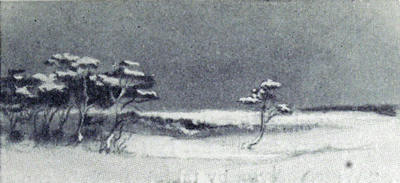
yet the snow lies white upon the fields, my little
river huddles under the ice, and a new calendar
hangs against the faded wall. But the storm is spent,
the sun is out, there is a cheery drip, drip, drip from
the eaves, eggs are sixty cents a dozen, and I am
writing to the golden cackle of my hens. New Year’s
Day, and winter gone! No, not quite gone, with eggs
at such a price; still, it must be plain to every one
that I can have but little of winter left: eggs are
liable to come down any day.
It would be different, of course, were I buying
eggs at sixty cents,—all the difference between a
winter-sick and a winter-well condition. Selling eggs
for sixty cents is a cure, though not for poverty
when one has only thirty hens; but it is a cure for
winter. The virtue, however, is not in the sixty cents.
There is no cure for winter in mere money. The
virtue is in the eggs, or, perhaps, it is really found
in keeping the hens.
Keeping the hens, and the two pigs, the horse,
the cow, the four boys, and the farm, for the year
around, is a sure cure for winter, and for a great
many other ills. In addition to the farm, one must
have some kind of a salary, and a real love for nature;
but given the boys and the farm, the love will
come, for it lies dormant in human nature, as certain
seeds seem to lie dormant in the soil; and as for the
salary, one must have a salary—farm or flat.
The prescription, then, should read:—
℞
A small farm—of an acre or more,
A small income—of a thousand or more,
A small family—of four boys or more,
A real love of nature.
Sig. Morning and evening chores. The dose to be
taken daily, as long as winter lasts.
This will cure. It is an old-fashioned household
mixture that can be compounded in any country
kitchen. But that is the trouble with it,—it is a
home remedy that cannot be bought of the apothecary.
There is more trouble with it, too, largely on
account of the regularity with which milking time
returns and the dose of chores. But it is effective.
A farm and congenial chores are a sovereign cure
for uncongenial time.
Here on the farm the signs of coming winter are
not ominous signs. The pensive, mellowing days of
early autumn have been preparing the garden and
your mind for the shock of the first frost. Once past
this and winter is welcome; it becomes a physical,
spiritual need. The blood reddens at the promise of
it; the soul turns comfortingly in and finds itself;
and the digging of the potatoes commences, and the
shocking of the corn, the picking of the apples, the
piling up on the sunny side of the barn of the big
golden squashes.
A single golden squash holds over almost enough
of the summer to keep a long winter away from the
farm; and the six of them in the attic, filling the
rafter room with sunshine, never allow the hoary old
monarch to show more than his face at the skylight.
Pie is not the only thing one brings in with his winter
squashes. He stores the ripe September in their
wrinkled rinds, rinds that are ridged and bossy with
the summer’s gold.
To dig one’s own potatoes! to shock one’s own
corn! to pick one’s own apples! to pile one’s own
squashes at one’s own barn! It is like filling one’s
system with an antitoxin before going into a fever-plagued
country. One is immune to winter after this,
provided he stays to bake his apples in his own wood
fire. One works himself into a glow with all this
digging, and picking, and piling that lasts until
warm weather comes again; and along with this harvest
glow comes stealing over him the after-harvest
peace. It is the serenity of Indian summer, the mood
of the after-harvest season, upon him,—upon him
and his fields and woods.
The stores are all in: the acorns have ripened and
lie hidden where the squirrels will forget some of
them, but where none of the forgotten will forget to
grow; the winged seeds of the asters have drifted
down the highways, over the hillsides and meadows;
the birds are gone; the muskrats’ lodge is all but
finished; the hickories and the leaf-hid hepaticas are
budded against the coming spring. All is ready, all
is safe,—the stores are all in. Quiet and a golden
peace lie warm upon the fields. It is Indian summer.
Such a mood is a necessary condition for the cure.
Such a mood is the cure, indeed, for such a mood
means harmony with earth and sky, and every wind
that blows. In all his physical life man is as much a
part of Nature, and as subject to her inexorable laws,
as the fields and the trees and the birds. I have seen
a maple growing out of the pavement of a city street,
but no such maple as stands yonder at the centre of
my neighbor’s meadow. I lived and grew on the same
street with the maple; but not as I live and grow
here on the farm. Only on a farm does a man live in
a normal, natural environment, only here can he comply
with all the demands of Nature, can he find a cure
for winter.
To Nature man is just as precious as a woodchuck
or a sparrow, but not more. She cares for the woodchuck
as long as he behaves like a woodchuck; so
she cares for the sparrow, the oyster, the orchid, and
for man. But he must behave like a natural man,
must live where she intended him to live, and at the
approach of winter he must neither hibernate nor
migrate, for he is what the naturalists call a “winter
resident.” It is not in his nature to fly away nor to go
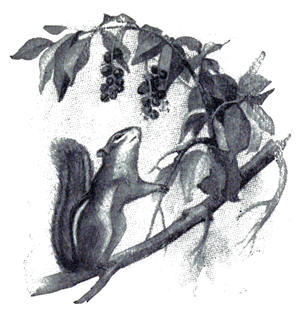
to sleep, but, like the red squirrel and the muskrat,
to prepare to live up all the winter. So his original,
unperverted animal instinct leads him to store.
Long ago he buried his provisions in pits and hung
them up on poles. Even his vocabulary he gathered
together as his word-hoard. He is still possessed of
the remnant of the instinct; he will still store. Cage
him in a city, give him more than he needs for winter,
relieve him of all possibility of want, and yet he will
store. You cannot cage an instinct nor eradicate it.
It will be obeyed, if all that can be found in the way
of pit and pole be a grated vault in the deep recesses
of some city bank.
Cage a red squirrel and he will store in the cage;
so will the white-footed mouse. Give the mouse more
than he can use, put him in a cellar, where there is
enough already stored for a city of mice, and he will
take from your piles and make piles of his own. He
must store or be unhappy and undone.
A white-footed mouse got into my cellar last winter
and found it, like the cellar of the country mouse in
the fable,—
Full benely stuffit, baith but and ben,
Of beirris and nuttis, peis, ry and quheit—
all of it, ready stored, so that,
Quhen ever scho list scho had aneuch to eit.
Enough to eat? Certainly; but is enough to eat all
that a mouse wants? So far from being satisfied with
mere meat was this particular mouse, that finding
herself in the cellar in the midst of plenty, she at
once began to carry my winter stores from where I
had put them, and to make little heaps for herself
in every dark cranny and corner of the cellar. A pint,
or less, of “nuttis”—shagbarks—she tucked away
in the toe of my hunting boot. The nuts had been
left in a basket in the vegetable cellar; the boots
stood out by the chimney in the furnace room, and
there were double doors and a brick partition wall
between. No matter. Here were the nuts she had
not yet stored, and out yonder was the hole, smooth
and deep and dark, to store them in. She found a
way past the partition wall.
Every morning I shook those nuts out of my boot
and sent them rattling over the cellar floor. Every
night the mouse gathered them up and put them
snugly back into the toe of the boot. She could not
have carried more than one nut at a time,—up the
tall boot-leg and down the oily, slippery inside. I
should have liked to see her scurrying about the
cellar, looking after her curiously difficult harvest.
Apparently, they were new nuts to her every evening.
Once or twice I came down to find them lying untouched.
The mouse, perhaps, was away over night
on other business. But the following night they
were all gathered and nicely packed in the boot
as before. And as before I sent them sixty ways
among the barrels and boxes of the furnace room.
But I did it once too often, for it dawned upon
the mouse one night that these were the same old
nuts that she had gathered now a dozen times; and
that night they disappeared. Where? I wondered.
Weeks passed, and I had entirely forgotten about the
nuts, when I came upon them, the identical nuts of
my boot, tiered carefully up in a corner of the deep,
empty water-tank away off in the attic.
Store? The mouse had to store. She had to, not
to feed her body,—there was plenty in the cellar for
that,—but to satisfy her soul. A mouse’s soul, that
something within a mouse which makes for more than
meat, may not be a soul at all, but only a bundle of
blind instincts. The human soul, that thing whose
satisfaction is so often a box of chocolates and a silk
petticoat, may be better and higher than the soul of
a mouse, may be a different thing indeed; but originally
it, too, had simple, healthful instincts; and
among them, atrophied now, but not wholly gone,
may still be found the desire for a life that is more
than something to eat and something to put on.
To be sure, here on the farm, one may eat all of his
potatoes, his corn, his beans and squashes before the
long, lean winter comes to an end. But if squashes
to eat were all, then he could buy squashes, bigger,
fairer, fatter ones, and at less cost, no doubt, at the
grocery store. He may need to eat the squash, but
what he needs more, and cannot buy, is the raising
of it, the harvesting of it, the fathering of it. He needs
to watch it grow, to pick it, to heft it, and have his
neighbor heft it; to go up occasionally to the attic
and look at it. He almost hates to eat it.
A man may live in the city and buy a squash and
eat it. That is all he can do with a boughten squash;
for a squash that he cannot raise, he cannot store,
nor take delight in outside of pie. And can a man
live where his garden is a grocery? his storehouse a
grocery? his bins, cribs, mows, and attics so many
pasteboard boxes, bottles, and tin cans? Tinned squash
in pie may taste like any squash pie; but it is no longer
squash; and is a squash nothing if not pie? Oh, but
he gets a lithograph squash upon the can to show him
how the pulp looked as God made it. This is a sop
to his higher sensibilities; it is a commercial reminder,
too, that life even in the city should be more
than pie,—it is also the commercial way of preserving
the flavor of the canned squash, else he would not
know whether he were eating squash or pumpkin or
sweet potato. But then it makes little difference,
all things taste the same in the city,—all taste of
tin.
There is a need in the nature of man for many
things,—for a wife, a home, children, friends, and a
need for winter. The wild goose feels it, too, and no
length of domesticating can tame the wild desire to
fly when the frosts begin to fall; the woodchuck feels
it; carry him to the tropics and still he will sleep as
though the snows of New England lay deep in the
mouth of his burrow. The partridge’s foot broadens
at the approach of winter into a snowshoe; the ermine’s
fur turns snow-white. Winter is in their bones;
it is good for them; it is health, not disease—with
snowshoes provided and snow-colored fur.
Nature supplies her own remedies. Winter brings
its own cure,—snowshoes and snowy coats, short
days and long nights, the narrowed round, the widened
view, the open fire, leisure, quiet, and the companionship
of your books, your children, your wife,
your own strange soul—here on the farm.
Where else does it come, bringing all of this?
Where else are conditions such that all weather is
good weather? The weather a man needs? Here he
is planted like his trees; his roots are in the soil; the
changing seasons are his life. He feeds upon them;
works with them; rests in them; yields to them, and
finds in their cycle more than the sum of his physical
needs.
A man lives quite without roots in a city, like some
of the orchids, hung up in the air; or oftener, like
the mistletoe, rooted, but drawing his life parasitically
from some simpler, stronger, fresher life planted
far below him in the soil. There he cannot touch the
earth and feed upon life’s first sources. He knows
little of any kind but bad weather. Summer is hot,
winter is nasty, spring and autumn scarcely are at
all, for they do not make him uncomfortable. The
round year is four changes of clothes—and a tank-sprinkled,
snow-choked, smoke-clouded, cobble-paved,
wheel-wracked, street-scented, wire-lighted half-day,
half-night something, that is neither spring, summer,
autumn, nor winter.
A city is a sore on the face of Nature; not a dangerous,
ugly sore, necessarily, if one can get out of
it often enough and far enough, but a sore, nevertheless,
that Nature will have nothing kindly to do with.
The snows that roof my sheds with Carrara, that
robe my trees with ermine, that spread close and
warm over my mowing, that call out the sleds and
the sleigh-bells, fall into the city streets as mud, as
danger on the city roofs,—as a nuisance over the
city’s length and breadth, a nuisance to be hauled
off and dumped into the harbor as fast as shovels
and carts can move it.
But you cannot dump your winter and send it off
to sea. There is no cure for winter in a tip-cart; no
cure in the city. There is consolation in the city, for
there is plenty of company in the misery. But company
really means more of the misery. If life is to
be endured, if all that one can do with winter is to
shovel it and suffer it, then to the city for the winter,
for there one’s share of the shoveling is small, and
the suffering there seems very evenly distributed.
Here on the farm is neither shoveling nor suffering,
no quarrel whatever with the season. Here you
have nothing to do with its coming or going further
than making preparation to welcome it and to bid it
farewell. You slide, instead, with your boys; you do
up the chores early in the short twilight, pile the
logs high by the blazing chimney and—you remember
that there is to be a lecture to-night by the man
who has said it all in his book; there is to be a concert,
a reception, a club dinner, in the city, sixteen
blissful miles away,—and it is snowing! You can go
if you have to. But the soft tapping on the window-panes
grows faster, the voices at the corners of the
house rise higher, shriller. You look down at your
slippers, poke up the fire, settle a little deeper into
the big chair, and beg Eve to go on with the reading.
And she reads on—
Shut in from all the world without,
We sat the clean-winged hearth about,
Content to let the north wind roar
In baffled rage at pane and door,
While the red logs before us beat
The frost-line back with tropic heat;
And ever, when a louder blast
Shook beam and rafter as it passed,
The merrier up its roaring draught
The great throat of the chimney laughed.
And, for the winter fireside meet,
Between the andirons’ straddling feet,
The mug of cider simmered slow,
The apples sputtered in a row,
And, close at hand, the basket stood
With nuts from brown October’s wood.
But you will be snow-bound in the morning and
cannot get to town? Perhaps; but it happened so
only twice to me in the long snowy winter of 1904.
So twice we read the poem, and twice we lived the
poem, and twice? yes, a thousand times, we were
glad for a day at home that wasn’t Sunday, for a
whole long day to pop corn with the boys.
A farm, of all human habitations, is most of a
home, and never so much of a home as in the winter
when the stock and the crops are housed, when furrow
and boundary fence are covered, when earth and
sky conspire to drive a man indoors and to keep him
in,—where he needs to stay for a while and be quiet.
No problem of city life is more serious than the
problem of making in the city a home. A habitation
where you can have no garden, no barn, no attic, no
cellar, no chickens, no bees, no boys (we were allowed
one boy by the janitor of our city flat), no
fields, no sunset skies, no snow-bound days, can
hardly be a home. To live in the fifth flat, at No. 6
West Seventh Street, is not to have a home. Pictures
on the walls, a fire in the grate, and a prayer
in blending zephyrs over the door for God to bless
the place can scarcely make of No. 6 more than a
sum in arithmetic. There is no home environment
about this fifth flat at No. 6, just as there is none
about cell No. 6, in the fifth tier of the west corridor
of the Tombs.
The idea, the concept, home, is a house set back
from the road behind a hedge of trees, a house with a
yard, with flowers, chickens, and a garden,—a country
home. The songs of home are all of country homes:—
How dear to this heart are the scenes of my childhood
When fond recollection presents them to view:
The gutter, the lamp-post, the curb that ran by it,
And e’en the brass spigot that did for a well.—
Impossible! You cannot sing of No. 6, West Seventh,
fifth flight up. And what of a home that cannot be
remembered as a song! It is not a home, but only a
floor over your head, a floor under your feet, a hole
in the wall of the street, a burrow into which you
are dumped by a hoisting machine. It is warm inside;
Eve is with you, and the baby, and your books.
But you do not hear the patter of the rain upon the
roof, nor the murmur of the wind in the trees; you
do not see the sun go down beyond the wooded hills,
nor ever feel the quiet of the stars. You have no
largeness round about you; you are the centre of
nothing; you have no garden, no harvest, no chores,—no
home! There is not room enough about a city
flat for a home, nor chores enough in city life for a
living.
For a man’s life consisteth not in an abundance of
things, but in the particular kind and number of his
chores. A chore is a fragment of real life that is
lived with the doing. All real living must be lived;
it cannot be bought or hired. And herein is another
serious problem in city life,—it is the tragedy of city
life that it is so nearly all lived for us. We hire
Tom, Dick, and Harry to live it; we buy it of the
butcher, the baker, the candlestick-maker. It is not
so here on the farm; for here one has the full round
of life’s chores, and here, on a professor’s salary, one
may do all the chores himself.
We may hire our praying and our thinking done
for us and still live; but not our chores. They are to
the life of the spirit what breathing and eating and
sleeping are to the life of the body. Not to feed your
own horse is to miss the finest joy of having a horse,—the
friendship of the noble creature; not to “pick
up” the eggs yourself, nor hoe your own garden, nor
play with your own boys! Why, what is the use of
having boys if you are never going to be “it” again,
if you are not to be a boy once more along with
them!
There are some things, the making of our clothes,
perhaps, that we must hire done for us. But clothes
are not primitive and essential; they are accidental,
an adjunct, a necessary adjunct, it may be, but belonging
to a different category from children, gardens,
domestic animals, and a domestic home. And
yet, how much less cloth we should need, and what
a saving, too, of life’s selvage, could we return to the
spinning-wheel and loom as we go back to the farm
and the daily chores!
She, harvest done, to char work did aspire,
Meat, drink, and twopence were her daily hire.
And who has not known the same aspiration? has
not had a longing for mere chores, and their ample
compensation? It is such a reasonable, restful, satisfying
aspiration! Harvest done! Done the work and
worry of the day! Then the twilight, and the evening
chores, and the soft closing of the door! At
dawn we shall go forth again until the evening;
but with a better spirit for our labor after the fine
discipline of the morning chores. The day should
start and stop in our own selves; labor should begin
and come to an end in the responsibility of the wholesome,
homely round of our own chores.
Summer is gone, the harvest is done, and winter
is passing on its swiftest days. So swift, indeed, are
the days that morning and evening meet, bound up
like a sheaf by the circle of the chores. For there is
never an end to the chores; never a time when they
are all done; never a day when the round of them
is not to be done again. And herein lies more of
their virtue as a winter cure.
Life is not busier here than elsewhere; time is not
swifter, but more enjoyable, because so much of life
is left unfinished and time is thrown so much more
into the future. There is no past on the farm; it is
all to come; no sure defeat, but always promise;
no settled winter, but always the signs of coming
spring.
To-day is the first of January, snowy, brilliant,
but dripping with the sound of spring wherever the
sun lies warm, and calling with the heart of spring
yonder where the crows are flocking. There is
spring in the talk of the chickadees outside my window,
and in the cheerful bluster of a red squirrel in
the hickory. No bluebird has returned yet: spring is
not here, not quite, I hope, but it is coming, and so
near that I shall drop my pen and go out to the barn
to put together some new beehives, for I must have
them ready for the spring. Winter! The winter is
almost gone. Why, it is barely a month since I
brought my bees into the cellar, and here I am
taking them out again—in prospect.
The hives have just come from the factory “in the
flat”: sawed, planed, dovetailed, and matched,—a
delightful set of big blocks,—ready to be nailed together.
You feel a bit mean, keeping them from the
children. But the oldest of the boys is only six, and
he had a walking bear for Christmas. Besides, when
you were a little boy you never had many blocks, and
never a walking bear. So you keep the hives. And
how suddenly the January day goes! You hammer
on into the deepening dusk, and the chickens go to
roost without their supper. You would have hammered
on all night, but the hives ran out. Five hives
won’t last very long; and you sigh as they stand
finished. You could wish them all in pieces to do
over again, so smooth the stock, so fragrant the piny
smell, so accurate and nice the parts from cover to
bottom board!
Winter! with January started, and February two
days short! It is all a fiction. You had dreams of
long evenings, of books and crackling fires, and of
days shut in. It still snows; there is something
still left of the nights, but not half enough, for the
seed catalogues are already beginning to arrive.
The snow lies a foot deep over the strawberry
bed and the frozen soil where the potatoes are to
be. Yet the garden grows—on paper? No, not on
paper, but in your own eager soul. The joy of a
garden is as real in January as in June.
And so the winter goes. For if it is not the garden
and the bees, it is some of a thousand other
chores that keep you busy and living past the present,—and
past the present is the spring.
I am watching for the phœbes to return to the
shed,—they are my first birds. I long to hear the
shrill piping of the March frogs, to pick a blue
hepatica from beneath the pines; for these are some
of the things, besides cheaper rent, more room, more
boys, fresh air, quiet, and a cow, that one lives for
here on the farm. But I am not waiting, winter-sick,
for I have stored the summer in attic and cellar;
I am already having my spring—in prospect; and
as for the actual winter, the snow-bound days are all
too few for the real winter joys of this simple, ample
life, here in the quiet, among the neighbor fields.