The story I will tell you now, Peterkin, is
more beautiful, though not so old.
In all the regions of the Gael throughout
Scotland, and in every isle, from Arran and
Islay in the south, to Iona in the west, and
Tiree in mid-sea, and the Outer Hebrides,
there is no story of the old far-off days so well
known as that of Darthool.
She it is who in Ireland is called Deirthrê or
Deirdrê; and in Ireland to this day there is not
a cowherd who has not heard of Deirdrê.
Her beauty filled the old world of the Gael
with a sweet, wonderful, and abiding rumour.
The name of Deirdrê has been as a lamp to a
thousand poets. In a land of heroes and brave
and beautiful women, how shall one name survive?
Yet to this day and for ever, men will
remember Deirdrê, the torch of men’s thoughts,
and Grainne whom Diarmid loved and died
for, and Maev who ruled mightily, and Fand
whose white feet trod faery dew, and many
another. For beauty is the most excellent
sweet thing in all the world, and though of it a
few perish, and a myriad die from knowing
nothing of it, beneath it the nations of men
move forward as their one imperishable star.
Therefore he who adds to the beauty of the
world is of the sons of God. He who destroys
or debases beauty is of the darkness, and shall
have darkness for his reward.
The day will come, Peterkin, when you will
find a rare and haunting music in these names.
They will bring you a lost music, a lost world,
and imperishable beauty. You will dwell with
them, till you love Deirdrê as did the sons of
Usna, and would die for her, or live to see her
starry eyes; till you look longingly upon the
Grainne of your dreams, and cry as Diarmid
did, when he asked her, as death menaced
them, if even yet she would go back, and she
answered that she would not: “Then go forward,
O Grainne!”
Many poets and shennachies have related
this tale. I have heard it given now this way,
and now that; sometimes with new names and
scenes, sometimes with other beginnings and
endings; but at heart it is ever the same. Nor
does it matter whether the father of Deirdrê be
Felim, the warrior bard of the Ultonians, or
Malcolm the Harper, or any other, or whether
the fair and sweet beauty of the world be called
Deirdrê or Darthool. But as here in our own
land she is called Darthool, that I will call her.
I will tell the story as it is told in the old
chronicles, and to this day, and if I add aught
to it, that shall only be what I myself heard
when I was young, and had from the lips of
an old woman, Barabal Mac-Aodh, who was
my nurse. She came out of Tiree or Coll, I
forget which.
* * * * *
Well, in the ancient dim days when Emania
was the capital of the Ultonians, the fair and
wonderful capital of the kingdom of Ulster,
and before Maev, the queen of the south, had
buried the chivalry of the north in dust and
blood, there came into the realm of Concobar
the Ultonian king, whom some call Conor and
some Connachar, three of the noblest and
fairest of the youths of the world. These are
they who then bore, and in all the years since
have borne, the name of the Sons of Usna, who
was himself, some say, a feudal king, in Alba.11
It is because of these three heroes that this
story I am relating is often called the story
of the Sons of Usna. But first, I have that to
tell you which precedes the time when Nathos,12
and Ailne, and Ardan, stood in the house of
Concobar the high king.
This Concobar was a great prince. He was
known as Concobar MacNessa, for though he
was the son of Fatna the Wise, son of Ross
the Red, son of Rory, Nessa his mother was a
famous queen, and had indeed by her beauty
and her wiles brought Concobar to the overlordship
of Uladh13 when he was yet a youth.
In many of the tales of the old far-off days,
you will hear the rumour of the splendour and
wonder of the city of Emania. In Concobar’s
time it was called Emain Macha, for it had
been built by a great and beautiful queen—Macha
Mongruay, Macha of the Ruddy Hair.
A thousand times have poets chanted of Emain
Macha, and in the ancient days the bards
loved to sing also of Macha herself. Here is
an old far-off lay:
“O ’tis a good house, and a palace fair, the dun of Macha,
And happy with a great household is Macha there;
Druids she had, and bards, minstrels, harpers, knights,
Hosts of servants she had, and wonders beautiful and rare,
But nought so wonderful and sweet as her face, queenly fair,
O Macha of the Ruddy Hair!
The colour of her great dun is the shining whiteness of lime,
And within it are floors strewn with green rushes and couches white,
Soft wondrous silks and blue gold-claspt mantles and furs
Are there, and jewelled golden cups for revelry by night:
Thy grianan of gold and glass is filled with sunshine-light,
O Macha, queen by day, queen by night!
Beyond the green portals, and the brown and red thatch of wings
Striped orderly, the wings of innumerous stricken birds,
A wide shining floor reaches from wall to wall, wondrously carven
Out of a sheet of silver, whereon are graven swords
Intricately ablaze; mistress of many hoards
Art thou, Macha of few words!
Fair indeed is thy couch, but fairer still is thy throne,
A chair it is, all of a blaze of wonderful yellow gold:
There thou sittest, and watchest the women going to and fro,
Each in garments fair and with long locks twisted fold in fold:
With the joy that is in thy house men would not grow old,
O Macha, proud, austere, cold.
Of a surety there is much joy to be had of thee and thine,
There in the song-sweet sunlit bowers in that place:
Wounded men might sink in sleep and be well content
So to sleep, and to dream perchance, and know no other grace
Than to wake and look betimes on thy proud queenly face,
O Macha of the Proud Face!
And if there be any here who wish to know more of this wonder,
Go, you will find all as I have shown, as I have said:
From beneath its portico thatched with wings of birds blue and yellow
Reaches a green lawn, where a fount is fed
From crystal and gems: of crystal and gold each bed
In the house of Macha of the Ruddy Head.
In that great house where Macha the queen has her pleasaunce
There is everything in the whole world that a man might desire.
God is my witness that if I say little it is for this,
That I am grown faint with wonder, and can no more admire,
But say this only, that I live and die in the fire
Of thine eyes, O Macha, my desire,
With thine eyes of fire!”
14
It was in this wonderful forefront of Ulster
that Concobar reigned. The fame of Emain
Macha was throughout Gaeldom; and there
was no man or woman who, as the days went
by, did not hear of the greatness of Concobar.
On a day of the days, the king went with
his chief lords on a visit to the dun of Felim,
a warrior and harper whom he loved. There
was to be great feasting, and all men were
glad. Felim himself rejoiced, though he would
fain have had the king come to him a few days
later, for his wife was heavy with child, and
looked for her hour that very day or the next.
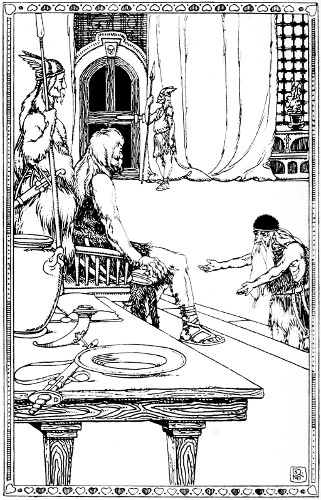
In the midmost of the feast, Concobar saw
that Cathba, an aged Druid who had accompanied
him, was staring into the other world
that is about us.
“Speak, Cathba,” he said. “There is no
man in all Erin who has wisdom like unto
thine. What is it that thou seest, with the
inner sight that I perceive well is now upon
thee?”
“Old as I am with the heavy burden of
years and sorrow, O Concobar, did I not beg
that I might come with thee to this festival at
the dun of Felim? And that was not because
I wearied to hear strange harping and singing,
good and fine and better than our own as this
harping is here, in the house of Felim; for I
am old and weary, and care more to listen to
the wind in the grass, or to the sighing upon
the hill, than to any music of war or love.”
“Then what was it that was in thy mind,
Cathba?”
“This, O king. I saw a shadow arise whenever
I thought of our Ultonian realm, and I
felt within me the burden of a new prophecy.
Nevertheless, I was moved by naught till I
entered the dun of Felim, and now I know.”
“Speak,” said the king; while all there
listened with awe as well as eagerness, for
Cathba was the wisest of the Druids, and knew
many mysteries, and what he had foretold had
ever come to pass. Slowly, the white-haired
Druid looked around the faces of all seated
there. Then he looked at the king. Then he
looked at Felim.
“To thee, O Felim, shall be born this night
a sting, a sword, a battering-ram, and a flame.”
Felim the Harper stared with intent gaze,
but said nothing. Of what avail to say aught
against the decrees of the gods?
“This night shall that which I have said be
born unto thee, O Felim. The sting will sting
to madness him who is king of the Ultonians;
the sword will sever from Uladh the chief of
her glories, the proud Red Branch for which
Concobar and all his chivalry shall perish; the
ram shall batter down the proud splendour of
Emain Macha; the flame shall pass from dun
to dun, from forest to forest, from hill to hill,
from the isles of Ara on the west to the shores
of the sea-stream of the Moyle on the north,
and to those of the sea of Manannan in the east.”
Still Felim answered nothing. Then the
king spoke:
“Thy words come in dust, like wind-whirled
autumn leaves. We have not thy further sight,
Cathba, and understand thee not.”
Then once more Cathba spake out of the
dream that was upon him:
“Two stars I see shining in a web of dusk;
and, in the shadow of that dusk, a low tower of
ivory and white pearls I see, and a strange crimson
fruit; and through all and over all I hear the
low, sweet vibration of the strings of a harp, a
harp such as the Dedannan folk play upon in
the moonshine in lonely places, but sweeter
still, sweeter and more wonderful.”
“Is this thy second vision one and the same
with thy first, O Cathba?” asked the king.
“Even so. For the shining stars are her
eyes, and the web of dusk is the flower-fragrant
maze of her hair, that low tower of
ivory is her fair, white, wonderful neck, and her
white teeth are these pearls, and that strange
crimson fruit is no other than her smiling
mouth—a little smiling mouth with life and
death upon it because of its laughter and grave
stillness. As for that harp-playing, it is her
voice I hear—a voice more soft and sweet and
tender than the love-music of Angus Ogue
himself. O shining eyes, O strange crimson
fruit that is a little smiling mouth, O sweet
voice that is more excellent to hear than the
wild music of the Hidden People of the hills—it
is of ye, of ye that I speak, and of thee,
O tender, delicate fawn, in all thy loveliness.”
None spake, but all stared at the Druid.
For dream was upon them at these words, and
each man imagined his desire, and was wrought
by it, and was rapt in strange longing.
It was Concobar who broke the silence.
“Of whomsoever thou speakest, Cathba, she
is surely of the divine folk. That exceeding
loveliness is for the joy or the sorrow of the
world.”
Only Felim the Harper was troubled, for
now he knew well that the ancient Druid
spoke of the unborn child with whom even
then his wife was in travail. But no sooner
had Concobar ceased than Cathba rose, with
his great dark eyes aflame beneath his white
eye-brows. His voice was loud and terrible.
“Behold, I see this thing; behold the vision
of Cathba the Druid, who is old and nigh unto
death. And what is before mine eyes is a
sea, a sea of flowing crimson, a sea of blood.
Foaming it rises, and wells forth, and overflows,
and drowns great straths and valleys, and
laves the flanks of high hills, and from the
summits of mountains pours down upon the
lands of the Gael in a thundering flood, blood-red
to the blood-red sea.”
But now the spell of silence was broken.
All leaped to their feet, and many put their
hands upon their swords. There was not one
who did not fear the prophesying of Cathba
the wise Druid. That deluge of blood, was it
not a terror, a great ruin to avert?
“If this child that the wife of Felim the
Harper is to bear this night be a blood-bringer
so terrible,” they cried, “let us slay her at
birth. For surely it is better to kill a child
than to destroy a nation.”
So spake they out of their ignorance that
they thought wisdom. For they did not know
that there is no thought, no power, no spell, no
craft, wherewith to turn aside the feet of Destiny.
What has to be, will be, and no man
living can say or do aught that is of avail
against the inevitable tides of Fate.
For the first time since Cathba had prophesied,
Felim uttered word.
“Listen, my kinsmen and fellow-knights of
the Red Branch. A sore pity is it for my wife
Elva to bear a daughter that shall be a sting
to sting the king to madness, and a sword to
sever the Red Branch from Uladh, our fair
heritage, and a ram to break down the walls
of Emania, and a flame to consume the land
from shore to shore. And as for that sea of
blood, let it not be upon my head. For I, the
father of the child of Elva, that Cathba says is
to be a woman-child and of a beauty wonderful
to see, say unto ye: That which ye would fain
do, do. If it seems good unto ye, O Concobar,
and ye of the Red Branch, let this child
perish, so that the doom foretold by Cathba
may be averted.”
At that all were glad save Concobar. Two
men was he, this king: a man who recked
little of aught save his desire, and a man who
had wisdom. Out of his wisdom he knew that
Felim and the Red Branch lords spoke madness,
for if it was ordained that the child of
Elva should bring doom, that doom would
surely come. Out of his longing he loved the
beauty of which Cathba had spoken, and desired
it against the years to come, and for the
solace of his years when he had loved much
and at the last was fain only of that which was
the crown of life. So he spoke to those before
him, and prevailed with them. Not vainly was
he called Concobar of the Honeymouth.
“I will speak first to thee, Felim, son of
Dall, my bard. It is not good to put death
upon the fruit of one’s loins. Thine own child
should not see death through thee. But even
were it so, it is not meet for me or for any one
to bring the shame and pain of death to the
house of a friend. Therefore, do not speak of
putting silence and darkness upon the child of
Elva.”
Having spoken thus, the king turned to the
lords of the Red Branch. As the wont was,
at the royal festivals there were five and three
score over three hundred of the Red Branch
there and then.15
“And to ye, Ultonians, I say this thing also.
Do not bring blood into the hospitable home
of Felim; that would be a stain upon him,
upon ye yourselves, and upon me the king.
But this is my counsel. Let the child live.
There is no good in idle blood, and if ye stain
yourselves with it, there shall be greater loss
and sorrow to follow. Ye are all grown men,
and not boys who do not know our laws. Ye
know the Law of the Eric. Well, I will free ye
of all doom, for upon my head be it. To myself
I will take this fair child, and upon me, and
not upon the Ultonians, nor upon the Red
Branch, nor upon any other whomsoever save
Concobar MacNessa, the high king, be the
penalty, if penalty there be.”
At that a son of a king arose.
“That is well, O Concobar. But what of
Cathba’s prophecy? We do not wish to see
the sting that shall sting thee to madness, and
if the child live shall we not see that sting?”
“Of that I have thought, that I have foreseen,
Congal, son of Rossa of the Lakes. For
I shall send the child into a lonely place, and
there in a solitary rath shall she dwell and
grow in years, and no man shall look upon her
save I myself, and that only in the fulness of
time. She shall be solitary and apart as the
Crane of Innisbea, that has dwelt upon its isle
since the world was made, and is seen of none.”
“Tell us once more, Concobar MacNessa;
dost thou take this child, and the doom of this
child unto thee, and to thee alone?”
“I have sworn. She shall grow in years,
and be wife to me when the time is come.
And if sorrow come with her, that sorrow shall
be my sorrow. Not upon Uladh be it, but
upon me. I have spoken.”
“And as for thee, Felim?”
“It would be better to slay the child than to
drown the land in blood.”
“And as for thee, Cathba?”
“There is but one law: that which has to
come, cometh.” But while they were thus
debating, the loud chanting voices of women
were heard, and soon a messenger came, crying
loudly that a child had been born to Elva,
wife of Felim, and that it was a woman-child, and
exceeding comely, and strong, and white as milk.
Once more Cathba the Druid spoke.
“She shall be called Darthool,16 this woman
whose beauty shall be a flame, and whose eyes
shall be as stars.”
And so it was. The child was spared, and
that night Elva slept in peace, and for many
nights.
When the days of the feasting were over,
Concobar left the dun of Felim, and returned
with all his company to Emania. With him
he took the little child Darthool, and Elva
came with him for a month and a day.
The month and the day soon passed, and
then Elva went back to her own place. It was
the will of the high king and of Felim, her
husband; nevertheless, she sorrowed to part
with her little child, who, even as a breast-babe,
had eyes of so great a beauty that it was
a joy to look into them.
Before the year was over—for, according to
what Cathba the wise Druid said, the child
must either be slain or hidden away before the
first year of her life were past—Concobar sent
Darthool with the nursing woman to whom he
entrusted her, to a small lios, or fort, deep
in the heart of the royal forest. A ban
was upon that forest that none might hunt or
even stray there without the king’s will; and
now that ban was made absolute, and it was
known that death would be the portion of any
man who went under these branches. None
was to enter that woodland save Concobar, or
whosoever might be of his chosen company,
or whom the king might thither lead.
Concobar himself saw that food and milk was
sent in plenty to the lios, and once in every
seven days he went thither himself. As year
after year passed the secret of the hiding-place
of Darthool went out of men’s minds, and none
knew of the lios save the king, and the sister
of the nursing woman, who was his own foster-child
and under geas or bond to him. This
woman was named Lavarcam (Leabharcham),
and was fair to see, and whom Concobar held
to be discreet and trustworthy beyond any
other of his own people. She was of the royal
household, and of the women trained as chroniclers
and relaters.17
The little starry-eyed babe grew to a child,
and from a child to a fawn of a girl, fair to see,
and from a young girl to a maid, of a beauty so
great that Concobar knew when she came to
full womanhood she would be indeed as Cathba
the Druid had prophesied.
Darthool saw no one but her nurse, and
the tutor whom the king had sent to teach
her all that could be taught, and not only in
learning, but in courtesy and nobility; and
Lavarcam, who alone went to and fro. From
the time that Darthool passed out of her first
girlhood the king saw little of her, but twice
in each year—at the Festival of the Sun in
the time of the greening, and at the Festival
of end Summer at the fall of the leaf; and this
because of a warning that had been given
him by Cathba the ancient Druid.
How can the beauty of so fair and sweet a
woman be revealed? Her loveliness was even
as Cathba had foretold. It was a surpassing
loveliness, and the three women who saw her
often marvelled at it, and wondered no more
that Darthool should be kept apart, for of a
surety she would be a torch to put flame into
the hearts of men, and to set great duns and
raths and towered capitals and warring nations
ablaze. The poets have sung of her, and no
man has sung but out of his deep desire. Her
great sad eyes, so full of dream, were blue as
are the hill-tarns at noon, and often dusky as
they when passing clouds put purple into their
depths; and like a golden web her hair was,
sprayed out with shining light, wonderful,
glorious; and her rowan-red lips were indeed
that strange crimson fruit which Cathba had
foreseen—rowan-red against the cream-white
softness of her skin. Cream-white her body
was, and her neck like a tower of ivory; slim
and graceful was she as a fawn, and fleet of foot
as the wild roes on the hills, and when she
moved in the sunlight or the shadow she was
so beautiful that tears came at times to the eyes
of the women in that lonely place. Yet even
more wonderful was her voice—low and sweet
and with music in it, like the whisper of the
wind among the reeds, or the ripple of green
leaves, or the murmuring of a brook.
But now and from this time forth Concobar
did not see her. For a year and a day after
she attained womanhood, Cathba had warned
the king it would mean death to him if he saw
her. Nevertheless, he often heard of Darthool
from Lavarcam, who in her going to and fro
had ever one thing to say—that never had
there been any woman so beautiful.
The rumour of this great loveliness spread
from lip to lip. Yet no man ventured to
seek out the hidden place where Darthool
dwelled, for to all it was known that Concobar
kept her there against the time when he would
make her his queen, and all feared the long
arm and the heavy hand of Concobar Mac
Nessa. None might even question the king.
It was in this year that the shadows of the
feet of Fate came into that place.
One day when Lavarcam told the king that
Darthool grew fairer and fairer, so that even
the wild creatures of the forest rejoiced in her,
he all but yielded to his desire. Nevertheless,
fearing the prophetic voice, he refrained, but
cried: “When the snow time has passed, and
the first greening is over, and the wild rose
runs like a flame throughout the land, then will
I go to Darthool.”
But before the greening was lost in the tides
of summer, and before the wild rose had begun
to run like a windy flame throughout the land,
Concobar had learned that Destiny waits on no
man.
One dawn the first snows came over the hills
of the north and fell upon the forest. At the
rising of the sun they ceased, but every branch
was a white plume, and every glade was
smooth and white as was the breast of Darthool
herself. There was no wind in the deep
blue sky, but the air was sharp and sweet
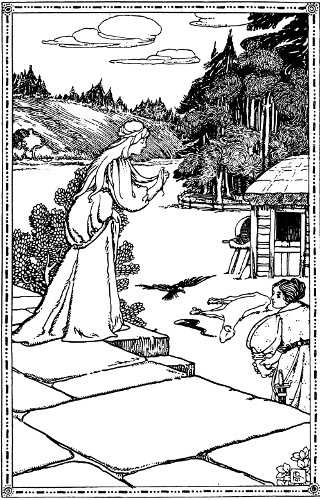
because of the frost. For joy Darthool
clapped her hands, as she stood upon the wall
of the lios.
Then, glancing downward, she beheld the
woman who was her attendant standing beside
a calf that had been slain for the provisioning
of those within the fort. The red blood
streamed over the snow, and was as the crimson
cloak of an Ultonian chief there, till the red
grew mottled as it sank through the frozen
whiteness.
Darthool’s eyes ever saddened at the sight
of blood, but after a brief while she knew that
there was no harm in that shedding, and that
no omen of further bloodspilling lay therein.
While she was still looking thereon, a great
raven, glossy black and burnished in the sun
rays, came gliding swift across the snow, and
alit by the slain calf, and drank of the warm
bright blood.
Of a sudden Darthool laughed low. It was
a sweet shy laugh, and Lavarcam, who had
come to her side, asked her why there was
such sweet low laughter upon her. Mayhap
she knew; mayhap she guessed that Darthool
dreamed dreams of love, because her womanhood
was now come, and because of the old
heroic tales she took so great a pleasure in, and
because of the vision that every woman has in
her heart.
“I was thinking, Lavarcam,” she said.
“And what was that thought, Darthool?”
“It was this: that if there be anywhere a
youth whose skin is white as that whiteness
there, and whose locks are as dark and glossy
as the plumage of that raven, and in whose
cheek is a crimson as red as that blood that is
upon the snow, then of a surety him could I
love, and that gladly.”
For a moment Lavarcam said nought; then
the power of Destiny moved her.
“There is one man who is more beautiful
than all others I have ever seen. He is young,
and his hair is dark and glossy as that raven’s
wing, and in his cheek the ruddy flame is as
that crimson blood, and his skin is as white as
any sunlit whiteness, or as thine own breast,
Darthool.”
“And what will be the name of that man,
Lavarcam, and whence is he and where, and
what is his decree?”
“He is called Nathos, and is the son of
Usna, who is a great lord in Alba. But he is
now in Emania, among the company of the
king; and with him are his brothers, both fair
to see, and princes among men because of their
beauty and valour, yet neither so surpassing all
men as Nathos. They are called Ailne and
Ardan.”18
That was a fatal saying of Lavarcam, for it
sank into the mind of Darthool as moonlight
into dark water.
Day by day thereafter she thought of nothing
but of meeting this proud son of beauty;
night by night she dreamed of Nathos and of
his love.
At the last, Lavarcam was filled with fear,
for she saw that her words had awakened the
flaming lion that lies hid in the heart. And
truly it was not long till Darthool spoke to
her of her longing and deep desire, and how
that without Nathos she did not care to
live.
For a time Lavarcam smiled; but when she
saw that the king’s beautiful ward was ever
growing more and more wrought, her heart
smote her.
One day, as she was returning from Emain
Macha, she met a swineherd, clad roughly in
the fell of a deer, and with him were two men,
rude, dishevelled hillmen, bondagers to the
Ultonians.
These, notwithstanding the law of Concobar,
she took with her into the forest, and bade
them await at a well that was there, until they
heard the cry of a jay and the bark of a hill-fox,
when they were to move slowly on their
way, but to speak to no one whom they might
meet, and above all to be silent after they left
the shadow of the wood.
Having done this, she entered the lios, and
asked Darthool to come forth with her into the
woods.
When they drew near to the well, Lavarcam
moved aside to look for some rare herb, as she
said. Soon the cry of the jay and the bark of
the hill-fox were in the air.
“That is a strange thing,” Darthool said to
her, when she was by her side again; “for that
cry of the jay was the cry it gives in April, at
the nesting time, and the bark of that hill-fox
was the bark it gives in the season of the rut,
many months agone.”
“Hush,” said Lavarcam, “and look.”
They stood still, as they saw the swineherd
and the two hillmen rise from near the well,
and move slowly across the glade.
“Who are these, Lavarcam?” asked Darthool,
with wonder in her eyes.
“These are men, daughter of Felim.”
“They are younger than those I have seen
from the outskirts of the forest, but they are
wild in dress and mien, and are not of high
degree, and my eyes have no pleasure in looking
upon them.”
“Nevertheless,” answered Lavarcam, “these
are the three sons of Usna—Nathos and Ailne
and Ardan.”
For a brief while Darthool looked upon
them. Then she spoke.
“The truth flew past thy lips, Lavarcam.
Yonder man whom ye name Nathos has
neither raven hair nor white skin, nor the
comely red in his face; and the two others are
like the slaves I saw that day I beheld the
foster-brothers of Concobar driving back from
battle, in a chariot dragged by wild rough men
in bondage. I remember the day, for it was
then that thou bade me know that death was the
portion of any man who sought me. That, too,
I fear was no true word. Howsoever, as to
these men, they may go. And yet—— wait.”
And with that Darthool moved swiftly forward,
and, coming upon the three men by a
by-path through the fern, confronted them.
They stood amazed at her exceeding great
beauty. Nothing like it was in the whole
world; so, little wonder that these boors stood
as though the face of death was bare to them;
for beauty is strange and terrible to most
men, and they are prone to stand in dread
of it.
None spake. Darthool looked at each, a
slow smile of mocking in her lips, a blue flame
of scorn in her eyes.
“Are ye the sons of Usna?”
They made no answer, but stared unwaveringly
upon her, as do the dull cattle in the
fields.
“What brave courtesy!” she cried, mocking
with her sweet voice, “how swift in courtesy!
Tell me, Nathos, son of Usna, is it the wont of
thy people in Alba to stand by agape when a
woman speaks? Who is Usna, or what? If
he is a king, is he overlord of swineherds? If
it is a place, is it the rough bogs of the hills
where sword-clad men do not go, but only a
poor folk clad rudely in skins?”
Still they answered nothing.
“Were ye whipt into silence when ye were
young, ye that stand there wordless as dogs?
If indeed ye be the sons of Usna, then truly
Concobar MacNessa must be in sore want of
men at Emain Macha!”
At that the swineherd could no longer hold
to his bond.
“By thy great exceeding beauty I know that
thou art no other than Darthool, whom the
king hides in this place. But do not mock us,
who would rather worship thee. We are no
nobles, but a swineherd, and two hillmen who
are bondagers to Cairbre of the Three Duns.”
At that Darthool laughed gently.
“That I knew full well, swineherd, for all
that I dwell here apart and see none of my
kind, save Maev my nurse and Aeifa my tutor
and Lavarcam the friend of the king. Those
I have seen otherwise have been beheld a great
way off, from where I laid hid in the woods.
But now, wilt thou do one thing for me?”
“I will give thee my life.”
Darthool smiled into the man’s eyes, and
what was only the swineherd died, and a strong
heroic soul arose in him.
“I would fain see Nathos, the eldest of the
sons of Usna.”
“That is against the law of Concobar: and
long is the arm and heavy the hand of Concobar
MacNessa the high king. But what
is death to me, since thou willest me to do this
thing for thee, Darthool of the beautiful eyes?
Nay, I swear this thing: that rather would I
die by torture, and please thee, than live out
my life and refuse thee of what thou art fain.
For thy beauty is upon me like the light of the
moon at the full on the dark moorland. I am
thine.”
Darthool looked at the man. Suddenly she
stooped and kissed him on the wind-furrowed
brow. Great fortune was his, and he was well
repaid for his death by blunt spear-shafts, when
Concobar knew all. For what is death, when
a man has reached beyond the limit of his
desire?
“Then go this night to Nathos, and tell him
that I, Darthool, dream of him by day and by
night, and that if he is in anywise fain of me,
let him come to me to-morrow, an hour before
the setting of the sun, at this well.”
With that she turned and walked slowly
back to where Lavarcam awaited her. As they
moved homeward through the wood, Lavarcam
saw that the dream in the eyes of Darthool had
deepened. It was in vain then, or later, that
she sought to know what the fair, beautiful girl
had said to the swineherd. She feared, however,
that Darthool no longer trusted her
because of the lie that she had told, and that
mayhap the girl had plotted somewhat with
the swineherd.
All the morrow Lavarcam watched Darthool
closely, but she seemed rapt in vision, and
cared neither to chase the fawns, nor to fish,
nor even to wander idly through the woods.
No speech would she have with any one, and
said only that she wished to lie under the
boughs of the great oak in front of the lios, and
sleep.
“How can that be, when there is snow upon
the ground?” Lavarcam asked.
“Is there snow upon the ground?” answered
Darthool dreamily. “Then I will lie upon my
deerskins, and Aeifa can play to me and sing
me songs till dusk.”
Hearing that, Lavarcam was glad, for now
she could leave the lios with a mind at rest.
So, in the wane of the day, she passed
through the forest and came out upon the great
plain in front of Emain Macha, and went to
seek the king to take counsel with him.
Nevertheless, Lavarcam was sore wrought
by Darthool, and would fain have given her
her heart’s desire. Piteous indeed had her
plaints been. With tears and reproaches and
sweet beseechings nigh intolerable, Darthool
had begged her to bring Nathos to her, if for
once only, so that she might at least see him,
and know what her heart’s desire was like.
Moreover, was it not a bitter thing for her to
be kept there in that lonely place, and neither
to see nor converse with her own kind, and to
be kept away from all the joys of youth, and to
pass from spring to summer, and from summer
to autumn, and from autumn to winter, yea and
from year to year, and be exiled there, to hear
no young voices, no young laughter? When
she pleaded thus, Lavarcam was sorrowful
indeed, for she had the heart of a woman, and
knew the beauty and the wonder and the
mystery of love.
Thinking of these things, her heart smote her
as she fared towards Emain Macha, and at the
last she decided to say no word to the king as
to what she feared Darthool may have told the
swineherd. Furthermore, she muttered, what
was death to her who had known all that life
had to give her? At the worst, Concobar
could put death upon her. Had she not lived
and known love, and now was weary?
When she drew nigh to Emain Macha she
saw three ravens and three hoodie-crows and
three kites arise from some carrion hidden in
the long grass that waved there.
When she came upon it, she saw that it was
the body of the swineherd, loose with the
gaping wounds of blunt spear-shafts. In thus-wise
she knew that Concobar had in some way
heard of what the man had done.
Yet she had no fear from that. The swineherd
was still now. Neither king nor raven,
neither man nor hoodie-crow, neither spear-shaft
nor kite could now hurt him. It was
better to be alive than to be dead, but it was
well to be dead.
So Lavarcam turned, and went over to the
camp in Emain Macha where the sons of
Usna were. There she saw Nathos, and
told him privily that Darthool longed to see
him, and that the forest was open to the
stealthy flight of the owl as well as to the
soaring hawk.
Nathos was indeed fair to see, and looking
upon him Lavarcam knew in her heart that
Darthool would love him, and he her. He
listened, and she saw his eyes deepen, and
a flush come and go upon his face. For
sure there was a beating swift of his pulse in
that hour.
Nevertheless, he could not come straightway,
for Concobar knew that the swineherd had
spoken to him of Darthool, and it was for this,
and having seen and spoken with the girl, that
the king had put the man to death—though for
that, added Nathos, little did the swineherd
care, for he died laughing and mocking, and,
when he lay still, there was a smile upon his
face.
“And that was because Darthool had looked
into his eyes, Nathos, son of Usna.”
“Truly, he died well. I know a prince
among men who also would die gladly if Darthool
would look into his eyes with love.”
“Then come soon and hunt the deer in the
solitudes to the north of the forest: and there,
amid the woods, or in some glen, or on the
hill-slopes, surely thou shalt meet with Darthool—and
yet none know of it.”
So Lavarcam and Nathos made a bond
between them, and parted.
Thereafter days passed. On the morrow
of the seventh day Darthool was wandering
among the glades and thickets of the uplands
far away from the lios, rejoicing in her new
freedom and hoping that one day her eyes
might look upon Nathos. She was dreaming
her dream, when she started at a strange sound,
the like of which she had never heard.
That far-off baying of hounds she knew, for
oftentimes of old Concobar had ridden to the
forest with his deerhounds: but that strange,
wild, blazoning sound—— Was it the
voice of the flying creature the hounds pursued?
Then the thought came to her that it was
the hunting horn she had often heard of in the
songs and war-ballads which Lavarcam and
Aeifa were wont to sing to her.
But after that blast the horn no more tore
the silence of the deep woods, and the hounds
were still: for Nathos had left the chase of the
deer and was now moving listless through the
green glooms of the forest. Night and day
since Lavarcam and the swineherd had told him
of Darthool he had dreamed of the beautiful
daughter of Felim the Harper. Remembering
the last chant of Cathba the Druid, he recalled
how Darthool had been named the Beauty of
the World, and because he was himself a poet
and a dreamer the vision had become part of
his life, so that neither by night nor by day was
there any hour wherein he did not see in his
mind the tall, white-robed figure of Darthool,
and the beauty of her eyes, and her face as the
sweet wild face of a dream.
And so dreaming he stood at the edge of a
glade, his swift eyes watching a fawn dispart a
thicket that was close by. Yet it was no fawn
as he thought: but rather was it as though a
sudden flood of sunshine burst forth in that
place. For a woman came from the thicket more
beautiful than any dream he had ever dreamed.
She was clad in a saffron robe over white that
was like the shining of the sun on foam of the
sea, and this was claspt with great bands of
yellow gold, and over her shoulders was the
golden rippling flood of her hair, the sprays of
which lightened into delicate fire, and made a
mist before him, in the which he could see
her eyes like two blue pools wherein purple
shadows dreamed.
So exceeding great was her beauty that
Nathos did not think of her as Darthool or as
any mortal woman, but rather as a daughter
of the elder gods, or of that bright divine race
of the Tuatha-De-Danann, whose beauty surpassed
that of human beings as the beauty of
the primrose bank that of the brown sod. He
looked upon her amazed, and in a silent worship.
If she were indeed of the Dedannan
folk, she might disappear at any moment as a
shadow goes, that now is here asleep upon the
grass and in the twinkling of an eye is among
the things of oblivion.
At last speech rose to his lips.
“O fair and wonderful one, whom I see well
art of the old sacred race of the Tuatha-De-Danann,
may I have word with thee? It may
well be that thou art no other than the wife of
Midir himself, she who lives in a fair shining
grianan in the hollow of a hill, and lives upon
the beauty and fragrance of flowers.” Darthool
looked at him, and her heart beat. He
was in truth fair to see: fairer even than him
whom she had imaged in her dreams, or him of
whom Lavarcam had spoken.
“Speak. What wouldst thou?”
“I am faring idly through this lonely land,
and I know not where I am. Yonder, in the
valley behind the oak-glade, is a high-walled
rath. Is it a place of the Shee, and so forbidden?
or who dwells there, and shall a spear
or welcome greet me if I enter?”
“Indeed, thou mayst enter there, and a
welcome awaits thee, O Nathos, son of Usna.”
“Thou knowest my name, O fair one; then,
indeed, thou art of the old wondrous race, who
know swifter than our thought, and whose
sight is further and deeper than our sight.”
“I am no queen, Nathos, nor am I of the
Tuatha-De-Danann, but am a woman as other
women are. If I am beautiful in thine eyes, of
that I am right glad, for thou art fairer to me
than any man I have seen or dreamed of, and
my pulse leaps when thine eyes look into mine.
I am Darthool, the daughter of Felim the
Harper; yet am I no better than a slave, for
here am I bound to stay, and see no one save
Lavarcam and my two women, and here I shall
die for loneliness and longing.”
Nathos heard her sweet low voice with delight,
and it was with joy at his heart he knew
she was no strange Dedannan but a woman
of his own race, and that she was Darthool.
Love rose suddenly within him like a flame:
a red flame was it that was in his heart, and a
white flame in his mind, and out of these two
flames is wrought the love of love and the
passion of passion and the dream of dreams.
“Art thou, indeed, Darthool?” he whispered;
“art thou that Darthool of whom I have
dreamed? Strange is the strangeness of this
meeting, O white daughter of Felim. For so
great is thy beauty that I was fain to believe I
saw before me one of the queens of the Tuatha-De-Danann.
But is this thing true, that against
thine own will Concobar the high king keeps
thee here like a trapped bird among these
woods?”
“True it is, and more: for it is not even
by Concobar’s will that I roam the woodlands.
He was fain that I should never leave
the rath save with Lavarcam, and that I should
spend most of my days within the stone walls
of the dreary lios where he has doomed me to
dwell.”
“Darthool, my heart is filled with a rising
tide. That tide is love. Thou hast not seen
the sea: but there, when the tide flows, there is
nothing, there is no one, in all the world, which
can say it nay. So is my love for thee, that
now rises; and, once thine, will be thine evermore.
Yet I would not put this upon thee;
and if thy words and looks come out of thy
frank, sweet courtesy and open maidenly heart,
and mean no more than that thou carest for me
as a brother, it is thy brother I will be, Darthool,
to serve thee and succour thee and love
thee evermore, and in that way only.”
For a brief while she looked at him. Then
the noon-blue of her eyes deepened, and a flush
drifted through her face and waned into the
deeper red of her parted lips.
“Nathos,” she said in a low voice, which
trembled as a reed in the wind, “I, too, love.
It is thee I love. If it be wrong for me, a
maiden, to speak thus, forgive me, for I have
grown wilding here, and am more akin to
the fawns of the forest than to women kind
of mine own age or estate. But I love thee,
Nathos: as of old, in the far-off Dedannan
days, Dectura the queen loved the Green
Harper, and went forth with him and was seen
no more of her own people.”
“If thou indeed wilt have it so, Darthool,
be thou my Dectura, and let me be thy Green
Harper. For beyond the reach of life or death
is the greatness of the love I feel for thee, even
now in this first hour of our meeting.”
“Thy words are in my heart, Nathos; and
because that this is so, I now put geas upon
thee. Let thy sword be as my sword, and be
thou to me as brother and friend and the
holder of my leal love; and to this end, lo! I
throw this yellow thistle against thy cheek, to
raise a mark of shame there if thou dost not
fulfil the bond, and there to be seen of all men
as a sign and witness of thy disgrace; yea,
even thus I put geas upon thee, to succour me
in my ill fate, to take me unto thyself, to give
thyself unto me, and to let us go forth together
heedless of Fate.”
Nathos looked at her with proud eyes.
“Of a surety, Darthool, there is no hero of
the Red Branch who hath a courage greater
than thine, even though it may be that thou
speakest the more freely from knowing little of
what may befall.”
“What can befall save death, and dost thou
fear death, son of Usna?”
Nathos smiled out of grave eyes.
“If I feared death, Darthool, I would not
now be speaking with thee here. It is swift
silence upon any who in this forbidden land
speaks with the daughter of Felim the Harper.
Concobar MacNessa has the ears of a hare
and the eyes of a hawk and the swoop of
an eagle. Dost thou remember the swineherd
to whom thou gavest word privily? Well,
that night he lay in the grass tended only by
the raven and the wolf, for he was done to
death with blunt spear-shafts.”
“For that I have deep grief,” said Darthool,
with tears drifting like a rainy mist athwart the
blue of her eyes.
“Nevertheless, he died with a smile, Darthool.
Thou hadst looked into his eyes and
kissed him. Even so, and for less now, would
I too die.”
“That thou shalt not do, Nathos;” and even
as she spoke Darthool moved forward and put
her honeysweet lips against the mouth of
Nathos, and made his blood leap, and a flame
come into his eyes, and a trembling come into
his limbs.
Then, as though with that kiss she had become
as a wild rose, she stood swaying lightly,
her fair face delicately aflame. Nathos put his
arms about her, and kissed her on the brow
and on the lips.
“That kiss on the brow is for service,” he
said, “because from this hour thou art my
queen; and that kiss on the lips is for love, for
from this hour I shall love no woman save thee
thyself, but shall be thine and thine only in life
or death.”
Nevertheless, though Nathos accepted the
geas put upon him by Darthool, he was
troubled at the thought of the anger of
Concobar the high king. It would be a
swift and bitter death for him, and for Darthool
too it might be death or worse.
The thought in his mind swam into his eyes,
and Darthool saw it. She shrank from him,
and stood hesitating and as though about to
flee at his first word of doubt. When he
looked at her again his last fear went.
“Fair wonderful one, thou art as a fawn
there in the fern where thou standest; Darthool,
do not doubt the truth of my words. I
am thine to love and to serve, and am under
geas to thee. But my thought was this: if
we two go hence and are waylaid, it will be
death, and if we go hence and are not waylaid
forthwith, it will still be death; for long is the
arm, and heavy the hand, and tireless the quest
of Concobar MacNessa. And this, too: that
if we cross the Moyle and go to Alba, it may
still be death; yea, though for a year or for a
brood of years we elude the undying wrath and
vengeance of the king.”
“He will forget when once the bird is flown.
Neither the bird nor the wind leaves any track,
so let our flight be as that of the bird and our
way be as that of the wind.”
“The king forgetteth not. If so be that we
might escape him many years, he will yet have
his will of us in the end; and this though thou
wert old, Darthool, and wert no longer his
desire, and though I were outlawed and broken
and no more in his sight than a wolf of the
hills, good to slay if come upon, but not worthy
of chase.”
“Concobar is not a king in Alba?”
“No.”
“Then let us go to thine own land. He
can do no more than send emissaries after
us, and with these thou canst deal swiftly,
Nathos.”
At that, Nathos lightly laughed.
“Truly, I am seeing Concobar as a man sees
his own shadow in the water. He is a great
king in Uladh, but he is no more in Alba than
any hero of the Red Branch. Come, Darthool;
across the Moyle are the pine-green shores of
Alba. It is a fair, beautiful land. The sea-lochs
reach far among pine-clad hills, and green
pastures are on the slopes of the great mountains
and around the shadowy, inland waters.
The forests are full of deer and wild birds, the
rivers and lochs of fish, the pastures of cattle
and sheep and swift brown mares. Thou shalt
have milk to drink, and the red flesh of the
salmon, and the brown flesh of the deer, and
the white flesh of the badger. Thou shalt lack
for nothing, who art my queen; and thou shalt
have love till the sun grows a lordlier fire and
the stars leap in their slow dance from dusk to
dawn.”
“I will come,” Darthool whispered, with
glad eyes.
“Only thou must not delay. Thy coming
must be now. Thou must not even enter the
rath again. Otherwise it is never the waters
of the Moyle that we shall see, but only the
red flame in the eyes of Concobar.”
Even while Nathos spoke his eyes grew
hard, and his hands slipped to the javelin he
had by his side. While Darthool watched
him in amaze, he swung the iron-pointed shaft
at a place where a bent bracken hung listless
in the air.
“Is it a wolf?” cried Darthool, in sudden
affright.
“It is worse than a wolf,” answered Nathos;
“for if thou wilt go to that place thou wilt
see either a slain man, or the form of a man, in
the grass beneath the bracken.”
Swiftly Darthool ran to the spot wherein the
javelin had swung singing. There was no
one there, but, where the javelin still quivered
slightly, she saw the still warm shape of a
crouching man, and discerned, by the bending
of the bracken, what course he must have
twisted away.
Nathos followed and stood beside her. As
he stooped to pluck the javelin from the ground,
he descried a wooden-hilted knife.
“It is as I thought,” he said gravely.
“Concobar has set a spy upon me. No Ultonian
carries a knife such as this. It belongs
to the hillmen of the north-west, of whom a
few years agone we made slaves. Mayhap
one of these men who were with the swineherd
has been told to follow me secretly wheresoever
I go.”
Darthool turned and looked at Nathos with
eyes filled with a new fear, because of her love
of him.
He took her hand in his.
“There is yet time, Darthool. Wilt thou
go back to the rath, and stay there till Concobar
wills thee to be his wife?”
“I cannot go back.”
“Then come, O Darthool.”
And with that the twain turned and moved
swiftly northward through the forest, by the
way Nathos had already passed.
“By dawn we may reach the dun where my
two brothers now are, and for that day and
that night we may rest in safety,” whispered
Nathos, as Darthool turned and looked for the
last time upon the place where she had lived
all these years.
“But thereafter, O love that I have won,
the wind must be in our hair and the dead
leaves be upon the soles of our feet, for there
can be no resting for us till we are away from
this land: no, and not for us only, but also
for Ailne and Ardan. Concobar will not rest
content with bitter wrath, and, if he cannot
track the stag, will slay the fawns.”
Soon thereafter they drew near the place
where Nathos had left his hounds and his
huntsmen. Bidding Darthool hide among the
bracken and undergrowth, he went forward
alone and told the men to go back to the dun
of the sons of Usna, but not till the third day,
and by circuitous ways. Thus he hoped that
he might the longer elude Concobar, whose
emissaries would follow the track of his
hounds.
Thereafter Nathos and Darthool fared
swiftly hand in hand through the sombre ways
of the forest. While it was still light they
emerged upon a great moor, which they
crossed, and then ascended the gorges of the
hills. There the night fell, as though a wind-drifted
darkness suddenly suspended and then
swiftly enshrouded everything. They dreaded
to rest, and yet so deep was the darkness that
they could fare no farther.
But while they were still whispering the one
to the other, Darthool descried a soft, silver
shining, like a dewy gossamer. It was the
little group of seven stars that we call the
Pleiades.
“See,” she whispered, “An Grioglachan!
When they shine, others will soon be seen.”
And so it was.
All through the night the fugitives hastened
onward by the light of the stars, ever keeping
close to each other, for the mountain solitudes
were full of dreadful noises, and in the black
tarns among the peaty moss they could hear
the moaning of the kelpie, or on the shores of
the hill-lochs the shrill neighing of the water-horses,
terrible creatures of the darkness.
For the last hour of the dark they rested a
brief while, lying close hid among the bracken,
in a sheltered place on a rocky mountain slope.
Darthool heeded little now the weariness and
fears of that perilous faring by night, for she
was with Nathos; and Nathos now was glad,
and no longer cared whether death was sure
or not. He fell asleep there under the morning
stars, among the winter-brown bracken,
with Darthool’s head upon his breast; and his
last thought was, that if the swineherd had died
smiling because Darthool’s eyes had looked
into his, how well might he too die content
if his hour came suddenly upon him.
The dawn wavered among the hills, but still
they slept.
A wolf tracking a wounded doe howled,
and the howling wailed from corrie to corrie.
Darthool stirred, but slept again. An eagle
screamed as it rose and wheeled against the
broadening light, but its wild voice was
drowned in silence. Then came the first sun-rays
rippling, dancing, leaping, from amid the
crested heights and peaks to the eastward,
and Nathos awoke.
For some moments he lay breathless with
wonder. Darthool, in all her radiant beauty,
was by his side, her golden hair ablaze in the
sunlight, and her fair face like a flower amid
the bracken. It was too great a wonder.
Then he knew that Concobar’s hounds might
any hour now be upon them, and so he put
his dream away from him, and stooped and
kissed Darthool upon the lips. With a cry
she woke, and put her arms about him. Hard
it was for him to add to her weariness; but
she rose at once, and seemed, indeed, in his
eyes, as fresh as any fawn of the hill-side.
She went to a little tarn close by and drank of
the cool, sweet water.
As she drank Nathos looked at her, and
again wondered if she were not one of the
divine race of old, the mysterious Tuatha-De-Danann,
whom, ages before, the Milesians had
driven to the hills and remote places. So fair
was she that his heart ached. Then a swift
pulse of joy leaped within him, and he was
glad with a great gladness.
Thereafter they sped swiftly onward, and
now Nathos exulted, for he recognised the
peaks and the trend of the valleys. Within
an hour from the rising of the sun he saw the
grey walls of the dun of the sons of Usna.
His long cry—that of the heron thrice repeated—brought
Ailne and Ardan forth. Darthool
looked at them wondering, for they, too,
were taller and nobler than other men, and
only less beautiful in her eyes than Nathos
himself.
But if she wondered, much more did they
marvel at what they saw. Never had they
beheld any woman so beautiful, and their first
thought was that of Nathos, that Darthool
was of the fair divine race who were now so
seldom seen of men.
But when Nathos had told them all, and
that she who was now his bride was no other
than that Darthool whom Concobar the high
king had set aside to become his queen, they
were filled with sorrow. Well they knew that
Concobar MacNessa would not lightly relinquish
the fair maid whom he had so long
secreted in the forest-lios, and that blood would
flow because of this thing.
“Moreover,” said Ailne, “hast thou forgotten
the prophecy? There is the saying of
Cathba the Druid, of which we have all heard:
that from the daughter of Felim the Harper
would come sorrow to the king, and severance
of the Red Branch from the lost kingdom of
Uladh, and rivers of blood.”
“That may be, Ailne, my brother,” Nathos
answered; “but I ask none to go with me
into this doom, if that doom indeed must be,
though mayhap the dark hour of it is passed.
For Darthool and I shall now fare forward,
with some of our following, and with horses
and food, and haply we may reach the coast
and find our great galley in the Creek of the
Willows, where we secreted it, and so gain the
shores of Alba before Concobar can overtake
us.”
But while Ailne pondered, Ardan spoke.
“That shall not be, Nathos. Listen! By
the Sun and the Wind I swear that where
thou goest I will go, and that I will never
desert thee nor Darthool, who is now our
sister. If the doom must come, let it come.
What is death, that it should put a paleness
into the face of love? Are we not close-kin,
children of one mother, and is not Darthool
thy wife now and our sister, and are we not
henceforth as one? Speak, Ailne, is it not
so?”
“It is so. Ardan has spoken for me. But
I say nothing, for I feel upon us the shadow
of that doom of which, as we have heard,
Cathba the Druid spoke.”
But here Darthool moved forward.
“Listen, Nathos, and ye, Ailne and Ardan,
my brothers: it is not for me to bring sorrow
upon the king and upon the Red Branch and
upon Uladh, and still less upon ye, my brothers,
and upon thee, Nathos. Therefore, let me now
go back to the lios, and tell Lavarcam, who
will tell the king, that I have no will to stray,
and that I will abide in that place till I die, or
till Concobar dare put his face against Fate
and take me thence.”
At that Nathos smiled only. There was no
word to say; in his eyes was all his answer to
Darthool.
But Ardan answered for himself and Ailne:
“Though the stars fall, beautiful daughter
of Felim, who art now Darthool, our sister, we
shall not leave thee, nor suffer thee to go from
us save by thine own free will, and that in
no fear for what may befall us. Nathos and
Ailne and Ardan are the three sons of Usna,
upon whom long ago geas was set, that each
would abide by each until death.”
Thereupon all kissed each other, and took
the deep vow of fealty. The sons of Usna
knew well that it would be a madness to withstand
Concobar in their dun, strong as it was;
for in time he would take the place, as dogs
hunt out the badger from its lair, and at the
best would still starve them into surrender or
death.
So with all speed they summoned those of
their following who were under the sword-bond,
and put together food and raiment, and
then mounted and rode swiftly away.
As they passed the highest ridge to the
eastward that night they looked back. A red
light flared in a valley far to the west. It was
their dun, a torch amid the darkness. A single
column of flame rose above it, and wavered to
and fro. And by that sign they knew that
the long arm and the heavy hand of Concobar
MacNessa had already reached out towards
them. Three times fifty men went with them,
and so swift was their flight and so sure their
way that before long they came to the coast-lands.
There, in the Creek of the Willows,
the long black galley was found; and swiftly
all embarked.
It was with glad eyes that Darthool and
the sons of Usna saw the dancing waves of
the sea, and felt its free breath break upon
them. From three great tiers, fifty score men
to each, the vassals thrust out their long oars,
and with their blades threshed the waters into
a yeast of foam. In the dazzle of the sea
Darthool rejoiced, and made the hearts of all
there to swell because of an exceeding sweet
song she sang.
Nathos and Ailne and Ardan sat beside
her, and could scarce take from her face their
dreaming eyes.
Towards noon the wind shifted, and slid out
of the north towards the west. Then the
great sail was hoisted, and bellied out to the
steady breeze, and the oars were shipped.
The black galley now flew along the waters
like a cormorant. Darthool laughed with joy
at this new beautiful world of the sea, and
never tired of trailing her hands in the swift
lapsing wave, or in the send of the following
billow.
In the afternoon they came close to the
shores of Alba, and made northward, past
many isles and through narrow straits and
fjords. In one and all Darthool took pleasure,
and was glad indeed that the land of Nathos
was so beautiful.
At sundown they reached the eastern shores
of the great island of Mull, and there the wind
failed them, so the galley was put into a bay
that is now the bay of Aros.
There the sons of Usna debated long as
to what course to follow. Nathos and Ailne
thought it best to move inland, and to gain
the protection of the high king of Alba; but
Darthool feared this because of a dream she
had thrice dreamed, wherein she saw a strange
king and a strange folk laughing over the slain
body of Nathos, while she stood by crowned
but a captive. As for Ardan, he said only
that the sons of Usna should go to where
their father’s dun had been, before the last king
of Alba had destroyed it.
That night a galley came to them from the
long island of Lismore. In it were a score of
men, commanded by a lord of Appin, named
Fergus of the Three Duns. With him was a
stranger, clad in a rich robe of fur, so claspt
across the throat with gold that the hood he
wore fell about and covered his face. While
Fergus spake with the sons of Usna, and
told them how they had been seen by men of
his in a swift war-galley, off the south coast
of Mull, and urged them also to go inland to
meet the king, the stranger looked steadfastly
upon Darthool.
When at last he had to speak to the brothers
he addressed them courteously, but in a Gaelic
strange to their ears. He bade them come
with him to his high-walled dun, a brief way
inland: to come alone, as his guests, and to
bring Darthool with them.
“It is not well to go to a man’s dun, and
not be knowing that man’s name,” said Nathos
courteously.
The stranger hesitated, and looked at
Fergus.
“They call me Angus Mudartach,” he said.
But at that Darthool asked him to let her look
upon his face.
“For it is not meet,” she added, “that we
should go to a man’s dun and not have seen
his face.”
Angus of Moidart drew back his hood.
Darthool’s lips grew pale. Then she
smiled.
“Let us rest here for to-night, Angus
Mudartach,” she said, “and, if thou wilt come
again on the morrow after to-morrow, thou
canst take us with thee to thy great dun. But
meanwhile we have travelled far and swiftly,
and would fain rest: and, as thou seest, the
skies are clear, and we want for nothing.”
Once more Angus pleaded to the sons of
Usna.
“Ye are brave men, and can laugh at weariness
or danger. But if the island be swept
by a great storm to-night, or if the followers of
Concobar, king of the northlands of Erin,
come upon ye, or if other misadventure befall,
shall ye wantonly expose this fair young
princess? Nay, rather, let her come with
me, and she shall not only be safe in my great
rath of Dunchraig, but there my wife and
her maidens shall make much of her, and give
her white robes and golden torques and garments
of delicate furs. This maid whom ye
call Darthool is too young to be thrown thus
idly before the feet of the evil powers who are
for ever clamouring for death.”
But, at a sign from Darthool, Nathos refused;
saying, with gracious words and courteous
mien, that it would rejoice them all to visit
Angus Mudartach later, but not then.
So Angus of Moidart turned, frowning, and
went back to his galley with Fergus of the
Three Duns. And as he went he asked
mutteringly how many men the sons of Usna
had with them. When he learned that there
were thrice fifty, and that Fergus had but a
score and ten men with him, he said no more.
When the strangers had gone, Nathos
turned to Darthool and asked why she had
not shown more graciousness to one who was
surely a great lord among the Alban Gaels,
and why she would not go with him.
“Because, Nathos, that man who called
himself Angus Mudartach is no other than the
King of Alba. He it is whom I saw in my
dreams, laughing over your slain body, and
beside whom I stood crowned and yet a captive.
And by that token I warn ye of this
thing: that the Alban king desireth me, and
would fain slay ye all, or deliver ye into the
hands of Concobar MacNessa.”
Nathos stood brooding, but Ardan stepped
forward.
“Darthool is right. And wise she was, too,
to bid this Angus of Moidart come on the
morrow after to-morrow. Nevertheless, I
know well by hearsay of his vassal, Fergus
of the Three Duns, and that the man is called
Fergus the Wily. He will not wait, but at
dawn will be about us, with thrice fifty and
thrice fifty again.”
“Ardan has spoken well,” added Nathos.
“There is but one thing to be done. Weary
we are, but we must go hence at once.”
And so it was. The dusk was heavy upon
sea and land that night, and a sea-mist came
up and obscured the skies, so that not a star
was visible.
Soundlessly they launched the great galley
again, and once more set sail. The night-wind
was from the south-east, whereat they
rejoiced, for thus there was no need of the
oars, and so no betraying thresh would be
heard.
When they were well north of Lismore they
put out the long oars and swung the galley
northwards. It was with relief that the sons
of Usna passed the Appin lands, and before
dawn rowed into a great sea-loch.
There, however, they learned that the King
of Alba, he who had called himself Angus
Mudartach, was in the westlands only for a
brief while, and would have to haste to Dunedin
straightway, as runners had come with
tidings of a great rising. He had no rath of
Dunchraig, and no dun there; and so in truth
the sons of Usna knew that the king had
lied to them, and that Darthool was right. As
for Fergus of the Three Duns, he was no
longer a great lord, but had been despoiled,
and at the most could summon two score and
ten men.
So the sons of Usna greatly rejoiced, for
now they could go to their own land in safety,
which lay beyond the region held by Fergus
of the Duns.
For seven days they stayed by the shores
of that sea-loch, under the shadow of mighty
mountains. Ardan, with a scanty following,
went through the hill-passes, and returned
saying that the King of Alba had gone to his
own country and that all the great lords of
the region had departed with him, including
Fergus.
So on the eighth day the galley sailed a
short way southward once more, and entered
into the Bay of Selma. There, on a rocky
eminence, were the walls of their great dun,
which Usna their father had built among the
ruins of the chief stronghold of the Cruithne,
the ancient people of Alba.19
It was with joy that the sons of Usna saw
once more the house of their childhood, and
with still greater joy that they found the people
of the neighbouring glens and straths still loyal
to them. Their father Usna had ever been
at war with the King of Alba, and after many
battles (the bards sang of the beauty of Usna’s
wife as the torch that lit those wars) he had
conquered all this region. But at his death,
by treachery the king had overcome the
stronghold and destroyed it.
But now again the sons of Usna had their
home in their own eyrie. They knew not how
long they might abide there in peace, for either
the King of Alba, or Fergus of the Duns as
his leader of men, would come again when
once peace in the eastlands was secured.
There Nathos wished to dwell alone with
Darthool and a few followers, but Ailne and
Ardan once more refused to leave him then
or ever. But glad were the thrice fifty vassals
to return to their own land, and without regret
the sons of Usna saw them set sail for Erin.
They were men who cared little for aught
save strife, and when not wielding sword or
spear were haughty and bitter with all other
men save those of the Red Branch, and so
were only a danger and a weariness in that
place.
Throughout that winter they lived there in
peace, hunting and fishing. So great was the
love of each for Darthool that every day was
full of peace and content wherein they saw
her. Nathos moved in a dream, and knew
the extreme of joy. At night, before the fire,
Darthool sang to them old-world airs of a
sweet plaintive music, so sweet and plaintive
that men said she must be no other than
Fionula, she of the children of Lir who were
turned into wild swans, and lived a thousand
years in the old, old days.
But when spring came again—a spring so
fair and sweet that it was as though May had
come hand in hand with February—a rumour
reached them that the King of Alba, though
he could not penetrate the highlands of the
west, intended, with the help of Fergus of the
Duns and other chieftains, to proceed once
more against the Dun of Usna. Moreover,
he had sworn to raze it to the ground, and to
slay Nathos, and to take Darthool to be his
wife.
Nathos laughed at this, for he knew well
that the King of Alba would never take him
alive, nor yet Darthool. But after long colloquy
with Ailne and Ardan, all decided to set
forth and pass northward to the land whence
their mother had come, a land of endless mountains
and narrow lochs, beautiful beyond any
other, grander than any Darthool had seen,
and remote beyond the reach of any Alban
king.
So thither they set forth, and took with them
in their great galley two score and ten men
of their own clan. After long sailing up
narrow lochs, the sons of Usna reached the
mountain land whence their mother had come.
Her father was dead, but the great dun he
had built upon the summit of one of the hills
overlooking the Black Loch had been left unharmed,
and was tenanted only by wandering
shepherds. Here Nathos and Darthool made
their home, and in that beautiful land and in
the glory of spring, knew the full joy and
richness of life.20
For a brief while all the people of the
mountain lands round about gave in their adherence
to Nathos, so that he became as a
king in that region. So great was the fear in
which the three sons of Usna were held, and
so strong were they in their mountain home,
that none dared to approach them with the
flaming brand.
Thus three years passed, and in all the wide
reaches of the world there was no man so
happy as Nathos and no woman so happy as
Darthool; and after these there were none so
happy as Ailne and Ardan, who were well
content to live so that they might be near the
beautiful wife of Nathos, their sister, Darthool,
fairest of all women in the world.
The King of Alba, whom they had feared,
was now dead, and the king who reigned in
his place was well disposed towards the sons
of Usna and sought their alliance. So this
was done, and the name and fame of the three
brothers spread throughout the land; while
from the wild west to the populous east the
poets sang of the beauty of Darthool.
In the summer months they abode at the
high fort of Darthool, for so they named it,
on the heights above the Black Loch, or Loch
Ness as we now call it; and from the first
frosts till the cuckoo’s song had ceased they
lived at Dunuisneachan, their father’s ancient
stronghold by the shores of Loch Etive.
Thence often they wandered far afoot, or sailed
southward and eastward among the sea-lochs
and narrow kyles. They hunted in Glenorchy
and fished under the mountain-shadows on
Loch Awe; or followed the deer through the
woods of Glenlaidhe. When it was pleasant to
be upon the waters, they sailed down the long
fjord of Loch Fyne, and rested awhile at the
Haven of the Foray, and watched the coming
and going of the rainbows on the rocky headlands
which guard that place; then they would
cross to the Cowal, and enter the narrow Kyles
of Bute, where on the little isle we call the
Burnt Island they built a vitrified fort. Thence
they followed past the Hills of Ruel to Glendaruay
(Glendaruel), and so to the head of
Loch Striven and up Glenmassan, and thence
down by the sweet inland waters of Loch
Eck, and waterward again by the bay we now
call the Holy Loch. Thence up the long,
narrow fjord of Loch Long they sailed, till
among the mountains they crossed the short
pass to Loch Lomond, and perhaps met the
soldiery of the King of Alba at the inland
lakes, or came upon the great fort of Dumbarton
on the Clyde; or they may have crossed
the hill to the Gareloch, and so returned westward
once more by the blue frith of Clyde,
past the precipitous isle of Arran, and so up
Loch Fyne again; or seaward by the Mull of
Cantire, and thence northward past the isles
to their own place, and could once more watch
the salmon leaping through the Falls of Lora
or chase the deer on the hills of Etive.
But during all this time Concobar, the high
king of the Ultonians, nursed his bitter
thoughts. He had heard of the great fame
and happiness of the sons of Usna, and more
than ever he yearned after Darthool, his wrath
at his loss being the greater because that all
the old prophecies about the beautiful daughter
of Felim were unfulfilled.
One day the high king made a great festival
in Emain Macha, and never in Erin was seen
one more royal and magnificent. The princes
and nobles from all the regions in the sway
of Concobar were there, and all the musicians,
singers, and poets in Uladh.
In the midst of the festival Concobar asked
those present at his board if now, in the height
of the glory of the Red Branch, they wanted
for anything; but they answered as with one
voice that they were content.
“And that is what I am not,” he answered.
“And wherefore, O king and lord?”
“Because that the three greatest of ye are
absent from us. I speak of the three Torches
of the Valour of the Gael: Nathos and Ailne
and Ardan, the sons of Usna, the son of
Congal Claringnech. For now I the king say
this: that it is not fitting these three heroes,
the pride of our chivalry, should be in exile,
and this only because of a woman. By the
Sun and Wind, there is no woman alive who is
worthy to be the cause of this. Far better
were it that the sons of Usna were once more
in our midst. Even now they hold half the
lands of Alba under the shadow of their sword.
Truly they are heroes, and if dark days come
upon us, as the soothsayers foretell, then indeed
we shall be in sore need of them.”
All there were rejoiced at that. There was
not one who had not lamented the fierce
anger of Concobar, and who was not fain to
have the sons of Usna again among the
chivalry of the Red Branch. Only fear had
not allowed them to speak, for the high king
had slain a man who had said that Nathos was
too great a lord to be exiled.
“And since ye are so glad at this thing,”
Concobar added, “and would fain have these
heroes among us, to be the chief pride, glory
and defence of Uladh against all other
kingdoms and provinces of Erin, I say to ye:
Go and bring hence again from Alba the three
sons of Usna.”
“That is well,” their spokesman answered;
“but who is to prevail with Nathos and
his brothers? We are willing to go, but
we cannot bring Nathos against his will.
Moreover, is he not under geas not to put foot
again in Erin?”
“Not so. I know that Nathos is under
geas not to return to Erin unless it be in the
company of Fergus, the son of Lossa the
Red, or Conall Cernach, or Cuchulain. And
look you, each of these is now here, so that
I shall well know who most loves me.”
So, when the feast was over, Concobar first
drew Conall Cernach aside.
“Tell me, O warrior lord,” he said, “what
wouldst thou say or do if I should send thee
for the sons of Usna, and that at my secret
command they should be slain privily—a
thing, nevertheless, Conall, which I do not
purpose to do.”
“That could not be done, O king and lord,
without a bitter and wrongful bloodshedding,
for I could not do otherwise than put death
upon each and all of the Ultonians who might
be with me on that day.”
“That may be so, Conall Cernach. So now,
go.”
Thereafter the king sent for Cuchulain.
The young champion came to him fearlessly,
for the whole heart of the warrior prince was
noble and courageous.
Concobar asked him the same question as he
had asked Conall Cernach.
“What would I do, O lord and king?”
answered Cuchulain with proud disdain. “This
thing I would do, and my troth to it: that if
thou through me brought about the death
of the sons of Usna, thou mightst flee eastward
to Innia Iarrtharaigh21 itself, and yet
not be safe from perishing by my hand because
of thy deed.”
Concobar smiled grimly.
“I knew well, Cuchulain, that ye bore me
no love,” he said; and bade the hero begone.
Thereafter the king sent for Fergus, the
son of Rossa, and to him he put the same
question as to Conall Cernach and to Cuchulain.
“This much I say,” said Fergus, “that
never would I raise hand or weapon against
thee: nevertheless, there is not one Ultonian
who might fare forth on that errand who
would not get the shortness of life and sorrow
of death from me.”
“It is thou, Fergus, son of Rossa, who dost
truly love thy king. It is to thee I entrust
this thing, who shalt be greater in Erin than
any son of Usna. Go forth on the morrow,
and remember thy name of old—Fergus
Honeymouth. Of a surety Nathos, with
Darthool, and Ailne and Ardan, shall come
from Alba with thee. When thou art again
in Erin, go at once to the house of Borrach,
the son of Cainte; and when thou art there
stay, because of one of thy geasa never to
refuse a feast, and beforehand I shall warn
Borrach of this thing. Then send forward
at once, and without covenant, and without
protection, to Emain Macha, the three sons of
Usna.”
So on the morrow Fergus went forth, taking
none with him save his two sons, Illann the
Fair, and Buine of the Red Locks, and a
man Cullen to steer the sea-barge wherewith
he would set sail.
It was a fair voyage, and soon the black
barge of Fergus sailed past the isles and
headlands of Alba, and came to Loch Etive
and the Bay of Selma, where the great fort
of Dun Usneachain lay black against the ivy-clad
heights beyond.
This was in the first heats of summer, and
Nathos and Darthool, with Ailne and Ardan,
had left the fort and were among the rocky
declivities of the woodland near the sea.
There they had three hunting booths: one
for Nathos and Darthool, one for Ailne and
Ardan, and one wherein to have their eating
and drinking. In front of one of these booths
Nathos and Darthool sat, on that day of the
days, playing on the Cemrcaem (the chessboard),
the very chessboard which had belonged
to Concobar, but which the king had
left in the dun of Ailne and Ardan when hunting
near by, on the day before that on which
they fled with Nathos. It was all of ivory,
and the chessmen were of wrought gold and in
the likeness of strange kings and priests and
fantastic animals wrought in immemorial years
in the Orient.
And while they were playing a great shout
was heard, coming upon them from a branch-hid
hollow of the sea.
“That is the voice of a man of Erin,” said
Nathos, holding in the air a golden knight.
“Not so,” answered Darthool; “it is the
voice of a Gael of Alba.” Yet well she knew
that Nathos had guessed aright, and that even
now were the footsteps of fate drawing close.
For none can prevail against destiny.
Once more a loud cry was heard, and a voice
called upon Nathos and the sons of Usna.
“Of a surety, that is the voice of a man
of Erin,” said Nathos eagerly, for his heart
was fain to see an Ultonian again, and to
hear of the Red Branch and of the fate of
Uladh, and as to whether Concobar reigned
still.
“Indeed, it is not so,” answered Darthool,
and turning the great glory and beauty of
her eyes upon Nathos she bade him play on.
Then a third cry, nearer and clearer, was
heard; and now all knew that it was the voice
of a man of Erin.
“And if there be no cloud upon me,” said
Nathos, “that is the voice of no other than
Fergus, the son of Rossa the Red, whom I
knew well of old, and for whom my heart is
fain. Ardan, do ye go down at once to the
haven, and bid Fergus welcome, and all who
may be with him. It is a good day this for
us, when once more we may hear the voices
of the Red Branch.”
While Ardan went to the haven, Darthool
told Nathos she had known from the first
that the newcomer was a man out of Erin, and
moreover, that he came from Concobar, and
that his coming boded no good.
“And how will you be knowing the one and
the other, Darthool?”
“From a dream that I had: to wit, that
three birds flew hither from Emain Macha,
and brought with them three sips of rare
honey, and then that they left us with that
honey but took away instead three sips of our
blood.”
“Tell me, my queen, what is the reading
you put upon that dream?”
“That Fergus comes to us with the honey-words
of peace, but that behind them lies the
shedding of blood, and that blood ours.”
Meanwhile Ardan welcomed Fergus, and
brought him and his companions to where
Nathos sat playing with Darthool upon the
ivory and gold chessboard of Concobar the
king. As the fair-smiling Ultonian drew
near, he smiled a grimmer smile behind his
beard, to see Nathos there with the two
chiefest treasures of the king’s heart—the
woman he wished to make his queen, and the
chessboard that had come to him from some
great king’s palace in the dim remote Indies
of which the poets sang.
Great was the rejoicing, and Nathos and his
brothers and Darthool embraced Fergus and
his sons, and eagerly questioned them for
tidings.
“The best tidings I have,” Fergus answered,
“is that I have come to ye with messages
of loving peace from Concobar, whose heart
is smitten by your long absence, and who
would fain see in Erin again the three noblest
lords in his or any other realm. Moreover,
he has sent me to you with covenants and
guarantees of loving good faith. He has
pledged his kingly word, and I, too, have
pledged mine, and ye know well, ye sons
of Usna, that Fergus MacRossa Rua is not
a man of light word. So come back to
Erin with me, Nathos and Ailne and Ardan,
and I pray of thee, come thou too, Darthool,
wife of Nathos. Great shall be the welcome
given to ye all, and sure it is a good thing
to end a feud, and to put an unwaking sleep
upon the sword and the spear.”
“That is a good word,” said Nathos, who
was well pleased; but a sob was in the heart
of Darthool, and her lips quivered as she
spoke.
“Surely,” she said, “Concobar MacNessa
forgets. The sons of Usna are no tributaries.
Nathos is overlord now of a country greater
in extent than all the province of Uladh over
which Concobar is king. It ill befits a king
of an isle to go as a forgiven guest to the lord
of a rock.”
“That is true,” said Fergus quickly, “Darthool
has justice for what she says. But there
is truth in what I say also, and it is a truth
which the sons of Usna know, and will act by,
that a man longs to see the land which is
his own land or the land of his adoption. And
were not Nathos and Ailne and Ardan among
us as children and as boys and as youths,
and are they not heroes of the Red Branch?
Surely, it is a good thing for a man to see his
own land each day, and to rejoice therein?”
“We have two lands,” interrupted Ardan,
“we who are of both Alba and Erin. Nevertheless,
it would ill befit us not to look upon
ourselves of the Red Branch first and foremost.
So if Nathos is ready to go with thee,
so also are Ailne and I myself.”
“I am ready,” said Nathos, though he kept
his eyes away from those of Darthool.
“And ye know that my guaranty is sure?”
added Fergus.
“It is sure,” said Nathos.
That night all were full of joyous pleasure,
save only Darthool, who in her heart knew
that the shadowy feet of Fate were all about
them, and that she at least and perhaps none
other there would ever again see Alba.
On the morrow all set sail. As they left
the beautiful shores, than which for sure there
are none more beautiful in all the realms
of the Gael, Darthool took her harp and sat
back among the deerskins in the stern of the
galley and sang:
“Ionmhuin tir, an tir ud shoir—
Alba go na h’-iongantaibh;
Nocha ttiocfainn aiste ale,
Muna ttagainn le Naoise,”
and for eight other verses in the old ancient
Gaelic that has lived in her lament till this
day:22
Dear is this land to me, dear is this land:
O Alba of the lochs!
Sure I would not be sailing sad from thy foam-white sand
Were I not sailing with Nathos for the Irish strand.
Dear is the Forest Fort and high Dunfin,
And Dun Sween, and Innis Drayno—
Often with Nathos have I striven to win
To the wooded heights of these—and now we go
Far hence, and to me it is a parting of woe.
O woods of Coona, I can hear the singing
Of the west wind among the branches green
And the leaping and laughing of cool waters springing,
And my heart aches for all that has been,
For all that has been, my Home, all that has been!
Fain would I be once more in the woods of Glen Cain,
Fain would I sleep on the fern in that place:
Of the fish, venison, and white badger’s flesh I am fain
That plentifully we had there, or wherever our trail
Carried us, yea, I am fain of that place.
Glenmassan! O Glenmassan!
High the sorrel there, and the sweet fragrant grasses:
It would be well if I were listening now to where
In Glenmassan the sun shines and the cool west wind passes,
Glenmassan of the grasses!
Loch Etive, O fair Loch Etive, that was my first home,
I think of thee now when on the grey-green sea—
And beneath the mist in my eyes and the flying foam
I look back wearily,
I look back wearily to thee!
Glen Orchy, O Glen Orchy, fair sweet glen,
Was ever I more happy than in thy shade?
Was not Nathos there the happiest of men?
O may thy beauty never fade,
Most fair and sweet and beautiful glade.
Glen of the Roes, Glen of the Roes,
In thee I have dreamed to the full my happy dream:
O that where the shallow bickering Ruel flows,
I might hear again, o’er its flashing gleam,
The cuckoos calling by the murmuring stream.
Ah, well I remember the Isle of the Thorn
In dark and beautiful Loch Awe afar:
Ah, from these I am now like a flower uptorn,
Who shall soon be more lost than a falling star,
And am now as a blown flame in the front of war!
Nathos was sad when he heard this lament
from the mouth of Darthool, and Ailne and
Ardan looked at each other and whispered
that it was the beginning of the end. Nevertheless,
they did not fear to confront the days
to come, for whatsoever the decrees of Fate
may be a brave man does not draw back, but
goes forward upon the way set before him.
But Nathos was in a dream, and so heeded
little, content too to chide Darthool because
that she laid so much stress on vain imaginings.
The voyage was a swift and good one, and
even Darthool’s heart beat the quicker when
once more she stood on the soil of Erin, her
own land. In three days thereafter they came
within sight of the Dun of Borrach, and Fergus
MacRossa was glad, for soon he would
be able to see Concobar the king, and tell him
how great was his success.
It is a strange thing that a man such as
Fergus Honeymouth could be so blind. Yet
had he ever believed in the kinglihood of Concobar,
and it was not till he reached the house
of the son of Cainte that he knew in truth
how the high king meant to play him false,
and mayhap to deal treacherously with the
sons of Usna. For after Borrach had greeted
them all with affection and heartsome pleasure,
he told them that word had come from Concobar
that they were to press forward without
delay, so great was the king’s longing to see
them again, and so deep was his love for three
of the noblest of the knights of the Red
Branch. “But upon thee, Fergus MacRossa,
I have a feast made ready, a festival of weeks,
and thou knowest it is geas upon thee not
to refuse any feast made for thee: and so
as thou wouldst avoid putting shame upon me
and deep disgrace upon thyself, thou must
abide here with me.”
At that, Fergus flushed a deep red,23 and
was filled with anger. Yet could he not refuse,
for his geas was sacred: and no man of
that age dared break that bond.
So he turned to those with him, and asked
what was now to be done.
“Let this be done,” said Darthool: “either
forsake the sons of Usna, or keep to thy feast-bond.”
“My feast-bond I must keep, Darthool, yet
will I not forsake the sons of Usna. My
guaranty is known for sure: but over and
above that I will send with them, and with
thee, my two sons, Illann the Fair and Buine
the Fiery, as further warranty.”
But at these words Nathos turned away
with a scornful smile.
“It is not at thee or thy feast-bond I smile,
O Fergus,” he said, “but at thy protection,
good though thy sons be. For, by the Sun
and Wind, I have never yet had need of any
man to protect me, and go now, as ever before,
confident in my own valour and might: and
this I say not boastingly, but openly, so that
Concobar and all Uladh may know it.”
Thereafter Darthool and the sons of Usna
left the house of Borrach, and fared southward,
with Illann the Fair and Buine in their company.
As for Fergus, he cursed his bond, but nevertheless
assured himself, for, as he said over
and over, if the whole five provinces of Erin
were assembled on one spot, they would not
be able to break the solemn pledge of his
guaranty.
But on the way Darthool urged advice upon
Nathos and his brothers.
“Let us go,” she said, “to the isle of
Cullen, between Erin and Alba, and there
await the day when Fergus will fulfil his
bond. In that way he shall still keep the
obligation of his geas, and yet we shall escape
the evil that I know well awaiteth us.”
“That we cannot do,” answered the sons
of Usna, “for we are in honour bound now
to the king. Moreover, we have the guaranty
of Fergus MacRossa.”
“It was an ill day when we came here
trusting to that word,” Darthool replied: but
said no more then.
At dusk they reached the White Cairn on
Sliav-Fuad, and it was not till after they had
left the watch-tower behind them that Nathos
saw that Darthool was no longer of their
company. So he retraced his way, and came
upon her sleeping a deep sleep, though she
awoke suddenly as he drew near.
“Is sleep so heavy upon thee, fair queen?”
he asked, when he saw her startled eyes and
pale face.
“I was weary, Nathos. Yet it is not
weariness that has done this, but a dream.
I dreamed a terrifying and dreadful thing.
I saw thee and Ailne and Ardan and Illann
the Fair, but on not one of these was the
head remaining, but only on Buine the
Fiery.”
“And what will be the meaning of that,
Darthool?”
“That Buine will leave ye ere death
comes, and that a bloody death will be
upon each. Nathos, I pray of thee that thou
wilt go straightway to Dun Delgan, where
the great and noble lord Cuchulain is, and
abide with him for a while. There we shall
be safe. Listen, I pray thee: I see thine
own shadow creeping up thee, and a dark
cloud overhead, and a cloud of clotted blood
it is by the same token.”
“Fair woman, there is some guile upon thy
delicate thin lips. Why shouldst thou see
evil everywhere? Be assured that neither I
nor Ailne nor Ardan will turn aside from
our quest of Concobar the king.”
Darthool sighed, and remembered some
old wisdom she had heard from Lavarcam:
that if misfortune will not come to a man
swiftly, he will seek it and take it by the
great boar-fangs and compel it to come against
him.
But on the morrow, as they came within
sight of Emain Macha, once more she gave
counsel.
“Ye know well, Nathos and Ailne and
Ardan, that in Emain Macha are three fair
great houses of the king: that in one he
himself is, with the nobles of Uladh who are
his own following, and that in another are
the wayfarers of the Red Branch, and that
in a third are the women. Now I warn ye
of this thing: that if Concobar welcome us
into his own house and among the nobles of
Uladh, all will be well: but that if he send
us to the house of the Red Branch, that
will mean a disastrous end to thee and to
me.”
They said nothing to that, and when they
came late into Emain Macha they knocked
at the gates of Concobar’s house.
The messengers told the king that the sons
of Usna, and Darthool, and the two sons of
Fergus MacRossa, were without: whereupon
he asked of those about him in what state
of provision and comfort was the house of the
Red Branch, and on hearing that there was
abundance of food and drink and comfort, he
bade the messengers return and conduct the
newcomers to that place.
When that message was given, Darthool
again gave counsel: but Illann the Fair was
wroth thereat, and the others yielded. As for
Nathos, he said only:
“Great is thy love, Darthool, queen of women:
but great also is thy fearfulness.”
At that Darthool smiled gravely, but said
no more. Only in her heart she remembered
what Lavarcam, in bitter irony, had told her
once, that when a man foresaw evil and fore-fended
it he was wise and strong in his courage,
but that if a woman did the same she was
timorous and whim-borne.
In the house of the Red Branch the strangers
were rendered all honour. Generous and
pleasant foods and bitter cheering drinks were
supplied to them, so that the whole company
was joyful and merry, save the sons of Usna,
and Darthool, who were weary with their
journeying.24
Thus after they had eaten and drunken,
Nathos and Darthool lay down upon high
couches of white and dappled fawn-skins, and
played upon the gold and ivory chessboard.
It was at this time that a secret messenger
came from Concobar to tell him if Darthool
were as beautiful as when she fled from Erin.
This messenger was no other than Lavarcam.
The woman embraced Darthool tenderly, and
kissed the hands and brow of Nathos. Then,
looking upon them through her tears, she
said:
“Of a surety it is not well for ye twain to
be playing thus upon the second dearest thing
in all the world to Concobar, Darthool being
the dearest, and ye having taken both from
him, Nathos, and now ye twain being in his
house and in his power. And this I tell you
now, that I am sent hither by Concobar to see
if Darthool has her form and beauty as it was
of old. Thy beauty then was a flame before
his eyes, Darthool, and now it will be as a
torch at his heart.”
Suddenly Darthool thrust the chessboard
from her.
“I have the sight upon me,” she said in a
strange voice with a sob in it.
“And what is that sight, my queen?” asked
Nathos.
“I see three torches quenched this night.
And these three torches are the three Torches
of Valour among the Gael, and their names
are the names of the sons of Usna. And more
bitter still is this sorrow, because that the Red
Branch shall ultimately perish through it, and
Uladh itself be overthrown, and blood fall this
way and that as the whirled rains of winter.”
Then taking the small harp by her side, she
struck the strings and sang:
A bitter, bitter deed shall be done in Emain to-night,
And for ages men will speak of the fratricidal fight;
And because of the evil done, and the troth unsaid,
Emain of dust and ashes shall cover Emain the White.
Of a surety a bitter thing it is thus to be led
Into the Red Branch house, there to be rested and fed,
And then to be feasted with blood and drunken with flame,
And left on the threshold of peace silent and cold and dead.
The three best, fairest, and noblest of any name,
Are they all to be slain because of a woman’s fame?
Alas! it were better far there were dust upon my head,
And that I, and I only, bore the heavy crown of shame.
At that Nathos was silent awhile. He knew
now that Darthool was right. He looked at
his brothers: Ailne frowned against the floor,
Ardan stared at the door, with a proud and
perilous smile. He looked at Illann the Fair
and at Buine the Fiery: Buine drank heavily
from a horn of ale, with sidelong eyes, Illann
muttered between his set teeth.
“This only I will say, Darthool,” Nathos
uttered at last, “that it were better to die for
thee, because of thy deathless beauty, than to
live for aught else. As for what else may
betide, what has to be will be.”
“I will go now,” said Lavarcam, “for Concobar
awaits me. But, sons of Usna and sons
of Fergus, see ye that the doors and windows
be closed, and if Concobar come against ye
treacherously may ye win victory, and that with
life to ye all.”
With that Lavarcam left. Swiftly she
sought Concobar, and told the king that it was
for joy she knew now that the three heroes,
the sons of Usna, had come back to Erin to
dwell in fellowship with the Ardree and the
Red Branch, but that it was for sorrow she had
to tell that Darthool the Beautiful was no longer
fair and comely in form and face, but had lost
her exceeding loveliness, and was now no more
than any other woman.
At first Concobar laughed at that; then as
his jealousy waned he thought with sorrow of
the loss of so great beauty; and then again his
spirit was perturbed. So he sent yet another
messenger on the same errand.
This was a man named Treandhorn. Before
Concobar sent him to the house of the Red
Branch he said:
“Treandhorn, who was it that slew thy father
and thy brother?”
“Thou knowest, O King, that it was Nathos,
son of Usna, who slew them.”
Concobar smiled. “Now,” he said, “go and
do my behest.”
When Treandhorn reached the house, he
found all the doors and windows closed and
barred. Then fear seized him, for he knew
that the sons of Usna were on guard, and
would have wrath upon them.
Nevertheless, still more did he fear to go
back to Concobar with nought to tell him.
So the man, descrying a narrow window at
one side, climbed to it from an unyoked chariot
that was near, and looked in. He saw Nathos
and Darthool talking each to each in low
voices, where they lay upon the white and
dappled fawn-skins, with the gold and ivory
chessboard between them. He smiled grimly,
when he saw how great and noble and kingly
Nathos seemed, and how more wonderful and
beautiful than ever were the wonder and beauty
of the eyes and face and form of Darthool.
It was the last time he smiled. At that
moment Nathos glanced upward. Swift as
thought he lifted a spiked and barbed chessman
and hurled it at the man’s eye. Treandhorn
fell backward, but rose at once and fled,
with his right eye torn and blind for evermore.
When he came to the king and told his tale,
and how Nathos was like a king indeed, and
Darthool more beautiful by far than she had
been of old, Concobar sprang to his feet. A
red light came into his eyes, and he threw back
his head and laughed; and at that laughing
every man there knew that his madness was
come upon him, and that the blood-thirst was
already sweating upon many swords.
“Ultonians,” he cried, “will ye do the will
of your king?”
“That will we!” they answered with a great
shout.
“Then come ye, and all your followers and
vassals, and surround the house of the Red
Branch, and set it in a forest of red flames,
and if any run from out thereof put them to
the sword.” As all ran swiftly from the king’s
fort, a high terrible voice was heard. It was
that of the dying Cathba the ancient Druid,
and what he cried thrice was: “The Red
Branch perisheth! Uladh passeth! Uladh
passeth!”
But none heard him or paid heed, save only
Lavarcam, who in that bitter crying knew well
that the end was come.
In a brief while thrice three hundred men
surrounded the fort of the Red Branch, and
set red flames about it; and thrice three
hundred more made haste to join them.
There was a mighty onset at the first led by
Buine the Fiery, who slew many, and quenched
the fires, and threw the Ultonians into confusion.
“Who is the hero who has done this?” cried
Concobar.
“It is I, Buine Borbruay, the son of Fergus
MacRossa.”
“I will give thee great bribes, Buine, if
thou wilt forsake these robbers of my wife that
was to be.”
“What are thy bribes?”
“I will give thee a cantred of land at thine
own choice, and I will make thee my chosen
comrade, and thou shalt be as next to the
king.”
Then Buine the Faithless laughed and said:
“Better the honours of a king than the thanks
of dead men,” and with that, for all the pledged
guaranty of Fergus and the troth of his own
word, he went over unto Concobar.
But when Illann the Fair heard of this he
was wroth. He saw the bitter smile on the
lips of Darthool, and he swore that he would
not desert those upon whom lay the protection
of his father’s guaranty.
Meanwhile Ardan lay, dreaming with a proud
smile against the fire; and, upon the deerskins
near the couch of Darthool, Ailne and Nathos
played at chess, for little did they care to
heed the treacherous valour of the Ultonians.
They knew, too, that their hour was come; and
being kingly, gave no thought to that little
thing.
But Illann called the troops together and
fared forth, and made so deadly an onslaught
that he slew three hundred of Concobar’s men.
Then he quenched the fires, and went back to
the fort and to where Ailne and Ardan were
playing together.
“Is that rain that is making a noise without?”
said Ailne to Nathos.
“No; it is a humming of gnats,” answered
Nathos. “Let us play on.”
“My fate is heavy upon me, Nathos and
Ailne,” said Illann the Fair. “I have done
well by thee, but I feel the heavy hand of
fate is against me, and who can withstand
fate?”
“No one,” Nathos answered later, when he
had thought upon his play. At that Illann the
Fair drank a drink,25 and went out again. The
fires had been quenched, and there was a deep
darkness. So he bade each man take a torch,
and then all set furiously again upon the Ultonians.
It was then that Concobar bethought him of
his son Fiacha the Fair, who was born on the
same night as Illann the Fair. There was life
to the life, or death to the death, in that.
So he called Fiacha, and bade him strive
with Illann, and gave him the three famous
weapons of the royalty of Uladh—the moaning
Orchaoin, and the terrible Corrthach, and the
Notched-Bow.
But for all his enchanted weapons Fiacha
did not prevail, and after a great and wonderful
fight, which was girt about by a strange sighing,
the sighing being the breath of the pulses of the
watching host, Illann drove him to the ground
where he crouched behind the shelter of his
shield. Easily then he might have slain him
but for this:—
The moaning Orchaoin made so great and
terrible a voice that it was heard afar off.
The Three Ceaseless Waves of Erin heard it,
and roared responsive, so that all the coasts
shook with their thunder: the Wave of Toth
(Tuaithe), the Wave of Clidna (Cliodhna), and
the Wave of Rudhraya (Rudhraighe). There
was a great dun on these coasts, named Dun
Tobairce, and there Conall Cernach the son of
Amergin lived: and when he heard the roaring
of the Three Waves of Erin, he knew that
Concobar was in dire distress.
And that moaning of Orchaoin brought
Conall Cernach on his magic steed that could
fly through the night. He had with him his
great sword “Blue Blade,” and when he came
to the place of the strife he moved swiftly up
behind Illann the Fair, and plunged “Blue
Blade” into the back, and through the heart,
and out at the breast of the hero.
But when Conall Cernach heard from Illann’s
own lips what he had done, he was filled with
wrath and grief.
“Thy faithless summons shall avail nought,”
he cried into the torchlit darkness where Concobar
was; and with that he took his sword,
and severed from its body the head of Fiacha
the son of Concobar, and tossed it towards the
king. Then, turning his back upon the host,
he departed as he had come.
With the death of Illann the Fair, the Ultonians
once more took heart. They surrounded
the Red Branch fort, and again set red flames
leaping against it.
Then Ardan came forth: laughing lightly,
and with a proud joy.
The Ultonians saw then what it was to
perish as mown grass. And when he had slain
five times fifty, his arms grew weary.
“How many did Illann the Fair slay in that
onslaught of his?” he asked.
“Thrice five score,” he was told.
So Ardan slew two score and ten more, and
then another score, for it did not befit so great
a hero to slay less than an Ultonian champion,
noble as Illann the Fair was.
When he was tired, he went into the fort,
and told Ailne that there was still fresh carrion
enough for a wild-hawk to glut its thirst with.
So Ailne rose from the chessboard and
drank a drink, and went out, and did among
the Ultonians even as Ardan had done, although
he slew a score more, for he was older
than Ardan, and so it did not befit him to put
the stiffness and the silence upon fewer men.
Two-thirds of the night were now gone, yet
Concobar did not withstay his wrath. For
now the whole host of the Ultonians was
gathered together, and he thought to have
victory at the last.
But at their great shouting and the higher
leaping of the flames Nathos rose. He kissed
Darthool, then he drank a drink, and went out
against the Ultonians.
In that hour thrice three hundred men grew
cold and stiff.
Then he slew five score more.
“Go to Concobar,” he said to a man, “and
tell him that he has lost a thousand men over
and above the hundreds slain by Illann the
Fair and Ailne and Ardan. And now let him
come to me himself.”
But when Concobar heard that, he sent a
messenger to Lavarcam to ask if Cathba the
Druid were yet dead; and when he heard that
he was not, he bade that the old man should
be brought to him on a litter.
When Cathba was brought, he asked if the
king meant death to the sons.
“I swear I mean no death,” said Concobar;
“but only honourably to subdue them and to
obtain Darthool. And so I pray of thee to
put an enchantment upon them, otherwise they
will slay every Ultonian in the land.”
So Cathba raised himself, and put an enchantment
between the sons of Usna and the
host of the Ultonians. That enchantment
was a hedge of spears, taller than the tallest
spear-reach, and more thickset than thorns on
a bramble-bush.
But Nathos and Ailne and Ardan put their
shields about Darthool, and came forth from
the blazing house, and cleft a way through
the hedge of spears, and, laughing loud, garnered
a red harvest among the swaying corn
of the Ultonian host.
Then there was a strange roaring heard, and
a vast and terrible flood came pouring from the
hills. The Ultonians fled to the high ground,
but Darthool and the sons of Usna were cut
off by the rushing waters.
Soon the flood rose to their waists, but then
it ceased rising.
“The wind will soon blow,” whispered Darthool,
“and then the flood will rise, and we
shall be drowned.”
Nathos answered nothing, but raised her in
his arms, and kissed her thrice upon the lips.
Then he put her upon his left shoulder,
where she sat with her white arms round his
neck.
There was a smile in the blue eyes of
Nathos.
The flood now subsided, but the sons of
Usna could not move, for their feet were in
a morass. On a dry spit of land close to
them a man walked. This man was Maine of
the Red Hand, a man of Lochlin,26 in the train
of Concobar.
Concobar had bidden some hero go forth
and slay the sons of Usna. But none would
stir. A deep shame burned in all. But
Maine’s father and two brothers had been slain
by Nathos, and he said he would do likewise
unto the sons of Usna.
When he drew near, Ardan spoke.
“Slay me first,” he said, “for I am the
youngest of the sons of Usna: and it may be
that with my death the tides of fortune may
flow again.”
“That cannot be,” said Nathos. “Here is
the sword which Manannan, the son of Lir,
gave me, and that cannot leave any remains
of blow or stroke. Let this man Maine take
it, and strike at us at one and the same time,
so that not one of us may have the shame and
sorrow of seeing the other beheaded.”
And so it was. But while the man reached
for the sword, Darthool sprang from the
shoulder of Nathos, and strove to kill Maine of
the Red Hand. With a blow he reeled her
aside, and then whirled the great sword of
Manannan on high.
There was a flash in the air, and then the
heads of the three fairest and noblest heroes
of Alba fell. There was a long and terrible
silence, till suddenly the whole host of Uladh
broke into lamentation. Only Concobar stood
leaning on his sword, and stared at the stillness
that was now fallen upon the House of
Usna.
But already afar off Darthool had descried
the champion Cuchulain, and she fled towards
him.
“Thou shalt be safe with me, beautiful one,”
he said. “Tell me what thou wantest me to
do.”
“I do not wish to live, but I wish to live yet
a brief hour, and not to be taken in shameful
life before the eyes of Concobar.” So
the twain returned to where the dead lay.
Darthool fell upon her knees, and spread out
the glory of her hair, and put her lips to the
blood-wet lips of Nathos.
Then she rose, and looking upon the silent
Ultonians, chanted this chant:
Is it honour that ye love, brave and chivalrous Ultonians?
Or is the word of a base king better than noble truth?
Of a surety ye must be glad, who have basely slain honour
In slaying the three noblest and best of your brotherhood.
Ardan the Proud, where now lies his yellow hair?
Ailne the Comely, where now stare his sightless eyes?
Nathos, the king of men, where now is his might, his glory?
Where are the sons of Usna whom ye swore to honour?
Let now my beauty that set all this warring aflame,
Let now my beauty be quenched as a torch that is spent—
For here shall I quench it, here, where my loved one lies,
A torch shall it be for him still through the darkness of death.
And with that Darthool stooped, and lifted
the head of Nathos, and cleaned it of blood
and foam, and the sweats of death, and kissed
the eyes and the lips, and put her love upon
the dear face, and her sorrow upon it, and her
grief upon it, and put it to her white breast,
and to her lips again, and gave it again her
grief and her love.
Then at the bidding of Cuchulain three
graves were digged. In each grave a son of
Usna was placed, and as each stood there his
head was placed upon his shoulders.
But the grave of Nathos was made wider.
Darthool stood therein and held his hands in
hers, and put her lips often to his lips, and
often whispered to him.
One other death there was in that hour, and
in that place.
Cathba the Druid died there: and again he
cried: “The Red Branch perisheth! Uladh
passeth! Uladh passeth!”
And so it was. On the morrow Emain
Macha fell before a great host, and was thenceforth
a place of ruin and wind-eddied dust.
The Red Branch became as scattered leaves,
and were no more. And Uladh was given
over to blood and rapine, and Concobar died
in a madness of grief, and throughout Erin
for many years the tides of death rose and
fell.
But the sons of Usna slept, and the world
dreams still of the beauty of Darthool.