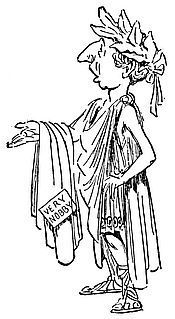
Horace
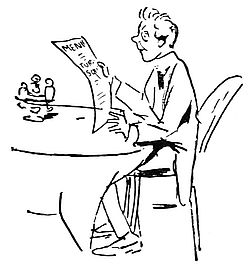
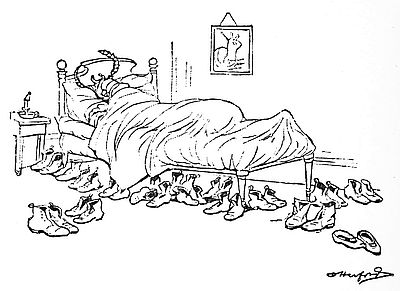
How splendid to have men’s attire treated by a gentleman
and litterateur.—John Armstrong Chaloner.
Ah me! Had Horace when his muse was flagging,
But given laughing Lalage a rest,
And kept Mæcenas’ pantaloons from bagging,
(Whatever ’twas he wore below his vest.)
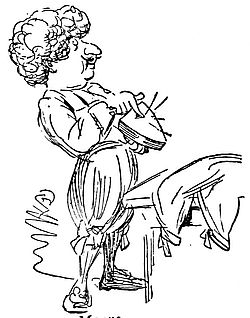
Moore
If when his frisky Pegasus he mounted,
He’d sung, instead of the eternal HER
The stylish HIM, he might have been accounted
A gentleman as well as litterateur.
If Shakespeare had abstained from malty liquors,
And spent the time (when not purloining plays)
In pressing Francis Bacon’s velvet knickers
He might thereby have gained a social raise.
If Tommy Moore when not devoutly pressing
His suit in amorous rhyme, had pressed instead
His patrons lordly “pants,” it is past guessing
What titles had been showered on his head.
Had Bobby Burns renounced his Highland lassies,
And tuned his pipes to “Gentlemen’s attire,”
He might in time have risen from the masses
And been addressed as Robert Burns, Esquire.
If Hall Caine—............................
.....................................................
.....................................................
..................but why drag in Hall Caine?
Come, Chaloner, confess like a good feller
By “Gentleman and litterateur” you meant
The literary style of the Best Seller
And the strictly pure refinement of the Gent.
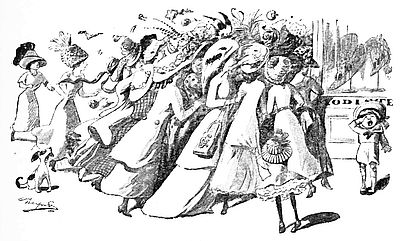
“The artists and writers were the first Americans to make
themselves at home in this amusing Parisian resort. (The
Old Café Martin.) And it was here, too, that women of the
better class first tasted the delights of café life. It was
considered quite a daring thing in the late eighties for be-cloaked
and be-diamonded women of Fifth Avenue to sit
here and sip their after-dinner coffee.”
Vanity Fair.
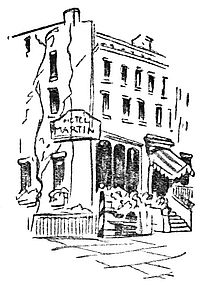
One of those queer, artistic dives,
Where funny people had their fling.
Artists, and writers, and their wives—
Poets, and all that sort of thing.
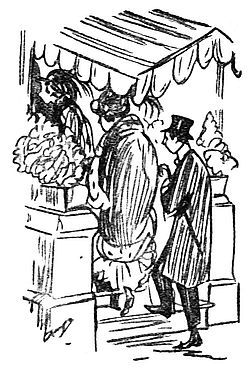
Here, too, to view the vulgar herd
And sip the daring demi-tasse—
Be-cloaked, be-diamonded, be-furred—
Came women of the better class.
With its Parisian atmosphere,
It had a Latin Quarter ring.
Painters and journalists came here—
Actors, and all that sort of thing.
Here, too, to watch the Great Ungroomed
And sip the dangerous demi-tasse,
Be-furred, be-feathered and be-plumed,
Came women of the better class.
Here Howells dined—Saint Gaudens, Nast,
Kipling, Mark Twain and Peter Dunne,
Nell Terry, and not least though last
One Robert Louis Stevenson.
And mingling with that underworld,
To sip the devilish demi-tasse,
Be-cloaked, be-diamonded, be-pearled,
Came women of the better class.
Like geese to see the lions fed,
They came—be-jewelled and be-laced,
Only to find the lions fled.
“My Word!” cried they, “What wretched taste!”
Ermined and minked and Persian-lambed,
Be-puffed (be-painted, too, alas!)
Be-decked, be-diamonded—be-damned!
The women of the better class.
A Pipe Dream
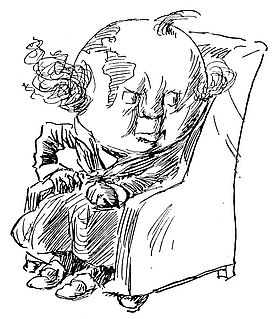
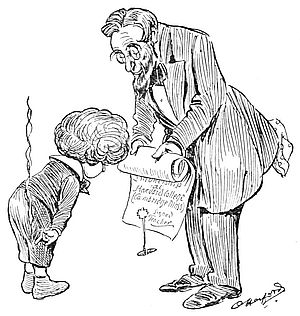
Well I recall how first I met
Mark Twain—an infant barely three
Rolling a tiny cigarette
While cooing on his nurse’s knee.
Since then in every sort of place
I’ve met with Mark and heard him joke,
Yet how can I describe his face?
I never saw it for the smoke.
At school he won a smokership,
At Harvard College (Cambridge, Mass.)
His name was soon on every lip,
They made him “smoker” of his class.
Who will forget his smoking bout
With Mount Vesuvius—our cheers—
When Mount Vesuvius went out
And didn’t smoke again for years?
The news was flashed to England’s King,
Who begged Mark Twain to come and stay,
Offered him dukedoms—anything
To smoke the London fog away.
But Mark was firm. “I bow,” said he,
“To no imperial command,
No ducal coronet for me,
My smoke is for my native land!”
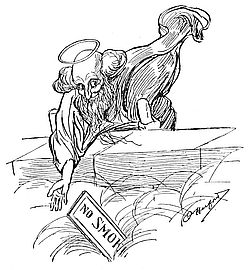
For Mark there waits a brighter crown!
When Peter comes his card to read—
He’ll take the sign “No Smoking” down,
Then Heaven will be Heaven indeed.
Beneath a Fruitful Apple Tree
Sate Pompom, youth of high degree,
And Prince of Apple-Tartary;
While in the branches overhead
The apples blushed with rapture red,
As from a great book on his knees
He read of the Hesperides,
And how, to win the apples gold,
One Hercules, a Hero bold,
A hundred-headed Dragon shew.
“How brave! How wonderful! How true!”
Exclaimed the apples, flushed and red.
“That proves what we have always said:
We come of Ancient Pedigree!
We’re of the Applestocracy!
Our title cannot be denied.”
Whereat they swelled and swelled with Pride
Until their High and Mighty Air
Was more than Apple Tree could bear.
“Come!” cried the Tree, “you must vacate
My boughs—they will not bear your weight!”
Pride goes before a fall.
Alas!
Next morning, prone upon the grass,
Blushing for shame, the Apples lay,
And when Queen Pompom passed that way
She picked them up, and by and by
She made them into Apple Pie.
To the Tune of Tennyson
I burst upon the reader’s eye
With verbal trumpet blaring,
Proclaiming me the latest cry
In fictionary daring—
Vital, compelling, hectic, rare,
Heart-gripping, epoch-making!
A woman’s naked soul laid bare,
A climax record-breaking!
A quivering, pulsating plot,
The mystery of a red room,
A story to be read red hot
In boudoir, or bedroom,
An Eve, repentant, up to date,
Confesses what her fall meant;
You simply won’t know how to wait
Until the next installment.
I come from heaven knows where—or when.
My pedigree is shady.
My father was a Fountain Pen;
My mother, a Typelady,
Who smote the keys from morn till night
With fingers swift and taper,
Till I appeared, all clean and bright,
On reams of foolscap paper.
And now in serial form I flow,
And flout at style and diction,
As like a babbling brook I go
To join the Sea of Fiction.
Some streams, I know, more deeply flow,
And some for speed endeavor.
Short stories come, short stories go,
But I’ll go on forever.
I glitter like a foolish string
Of pearls, with polish painful,
With epigrams of doubtful ring
And platitudes Hall-Caineful.
And many a mood and tense amiss,
And metaphor amuddle,
And here and there a clinging kiss,
And here and there a cuddle—
And here and there a phrase in French,
To give a touch linguisty;
And here and there a Fisher wench,
And here and there a Christy.
And here and there and everywhere
My thin stream slowly trickles
’Twixt Bunk’s Elixir for the Hair
And Black and Croswell’s Pickles.
And here a temperamental scene,
Fervid, intense, Byronic—
Tosses tempestuous between
Ayre’s Soap and Tinkham’s Tonic.
A sprightly conversation’s flow
Is checked by Soak and Stingham’s
Pink Pills, to reappear below
An ad for ladies’ thingums.
The well-known slip ’twixt cup and lip
Here, too, finds confirmation—
“He raised his glass”—Thy Anti-Grip!
Beware of Imitations!
—“Up to his lips; when on his wrist
He felt a grip, steel-sinewed;
The glass fell, and a hoarse voice hissed
The words”—To be Continued.
Editorial Note
Some streams, we know, more deeply flow,
And some for speed endeavor.
Short stories come, short stories go,
But this goes on forever.
An Idyll of the Western Front
Scene: A wayside shrine in France.
Persons: Celeste, Pierre, a Cloud.
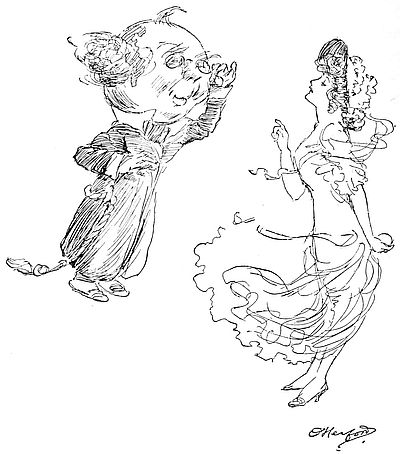
Celeste (gazing at the solitary white Cloud):
I wonder what your thoughts are, little Cloud,
Up in the sky, so lonely and so proud!
Cloud: Not proud, dear maiden; lonely, if you will.
Long have I watched you, sitting there so still
Before that little shrine beside the way,
And wondered where your thoughts might be astray;
Your knitting lying idle on your knees,
And worse than idle—like Penelope’s,
Working its own undoing!
Celeste (picks up her knitting): Who was she?
Saints! What a knot!—Who was Penelope?
What happened to her knitting? Tell me, Cloud!
Cloud: She was a Queen; she wove her husband’s shroud.
Celeste (drops the knitting):
His shroud!
Cloud: There, there! ’Twas only an excuse
To put her lovers off, a wifely ruse,
Bidding them bide till it was finished, she
Each night the web unravelled secretly.
Celeste: He came home safe?
Cloud: If I remember right,
It was the lovers needed shrouds that night!
It is an old, old tale. I heard it through
A Wind whose ancestor it was that blew
Ulysses’ ship across the purple sea
Back to his people and Penelope.
We Clouds pick up strange tales, as far and wide
And to and fro above the world we ride,
Across uncharted seas, upon the swell
Of viewless waves and tides invisible,
Freighted with friendly flood or forkèd flame,
Knowing not whither bound nor whence we came;
Now drifting lonely, now a company
Of pond’rous galleons—
Celeste: Oft-times I see
A Cloud, as by some playful fancy stirred,
Take likeness of a monstrous beast or bird
Or some fantastic fish, as though ’twere clay
Moulded by unseen hands.
Cloud: Then tell me, pray,
What I resemble now!
Celeste: I scarcely know.
But had you asked a little while ago,
I should have said a camel; then your hump
Dissolved, and you became a gosling plump,
Downy and white and warm—
Cloud: What! Warm, up here?
Ten thousand feet above the earth!
Celeste: Oh dear!
What am I thinking of! Of course I know
How cold it is. Pierre has told me so
A thousand times.
Cloud: And who is this Pierre
That tells you all the secrets of the air?
How came he to such frigid heights to soar?
Celeste: Pierre’s my—He is in the Flying Corps.
Cloud: Ah, now I understand! And he’s away?
Celeste: He left at dawn, where for he would not say,
Telling me only ’twas a bombing raid
Somewhere—My God! What’s that?
Cloud: What, little maid?
Celeste (pointing): That—over there—beyond the
wooded crest!
Cloud: Only a skylark dropping to her nest;
Her mate is hov’ring somewhere near. I heard
His tremulous song of love—
Celeste: That was no bird!
(Drops upon her knees.)
O Mary! Blessed Mother! Hear my prayer!
That one that fell—grant it was not Pierre!
Here is the cross my mother gave me—I
Will burn the longest candle it will buy!
Cloud: Courage, my child! Your prayer will not be vain!
Who guards the lark, will guide your lover’s plane.
The West Wind’s calling. I must go!—Hark! There
He sings again! Le bon Dieu garde, ma chère!
II
Pierre: I made a perfect landing over there
Behind the church—
Celeste: The Virgin heard my prayer!
Now I must burn the candle that I vowed—
Pierre: Then ’twas our Blessed Lady sent that Cloud
That saved me when the Boche came up behind.
I made a lightning turn, only to find
The Boche on top of me. It seemed a kind
Of miracle to see that Cloud—I swear
A moment past the sky was everywhere
As clear as clear; there was no Cloud in sight.
It looked to me, floating there calm and white.
Like a great mother hen, and I a chick.
She seemed to call me, and I scurried quick
Behind her wing. That spoiled the Boche’s game,
And gave me time to turn and take good aim.
I emptied my last drum, and saw him drop
Ten thousand feet in flames—
Celeste (shuddering): Stop! Pierre, stop!
Maybe a girl is waiting for him too—
Pierre: ’Twas either him or me—
Celeste: Thank God, not you!
Pierre (pointing to the church): Come, let us burn
the candle that you vowed.
Celeste: Two candles!
Pierre: Who’s the other for?
Celeste: The Cloud!
FINIS
TRANSCRIBER’S NOTE
Obvious typographical errors and punctuation errors have been
corrected after careful comparison with other occurrences within
the text and consultation of external sources.
Except for those changes noted below, all misspellings in the text,
and inconsistent or archaic usage, have been retained.
Pg viii, ‘High Brow Hen’ replaced by ‘Highbrow Hen’.
Pg 39, ‘Lese Majestee’ replaced by ‘Lésé Majesté’.
Pg 61, ‘if we trangress’ replaced by ‘if we transgress’.
Pg 77, ‘smothered sn’ replaced by ‘smothered snore’.

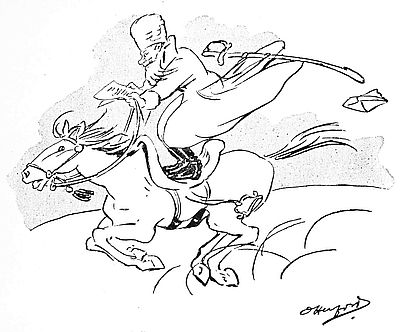
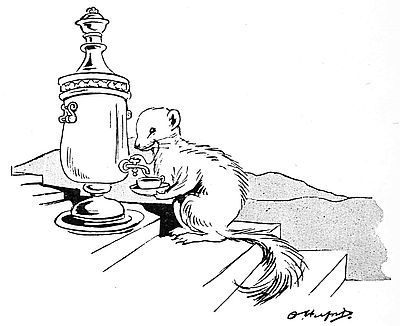
 The Horse, I don’t mind telling you,

 With Cats and Lions, I confess,

 Likewise with Camels, Mice and Snails

 Eels and Rhinoc’ruses and Ants

 And Bees and Yaks and Owls. But when

 Sputters and scares the high-strung steed,