THE LAST FRONTIER
The Project Gutenberg eBook, The Last Frontier, by E. Alexander (Edward Alexander) Powell
| Note: | Images of the original pages are available through Internet Archive. See https://archive.org/details/lastfrontierwhi00powe |
THE LAST FRONTIER
BY E. ALEXANDER POWELL
THE LAST FRONTIER
GENTLEMEN ROVERS
THE END OF THE TRAIL
FIGHTING IN FLANDERS
THE ROAD TO GLORY
VIVE LA FRANCE!
ITALY AT WAR
CHARLES SCRIBNER'S SONS
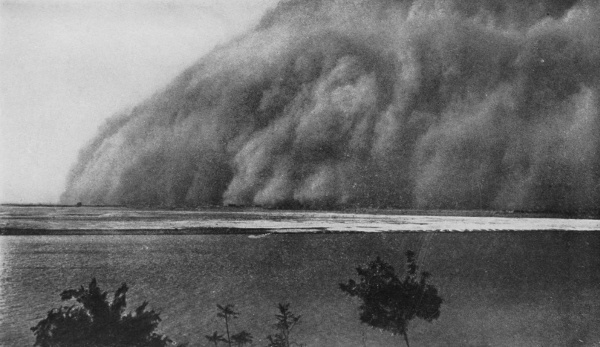
“It approached at the speed of a galloping horse—a great fleecy, yellowish-brown cloud which looked for all the world like the smoke of some gigantic conflagration.”
THE WHITE MAN'S WAR
FOR CIVILISATION IN AFRICA
BY
E. ALEXANDER POWELL,
F.R.G.S.
LATE OF THE AMERICAN CONSULAR SERVICE
IN EGYPT
WITH SIXTEEN FULL-PAGE
ILLUSTRATIONS
AND MAP
NEW YORK
CHARLES SCRIBNER'S SONS
1919
Copyright, 1912, by
CHARLES SCRIBNER'S SONS

To
MY CHEERFUL, UNCOMPLAINING
AND COURAGEOUS COMRADE ON THE
LONG AFRICAN TRAIL
MY WIFE
FOREWORD
The unknown lands are almost all discovered. The work of the explorer and the pioneer is nearly finished, and ere long their stern and hardy figures will have passed from the world's stage, never to return. In the Argentine, in Mexico, and in Alaska store clothes and stiff hats are replacing corduroys and sombreros; the pack-mule is giving way to the motor-car. The earth has but one more great prize with which to lure the avaricious and the adventurous: Africa—mysterious, opulent, alluring—beckons and calls.
The conditions which exist in Africa to-day closely parallel those which were to be found, within the memory of many of us, beyond the Mississippi. In North Africa the French are pushing their railways across the desert in the face of Arab opposition, just as we pushed our railways across the desert in the face of Indian opposition forty years ago. As an El Dorado the Transvaal has taken the place held by Australia, and California, and the Yukon, in their turn. The grazing lands of Morocco and the grain lands of Rhodesia will prove formidable rivals to those of our own West in a much-nearer future than most of us suppose. French and British well-drillers are giving modern versions of the miracle of Moses in the Sahara and the Sudan and converting worthless deserts into rich domains thereby.
The story of the conquest of a continent by these men with levels and transits, drills and dynamite, ploughs and spades, forms a chronicle of courage, daring, resource, and tenacity unsurpassed in history. They are no idlers, these pioneers of the desert, the jungle, and the veldt; they live with danger and hardship for their daily mates; they die with their boots on from snake-bite or sleeping-sickness or Somali spear; and remember, please, they are making new markets and new playgrounds for you and me. Morocco, Algeria, Tripolitania, Equatoria, Rhodesia, the Sahara, the Sudan, the Congo, the Rand, and the Zambezi ... with your permission I will take you to them all, and you shall see, as though with your own eyes, those strange and far-off places which mark the line of the Last Frontier, where the white-helmeted pioneers are fighting the battles and solving the problems of civilisation.
E. Alexander Powell.
AN ACKNOWLEDGMENT
For assistance in the preparation of this book I am grateful to many people. To the editors of Collier's, The Outlook, The Review of Reviews, The Independent, The Metropolitan, Travel, and Scribner's my thanks are due for their permission to use such portions of this volume as originally appeared in their magazines in the form of articles. I also desire to acknowledge my indebtedness to the Right Hon. James Bryce, O.M., for permission to avail myself of certain data contained in his admirable work on South Africa; to Charles K. Field, Esq., editor of The Sunset Magazine, for the title and introductory lines to Chapter V; to the Hon. F. C. Penfield, former American Diplomatic Agent in Egypt, from whose clear and comprehensive “Present-Day Egypt” I have drawn portions of my account of the complex administration of the Nile country; to J. Scott Keltie, LL.D., F.R.G.S., author of “The Partition of Africa” and editor of “The Statesman's Year-Book,” for much valuable information obtained from those volumes; and to Miss Isabel Savory, A. Sylva White, Esq., S. H. Leeder, Esq., C. W. Furlong, Esq., and Francis Miltoun, Esq., for suggestions derived from their writings on African subjects. To the American diplomatic and consular officials in Africa, and to missionaries of many creeds and denominations, I am indebted for innumerable kindnesses and much valuable information. At consulate and mission station alike, from Cape Bon to Table Bay, I found the latch-string always out and an extra chair at the table. I likewise take this opportunity of expressing my appreciation of the courtesies shown me by H. H. Abbas Hilmi II, Khedive of Egypt; H. R. H. Prince George of Greece, former High Commissioner in Crete; H. H. Ali bin Hamoud bin Mohammed, ex-Sultan of Zanzibar; H. E. the French Minister of the Colonies; H. E. the Belgian Minister of the Colonies; Sir Thomas Cullinan of the Premier Diamond Mine, Pretoria; and to the officers of the Imperial German East Africa Railways; the Beira, Mashonaland and Rhodesian Railways; and the British South Africa Company.
E. A. P.
CONTENTS
| PAGE | ||
| Foreword | vii | |
| An Acknowledgment | ix |
| CHAPTER | ||
| I. | The Third Empire | 1 |
| II. | The Passing of the Peacock's Tail | 27 |
| III. | Sirens of the Sands | 56 |
| IV. | The Italian “White Man's Burden” | 80 |
| V. | The Land of Before-and-After | 108 |
| VI. | In Zanzibar | 143 |
| VII. | The Spiked Helmet in Africa | 165 |
| VIII. | “All Aboard for Cape Town!” | 190 |
| IX. | The Last Stand of the Pioneer | 205 |
| X. | The Country of Big Things | 223 |
| XI. | The Forgotten Isles | 248 |
| Index | 287 |
ILLUSTRATIONS
THE LAST FRONTIER
CHAPTER I
THE THIRD EMPIRE

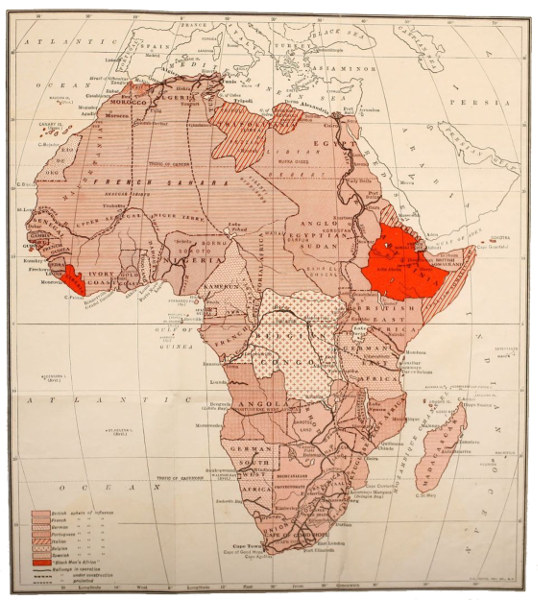
WE have witnessed one of the most remarkable episodes in the history of the world. In less than a generation we have seen the French dream of an African empire stretching without interruption from the Mediterranean to the Congo literally fulfilled. French imperialism did not end, as the historians would have you believe, on that September day in 1870 when the third Napoleon lost his liberty and his throne at Sedan. The echoes of the Commune had scarcely died away before the French empire-builders were again at work, in Africa, in Asia, in Oceanica, founding on every seaboard of the world a new and greater France. In the two-score years that have elapsed since France's année terrible her neglected and scattered colonies have been expanded into a third empire—an empire oversea. She has had her revenge for the loss of Alsace-Lorraine by forestalling Teutonic colonial ambition in every quarter of the globe: in China, in Australasia, in Equatoria, and in Morocco the advance of the German vorlopers has been halted by the harsh “Qui vive?” of the French videttes.
Though thirty centuries have elapsed since Phœnicia first began to nibble at the continent, it was not until 1884 that the mad rush began which ended in Africa's being apportioned among themselves by half a dozen European nations with as little scruple as a gang of boys would divide a stolen pie. This stealing of a continent, lock, stock, and barrel, is one of the most astounding performances in history. France emerged from the scramble with a larger slice of territory than any other power, a territory which she has so steadily and systematically expanded and consolidated that to-day her sphere of influence extends over forty-five per cent of the land area and twenty-four per cent of the population of Africa.
So silently, swiftly, and unobtrusively have the French empire-builders worked that even those of us who pride ourselves on keeping abreast of the march of civilisation are fairly amazed when we trace on the map the distances to which they have pushed the Republic's African frontiers. Did you happen to know that the fugitive from justice who turns the nose of his camel southward from Algiers must ride as far as from Milwaukee to the City of Mexico before he can pass beyond the shadow of the tricolour and the arm of the French law? Were you aware that if you start from the easternmost boundary of the French Sudan you will have to cover a distance equal to that from Buffalo to San Francisco before you can hear the Atlantic rollers booming against the break-water at Dakar? It is, indeed, not the slightest exaggeration to say that French influence is to-day predominant over all that expanse of the Dark Continent lying west of the Nile basin and north of the Congo—a territory one and a half times the size of the United States—thus forming the only continuous empire in Africa, with ports on every seaboard of the continent.
With the exception of the negro republic of Liberia (on whose frontiers, by the way, France is steadily and systematically encroaching), the little patches of British and Spanish possessions on the West Coast, and the German colonies of Kamerun and Togoland, France has unostentatiously brought under her control that enormous tract of African soil which stretches from the banks of the Congo to the shores of the Mediterranean, and from the Atlantic seaboard to the Valley of the Nile. Algeria has been French for three-quarters of a century, being regarded, indeed, as a part of France and not a colony at all. Though the Bey of Tunis still holds perfunctory audiences in his Palace of the Bardo, it is from the French Residency that the protectorate is really ruled. Though Tripolitania has passed under Italian dominion, it is French and not Italian influence which is recognised by the unsubjugated tribesmen of the hinterland. And now, after years of intrigue and machinations, which twice have brought her to the brink of war, France, by one of the most remarkable diplomatic victories of our time, has won the last of the world's great territorial prizes and has set the capstone on her colonial edifice by adding the empire of Morocco—under the guise of a protectorate—to her oversea domain.
On the West Coast the tricolour floats over the colonies of Senegal, French Guinea, the Ivory Coast, Dahomey, Upper Senegal-Niger, and Mauritania (the last named a newly organised colony formed from portions of the Moroccan hinterland), the combined area of these possessions alone being about equal to that of European Russia.
From the Congo northward to the confines of the Anglo-Egyptian Sudan stretches the great colony of French Equatorial Africa—formerly known as the French Congo—the acquirement of which by Savorgnan de Brazza, counterchecked the ambitious plans of Stanley and his patron, King Leopold, thus forming one of the most dramatic incidents in the scramble for Africa. Though potentially the most valuable of the French West African possessions, being enormously rich in both jungle and mineral products, notably rubber, ivory, and copper, France has taken surprisingly little interest in this colony's development, and, as a result, it has been permitted to fall into a state of almost pitiful neglect. There are two causes for the backwardness of French Equatorial Africa: first, its atrocious climate, the whole territory being a breeding-ground for small-pox, blood diseases, tropical fevers in their most virulent forms, and, worst of all, the terrible sleeping-sickness; second, the almost total lack of easy means of communication, the back door through the Belgian Congo being the only direct means of access to the greater part of the colony, which was virtually cut in half by the broad area lying between the southern boundary of Kamerun and the equator and extending eastward from the coast to the Ubangi River, which France ceded to Germany in 1911 as a quid pro quo for being permitted a free hand in Morocco, and which has been renamed “New Kamerun.” Though the economic development of this region must prove, under any circumstances, a difficult, dangerous, and discouraging task, it can be accomplished if the government will divert its attention from its projects in North Africa long enough to make Libreville a decent port, to provide adequate steamer services on the great rivers that intersect the colony, and to link up those rivers with each other and with the coast by a system of railways.
Lying on the northern frontier of French Equatorial Africa, and separating it from the Sahara, is the great Central African state of Kanem, with its organised native government, its important commerce, and its considerably developed civilisation, which was completely subjugated by France in 1903, Wadai, its powerful neighbour to the east, accepting a French protectorate in the same year. In the centre of this ring of colonies lie the million and a half square miles of the French Sahara, which the experiments of the French engineers have proved to be as capable of irrigation and cultivation as the one-time deserts of our own Southwest. Off the other side of the continent is the great colony of Madagascar, the second largest island in the world, in itself considerably larger than the mother country; while the French Somali Coast forms the sole gateway to Abyssinia and divides with the British colony of Aden the control of the southern entrance to the Red Sea. Everything considered, history can show few parallels to this marvellous colonial expansion, begun while France was still suffering from the effects of the disastrous Prussian War, and quietly carried on under the very eyes of greedy and jealous neighbours.
The territorial ambitions of most countries have been blazoned to the world by many wars. It took England two disastrous campaigns to win South Africa and two more to conquer the Sudan; Russia learned the same lesson in Manchuria at even a more terrible cost; while Italy's insecure foothold on the Red Sea shore was purchased by the annihilation of an army. Where other nations have won their colonial possessions by arms, France has won hers by adroitness. Always her policy has been one of pacific penetration. Trace the history of her African expansion and you will find no Majuba Hill, no Omdurman, no Adowa, no Modder River. Time and time again the accomplishments of her small and unheralded expeditions have proved that more territory can be won by beads and brass wire than by rifles and machine-guns.
Not long ago I asked the governor-general of Algeria what he considered the most important factors in the remarkable spread of French influence and civilisation in North Africa, and he answered, “Public schools, the American phonograph, and the American sewing-machine.” The most casual traveller cannot but be impressed by the thoroughness with which France has gone into the schoolmaster business in her African dominions. She believes that the best way to civilise native races is by training their minds, and she does not leave so important a work to the missionaries, either. In Algiers there is a government university with nearly two thousand students and a faculty of one hundred professors, while in more than eighteen hundred secondary, primary, and infant schools the youth of Algeria, irrespective of whether they believe in Christ, in Abraham, or in Mohammed, are being taught how to become decent and patriotic citizens of France. In Tunisia alone there are something over fifteen hundred educational institutions; all down the fever-stricken West Coast, under the palm-thatched roofs of Madagascar and the crackling tin ones of Equatoria, millions of dusky youngsters are being taught by Gallic schoolmasters that p-a-t-r-i-e spells “France,” and the meaning of “Liberté, Égalité, Fraternité.” To these patient, plodding, persevering men, whether they wear the white linen of the civil service or the sombre cassocks of the religious orders, I lift my hat in respect and admiration, for they are the real pioneers of progress. If I had my way, the scarlet ribbon of the Legion would be in the button-hole of every one of them. We too may claim a share in this work of civilisation, for I have seen a band of savage Arab raiders, their fierce hawk-faces lighted up by the dung-fed camp-fire, held spellbound by the strains of a Yankee phonograph; and I have seen the garments of a tribal chieftain of Central Africa being fashioned on an American sewing-machine.
“When the English occupy a country,” runs a saying which they have in Africa, “the first thing they build is a custom-house; the first thing the Germans build is a barracks; but the first thing the French build is a railway.” Nothing, indeed, is more significant of the civilising work done by the French in these almost unknown lands than the means of communication, there being in operation to-day in French Africa six thousand miles of railway, twenty-five thousand miles of telegraph, and ten thousand miles of telephone. Think of being able to buy a return ticket from Paris to Timbuktu; of telegraphing Christmas greetings to your family in Tarrytown or Back Bay or Bryn Mawr from the shores of Lake Tchad; or of sitting in the American consulate at Tamatave and chatting with a friend in Antanarivo, three hundred miles away. Why, only the other day the Sultan of Morocco, at Fez, sent birthday congratulations to the President of France, at Paris, by wireless.
To-day one can travel on an admirably ballasted road-bed, in an electric-lighted sleeping-car, with hot and cold running water in your compartment, and with a dining-car ahead, along that entire stretch of the Barbary Coast lying between the Moroccan and Tripolitanian frontiers, which, within the memory of our fathers, was the most notorious pirate stronghold in the world. A strategic line has been built six hundred miles southward from the coast city of Oran to Colomb-Bechar, in the Sahara, with Timbuktu as its eventual destination, and, now that the long-standing Moroccan controversy has been settled for good and all, another railway is already being pushed forward from Ujda, on the Algerian-Moroccan border, and in another year or two the shriek of the locomotive will be heard under the walls of Fez the Forbidden. From Constantine, in Algeria, another line of rails is crawling southward via Biskra into the Sahara, with Lake Tchad as its objective, thus opening up to European commerce the great protected states of Kanem and Wadai. From Dakar, on the coast of Senegal, a combined rail and river service is in operation to the Great Bend of the Niger, so that one can now go to the mysterious city of Timbuktu by train and river steamer, in considerable comfort and under the protection of the French flag all the way. In Dahomey, within the memory of all of us a notorious cannibal kingdom, a railway is under construction to Nikki, four hundred miles into the steaming jungle; from Konakry, the capital of French Guinea, a line has just been opened to Kourassa, three hundred and fifty miles from anywhere; while even the fever-stricken, voodoo-worshipping Ivory Coast boasts two hundred miles or so of well-built line with its rail-head already half-way from the coast to Jimini. From Tamatave, the chief seaport of Madagascar, you can go by rail to the capital, Antanarivo, three hundred miles up into the mountains, and, if you wish to continue across the island, government motor-cars will run you down, over roads that would make the Glidden tourists envious, to Majunga, on the other side. From Djibouti, the capital of the French Somali Coast, another railway has been pushed as far up-country as Diré-Dawah, in Menelik's dominions (fare sixty dollars for the round trip of two hundred and fifty miles), thus diverting the lucrative trade of Abyssinia from the British Sudan to the French marts in Somaliland.
France has more good harbours on the coasts of Africa than all the other nations put together. Algiers, with one of the finest roadsteads in the world, is now the most important coaling-station in the Mediterranean and a port of call for nearly all of the lines plying between America and the Near East; by the construction of a great ship-canal the French engineers have made Tunis directly accessible to ocean-going vessels, thus restoring the maritime importance of Carthage to her successor; with Tangier under French control, a naval base will doubtless eventually be constructed there which will rival Toulon and will divide with Gibraltar the control of the entrance to the Mediterranean. With its entire western portion dominated by the great French ports of Villefranche, Toulon, Ajaccio, Marseilles, Oran, Algiers, and Bizerta, the Mediterranean is well on the road to becoming, as Napoleon once prophesied, a French lake.
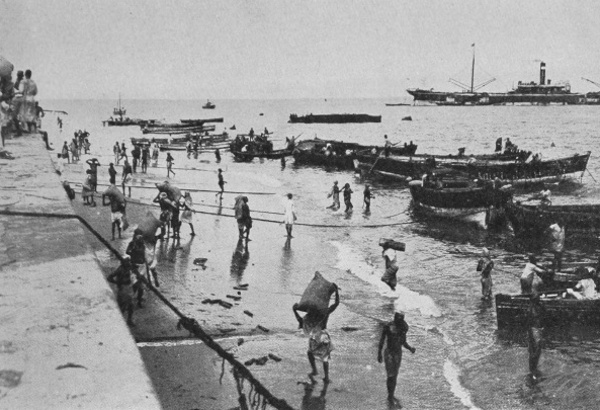
But, though good harbours are taken rather as a matter of course in the Mediterranean, one hardly expects to find them on the reef-bordered West Coast, which is pounded by a ceaseless and merciless surf. At all of the British, German, Spanish, and Portuguese ports in West Africa, save one, you are lowered from the steamer's heaving deck into a dancing surf-boat by means of a contrivance called the “mammy chair,” and are taken ashore by a score of ebony giants who ply their trident-shaped paddles madly in their desperate efforts to prevent your being capsized. Alternately scorched by the sun and soaked by the waves, you are landed, about three times out of four, on a beach as hot as though of molten brass. The fourth time, however, your Kroo boys are not quite quick enough to escape the crest of one of those mighty combers—and you can thank your lucky stars if you get ashore at all. This is the method by which every passenger and every bale of merchandise is landed on the West Coast and it is very dangerous and unpleasant and costly. But when you come to the French port of Dakar, instead of being dangled between sea and sky in a bo's'n's chair and dropped sprawling into the bottom of a pitching surf-boat, and being paddled frantically ashore by a crew of perspiring negroes, you lounge in a cane chair on an awning-covered deck while your vessel steams grandly in, straight alongside a concrete wharf which would do credit to the Hudson River, and a steam crane dips down into the hold and lifts the cargo out, a dozen tons at a time, and loads it on a waiting train to be transported into the heart of Africa, and as you lean over the rail, marvelling at the modernity and efficiency which characterise everything in sight, you wonder if you are really in the Dark Continent, or if you are back in America again.
But if the French harbours are amazingly good, the French vessels which drop anchor in them are, for the most part, amazingly bad. The Messageries Maritimes, a highly subsidised line which has a virtual monopoly of the French colonial passenger trade, and which is notorious for its we-don't-care-whether-you-like-it-or-not attitude, has the worst vessels that I know, bar none, and charges the most exorbitant fares. If you wish to visit the Somali Coast, or Madagascar, or Réunion, you will have to take this line, because there is no other, but elsewhere along the coasts of Africa you will do well to follow my advice and travel under the British or the German flag.
The struggle of the French colonial army to maintain law and order along the vast reaches of France's African frontiers forms one of the most thrilling and romantic chapters in the history of colonial expansion. Theirs has been a work of tact, rather than of force, for, where England, Germany, Italy, and Belgium have used the iron hand in dealing with the natives, France, more farsighted, has seen the wisdom of hiding it within the velvet glove. Always she has conciliated the Moslem. She has safeguarded the privacy of his mosques and harems; she has encouraged by government subsidies his schools and universities; instead of desecrating the tombs of his holy men, she has whitewashed them; the burnooses of the great tribal and religious chieftains are brilliant with French decorations; the native mollahs and cadis are utilised as local magistrates in all except the gravest cases or those involving a European. To attempt to govern a country without those, or against those, to whom it belonged, is a blunder of which France has never been guilty. It has been the consistent policy of other European nations, on the contrary, neither to trust the natives nor to treat them with any degree of consideration. Hence the ominous unrest in India; hence the ever louder murmur of “Egypt for the Egyptians”! hence the refusal of the natives of German East Africa to work on German-owned plantations and their wholesale emigration from that colony; hence the fact that no Italian official in Eritrea or Benadir dares venture outside the town walls unarmed and unescorted, nor will in Tripolitania for many years to come. I have been assured repeatedly by North African sheikhs that, should France become involved in a European war, her native soldiery would volunteer almost to a man. That England is far from certain how her Egyptian and Sudanese troops would behave in such a contingency is best proved by the formidable British garrisons which she deems it wise to maintain in the land of the Valley of the Nile.
I am but reflecting the opinions of many highly placed and intimately informed European officials in North Africa when I assert that Germany's repeated interference with the French programme in Morocco was due as much to military as to political reasons, the Germans using this means to hinder the expansion of that mysterious force noire which has long been a bugaboo to the War Office authorities in Berlin. Whether this was the true reason or not for Germany's attitude in the Moroccan business, no one knows better than the German general staff that, in the event of war, the Republic would be able to advance a great black army to the banks of the Rhine in thirty days—and that she would not be deterred by the scruples which prevented her utilising her African soldiery in 1870. It has been repeatedly urged, indeed, that the numerical inferiority of the annual French conscription, as compared with that of Germany, be made up for by drafting a corps of black troops drawn from French West Africa into the continental army. France has already recruited very close to twenty thousand native troops—which is the strength of an army corps—in her West African possessions alone, and as any scheme for drafting it into Algeria, so as to enable the French troops stationed there to be available elsewhere, would instantly arouse the Arab population to revolt, it is highly probable that this African army corps would, in case of war, be employed on the European continent. Though France's African army does not at present number much over fifty thousand men—all well drilled, highly disciplined, and modernly armed—the French drill-sergeants in Africa are not idle and have limitless resources to draw from. The population of the negro states under French protection runs into many millions, and would easily yield twenty per cent of fighting men, while the acquisition of Morocco has added the Berbers, that strange, warlike, Caucasian race, to the Republic's fighting line. Nothing pleases the African as an occupation more than soldiering, his native physique, courage, and endurance making him, with amazingly little training, a first-class fighting man. It is no great wonder, then, that Germany looks askance at the formidable army which her rival is building up so quietly but so steadily on the other side of the Middle Sea.
No small part in the winning of North Africa has been played by the Foreign Legion—how the name smacks of romance!—that picturesque company of adventurers, soldiers of fortune, and ne'er-do-weels, ten thousand strong, most of whom serve under the French flag in preference to serving in their own prisons. In this notorious corps the French Government enlists without question any physically fit man who applies. It asks no questions and expects to be told any number of lies. It trains them until they are as hard as nails and as tough as rawhide; it works them as a negro teamster works a Kentucky mule; it pays them wages which would cause a strike among Chinese coolies; and, when the necessity arises, it sends them into action with the assurance that there will be no French widows to be pensioned. So unenviable is the reputation of the Legionnaires that even the Algerian desert towns balk at their being stationed in the vicinity, for nothing from hen-roost to harem is safe from their depredations; so they are utilised on the most remote frontiers in time of peace and invariably form the advance guard in time of war. It is commonly said that when the Legion goes into action its officers take the precaution of marching in the rear, so as not to be shot in the back, but that is probably a libel which the regiment does not deserve. Wherever the musketry is crackling along France's colonial frontiers, there this Legion of the Damned is to be found, those who wear its uniform being, for the most part, bearers of notorious or illustrious names who have chosen to fight under an alien flag because they are either afraid or ashamed to show themselves under their own.
Several times each year it is customary for the commandants of the French posts along the edge of the Sahara to organise fantasias in honour of the Arab sheikhs of the region, who come in to attend them, followed by great retinues of burnoosed, turbaned, and splendidly mounted retainers, with the same enthusiasm with which an American countryside turns out to see the circus. At one of these affairs, held in southern Algeria, I could not but contrast the marked attentions paid by the French officials to the native chieftains with the cavalier and frequently insolent attitude invariably assumed by British officials toward Egyptians of all ranks, not even excepting the Khedive. Were a French official to affront one of the great Arab sheikhs as Lord Kitchener did the Khedive, when he exacted an apology from his Highness for presuming to criticise the discipline of the Sudanese troops, he would be fortunate indeed if he escaped summary dismissal.
At the fantasia in question luxuriously furnished tents had been erected for the comfort of the native guests; a champagne luncheon provided the excuse for innumerable protestations of friendship; a series of races with money prizes was arranged for the visitors' horses; and, before leaving, the sheikhs were presented with ornate saddles, gold-mounted rifles, and, in the cases of the more important chieftains, with crosses of the Legion of Honour. In return for this they willingly agreed to capture and surrender certain fugitives from justice who had fled into the desert; to warn the more lawless of their tribesmen that the plundering of caravans must cease; to furnish specified quotas of recruits for the native cavalry; and to send in for sale to the Remount Department a large number of desert-bred horses. And, which is the most important of all, they go back to their tented homes in the desert immensely impressed with the power, the wealth, and the generosity of France.
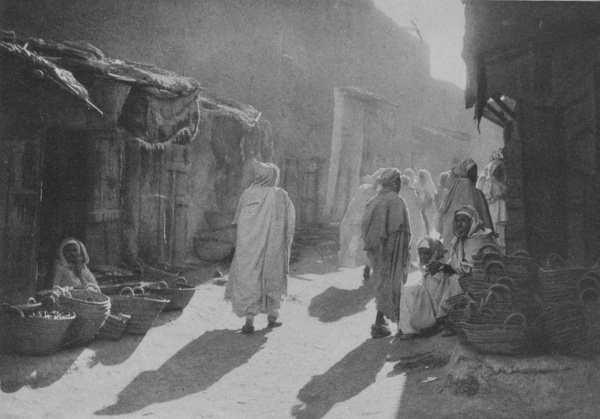
Here, in the native quarters of the remote towns of the Algerian hinterland, the disciples of Pan-Islam find eager listeners to their creed of Africa for the Africans.
Photograph by Em. Frechon, Biskra.
Not content with these periodic manifestations of friendship, the French Government makes it a point occasionally to invite the native rulers of the lands under its control to visit France as the guests of the nation. Escorted by French officers who can talk with them in their own tongue, these colonial visitors in their outlandish costumes are shown the delights of Montmartre by night, they are dined by the President of the Republic at the Élysée, they are given the freedom of Paris at the Hôtel de Ville, and they finally return to their own lands the friends and allies of France for the rest of their lives. “It doesn't cost the government much,” an official of the French Colonial Office once remarked to me, à propos of a visit then being paid to Paris by the King of Cambodia, “and it tickles the niggers.”
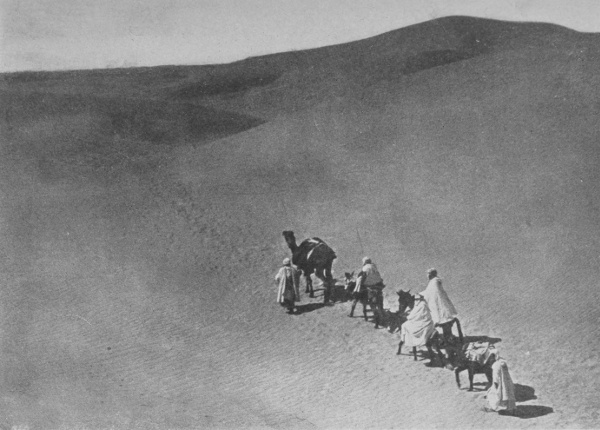
Straggling down here and there into the desert from some of the North African coast towns go the trade routes of the caravans, and it is the protection of these trade routes, traversing, as they do, a territory half again as large as that of the United States, that is entrusted to the twelve hundred méharistes composing France's Saharan forces. By a network of small oasis garrisons and desert patrols, recruited from the desert tribes and mounted on the tall, swift-trotting camels known as méhari, France has made the Saharan trade-routes, if not as safe as Fifth Avenue or Piccadilly, certainly very much safer for the lone traveller than lower Clark Street, in Chicago, or the neighbourhood of the Paris Halles. It has long been the fashion to hold up the Northwest Mounted Police as the model for all constabulary forces, just as it has been the fashion to extol the English as the model colonisers, but, taking into consideration the fewness of their numbers, the vastness of the region which they control, and the character of its climate and its inhabitants, I give the blue ribbon to these lean, brown-faced, hard-riding camel-men who have carried law and order into the furthermost corners of the Great Sahara.
Though comparatively unfertile, the Sahara vastly influences the surrounding regions, just as the Atlantic Ocean influences the countries which border on it. Were commerce to be seriously interrupted upon the Atlantic, financial hardships would inevitably result in the countries on either side. So it is, then, with the Sahara, which is, to all intents and purposes, an inland ocean. Ever since the caravan of the Queen of Sheba brought gifts to King Solomon, ever since Abraham came riding down from Ur, it has been customary for the nomad Arab rulers through whose territories the desert trade routes pass to exact heavy tribute from the caravan sheikhs, the Bilma trans-Saharan route alone being plundered annually to the tune of ten million francs until the coming of the French camel police. Many of these great trade caravans, you will understand, are literally moving cities, sometimes consisting of as many as twelve thousand camels, to say nothing of the accompanying horses, donkeys, sheep, and goats. To outfit such a caravan often takes a year or more, frequently at a cost of more than one million dollars, the money being subscribed in varying sums by thousands of merchants and petty traders dwelling in the region whence it starts. It is obvious, therefore, that the looting of such a caravan might well spell ruin for the people of a whole district; and it is by her successful protection of the caravan routes that France has earned the gratitude of the peoples of all those regions bordering on the Great Sahara. But the days of the caravan trade are numbered, for the telegraph wires which already stretch across the desert from the Mediterranean coast towns to the French outposts in the Congo, the Senegal, and the Sudan, are but forerunners to herald the coming of the iron horse.
France's path of colonial expansion in Africa has been remarkably free from obstructions, for, barring the Algerian campaign of 1830, and the German-created incidents in Morocco, she has acquired her vast domain—close on half the total area of the continent—at a surprisingly low cost in money and lives. The only time, indeed, when her African ambitions received a serious setback was in 1898, at Fashoda (now known as Kodok), on the White Nile, when the French explorer, Major Marchand, yielded to the peremptory demand of Lord Kitchener and hauled down the tricolour which he had raised at that remote spot, thus losing to France the whole of the Western Sudan and the control of the head-waters of the Nile.
There is an interesting bit of secret diplomatic history in this connection. The story has been told me by both French and British officials—and there is good reason to believe that it is true—that the French Government had planned, in case Marchand was able to hold his position until reinforcements arrived, to divert the waters of the White Nile, at a point near its junction with the Sobat River, into the Sahara, an undertaking which, owing to the physical characteristics of that region, would, so the French engineers claimed, have been entirely feasible. France would thus have accomplished the twofold purpose of irrigating her desert territory and of turning Egypt into a desert by diverting her only supply of water; for this, remember, was in those bitter, jealous days before the Anglo-French entente. It was, indeed, the intelligence that the Khalifa proposed, by doing this very thing, to bring Egypt to her knees that caused the second Sudanese expedition to be pushed forward so rapidly. (I should add that the idea, once so popular in France, of turning the Sahara into an inland sea, has been proven impracticable, if not impossible.) It is safe to say that England's prime reason for clinging so tenaciously, and at such heavy cost, to the arid tract known as the Anglo-Egyptian Sudan, is to safeguard Egyptian prosperity by keeping control of the head-waters of the Nile. To illustrate how completely the Nile is the barometer of Egyptian prosperity, I might add that the last time I was in Khartoum the officials of the Sudanese Irrigation Service complained to me most bitterly that they were being seriously hampered in their work of desert reclamation by the restrictions placed upon the quantity of water which they were permitted to divert from the Nile, a comparatively small diversion from the upper reaches of the river causing wide-spread distress among the Egyptian agriculturists a thousand miles down-stream.
Because the map-makers from time beyond reckoning have seen fit to paint the northern half of the African continent a speckled yellow, most of us have been accustomed to look upon this region as an arid, sun-baked, worthless desert. But French explorers, French engineers, and French scientists have proved that it is very far from being worthless or past reclamation. M. Henri Schirmer, the latest and most careful student of its problems, says: “The sterility of the Sahara is due neither to the form of the land nor to its nature. The alluvium of sand, chalk, and gypsum which covers the Algerian Sahara constitutes equally the soil of the most fertile plains in the world. What causes the misery of one and the wealth of the other is the absence or the presence of water.” Now, an extensive series of experiments has proven that the Sahara, like the Great American Desert, has an ample supply of underground water, which in many cases has been reached at a depth of only forty feet. There is, incidentally, hardly a desert where the experiment has been tried, whether in Asia, Africa, or America, where water has not been found within two thousand feet of the surface. Though usually not sufficient for agriculture, enough has generally been found to afford a supply for cattle, railroads, and mines. Three striking examples of what can be accomplished by scientific well-drilling in arid lands are the great wells of the Salton Desert, the flowing wells at Benson, Arizona, and a supply of seven hundred thousand gallons of water a day from the deep wells on the mesa at El Paso, each of these supplies of water being obtained from localities which were superficially hopelessly dry.
It should be borne in mind, in any discussion of North Africa, that until the early '80's the Great American Desert was as primitive, waterless, and sparsely settled a region as the Sahara. Its scattered inhabitants practised irrigation and agriculture very much as the people of southern Algeria and Tunisia do to-day, and, like them, they constructed buildings of unburnt brick and stone. Though the Indian was able to find a meagre sustenance upon the American desert, just as the Arab does upon the African, it was of a kind upon which the white man could not well exist. The unconquered Apaches plundered wagon-trains and mail-coaches just as the Tuareg occasionally plunders the Saharan trade caravans to-day, and the only white men were the soldiers at scattered and lonely posts or desperadoes flying from the law. There is, indeed, a striking similarity between the conditions which prevail to-day along France's African borders and those which existed within the memories of most of us upon our own frontier.
Then the railways came to the American West, just as they are coming to North Africa to-day, and the desert was awakened from its lethargy of centuries by the shriek of the locomotive. The first railroads to be constructed were designed primarily as highways between the Atlantic and the Pacific seaboards, with hardly a thought of revenue from the desert itself. But hard on the heels of the railway-builders followed the miners and the cattlemen, so that to-day the iron highway across the desert is bordered by prosperous cities and villages, by mines and oil-derricks and ranches and white farm-houses with green blinds, this one-time arid region, which the wiseheads of thirty years ago pronounced worthless, now yielding a wealth twice as much per capita as that of any other portion of the United States.
What has already been accomplished in the American desert, French brains, French energy, and French machinery are fast accomplishing in the Sahara. Thanks to the recent invention, by a non-commissioned officer of France's African forces, of a six-wheeled motor-sledge driven by a light but powerful aeroplane engine, the problem of rapid communication in these desert regions, which have hitherto been impassable to any kind of animal or mechanical traction, has been solved. As the new vehicle has proved itself capable of maintaining a speed over sand dunes of twenty miles an hour, it promises to be of invaluable assistance to the French in their work of opening up the waste places. Not only have French expeditions explored and charted the whole of the unknown regions, but they have thoroughly investigated the commercial possibilities of the immense territories which have recently come under their control. These investigations have shown that the Sahara is very far from being the sandy plain, flat as a billiard-table, which the pictures and descriptions in our school geographies led us to believe, and which the reports of those superficial travellers who had only journeyed into the desert as far as Biskra, in Algeria, or Ghadames, in Tripolitania, confirmed, but is, on the contrary, of a remarkably varied surface, here rising into plateaus like those of Tibesti and Ahaggar, there crossed by chains of large and fertile oases, and again broken into mountain ranges, with peaks eight thousand feet high, greater than the Alleghanies and very nearly as great as the Sierra Nevadas.
An oasis, by the way, does not necessarily consist, as the reading public seems to believe, of a clump of palm-trees beside a brackish well, many of them being great stretches of well-watered and cultivated soil, sometimes many square miles in extent, and rich in fig, pomegranate, orange, apricot, and olive trees. The oasis of Kaouer, for example, with its one hundred thousand date-palms, furnishes subsistence for the inhabitants of a score of straggling villages, with their camels, flocks, and herds. There are said to be four million date-palms in the oases of the Algerian Sahara alone, and to cut down one of them is considered as much of a crime as arson is in a great city, for its fruit is a sufficient food, from its leaves a shelter can be made which will keep out sun and wind and rain, and its shade protects life and cultivation. Many date plantations and even vineyards have flourished for several years past in southernmost Algeria by means of water from below the surface, while the chief of the French geodetic survey recently announced that a tract in the very heart of the Sahara, nine degrees in longitude by twelve degrees in latitude, is already sufficiently watered for the raising of grain. The reports of these expeditions and commissions bear with painstaking thoroughness on the productivity of the soil, the suitability of the climate, the existence and accessibility of forest wealth, the presence and probable extent of mineral veins, and on transportation by road, rail, and river over all that huge territory which comprises France's African empire.
The story of French success in the exploration, the civilisation, the administration, and the exploitation of Africa is one of the wonder-tales of history. That she has relied on the resources of science rather than on those of militarism makes her achievement the more remarkable, for where England's possessions have largely been gained by punitive expeditions, France has won hers by pacific penetration. Look at Senegambia as it is now under French rule, and compare its condition with what it was as Mungo Park describes it at the end of the eighteenth century; contrast the modernised Dahomey of to-day, with its railways, schools, and hospitals, with the blood-soaked, cannibal country of the early '60's; remember that Algeria has doubled in population since the last Dey, by striking the French consul with his fan, turned his country into a French department—and you will have a bird's-eye view, as it were, of what the French have accomplished in the colonising field.
If French Africa becomes in time a rich and prosperous dominion—and I firmly believe that it will—it is to her patient and intrepid pioneers of civilisation—-desert patrols, railway-builders, well-drillers, school-teachers, commercial investigators—that the thanks of the nation will be due; for they are pointing the way to millions of natives, on whose activities and necessities the commercial development of Africa must eventually depend. So I trust that those at home in France will give all honour to the men at work in the Sahara, the Senegal, and the Sudan or rotting in the weed-grown, snake-infested cemeteries of the Congo and Somaliland; men whose battles have been fought out in steaming jungles or on lonely oases, far away from home and friends and often from another white man's help and sympathy; sometimes with savage desert raiders, or in action against Hausa, Berber, or Moor; but oftenest of all with an unseen and deadlier foe—the dread African fever.
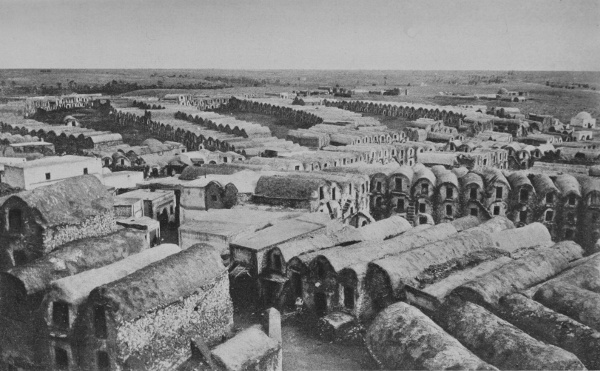
Perhaps the strangest city in the world. The dwellings, known as rhorfas, are built in the form of horseshoes to keep out thieves.
Photograph by Soler, Tunis.
CHAPTER II
THE PASSING OF THE PEACOCK'S TAIL

AN unaccustomed silence hung over the labyrinth of court-yards, corridors, gardens, mosques, and kiosks which compose the imperial palace in Fez. The chatter of the harem women was hushed; the white-robed officials of the household slipped through the mosaic-paved passages like melancholy ghosts; even the slovenly sentries at the gates, their red tunics over their heads to protect them from the sun, seemed to tread more softly, as though some great one lay dying. Within the palace, in a room whose furnishings were a strange jumble of Oriental taste and European tawdriness, a group of men stood about a table. Certain of them were tall and sinewy and swarthy, their white burnooses, which enveloped them from their snowy turbans to their yellow slippers, marking them unmistakably as Moors. Of the others, whose clearer skins showed them to be Europeans, some wore the sky-blue tunics and scarlet breeches of the chasseurs d'Afrique, some the braided jackets and baggy trousers of the tirailleur regiments, some the simple white linen of the civil administration, while across the chest of one, a grizzled man with the épaulettes of a general of division, slanted a broad scarlet ribbon. At the table sat an old-young man, a man with an aquiline, high-bred nose, a wonderfully clear, olive skin, and a fringe of scraggy beard along the line of his chin, a man with a weak mouth and sensual lips and heavy-lidded, melancholy eyes. The man with the scarlet ribbon unrolled a parchment and, bowing, spread it upon the table. One of the native dignitaries, with a gesture of reverence which included heart and lips and head, dipped a quill pen into an ink-well and tendered it to the silent figure at the table. “Your Majesty will have the goodness to sign here?” said the soldier, half-questioningly, half-commandingly, as he indicated the place with his finger. The man at the table gravely inclined his head, reached for the pen, hesitated for a moment, then slowly began to trace, from right to left, the strange Arabic signature. “Inshallah! It is done!” he said, and throwing down the pen he sunk his face into his hands. “Vive la France!” said the general solemnly, and “Vive la France!” echoed the officers around him. Well might the one lament and the others rejoice, for, with the final flourish of the Sultan's pen, Morocco had ceased to exist as an independent nation and France had added an empire to her dominions.
“The world is a peacock,” says a Moorish proverb, “and Morocco is the tail of it.” Now, however, it has become the tail of the Gallic cock, for when, on March the thirtieth, 1912, Sultan Mulai-abd-el-Hafid signed the treaty establishing a French protectorate over his country, Morocco entered upon a new phase of its existence. With that act there ended, let us hope for all time, a situation which on more than one occasion has threatened the peace of the world. Not since the English landed in Egypt a third of a century ago has an event occurred which so vitally concerns the future welfare of Africa; not since the Treaty of Tilsit has France won so decisive a diplomatic victory or added so materially to her territorial possessions. By the signing of that treaty France laid the final stone in the mighty colonial structure which she has built up in Africa, and opened to Christianity, civilisation, and commerce the door of a region which has hitherto been a synonym for mystery, cruelty, intolerance, and fanaticism.
Though scarcely forty hours of travel by train and boat separate the departure platform at the Quai d'Orsay station in Paris from the landing-beach at Tangier, though its coast is skirted by the tens of thousands of American tourists who visit the Mediterranean each year, less is known of Morocco than of many regions in central Asia or inner Africa. Though a few daring travellers have made scattering crow's-feet upon its map, there are regions as large as all our New England States put together which are wholly unexplored. It is almost the last of the unknown countries. As its women draw their veils to hide their faces from the men, so the Moors have attempted to draw a veil of mystery and intolerance over the face of their country to hide it from the stranger. What strange tribes, what ruins of an earlier civilisation, what wealth in forests or minerals lie behind its ranges can only be conjectured. Its maps are still without the names of rivers and mountains and towns—though the rivers and mountains and towns are there; the sole means of travel are on camels, mules, or donkeys along the wild, worn paths, it being the only country of any size in the world which cannot boast so much as a mile of railway; its ports and the two highways leading from the coast to its capitals, Fez and Morocco City, were, until the coming of the French, alone open to the traveller—and none too safe at that; the foreigner who has the hardihood to stray from the frequented paths is taking his life in his hands. Few of the maps of Morocco are, so far as accuracy is concerned, worth the paper they are printed on, being largely based on unscientific material eked out by probabilities and conjectures, there being less accurate information, in fact, about a country larger than France, and only two days' journey from Trafalgar Square, than there is about Abyssinia or Borneo or Uganda. Even the names which we have given to the country and its inhabitants are purely European terms and are neither used nor recognised by the people themselves, who call their country El Moghreb el Aska, which means literally “Sunset Land,” the term Morocco being a European corruption of the name of one of its capitals, Marrakesh, or, as it is known to foreigners, Morocco City. A land almost as large as the State of Texas, with snow-capped mountain ranges, navigable rivers, vast forests, a fertile soil, an abundant water supply, and an ideal climate; a land of walled cities and white villages, of domed mosques and slender minarets, of veiled women and savage, turbaned men; a land of strange peoples and still stranger customs; a land of mystery and fatalism, of suspicion and fanaticism, of cruelty and corruption, of confusion and contradiction—that is Morocco, where, as an Arabic writer has put it, a wise man is surprised at nothing that he sees and believes nothing that he hears.
This empire which has come under the shadow of the tricolour is, above all else, a white man's country. Unlike India and Tripolitania and Rhodesia and the Sudan, Morocco is a country which is admirably adapted for European colonisation, being blessed with every natural advantage that creation has to offer. Its only objectionable feature is its people. Lying at the western gateway of the Mediterranean, where the narrowed sea has so often proved a temptation to invasion, its Atlantic ports within striking distance of the great lanes of commerce between Europe and South America and South Africa, Morocco occupies a position of enormous strategic, political, and commercial importance. The backbone of the country is the Great Atlas, which, taken as a whole, has a higher mean elevation than that of any other range of equal length in Europe, Africa, or western Asia, attaining in places an elevation of nearly fifteen thousand feet. Snow-clad, this mighty and isolated wall rises so abruptly from the plain that it needs but little stretch of the imagination to understand how the ancients believed that on it rested the heavens—whence, indeed, its name. Personally, the thing that surprised me most in Morocco was the total absence of desert. Either because of its proximity to the Sahara, or because of its camels, or the two combined, I went to Morocco expecting that I should find vast stretches of sun-baked, yellow sand. As a matter of fact, I found nothing of the kind. Traversed from east to west, as I have already said, by the strongly defined range of the Atlas, the greater part of its surface is really occupied by rolling prairies, diversified by low hills, and not at all unlike Ohio and Indiana. Though admirably adapted to the growing of cereals, the strict prohibition against the exportation of grain has naturally resulted in discouraging the native farmers, so that immense tracts of fertile land remain uncultivated. The alluvial soil, which is remarkable for its richness, frequently reaches a depth of fifteen feet and could be brought to an almost incredible degree of productiveness by the application of modern agricultural methods. What greater praise can be given to any soil than to say that it will bear three crops of potatoes in a single year and that corn is commonly sown and reaped all within the space of forty days?
Unlike its neighbouring countries, Algeria, Tunisia, and Tripolitania, Morocco does not lack for navigable waterways, for it possesses several large rivers which could be navigated for hundreds of miles inland, though at present, owing to the apathy of the inhabitants, and the unsettled condition of the regions along their banks, they are used for neither traffic nor irrigation. The chief of these is the Muluya, which, with its tributary the Sharef, provides northeastern Morocco with a valuable commercial waterway for a distance of more than four hundred miles. The most important river of northwest Morocco is the Sebu, which empties into the Atlantic, while in the central and western districts the Kus, the Bu-Regreg, the Sus, and the Assaka will, under the new régime, prove invaluable as means of opening up the country.
A very large number of people seem to be under the impression that Morocco is unhealthy and suffers from a sweltering heat. Nothing could be farther from the truth. The climate is, as a matter of fact, extremely healthful, malaria, the scourge of the other countries of North Africa, being unknown. In the regions lying between the central range of the Atlas and the sea the thermometer seldom rises above ninety degrees or falls below forty degrees, the mountain wall serving as a protection from the scorching winds of the Sahara. During the winter months the rains are so heavy and frequent along the Atlantic coast that good pasturage is found as far south as Cape Juby, while in the interior the rivers frequently become so swollen that travel is both difficult and dangerous. The unpleasantness of the rains (and you don't know what discomfort is, my friends, until you have journeyed in Morocco during the rainy season) is more than compensated for by the beauties of the spring landscape. For mile after mile I have ridden across meadows literally carpeted with wild flowers, whose varied and brilliant colours, combined with the peculiar fashion in which each species confined itself to its own area, gave the countryside the appearance of a vast floral mosaic. After seeing these gorgeous natural combinations of colour—dark blue, yellow, white, and scarlet, iris, marigolds, lilies, and poppies—I no longer wondered where the Moors draw the inspiration for that chromatic art of which they left such marvellous examples in the cities of southern Spain.
Though the country has, unfortunately, become largely deforested—for what Moor would ever think of planting trees, which could only be of value to another generation?—a wealth of timber still remains in the more remote valleys of the Atlas, the pines and oaks often attaining enormous size. Though Spanish concessionaires are profitably working gold mines in the Riff country, and the great German firm of Mannesmann Brothers has acquired extensive iron-ore-bearing properties in the Sus, and though large deposits of silver, copper, lead, and antimony have been discovered at various points in the interior, the mineral wealth of Morocco is still a matter for speculation. It is not likely to remain so long, however, for history has shown that it is the miners who form the real advance-guard of civilisation.
To the stranger who confines his investigations to the highways which connect the capitals with the coast, Morocco gives the impression of being very sparsely settled. This is due to the fact that the natives take pains to avoid the highroads as they would the plague, the continual passage of troops and of travellers, all of whom practise the time-honoured custom of living on the country and never paying for what they take, having had the natural result of driving the inhabitants into less travelled regions, though traders and others whose business takes them into the back country find that it is far more densely populated than most foreigners suspect. Heretofore it has been possible for almost any foreigner, by the judicious use of bakshish, to obtain from the authorities an official order which required the people living along the roads to supply food both for him and his escort and fodder for their horses. Now, this was a very serious tax, especially among a people as poverty-stricken as the Moorish peasantry, and as a result of it the heedless traveller often caused much misery and suffering. But if the occasional traveller proved so serious a burden, imagine what it meant to these poor people when the Sultan himself passed, for, able to move only with an army, without any commissariat or transport, and feeding itself as it went, he devastated the land of food and fodder as though he was an invader instead of a ruler, sweeping as ruthlessly across his empire as the Huns did across southern Europe, and leaving his subjects to starve. Is it any wonder, then, that the desperation of the wretched, half-starved peasantry has vented itself in repeated revolutions? The coming of the French is bound to change this deplorable and demoralising state of affairs, however, for, once assured of protection for their crops and justice for themselves, the fugitive country folk will quickly flock back and resume the cultivation of their abandoned lands.
One of the facts about Morocco that will probably surprise most people—I know that it surprised me—is that the Berbers, who form fully two thirds of the population, are a purely white race, as white indeed, barring the tan which results from life under an African sun, as we ourselves. Though the generic term Moor is applied by Europeans to all the inhabitants of Morocco, there are really four distinct racial divisions of the population: the Berbers, who, being the earliest-known possessors of the land, are the genuine Moroccans, and are, when of unmixed blood, a very energetic and vigorous people, indeed; the Arabs, who are the descendants of the Mohammedan conquerors of the country and possess to the full the Arab characteristics of arrogance, indolence, and cruelty; the negroes, brought into the country as slaves from Central Africa in an influx extending over centuries, this admixture having resulted in deteriorating both the Berbers and the Arabs, the infusion of black blood showing itself in dark skins, thickened lips, low foreheads, sensual tastes, and a marked stupidity; and lastly, but by no means the least important, the ubiquitous, persecuted, and persecuting Jews. The Berbers dwell for the most part in the mountains, while the Arabs, on the contrary, are to be found only on the plains, it being the weak, sensual, and intolerant amalgam produced by the fusion of these two races, and tinctured with negro blood, which forms the population of the Moorish cities and to which the name “Moor” most properly belongs.
Between the Moor of the mountains and the Moor of the towns there is as wide a gulf as there is between the natives of Vermont and the natives of Venezuela. The town Moor is sullen, suspicious of all strangers, vacillating; the pride, but none of the energy, of his ancestors remains. In his youth he is licentious in his acts; in his old age he is licentious in his thoughts. He is abominably lazy. He never runs if he can walk; he never walks if he can stand still; he never stands if he can sit; he never sits if he can lie down. The only thing he puts any energy into is his talking; he believes that nothing can be done really well without a hullabaloo. The men of the mountains are cast in a wholly different mould, however, from that of the men of the towns. Fierce enemies and stanch friends, they like fighting for fighting's sake. They are intelligent and industrious; though fonder of the sword and the pistol than of the plough and the hoe, their fertile mountain valleys are nevertheless fairly well cultivated. They are a hardy, warlike, and indomitable race and have never yet been conquered. It is well to remember in any discussion of these people that, through all the vicissitudes of their history, they have never before had the flag of another nation flying over them. All the successive invaders of North Africa have been confronted with the problem of subduing them, but always they have failed and have gone back. Not only that, but once the Moors went invading on their own account, crossing the Strait of Gibraltar, conquering all southern Spain, holding it for five hundred years, and leaving behind them the architectural glories of Seville, of Cordova, and of Granada to tell the story. Unless I am very much mistaken, therefore, it will cost France many lives and much money to make them amenable to her rule.
The decadence of the Moors is primarily due to two things: immorality and racial jealousies. They are probably the most licentious race, in both thought and act, in the world. Compared to them the inhabitants of Sodom and Gomorrah were positively prudish. This extreme moral degeneracy is in itself enough to ruin the sturdiest people, but, as though it was not sufficient, the two principal races, Arab and Berber, hate each other as the Armenian hates the Turk, this racial antagonism in itself making impossible the upbuilding of a strong and united nation. In fact, the only thing they have in common is their religion, which is the air they breathe, and which, though incapable of producing internal harmony, unites them in hostility to the unbeliever.
There is less public spirit in Morocco than in any place I know. No Moor takes the slightest interest in anything outside his personal affairs, and no one ever plans for the future—other than to hope that he will get a comfortable divan and his share of houris in Paradise. The last thing that would occur to a Moor would be to spend money on anything which will not bring him in an immediate profit, so that, as a consequence, trees are never planted, mines never worked, roads never made, bridges never built. He does not want civilisation. He does not believe in modern inventions or improvements. What was good enough for his father is good enough for him. Why lug in railways and telegraphs, and similar contrivances of the devil, then, when things are good enough as they are?
There is no cause for the other European nations to envy France the obligations she assumed when she declared a protectorate over Morocco. She has a long and hilly road to travel before she can convert her latest acquisition into a national asset. Before Morocco can be thrown open to French settlers its savage and hostile population will have to be as effectually subdued as were the Indians of our own West. The tribes of southern Morocco are especially hostile to the French occupation, and many military experts believe that the protectorate will never be enforced in those regions without a long campaign and much shedding of blood, while one eminent French general has openly asserted that it will take at least a dozen years fully to subdue the country.
Personally, I am a firm believer in the future of Morocco and the Moors under the guidance and protection of France. I have seen too much of what France has accomplished in far less favoured regions, and under far more discouraging conditions, to think otherwise. Nothing illustrates the latent possibilities of the Moorish character better than an experiment which was made some years ago. At the request of the Sultan, the British minister to Morocco asked his government for permission to send a body of Moors to Gibraltar for the purpose of being instructed in British drill and discipline. The War Office acceding to the request, two hundred Moors, selected at random from various tribes throughout the empire, were sent to Gibraltar and remained there for three years, the men being occasionally changed as they acquired a knowledge of drill. They had good clothing given them, slept in tents, and were allowed by the Sultan a shilling a day, receiving precisely the same treatment as British soldiers. During the three years they were stationed on the Rock, there were only two cases in the police court against them for dissolute conduct or disorder. The soldiers of what civilised nation could have made such a record? Colonel Cameron, under whose superintendence they were placed, reported that they learned the drill as quickly and as well as any Englishmen, and that they were sober, steady, and attentive to their duties. (The Moors, it should be remarked, are noted for their abstemiousness, the precepts of the Koran which forbid the use of spirits and tobacco being rigidly observed.) This tends to show that Moors, living under a just and humane government, and having, as these men had, proper provision made for their livelihood, are not a lawless or even a disorderly people, and that they are capable of being transformed, under such a form of government as France has established in Algeria and Tunisia, into the splendid warriors which their ancestors were in Spain. It was, as I think I have remarked in the preceding chapter, the knowledge that France, in acquiring Morocco, would obtain the material for a formidable addition to her military forces which was, it is generally believed, one of the motives that inspired Germany's persistent opposition to a French protectorate.
Though the reins of Moorish power are already firmly in the hands of the French Resident-General at Fez, there is no reason to believe that the French expect, for the present at least, to depose the Sultan, it being to their interests, for obvious reasons, to maintain the pleasant fiction that Morocco is still an independent empire to which they have disinterestedly lent their protection, In August, 1912, Sultan Mulai-abd-el-Hafid, appreciating the emptiness of his title under the French régime, abdicated in favour of his brother, Mulai Youssef, who is known to be friendly to France. The new Sultan, who is the seventeenth of the dynasty of the Alides and the thirty-seventh lineal descendant of Ali, uncle and son-in-law of the Prophet, is known to his subjects as Emir-el-Mumenin, or Prince of True Believers, and as such he exercises a spiritual influence over his subjects which the French are far too shrewd to disregard. The position of the Sultan of Morocco has, indeed, become strikingly similar to that of his fellow-ruler in the other corner of Africa, the Khedive of Egypt, for, like him, he must needs content himself henceforth with the shadow of power. Even if the imperial form of government is permanently maintained (and this I very much doubt, for it is characteristic of the Latin races—as Taine puts it—that they always want to occupy a “sharply defined and terminologically defensible position”), its real ruler will be the Resident-General of France, whose policies will be carried out by French advisers in every department of the government and whose orders will be backed up by French bayonets. So long as Mulai Youssef is content meekly to play the part of a puppet, with French officials pulling the strings, he will be permitted to enjoy all the honours and comforts of royalty, but let him once give ear to sedition, let him make the slightest attempt to undermine the authority of the French régime, and he will find himself occupying a sentry-guarded villa in Algiers near the residences of the ex-Queen of Madagascar and the ex-King of Annam, those other Oriental rulers who thought to match themselves against the power of France.
The Sherifian umbrella, which is the Moorish equivalent of a crown, is hereditary in the family of the Filali Sherifs of Tafilelt. Each Sultan is supposed, prior to his death, to indicate the member of the imperial family who, according to his conscientious belief, will best replace him. This succession is, however, elective, and all members of the Sherifian family are eligible. It has generally happened that the late Sultan's nominee has been elected by public acclamation at noonday prayers the Friday after the Sultan's death, as the nominee generally has obtained possession of the imperial treasure and is supported by the body-guard, from whose ranks most of the court officials are appointed. I might add that all of the Moorish Sultans in recent years have been so extremely bad that no successor whom they could appoint, or who could appoint himself, could by any possibility be worse. The present Sultan knows scarcely half a dozen places in his whole empire, and has spent most of his life in two of them—Marrakesh and Fez—having held, up to the time of his accession to the throne, the important post of Khalif of the latter city. The Moors never pray for their sovereign to journey among them, for, so disturbed has been the condition of the country for many years past, and so numerous have been the pretenders to the Sherifian throne, that recent Sultans have rarely ventured outside the walls of their capitals with less than thirty thousand followers behind them, so that when they had occasion to pass through the territory of a hostile tribe, as not infrequently happened, they fought their way through, leaving ruin and desolation behind them. Though both Mulai Youssef and his predecessors have always resided at one or the other of the two official capitals, the coast city of Tangier has heretofore been the real capital of Morocco. Here lived the diplomatic and consular representatives of the foreign powers and, with a cynical disregard for the Moorish Government and people, ran things between them. Though considerations of safety doubtless entered into the matter, the chief reason for making Tangier the diplomatic capital was the extreme inconvenience to the foreign legations of being obliged to follow the court in its periodical migrations from one capital to the other. Therefore the diplomatic folk remained comfortably in Tangier—which, incidentally, can readily be overawed by a war-ship's guns—and the Sultan appointed ministers to treat with them there and thus carry on the foreign business of the state. When questions of great importance had to be negotiated special missions were sent to the capital at which the Sultan happened to be residing, the departure of these ambassadorial caravans, with their secretaries, attachés, kavasses, servants, and body-guards, not to mention the immense train of pack-mules and baggage camels, providing a spectacle quite as picturesque and entertaining as any circus procession. That feature of Moorish life disappeared with the coming of the French, however, for the foreign ministers will doubtless shortly be withdrawn; and hereafter, when any negotiations are to be conducted anent Morocco, instead of a diplomatic mission having to make a two-hundred-mile journey on horses or camels, the ambassador at Paris of the power in question will step into his motor-car and whirl over to the Ministry of the Colonies in the Rue Oudinot.
I know of nothing which gives so graphic an idea of the amazing conditions which have heretofore prevailed in Morocco, and to which the French are, thank Heaven, putting an end, as the speech which a former British minister, Sir John Drummond Hay, made some years ago to the reigning Sultan, and which was, probably, the most extraordinary address ever made by a diplomatic representative to a foreign ruler.
“Your Majesty has been so gracious as to ask me,” said Sir John, looking the despot squarely in the eye, “to express frankly my opinion of affairs in Morocco. The administration of the government in Morocco is the worst in the world. The government is like a community of fishes; the giant fish feed upon those that are small, the smaller upon the least, and these again feed upon the worms. In like manner the vizier and other dignitaries of the court, who receive no salaries, depend for their livelihood upon peculation, trickery, corruption, and the money they extract from the governors of provinces. The governors are likewise enriched through peculation from tithes and taxes, and extortion from sheikhs, wealthy farmers, and traders. A Moor who becomes rich is treated as a criminal. Neither life nor property is secure. Sheikhs and other subordinate officials subsist on what they can extort from the farmers and the peasantry. Then again, even the jailers are not paid; they gain their livelihood by taking money from prisoners, who, when they are paupers, are taught to make baskets, which are sold by the jailers for their own benefit. How can a country, how can a people, prosper under such a government? The tribes are in a constant state of rebellion against their governors. When the Sultan resides in his northern capital of Fez, the southern tribes rebel, and when he marches south to the city of Morocco, eating up the rebels and confiscating their property, the northern tribes rebel. The armies of the Sultan, like locusts, are constantly on the move, ravaging the country to quell the revolts. Agriculture is destroyed, the farmers and peasantry only grow sufficient grain for their own requirements, and rich lands are allowed to lie fallow because the farmers know the crops would be plundered by the governors and sheikhs. Thus it happens with cattle and horses. Breeding is checked, since the man who may become rich through his industry is treated as a criminal and all his possessions are taken from him, as in the fable the goose is killed to get the golden eggs.”
France, in pursuing her Moroccan adventure, will do well to bear in mind two danger-spots: the Riff and the Sus. Unless she treads carefully in the first she is likely to become embroiled in a quarrel with Spain; with the natives of the Sus she will probably have trouble whether she treads lightly or not. Sooner or later France is bound to come into collision with Spain, for, with Morocco avowedly a French protectorate, I fail to see how she can tolerate Spanish soldiers on its soil. Spain, basing her pretensions on her expulsion of the Moors from Granada in the reign of Ferdinand and Isabella, has always considered herself one of the heirs of Morocco. In fact, a secret treaty was signed between France and Spain in 1905 which distinctly defined the respective spheres of influence of the two powers in that country. By the terms of this treaty Spain was acknowledged to have predominating interests in those regions adjacent to the ports of Ceuta, Melilla, and El Araish, as well as in the Riff, a little-known and exceedingly mountainous district, believed to be rich in minerals, which lies in the northwestern corner of the empire, two days' journey eastward from Tetuan. Spain distinctly engaged not to take any action in the zone thus allotted to her other than to proceed with its commercial exploitation, but it was stipulated that, should the weakness of the Sherifian government make the maintenance of the status quo impossible, she should have a free hand in her sphere.
France, meanwhile, steadily continued her “pacific penetration” of Morocco, pushing her Algerian railways closer and closer to Morocco's eastern frontier, mobilising troops at strategic points, and overrunning the Sultan's dominions with “scientific” expeditions and secret agents. Spain soon began to regard with envy and impatience the subtle game which the French were so successfully playing, but it was not until 1910 that she found the opportunity and the excuse for which she had been eagerly waiting. Some Spanish labourers, who were working on a railway which was being laid from Melilla to some mines a few miles distant, were attacked by Riffian tribesmen and a number of the Spaniards were killed. Spain jumped at the opportunity which this incident afforded as a hungry trout jumps at a fly, and a few days later a Spanish army was being disembarked on Moroccan soil. A sharp campaign ensued which ended in the temporary subjugation of the Riffians and the occupation by Spain of a considerable tract of territory extending from Ceuta eastward to Cabo del Agua and southward as far as Seluan, thus comprising practically all of Morocco's Mediterranean seaboard. A Moorish envoy was sent to Madrid and, after protracted negotiations, a convention was signed which permitted Spain to establish a force of Moorish gendarmerie, under Spanish officers, at Melilla, Aljucemas, and Ceuta, for the maintenance of order in the districts near those places. Until this force has shown itself capable of maintaining order, the Spaniards assert that they will remain in occupation of the territory they now hold. Emboldened by her success in this adventure, and greedy for further expansion, Spain, in June, 1911, sent a vessel to El Araish (Laraiche) on the Atlantic coast, and a column was despatched from there to Alcázar, which lies some twenty miles inland. The region was apparently perfectly calm at the time, and the reasons given by Spain for her action—that mysterious horsemen had been seen upon the walls of Alcázar—appeared, in France at least, to be mere pretensions and raised a storm of indignation. As things now stand, France has proclaimed a definite protectorate over the whole of Morocco, an arrangement to which the Sultan has consented. Despite that proclamation, however, Spain continues to occupy a rich and extensive district of the country with an army of forty thousand men. By what means France will attempt to oust her—for oust her she certainly will—is an interesting subject for speculation and one which is giving both French and Spanish diplomats many sleepless nights.
A word, in passing, upon the region known as the Riff. It is more discussed and less known than any other quarter of Morocco. Nothing has been written upon it except from hearsay and no European has penetrated across its length and breadth, and this although it is but two days' ride on horseback from Tetuan. Situated in the very heart of the Great Atlas range, and accessible only through narrow passes and over rough mountain trails, this region has, from time beyond reckoning, been the home and the refuge of that savage and mysterious clan known as the Riffs. Their feudal chieftains live in great castles built of stone and lead much the same lives as did the European nobles of the Middle Ages. The passes giving access to the Riff are commanded by hilltop forts impregnable to anything short of modern artillery—and to get within range of them the artillery would need to have wings. They are a people rich in possibilities, are these Riffs, and one whom it is wiser to conciliate than to fight, as France will doubtless sooner or later learn. Brigands by nature, farmers in a small way by occupation, disciples of the vendetta, scorners of the law, suspicious of strangers, their only courts the gun and dagger, the Riffs have more in common with the mountaineers of the Blue Ridge than any people that I know. They have nothing in common with the other inhabitants of Morocco except their dress, wearing the universal brown hooded jellab and over it the toga-like white woollen haik, a skull-cap of red or brown, a belt with pouches of gaily coloured leather, and in it, always, a muzzle-loading pistol and the vicious curved knife, while over the shoulder slants the ten-foot-long Riff rifle, coral-studded, brass-bound, ivory-butted, and almost as dangerous to the man behind it as to the one in front. The Riffs are fair-skinned, blue-eyed, and quite frequently red-haired, and claim to be descended from the Romans, which is no unreasonable assumption on their part, as the Romans were adventuring in Morocco—they called it Mauritania—long before Cæsar's day.
The other danger-point in Morocco is the Sus, a “forbidden” and unknown country through which only a handful of European travellers have ever passed, all in disguise and all in peril of their lives. The Sus is the rich and fertile valley lying between the Great Atlas and the Anti Atlas, and touching the Atlantic coast at Agadir. It is said to be thickly populated; it is believed to contain rich mines; it is fanatical to the last degree. Its Berber inhabitants, who are separated from the Arabs of the surrounding regions by a totally distinct language known as the Tamazight, or Tongue of the Free, though acknowledging the religious supremacy of the reigning Sultan, have always maintained a semi-independence, having never submitted to Moorish rule nor paid tax nor tribute to the government of Morocco. Twice within the last three or four decades Moorish Sultans have invaded and attempted to conquer the Sus, but each time they have been driven back across the Atlas. The origin of the people of this region is lost in the mists of antiquity. According to the Koran its original inhabitants were natives of Syria, where they proved themselves such undesirable citizens that King David ordered them to be tied up in sacks and carried out of the country on camels, since he wished to see their faces no more. Arrived in the vicinity of the Atlas Mountains, the leader of the caravan called out in the Berber tongue “Sus!” which means “Let down! Empty out!” So the exiled undesirables were dumped unceremoniously out of their sacks, and the country in which they found themselves, and where they settled, is called the Sus to this day. The people of the Sus have never liked the French, and there is little doubt that they will oppose any attempt to treat them as a province of Morocco, and consequently subject to French control. It is obvious that France will sooner or later be obliged to send an expedition into the Sus for the purpose of asserting her power as well as to counteract the German influence which is rapidly gaining ground there, for the Sus, remember, is the region where Germany's interests in Morocco are centred and provided the excuse for sending her gun-boat to Agadir and almost provoking a European war thereby. Germany still retains her commercial interests in the Sus Valley, and France will be obliged to step gingerly indeed if she wishes to avoid stirring up still another affaire Marocaine.
If France accomplishes nothing more in Morocco than the extermination of the slave trade she will have performed a genuine service to humanity. Though slavery has been abolished in every other quarter of Africa, no attempt has ever been made by the European powers to put a check upon the practice in Morocco. Something over three thousand slaves, it is estimated, are imported into Morocco every year, most of them being brought by the terrible desert routes from Equatoria and the Sudan, the trails of the slave caravans being marked by the bleaching bones of the thousands who have died on the way from heat, hunger, or exhaustion. Many smug-faced people will assure you that slavery has been wiped out in Africa—praise be to the Lord!—but I can take you into half a dozen Moroccan cities and show you slaves being auctioned to the highest bidder as openly as they were in our own South fifty years ago. There is a large and profitable demand for slaves, particularly girls and boys, in all of the Moroccan cities, a young negress having a market value of anywhere from eighty dollars to one hundred and twenty dollars. Although, as I have already remarked, the bulk of the slaves are driven across the Sahara by the time-honoured method, exceptionally pretty girls are often brought from West African ports in French vessels as passengers and disposed of to wealthy Moors by private sale. So great is the demand for young and attractive women that girls are occasionally stolen from Moorish villages, the slave-dealer laying a trail of sweets, of which the native women are inordinately fond, from the outskirts of the villages up to neighbouring clumps of trees, behind which he conceals himself, pouncing out upon his unsuspecting victims as they approach. If France succeeds in stamping out the slave trade in Morocco as effectually as she has in her other African possessions, she will prove herself, as our missionary friends would put it, the flail of the Lord.
Of all France's ambitious projects for the exploitation of North Africa in general, and the opening up of Morocco in particular, the one which most appeals to the imagination, and which, when executed, is likely to be of the greatest benefit to the world, is her astounding scheme for bringing South America a week nearer to Europe by means of a railway from Tangier, in Morocco, to Dakar, in Senegal. The route, as at present planned, would run from Tangier, via Fez, to Tuat. From Tuat the Sahara would be crossed and the Niger gained at Timbuktu. Though about three hundred miles of this section would lie through the most hopeless desert country, it presents no great obstacle to engineers, the Sudanese line from Wady Halfa to Khartoum proving how easily the difficulties of desert construction and lack of water can be overcome. The third section would be from Timbuktu to Dakar, where the French within the last few years have created a magnificent naval port and commercial harbour. Already Timbuktu and Dakar are in regular communication by a mixed steamer and railway service, the journey taking, when the Senegal is in flood, but five days. As such a system would have, of necessity, to be independent of the Niger and Senegal river services, which are not always reliable, a line is now under construction which will bring Timbuktu into direct rail communication with Dakar, thus eliminating the difficulties and uncertainties of river navigation. From Dakar to Pernambuco, in Brazil, is less than fifteen hundred miles, which could be covered by a fast steamer in three days. There are already regular sailings between these ports, but with the completion of this trans-African system (and, believe me, it is far from being as chimerical as it sounds, for the French do not let the grass grow under their feet when they once get a clear right of way for railway-building) ocean greyhounds will be placed in service between Dakar and the South American ports, it being estimated that the traveller who purchases his ticket via Madrid, Gibraltar, and then over the Moroccan-Saharan system, can journey from Paris to Rio de Janeiro in twelve days. It is obvious that in some such scheme as this lies the future of the French Sahara, as well as the enormously increased prosperity of the Moroccan hinterland and of the Niger-Senegal possessions, for it was just such a transcontinental line, remember, which brought population and prosperity to the desert regions of our own West.
It is no light task to which France has pledged herself in agreeing to effect the regeneration of an empire so decrepit and decadent as Morocco, but that she will accomplish it is as certain as that the leaves come with the spring. The changes which the coming of the French will effect in Morocco stretch the imagination almost to the breaking-point. Already the wireless crackles and splutters from a mast erected over the French Residency in Fez. With the proclamation of the protectorate the waiting railway-builders jumped their rail-heads across the Moroccan border as homesteaders, hearing the signal gun, jump their horses over the border of newly opened lands. Two or three years more and the traveller will be able to purchase through tickets to Fez and Marrakesh as easily as he can now to San Francisco or Milan. At Tangier, Rabat, El Araish, Mogador, and Agadir harbours will be dredged, break-waters built, and wharves constructed, while the filthy, foul-smelling cities will be made as clean and sanitary as Tunis and Algiers. Under French control Tangier, with its ideal climate, its picturesque features, and its splendid situation, will rival Cairo and the Riviera as a fashionable winter resort. The Moorish peasantry will be permitted to till their farms in peace, undisturbed by devastating armies, while the warlike Riffs can have their fill of fighting in French uniforms and under the French flag. This is no empty vision, remember. Peace, progress, and prosperity are bound to come to Morocco, just as they have come to those other African regions upon which the Frenchman has set his hand. Just how soon they come depends largely upon the Moors themselves.
CHAPTER III
SIRENS OF THE SANDS

ZORAH-BEN-ABDALLAH was a perilously pretty girl, judged by any standard that you please. She was unveiled—a strange thing for an Eastern woman—and the clearness of her café-au-lait complexion was emphasised by carmine lips and by blue-black hair, bewilderingly becoiffed and bewitchingly bejewelled; her eyes Scherazade would have envied. She was leaning from the window of a second-class compartment in the ramshackle train which plies between Constantine and Biskra and was quite openly admiring the very tight light-blue tunic and the very loose scarlet riding-breeches of my companion, a young officer of chasseurs d'Afrique who was rejoining his regiment at El-Kantara.
“She's a handsome girl,” said I.
“Not for an Ouled-Naïl,” said he, adjusting his monocle and staring at her critically, very much as though he were appraising a horse. “An Ouled-Naïl's face is her fortune, you know, and in the Ziban, where they come from, she wouldn't get a second look.”
“She would get several second looks on Broadway,” said I, taking another one myself. “I once travelled twelve thousand miles to see some women not half as pretty.”
That is why I went to the Ziban, that strange and almost unknown zone of oasis-dotted steppes in southernmost Algeria. Hemmed in between the Atlas Mountains and the Great Sahara, it forms the real Algerian hinterland, a region vastly different in people, manners, and customs from either the desert or the littoral. Here, in this fertile borderland, where the red tarbooshes and baggy trousers of the French outposts are the sole signs of civilisation, is the home of the Ouled-Naïls, that curious race, neither Arab, Berber, nor Moor, the beauty of whose dusky, daring daughters is a staple topic of conversation in every harem and native coffee-house between the Pyramids and the Pillars of Hercules.
Rather than that you should be scandalised later on, it would be well for you to understand in the beginning that the women of the Ouled-Naïl are, so far as morality is concerned, as easy as an old shoe. It comes as something of a shock, after seeing these petite and pretty and indescribably picturesque women on their native heath, or rather on their native sands, to learn that from earliest childhood they are trained for a life of indifferent virtue very much as a horse is trained for the show-ring. But it is one of those conditions of African life which must be accepted by the traveller, just as he accepts as a matter of course the heat and the insects and the dirt.
Breaking home ties almost before they have entered their teens, they make their way to Biskra, to Constantine, and to Algiers, yes, and to Tripoli on the east and to Tangier on the west, dancing in the native coffee-houses or in the harems of the rich and not infrequently earning considerable sums thereby. The Ouled-Naïl promptly converts all of her earnings that she can spare into gold, linking these gold pieces together into a sort of breastplate, not at all unlike that jingling, glittering affair which Mary Garden wears in her portrayal of Salome. When this golden garment becomes long enough to reach from her slender, supple neck to her still more supple waist, the Ouled-Naïl retires from business, returns to the tents of her people in the edge of the Great Sands, hides her pretty face behind the veil common to all respectable Moslem women, and, setting her daintily slippered feet on the straight and narrow path of virtue, leads a strictly moral life ever after.
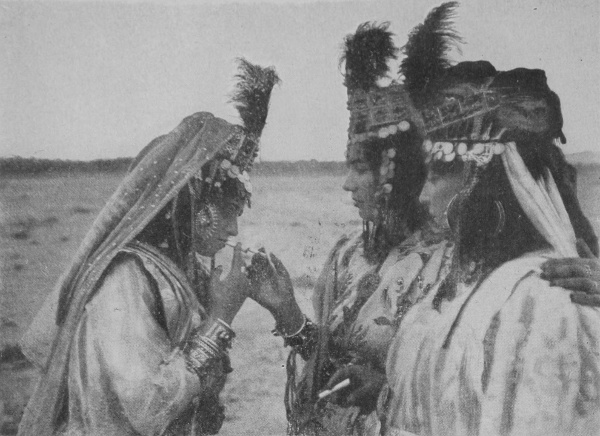
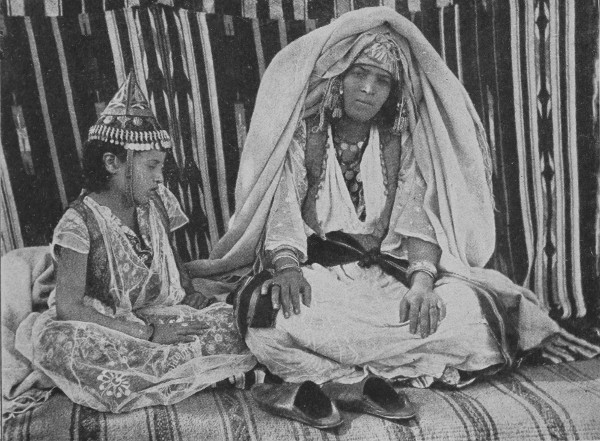
The peculiar dances of the Ouled-Naïls demand many years of arduous and constant practice. A girl is scarcely out of her cradle before, under the tutelage of her mother, who has herself been a danseuse in her time, she begins the inconceivably severe course of gymnastics and muscle training which is the foundation of their strange and suggestive dances. From infancy until, scarcely in her teens, she bids farewell to the tent life of the desert and sets out to make her fortune in the cities along the African littoral, she is as carefully groomed and trained as a colt entered at the county fair. Morning, noon, and night, day after day, year after year, the muscles of her chest, her back, her hips, and her abdomen are developed and trained and suppled until they will respond to her wishes as readily as her slender, henna-stained fingers. Her lustrous, blue-black hair is brushed and combed and oiled and brushed again; she is taught to play the hautboy, the zither, and the flute and to sing the weird and plaintive songs the Arab loves; to make the thick, black native coffee and with inimitable dexterity to roll a cigarette. By the time she is thirteen she is ready to make her début in the dance-hall of some Algerian town, whence, after three or four or possibly five years of a life of indifferent virtue, she returns, a-clank with gold pieces, to the tented village from which she came, to marry some sheikh or camel-dealer and to bear him children, who, if they are boys, will don the white turban and scarlet burnoose of the Spahis and serve in the armies of France, or, if they are girls, will live the life of their mother all over again. It will be seen, therefore, that the profession is an hereditary one, which all the women of the tribe pursue without incurring, so far as I could learn, a hint of scandal or a trace of shame. It is a queer business, and one to which no other country, so far as I am aware, offers a parallel, for whereas the geishas of Japan, the nautches of India, and the odalisques of Turkey are but classes, the Ouled-Naïls are a race, as distinct in features, language, and customs as the Bedouin, the Nubian, or the Jew.
That the men of the Ouled-Naïl (which, by the way, is pronounced as though the last syllable were spelled “Nile”) look upon the lives led by their sisters, daughters, and sweethearts with much the same toleration and approval that an up-State farmer shows for the village maid who goes to the city to earn a living as a waitress, a stenographer, or a shop-girl, is proved by a little incident which Mr. S. H. Leeder, the English author-traveller, tells of having once witnessed on the station-platform at Biskra. A tall young tribesman of the Ouled-Naïl, the son of a sheikh of some importance, was leaving Biskra, to which town he had been paying a short visit with his mother. He was taking back with him one of his countrywomen, a dancing-girl named Kadra, who had been a resident in the Rue Sainte, as Biskra's Tenderloin is known, for two or three years, and was quite celebrated for her beauty, with the intention of marrying her. Here was this girl, after such an amazing episode in her career, quietly dressed, veiled to the eyes, and carefully chaperoned by the prospective bridegroom's mother, returning to assume a position of rank and consideration among her own people, while several of her late companions, tears of sorrow at the parting pouring down their unveiled and painted faces, clung to and caressed her with every sign of childlike affection. And such marriages, I have been assured by French officials, are not the exception but the rule in the Ziban. Never was the truth brought home to me more sharply that “East is East, and West is West, and never the twain shall meet” than in the land of the Ouled-Naïls, where, unlike our own, it is never too late to mend; not even for a woman.
Barring the two who appeared in the production of “The Garden of Allah,” the only genuine Ouled-Naïls ever seen in the United States were those who, owing to the enterprise of some far-seeing showman, were responsible for introducing that orgy of suggestiveness known as the danse du ventre to the American public at the Chicago World's Fair of 1893, a dance which, thanks to numerous but unskilled imitators, French, Egyptian, and Syrian, spread from ocean to ocean under the vulgar but descriptive nickname of “the houchee-kouchee.” As a matter of fact, the danse du ventre, as seen in the questionable resorts of our own country, has about as much in common with the real dance of the desert people, as performed on a silken carpet spread before the tent of some nomad sheikh, as the so-called “Spanish fandango” of the vaudeville stage has with the inimitably beautiful and difficult dances to be seen at Señor Otero's dancing-academy in Seville. The dance of the Ouled-Naïls is the very essence of Oriental depravity. It is the dance of the pasha's harem; it is the dance of those native cafés which the European tourists are always so eager to visit; it is the dance which every little girl of the tribe is taught—long years before she knows its meaning.
Depraved though they are, the Ouled-Naïls never depart in their dress from that which would be considered perfectly proper and respectable even by Mr. Anthony Comstock. The painters of every country seem to have taken a peculiar delight in depicting Arab dancing-girls as conspicuously shy of clothing, but, picturesqueness aside, the décolleté gown of an American woman would embarrass and shock these daughters of the sands as much as it would all Moslems, for though they may be somewhat lacking in morals they are never lacking in clothes. The women of the Ouled-Naïl are considerably below the medium height and, owing to the peculiar fashion in which their gaudy-hued tarlatan skirts are bunched out around the waist and are shortened to display their trim ankles and massive silver anklets, they appear even smaller than they really are. Their hands and feet are small and wonderfully perfect—if one is able to overlook the nails stained crimson with henna; arched eyebrows meet over eyes as big and lustrous and melting as those of a gazelle; while their wonderful blue-black hair, plaited into ropes and heavily bejewelled—whether the “jewels” are genuine or not is no great matter—is brought down over the ears in the fashion which made Cléo de Mérode famous.
But the really distinguishing feature of the Ouled-Naïl's costume is her jewelry. She has so much of it, in fact, that there is no gold to be had in Algeria. Ask for napoleons instead of paper money at your bank in Algiers and you will meet with a prompt
“Impossible, m'sieur.”
“But why is it impossible?” you ask.
“Because we have no gold, m'sieur,” is the polite response.
“Where is it, then?” you inquire, scenting a robbery or an anticipated run on the bank.
“On the Ouled-Naïls, m'sieur,” the cashier courteously replies.
And he speaks the literal truth. Every centime that a dancing-girl can beg, borrow, or earn goes toward the purchase of massive silver jewelry, anklets, bracelets, and the like, and these in turn are exchanged for gold pieces—whether French napoleons, English sovereigns, or Turkish liras she is not at all particular—which, linked together in that golden armour of which I have already spoken, envelops her lithe young body from neck to hips. When her portable wealth has attained to such dimensions it is usually the sign for the Ouled-Naïl to retire from business, going to her desert husband with her dowry about her neck.
When it is remembered that the native quarters of these towns in the edge of the Sahara are frequented by savage desert tribesmen who know little and care less about civilisation and the law, is it to be wondered at that time and time again these unprotected girls are done to death in the little rooms up the steep, dark stairs for the sake of the gold which they display so lavishly as part of their allurements? During my stay in one of these Algerian towns an Arab, stealthily coming up behind an Ouled-Naïl as she was returning one night from the dance-hall through the narrow, deserted streets, drove a knife between her shoulders and, snatching the little fortune which hung about her neck, fled with it into the desert. But the arm of the French law is very long, reaching even across the sand wastes of the Great Sahara, and months later, when he thought all search for him had been abandoned, the fugitive felt its grasp as he sat, cross-legged, in the distant bazaars of Wadai. After that came the trial and the guillotine, for in Algeria, as in the other lands which they have conquered, the French have taught the natives by such grim object-lessons that punishment follows swift on the heels of crime.
Now, if that same crime had been committed fifty miles to the eastward, across the Tunisian frontier, the murderer would, in all likelihood, have gotten off with thirteen months in jail—that is, if he was caught at all. For, though the regency of Tunisia is French in pretty much everything but name, it has been deemed wise to maintain the fiction of Tunisian independence by permitting the Bey a good deal of latitude so far as the punishment of his own subjects is concerned, his ideas of justice (la justice du Bey it is called, in contra-distinction to la justice française, which is a very different sort of justice indeed) usually working out in a fashion truly Oriental. In Tunisia all death sentences must be confirmed by the Bey in person, the condemned man being brought before him as he sits on his gilt-and-velvet throne in the great white palace of the Bardo. In the presence of the sovereign the murderer is suddenly brought face to face with the members of his victim's family, for such things are always done dramatically in the East. The Bey then inquires of the family if they insist on the execution of the murderer, or if they are willing to accept the blood-money, as it is called, a sum equivalent to one hundred and forty dollars, which in theory is paid by the murderer to the relatives of his victims as a sort of indemnity if he is allowed to escape with his life. If, however, he does not possess so large a sum, as is frequently the case, the Bey makes it up out of his private purse. Nine times out of ten, if the victim was a woman, the blood-money is promptly accepted—and praise be to Allah for getting it!—for in Africa women are plenty but gold is scarce. In case the blood-money is accepted the murderer's sentence is commuted to imprisonment for twelve months and twenty-seven days, though just why the odd twenty-seven I have never been able to learn. But it may have been that it was an only son, or a husband, or a chieftain of importance who was murdered, and in such cases the relatives invariably demand the extreme penalty of the law.
“Do you insist on his blood?” inquires the Bey, a portly and easy-going Oriental who has a marked aversion to taking life, even in the case of murderers.
“We do, your Highness,” replies the spokesman of the family, salaaming until his tarboosh-tassel sweeps the floor.
“Be it so,” says the Bey, shrugging his shoulders. “I call upon you to bear witness that I am innocent of his death. May Allah the Compassionate have mercy upon him! Turn him toward the gate of the Bardo,” which last is the local euphemism for “Take him out and hang him.” Five minutes later the wretch is adorning a gallows which has been set up in the palace gardens.
Due north from the land of the Ouled-Naïls, and hemmed in by the snow-capped peaks of the Atlas, is the Grand Kabylia, a wild, strange region, peopled by many but known to few. Whence the Kabyles came nobody knows, though their fair complexions, red hair, and blue eyes lead the ethnologists to suppose that they are a branch of that equally white and equally mysterious Berber race who occupy the Moroccan ranges of the Atlas. Thirteen hundred years ago they came to North Africa from out of the East, bringing with them a civilisation and a culture and institutions distinctively their own. Retreating into their mountain fastnesses before that Arab invasion which spread the faith of the Prophet over all North Africa, they have dwelt there ever since, the French, who conquered them in the middle of the last century only after heavy losses, having wisely refrained from interference in their tribal laws or customs, which remain, therefore, almost unmodified.
Though the Kabyles, of all the Moslem races, treat their women with the greatest respect, neither imprisoning them in harems nor hiding them beneath veils and swaddling-clothes, they share with the mountaineers of the Caucasus the somewhat dubious distinction of selling their daughters to the highest bidder. Between the Circassians and the Kabyles there is, however, a distinction with a difference, for, whereas the former sell their daughters in cold blood and take not the slightest interest in what becomes of them thereafter, the Kabyle parent expects, even if he does not always insist, that the man who purchases his daughter shall marry her. A fine, upstanding Kabyle maiden of fifteen or thereabouts, with the lines of a thoroughbred, the profile of a cameo, and a skin the colour of a bronze statue, will fetch her parents anywhere from eighty to three hundred dollars, at least so I was told at Tizi-Ouzou, the chef-lieu of the district, and the man who told me assured me very earnestly that, the crops having been bad, a girl could be bought very cheaply, and begged me to think it over.
Though the Mauresques of Algeria, the Jewesses of Tunisia, and the fair-skinned beauties of Circassia combine a voluptuous figure with an altogether exceptional beauty of complexion and features, the women of Kabylia, with their flashing teeth, their sparkling eyes, their full red lips, their lithe, slender bodies, and their haughty, insolent manners, suggest a civilisation older and more sensuous, and entirely alien to our own. The humblest peasant girl, grinding the family flour between the upper and the nether stones in the doorway of a mud hovel, possesses so marked a distinction of feature and figure and bearing that it is not difficult to believe that Cleopatra or Helen of Troy might well have come from this same race.
The approach of a Kabyle woman is heralded in two ways: first, by a strong-scented perfume, which, like the celebrated parfum du Bey of Tunis, is composed of the blended scents of a score or more different kinds of blossoms, the odour changing from carnation to rose, to heliotrope, to violet, and so on every few minutes (no, I didn't believe it either, until I tried it); and, secondly, by the clink and jingle of the bracelets, anklets, necklaces, and bijoux of gold, silver, turquoise, and coral with which they are loaded down, and which sound, when they move, like an approaching four-in-hand. Good specimens of this Kabyle jewelry are becoming increasingly difficult to obtain, by the way, and bring high prices in the shops of Tunis and Algiers, being eagerly sought after by collectors.
Personally, I am quite unable to picture an admirer making love to one of these insolent-eyed beauties, for they are headstrong and hot of temper, and if the gentleman happened to say the wrong thing he would very probably find the yataghan, which every Kabyle maiden carries, planted neatly between his shoulders. They seem to be fond of cold steel, do these Kabyles, for at the conclusion of a wedding ceremony the bridegroom, walking backward, holds before him an unsheathed dagger and the bride, following him, keeps the point of it between her teeth. Another wedding custom of Kabylia, no less strange, consists of the partial martyrdom of the bride, who, clad in her marriage finery, stands for an entire morning with her back to a stone pillar in the village square, her eyes closed, her arms close at her sides, and her only foothold the column's narrow base, the cynosure of hundreds of curious eyes. Despite the stern stuff of which the Kabyle women are made, it is small wonder that the bride usually faints before this peculiarly harrowing ordeal is over.
As far removed from these half-savage women of Ouled-Naïl and of Kabylia as a Philadelphia Quakeress is from a Cheyenne squaw are those poor prisoner women of whose pale, half-hidden faces the visitor to the North African coast towns sometimes gets a glimpse at the barred window of a harem, or meets at nightfall hastening home from their sole diversion, the weekly excursion to the cemetery. You can see them for yourself any Friday afternoon if you will loiter without the whitewashed gateway to the cemetery of Bou-Kabrin, on the hill above Algiers, for they believe that on that day—the Moslem Sabbath—the spirits of the dead re-visit the earth, and hence their weekly pilgrimage to the cemetery to keep them company. When the sun begins to sink behind the Atlas these white-veiled pyramids of femininity reluctantly begin to make their way back through the narrow, winding lanes of the native city, disappearing one by one through doors which will not open for them until another Friday has rolled around. Picture such a life, my friends: six days a week encloistered behind jealously guarded doors and on the seventh taking an outing in the cemetery!
That many of these Mauresque women of the coast towns are very beautiful—just as many others are exceedingly ugly—there is but little doubt, though they are so sheeted, shrouded, veiled, and draped from prying masculine eyes that a man may know of their beauty only by hearsay. I imagine that the dress of the Mauresque woman was specially designed to baffle masculine curiosity, for if Aphrodite herself were enveloped in a white linen sheet from head to waist, and in enormous and ridiculous pantaloons from waist to ankle, she could go where she pleased without being troubled by admirers. Not only is a Mauresque woman never permitted to see a man—or rather, the man is not permitted to see her, for despite all precautions she sometimes manages to catch glimpses of people through the lattices of her harem windows—but she may not receive a visit from her father or brother without her husband's permission. When she is ill enough to require the services of a physician—and she has to be very ill indeed before one is summoned—incredibly elaborate are the preparations. All the women of her household are ranged about the bed, while her servants hide her under the bedclothes almost to the point of suffocation. If her pulse has to be felt a servant covers her hand and arm so carefully that only an inch or so of her wrist is visible. If she has hurt her shoulder, or back, or leg, a hole is made in the bedclothes so that the doctor may just be able to see the injured place, and nothing more. Should he have the hardihood to insist on looking at her tongue, the precautions are still more elaborate, the attendants covering the patient's face with their hands and just leaving room between their fingers so that her tongue may be stuck out. I know a French physician in Tunis who told me that he was once called to attend the favourite wife of a wealthy Arab merchant, and that while he was conducting the examination the lady's husband stood behind him with the muzzle of a revolver pressed into the small of his back.
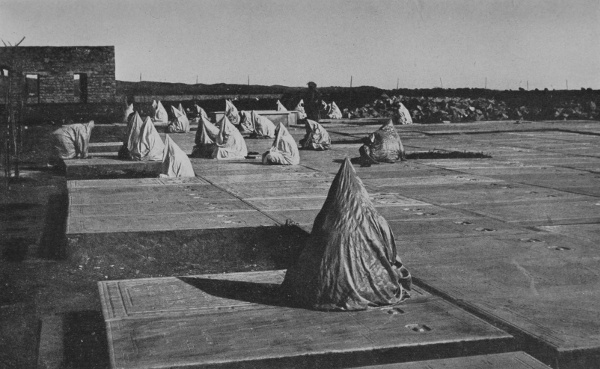
“They believe that the spirits of the dead revisit the earth, and hence the weekly pilgrimage to the cemetery to keep them company.”
Always over the head of the Arab woman hangs the shadow of divorce. Nowhere in the world does the law so facilitate the separation of man and wife. If a man grows weary of his wife's looks, of her temper, or of her dress; if he wishes to replace her with another; or if he is tired of married life and does not wish a wife at all, he has but scant difficulty in getting rid of her, for in North Africa a divorce can be had in fifteen minutes at a total cost of a dollar and twenty cents. In theory, either husband or wife may divorce the other by a simple formality, without assigning any reason whatever. As a matter of fact, however, actual divorce by the man is rare, the Moslem husband usually preferring to get rid of his wife by a process called repudiation, which bears with great injustice and cruelty on the woman. If he tires of her for any reason, or merely wishes to replace her, he drives her away with the words “Woman, get thee hence; take thy goods and go.” In this case, although the husband is free to remarry, the woman is not and can only obtain a legal release by returning to the man the money which he paid for her. The woman may apply to the courts for divorce without her husband's consent only if she is able to prove that he ill-treats or beats her without sufficient reason, if he refuses her food, clothes, or lodging, or if she discovers a previous wooing on her husband's part, all previous betrothals, or even offers of marriage, whether the other lady refused or accepted him, being considered ground for divorce.
The next time you happen to be in Tunis don't fail to pay a visit to the divorce court. It is the most Haroun-al-Raschidic institution this side of Samarkand. A great hall of justice, vaulted and floored with marble and strewn with Eastern carpets, forms the setting, while husbands in turbans and lawyers in tarbooshes, white-veiled women and green-robed, gray-bearded judges complete a scene which might have been taken straight from the Arabian Nights. The women, closely veiled and hooded, and herded like so many cattle within an iron grill, take no part in the proceedings which so intimately affect their futures, their interests being left in the hands of a voluble and gesticulative avocat. On either side of the hall is a series of alcoves, and in each alcove, seated cross-legged on a many-cushioned divan, is a gold-turbaned and green-robed cadi. To him the husband states his case, the wife putting in her defence—if she has any—through her lawyer and rarely appearing in person. The judge considers the facts in silence, gravely stroking his long, gray beard, and then delivers his decision—in nine cases out of ten, so I was told, in favour of the husband. Should either party be dissatisfied, he or she can take an appeal by the simple process of walking across the room and laying the case before one of the judges sitting on the other side, whose decision is final. A case, even if appealed, is generally disposed of in less than an hour and at a total cost of six francs, which goes to show that the record for quick-and-easy divorces is not held by Reno.
It is characteristic of the Moslem view-point that infidelity on the part of the husband is no cause for divorce whatsoever, while infidelity on the part of the wife, owing to the strict surveillance under which Moslem women are kept and the prison-like houses in which they are confined, occurs so rarely as to be scarcely worth mentioning. Should a Moslem woman so far succeed in evading the vigilance of her jailers as to enter into a liaison with a man, instead of a divorce trial there would be two funerals. To put his wife and her paramour out of the way without detection is a matter of no great difficulty for an Arab husband, for if any one disappears in a Mohammedan country the harem system renders a search extremely difficult, if not, indeed, wholly out of the question. In fact, it has happened very frequently, especially in such populous centres as Tangier, Algiers, Tunis, Tripoli, and Cairo, that a man has enticed his rival into his house, either keeping him a prisoner for life or slowly killing him by torture. Though the French authorities are perfectly well aware of such occurrences, neither they in Algeria and Tunisia nor the English in Egypt feel themselves strongly enough intrenched to risk the outburst of fanaticism which would inevitably ensue should they violate the privacy of a harem.
I am perfectly aware of the fact that it has become the fashion among those travellers who confine their investigations of African life to the lanes about Mustapha Supérieur, to the souks of Tunis, and to the alleys back of the Mousky, to pooh-pooh the idea that slavery still exists in North Africa. As a matter of fact, however—though this the European officials will, for reasons of policy, stoutly deny—slavery not only exists sub rosa in Algeria and Tunisia and in Egypt, but slave markets are still openly maintained in the inland towns of Morocco and Tripolitania, the French and Italian occupations notwithstanding. When a wealthy Moslem wants slaves nowadays he does not send traders to Circassia or raiders to Uganda, but he applies to one of the well-known dealers in Tetuan, or Tripoli, or Trebizond, a marriage contract is drawn up, and all the ceremonies of legal wedlock are gone through by proxy. By resorting to these fictitious marriages and similar subterfuges, the owner of a harem may procure as many slaves, white, brown, or black, as he wishes, and once they are within the walls of his house, no one can possibly interfere to release them, for, the police being under no conditions permitted to violate the privacy of a harem, there is obviously no safeguard for the liberty, or even the lives, of its inmates. As a result of this system, a constant stream of female slaves—fair-haired beauties from Georgia and Circassia, brown-skinned Arab girls from the borders of the Sahara, and negresses from Equatoria—trickles into the North African coast towns by various roundabout channels, and, though the European officials are perfectly well aware of this condition of things, they are powerless to end it. The women thus obtained, though nominally wives, are in reality slaves, for they are bought for money, they are not consulted about their sale, they cannot go away if they are discontented, and their very lives are at the disposal of their masters. If that is not slavery, I don't know what is.
In those cases where the European authorities have ventured to meddle with native customs, particularly those concerning a husband's treatment of his wife, the interference frequently has had curious results. A wealthy Arab from the interior of Oran, starting on a journey to the capital of that province, bade the wife whom he adored an affectionate good-bye. Returning several days before he was expected, he seized the smiling woman, who rushed to greet him, tied her hands, and dragging her into the street gave her a furious beating in the presence of the astounded neighbours. No, she had not been unfaithful to him, he said, between the blows, nor had she been unkind. He not only was not tired of her, so he assured the onlookers, but she was a veritable jewel of a wife. Finally, when his arm grew tired and he stopped to take breath, he explained that, passing through a street in Oran, he had seen a crowd following a man who was being dragged along by two gendarmes. Upon inquiry he learned that he was being taken to prison for having beaten his wife. Therefore he had ridden home at top speed, without even waiting to complete his business, so that he might prove to himself, to his wife, and to his neighbours that he, at least, was still master in his own house and could beat his wife when he chose.
And here is another incident which illustrates the fashion in which the French administrators in Algeria deal with those ticklish questions which involve Arab domestic relations. A farmer and his wife were travelling through the interior; he was on a donkey and she, of course, on foot. Along came an Arab sheikh on horseback and offered the woman a lift. She accepted, and presently, growing confidential, admitted that she was unhappily married and detested her husband. Her companion proposing an elopement, she readily agreed. Accordingly, when they came to a by-road, this Lochinvar of the desert put spurs to his horse and galloped off with the lady across his saddle-bow, paying no heed to the shouts and protestations of the husband toiling along in the dust behind. Though he succeeded in tracing the runaway couple to the sheikh's village, the husband quickly found that plans had been made against his coming, for the villagers asserted to a man that they had known the eloping pair for years as man and wife and that the real husband was nothing but an impudent impostor. Unable to regain his wife, he then appealed to the French authorities of the district, who were at first at somewhat of a loss how to act in the circumstances, for the Europeans in North Africa are always sitting on top of a powder barrel and a hasty or ill-considered action may result in blowing them higher than Gilderoy's kite. Finally, an inspiration came to the juge d'instruction before whom the matter had been brought. Placing the dogs of the real husband in one room, and those of the pretended husband in another, he confronted the woman with them both. Now, Arab dogs are notoriously faithful to the members of their own households and equally unfriendly toward all strangers, so that though her own dogs fawned upon her and attempted to lick her hand, those of the sheikh snarled at sight of her and showed every sign of distrust. The judge promptly ordered her to be returned to her lawful husband—who, I fancy, punished her in true Arab fashion—and had the village placarded with a notice in Arabic which read: “The testimony of one dog is more to be believed than that of a townful of Arabs.” To appreciate how much more effective than any amount of fines or imprisonment this notice proved, one must remember that the deadliest insult an Arab can give another is to call him a dog.
Perhaps it is because they live so far from the contaminating influence of civilisation, or what stands for civilisation in North Africa, that the lives of those women who dwell beneath the black camel's-hair tents of the Sahara are far freer and happier than those led by their urban cousins. Which reminds me of a little procession that I once met while riding through southern Algeria. It consisted of an Arab, his wife, and a donkey. The man strode in front, his rifle over his shoulder. Then came the donkey, bearing nothing heavier than its harness. In the rear trudged the wife, carrying the plough. Though the Arab women may, and probably do, till the fields yoked beside a camel, a donkey, or an ox, their faces are unveiled and they are permitted free intercourse with the men of their tribe. Even among the nomad desert folk, however, women are regarded with indifference and contempt, the Arabs saying of a boy “It is a benediction,” but of a girl “It is a malediction.” With the Arabs a woman is primarily regarded as a servant, and long before a daughter of the “Great Tents” has entered her teens she has been taught how to cut and fit a burnoose, to sew a tent cover, and to make a couscous, that peculiar dish of half-ground barley, raisins, honey, hard-boiled eggs, and mangled fowl, stewed with a gravy in a sealed vessel, of which the Arabs are so fond. By the time she is ten her parents have probably received and accepted an offer for her hand—and praise Allah for ridding them of her!—and by the time she is twelve she is married and a mother. When a match has been decided upon—and it is by no means an uncommon thing for an unborn child to become conditionally engaged—several days of haggling as to the price which is to be paid for her ensue, the bridegroom eventually getting her at a cost of several camels, cattle, or goats, her value being based upon her looks and the position of her parents. On the day of the wedding the bride—on whose unveiled face, remember, the bridegroom has never laid eyes—concealed within a swaying camel-litter which looks for all the world like a young balloon, preceded by a band and accompanied by all her relatives, is taken with much ceremony to her new home. When the long-drawn-out marriage feast is over, the hideous racket of the flutes and tom-toms ceases and the wedding guests depart. Alone in her tent, the bride awaits her husband, who will see her face for the first time. Seating himself by her side, her husband makes her take off, one by one, her necklaces, her rings, and her anklets, so that, unadorned, she may be estimated at her true worth. If, thus stripped of her finery, she is not up to his expectations, the man may even at this late hour declare the marriage off and send the girl back to her parents. Should he be satisfied with his latest acquisition—for it is more than likely that he already has three or four other wives—he produces a club, which he places on the floor beside her, a custom whose significance requires no explanation. An Arab husband does not confine himself to a stick in regulating his domestic affairs, however, for only a few months ago the French authorities of Oran divested a desert sheikh of the burnoose of authority because, in a fit of jealous rage, he had cut off his wife's nose.
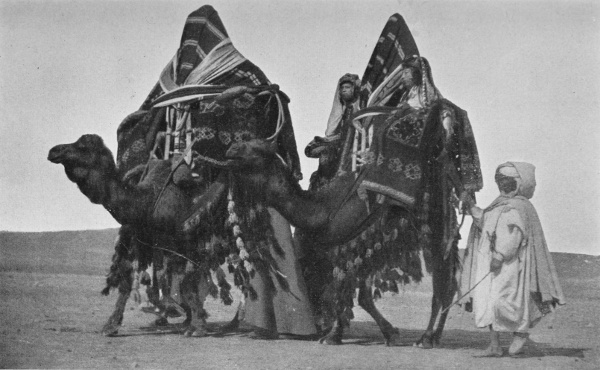
“Followed by rejoicing relatives, the bride is taken to her husband's home in a swaying camel litter which looks like a young balloon.”
Photograph by Em. Frechon, Biskra.