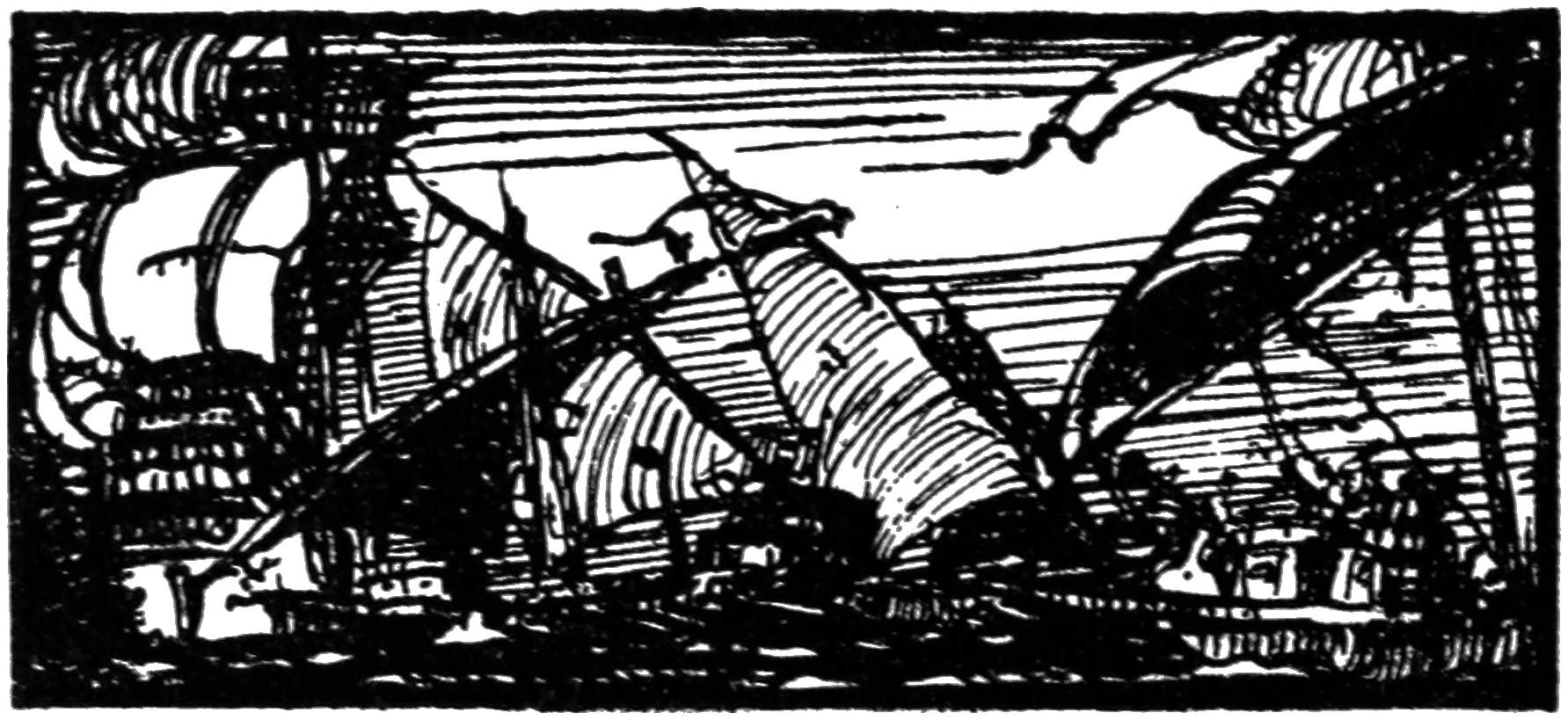
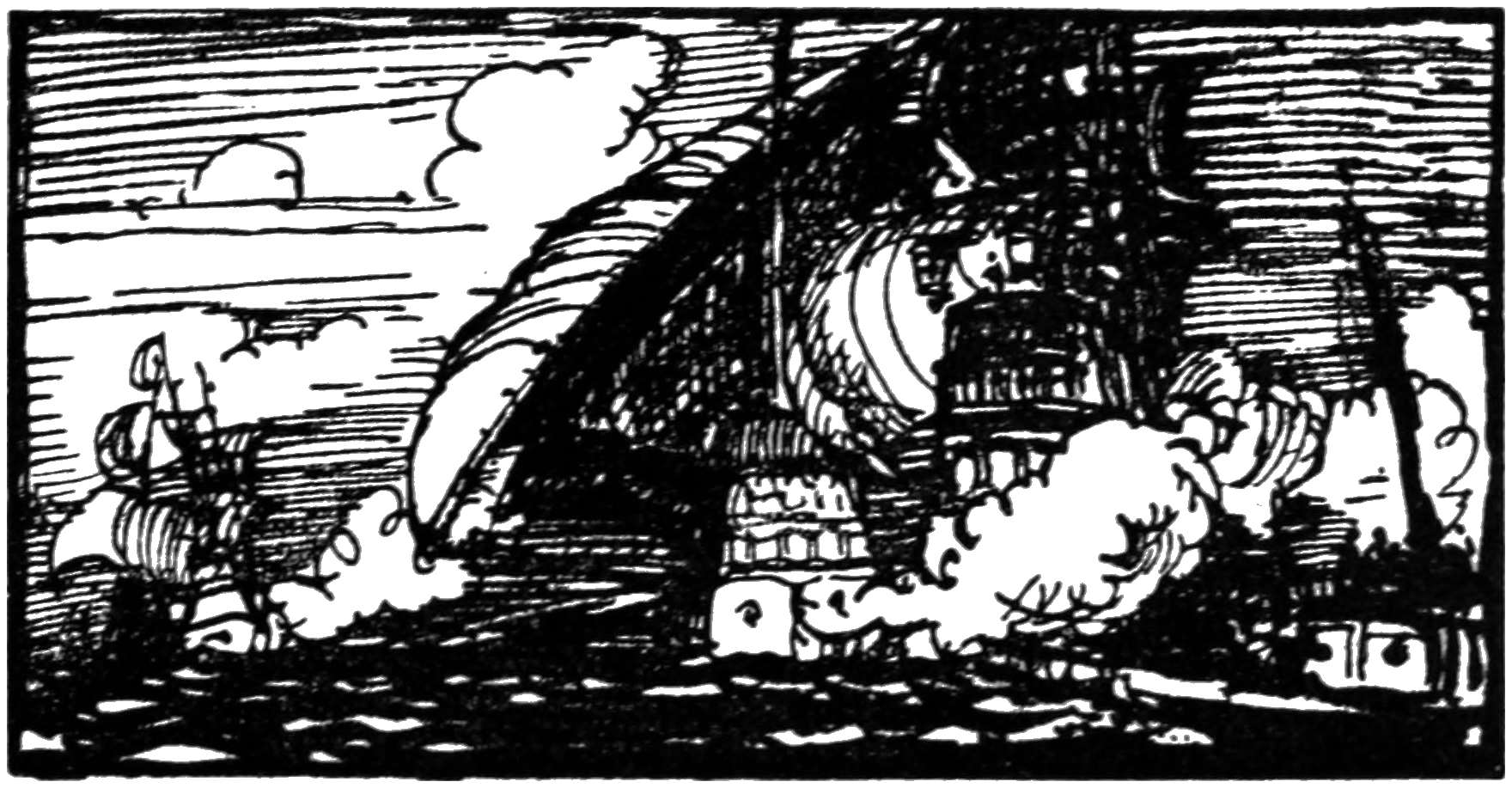
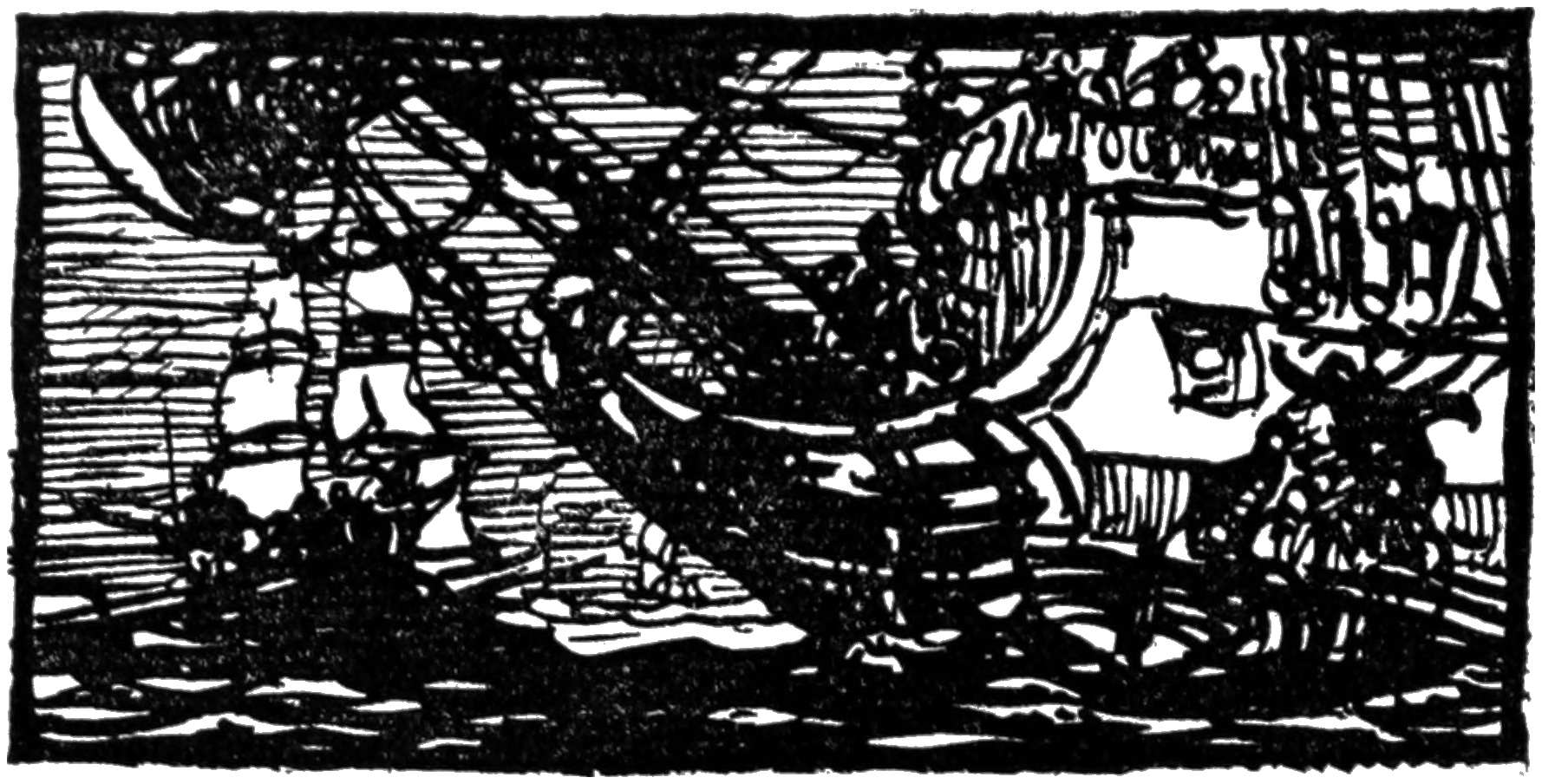
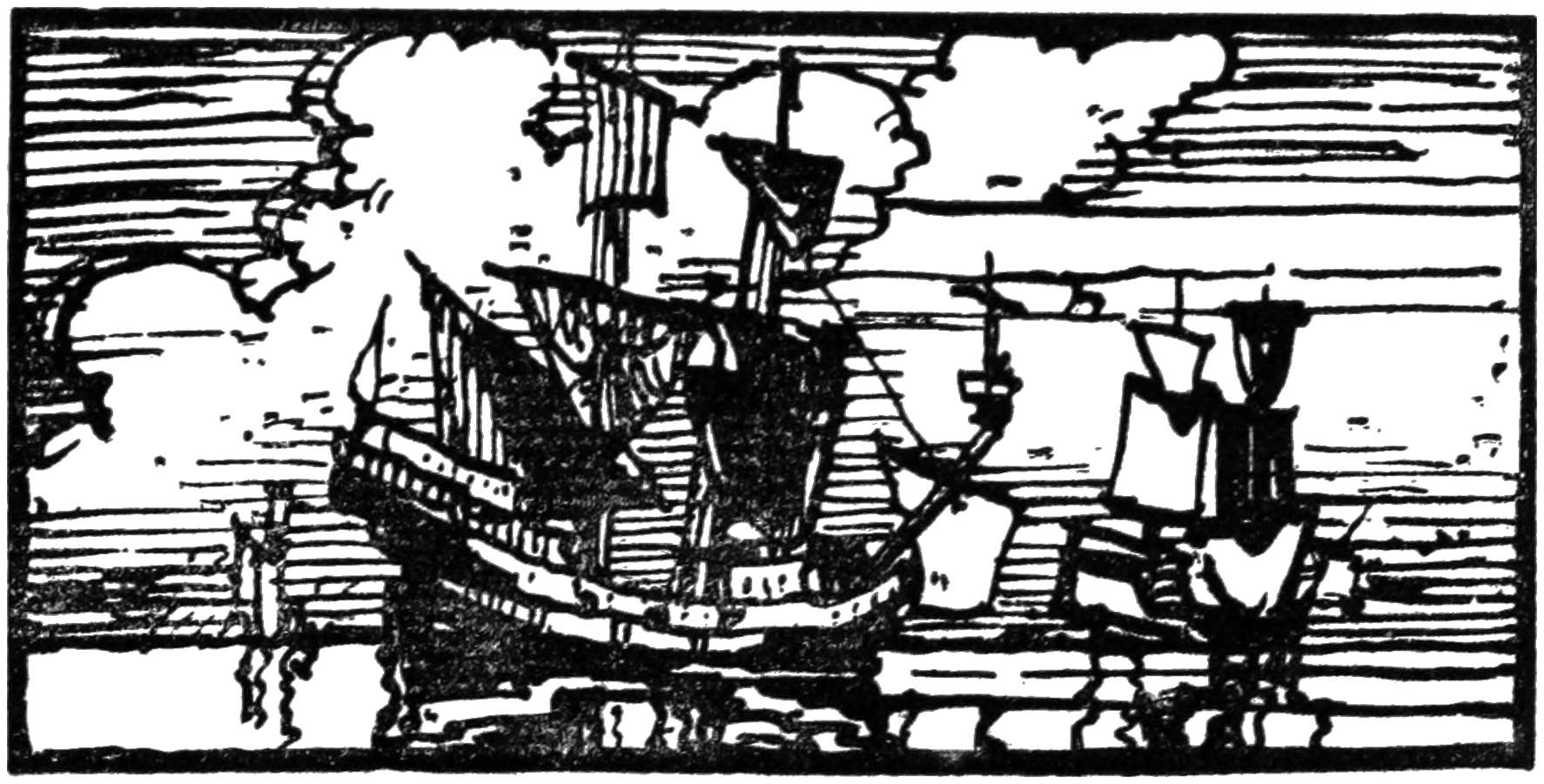
Larger versions of most illustrations may be seen by right-clicking them
and selecting an option to view them separately, or by double-tapping and/or
stretching them.
Pages in the original book were quite narrow, with large print;
and most pages included a large illustration at the top or bottom.
Viewing this ebook in a narrow window will approximate that original
design more closely than will a wide window.
THE LAST FIGHT OF THE REVENGE
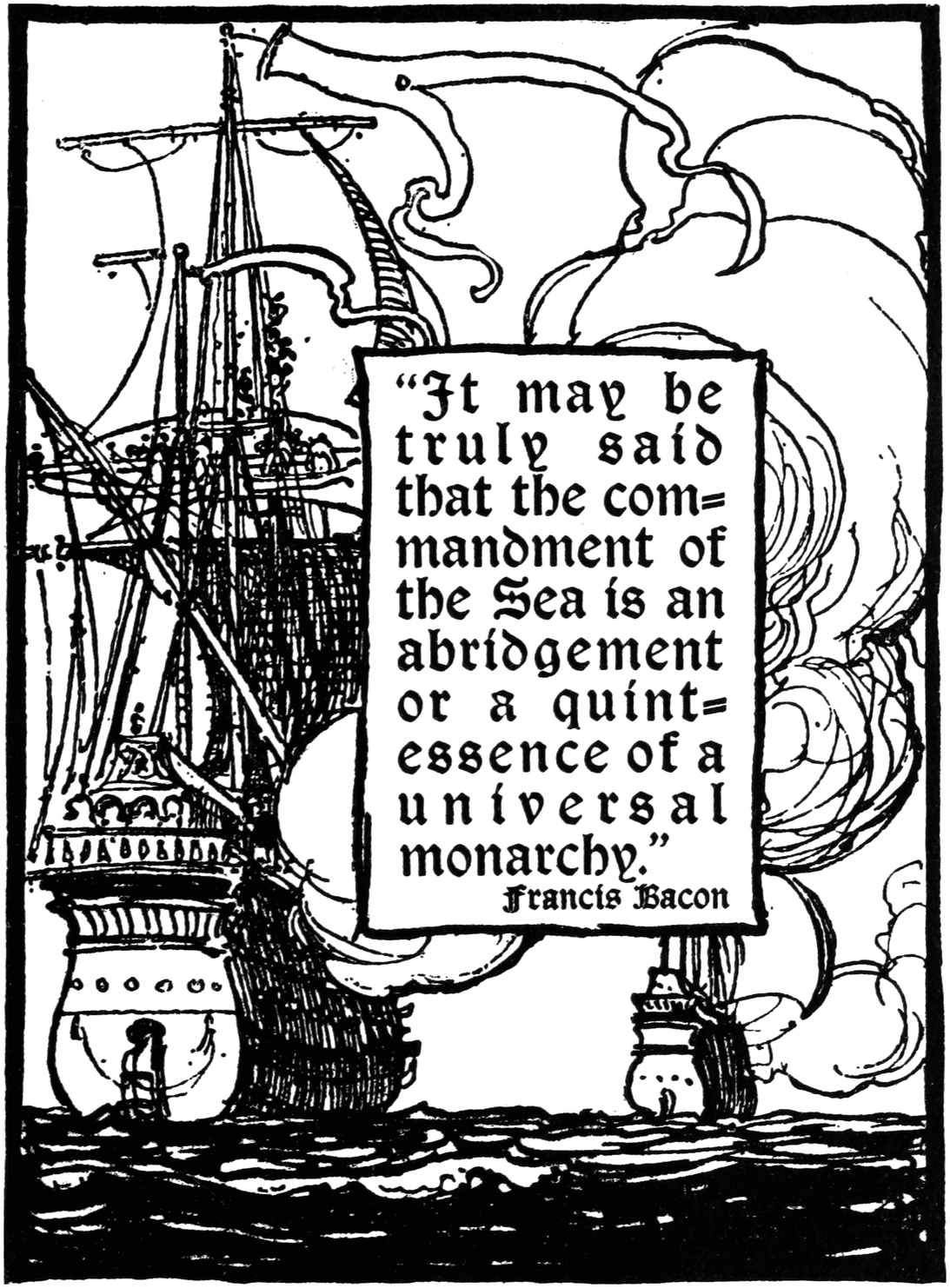
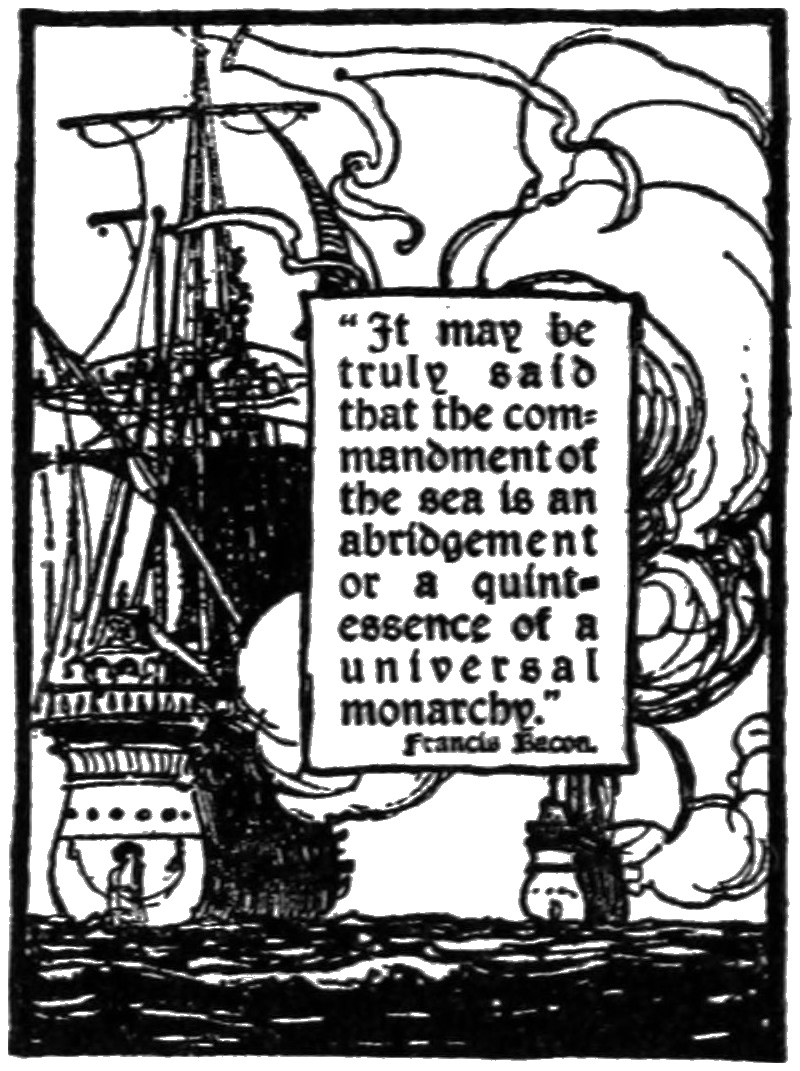
“It may be
truly said
that the commandment
of
the Sea is an
abridgement
or a quintessence
of a
universal
monarchy.”
Francis Bacon
THE LAST FIGHT OF THE REVENGE
BY Sr WALTER RALEIGH
WITH AN INTRODUCTION
BY HENRY NEWBOLT, M.A.,
AND ILLUSTRATIONS BY
FRANK BRANGWYN, A.R.A.
“In the year 1591 was that memorable Fight
of an English Ship called the Revenge, under
the command of Sr Richard Greenvill; Memorable
(I say) even beyond credit, and to the Height
of some Heroicall Fable. And though it were a
Defeat, yet it exceeded a Victory.”
Sir FRANCIS BACON
“Sr Richard Greenfield got eternall honour and
reputation of great valour, and of a experimented
Souldier, chusing rather to sacrifice his life, and
to passe all danger whatsoever, then to fayle in
his Obligation.... And rather we ought to imbrace
an honourable death then to live with infamie
and dishonour, by fayling in dutie.”
Sir RICHARD HAWKINS
“Than this what have we more! What can be
greater!”
JOHN EVELYN
“Struck a deeper terror, though it was but the
action of a ship, into the hearts of the Spanish
people; it dealt a more deadly blow upon their
fame and moral strength than the destruction of
the Armada itself.”
J. A. FROUDE
“Perhaps in all naval history there never was a
more gallant fight than that of the Revenge off
the Western Isles.”
PROFESSOR ARBER
And the sun went down, and the stars came out far over the summer sea,
But never a moment ceased the fight of the one and the fifty-three.
Ship after ship, the whole night long, their high-built galleons came,
Ship after ship, the whole night long, with her battle-thunder and flame;
Ship after ship, the whole night long, drew back with her dead and her shame.
For some were sunk and many were shatter’d, and so could fight us no more—
God of battles, was ever a battle like this in the world before?
Tennyson, “The Revenge: A Ballad of the Fleet.”
By permission of Messrs Macmillan & Co., Ltd, the owners of the copyright.
INTRODUCTION
II — III — IV
Which is the greatest name upon
the roll of English ships? Which
is the most sure of a lasting and
effectual renown? There was a
day when all England would
have given but one answer. If you
ask the Elizabethan of 1580, you will find him
very positive upon the point, and not a little exalted.
Drawn round the world by the Divine
Hand, under the Northern and Southern Pole
stars, victor over a hundred enemies, ballasted with
royal treasure, & steered by the captured charts
of Spanish Admirals, the little ship that sailed as
the Pelican, comes home again as the Golden Hind.
She brings her fabulous booty and her still more
fabulous romance from Plymouth Sound to Deptford,
and then and there the great names of the
past—the Christophers, the Great Harrys, the
Dragons and the Swans—are all finally eclipsed.
Drake, kneeling upon her deck, receives his
knighthood from the hand of Gloriana, and the
Golden Hind herself, bidding farewell for ever to
wind and wave, is laid up as a national monument—“consecrated
to perpetuall Memory.”
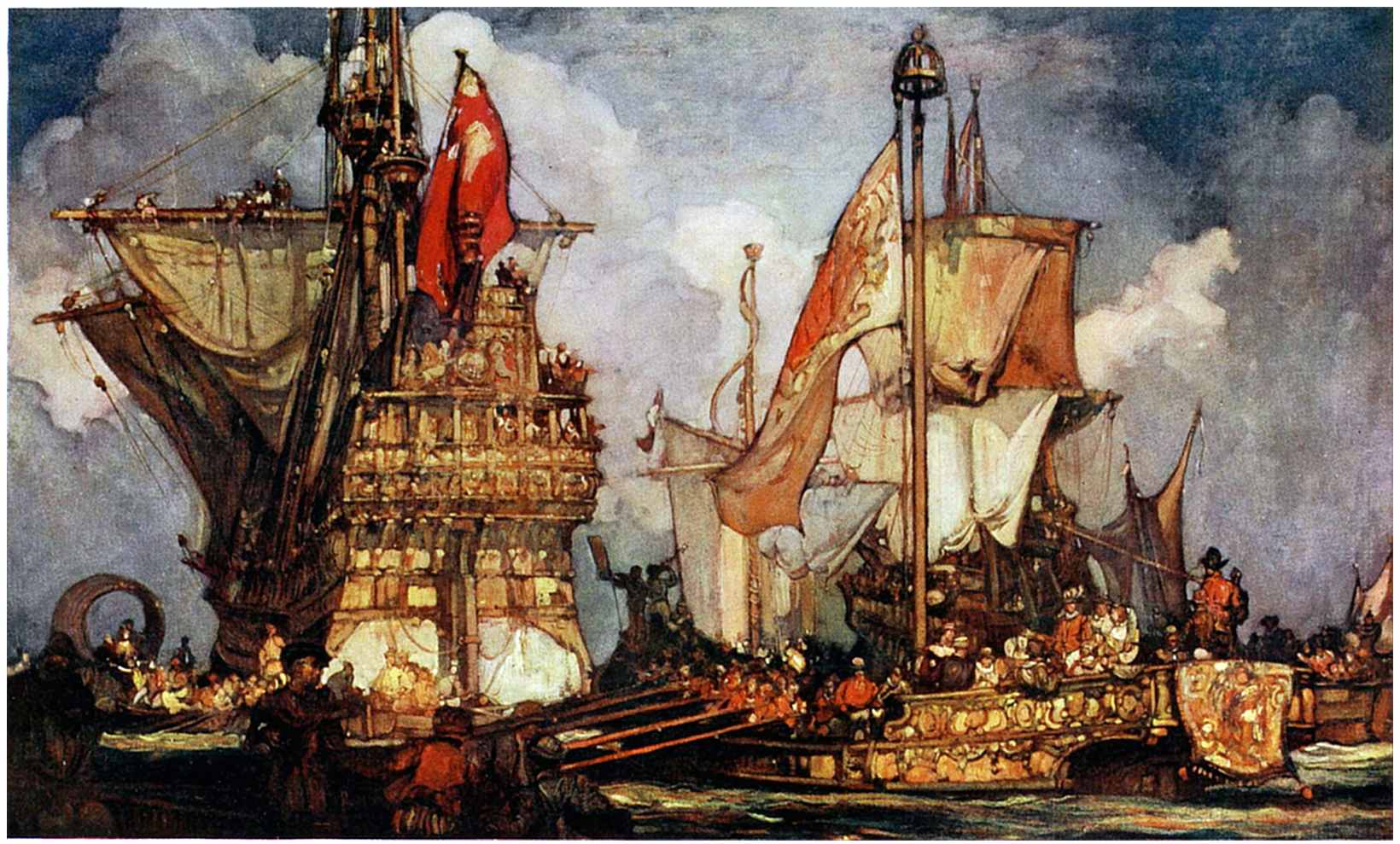
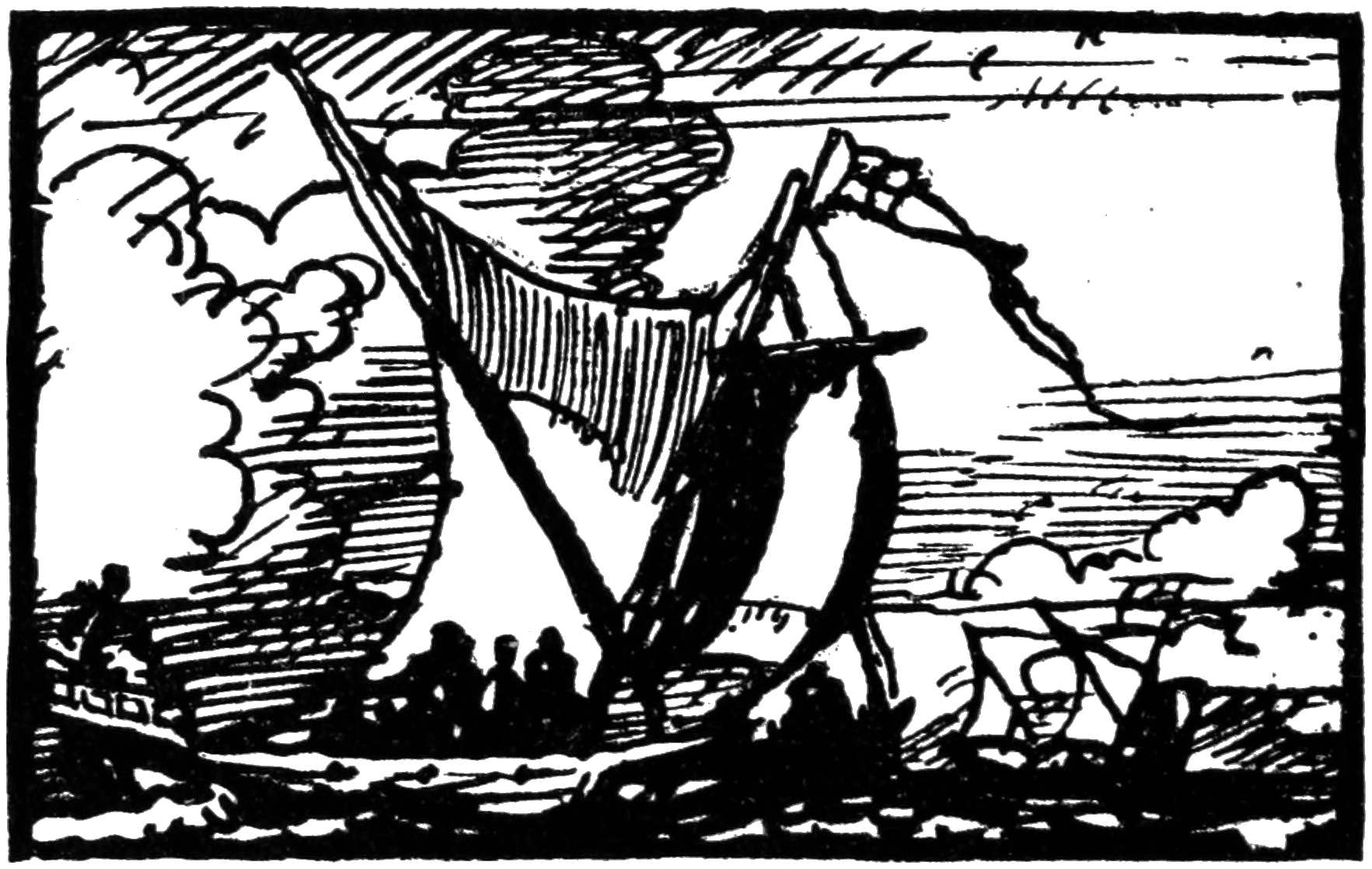
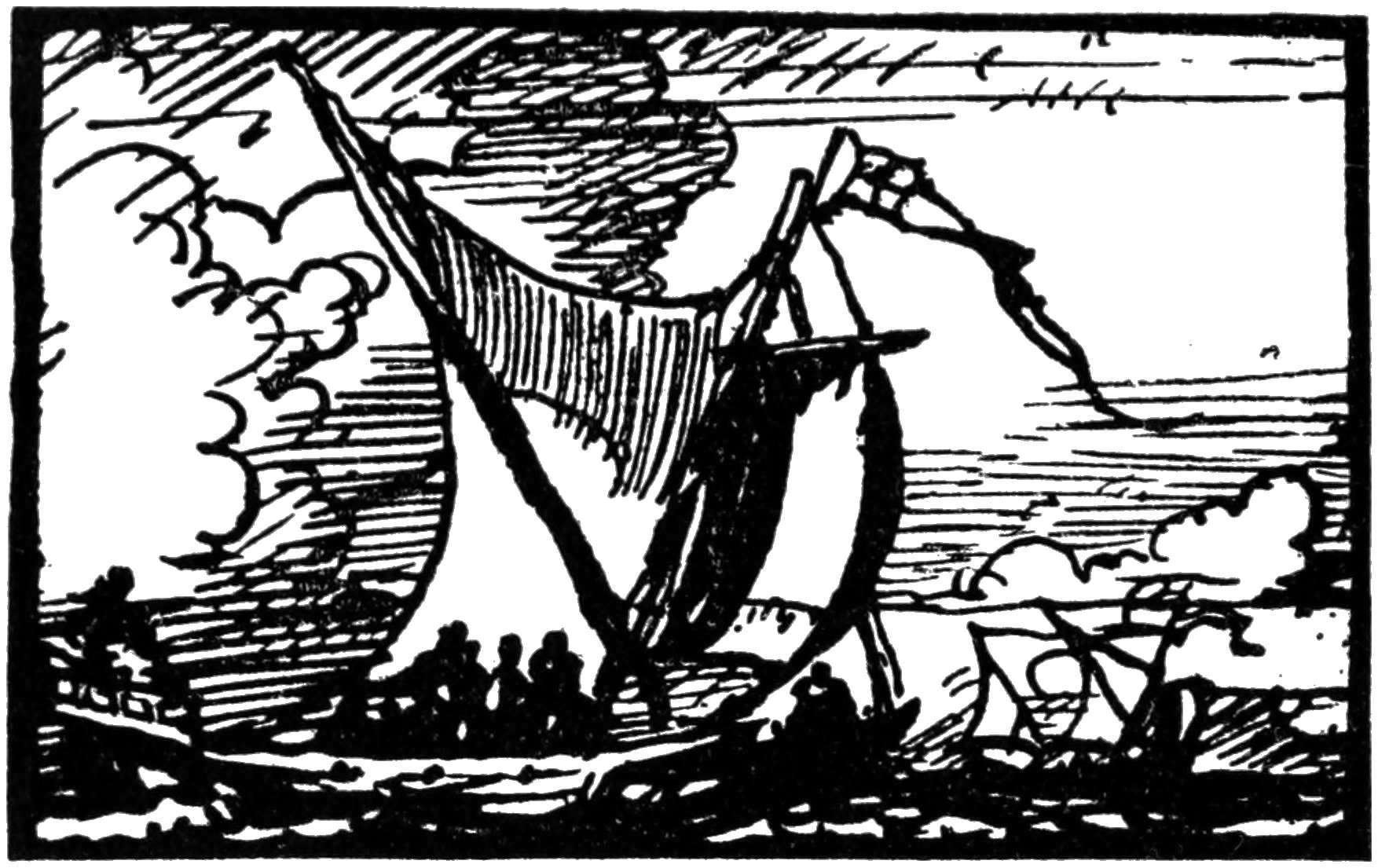
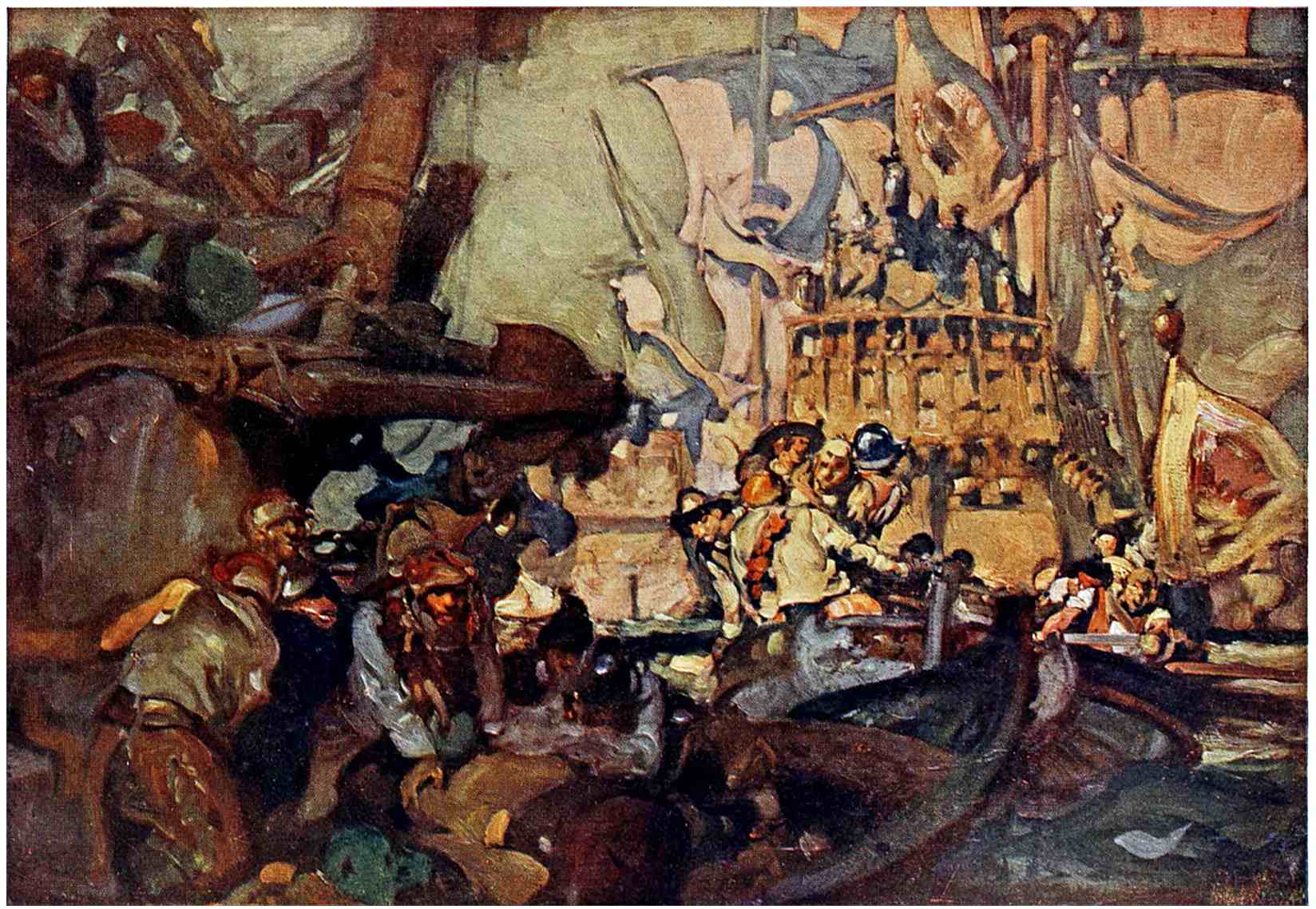
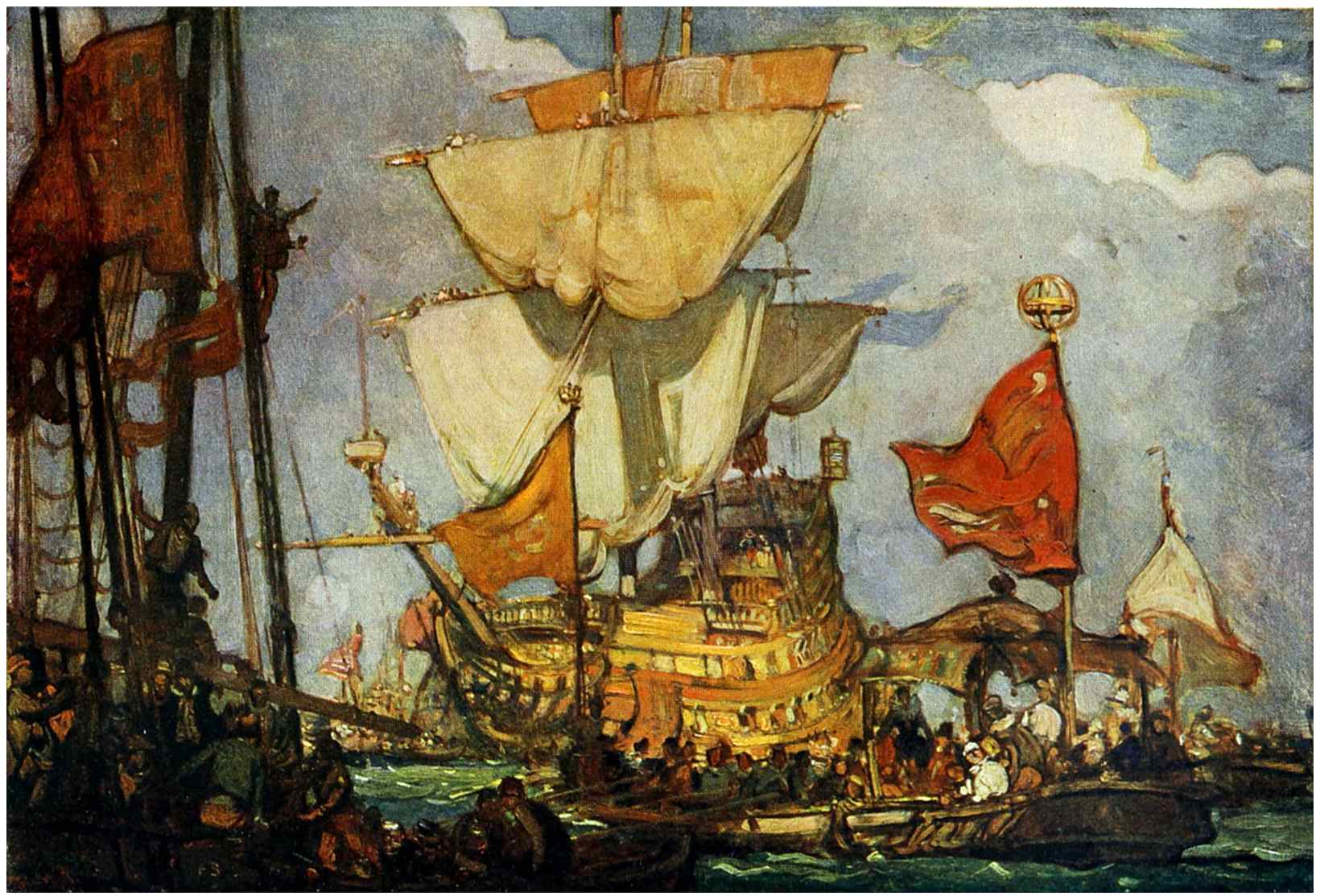
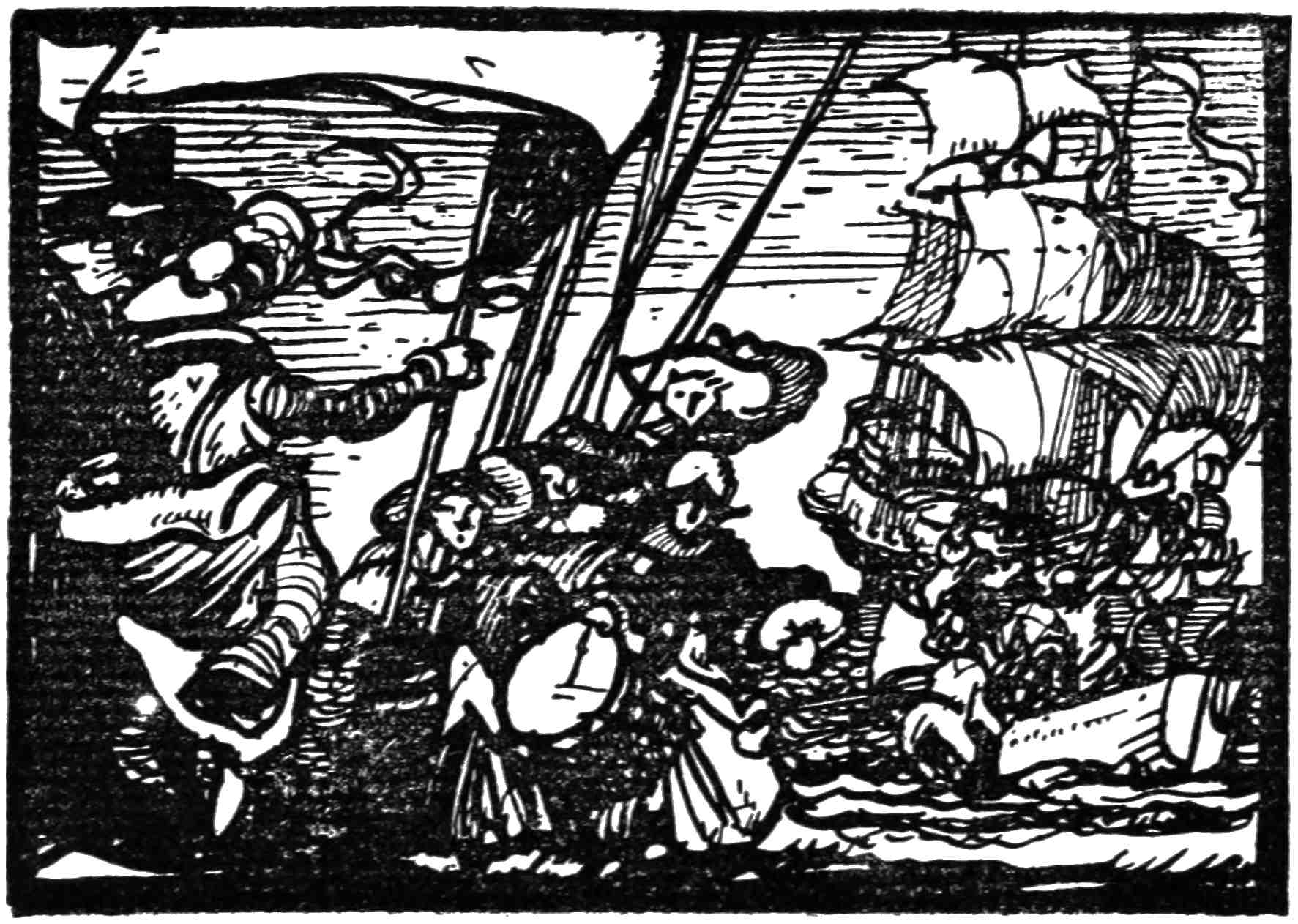
QUEEN ELIZABETH GOING ON BOARD
THE GOLDEN HIND
She is remembered still, but it is hardly for her
own sake; her story is a part of Drake’s, and not
the greatest part. Question your Elizabethan
again some ten years later, and hers is no longer
the name that he will give you; he will speak of
things that are even nearer to his heart, and to
ours; for though an Englishman will always, I
suppose, lick his lips over a tale of treasure, it is
the fighting and not the plunder that he is really
fitted to enjoy, and in his imagination even the
jewels of the Golden Hind will shine with a less
bright and steady glow than the battle-lanterns
of the Revenge.
The Revenge is a part of no man; she saw many
captains and more triumphs than one. She had a
personality, as great ships always have; she had
a career, a life of her own. She has a life after
death; not only a posterity but a true survival.
She may be said, in no merely figurative sense, to
be on active service still. If the day ever comes
when she no longer helps to keep the sea for us,
it can only be when Time shall have paid off the
British Navy.
The last of her successes is more freshly remembered
by our friends than by ourselves. A neighbouring
potentate, whom pride in his English
descent had exhilarated to a pitch of splendid
audacity worthy of an Elizabethan, challenged
us by a telegram encouraging a vassal State to
throw off the suzerainty of the Queen. If the
message meant anything, it was a promise of
armed support; but the promise had none of the
Elizabethan hardihood to back it, and proved
bankrupt as soon as the Flying Squadron put to
sea. It was not that this force was unknown, or
suddenly created; the ships had long been on the
Navy List, their names, guns, tonnage and complement
all as familiar to the German Kaiser as
to the rest of the world. But there was a sense
abroad of something more than brute strength:
a memory of great traditions, of inherited skill,
of undaunted and indomitable tenacity. When
on that January 15, 1896, the English Admiral
hoisted his flag in the Revenge, and Her Majesty’s
Marines marched on board under the command
of Captain Drake, the enemy disappeared from
the seas, and we made haste to forget another
naval victory.
The lesson, we may hope, remains; this was
not a triumph of physical force. The challenger’s
nerve, and not his ships, failed him; he feared his
own destruction more than he desired ours. In an
age even more materially minded, if possible, than
those which went before it, we are increasingly
diligent to measure our armour and our guns,
to reckon up our horse-power and the number of
our hits at target practice. It is not for any man
to blame us; we should be wrong if we neglected
these things, but we should be still more wrong
if we forgot for a moment that there were years
in our history when it was not we but our enemies
who had the advantage of armament, and that
whether by combination or otherwise, such a time
may come upon us again. Build as we will, we
cannot secure ourselves against it for ever; but we
can forestall it by facing it with the remembrance
of the past. It was by moral superiority that the
Elizabethans came through their trial. The Spaniards
were contending to maintain their hold
upon the wealth of the world, and they fought
as men will fight in such a cause—courageously,
but not desperately; the English fought as, at
sea, they must always be fighting, for national
existence, and they took care—it was a great
part of their strength—to leave their enemies in
no doubt that they meant in every engagement
to make the affair fatal to one side or the other.
This is a policy which we did not follow in the
latest of our wars; we may have been justified,
we had our reasons, and we paid the full price;
but on the day when we abandon it upon the
sea, we shall have thrown away our only sure
defence and our deadliest weapon. Men and
nations are never so nearly invincible and never
half so terrible as when they are armed with contempt
of death; and that such an ardent temper
can defy, discourage and destroy mere bulk or
numbers, “even beyond credit and to the Height
of some Heroicall Fable”—this is the meaning
of the last fight of the Revenge.
It was in 1577, the year in which
the Golden Hind sailed from Plymouth
on her ever-memorable
voyage, that the Revenge first
took the water. Probably, says
Arber (but I cannot find upon
what authority), she was built at Chatham by
Sir John Hawkins. According to Sir John
Laughton she was launched at Deptford. Ships
are the children of predestination, as every sailor
knows: from the moment when they leave the
slips they are either lucky or unlucky. In the
opinion of the younger Hawkins the Revenge “was
ever the unfortunatest Ship the late Queene’s
Majestie had during her Raigne.” He supports
this view by a list of hairbreadth escapes, which
might as easily be quoted to prove her the especial
care of Providence, many times miraculously
preserved to be the scourge and dishonour of
the Queen’s enemies. First, says Sir Richard,
“Comming out of Ireland with Sir John Parrot,
she was like to be [but was not] cast away
upon the Kentish coast.” Then, in 1586, “in
the Voyage of Sir John Hawkins, she struck
aground coming into Plimouth, before her going
to Sea”; but to sea she went nevertheless. Upon
the coast of Spain she was “readie to sinke with
a great Leake,” and (though she did not sink)
“at her return into the harbour of Plimouth,
she beat upon Winter Stone”—again without
fatality. She escaped a still greater danger when,
soon after, she twice ran aground in going out of
Portsmouth Haven, lay twenty-two hours beating
upon the shore, and was forced off with
eight feet of water in her, only to ground again
“upon the Oose,” where she stuck for six months,
until the following spring, testifying to the
skill of those who built and the clumsiness of
those who sailed her. Being at last got off and
brought round into the Thames to be docked,
“her old Leake breaking upon her, had like to
have drowned all those which were in her.”
Neither then, however, nor in any of her mishaps,
does she appear to have actually drowned anyone,
not even when, in 1591, “with a storme of wind
and weather, riding at her moorings in the river
of Rochester, nothing but her bare Masts overhead,
shee was turned topse-turvie, her Kele
uppermost.” One might have thought that this
final proof of her indestructibility would convince
her detractor. Drake, at any rate, knew a
good sea-boat when he saw one, for he chose
her for his flagship when he sailed against the
Armada as Vice-Admiral, and the Calendar of
State Papers contains, under the date of November,
1588, a “Device of Lord Admiral Howard,
Sir F. Drake, Sir W. Wynter, Sir John Hawkyns,
Capt. Wm. Borough and others, for the construction
of four new ships to be built on the
model of the Revenge, but exceeding her in
burthen.” (She was but of 500 tons herself, and
carried at most 260 men and forty guns.) To this
evidence we may add the statement of a Spanish
prisoner, bearing the delightful name of Gonsalo
Gonsalez del Castillo, who writes in 1592 that
in England “they have been much pained by
the loss of one of the Queen’s galleons, called
the Revenge; they say she was the best ship the
Queen had, and the one in which they had the
most confidence for her defence.”
Such was the Revenge, and, if she had her
share of misfortune she had also her full share of
prosperous service. She bore Drake’s flag as Vice-Admiral
from January 3, 1588. On May 23, at
the head of sixty sail, she escorted the Lord Admiral
Howard into Plymouth; then, till July 12,
she watched and longed for the “felicisima
Armada.” On Saturday the 20th, while the
enemy crept up Channel in heavy rain, and the
wind fell lighter and lighter, she tacked and
tacked her way out painfully through a night of
deadly anxiety. She had her reward. On Sunday,
“conspicuous with an extravagant pennant and
a banner on her mizzen, and fighting almost at
grappling distance,” she battered Don Juan Martinez
de Recalde in the Santa Anna. Towards
evening the Admirals held Council on board her;
when night fell her lantern led the fleet, until
Drake, finding himself among strange sail, extinguished
it and lay by for daylight. Howard
and the rest went after the Spanish lights, and
when dawn came the Revenge found herself alone,
and drifting within a few cables of the huge
Nuestra Señora del Rosario, flagship of Don Pedro
de Valdes, Captain-General of the Andalusian
Squadron and one of Sidonia’s best officers. The
Captain-General was “spoiled of his mast the day
before,” and had smashed his bowsprit in collision;
but he tried to stand out for conditions of
surrender. The Vice-Admiral replied that he was
Drake, and had no time to parley. That ended
the matter; the galleon went into Dartmouth
“under the conduction of the Roebuck” and the
Revenge “bare with the Lord Admiral, and recovered
his Lordship that night, being Monday.”
Aboard of her went poor Don Pedro and forty of
his officers; also their cash, to the tune of fifty
thousand ducats.
On Tuesday the 23rd, the prisoners, or those
of them who were allowed on deck, witnessed
the battle off the Isle of Wight, the failure of the
galleasses with their countless oars, and the rescue
of the Triumph, in which our first Victory and our
first Dreadnought distinguished themselves. They
saw, too, in the bird-like line-ahead flights of
the Revenge and her consorts, their quick concentrations
and dispersals, what Mr Julian Corbett
has described as “the first dawn of those
modern tactics which Blake and Monk were to
develop and Nelson to perfect.” By the end of the
day they were probably all deaf; the unknown
eyewitness who wrote the Relation of Proceedings
for Howard, declares that “there was never seen
a more terrible value of great shot, nor more hot
fight than this was; for although the musketeers
and harquebusiers of crock were then infinite,
yet could they not be discerned nor heard for
that the great ordnance came so thick that a man
would have judged it to have been a hot skirmish
of small shot, being all the fight long within half
musket shot of the enemy.”
On the 24th fresh ammunition arrived, and
the fleet was divided into four squadrons, of
which Revenge was to lead the second.
On Thursday the 25th, in a calm, the galleasses
ventured again and were finally knocked out of
the fight. For the next two days “the Spaniards
went always before the English Army like sheep”
until on Saturday evening they suddenly came
to an anchor off Calais.
On the night of Sunday the 28th, the Lord
Admiral “caused eight ships to be fired and let
drive amongst the Spanish fleet; whereupon they
were forced to let slip or cut cables at half and
to set sail.” When day came, Howard stopped
to take a prize, and it was the Revenge who led
the last great chase northwards, pounding Sidonia
himself in the huge San Martin, sinking,
scattering and driving ashore his followers. “It
was the hour,” says Mr Corbett, “for which
Francis Drake had been born.” But glorious as
it was, it was not yet the hour for which the
Revenge had been built.
Drake was beyond doubt the
greatest man who ever set foot
in the Revenge, but it was not
for him, or any like him, to sail
her to the fulfilment of her unparalleled
destiny. The imagination
of two great peoples has made of him an
almost supernatural hero, a gigantic figure of
romance; but in spite of his inexhaustible courage,
his dazzling fortune, and the touch of extravagance
which he caught from the spirit of his
time, he was neither a Don Quixote nor a Prince
Fortunate of mere adventures. For him there
was nothing that could not be dared, but it must
be dared with method and for an end in view;
for him wisdom could never be “wisdom in the
scorn of consequence.” Setting aside their natural
bravery and the fashion of the day, there was
little in common between this heroic prototype
of the modern Englishman, and Sir Richard
Grenville, the inheritor of a temperament which
has long been practically extinct among us, and
was even then the characteristic of a dwindling
class. The men of courage without discipline,
of enthusiasm without reason, of will without
science—a type of arrested development surviving
from the days beyond the Renaissance—fell
with the Stuart Kings and were finally buried
with the rebels of the ’45. It is easy to say that
they were of no use, these turbulent, insensate,
self-willed children of aristocracy; at the least
they added colour and vivacity to life, and these
are something; now and again they had their
great moments, when folly touched the height
of tragedy, and left a true inspiration for those
who are not too sober or too senile to receive it.
Men have always liked to think of definite
characteristics as the hereditary possession of
certain families—often, no doubt, without much
justification, but surely not altogether so in the
case of the Grenvilles. Reading their records
without any preconceived belief, we cannot but
hear one note ringing out again & again through
at least three centuries and a half. We hear Sir
Richard’s grandson, Sir Bevil—it goes without
saying that he was a Cavalier—swearing “to
fetch those traitors out of their nest at Launceston,
or fire them in it.” We see him, “after
solemn prayers,” charging furiously “both down
the one hill and up the other” at Bradock Down;
or again dying on the brow of Lansdowne Hill,
after he had stormed it in the face of cannon,
“small shot from the breastworks” and “two
full charges from the enemy’s horse.”
His brother, another Sir Richard, was a Cavalier,
too, and a Grenville to the backbone; hated
by his men for his iron discipline—“no doubt,”
says Clarendon, “the man had behaved himself
with great pride and tyranny over them”—he
was even more intolerable to his superiors; he
flatly refused to act under Hopton, and drove
the Prince of Wales to imprison him in despair.
A more attractive, but still characteristic, member
of the family was Bevil’s son, Denis, Archdeacon
of Durham, whom we find, after James
II had already fled the kingdom, preaching in
the midst of his enemies “a seasonable loyall
Sermon”; collecting a war fund from the prebendaries
for his fallen sovereign; bolting to
Scotland on horseback; captured, but escaping
to France; coming back incognito and escaping
again. Ardent Jacobite and equally ardent Protestant,
he defied the Court at St Germain to
convert him to Romanism, and when they would
not allow him to read the English Service, consoled
himself by publishing at Rouen a manifesto
with the exquisite title of “The Resigned and
Resolved Christian and Faithful and Undaunted
Royalist in two plain farewell Sermons and a
loyal farewell Visitation Speech.”
It must be admitted that even so late as the
eighteenth century—the Venerable Denis lived
till 1703—these gentlemen were the opposite of
tame; even when they were “Resigned” they
were at the same time “Resolved” and “Undaunted.”
This is even more true of their fourteenth-century
ancestor, Sir Theobald, the first
Grenville of whom I have found anything essential
to relate. He, at the age of twenty-two,
thought fit to rebel against the paternal despotism
of John Grandison, Bishop of Exeter, who had
instituted a nominee of Sir John Raleigh’s to the
Grenville family living of Kilkhampton, in defiance,
it would appear, of the lawful patron’s
rights. Sir Theobald made war at once in the
best Grenville manner. At dawn on Sunday,
March 24, 1347, he invaded the Manor of
Bishop’s Tawton with 500 followers “armed
with divers kinds of weapons, offensive and
defensive, after the fashion of men going to mortal
war.” They stormed the Manor-house, the Sanctuary
and the Manse; killed some of the defenders,
took plunder to the value of two hundred marks
(the Bishop’s estimate) and otherwise “multipliciter
perturbarunt pacem et tranquillitatem
Domini nostri Regis.” The Bishop’s peace and
tranquillity being also disturbed, he at once excommunicated
the entire army. Sir Theobald
then brought and won an action against Raleigh
in the King’s Bench; the Bishop’s man appealed
to Rome, with the inevitable result; the King’s
Bench judgement was annulled, with costs against
Sir Theobald. Cheered by this, the Bishop sent
the Abbot of Hartland and the Prior of Launceston
to Kilkhampton one fine July day to put
things to rights. The Grenville army, with faces
masked and painted, bows bent and arrows
notched, met the Church Militant in a narrow
lane and routed it shamefully; the pursuit lasted
for a mile, and Sir Theobald then fortified and
held Kilkhampton Church for several days. After
eighteen months more of contumacy, peace was
made; from the terms we may judge how hard the
Grenville had pressed his tremendous adversary.
He knelt, it is true, and confessed his guilt—there
there was no denying that—but the Bishop, in
return for this preservation of his dignity, had
to revoke his own institution and admit a new
rector upon Sir Theobald’s presentation; Raleigh
got nothing but the barren pleasure of reading
aloud the Act of Submission. The significant
points of the story are to me, first, that this boy
of twenty-two gained his end in the teeth of all
Rome; second, that to gain it he cared not what
he did or suffered; and last, that it was never
worth the money or the crimes it cost him.
It is vain, I think, to deny that in such a family
group as this, Sir Richard Grenville of the Revenge
would be in every sense at home. His record is
plain. In 1585, when Raleigh’s first colony for
Virginia set out from Plymouth in seven ships,
it was Sir Richard who took command of it,
though he knew little of seamanship, and still less,
apparently, of government. Letters from Lane,
the head of the colony, to Secretary Walsingham,
and dispatches from the treasurer to Raleigh himself,
set forth Grenville’s “intolerable pride” and
his “insatiable ambition.” His behaviour to his
subordinates was such that they desire to be freed
from any place where he is to carry any authority
in chief. But what an irresistible fighter he is! On
the homeward voyage he falls in with “a Spanish
ship of 300 tunne, richly loaden”; having no
boats, he boards her with an improvised one,
“made with boards of chests, which fell a sunder,
and sunke at the shippes side as soone as ever
he and his men were out of it.” He reached
home at the end of October, and was off again
in the following April, when the Justices of
Cornwall report to the Council, Sir Richard
having evidently neglected to do so, that, “being
about to depart to sea, he has left his charge of
300 men to George Greynvil.” On this voyage
he sacked the Azores, took “divers Spanyardes”
and performed “many other exploytes,” but he
reached Virginia too late to be of any service to
the colony, which had already left for England.
Then came the business of the Armada, in which
he had at least three ships of his own engaged,
though he got little chance of distinguishing
himself in his station off the coast of Devon
and Cornwall. His next voyage was that in the
Revenge: and here again, in the one memorable
action of his life, we cannot but see the working
of the peculiar character which is visible in all
the rest.
“This Sir Richard Greenfield was a great and
a rich Gentleman in England,” says a contemporary,
the Dutchman Linschoten, “and had
great yearly revenewes of his owne inheritance:
but he was a man very unquiet in his minde,
and greatly affected to warre: in so much as of
his owne private motion he offered his service
to the Queene: he had performed many valiant
acts, and was greatly feared in these Islands [i.e.,
the Azores], and knowne of every man, but of
nature very severe, so that his owne people hated
him for his fiercenes and spake verie hardly of
him: for when they first entered into the Fleete
or Armado, they had their great sayle in a readinesse,
and might possiblie enough have sayled
away: for it [i.e., the Revenge] was one of the
best ships for sayle in England, and the Master
perceiving that the other shippes had left them,
and followed not after, commanded the great
sayle to be cut, that they might make away:
but Sir Richard Greenfield threatened both him,
and all the rest that were in the ship, that if any
man laid hand upon it, he would cause him to
be hanged, and so by that occasion they were
compelled to fight, and in the end were taken.”
Sir William Monson, another contemporary,
has left behind him a similar account, first printed
in 1682. “Upon view of the Spaniards, which
were 55 sail, the Lord Thomas warily, and like
a discreet General, weighed Anchor, and made
signs to the rest of his Fleet to do the like, with
a purpose to get the wind of them: but Sir
Richard Grenvile, being a stubborn man, ...
would by no means be persuaded by his Master,
or Company, to cut his main Sail, to follow the
Admiral: nay, so headstrong and rash he was,
that he offered violence to those that counselled
him thereto.”
Sir Walter Raleigh, Grenville’s kinsman, friend
and apologist, tells substantially the same story,
but he endeavours to throw a different complexion
upon it, by representing Sir Richard as
being in the first instance trapped in the fulfilment
of a duty. He declares that the Revenge
“was the last waied, to recover the men that
were upon the Island, which otherwise had been
lost.” Unfortunately, this contention is negatived
by the numbers of the men captured in
her; and, indeed, he goes on to say that Grenville
afterwards “utterly refused to turn from
the enemy” and boasted that he would “enforce
those of Sivill to give him way.” Sir Richard
Hawkins is more whole-hearted. “At the Ile
of Flores, Sir Richard Greenfield got eternall
honour and reputation of great valour, and of
an experimented Soldier, chusing rather to sacrifice
his life, and to passe all danger whatsoever,
than to fayle in his Obligation, by gathering
together those which had remained ashore in
that place, though with the hazard of his ship
and companie: and rather we ought to imbrace
an honourable death than to live with infamie
and dishonour, by fayling in dutie.”
No man would have been quicker to lay down
such a principle than Grenville, but it is clear
that on this occasion he did not observe it, and
to maintain that he did so would be to mistake
the nature of the man. He was no quiet resolute
victim of duty: his stubbornness was not
that of faithful endurance. If the evidence we
have quoted goes for anything he was then, as
ever, proud, rash, headstrong and tyrannical, and
he remained true to himself even in his famous
dying speech, which has been garbled by every
translator for 300 years. “Here die I, Richard
Greenfield, with a joyfull and quiet mind, for
that I have ended my life as a true soldier
ought to do, that hath fought for his country,
Queene, religion, and honor, whereby my soule
most joyfull departeth out of this bodie, and
shall alwaies leave behind it an everlasting fame
of a valiant and true soldier, that hath done his
dutie, as he was bound to do.” So it has always
run; it was not until 1897 that Mr David Hannay
first translated and replaced the fierce concluding
sentence: “But the others of my company
have done as traitors and dogs, for which they
shall be reproached all their lives and leave a
shameful name for ever.” That, to my ear, is
the authentic voice of the Grenville.
Is this a condemnation? Is Sir
Richard Grenville of the Revenge,
after three centuries of fame, to
be summed up as a ferocious and
domineering fire-eater, hateful
to his subordinates and disobedient
to his chief? I do not think so. It is true
that we cannot look to him for an example of
what a seaman should be, or what an officer
should do, but he is none the less a beacon to all
Englishmen, because he was a great fighter and
above the fear of death. To breathe the inspiration
of his genius, it is not necessary to tamper
with the record of his character; we have but
to look at him as he was, with open eyes, to
think what we will of his faults, and then to turn
once more to the story of his superb valour and
his supreme achievement. Beyond question, he
and all his company are among the Immortals.
A REPORT OF THE TRVTH OF the fight about the Iles of
Açores, this last
Sommer. BETWIXT THE Reuenge, one of her Maiesties
Shippes, And an Armada of the King
of Spaine.
LONDON
Printed for william Ponsonbie.
1591.
THE LAST FIGHT
Because the rumours are
diversely spread, as well in
England as in the Low Countries
and elsewhere, of this
late encounter between her
Majesty’s ships and the Armada of Spain;
and that the Spaniards, according to their
usual manner, fill the world with their vainglorious
vaunts, making great appearance
of victories: when, on the contrary, themselves
are most commonly and shamefully
beaten and dishonoured; thereby hoping
to possess the ignorant multitude by anticipating
and forerunning false reports. It is
agreeable with all good reason, for manifestation
of the truth, to overcome falsehood
and untruth; that the beginning,
continuance and success of this late honourable
encounter of Sir Richard Grenville,
and other her Majesty’s Captains,
with the Armada of Spain, should be truly
set down and published without partiality
or false imaginations.
And it is no marvel that the Spaniard
should seek, by false and slanderous
pamphlets, advices and letters, to cover
their own loss, and to derogate from others
their due honours, especially in this fight
being performed far off; seeing they were
not ashamed in the year 1588, when they
purposed the invasion of this land, to publish
in sundry languages in print, great
victories in words, which they pleaded to
have obtained against this Realm, and
spread the same in a most false sort over
all parts of France, Italy and elsewhere.
When shortly after it was happily manifested
in very deed to all nations, how their
Navy, which they termed invincible, consisting
of 240 sail of ships, not only of their
own kingdom, but strengthened with the
greatest argosies, Portugal caracks, Florentines
and huge hulks of other countries,
were, by thirty of her Majesty’s own ships
of war and a few of our own merchants,
by the wise, valiant and most advantageous
conduction of the Lord Charles Howard,
High Admiral of England, beaten and
shuffled together, even from the Lizard
in Cornwall, first to Portland, where they
shamefully left Don Pedro de Valdes with
his mighty ship; from Portland to Calais,
where they lost Hugo de Moncado with
the galleass of which he was captain; and
from Calais, driven with squibs from their
anchors, were chased out of the sight of
England, round about Scotland and Ireland.
Where for the sympathy of their
barbarous religion, hoping to find succour
and assistance, a great part of them were
crushed against the rocks, and those other
that landed, being very many in number,
were, notwithstanding, broken, slain and
taken, and so sent from village to village
coupled in halters to be shipped into England.
Where Her Majesty of her princely
and invincible disposition, disdaining to
put them to death, and scorning either
to retain or entertain them, [they] were
all sent back again to their countries, to
witness and recount the worthy achievements
of their invincible and dreadful
Navy. Of which the number of soldiers,
the fearful burthen of their ships, the commanders
names of every squadron, with all
other their magazines of provision, were
put in print as an Army and Navy unresistible,
and disdaining prevention. With
all which so great and terrible an ostentation,
they did not in all their sailing round
about England, so much as sink or take
one ship, barque, pinnace, or cockboat of
ours: or ever burnt so much as one sheepcote
of this land. When as on the contrary,
Sir Francis Drake, with only 800 soldiers,
not long before, landed in their Indies, and
forced Santiago, Santo Domingo, Cartagena,
and the forts of Florida.
And after that, Sir John Norris marched
from Penich in Portugal, with a handful
of soldiers, to the gates of Lisbon, being
about forty English miles, where the Earl
of Essex himself and other valiant gentlemen
braved the city of Lisbon, encamped
at the very gates; from whence, after many
days’ abode, finding neither promised
party, nor provision to batter: made retreat
by land, in despite of all their garrisons,
both of horse and foot. In this sort
I have a little digressed from my first purpose,
only by the necessary comparison
of theirs and our actions: the one covetous
of honour without vaunt or ostentation;
the other so greedy to purchase the opinion
of their own affairs, and by false rumours
to resist the blasts of their own dishonours,
as they will not only not blush to spread
all manner of untruths: but even for the
least advantage, be it but for the taking
of one poor adventurer of the English,
will celebrate the victory with bonfires in
every town, always spending more in faggots,
than the purchase was worth they
obtained. Whereas we never yet thought
it worth the consumption of two billets,
when we have taken eight or ten of their
Indian ships at one time, and twenty of
the Brazil fleet. Such is the difference between
true valour, and ostentation: and
between honourable actions, and frivolous
vainglorious vaunts. But now to return to
my first purpose.
The Lord Thomas Howard, with six of
Her Majesty’s ships, six victuallers of London,
the barque Ralegh, and two or three
pinnaces riding at anchor near unto Flores,
one of the westerly islands of the Azores,
the last of August in the afternoon, had
intelligence by one Captain Midleton, of
the approach of the Spanish Armada.
Which Midleton being in a very good
sailer, had kept them company three days
before, of good purpose, both to discover
their forces the more, as also to give advice
to my Lord Thomas of their approach. He
had no sooner delivered the news but the
fleet was in sight: many of our ship’s companies
were on shore in the island; some
providing ballast for their ships; others
filling of water and refreshing themselves
from the land with such things as they
could, either for money, or by force recover.
By reason whereof our ships being
all pestered & rummaging every thing out
of order, very light for want of ballast. And
that which was most to our disadvantage,
the one half part of the men of every ship
sick, and utterly unserviceable. For in the
Revenge there were ninety diseased; in
the Bonaventure, not so many in health
as could handle her mainsail. For had not
twenty men been taken out of a barque of
Sir George Cary’s, his being commanded
to be sunk, and those appointed to her,
she had hardly ever recovered England.
The rest for the most part, were in little
better state. The names of Her Majesty’s
ships were these as followeth: the Defiance,
which was Admiral, the Revenge
Vice-Admiral, the Bonaventure commanded
by Captain Cross, the Lion
by George Fenner, the Foresight by
Thomas Vavasour, and the Crane by Duffield.
The Foresight and the Crane being
but small ships, only the other were of the
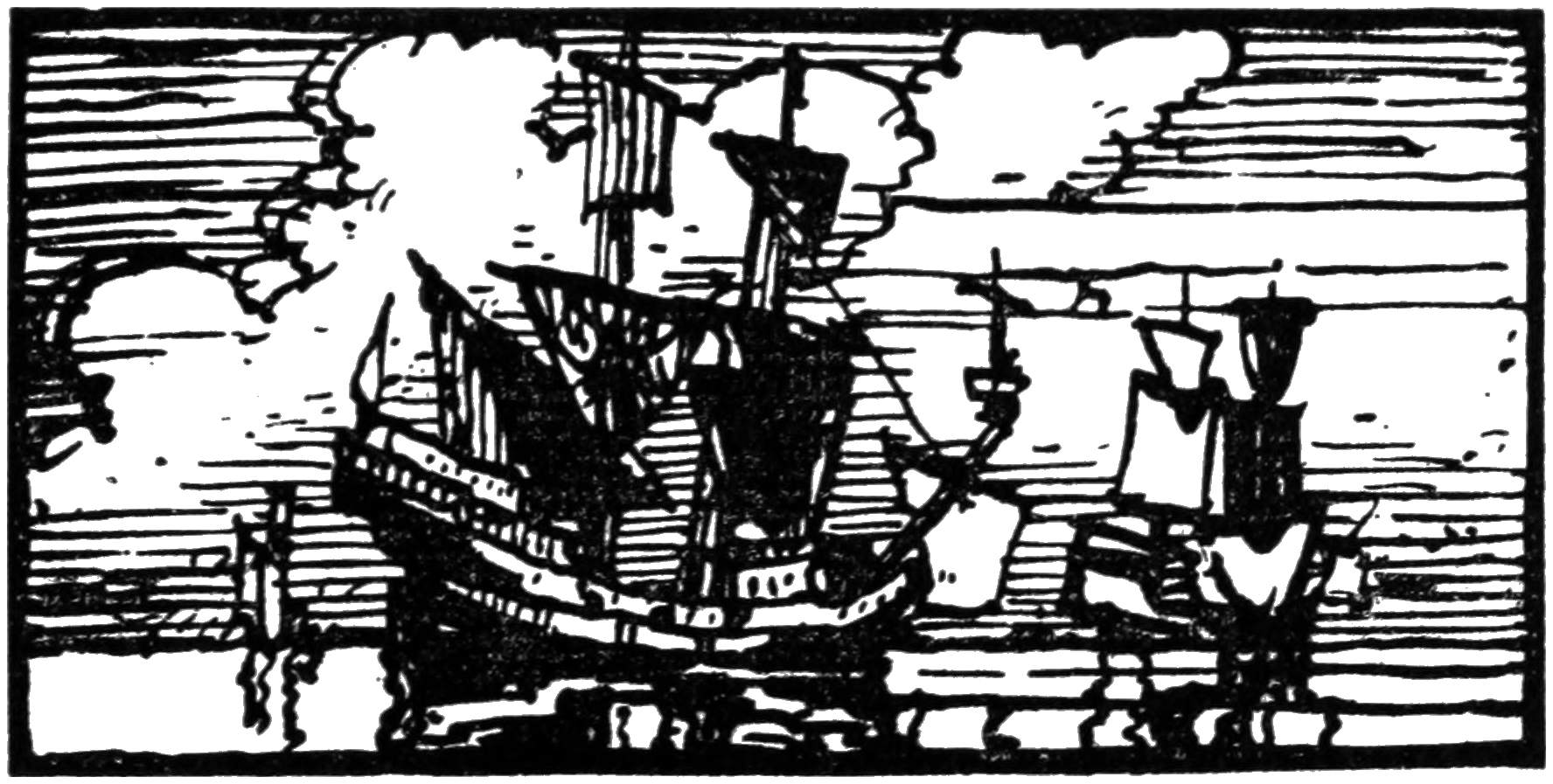
middle size; the rest, besides the barque
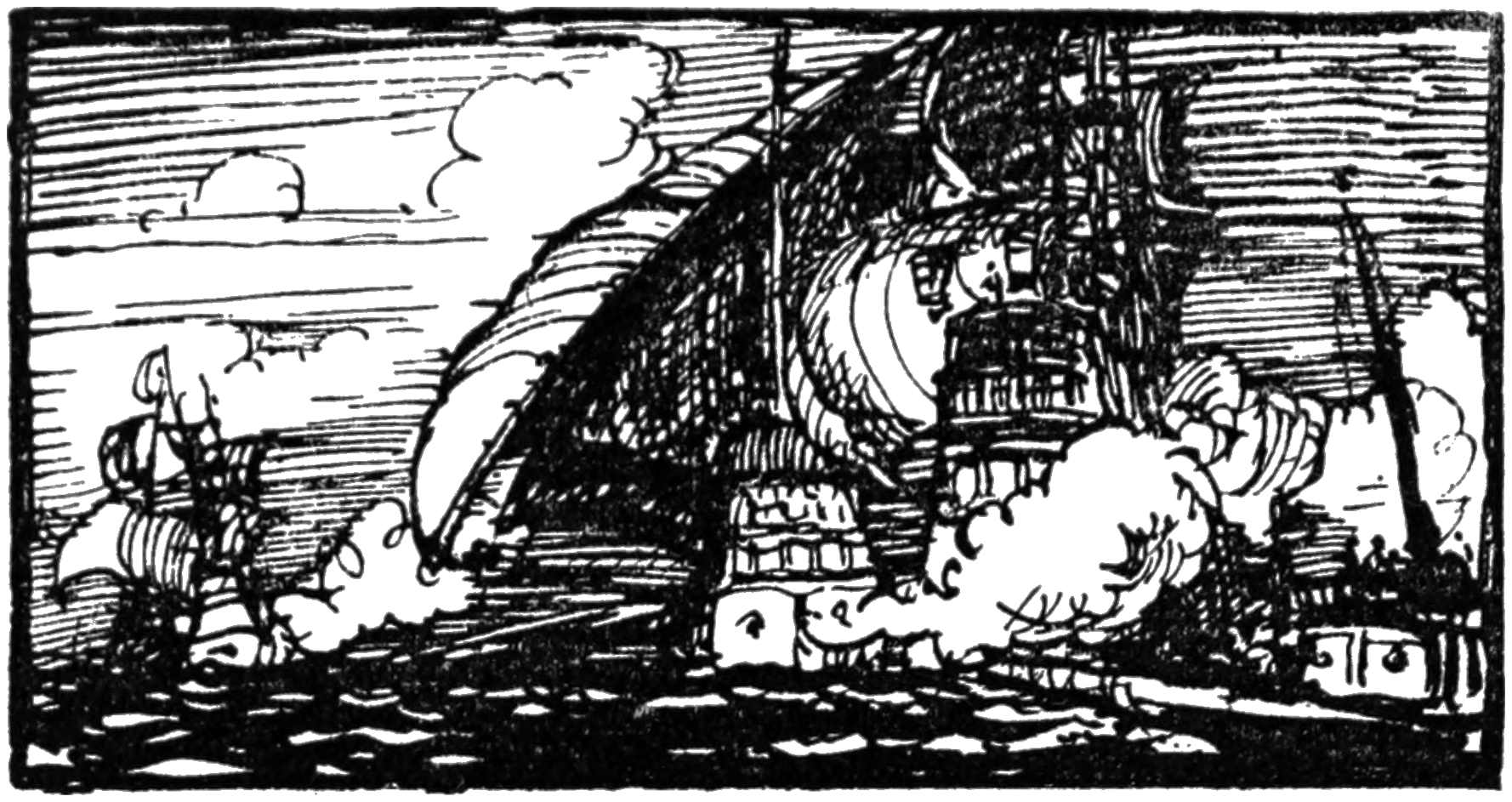
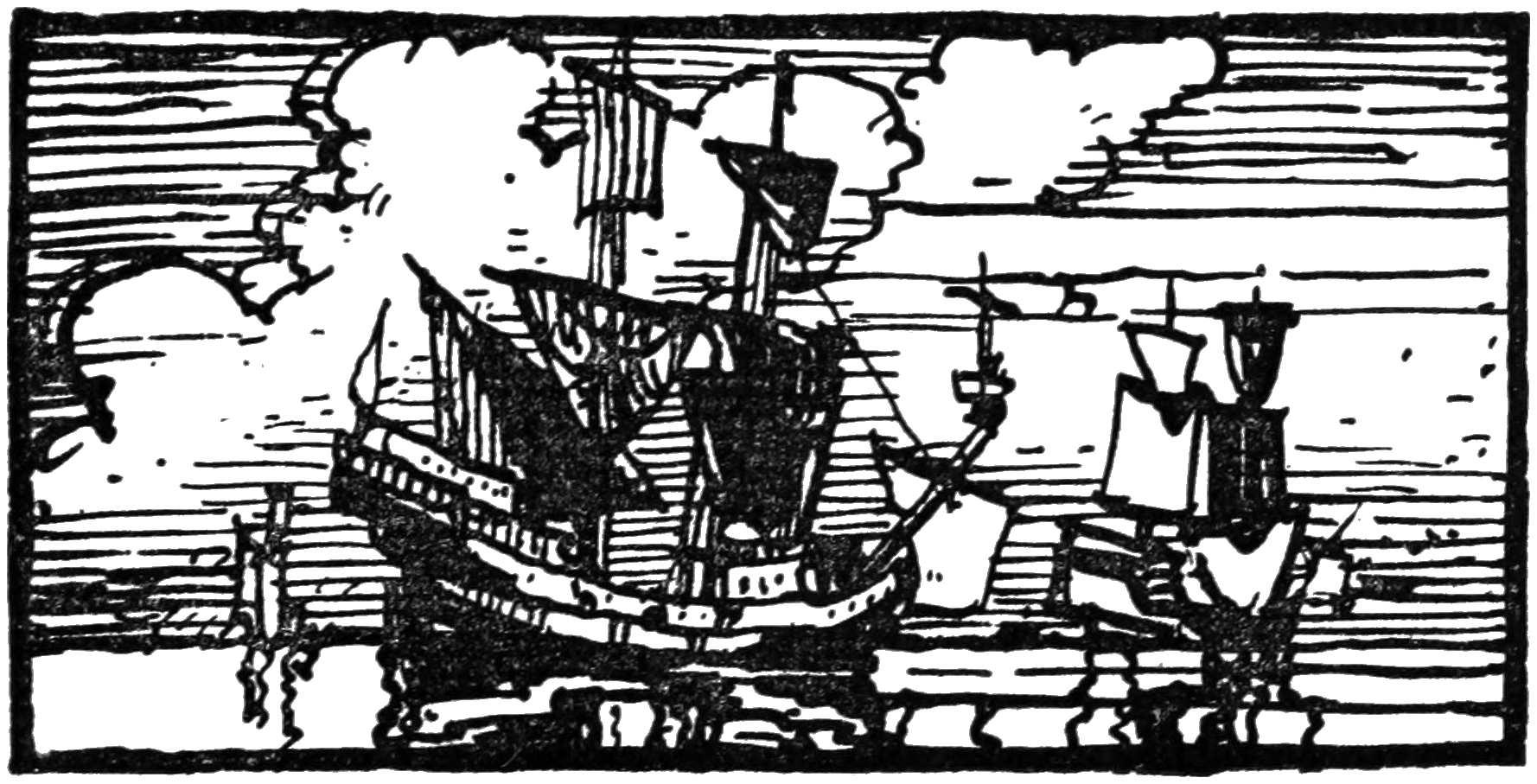
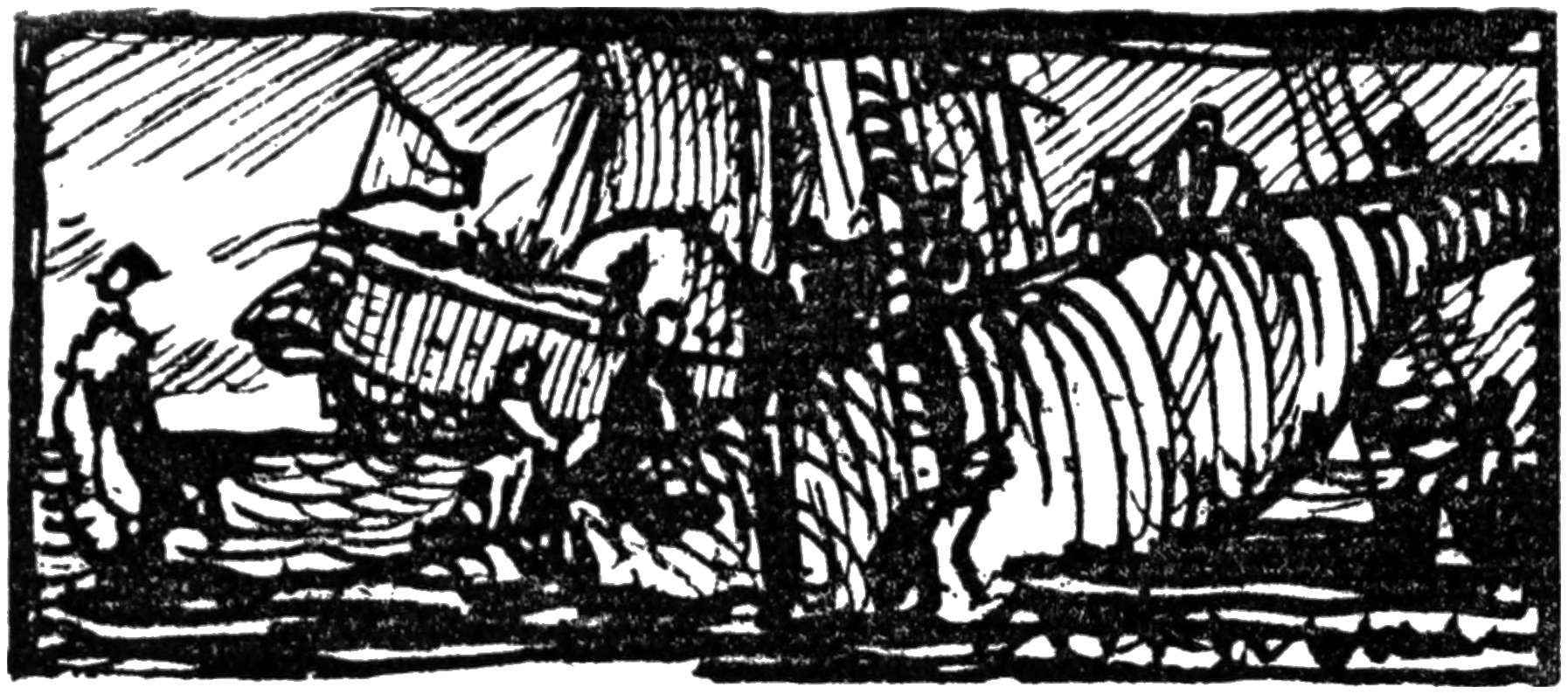
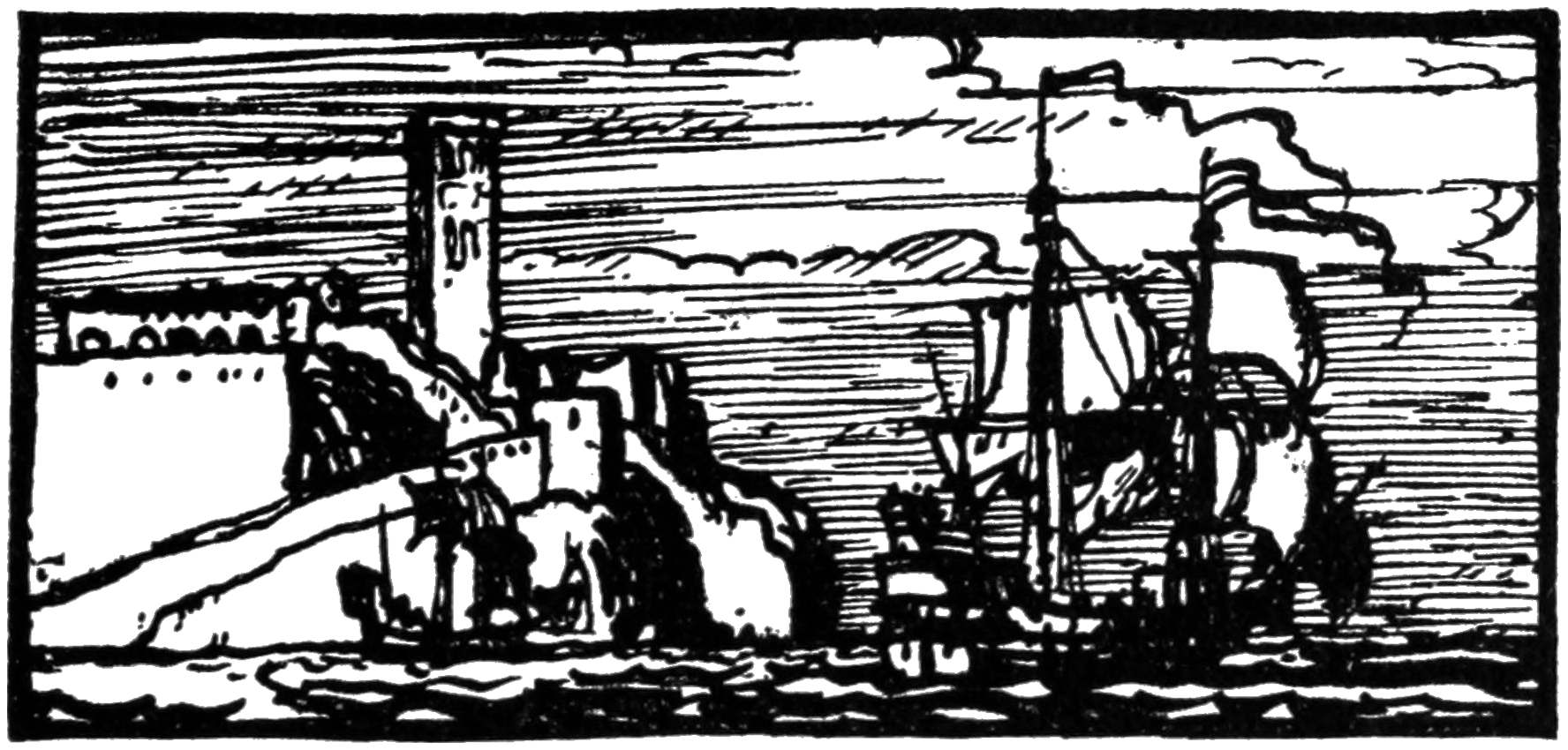
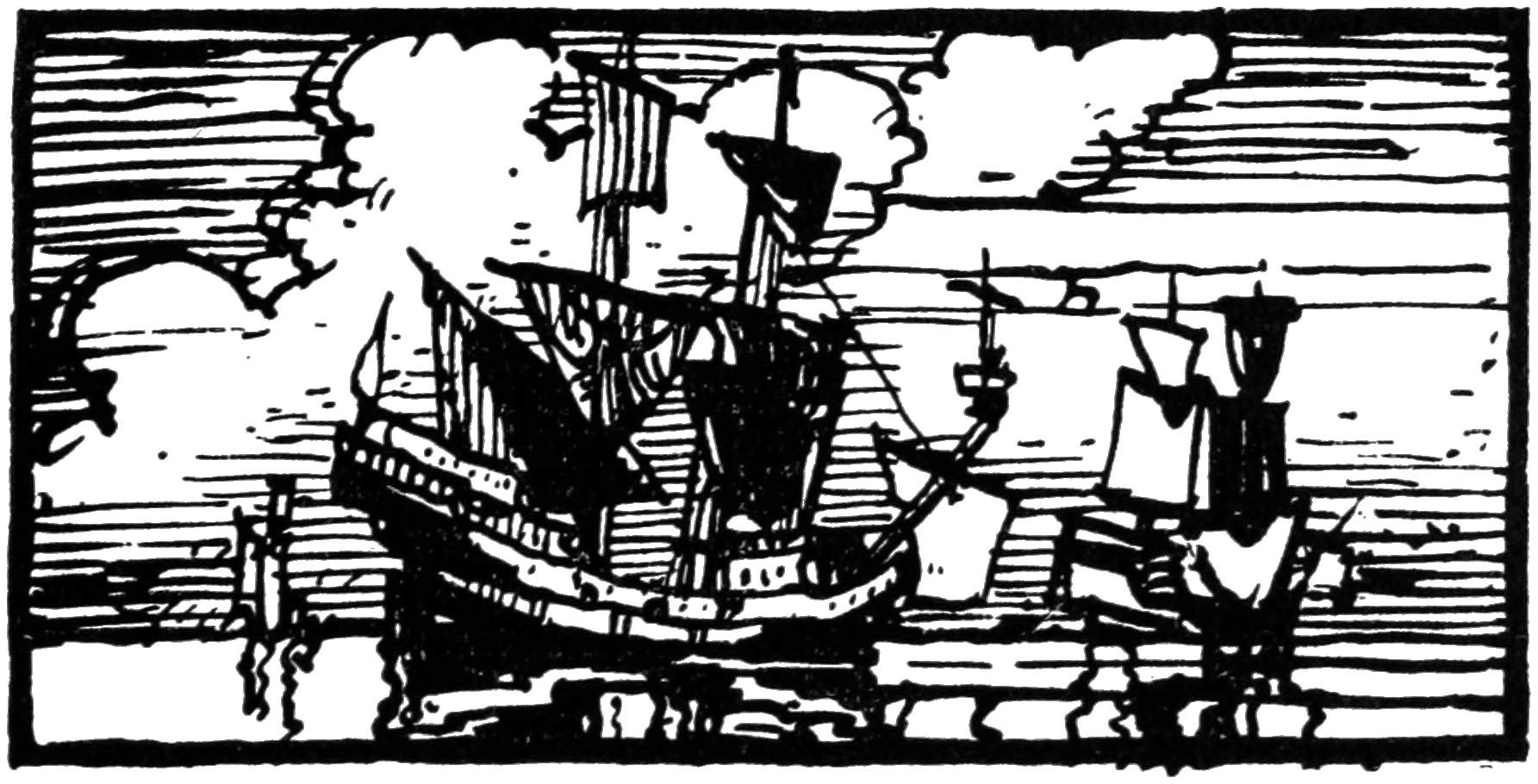
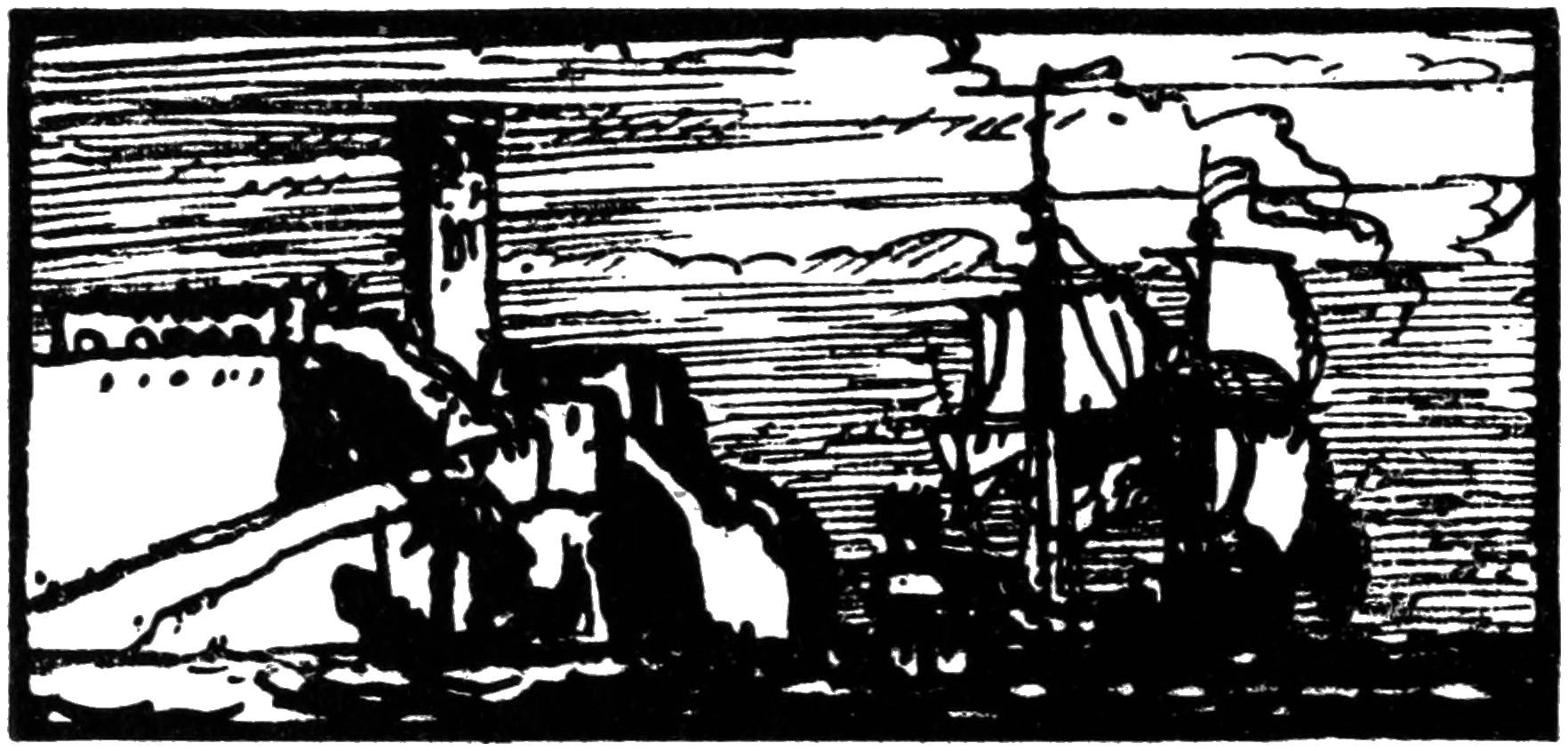
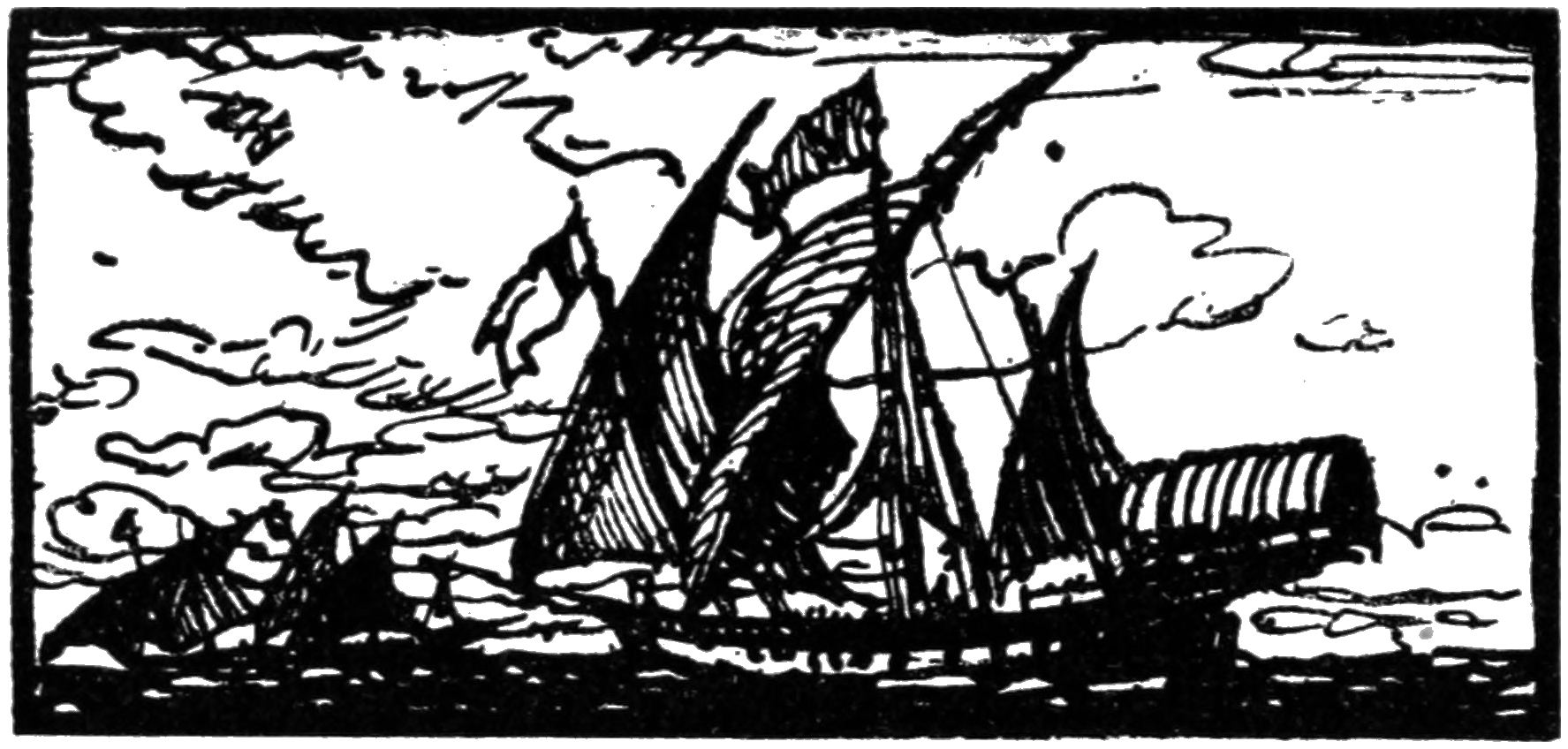
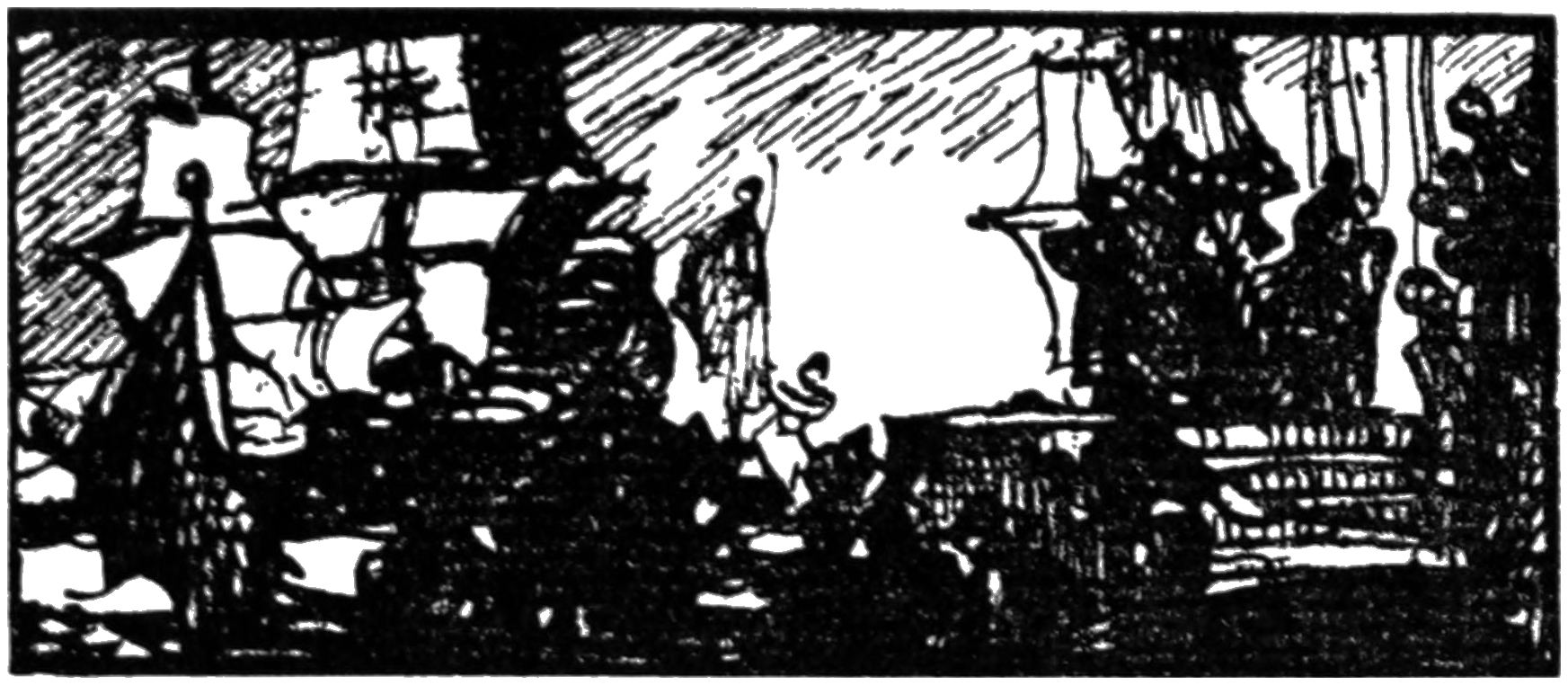
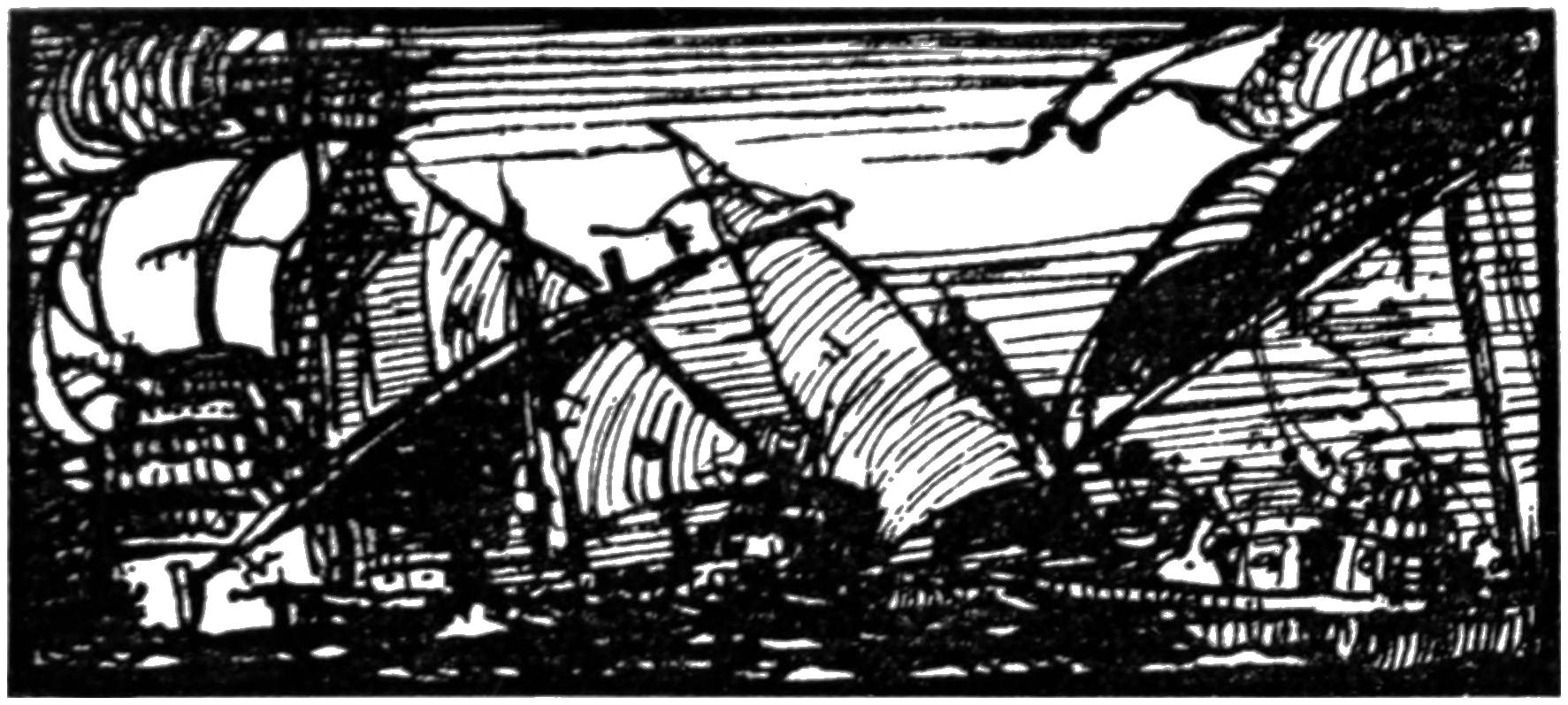
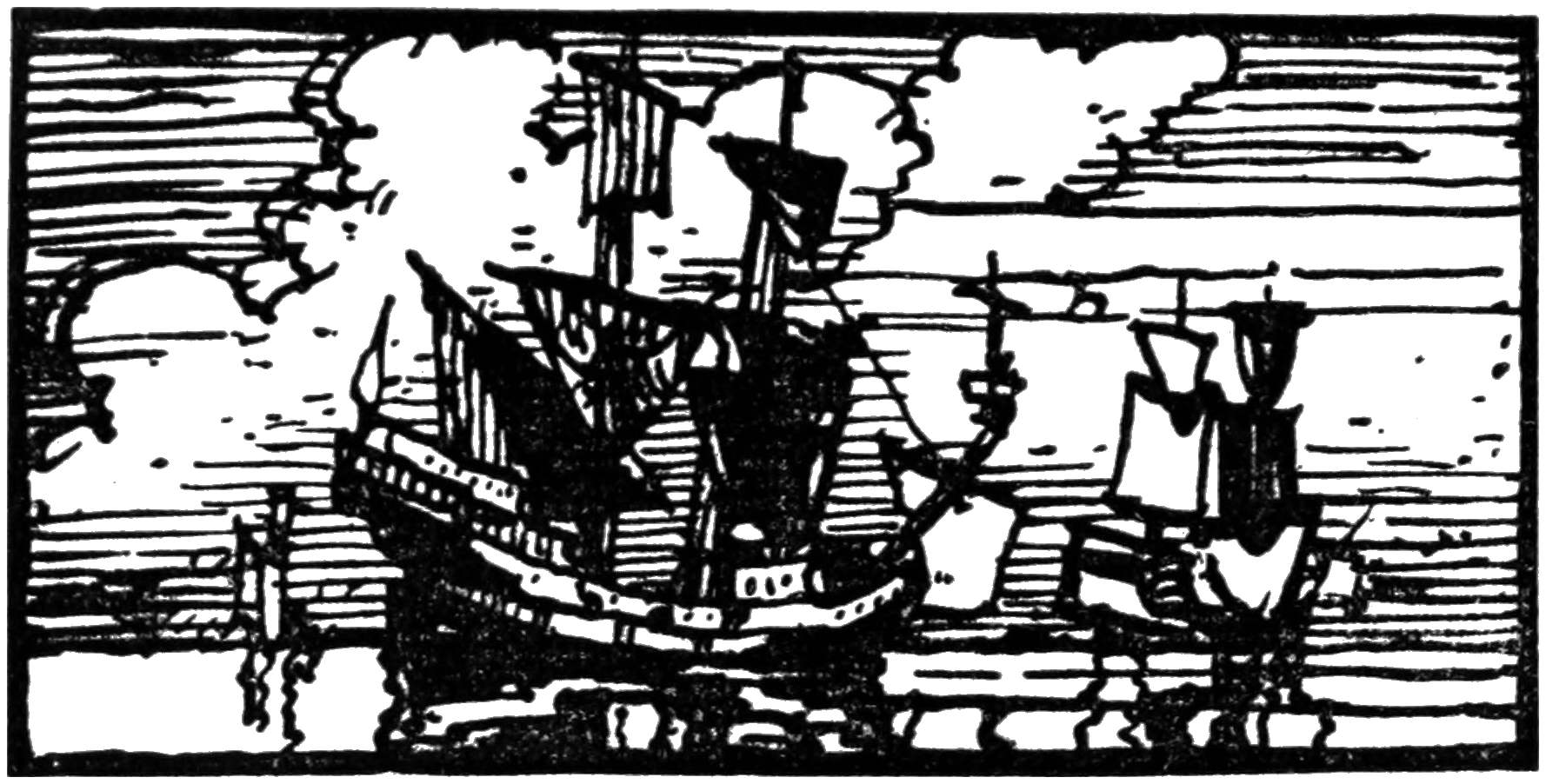
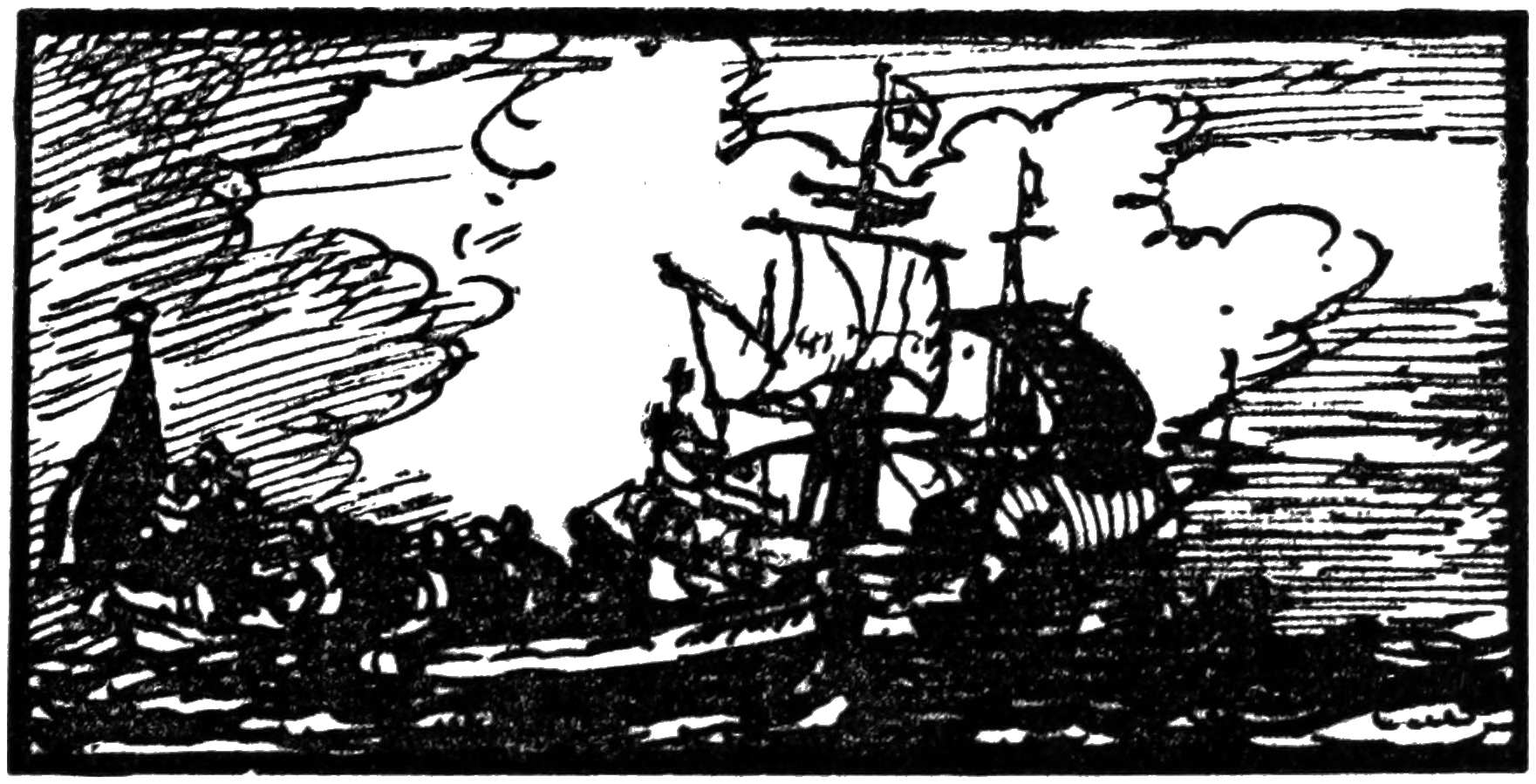
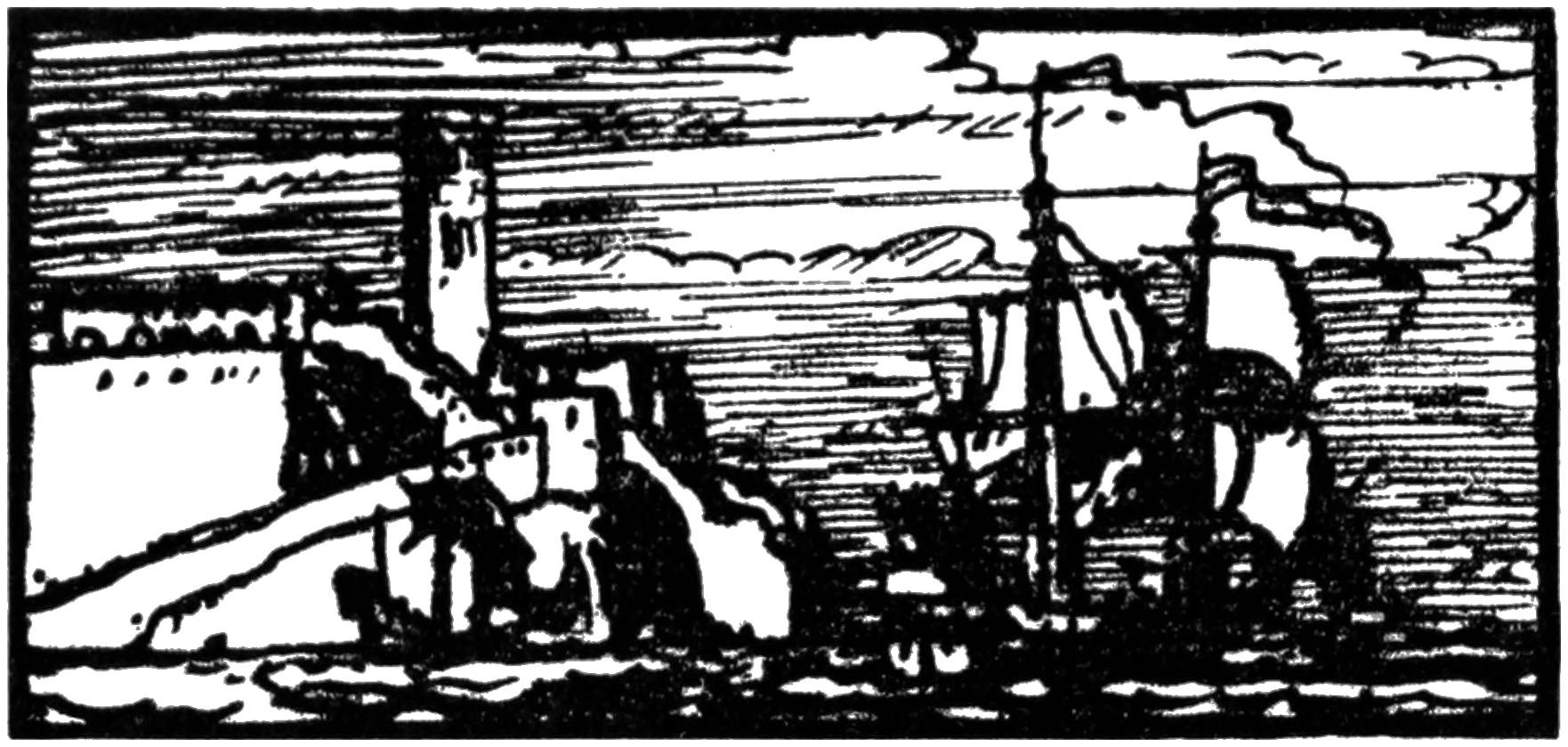
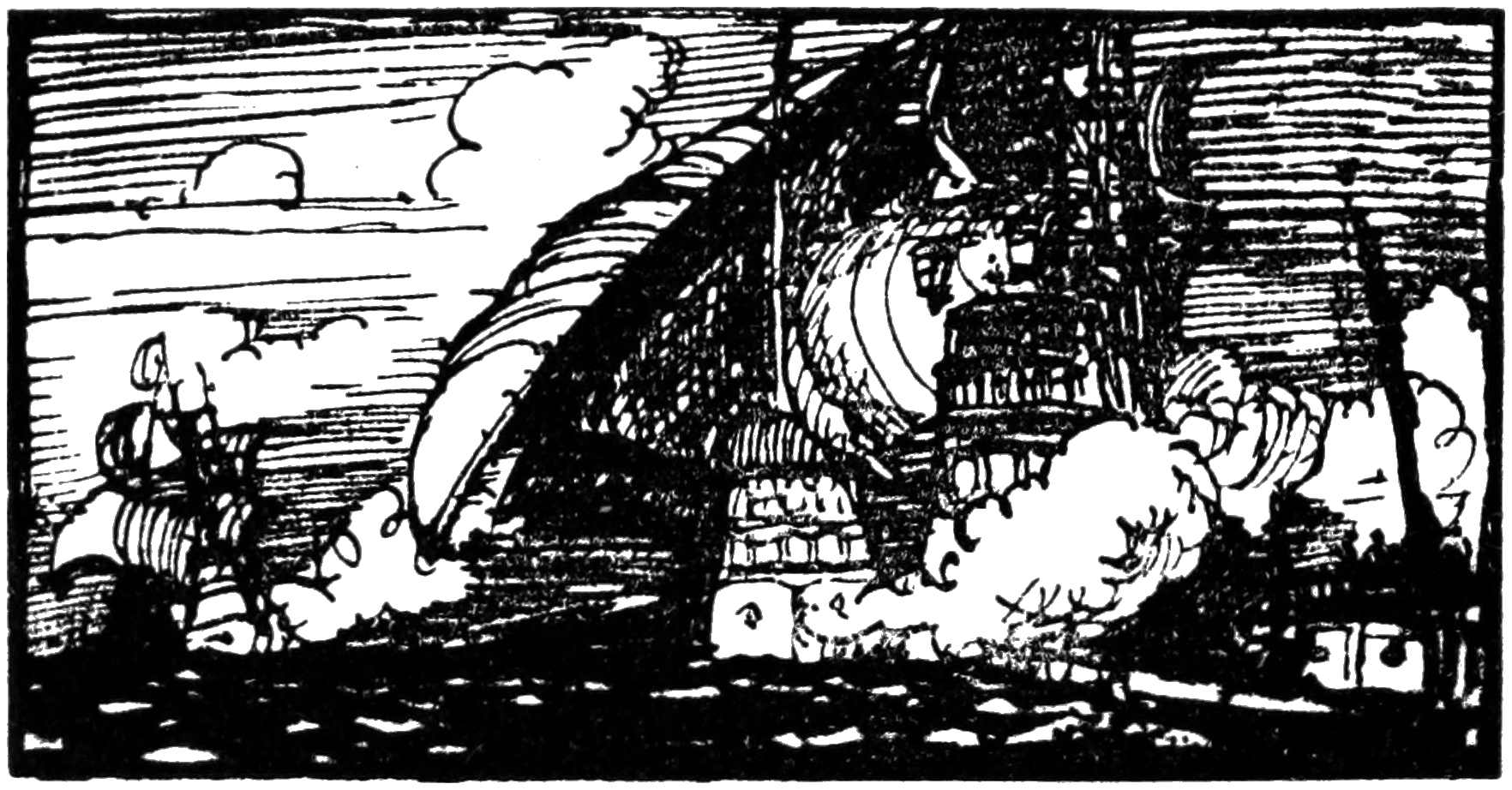
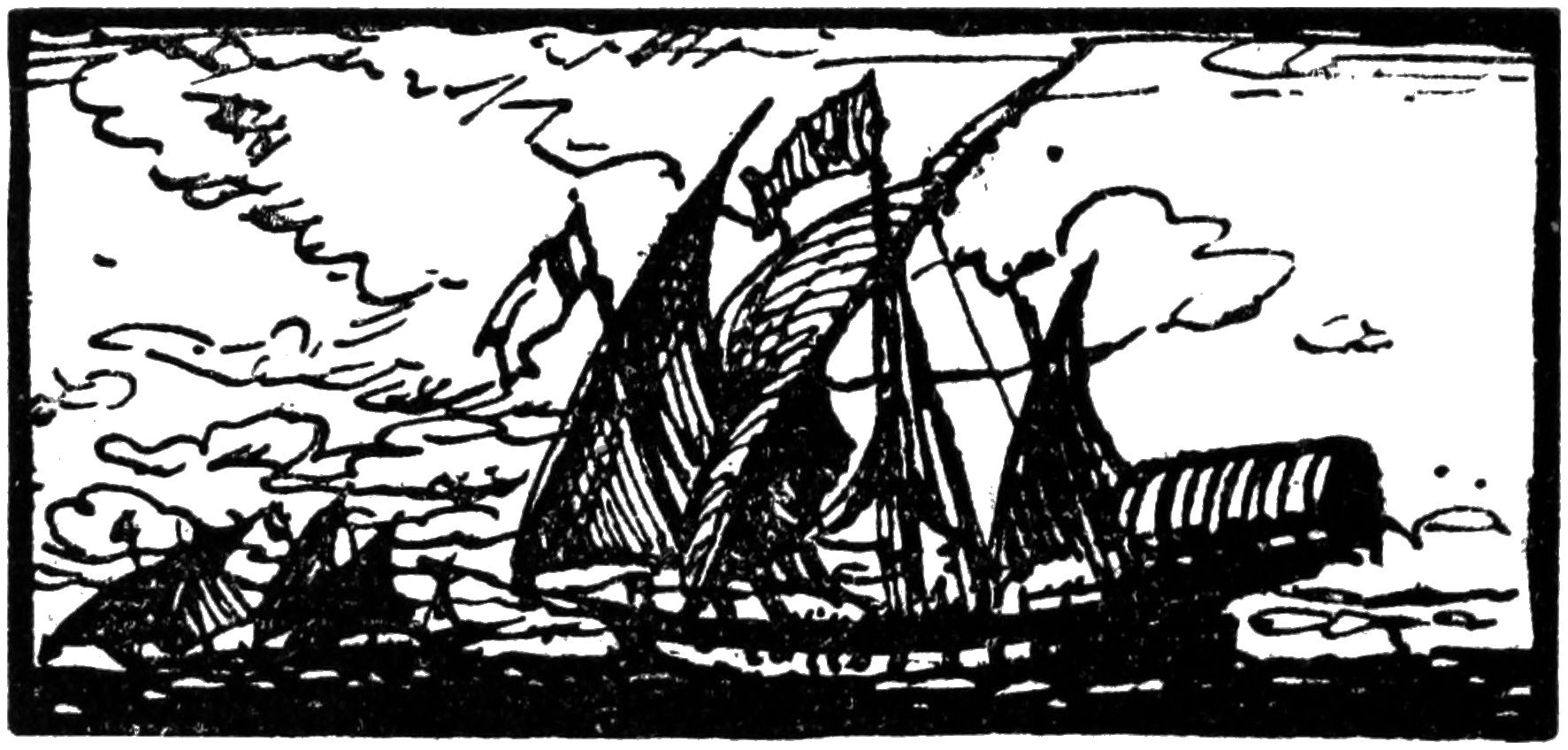
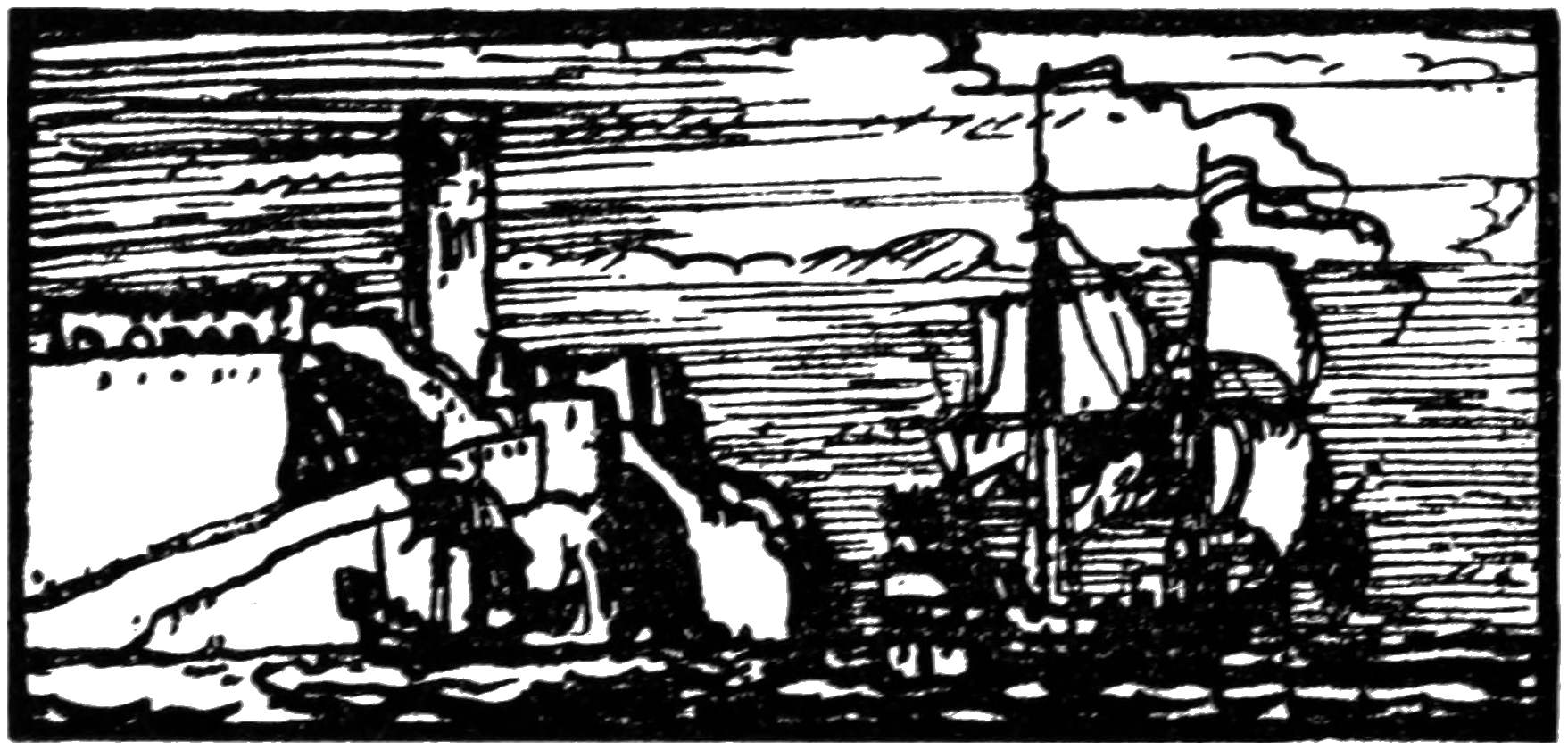
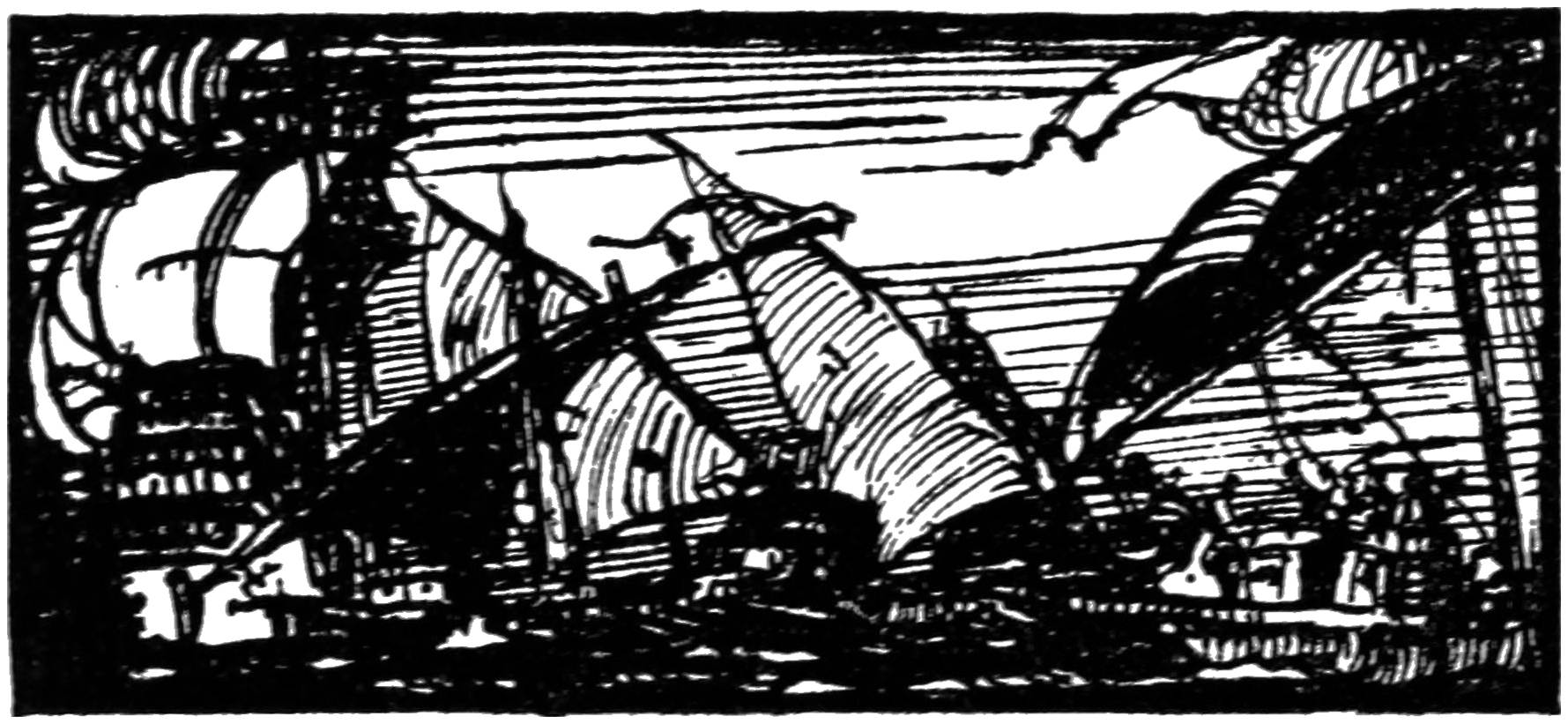
GALLEONS IN HARBOUR
Ralegh, commanded by Captain Thin,
were victuallers, and of small force or none.
The Spanish fleet having shrouded their
approach by reason of the island, were
now so soon at hand, as our ships had scarce
time to weigh their anchors, but some of
them were driven to let slip their cables and
set sail. Sir Richard Grenville was the last
weighed, to recover the men that were upon
the island, which otherwise had been lost.
The Lord Thomas with the rest very hardly
recovered the wind, which Sir Richard
Grenville not being able to do, was persuaded
by the master and others to cut his
main sail and cast about, and to trust to the
sailing of the ship, for the squadron of Seville
were on his weather bow. But Sir Richard
utterly refused to turn from the enemy,
alleging that he would rather choose to
die, than to dishonour himself, his country,
and Her Majesty’s ship, persuading his
company that he would pass through the
two squadrons in despite of them, and enforce
those of Seville to give him way.
Which he performed upon divers of the
foremost, who, as the mariners term it,
sprang their luff, and fell under the lee of
the Revenge. But the other course had been
the better, and might right well have been
answered in so great an impossibility of prevailing.
Notwithstanding out of the greatness
of his mind, he could not be persuaded.
In the meanwhile as he attended those
which were nearest him, the great San
Philip being in the wind of him, and
coming towards him, becalmed his sails
in such sort, as the ship could neither weigh
nor feel the helm, so huge and high charged
was the Spanish ship, being of a thousand
and five hundred tons. Who after laid the
Revenge aboard. When he was thus bereft
of his sails, the ships that were under his lee
luffing up, also laid him aboard, of which
the next was the Admiral of the Biscaines, a
very mighty and puissant ship commanded
by Brittan Dona. The said Philip carried
three tier of ordinance on a side, and eleven
pieces in every tier. She shot eight forthright
out of her chase, besides those of her
stern ports.
After the Revenge was entangled with this
Philip, four others boarded her; two on
her larboard and two on her starboard. The
fight thus beginning at three of the clock
in the afternoon, continued very terrible
all that evening. But the great San Philip
having received the lower tier of the Revenge,
discharged with cross-bar shot,
shifted herself with all diligence from her
sides, utterly misliking her first entertainment.
Some say that the ship foundered,
but we cannot report it for truth, unless
we were assured. The Spanish ships were
filled with companies of soldiers, in some
two hundred, besides the mariners; in some
five, in others eight hundred. In ours there
were none at all, beside the mariners, but
the servants of the commanders and some
few voluntary gentlemen only. After many
interchanged volleys of great ordnance and
small shot, the Spaniards deliberated to enter
the Revenge, and made divers attempts,
hoping to force her by the multitudes of
their armed soldiers and musketeers, but
were still repulsed again and again, and at
all times beaten back into their own ships,
or into the seas. In the beginning of the
fight the George Noble, of London, having
received some shot through her by the Armadas,
fell under the lee of the Revenge,
and asked Sir Richard what he would command
him, being but one of the victuallers
and of small force; Sir Richard bid him
save himself, and leave him to his fortune.
After the fight had thus, without intermission,
continued while the day lasted and
some hours of the night, many of our men
were slain and hurt, and one of the great
galleons of the Armada and the Admiral of
the Hulks both sunk, and in many other
of the Spanish ships great slaughter was
made. Some write that Sir Richard was
very dangerously hurt almost in the beginning
of the fight, and lay speechless for a
time ere he recovered. But two of the Revenge’s
own company, brought home in a
ship of Lime from the Islands, examined by
some of the Lords and others, affirmed that
he was never so wounded as that he forsook
the upper deck till an hour before
midnight, and then being shot into the
body with a musket as he was dressing, was
again shot into the head, and withal his surgeon
wounded to death. This agrees also
with an examination taken by Sir Francis
Godolphin, of four other mariners of the
same ship being returned, which examination
the said Sir Francis sent unto Master
William Killigrew, of Her Majesty’s
Privy Chamber.
But to return to the fight, the Spanish ships
which attempted to board the Revenge, as
they were wounded and beaten off, so always
others came in their places, she having
never less than two mighty galleons by her
sides and aboard her. So that ere the morning
from three of the clock the day before,
there had fifteen several Armadas assailed
her, and all so ill approved their entertainment,
as they were by the break of
day, far more willing to hearken to a composition,
than hastily to make any more
assaults or entries. But as the day increased
so our men decreased; and as the light grew
more and more, by so much more grew
our discomforts. For none appeared in
sight but enemies, saving one small ship
called the Pilgrim, commanded by Jacob
Whiddon, who hovered all night to see
the success: but in the morning bearing
with the Revenge, was hunted like a hare
amongst many ravenous hounds, but escaped.
All the powder of the Revenge to the last
barrel was now spent, all her pikes broken,
forty of her best men slain, and the most
part of the rest hurt. In the beginning of
the fight she had but one hundred free
from sickness, and fourscore and ten sick,
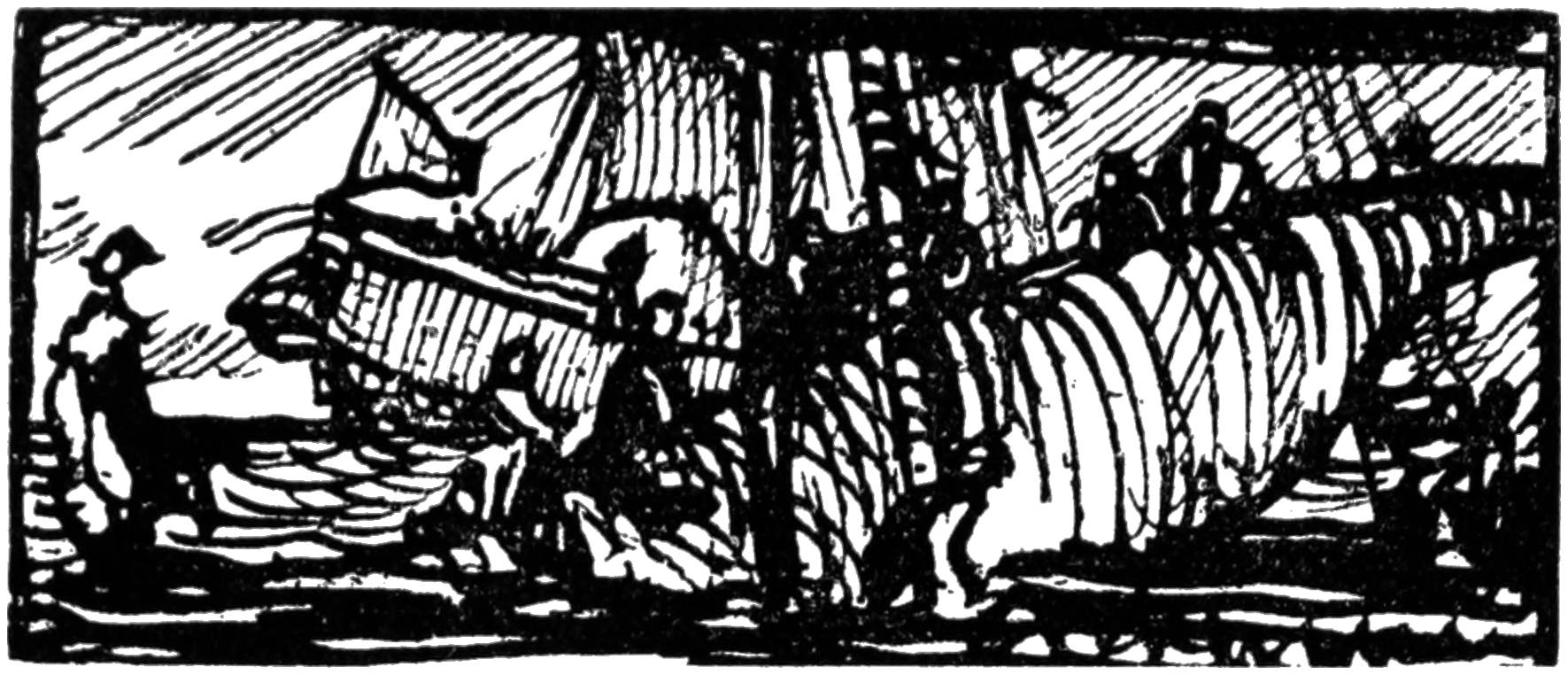
laid in hold upon the ballast. A small troop
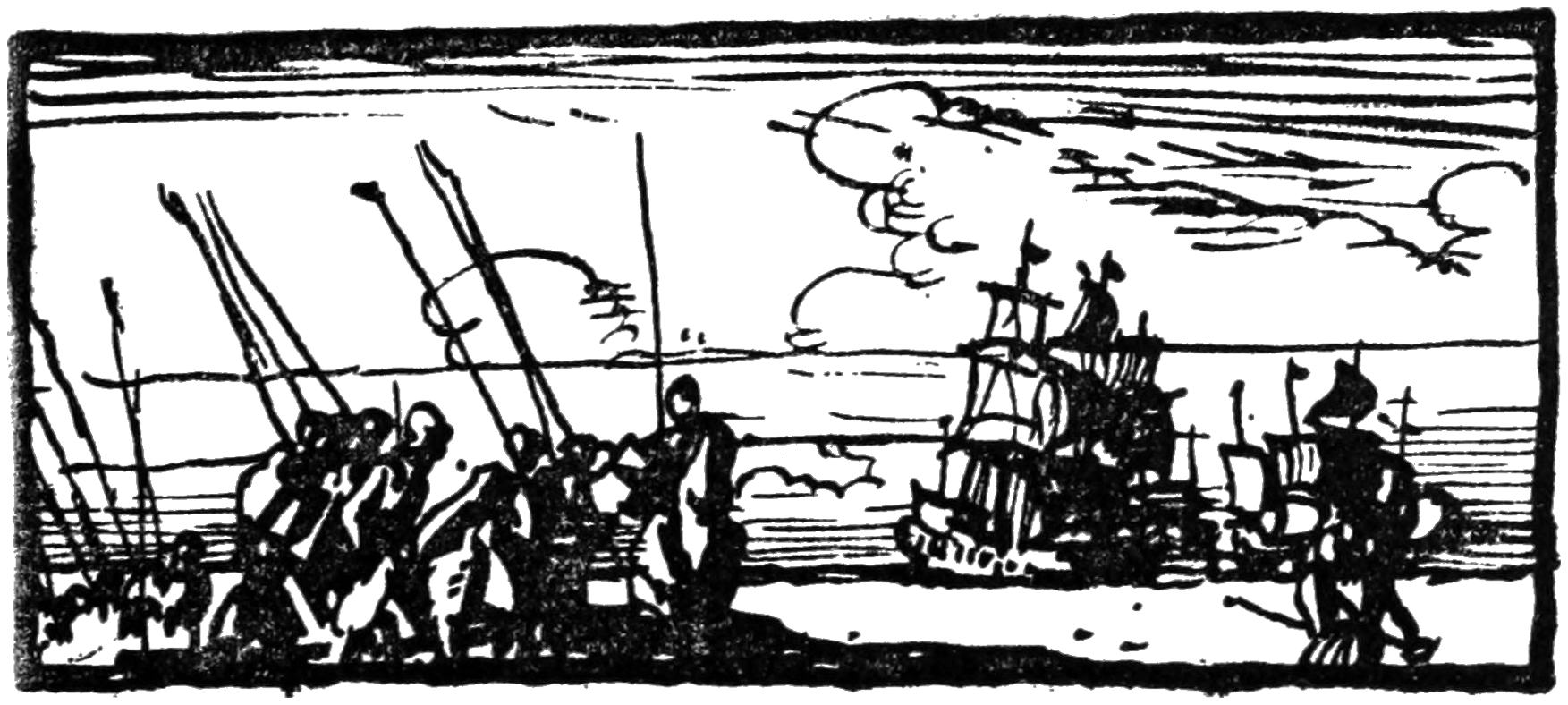
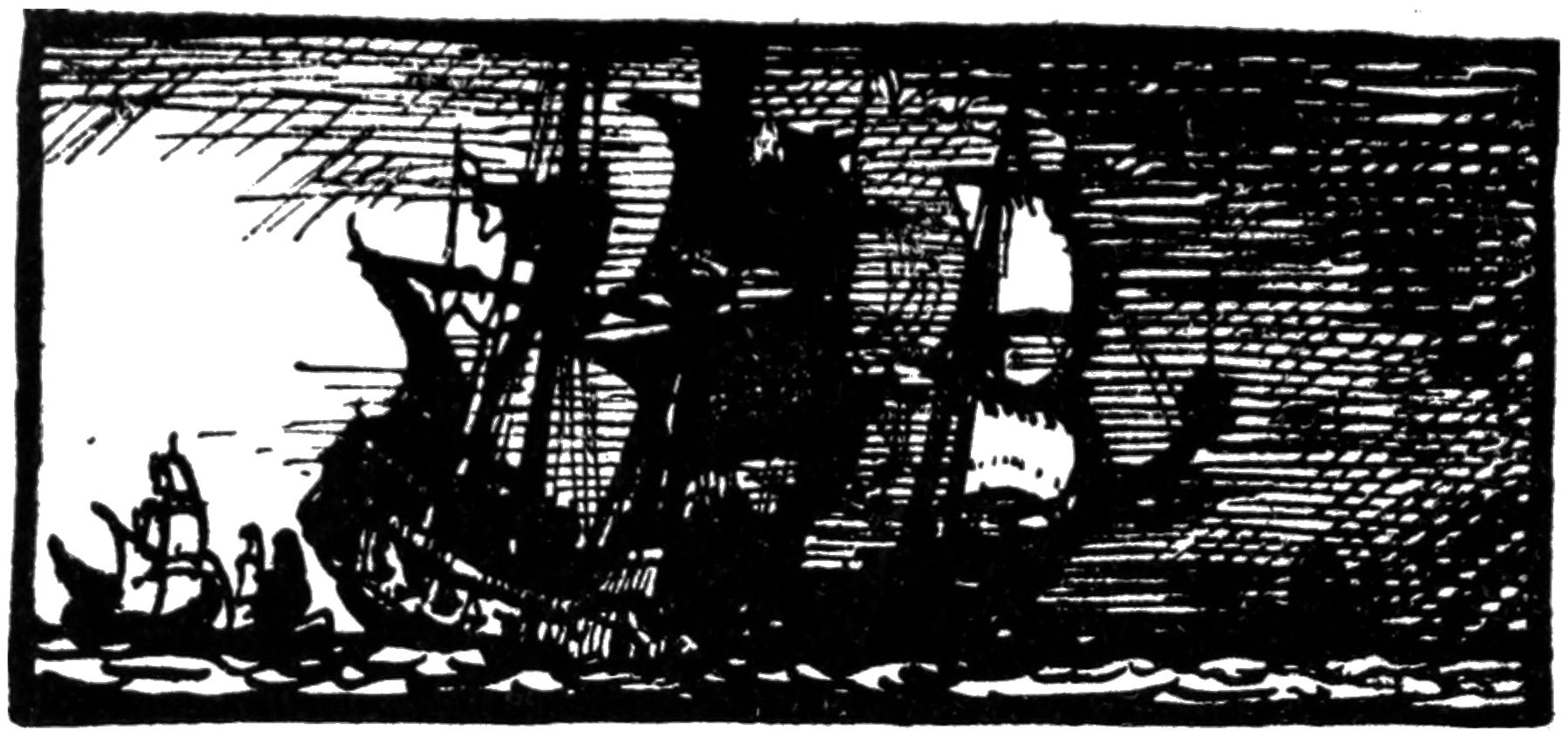
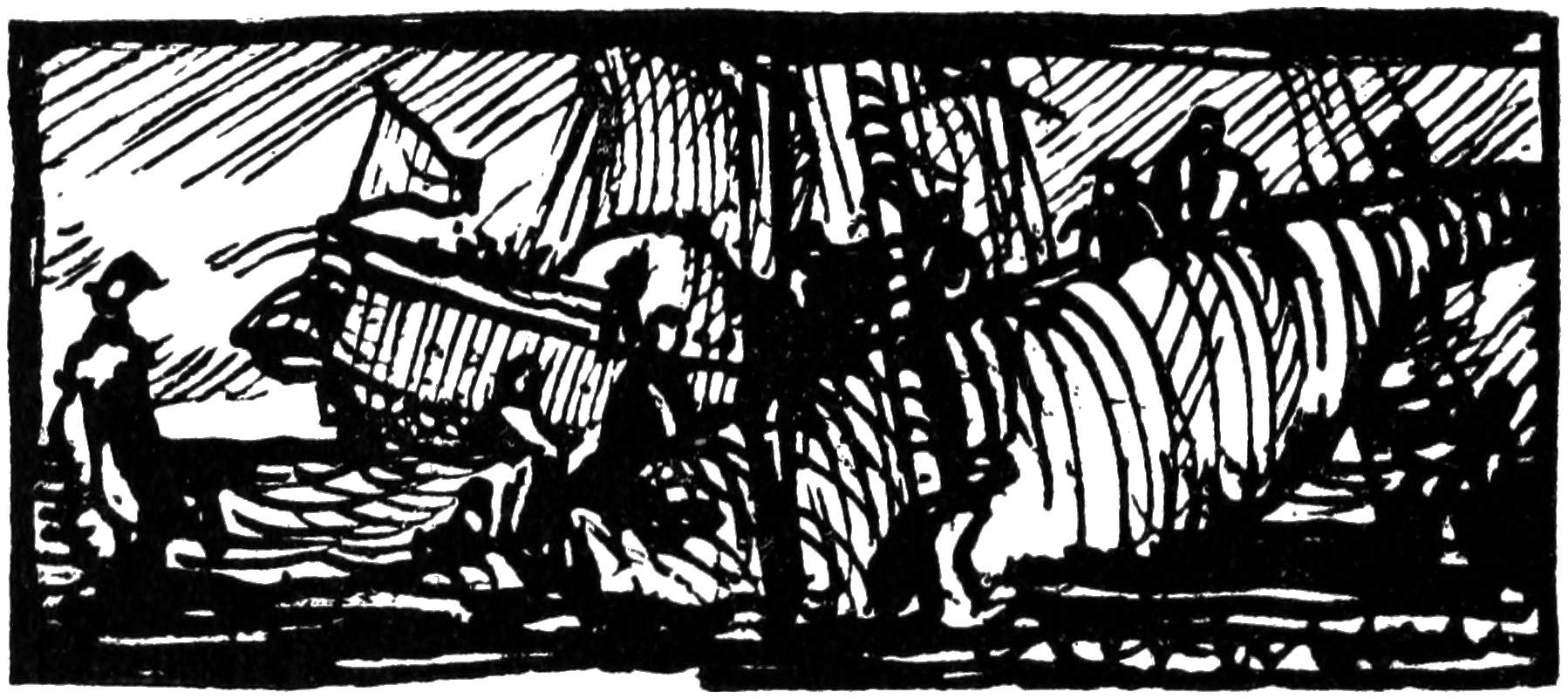
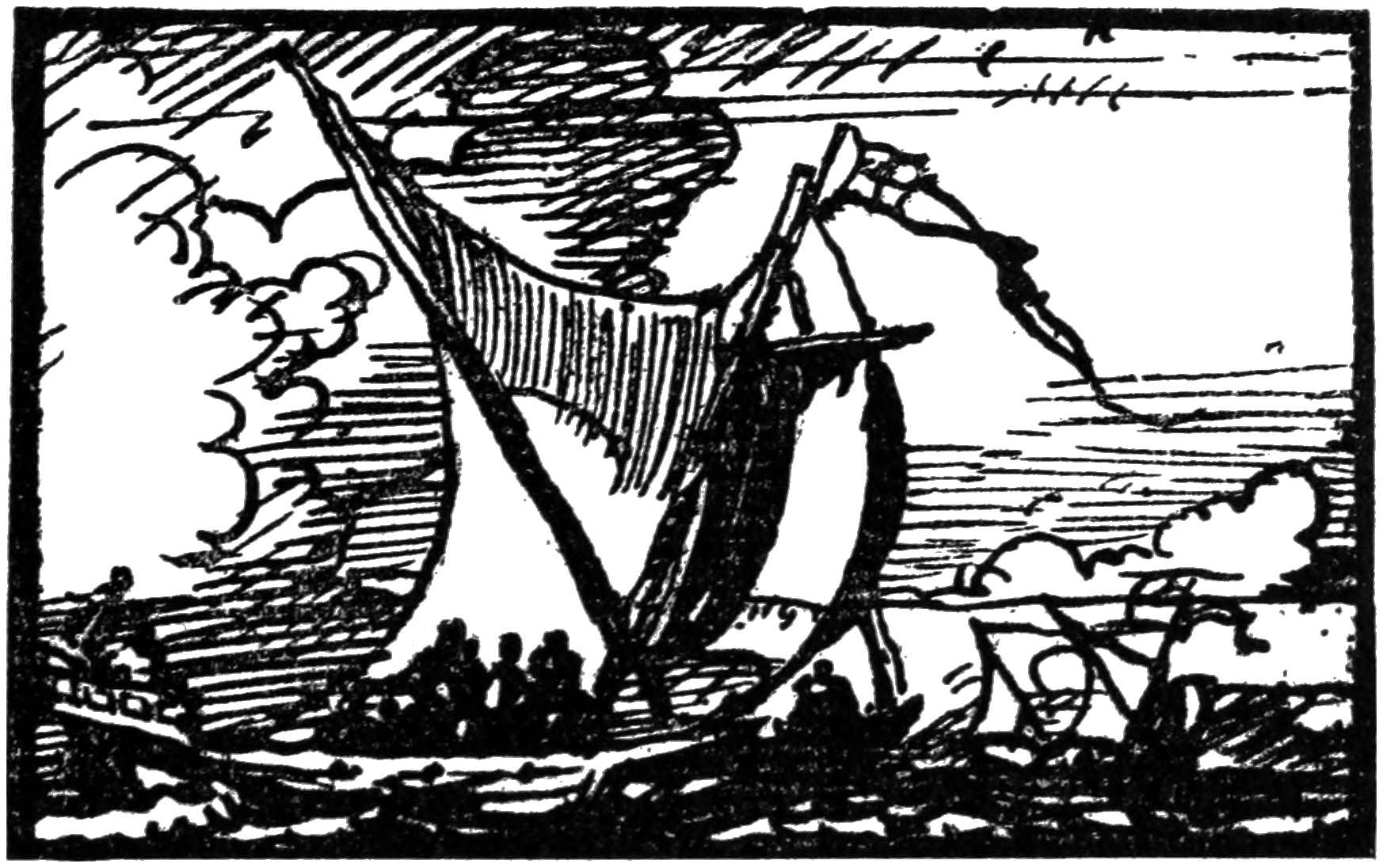
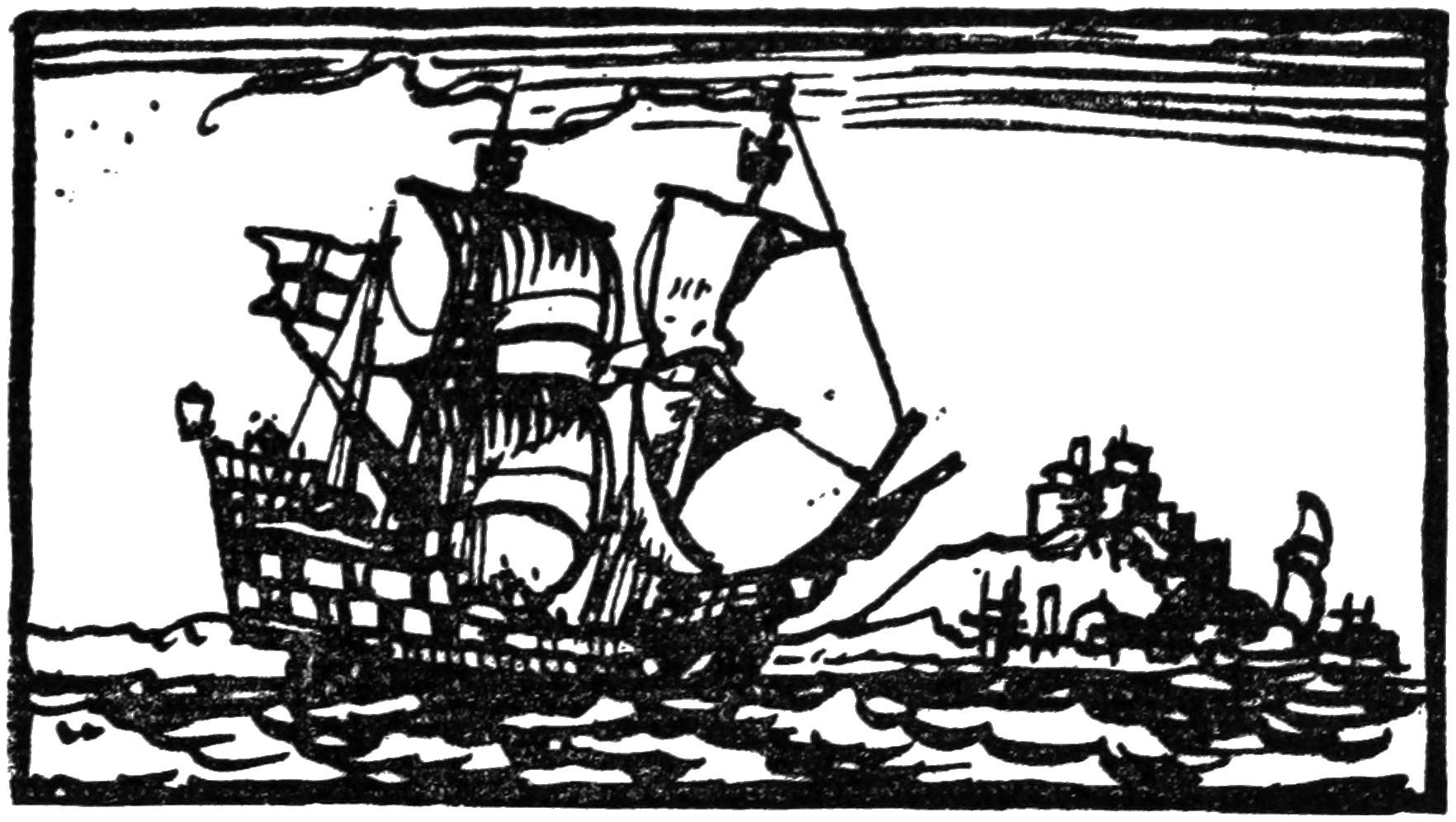
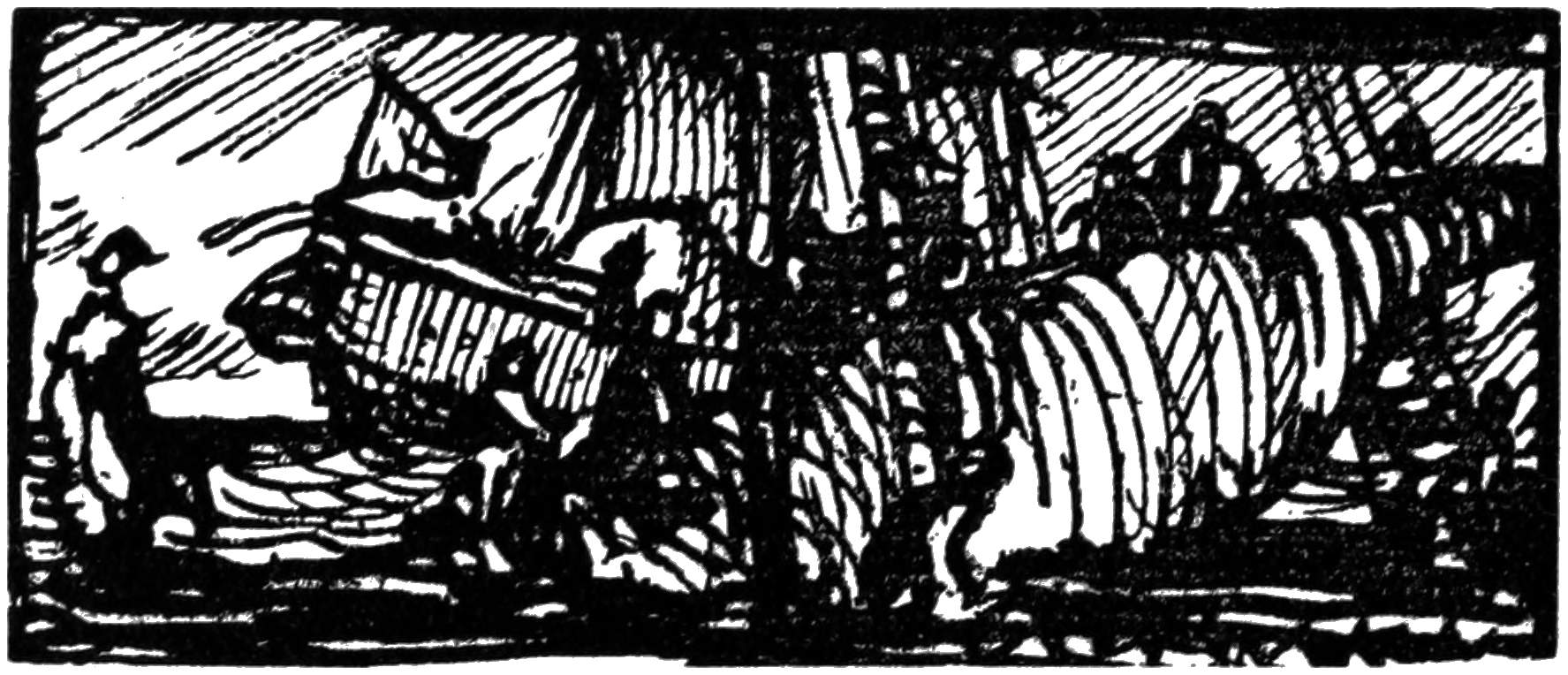
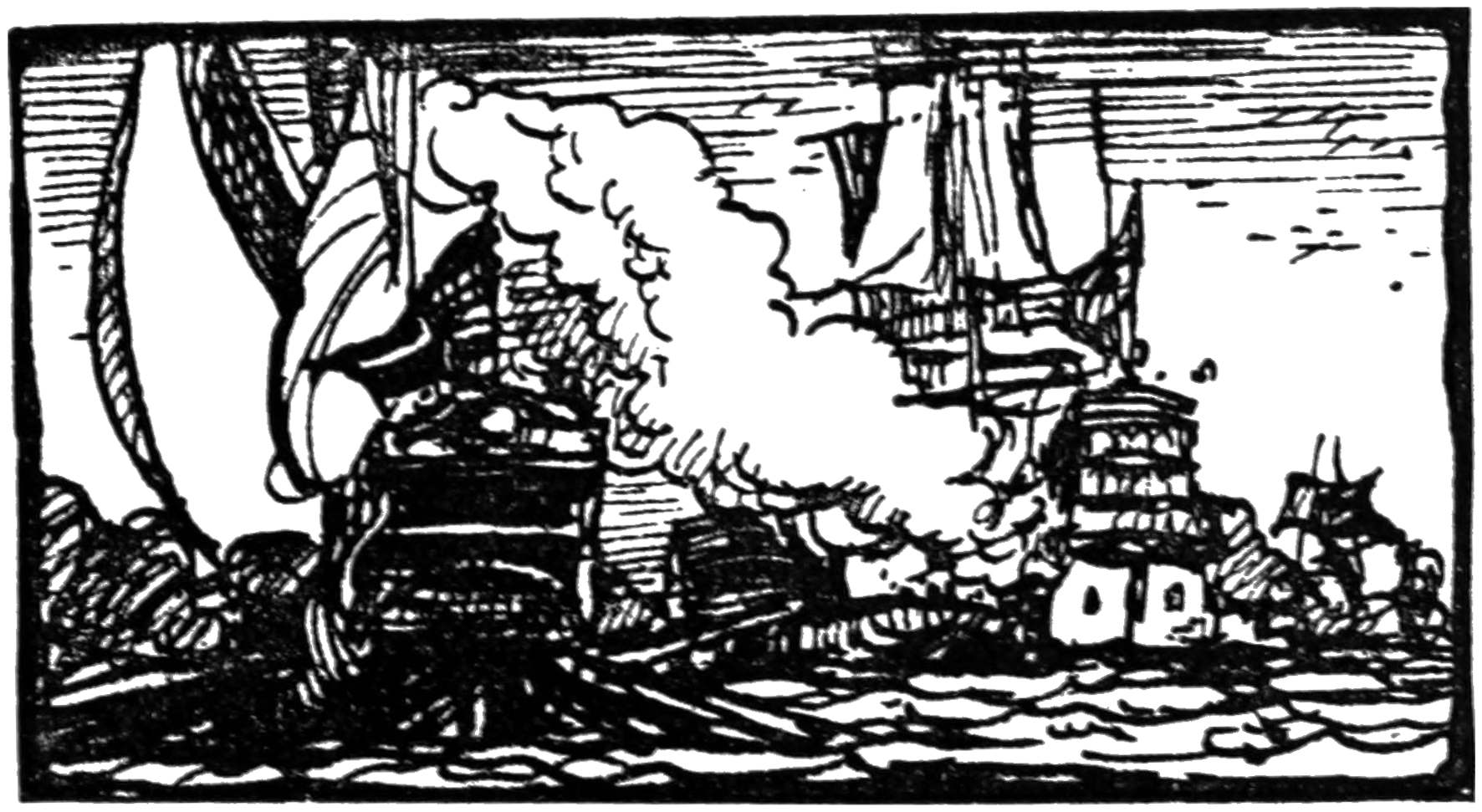
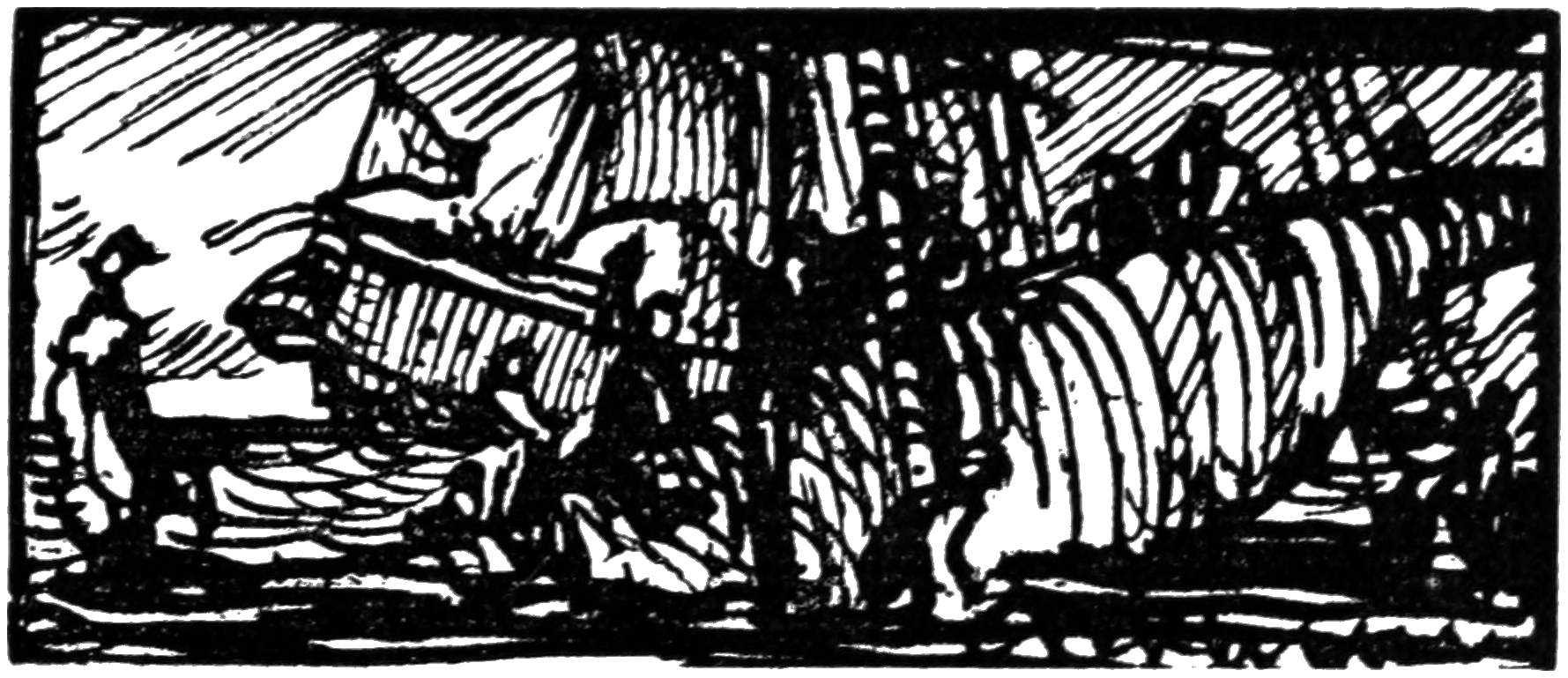
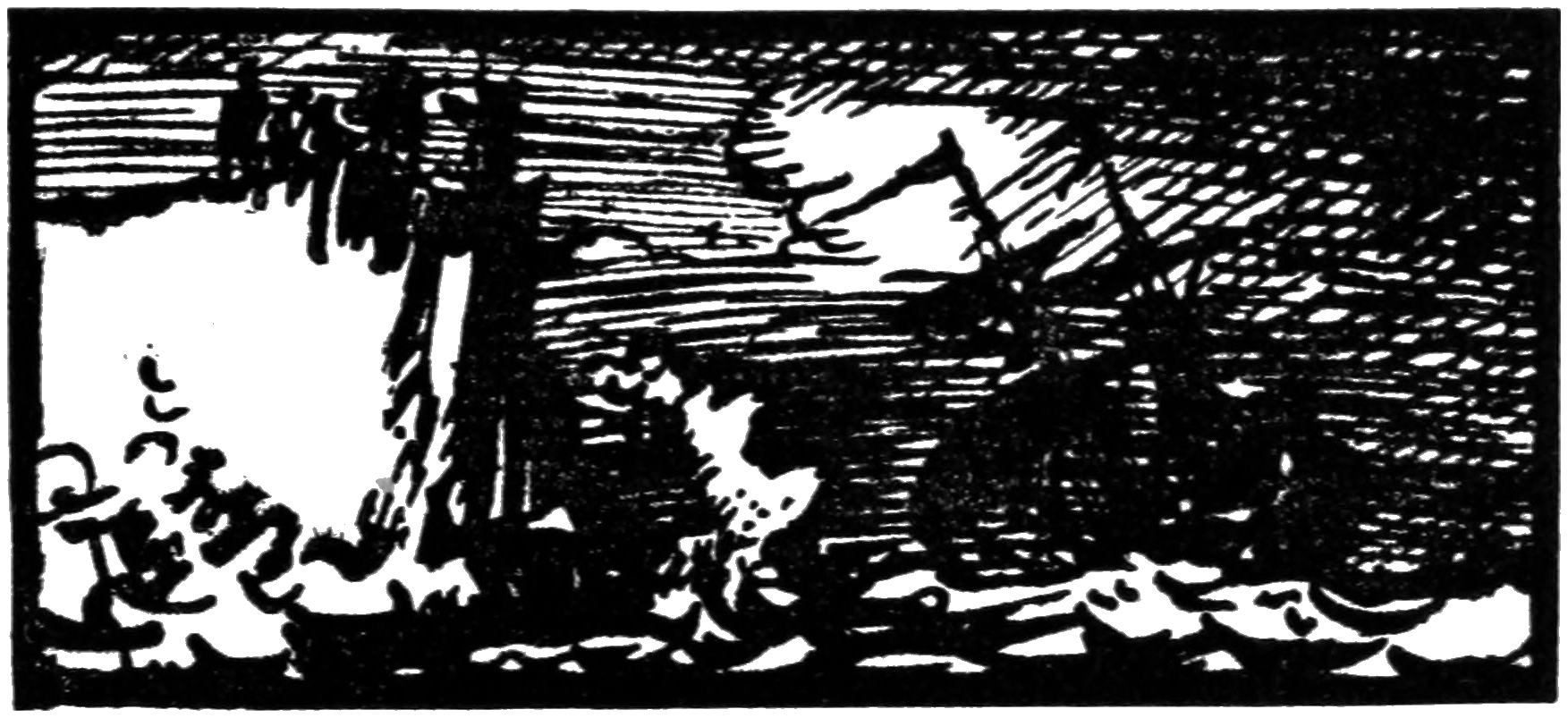
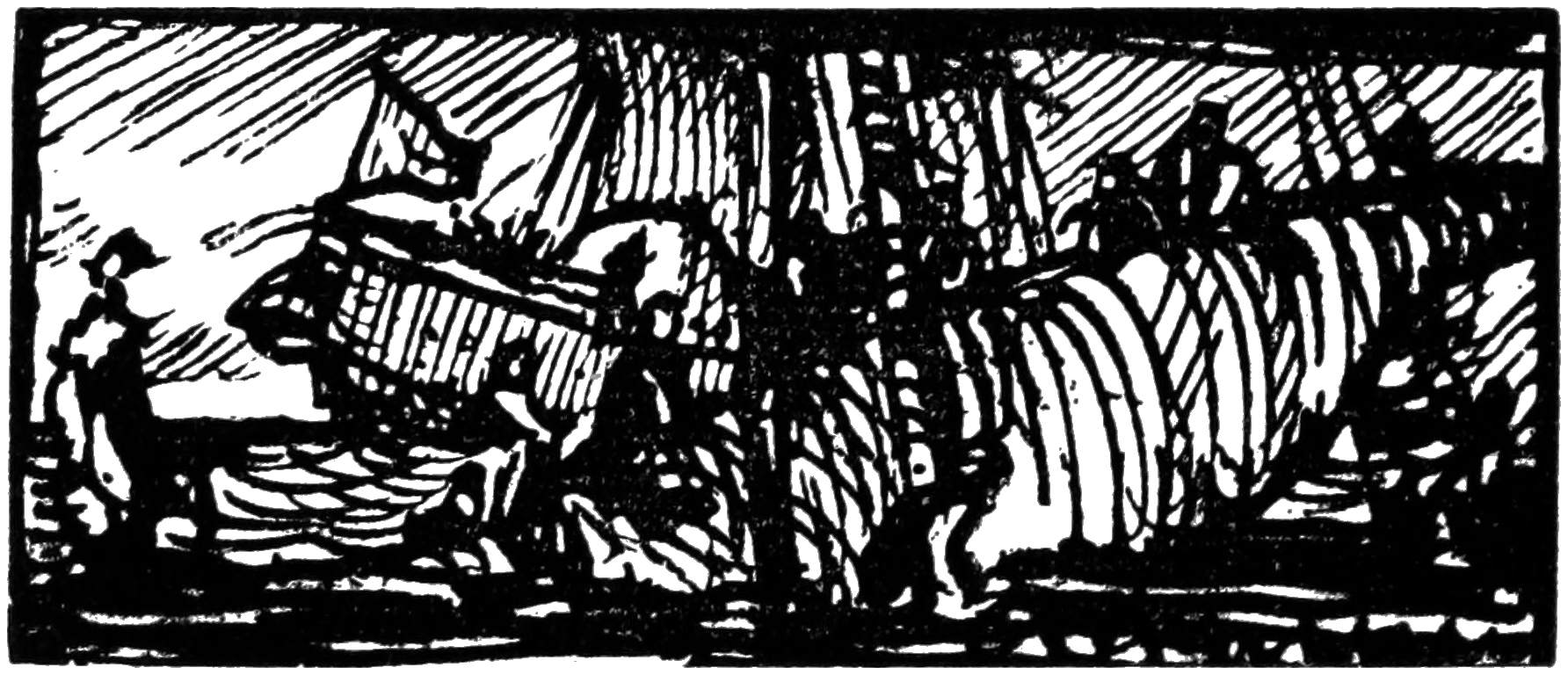
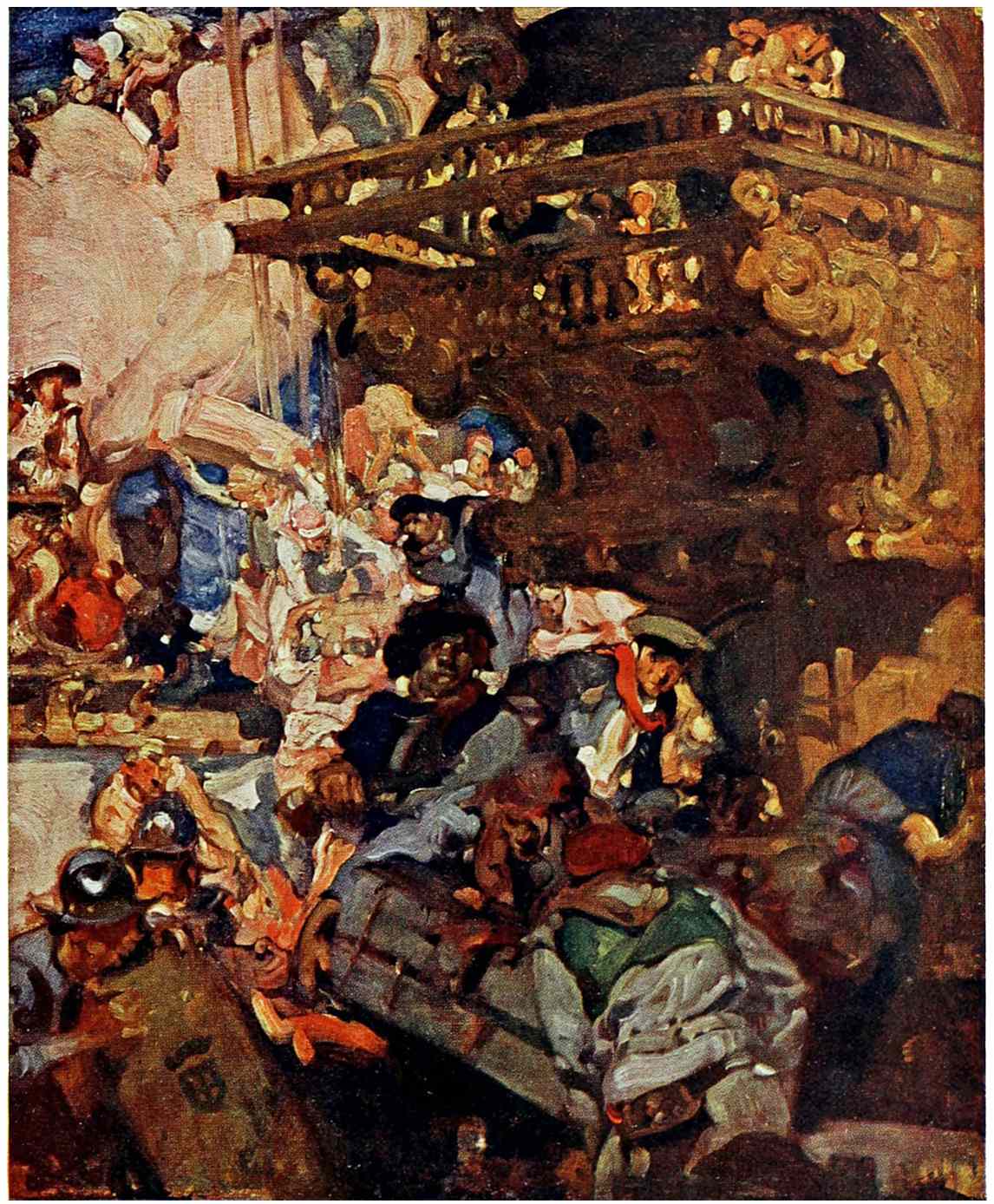
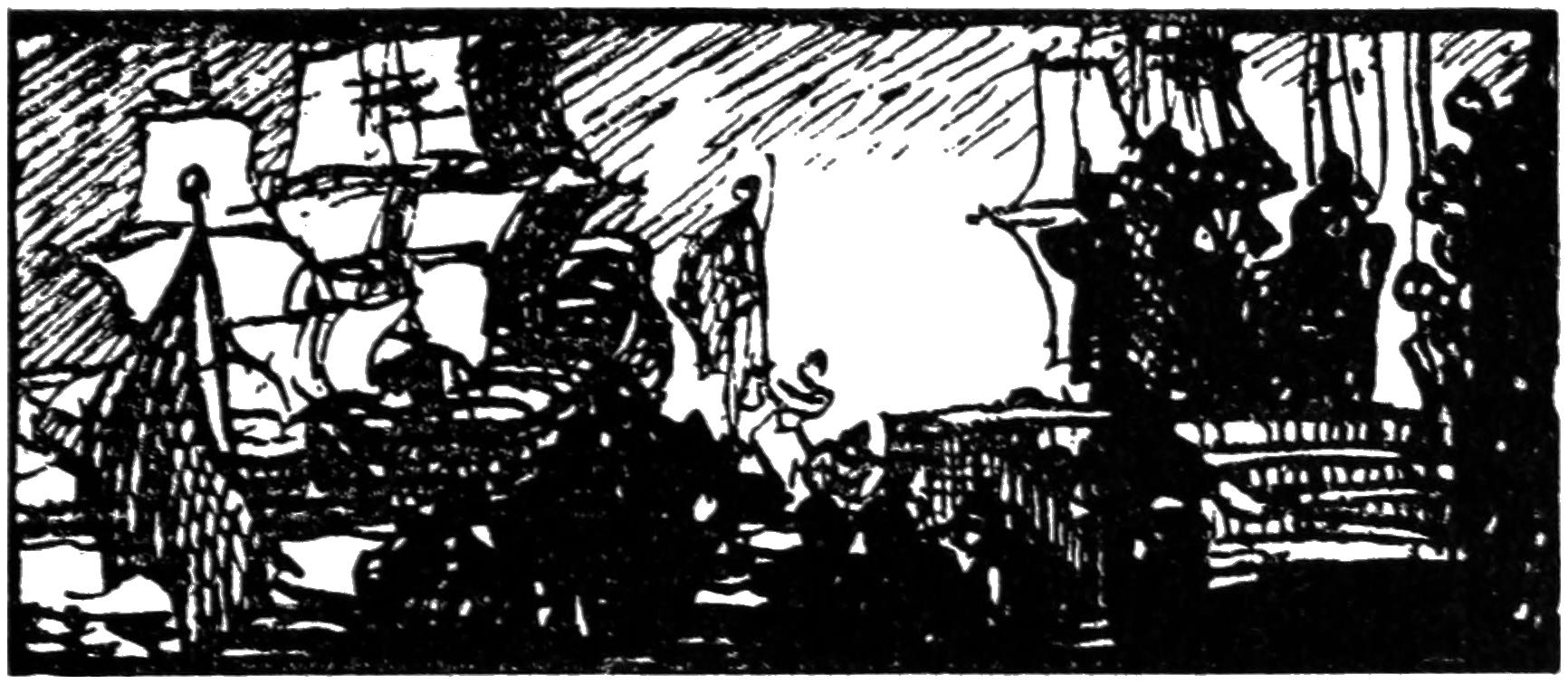
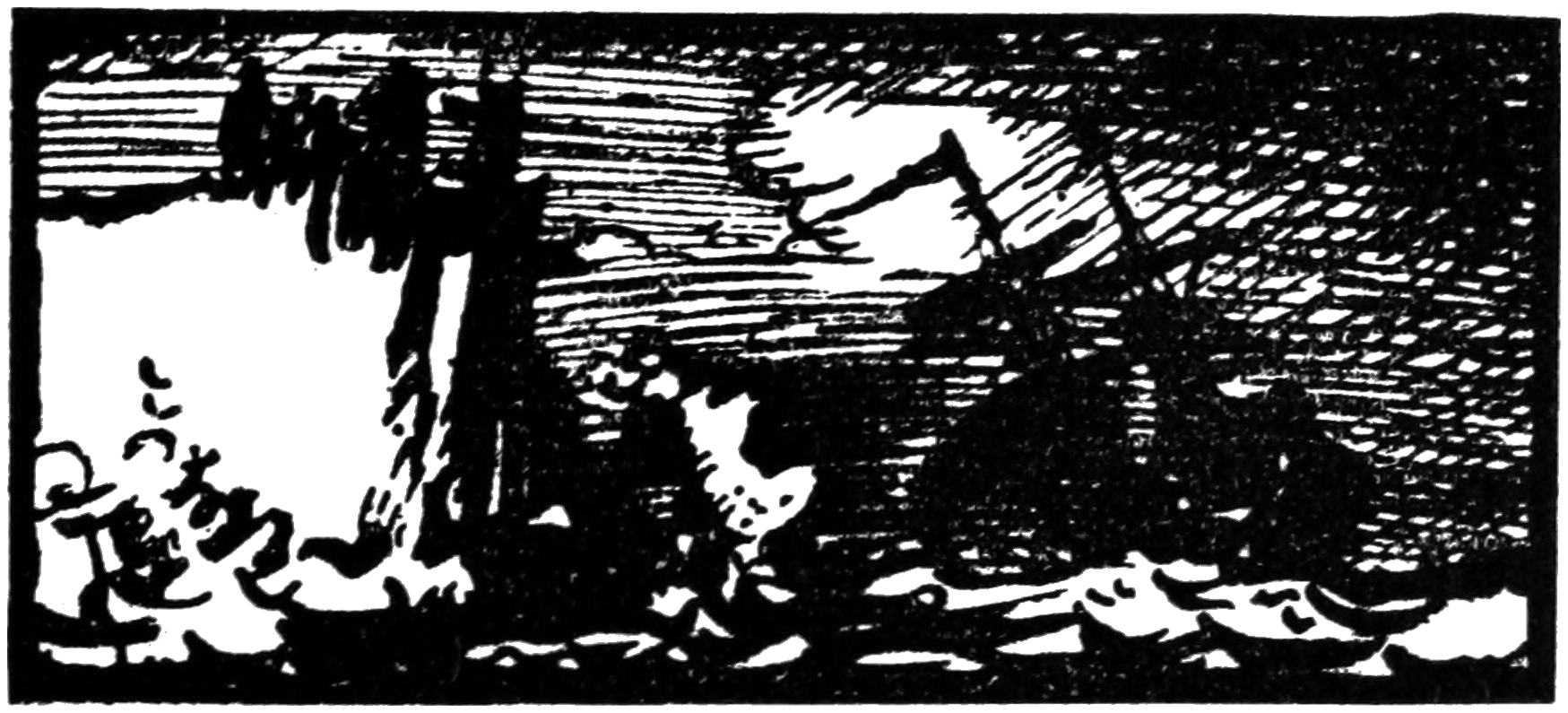
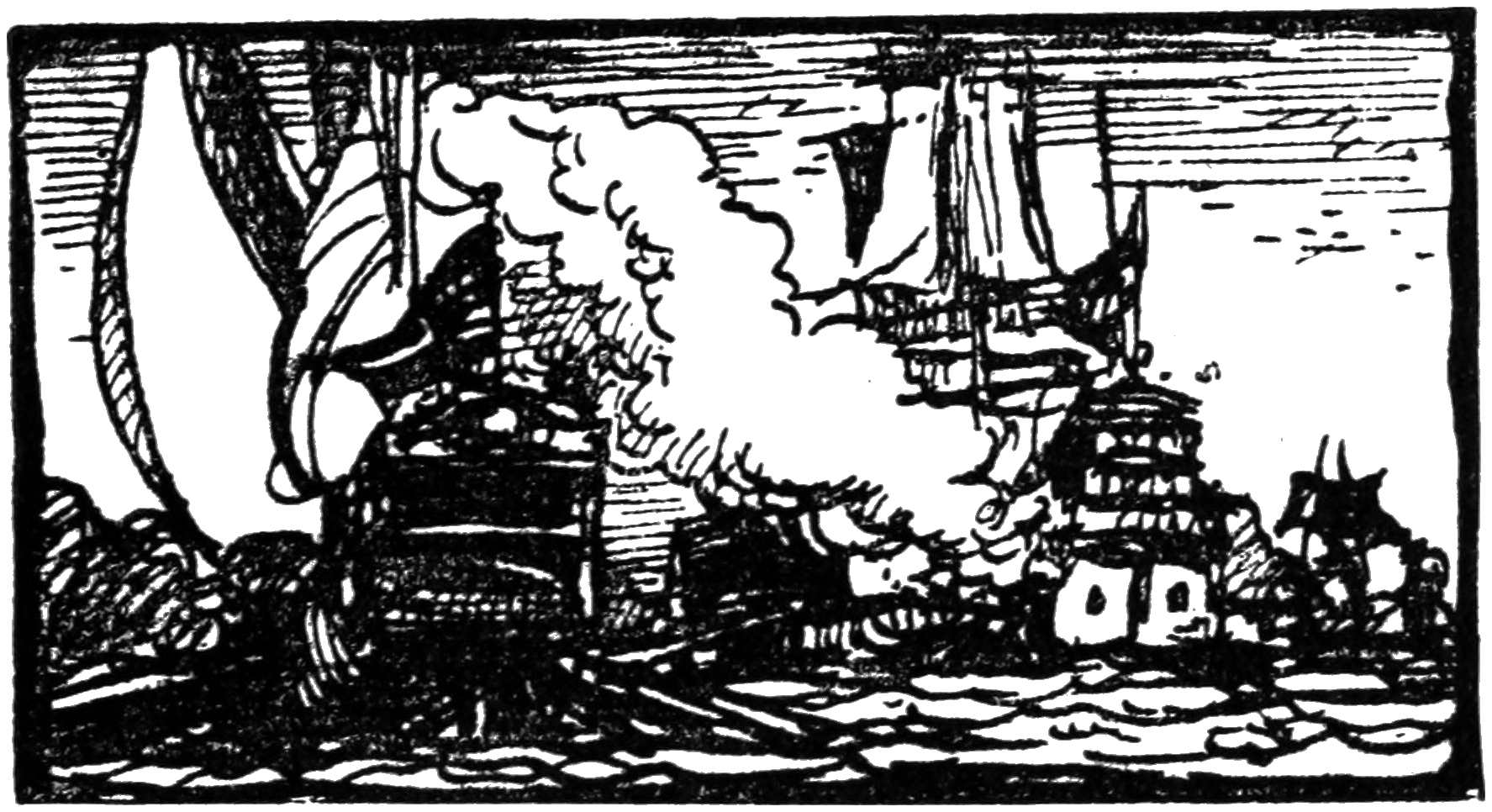
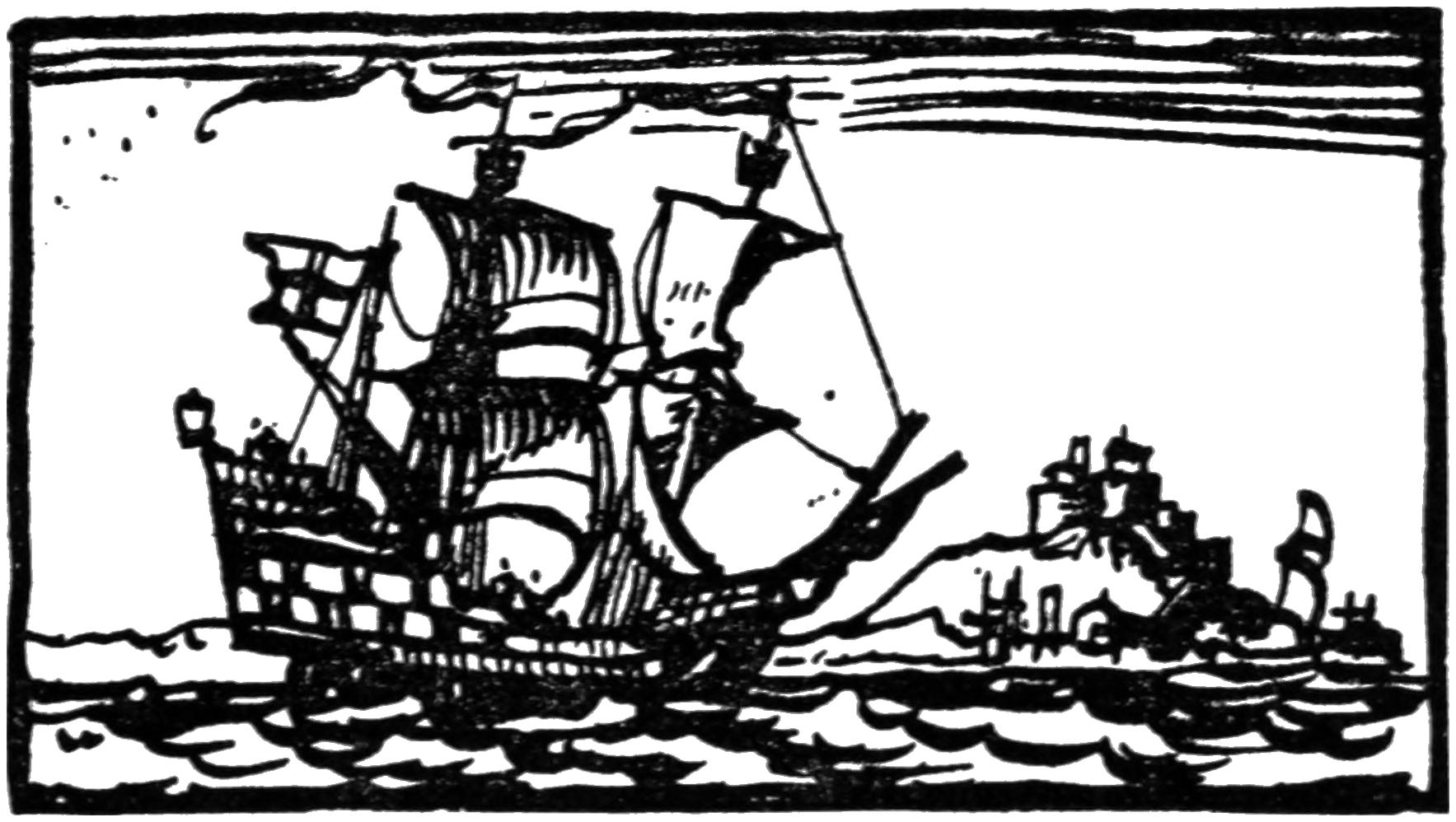
LOADING THE GALLEONS
to man such a ship, and a weak garrison to
resist so mighty an army. By those hundred
all was sustained, the volleys, boardings,
and enterings of fifteen ships of war, besides
those which beat her at large. On the contrary,
the Spanish were always supplied
with soldiers brought from every squadron:
all manner of arms and powder at will.
Unto ours there remained no comfort at
all, no hope, no supply either of ships, men,
or weapons; the masts all beaten overboard,
all her tackle cut asunder, her upper
work altogether razed, and in effect evened
she was with the water, but the very foundation
or bottom of a ship, nothing being
left overhead either for flight or defence.
Sir Richard finding himself in this distress,
and unable any longer to make resistance,
having endured in this fifteen hours’ fight,
the assault of fifteen several armadas, all
by turns aboard him, and by estimation
eight hundred shot of great artillery, besides
many assaults and entries. And that
himself and the ship must needs be possessed
by the enemy, who were now all
cast in a ring round about him; the Revenge
not able to move one way or other,
but as she was moved with the waves and
billow of the sea: commanded the master
Gunner, whom he knew to be a most resolute
man, to split and sink the ship; that
thereby nothing might remain of glory or
victory to the Spaniards: seeing in so many
hours’ fight, and with so great a Navy they
were not able to take her, having had fifteen
hours’ time, fifteen thousand men, and
fifty and three sail of men-of-war to perform
it withal. And persuaded the company,
or as many as he could induce, to
yield themselves unto God, and to the
mercy of none else; but as they had like
valiant resolute men, repulsed so many
enemies, they should not now shorten the
honour of their nation, by prolonging their
own lives for a few hours, or a few days.
The master Gunner readily condescended
and divers others; but the Captain and the
Master were of an other opinion, and besought
Sir Richard to have care of them,
alleging that the Spaniard would be as
ready to entertain a composition, as they
were willing to offer the same: and that
there being divers sufficient and valiant
men yet living, and whose wounds were
not mortal, they might do their country
and prince acceptable service hereafter.
And (that where Sir Richard had alleged
that the Spaniards should never glory to
have taken one ship of Her Majesty’s, seeing
that they had so long and so notably
defended themselves) they answered, that
the ship had six foot water in hold, three
shot under water which were so weakly
stopped, as with the first working of the
sea, she must needs sink, and was besides
so crushed and bruised, as she could never
be removed out of the place.
And as the matter was thus in dispute, and
Sir Richard refusing to hearken to any of
those reasons: the master of the Revenge
(while the Captain won unto him the greater
party) was convoyed aboard the General
Don Alfonso Bassan. Who, finding none
over-hasty to enter the Revenge again,
doubting lest Sir Richard would have
blown them up and himself, and perceiving
by the report of the master of the Revenge
his dangerous disposition: yielded
that all their lives should be saved, the
company sent for England, and the better
sort to pay such reasonable ransom as their
estate would bear, and in the mean season
to be free from galley or imprisonment.
To this he so much the rather condescended
as well as I have said, for fear of further
loss and mischief to themselves, as also for
the desire he had to recover Sir Richard
Grenville; whom for his notable valour he
seemed greatly to honour and admire.
When this answer was returned, and that
safety of life was promised, the common
sort being now at the end of their peril,
the most drew back from Sir Richard and
the master Gunner, being no hard matter
to dissuade men from death to life. The
master Gunner finding himself and Sir
Richard thus prevented and mastered by
the greater number, would have slain himself
with a sword, had he not been by force
withheld and locked into his cabin. Then
the General sent many boats aboard the
Revenge, and divers of our men, fearing Sir
Richard’s disposition, stole away aboard
the General and other ships. Sir Richard
thus overmatched, was sent unto by Alfonso
Bassan to remove out of the Revenge, the
ship being marvellous unsavoury, filled
with blood and bodies of dead and wounded
men like a slaughter-house. Sir Richard
answered that he might do with his body
what he list, for he esteemed it not, and
as he was carried out of the ship he swooned,
and reviving again desired the company to
pray for him. The General used Sir Richard
with all humanity, and left nothing unattempted
that tended to his recovery, highly
commending his valour and worthiness,
and greatly bewailed the danger wherein
he was, being unto them a rare spectacle,
and a resolution seldom approved, to see
one ship turn toward so many enemies,
to endure the charge and boarding of so
many huge armadas, and to resist and repel
the assaults and entries of so many soldiers.
All which and more, is confirmed by a
Spanish captain of the same armada, and
a present actor in the fight, who being
severed from the rest in a storm, was by
the Lyon of London a small ship, taken
and is now prisoner in London.
The general commander of the Armada,
was Don Alfonso Bassan, brother to the
Marquesse of Santa Cruce. The Admiral
of the Biscaine squadron was Britan
Dona. Of the squadron of Seville, Marques
of Arumburch. The Hulkes and Flyboats
were commanded by Luis Cutino. There
were slain and drowned in this fight, well
near two thousand of the enemies, and
two especial commanders Don Luis de
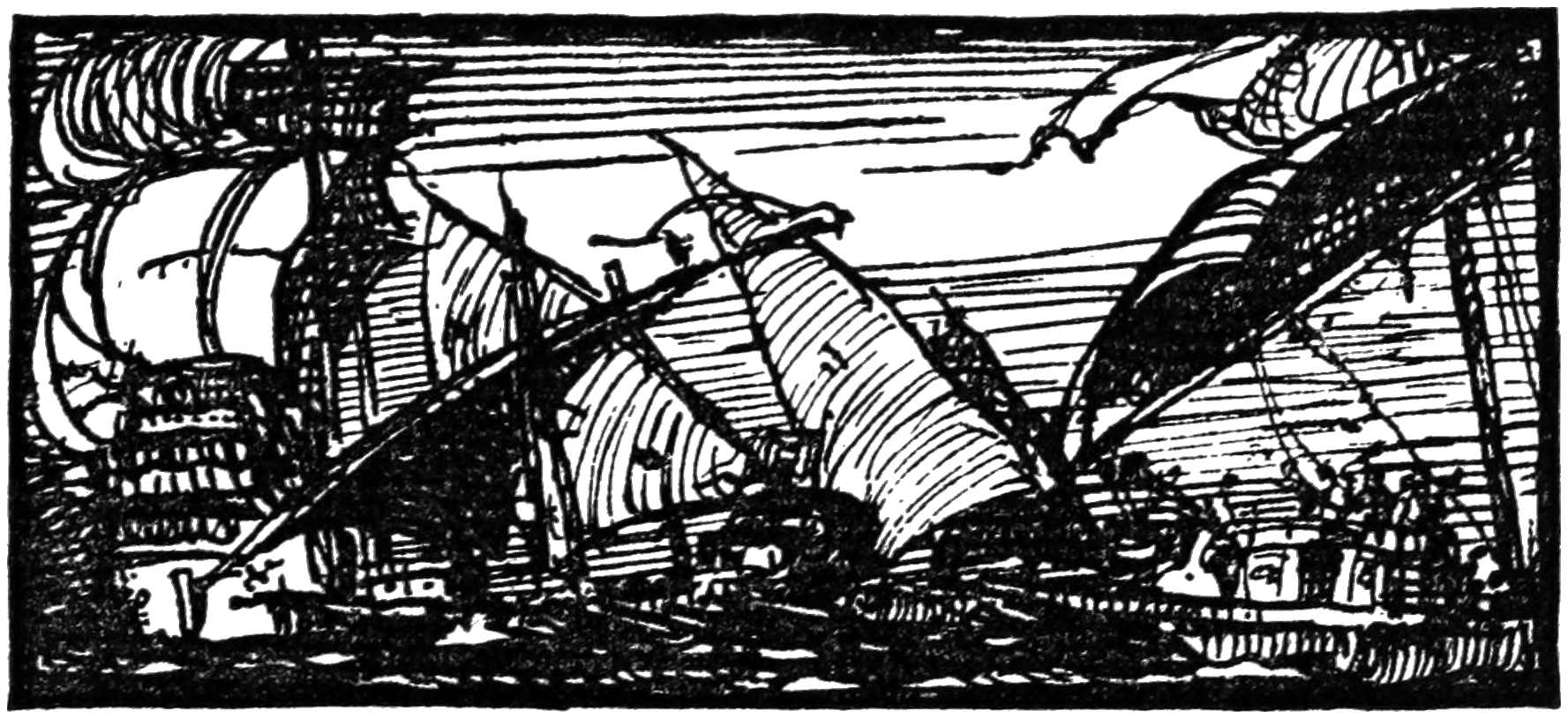
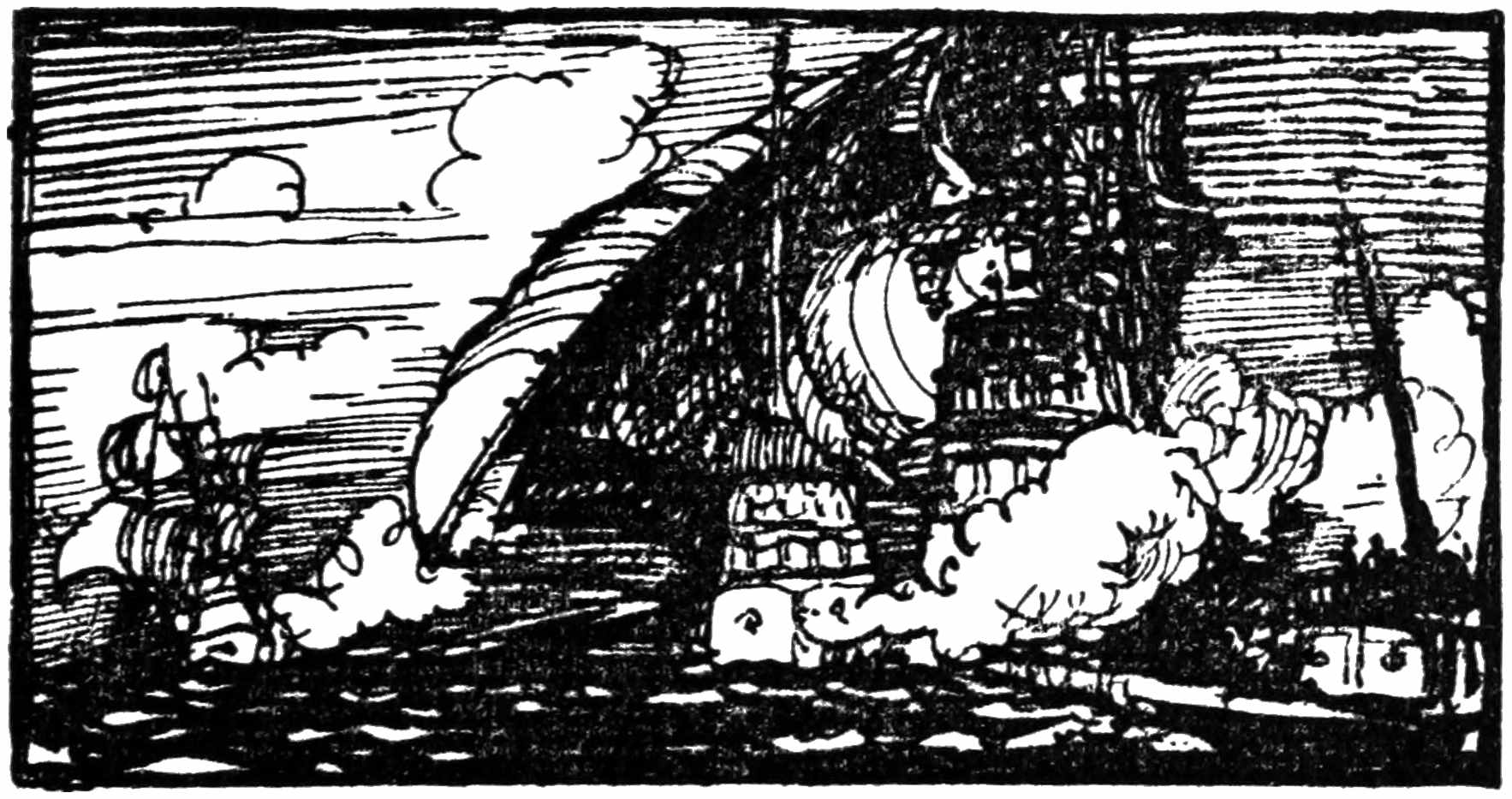
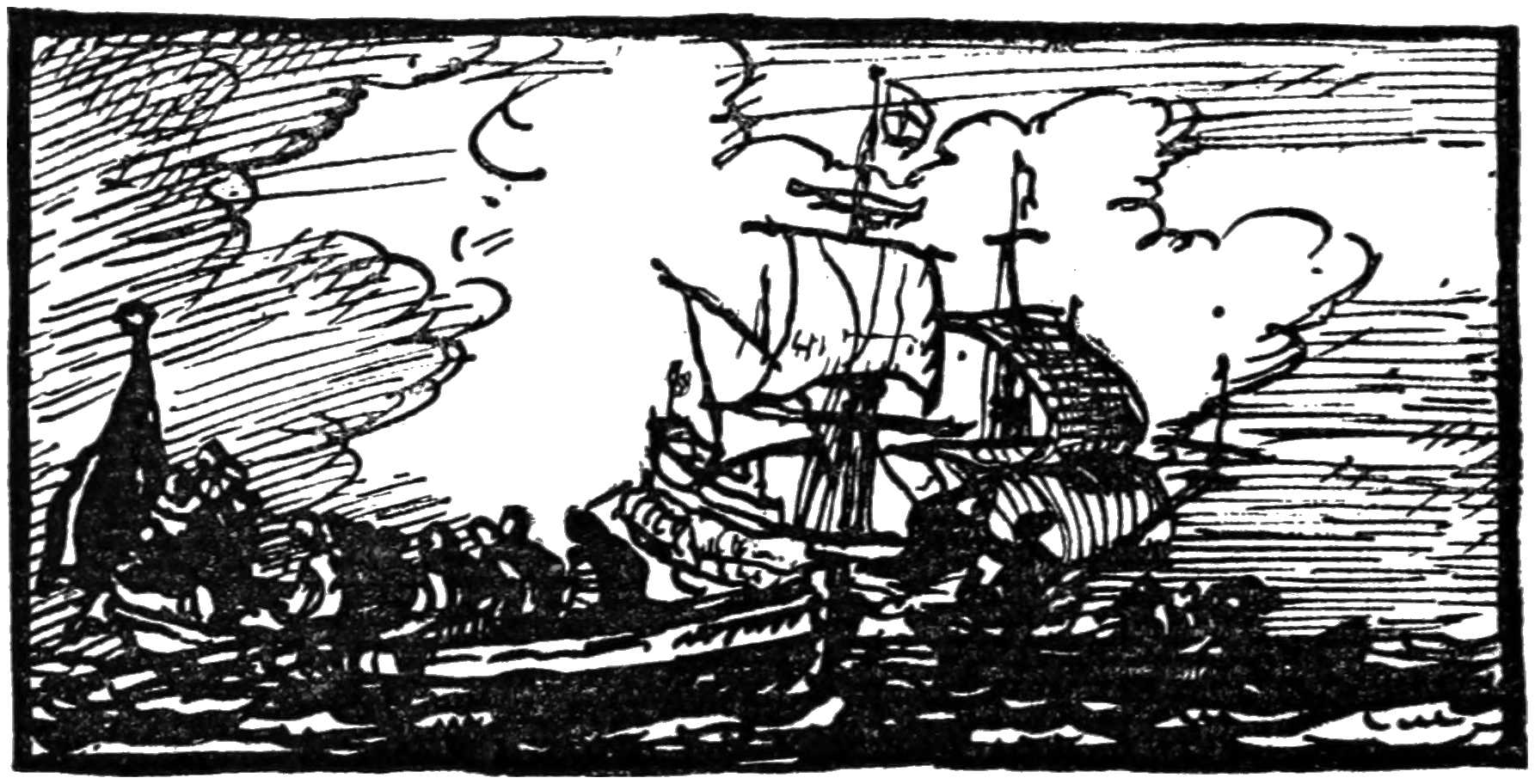
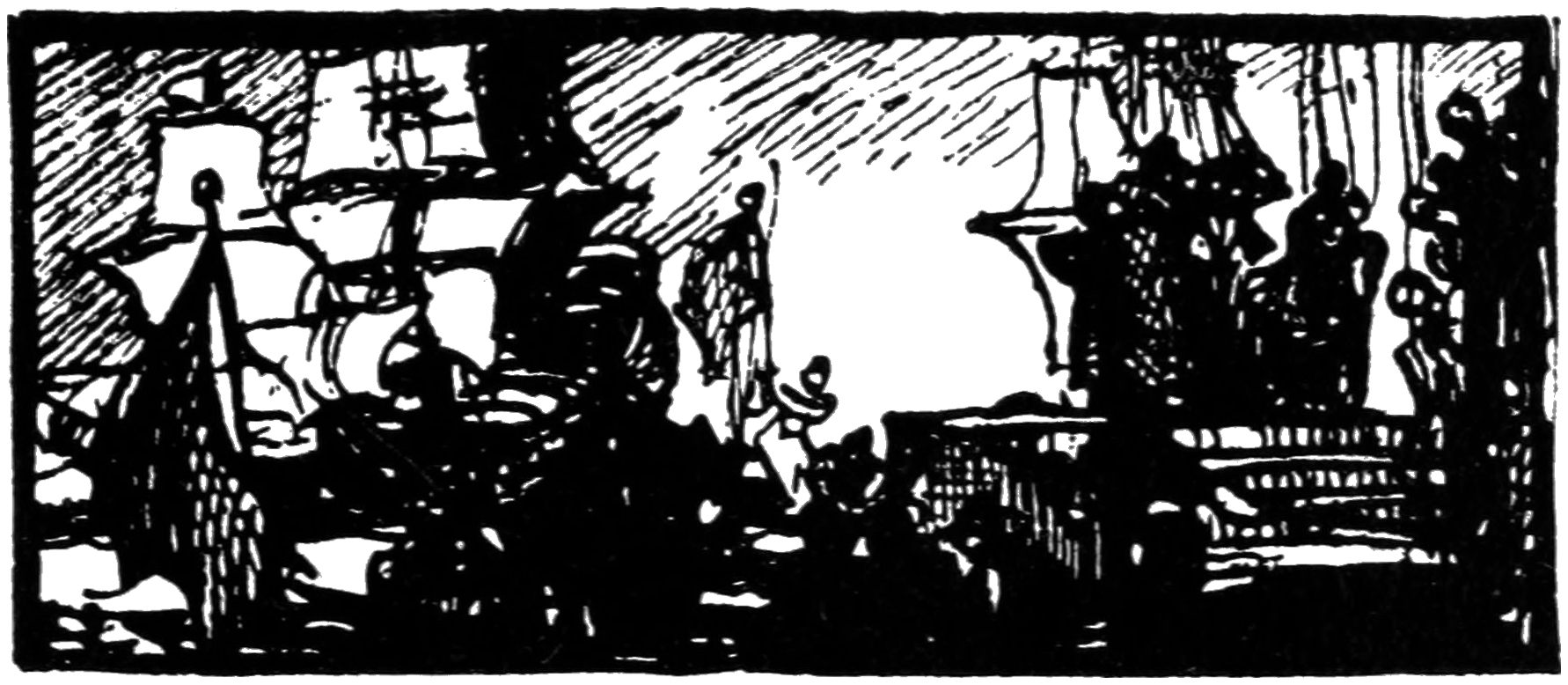
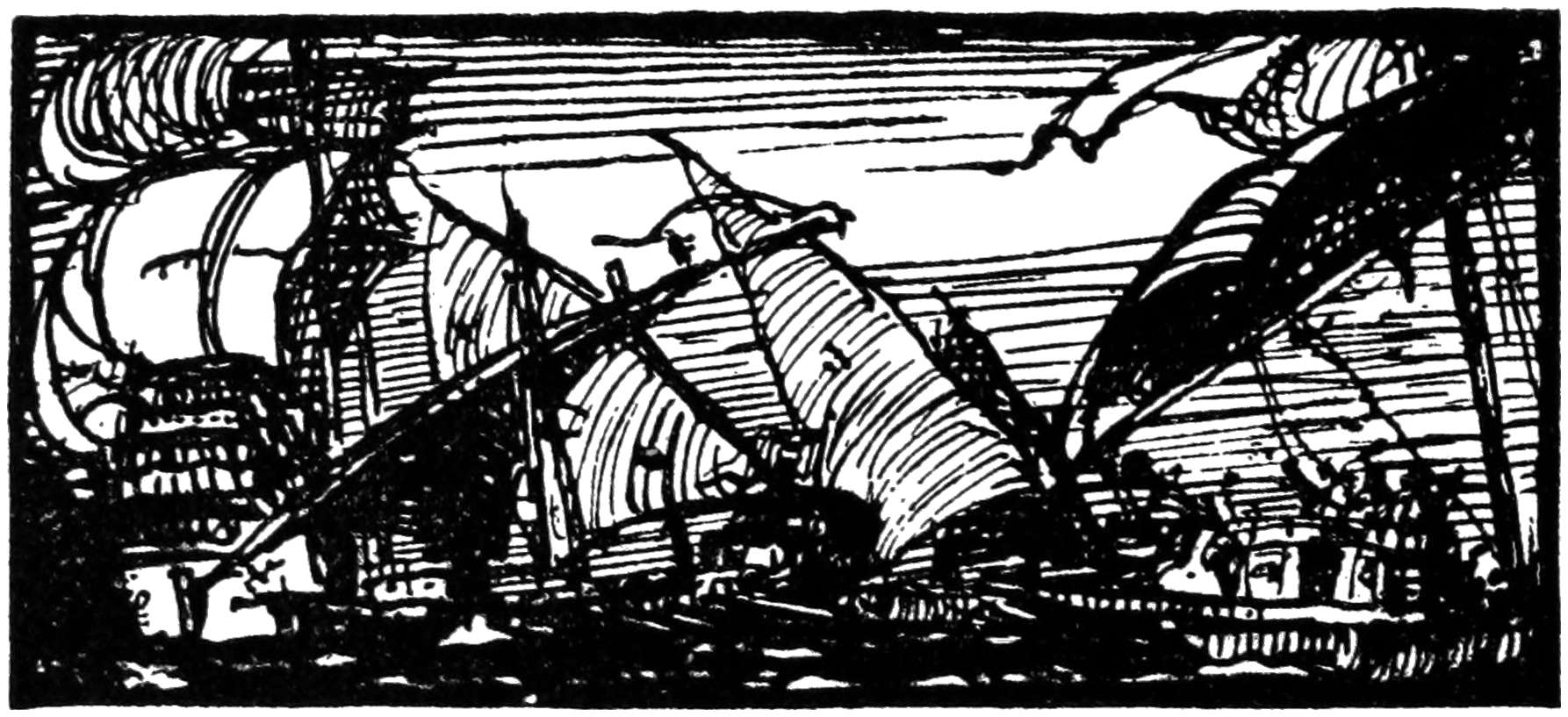
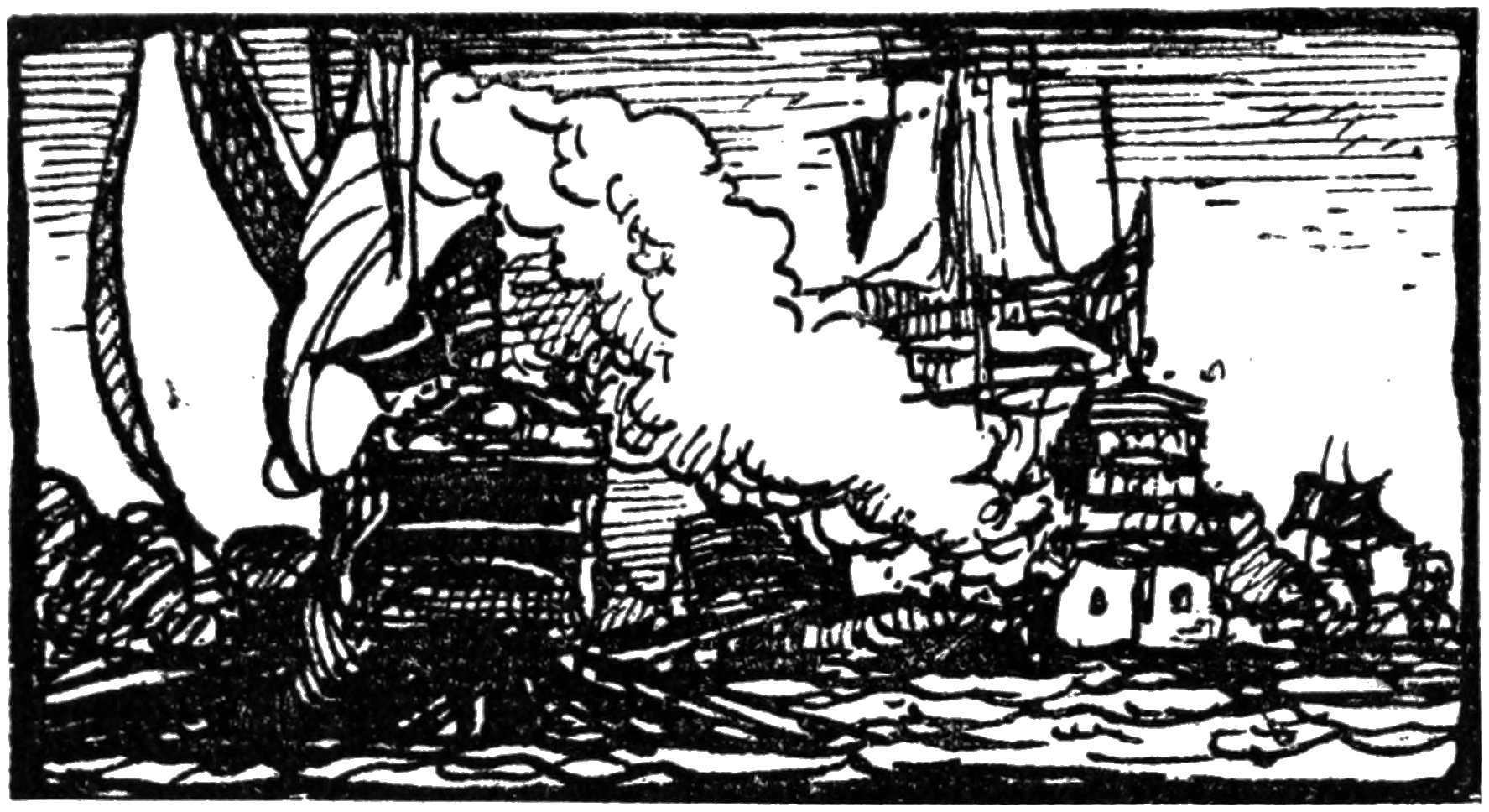
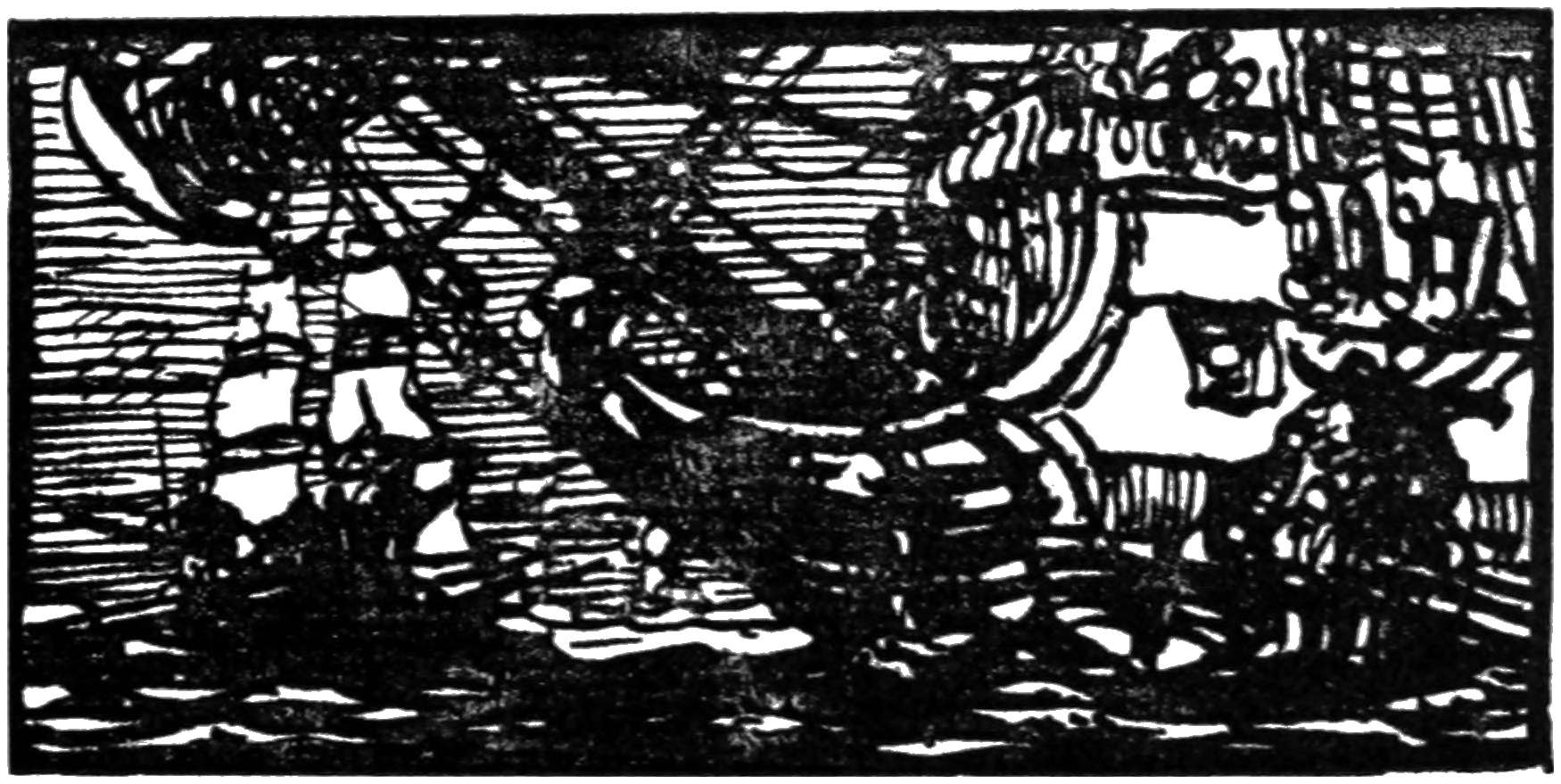
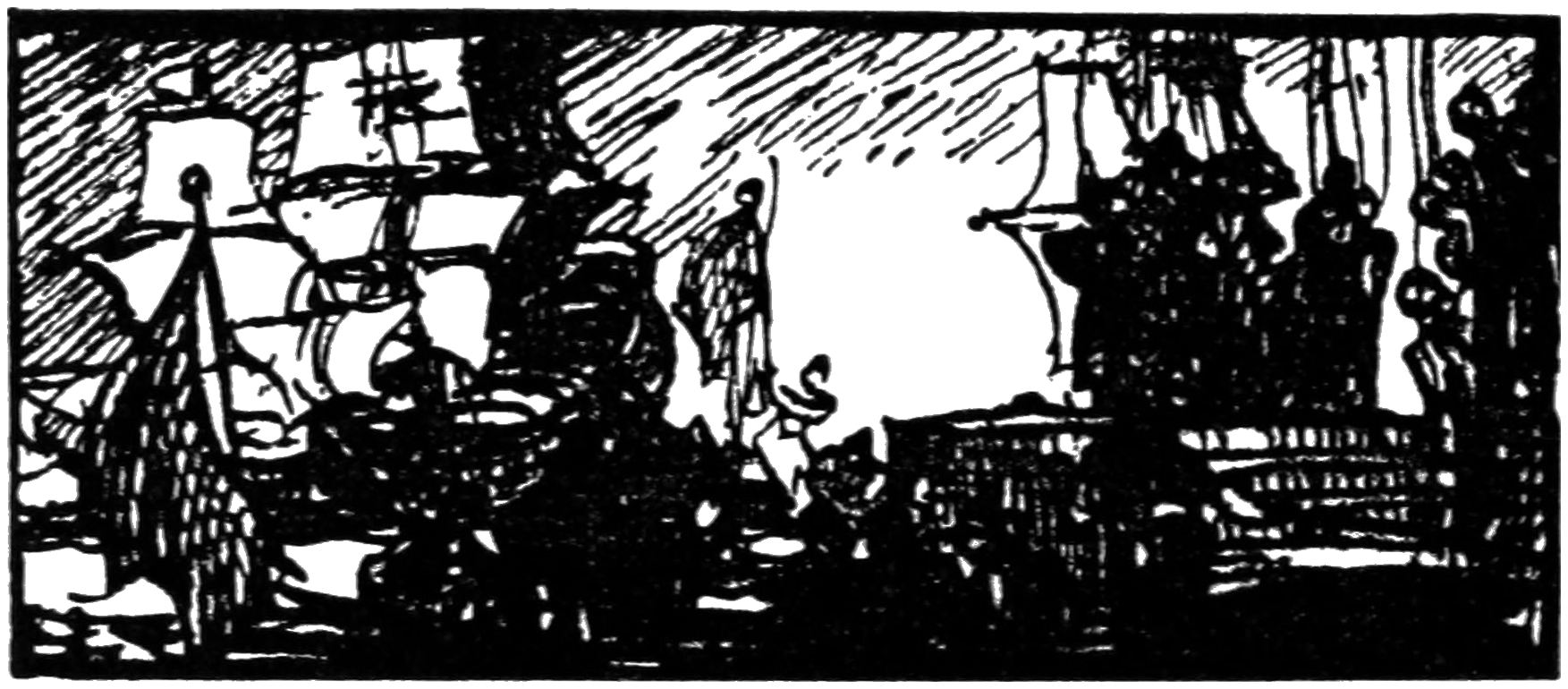
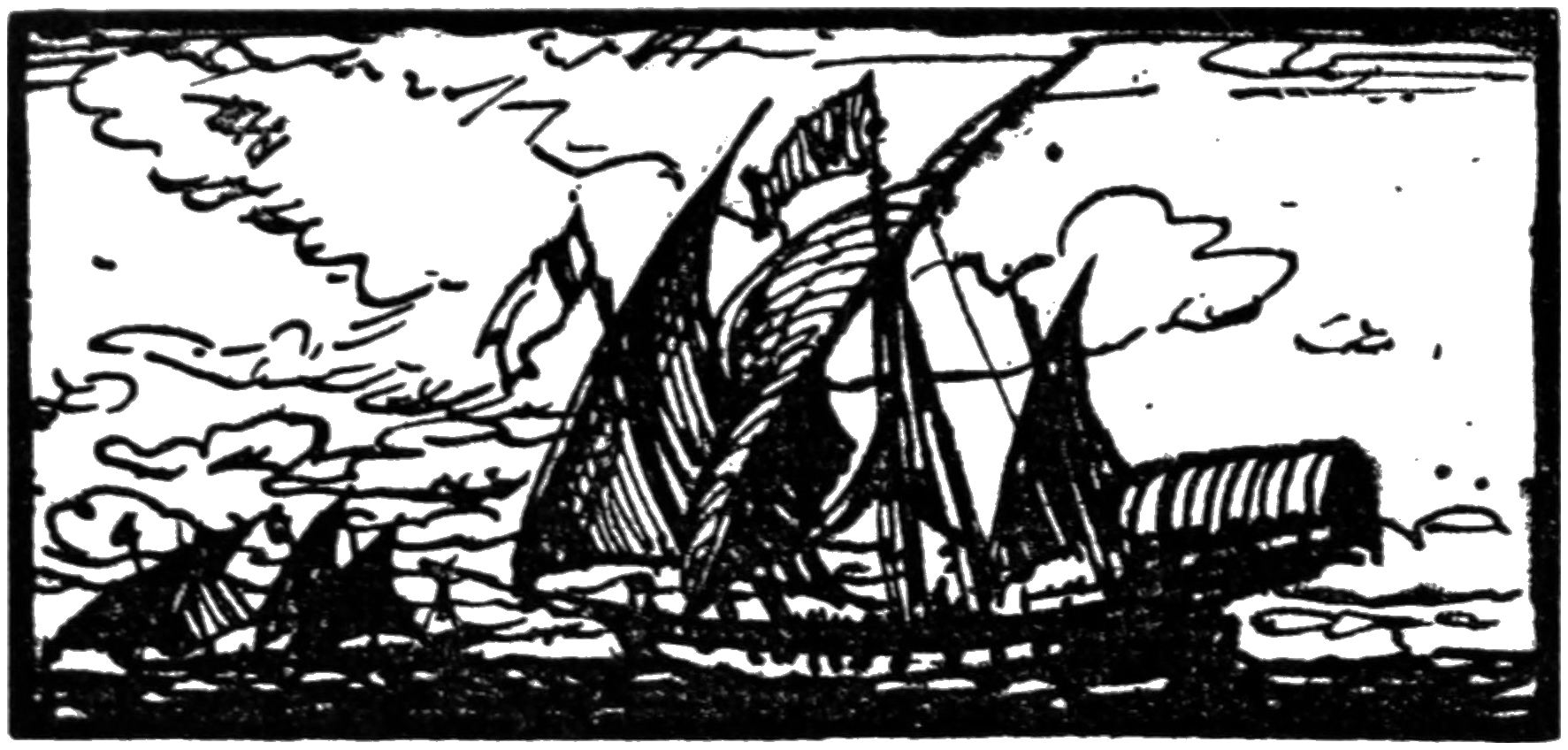
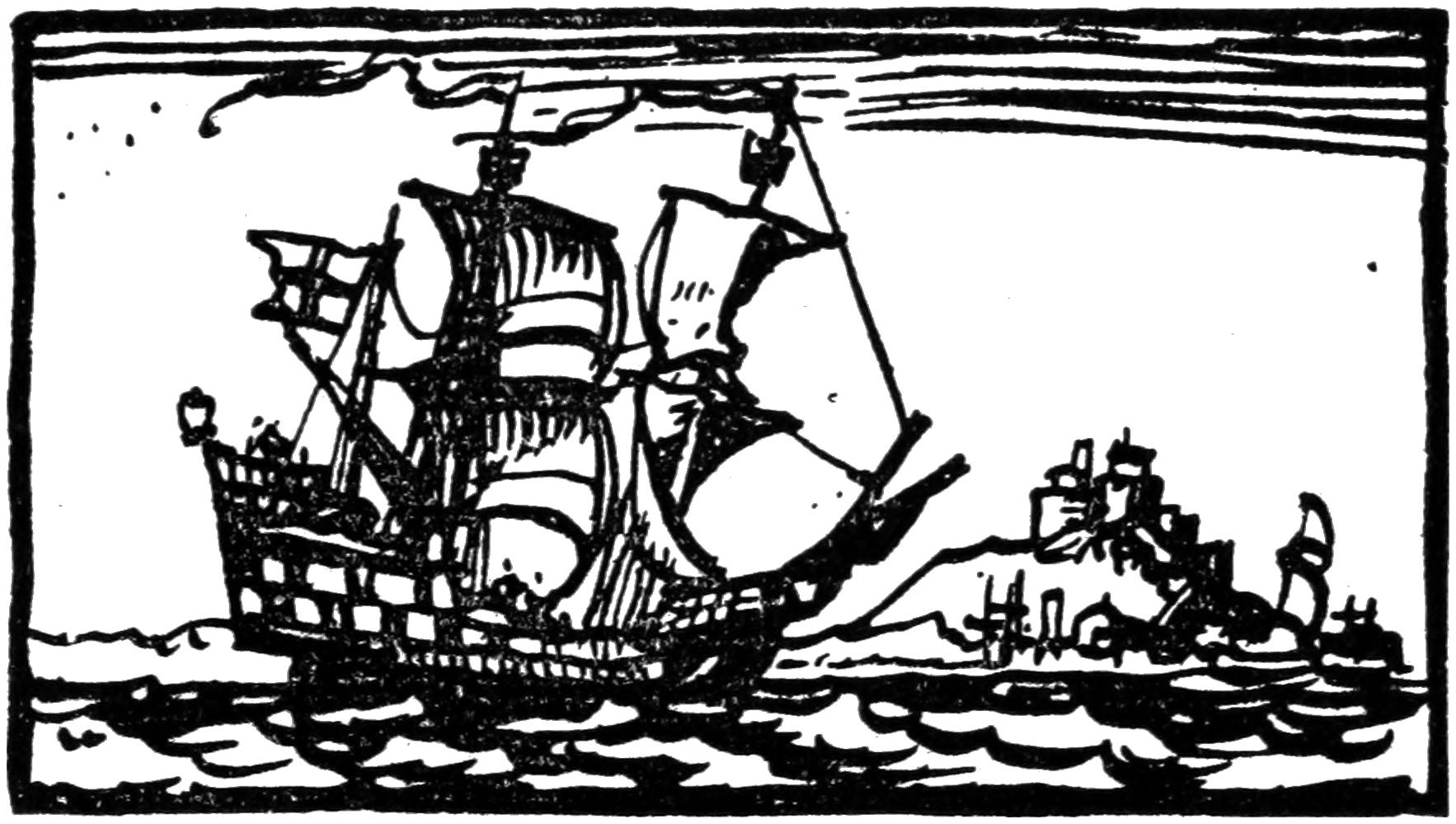
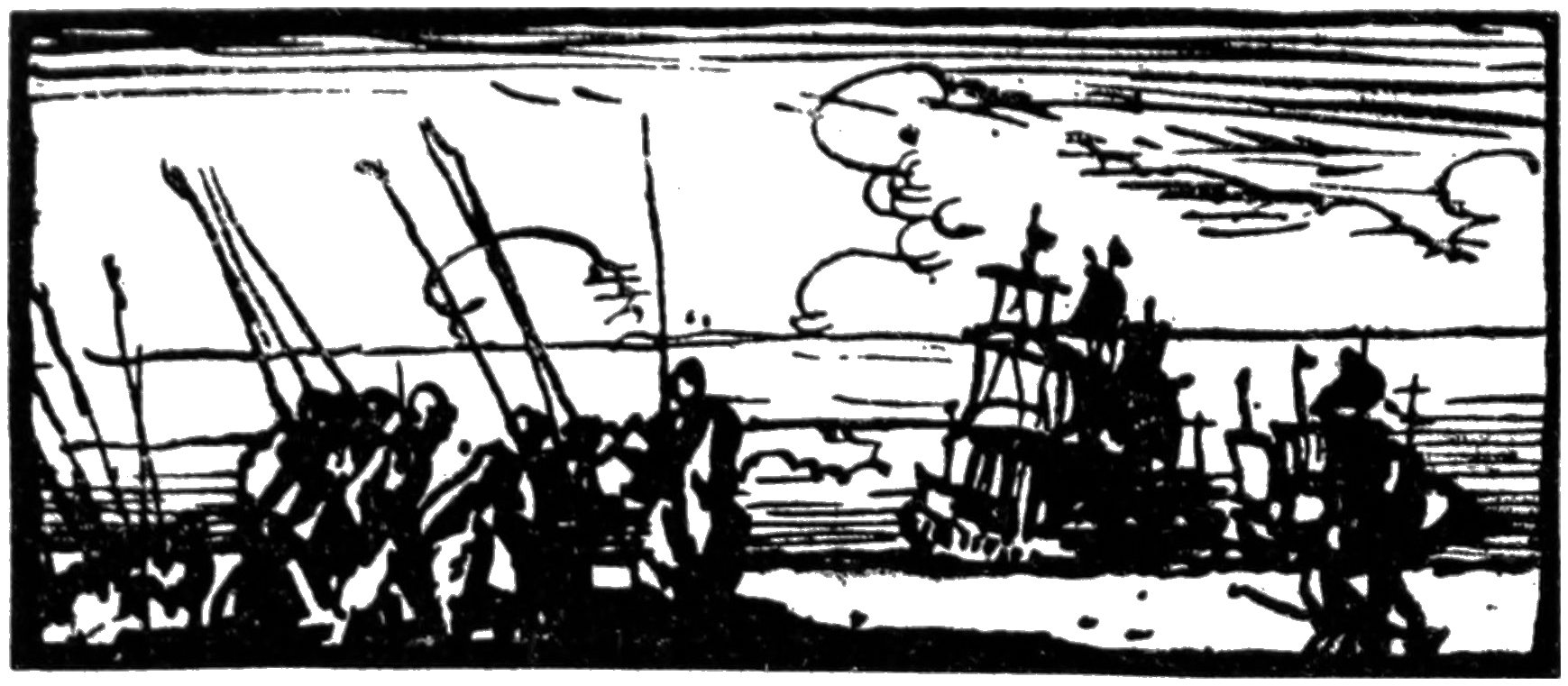
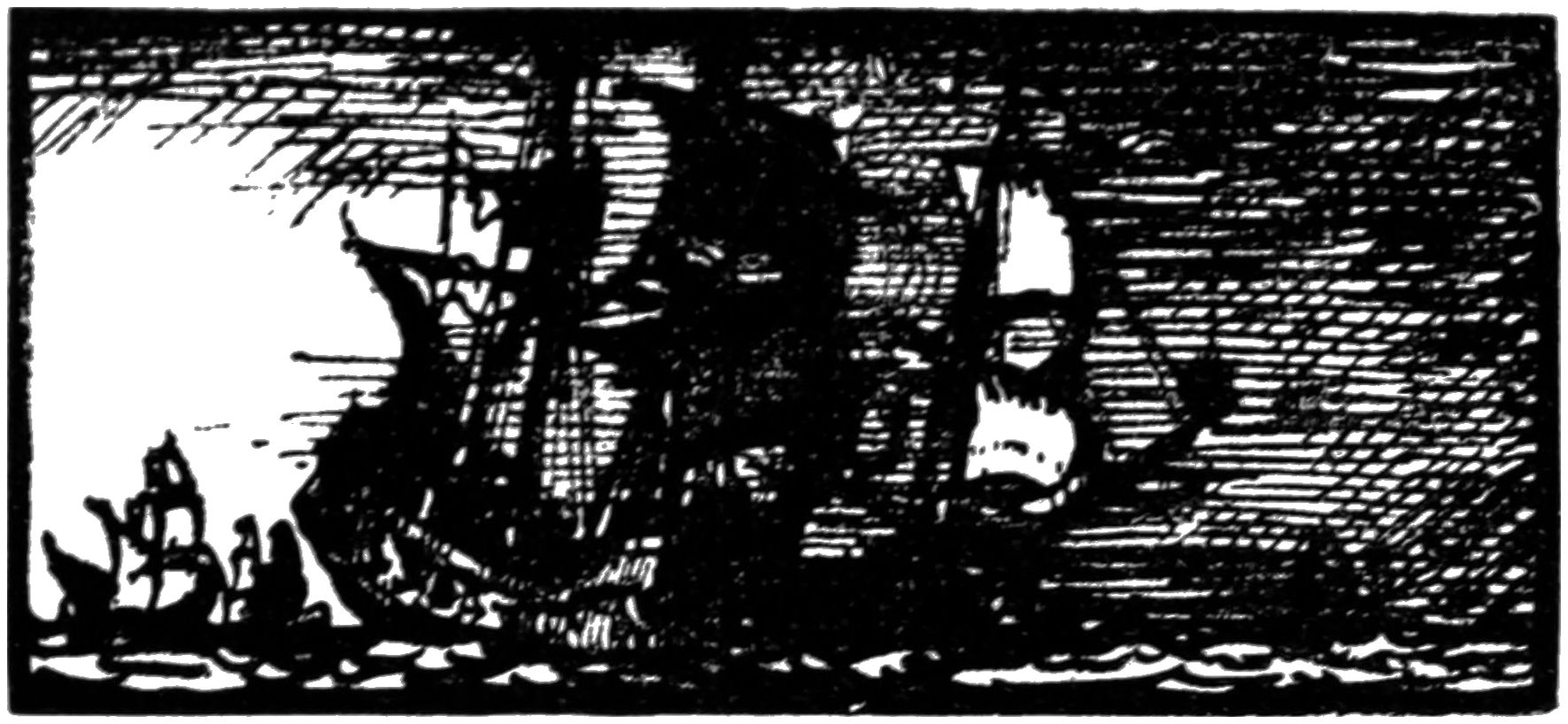
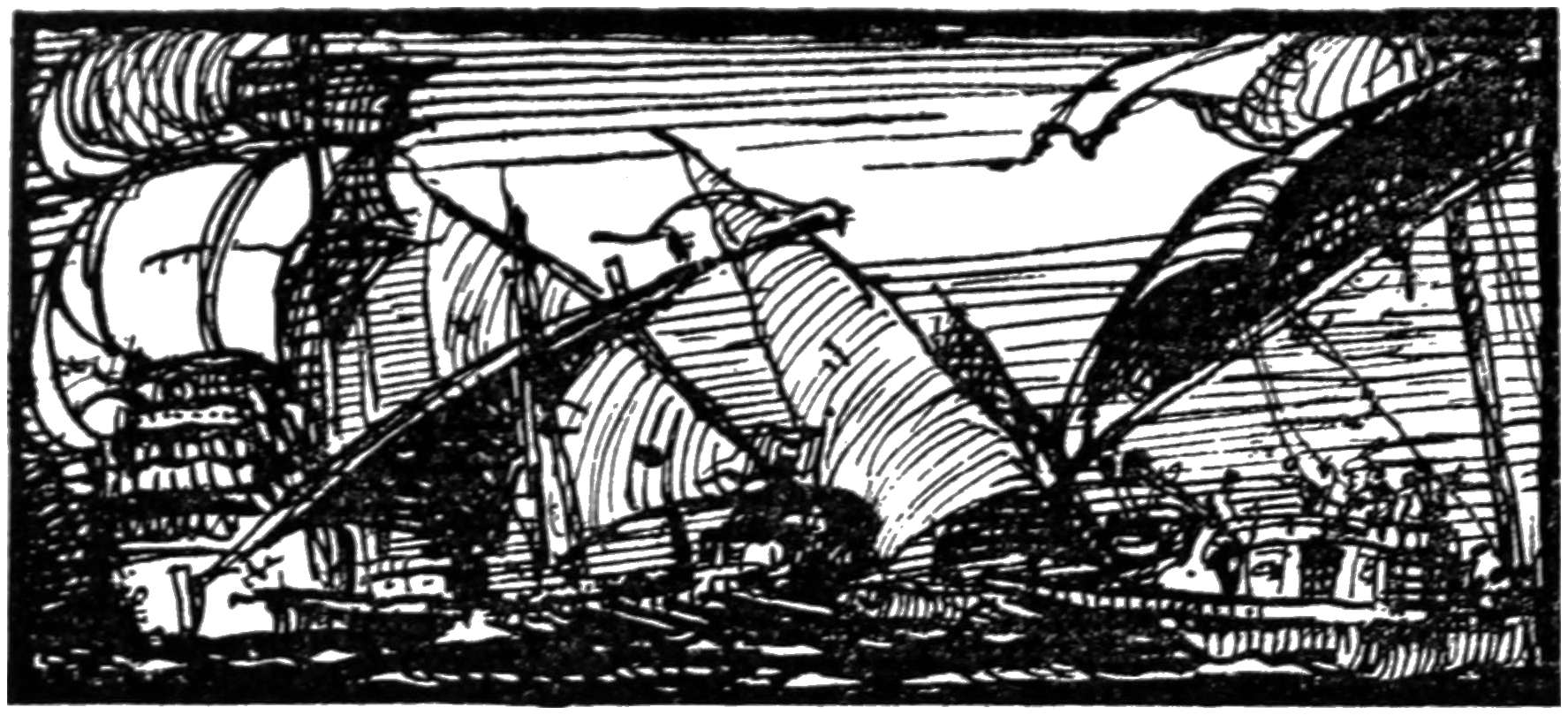
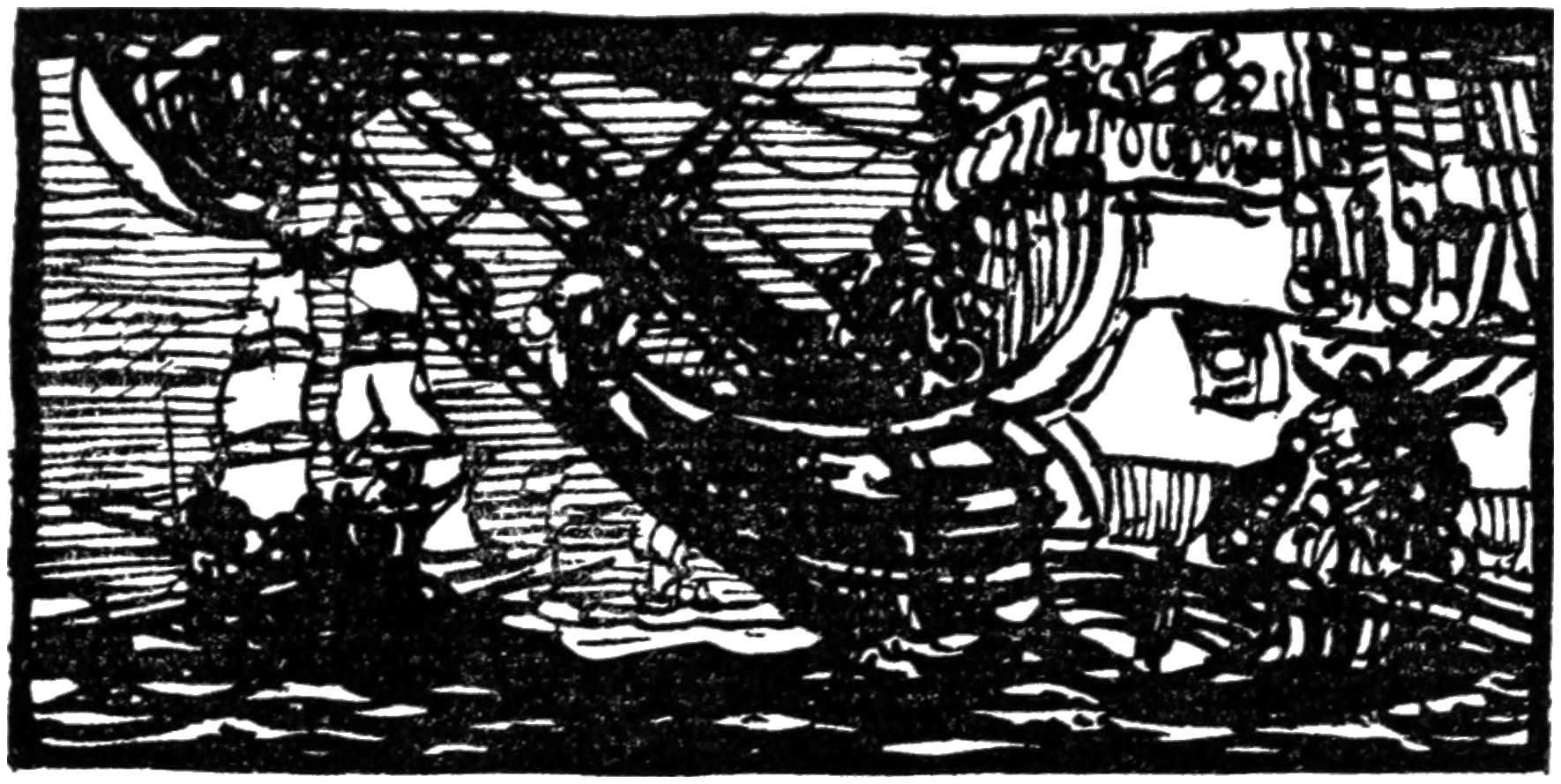
THE GALLEON FAIR
St John, and Don George de Prunaria
de Malaga, as the Spanish Captain confesseth,
besides divers others of special
account, whereof as yet report is not
made.
The Admiral of the Hulks and the Ascension
of Seville, were both sunk by the
side of the Revenge; one other recovered
the road of Saint Michael’s, and sunk also
there; a fourth ran herself with the shore
to save her men. Sir Richard died as it is
said, the second or third day aboard the
General, and was by them greatly bewailed.
What became of his body, whether
it were buried in the sea or on the land
we know not: the comfort that remaineth
to his friends is, that he hath ended his
life honourably in respect of the reputation
won to his nation and country, and of the
fame to his posterity, and that being dead,
he hath not outlived his own honour.
For the rest of Her Majesty’s ships that
entered not so far into the fight as the
Revenge, the reasons and causes were
these. There were of them but six in all,
whereof two but small ships; the Revenge
engaged past recovery: The Island of
Flores was on the one side, 53 sail of the
Spanish, divided into squadrons on the
other, all as full filled with soldiers as they
could contain. Almost the one half of our
men sick and not able to serve: the ships
grown foul, unrummaged, and scarcely
able to bear any sail for want of ballast,
having been six months at the sea before.
If all the rest had entered, all had been
lost. For the very hugeness of the Spanish
fleet, if no other violence had been offered,
would have crushed them between them
into shivers. Of which the dishonour and
loss to the Queen had been far greater
than the spoil or harm that the enemy
could any way have received. Notwithstanding
it is very true, that the Lord
Thomas would have entered between
the squadrons, but the rest would not
condescend; and the master of his
own ship offered to leap into the sea,
rather than to conduct that Her Majesty’s
ship and the rest to be a prey to the
enemy, where there was no hope nor
possibility either of defence or victory.
Which also in my opinion had ill sorted
or answered the discretion and trust of a
General, to commit himself and his charge
to an assured destruction, without hope
or any likelihood of prevailing: thereby
to diminish the strength of Her Majesty’s
Navy, and to enrich the pride and glory
of the enemy. The Foresight of the Queen,
commanded by Thomas Vavasour, performed
a very great fight, and stayed two
hours as near the Revenge as the weather
would permit him, not forsaking the fight,
till he was like to be encompassed by the
squadrons, and with great difficulty
cleared himself. The rest gave divers volleys
of shot, and entered as far as the place
permitted and their own necessities, to
keep the weather gauge of the enemy,
until they were parted by night.
A few days after the fight
was ended, and the English
prisoners dispersed into
the Spanish and India ships,
there arose so great a storm
from the west and north-west, that all
the fleet was dispersed, as well the Indian
fleet which were then come unto them
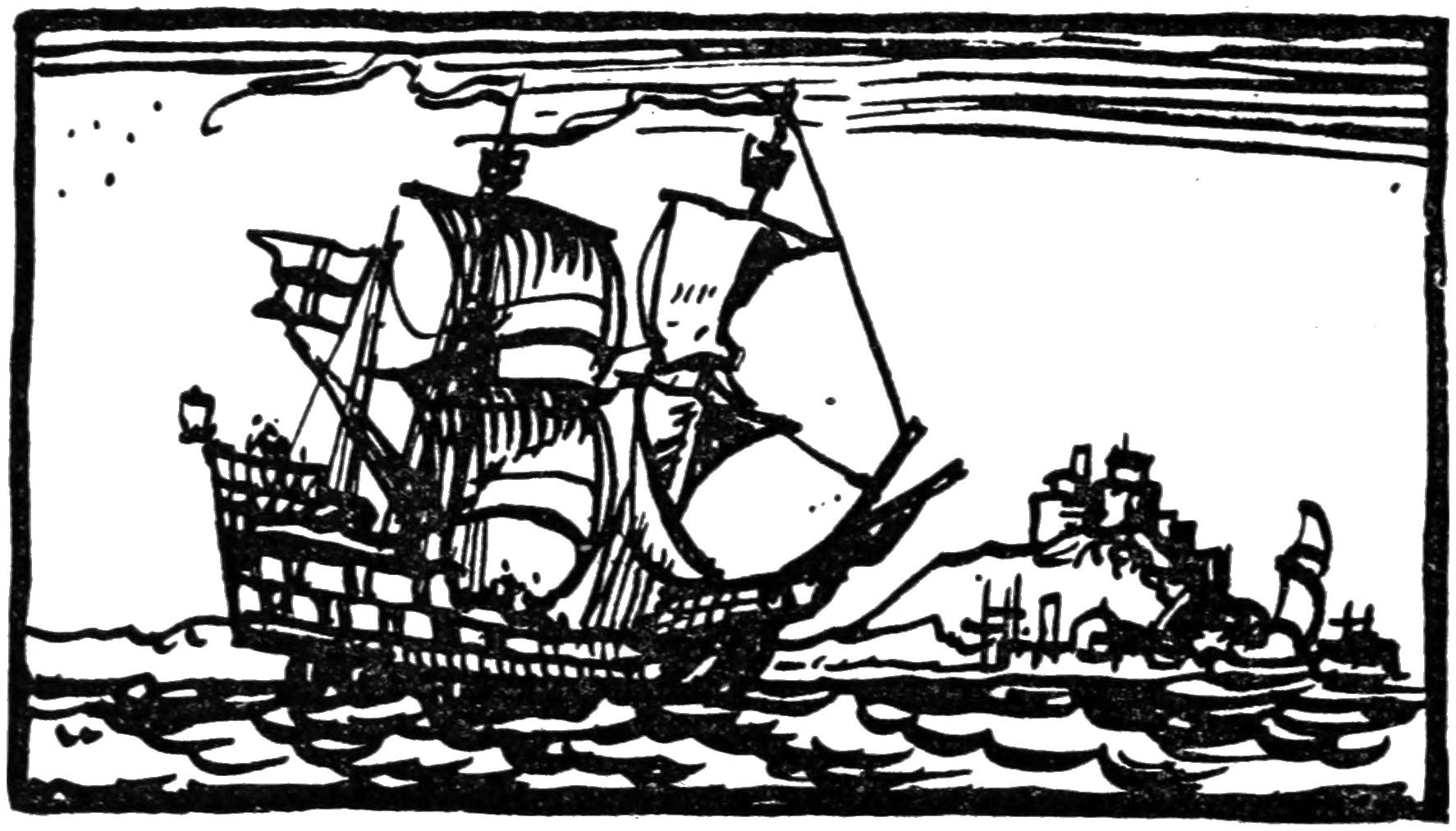
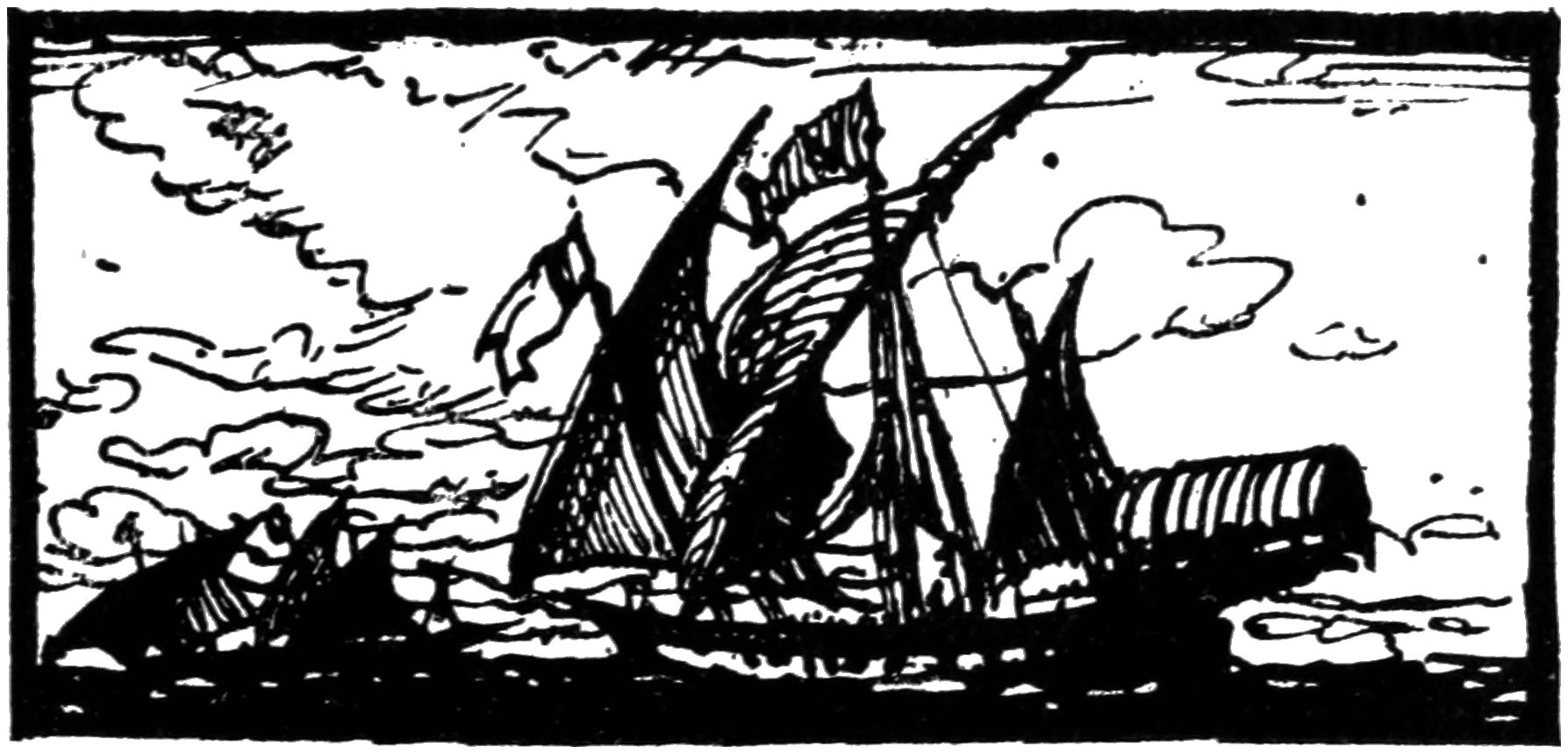
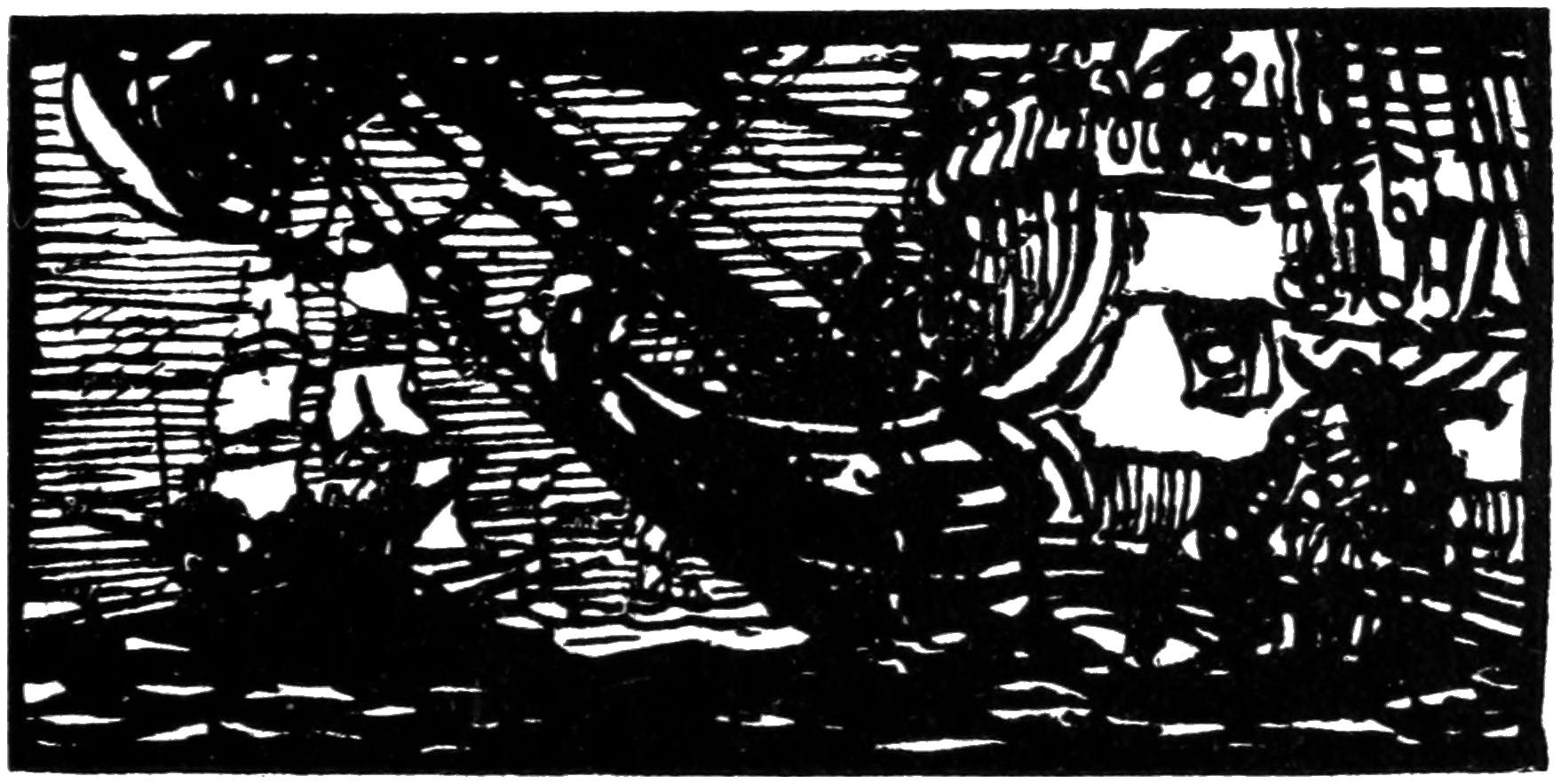
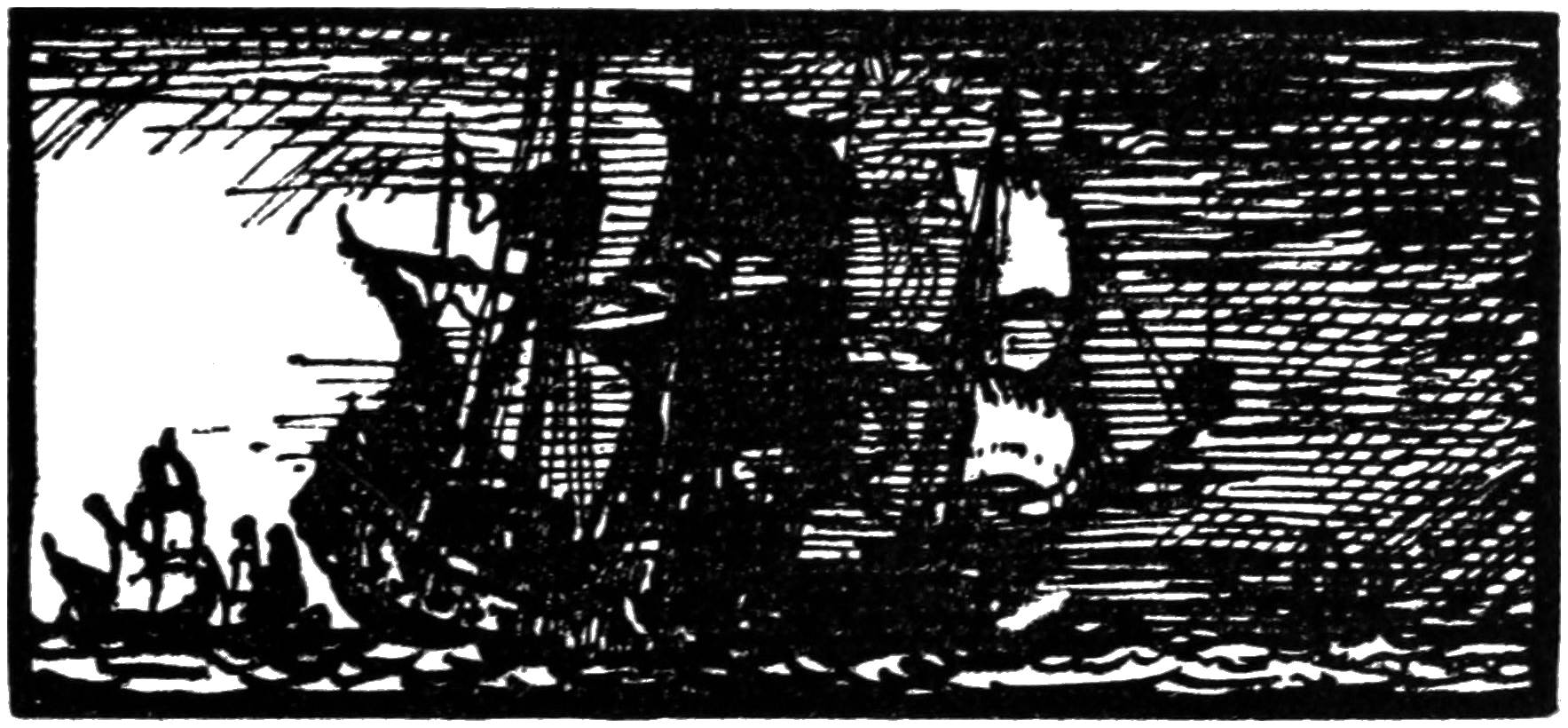
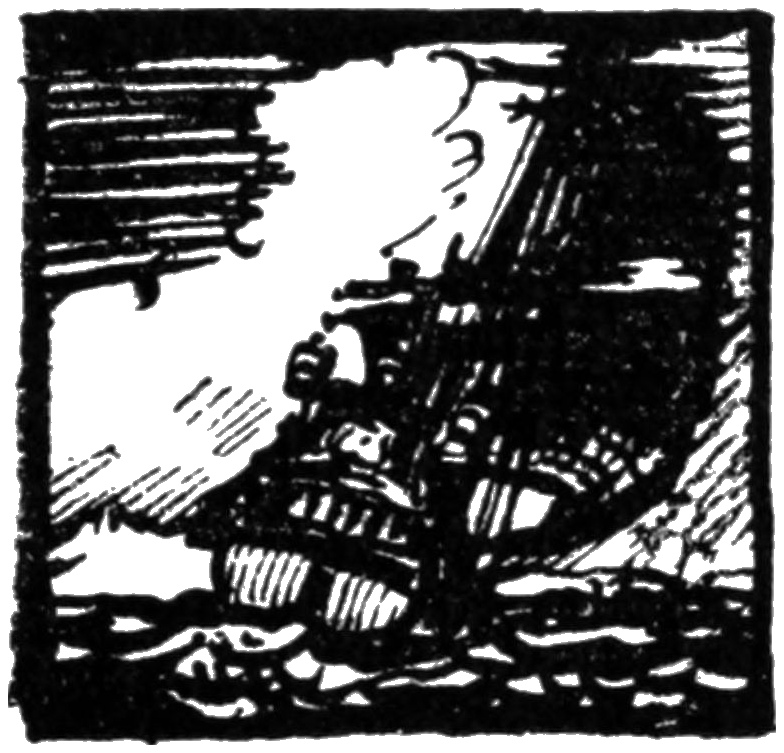
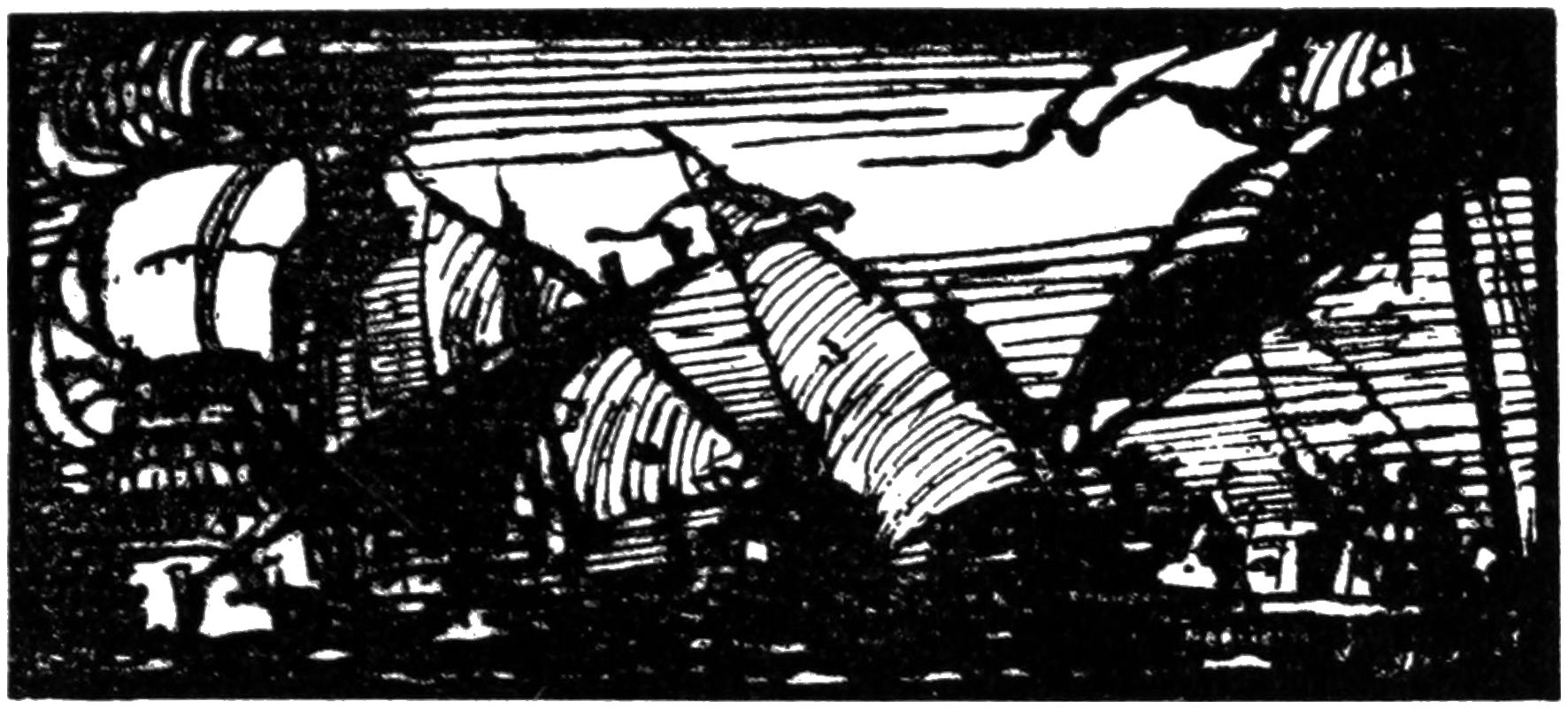
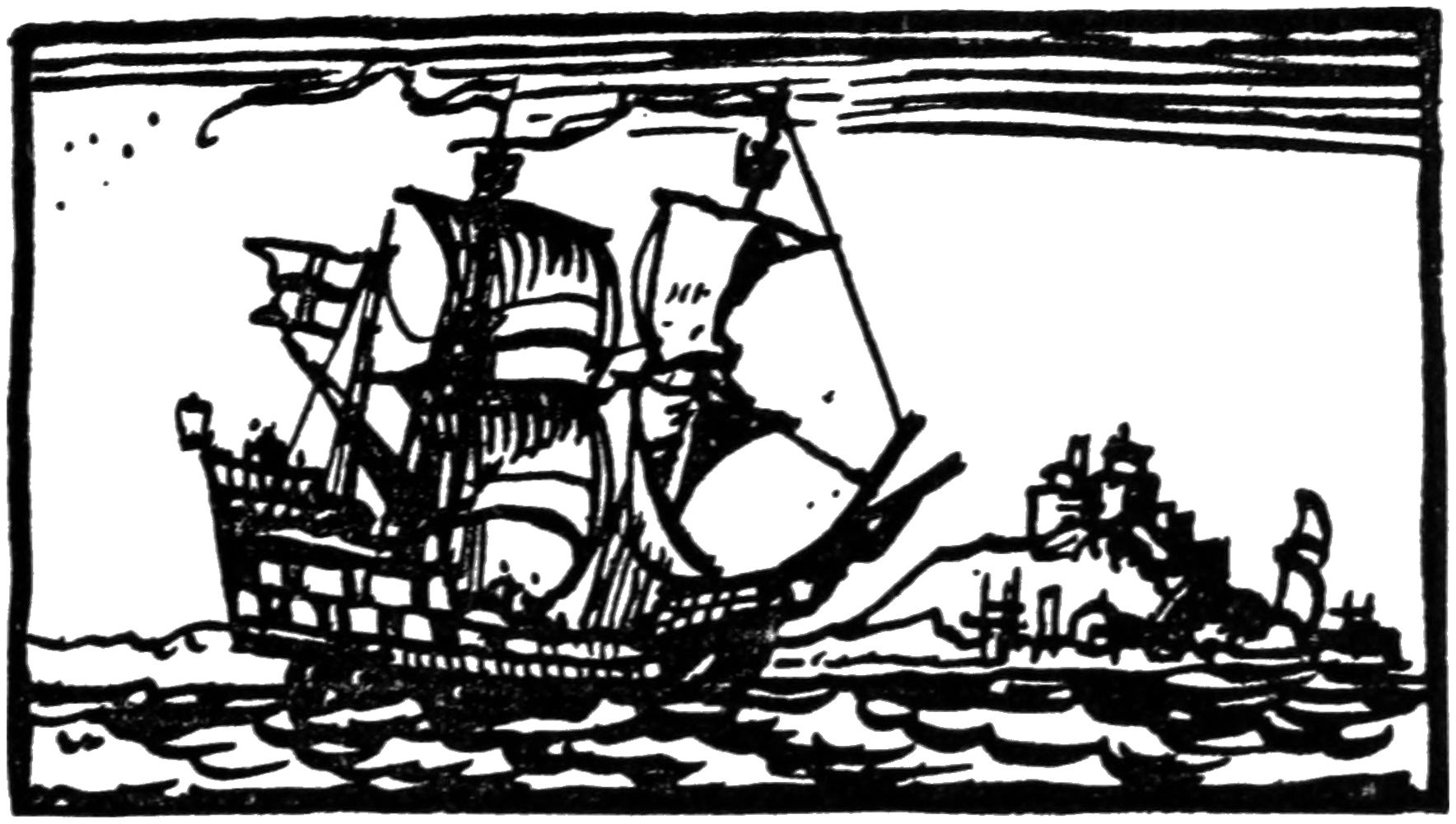
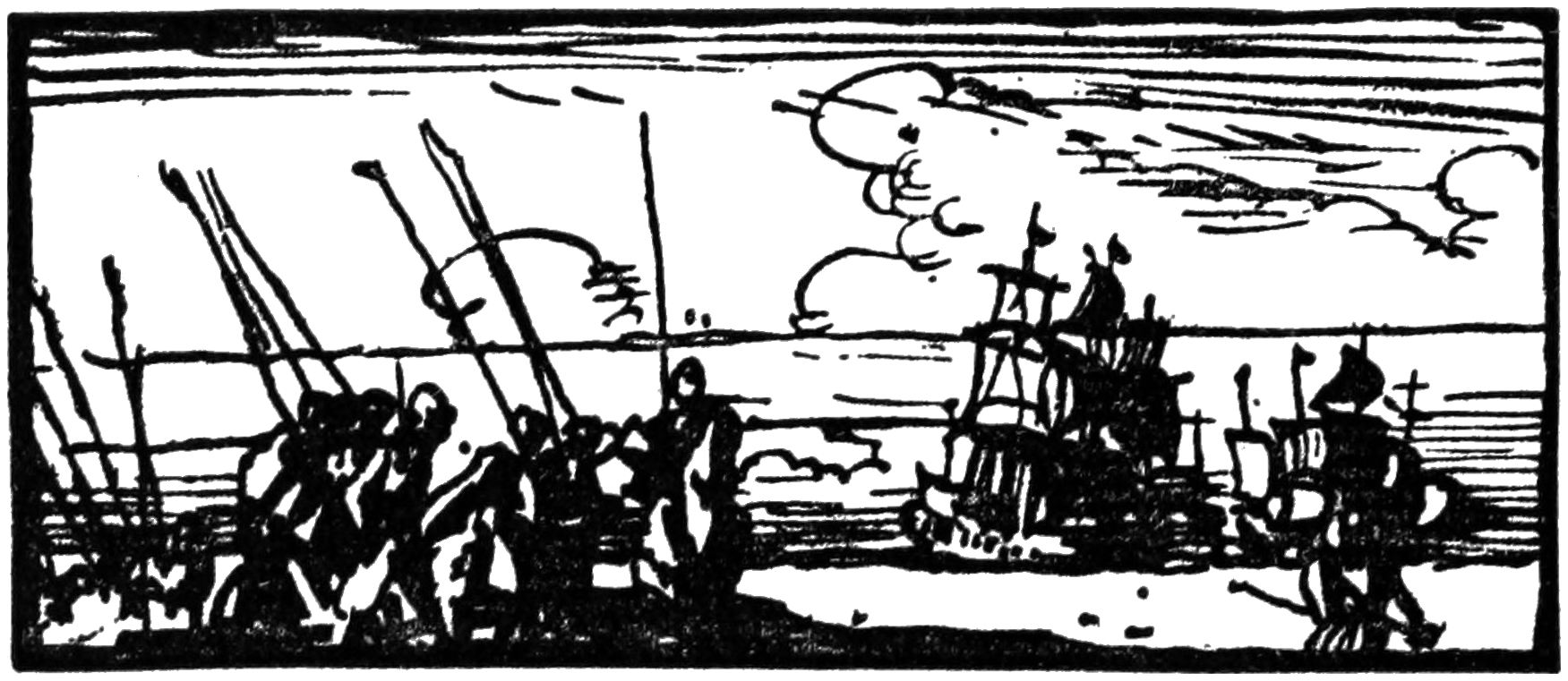
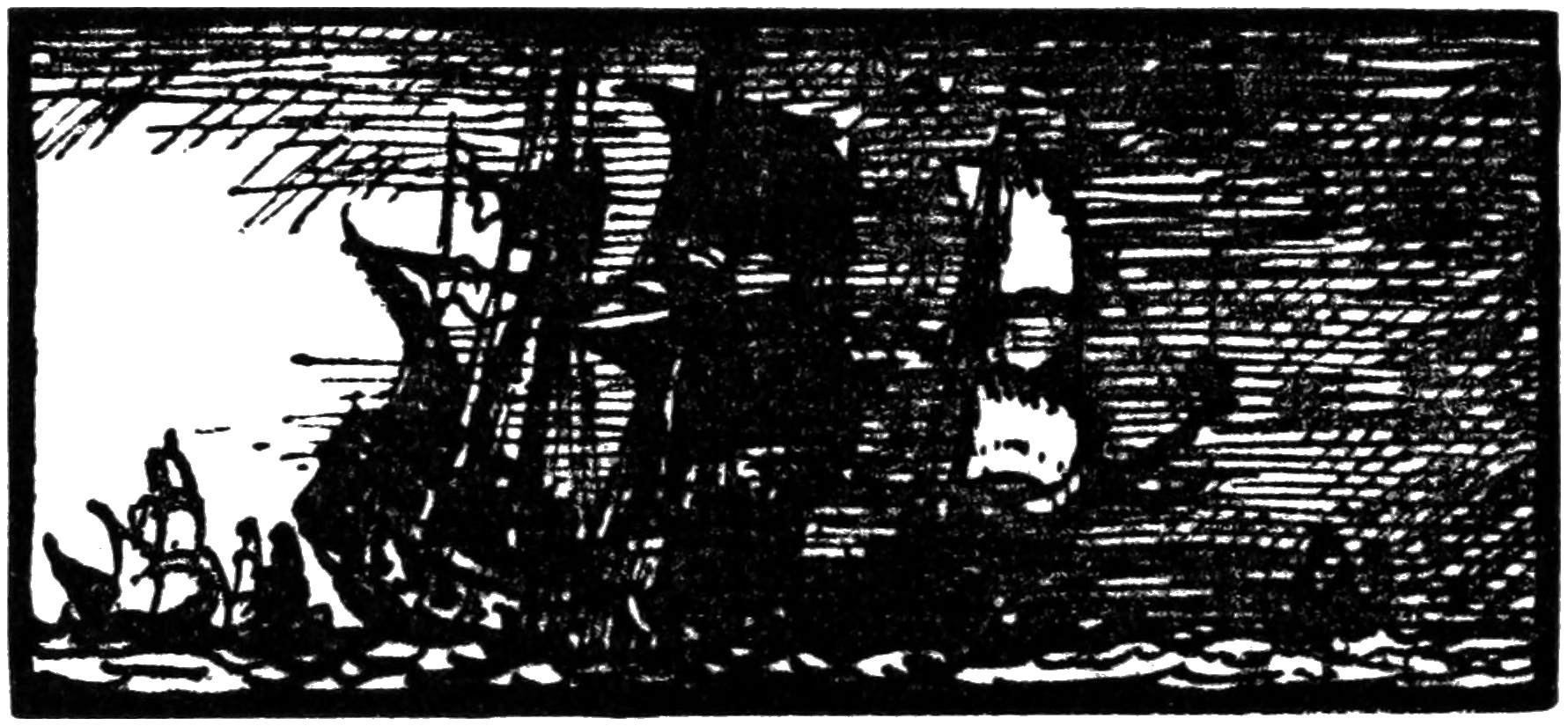
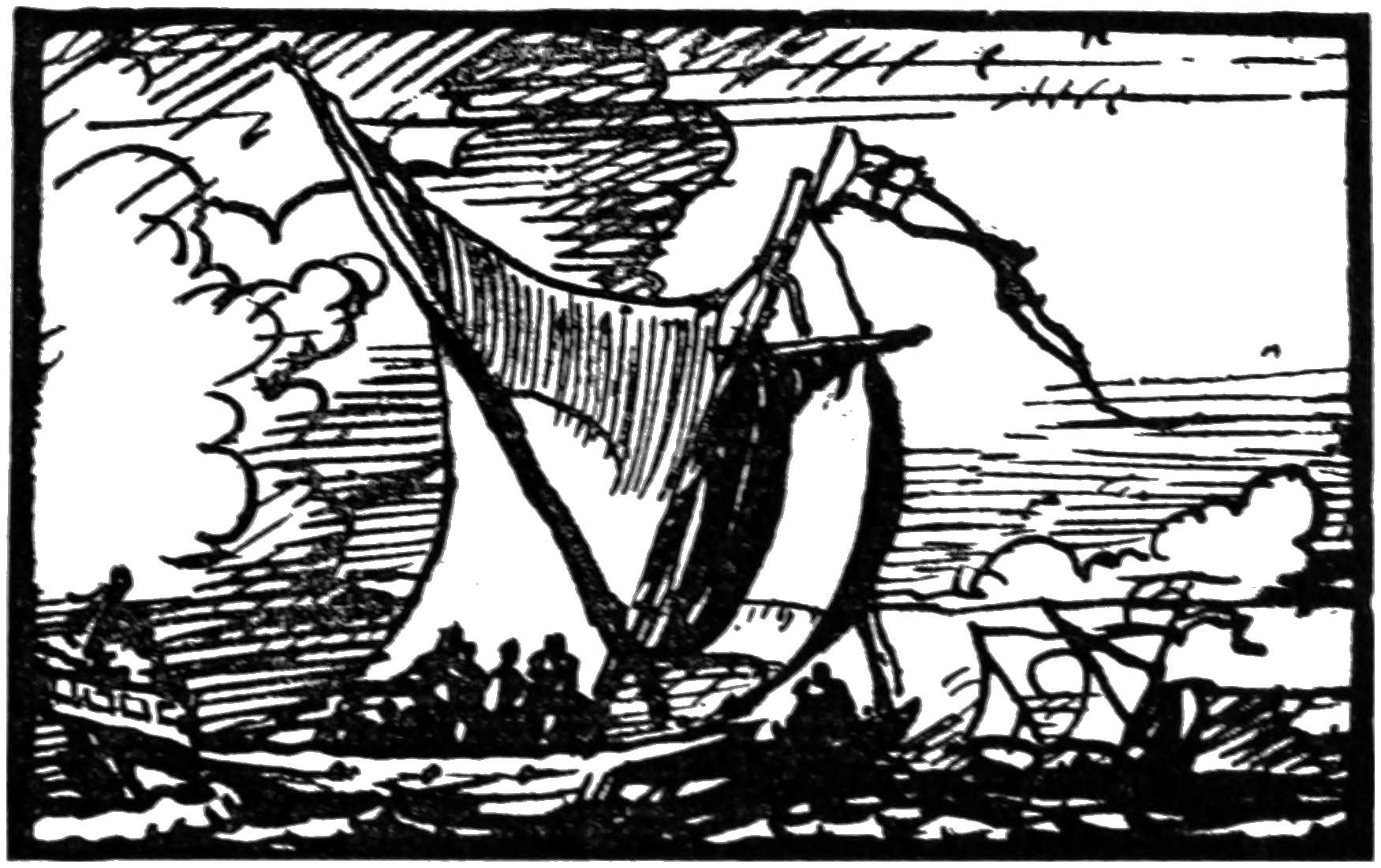
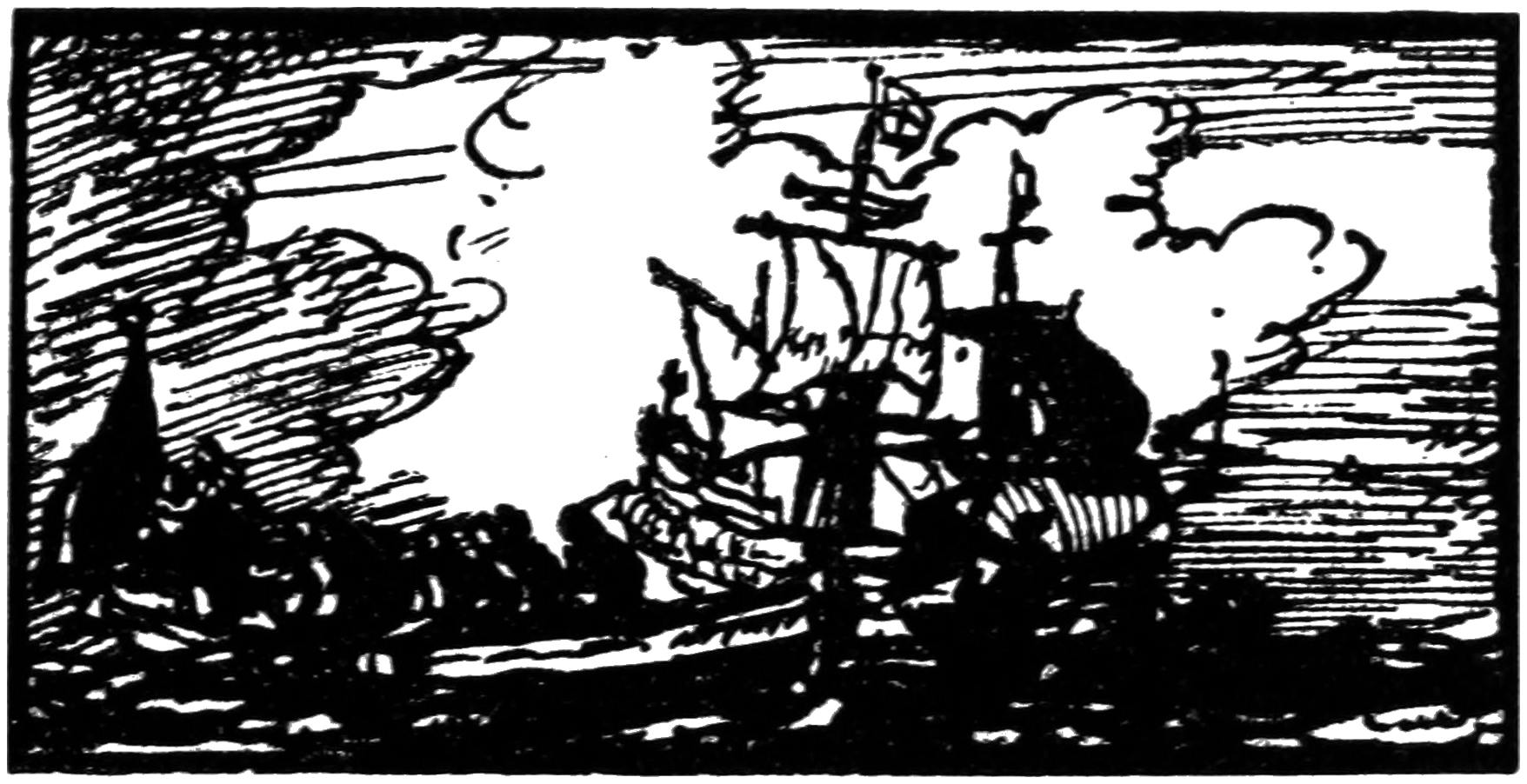
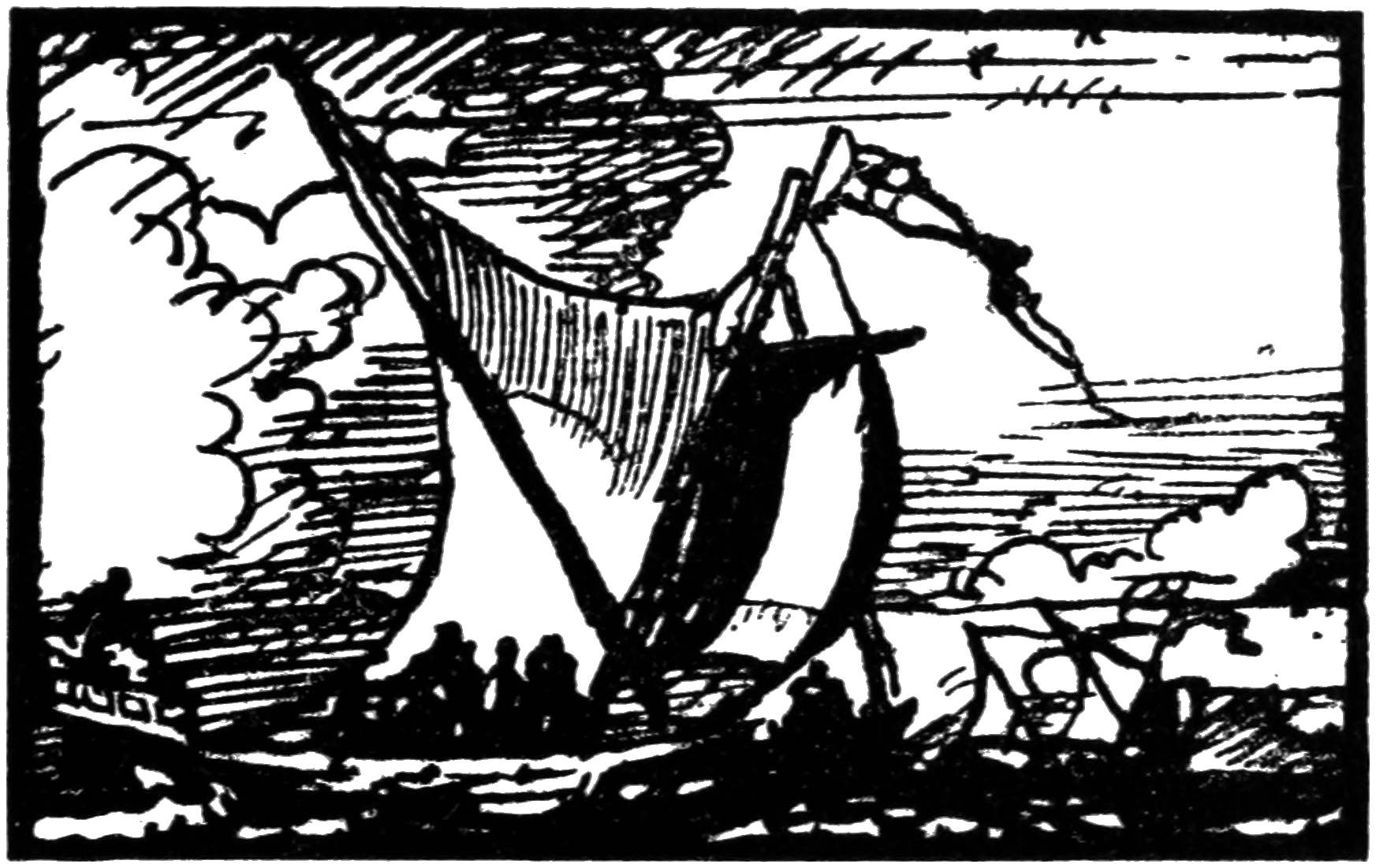
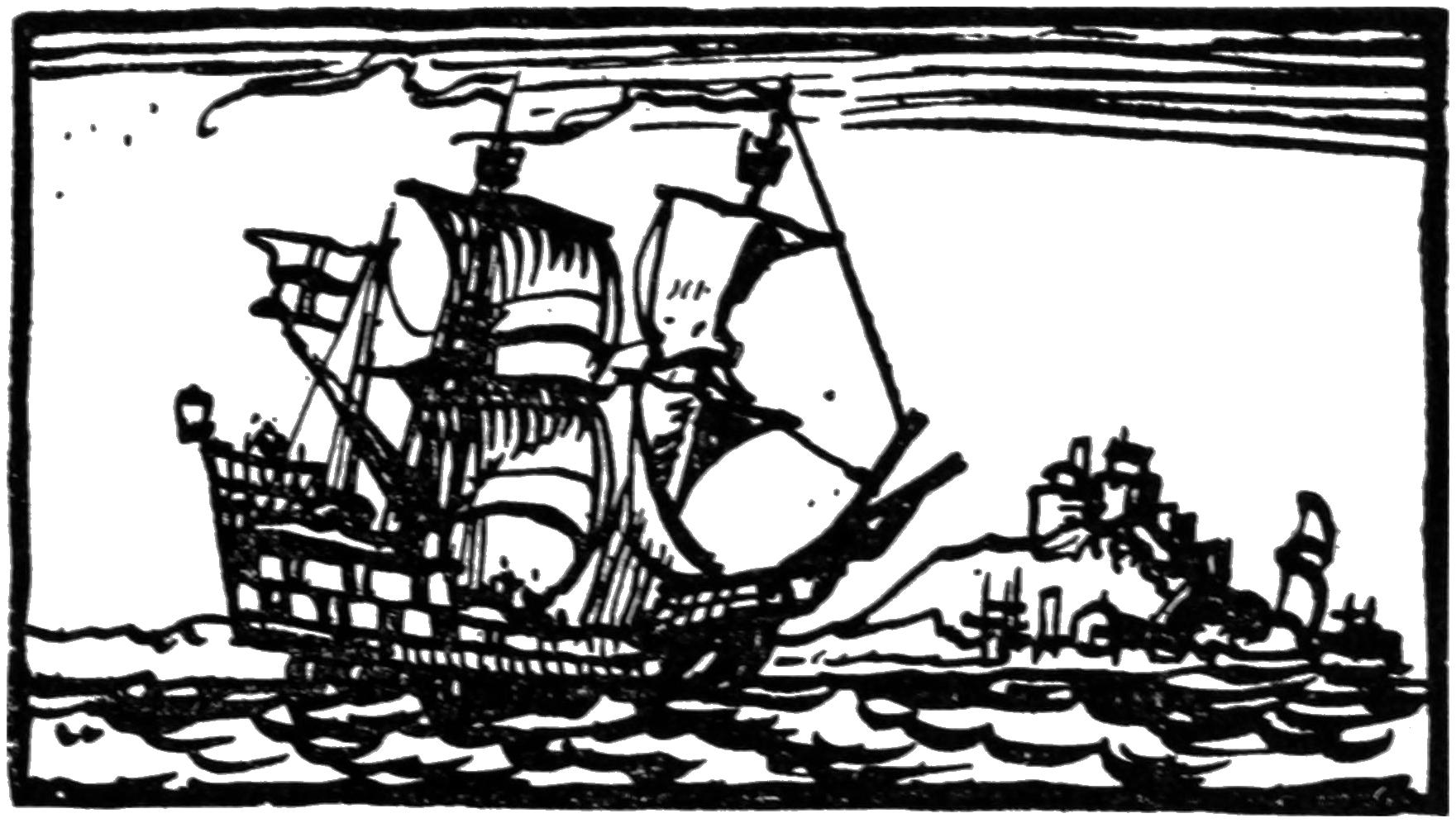
A CAPTURED GALLEON
as the rest of the Armada that attended
their arrival, of which fourteen sail together
with the Revenge, and in her 200
Spaniards, were cast away upon the Isle of
S. Michael’s. So it pleased them to honour
the burial of that renowned ship the Revenge,
not suffering her to perish alone,
for the great honour she achieved in her
life time. On the rest of the islands there
were cast away in this storm fifteen or sixteen
more of the ships of war; and of a
hundred and odd sail of the India fleet
expected this year in Spain, what in this
tempest and what before in the Bay of
Mexico, and about the Bermudas, there
were seventy and odd consumed and lost,
with those taken by our ships of London,
besides one very rich Indian ship, which
set herself on fire, being boarded by the
Pilgrim, and five other taken by Master
Wats his ships of London, between the
Havana and Cape S. Antonio. The 4th
of this month of November we received
letters from the Tercera affirming that
there are 3,000 bodies of men remaining
in that island, saved out of the perished
ships; and that by the Spaniards own confession
there are 10,000 cast away in this
storm, besides those that are perished
between the islands and the main. Thus it hath
pleased God to fight for us, and to defend
the justice of our cause against the ambitious
and bloody pretences of the Spaniard,
who, seeking to devour all nations, are
themselves devoured. A manifest testimony
how injust and displeasing their attempts
are in the sight of God, who hath pleased
to witness by the success of their affairs
His mislike of their bloody and injurious
designs, purposed and practised against
all Christian princes, over whom they seek
unlawful and ungodly rule and Empery.
One day or two before this wreck happened
to the Spanish fleet, when as some of
our prisoners desired to be set on shore
upon the islands, hoping to be from thence
transported into England, which liberty
was formerly by the General promised:
One Maurice Fitz John, son of old John
of Desmond a notable traitor, cousin german
to the late Earl of Desmond, was sent
to the English from ship to ship, to persuade
them to serve the King of Spain.
The arguments he used to induce them
were these. The increase of pay which he
promised to be trebled: advancement to
the better sort: and the exercise of the
true Catholic religion, and safety of their
souls to all. For the first, even the beggarly
and unnatural behaviour of those English
and Irish rebels, that served the king
in that present action, was sufficient to
answer that first argument of rich pay.
For so poor and beggarly they were, as
for want of apparel they stripped their
poor country men prisoners out of their
ragged garments, worn to nothing by six
months’ service, and spared not to despoil
them even of their bloody shirts, from
their wounded bodies, and the very shoes
from their feet; a notable testimony of their
rich entertainment and great wages. The
second reason was hope of advancement
if they served well and would continue
faithful to the king. But what man can be
so blockishly ignorant ever to expect place
or honour from a foreign king, having no
argument or persuasion than his own disloyalty;
to be unnatural to his own country
that bred him; to his parents that begat
him, and rebellious to his true prince, to
whose obedience he is bound by oath, by
nature, and by religion. No, they are only
assured to be employed in all desperate
enterprises, to be held in scorn and disdain
ever among those whom they serve.
And that ever traitor was either trusted
or advanced I could never yet read, neither
can I at this time remember any example.
And no man could have less become the
place of an orator for such a purpose than
this Maurice of Desmond. For the Earl
his cousin being one of the greatest subjects
in that kingdom of Ireland, having
almost whole countries in his possession,
so many goodly manors, castles and lordships;
the Count Palatine of Kerry, 500
gentlemen of his own name and family
to follow him, besides others. All which
he possessed in peace for three or four
hundred years, was in less than three
years after his adhering to the Spaniards
and rebellion, beaten from all his holds,
not so many as ten gentlemen of his name
left living, himself taken and beheaded by
a soldier of his own nation, and his land
given by a Parliament to Her Majesty and
possessed by the English. His other cousin
Sir John of Desmond taken by Mr. John
Zouch, and his body hanged over the
gates of his native city to be devoured by
ravens; the third brother Sir James hanged,
drawn and quartered in the same place.
If he had withall vaunted of this success
of his own house, no doubt the argument
would have moved much and wrought
great effect; which because he for that
present forgot, I thought it good to remember
in his behalf. For matter of religion
it would require a particular volume
if I should set down how irreligiously they
cover their greedy and ambitious pretences
with that veil of piety. But sure I am, that
there is no kingdom or commonwealth in
all Europe, but if they be reformed, they
then invade it for religion sake; if it be
as they term Catholic they pretend title,
as if the Kings of Castile were the natural
heirs of all the world; and so between both,
no kingdom is unsought. Where they dare
not with their own forces to invade, they
basely entertain the traitors and vagabonds
of all nations, seeking by those and by their
runagate Jesuits to win parties, and have
by that means ruined many noble houses
and others in this land, and have extinguished
both their lives and families. What good,
honour or fortune ever man yet by them
achieved is yet unheard of or unwritten.
And if our English Papists do but look
into Portugal, against whom they have
no pretence of religion, how the nobility
are put to death, imprisoned, their rich
men made a prey, and all sorts of people
captived, they shall find that the obedience
even of the Turk is easy and a liberty, in respect
of the slavery and tyranny of Spain.
What they have done in Sicily, in Naples,
Milan and in the Low Countries; who hath
there been spared for religion at all? And
it cometh to my remembrance of a certain
burgher of Antwerp, whose house being
entered by a company of Spanish soldiers,
when they first sacked the city, he besought
them to spare him and his goods,
being a good Catholic and one of their
own party and faction. The Spaniards
answered that they knew him to be of a good
conscience for himself, but his money,
plate, jewels and goods were all heretical,
and therefore good prize. So they
abused and tormented the foolish Fleming,
who hoped that an Agnus Dei had
been a sufficient target against all force
of that holy and charitable nation. Neither
have they at any time as they protest invaded
the kingdoms of the Indies and
Peru, and elsewhere, but only led thereunto,
rather, to reduce the people to
Christianity, than for either gold or empery.
When as in one only island called
Hispaniola, they have wasted thirty hundred
thousand of the natural people, besides
many millions else in other places
of the Indies: a poor and harmless people
created of God, and might have been won
to His knowledge, as many of them were,
and almost as many as ever were persuaded
thereunto. The story whereof is
at large written by a Bishop of their own
nation called Bartholome de las Casas,
and translated into English and many
other languages, entitled The Spanish
Cruelties. Who would therefore repose
trust in such a nation of ravenous strangers,
and especially in those Spaniards which
more greedily thirst after English blood,
than after the lives of any other people
of Europe; for the many overthrows and
dishonours they have received at our
hands, whose weakness we have discovered
to the world, and whose forces
at home, abroad, in Europe, in India, by
sea and land, we have even with handfuls
of men and ships, overthrown and
dishonoured. Let not therefore any Englishman
of what religion soever, have other
opinion of the Spaniards, but that those
whom he seeketh to win of our nation,
he esteemeth base and traitorous, unworthy
persons, or unconstant fools: and
that he useth his pretence of religion for
no other purpose but to bewitch us from
the obedience of our natural prince; thereby
hoping in time to bring us to slavery
and subjection, and then none shall be
unto them so odious, and disdained as
the traitors themselves, who have sold
their country to a stranger, and forsaken
their faith and obedience contrary to nature
or religion; and contrary to that
human and general honour, not only of
Christians, but of heathen and irreligious
nations, who have always sustained what
labour soever, and embraced even death
itself, for their country, prince or commonwealth.
To conclude, it hath ever to
this day pleased God to prosper and defend
her Majesty, to break the purposes of
malicious enemies, of foresworn traitors,
and of unjust practices and invasions. She
hath ever been honoured of the worthiest
Kings, served by faithful subjects, and
shall by the favour of God, resist, repel,
and confound all whatsoever attempts
against her sacred person or kingdom.
In the meantime, let the Spaniard and
traitor vaunt of their success; and we
her true and obedient vassals guided by
the shining light of her virtues, shall always
love her, serve her, and obey her
to the end of our lives.
FINIS
A PARTICULAR NOTE OF THE
INDIAN FLEET, EXPECTED
TO HAVE COME INTO SPAIN THIS
PRESENT YEAR OF 1591, WITH
THE NUMBER OF SHIPS THAT
PERISHED OF THE SAME; ACCORDING
TO THE EXAMINATION
OF CERTAIN SPANIARDS,
LATELY TAKEN AND BROUGHT
INTO ENGLAND BY THE SHIPS
OF LONDON
The fleet of Nova Hispania,
at their first gathering together
and setting forth,
were 52 sails. The Admiral
was of 600 tons, and the
Vice-Admiral of the same burden. Four
or five of the ships were of 900 and 1000
tons a piece, some 500 and 400, and the
least of 200 tons. Of this fleet 19 were cast
away, and in them 2600 men by estimation,
which was done along the coast of
Nova Hispania, so that of the same fleet,
there came to the Havana, but three and
thirty sails.
The fleet of Terra Firma, were at their
first departure from Spain, 50 sails, which
were bound for Nombre de Dios, where
they did discharge their lading, and thence
returned to Cartagena, for their healths
sake, until the time the treasure was ready
they should take in, at the said Nombre
de Dios. But before this fleet departed,
some were gone by one or two at a time,
so that only 23 sails of this fleet arrived in
the Havana.
At the Havana there met
{ 33 sails of Nova Hispania.
{ 23 sails of Terra Firma.
{ 12 sails of San Domingo.
{ 9 sails of Hunduras.
In the whole 77 ships, which joined and
set sail together, at the Havana, the 17th of
July, according to our account, and kept
together until they came into the height of
35 degrees, which was about the tenth of
August, where they found the wind at
south west, changed suddenly to the north,
so that the sea coming out of the south
west, and the wind very violent at north,
they were put all into great extremity, and
then first lost the General of their fleet,
with 500 men in her; and within three or
four days after another storm rising, there
were five or six other of the biggest ships
cast away with all their men, together with
their Vice-Admiral.
And in the height of 48 degrees about the
end of August, grew another great storm,
in which all the fleet saving 48 sails were
cast away: which 48 sails kept together,
until they came in sight of the Islands of
Coruo and Flores, about the 5th or 6th of
September, at which time a great storm
separated them; of which number 15 or 16
were after seen by these Spaniards to ride at
anchor under the Tercera; and twelve or
fourteen more to bear with the Island of
S. Michael’s; what became of them after
that these Spaniards were taken, cannot
yet be certified; their opinion is, that very
few of the fleet are escaped, but are either
drowned or taken. And it is otherwise of
late certified, that of this whole fleet that
should have come into Spain this year,
being 123 sail, there are as yet arrived but
25. This note was taken out of the examination
of certain Spaniards, that were
brought into England by six of the ships
of London, which took seven of the above
named Indian fleet, near the Islands of
Azores.
FINIS
“It may be
truly said
that the commandment
of
the sea is an
abridgement
or a quintessence
of a
universal
monarchy.”
Francis Bacon.
Letchworth: At the Arden Press.
Transcriber’s Notes
Punctuation, hyphenation, and spelling were made
consistent when a predominant preference was found
in the original book; otherwise they were not changed.
Simple typographical errors were corrected; unbalanced
quotation marks were remedied when the change was
obvious, and otherwise left unbalanced.
The larger illustrations have been positioned
at the tops of the pages on which they originally
appeared, even when that placed them in the
middle of sentences or paragraphs. This was done
to simulate the appearance of the original
book: every page contained at least one
illustration at the top or bottom, while many
paragraphs and some sentences were more than
one page in length.
The black-and-white illustrations were printed
with thick, coarse lines and irregular borders.
That appearance has been retained in this eBook.