The true story of the martyrdom of Nicholas II., ex-Tsar of Russia, and
of his wife and family is told below.
It is based upon evidence obtained by a properly constituted legal
investigation. The signed depositions of eye-witnesses are in the
writer’s possession, but he does not disclose their identity because
many of the deponents are still in the power of the Soviets. The day
will come when the guilty will be called to account, but a long time may
elapse before the day of retribution dawns. The writer has sought to
present the opening for the prosecution, fully confident that the
eventual hearing of the evidence before a Court of law will substantiate
his statement and impose a verdict of “Guilty.”
At Ekaterinburg, on the night of July 16, 1918, the Imperial family and
their faithful attendants—eleven persons in all—were led into a small
room in the house where they had been imprisoned and shot to death with
revolvers. There had been no trial of any kind. Before their death, the
captives were subjected to ill-treatment, amounting to horrible torture,
mental if not physical. After death, the bodies were taken to the woods
and completely destroyed. These acts had been premeditated and the
murders elaborately prepared.
The actual arrangements for the crime began some weeks before the advent
of anti-Bolshevist forces. Neither fear of rescue by the Whites nor
plots to release the captives—the existence of which is doubtful—can
be reasonably alleged in explanation of the slaughter.
The official statement issued by the Moscow Government on July 20—four
days afterwards—spoke of the shooting of Nicholas as an act of
necessity, but categorically affirmed that the ex-Empress and the
children had been conveyed out of the city. These deliberately concocted
reports of the safe removal of the family were intended to circumvent
any investigation—and did so at first.
It is established beyond doubt that the ex-Tsar fell a victim to his
loyalty. He had refused offers from the enemies of Russia’s Allies,
proposing that he should endorse the Treaty of Brest-Litovsk.
[2]
Attempts to inveigle him into an unholy alliance undoubtedly preceded
the murder. All the Romanovs who died violent deaths were, like the
Tsar, inconvenient to German as well as to Internationalist plans. So
many tales have been circulated regarding the fate of the Romanovs, in
most cases without the slightest approach to the truth, that I consider
myself bound to relate the circumstances which have (1) placed in my
possession the complete history and documents of the case; and (2)
imposed upon me a moral obligation to publish them to the world.
In March, 1919, returning from Omsk for a short visit to Vladivostok, I
met General Diterichs, an old acquaintance, of the Russian Western
Armies. After the Revolution he had piloted the Czechs to Siberia and
then taken charge of the Uralian front. By one of the fateful blunders
that have marred intervention in behalf of Russia he had been superseded
by inferior leaders, and was devoting his energies to the investigation
of the Tsarskoe delo (Tsar case). Knowing Diterichs, I felt sure that,
sooner or later, he would again become commander-in-chief of the armies,
then fighting the Reds with British and Allied assistance. Personal
regard and journalistic considerations equally prompted me to follow his
fortunes, good or bad. I have not had cause to regret my decision.
General Diterichs was found to be indispensable and recalled to his
command, when it was too late. From the first he had seen only too
clearly the rocks ahead and warned everybody concerned, and he knew that
the fate of Kolchak’s attempt to restore Russia was sealed. Yet he
accepted the leadership. With equal perspicacity he had also long ago
realised the enormous importance of the Tsar case. Thanks to his efforts
much was accomplished before the Reds, having recaptured the Urals,
could obliterate all traces of the crimes committed there. He continued
to follow the case even after his appointment as Commander-in-Chief and
after the débâcle.
On my arrival at Ekaterinburg a month later, I met the investigating
magistrate who had been specially appointed by the Supreme Ruler
(Kolchak) to conduct the inquiry into the Tsar case—Nicholas
Alexeievich Sokolov. He had left his home and family in Penza to avoid
service under the Reds, and had managed, after innumerable hardships and
hair-breadth escapes, to cross, disguised as a peasant, into Siberia. He
walked the last twenty-five miles foodless, his feet one mass of sores
and blisters. An ardent sportsman, he had lost an eye through the
carelessness of a comrade. He had made a name for himself in the
investigation of famous criminal cases. He was relentless, tireless,
full of resource in the pursuit alike of murderers and beasts of prey.
The Tsar case called for the exercise of all the skill that the most
genial and courageous of magistrates could display. Sokolov never
faltered. It is thanks to him that an overwhelming mass of evidence has
been built up into a structure that cannot be overthrown—that still
continues to grow.
At all the centres of interest for the investigation—Ekaterinburg,
Perm, Omsk, in field or forest, amid the disused iron mines which hid so
many a gruesome record of Bolshevist “justice”—I was for many months in
constant touch with the course of the inquiry, and personally took part
in the search for the remains of the victims. Besides Sokolov and
Diterichs only two persons signed the more important procès-verbaux—I
was one of the two.
When the fall of Omsk appeared to be imminent, N. A. Sokolov departed
eastward, taking with him all the documents, material clues, etc., which
by right could be in no other hands save his. I followed later with
General Diterichs, after he had resigned his command, in despair over
Kolchak’s suicidal decision to defer the evacuation of the city—a
decision that entailed the loss of countless lives and the death of the
Supreme Ruler. We found Sokolov at Chita, persecuted by the myrmidons of
the redoubtable Ataman because they personally desired that the Romanovs
should be alive for certain obscure purposes of their own, and therefore
wished to get rid of Sokolov for proving the contrary. After many
vicissitudes and adventures he reached Harbin, whither I had also made
my way, and was joined by General Diterichs.
The ultimate fate of the dossier there had to be decided. On all
sides were hostile or doubtful organizations. To leave the originals
behind and take away only duplicates was, to say the least, risky.
Sokolov’s life being in danger, he hid the dossier in my car, which
had the protection of the British flag. General Lokhvitsky rendered
invaluable assistance in bringing about a decision. I must express my
feelings of gratitude and personal regard for this very gallant soldier
and gentleman, who here in the midst of a veritable bedlam preserved his
unruffled courtesy and calm just as he had done in the turmoil of battle
in France and of disaster in Siberia.
With the knowledge and approval of the three distinguished men
above-mentioned—representing the Russia that was and that we all hope
will be again—I took charge of the dossier, it being understood that,
given certain contingencies, I should be free at my own discretion to
make it public in whole or in part. The contingencies have arisen, and I
am free. But that is not all. I consider the circumstances of today
render it an imperative duty to let the Allies and the Russians know the
truth. Too many hostile interests are served by deliberately concocted
lies and legends regarding the fate of the Romanovs. It is time to let
the light of day into this tragic and gruesome history.
When I first came into personal touch with the Tsar case many points
were still obscure. I refer to the actual circumstances of the murder
itself, not to extraneous aspects—political and international—that
were only vaguely hinted at, and that have since attained extraordinary
proportions. The confusion then existing was due to two causes: first,
to the inexperience of the officials who took charge of the
investigation; secondly, to the activity of Bolshevist agents who
remained in the city or were concealed among the ranks of the White
Administration.
The official version of the events of July 16th-17th, given out by the
Reds before they fled from Ekaterinburg, was that Nicholas Romanov had
been executed “after trial,” but that the family had been removed
“north.” This legend became engrafted upon the minds of a great many
people and still continues to exercise its luring appeal. Every
sympathiser with the Soviets considered himself or herself bound to
foster this version, since no Russian, however hostile to the
ex-Sovereigns, could find the slightest excuse or pretext for
“executing” a whole family of five children who had never taken, or been
able to take, the slightest part in politics. The Russians who still
belonged to the German “orientation” were also—curiously
enough—disposed to credit any tale of a miraculous escape. They seemed
to think that a restoration of the Monarchy—which formed the basis of
their political creed—would be furthered by the “miracle” theory. Some
of them had more practical aims, as will be shown later on.
N. A. Sokolov was not deceived for an instant. If, supposing, the family
had been removed, their death was, to him, none the less a moral
certainty. He had precise information that every other member of the
Romanov kin had been murdered, although they were just as unconcerned in
politics as the boy Alexis and his sisters. But the evidence of
eye-witnesses, coupled with and corroborated by countless material
proofs, could leave no doubt as to the fact of a wholesale murder at
Ekaterinburg. All the efforts of the organisers and the supineness of
the earlier investigators could not completely tangle the threads. But
it became a harder task to assemble the evidence that would secure a
conviction in a Court of law.
I visited the house where the victims had lived. It belonged to a
certain Ipatiev, a merchant who held the rank of captain in the
Engineers. By one of the ironies of Fate he bore the name of the
monastery whence the first Romanov sallied to assume the Crown of All
the Russias. The Ipatiev of Ekaterinburg was, however, of Jewish origin.
The Engineer Department of the Siberian Army was installed in the upper
story. Directly after the occupation of the city by the Czechs General
Gaida had forcibly taken possession of the premises, despite the
vehement protest of the judicial authorities, alarmed by the risk of
losing possible clues. The rooms underwent extensive alterations. This
was, of course, a flagrant violation of the most elementary principles
of criminal investigation.
The lower floor was tenanted by Ipatiev himself, on the understanding
that no strangers should be admitted. The small basement room—the scene
of the murders—was sealed up. I saw it a few days later. Sokolov took
me over the premises, explaining step by step the enactment of the
tragedy. We stood in the little room, noted the trace of the bullets,
the direction of the bayonet thrusts, and the splashes of blood on the
walls. The room had been a shambles, and all the washing and scouring
that, according to the evidence, had followed the murders could not
remove tell-tale signs. We knew from the depositions of witnesses and
the mute, gruesome language of the death-chamber where each of the
victims sat or stood when the assassins fired their revolvers. The
bullet-holes in the walls and in the floor had been carefully cut out;
human blood had been found in the wood and on the bullets.
Obscene drawings and inscriptions covered the upper walls. Obviously
they were the work of uncultured peasants. Their character showed only
too clearly how deeply the conscience of the people had been revolted by
the Razputin scandal. There were other inscriptions—in Hebrew, in
German, in Magyar. Regarding them I was to learn much at a later date.
Soon afterwards I was in the woods, ten miles north of the city, where
the peasants had found jewelry and other relics of the murdered family.
I saw the tracks, still clear, of heavy lorries crashing through the
trees to a group of disused iron-ore shafts. All went in one direction,
ceasing near a pit round which a vast collection of clues had been
discovered; precious stones, pearls, beautiful settings of gold and
platinum, some hacked, broken, bearing traces of fire; metal buckles,
hooks, buttons, corset-frames, pieces of charred leather and cloth, a
human finger intact, a set of false teeth. The character, condition, and
numbers of these various articles were in themselves sufficient to
indicate the sex and ages of the victims and the manner in which their
bodies had been disposed of.
First on the scene had been the peasants. For three days and nights they
were cut off from the city by a cordon of Red Guards placed around the
wood. Knowing that the Whites were at hand, they thought the Reds were
burying arms. Vague rumours had reached them of the death of Nicholas
II. As soon as the cordon had been removed they rushed to the spot.
Woodcraft and native astuteness quickly opened their eyes. “It is the
Tsar that they have been burning here,” they declared. On this very
spot, a year later, I found topaz beads, such as the young Princesses
wore, and other gems, by scratching the surface of the hardened clay
surrounding the iron pit.
Led off on a false scent, the earlier investigator had neglected the
unerring sagacity of the peasants and had even failed to make an
immediate examination of the wood and pits—perhaps afraid to leave the
city, because Red bands were reported to be in the neighbourhood. He was
following the red-herring trailed by Soviet agents, that, to wit, the
family had escaped or been removed. These agents did not know the truth
themselves. They merely related what they had been instructed to say.
The local Soviet had not known the facts. There had been no trial. The
murders had been the work of a separate organization which directed
everything from a distance. Misled by the versions thus spread, the
investigator had lost himself in the maze of conflicting rumour in
Ekaterinburg.
When Sokolov took over the case—in the early months of 1919—it was
almost at a standstill because of the initial mistakes and incapacity of
the investigator. Yet evidence had come from another quarter that should
have compelled him to take the right course. From one of the Imperial
servants who had escaped from a Red shooting squad it became known that
several grand dukes and the Grand Duchess Elizabeth had been murdered
immediately after the Ekaterinburg shooting, and that some of the bodies
had been found in disused iron pits. In no case had there been any
semblance of a trial. It was evident the wholesale extermination of the
Romanovs had been pursued, and that all theories of the miraculous
survival of the children should be abandoned.
Some idea of the crime of Ekaterinburg is now in the reader’s
possession; but, in dealing with the evidence in all its aspects, it is
necessary to give an account of conditions that prevailed in the country
then, and of the chief actors in the drama. The murder of the Tsar and
his family, even after his abdication, may not be regarded as a simple
act of vengeance or casual precaution.
In 1917, the Germans had sent Lenin with a horde of Jewish
revolutionaries to take possession of Russia. A Red Government, composed
of persons selected in Berlin, was now in power; but they were vassals.
Count Mirbach, representing the suzerain State, figured in Moscow as the
virtual ruler, before whom the apostles of Karl Marx bowed the knee. At
the period under review, the Reds had displayed no overt disposition to
throw off the German yoke. They conformed with all the humiliating
clauses of the Treaty of Brest-Litovsk, dutifully sending the tribute
gold to Berlin which had been demanded as “war indemnity,” plundering
the national Exchequer and resources by order of their German masters.
Apparently everything was going well with the German plan of “peaceful”
conquest, whatever secret hopes the Red leaders may have nurtured.
Instead of a redoubtable foe, Russia was now a willing handmaid.
Ludendorff has related frankly, disingenuously, how simple and wonderful
had been this operation.[3] Not only was Russia out of the war; the
foodstuffs obtained from the Ukraine had literally saved Germany and her
allies. Hetman Skoropadsky already ruled the Ukraine for Germany.
Krasnov, at the head of the Cossacks, and Alexeiev with the gallant
Volunteer army remained neutral. Ludendorff hoped to lure them into his
net—a radiant combination that assured dominion over Russia and her
vast resources. He explains why it was not realised. The German
Government was to blame, it appears. There was a divergence of views
between Berlin and G.H.Q. The latter considered that the Reds had “done
their work”; so the Reds “must go,” and Krasnov and Alexeiev be diverted
at once from their sympathies with the Entente in order to preclude any
possibility of a revival of the Eastern front. For this purpose it was
necessary to order the German divisions in the South of Russia to march
on Moscow. Ludendorff felt quite sure that even Alexeiev would not be
able to resist the temptation to join hands with the enemies of
Sovietdom. But the obstinate, slow-witted bureaucrats in Berlin could
not adapt themselves to these lightning changes. Ludendorff stormed at
them: Were they blind not to see that the Reds were hoodwinking them?
Did they want proofs? Were the Czech prisoners of war not proceeding
eastward with the avowed object of reinforcing the French army?
This concrete accusation could not be denied. Lenin’s organization had
promised Professor Masaryk to permit the Czecho-Slovaks to leave the
country by way of Siberia provided they went peacefully. It was an easy
riddance of possible enemies. The Czechs were proceeding quietly to
Vladivostok, carefully abstaining from violence even when sorely tried
by the impudence of local Soviets, giving up their arms to bribe the
Reds.
Mirbach received instructions to call his Red henchmen to account; at
the same time messages were conveyed from the two Kaisers to their
warriors imprisoned in Siberia, enjoining upon them the duty of
organising resistance to the “invaders.” How the German and Magyar
officers enrolled Russian convicts and flung themselves athwart the
Czech retreat with the energetic concurrence of the Soviets is a matter
of history. But the connection between this circumstance and all that
preceded and followed is less known. Ludendorff feared above all the
re-establishment of the Eastern front, yet it was Ludendorff and his
Government that brought about the very consequences that they least
wanted.
Had the Czechs been allowed to depart it is certain that there would
have been no military help from the Entente side, and the chances of
seducing the Russian anti-Bolshevist leaders might not have been
still-born. As it was, the whole edifice of guile, duplicity, and
deceit, raised with such labour and cost, fell to the ground. The murder
of Mirbach sounded the call of its collapse.
But at the time when the fate of the Tsar and his family hung in the
balance, Germany was absolute mistress of the situation, and, had there
been unity of method as well as of purpose between the German High
Command and Berlin, the fate of Russia and, perhaps, of the war would
have been changed. Berlin wanted to continue to rule Russia through the
Soviets under Mirbach; Ludendorff aimed at the overthrow of the Soviets
in order to enlist the support of the Cossacks and Volunteers. As might
be expected, the conflict between them resulted in a fatal
compromise—an attempt to run with the White hare and hunt with the Red
hounds.
Ludendorff’s plan was to substitute a more agreeable form of government
in the place of the Soviets and to modify suitably the Treaty of
Brest-Litovsk. Here we have the key to the removal of Nicholas II. from
Tobolsk. But all that subsequently happened was conditional upon another
set of forces. Sovietdom asserted itself. The working and organization
of the Soviets fitted in admirably with German requirements, and
incidentally subserved the plans of the murderers. New names, devised to
appeal to the fancy of the mob, concealed familiar institutions. There
were three principal bodies—Sovnarkom, Tsik, and Chrezvychaika, these
names being abbreviations of Soviet narodnykh kommisarov (Council of
People’s Commissaries), Tsentralny ispolnitelny komitet (Central
Executive Committee), and Chrezvychainaia komisia dlia borby z
kontr-revoliutsiei (Extraordinary Commission for Combating
Counter-revolution). Under the old régime the Duma, the Council of
Ministers, and the Okhrana had occupied the same relative positions.
Instead of the former ranks and dignities there were komisary, all
supposed to be elected, but in reality appointed by an inner and occult
body. Sovdeps (Councils of Deputies) and Komitety bednoty (Poor
Commissions) took over the functions of the old zemstvos and
municipalities, grouped into regional communes, just as it had been
proposed to group the zemstvos according to separate oblasti
(regions). Sovietdom (in Russian Sovdepia) had invented no new forms.
It is still in the grip of the Red Okhrana.
As there was no apparent authority, the local bodies often acted
independently; indeed, Lenin encouraged this tendency. Vlast na
mestakh (every place its own master) was his motto. Lenin did not rule;
the Soviet system was governed by other people, the fellow-passengers
who came with him under German auspices. Though he delivered impassioned
harangues before the Sovnarkom and received deputations from minor
soviets, the real power was elsewhere—in the Tsik and Chrezvychaika;
and, just as it had been in the Old Russia, the last word was always
with the Police-Okhrana organisation.
Mirbach received his daily report from the Chrezvychaika. He was
murdered by two men who said they came from that office. Lenin had as
little to do with his death as he had with the murders, a week later, of
the ex-Tsar and his family. The Red Okhrana and the inner circle of the
Tsik were the veritable authors of the crime of Ekaterinburg, and
probably of Mirbach’s assassination.
Nonentities, figureheads of the Sovnarkom, do not interest us. We are
concerned with great, if maleficent, personages in the Red world. Most
of them are still unknown outside the ranks of the professional
revolutionaries. A goodly proportion of the hundred Jews who came out of
Germany with Lenin, and the hundreds who came from Chicago, deserve to
be included in this gallery, for they undoubtedly held Russia under
their sway. To enumerate and describe them would require a small volume.
I need sketch only those who act prominently in the drama of
Ekaterinburg. The most important were:—Sverdlov, Safarov, Voikov, and
Goloshchekin, and the murderer-in-chief Yurovsky.
The names of Safarov and Voikov figure in the list of Lenin’s
fellow-passengers. Both are very powerful Bolshevists, holding high
places in the executive and police branches. Sverdlov is—I use the
present tense because all these persons continue to wield their
influence to the present day—the uncrowned Tsar of the Soviets. His
authority is really much higher than that of Lenin or even Trotsky. He
dominates the Tsik, and his creatures rule the Chrezvychaika. Sverdlov’s
name appears in the Bolshevist Government as approved by Germany. The
direct connection between Sverdlov and the murders of Ekaterinburg is
established beyond doubt.
Goloshchekin was the representative of the above-named conclave in the
regional soviet of the Urals and kept that rather recalcitrant body
under secret subjection to his chiefs. The Uralian Reds were
particularly self-willed and jealous of Moscow because the population
consisted almost entirely of miners and metal-workers—a very advanced
and independent class, having little in common with the peasant-farmer,
for whom they professed contempt. Goloshchekin did whatever Sverdlov
wished. A stratagem had given him absolute power. The president of the
regional soviet was a Russian named Beloborodov. He was arrested by the
Chrezvychaika and imprisoned on a charge of appropriating 30,000
roubles. The punishment would be death. Together with Safarov and
Voikov, Goloshchekin arranged to release him. Beloborodov resumed the
presidency of the regional soviet as if nothing had happened. Dishonesty
was so rampant among the Komisars that the transition surprised no one.
But after that, Beloborodov gave up all attempts to resist Moscow—if he
had ever done so. He was henceforth a mere man of straw, kept in his
place to deceive the obstreperous Uralian miners, who did not wish to be
ruled from Moscow, much less by Jews.
The closest personal bonds had existed for many years between
Goloshchekin and Sverdlov. They had been together in prison and exile.
Goloshchekin ranked as an internationalist of the most pronounced type.
He had been selected for the rulership of the Urals with an eye to other
than political activities. He was bloodthirsty in an abnormal degree,
even for a Red chieftain. People who knew him at Ekaterinburg describe
Goloshchekin as a homicidal sadist. He never attended executions, but
insisted upon hearing a detailed account of them. He huddled in bed
shivering and quaking till the executioner came with his report, and
would listen to his description of tortures with a frenzy of joy,
begging for further details, gloating over the expressions, gestures and
death-throes of the victims as they passed before his diseased vision.
Yurovsky had a humbler task; he was not one of the mighty ones of the
Soviet. When the German plan to restore Nicholas as a vassal sovereign
had failed, and the Jewish conclave in Moscow was free to carry out its
vengeful purpose, Yurovsky was installed as chief gaoler and tormentor
of the doomed family. The Russian commandant and guards were dismissed,
ostensibly because they were pilfering. Magyarised-German soldiers under
a Jewish commandant took their places and were able to rob wholesale the
unfortunates whom they were supposed to protect.
The origins of Yurovsky have been fully investigated. His parents and
relatives—all poor Jews—remained in Siberia after the murderer and his
chiefs and accomplices had fled from Ekaterinburg. He had been a
watchmaker at Tomsk, scarcely able to make ends meet. Naturally
ambitious, he despised the people around him. He was waiting for an
opportunity. It came suddenly and mysteriously. Yurovsky disappeared.
This was before the war. He is next heard of in Ekaterinburg as a
photographic dealer. It leaked out that he had been to Berlin and become
possessed of some capital. When war came, he evaded service in the
trenches by qualifying as a red-cross assistant (feldsher) and
remained in Ekaterinburg. When the Bolshevists seized the government,
Yurovsky became one of the local agents of the new power.
At a time when he was seeking any and every means of advancement,
Yorovsky had been baptised into the Lutheran church. He used to attend
prayers in Ipatiev’s house. He even chatted pleasantly with the sick boy
Alexis, whom, a few days later, he shot with his own hand.
Apart from the bald assertions of parties interested in spreading false
reports, there is no evidence of any attempt on the part of the Romanovs
to escape from any of their prisons. All the compromising “documents”
produced by Soviet apologists on this subject are transparent
fabrications. Loyal Russians wished to save the Tsar from the Soviets,
knowing full well the danger of treachery that he incurred, and there
were several organisations, working independently, but none ever began
putting a plan into execution.
During the captivity at Tobolsk some money reached the prison-house
secretly. It helped the prisoners to eke out the starvation allowance
ordained by the Soviets. Attempts to render further aid were frustrated
by a German-Bolshevist agent stationed at Tiumen. This person, a Russian
officer who had married a daughter of Razputin, ingratiated himself with
doubtful travellers for Tobolsk and betrayed them to the Soviet. The
Germans had thus taken elaborate precautions not to allow the ex-Tsar to
slip out unawares. Perhaps they thought that the Allies of Russia might
try to rescue him! At Ekaterinburg nothing could be done. The Reds
claim to have intercepted some letters between the captives and
conspirators. But it may be pointed out that not a single person was
arrested there for conspiracy to help the exiles. Remembering the lavish
repressions ever applied by the occult powers of the Chrezvychaika, it
will be conceded that they would have missed no opportunity to exert
them in such a cause. The British Consul (Mr. Preston), remaining
gallantly at his post throughout the Red terror, and rendering
incalculable service to the victims of Bolshevist oppression, was unable
to do anything to alleviate the sufferings and torture of the Romanovs.
Yet, strange to relate, a monarchist organisation had its agents in the
city. It even succeeded in conveying some food and comforts through the
nuns of the local monastery. Beyond that, it was unable to go. There is
no evidence to show that at any time during the captivity was any active
attempt made to rescue the Romanovs. This applies equally to the
ex-Sovereigns and to their kinsmen. At Tobolsk, Ekaterinburg, Perm, and
Alapaievsk the pretext for wholesale murder was always the same; an
alleged attempt to escape or rescue. And from the testimony of persons
who were in daily intercourse with the imprisoned family, it is clear
that, had any serious efforts to procure their escape been made, they
would have met with no encouragement. Nicholas II. repeatedly said that
he would not leave Russia; Alexandra hated above everything the idea of
going to Germany. At that time Russia offered no sure place of refuge.
The Razputin propaganda had poisoned the minds of the people, but not
all the people. In the villages, among the old folk, feelings of loyalty
still held sway, ready at the first signal to assert themselves openly.
The volumes of evidence in my possession prove this statement. Many of
the witnesses were peasants who, consciously, willingly risked their
lives in order that the truth about the fate of the Tsar should be
established. Who knows how many of these simple souls have been martyred
for their boldness?
Among the obscenities that disfigured the walls of the Ipatiev house,
one inscription struck an opposite note. In uncouth peasant writing and
spelling the author—evidently one of the guards—asked how long were
the people going to put up with the komisars, and urged the Tsar to come
forward and drive away the horde of usurpers that were ruining the
country!
I cannot help thinking that the Razputin legend did not suffice to kill
the people’s faith in the Tsar. It certainly discredited Alexandra, and
he shared her disgrace; but that was not enough to account for the
virulence of popular clamour against Nicholas II. His fate would not
have been so much a matter of indifference to the multitude had the vile
story of Razputin not been preceded by blunders that deeply incensed
the popular conscience. I recall the dreadful murder of women and
children before the Winter Palace on Bloody Sunday. That crime was
prepared by the Okhrana and attributed to the Tsar. It seems to me that
had it not been for that hideous slaughter of innocents no one would
have ever dared to raise a hand against the Tsar and his children. I
wish to be quite fair to the Russians, without in any way extenuating
the heinousness of the crime of Ekaterinburg.
The ex-Empress was the object of special hatred. She completely
dominated her spouse in the imagination of the people, and occupies a
place apart in the evidence. Many new facts have been brought to light
substantially modifying the current estimate of her life and character.
Several trunks full of papers and effects belonging to his victims were
taken by Yurovsky to Moscow after the murder. Sverdlov then announced
that all would be published, so that the people should see what manner
of persons had ruled them. That promise has not been kept, and for a
good reason: the diaries and correspondence of Nicholas and Alexandra
contained no hint of treachery. They proved two things—unbounded
loyalty to Russia and to the Allies; and, alas! complete subserviency of
Nicholas to his wife. But neither of these matters interested the Soviet
leaders, and most of these priceless documents have been suppressed in
Moscow. Many others were overlooked or forgotten in Ekaterinburg, and
figure in the dossier of the Tsar case. Among them is a collection of
Alexandra’s letters to her maid-of-honour. There are also the
depositions of servitors and members of the household. Analysing this
mass of first-hand evidence, one obtains a true picture of Alexandra.
Proud, domineering, self-restrained, gifted, mystical she had been from
youth. Her troubles, mental and physical, had distorted these
characteristics. Nicholas fell in love with her when she was fifteen,
and waited patiently for her eight years. Even as a girl she dominated
him. After their marriage there was never any doubt who was master. Her
dominion was not even challenged. Nicholas never acted without his
wife’s approval, except when he was separated from her—for instance,
when he signed the writ of abdication. These were not the best
qualifications for Tsardom at a time of transition. Alexandra could not
attain popularity, nor would she admit the necessity of it for herself
or the Tsar. Indeed, as the years passed she became less and less
responsive to the demands and requirements of public opinion, which
cannot be defied with impunity even by an autocrat.
Many Russians attributed these failings to the Hesse disease (bolezn
Gessenskikh), the hereditary taint that had carried off many of
Alexandra’s relations.[4] The fact that her only son suffered from and
might at any moment die of it only made her own trouble worse. The
disease is dangerous to boys and adult women; girls do not feel its
effects till they are grown up, whereas boys become immune after
reaching manhood. In the case of women it is apt to prey on the mind,
aggravating and intensifying any morbid predisposition. Hysteria in its
worst forms is an almost invariable accompaniment. She also suffered
intensely from heart trouble. Her life must have been one long agony.
Alexandra was not normal. Her belief in Razputin indicated as much. The
evidence of Dr. Botkin is explicit. People who suffer from hysteria in
an acute congenital form repel and estrange all persons that do not
blindly accept their domination. Razputin had to be treated as a saint
because Alexandra imagined him to be one. The Court of Russia became
peopled with time-servers and nonentities.
I shall deal with Razputin presently. The new materials in my possession
show that he was simply a peasant afflicted with a pathological
condition. The legend that has grown up regarding his occult powers can
be traced not to Razputin, but to his “friends.” He was a mere tool.
Alexandra wanted him—to cure her son; others used him for personal or
political intrigues because Alexandra, the veritable Autocrat of All the
Russias, had need of him. In the tragedy of the Romanovs every thread
leads us to this Woman of Destiny.
The very exhaustive records of their life before and after the
Revolution give a true presentment of the family, such as no individual
could furnish even if he or she had been in the closest intimacy with
Nicholas or Alexandra. One is struck by the almost superhuman
secretiveness of the ex-Sovereigns. They did not trust anyone
completely. Most of the persons who were supposed to be particularly
attached to them knew little or nothing of their inner life and
thoughts. This explains, perhaps, why so few decided to follow them into
exile. Only between themselves does there appear to have been no
reserve.
Alexandra’s personality is reflected in her family—Nicholas, like
herself, an embodiment of all the domestic virtues, religious to the
verge of mysticism, expert in dissimulation, never showing anger,
perhaps never really feeling angry, incapable of a decision—so utterly
had he surrendered himself to his wife; the daughters relegated to the
background entirely unprepared to take their proper place in the world;
Alexis monopolizing all the care and attention of his mother; the
children ashamed of her belief in Razputin, yet not daring openly to
resent it.
Among the Court favourites, male or female, nobody exercised any real
influence except in so far as it suited the Empress. Only one person
appears to have been admitted for any length of time to the Imperial
confidence. That person was Anna Vyrubova. Regarding her Razputin used
to speak in the crudest terms to the companions of his tavern-revels,
who, of course, repeated his drunken boasts. That was the origin of her
infamous notoriety. She herself could not have devised a surer way of
retaining Alexandra’s favour. The detractors of Vyrubova had also dared
to retail the foulest stories about Alexandra, alleging the same source.
Alexandra rightly considered herself a victim of slander, and naturally
included Anna under the same designation.
The fact is, Anna Vyrubova was Razputin’s accomplice—nothing more. She
kept him in touch with everything, especially with the boy’s health. It
was at her house that Razputin saw the Emperor and Empress when it
became too scandalous for him to appear daily in the Palace—after the
dismissal of governesses who had raised an outcry against Razputin’s
familiarities with their charges.
Another person deserves mention. It is not positively shown how far his
influence was felt, but certainly he played an important part in the
Romanov tragedy. He was in many ways a mystery man—a doctor of Thibetan
medicine, by birth a Buriat, named Badmaiev. Besides dispensing nostrums
that cured all ills—often bringing relief where modern science had
failed—he dabbled in politics, and who knows what dark forces were
served by him? Razputin was one of his best clients. According to
Razputin one could immediately regain all the vigour of youth by
swallowing a powder composed of Thibetan herbs; another kind of powder
made one quite indifferent to worry. Badmaiev reserved these specifics
for people whom he could trust. The first-named kind was for Razputin,
but who was the recipient of the “dope” that “made you forget”—who if
not the hapless Nicholas? And once it is admissable that the peasant had
taken to drugs for unmentionable purposes, one may seriously entertain
other accusations against him and his accomplices.
According to indications contained in the evidence, Anna Vyrubova
arranged the “miracles” of healing that Razputin performed on the sick
boy. It was not difficult. The malady always followed the same course. A
slight bruise set up internal hemorrhage. The patient suffered terrible
pain while the blood flowed, clotted, and finally began to be
reabsorbed. Anna knew from experience how to read the symptoms. Razputin
would come to pray when the crisis was over, so that it should seem as
if his intercession had brought relief. Things happened in this way on
several known occasions. Razputin did not wish to lose the Empress’s
favour. He and Vyrubova took their precautions. And Badmaiev’s powders
may here also have been used with benefit to all concerned. Alexandra’s
eyes were never opened to the fact that Razputin’s prayers did not
affect the disease.
It will be argued by those who knew Vyrubova that she was too garrulous
to keep a secret, too child-like to conceive or carry out any intrigue,
and still less any act affecting the Empress in whose hands she was as
wax. To have lived for twenty years in the confidence of such a woman as
the Empress presumes the possession of no ordinary faculties, whether of
extreme innocence combined with serpent wisdom or of profound guile
hidden under an appearance of candour. Vyrubova’s apologists would have
us believe that she was nothing better than an idiot. The skill with
which she crept into the good graces of the Imperial family, ably
seconding all the moves of the practised courtier Taneiev, her father,
shows the absurdity of such a theory and sufficiently denotes her real
disposition.
Woman-like, the Empress regarded all things from a personal standpoint.
Her malady only served to intensify her likes and dislikes. One of her
particular aversions was Wilhelm of Prussia, first, because the
Hohenzollerns had been exalted at the expense of her own House;
secondly, because Wilhelm had not counted with her. Germany, ruled by
Wilhelm, was ever the foe of Russia ruled by Alexandra. She could not
admit the possibility of a compromise or truce with Wilhelm’s Germany,
any more than she would permit the Tsar to summon a Ministry composed of
Razputin’s detractors and enemies. A complete and ludicrous
misapprehension prevailed in Russia and among the Allied peoples about
the alleged pro-German tendencies of the ex-Empress. She hated Germany
with a bitterness and a fervour equalled only by her contempt and
loathing for the Russians—always excepting the peasants, whom she
“imagined” to be endowed with all the virtues and qualities that
Razputin was supposed to possess.
Wilhelm was described by her as “that low comedian” and “man of
falsehood,” who had “stooped to associate himself with Bolshevists.”
With fierce and joyful anticipation, she foresaw his punishment: “The
day will come when they will destroy him!” She did not live to see her
vision fulfilled.
Such was the so-called pro-German Empress. It is easy to recall the
outcry that was raised in Entente countries in the spring of 1917 when
it became known that the Romanovs would be permitted to come to England.
“How can we tolerate this friend of Germany in our midst?” The public
had been so deeply affected by the Razputin propaganda, that they would
not hear of Alexandra coming to this country. And as the family could
not be disunited, they had all to remain in Russia. The ex-Tsar’s
servants had even prepared his English uniforms. Sorrowfully, without
understanding the reasons, they obeyed the order to pack them away.
Thus, after depriving them of the throne, Razputin’s foul influence took
from the Romanovs their hope of an asylum and left them to suffer a
shameful death.
The walls of Ipatiev’s house epitomised the Revolution. One name and one
effigy predominated: the name of Grishka, the silhouette of Razputin,
loathsomely caricatured. One met, here and there, allusions to the
“tsar-bloodsucker” and other catchphrases of the Revolution, but one
felt that they were perfunctory. The one and only unpardonable crime in
the eyes of the Red guards had been the preference shown by the Empress
for a peasant—a common man like one of themselves. What a commentary on
the blindness of the unfortunate Alexandra!
Political propaganda had represented Razputin as a monster of iniquity
and occult powers, whereby he held the Empress under his thraldom. The
dossier kills this legend—it is nothing more.
Gregory Razputin was forty-five at the time of his death (1916). Till
the age of thirty-four he had lived as an ordinary peasant in his native
village of Pokrovskoe, between Tobolsk and Tiumen. He had a wife and
three children, a comfortable home, and enough land to feed himself and
family. Grishka—to use the familiar diminutive of his Christian name,
as is customary in the villages—was a fair type of the Siberian
peasant-farmer. They are endowed with an abundance of mother-wit, wield
the vernacular with consummate skill, and are fine, upstanding fellows,
able to do a day’s work or celebrate a festival equally well. Such was
Gregory Razputin. Nothing indicated a future for him different from the
rest. He might be expected to plough, drink vodka, beat his wife, trick
his neighbours, and pray before the Holy Ikons in the usual sequence
till one day the Voice or the Reaper gathered him in.
One day he heard the Voice. It happened to peasants now and then in
youth, sometimes in the prime of life, and often in their old age. After
that they left their mundane affairs, and prepared themselves for
Eternity. Grishka had been “called” when he was fourteen, and in an
ecstasy had tried to mutilate himself. But he had fallen from grace. Now
twenty years later, the call came again. Grishka was “converted” by
Dmitri Pecherkin, a strannik (wanderer), who had deserted his home in
the same province of Tobolsk to pray at the Holy Places. In 1905
Razputin turned over his farm to his wife, son, and daughters, and
joined Dmitri in his wanderings. Together they visited Mount Athos,
Jerusalem, Kiev, Moscow, and Petrograd.
I have a copy of his work, “My Thoughts and Reflections” (published in
Petrograd, 1915), describing his pilgrimages. It is an assortment of
stereotyped phrases, texts from Scripture, homely proverbs—just the
conversation of an ordinary strannik. One is struck with wonderment
that the “author” of such utter commonplace should have influenced the
destinies of a vast Empire, or could for one moment impose upon the
cultured intellect of an Empress.
I believe that Razputin was quite sincere in following Pecherkin, and
that during his earlier days in the capital he was still an earnest
devotee. Bishop Feofan met him in Petrograd and was impressed by his
sincerity. But even at this time (about 1907) he was already inclining
once more towards worldly things. Pecherkin tried in vain to persuade
him to take the vows and join him in a monastery. Razputin had a fancy
for the drawing-rooms of the great city, where he was petted and paraded
by hostesses in search of a sensation. And thus it came to pass that,
with the help of Feofan and the Grand Duchesses Militza and Anastasia
(the Montenegrin Princesses who had already introduced various “saints”
to the mystically disposed sovereigns), Razputin came to the Court.
The diaries and depositions of his daughter Matrena form part of the
dossier. Amidst a mass of verbiage one is able to discover here and
there precise landmarks of the Razputin history. One sees the “saint”
gradually drawn into the multiple cog-wheels of Court intrigue; bound
firmly to the family chariot, as his daughters are put to fashionable
schools; having to make money for the girls; obliged to remain a
peasant in garb and language to please his protectress. But a peasant
who is divorced from his normal occupation and has disobeyed the Voice
takes to drink. There is no alternative.
The unhealthy life of the city set its mark on him. “Fish-soup, bread
and kvass with onions, were his daily fare, but he drank red wine and
Madeira ... always jolly in his cups, singing and dancing as the
villagers do”; “whenever we remonstrated with him, he would say that he
could never drink enough to drown the sorrow that was to come.” That is
the description given by his daughter of Razputin “at home” in
Petrograd. But these mild debauches were constantly supplemented by
swinish orgies outside. Many a peasant, placed in the same position,
would have acted in the same way.
Razputin was just an ordinary peasant, except for a certain pathological
propensity, traceable to his attempted self-mutilation. He was rustic
even in the measure of his “perquisites.” In his native Pokrovskoe it
was not considered dishonourable to cheat one’s neighbour, but always in
a small way, of course. So here, this man, who could have amassed a
colossal fortune, contented himself with dabbling in small “affairs”
that brought in a few hundred roubles. His whole estate at the time of
his death did not much exceed £10,000. Matrena declares most positively
that he never possessed or attempted to display at home any occult gift
of mesmerism, healing, or clairvoyancy.
This drunken immoral peasant nevertheless played a political rôle. He
gave advice to the Tsar on all sorts of important matters. He even had
the audacity to stamp his foot at Nicholas for not heeding it. We know
that at least on one occasion he directly influenced the Tsar to take a
fatal decision. For the Imperial fête day, December 6/19, 1916, all
political Russia, nobles, burgesses, and peasants, expected the Tsar to
go to the Duma and announce the formation of a Ministry enjoying public
confidence. Alexandra was, of course, violently opposed to any
concession, but she feared the influence of the Army on Nicholas, and
Razputin was produced for the occasion. He succeeded in dissuading the
hapless Monarch, to his undoing and to the ruin of the Army and of
Russia.
I do not propose to rehearse the well-known stories about Razputin’s
influence on the dismissal or appointment of Ministers or prelates.
Those stories are true only in so far as they represent Grishka acting
as the instrument of another person’s will, in most cases Alexandra’s.
He was too ignorant, too petty, to understand political questions. For
instance, he was always urging the Emperor to come into direct contact
with the people. “Get rid of the Ministers. They lie to you. Address
yourself direct to the people. You will then know the truth and
everything will right itself.” Nicholas became rather tired of this
parrot-like repetition. He had heard it all so often from his wife. One
day he told Razputin:—“It sounds very nice, but how is it to be done?
You know quite well that if I took your advice I should very soon lose
my life.” “No, never,” was the reply. “You will be killed by an
intellectual, not by a peasant”—not a convincing or cheerful response.
On one point Razputin took what seemed to be a line of his own: he was
against the war with Germany. “She is too strong. We must be friends,”
he declaimed. This view did not reflect the mind of the Empress. Who had
instilled it into him? It is not difficult to guess. His daughter and
her husband are known to have been acquainted with one of the secret
agents of Germany. Besides, there were also Badmaiev and a number of
other doubtful personages around him. When war broke out Razputin was
lying wounded at Pokrovskoe. The Tsar telegraphed to him about the war.
Grishka fell into such rage that his wound reopened.
He served the German interest in a more subtle and redoubtable manner.
His very existence was bringing about the collapse of Russia by
destroying the faith of the people in the Tsar. All the foremost
supporters and friends of the “saint” were of the German orientation.
That was not a coincidence. Every one who even tolerated Razputin was
helping the enemy.
It being pretty well established that Razputin was the direct cause—in
the Empress’s hands—of the Revolution and the downfall of Russia, I
would ask what the Ludendorffs and their Russian dupes have to say in
justification of the argument that it was the Entente that brought about
the Revolution. Razputin’s relationship to the defeatists was so clear
to everybody in Russia that people—Russians as well as Allies—fell
naturally into the mistake of supposing that the Empress must be
pro-German, since she supported Razputin. Who magnified Razputin before
the war? The Cologne Gazette. Who was his arch-apologist? The
pro-German Witte. The Germans had almost as much to do with the Razputin
scandal as they had to do with Lenin and the exploits of his hundred
Jews.[5]
The murder of Razputin evoked the greatest outburst of popular rejoicing
that any act had ever produced. “Ubili!” (they have killed) was the
universal greeting. People did not stop to ask who had been killed. They
knew. The whole nation had desired his death, and one wonders that he so
long survived. But his murder was, none the less, a mistake, since he
was merely an ignorant tool, and the circumstances of his end—the
lawless joy that it evoked—only helped the revolutionaries.
Thenceforth, the Empress’s name was in the gutter, and there was only
one hope of salvation for the Tsar—to dissociate himself from his wife.
To do that—to put her away into a monastery as Tsar Peter Alexeievich
would have done—was quite beyond the capacity of a gentle soul like
Nicholas Alexandrovich....
It had been suggested before the Revolution that she should go alone to
England “on a visit.” This argued complete ignorance of the inner life
of the Sovereigns. The Razputin scandal had arisen because Alexandra
morbidly imagined that the destinies of Russia depended upon their joint
faith and prayers—hers and the “saint’s.” Also she was convinced that
without her constant presence and support Nicholas would be lost. Sooner
would she have died than go away, particularly after the death of her
“saint.”
There had been plots to kill Alexandra and even the Tsar. It is curious,
indeed, that her life should have been spared. One must bear in mind the
probability of German “protection.” It is evident that Alexandra’s death
would have put an end to the Razputin scandal and therefore been
unprofitable for Germany. As for Nicholas, the people were on his side
to the last—till the Revolution extinguished in men’s minds the last
vestige of all that was seemly.
The manner of Razputin’s murder is known to all. The man who killed him
is no more. His diary has been published. It gives almost a complete
account of the murder. One feature has escaped attention, and I mention
it because it gives point to the true version of Razputin’s character as
related above. The accomplices had prepared a most elaborate scheme for
killing him, yet in the end it was Purishkevitch with a vulgar revolver
that effected the deed. Poisoned tarts, “doctored” wine, and even a
revolver shot had been in vain. The conspirators had innocently
administered an antidote with the poison; the shooter’s hand had
trembled so that he had failed to hit Razputin standing a few paces
away. But why all this rigmarole? The fact is the conspirators were
affected by the Razputin propaganda; they also believed that the man was
more than mortal. Purishkevich thought that the devil was in him till
the third bullet brought him down. That was an epoch-making shot.
Razputin was fond of identifying his own well-being with that of Russia.
In this, as in other things, he merely copied the Empress. When Khionia
Guseva, incited by the monk Iliodor, who had fallen out with Grishka,
stuck a knife into the “saint,” he announced that “much blood would
flow” and that there would be “woe unutterable if and when he died.” But
he was ever prophesying all sorts of things, good and bad, like the
proverbial tipster. It suited the interested or superstitious to
proclaim him infallible. Anyhow, it did not require much acumen to read
the signs of coming disaster in Russia. Grishka was no fool, and he must
have had a shrewd idea what his own friends and supporters were doing.
But charlatanism “paid,” and he had a family to support and lots of
“friends” coming for assistance, all of which flattered Grishka’s cheap
little soul and kept him on his daily round of prayer and debauch.
Razputin the monster is a fiction, bred in the busy brains of
politicians and elaborated by the teeming imagination of sensational
novelists. Razputin the saint is an imaginary product of a woman’s
diseased mind. Even the stories of the sanctifying baths and other
khlyst (flagellant) doctrines, supposed to have been applied by a
demoniacal Grishka, turn out to be imaginary. It is not unusual for the
peasants in certain parts of Russia to take the steam bath in common. No
strangers are admitted, and there is nothing unseemly in the practice.
It was quite appropriate for a native of Tobolsk. In this and in his
gross familiarities with the other sex Grishka was merely Razputin the
peasant, a village satyr.
Before the Revolution, propagandists of all descriptions aimed their
poisoned shafts at the Empress. Her fatal belief in Razputin rendered
her an easy prey. The revolutionary section watched over Grishka, just
as their German accomplices “protected” Alexandra. Nicholas was left
alone, comparatively speaking. After the Revolution all the energies of
the dark forces involved were concentrated upon him. It was not enough
that he had voluntarily abdicated; he had to be shorn of all prestige,
so that the inveterate devotion and loyalty of the people, which had
formed the very foundation of Russia’s existence, should be swept away
for ever. “The Tsar was a traitor; he and his wife had been in secret
communication with the Germans.” In city, village, and camp this
poisonous rumour spread.
Blindly, the Provisional Government did nothing to stop it. The Order of
the Day to the Armies, in which Nicholas, bidding good-bye to his
soldiers, proclaimed his unshaken loyalty to the sacred cause of Russia,
and besought them never to lay down their arms to Germany, was
suppressed by telegram from the War Office in Petrograd.[6] Evil deeds
come back to roost whence they have issued. The people who besmirched
the Tsar to please the revolutionaries were themselves punished. One
does not undermine the faith of a whole nation without destroying all
authority.
When the Empress and her sick children were proclaimed prisoners of
state, and a few days later Nicholas arrived under custody at Tsarskoe,
this foul charge of treachery hung over them, poisoning their lives by
the mental and even physical torture that ensued. It was because of this
abominable lie that the ex-Sovereigns were first treated like common
malefactors, kept in separate rooms, and forbidden to see or
communicate with each other; and the soldiers and officers of the guard
considered themselves justified in persecuting and insulting them, and
even their followers deserted them.
After the overhauling of all their private papers by a special court of
inquiry instituted by order of the revolutionary chieftain,
Kirbiss-Kerensky, even he had to amend his demeanour. “Tsar chist”
(the Tsar is clean), he declared. The Russian phrase means more than
“innocent”; it is really “beyond reproach.” But the Jewish Press and the
Soviet did not recant their foul slanders. No justice could be shown to
the man whom they hated. Captivity lost some of its worst forms after
the innocence of the ex-Tsar had been established. But Tsarskoe-Selo was
only a prelude to worse martyrdom.
I do not wish to go over the details of the first captivity, a good deal
being already known about the five months at Tsarskoe-Selo. Only the
more important episodes are given here, based upon the depositions of
members of the Imperial household. But before relating these sad
memories, I would take the reader a little farther back, and touch upon
fateful incidents that have not yet been recorded in their proper
bearing.
I have referred to the estrangement of nearly everyone of the
ex-Empress’s friends as a consequence of her malady. This exodus of
intimates included kinsfolk as well as humbler people. Even the
Montenegrin Princesses Anastasia and Militza[7] were no exceptions to
the rule. Coldness between the wives in this case was bound sooner or
later to affect the husbands. Alexandra resented the popularity of the
Grand Duke Nicholas as a personal affront. In the end she succeeded in
persuading her husband to dismiss him and to assume the Chief Command.
But she punished herself. The Tsar at the Stavka (G.H.Q.) began to do
things without her knowledge and consent. He actually listened to
dreadful stories about the “saint,” dismissed Stuermer, and might go
further. Razputin’s death helped the Empress to reassert her usual
influence. Then, once more, the Tsar went off to Moghilev, and anxiety
crept again into the mind of Alexandra.
The illness of the children—they all contracted measles in a very bad
form—caused her worry of another sort. For a time the Autocrat was
forgotten in the mother; and so, when the rumbling of the Revolution was
already loud, she did not discern it. Protopopov, the friend of the
departed “saint,” was assuring her that nothing serious had occurred.
When the children were out of danger, she had leisure to take stock of
affairs. Realizing that Protopopov was not to be trusted, she sent for
the Grand Duke Paul. Rumours about the Tsar tormented her. He was going
to abdicate. The idea
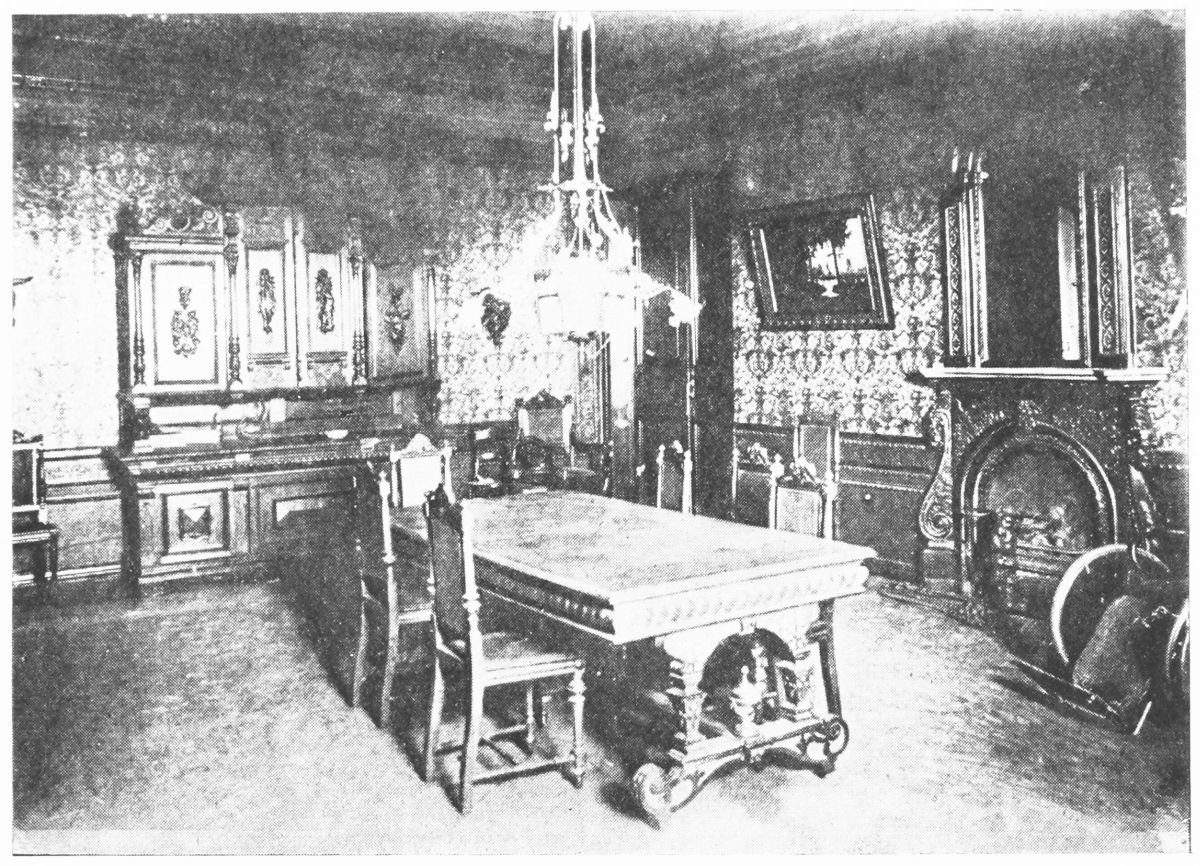
DINING-ROOM IN THE IPATIEV HOUSE
This photograph was taken before the arrival of the Imperial family.
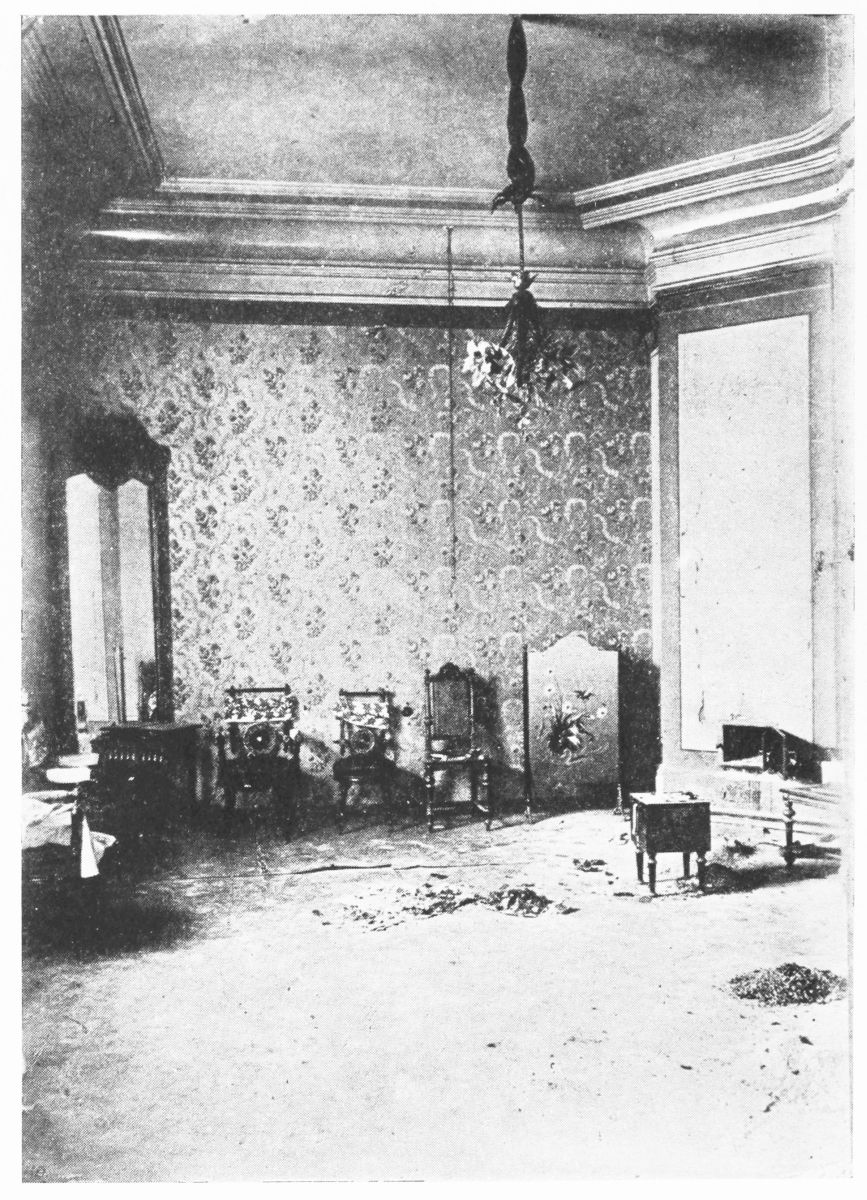
THE GRAND DUCHESSES’ ROOM IN THE IPATIEV HOUSE
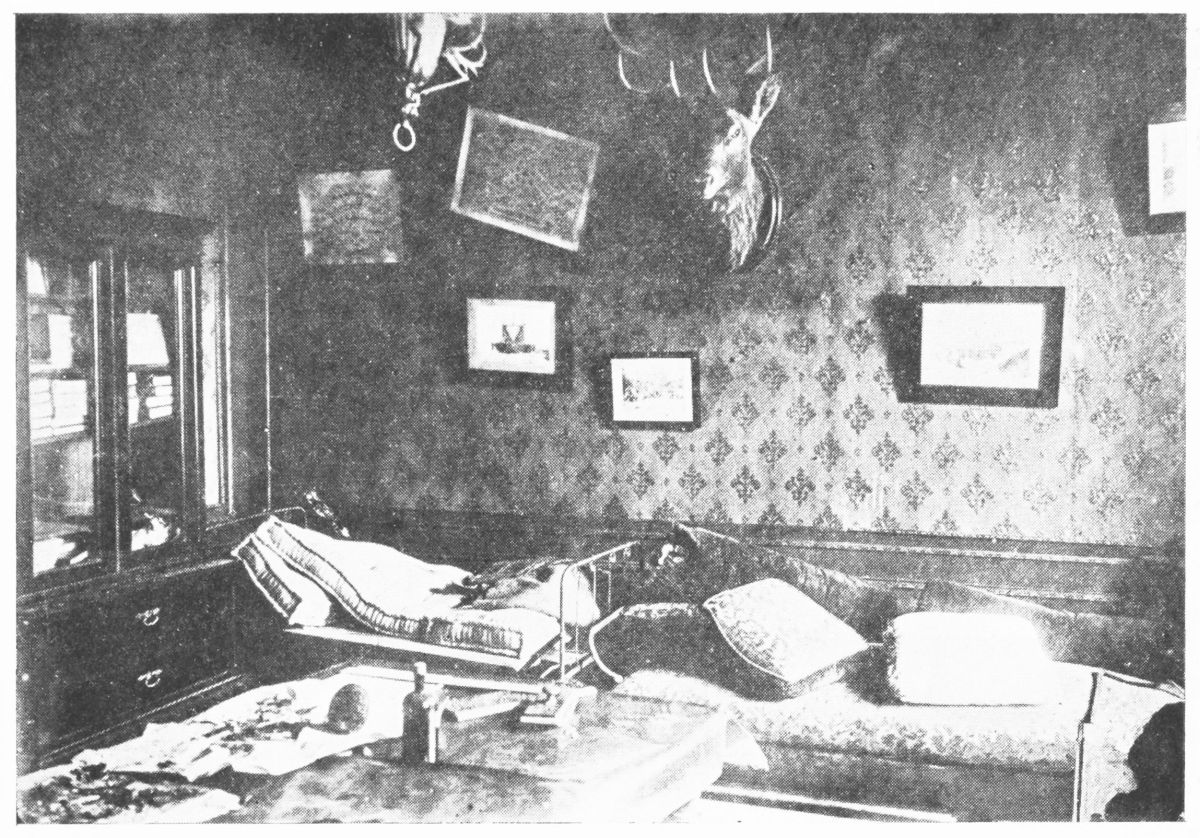
THE COMMANDANT’S ROOM IN THE IPATIEV HOUSE
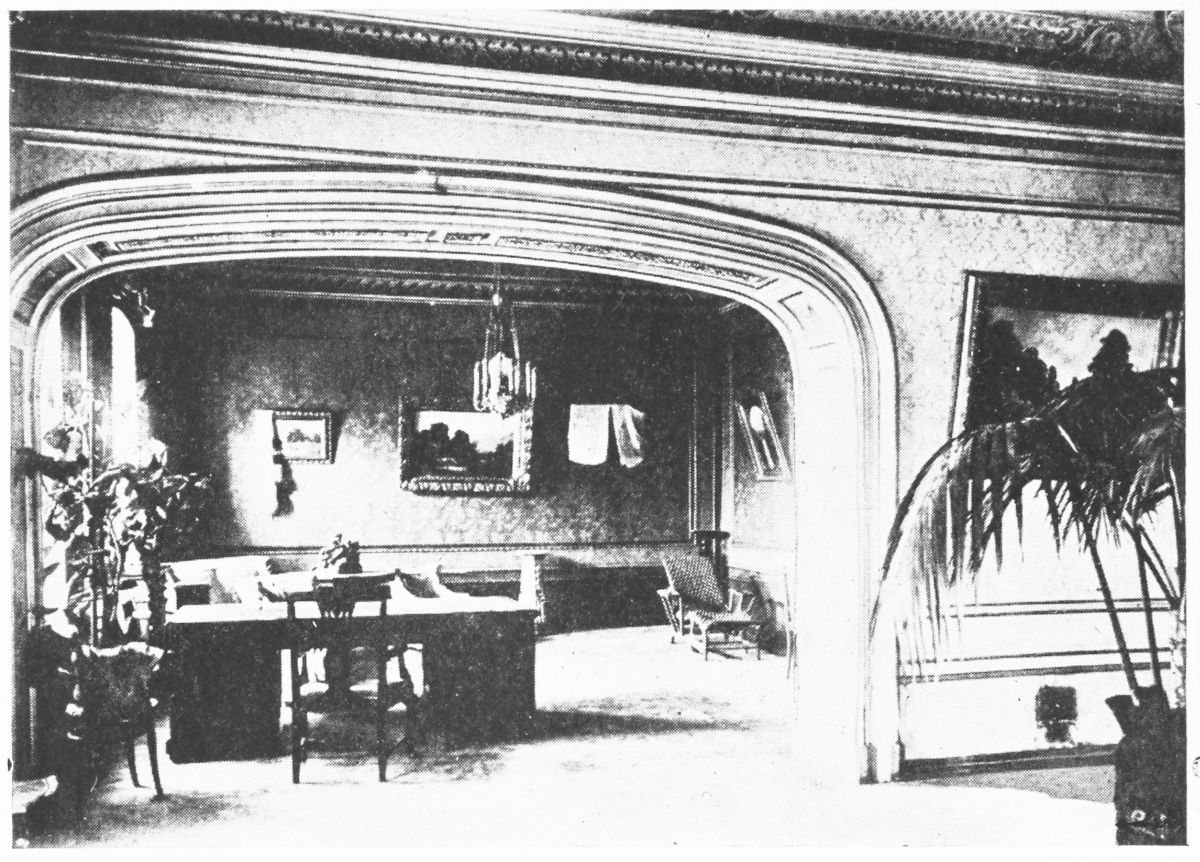
THE HALL AND DRAWING-ROOM IN THE IPATIEV HOUSE
This photograph was taken before the arrival of the Imperial family.
of such a surrender made her frantic. Paul could not help. She tried to
get into communication with her husband by aeroplane. A trusty flying
officer was summoned, but even this venture failed.
Remaining outwardly calm, she showed the measure of her anxiety by
abandoning the reserve that she had always displayed. Thus she herself
came out to the guards battalions and units that had been concentrated
around the Palace, and actually made a speech to them.
On the morning of the 21st of March, General Kornilov came to inform
Alexandra “that upon him had fallen the painful duty of announcing the
ordinance of the Council of Ministers that from that hour her Majesty
must consider herself to be under arrest.” This announcement was made to
the Empress in the children’s play-room in the presence of Colonel
Kobylinsky, the new commandant of the Palace. Then General Kornilov
asked to speak to the Empress alone. He assured her that there was no
danger, and then gave instructions for the treatment of the prisoners,
based upon kindness and courtesy.
The meeting between husband and wife was a very affecting one. Nicholas
came straight to the nursery. They embraced each other tenderly,
“forgetting the world and its troubles in the joy of reunion with their
children.” Prison rules, rigorously applied, thenceforth prevented any
communication with the outside, and for a time even between the
prisoners.
Kerensky set about trying to discover some evidence of collusion with
the enemy. Alexandra was isolated. A creature of Kerensky’s, named
Korovichenko, came to search the Imperial papers. The Tsar politely
offered to help him, but met with a rude rebuff, after which he left
Korovichenko alone. Having satisfied himself that no such evidence
existed Kerensky somewhat altered his demeanour. At his first meeting
with the ex-Tsar, he had adopted a tone of haughty familiarity. Later,
he became polite, even respectful, addressing him as “your Majesty,”
instead of plain “Nicholas Alexandrovich.”
Although the soldiers guarding the Palace were not supposed to enter its
precincts, the prisoners did not enjoy immunity from their prying gaze
and offensive curiosity. They broke into the palace and pilfered,
ransacking trunks. On one occasion they rushed into the sitting-room
where the family had assembled. One of the girls sat between the light
and the window, doing some sewing. Her movements silhouetted outside had
been suspected to be signals.
An officer accompanying the Minister of War (Guchkov) on one of his
visits loudly accused the occupants of the Palace of being “sold to the
enemy” (Vy vsie prodazhnyie). The fact that he was intoxicated did not
lighten the insult. It showed what unworthy suspicions animated people
in the Ministries. The ignorant soldiers who imbibed their daily dose of
revolutionary lore from the Soviets were not better or worse than their
chiefs. By dogging the ex-Tsar’s footsteps when he went out for
exercise, by shooting the boy’s pet goats, and taking away his toy
rifle, and by other acts of the same kind the soldiers were merely
copying their officers. These demonstratively donned red badges and
ignored the Tsar’s salute.
Senseless clamour had led to daily espionage of the family. Officers of
the guard went into the dining-room at lunch time to see if the
prisoners were all in the Palace. The Tsar always greeted them. On one
occasion an officer declined the extended hand. Nicholas, deeply hurt,
asked him: “Why?” The man, putting his hand behind his back, declaimed:
“I am of the people. When the people stretched their hands out to you,
you did not meet them!”
. . . . . .
At the end of July the captives heard that they would shortly go away.
It was impossible to leave them there any longer. The Soviets of
Petrograd and Kronstadt had tried to obtain possession of them by force
and by stealth. Once an individual attired in uniform, styling himself
Colonel Maslovsky, had made his appearance, and, producing a paper
signed Chkeidze, demanded, in the name of the Soviet of Petrograd, the
transfer of the prisoners to the Fortress of SS. Peter and Paul,
threatening to call in the troops if his demands were not immediately
complied with. It was with the greatest difficulty that Colonel
Kobylinsky averted the danger. The Provisional Government could not
afford to let the Soviets obtain the custody of such valuable hostages.
It had to remove them to a place of safety—above all to a place where
the Soviets could not easily reach them. Perhaps this explains the
selection of such a remote place as Tobolsk. It was chosen by Kerensky
without the knowledge of the captives. They thought, till the train was
conveying them eastward, that they were bound for the south. The ex-Tsar
did not like his destination. He suspected a trap, though what should
have made him suspicious is not known.
Permission had been given to the banished sovereigns to choose the
persons who were to accompany them into exile. Nicholas selected his
aide-de-camp Naryshkin, but as this favourite hesitated, he at once
crossed out his name and proposed Ilya Leonidovich Tatishchev, who, with
Prince Vasily Alexandrovich Dolgoruky remained with him to the end,
paying for their loyalty and devotion with their lives. In a separate
chapter I shall describe the heroism, sufferings, and end of those who
were faithful unto death—of the two whom I have just named, of Dr.
Botkin and of young Countess Anastasia Vasilievna Hendrykova, angel of
purity and grace, whose mere presence at the Court of Alexandra should
have kept away all things evil, and of devoted Mlle. Schneider, and of
the humbler servitors. The ex-Empress was not permitted, for some
unexplained reason, to take her favourite maid.
The evil genius of the household, Anna Vyrubova, had been locked up in
the fortress. She and Voeikov, the ex-palace commandant, had been
subjected to the most searching interrogation by the members of the
“Extraordinary Commission of Inquiry regarding the Dark Forces.” Such
was the high-sounding title invented by Kerensky to mobilise all methods
of bringing home to the Tsar the abominable charges invented against
him. Nothing could be proved, because there was nothing to prove. But
Kerensky had his spies all the time at the palace and sent one to
Tobolsk.
Young Alexis celebrated his thirteenth birthday on the eve of departure.
The family attended a special service and afterwards offered up the
customary prayers for a safe journey. They were going into the unknown.
Here in their own familiar surroundings life had not been so terrible
towards the end of their captivity. What had the future in store? The
war was still in progress. They could not leave the country. Perhaps
when peace came, some quiet refuge would open its gates, and they could
live happily together. The girls and the boy were delighted like all
young things over the prospect of a journey. Alexis and his sisters had
quite recovered from their illness.
At midnight of the 13th August Kerensky came to the palace, assembled
the soldiers who had been selected to escort the family, and made them a
speech. “You have guarded the Tsar’s family here,” he said, “you also
will have to guard them in the new place where they are going by order
of the Council of Ministers. Remember, one does not hit a man who is
down. Bear yourselves like men, not like cads.”
He then entered the palace. The ex-Tsar’s only brother, the Grand Duke
Michael, had been permitted to come to say good-bye. Kerensky gave him
ten minutes with Nicholas, remaining in the room with them. The brothers
were never to meet again. Michael did not see any other member of the
family.
Learning that the Tsar’s family was to be removed from Tsarskoe-Selo the
men employed at the railway station refused to let out the engine. All
night the exiles waited for the train. It came at six o’clock in the
morning.
The period between autumn, 1917, and the following spring furnishes much
material for this tragic history. It was during their exile in Siberia
that the fate of the Romanovs was decided—not in the Urals. It was at
Tobolsk, in the close intimacy that misfortune naturally brings, that
the true character of each captive, high and low, asserted itself. Thus,
invaluable data has been obtained for the historian.
At first the captives enjoyed the respite of remoteness from the storm
centre of Petrograd. But many circumstances gradually impaired this
advantage. They began to suffer privations even before the Reds captured
the government. The remittances promised by Kerensky did not arrive.
After the Bolshevist usurpation, the captives were allowed starvation
rations, and had to eke out their livelihood by needlework, drawings,
etc. Then the boy fell ill with one of his periodical attacks,
aggravated by the exhausting effects of the Siberian winter and
inadequate diet.
At Tobolsk Alexandra showed herself to be strong, brave, gentle.
Adversity seemed to bring out all that was best in her nature. Yet here
the family physician, who had followed them into exile and afterwards
shared their fate in Ekaterinburg, became entirely convinced that she
was not quite normal. It required only a chance remark on political
topics to provoke a hysterical outburst. As usual, she could see nothing
bad in the peasants, even when the peasant soldiers of the guard were
constantly behaving “like cads”—despite Kerensky’s exhortations.
Nicholas sawed wood and gave lessons to the children. Indeed, with the
help of Mr. Sidney Gibbes and M. Gilliard and other teachers, they were
making up for time lost in their education.
With so many and such powerful influences interested in their existence,
it was only to be expected that efforts would be made to enter into
communication with the exiled monarchs. Each of the parties then
fighting for power in Russia had its spies and emissaries in Tobolsk. It
is certain that the Germans were represented in many ways. It is equally
certain that the Entente had nobody. The talk of a rescue by some bold
Englishman ascending the Ob and Irtysh from the Arctic Ocean and wafting
away the prisoners is not only unfounded, it is the merest moonshine.
Winter in Siberia lasts seven months, during which time there is no
means of reaching the northern shores except on sleighs. Any attempt to
enter or leave the country would have been easily discovered and
notified by telegraph, which was wholly in the hands of the Soviets.
One comfort was not denied to the captives—they sent and received
letters, in some cases without censorship. They were also able to get
newspapers and other literature. Thus they were in touch with the
happenings of the outer world. These did not bring them much
consolation, it must be admitted. Nicholas never recovered from the blow
of learning in this manner of the Treaty of Brest-Litovsk. Up to that
time he had, in spite of everything, kept alive some hope for the future
of his country. Thenceforth he was a man without hope, and all that
happened afterwards left him indifferent. If he could have died without
causing pain to his wife and children, he would have died gladly, unable
to live down the stain of dishonour.
The exiles suffered unconsciously from the senseless if not traitorous
behaviour of a man in whom they naturally trusted—the local priest,
Father Vasiliev. Base cupidity may have been his only motive, but it is
certain that he caused incalculable harm and must be held accountable
for the tales of alleged plots to escape from Tobolsk. The Reds used him
as their tool. Perhaps he was not altogether blind. There were other
“friends” who proverbially, proved to be worse than enemies. On the
other hand, many instances of disinterested loyalty and devotion
consoled the captives in their afflictions.
From Tsarskoe to Tobolsk, the journey under normal conditions required
not more than a week. The Imperial exiles reached their destination on
August 19th, within six days of departure. They travelled in comfort in
sleeping cars with a whole retinue of servants. The list of the
passengers as officially approved numbers forty-five all told. Two
trains conveyed them and their effects. Stoppages were not made at the
large stations because local workmen and Soviets were disposed to
interfere. They had done so at Zvanka, the first important station on
the Vologda-Viatka route, by which the party travelled. The deputy
Vershinin, who had brought the Tsar a prisoner from Moghilev, acted
again in the capacity of representative of the Provisional Government
during this journey. He had the greatest difficulty in overcoming the
resistance at Zvanka. The workers did not wish to allow the trains to
pass.
At Tiumen two steamers awaited the party for the river trip to Tobolsk.
They passed by the village of Pokrovskoe. Alexandra called the children
to look at the birth-place of the “saint” on the banks of the stream in
which he had fished. She was fond of comparing him to the fishermen of
Galilee, humble men like him. The children dutifully complied and joined
their mother in prayer—not because they liked or regretted Grishka, but
out of love and obedience to their mother. To her diseased imagination
this coincidence between the scene of their exile and the home of
Razputin had a mystical meaning.
The voyage had been as pleasant as it could possibly be. The tedium of
the long days of travel had been relieved by frequent stoppages amidst
forest or field. All who wished could alight and walk, while the train
followed slowly. Such comforts are possible only in Russia. Descending
the tributaries of the mighty Irtysh, the exiles had a wonderful picture
of the Siberian autumn, with its splendour of colouring and teeming bird
life. At Tobolsk they had to remain a whole week in the steamers,
because the houses intended for them were not ready. They were, of
course, under constant guard, but allowed to take exercise ashore.
On August 26th they moved into their new prison. Alexandra was suffering
more than usual from heart trouble. She drove in a comfortable carriage.
The Tsar and the family and household walked. With the exception of a
few servants, all found accommodation in two houses: one a warm, roomy
stone building, formerly the residence of the Governor; the other
adjoining it and known as the Kornilov house. The ex-sovereigns and
their children took up their quarters in the upper storey of the
Governor’s house. Here were the Tsar’s study and the bed-chambers of the
imperial couple, of Alexis and of the grand-duchesses. Here also was the
drawing-room. Downstairs were the school-room, servants’ rooms, and the
quarters of the commandant and officers on guard duty. The suite and
other servants lived in the Kornilov house. Later, the soldiers
expelled many of these occupants without reason, and, as some of them
had to be accommodated in the Governor’s house, there was no small
discomfort from over-crowding.
Both houses faced the main street, which had been renamed Ulitza Svobody
(Liberty-street). People passing by could see into the lower rooms. It
became a custom to bow to any member of the family who happened to be
visible, and some of the citizens would demonstratively make the sign of
the Cross. Behind the Governor’s house was an immense enclosure,
surrounded by a high wooden fence. Here the family took their exercise;
here the ex-Tsar chopped and sawed wood, and with his own unaided
efforts built a sort of wooden terrace, where the captives loved to sit
whenever the weather permitted.
Early rising was the rule. All except the ex-Empress were ready for
breakfast by 8:30. Alexandra’s health was so bad that she seldom left
her room before lunch-time. Breakfast, as usual among Russians, was a
slight meal of tea and bread. The ex-Tsar had it in his study with his
eldest daughter Olga, who of all the children most resembled him in
character. The other children and members of the household assembled in
the dining-room, situated on the ground floor of the Governor’s house.
The Empress had coffee in bed.
Till eleven o’clock Nicholas read or wrote his diary, while the children
had lessons. From eleven till noon father and children were in the
courtyard. He worked with axe or saw and the young folks played games.
At twelve o’clock all went to the school-room and had sandwiches, after
which the Tsar left his children to continue their lessons. The family
and household met at one o’clock at lunch—a simple meal—after which
they were in the open air, weather permitting, till four p. m. The
Empress seldom left the house. Olga and Tatiana, the two elder grand
duchesses, helped their father in his manual work. Alexis generally had
a short sleep after lunch, and then followed the others into the
courtyard with his tutors.
Five o’clock tea was served in the Tsar’s study. Then followed an
interval for reading or games, then two hours for preparation of
lessons. Dinner at eight consisted of soup, fish, meat, sweet-dish, and
coffee. It was prepared by the Imperial cook, Haritonov, and during the
earlier period differed little from the customary repast of old times.
Everybody met in the drawing-room after dinner. There were reading and
conversation, Court etiquette being forgotten. Alexis retired to rest
early. At eleven o’clock tea was served, and soon afterwards all lights
were out.
Despite her poor health, Alexandra was seldom idle. In the morning she
gave lessons to the children and did needlework. When she remained alone
in the house she would play the piano. Often, when the heart trouble
was severe, she had dinner also in her room, and then Alexis kept her
company.
The company at table included besides the family only the persons
already mentioned as forming the household—namely, Countess Hendrykova,
Mlle. Schneider, Prince Dolgoruky, General Tatishchev, Mr. Gibbes, M.
Gilliard, and Dr. Botkin. On Sundays came Dr. Derevenko and his son
Kolia.
The Tsar gave lessons to Alexis in history, a favourite subject, in
which Nicholas was extremely well versed. Alexandra instructed all the
children in religion, and taught her favourite daughter Anastasia
German—a language that none of the children understood. Anastasia was
ambitious to know everything. She studied history with the help of
Countess Hendrykova. Another teacher, Mme. Bittner, came afterwards to
help in the school-room. To relieve the monotony of their lives, the
children were encouraged to take up private theatricals. Several plays,
English and French, were produced with great success.
To the Empress’s intense joy, they were permitted to attend church. Her
greatest sorrow at Tsarskoe had been the interdict on church-going, the
nearest place of worship being outside the precincts of the palace and
therefore inaccessible to the prisoners. Here at last they could go to
church, after a lapse of more than four months. But the sacred edifice
was closed to other worshippers when the exiles attended it.
Unhappily, this source of spiritual comfort was not unalloyed with
temporal drawbacks. Father Vasiliev, the incumbent, did a very rash
thing one day. Without consulting anybody, he suddenly intoned the
prayers for the sovereigns, as if they were still on the Throne. The
exiles were powerless to interfere. Of course, the incident came to the
knowledge of the whole garrison immediately afterwards, and led to the
sort of reprisals that one might have expected: church-going was stopped
for ever, and, what was worse, the soldiers insisted upon having a
representative inside the house at all religious services, to see that
the above named practice was not repeated. Thus all the efforts of
Colonel Kobylinsky, the good-hearted commandant, to keep the soldiers
out of the house were defeated.
Within a month of their arrival in Tobolsk the exiles were placed under
the observation of special emissaries of the Provisional Government: the
Komisar Pankratov and his assistant, Nikolsky. The former enjoyed high
confidence and renown in revolutionary circles, having spent fifteen
years in the Fortress of Schlusselburg and twenty-seven years in exile
in Siberia. A typical theorist, dangerous in his teachings, he was
personally the best-hearted of men. He adored children, and was the
playmate of the young Romanovs, whom he literally enthralled with
stories of his prison years. His particular favourite was Maria.
Nikolsky, on the other hand, was uncouth, uncultured, brutal, and
stupid, and took an apparent delight in bullying the young folks,
especially Alexis. With permission from the Government, some medicinal
wine had been sent to Tobolsk from Tsarskoe. Nikolsky took the bottles
and smashed them.
As a matter of fact, the delightful but not very far-sighted Pankratov
caused much more harm than the bestial Nikolsky. True to his
revolutionary principles, he immediately proceeded to indoctrinate the
soldiers. Perhaps he feared the personal influence and charm of the
ex-Tsar. Pankratov talked with them by the hour on the wonders of the
Socialist-Revolutionary programme, and, as so often happened in Russia,
the ignorant listeners became not Socialist-Revolutionaries but
Bolshevists. Anyhow, they very soon lost all respect for authority in
the persons of their commandant and officers, and began to ill-treat the
prisoners. They sank so low that even the young grand duchesses suffered
insult. Lewd drawings and inscriptions disfigured the posts of the swing
that was their only outdoor pastime. Later, these hooligans broke up the
ice-hill that the girls and their father had put up in the yard.
The day came when they included the ex-Tsar in their deviltries.
Nicholas wore the simplest garb—a soldier’s khaki shirt and overcoat,
retaining only his colonel’s shoulder-straps and his Cross of St.
George. Suddenly the soldiers decided that he must take off his badges
of rank. In vain Kobylinsky remonstrated with them. They threatened
violence if their “orders” were not carried out at once. It hurt the
ex-Tsar to the quick to cut off his shoulder-straps. Thenceforth the
cross alone remained to symbolise his fidelity to Russia and her allies.
He kept it ever on his breast to his dying day.
Some of the old soldiers remained immune from Pankratov’s influence, and
when the time came for them to be relieved, they visited the ex-Tsar by
stealth to bid good-bye. These were affecting scenes. The men fell on
their knees and prayed, and then embraced the captive and blessed him.
Of course, Nicholas related all this to Alexandra, whereby her
invincible belief in the peasants gathered new strength.
On several occasions violent disputes arose between Alexandra and one of
the ladies, because the latter spoke of the horrible behaviour of the
soldiers. Alexandra lost all control over herself, and cried: “They are
all good! They are all good! They are led astray by Jews.... The people
will come to their senses, and there will be order.... The soldiers are
all right. I wish the officers were more energetic.”
In November, while Kerensky was still at the head of the Government, no
money had as yet been received, in spite of all his promises. The funds
of the household had run out, and Dolgoruky and Tatishchev, having
expended their own substance, had to borrow from charitable souls in the
town, giving their note of hand in return. Two months later, word came
from the Soviet Government that it had no money to spend on the
prisoners. They would be allowed to occupy their houses free of charge,
would receive soldiers’ rations, and have to work if they wanted
anything more. Sorrowfully, they faced the situation. One-third of the
servants were at once released, each receiving a certain sum out of the
scanty remnants. Nicholas and Alexandra never knew how their faithful
followers had to pinch and contrive in order to keep the household from
starvation.
Alexis astonished the household by his precocious understanding. “I
begin to know the truth here. At Tsarskoe everybody told lies,” he
remarked one day. “If I become Tsar, no one will dare to tell me lies. I
shall make order in the land.” He combined his mother’s will with his
father’s charm. Those who came to know the boy at Tobolsk are confident
that he would have justified his words.
To a visitor at his bedside when he was ill, he spoke his thoughts about
Razputin. The “saint’s” portrait had been placed by Alexandra near her
sick son’s pillow. The visitor accidentally upset it. “Do not pick it
up!” cried Alexis. “The floor is the place for it.”
. . . . . .
Towards the end of their exile, some, if not all, of the captives
realised the desperate nature of their position, and had scant hope of
surviving Bolshevist rule for any length of time. Pathetic evidences of
their attitude were found among the papers that remained at Tobolsk and
came into the hands of the investigating magistrate. Among them are two
prayers written in verse—apparently composed by Countess Hendrykova and
transcribed by the Grand Duchess Olga. Here is an approximate rendering
of some of the verses:—
Grant us Thy patience, Lord,
In these our woeful days,
The mob’s wrath to endure,
The torturers’ ire;
Thine unction to forgive
Our neighbours’ persecution,
And mild, like Thee, to bear
A blood-stained Cross.
And when the mob prevails,
And foes come to despoil us,
To suffer humbly shame,
O Saviour aid us!
And when the hour comes,
To pass the last dread gate,
Breathe strength in us to pray,
“Father forgive them!”
The intimate connection between Berlin and Moscow yielded many living
examples among the visitors to Tobolsk. Many, if not all, of the spies,
emissaries, and other agents appearing there had been at one time or
another in the German capital. Yakovlev, the special commissary sent to
remove the prisoners from Tobolsk, was no exception to the rule.
His appearance was preceded by certain events which must be related
here. The soldiers forming the guard at Tobolsk grew tired of Pankratov
and his everlasting speeches. By the end of the first week in February
(1918) they had decided to get rid of him and of Nikolsky. On the 9th
they turned them out of the Kornilov house and drove them out of the
town. They then telegraphed to Moscow, reporting what they had done, and
asked that a proper commissary—not an appointee of Kerensky—should be
sent. But Moscow remained obstinately silent. The time for action had
not yet arrived. Meanwhile, the Soviet at Omsk, representing Western
Siberia, sent a representative to Tobolsk. He arrived on March 24th.
This man was a certain Dutzmann, a Jew. He did not interfere with the
prison régime; indeed, he never came near the governor’s house.
At the end of March, Alexis had a severe attack of his illness—the
worst ever known. Both legs were paralysed. The pain was excruciating
and unremitting. Day and night he cried aloud in his agony, and the aged
and infirm mother had to sit by and comfort him. After a whole month of
suffering the patient began to improve and the pains grew less, but he
was still a cripple and could not be moved without serious danger. At
this juncture appeared the Soviet emissary, Yakovlev. Neither the
soldiers nor the captives were surprised. Only a few days later they
understood what an important part he had come to play in their lives.
Yakovlev reached Tobolsk with an escort of 150 horsemen late in the
evening of April 22nd and unobtrusively took up his residence in the
Kornilov house. Colonel Kobylinsky saw him next morning. Yakovlev handed
him an order from the Tsik, signed by Sverdlov, intimating that the
bearer was entrusted with a mission of the highest importance and that
he must be implicitly obeyed, but no hint was given as to the nature of
the mission. Yakovlev then had the men of the guard mustered and showed
them a similar document, by which they were informed that any
disobedience to him would be punished with death. To sugar the pill,
Yakovlev told them that he had brought them a lot of money, the Soviet
having decided to pay at the rate of three roubles a day instead of
fifty kopecks, the rate fixed by the Kerensky Government. Altogether,
Yakovlev showed himself to be an expert in the art of handling peasant
soldiers, but he had to overcome opposition of a more subtle kind from a
Jew named Zaslavsky, who had insinuated himself among the guards as the
representative of the Uralian Soviet. This man had previously caused no
end of trouble by “discovering” “plots,” and had almost persuaded the
soldiers on one occasion to insist that the Imperial captives should be
transferred to the town lock-up. In fact, here once more it was only the
coolness of the resourceful Kobylinsky that had saved the situation.
But this noxious individual did not have things all his own way. The
Omsk Soviet also had its representative among the guard—a Russian named
Degtiarev. Now the two Soviets—that of Omsk and the one at
Ekaterinburg—being constantly at odds, their emissaries were naturally
jealous of each other. Thus it was enough for Zaslavsky to take one view
in order that Degtiarev should take the opposite one. Zaslavsky had for
some reason immediately stirred up opposition to Yakovlev and tried to
persuade the soldiers that he was a spy come to deliver the prisoners.
With Zaslavsky was an Ekaterinburg workman named Avdeiev, who figured
prominently in subsequent events. It is noteworthy that Yakovlev came to
Tobolsk by way of Ufa—a roundabout journey from Moscow—apparently in
order to avoid Ekaterinburg. Yakovlev had friends in Ufa. It is probable
that he had met Avdeiev there. He appears to have imagined that Avdeiev
might help him to prevent or allay suspicion in Ekaterinburg. In this he
was mistaken.
At a meeting of the soldiers on the 24th, Degtiarev, backed by Yakovlev,
attacked Zaslavsky with such vim that the men threw him out, and he made
haste to escape to Ekaterinburg to relate a purely imaginary story of
Yakovlev’s designs to release the Romanovs. But there is evidence to
show that he first communicated by wire with Sverdlov. Zaslavsky’s
poisonous character may have been the only prompting necessary, but it
is not impossible that he may have been “inspired” from Moscow to play a
part in the intricate conspiracy that was to exterminate the Romanovs.
Certainly Yakovlev underrated his capacity for mischief, as will appear
later. Sverdlov tried to make the world believe that Nicholas II. was to
be brought to Moscow for trial. But this may have been only an
afterthought. In any case, it was easy to have him intercepted by
playing upon local ignorance and suspicion through Zaslavsky.
Meanwhile, during these two days (the 23rd and 24th), Yakovlev had been
repeatedly inside the governor’s house, and on each occasion had gone to
the boy’s room, appearing suddenly, looking fixedly at the patient, and
then going away. Nobody noticed his strange behaviour at the time. They
remembered it afterwards. No one knew as yet what he had come for. On
the night of the 24th Yakovlev went to the telegraph office, taking with
him an expert operator who had come with him from Moscow, and had a long
conversation over the wire with Sverdlov, the substance of which—as
transpired later—dealt with the boy’s sickness and the impossibility of
moving him. Sverdlov gave him “new instructions” to the effect that he
was to bring Nicholas and that since the boy could not come he would
have to be left behind for the present.
From the telegraph office, Yakovlev went straight to Colonel Kobylinsky
and, for the first time, disclosed the object of his mission. “But what
about Alexis?” remonstrated the commandant. “That is the trouble,” was
the reply. “I have satisfied myself that he is really too ill to travel,
so my orders now are to take the ex-Tsar alone and leave the family here
for the present. I propose to start tomorrow. Arrange for me to see him
at once.” It should be explained that as the roads would, in a few days,
become impassable, and the river-ice break up any moment, owing to the
advance of spring, it was necessary to leave Tobolsk at once or wait
several weeks till the rivers were clear of ice. Hence Yakovlev’s haste.
But as he was apparently well acquainted with the character of the
Empress, he insisted that Nicholas should receive him alone.
The ex-Tsar appointed two o’clock on the following day for the
interview. Alexandra became furious on learning that she was not to be
present. When Yakovlev entered the drawing-room, she met him with
flaming eyes and asked him how he dared to separate husband and wife.
Yakovlev, with a shrug of the shoulders, addressed himself to Nicholas:
“The Moscow Central Executive Committee have sent me as Commissary
Extraordinary with power to remove the whole family, but as Alexis
Nikolaievich is ill I have received orders to leave with you alone.” The
Tsar replied: “I shall go nowhere.” Yakovlev remonstrated: “You must not
say that. I have to carry out orders. If you refuse to go, I must either
use force or send in my resignation, and then someone else will come who
will be less humane. Have no anxiety; I answer for your life with my
head. If you do not wish to go alone take anybody you like. Be ready to
leave tomorrow at four.” Yakovlev thereupon left without addressing the
Empress.
Kobylinsky remained in compliance with a request from the ex-Tsar.
Alexandra and Tatishchev and Dolgoruky stood by. “Where do they want to
take me?” asked Nicholas. “To Moscow,” was the reply. “Yakovlev let it
slip out when I inquired how long he would be away before returning to
fetch the family.” The ex-Tsar nodded, as if the news confirmed his own
knowledge. Turning to his followers he declared: “You see they want me
to sign the Treaty of Brest-Litovsk. But I would rather cut off my hand
than do so.”
Alexandra, much agitated, interposed: “I am also going. Without me they
will persuade him into doing something, as they did once before....” And
she fired a volley of abuse at Rodzianko for his part in the abdication.
But in the stress of the moment she had forgotten her sick boy. The
hours that followed will ever be recalled by all who survive as the most
painful of their memories. This distracted mother, too feeble to stand
for more than five minutes, paced her room like a caged tigress. She
summoned her favourite daughter Tatiana and burst into a storm of
weeping. For the first time her attendants saw her lose all
self-control. In broken sentences she disburdened herself of her sorrow,
revealing in her distress the innermost thoughts of her mind: “The
Germans know that their treaty is valueless without the Tsar’s
signature.... They want to separate him from his family in order to
frighten him into some disgraceful act.... He will be afraid to refuse
on our account.... It will be a repetition of Pskov....” She wrestled
with herself, praying that she might not have to choose between her
husband and her son, hoping that the river might suddenly open and
prevent any travelling. At last she came to a decision, and, jumping up,
cried: “It is enough, I go with the Emperor.” Nicholas entered the room.
She greeted him with the words: “I shall not let you go alone.” “As you
will,” was his reply.
Volkov, the Empress’s confidential man-servant, deposes that he saw her
in the Tsarevich’s room, and as she was going out inquired what was the
matter. Alexandra replied: “Gosudar (the Tsar) is to be taken away to
Moscow. They want him to conclude peace. But I am going with him. I
shall never permit such a thing. What would our Allies say?”
Madame Bittner spoke to the Tsar at this same juncture. She suggested
that “they,” meaning the Germans, would take him “out of the country.”
He replied: “God grant that it be not so. Only not abroad!” This witness
deposes that the whole family dreaded the idea of being sent abroad,
i.e., to Germany.
In this connection I recall a remarkable passage in one of the
depositions. Some member of the household at Tobolsk was reading out of
a newspaper the statement that the Brest-Litovsk treaty contained a
clause assuring the safety of the Imperial family. The Empress broke in
with an angry exclamation in French: “I had rather die in Russia than be
saved by the Germans.” (Je préfère mourir en Russie que d’être sauvée
par les allemands.)
It was then settled that the party with the Tsar should include:
Alexandra, the Grand Duchess Maria, Prince Dolgoruky, Dr. Botkin, and
the servants Chemodurov, Demidova, and Ivan Sednev. On receiving the
list, Yakovlev said: “It is all the same to me.” The soldiers were again
assembled on the evening of the 25th to be informed of the Tsar’s
removal. To forestall any objections, a number of them were selected to
accompany the party.
. . . . . .
The vehicles that were to convey the travellers to Tiumen, where they
would find a train, did not differ from the ordinary Siberian
tarantass—a large basket swung upon long flexible poles uniting two
springless axles, the baskets being filled with straw. Into these
vehicles the travellers tumbled and disposed themselves as best they
could. Alexandra had a troika, the others a pair of horses. She
beckoned to the Tsar to mount with her, but Yakovlev sent Maria to join
her mother, and shared his tarantass with Nicholas.
The roads were terrible. No traveller who has not experienced springtime
travel in Russia can have any idea of them. At some places the party had
to alight and walk through deep slush. The Empress was better off than
the others as she had a stronger team. Yakovlev was hurrying as fast as
horseflesh could go. Relays waited at stated intervals. The travellers
passed from one tarantass into another. It was better to lose no time
as every day the roads became worse, but there was another reason:
Yakovlev was evidently afraid of being stopped by the local soviets and
wished to rush past before they had had time to oppose him.
Throughout the trip he conversed with the ex-Tsar on politics,
endeavouring to talk him over to a certain point of view—but the Tsar
would not give way. This much the coachman who drove them could swear
to, although he could not catch all the details of the conversation. He
noticed that Nicholas did not “scold the Bolsheviks,” but somebody else.
They reached Tiumen on the 28th at 9 p.m. A special train was in
waiting. They started westward, but had not travelled far when at a
wayside station Yakovlev heard that Ekaterinburg would intercept him.
What he feared had happened. The only hope lay in circumventing
Ekaterinburg. For this purpose it was necessary to return, go east as
far as Omsk-Kulomzino, and thence switch on to the Cheliabinsk-Ufa
railway. But he was too late. The soviet at Ekaterinburg had wired to
Omsk that the ex-Tsar was escaping eastward, and a cordon of Red guards
stopped the train at Kulomzino. Yakovlev detached the engine and went
across the Irtysh to Omsk, and there, with the help of his private
telegraphist, spoke with Moscow. He was ordered by Sverdlov to proceed
via Ekaterinburg. As might be expected, they were met by a strong
force of fanaticised Red guards at the station at Ekaterinburg (April
30th). Yakovlev’s authority was flouted and the escort and guards that
were with him imprisoned till he had departed empty-handed on his way to
Moscow. The unfortunate Romanovs thus came into the hands that were to
massacre them and take their belongings.
Yakovlev had no hand in this foul conspiracy. He had been quite sincere
and consistent in his efforts to bring the whole family safely to
Moscow. There is no indication whatever, in all he said, that the object
of this removal was to bring the Tsar to trial. On the contrary, the
conversations with the Tsar, continued in the railway carriage, where,
again, he was separated from Alexandra, gave additional colour to the
version already given by Nicholas himself—that it was intended to
restore the monarchy under certain conditions.[8] Speaking of Yakovlev,
the ex-Tsar afterwards said: “Not a bad sort—evidently sincere.”
Alexandra did not cease to bewail her misfortunes, weeping over her son
and her husband.
On reaching Moscow, Yakovlev must have had some doubts about the
sincerity of the Tsik. Anyhow, he resigned his commissaryship and
eventually joined the White forces, and then mysteriously disappeared.
An interview with him, published in a Red organ at the time of his
journey in charge of the Imperial captives, contains some very
instructive features. It passes over in silence the attempt to evade
Ekaterinburg and falsifies the dates of arrival and departure at Tiumen
so that the glaring discrepancy between this and the arrival at
Ekaterinburg (two days instead of half a day) should not be noticed;
ignores, in fact, all the local soviet intrigues and protests, quite
needlessly, that he did not mention politics in his conversation with
Nicholas. Vasily Vasilievich Yakovlev had been a naval officer and was
therefore of Russian noble blood. He had committed some political
offence, had spent many years abroad—in Berlin. Who were his real
chiefs? It is not difficult to guess.
Two other commissaries went to Tobolsk to remove the remainder of the
family—Tatiana had been left in charge of the invalid and household.
Olga, the eldest daughter, did not enjoy her mother’s confidence in the
same degree. She took far more interest in literature than in the
practical affairs of life, and would hide herself in a corner with a
book or tell stories to the soldiers, utterly forgetting domestic
trifles. Anastasia, still a child, and rather backward, could be left in
Tatiana’s care. Maria went with the Imperial couple because she was too
grown-up to remain under her sister’s care. She was a very attractive
girl, and it used to be rather a joke among the grand duchesses to twit
her on her “conquests” among the Komisars.
The two successors of Yakovlev were:—A sailor named Hohriakov and a
certain Rodionov. The latter was afterwards identified as a former
gendarme officer. He used to inspect the passports at the German
frontier, and served some time in the Russian Embassy at Berlin as a spy
on Russian revolutionaries. When taxed with it, he admitted the
impeachment. The sailor, a typical good-natured peasant, soon made
friends with all the children. Rodionov, on the contrary, went out of
his way to torment and ill-treat them. He forbade the grand duchesses to
lock their doors at night, informing them with a leer that he had a
perfect right to come into their rooms whenever he liked. With every
appearance of enjoyment, he announced that in Ekaterinburg they would
have to observe stricter rules, which he himself had devised. Hohriakov
was nominally senior to Rodionov, but the latter did what he pleased.
Here must be recorded a circumstance which was destined to play an
important part in the detection of the murders of Ekaterinburg. Before
separating, it had been understood between mother and daughters that
they would take measures for safeguarding the jewels that had been
brought with them from Tsarskoe, worth not less than a million gold
roubles (£100,000). A letter from the maid Demidova
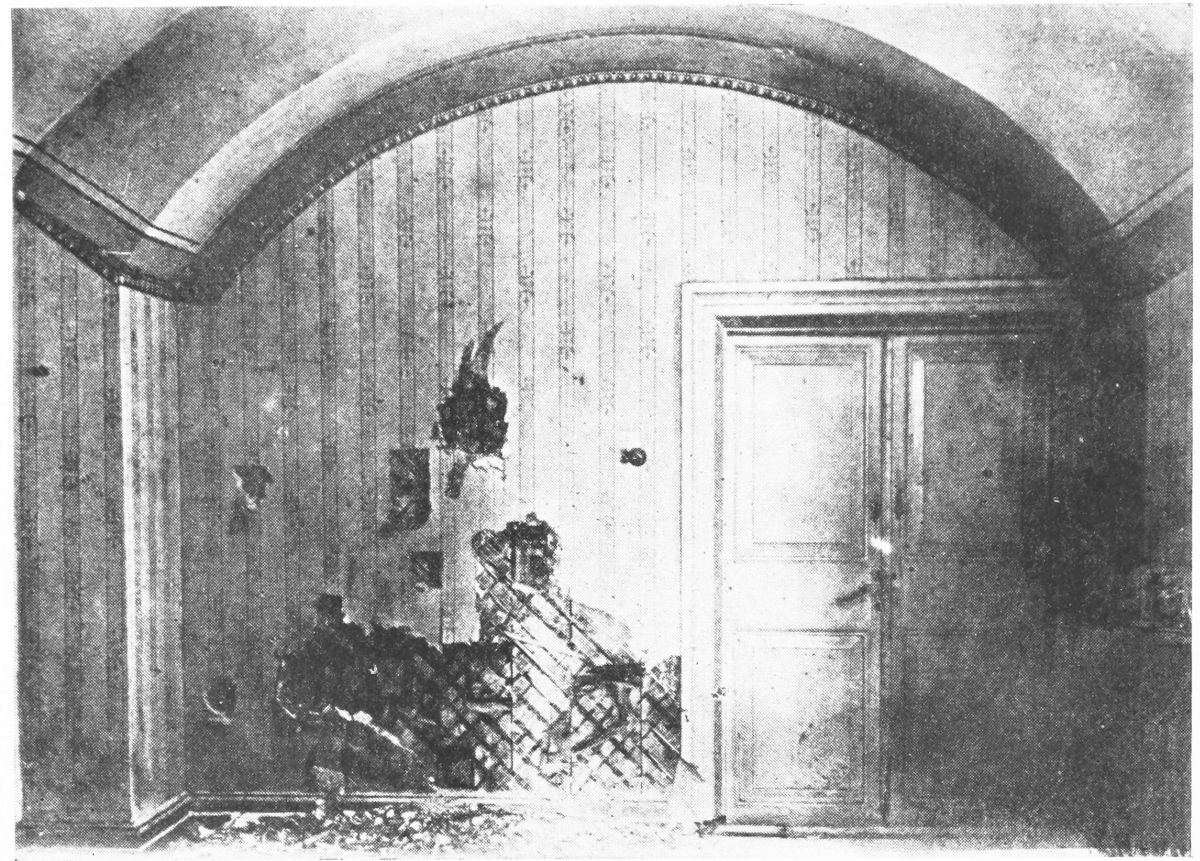
THE IPATIEV HOUSE: THE ROOM IN THE BASEMENT WHERE THE
IMPERIAL FAMILY WAS MURDERED
A vaulted semi-basement, 18 by 16 feet. Photographed from the spot where
the so-called “Lett” soldiers stood while firing their revolvers. The
Tsar and his son sat in the center of the room and behind them was the
Empress, also seated. The other victims stood at the further wall.
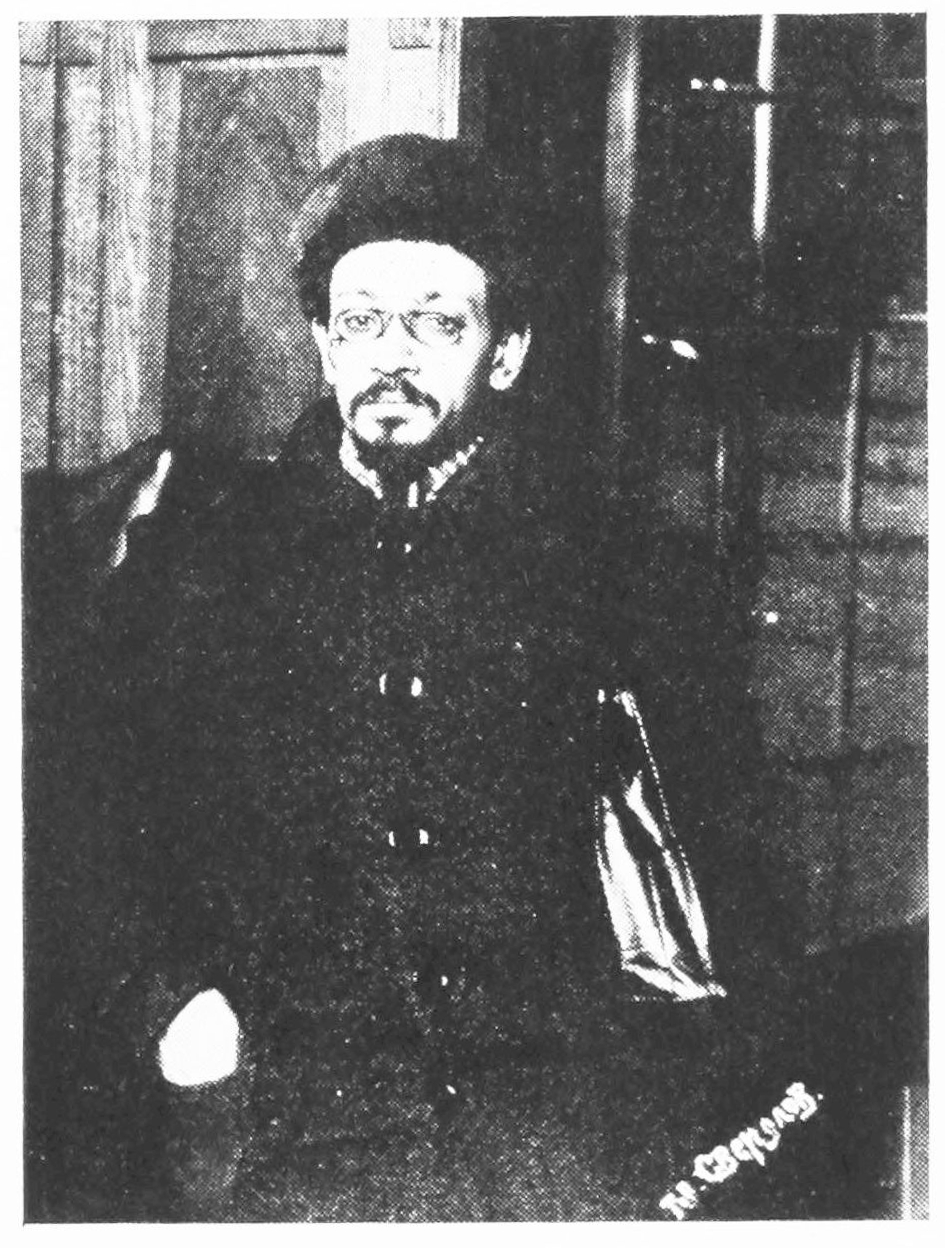
YANKEL (JACOB) SVERDLOV, THE RED TSAR
He organised the murder of the Romanov family, and was despised and
later killed by Russian workmen. He was President of the “Tsik”, i.e.,
Prime Minister and Ruler of the Red Inquisition. He posed for his
portrait with his portfolio at the entrance of his palatial offices in
the Hotel Metropole in Moscow, located on the square which is named
after him. He is dressed in a short shirt and shabby overcoat with only
a cap of expensive fur to befit the high office of the wearer.
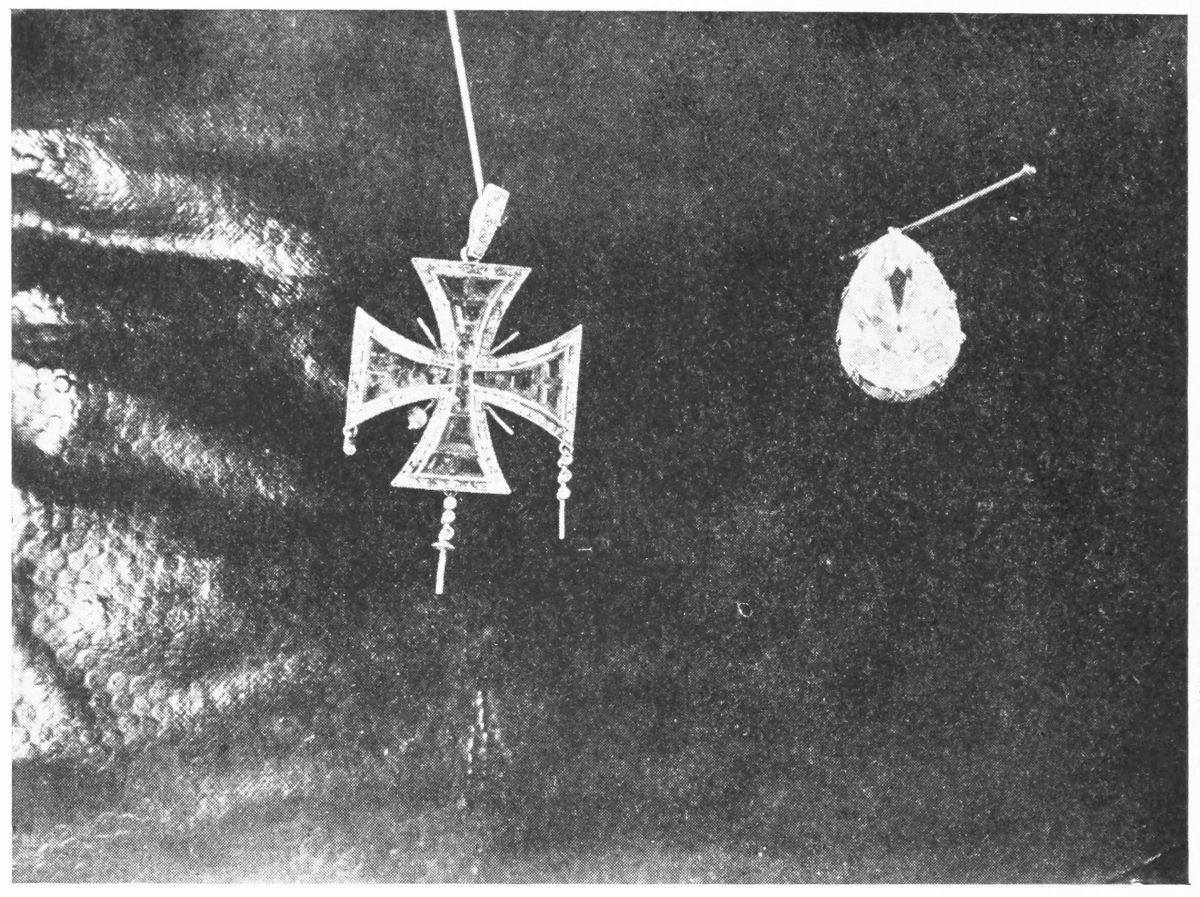
RELICS FOUND NEAR THE PYRES
A pectoral cross, set with emeralds, belonging to the Empress, and the
Empress’s great diamond pendant.
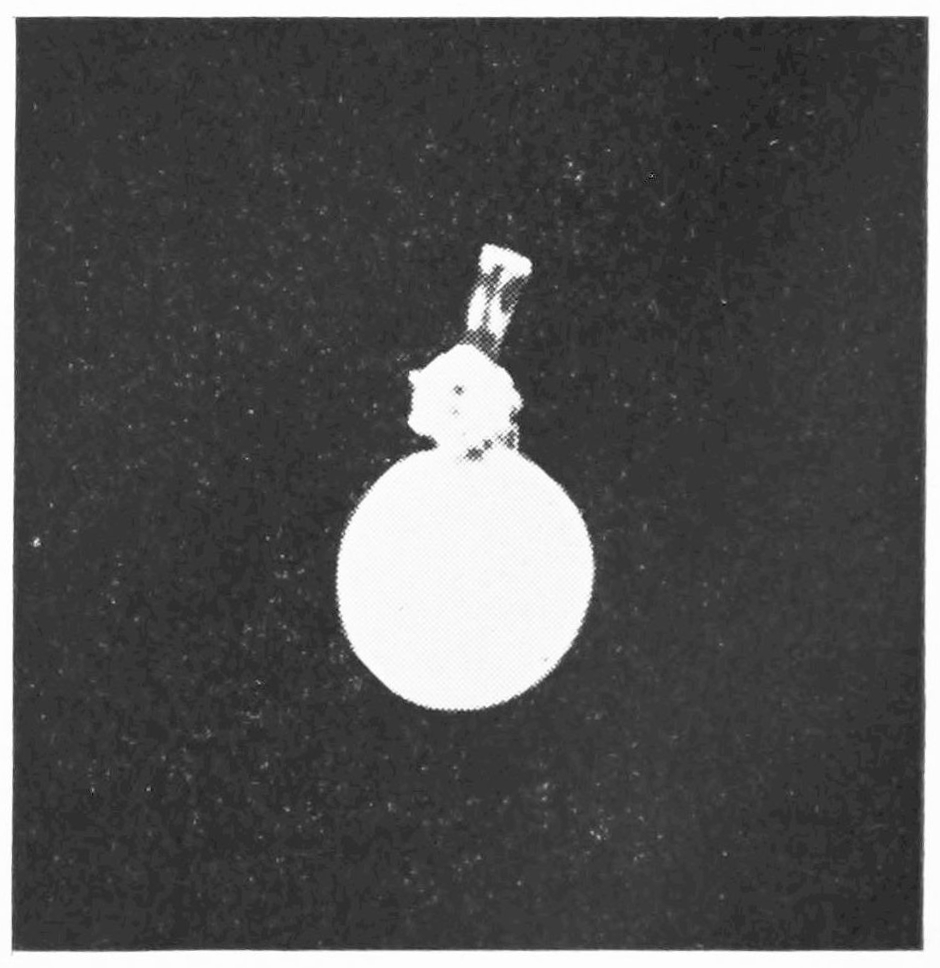
PEARL EARRING BELONGING TO THE EMPRESS
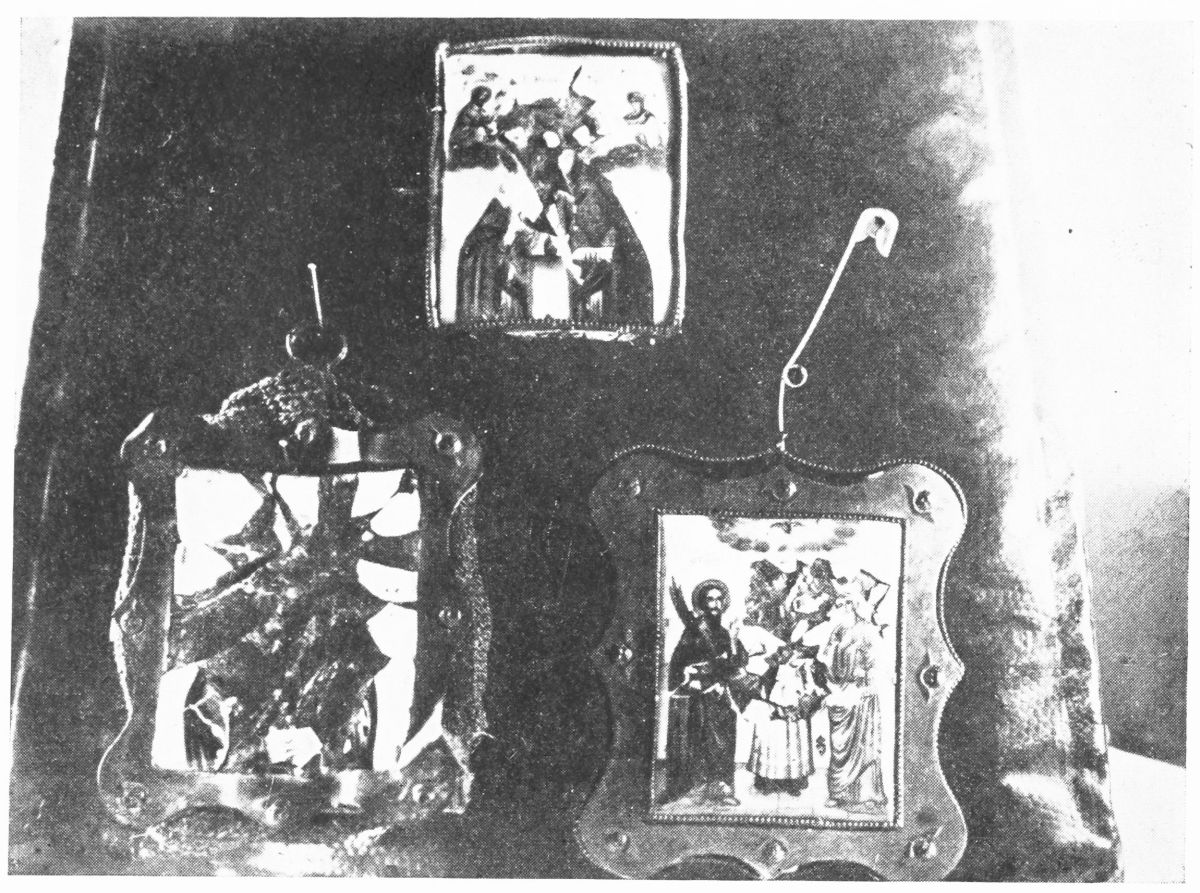
IKONS (HOLY IMAGES), BELONGING TO THE EMPRESS AND HER
DAUGHTERS
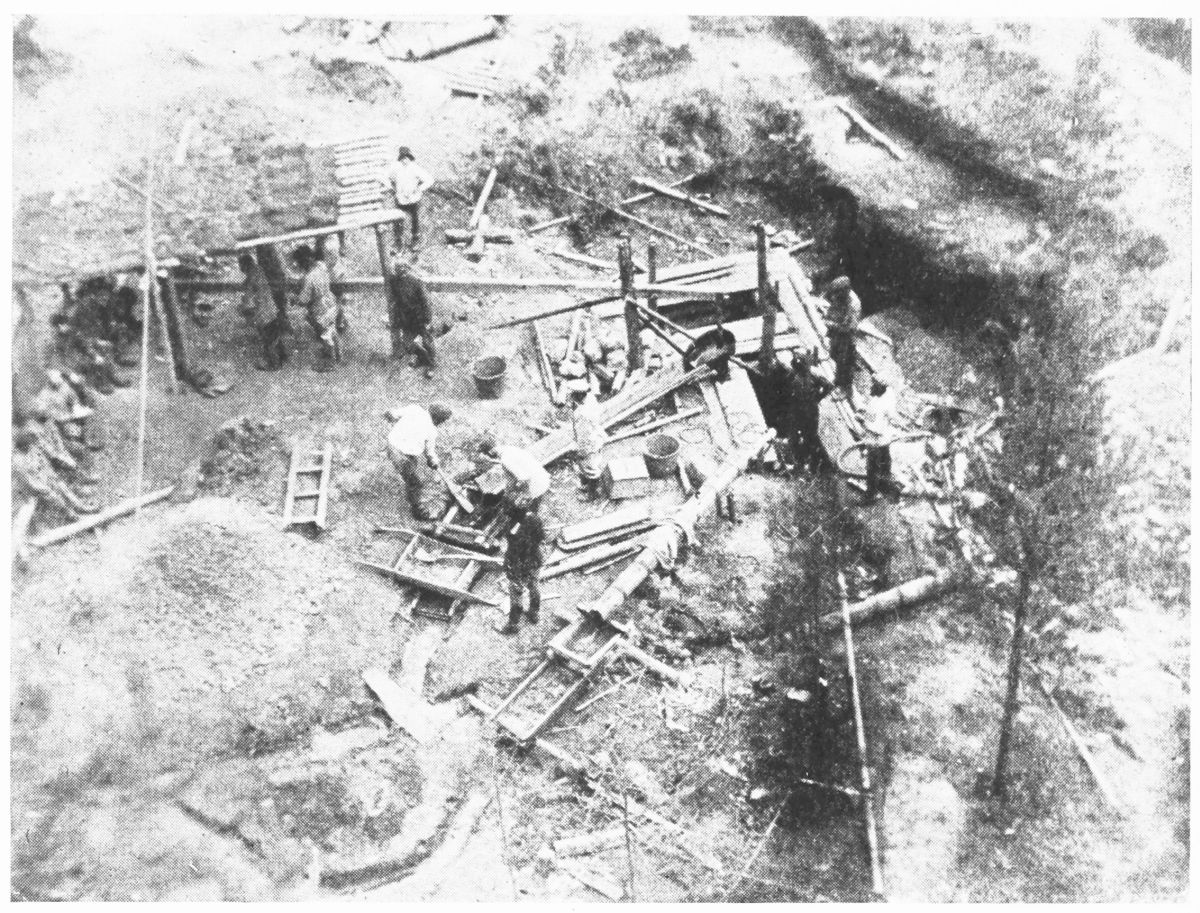
THE ENTRANCE TO THE SHAFT NEAR EKATERINBURG
from Ekaterinburg gave the necessary indications. The grand duchesses
were “to dispose of the medicines as had been agreed.” This meant that
the jewels had to be secreted in the clothing in such a way as to escape
search (Nicholas, Alexandra, and Maria had been “searched” very
thoroughly and brutally). For some days the grand duchesses and their
trusty servants worked at the task, sewing up the valuables in their
bodices, in their hats, and even inside their buttons. The Empress had
few if any valuables with her—possibly because there had been no time
to secrete them—but thanks to the precautions now taken, the grand
duchesses managed to smuggle all that was of greatest value into their
last prison-house. Womanlike, they clung to these relics of former
happiness, and perhaps deep down in their hearts slumbered some hope
that the gems might help them to escape.
Leaving Tobolsk by steamer on May 20th the family and household reached
Ekaterinburg on the 22nd without incident.
In handing over his prisoners to the Ekaterinburg Soviet, Yakovlev
obtained the following written acknowledgment:—“Russian Federal Soviet
Republic. Uralian Regional Council of Deputies. Receipt. 30th April,
1918. I, the President of the Regional Uralian Council of Deputies,
Beloborodov, have taken over from the member of the All-Russian Tsik
comrade Yakovlev the interned: former Tsar Nicholas Romanov, the former
Tsaritsa Alexandra Feodorovna, the former Grand Duchess Maria
Nikolaevna, and the persons accompanying them. All these persons are
under arrest and under guard. The President of the Uralian Regional
Sovdep. (Signed) Beloborodov.”
Nothing had been done at Ekaterinburg to prepare for the arrival of such
prisoners as the ex-Tsar and his family till April 27th (i.e., two
days after the spy Zaslavsky had denounced Yakovlev). The arrangements
then taken consisted in requisitioning Ipatiev’s house and putting a
rough hoarding around it. Zaslavsky reached Ekaterinburg in company with
a Russian workman named Alexander Avdeiev, who had been with him at
Tobolsk and become imbued with the Jew’s tale of Yakovlev’s alleged
treachery. In return for his support and blind subserviency, this man
received the post of commandant of the new imperial prison and promises
of further promotion.
Isai Goloshchekin, the intimate friend of Yankel Sverdlov, took charge
of the prisoners on their arrival. Isai played the part of a Bolshevist
Poohba, being a Komisar many times over, but above all he loomed largely
in the local chrezvychaika. He supervised the removal of the prisoners
from their railway carriage, completely ignoring Avdeiev, and took them
away in his motor-car. On reaching the Ipatiev house, Goloshchekin told
the imperial trio to descend, then pointing to the door,
said:—“Citizen Romanov, you may enter.” In the same manner he let the
ex-Empress and Maria pass the threshold.
Prince Dolgoruky, who was of the party, did not meet with Goloshchekin’s
approval. “You go to another prison,” said he, and straightway Dolgoruky
was removed, never to be seen again.
When, three weeks later, the other children and remainder of the
household arrived, the same procedure was adopted. Once more Avdeiev was
ignored, the person in charge being Rodionov. His brutalities at Tobolsk
had earned him distinction. Here he excelled himself. It was raining
heavily and the platforms were slimy with mud. He would not permit
anyone to help the grand duchesses to carry their own luggage. Nagorny,
one of the imperial servants, was knocked over for daring to extend a
hand to Anastasia, dragging a heavy bag.
Nobody had permission to share the new prison with the Romanovs except
the physically weak or mentally undeveloped. The only exception was Dr.
Botkin. Those who did not enter the house went to other prisons, the two
foreigners excepted. Their fate is described elsewhere.
The family, once more reunited, had need of all their love and faith to
endure the sufferings that marked this last stage of their earthly
pilgrimage. Besides them and their physician only four servants were
permitted to remain—the chambermaid Demidova, the footman Trupp, the
chef Haritonov, and the boy Leonid Sednev, attendant and playmate of
the sick Alexis. Chemodurov, the Tsar’s valet, was transferred to the
town prison from the Ipatiev house three weeks after his arrival. He
survived, but his mind was affected.
This building stands at the corner of Vosnesensky prospekt and
Vosnesensky pereulok (lane) facing a large square in which stands the
church of the Ascension (Vosnesenia), a prominent landmark in the city
and suburbs. It is a two-storey stone building with a garden and
outhouses behind, to which access is obtained through a gateway into the
square. As the lane descends steeply from the square, the lower storey
is a semi-basement in front, gradually clearing the surface of the
street on the lane side. The lower floor was occupied by the guard; the
prisoners lived upstairs in the corner rooms away from the stairs and
entrance, which were on the gate side. Nicholas, Alexandra, and Alexis
shared one room facing the square; the adjoining chamber, overlooking
the lane, was occupied by the grand duchesses. The family could not
leave these two rooms except for meals, which were taken in the
adjoining dining-room. Another room, divided into two halves by an arch,
accommodated Dr. Botkin and Chemodurov on one side and the servants on
the other. From the dining-room a door led to a terrace, overlooking the
garden.
Around the house, a wooden hoarding reached up to the windows of the
upper floor. Soon after the prisoners arrived, another hoarding was put
up, completely screening the whole house up to the eaves, and enclosing
also the front entrance and gateway. There were double windows, as usual
in Russian houses. Both panes were covered with whitewash, rendering it
utterly impossible for the prisoners to see anything outside—even a
crow flying.
Sentries paced between the hoardings, inside the garden, and were
stationed at the stairs, beside the lavatory, and on the terrace. Here,
and at other convenient points, machine-guns were posted. The prisoners
were in a trap from which there was no escape. The awful thing about it
was the constant surveillance, by day and night. There was no privacy,
not even for the girls—no consideration for decency or modesty. The
Ekaterinburg period was one long martyrdom for the Romanovs, growing
worse—with one short interval—as the hour of their death approached.
Their guards, at first, were Russians, who, brutal as they were, never
attained the fiendish ingenuity in tormenting their helpless captives
that came to be displayed by the alien guards and executioners of the
final week.
There had been no provision for guarding the house—another proof that
the prisoners had not been intended for Ekaterinburg. After the first
few days, a regular guard was organised from workmen employed at the
local mills and iron works. Alexander Avdeiev received the style of
“Commandant of the Special Purpose House”—such was the name of the
imperial prison. His assistants were Alexander Moshkin and Pavel
Medvedev, both workmen and Russians. Avdeiev and his particular friends
among the guards lived upstairs in the ante room and another chamber
facing the square. They were, consequently, in immediate proximity to
the prisoners. No pen can describe what this meant.
The men were coarse, drunken, criminal types, such as a revolution
brings to the surface. They entered the prisoners’ rooms whenever they
thought fit, at all hours, prying with drunken, leering eyes into
everything that they might be doing. Their mere presence was an offence;
but picture the torments of the captives to have to put up with their
loathsome familiarities! They would sit down at the table when the
prisoners ate, put their dirty hands into the plates, spit, jostle and
reach in front of the prisoners. Their greasy elbows would be thrust, by
accident or design, into the ex-Tsar’s face. Alexandra was, of course, a
special object of attention. They would crowd round her chair, lolling
in such a manner that any movement on her part brought her in contact
with their evil smelling bodies.
Prison fare of the poorest kind was provided. Breakfast comprised stale
black bread from the day before, with tea—no sugar. For dinner they had
thin soup and meat, the latter of doubtful quality. The ex-Empress could
eat nothing except macaroni.
The table cover was a greasy oil-cloth. There were not knives or forks
or even plates enough to go round. All ate with wooden spoons out of one
common dish. By the Emperor’s wish the servants sat at table with the
family.
The guards sang revolutionary songs devised to hurt and shock the
feelings of the prisoners, containing foul words such as no man should
dare to utter in the presence of innocent girls, but the revolutionary
warriors delighted in wounding the modesty of the grand duchesses in
this and in other still more repulsive ways, by filthy scribbling and
drawings on the walls and by crowding round the lavatory—there was only
one for the prisoners and the warders. They went reeling about the
house, smoking cigarettes, unkempt, dishevelled, shameless, inspiring
terror and loathing. They did not scruple to help themselves liberally
to the clothes and other property of the prisoners whenever anything
came within their reach.
Only a quarter of an hour was allowed to the prisoners in the open air.
No physical work was permitted. The ex-Tsar felt this privation very
much. Alexandra suffered terribly. Her son remained an invalid, unable
to walk. The family seemed to be overwhelmed by grief. But their faith
in God and their love for each other illuminated the gloom of this awful
prison. Above the ribald songs of their tormentors might be heard the
chanting of the Song of Cherubim, the Russian hymn of praise.
Now we come to the final phase that preceded the murder. It is full of
significance. Every step taken by the occult powers of the Ekaterinburg
chrezvychaika, which, it must be remembered, did nothing without
orders from the central institutions in Moscow—Sverdlov being in direct
communication with Goloshchekin—falls into its natural appointed place
as part of the cruel fate reserved for the Romanov family.
The monsters who had been placed in charge of the prisoners—as if on
purpose to torment them through the agency of Russians—did not fulfil
their mission to the end. Even they became humanised by the spectacle of
the sufferings and the patience and humility of their former
sovereigns—not all of them, of course, but certainly a majority,
including their commandant, Avdeiev.
One of these men afterwards related how the change came over him. He had
begun with hatred in his heart. The Tsar was the head of the
capitalistic system, the greatest capitalist of them all. To destroy him
was to destroy capitalism itself—the Social-Democratic programme had
made it all so plain to him. He watched the crowned enemy of mankind,
the “drinker of the people’s blood,” as he walked about the garden, and
listened to him exchanging simple, homely words with the other warders.
His notions began to waver. This was not a bad man; he was so human, so
kindly, just a man like other men, and even better. Then the idea
occurred to him that it was wrong to desire his death. What harm could
he do? Why not let him escape! Yes, it would be much better if he went
away, and the children, too, they had done no harm, and the Tsaritsa
also. She was proud. Not simple and homely, like the Tsar; but let her
also go. If she had done harm, she had also suffered.
This man repented of the evil he and his fellows were doing. He would
sing no more lewd songs, and tried to dissuade the others. Rapidly the
whole of the guard—workmen from the Lokalov and Syssert companies’
plants—were becoming disaffected.
Towards the end of June a secret emissary of one of the Monarchist
organisations called upon the Bishop of Ekaterinburg and tried to get
into communication with the Imperial prisoners through the clergy; but
this proved to be impossible. He then proposed that, at all events, some
food and comforts should be sent to the prison-house. Dr. Derevenko, who
had been permitted to remain in the city, gave his assistance at this
juncture. By some means he was in touch with the warders. Avdeiev agreed
to take in milk and other provisions if they reached the house without
attracting notice. The nuns of the monastery thereupon sent two novices,
dressed in lay garments, to the house, with all manner of dairy produce.
Avdeiev received them himself. These journeys became frequent. The poor
captives felt comforted, morally and physically. They had not been
forgotten, and the men who had been so terrible were so much kinder.
Hope once more blossomed. The Grand Duchesses looked bright and
cheerful, “as if ready to smile,” says a person who saw them at this
time. The nuns, emboldened by Avdeiev’s attitude, brought even some
tobacco for the ex-Tsar. Avdeiev referred to him as “The Emperor.”
In the beginning of July some suspicions must have arisen among the
Jewish camarilla, or perhaps Moscow had received “information.” As the
time was getting ripe for “action,” no doubt steps had been taken to
verify the arrangements, and the discovery of disaffection among the
Russian guards followed. Avdeiev was at once dismissed, the Russian
guards moved out of the house into premises on the opposite side of the
lane, and, with one exception, were forbidden to come into the house.
This exception was Pavel Medvedev. He retained his post as chief warder.
The Russian guard continued to provide sentries for the outside posts
only. They could do no harm there, and served to throw dust in the eyes
of the public.
All these changes were carried out by the new commandant, a person with
whom the reader is already acquainted, namely, Yankel Yurovsky, the son
of a Jew convict, himself a mystery man, having obtained money in
Germany for unexplained “services,” and presently one of the chiefs of
the local chrezvychaika. Yankel brought with him a squad of ten
“Letts”—as the Russians called them—to mount guard inside the
prison-house and take charge of the machine-gun posts. These men were
the hired assassins of the red okhrana. They were not Letts but
Magyars, some of them really Magyarised Germans. It must be remembered
that Siberia was Sovietised from the east, not by Russians in the first
place, but by the soldiers of Wilhelm and his Austrian henchmen, who
acted under orders from the two Kaisers. These so-called Letts had
entered the service of the chrezvychaika after helping to carry out
the German design to undermine Russia.
Innumerable evidences prove that the newcomers are correctly classified.
The Russian guards could tell by their speech that they were foreigners.
To designate them as Letts was quite natural because the Letts formed
the backbone and bulk of the foreign mercenaries of Sovietdom and
therefore any non-Russian Red-guard became a “Lett.” But, as a matter of
fact, the Magyars resemble Letts in their appearance and accent.
Yurovsky spoke to them in a foreign language. Besides Russian and
Yiddish he knew only German. Among the papers found afterwards in the
prison-house was an unfinished letter to his “Tereschen” from one of the
“Letts.” It was in Magyar, but, according to the findings of experts,
the writer was evidently a German. He used capital letters for
substantives, often employed Gothic characters and made glaring
blunders in grammar, such as no Magyar would make.
Another of the “Letts” left a still more eloquent evidence of his
nationality. This man had stood on guard on the terrace communicating
with the dining-room and overlooking the garden—a very important post
with a machine-gun capable of sweeping the interior of the house and all
the approaches from the garden side. On the very day before the murder,
this man wrote in pencil on the wall of the house a record of his
service as follows:—
| András Verhás | | |
| Orsegen | | 1918 VII/15 |
Alongside this inscription he had tried to write the Russian equivalent,
but could not spell out the word “karaul” (guard duty), in Magyar
örsegen. Scraps of paper on which other “Letts” had practised writing
Russian words were also found.
We are able to fix the date approximately when the German-Magyar guard
and Yurovsky took possession. The lay sisters bringing their usual
offerings met with a strange reception on or about July 10th—about a
week before the murder. Avdeiev did not come out to them. Some of the
Russian guards, whom they knew, were standing near the door, looking
very much confused, and at first not disposed to take charge of the
gifts. Finally, however, they did so. The sisters then walked away.
Presently the soldiers came running after them. “Please will you come
back,” they said. The nuns returned. An individual whom they afterwards
identified as Yurovsky, inquired by whose authority they had brought the
provisions. “Avdeiev and Derevenko,” was the truthful reply. “O, they
are both in it, are they,” he remarked ominously. He nevertheless
permitted them to come again, “but with milk only.”
This last week of their life must have been the most dreadful one of all
for the Romanovs. Brutal and bestial as the Russians had been in the
early part of their wardenship, they were preferable, even at their
worst, to the silent relentless torture applied by Yurovsky, who also
was a drunkard. He and his band watched them literally like a cat
watches a mouse. He was polite to the Tsar and spoke softly to Alexis;
he even permitted a priest to come and say prayers, which comforted
Alexandra and the poor captives unspeakably; yet there is evidence that
never had they looked so utterly, hopelessly wretched as under the
tutelage of the Jew. This man’s brothers and sisters describe him as a
“cruel tyrant who would not hesitate at anything to attain his ends.”
The man and his executioners only waited for the signal that was to come
from Yankel Sverdlov. Everything was ready for the murder. The victims
had been adequately tortured. Goloshchekin, the Jew Sadist, licked his
lips in pleasurable anticipation.
Yankel Yurovsky left the prison-house on several occasions. Each absence
lasted many hours. He was surveying the environs of the city for a
convenient place to dispose of the bodies of his victims. His escort
consisted of one or two of the “Letts” mounted on horseback. Several
witnesses deposed to meeting him and his bodyguard in the woods during
the week that preceded the murder. They were seen near the very spot
where the remains were afterwards destroyed.
Whenever he had to absent himself, Yurovsky placed Medvedev in charge.
Besides the latter, there was another non “Lett” in the house, a certain
Nikulin, respecting whom it is known that he came with Yurovsky from the
Chrezvychaika. He enjoyed Yurovsky’s entire confidence, and was
probably there to keep an eye on Medvedev.
On Monday, July 15th, the lay sisters came as usual in the morning with
milk for the Imperial family. Yankel took it himself, and graciously
informed them that on the morrow they might bring half-a-hundred eggs.
This they did gladly, thinking that the poor captives would enjoy a
hearty meal, all unsuspicious of the cynical intention that had prompted
Yurovsky’s generosity. (These eggs were boiled by Haritonov, but they
were eaten, not in Ipatiev’s house, but in the woods.)
On the Tuesday morning, a whole nine days before the arrival of the
Czechs, Yurovsky made his final arrangements for the murder of the
family. The boy Leonid Sednev was removed early in the day to Popov’s
house across the lane, whither the Russian guards had been transferred.
There he was seen sitting on the window-sill and crying bitterly,
whether because he was dull without his play-fellow or had some inkling
of his fate is not known. The boy disappeared, never to be seen again.
Later this gave rise to rumours that Yurovsky had been told to reserve
him for future use, perhaps to impersonate his little friend the
Tsarevitch—in short, to act the part of a False Dmitri.
Two important visitors came to the prison-house during the day—namely,
the arch-inquisitor, Isai Goloshchekin, and his humble servant, the
Russian workman Beloborodov, president of the regional Soviet. They took
Yurovsky away in their automobile to some place unspecified, presumably
to a meeting of the Soviet Presidium (Board). Yurovsky returned some
hours later, towards evening.
At seven p.m. Yurovsky gave orders to Medvedev to collect all the
revolvers of the outer guard. Medvedev complied. He brought twelve
Nagans (the Nagan is the Russian service revolver) to the commandant’s
room and handed them to Yurovsky. The latter then confided to him the
plan to shoot the whole “Tsarian family” that night. He (Medvedev) would
have to warn the Russian guards “later,” when he got word to do so.
Meanwhile he must be silent. At nightfall (about 10:30 p.m. in these
latitudes in summer time) Medvedev “told the Russians.” The murderers
were to be the “Letts.”
There is no record of any open protests on the part of these men, who
had been “disgraced” only a few days ago for their “friendliness” to the
“arch-capitalist” and “drinker of blood.” There is nothing to be
surprised at. Beloborodov had been rendered “amenable,” because he had
“stolen”; here the crimes laid to these men’s charge was not only
pilfering but “counter-revolution.” They knew—and we may be sure they
were made to feel—that the Chrezvychaika would know how to deal with
them if they showed truculence. Having “warned” the Russians, Medvedev
returned to the commandant.
Two other strangers now made their appearance. One of them was Peter
Ermakov, “military komisar” of the Verkh-Isetsk iron-works; the other,
his assistant, a sailor named Vaganov. Both these men had distinguished
themselves by their ferocity. They were professional assassins,
“working” for the Red inquisition out of sheer blood-lust. But there
was another reason for inviting these butchers to the approaching feast
of blood. They were both to play a leading part in the “disposal” of the
bodies. Both were friends of Yurovsky. With him they had already, some
days earlier, studied and arranged the whole grisly performance.
When midnight by solar time had gone some minutes, Yurovsky went to the
Imperial chambers. The family slept. He woke them up, and told them that
there were urgent reasons why they should be at once removed; that there
was trouble in the city which might endanger their lives, and that they
must dress quickly and come downstairs. All rose, washed, and dressed
themselves, the grand duchesses donning their jewel-stuffed garments.
Each member of the family and their followers put on his or her
going-out clothes and headgear. The Empress wore her overcoat. Some of
the prisoners even took their pillows—for comfort’s sake or because
they had precious possessions secreted within.
Yurovsky led the way downstairs; the family and suite followed. Alexis
could not walk. His father carried him in his arms. Dr. Eugene
Sergeievich Botkin came directly after the family, and after him came
the chamber-maid Demidova, the cook Haritonov, and the footman Trupp.
The procession descended by the back stairs leading from the upper to
the ground floor. The door from the lower landing (by the kitchen) to
the rooms of the ground floor had been boarded up to
prevent direct communication between their former occupants—the Russian
guards—and the prisoners. One had to go into the yard and then enter
the lower floor by a separate doorway. This was the route followed by
Yurovsky and his victims. The motor-lorry that had come for the bodies
waited outside the gate of this very court-yard, and in the dim light of
the northern midnight the prisoners could probably see the vehicle and
must have felt reassured, even if any suspicion of their imminent end
had assailed their minds.
Still following Yurovsky, they traversed all the rooms of the lower
floor, now tenanted only by “Letts,” and came at last to the small lobby
adjoining the front entrance on the lane (pereulok) side. This lobby was
lighted by a small window, heavily grated, looking into the garden.
Outside stood a sentry with a machine-gun. He could see everything that
went on inside, especially when the interior was lit up for the
execution. This man’s account played an important part in assembling and
corroborating the various depositions dealing with the murder. Opposite
the window, a door leads into a small chamber (18 × 16 ft.) with a
heavily grilled double window facing the lane. Here also stood sentries
outside, able to see what was going on within. This chamber is partly
basement. The guards had used it as a dormitory. A locked door led into
a basement chamber situated immediately under the Tsar’s prison-room.
This corner basement was a store-room where some of the Imperial
belongings had been deposited—and pilfered. There was no escape in that
direction. Besides, there were double barriers outside, intercepting
sight and sound.
The family and their followers were ushered into the semi-basement
chamber and told to wait. They were not suspicious. It did not occur to
them that they were in a trap. As the room was bare of furniture, the
Tsar asked to have some chairs brought. He wished the suffering Empress
to rest and the sick boy to sit down. Three chairs were brought in. One
was passed to Alexandra, who had been leaning against the wall facing
the lobby. Nicholas seated Alexis where he had been standing, in the
middle of the room, and sat down beside him. A pillow was placed behind
Alexandra. Two other pillows remained in Demidova’s arms. The Tsar and
the Tsarevich kept their caps on, as if expecting any moment to go out.
They thought the vehicles that were to convey them away had not arrived,
the lorry being there to take the luggage. On the Empress’s right stood
three of her daughters, on her left the other daughter and Demidova.
Almost immediately, the door into the lobby was obstructed by Yurovsky,
his friends and the “Letts.” There were Nikulin, Ermakov, Vaganov,
Medvedev and seven “Letts”—the remaining three being on guard duty.
There were twelve murderers. Each carried a revolver. The rifles of the
“Lett” guard were stacked in the adjoining room (where they lived).
Yurovsky advanced into the death-chamber and addressed the Tsar. There
are many versions of this utterance. According to the most trustworthy
one he said: “Your relatives have tried to save you. But it could not be
managed by them, and so we ourselves are compelled to shoot you.”
The twelve revolvers volleyed instantly, and all the prisoners fell to
the ground. Death had been instantaneous in the case of the parents and
three of the children, and of Dr. Botkin and two servants. Alexis
remained alive in spite of his wounds, and moaned and struggled in his
agony. Yurovsky finished him with his Colt. One of the girls—presumably
the youngest grand duchess, Anastasia—rolled about and screamed, and,
when one of the murderers approached, fought desperately with him till
he killed her. It seems as if the murderers had not been able to aim
straight at the boy and the girl. Even their callous hearts had wavered.
The maidservant lived the longest. Perhaps the pillows were in the way.
She was not touched by the first volley, and ran about screaming till
some of the “Letts,” seizing their rifles, bayoneted her to death. She
was covered with stabs. Poor Demidova died the victim of a
misunderstanding; the Reds thought that she was a maid-of-honour and
therefore a bourgeoise, whereas she was a simple peasant girl.
Within a few minutes of their entering the room, all was over. No time
was to be lost in removing traces of the crime. The floors and walls had
to be washed quickly and the bodies sent away. Daylight would soon
appear. There was a long way to go through the city. Hardened and
ruthless, secure in the impunity of murder under the Soviet system,
Yurovsky and his associates were none the less hurrying desperately.
They knew that the arrangements for “executing” the Romanovs could not
be regarded as a trial, nor would the people approve the deed. And so
like common murderers, they were desperately anxious to get rid of the
corpses. Here Ermakov and Vaganov became invaluable.
The evidence of three eye-witnesses is given below, namely of Medvedev,
one of the actual murderers, of Yakimov, who was present at the
shooting, and of a Red Guard named Proskuriakov, who helped to remove
traces of the murder. The necessary comments of the investigating
magistrate accompany the depositions so that the reader is able to study
them in their true perspective.
Medvedev told his wife all about it directly after the murder. He did
not conceal the fact that he himself had fired his revolver at the
Romanovs. He even emphasised his active complicity, boasting that he was
the only Russian “workman” who had taken part in the shooting, and that
all the others, besides Yurovsky and his assistants, were “not
ours”—i.e., foreigners. Medvedev was caught at Perm while trying to
blow up the bridge over the Kama to cover the retreat of the Red Army.
He confirmed all the statements that he had made to his wife except in
one particular: he denied having stated that he had himself done the
shooting. It is a customary reservation in the case of all who take part
in a joint and prearranged murder. The witness testifies to the fact of
the murder and names the actual murderers, but persists in declaring
that he himself did not do the killing, although he admitted to holding
a revolver in his hand at the time of the shooting. To divert the
evidence from himself he had to invent an alibi. Hear what he says in
his signed deposition:—
“Yurovsky sent me out, saying, ‘Go into the street; see if there is
anyone about and if the shots can be heard.’ I went out into the yard
surrounded by the big fence” (he means the space between the outside
wall and the hoardings), “and, before I had time to reach the street,
heard the sound of the firing. I returned at once inside the house—only
two or three minutes had passed—and, entering the room where the
shooting had been carried out, I saw that all the members of the Tsar’s
family—the Tsar, the Tsaritsa, the four daughters, and the Naslednik
(heir), were already lying on the floor with numerous wounds on their
bodies, and the blood was flowing in torrents. The doctor, maid, and two
men-servants had also been killed. When I appeared the Naslednik was
still alive, groaning. Yurovsky went up to him and fired two or three
times point-blank into him. The Naslednik was still. The picture of the
murder, the smell and sight of the blood, caused me to feel sick....”
Anatoly Yakimov, the second witness, is the man who had become
“converted” after remaining a few weeks with the Tsar. He had been a
sergeant of the Russian Guard, and remained so after the Russians had
been relegated to the outer posts. It was his business to place the
sentries and see that they remained at their posts. As the Russian
sentries could see into the room where the murdering was to be done, it
had not been possible to keep them in ignorance to the end, as explained
above. Yakimov “sympathised” with the prisoners, but he did not dare to
give effect to these feelings. There is good reason to believe that he
was present at the murder. Possibly Yurovsky had insisted upon his being
inside the house at the time, in order to implicate him in the deed. His
alibi bears a family likeness to Medvedev’s. Like him, he had a full,
circumstantial knowledge of the killing that corroborates Medvedev in
every essential point, and that could not have come to him unless he had
been actually present. He explains that it was all told to him by the
sentries—two men who stood outside the death-chamber window and two
others who were in the courtyard when the bodies were removed.
He also unburdened himself to his family. According to his own account,
he heard of the murder at four o’clock in the morning, after which he
could not sleep, but “just sat and shivered,” as he says. At eight
o’clock he went to his sister, a woman of some education, who was
married to Agafonov, an official of the Commissariat of Justice. Here is
what his sister deposes:—“He came in without saying a word, looking
dreadfully upset and exhausted. I noticed it at once and asked him:
‘What is the matter with you?’ He requested me to close the door, sat
down and kept silent, his face convulsed with terror and his body
trembling violently. I again asked him: ‘What ails you?’ I thought that
some great misfortune had overtaken him. He still maintained an
obstinate silence, although it evidently caused him suffering. The
thought occurred to me: ‘Maybe they have killed Nicholas.’ I asked him
if it was so. My brother answered something like: ‘It is all over,’ and
in reply to my further questions he said that all had been
killed—i.e., the Tsar himself and all his family and all who had been
with them excepting their little scullion. I do not recall my asking him
if he had taken part in the murder, but I remember his saying that he
had seen the spectacle of the murder with his own eyes. He related how
this sight had so shaken him that he could not hold out, and every now
and then had gone out of the house into the open air, adding that his
comrades in the guard had upbraided him for it, suspecting him of
feeling repentance or pity.... I then understood him to mean that he
had been himself in the room or so near that he could see the actual
murder with his own eyes.”
Here are two corroborative depositions of interest. When Yakimov had
left his sister, she immediately ran out to her husband’s office. An
investigating magistrate named Tomashevsky was in the next room, and saw
her standing, weeping, and whispering to her husband. When she had gone,
Agafonov came and told this same story in confidence to Tomashevsky.
Agafonov saw Yakimov later in the day, and relates what
transpired:—“Yakimov came to take leave. [He was going to the front.] I
was struck by his appearance: the face pinched, the pupils distended,
the lower lip quivering when he spoke. The mere sight of him convinced
me that all that my wife had said was true. Clearly, Anatoly had passed
through some terrible experience during the night.... I only asked him:
‘How are things?’ He replied, It is all over’” (vsi yóncheno).
Philip Proskuriakov—a youngster, the type of the good-natured
peasant—deposed that he had entered the guard at Ipatiev’s house
principally because he was curious to have a look at the Tsar; not
because he felt hostile to him; indeed, if he disliked anybody it was
the Jews. His narrative impressed the investigating magistrate by its
evident sincerity. He did not see the actual murder, having spent the
evening with some friends and taken copious draughts of “denaturat”
(methylated spirits, which were in vogue since the prohibition of vodka)
and as a result of these libations, Medvedev had placed him under
arrest. He was locked up in the bath-house and sleeping off his “spree”
when Medvedev came to wake him and order him to go into the house.
The bodies had been taken out just before he reached the death-chamber.
Everything that happened in the house immediately afterwards came under
his personal observation. He washed the blood off the floor and the
walls. That he positively admits. He discussed the details of the murder
with Andrei Strekotin, one of the guards, who enjoyed Medvedev’s
friendship and had been selected by him to stand at the lower-floor
machine-gun post during the “execution.” This same Strekotin also
related his observations to one of his brother-guards named Letemin,
arrested later and found to be in possession of a whole collection of
valuables belonging to the family and Alexis’s spaniel Joy (afterwards
brought to England). Letemin’s version agreed with Proskuriakov’s
rendering of the Strekotin eye-witness account. What is still more
important, Proskuriakov heard also Medvedev relate the story of the
killing.
Medvedev told it to all the guards who with Proskuriakov were washing
the floor:—“Pasaka (Pavel—i.e., Medvedev) himself related that he
had loosed off two or three bullets at the Gosukar (the Lord—i.e.,
the Tsar) and at other persons.... I am telling the honest truth. He did
not say anything at all about his not having fired himself on account of
being sent outside to listen to the shots.... That is a lie!”
One pathetic incident escaped the notice of all these witnesses. The
Grand Duchess Anastasia took with her a King Charles spaniel, carrying
it in her arms into the death room. The corpse of little Jemmy was found
above a heap of cinders—all that remained of the family that had loved
her and shared with her their meagre fare. The murderers had knocked the
faithful friend on the head and thrown the body down the iron-pit
without troubling to burn it. Even in her death the little dog watched
over them, and her mangled remains, still recognizable, brought final
unmistakable proof of the end of the family.
There has probably not been another instance in the whole history of
crime of precautions to escape detection half so elaborate as in the
Romanov murder case. All sorts of subterfuges have been tried by lesser
criminals with more or less success. Here every ruse was combined. The
murderers carried out the following comprehensive programme:—(1) They
gave out a false announcement of the “execution”; (2) they destroyed the
bodies; (3) they invented a mock funeral; and (4) they staged a mock
trial. The thoroughness of their methods reminds one of their masters,
the Germans. It is a case of “spurlos.” However, in this, as in the
other instance, detection followed. The criminal always gives himself
away. The very complexity of the Soviet “precautions” proved their
undoing.
In vain they drew innumerable herrings of their own colour over the
trail, suborning false witnesses to give misleading information about
the whereabouts of the bodies, announcing officially that the family had
been removed to a “safe place,” etc. Sokolov has run them into the open.
The murder accomplished, all the bodies were carried into the courtyard
and placed on the waiting lorry. The corpses were not subjected to a
thorough search—as we shall see—because Yurovsky was anxious to get
away from the city before daybreak. They were rolled up in old coats and
covered with mats to conceal the “cargo” from prying eyes. Yankel
Yurovsky, Ermakov, and Vaganov went with them.
As soon as they had gone, Medvedev summoned the Russians to “wash up.”
They had not been trusted to do the other work, and Yankel had even
deprived them of their revolvers—the “Letts” had their own—perhaps
because he did not feel quite sure how they might behave during the
murder. Even now, Medvedev, his henchman, called up the Syssert
workmen—his own particular friends—to remove the tell-tale traces of
the crime. They washed and swabbed the floor and the walls in the
death-chamber and in the other rooms through which the bodies had been
borne. (So much blood had flowed that the marks of the red-stained swab
were distinctly visible a year later when I visited Ipatiev’s house, and
experts found unmistakable evidence of its being human blood.) The
stones in the courtyard were also scoured.
Meanwhile the lorry, with its tragic burden, was making its way to the
appointed place in the woods, a remote corner of some disused iron
mines, once the property of Countess Nadezhda Alexeievna Stenbok-Fermor
and now of the Verkh-Isetsky Works. This place is situated northeast of
the Perm and Ural railway lines, about 11 miles out of the city, near
the forest road leading to the village of Koptiaki.
Ermakov (military komisar for the district) placed a cordon of Red
Guards all round the wood. During that and the two following days and
nights all passage through it was stopped. As will be seen later, this
“precaution” defeated its purpose.
Let us return for a few days to Ekaterinburg. Yankel Yurovsky had
reappeared in the death-house in the morning of July 17th. None of the
Russian guards knew where he had been. Medvedev had heard vaguely that
he had “gone to the woods.” At the same time there appeared the
reprieved thief Beloborodov and his master, Isai Goloshchekin.
The movables belonging to the murdered family went to satisfy their
rapacious instincts. Some of the witnesses describe tables laden with
precious stones, jewellry, and all sorts of other articles scattered
about the Commandant’s room. Everything had been ransacked, and what was
not found to be worth keeping was thrown away or destroyed in the
fireplaces, which were blazing despite the summer heat.
Yurovsky and Goloshchekin travelled by motor-car to the woods on the
17th, 18th, and 19th, remaining for many hours—in fact whole days—at
the iron pits. But all this time the sentries were on duty outside the
death-house as if nothing had
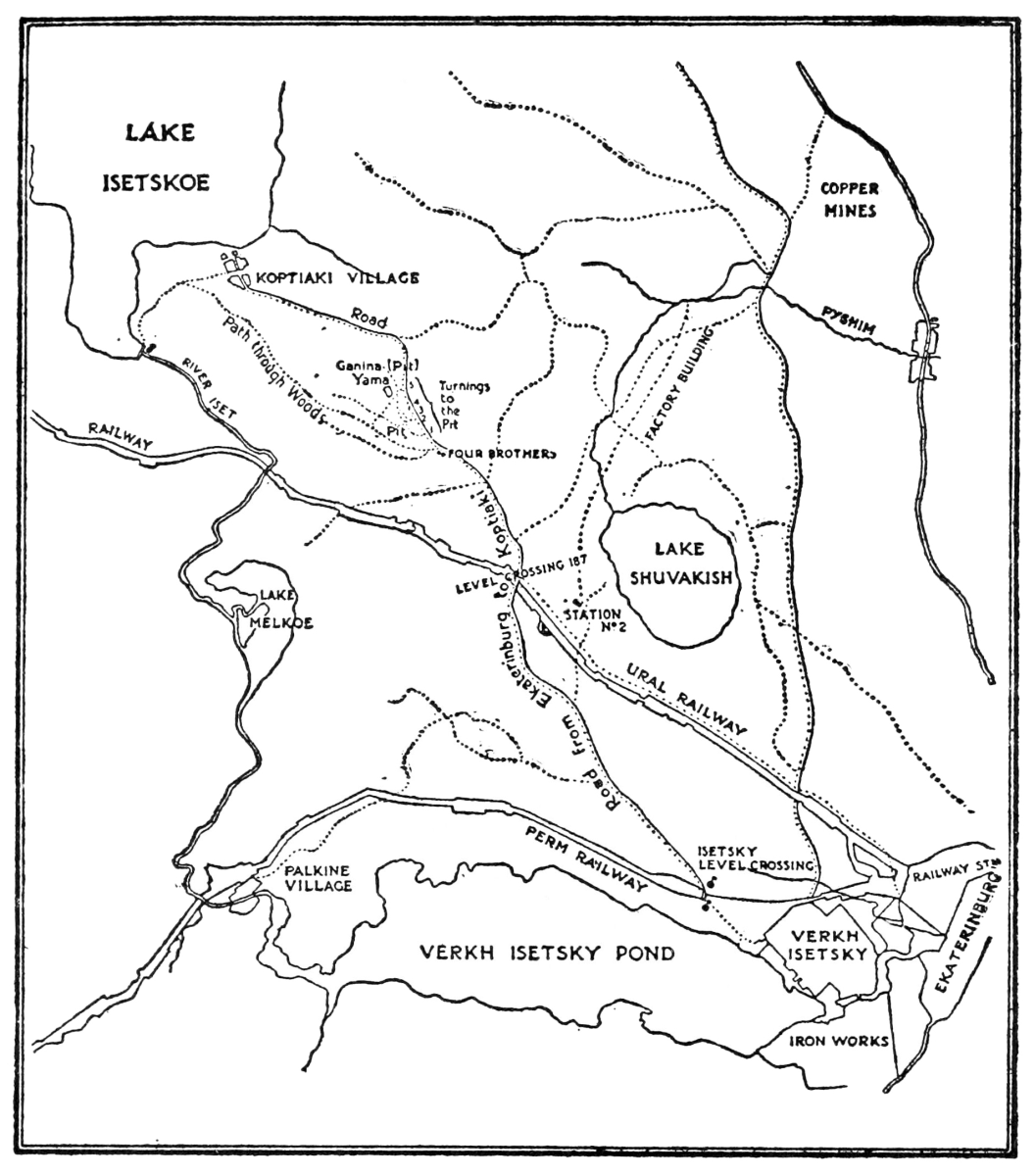
NEW ENVIRONS OF EKATERINBURG
Showing Road by which the bodies of members of the Imperial Family
were carried, and the Pit where the ashes were buried.
Distances: Ekaterinburg, 11 miles, Pit to Koptiaki, 3 miles.
happened, so that the people should suspect nothing. They were removed
only on the fourth day, when the cordon around the wood was also raised.
Only then (on July 20th) was the announcement made at Red meetings and
in official proclamations that “Nicholas the Sanguinary” had been
executed. The news was simultaneously transmitted by the wireless
stations of the Bolshevist Government, and appeared in The London
Times of July 22, 1918, in the following form:—
“At the first session of the Central Executive Committee elected by
the Fifth Congress of the Councils a message was made public,
received by direct wire from the Ural Regional Council, concerning
the shooting of the ex-Tsar, Nicholas Romanov.
“Recently Ekaterinburg, the capital of the Red Ural, was seriously
threatened by the approach of the Czecho-Slovak bands. At the same
time a counter-revolutionary conspiracy was discovered, having for
its object the wresting of the tyrant from the hands of the
Council’s authority by armed force. In view of this fact, the
Presidium of the Ural Regional Council decided to shoot the
ex-Tsar, Nicholas Romanov. This decision was carried out on July
16.
“The wife and son of Romanov have been sent to a place of security.
Documents concerning the conspiracy which were discovered have
been forwarded to Moscow by a special messenger.
“It had been recently decided to bring the ex-Tsar before a
tribunal, to be tried for his crimes against the people, and only
later occurrences led to delay in adopting this course. The
Presidency of the Central Executive Committee, after having
discussed the circumstances which compelled the Ural Regional
Council to take the decision to shoot Nicholas Romanov, decided as
follows:—The Russian Central Executive Committee, in the persons
of the Presidium, accept the decision of the Ural Regional Council
as being regular.
“The Central Executive Committee has now at its disposal extremely
important material concerning the Nicholas Romanov affair; his own
diaries which he kept almost to the last days; the diaries of his
wife and children; his correspondence, amongst which are letters by
Gregory Razputin to Romanov and his family. All these materials
will be examined and published in the near future.”
Every word of this official statement is important, for every phrase
contains a lie, and every lie shows up in more glaring colours the
diabolical nature of the plot hatched and carried out by Yankel Sverdlov
and his tools and accomplices. I take the falsehoods seriatim:—(1)
The message made public at the Tsik as coming from the Ural sovdep was
in reality concocted by Sverdlov; (2) the Czechs entered Ekaterinburg
on the 25th, nine days after the “execution,” and there was no armed
plot; (3) the Presidium of the Ural sovdep did not “decide” to shoot the
ex-Tsar, for that “decision” was dictated from Moscow; (4) the “wife and
son” were not sent to a “place of security,” but were basely murdered;
(5) no “later occurrences” supervened that could by any stress of the
imagination be construed into a justification for not bringing the
ex-Tsar before a tribunal, even supposing there had ever been any real
intention to do so (as a matter of fact, this story of a “tribunal” was
invented); (6) the Imperial correspondence taken with other “loot” from
the murdered Family has not been published to this day.[9]
Here is a translation of the official announcement as it was made to the
people of Ekaterinburg:—
Decision of the Presidium of the Regional Soviet of Workmen’s,
Peasants’ and Red-guards’ Deputies of the Ural.
“In view of the fact that Czecho-Slovak bands are threatening the Red
capital of the Urals, Ekaterinburg; in view also of the fact that the
crowned hangman (palách) may escape the people’s assizes (a Whiteguard
plot to capture the whole Romanov family has been discovered), the
Presidium of the Regional Soviet in fulfilment of the will of the
revolution has decided (postanovil) that the former Tsar Nicholas
Romanov, guilty before the people of innumerable sanguinary crimes,
shall be shot.
“On the night of the 16th to the 17th of July, the decision
(postanovlenie) of the Regional Soviet was carried into execution.
“The family of Romanov has been transferred from Ekaterinburg to another
and safer place.
“The Presidium of the Reg. Soviet of W., P., and R. Dep. of the Ural.
Decision of the Presidium of the All-Russian Centr. Ex. Com. of
18th July A.C.
“The All-Russian Centr. Ex. Com. of Soviets of W., P., R. and
Cossack Deputies in the person of its Presidium approves the action
of the Presidium of the Reg. Sov. of the Ural.
“The President of the Tsik, Y. Sverdlov.”
The discrepancies between the Moscow and the Ekaterinburg announcements
are interesting and significant, but they need not be discussed at this
stage. I would call attention only to the date of the Tsik’s “decision”
and to the fact that it was kept secret for two days after its
ostensible issue. As a matter of fact the whole murder had been directed
from Moscow, and even the text of the “announcement” had been previously
approved by Sverdlov, so it is not surprising that Beloborodov
disregarded dates. But the real reason was that the Red chieftains
feared the people and, above all, sought to obscure the facts.
I now return to the woods. On the 17th, 18th, and 19th large quantities
of petrol and sulphuric acid were taken from the city to the iron pits;
at least 150 gallons of the former and eleven pouds (400 lb.) of the
latter. Ekaterinburg being the centre of the platinum industry required
large stocks of sulphuric acid to generate the intense heat necessary
for melting this hardest of metals. The Komisar of Supplies was Voikov,
ex-passenger in Lenin’s German train. He it was who furnished the acid
to Yurovsky as his friend Sverdlov’s agent. (I remember I wanted to
order a platinum ring at a local jeweller’s during my stay in the city.
He could not carry out the order because there was no sulphuric acid
“since the previous year.”)
There is not the shadow of a doubt as to what happened around the iron
pit, as the reader will convince himself after reading the next chapter.
Yurovsky’s acolytes cut up the bodies, steeped them in petrol, and
burned them. The sulphuric acid was used to dissolve the larger bones.
I have spoken of the mock funeral invented by the murderers to deceive
public opinion in Russia and abroad. Here is the telegram that appeared
in The London Times of September 23, 1918:—
“Amsterdam, Sept. 22.—According to a telegram from Moscow, the
Izvestua gives the following description of the obsequies of the
ex-Tsar, which, according to newspaper reports, were solemnly carried
out by troops of the People’s Army (sic) at Ekaterinburg.
“‘The body of the ex-Tsar, which had been buried in a wood at the place
of execution, was exhumed, the grave having been found through
information supplied by persons who were acquainted with the
circumstances of the execution. The exhumation, says the Soviet journal,
took place in the presence of many representatives of the supreme
ecclesiastical authorities in Western Siberia, the local clergy, and
delegates from the People’s Army, Cossacks, and Czecho-Slovaks. The body
was placed in a zinc coffin, encased in a costly covering of Siberian
cedar and the coffin was exposed in the Cathedral at Ekaterinburg under
a guard of honour composed of the chief commanders of the People’s Army.
The body will be temporarily buried in a special sarcophagus at Omsk.’”
Comment is superfluous. The fourth and last of the “precautions” against
conviction followed a year later, perhaps under stress of circumstances,
but certainly without any regard for the Soviet’s own previous
announcements:—
Here it is:—
“On September 17, 1919, in the House of the Executive Committee of the
Soviet at Perm, the Bolshevists brought to trial twenty-eight persons
arrested on the accusation of having murdered the Tsar and his family.
The following report of the proceedings is taken from the Bolshevist
paper Pravda:—
“‘The Revolutionary Tribunal has considered the case of the murder of
the late Tsar Nicholas Romanov, his wife, the Princess of Hesse, their
daughters Olga, Tatiana, Maria and Anastasia, and their suite. In all
eleven persons were assassinated. Of the twenty-eight persons accused
three were members of the Ekaterinburg Soviet—Grusinov, Yakhontov, and
Malutin; among the accused were also two women, Maria Apraksina and
Elizaveta Mironova. The account of the murder as gathered from the
material under the consideration of the Revolutionary Tribunal is as
follows:—
“‘The Tsar and all the members of his entourage were shot—no mockery
and no cruelties took place. Yakhontov admitted that he had organised
the murder in order to throw the discredit of the crime on the Soviet
authorities, whose adversary he became after having joined the Socialist
revolutionaries of the Left Wing. The plan of murdering the Tsar was
conceived during the latter’s stay at Tobolsk, but the Tsar was too
strictly watched. In Ekaterinburg, when the Czecho-Slovak troops were
approaching the town, the Soviet authorities were panic-stricken to such
a degree that it was easy for him to avail himself of his position as
chairman of the Extraordinary Commission (for combating
counter-revolution) and to give the order to murder the Tsar and his
family. Yakhontov admitted that he personally participated in the
murder, and that he took upon himself the responsibility for it. He,
however, said that he was not responsible for the robbery of the
belongings of the Tsar’s family. According to his deposition, Tsar
Nicholas said before he died, “For the murder of the Tsar Russia will
curse the Bolshevists.” Grusinov and Malutin stated that they did not
know anything about Yakhontov’s plans, and only carried out his orders.
Yakhontov was found guilty of the murder and sentenced to death.
Grusinov, Malutin, Apraksina, and Mironova were found guilty of robbery
committed on the murdered members of the Tsar’s family. They were
sentenced to death too. The death sentence was carried out the following
day.
“‘Several objects belonging to the household of the Tsar were discovered
with a thief named Kiritshevsky, who stated that these things had been
given to him by a man named Sorin, who was the chairman of the Local
Extraordinary Commission. At the time of the murder Sorin was the
commander of a revolutionary battalion. Sorin was a personal friend of
Beloborodov, who also participated in the assassination of the
Emperor.’—Rossia (Paris), No. 1, December 17, 1919.”[10]
I have carefully compared the names given above with the list of 164
persons mentioned in the dossier as being implicated or even suspected
of having acted any part whatsoever in the tragedy; I have perused the
cognomens of the twenty-four members of the Ekaterinburg Sovdep
presidium. There is not one name in the mock trial that even resembles
any of them (one cannot possibly identify Yakhontov with Yurovsky); the
very charge is farcical if one compares this report with the text of the
official announcement of the “execution.” Alone Beloborodov’s name is
familiar. He was nominally president of the Ural sovdep at the time of
the murders. I explained his real position—that of a mere helot, a
thieving workman, kept in office to serve as a screen for the rulers of
Sovietdom. After the murders he was “promoted” to the Tsik, the highest
honour of Sovdepia. But they do not stand on ceremony with Russian
komisars in the land where Yankel Sverdlov rules, and we read of him in
the Pravda as being stigmatised as (1) a thief, and (2) a party to the
very murder for which he was promoted—the very same appalling crime
that Sverdlov had ordained—the stain whereof haunts the chieftains of
the Soviet like a Nemesis, so that they utter things without sense.
Besides, the Soviet of Moscow received a lion’s share of the loot!
Between July 20th and 22nd it was taken from Ipatiev’s house and removed
to the Red Metropolis. The Bolshevists were fleeing before the advance
of the Siberian troops. Yankel Yurovsky, evidently in a hurry to leave
Ekaterinburg, took farewell of the death-house on the night of the 19th.
His driver thus describes the exodus. That night he had by Yurovsky’s
orders called at the chrezvychaika, and thence conveyed two young
men, one of them a Jew, to Ipatiev’s house, where Yankel was waiting.
These youths went into the house and brought out seven pieces of
baggage, among them being a black leather trunk covered with seals. When
he had taken his seat in the vehicle, Yurovsky gave his orders to the
young men:—“Set everything to rights. Leave twelve men on sentry duty
and send the remainder to the station.”
The guard at Ipatiev’s house remained till the 23rd, but even after
that, on the 24th and 25th, some of the Russian ex-warders still visited
the house. The Whites entered Ekaterinburg on the 25th, and occupied the
house on the following day.
Having established, with the evidence of accomplices and of the
death-house, the fact that a murder had been committed, the
investigating magistrate had to find the bodies or to show conclusively
what had become of them; otherwise the whole case remained in doubt.
This proved to be a task of immense difficulty.
Suspicions of the truth were rife from the outset. It was known that
five motor-lorries had been requisitioned; that all had been absent
several days; that two had carried petrol, and that one had returned
covered with mud and gore. Too many persons were involved to conceal the
truth for long; the peasants who had to come by the forest road from
Koptiaki village at once detected something amiss, and quickly drew
their conclusions, which turned out to be correct. But “suspicions” are
not proof.
Somewhere within the purview of the disused iron mine “proof” was
obtainable—on that point there seemed to be no doubt. We took up our
residence in the wood—Sokolov, Diterichs, myself, and others—and
remained there throughout the late spring and early summer of 1919. We
descended the mine, found water and ice and a floor. We searched the
ground and scoured the woods, living from day to day in alternate hope
or despair of settling the gruesome mystery. Sometimes I felt as if we
were seeking the proverbial needle. The woods were full of disused
workings, each easily capable of concealing what we sought.
Day by day we discovered fresh relics around the pit where the bodies
had, we knew, been destroyed. Sokolov tirelessly passed through his
searching examination every likely witness; not a peasant, or dachnik
(summer resident), or railway servant that had been anywhere near the
place escaped him.
Slowly, but surely, the scope of possible error lessened. We had got
well away from the versions carefully sown by agents of Yurovsky, who
remained in the city, that the bodies had been buried in one place, then
re-buried in another.
One of the witnesses cited in the preliminary inquiry (before Sokolov
took charge) had described overhearing a conversation between several
Bolshevists about the bodies. The speakers were said to be: Ermakov
(whom we know), Mlyshkin, Kostuzov, Partin, Krivtsov, and Levatnykh.
They spoke cynically of feeling the corpses while they were still warm.
Levatnykh boasted that he had felt the Tsaritsa and that he “could now
die in peace.” They also spoke of the “valuables sown in their
clothes.”
The presumable genuineness of these confidences misled the earlier
investigator into believing their other statements or perhaps the
additions made to them by the spy who may have been a Red agent—to wit,
that the bodies had been buried in various places round the city. This
was a “red” herring that unfortunately drew the investigator off a hot
trail. He did not even go near the wood. Had he done so, he could not
have helped discovering easily then what we had such difficulty in
finding a year later. His excuse had been that the wood was “dangerous”
on account of Red bands; but even if this were so, he could have deputed
a less timorous person. A number of self-appointed “investigators” took
this opportunity of “gleaning” relics—perhaps invaluable clues.
Extreme measures had to be taken, nothing less than the complete sifting
of the ground within the area of destruction and emptying of the shafts
down which any remains could have been thrown. This was a task outside
the province of an investigating magistrate. Here we wanted miners with
pumping machinery, woodsmen, and surveyors; above all we wanted money.
Thanks to Admiral Kolchak the wherewithal was forthcoming. Indeed, I
render him bare justice in saying that without his stanch personal
support the investigation would have been overwhelmed long ago by the
constant intrigues of the Omsk Government. He gave the money out of his
own funds because the grant legally authorised by him was “held up” by
his Ministers.
Under the orders and supervision of General Diterichs, a command of
White Guards was formed to carry out the necessary operations. The men
were all from the Urals—i.e., miners and peasants versed in
woodcraft. Several hundreds of them camped around the Ganina Yama
(ditch), situated near a bend in the road to Koptiaki, not a hundred
paces from the mine. These men knew what they were working for and put
their shoulder to the wheel in all earnestness.
But we had to leave before complete success had crowned their efforts.
Diterichs received the summons to save the armies. I went with him.
General Domontovich, a very gallant soldier, took command in his place.
(He died of typhus during the retreat and was buried in Chita early this
year. “Tsárstvie nebésnoie.”)
Success came before we had to evacuate Ekaterinburg. The contents of the
shaft, extracted with infinite trouble, set at rest for ever any
lingering doubt as to the destruction of the bodies. Sokolov had his
“proof.”
Here is the narrative of the investigation. It is a good commentary on
the homely saying, “Murder will out.”
It will be remembered that Ermakov went with the bodies from the
death-house. Now Ermakov lived at the Verkh-Issetsk ironworks, adjoining
the city and situated along the route to Koptiaki—i.e., north-east of
Ekaterinburg. The Stenbok-Fermer Wood lies a few miles beyond. At the
works Ermakov found a detachment of his Red Guards (he was military
komisar) and a number of conveyances ready harnessed. The whole
procession moved off along the Koptiaki road. There is, indeed, no other
road in the vicinity practicable for a motor-lorry. Vaganov, the other
regicide, mounted his horse and acted as armed escort for the lorry.
Shortly after three o’clock in the morning (solar time) they reached
that place where several paths, long disused and grass-grown, turn off
to the left towards Ganina Yama. Here they forced a way through the
undergrowth, and at one place nearly upset the lorry into a ditch. The
mark of the wheels was still visible a year later, and alongside lay the
beam which had been brought from the disused mine to jack up the canted
lorry.
Around the shafts in this particular place the grass then showed no
trace of human passage. Koptiaki villagers did not come that way as a
rule. The place had been well selected. But the murderers forgot the
habits of the peasant, especially the haymakers and fisherfolk.
Nastasia Z. left the village at dawn with her son and daughter-in-law.
They approached the gruesome procession just as it was turning off the
road. Two horsemen rode up to them. One wore a sailor’s uniform.
Nastasia knew him—he was a Verkh-Issetsk resident—Vaganov. The latter
yelled out: “Turn back!” and coming abreast of the peasant cart
brandished a revolver at Nastasia’s head. Frightened, the peasant woman
pulled her horse round so sharply that the cart almost upset. Vaganov
rode alongside, still pointing his weapon and shouting “Don’t look
around or I shoot....” After chasing them about a mile towards the
village, Vaganov rode back.
The peasant had not been able in the faint light to make out clearly
what was behind Vaganov. “Something long and grey, like a heap,” was all
that they could distinguish. The baba (peasant woman) concluded that
it was the Red Guard army marching to Koptiaki. Urging her horse onward,
she immediately roused the whole village, informing the muzhiks that
the “army” was coming “with transport and artillery.” They listened in
consternation, alarmed chiefly for their hay crop. An army coming meant
fighting in the neighbourhood, and here it was just the time for mowing.
The hay might all be lost.
They discussed the matter long and passionately, then some of the
boldest among them, headed by an old soldier, set out to investigate.
On the road they encountered some Austrian war prisoners who were
hay-making, and asked if they had seen the army. They replied that quite
early, while they were working on the road, some Russian Cossacks had
ridden up and driven them away. The villagers became all the more
curious to know what it all meant.
Presently, as they came abreast of the mine, they heard horses neighing.
Coming to one of the turnings, they saw that the grass had all been
crushed and the saplings bent. They were on the point of following this
strange trail, when out of the wood appeared a horseman armed with
sword, revolver, rifle and hand-grenades and asked them what they were
doing. The muzhiks put on a bold face, although badly frightened, and
asked if the tovarishch (comrade) would kindly reassure them, because
the whole village was in a state of excitement.
They were graciously informed that there was no cause for alarm. “Our
front has been entered at several points. We are merely scouting and
practising. Do not be afraid if you hear firing!” They had a friendly
smoke together and then the muzhiks departed. They had scarcely gone
when a report like the explosion of a hand grenade was heard, and then a
short while afterwards another explosion. Soon after their return to the
village the same horseman appeared “to tranquillise them all,” as he
explained.
They were reassured about the hay-making, but now arose another matter.
Many of the villagers fished in the large Issetsk lake which spreads its
lovely waters in front of Koptiaki. They had obtained a good haul that
night and must take it into the city—it was market day (Wednesday) and
in the hot weather fish does not keep. But the “Russian Cossacks” were
inexorable.
On the city side there was a crowd at the level crossing over the Ural
line striving to get to Koptiaki, which being a pretty place attracted
many summer residents. These unfortunates, thus “stranded,” waited for
hours and hours in vain. Some of the railway servants were accommodated
with “benzine” from the casks of petrol waiting in reserve. The stream
of fisher folk and the procession of dachniks coming and going enabled
the investigation to define very precisely the exact limits of the
cordon placed round the wood. It pointed in one direction—Ganina Yama.
That was the locality that had to be kept from prying eyes.
The peasants were also the first to discover the place where the bodies
were destroyed. Their evidence afforded immense, invaluable service to
the investigation; in fact, without them the truth might never have been
established owing to the earlier mistakes of the inquiry.
As soon as the cordon was raised, some of the Koptiaki men hastened to
the spot where the horses had neighed and the detonations had been
heard. They had thought that the Red guards were burying arms. The ashes
around the pit suggested something else. They started to scrape; soon
they found a cross belonging to the Empress and the brass buckle of the
Tsarevich’s belt. Some instinct prompted them to jump to the conclusion
that it was “the Tsar’s,” although they knew nothing of the murder.
There were eight of the muzhiks standing round the pit examining with
awe the finds that they had made:—“Boys,” said one, and he voiced the
secret thought of all, “it is just this, they have been burning Nicholas
here. That cross can belong only to him. And that buckle, I tell you, is
the Tsarevich’s.” They crossed themselves in prayer and silently came
away. Needless to say, these honest souls promptly handed over the
relics to the White authorities.
On my first visit to the burning-mound, I was attracted by an
inscription carved on the giant birch that overhangs one pyre. It
read:—“T. A. Fesenko” and the date “July 11, 1918,” i.e., six days
before the murder. A young man sat beside the tree. He was a stranger to
me. I took him to be one of Sokolov’s agents, especially as outsiders
were not encouraged to hover round the iron-pits. I was looking closely
at the ground to note where the bodies had been burned and pick up any
remaining clues.
The stranger exclaimed:—“You will have to look very hard!” I thought
this was a strange remark; the singed and scorched appearance of the
ground was, indeed, very noticeable still, although nearly a year had
passed. But I encouraged the conversation, suspecting a surprise. The
stranger proceeded to give in rather excited tones his conviction that
the story of the bonfires and the burning of the bodies was all a myth.
“See for yourself! How could they have destroyed all those bodies and
left so few cinders!” he insisted.
Of course I did not enlighten him as to the petrol and
sulphuric-acid—which so powerfully aided the work of cremation—or the
probable scattering of the ashes around and down the pit. I went
straight to Sokolov, who was not far away and told him what the young
man had said. “That must be Fesenko,” was his remark. We walked up to
the place. The stranger had resumed his seat beside the birch and
appeared to be suffering. Sokolov continued: “Yes, that’s the man. He
brought Yurovsky to this place. He is just a young fool of a Bolshevist.
Yurovsky took him because he was in charge of this wood, and he was so
proud of escorting a komisar that he recorded the visit by carving his
name and date on the tree.
“Why then is he at large?” I queried. “Well, the fact is we hope he may
give himself or some of the murderers away. We arrested him and let him
go. He haunts this place, and is ever trying to prove that nothing could
have happened here!” I felt rather sorry for the poor wretch. Perhaps he
had not suspected Yurovsky’s purpose; Yurovsky did not confide such
secrets. At all events I gave him the benefit of the doubt, feeling sure
that there would be no peace for his tortured mind in this life.
But Sokolov dispelled my sympathy: “The fact is, he touches a sore
point. Where are the cinders? That is the question. We have found too
few. They must be hidden somewhere. Now Fesenko could not possibly have
discovered this weak point in our armour himself. He has probably been
put up to it by the murderers or their spies. That is why we let him
wander about.” However, Fesenko did not give away himself or his
associates.
Not a hundred paces away from the pyres I noticed a little clearing with
a comfortable tree-stump. Here one could sit quietly, unseen by the
people at the pit’s mouth. A pleasant birch and pine grove stretched its
fragrant, sonorous maze between this natural arbour and the scene of
grisly horror. Here on this stump Yurovsky had sat while his henchmen
performed the last act in the tragedy. Beside this seat we found (a year
later) egg-shells—the remains of the fifty eggs ordered by Yurovsky
from the nuns, ostensibly for the Romanovs. But this fare had not
sufficed for the dainty komisar. There were also chicken-bones. There
were also torn pages from a treatise on anatomy in German (Yurovsky was
only a feldsher; he knew little about anatomy). And in order that
there be no doubt as to the origin of these various clues, it so
happened that Yurovsky left behind a newspaper published in German at
the very period under discussion full of abuse of the Czechs, accusing
them of servile subserviency to the Entente High Command, and treating
the war as a slaughter arranged in the interest of capital.
Reference has been made in preceding chapters to the manner in which the
Grand Duchesses had concealed their jewels. Two of their confidential
servitors, Mlles. Tutelberg and Ersberg, came to our camp in the woods
to identify the relics. They had sewn up the bodices, buttons, hats, and
other receptacles and knew precisely what jewels were on the persons of
the victims when the murder took place, it being obvious that during
their residence in Ipatiev’s house none of the prisoners would venture
to undo or change these receptacles, as they were under constant
observation. The Grand Duchesses Olga, Tatiana, and Anastasia each wore
double-quilted bodices stuffed with jewels weighing several pounds. Olga
carried a satchel round her neck with some special gems and wore several
ropes of pearls concealed across her shoulders. The manner in which the
concealment had been effected misled the first superficial search of the
bodies in the house.
We now trace the gruesome picture of the cutting up and destruction of
the bodies. First of all the clothes were partly removed. The bodices at
once aroused attention owing to their weight. The “ghouls” began to tear
them apart. Their contents were spilled on to the ground, and some of
the things rolled into the grass or were trodden into the soil of the
mound.
But they did not trouble to denude the corpses completely, and began
hacking them in pieces on the clay mound that surrounded the pit’s
mouth, smiting and severing at the same time some of the valuables that
still remained. The large diamonds, which had been camouflaged as
buttons, have disappeared with the exception of one. They may have been
burned with the clothes of the Grand Duchesses or have been looted. One
was found trampled into the clay beside the pyre. Here also was found
the Empress’s emerald pectoral cross. Some of the bullets dropped out of
the bodies during the chopping, others while the limbs were in the
flames.
Two pyres were used—one near the shaft, the other near the birch tree.
After the cremation had been completed the cinders of both pyres were
collected and thrown down the shaft of the mine, which had been
previously prepared. Ice remains throughout the summer in deep workings
like this one. It had been tested by means of hand grenades, and had
then been smashed in order that the cinders, etc., should sink to the
bottom of the water. Over them a flooring had been adjusted and
anchored.
Innumerable witnesses saw the coming and the going of the lorries. The
“ghouls” remained in the wood till their task was done. Their shelters
and camps were discovered. They were seen leaving—rolling about in the
lorry, like men tired to death.
The flooring had deceived all search in the mine. Only when the
operations that I have described above had brought all the core of the
shaft to the surface everything was explained. The corpse of little
Jemmy lay just under the false floor. It had been preserved by the ice.
When good Domontovich made this discovery he immediately telegraphed to
us. We all realized that the mystery of the bodies had been solved....
There were literally hundreds of clues now available. Sokolov busied
himself classifying and identifying them. It would be quite impossible
to enumerate them all. Several volumes of the dossier are devoted to
it. There are the procès-verbaux of each “find” and each
identification. I give here a brief but accurate summary of the clues:—
(1) A large diamond of the finest water, identified as forming a pendant
to a necklace belonging to the Empress, valued at 20,000 gold roubles;
slightly touched by fire.
(2) An emerald cross belonging to Alexandra, identified as a present
from the Empress Marie, found by experts to be of high workmanship,
valued at 2,000 gold roubles; broken and singed.
(3) A pearl earring untouched, having been thrown with some earth down
the shaft, recognized as one of a pair always worn by the Empress,
declared to be of extremely fine workmanship, valued at 3,000 gold
roubles.
(4) Four fragments of a large pearl and settings, declared to be a pair
to (3).
(5) Two fragments of emerald declared by experts to have formed part of
a large and very fine stone, severed by some hard and heavy object and
trampled.
(6) Eleven fragments of emerald.
(7) Thirteen round pearls as of high quality, all belonging to one rope.
(8) Five fragments of pearl, belonging to one large gem of finest
orient, severed by a heavy weight or trampling.
(9) Another broken pearl of high quality.
(10) Two fine brilliants declared to have formed part of an ornament of
large size.
(11) Portion of a large diamond silver-mounted ornament bearing traces
of heavy blows.
(12 to 21) Precious stones—diamonds, sapphires, rubies, almandine, and
topazes—and settings, all bearing marks, as experts show, of having
been crushed or severed by heavy or cutting objects.
(22 to 28) Articles and appurtenances of apparel, including pieces of
cloth identified as parts of the Empress’s skirt, the Tsarevich’s
military overcoat and Botkin’s overcoat; six sets of corset steels—the
Empress would not permit her daughters or the servants to go without
corsets, neither would she herself; (Demidova wore them also—that would
make exactly six); metallic parts of corset suspenders and fragments of
silk and elastic; the Tsarevich’s belt buckle; the Tsar’s belt buckle,
both identified; three paste shoe buckles of first-class workmanship,
one identified as the Empress’s, two as belonging to the grand
duchesses; a large number of buttons, hooks and eyes, etc., some
identified as belonging to the Empress’s dress, also military buttons
corresponding with the uniforms and caps of the Tsar and Tsarevich, as
made for them by the court tailor in Petrograd. The appurtenances of
female costume were such as the court dressmaker used for the family.
There were also parts of apparel such as were used by the tailor who
dressed the court servants. The footgear remnants showed strong action
by fire. Experts were able, however, to note that they included cork and
fine brass screws, both evidences of high-class articles. In their
opinion the remnants might well represent seven pairs of boots.
(29 to 41) Exhibits of equal if not greater interest. Among them may be
cited:—A pocket case in which the Tsar always carried his wife’s
portrait; three small ikons worn by the grand duchesses, having in each
case the face of the saint destroyed as if blows had been aimed at them;
the Empress’s jubilee badge of her Lancer regiment; the gold frame of
Botkin’s eye-glasses; a large spectacle glass such as the Empress wore
at Tobolsk; remnants of the Tsarevich’s haversack, in which he was
accustomed to keep his treasures; several bottles as used for smelling
salts, always carried by the grand duchesses, and finally a varied
assortment of nails, tinfoil, copper coins, etc., which vastly puzzled
Sokolov till somebody, I think Mr. Gibbes, reminded him that Alexis was
fond of collecting odds and ends, being of a very saving disposition,
like his father.
Then came a number of specially important relics. First, a series of
Nagan bullets, some entire but bearing the marks of the rifling, some
without the lead core, some in the shape of blobs of moulten lead, still
unmistakable. Secondly, in the shaft itself, a human finger, two pieces
of human skin, and in the clay of the mound many fragments of chopped
and sawed human bones, which could still be certified although they had
been subjected to the action of fire and perhaps of acid. Experts found
that the skin was from a human hand. The finger is described as
belonging to a woman of middle age. It is long, slender and well-shaped,
like the Empress’s hand.
Near the shaft was found a set of artificial teeth (upper jaw with
plate), identified as Dr. Botkin’s. The front teeth were deeply
encrusted with mire, as if the body had been dragged face downwards and
thereby the teeth, catching in the hard clay soil, had dragged the plate
out of the dead man’s mouth.
When the first inspection of the death house was made—ten days after
the murder—it bore all the traces of having been plundered by people
who had first slaughtered the owners. The reader will be able to
picture it, but his imagination will not come up to the reality. Amidst
this scene of pillage and confusion one felt that a careful hand had
destroyed everything that could help the investigation; nevertheless
highly important clues came to light, among them a full list of the Red
guards who had acted as gaolers, the Tsar’s private cypher which he had
hidden away—as if expecting to be able to reclaim it some day.
In the death chamber there was a curious inscription in German, written
by a man of some culture—not Yurovsky, therefore, but perhaps one of
the two men from the Chrezvychaika whom he had left in charge of the
house on his departure. It was an adaptation of Heine’s lines on the
fate of Belshazzar:—
Belsatzar ward in selbiger Nacht
Von seinen Knechten umgebracht.
He had omitted the conjunctive “aber” which comes in the poet’s line
after “ward”; and then, having first written “selbigen,” had changed it
to “seinen,” feeling perhaps that these modifications were necessary to
fit the occasion. Perhaps unconsciously he also converted Belsazar (as
Heine spells the name) to Belsatzar. The writer was quoting a Jew whose
poem expatiates on the overthrow of a Gentile sovereign who had offended
Israel. The Book of Daniel is not so explicit. It says:—“In that night
was Belshazzar the King of the Chaldeans slain.” (Dan. vi. 30.) But the
author of the inscription wished to make it “plain” that “Belsatzar” was
slain by his own people.
“The death of Nicholas II. and his family did not suffice for the Soviet
plan of “government” with, or without, Germany. Nothing short of
extermination of all the Romanovs could satisfy the enemies of
“Belsatzar.” Whenever the Tsik (Central Executive Committee) and the
Chrezvychaika (inquisition) laid hands on any of the ex-Tsar’s
relatives their fate was sealed. It did not matter where the unfortunate
princes might be, or what local authority happened to be ostensibly
involved—the Tsik and Yankel Sverdlov, Red Jewish Autocrat of All the
Russias, directed the disposal of them.
It is quite useless for the apologists of Soviet rule to insinuate that
local bodies may have committed excesses without the knowledge and
approval of the Centre; in these murders of Grand Dukes and a Grand
Duchess—in all 11 persons of the blood Royal—the hand of the Central
Government is clearly apparent. Moreover, they were all slain in cold
blood, of deliberate purpose; not like the victims of the holocaust at
Perm, because a reign of stark terror had been ordained from Moscow.
It is with mind and hand still atremble after reciting the horrors of
the cellar and the woods of Ekaterinburg that I take up this tale of
woe, all the more pitiful on account of the utter absence of any pretext
for the crime—just sordid murder unrelieved by any shadow of political
expediency or provocation.
First, I take the case of the Grand Duke Michael Alexandrovich; he
“disappeared” before the others—about a month before the Tsar—and he
was the ostensible heir although he had formally resigned his rights to
the people. I have collected all the materials concerning his last days
in Perm.
The Tsar’s brother had remained at Gachina, his usual residence, during
the early months of Bolshevist rule. There he was arrested in March,
1918, and sent into exile. His secretary, Nicholas Nikolaievich Johnson,
and the former Chief of the Gendarmerie at Gachina, Colonel Znamerovsky,
were arrested at the same time and transported together with him,
guarded by Letts. Perm was their destination, and in that city they
resided for the next two months.
Apart from being under surveillance, the exiles enjoyed comparative
freedom. The Grand Duke took his walks with his secretary. Although
suffering from a chronic complaint (gastric ulcers) which required
constant exercise and a special diet, he had no cause to complain of
his health while in Perm. The fact was many people sent him dainties,
such as sterlets freshly caught out of the Kama, so that his rooms at
the Korolevskie Nomera (King’s Inn) were always full of provisions. He
felt so well that he seldom had recourse to the medicine for stilling
the terrible pains that he suffered during acute attacks of the malady.
Popularity has its drawbacks. The people of Perm did not realise that
their attentions to the exile might arouse suspicion among his Red
enemies. When things came to such a pass that the Tsar’s brother found
himself running the gauntlet of popular ovations, it became necessary to
avoid too frequent appearances in the streets. Znamerovsky warned the
Grand Duke that the Reds at the suburban Motoviliha arsenal were
beginning to grow restive and openly agitating against the liberty
allowed to the exiles. So thereafter the familiar figure of Michael
Alexandrovich in his shabby grey suit and top boots was seen no more,
and he took his exercise under the cover of darkness.
The Grand Duke had left his wife and children at Gachina. Countess
Brasova (his morganatic spouse) came to visit her husband in the middle
of May. Madame Znamerovskaia had also arrived in Perm. It was a rash
step. Countess Brasova had much difficulty in getting away; in fact it
was only managed by a stratagem. The komisars were told that if they
interfered the matter would be referred to Moscow. This frightened them.
Reaching Moscow on the 22nd or 23rd of May Countess Brasova decided to
take a still bolder step to save her husband. Conscious of his complete
aloofness from politics, she imagined that personal intercession with
the Red chieftains would move them to let him go. Of course it was an
illusion excusable only in a distracted wife. I mention it because Lenin
himself intervened in the matter. It was the lofty idealist of Sovietdom
that absolutely refused to permit the departure of Michael, and thereby
assumed responsibility for what happened.
Madame Znamerovskaia did not leave Perm. She was there when her husband
was shot and later shared his fate. But I am anticipating.
Unbeknown to any member of the family or even to N. N. Jackson, Colonel
Znamerovsky had conceived a plan of escape which he intended to put into
practice, fearing that the Motoviliha workmen might be goaded into
violence. I am in possession of the details of this plan, and I can
state most positively—in the light of subsequent events—that it was
not carried out, nor even attempted.
On the 13th June a telegram reached Gachina from Perm, announcing that
“our general favourite and Johnny had been removed by whom and whither
unknown.” This message was supposed to have come from Znamerovsky—it
could have come only from him. The first feeling was one of unmixed
joy; then doubts began to arise, and no small anxiety as to the probable
repression that would at once fall upon the household at Gachina. Surely
enough soon afterwards Countess Brasova was arrested by Uritsky, the
bloodstained Komisar of Petrograd, who himself was assassinated two
months later by another Jew. After innumerable tribulations, she managed
to escape with her children out of Russia.
What had happened in Perm? A despatch from Mr. Alston, the British
Acting High Commissioner, reported from Vladivostok, February 13,
1919:—“Mr. T. has just arrived here.... When at Perm he says he lived
in the same hotel with Grand Duke Michael and Mr. Johnson, his
secretary, who was a Russian. At two a. m. on or about the 16th June he
saw four of the Perm militzia or police take them off, and he is
convinced that they were killed.”
Later, it became possible to obtain the evidence of eye-witnesses, which
corroborated and amplified Mr. Alston’s despatch. The Grand Duke had two
servants with him in Perm, Borunov and Chelyshev. They lived in an
adjoining room. Mr. Johnson lived upstairs. Chelyshev escaped and gave
the following version:—
At about the date above mentioned (12th to 16th June—he was hazy on
this point) he was asleep one night when three men in soldiers’ dress,
fully armed, entered his room, woke him up and roughly ordered him to
lead them to Michael Romanov. In vain he protested that the Grand Duke
was asleep. They threatened him with the Chrezvychaika. He had to
comply. He first woke Mr. Johnson. Then he led the way to the Grand
Duke’s room. He was asleep. Chelyshev roused him and explained the
reason. The Grand Duke looked at the armed men.
One of them said: “We have orders to take you—orders from the Sovdep.”
The Grand Duke replied: “I shall not come unless you show me a paper.”
One of the men then stepped forward and, laying his hand roughly on the
Grand Duke’s shoulder, exclaimed: “Oh! these Romanovs! We are fed up
with you all!”
Realising that resistance was futile, the Grand Duke rose and dressed
himself. Mr. Johnson had also meanwhile made himself ready, and insisted
that the men should take him away as well. After some argument they
agreed. Chelyshev declares that he also asked to be taken, but that the
men refused.
As the soldiers and their prisoners were going out of the room,
Chelyshev remembered about the medicine, and, grasping the bottle,
followed, calling out: “Please your Highness, take it with you.” He knew
that without his medicine the Grand Duke might be subjected to great and
needless suffering. The soldiers roughly pushed him aside and, making
some brutal remark about the Imperial family, led the prisoners away.
From that moment they were lost to view. Many stories of Michael’s
escape and of his having been seen at Omsk, at Semipalatinsk, at Chita,
at Harbin, etc., have been successively disproved.
Against the version of an escape there are the strongest evidences:—The
Grand Duke would never have been a party to any attempt to evade his
gaolers, knowing full well that both the Tsar—for whom his loyalty and
affection were proverbial—and his own family would suffer for him. It
may be objected that he was removed against his will by friends in
disguise; but this theory cannot explain away their refusal to allow him
to take with him a remedy necessary to his health and perhaps to his
life. There had been plots to procure his escape—so I have reason to
believe; but in every case the plans had been betrayed. Colonel
Znamerovsky knew this. He would trust nobody with his plan, but
obviously it miscarried, for he was himself to go with Michael, and we
know that instead of that he was murdered. The shooting of Znamerovsky
followed close upon the Grand Duke’s disappearance.
Chelyshev afterwards professed confidence in his master’s escape, but at
the time he had no such illusion. In fact, he was convinced then that
the Grand Duke had been trapped, for when he had had time to recover
from his surprise, he went to the local Soviet and complained that the
Grand Duke had been kidnapped. He relates that no attention was paid to
him at first but that later some semblance of a search was made and
quickly dropped.
Regarding the ultimate disposal of the two prisoners, stories circulate
just as numerous and varied as the stories of their escape. I need not
cite them. It suffices that the Grand Duke Michael, gentlest of men, to
whom all thought of power and even of ambition was repugnant,
disappeared to be seen no more.
Perm and its vicinity was destined to witness other tragedies full of
horror. Many other members of the Romanov family had been interned there
including (1) the Grand Duchess Elizabeth, sainted sister of the
Empress, venerated by grateful Muscovites while Alexandra was disliked;
(2) the Grand Duke Sergius Mikhailovich former Master of the Ordnance,
and quite remote from politics; (3) Prince Igor; (4) Prince Ioan; (5)
Prince Constantine, all three brilliant young men, the sons of the late
Grand Duke Constantine Constantinovich, none of them concerned with
political matters; and (6) Prince Vladimir Pavlovich Palei son of the
Grand Duke Paul and step-brother of the Grand Duke Dmitri Pavlovich.
This youth of seventeen had given promise of being one of the world’s
greatest poets.
Prince Ioan was married to Princess Elena of Serbia, who had come to the
Urals to share her husband’s exile. She had been persuaded to go to her
country, the Bolshevists hesitating to incarcerate her, and she was at
Ekaterinburg when, towards the end of June, she heard that Prince Ioan
and the other captives had been put on starvation rations. She decided,
come what might, not to leave him behind. Thereupon the Bolshevists
arrested her. She was in the prison at Ekaterinburg when the Tsar and
his family were murdered. In the same prison were some people who had
followed the Imperial household into captivity; young Countess Anastasia
Hendrykova, Mlle. Schneider, the Emperor’s valet Volkov. (Prince
Dolgoruky and General Tatishchev had “disappeared” earlier.) Of course
none of them knew anything about the awful happenings in Ipatiev’s
house.
When the Jewish murderers and their accomplices, the German-Magyar
“Letts,” had taken wing before the advance of the Whites these prisoners
were sent to Perm for future disposal, while they themselves had hurried
westward, having helped to accomplish the hellish design of the Jew
fiend, Yankel Sverdlov—to exterminate “all the Romanovs.” Orders had
already preceded them to Perm and the design had been fully accomplished
there. The murder of the Romanovs of Perm took place exactly twenty-four
hours after the murder of the family in Ekaterinburg.
Here are the bare facts of this new butchery. The six Romanov prisoners
above-mentioned with the Grand Duchess’s companion, the nun Varvara, and
S. M. Remes, manager for the princes, were interned in the village
school of Alapaevsk, a place in the environs of Perm.
On the night of July 17 (1918) their warders came to tell them the story
that Yurovsky had retailed to the Tsar: that there was danger for them,
that the enemy (i.e., the Czecho-Slovaks) were approaching, and that
in the interest of their personal safety they would be removed. It was
even confided to them whither they were going, namely to the Siniachkhin
Works. All unsuspicious, they at once complied. The programme of the
murder was here somewhat different. It was not convenient to carry it
out on the premises. The party took their seats in the native korobs
(a small tarantass) and were driven north.
When twelve versts (eight miles) out the caravan halted in a wood which
contained a number of disused iron-ore mines—one sees the similarity of
detail in the murderers’ plan—and here the unfortunates were slain and
their bodies thrown down the shafts.
It was a much cruder performance than that of Ekaterinburg. The actual
murderers here were simply Russian criminals, escaped convicts who
“worked” for the Chrezvychaika, the Red Inquisition. They just
slaughtered the victims and got rid of the bodies without so much as
rifling their pockets.
Meanwhile at the school certain “precautions” were being taken. A
pretended “escape” was staged. The school building and its approaches
were “faked” to show evidence of combat between the Red Guards and
pretended White Guards, and to give verisimilitude to the performance
they took a peasant who happened to be locked up in the local gaol,
murdered him and placed his dead body in the school to represent the
White “bandits.”
Mr. Preston, the Consul, telegraphed from Ekaterinburg, October 28,
1918, that on the retaking of Alapaevsk by the White troops on September
28, the corpses of the Romanov Princes, the Grand Duchess and their
attendants were found sufficiently preserved to be recognised, and that
they were buried in the presence of a great concourse of people.
The discovery had been made, thanks to the resource of a local police
agent, whose name I do not give for special reasons. Post mortem
examination showed that the victims had been bludgeoned to death but
must have undergone a prolonged agony before they died. The Grand Duke
Sergius was shot through the head, perhaps to put him out of his misery;
for the murderers were just butchers who did not seek to torture their
victims. There was no refinement of cruelty about them. They were only
Russians. It is not true that they threw their victims down the shaft
before life was extinct. The autopsy has dispelled that legend. The
murderers even exploded hand grenades down the shaft, probably to make
assurance doubly sure.
The investigation has clearly established the authorship of these
murders. The orders came from Moscow through the same channels that had
been used in the murder of the Tsar—namely, from the Jew Sverdlov to
the Jew Goloshchekin, and, as usual, the Russian workman Belodorodov
acted as the dummy president of the Ekaterinburg Soviet board—the
channel through which Moscow acted in the Urals. These orders were
carried out by the leading komisars of Perm, among them being the
Komisar of Justice Soloviev.
As in the case of the murder at Ekaterinburg, the Bolshevists at Perm
followed up their traitorous crime by announcing that there had been a
conspiracy. The world was told that the Princes had been kidnapped by
bands of White Guards. (When the Whites had to evacuate Perm, General
Diterichs arranged to have the bodies of the martyred Princes removed
eastward. They rest in a place of safety—at the Russian Cathedral in
Peking).
More than half a year later a crime equally abominable was perpetrated
at Petrograd. The victims were the Grand Dukes Paul Alexandrovich,
Dmitri Constantinovich, Nicholas Mikhailovich (the historian), and
George Mikhailovich. They had been imprisoned for some time without any
charge being preferred against them. On January 29, 1919, they were
removed to the Fortress of SS. Peter and Paul, and there on the same day
without any investigation or form of trial they were “killed by Red
Guards with revolvers”—such is the trite information that is available.
But the crime of Ekaterinburg and the slaughter of Alapaevsk give a clue
as to the authorship of this atrocity. The last of the Romanovs within
the power of the Jew-ruled Soviet had passed away. Perhaps, some day, N.
A. Sokolov will be able to investigate the crime of Petrograd.
We now approach the end of this long martyrology. The members of whom I
am about to speak form part of the Red Terror ordained by the Soviet to
avenge the murder of Uritsky and the attempt on Lenin, which took place
about a month after the crime of Ekaterinburg.
I referred above to the transfer of certain prisoners from that city to
Perm. Volkov, the Tsar’s valet, has deposed that altogether thirty-six
persons travelled in the prison train. Among them were Countess
Hendrykova, Mlle. Schneider, and Princess Elena. They all found
themselves interned in the same prison in Perm. Here Volkov met
Chelyshev, who had also been locked up, and from him heard the account
of the abduction of the Grand Duke Michael. They saw the Princess leave.
After great difficulty the Siberian Government had managed to rescue
her. She did not, of course, know that her husband had been murdered.
She thought he had escaped, and went away willingly enough this time.
The Terror had been proclaimed on September 1, 1918. The official
Izvestiya declared that the “proletariat (sic) will reply ... in a
manner that will make the whole bourgeoisie shudder with horror.” The
Krasnaia (Red) Gazeta announced:—“We will kill our enemies in
scores of hundreds.... Let them drown themselves in their own
blood.”[11]
“On the night of September 3rd”—I am quoting Volkov—“we were led out
of the prison, eight of us. There were Countess Hendrykova, Mlle.
Schneider, and Mme. Znamerovskaia, myself, and four others. We were
surrounded by twenty-two armed guards, part Letts, part Magyars.
“We had been told that we were to be transferred to another prison; we
carried our small possessions. When we saw that they were leading us out
of the town, we realised that our last hour had come. It was terribly
hard on the ladies. They dragged themselves along with difficulty in the
heavy mud. After several miles, we came to a corduroy road with swamps
on either side.” (It was a sewage farm.) “Some of our guards suddenly
began offering to carry our bags. I knew that meant that they were going
to shoot us directly, so each one wanted to secure his booty beforehand.
It was now or never. While they were wrangling over the spoils I made a
dash for it.”
Volkov leapt the ditch and was scuttling across the slimy waste when the
Magyaro-Letts opened fire. He fell just as the first shot rang out and
remained lying. They thought he was dead and moved on. He then made
another dash and finally got away. After wandering about for forty-three
days, he came into the White zone and was saved.
The frightfully mangled remains of Countess Hendrykova and Mlle.
Schneider were discovered by us in the summer of last year and committed
to the grave in Perm, in full view of the prison windows where they had
been fellow captives of Princess Elena.
“Comrade” Petrovsky’s accusations were undeserved in Perm. The Red
Terror ran a full stream of blood in that region. The peasants, being
regarded by Bolshevists as the worst kind of bourgeoisie, provided the
bulk of the “scores of hundreds” of victims. For details of these
horrors I would refer the reader to the White Book on Bolshevism issued
in April, 1919.
Respecting Count Tatishchev and Prince Dolgoruky, nothing is known as to
the manner of their death. According to Volkov, who was in prison with
him in Ekaterinburg, Tatishchev was summoned to the office on or about
June 8th, and was there informed that, by order of the Soviet, he was to
be deported to the province of Ufa. He was thereupon taken away from the
prison and seen no more.
Although secret-service investigation among the Reds strengthens the
belief that Michael was murdered, it is a fact that no trace of his dead
body has been discovered; and it is, therefore, conceivable that he
survived. There are many records of wonderful escapes from Red Guard
shooting squads. Volkov is an instance. Chelyshev, the other servant,
was twice led out to execution, yet in the end reappeared. If the Grand
Duke was taken away by Russians, the chances of his escape would be
naturally greater. But even admitting this happy contingency, the
murderous intention of the Soviet rulers remains unaffected.
Prince Dolgoruky remained some time in the Ekaterinburg House of
Detention. He was frequently in communication with the worthy Mr.
Preston, trying to relieve the sufferings of the captives in Ipatiev’s
house. Probably this hastened his end. We know that the British Consul
was threatened with death if he “interfered” any more. Dolgoruky
disappeared like his senior, the Count. Their memories, like the
memories of Hendrykova and Schneider, will live through the ages as of
those who have been “faithful unto death.”
Around the tigers of the Soviet and their feasts of blood hovered the
jackals, singly, in twos and threes, and in packs, waiting to snatch
some morsel.
It would be impossible to mention all the sorry scavengers that thronged
around the Romanovs before and after their martyrdom. I refer only to
such of them that affected, one way or another, the course of the
tragedy and its investigation.
Chronologically I record the name of Soloviev first, because he figures
in the dossier as an actor while the family was still at Tobolsk. The
depositions of numerous witnesses, substantiated by Soloviev himself,
show that he was receiving a salary of Rs.40,000 (nominally £4,000) from
a banker named X. (well known in Petrograd and reputed to be a Jew), who
acted as the chief of the German secret service during the war, having
the disbursement of secret funds from Berlin in his hands.
Having married a daughter of Razputin, named Matrena, after the
“saint’s” death, and formed a connection with Anna Vyrubova, then at
liberty in the Red capital, and with other friends of Grishka, this
young man, an ex-officer in the Russian Army and former A.D.C. to
Guchkov, started on a “mission” to Siberia. Ostensibly he went to his
wife’s home. His own explanation is that he was interested in the
fisheries of the Ob; also that he took money and comforts to Tobolsk to
the Imperial family from their friends in Petrograd. He deposes that he
handed the money to the priest Vasiliev, also the presents. He accuses
the priest of appropriating the one and the other. The priest makes
counter accusations.
There appears to be reason to believe that the Empress knew of this
“mission,” and, retaining to the very end all her illusions regarding
Grishka and Anna, gave her confidence to Soloviev as his son-in-law and
the associate of Vyrubova. How he repaid this confidence will be seen.
The agent of X. naturally kept him and the Germans informed as to all
the happenings at Tobolsk, but one may be quite sure that he did not
stop there. Information given to the Germans meant, of course, its
communication, when Berlin so desired, to the Bolshevists, its servants.
Is it surprising in these circumstances that each of the four separate
and independent organizations formed to release the Imperial exiles was
betrayed before anything could be attempted?—for the Solovievs were
many and the tentacles of X. were far-reaching.
It could not be a coincidence that officers who met Soloviev in Tiumen
were arrested by the Reds and “disappeared.” Two such cases are recorded
in the dossier. It is certainly more than a coincidence that before
and after the fall of the Kolchak Government he was in mysterious
association with persons who were strongly suspected of being German
agents, and could give no satisfactory account of the source of his
income since he had been cut off from the supplies of X.
N. A. Sokolov found him and Matrena at Chita, enjoying the confidence
and support of Maria Mihailovna, the so-called “Queen of Diamonds,” who
presided over the destinies of the Ataman’s household and had a decided
finger in the Trans-Baikalian pie. The “Queen” bore a striking likeness
to a certain Jewess who had spied on the Russian South Western front in
the days of the war. She came in person to release the Solovievs from
the House of Detention to which they had been relegated by Sokolov’s
legal order. Sokolov himself had to flee from Chita to avoid worse
consequences.
The priest Vasiliev was of another stamp. His antecedents should have
dispensed him from ecclesiastical office. He had killed the sexton of
the church where he had previously served. The plea of accident, of
which he availed himself to secure a nominal punishment of “penitence,”
could not engender a proper recognition of his responsibilities. The man
was a self-seeker; he saw in the captivity of the Romanovs an
opportunity to advance his own and his son’s interests. He indulged in
all manner of demonstrations of “loyalty”—bell-ringing and
prayers—without regard to their effect upon the captives and their
gaolers. As a matter of fact, they did much harm to the family.
The accusation brought against him by Soloviev appears to be borne out
in part by the discovery of a certain quantity of articles belonging to
the Imperial family in his (Vasiliev’s) house.
The Czech pharmacist Gaida, commanding their rearguard when they were
stopped by orders from Berlin and Moscow, who afterwards entered the
service of the Omsk Government, played a sorry part in the investigation
of the Tsar’s murder. Immediately after the occupation of Ekaterinburg
by the Whites, Gaida requisitioned Ipatiev’s house for his personal use
and took for himself the room in which the Tsar and his wife had lived.
The judiciary begged him not to do so, explaining that it was most
necessary that the house should not be disturbed, in the interests of
justice. They were brushed aside. Gaida threatened violence if they did
not leave him alone. They drew up a procès-verbal on the matter. It is
in the dossier.
In the light of this incident, it is rather strange to read the Red
proclamations denouncing the Czecho-Slovaks as the agents of the
counter-revolution who were coming to deliver Nicholas Romanov. Gaida’s
complete indifference to the Romanovs and their fate was shared by his
countrymen, and it is extremely doubtful if they would have behaved
better towards the Romanovs than they did afterwards to Kolchak.[12]
Among the spies and officers employed by Gaida, some are known to have
been Bolshevist agents. One of the officials of his intelligence branch
proved to be the Nikolsky who had behaved so brutally to the exiles at
Tobolsk and was afterwards president of the local Soviet. When the
Russian officers at Ekaterinburg heard of his previous exploits they
killed him, without giving the investigation an opportunity to obtain
his deposition.
Another hostile Czech was a certain Zaiêek, a former Austrian officer,
who was in charge of an important section of the Intelligence
Department. When the former Extraordinary Komisar Yakovlev, repenting of
the part he had played in the removal of the Tsar from Tobolsk, came
over to the Whites and applied to General Shenik for service, he
happened to come into the hands of Zaiêek, who, being a traitor and a
spy, took measures to have Yakovlev sent away, perhaps knowing that he
had been in the confidence of Mirbach and might give the whole German
show away.
The Omsk Government, largely composed of Socialist-Revolutionaries, gave
little encouragement to the investigation. To them the murder of the
ex-Tsar appeared to be a matter of quite inferior interest. The
investigating magistrate, being in straits for money, applied to the
Governor-General of the Ural, a mining engineer named P——, for a sum
of 100 roubles (then worth about £1) to provide the monthly stipend of a
typist. Being a member of the S.R. party, this high official refused,
explaining that in his opinion no inquiry was needed, as it was clearly
“a simple case of the shooting of hostages,” too common to worry about.
When, at a later stage, this person was making his way eastward in a
luxurious car stuffed with “loot,” the officers of Ataman Semenov
searched it, found several millions of Romanov roubles (the currency of
the old régime, worth even now about 250 to the £) besides gold and
platinum, and shot him on the spot as a “speculator.”
The investigating magistrate was able to discover the whereabouts of a
noted Bolshevist named Ilmer, who had come to Siberia secretly with an
important mission from Moscow. He communicated with the Secret Service
at Omsk, requesting that an officer should be sent to apprehend Ilmer.
But Ilmer did not turn up. It was ascertained that the Secret Service
instead of sending the officer had sent a telegram, with the result that
Ilmer escaped.
Perhaps the worst enemies of the investigation were in the Ministry of
Justice. It being a cardinal maxim of the Kolchak Government that it
wielded supreme authority over the Russian dominions pending the
convocation of a constituent Assembly, the blessed formula consecrated
by advanced politicians and adopted as a sine qua non by the Powers of
the Entente, the Minister of Justice had to be a
Socialist-Revolutionary. M. Starynkevich, a lawyer who had been exiled
by the former régime, fulfilled the necessary requirements.
He persistently and deliberately declined to treat the Tsar’s murder as
anything more than an ordinary penal offence and would not appoint a
special investigator. The inquiry was therefore conducted casually. A
member of the Tribunal of Ekaterinburg without special training in
criminal investigation had the case in hand. (Curiously enough he was of
Jewish extraction.) The blunders or worse then committed are directly
ascribable to Starynkevich.
It was only by direct and categorical orders from the supreme ruler
(Admiral Kolchak) that the appointment of a special investigator (N. A.
Sokolov) was assured. But realising that renewed and constant attempts
would be made to upset the investigation, Kolchak gave Sokolov a special
warrant of appointment and otherwise supported him in his work. It was
very necessary, for all that Omsk would allow him for expenses was
Rs.4.50 per diem (about 6d.), and when he arrived in Ekaterinburg he had
exactly 165 Siberian roubles (then about £2) in his possession for all
outlays.
Bad enough, this was nothing to what came after. The investigation was
frequently embarrassed by the excessive zeal of amateur Sherlocks or
Pushfuls. In some cases their thirst for information could not be
ignored, as they claimed to make their demands from a high personage
friendly to the Omsk Government. In February of last year Sokolov
prepared a confidential report for transmission abroad, and handed it to
Admiral Kolchak. The next morning it appeared in full in the local organ
of the Socialist-Revolutionary Party. The paper was suppressed a few
hours later, but, of course, the mischief had been done. The murderers
knew exactly how the investigation stood. All the names of the accused
and witnesses were printed in full for the whole world to read, and
there also was the name of the investigator (Sokolov), whose appointment
had been so distasteful to Starynkevich, practically inviting anybody to
come and kill him. (A summary of the disclosed information was published
in The London Times of February 18, 1919.)
This same Starynkevich, now an ex-Minister, has lately come out in
another “disclosure.” He has informed the representatives of Jewry that
not a single Jew was concerned in the murder of the Imperial family. It
seems almost incredible, but here is the document. It is a letter from
the Secretary of the Joint Foreign Committee of the Jewish Board of
Deputies and the Anglo-Jewish Association, giving details of an
interview with M. Starynkevich. It says: “the Minister, in a statement
given to me written down with his own hand, and herewith literally
translated, declares that:—
“On the strength of the data of the preliminary inquiry, the course
of which was reported to me every week by the Attorney-General, I
can certify that, among the number of persons proved by the data of
the preliminary inquiry to have been guilty of the assassination of
the late Emperor Nicholas II. and of his family, there was not any
person of Jewish descent.”
The letter proceeds:—
“I put to him the question as to how he explains the fact of
General Knox having sent to the British War Office a report to the
contrary. M. Starynkevich ... said that the Russian military
circles had vehemently asserted from the very outset that the
assassination of the Tsar’s family was the handiwork of the Jews,
and that this point must be established by the inquiry. They
started an investigation of their own, and insisted on the whole
course of their inquiry being left to themselves. The Minister of
Justice had to contend with great difficulties before he obtained
that the inquiry should be carried out by the regular organs of his
department. Even the impartial investigation did not cease to be
hampered by the interference of the military. Thus, when the First
Examining Magistrate, Sergeiev, had failed to discover any trace of
Jewish participation in the crime, these military circles
vociferously protested against him and insinuated that M. Sergeiev
was a Jew himself. This campaign was so violent and persistent that
the Minister of Justice had to discharge M. Sergeiev from the case
and to entrust the further proceedings to another examining
magistrate. His successor (i.e., Sokolov) was likewise unable to
discover any trace of Jewish participation in the murder of the
Tsar’s family.”
I have given this “statement” in full to prevent any subsequent
“misapprehensions.” M. Starynkevich’s record is known to the reader. He
shows himself in his written “denial” to be a quibbler. The degree of
“guilt” of the implicated persons had not been fully established in the
initial stages of the inquiry, but they were known to be implicated and
known to be Jews. The names of Yurovsky, Goloshchekin, Safarov, Voikov
are in Sergeiev’s own procès-verbaux, and they were perfectly known by
him to be Jews.
It was only natural that the maintenance of Sergeiev, reputed to be of
Jewish descent, at the head of the investigation alarmed all who were
concerned with the establishment of the truth, but M. Starynkevich
carefully conceals another, still more important, reason for their
anxiety. Sergeiev was a judge, not an investigating magistrate. He had
been deputed to take over the conduct of the investigation from the
first magistrate (Nametkin) in the early days of August, 1918, and,
contrary to law and to the rules of criminal investigation in Russia as
well as in other countries, had continued to conduct the inquiry after
the formation of the government at Omsk and despite the fact that fully
qualified investigating magistrates were available.
The persistent refusal of the Minister to relieve Sergeiev could be
understood only in one sense. Not till February of the following year
did Starynkevich at last comply with the law, but even then it was not
by his own initiative. Soon afterwards he himself had to leave. Hence
his complete ignorance of the subsequent course of the investigation.
His slurs upon the military are beneath contempt. But on this and on any
other points, Sokolov and the dossier are here to answer him, if
necessary.
The murderers of the Romanovs have been unmasked in the preceding
chapters, but not all of them. The parts played by Yurovsky and
Goloshchekin are apparent. They were confidential agents of Yankel
Sverdlov, the Red Tsar. Other very important personages remained in the
background; they were the Komisars Safarov, Voikov and Syromolotov.
I give here a complete list of the names or cognomens of the so-called
“judges”: (1) Beloborodov, (2) Goloshchekin, (3) Sakovich, (4) Voikov,
(5) Bykov, (6) Syromolotov, (7) Safarov, (8) Ukraintsev, (9) Kiselev,
(10) Vainer, (11) Hotimsky, (12) Vorobiev, (13) Andronokov, (14)
Andreiev, (15) Simashko, (16) Avdeiev, (17) Kariakin, (18) Zhilinsky,
(19) Chufarov, (20) Yurovsky, (21) Efremov, (22) Anuchin. The above
formed the Oblastnoy Sovdep (Regional Council of Deputies), i.e., the
representatives for the whole of the Ural region. The Board was composed
of five members, Beloborodov, the Russian “dummy,” as President, and
Goloshchekin, Safarov, Voikov and Syromolotov, all four Jews, as
members. The “Chrezvychaika” (inquisition) was “run” by Goloshchekin,
Yurovsky, Efremov, Chustkevich and three other Jews.
These “inner circles” are the men who “tried” the Tsar and condemned him
to death, in other words, assumed the duty of carrying out Sverdlov’s
orders. They sent “compromising” documents to Moscow afterwards: letters
alleged to have been surreptitiously exchanged between the Tsar and
officers outside. They are rank forgeries. One of them alludes to “five
windows” facing the square, whereas the Tsar’s quarters comprised only
two windows on that side, and if the alleged plotters had succeeded in
penetrating the double barriers, scaling the house and entering as
directed, they would have jumped into a veritable hornet’s nest.
Besides, how could they hope to escape the machine-gunner on the roof?
This mockery of a trial has been perpetuated by the “fakes” of
sensation-seekers and imaginative writers. One enterprising foreigner
cabled thousands of words from Ekaterinburg not long after the murder,
describing the aeroplanes that hovered over the city—presumably to
carry off the Tsar—and the dropping of bombs, etc., all of which was,
of course, rank nonsense; but he also gave a wonderful account by “the
Tsar’s faithful servant,” whose name had never been heard of, who told
with a wealth of detail how the Tsar was fetched away “for trial” and
how he came back and took an affecting leave of his wife and children
before being shot all alone.... There are pages and pages of this stuff,
and it is all absolute twaddle, but none the less mischievous.
There was no trial of any sort whatsoever. The person named Sakovich in
the above list was found in Ekaterinburg afterwards. He admits that he
was in the room when Goloshchekin and his friends were talking to
Yurovsky just before the murder, but he did not even pay attention to
what they said, as the conversation was of such a banal character. No
trial—therefore no verdicts, judgments or other such like formulæ, and
no reading of any papers to the Tsar before the family was sent to its
last account. This so-called “paper” is an invention inspired by the
murderers, to fit in with the Moscow story of an intended trial. The
only “paper” concocted by the murderers was the “Decision” as to the
“execution.” At the Soviet headquarters in Ekaterinburg numerous drafts
of this document were afterwards discovered and figure in the dossier.
They show how troubled the murderers were to invent an appropriate lie
for approval by Moscow.
Why was the Tsar moved from Tobolsk and why was he not brought to
Moscow, as Yakovlev had been instructed? It is absurd on the face of it
to hint that the Ural Regional Sovdep was overriding the decisions of
Moscow. We have just seen that the virtual rulers of the Ural were
Yankel Sverdlov’s fellow-Jews and associates, even subordinates.
An answer is offered by the Soviet organ, of the 4th May, 1918. It
explains that it was “owing to alleged indications of efforts being made
by local peasants and by Monarchist groups to promote escape.” We trace
here the handiwork of Soloviev and Vasiliev. And it adds: “The regional
Soviet of the Urals are charged with surveillance over the Imperial
family” (The London Times, May 6, 1918).
But while this answer goes a certain way, and definitely involves the
responsibility of the Moscow government for all that happened in the
Urals, it by no means tells the whole truth. The inside history of
Yakovlev’s mission has been explained. Yakovlev was the agent of
Sverdlov. But Sverdlov as president of the Tsik[13] was over the foreign
as well as the domestic affairs of Sovietdom, being in fact Prime
Minister. Now Sverdlov had been a paid agent of Germany and was still in
the closest touch and relationship with Mirbach. The Tsar’s own
definition of Yakovlev’s mission was unquestionably right, in substance,
if not in detail: to obtain his endorsement of the Treaty of
Brest-Litovsk.
The Soviet organs published long accounts of Yakovlev’s journey. In
these he is falsely described as the representative of the Sovnarkom,
i.e., of Lenin’s parliament. That was merely to cover up the tracks.
Yakovlev is quoted as speaking of Nicholas Romanov as a pleasant enough
person, but of “extraordinarily limited intellect.” He was not clever
enough to realise the advantages that were offered to him.
The Germans, of course, were extremely displeased by this contretemps,
more especially as it came in conjunction with the failure of their plan
to nobble the Russian intelligentzia and with their aid to set up the
“new government” that Ludendorff craved. One of Mirbach’s chief
assistants, a Dr. Ritzler, then remarked to one of these Russians that
“the Bolsheviks were still necessary.” A few months later the Red terror
avenged the slight inflicted upon the German associates of Sverdlov.
Voikov, the Jew, boasted to his “lady” friends in Ekaterinburg after the
murder that “the world will never know what we did with the bodies.” It
was his accomplices that suggested to the remorse-stricken Fesenko that
the “cinders were not there.” The insolent confidence in the superiority
of their “precautions” displayed by Voikov is characteristic of his
race.
The murderers invented another story in Perm, of which I have not yet
spoken. Their agents gave information that one of the Grand Duchesses
had been seen in the city and that she had been shot during the Terror
some months after the “execution”
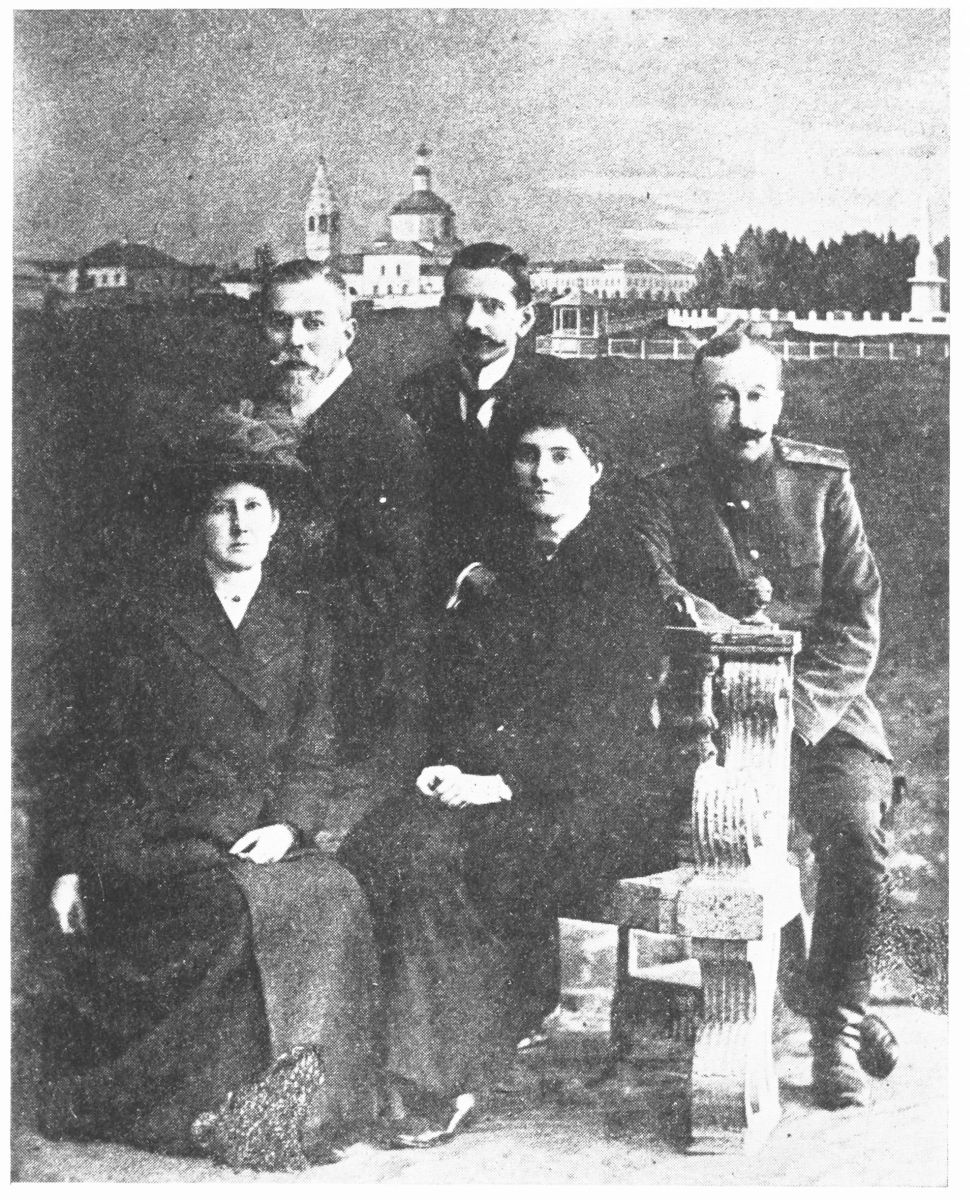
“FAITHFUL UNTO DEATH”
The above group was taken at Tobolsk during the captivity. All
except M. Pierre Gilliard, the French tutor (in the centre), died
for their loyalty to the Imperial family. Countess Hendrikova is
seated on the right with Mlle. Schneider by her side. Their mangled
bodies were found outside Perm. Count Tatishchev (left) and Prince
Dolgoruky (right) “disappeared” at Ekaterinburg. Two bodies,
supposed to be theirs, were found outside the city, one bearing
documents of “citizen Dolgorukov.”
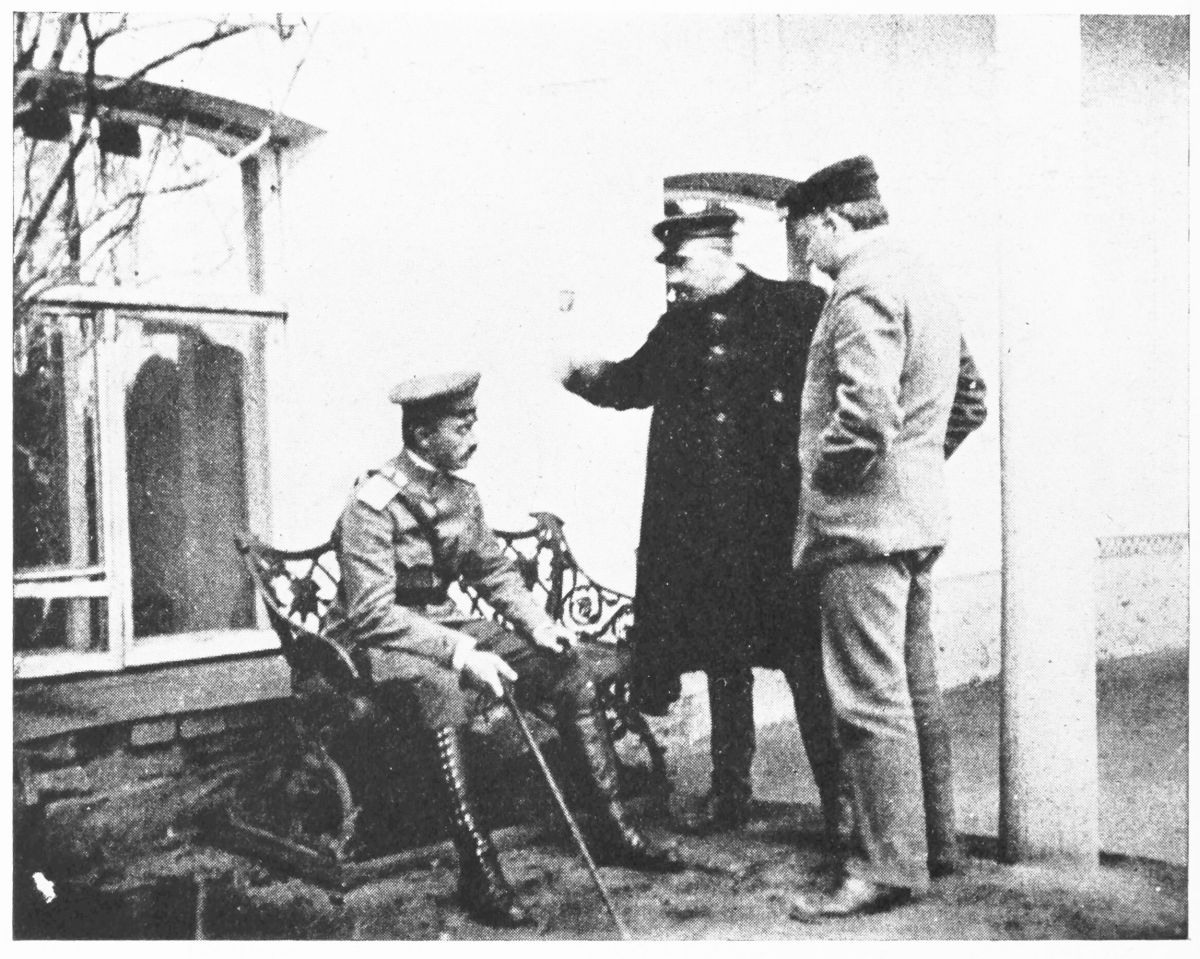
THE FAULTS OF THE EARLIER INQUIRY
N. A. Sokolov, pointing to the wall of Ipatiev’s house, calls
attention to a serious omission made by his predecessor. General
Diterichs (seated) listens. The other auditor is M. Magnitsky,
Prokuror (Public Prosecutor) of the Ekaterinburg Court. Photograph
taken in the garden, beside the terrace.
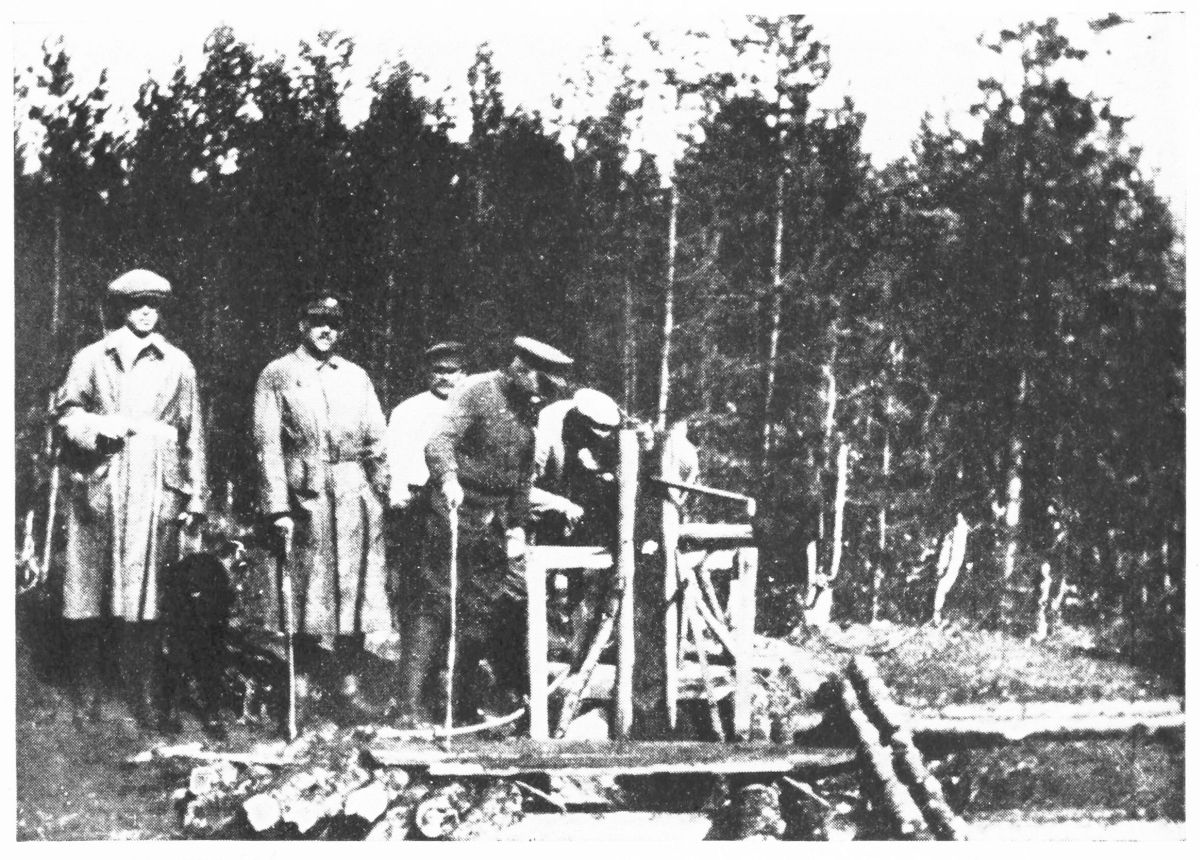
AT THE GANINA MINE
On the left, Mr. Sydney Gibbes, the Tsarevich’s tutor; on the
right, looking down the shaft, Mr. Robert Wilton, “The London
Times” Special Correspondent. At the bottom of this shaft was a
false floor beneath which the ashes of the victims were cunningly
concealed. The bodies had been cut up near the shaft and burned on
two pyres, one next to this spot.
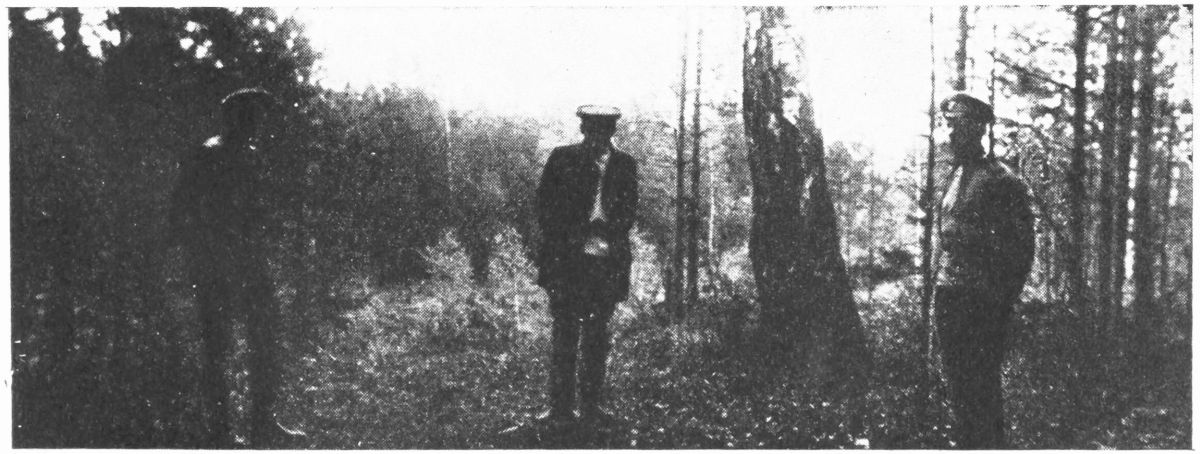
THE PYRE AT THE BIRCH TREE
N. A. Sokolov, General Domontovich and his A. D. C. pose at the
limits of the larger pyre, where most of the bodies and clothing
were cremated. Alongside stands the tree with the tell-tale
inscription.
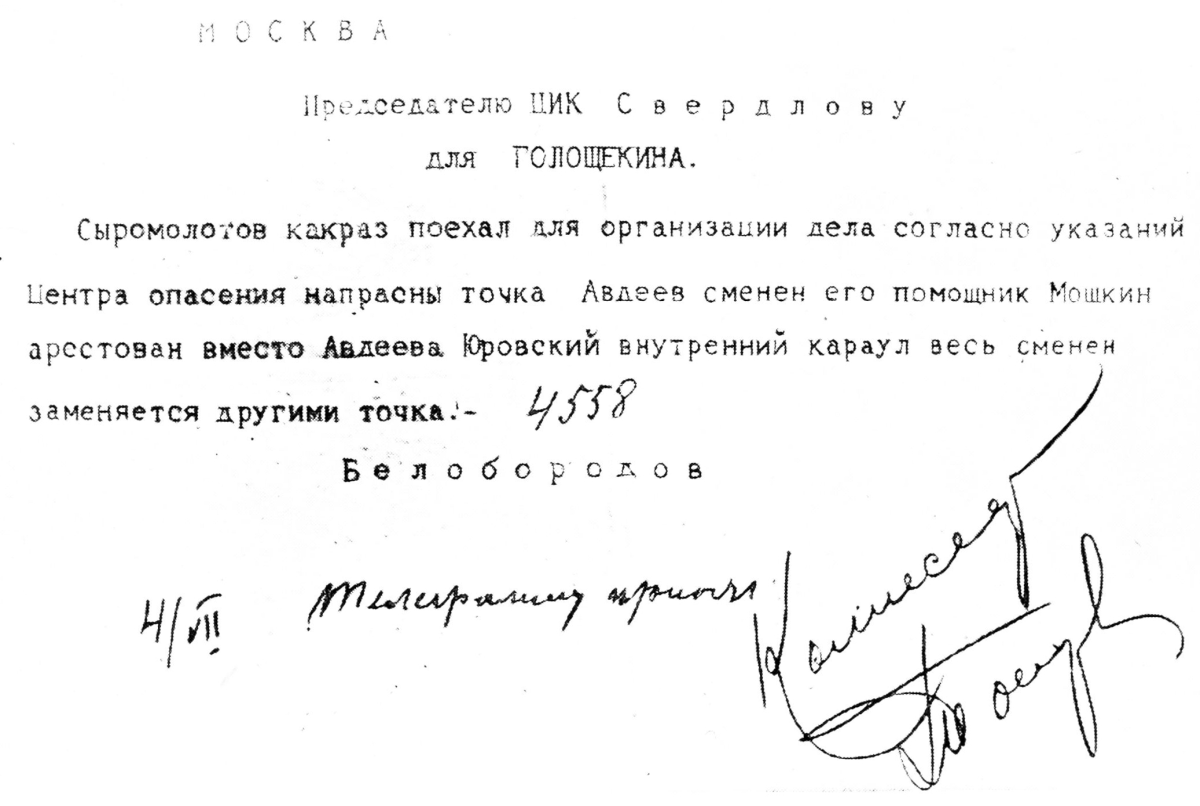
THE HAND OF THE RED JEW MURDERERS
The above is a facsimile of the original message filed at the
Ekaterinburg telegraph office by the local Soviet chiefs to the
Moscow Tsik (Centr. Ex. Committee) on July 4, 1918, twelve days
before the murder. In it, Beloborodov, the Russian “dummy”
president, informs Sverdlov through Goloschekin that Syromolotov is
hastening to Moscow to take final instructions for the “affair” and
that the Russian Guards have been replaced by “others”, i.e. by
German soldiers.
at Ekaterinburg. They were quite positive about it. They even pointed
out the place where “Anastasia” had been buried. The bodies—there were
many—were exhumed; the only one that was a young woman’s was
unmistakably identified by the local police as that of “Nastia Vorovka”
(the thief Nastia)—a well-known criminal.
The Komisar Safarov, afterwards editor of the official “Izvestiya,”
wrote an article on the “execution” which figures in the dossier as an
interesting sidelight on the motives of the crime and its methods. It is
only fair that the accused should speak for themselves. I here give a
plain, unvarnished rendering of this “defence”:
“In the places seized by the Czecho-Slovaks and bands of
White-guards in Siberia and the Southern Ural, authority has fallen
into the hands of Black-hundred pogromists composed of purest
Monarchists by profession. The real intentions of the White-guards
of the Quadruple Entente are made plain by the mere fact that at
the head of them all, as supreme war-lord, stands the Tsar’s
general Alexeiev, the most devoted servant of Nicholas the
Sanguinary, himself a convinced blood-shedder (palách)....
“Around Nicholas all the time was spread an artful network of
conspiracies. One of them was discovered during the transit from
Tobolsk to Ekaterinburg.” (Safarov here suggests that Yakovlev was
a traitor, and passes over in silence the whole history of the
interrupted journey. This compels the inference, which is borne out
by scores of direct evidences that the Tsik, i.e., Sverdlov,
deliberately sent the Romanovs into a death-trap.) Safarov
continues: “Another plot was discovered just before the execution
of Nicholas. The participants in the last conspiracy to deliver the
murderer of workmen and peasants out of a peasant-workman’s prison
clearly identified their hopes with the hope that the Red capital
of the Ural would be occupied by Czecho-Slovak-Whiteguard
pogromists.
“General Alexeiev wanted to bring over into his Stavka (G.H.Q.) his
own Tsar.” (The General had long been dead when Safarov wrote this
article.) “His calculations have not been justified. The people’s
assizes (narodny sud) have judged the All-Russian murderer and
anticipated the plans of the counter-revolution. The will of the
Revolution has been accomplished although many of the formal
aspects of bourgeois legal procedure were infringed, and the
traditional, historical ceremonial of the execution of ‘crowned
personages’ was not observed. The peasant-workingman’s authority
here also expressed itself in a form of extreme democratism;[14]
it made no difference for the All-Russian murderer and had him shot
just like an ordinary robber (razboinik). Nicholas the Sanguinary
is no more, and the workmen and peasants may with full right say to
their enemies: You played your stake on the Imperial crown. You
have lost. Take your change—an empty crowned head.”
The Russian peasants at Ekaterinburg looked at the matter differently.
They caught Vaganov, one of the regicides, and killed him on the spot.
It was very distressful to the Investigating Magistrate, but he could
not prosecute the peasants; there were too many of them, and they would
not have understood. It had appeared to them the right thing to do, to
slay the Russian who had laid hands upon the Tsar.
But Safarov eludes issues he himself raises. Why not have sent the Tsar
for trial to the capital, to Moscow? Surely, that was the place where
the “will of the Revolution” could have been properly displayed! All
these wonderful conspiracies of which he speaks made it all the more
necessary to send him there and save the Ural Soviet from all
responsibility. The approach of the Whites should have caused the local
chieftains not to delay one single day. Why not? Because Sverdlov had
already sent for Syromolotov to arrange the murder....
The cynical references to “bourgeois legal procedure” and to
“historical ceremonial” will, it is to be hoped, put an end for ever to
the legend of a “trial.”
Yankel Sverdlov conversed with his agents in Ekaterinburg over the
direct wire before and after the murder, giving directions when
necessary. They forgot to destroy all evidence of these conversations.
When the investigation was confided to experienced and fearless hands,
one of the first measures taken was to thoroughly overhaul the records
of the Telegraph Office. It yielded astonishing results. I give some of
the documents in this and the following chapters.
Here is the record of a conversation between the Red Tsar and,
apparently, Beloborodov, the former in Moscow, the latter in
Ekaterinburg. This record was written in pencil on the backs of
telegram blanks. There are six such blanks. The writing is evidently of
one and the same person. It consists of questions asked by Sverdlov and
answers thereto. The record was made obviously on the 20th July, three
days after the murder. Here it is, textually translated:—
“What is heard with you?
“The position on the front is somewhat better than it appeared
yesterday. It is ascertained that the opponent has denuded all fronts
and flung all his forces on Ekaterinburg. Can we hold Ekaterinburg long?
It is difficult to say. We are taking all measures to hold it.
Everything superfluous has been evacuated from Ekaterinburg. Yesterday a
courier left with the documents that interest you. Communicate the
decision of the Tsik, and may we acquaint the population by means of the
text that you know?
“At a meeting of the Tsik presidium on the 18th it was decided
(postanovleno) to recognise the decision of the Ur. Reg. Sovdep as
regular (pravilnym). You may publish your own text. With us yesterday,
in all the newspapers was inserted a corresponding announcement. I have
this instant sent for the exact text and will communicate it to you
(tebié, i.e., to thee. Sverdlov is speaking to an inferior).
. . . . . .
“This moment I shall hand over the exact text of our publication....”
I do not reproduce it. There is no need. The “wireless” printed in The
London Times of July 22, 1918, is the exact and accurate translation of
the text given in this conversation recorded in Ekaterinburg two days
previously. (The Moscow and the Ekaterinburg texts are given in Chapter
X.) What better evidence could be found of the genuineness of the above
record? It stops there. But it tells us volumes. It is the language of
conspirators, of accomplices in a crime, and of a superior whose orders
and whose initiative alone count. Yankel Sverdlov assumes his true
proportions. He and the Bolshevist Government in which he was omnipotent
as president of the Central Executive Committee (Tsik) and virtually
chief also of the Red Inquisition are forever identified with the
murders that have been described in this work. The courier referred to
is Yurovsky. We know that he left on the 19th with the plunder and, it
is believed, the “heads.” The Whites were beginning to concentrate their
forces. That was four days after the “execution.”
But why all these precautions? If the people are so anxious to try and
to punish their late ruler, why resort to all manner of subterfuges,
both in committing the “execution” and in acquainting the people of the
death of their “oppressor”? The answer is a simple one: Sverdlov and his
associates were not sure of the people. The reason of that is equally
simple: they were not Russians; they were Jews. They were
“internationalists,” repudiating all nationality, yet disguised under
Russian names. The Russians in their midst were dupes or dummies.
Krassin might come to clear the ground, but Apfelbaum-Kamenev appeared
for the serious work. What happened in London in 1920 is comparable in a
modest way with the Red mechanism in Russia itself.
Taken according to numbers of population, the Jews represented one in
ten; among the komisars that rule Bolshevist Russia they are nine in
ten—if anything, the proportion of Jews is still greater.
There has been no intention here to ascribe the murder of the Romanovs
to a race vendetta: it is the Jewish organisations in this and other
countries that have emphasised this aspect of the Soviet crimes by their
persistent attempts to prove that no Jews took part in them. Why do they
not follow the example of the bold Rabbi who excommunicated Laiba
Braunstein, alias Leo Trotsky, for the abominable crimes that Jew had
committed against humanity and against civilisation? Why are they trying
to screen the sinister Red Tsar Yankel Sverdlov and his host of Jewish
assassins—the Isai Goloshchekins, the Yankel Yurovskys?
They feared the Russian people, they feared the Romanovs because they
were Russians, they feared Nicholas Romanov because he had been a
Russian Tsar and when he refused to be seduced from his loyalty to his
people and to the Allies they resolved that he should die—he and all
the Romanovs. This resolve was carried out when the advance of
anti-Bolshevist forces gave a reasonable hope of sophisticating the
crime and avoiding a just punishment.
And so definite was Jew-ruled Moscow on the necessity of the ex-Tsar’s
death that a whole month before the murder, the report persisted that
Nicholas II. was dead. On the 21st June the Komisar of the Press, named
Stark, telegraphed to the Presidium of the Sovdep at Ekaterinburg:
“Urgently inform regarding authenticity reports Nicholas Romanov
killed”; on the 23rd, Bonch-Bruevich, the secretary of the Sovnarkom
(Council of people’s Commissaries of which Lenin is president),
telegraphed to the President of the Ekaterinburg Sovdep (i.e.,
Beloborodov): “Information circulating Moscow alleging former Emperor
Nicholas the Second killed. Send any available information.” A certain
Boyard arrived in Ekaterinburg on the 9th July and telegraphed to the
French Consul in Moscow: “Am staying meanwhile at British Consulate.
Reports about Romanov false.”
The Germans knew what they were doing when they sent Lenin’s pack of
Jews into Russia. They chose them as agents of destruction. Why? Because
the Jews were not Russians and to them the destruction of Russia was all
in the way of business, revolutionary or financial. The whole record of
Bolshevism in Russia is indelibly impressed with the stamp of alien
invasion. The murder of the Tsar, deliberately planned by the Jew
Sverdlov (who came to Russia as a paid agent of Germany) and carried out
by the Jews, Goloshchekin, Syromolotov, Safarov, Voikov and Yurovsky, is
the act not of the Russian people but of this hostile invader.
The Jewish domination in Russia is supported by certain Russians: the
“burgess” Ulianov alias Lenin, the “noble” Chicherin, the “dissenter”
Bonch-Bruevich. They are all mere screens or dummies behind which the
Sverdlovs and the thousand and one Jews of Sovdepia continue their work
of destruction; having wrecked and plundered Russia by appealing to the
ignorance of the working folk, they are now using their dupes to set up
a new tyranny worse than any that the world has known.
Sovietdom has consecrated three heroes to whom monuments have been
erected: to Karl Marx, to Judas Iscariot, and to Leo Tolstoi, the three
names that are associated with Revolution, Apostacy and Anarchism; two
of them Jews.
When the Jew Kanegisser assassinated the Jew Uritsky, the Soviets
ordained a Terror throughout the land. Rivers of Russian blood had to
wipe away the stain caused by a Jew who dared to oppose the Jewish
rulers of unhappy Russia.
When Yakovlev failed to remove the Tsarevich from Tobolsk and to
“convert” the Tsar, he disappointed Mirbach more than he disappointed
Sverdlov.
The Jews feared the Russians, but the Germans wanted to use them. The
Red Tsar planned to exterminate the Romanovs, but the Red Kaiser
proposed to reinstate Nicholas.
For a time their respective schemes assumed divergent courses; in the
end, Wilhelm’s agents realised that they could not dissociate themselves
from the Red Tsar, and it was the latter’s plan that prevailed. But,
morally as well as practically, the German hand which had brought the
Jew murderers into Russia controlled and directed the assassins’ work.
Only when Berlin realised that the Romanovs were irrevocably on the side
of the Entente did they release the hands of the murderers.
The proposal that Yakovlev brought to Tobolsk was much more insidious
than the Tsar understood it to be. Nicholas was not only to endorse the
peace concluded at Brest; he was to seize the reins of power with the
help of German bayonets and to give his only son to be a lawful Tsar
under German tutelage.
This meant the intervention of Russia in the war again, but on the
German side. The Red Kaiser and his staff did not trust their Red agents
any more.
While Yakovlev went to Tobolsk as envoy extraordinary of the Tsik (but
in reality of the German G.H.Q.) the official representative of Germany
to the Soviet Government, with which she was in treaty and in virtual
alliance, was summoning a secret conference of Anti-Soviet Russians to
arrange for the advent of the “new government” desired by Ludendorff.
It was a very pretty scheme, quite on German lines. But it failed at
every point. The Germans once more had shown a total incapacity to
understand human nature. Nicholas scorned the base overtures; the
Russian intelligentsia displayed, on this occasion, a sound
understanding of their duties and interests.[15] The illness of Alexis
was another obstacle, though in itself it made no difference.
Sverdlov was not disturbed by Yakovlev’s failure to bring Nicholas and
Alexis to Moscow. He had his agents everywhere. While Soloviev acted as
watch-dog over the captives of Tobolsk so that no stranger to German
plans should spirit them away, innumerable Red Solovievs hemmed the
captives in. The common herd of the Soviets knew nothing, of course.
The strings were cunningly, discreetly pulled from Moscow according to
the best methods of Potsdam and the Wilhelmstrasse.
No sooner had Yakovlev started on the terrible rush of 160 miles over
bogs and rivers running deep water over breaking ice to Tiumen than the
Jewish conclave in Ekaterinburg received its orders—to stop the
travellers at all costs. Omsk was at once “stampeded” by the false
statement that Yakovlev was trying to arrange a rescue. Yakovlev was
really seeking to escape the North Ural net by taking the south Ural
route. He did not have to go through Omsk at all, but to change from the
Perm on to the Samara line. There was no escaping out of the country by
that route then. It could lead only to Moscow. Nevertheless, this train
was turned back to Ekaterinburg. Sverdlov did not really want the
Romanovs to go further. He could not afford to quarrel openly with his
former paymasters, but he was probably shrewd enough and sufficiently
well informed to suspect their secret designs.
The talk of a trial in Moscow did not begin till much later, when Moscow
rumour reported the Tsar as already defunct, and solely as an antidote
to those rumours, as they threatened to upset the plan of murder.
Sakovich, formerly surgeon in a hussar regiment and ex-ultra-monarchist,
appertained to the Ural Regional Sovdep as Komisar of Health. He
deposed afterwards that he had overheard Goloshchekin, Safarov and
Voikov discussing with Beloborodov the alternative of wrecking the train
with Nicholas Romanov or of “arranging” an accident. In the former case,
the responsibility would be placed on “counter-revolutionaries” trying
to effect a rescue. He did not listen to all the details as it did not
concern his department. But the Jews did not have to carry out the plan
then. The Germans were still in favour of the survival of Nicholas. The
idea was utilised some months later at Alapaevsk. I have a copy of the
message sent afterwards to Moscow and Petrograd in which the murderers
seriously describe the “rescue” staged by them after the murder as
having been the cause of the grand ducal “disappearance.”
The Romanovs were suffered to live. A German mission (ostensibly Red
Cross) came to Ekaterinburg at the end of May to ascertain all about the
life of the “residents of Ipatiev’s house,” as the Imperial prisoners
were officially styled. These spies went straight to Berlin with their
report. The Red Kaiser knew full well what torments were being endured
by those whom he had professed to cherish, who after all were his kith
and kin. He could have saved them at any time. But ... they would not be
saved by him....
Mirbach’s death did not, perhaps, introduce any modification of the plan
of slaughter. He was assassinated one week before the event. The
Bolsheviks declared that his death was an act of provocation committed
by their Socialist opponents and gravely resolved that they must not
quarrel with Germany, because that would only be playing into the hands
of the assassins. This solemn farce had a deeper meaning.
During the summer of that year the Siberian anti-Bolshevist units began
to grow in numbers and strength. The Germans had themselves foolishly
promoted this reaction by arresting the departure of the Czechs and
compelling them to fight. A Siberian Army was quickly springing into
existence. It might drive the Red Tsar out of Moscow and thus, instead
of an ally or agent there, the Red Kaiser would find himself confronted
by a hostile Russia. The war was slowly dragging to its fateful end;
every battalion counted. The Entente knew what the assistance of Russia
meant, so the Entente went to the aid of the Czechs and Siberians.
Ludendorff does justice to this tragic dilemma in his book of “War
Memories” “...the Entente, realising that they could not work with a
Government which looked for support to Germany, took action against
Bolshevism, and instead of sending these troops (the Czechs) to France,
held them up along the Siberian railway on the frontier between Russia
and Siberia, in order to fight the Government in Moscow. In addition to
this, by garrisoning the railway, the Entente prevented the return of
our prisoners of war from Siberia. This was unquestionably a serious
loss to us.” (Vol. II, p. 654.)
The holding up of the Czechs was Ludendorff’s own work. He is ashamed to
admit it, and puts the cart before the horse in pleading that the
Entente displayed such far-sighted activity. Moreover, it was precisely
the German-Magyar prisoners of war who, rallying to the appeal of their
Kaisers, stopped the departure of the Czechs. Ludendorff is too modest.
But his statement makes one point crystal-clear: that in the German view
the plan to get rid of the played-out Red Tsar, to put a subservient
White Tsar in his place, had to be dropped. The Red Tsar might be useful
yet. As Dr. Ritzler had remarked: “The Bolsheviks are still necessary.”
The usefulness of the Bolsheviks was to be twofold: (1) to defend the
German front in Russia; (2) to prevent the White Tsar from joining the
Russian forces of the Entente.
This being the story of the Tsar’s murder, we are concerned chiefly with
the second part of Yankel Sverdlov’s German programme. How was it to be
carried out, so that there should be no possible mistake? Obviously,
there was only one way—through death’s dark portals. To bring the Tsar
or the Tsarevich to Moscow would involve risks. The Jews were in a
fright; telegrams discovered in Ekaterinburg show that they trusted none
of the Russians in their employ. That is why the Romanovs remained in
Ekaterinburg.
Four days before Mirbach’s assassination, consequently while the Red
Tsar had his daily audiences with the representative of the Red Kaiser,
Goloshchekin was already in Moscow, had discussed the murder with
Sverdlov, and had telegraphed to Beloborodov to send another member of
the Conclave to Moscow.
The Germans approved the murder; there can be no doubt on this point.
The position held by Mirbach in Moscow, his daily reports from the
members of the Red Inquisition, which naturally had the closest
connection with the arrangements for the murder, such as the sending to
Ekaterinburg of the ten Magyar-German “Letts” as executioners, are
conclusive evidences. The Red Tsar and the Red Kaiser were in accord.
But it was absolutely essential that no Russians should be left inside
the house where the Romanovs were to die. Whether the Germans assented
to the wholesale slaughter that took place remains in doubt. By that
time Mirbach had gone to his last account, and the bloodthirstiness of
the Jewish murderers perhaps exceeded the German design, and therein may
be found a good reason for the report of the “safety” of the family, but
the Red Kaiser cannot escape responsibility for the whole crime, any
more than can the Red Tsar who planned it and the Soviet régime that
rendered such a crime possible.
Here is a translation of the original typewritten telegram found in the
archives of the Telegraph Office in Ekaterinburg and included in the
dossier:
“Moscow.
“To President of Tsik Sverdlov for Goloshchekin.
“Syromolotov has just gone for organisation of affair in accordance
with directions of Centre. Apprehensions unfounded stop Avdeiev
superseded, his assistant Moshkin arrested. Yurovsky replaces
Avdeiev. Interior guard all relieved replaced by others. stop.
4558.
“Beloborodov.”
Below the text in black ink is marked the date: “4/VII” and further, in
ink of the same colour: “Telegram received,” after which in black pencil
is the signature: “Komisar To ...” (the rest of the name illegible),
this representative of the Soviet being in charge of the telegraph
office and endorsing all official messages as they were handed in for
transmission.
This message needs no explanation. It is a full and crushing
confirmation of all that has preceded: Fear of the Russians; preparation
of the murder; direction of the plan from Moscow; and eagerness of the
local Jews to anticipate the signal for the butchery. The horrible
servility of the dummy president Beloborodov is disclosed in all its
nakedness. He hastens to assure his Jewish masters that their
“apprehensions” are “unfounded.” The German-Magyars who had done their
best to carry out the Red Kaiser’s behest to capture Siberia and to
crush any hope of Russia’s military revival, they were now called in to
consummate the Red Kaiser’s plan by murdering the Tsar.
For all that has been stated in these chapters there is unimpeachable
authority. There is the dossier. And there is the overwhelming
corroboration of the horrible realities that have converted a large part
of Europe into a charnel, Russia into a pest-house and the rest of the
world into a hot-bed of unrest.
And pre-eminent among the Doers of Evil, murderers and despoilers, has
been the Red Kaiser.
When, in 1915, he wrote to the Tsar, asking him to recall the days when
they were friends, and Nicholas, mindful of the bitter lessons that
friendship had entailed, replied that those days must forever be
forgotten, Wilhelm of Hohenzollern started the machinery that was to
sweep out of existence the Tsardom and Russia, and the hapless Romanovs.
In the autumn of 1915 there assembled in Vienna the representatives of
the German and Austrian General-Staffs to discuss a plan for the
promotion of a revolutionary movement in Russia. It was then that all
the outlines of the “Russian” revolution were laid down; it was at this
meeting that the leading actors in the Red tragedy were chosen: the
Lenins and the Sverdlovs and the host of Jewish wreckers, who spent the
interval between their engagement and their appearance on the Russian
stage in the calm of Swiss resorts, studying and rehearsing their parts.
The money that financed the “Russian” revolution was German money,
and—I say it on the strongest evidence which can be corroborated in the
German secret archives—Yankel Sverdlov Received a Salary From the
Germans Till November 7, 1917, when, becoming Red Tsar of All the
Russias, he had at his disposal loot unimaginable.
And thus it came to pass that the Germans who slew the Tsar and the Jews
who organised, aided and abetted the murder each left his mark upon the
walls of Ipatiev’s house.
Many hundreds of relics were collected in and around Ekaterinburg by the
law, and more particularly by the military, officers of the White
government. The larger number had no value as clues. They were personal
belongings—jewelry, clothing, linen—that had been stolen before and
after the murder. By Admiral Kolchak’s orders, this property was taken
to Vladivostok by General Diterichs in February, 1919, and sent to the
Tsar’s sister the Grand Duchess Xenia as next-of-kin.
Those of the Romanovs who had not been in the power of the Soviets and
had succeeded in leaving the country were destitute. The total fortune
belonging to the Tsar in England amounted to £500.
Two days after the murder, the Soviet government issued a decree
declaring all the property and possessions of the Romanovs forfeited to
them. This act had a double purpose: to afford any banks holding funds
to the credit of the family a pretext for non-payment; to “legitimise”
the robbery of the corpses in the wood and the appropriation of the
valuables left in Ekaterinburg.
The ropes of pearls and the matchless pearl necklaces snatched from the
bodies have been the objects of barter on the Continental and London
markets. Red missions smuggled in a huge quantity of jewels belonging to
the Crown and to the Romanovs personally as well as to other
individuals—all “forfeited” in the same manner.
Among the relics was a private code that was found in the ventilator of
the Ipatiev lavatory. It bore the following inscription in the Empress’s
hand: “For my own beloved Nicky, dear, to use when he is absent from his
‘spitzbu.’ Fr. his lovingly, Alice. Osborne, July, 1894.” The German
word had been erased and rewritten in Russian! The owner of this little
book had evidently prized it above everything else and fearing that it
might be taken away from him had hidden it—hoping, no doubt, to claim
it some day.
Also among the mementoes from her funeral pyre came a ruby that belonged
to the murdered Empress. It was identified by her maid who told the
following story: “The Emperor gave Her Majesty a ruby ring when she was
only fifteen. They fell in love even then. It was at the wedding of her
sister the Grand Duchess Elizabeth. After that they thought about each
other for eight years. The Empress always wore the ruby ring hanging on
a chain on her breast.”
The spaniel Joy also came to England. Both the dogs that were most
highly prized by the Imperial family were of English breeds. Jemmy, who
died with his masters, was a diminutive black-and-tan King Charles, so
small that he could not mount the Ipatiev stairs unaided.
The sufferings of the Romanovs in Ipatiev’s house were so terrible that
it is not seemly to misrepresent them, as some writers have done, in
sordid fashion. I have the inventory of the house and its contents,
signed by Ipatiev and the Komisars; I have the procès-verbal of
Sergeiev’s inspection, made within a fortnight of the murder; lastly, I
have the evidence of my own eyes. The house itself contained every
comfort and convenience: electric light, excellent stoves, a well
appointed bath-room and lavatory, electric bells everywhere, plenty of
good and even luxurious furniture. The bath was in working order and,
when Sergeiev visited it contained: firewood for the heater, sheets
bearing the Imperial monogram and a cake of soap on the rack, besides
numerous other signs of frequent usage. The brutal guards, being used to
the Russian steam bath, were not interested in this “outlandish”
contrivance, and except for their prying and offensive habits did not
apparently stand in the way of personal cleanliness.
The story of girlish locks shorn because of the impossibility of other
methods of combating dirt and its consequences is not borne out by the
evidence. “Combings” of hair of four different hues were found; also
some short hair in the bath-room. One would expect to find them. It is
stated in the dossier that a barber visited the house to attend the
Tsar and the Tsarevich.
Each member of the family had his or her bed. There were sheets, pillows
and blankets. There was a wash-house in the court-yard.
For some reason the house was deficient in crockery and plate and table
linen, hence quite needless discomfort was inflicted upon the family at
mealtimes. The peasant-guards, inoculated with the anti-bourgeois
theories, saw no particular hardship in their feeding out of one dish,
as they themselves are accustomed to do in the villages.
The torment that was endured by the captives was far worse than any
merely physical privations. But one such privation did affect them very
grievously: the utter impossibility of seeing anything at all beyond the
painted glass of their windows. The youngest Grand Duchess (Anastasia)
one day could not brook this privation any longer and managed to open a
window in the girls’ room. She almost paid for this act with her life.
The sentry in the inner hoarding immediately fired, just missing her.
The bullet lodged in the window frame. Anastasia gained nothing except a
fright. She saw nothing except the hoarding of the sentry, and did not
wait for a second shot.
In the room where the Imperial couple and Alexis lived and slept—next
to the chamber in which their four daughters were crowded—Alexandra
placed a good-luck sign. It was so unobtrusive that Gaida, the Czech
commander who forcibly installed himself in this room, probably did not
notice it. In pencil she formed the mystic sign of swastika and
inscribed the date “17/30 April,” the day of her arrival in the house.
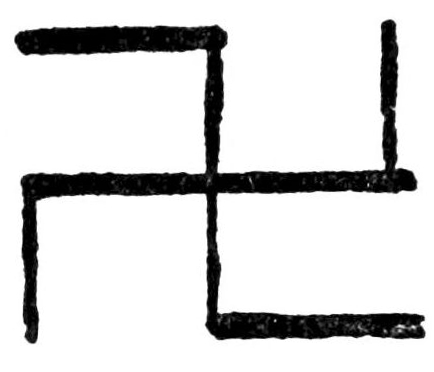
ALEXANDRA’S GOOD LUCK SIGN
In the death-chamber in addition to the “Belsatzar” inscription was one
that has yet to be deciphered. It is in thick black ink, written with an
expert hand, and just below, on the window-sill are three groups of
figures that may or may not have a meaning.
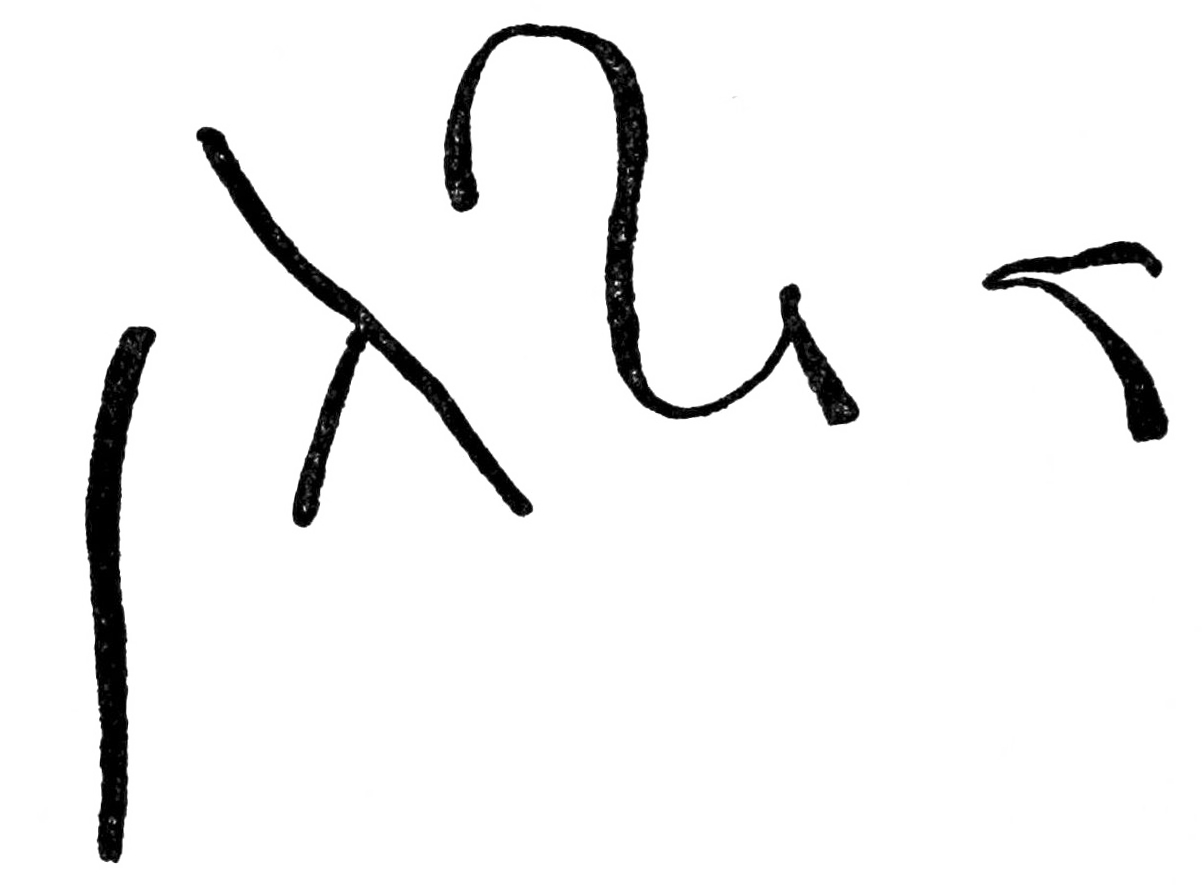
THE MYSTERIOUS INSCRIPTIONS IN THE DEATH CHAMBER.
Some of the persons with whom the reader has become familiar have gone
to their last account.
The Russian regicide Medvedev died in prison of typhus early last year.
His accomplice Yakimov died in prison of inflammation of the lungs at
the end of last year. Their death and burial certificates are both in
the dossier.
Yurovsky wrote a letter to a certain Dr. A. before he fled from
Ekaterinburg imploring him to protect his old mother “who does not share
my views but who may suffer simply because I am her son.” It is at once
an avowal of guilt and a proof that even the most blood-thirsty wretch
has some good in him. This man had coolly tortured, murdered and cut up
innocent children, and was not able to remove his old mother because he
had to take the proofs of his crime to Moscow, yet he does not forget
her.... Before the Kolchak armies left Ekaterinburg we heard that
Yurovsky had been seen in the city. Had he come at great risk to look
for his mother? Sokolov had had her removed to Irkutsk. She feared and
loathed her son.
Yankel Sverdlov, the Red Tsar, died in Moscow early in 1919. He was
knocked on the head by the workmen at one of the Morozov mills, and
succumbed to concussion of the brain. Sovietdom was in an uproar. It was
officially announced that this “valiant defender of the people’s rights”
had come to a natural end, by inflammation of the lungs. Nevertheless,
the chrezvychaika could not allow the Red Tsar to be so dishonoured.
Yankel was followed to the outer bourne by thousands of innocent
victims offered up in holocaust to his memory.
The mortal remains of the blood-stained agent and associate of the Red
Kaiser were exposed to the public gaze and given a pompous Red funeral,
and the Theatre Square which faces the building where Yankel had spun
his web of blood received a new name, the accursed name of Sverdlov.
None of the Red Jews dared to wear the mantle of Yankel Sverdlov openly.
His office was delegated to Kalinin, a “dummy” of the Beloborodov
variety, who provided the needful Russian screen to cloak their
villainies. For there was no change in the spirit of the Red Jew
government of Russia, only an adaptation of methods, a variation of
victims—first the bourgeois, then the proletaire.
The Russians who fought and bled for their country are almost extinct.
One of the last who died in the sacred cause was Nicholas II. and the
other Romanov victims of the Red invaders, German and Jewish. A remnant
persisted to the end. To them the Red Usurpers of Moscow could never be
anything except an alien domination.
I recall the night before we left Ekaterinburg. The Reds were
approaching, but Sokolov went into the darkness and the rain to obtain
the evidence of important peasant witnesses. He told them who he was and
the object of his call. They could have locked him up in a cellar and
given him up to the Reds. It was to their advantage to do so. By giving
him information they incurred great risk. He explained it all to them.
“And now, what will you do?” he asked. “Will you help justice? Will you
remember that he who is dead was your Tsar?” They did not hesitate one
instant. They chose the path of honour, of self-sacrifice. They gave
their evidence and brought Sokolov on his way.
It is the peasant that will bring Russia back to new life. Alexandra’s
vision may yet come true, and Nicholas and the Romanovs may not have
died in vain.


 YORK


