Saturday, October 20.
It snows. The sky is lowering and overcast,
with no hope of clearing, as though there were
no longer any sun. A furious north wind is
blowing, and the black dust whirls and eddies,
commingling with the snowflakes.
This morning, my first interview with our minister
took place at the Spanish legation. His temperature
has fallen, but he is still very weak, and
must remain in bed for some days, so I am obliged
to postpone until to-morrow or the day after the
communications I have to make to him.
I take my last meal with the members of the
French legation in the chancellor's house, where,
in default of sumptuous quarters, they have offered
me the most kindly hospitality. At half-past one
the two little Chinese chariots arrive, lent me for
the emigration of myself, my people, and my light
luggage to the Yellow City.
The Chinese chariots are very small, very massive,
very heavy, and entirely without springs;
mine has something of the elegance of a hearse;
the outside is covered with a slaty-gray silk, with
a wide border of black velvet.
We are to journey toward the northwest, in the
opposite direction from the Chinese City where
we were yesterday, and from the Temple of
Heaven. We have five or six kilometres to go
almost at a walk, on account of the pitiable condition
of the streets and bridges, where most of
the paving stones are missing.
These Chinese chariots cannot be closed; they
are like a simple sentry box mounted on wheels,—so
to-day we are lashed by the wind, cut by the
snow, blinded by the dust.
First come the ruins of the legation district, full
of soldiers. Then more lonely, almost deserted
and entirely Chinese ruins—one gray, dusty devastation,
seen vaguely through clouds of black
and clouds of white. At the gates and on the
bridges are European or Japanese sentinels, for the
whole city is under military rule. From time to
time we meet soldiers and ambulances carrying the
flag of the Red-Cross Society.
At last the first enclosure of the Yellow or
Imperial City is announced by the interpreter of
the French legation, who has kindly offered to be
my guide, and to share my chariot with its funeral
trappings. I try to look, but the wind burns my
eyes.
We are passing with frightful jolts through
great blood-colored ramparts, not by way of a
gate, but through a breach made with a mine by
Indian cavalrymen.
Pekin, on the farther side of this wall, is somewhat
less injured. In some of the streets the
houses have kept their outside covering of gilded
woodwork and their rows of chimæras along the
edges of the roofs; all this is crumbling and decayed,
it is true, licked by the flames or riddled by
grape-shot. An evil-looking rabble, dressed in
sheepskins or blue cotton rags, still swarms in
some of the houses.
Another rampart of the same blood red and a
great gate ornamented with faience through which
we must pass,—this time it is the real gate of the
Imperial City, the gate of the region which no one
was ever allowed to enter; it is to me as though it
had been announced as the gate to mystery or to
an enchanted land.
We enter, and my surprise is great; for it is not
a city, but a wood,—a sombre wood, infested
with crows which croak in the gray branches. The
trees are the same as those at the Temple of
Heaven,—cedars, arbor-vitæ, and willows,—old
trees all of them, of twisted shapes, unknown
in our country. Sleet and snow cling to their
branches, and the inevitable dust in the narrow,
windy paths engulfs us.
There are also wooded hills where kiosks of
faience rise among the cedars; in spite of their
height, it is plain that they are artificial. Obscured
by the snow and dust, we can see here and there
in the distant wood austere old palaces, with enamelled
roofs, guarded by horrible marble monsters
which crouch at the thresholds.
The whole place is of an incontestable beauty,
while at the same time it is dismal, unfriendly,
and disturbing under this sombre sky.
Now we approach some enormous object which
we shall soon be alongside of. Is it a fortress,
a prison, or something more lugubrious still?
Double ramparts without end, always blood red,
with gloomy dungeons and a moat thirty metres
wide, full of water-lilies and dying roses. This
is the Violet City, enclosed in the heart of the impenetrable
Imperial City, and more impenetrable
still. It is the residence of the Invisible, of the
Son of Heaven—God! but the place is gloomy,
hostile, savage, beneath this sombre sky!
We continue to advance under the old trees into
what seems the park of death.
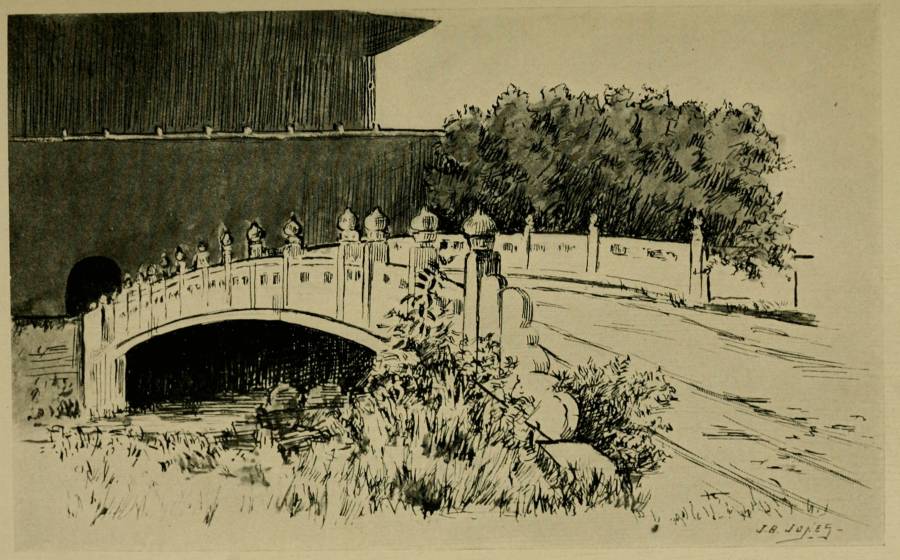
Marble Bridge over Moat before Southern Gate of the Forbidden City
These dumb, closed palaces, seen first on one
side, then on the other, are the Temple of the God
of the Clouds, the Temple of Imperial Longevity,
or the Temple of the Benediction of Sacred Mountains.
Their names, inconceivable to us, the names
of an Asiatic dream, make them still more unreal.
My companion assures me that this Yellow City
is not always so terrible as it is to-day; for this
weather is exceptional in a Chinese autumn, which
is usually magnificently luminous. He promises
me afternoons of warm sunshine in this wood,
unique in all the world, where I shall make my
home for several days.
"Now look," he said, "look! This is the Lake
of the Lotus, and that is the Marble Bridge."
The Lake of the Lotus and the Marble Bridge!
These two names have long been known to me as
the names of things which could not be seen, but
of things whose reputations had crossed insurmountable
walls. They call up images of light
and intense color, and are a surprise to me here
in this mournful desert, in this icy wind.
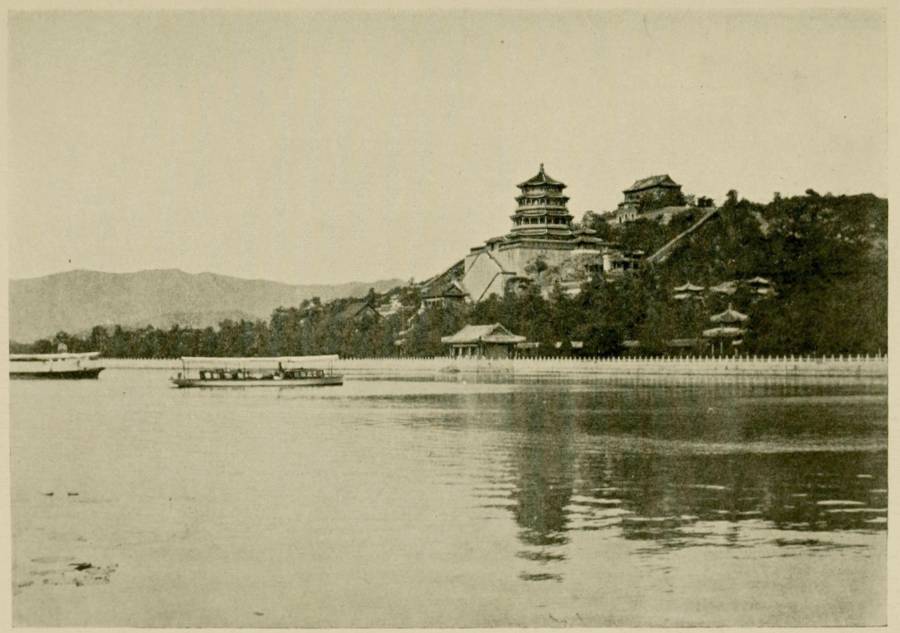
The Lake of the Lotus! I had pictured it as
sung by the Chinese poets, of an exquisite limpidity
with great calices open to an abundance of water,
a sort of aquatic plain covered with pink flowers,
pink from one end to the other. And this is it!—This
slime and this gloomy swamp, covered
with dead leaves turned brown by the frost! It
is infinitely larger than I supposed, this lake made
by the hand of man; it goes on and on toward
nostalgic shores, where ancient pagodas appear
among the old trees, under the gray sky.
The Marble Bridge! Yes, this long, white arch
supported by a series of white pillars, this exceedingly
graceful curve, the balustrades with monsters'
heads,—this all corresponds to the idea I
had of it; it is very sumptuous and very Chinese.
I had not, however, foreseen the two dead bodies
decaying in their robes, which lay among the reeds
at the entrance to the bridge.
The large dead leaves on the lake are really
lotus-leaves; I recognize them now that I see
them near at hand, and remember to have seen
similar ones—but oh, so green and fresh—on
the ponds of Nagasaki or of Yeddo. And there
once must have been here the effect of an uninterrupted
covering of pink blossoms; their fading
stems rise now by thousands above the slime.
They will undoubtedly die, these fields of lotus,
which for centuries have charmed the eyes of the
emperors, for the lake is almost empty; it is the
Allies who have turned its water into the canal
that connects Pekin with the river, in order to
re-establish this route which the Chinese had dried
up for fear of its serving the purpose of the
invaders.
The Marble Bridge, white and solitary, leads
us across to the other bank of the lake, very narrow
at this point, and there I shall find the Palace
of the North, which is to be my residence. At first
I do not see that there are enclosures within enclosures,
all with great gates, dilapidated and in
ruins. A dull light falls from the wintry sky
through opaque clouds that are filled with snow.
In the centre of a gray wall there is a breach
where an African chasseur is on guard; on one
side lies a dead dog, on the other a pile of rags
and filth breathing a corpse-like odor. This, it
appears, is the entrance to my palace.
We are black with dust, powdered with snow,
and our teeth are chattering with cold, when we
finally get down from our chariot in a court encumbered
with débris, where my comrade, Captain
C., the aide-de-camp, comes to meet me.
With an approach like this, one well might wonder
if the promised palace were not chimerical.
Just back of this court there is, however, the first
appearance of magnificence. Here and there is a
long gallery of glass, light, elegant, and apparently
intact, amid so much destruction. Through
the panes one has glimpses of gold, porcelains, and
imperial silks with designs of dragons and clouds.
This is one corner of the palace, completely hidden
until you are right upon it.
Oh, our evening meal on the night of our
arrival in this strange dwelling! It is almost
totally dark. At an ebony table my companion and
I are seated, wrapped in our military cloaks
with collars turned up, our teeth chattering with
cold, and are served by our orderlies with trembling
limbs. A feeble little Chinese candle of red
wax, stuck in a bottle,—a candle picked up in the
débris from some ancestral altar,—sheds a dim
light, blown as it is by the wind. Our plates, in
fact all the dishes, are of porcelain of inestimable
value,—imperial yellow, marked with the cipher
of a fastidious emperor, who was a contemporary
of Louis XV. But our wine and our muddy water—boiled
and reboiled for fear of poison in the
wells—are in horrible old bottles with bits of
potato, cut into shape by the soldiers, for corks.
The gallery where this scene takes place is very
long; the distance is lost in obscurity where the
splendors of an Asiatic tale are dimly perceived.
Its sides are of glass up to the height of a man,
and this frail wall is all that separates us from the
sinister darkness which surrounds us; one has a
feeling that the wandering forms outside, the
phantoms attracted by our small light, may from
a distance see us at table, and this is disturbing.
Above the glass there is a series of light frames
containing rice-paper, which reach to the ceiling,
from which marvellous ebony sculptures depend,
delicate as lacework; this rice-paper is torn, and
allows the mortally cold night wind to strike us.
Our frozen feet rest on imperial yellow carpets
of the finest wool, with the five-horned dragons
sprawling upon them. Close to us gigantic incense-burners
of cloisonné of the old inimitable
blue, with gold elephants as pedestals, are softly
burning; there are magnificent and fanciful
screens; phœnixes of enamel spread their long
wings; thrones, monsters, things without age and
without price abound. And there we are, inelegant,
dusty, worn, soiled, with the air of coarse
barbarians, installed like intruders in fairyland.
What must this gallery have been scarcely three
months ago, when instead of silence and death
there was life, music, and flowers; when a crowd
of courtiers and servants in silken robes peopled
these approaches so empty and ruined to-day;
when the Empress, followed by the ladies of the
palace, passed by dressed like goddesses!
Having finished our supper, which consisted of
the regular army ration, having finished drinking
our tea out of museum-like porcelain, now for the
hour of smoking and conversation. No, we try in
vain to think it amusing to be here, in this unforeseen
and half fantastic way. It is too cold;
the wind chills us to the marrow. We do not
enjoy anything. We prefer to go off and to try
to sleep.
My comrade, Captain C., who has taken possession
of the place, leads me with a lantern and
a few followers to the apartment set aside for me.
It is on the rez-de-chausée, of course; there are no
real stories in Chinese houses. As in the gallery,
from which we come, there is nothing between me
and the night outside but a few panes of glass,
very light shades of white silk, and windows of
rice-paper torn from one end to the other. As
to the door, which is made of one great pane of
glass, I fasten it with a cord, since there is no
lock.
There are some admirable yellow rugs on the
floor, thick as cushions. I have a big imperial bed
of carved ebony, and my mattress and pillows are
covered with precious silk embroidered in gold,
but there are no sheets, although I have a soldier's
gray woollen blanket.
To-morrow my companion tells me I may go
and select from her Majesty's reserve supply whatever
I wish in the way of further decorations for
this room, as it can do no one any harm to move
things about.
Assuring me that the gates of the outer enclosure,
as well as the breach by which I entered, are
guarded by sentinels, he retires with his orderlies
to the other end of the palace.
Dressed, and with my boots on, I stretch myself
out on the beautiful silk cushions, adding to my
gray blanket an old sheepskin and two or three
imperial robes embroidered with gold chimæras.
My two servants arrange themselves in like manner
on the floor. Before blowing out the red
candle from some ancestral altar, I am constrained
to admit in my secret soul that the accusation that
we are "Occidental barbarians" has been completely
confirmed since supper.
The wind has tormented and torn all that was
left of the rice-paper in my panes; above me there
is a perpetual sound like the movement of the
wings of nocturnal birds or the flight of bats.
I distinguish occasionally, although half asleep, a
short fusillade or an isolated cry in the distance.
Sunday, October 21.
Cold, darkness, death, all that oppressed us last
night, has disappeared with the morning light.
The sun shines warm as a summer sun. The
somewhat disordered Chinese magnificence which
surrounds us is bright with the light of the
East.
It is amusing to go on a voyage of discovery
over this almost hidden palace, which lurks in
a low spot, behind walls, under trees, looking
quite insignificant as you approach it, but is, together
with its dependencies, almost as large as a
city.
It is made up of long galleries enclosed on all
sides in glass; the light framework, the verandahs,
the small columns, are painted on the outside a
greenish bronze decorated with pink water-lilies.
One has the feeling that it was built according
to the fancies of a woman; it even seems as though
the splendid old Empress had left in it, along with
her bibelots, a touch of her superannuated yet still
charming grace.
The galleries cross one another at right angles,
forming courts at the junctures, like little cloisters.
They are filled with objects of art, which can be
equally well seen from without, for the entire
palace is transparent from one end to the other.
There is nothing to protect all this glass even at
night; the place was enclosed by so many walls
and seemed so inviolable that no other precaution
was deemed necessary.
Within, the architectural elegance consists of
arches of rare wood, crossing at frequent intervals;
they are made of enormous beams so
carved, so leafy, so open, that they seem like
lace, or, rather, like bowers of dark leaves that
form a perspective comparable to the lanes in old
parks.
The wing which we occupy must have been the
wing of honor. The farther away from it one
goes in the direction of the woods where the palace
ends, the more simple does the decoration become.
At one end are the lodgings of the mandarins, the
stewards, the gardeners, the domestics, all hurriedly
abandoned and full of unfamiliar objects,
household utensils or those used in worship, ceremonial
hats and court liveries.
Then comes an enclosed garden which is entered
by an elaborately carved marble gate. Here one
finds small fountains, pretentious and curious
rockwork, and rows of vases containing plants
which have died from lack of water or from cold.
Further on there is an orchard where figs, grapes,
eggplant, pumpkins, and gourds were cultivated,—gourds
especially, for in China they are emblems
of happiness, and it was the custom of the
Empress to offer one with her own white hands to
each of the dignitaries who came to pay his court
to her in exchange for the magnificent presents
he brought her. There are also small pavilions
for the cultivation of silkworms and little kiosks
for storing edible grains; each kind was kept in
a porcelain jar decorated with imperial dragons,
worthy of a place in a museum.
The parks of this artificial little landscape end
in the brush, where they lose themselves under the
leafless trees of the wood where to-day the crows
and the magpies are enjoying the beautiful autumn
sun. It seems that when the Empress gave up the
regency—and we know by what an audacious
manœuvre she so quickly managed to take it up
again—it was her caprice to construct a bit of
the country here in the heart of Pekin, in the very
centre of this immense human ant-hill.
The most surprising thing in all this enclosure
is a Gothic church with two granite bell-towers, a
parsonage, and a school,—all built in other days
by the missionaries and all of enormous size. But
in order to create this palace it was necessary to
enlarge the limits of the Imperial City and to
include in them this Christian territory; so the
Empress gave the Lazarist Fathers more land and
a more beautiful church, erected at her own expense,
where the missionaries and several thousand
converts endured all last summer the horrors of a
four-months' siege.
Like the systematic woman that she was, her
Majesty utilized the church and its dependencies
for storing her reserves of all sorts, packed in
innumerable boxes. One could not imagine without
having seen them what an accumulation there
could be of the strange, the marvellous, and the
preposterous in the reserve stock of bibelots belonging
to an Empress of China.
The Japanese were the first to forage there,
then came the Cossacks, and, lastly, the Germans,
who left the place to us. At present the church is
in indescribable disorder,—boxes opened, their
precious contents scattered outside in rubbish
heaps; there are streams of broken china, cascades
of enamel, ivory, and porcelain.
In the long glass galleries a similar state of
things exists. My comrade, who is charged with
straightening out the chaos and making an inventory,
reminds me of that person who was shut
up by an evil spirit in a chamber filled with the
feathers of all the birds of the woods and compelled
to sort them by species; those of the finch,
the linnet, the bullfinch together. However, he
has already set about his difficult task, and with
Chinese workmen, under the direction of a few
marines and some African chasseurs, has already
begun to clear things away.
Five metres from here, on the opposite shores
of the Lake of the Lotus, as I was retracing my
steps last night, I found a second palace which
once belonged to the Empress, which is now ours
also. In this palace, which no one is occupying
at the moment, I am authorized to set up my
work-room for a few days, so that I may have
quiet and isolation.
It is called the Rotunda Palace. Exactly opposite
the Marble Bridge, it resembles a circular
fortress, on which have been placed small miradors,—little,
fairy-like castles,—and the single
low entrance is guarded day and night by soldiers,
whose orders are to admit no one.
When you have crossed the threshold of this
citadel, and the guards have closed the door after
you, you penetrate into the most exquisite solitude.
An inclined plane leads you to a vast esplanade
about twelve metres above the ground,
where the miradors—the little kiosks—seen
from below stand; there is a garden with old,
old trees, a labyrinth of rocks, and a large pagoda
shining with gold and enamel.
From here there is a commanding view of the
palace and its park. On one side the Lake of the
Lotus is spread out; on the other, one has a
bird's-eye view of the Violet City, showing the
almost endless succession of high imperial roofs,—a
world of roofs, a world of enamel shining in
the sunshine, a world of horns, claws, and monsters
on gable and tiling.
I walk in the solitude of this high place, in the
shade of the old trees, trying to understand the
arrangement of the house and to choose a study
to my fancy.
In the centre of the esplanade is the magnificent
pagoda which was struck by a shell and which is
still in battle disarray. Its presiding divinity—a
white goddess, who was the Palladium of the
Chinese empire, an alabaster goddess with a gold
dress embroidered with precious stones—meditates
with downcast eyes, sweet, calm, and smiling,
in the midst of the destruction of her sacred
vases, of her incense-burners and her flowers.
One large gloomy room has kept its furnishings
intact,—an admirable ebony throne, some
screens, seats of all shapes, and cushions of heavy
yellow imperial silk, brocaded with a cloud effect.
Among all the silent kiosks the one which I fix
upon as my choice is at the very edge of the esplanade
on the crest of the surrounding wall, overlooking
the Lake of the Lotus and the Marble
Bridge, and commanding a view of the whole
factitious landscape,—created out of gold ingots
and human lives to please the weary eyes of
emperors.
It is hardly larger than a ship's cabin, but its
sides are made of glass extending to the roof, so
that I shall be kept warm until nightfall by the
autumn sun, which here in China is seldom over-clouded.
I have a table and two ebony chairs
with yellow silk coverings brought in from the
adjoining room,—and thus installed, I descend
again to the Marble Bridge and return to the
Palace of the North, where Captain C., my companion
in this Chinese dream, is waiting breakfast
for me.
I arrive in time to see, before they are burned,
the curious discoveries of the morning,—the decorations,
emblems, and accessories of the Chinese
Imperial Theatre. They were cumbersome, frail
things, intended to serve but for a night or two,
and then forgotten for an indefinite time in a
room that was never opened, and which they are
now clearing out and cleaning for a hospital for
our sick and wounded. Mythological representations
were evidently given at this theatre, the
scene taking place either in hell or with the gods
in the clouds; and such a collection as there was
of monsters, chimæras, wild beasts, and devils,
in cardboard or paper, mounted on carcasses made
of bamboo or whalebone, all devised with a perfect
genius for the horrible, with an imagination
surpassing the limits of a nightmare!
The rats, the dampness, and the ants have
caused irremediable havoc among them, so it has
been decided to burn all these figures that have
served to amuse or to trouble the dreams of the
drowsy, dissipated, feeble young Emperor.
Our soldiers are hurrying amid joy and laughter
to carry all these things out of doors. Here
in the morning sunlight of the courtyard are
apocalyptic beasts and life-sized elephants that
weigh nothing at all, and which one man can
make walk or run. They kick them, they jump
upon them, they jump into them, they walk
through them and reduce them to nothing; then
at last they light the gay torch, which in the
twinkling of an eye consumes them.
Other soldiers have been working all the morning
pasting rice-paper into the sashes of our palace
so that the wind shall not enter. As for artificial
heat, it comes up from below, Chinese fashion,
from subterranean furnaces which are arranged
under the rooms, and which we shall light this
evening as soon as the chill comes on. For the
moment the splendid sunshine suffices; so much
glass in the galleries, where the silks, enamels,
and gold glisten, gives us the heat of a greenhouse,
and on this occasion we take our meal,
which is always served on the Emperor's china,
in an illusion of summer.
The sky of Pekin is subject to excessive and
sudden variations of which we with our regular
climate can form no conception. Toward the
middle of the day, when I find myself out of
doors again under the cedars of the Yellow City,
the sun has suddenly disappeared behind some
leaden clouds which seem heavy with snow; the
Mongolian wind begins to blow, bitter cold, as it
was yesterday, and again a northern winter follows
with no transition stage a few hours of the
radiant weather of the Midi.
I have an arrangement to meet the members of
the French legation in the woods, to explore with
them the sepulchral Violet City, which is the
centre, the heart, the mystery of China, the veritable
abode of the Son of Heaven, the enormous
Sardanapalian citadel, in comparison with which
all the small modern palaces in the Imperial City
where we are living seem but children's playthings.
Even since the flight it has not been easy to
enter the Violet City with its yellow enamelled
roofs. Behind the double walls, mandarins and
eunuchs still dwell in this home of magnificence
and oppression, and it is said that a few women,
hidden princesses, and treasures still remain. The
two gates are guarded by severe sentries,—the
north gate by the Japanese, the south by
Americans.
It is by the first of these two entrances that we
are authorized to pass to-day, and the group of
small Japanese soldiers that we find there smile
upon us in welcome; but the austere gate—dark
red with gilded locks and hinges, representing the
heads of monsters—is closed from within and
resists their efforts. The use of centuries has
warped the enormous doors so that through the
crack one can see boards fastened on to the inside
to prevent their opening, and persons running
about announcing in flute-like voices that they
have received no orders.
We threaten to burn the doors, to climb over
them, to shoot through the opening; all sorts of
things which we have no intention of doing, but
which frighten the eunuchs and put them to flight.
No one is left to answer us. What are we to
do? We are freezing our feet by this cold wall;
the moat, full of dead reeds, exhales dampness,
and the wind continues to blow.
The kindly Japanese, however, send some of
their strongest men—who depart on a keen run—to
the other gate, some four kilometres around.
They light a fire for us out of cedar branches and
painted woodwork, where we take turns warming
our hands while we wait; we amuse ourselves by
picking up here and there old feathered arrows
thrown by prince or emperor from the top of the
walls. After an hour's patient waiting, noise and
voices are heard behind the silent gate; it is our
envoy inside cuffing the eunuchs.
Suddenly the boards creak and fall and the
doors open wide before us.
There is a faint odor of tea in the dark room,
an odor of I know not what beside,—of dried
flowers and old silks.
There is no way of getting more light in this
curious room, which opens into a big gloomy
salon, for its windows receive only half-light because
of the rice paper in all the panes; they open
onto a yard that is no doubt surrounded by triple
walls. The alcove-bed, large and low, which
seems to be set into an inner wall thick as a
rampart, has silk curtains and a cover of dark
blue,—the color of the sky at night. There are
no seats, indeed there would scarcely be room for
any; neither are there any books, nor could one
very well see to read. On the dark wooden chests
which serve as tables, stand melancholy bibelots in
glass cases; small vases of bronze or of jade containing
very stiff artificial bouquets, with petals
made of mother-of-pearl and ivory. A thick layer
of dust over everything shows that the room is
not occupied.
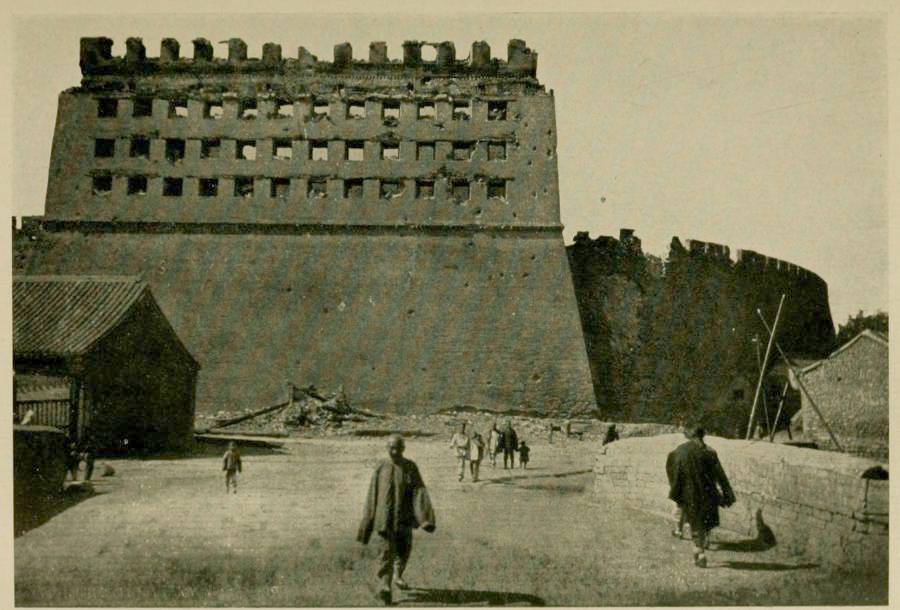
Copyright, 1901, by J. C. Hemment
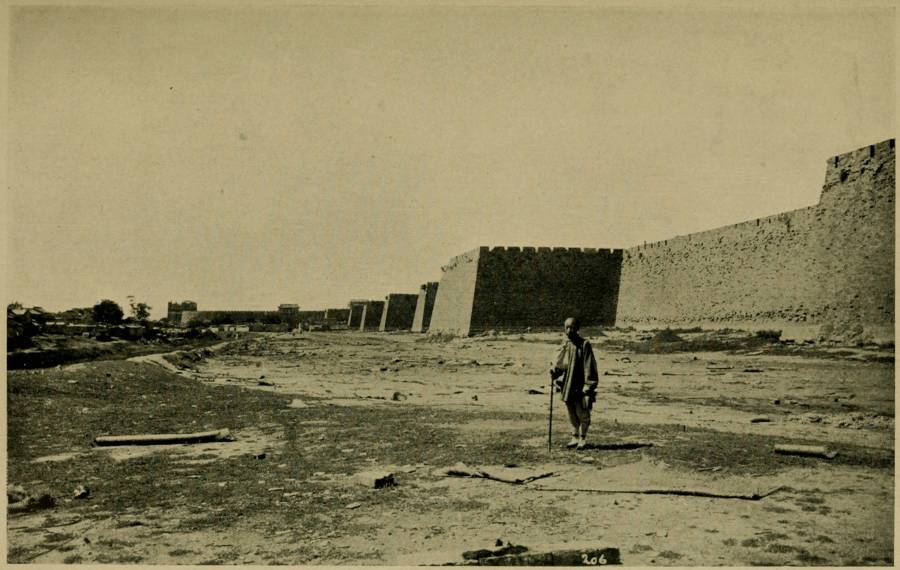
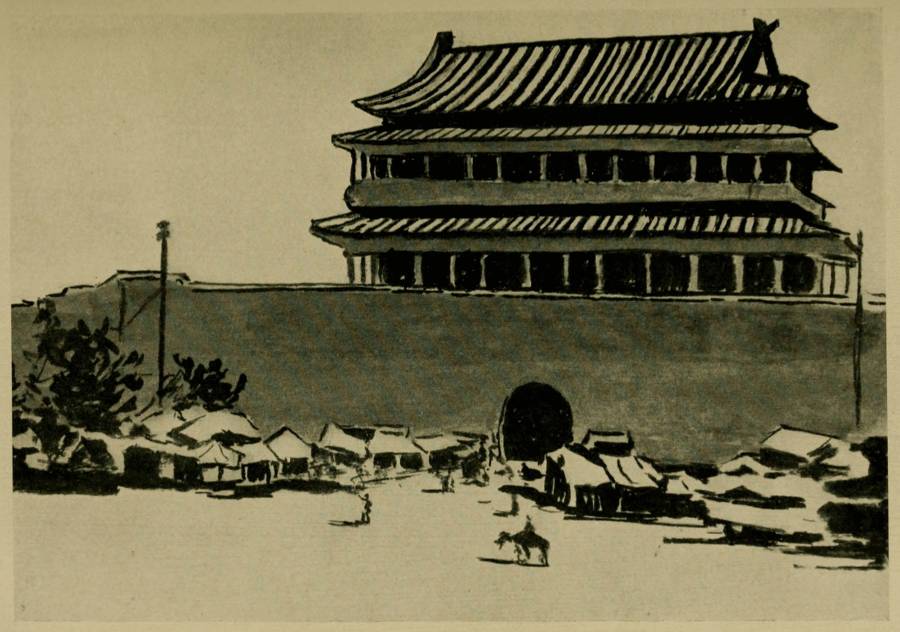
The Big Tower or Wall Entrance of Tartar City
At first sight there is nothing to mark the place
or the time,—unless, possibly, the fineness of the
ebony carving of the upper part of the bed reveals
the patience of the Chinese. Everything is sombre
and gloomy, with straight, austere lines.
Where are we, then, in what obscure, closed,
clandestine dwelling?
Has some one lived here in our time or was it
in the distant past?
How many hours—or how many centuries—has
he been gone, and who could he have been,
the occupant of the abandoned room?
Some sad dreamer evidently, to have chosen
this shadowy retreat; some one very refined, to
have left behind him this distinguished fragrance,
and very weary, to have been pleased with this
dull simplicity and this eternal twilight.
One feels stifled by the smallness of the windows,
whose panes are veiled with silky paper,
and which never can be opened to admit light or
air because they are sealed into the wall. And
besides, you recall the weary way you must take
to get here, and the obstacles you encounter, and
that disturbs you.
First, there is the big black Babylonian wall,
the superhuman ramparts of a city more than ten
leagues around, which to-day is a mass of ruins,
half empty, and strewn with corpses; then a
second wall, painted blood-red, which forms a
second city enclosed in the first. Then a third
wall, more magnificent still, and also the color of
blood; this is the wall that surrounds the great
mysteries of the place, and before the days of
the war and the fall of the city no European had
ever gone beyond it; to-day we were detained
for more than an hour, in spite of passes, signed
and countersigned; through the keyhole of a
great gate guarded by soldiers and barricaded
from within, we were compelled to threaten and
argue at length with the guards inside, who sought
to hide and to escape. These gates once opened,
another wall appeared, separated from the former
one by a road going all the way around the enclosure;
here tattered garments were scattered
about, and dogs were playing with the bones of
the dead. This wall was of the same red, but still
more splendid, and was crowned along its entire
length by a horned ornamentation and by monsters
made of a golden yellow faience. When we
had finally passed this third wall, queer old beardless
persons came to meet us with distrustful greetings,
and guided us through a maze of little courts
and small gardens, walled and walled again, in
which old trees were growing amongst rockwork
and jars. All of it was separate, concealed, distressing;
all of it protected and peopled by monsters
and chimæras in bronze or marble, by a
thousand faces, whose grimaces signified ferocity
and hatred, by a thousand unknown symbols.
And every time each gate in the red walls with
the yellow faience tops closed behind us, as in
horrible dreams the doors of a series of passageways
close upon one, nevermore to permit one to
go out.
Now, after our long journey which seems like
a nightmare, we feel, as we look at the anxious
group who have conducted us, walking noiselessly
on their paper soles, that we have committed some
supreme and unheard-of profanation in their eyes,
in penetrating to this modest room; they stand
there in the doorway, peering obliquely at our
every gesture; the crafty eunuchs in silken robes,
and the thin mandarins, wearing along with the
red button of their headdresses, the melancholy
raven's quill. They were compelled to yield, they
did not wish to; they tried by every ruse to lead
us to some other part of the immense labyrinth of
this palace of Heliogabalus; to interest us in the
luxurious salons farther on, in the great courts,
and in the marble balconies, which we shall see
later; in a whole Versailles some distance farther
on, now overgrown by weeds, and where no sound
is heard but the song of the crows.
They were determined we should not come here,
and it was by observing the dilation of the pupils
of their frightened eyes that we guessed which
way to go.
Who lived here, then, sequestered behind so
many walls,—walls more terrible by far than
those of our western prisons? Who could he
have been, the man who slept in this bed under
these silken covers of nocturnal blue, and in his
times of revery, at nightfall or at dawn, on glacial
winter days, was obliged to contemplate these pensive
little bouquets under glass, ranged so symmetrically
along the black chests?
It was he, the invisible Emperor, Son of
Heaven, childish and feeble; he whose empire
is vaster than all Europe, and who reigns like a
vague phantom over four or five hundred millions
of subjects.
It is the same person in whose veins the vigor
of half-deified ancestors is exhausted, who has too
long remained inactive, concealed in this palace
more sacred than a temple; the same who neglects
and envelops in twilight the diminishing place
where he is pleased to live. The immense setting
in which former emperors lived frightens him and
he abandons it all; grass and brushwood grow
on the majestic marble railings and in the grand
courtyards; crows and pigeons by the hundreds
make their nests in the gilded vaults of the throne
room, covering with dirt and dung the rich and
curious rugs left there to be ruined. This inviolable
palace, a league in circumference, which no
foreigner has ever seen, of which one can learn
nothing, guess nothing, has in store for Europeans
who enter it for the first time the surprise
of mournful dilapidation and the silence of a tomb.
The pale Emperor never occupied the throne
rooms. No, what suited him was the quarter
where the small gardens were, and the enclosed
yards, the quaint quarter where the eunuchs tried
to prevent our going. The alcove-bed in its deep
recess, with its curtains like the blue of night, indicates
fear.
The small private apartments behind this
gloomy chamber extend like subterranean passages
into still deeper shadows; ebony is the prevailing
wood; everything is intentionally sombre,
even the mournful mummified bouquets under
their glass cases. There is a soft-toned piano
which the young Emperor was learning to play,
in spite of his long, brittle nails; a harmonium,
and a big music-box that gives Chinese airs with
a tone that seems to come from beneath the waters
of a lake.
Beyond this comes what was doubtless his most
cherished retreat,—it is narrow and low like the
cabin of a ship, and exhales the fine odor of tea
and dried rose-leaves.
There, in front of a small airhole covered with
rice paper, through which filters a little sombre
light, lies a mattress, covered with imperial golden-yellow
silk, which seems to retain the imprint of
a body habitually extended upon it. A few books,
a few private papers, are scattered about. Fastened
to the wall are two or three unimportant
pictures, not even framed, representing colorless
roses, and written in Chinese characters underneath
are the last orders of the physician for this
chronic invalid.
What was the real character of this dreamer,
who shall ever say? What distorted views of
life had been bequeathed to him of the things of
this world and of the world beyond? What do
all these gruesome symbols signify to him? The
emperors, the demigods, from whom he descends,
made old Asia tremble; tributary sovereigns came
from great distances to prostrate themselves, filling
this place with banners and processions more
magnificent than our imaginations can picture;
within these same walls, so silent to-day, how and
under what passing phantasmagoric aspects did
he retain the stamp of the wonderful past?
And what confusion must have entered his unfathomable
little brain when the unprecedented act
was accomplished, and events occurred which he
never in his wildest fears could have anticipated!
His palace, with its triple walls, violated to its
most secret recesses; he, the Son of Heaven, torn
from the dwelling where twenty generations of
his ancestors had lived inaccessible; obliged to
flee, and in his flight to permit himself to be
seen, to act in the light of day like other men,
perhaps even to implore and to wait!
Just as we are leaving the abandoned room
our orderlies, who purposely remained behind,
laughingly throw themselves on the bed with the
nocturnal blue curtains, and I hear one of them
remark gaily in an aside and with a Gascon accent:
"Now, old fellow, we can say that we have
lain on the bed of the Emperor of China."
Monday, October 22.
Chinese workmen,—amongst whom we are
warned that there are spies and Boxers,—who
look after the fires in the two furnaces in our
palace, have kept us almost too warm all night.
When we get up there is, as there was yesterday,
another illusion of summer on our light verandah
with the green columns painted with pink lotus
flowers. An almost burning sun is rising and
shining upon the ghostly pilgrimage which I am
about to make on horseback, toward the west, outside
the Tartar City, and through the ashy, silent,
ruined suburbs.
In this direction there were, scattered through
the dusty country, Christian cemeteries which even
in 1860 had never been violated by the yellow
race. But this time they furiously attacked the
dead, and left chaos and abomination behind them.
The oldest remains, those of missionaries who had
been sleeping there for three centuries, were disinterred,
crushed, piled up and set on fire in order
to destroy, according to Chinese beliefs, whatever
might still be left of their souls. One must be
somewhat acquainted with the ideas of the country
in order to understand the enormity of this supreme
insult to all our Occidental races.
The cemetery of the Jesuit Fathers was singularly
splendid. They were formerly very powerful
with the Celestial Emperors, and borrowed for
their own tombs the funereal emblems of the princes
of China. The ground is literally strewn now
with big marble dragons and tortoises, and with
tall stele with chimæras coiled about them; all
these carvings have been thrown down and
smashed; the heavy stones of the vaults have
been broken also, and the ground thoroughly
overturned.
A more modest enclosure, not far away, has
for a long time been the burial-place for the European
legations. It has undergone the same treatment
as the beautiful cemetery of the Jesuits. The
Chinese have ransacked the graves, destroyed the
bodies, and even violated the coffins of little children.
Some few human bones are still lying on
the ground, while the crosses that marked the
graves are placed upside down. It is one of the
most poignantly affecting sights that ever met my
eyes.
Some good Sisters who lived near by kept a
school for Chinese children; of their houses
nothing is left but a pile of bricks and ashes, even
the trees have been uprooted and stuck back in the
ground head foremost.
This is their story:—
They were alone one night when about a thousand
Boxers came along, shouting their death cries
and playing gongs. The Sisters began to pray in
their chapel as they awaited death. However, the
noise died away, and when day broke no one was
in sight, so they escaped to Pekin and took shelter
with the bishop, taking their frightened little
pupils with them. When the Boxers were asked
later why they had not entered and killed the
Sisters, they replied: "Because we saw soldiers'
heads and guns all around the convent walls." So
the Sisters owed their lives to this hallucination
of their executioners.
The wells in the deserted gardens fill the air
to-day with odors of the dead. There were three
large cisterns which furnished a water so pure
that they sent all the way from the legations to get
it. The Boxers filled these wells up to the brim
with the mutilated bodies of little boys from the
Brothers' school and from Christian families in
the neighborhood. Dogs came to eat from the
horrible pile which came up to the level of the
ground; but they had their fill, and so the bodies
were left, and have been so preserved by the cold
and dryness that the marks of torture upon them
may still be seen. One poor thigh has been slashed
in stripes after the manner in which bakers sometimes
mark their loaves of bread, another poor
hand is without nails. And here is a woman from
whom one of the private parts of her body has
been cut and placed in her mouth, where it was left
by the dogs between her gaping jaws. The bodies
are covered with what looks like salt, but which
proves to be white frost, which in shady places
never melts here. Yet there is enough clear, implacable
sunshine to bring out the emaciation and
to exaggerate the horrors of the open mouths, their
agonized expressions, and the rigidity of the anguished
positions of the dead.
There is not a cloud to-day, but a pale sky which
reflects a great deal of light. All winter, it seems,
it is much the same; even in the coldest weather
rains and snows are very exceptional in Pekin.
After our brief soldiers' breakfast, served on
rare china in the long gallery, I leave the Palace
of the North to install myself in the kiosk on the
opposite shore, which I selected yesterday, and to
begin my work. It is about two o'clock; a summer's
sun shines on my solitary path, on the whiteness
of the Marble Bridge, on the mud of the
Lake, and on the bodies that sleep amongst the
frosted lotus leaves.
The guards at the entrance to the Rotunda
Palace open and close behind me the red lacquered
doors. I mount the inclined plane leading to the
esplanade, and here I am alone, much alone, in the
silence of my lofty garden and my strange palace.
In order to reach my work-room, I have to go
along narrow passageways between old trees and
the most unnatural rockwork. The kiosk is
flooded with light, the beautiful sunshine falls on
my table and on my black seats with their cushions
of golden yellow; the beautiful melancholy October
sunshine illumines and warms my chosen
retreat, where the Empress, it seems, loved to
come and sit and watch from this high point her
lake all pink with flowers.
The last butterflies and the last wasps, their
lives prolonged by this hot-house warmth, beat
their wings against the window-panes. The great
imperial lake is spread out before us, spanned by
the Marble Bridge; venerable trees form a girdle
around shores out of which rise the fanciful roofs
of palaces and pagodas,—roofs that are one marvellous
mass of faience. As in the landscapes
painted on Chinese fans, there are groups of tiny
rocks in the foreground, and small enamelled monsters
from a neighboring kiosk, while in the middle
distance there are knotted branches which have
fallen from some old cedar.
I am alone, entirely and deliciously alone, high
up in an inaccessible spot whose approaches are
guarded by sentinels. There is the occasional cry
of a crow or the gallop of a horse down below, at
the foot of the rampart whereon my frail habitation
rests, or the passing of an occasional messenger.
Otherwise nothing; not a single sound
near enough to trouble the sunny quiet of my
retreat. No surprise is possible, no visitor.
I have been working for an hour, when a light
rustling behind me from the direction of the entrance
gives me the feeling of some discreet and
agreeable presence. I turn round, and there is a
cat who has stopped short with one foot in the air,
hesitating and looking me straight in the eye, as
if to ask: "Who are you, and what are you doing
here?"
I call him quietly, he replies with a plaintive
miaul; and I, always tactful with cats, go on with
my writing, knowing very well that in a first interview
one must not be too insistent.
He is a very pretty cat, yellow and white,
with the distinguished and elegant air of a grand
seignior. A moment later and he is rubbing against
my leg; so then I put my hand slowly down on the
small, velvety head, which, after a sudden start,
permits my caresses and abandons itself to them.
It is over; the acquaintance is made. He is evidently
a cat accustomed to petting, probably an
intimate of the Empress. To-morrow and every
day I shall beg my orderly to bring him a cold
luncheon from my rations.
The illusion of summer ends with the day. The
sun sets big and red behind the Lake of the
Lotus, all at once taking on a sad, wintry look; at
the same time a chill comes over all things, and
the empty palace grows suddenly gloomy. For the
first time that day I hear footsteps approaching,
resounding in the silence on the pavement of the
esplanade. My servants, Osman and Renaud, are
coming for me according to instructions; they are
the only human beings for whom the gate of the
walls below has orders to open.
It is icy cold as we cross the Marble Bridge in
the twilight to return to our home, and the moisture
is gathering in clouds over the lake, as it does
every night.
After supper we go on a man hunt in the dark,
through the courts and rooms of the place. On
the preceding nights we had observed through the
transparent window-panes disturbing little lights
which were promptly extinguished if we made any
noise. These lights moved up and down the uninhabited
galleries, some distance away, like fireflies.
To-night's effort brings about the capture
of three unknown men who with cutlasses and
dark lanterns have climbed over the walls to pilfer
in the imperial reserves. There are two Chinese
and one European, a soldier of one of the allied
nations. Not to make too much ado over it, we
content ourselves with putting them out after cudgelling
them well and boxing their ears.
Tuesday, October 23.
Last night there was a still harder frost, which
covered the ground in the courtyard with small
white crystals. This we discover during our regular
morning exploration of the galleries and dependencies
of the palace.
The former lodgings of the begging missionaries
and the schoolrooms are overflowing with packing
boxes containing reserve supplies of silk and
tea. There is also a heap of old bronzes, vases,
and incense-burners piled up to the height of a
man.
But the church itself is the most extraordinary
mine,—a regular Ali Baba's cave, quite filled. In
addition to antiquities brought from the Violet
City, the Empress had put there all the presents
she received two years ago for her Jubilee. (And
the line of mandarins who on that occasion brought
presents to their sovereign was a league long and
lasted an entire day.)
In the nave and side aisles the boxes and cases
are piled to half the height of the columns. In
spite of the confusion, in spite of the hasty pillaging
of those who have preceded us,—Chinese,
Japanese, German, and Russian soldiers,—a marvellous
collection remains. The most enormous of
the chests,—those beneath,—protected by their
weight and by the mass of things on top of them,
have not even been opened. The first to go were
the innumerable smaller articles on top, most of
them enclosed in glass cases or in yellow silk coverings,
such as bunches of artificial flowers in agate,
jade, coral, or lapis lazuli, pagodas and blue landscapes
made of the feathers of the kingfisher marvellously
utilized. Works of Chinese patience
which have cost years of toil are now broken in
bits by the stroke of a bayonet, while the glass
which protected them is crackling under one's feet
on the floor.
Imperial robes of heavy silk brocaded with gold
dragons lie on the ground among cases of every
description. We walk over them, we walk over
carved ivories, over pearls and embroideries galore.
There are bronzes a thousand years old, from the
Empress's collection; there are screens which seem
to have been carved and embroidered by supernatural
beings, there are antique vases, cloisonné,
crackle ware, lacquers. Certain of the boxes underneath,
bearing the names of emperors who died
a century ago, contain presents sent them from
distant provinces, which no one has ever taken the
trouble to open. The sacristy of this astonishing
cathedral contains in a series of pasteboard boxes,
all the sumptuous costumes for the actors in the
Empress's theatre, with many fashionable headdresses
of former times.
This church, so full of pagan riches, has kept
its organ intact, although it has been silent for
thirty years. My comrade mounts with me to the
gallery to try the effect of some hymns of Bach
and Händel under these vaultings, while the African
chasseurs, up to their knees in ivories, silks,
and court costumes, continue their task of clearing
things out below.
About ten o'clock this morning I cross over to
the opposite side of the Violet City to visit the
Palace of Ancestors, which is in charge of our
marines. This was the Holy of Holies, the Pantheon
of dead emperors, a temple which was never
even approached.
It is in a particularly shady spot; in front of
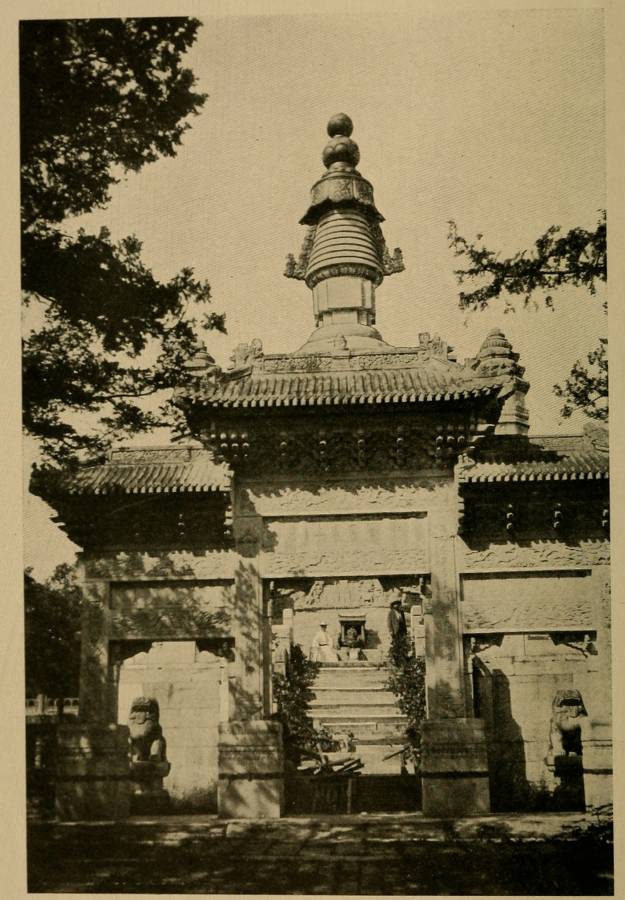
the entrance gate are light but ornate triumphal
arches of green, red, and gold lacquer, resting on
frail supports, and mingling with the sombre
branches of the trees. Enormous cedars and cypresses,
twisted by age, shelter the marble monsters
which crouch at the threshold and have given them
a greenish hue.
Passing the first enclosure, we naturally find a
second. The courts, always shaded by old trees,
succeed one another in solemn magnificence. They
are paved with large stones, between which grows
a weed common in cemeteries; each one of the
cedars and cypresses which cast its shadow here
is surrounded by a marble circle and seems to
spring from a bed of carving. A thick layer of
thousands of pine needles continually falling from
the branches, covers everything. Gigantic incense-burners
of dull bronze, centuries old, rest on pedestals
bearing emblems of death.
Everything here has an unprecedented stamp of
antiquity and mystery. It is a unique place,
haunted by the ghosts of the Chinese emperors.
On each side are secondary temples, whose walls
of lacquer and gold have taken on with time the
shades of old Cordova leather. They contain
broken catafalques, emblems and objects pertaining
to certain funeral rites.
It is all incomprehensible and terrible; one feels
profoundly incapable of grasping the meaning of
these forms and symbols.
At length, in the last court on a white marble
terrace guarded by bronze roes, the Ancestors'
Palace lifts its tarnished gold façade, surmounted
by a roof of yellow lacquer.
It consists of one immense room, grand and
gloomy, all in faded gold turning to coppery red.
At the rear is a row of nine mysterious double
doors, which are sealed with wax. In the centre
are the tables on which the repasts for the ancestral
shades were placed, and where, on the day the
Yellow City was taken, our hungry soldiers rejoiced
to find an unexpected meal set forth. At
each extremity of this lofty room chimes and
stringed instruments await the hour, which may
never come again, when they shall make music
for the Shades. There are long, horizontal
zithers, grave in tone, which are supported by
golden monsters with closed eyes; gigantic
chimes, one of bells, the others of marble slabs
and jade, suspended by gold chains and surmounted
by great fantastic beasts spreading their
golden wings toward the dusky gold ceiling.
There are also lacquered cupboards as big as
houses, containing collections of old paintings,
rolled on ebony or ivory sticks, and wrapped in
imperial silks.
Some of these are marvellous, and are a revelation
of Chinese art of which we of the Occident
have no conception,—an art at least equal to
our own, though profoundly unlike it. Portraits
of emperors in silent revery, or hunting in the
forest, portray wild places which give one a longing
for primitive nature, for the unspoiled world
of rocks and trees. Portraits of dead empresses
painted in water-colors on faded silks recall the
candid grace of the Italian Primitives,—portraits
so pale, so colorless, as to seem like fleeting
reflections of persons, yet showing a perfection
of modelling attained with absolute simplicity,
and with a look of concentration in the eye that
makes you feel the likeness and enables you for
one strange moment to live face to face with these
princesses of the past who have slept for centuries
in this splendid mausoleum. All these paintings
were sacred, never seen or even suspected to exist
by Europeans.
Other rolls, which when spread out on the
pavement are six or eight metres long, represent
processions, receptions at court, or lines of ambassadors;
cavaliers, armies, banners; men of all
kinds by the thousands, whose dress, embroideries,
and arms, suggest that one should look at
them with a magnifying glass. The whole history
of Chinese costume and ceremonial is contained
in these precious miniatures. We even find
here the reception, by I know not what emperor,
of an ambassador from Louis XIV.; small persons
with very French faces are represented as
though for exhibition at Versailles, with wigs
after the fashion of Roi-Soleil.
The nine magnificent sealed doors at the back
of the temple, shut off the altars of nine emperors.
They were good enough to break the red wax
seals for me and to destroy the fastenings at one
of the forbidden entrances, so that I might penetrate
into one of the sacred sanctuaries,—that of
the great Emperor Kouang-Lu, who was in his
glory at the beginning of the eighteenth century.
A serjeant has orders to accompany me in this
profanation, holding in his hand a lighted candle,
which seems to burn reluctantly here in the light
cold air of the tomb. The temple itself was quite
dark, but here it was black night itself, and it
seemed as though dirt and cinders had been thrown
about; the dust that accumulates so endlessly in
Pekin seems a sign of death and decay. Passing
from daylight, however dim, to the light of one
small candle that is lost in the shadows, one sees
confusedly at first, and there is a momentary hesitation,
especially if the place is startling in itself. I
see before me a staircase rising to a sort of tabernacle,
which seems to be full of artistic creations
of some unknown kind.
At both right and left, closed by complicated
locks, are some severe chests which I am permitted
to examine. In their compartments and
in their double secret bottoms the sovereign's imperial
seals have been concealed by the hundreds,—heavy
seals of onyx, jade, or gold struck off
for every occasion of his life and in commemoration
of all the acts of his reign; priceless relics
which no one dared touch after his obsequies, and
which have lain there for twice one hundred years.
I go up into the tabernacle and the serjeant
holds his candle before the marvels there,—jade
sceptres and vases, some of a peculiar and exquisite
workmanship in both dark and light jade,
in cloisonné on gold, or in plain solid gold. Behind
the altar in an obscure position a grand figure
which I had not perceived followed me with
an oblique look that reached me through two curtains
of yellow imperial silk, whose folds were
black with dust. It is a pale portrait of the defunct
Emperor,—a life-sized portrait, so obscure,
as seen by the light of our single wretched candle,
as to seem like the reflection of a ghost in a tarnished
mirror. What a nameless sacrilege would
our opening the chests where his treasures were
hidden seem to this dead man, nay, even our presence
in this most impenetrable of all places in an
impenetrable city!
When everything is carefully closed again, when
the red seals have been put back in place and the
pale image of the Emperor returned to silence, to
its customary shadows, I hasten to get away from
the tomblike chill, to breathe the air again, to seek
on the terrace some of the autumn sunshine which
filters through the cedar branches.
I am going to take breakfast to-day with the
French officers at the extreme north end of the
imperial wood, at the Temple of the Silkworm.
This, too, is an admirable old sanctuary, preceded
by sumptuous courts with marble terraces and
bronze vases. This Yellow City is a complete
world of temples and palaces set in green. Up
to last month the travellers who thought they
were seeing China, and to whom all this remained
closed, forbidden, could have no idea of the marvellous
city opened to us by the war.
When I start back to my Palace of the Rotunda,
about two o'clock, a burning sun is shining
on the dark cedars and willows; one seeks
shade as if it were summer, and the willows are
losing many of their leaves. At the entrance to
the Marble Bridge, not far from my gate, the two
bodies in blue gowns which lie among the lotus
are bathed in an ironical splendor of light.
After the soldiers on guard have closed the low
postern by which one gains access to my high
garden, I am again alone in the silence until the
sun's rays, falling oblique and red upon my writing-table,
announce the coming of the melancholy
evening.
I am scarcely seated at my work before a
friendly head, discreetly rubbed against my leg to
attract my attention, announces the visit of the
cat. I am not unprepared for this visit, for I
now expect it every day.
An hour of ideal quiet goes by, broken only
by two or three ravens' cries. Then I hear the
noise of cavalry galloping over the stone pavements
at the foot of my wall; it proves to be
Field-Marshal von Waldersee, followed by an
escort of soldiers with small flags at the tips of
their spears. He is returning to the palace where
he lives, not far from here, one of the most sumptuous
of all the residences of the Empress. My
eyes follow the cavalcade as it crosses the Marble
Bridge, turns to the left, and is lost behind the
trees. Then the silence returns, absolute as before.
From time to time I go out to walk on my high
terrace, and always discover there something new.
There are enormous tam-tams under my cedars,
with which to call upon the gods; there are beds
of yellow chrysanthemums and Indian-yellow
carnations, upon which the frost has left a few
flowers; there is a kind of daïs of marble and
faience supporting an object quite indefinite at
first sight,—one of the largest blocks of jade in
the world, cut in imitation of an ocean wave with
monsters struggling in the foam.
I visit some deserted kiosks,—still furnished
with ebony thrones, divans, and yellow silk
cushions,—which seem like little clandestine love
nests. There is no doubt that the beautiful sovereign,
passionate still, though aging, used to
isolate herself here with her favorites among the
imperial silks in these protecting shadows.
My only companion in my palace of dreams
to-day is the big alabaster goddess robed in gold,
who perpetually smiles upon broken vases and
withered flowers; her temple, where the sun
never enters, is always cold and grows dark before
it should.
But now real night has come, and I begin to
feel chilly. The sun, which in France is at its
meridional apogee, is sinking; sinking here, a big
red ball without light or heat, going down behind
the Lake of the Lotus in a wintry mist.
The chill of the night comes on suddenly, giving
me the sensation of an abrupt descent into a
cave of ice and a furtive little feeling of anguish
at being exiled so far from home.
I greet my two servants like friends when they
come for me, bringing a cape for me to wear on
the way back to the palace.
Wednesday, October 24.
The same glorious sunshine in gallery, garden,
and wood. Each day the work of our soldiers
with their gangs of Chinese laborers goes on in
the nave of the Cathedral; they carefully separate
such treasures as have remained intact, or nearly
so, from what is irreparably injured. There is a
continual coming and going across our court of
furniture and precious bronzes in hand-barrows;
all that is taken out of the church is put in places
not at present needed for our troops, to await its
final transportation to the Ancestors' Palace, where
it is to remain under lock and key.
We have seen so many of these magnificent
things that we are satiated and worn with them.
The most remarkable discoveries made from the
depths of the oldest cases have ceased to astonish
us; there is nothing now that we want for the
decoration—oh, so fleeting—of our apartments;
nothing is sufficiently beautiful for our Heliogabalean
fancies. There will be no to-morrow, for the
inventory must be finished within a few days, and
then our long galleries will be parcelled out for
officers' rooms and offices.
In the way of discoveries, we came this morning
upon a pile of bodies,—the last defenders of
the Imperial City, who fell all in a heap and
have remained in positions indicative of extreme
agony. The crows and the dogs have gone down
into the ditch where they lie and have devoured
eyes, chests, and intestines; there is no flesh left
on their bones, and their red spinal columns show
through their ragged raiment. Shoes are left, but
no hair; Chinamen have evidently descended into
the deep hole with the dogs and the crows, and
have scalped the dead in order to make false
queues.
To-day I leave the Palace of the North early
and for all day, as I must go over to the European
quarter to see our Minister at the Spanish
legation, where he was taken in; he is still in
bed, but convalescing so that at last I can make to
him the communications which I undertook on behalf
of the admiral.
For four days I have not been outside the red
walls of the Imperial City, have not left our superb
solitude. So when I find myself once more among
the ugly gray ruins of the commonplace streets of
the Tartar City, in everybody's Pekin, in the Pekin
known to all travellers, I appreciate better the
unique peculiarities of our great wood, of our lake,
and of all our forbidden glories.
However, this city of the people seems less forlorn
than on the day of my arrival in the wind
and snow. The people are beginning to return,
as I have been told; Pekin is being repopulated,
the shops are opening, houses are rebuilding, and
already a few humble and entertaining trades have
been taken up along the streets, on tables, under
tents, and under parasols. The warm sunshine of
the Chinese autumn is the friend of many a poor
wretch who has no fire.
The Temple of the Lamas, the oldest sanctuary in
Pekin, and one of the most curious in the world,
contains a profusion of marvellous work of the
old Chinese gold and silver smiths, and a library
of inestimable value.
This precious temple has seldom been seen, although
it has been in existence for centuries.
Before this year's European invasion, access to it
was strictly forbidden to "outside barbarians,"
and even since the Allies have had possession of
Pekin, very few have ever gone there. It is protected
by its location in an angle of the Tartar wall
in quite a lifeless part of the city whose different
quarters are dying from century to century as old
trees lose their branches one by one.
Going there to-day on a pilgrimage with the
members of the French legation, we find that we
are all there for the first time.
In order to reach it we first cross the eastern
market-place, three or four kilometres through a
sunless and desolate Pekin,—a Pekin that bears
the marks of war and defeat, and where things are
spread out for sale on the filth and ashes of the
ground. Some matchless objects transmitted by
one generation of mandarins to another are to
be found among the rags and old iron; ancient
palaces, as well as the houses of the poor, have
emptied here some of their most astonishing contents;
the sordid and the marvellous lie side by
side,—here some pestilential rags, there a bibelot
three thousand years old. Along the walls of the
houses as far as one can see, the cast-off garments
of dead men and women are hung. It is a place
for the sale of extravagant clothing without end,
opulent furs from Mongolia stolen from the rich,
gay costumes of a courtesan, or magnificent heavy
silk robes which belonged to great ladies who have
disappeared. The Chinese populace, who have
done a hundred times more than the invaders
in the way of pillage, burning, and destruction in
Pekin, the uniformly dirty populace, dressed in
blue cotton, with squinting, evil eyes, swarm
and crawl about, eagerly searching and raising a
perfect cloud of microbes and dust. Ignoble
scoundrels with long queues circulate amongst the
crowd, offering robes of ermine or blue-fox, or
admirable sables for a few piasters, in their eagerness
to be rid of stolen goods.
As we approach the object of our journey it
grows more quiet; the busy, crowded streets are
gradually succeeded by streets that have perished
of old age, where there are no passers; grass
grows on the thresholds and behind abandoned
walls; we see trees with branches knotted like the
arms of the aged.
We dismount before a crumbling entrance which
seems to open into a park which might be a ghosts'
walk; and this is the entrance to the temple.
What sort of a reception shall we have in this
mysterious enclosure? We do not know; and at
first there is no one to receive us. But the chief
of the Lamas soon appears, bowing, with his keys,
and we follow him across the funereal park.
With a violet dress, a shaven head, and a face
like old wax, at once smiling, frightened, and hostile,
he conducts us to a second door, opening into
an immense court paved with white stones, completely
surrounded by the curious walls of the first
buildings of the temple. Their foundations are
massive, their roofs curved and forked, the walls
themselves awe-inspiring on account of their size,
and hermetically sealed; and all this is the color
of ochre and rust, with golden reflections thrown
on the high roofs by the evening sun.
The court is deserted, the grass grows between
the paving-stones. On the white marble balustrades
in front of the closed doors of these great
temples are ranged "prayer-mills," which are
conical thrones made of bronze, and engraved with
secret symbols, which the priests turn and turn
while murmuring words unintelligible to men of
our day.
In old Asia, which is our ancestor, I have penetrated
to the heart of ancient sanctuaries, trembling
meanwhile with indefinable anguish before
symbols whose meaning has been lost for centuries.
This kind of anguish has never been so tinged
with melancholy as to-night, standing before this
row of silent "prayer-mills" in the cold, the wind,
the solitude, the dilapidation of this court, with its
white grass-grown pavement and mysterious yellow
walls.
Young Lamas appear one after the other as
noiselessly as shadows, and even Lama children,
for they begin to instruct them quite young in the
old rites no longer understood by any one.
They are young, but they have no appearance of
youth; senility is upon them as well as a look of
I know not what of mystical dulness; their gaze
seems to have come from past centuries and to
have lost its clearness on the way. Whether from
poverty or renunciation, the yellow gowns that
cover their thin bodies are faded and torn. Their
faces and their dress, as well as their religion and
their sanctuary, are covered, so to speak, with the
ashes of time.
They are glad to show us all that we wish to
see in their old buildings; and we begin with the
study-rooms, where so many generations of obscure
and unprogressive priests have been slowly
formed.
By looking closely, it is plain that all these walls,
now the color of the oxydized metal, were once
covered with beautiful designs in lacquer and gilt;
to harmonize them all into the present old-bronze
shades has required an indefinite succession of
burning summers and glacial winters, together
with the dust,—the incessant dust blown across
Pekin from the deserts of Mongolia.
Their study-rooms are very dark,—anything
else would have surprised us; and this explains
why their eyes protrude so from their drooping lids.
Very dark these rooms are, but immense; sumptuous
still, in spite of their neglect, and conceived
on a grand scale, as are all the monuments of this
city, which was in its day the most magnificent in
the world. The high ceilings are supported by
lacquered columns. There are small seats for the
students, and carved desks by the hundred, all
arranged in rows and worn and defaced by long
use. Gods in golden robes are seated in the corners.
The wall hangings of priceless old work
represent the joys of Nirvana. The libraries are
overflowing with old manuscripts, some in the
form of books, and others in great rolls wrapped
up in colored silks.
We are shown into the first temple, which, as
soon as the door is opened, shines with a golden
glow,—the glow of gold used discreetly, and with
the warm, reddish tones which lacquer takes on in
the course of centuries. There are three golden
altars, on which are enthroned in the midst of a
pleiad of small golden gods three great ones, with
downcast eyes. The straight stems of the gold
flowers standing in gold vases in front of the
altars are of archaic stiffness. The repetition, the
persistent multiplication of the same objects, attitudes,
and faces, is one of the characteristics of
the unchanging art of pagodas. As is the case
with all the temples of the past, there is here no
opening for the light; only the light that comes in
through the half-opened doors illumines from below
the smile of the great seated idols, and shows
dimly the decorations of the ceiling. Nothing
has been touched, nothing taken away, not even
the admirable cloisonné vases where sticks of incense
are burning,—evidently this place has been
ignored.
Behind this temple, behind its dusty dependencies,
in which the tortures of the Buddhist hell
are depicted, the Lamas conduct us to a second
court, paved in white stones, similar in every way
to the first; the same dilapidation, the same solitude,
the same coppery-yellow walls.
After this second court comes another temple,
identical with the first, so much so that one wonders
if one is not the victim of an illusion; the
same figures, the same smiles, the same gold bouquets
in vases of gold,—a patient and servile
reproduction of the same magnificence.
After this second temple there is a third court,
and a third temple exactly like the two others.
But the sun is now lower, and lights only the extreme
tips of the faience roofs and the thousands
of small monsters of yellow enamel which seem
to be chasing one another over the tiling. The
wind increases, and we shiver with cold. The
pigeons in the carved cornice begin to seek their
nests, and the silent owls wake up and begin to
fly about.
As we expected, this last temple—possibly the
oldest, certainly the most dilapidated—is only a
repetition of the other two, save for an idol in the
centre, which, instead of being seated and life-sized,
is colossal and standing. The gold ceiling
rises from about half the height of the statue into
a cupola, also gilded, which forms a sort of box
enclosing the upper part of the figure. To see the
face one must go close to the altars and look up
between the rigid flowers and the incense-burners.
It then looks like a Titanic mummy in its case,
with a downcast look that makes one nervous. But
on looking steadily, it exercises a sort of spell;
one is hypnotized and held by that smile so impartially
bestowed upon all this entourage of dying
splendor, gold, dust, cold, twilight, ruins, silence.
There was still a half-hour of sunshine after we
left the ghostly Lamas, so we went to pay a call
on Confucius, who dwells in the same quarter,—the
same necropolis, one might say,—in an abandonment
equally depressing.
The big worm-eaten door slips off its hinges
and falls down as we attempt to enter, and an owl
who was asleep there takes fright and flies away.
Behold us in a sort of mortuary wood, walking
over the brown autumn grass.
A triumphal arch is the first thing we come
across, built to pay homage to some great Chinese
thinker. It is of a charming design, although
very peculiar, with three little bell-towers of yellow
enamel, which crown the whole, their curved roofs
decorated with monsters at each one of the corners.
It stands there like some precious bibelot lost
among the ruins. Its freshness is surprising where
all else is so dilapidated. One realizes its great age
from the archaic nature of its details; but it is
made of such enduring materials that the wear and
tear of centuries in this dry climate has not affected
it. The base is white marble, the rest is of faience,—faience
both yellow and green, with lotus leaves,
clouds, and chimæras in bold relief.
Farther on is a large rotunda which gives evidence
of extreme antiquity; this appears to be the
color of dirt or ashes, and is surrounded by a moat
where the lotus and the reeds are dying. This is
a retreat where wise men may come to meditate
upon the vanities of life; the object of the moat
is to isolate it and make it more quiet.
It is reached by an arched bridge of marble,
with railings that vaguely suggest a succession of
animals' heads. Inside, it is deserted, abandoned,
crumbling away, and the gold ceiling is full of
birds' nests. A really magnificent desk is left,
with an arm-chair and a table. It seems as though
a kind of fine clay had been scattered by handfuls
over everything; the ground is covered with it too,
so that one's feet sink into it and one's steps are
muffled. We soon discover that there is still a carpet
underneath, and that it is really nothing but
dust which has been accumulating for centuries,—the
thick and ever-present dust which the Mongolian
winds blow across Pekin.
After a short walk under the old trees we reach
the temple itself, which is preceded by a court
surrounded by tall marble pillars. This looks
exactly like a cemetery, and yet there are no dead
lying under these stele, which are there merely to
glorify the memory of the departed. Philosophers
who in bygone centuries made this region illustrious
by their presence and by their dreams, profound
thinkers, lost to us forever, have their names
as well as some few of their most transcendent
utterances, perpetuated on these stele.
On either side of the white steps leading to
the sanctuary, blocks of marble are arranged in the
form of a tam-tam. These are so old as to make
one's head swim; and upon them maxims intelligible
only to a few erudite mandarins have been
written in primitive Chinese characters, in letters
contemporary with and sisters to the hieroglyphs
of Egypt.
This is the temple of disinterestedness, of abstract
thought, and of cold speculation. One is
struck at once by its absolute simplicity, for which,
up to this point, nothing in China has prepared us.
Very large, very high as to ceilings, very grand
and of a uniform blood-red color, it is magnificently
empty and supremely quiet. The columns
and walls are red, with a few discreet decorations
in gold, dimmed by time and dust. In the centre is
a bouquet of gigantic lotus in a colossal vase, and
that is all. After the profusion, the debauch of
monsters and idols, the multiplication of human
and animal forms in the usual Chinese pagoda, this
absence of figures of any sort is a comfort and a
relief.
In the niches all along the wall there are stele,
red like the rest of the place, and consecrated to the
memory of persons still more eminent than those
of the entrance court, with quotations from their
writings carved upon them. The stele of Confucius
himself, which is larger than the others, and
has longer quotations, occupies the position of
honor in the centre of this severe Pantheon, and is
placed on a kind of altar.
Properly speaking, this is not a temple; it is not
a place for prayer or service. It is rather an
academy, a meeting-place for calm, philosophic
discussion. In spite of its dust and its abandoned
air, it seems that newly elected members of the
Academy of Pekin (which is even more than our
own the conservator of form and ceremony, I am
assured) are still bound to give a conference here.
Besides various maxims of renunciation and
wisdom written from top to bottom of the stele,
Confucius has left to this sanctuary certain
thoughts on literature which have been engraved
in letters of gold in such a way as to form pictures
hung on the walls.
Here is one which I transcribe for young
western scholars who are preoccupied with classification
and inquiry. They will find in it a reply
twice two thousand years old to one of their favorite
questions: "The literature of the future
will be the literature of compassion."
It is almost five o'clock when the gloomy, red,
autumn sun goes down behind great China on
Europe's side, and we leave the temples and the
grove behind. I separate from my companions,
for they live in the legation quarter in the southern
part of the Tartar City, while I go to the Imperial
City, far from here.
I have no idea how to get out of this dead region,
all new to me, where we have spent the day,
and through the lonely labyrinthine streets of
Pekin. I have as a guide a "mafou," who has
been lent to me, and I only know that I have more
than a mile to go before reaching my sumptuous,
deserted quarters.
My companions gone, I walk for a few moments
in the silent old uninhabited streets before reaching
one of the long, broad avenues where blue cotton
dresses and long-queued yellow faces begin to
appear. There is an interminable row of low
houses, wretched, gray things, on either side of
the street, where the tramp of horses raises the
black friable dust in infectious clouds.
The street is so wide and the houses so low
that almost the whole of the twilight sky is visible
above our heads; and so suddenly does the cold
come on after sunset that in a moment we freeze.
The crowds are dense about the food-shops,
and the air is fetid in the neighborhood of the
butchers, where dog-meat and roasted grasshoppers
are sold. But what good nature in all these
people of the streets, who on the day after battle
and bombardment permit me to pass without so
much as an evil look! What could I do, with my
borrowed "mafou" and my revolver, if my appearance
did not happen to please them?
For a time after this we are alone in desolate,
ruined quarters of the town. According to the
position of the pale, setting sun, it seems to me that
we are on the right track; but if my "mafou,"
who speaks nothing but Chinese, has not understood
me, I shall be in a predicament.
The return journey in the cold seems interminable
to me. At last, however, the artificial
mountain of the imperial park is silhouetted in
gray on the sky ahead of us, with the little faience
kiosks and the twisted trees grouping themselves
like scenes painted on lacquer. We reach one of
the yellow enamelled gates of the blood-red wall
surrounding the Imperial City, where two sentinels
of the allied armies present arms. From here
I know my way, I am at home; so I dismiss my
guide and proceed alone to the Yellow City, from
which at this hour no one is allowed to depart.
The Imperial, the Yellow, the Forbidden City,
encircled by its own terrible walls in the very heart
of great Pekin, with its Babylonian environment,
is a park rather than a city, a wood of venerable
trees,—sombre cypresses and cedars,—several
leagues in circumference. Some ancient temples
peep through the branches, and several modern
palaces built according to the fancies of the Empress
regent. This great forest, to which I return
to-night as if it were my home, has at no former
period of history been known to foreigners; even
ambassadors have never passed its gates; until
recently it has been absolutely inaccessible and
profoundly unknown to Europeans.
This Yellow City surrounds and protects with
its tranquil shadows the still more mysterious
Violet City, the residence of the Son of Heaven,
which occupies a commanding square in the centre
of it, protected by moats and double ramparts.
What silence reigns here at this hour! What
a lugubrious region it is! Death hovers over these
paths where formerly princesses passed in their
palanquins and empresses with their silk-robed followers.
Now that the usual inhabitants have fled
and Occidental barbarians have taken their places,
one meets no one in the woods, unless it be an
occasional patrol or a few soldiers of one nation
or another, and only the sentinels' step is heard
before palace or temple, or the cries of the crows
and the barking of dogs about the dead.
I have to cross a region filled with trees, nothing
but trees,—trees of a truly Chinese contour,
whose aspect is in itself quite sufficient to give one
the sharp realization of exile; the road goes on
under the deep shadow of the branches that turn
the twilight into night. Belated magpies are hopping
about on the withered grass, and the crows,
too, their croakings exaggerated by the cold and
the silence. At the end of a quarter of an hour a
corner of the Violet City appears, just at a turn
of the road. She slowly reveals herself, silent,
closed, like a colossal tomb. Her long, straight
walls are lost in the confusion and obscurity of
the distance. As I draw nearer to her the silence
seems to be intensified, as though it grew as she
broods over it.
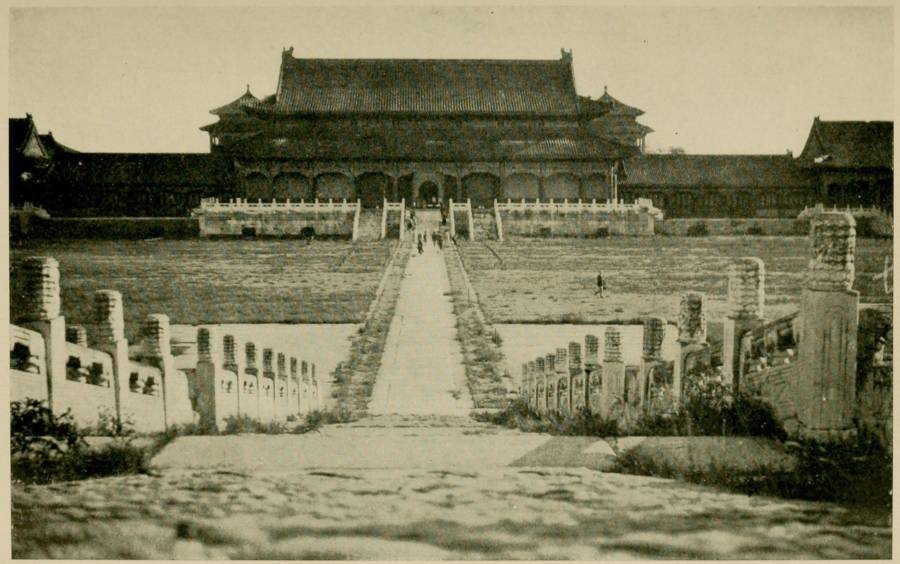
Copyright, 1901, by J. C. Hemment
The Executive Palace of the Emperor in the Forbidden City
One corner of the Lake of the Lotus begins to
come out like a bit of mirror placed among the
reeds to receive the last reflections of the sky. I
must pass along its edges in front of the Island of
Jade, which is approached by a marble bridge; and
I know in advance, because I have seen it daily,
the horrible grimace in store for me from the
two monsters who have guarded the bridge for
centuries.
At length I emerge from the shadow and oppression
of the trees into open space with the
clear sky overhead, leaving the lake behind me.
The first stars are appearing, indicating another
of the nights that pass here in an excess of solitude
and silence, with only an occasional gunshot
to break the tragic calm of wood and palace.
The Lake of the Lotus, which during the season
of flowers must be the marvellous field of pink
blossoms described by the poets of China, is now,
at the end of October, only a melancholy swamp
covered with brown leaves, from which at this
hour a wintry mist rises that hangs like a cloud
over the dead reeds.
My dwelling is on the other side of the lake;
and now I have reached the Marble Bridge which
spans it with a beautiful curve,—a curve that
stands out white in spite of the darkness.
At this point a corpse-like smell greets my nostrils.
For a week I have known whence it comes,—from
a person in a blue gown lying with outspread
arms, face downward, on the slimy shore;
and ten steps farther on his comrade is lying in
the grass.
As soon as I cross the beautiful lonely Marble
Bridge through the pale cloud that hangs over the
water I shall be almost home. At my left is a
faience gateway guarded by two German sentinels,—two
living beings whom I shall not be
sorry to see,—who will salute me in automatic
unison; this will be at the entrance to the garden
where Field-Marshal von Waldersee resides, in
one of the Empress's palaces.
Two hundred metres farther on, after passing
more gates and more ruins, I shall come to a fresh
opening in an old wall, which will be my entrance,
guarded by one of our own men,—an African
chasseur. Another of the Empress's palaces is
there concealed by its surroundings,—a frail
palace, almost wholly enclosed in glass. Once
there, I push open a glass door decorated with
pink lotus flowers, and find again my nightly
fairyland, where priceless porcelains, cloisonné,
and lacquer stand about in profusion on the yellow
carpets under the wonderfully carved arches
of ebony.
It is dark when I reach my dwelling-place. The
fires are already lighted in the subterranean furnaces,
and a soft heat rises through the thick yellow
carpets. We feel much at home and quite
comfortable now in this palace, which at first
seemed so dreary to us.
I dine, as usual, at a small ebony table, which
is lost in the long gallery so dark at either end,
in company with my comrade, Captain C., who
has discovered new and wonderful treasures during
the day, which he has spread out, that we
may enjoy them for at least an evening.
First, there is a throne of a style unknown to
us; some screens of colossal size that rest in ebony
sockets, on which shining birds are battling with
monkeys amid the flowers of a dream. Candelabra,
which have remained in their silk cases
since the seventeenth century, now hang from the
arches above our heads,—a shower of pearls and
enamel,—and many other indescribable things
added to-day to our wealth of articles of antique
art.
It is the last time we shall be able to enjoy our
gallery in its completeness, for to-morrow most
of these objects are to be labelled and sent off
with the reserve stock. Retaining one salon for
the general, who is to winter here, the rest of this
wing of the palace is to be cut up by light partitions
into lodgings and offices for the staff. This
work will be done under the direction of Captain
C., who is chief architect and supervisor, whilst
I, a passing guest, will have only a consulting
voice.
As this evening marks the last chapter of our
imperial phantasmagoria, we sit up later than
usual. For this once we are childish enough to
array ourselves in sumptuous Asiatic garments,
then we throw ourselves down on the cushions
and call opium—so favorable to weary and
blasé imaginations such as ours have unfortunately
begun to be—to our aid. Alas! to be
alone in this palace would have seemed magical
enough to us a few years ago without the aid of
any avatar.
The opium, needless to say, is of exquisite
quality; its fumes, rising in rapid little spirals,
soon make the air sweet and heavy. It quickly
brings to us the ecstasy, the forgetfulness, the relief,
the youthful lightness so dear to the Chinese.
There is absolute silence without; absolute silence
and deserted courts, where all is cold and
black. The gallery grows warm, the heat of the
furnace is heavy, for these walls of glass and
paper, so frail as a protection against surprises
from without, form rooms almost hermetically
sealed and propitious to the intoxication that
comes from perfumes.
Stretched out upon the silken cushions, we gaze
at the receding ceiling, at the row of arches so
elaborately carved into lacework, from which the
lanterns with the dangling pearls are suspended.
Chimæras of gold stand out from the thick folds
of the green or yellow silks. High screens of
cloisonné, lacquer, or ebony, the great luxury of
China, shut off the corners, forming luxurious
nooks filled with jars, bronzes, and monsters
with eyes of jade,—eyes which squintingly follow
you.
Absolute silence, except that from a distance
one of those shots is heard which never fails to
mark the torpor of the night, or a cry of distress
or alarm; skirmishes between Europeans in the
posts and thieving Chinamen; sentinels afraid of
the dead or of the night shooting at a shadow.
In the foreground, which is lighted by one lamp,
the only luminous things whose design and color
are engraved upon our already fixed gaze are four
gigantic incense-burners—hieratic in form, and
made of an adorable blue cloisonné—resting on
gold elephants. They stand out against a background
of black lacquer traversed by flying birds,
whose plumage is made of different kinds of
mother-of-pearl. No doubt our lamp is going
out, for, with the exception of these nearer things,
we scarcely see the magnificence of the place until
the outline of some rare vase five hundred years
old, the reflection of a piece of inimitable silk, or
the brilliancy of some bit of enamel recalls it to
our memory.
The fumes of the opium keep us awake until
very late, in a state of mind that is both lucid and
at the same time confused. We have never until
now understood Chinese art; it is revealed to us
for the first time to-night. In the beginning we
were ignorant, as is all the world, of its almost
terrible grandeur until we saw the Imperial City
and the walled palace of the Son of Heaven; now
at this nocturnal hour, amid the fragrant fumes
that rise in clouds in our over-heated gallery, our
impressions of the big sombre temples, of the
yellow enamelled roofs crowning the Titanic buildings
that rise above terraces of marble, are exalted
above mere captivated admiration to respect and
awe.
In the thousand details of its embroidery and
carvings which surround us in such profusion,
we learn how skilful and how exact this art is
in rendering the grace of flowers, exaggerating
their superb and languishing poses and their
deep or deliciously pale colorings; then in order
to make clear the cruelty of every kind of living
thing, down to dragons and butterflies, they place
claws, horns, terrible smiles, and leering eyes upon
them! They are right; these embroideries on our
cushions are roses, lotus flowers, chrysanthemums!
As for the insects, the scarabs, the flies, and the
moths, they are just like those horrid things
painted in gold relief on our court fans.
When we arrive at that special form of physical
prostration which sets the mind free (disengages
the astral body, they say at Benares), everything
in the palace, as well as in the outside world,
seems easy and amusing. We congratulate ourselves
upon having come to live in the Yellow City
at so unique a period in the history of China, at a
moment when everything is free, and we are left
almost alone to gratify our whims and curiosity.
Life seems to hold to-morrows filled with new and
interesting circumstances. In our conversation we
find words, formulas, images, to express the inexpressible,
the things that have never been said.
The hopelessness, the misery that one carries about
like the weight on a convict's leg, is incontestably
lessened; and as to the small annoyances of the
moment, the little pin-pricks, they exist no longer.
For example, when we see through the glass gallery
the pale light of a moving lantern in a distant
part of our palace, we say without the slightest
feeling of disturbance: "More thieves! They
must see us. We'll hunt them down to-morrow!"
And it seems of no consequence, even comfortable
to us, that our cushions and our imperial silks
are shut off from the cold and the horrors by nothing
but panes of glass.
Thursday, October 25.
I have worked all day, with only my cat for company,
in the solitude of the Rotunda Palace that
I deserted yesterday.
At the hour when the red sun is setting behind
the Lake of the Lotus my two servants come as
usual to get me. But this time, after crossing the
Marble Bridge, we pass the turn which leads to
my palace, for I have to pay a visit to Monsignor
Favier, the Bishop of Pekin, who lives in our
vicinity, outside yet quite near the Imperial City.
It is twilight by the time we reach the "Catholic
Concession," where the missionaries and their
little band of yellow followers endured the stress
of a long siege. The cathedral, riddled with balls,
has a vague look against the dark sky; and it is
so dusty that we see as through a fog this newly
built cathedral, the one the Empress paid for in
place of the one she took for a storehouse.
Monsignor Favier, the head of the French missions,
has lived in Pekin for forty years, has enjoyed
for a long time the favor of the sovereigns,
and was the first to foresee and denounce the Boxer
peril. In spite of the temporary blow to his work,
he is still a power in China, where the title of
Viceroy was at one time conferred upon him.
The white-walled room where he receives me,
lately pierced by a cannon-ball, contains some
precious Chinese bibelots, whose presence here
astonishes every one at first. He collected them
in other days, and is selling them now in order
to be able to assist several thousand hungry people
driven by the war into his church.
The bishop is a tall man, with fine, regular
features, and eyes that show shrewdness and energy.
He must resemble in looks, as well as in
his determined will, those bishops of the Middle
Ages who went on Crusades to the Holy Land.
It is only since the outbreak of hostilities against
the Christians that he has resumed the priests'
cloth and cut off his long Chinese queue. Permission
to wear the queue and the Mandarins'
garb was one of the greatest and most subversive
favors accorded the Lazarists by the Celestial
emperors.
He was good enough to keep me with him for
an hour. A well-dressed Chinese served us with
tea while he told me of the recent tragedy; of the
defence of fourteen hundred metres of wall, organized
out of nothing by a young ensign and
thirty sailors, of their holding out for two or
three months right in the heart of an enflamed
city, against thousands of enemies wild with fury.
Although he tells it all in a very low tone, his
speech grows warmer, and vibrates with a sort of
soldierly ruggedness as some emotion chokes him,
especially whenever he mentions Ensign Henry.
Ensign Henry died, pierced by two balls, at the
end of the last great fight. Of his thirty sailors
many were killed, and almost all were wounded.
This story of a summer should be written somewhere
in letters of gold, lest it should be too quickly
forgotten; it should be attested, lest some day it
should no longer be believed.
The sailors under the command of this young
officer were not picked men; they were the first
that came, selected hap-hazard on board ship. A
few noble priests shared their vigils, a few brave
seminarists took a turn under their orders, besides
a horde of Chinese armed with miserable
old guns. But the sailors were the heart and
soul of this obstinate defence; there was neither
weakening nor complaint in the face of death,
which was at all times present in its most atrocious
forms.
An officer and ten Italian soldiers brought hither
by chance also fought heroically, leaving six of
their number among the dead.
Oh, the heroism, the lowly heroism of these
poor Chinese Christians, both Catholic and Protestant,
who sought protection in the bishop's
palace, knowing that one word of abjuration, one
reverence to a Buddhist image would ensure their
lives, yet who remained there, faithful, in spite of
gnawing hunger and almost certain martyrdom!
And at the same time, outside of these walls which
protected them in a measure, fifteen thousand of
their brothers were burned, dismembered, and
thrown piecemeal into the river on account of
the new faith which they would not renounce.
Unheard-of things happened during this siege:
a bishop,[1] followed by an ensign and four marines,
went to wrest a cannon from the enemy,
balls grazing their heads; theological students
manufactured powder from the charred branches
of the trees in the close, and from saltpetre, which
they scaled the walls to steal at night from a
Chinese arsenal.
They lived in a continual tumult under a continual
fire of stones and shot; all the marble bell-towers
of the cathedral, riddled by shells, tottered
and fell piecemeal upon their heads. At all hours,
without truce, bullets rained in the court, breaking
in the roofs and weakening the walls. At
night especially balls fell like hailstones to the
sound of the Boxers' trumpets and frightful gongs.
And all the while their death-cries, "Cha! Cha!"
(Let us kill, let us kill) or "Chao! Chao!" (Let
us burn, let us burn) filled the city like the cries
of an enormous pack of hounds.
It was in July and August under a burning sky,
and they lived surrounded by fire; incendiaries
sprinkled their roofs and their entrances with petroleum
by means of pumps and threw lighted
torches onto them; they were obliged to run from
one place to another and to climb up with ladders
and wet blankets to put out the flames. They had
to run, run all the time, when they were so exhausted
and their heads so heavy from having had
no food, that they could scarcely stand.
Even the good Sisters had to organize a kind
of race for the women and children, who were
stupefied from fear and suffering. It was these
sublime women who decided when it was necessary
to change positions according to the direction
from which the shells came and who chose
the least dangerous moment to fly, with bowed
heads, across a court, and to take refuge elsewhere.
A thousand women without wills or ideas
of their own, with poor dying babies clinging to
their breasts, followed them; a human eddy, advancing,
receding, pushing, in order to keep in
sight the white caps of their protectors.
They had to run when, from lack of food, they
could scarcely stand, and when a supreme lassitude
impelled them to lie down on the ground to await
death! They had to become accustomed to detonations
that never ceased, to perpetual noise, to
shot and shell, to the fall of stones, to seeing one
of their number fall bathed in his own blood!
Hunger was the most intolerable of all. They
made soup of the leaves and young branches of
the trees, of dahlia roots from the gardens and of
lily bulbs. The poor Chinese would say humbly,
"We must keep the little grain we have left for
the sailors who are protecting us, and whose need
of strength is greater than ours."
The bishop told of a poor woman who had been
confined the previous night, who dragged herself
after him imploring: "Bishop, bishop, give me a
handful of grain so that my milk will come and
my child may not die!"
All night long the feeble voices of several hundred
children were heard in the church moaning
for lack of food. To use the expression of Monsignor
Favier, it was like "the bleatings of a flock
of lambs about to be sacrificed." But their cries
diminished, for they were buried at the rate of
fifteen in a single day.
They knew that not far away in the European
legations a similar drama was being enacted, but,
needless to say, there was no communication between
them; and if any young Chinese Christian
offered to go there with a message from the
bishop asking for help, or at least for news, it
was not long before they saw his head, with the
note pinned to his cheek, reappear above the wall
at the end of a rod garnished with his entrails.
Not only did bullets rain by the hundreds every
day, but the Boxers put anything that fell into
their furious hands into their cannon,—stones,
bricks, bits of iron, old kettles. The besieged had
no doctors; they hopelessly, and as best they could,
bound up great horrible wounds, great holes in
the breast. The arms of the voluntary grave-diggers
were exhausted with digging places in
which to bury the dead, or parts of the dead. And
the cry of the infuriated mob went on, "Cha!
Cha!" (Let us kill, let us kill!) to the grim
sounds of their iron gongs and the blasts of their
trumpets.
Mines went off in different localities, swallowing
up people and bits of wall. In the gulf made
by one of them fifty little babies in their cradles
disappeared. Their sufferings at least were over.
Each time a new breach was made the Boxers
threw themselves upon it, and it became a yawning
opportunity for torture and death.
But Ensign Henry was always there; with such
of his sailors as had been spared he was seen rushing
to the place where he was needed, to the exact
spot where the most effective work could be done,—on
a roof or on the crest of a wall,—and they
killed and they killed, without losing a ball, every
shot dealing death. Fifty, a hundred of them,
crouched in heaps on the ground; priests and
Chinese women, as well as men, brought stones,
bricks, marble, no matter what, from the cathedral,
and with the mortar they had ready they
closed the breach and were saved again until the
next mine exploded!
But they came to the end of their strength, the
meagre ration of soup grew less and less, and they
could do no more.
The bodies of Boxers, piled up along the vast
enclosure which they so desperately defended,
filled the air with a pestilential odor; dogs were
attracted and gathered in moments of calm for a
meal. During the latter part of the time they
killed these dogs from the tops of the walls and
pulled them in by means of a hook at the end of
a cord, and their meat was saved for the sick and
for nursing mothers.
On the day when our soldiers at last entered
the place, guided by the white-haired bishop standing
on the wall and waving the French flag, on
the day when they threw themselves with tears of
joy in one another's arms, there remained just
enough food to make, with the addition of many
leaves, one last meal.
"It seemed," said Monsignor Favier, "as
though Providence had counted the grains of
rice."
Then he spoke once more of Ensign Henry.
"The only time during the entire siege," he said,
"the only time we wept was when he died. He
remained on his feet giving his orders, although
mortally wounded in two places. When the fight
was over he came down from the breach and fell
exhausted in the arms of two of the priests; then
we all wept with the sailors, who had come up and
surrounded him. He was so charming, simple,
good, and gentle with even the humblest. To be
a soldier such as he was, to make yourself loved
like a little child, could there be anything more
beautiful?" Then after a silence he added, "And
he had faith; every morning he used to come with
us to prayers and to communion, saying with a
smile, 'One must be always ready.'"
It is quite dark before I take leave of the bishop,
on whom I had intended to pay a short call. All
around him now, of course, everything is desolate
and in ruins; there are no houses left, and the
streets cannot even be traced. I go away with my
two servants, our revolvers and one little lantern;
I go thinking of Ensign Henry, of his glory, of
his deliverance, of everything rather than the
insignificant detail of the road to be followed
among the ruins. Besides, it is not far, scarcely
a kilometre.
A violent wind extinguishes the candle in its
paper sheath, and envelops us in dust so thick
that we cannot see two steps in front of us; it is
like a thick fog. So, never having been in this
quarter before, we are lost, and go stumbling
along over stones, over rubbish, over broken pottery,
and human bones.
We can scarcely see the stars for the thick cloud
of dust, and we don't know which way to go.
Suddenly we get the smell of a dead body and
we recognize the ditch we discovered yesterday
morning just in time to keep from falling into it.
So all is well; only two hundred metres more and
we shall be at home in our glass palace.
Friday, October 26.
Leaving my palace a little late, I hasten to keep
the appointment made for me by Li-Hung-Chang
for nine o'clock in the morning.
An African chasseur accompanies me. Following
a Chinese outrider sent to guide us, we start
off at a rapid trot through the dust and silence
under the sun's white rays, along the great walls
and marshy moats of the Emperor's Palace.
When we get outside of the Yellow City noise
and life begin again. After the magnificent solitude
to which we have become accustomed, whenever
we return to everybody's Pekin, we are
surprised to find such a roar among these humble
crowds; it is hard to realize that the woods, the
lakes, the horizons, which play at being the real
country, are artificial things surrounded on all
sides by the most swarming of cities.
It is incontestable that the people are returning
in crowds to Pekin. (According to Monsignor
Favier, the Boxers in particular are returning in
all kinds of costumes and disguises.) From day to
day the number of silk gowns, blue cotton gowns,
slanting eyes, and queues increases.
We must move faster in spite of all the people,
for it seems it is still some distance, and time is
passing. Our outrider appears to be galloping.
We cannot see him, for here the streets are even
dustier than in the Yellow City; we see only the
cloud of dust that envelops his little Mongolian
horse, and we follow that.
At the end of half an hour's rapid riding the
dust cloud stops in front of a ramshackle old house
in a narrow street that leads nowhere. Is it
possible that Li-Hung-Chang, rich as Aladdin,
the owner of palaces and countless treasures, one
of the most enduring favorites of the Empress
and one of the glories of China, lives here?
For reasons unknown to me, the entrance is
guarded by Cossack soldiers in poor uniforms but
with naïve rosy faces. The room into which I
am taken is dilapidated and untidy; there is a table
in the middle of it and two or three rather well-carved
ebony chairs; but that is all. At one end
is a chaos of trunks, bags, packages, and bedding,
all tied up as though in preparation for flight.
The Chinese who comes to the door, in a beautiful
gown of plum-colored silk, gives me a seat and
offers me tea. He is the interpreter, and speaks
French correctly, even elegantly. He tells me
that some one has gone to announce me to his
Highness.
At a sign from another Chinese he presently
conducts me into a second court, and there, at the
door leading into a reception-room, a tall old man
advances to meet me. At his right and his left
are silk-robed servants, both a whole head shorter
than he is, on whose shoulders he leans. He is
colossal, with very prominent cheek-bones, and
small, very small, quick and searching eyes. He is
an exaggeration of the Mongolian type, with a certain
beauty withal, and the air of a great personage,
although his furry gown of an indefinite color
is worn and spotted. (I have been forewarned
that in these days of abomination his Highness
believes that he should affect poverty.) The
large shabby room where he receives me is, like
the first one, strewn with trunks and packages.
We take arm-chairs opposite each other, while
servants place cigarettes, tea, and champagne on
a table between us. At first we stare at each other
like two beings from different worlds.
After inquiring as to my age and the amount
of my income (one of the rules of Chinese politeness),
he bows again, and conversation begins.
When we have finished discussing the burning
questions of the day, Li-Hung-Chang expresses
sympathy for China and for ruined Pekin. "Having
visited the whole of Europe," he says, "I have
seen the museums of all your great capitals. Pekin
had her own also, for the whole Yellow City was
a museum begun centuries ago, and may be compared
with the most beautiful of your own. And
now it is destroyed."
He questions me as to what we are doing over
in the Palace of the North, informs himself by
adroit questioning as to whether we are injuring
anything there. He knows as well as I do what
we are doing, for he has spies everywhere, even
among our workmen; yet his enigmatical face
shows some satisfaction when I confirm his knowledge
of the fact that we are destroying nothing.
When the audience is over, and we have shaken
hands, Li-Hung-Chang, still leaning on his two
servants, comes with me as far as the centre of
the court. As I turn at the threshold to make my
final bow, he courteously recalls to my memory my
offer to send him my account of my stay in Pekin,—if
ever I find time to write it. In spite of the
perfect grace of his reception of me, due especially
to my title of "Mandarin of Letters," this old
prince of the Chinese Arabian Nights' tales, in
his threadbare garments and in his wretched surroundings,
has not ceased to seem to me disturbing,
inscrutable, and possibly secretly disdainful
and ironical, all the time disguising his real
self.
I now make my way across two kilometres of
rubbish to the quarters of the European legations
in order to take leave of the French minister, who
is still ill in bed, and to get from him his commissions
for the admiral, for I must leave Pekin
not later than the day after to-morrow, and go
back to my ship.
Just as I was mounting my horse again, after
this visit, to return to the Yellow City, some one
from the legation came out and very kindly gave
me some precise and very curious information
which will enable me this evening to purloin two
tiny shoes that once belonged to the Empress of
China, and to take them away as a part of the pillage.
On a shady island in the southern part of
the Lake of the Lotus is a frail, almost hidden
palace, where the sovereign slept that last agonizing
night before her frantic flight, disguised as
a beggar. The second room to the left, at the back
of the second court of this palace, was her room,
and there, it seems, under a carved bed, lie two
little red silk shoes embroidered with butterflies
and flowers, which must have belonged to her.
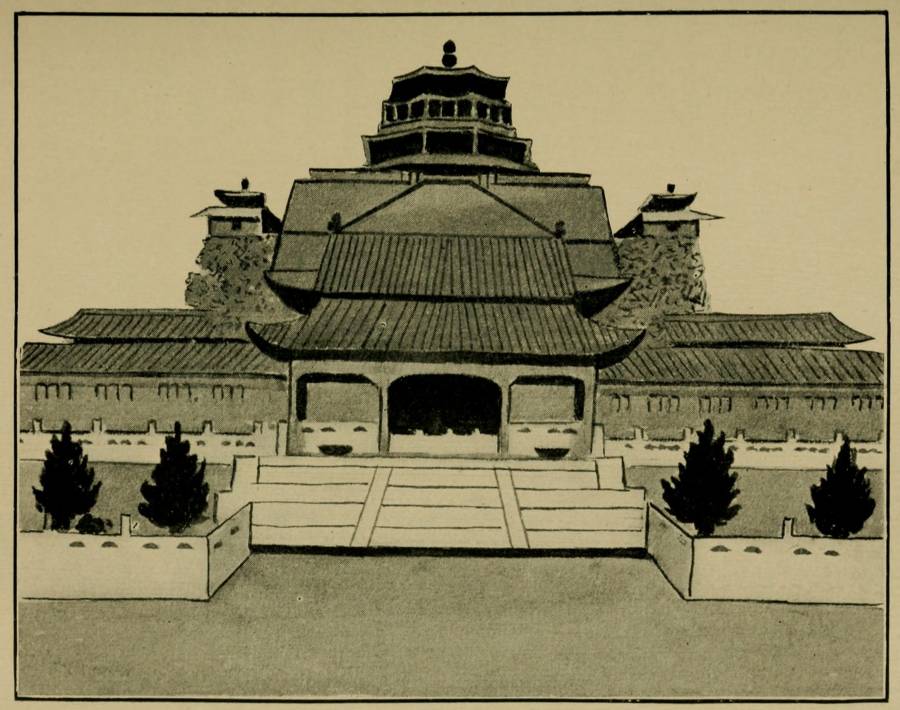
I return to the Yellow City as fast as I can,
breakfast hurriedly in the glass gallery,—whence
the wonderful treasures are already being carried
to their new quarters to make way for the carpenters,
who soon begin their work here,—and
straightway depart with my two faithful servants,
on foot this time, in search of the island, the palace,
and the pair of small shoes.
The one o'clock sun is burning the dry paths,
and the cedars overhead are gray with dust. About
two kilometres to the south of our residence we
find the island without difficulty. It is in a region
where the lake divides into various little arms,
spanned by marble bridges with marble railings
entwined with green. The palace stands there
light and charming, half concealed among the
trees, on a terrace of white marble. The roofs of
green faience touched with gilt and the openwork
walls shine forth with new and costly ornamentation
from amid the dusty green of the old cedars.
It must have been a marvel of grace and daintiness,
and it is adorable as it is, deserted and silent.
Through the doors opening onto the white steps
that lead up to it, a perfect cascade of débris of all
kinds is tumbling,—boxes of imperial porcelains,
boxes of gold lacquer, small bronze dragons upside
down, bits of rose-colored silk, and bunches
of artificial flowers. Barbarians have been this
way,—but which? Surely not our soldiers, for
this part of the Yellow City was never placed in
their hands; they are not familiar with it.
The interior courts, from which at our approach
a flock of crows rise, are in the same condition.
The pavement is strewn with delicate, rather feminine
things, which have been ruthlessly destroyed.
And so recent is this destruction that the light
stuffs, the silk flowers, the parts of costumes have
not even lost their freshness.
"At the back of the second court, the second
room to the left!" Here it is! There remains a
throne, some arm-chairs, and a big, low bed, carved
by the hand of genius. Everything has been ransacked.
The window-glass, through which the
sovereign could gaze upon the reflections of
the lake and the pink blossoms of the lotus, the
marble bridges, the islands, the whole landscape
devised and realized for her eyes, has been broken;
and a fine white silk, with which the walls were
hung, and on which some exquisite artist had
painted in pale tints, larger than nature, other
lotus blossoms, languishing, bent by the autumn
wind, and strewing their petals, has been torn in
shreds.
Under the bed, where I look immediately, is a
pile of manuscript and charming bits of silk. My
two servants, foraging with sticks, like rag-pickers,
soon succeed in finding what I seek,—the two
comical little red shoes, one after the other.
They are not the absurd, doll-like shoes worn by
the Chinese women who compress their toes; the
Empress, being a Tartar princess, did not deform
her feet, which were, however, very small by
nature. No, these are embroidered slippers of
natural shape, whose extravagance lies in the heels,
which are thirty centimetres high and extend over
the entire sole, growing larger at the bottom, like
the base of a statue, to prevent the wearer from
falling; they are little blocks of white leather of
the most improbable description.
I had no idea that a woman's shoes could take
up so much space. How to get them away without
looking like pillagers in the eyes of the servants
and guards we meet on the way back is the
question?
Osman suggests suspending them by strings to
Renaud's belt so that they will hang concealed by
his long winter coat. This is an admirable scheme;
he can even walk—we make him try it—without
giving rise to suspicion. I feel no remorse, and
I fancy that if she, from afar, could witness the
scene, the still beautiful Empress would be the
first to smile.
We now hasten our steps back to the Palace of
the Rotunda, where I have scarcely two hours of
daylight for my work before the cold and the night
come on.
Each time that I return to this palace I am
charmed with the sonorous silence of my high
esplanade and with the top of the crenellated wall
surrounding it,—an artificial spot whence one
commands an extended view of artificial landscape,
the sight of which has always been forbidden, and
which, until lately, no European has ever seen.
Everything about the place is so Chinese that
one feels as though it were the heart of the yellow
country, the very quintessence of China. These
high gardens were a favorite resort for the ultra-Chinese
reveries of an uncompromising Empress
who possibly dreamed of shutting her country off
from the rest of the world, as in olden times, but
who to-day sees her empire crumbling at her feet,
rotten to the core, like her myriads of temples and
gilded wooden gods.
The magical hour here is when the enormous
red ball, which the Chinese sun appears to be on
autumn evenings, lights up the roofs of the Violet
City before it disappears. I never fail to leave my
kiosk at this hour to see once more these effects,
unique in all the world.
Compared to this, what barbaric ugliness is
offered by a bird's-eye view of one of our European
cities,—a mass of ugly gables, tiles, and
dirty roofs full of chimneys and stove-pipes, and,
as a last horror, electric wires forming a black
network! In China, where they are all too scornful
of pavements and sewers, everything which
rises into the air, into the domain of the ever-watchful
and protecting spirits, is always impeccable.
And this immense Imperial retreat, empty
to-day, now displays for me alone the splendor of
its enamelled roofs.
In spite of their age, these pyramids of yellow
faience, carved with a grace unknown to us, are
still brilliant under the red sun. At each of the
corners of the topmost one the ornaments simulate
great wings; lower down, toward the outside, are
rows of monsters in poses which are copied and
recopied, century after century, sacred and unchanging.
These pyramids of yellow faience are
brilliant. From far off, against the ashy blue sky,
clouded by the everlasting dust, it looks like a city
of gold; then, as the sun sinks, like a city of
copper.
First the silence of it all; then the croakings
that begin the moment the ravens go to rest;
then the death-like cold that wraps this magnificence
of enamel as in a winding-sheet as soon as
the sun goes down.
To-night again, when we leave the Rotunda
Palace, we pass the Palace of the North without
stopping, and go on to Monsignor Favier's.
He receives me in the same white room, where
valises and travelling-bags are lying about on
the furniture. The bishop leaves to-morrow for
Europe, which he has not seen for twelve years.
He is going to Rome to see the Pope, and then to
France, to raise money for his suffering missions.
His great work of over forty years is annihilated,
fifteen thousand of his Christian converts massacred;
his churches, chapels, hospitals, schools,
are all destroyed, razed to the ground; his cemeteries
have been violated, and yet, discouraged at
nothing, he wishes to begin all over again.
As he conducts me across his garden I admire
the beautiful energy with which he says, pointing
to the damaged cathedral with its broken cross,
which is the only building left standing, gloomily
outlined against the evening sky: "I will rebuild,
larger and higher, all the churches they have
thrown down, and I hope that each movement of
violence and hatred against us may carry Christianity
one step further on in their country. Possibly
they will again destroy my churches; who
knows? If so, I will build them up again, and we
shall see whether they or I will be the first to weary
of it."
He seems very great to me in his determination
and in his faith, and I understand that China must
reckon with this apostle of the vanguard.
Saturday, October 27.
I wanted to see the Violet City and its throne
rooms once more before going away, and to enter
it this time, not by round-about ways and back
doors and secret posterns, but by the great avenues
and gates that have been for centuries closed, so
that I might try to imagine beneath the destruction
of to-day what must have been in former
times the splendor of the sovereigns' arrival.
No one of our European capitals has been conceived
and laid out with such unity and audacity,
with the idea of increasing the magnificence of a
pageant always dominant, especially that of imparting
an imposing effect to the appearance of
the Emperor. The throne is here the central idea.
This city, as regular as a geometrical figure, seems
to have been created solely to enclose and glorify
the throne of the Son of Heaven, ruler of four
hundred millions of souls; to be its peristyle, to
lead up to it by colossal avenues which recall
Thebes or Babylon. It is easy to understand why
the Chinese ambassadors, who came to visit our
kings in the times when their immense country
was flourishing, were not particularly dazzled by
the sight of the Paris of those days, of the Louvre
or of Versailles.
The southern gate of Pekin, by which the processions
arrive, lies in the axis of this throne, once
so awe-inspiring, and six kilometres of avenues,
with gateways and monsters, lead up to it. When
one has crossed the wall of the Chinese City by
this southern gate, first passing two huge sanctuaries,—the
Temple of Agriculture and the Temple
of Heaven,—one follows for half an hour the
great artery that leads to a second boundary wall,
that of the Tartar City, higher and more commanding
than the first. An enormous gate looms
up, surmounted by a black dungeon, and beyond
this the avenue goes on, flawlessly straight and
magnificent, to a third gate in a third wall of
a blood-red color,—the wall of the Imperial
City.
Even after entering the Imperial City it is still
some distance to the throne to which one is advancing
in a straight line,—to this throne which
dominates everything and which formerly could
never have been seen; but here its presence is
indicated by the surroundings. From this point
the number of marble monsters increases; lions
of colossal size grin from their pedestals at right
and at left; there are marble obelisks—monoliths
encircled with dragons—with the same heraldic
beast always seated at the summit,—a thin kind
of jackal with long ears, which has the appearance
of barking or howling in the direction of the
extraordinary thing which is on ahead, namely,
the throne of the Emperor. Walls are multiplied,—blood-colored
walls thirty metres thick,—which
cross the road, and are surmounted by queer roofs
and pierced by low gates,—narrow ambushes that
send a thrill of terror to your heart. The defending
moats at the foot of the walls have marble
bridges, triple like the gates, and from here on the
road is paved with superb big slabs crossing one
another at an angle, like the boards of a parquetry
floor.
After it reaches the Imperial City, this avenue,
already a league in length, is absolutely unfrequented,
and goes on even wider than before between
long regular buildings intended for soldiers'
barracks. No more little gilded houses, no more
small shops, no more crowds! At this last imprisoning
rampart the life of the people stops,
under the oppression of the throne; and at the
very end of this solitary roadway, watched over
by the slender marble beasts surmounting the
obelisks, the forbidden centre of Pekin becomes
visible, the retreat of the Son of Heaven.
The last wall which appears ahead of us—that
of the Violet City—is, like the preceding ones,
the color of dried blood; there are numerous
watch-towers upon it, whose roofs of dark enamel
curve up at the corners in wicked little points.
The triple gates are too small, too low for the
height of the wall, too deep and tunnel-like. Oh,
the heaviness, the hugeness of it all, and the
strangeness of the design of the roofs, so characteristic
of the peculiarities of the yellow colossus!
Things must have begun to go to pieces here
centuries ago; the red plaster of the walls has
fallen in places, or it has become spotted with
black; the marble of the obelisks and the great
squinting lions could only have grown so yellow
under the rains of innumerable seasons, and the
green that pushes through wherever the granite
is joined, marks with lines of velvet the design of
the pavement.
The last triple gates, given over since the defeat
to a detachment of American soldiers, will
open to-day for any barbarian, such as I, who
carries a properly signed permit.
Passing through the tunnels, one enters an immense
marble whiteness,—a whiteness that is
turning into ivory yellow and is stained by the
autumn leaves and the wild growth that has invaded
this deserted spot. The place is paved with
marble, and straight ahead, rising like a wall, is
an extraordinary marble terrace, on which stands
the throne room, with its sturdy blood-red columns
and its roof of old enamel. This white enclosure
is like a cemetery—so much green has
pushed its way up between the paving-stones,—where
the silence is broken only by the magpies
and the crows.
On the ground are ranged blocks of bronze all
similar and cone-like in shape; they are simply
placed there among the brown leaves and branches,
and can be moved about as if they were ninepins.
They are used during the formal entry of a procession
to mark the line for the flags and the
places where even the most magnificent visitors
must prostrate themselves when the Son of
Heaven deigns to appear, like a god, on top of
the marble terrace, surrounded by banners, and
in one of those costumes with breastplate of gold,
monsters' heads on the shoulders, and gold wings
in the headdress, whose superhuman splendor has
been transmitted to us by means of the paintings
in the Temple of Ancestors.
One mounts to these terraces by staircases of
Babylonian proportions and by an "imperial
path," reserved for the Emperor alone, that is to
say, by an inclined plane made of one block of
marble,—one of those untransportable blocks
which men in the past possessed the secret of
moving. The five-clawed dragon displays his
sculptured coils from the top to the bottom of
this stone, which cuts the big white staircase into
two equal parts, of which it forms the centre,
and extends right to the foot of the throne. No
Chinese would dare to walk on this "path" by
which the emperors descend, pressing the high
soles of their shoes on the scales of the heraldic
beast, in order not to slip.
The room at the top, open to-day to all the
winds that blow and to all the birds of heaven,
has, by way of roof, the most prodigious mass of
yellow faience that there is in Pekin, and the most
bristling with monsters; the ornaments at the
corners are shaped like big extended wings. Inside,
needless to say, there is that blaze of reddish
gold which always pursues one in Chinese palaces.
On the ceiling, which is of an intricate design,
dragons are everywhere entwined, entangled, interwoven;
their claws and their horns appear,
mingled with the clouds, and one of them, which
is detached from the mass and seems ready to fall,
holds in his hanging jaw a gold sphere directly
above the throne. The throne, which is of red and
gold lacquer, rises in the centre of this shadowy
place on a sort of platform; two large screens
made of feathers, emblems of sovereignty, stand
behind it, and along the steps which lead up to
it are incense-burners similar to those placed in
pagodas at the feet of the gods.
Like the avenues through which I have come,
like the series of bridges and the triple gates, this
throne is in the exact centre of Pekin, and represents
its soul; were it not for all these walls, all
these various enclosures, the Emperor, seated there
on this pedestal of lacquer and marble, could see
to the farthest extremities of the city, to the farthest
openings in the surrounding walls; the tributary
sovereigns who come there, the ambassadors,
the armies, from the moment of their entrance into
Pekin by the southern gate, would be, so to speak,
under the inspiration of his invisible eyes.
On the floor a thick carpet of imperial yellow
reproduces in a much worn design the battle of
the chimæras, the nightmare carved upon the ceiling;
it is a carpet made in one piece, an enormous
carpet of a wool so thick and close that one's
feet sink into it as on a grassy lawn; but it is torn,
eaten by moths, with piles of gray dung lying
about on it in patches,—for magpies, pigeons,
and crows have made their nests in the roof, and
on my arrival the place is filled with the whirring
of frightened wings up high against the shining
beams, amongst the golden dragons and the
clouds.
The incomprehensible fact about this palace,
to us uninitiated barbarians, is that there are
three of these rooms exactly alike, with the
same throne, the same carpet, the same ornaments,
in the same places; they are preceded by
the same great marble courts and are constructed
on the same marble terraces; you reach them
by the same staircases and by the same imperial
paths.
Why should there be three of them? For, of
necessity, the first conceals the two others, and in
order to pass from the first to the second, or from
the second to the third, you must go down each
time into a vast gloomy court without any view
and then come up again between the piles of ivory-colored
marble, so superb, yet so monotonous and
oppressive!
There must be some mysterious reason connected
with the use of the number three. This
repetition produced on our disordered imaginations
an effect analogous to that of the three similar
sanctuaries and the three similar courts in the
great Temple of the Lamas.
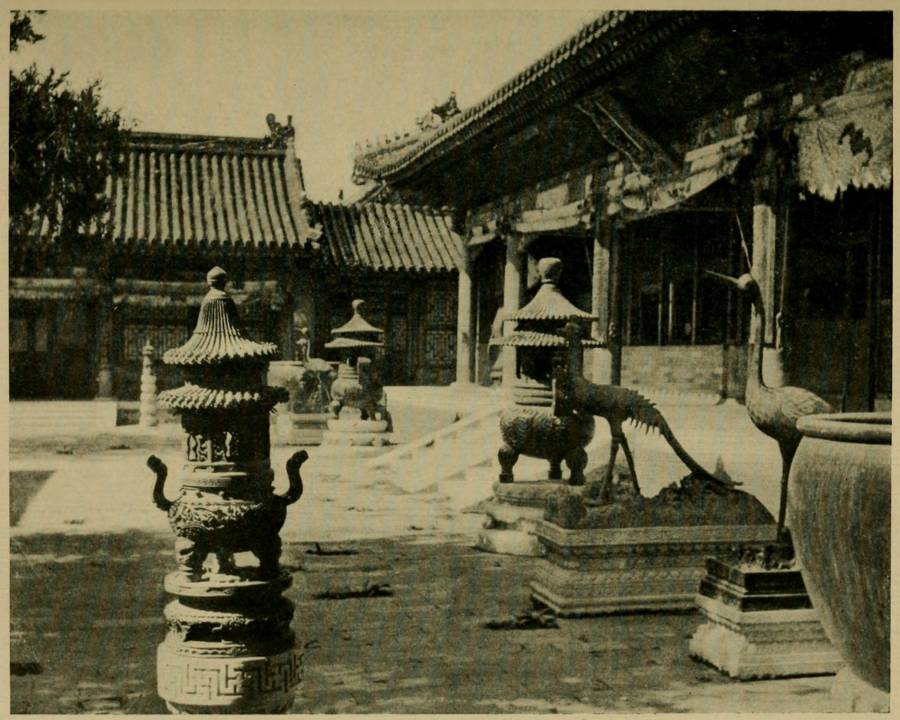
Copyright, 1901, by J. C. Hemment
Priceless Porcelains and Bronzes in the Third Palace,
Forbidden City
I had already seen the private apartments of the
young Emperor. Those of the Empress—for she
had apartments here too, in addition to the frail
palaces her fancy had scattered over the parks of
the Yellow City—those of the Empress are less
gloomy and much less dark. Room after room
exactly alike, with large windows and superb yellow
enamelled roofs. Each one has its marble
steps, guarded by two lions all shining with gold,
and the little gardens which separate them are
filled with bronze ornaments, heraldic beasts, phœnixes,
or crouching monsters.
Inside are yellow silks and square arm-chairs
of the form consecrated by time, unchanging as
China itself. On the chests, on the tables, a quantity
of precious articles are placed in small glass
cases,—because of the perpetual dust of Pekin,—and
this makes them as cheerless as mummies and
casts over the apartment the chill of a museum.
There are many artificial bouquets of chimerical
flowers of neutral shades in amber, jade, agate,
and moonstones.
The great and inimitable luxury of these palace
rooms consists of the series of ebony arches so
carved as to seem a bower of dark leaves. In
what far-away forest did the trees grow that permitted
such groves to be created out of one single
piece? And by means of what implements and
what patience are they able to carve each stem and
each leaf of light bamboo, or each fine needle of
the cedar, out of the very heart of the tree, and to
add to them birds and butterflies of the most exquisite
workmanship?
Behind the sleeping-room of the Empress a
kind of dark oratory is filled with Buddhistic
divinities on altars. An exquisite odor still remains,
left behind her by the beautiful, passionate,
elegant old woman who was queen. Among
these gods is a small creature made of very old
wood, quite worn and dull from the loss of gilding,
who wears about his neck a collar of fine
pearls. In front of him is a bunch of dried
flowers,—a last offering, one of the guardian
eunuchs informs me, made by the Empress to this
little old Buddha, who was her favorite fetish, at
the supreme moment before her flight from the
Violet City.
To-day I have reached this retreat by a very
different route from the one I took on my first
pilgrimage here, and in going out I must now
pass through the quarters where all is walled and
rewalled, the gates barricaded and guarded by
more and more horrible monsters. Are there hidden
princesses and treasures here? There is always
the same bloody color on the walls, the same
yellow faience on the roofs, and more horns, claws,
cruel forms, hyena smiles, projecting teeth, and
squinting eyes than ever; the most unimportant
things, like bolts and locks, have features that
simulate hatred and death.
Everything is perishing from old age; the stones
are worn away, the wooden doors are falling into
dust. There are some old shadowy courts that are
given up to white-bearded octogenarian servants,
who have built cabins, where they live like recluses,
occupied in training magpies or in cultivating
sickly flowers in pots under the eyes of the
everlasting grinning old marble and bronze beasts.
No cloistered green, no monk's cell, was ever half
so gloomy as these little courts, so shut in and so
dark, overshadowed for centuries by the uncontrolled
caprices of the Chinese emperors. The inexorable
sentence, "Leave hope behind, all those
who enter here," seems to belong here; as one
proceeds, the passages grow narrower and more
intricate; it seems as though there were no escape,
as though the great locks on the doors would refuse
to work, as though the walls would close in
upon and crush you.
Yet here I am almost outside, outside the interior
wall and through the massive gates that
quickly close behind me. Now I am between the
second rampart and the first, both equally terrible.
I am on the road which makes a circle
around this city,—a sort of ominous passageway
of great length that runs between two dark red
walls and which seems to meet in the distance
ahead of me. Human bones and old rags that
have been parts of the clothing of soldiers are
scattered here and there, and one sees two or three
crows and one of the flesh-eating dogs prowling
about.
When the boards which barricade the outside
gate are let down for me (the gate guarded by
the Japanese), I discover, as though on awakening
from a dreadful dream, that I am in the park
of the Yellow City, in open space under the great
cedars.
Sunday, October 28.
The Island of Jade, on the Lake of the Lotus, is
a rock, artificial perhaps, in spite of its mountainous
proportions. Old trees cling to its sides, and
old temples loom up toward the sky, while crowning
all is a sort of tower or dungeon of colossal
size and of a mysterious Baroque design. It may
be seen from all points; its excessively Chinese outlines
dominate Pekin, and high up on it stands a
terrible idol whose threatening attitude and hideous
smile look down upon the city. This idol our
soldiers call the "big devil of China."
This morning I am climbing up to visit this
"big devil."
A bridge of white marble across the reeds and
lotus gives access to the Island of Jade. Both ends
of the bridge are guarded, needless to say, by
marble monsters who leer and squint at any one
who has the audacity to pass. The shores of
the island rise abruptly underneath the cedar
branches, and one begins immediately to climb by
means of steps and rock-cut paths. Among the
severe trees is a series of marble terraces with
bronze incense-burners and occasional pagodas,
out of whose obscurity enormous golden idols
shine forth.
This Island of Jade, on account of its position
of strategic importance, is under military occupation
by a company of our marines.
As there is no shelter other than the pagodas,
and no camp beds other than the sacred tables, our
soldiers have had to put out of doors the entire
population of secondary gods in order to make
room to lie down on the beautiful red tables at
night, and have left only the big, solemn idols on
their thrones. So here they are by the hundreds,
by the thousands, lined up on the white terraces
like playthings. Inside the temples the guns of our
men are lying about, and their blankets and their
clothing hang on the walls, all around the big idols
who have been left in their places. What a heavy
smell of leather they have already introduced into
these closed sanctuaries, accustomed only to the
odor of sandalwood and incense!
Through the twisted branches of the cedars the
horizon, which is occasionally visible, is all green,
turning to an autumn brown. It is a wood, an
infinite wood, out of which here and there roofs
of yellow faience emerge. This wood is Pekin;
not at all as one imagines it, but Pekin seen from
the top of a very sacred place where no Europeans
were ever allowed to come.
The rocky soil grows thinner and thinner as one
rises toward the "big devil of China," as one
approaches the peak of the isolated cone known as
the Island of Jade.
This morning I meet, as I climb, a curious band
of pilgrims who are coming down; they are
Lazarist missionaries in mandarin costume, wearing
long queues. With them are several young
Chinese Catholic priests who seem frightened at
being there; as though, in spite of the Christianity
superimposed upon their hereditary beliefs, they
were committing some sacrilege by their very
presence in so forbidden a spot.
At the foot of the dungeon which crowns these
rocks is the kiosk of faience and marble where the
"big devil" dwells. It is high up on a narrow
terrace in the pure, clear air, from which one overlooks
a mass of trees scarcely veiled to-day by the
usual mist of dust and sun.
I enter the kiosk where the "big devil" stands,
the sole guest of this aerial region. Oh, horrible
creature that he is! He is of superhuman size,
cast in bronze. Like Shiva, god of death, he
dances on dead bodies; he has five or six atrocious
faces whose multiplied grins are almost intolerable;
he wears a collar of skulls, and is gesticulating
with forty arms that hold instruments of torture
or heads severed from their bodies.
Such is the protecting divinity chosen by the
Chinese to watch over this city, and placed high
above all their pyramidal faience roofs, high above
all their pagodas and towers, as we in times of
faith would have placed the Christ or the Blessed
Virgin. It is a tangible symbol of their profound
cruelty, the index of the inexplicable cleft in the
brain of these people ordinarily so tractable and
gentle, so open to the charm of little children and
of flowers, but who are capable all at once of gleefully
becoming executioners and torturers of the
most horrible description.
At my feet Pekin seems like a wood! I had been
told of this incomprehensible effect, but my expectations
are surpassed. Outside of the parks
in the Imperial City, it has not seemed to me that
there were many trees around the houses, that is,
in the gardens and in the streets. But from here
all is submerged in green. Even beyond the walls
whose black outlines may be seen in the distance
there are more woods,—endless woods. Toward
the east alone lies the gray desert which I came
through that snowy morning, and toward the
north rise the Mongolian mountains, charming,
translucent, and purple against the pale blue sky.
The great straight arteries of the city, drawn
according to a singular plan, with a regularity and
an amplitude to be found in none of the European
capitals, resemble, from the point where I
stand, the avenues in a forest,—avenues bordered
by various complicated, delicate little fretwork
houses of gray pasteboard or of gilt paper.
Many of these arteries are dead; in those which
are still living, this fact is indicated from my point
of view by the constant moving of little brown
animals along the earth, recalling the migration
of ants; these caravans, which move slowly and
quietly away, are scattered to the four corners of
China.
A feeling that is akin to regret is mingled with
my afternoon's work in the solitude of my lofty
palace,—regret for what is about to end, for I
am now on the eve of departure. And it will be an
end without any possible beginning again, for if
I should return to Pekin this palace would be
closed to me, or, in any case, I should never again
find here such charming solitude.
Yet this distant, inaccessible spot, of which it
once would have seemed madness to say that I
should ever make it my dwelling-place, has already
become very familiar to me, as well as all that
belongs here and all that has happened here,—the
presence of the great alabaster goddess in the dark
temple, the daily visit of the cat, the silence of the
surroundings, the mournful light of the October
sun, the agonies of the last butterflies as they beat
against my window-panes, the manœuvres of the
sparrows whose nests are in the enamelled roofs,
the blowing of the dead leaves, and the fall of the
little balsam needles on the pavement of the esplanade
whenever the wind blows. What a strange
destiny, when you think of it, has made me master
here for a few days!
The splendors of our long gallery in the Palace
of the North are a thing of the past. It is already
divided by light wooden partitions which may be
removed without difficulty if ever the Empress
thinks of returning, but which, for the time being,
cut it up into rooms and offices. There are still
a few magnificent bibelots in the part which is to
be the general's salon, but elsewhere it has all been
simplified; the silks, the pottery, the screens, the
bronzes, duly catalogued, have been removed to
a storehouse. Our soldiers have even found European
seats among the palace reserves, which
they have taken to the future apartments of the
staff to make them more habitable. They consist
of sofas and arm-chairs, vaguely Henry II. in
style, covered with old-gold plush that reminds
one of a provincial hotel.
I expect to leave to-morrow morning. When
the dinner hour unites us once again, Captain C.
and I, seated at our little ebony table, both feel
a touch of melancholy at seeing how things have
changed about us, and how quickly our dream of
being Chinese sovereigns is over.
Monday, October 29.
I have postponed my departure for twenty-four
hours in order to meet General Vayron, who returns
to Pekin this evening, and undertake his
commissions for the admiral. So I have an unexpected
half-day to spend in my high mirador, and
hope for a last visit from my cat, who will find
me no more in my accustomed place, neither to-morrow
nor ever again. It is now growing colder
each day, so that in any case my work-room would
not be possible much longer.
Before the doors of this palace close behind me
forever I want to take a last walk into all the windings
of the terraces, into all the kiosks, so dainty
and so charming, in which the Empress no doubt
concealed her reveries and her amours.
As I go to take leave of the great white goddess,—the
sun already setting, and the roofs of the
Violet City bathed in the red golds of evening,—I
find the aspect of things about here changed; the
soldiers who were on guard at the gate have
climbed to the top and are putting her house in
order; they have carried off the thousand and one
boxes of porcelains and girandoles, the broken
vases and the bouquets, and have carefully swept
the place. The alabaster goddess, deliciously pale
in her golden robes, still smiles, more than ever
solitary in her empty temple.
The sun of this last day sets in little wintry
clouds that are cold to look at, and the Mongolian
wind makes me shiver in my thick cloak as I cross
the Marble Bridge on my return to the Palace of
the North, where the general with his escort of
cavalry has just arrived.
Tuesday, October 30.
On horseback, at seven in the morning, a changelessly
beautiful sun and an icy wind. I start off
with my two servants, young Toum, and a small
escort of two African chasseurs, who will accompany
me as far as my junk. We have about six
kilometres to cover before reaching the dreary
country. We first cross the Marble Bridge, then,
leaving the great Imperial wood, pass through
ruined, squalid Pekin in a cloud of dust.
At length, after going through the deep gates
in the high outer ramparts, we reach the outside
desert, swept by a terrible wind; and here the
enormous Mongolian camels, with lions' manes,
perpetually file past in a procession, making our
horses start with fear.
We reach Tong-Tchow in the afternoon, and
silently cross it, ruined and dead, until we come
to the banks of the Pei-Ho. There I find my junk
under the care of a soldier,—the same junk that
brought me from Tien-Tsin with all the necessities
for our life on the water intact. Nothing has been
taken during my absence but my stock of pure
water,—a serious loss for us, but a pardonable
theft at a time like this, when the river water is
full of danger for our soldiers. As for us, we
can drink hot tea.
We call at the office of the commissary to get
our rations and to have our papers signed; then
we pull up our anchor from the infected bank that
breathes of pestilence and death, and begin to float
down the river toward the sea.
Although it is colder than it was coming up, it
is almost amusing to take up a nomadic life again
in our little sarcophagus with its matting roof, and
to plunge once more, as night falls, into the immense
green solitude of the dark banks as we
glide along between them.
Wednesday, October 31.
The morning sun shines on the bridge of a junk
that is covered with a thin coating of ice. The
thermometer marks 8° above zero, and the wind
blows, cruel and violent, but health-giving, we
feel sure.
We have the swift current with us, so that the
desolate shores, with their ruins and their dead, slip
by much more rapidly than on our other journey.
We walk on the tow-path from morning until
night in order to keep warm, almost abreast of the
Chinese who are pulling the rope. There is a fulness
of physical life in the wind; one feels light
and full of energy.
Thursday, November 1.
Our boat trip lasts only forty-eight hours this
time, and we have but two frosty nights to sleep
under a matting roof through which the shining
stars are visible, for toward the end of the second
day we enter Tien-Tsin.
Tien-Tsin, where we have to find a shelter for
the night, is horribly repopulated since our last
stay here. It takes us almost two hours to row
across the immense city, working our way amongst
myriads of canoes and junks. Both banks are
crowded with Chinese, howling, gesticulating,
buying, and selling, in spite of the fact that few
of the walls or roofs of the houses are left intact.
Friday, November 2.
In spite of the cold wind and the dust, which
continues to blow pitilessly, we arrive at Taku,—horrible
city,—at the mouth of the river, by mid-day.
But alas! it will be impossible to join the
squadron to-day; the tides are unfavorable, the
bar in bad condition, the sea too high. Perhaps
to-morrow or the next day.
I had almost had time to forget the difficulties
and uncertainties of life in this place,—the perpetual
anxiety in regard to the weather, the concern
for this or that boat laden with soldiers or
supplies, which is running some danger outside or
which may founder on the bar; complications and
dangers of all sorts connected with the disembarking
of troops,—a thing which seems so simple
when looked at from a distance, but which is surrounded
by a world of difficulties in such places.
Saturday, November 3.
En route this morning for the squadron out on
the open sea. At the end of a half hour the sinister
shore of China disappears behind us, and the
smoke-stacks of the iron-clads begin to pour forth
their black smoke upon the horizon. We fear we
shall have to turn back, the weather is so bad.
Dripping with fog, however, we arrive at last,
and I jump aboard the Redoutable, where my
comrades, with no taste of high life in China to
break the monotony, have been at work for forty
days.