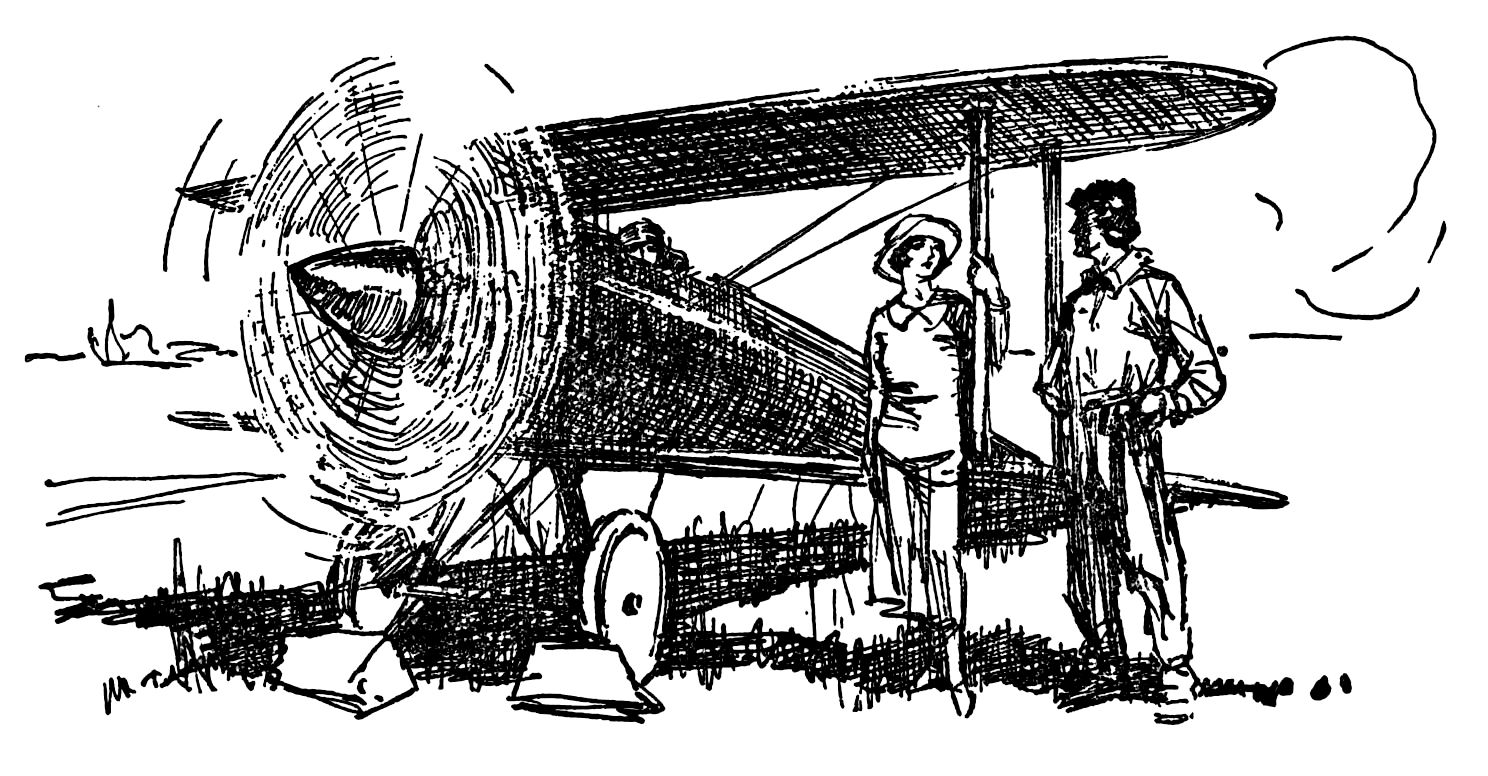
Billy dropped to his knees beside the silent heap of white. Jennie was
breathing rapidly—short gasping breaths. Her eyes were closed. She did
not answer when he spoke. She did not hear his forlorn ejaculation of
grief. She was past all hearing, for the time. But even unconsciousness
had not wiped out the set lines that the sight and the sound of the
crash had drawn about her pale lips.
Hansen, seeing Billy’s distraction, ventured a suggestion.
“I’ve sent a man for Captain Weyman and the ambulance, sir. They’ll be
here in a minute.”
Billy shook off his daze and got to his feet.
“Never mind the ambulance,” he said. “Ask the surgeon to come to Colonel
Brent’s quarters. We’ll be there.”
He lifted Jennie’s limp body and made off with her in his arms.
He reached the house unobserved. The inhabitants of the post were still
idling over late dinners. Dinner is always late on an active flying
field in summer. Billy was aware of a mournful gratitude that he had
been spared the sympathetic importunities that an encounter must have
evoked. He struggled through the screen door, found Jennie’s room, and
laid her on her bed. He wondered where the colonel was. Then he
remembered that Jennie’s father had left that morning in answer to a
hurried summons from Washington. He would be away overnight.
A hasty search of kitchen and bath provided a basin of water, a chunk of
ice and a sponge. Billy assembled these at the bedside. But there was no
need. He was dipping the sponge when Jennie’s eyes opened slowly.
They turned on him blankly at first, then widened with glad incredulity.
Jennie lay quite still, scanning the haggard face looking fearfully into
hers.
Billy stooped and kissed her lips. She sighed gratefully.
“Billy dear,” she whispered, “you’re sure it’s you?”
“Of course, sweetheart.”
“Then—then it wasn’t the⸺”
“The last crash? Yes, it was, Jennie. The first and the last!”
She understood and rolled her head feebly from side to side in brave
protest.
“Billy! Don’t, dear! You mustn’t now. I can’t—” Her eyes closed
wearily.
But he persisted grimly.
“Never again, Jennie! Not as long as you live!”
She opened her eyes and smiled mournfully at that.
“Perhaps,” she said, “that won’t be very long, Billy.”
He threw out a hand to steady himself.
“Jennie!” he cried. “Hush!”
She only smiled at him and went on gently.
“No, Billy. You may as well know now. My heart—I didn’t tell you. I’m
afraid, dear, this has been the last crash for me. Perhaps—perhaps it
is—better that way. Perhaps it was—meant to be—that way—from the
first.”
“Jennie! Don’t—don’t give up this way. It can’t be true. Just one
little crash couldn’t⸺ You must try—try⸺”
“I won’t give up, Billy. I’ll try—as hard—as I can. But oh, Billy
dear—I’m so—tired!”
The screen door slammed lightly. Weyman came down the hallway.
Billy met him outside Jennie’s door.
“How is she?” the surgeon asked. “Her heart, you know⸺”
“I didn’t know!” groaned Billy. “If I only had!”
“I’ll see what’s to do,” said Weyman, and left Billy in the hall.
Out on the veranda, Cobb fumbled for a cigarette and matches. The
surgeon found him there a moment later, smoking furiously.
“Not so good,” said Weyman gravely. “It isn’t so much her heart as a
general breaking down. Heart makes it doubly bad, of course. Looks like
pernicious⸺ But never mind. Make yourself useful, Bill. Step over to
Cahill’s quarters and see if Mrs. Cahill can come in for the night. If
she’s not there get somebody else. Pull yourself together, man! And
hurry up!”
He disappeared in the house and Billy stumbled off on his errand.
News of Jennie the next day was equivocal. The colonel returned at noon.
When Billy collared him after lunch he pursed his lips and shook his
head.
“Not too good, son,” he said. “So far, no better and no worse. Weyman
won’t commit himself one way or the other.”
He swung away toward headquarters, and Billy falling into step alongside
followed into his office.
From his desk the colonel looked up.
“What else, son?”
“This,” said Billy. He drew a white envelope from the pocket of his
tunic and laid it on the desk.
“I imagine,” said the colonel, “I can guess the contents.”
Billy nodded.
“Will you approve it, sir?”
Colonel Brent leaned back and interrogated the ceiling with his eyes.
Then he leaned forward and brought his gaze to bear on Billy.
“Boy,” he said, “you’ve been having a hell of a time, haven’t you? Now
listen to me. I’ve been through all this, too. Perhaps I wasn’t hit so
badly, perhaps I was. But never mind. It was bad. Anyway, the thing
that’s worrying you killed my wife, Jennie’s mother, by inches. At
least, that’s what I think. Perhaps it is killing Jennie now. We may as
well face the possibility. If Jennie lives we’ll let her decide whether
I approve your resignation or not. There’s time enough for that. But
supposing⸺”
He paused and gulped painfully. Then he went on.
“Well, let that be. Put it this way. Without somebody like Jennie, where
would you be if you left the service? Would you have anything remaining
to live for? Flying was all your life until you and Jennie came to—an
understanding. If—just for instance, mind—you had to do without
Jennie, flying would be all your life once more. Isn’t that about the
way of it?”
“No, sir. I’ll never touch a stick again. Not after yesterday. When I
think of Jennie’s face—brrr-r-r!”
The colonel considered at length.
“Very well, son,” he decided. “I’ll approve this. Maybe your case is
worse than I thought.”
He drew the inclosure from the envelope. Billy had already typed the
indorsement of approval for his signature. The colonel read it over
slowly, shook his head dubiously, and signed.
“There you are,” he said and tossed the document in the outgoing-mail
basket. “No more engines, no more ships, no more chasing clouds.”
“And no more crashes!” said Billy fervently. “Amen, and thank you, sir.
I’m not happy about it. It’s a hard thing to do. It’ll take me a long
time to get used to being a kiwi. But I’ll have Jennie—if she’ll have
me now. And if she won’t, well, it’s for her good, anyway.”
“I hope so,” said the colonel, with little conviction. “By the way, what
will you do when you get out? Jennie will have to eat when she gets
well, you know.”
“I can manage. I know something about gas engines. The automobile
business⸺”
“Of course. And that reminds me. You’ve got to keep busy until your
discharge. I have a job that will hold your mind off things you won’t
want to think of. Washington is sending the XT-6 in tomorrow from
Dayton—McCook Field, you know. You’ll take charge of her final
conditioning for a nonstop hop to Panama. Norris will fly her down about
the tenth if she’s ready. I recommended him and his orders are out. He
doesn’t know this yet. You might tell him. Ask him to see me this
afternoon.”
The colonel was the C. O. again. He would be the C. O. until he left his
office. Then he would be Jennie’s father until another day.
Cobb pulled himself together, saluted, and went out to find Norris.
As the door closed behind him the colonel retrieved his resignation from
the mail basket, slipped it into a folder marked “Hold” and put the
folder away in a private drawer.
“He’s too good to lose,” muttered the colonel. “We’ll wait and see. I
almost did that once.”
Into the work of conditioning the XT-6 Billy Cobb threw himself with
the fervor of desperation. There really wasn’t much to be done, but he
made things to do. Every nut and bolt, every cotter pin, turnbuckle,
wire, pulley and bearing that wasn’t spanking brand-new he took out and
replaced. He pulled the motor, took it to pieces, and literally rebuilt
it. He relined the entire ship with micrometric accuracy. He discovered
a way that the McCook engineers had overlooked to enlarge the gas tank
and add an extra two hundred miles’ worth of fuel. The massive metal
monoplane had been a new ship when she left McCook. She was new-plus
before Billy pronounced her ready for the twenty-five-hundred-mile
straightaway from Langstrom to the Canal.
Most of the things he did to her were gratuitous. She didn’t need them,
for at McCook, her home station, they are thorough before everything
else. He did them to have something to do. Driving himself like a fury,
driving his team of mechanics, up at dawn and in at midnight or after,
he found that there were periods during the day, some of them as long as
five minutes, when he ceased to think of the tragedy in the hushed
bedroom at the rear of the colonel’s quarters.
Jennie was failing steadily. He had been confident, at first, that his
final renunciation of the air would revive her. But it hadn’t. She had
chided him as vigorously as her failing strength allowed and then
relapsed into pitiable acceptance.
“I mustn’t blame you, Billy,” she had whispered at last; “it’s because I
was so selfish. I wanted you all for myself. It’s my fault, dear. But,
oh, I am sorry. And you will suffer for it more than I, I know. I should
think you’d hate me.”
He had turned away and brushed a sleeve across his eyes at that.
Weyman allowed him a scant half hour with her each day, and he had
chosen the time just before sundown, between five and six, when his crew
of mechanics were at evening mess and there was a lull in the work at
the XT’s hangar.
He would tiptoe into the room, in the failing light. She would smile her
wistful greeting. He would sit beside the bed and lift her hand—which
she could no longer raise herself—and hold it tight. Every day that
hand grew more woefully thin, lighter, more transparent. And thinking of
it at night, as he lay wide-eyed, Billy would grit his teeth in agony
and groan softly, so as not to waken Norris, until the brief respite of
sleep, which did not always come, stilled his misery.
During these days the voice of an airplane was sheer torture. It would
break on his ears, a poignant reminder of the only two things he had
cared for in life, the air and Jennie. And now he feared and had
renounced the first; and the second was being swept away from him, under
his eyes.
Once he had tried to vision what the world would be like with Jennie
gone and the air denied him by his fear—for he scarcely doubted now
that Jennie was doomed, and his present terror was too great to admit
the supposition of a return to the air. He had revolted with a shudder
from the bleakness of the prospect. He had a feeling that existence
could not persist in the empty void of the barren future his brain
conjured. His world must end with the passing of Jennie. He could
perceive nothing beyond but interminable reaches of hopelessness.
Another thing added to the maze of troubles and questionings that
enmeshed him. It was paradoxical, unbelievable, but he had discovered,
now that the air was put from him definitely and for all time, that he
wanted to fly again! Explain this as you will, it was so. And Cobb was
by no means the first nerve-broken pilot to know that strange
contradiction of desire for the thing feared. Not a few of the men but
all of the men whom the air has broken have carried, or are carrying,
that same fierce longing for the blue remotenesses on with them to their
graves. In some the longing has waxed, at length, even greater than
their fear and they have returned. They are the happy ones. For in those
whose fear has proven the stronger urge the suffering bred of conflict
between their fear and their desire has been intense. It was so with
Billy Cobb. He suffered intensely.
So, haggard and drawn, dead for lack of sleep, worked to exhaustion, a
prey to grief and to this strange mingling of fear and desire, he wore
along hopelessly, watching Jennie burning lower and lower, through the
heat of early September.
On the ninth the XT-6 was ready to the last safety wire. He told
Norris, who was expecting it.
“Check!” agreed his friend. “God willing, I shall open a bottle of
forbidden nectar at Cristobal, or vicinity on the eleventh. We hop
tomorrow at four o’clock. Have the valet pack my toothbrush in the
morning, Bill.”
Billy shuddered at the prospect of what lay ahead of Norris. Once he
would have leaped at the chance to lay such a course, himself. But no
longer. He was amazed that his friend could face the undertaking at this
eleventh hour with cheerful banter on his lips. He, Billy, dared not
make one circuit of the airdrome off the ground. Yet Norris was talking
carelessly about flying to Panama for a drink! It seemed impossible that
he himself had been as Norris so short a time ago. Less than two months
since, it was! Two months that were a lifetime long.
On the morning of the tenth a thin stream of civilians began trickling
into the post and out onto the airdrome where the XT-6 was drawn up
before her hangar with heat waves squirming and flickering along the
upper surfaces of her tapered metal wings. She was an unlovely,
sullen-appearing brute, with a surly upturned snout projecting eight
feet above and beyond the main spars of her thick-cambered gray pinions.
She had wheels like millstones for size, and the V-struts of her
undercarriage suggested the trusswork of a railway bridge. A banquet for
ten might have been served on the ample stream-lined spreader board that
hid her heavy axles. There was nothing birdlike about her. Rather she
was reptilian, hideous, like the imagined flying monsters of the
Mesozoic swamps.
Norris went up her ladder and into the pilot’s cabin at the tip of the
snout. Behind him, on either side of the fuselage, the twin propeller
blades projecting from the motor housings on the wings whirled idly with
a vicious whisper. He taxied out to the line and took off for a final
air test. The steel-winged monster moved with no effect of speed
whatever. She left the ground reluctantly. She climbed reluctantly,
although her load was not yet aboard. She turned reluctantly. There was
no spontaneity in anything she did. Decidedly she was a flying machine
and no airplane.
Other ships were in the air, a small host of them; eager, nervous little
scouts, steady DH’s, a pair of wide-winged Cardinals. The XT lumbered
past them disdainfully like a dowager at a garden party.
“My Aunt Maria, what a tub!” commented a reporter, addressing Billy Cobb
who stood toying listlessly with a spanner. “Can that thing fly to
Panama?”
“I guess so,” said Billy, without interest.
Norris eased the XT-6 gingerly into the home stretch and floated her
down smoothly for a perfect three-point contact.
“Cunning little mastodon, isn’t she?” he grinned to Billy when he had
coaxed her in and turned her over to the crew. “But she’s going to make
Cristobal for tea tomorrow—with rum in the tea, too. You’ve groomed her
to the pink, Billy.”
“Grin if you want to, John,” said Cobb. “I don’t envy you this hop.”
Norris sobered.
“I suppose not, Bill. I wish to God you did! How is she this morning?”
“I haven’t heard yet,” groaned Billy.
At noon mess, Billy struggled to consume a cracker and a glass of milk.
He left Norris attacking a second portion of sirloin and baked potatoes,
the last real food he would get until the next day’s tea time at the
equator.
On the club veranda, stretched wearily in a canvas chair, Billy lit a
cigarette. He was vaguely disturbed. Something was wrong. Jennie wanted
him. She was calling. A tightness at the throat, a clutching at the
heart, a whispering in the ears, told him to go, to go now, not to wait.
He ground out the smoldering stub of his cigarette with an impatient
heel and left the club.
Jennie stirred a little and brightened when he tapped on her half-open
door and tiptoed in. He drew a chair to the bedside and bent over her.
Her wistful eyes seemed to him clearer today. There was a little of
their old starriness back again he thought. His pulse quickened
hopefully.
“I had a hunch you were lonely,” he explained, “so I came early.”
She smiled, almost happily.
“I was going to ask daddy to send for you,” she confessed.
“It’s funny,” he said. “I had a feeling just now that I ought to come. I
can’t make it out. It was like⸺”
“Never mind what, dear. I wanted you and you are here. I wanted⸺”
She paused to consider how she should say what was in her mind. It would
be difficult. But it must be said before—before it was too late.
“Billy, dear,” she began, “lying here and trying to think things out an
idea has come to me. I think I know why this trouble has visited us.
Have you ever thought why?”
“I have thought of only one thing, Jennie, for so long that it seems
like years.”
“I know, dear, I know. And that is just it. It’s wrong, wrong for people
who belong to a—a—well, a cause—like the air, to think only of
themselves, as we have done. And this is the punishment. It is, Billy. I
am sure. We loved the air, we were dedicated to it, and then we turned
our coats and were ready to desert it for each other. And we deserve to
be punished! Perhaps I am light-headed from being sick. Perhaps this
sounds very foolish. But I feel it so strongly, dear. I think it must be
true.”
Cobb sat silent, twisting his stubby fingers miserably.
“Does this hurt you—very much—Billy?” she questioned anxiously.
“Go on, Jennie. Never mind if it does,” he said with an effort.
“Then I’ll finish,” she said. “It all seems to have moved along so
inevitably. The air needed you. Then I won you away—even if I tried not
to. And the air must have you back. So—so I am being—being put—out of
the way.”
“No, Jennie! No!” he cried.
“Perhaps not, dear. Perhaps not. But wouldn’t it be almost better so?
Have you thought what our life will be—if I do—get well? Either way,
whether you live for me or for the air—suffering for both of us, Billy!
I never knew my mother well. But daddy has told me. They suffered
terribly. And in the end it came to—to this that has come to us.”
“I don’t care, Jennie—I don’t care! I couldn’t go on if you⸺”
“Yes, you could, Billy. You could. You would have the air again. It
would comfort you after a time. You think not now, but it would, dear.
And—and—Billy, do you believe in the—the Afterward?”
“I don’t know. I only know⸺”
“I think,” said Jennie slowly, “there must be an Afterward. I almost
know it now. I used to doubt and wonder. But now I am sure. Because,
Billy, the air won’t need you always. There will be others, sooner or
later, to take your place. But I shall need you, always—and there can
be no others, ever. You will come to me—Afterward. It is only fair. It
would be so-so cruelly futile and incomplete, otherwise. I have a
certainty—something I can’t explain—but a certainty, that when the air
is done with you we shall find each other—somewhere—somehow! If I
weren’t sure of that I couldn’t, I know I couldn’t, go away, even for a
little while. And if I do have to go, dear, you will remember—remember
what I tell you now. It will only be for a little while. Try to believe.
Try—try! And go back to the air, Billy. I shall be waiting—waiting for
you—until—the last crash—Billy, dear!”
She stopped speaking. Billy saw that her eyes were closed and that she
was panting with the effort of what she had said. She looked unutterably
weary and yet, somehow, indescribably happy.
In a little while her eyes opened and her lips moved feebly again, more
feebly than before.
“Isn’t—isn’t John hopping off this afternoon, Billy?” she asked.
“About four o’clock,” said Billy.
“Daddy said something about it. You are helping him, aren’t you?”
“I’m supposed to be.”
“I am keeping you from what you should be doing again. John may need
you. You mustn’t humor me any longer. Come back—this evening—if⸺”
Billy’s heart leaped violently and he started up.
“‘If!’” he cried. “‘If!’ If what? Jennie!”
“If the doctor will let you, dear,” she concluded. But that was not what
had trembled on her tongue. She had caught herself just in time. What
she had barely missed saying was: “If I am still here.”
His alarm passed. The merciful deceit worked. He bent and kissed her and
went out to join Norris. He promised himself confidently to look in
again that evening, if only to say good night.
He had not heard her yearning whisper as he passed the threshold:
“Good-by, Billy. Good-by—oh, my dear!”