It has long been the custom to attribute the dangerous
restlessness of the Indians during and after the
Civil War to the evil machinations of the Confederacy.
It has been plausible to charge that agents of the
South passed among the tribes, inciting them to
outbreak by pointing out the preoccupation of the
United States and the defencelessness of the frontier.
Popular narratives often repeat this charge when
dealing with the wars and depredations, whether
among the Sioux of Minnesota, or the Northwest
tribes, or the Apache and Navaho, or the Indians
of the plains. Indeed, had the South been able thus
to harass the enemy it is not improbable that it
would have done it. It is not impossible that it
actually did it. But at least the charge has not been
proved. No one has produced direct evidence to
show the existence of agents or their connection with
the Confederacy, though many have uttered a general
belief in their reality. Investigators of single affairs
have admitted, regretfully, their inability to add
incitement of Indians to the charges against the
South. If such a cause were needed to explain the
increasing turbulence of the tribes, it might be worth
while to search further in the hope of establishing it,
but nothing occurred in these wars which cannot be
accounted for, fully, in facts easily obtained and
well authenticated.
Before 1861 the Indians of the West were commonly
on friendly terms with the United States.
Occasional wars broke this friendship, and frequent
massacres aroused the fears of one frontier or another,
for the Indian was an irresponsible child, and the
frontiersman was reckless and inconsiderate. But
the outbreaks were exceptional, they were easily
put down, and peace was rarely hard to obtain. By
1865 this condition had changed over most of the
West. Warfare had become systematic and widely
spread. The frequency and similarity of outbreaks
in remote districts suggested a harmonious plan, or
at least similar reactions from similar provocations.
From 1865, for nearly five years, these wars continued
with only intervals of truce, or professed peace;
while during a long period after 1870, when most of
the tribes were suppressed and well policed, upheavals
occurred which were clearly to be connected with
the Indian wars. The reality of this transition from
peace to war has caused many to charge it to the
South. It is, however, connected with the culmination
of the westward movement, which more than explains
it.
For a setting of the Indian wars some restatement
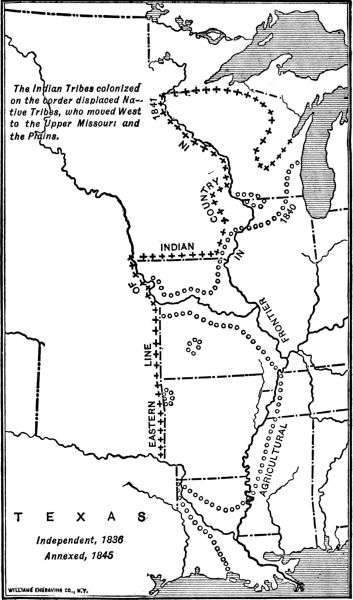
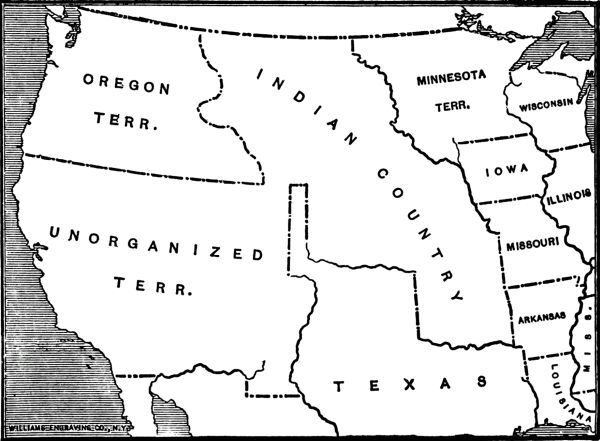
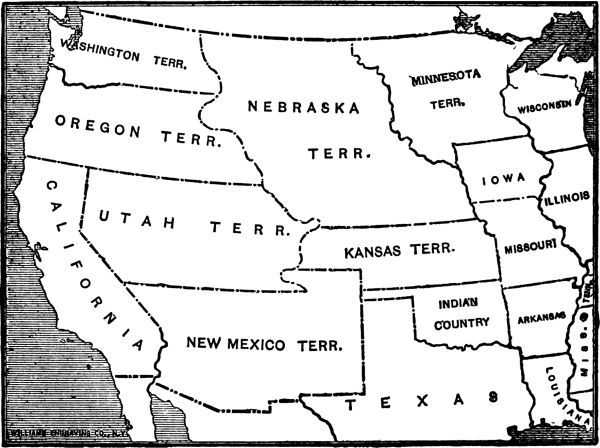
of the events before 1861 is needed. By 1840 the
agricultural frontier of the United States had reached
the bend of the Missouri, while the Indian tribes,
with plenty of room, had been pushed upon the plains.
In the generation following appeared the heavy
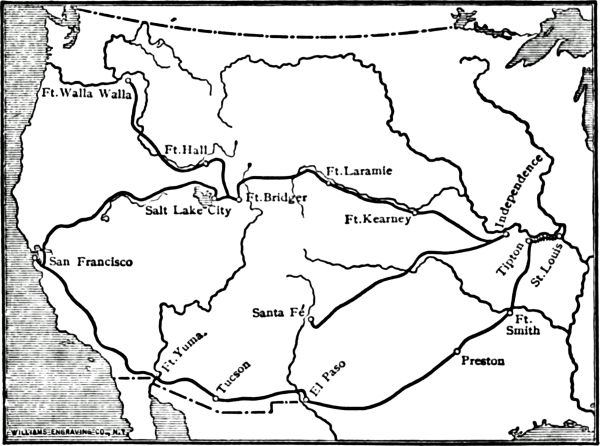
traffic along the overland trails, the advance of the
frontier into the new Northwest, and the Pacific
railway surveys. Each of these served to compress
the Indians and restrict their range. Accompanying
these came curtailing of reserves, shifting of residences
to less desirable grounds, and individual
maltreatment to a degree which makes marvellous
the incapacity, weakness, and patience of the Indians.
Occasionally they struggled, but always they
lost. The scalped and mutilated pioneer, with
his haystacks burning and his stock run off, is a
vivid picture in the period, but is less characteristic
than the long-suffering Indian, accepting the inevitable,
and moving to let the white man in.
The necessary results of white encroachment were
destruction of game and education of the Indian to
the luxuries and vices of the white man. At a time
when starvation was threatening because of the
disappearance of the buffalo and other food animals,
he became aware of the superior diet of the whites
and the ease with which robbery could be accomplished.
In the fifties the pressure continued, heavier
than ever. The railway surveys reached nearly
every corner of the Indian Country. In the next
few years came the prospectors who started hundreds
of mining camps beyond the line of settlements,
while the engineers began to stick the advancing
heads of railways out from the Missouri frontier and
into the buffalo range.
Even the Indian could see the approaching end.
It needed no confederate envoy to assure him that
the United States could be attacked. His own
hunger and the white peril were persuading him to
defend his hunting-ground. Yet even now, in the
widespread Indian wars of the later sixties, uniformity
of action came without much previous
coöperation. A general Indian league against the
whites was never raised. The general war, upon
dissection and analysis, breaks up into a multitude
of little wars, each having its own particular causes,
which, in many instances, if the word of the most
expert frontiersmen is to be believed, ran back into
cases of white aggression and Indian revenge.
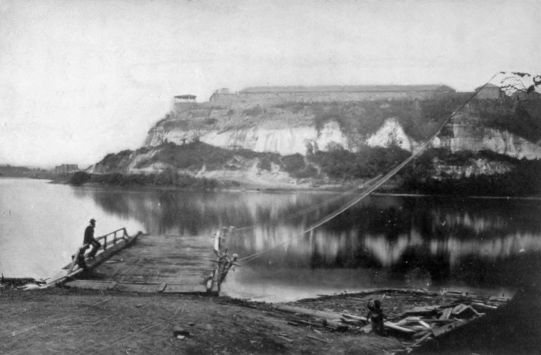
The Sioux uprising of 1862 came a little ahead of
the general wars, with causes rising from the treaties
of Mendota and Traverse des Sioux in 1851. The
plains situation had been clearly seen and succinctly
stated in this year. "We are constrained to say,"
wrote the men who made these treaties, "that in our
opinion the time has come when the extinguishment
of the Indian title to this region should no longer be
delayed, if government would not have the mortification,
on the one hand, of confessing its inability to
protect the Indian from encroachment; or be subject
to the painful necessity, upon the other, of
ejecting by force thousands of its citizens from a
land which they desire to make their homes, and
which, without their occupancy and labor, will be
comparatively useless and waste." The other treaties
concluded in this same year at Fort Laramie
were equally the fountains of discontent which
boiled over in the early sixties and gave rise at
last to one of the most horrible incidents of the
plains war.
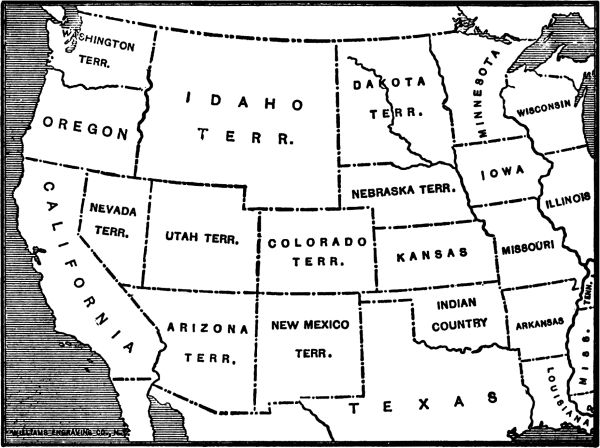
In the Laramie treaties the first serious attempt
to partition the plains among the tribes was made.
The lines agreed upon recognized existing conditions
to a large extent, while annuities were pledged in consideration
of which the savages agreed to stay at
peace, to allow free migration along the trails, and
to keep within their boundaries. The Sioux here
agreed that they belonged north of the Platte. The
Arapaho and Cheyenne recognized their area as
lying between the Platte and the Arkansas, the mountains
and, roughly, the hundred and first meridian.
For ten years after these treaties the last-named
tribes kept the faith to the exclusion of attacks upon
settlers or emigrants. They even allowed the Senate
in its ratification of the treaty to reduce the term of
the annuities from fifty years to fifteen.
In a way, the Arapaho and Cheyenne Indians
lay off the beaten tracks and apart from contact with
the whites. Their home was in the triangle between
the great trails, with a mountain wall behind them
that offered almost insuperable obstacles to those
who would cross the continent through their domain.
The Gunnison railroad survey, which was run along
the thirty-ninth parallel and through the Cochetopa
Pass, revealed the difficulty of penetrating the range
at this point. Accordingly, a decade which built up
Oregon and California made little impression on this
section until in 1858 gold was discovered in Cherry
Creek. Then came the deluge.
Nearly one hundred thousand miners and hangers-on
crossed the plains to the Pike's Peak country in
1859 and settled unblushingly in the midst of the
Indian lands. They "possessed nothing more than
the right of transit over these lands," admitted the
Peace Commissioners in 1868. Yet they "took
possession of them for the purpose of mining, and,
against the protest of the Indians, founded cities,
established farms, and opened roads. Before 1861
the Cheyenne and Arapaho had been driven from
the mountain regions down upon the waters of
the Arkansas, and were becoming sullen and discontented
because of this violation of their rights."
The treaty of 1851 had guaranteed the Indians in
their possession, pledging the United States to prevent
depredations by the whites, but here, as in most
similar cases, the guarantees had no weight in the
face of a population under way. The Indians were
brushed aside, the United States agents made no
real attempts to enforce the treaty, and within a few
months the settlers were demanding protection
against the surrounding tribes. "The Indians saw
their former homes and hunting grounds overrun by a
greedy population, thirsting for gold," continued the
Commissioners. "They saw their game driven east
to the plains, and soon found themselves the objects
of jealousy and hatred. They too must go. The
presence of the injured is too often painful to the
wrong-doer, and innocence offensive to the eyes of
guilt. It now became apparent that what had been
taken by force must be retained by the ravisher,
and nothing was left for the Indian but to ratify a
treaty consecrating the act."
Instead of a war of revenge in which the Arapaho
and Cheyenne strove to defend their lands and to
drive out the intruders, a war in which the United
States ought to have coöperated with the Indians,
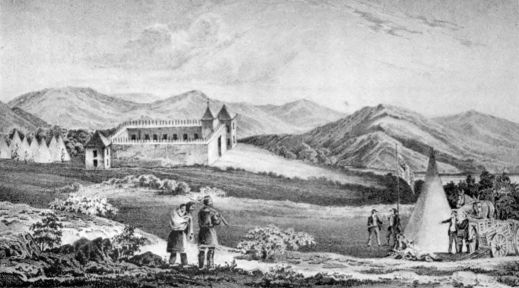
a treaty of cession followed. On February 18, 1861,
at Fort Wise, which was the new name for Bent's
old fort on the Arkansas, an agreement was signed
by which these tribes gave up much of the great range
reserved for them in 1851, and accepted in its place,
with what were believed to be greater guarantees, a
triangular tract bounded, east and northeast, by
Sand Creek, in eastern Colorado; on the south by
the Arkansas and Purgatory rivers; and extending
west some ninety miles from the junction of Sand
Creek and the Arkansas. The cessions made by the
Ute on the other side of the range, not long after
this, are another part of the same story of mining
aggression. The new Sand Creek reserve was designed
to remove the Arapaho and Cheyenne from
under the feet of the restless prospectors. For years
they had kept the peace in the face of great provocation.
For three years more they put up with white
encroachment before their war began.
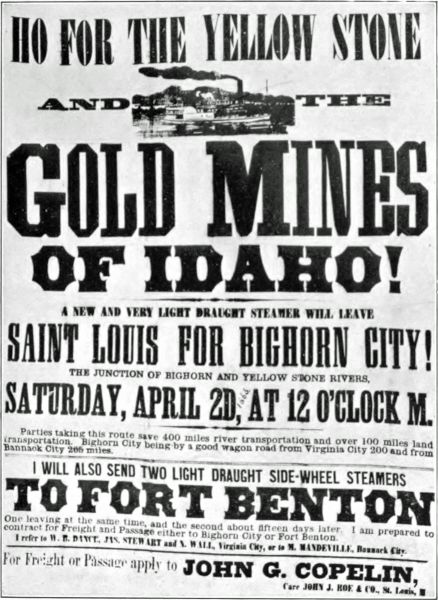
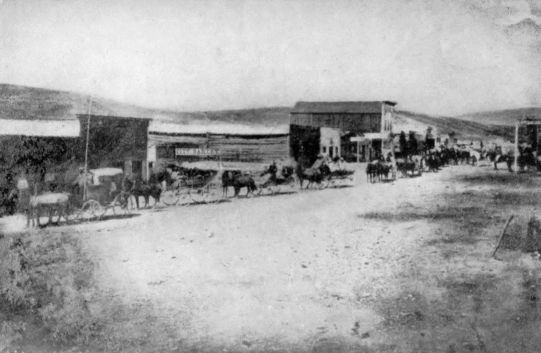
The Colorado miners, like those of the other boom
camps, had been loud in their demand for transportation.
To satisfy this, overland traffic had been
organized on a large scale, while during 1862 the
stage and freight service of the plains fell under the
control of Ben Holladay. Early in August, 1864,
Holladay was nearly driven out of business. About
the 10th of the month, simultaneous attacks were
made along his mail line from the Little Blue River
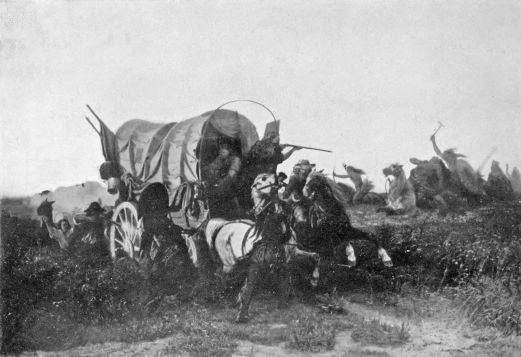
to within eighty miles of Denver. In the forays,
stations were sacked and burned, isolated farms were
wiped out, small parties on the trails were destroyed.
At Ewbank Station, a family of ten "was massacred
and scalped, and one of the females, besides having
suffered the latter inhuman barbarity, was pinned to
the earth by a stake thrust through her person, in a
most revolting manner; ... at Plum Creek ...
nine persons were murdered, their train, consisting
of ten wagons, burnt, and two women and two children
captured.... The old Indian traders ...
and the settlers ... abandoned their habitations."
For a distance of 370 miles, Holladay's general superintendent
declared, every ranch but one was "deserted
and the property abandoned to the Indians."
Fifteen years after the destruction of his stations,
Holladay was still claiming damages from the United
States and presenting affidavits from his men which
revealed the character of the attacks. George H.
Carlyle told how his stage was chased by Indians for
twenty miles, how he had helped to bury the mutilated
bodies of the Plum Creek victims, and how
within a week the route had to be abandoned, and
every ranch from Fort Kearney to Julesburg was
deserted. The division agent told how property
had been lost in the hurried flight. To save some of
the stock, fodder and supplies had to be sacrificed,—hundreds
of sacks of corn, scores of tons of hay,
besides the buildings and their equipment. Nowhere
were the Indians overbold in their attacks. In small
bands they waited their time to take the stations by
surprise. Well-armed coaches might expect to get
through with little more than a few random shots,
but along the hilltops they could often see the savages
waiting in safety for them to pass. Indian warfare
was not one of organized bodies and formal manœuvres.
Only when cornered did the Indian
stand to fight. But in wild, unexpected descents
the tribes fell upon the lines of communication,
reducing the frontier to an abject terror overnight.
The destruction of the stage route was not the first,
though it was the most general hostility which
marked the commencement of a new Indian war.
Since the spring of 1864 events had occurred which
in the absence of a more rigorous control than the
Indian Department possessed, were likely to lead to
trouble. The Cheyenne had been dissatisfied with
the Fort Wise treaty ever since its conclusion. The
Sioux were carrying on a prolonged war. The
Arapaho, Comanche, and Kiowa were ready to be
started on the war-path. It was the old story of
too much compression and isolated attacks going
unpunished. Whatever the merits of an original
controversy, the only way to keep the savages under
control was to make fair retribution follow close upon
the commission of an outrage. But the punishment
needed to be fair.
In April, 1864, a ranchman named Ripley came
into one of the camps on the South Platte and declared
that some Indians had stolen his stock. Perhaps
his statement was true; but it must be remembered
that the ranchman whose stock strayed away
was prone to charge theft against the Indians, and
that there is only Ripley's own word that he ever
had any stock. Captain Sanborn, commanding, sent
out a troop of cavalry to recover the animals. They
came upon some Indians with horses which Ripley
claimed as his, and in an attempt to disarm them, a
fight occurred in which the troop was driven off.
Their lieutenant thought the Indians were Cheyenne.
A few weeks after this, Major Jacob Downing,
who had been in Camp Sanborn inspecting troops,
came into Denver and got from Colonel Chivington
about forty men, with whom "to go against the
Indians." Downing later swore that he found the
Cheyenne village at Cedar Bluffs. "We commenced
shooting; I ordered the men to commence killing
them.... They lost ... some twenty-six killed
and thirty wounded.... I burnt up their lodges and
everything I could get hold of.... We captured
about one hundred head of stock, which was distributed
among the boys."
On the 12th of June, a family living on Box Elder
Creek, twenty miles east of Denver, was murdered
by the Indians. Hungate, his wife, and two children
were killed, the house burned, and fifty or sixty head
of stock run off. When the "scalped and horribly
mangled bodies" were brought into Denver, the
population, already uneasy, was thrown into panic by
this appearance of danger so close to the city. Governor
Evans began at once to organize the militia for
home defence and to appeal to Washington for help.
By the time of the attack upon the stage line it
was clear that an Indian war existed, involving in
varying degrees parts of the Arapaho, Cheyenne,
Comanche, and Kiowa tribes. The merits of the
causes which provoked it were considerably in doubt.
On the frontier there was no hesitation in charging
it all to the innate savagery of the tribes. Governor
Evans was entirely satisfied that "while some of the
Indians might yet be friendly, there was no hope of a
general peace on the plains, until after a severe
chastisement of the Indians for these depredations."
In restoring tranquillity the frontier had to rely
largely upon its own resources. Its own Second
Colorado was away doing duty in the Missouri campaign,
while the eastern military situation presented
no probability of troops being available to help out
the West. Colonel Chivington and Governor John
Evans, with the long-distance aid of General Curtis,
were forced to make their own plans and execute
them.
As early as June, Governor Evans began his corrective
measures, appealing first to Washington for
permission to raise extra troops, and then endeavoring
to separate the friendly and warlike Indians in
order that the former "should not fall victims to the
impossibility of soldiers discriminating between them
and the hostile, upon whom they must, to do any
good, inflict the most severe chastisement." To
this end, and with the consent of the Indian Department,
he sent out a proclamation, addressed to "the
friendly Indians of the Plains," directing them to
keep away from those who were at war, and as evidence
of friendship to congregate around the agencies
for safety. Forts Lyons, Laramie, Larned, and
Camp Collins were designated as concentration
points for the several tribes. "None but those who
intend to be friendly with the whites must come to
these places. The families of those who have gone
to war with the whites must be kept away from
among the friendly Indians. The war on hostile
Indians will be continued until they are all effectually
subdued." The Indians, frankly at war, paid no
attention to this invitation. Two small bands only
sought the cover of the agencies, and with their
exception, so Governor Evans reported on October
15, the proclamation "met no response from any of
the Indians of the plains."
The war parties became larger and more general
as the summer advanced, driving whites off the plains
between the two trails for several hundred miles. But
as fall approached, the tribes as usual sought peace.
The Indians' time for war was summer. Without
supplies, they were unable to fight through the winter,
so that autumn brought them into a mood well
disposed to peace, reservations, and government
rations. Major Colley, the agent on the Sand Creek
reserve at Fort Lyon, received an overture early in
September. In a letter written for them on August
29, by a trader, Black Kettle, of the Cheyenne, and
other chiefs declared their readiness to make a peace
if all the tribes were included in it. As an olive
branch, they offered to give up seven white prisoners.
They admitted that five war parties, three Cheyenne
and two Arapaho, were yet in the field.
Upon receipt of Black Kettle's letter, Major E.
W. Wynkoop, military commander at Fort Lyon,
marched with 130 men to the Cheyenne camp at
Bend of Timbers, some eighty miles northeast of
Fort Lyons. Here he found "from six to eight
hundred Indian warriors drawn up in line of battle
and prepared to fight." He avoided fighting, demanded
and received the prisoners, and held a council
with the chiefs. Here he told them that he had
no authority to conclude a peace, but offered to conduct
a group of chiefs to Denver, for a conference
with Governor Evans.
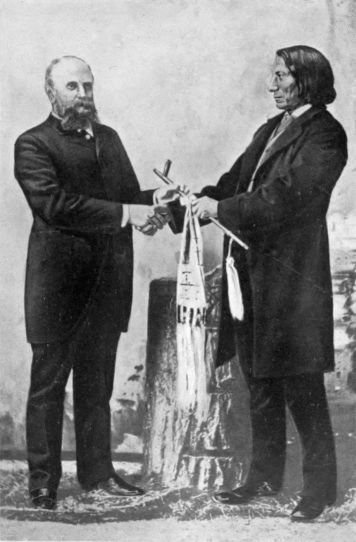
On September 28, Governor Evans held a council
with the Cheyenne and Arapaho chiefs brought in
by Major Wynkoop; Black Kettle and White Antelope
being the most important. Black Kettle
opened the conference with an appeal to the governor
in which he alluded to his delivery of the prisoners
and Wynkoop's invitation to visit Denver. "We
have come with our eyes shut, following his handful
of men, like coming through the fire," Black Kettle
went on. "All we ask is that we may have peace
with the whites. We want to hold you by the hand.
You are our father. We have been travelling
through a cloud. The sky has been dark ever since
the war began. These braves who are with me are
all willing to do what I say. We want to take good
tidings home to our people, that they may sleep in
peace. I want you to give all these chiefs of the soldiers
here to understand that we are for peace, and
that we have made peace, that we may not be mistaken
by them for enemies." To him Governor
Evans responded that this submission was a long time
coming, and that the nation had gone to war, refusing
to listen to overtures of peace. This Black Kettle
admitted.
"So far as making a treaty now is concerned,"
continued Governor Evans, "we are in no condition
to do it.... You, so far, have had the advantage; but
the time is near at hand when the plains will swarm
with United States soldiers. I have learned that
you understand that as the whites are at war among
themselves, you think you can now drive the whites
from this country; but this reliance is false. The
Great Father at Washington has men enough to drive
all the Indians off the plains, and whip the rebels
at the same time. Now the war with the whites is
nearly through, and the Great Father will not
know what to do with all his soldiers, except to send
them after the Indians on the plains. My proposition
to the friendly Indians has gone out; [I] shall be
glad to have them all come in under it. I have no
new proposition to make. Another reason that I am
not in a condition to make a treaty is that war is
begun, and the power to make a treaty of peace has
passed to the great war chief." He further counselled
them to make terms with the military authorities
before they could hope to talk of peace. No prospect
of an immediate treaty was given to the chiefs.
Evans disclaimed further powers, and Colonel Chivington
closed the council, saying: "I am not a big
war chief, but all the soldiers in this country are at my
command. My rule of fighting white men or Indians
is to fight them until they lay down their arms
and submit." The same evening came a despatch
from Major-general Curtis, at Fort Leavenworth,
confirming the non-committal attitude of Evans and
Chivington: "I want no peace till the Indians
suffer more.... I fear Agent of the Interior Department
will be ready to make presents too soon....
No peace must be made without my directions."
The chiefs were escorted home without their peace
or any promise of it, Governor Evans believing that
the great body of the tribes was still hostile, and that
a decisive winter campaign was needed to destroy
their lingering notion that the whites might be driven
from the plains. Black Kettle had been advised at
the council to surrender to the soldiers, Major Wynkoop
at Fort Lyon being mentioned as most available.
Many of his tribe acted on the suggestion, so
that on October 20 Agent Colley, their constant
friend, reported that "nearly all the Arapahoes are
now encamped near this place and desire to remain
friendly, and make reparation for the damages
committed by them."
The Indians unquestionably were ready to make
peace after their fashion and according to their
ability. There is no evidence that they were reconciled
to their defeat, but long experience had accustomed
them to fighting in the summer and drawing
rations as peaceful in the winter. The young
men, in part, were still upon the war-path, but the
tribes and the head chiefs were anxious to go upon a
winter basis. Their interpreter who had attended
the conference swore that they left Denver, "perfectly
contented, deeming that the matter was settled,"
that upon their return to Fort Lyon, Major
Wynkoop gave them permission to bring their families
in under the fort where he could watch them
better; and that "accordingly the chiefs went after
their families and villages and brought them in,
... satisfied that they were in perfect security and
safety."
While the Indians gathered around the fort,
Major Wynkoop sent to General Curtis for advice
and orders respecting them. Before the orders arrived,
however, he was relieved from command and
Major Scott J. Anthony, of the First Colorado Cavalry,
was detailed in his place. After holding a conference
with the Indians and Anthony, in which
the latter renewed the permission for the bands to
camp near the fort, he left Fort Lyons on November
26. Anthony meanwhile had become convinced that
he was exceeding his authority. First he disarmed
the savages, receiving only a few old and worn-out
weapons. Then he returned these and ordered the
Indians away from Fort Lyons. They moved forty
miles away and encamped on Sand Creek.
The Colorado authorities had no idea of calling it
a peace. Governor Evans had scolded Wynkoop
for bringing the chiefs in to Denver. He had received
special permission and had raised a hundred-day
regiment for an Indian campaign. If he should
now make peace, Washington would think he had
misrepresented the situation and put the government
to needless expense. "What shall I do with
the third regiment, if I make peace?" he demanded
of Wynkoop. They were "raised to kill Indians,
and they must kill Indians."
Acting on the supposition that the war was still on,
Colonel Chivington led the Third Colorado, and a
part of the First Colorado Cavalry, from 900 to 1000
strong, to Fort Lyons in November, arriving two
days after Wynkoop departed. He picketed the
fort, to prevent the news of his arrival from getting
out, and conferred on the situation with Major
Anthony, who, swore Major Downing, wished he
would attack the Sand Creek camp and would have
done so himself had he possessed troops enough.
Three days before, Anthony had given a present to
Black Kettle out of his own pocket. As the result of
the council of war, Chivington started from Fort
Lyon at nine o'clock, on the night of the 28th.
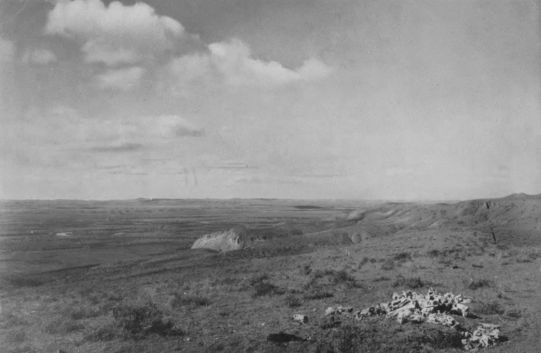
About daybreak on November 29 Chivington's
force reached the Cheyenne village on Sand Creek,
where Black Kettle, White Antelope, and some
500 of their band, mostly women and children,
were encamped in the belief that they had made
their peace. They had received no pledge of this,
but past practice explained their confidence. The
village was surrounded by troops who began to fire
as soon as it was light. "We killed as many as we
could; the village was destroyed and burned," declared
Downing, who further professed, "I think
and earnestly believe the Indians to be an obstacle to
civilization, and should be exterminated." White
Antelope was killed at the first attack, refusing to
leave the field, stating that it was the fault of Black
Kettle, others, and himself that occasioned the massacre,
and that he would die. Black Kettle, refusing
to leave the field, was carried off by his young men.
The latter had raised an American flag and a white
flag in his effort to stop the fight.
The firing began, swore interpreter Smith, on
the northeast side of Sand Creek, near Black Kettle's
lodge. Driven thence, the disorderly horde of
savages retreated to War Bonnet's lodge at the upper
end of the village, some few of them armed but most
making no resistance. Up the dry bottom of Sand
Creek they ran, with the troops in wild charge close
behind. In the hollows of the banks they sought
refuge, but the soldiers dragged them out, killing
seventy or eighty with the worst barbarities Smith
had seen: "All manner of depredations were inflicted
on their persons; they were scalped, their
brains knocked out; the men used their knives,
ripped open women, clubbed little children, knocked
them in the head with their guns, beat their brains
out, mutilated their bodies in every sense of the
word." The affidavits of soldiers engaged in the
attack are printed in the government documents.
They are too disgusting to be more than referred to
elsewhere.
Here at last was the culmination of the plains war
of 1864 in the "Chivington massacre," which has been
the centre of bitter controversy ever since its heroes
marched into Denver with their bloody trophies. It
was without question Indian fighting at its worst, yet
it was successful in that the Indian hostilities stopped
and a new treaty was easily obtained by the whites
in 1865. The East denounced Chivington, and the
Indian Commissioner described the event in 1865 as
a butchery "in cold blood by troops in the service of
the United States." "Comment cannot magnify
the horror," said the Nation. The heart of the question
had to do with the matter of good faith. At no
time did the military or Colorado authorities admit
or even appear to admit that the war was over.
They regarded the campaign as punitive and necessary
for the foundation of a secure peace. The Indians,
on the other hand, believed that they had surrendered
and were anxious to be let alone. Too often
their wish in similar cases had been gratified, to the
prolongation of destructive wars. What here occurred
was horrible from any standard of civilized
criticism. But even among civilized nations war is
an unpleasant thing, and war with savages is most
merciful, in the long run, when it speaks the savages'
own tongue with no uncertain accent. That such
extreme measures could occur was the result of the
impossible situation on the plains. "My opinion,"
said Agent Colley, "is that white men and wild
Indians cannot live in the same country in peace."
With several different and diverging authorities over
them, with a white population wanting their reserves
and anxious for a provocation that might justify retaliation
upon them, little difficulties were certain to
lead to big results. It was true that the tribes were
being dispossessed of lands which they believed to belong
to them. It was equally true that an Indian war
could terrify a whole frontier and that stern repression
was its best cure. The blame which was accorded
to Chivington left out of account the terror in
Colorado, which was no less real because the whites
were the aggressors. The slaughter and mutilation
of Indian women and children did much to embitter
Eastern critics, who did not realize that the only way
to crush an Indian war is to destroy the base of supplies,—the
camp where the women are busy helping
to keep the men in the field; and who overlooked
also the fact that in the mêlée the squaws were quite
as dangerous as the bucks. Indiscriminate blame
and equally indiscriminate praise have been accorded
because of the Sand Creek affair. The terrible
event was the result of the orderly working of causes
over which individuals had little control.
In October, 1865, a peace conference was held on
the Little Arkansas at which terms were agreed
upon with Apache, Kiowa and Comanche, Arapaho
and Cheyenne, while the last named surrendered
their reserve at Sand Creek. For four years after
this, owing to delays in the Senate and ambiguity
in the agreements, they had no fixed abode. Later
they were given room in the Indian Territory in lands
taken from the civilized tribes.